Posted on Leave a comment

Air Fryer Pork Chops Recipe: Juicy Boneless, Bone-In, Thin & Thick Chops

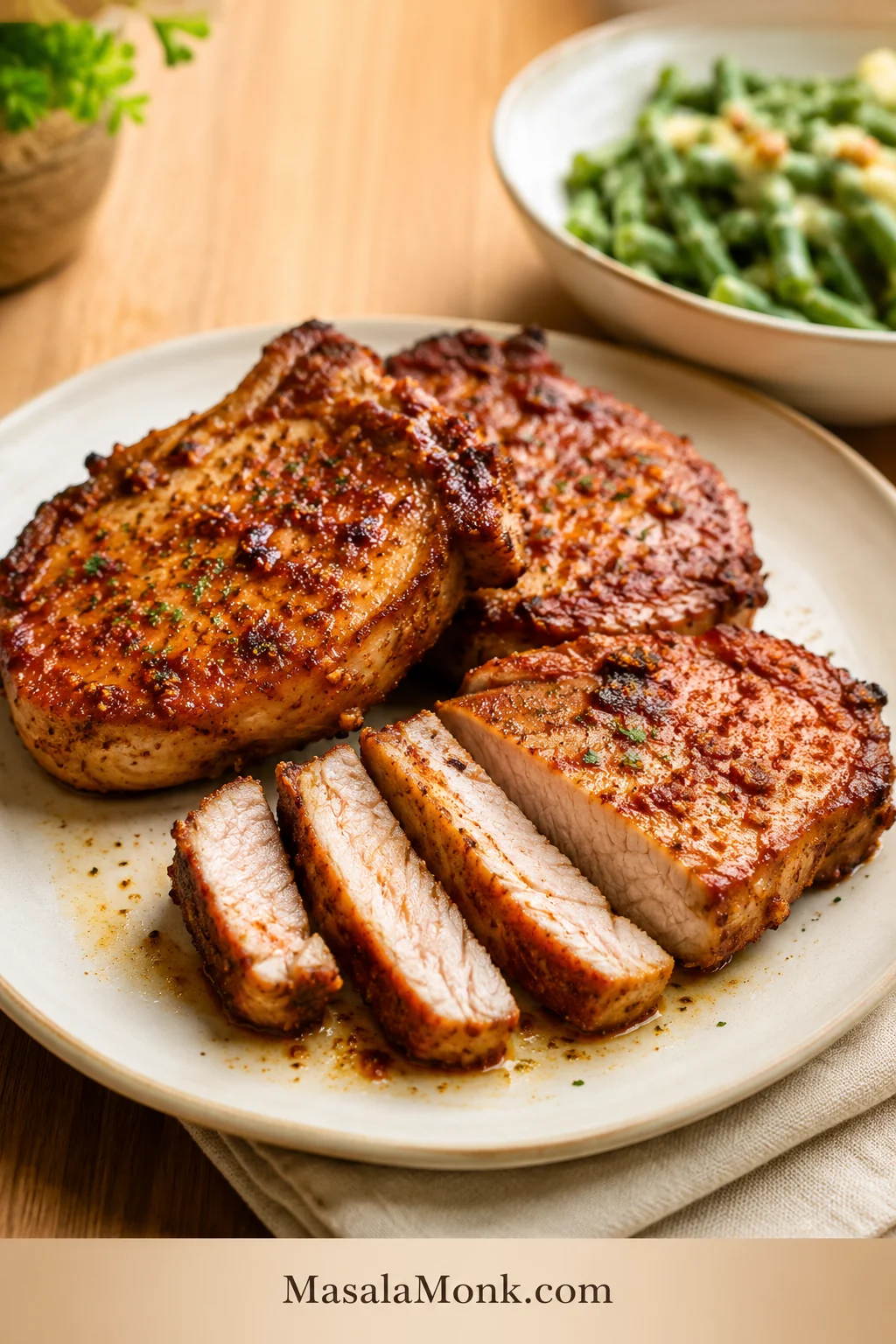
No-breading air fryer pork chops on a cream plate, with one pork chop sliced open to show the cooked center.

Dry pork chops are usually not a pork chop problem — they are a timing problem. Air fryers cook lean pork quickly, which is great for dinner, but it also means a thin or boneless chop can turn tough if it stays in the basket just a little too long.

If you have ever pulled pork chops out of the air fryer looking perfect on the outside but tight and dry inside, the fix is usually not a complicated marinade. It is better timing, enough space, and knowing when to stop.

This recipe is built around a no-dry timing guide, so you can match the method to the pork chop you actually bought — boneless, bone-in, thin, thick, breaded, frozen, or air fryer oven-style.

When it works, the edges are browned, the paprika-garlic rub smells warm and smoky, and the inside stays tender enough to slice cleanly without losing all its juices. The timer gives you a starting point; the thermometer gives you the answer.

Quick Time and Temperature Answer

For most 1-inch boneless pork chops, air fry at 380°F / 193°C for 10 to 12 minutes, flipping halfway, until the center reaches 145°F / 63°C. Rest for 3 to 5 minutes before slicing. Use 390°F to 400°F / 199°C to 204°C for breaded chops or crispier edges, and start checking earlier for thin chops.

Many recipes use 400°F, and that can work. This recipe uses 380°F as the default because it gives lean pork a little more time to cook through before the outside tightens up.

Jump to What You Need

Quick No-Breading Recipe for 1-Inch Boneless Chops

Need dinner moving now? This is the fast path for the most common version: 1-inch boneless pork chops with no breading.
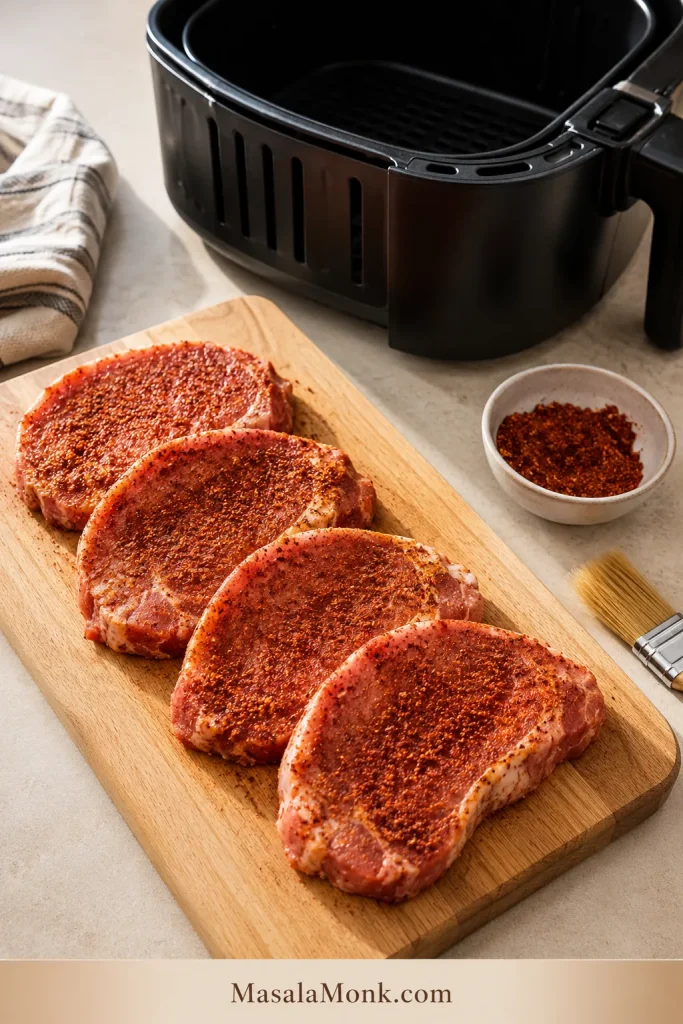
Seasoned boneless pork chops on a wooden board beside an air fryer basket, spice bowl, and oil brush.
For 1-inch boneless air fryer pork chops, this is the simplest starting point: season, arrange, cook, and check the center. Then adjust the timing if your chops are thin, thick, bone-in, breaded, or frozen.
  1. Preheat the air fryer to 380°F / 193°C for 3 to 5 minutes.
  2. Pat dry 4 pork chops, about 6 oz / 170 g each.
  3. Rub with oil: use 1½ tbsp / 22 ml olive oil or avocado oil.
  4. Season with 2 tsp smoked paprika, 1 tsp garlic powder, ½ tsp onion powder, 1 tsp fine salt, ½ tsp black pepper, ½ tsp thyme, Italian seasoning, or ground mustard, and 1 tbsp brown sugar if you want a lightly caramelized edge.
  5. Air fry in a single layer for 10 to 12 minutes, flipping halfway.
  6. Remove when the center reaches 145°F / 63°C.
  7. Rest loosely for 3 to 5 minutes, then serve.

The goal is not a perfect-looking chop that eats dry. What you want is pork that still feels tender when you cut into it.

Once you have made this basic version once, the rest is just adjusting for the chop in front of you: thinner, thicker, bone-in, breaded, or frozen.

If your chops are thinner, thicker, bone-in, breaded, or still frozen, do not force the 10 to 12 minute timing. Use the air fryer pork chops time and temperature chart and start checking early.

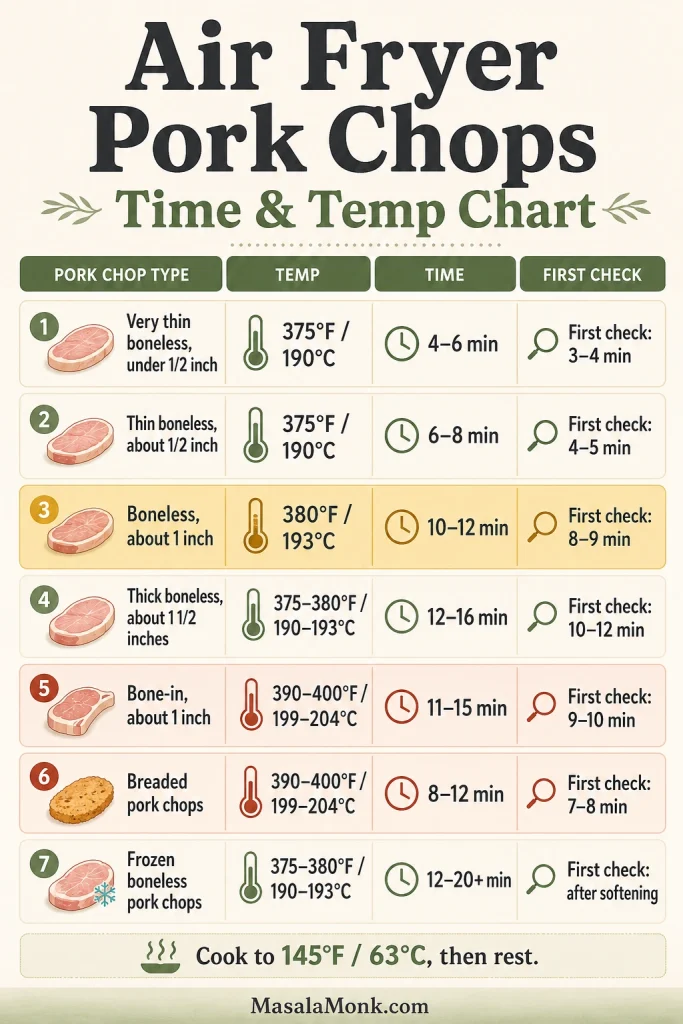
Air Fryer Pork Chops Time and Temperature Chart

Use this chart when your pork chops are not the exact 1-inch boneless chops in the quick recipe. Pick the row closest to your chop thickness. The “first check” column tells you when to start checking so you can stop before lean pork overcooks.

Timing by Pork Chop Type

Pork Chop TypeAir Fryer TempCook TimeFirst CheckBest Note
Very thin boneless, under ½ inch / 1.25 cm375°F / 190°C4–6 minutes3–4 minutesFast cook; stay close.
Thin boneless, about ½ inch / 1.25 cm375°F / 190°C6–8 minutes4–5 minutesDo not use thick-chop timing.
Boneless, about ¾ inch / 2 cm380°F / 193°C8–10 minutes6–7 minutesGood everyday size.
Boneless, about 1 inch / 2.5 cm380°F / 193°C10–12 minutes8–9 minutesBest default for this recipe.
Thick boneless, about 1½ inches / 4 cm375–380°F / 190–193°C12–16 minutes10–12 minutesUse patience, not high heat.
Bone-in, about 1 inch / 2.5 cm390–400°F / 199–204°C11–15 minutes9–10 minutesCheck the meat near the bone.
Bone-in, about 1½ inches / 4 cm380–400°F / 193–204°C14–18 minutes12–14 minutesRest well before slicing.
Breaded pork chops390–400°F / 199–204°C8–12 minutes7–8 minutesSpray dry spots with oil.
Shake and Bake pork chops390–400°F / 199–204°C8–12 minutes7–8 minutesSingle layer matters.
Frozen boneless pork chops375–380°F / 190–193°C12–20+ minutesAfter softening, then oftenSeason after the surface softens.
Reheating cooked pork chops350°F / 175°C3–5 minutes3 minutesWarm gently.
Air fryer pork chops time and temperature chart with cook times and first-check times for different pork chop cuts.
Use this air fryer pork chops time and temperature chart as a starting range, not a strict countdown. The first-check column matters because lean pork can move from tender to overdone quickly.

Why Thin and Thick Pork Chops Need Different Timing
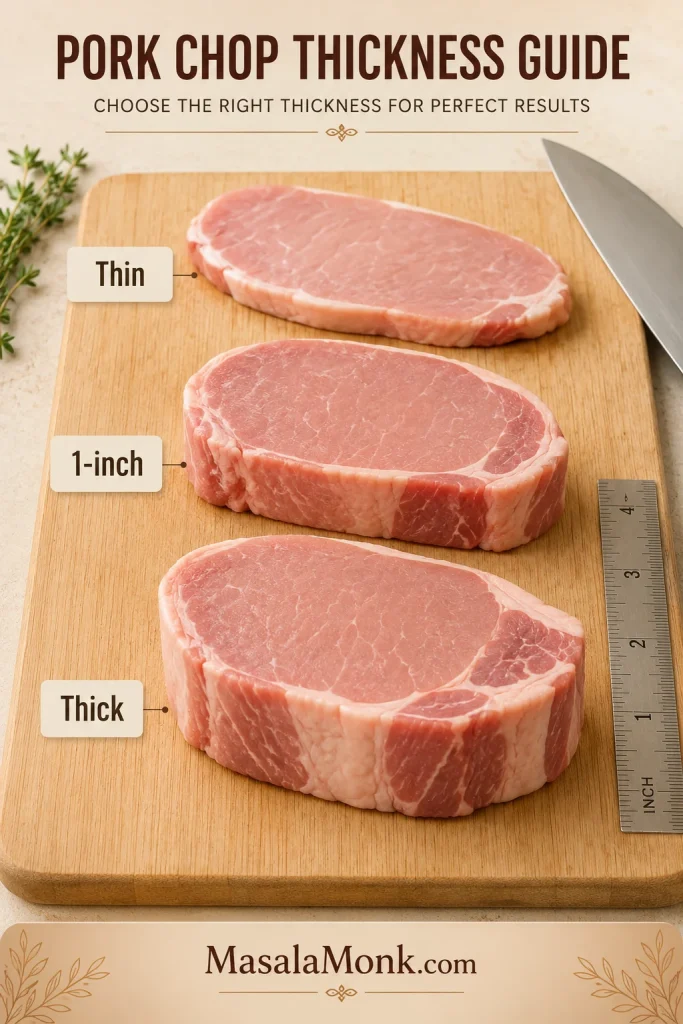
Three raw pork chops of different thicknesses on a cutting board, labeled as thin, one-inch, and thick chops.
Before choosing a cook time, look at thickness first. Thin pork chops can finish quickly even without deep browning, while thick chops need enough time for the center to cook through gently.

In plain terms: thin chops need speed, thick chops need patience, breaded chops need oil-kissed crumbs, and frozen chops need the thermometer more than the timer.

These are ranges, not promises. Air fryer model, chop thickness, bone, breading, and basket crowding all change the final time. For safe, juicy pork chops, the important number is 145°F / 63°C with at least a 3-minute rest. If you are deciding between 375°F, 380°F, and 400°F, use the temperature comparison next.

Air Fryer Pork Chops at 375°F, 380°F, or 400°F

The temperature question matters because lean pork can move from juicy to tough quickly. Use lower heat when you need control, and higher heat when you want crisping.

Choosing 375°F, 380°F, or 400°F
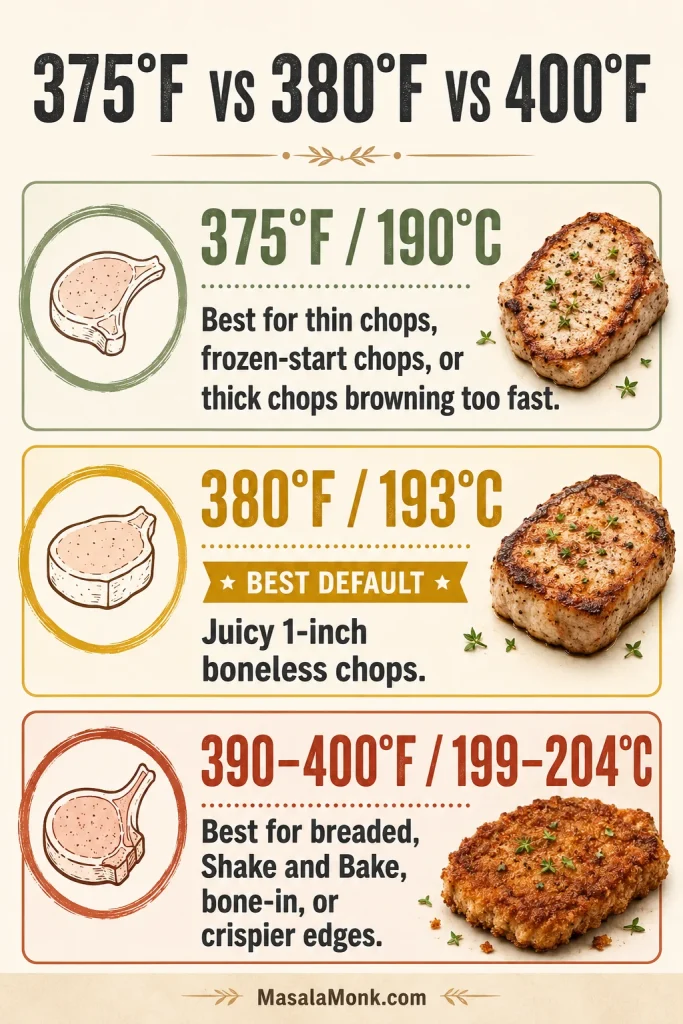
Temperature guide comparing 375°F, 380°F, and 390 to 400°F for cooking different air fryer pork chops.
Temperature should match the job. Use 375°F for control, 380°F for everyday boneless pork chops, and 390–400°F when breading, Shake and Bake, or stronger browning needs extra heat.
TemperatureBest ForWatch Out For
375°F / 190°CThin chops, frozen-start chops, thick chops that are browning too fastSlower browning
380°F / 193°CDefault juicy boneless chops, especially around 1 inch thickLess aggressive crisping than 400°F
390–400°F / 199–204°CBreaded chops, Shake and Bake, bone-in chops, crispier edgesLean boneless chops can overcook faster

For most people making plain boneless chops tonight, 380°F is the easiest place to start. Move hotter when you want crisp coating, stronger browning, or a bone-in chop that needs more edge color; for coating-specific guidance, jump to the breaded pork chops section.

If the pork reaches 145°F earlier than the chart says, take it out. The timer is not the goal; juicy pork is.

Best Pork Chops to Use

The right chop gives you more forgiveness before you even start cooking. If you are standing at the store, choose chops that are evenly thick, not paper-thin on one end and thick on the other.
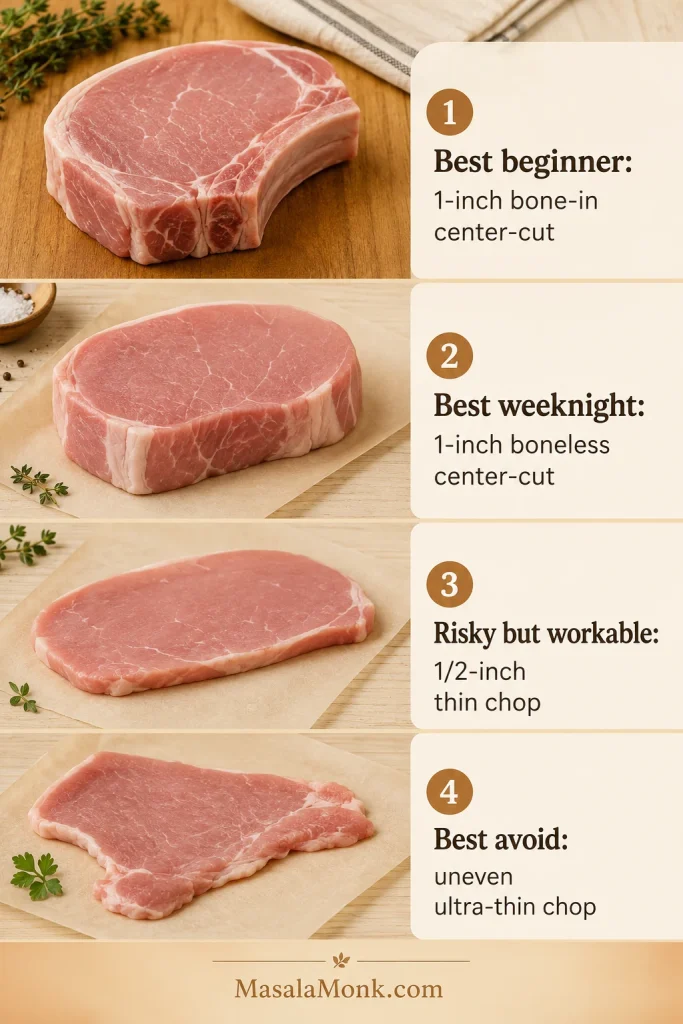
Raw bone-in, boneless, thin, and uneven pork chops shown as a visual guide for air fryer cooking.
The best pork chops for the air fryer are evenly thick because they cook more predictably from edge to center. If the chop is very thin or uneven, start checking earlier than the timer suggests.
ChoiceBest ForWhy It Works
Best beginner choice1-inch bone-in center-cut chopsJuicier and more forgiving.
Best weeknight choice1-inch boneless center-cut chopsFast, easy, and reliable with the chart.
Best crispy option1-inch boneless or bone-in chops with breadingEnough thickness to cook through while the coating browns.
Risky but workable½-inch thin chops or cutletsFast dinner, but they need early checking.
Best to avoidUneven ultra-thin chopsOne part dries out before the thicker part finishes.

Bone-in cuts are a little more forgiving if you are worried about dryness. Boneless cuts are faster and convenient, but they need closer attention. Around 1 inch thick is the easiest size to cook well. Already bought a different cut? Use the boneless, bone-in, thin, and thick chop guide before choosing a final cook time.

Ingredients and Equipment

The rub is not trying to hide the pork. It helps the edges brown and gives every bite a little garlic-smoky warmth. If you are cooking from the pantry, the essentials are simple: pork chops, oil, salt, garlic powder, paprika, and pepper. For the full measured version, jump to the recipe card.
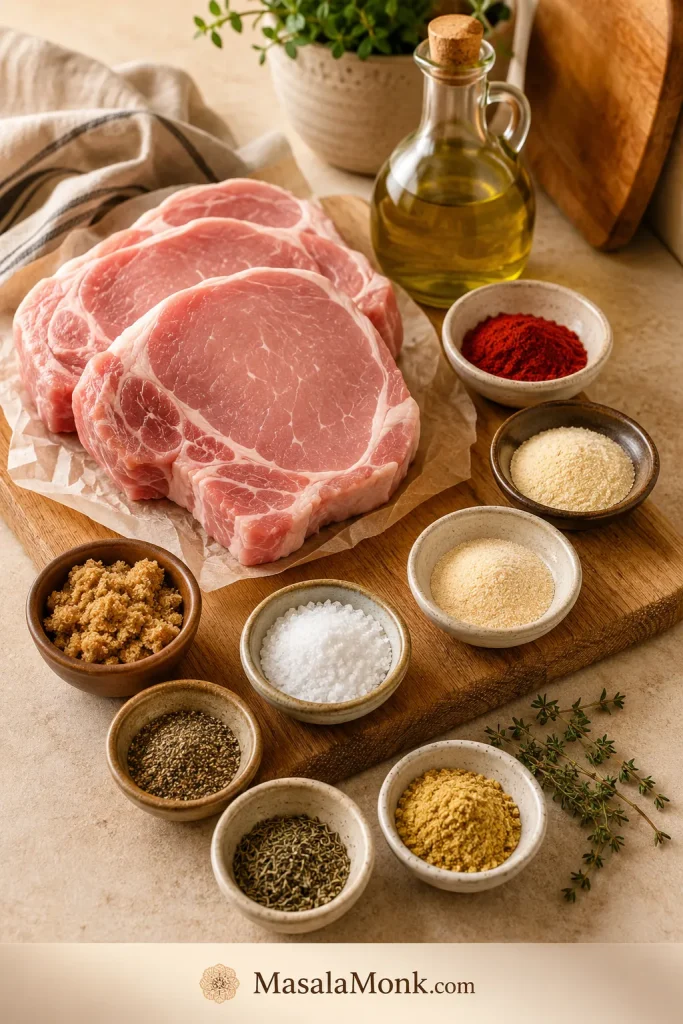
Raw pork chops with olive oil, smoked paprika, garlic powder, onion powder, salt, pepper, brown sugar, and herbs.
This pork chop seasoning builds flavor without a long ingredient list. Paprika helps the surface look warm and browned, garlic and onion add savory depth, and optional brown sugar encourages caramelized edges.

Pork Chop Seasoning Ingredients

IngredientUS AmountMetric Amount
Pork chops4 x 6 oz chops4 x 170 g chops
Olive oil or avocado oil1½ tbsp22 ml
Brown sugar, optional1 tbsp12 g
Smoked paprika2 tsp4–5 g
Garlic powder1 tsp3 g
Onion powder½ tsp1–2 g
Fine salt1 tsp5–6 g
Black pepper½ tsp1 g
Dried thyme, Italian seasoning, or ground mustard½ tspabout 1 g
  • Salt note: If your pork chops are labeled enhanced, pre-brined, or already seasoned, reduce the salt slightly.
  • Brown sugar note: It helps the edges caramelize, but you can skip it for a sugar-free version.
  • Oil note: Use just enough to lightly coat the surface. Greasy pork will not brown better.

Equipment

  • Air fryer: Basket-style or oven-style both work.
  • Instant-read meat thermometer: The most important tool for avoiding dry pork chops.
  • Paper towels: For drying the surface before seasoning.
  • Small bowl: For mixing the rub.
  • Tongs: For flipping without scraping off the seasoning.
  • Perforated parchment, optional: Use only if sticking is a problem; do not preheat loose parchment without food weighing it down.

Why These Air Fryer Pork Chops Stay Juicy

These are the small details that make the difference between pork chops that only look done and pork chops that actually eat juicy. Need a visual doneness check later? Use the done pork chops guide.

  • Match the chop, not the clock. Thin, thick, bone-in, breaded, and frozen chops all need different timing.
  • Dry, oil, season. A dry surface and a light oil coating help the rub brown instead of steam. This is the same reason air fryer chicken wings crisp better when the skin is dry.
  • Give the air space. Cook in a single layer so the hot air can reach the edges.
  • Check before the timer ends. Especially with thin chops, small chops, or compact basket-style air fryers.
  • Rest loosely. A tight foil wrap can soften the crust, while a short loose rest lets the juices settle.

Quick Visual Steps Before Air Frying

Pat the Pork Chops Dry

Before seasoning, blot the surface well so the rub has something dry to cling to. This visible step supports the pat-dry instruction in the quick recipe.
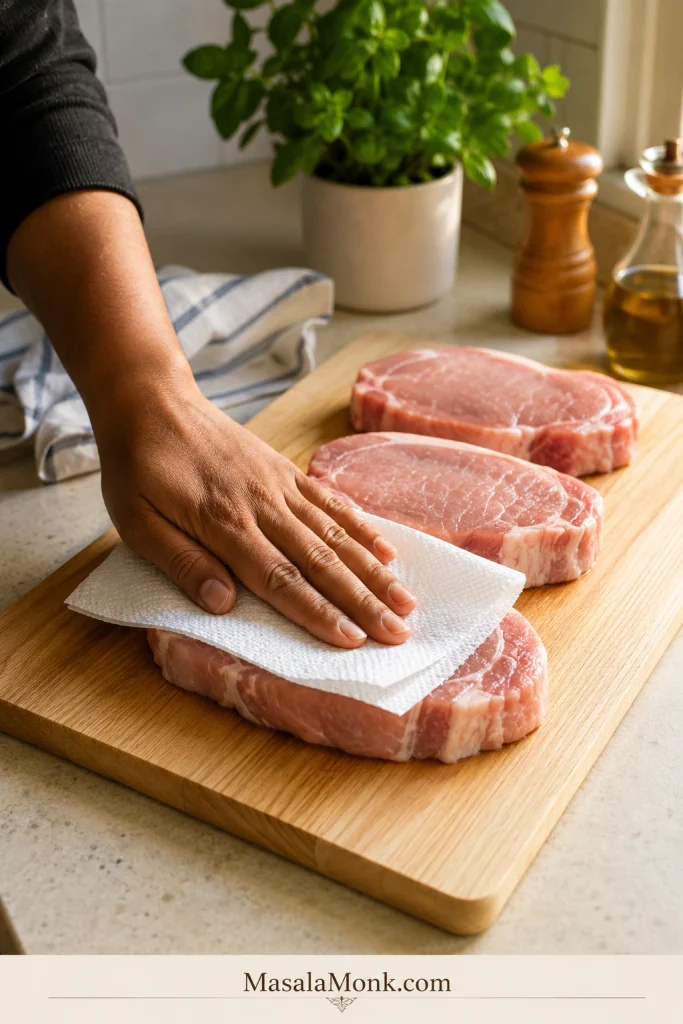
A hand pats raw pork chops dry with a paper towel on a wooden cutting board.
Blotting the pork chops dry before seasoning helps the rub cling instead of sliding around. As a result, the surface browns better and the air fryer does less steaming.

Season Both Sides Evenly

Next, coat both sides with oil and seasoning, then press the rub in lightly. This is where the no-breading version gets most of its color and aroma.
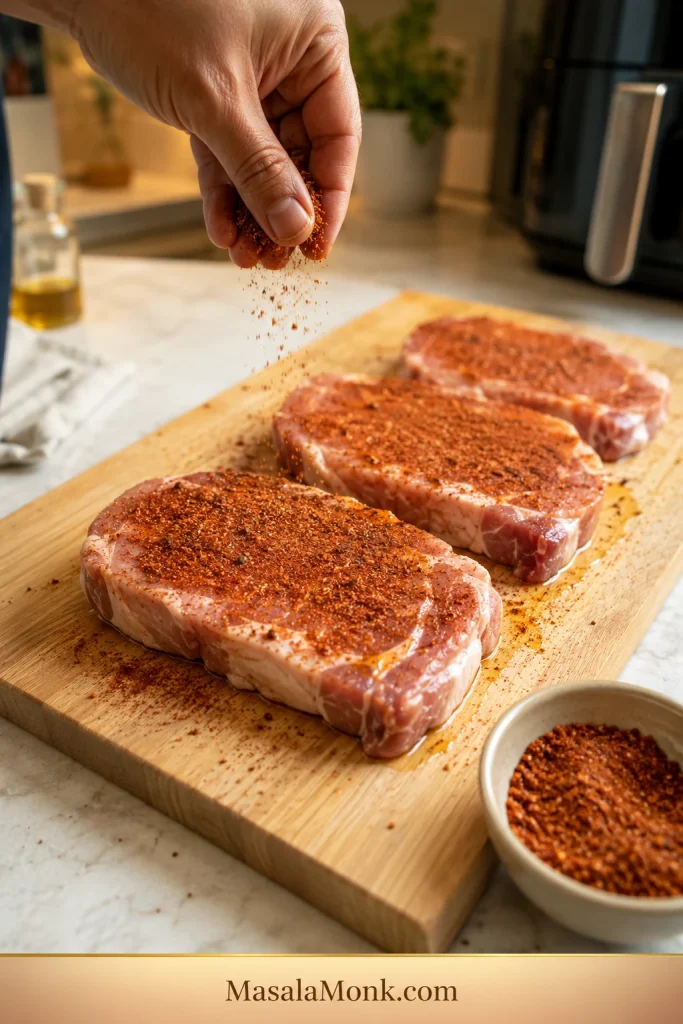
A hand sprinkles paprika-garlic seasoning over raw pork chops on a wooden cutting board.
Season both sides and press the rub in lightly so it stays attached during cooking. Since these are no-breading pork chops, that spice layer becomes the main source of color, aroma, and flavor.

Leave Space in the Basket

Arrange the pork chops in a single layer instead of stacking or overlapping them. Space around the edges helps the air fryer brown the surface more evenly.
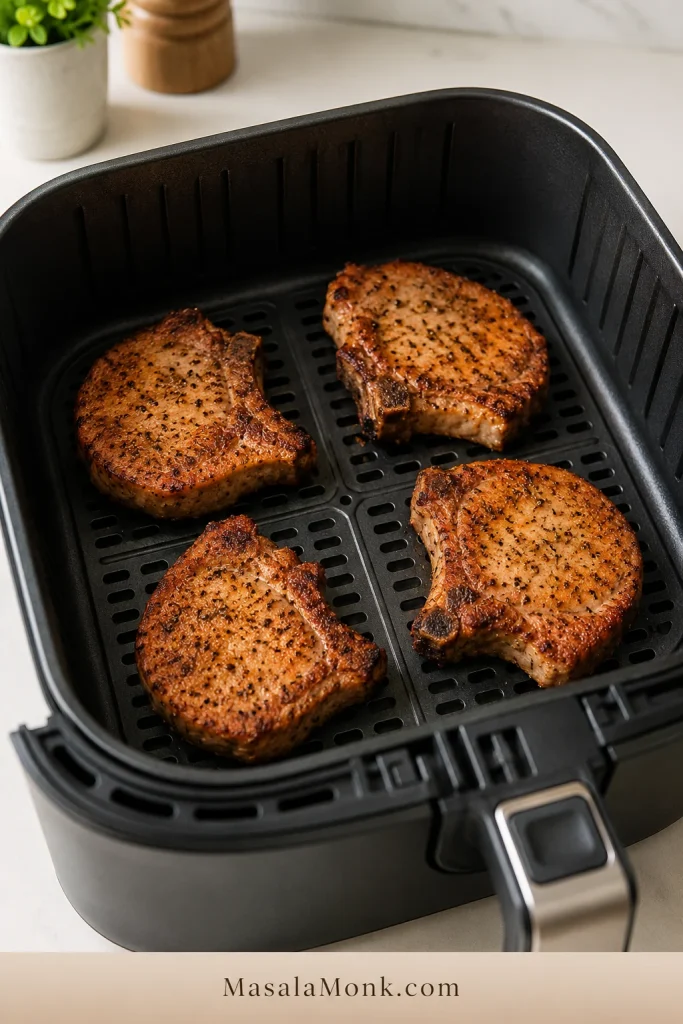
Seasoned pork chops arranged in a single layer with space between them inside a black air fryer basket.
A single layer lets hot air reach the top, sides, and edges of each pork chop. If the basket is crowded, the chops can steam where they touch and brown unevenly.

Flip Halfway Through Cooking

Halfway through the cook time, turn the chops gently with tongs. This gives both sides direct heat and helps prevent one pale side.
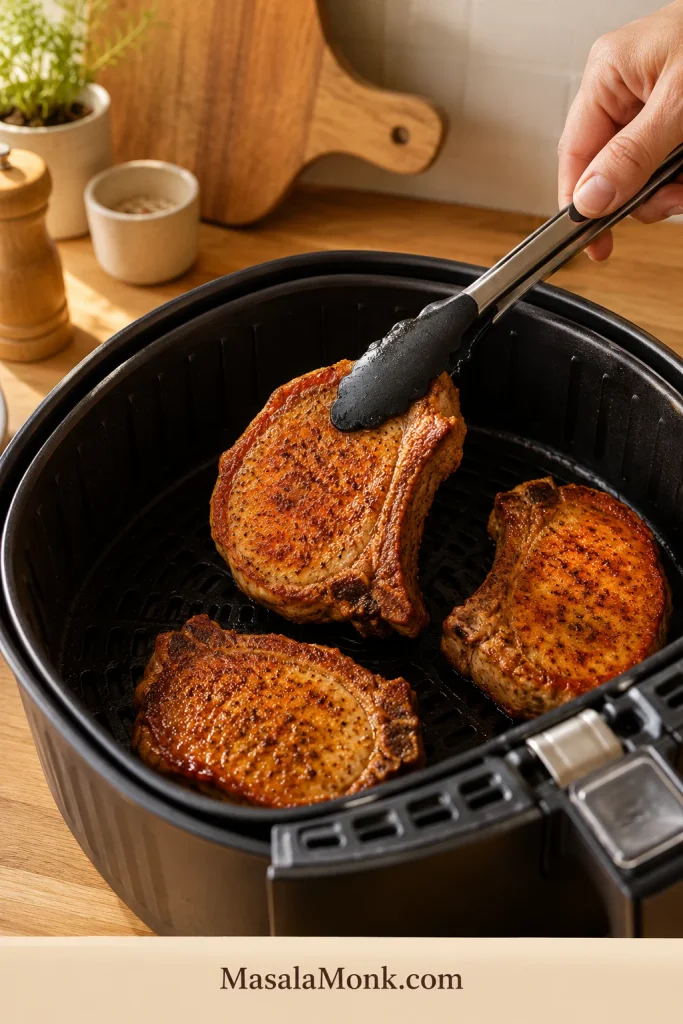
Tongs lift a browned pork chop from an air fryer basket while other pork chops cook nearby.
Flip pork chops halfway through air frying so both sides get direct heat. For breaded chops, lift gently with tongs instead of dragging, which helps keep the coating intact.

Once the main method is clear, the rest is just small adjustments: the chop you bought, the air fryer you own, and how crisp you want the edges.

What Done Pork Chops Look and Feel Like

The best batch should look roasted at the edges, smell garlicky and smoky, and slice without turning chalky. The seasoning should look darker and fragrant, and the surface should look browned rather than wet. Breaded chops should be golden, not pale or dusty.
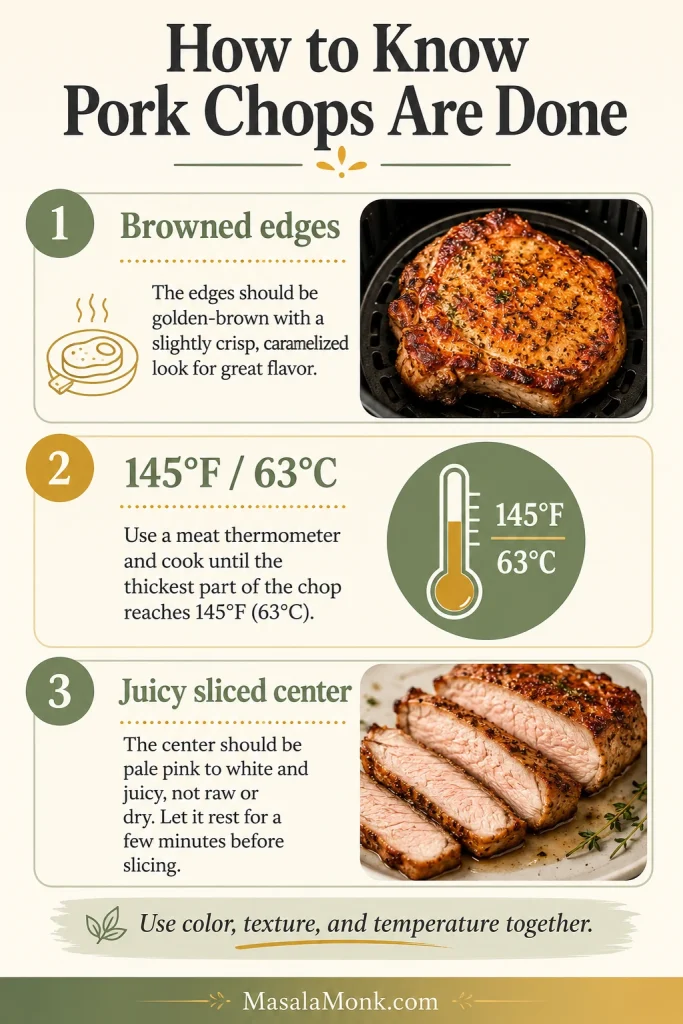
Doneness guide for air fryer pork chops showing browned edges, 145°F internal temperature, and a sliced cooked center.
Browned edges are helpful, but color alone is not enough for pork chops. For better doneness confidence, combine a 145°F / 63°C center with a short rest and a tender-looking slice.

If you grew up thinking pork had to be cooked until completely white, this may feel different. A slight blush can be normal when pork reaches 145°F / 63°C and rests. The thermometer matters more than fear.

Use 145°F as the Stop Point
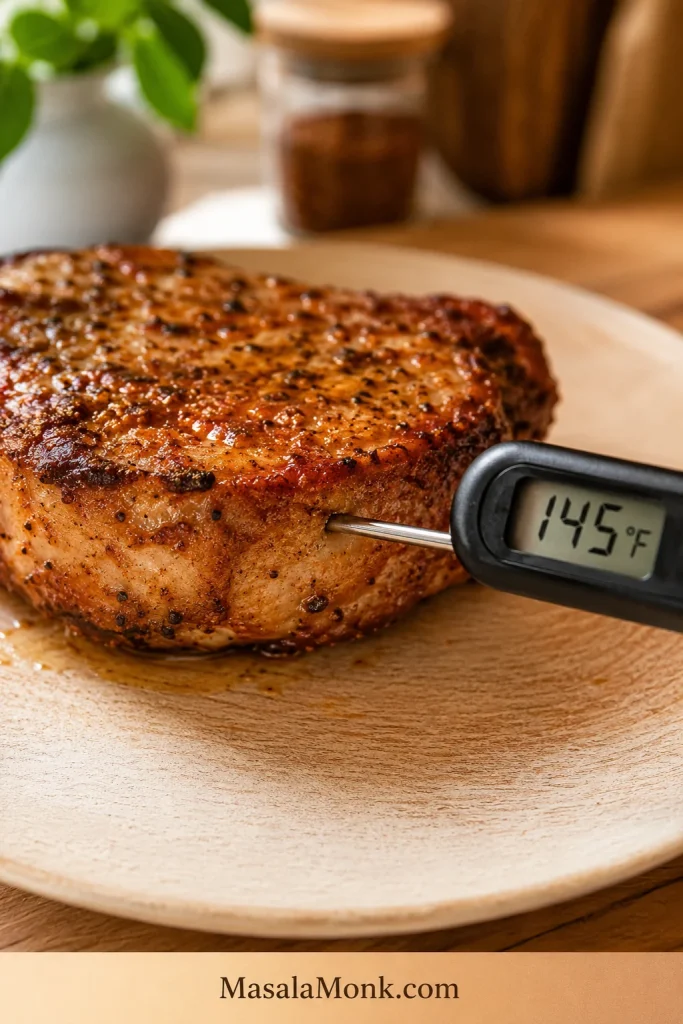
A meat thermometer inserted into a cooked pork chop shows an internal temperature of 145°F.
The timer tells you when to check, but the thermometer tells you when the pork is actually done. Aim for 145°F / 63°C in the thickest part, then rest the chops before cutting.

When the outside is browning too fast but the center is not done, lower the temperature to 350°F / 175°C and cook for a few more minutes. That is better than burning the crust while waiting for the inside.

Check the Slice After Resting
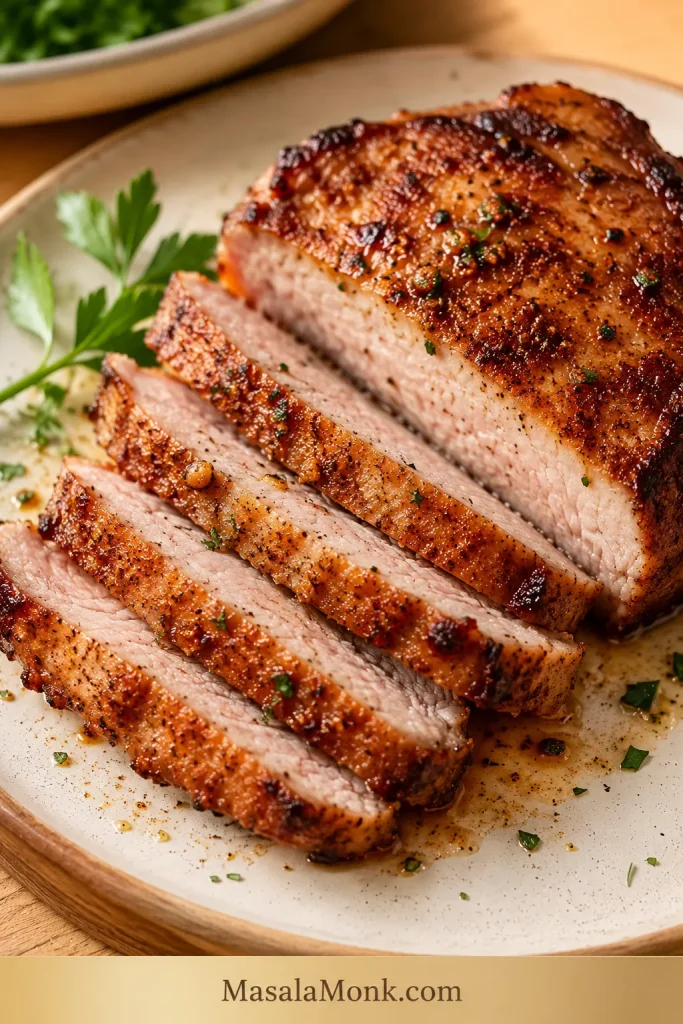
Sliced air fryer pork chop with a browned crust and moist cooked center on a wooden board.
After resting, a good air fryer pork chop should slice cleanly and still look tender inside. If the meat looks tight or chalky, check the next batch sooner and rely on temperature instead of time alone.

If your pork chops still turn out dry or tough after checking temperature, use the troubleshooting guide before the next batch.

If you want the complete measured version in one place, use the recipe card below.

Air Fryer Pork Chops Recipe Card

This is the full recipe card version for 1-inch boneless chops. Use the chart above for thin, thick, bone-in, breaded, or frozen chops.

Recipe Details

Prep Time10 minutes
Cook Time10–12 minutes
Resting Time3–5 minutes
Total TimeAbout 25 minutes
Servings4
Cooking MethodAir fryer
Best For1-inch boneless chops; see chart for other cuts

Ingredients

  • 4 pork chops, about 6 oz / 170 g each, preferably 1 inch thick
  • 1½ tbsp / 22 ml olive oil or avocado oil
  • 1 tbsp / 12 g brown sugar, optional
  • 2 tsp / 4–5 g smoked paprika
  • 1 tsp / 3 g garlic powder
  • ½ tsp / 1–2 g onion powder
  • 1 tsp / 5–6 g fine salt
  • ½ tsp / 1 g black pepper
  • ½ tsp dried thyme, Italian seasoning, or ground mustard

Instructions

  1. Preheat. Set the air fryer to 380°F / 193°C and preheat for 3 to 5 minutes.
  2. Dry. Pat both sides of the pork chops dry with paper towels.
  3. Oil and season. Rub both sides lightly with oil, then coat with the spice mixture.
  4. Arrange. Place pork chops in a single layer. Cook in batches if needed.
  5. Air fry. Cook for 10 to 12 minutes for 1-inch boneless chops, flipping halfway through.
  6. Check doneness. Remove when the center reaches 145°F / 63°C.
  7. Rest. Rest loosely for 3 to 5 minutes before slicing.

Recipe Notes

  • Bone-in chops may need 2 to 3 extra minutes; check near, but not touching, the bone.
  • Thin chops can be ready quickly, so start checking around 4 to 5 minutes.
  • Thick chops do better at 375°F to 380°F with internal temperature as the final guide.
  • Crispier edges usually need heat closer to 400°F / 204°C, but lean boneless chops need close attention.
  • If using enhanced, pre-brined, or already seasoned pork chops, reduce the salt slightly.

Nutrition will vary most by chop size, breading, oil, sugar, and sauces. If you are tracking closely, use the cooked chop weight and adjust for toppings. For a deeper look, see this guide to calories in a pork chop.

Back to top ↑

Boneless, Bone-In, Thin, and Thick Chops

If you already bought a different chop, you do not need a different recipe. You just need to adjust the timing.
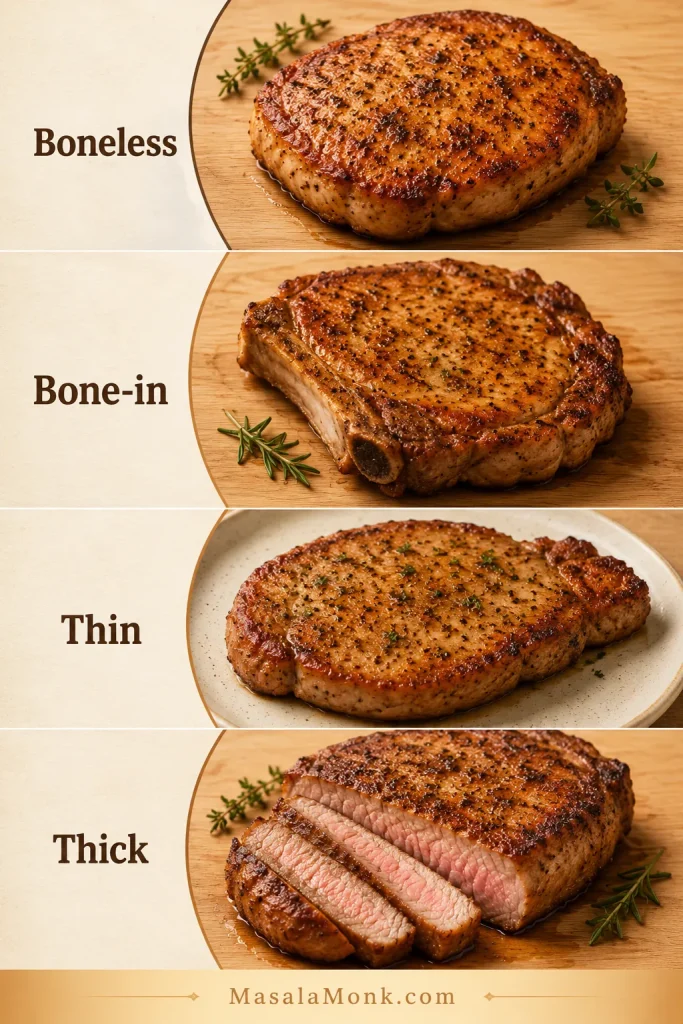
Cooked boneless, bone-in, thin, and thick air fryer pork chops shown in a labeled comparison guide.
The seasoning can stay the same, but the cooking approach should change by cut. Boneless chops cook fast, bone-in chops are more forgiving, thin chops need attention, and thick chops need patience.
  • Boneless pork chops: Fast and convenient, but less forgiving. Best around 1 inch thick.
  • Bone-in pork chops: Usually juicier and more forgiving. Check the meaty area near the bone without touching the bone.
  • Thin pork chops: Not difficult, but they do not forgive distraction. Start checking early and do not walk away.
  • Thick pork chops: Better texture potential, but they need patience. Lower the heat if the outside browns too fast.

The seasoning can stay the same; the timing cannot.

Breaded or Fried-Style Pork Chops

The base version skips breading: oil, seasoning, air fryer, done. Breading changes the job. Now you are cooking the pork and managing the crust at the same time. Air fryers crisp oil-kissed crumbs; they do not magically brown dry flour.
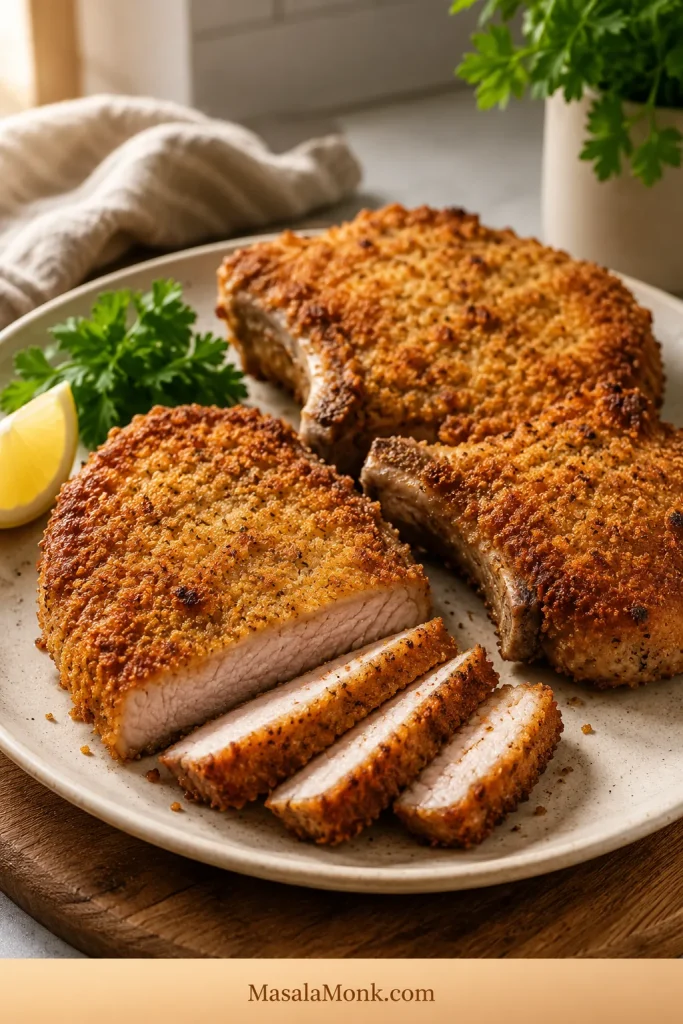
Golden breaded air fryer pork chops with crisp breadcrumb coating on a plate.
Breaded air fryer pork chops crisp best with a thin coating and a light oil mist. That way, the crumbs turn golden before the pork underneath has a chance to overcook.

How to Bread Pork Chops for the Air Fryer
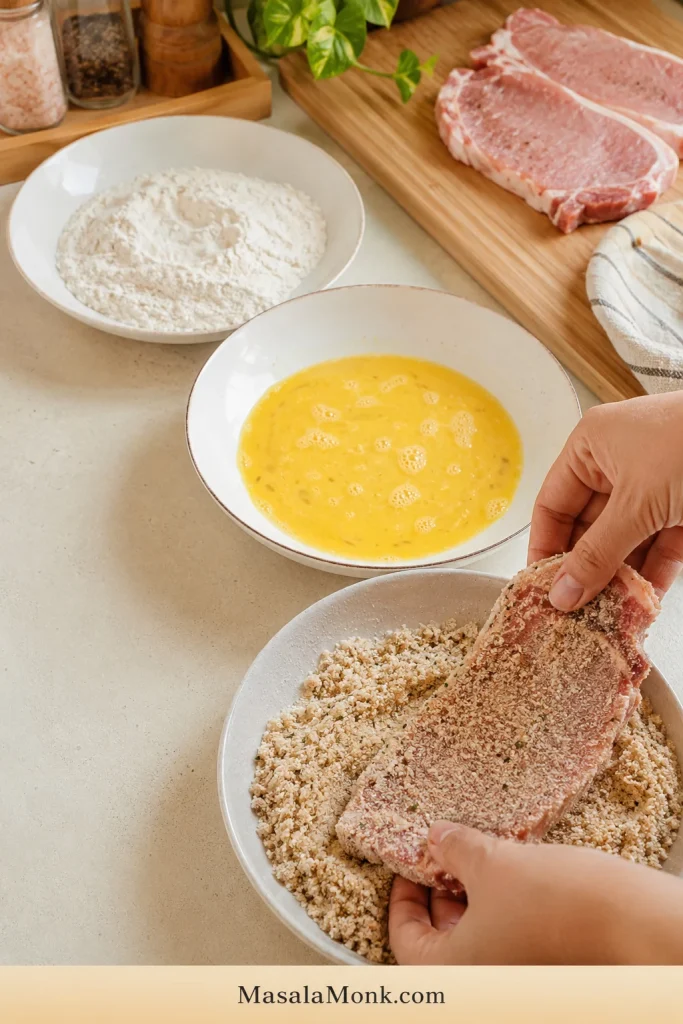
Pork chops being coated in flour, egg, and breadcrumbs at a breading station.
For crispy breaded pork chops, keep the flour, egg, and breadcrumb layers even rather than thick. Too much coating can stay pale while the meat continues cooking underneath.

For breaded chops, use 2 tbsp / 15 g flour, 1 egg, ½ cup / 30 g panko or breadcrumbs, optional ¼ cup / 20–25 g parmesan, and oil spray. Air fry at 390°F to 400°F / 199°C to 204°C, flip halfway, and spray pale or dusty spots lightly with oil.

Why Breaded Pork Chops Look Pale in the Air Fryer

If breaded pork chops look pale, the coating usually needs a light mist of oil, not several extra minutes. Dry crumbs do not brown well in the air fryer, and overcooking the pork just to darken the crust can make the center tough.
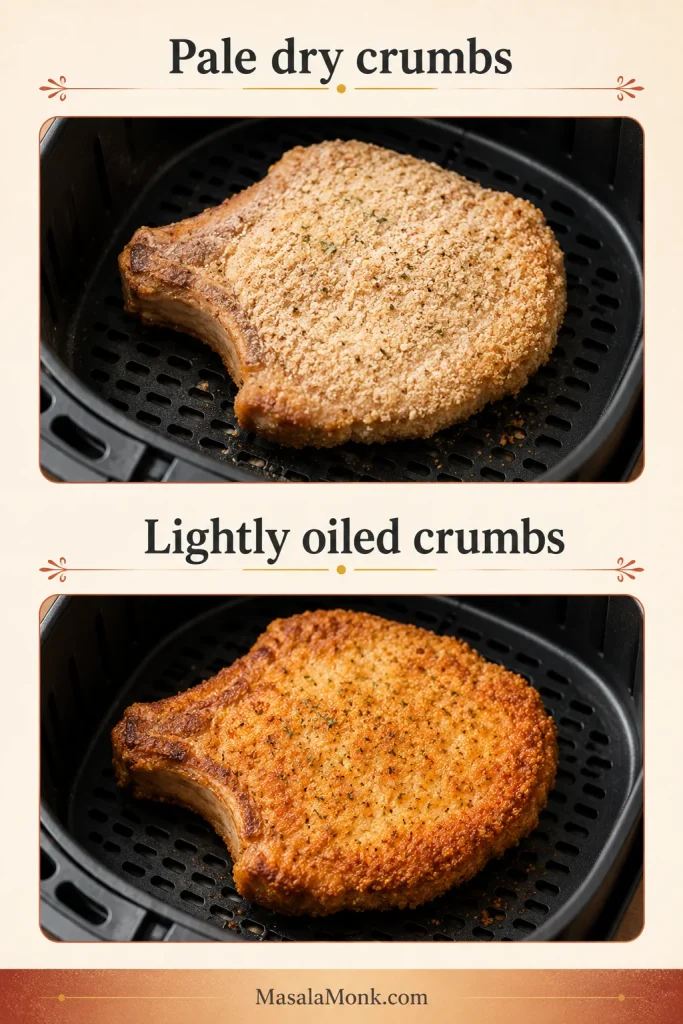
Comparison guide showing pale dry breading and lightly oiled golden breading on air fryer pork chops.
If breaded pork chops look pale, the coating may need a light mist of oil, not more time. Adding several extra minutes can brown the crumbs but push the pork past its best texture.

If the coating browns before the pork is done, lower the heat and finish gently. Do not bread frozen chops directly; thaw first or use the frozen pork chops method before seasoning. If the crust stays pale or the center finishes unevenly, check the troubleshooting guide.

Frozen Pork Chops in the Air Fryer

Frozen pork chops are not the most even-cooking option, but they can still work when dinner needs to happen now. It will not be quite as even as thawed pork, but it can still save dinner if you check the center instead of trusting the timer. For the target temperature and visual cues, use the done pork chops guide.
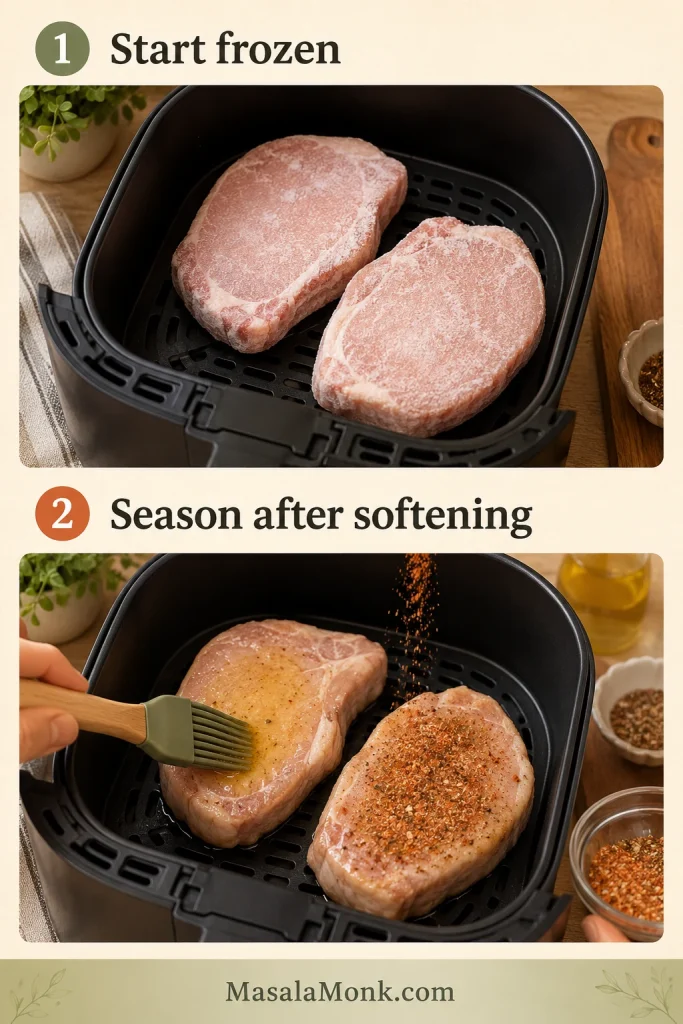
Two-step guide showing frozen pork chops in an air fryer basket before seasoning and then brushed with oil after softening.
Frozen pork chops are easier to season after the surface softens. Start them plain in the air fryer, then add oil and seasoning once the rub can stick evenly.
  1. Preheat the air fryer to 375°F / 190°C.
  2. Place frozen chops in a single layer.
  3. Air fry for 5 to 8 minutes, just until the surface starts to soften.
  4. Brush lightly with oil or melted butter.
  5. Add seasoning to both sides.
  6. Continue air frying, flipping occasionally, until the center reaches 145°F / 63°C.
  7. Rest for 3 to 5 minutes before serving.

Frozen timing varies heavily. Thin frozen chops may cook fairly quickly, while thick frozen chops may take 20 minutes or more. For another frozen air fryer example, see these frozen chicken wings in the air fryer.

Basket vs Oven-Style Air Fryers

Different air fryers do not behave exactly the same, so treat your first batch as a calibration batch. Compact basket-style air fryers may brown faster, while oven-style models may need rack rotation.

Comparison of basket-style and oven-style air fryers cooking pork chops in separate labeled sections.
Basket-style and oven-style air fryers can brown pork chops at different speeds because the airflow is different. Keep the same internal temperature goal, but adjust the timing for your machine.
  • Basket-style air fryers: Start checking early if your machine browns food quickly.
  • Oven-style air fryers: Rotate racks if one level cooks faster than another.
  • Ninja Foodi, Cosori, Instant Vortex, PowerXL, Philips, and similar models: Use the chart as a starting point, then adjust by a minute or two after your first batch.
  • Small baskets: Cook in batches instead of stacking.

Back to top ↑

Flavor Variations

Keep the base timing steady, then change the finish based on the kind of dinner you want: creamy, smoky, spicy, sweet, or crisp. After choosing a flavor, use the serving ideas to build the plate.
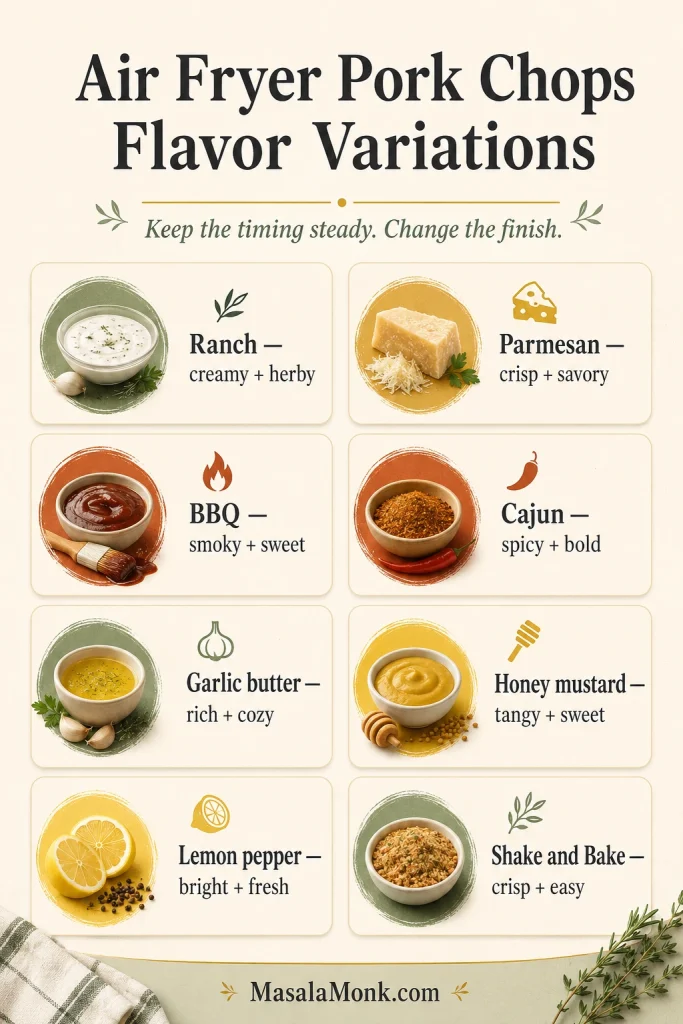
Flavor variation guide for air fryer pork chops with ranch, parmesan, BBQ, Cajun, garlic butter, honey mustard, lemon pepper, and Shake and Bake ideas.
Once the basic air fryer pork chop timing works, change the finish to fit the meal. Ranch feels creamy and herby, BBQ adds smoky sweetness, Cajun brings heat, and lemon pepper keeps the plate brighter.
VariationAdd ThisWhen to AddBest With
RanchRanch seasoningBefore cookingPotatoes, green beans, salad
Parmesan crustedFinely grated parmesanBefore cooking or in crumbsCaesar-style salad or roasted vegetables
BBQBBQ sauceLast 1–2 minutesBaked beans, coleslaw, applesauce
CajunCajun seasoningBefore cookingRice, corn, creamy slaw
Garlic butterMelted garlic butterAfter cookingMashed potatoes or roasted vegetables
Honey mustardHoney mustard glazeNear the endCarrots, potatoes, green salad
Lemon pepperLemon pepper and lemon juiceBefore cooking, then finish afterAsparagus, rice, crisp salad
Shake and BakePackaged seasoned coatingBefore cooking, with oil sprayMac and cheese, green beans, slaw

What to Serve with Them

The easiest plate is creamy potatoes, something green, and a little sweetness on the side. That gives you comfort, freshness, and balance without making dinner complicated.

Three air fryer pork chop dinner plates with mashed potatoes, mushroom sauce, baked beans, coleslaw, salad, and roasted carrots.
Build the plate around contrast so the pork chop dinner feels complete. Pair the savory chop with something creamy, something green, and something a little sweet for better balance.

Storage and Reheating

Let leftovers cool, then store them in an airtight container in the refrigerator. Keep sauce separate when possible so the surface does not turn soggy.

Reheat cooked chops at 350°F / 175°C for 3 to 5 minutes, just until warmed through. When the chops are very lean, brush with a little butter, broth, or sauce before reheating. Breaded chops usually reheat better in the air fryer than in the microwave because the coating can crisp again.

Back to top ↑

Troubleshooting Dry or Tough Pork Chops

When pork chops turn out dry, the fix is usually small. Change the check time, the temperature, or the thickness next time.
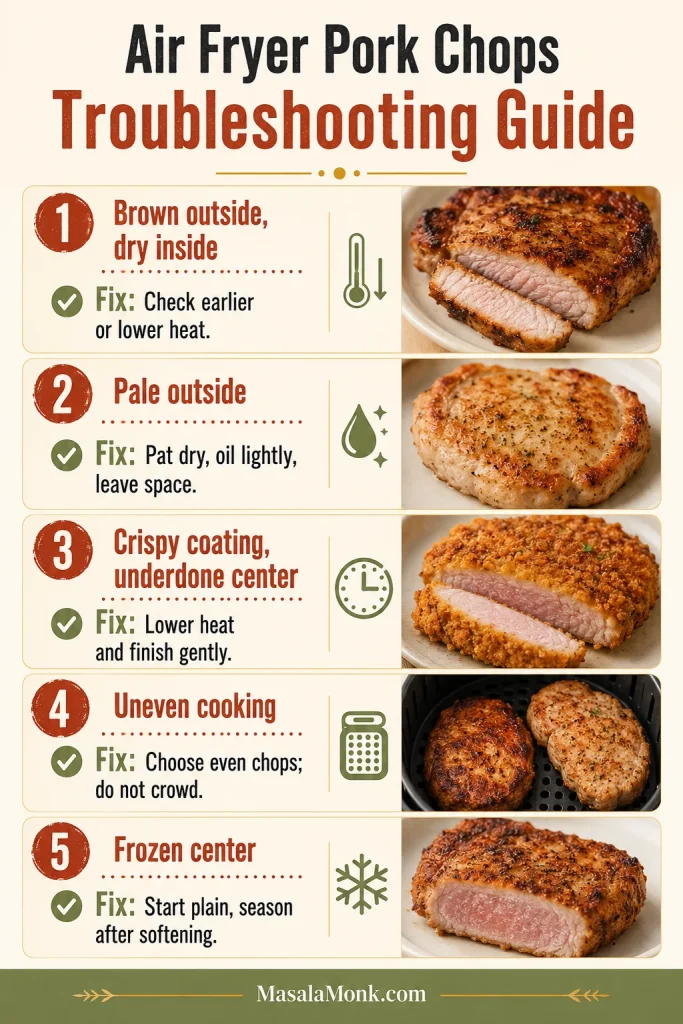
Troubleshooting guide for air fryer pork chops with fixes for dry centers, pale outsides, uneven cooking, and frozen centers.
When air fryer pork chops go wrong, match the fix to the symptom. Dry centers, pale crusts, uneven cooking, and frozen middles usually point to timing, heat, spacing, or thickness.
What HappenedLikely CauseFix Next Time
Brown outside, dry insideHeat too high, chop too thin, or cooked too longCheck earlier or use 375°F to 380°F.
Pale outside, cooked insideSurface too wet or basket crowdedPat dry, oil lightly, and leave space.
Crispy coating but undercooked centerBreading browned too fastLower heat and finish gently.
One side dry, one side juicyUneven chop thicknessChoose more even chops or check the thinner side early.
Tough even though timing seemed rightVery lean boneless chop or no restUse 1-inch chops, rest before slicing, and add sauce if needed.
Frozen chop browned outside but cold insideFrozen center needed more timeUse the staged frozen method and check the center.

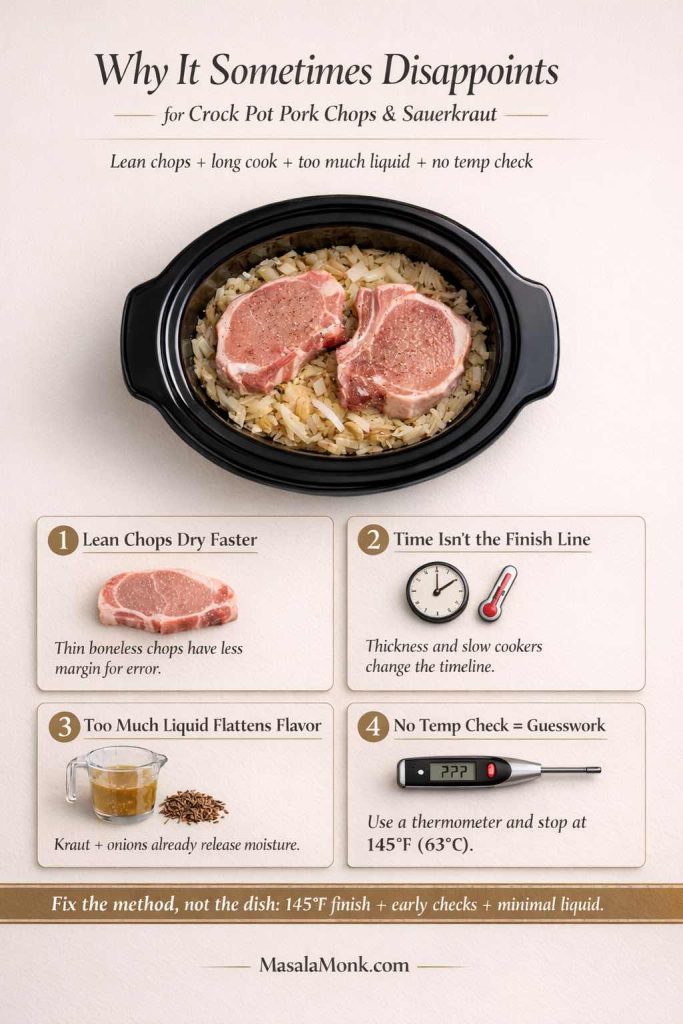
For a slower comfort-food pork chop dinner next time, try cream of mushroom pork chops, smothered pork chops, or crock pot pork chops and sauerkraut.

The first time you make these, check early and note your air fryer’s timing. After that, this becomes the kind of weeknight recipe you can repeat without hovering: same seasoning, same method, and one small adjustment based on the chop in front of you.

Back to top ↑

FAQs

How long do pork chops take in the air fryer?

Most 1-inch boneless pork chops take 10 to 12 minutes at 380°F / 193°C. Thin chops cook faster; thick or bone-in chops need more time.

What temperature is best for air fryer pork chops?

380°F / 193°C is the best default for juicy pork chops. Use 390°F to 400°F / 199°C to 204°C for breaded or crispier chops.

How do you keep pork chops from drying out in the air fryer?

Use chops around 1 inch thick, cook in a single layer, and stop when the center reaches 145°F / 63°C. The biggest fix is not overcooking them.

Do boneless pork chops work well in the air fryer?

Boneless pork chops work well in the air fryer when they are close to 1 inch thick. They cook quickly, so start checking before they turn tight or dry.

Are bone-in pork chops better in the air fryer?

Bone-in pork chops are often more forgiving because the bone slows the cook slightly. Check the thickest meaty part without touching the bone.

How long do thin pork chops take in the air fryer?

Thin chops around ½ inch thick may take 6 to 8 minutes. Very thin cuts can be done in 4 to 6 minutes, so check early.

How long do thick pork chops take in the air fryer?

Thick chops around 1½ inches may take 12 to 16 minutes for boneless cuts and longer for bone-in cuts.

Do you flip pork chops in the air fryer?

Yes. Flip halfway through for more even browning and better texture on both sides.

Is slightly pink pork safe?

A slight blush can be safe when pork reaches 145°F / 63°C and rests for at least 3 minutes. Temperature matters more than color alone.

No-breading pork chops: what changes?

No-breading pork chops rely on a dry surface, light oil, and a flavorful rub instead of crumbs. They are faster and less fussy than breaded chops.

Breaded air fryer pork chops: what changes?

Breaded pork chops need a thin coating, a light oil spray, and enough basket space for the crumbs to crisp. The internal temperature still needs to reach 145°F / 63°C.

Frozen pork chops: what is the safest method?

The safest frozen method is staged: soften the chops first, then oil, season, and finish cooking until the center reaches 145°F / 63°C.

Does Shake and Bake work in the air fryer?

Shake and Bake works in the air fryer when the coated chops are sprayed lightly with oil, cooked in a single layer, flipped halfway, and checked with a thermometer.

Should you preheat the air fryer?

Preheating helps pork chops cook evenly and brown better. If there is no preheat setting, run the air fryer empty at the cooking temperature for about 3 minutes.

Why are my pork chops tough?

They were probably overcooked, too thin for the timing, or sliced before resting. Next time, start checking earlier, especially if your chops are thin or boneless.
Posted on Leave a comment

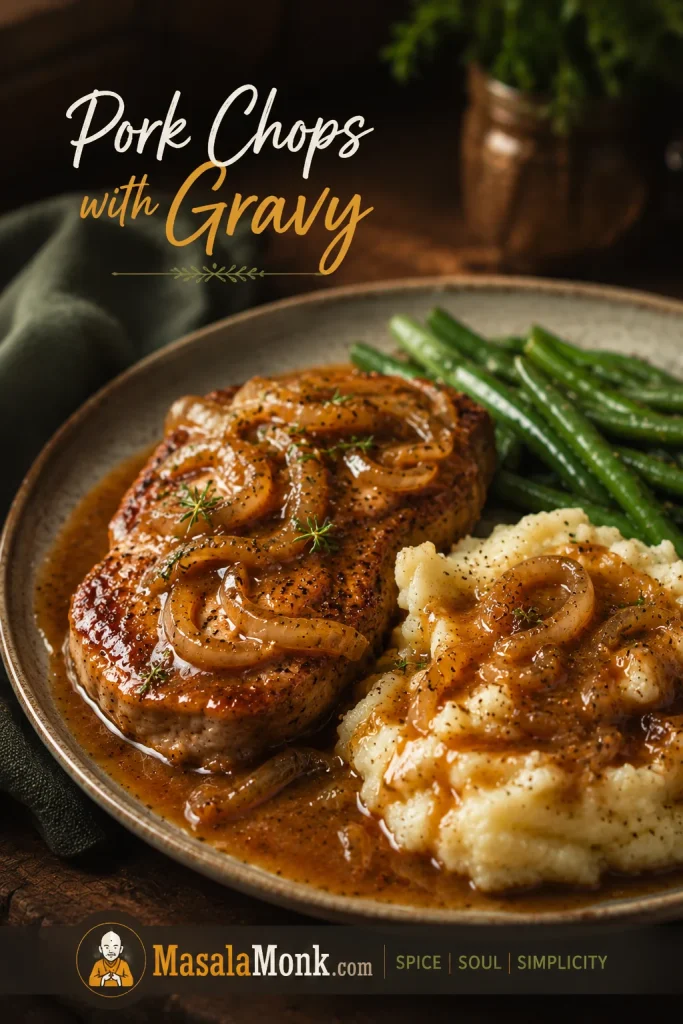
Smothered Pork Chops Recipe

Golden-brown smothered pork chops covered with onion gravy, served with mashed potatoes in a warm skillet-style setting.

The gravy is not the hard part of smothered pork chops. The hard part is keeping the pork tender by the time the gravy is rich.

That is where many smothered pork chop recipes go wrong. The pork browns nicely, the onions soften, the gravy starts to thicken — and then the chops sit in the pan a few minutes too long. If you have ever made a beautiful pan of gravy and still ended up with tough pork, this method is built around that exact problem.

This smothered pork chops recipe is built to avoid that. The chops are browned for flavor, removed before they overcook, then finished gently in onion gravy until they reach the right internal temperature. The sauce tastes like it belongs to the pork because everything happens in the same skillet, but the meat does not have to suffer while the pan catches up.

This is the version to use when you want rich onion gravy, tender pork chops, and clear timing instead of guesswork. Whether you make the classic onion-gravy version or take the cream-of-mushroom shortcut, the goal is the same: juicy pork, a smooth sauce, and a plate where every spoonful has somewhere good to land — over buttery potatoes, fluffy rice, egg noodles, or a biscuit dragged through the gravy.

Sliced smothered pork chop with a moist interior, glossy onion gravy, and soft cooked onions on the plate.
A sliced smothered pork chop tells the truth quickly: the meat should look moist before the sauce does any work.

If mashed potatoes are the plan, these garlic mashed potatoes are the kind of soft, buttery base that makes onion gravy feel like the whole point of dinner.

Quick Answer

To make smothered pork chops, season and lightly dredge ¾- to 1-inch pork chops, brown them briefly in a skillet, then remove them before they cook through. Soften onions in the same pan, cook 2 tablespoons of clean reserved flour into the onions, whisk in stock, and return the chops to finish gently in the gravy until they reach 145°F / 63°C. Rest for 3 minutes before serving.

Before dredging, reserve 2 tablespoons of clean flour for the sauce, and remember that the timing is built around the pork, not the gravy — sauce can keep cooking, but pork cannot uncook.

Four-step visual guide showing dredged pork chops, skillet browning, onion gravy, and a 145 degree thermometer check.
Brown the chops first, build the onion gravy next, and then finish gently to 145°F so the pork stays tender.

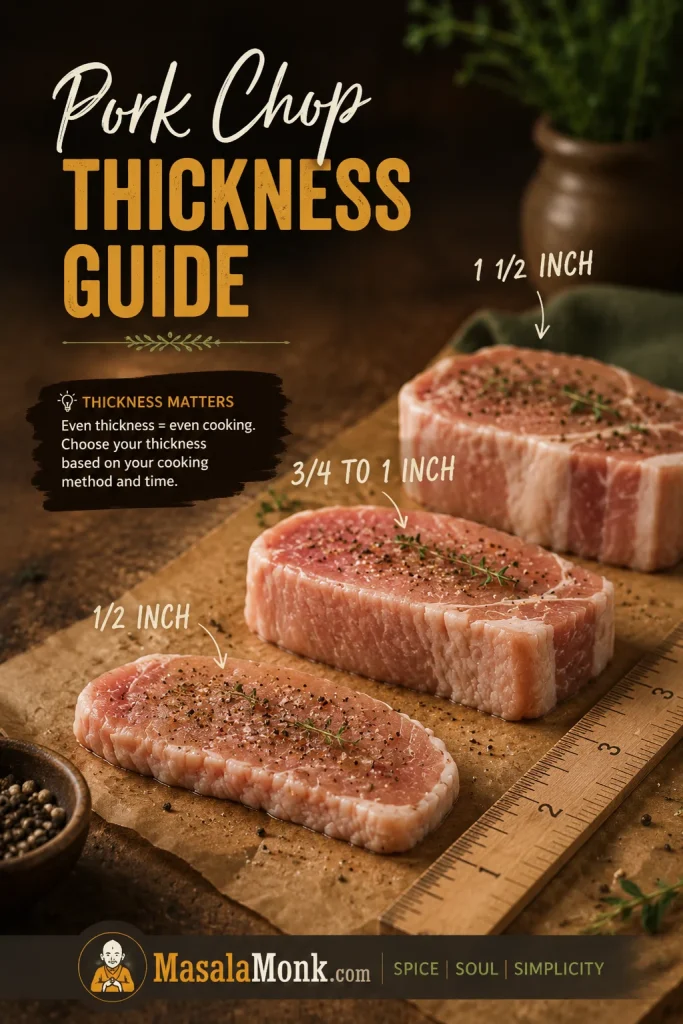
If your pork chops are thinner or thicker than ¾ to 1 inch, check the pork chop thickness chart before you start.

Smothered Pork Chops at a Glance

Use this as the quick map before you start: choose the right chop thickness, brown for flavor, finish gently, and check temperature before the sauce makes you lose track of the pork.

Need to KnowBest Answer
Good pork chops to buyBone-in or boneless chops, ¾ to 1 inch thick
Main methodBrown first, make the sauce, then finish gently
Internal temperature145°F / 63°C, then rest 3 minutes
Gravy styleOnion gravy for the main recipe; mushroom gravy or cream of mushroom for alternate paths
Texture targetGlossy and spoonable: thick enough to coat a spoon, loose enough to pool on potatoes or rice
Common mistakeBoiling the chops hard in the pan or treating thin chops like thick ones
Sides that workMashed potatoes, rice, egg noodles, biscuits, cornbread, green beans, collards

For the safest timing cue, use the doneness guide instead of judging only by gravy thickness.
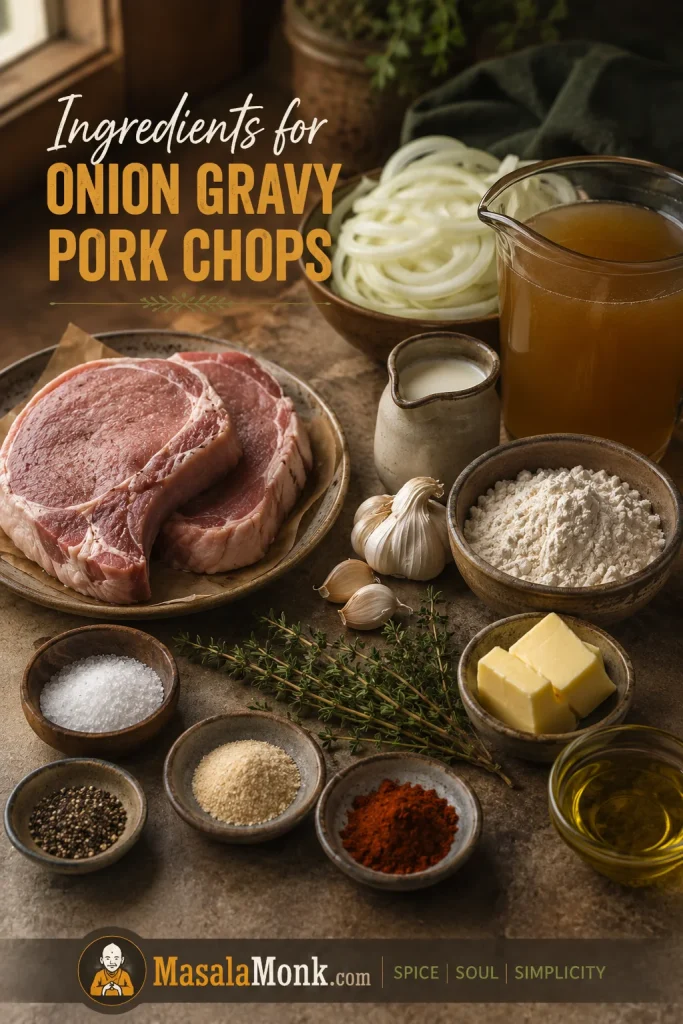
Ingredients for smothered pork chops arranged on a prep surface, including pork chops, onions, garlic, flour, stock, cream, butter, and seasonings.
The ingredients are simple, but each one has a job: browning the chops, building the gravy, balancing salt, or finishing the sauce.

Smothered Pork Chops with Rich Onion Gravy

These smothered pork chops are browned in a skillet, finished gently in rich onion gravy, and served with enough sauce to soak into potatoes, rice, noodles, or biscuits without drowning the pork. Use bone-in or boneless chops, add mushrooms for a deeper gravy, or use the cream-of-mushroom shortcut when you want a thicker pantry-style dinner.

Prep Time
15 minutes
Cook Time
30 to 35 minutes
Total Time
45 to 50 minutes
Servings
4

Equipment: large 12-inch skillet, shallow dish, small bowl, tongs, whisk, instant-read thermometer

Ingredients

For the pork chops

  • 4 pork chops, bone-in or boneless, ¾ to 1 inch thick, about 1½ to 2 lb / 680 to 900 g total
  • 1 teaspoon kosher salt for the pork chops, or ¾ teaspoon fine salt, plus more only if needed for the gravy
  • ½ to 1 teaspoon black pepper, to taste
  • 1 teaspoon garlic powder
  • ½ teaspoon onion powder
  • ½ teaspoon smoked paprika, sweet paprika, or ground sage
  • ½ cup / 60 g all-purpose flour, reserving 2 tablespoons in a clean bowl before dredging
  • 2 tablespoons / 30 ml neutral oil
  • 2 tablespoons / 28 g butter

For the onion gravy

  • 1 large yellow onion, thinly sliced, about 180 to 220 g
  • 3 to 4 garlic cloves, minced
  • 2 cups / 480 ml low-sodium chicken stock or broth
  • ½ cup / 120 ml heavy cream or half-and-half
  • 1 teaspoon Worcestershire sauce, optional
  • 1 teaspoon fresh thyme leaves or ½ teaspoon dried thyme
  • Extra salt and black pepper, to taste
  • Chopped parsley, for serving

Salt note: Use the listed salt for the pork chops if you are making the homemade onion gravy with low-sodium stock. Use less salt if your stock is salted, or if you are making the cream-of-mushroom method. If you use condensed soup, onion soup mix, or a gravy packet, do not add extra salt until the very end.

Instructions

Brown the Pork Chops and Build the Gravy

  1. Dry and season the pork chops. Pat the pork chops dry with paper towels. Mix the salt, black pepper, garlic powder, onion powder, and paprika or sage. Season both sides. If time allows, rest the seasoned chops for 15 to 20 minutes before searing.
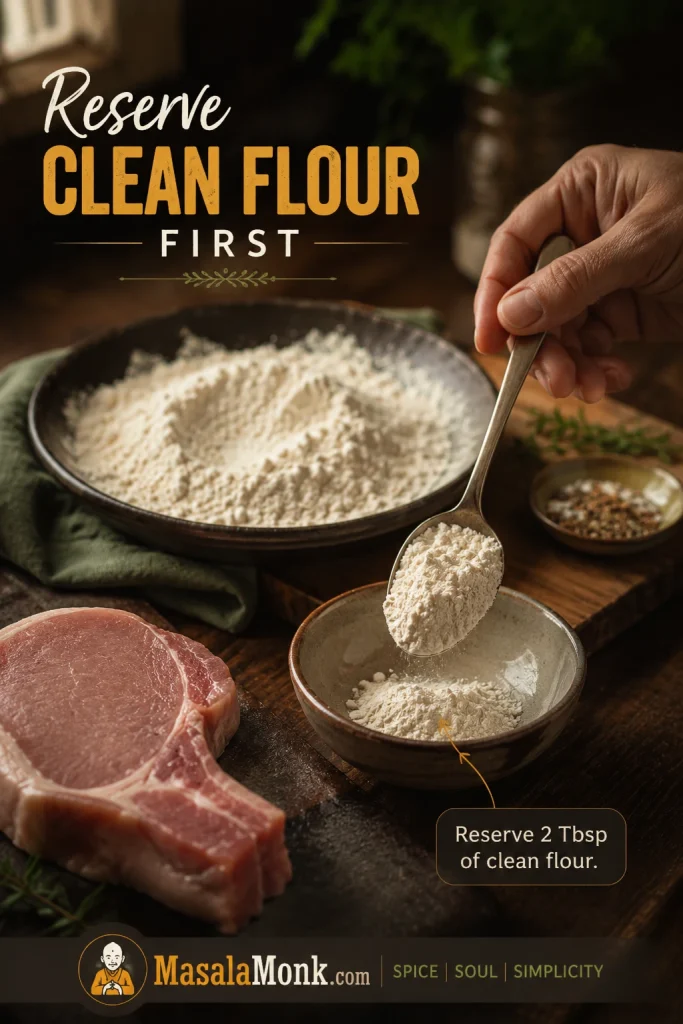
  2. Reserve clean flour for the sauce. Add the flour to a shallow dish, then remove 2 tablespoons to a small clean bowl before dredging. You will use that clean flour to thicken the sauce.
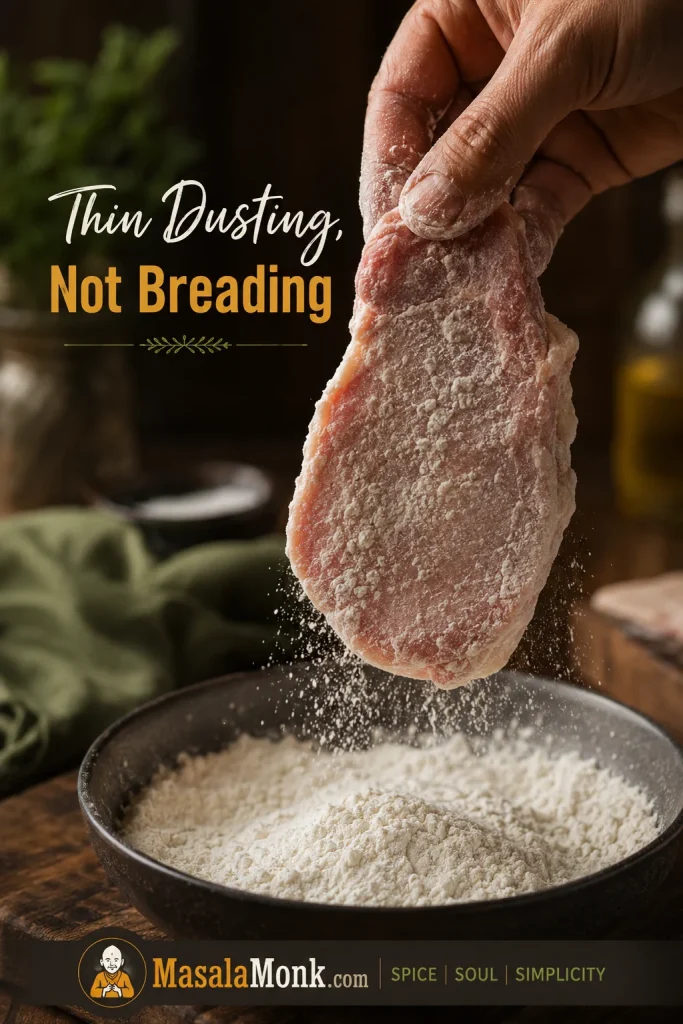
  3. Dredge lightly. Dredge each pork chop lightly in the flour left in the shallow dish, shaking off the excess. The coating should be thin, not heavy.
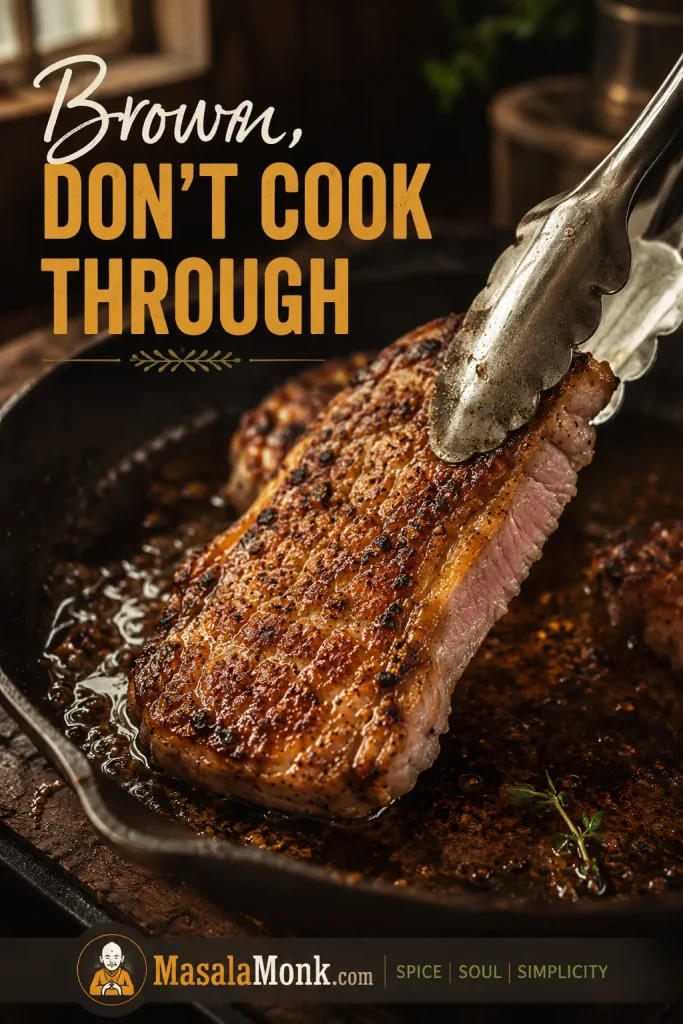
  4. Brown the chops. Heat the oil in a large skillet over medium-high heat. Add the pork chops in a single layer and brown for 3 to 4 minutes per side, just until golden. Do not cook them through. Transfer to a plate.
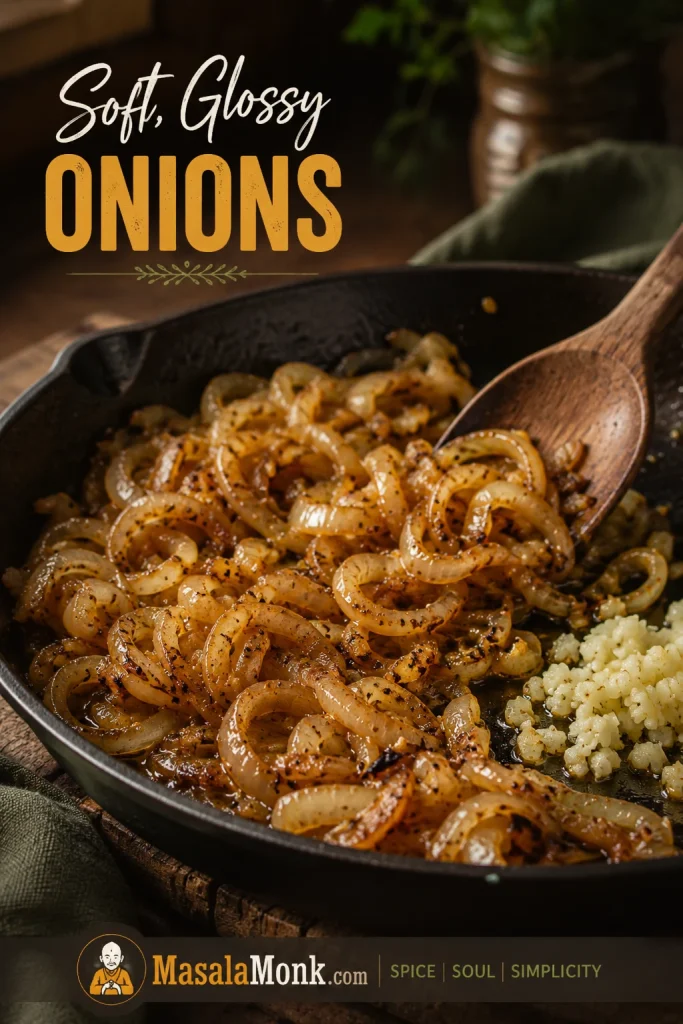
  5. Cook the onions. Reduce the heat to medium. Add the butter and sliced onion to the same skillet. Cook for 6 to 8 minutes, stirring often, until the onion softens, turns glossy, and begins to pick up golden edges. Add the garlic and cook for 30 seconds.
  6. Build the gravy. Sprinkle the reserved clean flour over the onions. Stir for 1 to 2 minutes so the flour loses its raw taste. Slowly whisk in the chicken stock, scraping up the browned bits from the bottom of the skillet. Add the Worcestershire sauce and thyme.

Finish the Pork Chops Gently

  1. Return the pork to the gravy. Add the pork chops and any plate juices back to the skillet. Reduce the heat to medium-low, cover partially, and cook until the thickest part reaches 140 to 143°F / 60 to 62°C, usually 4 to 7 minutes for ¾- to 1-inch chops.
  2. Add cream and bring the sauce together. Stir in the cream or half-and-half. Let the sauce barely bubble until glossy and the pork reaches 145°F / 63°C. If the pork gets there first, move it to a plate and finish the sauce separately.
  3. Rest and serve. Turn off the heat and let the pork chops rest for at least 3 minutes. Spoon the onion gravy over the chops and finish with parsley.

What Success Looks Like

The pork slices cleanly and stays juicy, the onions soften enough to melt into the gravy, and the sauce coats a spoon without sitting like paste. This timing is written for ¾- to 1-inch chops in a large 12-inch skillet; thinner chops need less time, and thicker chops need a thermometer more than they need guesswork.

When it works, the gravy feels generous instead of necessary — the pork is still juicy enough to stand on its own, and the sauce makes the whole plate better.

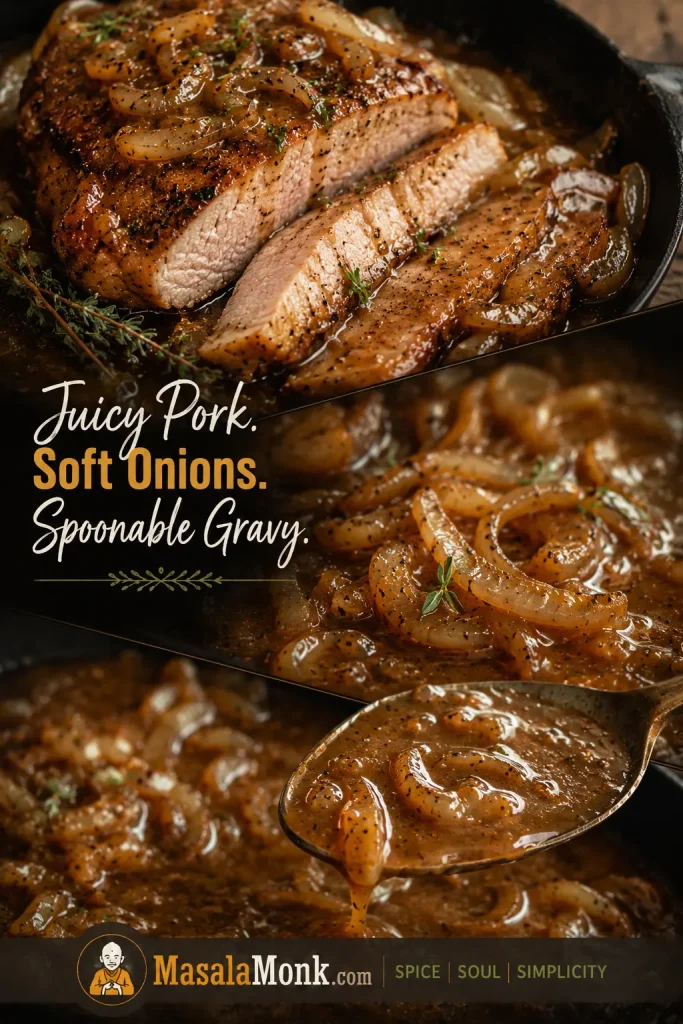
Success guide showing sliced juicy pork, soft onions, and spoonable gravy for smothered pork chops.
The finished skillet should show three signs at once: juicy pork, softened onions, and gravy that is spoonable but not pasty.

If the pork is already done but the sauce is not right, go straight to the troubleshooting table.

Why This Smothered Pork Chops Recipe Works

The trick is letting the pork and gravy keep different schedules. The chops brown first for flavor, then leave the pan before they overcook. That gives the onion gravy time to develop without making the pork wait too long.

The sauce is built in the same skillet, so the onions, garlic, flour, stock, and cream pick up the browned bits from the pork. That makes the pan sauce taste connected to the chops instead of like something poured over them afterward.

The flour and cream are timed carefully. A little clean reserved flour gives the gravy body, while cream goes in near the end so the sauce turns glossy without boiling hard or turning heavy.

Ingredients for Smothered Pork Chops

The ingredient list is simple, which is exactly why the small choices matter: the right chop, patient onions, and stock that does not turn the gravy too salty.

Pork Chops to Use

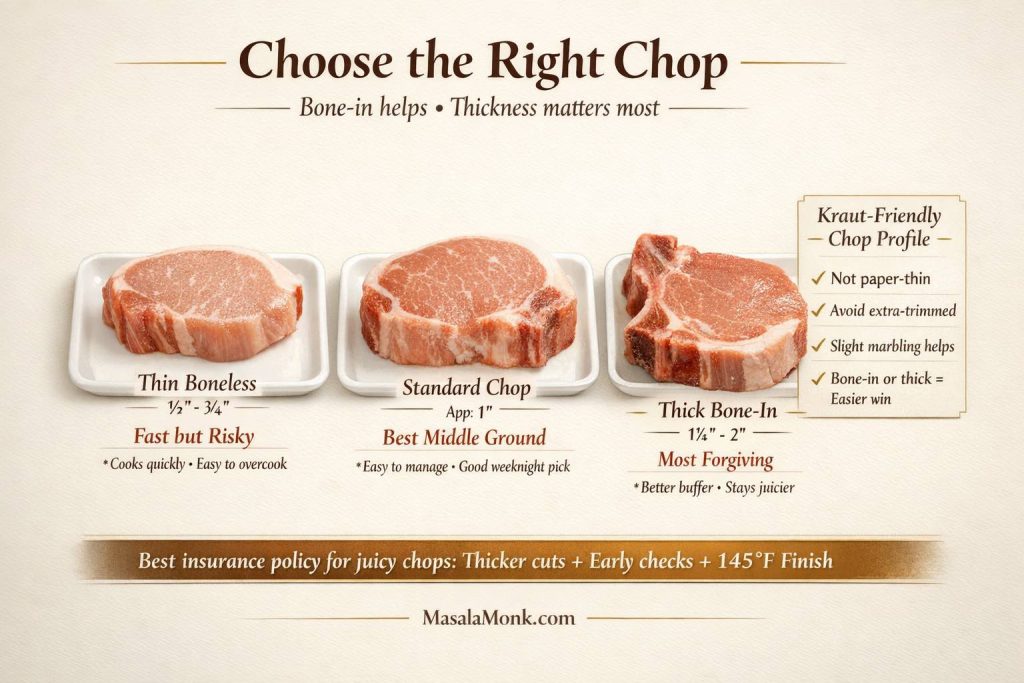
For the most forgiving skillet version, choose pork chops that are ¾ to 1 inch thick. Bone-in chops are usually more forgiving because the bone slows the cooking slightly. Boneless chops also work well, especially for weeknights, but they cook faster and need closer attention.

Thin pork chops need a quick sear and a short finish. Thick chops can be excellent, but they need a thermometer because the outside can look ready before the center is done.

Different pork chop cuts on butcher paper, including bone-in chops, boneless chops, thin chops, and thick chops.
Start with the right pork chop cut and thickness, because thin chops and thick chops need different timing in the same gravy.
Pork Chop TypeUse It ForWhat to Watch
Bone-in pork chopsForgiving, flavorful skillet resultsCheck temperature near the center, away from the bone
Boneless pork chopsEasy weeknight cookingCook quickly, so check early
Thin pork chopsQuick skillet dinnersUse a short sear and very short sauce finish
Thick pork chopsJuicier dinner-plate chopsCheck the center, not the clock
Shoulder or blade chopsSlower cooking methodsMay need more time to become tender

If you are using shoulder chops, blade chops, or thicker marbled chops, the slow-cooker method may be the better fit.

Have pork tenderloin instead? Pork tenderloin is a different cut and cooks differently from pork chops. Use this pork tenderloin in oven guide if your package says tenderloin.

Onion Gravy Ingredients

The onion gravy starts with butter, sliced onion, garlic, flour, stock, thyme, and a small amount of cream. Cook the onion until it is soft and lightly golden, not just warmed through. That is what gives the sauce a sweeter, deeper base.

Use low-sodium chicken stock if you can. The pork is seasoned, the sauce reduces slightly, and Worcestershire sauce adds more savory saltiness. Starting with low-sodium stock lets you control the final flavor.

Heavy cream gives the richest finish. Half-and-half makes the gravy a little lighter. For a brown onion gravy, leave the dairy out and add a splash more stock.

Why Flour Matters

Flour helps the pork brown and gives the gravy body. The trick is to use it lightly: a thin dusting on the chops, plus 2 tablespoons of clean reserved flour cooked into the onions before the stock goes in.

That short cooking step keeps the sauce smooth instead of raw or pasty.

How to Make Smothered Pork Chops

Everything good starts in the skillet: browned pork, softened onions, and the little browned bits that dissolve into the gravy. As you cook, watch for these cues.

1. Season and Dredge the Pork Chops

Pat the pork chops dry before seasoning. Dry meat browns better. Wet meat steams, and steamed pork chops do not build the same flavor in the pan.

Reserve Clean Flour Before Dredging

Before any raw pork touches the flour, reserve 2 tablespoons in a clean bowl for the gravy. That small step keeps the thickener separate and helps the sauce stay smooth.

Spoonful of flour being reserved in a clean bowl before raw pork chops are dredged in the remaining flour.
Reserve clean flour before dredging so the gravy thickener stays separate from flour that has touched raw pork.

Then season both sides and dredge lightly in the remaining flour. Shake off the excess so the coating looks like a thin dusting, not a breaded crust.

Pork chop lifted from a flour dish with a thin, even dusting of flour on the surface.
A thin flour coating helps the pork brown and gives onion gravy body, while too much flour can make the surface heavy.

2. Brown the Pork Chops Without Cooking Them Through

Use a heavy skillet if you have one. Heat the oil until it shimmers, then brown the chops in a single layer. If the pan is crowded, cook in batches; crowding traps steam and softens the crust.

The goal is golden color, not doneness. Once the chops are browned on both sides, move them to a plate. They will finish later in the gravy.
Pork chop browning in a skillet with tongs lifting one edge to show a golden sear.
Browning creates the flavor base; after that, the chops should leave the skillet before they cook through.

3. Cook the Onions in the Same Skillet

Reduce the heat to medium, add butter and sliced onion, and cook until the onions look soft and glossy with a few golden edges. If the pan looks dry, add a small splash of stock to loosen the browned bits. Add the garlic near the end.

At this point, the skillet should smell sweet, savory, and browned rather than sharp with raw onion.

Sliced onions cooking in a skillet until soft, glossy, and lightly golden with browned bits in the pan.
Let the onions turn soft, glossy, and lightly golden before adding liquid; otherwise, the gravy misses its sweet-savory base.

4. Make the Onion Gravy

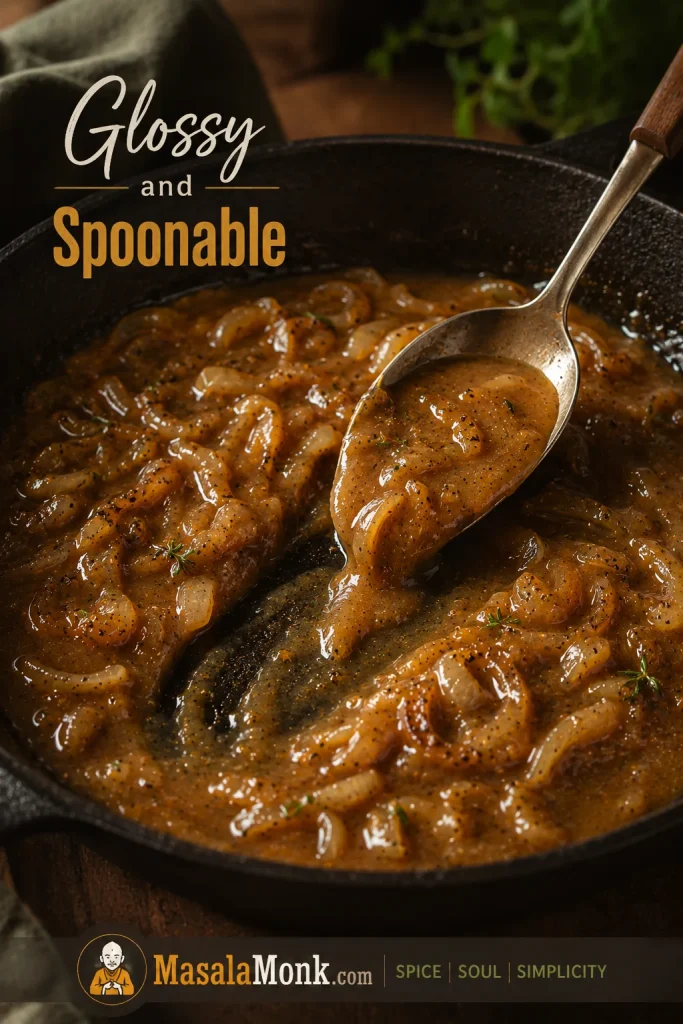
Sprinkle the reserved clean flour over the onions and stir for 1 to 2 minutes. Slowly whisk in the chicken stock, scraping the bottom of the skillet so the browned bits dissolve into the pan sauce.

The gravy should move lazily, not boil hard — more like a slow, steady bubble than a pan trying to rush dinner.

Spoon dragging through glossy golden-brown onion gravy with visible soft onions in a skillet.
Look for onion gravy that coats the spoon yet still moves, so it can settle around the pork instead of sitting stiffly on top.

5. Finish the Pork Chops in Gravy

Return the pork chops and any plate juices to the skillet. Keep the heat gentle. When the pork is nearly done, add the cream and let the sauce come together until glossy.

If the pork reaches 145°F / 63°C before the gravy looks ready, move the chops to a plate and finish the sauce separately. The pork wins.

Seared pork chops gently simmering in onion gravy with small bubbles around the edge of the skillet.
Keep the sauce at a gentle bubble while the pork finishes, because hard boiling is where juicy pork chops start to tighten.

6. Rest and Serve

Let the pork chops rest for at least 3 minutes, then spoon the onion gravy over the top. On the plate, the pork slices cleanly and the gravy settles around it instead of sitting in a stiff mound.

Pork Chop Thickness and Cook Time Chart

Thickness matters more than most recipes admit. That is why the same skillet can give one cook juicy chops and another cook dry ones.

Pork chop thickness comparison with measurement cues for thin, standard, and thick pork chops.
Before you trust the clock, check the thickness; it is one of the biggest reasons smothered pork chops turn tender or dry.
Pork Chop TypeBrown FirstFinish in GravyKey Note
Thin boneless, about ½ inch1 to 2 minutes per side2 to 4 minutesCheck early; dries fast
Standard ¾ to 1 inch3 to 4 minutes per side5 to 8 minutesMost forgiving for juicy weeknight chops
Thick 1 to 1½ inch4 to 5 minutes per side10 to 15 minutesUse a thermometer
Slow-cooker chopsOptional 2 to 3 minutes per side3 to 6 hours on LOW, depending on cutThicker, more marbled chops stay softer

How to Know When Smothered Pork Chops Are Done

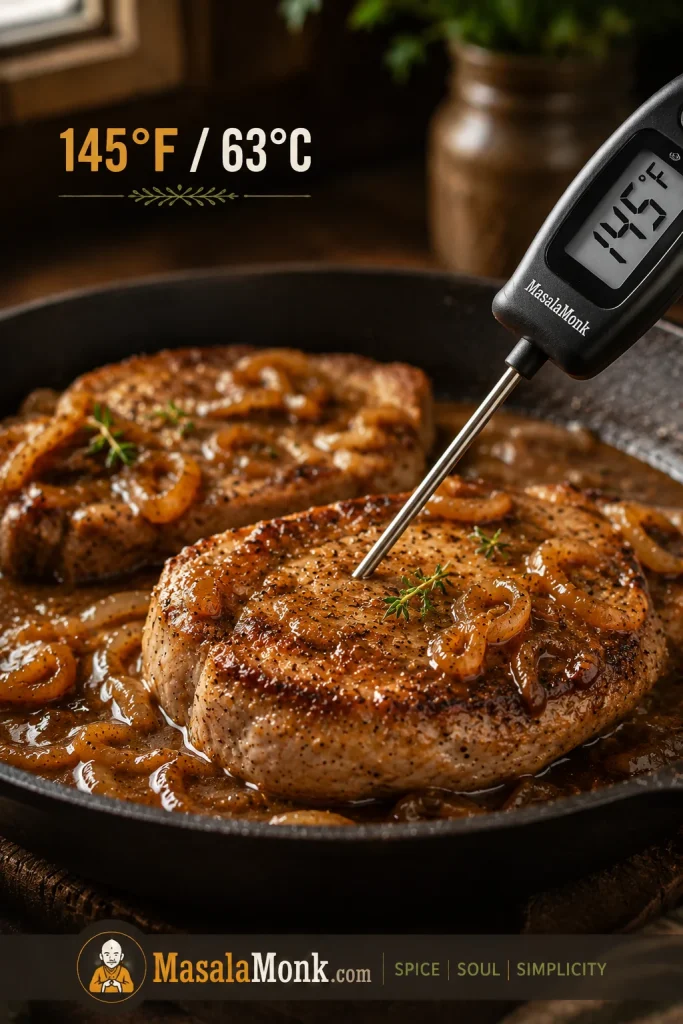
The safest and most reliable way to know when smothered pork chops are done is to use an instant-read thermometer. Check the thickest part of the chop. If the chop is bone-in, avoid touching the bone with the thermometer probe.

Pork chops should reach 145°F / 63°C, followed by a 3-minute rest. At that temperature, the center may still have a slight blush. That is normal when the pork has reached the right temperature and rested properly. For official guidance, see the FoodSafety.gov safe minimum internal temperature chart.

Instant-read thermometer in a smothered pork chop showing 145°F.
A thermometer keeps the gravy from distracting you; pull the pork at 145°F and let the chops rest before serving.

Gravy thickness and cooking time can guide you, but they should not be the final judge. Temperature is the tie-breaker.

Once the pork is rested, the dish should feel like one skillet, not pork plus sauce: soft onions, gravy that tastes like the browned pan, and chops juicy enough that the sauce feels generous instead of necessary.

Which Smothered Pork Chops Version Should You Make?

The onion gravy is the main path; the other versions are there for the nights when your pork chop cut, pantry, or schedule makes the choice for you.

Pork Chop CutBest MethodWhy
¾–1 inch bone-in chopsStovetop onion gravyForgiving, flavorful, and ideal for the main recipe
¾–1 inch boneless chopsStovetop or cream-of-mushroom skilletFast and practical, but check early
Thin boneless chopsStovetop onlyA short finish keeps them from drying out
Thick bone-in chopsStovetop or bakedNeeds gentle cooking and a thermometer
Shoulder or blade chopsSlow cookerBetter suited to longer cooking

Add mushrooms when you want deeper flavor. For the fastest pantry dinner, use condensed cream of mushroom soup. A more Southern-style plate works best when the onion gravy stays central and the cream stays lighter. Choose the slow cooker only when the chops are thick or marbled enough to handle it.

If your goal is shredded pork rather than whole chops in gravy, pork shoulder or pork butt is the better cut. For that style of dinner, use this slow cooker pulled pork method instead.

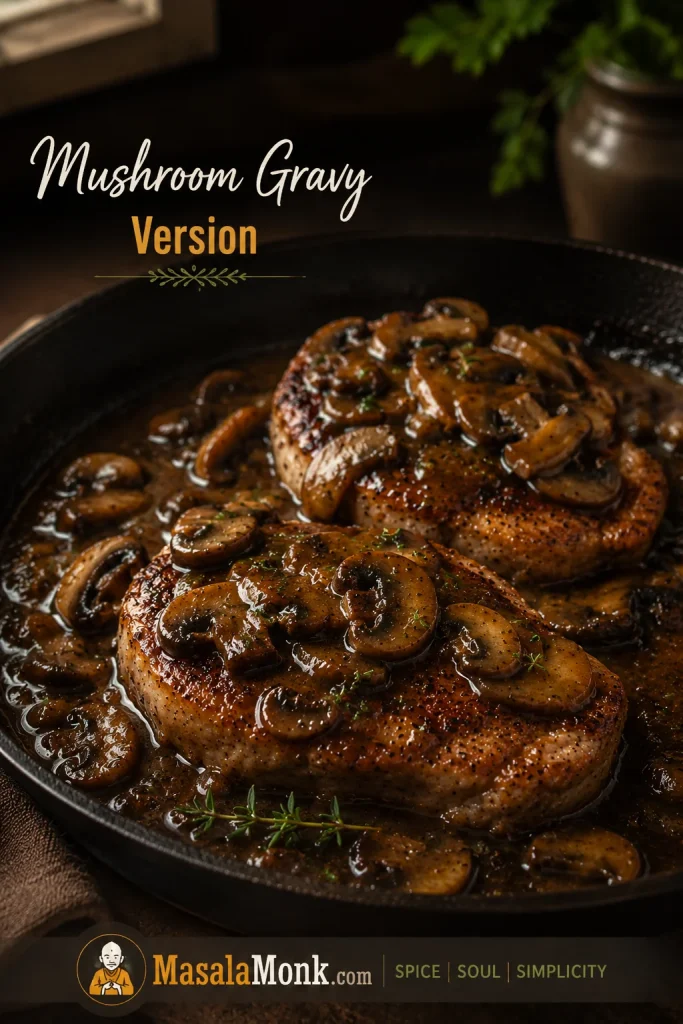
Smothered Pork Chops with Mushroom Gravy

For mushroom gravy, add 8 to 10 oz / 225 to 280 g sliced mushrooms after the onions have softened. Use 8 oz for a balanced mushroom gravy, or closer to 10 oz if you want it mushroom-forward.

Smothered pork chops covered with darker mushroom gravy and browned sliced mushrooms.
Browned mushrooms add depth to smothered pork chops, while watery mushrooms can leave the gravy flat and thin.

Cook the Mushrooms Until the Pan Looks Dry

Cook the mushrooms until the pan no longer looks wet. They should look browned in spots, not steamed. If you add flour and stock while the mushrooms are still wet, the sauce can taste thin and muted.

Comparison of wet mushrooms and browned mushrooms cooked until the pan looks mostly dry.
Cook mushrooms until the pan no longer looks wet; then the mushroom gravy can turn rich instead of diluted.

The mushroom version feels deeper and a little more steakhouse-style, with browned mushrooms giving the gravy extra savory weight — especially when the sauce lands on mashed potatoes or egg noodles.

Cream of Mushroom Smothered Pork Chops

Cream of mushroom smothered pork chops are the busy-night shortcut: creamy, pantry-friendly, nostalgic, and ready to spoon over rice or mashed potatoes. The method is forgiving as long as you control the salt and stop cooking the pork on time.

Pork chops in a creamy mushroom gravy with visible mushrooms and a thick beige sauce.
Cream of mushroom pork chops are the shortcut version, although they still need gentle heat so the pork stays tender.

To make this method, season and brown the pork chops as written. Cook the onions and garlic in the skillet, then whisk together:

  • 1 can condensed cream of mushroom soup, 10.5 oz / about 298 g
  • ½ cup / 120 ml chicken stock, milk, or half-and-half
  • ½ teaspoon black pepper or dried thyme
  • Optional: ½ cup sliced mushrooms, cooked first

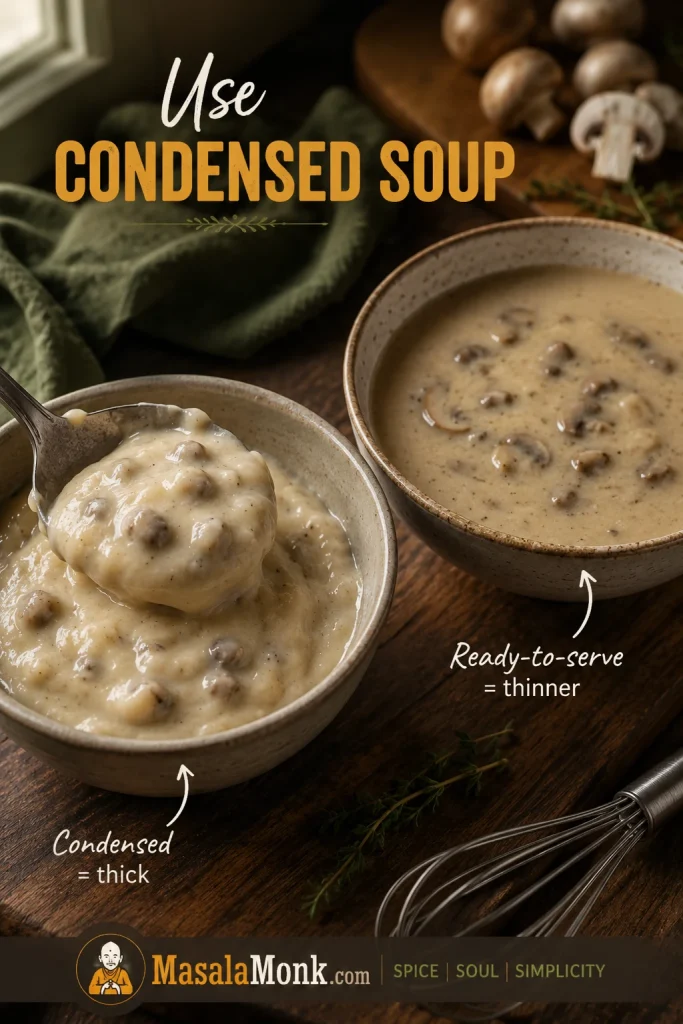
Use Condensed Soup, Not Ready-to-Serve Soup

Use condensed cream of mushroom soup, not ready-to-serve soup. Add the soup mixture to the skillet, return the pork chops, and cook over low, steady heat until the pork reaches temperature. Taste before adding salt because condensed soup, stock, seasoning packets, and the pork coating can all add up quickly.

Comparison of thick condensed cream of mushroom soup and thinner ready-to-serve mushroom soup in separate bowls.
Use condensed soup for cream of mushroom pork chops; ready-to-serve soup is already diluted and can make the sauce too loose.

If the sauce is too thick, whisk in stock or milk a splash at a time. For a thin sauce, remove the pork chops once they are done and simmer the sauce uncovered for a few minutes.

If you are using the same canned-soup shortcut with chicken instead of pork, this cream of mushroom chicken recipe follows the same creamy comfort-dinner idea.

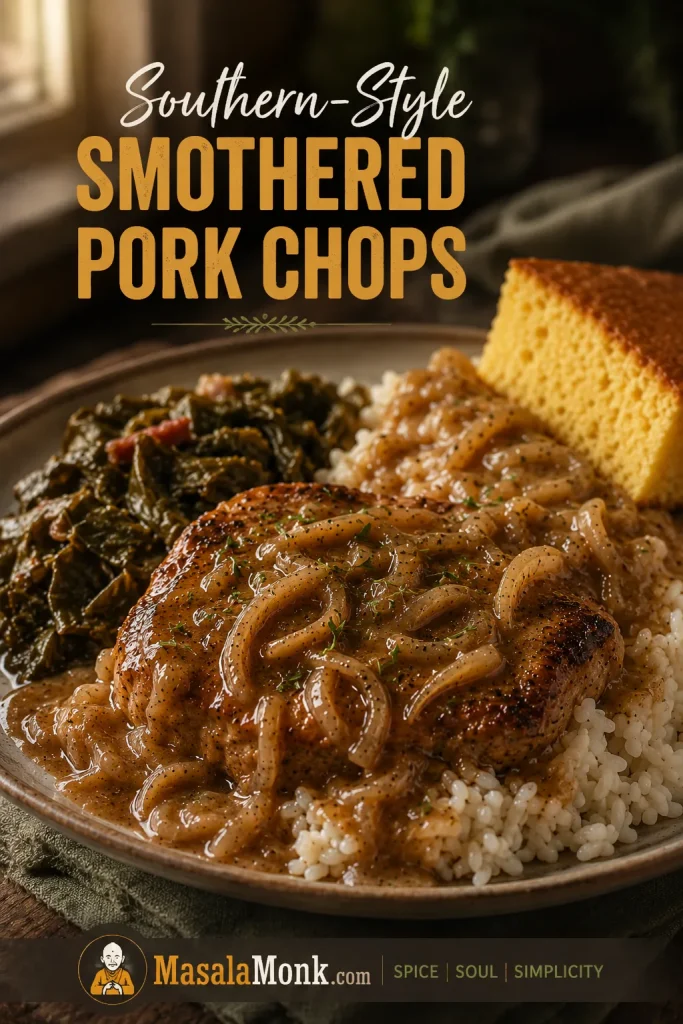
Southern-Style Smothered Pork Chops

For a Southern-style plate, lean into a flour-dredged chop, plenty of onion, a brown or lightly creamy gravy, and simple sides like rice, mashed potatoes, collard greens, green beans, biscuits, or cornbread.

Southern-style smothered pork chop with onion gravy, white rice, collard greens, and a piece of cornbread.
On a Southern-style plate, onion gravy belongs to everything: pork, rice, greens, and cornbread.

This is not a dainty sauce-on-the-side dinner. The gravy is part of the meal — it should run into the rice, soften the potatoes, or give a biscuit something to drag through.

To push this recipe in that direction, keep the onion gravy central and go lighter on the cream. Add a pinch of cayenne, a little Creole or Cajun seasoning, or a few dashes of hot sauce if you like heat. You can also add thinly sliced bell pepper with the onions for a sweeter, more old-school skillet flavor.

If you like this kind of rice-and-gravy comfort food, MasalaMonk’s red beans and rice recipe is another slow-simmered Southern-style dinner built around a saucy bowl.

If using a seasoned blend such as Creole seasoning, Cajun seasoning, seasoned salt, or an all-purpose spice mix, reduce the salt in the pork chop seasoning. Many blends are salty, and the gravy will concentrate that salt as it cooks.

Baked Smothered Pork Chops

Baked smothered pork chops are useful when your skillet is crowded or you want a gentler finish. The strongest baked version still starts on the stovetop: brown the chops first and make the gravy before baking, so the pork has flavor and moisture around it from the start.

Transfer the chops and gravy to a baking dish, cover tightly with foil or a lid, and bake at 350°F / 175°C until the pork reaches 145°F / 63°C.

Baked smothered pork chops in a ceramic dish with onion gravy, browned tops, and foil pulled back.
Baked smothered pork chops work best when the chops and gravy are browned first, then finished covered in the oven.
Chop ThicknessApproximate Covered Bake Time After SearingKey Check
Thin boneless chops, about ½ inch8 to 12 minutesCheck early
¾ to 1 inch chops15 to 20 minutesUse thermometer
1 to 1½ inch chops20 to 28 minutesCheck the center, not the clock

Keep the dish covered while the pork cooks. Uncover only at the end if the gravy is too loose, or remove the chops and reduce the gravy separately in a skillet.

Slow Cooker Smothered Pork Chops

The slow-cooker method is convenient and cozy, but it gives a softer, less browned result than the stovetop skillet version. Choose it when hands-off cooking matters more than crust, and use thicker, more forgiving chops so the pork stays tender.

Slow cooker filled with thick pork chops in creamy mushroom-onion gravy with a spoon lifting sauce.
Slow cooker smothered pork chops are most forgiving with thicker, more marbled chops that can handle longer cooking.

Best slow-cooker cuts: shoulder chops, blade chops, thick bone-in chops, or thicker marbled chops. Thin boneless loin chops are better on the stovetop.

Slow Cooker Sauce and Timing

For better flavor, brown the chops first. Then add sliced onions to a 5 to 6 quart slow cooker, place the chops on top, and pour the gravy mixture over them. Use a broth-and-cream-of-mushroom mixture for the easiest method, or use the homemade gravy base if you want more onion flavor.

For 4 thick chops, a simple slow-cooker sauce is 1 can condensed cream of mushroom soup, ½ cup / 120 ml low-sodium broth, ½ cup sliced onion, and 1 cup sliced mushrooms. For 6 to 8 chops, use 2 cans condensed soup and 1 to 1½ cups broth; start with the lower amount if your slow cooker tends to make watery sauces.

If the slow-cooker gravy is watery, remove the pork chops once they are done. Whisk 1 tablespoon cornstarch with 1 tablespoon cold water, stir the slurry into the slow cooker, and cook on HIGH for 10 to 20 minutes, or until the sauce thickens.

Have a larger pork roast instead of chops? Use a dedicated slow cooker pork loin method. A pork loin roast and individual pork chops do not cook on the same schedule.

How to Fix Smothered Pork Chop Problems

Most smothered pork chop problems come from one of three places: the pork is overcooked, the gravy was rushed, or the salt level was not controlled. The good news is that most sauce problems can be fixed after the pork is safely moved to a plate.

Quick Fixes for Pork and Gravy

Troubleshooting guide for dry pork chops, thin gravy, thick gravy, lumpy gravy, salty sauce, and watery slow-cooker gravy.
Most pork chop and gravy problems are easier to fix after the cooked pork comes out of the pan.
ProblemDo This NowDo This Next Time
Dry pork chopsSlice the chops, cover with hot gravy, and rest off heat for a few minutesUse thicker chops, finish gently, and stop at 145°F / 63°C
Tough pork chopsIf lean, serve with gravy; if shoulder-style, cook gently a little longerTreat lean chops and shoulder-style chops differently
Pork chops did not brownKeep going; the sauce will still carry flavorPat chops dry, use enough heat, and avoid crowding the pan
Thin gravyRemove chops, simmer uncovered, or add a small slurryCook the flour briefly, then add liquid slowly
Too-thick gravyWhisk in warm stock, milk, or half-and-half a splash at a timeKeep the sauce slightly loose before the pork goes back in
Lumpy gravyWhisk hard over low heat or strain the gravyAdd stock slowly while stirring
Floury gravyCook gently for a few more minutesCook the flour with the onions before adding stock
Mushroom gravy is wateryRemove chops and simmer uncovered until thickerCook mushrooms until the pan looks nearly dry before adding flour
Gravy looks curdledLower heat and whisk in a splash of warm stock or creamAdd dairy near the end and avoid boiling hard
Salty gravyAdd cream, milk, or unsalted stock; serve over plain starchUse low-sodium stock and reduce salt with canned soup
Watery slow-cooker gravyRemove chops, add slurry, and cook sauce on HIGHStart with less liquid and thicken at the end

Gravy Texture Guide

For a visual sauce check, compare the gravy before you adjust it with stock, milk, cream, or slurry.

Three spoons comparing onion gravy textures: too thin, just right, and too thick.
Aim for gravy that coats the spoon and drips slowly; that texture will pool softly instead of running away or clumping.

If the pork is already done, move it out first. Dry meat can be sliced and covered with hot gravy; thin, lumpy, salty, or separated sauce can be fixed separately over gentle heat without making the chops tougher.

What to Serve with Smothered Pork Chops

Smothered pork chops need a side that can catch the gravy, because the sauce is part of the meal.

The best plate is the one where the gravy has somewhere to go. It should sink into potatoes, run through rice, cling to noodles, or leave a biscuit with something to chase. That is when smothered pork chops stop feeling like pork with sauce and start feeling like a full comfort dinner.

Smothered Pork Chops with Mashed Potatoes

For the classic comfort plate, spoon the onion gravy over mashed potatoes while the sauce is still loose enough to settle into the edges.

Smothered pork chop with onion gravy served beside mashed potatoes and green beans.
Mashed potatoes are the classic base for pork chops with gravy because they catch the sauce without competing with it.

Smothered Pork Chops with Rice

If you are serving the chops over rice, this how to cook rice guide helps keep the grains fluffy instead of gummy under the gravy.

Southern-style smothered pork chop with onion gravy served over white rice with collard greens and cornbread.
Rice works beautifully with Southern-style smothered pork chops when the onion gravy is loose enough to season the grains.
Side DishWhy It Works
Mashed potatoesThe classic base for onion gravy
White rice or brown riceSimple, filling, and good for extra sauce
Egg noodlesTurns the meal into a cozy skillet dinner
BiscuitsGood for scooping up thick gravy
Green beansFresh contrast to the rich sauce
Roasted carrotsSweetness balances the savory gravy
Collard greens or sautéed greensEarthy, slightly bitter balance
CornbreadComfort-food pairing with a little sweetness
Applesauce or sautéed applesSweet contrast for a rich pork dinner
Side dishes for smothered pork chops, including mashed potatoes, rice, noodles, biscuits, green beans, cornbread, and apples.
Choose sides that give the gravy somewhere useful to go: potatoes, rice, noodles, biscuits, greens, cornbread, or apples.

Easy Plate Combinations

  • Classic comfort plate: smothered pork chops, mashed potatoes, green beans.
  • Southern-style plate: smothered pork chops, rice, collard greens, cornbread.
  • Weeknight skillet plate: pork chops and gravy, egg noodles, peas.
  • Cream-of-mushroom plate: creamy pork chops, rice or buttered noodles, roasted carrots.
  • Slow-cooker plate: pork chops with gravy, mashed potatoes, simple steamed vegetables.

Planning for leftovers? See storage and reheating before you pack the pork away.

Storage, Reheating, and Leftovers

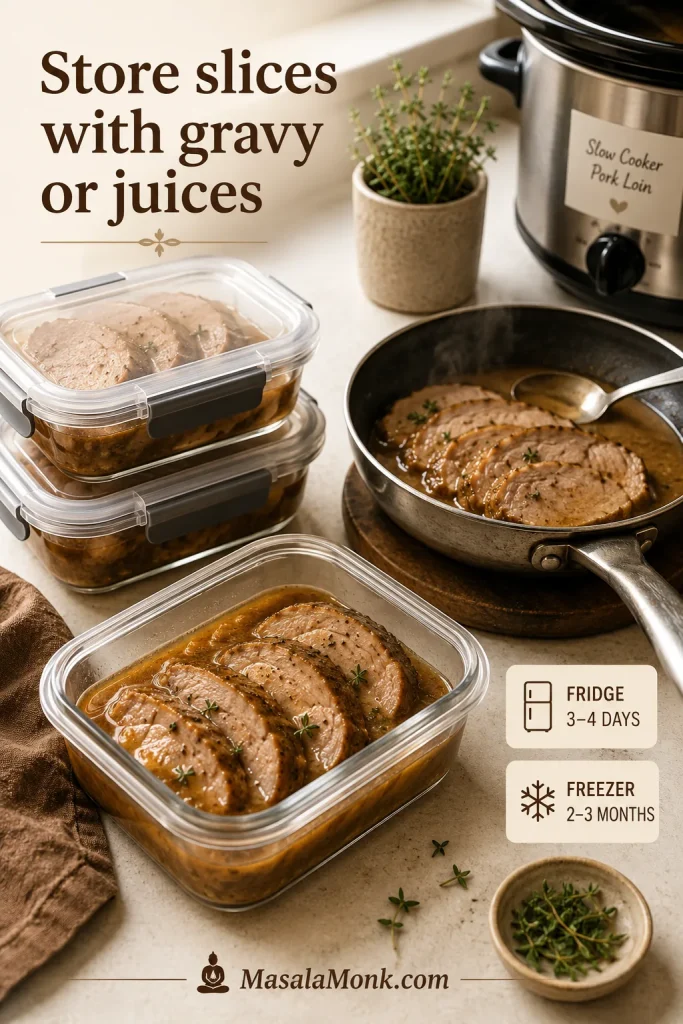
Store leftover pork chops with the gravy, not separately. The sauce protects the meat in the refrigerator and gives you a better chance of reheating it without drying it out. Use an airtight container and refrigerate for up to 3 to 4 days.

For the best texture, reheat gently on the stovetop over low heat. Add a splash of stock, milk, or water to loosen the gravy. Leftovers are best sliced into the gravy so each piece warms gently instead of sitting as one thick chop.

Smothered pork chops stored in gravy in a glass container and sliced leftovers reheating in a skillet with added liquid.
Store leftovers with the gravy, then reheat gently with a splash of stock or milk to help the pork stay moist.

You can freeze smothered pork chops, although cream-based gravy may look slightly separated after thawing. Reheat slowly and whisk the sauce as it warms; a splash of stock or milk usually brings it back together.

Made this recipe? Leave a comment with the pork chop thickness you used — thin, standard, or thick — and whether you made onion gravy, mushroom gravy, or the cream-of-mushroom version. That detail helps the next cook judge timing before their chops overcook.

FAQs

Bone-in or boneless pork chops: which is better?

Bone-in pork chops are usually more forgiving and flavorful, but boneless pork chops work well if they are not too thin. Boneless chops cook faster, so check them earlier.

What temperature should smothered pork chops reach?

Smothered pork chops should reach 145°F / 63°C in the thickest part, followed by at least a 3-minute rest. Use a thermometer instead of judging only by color.

Should the skillet be covered while the pork cooks?

Cover the skillet partially while the chops finish in the gravy. This helps them cook gently without reducing the sauce too fast. If the sauce is too thin near the end, uncover the pan and simmer briefly after the chops are done.

How do I use cream of mushroom soup?

Use one 10.5 oz / 298 g can of condensed cream of mushroom soup and thin it with ½ cup / 120 ml stock, milk, or half-and-half. Go lighter on added seasoning because canned soup already brings salt and body.

Can smothered pork chops be dairy-free or gluten-free?

For a dairy-free version, skip the cream and use extra stock. The gravy will be lighter, but still savory and spoonable. For gluten-free gravy, use a gluten-free all-purpose flour blend for a light dredge, or skip the dredge and thicken the sauce with a cornstarch slurry after the chops are cooked.

Why are my smothered pork chops dry?

Dry chops usually mean the pork cooked too long, the heat was too high, or the chops were very thin. Brown them briefly, keep the sauce at a gentle bubble, and stop cooking when the thickest part reaches 145°F / 63°C.

How do I make smothered pork chop gravy thicker?

Remove the pork chops once they are done, then simmer the gravy uncovered. If it is still thin, stir in a small slurry made from 1 teaspoon cornstarch and 1 tablespoon cold water, then cook for 1 to 2 minutes.

What changes if my pork chops are thin?

Thin pork chops need a quick sear and a short finish. Make the gravy without them in the pan, then return them only for the final few minutes so they warm through without drying out.

Are pork loin chops the same as regular pork chops?

Pork loin chops are a type of pork chop and work well as long as they are not sliced too thin. Because they are lean, give them a quick sear, finish them gently, and use a thermometer so they do not overshoot.

What is the best make-ahead method?

Store the chops in the gravy and reheat gently over low heat. Add a splash of stock or milk if the gravy thickens in the refrigerator. Pork chops are still best freshly cooked, but storing them with sauce helps protect the meat.

Can I make brown onion gravy instead of creamy gravy?

For brown onion gravy, leave out the cream and use a little extra chicken stock. The sauce will taste more like a classic onion pan gravy: lighter, savory, and less creamy.

However you make them — skillet, baked, creamy, mushroom-rich, or slow-cooked — the win is the same: tender pork, a gravy that tastes like the pan, and a plate that feels finished before it ever reaches the table.

Back to top ↑

Posted on Leave a comment

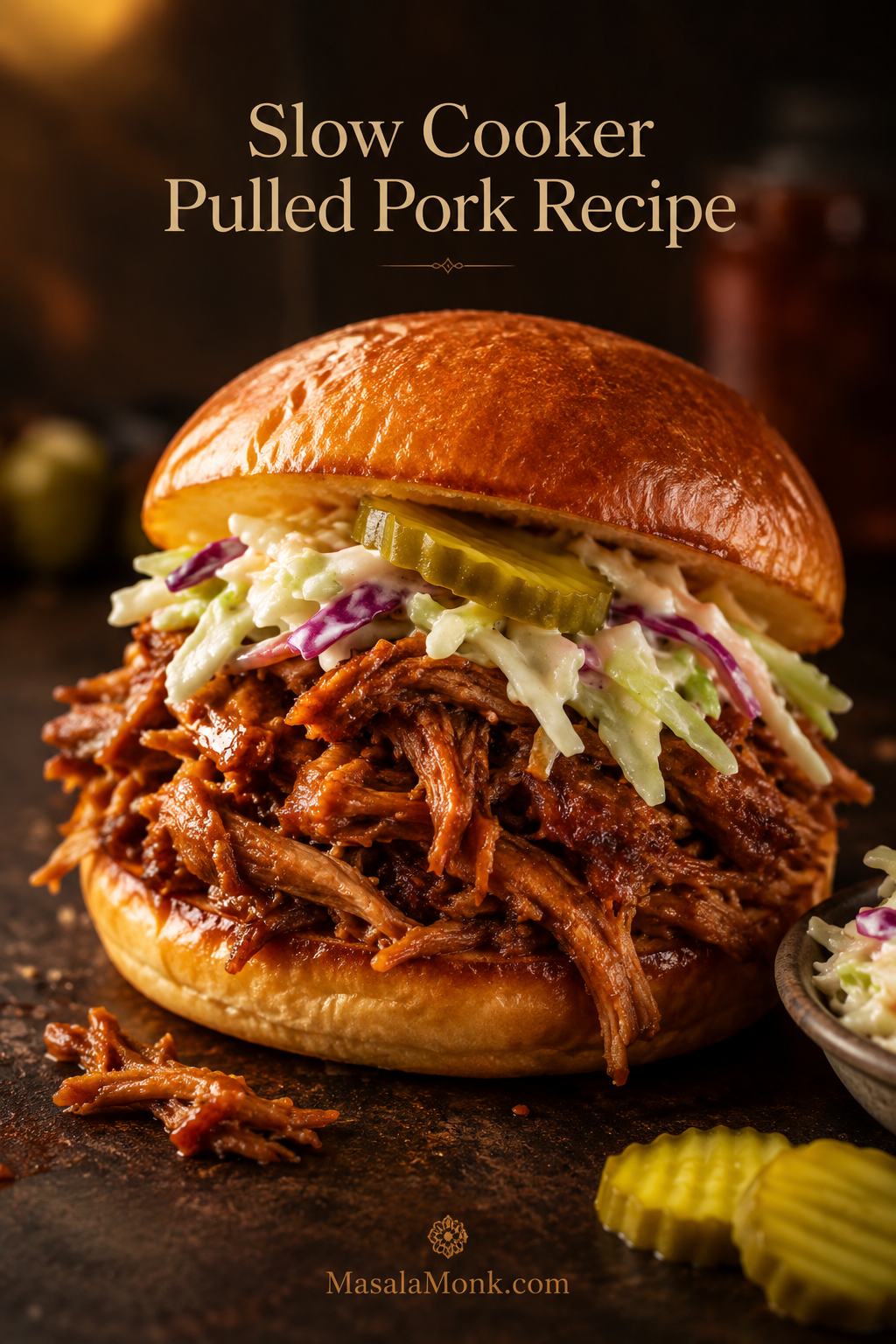
Slow Cooker Pulled Pork Recipe

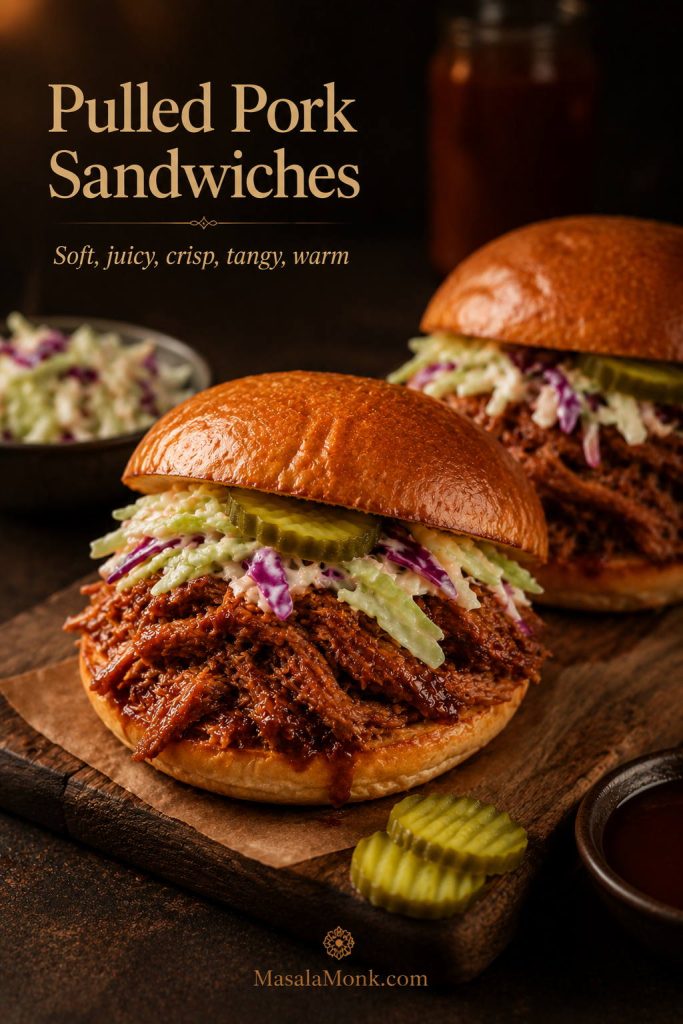
Glossy slow cooker pulled pork sandwich on a soft bun with coleslaw, pickles, and sauce clinging to the shredded pork.

Slow Cooker Pulled Pork Recipe should give you tender, glossy shreds that hold sauce without drowning in it — the kind of pork that piles onto buns tonight, tucks into tacos tomorrow, and still feels like a plan when you pull a freezer portion out later. The trick is not adding more sauce or more liquid. It is choosing the right cut, seasoning it well, cooking it until the meat gives way, and finishing it after shredding.

What This Recipe Solves

This version is built for a marbled shoulder cut: pork shoulder, pork butt, or Boston butt. It also works as a Crock-Pot pulled pork recipe if Crock-Pot is the slow cooker brand you use at home. Because the liquid stays modest and the BBQ sauce goes in after shredding, the finished pork tastes seasoned all the way through instead of swimming in thin sauce.

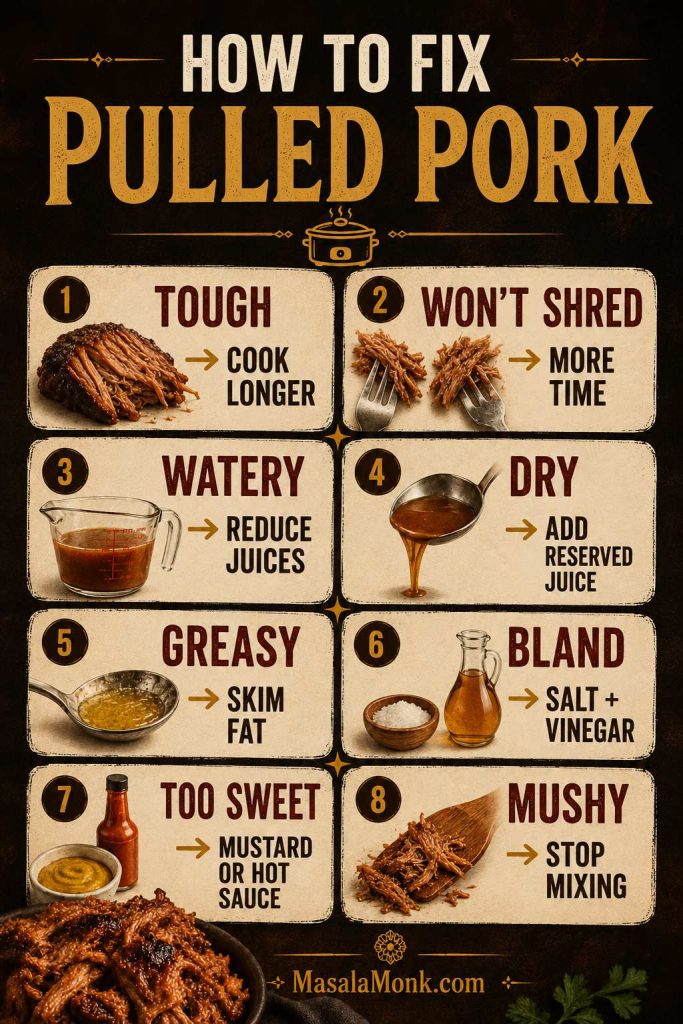
Use it for pulled pork sandwiches with slaw, sliders, tacos, rice bowls, nachos, loaded baked potatoes, freezer meal prep, or a big BBQ-style dinner plate. Along the way, you will know exactly what to do with the real trouble spots: shoulder vs butt, low vs high, how much liquid, when to add BBQ sauce, what “done” should feel like, and how to fix pork that turns out dry, tough, watery, greasy, or bland.

It is the kind of slow-cooker main that works for a quiet dinner, a tray of sliders, or the kind of meal where everyone keeps coming back for just a little more.

Before you start, check the package. This recipe is designed for pork shoulder, pork butt, or Boston butt. If your package says pork loin or pork tenderloin, see the pork loin and tenderloin guidance below before you start. Those leaner cuts need different timing and moisture control. You can still make delicious pork with them, but they are not the right match for shoulder-style pulled pork. Instead, use one of the lean-cut guides linked below.

Quick Answer: Slow Cooker Pulled Pork

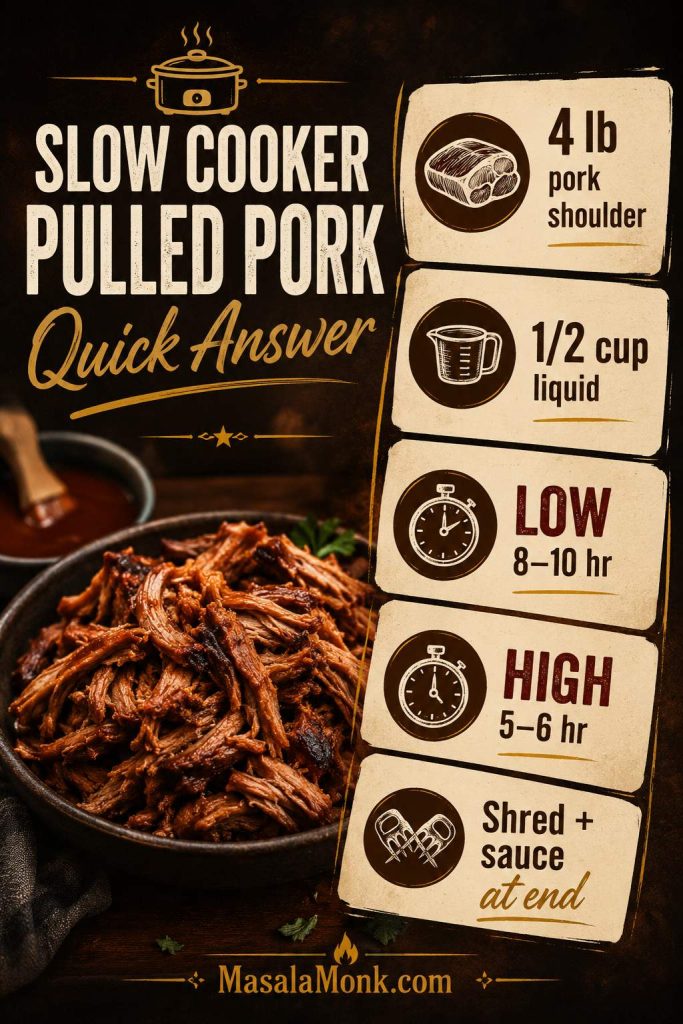
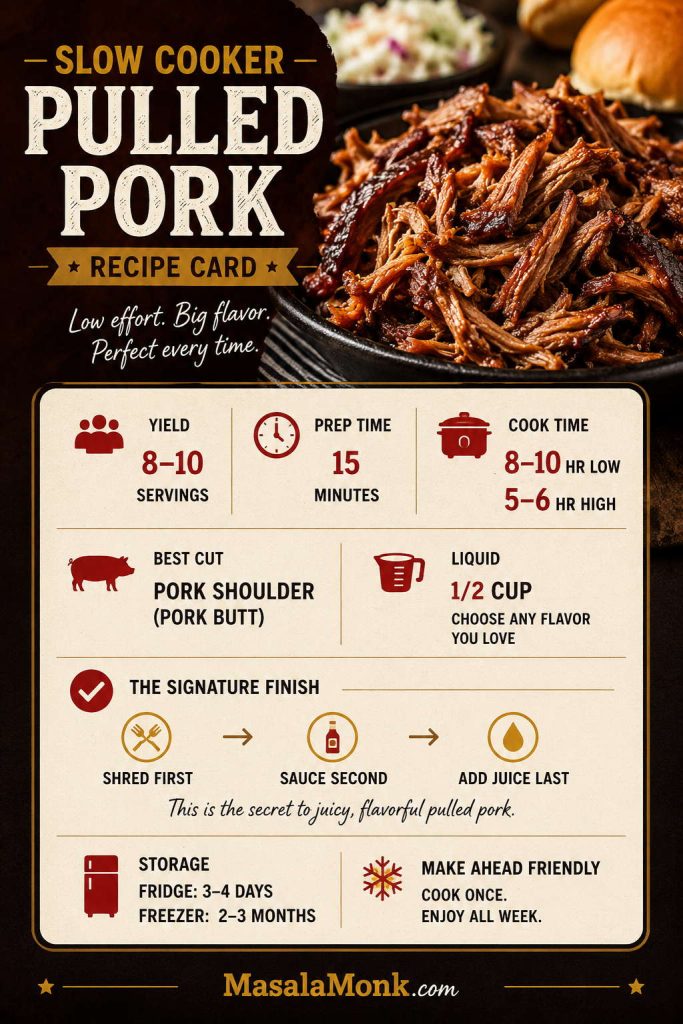
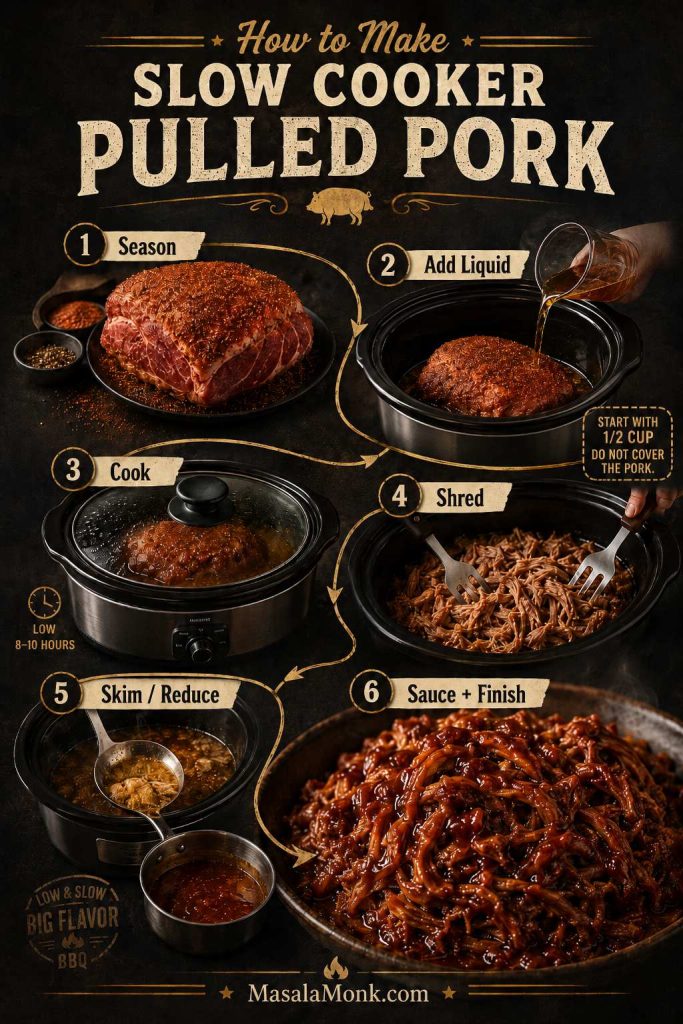
For juicy slow cooker pulled pork, use a 4 lb / 1.8 kg pork shoulder, pork butt, or Boston butt; add only 1/2 cup / 120 ml liquid; cook on LOW for 8–10 hours or HIGH for 5–6 hours; then shred and sauce at the end.

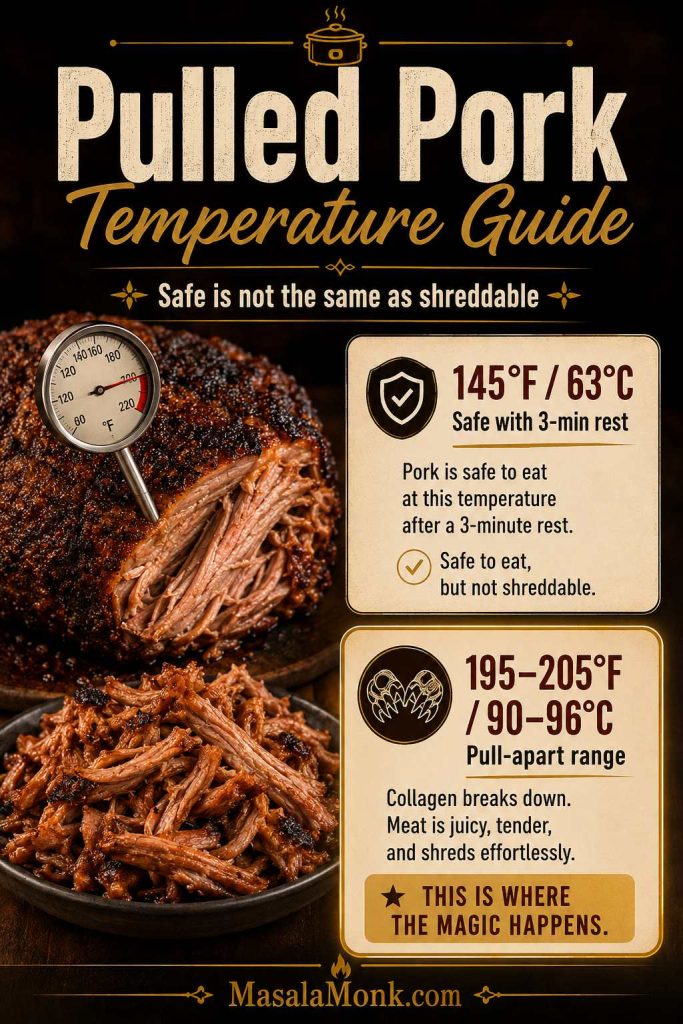
The pork is ready when it is tender enough to separate into strands, usually around 195–205°F / 90–96°C. Texture matters more than the exact number, so do not stop just because the timer ended.

Slow cooker and Crock-Pot pulled pork are the same method here. Crock-Pot is a common brand name for a slow cooker, so if you searched for a Crock-Pot pulled pork recipe, you are in the right place.

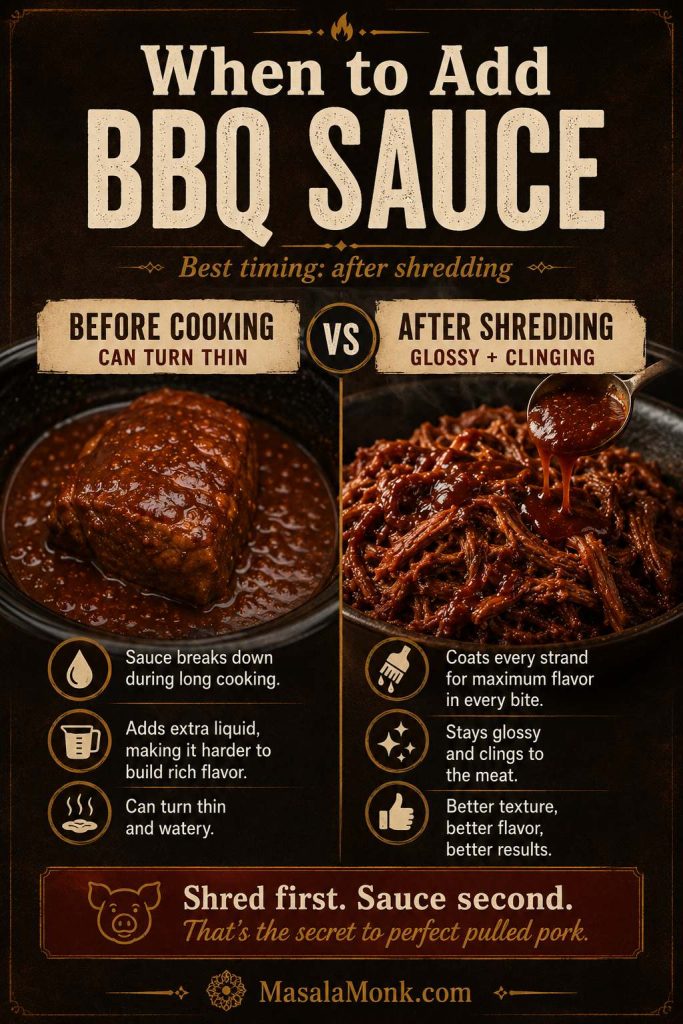
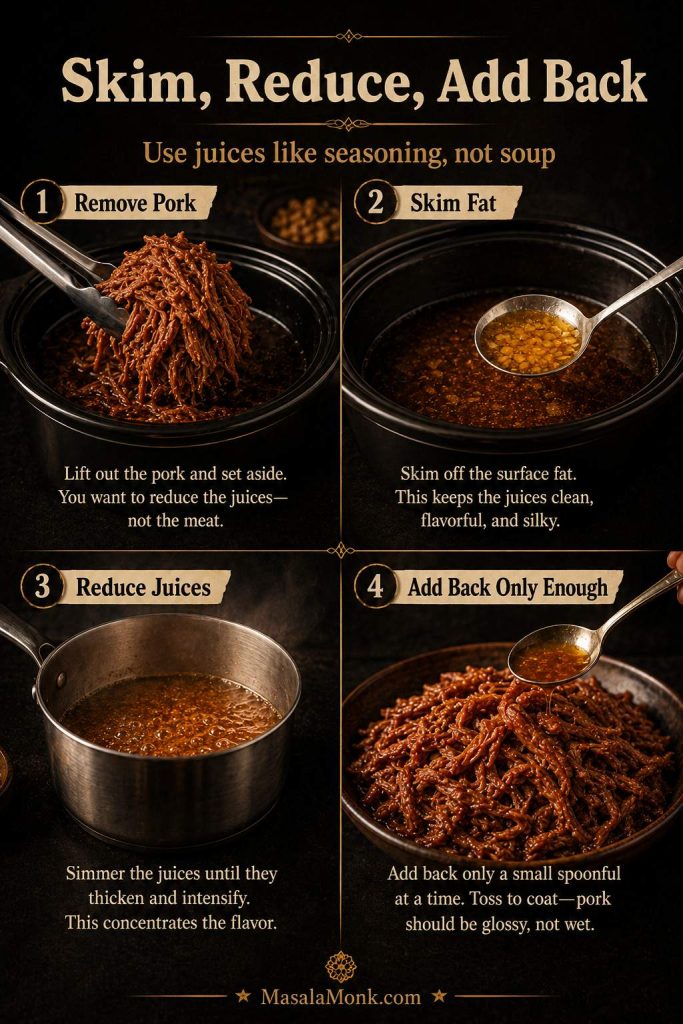
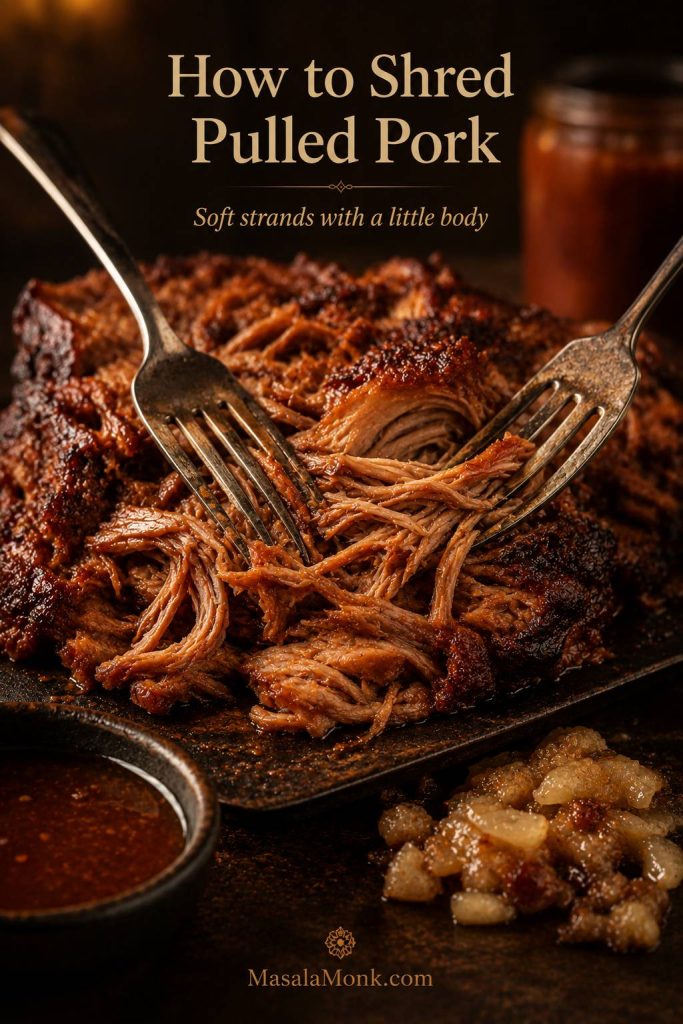
After cooking, remove the pork, shred it, skim or reduce the juices, and add BBQ sauce. The sauce stays bolder this way because it coats finished pork instead of thinning out during the long cook. Add back only enough cooking juice to make the pork moist and glossy. For the deeper comparison, see when to add BBQ sauce.

Quick answer board for slow cooker pulled pork showing 4 lb pork shoulder, 1/2 cup liquid, LOW 8–10 hours, HIGH 5–6 hours, and sauce after shredding.
For reliable slow cooker pulled pork, start with a marbled shoulder cut, use about 1/2 cup liquid, and let tenderness — not just the timer — decide when it is done.

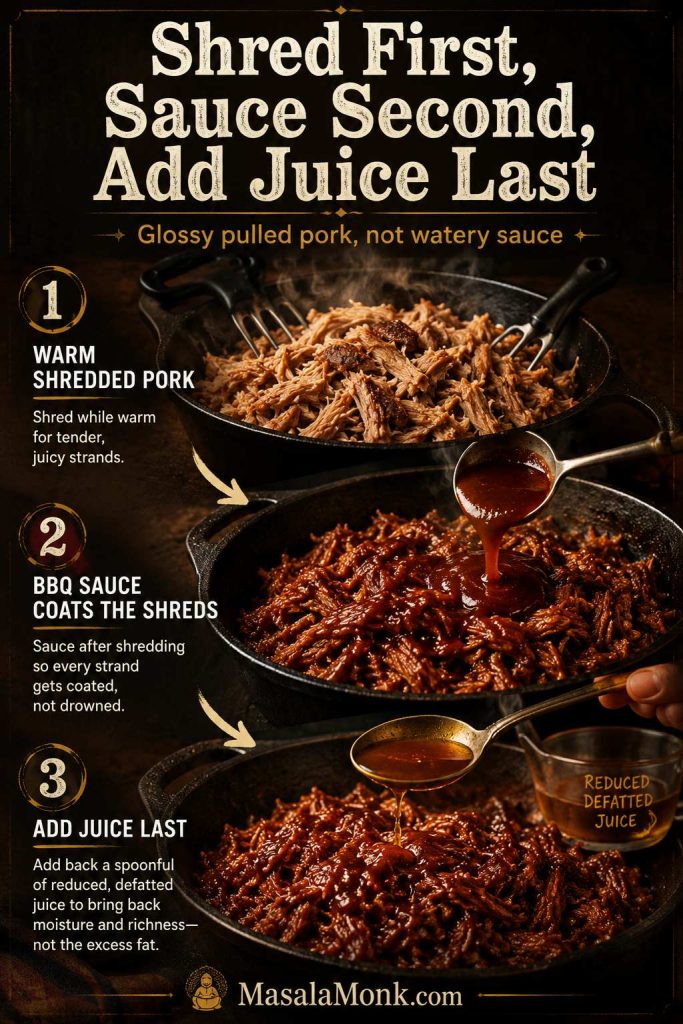
Shred First, Sauce Second, Add Juice Last

Shred first, sauce second, add juice last: Do not start with a slow cooker full of liquid or a full bottle of BBQ sauce. Pork shoulder releases plenty of juice as it cooks. Start with modest liquid, cook until tender, shred the pork, then add sauce and only enough defatted juice to make it glossy. For the full technique, see how to skim, reduce, and add back the juices.
Three-step pulled pork guide showing shredded pork, barbecue sauce added second, and a small amount of cooking juice added last.
Shred first, sauce second, add juice last: this finish lets the BBQ sauce coat the meat while the reserved juices bring moisture back in small, controlled amounts.

Why This Slow Cooker Pulled Pork Works

Slow cookers tenderize, but they do not concentrate flavor

A slow cooker is excellent at turning pork shoulder soft, but it does not brown meat or reduce sauce like an oven, smoker, or skillet. That is why pulled pork can come out tender but watery if you start with too much liquid or too much BBQ sauce.

The flavor control happens at the end

This method seasons the pork first, cooks it with modest liquid, then saves the BBQ sauce for after shredding. At that point, you can taste the meat, skim or reduce the juices, and add back only what the pork needs.

This is not trying to be smoked barbecue with bark, and it does not need to pretend to be. It is the dependable slow-cooker version: tender pork for sandwiches, sliders, tacos, nachos, and freezer meals without babysitting a grill all day.

The method prevents the common failures

  • Watery pork: modest liquid and sauce after shredding.
  • Bland pork: a full dry rub before cooking.
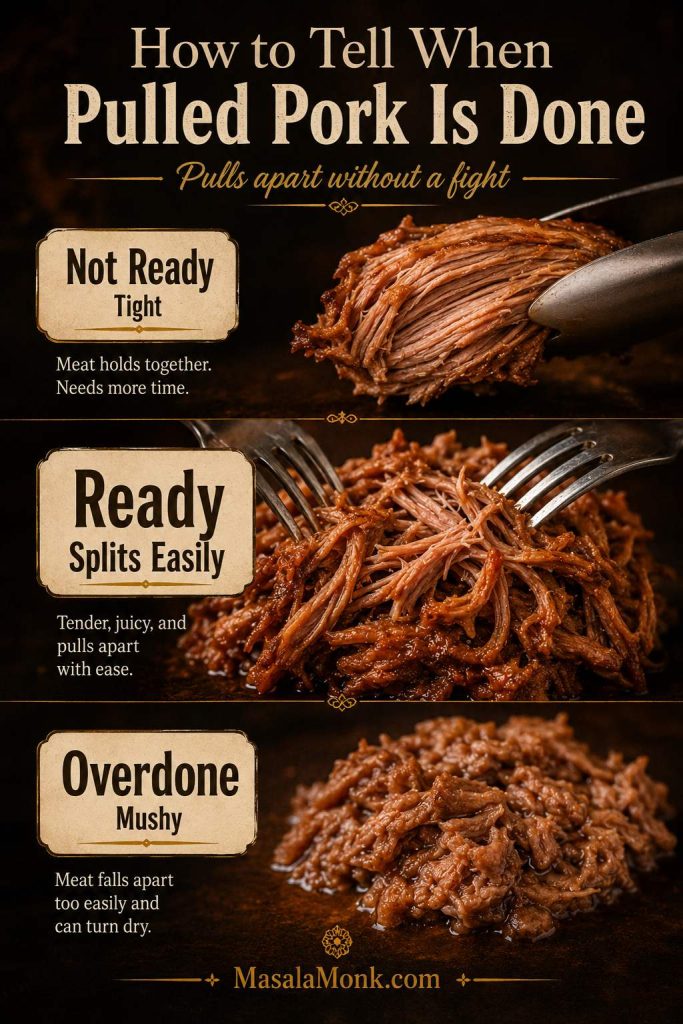
  • Tough pork: cook until the meat pulls apart, not just until the timer ends.
  • Greasy pork: skim the juices before adding them back.
  • Flat flavor: finish with salt, vinegar, sauce, or reduced juices after shredding.
Do not do these three things:
  • Do not use pork tenderloin and cook it like pork shoulder.
  • Do not cover the pork with liquid.
  • Do not judge doneness by the clock alone.
Food-safe is not the same as pull-apart tender: Pork shoulder becomes pull-apart tender well after it is technically cooked. That is why texture matters more than the clock here.

Pulled Pork at a Glance

Recommended cutPork shoulder, pork butt, or Boston butt
Default size4 lb / 1.8 kg
Slow cooker size6-quart slow cooker preferred
Most forgiving settingLOW for 8–10 hours
Faster settingHIGH for 5–6 hours
Texture targetTender enough to pull apart, usually around 195–205°F / 90–96°C
Liquid1/2 cup / 120 ml cooking liquid, plus vinegar, Worcestershire, and mustard
YieldAbout 8 generous sandwiches or 10 smaller servings
FinishShred first, then add BBQ sauce and just enough defatted cooking juices

Best Cut for Pulled Pork

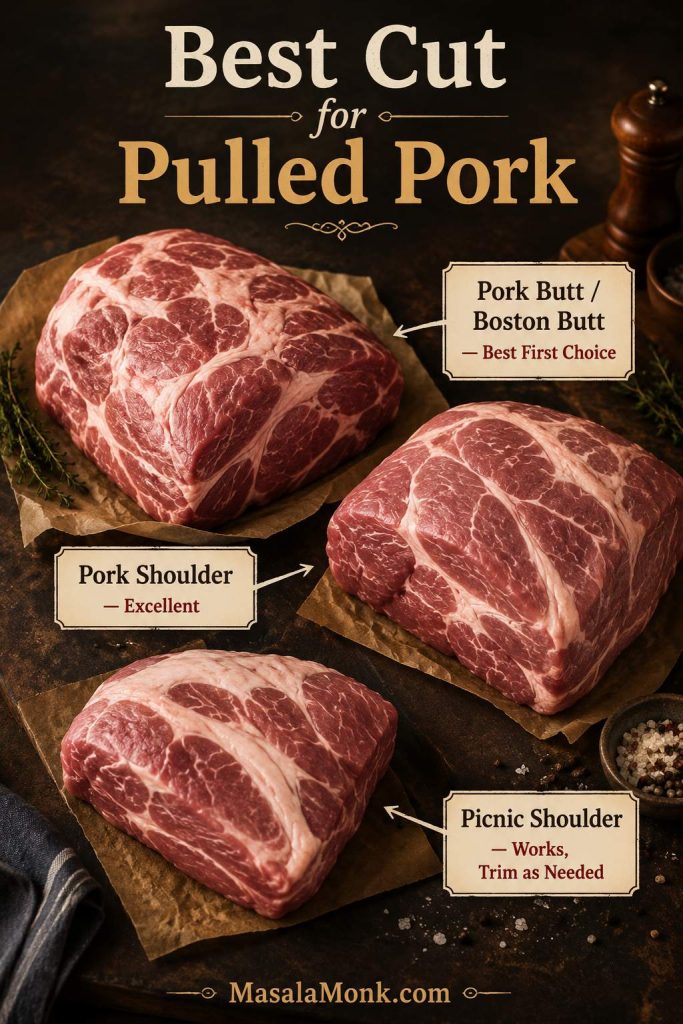
The best slow cooker pulled pork starts with a cut that can handle long cooking without turning dry or stringy. Pork shoulder, pork butt, and Boston butt have enough fat and connective tissue to become juicy and shreddable. Lean cuts can still taste good, but they do not behave the same way.

Butcher-style guide comparing pork butt, Boston butt, pork shoulder, and picnic shoulder as cuts for pulled pork.
For classic pulled pork, shoulder cuts work best because their fat and connective tissue soften during long cooking and turn into tender, shreddable meat.

Pork Shoulder vs Pork Butt vs Boston Butt

Pork butt and Boston butt come from the upper shoulder area, not the rear of the pig. They are usually well-marbled and forgiving, which makes them the easiest choice for pulled pork. Pork shoulder is also excellent and gives rich cooking juices. Picnic shoulder can work too, though it may include more skin, bone, and uneven pieces.

CutUse for pulled pork?Notes
Pork butt / Boston buttBest first choiceRich, marbled, forgiving, and ideal for shredding.
Pork shoulderExcellentClassic slow-cooker choice with plenty of collagen and flavor.
Picnic shoulderWorksCan include more skin and bone; trim as needed and cook until tender.
Pork loinNot ideal for classic pulled porkLean and better for slices or a separate lean shredded style.
Pork tenderloinNot ideal for classic pulled porkVery lean and much faster-cooking than shoulder.

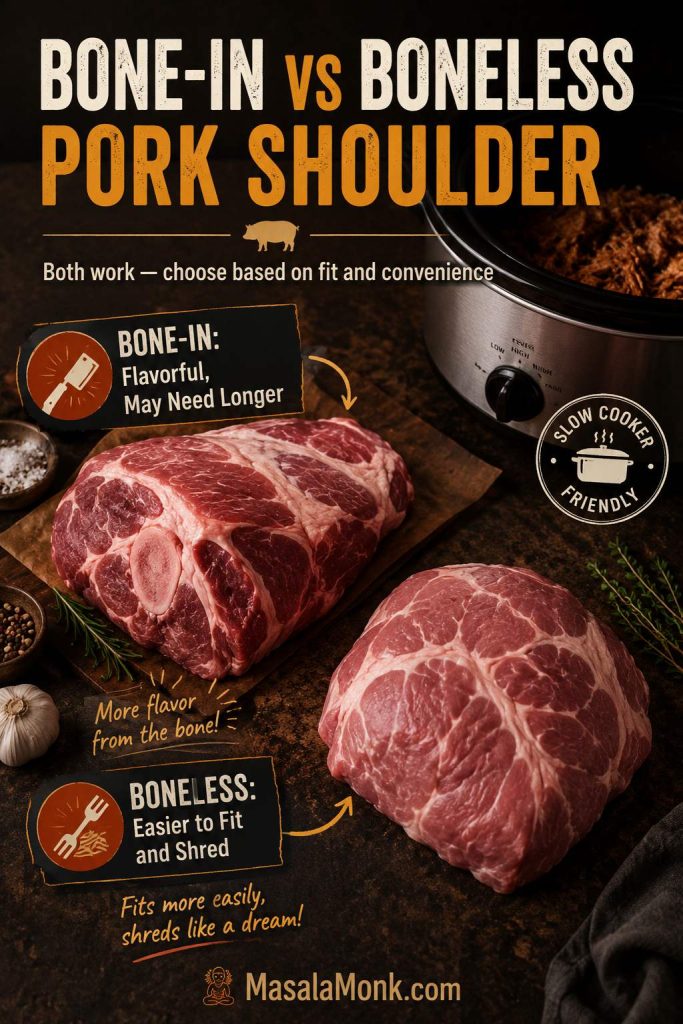
Bone-In vs Boneless Pork Shoulder

Both bone-in and boneless pork shoulder work. Boneless is easier to trim, season, fit into the slow cooker, and shred. Meanwhile, bone-in can add flavor and often stays juicy, but it may need slightly longer and you will need to remove the bone before shredding.

Comparison of bone-in and boneless pork shoulder for pulled pork, with notes about flavor, cooking time, fit, and shredding.
Bone-in and boneless pork shoulder both work well, so choose bone-in for a hearty roast or boneless when you need easier slow cooker fit and simpler shredding.

For the simplest first version, use a boneless 4 lb / 1.8 kg pork butt or pork shoulder. For a bone-in roast, use the same method and cook until the bone pulls away easily and the meat separates without resistance.

Should the Fat Cap Face Up or Down?

If your pork shoulder has a visible fat cap, trim thick hard fat but do not remove every bit. In a slow cooker, fat-cap direction matters less than it does in a smoker because the pork cooks in a moist, enclosed environment. Still, placing the fat cap up or slightly to the side is a good default because some rendered fat can baste the meat as it cooks.

After cooking, remove large soft fat pieces before shredding. Then add back defatted cooking juices gradually so the pork tastes juicy, not greasy.

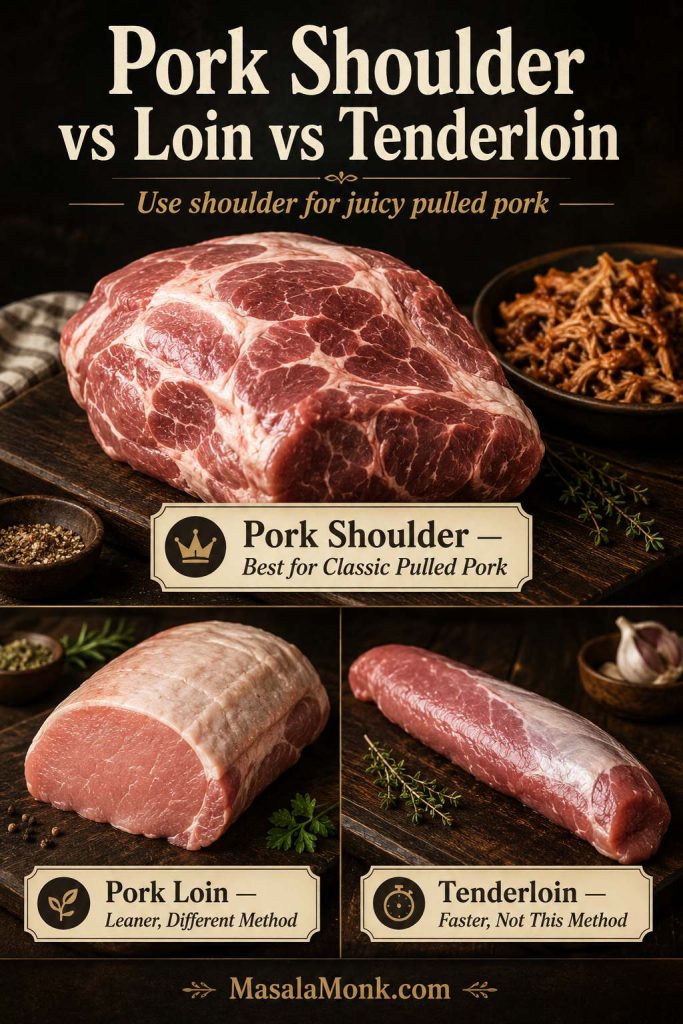
Can You Use Pork Loin or Pork Tenderloin?

You can shred lean pork, but pork loin and pork tenderloin are not the best cuts for classic pulled pork. They have much less fat and connective tissue than shoulder, so they can dry out if you cook them like pork butt.

Comparison board showing pork shoulder as best for classic pulled pork, while pork loin and pork tenderloin are leaner cuts for different methods.
Pork loin and tenderloin are leaner cuts, so they need a different cooking approach; for classic pulled pork, shoulder gives you the juiciest strands.

If your package says pork loin, use this slow cooker pork loin recipe instead. It is written for the leaner roast that cooks best as tender slices rather than classic pulled pork.

If your package says pork tenderloin, switch to this slow cooker pork tenderloin guide. Tenderloin is smaller, narrower, and much faster-cooking than pork shoulder, so it needs a different timing window.

For an oven version of that leaner cut, use pork tenderloin in the oven. If you want smoke flavor but still have loin rather than shoulder, this smoked pork loin recipe is the better match.

Slow cooker size: A 6-quart slow cooker is the best default for a 4 lb / 1.8 kg pork shoulder. Keep the cooker no more than about two-thirds full. If the pork barely fits, cut it into 2–3 large chunks or use a larger cooker.

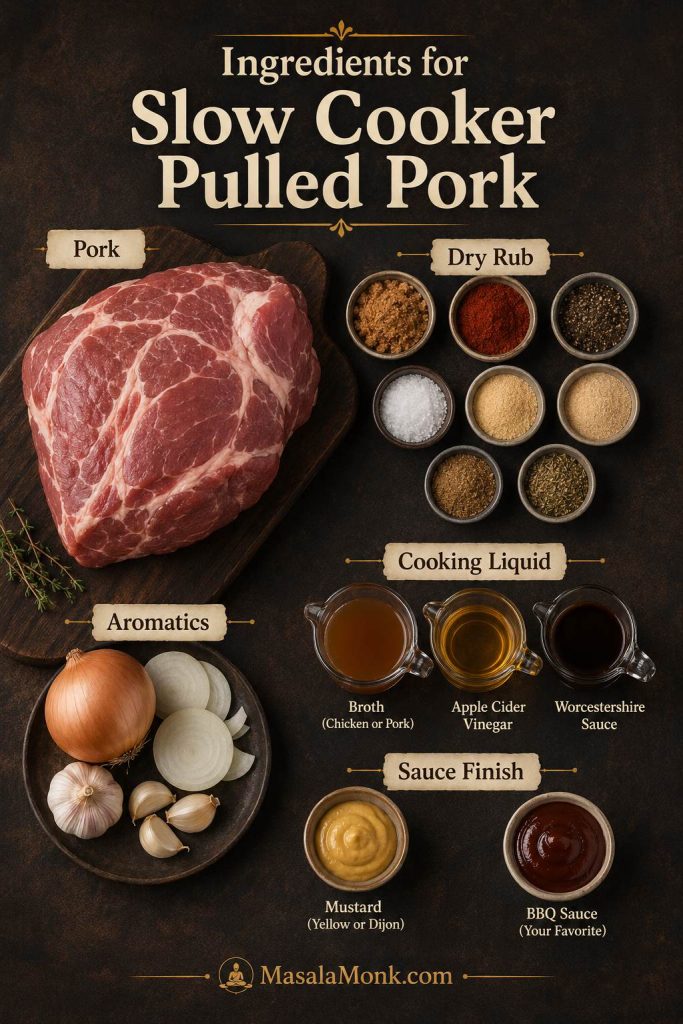
Ingredients and Why They Matter

Every ingredient here has a job: the rub seasons the meat, the aromatics build the cooking juices, and the vinegar, mustard, and Worcestershire keep the rich pork from tasting flat.

Ingredient board for slow cooker pulled pork with pork shoulder, dry rub spices, onion, garlic, cooking liquid, vinegar, Worcestershire, mustard, and barbecue sauce.
The best pulled pork flavor starts before the slow cooker turns on: season the meat well, add aromatics for depth, and use tangy finishers to balance the rich pork.

The Pork Cut

Start with 4 lb / 1.8 kg pork shoulder, pork butt, or Boston butt. Because this cut has enough fat and connective tissue, it can handle long cooking and still turn into juicy shreds. If you choose a bone-in roast, use the same method and cook until the bone pulls away easily.

Although the roast can stay whole when it fits comfortably, larger pieces cook more evenly when cut into 2–3 big chunks. Keep the pieces large; tiny cubes can dry at the edges before the center has time to soften.

Dry Rub for Slow Cooker Pulled Pork

The rub is what keeps this slow cooker pulled pork recipe from tasting like plain boiled meat. Mix the spices first, then coat the pork all over so every side gets seasoning.

  • 2 tbsp / 25 g brown sugar
  • 1 tbsp / about 7 g smoked paprika
  • 1 tbsp Diamond Crystal kosher salt / about 9 g, or 2 tsp Morton kosher salt / about 10 g
  • 1 tsp black pepper / about 2 g
  • 1 tsp garlic powder / about 3 g
  • 1 tsp onion powder / about 2–3 g
  • 1 tsp mustard powder / about 2 g
  • 1/2 tsp ground cumin / about 1 g
  • 1/4–1/2 tsp cayenne or chili powder, optional

If your BBQ sauce is very sweet, reduce the brown sugar to 1 tbsp / about 12 g. On the other hand, if you are using a tangy vinegar-forward sauce, the full 2 tbsp keeps the pork balanced.

Aromatics and Cooking Liquid

Next, build a small flavorful base under the pork. These ingredients season the cooking juices without flooding the slow cooker.

  • 1 large yellow onion / about 200 g, sliced
  • 4 garlic cloves / about 12 g, smashed or minced
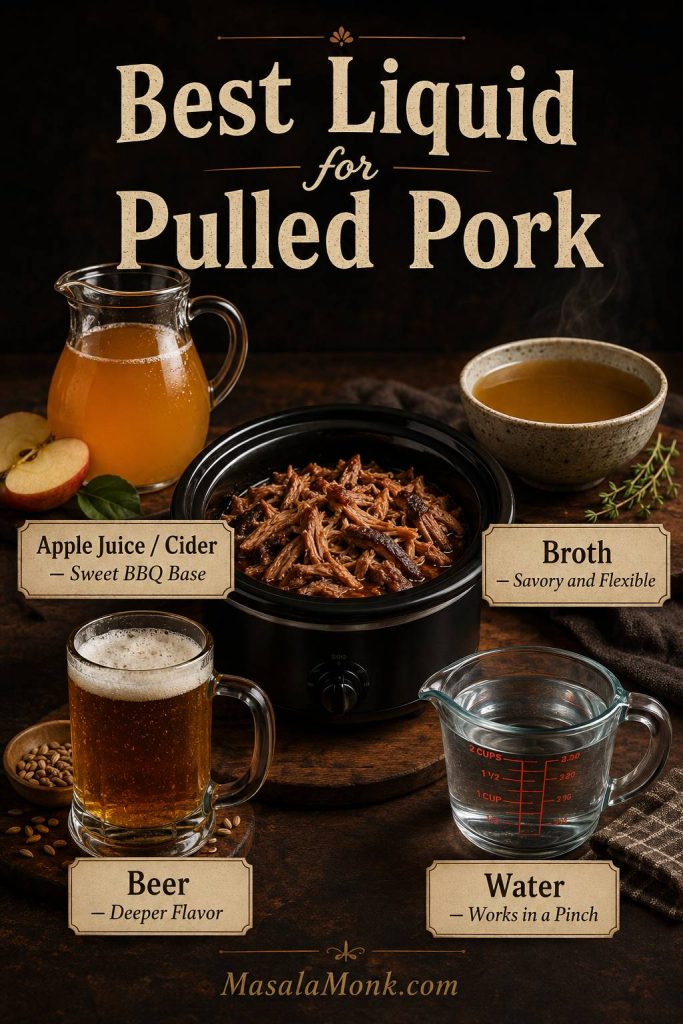
  • 1/2 cup / 120 ml apple juice, apple cider, broth, beer, or water
  • 2 tbsp / 30 ml apple cider vinegar
  • 1 tbsp / 15 ml Worcestershire sauce
  • 1 tbsp / 15 g yellow or Dijon mustard
  • 1/2–1 tsp / 2.5–5 ml liquid smoke, optional

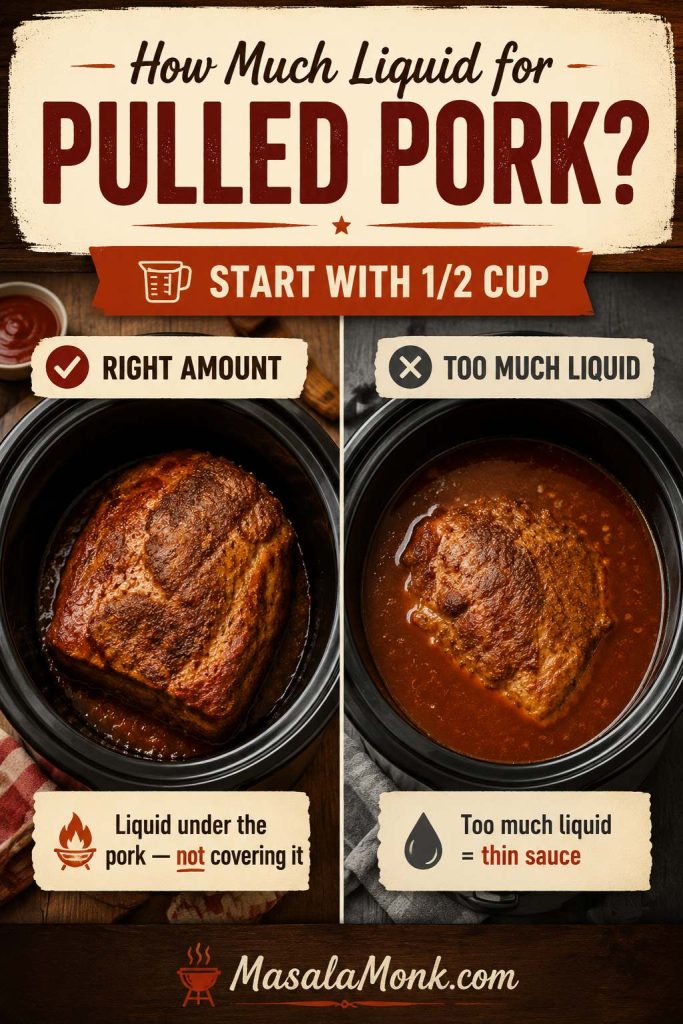
As the pork cooks, it will release more liquid, so begin with less than you think you need. The liquid should sit under and around the pork, not cover it.

Slow cooker liquid guide comparing a correct 1/2 cup liquid level under pork with a flooded slow cooker that can make sauce thin.
Too much liquid can turn pulled pork watery, so begin with about 1/2 cup and let the pork shoulder release its own juices as it cooks.

BBQ Sauce and Finishers

Toss the shredded pork with 3/4–1 cup / 180–240 ml BBQ sauce, plus 1/4–1/2 cup / 60–120 ml defatted cooking juices as needed. Add these gradually, because the finished pork should look glossy and juicy rather than soupy.

Then taste and adjust. Add vinegar for brightness, salt for depth, hot sauce for heat, or a little more BBQ sauce if the pork needs a sweeter finish.

Best Liquid for Pulled Pork

Apple juice or cider gives a slightly sweet BBQ-friendly base. Broth keeps the pork more savory and flexible. Beer adds deeper flavor, while water works in a pinch if you plan to adjust with sauce, vinegar, or salt at the end.

Guide to cooking liquids for pulled pork showing apple juice or cider, broth, beer, and water around a slow cooker pork setup.
Apple juice or cider gives a sweeter BBQ base, while broth keeps the pork savory and flexible; either way, the liquid should support the meat, not cover it.

For the main recipe, use 1/2 cup / 120 ml. Use up to 1 cup / 240 ml only for a very large roast, a wide cooker, or a slow cooker that runs hot. The liquid should sit under and around the pork, not cover it.

If you are making a soda variation such as Dr Pepper, root beer, or Coca-Cola pulled pork, use the soda variation instructions later in the post.

How to Make Slow Cooker Pulled Pork

The easiest version is rub, layer, cook, shred, and sauce. Searing is optional. For deeper flavor, sear the pork before slow cooking or broil the shredded pork briefly at the end. For the lowest-effort version, skip the sear and let the slow cooker do the work.

Six-step guide for slow cooker pulled pork showing season, add liquid, cook, shred, skim or reduce juices, and sauce to finish.
Once the pork is tender, the finish matters most: shred it warm, manage the juices, and add sauce gradually so the strands stay moist but never soupy.

Should You Sear the Pork First?

You do not have to sear pork shoulder before slow cooking. The recipe still works beautifully without it, which is why it is practical for busy days. Searing adds deeper roasted flavor, but it also adds a pan and a few extra minutes.

The easiest pulled pork skips the sear. For deeper flavor, sear the seasoned pork in a hot skillet with 1 tbsp / 15 ml neutral oil before adding it to the slow cooker. As a middle path, skip the sear at the beginning and broil some of the shredded pork at the end for browned edges.

Decision board showing three pulled pork options: skip the sear, sear first for deeper flavor, or broil after shredding for browned edges.
Searing adds deeper flavor, but it is not required; for the easiest version, skip it and use the broiler later if you want browned edges.

1. Trim and season the pork

Pat the pork dry. Trim away thick, hard surface fat, but leave some fat and marbling. Mix the brown sugar, smoked paprika, salt, pepper, garlic powder, onion powder, mustard powder, cumin, and cayenne or chili powder if using. Rub the seasoning all over the pork.

2. Add the onion, garlic, and liquid

Scatter the sliced onion and garlic in the bottom of a 6-quart slow cooker. Stir together the apple juice, cider, broth, beer, or water with the apple cider vinegar, Worcestershire, mustard, and optional liquid smoke. Pour this into the slow cooker.

The pork should not be covered in liquid. Start with 1/2 cup / 120 ml liquid because the meat will release more juice as it cooks.

3. Cook until tender enough to pull apart

Place the seasoned pork on top of the onion mixture. Then, cover and cook on LOW for 8–10 hours or HIGH for 5–6 hours. Although HIGH works when you are short on time, LOW gives the most even, forgiving texture, especially for larger roasts. For larger roasts, use the cook time by weight chart.

The pork is ready when it pulls apart without a fight. If it feels tight, rubbery, or hard to separate, it usually needs more time, not more force.

4. Remove, rest briefly, and shred

Transfer the pork to a rimmed sheet pan, large cutting board, or wide bowl. Rest for 10 minutes so it is easier to handle. Remove any bone, large fat pieces, or tough connective bits. Shred with two forks or meat claws.

5. Skim or reduce the juices

Pour the slow-cooker juices into a measuring cup or bowl, then skim off excess fat. If the juices taste thin, simmer them in a saucepan for 5–10 minutes until more concentrated. This step is optional, but it is the most reliable fix for watery pulled pork.

6. Add BBQ sauce after shredding

Return the shredded pork to the slow cooker or a large bowl. Toss with 3/4–1 cup / 180–240 ml BBQ sauce. Add 1/4–1/2 cup / 60–120 ml defatted cooking juices as needed, just until the pork is juicy and glossy. Taste, then adjust with salt, vinegar, hot sauce, or more BBQ sauce.

7. Optional: broil for browned edges

If you want crispier BBQ-style edges, spread some sauced pork on a foil-lined sheet pan and broil for 2–4 minutes. Watch closely. Then mix the browned edges back into the rest of the pork.

Slow Cooker Pulled Pork Cook Time

Cook time depends on pork weight, roast shape, bone-in vs boneless, slow cooker size, and how hot your appliance runs. Use the chart as a planning guide, then let texture decide when the pork is finished.

For parties, start earlier than you think. Pulled pork forgives extra holding time far better than it forgives being rushed, and nobody wants to be pulling at a stubborn roast while the buns and slaw are already on the table. For a 4–6 lb roast, cooking overnight or starting early in the morning is safer than trying to finish exactly at dinner time.

Low vs High Setting

LOW is the most forgiving setting for soft, even pulled pork. HIGH works when you are short on time, but it is less forgiving with large roasts. If the slow cooker is packed tightly, use LOW and give the pork more time.

Cook Time by Pork Weight

Cook time chart for slow cooker pulled pork showing LOW and HIGH timing ranges for 3 lb, 4 lb, 5–6 lb, and 7–8 lb roasts.
Use the cook-time chart for planning, then check the texture before serving; pulled pork is ready when it pulls apart easily.
Pork weightLOW settingHIGH settingNotes
3 lb / 1.35 kg7–8 hours4–5 hoursGood for smaller households.
4 lb / 1.8 kg8–10 hours5–6 hoursMain recipe size.
5–6 lb / 2.25–2.7 kg9–11 hours6–7 hoursUse a large slow cooker.
7–8 lb / 3.2–3.6 kg10–12 hours7–8 hoursOnly if the roast fits comfortably.
9–10 lb / 4–4.5 kg11–12+ hoursNot idealBetter to cut into large chunks or use two cookers.

Internal Temperature for Pulled Pork

For pulled pork, temperature is about texture as much as safety. For official safety guidance, FoodSafety.gov lists pork roasts at 145°F / 63°C with a 3-minute rest. But pork shoulder will not shred beautifully at that point. For shoulder-style pulled pork, cook until the meat pulls apart easily, usually around 195–205°F / 90–96°C. Then confirm with the done texture cues before shredding.

Pulled pork temperature guide showing 145°F with a 3-minute rest as safe and 195–205°F as the pull-apart range.
Pork can be food-safe before it is shreddable, so a shoulder roast usually needs more time to reach the tender pull-apart range.

If the thermometer says the pork is in that range but the meat still resists shredding, keep cooking. Texture wins. Check again in 30–60 minutes.

If dinner time is close and the pork is still firm, the answer is usually more time, not more force. Keep it covered and let the shoulder finish softening.

What Done Pulled Pork Looks and Feels Like

The pork should look relaxed and slightly collapsed, not firm and springy. When you lift it with tongs, it may start to split under its own weight. A fork should slide in easily, and the meat should separate into strands without hard pulling. If the pork is still fighting you, it is not ruined — it just needs more time.

Pulled pork doneness guide comparing tight not-ready pork, ready pork that splits easily, and overdone mushy pork.
The best doneness test is physical: ready pork should split under forks or tongs without a fight, while tight meat usually needs more time.
What you seeWhat it meansWhat to do
Firm, springy porkNot readyKeep cooking.
Fork slides in but meat resistsClose, but not doneCook 30–60 minutes more.
Meat splits under tongsReady to shredRest briefly, then shred.
Pork collapses into mushOvercooked or overmixedShred gently and avoid extra stirring.

Can You Overcook Pulled Pork in a Slow Cooker?

Yes, but pork shoulder is forgiving. Overcooking is more likely if the roast is small, the slow cooker runs hot, there is too little moisture left, or the pork sits for hours after it has already become tender. Once the pork shreds easily, switch the slow cooker to WARM and keep the meat moist with a little cooking juice or sauce.

If your pork is already very soft, shred gently. Overmixing can turn tender pork into a mushy texture.

When to Add BBQ Sauce

Best Time to Add BBQ Sauce

The best time to add most of the BBQ sauce is after shredding. A small amount can go in at the beginning if you love a cooked-in sauce flavor, but a full bottle of BBQ sauce early can turn thin because pork shoulder releases so much liquid.

For stronger flavor, cook the pork with rub, onion, garlic, vinegar, Worcestershire, mustard, and 1/2 cup / 120 ml liquid. After shredding, toss with BBQ sauce and only enough defatted cooking juices to make the pork juicy. If the juices taste weak or watery, reduce them in a saucepan first; then, add them back gradually.

How to Keep BBQ Sauce from Turning Thin

This is the whole trick: controlled liquid at the start, concentrated juices at the end, and BBQ sauce added when the shredded pork can actually hold it instead of sliding into a thin puddle.

Add sauce and juices gradually. The finished pork should look coated and glossy, with sauce clinging to the shreds instead of pooling at the bottom. If it looks dry, add a little more juice; if it looks loose, stop before the sauce turns thin.

Before-and-after sauce timing comparison showing barbecue sauce before cooking becoming thin and sauce after shredding clinging to pulled pork.
Adding most of the BBQ sauce after shredding keeps the flavor bolder because the sauce coats finished pork instead of thinning out during the long cook.
Simple sauce timing rule: Cook with rub and modest liquid. Shred first. Sauce second. This gives you better control over sweetness, tang, salt, smokiness, and moisture.
BBQ sauce methodWhat happensBest use
Sauce before cookingSofter, cooked-in flavor, but the sauce can thin out as pork releases juices.Use only a small amount early if you like this style.
Sauce after shreddingBolder BBQ flavor and better moisture control.Best default for this recipe.
Small amount before, more afterGives some cooked-in flavor while keeping the final sauce stronger.Good middle path if you love a saucy slow cooker base.

Should You Drain the Juices from Pulled Pork?

Do not blindly dump the juices, but do not pour all of them back either. The slow-cooker liquid contains flavor, fat, onion, garlic, seasoning, and pork juices. It can make shredded pork taste amazing — or greasy and watery — depending on how you use it.

  • Remove the cooked pork first.
  • Pour the juices into a bowl or measuring cup.
  • Skim or separate the fat.
  • Strain out onion or garlic if you want a smoother finish.
  • If the liquid tastes thin, reduce it in a saucepan for 5–10 minutes.
  • Add back only 1/4–1/2 cup / 60–120 ml at first, then more if the pork needs it.

Treat the slow-cooker juices like seasoning, not soup. The goal is not dry pork and not soupy pork — just enough concentrated juice to make the shreds taste alive.

Four-step pulled pork juice guide showing remove pork, skim fat, reduce juices, and add back only enough juice to coat the meat.
Do not throw away the cooking juices automatically; instead, skim, reduce, and return only what the pork needs for a glossy, well-seasoned finish.

After shredding, taste the pork like you would taste a sauce. When it tastes flat, add salt. If it feels heavy, add vinegar. When the flavor seems thin, reduce the juices. If it tastes too sweet, add mustard, hot sauce, or more unsauced pork.

How to Shred Slow Cooker Pulled Pork

Shred the pork while it is still warm, once it is cool enough to handle. If it cools too much, the fat firms up and the meat is harder to pull cleanly. You want soft strands with a little body, not tiny overworked bits that disappear into the sauce.

Close-up of warm pulled pork being shredded with forks into medium strands while keeping the texture juicy and structured.
Warm pork pulls into cleaner strands, so shred before it cools and stop while the meat still has texture instead of mixing it into mush.
  • Remove the bone if using bone-in pork shoulder.
  • Discard large pieces of fat, gristle, or tough connective tissue.
  • Use two forks, meat claws, or clean gloved hands.
  • Save some cooking juices so you can adjust moisture before serving.

How to Fix Pulled Pork That Is Tough, Watery, Dry, or Bland

If the pork is not perfect when you open the lid, do not panic. Most slow cooker pulled pork problems are easy to fix after shredding. Tough usually means unfinished, watery usually means the juices need managing, and bland usually means the finish needs salt, vinegar, sauce, or heat.

Troubleshooting board for pulled pork with fixes for tough, won’t shred, watery, dry, greasy, bland, too sweet, and mushy pork.
Most pulled pork problems can be fixed after cooking: tough pork needs more time, watery pork needs reduced juices, and bland pork needs a stronger finish.
ProblemLikely causeFix
Pork is toughIt has not cooked long enough for the connective tissue to soften.Cover and cook 30–60 minutes more, then check again.
Pork will not shredThe pork is safe but not pull-apart tender yet.Keep cooking until it separates easily with forks.
Pulled pork is wateryToo much liquid, sauce added early, or lots of pork juices released.Remove pork, strain and skim juices, reduce juices in a saucepan, then add back only what you need.
Pork tastes dryLean cut, not enough cooking juices mixed back in, or too little sauce.Add reserved juices, BBQ sauce, broth, apple juice, or a splash of vinegar.
Pork is greasyToo much rendered fat was mixed back into the shredded pork.Separate the fat from the juices before adding them back.
Pork is blandUnder-seasoned rub or diluted cooking liquid.Add salt, BBQ sauce, vinegar, hot sauce, mustard, or reduced juices.
Pork is too sweetSweet BBQ sauce, brown sugar, or soda variation.Add apple cider vinegar, mustard, hot sauce, salt, or unsauced pork to balance.
Pork is too smokyToo much liquid smoke.Dilute with unsauced pork or add vinegar and BBQ sauce to balance.
Pork is mushyIt was cooked long after tender or shredded too aggressively.Shred larger pieces gently and avoid overmixing with sauce.

What to Serve with Slow Cooker Pulled Pork

Once the pork is shredded and sauced, the hard part is over. From there, it can go classic with buns and slaw, casual with nachos, or meal-prep friendly with rice bowls and potatoes. The best sides add contrast: crunch, acidity, freshness, or creaminess against the rich pork.

How Much Pulled Pork Per Person?

A 4 lb / 1.8 kg raw pork shoulder usually gives about 2.5–3 lb / 1.1–1.35 kg cooked pulled pork, depending on trimming, bone, and fat loss. That is enough for about 8 generous sandwiches or 10 smaller servings.

Portion guide for pulled pork showing serving amounts for sandwiches, sliders, tacos, bowls, and nachos.
For parties, plan portions by how you are serving the pork: sandwiches need more meat, while sliders, tacos, bowls, and nachos stretch the batch further.
Serving styleCooked pulled pork per personNotes
Sandwiches4–6 oz / 115–170 gUse the higher end for large buns or hungry guests.
Sliders2–3 oz / 55–85 gGood for parties, appetizers, and mixed spreads.
BBQ plate5–6 oz / 140–170 gUse the higher end when pork is the main protein with sides.
Tacos3–4 oz / 85–115 gDepends on tortilla size and toppings.
Bowls or nachos3–5 oz / 85–140 gUse less if there are rice, beans, chips, cheese, or vegetables.

Best Sides for Pulled Pork

Before you choose the exact serving style, think in contrasts: rich pork needs something creamy, something crisp, and something tangy beside it.

Serving spread with pulled pork, coleslaw, pickles, potato salad, macaroni and cheese, cucumber salad, and buns.
A pulled pork plate feels balanced when the rich meat has a creamy side, a crisp bite, and something tangy enough to reset the next forkful.

For Pulled Pork Sandwiches

For a better sandwich, use a soft bun, glossy pulled pork, crunchy slaw, pickles, and enough sauce to cling without soaking the bread. This coleslaw recipe is the natural side because it brings the crunch and acidity rich pork needs. The best bite is soft, juicy, crisp, tangy, and warm all at once.

Pulled pork sandwiches with glossy shredded pork, coleslaw, pickles, soft buns, and barbecue sauce on a dark table.
A pulled pork sandwich works best when the pork is juicy, the slaw adds crunch, and the pickles cut through the richness before the bun gets soggy.

For a BBQ Plate

For a BBQ plate, balance the rich pork with something creamy, something sharp, and something crisp. Potato salad or macaroni and cheese brings comfort, while pickles, slaw, roasted vegetables, or a vinegar-style cucumber salad keeps the plate fresh.

For Tacos, Bowls, and Nachos

For tacos and bowls, keep the pork a little less saucy so lime, salsa, cabbage, avocado, and pickled onions can do their job. The no-BBQ version is especially useful here. For bowls, start with warm, fluffy rice; this how to cook rice guide is useful if you want the base to stay separate instead of clumpy. For nachos, scatter the pork over chips with cheese, then finish with fresh toppings after baking.

Pulled pork served three ways as tacos, a rice bowl, and nachos with lime, cabbage, pickled onions, avocado, and herbs.
Pulled pork is not limited to sandwiches; with lime, cabbage, pickled onions, rice, or chips, leftovers become tacos, bowls, and nachos.

Slow Cooker Pulled Pork Leftover Ideas

Leftover pulled pork is one of the best reasons to make a full batch. A good batch should feel like a gift to your future self, not a problem to use up. Store it with a little cooking juice or sauce so it stays moist, then use it for fast meals through the week. For safe timing and reheating, see storing, freezing, and reheating.

The best leftovers are stored with just enough juice that they reheat like fresh pork, not dry scraps.

  • Pulled pork sandwiches: buns, slaw, pickles, and extra BBQ sauce.
  • Pulled pork tacos: tortillas, cabbage, lime, salsa, and pickled onions.
  • Loaded baked potatoes: split potatoes, pork, cheese, sour cream, scallions, and sauce. If you already have cooked potatoes, this leftover baked potatoes guide gives you more ways to turn them into a full meal.
  • Pulled pork nachos: chips, cheese, pork, jalapeños, and fresh toppings. For a smoother drizzle, use homemade cheese sauce instead of only shredded cheese.
  • Rice bowls: rice, pork, slaw, avocado, hot sauce, and lime.
  • Breakfast hash: potatoes, onions, peppers, pork, and eggs.
  • Mac and cheese topping: spoon hot pulled pork over creamy mac and cheese.
  • Party popper filling: tuck a small spoonful into baked jalapeño poppers before adding the cheese filling.
  • Freezer portions: pack 1–2 cup portions with a splash of juices for future meals. Freeze a few small portions before the tray disappears; future you will want tacos, bowls, or loaded potatoes.

Storing, Freezing, and Reheating Slow Cooker Pulled Pork

Cool the pulled pork, then store it with some sauce or cooking juices. Dry leftover pork usually happens because the meat was stored without moisture or reheated too aggressively.

Storage methodHow longBest practice
Refrigerator3–4 daysStore in an airtight container with sauce or cooking juices.
Freezer2–3 months for best qualityFreeze flat in bags or in meal-size portions with some moisture.
ReheatingUntil hot throughoutAdd broth, apple juice, cooking juices, or BBQ sauce and reheat gently.
Storage guide showing pulled pork in airtight containers and freezer bags with labels for fridge, freezer, sauce or juice, and meal-size portions.
Store leftover pulled pork with a little sauce or cooking juice so it reheats moist, then portion it for quick meals later.

How to Reheat Pulled Pork

For the best texture, reheat pulled pork gently with a small splash of sauce, broth, apple juice, or reserved cooking juices. The goal is warm, moist pork, not dry strands or boiling liquid.

Pulled pork reheating in a skillet with a small spoonful of sauce or cooking juice added for moisture.
Reheat pulled pork gently with a splash of sauce or reserved juice so the strands warm through without drying out or turning stringy.

For official food-safety guidance, refrigerate leftovers promptly and reheat them to 165°F / 74°C. The USDA safe temperature chart is a useful reference for leftovers and reheating.

Slow Cooker Pulled Pork Variations

Once you understand the basic method, you can adjust the flavor easily. Keep the liquid controlled, cook until the pork shreds, and then finish with sauce or reduced juices after shredding.

Pulled Pork Without BBQ Sauce

For pulled pork without BBQ sauce, use the same pork shoulder, rub, onion, garlic, vinegar, Worcestershire, mustard, and cooking liquid, but skip the bottled sauce at the end. After shredding, toss the pork with reduced cooking juices, then season to taste with salt, black pepper, apple cider vinegar, mustard, hot sauce, or a squeeze of lime.

This is the version to make when you want one batch of pork to go several directions during the week. It is especially useful for tacos, rice bowls, nachos, burritos, breakfast hash, loaded potatoes, and meal prep because it stays flexible. Later, you can add BBQ sauce, salsa, hot sauce, crema, or another sauce depending on the meal.

Unsauced pulled pork with lime, pickled onions, cabbage, tortillas, mustard, and reduced cooking juices for a lighter variation.
For pulled pork without BBQ sauce, brighten the meat with reduced cooking juices, vinegar, mustard, or lime, especially for tacos and bowls.

Soda-Based Pulled Pork Variations

For soda-based pulled pork, keep the same core method and treat the soda as the cooking liquid, not as a reason to flood the slow cooker. If your BBQ sauce is already sweet, reduce the brown sugar in the rub to 1 tbsp / about 12 g and finish with vinegar or hot sauce for balance.

Soda variation guide with pulled pork, small labeled glasses for Dr Pepper, root beer, and Coca-Cola, plus vinegar and hot sauce for balance.
Soda-based pulled pork can work well, but because the cooking liquid is sweet, balance the finish with vinegar, hot sauce, or a tangier BBQ sauce.

Dr Pepper Pulled Pork

Replace the 1/2 cup / 120 ml cooking liquid with 1 cup / 240 ml Dr Pepper. After shredding, add BBQ sauce gradually and balance with vinegar or hot sauce if needed.

Root Beer Pulled Pork

Use 1 cup / 240 ml root beer as the cooking liquid for a sweeter, rounder BBQ-style pulled pork. It works best with a tangier BBQ sauce or extra apple cider vinegar at the end.

Coca-Cola Pulled Pork

Use 1 cup / 240 ml Coca-Cola as the cooking liquid for a cola-braised version. Keep the finish balanced with BBQ sauce, vinegar, hot sauce, or reduced juices after shredding.

Spicy Pulled Pork

Add 1–2 tsp chili powder, 1/2 tsp cayenne, chopped chipotle in adobo, or hot sauce. For tacos, keep the BBQ sauce lighter and finish with lime. If you like building your own heat, this pepper sauce recipe guide gives you several hot, tangy directions to play with.

FAQs

Is pork shoulder or pork butt better for slow cooker pulled pork?

Pork butt or Boston butt is the easiest first choice because it is usually well-marbled and forgiving. Pork shoulder is also excellent. Both cuts are much better for classic pulled pork than pork loin or pork tenderloin.

Is Crock-Pot pulled pork the same as slow cooker pulled pork?

Yes. Crock-Pot is a popular slow cooker brand, so Crock-Pot pulled pork and slow cooker pulled pork refer to the same general cooking method. Use the same recipe, timing, and tenderness checks.

How long does pulled pork take in the slow cooker?

A 4 lb / 1.8 kg pork shoulder usually takes 8–10 hours on LOW or 5–6 hours on HIGH. Larger roasts need more time. The pork is finished when it separates easily, not just when the timer ends.

Should BBQ sauce go in before or after cooking?

Add most of the BBQ sauce after shredding. Sauce added at the beginning can become thin because pork releases a lot of liquid. For stronger flavor, cook with rub and modest liquid, then sauce the shredded pork at the end.

Why is my pulled pork watery?

Watery pulled pork usually comes from too much liquid, too much sauce added early, or natural pork juices collecting in the slow cooker. Remove the pork, strain and skim the juices, reduce them in a saucepan, then add back only enough to moisten the shredded pork.

Why is my pulled pork tough?

Tough pulled pork usually needs more time, not more force. Pork shoulder can be fully cooked but not yet tender enough to shred. Cover it and continue cooking for 30–60 minutes, then test again with forks.

How do I make pulled pork without BBQ sauce?

Use the rub, onion, garlic, vinegar, Worcestershire, mustard, and cooking liquid, then shred the pork with reduced cooking juices instead of BBQ sauce. This unsauced version is especially good for tacos, rice bowls, nachos, and meal prep.

What is the best way to make pulled pork ahead?

Cook and shred the pork, store it with some defatted juices, then reheat it gently the next day with BBQ sauce or extra cooking liquid. The flavor often gets even better after resting overnight.

How long can pulled pork stay warm for a party?

Once the pork is shredded and sauced, keep it on WARM for 1–2 hours, stirring occasionally and adding a splash of juices or sauce if it starts to dry out. For food safety, do not leave pulled pork sitting at room temperature for more than 2 hours.

Should I cut pork shoulder into chunks before slow cooking?

For a 4 lb / 1.8 kg roast, you can keep it whole if it fits comfortably. For a larger 7–10 lb roast, cut the pork into 2–3 large chunks so it fits better and cooks more evenly. Keep the pieces large so the pork stays juicy.

Should frozen pork shoulder go straight into the slow cooker?

No. Thaw pork shoulder fully in the refrigerator before slow cooking. Starting from frozen can make the pork heat unevenly and spend too long in an unsafe temperature range before the center warms through.

How much pulled pork do I need per person?

Plan on about 4–6 oz / 115–170 g cooked pulled pork per person for sandwiches or BBQ plates. For sliders, 2–3 oz / 55–85 g per person may be enough. A 4 lb / 1.8 kg raw pork shoulder usually gives about 8 generous sandwich servings.

What is the best way to freeze pulled pork?

Freeze pulled pork in meal-size portions with a little sauce or cooking juice. For best quality, use within 2–3 months. Thaw overnight in the refrigerator and reheat gently with extra moisture.

Slow Cooker Pulled Pork Recipe Card

Recipe card for slow cooker pulled pork showing yield, prep time, cook time, best cut, 1/2 cup liquid, finish rule, and storage times.
This recipe card keeps the main method easy to remember: pork shoulder, modest liquid, low-and-slow cooking, and a controlled finish after shredding.

Slow Cooker Pulled Pork Recipe

This slow cooker pulled pork recipe uses pork shoulder or pork butt, a smoky brown sugar rub, modest cooking liquid, and BBQ sauce added after shredding for juicy, glossy pork that holds sauce without turning soupy.

Prep Time20 minutes
Cook Time8–10 hours on LOW or 5–6 hours on HIGH
Total TimeAbout 8.5–10.5 hours on LOW or 5.5–6.5 hours on HIGH
Yield8 generous servings

Ingredients

  • 4 lb / 1.8 kg pork shoulder, pork butt, or Boston butt
  • 1 large yellow onion / about 200 g, sliced
  • 4 garlic cloves / about 12 g, smashed or minced
  • 1/2 cup / 120 ml apple juice, apple cider, low-sodium chicken broth, beer, or water
  • 2 tbsp / 30 ml apple cider vinegar
  • 1 tbsp / 15 ml Worcestershire sauce
  • 1 tbsp / 15 g yellow mustard or Dijon mustard
  • 1/2–1 tsp / 2.5–5 ml liquid smoke, optional
  • 3/4–1 cup / 180–240 ml BBQ sauce, plus more to serve

Dry Rub

  • 2 tbsp / 25 g brown sugar
  • 1 tbsp / about 7 g smoked paprika
  • 1 tbsp Diamond Crystal kosher salt / about 9 g, or 2 tsp Morton kosher salt / about 10 g
  • 1 tsp black pepper / about 2 g
  • 1 tsp garlic powder / about 3 g
  • 1 tsp onion powder / about 2–3 g
  • 1 tsp mustard powder / about 2 g
  • 1/2 tsp ground cumin / about 1 g
  • 1/4–1/2 tsp cayenne or chili powder, optional

Instructions

  1. Trim the pork. Pat pork dry. Trim only thick, hard surface fat; leave some fat and marbling for moisture.
  2. Season. Mix all dry rub ingredients. Rub the seasoning all over the pork.
  3. Optional sear. For deeper flavor, sear the seasoned pork in 1 tbsp / 15 ml neutral oil before slow cooking. For the easiest version, skip this step.
  4. Build the slow cooker base. Add sliced onion and garlic to a 6-quart slow cooker. Stir together the cooking liquid, vinegar, Worcestershire, mustard, and liquid smoke if using. Pour into the cooker.
  5. Add the pork. Place the seasoned pork on top of the onion mixture. The pork should not be covered in liquid.
  6. Cook. Cover and cook on LOW for 8–10 hours or HIGH for 5–6 hours, until the pork pulls apart easily with forks.
  7. Shred. Transfer pork to a rimmed sheet pan, cutting board, or wide bowl. Rest 10 minutes, then remove bone, large fat pieces, and tough bits. Shred with two forks or meat claws.
  8. Handle the juices. Strain or skim the slow-cooker juices. If they taste thin, simmer in a saucepan for 5–10 minutes to concentrate.
  9. Sauce after shredding. Toss shredded pork with BBQ sauce and 1/4–1/2 cup / 60–120 ml defatted cooking juices, adding only enough to make it juicy.
  10. Adjust and serve. Taste and adjust with salt, vinegar, hot sauce, extra BBQ sauce, or more reduced juices. Serve on buns, sliders, tacos, bowls, nachos, baked potatoes, or BBQ plates.

Notes

  • Best cut: pork butt, Boston butt, or pork shoulder.
  • Most forgiving setting: LOW gives the most even texture.
  • Texture target: tender enough to pull apart, usually around 195–205°F / 90–96°C.
  • Liquid note: start with 1/2 cup / 120 ml and do not cover the pork.
  • Finish: shred first, then add BBQ sauce and just enough defatted cooking juice.
  • For crisp edges: broil sauced shredded pork for 2–4 minutes, watching closely.
  • Storage: refrigerate 3–4 days or freeze 2–3 months with a little sauce or juice.

Final Tip

The best slow cooker pulled pork is won at the finish. Choose a marbled shoulder cut, give it enough time to soften, then treat the juices like seasoning instead of soup. Shred first, sauce second, and add back only enough defatted juice to make the pork glossy. That is how you get pulled pork that piles onto buns, holds up in tacos, and still tastes like a plan tomorrow.

Final serving spread with a tray of glossy pulled pork, buns, slaw, pickles, sauce, tongs, and an assembled pulled pork sandwich.
Once the pork is shredded, sauced, and moist, it is ready for sandwiches, sliders, dinner plates, or leftovers that still feel planned tomorrow.

If you try one of the variations, leave a comment with the cut you used — pork butt, pork shoulder, bone-in, or boneless — and whether you finished it with BBQ sauce, reduced juices, or both. Those details are often what separate a good batch from a great one.

Back to top

Posted on 3 Comments

Slow Cooker Pork Loin Recipe (Juicy Crock Pot Pork Loin)

Sliced slow cooker pork loin served with onion garlic gravy, mashed potatoes, carrots, and potatoes on a warm dinner plate.

Slow Cooker Pork Loin Recipe sounds like the easiest dinner in the world until the pork comes out dry, pale, or sitting in a puddle of watery juices. Pork loin is leaner than pork shoulder, so it does best with gentle heat, an early temperature check, a short rest, and a simple sauce or gravy made from the slow-cooker juices.

This version is built for the roast most people hope for when they set up the crock pot: clean, tender slices, a savory onion-garlic sauce, and warm gravy that keeps the lean meat moist on the plate. Serve it with mashed potatoes, rice, egg noodles, roasted vegetables, or the potatoes and carrots variation below.

By the time it is ready, you want the kitchen to smell like garlic, onion, herbs, and gravy — not like plain meat that sat too long in the pot.

This recipe starts with the result pork loin does best: tender, sliceable meat with enough sauce to keep every serving moist. If you want a softer, saucier version, you will find that option below too.

If you bought pork tenderloin instead of pork loin, use that recipe instead. Tenderloin is smaller, narrower, and cooks faster, so the timing is different.

Quick Answer: How to Make Slow Cooker Pork Loin

For juicy slow cooker pork loin, use a 2–4 lb boneless roast, season it well, place it over sliced onion or sturdy vegetables, add about ½ cup broth or sauce, and cook on LOW until the thickest center reaches 145°F / 63°C. Rest before slicing. Because slow cookers vary, begin checking early; lean pork can overcook faster than you expect.

Quick answer guide showing a 3 lb pork loin roast, 1/2 cup broth, LOW setting, 2 1/2 to 3 hour check time, and 145°F finish.
Start with this baseline for juicy crock pot pork loin: modest broth, LOW heat, an early temperature check, and a 145°F finish before resting.

For smaller or larger roasts, use the cook-time chart as your first check-in guide.

Best first version: Use a 3 lb / 1.35 kg boneless pork loin roast in a 6-quart slow cooker. Cook on LOW, start checking around 2½–3 hours, and pull the pork when the center reaches 145°F / 63°C for tender slices.

Choose Your Slow Cooker Pork Loin Result

Choose your result: For neat dinner slices, cook pork loin to 145°F / 63°C and rest before slicing. For softer saucy pork, use extra sauce and cook longer. For true fall-apart pulled pork, pork shoulder or pork butt is the better cut.
Comparison guide showing sliceable pork loin, softer saucy pork loin, and pulled pork shoulder as different slow cooker results.
Choose the result before you cook, because sliceable pork loin, softer saucy pork, and true pulled pork all need different timing expectations.

For a fuller texture breakdown, see sliceable vs shreddable slow cooker pork loin.

What Juicy Slow Cooker Pork Loin Should Look Like

Done right, this is the kind of slow cooker pork loin that still feels like a roast dinner: clean slices, savory onion-garlic gravy, and enough moisture on the plate that the lean pork tastes intentional instead of tired.

Close-up of sliced slow cooker pork loin with glossy onion garlic gravy and a fork lifting one moist slice.
Even when the pork slices cleanly, the gravy matters; it adds moisture, flavor, and a more finished roast-dinner feel.

Slow Cooker Pork Loin at a Glance

The base recipe is written for a 3 lb / 1.35 kg boneless roast, but the timing chart below will help you adjust for smaller or larger pieces.

Best cut Boneless pork loin roast, not pork tenderloin
Default size 3 lb / 1.35 kg
Slow cooker size 6-quart slow cooker
Best setting LOW for the most even, controlled result
Cook time Start checking at 2½–3 hours; many 3 lb roasts take closer to 3½–4½ hours
Internal temperature 145°F / 63°C in the thickest center, then rest
Liquid ½ cup / 120 ml broth for the base recipe; up to 1 cup / 240 ml with vegetables
Yield 6–8 servings
At-a-glance setup for slow cooker pork loin with a 3 lb roast, 6-quart slow cooker, 1/2 cup broth, LOW setting, and 145°F finish.
Before the lid goes on, check the pork cut, slow cooker size, liquid amount, heat setting, and final temperature target.

If you are unsure about liquid or timing, the liquid guide and cook-time chart explain those two decisions in more detail.

The goal is not to hover over the slow cooker all afternoon. It is to set yourself a smart checking window, then let the thermometer tell you when dinner is ready. That one check is what keeps pork loin from turning into the dry roast people remember for the wrong reasons.

Why This Crock Pot Pork Loin Works

Because pork loin is a lean roast, it needs a slightly different strategy from pork shoulder. Shoulder can handle long, slow cooking because it has more fat and connective tissue. Pork loin can still be wonderful in the slow cooker, but it is at its best when you cook it to the right endpoint instead of blindly leaving it in all day.

A good crock pot pork loin needs both flavor and control: enough seasoning to carry the lean meat, enough moisture to make a sauce, and enough restraint to stop before the slices turn dry.

It also gives you a different kind of slow-cooker meal. Instead of shredded pork or a heavy stew, you get a sliceable roast with enough sauce for mashed potatoes, noodles, or rice — easy enough for a weeknight, but polished enough for Sunday dinner.

  • It cooks by temperature, not guesswork. Time gives you a window, but the thermometer tells you when the pork is actually done.
  • It keeps the liquid controlled. Slow cookers trap moisture, so too much broth can make the sauce thin and dull.
  • It gives you two endpoints. Tender sliced pork and softer, saucier pork need different handling.
  • It protects the vegetables. Potatoes and carrots can cook slower than pork, so the method keeps the meat from drying out while you wait for them.

Pork Loin vs Pork Tenderloin vs Pork Shoulder

This is the part that saves a lot of dinners. Pork loin and pork tenderloin sound almost identical at the store, but they behave very differently once the lid goes on.

Pork loin, pork tenderloin, and pork shoulder are not the same cut, which is why slow cooker pork recipes can get confusing. They can all go into a slow cooker, but they need different timing, moisture, and texture expectations.

Raw pork loin roast, pork tenderloin, and pork shoulder arranged on butcher paper to compare their shapes and sizes.
This cut comparison matters because pork loin, pork tenderloin, and pork shoulder all need different timing and give different textures in the slow cooker.
Cut What it looks like Slow cooker behavior Best use
Pork loin Wide roast, often 2–5 lb Lean, sliceable when cooked to temperature; can dry out if overcooked This recipe
Pork tenderloin Long, narrow, usually 1–1.5 lb each Cooks faster; dries if treated like a large roast Use the slow cooker pork tenderloin recipe
Pork shoulder / pork butt Large, fattier roast Best for classic pulled pork because it has more fat and connective tissue Use for true fall-apart pulled pork

For this recipe, use a boneless pork loin roast. If the package says pork tenderloin, follow the tenderloin timing instead. If the package says pork shoulder or pork butt, you can cook it longer for classic pulled pork, but that is a different recipe with a different texture goal.

A pork sirloin roast can usually be cooked with the same general method, but it may be shaped differently from a center-cut pork loin. Use the thermometer in the thickest part and treat the chart as a guide, not a guarantee.

Check the Pork Roast Label Before Timing

At the store, “pork roast” may refer to pork loin, pork shoulder, pork butt, pork sirloin roast, or another cut. Check the package label and shape before you follow a slow cooker timing chart.

Generic pork roast labels for pork loin roast, pork sirloin roast, and pork shoulder roast with a pointer showing label and shape.
Since “pork roast” can mean several cuts, the package label and the shape matter before you follow any slow cooker timing.

Once you know it is pork loin, use the slow cooker pork loin timing chart for your roast size.

If you would rather roast that smaller cut, this pork tenderloin in oven guide gives the oven timing instead.

Ingredients for Slow Cooker Pork Loin

To keep the flavor balanced, the ingredient list is built around a garlic-herb pork loin with a small amount of savory sauce. The Dijon and vinegar keep the sauce from tasting flat, while a little honey or brown sugar rounds out the edges without turning the whole dish into a sweet roast.

Ingredients for slow cooker pork loin including raw pork loin roast, onions, garlic, broth, Dijon, vinegar, herbs, paprika, butter, and cornstarch slurry.
The flavor starts with a seasoned pork loin roast, a small onion-garlic broth base, and a simple thickener for turning juices into gravy.

If the sauce is the part you care about most, the gravy guide shows how to turn the slow-cooker juices into a spoonable finish.

The Pork and Seasoning

Start with a boneless pork loin roast, then season it well on every side. Salt, pepper, garlic powder, onion powder, paprika, and thyme give the lean meat enough flavor before it ever touches the slow cooker.

The Sauce Base

Next, keep the liquid controlled. The roast needs moisture, but it does not need to be submerged. A small amount of broth becomes more flavorful once it mixes with onion, garlic, seasoning, mustard, vinegar, and pork juices.

The Optional Gravy Finish

Finally, cornstarch and cold water turn the slow-cooker juices into a light gravy. Butter is optional, but it gives the sauce a rounder finish if you want a richer dinner-style result.

Ingredient Amount Metric Why it matters
Boneless pork loin roast 3 lb 1.35 kg Main cut; wide roast, not tenderloin
Fine sea salt 1½ tsp About 9 g Seasons the lean pork deeply
Black pepper 1 tsp 2–3 g Adds basic savory heat
Garlic powder 1 tsp About 3 g Gives even garlic flavor on the meat
Onion powder 1 tsp 2–3 g Rounds out the seasoning
Paprika 1 tsp 2–3 g Adds color and gentle warmth
Dried thyme or Italian seasoning 1 tsp About 1 g Classic roast-style flavor
Oil, optional sear 1 tbsp 15 ml Helps brown the pork before slow cooking
Large onion, sliced 1 180–220 g Creates a flavor base under the pork
Garlic, minced 4 cloves About 12 g Flavors the juices and gravy
Low-sodium chicken broth ½ cup 120 ml Enough liquid for sauce without drowning the roast
Dijon mustard 1 tbsp 15 g Adds savory sharpness
Apple cider vinegar or balsamic vinegar 2 tbsp 30 ml Balances the rich pork and gravy
Honey or brown sugar 1–2 tbsp 20–40 g honey / 12–25 g sugar Optional sweetness for a rounder sauce
Unsalted butter, optional 2 tbsp 28 g Finishes the sauce or gravy
Cornstarch 1 tbsp 8 g For thickening the juices
Cold water 2 tbsp 30 ml Mixes with cornstarch for a smooth slurry

Best Pork Loin Size for the Slow Cooker

A 3 lb / 1.35 kg boneless pork loin is the best first size for this recipe because it fits comfortably in a 6-quart slow cooker and usually serves 6–8 people. Smaller 1–2 lb roasts cook faster, so they need earlier checking. Larger 4–5 lb roasts need more time and should not be packed tightly against the lid or walls of the slow cooker.

If you are adding potatoes and carrots, make sure the slow cooker is not overfilled. The pork should sit above or beside the vegetables with enough space for heat to circulate. Otherwise, a crowded slow cooker can cook unevenly and leave you with pork that is done before the vegetables are tender.

Equipment You Need

You do not need much equipment, but a thermometer matters more than almost anything else here. Slow cooker times are always estimates because every appliance runs a little differently.

  • 6-quart slow cooker: the best general size for a 2–4 lb pork loin, especially with vegetables.
  • Instant-read thermometer: the most important tool for avoiding dry pork loin.
  • Large skillet: optional, for searing before slow cooking.
  • Tongs: for moving the pork without tearing it.
  • Cutting board and foil: for resting before slicing.
  • Small saucepan or skillet: for reducing or thickening the slow-cooker juices.
  • Whisk: for a smooth cornstarch slurry.

How Much Liquid Do You Need for Pork Loin in the Crock Pot?

More liquid feels safer, especially with lean pork, but the slow cooker does not reduce sauce the way an open pot does. A little restraint here makes the difference between savory gravy and a thin, watered-down finish.

A 3 lb pork loin only needs about ½ cup / 120 ml broth or sauce base to start. That is enough to create steam, flavor the onions, and give you juices for gravy without making the pork taste boiled. Use ¾–1 cup / 180–240 ml only if you are adding potatoes and carrots or want extra gravy.

Pork loin sitting over onions in a slow cooker with a shallow 1/2 cup broth base instead of being covered with liquid.
Pork loin needs a flavorful base, not a deep bath, because the slow cooker releases more juices as the roast cooks.

The pork does not need to be submerged. Slow cookers trap moisture, and the liquid level usually rises as the pork and onions release juices. If the sauce looks thin at the end, reduce it in a saucepan or thicken it with a cornstarch slurry.

This same liquid-control issue comes up in saucy crock pot dinners too, like this slow cooker sausage casserole, where the sauce needs enough moisture to cook but not so much that it turns thin.

How to Make the Slow Cooker Juices Taste Like Real Gravy

The slow cooker gives you juices, but gravy usually needs one extra step. First, pour the juices into a small saucepan and simmer them for a few minutes so the flavor concentrates. If there is a lot of fat on top, skim off what you can before thickening.

Next, whisk cornstarch with cold water until smooth, then add the slurry to the simmering juices. Once the gravy lightly thickens, taste it before serving. A small spoonful of Dijon, a splash of vinegar, a pinch of salt, or a little butter can make the sauce taste more finished.

Slow cooker pork loin juices being simmered, thickened with cornstarch slurry, tasted, and finished into glossy gravy.
After the pork is done, simmering and thickening the cooking juices turns them into gravy that clings to the slices.

How to Make Slow Cooker Pork Loin

This method gives you tender sliced pork with enough sauce to spoon over the meat at the end. Searing is optional; the thermometer is what makes the result reliable.

Step-by-step guide showing pork loin being seasoned, placed over an onion base, cooked on LOW, checked at 145°F, rested, and served with gravy.
The method stays simple when the order is clear: season, build the base, cook gently, check the center, rest, then make gravy.

1. Pat the pork dry and season it well

Pat the pork loin dry with paper towels. Mix the salt, pepper, garlic powder, onion powder, paprika, and thyme or Italian seasoning, then rub the mixture all over the pork. Season every side because the roast is thick and mild on its own.

Hands rubbing garlic herb seasoning onto every side of a raw pork loin roast before slow cooking.
Season every side, not only the top, so the thick pork loin roast has flavor around the edges before slow cooking begins.

2. Sear the pork loin, or skip it for a dump-and-go version

For deeper flavor, heat oil in a large skillet and sear the pork for 2–3 minutes per side, just until browned. Searing adds color and a more roasted flavor, especially if you plan to make gravy from the juices. It does not “seal in” moisture, so you can skip this step when you need a true dump-and-go crock pot dinner.

Can You Make This Without Searing?

Yes. Searing gives the roast better color and deeper flavor, but the recipe still works without it. If you skip the skillet, season the pork well, place it over the onion and sauce base, and be especially sure to finish with the reduced juices or gravy. That final sauce step helps the dump-and-go version taste complete.

Comparison of a seared pork loin in a skillet and an unseared seasoned pork loin going into a slow cooker.
Searing adds deeper color and roasted flavor; meanwhile, a no-sear pork loin can still work when the juices are finished into gravy.

The gravy step is especially helpful when you skip searing because it gives the finished pork more roasted-dinner flavor.

3. Build the slow cooker base

Add the sliced onion to the bottom of a 6-quart slow cooker. Stir in the garlic, broth, Dijon mustard, vinegar, and honey or brown sugar if using. This gives the pork something flavorful to sit on and creates the base for the sauce later.

Start with ½ cup / 120 ml broth for a 3 lb roast. Use up to 1 cup / 240 ml only if you are adding a lot of vegetables or want extra gravy. The pork should sit in a flavorful base, not a deep bath.

4. Cook on LOW until the center reaches 145°F / 63°C

Place the roast in the slow cooker, fat side up if it has a fat cap. Cover and cook on LOW until the thickest center reaches 145°F / 63°C. For a 3 lb pork loin, begin testing around 2½–3 hours. It may need closer to 4 or 4½ hours depending on thickness, how full the slow cooker is, and how hot your appliance runs.

Use HIGH only when you need a faster dinner and can check early. LOW is the better default for pork loin because the ideal window is easier to catch.

Instant-read thermometer showing 145°F and 63°C in a cooked slow cooker pork loin roast.
A thermometer makes slow cooker pork loin more reliable, since roast shape and appliance heat can shift the exact finish time.

For smaller or larger roasts, use the cook-time chart below.

5. Rest before slicing

Transfer the pork to a cutting board and tent it loosely with foil. Rest for 5–10 minutes before slicing. Then cut across the grain into slices. Resting helps the pork stay moister on the plate instead of losing everything the moment you cut into it.

6. Turn the juices into gravy or sauce

Pour the slow-cooker juices into a small saucepan. Simmer for a few minutes to concentrate the flavor. Whisk the cornstarch with cold water, then whisk the slurry into the simmering juices. Cook until lightly thickened. If you want a richer finish, whisk in the butter at the end.

Spoon the gravy over the sliced pork just before serving, especially if you are plating it with mashed potatoes, rice, or noodles. That glossy onion-garlic sauce is what turns lean pork loin from cooked meat into a real slow-cooker dinner.

How Long to Cook Pork Loin in a Slow Cooker

With pork loin, the clock gets you close, but the thermometer protects the dinner. Use the time range to know when to look, then let the center temperature make the final call.

If you only take one thing from this section, let it be this: check the center before the longest listed time.

Use the Cook-Time Chart as a Checking Window

Slow cooker pork loin timing still depends on the size and thickness of the roast, how hot your slow cooker runs, whether vegetables are packed around it, and whether you want tender slices or softer, shreddable pork. Use the chart as your checking window, not a finish line.

Pork loin size LOW estimate for sliceable pork HIGH estimate Start checking
1–1.5 lb / 450–680 g 1.5–3 hours 1–1.5 hours 1.5 hours on LOW
2 lb / 900 g 2–3.5 hours 1.5–2.5 hours 2 hours on LOW
3 lb / 1.35 kg 2.5–4.5 hours 2–3.25 hours 2.5–3 hours on LOW
4 lb / 1.8 kg 3.5–5.5 hours 2.75–4 hours 3.5 hours on LOW
5 lb / 2.25 kg 4.5–6 hours 3.5–4.5 hours 4.25 hours on LOW
Cook time chart for slow cooker pork loin showing roast sizes, start-checking times, and a 145°F finish temperature.
Use the cook time chart to know when to start checking; then let the center temperature decide when the pork is ready.

Small roasts can move quickly. Once you are near the early end of the range, check every 15–20 minutes so you do not miss the best slicing window.

Important: The earlier end of the range is for hotter slow cookers, smaller or thinner roasts, and pork cooked without many vegetables. The later end is for thicker roasts, fuller slow cookers, or a softer result. Always check the thickest center with a thermometer.

For tender, sliceable pork loin, pull the roast when the thickest center reaches 145°F / 63°C, then rest before slicing. FoodSafety.gov lists pork roasts, steaks, and chops at 145°F / 63°C with a 3-minute rest. You can check the official chart here: FoodSafety.gov safe minimum internal temperatures.

Why do some recipes say 2 hours while others say 8 hours?

Because they are not always cooking the same thing to the same result. A small pork loin cooked for neat slices may be done much earlier than a larger roast cooked until very soft. Some recipes also use the words pork loin, pork roast, pork tenderloin, and pork shoulder too loosely, which makes the timing look more confusing than it needs to be.

Here, the main goal is sliceable pork loin. If you want a softer, saucier roast for sandwiches or rice bowls, you can cook it longer with extra sauce, but the texture will still be leaner than classic pork shoulder pulled pork.

Educational guide explaining that pork loin timing varies by roast shape, thickness, vegetables, slow cooker heat, and texture goal.
Two pork loin roasts can weigh the same but cook differently when shape, thickness, vegetables, or texture goal changes.

Sliceable vs Shreddable Slow Cooker Pork Loin

Before you start cooking, decide what kind of pork loin you want. A pork loin cooked for slices and a pork loin cooked until softer and more shreddable are both useful, but they are not the same dinner.

Plate comparing sliceable pork loin, softer saucy pork loin, and pulled pork shoulder as different textures.
Pork loin can become softer and saucier, although classic fall-apart pulled pork still works better with pork shoulder.
Result wanted Best approach Best use
Tender slices Cook to 145°F / 63°C, rest, slice across the grain Dinner plates, gravy, potatoes, vegetables
Softer saucy pork loin Cook longer on LOW with extra sauce or broth Rice bowls, sandwiches, saucy leftovers
Classic pulled pork texture Use pork shoulder for best results, or use pork loin as a leaner BBQ-style option BBQ sandwiches, sliders, meal prep

For true fall-apart pulled pork, pork shoulder is the better cut. For a leaner BBQ-style pork loin, use more sauce and expect a firmer, less fatty texture.

Slow Cooker Pork Loin with Potatoes and Carrots

To make this a full crock pot dinner, add potatoes and carrots under and around the pork. The important detail is size. If the vegetables are cut too small, they can break down. If they are cut too large, the pork may finish before the vegetables are tender.

Pork loin roast in a slow cooker with potatoes, carrots, and onions arranged underneath and around the meat.
Place potatoes and carrots under and around the pork so they get more heat and liquid while the roast cooks above them.

Vegetables also cook more slowly than meat in a slow cooker, so give them the best position: the bottom and sides of the crock, where they sit closer to the heat and liquid.

Add-in Amount for this recipe How to cut it Where it goes
Baby potatoes or potato chunks 1 lb / 450 g Whole baby potatoes or 1½-inch chunks Under and around pork
Carrots 3–4 medium / 300–400 g Thick 1-inch chunks Under and around pork
Onion 1 large / 180–220 g Thick slices or wedges Bottom of slow cooker

What if the vegetables are not done yet?

If the pork reaches 145°F / 63°C before the potatoes and carrots are tender, remove the roast, tent it loosely, and let the vegetables continue cooking. Let the pork come out when it is ready; the vegetables can keep cooking after the roast rests.

Cooked pork loin resting under foil on a cutting board while potatoes and carrots continue cooking in a slow cooker behind it.
When the pork reaches temperature first, resting the roast while the vegetables finish keeps the meat from overcooking.

If you add the full amount of vegetables, increase the broth to ¾–1 cup / 180–240 ml so there is enough liquid to help the vegetables cook and enough juice left for sauce.

Easy Slow Cooker Pork Loin Variations

Once you understand the basic method, you can take this slow cooker pork loin in several directions. Keep the same timing logic: cook by temperature for slices, and use extra sauce if you want a softer, saucier result.

Slow cooker pork loin variation board with garlic herb, honey balsamic, BBQ, apple mustard, sauerkraut, and cranberry orange flavors.
Once the timing logic is clear, the same pork loin method can turn classic with garlic-herb gravy, sweet-tangy with balsamic, casual with BBQ, or festive with apple, sauerkraut, or cranberry-orange.

Garlic Herb Pork Loin

Choose this version for the most classic roast-dinner flavor. Thyme, rosemary, Italian seasoning, garlic, onion, broth, and a butter-finished gravy make it especially good with mashed potatoes or egg noodles.

Honey Balsamic Pork Loin

Choose this version when you want the pork to feel a little more dinner-party than weeknight. Use balsamic vinegar instead of apple cider vinegar and increase the honey to 2 tablespoons, then reduce the juices until glossy and tangy-sweet.

BBQ Pork Loin

For sandwiches, sliders, or rice bowls, replace the Dijon-vinegar base with your favorite barbecue sauce plus a splash of broth. Cook to 145°F / 63°C for saucy slices, or cook longer if you want a leaner shredded pork loin. For classic juicy pulled pork, pork shoulder is still the better cut.

Pork Loin and Sauerkraut

Add sauerkraut, onion, mustard, and a sliced apple if you like a sweet-sour balance. Keep some broth in the base so the sauerkraut does not dry out. If you are using chops instead of a roast, use this crock pot pork chops and sauerkraut guide instead.

Pork Loin with Apples

Apples, onion, mustard, thyme, and a small splash of vinegar work beautifully with pork loin. For softer apples, add them at the beginning. For apples that hold more shape, add thicker wedges during the later part of cooking.

Cranberry Orange Pork Loin

For a holiday-style version, use cranberry sauce, orange zest, a little orange juice, onion, mustard, and broth. This is a good direction for Thanksgiving, Christmas, or any dinner where you want the pork to feel more festive.

Cream of Mushroom or Onion Soup Mix Pork Loin

For an old-school comfort version, use cream of mushroom soup or onion soup mix with broth. These versions can be salty, so use low-sodium broth and reduce or skip the added salt in the seasoning rub. The sauce will be thicker and more casserole-like than the garlic-herb gravy.

What to Serve with Crock Pot Pork Loin

This is the moment to build the plate around the sauce. Mashed potatoes, noodles, rice, rolls, and roasted potatoes all catch the warm gravy well, while BBQ or apple-style versions can go more casual with sandwiches, rice bowls, or simple vegetables.

Crock pot pork loin with gravy served with mashed potatoes, egg noodles, rolls, green beans, rice, and applesauce.
Build the plate around the gravy: mashed potatoes, noodles, rice, rolls, and simple vegetables all make sliced pork loin feel complete.
  • Mashed potatoes or buttered egg noodles for the gravy
  • Rice, roasted potatoes, simple dinner rolls, or a cozy hashbrown casserole when you want a richer comfort-food side
  • Green beans, peas, broccoli, carrots, or a crisp salad
  • Roasted apples, applesauce, sauerkraut, or a simple potato salad for a classic pork pairing
  • Sandwiches with sliced pork, extra sauce, and pickles
  • Leftover rice bowls with pork, vegetables, and warm gravy

How to Store and Reheat Leftovers

After dinner, cool leftover pork loin and refrigerate it within 2 hours. Store slices in an airtight container with some gravy, broth, or slow-cooker juices so they do not dry out. Use refrigerated leftovers within 3–4 days.

To freeze leftovers, pack sliced pork loin with some sauce or cooking juices. It is best within 2–3 months for quality. Thaw overnight in the refrigerator before reheating.

Sliced pork loin stored in containers with gravy and reheated gently in a pan with cooking juices.
Store leftover pork loin slices with gravy or juices, so gentle reheating keeps the lean meat from tasting dry the next day.
Reheating tip: Pork loin is lean, so reheat slices with a spoonful of broth, gravy, or slow-cooker juices. Dry heat makes leftovers taste tougher than they really are.

If the slices already seem dry, use the troubleshooting tips before reheating.

If you use the slow cooker for weekly protein prep, these crock pot chicken breast recipes are another easy batch-cooking option.

Troubleshooting: Dry, Tough, Watery, or Bland Pork Loin

If you have ever lifted the lid and wondered whether dinner just went dry, this section is for you. Pork loin is less forgiving than pork shoulder, but most slow cooker problems are fixable with warm juices, a quick gravy, or a better slicing strategy.

If the pork is not perfect, do not panic. Lean pork loin is easy to overcook, but thin slicing, warm juices, and a quick gravy can rescue more than you might think.

Thin slices of pork loin being covered with warm gravy as a rescue method for dry slow cooker pork.
If the pork loin went a little too far, thin slices and warm reduced juices can make the serving much more forgiving.
Problem Likely cause Best fix
Pork loin is dry Cooked too long, cooked too hot, or sliced without enough sauce Slice thin and serve with gravy or warm juices; next time begin testing earlier
Pork tastes tough Not rested, sliced too thick, or cut with the grain Rest before slicing and cut across the grain into thinner slices
Sauce is watery Too much liquid or no reduction after slow cooking Simmer juices separately and thicken with cornstarch slurry
Pork is cooked but not flavorful Seasoning stayed on the surface or sauce was too diluted Slice the pork, warm it in reduced juices, and finish with a little salt, mustard, or vinegar
Potatoes are still firm Chunks too large or slow cooker packed too full Remove pork when done and keep cooking vegetables until tender
Pork finished too early Smaller roast or hot slow cooker Hold sliced pork in warm juices, not uncovered on a board

FAQs About Slow Cooker Pork Loin

How long does pork loin take in the slow cooker?

A 3 lb / 1.35 kg pork loin usually takes about 3½–4½ hours on LOW for clean, moist slices, but the exact time depends on thickness and your slow cooker. Begin checking around 2½–3 hours and pull the pork when the thickest center reaches 145°F / 63°C. For size-by-size guidance, see the cook-time chart.

Is it better to cook pork loin on LOW or HIGH?

LOW is better for pork loin because it gives you more control and makes it less likely that the lean meat will overshoot the ideal temperature. HIGH can work when you need a faster dinner, but test the center early and do not let the clock make the final call.

What temperature should slow cooker pork loin be?

For tender, sliceable pork loin, cook the thickest center to 145°F / 63°C, then rest before slicing. Longer cooking is for a softer, saucier result, not because 145°F is unsafe for fresh pork roasts when properly rested.

Do you need liquid for pork loin in the crock pot?

Yes, but not a lot. For a 3 lb pork loin, ½ cup / 120 ml broth or sauce base is usually enough. Use more only if you are adding lots of potatoes and carrots or want extra gravy. The liquid guide explains why too much broth can leave the sauce watery.

Should pork loin be fat side up or down in the slow cooker?

If your pork loin has a fat cap, place it fat side up. As it cooks, some of the fat can baste the top of the roast. If the fat cap is very thick, trim it slightly before cooking so the sauce does not become greasy.

Can I use bone-in pork loin in the slow cooker?

Yes, but use the thermometer rather than the clock. Bone-in pork loin may cook a little differently depending on shape and thickness. Cook until the thickest part of the meat, away from the bone, reaches 145°F / 63°C, then rest before slicing.

Can I use pork tenderloin instead?

Not with the same timing. Pork tenderloin is smaller and cooks faster than pork loin. Use this slow cooker pork tenderloin recipe instead, or compare the cuts in the cut guide above.

Can I leave pork loin in the slow cooker for 8 hours?

For clean slices, 8 hours is usually too long for pork loin. It is tempting to treat it like an all-day roast, but lean pork loin can dry out when it sits in the slow cooker for that long. If you need an 8-hour cook, use extra sauce and expect a softer texture, or choose pork shoulder for a more forgiving pulled-pork result.

Can you overcook pork loin in a slow cooker?

Yes. Pork loin can overcook in a slow cooker because it is much leaner than pork shoulder. For clean slices, begin checking before the longest listed time and pull the roast when the thickest center reaches 145°F / 63°C. If it has already gone too far, slice it thin and serve it with warm gravy or reduced juices.

Should pork loin be covered with liquid in the slow cooker?

No. Pork loin does not need to be covered with liquid in the slow cooker. For a 3 lb roast, about ½ cup broth or sauce base is enough to create moisture and juices for gravy. Too much liquid can make the pork taste boiled and leave the sauce thin.

Is pork roast the same as pork loin?

Not always. “Pork roast” is a general store label, while pork loin is a specific lean roast. Check the package and shape: pork loin is usually wide and fairly lean; pork tenderloin is long and narrow; pork shoulder or pork butt is fattier and better for true pulled pork.

What if my pork loin is done before dinner?

Remove it from the slow cooker, rest it, slice it, and hold the slices in warm gravy or cooking juices. Avoid keeping a finished pork loin cooking just because the vegetables need more time. The vegetables-done-late section shows the safer order.

Can you put frozen pork loin in the slow cooker?

No. Thaw pork loin before putting it in the slow cooker. It is a frustrating answer when you forgot to thaw dinner, but a frozen roast can spend too long warming through before the center reaches a safe temperature. USDA/FSIS slow-cooker guidance says to thaw meat or poultry first. For more detail, see the USDA/FSIS slow cooker food safety guide.

If you forgot to thaw it overnight, use a safe thawing method such as cold-water thawing or microwave thawing, then cook the pork immediately. Do not thaw pork loin on the counter.

Why is my slow cooker pork loin dry?

Pork loin usually turns dry when it cooks too long, cooks too hot, or is served without enough sauce. For this batch, slice it thin, warm the slices in reduced juices, and spoon gravy over the top. For the next batch, use the cook-time chart as a checking window and pull the roast at 145°F / 63°C.

Can I make pulled pork from pork loin?

Yes, pork loin can make a leaner BBQ-style pulled pork, but it needs extra sauce and will not be as rich or moist as pork shoulder. For classic fall-apart pulled pork, pork shoulder or pork butt is usually the better cut.

Why does this recipe use temperature instead of one fixed cook time?

Pork loin can be short and thick, long and narrow, small, large, tightly packed with vegetables, or cooked in a slow cooker that runs hot. A fixed time can get you close, but it cannot see the center of the roast. The thermometer gives you the answer that matters: whether the pork is ready to rest and slice.

Once you understand the timing, this becomes a very repeatable dinner: season the pork, let the slow cooker do the quiet work, check the center, and finish with enough sauce to make every slice feel intentional.

Slow Cooker Pork Loin Recipe

Slow cooker pork loin made with garlic, onion, herbs, broth, Dijon, and a simple gravy from the crock pot juices. Cook it to temperature for clean, tender slices, then rest before serving.

Prep Time
15 minutes
Cook Time
Start checking at 2½–3 hours; usually 3½–4½ hours
Total Time
About 4–5 hours
Yield
6–8 servings

Ingredients

  • 3 lb / 1.35 kg boneless pork loin roast
  • 1½ tsp fine sea salt
  • 1 tsp black pepper
  • 1 tsp garlic powder
  • 1 tsp onion powder
  • 1 tsp paprika
  • 1 tsp dried thyme or Italian seasoning
  • 1 tbsp / 15 ml oil, optional for searing
  • 1 large onion, sliced
  • 4 garlic cloves, minced
  • ½ cup / 120 ml low-sodium chicken broth
  • 1 tbsp / 15 g Dijon mustard
  • 2 tbsp / 30 ml apple cider vinegar or balsamic vinegar
  • 1–2 tbsp honey or brown sugar, optional
  • 2 tbsp / 28 g unsalted butter, optional for sauce
  • 1 tbsp / 8 g cornstarch
  • 2 tbsp / 30 ml cold water

Optional Potatoes and Carrots

  • 1 lb / 450 g baby potatoes or large potato chunks
  • 3–4 medium carrots / 300–400 g, cut into thick chunks

Instructions

  1. Pat the pork loin dry. Mix salt, pepper, garlic powder, onion powder, paprika, and thyme. Rub the seasoning all over the pork.
  2. Optional: Heat oil in a large skillet and sear the pork for 2–3 minutes per side until browned.
  3. Add sliced onion to the bottom of a 6-quart slow cooker. Add garlic, broth, Dijon, vinegar, and honey or brown sugar if using.
  4. Place pork loin in the slow cooker, fat side up if it has a fat cap. Add potatoes and carrots around the pork if using.
  5. Cover and cook on LOW. Begin checking around 2½–3 hours, especially if your slow cooker runs hot. Many 3 lb roasts take closer to 3½–4½ hours. Pull the pork when the thickest center reaches 145°F / 63°C.
  6. Transfer pork to a cutting board, tent loosely, and rest for 5–10 minutes.
  7. Pour the slow-cooker juices into a small saucepan. Simmer. Whisk cornstarch with cold water, then add to the simmering juices. Cook until lightly thickened. Whisk in butter if using.
  8. Slice pork across the grain and serve with the gravy or sauce.

Notes

  • LOW gives better control than HIGH for lean pork loin.
  • Use the time range as a checking window; an instant-read thermometer gives the final answer for tender slices.
  • Do not cook frozen pork loin directly in the slow cooker. Thaw first.
  • If vegetables are not tender when the pork is done, remove and rest the pork while the vegetables continue cooking.
  • For a softer, shreddable result, cook longer with extra sauce, but expect a leaner texture than pork shoulder.
Saveable slow cooker pork loin recipe card with 3 lb pork loin, 1/2 cup broth, LOW heat, 2 1/2 to 3 hour check time, 145°F finish, rest, slice, and gravy.
Save the baseline method for repeat dinners: 3 lb pork loin, modest broth, LOW heat, a 145°F finish, a short rest, and gravy.

If you try it, note your pork loin size and cook time the first time. Once you know how your slow cooker handles this cut, the recipe becomes easy to repeat: tender slices, warm gravy, and a dinner that feels much more finished than the effort it took.

Back to top

Posted on 2 Comments

Crock Pot Pork Chops and Sauerkraut (No Dry Chops Recipe)

Magazine-style cover image for crock pot pork chops and sauerkraut: two bone-in pork chops on a bed of sauerkraut and onions, one sliced to show juicy interior, with a left filmstrip showing “Juicy at 145°F,” crock pot layering (onion → kraut → chops), and a fork bite. Includes a tangy-to-mild dial note: “Rinse = mild • Brine = tangy,” and MasalaMonk.com branding.

There’s something quietly magical about crock pot pork chops and sauerkraut on a slow day. The kitchen smells warm and familiar, the tang settles into something rounder, and dinner feels like it’s been gently cooking in the background of your life—because it has. Even so, if you’ve ever lifted the lid and found pork chops that look perfect but chew dry, you already know the catch: pork chops aren’t one of those “leave it forever and it only gets better” cuts.

That’s exactly why this version is built around two things that actually matter: the chop you choose and when you stop cooking. Once you get those right, everything else becomes straightforward—whether you keep it classic, lean into apples and onions, or go simple and old fashioned with nothing more than onion, pepper, and kraut.

At the same time, you’ll learn how to steer the sauerkraut so it lands where you want it—bright and tangy, mellow and savory, or somewhere comfortably in between—without masking it under sugar. Plus, because pork and sauerkraut is often a meal people come back to for comfort or a New Year’s Day table, you’ll have options that scale beautifully without turning your slow cooker into a pot of boiled pork.

For doneness, we’ll stick to a clear, widely accepted standard: cook the pork to 145°F (63°C) and let it rest briefly, as outlined in the USDA safe temperature chart and echoed in the safe minimum internal temperature guidance at FoodSafety.gov. In other words, we’ll cook with confidence—then stop at exactly the right time.


Why pork chops and sauerkraut in a crock pot sometimes disappoint

A slow cooker is brilliant at turning tougher cuts into tenderness, because collagen has time to soften and melt. However, many pork chops—especially lean loin chops—don’t contain much collagen to begin with. So instead of improving endlessly, they can slide from tender to firm to dry if they sit too long.

On top of that, sauerkraut is a tricky companion. It’s salty, acidic, and wet. Those are not bad things—far from it—but they do change how pork behaves, and they can make the difference between “juicy and savory” and “tight and stringy.”

Infographic for crock pot pork chops and sauerkraut explaining why the dish sometimes turns out dry or disappointing, with four common mistakes: lean chops dry faster, time is not the finish line, too much liquid flattens flavor, and no thermometer check leads to guesswork. Includes a 145°F (63°C) finish reminder.
If crock pot pork chops and sauerkraut has ever come out dry, watery, or inconsistent, this is usually why. This prevention guide breaks down the 4 biggest mistakes—lean chops, over-relying on time, too much liquid, and skipping the thermometer—so you can fix the method before you start cooking. Save this visual, then use the step-by-step method below with LOW heat, early checks, and a 145°F (63°C) finish for tender chops and balanced kraut.

That’s why this method avoids the common trap of treating every chop the same. Rather than setting a long timer and hoping for the best, you’ll start checking earlier based on thickness, then pull at temperature. You’ll also manage the sauerkraut so it supports the pork instead of overwhelming it.

If you like this temperature-first approach, you’ll recognize the same logic used in our oven method for pork—especially the emphasis on stopping at the right moment rather than cooking “until it’s definitely done.” It’s the same idea you’ll see in pork tenderloin in oven, where the goal is juicy meat that slices cleanly without drying out.

Also Read: Keto Mocktails: 10 Low Carb, Sugar Free Recipes


Choosing the best pork chops for crock pot pork chops and sauerkraut

Before you open a jar of kraut, choose your chops. It sounds basic, yet it’s the difference between a meal that feels effortless and a meal you swear you’ll never make again.

Buyer guide infographic for crock pot pork chops and sauerkraut showing three pork chop options—thin boneless, standard chop, and thick bone-in—with notes on which cuts are most forgiving, plus a kraut-friendly chop checklist and a tip to use thicker cuts, early checks, and a 145°F finish for juicy pork chops.
Before you build the crock pot, choose the right chop. This quick buyer guide shows why thickness matters more than almost anything else for crock pot pork chops and sauerkraut—thin boneless chops cook fast and can dry out, while thicker bone-in chops give you a bigger margin for error. Save this visual as your store-side reference, then use the method below (LOW heat + early checks + 145°F / 63°C) for juicy chops.

Bone-in vs boneless for crock pot pork chops and sauerkraut

Bone-in chops are often thicker and slightly more forgiving. They also tend to stay juicier in slow-cooker cooking because they’re less likely to be ultra-lean.

Boneless chops, especially boneless loin chops, can still work beautifully—provided you treat them gently and don’t let them run long. If you’re aiming for a reliable, no-drama dinner, bone-in gives you a little extra cushion. Even so, boneless can be fantastic when you want faster cooking or a cleaner slice.

Thickness matters more than almost everything else

If you take one idea from this entire post, let it be this: thickness changes the timeline.

  • Thin chops (½–¾ inch): cook quickly and can overcook quickly.
  • Standard chops (about 1 inch): the easiest middle ground.
  • Thick chops (1¼–2 inches): the best insurance policy for tenderness.

If you’re using thin chops, you can still win—yet you’ll want to start checking earlier and keep the heat gentle. Meanwhile, thick chops buy you time and keep the odds in your favor.

The “kraut-friendly” chop profile

Pork and sauerkraut is happiest when the pork has at least a little fat or marbling to balance the tang. So, if you have choices:

  • pick chops that are not paper-thin
  • avoid the leanest “extra trimmed” versions when possible
  • lean toward bone-in or thicker cuts

Also Read: Slow Cooker Pork Tenderloin (Crock Pot Recipe) — 3 Easy Ways


Which pork chops stay juiciest with sauerkraut (a quick buyer’s guide)

If you’ve ever had pork chops that came out oddly firm even though they were “done,” the cut is often the reason. Sauerkraut is tangy and salty, so it pairs best with chops that have a little natural richness.

If you can choose, look for chops that fall into one of these categories:

  • Shoulder or sirloin chops: these are usually a bit fattier and more forgiving, which makes them a great match for crock pot pork chops and sauerkraut. They’re the kind of chop that can handle slow heat without turning dry as easily.
  • Rib chops or center-cut bone-in chops: these are often thicker and stay tender well, especially when you pull at temperature.
  • Boneless loin chops: these are lean and can still be delicious, yet they need a shorter cook and earlier checking to avoid that dry, tight bite.

If all you have are lean boneless chops, don’t worry—just treat them gently. Keep the liquid minimal, cook on LOW, and consider the apple-and-onion variation so the dish feels balanced even with a leaner cut.

Also Read: Chicken Pesto Pasta (Easy Base Recipe + Creamy, One-Pot, Baked & More)


Ingredients for pork chops and sauerkraut crock pot style

This dish can be as spare as you want or as layered as you want. Still, the best version is always the one that tastes balanced. The ingredient list below keeps the classic soul while giving you a few optional add-ons that make it feel special without feeling sweet.

Ingredients blueprint infographic for crock pot pork chops and sauerkraut showing the core ingredients and optional upgrades, including pork chops, sauerkraut, onion, black pepper, garlic, apple, caraway, Dijon mustard, bay leaf, and a note to use fermented kraut instead of sweetened salad-style kraut.
This ingredient blueprint for crock pot pork chops and sauerkraut makes the recipe easier to shop and prep: it separates the true essentials (pork chops, sauerkraut, onion, pepper) from the optional upgrades that improve flavor without overcomplicating the pot (apple, caraway, Dijon, bay leaf). Use it as a quick visual checklist before you start, especially if you want a balanced, not-too-sour kraut and juicy chops.

Core ingredients

  • Pork chops (bone-in or boneless; thicker is better)
  • Sauerkraut (fermented kraut, not sweetened salad-style)
  • Onion, sliced (one medium onion is enough)
  • Black pepper
  • Garlic (optional, but lovely)
  • Caraway seeds (optional, classic, and surprisingly impactful)

Optional, highly recommended additions

  • One apple, sliced (for pork and sauerkraut with apples)
  • A small splash of apple juice or broth (only if needed; we’ll keep this measured)
  • Dijon mustard (for a bright finish)
  • A bay leaf (subtle, but it rounds the pot)

If you’re curious about what makes sauerkraut taste the way it does—salt levels, brine, and that sharp-tang backbone—this fermentation resource is genuinely useful: NCHFP’s sauerkraut guide. You don’t need to make homemade kraut for dinner tonight, but understanding the brine helps you adjust flavor with intention.

Also Read: Pork Tenderloin in Oven (Juicy, Easy, 350°F or 400°F) Recipe


Sauerkraut in crockpot: the “tangy vs mild” dial

Different jars and bags of sauerkraut can taste wildly different. Some are bright and briny; others are mellow and soft; a few are downright salty. Rather than guessing, you can steer it.

Different jars of sauerkraut can taste completely different—so don’t guess. Use this tangy vs mild dial to steer your flavor before the pork goes in: brine = tangier, quick rinse + gentle squeeze = milder. If your kraut tastes too salty, rinse and skip extra salt. If it tastes sharp, lean on onion + apple to soften the edges without turning dinner sweet. This one small adjustment makes crock pot pork chops and sauerkraut taste balanced every time.
Sauerkraut in crockpot “tangy vs mild” dial showing brine for tangier flavor and quick rinse + gentle squeeze for milder flavor, plus notes: rinse if salty, add onion and apple if the kraut tastes too sharp.

If you want it bold and tangy

Use sauerkraut with some of its brine. Keep seasoning simple. Then lean on onion and pepper to round it out.

If you want it mild and mellow

Rinse the sauerkraut quickly in a colander, then squeeze it gently. It’ll still taste like kraut—just less sharp. After that, add onion, and consider adding apple for an easy, natural balance.

If your sauerkraut is salty

Rinse and squeeze, then skip adding any extra salt. In fact, pepper and aromatics will often be enough.

If your sauerkraut tastes sharp in a way you don’t love

Add onion and apple. They soften the edges without turning dinner into something sugary. A tiny bit of sweetness is fine; a heavy hand isn’t necessary.

Because many people also cook sauerkraut in a slow cooker as a standalone side, you’ll sometimes see phrases like “sauerkraut in slow cooker” or “sauerkraut in crockpot.” In this dish, though, the sauerkraut isn’t just a side—it becomes the flavor bed that seasons the pork and carries the juices.

Also Read: How to Make a Flax Egg (Recipe & Ratio for Vegan Baking)


Step-by-step: crock pot pork chops & sauerkraut

The method is simple, yet it’s worth doing in a specific order. That way, the bottom of the slow cooker becomes a flavor base and the pork stays tender.

Method card for crock pot pork chops and sauerkraut showing the 145°F (63°C) finish line. A digital instant-read thermometer probes a pork chop from the side into the thickest center, with notes to avoid touching the bone or poking into the hot crock. A thickness timing strip compares thin chops (½–¾ inch, start checking ~2 hours on LOW) vs thick chops (1¼–2 inches, start checking ~3–4 hours on LOW). Bottom note: rest 5 minutes for juicy chops.
Don’t let crock pot pork chops and sauerkraut turn dry—use temperature as your finish line. Thickness changes the timeline (thin chops need earlier checks; thick chops buy you time), and a quick side-angle thermometer probe into the thickest center keeps you from overshooting. Aim for 145°F (63°C), then rest 5 minutes so the juices stay in the meat—not on the plate. This one habit is the difference between ‘perfect’ and ‘overcooked.’

Step 1: Build the base

Scatter sliced onions across the bottom of your slow cooker. Then add the sauerkraut on top of the onions. This matters more than it seems because onions release moisture and sweetness, which helps the kraut mellow out as it cooks.

If you’re using apple, tuck slices through the kraut so they soften gently and perfume the pot. If you place apples directly on top, they can over-soften and feel like a separate layer. When they’re nestled in, they disappear in the best way—like you can taste the balance, but you don’t feel like you’re eating fruit for dinner.

Step 1 method card for crock pot pork chops and sauerkraut showing how to build the base in a slow cooker: sliced onions on the bottom, sauerkraut layered on top, and optional apple slices tucked into the kraut to soften tang without making the dish sweet.
Step 1: Build the flavor bed for crock pot pork chops and sauerkraut — onions go on the bottom, sauerkraut goes on top, and apple slices (optional) get tucked into the kraut to mellow sharpness without turning the dish sweet. This one layering move helps the kraut cook softer and more balanced while protecting the chops from sitting too deep in liquid. Save this step card, then read the full method here in this blog post.

Step 2: Season the pork chops

Season pork chops with black pepper. Add garlic powder if you like. Caraway is optional; if you love the deli-style character of sauerkraut dishes, you’ll appreciate it.

Go light on salt. In most cases, the sauerkraut brings enough salinity on its own.

Step 2 method card for crock pot pork chops and sauerkraut showing two raw pork chops on a tray seasoned with black pepper, with optional garlic powder and caraway, and a reminder to go light on salt because sauerkraut is already salty.
Step 2: Season the pork chops for crock pot pork chops and sauerkraut — use black pepper as the main seasoning, add garlic powder and caraway if you like that classic deli-style kraut flavor, and go light on salt since sauerkraut already brings plenty of salinity. This small step keeps the final dish balanced instead of overly salty. Save this method card and read the full recipe here in this post.

Step 3: Decide whether to sear

Searing is not required. Still, it adds depth and a richer pork flavor. If you have time, sear the chops quickly in a hot skillet for 60–90 seconds per side.

If you don’t have time, skip it. The dish will still be comforting and delicious. Nevertheless, searing can be the difference between “soft-cooked” and “deeper, roastier flavor.” Both are good; pick what suits your day.

Step 3 method card for crock pot pork chops and sauerkraut showing a side-by-side sear vs no sear comparison. Left panel shows a browned pork chop in a skillet labeled sear optional for deeper roastier flavor. Right panel shows seasoned raw pork chops ready for the slow cooker labeled no sear also fine. The graphic explains that searing adds flavor depth, not tenderness, and reminds cooks to use LOW heat and pull at 145°F (63°C).
Step 3 in our crock pot pork chops and sauerkraut method: decide whether to sear. This visual shows the real tradeoff clearly—searing is optional and adds deeper, roastier flavor, but skipping it still gives you a cozy, delicious result. The key is what stays the same: cook on LOW, check early, and pull at 145°F (63°C) so the chops stay juicy. Save this step card for the next time you make pork chops and sauerkraut in the slow cooker, and read the full recipe + timing guide on MasalaMonk.

Step 4: Place the chops on top

Lay the pork chops on top of the sauerkraut mixture. Keeping them above the densest part of the kraut helps them cook more evenly and keeps the pork from sitting too deep in liquid.

At this point, you’ll see some recipes that add lots of water or broth. Instead, we’ll use a measured approach.

Infographic for crock pot pork chops and sauerkraut step 4, showing two seasoned pork chops placed on top of a sauerkraut and onion bed in a slow cooker, with optional apple slices tucked into the kraut and notes explaining why keeping chops above the kraut helps even cooking and prevents a watery texture.
Step 4 of crock pot pork chops and sauerkraut: place the pork chops on top of the kraut and onion bed (not buried in liquid). This simple placement helps the chops cook more evenly, keeps the texture tender, and lets the sauerkraut season the pork without turning it watery. Optional apple slices can be tucked into the kraut for balance. Save this step-by-step method card for your next pork and sauerkraut slow cooker dinner, and follow the full recipe in this blog post.

Step 5: Use the liquid rule

Here’s the clean rule: add only what you need.

  • If the sauerkraut looks juicy and you have onions underneath, you may not need any additional liquid.
  • If the kraut looks dry, add ¼ cup broth or apple juice.
  • If you’re worried your slow cooker runs hot or you’ve seen scorching before, you can go up to ½ cup—yet try not to exceed that unless you truly need to.

More liquid isn’t automatically better. Too much can flatten the flavor and leave you with watery kraut.

Step 5 (the liquid rule) is where a lot of crock pot pork chops and sauerkraut recipes go wrong. This method card shows exactly how much liquid to add based on what your kraut looks like: none if it’s already juicy, 1/4 cup if it looks dry, and 1/2 cup max only if your slow cooker runs hot. Keeping the pot moist—not flooded—helps prevent watery sauerkraut and protects flavor. Read the full recipe for the complete step-by-step method, timing, and temperature guide (145°F finish line), then save this to Pinterest so you can use it while cooking.

Step 6: Cook low and stop at the right time

Cover the slow cooker and cook on LOW. While timing varies by slow cooker, chop thickness and whether they’re bone-in, you can use these checkpoints as your guide.

  • Thin chops (½–¾ inch): start checking around 2 hours on LOW
  • About 1 inch: start checking around 2½–3 hours on LOW
  • Thick chops (1¼–2 inches): start checking around 3–4 hours on LOW

When the thickest part hits 145°F (63°C), pull them and rest briefly. The safe temperature guidance is supported in the embedded resources: USDA safe temperature chart and FoodSafety.gov’s safe minimum internal temperature chart.

From here, let the chops rest a few minutes before serving. That short pause helps the juices settle so the pork feels tender and moist.

Step 6 method card for crock pot pork chops and sauerkraut showing pork chops on a sauerkraut and onion bed in a slow cooker, with timing checkpoints by chop thickness: thin chops start checking around 2 hours on LOW, standard chops around 2.5 to 3 hours, and thick chops around 3 to 4 hours. The card emphasizes cooking on LOW, checking early, and finishing at 145°F (63°C) with a 5-minute rest to keep pork chops juicy.
Step 6 is the part that saves this dish: cook on LOW, start checking early, and use chop thickness as your timeline. Thin pork chops finish much faster than thick ones, so this quick timing guide helps you avoid dry, overcooked meat in your crock pot pork chops and sauerkraut. Save this chart for your next slow cooker dinner, and pin/share it if you want an easy visual reminder while cooking.

How to check doneness so you don’t overcook the pork chops in crock pot

When you’re cooking pork chops with kraut, the simplest way to keep them tender is to check the thickest part of the chop—not near the bone and not poking straight through into the hot crock.

Angle the thermometer into the center from the side, aiming for the thickest spot. Once it reads 145°F (63°C, then a brief rest), you’re done. If the chop is bone-in, keep the tip slightly away from the bone, because the bone can give a misleading reading.

How to check doneness for crock pot pork chops and sauerkraut using an instant-read thermometer. The graphic shows the correct way to probe a pork chop from the side into the thickest center, plus two common mistakes to avoid: touching the bone and reading near the edge or hot crock. It highlights the safe finish line of 145°F (63°C) with a short rest for juicy pork chops.
Don’t guess doneness—probe the thickest center of the pork chop and finish at 145°F (63°C), then rest briefly for juicy results. This quick guide shows the correct thermometer angle (from the side) and the most common mistakes that cause bad readings, like touching the bone or checking too close to the edge/hot crock. If your crock pot pork chops and sauerkraut have ever turned dry, this is the one technique that fixes it. Save this guide, pin it for later, and read the full MasalaMonk recipe for timings, layering, and the tangy-vs-mild sauerkraut method.

Also, try to start checking a little earlier than you think you need to. It’s easy to cook longer; it’s impossible to “uncook” a chop that’s gone a little too far.

Also Read: Croquettes Recipe: One Master Method + 10 Popular Variations


Pork chop sauerkraut crock pot timing: what actually changes the result

You’ll see wildly different cook times for pork chops and sauerkraut in a slow cooker. Some versions run 6–8 hours and swear it’s “tender.” Others keep it shorter and insist longer is a mistake. The truth sits in the middle because different chops behave differently.

Why do some crock pot pork chops and sauerkraut recipes say 3 hours while others say 8? This visual breaks down the real factors: chop thickness, bone-in vs boneless cuts, slow cooker heat differences, and why LOW gives better control. Use the clock as a checkpoint, then finish by internal temperature (145°F / 63°C) for juicy pork chops instead of dry ones. Save this guide, pin it for later, and click through to the full MasalaMonk recipe for the complete step-by-step method, timing checkpoints, and doneness tips.
Why do some crock pot pork chops and sauerkraut recipes say 3 hours while others say 8? This visual breaks down the real factors: chop thickness, bone-in vs boneless cuts, slow cooker heat differences, and why LOW gives better control. Use the clock as a checkpoint, then finish by internal temperature (145°F / 63°C) for juicy pork chops instead of dry ones. Save this guide, pin it for later, and follow full recipe for the complete step-by-step method, timing checkpoints, and doneness tips.

Why thin pork chops don’t want a long cook in crock pot

Lean, thin chops can cook through quickly. If they keep going, they tighten, then dry out. So, for thin chops, shorter is almost always safer.

Why thick pork chops can handle more time in crock pot

Thicker chops have more thermal buffer. They don’t spike in temperature as quickly, and they’re often slightly fattier. That buys you time and makes them more forgiving.

Why bone-in chops feel different

Bone-in chops usually cook more gently and stay juicier. They can still dry out if ignored all day, yet they’re more forgiving than thin boneless chops.

Why LOW is the safer setting here

HIGH can push the outside of pork chops past the ideal point before the center is ready, especially in small slow cookers. LOW gives you a gentler climb and a more consistent result. Even if you’re in a rush, LOW plus earlier checking tends to produce a better bite than blasting it and hoping.

Also Read: Ravioli Recipe Reinvented: 5 Indian-Inspired Twists on the Italian Classic


Why some recipes say 3 hours and others say 8 hours (and both can be “right”)

It’s confusing when one version of pork chop and sauerkraut slow cooker dinner says to cook for three hours, while another insists on eight. The difference usually isn’t the sauerkraut—it’s the chop and the slow cooker itself.

Infographic for crock pot pork chops and sauerkraut explaining why some recipes say 3 hours and others say 8 hours. The card compares thin lean chops vs thicker bone-in chops, smaller vs larger slow cookers, and different recipe goals, then reinforces that time is a checkpoint and the finish line is 145°F (63°C).
Why do some crock pot pork chops and sauerkraut recipes finish in 3 hours while others take 8? This visual breaks it down: chop thickness, bone-in vs boneless, slow cooker heat behavior, and recipe goals all change the timeline. The key rule stays the same—use time as a checkpoint, then finish by internal temperature (145°F / 63°C) for juicy pork chops. Save this guide for the next time you make pork chops and kraut, and bookmark this post for the full method, timing checkpoints, and doneness tips.

First, pork chops vary wildly in thickness and leanness. A thin boneless loin chop can be cooked through quickly, then spend the rest of the time drying out. Meanwhile, a thicker bone-in chop might still feel tender after a longer cook because it warms more slowly and has a little more fat to cushion the texture.

Second, slow cookers don’t run at the same heat. Some “LOW” settings run surprisingly hot, especially smaller units that fill up quickly. On the other hand, a large slow cooker that’s only half full can heat more slowly and take longer to reach the same internal temperature.

Finally, some recipes are written around a different goal. Long cook times often assume you’re cooking a fattier cut until it’s very soft, then serving it as a fall-apart comfort dish. Pork chops don’t always benefit from that approach, so if you want juicy chops that still feel like chops, you’re better off checking early and stopping at the right internal temperature instead of riding the clock.

Also Read: Fish and Chips Reimagined: 5 Indian Twists (Recipe + Method)


Crock pot pork chops and kraut: three variations that still taste classic

One of the joys of pork and sauerkraut is how easily it adapts. With only a few small changes, you can make it feel like a different dinner—yet it will still be the same comforting dish at heart.

Not sure which flavor direction to choose? This quick visual guide shows 3 classic ways to make crock pot pork chops and sauerkraut: a traditional deli-style version, an apple + onion version for a softer tang, and a mustard finish for a brighter savory finish. All three use the same base method, so you can pick the version that fits your mood (or what you have on hand). Save this card before you cook, and pin it for later so you can try all three.

1) Old fashioned pork and sauerkraut, classic style

This is the version you make when you want that traditional taste without extra sweetness.

  • Onion
  • Sauerkraut (rinsed or not, depending on your dial)
  • Caraway seeds (optional but classic)
  • Black pepper

If you want to amplify the aroma, add a bay leaf. It doesn’t scream “bay leaf,” but it smooths everything out.

2) Crock Pot Pork Chops & sauerkraut with apples (balanced, not sugary)

This variation is subtle and cozy, not dessert-like.

Add one sliced apple and keep everything else the same. If your sauerkraut is extremely sharp, you can add a teaspoon of brown sugar, but keep it restrained. The apple already does the job.

This apple-forward style also pairs beautifully with mashed potatoes or a potato salad side.

3) Mustard finish (bright and savory crock pot pork chops)

For a tangy-savory finish, stir a spoon of Dijon mustard into a small amount of hot cooking liquid, then spoon it over the chops at serving.

This works particularly well when you’ve rinsed the kraut to keep it mild. The mustard adds lift without making the dish heavy.

If you like sauces that bring freshness to rich food, an herb-forward option like chimichurri can also be a fun contrast, especially if you’re serving the pork chops with starchy sides that appreciate a bright accent.

Also Read: Sourdough Recipe: 10 Easy Bread Bakes (Loaves, Rolls & Bagels)


Crock pot pork chops & sauerkraut: serving ideas that make it feel like a full meal

Pork chops with kraut can be satisfying on its own, yet it shines even more when you pair it with the right side. Because the main dish is tangy and savory, sides that absorb juices or offer clean contrast work best.

Not sure what to serve with crock pot pork chops and sauerkraut? This pairing guide shows 3 easy ways to plate it: creamy mashed potatoes (classic comfort), potato salad (bright and traditional), or crispy croquettes (great for a leftover upgrade). Same pork + kraut base, three completely different dinner vibes. Save this for meal planning, and click through for the full recipe, timing, and doneness guide on MasalaMonk.com.

Classic comfort with Crock pot pork chops: mashed potatoes

If you want that “Sunday dinner” feeling, mashed potatoes are the obvious choice. They soak up the juices and soften the acidity.

A creamy mash option like perfect mashed potatoes turns the plate into something you’ll want to eat slowly.

Bright and traditional: potato salad with Crock pot pork chops

German-style potato salad and sauerkraut are old friends. It’s a natural pairing, especially if you want something that feels traditional but not heavy.

A collection like potato salad recipes gives you room to choose—creamy, vinegar-based, herby—depending on whether your kraut is tangy or mild.

Crispy leftover upgrade: croquettes

If you end up with leftover mash, don’t just reheat it and call it a day. Turn it into something crunchy and satisfying. Croquettes are especially good next to leftover pork and kraut because you get creamy inside, crisp outside, and tangy-salty alongside.

Build a weeknight rotation

If this dinner hits the spot and you want more slow cooker ideas that feel similarly low effort, keep the momentum going with crock pot chicken breast recipes. Different protein, same “dinner cooks itself” energy.

Also Read: Sweetened Condensed Milk Fudge: 10 Easy Recipes


Simple pork and sauerkraut recipe: quick fixes when something feels off

Even a great crock pot pork chops and sauerkraut setup can vary slightly depending on the slow cooker and the chops. So if dinner isn’t landing perfectly, these quick adjustments usually solve it.

Troubleshooting infographic for crock pot pork chops and sauerkraut showing quick fixes for dry chops, tough chops, sour kraut, salty kraut, watery kraut, and flat flavor, with simple rescue tips like checking temperature, adding juices, rinsing sauerkraut, reducing liquid, and finishing with Dijon or pepper.
Made crock pot pork chops and sauerkraut and something tastes “off”? This quick-fixes guide helps you troubleshoot the most common issues fast—dry pork chops, tough texture, kraut that’s too sour or salty, watery kraut, or flat flavor. Use it as a save-worthy reference while cooking, then finish by temperature (145°F) instead of guessing. Full recipe, timing tips, and doneness guidance on MasalaMonk.com — save this pin, share it, and come back when you need a fast fix.

If the pork chops are dry

Dry almost always means they went too long or the chops were too lean for the cook time. Next time, start checking earlier and pull at temperature. For tonight, slice the chops and spoon more of the warm kraut and juices over them, then serve with something that absorbs moisture—mashed potatoes are perfect for that.

If the pork chops cooked in crock pot are tough

“Tough” can mean two different things, so take a quick temperature reading:

  • If they’re under 145°F, they simply need more time—keep cooking in short bursts and re-check.
  • If they’re already past it and still feel tough, they’re likely lean chops that tightened from cooking too long. In that case, serve with extra juices, and plan a shorter cook next time.

If the sauerkraut is too sour

Next time, rinse the kraut quickly and squeeze it. For now, add apple slices (even late), let them warm through, and lean on onion and pepper to round it out.

If the sauerkraut is too salty

Rinse the kraut next time and skip added salt altogether. For tonight, add extra onion (or a few apple slices) to soften the salty edge.

If the sauerkraut is watery

Remove the chops, then reduce the kraut and liquid briefly until it tastes concentrated again. Even a short simmer makes the flavor feel fuller and less diluted.

If the flavor tastes flat

A spoon of mustard stirred into a little hot cooking liquid, extra black pepper, or a bright finish like an herb sauce can wake everything up without changing the dish into something else.

Also Read: Chicken Adobo — Step-by-Step Recipe — Classic Filipino Adobong Manok


Crock pot pork loin & sauerkraut vs pork chops (a quick comparison)

Once you get comfortable with pork chops and sauerkraut in a slow cooker, it’s natural to wonder how this changes with other cuts—especially pork roast, pork loin, or tenderloin.

Cut comparison infographic for crock pot pork chops and sauerkraut showing how pork chops, pork loin or tenderloin, and pork shoulder or butt behave differently in a slow cooker. The guide explains which cuts are best for juicy slices vs shreddable texture and emphasizes that chops and loin should be cooked to doneness while shoulder is cooked to texture.
Not all pork cuts behave the same in a slow cooker—and this quick guide makes the difference clear. For crock pot pork chops and sauerkraut, pork chops and loin/tenderloin are best cooked to doneness, while pork shoulder/butt is cooked to texture for shreddable results. Use this visual to choose the right cut for the result you want before you start, then follow the timing and temperature guidance in the post so the pork stays juicy instead of overcooked.
  • Pork loin and tenderloin are leaner and more sensitive to overcooking, much like chops. The “stop at the right temp” approach matters even more.
  • Pork shoulder or pork butt has more collagen and fat, so it behaves differently. It can handle longer cooking and becomes shreddable.

If you want to explore pork in other formats, the same “cook to temp” idea plays out in a different way in pork tenderloin in oven. Meanwhile, if you want a slow cooker pork method that’s built for tenderness and easy slicing, slow cooker pork tenderloin gives you a parallel approach that’s designed to stay juicy rather than stringy.

Also Read: How to make No-Bake Banana Pudding: No Oven Required Recipe


Pork and sauerkraut meal: making it feel special without making it complicated

Sometimes you want this dish to feel like more than a Tuesday dinner. Fortunately, the same ingredients can feel elevated with a few small touches.

Infographic for crock pot pork chops and sauerkraut showing how to make the meal feel special without extra work: build a flavor bed with onion, garlic, caraway, and optional apple, finish with Dijon and herbs, and plate with mashed potatoes, sauerkraut, pork chops, and pan juices.
Want your crock pot pork chops and sauerkraut to feel a little more special without making the recipe harder? This visual shows 3 easy upgrades that change the final result: build a better flavor bed (onion, garlic, caraway, optional apple), add a quick bright finish (Dijon-in-juices + herbs), and plate it with intention (mash → kraut → chop → juices). Same slow-cooker method, but a much more “planned” dinner feel. Save this for the next time you make pork and kraut, and use it alongside the full MasalaMonk recipe for timing, doneness, and troubleshooting.

Add a “flavor bed” moment

Instead of just onion and kraut, add:

  • onion
  • a few smashed garlic cloves
  • a pinch of caraway
  • optional apple slices

It still looks simple, but it tastes layered.

Finish Crock Pot Pork Chops with something fresh

A bright finish helps tangy foods feel vibrant rather than heavy. Even a spoon of mustard stirred into juices counts. Alternatively, a fresh herb sauce can be fun—something like chimichurri adds a clean, lively note when you want contrast.

Serve it in a way that feels intentional

Instead of just scooping everything into a bowl, plate it:

  • a bed of mashed potatoes
  • a mound of sauerkraut and onions
  • chops on top
  • a final spoon of reduced juices

It looks like you cared, even though the slow cooker did most of the work.

Also Read: Mozzarella Sticks Recipe (Air Fryer, Oven, or Fried): String Cheese, Shredded Cheese, and Every Crunchy Variation


Sauerkraut and pork chops in oven vs crock pot (when to choose which)

Slow cooker pork chops & sauerkraut is comfort-forward and forgiving when you manage time. The oven version tends to give more browning and a roasted character. If you crave caramelized edges, the oven is often the better fit. If you want hands-off cooking and mellowed kraut, the crock pot wins.

Comparison infographic for pork chops and sauerkraut showing oven vs crock pot cooking methods. The image compares flavor, texture, effort, and best use, with oven results labeled roastier and more browned, and crock pot results labeled mellow and hands-off. Includes a reminder to finish both methods at 145°F (63°C).
Not sure whether to make pork chops and sauerkraut in the oven or crock pot? This side-by-side comparison shows the difference in flavor, texture, effort, and best use so you can choose the version that fits your day: oven for more browning and roastier flavor, or crock pot for a hands-off, mellow finish. Either way, the same rule protects the pork from drying out—finish at 145°F (63°C) and rest briefly.

Still, the same doneness principle holds. Whether you cook pork in the oven or slow cooker, stopping at the right internal temperature is what protects the meat from drying out. That’s also why the safety guidance is helpful: FoodSafety.gov’s safe minimum internal temperature chart and the USDA safe temperature chart give you a clear, consistent endpoint.

Also Read: Crock Pot Chicken Breast Recipes: 10 Easy Slow Cooker Dinners (Juicy Every Time)


Recipe recap: crock pot pork chops and kraut, the reliable way

To make this feel simple again, here’s the flow you can keep in your head:

  1. Onion on the bottom
  2. Sauerkraut on top (rinsed or not, depending on how tangy you want it)
  3. Optional apple slices tucked in
  4. Pork chops on top
  5. Minimal liquid (none, ¼ cup, or ½ cup max)
  6. Cook on LOW, start checking early based on thickness
  7. Pull at 145°F, rest a few minutes, serve with the juices
Step-by-step infographic for crock pot pork chops and sauerkraut showing the reliable cooking flow: onion on the bottom, sauerkraut on top, optional apple and seasonings, pork chops placed on top, minimal liquid, cook on LOW and check early, then pull at 145°F (63°C) and rest. Includes a thickness timing reminder and thermometer finish-line note.
This reliable flow guide for crock pot pork chops and sauerkraut turns the whole method into one quick visual: layer onions, add kraut, tuck in optional upgrades, place the chops on top, use minimal liquid, cook on LOW, and finish at 145°F (63°C). It’s the save-and-cook version of the recipe recap, with a thickness reminder so you know when to start checking early. Save it now, then use the full post for timing details, variations, and troubleshooting.

That’s it. Everything else is seasoning and personality.

Also Read: Eggless Yorkshire Pudding (No Milk) Recipe


Storing and reheating crock pot pork chops & sauerkraut

Pork chops can reheat beautifully if you keep it gentle. Since sauerkraut holds moisture, storing the chops with the kraut actually helps.

Infographic showing how to store and reheat crock pot pork chops and sauerkraut without drying out the pork, including storing pork with sauerkraut and juices, gentle skillet reheating with a splash of broth, and microwave reheating in short bursts on medium power.
Leftovers don’t have to turn dry. This quick guide shows the best way to store and reheat crock pot pork chops & sauerkraut: keep the pork with the kraut and juices, then reheat gently (covered skillet or short microwave bursts) so the chops stay tender. Save this for leftover night, and bookmark for full recipe, timing tips, and doneness guide on MasalaMonk.com. Pin it, share it, and keep it handy the next time you make a batch.
  • Cool leftovers, then store pork and kraut together in an airtight container.
  • Reheat slowly: a covered skillet with a splash of water or broth works well.
  • If microwaving, use medium power and shorter bursts so the pork warms without tightening.

The next day, this dish often tastes even better because the flavors settle.

If you’re building a comfort-food rotation, keep a few slow cooker staples in your back pocket too. On a different day, something like whole chicken in crock pot gives you the same ease with a different flavor payoff, and it fits naturally into the same kind of weeknight schedule.

Also Read: Garlic & Paprika Cabbage Rolls (Keto-Friendly Recipes) – 5 Bold Savory Twists


A gentle New Year’s nod (without turning this into a holiday-only dinner)

Pork and sauerkraut has a well-known New Year’s Day tradition in many households, and it’s easy to see why: it’s hearty, it serves a crowd, and it tastes like something you’d make on purpose. Even if you’re not cooking it for a New Year’s pork recipe moment, the same idea still applies—this is a meal that feels lucky because it’s reliable.

Infographic titled “Crock Pot Pork Chops & Sauerkraut New Year’s Crowd Guide” showing tips for scaling the recipe for a holiday meal: choose thicker bone-in chops, layer onions and sauerkraut (with optional apples), keep liquid minimal, cook by temperature not time, and finish pork at 145°F (63°C) with a short rest. Includes serving ideas like mashed potatoes, potato salad, and rye bread.
Making crock pot pork chops and sauerkraut for New Year’s or a bigger family dinner? This crowd guide keeps the method simple: choose thicker chops (bone-in if possible), scale the onion + sauerkraut flavor bed, keep extra liquid minimal, and cook to temperature (145°F / 63°C) instead of relying on the clock. It’s the easiest way to keep the pork juicy and the kraut flavorful when cooking for a group. Save this guide for holiday planning, and use the full recipe below for step-by-step timing, layering, and doneness tips.

If you want to lean into that tradition, you can make it “holiday-ready” by scaling up, choosing thicker chops, and adding apples and onions for extra depth. Then serve it with mashed potatoes or potato salad and let the table do the rest.

Also Read: 10 Low Carb Chia Pudding Recipes for Weight Loss (Keto, High-Protein, Dairy-Free)


Final thoughts

Crock pot pork chops and sauerkraut doesn’t need to be a gamble. Once you treat chop thickness as the timeline and temperature as the finish line, the dish becomes what it was always meant to be: comforting, hands-off, and surprisingly satisfying.

Closing recap infographic for crock pot pork chops and sauerkraut showing a plated pork chop and kraut dish plus 5 key steps: choose thicker chops, build onion and sauerkraut base, use minimal liquid, cook on LOW and check early, and finish at 145°F (63°C) with a short rest.
Save this recap before you cook: this closing guide for crock pot pork chops and sauerkraut sums up the full method in one glance—choose the right chop, build the onion + kraut base, keep liquid minimal, cook on LOW, and finish at 145°F (63°C) with a short rest. It’s the quick-reference version of the recipe for juicy pork chops and balanced sauerkraut every time. Pin it, save it, and use it while cooking.

Start simple, learn your sauerkraut dial, and keep your liquid minimal. Then, as you get comfortable, play with apples, mustard, or caraway until the flavor lands exactly where you want it. After all, the best version is the one you’ll actually want to make again.

And if you’re in the mood to keep building your slow cooker rotation, you’ll find plenty of weeknight-friendly ideas in crock pot chicken breast recipes, plus pork technique continuity through slow cooker pork tenderloin and pork tenderloin in oven.

Also Read: How to Cook Tortellini (Fresh, Frozen, Dried) + Easy Dinner Ideas


FAQs

1) Can I make crock pot pork chops and sauerkraut without searing the chops first?

Yes. Searing adds deeper flavor and a nicer “roasty” note, yet it isn’t required for tender results. If you skip it, focus on good seasoning, smart layering, and stopping the cook once the chops hit the right internal temperature.

2) What are the best pork chops for pork chop and sauerkraut slow cooker recipes?

Thicker chops usually win. Bone-in chops tend to stay juicier, while very lean boneless loin chops can dry out if they run too long. If you’re choosing at the store, look for chops that are at least about an inch thick for more forgiveness.

3) How long do pork chops and sauerkraut in a slow cooker usually take?

It depends on thickness, whether they’re bone-in, and how hot your slow cooker runs. In general, thinner chops finish sooner, while thicker chops take longer. Rather than relying on a single fixed time, start checking earlier than you think you need to and pull when the chops are done.

4) Can I cook pork chops and sauerkraut on HIGH instead of LOW?

You can, although LOW is more reliable for tender pork chops with kraut. HIGH can push the outside of lean chops too far before the center settles, which increases the chance of dryness. If you must use HIGH, check sooner and don’t let the chops coast once they’re done.

5) Should sauerkraut go on the bottom or the top in crock pot pork chops and sauerkraut?

Typically, sauerkraut works best on the bottom with onions underneath, then pork chops on top. This setup lets the kraut mellow as it cooks while the chops heat more evenly, instead of sitting submerged in liquid.

6) Do I drain sauerkraut for a sauerkraut crock pot recipe, or use the brine?

Either works—choose based on flavor. Using some brine makes the dish tangier. Draining keeps it more moderate. If your kraut is very salty or sharp, rinsing and squeezing it lightly can make the final pork and sauerkraut meal taste smoother.

7) How do I make crock pot pork and kraut taste less sour?

First, rinse the sauerkraut quickly and squeeze it. Next, add onions, and consider apples for natural balance. Finally, keep extra liquid to a minimum so the flavor stays concentrated rather than harsh and watery.

8) Can I make pork and sauerkraut with apples in the slow cooker?

Absolutely. Apples are one of the easiest ways to soften the tang without turning the dish sweet. Slice a crisp apple and tuck it into the kraut layer so it cooks gently and blends into the overall flavor.

9) What’s the difference between pork roast and sauerkraut in slow cooker and pork chops with sauerkraut?

A pork roast (like shoulder or butt) can handle longer cooking and can become shreddable, while pork chops are leaner and can dry out if they cook too long. So, pork roast and sauerkraut in a slow cooker is more forgiving, whereas pork chop and sauerkraut slow cooker recipes benefit from earlier checking and a shorter window.

10) Can I make crock pot pork loin and sauerkraut the same way as chops?

The layering is similar, but pork loin behaves more like chops than like shoulder—it’s lean and can dry out if it runs too long. Therefore, it’s best to treat pork loin and sauerkraut in slow cooker cooking with the same “check early and stop on time” approach.

11) Can I use pork tenderloin and sauerkraut in slow cooker recipes?

Yes, although tenderloin is very lean, so it needs an even shorter cook than most chops or loin. For pork tenderloin and sauerkraut in slow cooker cooking, plan to start checking early and avoid extended cooking times.

12) Is “pork and kraut” the same thing as pork and sauerkraut?

Yes. “Kraut” is simply shorthand for sauerkraut, so crock pot pork and kraut, pork & kraut, and pork and sauerkraut recipes often describe the same classic dish.

13) Why are my pork chops tough in a pork chop sauerkraut slow cooker dinner?

Toughness usually comes from one of two things: they’re not finished yet, or they cooked too long while being very lean. A quick temperature check helps you decide which problem you’re dealing with, and from there you can adjust with short additional cooking or serve with extra juices.

14) Why did my pork chops turn dry in crock pot pork chops and sauerkraut?

Dry chops typically mean they cooked past the ideal point, especially if they were thin or very lean. Next time, choose thicker chops, cook on LOW, and begin checking sooner so you can pull them as soon as they’re done.

15) How do I stop pork chops from tasting boiled when making pork & sauerkraut in crock pot?

The easiest fix is controlling liquid. Sauerkraut and onions already contribute moisture, so you rarely need much added broth. Keeping extra liquid minimal helps the flavor stay rich and prevents that boiled, diluted taste.

16) Can I cook pork and sauerkraut in crock pot overnight?

You can, but pork chops aren’t the best cut for very long holds. Overnight cooking works better with a pork roast (shoulder/butt) than with chops. If you want overnight timing, consider switching to a roast-focused recipe for pork roast and sauerkraut slow cooker cooking.

17) What are the best side dishes for pork and sauerkraut?

Potatoes are the classic partner—mashed, roasted, or boiled—because they absorb the tangy juices. In addition, cabbage-friendly sides like simple salads, rye bread, or dumplings pair well depending on how hearty you want the pork and sauerkraut meal to feel.

18) Can I make baked pork chop and sauerkraut instead of slow cooker?

Yes. If you prefer more browning and a roastier flavor, baked pork chop and sauerkraut in the oven can be a great alternative. That said, the slow cooker version is ideal when you want hands-off cooking and a softer, mellowed kraut.

19) Can I use ribs and sauerkraut instead of chops?

You can. Ribs tend to be fattier and can handle longer cooking times, so they often stay tender even if the cook runs longer. If you enjoy this flavor profile, recipes for ribs and sauerkraut are a natural next step.

20) How do I store and reheat pork chops with kraut without drying them out?

Cool leftovers, store chops with the sauerkraut, and reheat gently. A covered pan with a small splash of water works well, and medium microwave power prevents the pork from tightening. As a result, leftovers stay tender instead of turning dry and stringy.