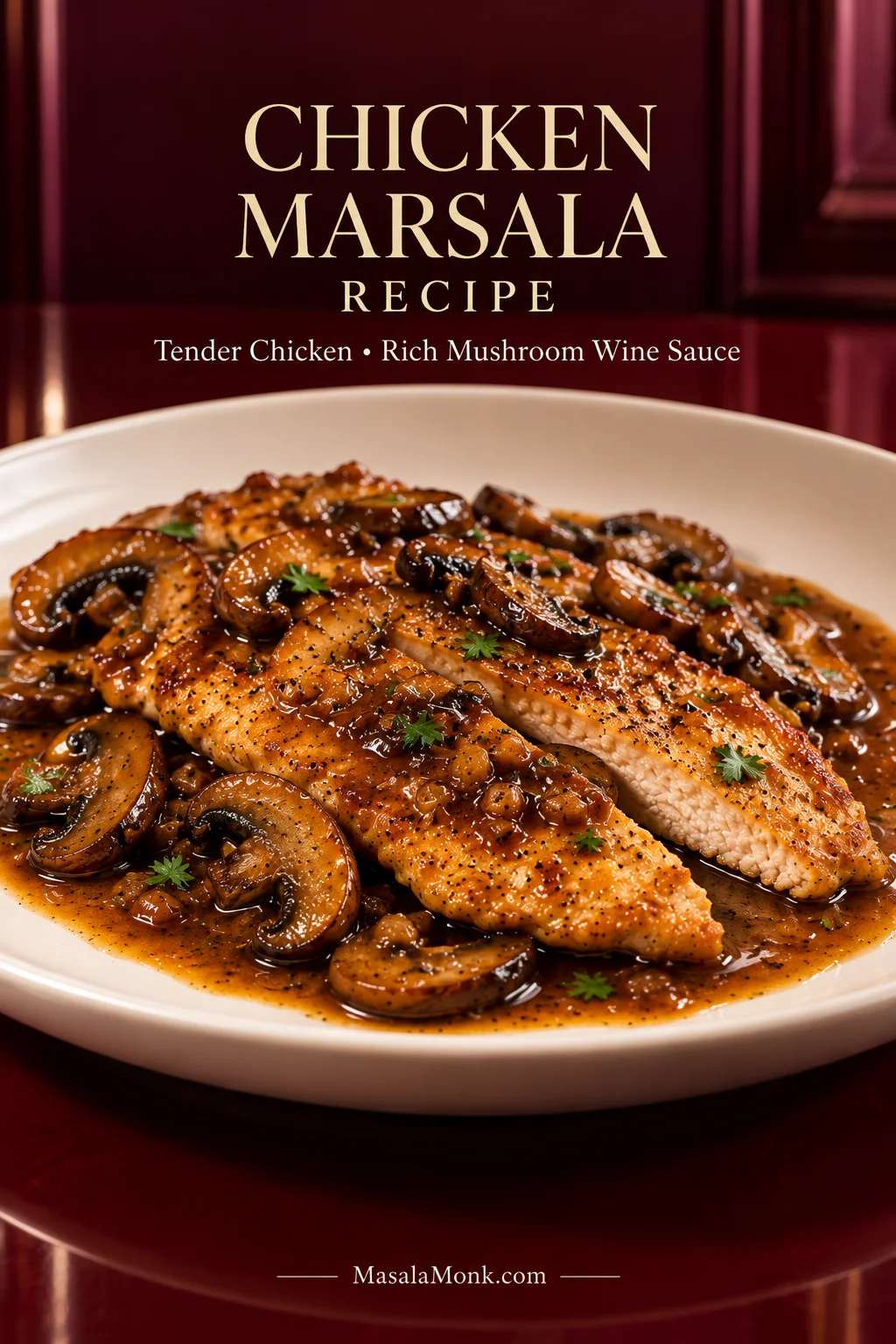
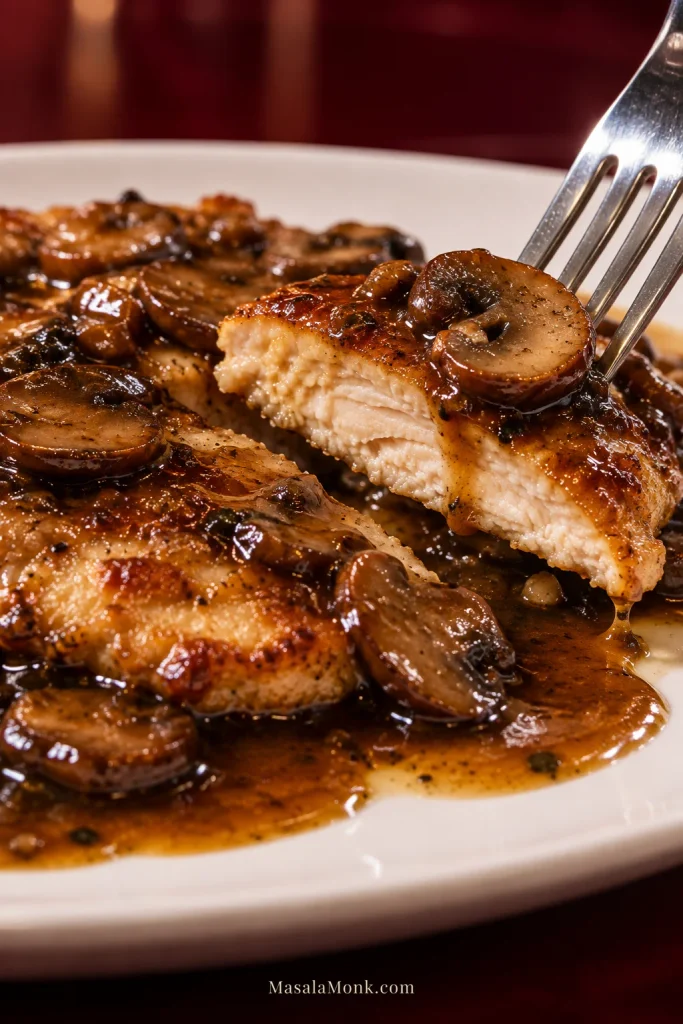
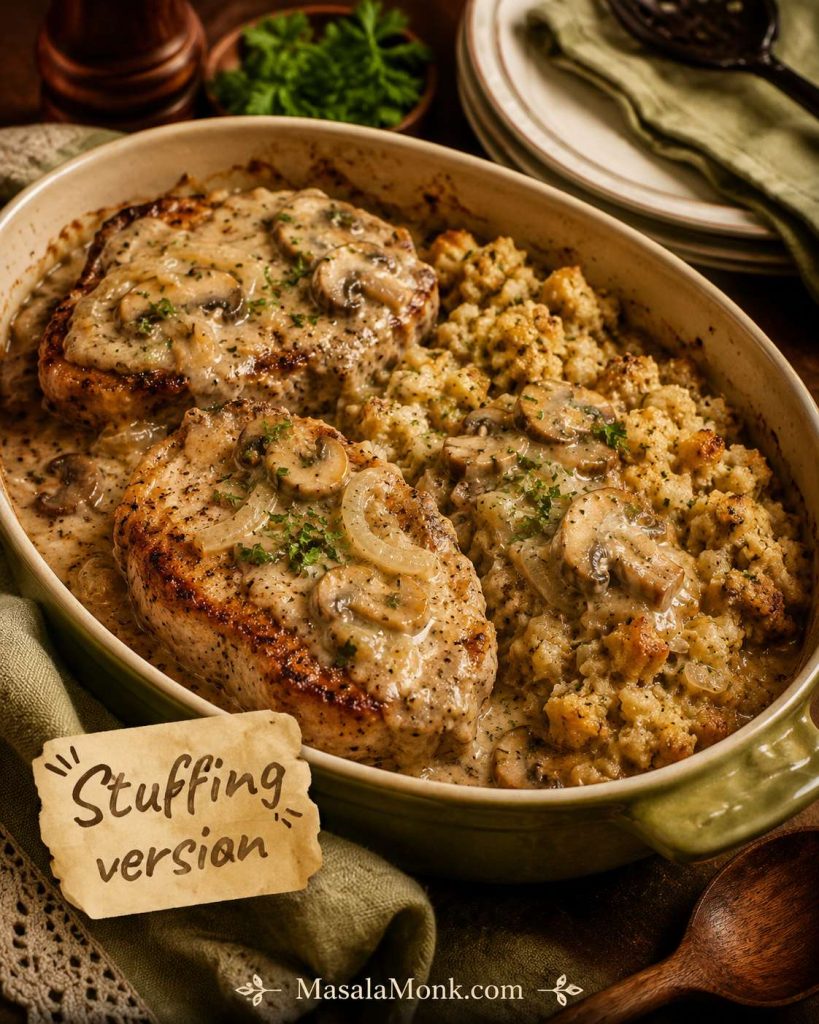
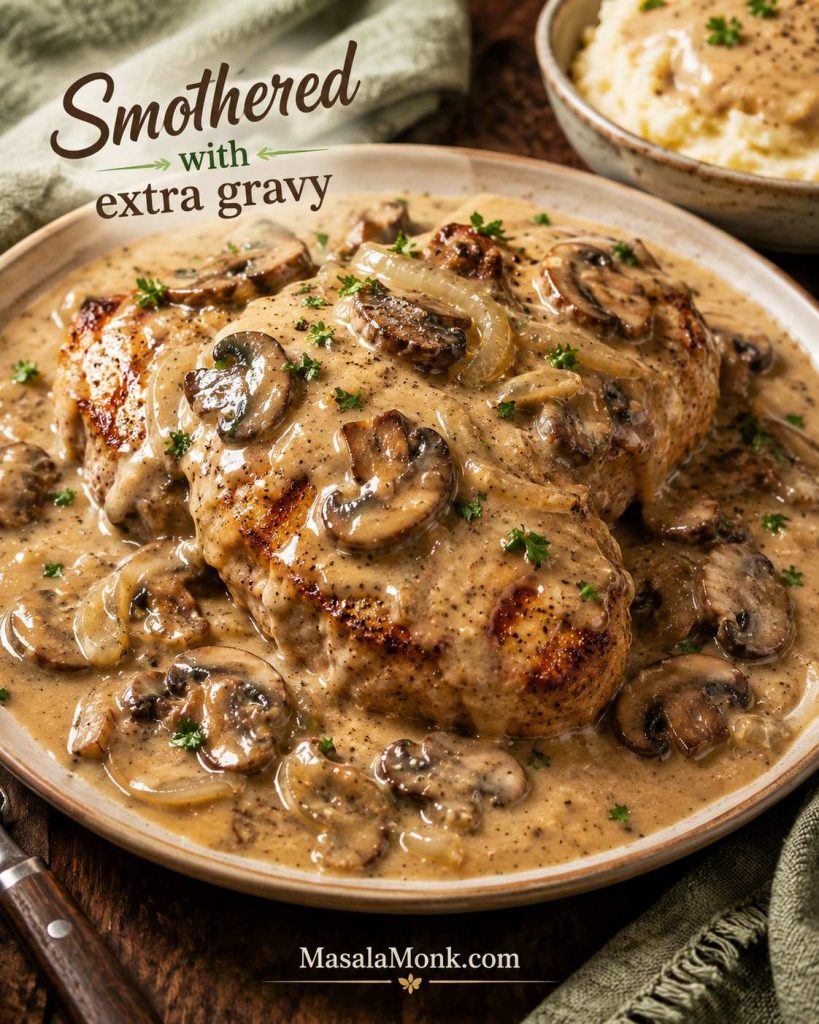
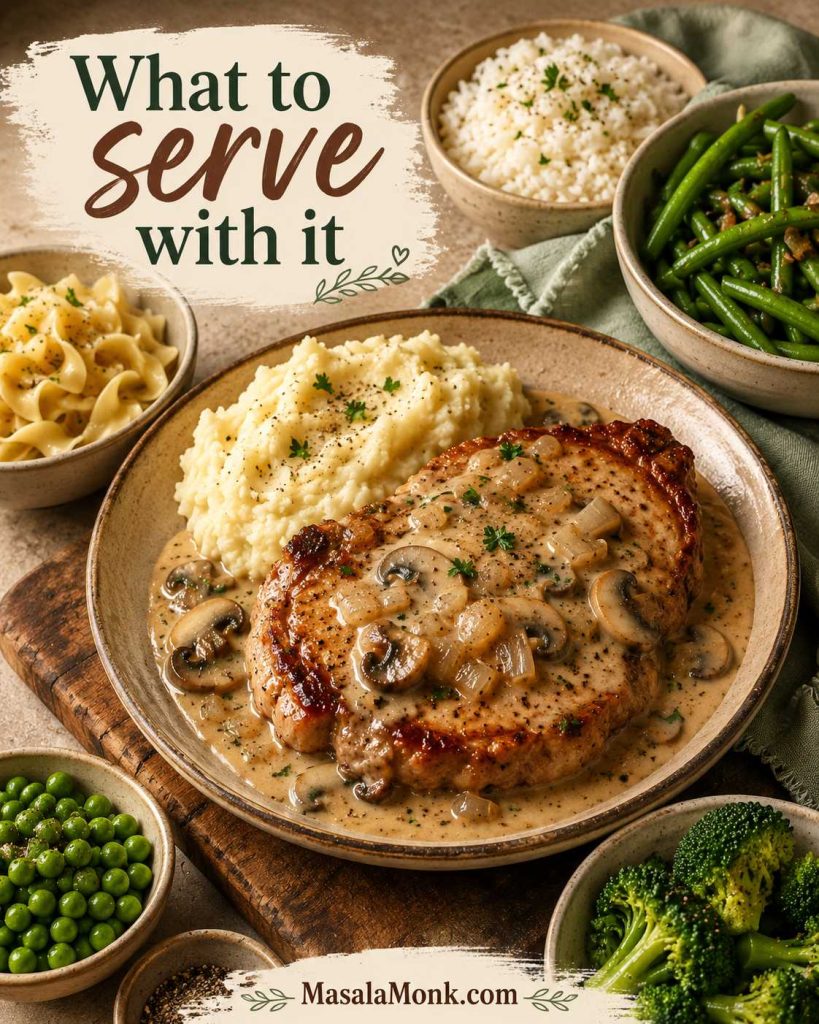
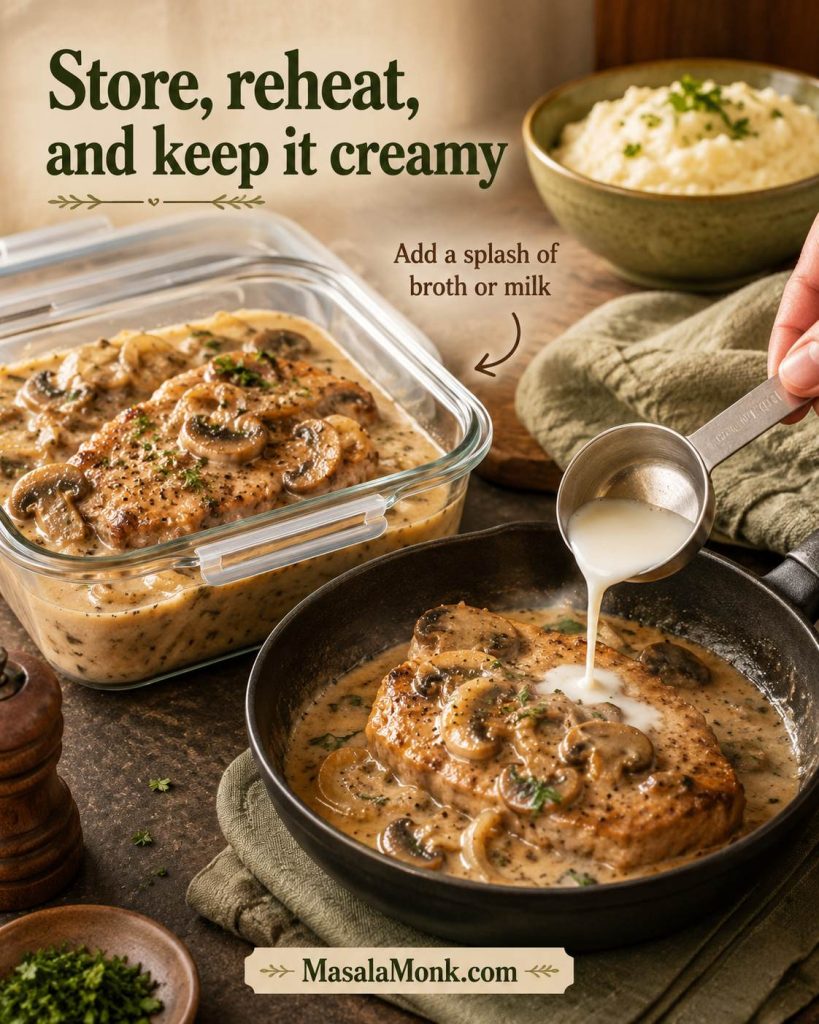
The best part of Chicken Marsala is what happens when you cut into the first piece: the chicken is still juicy, mushrooms come with it, and the dark Marsala sauce runs straight into whatever is waiting beside it.
This Chicken Marsala recipe is an Italian-American skillet dish built around thin chicken cutlets, mushrooms, and Sicily’s fortified Marsala wine. It comes together in one skillet in about 45–50 minutes, but each stage gets the time it needs. The mushrooms have to cook off their water, the wine needs time to reduce, and thin chicken can dry out long before the sauce is ready.
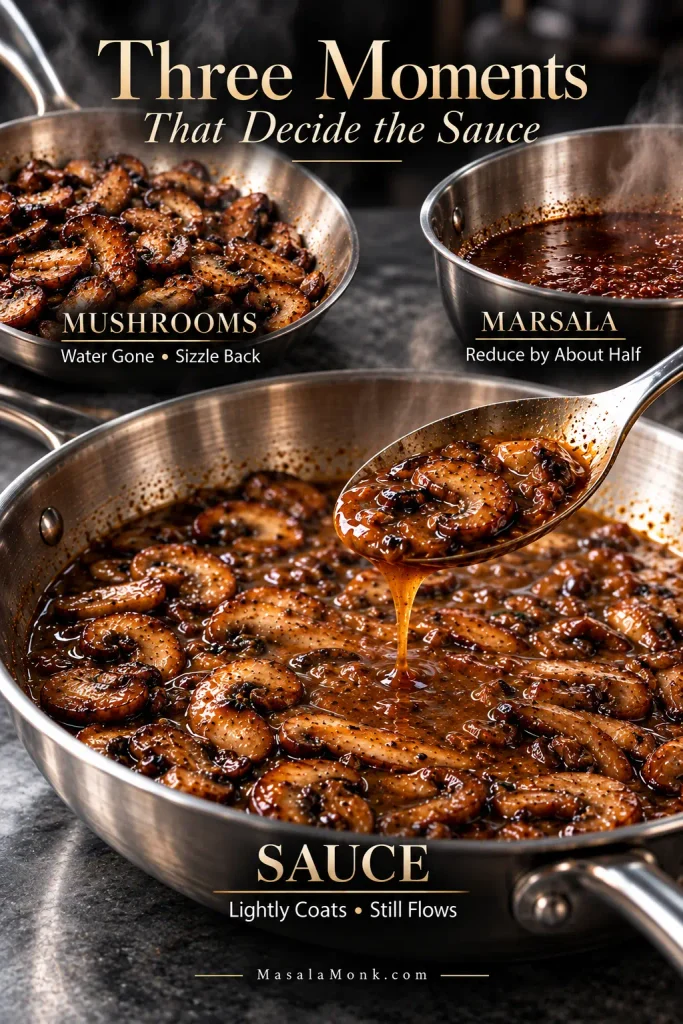
This method keeps those jobs separate. Brown first. Reduce second. Return the chicken last. The mushrooms develop real color, the Marsala loses its raw edge, and the chicken only comes back when the sauce is nearly ready.
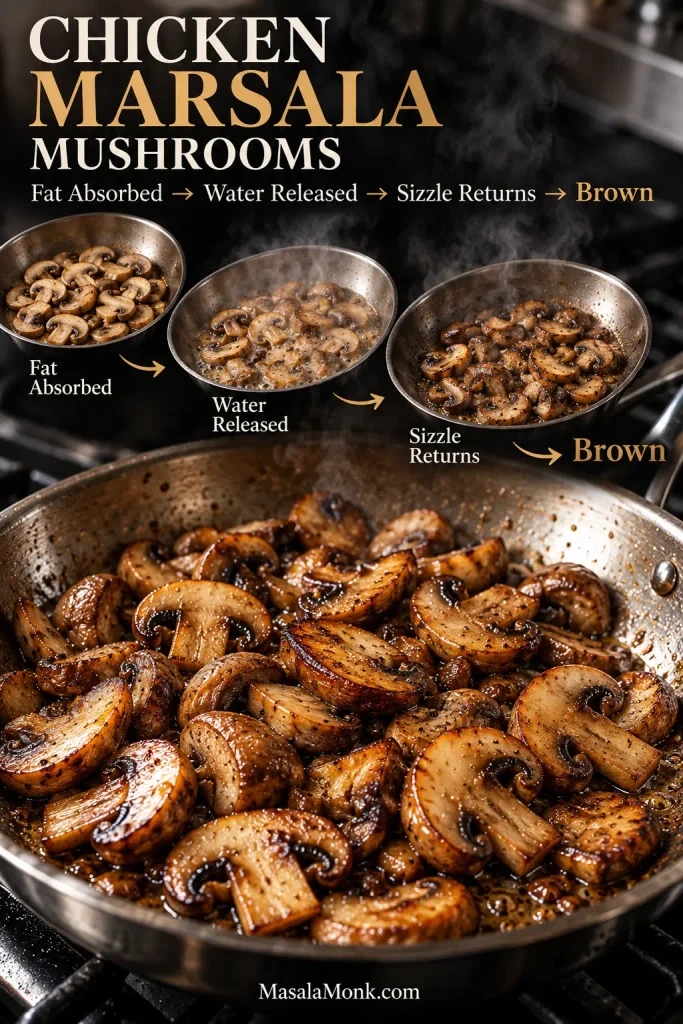
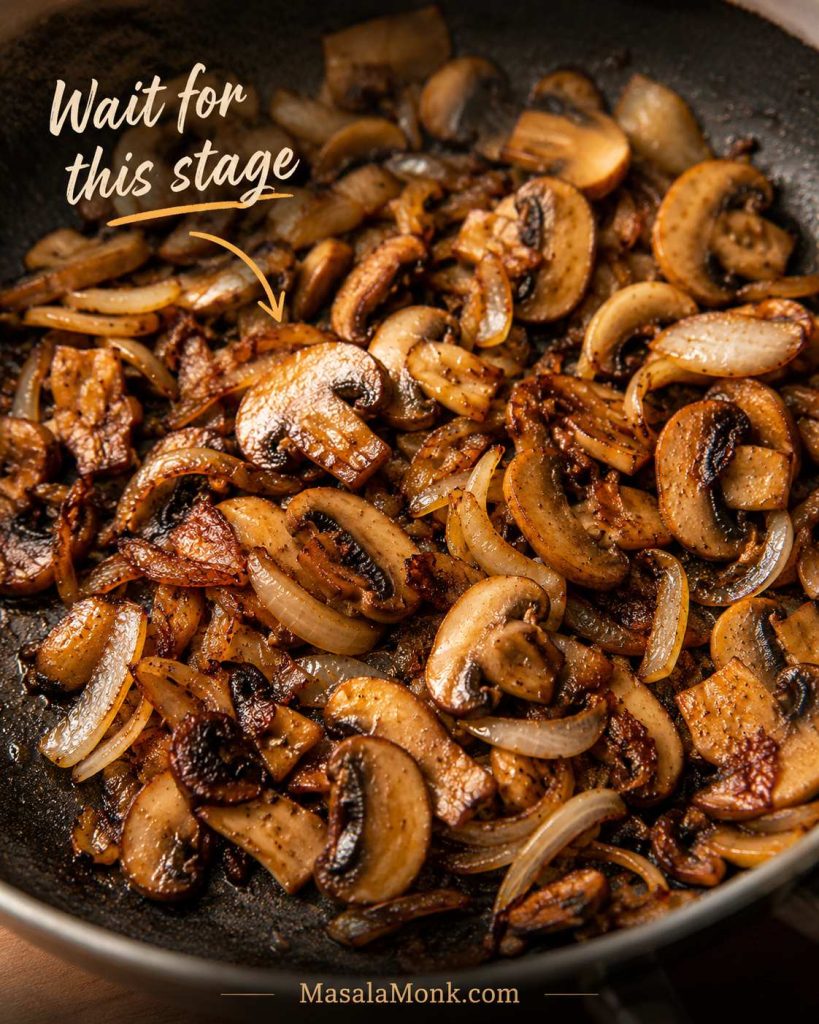
Wait until their released water is gone, the skillet sounds like it is frying again, and the edges are taking on real brown color.
Marsala
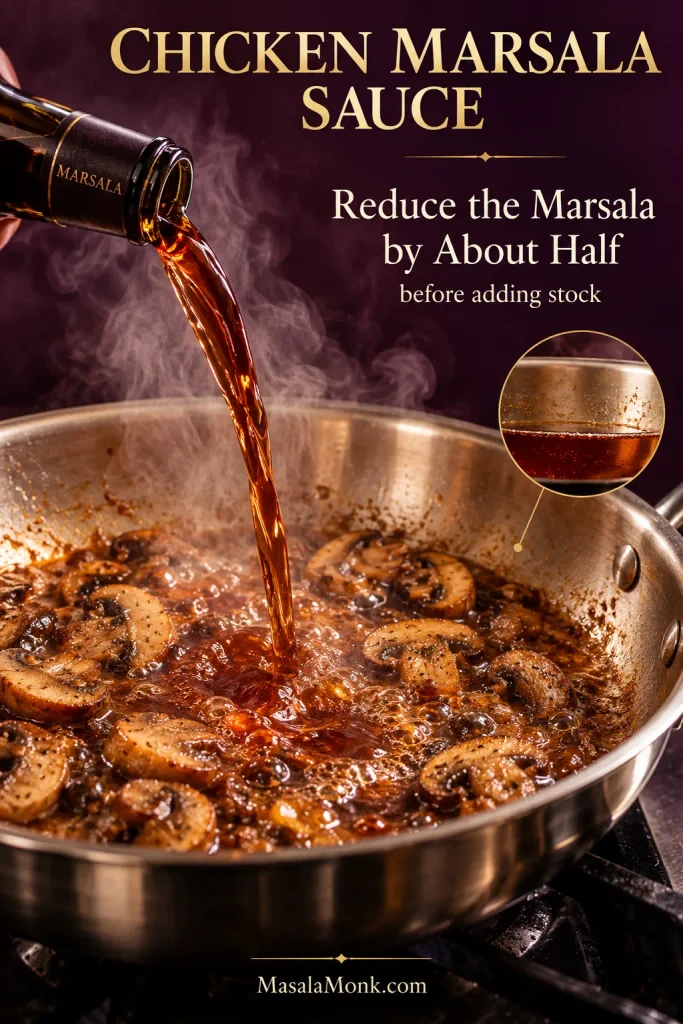
Roughly half the wine should remain, with the sharp alcohol smell replaced by something rounder, nuttier, and more inviting.
Sauce
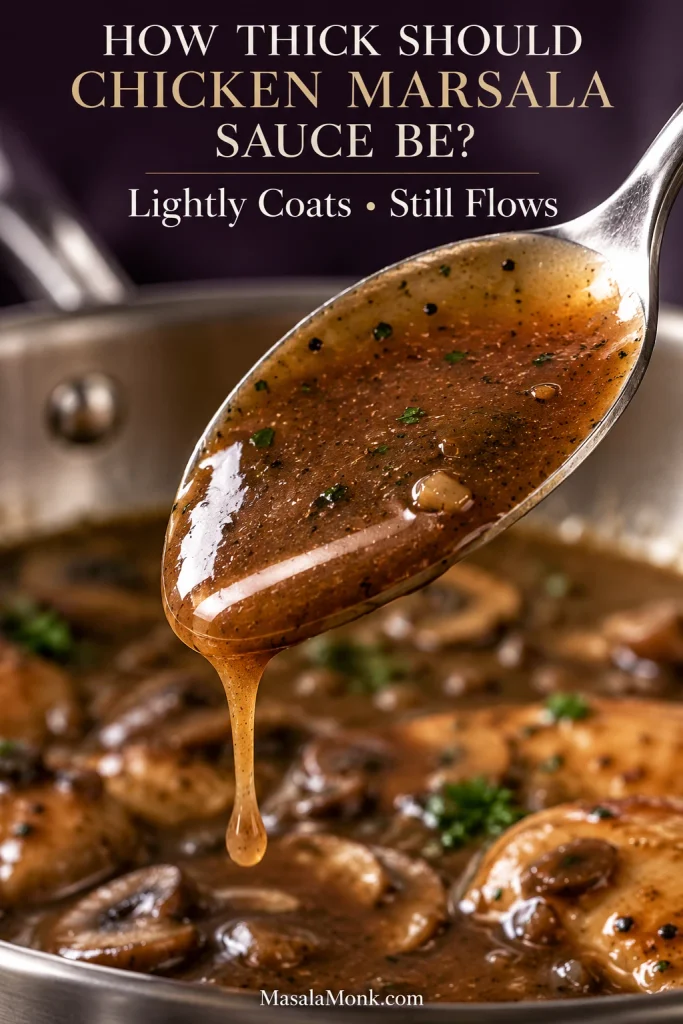
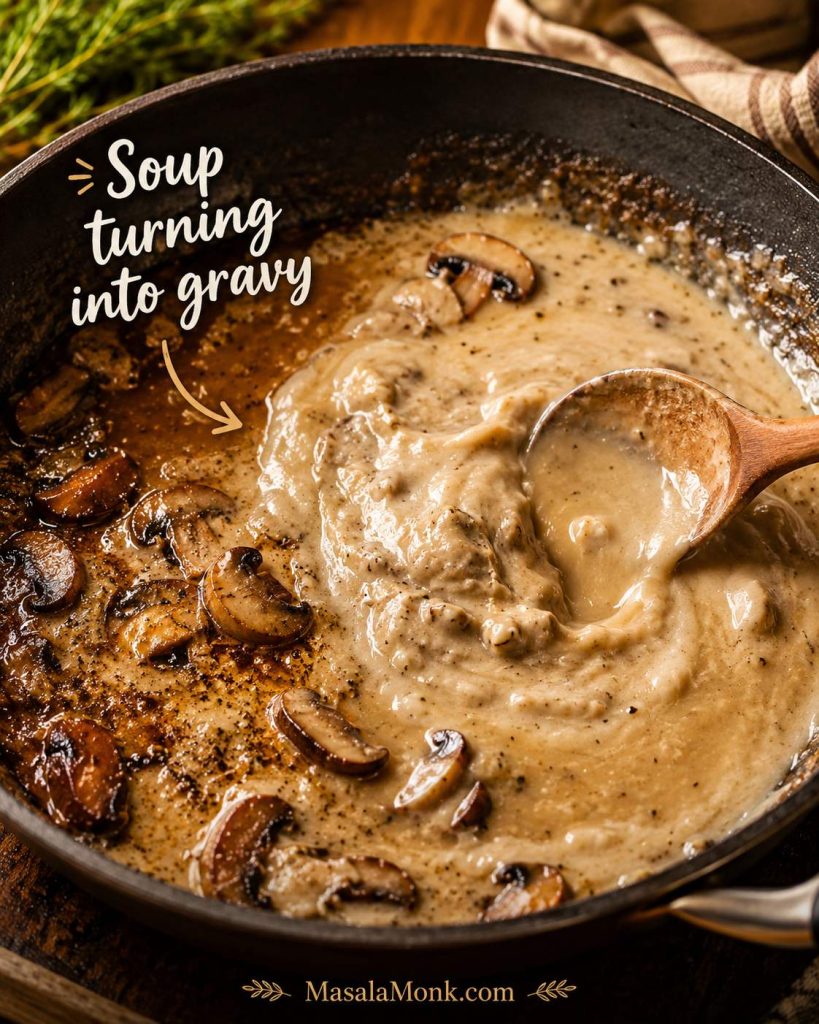
Stop reducing when it lightly coats a spoon but still moves easily around the skillet.
Keep the browned chicken out of the skillet while all three stages happen. If the sauce needs another few minutes, the chicken does not.
These three checkpoints are really about sequencing. Letting each stage finish before the next begins prevents one ingredient from waiting in the pan while another catches up—the same principle that keeps the chicken tender and the sauce concentrated.
Chicken Marsala Recipe
Thin golden chicken cutlets and deeply browned mushrooms in a dark Marsala pan sauce, finished with cold butter until glossy and silky.
1½ lb / 680 g boneless, skinless chicken breasts, prepared as 4 similarly sized cutlets
4 g kosher salt, about 1½ tsp Diamond Crystal or a scant 1 tsp Morton, divided, plus more to taste
½ tsp / about 1 g freshly ground black pepper
⅓ cup / 40 g all-purpose flour, for dredging; some will remain unused
2–3 tbsp / 30–45 ml olive oil, as needed for browning
For the Mushroom Marsala Sauce
4 tbsp / 56 g unsalted butter, divided; keep the final 2 tbsp cold
10 oz / 285 g cremini or baby bella mushrooms, sliced about ¼ inch / 6 mm thick
1 medium shallot / about 40–50 g, finely chopped
2 garlic cloves / about 6 g, finely minced
1 cup / 240 ml real dry (secco) Marsala wine
⅔ cup / 160 ml low-sodium chicken stock
1–2 tsp / 5–10 ml fresh lemon juice, only if needed
2 tbsp / about 8 g chopped flat-leaf parsley
Slice the mushrooms, chop the shallot, mince the garlic, measure the wine and stock, and keep the finishing butter cold before you start cooking. Once the Marsala goes into the skillet, the sauce moves quickly.
Prepare the chicken as 4 similarly sized cutlets. Two very large breasts can each be sliced horizontally through the middle. With smaller breasts, split only the thicker pieces as needed.
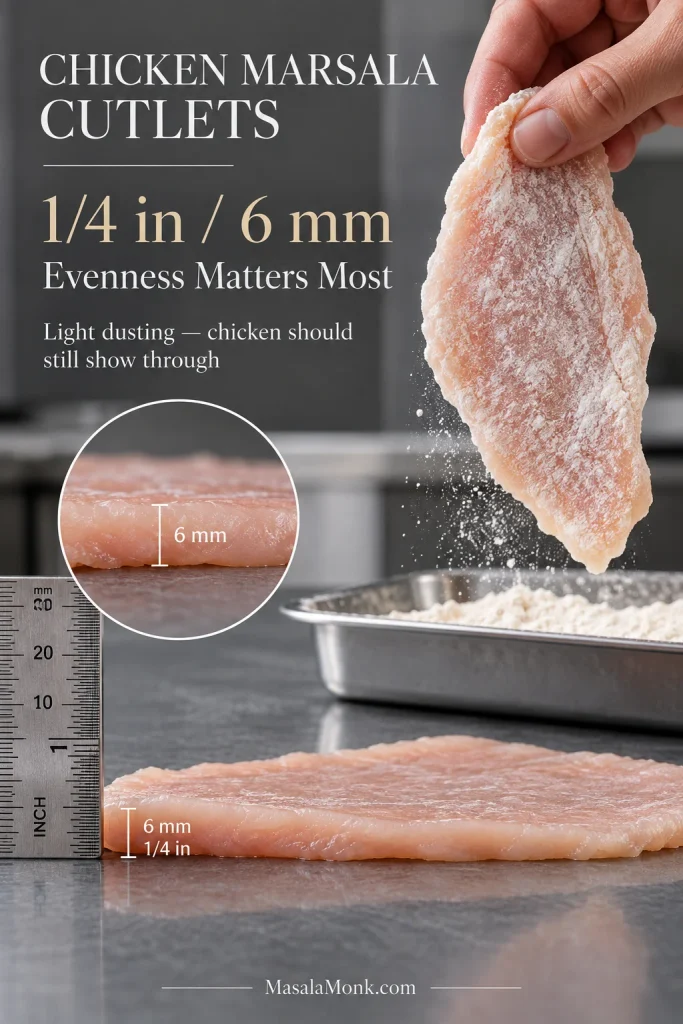
Pound the cutlets between parchment, plastic wrap, or inside a large food-safe bag until the thickest parts are about ¼ inch / 6 mm. Anything up to roughly ⅓ inch / 8 mm will work; evenness matters more than an exact measurement.
Pat the chicken dry. Season both sides with about three-quarters of the measured salt (roughly 3 g) and all of the black pepper. Reserve the remaining salt for the sauce.
Spread the flour in a shallow dish. Dredge each cutlet lightly, then shake off the excess until the chicken is still visible beneath the coating. This is a dusting, not breading.
Even thickness helps all four cutlets reach doneness at nearly the same time. Meanwhile, a barely visible flour coating creates useful browning and fond without carrying enough starch into the Chicken Marsala sauce to make it pasty.
Brown the cutlets without crowding the pan
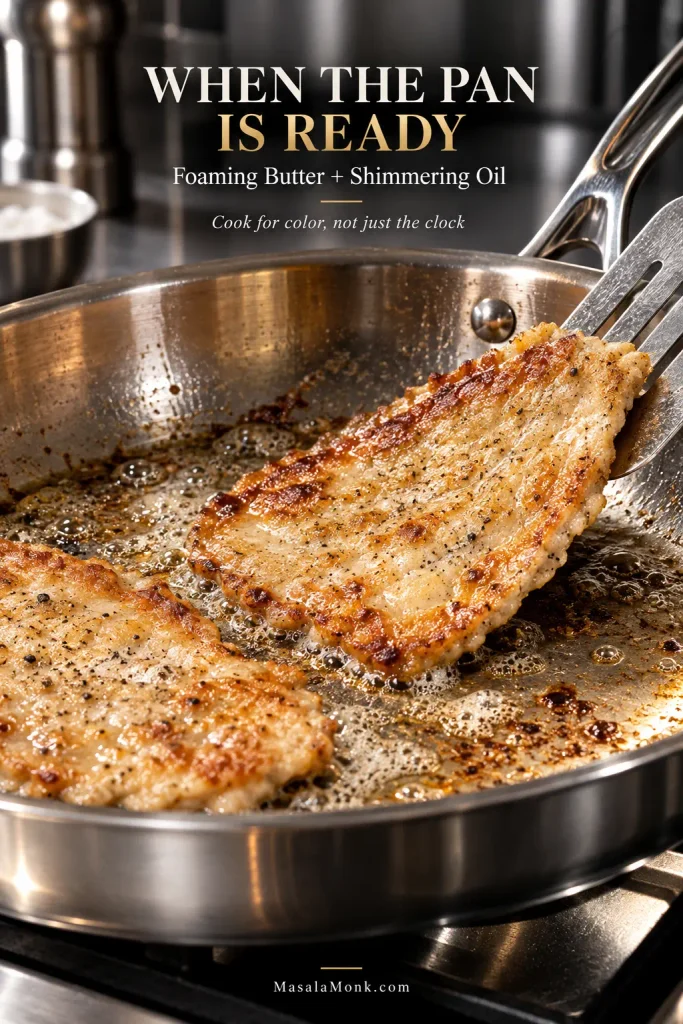
Heat 2 tbsp / 30 ml olive oil with 1 tbsp / 14 g butter in the skillet over medium-high heat. When the butter is foaming and the oil is shimmering, add the first batch. Brown the chicken in 2 batches unless all four pieces fit comfortably without overlapping or crowding. Use the remaining tablespoon of oil only if the second batch needs it.
Cook until the first side develops deep golden patches, roughly 2½–3½ minutes. Turn and brown the second side for around 1½–2½ minutes. Thin cutlets and powerful burners can move faster, so watch the chicken rather than waiting for a timer.
Move any cutlet that has already reached 165°F / 74°C to a clean warm serving plate and loosely cover it. Put pieces that still need cooking on a separate holding plate; they will finish briefly in the sauce later.
Before adding the mushrooms, look at the skillet. Keep the deep brown fond on the pan, but carefully wipe away any loose flour that has actually burned black.
Once the chicken hits properly heated fat, give the first side time to brown deeply. If a cutlet is still gripping the stainless steel, a few more seconds often help it release cleanly instead of tearing.
2. Brown the mushrooms after their water cooks away
Reduce the heat to medium and add 1 tbsp / 14 g butter followed by the mushrooms.
They may soak up the fat and leave the skillet looking dry at first. Nothing has gone wrong. Soon they will soften and release their own moisture.
Keep cooking, stirring occasionally, until that liquid evaporates and the sound changes from simmering back to sizzling. The mushrooms should smell more roasted than simply cooked, with properly golden edges, usually after 6–8 minutes total.
Add the shallot and cook for 1–2 minutes, until softened. Stir in the garlic for about 30 seconds. As soon as it smells fragrant, move on; browned garlic would bring bitterness to the sauce.
Persistent puddles usually mean the mushrooms need either more evaporation time or more room in the skillet. Because browning cannot really begin while excess water remains, crowded mushrooms are better cooked in batches than left steaming together.
3. Reduce the Marsala before adding stock
Pour in the 1 cup / 240 ml dry Marsala and scrape up the fond as the wine begins to bubble.
Reduce the Marsala by roughly half before adding the stock. This usually takes 3–5 minutes. The sharp alcohol smell should fade as the wine becomes rounder, nuttier, and noticeably sweeter-smelling.
Use aroma and volume together when judging a Marsala wine reduction. Color alone can be misleading: the liquid may look dark before it is concentrated enough, whereas the fading raw-wine aroma tells you the reduction is actually progressing.
Add the ⅔ cup / 160 ml low-sodium chicken stock. Bring the sauce back to a lively simmer and cook until it leaves a thin coating on the back of a spoon but still runs easily when the spoon is tilted, usually another 3–5 minutes.
If some chicken still needs finishing, stop while the sauce is a touch looser; it will reduce a little more with the cutlets in the pan.
Tip the skillet slightly. You still want enough sauce gathering around the mushrooms to spoon generously over all four cutlets.
Stop the Chicken Marsala sauce slightly looser than the final texture you want. The cold-butter finish adds a little body, and the sauce tightens again as it leaves the hot skillet, so over-reducing now can leave the plate short on sauce.
4. Finish the chicken, then swirl in the cold butter
Pour any juices from the holding plate into the sauce. Return only the cutlets that still need cooking and turn them through the simmering sauce until the thickest part reaches 165°F / 74°C.
Move those finished cutlets to the clean warm serving plate with the chicken that was already done, then remove the skillet from the heat.
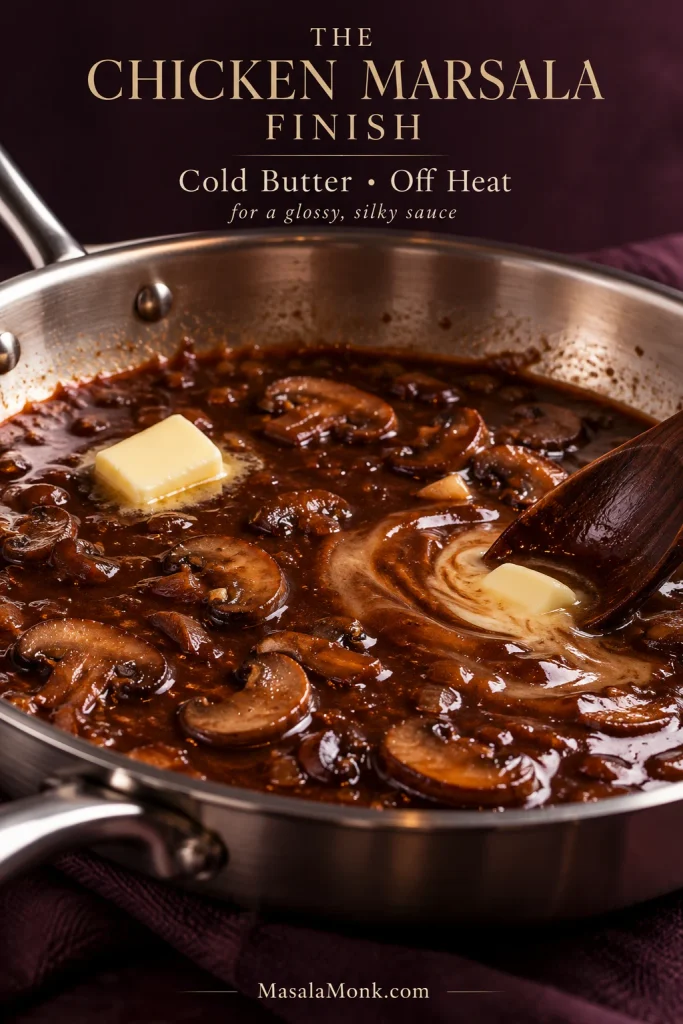
Add the remaining 2 tbsp / 28 g cold butter a few pieces at a time, swirling or stirring until the sauce looks smooth, dark, and glossy enough to cling lightly to the mushrooms.
Cold butter emulsifies most smoothly once the skillet is off the heat. Add it gradually; greasy droplets on the surface often mean the pan is still too hot for the finish.
Taste before adding the remaining salt. A sauce that feels slightly too sweet or heavy may need ½ tsp / 2.5 ml lemon juice. Add it gradually. The lemon should brighten the sauce without becoming a flavor of its own.
Spoon the finished mushroom Marsala sauce over all four cutlets, scatter with parsley, and serve immediately.
When it’s right: Chicken Marsala should taste savory, mushroomy, and clearly wine-forward, with gentle sweetness but no sharp raw-alcohol bite. The sauce should cling lightly to the chicken, then run onto the plate when you cut into a piece.
Sauce can make dry chicken easier to eat, but it cannot make it juicy again. With thin Chicken Marsala cutlets, tenderness comes from stopping the cooking promptly and letting the sauce finish on its own.
For Chicken Marsala, buy a real dry (secco) Marsala. You do not need an expensive bottle; drinking Marsala gives you better control over both wine flavor and salt than bottled cooking wine, which is often salted.
Marsala labels contain several different pieces of information. Fine and Superiore mainly describe aging/style categories, while Oro and Ambra describe color. Secco, semisecco and dolce describe sweetness. For this recipe, the word that matters most is secco: dry. The official Marsala DOC specifications lay out those classifications in detail.
For this skillet, sweetness matters more than color or aging terms: look for secco, the label for dry Marsala.
Dry or sweet Marsala?
Dry Marsala gives the easiest savory balance because reduction concentrates the wine’s nutty, dried-fruit, and caramelized flavors. By the time it has reduced properly, the skillet should smell less like freshly poured wine and more like the dish you are about to eat.
Sweet Marsala works too. Expect a rounder, noticeably sweeter sauce. Keep the stock low-sodium and decide on lemon only after the sauce has reduced.
What about Marsala cooking wine?
Salt becomes more concentrated during reduction, which is why bottled cooking wine can make the finished sauce unexpectedly salty. Real Marsala simply gives you more control.
Look near sherry, port, Madeira, and other fortified wines rather than beside vinegars and bottled cooking sauces.
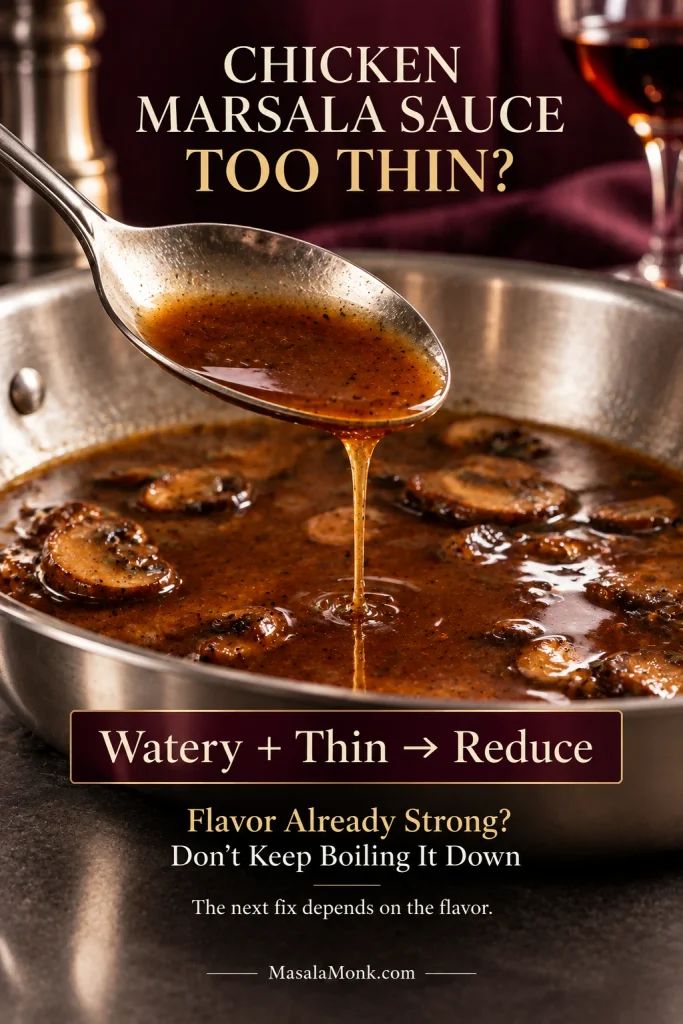
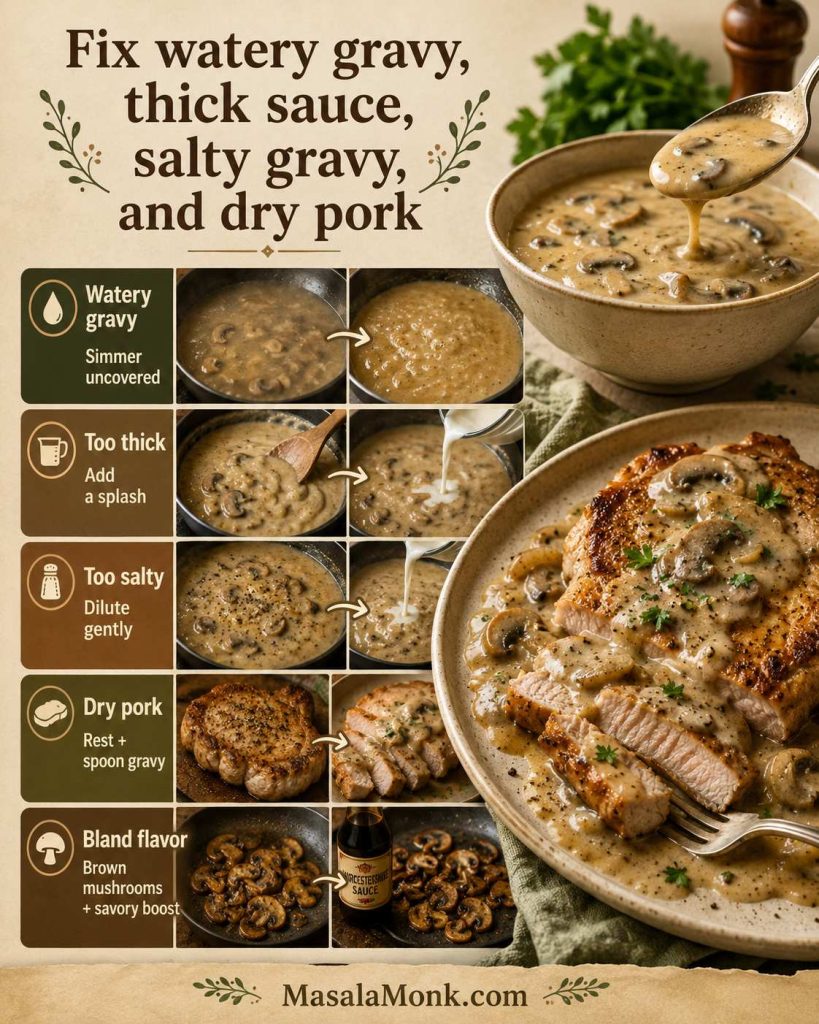
If your Chicken Marsala sauce is thin and watery, simmer it uncovered until the flavor concentrates. If it already tastes strong but is still too thin, use a very small cornstarch slurry instead of reducing away the rest of the sauce.
Use the flavor as your second clue. Watery flavor and watery texture usually mean the liquid simply needs more time to concentrate.
Once the Marsala flavor is already strong—perhaps salty enough or a little sweet—boiling away more liquid can leave you with very little sauce and too much intensity. A tiny starch adjustment makes more sense there.
The texture can also be right while the sauce still looks flat. Cold butter stirred in away from high heat gives it more richness and shine.
Taste before you thicken: reduction, starch, and butter solve different problems.
Taste before reducing further: watery flavor needs evaporation, while already-concentrated flavor may need a tiny starch adjustment instead.
Want mushrooms and cream to lead instead? The creamy mushroom sauce recipe begins with the same useful step: getting real color on the mushrooms.
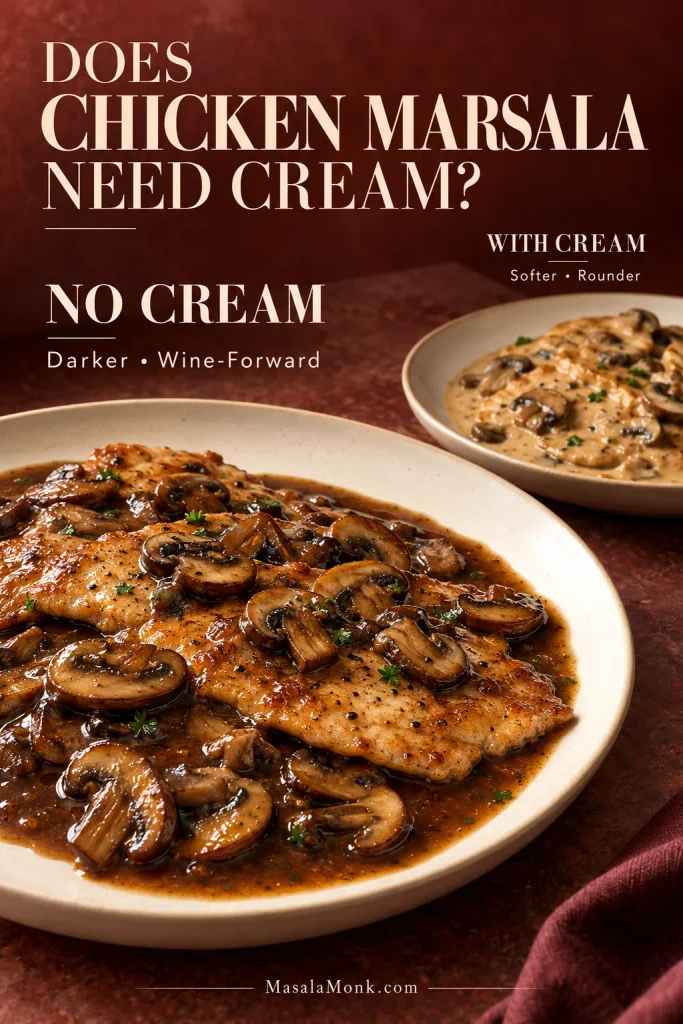
Does Chicken Marsala Need Cream?
No. The recipe above gets enough body from reduced Marsala and stock, a little flour carried over from the chicken, and the butter stirred in at the end. Without cream, the wine and browned mushrooms stay darker and more distinct.
If thin sauce is the reason you are considering cream, read the sauce first; cream changes the style of the dish rather than fixing the underlying reduction.
Prefer a softer, rounder sauce? Simmer the stock with the reduced Marsala for about 2 minutes, then stir in ⅓ cup / 80 ml heavy cream. Increase that to ½ cup / 120 ml for a richer sauce. Let it simmer until close to the consistency you want, leaving it slightly loose when any chicken still needs finishing.
Return the cutlets that need more cooking and bring them to 165°F / 74°C, then transfer the chicken out of the skillet. Take the pan off the heat and finish the creamy sauce with 1 tbsp / 14 g of the reserved cold butter; the cream supplies enough richness that you do not need the full 2 tbsp finishing amount.
Heavy cream stays smoother under gentle heat than half-and-half. Half-and-half makes a thinner sauce and is more prone to splitting; milk is even more likely to split. Add any lemon after the skillet is off the heat, a few drops at a time.
Cream changes the style of Chicken Marsala; it cannot replace the flavor developed by properly browning and reducing the sauce first.
Want More Marsala Sauce?
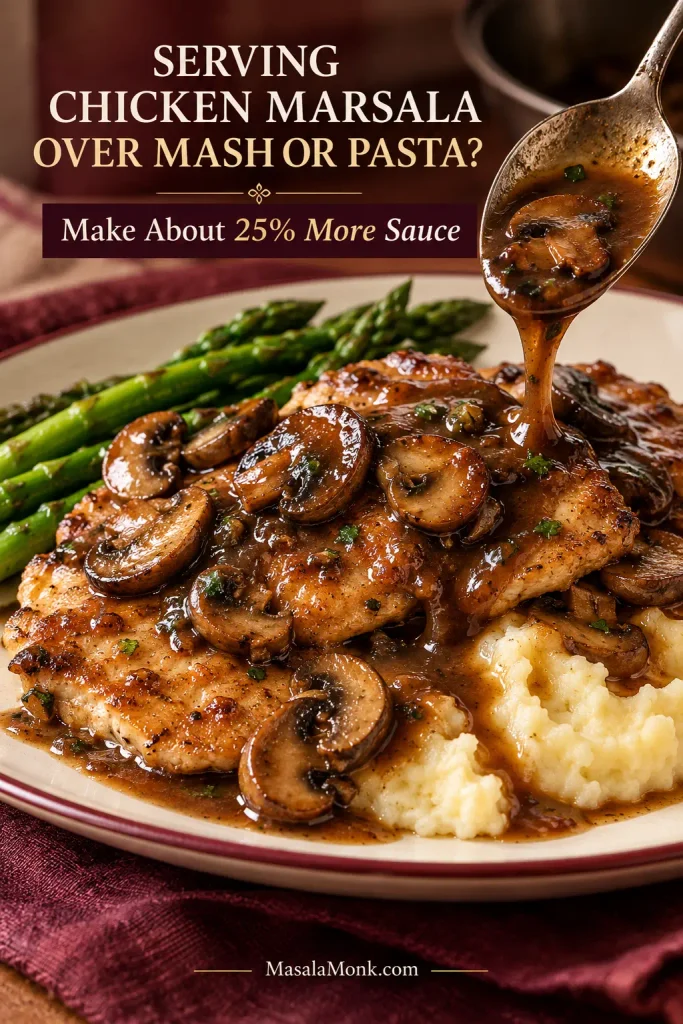
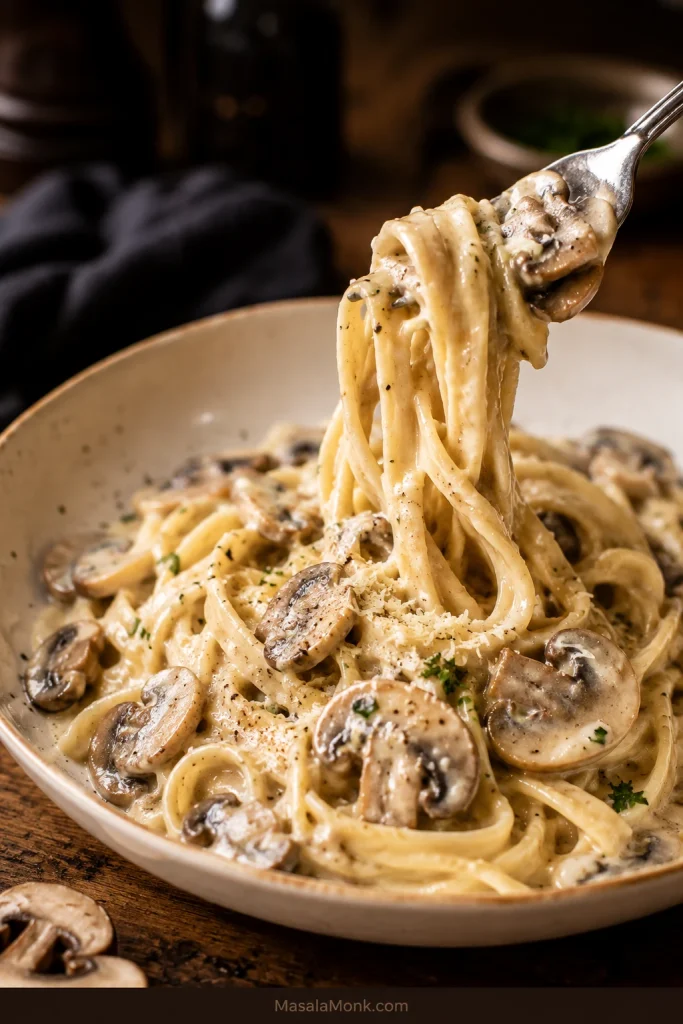
Serving the chicken over creamy mashed potatoes, pasta, noodles, or polenta usually calls for a little more sauce than serving the cutlets alone.
Increase the Marsala to about 1¼ cups / 300 ml and the stock to about ¾ cup + 1 tbsp / 200 ml. That is roughly one quarter more of each. The larger volume will take longer to reduce, so get the sauce base where you want it before finishing the chicken and swirling in the butter.
Potatoes and pasta will absorb plenty on the plate, so stop with the sauce slightly looser than you would for chicken served on its own.
For Chicken Marsala with mashed potatoes, let the sauce do two jobs: lightly coat the chicken and then run into the mash underneath. Spoon it on just before serving so the browned surface stays visible instead of becoming completely saturated.
What to Serve with Chicken Marsala
The best Chicken Marsala sides either catch the sauce or bring something fresh to the plate.
For catching the sauce
Mashed potatoes — a classic choice and one of the best ways to catch the sauce.
Buttered pasta — especially good with a slightly looser batch of sauce.
Polenta — mild, soft, and excellent when you want the Marsala sauce to stay prominent.
Egg noodles — soft and mild enough to catch mushrooms and sauce without competing with them.
Crusty bread — ideal for swiping up the sauce while keeping the chicken at the center of the meal.
For something fresh or green
Green beans almondine — crisp-tender beans, toasted almonds, and lemon add welcome crunch.
Asparagus — roasted or quickly sautéed.
Broccoli or broccolini — simply seasoned so the sauce stays in charge.
Arugula or another sharp green salad — especially good beside the creamy sauce.
A classic plate is mashed potatoes with green beans or asparagus. The potatoes catch every spoonful; the green side keeps the next bite feeling fresh.
What wine should you drink with it?
You do not need Marsala in the glass. A fresh, light-bodied red such as Pinot Noir, Gamay, or Frappato works well with the darker sauce. A dry white with enough acidity can cut through the butter while staying light beside the mushrooms.
Fix My Chicken Marsala Sauce
Taste the sauce before changing it. A sauce that’s thin and watery needs a different fix from one that’s thin but already concentrated.
Sauce concentration and flavor problems
Problem
Likely cause + best rescue
Watery and weak
There is still too much unconcentrated liquid. Simmer uncovered until both flavor and texture strengthen.
Flavorful but still too thin
More reduction may make the sauce too salty or sweet. Mix ½ tsp / about 1.5 g cornstarch with 1 tsp / 5 ml cold water; whisk in gradually and simmer briefly, stopping as soon as the sauce lightly coats a spoon.
Hardly any sauce remains
It has reduced too far. Add low-sodium stock 1 tbsp / 15 ml at a time. If the Marsala flavor has genuinely faded, add only a small splash of wine and simmer long enough for the raw edge to disappear.
Sharp or boozy
The Marsala needs more reduction. Let the sauce simmer until the raw-wine aroma softens.
Barely tastes of Marsala
Too much stock or cream may be diluting the wine. Reduce gently while the sauce is loose; next time concentrate the Marsala before adding other liquids.
Too sweet
Check the salt first. If the sauce still tastes heavy, add lemon juice ½ tsp / 2.5 ml at a time.
Too salty
Loosen with unsalted stock or water 1 tbsp / 15 ml at a time. Avoid reducing it hard again; if the flavor is balanced but the sauce becomes too thin, use the small cornstarch rescue above instead.
Texture, mushroom and chicken problems
Problem
Likely cause + best rescue
Greasy or separated
Pull the skillet off the heat and whisk or swirl vigorously. If it still looks separated, whisk in 1 tsp / 5 ml warm water or stock at a time until the sauce comes back together.
Mushrooms are pale and wet
Before adding the shallot or wine, keep cooking until the released moisture is gone and the skillet starts sizzling again. Use batches next time if the pan is crowded.
Chicken is dry
It cooked too long before or after the sauce was ready. Spoon generously with sauce now; next time stop cooking as soon as the cutlet reaches temperature. For more on thickness, temperature, and dryness, see the baked chicken breast guide.
Flour coating is gummy
The dredge was too heavy or the chicken spent too long in the sauce. Use a lighter dusting and keep the final return brief.
Creamy sauce split
Pull the skillet completely off the heat and whisk in a small splash of heavy cream or 1 tsp / 5 ml warm water at a time until it comes back together. Next time, keep the creamy sauce below a hard boil.
Once the sauce tastes balanced and moves easily around the pan, stop fixing it.
Boneless, skinless thighs work well and tolerate a little more cooking than thin breast cutlets. Trim visible fat and allow more time to cook through. They are safe at 165°F / 74°C, though thigh meat generally becomes more tender around 175°F / 79°C.
Their extra richness works especially well with the no-cream sauce.
Different mushrooms
Cremini are the easiest default because they brown well and bring more savoriness than plain white mushrooms without much extra cost. White buttons still work. For more depth, replace 2–3 oz / 55–85 g with shiitake or another flavorful fresh mushroom.
When mushrooms deserve to be the main event, Mushroom Stroganoff takes them into a creamy savory sauce for noodles, rice, mash, or polenta.
Without mushrooms
You can leave them out, but their browned flavor normally becomes part of the sauce. Build good color on the chicken, keep the shallot, and use a flavorful low-sodium stock.
What can replace Marsala?
No substitute tastes exactly the same. Dry Madeira is the closest useful alternative; dry sherry also makes an excellent mushroom wine sauce with its own character.
Does the Alcohol Cook Out of Chicken Marsala?
A short simmer should not be treated as a guarantee that all alcohol has disappeared. Strict alcohol avoidance calls for a stock-based mushroom pan sauce instead of relying on cooking time to remove the Marsala.
It will taste different, but it can still be a very good chicken-and-mushroom dinner. If you’d rather skip Marsala entirely and still want a creamy mushroom sauce, Cream of Mushroom Chicken is the better direction.
Pancetta or prosciutto
Crisp about 2 oz / 55 g finely diced pancetta or prosciutto before browning the chicken. Leave a little rendered fat in the skillet, then return the crisp pieces near the end. Season cautiously; the salt contributed by the cured meat becomes much more noticeable as the sauce reduces.
If lemon, butter, and capers are what you want, Chicken Piccata is the better fit. It uses the same idea of thin golden chicken but takes the pan sauce in a much brighter direction.
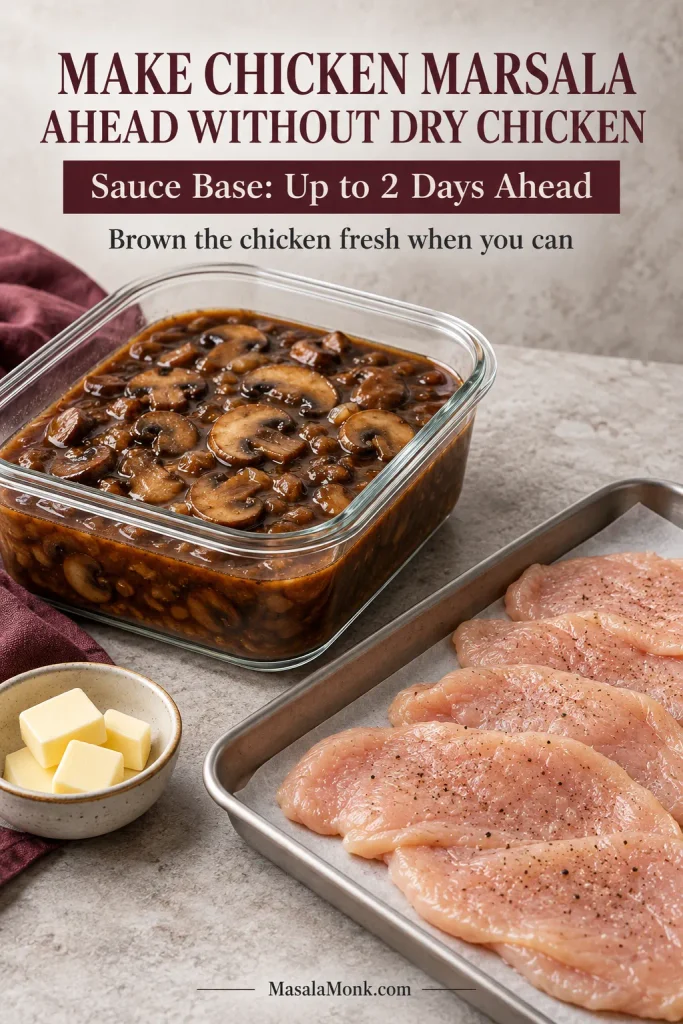
Make-Ahead Chicken Marsala Without Dry Chicken
If you only want to get the prep out of the way, slice the mushrooms and cut/pound the chicken into cutlets up to 1 day in advance. Refrigerate them separately until cooking.
To get further ahead, make the mushroom-Marsala sauce base through the stock-reduction stage and leave out the finishing butter. Cool it, cover it, and refrigerate for up to 2 days.
The chicken is best browned fresh while the sauce reheats. When that is not practical, cook the chicken fully to 165°F / 74°C before chilling it; do not partially cook poultry for later finishing.
At serving time, warm the sauce base gently, then add the chilled cooked chicken and reheat it to 165°F / 74°C without prolonged simmering. Transfer the chicken out, take the skillet off the heat, and swirl in the finishing butter. Taste for salt and lemon after the sauce is back together.
For the best make-ahead result, prepare the Marsala sauce base ahead, then brown the chicken and finish with cold butter closer to serving.
Cooking for more people? Double the ingredients, then brown the chicken and mushrooms in batches. More food in the same skillet means more steam and less browning, and the larger volume of wine and stock will need more reduction time.
How to Store, Reheat and Freeze Chicken Marsala
Refrigerate leftovers within 2 hours and keep them covered for up to 3–4 days. Reheat gently in a covered skillet, adding low-sodium stock a spoonful at a time if the sauce has tightened. Bring the chicken back to 165°F / 74°C and take it off the heat promptly; prolonged simmering only dries it further.
Freezing works best with the no-cream sauce. Pack the chicken in a freezer-safe airtight container with enough sauce to keep it protected and freeze for up to 3 months for best quality. Thaw overnight in the refrigerator, then reheat gently to 165°F / 74°C, loosening the sauce with a little stock when needed.
When Chicken Marsala is right, nothing on the plate feels buried. The chicken still has its golden edges, the mushrooms taste browned rather than boiled, and the sauce is dark, smooth, and loose enough to run onto whatever you put beside it.
This is the sauce to make when dinner is almost there but needs one thing to pull it together. Steak feels restaurant-style. Chicken tastes richer. Pasta turns silky. Even potatoes, rice, toast, or roasted vegetables feel like a proper meal once a glossy mushroom sauce lands on top.
It is not quite a side dish and not quite a gravy; it is the thing that makes the plate feel finished.
The secret is simple: brown the mushrooms first, then choose the finish. Let them release their moisture, shrink, darken, and catch at the edges before the cream goes in. Once that happens, garlic, broth, cream, parmesan, thyme, black pepper, and a little lemon turn those browned bits into a sauce you can use half a dozen ways.
This creamy mushroom sauce recipe takes about 20 to 25 minutes and makes roughly 3 cups / 700 to 720 ml. Keep it thick for steak, loosen it for pasta, soften it for chicken, or push it slightly toward gravy for potatoes and rice. Start with the creamy version below; the no-cream, no-wine, dairy-free, and gravy-style notes are adaptations, not separate recipes.
A good mushroom sauce starts with well-browned mushrooms, then turns into a shiny skillet sauce that tastes savory first and creamy second.
Time: about 20 to 25 minutes in a wide skillet
Yield: about 3 cups / 700 to 720 ml
Mushrooms: 400–450g / 14–16 oz, roughly two 8 oz packs
Best mushrooms: cremini, baby bella, button, portobello, or mixed mushrooms
Best uses: steak, chicken, pork chops, pasta, mashed potatoes, rice, vegetables, toast, and omelettes
Texture: smooth and spoonable, not watery, gluey, greasy, or split
This is a skillet mushroom sauce, not a condensed soup shortcut or a mushroom ragu. Brown the mushrooms first, then finish with cream and parmesan so the sauce tastes deep before it tastes creamy.
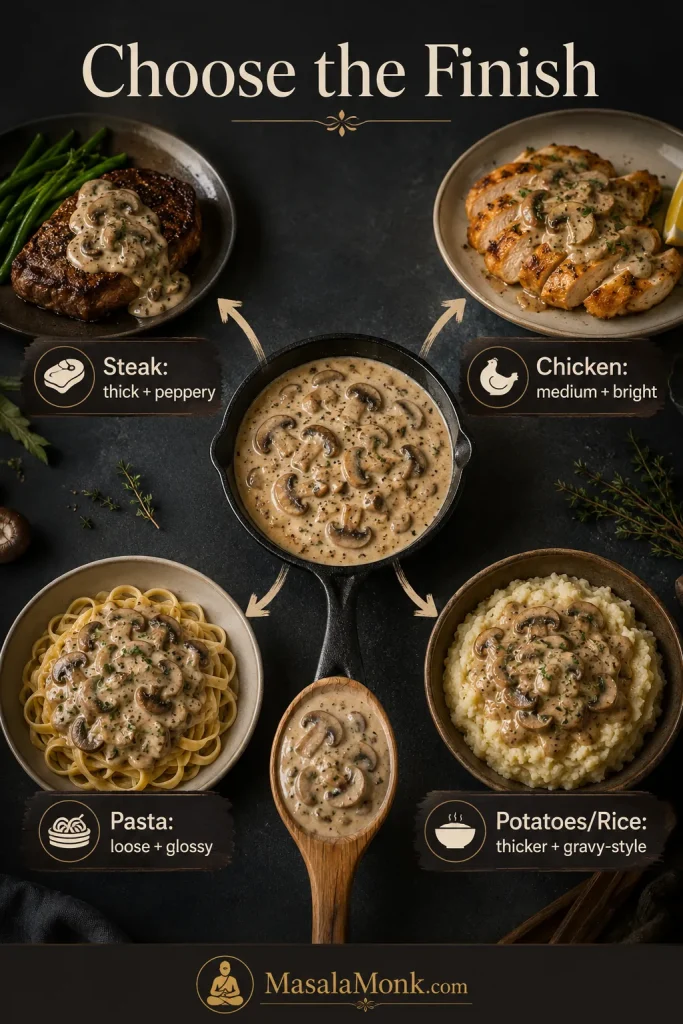
Choose the Finish Before You Start
One skillet, one base, many possible dinners. Before you reduce it too far, decide where it is going: over steak, through pasta, across chicken, or closer to gravy.
Use the Sauce Map before the final simmer so one mushroom sauce can move toward steak, chicken, pasta, or potatoes without starting over.
Before you start: Use a wide skillet. Wait until the mushroom liquid cooks off. Add parmesan over low heat. Those three choices prevent most watery, bland, split, or clumpy mushroom sauce problems.
Pick the direction first, then cook the base recipe below. In the final 2 minutes, the same skillet can stay thick for steak, loosen for pasta, or move closer to gravy.
Creamy Mushroom Sauce Recipe for Steak, Chicken, Pasta & More
A flexible skillet mushroom sauce built on deeply browned mushrooms, garlic, broth, cream, parmesan, thyme, and black pepper. Keep it spoonable for steak, looser for pasta, or thicken it slightly for a gravy-style finish.
Prep Time8 minutes
Cook Time15 minutes
Total Time23 minutes
YieldAbout 3 cups / 700–720 ml
Serves: 4 to 5 over steak, chicken, or pork chops; 3 to 4 with pasta
Equipment: 10- to 12-inch skillet, wooden spoon or spatula, whisk, measuring cup, fine grater or microplane
Ingredients
400–450g / 14–16 oz mushrooms, sliced about 1/4 inch / 6 mm thick
2 tbsp / 28g butter
1 tbsp / 15 ml olive oil
1 small shallot, finely minced, or 1/4 cup minced onion
3 garlic cloves, minced
2 tsp fresh thyme leaves, or 1/2 tsp dried thyme
1/4 cup / 60 ml dry white wine, optional
1/2 cup / 120 ml chicken, beef, or vegetable broth
1 cup / 240 ml heavy cream or double cream
1/3 cup / about 30g finely grated parmesan
1–2 tsp lemon juice, to taste
1/4 tsp salt to start, plus more to taste after parmesan
Freshly ground black pepper, to taste
1–2 tbsp chopped parsley, optional, for finishing
Optional thickener for a gravy-style sauce: 1 tsp cornstarch mixed with 1 tbsp cold water.
Instructions
Brown the mushrooms. Heat the butter and olive oil in a wide skillet over medium-high heat. Add the mushrooms and cook for 6 to 8 minutes, stirring occasionally, until they release moisture, the moisture evaporates, the pan looks mostly dry, and the edges begin to brown. If the pan is crowded, cook them in two batches.
Add aromatics. Season the browned mushrooms with 1/4 tsp salt and black pepper. Add the shallot or onion and cook for 1 to 2 minutes. Add the garlic and thyme and cook for 30 to 45 seconds, just until fragrant.
Deglaze the pan. Pour in the wine, or use extra broth if skipping wine. Scrape the browned bits from the bottom of the skillet. Simmer until the wine smells less sharp and reduces by about half, about 1 minute.
Add broth and cream. Lower the heat to medium. Add the broth and cream. Simmer gently for 4 to 6 minutes, stirring occasionally, until the cream turns beige, the sauce begins to thicken, and it leaves light trails when you stir.
Finish with parmesan. Reduce the heat to low. Stir in the parmesan gradually until melted and smooth. Taste before adding more salt.
Balance the sauce. Add black pepper and 1 teaspoon lemon juice. Taste again. If it tastes flat, add salt. If it tastes heavy, add lemon. If it tastes creamy but not savory, add parmesan, Worcestershire, or more pepper.
Adjust thickness. For steak or pork chops, simmer a little longer until spoonable. For pasta, stop slightly loose and loosen with reserved pasta water as needed. For a thicker gravy-style sauce, stir in the cornstarch slurry and simmer for 30 to 60 seconds.
Serve warm. Spoon over steak, chicken, pork chops, pasta, mashed potatoes, rice, roasted vegetables, meatballs, toast, or omelettes.
Best Finishes
Steak: beef broth, Dijon, Worcestershire, and extra black pepper.
Chicken: chicken broth, lemon, parsley, and a medium-thick texture.
Pasta: stop the sauce slightly loose and loosen with pasta water.
No wine or gravy-style: use broth instead of wine; add the optional slurry for a thicker finish.
Storage: Refrigerate leftovers and reheat gently with a splash of liquid.
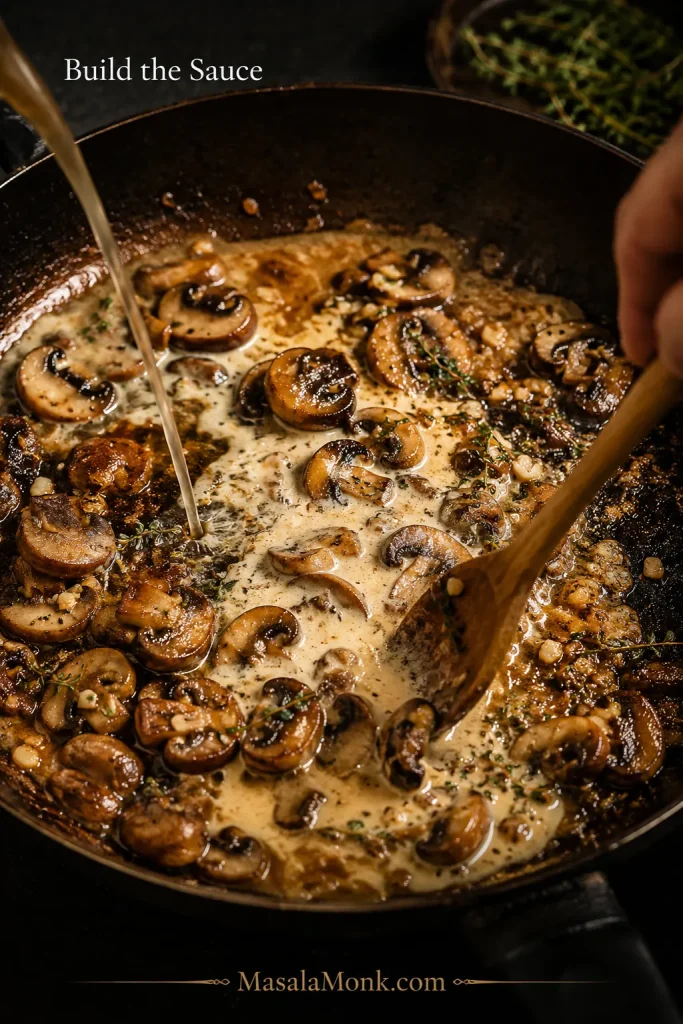
This is the quick turn from browned mushrooms to sauce: liquid lifts the browned bits, and cream pulls everything together.
After browning, deglazing pulls flavor from the skillet into the sauce. Then cream ties the mushrooms, garlic, thyme, and pan juices together.
What Browning Should Look and Smell Like
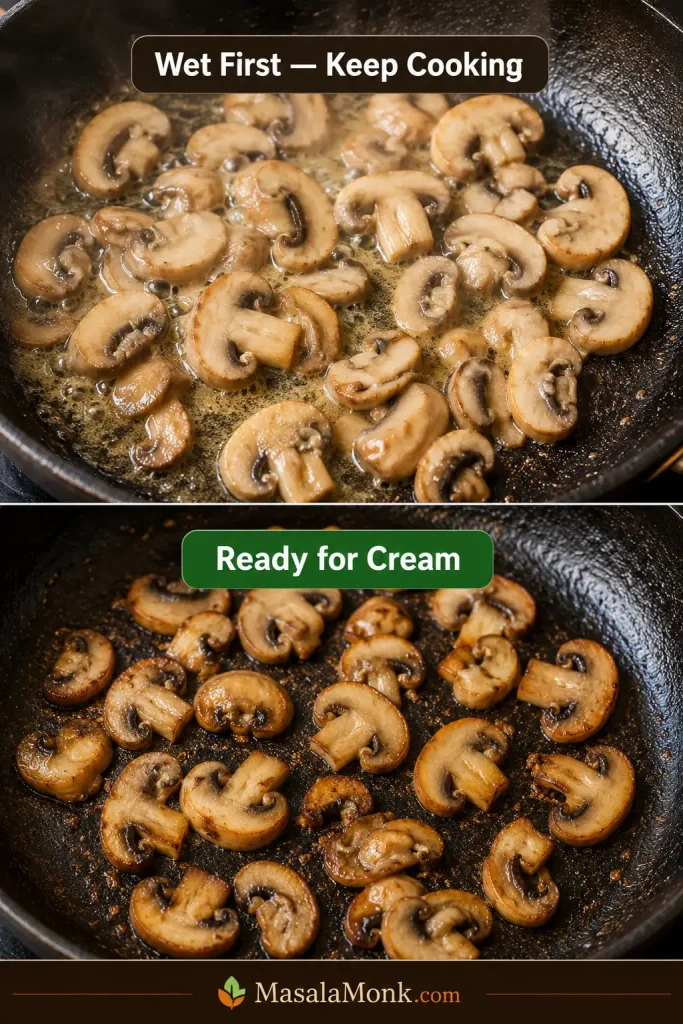
This is the part where patience pays you back. Mushrooms do not become rich the second they hit the pan. First they steam, then they shrink, then the pan goes quieter and drier, and only after that do the edges begin to brown.
Do not judge the sauce in the first few minutes; mushrooms get messy before they get good. They may look wet, crowded, and pale at first, but keep going. The pan should smell deeper and nuttier before the cream goes in, not just buttery.
First comes moisture, then color. When the pan quiets down and the mushrooms turn golden at the edges, the sauce will taste much more savory.
Too wet: keep cooking until the pan looks mostly dry.
Too crowded: cook the mushrooms in two batches.
Too pale: give them another minute or two before adding garlic.
Ready for cream: the mushrooms are smaller, darker, and golden at the edges.
If the sauce still turns watery, bland, or thin after browning, use the troubleshooting guide before adding more cream.
Once the cream goes in, keep the heat gentle. The cream should turn beige as it picks up the browned mushroom juices. If it tastes creamy but not mushroomy, the problem is usually browning, not the amount of cream.
Tested texture note: A 12-inch skillet browns 400–450g mushrooms much better than a small saucepan. If the mushrooms pile up deeply, cook them in two batches. The sauce also thickens after parmesan and again as it cools, so stop slightly looser than you want it on the plate if it will sit for more than 5 minutes or if you are tossing it with pasta.
Ingredient Notes
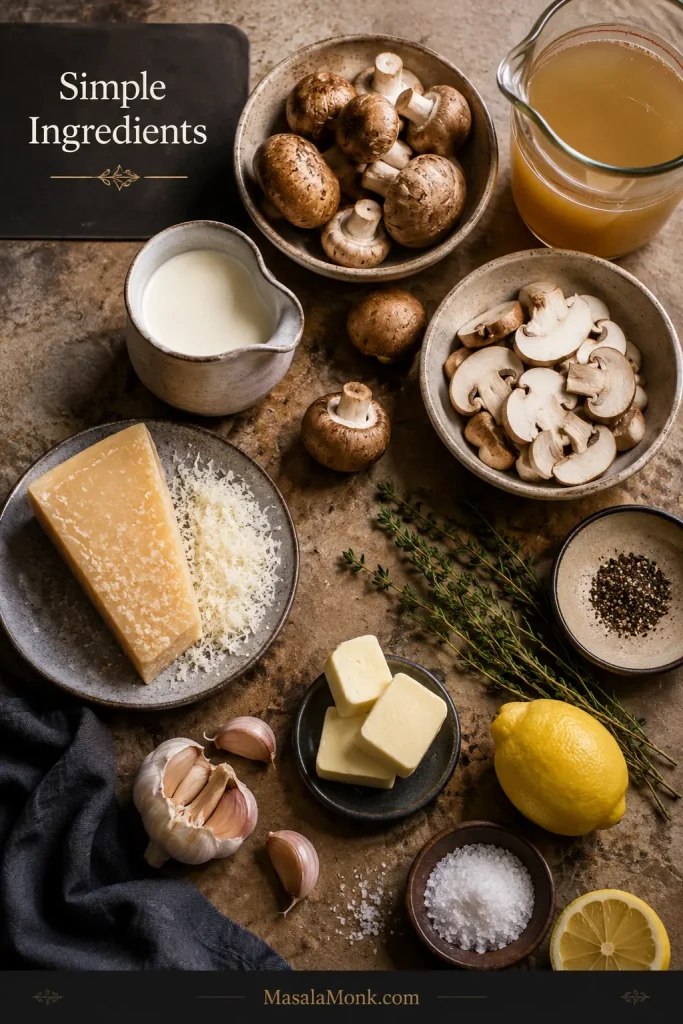
The sauce is simple enough that the small choices show. Mushrooms bring savoriness, broth balances the pan, cream gives body, parmesan adds depth, and lemon keeps the finish lifted.
Before the pan gets hot, line up the sauce builders: dry mushrooms for searing, broth for the pan, cream for body, parmesan for depth, and lemon for balance.
Cremini or baby bella mushrooms give the best everyday flavor, but button, portobello, or mixed mushrooms also work. Slice them about 1/4 inch / 6 mm thick.
Fresh, dry-looking mushrooms sear better than damp ones. If the mushrooms are dirty, a quick rinse is fine, but dry them well before cooking. For a quick visual reference, the Mushroom Council’s mushroom cleaning tips show the same brush, wipe, or brief-rinse approach.
Butter adds roundness, olive oil helps with heat, and pan drippings make the sauce deeper if you cooked steak, chicken, or pork first. Use chicken broth for chicken and pasta, beef broth for steak, and vegetable broth for a vegetarian version.
Heavy cream gives the smoothest finish, and finely grated parmesan melts into the pan instead of sitting in clumps. MasalaMonk’s Parmesan vs Parmigiano Reggiano guide is helpful when choosing between hard cheeses.
Dry white wine helps lift the browned bits from the pan, but broth works well too. If you skip wine, finish with lemon juice so the sauce still tastes bright.
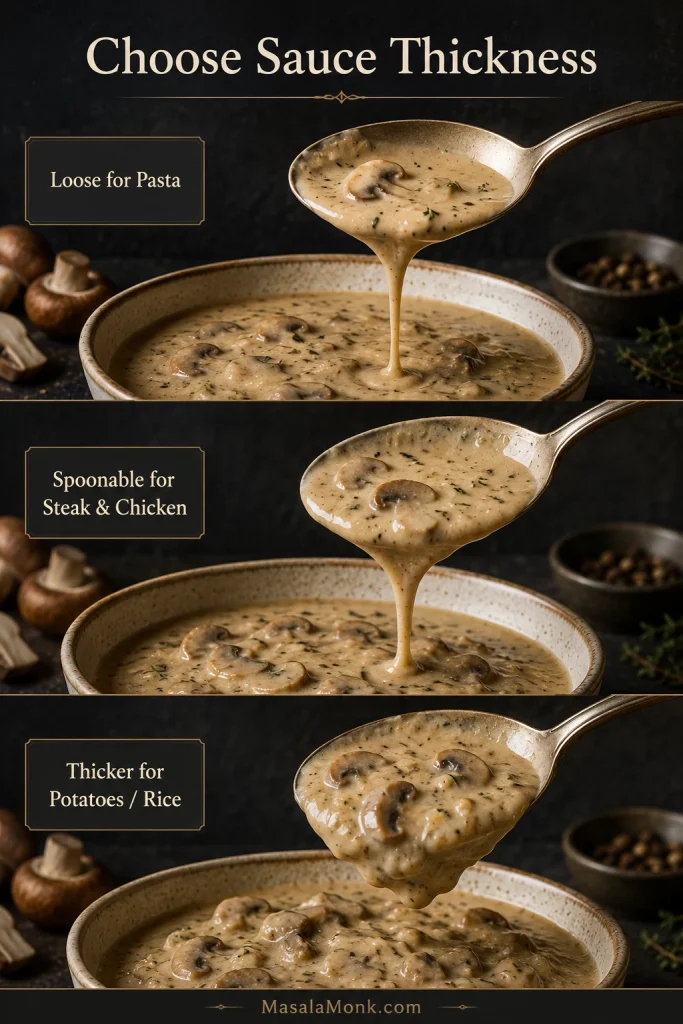
The sauce should coat the back of a spoon and fall in a slow ribbon for steak, chicken, and pork chops. For pasta, it should flow more loosely because it tightens as you toss. For potatoes, rice, or meatballs, it can sit closer to gravy.
Spoon test: Dip a spoon into the sauce and run your finger through the coating on the back. A line that holds for a moment means it is thick enough for steak or chicken. When the coating closes immediately, simmer longer. Loosen the sauce gently if it barely moves.
Use the spoon test before serving. If the sauce coats and drips slowly, it is ready; if it runs, reduce it; if it drags, loosen it gently.
Then check the final texture.
Thickness is the final choice. Keep it loose for pasta, medium-spoonable for steak and chicken, and heavier when you want a mushroom gravy finish.
If pasta tightens in the bowl, that is normal. A splash of hot pasta water brings it back.
How Much Sauce to Use — and Where It Works Best
Use enough sauce to feel generous, not so much that steak, pasta, or potatoes disappear under it.
Serve it with
How much to use
Steak
1/3 to 1/2 cup per steak
Chicken breast or thigh
1/3 cup per piece
Pork chop
1/3 to 1/2 cup per chop
Pasta
Full batch for 250g / 8 oz long pasta or 300g / 10 oz short pasta
Mashed potatoes, rice, or vegetables
1/4 to 1/3 cup per serving
Toast or omelette
2 to 4 tbsp per serving
Mushroom Sauce for Steak
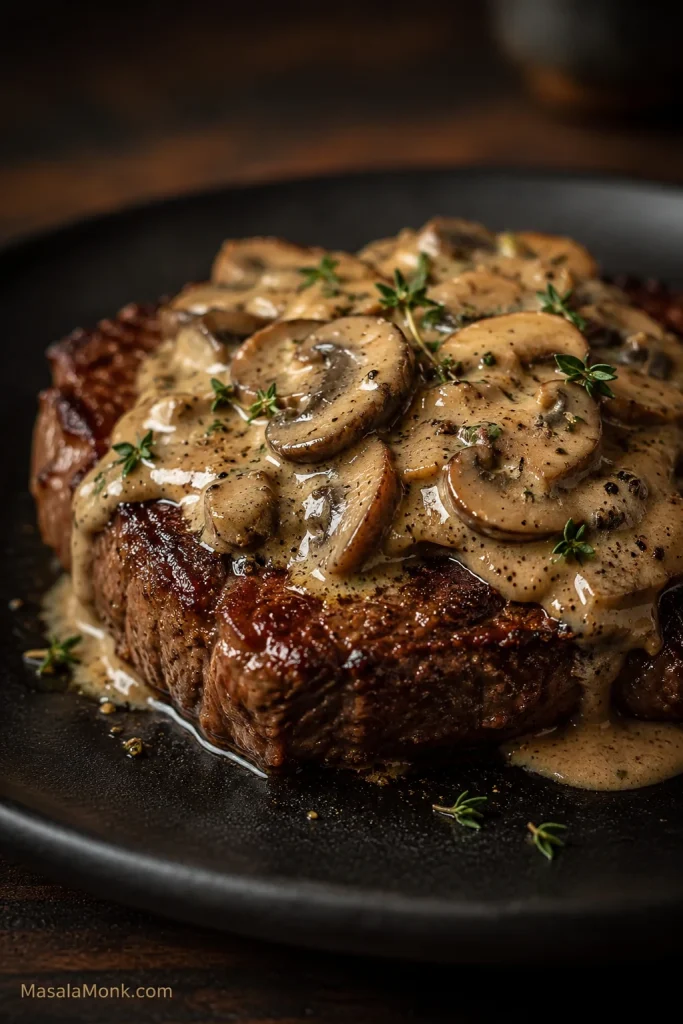
For steak: use pan drippings if you have them, and reduce until the sauce sits on the meat instead of running across the plate.
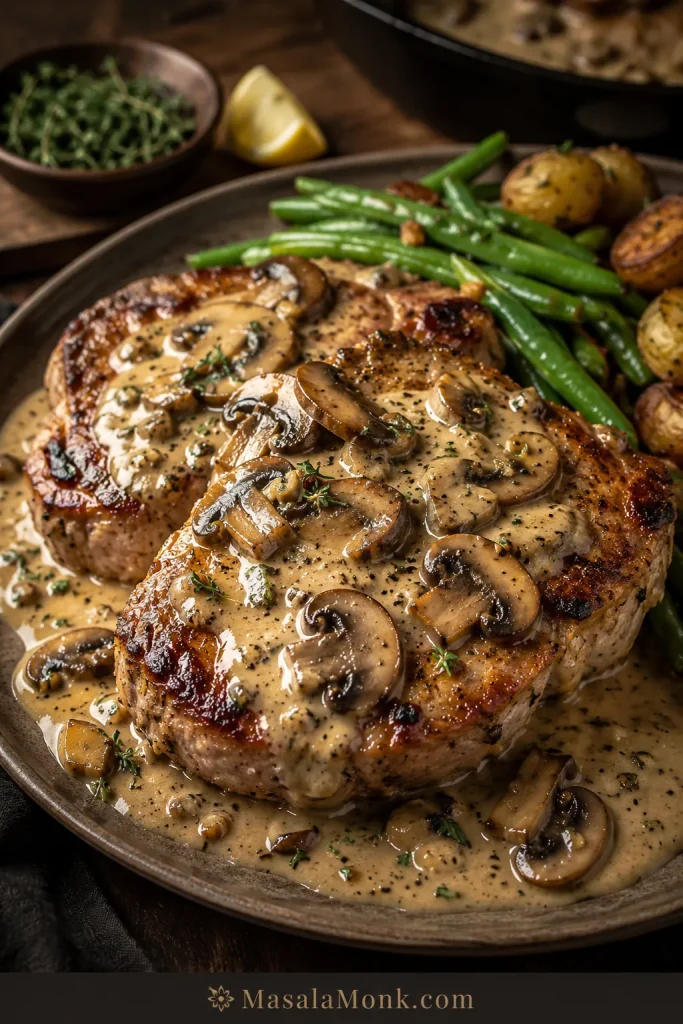
Mushroom sauce for steak should cling to the meat while the seared crust stays visible. Pepper, thyme, Dijon, or Worcestershire can deepen the finish.
Mushroom Sauce for Chicken
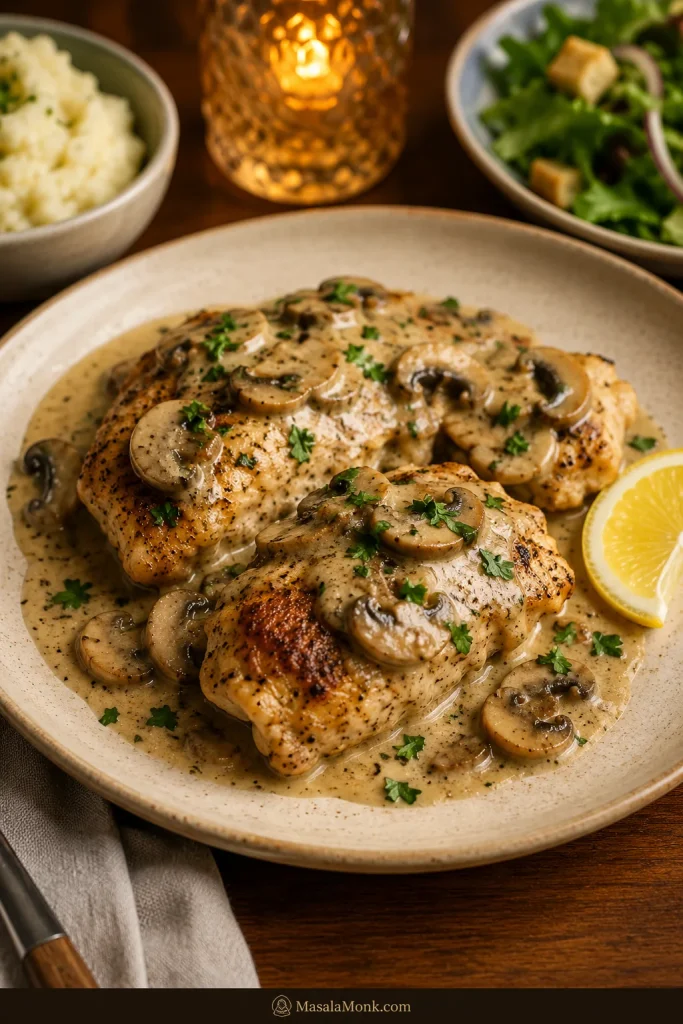
For chicken: keep the sauce medium-thick and bright with lemon or parsley. If the chicken is already cooked, warm it gently in the sauce. If it is not fully cooked, finish it gently until the thickest part reaches 165°F / 74°C. For a complete chicken dinner using this flavor family, see MasalaMonk’s Cream of Mushroom Chicken Recipe.
Mushroom sauce for chicken works best when it is rich but still bright. Parsley and lemon keep the cream from feeling too heavy.
Mushroom Sauce for Pasta
For pasta: keep the sauce loose enough to coat, not clump. Reserve 1 cup pasta water before draining, then toss over low heat and add pasta water 2 to 4 tablespoons at a time until glossy.
Keep mushroom pasta sauce loose and glossy so it slides through the noodles instead of settling in clumps.
Mushroom Sauce for Pork Chops
Pork chops: use chicken broth or pork pan juices and reduce until the sauce coats the chops well. A full pork version is waiting in MasalaMonk’s Cream of Mushroom Pork Chops.
Mushroom sauce for pork chops should be generous but controlled, coating the chop while leaving the seared edges visible.
Mushroom Sauce for Potatoes and Rice
Potatoes, rice, vegetables, toast, or omelettes: use a slightly thicker finish and let the mushrooms stay the focus. This sauce is especially good over garlic mashed potatoes. With rice, keep it looser so it soaks in instead of sitting heavily on top; MasalaMonk’s guide on how to cook rice is a simple place to start.
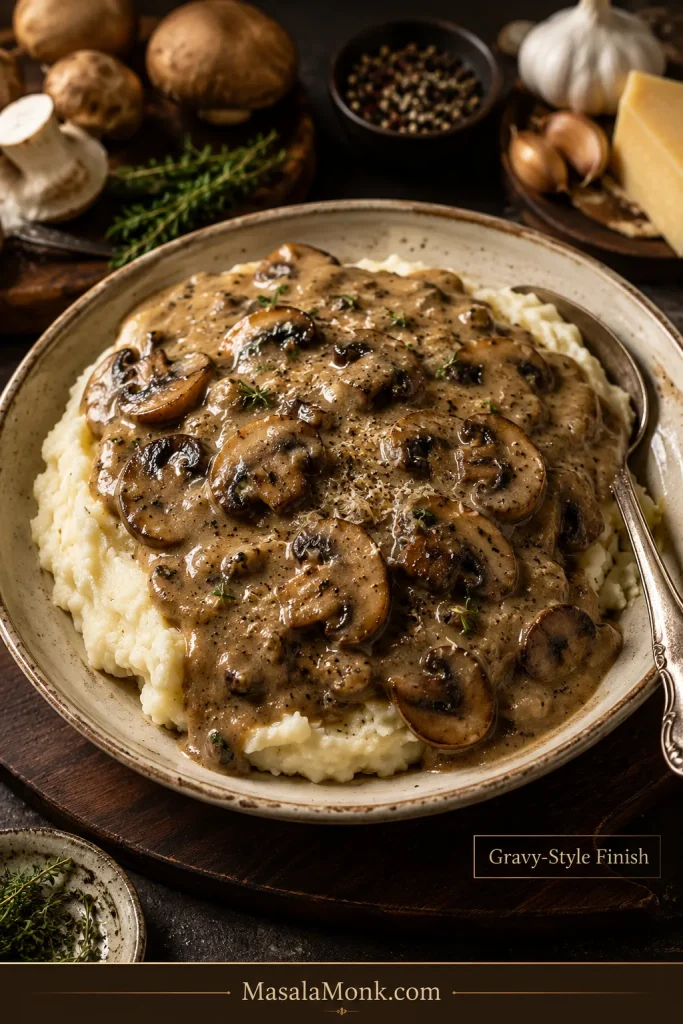
Potatoes or rice work best when the sauce moves toward mushroom gravy: thicker, spoonable, and full of visible mushroom pieces.
No Cream, No Wine & Dairy-Free Options
Once the base works, substitutions become less risky because you know what each ingredient is replacing. Remove cream and you need body. Skip wine and you need brightness. Go dairy-free and you need body plus savoriness.
Without Cream
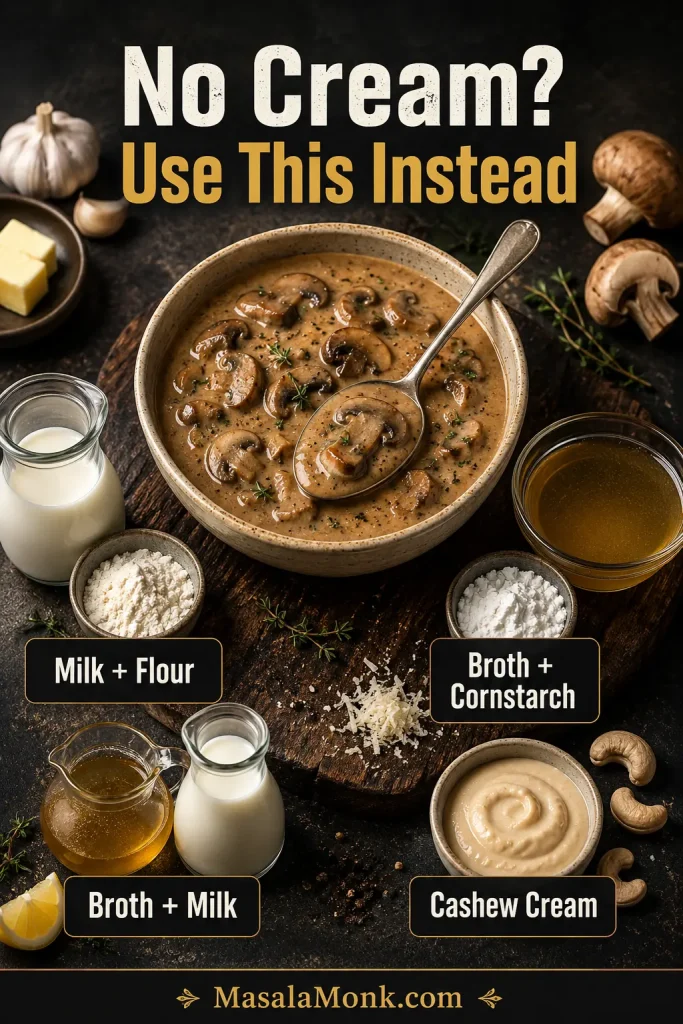
The no-cream versions will not all taste identical, but they can still be rich, savory, and useful. Choose milk + flour for creamy, broth + cornstarch for gravy-like, and cashew cream for dairy-free richness.
Version
How to replace 1 cup / 240 ml cream
Best for
Milk + flour
Cook 1 tbsp flour in the fat for 1 minute, then whisk in 1 cup / 240 ml whole milk gradually.
Chicken, pasta, toast
Broth + cornstarch
Use 1 cup / 240 ml extra broth, then thicken with 1–2 tsp cornstarch mixed with cold water.
Steak, potatoes, rice, gravy-style sauce
Broth + milk
Use 3/4 cup / 180 ml broth plus 1/4 cup / 60 ml whole milk, then thicken lightly if needed.
Lighter creamy sauce
Cashew cream
Use 1 cup / 240 ml cashew cream in place of heavy cream.
Dairy-free pasta or vegetables
Mushroom sauce without cream still needs body. Flour, cornstarch, broth, milk, or cashew cream can thicken the sauce depending on what you have.
If using milk instead of cream, keep the heat gentle. Milk-based sauces are more likely to curdle or separate if boiled hard.
Without Wine
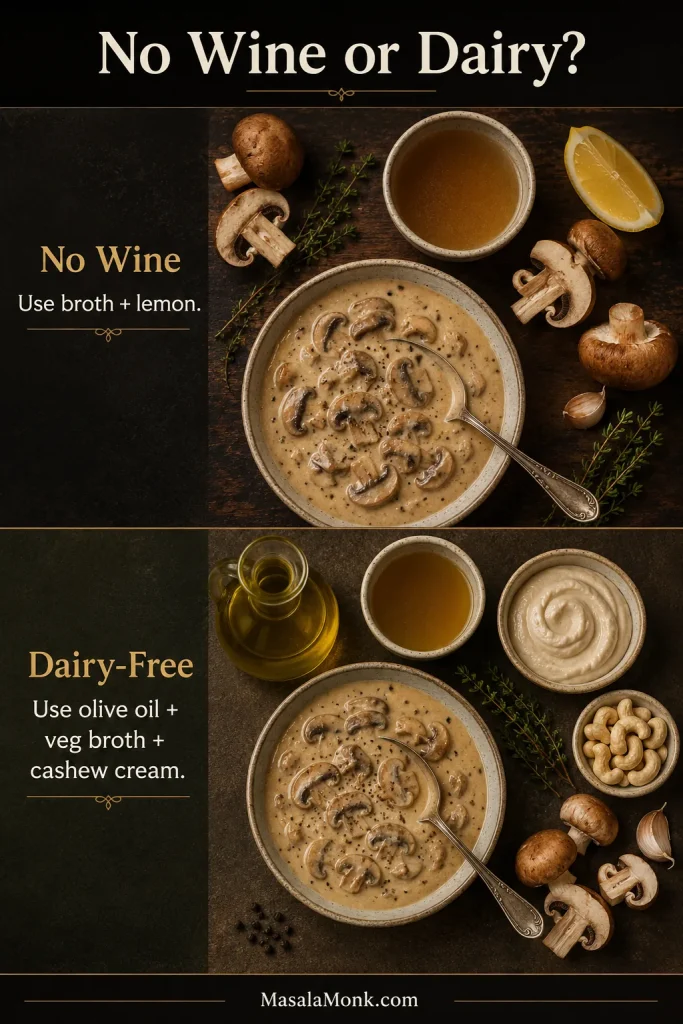
Wine helps, but it is not the soul of the sauce. Browned mushrooms, broth, parmesan, and lemon do most of the real work. Replace the wine with the same amount of broth, then add 1 to 2 teaspoons lemon juice before serving.
Dairy-Free
Use olive oil or vegan butter instead of butter, vegetable broth instead of chicken or beef broth, and cashew cream for the most neutral creamy body. For a lighter sauce, use vegetable broth and cornstarch slurry, then add a small splash of soy sauce or tamari for savory depth. Use unsweetened dairy-free milk only. Avoid sweetened plant milks; coconut milk works but changes the flavor.
These two swaps solve different problems: broth and lemon replace wine’s brightness, while olive oil, vegetable broth, and cashew cream replace dairy’s body.
Without wine, add brightness with broth and lemon. A dairy-free mushroom sauce gets body from olive oil, vegetable broth, and cashew cream.
Small Flavor Adjustments
To make it more garlicky, increase the garlic to 4 or 5 cloves and add it only after the mushrooms brown. A deeper steak version can use red wine, beef broth, Dijon, Worcestershire, thyme, and extra black pepper. Brighten the pan with lemon, parsley, or a splash of white wine. For more savoriness, add a few drops of Worcestershire or soy sauce, more parmesan, or a little extra broth.
Mushroom Sauce vs Mushroom Gravy
The line between sauce and gravy is blurry in real kitchens. If it is going over steak or pasta, keep it silkier. If it is going over potatoes, rice, meatballs, or roasts, you can push it thicker and more stock-forward.
Feature
Mushroom sauce
Mushroom gravy
Base
Cream + broth
Stock + roux or slurry
Color
Creamy, pale, golden, or beige
Brown and savory
Texture
Silky, rich, spoonable
Pourable, thicker, gravy-like
Best for
Steak, chicken, pork chops, pasta
Mashed potatoes, meatloaf, roasts, rice
Freezing
Not ideal if cream-based
Better if made without cream
Thickener
Reduction, parmesan, optional slurry
Flour, roux, or cornstarch
This recipe is a creamy sauce first. To take it closer to gravy, use more broth, less cream, and the optional cornstarch slurry.
Can This Replace Canned Cream of Mushroom Soup?
Yes, this homemade sauce can replace canned cream of mushroom soup as a spoonable topping for chicken, pork chops, rice, pasta, potatoes, or vegetables. It tastes fresher and more mushroom-forward than canned soup.
As a pourable dinner sauce, keep the full 3-cup batch as written. To make a condensed-soup-style replacement, reduce and thicken it to about 2 cups. A gravy-style topping can stay closer to 2 1/2 to 3 cups, then thicken with slurry or roux.
Casseroles need a thicker sauce than a pourable skillet topping because the sauce has to hold vegetables, noodles, protein, and topping together. To turn the same sauce idea into a full casserole, MasalaMonk’s green bean casserole is a useful next step.
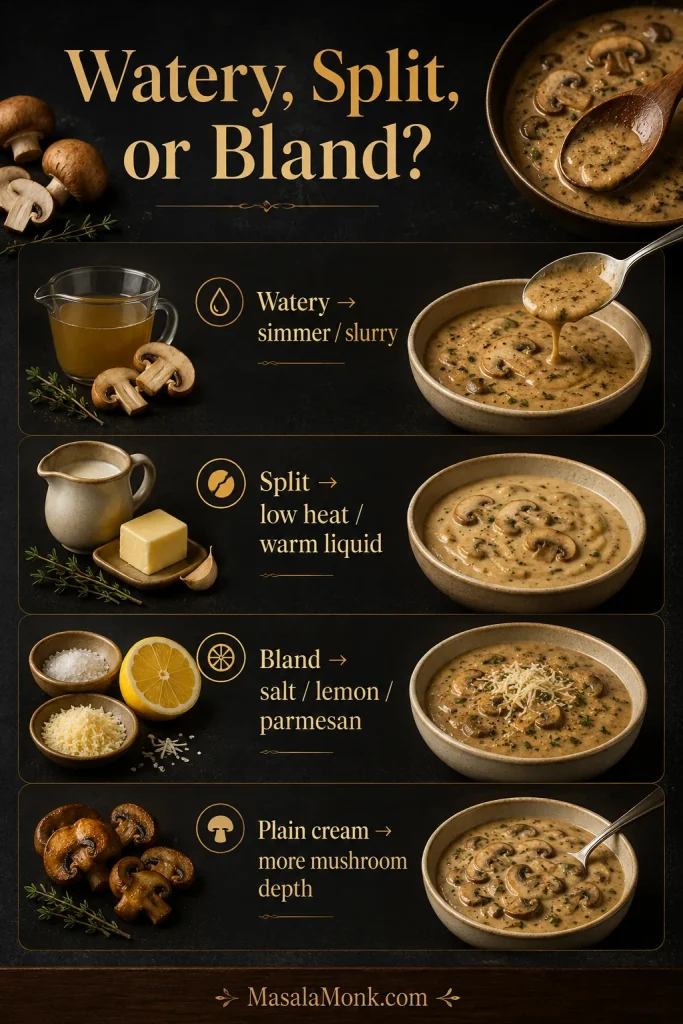
Watery, Split or Bland? Fix It Fast
If your sauce looks wrong, do not panic. Most mushroom sauce problems are fixable. Usually, the issue comes from mushrooms that steamed instead of browned, cream that boiled too hard, cheese added over high heat, or a sauce that was made too thick before pasta or reheating.
Quick Visual Fixes
Use the fix-it guide at the first sign of trouble: reduce watery sauce, warm split sauce gently, brighten bland sauce, and build more mushroom depth.
Detailed Fix Table
Problem
Fix now
Next time
Watery sauce
Simmer uncovered for 2 to 5 minutes, or stir in 1 tsp cornstarch mixed with 1 tbsp cold water.
Give the mushrooms enough time for the pan to dry before adding cream.
Too thick
Add warm broth, milk, cream, or pasta water 1 tbsp at a time.
Stop simmering while the sauce is slightly looser than you want it on the plate.
Split or greasy
Lower heat and whisk in a splash of warm broth or cream. Avoid adding cold liquid directly.
Keep the cream at a gentle simmer.
Tastes like plain cream
Add parmesan, salt, pepper, thyme, lemon, Worcestershire, or a splash of broth.
Brown mushrooms longer and deglaze the pan before adding cream.
Bland
Add salt if flat, lemon if heavy, parmesan or Worcestershire if it lacks depth.
Taste after parmesan before final seasoning.
Rubbery mushrooms
Keep cooking until moisture evaporates and edges brown.
Use a wide pan and avoid crowding.
Floury taste
Simmer 2 to 3 minutes longer after adding liquid.
Cook flour in the fat for about 1 minute before adding liquid.
Parmesan clumped
Take the pan off the heat and whisk gently. Add a splash of warm liquid if needed.
Use finely grated parmesan and avoid high heat.
Pasta absorbed the sauce
Add pasta water 2 to 4 tbsp at a time and toss over low heat.
Keep the sauce looser before adding pasta.
Most fixes come back to two things: give the mushrooms more time in the pan, then keep the creamy finish gentle. For watery or bland sauce problems, recheck the wet-to-browned mushroom cue and the spoon test.
Storage, Reheating, and Make-Ahead Tips
Cream sauces are not difficult to reheat; they just do not like being rushed. Store leftovers in an airtight container in the refrigerator for 3 to 4 days. For general leftover safety, the USDA recommends using refrigerated leftovers within 3 to 4 days.
To refrigerate: cool the sauce, then store in an airtight container.
To reheat on the stove: warm over low or medium-low heat, stirring often.
To loosen: add a splash of broth, milk, cream, or pasta water.
To microwave: use short bursts and stir between each one.
To freeze: cream-based sauce is not ideal because it can split. A no-cream, gravy-style version freezes better.
If the sauce looks separated after chilling, warm it slowly and whisk in a little liquid. Do not bring it to a hard boil. For more general leftover storage guidance, see the USDA’s Leftovers and Food Safety guide.
FAQs About Mushroom Sauce
Can I use canned mushrooms?
Yes, canned mushrooms work in a pinch, but fresh mushrooms give better browning and flavor. Drain canned mushrooms well, pat them dry, and brown them before adding liquid.
How do I make mushroom sauce thicker?
Simmer mushroom sauce uncovered first; that gives the best flavor. For a faster fix, add a slurry made from 1 teaspoon cornstarch and 1 tablespoon cold water.
Why is my mushroom sauce watery?
Mushroom sauce is usually watery when the pan is still too wet before the cream goes in. Simmer uncovered, or use a small cornstarch slurry if dinner is waiting.
Why does it taste like plain cream?
If mushroom sauce tastes like plain cream, the mushrooms probably needed more browning, or the sauce needs salt, parmesan, pepper, lemon, or Worcestershire. It should taste savory before it tastes creamy.
Is this the same as mushroom gravy?
No. Mushroom sauce is usually creamier and better for steak, chicken, pasta, and pork chops. Mushroom gravy is usually more stock-based, brown, and thickened with flour or cornstarch.
What can I use instead of cream?
Use milk with flour for a lighter creamy sauce, broth with cornstarch for a gravy-style sauce, or cashew cream for dairy-free richness. Milk and broth are thinner than cream, so they usually need a thickener.
Can I make mushroom sauce ahead of time?
Yes. Make it 2 to 3 days ahead, refrigerate, and reheat gently with a splash of liquid. Leftovers keep for 3 to 4 days in an airtight container.
Why did the sauce split?
Cream sauces usually split when boiled too hard or reheated too aggressively. Lower the heat and whisk in a splash of warm broth or cream.
Final Spoonful
Once you understand the texture, this becomes the sauce you can pull out for half-finished dinners: steak that needs polish, chicken that needs richness, pasta that needs gloss, or potatoes that need comfort.
Tried it over steak, chicken, pasta, potatoes, or something else? Tell me what you spooned it over and how you finished it — Dijon, Worcestershire, extra pepper, pasta water, or your own trick.
You are not here for a complicated pork chop dinner. You have pork chops, a can of cream of mushroom soup, and the hope that the gravy turns creamy while the pork stays juicy. This recipe keeps that old-school shortcut, then gives it better timing, better gravy, and fewer dry-pork surprises.
These cream of mushroom pork chops are built for a real weeknight: brown the pork, loosen condensed soup into mushroom gravy, simmer gently, and stop before the chops turn tough. It is cozy pantry cooking, handled with just enough care.
The simple formula is 4 pork chops, 1 can of condensed cream of mushroom soup, and ⅓ to ½ cup broth, milk, or water. Use ⅓ cup liquid for thicker gravy, ½ cup for a looser sauce, and chicken broth when you want fuller flavor without making the recipe harder.
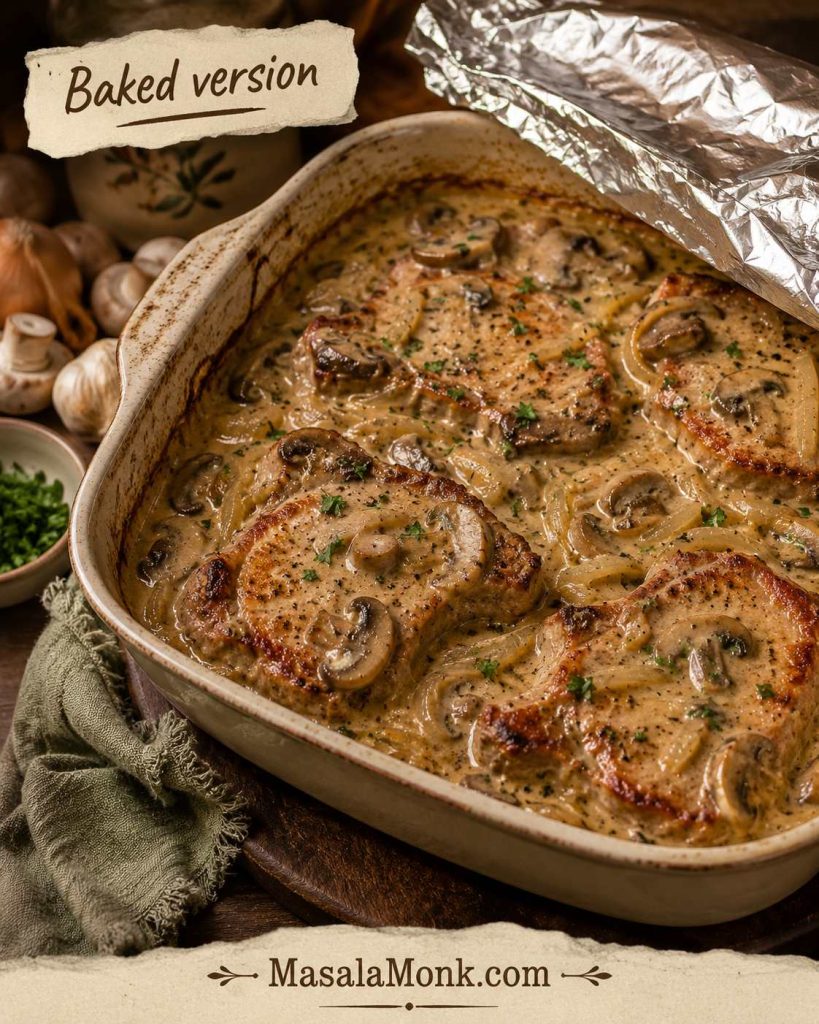
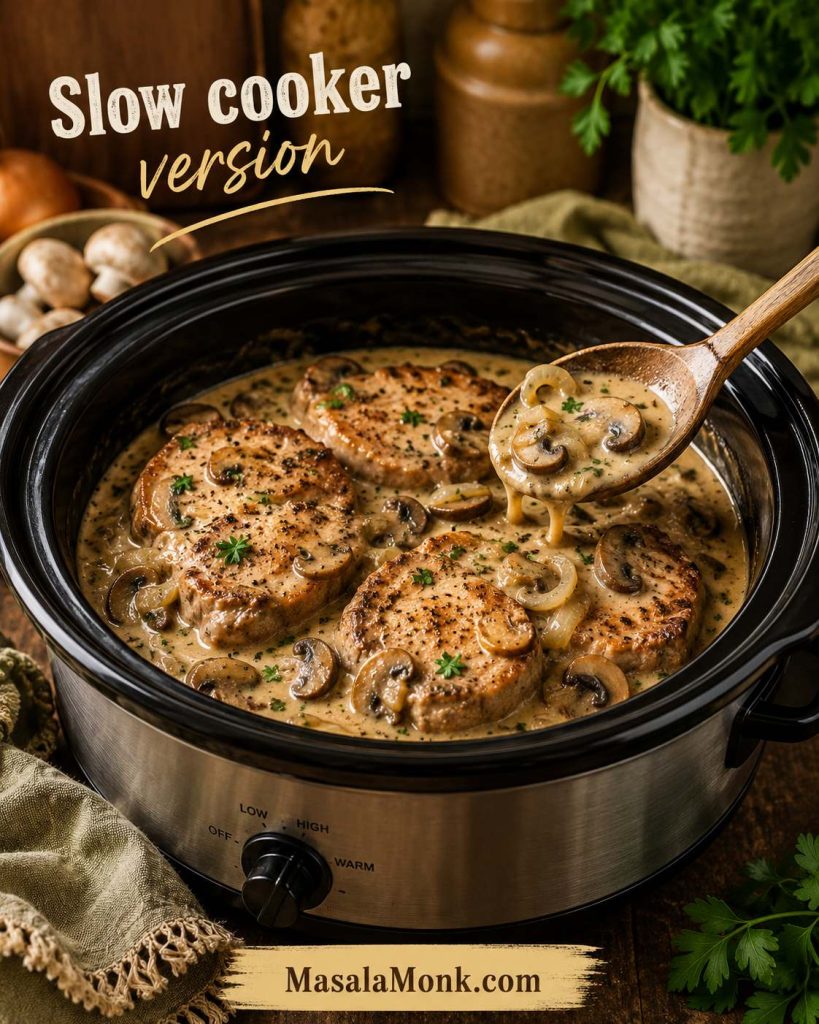
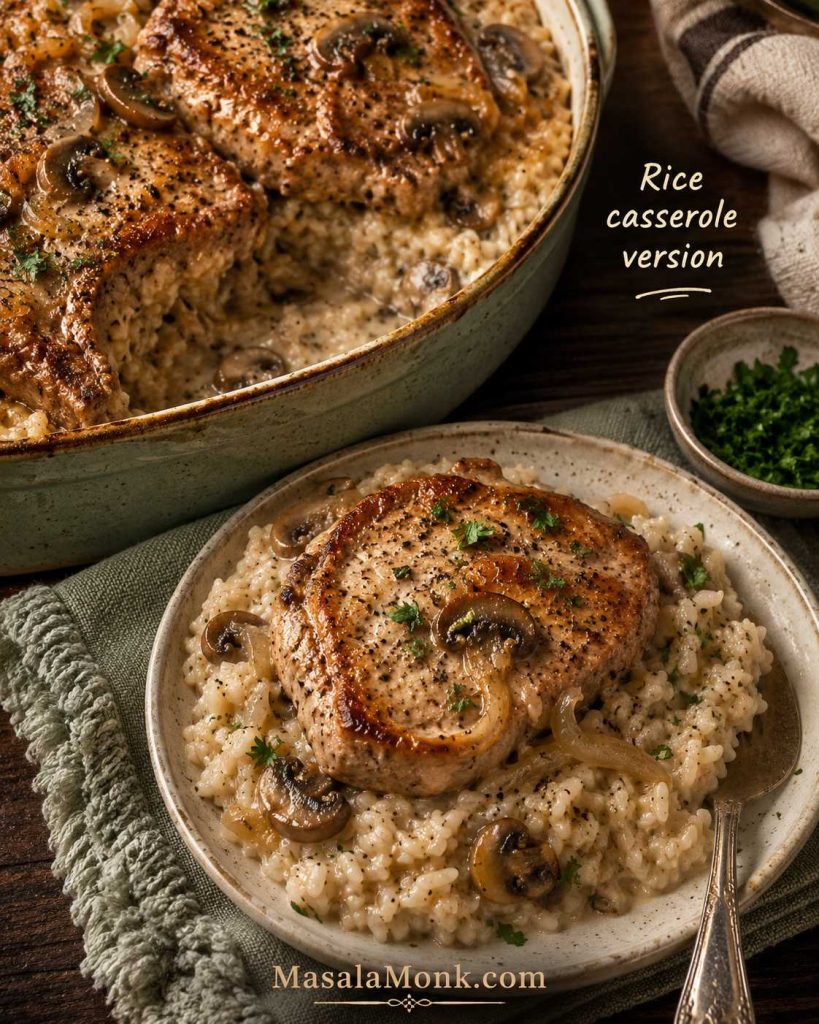
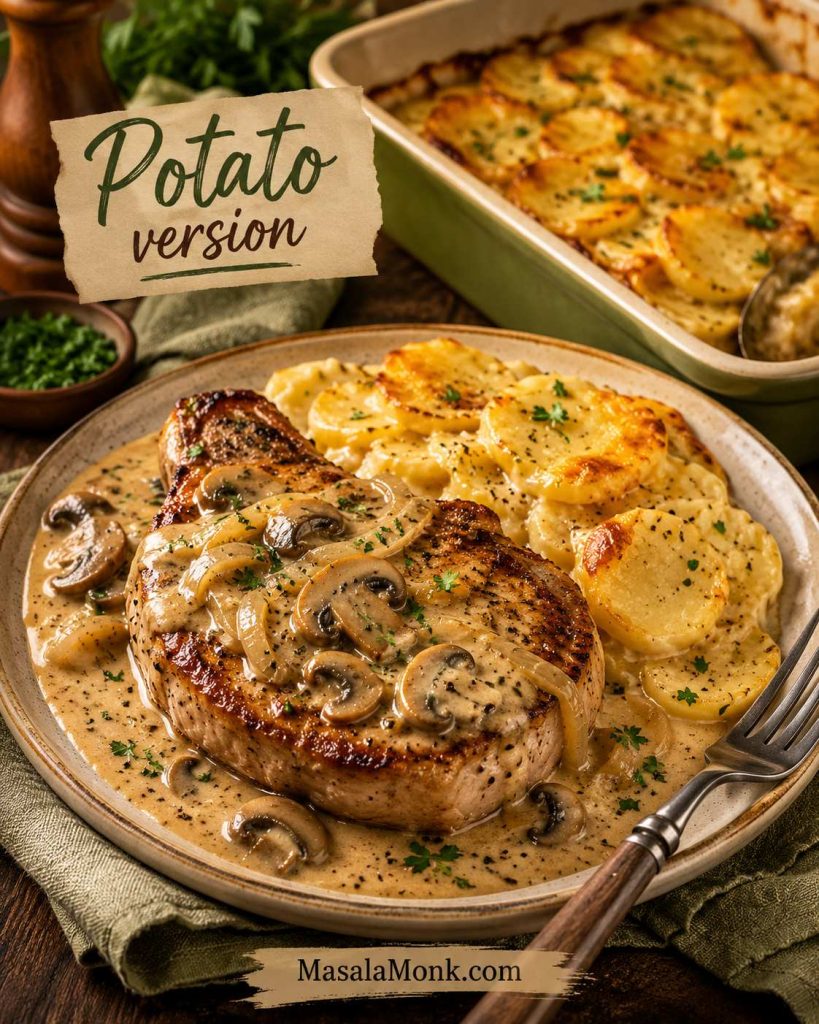
The fast skillet version comes first because it is the easiest dinner for most nights. If you meant baked pork chops, crock pot pork chops, pork chops and rice, potatoes, stuffing, Campbell’s-style pork chops, or extra-smothered gravy, those notes are included too — because each version cooks differently.
Quick Answer: Cream of Mushroom Pork Chops with Mushroom Soup Gravy
To make cream of mushroom pork chops, brown 4 seasoned pork chops in a skillet, whisk 1 can of condensed cream of mushroom soup with ⅓ to ½ cup chicken broth, milk, or water, then simmer gently until the thickest chop reaches 145°F / 63°C. Rest for 3 minutes and spoon the creamy mushroom gravy over the top.
Good default: use ¾–1 inch pork chops, ⅓ cup chicken broth, a 12-inch skillet, and low heat once the soup goes in. That combination gives you golden-edged pork and gravy thick enough to settle into mashed potatoes, rice, or egg noodles.
Bare pantry version: pork chops, condensed cream of mushroom soup, ½ cup water, and black pepper. It tastes simpler and more nostalgic, but it still works when dinner just needs to happen.
Gravy can wait. Pork cannot. Let the gravy be flexible, but treat the pork like it has a deadline. If the chops are done before the sauce is perfect, move them out and fix the gravy by itself.
This is the kind of dinner where the gravy matters as much as the pork: thick enough for mashed potatoes, loose enough to spoon, and savory enough to make a plain side feel finished.
1 can condensed cream of mushroom soup, 10.5 oz / 298 g
Liquid
⅓ cup broth for thick gravy; up to ½ cup milk, broth, or water for looser sauce
Optional upgrade
8 oz mushrooms, ½ onion, garlic, Worcestershire, Dijon
Method
Brown chops, make mushroom gravy, simmer gently, rest before serving
Time
About 30 minutes for the skillet version
Doneness
145°F / 63°C plus a 3-minute rest
Keep the skillet formula simple: pork chops, one can of cream of mushroom soup, and just enough liquid to turn condensed soup into spoonable gravy.
Many old canned-soup pork chop recipes simmer everything by time. This version uses the same pantry shortcut but changes the control point: the gravy can be adjusted by texture, while the pork is cooked by temperature.
Cooking with chicken instead tonight? Our cream of mushroom chicken recipe uses the same cozy canned-soup idea, but the timing and doneness are built around chicken instead of pork.
At a Glance: Gear, Sides, and Watchouts
Question
Quick answer
Skillet
Use a 12-inch skillet if adding mushrooms and onions; a 10-inch skillet works for the simplest pantry version.
Helpful equipment
Tongs, whisk or sturdy spoon, instant-read thermometer, and a plate for resting pork.
Method choice
Use the skillet for speed, the oven for covered bakes, and a casserole method for raw rice, potatoes, or stuffing.
Easy sides
Mashed potatoes, rice, egg noodles, green beans, peas, broccoli, biscuits, or a sharp salad.
Biggest mistakes to avoid
Overcooking thin chops, hard-boiling the sauce, adding too much liquid, and salting too early.
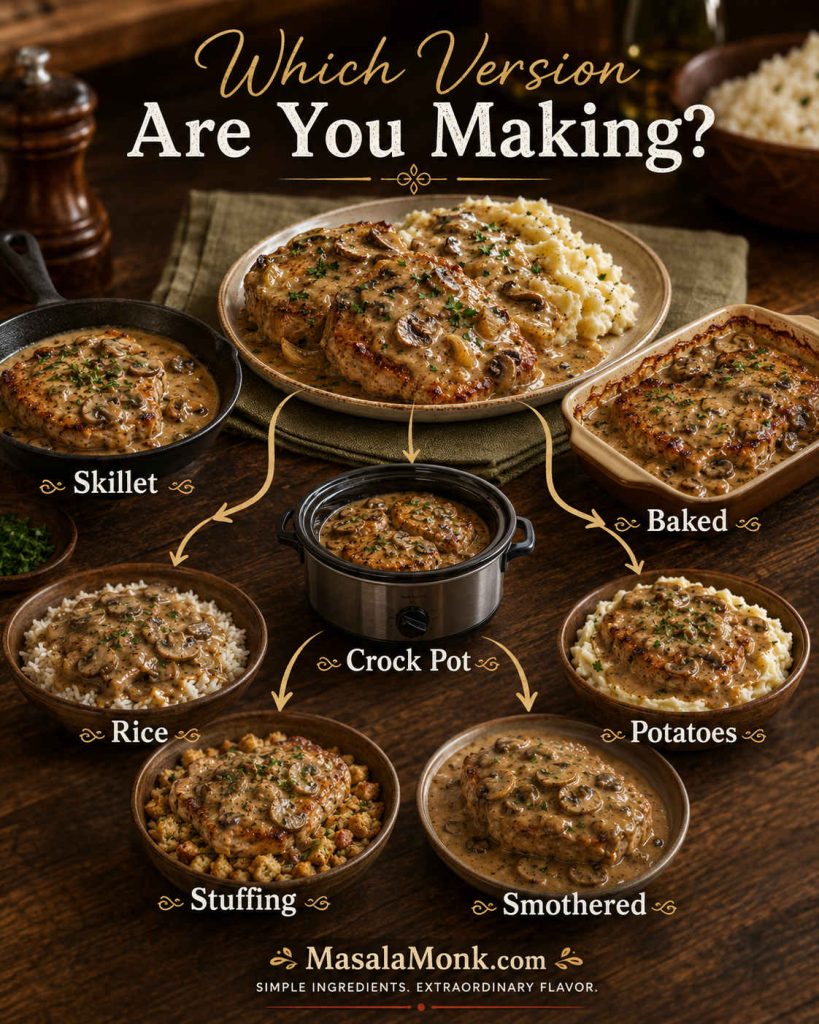
Skillet, Baked, Crock Pot, or Rice: Which Cream of Mushroom Pork Chops Version Should You Make?
The same can of soup can become several different dinners. A quick skillet meal, an oven bake, a slow cooker dinner, and pork chops with rice all sound similar, but they do not need the same amount of liquid or time. Pick the path first, then the recipe gets much easier.
Let the pork rest while you make the extra gravy rich.
Start by choosing the dinner path: skillet stays quick, baked and crock pot need longer heat, and rice, potatoes, or stuffing need their moisture planned from the beginning.
Easy distinction: the skillet recipe cooks pork chops in a creamy sauce. Rice, potatoes, stuffing, and slow-cooker versions also have to manage starch or long heat, so the moisture and timing change.
Why This Recipe Works
This recipe keeps the part people love — pork chops in creamy mushroom soup gravy — while fixing the parts that usually go wrong.
Browning gives the pork a savory edge. The mushroom gravy softens everything later, but the first sear keeps the chops from tasting flat.
The soup-to-liquid ratio stays controlled. Condensed soup needs a little help becoming gravy, not a whole pan of liquid.
Mushrooms and onion make the shortcut taste more like dinner. They are optional, but they add sweetness, texture, and deeper mushroom flavor.
A gentle simmer protects lean pork. Once the sauce goes in, slow bubbles are your friend. A hard boil is how creamy dinners turn tough.
A thermometer separates the pork from the gravy problem. Once the chops are done, the sauce can keep thickening without them.
The result is still the creamy canned-soup dinner people remember, but with browned edges, a spoonable sauce, and pork that does not need to hide under the gravy.
This is not a recipe that asks you to pretend a can of soup is fancy. It simply helps that can do its job better: make creamy gravy, keep dinner simple, and give the pork chops something comforting to sit in.
Ingredients for Pork Chops with Cream of Mushroom Soup
The ingredient list is short, which is exactly why the small choices matter. The soup brings the creamy base, the liquid sets the gravy texture, and the chop thickness decides how much breathing room you have before dinner goes from juicy to dry.
Even with condensed soup, the flavor improves when mushrooms, onion, broth, and black pepper turn the shortcut into a real mushroom gravy.
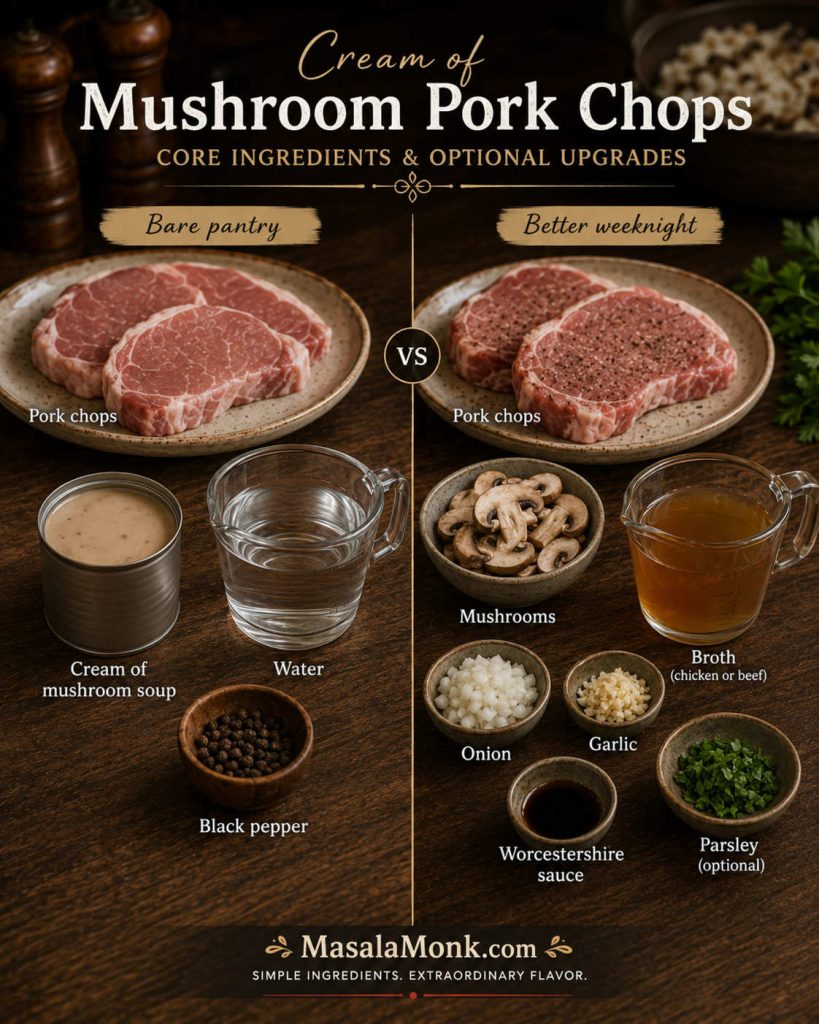
Bare pantry version: pork chops + condensed cream of mushroom soup + water + black pepper. Better weeknight version: add chicken broth, mushrooms, onion, garlic, Worcestershire, and thermometer timing. Both are valid; one is just more layered.
Core Ingredients and Optional Upgrades
The bare pantry version works when dinner just needs to happen. Mushrooms, onion, broth, and a savory booster make the same shortcut taste fuller.
Ingredient
Amount
Why it matters
Pork chops
4 chops, about 1½–2¼ lb / 680 g–1 kg total
Boneless or bone-in both work. Chops around ¾–1 inch thick are easiest to keep juicy.
Condensed cream of mushroom soup
1 can, 10.5 oz / 298 g
The shortcut base for the creamy mushroom gravy. Low-sodium soup gives you more control if using broth or seasoning mix.
Chicken broth, milk, or water
⅓–½ cup / 80–120 ml
Turns condensed soup into sauce. Broth is savory, milk is creamy, water is classic.
Fresh mushrooms
8 oz / 225 g, sliced
Optional but recommended for deeper mushroom flavor and a more homemade texture.
Onion
½ medium / 75–100 g, thinly sliced or diced
Adds sweetness and helps the sauce taste less like it came straight from the can.
Garlic
2–3 cloves, minced
Adds savory depth; use garlic powder if that is what you have.
Oil + butter
1 tablespoon each
Oil helps sear the pork; butter helps sauté mushrooms and onion.
Black pepper
½ teaspoon, plus more to taste
Balances the creamy sauce and keeps the flavor from tasting sleepy.
Worcestershire sauce
1–2 teaspoons / 5–10 ml, optional
Adds a savory edge that makes the gravy taste fuller.
Dijon mustard
1 teaspoon / 5 g, optional
Adds a small sharp note without making the sauce taste mustardy.
Parsley
1–2 tablespoons, chopped, optional
Freshens the finished plate.
Salt note: start light. Condensed soup already brings salt, and the final gravy can get too salty if you also add regular broth, bouillon, onion soup mix, gravy mix, ranch seasoning, or seasoned salt. Taste the sauce before adding more.
Can You Skip the Fresh Mushrooms and Onion?
Pork chops, condensed soup, a little liquid, and black pepper will still get dinner on the table. Fresh mushrooms and onion make the gravy taste more layered, but the simple canned-soup version is the classic route. If you skip them, add garlic powder, Worcestershire sauce, or extra black pepper so the sauce does not taste flat.
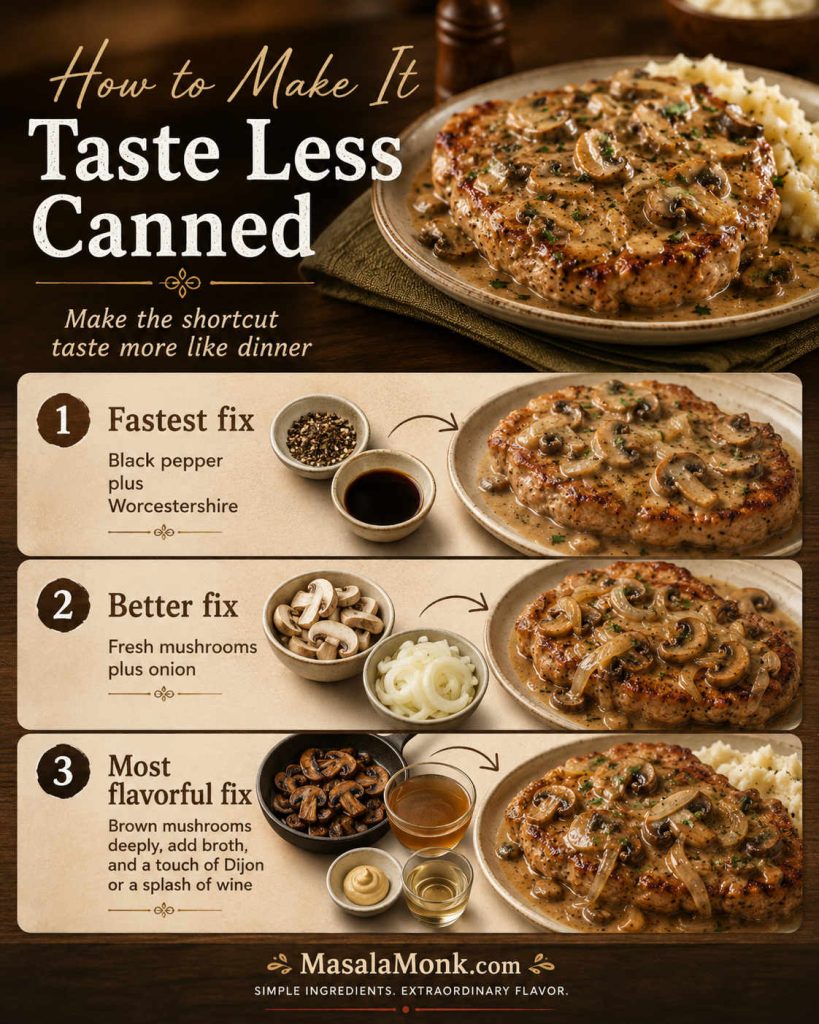
How to Make It Taste Less Canned
The goal is not to hide the shortcut. It is to make the shortcut taste more like dinner.
Fastest fix: add black pepper and a splash of Worcestershire so the gravy tastes savory instead of flat.
Better fix: cook fresh mushrooms and onion until the mushroom water cooks off and the edges color.
Most flavorful fix: use chicken broth, properly browned mushrooms, and a tiny spoon of Dijon or a tablespoon or two of dry white wine for a less canned finish.
To make the shortcut taste less canned, layer flavor in stages: pepper first, then browned mushrooms and onion, then broth or a small savory booster.
Choosing Pork Chops That Stay Juicy
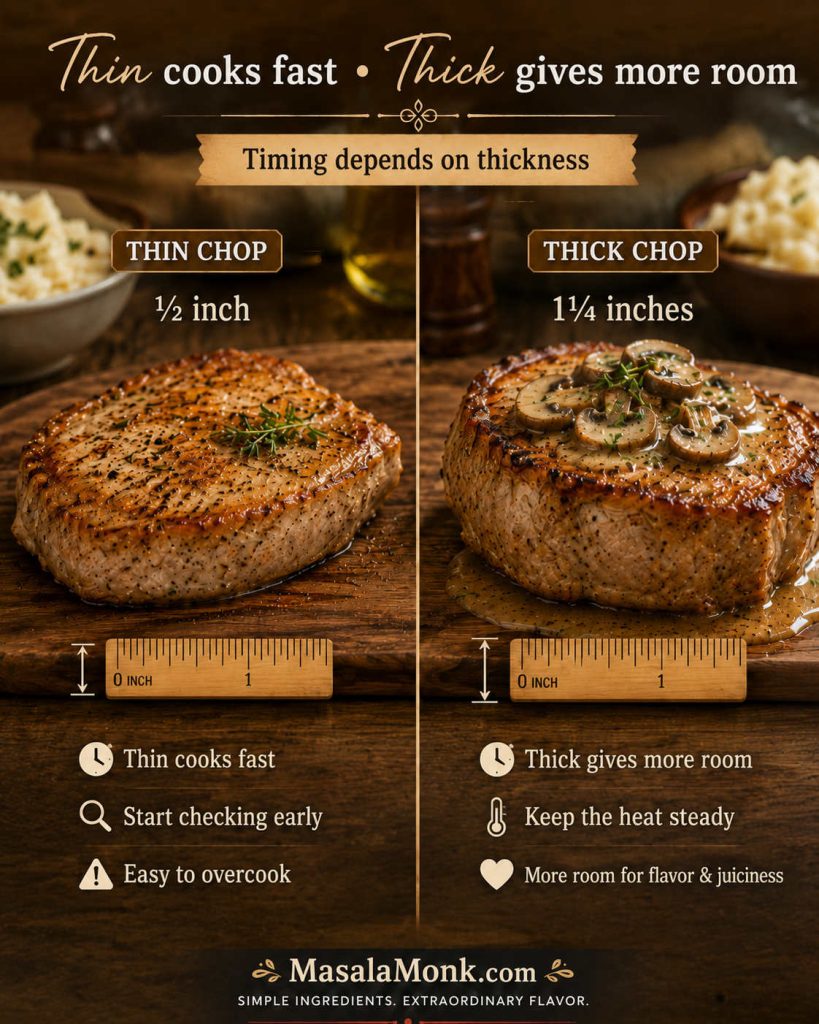
The pork chop you choose decides how forgiving this dinner will be. A thick chop gives you a little breathing room. A thin cutlet needs a short leash.
Chop thickness decides how forgiving this recipe feels; thin chops need a short simmer, while ¾–1 inch chops give the gravy time to come together.
Boneless Pork Chops
Boneless pork chops are the easiest choice when you want dinner fast. They brown neatly, sit nicely under the mushroom gravy, and slice cleanly on the plate. Just watch the timing, because thin boneless chops do not forgive a long simmer.
For a reliable result, use boneless chops that are about ¾ to 1 inch thick. They are thick enough to brown well and stay juicy, but not so thick that the sauce is finished long before the pork is cooked.
Bone-In Pork Chops
Bone-in pork chops are often more forgiving. The bone and surrounding fat help protect the meat, so these are a good choice if you are nervous about dry pork chops. They may need a few extra minutes near the bone, so check the temperature in the thickest meaty part without touching the bone.
If the gravy thickens before the meat near the bone is done, add a splash of broth and keep the simmer gentle. The sauce is more forgiving than the pork; you can loosen it, thicken it, or adjust it later.
Boneless vs Bone-In Pork Chops
Use this comparison when you are choosing between speed and forgiveness: boneless chops cook faster, while bone-in chops give the gravy a little more time before the meat dries out.
Boneless pork chops are fast and convenient, while bone-in chops give you a little more forgiveness once the mushroom soup gravy starts simmering.
Pork Loin Chops with Cream of Mushroom Soup
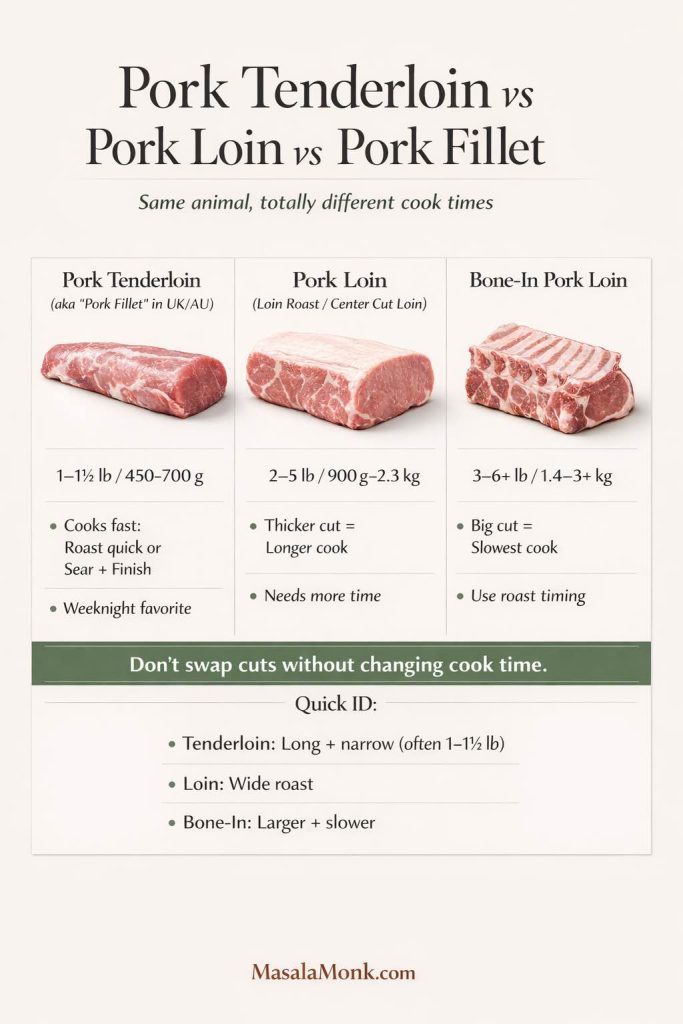
Pork loin chops work well in this recipe when they are sliced into chops and are about ¾ to 1 inch thick. They are lean, so cook them by temperature rather than by a long simmer time.
A whole pork loin roast does not use this skillet timing, and pork tenderloin is a different cut entirely. If you have a roast instead of chops, use a roast-specific method like our slow cooker pork loin recipe.
Pork loin chops work when they are sliced as chops, but pork tenderloin and a whole pork loin roast need different cooking methods.
Thin Pork Chops and Pork Cutlets
Thin pork chops and pork cutlets need a very different rhythm. They brown quickly, cook quickly, and can go from tender to tough while you are still stirring the sauce.
For thin chops, sear briefly, make the sauce, then return them to the skillet only long enough to warm through and finish. Do not simmer thin pork chops for 20–30 minutes in cream of mushroom soup.
Thin pork chops can finish before the gravy looks done, so check them early; thicker chops give you more room for browning, simmering, and sauce-building.
Frozen Pork Chops
Thaw frozen pork chops before making this skillet recipe. Thawed pork browns better, cooks more evenly, and does not release as much water into the pan. Frozen or half-thawed chops can make the sauce watery before the pork is cooked through.
Before simmering, check the pork chop timing guide so thin chops do not get thick-chop timing.
How to Make Pork Chops with Cream of Mushroom Soup in a Skillet
A 12-inch skillet is best if you are using mushrooms and onions. It gives the chops room to brown and the mushrooms space to release moisture, then brown instead of steam.
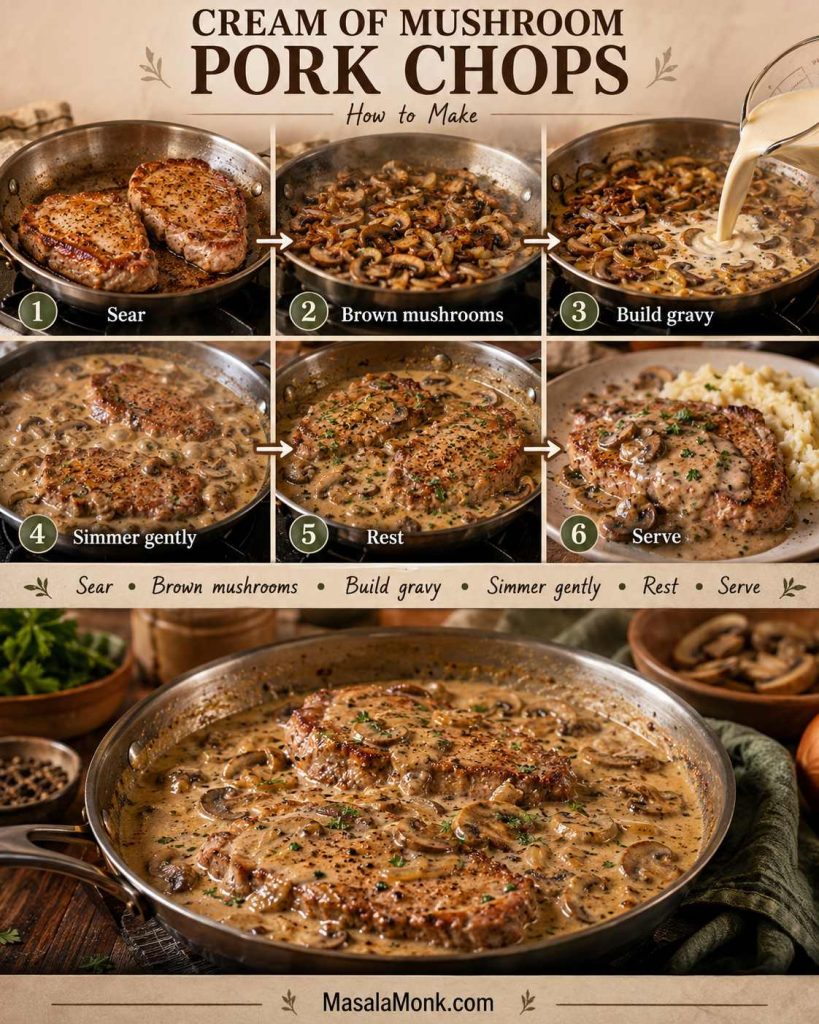
Follow the skillet in stages: first build browning, then turn the soup into gravy, and finally let the pork rest before the sauce goes over the plate.
1. Pat the Pork Chops Dry and Season Lightly
Pat the pork chops dry with paper towels. Season both sides with black pepper, garlic powder or paprika if using, and only a small pinch of salt. Dry surfaces brown; wet surfaces steam.
2. Brown the Pork Chops
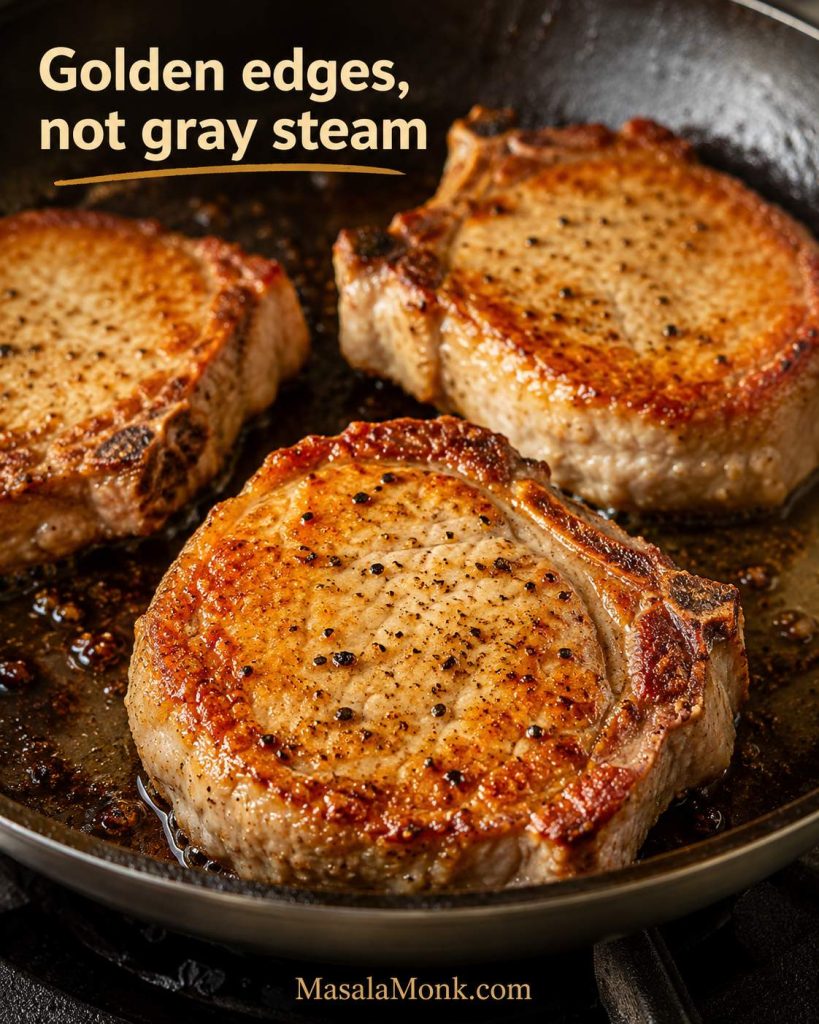
Heat the oil over medium-high heat. Add the pork chops in a single layer, working in batches if needed. Sear until the chops have golden edges instead of a gray steamed surface, about 3–5 minutes per side for ¾–1 inch chops.
Transfer the browned chops to a plate. They do not need to be fully cooked yet. You are building flavor before the creamy mushroom gravy goes in.
A real sear gives mushroom gravy something savory to build on; pale steamed pork cannot add the same depth.
3. Cook the Mushrooms and Onion
Reduce the heat to medium. Add the butter, mushrooms, and onion. Mushrooms usually go through three stages: first they look dry, then they release water, then that water cooks off and the edges begin to brown. Do not rush this stage if you added fresh mushrooms; the moment their water cooks off and the edges start to brown is the moment the sauce stops tasting like plain condensed soup.
Once mushrooms stop steaming and start browning, they bring the savory flavor that keeps cream of mushroom gravy from tasting flat.
4. Add Garlic and Make the Mushroom Gravy
Add the garlic and cook for about 30 seconds. Whisk in the condensed soup and ⅓ cup chicken broth, milk, or water. Add Worcestershire and Dijon if using. The sauce should be loose enough to spoon, but thick enough to coat the pork. Add more liquid a tablespoon at a time.
The soup becomes gravy when it loosens into browned mushrooms, pan juices, and just enough liquid to coat the pork.
5. Simmer the Pork Chops Gently
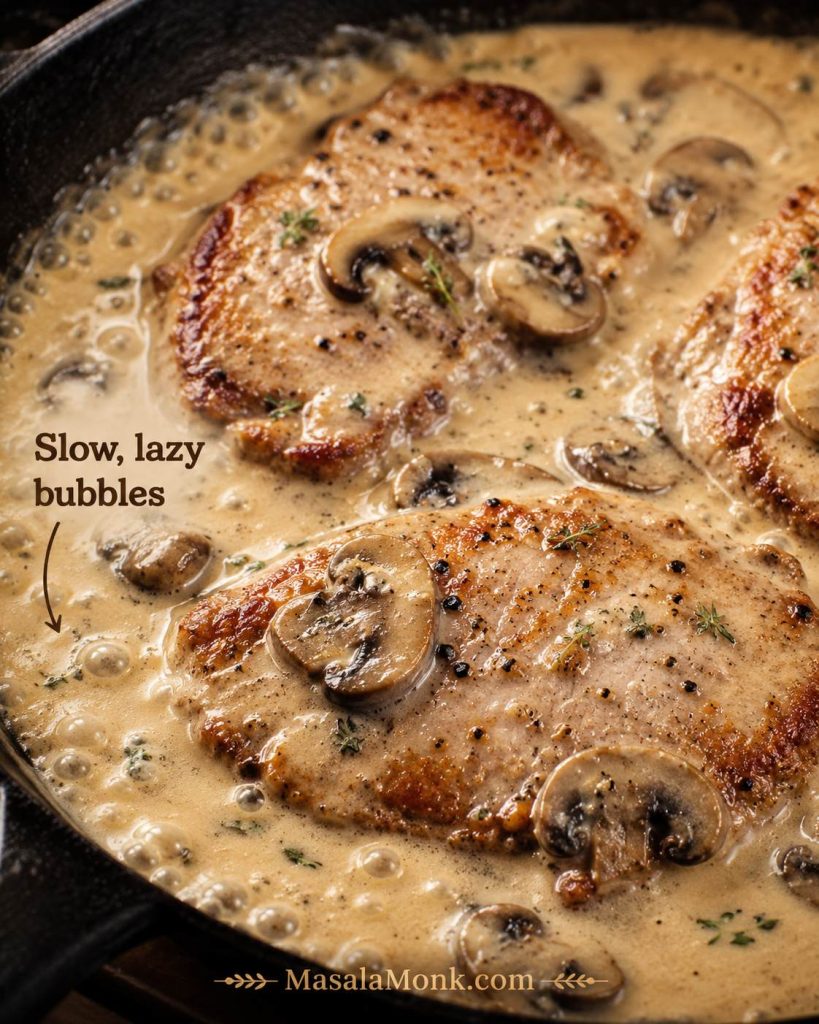
Return the pork chops and any plate juices to the skillet. Spoon gravy over the top, reduce the heat to medium-low, cover loosely, and simmer with slow, lazy bubbles. A rolling boil is too hard for lean pork and can make the gravy feel heavy.
Check the thickest part; when it reaches 145°F / 63°C, move the chops to a plate. If the gravy still needs work, fix the sauce without the pork in the pan.
At this stage, slow bubbles are enough; a hard boil can tighten the pork and make creamy mushroom gravy feel heavy instead of silky.
6. Rest, Taste, and Serve
Rest the pork chops for 3 minutes. While they rest, taste the mushroom gravy. Add black pepper, a splash of broth or milk, parsley, or a tiny squeeze of lemon if the sauce tastes too heavy.
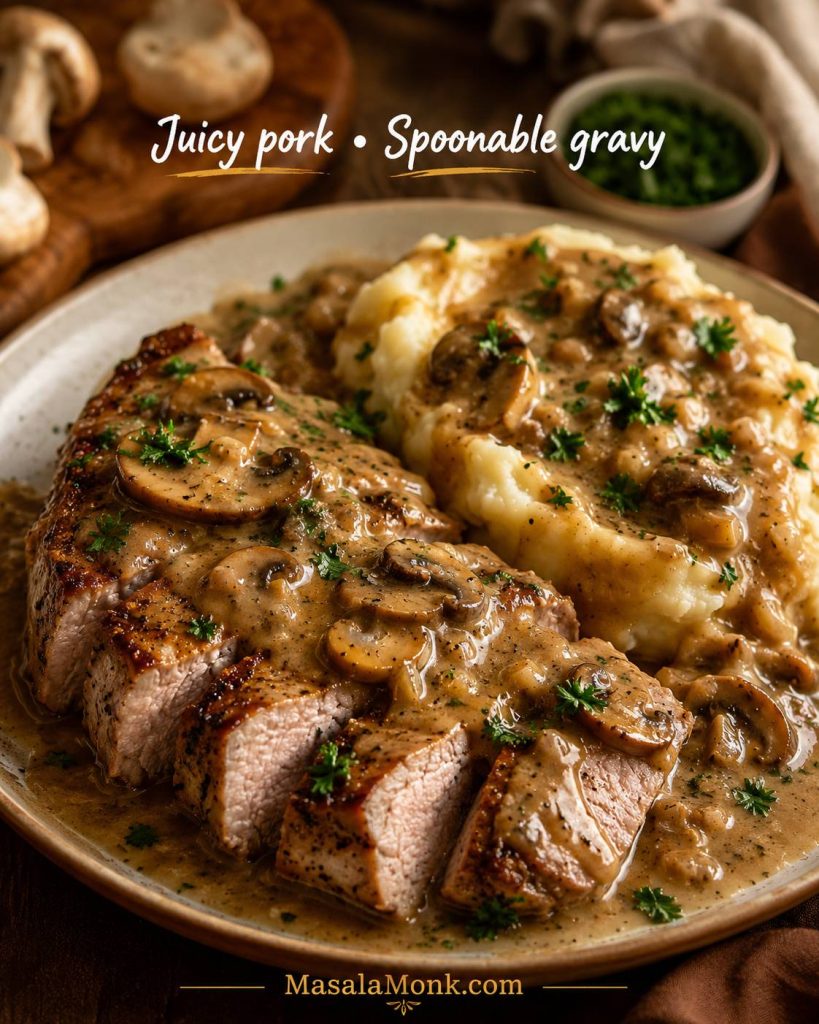
Spoon the creamy gravy over the pork and give it somewhere to land: mashed potatoes, rice, egg noodles, biscuits, or green beans all make the plate feel complete. The sauce should settle over the chop and drift into the side, not run across the plate like soup.
Cream of Mushroom Pork Chops Recipe Card
Classic skillet cream of mushroom pork chops with tender pork, creamy mushroom gravy, optional mushrooms and onions, and enough sauce for potatoes, rice, noodles, or green beans.
Recipe note: once the chops are done, move them out of the skillet and finish the gravy separately if needed.
Prep Time 10 minutes
Cook Time 20 minutes
Total Time 30 minutes
Servings 4
Equipment
12-inch skillet, preferably heavy-bottomed
Tongs
Whisk or sturdy spoon
Instant-read thermometer
Plate for resting the pork chops
Ingredients
4 pork chops, about 1½–2¼ lb / 680 g–1 kg total, preferably ¾–1 inch thick
½ teaspoon black pepper, plus more to taste
½ teaspoon garlic powder or paprika, optional
Small pinch of salt, optional
1 tablespoon oil / 15 ml
1 tablespoon butter / 14 g
8 oz / 225 g fresh mushrooms, sliced, optional but recommended
½ medium onion / 75–100 g, thinly sliced or diced, optional but recommended
2–3 garlic cloves, minced
1 can condensed cream of mushroom soup, 10.5 oz / 298 g, regular or low-sodium
Pat the pork chops dry. Season both sides with black pepper, garlic powder or paprika if using, and only a small pinch of salt.
Heat the oil in a 12-inch skillet over medium-high heat. Add pork chops in a single layer, browning in batches if needed.
Sear until golden, about 3–5 minutes per side for ¾–1 inch chops. Transfer to a plate. The pork does not need to be fully cooked yet.
Reduce heat to medium. Add butter, mushrooms, and onion. Cook 5–7 minutes, until the mushrooms release moisture and begin to brown.
Add garlic and cook for 30 seconds.
Whisk in condensed cream of mushroom soup and ⅓ cup broth, milk, or water. Add Worcestershire and Dijon if using. Add more liquid a splash at a time if you want looser gravy.
Return pork chops and plate juices to the skillet. Spoon gravy over the chops. Reduce heat to medium-low, cover loosely, and simmer gently until the thickest part reaches 145°F.
If the pork is done before the gravy is thick enough, move the chops to a plate and simmer the sauce uncovered by itself.
Rest pork chops for 3 minutes. Taste gravy and adjust with pepper, parsley, or a splash of liquid if needed.
Serve hot with mushroom gravy spooned over the top.
Notes
Use ⅓ cup liquid for thicker gravy and ½ cup for a looser sauce.
Chicken broth is a good default liquid; milk is creamier; water is the classic canned-soup version.
Thin pork chops cook fast. Check them early and do not simmer them like thick chops.
Bone-in chops may need a few extra minutes near the bone.
Once the soup is in the skillet, keep the heat low enough for slow bubbles.
For baked, crock pot, rice, potato, or stuffing versions, the method and timing change.
Need to adjust the sauce? Use the mushroom gravy fixes for watery, thick, or salty gravy.
Creamy Mushroom Gravy Success Cues: Not Watery, Not Pasty
A strong version should feel like gravy dinner, not soup poured over meat. When you cut into the chop, the inside should still look moist, and the sauce should drag slowly from the spoon into potatoes, rice, or noodles.
Look for juicy slices and gravy that settles into the side, so the plate feels creamy and complete instead of soupy.
Success cue
What you want
What to fix
Gravy texture
Coats a spoon and moves slowly
Watery ring around the pan or paste-like sauce
Pork texture
Slices easily and looks moist inside
Dry, gray, tight meat from overcooking
Flavor
Savory, creamy, mushroom-forward
Too salty, bland, or flat
Core fix
Adjust the sauce after the chops are done
Leaving done pork in the pan while fixing gravy
How Long to Cook Pork Chops in Cream of Mushroom Soup
This is where most pork chop dinners are won or lost. The gravy can look perfect while a thin chop quietly overcooks, so timing has to follow thickness, not habit.
Timing by Pork Chop Thickness
Pork chop type
Sear time
Sauce simmer time
Timing note
Thin pork cutlets, about ¼ inch
1–2 minutes per side
1–3 minutes
Most of the cooking happens during the sear. Check early.
½-inch boneless pork chops
2–3 minutes per side
3–5 minutes
Fast, but easy to overcook.
¾-inch boneless pork chops
3–4 minutes per side
4–7 minutes
One of the easiest sizes for this recipe.
1-inch boneless pork chops
4–5 minutes per side
6–10 minutes
Juicier than thin chops; use a thermometer.
1-inch bone-in pork chops
4–5 minutes per side
8–12 minutes
May need a little longer near the bone.
Most forgiving range: ¾–1 inch chops are the easiest size for this recipe. They brown well, stay juicier than thin cutlets, and give the gravy enough time to come together. Thin ½-inch chops still work, but they need a short simmer. Bone-in chops are forgiving, but check the meat near the bone.
Timing depends on thickness, so use chop size as your guide and check the center instead of trusting the clock alone.
Temperature and Resting Note
Treat the table as a starting point, not a contract. Thin chops may finish during the sear; thicker bone-in chops may need more time near the bone. The thermometer gets the final vote: 145°F / 63°C plus a 3-minute rest, which matches FoodSafety.gov’s safe minimum internal temperature guidance for pork chops.
A slightly pink center is not automatically a problem when pork has reached temperature and rested. Dry, gray pork usually comes from chasing old timing habits instead of stopping at the right doneness.
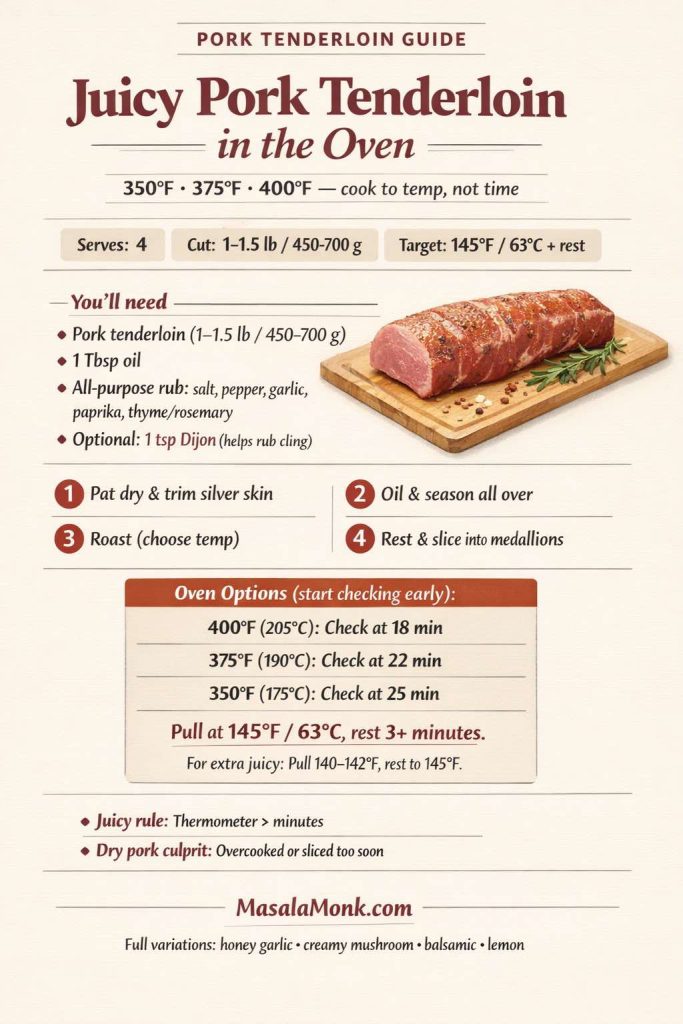
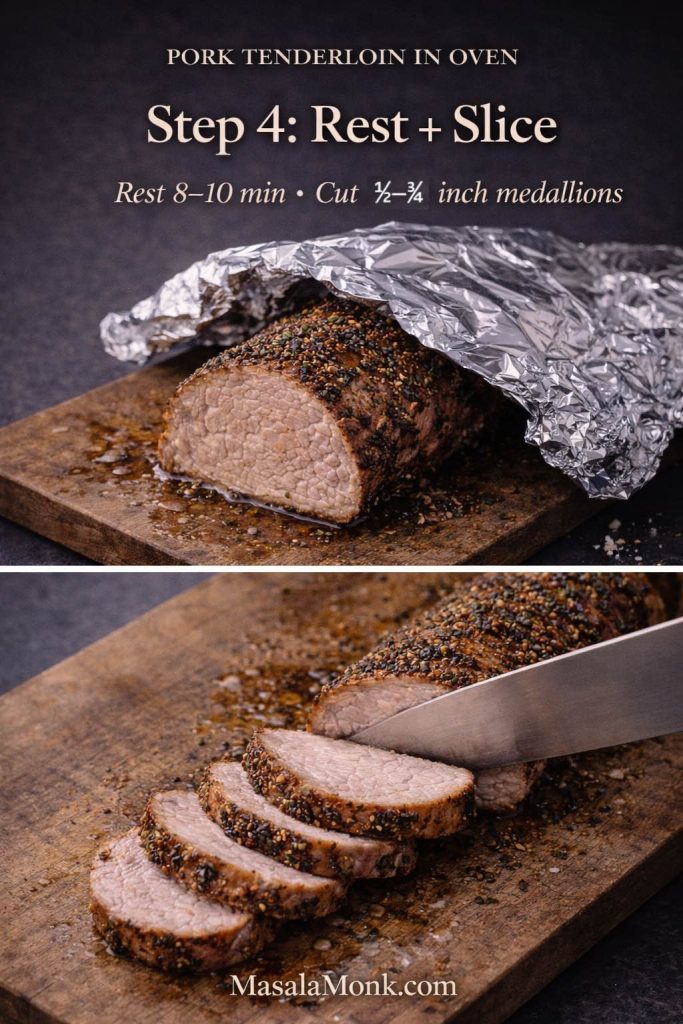
The same temperature-first idea matters with other lean pork cuts; our pork tenderloin in oven guide uses that same rest-before-slicing approach.
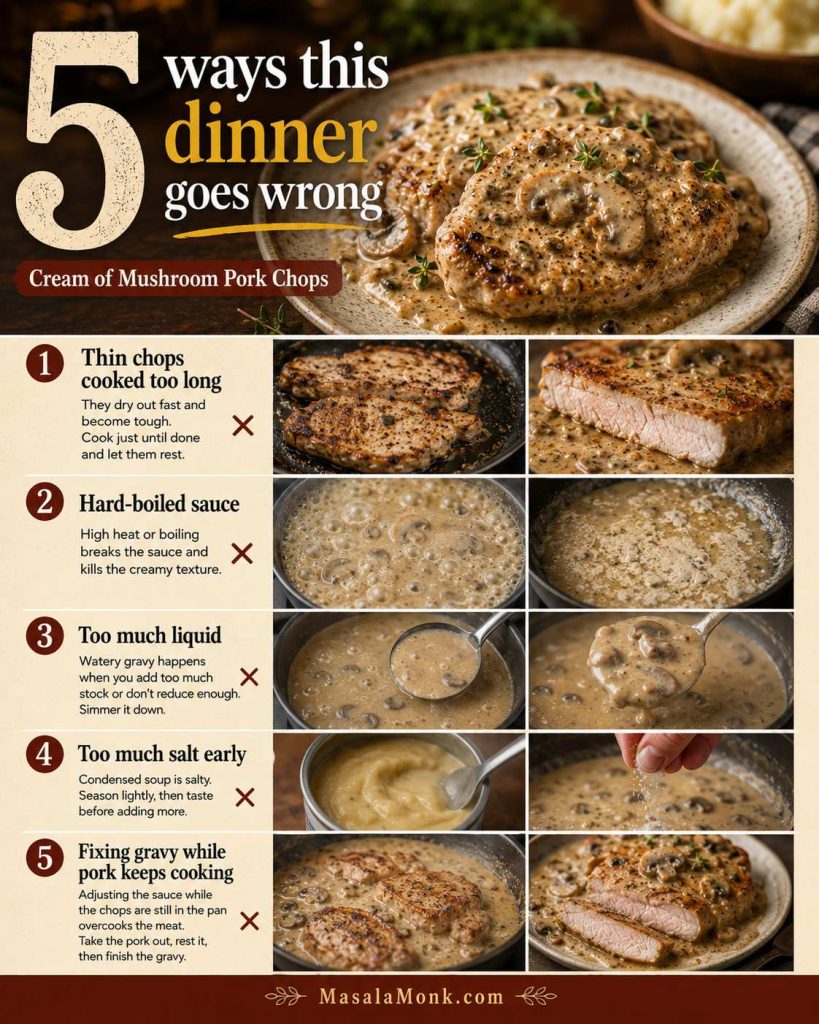
5 Ways This Dinner Goes Wrong — and How to Avoid Them
Most cream of mushroom pork chop problems come from one of five small choices. Fix these before they happen and the whole dinner feels easier.
Do not cook thin chops like thick chops. They can turn tough before the gravy is done, so sear them briefly and return them only long enough to finish.
Do not boil the sauce hard. Once the soup goes in, keep slow bubbles so the pork stays tender and the gravy stays creamy.
Do not add all the liquid at once. Start with ⅓ cup and loosen gradually so the gravy does not turn soupy.
Do not salt heavily before tasting the soup. Condensed soup and seasoning mixes can make the final gravy too salty.
Do not fix gravy while finished pork keeps cooking. Move done chops out first, then thin, thicken, or reduce the sauce.
Most cream of mushroom pork chop problems start small: thin chops stay on too long, sauce boils too hard, liquid gets added too fast, or seasoning happens before tasting.
How to Make the Mushroom Gravy Creamy, Not Watery
The gravy should act like a blanket, not soup. It should coat the pork, slide slowly into mashed potatoes or rice, and taste savory instead of simply salty. Think of it as a mushroom cream sauce for pork chops: creamy enough to coat, but loose enough to spoon.
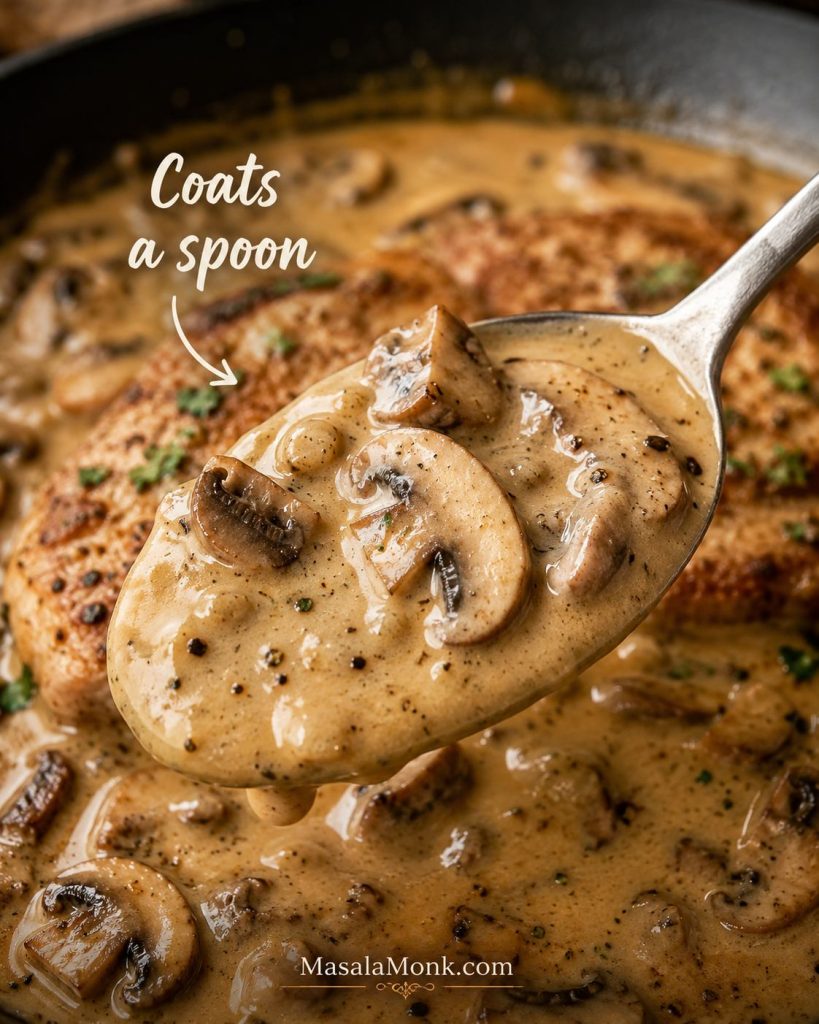
Mushroom Gravy Spoon Test
The easiest visual cue is the spoon: the gravy should cling lightly, then slide off slowly instead of running like broth or sitting like paste.
A good mushroom gravy coats the spoon, but still slides easily over pork chops and into whatever side you serve underneath.
Chicken broth gives the most savory, balanced mushroom gravy and is a reliable everyday default.
Milk makes the sauce softer and creamier, with a milder comfort-food flavor.
Water keeps the classic canned-soup taste and works well for the pantry version.
A small splash of white wine brightens the gravy when you are using fresh mushrooms and onion.
For one 10.5-ounce can of condensed cream of mushroom soup, start with ⅓ cup liquid if you want thick gravy. Use up to ½ cup when you want more sauce for rice, noodles, or potatoes. Add extra liquid in tablespoons, not big pours.
Too Thin, Just Right, or Too Thick Mushroom Gravy
Use the texture as your guide before serving. Thin gravy needs reducing, thick gravy needs a splash of liquid, and just-right gravy should look glossy and spoonable.
If the gravy looks watery, simmer it down; if it turns too thick, loosen it slowly until the sauce becomes glossy and spoonable again.
How to Thicken Mushroom Gravy
If the gravy is too thin, remove the pork chops and simmer the sauce uncovered until it coats a spoon. For a faster fix, whisk 1 teaspoon cornstarch with 1 tablespoon cold water, stir that slurry into the simmering gravy, and cook for a minute or two.
How to Thin Mushroom Gravy
If the gravy turns pasty, lower the heat and add broth, milk, or water a splash at a time. Stir until the sauce loosens and looks glossy again. A thick sauce is easy to fix as long as the pork is not still sitting in it over heat.
How to Keep the Gravy from Tasting Too Salty
Use low-sodium broth if your soup is salty, and be careful with onion soup mix, bouillon, gravy packets, ranch seasoning, or seasoned salt. If the finished sauce tastes too salty, soften it with milk, cream, unsalted broth, or sour cream, then serve it with plain potatoes, rice, noodles, or vegetables.
If the pork is already cooked and the sauce still needs help, use the troubleshooting guide instead of simmering the chops longer.
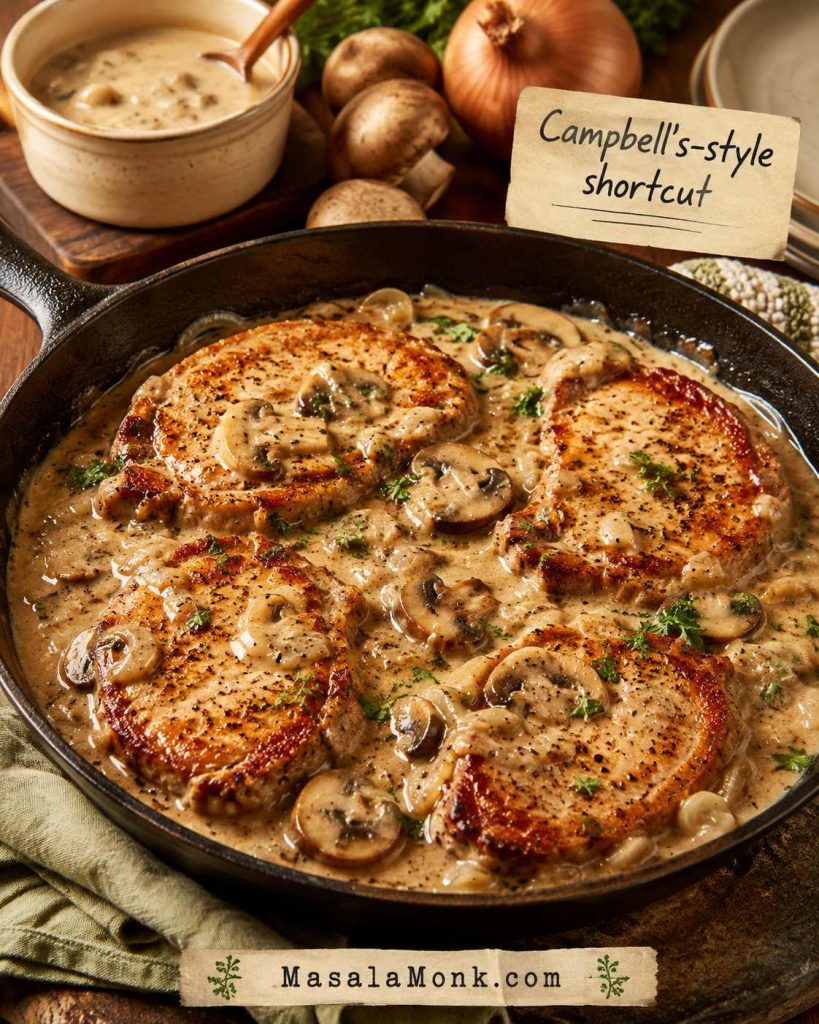
Campbell’s-Style Cream of Mushroom Pork Chops
This is the version many people remember: pork chops, condensed cream of mushroom soup, water, black pepper, and a short simmer. It is not fancy, and it does not need to be. The one upgrade worth keeping is temperature control instead of simmering by habit.
Campbell’s-style pork chops are the nostalgic shortcut version, but browning the meat and simmering gently make the gravy taste more like dinner.
Campbell’s-style shortcut: brown 4 pork chops, stir 1 can condensed cream of mushroom soup with ½ cup water, return the chops to the pan, cover, and simmer gently until the pork reaches 145°F. Rest 3 minutes before serving.
Use the classic version when you want the childhood shortcut. Use the upgraded version when you want the same comfort with deeper flavor and better gravy texture.
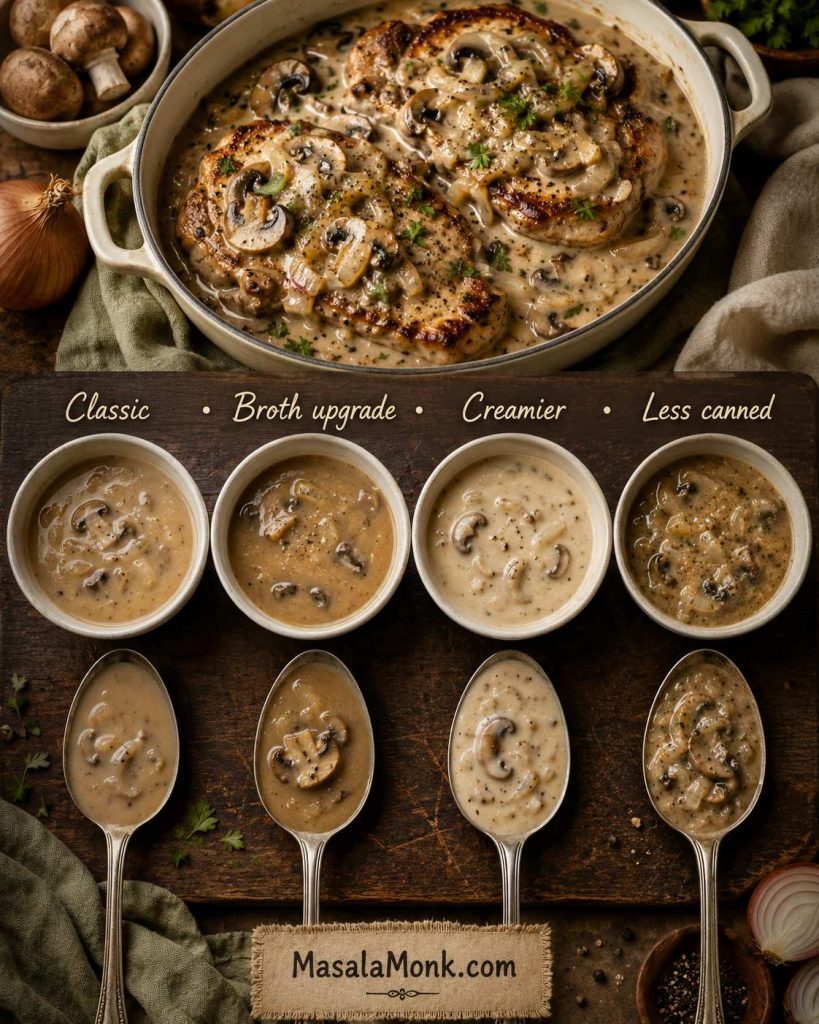
Water, Broth, or Milk for Campbell’s-Style Pork Chops
Version
Liquid / add-ins
Flavor
Campbell’s-style classic
½ cup water
Nostalgic, simple, most like the old shortcut
Better weeknight version
⅓–½ cup chicken broth
Savory, fuller, still easy
Creamier version
⅓–½ cup milk
Softer, richer, milder
Less canned version
Broth + mushrooms + onion + Worcestershire
More homemade without losing the shortcut
Water gives the classic canned-soup flavor, broth adds savory depth, milk softens the sauce, and browned mushrooms make the shortcut taste more complete.
The thermometer is the reliability upgrade. The classic recipe tells you to simmer until done; this version gives the pork a clear stopping point.
Baked, Crock Pot, Rice, Potatoes, and Stuffing Versions
These versions are popular because they solve different dinner problems. The baked version is hands-off, the crock pot version waits for you, and rice, potatoes, or stuffing can turn pork chops into a full casserole. The tradeoff is that each version needs its own moisture and timing.
Baked Pork Chops with Cream of Mushroom Soup
Oven answer: brown the pork chops first, cover them with cream of mushroom soup gravy, bake covered at 350°F, and stop when the chops are just done. Keep the dish covered for a creamy bake; uncover only briefly if the gravy needs to reduce.
For many ¾–1 inch chops, start checking around 25 minutes after browning; thicker covered versions may take longer, but doneness decides.
Thin or ½-inch boneless chops need a short covered bake after a brief sear. Check early; they should not get thick-chop timing.
¾–1 inch boneless chops are the most reliable baked version because they brown well and give the sauce time to heat through.
1-inch bone-in chops make a cozier, more forgiving oven dinner, but check the meat near the bone.
Check early; baked chops can dry out if they sit too long after they are done. The oven should not become a holding place for already-finished lean pork.
In a baked version, the covered dish protects the gravy. The main job is checking the pork before the oven turns it dry.
Crock Pot Cream of Mushroom Pork Chops
Slow cooker answer: use thawed thicker pork chops, condensed cream of mushroom soup, a little broth, and optional onion soup mix or mushrooms. For sliceable chops, start checking earlier; for fall-apart-style chops, many slow-cooker recipes run 6–8 hours on low. Very thin boneless chops are the riskiest choice, and the sauce can be thickened at the end if it looks loose.
A crock pot version is best treated as its own recipe, not as the skillet method stretched over several hours. Slow cookers trap liquid, so the gravy will usually be thinner than skillet gravy. Very thin boneless chops are convenient, but they can dry out before they become truly tender.
Thin boneless chops: use the skillet method if possible because they dry out easily under long heat.
Thicker boneless chops: a better slow-cooker option because they give you more room before overcooking.
Bone-in chops: good if they fit in one layer; the bone helps protect the meat a little.
Loose sauce at the end: thicken it after the chops are cooked rather than cooking the pork longer.
For crock pot cream of mushroom pork chops, thicker cuts and enough sauce matter because slow heat rewards moisture but can punish very thin chops.
Pork Chops and Rice with Cream of Mushroom Soup
Rice is where this recipe stops being a simple skillet dinner and starts behaving like a casserole. That is why the liquid changes so much.
For the quickest dinner, make the skillet pork chops first, then spoon the mushroom gravy over cooked rice.
For pork chops and rice with cream of mushroom soup, decide early: serve skillet pork over cooked rice, or build a covered rice casserole from the start.
Cooked Rice Side vs Baked Rice Casserole
If you want…
Do this
Why
Skillet pork chops with rice
Cook rice separately and spoon mushroom gravy over it
The pork timing stays short and controlled.
One-pan pork chops and rice
Use a covered baked casserole method
Uncooked rice needs more liquid, tight coverage, and longer cooking.
Uncooked rice
Add enough broth/water and bake until rice is tender
A skillet sauce for pork chops does not contain enough liquid for raw rice.
Leftover cooked rice
Warm separately or fold into the sauce after the pork is done
It should heat through, not keep the pork cooking.
Cooked rice is the easiest side for skillet pork chops, while a baked rice casserole needs its liquid, cover, and timing planned from the beginning.
For the safest weeknight version, make the skillet pork chops and serve them over cooked rice. For a true pork chops and rice casserole, build that dish around the rice from the beginning.
Simple Baked Rice Starting Point
Simple baked rice direction: as a starting point for a casserole-style version, use 1 cup long-grain rice, 1 can condensed cream of mushroom soup, and about 1½ cups broth in a tightly covered dish, then bake at 350°F until the rice is tender and the pork is just done. If the pork finishes before the rice, lift the chops out and let the rice continue covered.
If adding rice to a slow cooker version, do not add it at the very beginning unless you are following a dedicated slow-cooker rice recipe. Rice can absorb too much liquid and turn mushy; add it later or serve the pork over separately cooked rice.
Pork Chops with Cream of Mushroom Soup and Potatoes
Easiest potato shortcut: serve the skillet version over mashed potatoes so the gravy has somewhere soft to land. For raw sliced potatoes, cut them thin, add enough liquid, cover tightly, and treat the dish like a casserole rather than a skillet pork chop recipe.
Potatoes make the meal heartier; however, sliced potatoes need covered moisture and enough time, so they behave more like a casserole than a skillet add-in.
Pork Chops, Stuffing, and Cream of Mushroom Soup
Easiest stuffing shortcut: hydrate the stuffing first, then bake it covered with the pork and mushroom sauce. Dry stuffing should not be scattered into the pan because it will pull moisture from the gravy and make the whole dish feel dry.
Stuffing needs moisture to stay soft, so treat this as a covered bake rather than a quick skillet add-in.
Easy Variations
Use these variations to change the flavor while keeping the same easy skillet rhythm.
Soup Swaps
Golden mushroom soup pork chops: use golden mushroom soup when you want a darker, tangier, more brown-gravy style sauce. It is less creamy than classic cream of mushroom.
Cream of chicken soup substitute: use cream of chicken when you want a milder sauce or do not have mushroom soup. Add sautéed mushrooms if you still want mushroom flavor.
Flavor Boosters
Onion soup mix: adds strong savory flavor, but use low-sodium soup or broth if possible because the gravy can get salty quickly.
Ranch seasoning: gives a tangy, family-style flavor. Start with less than a full packet and taste before adding more.
Worcestershire and Dijon: make the sauce taste fuller without changing the comfort-food feel.
Smothered Pork Chops with Cream of Mushroom Soup
For a smothered version, make extra gravy and use mushrooms, onions, and a little more liquid. Brown the chops, build the sauce, simmer gently, then remove the pork as soon as it is done. Reduce or thicken the gravy separately so the chops stay juicy while the sauce gets rich.
Smothered cream of mushroom pork chops should feel extra saucy, with mushrooms and onions making the gravy rich enough to carry the whole plate.
Richer Finishes
Sour cream finish: take the skillet off the heat and stir in a spoonful of sour cream at the end for a tangier, creamier sauce.
Extra mushrooms and onions: double the mushrooms if you want the gravy to feel more homemade and less like a plain soup sauce.
Small splash of cream: useful if the sauce tastes sharp or salty and needs softening.
Double Batch for a Family Dinner
For 8 pork chops, use 2 cans of condensed cream of mushroom soup and about ⅔ to 1 cup liquid. Brown the pork in batches so it does not steam, then finish in a large skillet, braiser, or baking dish. Check chops individually because crowded pans do not cook evenly.
What to Serve with Cream of Mushroom Pork Chops
This is a gravy dinner, so give the gravy somewhere to land. The easiest sides are simple enough to carry the gravy or fresh enough to balance it.
Mashed potatoes: the classic choice when you want a cozy plate with plenty of mushroom gravy.
White rice or brown rice: easy, filling, and ideal when the rice is cooked separately from the skillet pork chops.
Egg noodles: a stroganoff-style direction without changing the recipe.
Green beans: crisp and fresh enough to balance the richness.
Peas: sweet, simple, and very good with salty-creamy mushroom gravy.
Broccoli: roasted or steamed, especially with extra black pepper on the sauce.
Biscuits: useful when you want a very cozy, gravy-heavy plate.
Simple salad: useful when the meal needs something bright and clean beside it.
Creamy mushroom pork chops pair best with sides that catch gravy or add freshness, such as mashed potatoes, rice, egg noodles, green beans, peas, or broccoli.
If the gravy tastes rich or salty, choose a plain side like rice, potatoes, noodles, or steamed vegetables. If the plate feels a little too beige, add green beans, peas, broccoli, or a sharp salad. Let the mushroom sauce be the comfort; let the side bring the lift.
Storage and Reheating
Store leftover pork chops with the mushroom gravy when possible. The sauce helps protect the meat from drying out in the fridge and makes reheating easier.
Storage question
Quick answer
Fridge
Store in an airtight container for 3–4 days.
Freezer
Freeze up to 2–3 months, though creamy gravy may look slightly separated after thawing.
Gentlest reheating method
Warm gently in a covered skillet over low heat with a splash of broth or milk.
Microwave
Use lower power, cover loosely, and heat in short bursts.
What to avoid
Do not boil leftovers hard; it tightens the pork and can make the sauce split.
Store the pork with its mushroom gravy when possible; later, a small splash of broth or milk helps the sauce loosen without boiling the meat again.
If the pork chops are thick, slicing them before reheating can help them warm faster and more evenly. Add a spoonful of extra gravy over the slices before serving. Reheat gently; boiling leftover pork in the sauce can make it tighter.
Troubleshooting the Pork Chops and Mushroom Gravy
The mistake section prevents problems. This section is for the moment when dinner is already in the pan and you need a fix. When the chops are already done, move them out first, then repair the gravy.
Problem
Fix now
Fix next time
Pork chops turned tough
Slice thinly across the grain and spoon hot gravy over the slices.
Use thicker chops, simmer gently, and check temperature earlier.
Sauce is too thick
Add broth, milk, or water a splash at a time over low heat.
Start with ⅓ cup liquid, then adjust gradually.
Gravy looks watery
Remove pork and simmer the sauce uncovered until it coats a spoon.
Thaw pork fully, pat dry, and avoid adding too much liquid at the start.
Gravy tastes too salty
Stir in milk, cream, unsalted broth, or sour cream; serve with plain sides.
Use low-sodium soup or broth and go easy on seasoning mixes.
Pork tastes bland
Add black pepper, Worcestershire, Dijon, parsley, or extra sautéed mushrooms to the gravy.
Brown the pork harder and build more flavor before the soup goes in.
When dinner is already in the pan, protect the pork first; then simmer watery gravy, loosen thick sauce, dilute salty gravy, or spoon extra sauce over dry slices.
How long do pork chops cook in cream of mushroom soup?
After browning, thin pork chops may need only 1–3 minutes in the sauce. Chops around ¾ to 1 inch thick usually need about 4–10 minutes, depending on whether they are boneless or bone-in. The thickest part should reach 145°F, followed by a 3-minute rest.
What temperature keeps pork chops juicy and safe?
Pork chops should reach 145°F / 63°C, followed by a 3-minute rest. That keeps the pork juicier than old-school overcooked chops while still giving you a safe finished dinner.
How much water do you add to cream of mushroom soup for pork chops?
For one 10.5-ounce can of condensed cream of mushroom soup, use ⅓ to ½ cup liquid. Use ⅓ cup for thicker gravy and ½ cup for a looser sauce. Water is classic, broth is more savory, and milk makes the sauce creamier.
Is milk, broth, or water best for the gravy?
Chicken broth is a good default because it makes the gravy taste more savory without much effort. Milk gives a softer, creamier sauce. Water gives the most classic Campbell’s-style flavor and is useful when the soup or seasoning mix is already salty.
Boneless or bone-in pork chops: which is better?
Boneless chops cook faster and are easiest for a quick skillet dinner. Bone-in chops are often more forgiving and can stay juicier, but they may need a little more time near the bone.
Thin pork chops keep drying out. What should I do?
Sear them briefly, make the sauce, then return them only long enough to warm through and finish. Very thin chops should not simmer like thick chops.
Skillet or oven: which method is easier?
The skillet is faster and gives you better control over the gravy. The oven is easier when you want a covered baked version or when you are adding rice, potatoes, or stuffing. Either way, brown the pork first when possible and cook by temperature.
Crock pot pork chops with cream of mushroom soup: what should I know?
Use thawed, thicker chops rather than very thin boneless chops. Slow cookers trap moisture, so the sauce may look loose at the end; thicken it after cooking if needed. For fall-apart-style chops, many slow-cooker recipes run longer, often 6–8 hours on low.
Can I cook rice in the same pan?
Not for the quick skillet method. Uncooked rice needs extra liquid, covered heat, and more time than skillet pork chops should spend cooking. Use cooked rice as a side, or make a covered baked casserole built around the rice.
Why did the pork chops turn tough?
They were probably too thin for the timing, simmered too hard, or cooked past the right doneness point. Creamy gravy helps the plate, but it cannot fully undo overcooked lean pork.
Final Thoughts
Cream of mushroom pork chops are not trying to be fancy. They earn their place because they ask so little and give back so much: browned pork, creamy mushroom gravy, and a plate that feels complete with rice, potatoes, noodles, or whatever simple side you already have.
Keep the gravy spoonable, keep the heat gentle, and stop while the chops are still juicy. That is the whole promise of this dinner: one can of soup, one skillet, and a plate of creamy mushroom pork chops that tastes like you gave it more effort than you did.
This pork tenderloin in oven recipe gets much easier once you stop trusting the clock alone. Because the cut is lean, a few extra minutes can take it from juicy to dry. Season it well, choose the oven temperature that suits dinner, cook the thickest center to 145°F / 63°C, rest, then slice.
Once that foundation is right, the same tenderloin can go honey garlic, creamy mushroom, lemony, balsamic, mustardy or BBQ without relearning the method. The guide also covers cast iron, a sheet-pan dinner, slow cooker, Instant Pot, grill, smoker, stuffed tenderloin and leftovers—but the dependable oven method comes first.
Quick answer: pork tenderloin in the oven
For a 1–1½ lb (450–700 g) pork tenderloin, roast at 400°F for about 18–24 minutes, 375°F for 22–30 minutes, or 350°F for 25–35 minutes. Start checking early and trust the thermometer more than the clock: the finished center should reach 145°F / 63°C, followed by an 8–10 minute rest before slicing.
Save this quick guide: pork tenderloin in the oven at 350°F, 375°F, or 400°F—plus the exact 145°F (63°C) internal temperature and resting rule for juicy slices every time.
Take what you need tonight, then come back later when you want a different flavor without learning a new technique.
Pork tenderloin vs pork loin vs pork fillet (so timing finally clicks)
Before the oven even warms up, it helps to know what you’re cooking. Pork tenderloin and pork loin are not the same thing, and swapping them without adjusting time is one of the fastest ways to end up disappointed.
Not sure if you bought pork tenderloin or pork loin? This quick guide shows pork tenderloin vs pork loin vs pork fillet (UK/AU) and explains why cook time changes—so your oven roast stays juicy instead of overcooked.
Pork tenderloin is long, narrow, and usually weighs around 1 to 1½ pounds (about 450–700 g). It’s sometimes labeled as pork fillet, especially in the UK and Australia, which is why you’ll see phrases like “pork fillet oven time” or “roasting pork fillet UK.” In most cases, those are still talking about tenderloin.
Pork loin, on the other hand, is thicker and wider. It can show up as a whole boneless pork loin, a center cut pork loin filet, or a loin end pork roast, and it commonly weighs 2 to 5 pounds. A bone in pork loin roast will be even bigger and needs more time. When someone mentions “pork loin on the bone” or “bone in pork loin roast,” that’s a different cook altogether.
Tenderloin cooks quickly; loin cooks more slowly. That difference influences everything—temperature, timing, and how much rest you need.
If your package says pork tenderloin (sometimes labeled pork fillet), you’re in the right place. If it says pork loin roast, you can still use many flavor ideas below, but you must increase cook time and treat it like a larger roast. The flavors can transfer; the timing cannot.
If your package actually says pork loin roast, don’t stretch these tenderloin times to fit it. Switch to our Slow Cooker Pork Loin Recipe, which is built for that larger cut and gives you the right timing, moisture, and doneness guidance.
The one rule that keeps pork tenderloin juicy
If there’s a single habit that transforms pork tenderloin, it’s cooking by internal temperature instead of guessing. Whole cuts of pork are considered safe at 145°F / 63°C followed by a short rest, as shown in the official guidance on the USDA safe temperature chart and the FoodSafety.gov temperature chart.
That standard is also where tenderloin tends to be at its best: juicy, tender, and sliceable. Start checking around 140°F so you can catch the roast before it overshoots, then remove it from the heat when the thickest center reaches 145°F / 63°C. Rest for at least 3 minutes; for clean, juicy slices, 8–10 minutes works especially well.
If you’re looking for “pork fillet oven time,” use this chart first — “pork fillet” is another name for pork tenderloin in many regions. Times vary by thickness, so start checking a little early and cook to temperature.
Pork Fillet (Tenderloin) Oven Time Chart
Oven Temp
Approx. Cook Time*
Best For
Remove At (Internal Temp)
350°F (175°C)
25–35 min
Most even cooking, biggest “juicy” safety margin
145°F / 63°C
375°F (190°C)
22–30 min
Balanced: quicker, still tender
145°F / 63°C
400°F (205°C)
18–25 min
Fastest; great when finishing with a glaze
145°F / 63°C
Temperature & Time Guide Table for Pork Fillet (Tenderloin) Oven
Times are a practical starting range for a typical 1–1½ lb (450–700 g) pork fillet/tenderloin. Thickness matters more than weight alone, so begin checking early and use the thermometer as the final doneness test.
Use the thermometer, not color or the clock: start checking around 140°F, remove an unstuffed pork tenderloin at 145°F / 63°C, then rest 8–10 minutes. For stuffed tenderloin, the center of the filling must reach 165°F / 74°C.
A little pink doesn’t automatically mean undercooked. Pork tenderloin can still have a faint rosy center after the thickest part has safely reached 145°F / 63°C. Color alone is not the doneness test—the thermometer is. Some people prefer the softer, juicier texture at 145°F; others simply like taking theirs a little higher for a firmer bite.
Three small details make the biggest difference:
Carryover heat is real. The temperature rises slightly after you remove the roast from the oven.
Resting matters. It’s not a polite suggestion; it’s how juices settle back into the meat.
Slicing too early costs you moisture. Even a perfectly cooked tenderloin can look dry if you cut it the moment it comes out.
If you prefer a firmer, more cooked texture, let the center reach about 150°F / 66°C before removing it from the oven. Even then, resting still helps the slices stay tender.
Pork tenderloin in oven: 350°F vs 400°F vs 375°F
There’s more than one “right” oven temperature. What matters is how the heat fits your evening.
Not sure whether to bake pork tenderloin at 350°F, 375°F, or 400°F? Use this quick chart to pick your oven temp, start checking at the right time, and pull at 145°F (63°C) for juicy pork tenderloin every time.
400°F (fast, great browning)
This is the weeknight favorite. It cooks quickly, encourages color on the outside, and works especially well with glazes—honey garlic, balsamic, maple-apricot, teriyaki-style finishes, or a BBQ brush-on at the end.
350°F (gentle, forgiving)
This is the calm, steady approach. It’s ideal when you’re also roasting vegetables and want everything to land together. It also gives you a slightly wider window before the meat goes past its sweet spot.
375°F (middle path)
This is the comfortable compromise: enough heat for browning, plus a gentler roast than 400°F.
There tend to be two strong camps here: 400°F people want browned edges and dinner sooner; 350°F people want the gentler timing window. Then 375°F sits quietly in the middle doing both reasonably well. There isn’t a single winner—the useful choice is the one that fits tonight’s dinner.
No matter which temperature you pick, the finish remains the same: cook to temperature, rest, slice.
The seasoning that makes pork taste like dinner, not “protein”
Because tenderloin is mild, seasoning is the difference between “fine” and genuinely craveable. Salt helps the meat hold onto moisture, while aromatics and spices build a crust that tastes roasted and savory.
You’ll get two approaches here:
a reliable all-purpose rub
targeted flavor profiles that turn the same roast into different meals
Use this all-purpose pork tenderloin rub for oven roasting, cast iron, grilling, or smoking—plus quick swaps for lemon herb, honey/balsamic/BBQ glazes, and extra heat for a more flavorful crust.
All-purpose tenderloin rub (recipe for 1–1½ lb / 450–700 g)
1 tsp brown sugar (optional, helps browning and pairs well with glazes)
This rub is flexible: it works for oven roasting, cast iron, grilling, and smoking. If you know you’re going lemon herb, you can skip the brown sugar. If you’re going honey garlic or balsamic, keep it.
A quick note on resting after seasoning
If you have time, season and let the tenderloin sit while the oven heats. Even 20 minutes helps. If you can do 45–60 minutes, the flavor tends to taste more “inside” the meat rather than just on the surface.
Want the flavor to go deeper than a surface rub? The Pork Tenderloin Marinade guide gives you quick, same-day, and overnight options, plus oven, grill, and air-fryer directions so the outside browns without the marinade scorching.
Pork tenderloin in oven: the core recipe
This is the dependable method that anchors everything else. Once it’s familiar, variations become simple choices rather than brand-new recipes.
Save this core pork tenderloin recipe card: choose 350°, 375°, or 400°, start checking early, remove the tenderloin at 145°F / 63°C, rest 8–10 minutes, then slice into juicy medallions.
Optional: 1 tbsp butter (useful for finishing or pan sauce)
If your package says pork fillet (UK/AU), it’s usually pork tenderloin—use the same 350/375/400 method below and remove it from the heat at 145°F / 63°C.
Step 1: Trim and dry
Pat the tenderloin dry very thoroughly. That dryness helps the seasoning stick and improves browning. If you see silver skin (a thin, shiny membrane), trim it away; it doesn’t soften with cooking.
Before pork tenderloin goes in the oven, pat it very dry and trim off any silver skin—this one step improves browning and keeps the finished medallions tender instead of chewy.
If one end is thinner, tuck that end under itself and tie lightly with kitchen twine. That small adjustment helps the roast cook more evenly so you don’t end up with overdone tail slices.
Step 2: Season properly
Rub the tenderloin with oil. If using Dijon, rub it on next. Then coat all sides with the seasoning rub, pressing gently so it adheres.
For pork tenderloin in the oven that tastes seasoned all the way through, coat it evenly: oil first, a thin swipe of Dijon if you like, then press on the rub so it sticks—no patchy spots, better browning, better flavor.
At this point, the surface should look evenly coated, not patchy. The aroma should be savory and warm from paprika and garlic.
Step 3: Roast (choose one temperature)
Pork tenderloin in oven at 400°F (205°C)
Preheat oven to 400°F.
Roast 18–24 minutes, depending on thickness.
Start checking temperature at 18 minutes.
Remove from the oven when the thickest part reaches 145°F / 63°C.
Rest 8–10 minutes, then slice.
What you’ll notice: the outside develops a deeper color, and the kitchen smells roasted and garlicky. The surface should look set and lightly browned rather than pale. This is the classic “pork tenderloin 400” approach that works beautifully for a quick dinner and crisp edges.
Roast pork tenderloin at 350°, 375°, or 400°—start checking early, then remove it at 145°F / 63°C and rest 8–10 minutes before slicing.
Pork tenderloin in oven at 350°F (175°C)
Preheat oven to 350°F.
Roast 25–35 minutes.
Start checking temperature at 25 minutes.
Remove from the heat at 145°F / 63°C.
Rest 8–10 minutes, then slice.
What you’ll notice: slightly gentler browning, an even roast, and a more gradual finish. This is a comfortable option when you’re coordinating sides, or when you want the tenderloin to finish more evenly across the center.
Pork tenderloin in oven at 375°F (190°C)
Preheat oven to 375°F.
Roast 22–30 minutes.
Start checking at 22 minutes.
Remove from the heat at 145°F / 63°C.
Rest 8–10 minutes, then slice.
What you’ll notice: a balance—good color, but still forgiving.
Step 4: Rest, then slice into medallions
Move the tenderloin to a cutting board and tent loosely with foil. While it rests, you can make a pan sauce, warm a glaze, or finish sides.
Step 4 is the juiciness step: rest pork tenderloin after roasting for 8–10 minutes, then slice across the grain into 1/2–3/4 inch medallions so every piece stays tender and moist.
After resting, slice across the grain into medallions. If the knife meets resistance, your slices may be too thick or you may be cutting in the wrong direction. Aim for slices about ½ to ¾ inch thick for a tender bite.
Next method: Air Fryer Pork Tenderloin →
Want the same juicy tenderloin without heating the whole oven? Try our Air Fryer Pork Tenderloin next. It uses the same temperature-first approach—cook the thickest center to 145°F / 63°C, rest, then slice—but gives you browned edges in a smaller appliance. Most standard 1–1½ lb tenderloins take about 18–24 minutes, depending on thickness and the air fryer.
Cast iron pork tenderloin (sear + oven finish)
If you want deeper browning and a more savory “pan-roasted” flavor, start the tenderloin in a hot cast-iron skillet and finish it in the oven. The sear builds crust quickly; the oven brings the center to temperature gently.
This method is especially satisfying when serving the tenderloin plain with vegetables, because the crust brings flavor without needing a heavy sauce.
Ingredients
1 seasoned pork tenderloin
1 tbsp neutral oil (avocado, canola, grapeseed)
Optional: 1 tbsp butter + 1 smashed garlic clove + a sprig of thyme or rosemary
Want a deeper crust? This cast iron pork tenderloin guide shows the sear + oven finish method (400°F) and the exact 145°F (63°C) target temp, so you get juicy slices with real browning—not dry pork.
Method
Preheat oven to 400°F.
Heat a cast-iron skillet over medium-high until hot. Add oil.
Lay the tenderloin in the pan. You should hear an immediate sizzle.
Sear on all sides, turning every 1–2 minutes, until browned all around (about 6–8 minutes total).
Slide the skillet into the oven. Roast until the center reaches 145°F / 63°C (often 8–12 minutes depending on thickness).
Rest 8–10 minutes, then slice.
If you’re adding butter, drop it in during the last minute on the stovetop. As it foams, baste the tenderloin with a spoon for 20–30 seconds. The aroma becomes richer and more “roast-like,” even before it goes into the oven.
Creamy mushroom sauce (below) + mashed potatoes or roasted potatoes
Chimichurri on the side + grilled vegetables
Mustard glaze + carrots and onions roasted until sweet
Pork tenderloin with potatoes and carrots (sheet-pan dinner)
A sheet-pan dinner turns tenderloin into a complete meal with minimal effort. The only trick is timing: potatoes and carrots need a head start; the pork goes in later so it stays juicy.
Ingredients (serves 4)
1 pork tenderloin, seasoned (use the rub or any glaze variation)
500 g potatoes, cut into 1-inch chunks
3–4 carrots, cut into thick coins or batons
1 medium onion, cut into wedges (optional but excellent)
2–3 tbsp olive oil
1 tsp kosher salt
½ tsp black pepper
1 tsp dried thyme or rosemary
Optional: 1 tsp smoked paprika for the vegetables
One-pan dinner made easy: this sheet-pan pork tenderloin with potatoes and carrots guide shows the exact veggie head start and when to add the pork, so everything finishes together and the tenderloin stays juicy at 145°F (63°C).
Method
Preheat oven to 400°F for crisp edges, or 350°F for a gentler roast.
Toss potatoes, carrots, and onion with oil, salt, pepper, and herbs.
Roast vegetables first:
At 400°F: 20 minutes
At 350°F: 25 minutes
Push vegetables to the sides, then place the seasoned tenderloin in the center.
Roast until the pork reaches 145°F / 63°C.
Move pork to a board to rest. Toss vegetables in the drippings and return them to the oven for 5–10 minutes if they need more color.
Slice tenderloin into medallions and serve with the vegetables.
What you’ll notice: the carrots turn sweet, the onions soften and caramelize at the edges, and the potatoes soak up the meat juices like a built-in sauce.
If you like swapping potatoes, this quick read on white vs sweet potatoes can help decide what fits your flavor direction.
Serve-it-with ideas:
Honey garlic glaze + sweet potatoes + broccoli
Balsamic glaze + carrots + onions (they’re made for each other)
Sauce and glaze variations that are actually worth making
A good sauce changes everything. Even if your tenderloin is perfectly cooked, a finishing glaze or pan sauce makes the meal feel intentional—like you planned it rather than stumbled into it. Each variation below is complete, flavorful, and written so you can cook it without improvising.
Pick your flavor tonight: this pork tenderloin sauces and glazes chart shows when to apply each finish—honey garlic, creamy mushroom, brown sugar balsamic, lemon herb, mustard glaze, apples, maple-apricot, BBQ, and spicy table sauces—so you get a glossy, juicy result every time.
Honey garlic is the “everyone at the table is happy” flavor. It’s sweet, savory, and especially good when the tenderloin is sliced into medallions and coated in glaze.
Honey garlic glaze (recipe for 1 tenderloin)
3 tbsp honey
2 tbsp soy sauce (or tamari)
1 tbsp apple cider vinegar or rice vinegar
4 cloves garlic, finely minced or grated
1 tsp grated ginger (optional, but adds warmth)
½ tsp black pepper
Pinch of chili flakes (optional)
Optional thickener: 1 tsp cornstarch + 1 tbsp water
This honey garlic pork tenderloin recipe card shows the simple glaze and the exact timing that prevents burning—brush in the last 5–7 minutes, rest, then slice and spoon extra sauce for a glossy, juicy finish.
Method
Cook the tenderloin using the core oven method (400°F for speed, 350°F for gentleness).
While it roasts, combine honey, soy sauce, vinegar, garlic, ginger, and pepper in a small saucepan.
Warm gently for 2–3 minutes, stirring. The glaze should smell sweet and garlicky, not harsh.
If you want it thicker, whisk in the cornstarch slurry and simmer 30–60 seconds until glossy.
During the last 5–7 minutes of roasting, brush glaze over the tenderloin.
Brush again as soon as it comes out, then rest.
Slice into medallions and spoon remaining glaze over the top.
If you enjoy a teriyaki direction, a thicker homemade sauce like homemade teriyaki sauce works beautifully the same way—brushed on near the end so it turns lacquered rather than burnt.
This is comfort food that still feels like a proper dinner. The flavor comes from browning mushrooms until they’re deeply savory—so the sauce tastes rich even before the cream goes in.
Creamy mushroom sauce (serves 4)
250–300 g mushrooms, sliced
1 tbsp butter
1 tbsp olive oil
1 small onion or 2 shallots, finely chopped
3 cloves garlic, minced
½ cup chicken stock (or water + a pinch of salt)
½ cup cream (or coconut cream for dairy-free)
1 tsp Dijon mustard
Optional: 1 tsp Worcestershire sauce
½ tsp dried thyme or 1 tsp fresh thyme leaves
Salt and pepper
This creamy mushroom pork tenderloin recipe card shows the sauce essentials and the one step that makes it taste restaurant-level—brown the mushrooms first, then deglaze with stock and finish with cream before warming sliced pork in the sauce.
Method
Roast or cast-iron sear the tenderloin to 145°F / 63°C, then rest it.
In the same skillet, heat butter and oil.
Add mushrooms and spread them out. Let them sit undisturbed for 2 minutes so they brown instead of steaming.
Stir, then keep cooking until moisture evaporates and the mushrooms deepen in color.
Add onion/shallot and cook until softened.
Add garlic and cook 30 seconds, just until fragrant.
Pour in stock and scrape up browned bits. Simmer 2–3 minutes.
Stir in cream, Dijon, thyme, and Worcestershire if using. Simmer until slightly thick.
Slice tenderloin into medallions, then warm the slices in the sauce for 1–2 minutes.
Taste, adjust salt and pepper, then serve.
If the sauce is the part you want to make the star of the plate, the full Creamy Mushroom Sauce Recipe goes deeper on browning the mushrooms, adjusting thickness, making it without wine or cream, and taking it toward a more gravy-like finish for pork and potatoes.
If you want a lighter vegetable side that still feels hearty, a quick mushroom and zucchini skillet fits beautifully here—especially because it keeps the plate balanced.
Serve-it-with ideas:
Mashed potatoes (this sauce was made for them)
Buttered noodles or rice
Roasted asparagus or green beans for contrast
Brown sugar balsamic pork tenderloin (tangy, glossy, slightly sweet)
This glaze tastes bold without requiring much effort. It’s especially good when you’re roasting vegetables on the side, because balsamic and brown sugar make carrots and onions taste even sweeter.
Balsamic glaze (recipe for 1 tenderloin)
3 tbsp balsamic vinegar
2 tbsp brown sugar (or honey)
1 tsp Dijon mustard
1 tbsp olive oil
½ tsp black pepper
Pinch of salt
Optional: 1 tbsp soy sauce for extra savory depth
Brown sugar balsamic pork tenderloin, made the easy way: whisk the glaze, brush it on in the last 5–7 minutes (so the sugar doesn’t burn), then rest and slice for a tangy, glossy finish.
Method
Whisk all glaze ingredients together.
Roast the tenderloin using the core method.
Brush glaze on during the last 5–7 minutes of roasting.
Brush again right after it comes out.
Rest, slice, and drizzle pan juices over the medallions.
Because this glaze contains sugar, it behaves best when applied late. That timing gives you caramelization instead of bitterness.
Serve-it-with ideas:
Roasted carrots + onions
Brussels sprouts or cabbage roasted until crisp
A simple grain like couscous or rice to soak up the glaze
When you want something lighter than honey or cream, lemon brings freshness instantly. It’s also a beautiful match for potatoes and green vegetables.
Lemon herb finish
Zest of 1 lemon
2 tbsp lemon juice
1 tbsp olive oil
1 small garlic clove, grated
½ tsp salt
½ tsp black pepper
1 tbsp chopped parsley (optional)
Lemon pork tenderloin, two ways: spoon on a bright no-cook lemon herb finish after slicing, or make a quick lemon pan sauce (butter + stock) for a warmer, richer drizzle—both keep the pork fresh and juicy.
Quick lemon pan sauce (optional)
1 tbsp butter
¼ cup stock
2 tbsp lemon juice
1 tsp lemon zest
Pinch of salt
Method
Roast the tenderloin and let it rest.
Stir lemon herb finish ingredients together. Spoon over sliced medallions.
If you want a warm sauce, simmer butter + stock + lemon juice/zest for 1–2 minutes, then spoon over.
The scent here is bright and clean—lemon zest, garlic, and warm pork together. It’s simple, yet it tastes intentional.
Mustard adds a gentle bite that makes tenderloin taste more like a classic roast dinner. It’s also a fantastic choice when you’re serving potatoes and carrots.
Mustard glaze
2 tbsp Dijon mustard
1 tbsp honey
1 tbsp olive oil
1 tsp minced garlic
½ tsp dried thyme or rosemary
½ tsp black pepper
Pinch of salt
Mustard glazed pork tenderloin that actually tastes “roast-dinner” good: mix Dijon + honey glaze, spread it on before roasting or brush in the last 5–7 minutes for extra shine, then rest and slice for juicy medallions.
Method
Mix glaze ingredients and spread evenly over the tenderloin before roasting.
Roast until the center reaches 145°F / 63°C.
Rest, slice, then spoon pan juices over the medallions.
The glaze becomes slightly darker at the edges and smells warmly herbal, especially with rosemary.
Serve-it-with ideas:
Sheet-pan potatoes and carrots
Green beans with a squeeze of lemon
A simple salad with crisp apples or pears
Pork tenderloin and apples (sweet-savory, cozy, balanced)
Apples and pork are a classic pairing because they bring sweetness and acidity that flatter savory meat. It feels cozy without needing cream.
Apple pan sauce (recipe serves 4)
1 tbsp butter
1 tbsp olive oil
1 apple, thinly sliced (sweet-tart varieties work best)
1 small onion or shallot, thinly sliced
½ cup stock
1 tsp Dijon mustard
1 tbsp apple cider vinegar (optional)
Pinch of cinnamon (optional, use lightly)
Salt and pepper
Pork tenderloin and apples is the easiest “cozy but not heavy” dinner: roast the tenderloin, then spoon a quick apple pan sauce (apple + onion/shallot + stock + Dijon) over sliced medallions so the pork stays juicy. This card includes the exact ingredients, the 3–4 minute simmer method, and simple sides that fit—roasted sweet potatoes, sautéed cabbage/kale, or rice pilaf.
Method
Roast the tenderloin and rest it.
Heat butter and oil in a skillet. Sauté apples until lightly golden.
Add onion/shallot and cook until softened.
Pour in stock, scrape up browned bits, and simmer 3–4 minutes.
Stir in Dijon and vinegar if using. Season well.
Slice tenderloin and spoon apple sauce over the medallions.
For extra richness, add a small knob of butter at the end. For extra brightness, add a touch more vinegar.
Serve-it-with ideas:
Roasted sweet potatoes
Sautéed cabbage or kale
A simple rice pilaf
Maple pork tenderloin (plus a quick apricot twist)
Maple gives you a glaze that feels different from honey—more caramel, less floral. Add apricot jam and it turns into a dinner-party finish with almost no extra work.
Maple glaze
3 tbsp maple syrup
1 tbsp Dijon mustard
1 tbsp soy sauce
1 tsp apple cider vinegar
1 clove garlic, grated
Black pepper
Maple Pork Tenderloin (with optional apricot twist): whisk the quick maple glaze, then brush it on in the last 5–7 minutes so it turns glossy instead of burning. Rest 8–10 minutes, slice into medallions, and serve with roasted carrots + onions, wild/brown rice, and broccoli or green beans. This is the easiest “dinner-party” upgrade for pork tenderloin in the oven—same method, better finish.
Apricot-maple glaze
Maple glaze above
1 tbsp apricot jam
Brush on during the last 5–7 minutes of roasting, then brush again after it comes out. Rest, slice, and spoon any extra glaze over the top.
Serve-it-with ideas:
Roasted carrots and onions
Wild rice or brown rice
Broccoli or green beans for freshness
Spicy finishing options (when you want bold flavor at the table)
Some nights you want the tenderloin to stay simple, yet you still want punch. A finishing sauce on the side does that beautifully—each person can adjust heat and tang to taste.
If you love variety, pepper sauce ideas gives you multiple directions—from sharp and vinegary to smoky and deep.
For a bright, herby, garlic-forward option, a spoon of chimichurri sauce next to sliced tenderloin is especially good when the meat is simply roasted or grilled.
Want bold flavor without risking dry pork? Use a spicy finishing sauce at the table. This guide shows two easy options—chimichurri (herby + garlicky) and a quick pepper sauce (vinegary or smoky)—plus serving combos that pair perfectly with roasted pork tenderloin. Pin it for later, then use it anytime you want heat without overcooking.
Honey garlic tenderloin + a hot sauce on the side for contrast
Mustard-glazed tenderloin + a sharp chili sauce for bite
BBQ pork tenderloin (oven or grill)
BBQ flavor works beautifully on tenderloin as long as the sauce is applied late. Many BBQ-style sauces contain sugar, which can burn if brushed on too early.
BBQ pork tenderloin in oven
Roast the seasoned tenderloin using the core method.
During the last 5–7 minutes, brush with BBQ-style sauce.
Finish roasting, then brush again after it comes out.
Rest and slice.
BBQ Pork Tenderloin (Oven or Grill): the key is timing—brush BBQ sauce in the last 5–7 minutes so the sugar doesn’t burn, then rest 8–10 minutes for juicy slices. This card includes an oven finish, a grill finish, and a quick 30-minute marinade you can use on busy nights.
Best grilled pork tenderloin
Season with the base rub, or use a quick marinade.
Grill over medium-high heat, turning every few minutes for even browning.
Remove from the heat at 145°F / 63°C.
Rest, slice, serve.
A quick marinade for grilled marinated pork tenderloin:
2 tbsp olive oil
2 tbsp soy sauce
1 tbsp lemon juice
2 cloves garlic, grated
1 tsp honey or brown sugar
Black pepper
Even 30 minutes helps.
Smoked pork tenderloin (Traeger-style approach, without drying it out)
Smoked tenderloin tastes fantastic, although tenderloin isn’t built for hours and hours of low-and-slow cooking. Because it’s lean, it benefits from a shorter smoke and a careful finish.
For smoked pork tenderloin, use 225°F for more smoke or 250°F for a faster cook, start checking near 140°F and remove at 145°F / 63°C, then rest 8–10 minutes. If you want a high-heat crust, do that finishing step before the center reaches 145°F.
Smoke at the lower temperature until the tenderloin is nearly done. If you want more crust, give it a brief higher-heat finish before the center reaches 145°F. Remove it from the heat at 145°F / 63°C, then rest.
No matter the smoker, the goal stays consistent: stop at temperature, then rest.
Slow cooker pork tenderloin (sliceable, not overcooked)
A slow cooker can be a lifesaver. With tenderloin, the main priority is avoiding overcooking. Because it’s lean, it can go from tender to dry if it stays in too long.
Slow cooker pork tenderloin doesn’t have to turn dry—this quick visual guide shows the only timing rule that matters: start checking at 2 hours and pull at 145°F / 63°C, then rest before slicing. Use a simple onion-and-stock base for moisture, spoon the cooking juices over the slices, and “finish” it with an easy glaze (honey garlic, balsamic, or creamy mushroom) so it tastes like a real dinner—not just leftover protein.
Simple slow cooker tenderloin recipe
Place sliced onions in the bottom if you like.
Add ½ cup stock (or stock plus a splash of vinegar for brightness).
Add the seasoned tenderloin.
Cook on LOW and start checking at 2 hours; most 1–1½ lb tenderloins finish around 2–3½ hours.
Remove once it reaches 145°F, rest, then slice.
Spoon cooking juices over the slices.
Finishing with sauce makes this feel more complete. Honey garlic, teriyaki-style, balsamic, or creamy mushroom all work well.
Cooking it this way tonight? The full Slow Cooker Pork Tenderloin guide goes further on LOW vs HIGH timing, temperature cues, saucier variations, and building the same cut into a complete slow-cooker dinner.
Instant Pot pork tenderloin (fast, useful, best with sauce)
Pressure cooking can be fast and convenient, though it benefits from a good sauce afterward.
A useful Instant Pot starting point is 3 minutes on HIGH + 10 minutes natural release. Tenderloins vary in thickness, so check the thickest center after releasing; the pork should reach 145°F / 63°C, then rest before slicing.
Sear first (optional but best): sauté 2–3 minutes per side.
Add liquid: 1 cup stock or water (plus onions/garlic if you want).
Pressure cook (High): 3 minutes for a typical 1–1½ lb tenderloin (use 4 minutes if it’s notably thick).
Release: 10 minutes natural release, then quick release.
Finish: check internal temp; rest 8–10 minutes, then slice.
Make it taste finished: simmer the pot juices on sauté for 2–4 minutes to reduce, then whisk in a knob of butter or stir in one of your glazes.
Because every model differs slightly, checking internal temperature remains the most reliable finish.
Pulled-style tenderloin (when you want shreddable pork)
Tenderloin is not the first choice for classic pulled pork because it’s lean. Still, if tenderloin is what you have and you want something shreddable, it can work—provided it’s protected with liquid and you stop as soon as it becomes tender.
Pulled pork vibes without drying out lean tenderloin: cook it in a flavorful broth, shred as soon as it pulls, then stir it back into the juices so every bite stays saucy. This card doubles as a quick-reference for “pulled-style pork tenderloin” nights—use it for sliders, wraps, or rice bowls, and keep the moisture boosters (butter, BBQ sauce, pan juices) on standby.
Cook it in flavorful liquid (stock, onions, garlic, a touch of vinegar), then check for tenderness. As soon as it shreds easily, shred it and immediately mix it back into the cooking juices and sauce so it stays moist. Serve it in buns, wraps, or rice bowls.
Cook it in flavorful liquid.
Stop once it shreds easily.
Mix the shredded meat back into the cooking liquid and sauce immediately.
If your goal is the traditional barbecue pulled texture, pork shoulder is the best option. Pork loin can also handle longer cooking better than tenderloin. Even so, pulled-style tenderloin can be a satisfying “use what you have” dinner when it’s treated gently.
Breaded pork tenderloin and pork fillet sandwich style (crispy, hearty, different meal)
Roasted tenderloin is one personality. Crispy cutlets are another. When you slice tenderloin into medallions, pound thin, bread, and pan-fry, you get a completely different meal—crisp edges, juicy center, and the kind of sandwich that feels like comfort food.
Craving a crispy, diner-style pork tenderloin sandwich? This quick visual guide shows the cutlet method (slice → pound thin → bread → pan-fry) plus the easiest sandwich build with pickles and onion. Perfect for turning pork tenderloin into a totally different meal—crunchy outside, juicy center. Save it for later and use it as your weeknight blueprint.
Basic recipe for crispy cutlets
Slice tenderloin into medallions, then pound each slice thin.
Season with salt and pepper.
Dredge in flour, dip in beaten egg, then coat in breadcrumbs.
Pan-fry until crisp and cooked through.
Serve in a bun with pickles, onion, and a creamy spread such as mayonnaise.
For extra flavor, add a spoon of spicy sauce or a tangy slaw. Meanwhile, the leftover cutlets are incredible sliced into wraps.
Stuffed pork tenderloin in oven (weekend-special, still approachable)
Stuffed tenderloin looks impressive and feels festive, especially for holiday pork tenderloin dinners. It does take a bit more prep, although the technique is approachable.
For this cream cheese and spinach stuffed pork tenderloin, butterfly, fill, roll and tie, then roast at 375–400°F. Because it is stuffed, check the center of the filling and cook it to 165°F / 74°C, then rest 10–12 minutes before slicing.
Butterfly the tenderloin (slice lengthwise, not all the way through), open it like a book, and flatten gently. Spread filling, then roll tightly and tie with twine at intervals. Roast at 375–400°F, checking the center of the filling with a food thermometer. Because this tenderloin is stuffed, the filling needs to reach 165°F / 74°C.
A stuffed tenderloin benefits from resting a bit longer—closer to 10–12 minutes—before slicing.
Leftover pork tenderloin (how to keep it juicy)
Leftovers are often where tenderloin truly shines, because the slices work in sandwiches, bowls, and quick skillets.
Reheat leftover pork tenderloin gently so it stays as juicy as possible: use a covered pan with a splash of stock or sauce, or microwave in short bursts with sauce on top, and heat the leftovers to 165°F / 74°C.
Best ways to reheat
Reheat slices gently in a covered pan with a splash of stock or sauce until the leftovers reach 165°F / 74°C.
Alternatively, microwave in short bursts with a spoon of sauce on top, checking until the leftovers reach 165°F / 74°C.
Avoid high heat for a long time, since lean meat dries quickly.
Leftover pork tenderloin doesn’t have to taste “leftover.” This quick guide gives you 5 easy remix meals—rice bowl, wrap/taco, fried rice, creamy skillet, and salad upgrade—so you can turn sliced tenderloin into fresh dinners that still stay juicy. Save it for busy nights, then grab the full pork tenderloin method + sauces on MasalaMonk.com (cook to 145°F/63°C and rest for the best texture). Pin it now so you always have a plan for tomorrow’s leftovers.
Leftover sandwich idea
Slice the tenderloin thinly, spread mayo, add crunchy pickles and onions, then finish with a spicy sauce if you like.
Putting it all together: a repeatable tenderloin template
Once you’ve cooked pork tenderloin in the oven a few times, the process becomes simple:
Pat dry, season well.
Roast at 400°F for speed, 350°F for gentleness, or 375°F for the middle path.
Start checking before 145°F; remove from the heat at 145°F / 63°C and rest.
Slice into medallions.
Finish with a sauce that matches the moment: honey garlic, creamy mushroom, balsamic, lemon, mustard, apples, maple, teriyaki, or BBQ.
The repeatable oven template: pat dry → season → choose 350/375/400°F → start checking before 145°F → remove at 145°F / 63°C → rest 8–10 minutes → slice → add your favorite finish.
From there, dinner becomes flexible. One night it’s pork tenderloin with potatoes and carrots. The next time it’s pork fillet in creamy mushroom sauce. Another evening, it becomes a pork fillet sandwich with crisp edges and a bright, punchy topping. Even smoked tenderloin has a place when you want that barbecue feel without committing to an all-day cook.
Most importantly, the tender result isn’t guesswork. Safe, juicy doneness comes from cooking to temperature and resting—exactly as laid out in the USDA temperature chart and the FoodSafety.gov internal temperature guide. Once that foundation is in place, everything else—glazes, sauces, sides, sandwiches—becomes a pleasure rather than a puzzle.
The part a timing chart can’t standardize
Two pork tenderloins can weigh almost the same and still finish several minutes apart. Thickness matters. So do starting temperature, oven calibration, pan material and how sharply the thin end tapers.
The most useful real-world cook record is four things:
weight
thickest point
oven temperature
minutes to 145°F / 63°C
Those four details tell another cook far more than “mine took 25 minutes.” The clock gets you close; the thermometer tells you where your particular tenderloin actually finished.
FAQs
1) What’s the difference between pork tenderloin and pork loin?
Pork tenderloin is the smaller, long, narrow cut and usually weighs about 1–1½ lb (450–700 g). Pork loin is thicker and often much larger, so it needs a different cook time. The flavor ideas can cross over; the timing cannot.
2) What temperature should pork tenderloin reach, and can it still be pink?
Cook an unstuffed whole pork tenderloin until the thickest center reaches 145°F / 63°C, then rest it before slicing. A faint rosy center can still be normal at that temperature, so use the thermometer rather than color alone as the doneness test.
3) How long does pork tenderloin take in the oven at 400°F?
A typical 1–1½ lb (450–700 g) tenderloin often takes about 18–24 minutes at 400°F, depending on thickness. Start checking early and remove it when the thickest center reaches 145°F / 63°C.
4) How long does pork tenderloin take in the oven at 350°F?
At 350°F, a typical pork tenderloin often takes about 25–35 minutes. Thickness matters more than the clock, so begin checking before the end of the range and use 145°F / 63°C as the finish point.
5) Is pork tenderloin better at 350°F or 400°F?
Both work. 400°F cooks faster and gives you more browning; 350°F gives you a gentler timing window. If you want the compromise, 375°F sits neatly between the two.
6) What’s the best way to season pork tenderloin?
Start with salt, black pepper, garlic and herbs, then decide whether dinner wants to lean smoky, tangy, sweet or spicy. Paprika adds warmth, Dijon adds tang, and a little brown sugar works well when you want a glaze-friendly crust. For deeper flavor, use a quick, same-day, or overnight marinade and blot away heavy excess before high heat so the outside browns instead of scorching.
7) Why is my pork tenderloin dry even when I follow the cook time?
Usually because it cooked a little past its sweet spot, or because it was sliced immediately. Tenderloin is lean, so a few extra minutes matter. A thermometer plus a proper rest is much more reliable than treating the timing chart as a deadline.
8) Should I sear pork tenderloin before baking it?
You don’t have to, but searing gives the outside a deeper roasted crust. If that sounds good, use the cast-iron method above: brown the tenderloin briefly on the stovetop, then finish it in the oven until the center reaches 145°F / 63°C.
9) Can I roast pork tenderloin with potatoes and carrots on one pan?
Yes. Give the vegetables a head start, then add the tenderloin later. That staggered timing lets the potatoes and carrots brown without forcing the lean pork to stay in the oven longer than it needs.
10) How do I keep honey garlic glaze from burning?
Brush a sugary glaze on near the end of roasting rather than at the beginning. Honey and brown sugar darken quickly, so the last 5–7 minutes is usually enough to make the surface glossy without scorching it.
11) What’s the best way to reheat leftover pork tenderloin?
Use gentle heat and a little moisture: a covered skillet with stock or sauce works especially well, while a microwave is fine in short bursts. Reheat cooked pork leftovers to 165°F / 74°C, then stop heating so the lean slices do not dry out further.
12) Can I slice pork tenderloin into medallions before cooking?
Yes, especially for quick pan-fried or sautéed pork medallions. For this oven method, however, roasting the tenderloin whole is easier to control and generally gives you a juicier center.