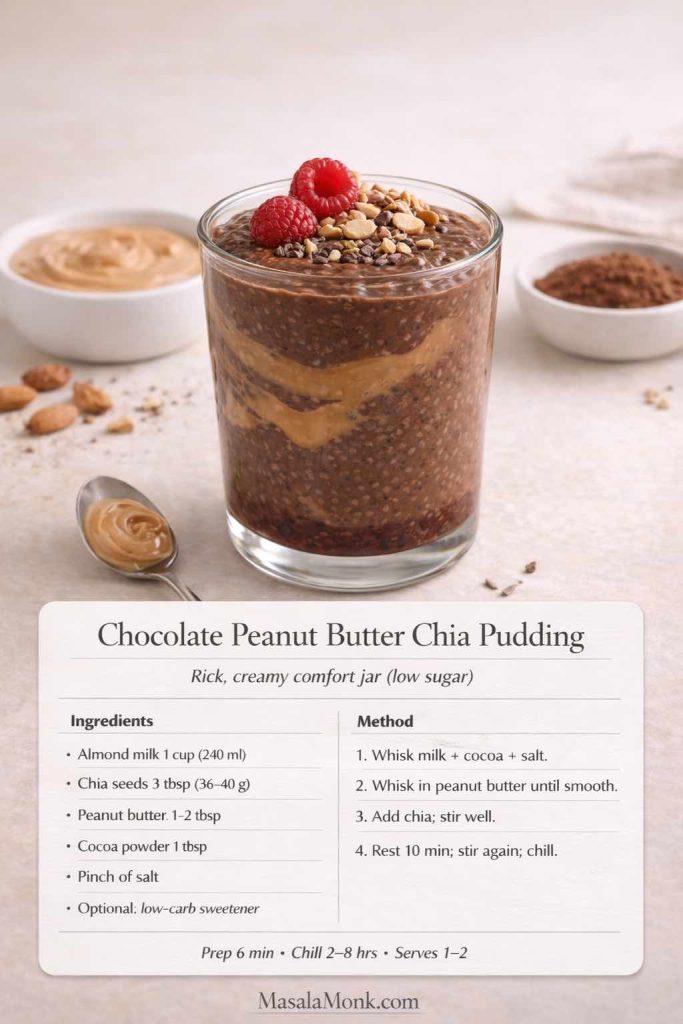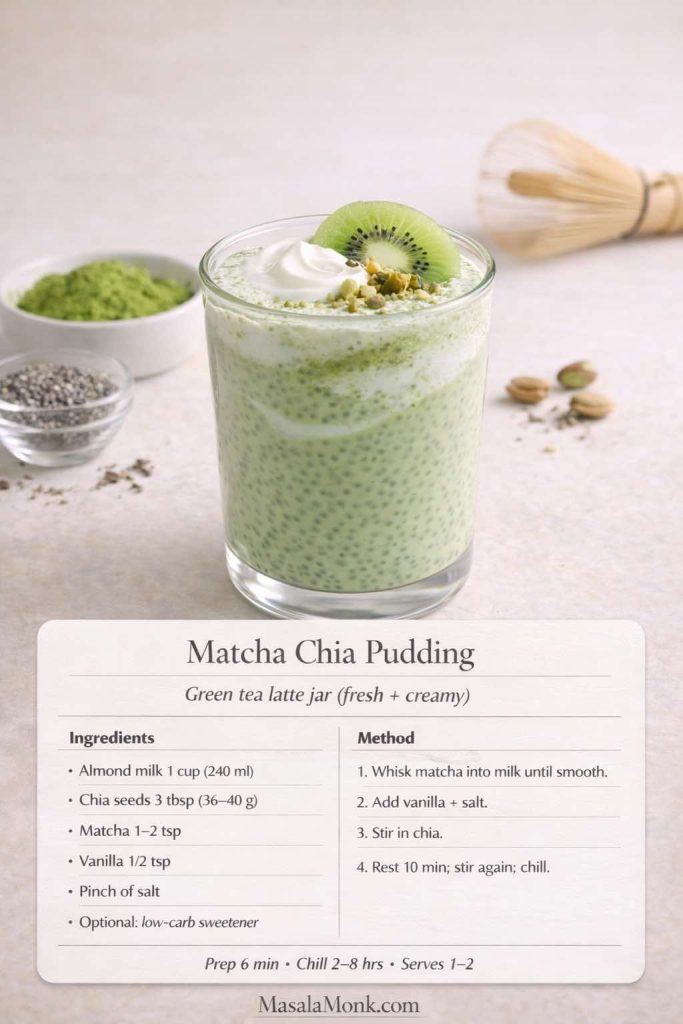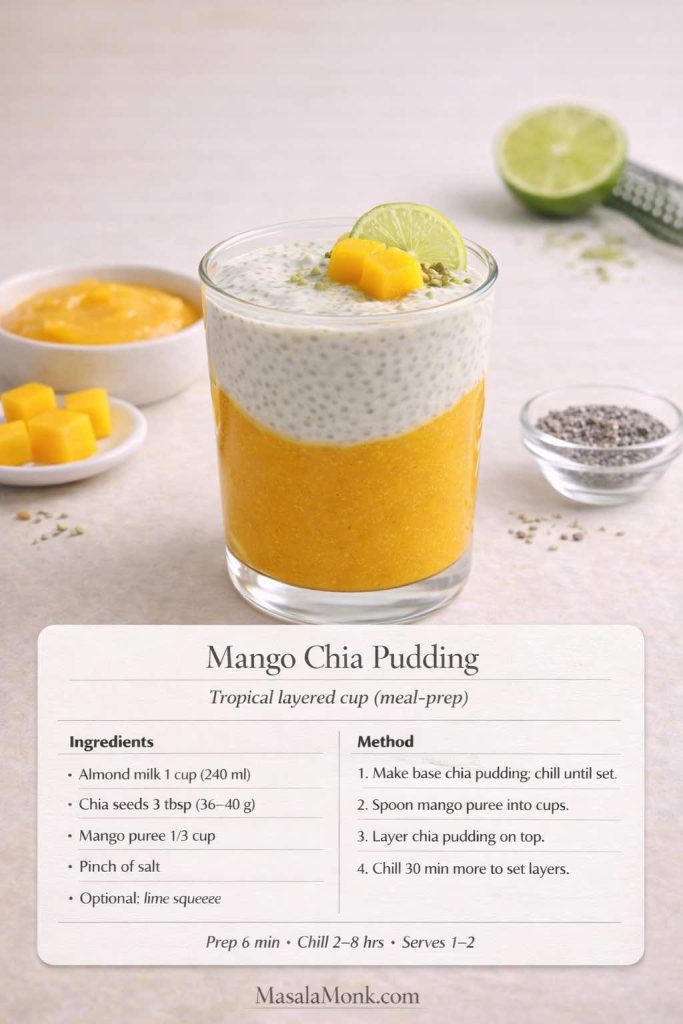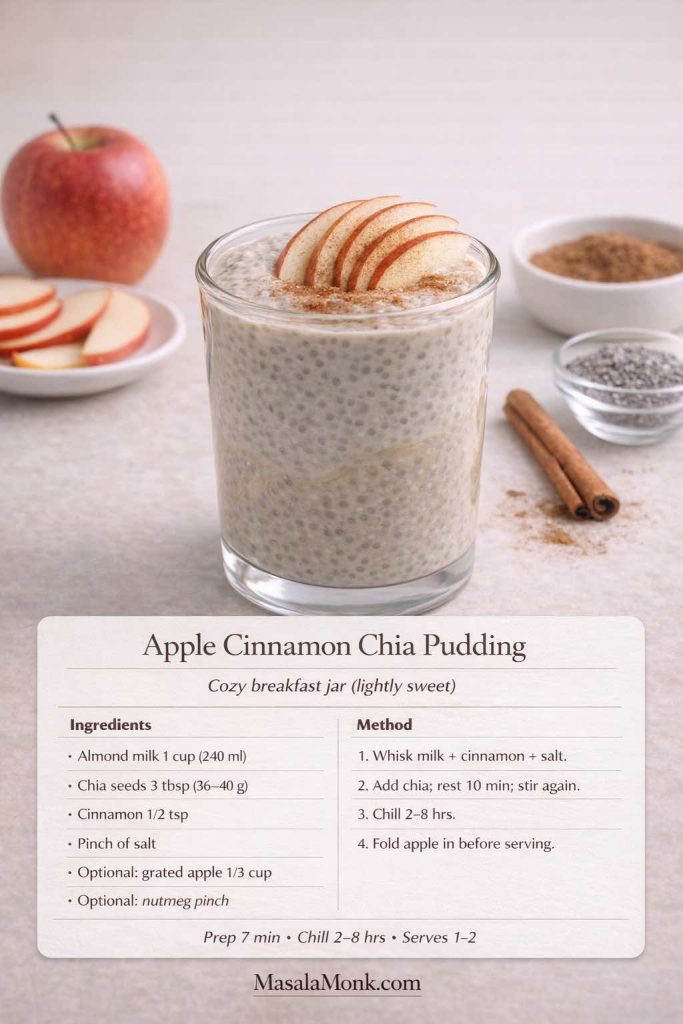
Posted on 1 Comment

Avocado Chocolate Mousse Recipe

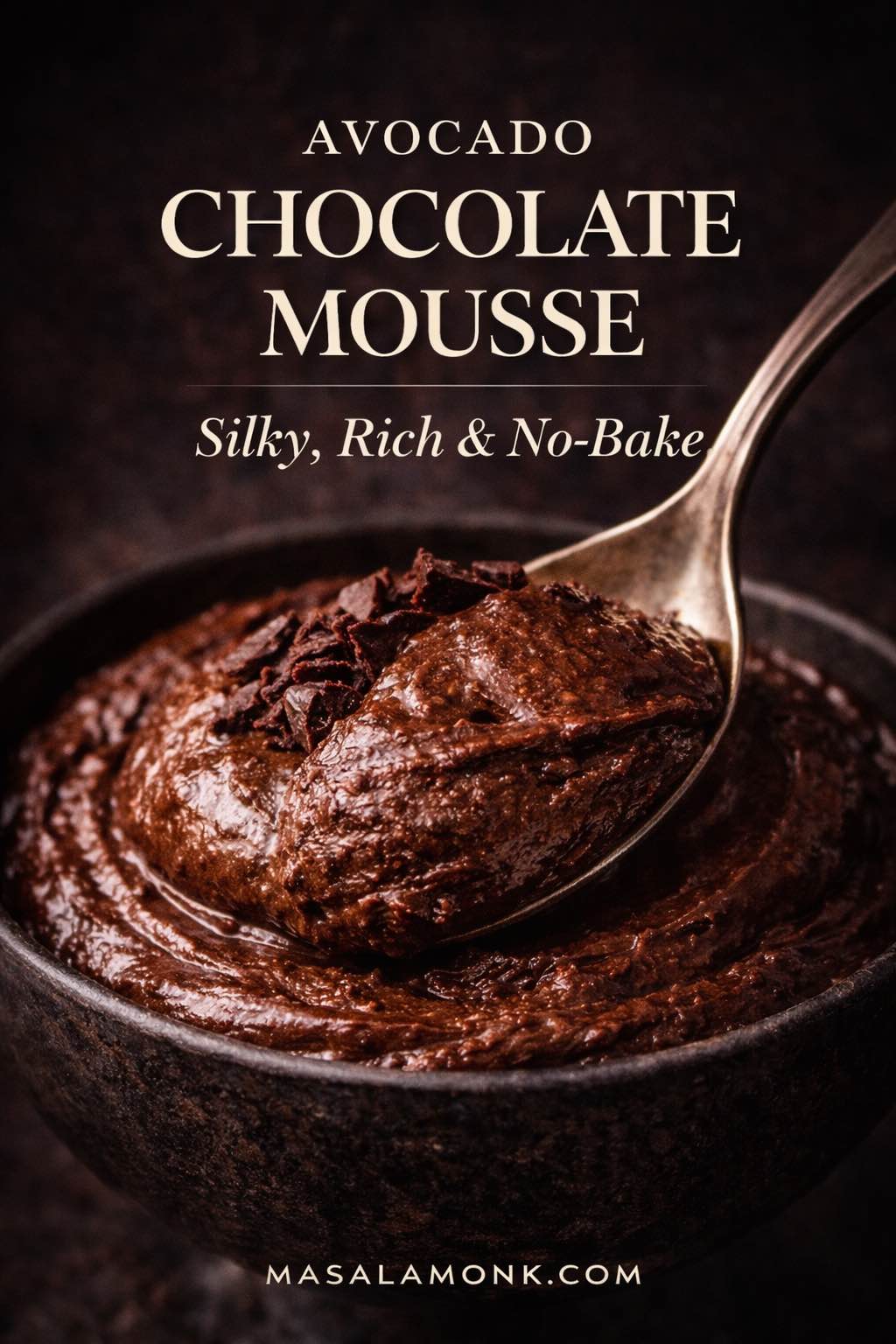
This avocado chocolate mousse is all about texture: dark, glossy, silky, and deeply chocolatey without feeling heavy. The close-up spoon shot shows exactly what makes this dessert so appealing—a rich no-bake mousse that feels luxurious while still being easy to make. If you are wondering how creamy avocado chocolate mousse can really be, this image gives the answer before the first bite. Read on for the full avocado chocolate mousse recipe, texture tips, keto and vegan variations, and the small details that make it turn out beautifully.

Avocado chocolate mousse has a way of sounding unexpected until the first spoonful makes the whole idea feel obvious. With avocado chocolate mousse, the avocado melts quietly into the chocolate, the texture turns almost impossibly smooth, and the dessert lands somewhere between a classic mousse, a rich pudding, and a dark chocolate cream that happens to come together with very little effort. Once you make it properly, it stops feeling like a novelty and starts feeling like one of those recipes you quietly return to whenever you want something deeply chocolatey without pulling out a mixer, turning on the oven, or building an elaborate dessert from scratch.

That ease, however, is only part of the appeal. What makes avocado chocolate mousse so satisfying is the balance between richness and restraint. It tastes luxurious, yet it is built from a short ingredient list. It feels indulgent, yet it can shift naturally into a healthy avocado chocolate mousse, a vegan avocado chocolate mousse, or a keto avocado chocolate mousse without losing the creamy, dessert-first character that makes it worth craving in the first place.

Why avocado chocolate mousse fits so many moods

In one kitchen, it becomes a dark, bittersweet avocado mousse dessert served in little glasses after dinner. In another, it leans toward a softer avocado chocolate pudding for an afternoon sweet bite from the fridge. On another day, it turns into an avocado banana chocolate mousse that feels gentler, sweeter, and more familiar. That range is part of its charm. It can be polished enough for guests, easy enough for a weekday craving, and flexible enough to move with whatever kind of chocolate dessert feels right in the moment.

That adaptability is exactly why this recipe deserves more than a quick blend-and-hope approach. A rushed version can still taste good, but the best avocado chocolate mousse recipe depends on understanding a few quiet details: how ripe the avocado should be, how cocoa behaves differently from cacao or melted dark chocolate, why sweetness matters for more than sweetness alone, and how a tiny splash of liquid can shift the dessert from firm mousse into spoon-soft pudding. Once those details become clear, the entire recipe opens up.
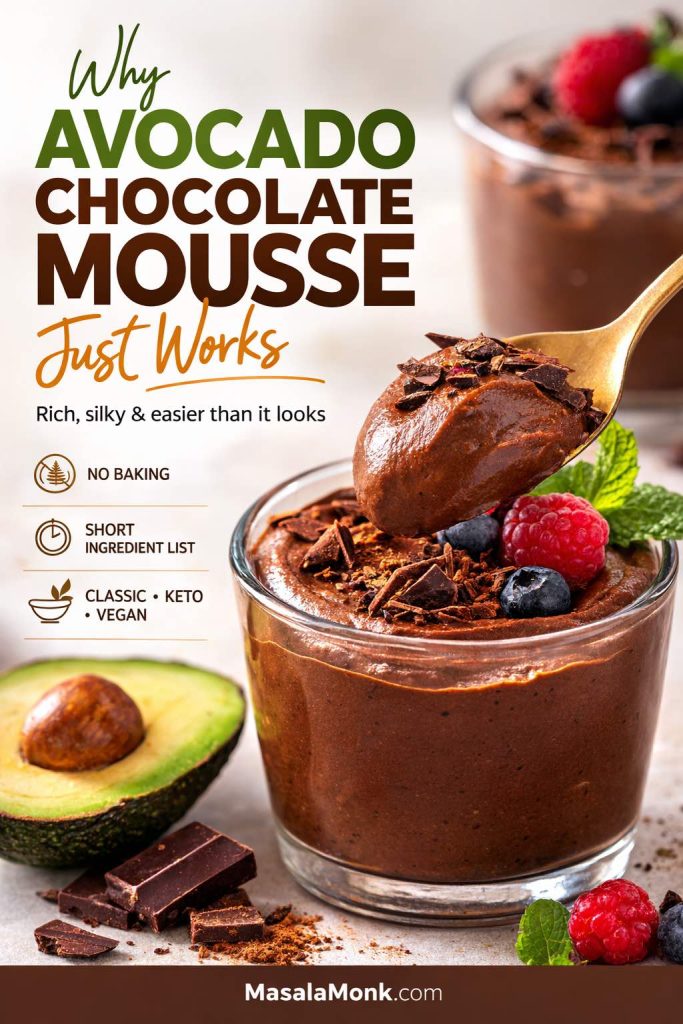
Avocado chocolate mousse in a glass with a spoonful lifted, showing the rich silky texture of this easy no-bake chocolate dessert made with avocado.
If avocado chocolate mousse sounds unusual at first, this is the texture that changes people’s minds. Rich, smooth, and deeply chocolatey, it shows exactly why this dessert feels far more indulgent than its short ingredient list suggests — and why it keeps earning a place as an easy no-bake chocolate dessert for classic, healthy, vegan, and keto versions alike.

Why the best avocado chocolate mousse recipe is more than a shortcut

Suddenly, you are not just following one formula. You are learning how to make avocado chocolate mousse in a way that suits your mood, your pantry, and the kind of dessert you actually want to eat. That difference matters because this is not merely a recipe to complete once. It is the kind of dessert structure you can return to and reshape depending on whether you want something darker, lighter, sweeter, silkier, firmer, or more relaxed.

There is another reason this recipe wins people over so quickly. It does not ask you to compromise on pleasure in order to feel clever about ingredients. The point of avocado and chocolate mousse is not to trick anyone into eating avocado. The point is to make something genuinely delicious. Ripe avocado simply happens to bring a buttery body that works beautifully with chocolate. It gives the dessert structure, fullness, and that velvety glide that makes each spoonful feel richer than the ingredient list would suggest.

Why it keeps surprising people

If you have ever wanted a chocolate dessert that feels lush without becoming heavy, this is where avocado mousse earns its place. It does not rely on spectacle. Instead, it wins on texture, balance, and the quiet satisfaction of a dessert that tastes more luxurious than its effort level suggests. That is why it tends to convert skeptics so quickly. The idea may sound unusual, yet the result feels familiar in all the best ways: creamy, dark, spoonable, and deeply comforting.

Also Read: Mango Margarita Recipe (Frozen or On the Rocks)

Why avocado chocolate mousse works so well

At first glance, avocado and chocolate may seem like an odd pair. Then again, when you think about what avocado really contributes, the pairing starts to make perfect sense. Avocado is mild, creamy, and full-bodied. Chocolate is bold, aromatic, and naturally suited to smooth textures. Put them together, and the avocado becomes less of a flavor and more of a structural advantage. That is why chocolate mousse using avocado can taste so complete even when the ingredient list stays relatively short.

It works because avocado supports rather than dominates

In other words, avocado is there to support the dessert rather than dominate it. When the fruit is ripe, it blends into something almost buttery, giving the mousse a dense silkiness that would otherwise require cream, egg yolks, or another rich base. Serious Eats makes a similar point in its avocado chocolate mousse recipe, noting that ripe avocados provide rich, buttery body while a small amount of liquid helps the mixture blend smoothly into a velvety dessert.

That is exactly the strength of this recipe: the avocado does not announce itself. Instead, it creates the texture that allows the chocolate to feel more luxurious. For that reason, the dessert often feels more familiar than people expect. You taste chocolate, depth, softness, and a gently creamy finish. The avocado is doing important work, yet it is doing it quietly.
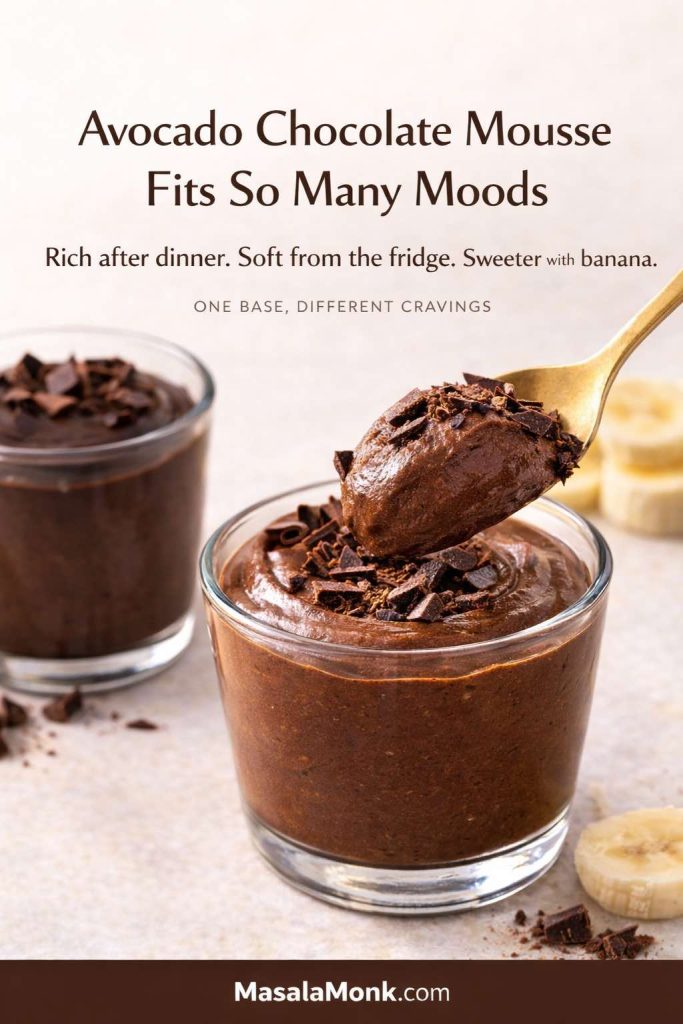
Editorial avocado chocolate mousse image showing a rich glossy chocolate mousse in a glass with a spoon lifting a silky scoop, with subtle banana and chocolate cues to show how the dessert can shift between richer, softer, and sweeter moods.
Avocado chocolate mousse is one of those rare desserts that can shift with your craving without losing what makes it special. This image supports the idea that the same creamy chocolate base can feel polished enough for after-dinner dessert, soft enough for a chilled fridge treat, or gentler and sweeter with banana — which is exactly why avocado chocolate mousse keeps earning a place as a flexible, easy, deeply satisfying no-bake chocolate dessert.

Why it tastes fuller than many quick desserts

Moreover, avocado has enough fat to round out the sharper edges of cocoa. A cocoa-only dessert can sometimes feel dry on the palate or slightly harsh if the sweetness is low. By contrast, avocado and chocolate mousse tends to feel softer and fuller, with the bitterness of the cocoa tucked into a creamier frame. That is one reason even a simple avocado cocoa mousse can taste far more finished than its ingredient list might suggest.

That versatility is one of the biggest strengths of the dessert. In a healthy avocado chocolate mousse, the avocado keeps the texture creamy even when the sweetness is dialed back. A keto avocado chocolate mousse benefits from that same richness, especially when sugar is no longer doing part of the heavy lifting. Meanwhile, in a vegan avocado chocolate mousse, avocado gives the dessert body and silkiness without relying on cream or eggs. In every case, the same ingredient solves a slightly different problem.

The texture is its real secret

Texture matters every bit as much as flavor here. A classic mousse often depends on trapped air. Avocado mousse works differently. It is not airy in the same whipped sense, yet it still feels elegant because the texture is dense, glossy, and smooth rather than flat or stodgy. That difference is important. This is not trying to mimic a French mousse exactly. Instead, it offers its own style of richness—quietly thick, spoonable, and satisfying in a more immediate way.

Why it is such a practical dessert

There is also a practical reason the recipe works so well. Because avocado is already soft and creamy, the path from ingredients to dessert is short. You do not need to temper eggs, whip cream, or set gelatin. You do not even need a stovetop. With a blender or food processor, the mixture comes together in minutes. That ease is part of why avocado mousse recipe variations show up in so many kitchens, from quick weekday desserts to low-carb meal-prep sweets to plant-based chocolate treats that do not feel like substitutes.

Also Read: Sourdough Pizza Dough Recipe (Crispy Crust & Easy Pizza Base)

What avocado adds to chocolate mousse

Avocado brings three main gifts to this dessert: body, balance, and calm. Those gifts may sound understated, yet together they are exactly what make the dessert work. Without avocado, the mixture could still taste chocolatey. What it would lack is that quiet sense of completeness—the feeling that the mousse is not merely blended, but beautifully held together.
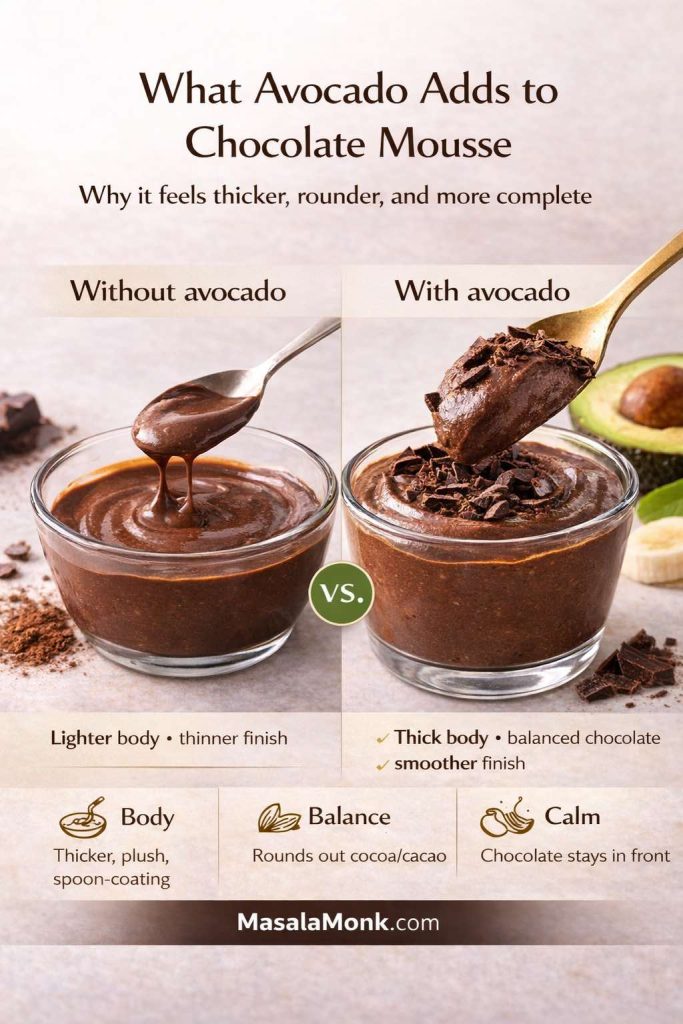
This visual shows why avocado chocolate mousse feels more complete than a simple chocolate cream. Without avocado, the mixture stays thinner and lighter in body. With avocado, the mousse becomes thicker, silkier, and more spoon-coating, while also helping cocoa or cacao taste rounder and less harsh. It is a useful quick-reference image for readers who want to understand what avocado actually adds to chocolate mousse beyond novelty: body, balance, and a calmer chocolate-first finish.

Body: why this mouse feels so plush

The body is obvious the moment the mixture starts blending. Ripe avocado thickens the dessert almost immediately. It gives the mousse that plush, spoon-coating texture that makes the chocolate linger rather than disappear too fast. Without it, cocoa and sweetener mixed with a little milk would taste more like a drinkable chocolate cream. With avocado, the mixture becomes mousse.

That body is also why avocado chocolate mousse can feel generous even in small portions. It does not need a huge bowl to satisfy. A few spoonfuls already feel rich, which makes it a particularly nice dessert when you want something intense but not overwhelming.

Balance: why avocado softens cocoa and cacao

Balance is the less visible part. Chocolate, especially dark cocoa or cacao, can sometimes feel one-dimensional when it is not paired with enough fat or enough sweetness. Avocado fills that gap. It softens the harsher notes and spreads the flavor more evenly across the palate. That is why even a healthy chocolate mousse can still feel lush when avocado is doing the heavy lifting.

This becomes especially useful when you start experimenting with avocado and cacao mousse or darker chocolate versions. The stronger the chocolate note becomes, the more helpful that avocado balance feels. It turns the dessert from merely intense into genuinely pleasurable.

Calm: why this recipe does not taste aggressively fruity

Then there is the calm avocado brings to the flavor. Avocado is gentle. It does not carry a strong perfume or a bright fruit acidity. It stays soft around the edges. That softness is exactly what allows chocolate to sit in front. In fact, when the avocado is ripe and the proportions are right, the dessert reads as chocolate first, avocado almost not at all.

Sugar Free Londoner makes the same reassurance central to its version, saying that you cannot taste the avocado when the ingredients are balanced properly. That promise sounds bold until you actually make a good batch and realize how true it is. The avocado is present, certainly, but more as texture and background than as a leading flavor.

A gentle nutrition bonus

From a nutrition standpoint, avocado also contributes fiber and unsaturated fat. Harvard’s avocado overview notes that avocados are rich in monounsaturated fat and fiber, two reasons they are often included in meals that aim to be both satisfying and balanced. The USDA’s avocado entries similarly show the fruit’s broader nutrient profile. Still, the real reason to choose avocado in this recipe is not to turn dessert into a lecture. It is to make the dessert creamy in a way that feels natural.

Why avocado chocolate mousse feels luxurious without becoming heavy

That last point matters because it gets to the heart of why this dessert is so appealing. Plenty of chocolate desserts are rich. Fewer manage to feel rich and light on effort at the same time. Avocado mousse finds that balance beautifully. It delivers the sensation of indulgence without the heaviness that can follow more cream-laden desserts. As a result, it feels both comforting and surprisingly clean on the palate.

Also Read: Balti Paneer Gravy (Restaurant-Style, Creamy + Bold Recipe)

Ingredients for avocado chocolate mousse

The beauty of this dessert lies in how few ingredients it asks from you. Nonetheless, each one has a precise role. Remove one or choose carelessly, and the mousse can become dull, bitter, or oddly thick. Get them right, and the result is the kind of avocado chocolate mousse recipe you can memorize after one or two rounds.

Ripe avocado

Everything begins with the avocado. It needs to be ripe, but not tired. When gently pressed, it should yield slightly rather than fight back. The flesh inside should look clean and mostly green, with no tough strings and no sour smell. If the avocado is underripe, the mousse will taste greener, blend less smoothly, and stubbornly hold onto a vegetable-like edge no amount of cocoa can completely hide. If it is overripe, the flavor becomes muddy and the freshness disappears.

The California Avocado Commission offers practical advice for choosing a ripe avocado, recommending fruit that yields to gentle pressure without feeling mushy. That is the exact sweet spot you want here. If you have ever wondered why one avocado mousse healthy recipe tastes elegant while another feels rough and vaguely grassy, ripeness is often the missing answer.
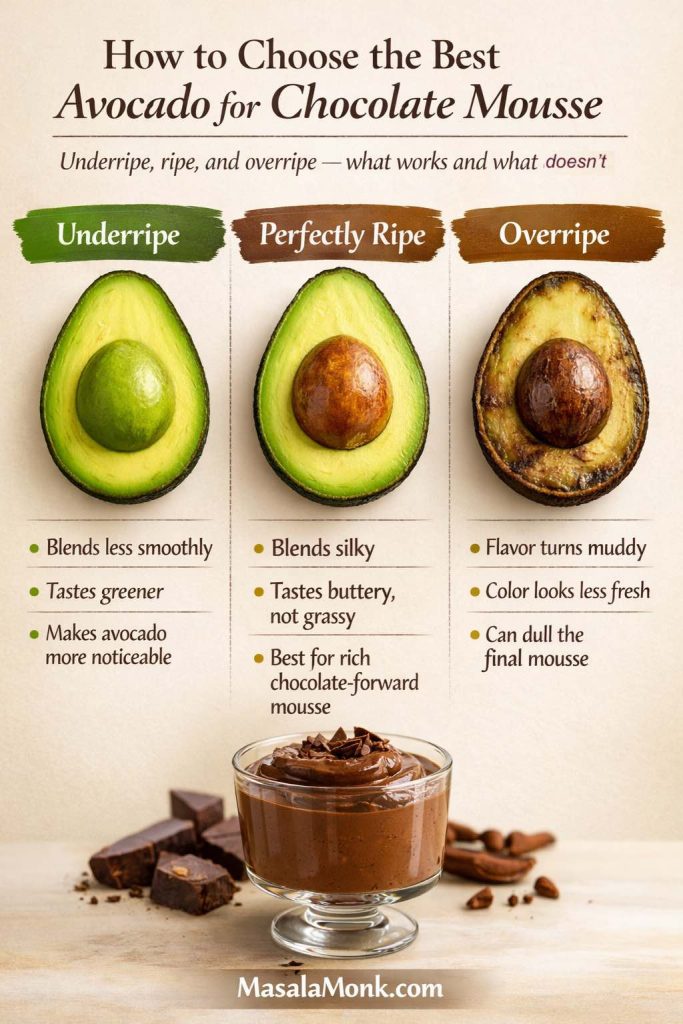
Ingredient guide infographic showing how to choose the best avocado for avocado chocolate mousse by comparing underripe, perfectly ripe, and overripe avocados, with notes on blending, flavor, and how ripeness affects mousse texture and chocolate-forward taste.
Choosing the right avocado is one of the biggest reasons avocado chocolate mousse turns out silky, rich, and chocolate-forward instead of grassy or uneven. A perfectly ripe avocado blends smoothly, tastes buttery rather than green, and gives the mousse its best texture from the start, while underripe or overripe fruit can pull the dessert off balance.

Cocoa, cacao, or dark chocolate

Next comes the chocolate element, and this is where the personality of the dessert starts to reveal itself. Cocoa powder gives the mousse a clean, direct chocolate character. It keeps the ingredient list short and lets the avocado handle the bulk of the texture. Cacao powder can be used in much the same way, although it often tastes a little earthier and more intense. That makes avocado and cacao mousse especially appealing if you like a darker, slightly less sweet finish.
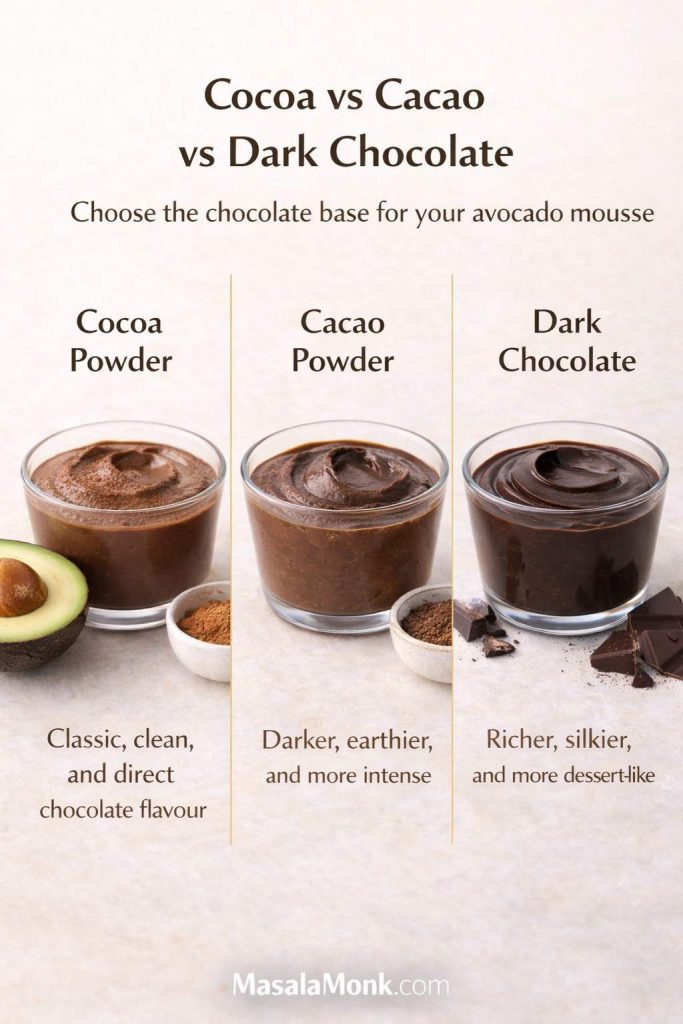
This avocado chocolate mousse comparison card helps you choose the chocolate base that fits the kind of dessert you want to make. Cocoa powder gives a classic, clean chocolate flavour, cacao powder makes the mousse darker and more intense, and dark chocolate creates the richest, silkiest, most dessert-like finish. It is a useful visual guide for readers deciding between avocado cocoa mousse, avocado cacao mousse, or a richer avocado dark chocolate mousse before they start blending.

Melted dark chocolate, on the other hand, changes the entire mood. The mousse becomes fuller, smoother, and more dessert-shop-like. It reads as more decadent, more polished, and a touch less wholesome in the best possible sense. Feel Good Foodie takes that route by using melted dark chocolate in its version, creating a mousse that leans closer to a classic chocolate dessert while still relying on avocado for creaminess.

If you enjoy understanding the difference between these chocolate paths, the MasalaMonk guide on cacao vs chocolate vs dark chocolate is a useful companion. Likewise, homemade hot chocolate with cocoa powder is a good reminder that cocoa intensity can vary more than people expect. Serious Eats also has a helpful explanation of Dutch vs natural cocoa powder, which matters because cocoa type influences not only bitterness and depth but also the final color of the mousse.

Sweetener options for avocado chocolate mousse

Sweetener does far more than make the mousse sweet. It balances bitterness, softens the green edge of the avocado, and helps determine whether the dessert feels sleek or heavy.

Maple syrup is one of the easiest choices because it blends smoothly and adds a gentle warmth. Honey works well if you are not making a vegan avocado chocolate mousse. Dates can be lovely in an avocado and chocolate pudding style version, although they pull the texture toward something thicker and more comfort-food-like. If you are aiming for keto avocado chocolate mousse, a powdered or liquid low-carb sweetener is usually better than a gritty granulated one.

This is one of those ingredients that deserves attention because under-sweetening is a common reason avocado chocolate mousse healthy versions disappoint people. The issue is not that they are healthier. The issue is that insufficient sweetness leaves bitterness unchecked and makes the avocado more noticeable. A mousse does not need to be sugary, but it does need balance.
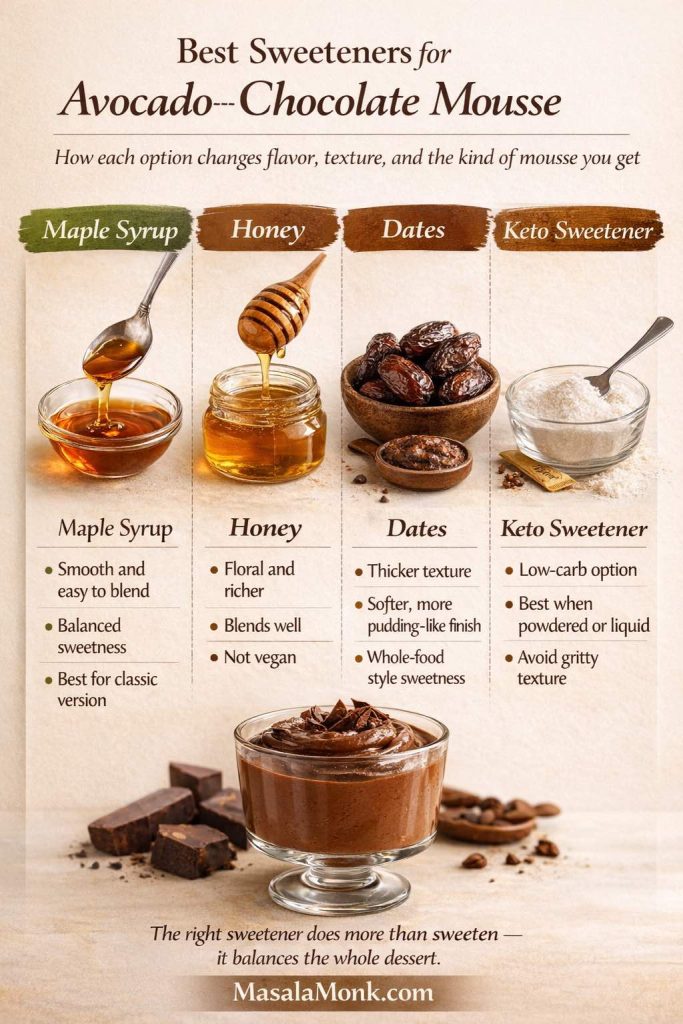
Sweetener guide infographic for avocado chocolate mousse comparing maple syrup, honey, dates, and keto sweetener, with notes on flavor, texture, blending, and which type of mousse each option suits best.
The sweetener in avocado chocolate mousse does much more than make the dessert sweet. It helps balance bitterness, softens how noticeable the avocado tastes, and influences whether the final texture feels silky, rich, pudding-like, or better suited to a keto version. This guide compares maple syrup, honey, dates, and keto sweetener so readers can choose the option that best matches the kind of avocado chocolate mousse they want to make.

Milk or another liquid

A small amount of liquid gives you control. Too little and the blender may struggle. Too much and the dessert slides from mousse toward pudding. Almond milk works beautifully in keto avocado mousse and vegan avocado mousse because it keeps the flavor clean. Coconut milk brings extra richness and makes the dessert feel more luxurious. Dairy milk works perfectly well if you are not trying to keep the recipe dairy-free.

The liquid choice also nudges the flavor. Almond milk stays neutral. Oat milk makes the mousse a little softer and slightly sweeter. Coconut milk makes everything feel fuller, almost truffle-like, especially when paired with dark chocolate.
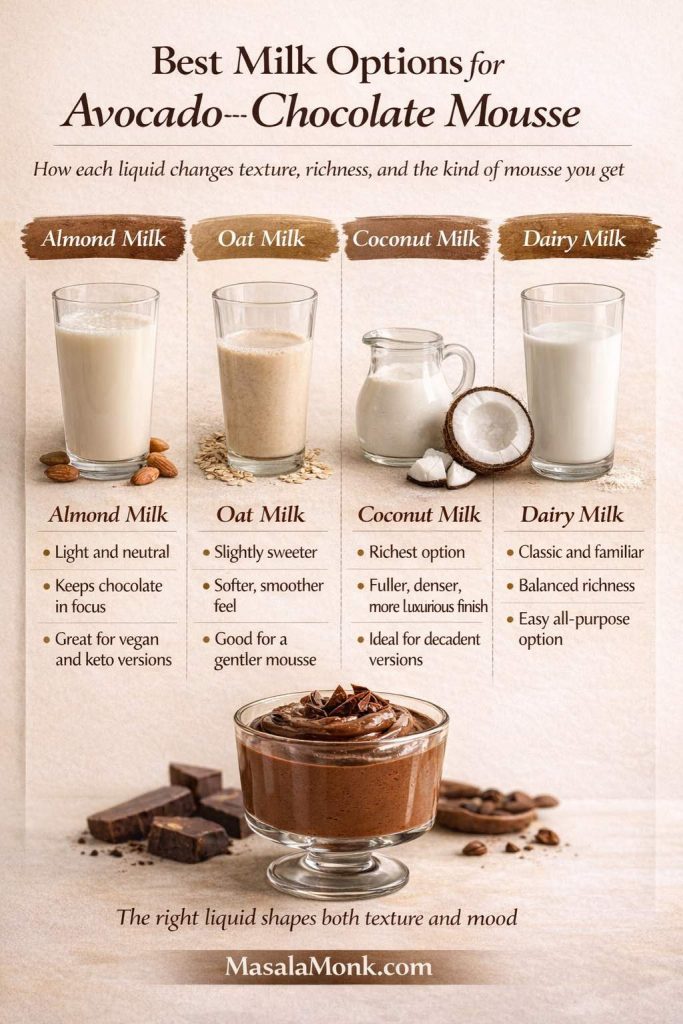
Milk options guide for avocado chocolate mousse comparing almond milk, oat milk, coconut milk, and dairy milk, with notes on how each liquid affects texture, richness, flavor balance, and the final mousse style.
The liquid in avocado chocolate mousse does more than help the blender move. It shapes the texture, richness, and overall feel of the dessert. Almond milk keeps the finish light and chocolate-forward, oat milk makes it softer and gentler, coconut milk brings the richest, most luxurious texture, and dairy milk offers a familiar middle ground.

Vanilla and salt

These seem minor, but they are not optional in spirit. Vanilla deepens the chocolate and softens the avocado. Salt sharpens everything into focus. Without them, even a technically correct avocado mousse recipe can taste flat. With them, the dessert becomes more complete.

Also Read: Mojito Recipe (Classic) + Ratios, Pitcher, Mocktail & Easy Variations

How to make avocado chocolate mousse

The actual method is uncomplicated, which is one reason this dessert is so easy to love. Even so, the best avocado chocolate mousse recipe comes from respecting the sequence rather than dumping everything in carelessly and hoping for the best.
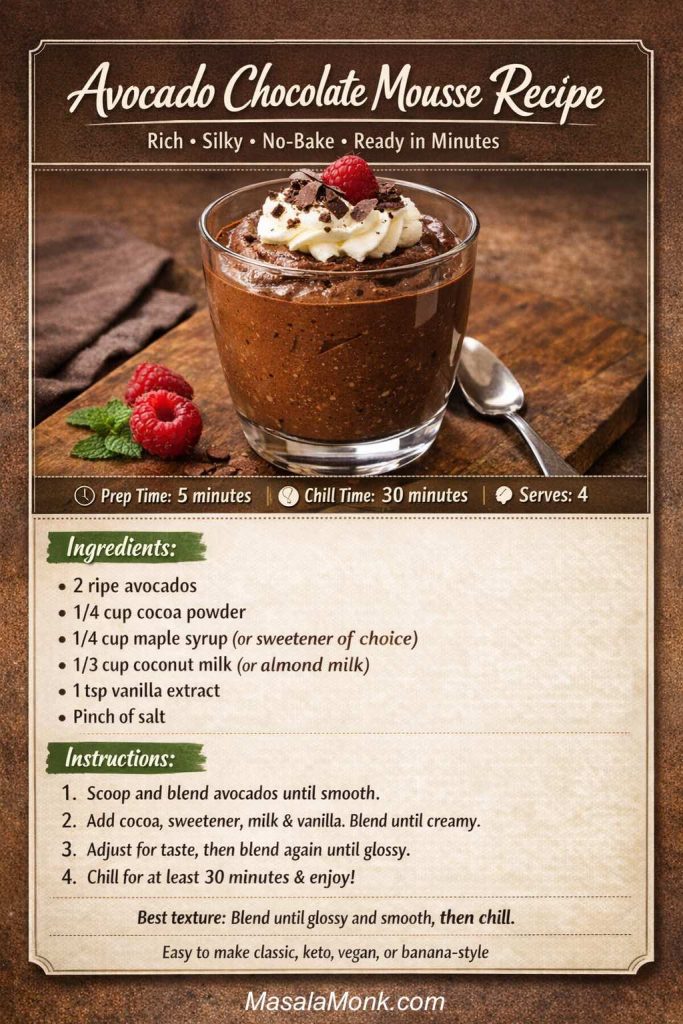
Avocado chocolate mousse recipe card showing a rich no-bake chocolate dessert made with ripe avocado, cocoa powder, maple syrup, milk, vanilla, and salt, with quick prep time, chill time, servings, ingredients, and simple step-by-step instructions.
This avocado chocolate mousse recipe card gives you the full dessert at a glance, including ingredients, prep time, chill time, and an easy step-by-step method for making a rich, silky, no-bake chocolate mousse with avocado. It is a useful visual summary for readers who want the recipe in one place before following the detailed method, and it also works beautifully as a saveable Pinterest asset for avocado chocolate mousse, healthy chocolate mousse, and no-bake chocolate dessert inspiration.

Step 1: Choose and prep the avocado

Cut the avocado, remove the pit, and scoop the flesh into a blender or food processor. Before you move on, take a moment to inspect what you have. If there are dark strings, discolored spots, or a sour smell, it is worth starting with another fruit. A clean avocado gives the mousse a clean finish.

This may sound like a small point, yet it matters more than almost anything else. If you want to know how to make avocado chocolate mousse that tastes undeniably dessert-like, begin with fruit that tastes neutral and buttery rather than aggressively green.
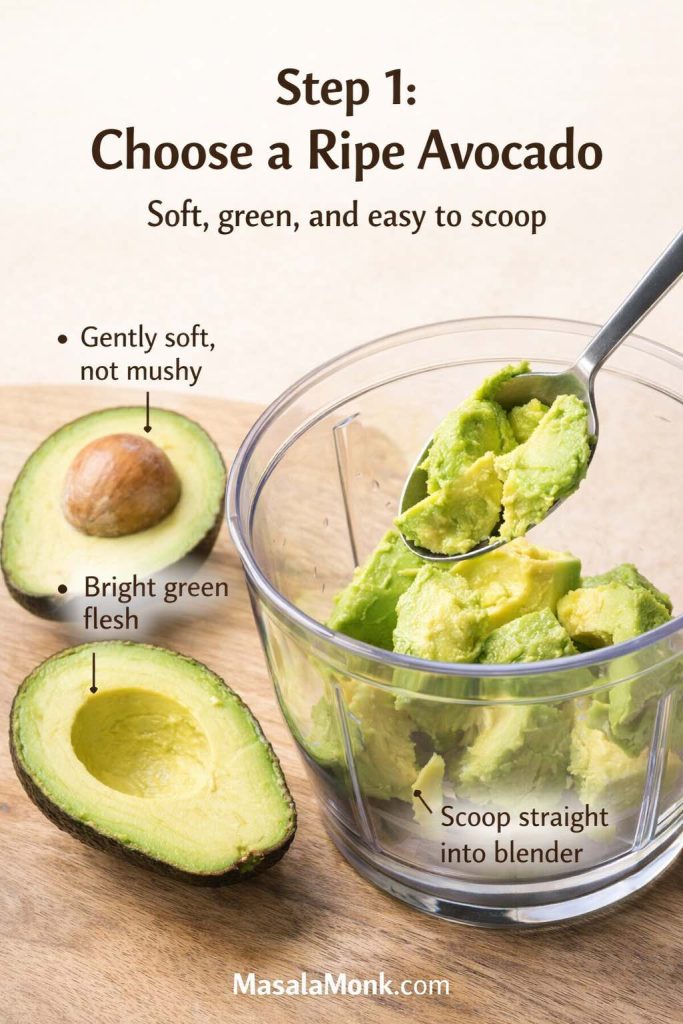
Step 1 image for avocado chocolate mousse showing ripe avocado halves with bright green flesh being scooped into a blender, with simple guidance on choosing soft avocados and prepping them for a smooth chocolate mousse.
Step 1 for avocado chocolate mousse starts with ripe avocado that is soft, green, and easy to scoop. This visual helps readers see exactly what kind of avocado works best, because good ripeness is one of the biggest reasons avocado chocolate mousse turns out silky, rich, and less noticeably avocado-forward.

Step 2: Add cocoa, sweetener, vanilla, salt, and a little liquid

Add your cocoa powder, cacao, or melted dark chocolate, depending on the version you want. Then add your sweetener, vanilla, a pinch of salt, and just enough liquid to help the blender begin. Resist the urge to pour in too much milk at this stage. The mixture can always be loosened, but thickening it again is not so easy.

A simple avocado chocolate mousse recipe can be beautifully satisfying with nothing more than cocoa powder and maple syrup. If you want a deeper, more luxurious finish, avocado dark chocolate mousse made with melted chocolate is a lovely direction to take. For a keto chocolate mousse avocado version, unsweetened cocoa, almond milk, and a smooth low-carb sweetener create a strong, reliable base.
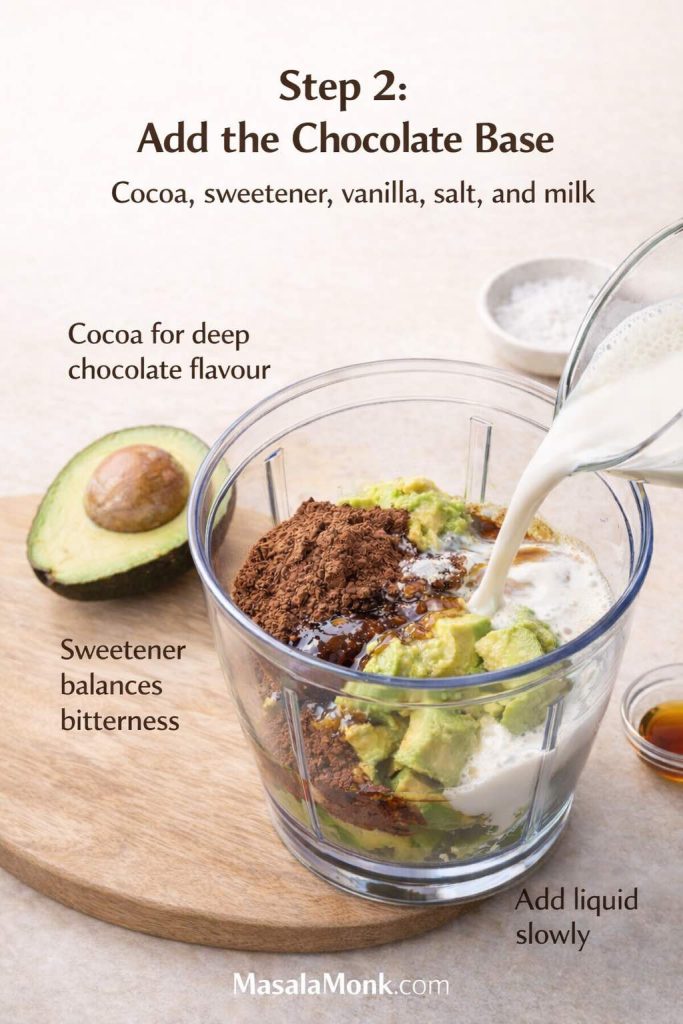
Step 2 for avocado chocolate mousse shows how the chocolate base comes together with avocado, cocoa, sweetener, and milk before blending. This visual helps readers understand the ingredient build at a glance, especially why cocoa brings deep chocolate flavour, sweetener balances bitterness, and liquid should be added slowly for a thick, silky mousse texture.

Step 3: Blend until completely smooth

Blend. Then blend more. Then scrape down the sides and blend again. The dessert becomes special only when the texture turns fully silky. Any graininess left in the bowl will feel more obvious after chilling.

If the blender struggles, add liquid a teaspoon at a time. This is where patience pays off. A small addition can transform the mixture. Too much, though, and the avocado mousse dessert shifts into pudding territory. That is not inherently a problem—avocado chocolate pudding is delicious in its own right—but the texture choice should be yours.
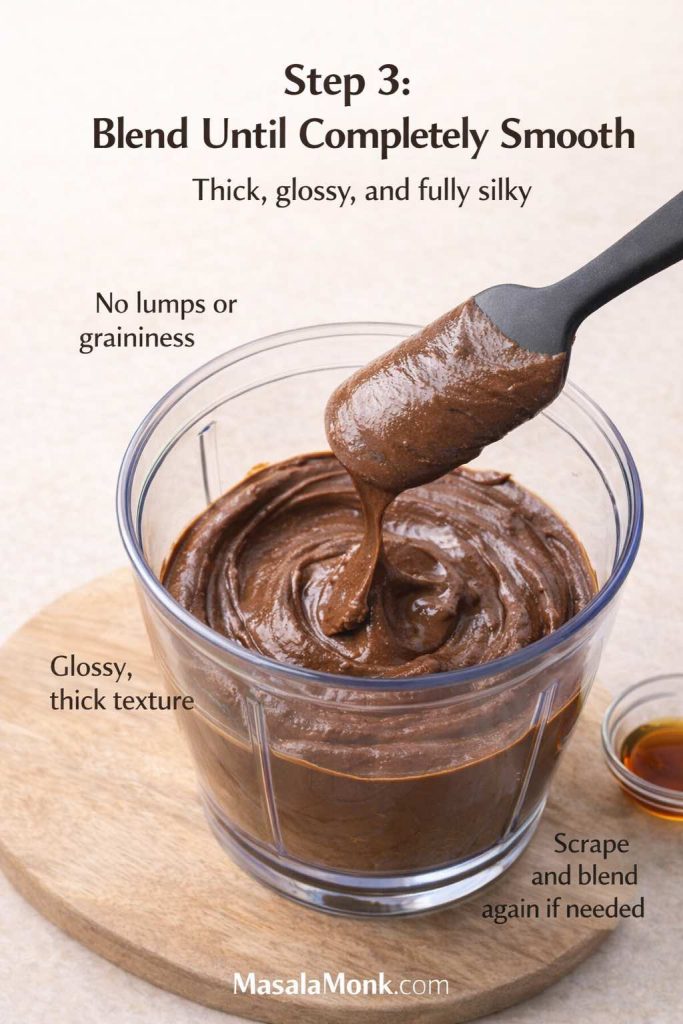
Step 3 for avocado chocolate mousse shows the texture you want before chilling: thick, glossy, and fully smooth, with no lumps or graininess left in the mixture. This visual helps readers judge whether the mousse has been blended enough, which is one of the most important details for getting a silky avocado chocolate mousse instead of a rough or uneven one.

Step 4: Taste and adjust

This is the moment when the recipe starts to feel like your own. Taste the mixture before chilling and adjust it according to what it needs. More sweetener or a small pinch of salt usually helps if the flavor feels too bitter. When the avocado note stands out more than you want, a little extra cocoa, a touch more vanilla, or even some time in the fridge can bring it back into balance. Should the texture seem too dense, loosen it with a small amount of liquid. If it feels softer than expected, let it chill before assuming anything has gone wrong.

This adjustment stage is the difference between following a rigid avocado mousse recipe and understanding how the dessert works. Once you get comfortable here, you stop needing exact formulas.
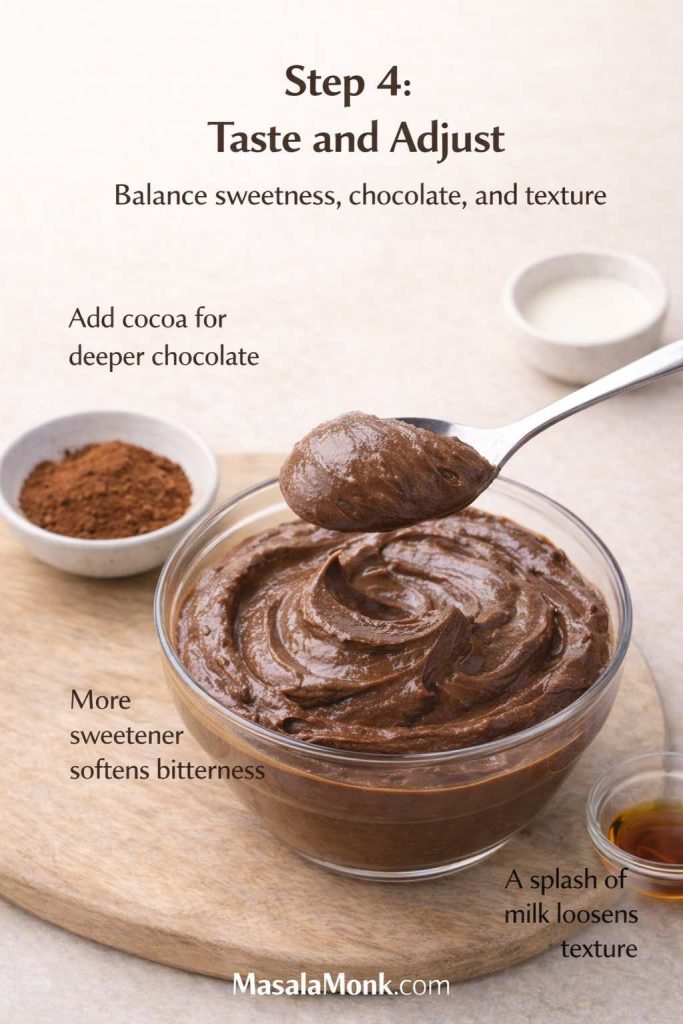
Step 4 image for avocado chocolate mousse showing a spoon tasting the blended mousse with cocoa, sweetener, and milk nearby, illustrating how to adjust chocolate flavour, sweetness, and texture before chilling.
Step 4 for avocado chocolate mousse is where you fine-tune the dessert before it goes into the fridge. This visual shows how to taste the mousse and adjust it with a little more cocoa for deeper chocolate flavour, extra sweetener to soften bitterness, or a small splash of milk to loosen the texture while keeping the mousse rich, smooth, and balanced.

Step 5: Chill the mousse

Transfer the mixture into bowls or glasses and chill. The difference this makes is remarkable. The chocolate flavor settles in, the avocado note recedes even further, and the texture firms into a smoother, more elegant finish.

You can eat it immediately if you want a softer, more casual dessert. Still, avocado chocolate mousse almost always improves with a little cold time. That rest is what helps it become mousse rather than just a freshly blended chocolate cream.
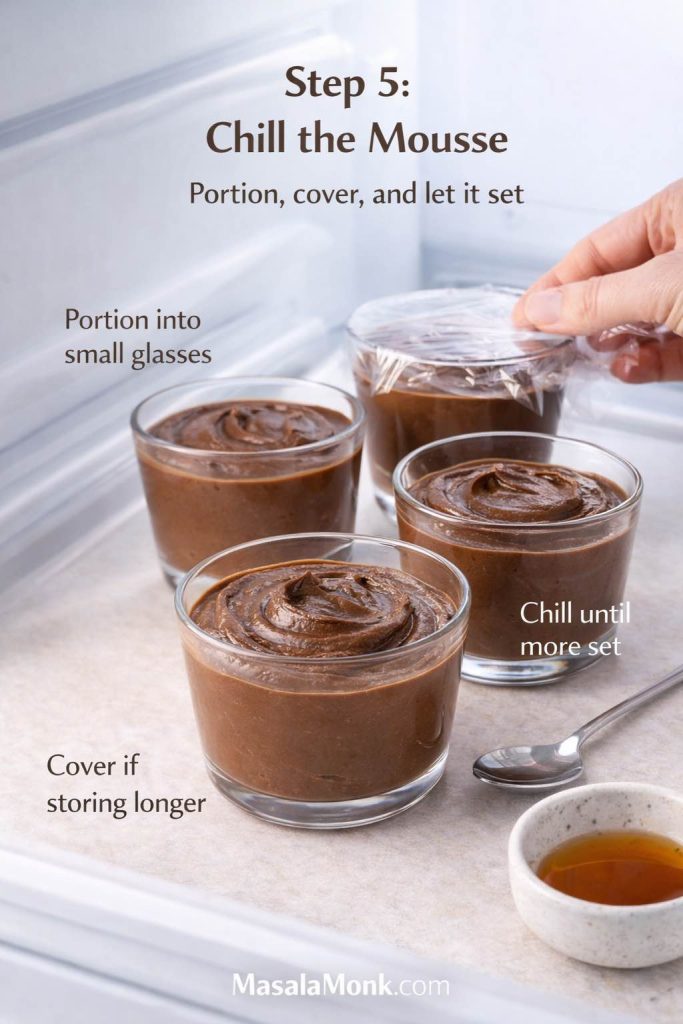
Step 5 for avocado chocolate mousse shows the dessert portioned into small glasses and chilled in the fridge so the texture can firm up and feel more mousse-like. This visual helps readers see that chilling is part of the recipe, not just storage, and that covering the mousse is useful if you plan to keep it in the fridge a little longer before serving.

Step 6: Serve simply

A dusting of cocoa, a few chocolate shavings, chopped nuts, or berries are all you need. The dessert is already doing a lot. A complicated garnish often adds less than people expect. Better to keep the finish clean and let the texture speak.
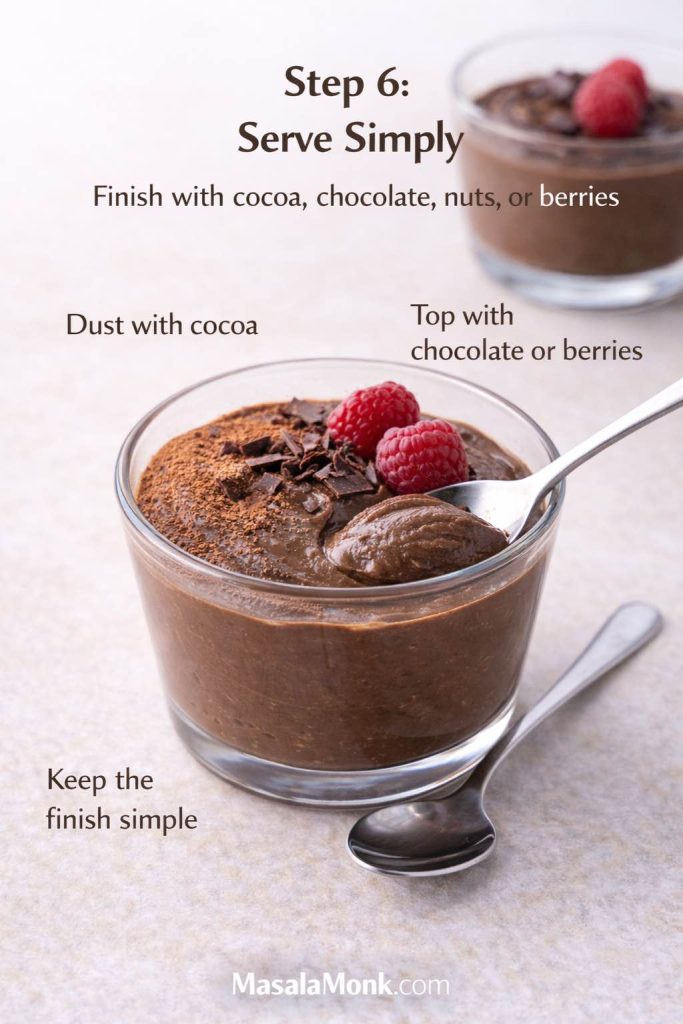
Step 6 for avocado chocolate mousse shows how to finish the dessert simply so the rich, silky texture stays the star. A light dusting of cocoa, a few chocolate shavings, or a small berry topping is enough to make avocado chocolate mousse feel polished, elegant, and ready to serve without overcomplicating the final dessert.

How smooth avocado chocolate mousse should look before chilling

Before it goes into the fridge, the mousse should look glossy and thick. It should move slowly off a spoon, neither sitting like frosting nor flowing like a drink. If you drag a spoon through it, the path should hold briefly before softening.
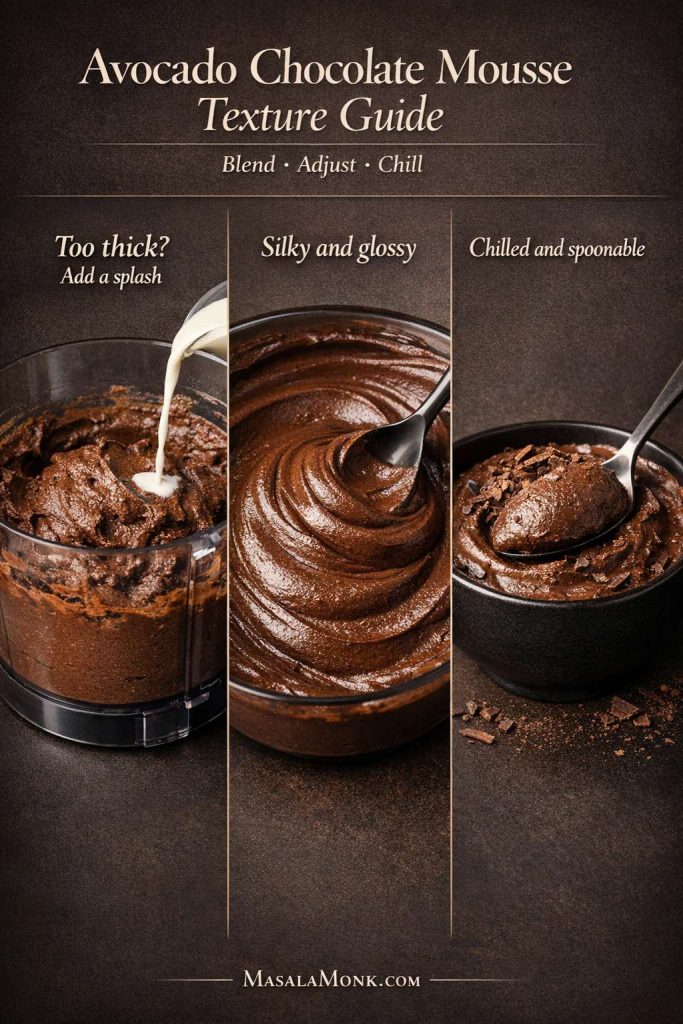
This avocado chocolate mousse texture guide shows exactly what to look for at each stage so the dessert turns out smooth, rich, and spoonable instead of too stiff or too loose. The first panel shows when your avocado chocolate mousse is too thick and needs a small splash of liquid. The second shows the ideal silky, glossy texture after blending. The third shows the final chilled avocado chocolate mousse texture that should hold softly on a spoon and feel ready to serve. Use this visual guide while making the recipe so you can adjust with confidence and get a better avocado chocolate mousse every time.

That visual cue matters because many people assume they need an extremely stiff mixture before chilling. In reality, the fridge will help the mousse set. On the other hand, if the mixture already pours easily like a milkshake, it is probably headed toward avocado and chocolate pudding instead of mousse.

There is nothing wrong with that softer result. In fact, recipe for avocado chocolate pudding variations can be wonderful, especially when banana, dates, or extra milk are involved. Yet if your goal is avocado chocolate mousse, aim for thickness with a little movement, not density without flow.

Why avocado chocolate mousse can taste better after chilling

This dessert has a quiet magic after time in the fridge. Freshly blended, it often tastes good. Chilled, it tastes finished. The cold firms the avocado, the cocoa settles, and the sweetness feels more integrated.

In addition, chilling gives the avocado’s mild flavor even less room to stand out. This is part of why people sometimes judge the mousse too early. A warm or room-temperature batch may still seem a little greener than they want. After chilling, that concern often fades dramatically.

Feel Good Foodie recommends chilling its version for exactly this reason, noting that the texture becomes thicker and more mousse-like after some time in the refrigerator. The same logic applies across almost every version of this dessert.

Also Read: Paloma Recipe: 12 Paloma Cocktail Drinks

Tips for the best avocado chocolate mousse

The best avocado mousse recipe is less about complexity and more about paying attention in the right places.

Start with a ripe avocado. Choose cocoa or chocolate you actually enjoy. Use enough sweetener to balance, not merely decorate. Blend thoroughly. Chill before judging. Season with salt and vanilla. These are not glamorous insights, yet they are exactly what separate a beautiful avocado chocolate mousse recipe from one that feels merely functional.

It is worth remembering that ingredients never behave in exactly the same way from batch to batch. One avocado may be larger and creamier than the next, while one cocoa powder may taste softer and another darker and more bitter. Sweeteners vary too, with some blending in cleanly and others leaving a more noticeable finish. Because of that, the smartest approach is not to force every version into one rigid expectation, but to understand the structure and adjust with confidence.

That flexibility is the secret strength of mousse made with avocado. Once you understand the moving parts, the recipe becomes easy to improvise. It can turn darker, softer, sweeter, firmer, more minimal, or more indulgent without losing what makes it special.

How to keep it from tasting like avocado

This is the question that hovers over nearly every first-time batch, and thankfully the answer is straightforward.

First, use a ripe avocado. This cannot be overstated. Underripe fruit tastes greener and more obvious. Second, use enough chocolate presence. That can mean cocoa powder, cacao powder, melted dark chocolate, or a combination. Third, add enough sweetener to round the bitterness and soften the avocado note. Fourth, do not skip the vanilla and salt. Finally, chill the dessert before deciding whether it tastes too much like avocado.
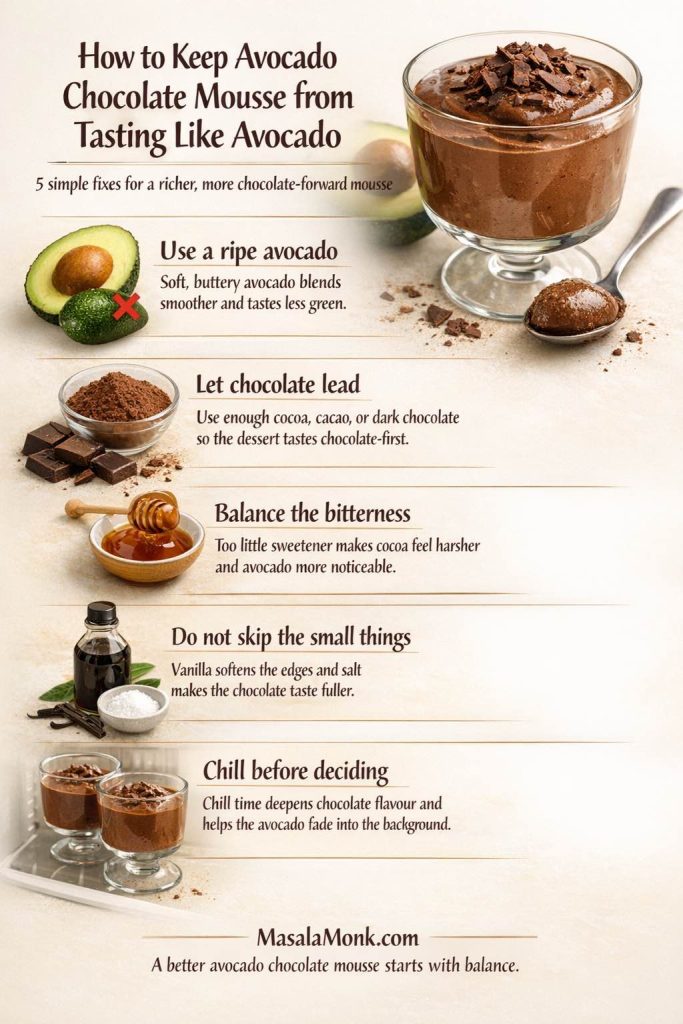
Troubleshooting infographic for avocado chocolate mousse showing five ways to keep the dessert from tasting like avocado, including using ripe avocado, enough chocolate, balanced sweetener, vanilla with salt, and chilling before serving.
If you are worried your avocado chocolate mousse will taste too green, the fix is usually balance rather than disguise. A ripe avocado, enough chocolate, the right amount of sweetness, a little vanilla and salt, and some chill time help the dessert taste rich, smooth, and unmistakably chocolate-forward.

Chocolate Covered Katie also emphasizes that the avocado flavor should disappear beneath the chocolate when the dessert is made properly. That reassurance matters because the idea of avocado chocolate can sound stranger than it tastes. In practice, most people notice the texture far more than the fruit.

If a batch still reads too green, add more cocoa, a little more sweetener, and a drop more vanilla. Those small adjustments often fix the issue faster than adding more liquid ever could.

How to fix avocado chocolate mousse if it tastes bitter

Bitterness usually comes from strong cocoa, insufficient sweetness, or a lack of salt. Occasionally, it also comes from a cacao powder that is more intense than expected.

Start by increasing the sweetener a little. Then add a very small pinch of salt. Taste again. If the mousse still feels sharp, melted dark chocolate can help soften the edges and add a rounder finish. This is especially helpful in avocado cacao mousse versions, where the earthy notes of cacao can feel stern if the sweetness is kept very low.

That said, bitterness is not always a flaw. Some people prefer a darker, more adult finish in avocado dark chocolate mousse. The key is making sure the bitterness feels intentional rather than accidental.
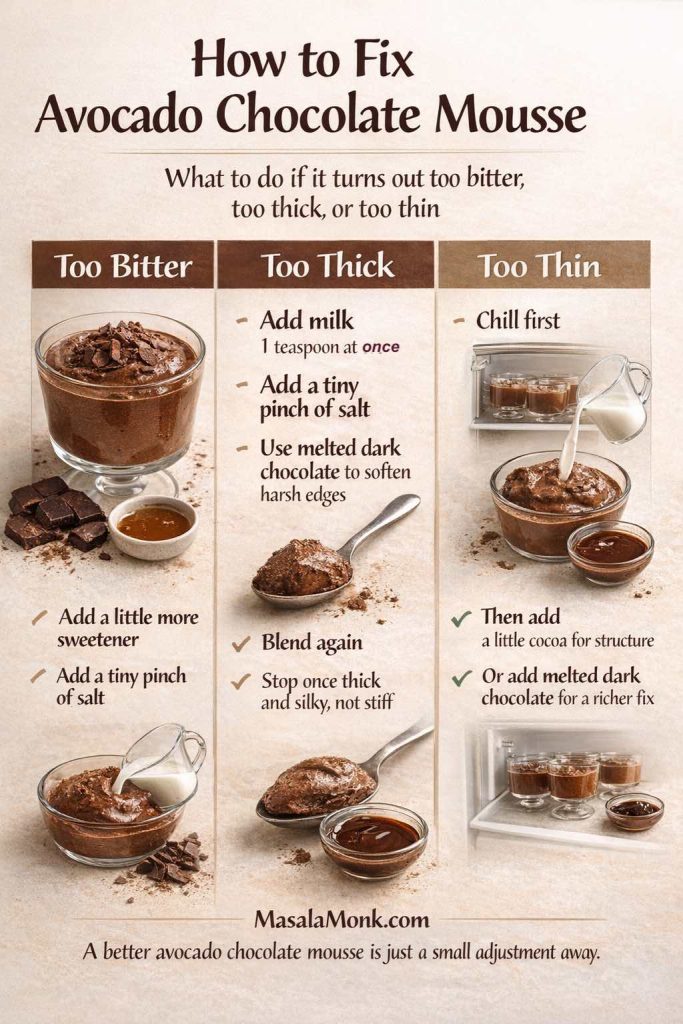
Troubleshooting infographic for avocado chocolate mousse showing how to fix three common problems: mousse that tastes too bitter, mousse that is too thick, and mousse that is too thin, with tips like adding sweetener, salt, milk, cocoa, dark chocolate, and chilling before serving.
If your avocado chocolate mousse turns out too bitter, too thick, or too thin, a few small adjustments can usually bring it back into balance. A little more sweetener or a tiny pinch of salt can soften bitterness, a spoonful of milk can loosen a mousse that feels too dense, and chilling or extra cocoa can help a softer mixture settle into a better texture.

How to adjust avocado chocolate mousse if it is too thick

If the mousse looks heavy, refuses to blend, or feels pasty rather than silky, add liquid in very small increments. Almond milk, oat milk, coconut milk, or dairy milk can all work. What matters is moving slowly.

This is the moment where many recipes go wrong. A big splash of milk feels harmless, yet it can quickly turn mousse made with avocado into chocolate pudding avocado texture. Since the dessert will firm in the fridge, there is no need to chase final texture entirely in the blender. Stop when it feels smooth and thick, not when it seems already set.

Also Read: Tapas Recipe With a Twist: 5 Indian-Inspired Small Plates

How to fix this mousse if it is too thin

A thin mousse usually comes from too much liquid, an oversized avocado relative to the chocolate, or a sweetener that loosens the mixture more than expected.

The simplest fix is chilling. Quite often, the mousse thickens enough after resting. If that is not enough, add a little more cocoa powder or a small amount of melted dark chocolate and blend again. Either choice will strengthen the structure. Cocoa keeps the recipe lighter. Dark chocolate makes it richer.

This is also where the dessert begins to define itself. If the texture is soft but luscious, you may decide to embrace it as avocado chocolate pudding rather than force it into a firmer mousse identity.
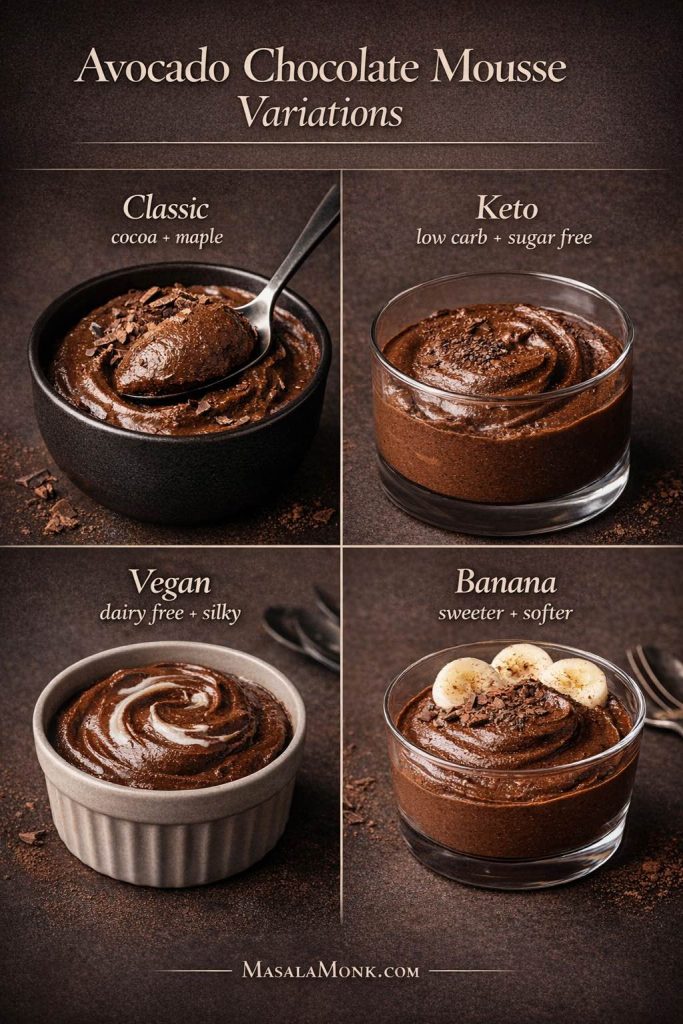
This avocado chocolate mousse variations guide makes it easy to choose the version that fits your mood and ingredients. The classic avocado chocolate mousse leans rich and balanced with cocoa and maple, the keto avocado chocolate mousse keeps things low carb and sugar free, the vegan avocado chocolate mousse stays silky without dairy, and the banana version turns softer, sweeter, and more comfort-led. Use this card as a quick visual reference before you begin, then follow the full avocado chocolate mousse recipe below for texture tips, ingredient swaps, and step-by-step guidance for each variation.
This avocado chocolate mousse variations guide makes it easy to choose the version that fits your mood and ingredients. The classic avocado chocolate mousse leans rich and balanced with cocoa and maple, the keto avocado chocolate mousse keeps things low carb and sugar free, the vegan avocado chocolate mousse stays silky without dairy, and the banana version turns softer, sweeter, and more comfort-led. Use this card as a quick visual reference before you begin, then follow the full recipe below for texture tips, ingredient swaps, and step-by-step guidance for each variation.

Keto avocado chocolate mousse

A keto avocado chocolate mousse can feel every bit as indulgent as the classic version, which is part of its charm. The avocado already supplies richness, so you do not need sugar to make the dessert satisfying. Instead, the focus shifts to choosing the right sweetener and keeping the texture smooth.

Use unsweetened cocoa or dark chocolate, a keto-friendly sweetener that dissolves cleanly, and a modest amount of unsweetened almond milk or coconut milk. That foundation creates a mousse that feels rich and chocolatey rather than compromise-driven. If you enjoy other low-carb chocolate comforts, recipes like keto hot chocolate or keto chia pudding with almond milk live in a similar neighborhood of satisfying, creamy simplicity.

The most common pitfall in keto avocado mousse is a gritty texture from the sweetener. Powdered or liquid sweeteners tend to solve that immediately. Sugar Free Londoner leans into this low-carb direction, highlighting the recipe’s keto credentials and pudding-like creaminess while keeping the ingredient list compact. That overlap between mousse and pudding is actually useful because keto avocado chocolate mousse can drift either way depending on how much liquid you use.

Best milk options for keto version

Almond milk keeps the flavor neat and understated. Coconut milk makes the dessert thicker and richer, especially in a dark chocolate version. Neither is wrong. Almond milk suits a cleaner finish. Coconut milk suits a more luxurious one.

Also Read: Air Fryer Salmon Recipe (Time, Temp, and Tips for Perfect Fillets)

Healthy avocado chocolate mousse

Healthy avocado chocolate mousse can mean different things depending on the cook, and that flexibility is part of its appeal. For one person, it may mean using less refined sugar. For someone else, it may be a dairy-free chocolate dessert that still feels rich and satisfying. Another cook may define it through ingredients that feel more familiar, whole, or minimally processed. The beauty of the recipe is that it can comfortably hold all of those interpretations.

Maple syrup is a lovely option when you want sweetness without sharpness. Dates make the mousse feel more rustic and whole-food-driven, though they also thicken it and nudge it toward pudding. Cacao powder can make the flavor feel more robust and slightly less sweet, which some people love in a healthy avocado mousse. Meanwhile, dark chocolate can be used in moderation to create a richer dessert without abandoning that more wholesome spirit.

Harvard’s overview of dark chocolate explains that cocoa-rich chocolate contains flavanols, although the amount can vary depending on processing. Harvard Health also notes that cocoa powder is a source of beneficial compounds, though dessert should still be enjoyed with perspective rather than grand claims. That is the right tone for this recipe. A healthy chocolate mousse is still dessert. It just happens to be one that can fit beautifully into a balanced way of eating.

If you enjoy that broader better-for-you dessert lane, healthy oat protein bars and high-protein overnight oats offer different kinds of creamy or satisfying sweetness without leaving the comfort-food world behind.

Cocoa powder vs dark chocolate in healthy variant

Cocoa powder gives you a cleaner ingredient line and a sharper chocolate profile. Melted dark chocolate creates deeper richness and a more classic dessert feel. If you want the best of both, use cocoa as the main base and a little dark chocolate for depth. That combination often produces the best avocado chocolate mousse recipe for people who want both flavor and restraint.

Vegan avocado chocolate mousse

Vegan avocado chocolate mousse is one of the easiest versions to make because avocado does most of the work that dairy would normally do. Use maple syrup or another vegan sweetener, choose almond milk, oat milk, or coconut milk, and make sure your dark chocolate is dairy-free if you decide to use it.

The result can be deeply satisfying, not merely acceptable. In fact, avocado mousse vegan versions often feel especially natural because nothing about the recipe depends on eggs or cream to begin with. The avocado already makes the dessert lush. The rest is simply a matter of balance.

For readers who enjoy dairy-free chocolate baking and desserts beyond mousse, vegan chocolate cake recipes offer another useful trail through that world. The relationship is not one-to-one, of course, but the same broader idea applies: plant-based chocolate desserts can feel rich, complete, and fully dessert-like when texture is handled properly.

Best dairy-free milk for vegan alternative

Almond milk is clean and neutral. Oat milk is softer and naturally a bit sweeter. Coconut milk makes the mousse richer and denser. Choose based on the finish you want rather than chasing a universal rule.

Also Read: Masterclass in Chai: How to Make the Perfect Masala Chai (Recipe)

Avocado chocolate pudding vs avocado chocolate mousse

This distinction matters more than it might seem. Some recipes live clearly in mousse territory. Others are really avocado chocolate pudding with a more elegant name. Still others sit right in the middle.

Mousse should hold shape on the spoon, feel thick and velvety, and become slightly firmer after chilling. Pudding should feel softer, looser, and more comfort-oriented. Neither is inherently better. They simply scratch different itches.
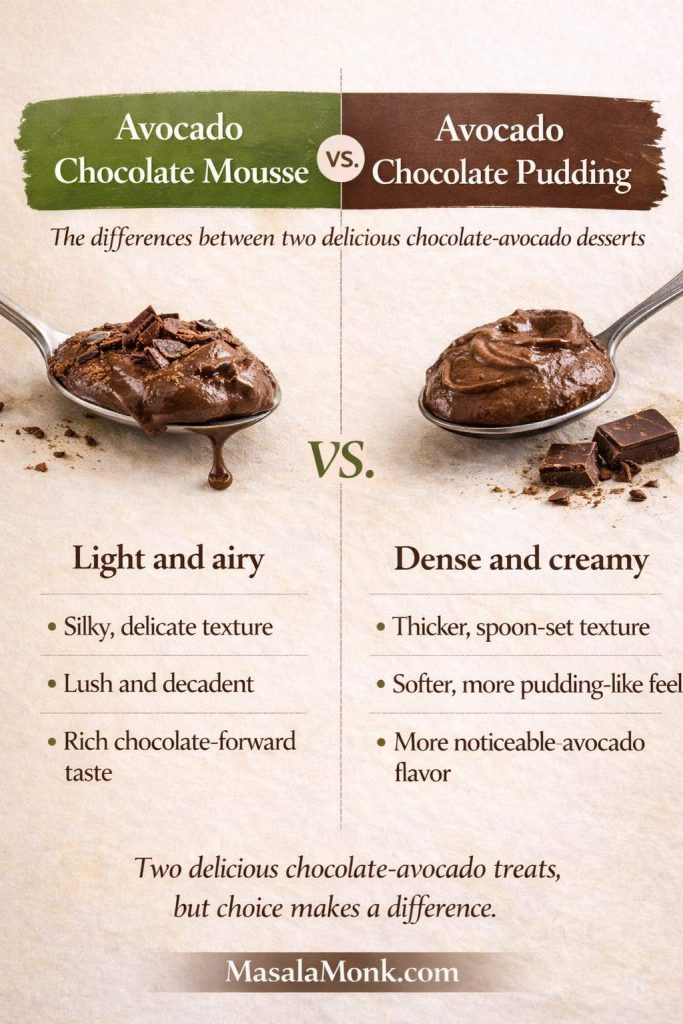
Comparison guide showing avocado chocolate mousse and avocado chocolate pudding side by side, highlighting differences in texture, thickness, richness, and how chocolate-forward each dessert feels.
Avocado chocolate mousse and avocado chocolate pudding may begin with similar ingredients, yet they land very differently on the spoon. Mousse should feel thicker, silkier, and more chocolate-forward, while pudding turns softer, denser, and more comfort-led. If your mixture feels looser than expected, you may be closer to pudding territory—and that is not necessarily a bad thing, just a different dessert.

Sugar Free Londoner even uses pudding language within its mousse recipe, which reflects how fluid this boundary can be. Allrecipes, meanwhile, leans more directly into the pudding identity with its chocolate avocado pudding. That overlap is not confusion so much as a reminder that avocado-based chocolate desserts sit on a spectrum.

If you love that softer, spoonable family of desserts, creative chia pudding variations or no-bake banana pudding make sense as related pleasures. Avocado and chocolate pudding belongs to that same comforting lineage. Avocado chocolate mousse simply edges a little closer to elegance.

When avocado chocolate mousse feels more like pudding

This usually happens because there is too much liquid, the sweetener is especially dense, or the avocado is large relative to the chocolate. It can also happen when banana or dates are added. Again, that is not failure. It is simply a softer destination.

Also Read: Crock Pot Pork Chops and Sauerkraut (No Dry Chops Recipe)

Avocado banana chocolate mousse

Banana changes the character of the dessert more than almost any other variation. It brings sweetness, softness, and a familiar fruity dessert note that can make avocado and banana chocolate mousse feel instantly approachable.

If someone is hesitant about avocado chocolate mousse, banana can act as a gentle bridge. It smooths bitterness, adds natural sweetness, and gives the dessert a flavor profile that feels comforting rather than mysterious. That is why avocado banana chocolate mousse can be such a useful variation, especially when serving children or anyone unsure about avocado in dessert.

At the same time, banana absolutely announces itself. Unlike avocado, it is not a quiet ingredient here. So if your goal is the purest avocado chocolate mousse recipe, banana is not the move. If your goal is a softer, sweeter, more casual dessert, it is a wonderful addition.

Chocolate mousse with avocado and banana also tends to drift toward pudding texture. Banana adds body, but it adds a different kind of body—less sleek, more plush. That can be lovely, particularly if you enjoy the comfort-dessert direction of a banana pudding.

When to add banana

Add banana when you want more natural sweetness, when your cocoa tastes too intense, or when you want the dessert to feel more familiar and fruit-forward. Skip it when you want a darker, cleaner, more adult chocolate profile.

Also Read: Dirty Martini Recipe (Classic, Extra Dirty, No Vermouth, Spicy, Blue Cheese, Tequila + Batched)

Avocado and cacao mousse for a darker profile

Cacao powder changes the dessert in a subtle but noticeable way. The flavor tends to feel deeper, earthier, and slightly more intense than many supermarket cocoa powders. That makes avocado and cacao mousse a lovely option for people who enjoy dark chocolate flavors without needing a lot of sweetness.

Because cacao can feel more assertive, balance becomes especially important. A pinch of salt matters more. Sweetness matters more. Chilling matters more. When it all comes together, however, the result can be deeply satisfying—less like a sweet treat for everyone, more like a dark, quiet dessert you savor slowly.

If you prefer this direction, you may also find yourself leaning toward melted dark chocolate as a companion ingredient rather than using cacao alone. That mix preserves the intensity while giving the mousse a rounder, more luxurious finish.

4 ingredient avocado chocolate mousse

There is a certain appeal to keeping this dessert as stripped-down as possible. In its simplest form, a 4 ingredient avocado chocolate mousse might include avocado, cocoa powder, sweetener, and a splash of milk or other liquid. If the avocado is ripe and the cocoa is good, that can absolutely work.

Still, the extra ingredients—especially vanilla and salt—do more than their small quantities suggest. A four-ingredient version is charming in its simplicity, yet the fuller version usually tastes more complete. That is why I think of the 4 ingredient avocado chocolate mousse as a useful starting point rather than the ultimate destination. It shows how easy the recipe can be. Then, once you understand the framework, you can decide where to add complexity for depth.

Also Read: Ravioli Recipe Reinvented: 5 Indian-Inspired Twists on the Italian Classic

Best avocado chocolate mousse recipe for guests

When you are making this for yourself, a cocoa-and-maple version may be all you need. When you are making it for guests, a slightly more luxurious path can be worth it.

Use a very ripe avocado, good cocoa, a little melted dark chocolate, vanilla, salt, and enough sweetener to keep the flavor smooth. Blend until the texture is flawless. Chill thoroughly. Serve in small glasses with a few chocolate shavings or a light dusting of cocoa.

This is where avocado dark chocolate mousse really shines. The dessert looks deeper, tastes rounder, and feels more polished. It is also the version most likely to surprise people who hear “avocado chocolate” and expect compromise. Instead, they get something elegant and fully dessert-like.

What to serve with avocado chocolate mousse

Although the mousse stands beautifully on its own, a few companions can make it feel even more complete.

Fresh berries cut through the richness. Chopped toasted nuts add contrast. A little whipped coconut cream works well if you are serving a vegan avocado chocolate mousse. Thin slices of banana make sense if you are already leaning in that direction. If the mousse is especially dark, a tiny pinch of flaky salt on top can sharpen the chocolate.

That said, this is not a dessert that needs fuss. One of its strengths is how self-contained it feels. The texture is already the main event.

How to store the mousse

Store the mousse in individual servings or in one airtight container. Pressing a piece of wrap gently against the surface can help minimize air exposure if you are storing it a little longer. In general, the dessert is best within a day or two, when the flavor still feels fresh and the color remains appealing.

If you are dealing with avocados before making the mousse, the USDA SNAP-Ed avocado page offers simple guidance on ripening and storage, including leaving firm avocados at room temperature until they soften and then refrigerating them once ripe. That basic handling advice is useful because the quality of the fruit matters so much in the final dessert.

Once blended, avocado mousse is a naturally make-ahead-friendly sweet. That convenience is part of its enduring charm. You can make it in advance, chill it, and have dessert ready without last-minute drama.

Also Read: Fish and Chips Reimagined: 5 Indian Twists (Recipe + Method)

Why it keeps earning a place in real kitchens

Some recipes make an impression once and then quietly disappear. It usually works the other way around. What begins as a curiosity soon turns into something practical, reliable, and surprisingly elegant. It is quick to make, easy to adapt, and versatile enough to suit different ways of eating. On one evening, it answers a simple chocolate craving; on another, it becomes the final touch to a dinner where dessert needs to feel thoughtful without taking over the day.

Perhaps even more importantly, this dessert rewards repetition. The more often you make it, the less it feels like a fixed formula and the more it becomes a language you understand naturally. Over time, you start to notice how much liquid keeps it in mousse territory rather than drifting into pudding. You begin to sense when cocoa alone is enough and when dark chocolate will add the depth the dessert needs. Banana becomes a deliberate choice rather than an afterthought, useful in some versions and distracting in others. Eventually, the question stops being whether avocado belongs in dessert at all, because by then you are simply enjoying everything it does so well.

That is why this recipe has such staying power. It is not clever for the sake of being clever. It is simply useful, delicious, and adaptable in a way that fits real life.

A final spoonful

The best mousse recipe is not necessarily the most minimal one or the richest one or the strictest one. It is the one that understands what makes this dessert special: ripe avocado for texture, chocolate for depth, sweetener for balance, and enough patience to chill the mixture until it becomes silky, calm, and complete.

Once you understand the structure, the possibilities widen beautifully. The classic route with cocoa and maple syrup is always there when you want something simple. A keto avocado chocolate mousse can feel just as indulgent without relying on sugar, while a vegan avocado mousse made with almond or oat milk brings its own quiet richness. If a softer spoon dessert sounds better, the mixture can lean naturally toward avocado chocolate pudding. Beyond that, banana adds sweetness, cacao brings intensity, and dark chocolate gives the whole dessert a more luxurious finish.

So whether you came here looking for how to make avocado mousse, a healthy chocolate mousse, a vegan avocado chocolate mousse, recipe chocolate avocado mousse inspiration, or simply the best avocado mousse recipe you can make in minutes, the heart of the answer stays the same. Start with a ripe avocado. Let chocolate lead. Blend thoroughly. Adjust thoughtfully. Chill well.

Then take a spoonful and let the texture do the convincing.

Also Read: Falafel Recipe: Crispy Homemade, Air Fryer and Baked Falafel

Frequently Asked Questions

1. What is avocado chocolate mousse?

Avocado chocolate mousse is a smooth, spoonable chocolate dessert made by blending ripe avocado with cocoa powder, cacao, or dark chocolate along with a sweetener and a little liquid. Although it sounds unusual at first, the avocado mainly adds body and creaminess rather than a strong fruit flavor.

2. Can you taste avocado in avocado chocolate mousse?

When the avocado is properly ripe and the balance of chocolate, sweetener, vanilla, and salt is right, avocado chocolate mousse should taste mostly like chocolate rather than avocado. Even so, an underripe avocado or too little cocoa can make the avocado note more noticeable.

3. How do you make avocado chocolate mousse?

To make avocado chocolate mousse, blend ripe avocado with cocoa powder or melted dark chocolate, sweetener, vanilla, a pinch of salt, and just enough milk or dairy-free milk to help it turn silky. After that, taste, adjust, and chill until the texture becomes richer and more mousse-like.

4. What is the best avocado chocolate mousse recipe for beginners?

The best avocado chocolate mousse recipe for beginners is usually the simplest one: ripe avocado, cocoa powder, maple syrup, vanilla, salt, and a small splash of milk. That version is easy to balance, easy to blend, and easy to adjust if you want it sweeter, darker, or thicker.

5. Can I make a 4 ingredient avocado chocolate mousse?

Yes, a 4 ingredient avocado chocolate mousse can work very well. In most cases, that means avocado, cocoa powder, sweetener, and milk or another liquid. Still, vanilla and salt make the flavor noticeably rounder, so the fuller version often tastes more complete.

6. Is avocado chocolate mousse healthy?

Healthy avocado chocolate mousse can mean different things depending on how you make it. In general, it is often seen as a lighter-feeling dessert because avocado adds creaminess without heavy cream, and the sweetness can be adjusted to suit your preference. Even then, it is still meant to be enjoyed as dessert.

7. Can I make healthy avocado chocolate mousse with less sugar?

Yes, you can make healthy avocado chocolate mousse with less sugar, but the balance still matters. If the sweetness drops too low, the cocoa may taste bitter and the avocado may come forward more than you want. Therefore, it helps to reduce sweetener gradually rather than all at once.

8. Is avocado chocolate mousse keto?

Avocado chocolate mousse can be keto when made with unsweetened cocoa or dark chocolate and a suitable low-carb sweetener. In that version, almond milk or coconut milk usually works well, and the avocado helps maintain a rich texture without needing sugar.

9. What sweetener works best in keto avocado chocolate mousse?

For keto avocado chocolate mousse, powdered or liquid sweeteners usually work better than coarse granulated ones because they blend more smoothly. As a result, the mousse tastes creamier and avoids the gritty texture that can sometimes happen with low-carb desserts.

10. Is avocado chocolate mousse vegan?

Yes, avocado chocolate mousse can be naturally vegan if you use a plant-based sweetener such as maple syrup and a dairy-free milk like almond, oat, or coconut milk. If you add melted chocolate, just make sure the chocolate itself is dairy-free.

11. What milk is best for vegan avocado chocolate mousse?

Almond milk is a popular choice for vegan avocado chocolate mousse because it keeps the flavor clean and lets the chocolate stay in focus. Oat milk makes the dessert a bit softer, whereas coconut milk gives it a richer, fuller finish.

12. What is the difference between avocado chocolate mousse and avocado chocolate pudding?

Avocado chocolate mousse is usually thicker, firmer, and more set after chilling, while avocado chocolate pudding tends to be softer and looser. Even so, the line between the two can be fairly thin, especially if the recipe uses more liquid or a heavier sweetener.

13. Why is my avocado chocolate mousse too thin?

Avocado chocolate mousse can turn out too thin if there is too much liquid, if the avocado is especially large, or if the sweetener loosens the mixture more than expected. In many cases, chilling helps first. Otherwise, a little more cocoa powder or melted dark chocolate can bring the texture back into balance.

14. Why is my avocado chocolate mousse too thick?

If avocado chocolate mousse feels too thick, the mixture probably needs just a little more liquid to blend and soften properly. Add it slowly, though, because a small amount can make a big difference. Otherwise, the mousse can shift quickly toward pudding.

15. Why does my avocado chocolate mousse taste bitter?

Bitterness usually comes from strong cocoa, not enough sweetener, or too little salt. Sometimes cacao powder can also taste more intense than expected. In that case, a bit more sweetener, a pinch of salt, or some melted dark chocolate often helps smooth the flavor out.

16. Why does my avocado chocolate mousse taste like avocado?

That usually happens when the avocado is underripe, the chocolate flavor is too light, or the dessert has not been chilled long enough. More cocoa, a touch more vanilla, and a little extra sweetener often help. Most importantly, start with a ripe avocado whenever possible.

17. Can I use cacao instead of cocoa in avocado chocolate mousse?

Yes, you can use cacao instead of cocoa in avocado chocolate mousse. The flavor may taste a little darker or earthier, so you may want to adjust the sweetness slightly. Nevertheless, it can be a very good choice if you prefer a deeper chocolate profile.

18. Can I use dark chocolate instead of cocoa powder?

Yes, dark chocolate can be used instead of cocoa powder, or alongside it, in avocado chocolate mousse. Melted dark chocolate usually makes the dessert feel richer, smoother, and more luxurious, while cocoa powder keeps it a bit lighter and more direct in flavor.

19. Can I add banana to avocado chocolate mousse?

Absolutely. Avocado banana chocolate mousse is a softer, sweeter variation that can feel more familiar to people who are unsure about avocado in dessert. On the other hand, banana adds its own flavor clearly, so it changes the character of the mousse more than most other add-ins.

20. How long does avocado chocolate mousse last in the fridge?

Avocado chocolate mousse is usually best within one to two days in the refrigerator, when the flavor and color still feel fresh. Keep it in an airtight container, and try to limit air exposure as much as possible.

21. Can you freeze avocado chocolate mousse?

Yes, avocado chocolate mousse can be frozen, although the texture may change slightly after thawing. Because of that, it is usually best enjoyed fresh or chilled from the fridge. Still, freezing can work if you want to save leftovers rather than waste them.

22. Is avocado chocolate mousse a good make-ahead dessert?

Yes, avocado chocolate mousse is an excellent make-ahead dessert because chilling actually improves the texture. In fact, many versions taste better after some time in the fridge, once the chocolate settles and the mousse firms up.

23. What toppings go well with avocado chocolate mousse?

A light dusting of cocoa powder, dark chocolate shavings, chopped nuts, berries, or a little whipped coconut cream all work well. Since the mousse is already rich, simple toppings usually feel best.

24. Can I make avocado mousse without chocolate?

You can make avocado mousse without chocolate, but it becomes a different dessert altogether. Chocolate is what gives avocado chocolate mousse its depth and helps the avocado stay in the background. Without it, the avocado flavor will be much more noticeable.

25. What makes the best avocado mousse recipe turn out silky?

The best avocado mousse recipe turns silky when you use a ripe avocado, blend thoroughly, and add liquid gradually rather than all at once. In addition, tasting before chilling helps you correct bitterness, sweetness, and thickness before the texture sets.
Posted on 7 Comments

10 Low Carb Chia Pudding Recipes for Weight Loss (Keto, High-Protein, Dairy-Free)

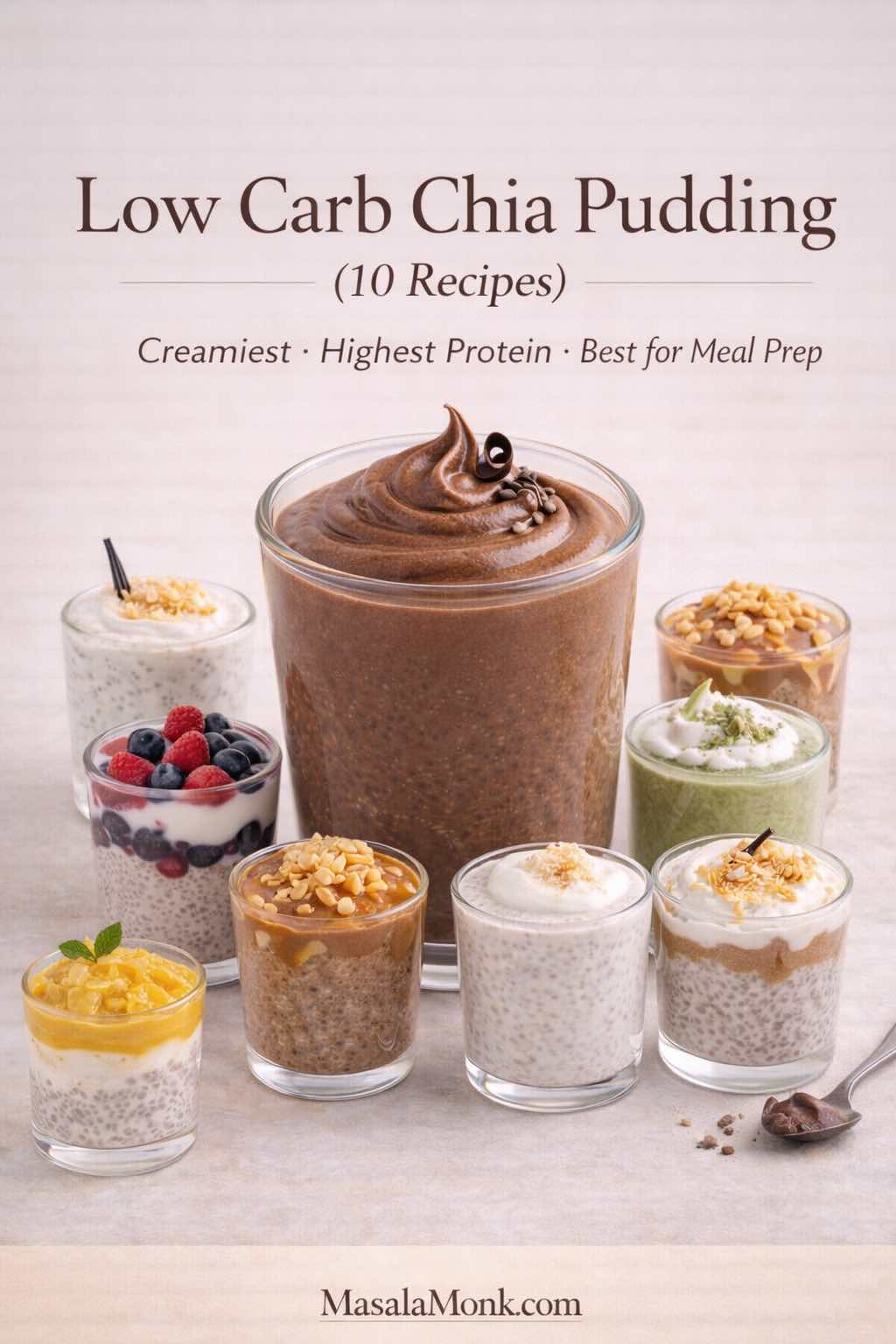
Cover image showing a premium glass jar of low carb chia pudding with a smooth whipped topping on a warm-cream seamless background. Editorial food photography style for “Low Carb Chia Pudding” featuring 10 recipes including keto, high protein, dairy-free, and blended options, with MasalaMonk.com branding.

Chia pudding has a way of sneaking into your routine and then refusing to leave. At first, it feels like a clever trick—stir a few spoonfuls of tiny seeds into milk, refrigerate, and wake up to a spoonable pudding. Before long, though, you realize a simple jar of low carb chia pudding can be more than a trend: it’s a dependable breakfast that doesn’t demand morning effort, a snack that travels well, and a dessert-like bowl that still fits a lighter day.

Why chia pudding works as breakfast, snack, and “healthy dessert”

What makes it especially useful is how easily you can shape it around your cravings. Some mornings you’ll want something light and clean—pudding with almond milk, a little vanilla, and berries. Other times, you’ll prefer a thick, creamy version that leans on Greek yogurt and tastes closer to cheesecake filling. And when your sweet tooth shows up, chocolate chia pudding, cacao chia pudding, or chocolate peanut butter chia seed pudding can feel genuinely comforting without tipping into a sugar spiral.

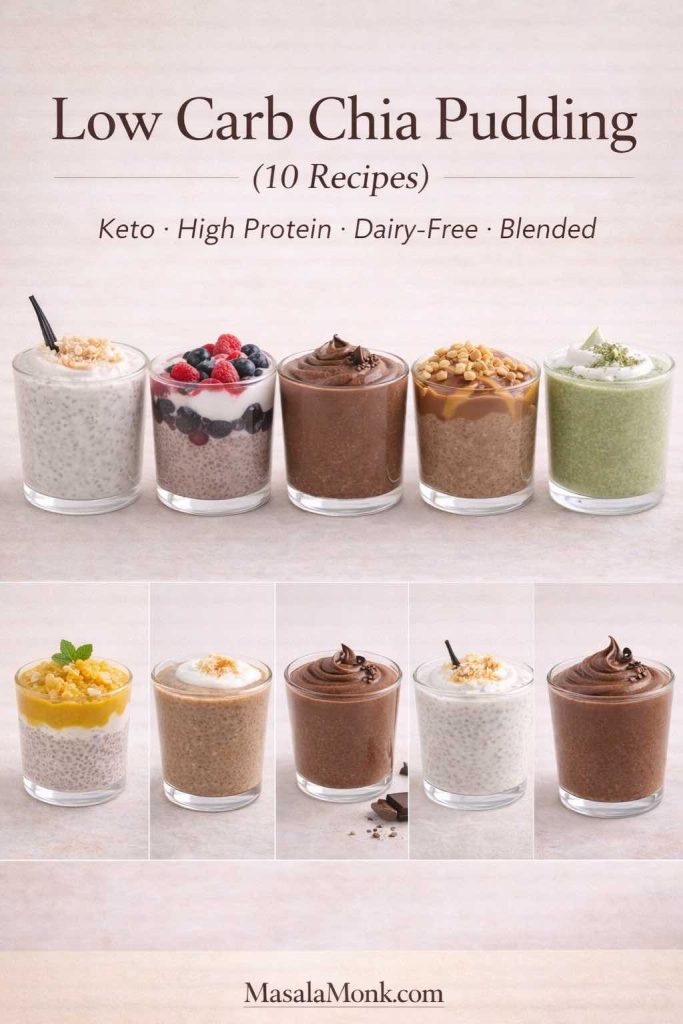
Collage-style image showing ten low carb chia pudding cups in a clean grid with the heading “Low Carb Chia Pudding (10 Recipes)” and the line “Keto • High Protein • Dairy-Free • Blended.” Features a variety of flavors including vanilla, berry, chocolate, peanut butter, matcha, mango, and mousse, with MasalaMonk.com in the footer.
All 10 low carb chia pudding recipes featured in this post at a glance—creamy keto cups, high protein Greek yogurt jars, dairy-free options, fruit layers, and blended mousse for a smooth pudding texture.

Equally important, chia pudding adapts to different eating styles without forcing you into one “right” way. If you’re leaning keto, coconut milk makes a rich keto pudding base while sweetness stays minimal. If you’re aiming for a paleo-friendly bowl, you can skip dairy and still get a creamy texture with coconut milk or almond milk plus nut butter. Meanwhile, if you’re chasing a higher-protein breakfast, chia pudding with protein powder—or a low carb chia pudding with Greek yogurt—turns the jar into something that feels like a real meal.

If you want a deeper foundation on how chia fits into weight-loss habits—portions, consistency, and simple ways to keep it effortless—this companion guide is worth a read: The Ultimate Guide to Chia Pudding for Weight Loss.

Now, before we jump into the ten best variations, let’s lock in the base. Once you get the ratio and texture right, every flavor becomes easier, smoother, and more repeatable.

Also Read: Garlic & Paprika Cabbage Rolls (Keto-Friendly Recipes) – 5 Bold Savory Twists


Low Carb Chia Pudding for Weight Loss: Why It Works So Well

For weight loss, the best breakfasts explain themselves later—when you realize you didn’t spend the whole morning thinking about snacks. That’s exactly where low carb chia pudding shines: it’s simple, satisfying, and surprisingly good at keeping your appetite calm between meals.

Why chia pudding keeps you full longer

Chia helps in a very practical way: when it hydrates, it turns your milk into a thick, spoonable gel. Because of that texture, you naturally eat more slowly, and the jar tends to feel more substantial than it looks—especially compared to breakfasts that disappear in three bites.

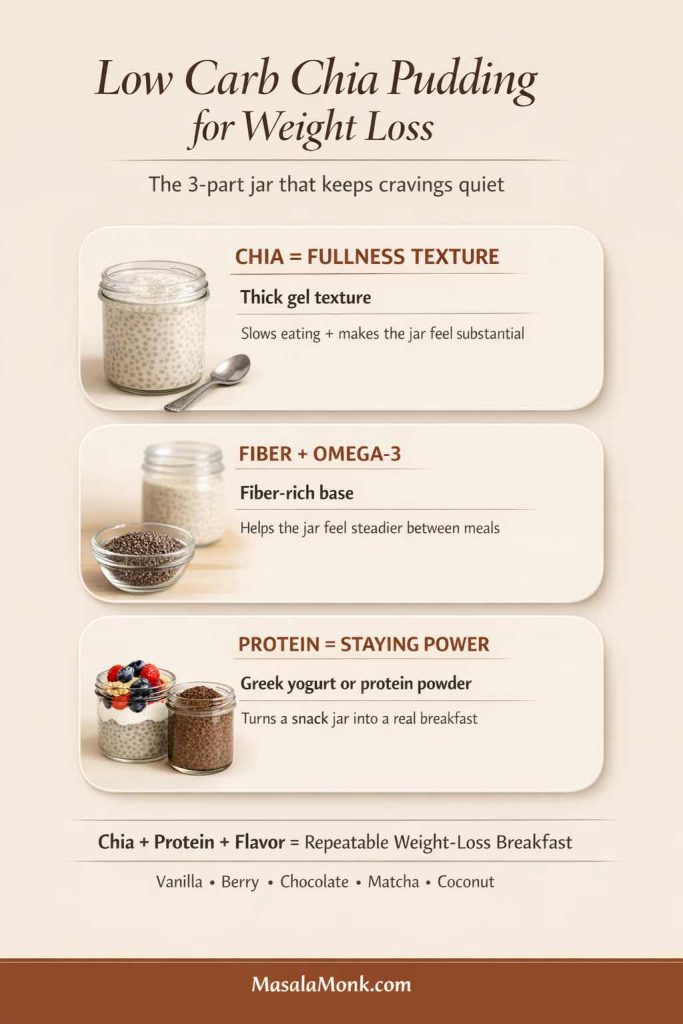
Infographic titled “Low Carb Chia Pudding for Weight Loss” explaining why it works: chia creates thick gel texture that slows eating, chia provides fiber + omega-3, and adding protein (Greek yogurt or protein powder) boosts staying power. Includes takeaway “Chia + Protein + Flavor = repeatable weight-loss breakfast” and MasalaMonk.com in the footer.
Why low carb chia pudding works so well: the gel texture slows eating, fiber helps the jar feel steadier between meals, and protein (Greek yogurt or protein powder) is the upgrade that turns it into a true breakfast—not just a snack.

At the same time, chia is naturally fiber-rich and contains omega-3 fats, which is part of why it’s such a popular base for a steady “grab-and-go” breakfast. If you want a clean, evidence-based overview, Harvard’s Nutrition Source has a helpful summary on chia seeds nutrition (fiber + omega-3). Then, if you like checking calories, macros, or serving-size details, you can cross-reference with the USDA chia seed nutrition data.

The real upgrade is protein

Still, satisfaction isn’t only about chia. Protein is the piece that makes a jar feel like a meal—which is why “pudding and Greek yogurt,” “chia seed and Greek yogurt pudding,” and “chia pudding with protein powder” are such common staples. When your breakfast includes a solid protein anchor, it tends to feel steadier and more complete, so you’re less likely to start grazing out of habit.

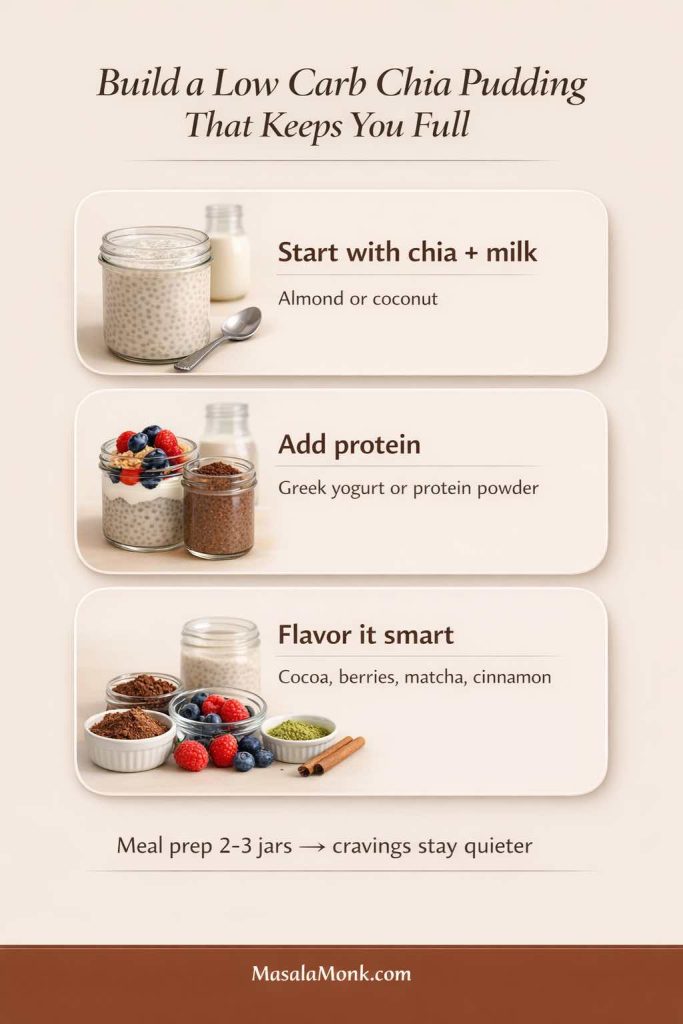
Three-step infographic showing how to build a low carb chia pudding that keeps you full. Step 1: start with chia + milk (almond or coconut). Step 2: add protein (Greek yogurt or protein powder). Step 3: flavor it smart (cocoa, berries, matcha, cinnamon). Includes note “Meal prep 2–3 jars → cravings stay quieter” and MasalaMonk.com in the footer.
Use this quick builder to make low carb chia pudding feel “meal-level”: start with chia + milk, add protein (Greek yogurt or protein powder), then flavor it with cocoa, berries, matcha, or cinnamon. Prep 2–3 jars at once and you’ve got a simple routine that stays satisfying all week.

If your mornings often end with cravings, switching to a high protein & low carb chia pudding is one of the easiest upgrades: keep the chia base, then build in protein with Greek yogurt (thick and creamy) or protein powder (especially in chocolate versions). For a broader framework that pairs perfectly with a chia routine, this guide is a strong companion: how to eat 100 grams of protein a day.

So yes—chia helps. Even better, the best results usually come from the combination: chia for texture and fiber, protein for staying power, and flavor choices you genuinely look forward to eating.

Also Read: Eggless Yorkshire Pudding (No Milk) Recipe


Low Carb Chia Pudding Base Recipe (Perfect Ratio, No Clumps)

Everything starts here. Whether you’re making keto chia pudding, chia pudding paleo, dairy free chia pudding, or a blended chia pudding mousse, the base method stays the same.

The basic chia pudding ratio (and how to adjust it)

For a classic, spoonable base:

  • 3 tablespoons chia seeds (about 36–40 g)
  • 1 cup / 240 ml liquid (almond milk, coconut milk, dairy milk, oat milk, etc.)
  • A pinch of salt
  • Optional: ½ teaspoon vanilla
  • Optional: sweetener to taste
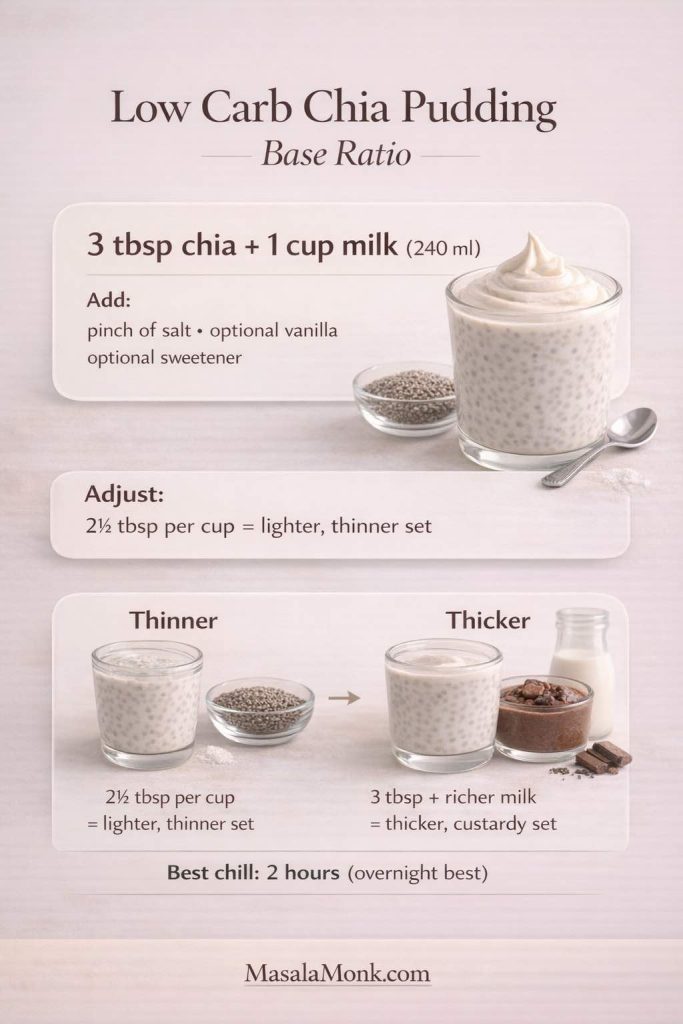
Infographic showing the low carb chia pudding base ratio: 3 tbsp chia seeds + 1 cup milk (240 ml), with add-ins (pinch of salt, optional vanilla, optional sweetener). It also shows how to adjust thickness: 2½ tbsp per cup for a lighter thinner set, or 3 tbsp plus richer milk for a thicker custardy set. Includes “Best chill: 2 hours (overnight best)” and MasalaMonk.com footer.
Here’s the dependable low carb chia pudding base ratio: 3 tablespoons chia to 1 cup milk (240 ml). Use 2½ tablespoons for a lighter set, or keep 3 tablespoons and switch to a richer milk (like canned coconut milk) for a thicker, custardy chia pudding—then chill at least 2 hours (overnight is best).

That ratio gives you a thick, pudding-like texture—great for low carb chia pudding cups, a chia pudding glass, or a single serve chia pudding jar. If you prefer it thinner, drop to 2½ tablespoons chia per cup of liquid. Conversely, if you like a dense, custardy texture, keep 3 tablespoons and use a richer liquid like canned coconut milk.

The mixing pattern that prevents clumps

This is the method that makes the difference between “silky” and “why is it lumpy?”

  1. Add chia seeds to the liquid, plus salt and vanilla (and sweetener, if using).
  2. Whisk vigorously for 20–30 seconds.
  3. Let it sit for 10 minutes.
  4. Whisk again, thoroughly.
  5. Cover and refrigerate at least 2 hours; overnight is even better.

That second whisk is the hinge. It’s the moment when the seeds have started to hydrate but haven’t fully set yet, which means you can break up clumps before they lock in.

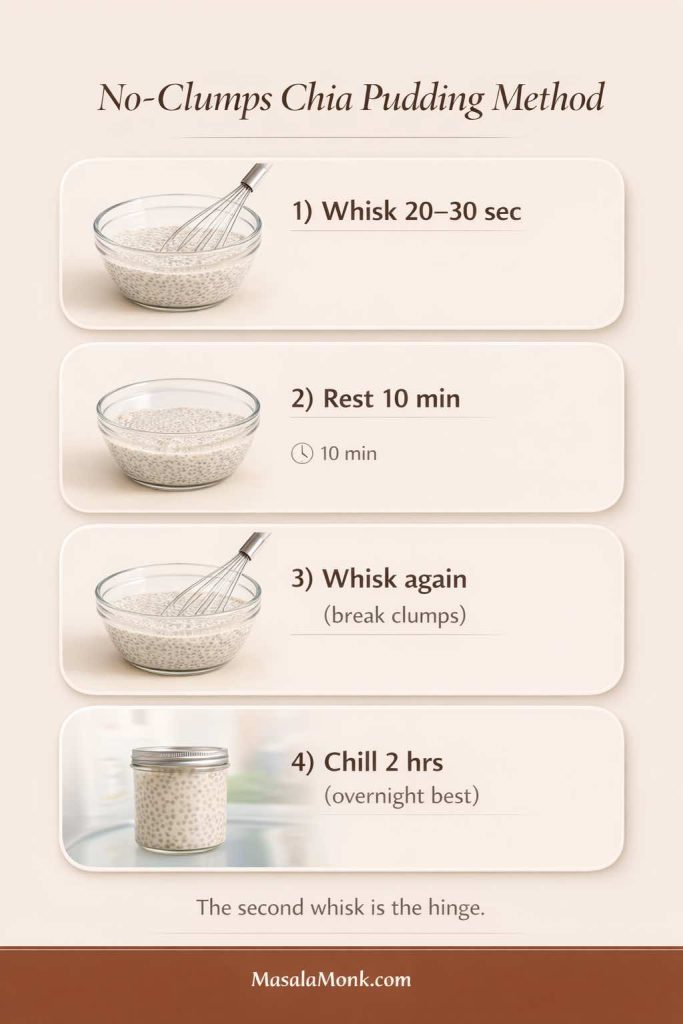
Step-by-step infographic titled “No-Clumps Chia Pudding Method” showing four steps: 1) whisk 20–30 seconds, 2) rest 10 minutes, 3) whisk again to break clumps, and 4) chill 2 hours (overnight best). Includes a bowl-and-whisk visual sequence, a jar chilling in the fridge, and the note “The second whisk is the hinge,” with MasalaMonk.com in the footer.
If your chia pudding turns lumpy, this is the fix: whisk well, rest 10 minutes, then whisk again before chilling. That second whisk breaks clumps right when the seeds start hydrating—so your low carb chia pudding sets smooth, thick, and spoonable instead of bumpy.

Quick chia pudding vs “instant” chia pudding

Chia needs time to hydrate, so it’s never truly instant in the way instant oats are. Still, you can make a quick low carb chia seed pudding when you’re pressed for time.

Use the same ratio, whisk well, do the 10-minute stir, and refrigerate for 30–45 minutes. It will be softer than overnight, yet it’s still spoonable—especially if you make it as chia pudding with yogurt or add protein powder.

Why soaking matters

Chia expands dramatically when it absorbs liquid. Because of that, it’s best eaten soaked rather than dry. If you want the reason in plain terms, this clinical case report shows what can happen when dry chia is swallowed without enough liquid: why chia should be soaked first.

Also Read: Crock Pot Chicken Breast Recipes: 10 Easy Slow Cooker Dinners (Juicy Every Time)


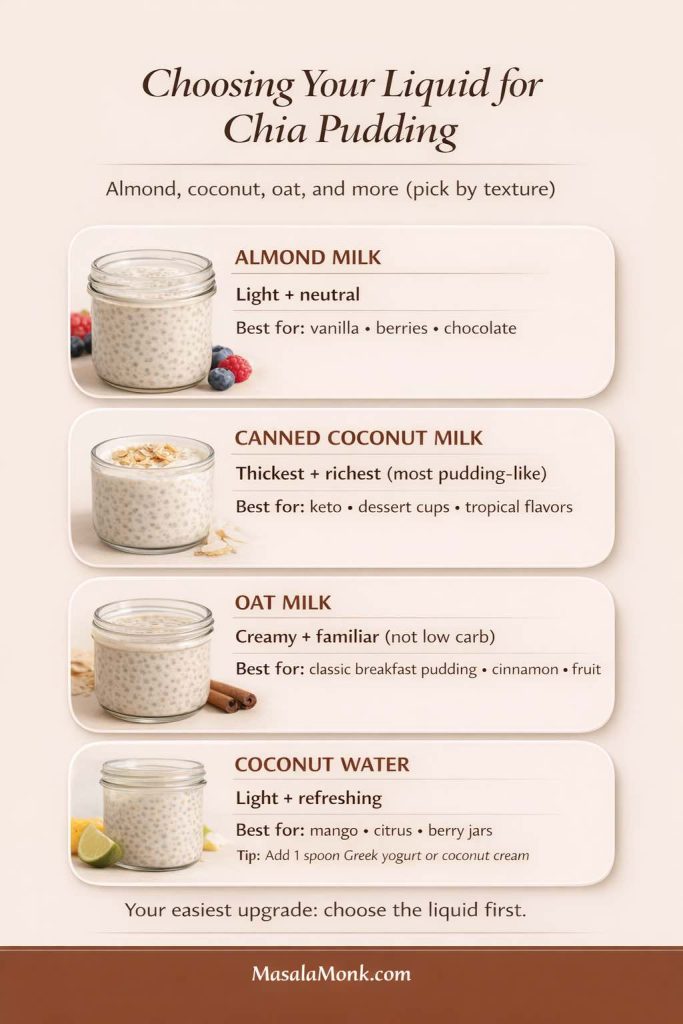
Choosing Your Liquid: Almond Milk, Coconut Milk, Oat Milk, and More

Liquid is the secret “ingredient” that decides whether your pudding tastes light, rich, tropical, or dairy-creamy. It’s also the easiest lever to pull depending on whether you’re going for keto pudding, paleo chia seed pudding, or a more classic breakfast pudding recipe.

Infographic titled “Choosing Your Liquid for Chia Pudding” showing four options with texture notes and best uses: almond milk (light + neutral), canned coconut milk (thickest + richest), oat milk (creamy + familiar, not low carb), and coconut water (light + refreshing) with a tip to add Greek yogurt or coconut cream. Includes “Your easiest upgrade: choose the liquid first” and MasalaMonk.com in the footer.
Your chia pudding texture is mostly decided by the liquid. Almond milk keeps it light and versatile, canned coconut milk makes the richest pudding-like set, oat milk gives a classic creamy breakfast feel (not low carb), and coconut water stays light and fruit-friendly—especially with a spoon of Greek yogurt or coconut cream.

Pudding with almond milk (clean, light, versatile)

Chia pudding with almond milk is a classic because it’s neutral and easy to customize. It’s also a natural base for low carb chia pudding and many keto-friendly variations. If you want a dedicated keto version built around almond milk, this is a strong reference recipe: keto chia pudding with almond milk.

Coconut milk for chia pudding (thickest texture, richest feel)

If you want your chia pudding to taste like real pudding, use canned coconut milk. It’s also a favorite for keto chia pudding coconut milk versions because the fat content naturally boosts satisfaction. For a paleo chia seed pudding approach, coconut milk is equally useful.

A small detail helps a lot here: canned coconut milk varies. Some are thin; others are thick. If yours pours like cream, whisk in a little water so it hydrates evenly. That way you avoid dense, under-hydrated pockets.

Oat milk chia pudding (not keto, but creamy and familiar)

Oat milk makes a gentle, classic pudding flavor. It’s not low carb, so it’s best as an optional variation for non-keto readers who still want a healthy breakfast pudding.

Chia pudding with coconut water (light, refreshing, fruit-friendly)

Coconut water makes a lighter gel. It’s lovely with mango, citrus, and berries; however, it won’t feel as creamy. For a richer texture, add a spoon of Greek yogurt or a spoon of coconut cream before serving.

Also Read: Mozzarella Sticks Recipe (Air Fryer, Oven, or Fried): String Cheese, Shredded Cheese, and Every Crunchy Variation


Homemade vs Premade Chia Pudding (Cups, Mixes, and Convenience Options)

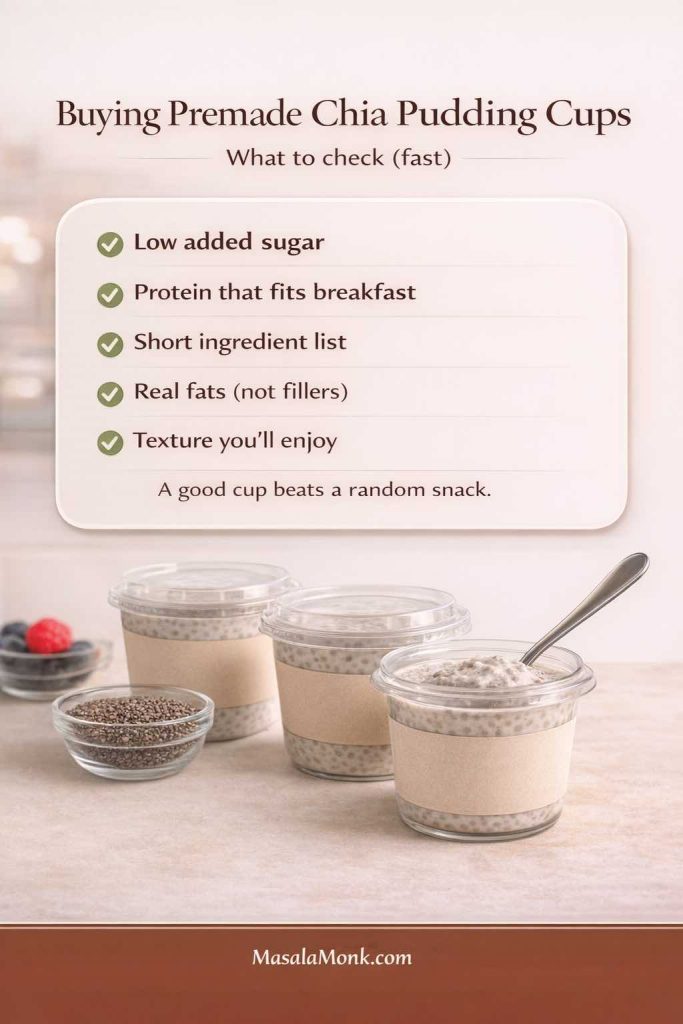
Sometimes you want the easiest option. That’s why premade chia pudding and premade chia seed pudding cups have become common grab-and-go items. A chia pudding cup can be a decent choice, especially if it keeps your day from derailing into ultra-processed snacks.

Infographic titled “Buying Premade Chia Pudding Cups” with a checklist: low added sugar, protein that fits breakfast, short ingredient list, real fats (not fillers), and texture you’ll enjoy. Photoreal scene shows unbranded chia pudding cups on a smooth counter with a spoon and a small bowl of chia seeds, plus the line “A good cup beats a random snack” and MasalaMonk.com in the footer.
If you’re buying premade chia pudding cups, a quick label check makes all the difference: keep added sugar low, choose a protein amount that works for breakfast, aim for a short ingredient list, and skip filler-heavy cups. Most importantly, pick a texture you’ll actually enjoy—because the best chia pudding cup is the one you’ll happily grab again.

If you’re choosing store-bought chia seed pudding cups, prioritize:

  • low or no added sugar,
  • a protein amount that makes sense for breakfast (if you want it to act like breakfast),
  • a short ingredient list,
  • and a texture you actually enjoy.

If you prefer to keep things homemade but fast, a chia pudding mix can work too. Some mixes are simply chia plus flavoring; others include sweeteners and thickeners. Even then, the most repeatable path is often a simple base batch plus flavor add-ins—cocoa, cinnamon, matcha, vanilla, fruit—so you can make multiple chia seed pudding cups in one go.

Also Read: Sourdough Starter Recipe: Make, Feed, Store & Fix Your Starter (Beginner Guide)


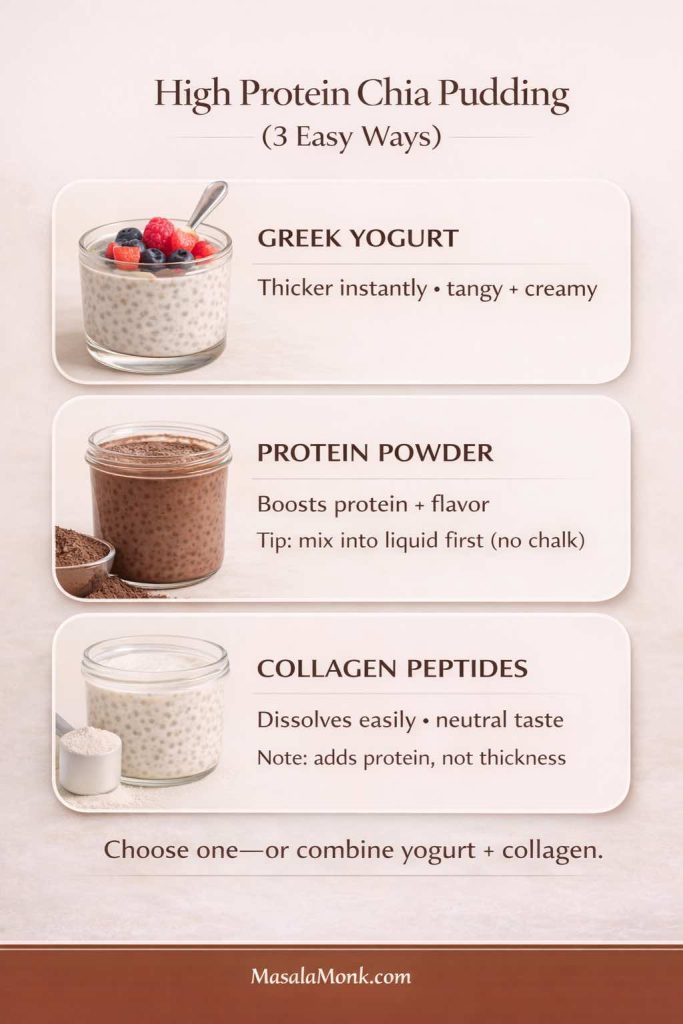
High Protein Chia Pudding: Greek Yogurt, Protein Powder, and Collagen

When people talk about protein chia pudding, they usually mean one of three styles:

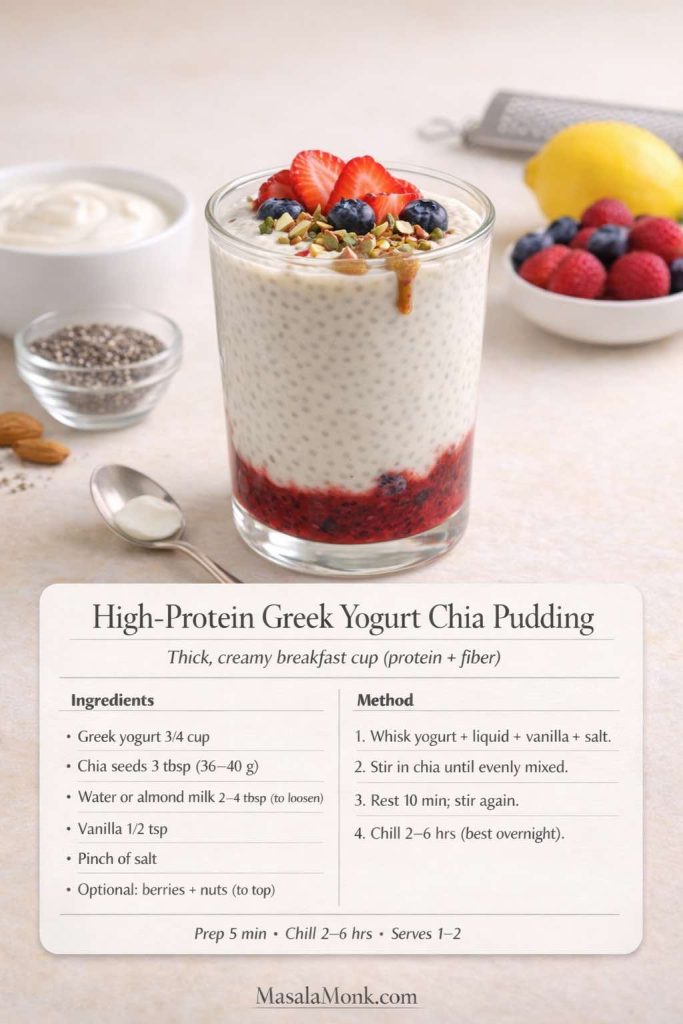
  1. chia pudding with Greek yogurt
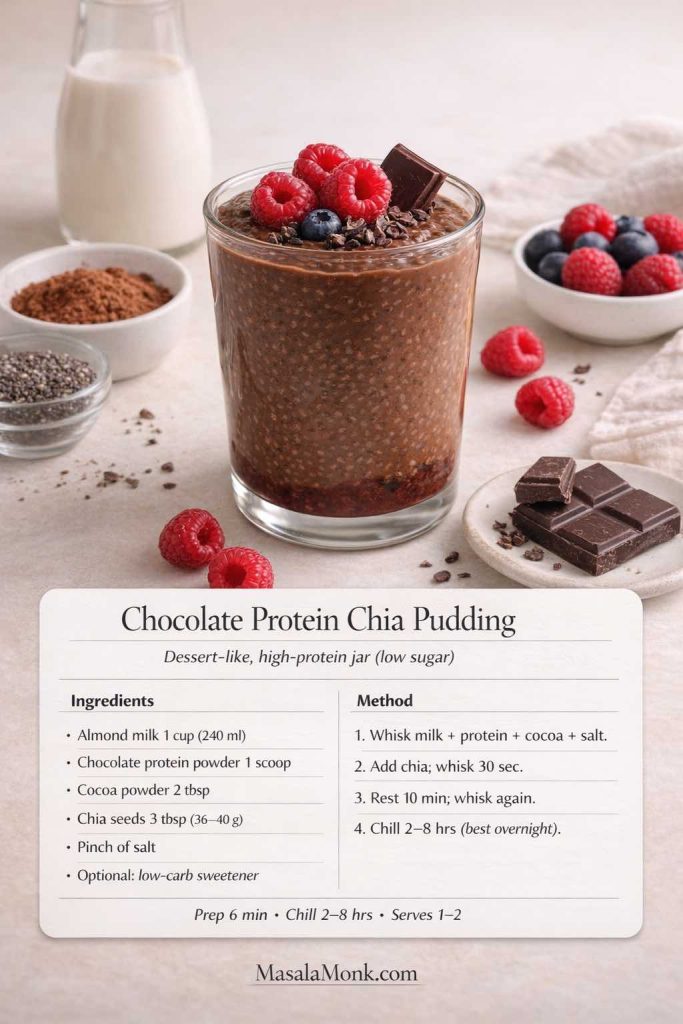
  2. chia pudding with protein powder
  3. chia collagen add-ins (often paired with yogurt)
Infographic titled “High Protein Chia Pudding (3 Easy Ways)” showing three options with photoreal jars: Greek yogurt (thicker instantly, tangy + creamy), protein powder (boosts protein + flavor with tip to mix into liquid first), and collagen peptides (dissolves easily, neutral taste; adds protein not thickness). Includes the line “Choose one—or combine yogurt + collagen” and MasalaMonk.com in the footer.
When you want high protein chia pudding, you’ve got three reliable routes: Greek yogurt for instant thickness and a creamy tang, protein powder for a bigger protein boost (best mixed into the liquid first so it stays smooth), or collagen peptides for an easy add-in that dissolves fast without changing flavor. Pick one—or combine yogurt + collagen for the most “meal-level” jar.
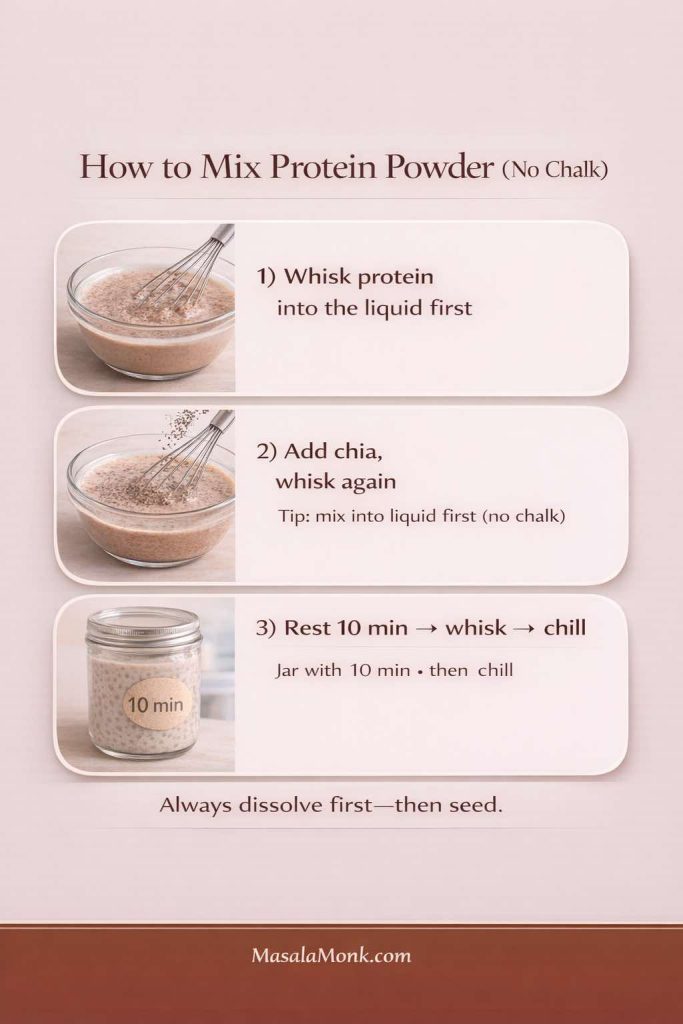
Step-by-step infographic titled “How to Mix Protein Powder (No Chalk)” showing three steps for smooth protein chia pudding: 1) whisk protein powder into the liquid first, 2) add chia seeds and whisk again, 3) rest 10 minutes, whisk, then chill. Includes the takeaway “Always dissolve first—then seed” and MasalaMonk.com in the footer.
The easiest way to avoid chalky protein chia pudding is to dissolve protein powder in the liquid first, then add chia and whisk again. After a 10-minute rest, give it one more whisk before chilling—this keeps the jar smooth, thick, and spoonable instead of gritty.

Greek yogurt thickens pudding instantly and adds a tang that makes chocolate, berries, vanilla, and peanut butter taste richer. Protein powder boosts protein and flavor, but it can turn chalky if it isn’t mixed properly. Collagen peptides dissolve easily and tend to be neutral, although they don’t thicken the same way chia does.

If you like a measured, realistic overview of collagen claims, this one is balanced: what collagen supplements can (and can’t) do.

If you want a complementary “drinkable breakfast” option that fits the same protein-forward routine, this is a natural companion: Greek yogurt shake recipes for a protein-packed breakfast.


10 Low Carb Chia Pudding Recipes (Keto, Paleo, Protein, Blended, Fruit)

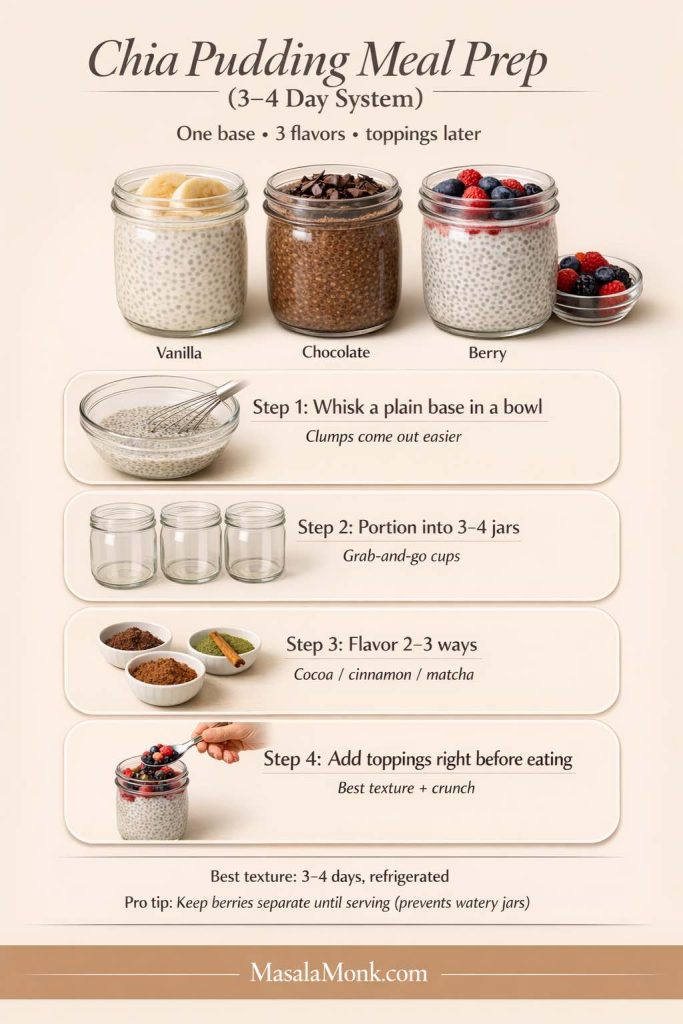
Each recipe below makes 1–2 servings depending on appetite. For meal prep, multiply ingredients, then portion into chia pudding cups or jars. Meanwhile, if you’re building variety without extra work, make two or three bases at once: one almond milk jar, one coconut milk jar, and one Greek yogurt jar. That way, you’re never stuck eating the same flavor five days in a row.

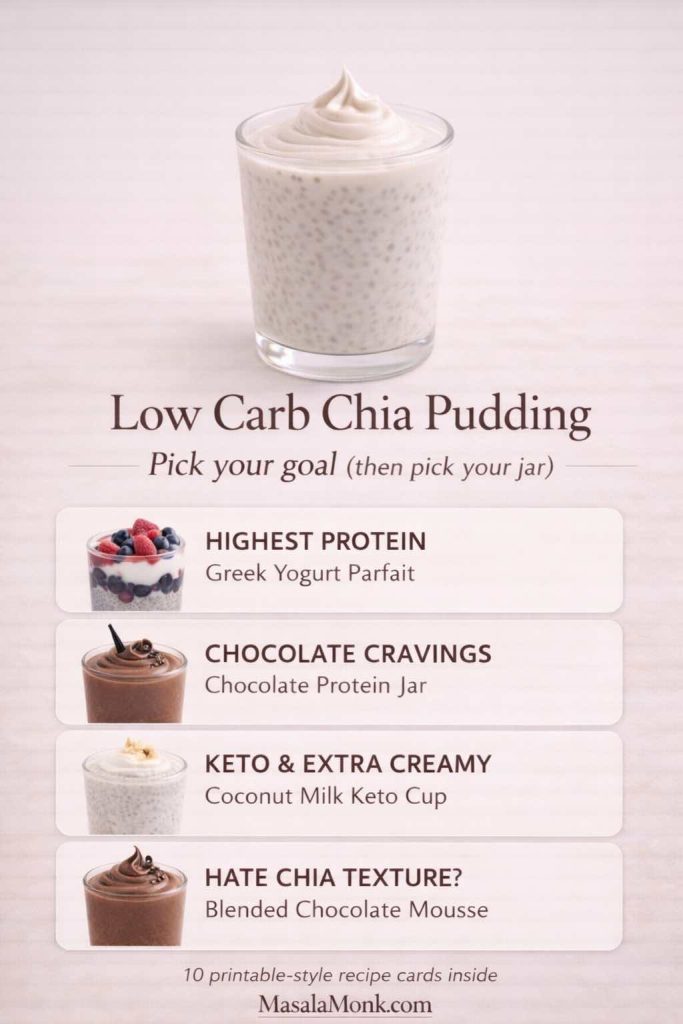
Goal-based chooser graphic for low carb chia pudding with a hero jar at the top and four labeled choices: “Highest Protein – Greek Yogurt Parfait,” “Chocolate Cravings – Chocolate Protein Jar,” “Keto & Extra Creamy – Coconut Milk Keto Cup,” and “Hate Chia Texture? – Blended Chocolate Mousse.” Clean editorial layout with MasalaMonk.com in the footer.
Not sure which jar to make first? Start with your goal: highest protein, chocolate cravings, extra-creamy keto, or blended mousse if you don’t like chia texture—then jump into the matching recipe below.

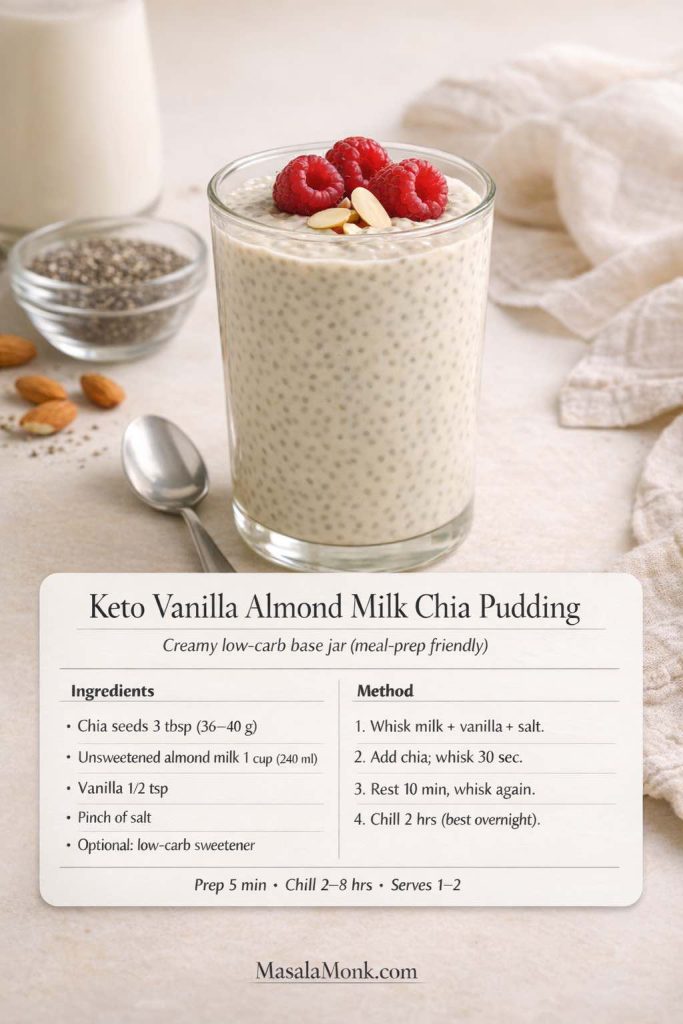
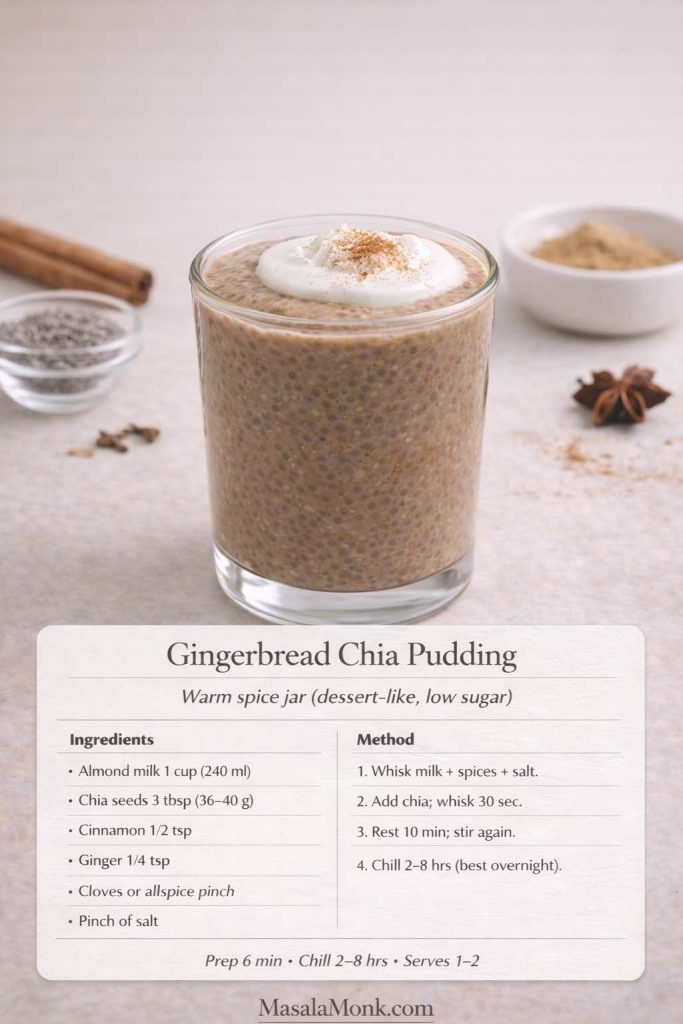
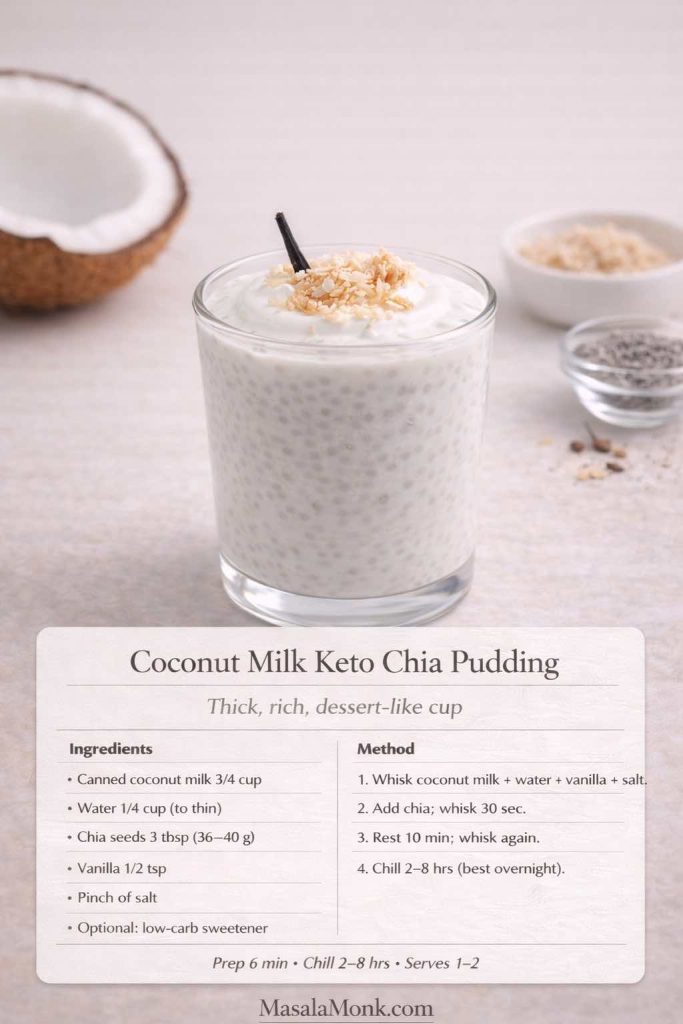
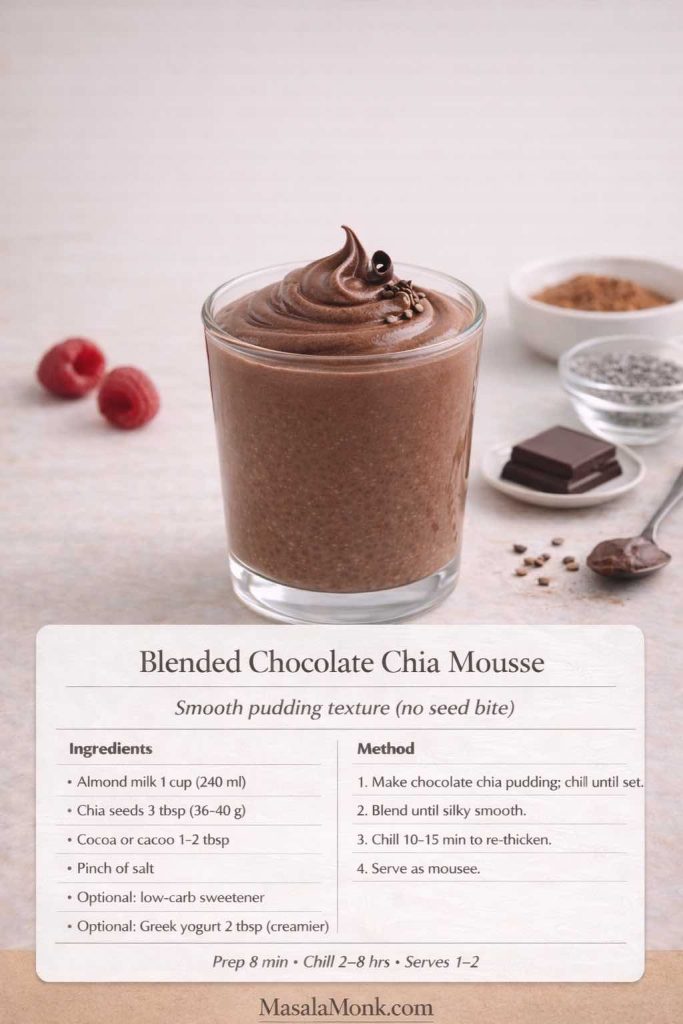
1) Keto Chia Pudding with Almond Milk (Vanilla Base That Never Fails)

This is the everyday low carb chia pudding that works as breakfast, snack, or a simple dessert. It’s also the best “starter” jar because it takes flavors well.

Ingredients (1–2 servings)

  • 3 tablespoons chia seeds
  • 1 cup unsweetened almond milk
  • ½ teaspoon vanilla extract
  • Pinch of salt
  • Optional sweetener: monk fruit/erythritol/stevia, to taste
Recipe card image of keto vanilla almond milk chia pudding in a glass topped with raspberries and sliced almonds, with ingredients and steps for a low carb chia pudding base. Includes chia-to-milk ratio, quick stir method, and prep/chill times, styled as a meal-prep friendly high-protein breakfast.
This keto vanilla almond milk chia pudding is the “base jar” you’ll use all week—creamy, low carb, and easy to meal prep. Make it overnight for the smoothest texture, then customize it after training with Greek yogurt or a scoop of protein powder, or keep it simple with berries and nuts for a quick fitness-friendly breakfast that actually satisfies.

Method

  1. In a bowl or jar, whisk almond milk, vanilla, salt, and sweetener (if using).
  2. Stir in chia seeds and whisk vigorously for 20–30 seconds.
  3. Let it rest 10 minutes, then whisk again until no clumps remain.
  4. Cover and refrigerate 2 hours or overnight.

Flavor variations

  • Add ½ teaspoon cinnamon for a warm “vanilla-cinnamon pudding” base.
  • Add a tablespoon of shredded coconut for coconut puddings recipes energy without needing extra sweetness.
  • Stir in 1–2 tablespoons of Greek yogurt right before serving for a creamier finish.

Toppings that keep it low carb
Chopped nuts, cacao nibs, a small handful of berries, or a spoon of nut butter.

If you want a dedicated keto version with extra detail, this internal recipe fits perfectly: keto chia pudding with almond milk.


2) Chia Pudding with Greek Yogurt (High Protein, Ultra Creamy)

If you like pudding with Greek yogurt, this version can feel like cheesecake in a jar. It also adapts well: vanilla, chocolate, berry, citrus, even coffee flavors.

Ingredients (1–2 servings)

  • ¾ cup Greek yogurt (plain works best)
  • 3 tablespoons chia seeds
  • 2–4 tablespoons water or almond milk (to loosen)
  • ½ teaspoon vanilla
  • Pinch of salt
  • Optional sweetener, to taste
Recipe card image of high-protein Greek yogurt chia pudding in a glass with a berry compote layer, topped with strawberries, blueberries, chopped nuts, and a light nut-butter drizzle. The card lists ingredients and steps for a thick chia pudding with Greek yogurt, including the stir-twice method and chill time, styled as a meal-prep breakfast cup.
This high-protein Greek yogurt chia pudding is the thick, creamy option when you want a breakfast that holds you steady—especially after a workout. The berry layer makes it feel like a parfait, while the chia-to-yogurt base keeps it filling and meal-prep friendly. Make two cups at once and rotate toppings through the week for an easy high protein chia pudding routine.

Method

  1. Whisk Greek yogurt, vanilla, salt, and 2 tablespoons water (or almond milk) until smooth.
  2. Stir in chia seeds and mix thoroughly.
  3. Rest 10 minutes, then stir again to redistribute the seeds evenly.
  4. Refrigerate at least 2 hours.

Texture tuning

  • Too thick? Add a splash of water or almond milk and stir.
  • Too thin? Add 1 tablespoon chia, stir, and chill 30–60 minutes.

Toppings that make it feel like dessert
Berries, chopped nuts, cocoa powder dusted on top, or a spoon of peanut butter.

If you want a similar high-protein breakfast base that isn’t yogurt, this link fits naturally as an alternative: cottage cheese for breakfast.


3) Chocolate Protein Chia Pudding (Protein Powder + Cocoa)

This jar is for the days you want pudding chia chocolate flavor without the “diet” vibe. Done right, it tastes like a rich chocolate pudding.

Ingredients (1–2 servings)

  • 1 cup unsweetened almond milk (or dairy milk)
  • 1 scoop protein powder (chocolate, or vanilla plus cocoa)
  • 2 tablespoons cocoa powder or cacao powder
  • 3 tablespoons chia seeds
  • Pinch of salt
  • Optional sweetener, to taste
  • Optional: 1 tablespoon Greek yogurt (for extra creaminess)
Recipe card image of chocolate protein chia pudding in a clear glass topped with raspberries, cacao nibs, and dark chocolate. The card shows ingredients and steps for a low carb chia pudding made with almond milk, cocoa powder, and chocolate protein powder, including the stir-twice method and chill time, styled as a dessert-like high-protein snack or breakfast.
When cravings hit, this chocolate protein chia pudding is the “dessert that behaves.” Cocoa and a scoop of protein turn a simple jar into a rich, low sugar treat that still fits a low carb day—perfect after training, as an afternoon snack, or whenever you want something chocolatey that keeps you satisfied.

Method

  1. Whisk almond milk, protein powder, cocoa/cacao, salt, and sweetener until completely smooth.
  2. Stir in chia seeds and whisk again.
  3. Rest 10 minutes; whisk a second time to prevent clumps.
  4. Refrigerate overnight for the best set.

How to keep it smooth
If your protein powder tends to clump, whisk it into a small amount of milk first to make a smooth paste, then add the rest of the milk.

Topping ideas
A spoon of whipped Greek yogurt, crushed nuts, cacao nibs, or a few berries.

Also Read: How to make No-Bake Banana Pudding: No Oven Required Recipe


4) Chocolate Peanut Butter Chia Seed Pudding (Classic, Comforting, Satisfying)

This is the jar that feels like a treat. Chocolate and peanut butter do most of the work, so you can keep sweetness low and still love it.

Ingredients (1–2 servings)

  • 1 cup almond milk (or dairy milk)
  • 3 tablespoons chia seeds
  • 1–2 tablespoons peanut butter
  • 1 tablespoon cocoa powder
  • Pinch of salt
  • Optional sweetener
Recipe card image of chocolate peanut butter chia pudding in a clear glass with a peanut butter swirl, topped with raspberries, chopped peanuts, and cacao nibs. The card lists ingredients and steps for a low carb chia pudding made with almond milk, cocoa powder, chia seeds, and peanut butter, including the stir-rest-stir method and chill time, with MasalaMonk.com in the footer.
Chocolate peanut butter chia pudding is the comfort-jar that still plays nicely with a low carb day—rich cocoa flavor, a creamy peanut butter swirl, and a thick spoonable set that’s perfect for cravings. Prep it the night before, then top with berries and nuts for a keto-friendly dessert vibe that also works as a high-protein snack.

Method

  1. Whisk milk, cocoa, salt, and sweetener until smooth.
  2. Whisk in peanut butter until fully dissolved.
  3. Stir in chia seeds, rest 10 minutes, stir again, then refrigerate.

Make it even better
Add a tiny splash of vanilla, or a pinch of cinnamon. Surprisingly, cinnamon makes chocolate taste deeper.

Topping ideas
Strawberries, raspberries, chopped roasted nuts, or a light sprinkle of shredded coconut.

Also Read: Chicken Adobo — Step-by-Step Recipe — Classic Filipino Adobong Manok


5) Matcha Chia Pudding (Green Tea Latte Style)

Matcha and chia seeds are a surprisingly good match. The flavor is clean and slightly bitter, which is exactly why a touch of vanilla and a pinch of salt can make it taste more rounded.

Ingredients (1–2 servings)

  • 1 cup almond milk (or a light coconut milk beverage)
  • 3 tablespoons chia seeds
  • 1–2 teaspoons matcha powder
  • ½ teaspoon vanilla
  • Pinch of salt
  • Optional sweetener
Recipe card image of matcha chia pudding in a clear glass with a creamy pale green set, topped with a kiwi slice, pistachio pieces, and a small dollop of yogurt. The card lists ingredients and steps for a green tea latte style chia seed pudding made with almond milk, matcha, vanilla, and chia seeds, including the stir-rest-stir method and chill time, with MasalaMonk.com in the footer.
This matcha chia pudding tastes like a green tea latte in a jar—fresh, creamy, and surprisingly satisfying. It’s a great low carb breakfast when you want something lighter than chocolate but still crave a dessert-style texture. Prep it overnight, then top with fruit and nuts for a café-style chia pudding cup that’s easy to meal prep and fun to switch up.

Method

  1. Sift matcha into the milk (or whisk it in slowly) until smooth.
  2. Add vanilla, salt, and sweetener if using.
  3. Stir in chia, rest 10 minutes, stir again, then refrigerate.

How to avoid matcha clumps
If matcha is stubborn, whisk it with 1–2 tablespoons warm water first to create a smooth paste, then whisk that into the milk.

Caffeine note
If you’re sensitive to caffeine, keep matcha closer to 1 teaspoon and enjoy earlier in the day. For general guidance, Mayo Clinic’s overview is useful: daily caffeine guidance.

If you like matcha as part of a calmer routine, this supportive read fits naturally: tea and cortisol.


6) Mango Chia Pudding (Bright, Tropical, Meal Prep Friendly)

Mango chia pudding tastes like a dessert jar, yet you can keep it controlled by using a smaller mango portion and leaning on lime and salt to amplify flavor.

Ingredients (1–2 servings)

  • 1 cup almond milk or coconut milk beverage
  • 3 tablespoons chia seeds
  • ⅓ cup mango puree (or finely diced mango)
  • Pinch of salt
  • Optional: squeeze of lime
Recipe card image of mango chia pudding in a clear glass with a bright mango puree base and a creamy chia pudding layer on top, garnished with a lime slice and mango cubes. The card lists ingredients and steps for a layered chia seed pudding made with almond milk, chia seeds, mango puree, and optional lime, including chill time and servings, with MasalaMonk.com in the footer.
This mango chia pudding is the “sunrise cup” that makes meal prep feel like dessert—sweet-tropical flavor, a creamy chia layer, and a bright mango base finished with a squeeze of lime. It’s perfect when you want a lighter low carb chia pudding that still feels fun, especially as a grab-and-go breakfast or a mid-afternoon snack.

Method

  1. Make a plain chia base with milk, chia, and salt.
  2. Chill until set.
  3. Fold in mango puree right before eating, or layer mango at the bottom of your cup and spoon chia on top.

How to keep it low carb
Use mango as a flavor accent rather than the entire bowl. You’ll still get the tropical hit, especially with lime.

More mango inspiration
These fit beautifully as follow-ons: How to Make Mango Chia Pudding: 5 Creative Ideas and Chia Pudding for Lunch: 5 Ways to Add More Mango to It.


7) Apple Cinnamon Chia Pudding (Cozy, Filling, Great for Breakfast)

Apple cinnamon chia pudding is comfort in a jar. Depending on how strict your carbs are, you can either use a small amount of apple or skip it and let cinnamon do the heavy lifting.

Ingredients (1–2 servings)

  • 1 cup unsweetened almond milk
  • 3 tablespoons chia seeds
  • ½ teaspoon cinnamon
  • Pinch of salt
  • Optional: ⅓ cup grated apple
  • Optional: pinch of nutmeg
Recipe card image of apple cinnamon chia pudding in a clear glass, topped with a thin apple fan and a light cinnamon dusting. The card shows ingredients and step-by-step method for a low carb chia pudding made with almond milk, chia seeds, cinnamon, salt, and optional grated apple, plus prep and chill time, with MasalaMonk.com in the footer.
Apple cinnamon chia pudding is the cozy breakfast jar that feels like dessert without being heavy—creamy chia, warm spice, and a bright apple finish. Prep it the night before, then fold in grated apple right before eating for the freshest flavor and a thick, spoonable low carb chia pudding you’ll want on repeat.

Method

  1. Whisk milk, cinnamon, salt, and nutmeg if using.
  2. Stir in chia, rest 10 minutes, stir again, then chill.
  3. Fold in grated apple right before serving (it stays fresher that way).

Keto-friendly variation
Skip apple. Add chopped pecans and a drop of vanilla instead for a low carb cinnamon-pecan pudding.

Also Read: Sweetened Condensed Milk Fudge: 10 Easy Recipes


8) Gingerbread Chia Pudding (Warm Spices, Dessert Energy)

This gingerbread chia pudding is perfect when you want something cozy without needing a baked dessert. It also fits nicely under a broader “anti inflammatory” vibe because of the warming spices—without turning into a medical lecture.

Ingredients (1–2 servings)

  • 1 cup almond milk or coconut milk beverage
  • 3 tablespoons chia seeds
  • ½ teaspoon cinnamon
  • ¼ teaspoon ginger
  • Pinch of cloves or allspice
  • Pinch of salt
  • Optional sweetener
Recipe card image of gingerbread chia pudding in a clear glass, topped with a dollop of yogurt and a light cinnamon sprinkle. The card shows ingredients and steps for a warm-spice chia seed pudding made with almond milk, chia seeds, cinnamon, ginger, cloves or allspice, and salt, including the stir-rest-stir method and chill time, with MasalaMonk.com in the footer.
This gingerbread chia pudding brings cozy dessert flavor to a simple low carb chia pudding routine—warm spices, creamy texture, and a thick set that’s perfect for meal prep. Make it overnight, then finish with a spoon of yogurt (or coconut cream) for a rich, satisfying breakfast cup that feels like a treat.

Method

  1. Whisk spices, salt, and sweetener into the milk.
  2. Stir in chia, rest 10 minutes, stir again, then refrigerate.
  3. Serve with crushed nuts or a spoon of yogurt.

Dessert bridge
If you want more warm-spice keto dessert ideas, this fits naturally: keto vegan dessert recipes with ginger.


9) Keto Chia Pudding with Coconut Milk (Ultra Creamy)

This is the thickest, most “real pudding” keto chia pudding option. If you’ve ever felt chia was too watery, this changes everything.

Ingredients (1–2 servings)

  • 3 tablespoons chia seeds
  • ¾ cup canned coconut milk
  • ¼ cup water (adjust to pourable)
  • Pinch of salt
  • ½ teaspoon vanilla
  • Optional sweetener
Recipe card image of coconut milk keto chia pudding in a clear glass with a creamy white set, topped with toasted coconut flakes and a vanilla bean. The card shows ingredients and step-by-step method using canned coconut milk, water, chia seeds, vanilla, and salt, plus prep and chill time for a thick low carb chia pudding, with MasalaMonk.com in the footer.
If you want the thickest, most dessert-like low carb chia pudding, this coconut milk keto chia pudding is the one. Canned coconut milk gives it that rich, spoonable set, while vanilla and toasted coconut make it feel like a treat you’d pay for. Prep it overnight, then add berries or chopped nuts for a simple, satisfying breakfast cup.

Method

  1. Whisk coconut milk, water, vanilla, salt, and sweetener until smooth.
  2. Stir in chia, rest 10 minutes, stir again, then refrigerate.

Texture tip
If it sets extremely thick overnight, loosen with a splash of water before serving and stir well.

If you love mango + coconut together, this is a nice complementary read: mango with coconut milk.


10) Blended Chia Pudding (Smooth Chocolate Mousse)

Blended chia pudding is for anyone who dislikes the “seed” texture. Once blended, it becomes silky—almost like a classic pudding cup.

Ingredients (1–2 servings)

  • 1 cup almond milk (or dairy milk)
  • 3 tablespoons chia seeds
  • 1–2 tablespoons cocoa powder or cacao powder
  • Pinch of salt
  • Optional sweetener
  • Optional: 1 tablespoon peanut butter or 2 tablespoons Greek yogurt
Recipe card image of blended chocolate chia mousse in a clear glass with a piped swirl top, garnished with a dark chocolate curl and cacao nibs. The card lists ingredients and steps for a smooth blended chia pudding made with almond milk, chia seeds, cocoa or cacao, salt, and optional sweetener or Greek yogurt, plus prep and chill time, with MasalaMonk.com in the footer.
If you love chocolate but don’t love the texture of chia seeds, this blended chocolate chia mousse is your best jar. You get the same thick, satisfying low carb chia pudding base, then a quick blend turns it silky and spoonable—more like a classic pudding cup. Keep it simple with cocoa and almond milk, or stir in a little Greek yogurt for an even creamier, high-protein finish.

Method

  1. Make a standard chocolate chia pudding and refrigerate until set (2+ hours).
  2. Blend until completely smooth and glossy.
  3. Chill 10–15 minutes so it thickens again.

Why it’s worth doing
This is one of the best ways to create a creamy chia pudding texture without the “frog egg” feel. It’s also a smart method for protein powder: blend it in after setting to avoid chalky pockets.

Also Read: Sourdough Recipe: 10 Easy Bread Bakes (Loaves, Rolls & Bagels)


Making Chia Pudding Easy to Keep Up With (Meal Prep + Storage)

If you’re making chia seed pudding cups for the week, a simple rhythm helps:

  • Make a plain base batch in a bowl so you can whisk clumps out easily.
  • Portion into jars or cups.
  • Flavor them in two or three different directions so you don’t get bored.
  • Add fresh toppings right before eating.
Infographic titled “Chia Pudding Meal Prep (3–4 Day System)” showing three jar flavors (vanilla, chocolate, berry) and four steps: whisk a plain base in a bowl, portion into 3–4 jars, flavor 2–3 ways (cocoa/cinnamon/matcha), and add toppings right before eating for best texture and crunch. Includes storage note “Best texture: 3–4 days, refrigerated” and tip to keep berries separate until serving, with MasalaMonk.com in the footer.
This is the easiest chia pudding routine to stick with: whisk one plain base, portion into 3–4 jars, flavor a few different ways (vanilla, chocolate, berry), and add toppings right before eating so the texture stays thick and fresh. For meal prep, most jars taste best within 3–4 days—especially if you keep berries separate until serving.

For storage time, most people prefer the taste and texture within three to four days. And for general refrigerated leftovers guidance, USDA FSIS is the standard reference: leftovers food-safety storage times.

One subtle trick: if you’re using fruit, especially berries, keep it separate until serving. That way your “chia pudding cups” don’t turn watery, and the flavors stay bright.

Also Read: Peanut Butter Fudge: Recipes & Guide (8 Methods + Easy Variations)


A simple note on keto and chia

Chia can fit into many keto and low carb patterns because it’s easy to portion and pairs well with higher-fat liquids like coconut milk. That’s part of why keto chia seed pudding recipe variations are so common—especially when combined with Greek yogurt or protein powder. If you want a deeper internal explainer focused on chia and keto specifically, this is a natural follow-on: Chia Seeds and the Ketogenic Diet.


The best way to make chia pudding taste like something you crave

A lot of people try chia once, don’t love it, and assume they’re not a “chia person.” Most of the time, it’s not the chia. It’s the flavor balance.

Here’s what tends to make a jar of low carb chia pudding feel genuinely delicious:

  • A pinch of salt, always
  • Vanilla or cinnamon to round out the flavor
  • Cocoa powder when you want depth
  • Something creamy (Greek yogurt, coconut milk, or a spoon of nut butter)
  • A topping that adds contrast—berries, chopped nuts, cacao nibs
Infographic titled “Make Chia Pudding Taste Craveable” showing a central jar of chia pudding with callouts for flavor balance: pinch of salt, vanilla or cinnamon, cocoa powder, something creamy (Greek yogurt/coconut milk/nut butter), and a contrast topping (berries/nuts/cacao nibs). Bottom note suggests starting with two jars: vanilla almond milk and Greek yogurt high-protein. MasalaMonk.com is in the footer.
If low carb chia pudding tastes “meh,” it’s usually not the chia—it’s the balance. Start with a pinch of salt, add vanilla or cinnamon, bring depth with cocoa powder, then make it creamy with Greek yogurt, coconut milk, or a spoon of nut butter. Finish with a contrast topping like berries, chopped nuts, or cacao nibs, and the jar suddenly feels like a treat you’ll actually crave.

Once you dial that in, low carb chia pudding becomes less of a “health chore” and more of a flexible treat you can keep in rotation. Some weeks you’ll lean into matcha and coconut milk. Other weeks you’ll be in a chocolate peanut butter phase. Then, when you want brightness, mango or berries bring everything to life.

If you make one of these this week, start with two jars: one vanilla almond milk base and one high-protein Greek yogurt version. That way you get variety immediately—light and clean on one side, thick and filling on the other—without creating extra work.

And if you want even more structure for turning chia into a consistent weight-loss habit, revisit the companion guide here: chia pudding for weight loss tips, benefits, and recipes.


FAQs

1) What’s the best low carb chia pudding ratio?

A reliable starting point is 3 tablespoons chia seeds to 1 cup liquid for a thick, spoonable chia seed pudding. If you prefer a lighter texture, use 2½ tablespoons per cup. Conversely, if you want a denser keto pudding feel, keep 3 tablespoons and choose a richer liquid like coconut milk.

2) How long does chia pudding need in the fridge?

Most jars set well in 2–3 hours, although overnight chia pudding usually turns out smoother and more consistent. If you’re meal-prepping chia seed pudding cups, overnight is often the easiest path because the texture stabilizes by morning.

3) Why is my chia seed pudding watery or runny?

Typically, runny chia pudding comes from one of three things: too much liquid, not enough time, or not stirring twice early on. Add 1 teaspoon chia at a time, stir, then refrigerate 30–60 minutes. Also, do a second stir around the 10-minute mark to prevent clumps and uneven hydration.

4) Why did my chia pudding turn too thick?

This happens when chia absorbs more than expected—especially with thick liquids like canned coconut milk. To fix it, stir in a splash of water, almond milk, or coconut milk until it loosens into a creamy chia pudding consistency.

5) Can I make instant chia pudding or quick chia pudding?

You can make a quick chia pudding by whisking thoroughly, stirring again after 10 minutes, and chilling 30–45 minutes. Even so, the best chia pudding texture usually comes from a longer chill. If time is tight, adding Greek yogurt can help it feel thicker sooner.

6) Is chia pudding keto-friendly?

Chia seeds can fit many keto approaches because they’re portionable and pair well with higher-fat liquids. For keto chia pudding, use unsweetened almond milk or coconut milk, keep sweeteners minimal, and choose toppings like nuts, cacao nibs, or unsweetened coconut.

7) What are the best chia seeds for keto or low carb chia pudding?

Both black and white chia seeds work similarly for chia seed pudding low carb recipes. What matters more is freshness and how you store them. If the seeds smell stale or oily, the pudding can taste “off,” even if your recipe is perfect.

8) Can I make chia pudding with almond milk?

Yes—chia pudding with almond milk is one of the most common bases because the flavor is neutral and the texture sets reliably. For extra creaminess, add a spoon of Greek yogurt, coconut cream, or nut butter once it’s set.

9) Can I make chia pudding with coconut milk?

Absolutely. Chia pudding coconut milk versions are often the creamiest and feel closest to a traditional pudding. If you’re using canned coconut milk, thin it slightly with water so the chia hydrates evenly.

10) Can I make chia pudding with oat milk?

Yes, chia pudding with oat milk is popular because it tastes mild and comforting. However, oat milk is not typically low carb, so it’s better for a general “healthy pudding” routine rather than a strict keto plan.

11) Can I make chia pudding with yogurt instead of milk?

You can, and it’s a great way to create a high protein chia pudding. For chia pudding with yogurt no milk, whisk yogurt with a little water to loosen it, then stir in chia. The result is thick, tangy, and very filling.

12) What’s the difference between chia pudding with Greek yogurt vs regular yogurt?

Greek yogurt is thicker and higher in protein, so chia pudding Greek yogurt versions tend to set firmer and feel more like a meal. Regular yogurt can work too, although you may need a bit more chia or a longer chill to reach the same texture.

13) Can I add protein powder to chia pudding?

Yes—chia pudding with protein powder is an easy way to boost protein. For the smoothest result, dissolve the protein powder into the milk first, then add chia. If you add powder directly to a set pudding, it can clump.

14) How do I make chocolate chia protein pudding taste better?

Use cocoa or cacao plus a pinch of salt to deepen the flavor. Then, choose a chocolate protein powder you actually enjoy. A small spoon of peanut butter or Greek yogurt can also make chocolate protein chia pudding taste richer and less “thin.”

15) Can I make blended chia pudding?

Yes. Blended chia pudding is ideal if you dislike the texture of whole chia seeds. First, let the pudding set; afterward, blend until smooth. You’ll get a creamy chia pudding that feels like mousse, especially with cocoa or nut butter.

16) Can I grind or blend chia seeds before soaking?

You can, but it changes the texture quickly and may thicken faster. Ground chia pudding tends to set more like a gel. If you prefer a smoother mouthfeel, blending after soaking often tastes better than blending dry seeds first.

17) What’s the best way to sweeten chia pudding without sugar?

Many people keep it simple with vanilla, cinnamon, cocoa, or fruit. If you want sweetener, choose an option you tolerate well and use a small amount. Often, adding a spoon of peanut butter or coconut milk richness reduces how much sweetness you need.

18) Is chia pudding paleo?

Chia pudding paleo versions usually use almond milk, coconut milk, or coconut water instead of dairy. For a richer bowl, add nut butter, coconut cream, or fruit. If you use yogurt, choose a version that matches your approach.

19) What is anti inflammatory chia pudding?

In practice, it’s chia pudding flavored with ingredients often used in “anti-inflammatory” eating patterns—ginger, cinnamon, cacao, berries, and sometimes turmeric. A ginger chia pudding or gingerbread chia pudding can fit this style while still tasting like dessert.

20) Can I add collagen to chia pudding?

Yes. Chia collagen add-ins are usually easiest because collagen peptides dissolve smoothly. Since collagen doesn’t thicken much, you’ll still rely on chia (and optionally yogurt) for the pudding texture.

21) What toppings work best for chia pudding for weight loss?

For a more weight-loss friendly bowl, focus on toppings that add texture without a big sugar hit: nuts, seeds, unsweetened coconut, cacao nibs, and a measured amount of berries. If you want fruit-forward flavors like mango chia pudding, keep the portion modest and balance it with protein.

22) How do I make strawberry chia seed pudding or berry chia pudding?

Make a plain base first, then fold in mashed strawberries or mixed berries after it sets. Alternatively, layer berries at the bottom of the cup for a “chia pudding with strawberries” effect. If you add watery fruit too early, the pudding can loosen.

23) How do I make mango chia pudding without making it too sweet?

Use mango as a flavor accent: a few tablespoons of puree can be enough. Add lime and a pinch of salt to amplify the tropical flavor, then keep the base unsweetened so the mango stands out naturally.

24) How do I make apple cinnamon chia pudding taste like dessert?

Use cinnamon, vanilla, and a pinch of salt as the backbone. If you’re not strict keto, a small amount of grated apple adds aroma and sweetness. Otherwise, chopped pecans plus cinnamon can mimic an apple-pie vibe without the fruit.

25) How long does chia seed pudding last, and can I meal prep it?

Chia pudding is popular for meal prep because it holds well in the fridge. Many people prep single serve chia pudding cups for several days at a time. For the best texture, keep toppings separate and stir before eating.

26) Why does my chia pudding taste bland?

Usually it needs salt, vanilla, or a stronger flavor base. Cocoa, matcha, cinnamon, and nut butter all make a big difference. Also, richer liquids—like coconut milk—often improve flavor even when sweetness is minimal.

27) What’s the easiest 3 ingredient chia pudding?

A classic 3 ingredient chia pudding is chia seeds + almond milk + vanilla (or chia + coconut milk + cocoa). If you want it sweeter, add a fourth ingredient: your preferred sweetener or a small amount of fruit.

28) Can I make chia seed pudding with regular milk or whole milk?

Yes. Chia seed pudding with milk (including whole milk) sets well and tastes creamy. If your goal is low carb chia pudding, watch the carbs from dairy milk and adjust based on your overall plan.

29) What’s better: chia pudding in a jar, glass, or cups?

Any container works. Chia pudding cups are great for grab-and-go; a chia pudding glass looks nice for serving; a jar is convenient for shaking and stirring. What matters most is leaving enough room to stir well before it sets.

30) Are premade chia pudding cups worth it?

They can be convenient, especially when you need a ready-to-eat snack. Still, homemade lets you control sweetness, protein, and texture. If you like the convenience of premade chia pudding, you can mimic it by prepping chia seed pudding cups in advance with two or three flavors.

Posted on Leave a comment

5 Irresistible Keto Strawberry Low-Carb Desserts Ideas

KETO STRAWBERRY LOW-CARB DESSERTS

Strawberries on keto? Absolutely! While many people believe fruit is off-limits on a ketogenic diet, strawberries—in moderation—fit right into a low-carb lifestyle. Sweet, juicy, and bursting with flavor, strawberries can elevate your dessert game without tanking your carb count. In this blog post, I’m sharing five irresistible keto strawberry desserts that are practical for real life: they’re easy, delicious, and will satisfy your sweet tooth, all while keeping your macros on track.

Let’s dive into these guilt-free pleasures!


1. No-Bake Keto Strawberry Cheesecake Bites

Who doesn’t love a good cheesecake? Now, imagine all that creamy, tangy goodness transformed into adorable, bite-sized snacks that require no oven time. These cheesecake bites come together in minutes and are perfect for meal prep, after-dinner treats, or mid-day cravings.

Ingredients:

  • 8 oz cream cheese, softened
  • 1/3 cup powdered erythritol or monk fruit sweetener
  • 1/2 tsp vanilla extract
  • 1/2 cup diced strawberries or 1/4 cup freeze-dried strawberries (crushed)
  • 1/2 cup almond flour
  • Optional: unsweetened coconut flakes or sugar-free chocolate chips for rolling/dipping

Directions:

  1. Beat the softened cream cheese, sweetener, and vanilla until smooth.
  2. Fold in strawberries and almond flour until you have a thick, scoopable dough.
  3. Scoop out small portions and roll into balls.
  4. Chill on a parchment-lined tray for 20 minutes. If desired, roll in coconut or dip in melted sugar-free chocolate.

Practical Tips:

  • Use freeze-dried strawberries for a stronger flavor and firmer texture.
  • Store in an airtight container in the fridge for up to 5 days, or freeze for a cool summer snack.

2. Creamy Strawberry Keto Chia Pudding

Busy mornings? Need an easy make-ahead breakfast or dessert? Keto chia pudding is your friend! Chia seeds soak up the liquid and thicken overnight, while strawberries lend a pop of sweetness and color.

Ingredients:

  • 1 cup unsweetened almond or coconut milk
  • 1/4 cup chia seeds
  • 1/4 cup strawberries (fresh or frozen)
  • 2-3 tbsp erythritol or monk fruit sweetener
  • 1/2 tsp vanilla extract

Directions:

  1. In a blender, puree strawberries with milk, sweetener, and vanilla.
  2. Stir in chia seeds and pour into a mason jar or bowl.
  3. Refrigerate for at least 4 hours, ideally overnight.
  4. Stir before serving. Top with sliced strawberries, keto granola, or a dollop of whipped cream.

Practical Tips:

  • Double or triple the recipe for meal prep!
  • Layer with Greek yogurt or nut butter for a parfait-style treat.

3. Keto Strawberry Shortcake Mug Cake

Short on time but craving something special? This mug cake is a game-changer: you get all the nostalgia of strawberry shortcake, but it’s ready in under 5 minutes. Plus, it’s perfect for portion control.

Ingredients:

  • 1 egg
  • 3 tbsp almond flour
  • 1 tbsp coconut flour
  • 1 tbsp melted butter or coconut oil
  • 1 tbsp erythritol or monk fruit sweetener
  • 1/4 tsp baking powder
  • 1/2 tsp vanilla extract
  • 2-3 strawberries, diced

Directions:

  1. In a large mug, whisk together the egg, sweetener, and melted butter.
  2. Stir in almond flour, coconut flour, baking powder, and vanilla.
  3. Gently fold in the strawberries.
  4. Microwave for 90 seconds to 2 minutes, until set.
  5. Let cool briefly, then top with keto whipped cream or a few more fresh berries.

Practical Tips:

  • Every microwave is different, so start with 90 seconds and add more time as needed.
  • For extra decadence, add a square of sugar-free white chocolate in the center before microwaving.

4. Keto Strawberry Fat Bombs

Fat bombs are a keto staple—and for good reason. They’re convenient, customizable, and crush sugar cravings. Add strawberries and you get a naturally sweet, refreshing twist perfect for summer!

Ingredients:

  • 4 oz cream cheese, softened
  • 4 oz unsalted butter or coconut oil, softened
  • 1/4 cup strawberries, pureed or finely chopped
  • 2-3 tbsp powdered sweetener
  • 1/2 tsp vanilla or lemon zest (optional)

Directions:

  1. Beat cream cheese, butter/coconut oil, sweetener, and vanilla until fluffy.
  2. Fold in the strawberry puree.
  3. Scoop into silicone molds or mini muffin liners.
  4. Freeze for 1-2 hours, then pop out and store in a freezer bag or container.

Practical Tips:

  • For firmer fat bombs, use freeze-dried strawberries instead of fresh.
  • Experiment with flavor by adding a dash of lemon zest or swapping vanilla for almond extract.

5. Sugar-Free Strawberry Gelatin Parfaits

Craving a classic jello cup—but keto? These gelatin parfaits layer homemade sugar-free strawberry gelatin with whipped cream or mascarpone. They’re fun to eat, visually beautiful, and perfect for parties!

Ingredients:

  • 1 cup fresh strawberries, pureed
  • 1 cup water
  • 1-2 tbsp powdered erythritol or monk fruit sweetener
  • 1 tbsp grass-fed gelatin
  • 1 cup heavy cream or mascarpone, whipped with sweetener

Directions:

  1. Heat water and sweetener in a saucepan until steaming. Whisk in gelatin until dissolved.
  2. Remove from heat and blend with strawberry puree.
  3. Pour into small jars or cups and chill for 2-3 hours, until set.
  4. Top with a swirl of whipped cream or mascarpone, and garnish with a sliced strawberry.

Practical Tips:

  • Use silicone molds for fun shapes, or layer in wine glasses for an elegant presentation.
  • Add a splash of lemon juice to enhance the strawberry flavor.

Final Thoughts

Keto desserts don’t have to be complicated—or boring. With a handful of fresh strawberries, the right keto-friendly ingredients, and a bit of creativity, you can enjoy indulgent sweets without the guilt. Whether you crave creamy cheesecake, fluffy cake, or refreshing gelatin, there’s a keto strawberry dessert here for every craving and every cook.

Ready to get started?
Pick a recipe, share your creations with #KetoStrawberryDessert, and let me know your favorite in the comments. If you want even more keto dessert inspiration (or need help troubleshooting a recipe), just ask!


Pin this post for your next dessert craving, and happy low-carb baking! 🍓✨

10 Keto Strawberry Dessert FAQs

1. Can I use frozen strawberries in these recipes?
Yes, frozen strawberries work well for all these recipes. Thaw them first and drain excess liquid for best texture, especially in no-bake and fat bomb recipes.


2. What are the best sweeteners for keto desserts?
Erythritol, monk fruit, allulose, and stevia blends are excellent options. Powdered sweeteners dissolve more smoothly in no-bake recipes and fillings.


3. How do I calculate net carbs in these desserts?
Net carbs are calculated by subtracting fiber and sugar alcohols (from keto sweeteners) from total carbohydrates. Always check labels, especially for almond flour and sweeteners.


4. How long can I store these desserts?
Most no-bake and cheesecake-based desserts last 4–5 days refrigerated in airtight containers. Fat bombs and gelatin cups can be frozen for up to 1 month.


5. Can I make these recipes dairy-free?
Absolutely! Substitute coconut cream for heavy cream and vegan cream cheese for dairy cream cheese. Use coconut oil or vegan butter in place of regular butter.


6. What can I use instead of almond flour for nut allergies?
Sunflower seed flour or coconut flour can often be substituted. If using coconut flour, use only 1/3 the amount and add extra egg or liquid.


7. How do I keep my cheesecake bites from being too soft?
Chill them well before serving. Using freeze-dried strawberries instead of fresh prevents excess moisture. You can also add a little more almond flour.


8. Can I make these desserts ahead for a party?
Yes! All of these recipes can be prepared a day or two in advance. For best presentation, add whipped cream or garnishes just before serving.


9. Will these desserts raise my blood sugar?
When made with approved keto sweeteners and portioned correctly, these desserts have minimal impact on blood sugar for most people. Monitor your own response if you’re sensitive.


10. Can I double or triple the recipes for meal prep or gatherings?
Definitely. Most recipes scale easily. When increasing batch size, mix thoroughly for even distribution of ingredients, and adjust chill/bake times as needed.