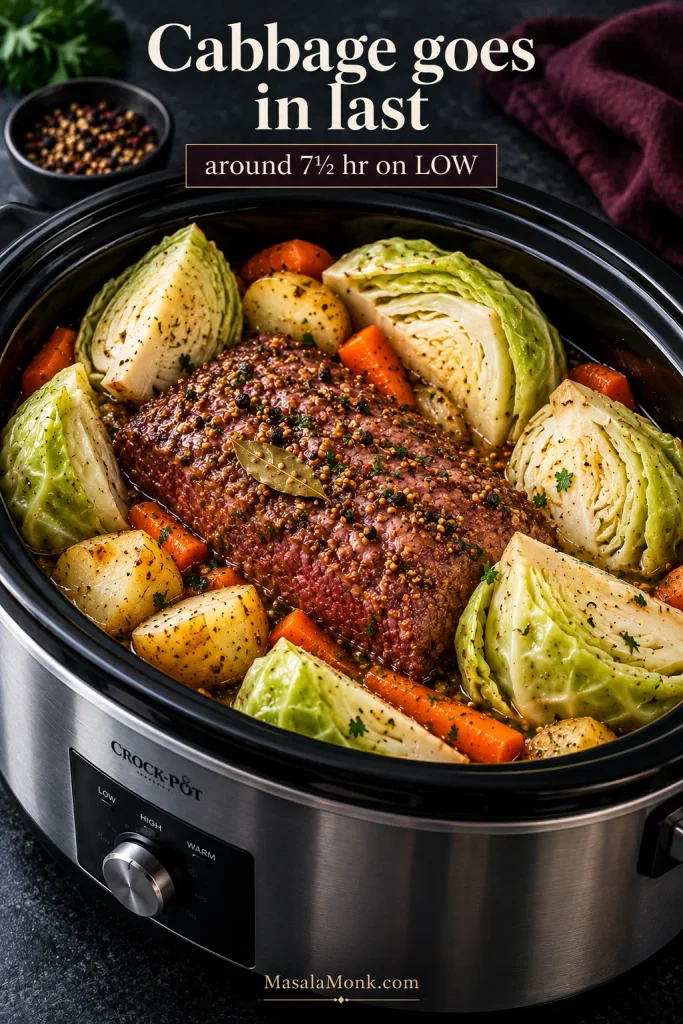
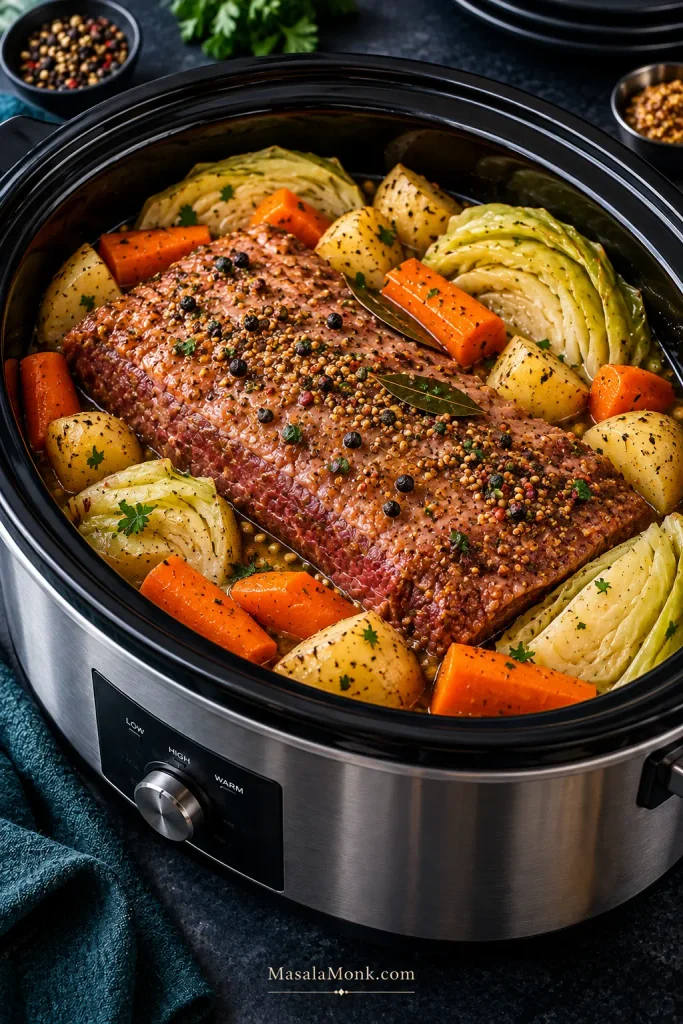
A corned beef brisket may need most of the day to become tender. Cabbage absolutely does not. Potatoes and carrots sit somewhere between the two. Put the whole dinner into the Crock Pot at breakfast and it is easy to end up choosing between beef that still pushes back against the knife and vegetables that have already given up.
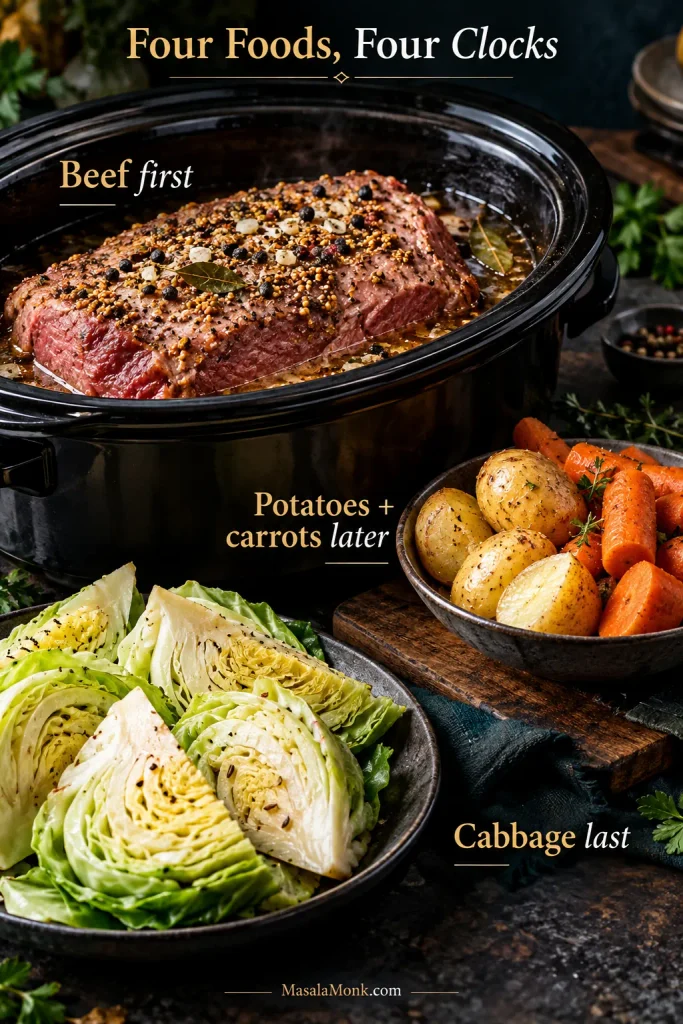
This slow cooker corned beef recipe gives each part of dinner the time it actually needs. The brisket starts first, potatoes and carrots join later, and cabbage goes in last.
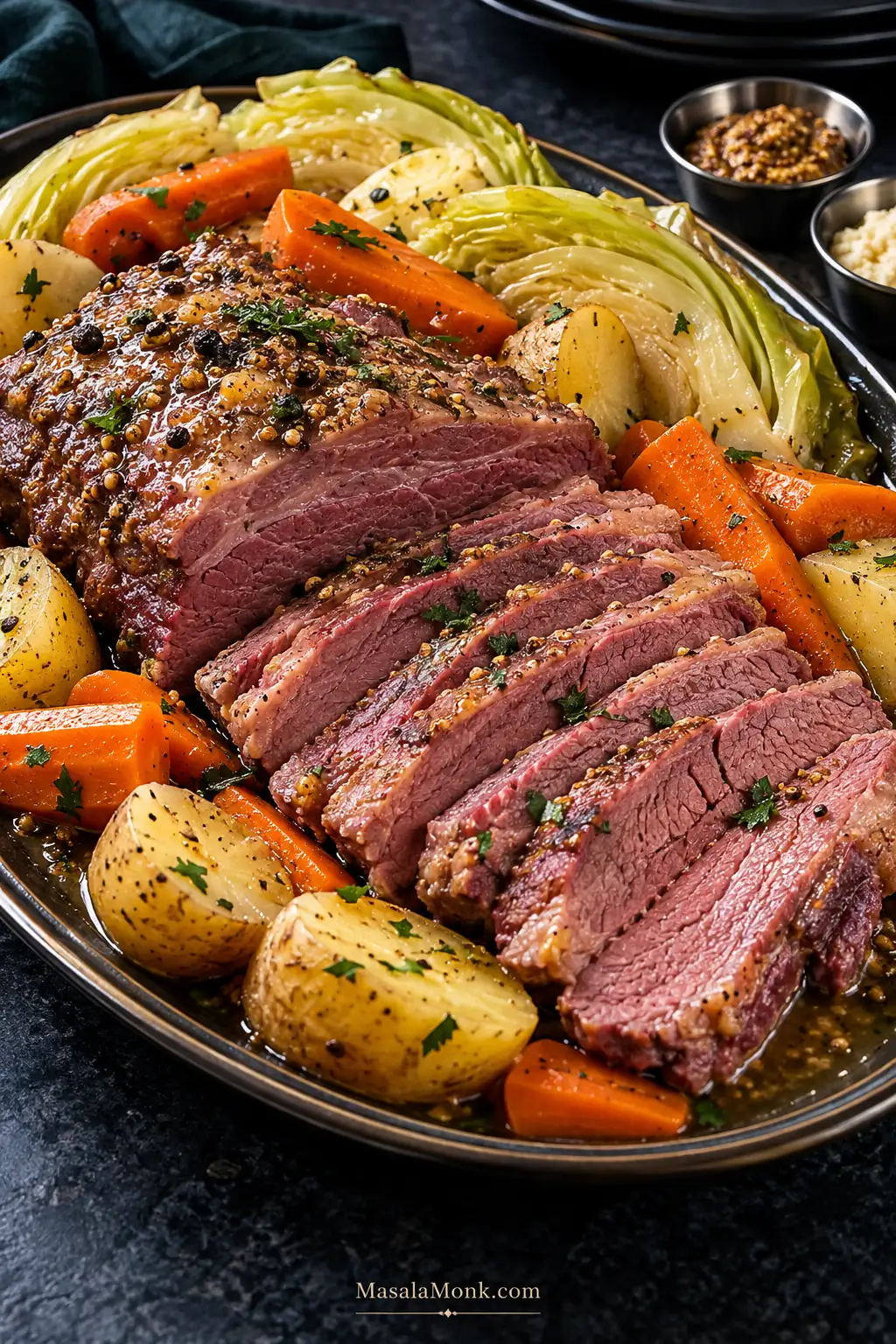
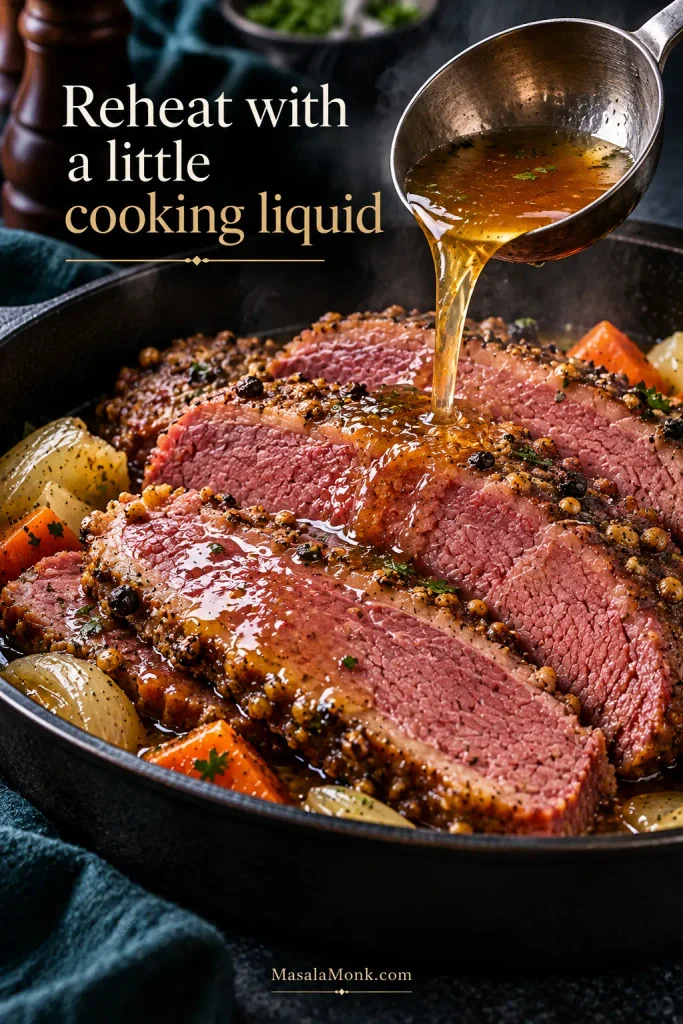
Done well, it lands on the table as rosy slices of corned beef, potatoes carrying the spiced cooking juices, sweet carrots and cabbage tender enough to cut easily with a fork.
For many cooks, this is a once-a-year dinner. You do not need to remember last year’s timing, and staging the vegetables does not turn it into a fussy project: add the potatoes and carrots once, add the cabbage once, then check each part as it finishes.
Four Foods, Four Clocks
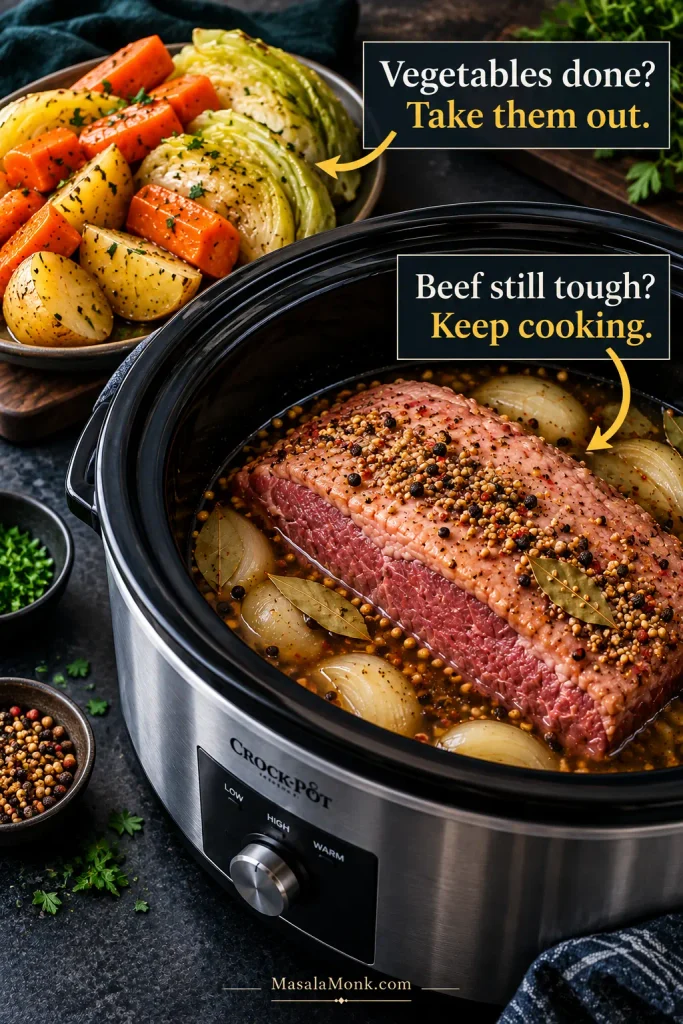
A corned beef and cabbage dinner does not need one finish line. If one component is ready first, remove it; otherwise, keeping finished food in the Crock Pot simply trades good texture for unnecessary extra cooking.
Food
LOW timing & doneness
Corned beef
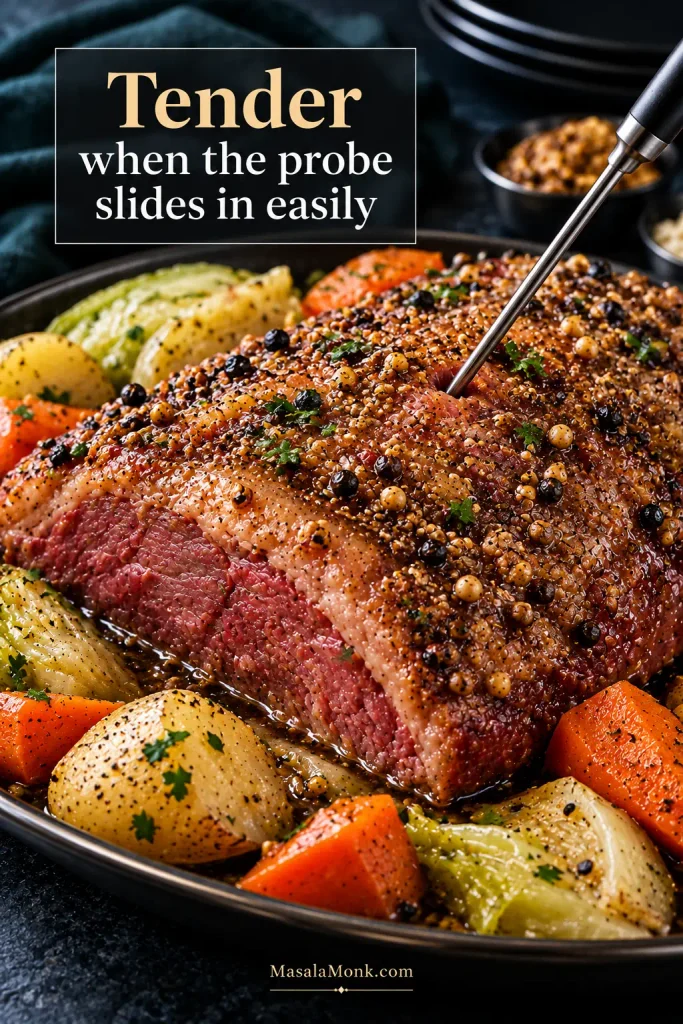
Start checking around 7½ hours. Ready when a thin probe enters the thickest part with very little resistance.
Potatoes
Add at 5½ hours. Ready when a knife enters easily while the pieces still hold their shape.
Carrots
Add with the potatoes at 5½ hours. Tender through the center without collapsing at the edges.
Cabbage
Add around 7½ hours; usually needs another 1–1½ hours. Judge the thick center rib and cook it to the tenderness you prefer.
Slow Cooker Corned Beef and Cabbage Recipe
This recipe is built around a 3–4 lb / 1.4–1.8 kg uncooked corned beef brisket—the refrigerated kind sold in curing brine—fully thawed, in a 6-quart / 5.7-liter slow cooker. Staging the vegetables keeps them from spending the brisket’s entire long cook in the pot.
Yield About 6 servings
Prep 20 minutes
Cook window LOW: 8½–10 hr HIGH: 6¼–7½ hr
Total LOW: about 9–10¾ hr HIGH: about 7–8¼ hr
Total time includes prep and the 15–20 minute rest. Six servings assumes the vegetables are part of the meal; for more meat-heavy plates, expect closer to 4–5 generous portions.
1 medium yellow onion, about 8 oz / 225 g, cut into thick wedges
4 garlic cloves, lightly crushed
1 included corned beef seasoning packet, or 1 tbsp / 15 ml pickling spice
About 3 cups / 710 ml water, adjusted as needed so the liquid reaches roughly one-third to halfway up the brisket
1½ lb / 680 g baby Yukon Gold or red potatoes, very small ones left whole; cut larger potatoes into pieces about 1½–2 inches / 4–5 cm across
About 1 lb / 450 g carrots, cut into sturdy 2-inch / 5-cm pieces
1 small green cabbage, about 1¼–1½ lb / 570–680 g, trimmed and cut through the core into 6 wedges, leaving enough core attached to hold each wedge together
For Serving & Finishing
Dijon or grainy mustard
Prepared horseradish or horseradish cream, optional
Optional vegetable finish: 2 tbsp / 28 g unsalted butter, 2 tbsp / about 8 g finely chopped parsley and ¼ tsp / about 0.5 g freshly ground black pepper
Do not add salt at the beginning. Corned beef varies quite a bit in saltiness from brand to brand, so taste the vegetables and cooking liquid near the end before adding any.
Equipment
6-quart / 5.7-liter slow cooker
Instant-read thermometer or thin probe
Sharp slicing knife
Small tea infuser or cheesecloth, optional for containing the whole spices
1. Start the Brisket
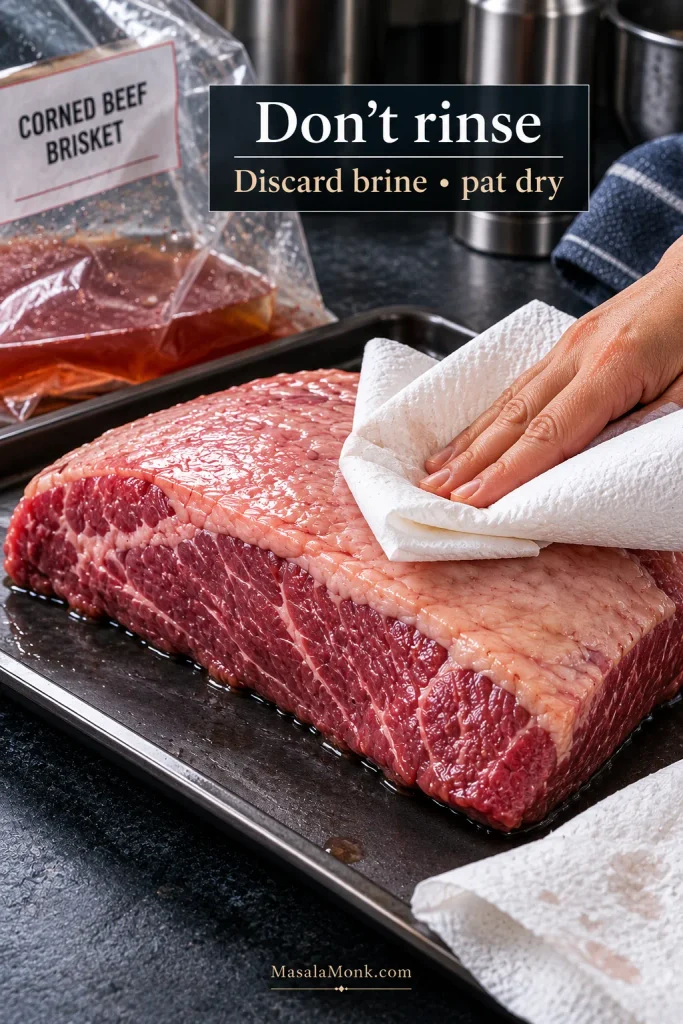
Set the package in a rimmed dish, open it carefully and discard the packing brine. Transfer the brisket to paper towels and pat the surface dry. Do not rinse it under running water. For the safety and salt-control reasoning, see why we do not rinse corned beef.
If the brisket has an unusually thick slab of hard fat, trim some of the excess while leaving a modest layer over the meat. A thin fat cap is useful; a very thick one will not completely disappear in the slow cooker.
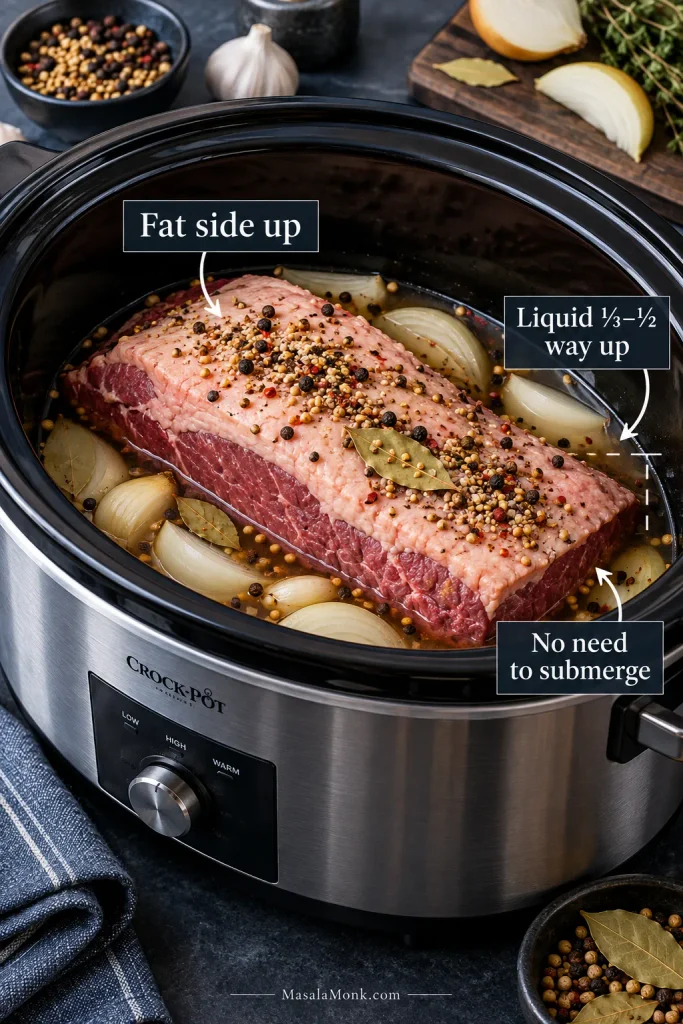
Scatter the onion and garlic over the bottom of the slow cooker, then set the fully thawed brisket on top fat-side up.
Sprinkle over the included seasoning packet. Missing seasoning packet? Use about 1 tablespoon / 15 ml pickling spice. A tea infuser or loose cheesecloth bundle keeps peppercorns and seeds out of the finished vegetables without losing their flavor.
Pour about 3 cups / 710 ml water around the brisket rather than directly over the spices. Use the liquid level as the guide: aim for roughly one-third to halfway up the meat, adjusting the amount if your cooker puts it well above or below that range. For alternatives, jump to the water, broth and beer guide.
Choose the cooking liquid for flavor and salt control, not tenderness. If you plan to spoon the juices over the finished corned beef, plain water or low-sodium broth leaves the most room to adjust seasoning at the end.
Cover and cook on LOW for 5½ hours. Keep the lid closed so the cooker does not have to repeatedly rebuild lost heat and steam.
2. Add the Potatoes and Carrots
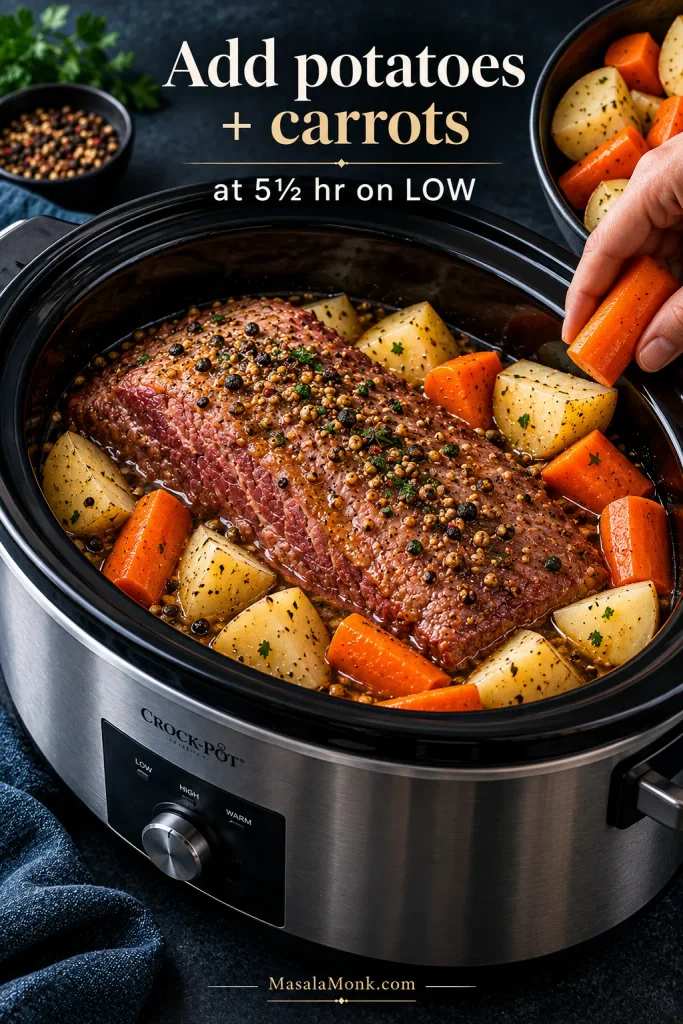
Add the potatoes and carrots after the beef has cooked for 5½ hours on LOW. Arrange them around the brisket, pushing the denser pieces into the hot liquid where practical. Replace the lid quickly and continue cooking for another 2 hours.
The large pieces are deliberate. Small potato cubes and thin carrot slices can be fully cooked while the brisket is still working its way toward tenderness.
Waxy potatoes such as Yukon Gold or red potatoes hold together better through the final hours of a slow cooker corned beef dinner. Meanwhile, placing the densest pieces down near the hot liquid helps them soften more evenly.
3. Check the Beef, Then Add the Cabbage
At about 7½ hours total, make an early check. Slide a thin thermometer probe or skewer into the thickest part of the brisket. If the resistance is hard to judge, use the full tenderness guide.
If the brisket still offers clear resistance, arrange the cabbage wedges over and around the beef, replace the lid and continue on LOW for about 1–1½ hours.
If the brisket is already very easy to pierce, remove it before adding the cabbage. Arrange the cabbage in the cooker and let the vegetables finish without the beef.
Do not judge cabbage by its outer leaves alone. Instead, test the thick center rib; keeping each wedge attached through the core lets the leaves soften while the wedge still holds together on the plate.
Because newly added cabbage will usually need longer than a normal 15–20 minute rest, transfer an early-finished brisket with a little cooking liquid to a covered oven-safe dish. Keep it hot in the lowest practical oven setting, ideally around 170°F / 75°C, while keeping the meat at 140°F / 60°C or above. Begin its final 15–20 minute rest shortly before you plan to slice.
4. Check the Whole Dinner
From about 8½ hours total, start checking each part of the meal.
Corned beef: the probe should slide into the thickest part with very little resistance.
Potatoes: a knife should enter easily while the pieces still hold their shape.
Carrots: the center should be tender without the edges collapsing.
Cabbage: judge the thick center rib rather than the delicate outer leaf.
Remove anything that is ready. The brisket can keep cooking without the vegetables, and the vegetables can finish without the brisket. If the beef becomes ready now and the vegetables need only another 15–20 minutes, let the brisket rest normally. For a longer gap, use the covered holding method from Step 3. Still tough? Leave the beef in its cooking liquid and check again in about 30 minutes.
Before adding salt to the finished corned beef and cabbage, taste the vegetables and cooking liquid. Because cured briskets vary in saltiness, the potatoes, carrots and cabbage may already be seasoned more than you expect.
5. Rest and Slice Across the Grain
Transfer the brisket to a cutting board and rest it for 15–20 minutes.
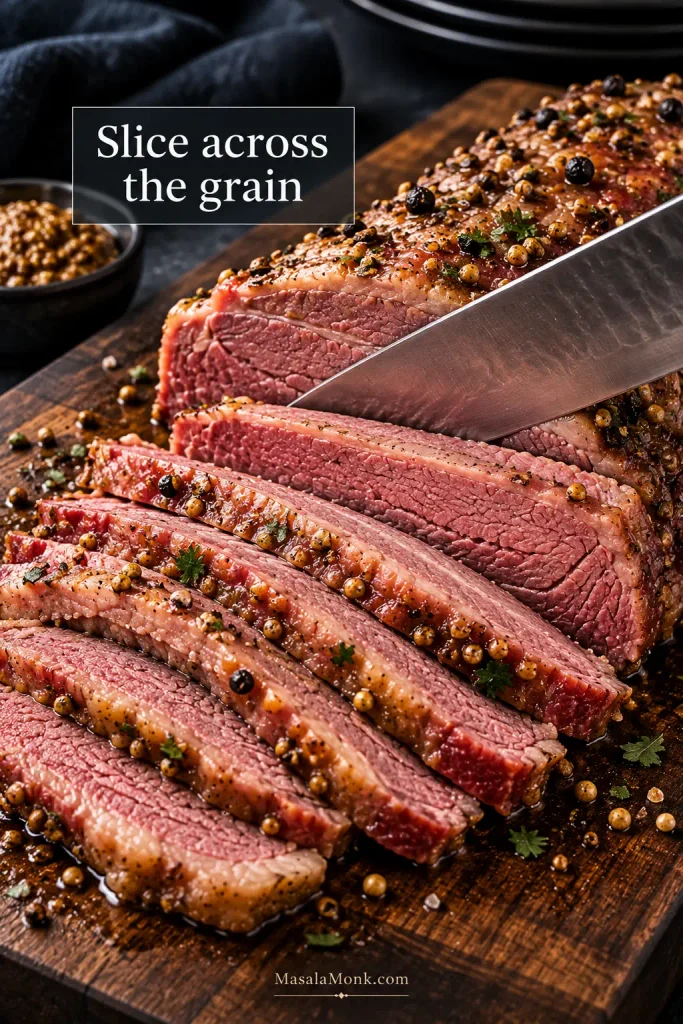
Look for the long lines of muscle fiber running through the meat. Turn the brisket so your knife crosses those lines, then cut slices about ¼–⅜ inch / 6–10 mm thick.
Point cuts can have grain running in more than one direction. When that happens, divide the cooked brisket into obvious sections first and rotate each section before slicing across its grain.
Use a long, sharp knife and smooth strokes rather than sawing. Clean slices should hold together without pulling into long strings; if they do, rotate the brisket and check the grain direction again.
6. Taste and Serve
Taste the vegetables before adding salt. If using the butter finish, toss the hot potatoes, carrots and cabbage with the butter, parsley and black pepper. Strain a little cooking liquid for the table, then serve the sliced beef with the vegetables, mustard and horseradish.
Cooking on HIGH
LOW is the more forgiving schedule for this recipe because it gives you a wider window to judge brisket tenderness while staggering the vegetables. HIGH works when dinner needs to happen sooner, but smaller or thinner briskets deserve an earlier check.
Prepare the brisket, onion, garlic, spices and liquid exactly as above.
Cook the beef on HIGH for 4 hours.
Add the potatoes and carrots.
At about 5 hours total, check a brisket around 3 lb / 1.4 kg or one that is relatively thin. If it is already tender, remove it and keep it hot using the holding method in Step 3 while the vegetables continue cooking.
At about 5½ hours total, check a thicker brisket closer to 4 lb / 1.8 kg. Add the cabbage now and remove the beef for holding if it is ready.
Cook the cabbage on HIGH for about 45–60 minutes. At roughly 6¼–6½ hours total, check the whole dinner. Remove finished components and continue anything that still needs time.
Recipe Notes
Fat side & searing: Place the brisket fat-side up for this method. There is no need to sear it before slow cooking.
Frozen brisket: Thaw it completely in the refrigerator before slow cooking. The timing in this recipe assumes a fully thawed brisket.
Prep ahead: Cut the carrots, cabbage and onion the night before and refrigerate them. Small potatoes can stay whole. If larger potatoes are cut ahead, keep them submerged in cold water in the refrigerator, then drain before cooking.
Softer vegetables: Add the potatoes and carrots earlier if you deliberately prefer a very soft boiled-dinner texture.
Leaving vegetables out: Cabbage, potatoes and carrots are optional. Omitting them does not change how the brisket cooks.
Cooking for a crowd: Two briskets and twice the vegetables can crowd a 6-quart cooker badly enough to change the timing. Use a larger cooker, divide the meal between two slow cookers, or cook some of the vegetables separately.
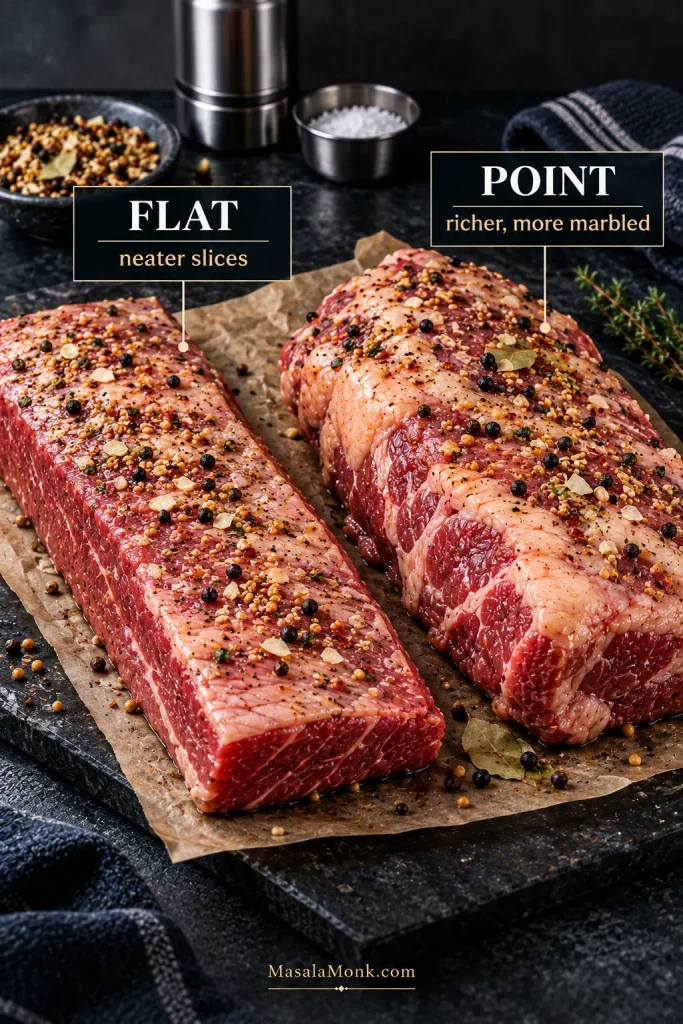
Choose a flat cut for neater slices and a point cut for more marbling and richness. A flat is usually more uniform in thickness and easier to carve cleanly across the grain, while a point is generally more irregular and often fattier.
The actual brisket matters more than the cut name: a well-marbled flat can be a better choice than an unusually lean point.
When comparing packages, look past the cut name and inspect the actual brisket through the wrap. Thickness, fat seams and overall shape can vary noticeably even between two flats or two points.
How Much Corned Beef to Buy
A 3–4 lb / 1.4–1.8 kg brisket is a practical size for about six people when the vegetables are part of the meal. For planned Reuben or hash leftovers, buy toward the 4-lb end.
Should You Rinse Corned Beef?
No—do not rinse corned beef under running water. Discard the packing brine and pat the brisket dry. USDA guidance on washing raw meat warns that rinsing can spread contaminated droplets around the sink and nearby surfaces; cooking is what makes the meat safe.
Pat until the surface is damp rather than dripping. That gives the seasoning packet or pickling spices a better chance to stay on the brisket instead of immediately running into the cooking liquid.
If saltiness is the concern, control it through the cooking liquid and final seasoning rather than rinsing the raw brisket under the faucet. Salt at the end, not on faith: corned beef is already cured, so starting with water and no added salt gives you room to taste and adjust once the meal is nearly finished.
How Much Liquid? Water, Broth, Beer or Guinness?
The brisket does not need to be submerged. For this recipe, water is the best default because the beef is already cured and seasoned. Start around 3 cups / 710 ml and use the level in the cooker as your final guide: roughly one-third to halfway up the brisket is enough.
Low-sodium beef broth can replace some or all of the water 1:1 when you want a more savory cooking liquid. Regular broth can push an already-cured brisket and its vegetables toward excessive saltiness, so taste before adding any extra salt.
For a beer version, replace about 12 fl oz / 355 ml of the water with beer and keep the final liquid level in the same range. Lager or brown ale brings mild malt sweetness; Guinness or another stout gives the pot a darker roasted edge and can make its bitterness more noticeable in long-cooked vegetables.
Beer changes the flavor, not the basic tenderizing process. For a dish where stout is meant to lead rather than sit in the background, a Guinness beef stew is built around it from the start.
How to Tell When Corned Beef Is Tender
Read the brisket, not just the timer. Corned beef is ready for neat slices when a thin probe enters the thickest part with very little resistance while the meat still holds together.
Safe Temperature vs Tender Temperature
USDA lists 145°F / 63°C followed by at least a 3-minute rest as the food-safety minimum, but brisket usually needs considerably more cooking before it becomes tender. See the USDA’s corned beef guidance for the safety standard.
For clean, sliceable tenderness, ThermoWorks’ corned beef temperature guidance places corned beef around 190–195°F / 88–91°C. Around 200–205°F / 93–96°C, the meat moves toward a much softer texture. Even so, a brisket can pass 190°F and still feel tight, so let probe resistance make the final call.
A brisket can be fully food-safe and still feel tough. Check the thickest area—not just a soft edge—and, if the brisket varies in thickness, probe more than one spot before deciding the corned beef is tender enough to remove.
Still firm when pierced: keep cooking.
Probe slides in easily but the meat still holds together: ideal for neat slices.
Almost no resistance and the fibers readily separate: very soft, fall-apart territory.
For neat slices, the knife should pass through without sawing, while each slice still holds together when you lift it.
Corned beef can also go too far. A lean flat may become dry and stringy, while a fattier piece can soften past the clean-slicing stage and begin to fall apart.
Do not judge corned beef by color. Properly cooked corned beef can remain distinctly pink because of the curing process.
Thickness, shape, marbling and the way your slow cooker heats explain why two briskets of the same weight can finish at different times. Times get you into the right window; texture tells you when dinner is actually ready.
These times tell you when to begin checking tenderness. They are deliberately earlier than a guaranteed finish time.
Brisket size
Begin checking
3 lb / 1.4 kg
LOW: about 7½ hr · HIGH: about 5 hr
4 lb / 1.8 kg
LOW: about 8 hr · HIGH: about 5½ hr
The vegetable schedule in the main recipe is tuned to a 3–4 lb / 1.4–1.8 kg brisket. For substantially smaller or larger briskets, begin checking earlier or later and let probe tenderness—not a rigid minutes-per-pound formula—decide when the beef is ready.
The 7½-hour check in the LOW method is an early look before the cabbage goes in. A thicker 4-lb brisket may not enter its more meaningful tenderness window until closer to 8 hours.
A short, thick point and a long, thin flat can weigh exactly the same, which is why the probe ultimately tells you more than a rigid minutes-per-pound rule.
When to Add the Potatoes, Carrots and Cabbage
Slow cookers are excellent at giving tough beef hours to soften. The vegetables finish much sooner.
Food
Main recipe timing
Potatoes + carrots
LOW: add at 5½ hr · HIGH: add at 4 hr
Cabbage
LOW: add around 7½ hr, then cook 1–1½ hr · HIGH: add around 5½ hr, then cook 45–60 min
Potatoes and Carrots
The schedule above gives the potatoes and carrots roughly two to three hours to soften instead of forcing them through the brisket’s entire long cook. Use waxy potatoes such as Yukon Gold or red potatoes and keep them roughly 1½–2 inches / 4–5 cm across. Carrot pieces should be similarly substantial at about 2 inches / 5 cm.
Add them a little earlier when you deliberately want very soft, deeply braised vegetables; add them later when you prefer more structure.
For browned edges and a firmer center, oven roasted carrots are a good alternative when caramelization matters more than keeping everything in one pot.
Cabbage
Cabbage gets only the final stretch. The leaves soften first, so test the thick center rib—the last part of the wedge to lose its crunch.
Keep the cabbage in sturdy wedges rather than shredding it. Add it later when you want more bite, or give it longer for very soft cabbage. You can also cook the wedges separately in some strained cooking liquid when you want maximum control over their texture.
If Dinner Isn’t Finishing Together
Look at what is tender and what is still firm. That usually tells you more than the clock does.
Beef Problems
What you see
What to do
Beef tough + vegetables tender
Take the vegetables out and cover them; they are done. Leave the brisket in its cooking liquid and give it more time. That’s fixable—you have not ruined dinner.
Beef hot but rubbery
It may already be safely cooked but still needs more tenderizing time. Keep cooking until it becomes much easier to pierce.
Beef tough + vegetables hard
Confirm that the cooker is on LOW or HIGH and that the lid has stayed closed; if so, give the meal more time. If raw beef accidentally sat on WARM from the start and you cannot verify that it heated promptly, discard it. WARM is a holding setting for already-cooked food.
Beef tender + vegetables still firm
Remove the beef with a little cooking liquid. If the vegetables need only 15–20 minutes, let the meat rest; for a longer gap, keep the covered beef at 140°F / 60°C or above while the vegetables finish.
Beef dry or stringy
Rest it, slice thinly across the grain and spoon a little hot cooking liquid over the meat. An unusually lean cut, overcooking or slicing with the grain can all contribute.
Beef falls apart under the knife
It has moved beyond the neat-slicing stage. Serve it as soft chunks or shredded beef and begin checking earlier next time.
Removing finished vegetables is not a failure; it protects their texture while the brisket catches up. Cover them, then rewarm briefly with a little hot cooking liquid just before serving if needed.
Vegetable Problems
What you see
What to do
Potatoes turning to mush
Remove them now. Next time use larger waxy potatoes, cut them less aggressively or add them later.
Potatoes still hard
Move them into the hot liquid and keep cooking until a knife enters easily. Very large pieces or a cooler-running slow cooker may need longer.
Cabbage gray and collapsing
It stayed in too long. Add the wedges later next time or cook them separately in some of the corned-beef liquid.
Cabbage still crunchy
Give it more time. Judge the thick center rib, especially on large wedges.
No room left for cabbage
Remove finished potatoes or carrots, or cook the cabbage separately. Packing everything tightly under the lid is not worth sacrificing texture.
Salt & Flavor Problems
What you see
What to do
Everything tastes too salty
Do not reduce the cooking liquid further. Serve with unsalted sides where possible and dilute any liquid you plan to spoon over the plate.
Beef tastes right but vegetables are bland
Toss the hot vegetables with the optional butter, parsley and black pepper, then taste before adding salt.
Can Tough Corned Beef Be Rescued?
Yes, when it is genuinely firm rather than already dry. Put it back into hot cooking liquid, cover and continue cooking gently until the probe becomes much easier to insert.
If the slow cooker is heating but the beef remains stubbornly firm, transfer it with some cooking liquid to a covered oven-safe dish and continue at about 325°F / 165°C until probe-tender. Finished vegetables can stay out.
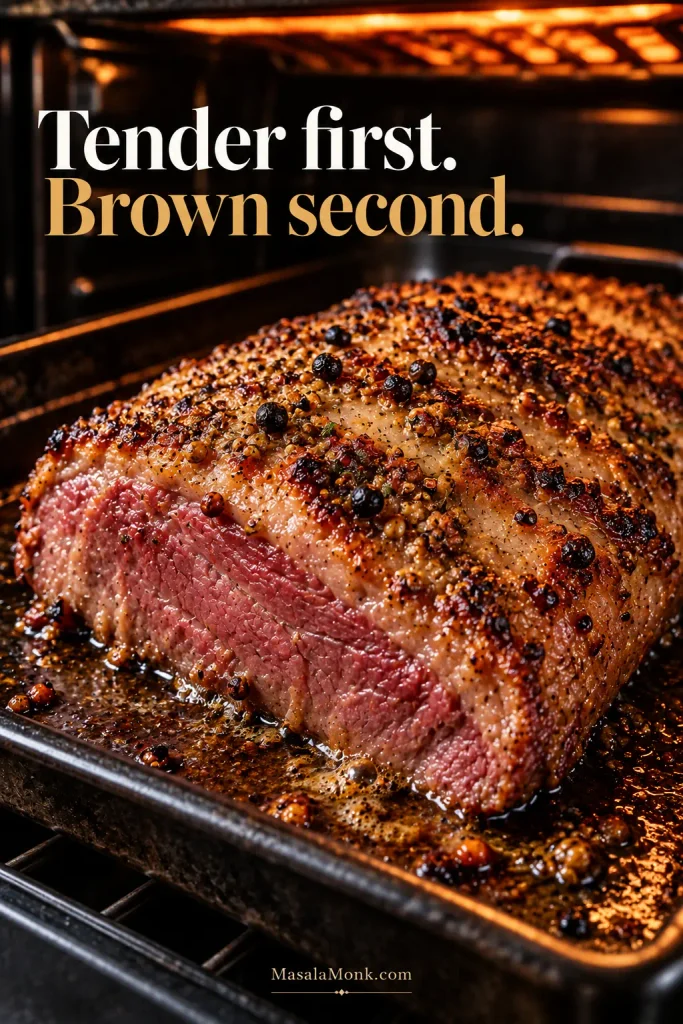
Once the brisket is tender, you can stop there. For darker edges, transfer it to a foil-lined broiler-safe pan and brush the fat side lightly with Dijon or grainy mustard.
Broil only until the surface bubbles and browns, usually about 2–4 minutes. Start watching closely after the first minute; mustard can darken quickly under a strong broiler.
Let excess surface liquid drain before brushing on the mustard so the top browns instead of steaming. Pull the brisket when the coating bubbles and the high points bronze, before the mustard turns black.
What to Serve with Corned Beef and Cabbage
Arrange the rested slices with the potatoes, carrots and cabbage, then spoon a little strained cooking liquid over the beef—enough to keep the slices glossy and moist without flooding the plate.
For a St. Patrick’s Day dinner, put Dijon or grainy mustard and horseradish on the table and let everyone add their own. A creamy horseradish sauce works especially well because its cool, sharp bite cuts through the salty, rich beef.
Skipped the potatoes in the slow cooker? Creamy mashed potatoes make a good alternative underneath the sliced beef, especially with a little of the strained juices spooned around them. Warm dinner rolls or Irish soda bread are also good for catching the juices left on the plate.
Storage and Leftovers
Storing and Reheating Cooked Corned Beef
Cooked corned beef keeps for 3–4 days in the refrigerator or about 2–3 months in the freezer for best quality. Refrigerate it within 2 hours.
Instead of leaving the brisket whole or slicing all of it thin, divide leftovers into a few smaller, manageable sections and place them in shallow containers with a little strained cooking liquid. Reheat leftovers to 165°F / 74°C; a splash of the cooking liquid helps keep the meat from drying out.
Reheat only the leftover corned beef you plan to serve, adding a small amount of strained cooking liquid as it warms. That keeps the slices glossy without repeatedly heating—and gradually drying out—the entire batch of leftovers.
Save Some for a Reuben
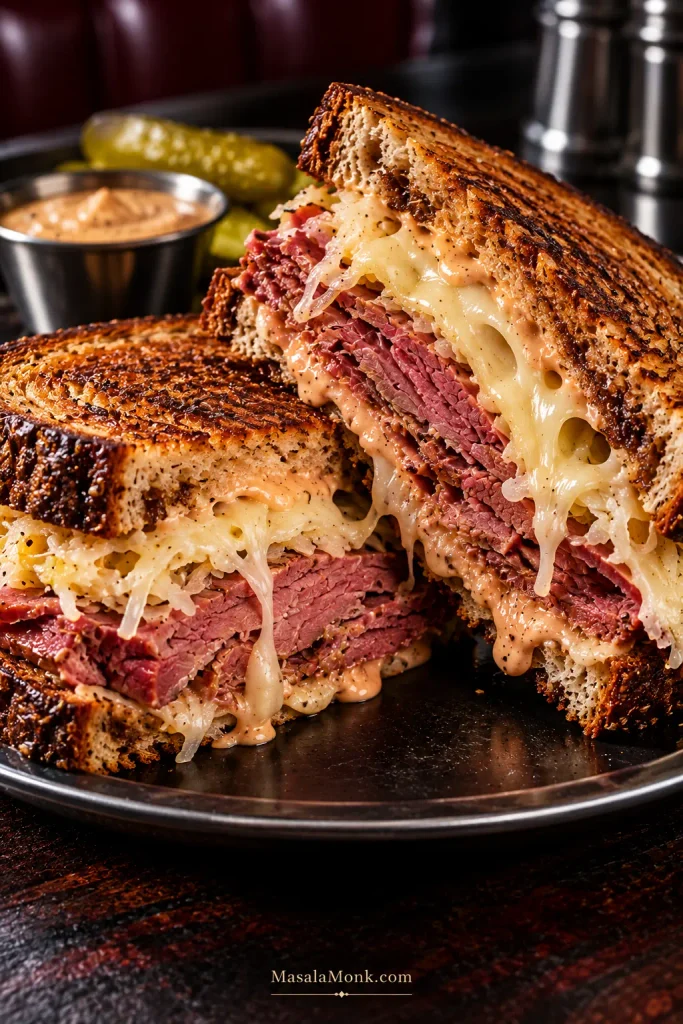
For a crispy Reuben sandwich, keep one of the larger leftover pieces intact. Reheat it gently, then slice it across the grain before adding rye, Swiss, sauerkraut and dressing.
For a crisper Reuben sandwich, drain the sauerkraut well before assembly. Excess brine can soften the rye before the cheese melts and the outside has time to toast.
Corned Beef Hash
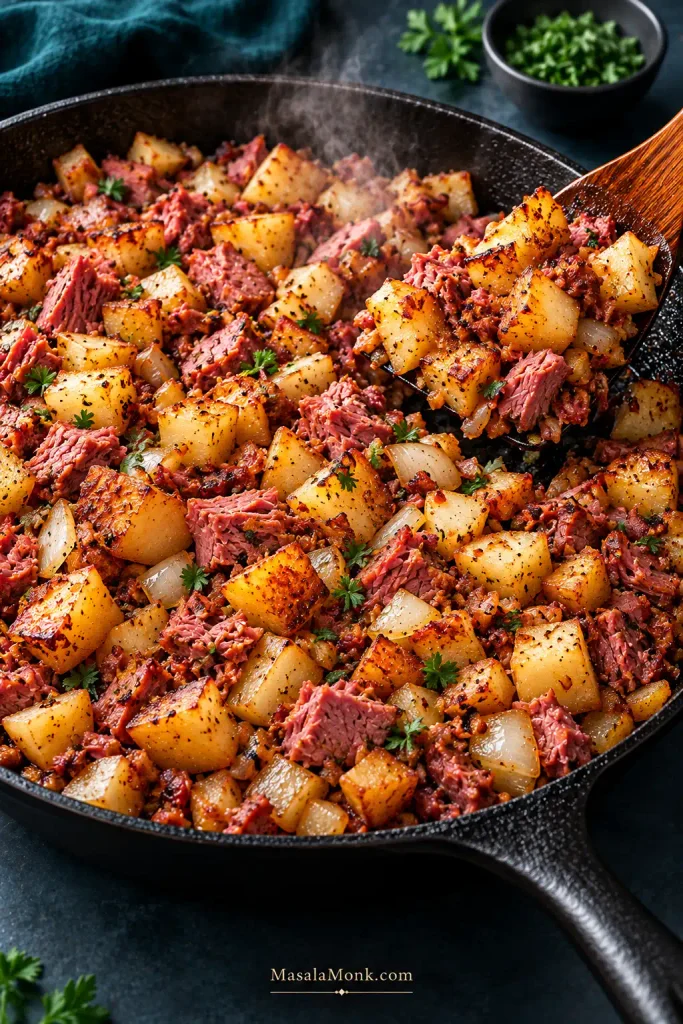
Another easy destination for leftovers is corned beef hash: chop the meat with cooked potatoes and onion, then crisp the mixture in a skillet until the edges brown.
Corned beef hash needs uninterrupted contact with a hot skillet to develop a crust. Spread the potatoes, onion and chopped beef out, let one side brown, then turn sections rather than constantly stirring everything around the pan.
The brisket does not need to know when the cabbage is ready, and the cabbage does not need to wait for the brisket. Once you stop asking the whole Crock Pot to finish at the same moment, this corned beef-and-cabbage dinner becomes much easier to get right.
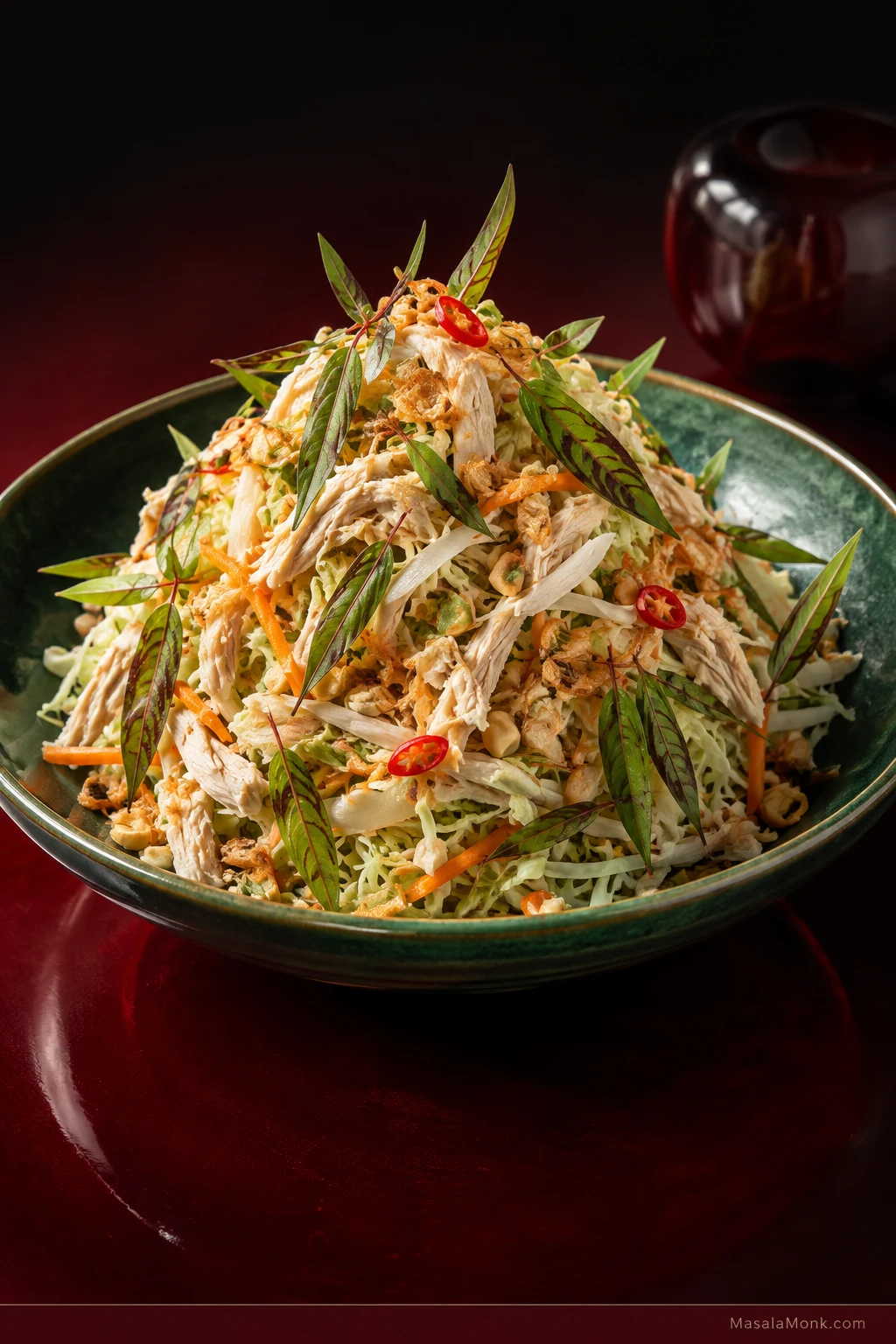
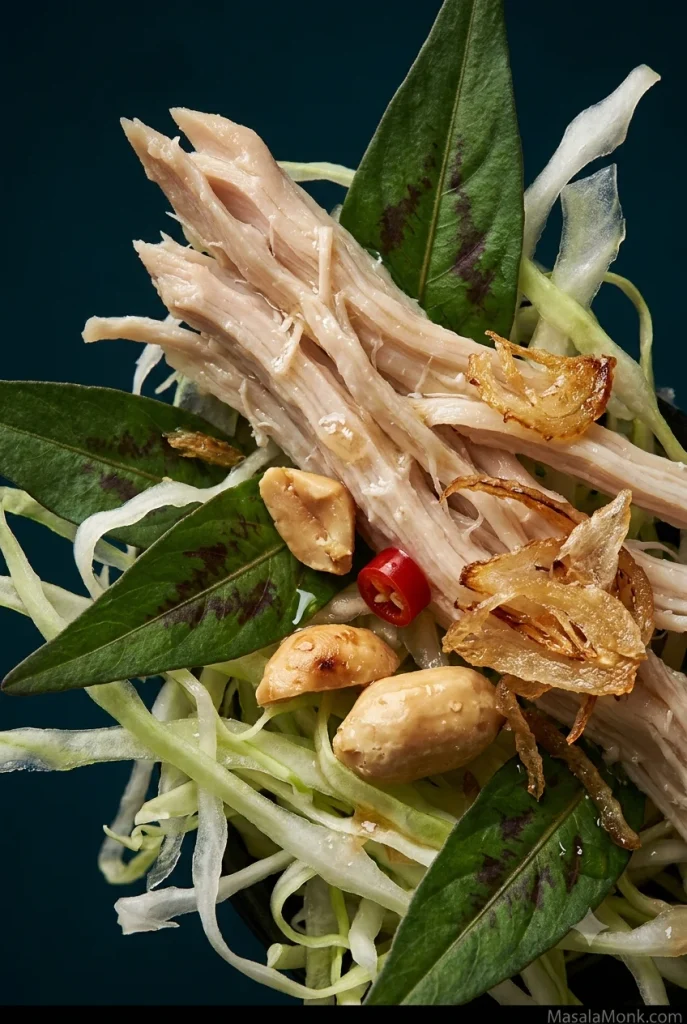
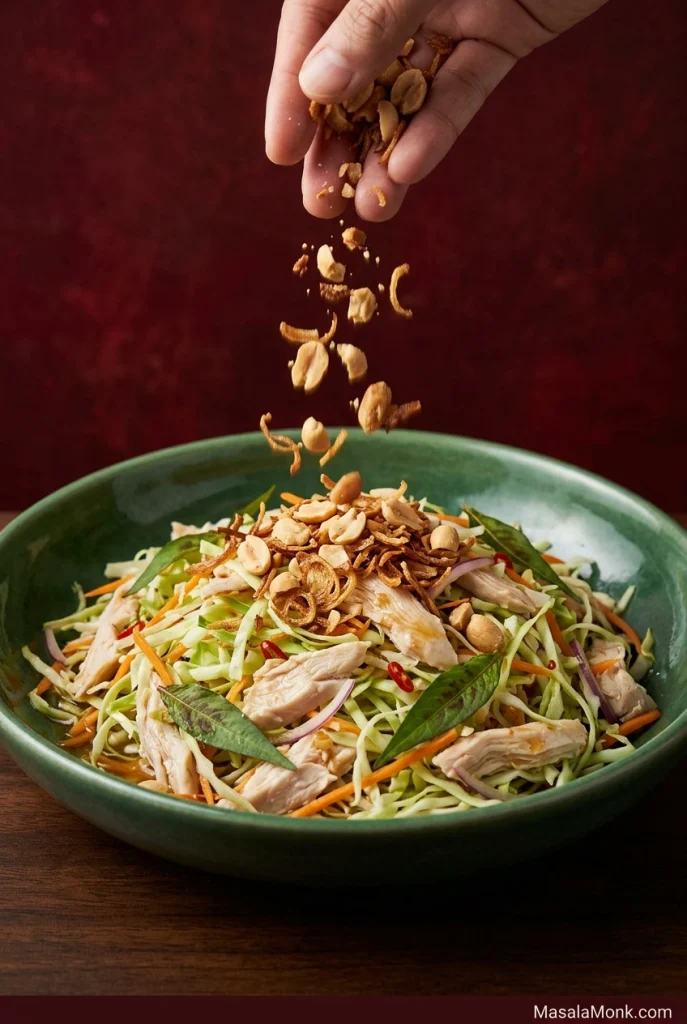
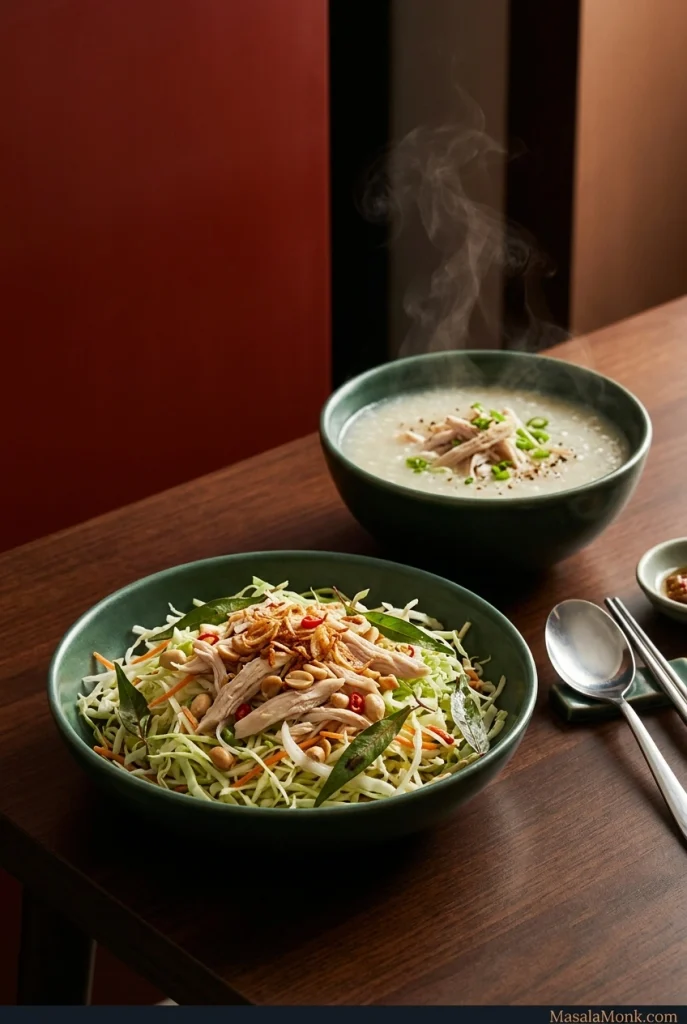
Finely shredded cabbage, juicy chicken and peppery rau răm get tossed with a lime-bright fish-sauce dressing, then finished with roasted peanuts and crisp fried shallots. Every forkful comes out a little differently: maybe mostly cool cabbage, maybe a soft shred of chicken with rau răm, maybe the lucky bite with a peanut and still-crisp piece of shallot.
Keep the cabbage dry, cook the chicken gently, tame the onion and save the fried shallots for the end. Those small choices keep the salad lively: moist chicken, sharp herbs and cabbage that still has some snap.
A little softening is not a failed salad. The real trouble starts when enough water leaves the cabbage to collect underneath and weaken the dressing.
Dry the cabbage, dress in stages, and add the crunch last.
Gently poach 450 g / 1 lb chicken, shred it, and combine it with 450 g / 1 lb finely sliced green cabbage, carrot, thin onion and rau răm. Give the chicken some dressing first, then add the vegetables and dress everything gradually.
Resting time controls the cabbage texture, so use the guide below to choose how crisp or softened you want it.
The dressing combines fish sauce, lime, unseasoned rice vinegar or white vinegar, sugar, water, garlic and chile. Keep some back and make the final adjustment after tasting chicken and cabbage together.
For this texture
Do this
Very crisp
Dress and serve immediately.
Crisp but seasoned
Rest 5–10 minutes.
Softer and more marinated
Rest longer and expect more moisture to leave the cabbage.
At close range, three textures should still read separately—moist torn chicken, cabbage with a clean edge, and fried shallots that look dry and brittle rather than glossy with dressing.
Make It Now: Vietnamese Chicken Cabbage Salad
Recipe at a Glance
Yield
4 light main-course servings or about 6 side servings
Chicken
450 g / 1 lb raw boneless chicken
Cabbage
450 g / 1 lb green or white cabbage
Prep
About 25 minutes
Cook
About 20–30 minutes including heating the poaching liquid
Ready in
About 45–55 minutes when you prep the vegetables while the chicken cooks and cools
Rest
5–10 minutes for crisp-but-seasoned cabbage
Chicken endpoint
165°F / 74°C at the thickest part
Fast route
Cooked chicken + bagged slaw; about 15 minutes active prep
An instant-read thermometer is handy for the chicken, a salad spinner makes drying shredded cabbage much easier, and a mandoline gives very even ribbons. Use the hand guard or a cut-resistant glove if you use one.
Ingredients
Chicken
450 g / 1 lb boneless skinless chicken breast
Water, enough to comfortably cover the chicken
1 tsp fine salt
4–5 slices fresh ginger
2 scallions, cut into large pieces or lightly crushed
Cabbage, Herbs and Toppings
450 g / 1 lb green or white cabbage, very finely shredded
100 g / 3½ oz carrot, julienned or finely shredded
75–80 g / about 3 oz red or white onion, very thinly sliced
20 g / about ¾ oz rau răm, leaves and tender stems roughly torn
5 g cilantro leaves, about a small handful, optional
40 g / 1½ oz roasted peanuts, roughly chopped
30 g / about 1 oz fried shallots
1 tbsp extra unseasoned rice vinegar or distilled white vinegar, optional, for the tangier onion treatment
Fish-Sauce Dressing
45 ml / 3 tbsp plain bottled fish sauce
45 ml / 3 tbsp fresh lime juice
15 ml / 1 tbsp unseasoned rice vinegar or distilled white vinegar
25 g / 2 tbsp sugar
30 ml / 2 tbsp water
2 small garlic cloves, finely minced or crushed
½–1 small bird’s-eye chile, very finely sliced, to taste
Use plain fish sauce here, not prepared nước chấm or bottled dipping sauce. Prepared nước chấm is already diluted and seasoned, typically with water, sugar and acid; this recipe balances those separately.
The dressing makes about 150 ml / ⅔ cup. You may not need every drop.
Instructions
1. Gently Poach the Chicken
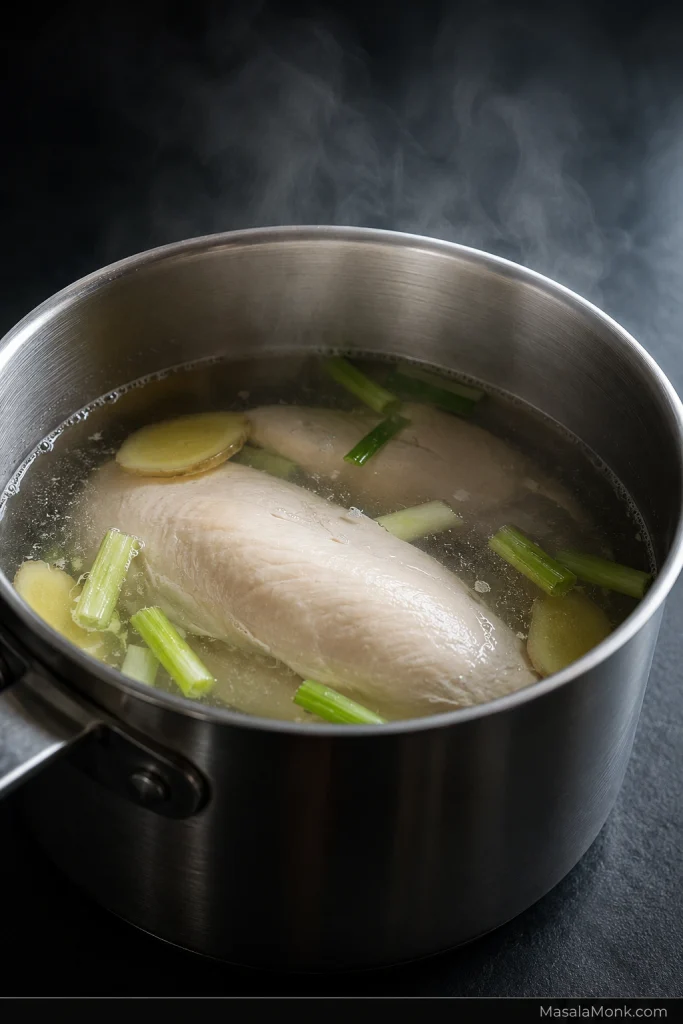
Put the chicken in a saucepan and add enough water to cover it comfortably. Add the salt, ginger and scallions.
Bring the water just up to a boil, then lower the heat immediately to a very gentle simmer. The liquid should move quietly; the chicken should not be bouncing around the pan.
Tiny bubbles gathering at the edge are enough; once the whole surface starts actively bubbling, the poaching liquid is hotter than the chicken needs.
Cover and cook until the thickest part reaches 165°F / 74°C. Once the liquid is hot and gently simmering, medium chicken breasts often need around 12–18 minutes. Thickness matters more than the timer.
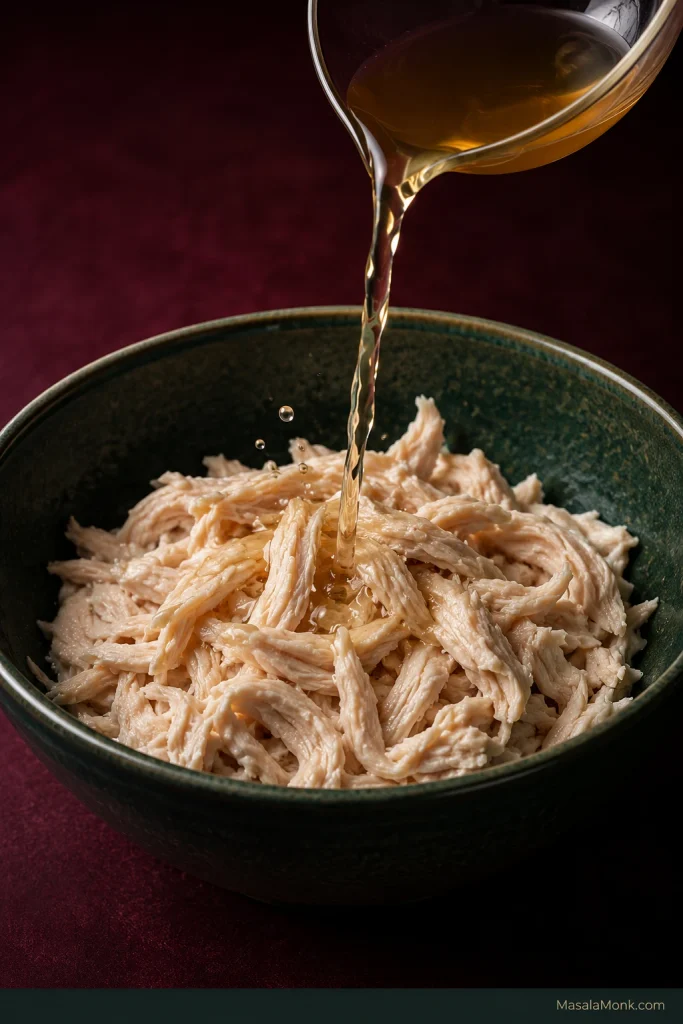
Lift the chicken out as soon as it is done. Properly poached breast should pull into moist strands with ragged edges that catch the dressing, not stiff fibres that feel woolly or dry.
2. Cool, Then Shred
Let the chicken cool until it is comfortable to handle, then tear or shred it into bite-size pieces. Keep the shreds loosely covered until they are no longer hot before they meet the cabbage.
3. Wash, Shred and Dry the Cabbage
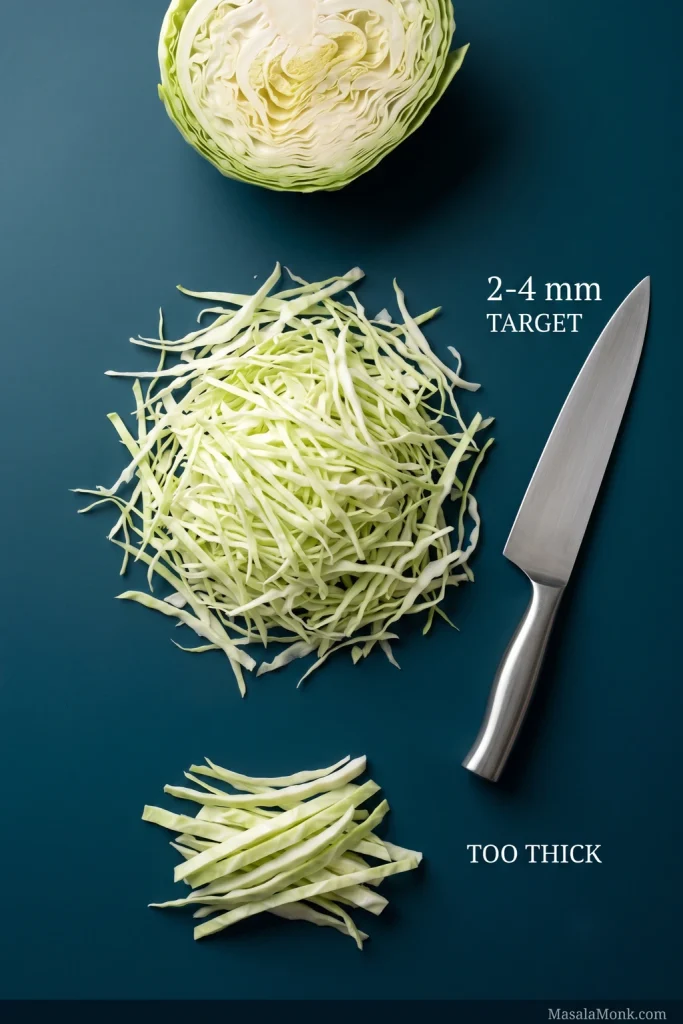
Remove any tired outer leaves. Shred the cabbage into fine ribbons, ideally about 2–4 mm wide, and julienne or finely shred the carrot.
Use the 2–4 mm pile as a visual ruler: those fine ribbons bend and mingle easily, while noticeably wider strips stay stiffer and take longer to taste fully seasoned.
Rinse the cabbage if needed, then spin it thoroughly dry or spread it over clean kitchen towels. Pick up a handful before you move on: the shreds should feel dry rather than slick with wash water.
4. Soften the Onion’s Raw Edge
Put the sliced onion in ice-cold water for about 10 minutes, then drain and pat it dry. It keeps its crunch while losing some of the raw burn that can overpower the herbs.
For a tangier onion, toss the slices with the 1 tbsp additional vinegar listed above plus 2 tbsp cold water. Leave for 10–15 minutes, turning once or twice, then drain thoroughly.
5. Make the Dressing
Stir together the lime juice, vinegar, sugar and water until the sugar has mostly dissolved. Add the fish sauce, garlic and chile.
Taste it now. Too strong? Don’t fix it yet. A spoonful on its own can seem almost alarmingly salty or fishy and then taste much calmer once it is spread through all that chicken and cabbage.
6. Season the Chicken First
Toss the cooled shredded chicken with 2 tbsp / 30 ml dressing and leave it for 2–3 minutes. A larger shred of chicken can stay surprisingly bland inside even when the cabbage around it is well seasoned.
Aim for a light, even sheen on the chicken rather than a puddle of dressing underneath.
7. Toss the Salad
Add the cabbage, carrot and well-drained onion. Pour over about 5 tbsp / 75 ml more dressing and toss thoroughly but gently. Keep the remaining dressing beside you for the final adjustment.
8. Give the Cabbage a Few Minutes
For cabbage that is crisp but no longer tastes completely raw, let the salad stand for 5–10 minutes. Thin green cabbage should still crack lightly between the teeth, then soften as you chew beside the chicken. Prefer a louder crunch? Toss and serve straight away.
9. Add the Herbs and Finish
Fold in the rau răm and cilantro, if using. The salad should smell fresh and peppery before the toppings even go on.
Take one proper bite with chicken, cabbage and herbs together. The chicken should taste seasoned even without a pile of cabbage attached to it. Check the cabbage and the bottom of the bowl too: if the texture feels right and the dressing still tastes bright rather than watered down, you’re there.
Add more dressing 1 tbsp at a time only if it needs it. Scatter over the peanuts and fried shallots and serve.
Swaps
Chicken thighs: Use the same raw weight. They are juicier and more forgiving than breast.
No rau răm: Start with about ½ cup total cilantro and fresh mint, roughly equal parts. Add a few Thai basil leaves if you have them. The flavour will be different, so omit the separate optional cilantro from the main ingredient list when using this fallback.
No peanuts: Use extra fried shallots or toasted sunflower or pumpkin seeds.
No chile: Leave it out and put sliced chile on the table for anyone who wants heat.
Gluten-free: The core salad can be gluten-free; check the labels on fish sauce and packaged fried shallots.
What Is Gỏi Gà Bắp Cải?
Gỏi refers to a broad Vietnamese family of dressed salads; gà means chicken and bắp cải means cabbage. These salads are commonly called gỏi in southern Vietnamese usage and nộm in northern usage. You may also see this dish written without Vietnamese diacritics as goi ga bap cai.
Fresh herbs and contrasting textures are central to this broad style of salad. Gỏi can be everyday food or sit within a larger shared meal, where something sharp and fresh provides an easy counterpoint to richer dishes.
In English, Gỏi Gà Bắp Cải sometimes gets called Vietnamese chicken slaw or Vietnamese chicken coleslaw because of all that shredded cabbage. The resemblance mostly ends with the shape: unlike classic creamy coleslaw, there is no mayonnaise or oil in this dressing. Fish sauce, lime, vinegar, sugar and herbs give it its character.
This version starts from the crisper end of the spectrum: finely cut green cabbage, plenty of rau răm, chicken seasoned before mixing, and dressing added gradually so everything tastes seasoned without the cabbage sitting in a pool of liquid. Other versions are deliberately softer and more deeply marinated; here, you can simply let the bowl sit longer when that is the texture you prefer.
Choosing and Cooking the Chicken
Chicken breast is the default here because its mild flavour keeps the salad light and lets the herbs and dressing lead. Thigh is richer and more forgiving if juiciness is the priority, and a mixture of the two works well too.
A whole chicken makes particular sense when you also want broth for the rest of the meal. Whichever cut you use, firm and juicy is fine; dry, stringy meat usually means too much heat or too much time.
Already-cooked chicken skips the poaching entirely. Leftover roast works beautifully, and rotisserie chicken can take you straight to the 15-minute version; our juicy baked chicken breast is another way to cook plain chicken ahead for lunches and salads. Breast that has gone too far is not hopeless either: shred it finely and get some dressing directly onto the meat.
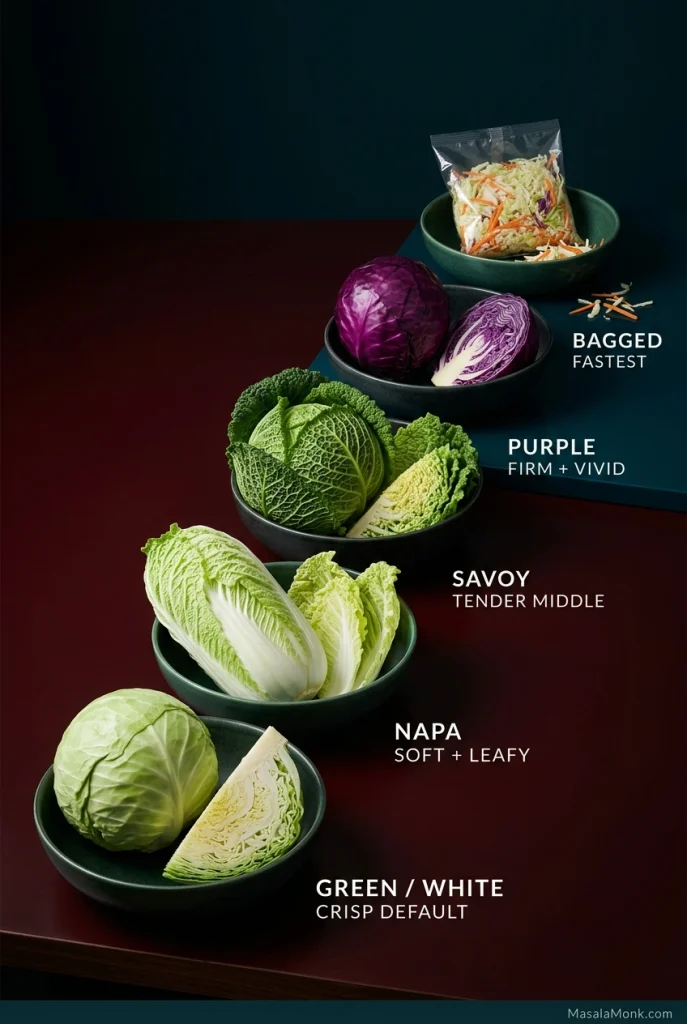
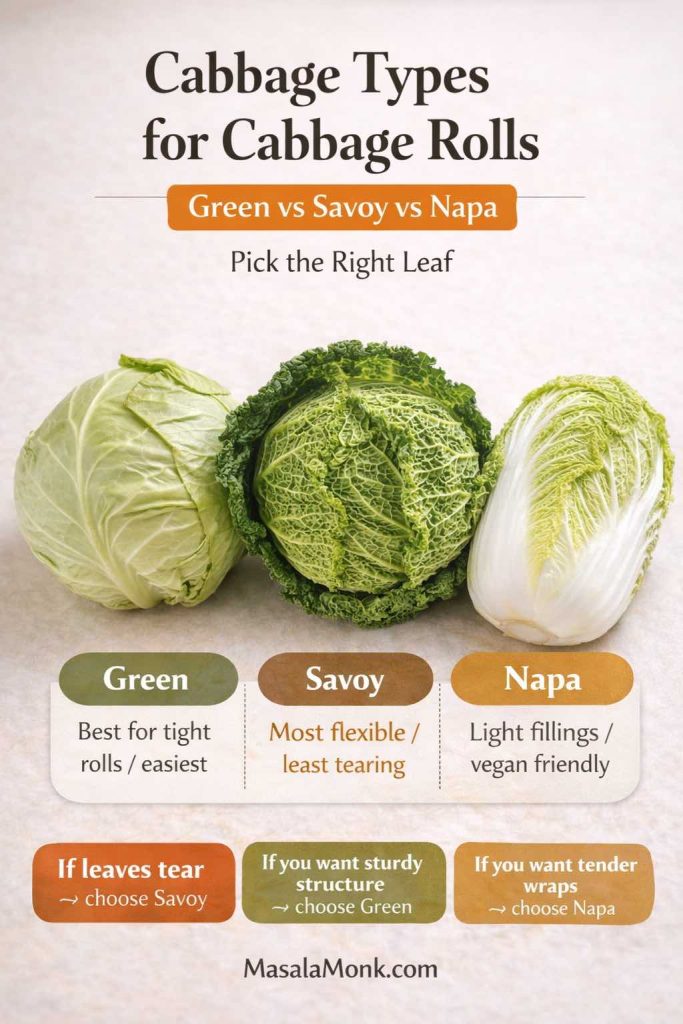
Green, Napa, Savoy or Bagged Slaw?
Cabbage
Texture
Best approach
Green / white
Firmest and crunchiest
Best default for this version
Napa / wombok
Softer and leafier
Dress close to serving
Savoy / pointed
Tender but still structured
Sits between Napa and green cabbage
Purple
Firm with strong colour
Usually nicest mixed with green
Bagged slaw
Depends on freshness and cut
Fastest; adjust any extra carrot
If you’re buying cabbage specifically for this recipe, choose green or white cabbage. It gives the clearest snap and can sit briefly in the dressing without collapsing.
The leaf structure explains the timing difference: tightly layered green cabbage gives firmer ribbons, while Napa’s thinner, softer leaves relax much sooner once dressed.
Thickness matters almost as much as variety. A mature green cabbage sliced too thickly can make even a good dressing feel as though it is fighting its way through raw leaves. Aim for those 2–4 mm ribbons rather than broad strips.
Napa is the choice when you deliberately want something softer and leafier; it needs much less persuasion and may be ready after the first toss. A fresh bag of slaw is the speed-first option when chopping cabbage is the last thing you feel like doing—just skip extra carrot when the mix already contains plenty.
Texture gets you halfway there. Rau răm is what makes the bowl smell unmistakably different from an ordinary chicken slaw.
Rau Răm and the Herbs
Often sold as Vietnamese coriander or Vietnamese mint, rau răm (Persicaria odorata) is peppery and aromatic. Despite the confusing English name, it tastes quite different from ordinary mint.
Look for pointed green leaves on reddish-green stems; many leaves also show darker chestnut markings.
Tear a leaf and smell it before it goes into the salad. That sharp, peppery aroma is one of the things that makes a bowl of chicken and cabbage suddenly feel much more distinctive. Twenty grams gives it a proper presence; use less in the bowl and put the rest on the table if the herb is new to everyone eating.
Cilantro and mint do not recreate rau răm exactly, but together they give the salad freshness and herbiness when the real thing is unavailable.
No rau răm? Make dinner anyway.
Balancing the Fish-Sauce Dressing
The dressing follows the same sweet-sour-salty balancing logic as nước chấm, though here it has a whole pile of cabbage and chicken to season rather than a single dipped bite.
Start with 3 tbsp fish sauce, 3 tbsp lime juice, 1 tbsp vinegar, 2 tbsp sugar and 2 tbsp water, plus garlic and chile. Lime brings fragrance. Distilled white vinegar is sharper; unseasoned rice vinegar is gentler.
Fish sauce brands differ enough that the same three tablespoons can push two dressings in different directions. Judge any correction on the chicken and cabbage rather than trying to make the undiluted dressing taste gentle on its own.
When the balance is right, lime arrives bright and fragrant, rau răm follows with its peppery edge, and the fish sauce makes the chicken taste fuller underneath.
If the Dressing Needs Fixing
Problem
Try this first
Too fishy or intense
Dilute with 1 tsp water, taste, then add a small squeeze of lime if needed.
Overly salty
Start with 1–2 tsp water and retaste before adding anything sweet.
Too sour
Stir in ½ tsp sugar + 1 tsp water, then taste again.
Overly sweet
Balance with 1 tsp lime or vinegar; add a few drops of fish sauce only if it also needs more savoury depth.
Flat
Try a small squeeze of lime for brightness or a few drops of fish sauce for savouriness.
Far too spicy
Make more chile-free dressing and combine the two mixtures.
Make one small correction and taste again before changing anything else.
Once the dressing tastes right, what happens next is mostly about time.
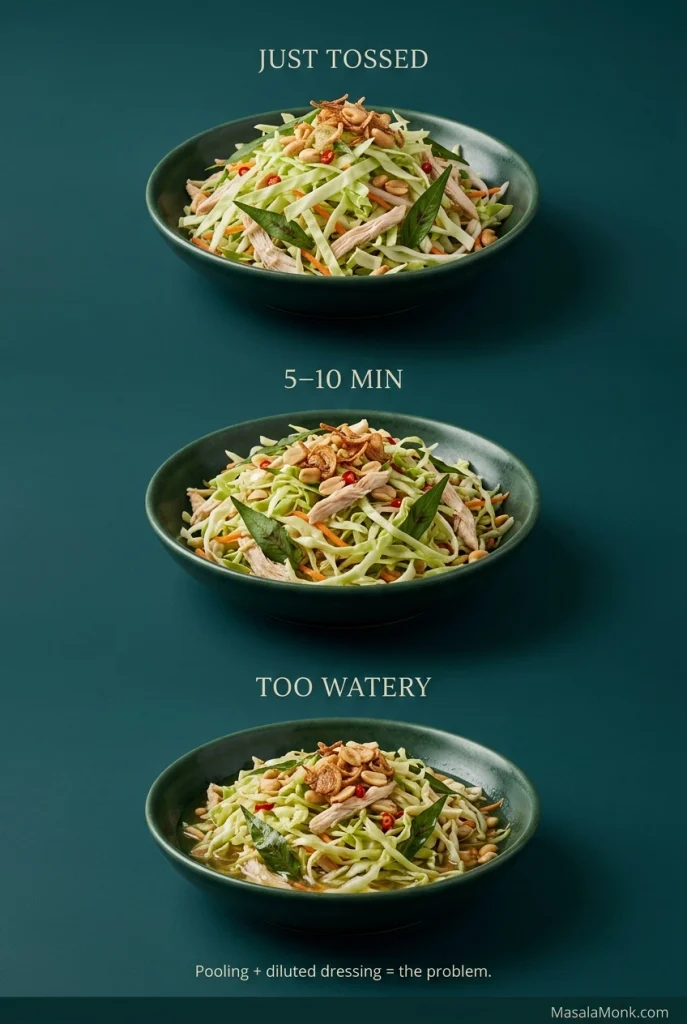
Crisp, Softened or Watery?
Some people want the cabbage almost squeaky-fresh. Others like it after the leaves have relaxed into the dressing and picked up more seasoning. Both can be good.
A small amount of liquid at the bottom is normal. Look again once the salad has been sitting: a real puddle, paired with dressing that now tastes noticeably weaker, means enough water has left the cabbage to change the balance.
The middle bowl is intentionally lower and glossier yet still successful; the failure cue is the third bowl’s visible puddle, not softness by itself.
Why Did My Salad Turn Watery?
The cabbage was still wet after washing.
Too much dressing went in at once.
The salad was dressed long before it was eaten.
Tender Napa cabbage sat as long as firm green cabbage.
The chicken was still hot.
The onion carried extra water into the mixture.
Moderately wet salad can often be rescued with fresh finely shredded cabbage. Toss some through and refresh the herbs. A large puddle may need some draining first; taste afterward because seasoning leaves with the liquid too.
Tough cabbage is a different problem. If the salad is already mixed, give it a few more minutes with the dressing. Next time, slice it finer. A particularly mature head can also be lightly salted, rested and squeezed dry before assembly, though most ordinary cabbage does not need that extra step.
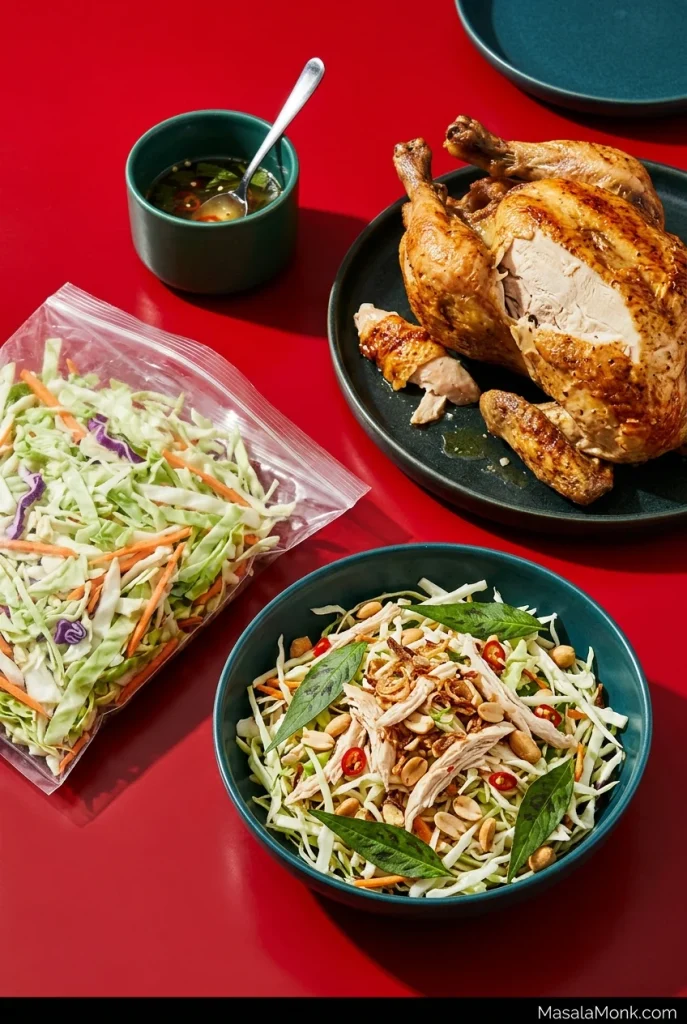
Half a rotisserie chicken, a bag of slaw and very little enthusiasm for cooking are already most of dinner.
Check the slaw bag before you buy it: crisp shreds with no visible pooled moisture give you a longer texture window after dressing.
Allow about 15 minutes of active prep. Use 350–400 g / 12–14 oz shredded cooked chicken and 450–550 g / 1–1¼ lb fresh slaw mix, plus the same fish-sauce dressing, herbs, peanuts and fried shallots.
Season the chicken first, add the slaw and dress gradually. Skip extra carrot when the mix already contains plenty, and go gently with the dressing when the chicken is salty to begin with.
Make Ahead and Lunchbox Gỏi Gà
For crisp cabbage, prepare the components ahead and bring them together closer to eating.
1–2 days ahead: cook and shred the chicken; make the dressing.
Earlier the same day: shred the cabbage and carrot; wash and thoroughly dry the herbs.
10–30 minutes before assembly: slice and ice-water-soak the onion, or give it the quick vinegar treatment.
Keep separate until serving: dressing, peanuts and fried shallots when maximum crunch matters.
The vinegar-treated onion can be made earlier the same day and refrigerated. The plain ice-water soak is best done closer to assembly.
For a packed lunch, keep the dressing in a small separate container and toss it through when you are ready to eat. Keep the chicken and salad refrigerated, or use an insulated lunch bag with a cold pack until lunchtime.
Extra shredded cabbage and carrot can become the filling for crispy vegetable spring rolls. Cook the filling until its loose moisture has evaporated before wrapping.
What to Serve With Gỏi Gà Bắp Cải
A generous portion makes a fresh, light lunch or dinner, especially when something cool and crisp sounds better than another heavy hot meal. Smaller servings sit easily alongside other Vietnamese dishes.
Gỏi Gà is particularly at home beside cháo gà, or chicken congee. With a whole poached chicken, the broth can become the congee while some of the meat goes into the salad. Chicken rice, or cơm gà, is another natural partner.
Gỏi Gà and cháo gà work through contrast: cool, sharp cabbage and herbs beside warm, soft congee, with one chicken able to supply both the salad meat and the broth.
For a larger table with rice-paper rolls, our peanut sauce for spring rolls gives the rolls something rich and nutty to dip into while the salad stays bright and sharp.
Storage and Leftovers
For the best texture, keep cooked chicken, vegetables and dressing in separate covered containers, with peanuts and fried shallots kept dry until serving. USDA chicken-safety guidance recommends cooking poultry to 165°F / 74°C and using refrigerated cooked chicken within 3–4 days.
With rotisserie chicken, count from when it was originally cooked or purchased rather than restarting the storage clock when it becomes salad.
Dressed leftovers will be softer and usually wetter the following day. If that deeper, more marinated texture appeals to you, they can still be very good. Fresh cabbage and herbs help when the salad has softened farther than you wanted.
Do you prefer your gỏi very crisp, or after it has had a little time to soften into the dressing?
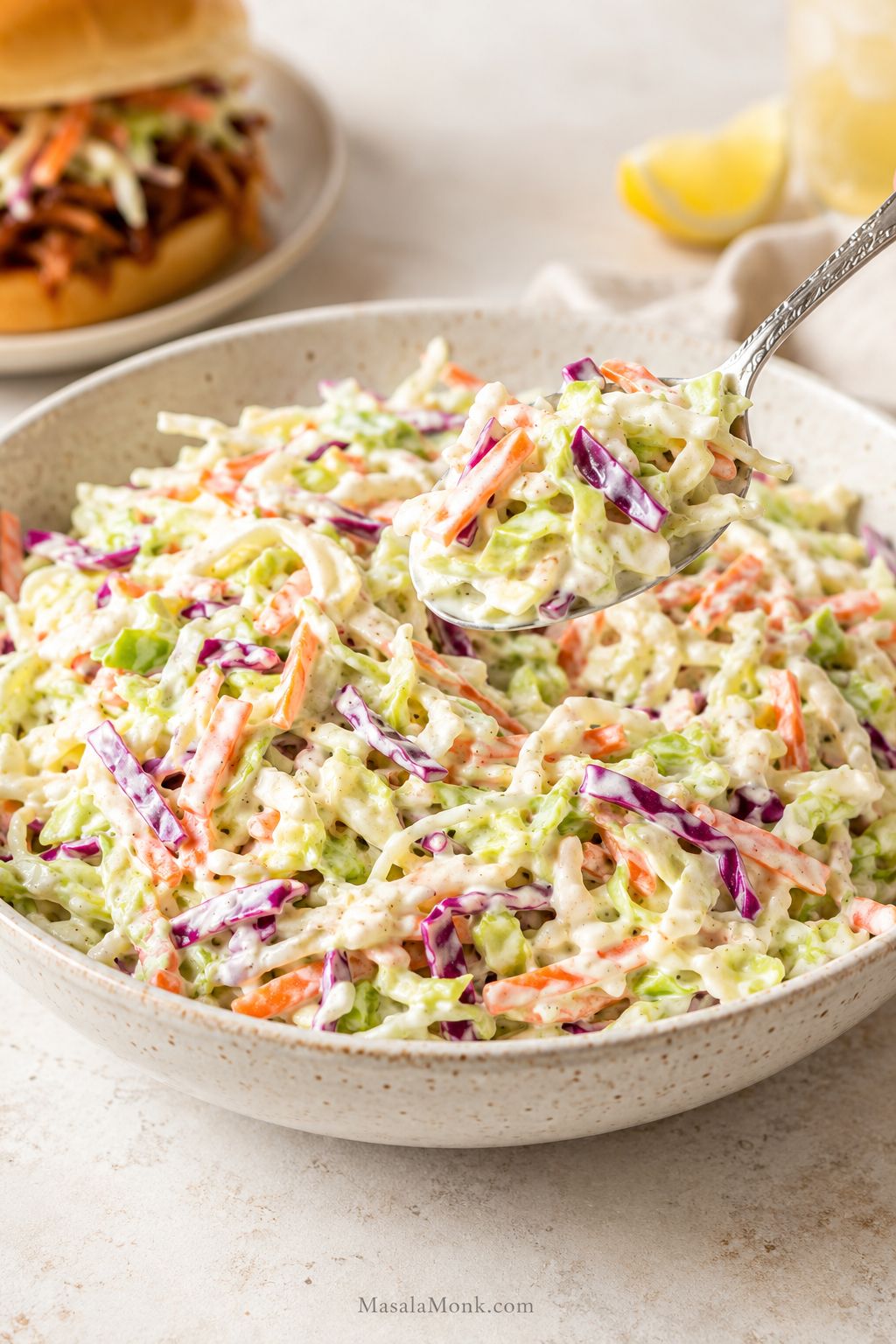
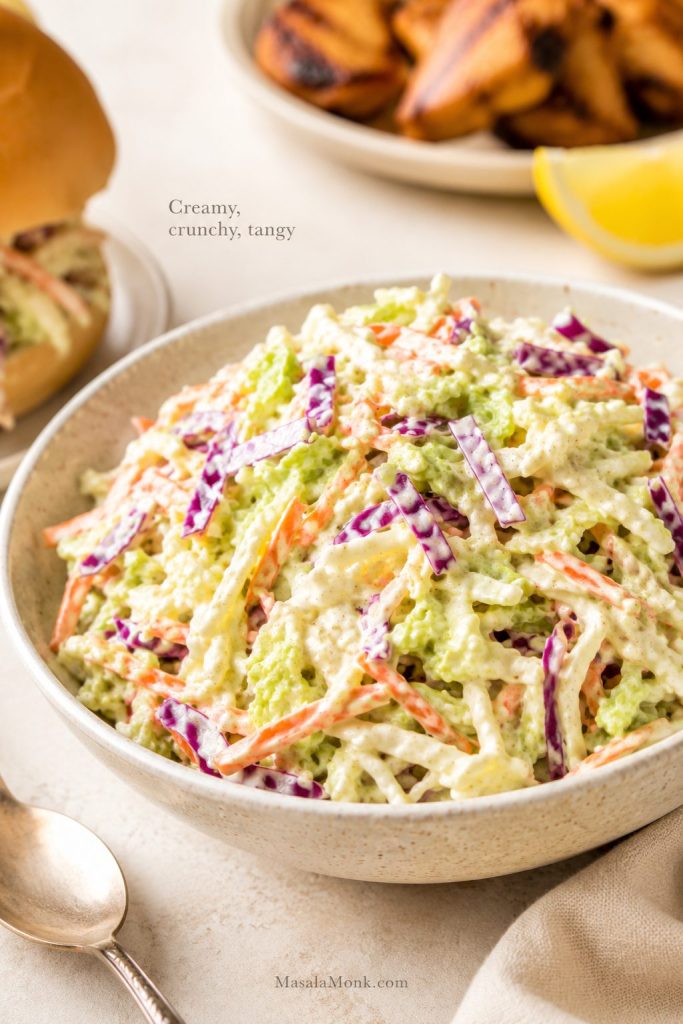
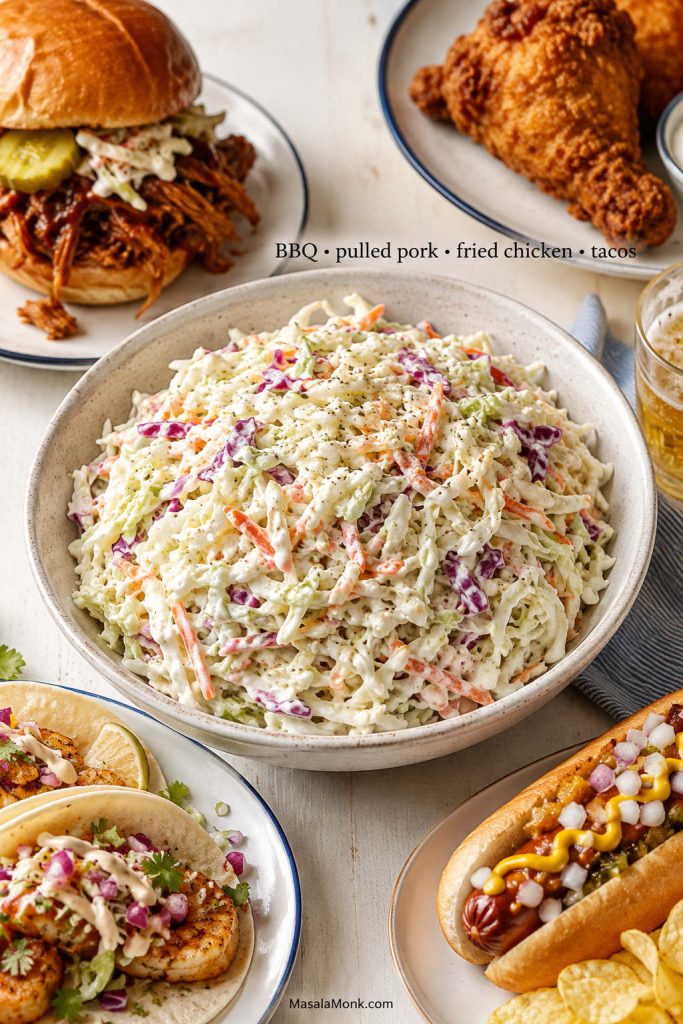
This coleslaw recipe is the cold, crunchy side that makes a cookout plate feel complete. It is creamy without being heavy, lightly sweet without tasting sugary, and tangy enough to cut through BBQ, burgers, fried chicken, fried fish, hot dogs, tacos, and pulled pork sandwiches.
The best version gives you that cold snap of cabbage, a creamy-tangy coating, and just enough sweetness to make smoky, salty, fried, or saucy food taste even better.
Because coleslaw brings cold crunch to smoky, fried, and saucy foods, it works especially well with BBQ plates, burgers, fried chicken, and pulled pork.
The recipe is simple — shredded cabbage, carrot, and a creamy dressing — but the little choices matter. Shred the cabbage fine enough, mix the dressing separately, chill the bowl, and hold back some dressing until the end. That is how you get homemade coleslaw that tastes fresh, not watery — and the full watery coleslaw fix is below if that is the problem you are trying to avoid.
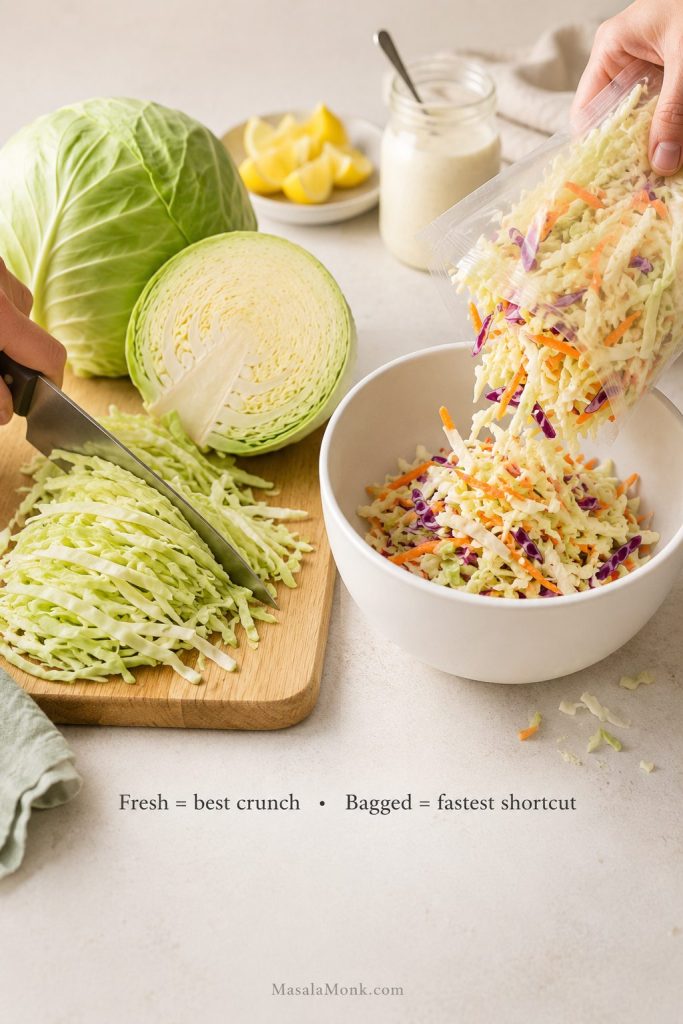
You can make it with fresh cabbage when you want the strongest crunch, or with bagged coleslaw mix when you need a fast weeknight side. Either way, this is everyday creamy coleslaw: cool, crisp, bright, and sturdy enough to work as a side dish or a sandwich topping.
Best for: BBQ plates, burgers, fried chicken, fried fish, hot dogs, tacos, and pulled pork sandwiches
Texture: cold, crunchy, creamy, lightly sweet, and tangy
Prep time: 15 minutes
Chill time: 30–60 minutes
Servings: 8 side servings
Yield: about 8–9 cups
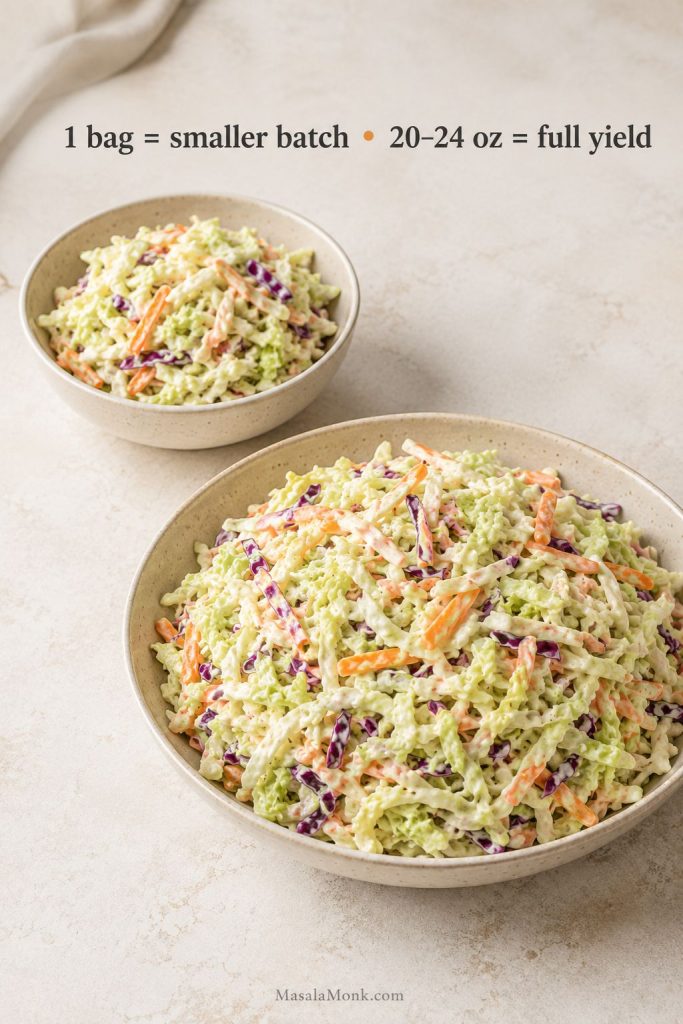
Shortcut: use bagged coleslaw mix; one 14–16 oz bag makes a smaller batch, while 20–24 oz gives the full recipe yield
Most important tip: start with part of the dressing, chill, toss again, then add more only if the slaw needs it
What You’ll Find in This Coleslaw Guide
This guide helps you make classic creamy coleslaw that tastes balanced, stays crisp, and works whether you are serving it in a bowl, beside grilled food, or inside a sandwich.
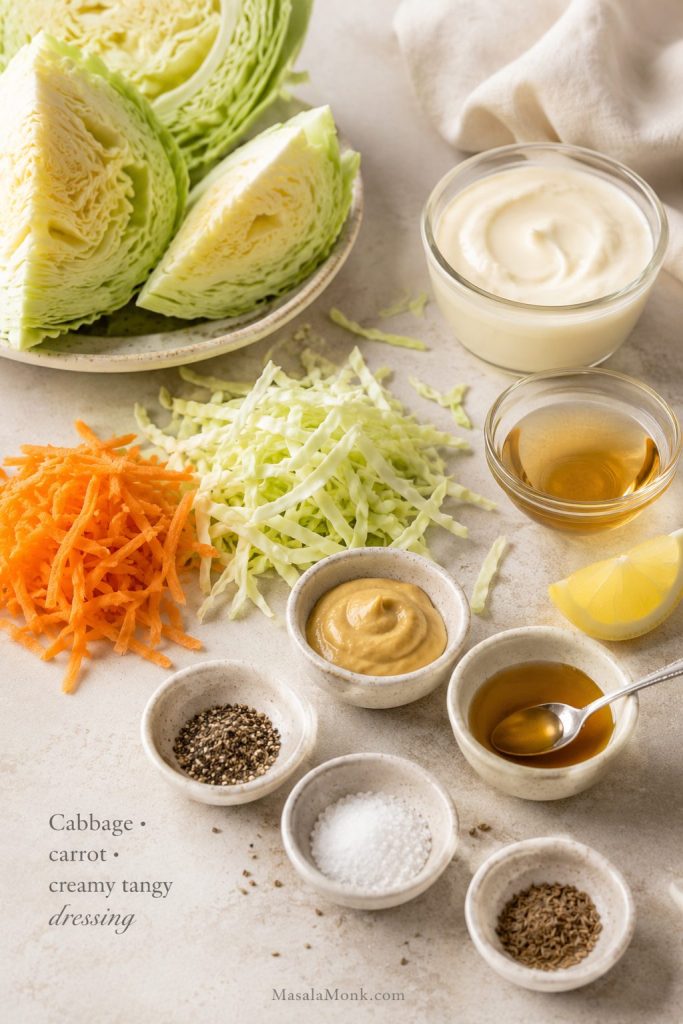
The best easy coleslaw recipe starts with finely shredded cabbage, grated carrot, and a creamy dressing made with mayonnaise, apple cider vinegar, a little lemon juice or mustard, sugar or honey, salt, pepper, and optional celery seed. The simple trick is to dress the cabbage lightly at first, let it chill, then add more dressing only if it needs it.
For a reliable balance, use about 8 cups of shredded cabbage and carrot mixture for every ⅔ cup of mayonnaise-based dressing. That gives you coleslaw that is glossy and lightly coated, not soupy at the bottom of the bowl. It should taste cool, crunchy, tangy, and just sweet enough. For the exact creamy-tangy balance, see the coleslaw dressing section before you adjust the mayo, vinegar, lemon, or mustard.
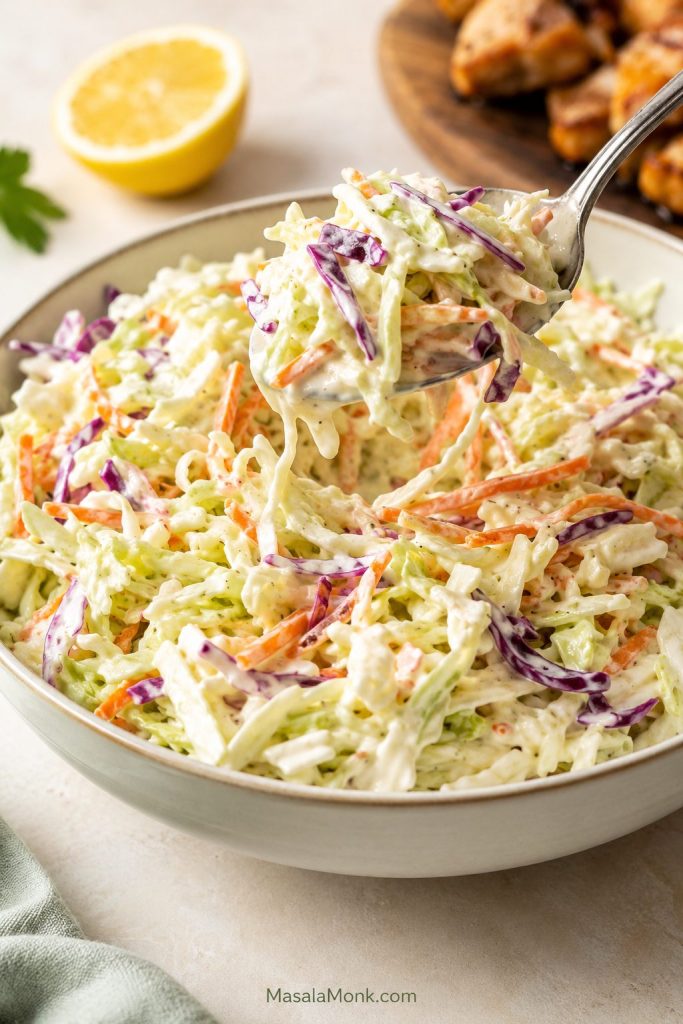
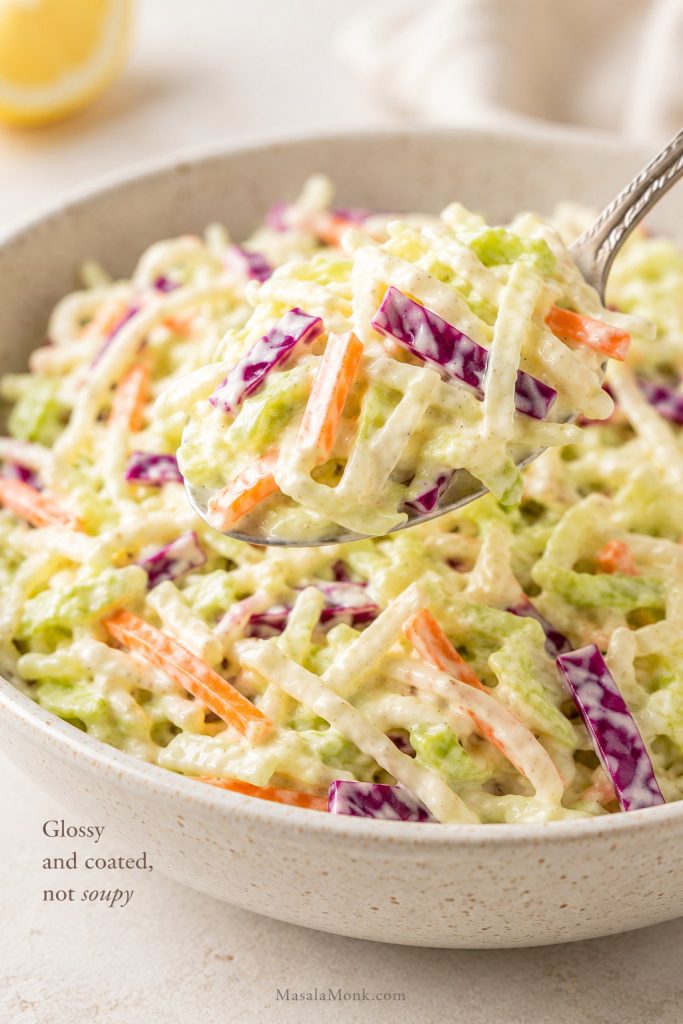
The best easy coleslaw should show contrast in one bite: creamy dressing on the outside, crisp cabbage underneath, and no thin liquid collecting below.
Using bagged coleslaw mix? One 14–16 oz / 400–450 g bag makes a smaller batch than this full recipe. For one bag, start with about half to two-thirds of the dressing. If you are in a hurry, you can serve the slaw after 10–15 minutes, though the texture and flavor are better after 30–60 minutes in the fridge. For the full bagged-mix math, see the bagged coleslaw mix conversion below.
Coleslaw Recipe Card
Coleslaw Recipe
This easy coleslaw recipe is made with crisp cabbage, grated carrot, and a sweet-tangy dressing. It is the kind of cold, crunchy side that works on a cookout plate, inside a sandwich, or beside fried food.
Prep Time 15 minutes
Chill Time 30–60 minutes
Total Time 45–75 minutes
Servings 8 side servings
Yield about 8–9 cups
Equipment
Large mixing bowl
Medium bowl
Whisk
Tongs
Sharp knife or mandoline
Box grater
Airtight container
Optional: colander or salad spinner for make-ahead cabbage
Ingredients
For the slaw:
6 loosely packed cups finely shredded green cabbage, about 420–450 g
2 loosely packed cups finely shredded red cabbage or more green cabbage, about 140–150 g
1 large carrot, grated, about 75–100 g
2–4 tablespoons thinly sliced scallion or red onion, optional
For the creamy coleslaw dressing:
⅔ cup mayonnaise, about 150 g
2 tablespoons apple cider vinegar, 30 ml
1 tablespoon lemon juice, 15 ml, or 2 teaspoons Dijon mustard, 10 ml
1 tablespoon sugar, about 12 g, or honey, about 20 g
½ teaspoon celery seed, optional
½ teaspoon fine salt, plus more to taste
¼ teaspoon black pepper
Instructions
Shred the cabbage. Slice the cabbage finely with a sharp knife or mandoline. Grate the carrot and add it to a large mixing bowl with the cabbage and optional scallion or red onion.
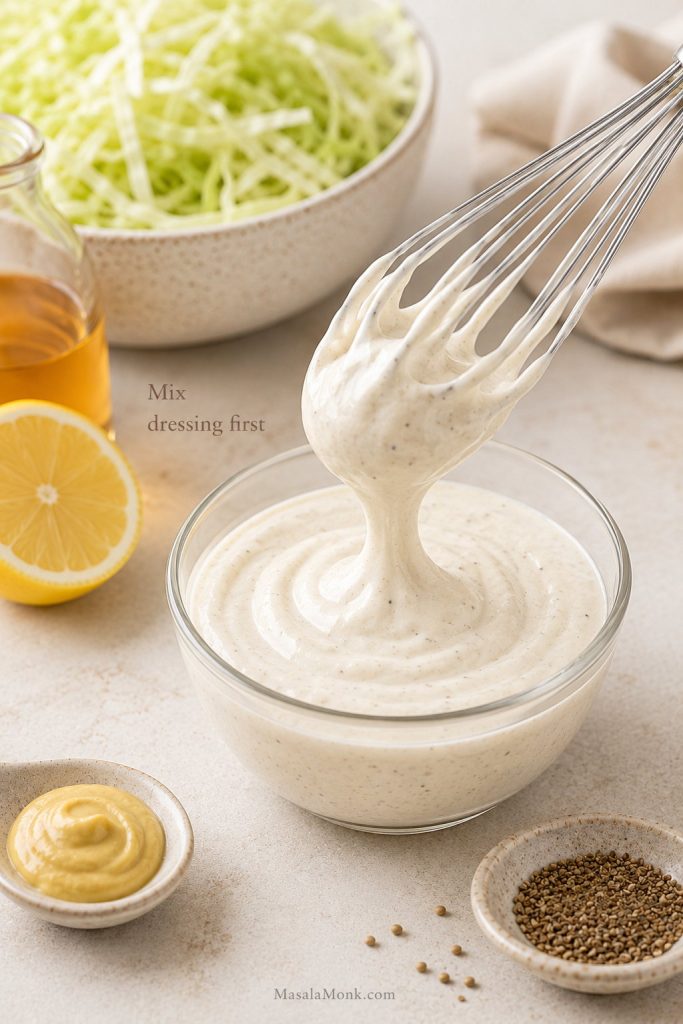
Mix the dressing. In a medium bowl, whisk together the mayonnaise, apple cider vinegar, lemon juice or Dijon mustard, sugar or honey, celery seed, salt, and black pepper until smooth.
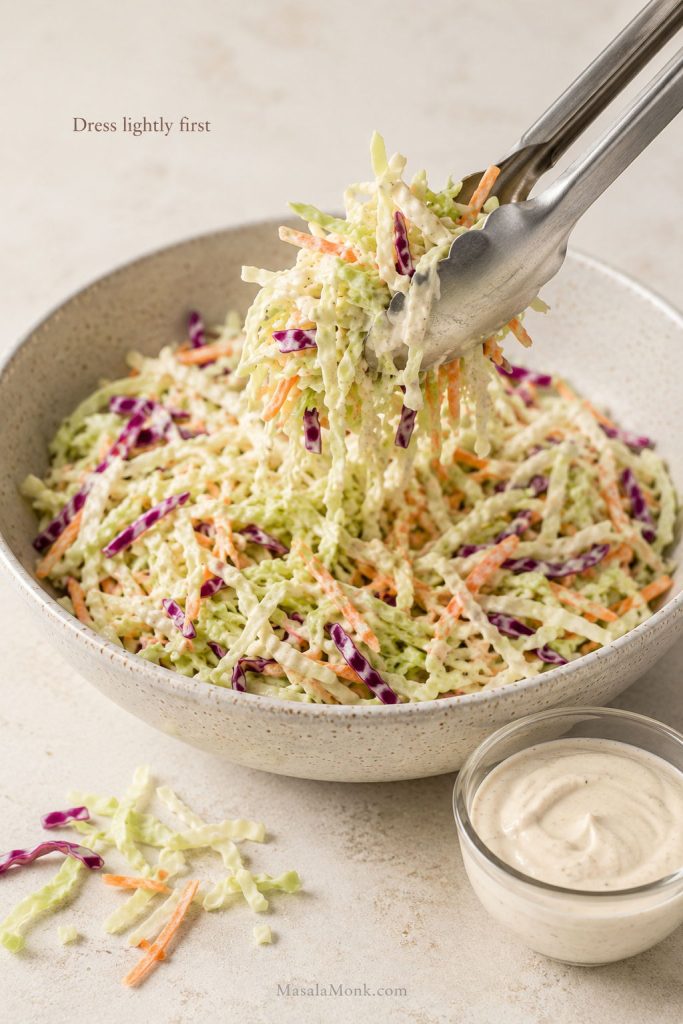
Dress lightly first. Pour about two-thirds of the dressing over the cabbage mixture. Toss well until the cabbage is lightly coated.
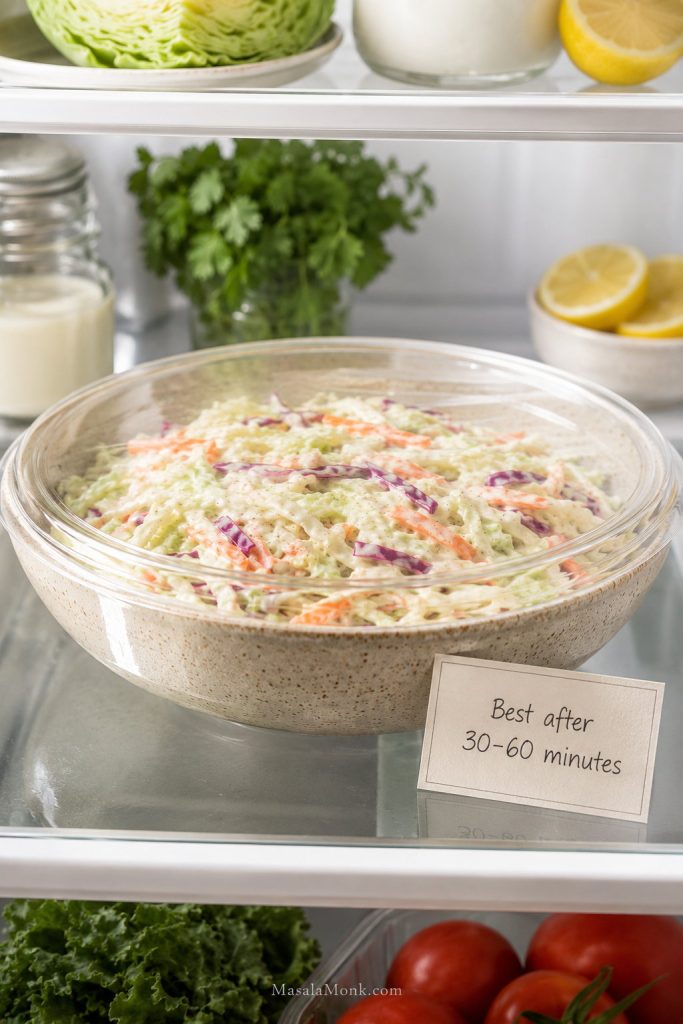
Chill. Cover and refrigerate for 30 to 60 minutes so the cabbage relaxes slightly and the flavors blend.
Finish before serving. Toss again. If the slaw looks dry, add more dressing a spoonful at a time. A little salt will wake it up if the flavor feels flat. When it tastes too sweet or heavy, sharpen it with vinegar or lemon juice. If the cabbage tastes bitter or the dressing feels too sharp, balance it with a tiny pinch of sugar.
Notes
One 14–16 oz / 400–450 g bag of coleslaw mix makes a smaller batch. For the full 8–9 cup yield, use about 20–24 oz / 560–680 g mix, or add extra shredded cabbage and carrot.
If using one 14–16 oz bag, start with about half to two-thirds of the dressing. Chill, toss, then add more only if needed.
Do not add all the dressing at once. Cabbage releases moisture as it sits, so the slaw becomes creamier after chilling; the two-thirds dressing rule explains how to control that texture.
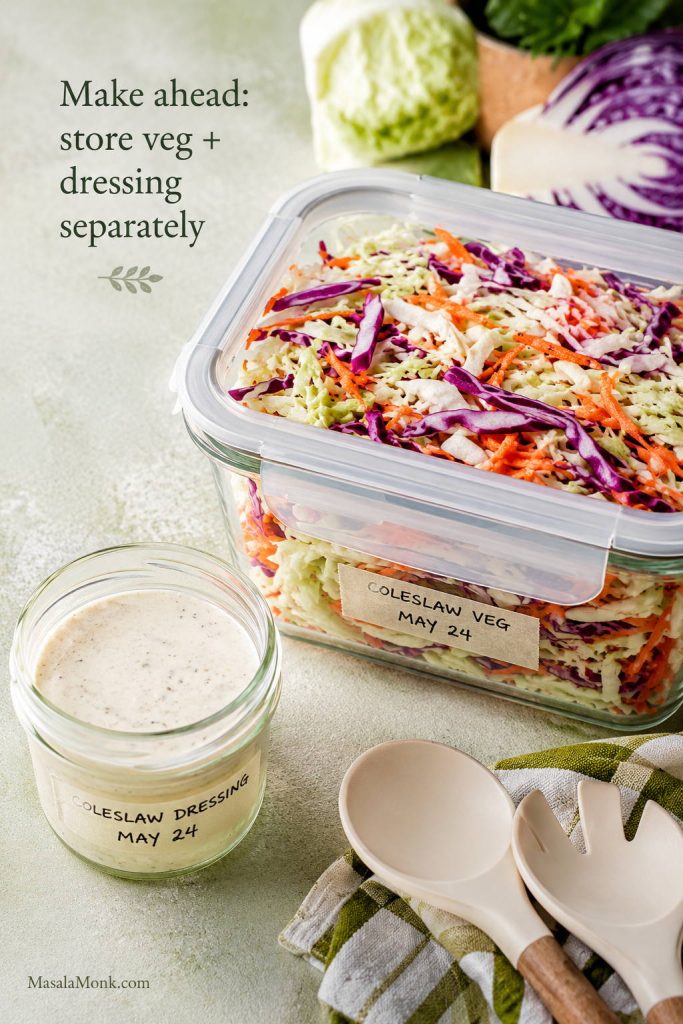
For make-ahead coleslaw, store the dressing and vegetables separately until a few hours before serving; see the make-ahead and storage tips for timing.
If you salt the cabbage first, reduce the dressing salt to ¼ teaspoon or leave it out until the final taste adjustment.
Serve cold or well chilled. Toss again and drain any excess liquid before serving if the slaw has been refrigerated for several hours.
If you make it, try it once as written, then adjust it sweeter, tangier, creamier, or crunchier for your table. Coleslaw is one of those recipes where small preferences matter.
Are you team creamy coleslaw or vinegar slaw? Share how you serve it — as a BBQ side, on pulled pork, with fried chicken, or piled onto hot dogs.
Why This Coleslaw Recipe Works
Good coleslaw is all about contrast. The cabbage should still crunch, the dressing should cling instead of pooling at the bottom, and the flavor should wake up the rest of the plate. When coleslaw is too wet, too sweet, or too mayo-heavy, it stops doing its job.
This is the version to make when you want classic creamy coleslaw that still tastes fresh after chilling. It is not overloaded with dressing, not sugary, and not watery at the bottom of the bowl.
Although this coleslaw recipe keeps the ingredient list classic, the method gives you more control. The cabbage is shredded finely enough to soften as it chills, but not so finely that it turns limp. The dressing has enough vinegar and lemon or mustard to balance the mayonnaise. Finally, the dressing is added in stages because cabbage changes as it sits.
That last part matters most. A bowl that looks slightly underdressed right after mixing can become perfectly creamy after 30 minutes in the fridge. Hold back some dressing at the beginning, let the slaw settle, then finish it right before serving.
The texture goal
The dressing should cling to the cabbage in a light, glossy coat. You want crunch in every bite, not a puddle of thin dressing at the bottom of the bowl.
Coleslaw Recipe Ingredients
A good bowl of coleslaw does not ask for much: crisp cabbage, sweet carrot, a creamy dressing, enough acidity to brighten it, and enough salt to make the vegetables taste like themselves. Once those pieces are balanced, the bowl tastes crisp and fresh instead of heavy.
Classic coleslaw ingredients are simple, yet the balance matters: cabbage gives crunch, carrot adds sweetness, and vinegar or lemon keeps the creamy dressing bright.
Best Cabbage for Coleslaw
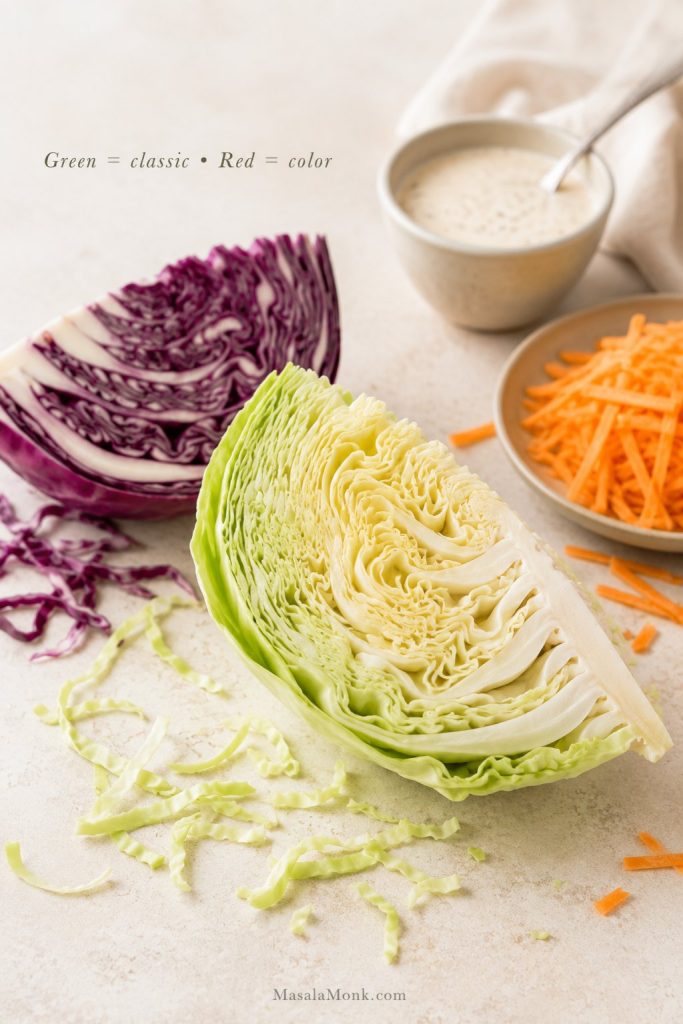
Green cabbage is the most reliable everyday cabbage for coleslaw. It is crisp, sturdy, mild, and strong enough to hold a creamy dressing without collapsing. Red cabbage adds color and extra crunch, but it can tint the dressing pink as the slaw sits.
Green cabbage is the best base for classic creamy coleslaw because it stays crisp, while red cabbage adds color and a slightly sharper bite.
A classic bowl can be made with only green cabbage and carrot. If you want more color, use mostly green cabbage with a smaller amount of red cabbage. The flavor will still be familiar, and the bowl will look brighter on the table.
Ingredient
What It Does
Notes
Green cabbage
Gives the slaw its main crunch
Mild, classic, sturdy, and easy to dress.
Red cabbage
Adds color and a peppery bite
Use less than green cabbage if you want a pale creamy dressing.
Carrot
Brings sweetness and color
Grate it finely so it spreads through the bowl.
Scallion or red onion
Adds optional sharpness
Use a light hand because raw onion can take over quickly.
Fresh Cabbage vs Bagged Coleslaw Mix
For this coleslaw recipe, fresh cabbage gives you the strongest crunch and the most control over shred size. It is the better choice when coleslaw is one of the main sides at a cookout or when you want it to hold up on sandwiches.
Fresh cabbage lets you choose the crunch and cut, while bagged coleslaw mix saves time as long as the dressing is added with a lighter hand.
However, bagged coleslaw mix is still worth using. It is fast and weeknight-friendly, though the cut and moisture level can vary from bag to bag. Because pre-cut cabbage can range from dry and sturdy to very fine and soft, dress it lightly first and give it a few minutes before deciding whether it needs more. If you are using a bag, the bagged coleslaw mix conversion will help you scale the dressing and yield correctly.
Bagged mix conversion: One 14–16 oz / 400–450 g bag of coleslaw mix makes a smaller batch, about 5–6 side servings. For the full 8–9 cup yield, use about 20–24 oz / 560–680 g coleslaw mix, or add extra shredded cabbage and carrot.
One 14–16 oz bag of coleslaw mix makes a smaller batch, so use 20–24 oz or add extra cabbage and carrot when you want the full recipe yield.
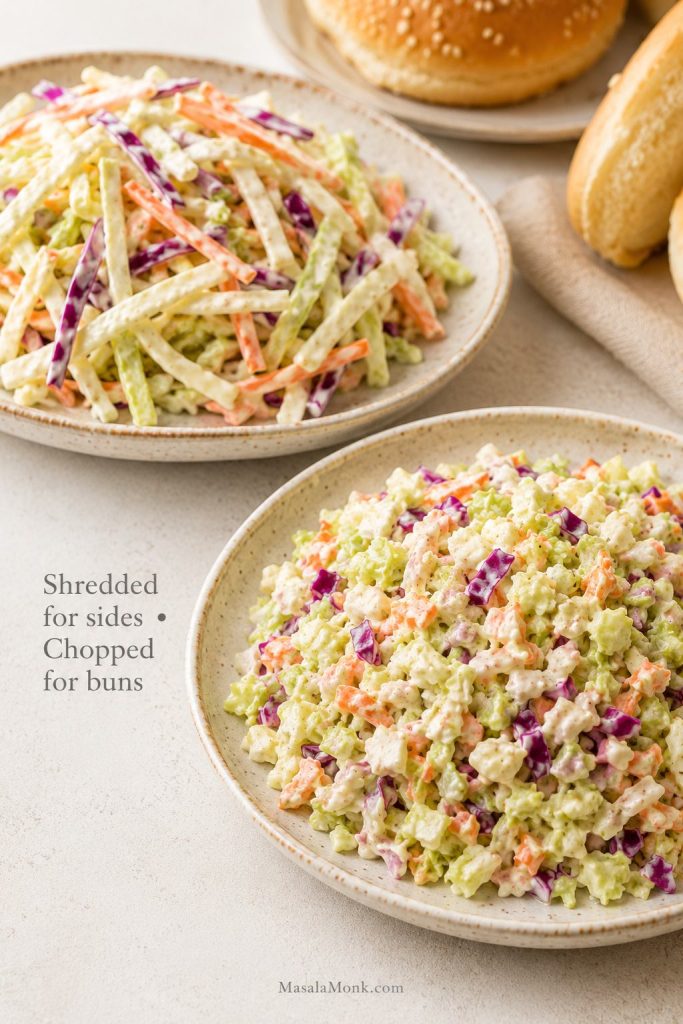
Shredded vs Chopped Coleslaw
Thinly shredded cabbage gives you the classic creamy coleslaw texture: long, crisp strands that hold dressing and still crunch. This is the best cut when you are serving coleslaw as a side dish.
Shredded coleslaw gives side dishes that classic forkful texture, while chopped slaw stays neater on burgers, hot dogs, and pulled pork sandwiches.
Burgers, hot dogs, pulled pork sandwiches, and slaw dogs need a neater slaw. A finer chop keeps the cabbage from sliding out of the bun. Grated cabbage is softer and wetter, so use it only if you want a very fine deli-style texture.
Cut
Works Well With
Texture Goal
Thin shreds
Classic side dish coleslaw
Crisp, creamy, and traditional
Fine chop
Burgers, hot dogs, pulled pork sandwiches
Compact and bun-friendly
Thicker shreds
Crunchier slaw bowls and BBQ plates
More bite, needs more chilling time
Grated cabbage
Very soft deli-style slaw
Softens quickly and releases more liquid
Carrots, Onion, and Optional Add-Ins
Carrot is almost always worth adding because it brings sweetness and color. Grate it on the large holes of a box grater or use the shredding blade on a food processor.
Onion is optional. Scallions are gentler and fresher. Red onion is sharper and works best when sliced very thinly. If you are making coleslaw for kids, a mixed crowd, or a long cookout table, keep the onion light or leave it out.
Parsley, celery seed, chopped apple, or a little extra mustard can be useful, but the main recipe should stay clean. Too many extras turn classic coleslaw into a different salad.
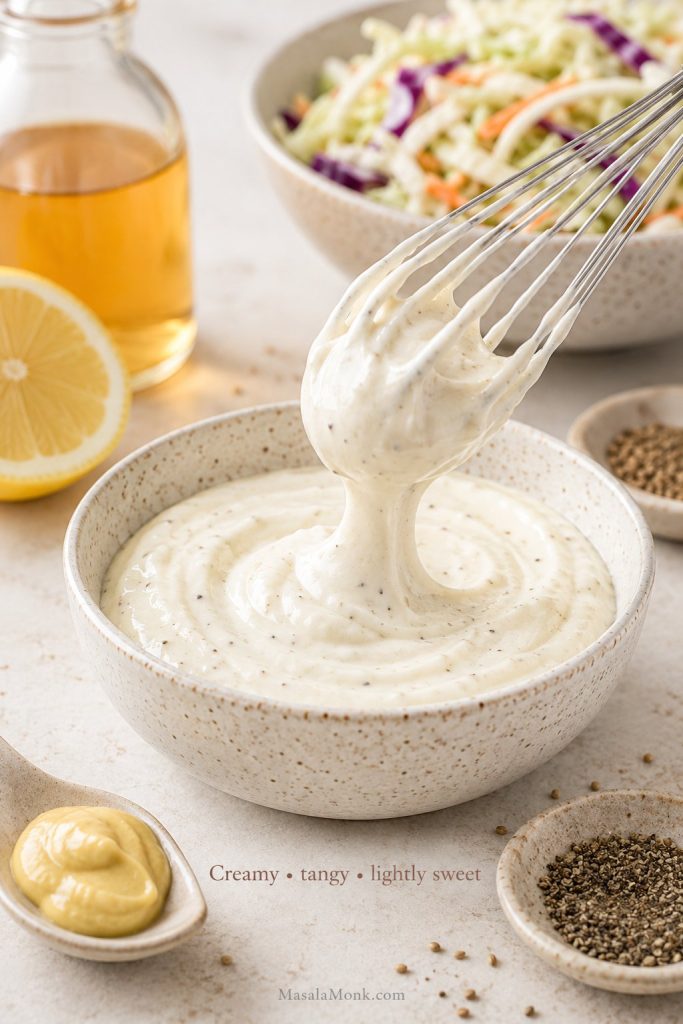
Creamy Coleslaw Dressing
The dressing should make the cabbage taste brighter, not bury it. Mayonnaise gives the slaw its creamy body, vinegar brings the snap, lemon juice or mustard sharpens the edges, and a little sugar or honey rounds out the raw cabbage bite.
A creamy coleslaw dressing should taste slightly bold before mixing because the cabbage will mellow the vinegar, lemon, salt, and sweetness.
If you make your own mayonnaise, this is a good place to use it. A thick homemade mayo gives the dressing a richer texture and a cleaner flavor. You can use this homemade mayonnaise recipe as the creamy base.
The Sweet-Tangy Dressing Ratio
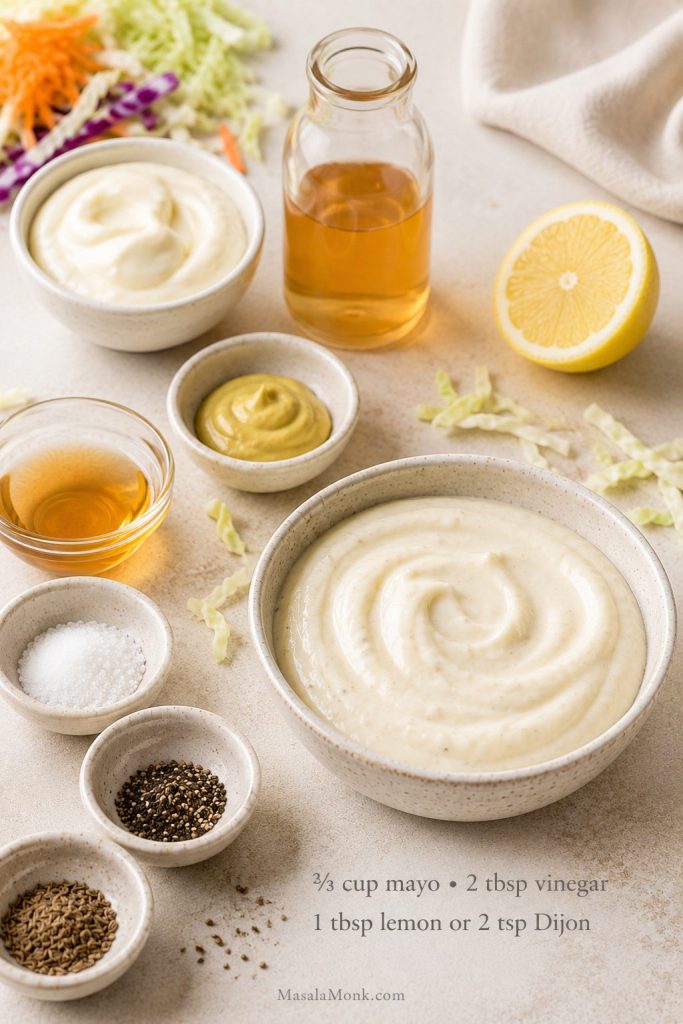
For this coleslaw recipe, about 8 cups of shredded cabbage and carrot works well with ⅔ cup mayonnaise, 2 tablespoons apple cider vinegar, 1 tablespoon lemon juice or 2 teaspoons Dijon mustard, and 1 tablespoon sugar or honey. For example, use lemon juice when you want a brighter dressing, or Dijon mustard when you want a sharper, more savory one.
This coleslaw dressing ratio gives enough creaminess to coat the cabbage, while vinegar, lemon, or Dijon keeps the finished slaw from tasting flat.
This gives you a dressing that is creamy but not bland, tangy but not harsh, and sweet enough to taste classic without turning sugary. If your family likes a sweeter cookout-style slaw, use the sugar or honey. If you want something sharper for pulled pork, fried fish, or tacos, lean a little harder on vinegar and lemon.
Flavor Goal
Adjustment
Works Well With
More tangy
Add 1–2 teaspoons extra vinegar or lemon juice
Fried chicken, fish, BBQ, pulled pork
Sweeter
Add 1–2 teaspoons sugar or honey
Classic cookout slaw, hot dogs, kids’ plates
Creamier
Add 1–2 tablespoons mayo
Potlucks, side dish bowls, BBQ plates
Lighter
Replace part of the mayo with Greek yogurt or buttermilk
Weeknight sides, lighter sandwiches
The Two-Thirds Dressing Rule
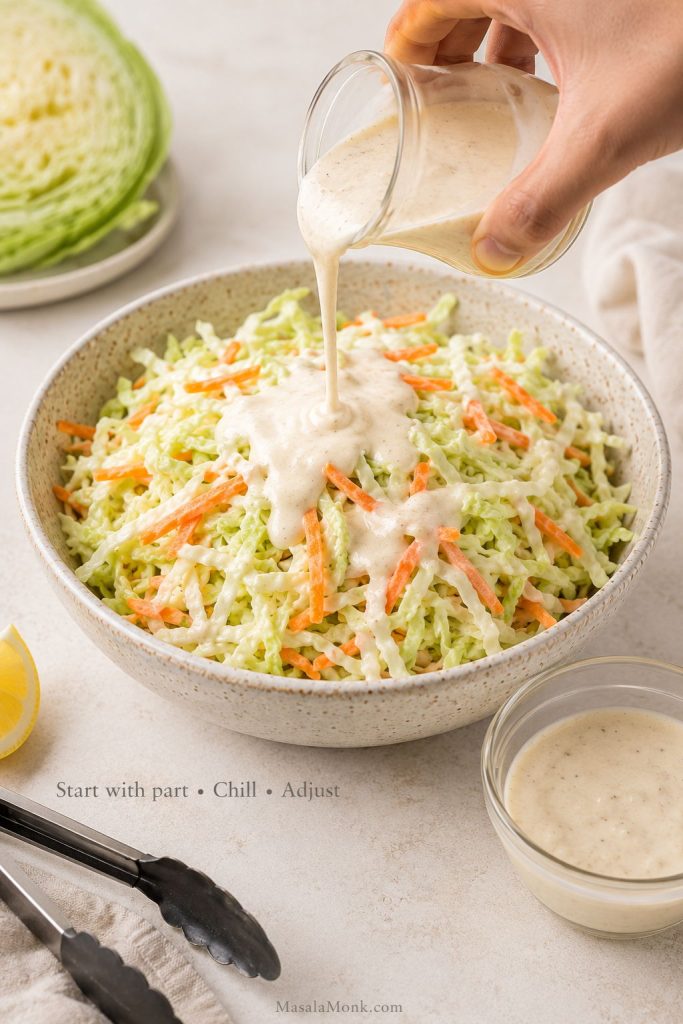
Do not drown the cabbage right away. Start with about two-thirds of the dressing, toss well, chill, then add more only if the slaw still looks dry. Cabbage relaxes and releases moisture as it sits, so a bowl that seems slightly underdressed at first often becomes just right after a short rest.
The reserved dressing is the safety net: once the cabbage relaxes in the fridge, you can finish the bowl without making it soupy.
As a result, this one habit prevents the two most common coleslaw problems: dry cabbage right after mixing and watery coleslaw later.
How Much Dressing to Use
The right amount of dressing depends on how finely the cabbage is cut and how long the bowl will sit. Thin shreds need less dressing because they soften quickly. Thicker shreds need a little more time and may need a touch more dressing after chilling. If your bowl often turns loose after chilling, the watery coleslaw section explains when to drain, salt, or hold back dressing.
After that, toss thoroughly, let the bowl settle, then taste again. If the slaw looks glossy and lightly coated, stop there. If it still looks dry after chilling, add the remaining dressing a spoonful at a time.
A glossy coating is the goal; if liquid is pooling underneath, the slaw will taste heavier and lose its crunch faster.
Taste after chilling, not only before. Cold cabbage dulls flavor slightly, and the dressing loosens as the slaw rests.
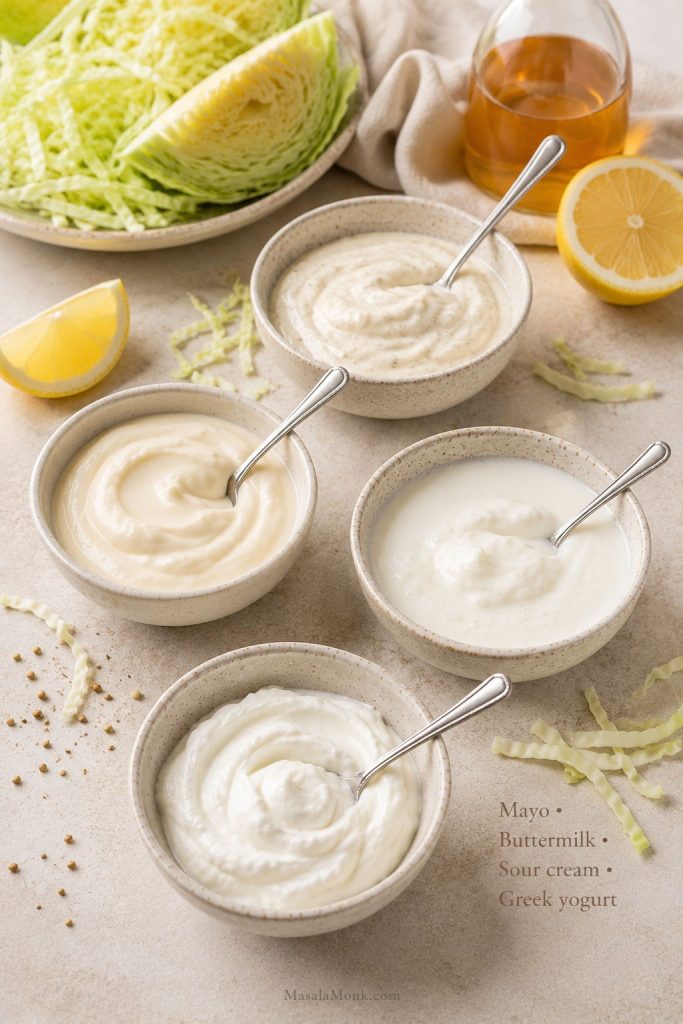
Mayo, Buttermilk, Sour Cream, or Greek Yogurt?
Mayonnaise is the classic choice because it gives coleslaw body and a smooth coating. Buttermilk makes the dressing looser and tangier. Sour cream adds richness with a gentle tang. Greek yogurt makes the dressing lighter and sharper, although it can taste more tart than classic mayo-based slaw.
Mayonnaise gives the most classic coleslaw texture, while buttermilk, sour cream, or Greek yogurt can make the dressing tangier, lighter, or richer.
The safest first version is mayonnaise. Once you understand the texture, you can replace 2–4 tablespoons of the mayo with buttermilk, sour cream, or Greek yogurt depending on the kind of slaw you want.
Need an egg-free version? Use a thick eggless mayo and keep the rest of the recipe the same. This eggless mayonnaise recipe works well when you want the same creamy texture without eggs.
How to Make Coleslaw
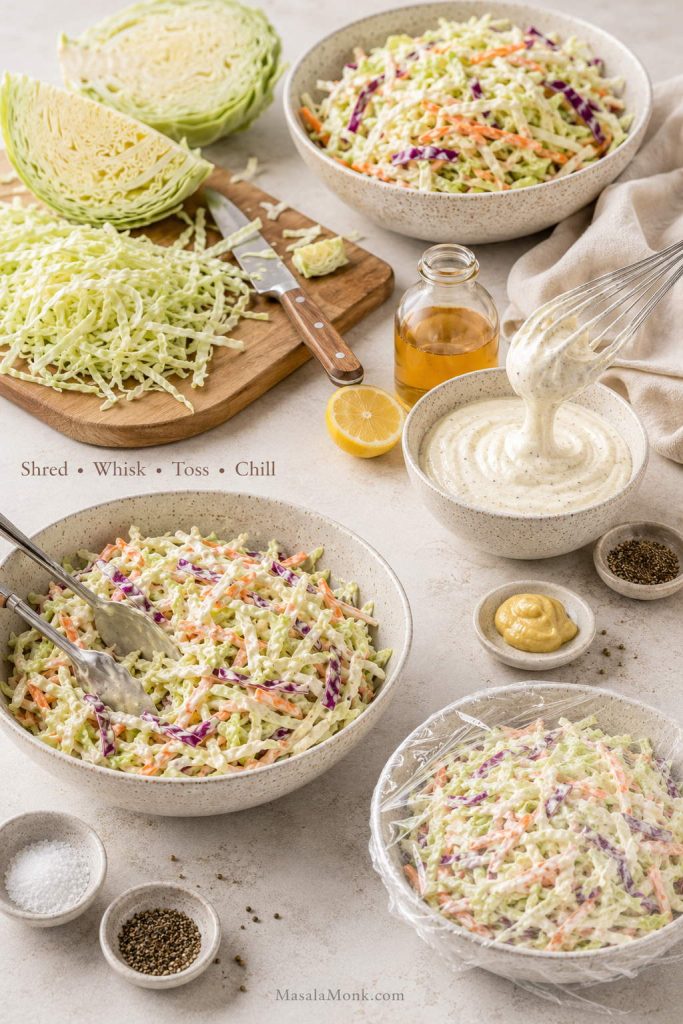
Coleslaw is easy, but the order helps. Shred the vegetables first, whisk the dressing separately, dress lightly, chill, then finish the bowl after it has had time to settle.
Once the cabbage is shredded and the dressing is mixed separately, the key is to toss lightly, chill, and finish the coleslaw after the vegetables settle.
Shred the Cabbage
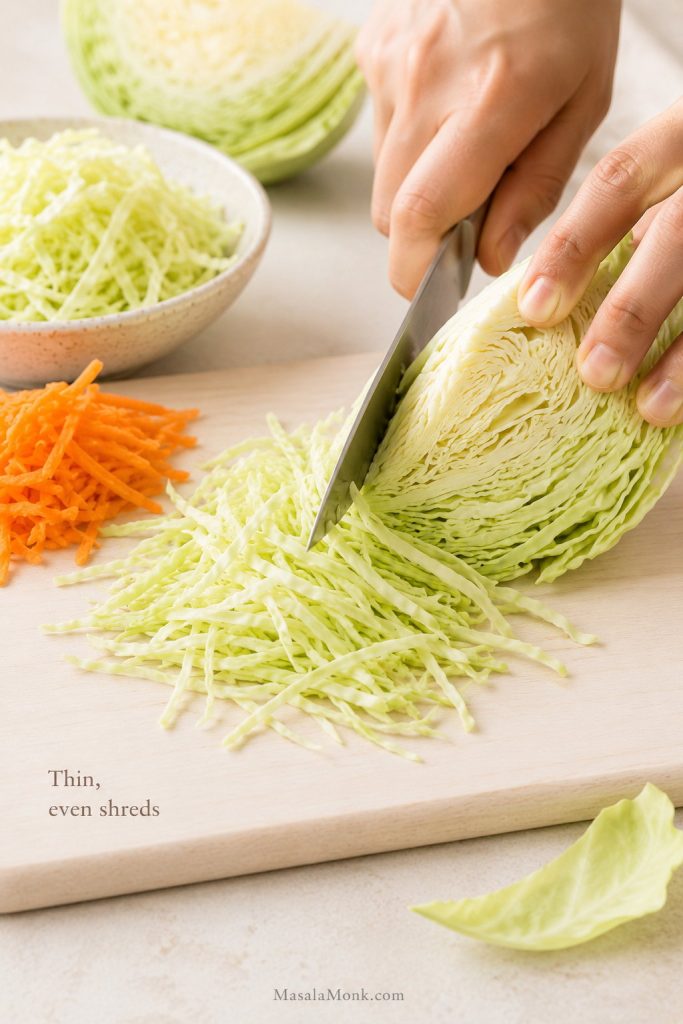
Cut the cabbage into quarters, remove the hard core, then slice it thinly with a sharp knife. A mandoline gives you very fine, even shreds. A food processor with a slicing blade is the fastest method when you are making a bigger batch.
Thin, even cabbage shreds soften evenly in the dressing, which helps homemade coleslaw stay creamy while keeping its crunch.
Side-dish coleslaw can handle longer shreds. Sandwich slaw should be finer or lightly chopped so it stays where you put it.
Mix the Dressing
Whisk the mayonnaise, apple cider vinegar, lemon juice or Dijon mustard, sugar or honey, celery seed, salt, and black pepper in a separate bowl. This gives you a smoother dressing and keeps one part of the slaw from getting too salty, too sweet, or too sharp.
Mixing the coleslaw dressing separately prevents uneven flavor, so one bite does not taste too salty, too sweet, or too sharp.
Taste the dressing before adding it to the cabbage. It should taste a little stronger than you want the finished coleslaw to taste because the cabbage will soften and mellow it.
Toss, Chill, and Adjust
Add about two-thirds of the dressing to the cabbage and carrot mixture. Toss with tongs or clean hands until the vegetables are evenly coated. Cover and chill for 30 to 60 minutes.
Light tossing gives the cabbage room to settle; after resting, you can add more dressing only where the bowl actually needs it.
Before serving, toss again and taste. If the slaw looks dry, add more dressing a spoonful at a time. A little salt will wake it up if the flavor feels flat. When it tastes too sweet or heavy, sharpen it with vinegar or lemon juice. If the cabbage tastes bitter or the dressing feels too sharp, balance it with a tiny pinch of sugar.
Best flavor window: Coleslaw tastes best after 30 minutes to 2 hours in the fridge. It is still good the next day, but the cabbage will be softer and the dressing thinner.
After 30–60 minutes in the fridge, the dressing clings better and the cabbage softens slightly without losing the cold crunch that makes coleslaw refreshing.
How to Keep Coleslaw from Getting Watery
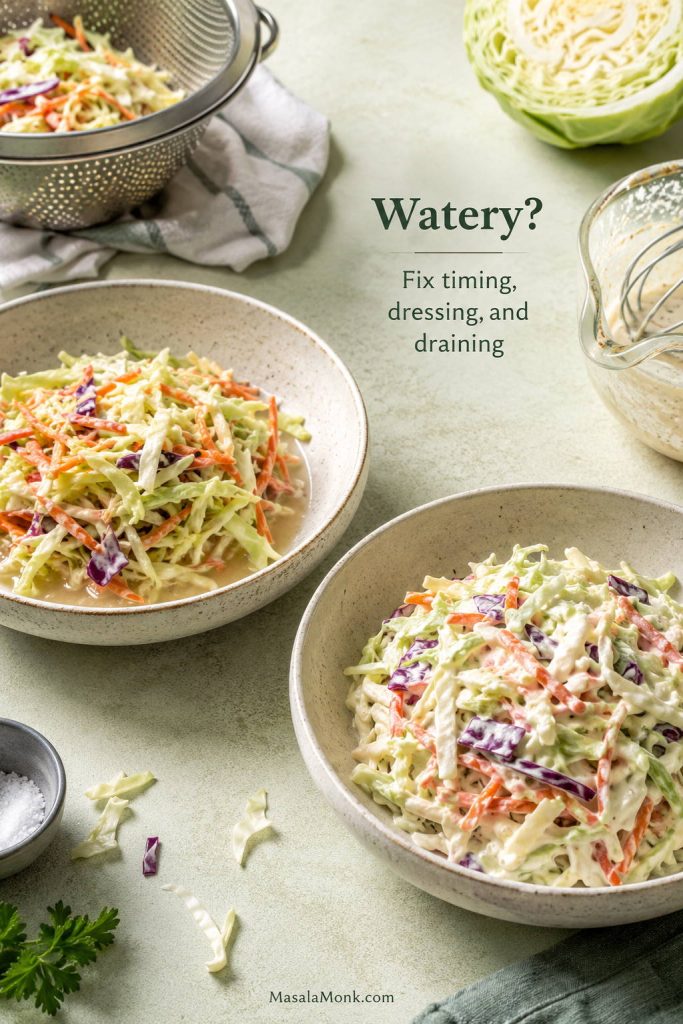
Watery coleslaw usually comes from cabbage releasing moisture after it is dressed. The bowl may look good when you mix it, then an hour later the dressing has thinned out and liquid has collected at the bottom. That does not mean you ruined it. It just means the cabbage did what cabbage does.
Watery coleslaw is usually a timing problem, not a ruined batch; draining, reserved dressing, and final seasoning can bring the bowl back.
Fortunately, the fix is not always “less dressing.” It is better timing. Start with part of the dressing, chill, toss again, then decide whether the bowl needs more dressing, more acid, a pinch of salt, or a quick drain.
Should You Salt the Cabbage?
Salting is optional, not mandatory. Skip it for quick same-day coleslaw. Use it when you need the slaw to hold longer, sit neatly on buns, or avoid watering down the dressing at a cookout.
Salting cabbage is optional for same-day coleslaw, but it helps make-ahead slaw stay crisper by drawing out extra moisture before dressing.
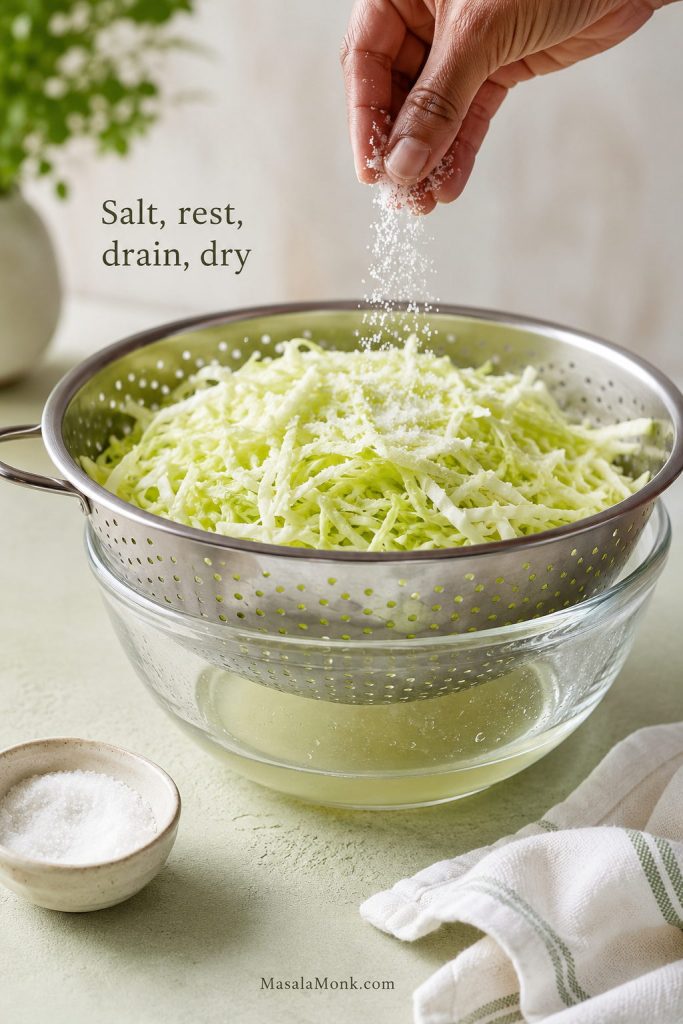
To salt cabbage for make-ahead coleslaw, toss the shredded cabbage with 1 teaspoon fine salt, or up to 1½ teaspoons if the cabbage is especially wet or you are using a larger head. Let it sit in a colander for 20 to 30 minutes. Rinse lightly if it tastes too salty, then dry it very well with a clean towel or salad spinner before adding the dressing. If you are prepping for tomorrow, pair this with the make-ahead storage method so the cabbage stays crisp.
If you salt the cabbage first, reduce the salt in the dressing to ¼ teaspoon or leave it out until the final taste adjustment.
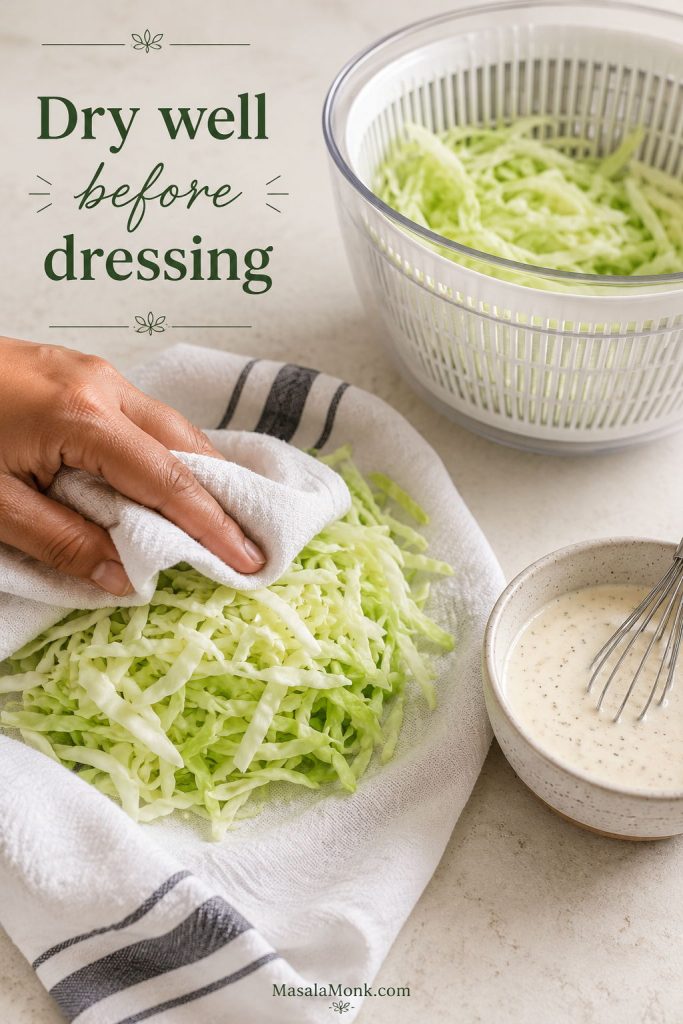
Important: Dry the cabbage well after salting. Wet cabbage plus creamy dressing will still make watery coleslaw.
After salting or rinsing cabbage, dry it well before adding dressing; otherwise, even a thick creamy coleslaw dressing can turn watery.
Same-Day vs Make-Ahead Coleslaw
The best method depends on whether the slaw is for tonight’s dinner, tomorrow’s cookout, or a sandwich tray. A quick weeknight bowl does not need the same prep as a tray of sandwich slaw for a crowd.
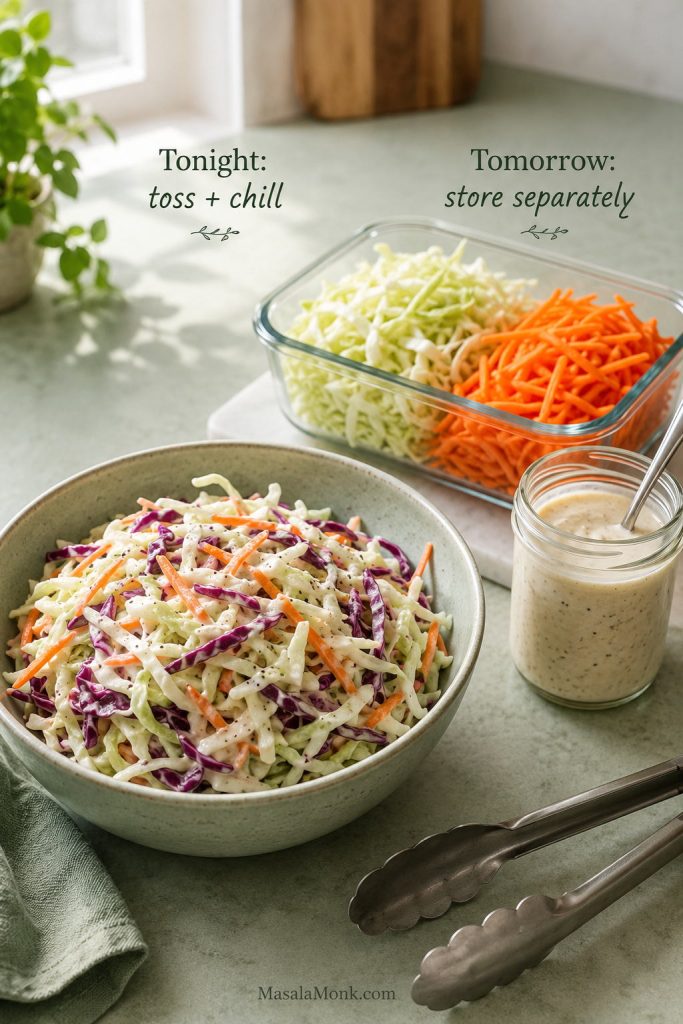
Same-day slaw can be dressed early enough to relax, while tomorrow’s slaw stays crisper when the cabbage and dressing wait apart.
Situation
Should You Salt?
Best Move
Serving within 30–60 minutes
No
Dress lightly, chill, toss, and adjust
Making it tomorrow
Yes, or store dressing separately
Salt, drain, dry well, then dress later
Using bagged coleslaw mix
Usually no
Start with part of the dressing because bagged mix varies
Putting it on pulled pork, burgers, or hot dogs
Optional
Use a lighter hand with dressing and drain before adding to buns
Taking it to a cookout
Optional, but helpful
Salt only if prepping early; otherwise keep cold and dress close to serving
Coleslaw Troubleshooting
If the bowl tastes a little off, do not start over. Coleslaw is forgiving. Most problems need one small adjustment: a splash of vinegar, a pinch of salt, a spoonful of dressing, a few minutes of chilling, or a handful of fresh cabbage.
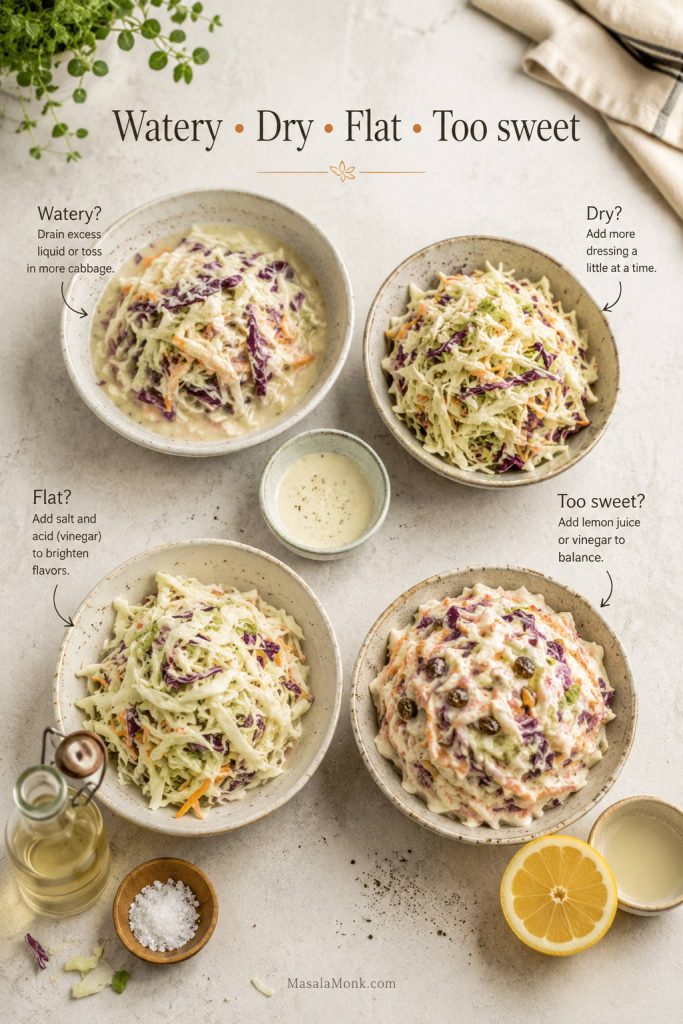
Most coleslaw problems need a small correction, not a new batch; drain watery slaw, add dressing gradually to dry slaw, and use salt or acid for flat flavor.
Quick Fixes for Common Coleslaw Problems
Use the table below to fix the most common coleslaw texture and flavor problems without starting over.
Problem
Likely Cause
Quick Fix
Coleslaw is watery
Too much dressing, cabbage released liquid, or cabbage was not dried
Drain excess liquid, toss, and refresh with a small spoonful of mayo if needed
Coleslaw is dry
Not enough dressing or very thick cabbage shreds
Add more dressing 1 tablespoon at a time after chilling
Coleslaw tastes flat
Not enough salt or acid
Add a pinch of salt and a splash of vinegar or lemon juice
Coleslaw is too sweet
Too much sugar, honey, or sweet mayo
Add vinegar, lemon juice, or mustard to sharpen it
Coleslaw is too sharp
Too much vinegar, lemon, or mustard
Add a small spoonful of mayo or a pinch of sugar
Coleslaw tastes too much like mayo
Dressing needs acid, salt, or sweetness
Add vinegar or lemon juice first, then a small pinch of sugar if needed
Cabbage is too stiff
Shreds are thick or slaw has not rested long enough
Chill 30–60 minutes longer, or slice thinner next time
Cabbage is too soft
Overdressed, over-salted, or stored too long
Drain well and fold in a handful of fresh shredded cabbage
Red cabbage turned the dressing pink
Red cabbage released color as it sat
Use mostly green cabbage, or add red cabbage close to serving
Bagged mix tastes flat
Pre-cut cabbage can taste dry or dull
Add extra vinegar, lemon, salt, or a handful of fresh herbs
Make-Ahead and Storage Tips for Coleslaw
This coleslaw recipe can be made ahead, but there is a tradeoff. In general, a short chill makes it taste better because the dressing has time to settle into the cabbage. A long chill makes it softer. The trick is deciding whether you want maximum crunch or maximum convenience.
Separate containers protect the crunch; once the dressing touches the cabbage, the countdown to softer, wetter slaw begins.
Best Flavor Window
The sweet spot is 30 minutes to 2 hours before serving. The cabbage softens just enough, the dressing clings better, and the bowl still tastes fresh.
A fully dressed bowl can still taste good the next day, but it will be softer and the dressing will be thinner. When crunch matters, store the vegetables and dressing separately.
How Far Ahead to Make Coleslaw
Use this table as a practical planning guide, especially if the slaw is going to a party, sitting beside grilled food, or going inside sandwiches.
When You Need It
Best Method
Why
Serving in 30–60 minutes
Dress now, chill, toss again
Best balance of flavor and crunch
Serving in 2–3 hours
Dress with two-thirds first, hold cold, adjust before serving
Prevents watery slaw
Serving tomorrow
Store vegetables and dressing separately
Keeps cabbage crisper
Serving on sandwiches
Use a lighter hand with dressing and drain before serving
Prevents soggy buns
Taking to a cookout
Chill well and keep over ice
Protects texture and food safety
A Simple Make-Ahead Plan
1 day ahead: shred cabbage and carrots; make the dressing separately.
2–3 hours before serving: toss with two-thirds of the dressing.
Right before serving: toss again and adjust with more dressing, salt, or vinegar.
How Long Coleslaw Lasts in the Fridge
Dressed coleslaw is best within 2 to 3 days. Keep it refrigerated in an airtight container, and discard it if it smells off, has changed texture noticeably, or has been left out too long.
If liquid collects at the bottom, drain it before serving leftovers. A small spoonful of mayo or a splash of vinegar can refresh the texture and flavor.
Do not freeze creamy coleslaw. The cabbage turns watery after thawing, and mayonnaise-based dressing can split.
Cookout and Potluck Safety
Because creamy coleslaw is served cold, keep it chilled until serving. For outdoor cookouts, place the serving bowl inside a larger bowl filled with ice if it will sit out for a while.
As a general food-safety rule, cold perishable foods should not sit out for more than 2 hours, or more than 1 hour when the outdoor temperature is above 90°F / 32°C. You can read more about the cold food safety window from the USDA food safety guidance.
How Much Coleslaw Per Person?
Coleslaw is one of those sides that disappears fast when sandwiches are involved, but sits longer when the table is full of other BBQ sides. If you are planning a full menu, the serving ideas section shows where coleslaw works best.
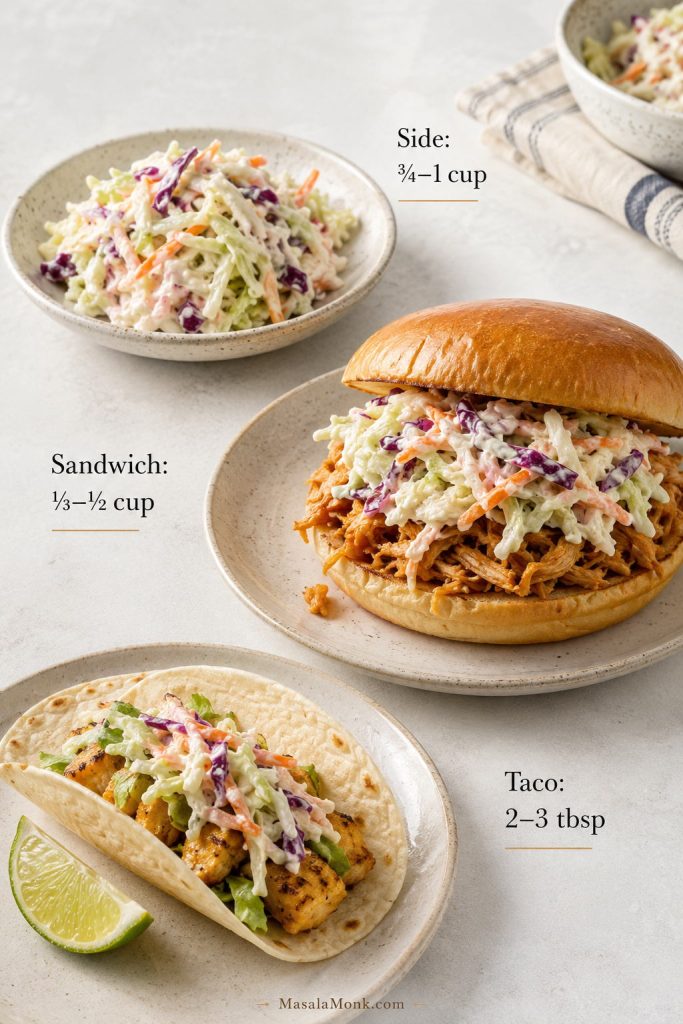
Plan more coleslaw for sides and less for toppings; a sandwich usually needs about ⅓–½ cup, while tacos only need a few tablespoons.
For a side dish, plan on about ¾ to 1 cup per person. If coleslaw is one of several sides, ½ to ¾ cup per person is usually enough. For sandwiches, burgers, hot dogs, or pulled pork, plan on ⅓ to ½ cup per sandwich.
As written, this recipe makes about 8–9 cups, so it serves 8 people generously as a side dish or more if you are using it as a topping. These amounts are approximate because finely chopped slaw packs more tightly than long shredded cabbage.
Use
Amount to Plan
Texture Goal
Side dish
¾–1 cup per person
Creamy, chilled, and lightly coated
Large BBQ spread
½–¾ cup per person
Tangy and not too heavy
Pulled pork sandwich
⅓–½ cup per sandwich
Finely shredded and not too wet
Burgers or hot dogs
¼–⅓ cup per bun
Finely chopped or thinly shredded
Tacos or wraps
2–3 tablespoons per piece
Lightly dressed and crunchy
What to Serve with Coleslaw
Coleslaw earns its place because it makes the rest of the meal easier to enjoy. A spoonful of cold crunch beside smoky meat, a bright layer inside a pulled pork sandwich, or a creamy bite next to fried fish can change the whole plate. For larger BBQ plates or sandwich trays, check the coleslaw per person guide before scaling the batch.
Coleslaw earns its place on cookout plates because cold crunch and tangy creaminess balance rich foods like pulled pork, fried chicken, tacos, and hot dogs.
Coleslaw for BBQ Plates
On a BBQ plate, coleslaw should cool the palate between bites of smoky, saucy, or grilled food. Keep it creamy, crisp, and slightly tangy. A little extra vinegar or lemon juice helps the slaw cut through ribs, grilled chicken, brisket, pulled pork, sausages, or other cookout mains.
If the rest of the plate is already sweet or saucy, avoid making the slaw too sweet. A balanced sweet-tangy dressing tastes fresher.
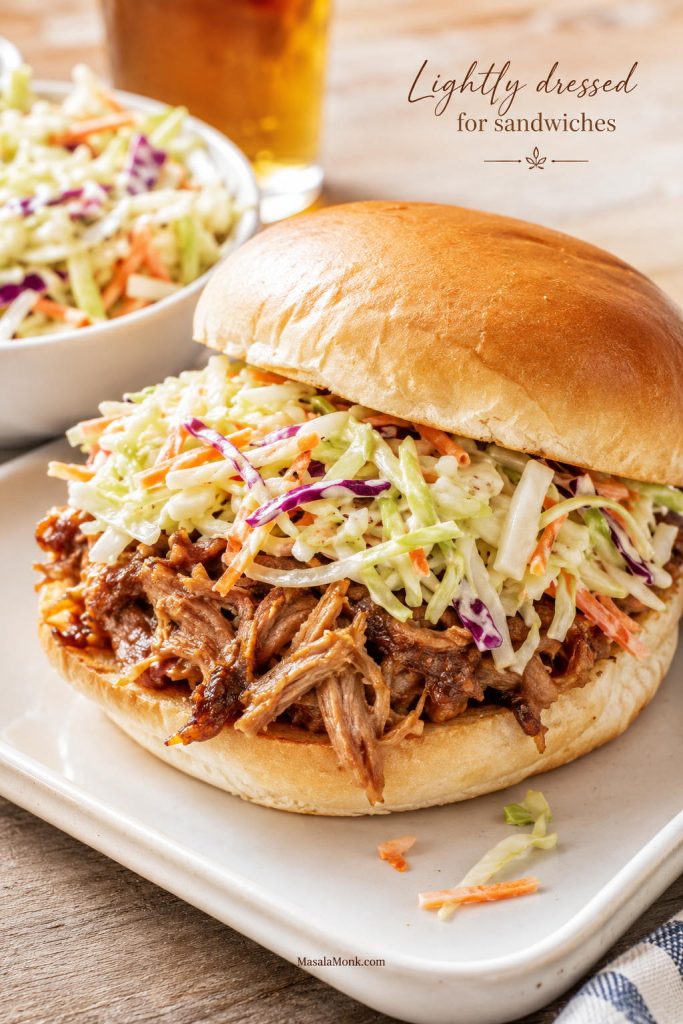
Coleslaw for Pulled Pork Sandwiches
For pulled pork sandwiches, the slaw has one job: add crunch and brightness without soaking the bun. Keep it finely shredded, lightly dressed, and a little tangier than you would for a side dish.
For pulled pork sandwiches, keep the coleslaw finely shredded and lightly dressed so it adds crunch without making the bun soggy.
Long cabbage strands can pull out of the sandwich, and watery dressing can make the bread soggy. Chill the slaw, drain off any extra liquid, and add it right before serving.
This same logic works for chicken sandwiches too. A creamy, tangy slaw is especially good with BBQ chicken, crispy chicken, and grilled chicken sandwiches. For more sandwich ideas, see these chicken sandwich recipes.
Coleslaw for Burgers and Hot Dogs
For burgers and hot dogs, chop the slaw a little finer so it stays inside the bun and gives every bite some crunch. Hot dogs can handle a slightly sweeter dressing, while richer burgers usually taste better with a sharper, tangier slaw. Either way, drain off extra liquid before adding it to bread.
Coleslaw for Fried Chicken, Fish, Tacos, and Wraps
Fried chicken and fried fish need coleslaw that is bright and cold. If the main dish is already rich and crisp, the slaw should bring freshness. Add a little extra vinegar or lemon juice before serving.
Taco slaw should be lighter than a classic creamy BBQ side. Use this recipe as a starting point, then thin the dressing with extra lime or vinegar and use less mayo if you want a taco-style slaw.
For a lighter taco-style slaw, see the cabbage slaw approach in these fish tacos. The shrimp tacos use a similar fresher direction with creamy sauce and crunch.
Coleslaw also works beside fried fish and chips because the cool cabbage balances the hot, crisp batter. For that style of plate, keep the slaw cold and a little more acidic. You can pair it with this fish and chips recipe.
Easy Coleslaw Variations
Once the classic creamy version is working, you can adjust the dressing and vegetables to match the meal. Choose the version that fits the plate instead of loading one bowl with too many ideas.
No-Mayo Coleslaw
A no-mayo version works best when the dressing is sharp, glossy, and well-seasoned. Use apple cider vinegar, olive oil, a little Dijon mustard, honey or sugar, salt, pepper, and optional celery seed. This style is lighter, brighter, and especially good with pulled pork, tacos, fried food, and picnic plates where you want crunch more than creaminess. For a quick comparison, see the mayo vs vinegar coleslaw answer in the FAQs.
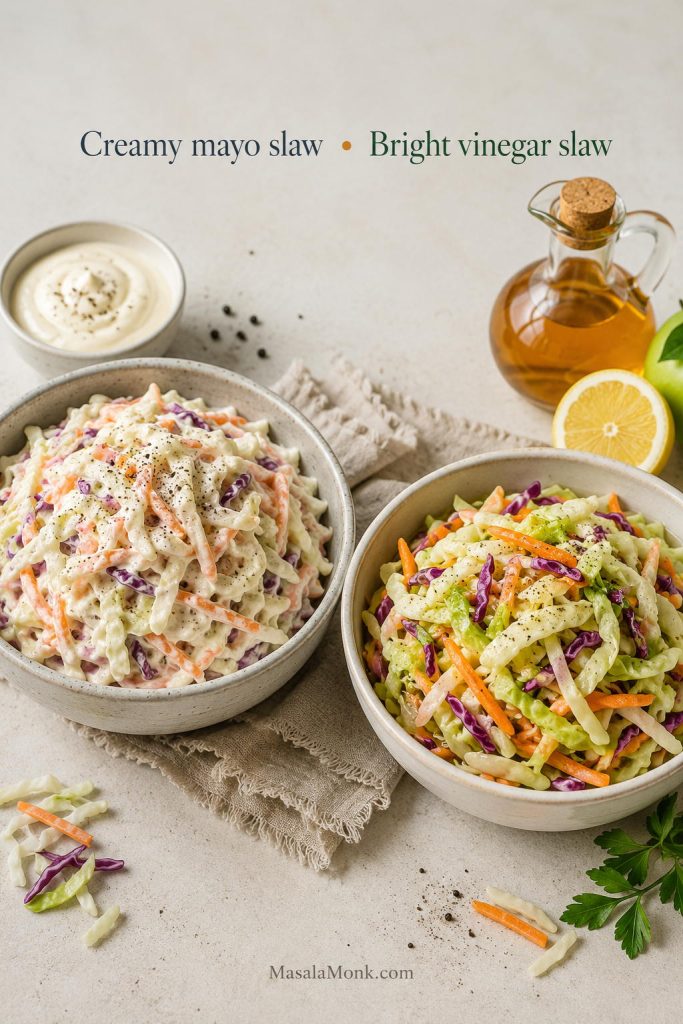
Choose mayo slaw when you want creamy comfort, and choose vinegar slaw when the plate needs a sharper, lighter bite.
Greek Yogurt Coleslaw
To make the dressing lighter, replace part of the mayonnaise with thick Greek yogurt. Start by replacing ¼ cup of the mayo, then taste before swapping more. Greek yogurt is tangier than mayo, so you may need a little more honey or sugar to balance it.
This version is useful for weeknight dinners, meal prep bowls, wraps, and lighter sandwiches.
Sweeter or Tangier Coleslaw
If you like a sweeter cookout-style slaw, add sugar or honey 1 teaspoon at a time. If you want it sharper, add apple cider vinegar, lemon juice, or mustard in small amounts.
Always adjust after the slaw has chilled. The flavor changes as the cabbage softens and the dressing loosens. If the bowl tastes bland, do not automatically add more mayo. Add a pinch of salt first, then a little acid.
Other Slaw Styles to Try Later
Apple slaw, broccoli slaw, red cabbage slaw, vegan coleslaw, keto coleslaw, and Asian slaw are all useful variations, but they each need their own balance. Apple needs enough acid so the bowl does not taste too sweet. Broccoli slaw needs a dressing that can soften firmer shreds. Red cabbage slaw often works better with a brighter vinaigrette. Asian slaw usually moves away from classic mayo dressing and toward sesame, ginger, soy, rice vinegar, lime, or herbs.
Keep this classic coleslaw recipe as the creamy base, then use those ideas when you want a different style of slaw.
Vegan or Egg-Free Coleslaw
Vegan coleslaw needs a thick vegan mayo and enough vinegar or lemon juice to keep the dressing bright. The dressing should taste slightly bold before it hits the cabbage because the vegetables will mellow it.
This vegan mayo recipe is a useful base for a plant-based version. For egg-free but not necessarily vegan coleslaw, use eggless mayo and keep the rest of the recipe the same.
How did you adjust it?
If you made this coleslaw sweeter, tangier, creamier, sharper, or more sandwich-friendly, share your version in the comments so other readers can try it too.
Once you understand the dressing balance, coleslaw becomes easy to adjust. Keep it creamier for cookouts, sharper for pulled pork, lighter for tacos, and colder than you think before serving. That is the difference between a bowl people ignore and a bowl that disappears.
Coleslaw FAQs
What is coleslaw made of?
Classic coleslaw is made with shredded cabbage, grated carrot, and a creamy or vinegar-based dressing. A creamy coleslaw dressing usually includes mayonnaise, vinegar, sugar or honey, salt, pepper, and sometimes mustard or celery seed.
What is the best cabbage for coleslaw?
Green cabbage is the most reliable choice because it is crisp, mild, and sturdy. Red cabbage adds color and crunch, but it can tint the dressing pink as it sits. Green cabbage alone is enough for a classic creamy slaw; red cabbage is mainly for color and extra crunch.
Can I use bagged coleslaw mix?
Bagged coleslaw mix works well, especially for weeknights. One 14–16 oz / 400–450 g bag makes a slightly smaller batch, so start with about half to two-thirds of the dressing. For the full 8–9 cup yield, use about 20–24 oz / 560–680 g mix or add extra shredded cabbage and carrot.
What is the difference between slaw and coleslaw?
Coleslaw usually means a cabbage-based slaw, often with carrots and a creamy or vinegar dressing. Slaw is broader and can include other shredded vegetables such as broccoli, Brussels sprouts, kale, apple, or red cabbage.
How do you keep coleslaw from getting watery?
Watery coleslaw usually happens when cabbage releases moisture after dressing. Start with part of the dressing, chill, toss again, and then decide whether the bowl needs more dressing, a quick drain, or a little extra seasoning. For make-ahead coleslaw, lightly salt the shredded cabbage, let it drain, dry it very well, and then dress it.
Should I salt cabbage before making coleslaw?
Quick same-day coleslaw does not need salted cabbage. Salting helps when you are making the slaw ahead, serving it outdoors, or using it on sandwiches where extra liquid can make the bread soggy. If you salt the cabbage, reduce the salt in the dressing and adjust at the end.
How long should coleslaw chill before serving?
For this coleslaw recipe, a 30 to 60 minute chill gives the cabbage time to soften slightly and lets the dressing flavor the vegetables. If you are in a hurry, even 10 to 15 minutes helps, but the texture is better with a longer rest.
Can I make coleslaw the night before?
You can, but the texture will be softer. For the best crunch, store the shredded vegetables and dressing separately, then combine them a few hours before serving.
How far ahead can I make coleslaw?
The freshest window is 30 minutes to 2 hours before serving. For parties, shred the vegetables and mix the dressing one day ahead, store them separately, and combine them on the day you plan to serve.
How long does coleslaw last in the fridge?
Dressed coleslaw is best within 2 to 3 days. It softens and releases liquid as it sits, so drain off excess liquid before serving leftovers.
Can you freeze coleslaw?
Creamy coleslaw does not freeze well. The cabbage turns watery after thawing, and mayonnaise-based dressing can separate. If you need to prep ahead, keep the shredded vegetables and dressing separate in the refrigerator.
Why does my coleslaw taste bland?
Bland coleslaw usually needs salt or acid, not more mayo. Add a pinch of salt and a small splash of vinegar or lemon juice, toss, and taste again.
Why did my red cabbage turn the dressing pink?
Red cabbage naturally releases color into creamy dressing as it sits. Use mostly green cabbage with a smaller amount of red cabbage if you want a classic pale dressing.
Is coleslaw better with mayo or vinegar?
Mayo coleslaw gives you the classic creamy cookout bowl. Vinegar slaw is sharper, lighter, and better when the main dish is rich, smoky, fried, or piled into a sandwich.
Is coleslaw gluten-free?
Most homemade coleslaw is naturally gluten-free if the mayonnaise, mustard, vinegar, and seasonings are gluten-free. Always check labels if you are cooking for someone with celiac disease or strict gluten sensitivity.
How much coleslaw do I need for pulled pork sandwiches?
Plan on ⅓ to ½ cup coleslaw per sandwich. Keep it finely shredded, lightly dressed, and well drained so it adds crunch without making the bun soggy.
What goes well with coleslaw?
Coleslaw goes well with BBQ, ribs, burgers, hot dogs, fried chicken, fried fish, fish tacos, shrimp tacos, wraps, and pulled pork sandwiches. It works especially well anywhere you want a cold, crunchy contrast to something smoky, sauy, fried, or spicy.
Stuffed cabbage rolls, keto or not keto – have a way of making a kitchen feel calm. Even before the oven is hot, the process itself—softening cabbage leaves, mixing a savory filling, rolling everything into neat parcels—turns dinner into something deliberate. Once the sauce bubbles and the cabbage goes silky at the edges, the whole dish tastes like it belongs on a table where people linger.
The classic version is famous for a reason. It’s hearty, tender, and deeply satisfying. It’s also often built around rice, which is exactly why cabbage rolls can feel tricky on a low carb diet. Still, the comfort isn’t coming from rice alone. It’s coming from the structure—cabbage wrapped around seasoned meat—plus a sauce that sinks into every fold and seam.
Keto Cabbage Rolls
That’s where these keto cabbage rolls shine. They keep everything that matters: the cozy, homey feel; the fork-tender cabbage; the rich tomato-forward sauce; the filling that tastes better the next day. The only difference is that instead of rice, the filling uses lower-carb “bulk” that still holds moisture and texture. More importantly, the flavor leans hard into garlic and paprika, so the rolls never feel like a compromise.
This is also not a one-note recipe. Cabbage rolls are a template, and once you have the core method, you can push them in completely different directions—smoky and deep, tangy with sauerkraut, bright and herb-forward, spicy, or Mediterranean-leaning. Each twist still tastes like cabbage rolls, yet each one feels like its own dinner.
Not sure which version to make tonight? Use this “pick your flavor” guide for keto cabbage rolls—same easy roll-and-bake base, five garlic-paprika twists (smoky, spicy, sauerkraut + caraway, Mediterranean herb + lemon, and herb oil). It helps readers choose a direction fast, keeps the recipe flexible, and makes meal prep easier when you’re cooking for different taste buds.
If you’re easing into keto or simply trying to eat fewer carbs without feeling deprived, it can help to understand the bigger picture of how low-carb swaps work. MasalaMonk’s guide to keto for beginners lays out the basics in a simple way. Even if you’re already comfortable with low carb eating, it’s a useful reminder that sustainable dinners come from repeatable patterns—structure, flavor, and satisfaction—rather than strict perfection.
Why cabbage rolls work so well when you’re keeping it low carb
Cabbage is one of those ingredients that behaves like a built-in plan. It gives you volume without heaviness, structure without flour, and a gentle sweetness that plays well with savory seasonings. Because it’s naturally sturdy, it holds up to long cooking times, which is why old-fashioned cabbage rolls show up across cuisines—Polish gołąbki (often spelled golabki), Ukrainian-style cabbage rolls, Hungarian cabbage roll recipes, Jewish stuffed cabbage, German cabbage rolls (including kohlrouladen), and Balkan sarma rolls.
Why cabbage rolls work so well on keto: cabbage gives you volume + fiber without flour, and the “real comfort” still comes from meat + sauce. Use this quick cheat sheet when you’re deciding what to cook for the week—cabbage rolls portion cleanly, reheat beautifully, and stay satisfying even without rice.
Why the format stays satisfying even without rice
Even when spice blends change, the concept stays consistent: cabbage leaves stuffed with something rich, then cooked in a flavorful sauce until everything melds. That’s exactly the kind of dish that adapts beautifully to keto-friendly cooking, because the original structure doesn’t rely on breading or flour. Instead, you’re mostly adjusting the filling and the sauce while keeping the comfort intact.
From a nutrition standpoint, cabbage is also a practical base. It’s low calorie and fiber-rich, and it tends to make meals feel more filling—useful if you’re aiming for weight loss without feeling like you’re eating tiny portions. Cleveland Clinic’s overview of cabbage highlights its fiber and nutrient profile and explains why it can support a healthier eating pattern when used in satisfying meals: the health benefits of cabbage.
Meanwhile, cabbage rolls also make sense for meal prep. They portion cleanly, reheat well, and often taste even better after a rest. If you’re the kind of person who does better with a plan, they’re the sort of anchor dinner that makes the rest of the week easier.
Cabbage is one of the easiest low-carb staples to build meals around, and it does more than just “fill space.” If you want to go deeper on the nutrition side—fiber, nutrients, and why it works so well in everyday keto cooking—here’s a fuller guide on why cabbage is a staple in the keto kitchen.
Keto cabbage rolls versus cabbage rolls with rice: the swap that keeps the comfort
Traditional stuffed cabbage rolls with rice are built around a familiar equation: meat + rice + seasonings + cabbage + tomato sauce. Sometimes the rice goes in uncooked, sometimes it’s partially cooked first. Either way, rice is there for bulk and to absorb juices.
However, rice is not the heart of cabbage rolls. The heart is the combination of tender cabbage and savory filling, plus the sauce that soaks into everything. So the strategy here is simple: keep what matters, replace what doesn’t.
To be clear, there’s nothing wrong with classic stuffed cabbage rolls with ground beef and rice if that’s how you cook. They’re a classic stuffed cabbage recipe for a reason. Yet if you want cabbage rolls that are keto compatible, you’re looking for a filling that stays moist, holds together, and doesn’t taste “substitution-y.”
If you grew up on stuffed cabbage rolls with ground beef and rice, this is the exact swap that keeps the comfort: replace rice with squeezed cauliflower rice + finely chopped mushrooms for bulk and moisture, and use egg + parmesan (optional) when you want the filling extra tight. It tastes like the classic version—just lighter, lower carb, and less likely to turn watery in the pan.
What replaces rice in keto-friendly cabbage rolls?
You have a few excellent options, and you can mix them depending on what you like:
Cauliflower rice is the closest texture match. It bulks the filling without bringing carbs, and it disappears into the meat once baked.
Finely chopped mushrooms bring moisture and umami. They make the filling taste deeper, almost like it simmered longer.
Riced broccoli or finely shredded zucchini can work too, although zucchini needs to be squeezed well so it doesn’t water out the filling.
A small amount of grated parmesan or other hard cheese adds richness and helps bind.
Rice is mostly there for bulk and to soak up juices, not because it’s the “main flavor.” If you want a clearer sense of how rice compares to other options—and why swapping it out doesn’t change the comfort of the dish—this quick breakdown of quinoa vs rice and lower-carb alternatives
The point isn’t to mimic rice perfectly. Instead, it’s to build a filling that feels right: juicy, savory, substantial, and not crumbly. Once you do that, you’re no longer “making keto cabbage rolls.” You’re simply making cabbage rolls—ones that happen to be low carb.
Ingredients for tender, flavorful keto-friendly cabbage rolls
Before the steps, it helps to understand what each ingredient is doing. That’s what makes these rolls reliable, even if you swap meats or choose a different twist.
The cabbage (and the best cabbage for cabbage rolls)
Most cabbage roll recipes start with green cabbage, and it’s still the most forgiving choice.
Choosing the right cabbage makes rolling feel easy. Use this quick picker: Green cabbage is the sturdy classic for tight rolls, Savoy is the most flexible (best if your leaves tear), and Napa is tender and great for lighter or vegan fillings. Pick the leaf first—then the rest of the recipe becomes simple.
Green cabbage: sturdy leaves, easy to roll, holds up well in oven or slow cooker.
Savoy cabbage: softer leaves that bend easily; it’s great if you want less wrestling while rolling.
Napa cabbage: thinner and more delicate; it’s especially good for vegan cabbage rolls or lighter fillings, though it can tear if overcooked.
If you’ve ever been frustrated by cabbage leaves splitting, savoy is often the answer. On the other hand, if you want maximum structure for a pan of stuffed cabbage in a thick sauce, green cabbage is the steady classic.
The filling (protein and flavor)
This recipe works with different meats, and each one gives a slightly different result:
Ground turkey: lighter but still satisfying; it benefits from extra fat and bold seasoning.
Ground pork: juicy and savory; paprika and garlic love pork.
Beef + pork blend: especially good for a more traditional European feel.
This “no-rice” filling formula makes keto cabbage rolls that stay juicy without turning watery. Pick your protein, pick your bulk (cauli rice, mushrooms, or extra cabbage), then lock it together with the right binder (egg + parmesan, psyllium, or almond flour). Use the quick “too wet” fixes before you roll—so the cabbage wraps bake up neat, tender, and saucy every time.
To keep the filling cohesive without rice, you’ll use:
Egg as a binder (optional but helpful)
Cauliflower rice and/or chopped mushrooms for bulk
Garlic and paprika as the core flavor signature
Salt and pepper for structure (salt does more than people think here)
Meat choice changes the whole feel of cabbage rolls. Beef and pork tend to stay richer and more satisfying, while turkey usually needs a little extra fat and bold seasoning to keep the filling juicy. If you’ve noticed fattier meats keep you full longer, there’s a real reason for that—here’s a deeper look at beef and the keto diet.
The sauce (tomato comfort without the sugar reliance)
Many classic cabbage rolls rely on a sweet-leaning tomato sauce. On keto, you can still use tomatoes; the trick is building depth with garlic, paprika, broth, and fat rather than sugar. When done well, the sauce tastes like the cozy “cabbage rolls in tomato soup” style people love—round, mellow, and comforting.
How to soften cabbage leaves: three practical methods
This is where cabbage rolls either feel easy or feel impossible. The truth is that softening cabbage leaves is straightforward once you choose the method that fits your life.
Soft cabbage leaves = rolls that don’t tear. Use this quick method picker to choose the best way to prep cabbage for cabbage rolls: boil (classic + reliable), freeze–thaw (quietly the easiest), or microwave (fastest for small batches). The “quick fix” line at the bottom saves you when leaves rip or feel stiff—so rolling stays calm and the pan bakes up neat.
Method 1: Boiling (the classic approach)
Bring a large pot of water to a gentle boil. Core the cabbage, then lower the whole head into the water. After a few minutes, the outer leaves will loosen. Use tongs to peel them off as they soften.
Once you have enough leaves, trim the thick rib at the base of each leaf. Rather than cutting it out completely (which can weaken the leaf), slice it down so the leaf lies flatter and rolls more easily.
Boiling is reliable, and it works with any cabbage variety. Still, it requires a big pot and a little patience.
Method 2: Freeze and thaw (quietly the easiest way to make cabbage rolls)
If you want the easiest way to make cabbage rolls without boiling water, freeze the whole head of cabbage overnight, then thaw it in the fridge. The freezing breaks down cell walls, which means the leaves become flexible and rollable once thawed.
This method is also excellent if you’re doing cabbage rolls for freezing later, because you’re already in a meal prep mindset. It feels like a small trick, yet it changes everything: the leaves soften without a pot of water, and you can prep when you have time rather than when you’re hungry.
Method 3: Microwave (the fastest shortcut)
Core the cabbage, wrap it in a damp towel, and microwave for a few minutes. Peel off softened leaves, then repeat until you have enough.
Microwave softening is quick and surprisingly effective. It’s also helpful if you’re making a small batch and don’t want to boil a huge pot of water.
If you’re newer to low carb cooking and want quick clarity on what counts as keto-friendly (and what doesn’t), these keto diet FAQs
This is the core method. After you make it once, the twists become easy, because you’re no longer learning how to roll—you’re simply changing the flavor.
Roll-and-bake keto cabbage rolls, made simple: soften the leaves, mix a tight (not wet) filling, roll and tuck, then bake covered and finish uncovered for the best texture. This quick visual is the “don’t-mess-it-up” guide for sturdy rolls that hold together—especially if you’re meal-prepping or freezing a batch.
Ingredients (base)
For the cabbage rolls
1 large green cabbage (or savoy)
680 g / 1.5 lb ground beef (or turkey or pork)
3–5 cloves garlic, finely minced or grated
2 teaspoons paprika (sweet or smoked)
1 teaspoon salt, plus more as needed
1/2 teaspoon black pepper
1 1/2 cups cauliflower rice (fresh, or thawed and squeezed dry)
1/2 cup finely chopped mushrooms (optional but recommended for juiciness)
1 egg (optional binder)
1/3 cup grated parmesan (optional, helps bind and adds richness)
2 tablespoons chopped parsley (optional)
For the sauce
2 cups crushed tomatoes or tomato passata
1 cup broth (beef or chicken)
1 tablespoon tomato paste (optional, for deeper tomato flavor)
1–2 tablespoons olive oil or butter
1 teaspoon paprika
1/2–1 teaspoon garlic powder (or another clove of garlic, minced)
Salt and pepper to taste
Optional: a splash of vinegar for balance
Step 1: Prep the cabbage leaves
Use one of the softening methods above. Once the leaves are pliable, trim the thick rib near the base so each leaf rolls without cracking.
Set leaves aside while you make the filling.
Step 2: Make the filling
In a large bowl, combine ground meat, garlic, paprika, salt, pepper, cauliflower rice, mushrooms (if using), egg (if using), and parmesan (if using). Mix gently until combined.
Mixing too aggressively can make the filling dense. Instead, fold everything together until it looks even, then stop.
Step 3: Roll
Lay a cabbage leaf flat. Place a portion of filling near the base. Fold the sides in, then roll up tightly. Place seam-side down in a baking dish.
Continue until you’ve used your leaves and filling. If you have extra small or torn leaves, tuck them around the rolls in the dish—those bits often become the best parts after baking.
Step 4: Make the sauce
In a bowl or measuring jug, whisk crushed tomatoes, broth, tomato paste, olive oil or butter, paprika, garlic, salt, and pepper. Taste it. You want it slightly stronger than you think you need, because it will mellow as it cooks.
Pour sauce over the rolls. Cover the dish tightly with foil.
Step 5: Bake
Bake at 190°C / 375°F until the cabbage is tender and the filling is cooked through. The time will vary based on roll size and meat choice, but 55–75 minutes is common for oven cabbage rolls.
For a thicker sauce, uncover the dish for the last 10–15 minutes to let it reduce slightly.
Food safety, written in a way that doesn’t interrupt dinner
Because these are rolls made with ground meat, safe internal temperature matters. USDA guidance for ground beef food safety recommends cooking ground beef to 160°F / 71°C. For ground turkey and other poultry, USDA’s turkey safe cooking guidance points to 165°F / 74°C. A thermometer makes this effortless, and it removes the guesswork.
If you’re cooking once and reheating during the week, USDA’s notes on leftovers and food safety reinforce reheating leftovers to 165°F / 74°C. That’s especially useful for soup and casserole versions, where it’s easy to assume the middle is hot when it isn’t.
The sauce that tastes like “tomato soup” cabbage rolls—without leaning on sugar
Some cabbage roll casseroles and soups are famous for tasting like tomato soup, even when they’re not made with canned soup. That flavor comes from a few details working together: enough tomato concentration, a savory broth backbone, paprika’s gentle sweetness, and fat to round out acidity.
If your sauce tastes too sharp, a small splash of vinegar can actually help, because it adds a clean acidity that makes tomato taste more “complete.” Meanwhile, finishing with olive oil or a little butter can soften everything so the sauce tastes rich rather than harsh.
Want that cozy “tomato soup” cabbage-roll sauce without adding sugar? This visual nails the formula: concentrate the tomato base (passata + a spoon of paste), use broth for depth, lean on paprika for gentle warmth, then finish with olive oil or butter to round the acidity. If it tastes sharp or flat, add fat first—then a tiny vinegar splash to brighten.
If you want a credible external reference on why olive oil is often considered a strong everyday fat choice, Harvard Health’s article on extra-virgin olive oil offers a balanced take. For a broader “what fats matter most” reference, Harvard’s Nutrition Source overview of types of dietary fats is a solid citation that avoids fad language while still supporting a keto-friendly approach that focuses on quality.
When you’re serving cabbage rolls, something crunchy on the side is always welcome. A quick slaw is a natural pairing, and if you want a creamy base without fuss, MasalaMonk’s eggless mayonnaise makes a useful recipe – if you want want a simple dressing foundation and if you are not avoiding eggs, then have a look at Mayo Recipe: 15+ Homemade Mayonnaise Variations.
Five savory garlic and paprika twists (same method, different dinner)
Now for the fun part. Each of these twists starts from the base keto-friendly cabbage rolls recipe above. In other words, you’re not learning five different recipes. You’re choosing one flavor direction, then making small changes to the filling and sauce.
Because the base is already bold, the twists don’t need many extra ingredients. The goal is to keep the dish cohesive: cabbage, savory filling, tomato-based sauce, and one clear flavor identity.
Twist 1: Smoky garlic and paprika (deep, cozy, and bold)
If you like cabbage rolls that taste almost grilled—dark, savory, and rich—this is the direction.
Best meat choice: ground beef or ground pork Add to the filling:
1 teaspoon smoked paprika (in addition to the base paprika)
1/2 teaspoon cumin
Optional: 1 teaspoon mustard (Dijon works well)
Twist #1 (Smoky): Want cabbage rolls that taste almost “grilled”? Add smoked paprika + a touch of cumin to the filling (optional Dijon for depth), then finish the sauce with an extra pinch of smoked paprika + a tiny vinegar splash. It keeps the rolls bold and cozy—and they taste even better on day two.
Adjust the sauce:
Add another 1/2 teaspoon smoked paprika
Finish with a small splash of vinegar
Smoked paprika adds a “slow-cooked” illusion. Meanwhile, vinegar keeps the sauce from feeling heavy. This twist is particularly good if you’re someone who likes robust flavors and wants a dish that still tastes exciting on day three.
Twist 2: Tangy sauerkraut garlic paprika rolls (a nod to Polish comfort)
Sauerkraut turns cabbage rolls into a different kind of comfort—bright, tangy, and deeply savory. This twist is inspired by the flavors people love in cabbage rolls with sauerkraut, stuffed cabbage and sauerkraut bakes, and many traditional Polish-style cabbage rolls, without trying to claim one strict “authentic” blueprint.
Best meat choice: beef + pork blend, or pork alone Add to the baking dish:
1 to 1 1/2 cups sauerkraut, rinsed and squeezed dry
Optional: a pinch of caraway seed
Want the Polish-comfort vibe without changing the base method? This tangy sauerkraut twist shows exactly what to add: 1–1½ cups rinsed + squeezed sauerkraut, an optional pinch of caraway, and a broth-based sauce with a small brine splash for brighter, deeper flavor—without turning the pan watery.
Adjust the sauce:
Use broth rather than water so the tang stays balanced
Add a splash of sauerkraut brine for more bite, if you like
Sauerkraut makes the whole dish taste brighter. It’s also a smart trick if someone in your house thinks cabbage rolls can taste “one-note.” This version is anything but.
Sarma rolls often use sour cabbage leaves, which brings a tang that feels uniquely satisfying with meat. If you can find sour cabbage leaves, use them. If not, you can mimic the effect by brushing softened cabbage leaves with a little vinegar and salt, then letting them rest briefly before filling.
Best meat choice: pork or turkey Add to the filling:
Extra garlic (one more clove)
Optional: dried dill, mint, or parsley
Sarma-inspired sour-leaf twist: If you can’t find sour cabbage leaves, this is the clean workaround—brush softened leaves with vinegar + salt, rest 5 minutes, then roll as usual. The result tastes brighter and more addictive, without changing the base method.
Adjust the sauce:
Keep the sauce slightly looser; it will reduce as it bakes
Finish with a small squeeze of lemon if you want a brighter edge
The result is tangy without being sharp. It also feels lighter than a pure beef version, which makes it a strong option if you want keto cabbage rolls that don’t sit too heavy.
If your goal is to make cabbage rolls that feel energizing rather than sleepy, add heat. Spicy cabbage rolls can still be comforting; they just also happen to be exciting.
Best meat choice: beef or turkey Add to the filling:
1/2 to 1 teaspoon cayenne (start small)
1 teaspoon chili flakes
Spicy Garlic–Paprika Twist: Turn the base keto cabbage rolls into a heat-lover’s version by adding cayenne + chili flakes to the filling, then finishing the sauce with a little chili oil if you want extra punch. The “optional balance” tip (a spoon of sour cream/yogurt) is the fastest way to keep the sauce tasting rich—not harsh—while the rolls stay bold and satisfying.
Adjust the sauce:
Add chili flakes or a little chili oil
Keep garlic forward
This variation is also useful when you’re eating low carb and you miss “snacky” flavors. Heat and spice create the kind of satisfaction that helps you forget you’re even thinking about carbs.
Twist 5: Mediterranean herb garlic paprika rolls (fresh, fragrant, still cozy)
This twist leans into herbs rather than tang or smoke. It’s still tomato-based and still boldly seasoned, but the finish feels brighter and more fragrant.
Best meat choice: ground turkey (or lean beef) Add to the filling:
2 teaspoons oregano
1 teaspoon thyme
Optional: lemon zest
Mediterranean Herb Twist (fresh, fragrant, still cozy): Add oregano + thyme (and optional lemon zest) to the base garlic-paprika filling, then finish the baked rolls with a drizzle of olive oil + chopped herbs. The little bowl of chimichurri (or pesto) is the “dinner-party” shortcut—bright, garlicky, and perfect with tomato sauce. (Save/Pin this twist so you can swap flavors without relearning the recipe.)
Adjust the sauce:
Finish with a drizzle of olive oil and chopped herbs
For a punchy finishing sauce that fits perfectly here, a spoon of chimichurri on the side is almost unfairly good—garlic, herbs, acidity, and brightness, all in one. It’s especially helpful if you want the rolls to feel a bit more “dinner party” without changing the main recipe.
Herb-forward sauces are especially good with this version. If you like that kind of bright, garlicky finish, these pesto recipes are a great match alongside cabbage rolls.
Cabbage roll soup and unstuffed cabbage roll soup (same flavors, easier weeknights)
Some nights, rolling feels like therapy. Other nights, it feels like too much. That’s where the soup version steps in.
Unstuffed cabbage roll soup—sometimes called unrolled cabbage soup, stuffed cabbage roll soup, or simply cabbage roll soup—is essentially the same recipe expressed differently. You still get garlic, paprika, tomato, tender cabbage, and savory meat. You’re just skipping the wrapping.
Want cabbage roll comfort without rolling? This unstuffed cabbage roll soup is the one-pot shortcut: ground beef + cabbage + tomato broth + garlic + paprika, finished with cauliflower rice at the end so it stays pleasantly textured. Save this card for busy nights—then scroll for baked rolls, casserole, skillet, and slow cooker versions in the same flavor family.
Unstuffed cabbage roll soup (keto-friendly method)
What you’ll do:
Brown ground beef, turkey, or pork in a pot with garlic, paprika, salt, and pepper.
Add chopped cabbage and stir until it begins to soften.
Pour in crushed tomatoes and broth.
Simmer until the cabbage is tender.
Stir in cauliflower rice near the end, so it stays pleasantly textured rather than mushy.
Because this is a soup roll in spirit—cabbage roll flavors in a bowl—it works beautifully as a high-protein meal prep option. It also freezes well.
When you store soup for the week, safe reheating matters. FoodSafety.gov’s chart of safe minimum internal temperatures supports the common recommendation to reheat leftovers to 165°F / 74°C, which is especially relevant for meat-based soups.
Cabbage roll casserole: deconstructed, layered, and effortless
Cabbage roll casserole is the lazy cousin of stuffed cabbage rolls, and it’s a gift. It gives you the same taste profile without the rolling step. That’s why you’ll see it described as unrolled cabbage casserole, deconstructed cabbage roll casserole, or even “cabbage roll in a pan.”
This is also the format that best captures cravings for “easy cabbage casserole recipes” and “cabbage casserole with hamburger meat,” while staying firmly in keto-friendly territory.
If you want stuffed cabbage flavor without rolling, this cabbage roll casserole (unrolled) is the lazy-night win: layer cabbage + meat filling + sauce, bake covered until tender, then uncover briefly to thicken. The “keep it thick” tips prevent the #1 casserole problem (watery sauce), so you get a rich, spoonable result that reheats beautifully.
Keto cabbage roll casserole method (unrolled)
Brown your ground meat with garlic, paprika, salt, and pepper.
Stir in cauliflower rice and mushrooms (if using).
In a baking dish, layer chopped cabbage and the meat mixture.
Pour sauce over the top.
Cover and bake until the cabbage is tender.
Uncover near the end so the sauce thickens.
If you love a richer casserole, you can add cheese on top for a “cabbage rolls with cheese” feel—still very much in the spirit of cheese stuffed cabbage rolls, just without the fiddly wrapping.
Skillet cabbage rolls and “cabbage roll in a bowl” (fast comfort)
Sometimes you want “stuffed cabbage” flavor in under 30 minutes. Skillet cabbage rolls—also described as cabbage roll in a skillet, cabbage roll skillet recipe, or cabbage roll in a bowl—deliver exactly that.
When you want stuffed cabbage flavor fast, this skillet cabbage roll in a bowl hits the same comfort notes in one pan—garlic, paprika, tomato, tender cabbage, and savory beef—without rolling or baking. Keep this visual handy for weeknights, then use the rest of the post to choose your “format”: baked rolls, soup, casserole, slow cooker, and freezer-friendly prep.
The method is simple: brown meat with garlic and paprika, add shredded cabbage, pour in tomato and broth, then simmer until everything turns saucy and tender. You can finish with olive oil, sour cream, or parmesan, depending on your mood.
This is also one of the most forgiving versions if you’re using lean meat. Because the dish is saucy, you can adjust richness right at the end.
Slow cooker cabbage rolls and crock pot cabbage roll casserole
Cabbage rolls in a slow cooker feel like a different kind of comfort. The cabbage becomes extra tender, the sauce sinks deeper into the filling, and the whole dish tastes like it spent the day becoming itself.
If you’re making cabbage roll crock pot style, the main difference is liquid management. Slow cookers trap moisture, so sauces tend to thin out unless they start thicker.
Slow cooker cabbage rolls are effortless—until the sauce turns thin. Use this quick guide to keep crock pot stuffed cabbage rich and spoonable: layer sauce on the bottom and top, start with a thicker tomato base, and crack the lid near the end to reduce. It’s the easiest way to get slow-cooked tenderness without the “watery soup” problem.
Slow cooker stuffed cabbage rolls (keto-friendly)
Make and roll the cabbage rolls as usual.
Layer sauce on the bottom, then rolls, then more sauce.
Cook on low until the cabbage is very tender and the filling is safely cooked through.
Crock pot cabbage roll casserole (unstuffed)
Layer chopped cabbage, browned filling, and sauce in the slow cooker.
Cook on low until tender.
If the sauce is too thin, crack the lid for the final stretch or stir in a small amount of tomato paste near the end.
Again, safe internal temperature guidance matters, especially when cooking ground meat. USDA’s references for ground beef and poultry/ground turkey are good citations to keep the recipe grounded.
Freezing cabbage rolls, freezing cabbage for cabbage rolls, and meal prep that actually works
Cabbage rolls are one of the best “cook once, eat twice” dinners. They’re also one of the best “cook once, eat six times” dinners if you freeze them.
That matters, because meal prep is often where a low carb diet either becomes easy or becomes exhausting. When you have a freezer-friendly high-protein option that you genuinely enjoy, it’s much easier to stay consistent.
Freezer-friendly keto cabbage rolls made easy: freeze unbaked, bake from frozen, then reheat without drying out. Use this quick chart to get the timing right, keep the rolls intact, and make meal-prep weeks feel effortless—no rice needed, just big comfort. (Perfect to save/print and great for batch cooking.)
Freezing cabbage rolls is the difference between “I’ll cook later” and actually having dinner ready. This quick visual shows the two best options: freeze uncooked for the best texture or freeze cooked for the fastest reheat, plus the exact bake-from-frozen timing. The “prevent watery” note is the big one—squeeze cauliflower rice and cool before freezing so your rolls stay firm, saucy, and satisfying.
Freeze the cabbage (a simple prep trick)
If you haven’t tried it, freezing cabbage for cabbage rolls is one of the easiest prep hacks available. Freeze the whole head, thaw it, and the leaves become pliable. You can prep leaves on a calm day, then roll and cook later when you’re busy.
Freezing stuffed cabbage rolls (uncooked)
Freezing uncooked rolls often gives the best texture because everything cooks fresh later.
Assemble the rolls in a freezer-safe dish.
Pour sauce over.
Wrap tightly.
Freeze.
When you bake, you can cook from frozen, simply allowing extra time. Keep the dish covered so the sauce doesn’t evaporate too quickly before the center heats.
Freezing cabbage rolls (cooked)
Freezing cooked cabbage rolls is the convenience route:
Let rolls cool fully.
Portion with sauce.
Freeze in containers.
To reheat, warm gently so the filling stays juicy rather than drying out. USDA’s guidance on leftovers and food safety and FoodSafety.gov’s temperature chart both support reheating leftovers to 165°F / 74°C for safety.
Vegan cabbage rolls, vegetarian cabbage rolls, and meatless stuffed cabbage that still feels hearty
Even though this post is built around keto cabbage rolls, it’s useful to include an option for households that mix diets. Maybe you’re eating low carb, while someone else wants a meatless version. Maybe you want a “lighter day” dinner that still has cabbage-roll comfort.
Vegan cabbage rolls and vegetarian cabbage rolls work especially well with napa cabbage or savoy cabbage, because the leaves are tender and the filling can be softer.
Vegan cabbage rolls that still eat like comfort food: tofu brings protein, mushrooms add deep savory flavor, and cauliflower rice gives that “bulk” without heaviness. If you’re cooking for a mixed table (keto + vegetarian/vegan), this is the easiest way to keep the cabbage-roll vibe consistent—same sauce, same cozy payoff, just a different filling.
A vegan, cabbage-roll-style filling that works
For a plant-forward approach, the goal is to create a filling that’s savory and satisfying:
Finely chopped mushrooms (for depth)
Crumbled tofu (for protein)
Cauliflower rice (for bulk)
Garlic and paprika (for continuity with the main recipe)
A binder such as ground flax mixed with water, if needed
You can bake these the same way, using the tomato sauce method above.
Cabbage wraps, cabbage roll ups, and “cabbage wrap meat” shortcuts
Not everyone wants full baked cabbage rolls. Sometimes you want something quicker—something closer to a cabbage wrap recipe than a casserole. That’s where cabbage wraps come in.
You can think of cabbage wraps as a lighter, fresher cousin to baked cabbage rolls. Instead of cooking the rolls in sauce for an hour, you’re wrapping a cooked filling in softened leaves, then serving with a spoonable sauce.
When you want stuffed cabbage roll flavor without baking, these keto cabbage wraps are the fastest move: brown the garlic-paprika filling, soften a few leaves, wrap, and spoon sauce over top. The 4-step strip makes this a true weeknight shortcut—and it doubles as a lunch idea when you pack wraps with a little sauce cup on the side.
Quick cabbage wraps (keto-friendly)
Brown ground beef with garlic and paprika.
Make a quick sauce in the same pan (tomato + broth + paprika + olive oil).
Spoon filling into softened cabbage leaves.
Wrap and serve with sauce over top.
This gives you the comfort without committing to a baking dish. It’s also a great lunch format because the wraps hold together well in containers.
A note on “cabbage balls” and stuffed cabbage balls (when you want bite-sized comfort)
Cabbage balls show up in a few different traditions, and they’re essentially cabbage roll filling expressed as a small ball, sometimes wrapped partially in cabbage or simmered in sauce.
For a keto-friendly cabbage balls recipe approach, you can do this:
Make the same garlic paprika filling.
Roll it into small balls.
Brown them quickly, then simmer in the tomato sauce until cooked through.
It’s the same flavor story, just a different shape. The advantage is speed: no leaf-by-leaf rolling. The tradeoff is that you lose some of the classic cabbage roll structure. Still, if someone loves the filling more than the wrap, cabbage balls can be a satisfying variation.
Making cabbage rolls taste “traditional” without being stuck in one tradition
Cabbage rolls are one of those foods where families are fiercely loyal to what they grew up with. One home might swear by sweet-and-sour Jewish stuffed cabbage. Another might prefer a paprika-forward Hungarian stuffed cabbage rolls recipe. Someone else might love sauerkraut-heavy Polish cabbage rolls. Meanwhile, German cabbage rolls and kohlrouladen recipes often lean into deeper, darker savory notes.
Keto cabbage balls are the “same filling, faster shape” version of cabbage rolls: roll the no-rice mix into balls, sear for crust, then simmer in the tomato sauce until juicy. The one tip that prevents mushy meatballs is right here—squeeze cauliflower rice dry before mixing.
This garlic and paprika foundation sits comfortably in that broader family of flavors. Garlic shows up everywhere. Paprika bridges sweet and smoky. Tomato sauce ties the whole dish to the “stuffed cabbage” comfort zone.
So if you’ve been chasing a version that feels familiar—old fashioned cabbage rolls, traditional stuffed cabbage, classic cabbage roll recipe—this approach can scratch the same itch. It doesn’t claim to replace any one grandmother’s method. Instead, it gives you a dependable base with enough flexibility to feel personal.
Serving ideas that keep cabbage rolls satisfying (and keto-friendly)
A pan of cabbage rolls is already a complete meal, yet the right side can elevate it:
A crunchy slaw with a creamy dressing (again, eggless mayonnaise is handy as a base)
A spoon of herb sauce like chimichurri for brightness
A drizzle of olive oil and fresh herbs for the Mediterranean twist
A sprinkle of parmesan or feta for richness
Keeping one good red sauce around makes weeknight dinners easier—cabbage rolls, skillet cabbage, meatballs, and more. If you like having options ready in the fridge, these pizza sauce recipes are worth saving.
Troubleshooting Cabbage Rolls that are Keto Friendly
Even with a solid recipe, cabbage rolls can go sideways if a few details are off. The fixes are straightforward, though, and once you know them, you rarely run into the same problem twice.
Keto cabbage rolls going sideways? Save this troubleshooting visual. It covers the most common problems—torn leaves, watery “no-rice” filling, rolls that fall apart, sharp tomato sauce, and bland flavor—plus quick fixes that work fast (like squeezing cauliflower rice dry, rolling seam-side down, and balancing acidity with a little fat). Keep it right above the troubleshooting section so readers can scan, fix, and keep cooking.
If your cabbage leaves tear
The rib is usually the culprit. Trim it thinner so the leaf lies flat. Also, don’t overboil; overcooked leaves tear easily. If tearing keeps happening, switch to savoy cabbage, which folds more gently.
If your filling turns watery
Frozen cauliflower rice often holds water. Thaw and squeeze it dry. Mushrooms can also release liquid, so chop them finely and mix them with the meat so they cook evenly inside the roll.
If your rolls fall apart
Use an egg binder, roll tightly, and always place seam-side down. If you’re making a casserole or soup version, this is less of a concern, which is one reason unstuffed cabbage roll casserole is so forgiving.
If the sauce tastes too acidic
Finish with olive oil or butter, and consider a small splash of vinegar to balance. It sounds counterintuitive, yet it often makes tomato taste smoother rather than sharper. If you want a citation that supports the choice of olive oil as a staple fat, Harvard Health’s piece on extra-virgin olive oil is a useful reference.
If the dish tastes bland
Salt is not optional here. Cabbage is mild, and meat needs seasoning to taste “finished.” Season the filling well, then season the sauce separately. Paprika also needs enough salt to taste like something rather than like colored dust.
Bringing it all together: one template, many dinners
Once you’ve made the base recipe, you’ve effectively unlocked multiple meals:
Oven baked keto cabbage rolls with garlic and paprika
Unstuffed cabbage roll soup for weeknights
Deconstructed cabbage roll casserole when you want comfort without rolling
Skillet cabbage rolls when time is short
Slow cooker cabbage rolls when you want hands-off cooking
Freezer-friendly cabbage rolls for meal prep
A vegan or vegetarian cabbage roll variation for mixed-diet households
Sauerkraut and sour cabbage leaf styles when you want tang
Spicy cabbage rolls when you want heat
Mediterranean cabbage rolls when you want herbs and brightness
That’s the hidden power of this dish. It isn’t just a recipe for stuffed cabbage rolls; it’s a repeatable system. You’re learning how to cook cabbage leaves, how to build a filling that stays juicy without rice, and how to make a tomato sauce that tastes like comfort without relying on sweetness.
And because these rolls are so satisfying, they also make it easier to stick with low carb eating without feeling like you’re losing your favorite foods.
If you want to keep building a keto dinner rhythm after this, it can feel natural to explore other high-protein, low carb anchors—MasalaMonk’s beef recipes for a weight loss keto plan is a solid next stop, especially if you like dinners that reheat well and feel filling without being complicated.
Keto cabbage rolls are stuffed cabbage rolls made without rice or other high-carb fillers. Instead, the filling relies on meat, seasonings, and low-carb “bulk” like cauliflower rice or mushrooms, then everything bakes or simmers in a savory sauce until the cabbage turns tender and the filling stays juicy.
2) Can cabbage rolls be keto friendly even with tomato sauce?
Yes. Tomato-based sauce can still work for cabbage rolls that are keto compatible, especially when the flavor comes from garlic, paprika, broth, and fat—not added sugar. In practice, the sauce tastes comforting and rich without needing sweetness to feel complete.
3) What replaces rice in keto-friendly cabbage rolls?
Cauliflower rice is the closest stand-in for the texture of rice stuffed cabbage rolls. Meanwhile, finely chopped mushrooms add moisture and depth, almost like the filling simmered longer. Additionally, riced broccoli can work, and shredded zucchini can too—just squeeze it well so it doesn’t water out the filling.
4) Can I make cabbage rolls with uncooked rice on keto?
Not really. Cabbage rolls with uncooked rice (or cooked rice) are typically not low carb. If you love the “classic stuffed cabbage rolls with ground beef and rice” style, the keto approach is to keep the same seasonings and sauce while swapping rice for cauliflower rice or mushrooms.
5) Which meat works best for keto cabbage rolls: ground beef, turkey, or pork?
Ground beef gives the richest, most classic stuffed cabbage flavor and stays forgiving when baked. Ground pork turns especially juicy and savory, and paprika loves it. And then ground turkey is lighter, yet it usually benefits from extra fat and bolder seasoning so the filling doesn’t taste dry.
6) How do I keep keto cabbage rolls from falling apart?
First, roll tightly and place the rolls seam-side down. Next, trim the thick cabbage rib so the leaf folds smoothly. Also, using an egg binder can help, particularly if your filling is very lean or you’re using extra vegetables like mushrooms or zucchini.
7) What’s the easiest way to soften cabbage leaves for cabbage rolls?
Freeze-and-thaw is quietly one of the easiest methods: freeze the whole cabbage head, thaw it, and the leaves become pliable. Otherwise, boiling works reliably, and the microwave method is fast for smaller batches. Either way, trimming the rib makes rolling far easier.
8) Can I make cabbage rolls with frozen cabbage?
Yes. Cabbage rolls with frozen cabbage work well if the cabbage is thawed fully and the leaves are handled gently. In fact, freezing cabbage for cabbage rolls is a common prep trick because it softens the leaves without a big pot of water.
9) Are cabbage rolls healthy?
They can be, especially when the filling is high-protein and the sauce is balanced. Cabbage rolls healthy versions often focus on leaner meat, more vegetables, and a sauce that isn’t sugar-heavy. Even so, richer versions can still fit well in a low carb or keto diet when portions are sensible.
10) How long do cabbage rolls cook in the oven?
Cabbage rolls in oven typically take around 55 to 75 minutes at 375°F / 190°C, depending on roll size, cabbage thickness, and the meat used. If you make smaller rolls or use thinner leaves, they may finish sooner.
11) Can I make stuffed cabbage rolls in the oven ahead of time?
Absolutely. Assemble the rolls, cover tightly, and refrigerate. Then bake when needed. Because the flavors deepen after resting, homemade stuffed cabbage rolls often taste even better the next day.
12) What is unstuffed cabbage roll soup?
Unstuffed cabbage roll soup is the same comfort flavor—cabbage, meat, garlic, paprika, and tomato—without rolling. It’s also called stuffed cabbage roll soup, cabbage roll soup recipe, unrolled cabbage soup, or simply cabbage roll soup, depending on how people describe it.
13) How do I make easy cabbage roll soup recipe style but keto-friendly?
Brown ground meat with garlic and paprika, add chopped cabbage, then pour in crushed tomatoes and broth. Simmer until tender. Finally, stir in cauliflower rice near the end so it keeps a pleasant bite instead of turning mushy.
14) What is a cabbage roll casserole?
Cabbage roll casserole is a deconstructed version of stuffed cabbage—everything layered or mixed in one dish. You’ll also see it called unrolled cabbage casserole, stuffed cabbage roll casserole recipe, cabbage rolls casserole layered, or deconstructed cabbage roll casserole.
15) Can I make cabbage roll casserole crock pot style?
Yes. Slow cooker stuffed cabbage casserole is a popular option because it’s hands-off. Brown the meat first for better flavor, then layer cabbage, filling, and sauce in the crock pot. Since slow cookers trap moisture, start with a slightly thicker sauce.
16) What’s the fastest “cabbage roll in a bowl” method?
Skillet cabbage rolls—often called cabbage roll in a skillet or cabbage roll in a bowl—are the quick route. Brown meat with garlic and paprika, add shredded cabbage, stir in tomato and broth, then simmer until everything becomes saucy and tender.
17) Can I freeze cabbage rolls for meal prep?
Yes, cabbage rolls for freezing are one of the best meal-prep moves. You can freeze them cooked or uncooked. Cooked rolls are convenient for quick reheating, whereas uncooked rolls often give the best texture after baking.
18) How do I freeze stuffed cabbage rolls without getting watery?
Squeeze moisture from cauliflower rice and any watery vegetables like zucchini. Cool cooked rolls fully before freezing. Also, freeze portions with sauce so the filling stays juicy instead of drying out.
19) Can I cook frozen cabbage rolls without thawing?
Yes. Frozen cabbage rolls can bake from frozen; they simply need extra time. Keep them covered so the sauce doesn’t reduce too quickly before the center heats through.
20) What are cabbage balls, and are they keto friendly?
Cabbage balls are basically stuffed cabbage filling shaped into bite-sized portions, then simmered or baked in sauce. For a keto-friendly cabbage balls recipe, keep the same garlic-paprika filling and skip rice, using cauliflower rice or mushrooms for bulk instead.
21) Are there vegetarian cabbage rolls or vegan cabbage rolls that still feel hearty?
Yes. Vegetarian cabbage rolls and cabbage rolls vegan versions often use mushrooms for depth, cauliflower rice for bulk, and a protein base like tofu or a mix of nuts and seeds. The sauce and seasonings do a lot of the “comfort” work, so the result can still feel satisfying.
22) What’s the difference between sarma rolls, gołąbki, and galumpkis?
They’re all cabbage roll traditions with regional differences. Sarma rolls often use sour cabbage leaves and can have a tangier profile. Gołąbki refers to Polish cabbage rolls, commonly with meat and rice. Galumpkis is another name used for Polish-style stuffed cabbage rolls, especially in North American kitchens.
23) What are German cabbage rolls and kohlrouladen?
German cabbage roll recipes often lean savory and rich, and the term kohlrouladen usually refers to cabbage leaves stuffed with meat, then braised until tender. Even when the seasoning style differs, the method overlaps closely with classic stuffed cabbage.
24) What makes “old fashioned cabbage rolls” taste like the classic version?
Classic cabbage roll recipes usually rely on well-seasoned meat, tender cabbage, and a sauce that simmers long enough to meld everything. Even when you remove rice for keto-friendly cabbage rolls, keeping the same garlic, paprika, onion, and tomato comfort notes preserves that traditional feel.
25) Why do some cabbage roll recipes taste like tomato soup?
That “cabbage rolls in tomato soup” flavor happens when tomato, broth, and fat balance each other. Tomato gives sweetness and acidity, broth adds savory backbone, and fat rounds off sharpness so the sauce tastes smooth and comforting.
26) How do I make cabbage wraps instead of baked cabbage rolls?
Cabbage wraps are a quicker approach: cook the filling first, soften leaves, then wrap and serve with sauce spooned over top. It’s a useful shortcut when you want cabbage wrap meat style comfort without a long bake.
27) What’s the best cabbage for stuffed cabbage rolls?
Green cabbage is the most forgiving and sturdy for rolling. Savoy cabbage is more flexible and easier to fold, which helps if tearing is a problem. Napa cabbage is tender and great for vegan cabbage rolls, although it can be more delicate.
28) Why are my cabbage rolls bland, even with paprika?
Cabbage is mild, so seasoning has to be strong enough to carry through. Salt matters more than most people expect, and paprika needs salt to taste like something rather than just color. Also, season both the filling and the sauce separately for the best result.
29) Can I make “best cabbage roll recipe ever” style flavor on keto?
Yes—because “best stuffed cabbage recipe ever” usually means juicy filling, tender cabbage, and a sauce that tastes deep and balanced. You can keep that same goal while swapping rice for low-carb bulk and leaning into garlic and paprika for bold flavor.
30) How do I make keto cabbage rolls feel more filling for weight loss?
Prioritize protein, include enough fat to keep the filling satisfying, and don’t skimp on sauce because it prevents dryness. Also, pairing cabbage rolls with a crunchy low-carb side (like slaw) can make the meal feel larger without adding many carbs.
Cabbage is a versatile and nutrient-dense vegetable that has become a staple in the keto kitchen. Not only is it low in carbohydrates and calories, but it also offers a plethora of health benefits. In this post, we’ll delve into the nutritional value of cabbage, its remarkable health benefits, and provide tips on incorporating it into your keto meal plan. Get ready to discover why cabbage deserves a prominent place in your keto culinary repertoire! 🥬🍽️
Nutritional Value of Cabbage:
Cabbage is not only low in carbohydrates but also rich in essential vitamins, minerals, and antioxidants. Let’s explore the nutritional breakdown of cabbage per 100 grams:
Calories: 25
Carbohydrates: 5.8 grams
Fiber: 2.5 grams
Protein: 1.3 grams
Fat: 0.1 grams
Vitamin C: 36.6 milligrams (61% of the daily recommended intake)
Vitamin K: 76 micrograms (95% of the daily recommended intake)
Folate: 43 micrograms (11% of the daily recommended intake)
Calcium: 40 milligrams (4% of the daily recommended intake)
Potassium: 170 milligrams (5% of the daily recommended intake)
Health Benefits of Cabbage:
Rich in Antioxidants: Cabbage boasts an impressive array of antioxidants, including vitamin C and various phytonutrients. These antioxidants help combat oxidative stress and inflammation in the body, reducing the risk of chronic diseases and promoting overall well-being. 🌟🔥
Supports Digestive Health: With its notable fiber content, cabbage supports a healthy digestive system. The fiber aids in maintaining regular bowel movements, promotes satiety, and assists in weight management. Additionally, cabbage contains sulfur compounds that may promote gut health and reduce the risk of certain digestive disorders. 🌱💪
Anti-Inflammatory Properties: Cabbage contains compounds, such as sulforaphane and anthocyanins, known for their anti-inflammatory properties. These compounds help mitigate inflammation in the body, potentially reducing the risk of chronic conditions like arthritis, heart disease, and certain cancers. 🌿🌺
Heart-Healthy Nutrients: Cabbage is an excellent source of potassium, a mineral crucial for maintaining healthy blood pressure levels. Additionally, the presence of anthocyanins in red cabbage may contribute to a lower risk of cardiovascular diseases. By incorporating cabbage into your keto diet, you can support your heart health and overall cardiovascular well-being. ❤️🫀
Weight Management Support: As a low-calorie and low-carb vegetable, cabbage is a valuable addition to a keto diet focused on weight management. The high fiber content promotes satiety, helping you feel fuller for longer periods and potentially reducing overall calorie intake. Cabbage’s hydrating properties and abundance of nutrients make it an ideal choice for those striving to shed pounds while maintaining a nutritious and satisfying eating plan. 🌿⚖️
Incorporating Cabbage into Your Keto Meal Plan:
Cabbage Stir-Fry: Sauté shredded cabbage with garlic, ginger, and your choice of protein in a keto-friendly oil, such as avocado or coconut oil. Add additional low-carb vegetables like bell peppers, mushrooms, or broccoli for extra flavor and nutrients. Serve it as a side dish or pair it with your preferred keto protein source for a well-rounded meal. 🍲🥦
Cabbage Wraps: Use cabbage leaves as a replacement for tortillas or bread when creating keto-friendly wraps. Fill the cabbage leaves with grilled chicken, avocado, bacon, and a keto-friendly sauce for a satisfying and low-carb meal option. These wraps are not only delicious but also provide an extra crunch and freshness to your culinary experience. 🌯🥬
Cabbage Slaw: Create a refreshing and tangy cabbage slaw by combining shredded cabbage with a keto-friendly dressing made from olive oil, vinegar (such as apple cider vinegar or white wine vinegar), lemon juice, and spices like black pepper and sea salt. Add in some chopped herbs like cilantro or parsley to enhance the flavor profile. This slaw pairs well with grilled meats or fish. 🥗🍋
Stuffed Cabbage Rolls: Prepare flavorful and keto-friendly stuffed cabbage rolls by blanching cabbage leaves and then filling them with a mixture of seasoned ground meat, cauliflower rice, and diced vegetables. Bake the rolls in a keto-friendly tomato sauce for a comforting and satisfying meal that captures the essence of home-cooked goodness. 🌮🍅
Cabbage Soup: Craft a nourishing and comforting cabbage soup by combining broth, cabbage, low-carb vegetables like carrots and celery, and aromatic herbs and spices. Simmer the ingredients together until the flavors meld, creating a delightful and wholesome soup that is perfect for colder days or as a light meal option. 🍵🥕
Conclusion:
Cabbage’s impressive nutritional value and numerous health benefits make it an invaluable addition to the keto kitchen. Incorporating cabbage into your keto meal plan not only provides essential nutrients but also contributes to overall well-being and supports your weight management goals. From stir-fries and wraps to slaws and soups, there are endless possibilities to explore with cabbage. So, embrace the versatility and healthful properties of cabbage and elevate your keto culinary journey to new heights! 🥬🌟