
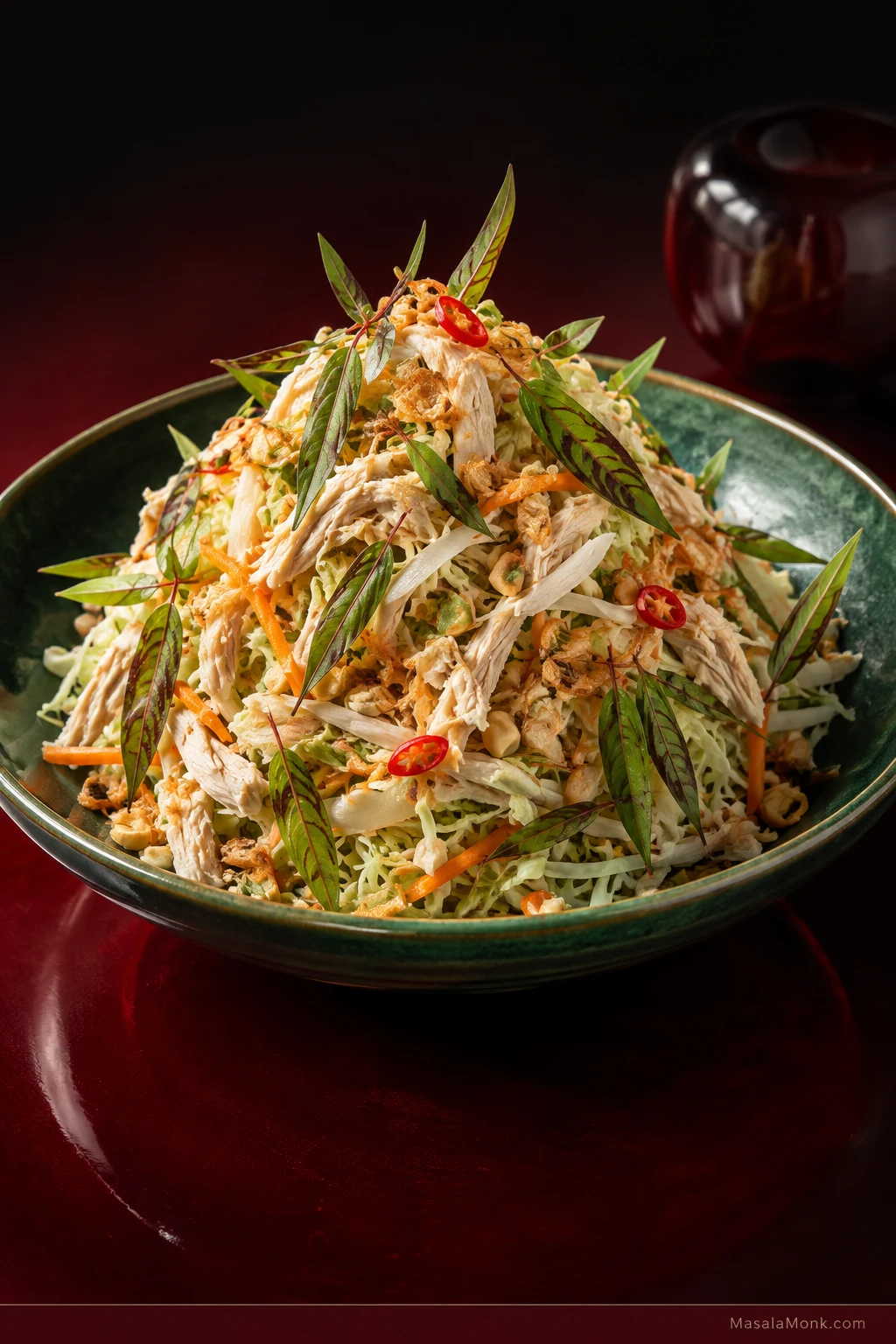
Finely shredded cabbage, juicy chicken and peppery rau răm get tossed with a lime-bright fish-sauce dressing, then finished with roasted peanuts and crisp fried shallots. Every forkful comes out a little differently: maybe mostly cool cabbage, maybe a soft shred of chicken with rau răm, maybe the lucky bite with a peanut and still-crisp piece of shallot.
Keep the cabbage dry, cook the chicken gently, tame the onion and save the fried shallots for the end. Those small choices keep the salad lively: moist chicken, sharp herbs and cabbage that still has some snap.
A little softening is not a failed salad. The real trouble starts when enough water leaves the cabbage to collect underneath and weaken the dressing.
Dry the cabbage, dress in stages, and add the crunch last.
In This Guide
Recipe · What Is Gỏi Gà? · Chicken · Cabbage · Rau Răm · Dressing · Texture & Watery Salad · Fast Version · Make Ahead · Serving · Storage
Quick Answer: How to Make Gỏi Gà Bắp Cải
Gently poach 450 g / 1 lb chicken, shred it, and combine it with 450 g / 1 lb finely sliced green cabbage, carrot, thin onion and rau răm. Give the chicken some dressing first, then add the vegetables and dress everything gradually.
Resting time controls the cabbage texture, so use the guide below to choose how crisp or softened you want it.
The dressing combines fish sauce, lime, unseasoned rice vinegar or white vinegar, sugar, water, garlic and chile. Keep some back and make the final adjustment after tasting chicken and cabbage together.
| For this texture | Do this |
|---|---|
| Very crisp | Dress and serve immediately. |
| Crisp but seasoned | Rest 5–10 minutes. |
| Softer and more marinated | Rest longer and expect more moisture to leave the cabbage. |
Make It Now: Vietnamese Chicken Cabbage Salad
Recipe at a Glance
| Yield | 4 light main-course servings or about 6 side servings |
|---|---|
| Chicken | 450 g / 1 lb raw boneless chicken |
| Cabbage | 450 g / 1 lb green or white cabbage |
| Prep | About 25 minutes |
| Cook | About 20–30 minutes including heating the poaching liquid |
| Ready in | About 45–55 minutes when you prep the vegetables while the chicken cooks and cools |
| Rest | 5–10 minutes for crisp-but-seasoned cabbage |
| Chicken endpoint | 165°F / 74°C at the thickest part |
| Fast route | Cooked chicken + bagged slaw; about 15 minutes active prep |
An instant-read thermometer is handy for the chicken, a salad spinner makes drying shredded cabbage much easier, and a mandoline gives very even ribbons. Use the hand guard or a cut-resistant glove if you use one.
Ingredients
Chicken
- 450 g / 1 lb boneless skinless chicken breast
- Water, enough to comfortably cover the chicken
- 1 tsp fine salt
- 4–5 slices fresh ginger
- 2 scallions, cut into large pieces or lightly crushed
Cabbage, Herbs and Toppings
- 450 g / 1 lb green or white cabbage, very finely shredded
- 100 g / 3½ oz carrot, julienned or finely shredded
- 75–80 g / about 3 oz red or white onion, very thinly sliced
- 20 g / about ¾ oz rau răm, leaves and tender stems roughly torn
- 5 g cilantro leaves, about a small handful, optional
- 40 g / 1½ oz roasted peanuts, roughly chopped
- 30 g / about 1 oz fried shallots
- 1 tbsp extra unseasoned rice vinegar or distilled white vinegar, optional, for the tangier onion treatment
Fish-Sauce Dressing
- 45 ml / 3 tbsp plain bottled fish sauce
- 45 ml / 3 tbsp fresh lime juice
- 15 ml / 1 tbsp unseasoned rice vinegar or distilled white vinegar
- 25 g / 2 tbsp sugar
- 30 ml / 2 tbsp water
- 2 small garlic cloves, finely minced or crushed
- ½–1 small bird’s-eye chile, very finely sliced, to taste
Use plain fish sauce here, not prepared nước chấm or bottled dipping sauce. Prepared nước chấm is already diluted and seasoned, typically with water, sugar and acid; this recipe balances those separately.
The dressing makes about 150 ml / ⅔ cup. You may not need every drop.
Instructions
1. Gently Poach the Chicken
Put the chicken in a saucepan and add enough water to cover it comfortably. Add the salt, ginger and scallions.
Bring the water just up to a boil, then lower the heat immediately to a very gentle simmer. The liquid should move quietly; the chicken should not be bouncing around the pan.
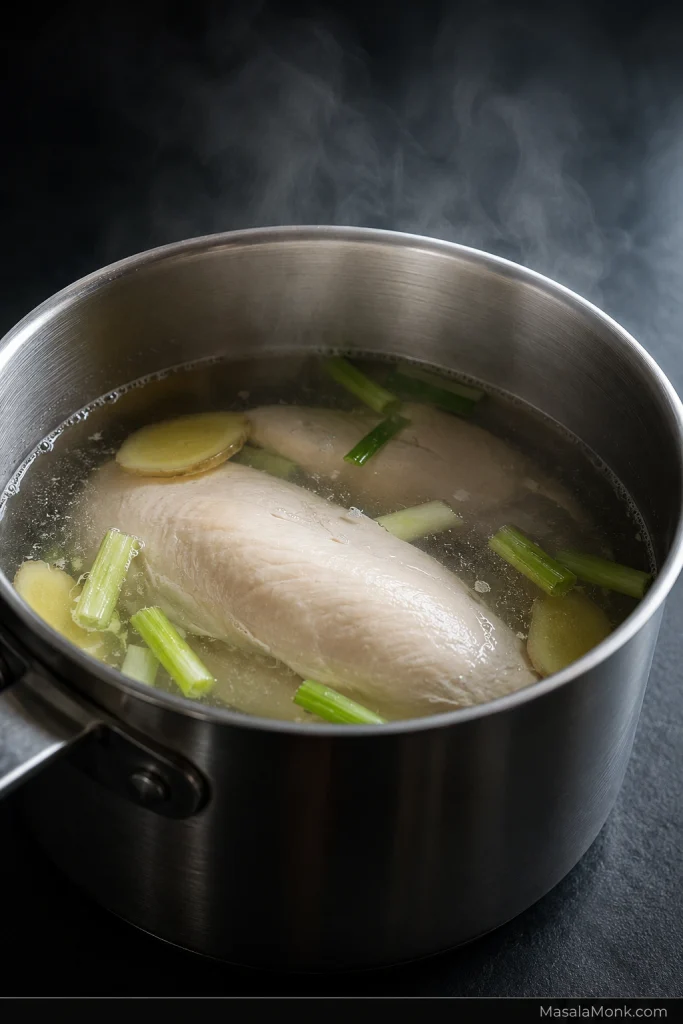
Cover and cook until the thickest part reaches 165°F / 74°C. Once the liquid is hot and gently simmering, medium chicken breasts often need around 12–18 minutes. Thickness matters more than the timer.
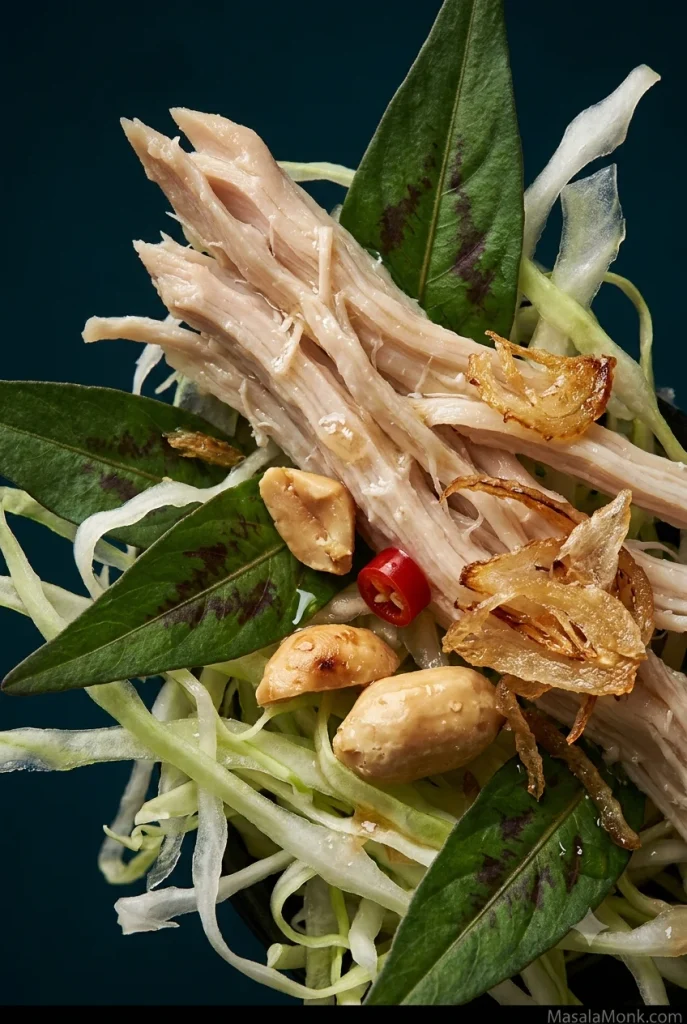
Lift the chicken out as soon as it is done. Properly poached breast should pull into moist strands with ragged edges that catch the dressing, not stiff fibres that feel woolly or dry.
2. Cool, Then Shred
Let the chicken cool until it is comfortable to handle, then tear or shred it into bite-size pieces. Keep the shreds loosely covered until they are no longer hot before they meet the cabbage.
3. Wash, Shred and Dry the Cabbage
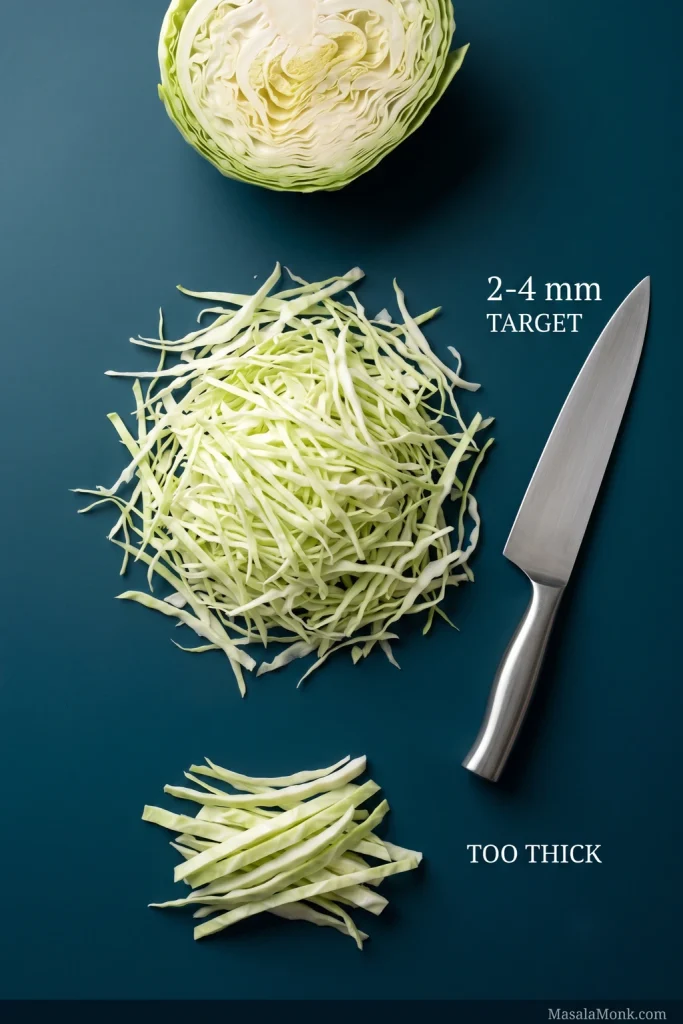
Remove any tired outer leaves. Shred the cabbage into fine ribbons, ideally about 2–4 mm wide, and julienne or finely shred the carrot.
Rinse the cabbage if needed, then spin it thoroughly dry or spread it over clean kitchen towels. Pick up a handful before you move on: the shreds should feel dry rather than slick with wash water.
4. Soften the Onion’s Raw Edge
Put the sliced onion in ice-cold water for about 10 minutes, then drain and pat it dry. It keeps its crunch while losing some of the raw burn that can overpower the herbs.
For a tangier onion, toss the slices with the 1 tbsp additional vinegar listed above plus 2 tbsp cold water. Leave for 10–15 minutes, turning once or twice, then drain thoroughly.
5. Make the Dressing
Stir together the lime juice, vinegar, sugar and water until the sugar has mostly dissolved. Add the fish sauce, garlic and chile.
Taste it now. Too strong? Don’t fix it yet. A spoonful on its own can seem almost alarmingly salty or fishy and then taste much calmer once it is spread through all that chicken and cabbage.
6. Season the Chicken First
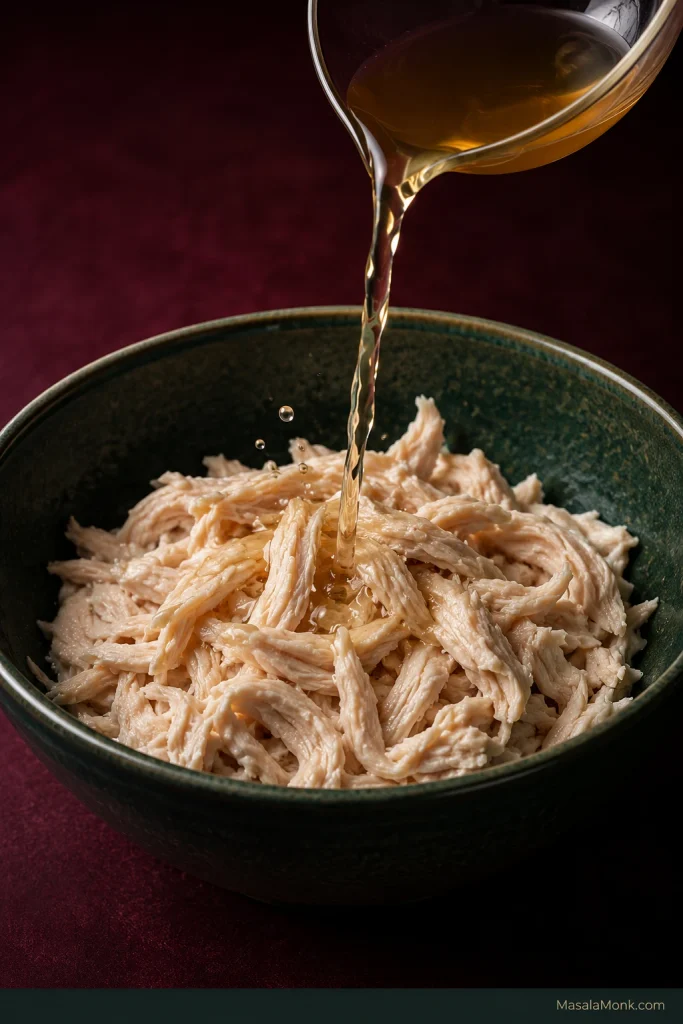
Toss the cooled shredded chicken with 2 tbsp / 30 ml dressing and leave it for 2–3 minutes. A larger shred of chicken can stay surprisingly bland inside even when the cabbage around it is well seasoned.
7. Toss the Salad
Add the cabbage, carrot and well-drained onion. Pour over about 5 tbsp / 75 ml more dressing and toss thoroughly but gently. Keep the remaining dressing beside you for the final adjustment.
8. Give the Cabbage a Few Minutes
For cabbage that is crisp but no longer tastes completely raw, let the salad stand for 5–10 minutes. Thin green cabbage should still crack lightly between the teeth, then soften as you chew beside the chicken. Prefer a louder crunch? Toss and serve straight away.
9. Add the Herbs and Finish
Fold in the rau răm and cilantro, if using. The salad should smell fresh and peppery before the toppings even go on.
Take one proper bite with chicken, cabbage and herbs together. The chicken should taste seasoned even without a pile of cabbage attached to it. Check the cabbage and the bottom of the bowl too: if the texture feels right and the dressing still tastes bright rather than watered down, you’re there.
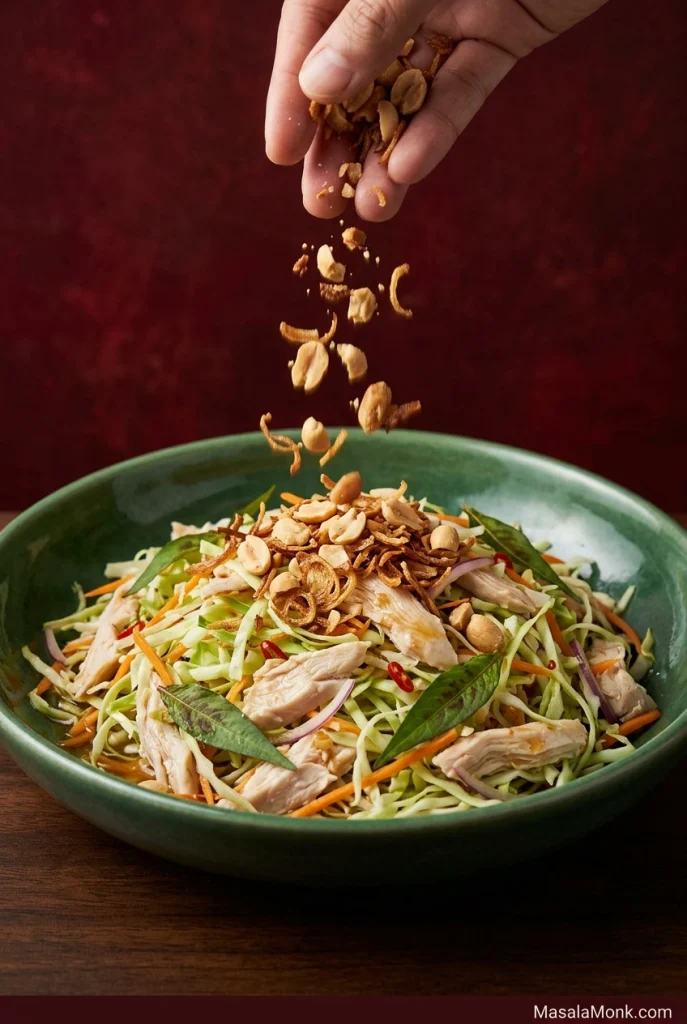
Add more dressing 1 tbsp at a time only if it needs it. Scatter over the peanuts and fried shallots and serve.
Swaps
- Chicken thighs: Use the same raw weight. They are juicier and more forgiving than breast.
- Rotisserie chicken: Use 350–400 g / 12–14 oz cooked shredded chicken; jump to the fast 15-minute version.
- No rau răm: Start with about ½ cup total cilantro and fresh mint, roughly equal parts. Add a few Thai basil leaves if you have them. The flavour will be different, so omit the separate optional cilantro from the main ingredient list when using this fallback.
- No peanuts: Use extra fried shallots or toasted sunflower or pumpkin seeds.
- No chile: Leave it out and put sliced chile on the table for anyone who wants heat.
- Gluten-free: The core salad can be gluten-free; check the labels on fish sauce and packaged fried shallots.
What Is Gỏi Gà Bắp Cải?
Gỏi refers to a broad Vietnamese family of dressed salads; gà means chicken and bắp cải means cabbage. These salads are commonly called gỏi in southern Vietnamese usage and nộm in northern usage. You may also see this dish written without Vietnamese diacritics as goi ga bap cai.
Fresh herbs and contrasting textures are central to this broad style of salad. Gỏi can be everyday food or sit within a larger shared meal, where something sharp and fresh provides an easy counterpoint to richer dishes.
In English, Gỏi Gà Bắp Cải sometimes gets called Vietnamese chicken slaw or Vietnamese chicken coleslaw because of all that shredded cabbage. The resemblance mostly ends with the shape: unlike classic creamy coleslaw, there is no mayonnaise or oil in this dressing. Fish sauce, lime, vinegar, sugar and herbs give it its character.
This version starts from the crisper end of the spectrum: finely cut green cabbage, plenty of rau răm, chicken seasoned before mixing, and dressing added gradually so everything tastes seasoned without the cabbage sitting in a pool of liquid. Other versions are deliberately softer and more deeply marinated; here, you can simply let the bowl sit longer when that is the texture you prefer.
Choosing and Cooking the Chicken
Chicken breast is the default here because its mild flavour keeps the salad light and lets the herbs and dressing lead. Thigh is richer and more forgiving if juiciness is the priority, and a mixture of the two works well too.
A whole chicken makes particular sense when you also want broth for the rest of the meal. Whichever cut you use, firm and juicy is fine; dry, stringy meat usually means too much heat or too much time.
Already-cooked chicken skips the poaching entirely. Leftover roast works beautifully, and rotisserie chicken can take you straight to the 15-minute version; our juicy baked chicken breast is another way to cook plain chicken ahead for lunches and salads. Breast that has gone too far is not hopeless either: shred it finely and get some dressing directly onto the meat.
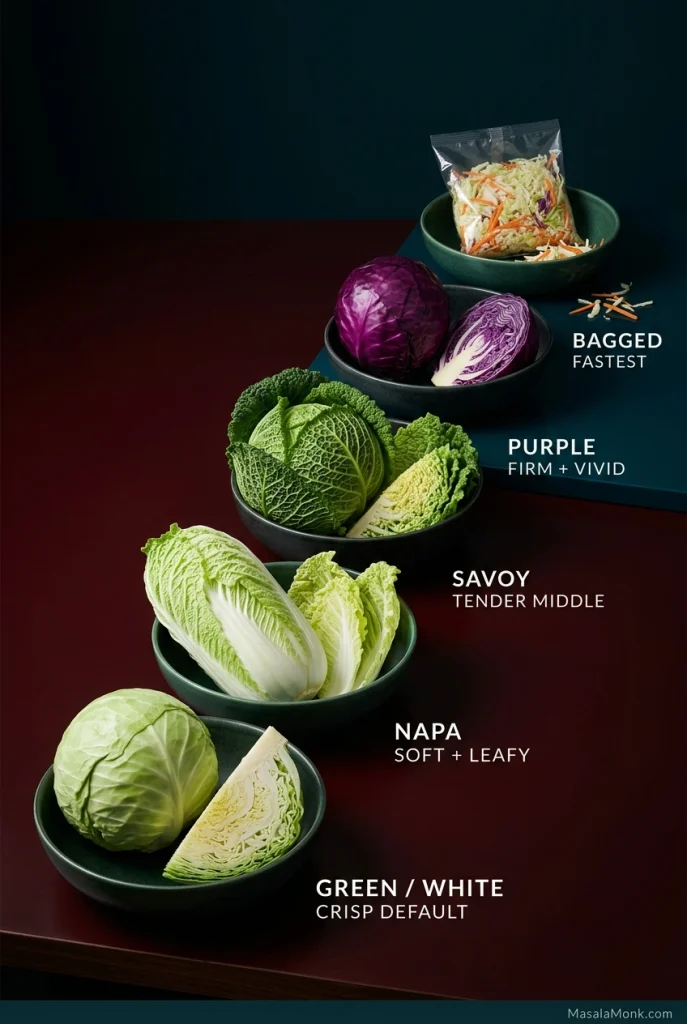
Green, Napa, Savoy or Bagged Slaw?
| Cabbage | Texture | Best approach |
|---|---|---|
| Green / white | Firmest and crunchiest | Best default for this version |
| Napa / wombok | Softer and leafier | Dress close to serving |
| Savoy / pointed | Tender but still structured | Sits between Napa and green cabbage |
| Purple | Firm with strong colour | Usually nicest mixed with green |
| Bagged slaw | Depends on freshness and cut | Fastest; adjust any extra carrot |
If you’re buying cabbage specifically for this recipe, choose green or white cabbage. It gives the clearest snap and can sit briefly in the dressing without collapsing.
Thickness matters almost as much as variety. A mature green cabbage sliced too thickly can make even a good dressing feel as though it is fighting its way through raw leaves. Aim for those 2–4 mm ribbons rather than broad strips.
Want to see what that cabbage looks like after dressing? Compare just-tossed, rested and genuinely watery salad.
Napa is the choice when you deliberately want something softer and leafier; it needs much less persuasion and may be ready after the first toss. A fresh bag of slaw is the speed-first option when chopping cabbage is the last thing you feel like doing—just skip extra carrot when the mix already contains plenty.
Texture gets you halfway there. Rau răm is what makes the bowl smell unmistakably different from an ordinary chicken slaw.
Rau Răm and the Herbs
Often sold as Vietnamese coriander or Vietnamese mint, rau răm (Persicaria odorata) is peppery and aromatic. Despite the confusing English name, it tastes quite different from ordinary mint.
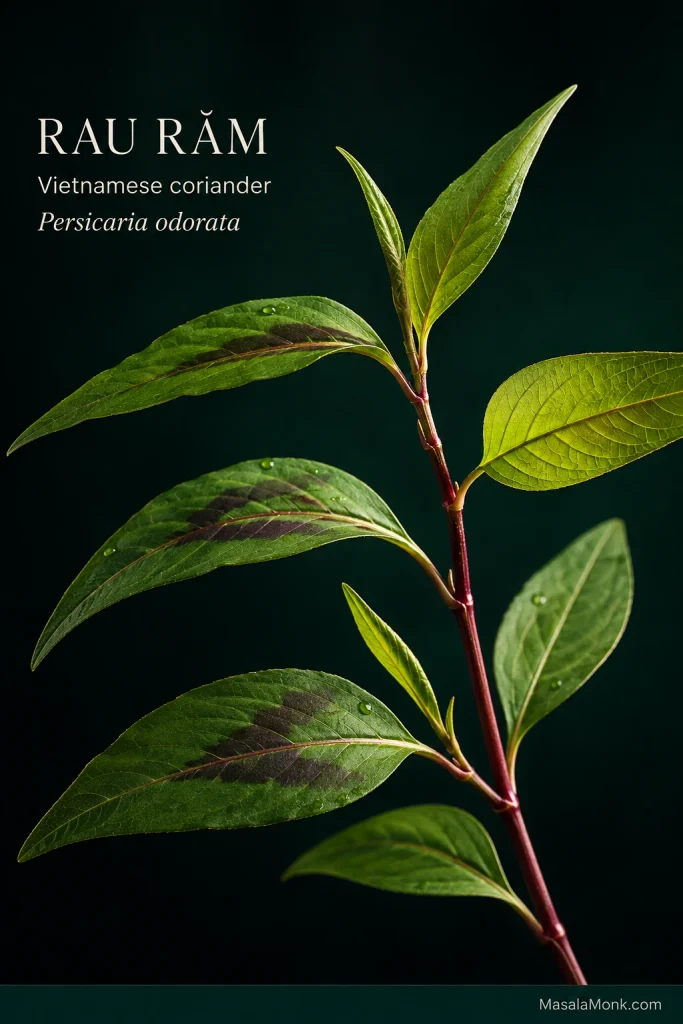
Tear a leaf and smell it before it goes into the salad. That sharp, peppery aroma is one of the things that makes a bowl of chicken and cabbage suddenly feel much more distinctive. Twenty grams gives it a proper presence; use less in the bowl and put the rest on the table if the herb is new to everyone eating.
Cilantro and mint do not recreate rau răm exactly, but together they give the salad freshness and herbiness when the real thing is unavailable.
No rau răm? Make dinner anyway.
Balancing the Fish-Sauce Dressing
The dressing follows the same sweet-sour-salty balancing logic as nước chấm, though here it has a whole pile of cabbage and chicken to season rather than a single dipped bite.
Start with 3 tbsp fish sauce, 3 tbsp lime juice, 1 tbsp vinegar, 2 tbsp sugar and 2 tbsp water, plus garlic and chile. Lime brings fragrance. Distilled white vinegar is sharper; unseasoned rice vinegar is gentler.
Fish sauce brands differ enough that the same three tablespoons can push two dressings in different directions. Judge any correction on the chicken and cabbage rather than trying to make the undiluted dressing taste gentle on its own.
When the balance is right, lime arrives bright and fragrant, rau răm follows with its peppery edge, and the fish sauce makes the chicken taste fuller underneath.
If the Dressing Needs Fixing
| Problem | Try this first |
|---|---|
| Too fishy or intense | Dilute with 1 tsp water, taste, then add a small squeeze of lime if needed. |
| Overly salty | Start with 1–2 tsp water and retaste before adding anything sweet. |
| Too sour | Stir in ½ tsp sugar + 1 tsp water, then taste again. |
| Overly sweet | Balance with 1 tsp lime or vinegar; add a few drops of fish sauce only if it also needs more savoury depth. |
| Flat | Try a small squeeze of lime for brightness or a few drops of fish sauce for savouriness. |
| Far too spicy | Make more chile-free dressing and combine the two mixtures. |
Make one small correction and taste again before changing anything else.
Once the dressing tastes right, what happens next is mostly about time.
Crisp, Softened or Watery?
Some people want the cabbage almost squeaky-fresh. Others like it after the leaves have relaxed into the dressing and picked up more seasoning. Both can be good.
A small amount of liquid at the bottom is normal. Look again once the salad has been sitting: a real puddle, paired with dressing that now tastes noticeably weaker, means enough water has left the cabbage to change the balance.
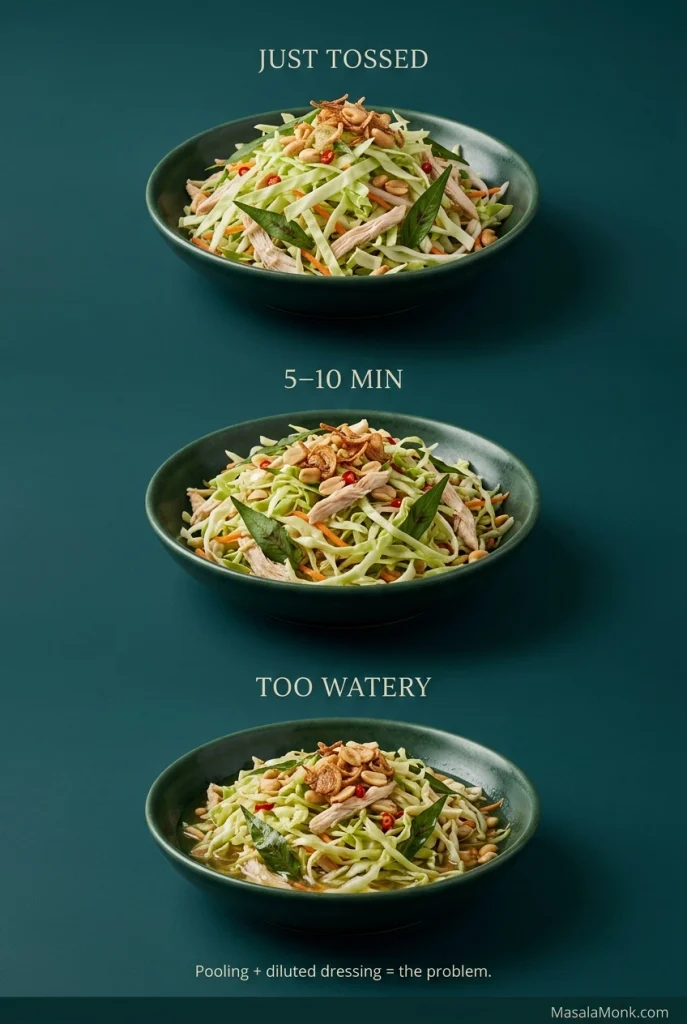
Why Did My Salad Turn Watery?
- The cabbage was still wet after washing.
- Too much dressing went in at once.
- The salad was dressed long before it was eaten.
- Tender Napa cabbage sat as long as firm green cabbage.
- The chicken was still hot.
- The onion carried extra water into the mixture.
Moderately wet salad can often be rescued with fresh finely shredded cabbage. Toss some through and refresh the herbs. A large puddle may need some draining first; taste afterward because seasoning leaves with the liquid too.
Tough cabbage is a different problem. If the salad is already mixed, give it a few more minutes with the dressing. Next time, slice it finer. A particularly mature head can also be lightly salted, rested and squeezed dry before assembly, though most ordinary cabbage does not need that extra step.
Fast Rotisserie Chicken Version
Half a rotisserie chicken, a bag of slaw and very little enthusiasm for cooking are already most of dinner.
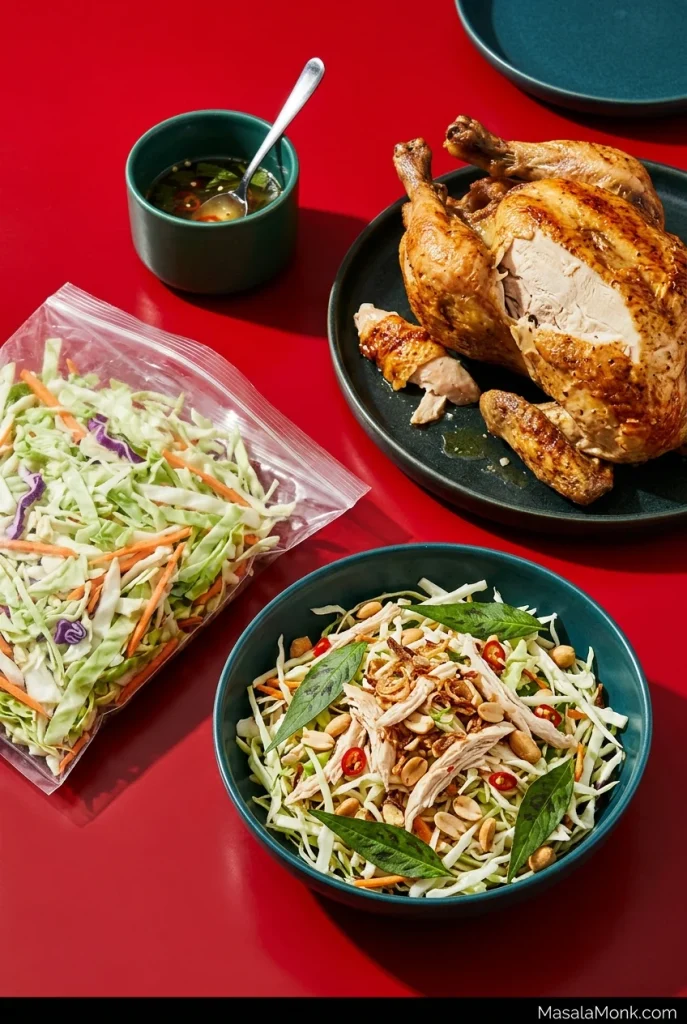
Allow about 15 minutes of active prep. Use 350–400 g / 12–14 oz shredded cooked chicken and 450–550 g / 1–1¼ lb fresh slaw mix, plus the same fish-sauce dressing, herbs, peanuts and fried shallots.
Season the chicken first, add the slaw and dress gradually. Skip extra carrot when the mix already contains plenty, and go gently with the dressing when the chicken is salty to begin with.
Make Ahead and Lunchbox Gỏi Gà
For crisp cabbage, prepare the components ahead and bring them together closer to eating.
- 1–2 days ahead: cook and shred the chicken; make the dressing.
- Earlier the same day: shred the cabbage and carrot; wash and thoroughly dry the herbs.
- 10–30 minutes before assembly: slice and ice-water-soak the onion, or give it the quick vinegar treatment.
- Keep separate until serving: dressing, peanuts and fried shallots when maximum crunch matters.
The vinegar-treated onion can be made earlier the same day and refrigerated. The plain ice-water soak is best done closer to assembly.
For a packed lunch, keep the dressing in a small separate container and toss it through when you are ready to eat. Keep the chicken and salad refrigerated, or use an insulated lunch bag with a cold pack until lunchtime.
Extra shredded cabbage and carrot can become the filling for crispy vegetable spring rolls. Cook the filling until its loose moisture has evaporated before wrapping.
What to Serve With Gỏi Gà Bắp Cải
A generous portion makes a fresh, light lunch or dinner, especially when something cool and crisp sounds better than another heavy hot meal. Smaller servings sit easily alongside other Vietnamese dishes.
Gỏi Gà is particularly at home beside cháo gà, or chicken congee. With a whole poached chicken, the broth can become the congee while some of the meat goes into the salad. Chicken rice, or cơm gà, is another natural partner.
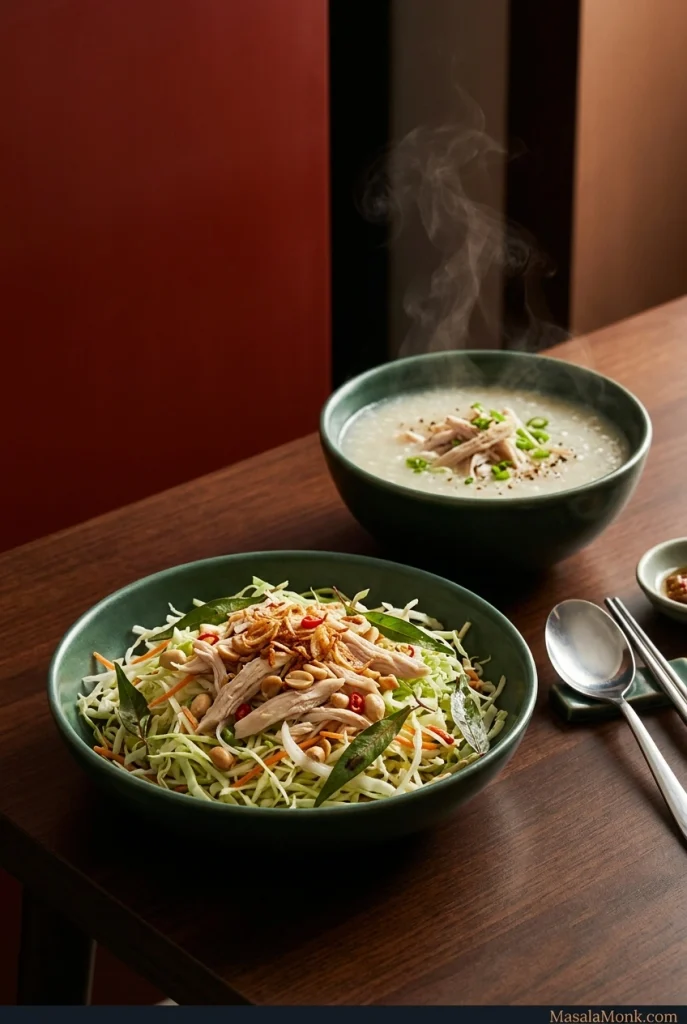
For a larger table with rice-paper rolls, our peanut sauce for spring rolls gives the rolls something rich and nutty to dip into while the salad stays bright and sharp.
Storage and Leftovers
For the best texture, keep cooked chicken, vegetables and dressing in separate covered containers, with peanuts and fried shallots kept dry until serving. USDA chicken-safety guidance recommends cooking poultry to 165°F / 74°C and using refrigerated cooked chicken within 3–4 days.
With rotisserie chicken, count from when it was originally cooked or purchased rather than restarting the storage clock when it becomes salad.
Dressed leftovers will be softer and usually wetter the following day. If that deeper, more marinated texture appeals to you, they can still be very good. Fresh cabbage and herbs help when the salad has softened farther than you wanted.
Do you prefer your gỏi very crisp, or after it has had a little time to soften into the dressing?








