
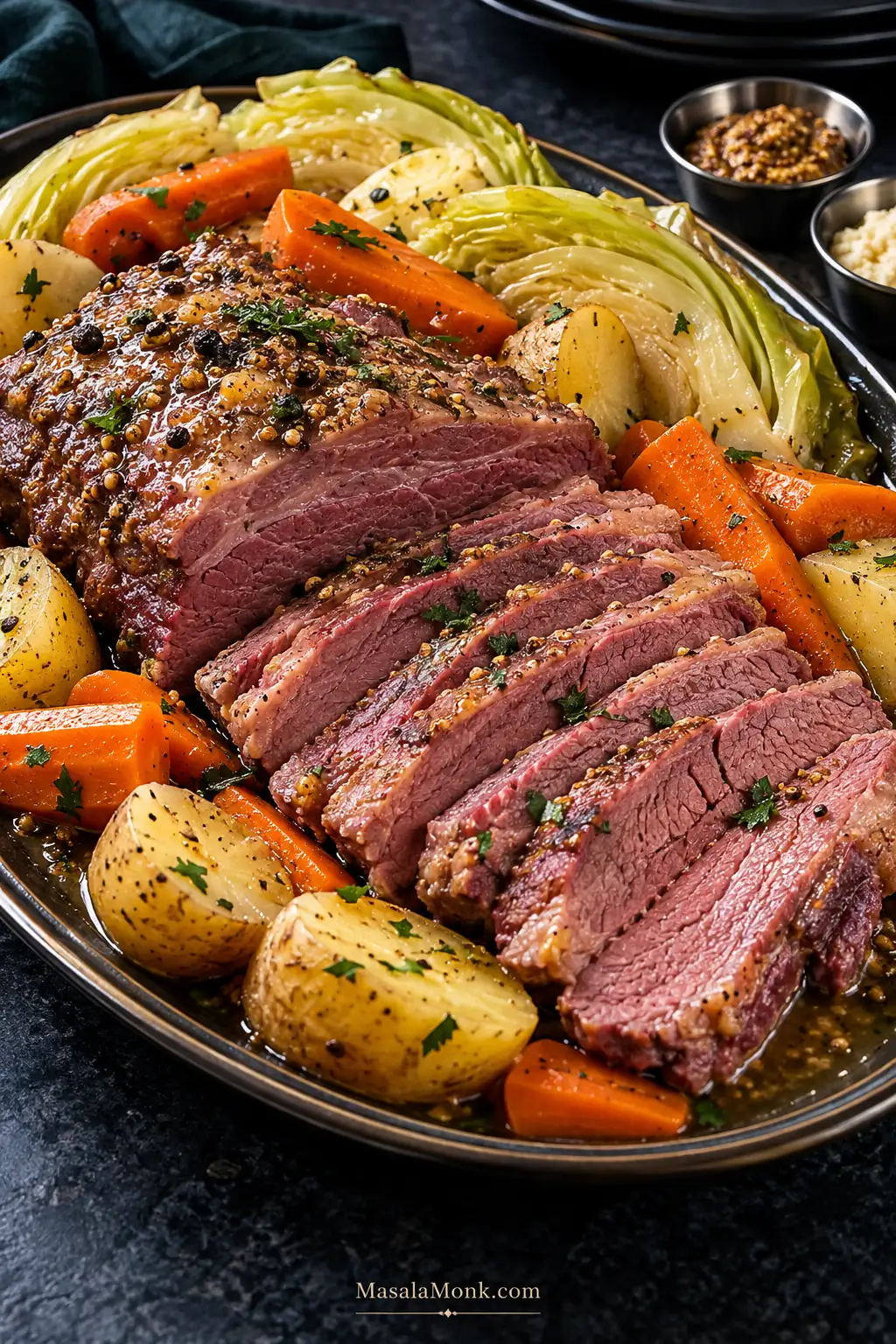
A corned beef brisket may need most of the day to become tender. Cabbage absolutely does not. Potatoes and carrots sit somewhere between the two. Put the whole dinner into the Crock Pot at breakfast and it is easy to end up choosing between beef that still pushes back against the knife and vegetables that have already given up.
This slow cooker corned beef recipe gives each part of dinner the time it actually needs. The brisket starts first, potatoes and carrots join later, and cabbage goes in last.
Done well, it lands on the table as rosy slices of corned beef, potatoes carrying the spiced cooking juices, sweet carrots and cabbage tender enough to cut easily with a fork.
For many cooks, this is a once-a-year dinner. You do not need to remember last year’s timing, and staging the vegetables does not turn it into a fussy project: add the potatoes and carrots once, add the cabbage once, then check each part as it finishes.
Four Foods, Four Clocks
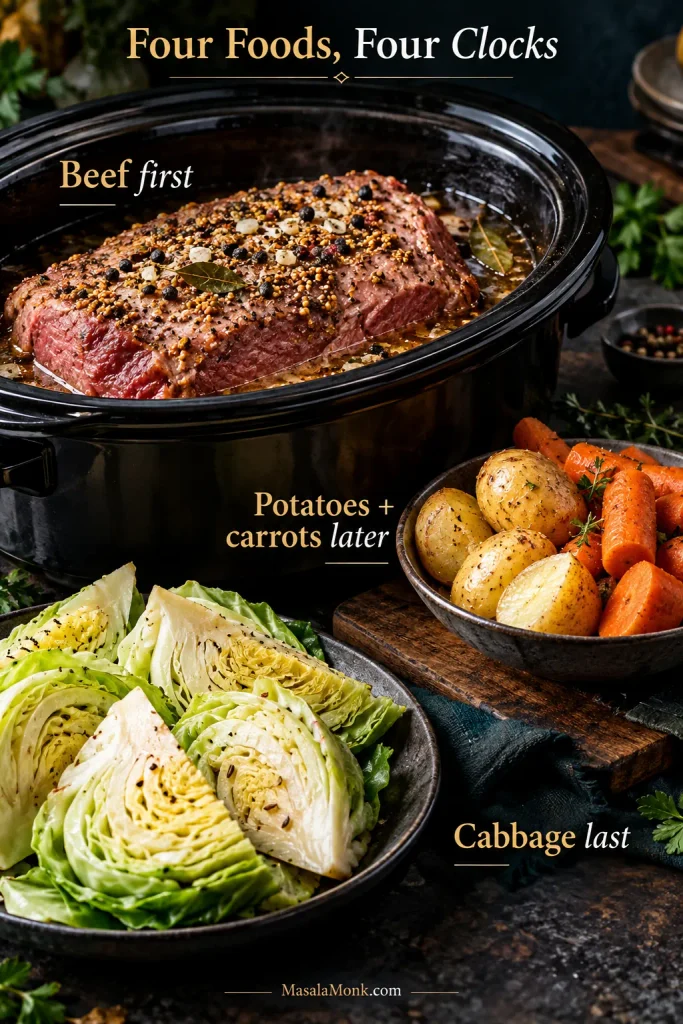
| Food | LOW timing & doneness |
|---|---|
| Corned beef | Start checking around 7½ hours. Ready when a thin probe enters the thickest part with very little resistance. |
| Potatoes | Add at 5½ hours. Ready when a knife enters easily while the pieces still hold their shape. |
| Carrots | Add with the potatoes at 5½ hours. Tender through the center without collapsing at the edges. |
| Cabbage | Add around 7½ hours; usually needs another 1–1½ hours. Judge the thick center rib and cook it to the tenderness you prefer. |
Slow Cooker Corned Beef and Cabbage Recipe
This recipe is built around a 3–4 lb / 1.4–1.8 kg uncooked corned beef brisket—the refrigerated kind sold in curing brine—fully thawed, in a 6-quart / 5.7-liter slow cooker. Staging the vegetables keeps them from spending the brisket’s entire long cook in the pot.
Total time includes prep and the 15–20 minute rest. Six servings assumes the vegetables are part of the meal; for more meat-heavy plates, expect closer to 4–5 generous portions.
Ingredients
- 1 fully thawed, uncooked commercially cured corned beef brisket, 3–4 lb / 1.4–1.8 kg, flat cut preferred for neat slices
- 1 medium yellow onion, about 8 oz / 225 g, cut into thick wedges
- 4 garlic cloves, lightly crushed
- 1 included corned beef seasoning packet, or 1 tbsp / 15 ml pickling spice
- About 3 cups / 710 ml water, adjusted as needed so the liquid reaches roughly one-third to halfway up the brisket
- 1½ lb / 680 g baby Yukon Gold or red potatoes, very small ones left whole; cut larger potatoes into pieces about 1½–2 inches / 4–5 cm across
- About 1 lb / 450 g carrots, cut into sturdy 2-inch / 5-cm pieces
- 1 small green cabbage, about 1¼–1½ lb / 570–680 g, trimmed and cut through the core into 6 wedges, leaving enough core attached to hold each wedge together
For Serving & Finishing
- Dijon or grainy mustard
- Prepared horseradish or horseradish cream, optional
- Optional vegetable finish: 2 tbsp / 28 g unsalted butter, 2 tbsp / about 8 g finely chopped parsley and ¼ tsp / about 0.5 g freshly ground black pepper
Do not add salt at the beginning. Corned beef varies quite a bit in saltiness from brand to brand, so taste the vegetables and cooking liquid near the end before adding any.
Equipment
- 6-quart / 5.7-liter slow cooker
- Instant-read thermometer or thin probe
- Sharp slicing knife
- Small tea infuser or cheesecloth, optional for containing the whole spices
1. Start the Brisket
Set the package in a rimmed dish, open it carefully and discard the packing brine. Transfer the brisket to paper towels and pat the surface dry. Do not rinse it under running water. For the safety and salt-control reasoning, see why we do not rinse corned beef.
If the brisket has an unusually thick slab of hard fat, trim some of the excess while leaving a modest layer over the meat. A thin fat cap is useful; a very thick one will not completely disappear in the slow cooker.
Scatter the onion and garlic over the bottom of the slow cooker, then set the fully thawed brisket on top fat-side up.
Sprinkle over the included seasoning packet. Missing seasoning packet? Use about 1 tablespoon / 15 ml pickling spice. A tea infuser or loose cheesecloth bundle keeps peppercorns and seeds out of the finished vegetables without losing their flavor.
Pour about 3 cups / 710 ml water around the brisket rather than directly over the spices. Use the liquid level as the guide: aim for roughly one-third to halfway up the meat, adjusting the amount if your cooker puts it well above or below that range. For alternatives, jump to the water, broth and beer guide.
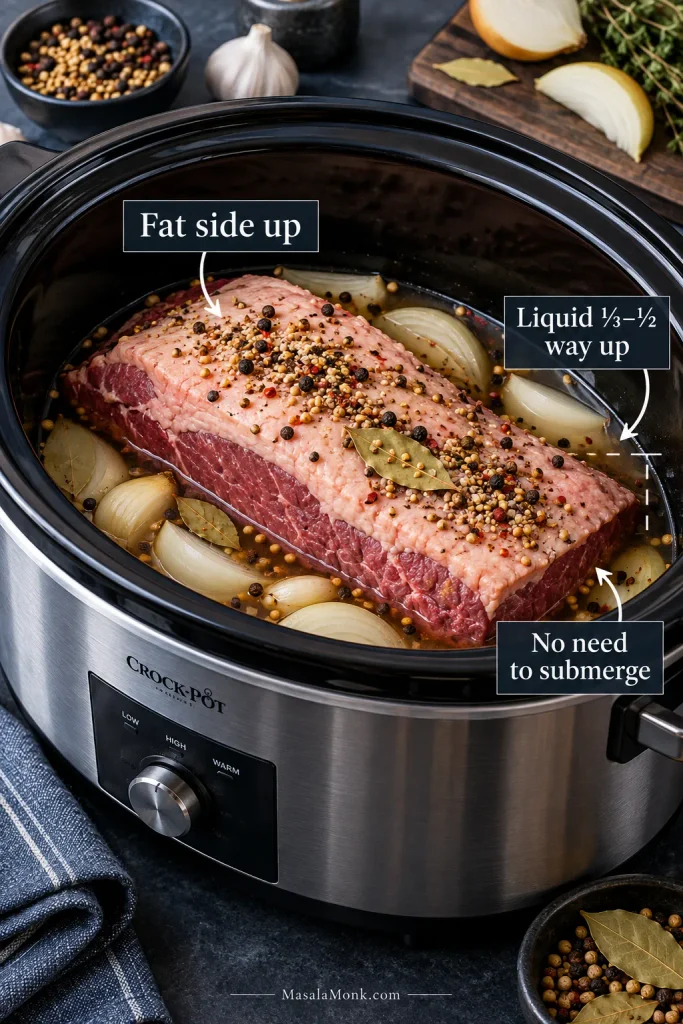
Cover and cook on LOW for 5½ hours. Keep the lid closed so the cooker does not have to repeatedly rebuild lost heat and steam.
2. Add the Potatoes and Carrots
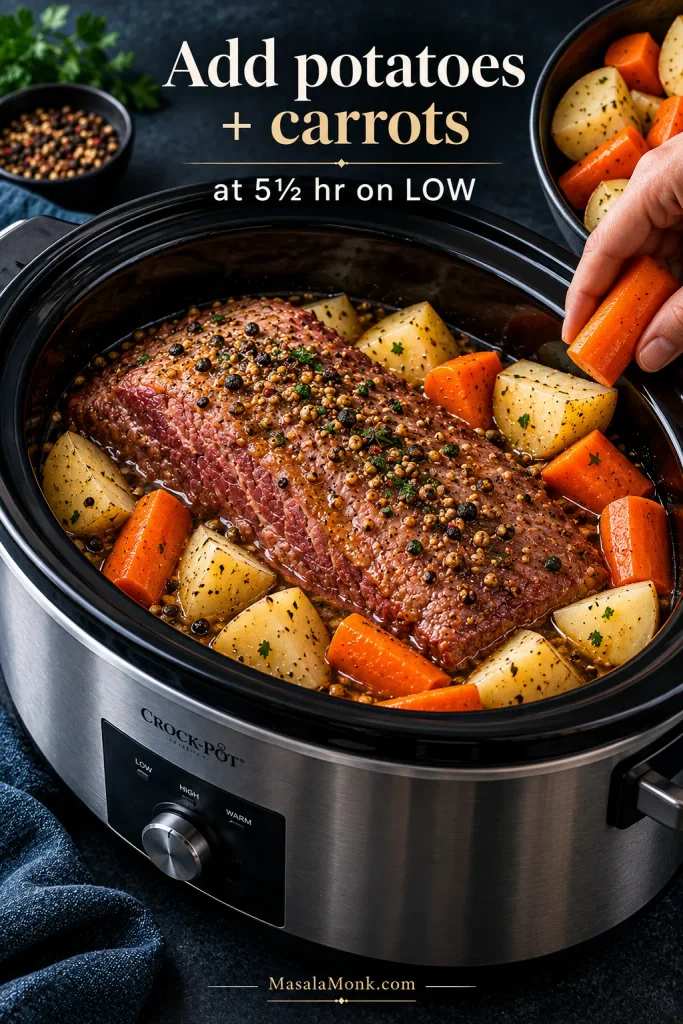
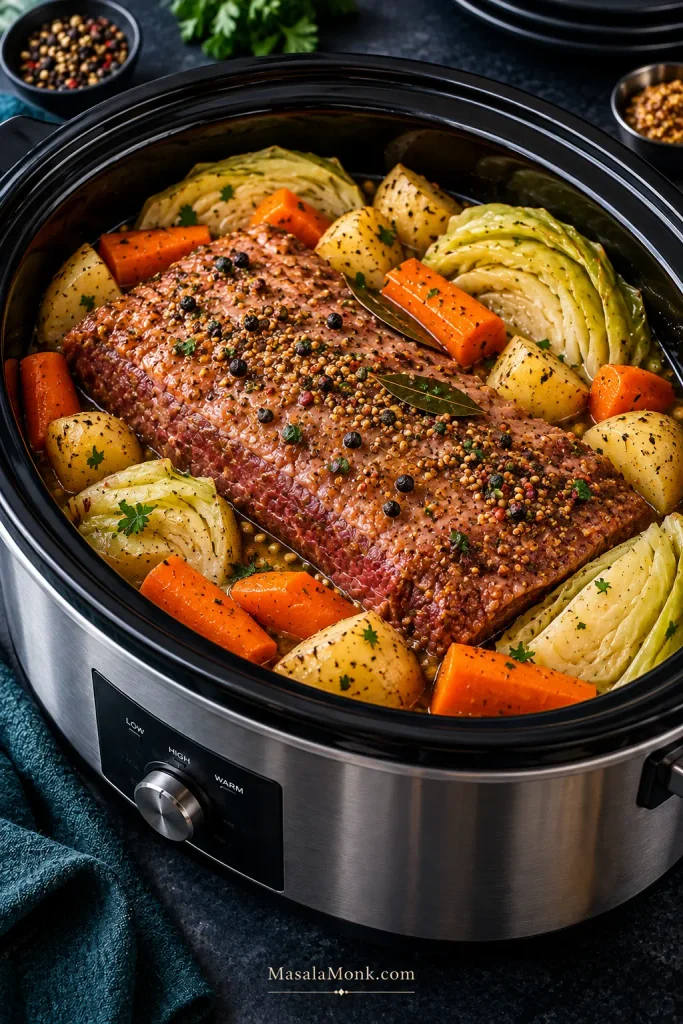
Add the potatoes and carrots after the beef has cooked for 5½ hours on LOW. Arrange them around the brisket, pushing the denser pieces into the hot liquid where practical. Replace the lid quickly and continue cooking for another 2 hours.
The large pieces are deliberate. Small potato cubes and thin carrot slices can be fully cooked while the brisket is still working its way toward tenderness.
3. Check the Beef, Then Add the Cabbage
At about 7½ hours total, make an early check. Slide a thin thermometer probe or skewer into the thickest part of the brisket. If the resistance is hard to judge, use the full tenderness guide.
If the brisket still offers clear resistance, arrange the cabbage wedges over and around the beef, replace the lid and continue on LOW for about 1–1½ hours.
If the brisket is already very easy to pierce, remove it before adding the cabbage. Arrange the cabbage in the cooker and let the vegetables finish without the beef.
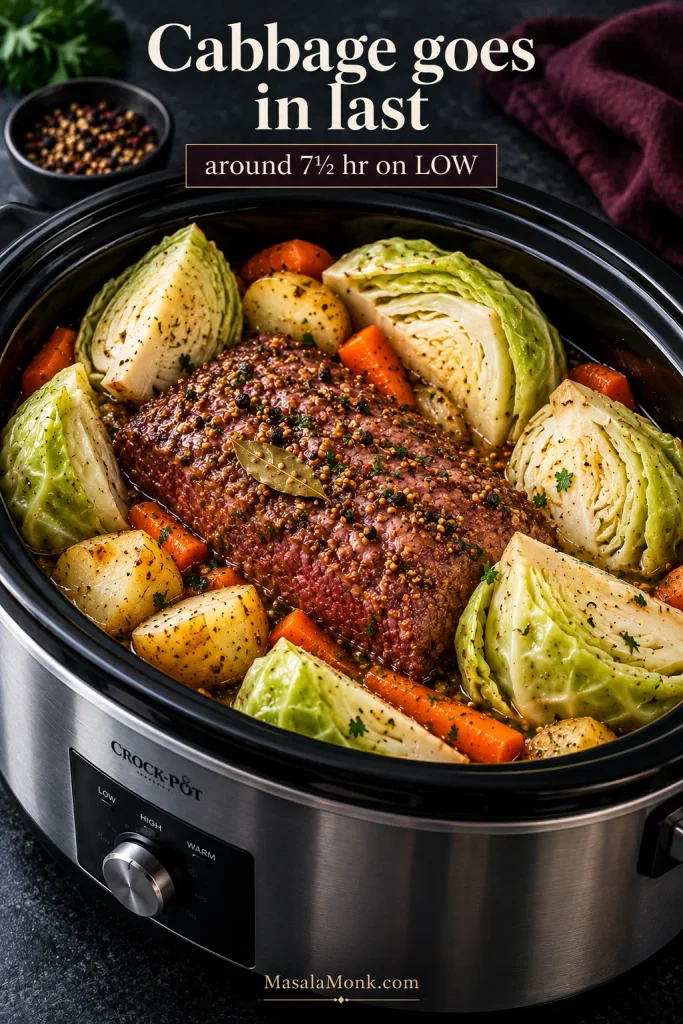
Because newly added cabbage will usually need longer than a normal 15–20 minute rest, transfer an early-finished brisket with a little cooking liquid to a covered oven-safe dish. Keep it hot in the lowest practical oven setting, ideally around 170°F / 75°C, while keeping the meat at 140°F / 60°C or above. Begin its final 15–20 minute rest shortly before you plan to slice.
4. Check the Whole Dinner
From about 8½ hours total, start checking each part of the meal.
- Corned beef: the probe should slide into the thickest part with very little resistance.
- Potatoes: a knife should enter easily while the pieces still hold their shape.
- Carrots: the center should be tender without the edges collapsing.
- Cabbage: judge the thick center rib rather than the delicate outer leaf.
Remove anything that is ready. The brisket can keep cooking without the vegetables, and the vegetables can finish without the brisket. If the beef becomes ready now and the vegetables need only another 15–20 minutes, let the brisket rest normally. For a longer gap, use the covered holding method from Step 3. Still tough? Leave the beef in its cooking liquid and check again in about 30 minutes.
If the meal has split into different finish times, go straight to the troubleshooting guide.
5. Rest and Slice Across the Grain
Transfer the brisket to a cutting board and rest it for 15–20 minutes.
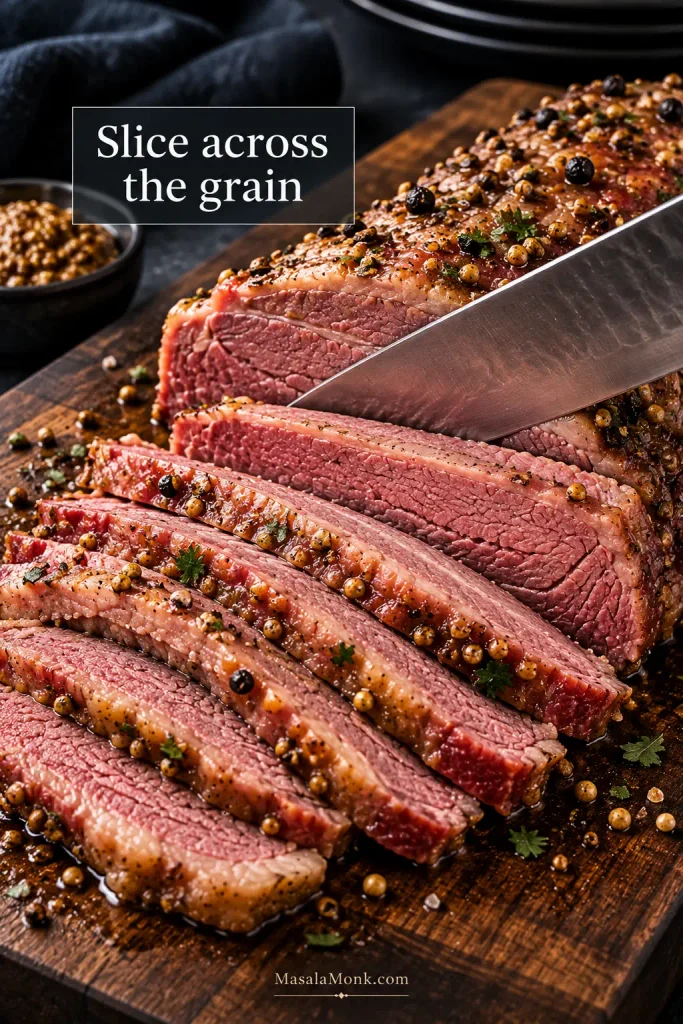
Look for the long lines of muscle fiber running through the meat. Turn the brisket so your knife crosses those lines, then cut slices about ¼–⅜ inch / 6–10 mm thick.
Point cuts can have grain running in more than one direction. When that happens, divide the cooked brisket into obvious sections first and rotate each section before slicing across its grain.
6. Taste and Serve
Taste the vegetables before adding salt. If using the butter finish, toss the hot potatoes, carrots and cabbage with the butter, parsley and black pepper. Strain a little cooking liquid for the table, then serve the sliced beef with the vegetables, mustard and horseradish.
Cooking on HIGH
LOW is the more forgiving schedule for this recipe because it gives you a wider window to judge brisket tenderness while staggering the vegetables. HIGH works when dinner needs to happen sooner, but smaller or thinner briskets deserve an earlier check.
- Prepare the brisket, onion, garlic, spices and liquid exactly as above.
- Cook the beef on HIGH for 4 hours.
- Add the potatoes and carrots.
- At about 5 hours total, check a brisket around 3 lb / 1.4 kg or one that is relatively thin. If it is already tender, remove it and keep it hot using the holding method in Step 3 while the vegetables continue cooking.
- At about 5½ hours total, check a thicker brisket closer to 4 lb / 1.8 kg. Add the cabbage now and remove the beef for holding if it is ready.
- Cook the cabbage on HIGH for about 45–60 minutes. At roughly 6¼–6½ hours total, check the whole dinner. Remove finished components and continue anything that still needs time.
Recipe Notes
- Fat side & searing: Place the brisket fat-side up for this method. There is no need to sear it before slow cooking.
- Frozen brisket: Thaw it completely in the refrigerator before slow cooking. The timing in this recipe assumes a fully thawed brisket.
- Prep ahead: Cut the carrots, cabbage and onion the night before and refrigerate them. Small potatoes can stay whole. If larger potatoes are cut ahead, keep them submerged in cold water in the refrigerator, then drain before cooking.
- Softer vegetables: Add the potatoes and carrots earlier if you deliberately prefer a very soft boiled-dinner texture.
- Leaving vegetables out: Cabbage, potatoes and carrots are optional. Omitting them does not change how the brisket cooks.
- Cooking for a crowd: Two briskets and twice the vegetables can crowd a 6-quart cooker badly enough to change the timing. Use a larger cooker, divide the meal between two slow cookers, or cook some of the vegetables separately.
Corned Beef Cooking Guide
- Choosing Corned Beef for the Slow Cooker
- Should You Rinse Corned Beef?
- How Much Liquid to Use
- How to Tell When Corned Beef Is Tender
- When to Start Checking by Weight
- When to Add the Vegetables
- Fix Tough Beef, Mushy Potatoes & Other Problems
- Optional Broiler Finish
- What to Serve with Corned Beef and Cabbage
- Storage & Leftovers
Choosing Corned Beef for the Slow Cooker
Flat Cut or Point Cut?
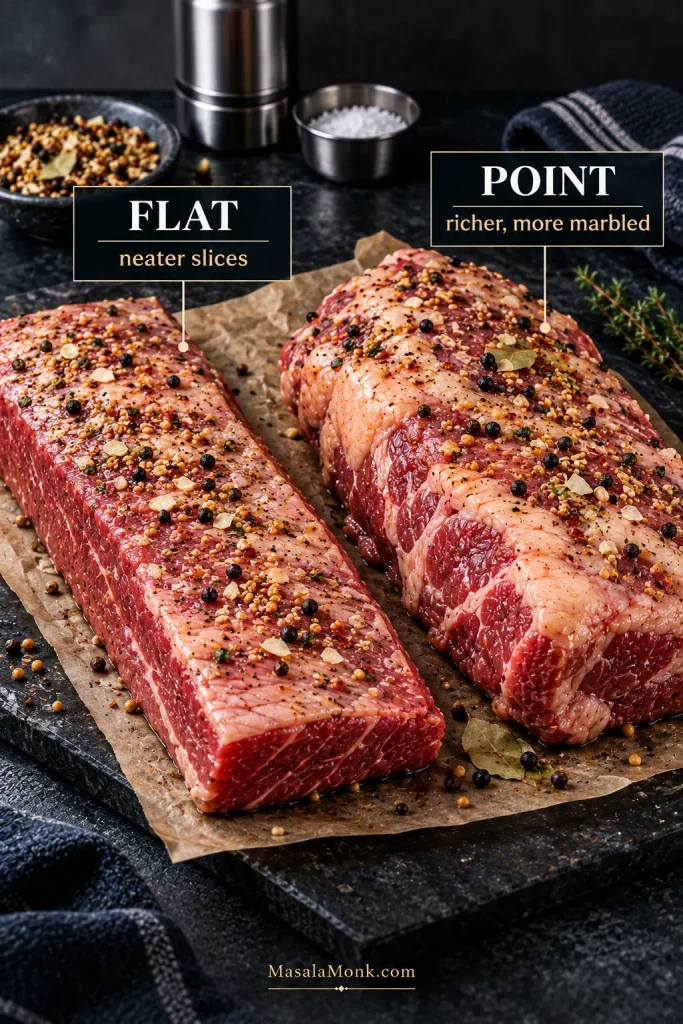
Choose a flat cut for neater slices and a point cut for more marbling and richness. A flat is usually more uniform in thickness and easier to carve cleanly across the grain, while a point is generally more irregular and often fattier.
The actual brisket matters more than the cut name: a well-marbled flat can be a better choice than an unusually lean point.
How Much Corned Beef to Buy
A 3–4 lb / 1.4–1.8 kg brisket is a practical size for about six people when the vegetables are part of the meal. For planned Reuben or hash leftovers, buy toward the 4-lb end.
Should You Rinse Corned Beef?
No—do not rinse corned beef under running water. Discard the packing brine and pat the brisket dry. USDA guidance on washing raw meat warns that rinsing can spread contaminated droplets around the sink and nearby surfaces; cooking is what makes the meat safe.
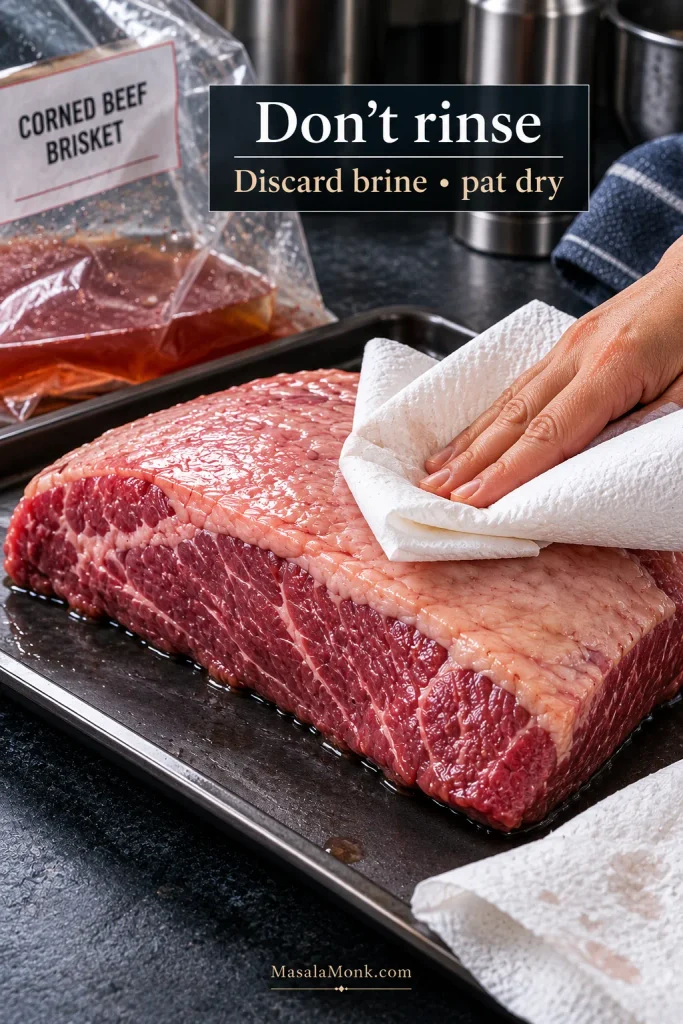
If saltiness is the concern, control it through the cooking liquid and final seasoning rather than rinsing the raw brisket under the faucet. Salt at the end, not on faith: corned beef is already cured, so starting with water and no added salt gives you room to taste and adjust once the meal is nearly finished.
How Much Liquid? Water, Broth, Beer or Guinness?
The brisket does not need to be submerged. For this recipe, water is the best default because the beef is already cured and seasoned. Start around 3 cups / 710 ml and use the level in the cooker as your final guide: roughly one-third to halfway up the brisket is enough.
Low-sodium beef broth can replace some or all of the water 1:1 when you want a more savory cooking liquid. Regular broth can push an already-cured brisket and its vegetables toward excessive saltiness, so taste before adding any extra salt.
For a beer version, replace about 12 fl oz / 355 ml of the water with beer and keep the final liquid level in the same range. Lager or brown ale brings mild malt sweetness; Guinness or another stout gives the pot a darker roasted edge and can make its bitterness more noticeable in long-cooked vegetables.
Beer changes the flavor, not the basic tenderizing process. For a dish where stout is meant to lead rather than sit in the background, a Guinness beef stew is built around it from the start.
How to Tell When Corned Beef Is Tender
Read the brisket, not just the timer. Corned beef is ready for neat slices when a thin probe enters the thickest part with very little resistance while the meat still holds together.
Safe Temperature vs Tender Temperature
USDA lists 145°F / 63°C followed by at least a 3-minute rest as the food-safety minimum, but brisket usually needs considerably more cooking before it becomes tender. See the USDA’s corned beef guidance for the safety standard.
For clean, sliceable tenderness, ThermoWorks’ corned beef temperature guidance places corned beef around 190–195°F / 88–91°C. Around 200–205°F / 93–96°C, the meat moves toward a much softer texture. Even so, a brisket can pass 190°F and still feel tight, so let probe resistance make the final call.
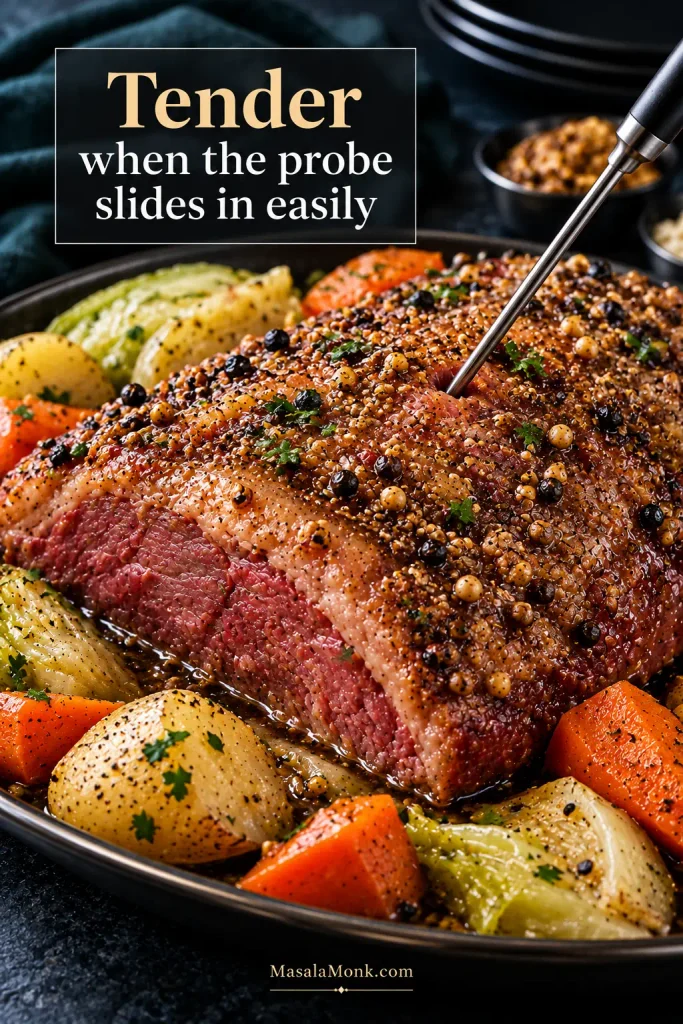
- Still firm when pierced: keep cooking.
- Probe slides in easily but the meat still holds together: ideal for neat slices.
- Almost no resistance and the fibers readily separate: very soft, fall-apart territory.
For neat slices, the knife should pass through without sawing, while each slice still holds together when you lift it.
Corned beef can also go too far. A lean flat may become dry and stringy, while a fattier piece can soften past the clean-slicing stage and begin to fall apart.
Do not judge corned beef by color. Properly cooked corned beef can remain distinctly pink because of the curing process.
Thickness, shape, marbling and the way your slow cooker heats explain why two briskets of the same weight can finish at different times. Times get you into the right window; texture tells you when dinner is actually ready.
When to Start Checking Corned Beef by Weight
These times tell you when to begin checking tenderness. They are deliberately earlier than a guaranteed finish time.
| Brisket size | Begin checking |
|---|---|
| 3 lb / 1.4 kg | LOW: about 7½ hr · HIGH: about 5 hr |
| 4 lb / 1.8 kg | LOW: about 8 hr · HIGH: about 5½ hr |
The vegetable schedule in the main recipe is tuned to a 3–4 lb / 1.4–1.8 kg brisket. For substantially smaller or larger briskets, begin checking earlier or later and let probe tenderness—not a rigid minutes-per-pound formula—decide when the beef is ready.
The 7½-hour check in the LOW method is an early look before the cabbage goes in. A thicker 4-lb brisket may not enter its more meaningful tenderness window until closer to 8 hours.
A short, thick point and a long, thin flat can weigh exactly the same, which is why the probe ultimately tells you more than a rigid minutes-per-pound rule.
When to Add the Potatoes, Carrots and Cabbage
Slow cookers are excellent at giving tough beef hours to soften. The vegetables finish much sooner.
| Food | Main recipe timing |
|---|---|
| Potatoes + carrots | LOW: add at 5½ hr · HIGH: add at 4 hr |
| Cabbage | LOW: add around 7½ hr, then cook 1–1½ hr · HIGH: add around 5½ hr, then cook 45–60 min |
Potatoes and Carrots
The schedule above gives the potatoes and carrots roughly two to three hours to soften instead of forcing them through the brisket’s entire long cook. Use waxy potatoes such as Yukon Gold or red potatoes and keep them roughly 1½–2 inches / 4–5 cm across. Carrot pieces should be similarly substantial at about 2 inches / 5 cm.
Add them a little earlier when you deliberately want very soft, deeply braised vegetables; add them later when you prefer more structure.
For browned edges and a firmer center, oven roasted carrots are a good alternative when caramelization matters more than keeping everything in one pot.
Cabbage
Cabbage gets only the final stretch. The leaves soften first, so test the thick center rib—the last part of the wedge to lose its crunch.
Keep the cabbage in sturdy wedges rather than shredding it. Add it later when you want more bite, or give it longer for very soft cabbage. You can also cook the wedges separately in some strained cooking liquid when you want maximum control over their texture.
If Dinner Isn’t Finishing Together
Look at what is tender and what is still firm. That usually tells you more than the clock does.
Beef Problems
| What you see | What to do |
|---|---|
| Beef tough + vegetables tender | Take the vegetables out and cover them; they are done. Leave the brisket in its cooking liquid and give it more time. That’s fixable—you have not ruined dinner. |
| Beef hot but rubbery | It may already be safely cooked but still needs more tenderizing time. Keep cooking until it becomes much easier to pierce. |
| Beef tough + vegetables hard | Confirm that the cooker is on LOW or HIGH and that the lid has stayed closed; if so, give the meal more time. If raw beef accidentally sat on WARM from the start and you cannot verify that it heated promptly, discard it. WARM is a holding setting for already-cooked food. |
| Beef tender + vegetables still firm | Remove the beef with a little cooking liquid. If the vegetables need only 15–20 minutes, let the meat rest; for a longer gap, keep the covered beef at 140°F / 60°C or above while the vegetables finish. |
| Beef dry or stringy | Rest it, slice thinly across the grain and spoon a little hot cooking liquid over the meat. An unusually lean cut, overcooking or slicing with the grain can all contribute. |
| Beef falls apart under the knife | It has moved beyond the neat-slicing stage. Serve it as soft chunks or shredded beef and begin checking earlier next time. |
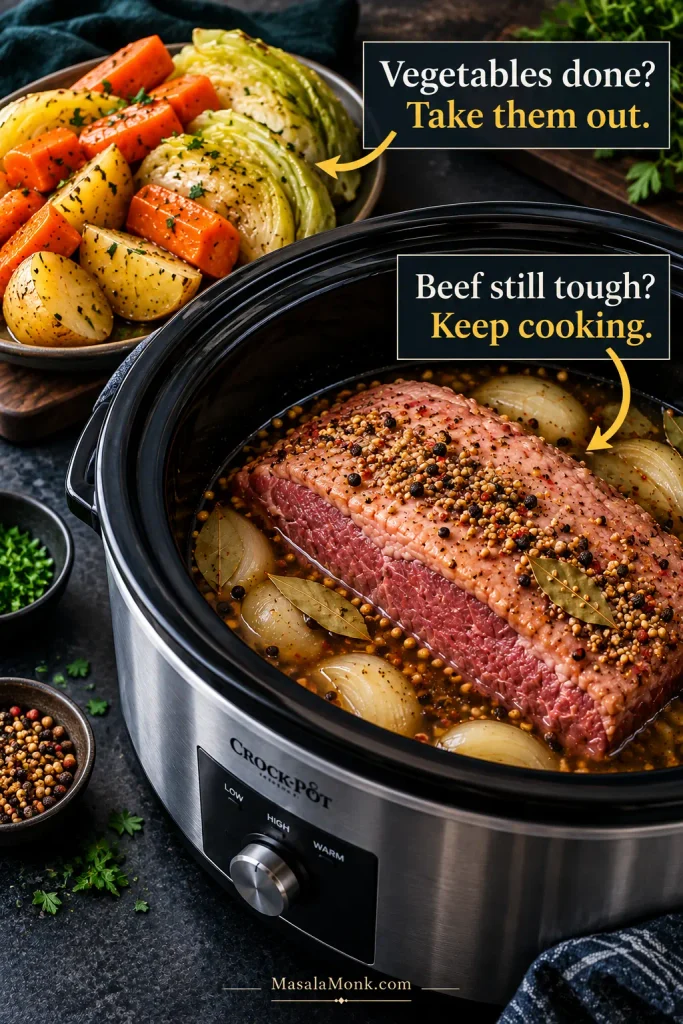
Vegetable Problems
| What you see | What to do |
|---|---|
| Potatoes turning to mush | Remove them now. Next time use larger waxy potatoes, cut them less aggressively or add them later. |
| Potatoes still hard | Move them into the hot liquid and keep cooking until a knife enters easily. Very large pieces or a cooler-running slow cooker may need longer. |
| Cabbage gray and collapsing | It stayed in too long. Add the wedges later next time or cook them separately in some of the corned-beef liquid. |
| Cabbage still crunchy | Give it more time. Judge the thick center rib, especially on large wedges. |
| No room left for cabbage | Remove finished potatoes or carrots, or cook the cabbage separately. Packing everything tightly under the lid is not worth sacrificing texture. |
Salt & Flavor Problems
| What you see | What to do |
|---|---|
| Everything tastes too salty | Do not reduce the cooking liquid further. Serve with unsalted sides where possible and dilute any liquid you plan to spoon over the plate. |
| Beef tastes right but vegetables are bland | Toss the hot vegetables with the optional butter, parsley and black pepper, then taste before adding salt. |
Can Tough Corned Beef Be Rescued?
Yes, when it is genuinely firm rather than already dry. Put it back into hot cooking liquid, cover and continue cooking gently until the probe becomes much easier to insert.
If the slow cooker is heating but the beef remains stubbornly firm, transfer it with some cooking liquid to a covered oven-safe dish and continue at about 325°F / 165°C until probe-tender. Finished vegetables can stay out.
Optional Broiler Finish
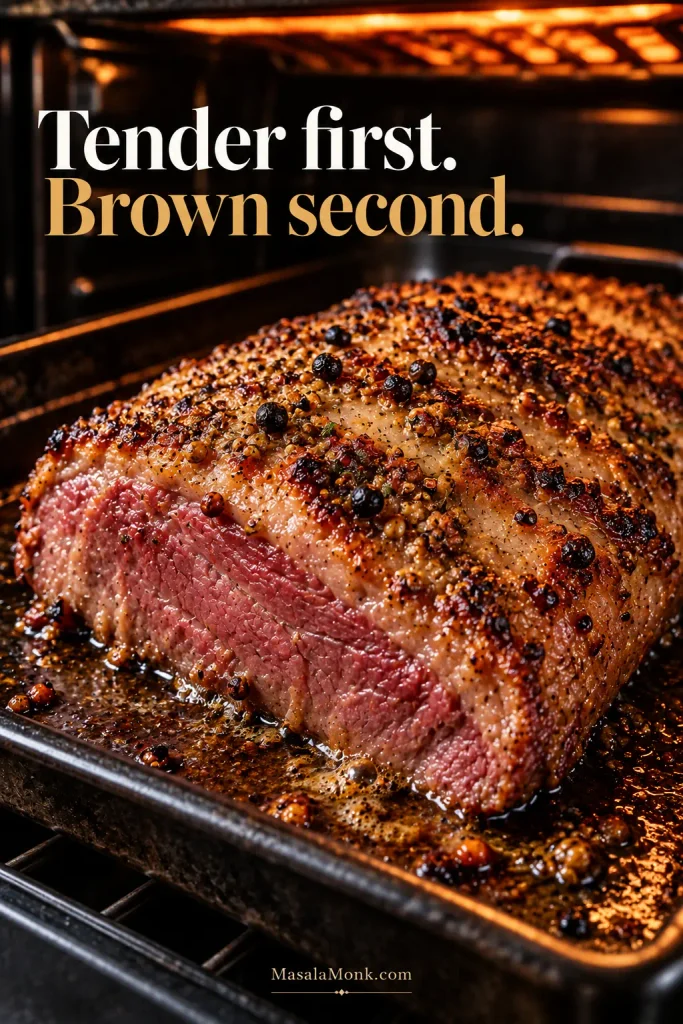
Once the brisket is tender, you can stop there. For darker edges, transfer it to a foil-lined broiler-safe pan and brush the fat side lightly with Dijon or grainy mustard.
Broil only until the surface bubbles and browns, usually about 2–4 minutes. Start watching closely after the first minute; mustard can darken quickly under a strong broiler.
What to Serve with Corned Beef and Cabbage
Arrange the rested slices with the potatoes, carrots and cabbage, then spoon a little strained cooking liquid over the beef—enough to keep the slices glossy and moist without flooding the plate.
For a St. Patrick’s Day dinner, put Dijon or grainy mustard and horseradish on the table and let everyone add their own. A creamy horseradish sauce works especially well because its cool, sharp bite cuts through the salty, rich beef.
Skipped the potatoes in the slow cooker? Creamy mashed potatoes make a good alternative underneath the sliced beef, especially with a little of the strained juices spooned around them. Warm dinner rolls or Irish soda bread are also good for catching the juices left on the plate.
Storage and Leftovers
Storing and Reheating Cooked Corned Beef
Cooked corned beef keeps for 3–4 days in the refrigerator or about 2–3 months in the freezer for best quality. Refrigerate it within 2 hours.
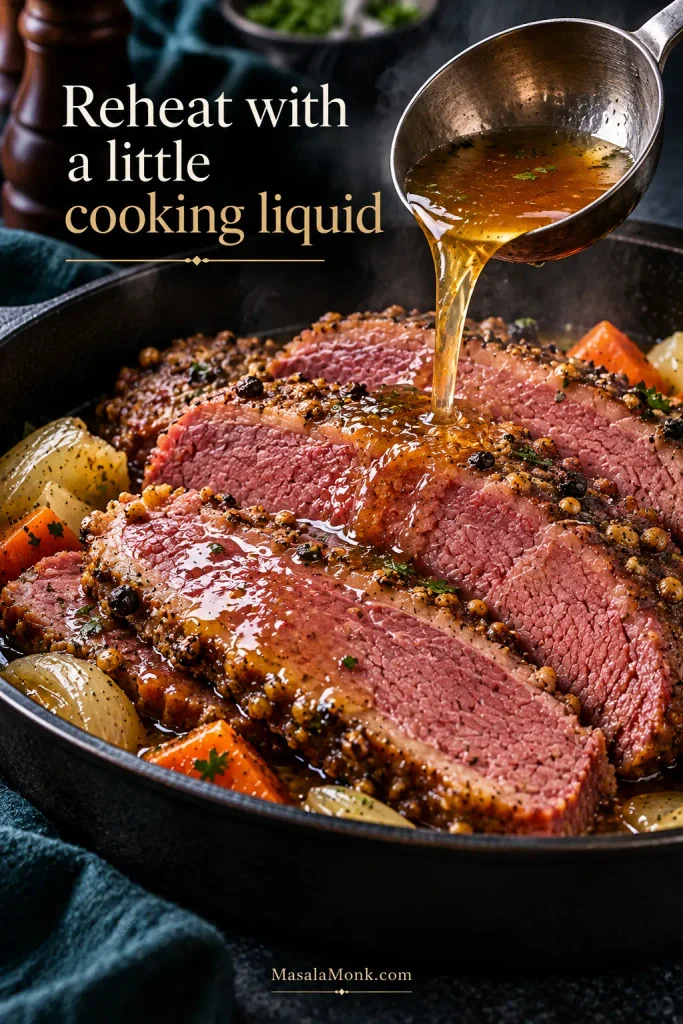
Instead of leaving the brisket whole or slicing all of it thin, divide leftovers into a few smaller, manageable sections and place them in shallow containers with a little strained cooking liquid. Reheat leftovers to 165°F / 74°C; a splash of the cooking liquid helps keep the meat from drying out.
Save Some for a Reuben
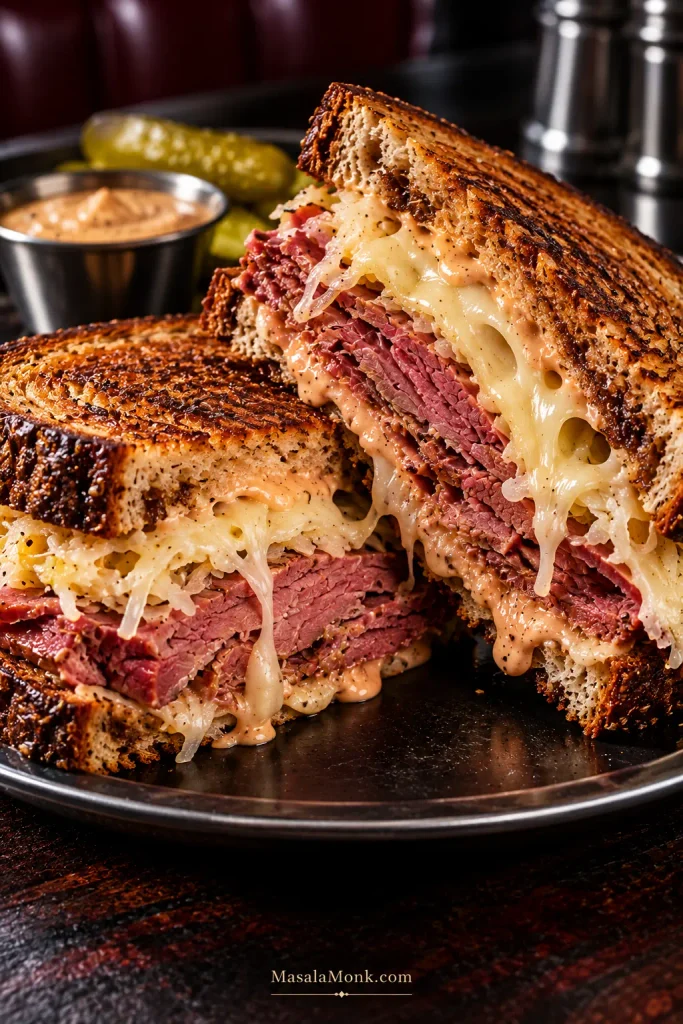
For a crispy Reuben sandwich, keep one of the larger leftover pieces intact. Reheat it gently, then slice it across the grain before adding rye, Swiss, sauerkraut and dressing.
Corned Beef Hash
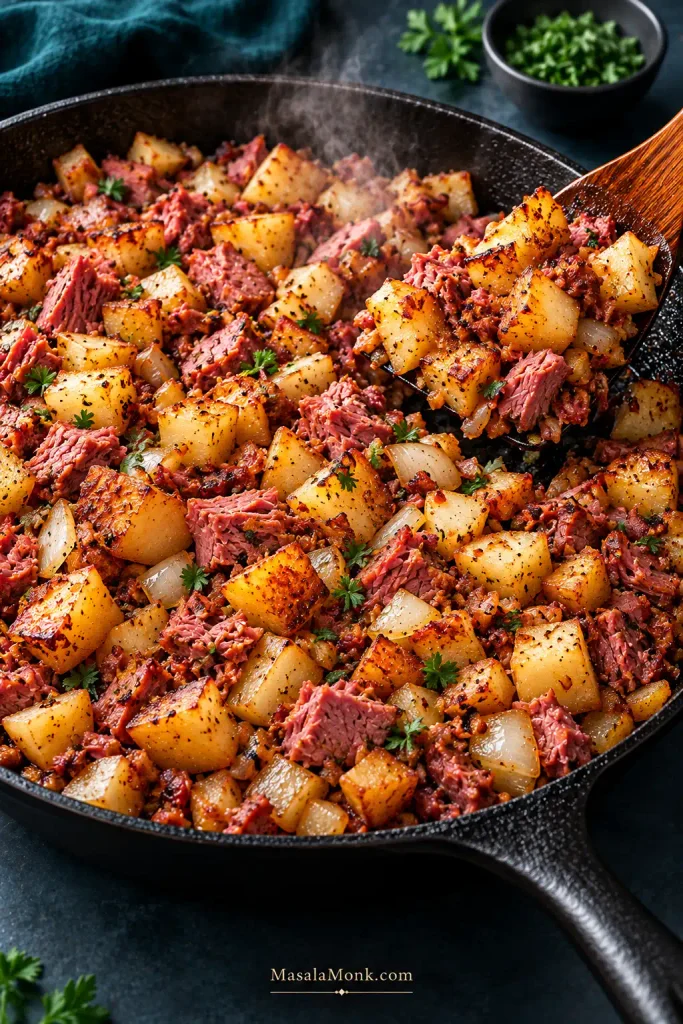
Another easy destination for leftovers is corned beef hash: chop the meat with cooked potatoes and onion, then crisp the mixture in a skillet until the edges brown.
The brisket does not need to know when the cabbage is ready, and the cabbage does not need to wait for the brisket. Once you stop asking the whole Crock Pot to finish at the same moment, this corned beef-and-cabbage dinner becomes much easier to get right.








