Hey there, wellness warriors! Are you ready to level up your electrolyte game with a burst of vibrant flavors and natural healing powers? 🌿✨ Say goodbye to bland hydration and get ready for a cinnamon and turmeric-infused adventure that will leave you feeling rejuvenated and refreshed! 🍃🌶️💦
In this invigorating post, we’re diving deep into the world of DIY electrolyte drinks that harness the incredible benefits of cinnamon and turmeric. These powerful spices not only add a delightful warmth to your beverages but also bring a host of health-boosting properties to support your overall well-being. Get ready to sip your way to natural recovery! 💪💧
Without further ado, let’s explore five tantalizing recipes that will take your electrolyte game to new heights:
🌟 Golden Spice Refresher: The Radiant Recharge ☀️🌟 Kickstart your day with a vibrant blend of coconut water, a dash of cinnamon, a squeeze of fresh lemon, and a drizzle of honey. The combination of cinnamon and lemon adds a zesty and comforting note, while honey brings a touch of natural sweetness. This golden elixir is packed with antioxidants and electrolytes to give you the radiant energy you need to seize the day! ✨🍋
🌶️ Turmeric Zing Fizz: The Revitalizing Sparkler 🔥💥 Prepare for a fizzy adventure with this sparkling concoction! Mix coconut water with a sprinkle of turmeric, a pinch of black pepper (to enhance turmeric’s bioavailability), a squeeze of lime, and top it off with sparkling water. The turmeric adds a warm and earthy flavor, while the lime brings a refreshing twist. Get ready to feel revitalized with every sip of this effervescent delight! 🌟🍹
🍵 Spiced Chai Elixir: The Cozy Replenisher ☕🌿 Indulge in the comforting flavors of a spiced chai-inspired electrolyte drink. Brew a cup of your favorite herbal tea, such as rooibos or green tea, then add a sprinkle of cinnamon, a pinch of turmeric, a dash of nutmeg, and a drizzle of maple syrup. The aromatic spices create a cozy and nourishing beverage that not only hydrates but also soothes your senses. It’s like a warm hug in a mug! 🍵🤗
🥤 Tropical Turmeric Twist: The Exotic Hydrator 🏝️🍹 Transport yourself to a tropical paradise with this delightful blend of coconut water, turmeric, fresh pineapple juice, and a squeeze of orange. The combination of turmeric’s earthiness, pineapple’s sweetness, and orange’s tanginess creates a tropical symphony of flavors. Sip on this exotic elixir, and let your taste buds embark on a mini vacation! 🌴🍍
🌱 Cooling Turmeric Mint Splash: The Refreshing Rejuvenator 🌿❄️ Beat the heat and stay hydrated with this cooling elixir. Infuse coconut water with a hint of turmeric, a handful of fresh mint leaves, a squeeze of lime, and a touch of agave syrup. The turmeric adds its distinctive warmth, while the mint leaves provide a cooling sensation. Sip on this revitalizing concoction to keep yourself cool and refreshed, no matter the temperature outside! 🌞❄️
There you have it, my adventurous friends! These tantalizing recipes are just the beginning of your cinnamon and turmeric-spiced hydration journey. Get creative, tweak the recipes to your liking, and let your taste buds guide you to discover your favorite combinations!
Remember, staying hydrated has never been this delicious and invigorating. Embrace the power of cinnamon and turmeric, and let these natural wonders elevate your wellness journey to new heights.
Stay spiced up and vibrant, my fellow flavor explorers! 🌶️💛✨
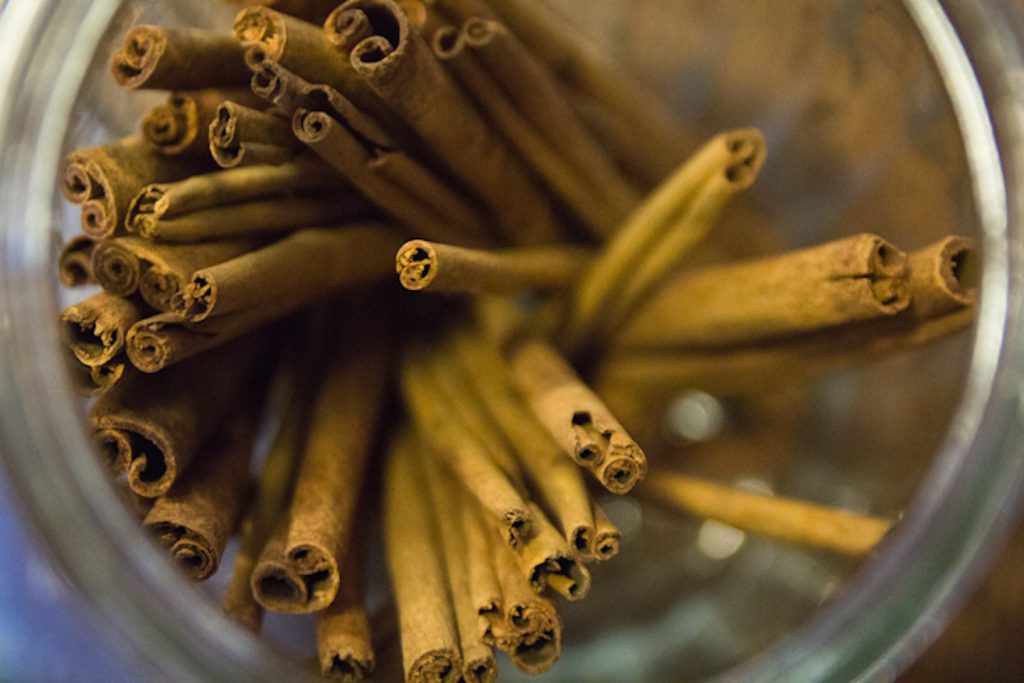
Science reveals that Cinnamon is a real-lLife superhero for most the hair problems!
The aromatic, spicy-sweet, wood-scented cinnamon is an all-natural savior for hair problems. You can use it for hair growth and prevent hair thinning.
If you ever wondered does cinnamon improve hair growth? Can it treat dandruff and slow hair loss? You would be amazed to know that the answer is yes, cinnamon is a boon for hair.
ˇIs Cinnamon Good for Hair?
Cinnamon has been used in various home remedies for hair care, and while scientific research is limited, some believe it can potentially offer a few benefits:
Scalp Health: Cinnamon has antimicrobial properties, which may help combat potential fungus or bacteria on the scalp.
Stimulate Hair Growth: Some people use cinnamon as a treatment intended to stimulate hair growth, as it can cause a tingling sensation thought to draw more blood to the scalp, potentially promoting hair growth. However, there is no scientific evidence to support this claim.
Lighten Hair Color: Some people use cinnamon along with honey as a natural lightener. This mixture is applied to the hair and left on for several hours under a shower cap. Although some people may see results, the effect is not the same for everyone and may not be as dramatic as chemical hair dyes.
However, it’s important to note that cinnamon can potentially cause skin irritation or an allergic reaction in some individuals. It’s a good idea to perform a patch test before applying cinnamon to your scalp: mix a small amount with water, apply it to a small patch of skin, and wait 24 hours to see if there is any reaction.
Finally, while using natural ingredients like cinnamon can be a fun DIY beauty treatment, they are not substitutes for scientifically validated treatments for hair loss or other hair conditions. If you’re experiencing significant hair loss or scalp issues, it’s always best to consult with a dermatologist.
Cinnamon Benefits for Hair
While the scientific research on cinnamon’s benefits for hair health is limited, some people use cinnamon in their hair care routines based on the spice’s properties and anecdotal evidence. Here are some potential benefits:
Scalp Health: Cinnamon has antimicrobial properties that might help fight off scalp fungus or bacteria, potentially reducing dandruff or scalp infections.
Stimulate Hair Growth: Cinnamon can stimulate blood circulation. Increased blood flow to the hair follicles could theoretically promote hair growth, but this has not been conclusively proven in scientific studies.
Hair Lightening: Some people use cinnamon as a natural hair lightener. When combined with honey and conditioner, and left on the hair for several hours, it is believed to subtly lighten hair over time.
May Help with Alopecia: A study published in Dermatology Practical & Conceptual in 2021 showed that a combination of topical cinnamon and rosemary oil improved hair regrowth in individuals with alopecia areata. However, this is a single study, and more research is needed to confirm these effects.
Remember, cinnamon can cause skin irritation, especially in those with sensitive skin, so it’s essential to do a patch test before using it on your scalp or hair. Also, while cinnamon might have some potential benefits for hair, it should not replace regular hair care practices or medically advised treatments for hair and scalp conditions. Always consult with a dermatologist for significant hair or scalp issues.
Cinnamon isn’t a flavorsome spice for your cuisines, but a wonder spice to stimulate hair growth and improve their thickness and texture.
Read on to know how beneficial cinnamon for the hair is:
1. Stimulates Hair Growth
Cinnamon contains procyanidin which stimulates hair follicles for faster growth. A study investigated procyanidin for its effect on hair growth. Several older studies also showed a relationship between procyanidin and faster hair growth. But, the procyanidin extract used in studies was taken from apple juice.
Cinnamon oil also helps increase hair length. A rat study found that cinnamon oil was effective in increasing hair length in male rats.
In fact, cinnamon oil is as much effective as minoxidil. What makes cinnamon equally potent is cinnamaldehyde. It is a compound that improves blood circulation and increases blood supply to hair follicles.
2. Reduces Hair Loss
Hair loss happens due to reduced blood flow and, so, nutrient supply to hair follicles. And the secret compound is cinnamaldehyde present in cinnamon. It dilates blood vessels for improves flow to the head and hair follicles.
Furthermore, the rat study mentioned above also confirmed its effect on blood circulation, leading to reduced hair fall.
3. Treats Dandruff
Cinnamon has anti-fungal properties that combat dandruff-causing fungi. As per research, cinnamon fights Malassezia, the dandruff-causing fungus.
Moreover, cinnamon contains natural antioxidants ‘polyphenols’. Their anti-oxidative and antimicrobial properties help treat scalp infections.
4. Prevent Hair Damage & Treats Alopecia
The procyanidins in cinnamon have anti-inflammatory and antioxidant properties. These combat oxidative damage, inflammation, and irritation. The scalp-protective properties are also helpful in inducing the anagen phase (active hair growth). A study concluded that cinnamon helped in significant hair growth in men with alopecia.
5. Nourishes Scalp
A study showed cinnamon extract and ground cinnamon to have incredible exfoliating properties. So, cinnamon water or cinnamon DIYs help deep cleanse the scalp naturally. It removes dirt and debris that clogs your hair follicles and prevents hair growth. A healthier scalp helps in improving hair health, that is, improved texture and thickness.
Moreover, cinnamon improves circulation to the scalp. It helps provide the necessary nourishment to hair follicles.
Can I add Cinnamon to my Hair oil?
Yes, you can add a teaspoon of ground cinnamon to 2-3 tablespoons of hair oil. Massage it into the scalp for increased blood flow to the scalp and a better supply of oxygen and nutrients to hair follicles.
But make sure to do a patch test before using powdered cinnamon.
You can also add cinnamon oil to hair oil as it’s no less than an organic restorative drug.
How Do You Use Cinnamon on Your Scalp?
Applying cinnamon to the scalp can improve blood circulation and nourishes your hair follicles. There are several DIY cinnamon hair masks that you can apply to your scalp. Each mask is loaded with its benefits like hair growth, scalp cleansing, and dandruff removal.
Side Effects of using Cinnamon for the Hair
Sometimes, cinnamon oil or ground cinnamon can have certain side effects on the scalp. You may have an allergic reaction.
Thus, it’s recommended to do a patch test before use. Rub the DIY mask or oil to the inside of the elbow and wait for 1-2 days.
A few other rarely possible side effects of cinnamon are:
Rash and redness
Burning sensation
Skin irritation (contact dermatitis)
To cut allergic reactions to cinnamon oil, its recommended to dilute it before use.
Final Verdict
Hair is the crown of our head, nobody likes damaged, dried, dull or weak hair. Cinnamon boosts blood circulation to hair causing fast growth. Along with that it also helps people exposed to chemotherapy or suffering from alopecia to witness their hair grow back.
—————————————- Also Check Out ————————————-
To know how Cinnamon can be used and to see some examples of food products that are made using it, Click here
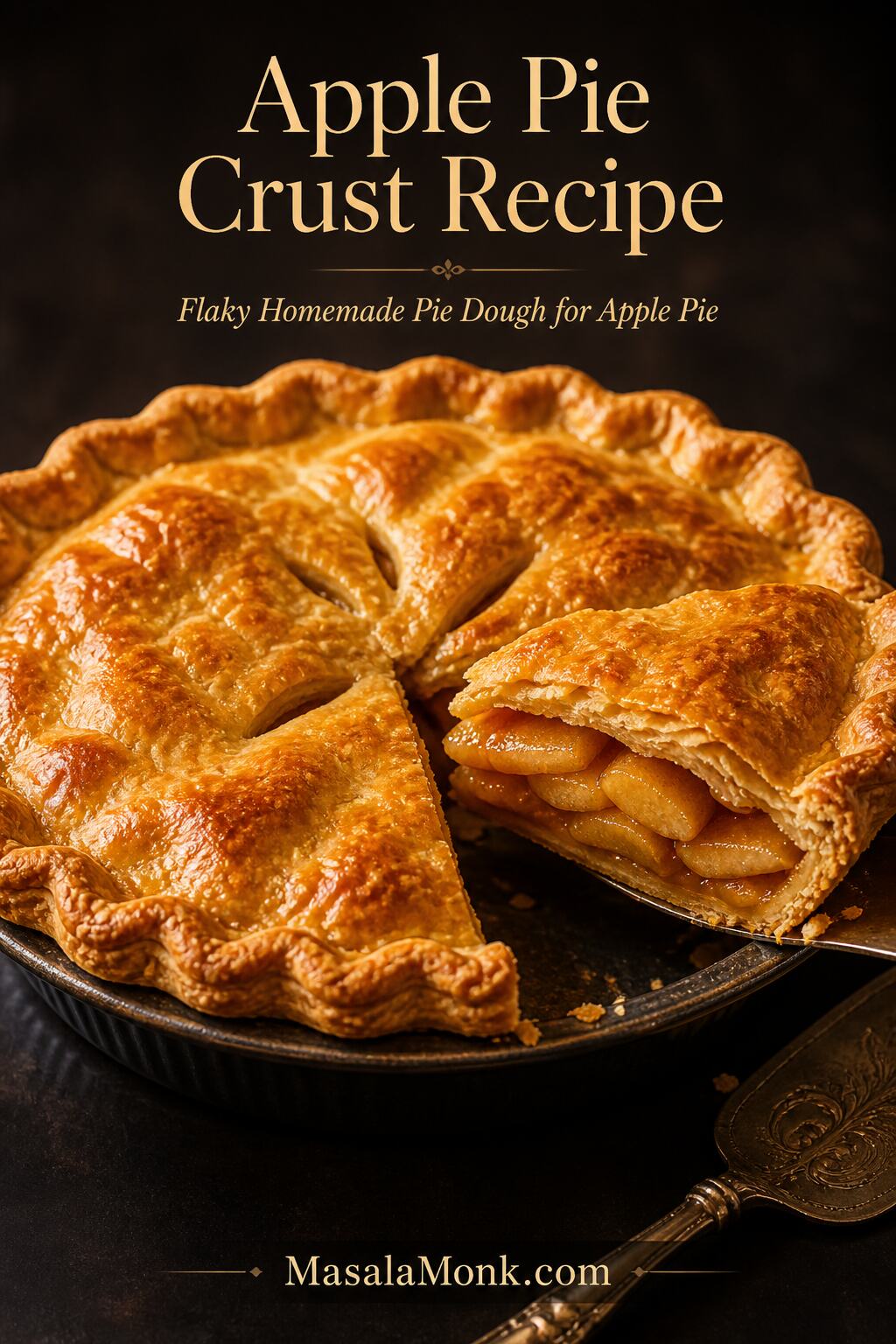
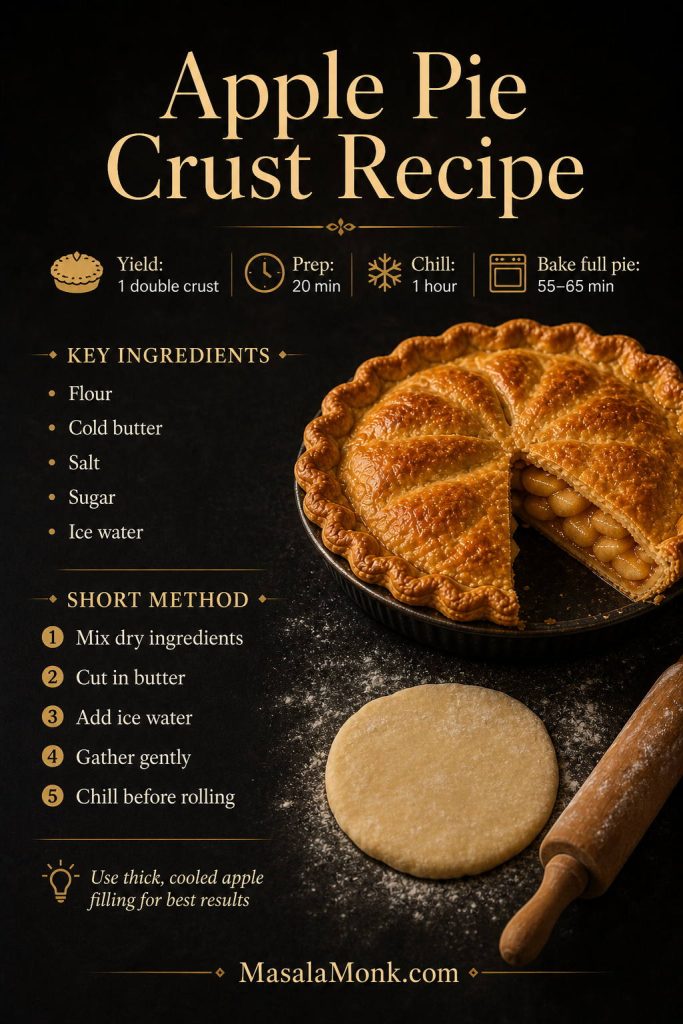
A good apple pie crust recipe should give you dough that is buttery, flaky, and strong enough to hold a juicy apple filling without turning tough or soggy. The crust is often the part that makes people nervous: butter softens, dough cracks, bottoms turn pale, and filling leaks where it should not. However, once the dough is cold enough and hydrated just enough, the whole process becomes much calmer.
This homemade pie dough is made for a classic 9-inch / 23-cm apple pie. It gives you enough for a bottom crust and a top crust, so you can make a full double-crust pie, a lattice pie, or a single-crust pie if you want to save the second disk for later. Because apple filling is heavier and juicier than many dessert fillings, the dough needs to be tender without being weak.
The method is simple, but the details matter. Keep the butter cold, add the water slowly, chill the dough before rolling, and avoid stretching it into the pie plate. Then, when you are ready to fill it, use a thick and cooled filling like this homemade apple pie filling recipe so the bottom crust has a better chance of baking up crisp and flaky.
The goal here is not a fancy pastry-school crust. It is a reliable apple pie crust that rolls without falling apart, seals cleanly around the filling, and bakes up flaky enough for a holiday pie. If the dough cracks a little or needs a patch, that is fine. Pie crust is more forgiving than it looks once you keep the butter cold and stop trying to make the dough perfectly smooth.
The best crust for apple pie is a flaky, buttery pie dough that can hold fruit filling without collapsing, cracking apart, or turning soggy on the bottom. For a classic 9-inch / 23-cm apple pie, make a double batch of dough: one round for the bottom crust and one for the top crust or lattice.
This apple pie crust recipe uses all-purpose flour, cold butter, salt, a little sugar, and ice water. The butter gives the crust its rich flavor and flaky layers. Meanwhile, the chill time helps the dough relax, roll more cleanly, and shrink less once it hits the oven.
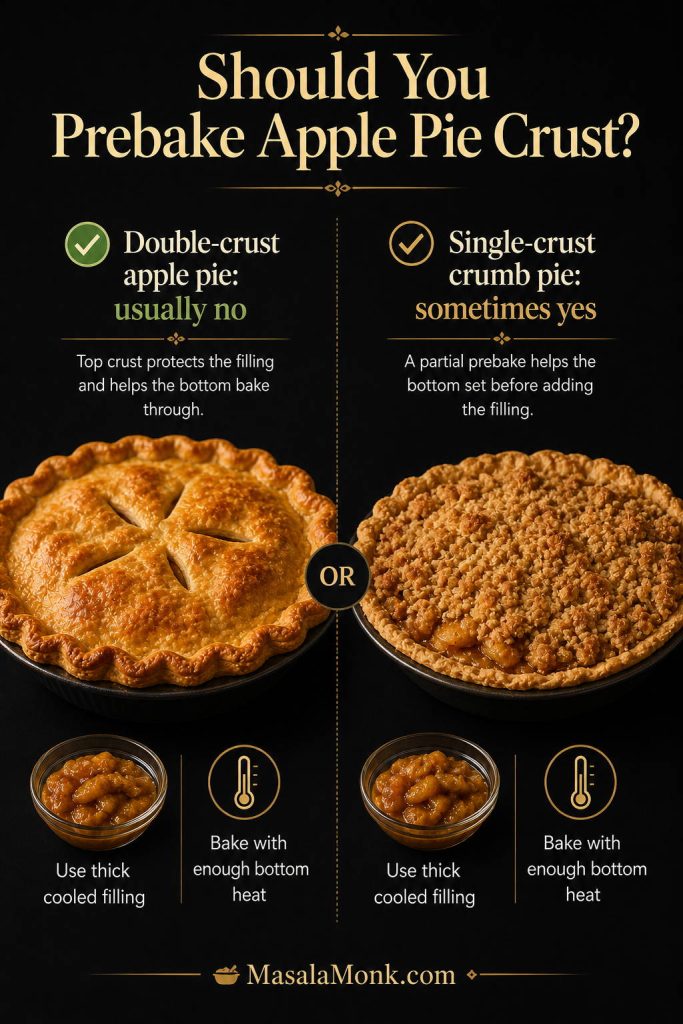
For a traditional double-crust apple pie, you usually do not need to prebake the bottom crust. Instead, use a filling that is thick rather than watery, let it cool before adding it to the pastry, vent the top crust, and bake until the crust is deeply golden. If you are making a single-crust apple pie with crumb topping, partial prebaking can sometimes help the bottom stay crisp.
A crust choice is not just decoration. It changes how the pie bakes, how steam escapes, and how sturdy the slices feel later. A double-crust pie, a crumb-topped pie, a graham cracker crust pie, and a puff pastry apple dessert all need slightly different handling, so it helps to choose the direction before you start rolling dough.
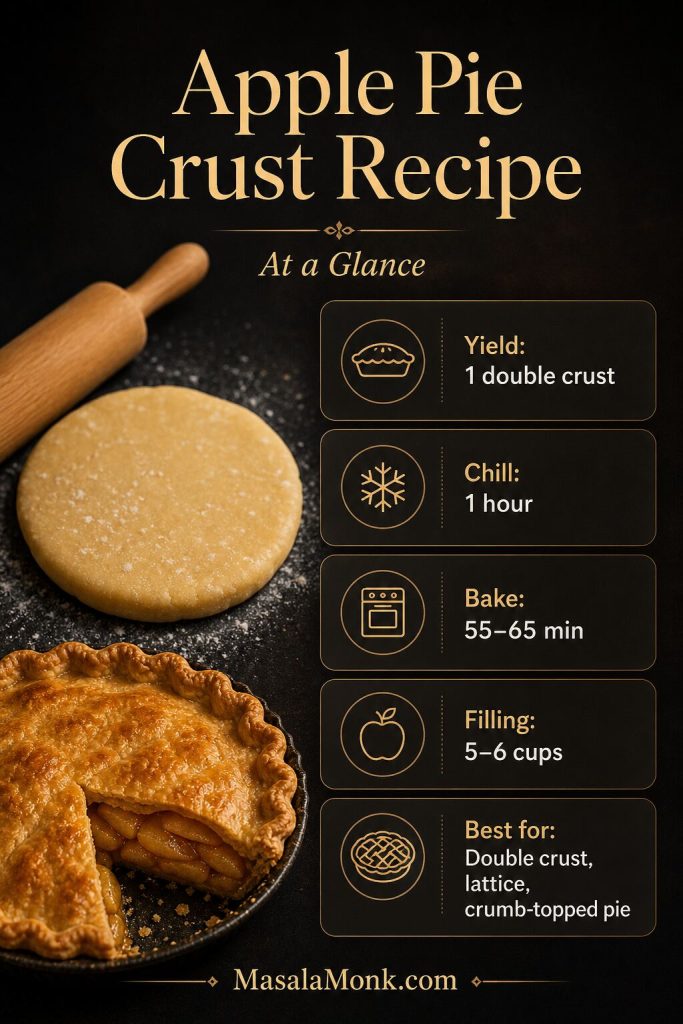
Yield: this recipe makes enough crust for one 9-inch / 23-cm apple pie or two single-crust pies Best for: classic apple pie, lattice pie, and crumb-topped single-crust pie Dough chill time: at least 1 hour Rest before rolling: 5 to 10 minutes if the dough is very firm Assembled pie chill: 15 to 20 minutes if the dough has softened Full pie bake time: about 55 to 65 minutes, plus 2 to 3 hours cooling Filling amount: 5 to 6 cups / about 1.1 to 1.4 kg / 2.5 to 3 lb cooled apple pie filling Prebake? Usually no for double-crust apple pie; sometimes yes for single-crust crumb pies
Before you start, check the timing and yield. This apple pie crust recipe makes one double crust, needs at least 1 hour of chilling, and works best with thick cooled apple filling.
Apple Pie Crust Help
Use these sections to make flaky pie dough, choose the right crust style, and fix the most common apple pie crust problems.
Apple pie is harder on crust than it looks. The filling is juicy, the bake time is long, and the bottom pastry has to hold up while the apples soften and bubble. Because of that, a crust that works for a cream pie or a tiny tart may not always behave the same way under a heavy apple filling.
In this apple pie crust recipe, cold butter, careful hydration, and enough chill time work together. None of those details is complicated on its own, but together they make the dough easier to roll and much less likely to bake up tough or greasy.
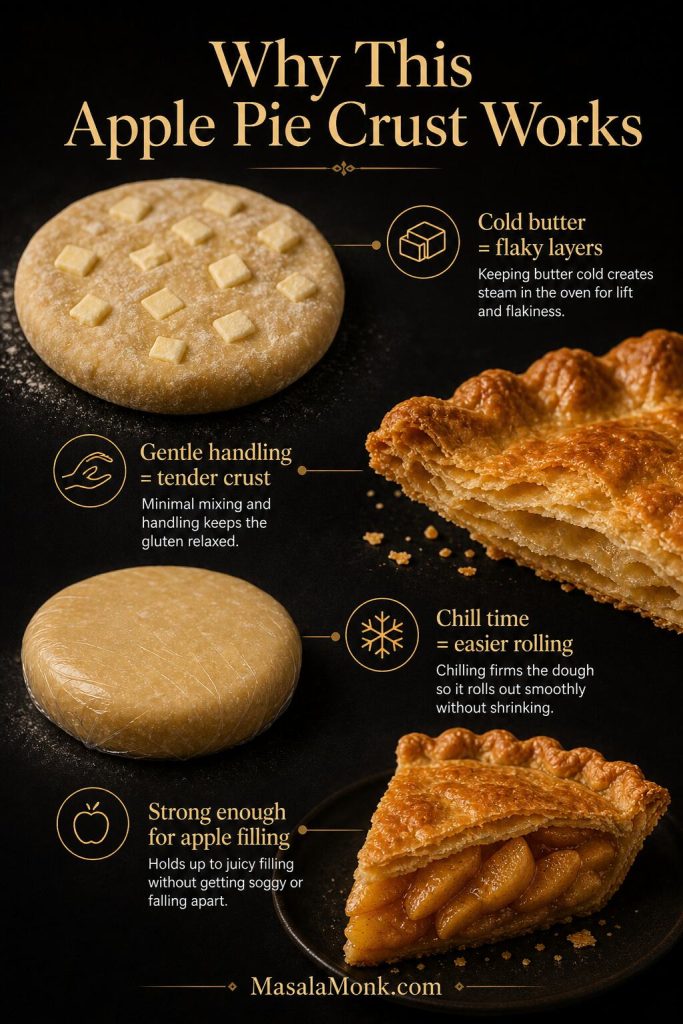
Cold butter creates flaky layers
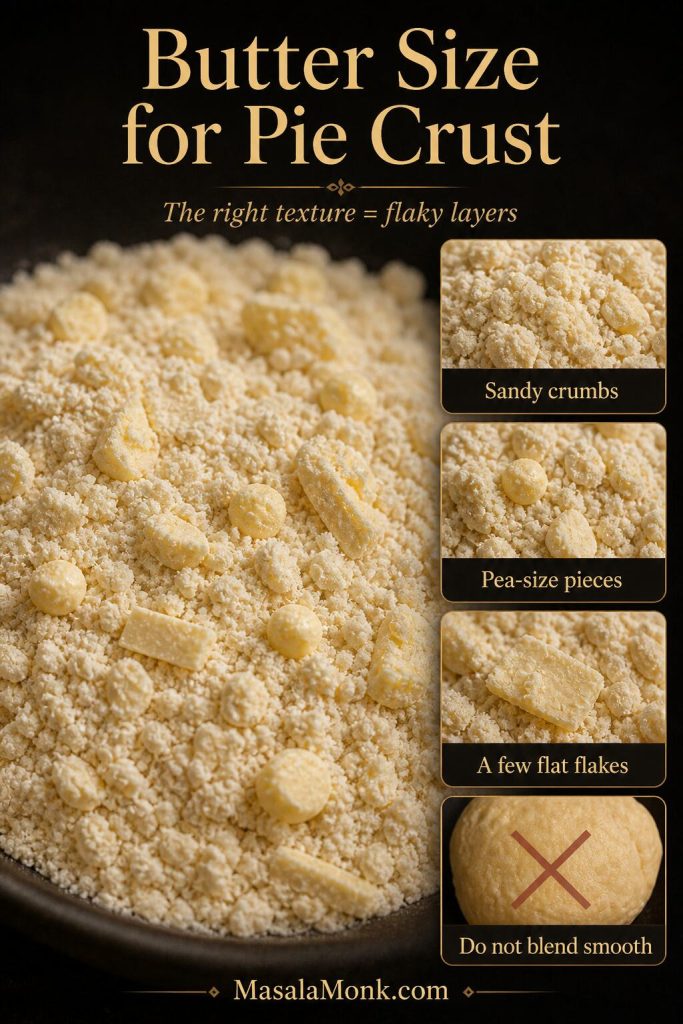
Cold butter does most of the visible work. As the pie bakes, the butter melts and releases steam, which helps separate the dough into flaky layers. That is why you want sandy crumbs, pea-size butter pieces, and a few flat flakes instead of a perfectly smooth mixture.
If the butter gets too warm before baking, it can melt into the flour too early. Then the crust may taste rich, but it will not have the same light, flaky structure. So whenever the dough feels soft or greasy, chilling is the fix.
Gentle handling keeps the crust tender
Flour gives the pastry enough structure to hold apple filling, but too much mixing can make the crust tough. The goal is to bring the dough together just until it holds when pressed, not to knead it until it looks smooth.
A little sugar helps with browning, while salt keeps the crust from tasting flat. Meanwhile, slow hydration helps you avoid adding too much water, which is one of the most common reasons homemade pie dough turns hard instead of tender.
Chill time makes the dough easier to roll
Resting the dough gives the flour time to hydrate and the butter time to firm up again. As a result, the dough rolls more smoothly, seals more easily, and shrinks less in the oven.
You do not need a food processor for this dough. A bowl, your fingertips, a pastry cutter, or two forks are enough, and working by hand also makes it easier to feel when the butter and water are right.
Once those details are handled, the crust becomes reliable enough for a classic apple pie: sturdy around the fruit filling, tender at the bite, and flaky enough to feel properly homemade.
This dough works because the butter stays cold, the dough is handled gently, and the chill time lets it relax. As a result, the crust rolls more easily and bakes into flaky layers.
Before You Start: What Matters Most
If you remember only three things, keep the butter cold, add water slowly, and do not stretch the dough into the pie plate. Everything else is easier to fix. A small crack can be patched, a sticky dough can be chilled, and uneven edges can be trimmed after the crust is in the plate.
A perfect-looking dough disk is not the goal. You want dough that is cold, lightly hydrated, and just gathered enough to roll. Once it rests, it becomes easier to handle.
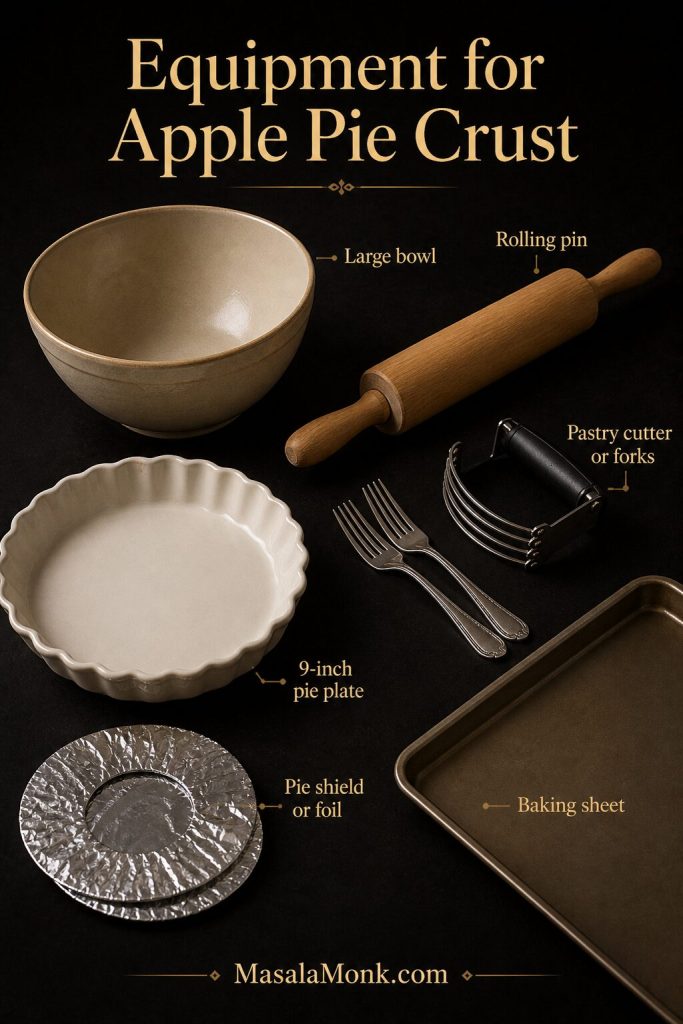
Equipment You Need
You do not need special equipment for this apple pie crust recipe, but a few basic tools make the dough easier to handle. If you do not have a pastry cutter, use your fingertips or two forks instead.
Tool
Why it helps
Large mixing bowl
Gives you enough room to toss the flour, butter, and water without overworking the dough.
Pastry cutter, fork, or fingertips
Helps cut cold butter into the flour without needing a food processor.
Rolling pin
Rolls the dough into a 12- to 13-inch / 30- to 33-cm round.
9-inch / 23-cm pie plate
The recipe is sized for a standard 9-inch apple pie.
Baking sheet
Catches drips and can help give the bottom crust stronger heat.
Foil or pie shield
Protects the edges if they brown before the center is done.
You do not need fancy pastry tools for homemade apple pie crust. However, a rolling pin, mixing bowl, pie plate, baking sheet, and simple shield for the edges make the process much easier.
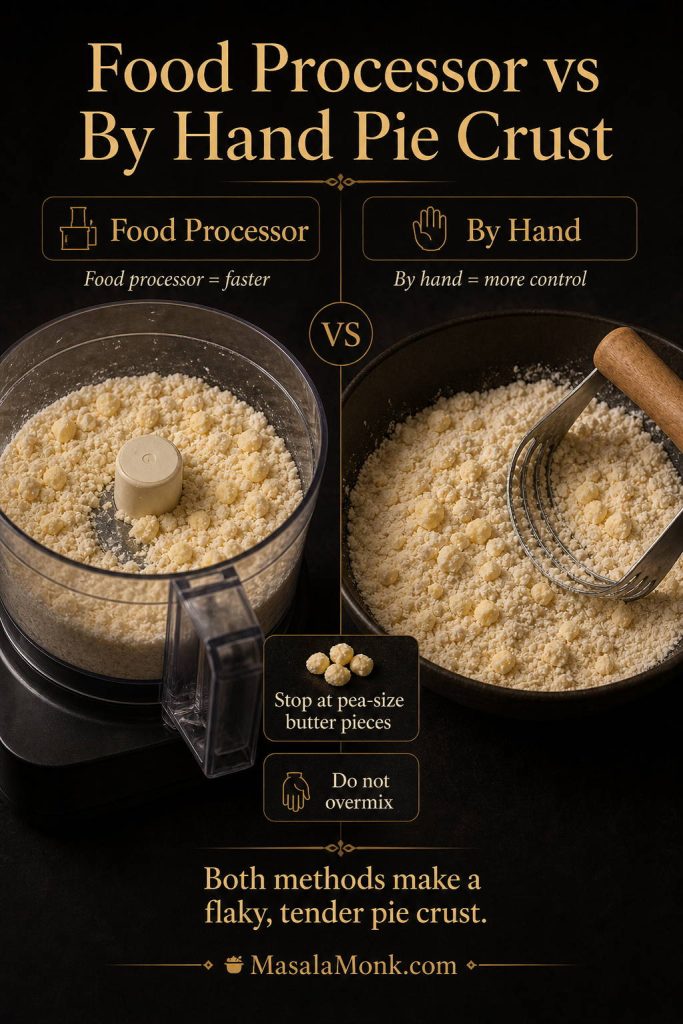
Can You Make Pie Crust in a Food Processor?
Yes, a food processor can make apple pie crust faster, but it also makes overmixing easier. Pulse the flour, salt, and sugar first, then add the cold butter and pulse only until pea-size pieces remain. After that, add ice water slowly and stop as soon as the dough begins to clump.
By hand, you get more control because you can feel the butter and dough changing as you work. In a food processor, the key is restraint: do not let the dough turn into a smooth ball in the machine. Once it reaches the shaggy stage, finish gathering it by hand.
A food processor is faster, but mixing by hand gives you more control. Either way, stop when pea-size butter pieces remain, because overmixing can make the crust tough.
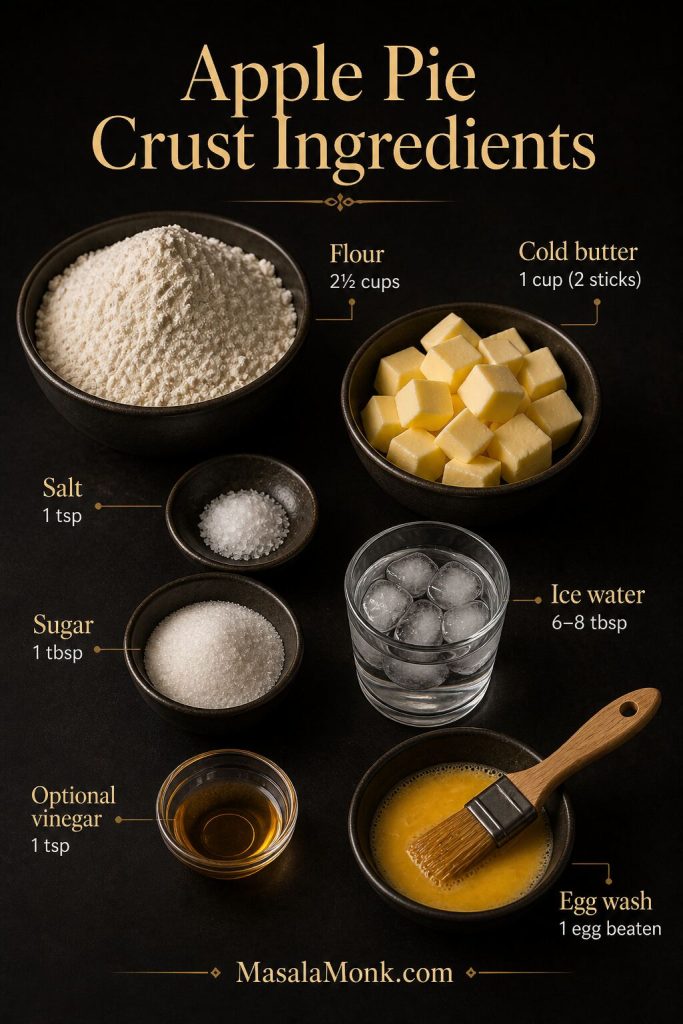
Apple Pie Crust Ingredients
You only need a few ingredients for this apple pie crust recipe, but each one affects the final texture. Since pie dough is so simple, measuring carefully and keeping everything cold will make a noticeable difference.
Because pie dough has so few ingredients, each one matters. Cold butter creates flakiness, flour gives structure, and ice water brings the dough together without making it tough.
All-purpose flour
All-purpose flour gives the crust enough strength to hold apple filling without making the pastry heavy. If you use cups, spoon the flour into the measuring cup and level it off. Otherwise, too much flour can make the dough dry, crumbly, and difficult to roll.
Cold unsalted butter
Butter gives the crust its best flavor. It also helps create those flaky layers that make homemade pastry worth the effort. Cut the butter into small cubes, then keep it cold until you are ready to mix. You want a mix of sandy crumbs, pea-size butter pieces, and a few flatter flakes of butter in the dough.
Most importantly, do not work the butter in until it disappears completely. Those visible butter pieces may look imperfect, but they help the crust bake up flaky instead of dense.
Instead of blending the butter completely into the flour, leave a mix of sandy crumbs, pea-size pieces, and a few flat flakes. Those uneven butter pieces help create a flaky pie crust.
Salt
Salt keeps the pastry from tasting dull. Even though apple pie is sweet, the crust still needs balance. Without enough salt, the butter flavor and apple filling will both taste flatter.
A little sugar
Sugar is not always necessary in pie crust, but it works well here because it helps the dough brown and adds a gentle warmth to the pastry. Use only a small amount, though. The crust should still taste like pastry, not like a cookie.
The crust itself stays simple, but the filling can lean warmer if you like more spice. Cinnamon is usually enough for apple pie, although a small pinch of homemade pumpkin pie spice can add ginger, nutmeg, allspice, and clove notes.
Ice water
Ice water brings the dough together. Add it slowly, because flour does not always absorb the same amount of water every time. On a humid day, you may need less. In a dry kitchen, you may need a little more. So the feel of the dough matters more than the exact tablespoon count.
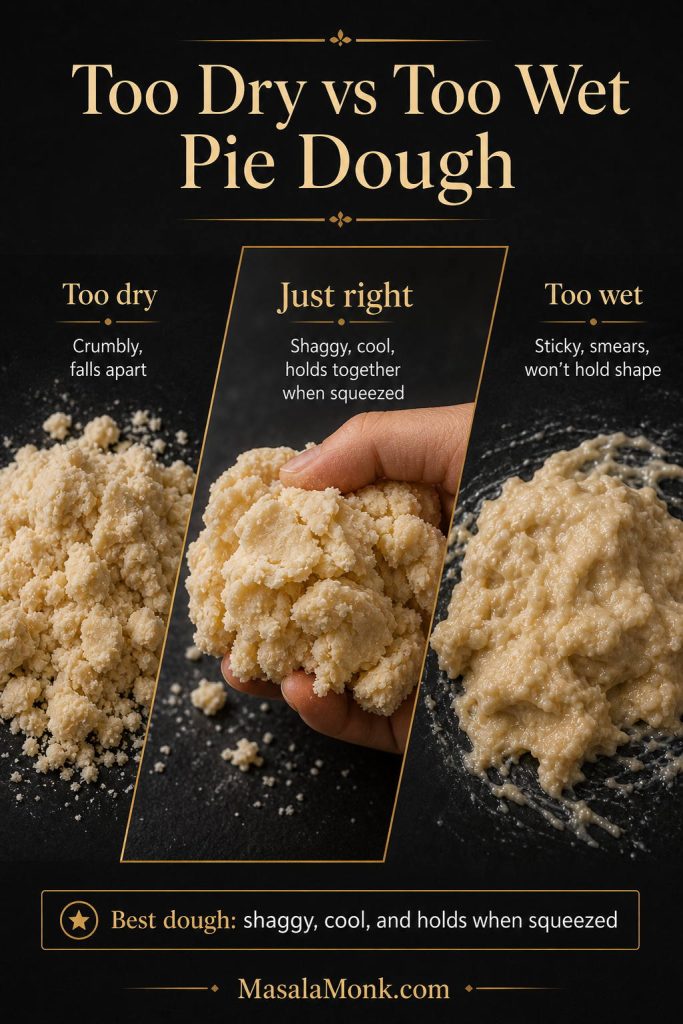
The dough is ready when it holds together after you squeeze it in your hand. It should still look shaggy, not wet or smooth.
Optional apple cider vinegar
A small splash of apple cider vinegar can make the dough a little more forgiving. It is optional, and the crust will not taste sour. However, if you often end up with tough pastry, it can be a helpful backup.
Egg wash
Egg wash is used after the pie is assembled, not inside the dough. It helps the top crust bake up glossy and golden. For a simple finish, beat one egg with a tablespoon / 15 ml of milk or water, then brush it lightly over the chilled top crust before baking.
The main rule in any good apple pie crust recipe is simple: keep the butter cold and handle the dough gently. You are not kneading bread dough. Instead, you are bringing pastry together just enough so it can roll, chill, and bake into flaky layers.
If pie dough has ever cracked on you or turned sticky halfway through rolling, you are not doing anything unusual. Most crust problems are temperature problems. Chill the dough, use a little flour, patch what tears, and keep going.
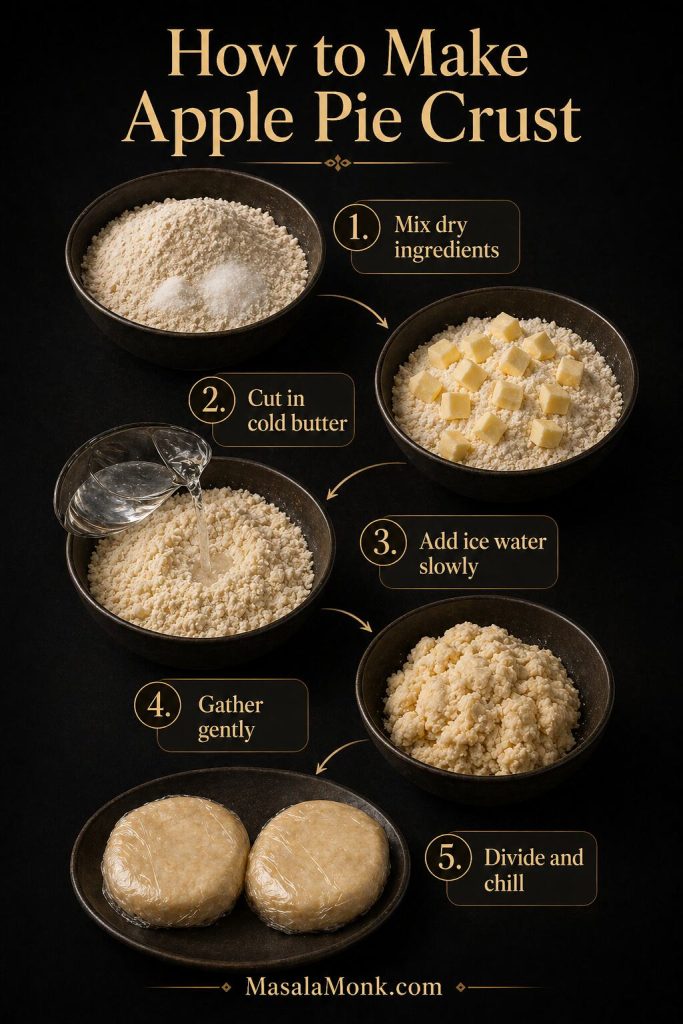
The method is simple, but the order matters. First mix the dry ingredients, then cut in cold butter, add ice water slowly, gather gently, and chill before rolling.
1. Mix the dry ingredients
Add the flour, salt, and sugar to a large mixing bowl. Then whisk them together so the salt and sugar are evenly distributed before the butter goes in.
This step is quick, but it matters. If the salt is not mixed evenly, some bites of crust can taste bland while others taste too salty.
2. Cut in the cold butter
Add the cold butter cubes to the flour mixture. Use your fingertips, a pastry cutter, or two forks to work the butter into the flour. Stop when the mixture has sandy crumbs, pea-size butter pieces, and a few thin, flat flakes of butter.
At this stage, the mixture should not look smooth. In fact, a little unevenness is useful because those butter pieces create steam pockets in the oven. If the butter starts to soften or smear, place the bowl in the refrigerator for 10 to 15 minutes before moving on.
3. Add ice water slowly
Drizzle in 1 tablespoon / 15 ml of ice water at a time, tossing the mixture with a fork after each addition. At first, the dough will look dry and loose. After several tablespoons, it will begin to clump together.
Stop adding water when a handful of dough holds together when squeezed. If the dough is sticky in the bowl, it has probably gone too far. On the other hand, if it falls apart completely, add another teaspoon or two of water and toss again.
4. Bring the dough together
Turn the shaggy dough onto a lightly floured surface. Then gather it gently with your hands and press it together until no large dry patches remain. Avoid kneading it smooth, because too much handling can make the crust tough.
If a few crumbly spots remain, press them into the dough with your hands. If needed, dampen your fingers lightly and pat the dry spots together. However, do not add water just to make the dough look neat. Pie dough should look a little rough before it chills.
5. Divide and chill the dough
Divide the dough into two equal pieces. Shape each piece into a flat disk about 1 inch / 2.5 cm thick. A disk chills faster and rolls more evenly than a ball of dough, so this small step makes rolling easier later.
Wrap each disk tightly and refrigerate for at least 1 hour. During that time, the flour hydrates, the butter firms up again, and the gluten relaxes. As a result, the dough becomes easier to roll and less likely to shrink in the oven.
Apple Pie Dough Texture Checkpoints
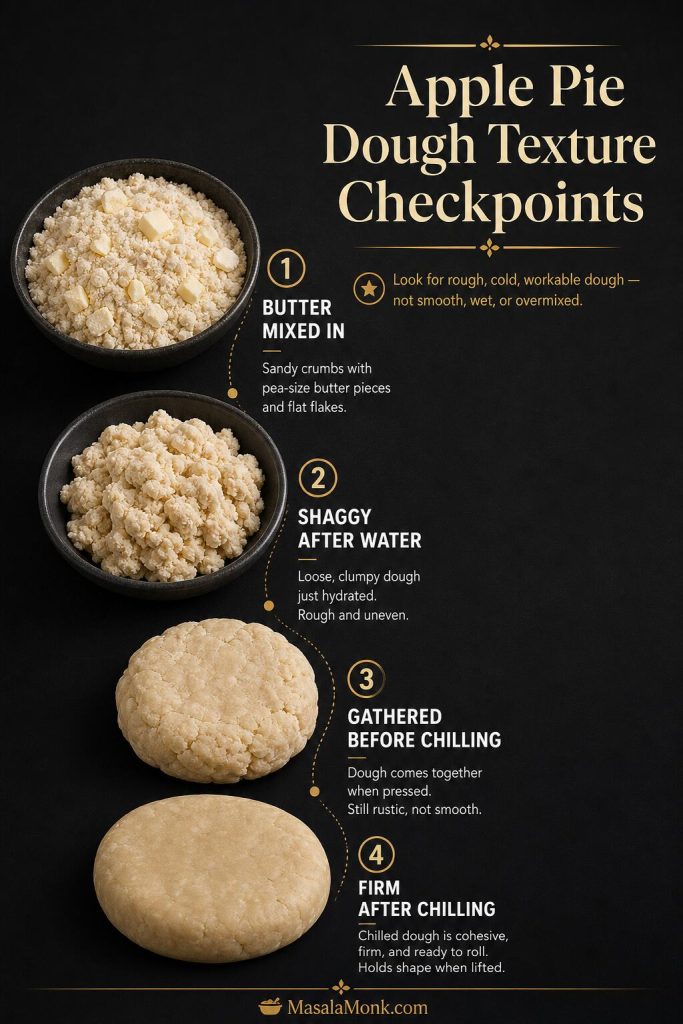
Pie dough is easier when you know what each stage should feel like. Instead of trying to make it look perfect, use these checkpoints as you work.
Stage
What it should look or feel like
What to do if it is wrong
Butter mixed into flour
Sandy crumbs with pea-size pieces and a few flat flakes of butter
If the butter smears, chill the bowl for 10 to 15 minutes.
After adding water
Shaggy dough that holds together when squeezed
If it falls apart, add water 1 teaspoon at a time.
Before chilling
Rough but gathered, not smooth or sticky
If sticky, dust lightly with flour and chill sooner.
After chilling
Firm but rollable after a few minutes at room temperature
If it cracks hard, rest it 5 more minutes before rolling.
Each stage should look rough, cold, and workable rather than smooth or wet. Press a small handful together; when it holds without smearing, the dough is usually hydrated enough.
Crumbly dough usually needs ice water a teaspoon at a time. Sticky or smeary dough usually needs chilling instead. The best pie dough is shaggy, cool, and firm enough to hold when squeezed.
How to Roll Apple Pie Dough
Let the chilled dough soften slightly
Once the dough has chilled, let one disk sit at room temperature for 5 to 10 minutes if it feels too firm to roll. It should be cool but not rock-hard. If it cracks immediately under the rolling pin, give it another minute or two.
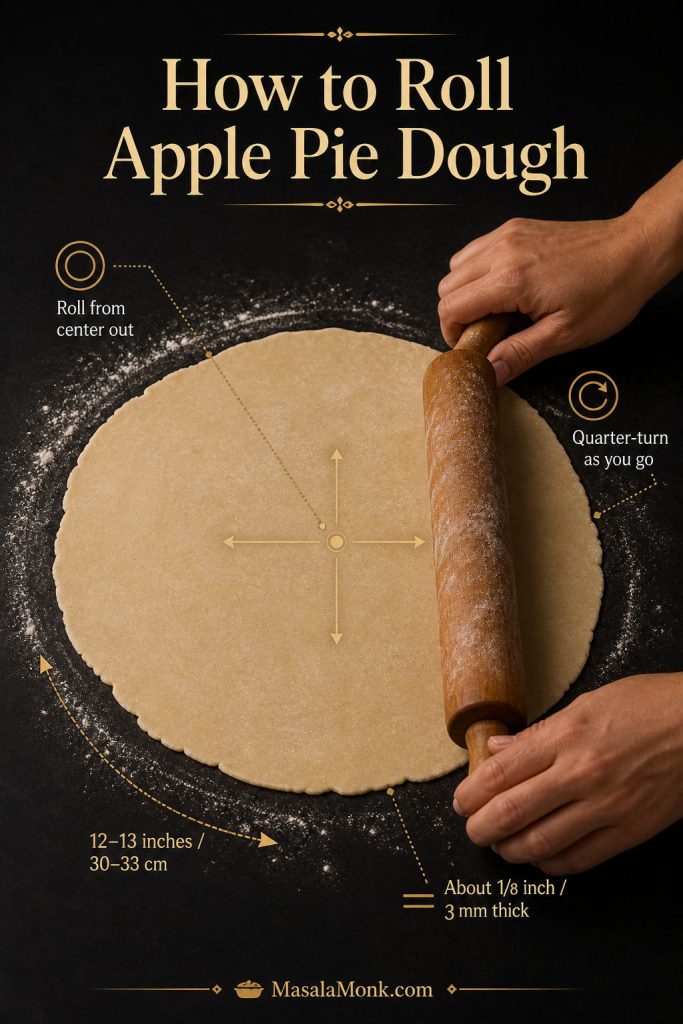
Lightly flour your work surface and rolling pin. Then roll from the center outward, rotating the dough a quarter turn every few rolls. This keeps the round even and helps prevent sticking without forcing the dough into shape.
For a 9-inch apple pie, roll the dough from the center outward and turn it as you go. This keeps the crust round, even, and wide enough to fit the pie plate without stretching.
Roll to the right size and thickness
For a 9-inch / 23-cm apple pie, roll the bottom crust into a 12- to 13-inch / 30- to 33-cm round. Aim for a crust that is about 1/8 inch / 3 mm thick. If it is much thicker, it may bake up heavy; if it is much thinner, it can tear or soften under the filling.
For this apple pie crust recipe, that size gives you enough dough to settle into the pie plate and still leave a little overhang for trimming and crimping. Add small amounts of flour only as needed, because too much loose flour can make the crust dry.
Fit the dough without stretching it
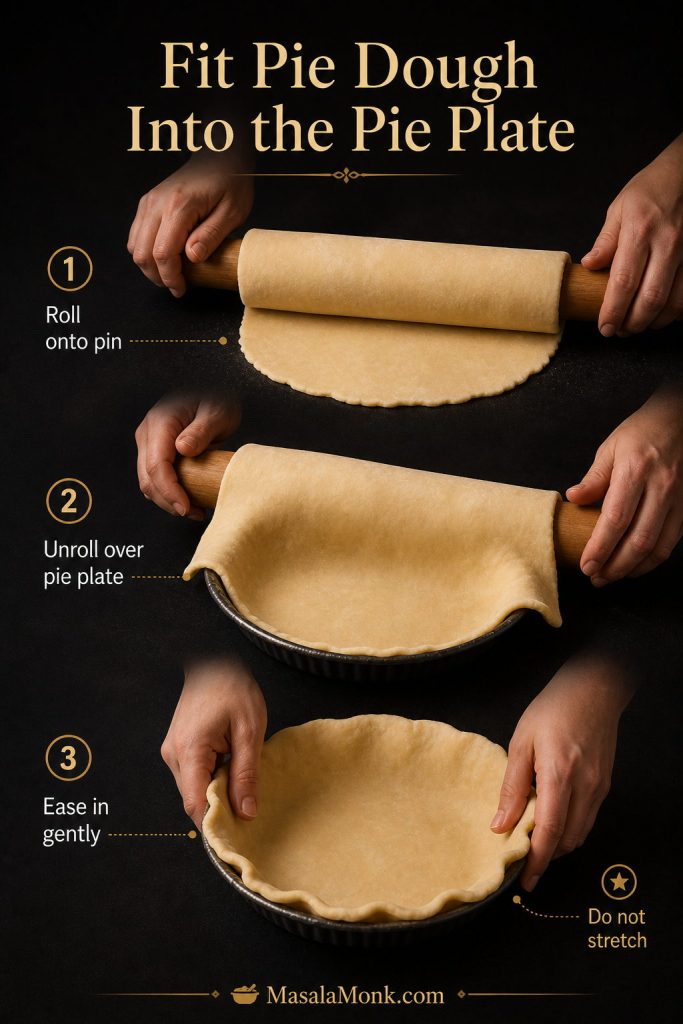
To transfer the dough, loosely roll it around the rolling pin, then unroll it over the pie plate. After that, ease the dough into the bottom and sides without pulling it tight. Stretching may seem harmless, but it is one of the most common reasons pie crust shrinks while baking.
Once the dough is rolled, move it gently instead of pulling it into place. Rolling it over the pin, unrolling it over the plate, and easing it in helps prevent shrinking.
If the dough tears, patch it with a small piece from the edge and press it gently into place. Once the filling goes in and the pie bakes, small patches will not matter.
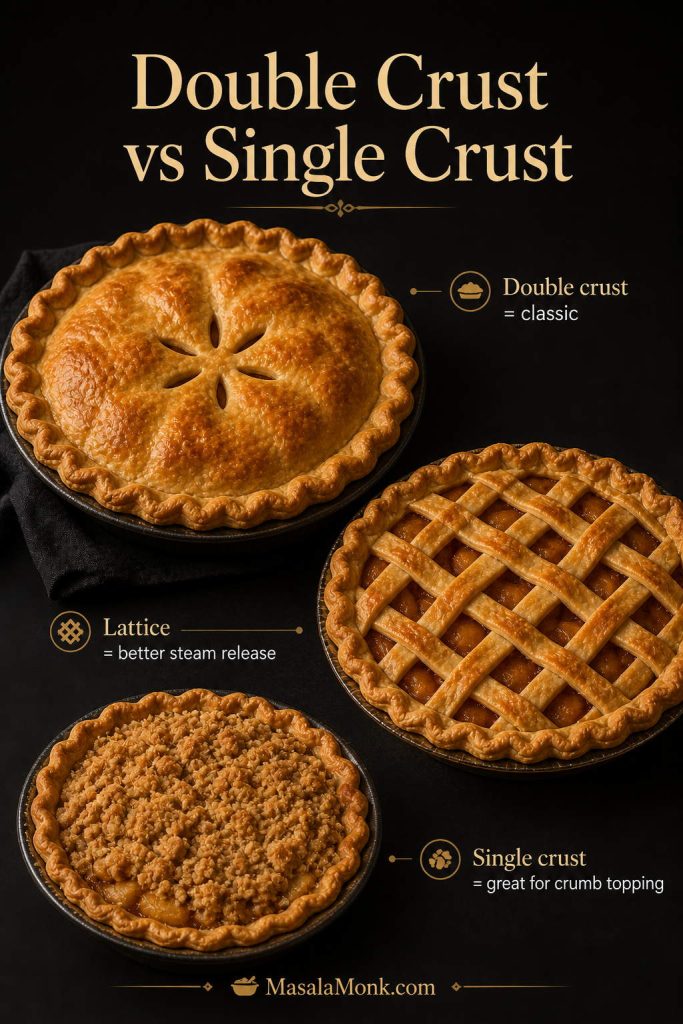
Classic apple pie is usually a double-crust pie, which means it has a bottom crust and a top crust. However, not every apple pie needs two pastry layers. A crumb-topped pie, for example, only needs a bottom crust, while a graham cracker crust pie behaves more like a no-roll dessert.
Crust style
Best for
What to know
Double crust
Classic apple pie
Uses one crust on the bottom and one on top. It is the most traditional choice for homemade apple pie.
Lattice crust
Apple pies with juicy filling
Looks beautiful and lets steam escape through the open spaces, which can help the filling bake evenly.
Single crust
Crumb topping or Dutch apple pie
Easier than a double crust and useful when you do not want to roll a top crust.
Graham cracker crust
No-roll apple pie
Better for crumb-topped apple pie than for a classic sealed double-crust pie.
Puff pastry
Quick apple desserts
More tart-like or turnover-like than traditional apple pie crust.
A double crust gives apple pie its classic look, while lattice helps steam escape. Meanwhile, a single crust works beautifully when you want a crumb-topped apple pie.
If you are making homemade apple pie for the first time, a double crust or lattice crust is the safest place to start. Both use the same dough, and both pair well with a thick apple filling.
Full Top Crust, Lattice, or Crumb Topping?
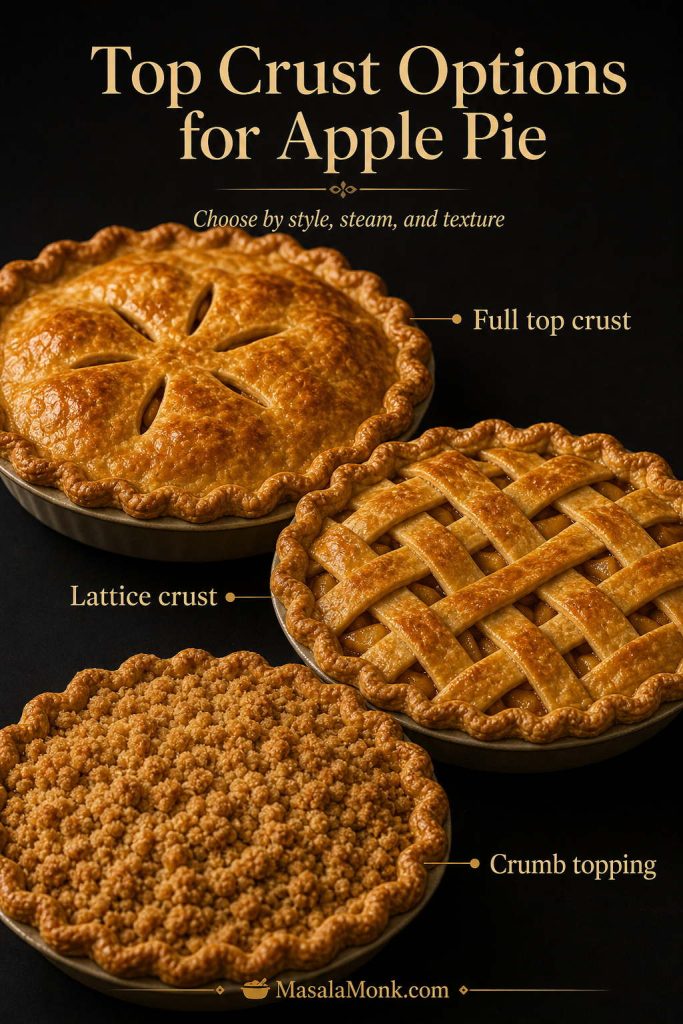
A full top crust gives apple pie its most traditional look. After adding the filling, roll out the second disk of dough, lay it over the apples, trim the overhang, seal the edges, and cut vents in the top. Those vents are important because apple filling releases steam as it bakes.
A lattice crust is slightly more decorative, but it is not only for looks. Because the top is open in places, steam can escape naturally. To make a lattice, roll the second disk of dough, cut it into strips, weave the strips over the filling, and then seal and crimp the edges.
A crumb topping changes the pie completely. Instead of covering the apples with pastry, you cover them with a buttery crumble. This is closer to Dutch apple pie or apple crumble pie. It is also a good choice when you want a single-crust apple pie or when you do not feel like rolling a top crust.
For a classic apple pie, this crust works as a full top, lattice, or single bottom layer with crumb topping. If you use only one disk for a crumb-topped pie, wrap and freeze the second disk for another bake.
The top crust changes more than appearance. A full crust feels classic, a lattice lets steam escape, and crumb topping gives a softer, buttery contrast to the apple filling.
Should You Prebake Apple Pie Crust?
For a traditional double-crust apple pie, you usually should not fully prebake the bottom crust. Once the bottom crust is baked, it becomes harder to seal it to a raw top crust. In addition, a classic apple pie bakes long enough for the bottom crust to cook through as long as the filling is not too wet.
Instead of fully prebaking, focus on the details that help this apple pie crust recipe bake properly: use cooled filling, keep the dough cold, avoid stretching it, bake long enough, and place the pie where it gets enough bottom heat.
Single-crust apple pie is different. If you are making a pie with crumb topping, partial prebaking can help when your bottom crust often turns pale or soft. Since there is no raw top crust to seal, you have more flexibility. King Arthur’s guide to prebaking pie crust makes the same practical distinction between single-crust pies and double-crust fruit pies.
Also, do not poke holes in the bottom crust for a raw fruit pie unless you are blind baking it first. Docking is useful for some empty crusts, but in a juicy apple pie, those holes can let filling leak underneath the pastry.
Simple rule: do not fully prebake crust for classic double-crust apple pie. However, consider partial prebaking for a single-crust apple pie with crumb topping if soggy bottoms are a recurring problem.
For classic double-crust apple pie, prebaking is usually not needed. However, a single-crust crumb pie may benefit from a partial prebake if soggy bottoms are a recurring problem.
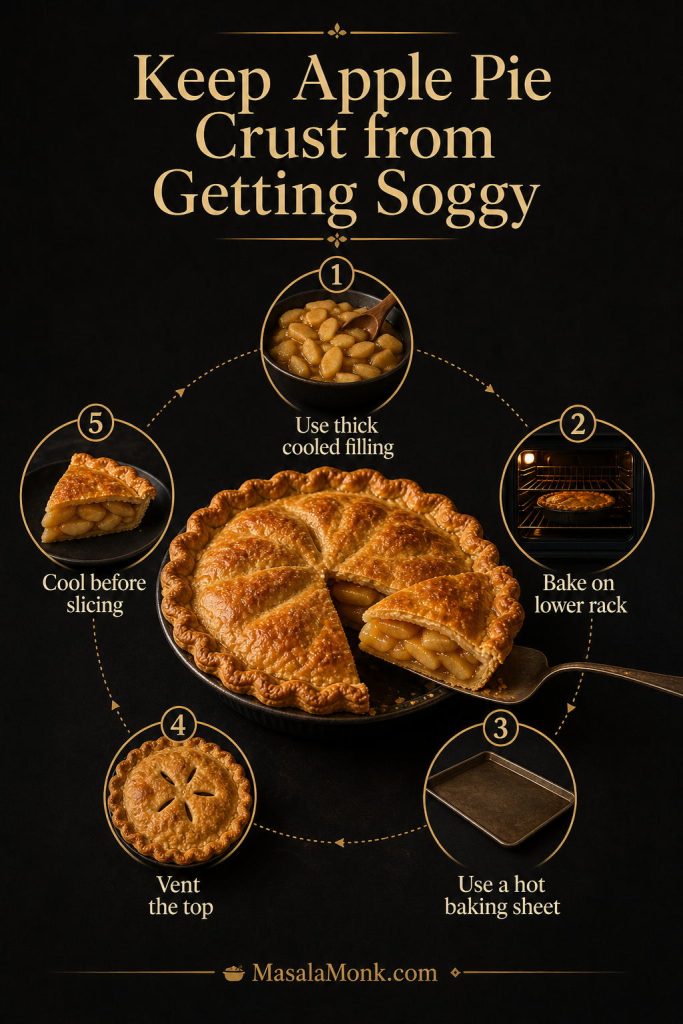
Soggy bottom crust usually comes from excess moisture, hot filling, weak bottom heat, or underbaking. Fortunately, most of those problems are easy to prevent once you know where the moisture is coming from.
To avoid a soggy bottom crust, start with thick cooled filling, bake with enough bottom heat, vent the top, and let the pie cool before slicing. Together, these steps protect the crust.
Start with thick, cooled filling
First, use thick apple pie filling. If the filling is loose and watery, the crust will absorb that liquid before it has time to set. A cooked, glossy filling gives you more control because the apples have already released some of their moisture before the pie goes into the oven.
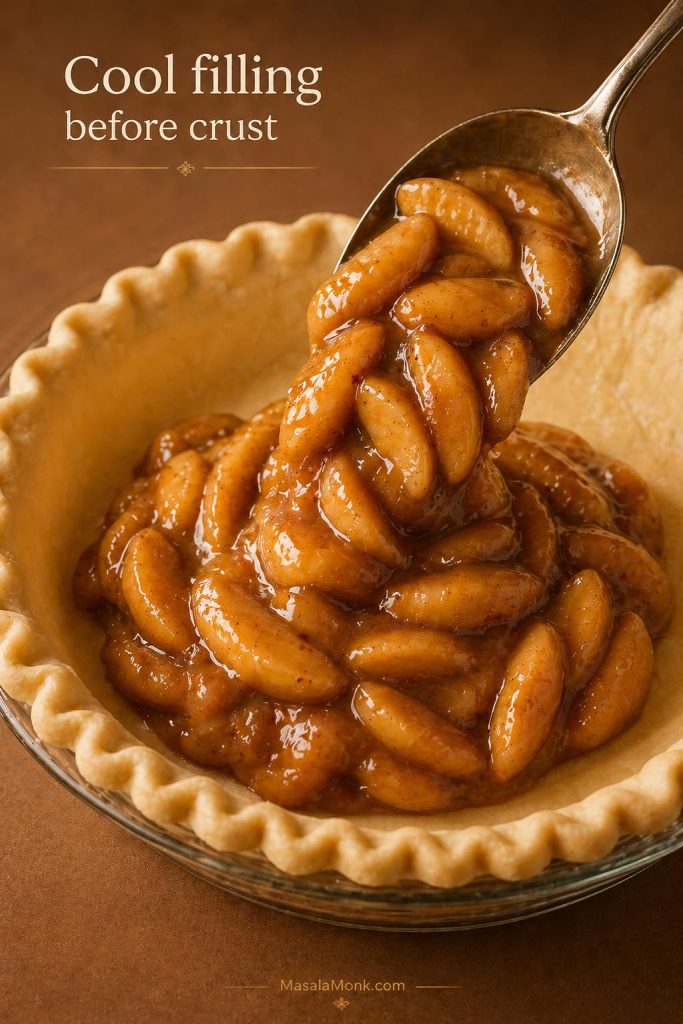
Second, cool the filling before adding it to the crust. Hot filling melts the butter in the dough too early, which can make the pastry soft or greasy before baking even begins. So the filling should be spoonable and glossy, not steaming hot, when it goes into the pie shell.
Give the bottom crust enough heat
Third, bake the pie long enough for the bottom crust to cook through. A golden top does not always mean the bottom is done. If your oven runs cool or your pie plate is thick, the bottom may need more time.
Finally, use bottom heat to your advantage. Bake on a lower oven rack or place the pie plate on a preheated baking sheet. For another helpful reference, this apple pie crust guidance from Martha Stewart also emphasizes giving the bottom crust enough heat and enough time to brown properly.
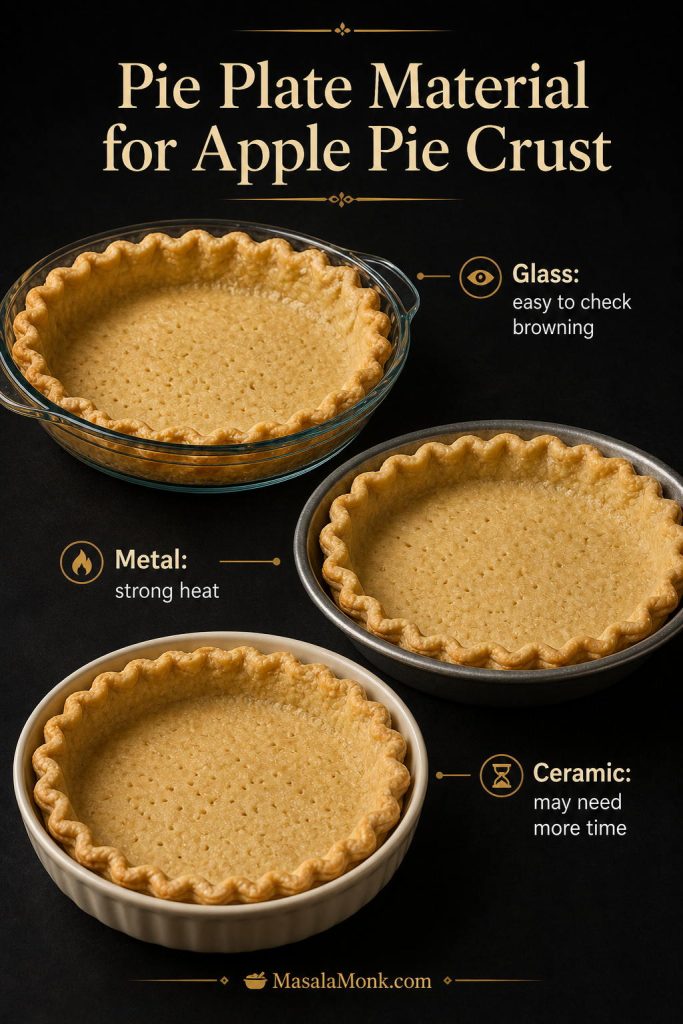
Choose the right pie plate
Pie plate material also matters. A glass pie plate makes it easier to check whether the bottom crust is browning, while metal usually conducts heat more quickly. Thick ceramic dishes can work beautifully, but they often need enough time and a lower oven rack so the bottom crust can finish baking.
The pie plate affects how the bottom crust bakes. Glass makes browning easier to check, metal conducts heat well, and ceramic may need a little more time.
Problem
Best fix
Filling is watery
Use thick apple pie filling and avoid pouring loose liquid into the crust.
Filling is hot
Cool the filling before adding it to the dough.
Bottom crust is pale
Bake on a lower rack or place the pie on a preheated baking sheet.
Top crust traps steam
Cut vents in a full top crust or use a lattice crust.
Pie is sliced too soon
Let the pie cool for at least 2 to 3 hours so the filling can thicken and settle.
For the easiest pairing, use this crust with cooled apple pie filling. The filling should be glossy and spoonable, not loose, watery, or steaming hot.
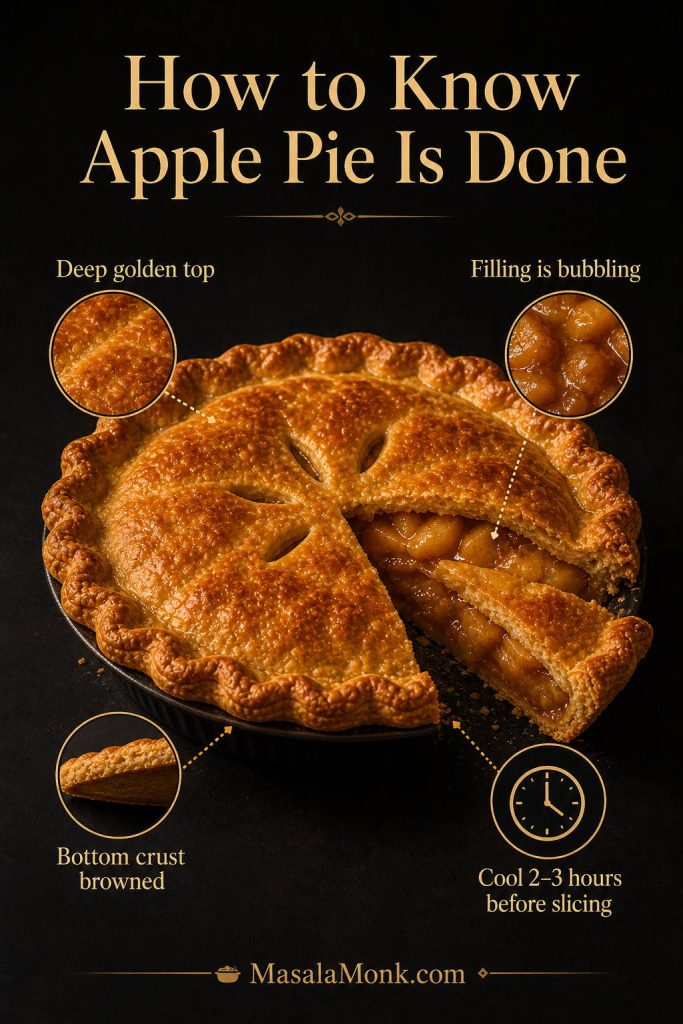
Apple pie is done when the top crust is deeply golden, the filling is bubbling through the vents or lattice, and the bottom crust has had enough time to brown. If the top looks ready but the bottom still seems pale, cover the edges loosely with foil and give the pie more time on the lower rack.
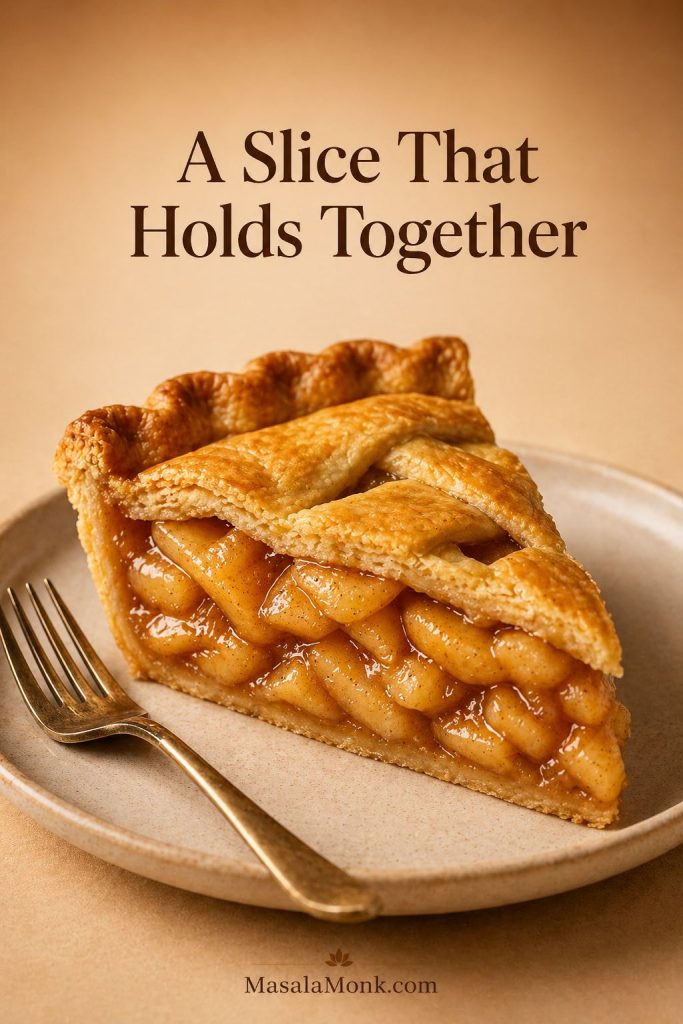
After baking, let the pie cool for at least 2 to 3 hours before slicing. Otherwise, even a well-baked crust can seem soft because the filling has not had time to thicken and settle.
A finished apple pie should be more than lightly golden. Look for a deep golden top, bubbling filling, and a browned bottom crust; then let it cool so the filling can settle.
Other Crusts You Can Use for Apple Pie
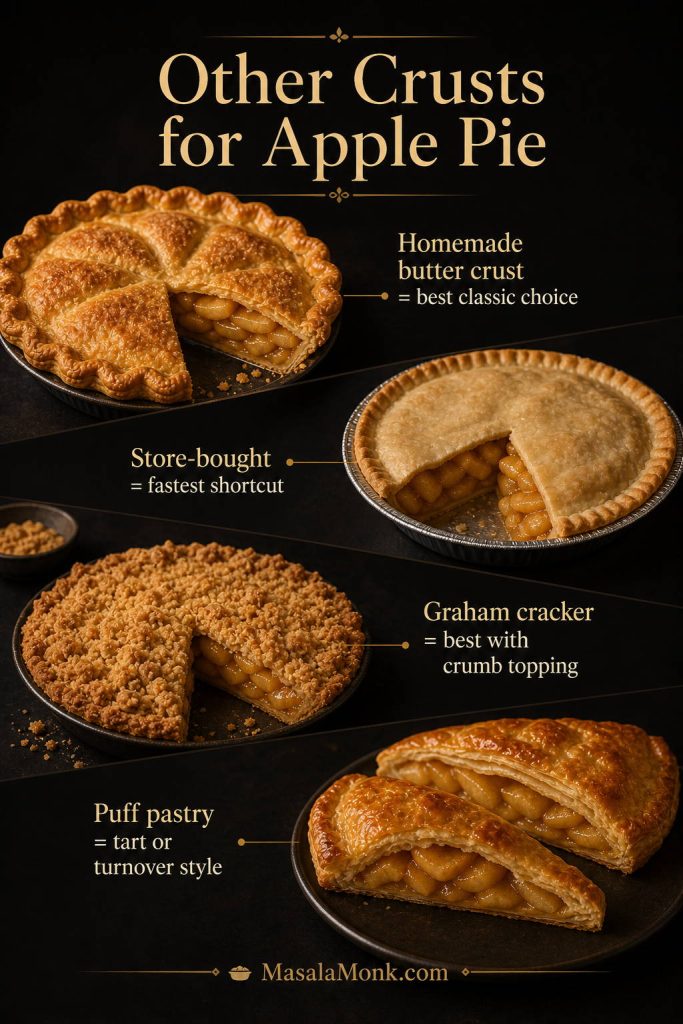
Homemade butter crust is the best choice for a classic apple pie, but it is not the only option. Sometimes convenience matters. Other times, you may want a no-roll crust, a crumb topping, or a quicker apple dessert. In those cases, the main thing is to match the crust to the kind of pie you are actually making.
For classic apple pie, use this homemade butter crust. If speed matters, store-bought crust can still make a good apple pie when the filling is thick and the crust stays cold. For a no-roll version, graham cracker crust works better with crumb topping than with a sealed top crust. For a faster pastry-style dessert, puff pastry is useful, although it behaves more like a tart or turnover than classic pie crust.
Homemade butter crust is best for classic apple pie. Still, store-bought crust, graham cracker crust, and puff pastry can work when you match each one to the right style of dessert.
Can I use store-bought crust?
Yes. Keep the crust cold, use a filling that is thick rather than runny, and cut vents in the top so steam can escape. Homemade dough tastes better and usually bakes flakier, but a premade crust can still make a solid apple pie when the filling and baking are handled well.
Can I use graham cracker crust?
Yes, although it works better for a single-crust apple pie with crumb topping than for a traditional double-crust pie. Graham cracker crust cannot form a sealed pastry top, so treat it as a different dessert style rather than a direct swap for pie dough.
Can I use puff pastry?
Yes, but puff pastry gives you a quicker, more tart-like apple dessert. It works well for turnovers, slab-style bakes, and apple pie-inspired pastries. However, it does not have the same tender, sturdy bite as homemade apple pie crust.
Is shortcrust pastry the same thing?
In many kitchens, pie crust, pie dough, pie pastry, shortcrust pastry, and pie shell describe similar flour-and-fat doughs. The exact formula can vary, but the goal for apple pie is the same: a tender crust that can hold fruit filling and bake into a flaky shell.
Using This Dough for Mini Apple Pies and Hand Pies
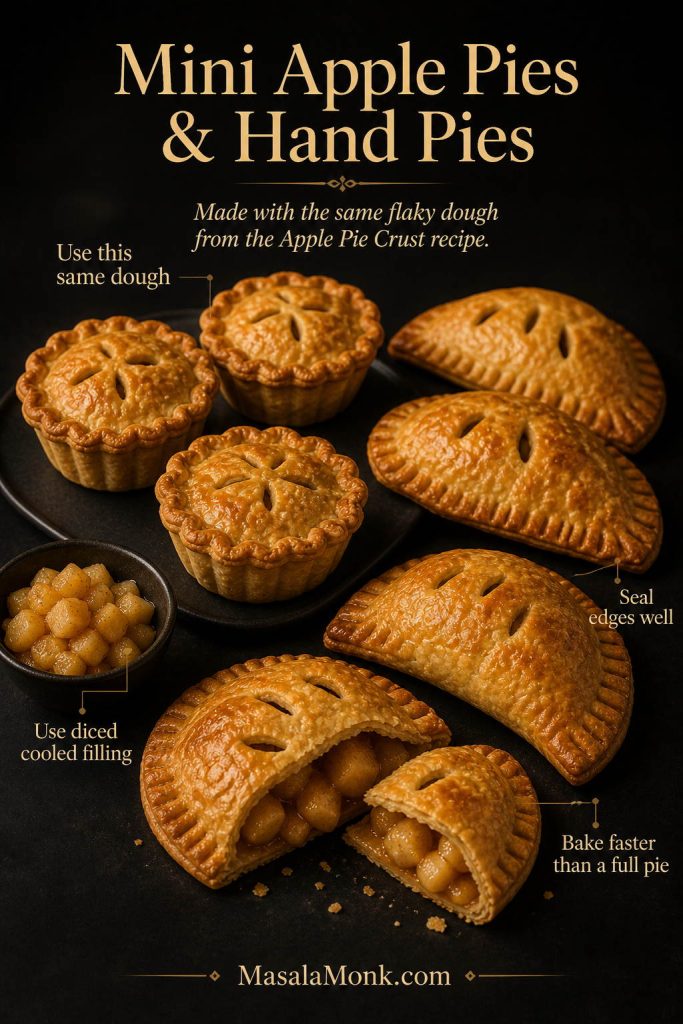
This apple pie crust dough also works for mini apple pies and hand pies, but the handling changes slightly. Smaller pastries need a thinner roll, less filling, tighter sealing, and a closer eye in the oven because they bake faster than a full 9-inch / 23-cm apple pie.
For mini apple pies, roll the dough a little thinner than you would for a deep pie, then cut rounds large enough to fit a muffin pan, mini pie pans, or small tart tins. Press the dough in gently without stretching it, add a small spoonful of cooled apple filling, and avoid overfilling so the juices do not leak over the edges.
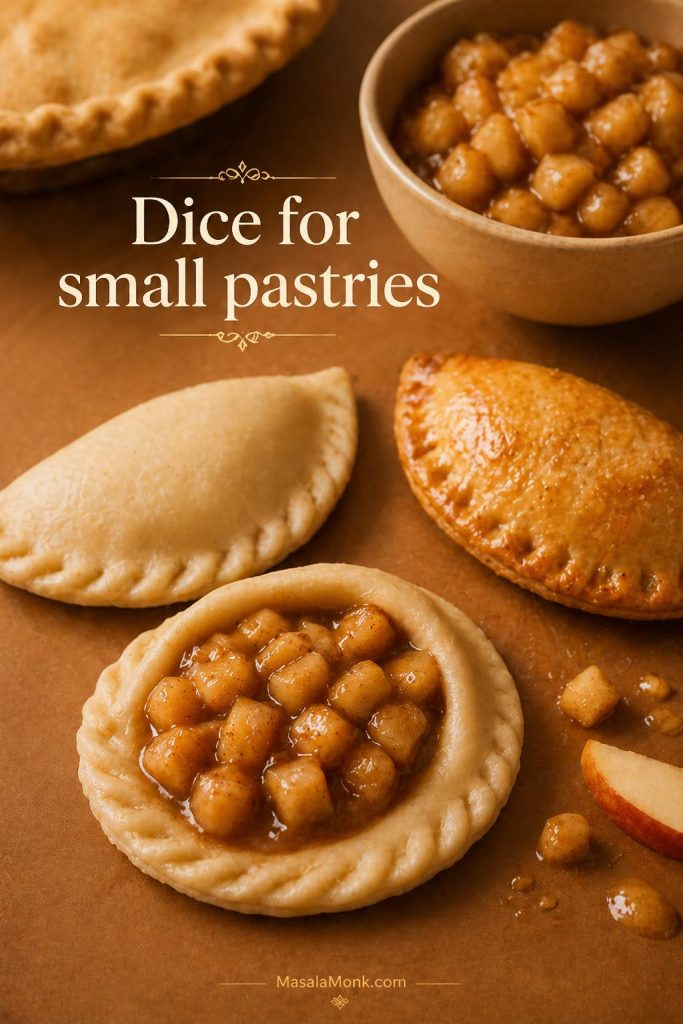
For hand pies, diced cooled apple filling works better than long apple slices because it fits neatly inside the dough and seals more easily. After filling, press the edges firmly with a fork, cut a small vent in the top, and chill the shaped pies briefly before baking. That short chill helps the crust hold its shape and gives the filling less chance to burst out.
The same rules still matter: keep the dough cold, use thick filling, and do not stretch the pastry. Since mini pies and hand pies are smaller, start checking them earlier and pull them when the crust is golden and the filling is bubbling.
This same dough can also make mini apple pies and hand pies. Because smaller pastries bake faster, use diced cooled filling, seal the edges well, and watch the crust color closely.
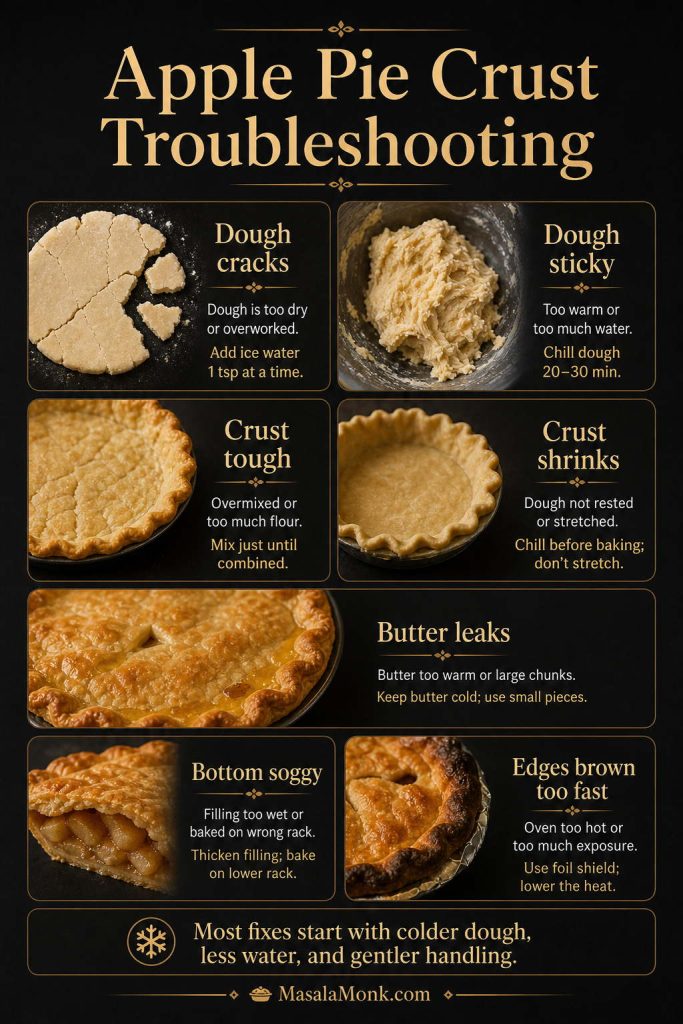
Most apple pie crust problems come from five things: warm butter, too much water, overworking the dough, stretching the crust into the pie plate, or adding hot/watery filling.
Apple Pie Crust Troubleshooting
Pie crust problems are common, especially if your kitchen is warm or you are making dough for the first time. Still, most issues come from a few fixable causes: warm butter, too much water, overworking, stretching the dough, or using filling that is too wet.
What went wrong
Likely cause
How to fix it next time
Dough cracks while rolling
Too dry or too cold
Let it rest for 5 minutes, then patch small cracks with damp fingers.
Dough feels sticky
Too much water or butter is warming
Dust lightly with flour and chill the dough before continuing.
Crust is tough
Too much water or too much handling
Add water slowly and stop mixing once the dough holds together.
Crust shrinks
Dough was stretched or not chilled
Ease the dough into the plate without pulling, then chill before baking.
Butter leaks out
Dough got too warm
Keep the butter cold and chill the assembled pie before baking.
Bottom crust is soggy
Wet filling, hot filling, or not enough bottom heat
Use cooled thick filling and bake on a lower rack or hot baking sheet.
Edges brown too fast
Edges are thinner than the rest of the crust
Use a pie shield or loose foil once the edges are golden.
Filling bubbles over
Pie is overfilled or not vented well
Leave a little space, cut vents, and bake on a lined sheet pan.
Most apple pie crust problems trace back to temperature, moisture, or handling. Therefore, many fixes begin with colder dough, less water, gentler mixing, and enough time to chill.
If the dough gives you trouble, do not panic. Chill it, patch it, and keep going. Small cracks and rough edges usually disappear once the pie is filled, sealed, brushed with egg wash, and baked until golden.
Make Ahead, Freeze, and Store
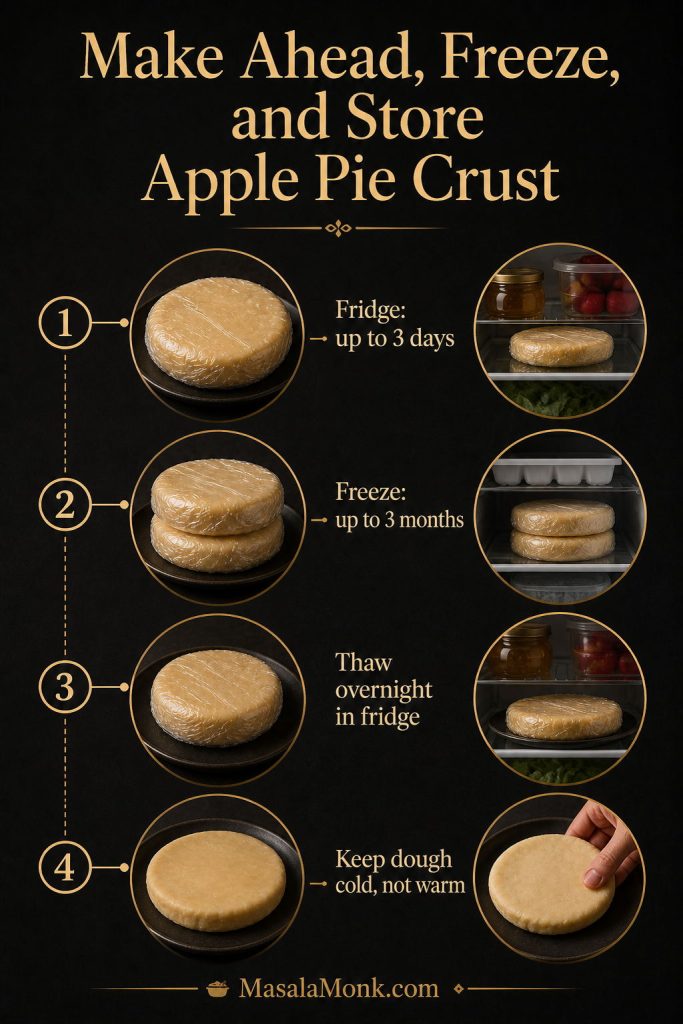
Apple pie crust is a good make-ahead recipe because the dough actually benefits from chilling. You can make the disks in advance, keep them wrapped in the refrigerator, and roll them when you are ready to assemble the pie.
For short-term storage, wrap the dough disks tightly and refrigerate them for up to 3 days. For longer storage, place the wrapped disks in a freezer bag and freeze them for up to 3 months.
When you are ready to use frozen dough, thaw it overnight in the refrigerator. If it feels too firm to roll, let it sit at room temperature for a few minutes. However, do not let it become warm or greasy, because softened butter can make the crust bake up heavy.
You can also roll the bottom crust, fit it into the pie plate, cover it well, and refrigerate it before filling. This is useful when you want to prepare the crust ahead but assemble the apple pie closer to baking time.
If you have extra cooked apples or leftover filling, you do not have to make another pie right away. Spoon them over buttermilk pancakes with stewed cinnamon apples for a softer breakfast-style use.
Pie dough is a good make-ahead recipe because chilling helps it relax. For best results, refrigerate it up to 3 days, freeze it up to 3 months, and thaw it overnight in the fridge.
Apple Pie Crust Recipe Card
Apple Pie Crust Recipe: Flaky Homemade Pie Dough
This buttery apple pie crust recipe makes enough dough for one 9-inch / 23-cm double-crust apple pie or two single-crust pies.
Prep Time20 minutes
Chill Time1 hour
Total Dough Time1 hour 20 minutes
Yield1 double crust
Ingredients
2 1/2 cups all-purpose flour, or 315 g / about 11 oz
1 teaspoon fine salt
1 tablespoon granulated sugar, or about 12 g
1 cup cold unsalted butter, cut into cubes, or 226 g / 8 oz
6 to 8 tablespoons ice water, or 90 to 120 ml / 3 to 4 fl oz, plus more only if needed
Optional: 1 teaspoon / 5 ml apple cider vinegar
For finishing and filling
5 to 6 cups cooled apple pie filling, about 1.1 to 1.4 kg / 2.5 to 3 lb, if baking a full 9-inch / 23-cm apple pie
1 egg
1 tablespoon / 15 ml milk or water
Optional coarse sugar for sprinkling
Instructions
Whisk the flour, salt, and sugar together in a large bowl.
Add the cold butter cubes and cut them into the flour until the mixture has sandy crumbs, pea-size butter pieces, and a few flatter butter flakes.
Add ice water 1 tablespoon / 15 ml at a time, tossing with a fork after each addition.
Stop adding water when the dough holds together when squeezed. It should look shaggy, not wet or smooth.
Turn the dough onto a lightly floured surface and gather it gently with your hands. Do not knead it smooth.
Divide the dough into two equal pieces, flatten each into a disk about 1 inch / 2.5 cm thick, wrap tightly, and refrigerate for at least 1 hour.
To use this crust for a full apple pie
Place a rack in the lower third of the oven and preheat to 425°F / 220°C. For extra bottom heat, place a baking sheet in the oven while it preheats.
Roll one disk into a 12- to 13-inch / 30- to 33-cm round, about 1/8 inch / 3 mm thick, and fit it into a 9-inch / 23-cm pie plate without stretching.
Add 5 to 6 cups cooled apple pie filling, about 1.1 to 1.4 kg / 2.5 to 3 lb, or enough to fill the pie without mounding it too aggressively.
Roll the second disk for a full top crust, or cut it into strips for lattice. Then seal and crimp the edges.
Chill the assembled pie for 15 to 20 minutes if the dough has softened.
Beat the egg with milk or water, then brush lightly over the top crust. Sprinkle with coarse sugar if using.
Bake at 425°F / 220°C for 20 minutes. Then reduce the heat to 375°F / 190°C and continue baking for 35 to 45 minutes, or until the crust is deeply golden and the filling is bubbling. If the edges brown too quickly, cover them loosely with foil or a pie shield.
Let the pie cool for at least 2 to 3 hours before slicing so the filling can thicken and settle.
Notes
Keep the butter cold for the flakiest crust.
Add water slowly; too much water can make the crust tough.
Do not knead the dough until smooth. Gentle handling keeps the pastry tender.
For classic double-crust apple pie, do not fully prebake the bottom crust.
Use thick, cooled apple pie filling to help prevent a soggy bottom crust.
The dough can be refrigerated for up to 3 days or frozen for up to 3 months.
Use this quick recipe card when you need the basic apple pie crust steps in one place: mix, cut in butter, add ice water, gather gently, and chill before rolling.
It uses cold butter for flaky layers, enough dough for a 9-inch / 23-cm apple pie, and clear chilling, rolling, and baking cues so the crust stays tender instead of tough.
Is apple pie crust the same as pie dough?
Usually, yes. Apple pie crust, pie dough, pie pastry, and pie shell often mean the same basic flour-and-fat dough. For apple pie, however, the dough should be flaky but sturdy enough to hold fruit filling.
Do I need two crusts for apple pie?
For a classic double-crust pie, yes. You need one crust on the bottom and one on top. However, if you are making a crumb-topped or Dutch-style apple pie, one bottom crust is enough.
Should apple pie crust be prebaked?
For a traditional double-crust pie, usually no. Instead, use cooled filling, keep the dough cold, and bake the pie long enough for the bottom crust to brown. For a single-crust pie with crumb topping, partial prebaking can help if the bottom often turns soft.
Why is my apple pie crust tough?
Tough crust usually comes from too much water, too much mixing, or kneading the dough until smooth. So add water slowly and stop handling the dough once it holds together.
Why is my bottom crust soggy?
The filling may have been too wet or too hot, or the pie may not have baked long enough. Use cooled, thick filling and bake on a lower rack or preheated baking sheet so the bottom gets enough heat.
Can I use this crust for lattice apple pie?
Yes. This dough makes enough for a bottom crust and lattice top. Roll the second disk, cut it into strips, weave the strips over the filling, and then seal the edges well.
Can I use store-bought crust instead?
Yes. Keep the crust cold, use thick filling, and vent the top so steam can escape. Homemade dough usually tastes better, but premade crust can still make a good apple pie.
Can I use graham cracker crust for apple pie?
Yes, but it works best for a crumb-topped apple pie rather than a sealed double-crust pie. Since graham cracker crust cannot form a pastry top, treat it as a separate no-roll apple pie style.
Can I use puff pastry for apple pie?
Yes, but puff pastry works better for apple turnovers, slab-style apple desserts, or tart-like bakes than for a classic deep apple pie. Keep it cold, avoid overfilling it, seal the edges well, and cut vents so steam can escape.
Can I make apple pie crust ahead?
Yes. Wrap the dough disks tightly and refrigerate them for up to 3 days or freeze them for up to 3 months. Then thaw frozen dough overnight in the refrigerator before rolling.
Final Tips for Flaky Apple Pie Crust
A reliable apple pie crust recipe comes down to cold butter, gentle handling, enough chill time, and filling that is thick rather than watery. Once the dough is ready, add cooled apple pie filling, seal the edges well, vent the top, and bake until the crust is deeply golden.
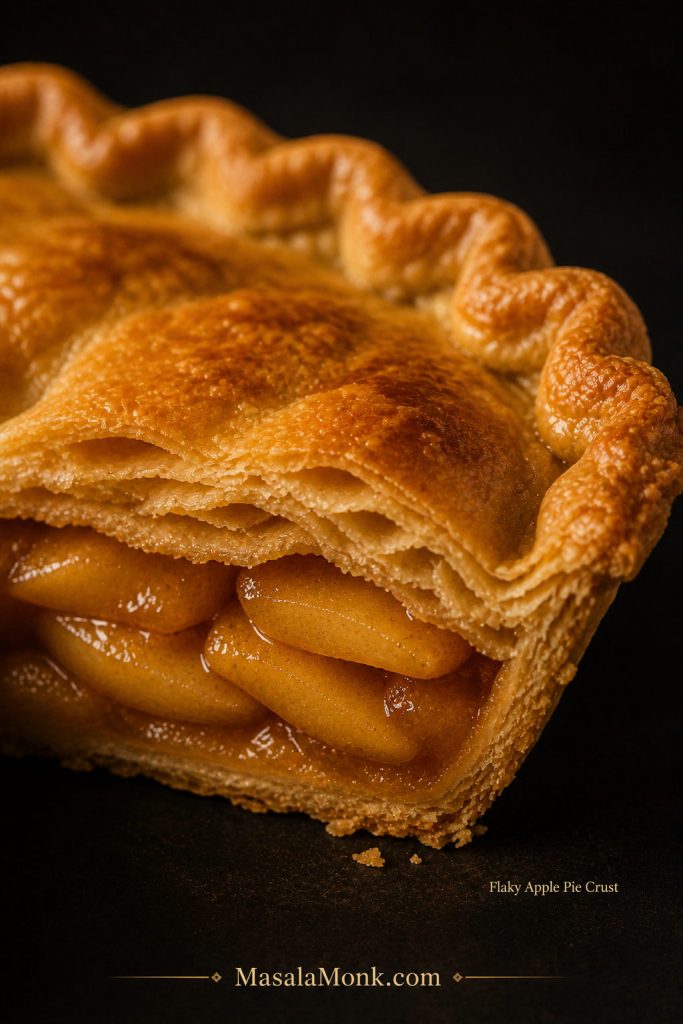
A good apple pie crust should look flaky at the edges and sturdy around the filling. When the layers are golden and crisp, every slice feels more homemade.
If your first pie is not perfect, the fix is usually simple. Next time, chill the dough longer, add less water, avoid stretching the crust into the plate, and make sure the filling is not hot when it touches the pastry.
A perfect-looking crust is not the goal. A crust that tastes buttery, holds the filling, and flakes when you cut into it is already a win.
If you try this crust with a different apple pie filling, crumb topping, or pie plate, leave a note with what changed. Those small details often help the next baker more than a perfect-looking slice ever could.
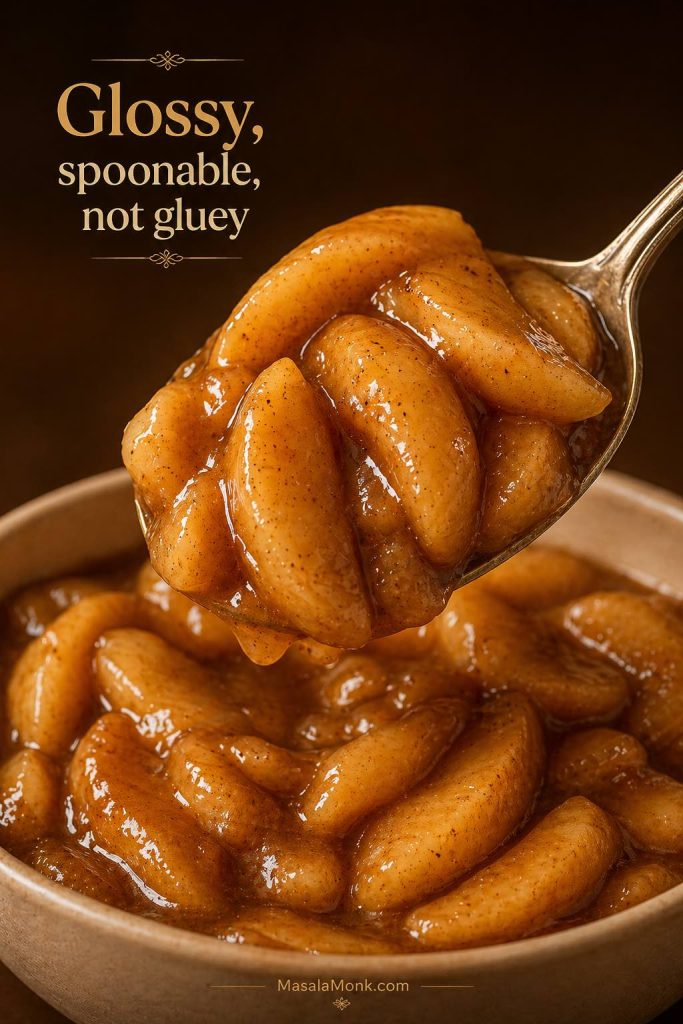
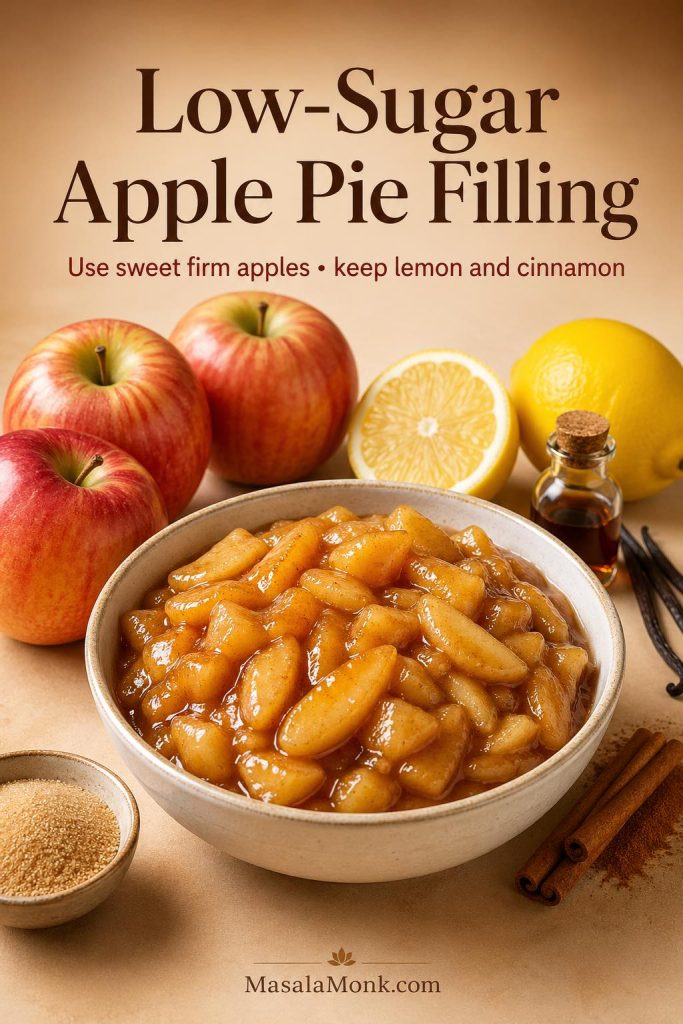
A good apple pie filling recipe should give you tender apple pieces, warm cinnamon flavor, and a thick, glossy sauce that holds together without turning gluey. This stovetop method cooks the filling before baking, so you can control the apple texture, sauce thickness, sweetness, and final use before anything goes into pie crust, crisp topping, hand pies, turnovers, freezer bags, or breakfast bowls.
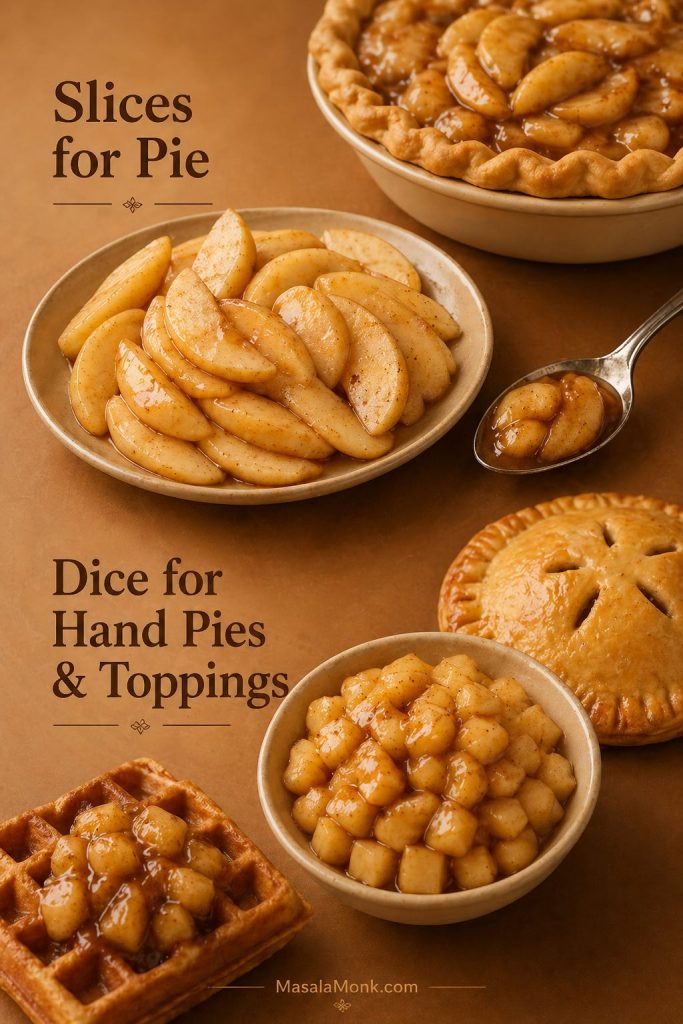
The best part is that one batch can do several jobs. Use sliced apple filling for classic pie and crisp, diced apple filling for hand pies and turnovers, or a softer spoonable version for pancakes, waffles, oatmeal, yogurt, and ice cream.
Because this recipe makes a cooked apple filling before it ever reaches pie crust, you can taste, thicken, cool, and portion the batch with much more control. As a result, the same recipe works for a full apple pie, canned-style replacement portions, freezer bags, crisps, toppings, and small pastries without guessing later.
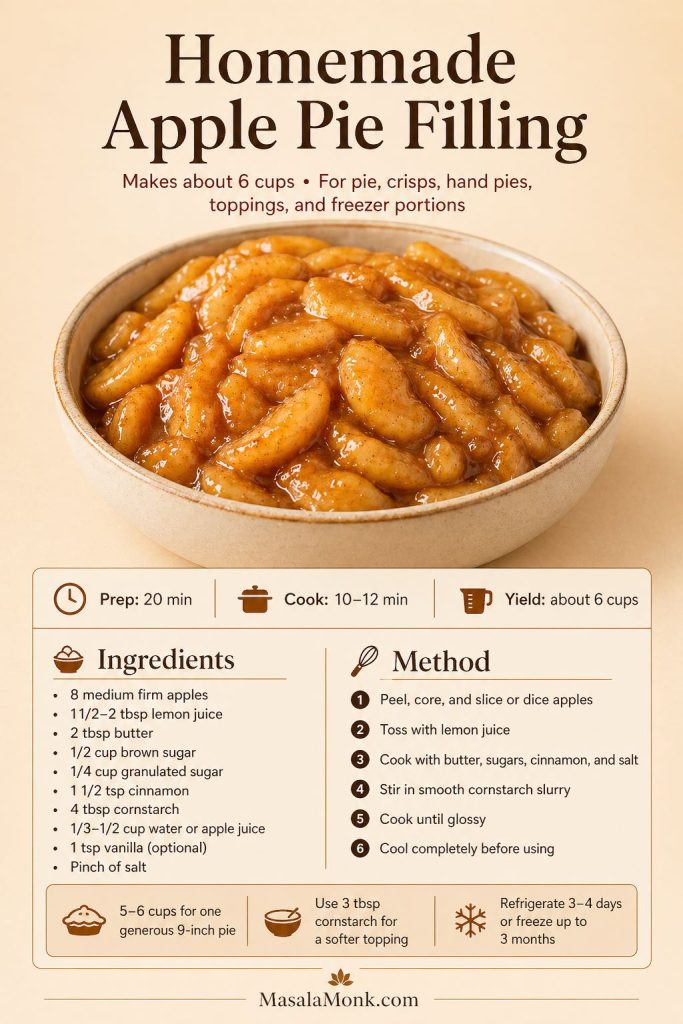
To make apple pie filling, cook peeled and sliced or diced apple pieces with butter, brown sugar, granulated sugar, cinnamon, lemon juice, and a pinch of salt. Once the apple pieces begin to soften and release their juices, stir in a cornstarch slurry and cook briefly until the sauce turns glossy and coats the filling.
This apple pie filling recipe makes about 6 cups / 1.4 liters of homemade filling. That is enough for one generous 9-inch pie, one 9×9 apple crisp, several hand pies, or a few smaller freezer portions. For a canned-style replacement, portion about 2 to 2 1/2 cups into a container or freezer bag.
In other words, this recipe gives you apple filling that can go straight into pie or be saved for later desserts. Since the filling is cooked first, it is easier to adjust than a raw apple mixture that releases liquid inside the oven.
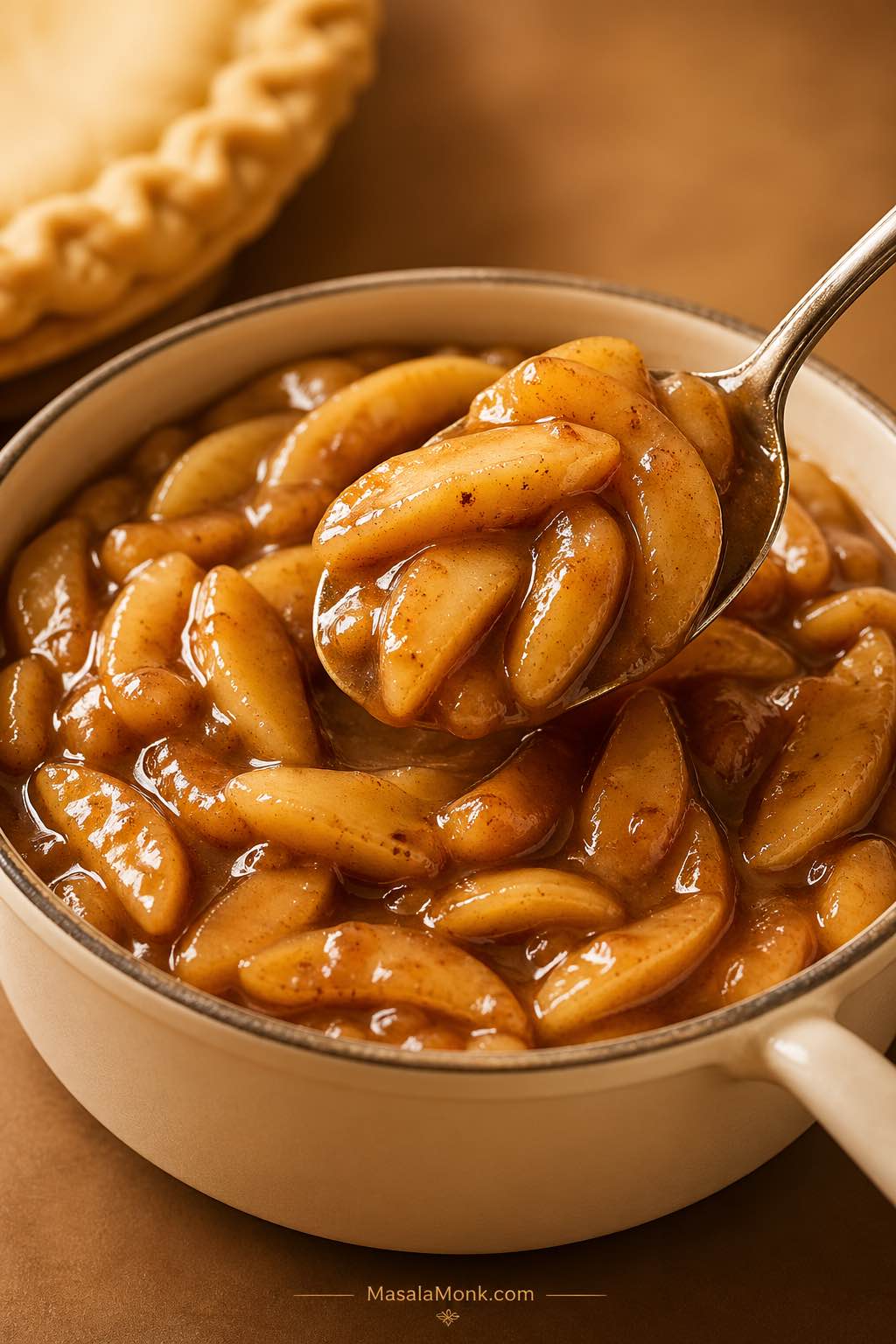
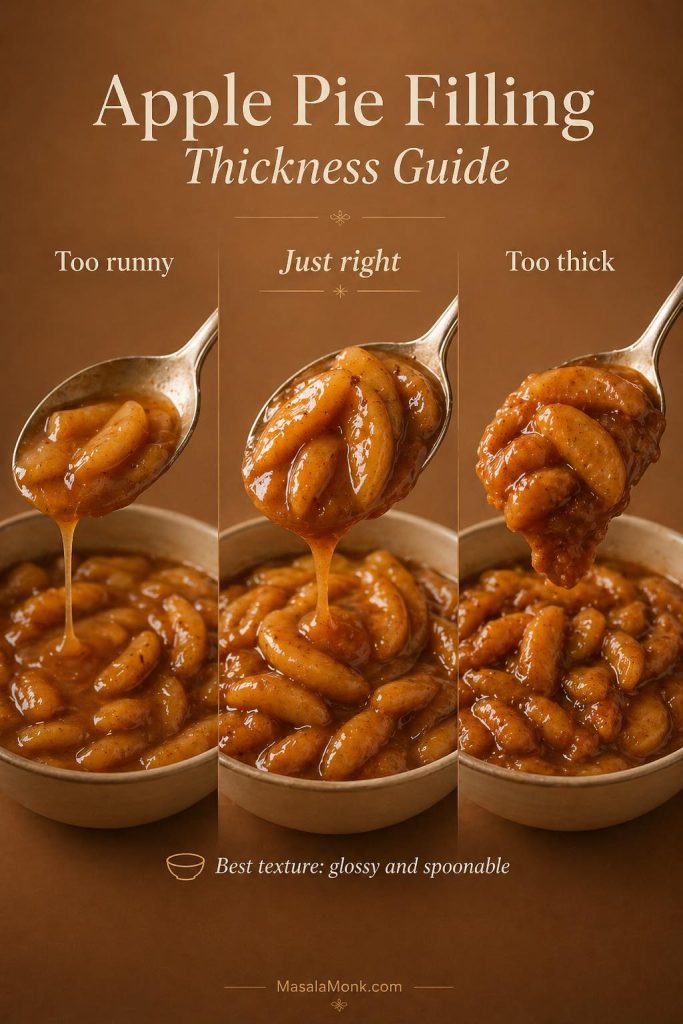
Before cooling, the sauce should cling to the apples but still move when spooned. If it looks slightly loose while hot, that is fine because the filling thickens more as it rests.
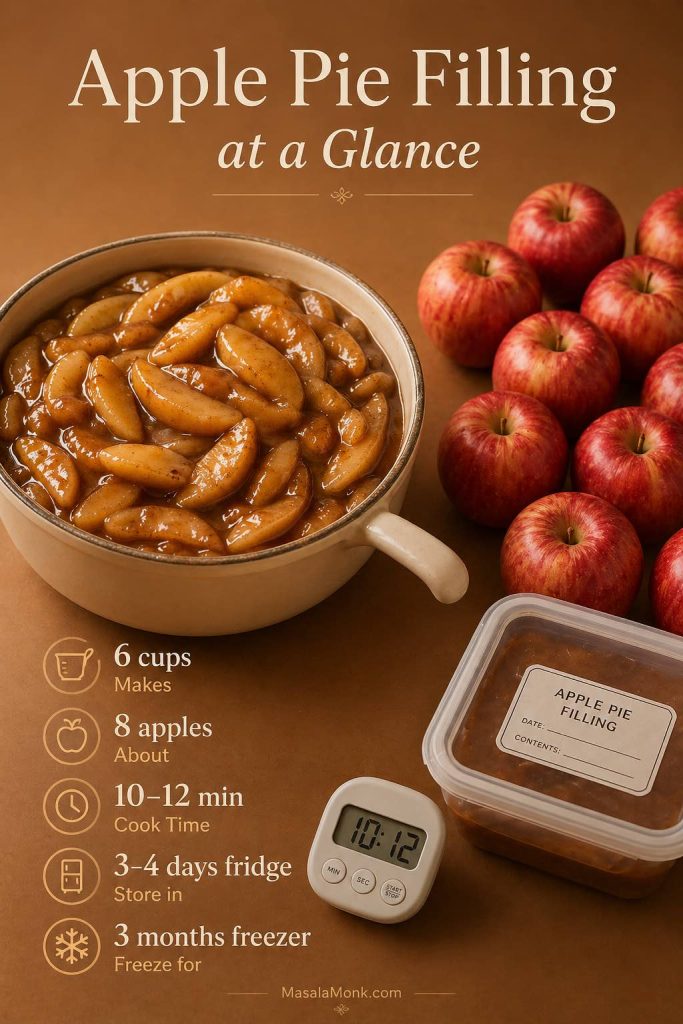
Apple Pie Filling at a Glance
Yield About 6 cups / 1.4 liters
Apple Amount 8 medium firm apples
Cook Time 10–12 minutes
Storage 3–4 days fridge, 3 months freezer
One full batch gives about 6 cups from 8 medium apples. Plan on 10–12 minutes of cooking, then store the cooled filling for 3–4 days in the fridge or up to 3 months in the freezer.
Detail
Best Choice
Best apple cut for pie
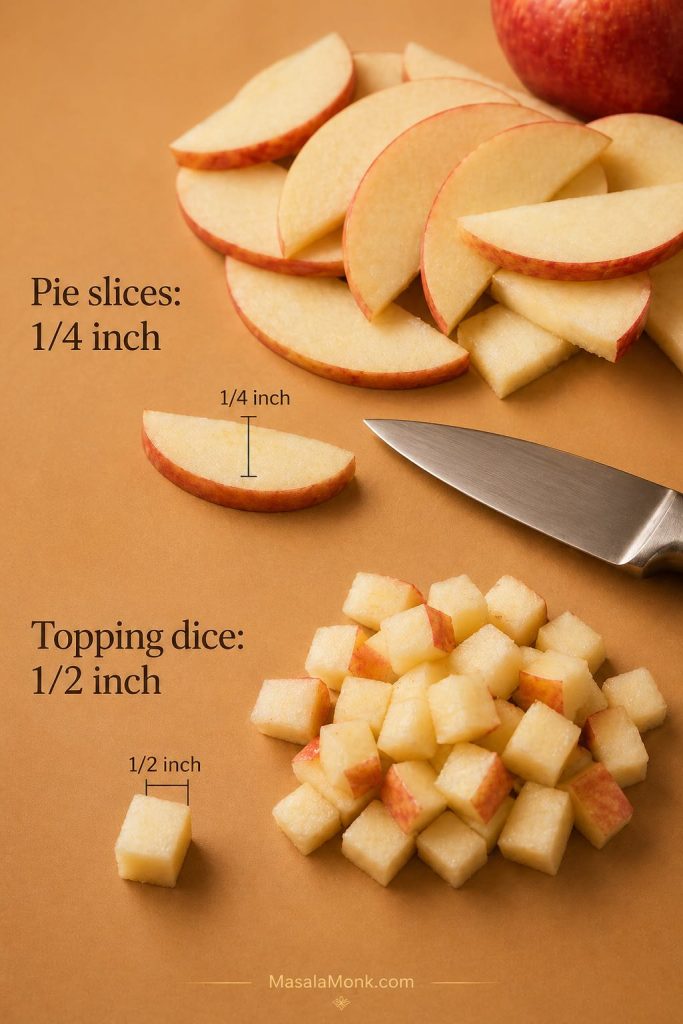
1/4-inch / 6 mm slices
Best apple cut for hand pies and toppings
1/2-inch / 1.25 cm dice
Best thickener for this recipe
Cornstarch slurry
Canned filling replacement
2 to 2 1/2 cups replaces one 20–21 oz can
Canning
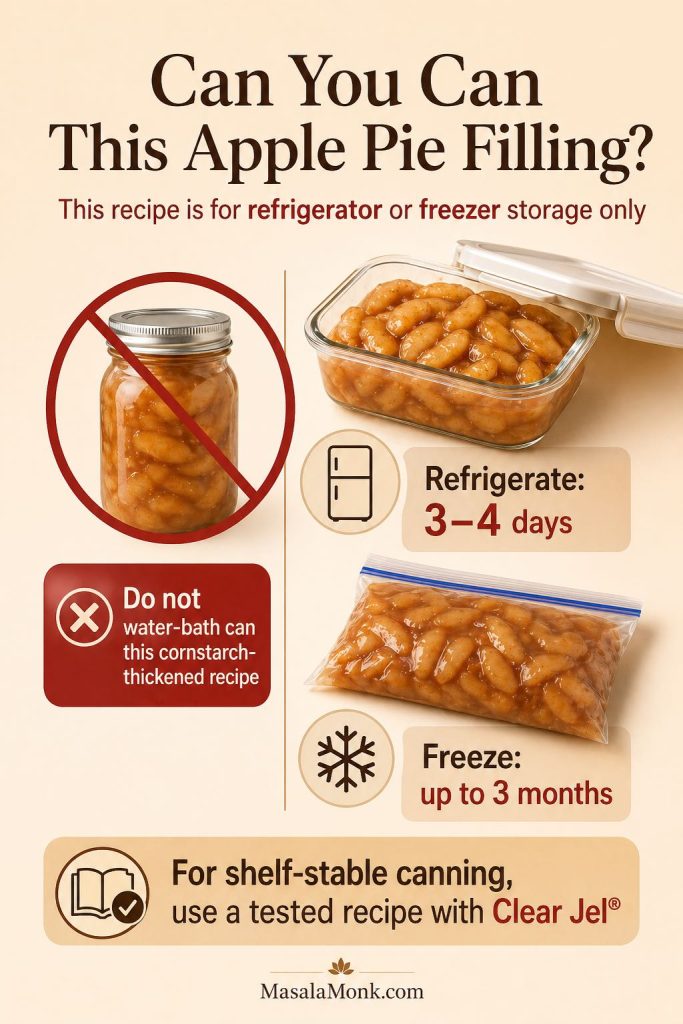
Do not can this recipe; use tested canning guidance
Why This Apple Pie Filling Recipe Works
This recipe works because the apple filling thickens in the pan instead of releasing extra liquid inside the pie. Rather than hoping raw apple pieces bake down evenly under the crust, you soften the fruit briefly on the stovetop and thicken the juices before baking.
As the apple pieces cook, they release enough liquid to form a cinnamon-apple sauce. From there, the cornstarch slurry turns those juices glossy and spoonable. Therefore, the recipe is easier to fix if the filling looks too loose, too stiff, or too sweet before it goes into pie.
The apple pieces stay tender, not mushy. They cook only until they begin to soften, so they can still hold their shape in pies, crisps, and pastries.
The sauce turns glossy. A cornstarch slurry thickens the apple juices into a smooth filling without making it heavy.
The cut changes the use. Slices are best for pie, while diced apple filling works better for hand pies, turnovers, and toppings.
The batch size is practical. Six cups gives you enough for one generous 9-inch pie or several smaller freezer portions.
The texture can be adjusted. For toppings, use slightly less cornstarch; for pies and turnovers, keep the filling thicker.
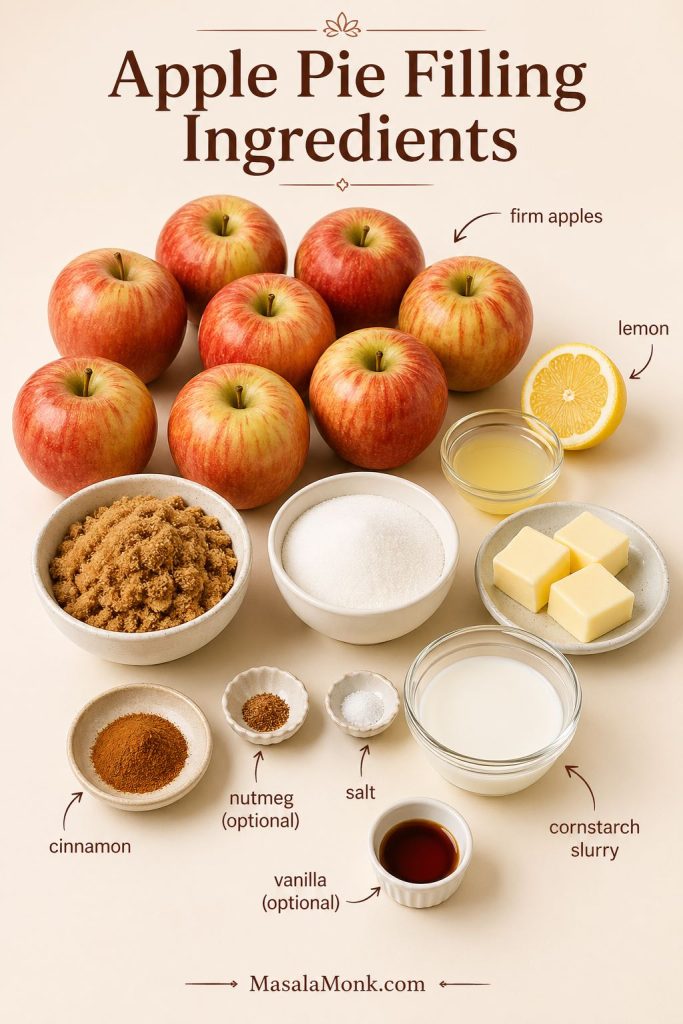
Ingredients for Apple Pie Filling
Although this recipe uses simple ingredients, the timing and balance matter. Choose firm apples, brighten them with lemon, let the sugar pull out their juices, and then thicken those juices with a smooth slurry once the apples have started to soften.
Use firm apples as the base, then thicken the released juices with 4 tablespoons cornstarch mixed into 1/3 cup water or apple juice. Add extra liquid only if the sauce tightens too much.
Firm Apples
Start with firm baking apples that can soften without collapsing. Granny Smith, Honeycrisp, Pink Lady, Braeburn, and similar firm apples all work well. For deeper flavor, use a mix of tart and sweet apples instead of relying on only one variety.
For pie, this recipe works best when the apple filling has enough structure to survive a second bake. That is why very soft or mealy apples are better saved for applesauce-style toppings, not a filling that needs to hold its shape.
Lemon Juice
Lemon juice keeps the filling bright and balances the sweetness. It also helps slow browning while you prep the apples. For a fuller prep guide, see MasalaMonk’s guide on how to prevent sliced apples from turning brown. Use 1 1/2 to 2 tablespoons lemon juice in this filling, depending on how tart your apples are.
For example, this recipe uses lemon juice to keep the apple flavor bright while cornstarch helps the filling set cleanly in pie. That said, if you are following a tested canning recipe, use the type and amount of acid that source specifies because acidity matters for shelf-stable storage.
Brown Sugar and Granulated Sugar
Brown sugar gives the filling a warmer, slightly caramel-like flavor, while granulated sugar keeps the sweetness cleaner and helps draw juice from the apple pieces. If your apples are already very sweet, reduce the granulated sugar first before cutting the brown sugar.
Together, the two sugars give the sauce enough body without making it taste heavy. As the apples cook, they release juice into the pan, which then becomes the base of the glossy cinnamon sauce.
Butter
A little butter gives the sauce a richer finish without making it greasy or heavy. It also helps the cinnamon and sugar taste rounder once the filling cools.
Cinnamon, Nutmeg and Salt
Cinnamon is the main spice here. Nutmeg is optional, but a small amount adds warmth. Salt is just as important because it keeps the filling from tasting flat and makes the apple flavor clearer.
Cornstarch Slurry
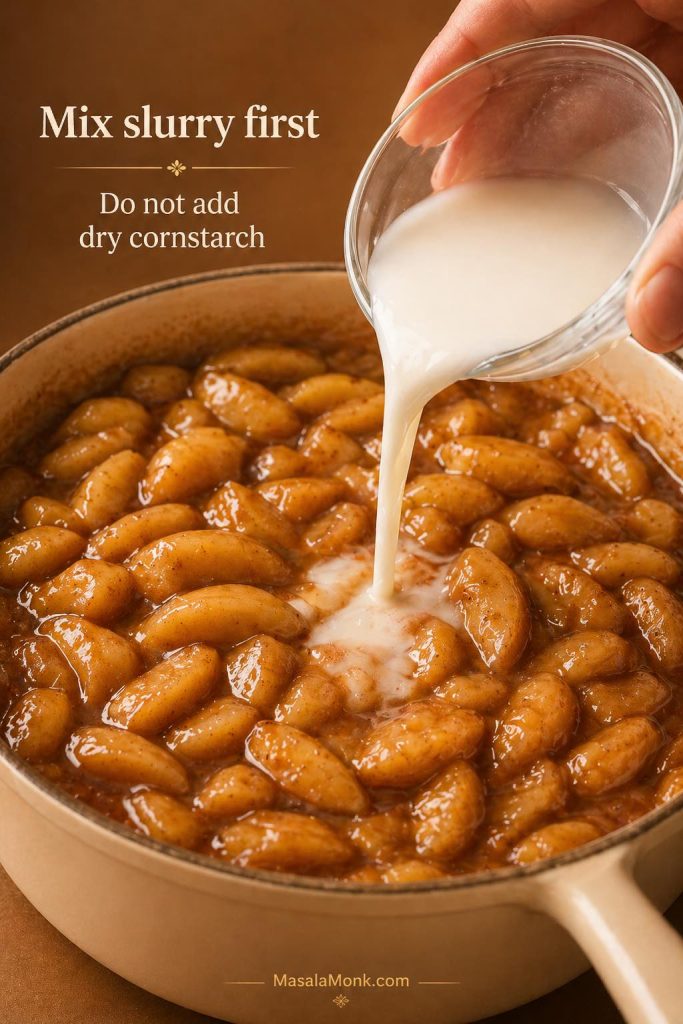
This is an apple pie filling with cornstarch, so the sauce should turn glossy once it bubbles. Before adding the thickener to the pan, mix the cornstarch with water or apple juice until smooth. Do not sprinkle dry cornstarch directly into the apple pieces, because it can clump.
At this stage, the change should be easy to see. The sauce will go from thin and slightly cloudy to shiny and thicker within a minute or two. The apple pieces should look coated with filling, not buried in a heavy paste.
Once the slurry goes in, the recipe should turn the apple juices into a glossy filling that can hold its shape in pie. However, long overcooking can make the sauce too stiff or cloudy, so stop once the filling thickens and coats the fruit.
Can You Make Apple Pie Filling Without Cornstarch?
You can make refrigerator or freezer apple filling without cornstarch, but the recipe will behave differently in pie. Tapioca starch can give a slightly more elastic finish, arrowroot can look glossy but may thin if overheated, and flour makes the sauce more opaque and rustic.
For the cleanest stovetop apple pie filling, cornstarch is still the easiest choice. If you are making shelf-stable canned pie filling, do not swap thickeners casually; use a tested canning recipe with the approved thickener and processing method.
Vanilla
Vanilla is optional. It works especially well when the cooked apple filling will be used as a topping for pancakes, waffles, oatmeal, yogurt, or ice cream.
Best Apples for Apple Pie Filling
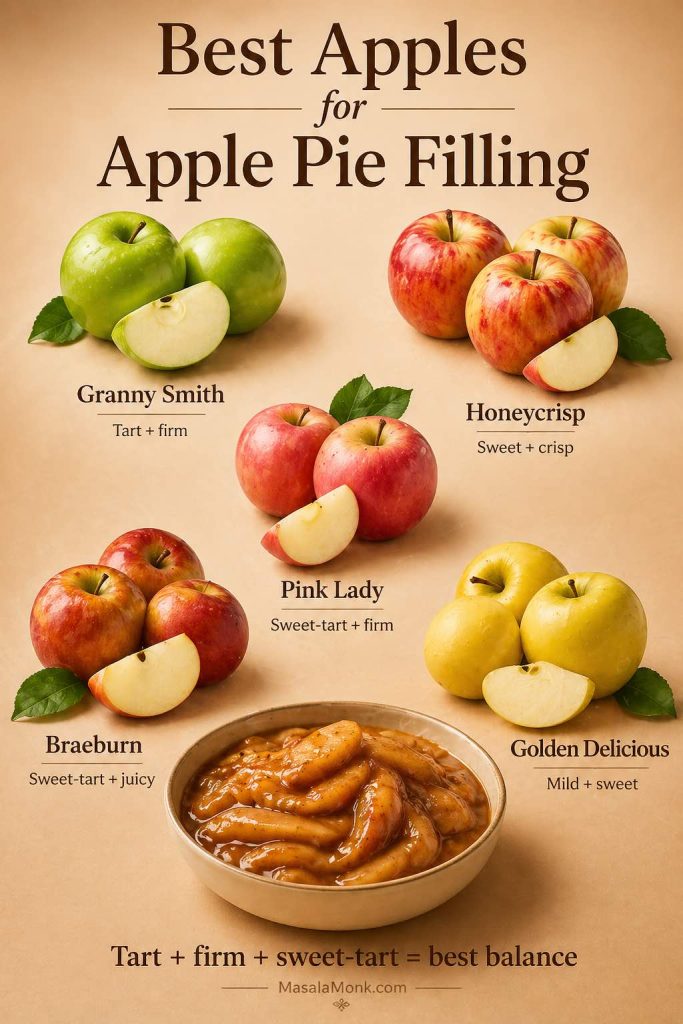
The best apples for apple pie filling are firm apples that hold their shape after cooking. A blend of tart and sweet apples usually tastes better than a single variety because the filling gets both brightness and natural sweetness.
In most kitchens, you do not need one perfect apple variety to make this work. The best flavor usually comes from mixing one tart apple with one sweeter, firmer apple. In addition, a mixed-apple recipe gives the filling more depth once it bakes inside pie.
For better pie texture, pair a tart firm apple such as Granny Smith with a sweeter firm apple such as Honeycrisp, Pink Lady, or Braeburn. That mix gives brightness, sweetness, and structure.
Apple
Flavor
Texture
Best Use
Granny Smith
Tart
Very firm
Best tart base for pies
Honeycrisp
Sweet-tart
Firm and juicy
Great blended with Granny Smith
Pink Lady
Bright and balanced
Firm
Good all-purpose filling apple
Braeburn
Sweet-tart and aromatic
Holds well
Good for pies and crisps
Golden Delicious
Sweet and mellow
Softer
Best blended, not used alone
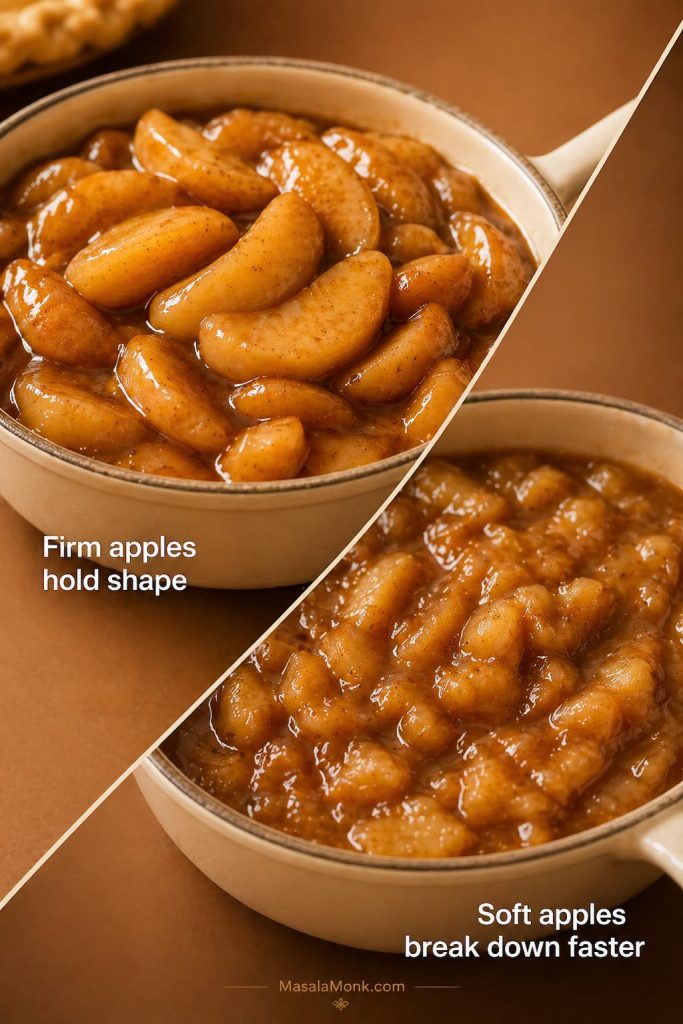
Firm apples are best when the filling will be baked again in pie, crisp, hand pies, or turnovers. Softer apples can work for toppings, but they break down faster and give a looser texture.
Avoid very soft or mealy apples if you want distinct apple pieces. Softer apples can work for toppings, but they are more likely to break down if you cook them on the stovetop and then bake them again in a pie or crisp.
Sliced vs Diced Apples for Apple Pie Filling
The apple cut may seem like a small detail, but it changes how the filling behaves once it goes into pastry, crisp topping, or a spoonable dessert. Before cooking, decide whether this recipe is headed for a full apple pie or a diced filling for smaller pastries.
For pie, this recipe works best when the apple filling is sliced thin enough to layer neatly inside the crust. For hand pies, turnovers, and toppings, diced apple filling is easier to spoon, seal, freeze, and reheat.
Once you know how you want to use the filling, the cut becomes much easier to choose: slices for pie, dice for pastries, and smaller pieces for toppings. That small choice matters, because a slice that feels perfect in a pie can be awkward inside a hand pie.
Use 1/4-inch slices when the filling is headed for a classic 9-inch pie. Use 1/2-inch dice for hand pies, turnovers, oatmeal, waffles, yogurt bowls, or anything that needs spoonable pieces.
Final Use
Best Apple Cut
Why It Works
Classic apple pie
1/4-inch / 6 mm slices
Layers neatly and feels like pie
Deep-dish pie
1/4- to 1/3-inch slices
Holds structure in a taller pie
Apple crisp or crumble
Slices or chunky dice
Both work depending on texture
Hand pies
1/2-inch / 1.25 cm dice
Easier to seal inside pastry
Turnovers
1/2-inch dice
Prevents large pieces from tearing pastry
Cinnamon roll bake
Small dice or chopped slices
Mixes better with dough
Pancakes, waffles and oatmeal
Dice
Easier to spoon and serve
Even cutting matters more than perfect cutting. Thick apple pieces may stay firm after the sauce is done, while very thin or uneven pieces can soften too much before the filling thickens.
When in doubt, dice the apples if you want the most flexible batch. Diced filling is easier to freeze, spoon, seal into pastry, and reheat for quick desserts.
How to Make Apple Pie Filling
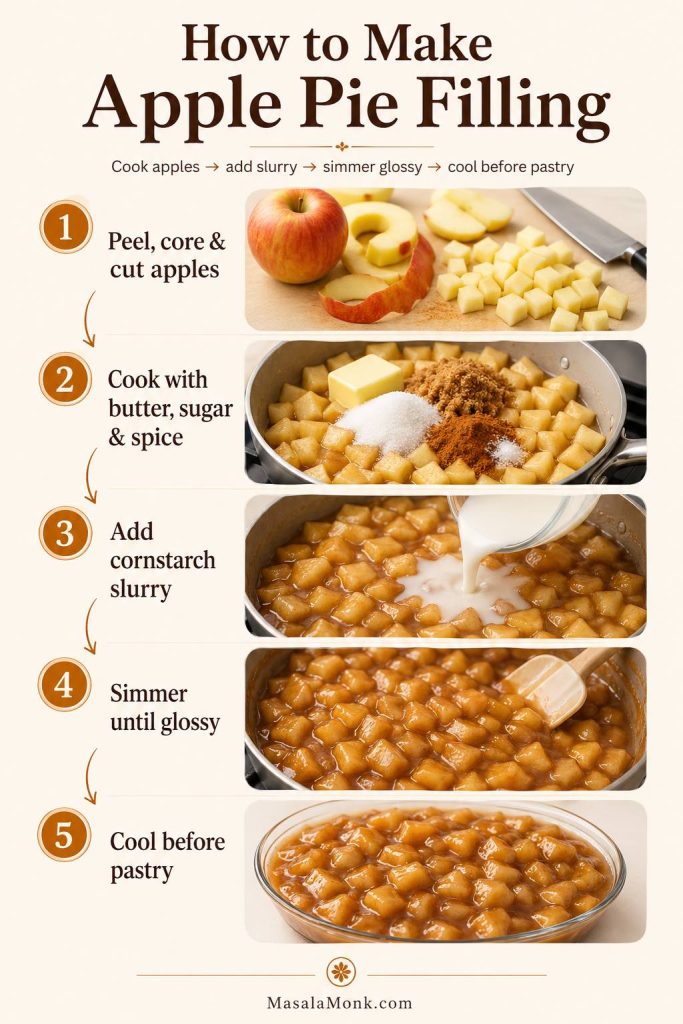
This stovetop method is simple, but the texture cues matter. First, cook the apple pieces until they begin to soften. Next, thicken the juices briefly. Finally, cool the filling before using it in pastry so the crust does not soften too early.
The goal is not applesauce, though. You only want firm apple pieces to become partly tender, with enough structure left to survive a second bake in pie, crisp, or pastry.
Cook the apples covered for 4–6 minutes until they start releasing juice, then add the slurry and simmer 1–2 minutes. After the sauce turns glossy, cool the filling completely before pastry.
1. Peel, Core and Cut the Apples
First, peel and core the apples. Then slice or dice them depending on how you plan to use the filling. For pie, cut 1/4-inch / 6 mm slices. For hand pies, turnovers, cinnamon roll bakes, pancakes, waffles, or oatmeal, use 1/2-inch / 1.25 cm dice.
2. Toss with Lemon Juice
After cutting the apples, toss them with lemon juice right away. This keeps the flavor bright and slows browning while you prepare the rest of the ingredients.
3. Cook the Apples with Butter, Sugar and Spices
Melt the butter in a wide pan over medium heat. Add the apples, brown sugar, granulated sugar, cinnamon, nutmeg, and salt. Cook covered for 4 to 6 minutes, stirring once or twice, until the apple pieces begin to release juice and soften slightly.
At this stage, the apples should bend a little when stirred, but they should not be falling apart. Meanwhile, a wide pan helps the pieces cook more evenly and gives the juices room to reduce slightly before the slurry goes in.
4. Add the Cornstarch Slurry
Before adding the thickener, whisk the cornstarch with water or apple juice until smooth. From there, stir the slurry into the apples. This helps it blend into the filling more evenly than dry cornstarch and gives the sauce a cleaner, glossier finish.
Whisk cornstarch with water or apple juice before adding it to the pan. Dry cornstarch can clump quickly, but a smooth slurry blends into the apple juices and thickens the sauce evenly.
5. Cook Until Glossy
After the slurry goes in, cook for 1 to 2 minutes, stirring gently. The filling is ready when the sauce turns glossy, the liquid thickens enough to coat the apple pieces, and the pieces still hold their shape.
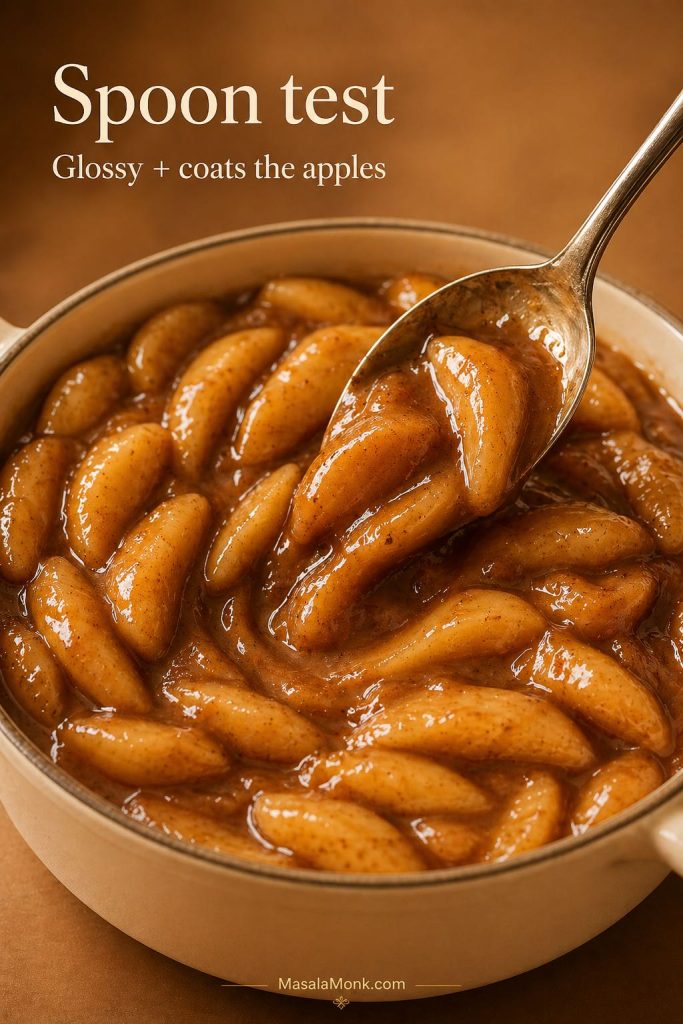
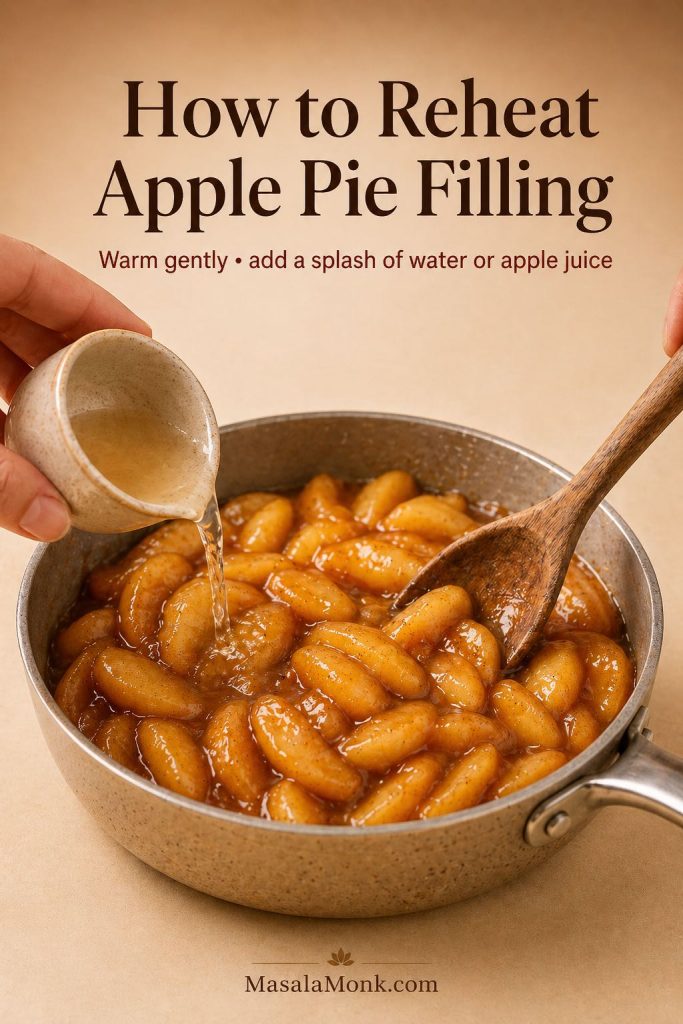
A good cue is the spoon test: drag a spoon through the filling and watch the sauce cling lightly to the apples instead of running back into a thin puddle. If it looks pasty, loosen it with a small splash of apple juice or water.
After the slurry goes in, use texture rather than time alone. If the sauce coats the apples and looks shiny, stop cooking; if it still runs like syrup, simmer 1 minute more.
By the end of cooking, this recipe should give you apple filling that looks glossy enough for toppings and sturdy enough for pie. If it still looks watery, let it bubble for another minute before adding more starch.
6. Cool Before Using
Remove the pan from the heat and stir in vanilla, if using. Spread the filling in a shallow dish so it cools faster. Before adding it to pie crust, hand pies, turnovers, or freezer bags, cool it completely.
Do not overcook the apples: This recipe should make apple pie filling, not applesauce. Stop when the apple pieces are partly tender and the sauce is glossy, because the filling may cook again in pie, crisp, or pastry.
How Thick Should Apple Pie Filling Be?
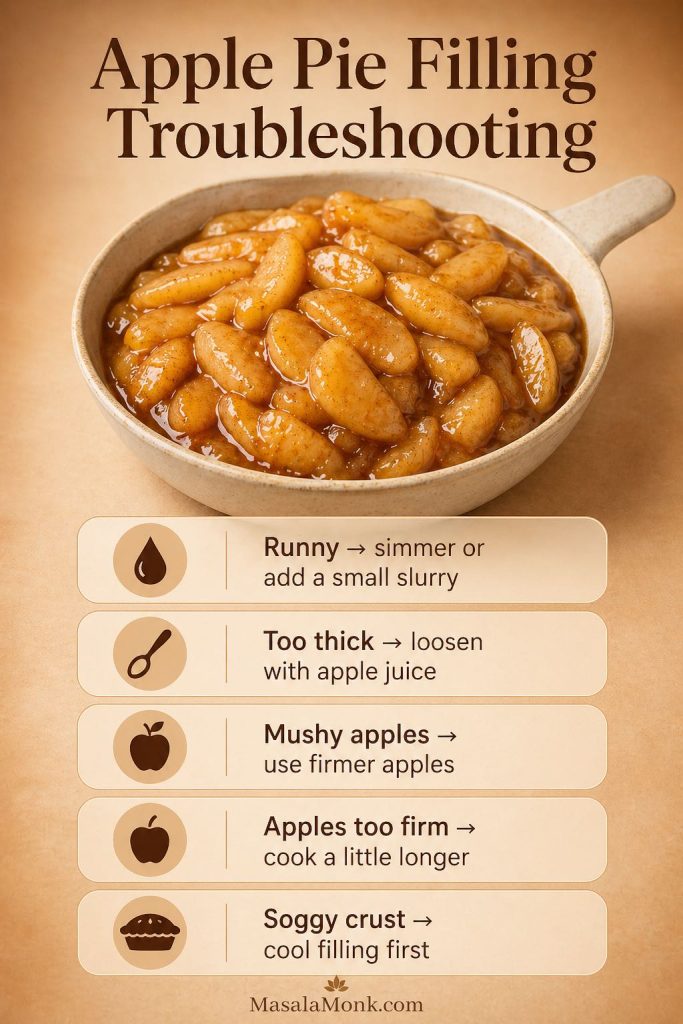
The best apple pie filling should look shiny and loose enough to spoon, but thick enough that the sauce clings to the apple pieces. In other words, the hot filling should look a little looser than the final cooled filling because it will thicken more as it rests.
For pie, this recipe should give you apple filling that mounds softly on a spoon instead of running like syrup. However, if you are using the recipe as a topping, the filling can stay slightly looser and more spoonable.
By the time it cools, the apple filling should look glossy and thick enough to sit inside a pie crust without spreading everywhere. If it turns stiff or pasty, loosen it gently with apple juice or water before using.
For a softer topping, use about 3 tablespoons cornstarch. For an all-purpose batch, use 4 tablespoons; for pie, hand pies, or turnovers that need more hold, use 4–5 tablespoons.
Use
Cornstarch for 6 Cups Filling
Texture Goal
Pancakes, waffles, oatmeal, yogurt
3 tbsp / 24 g
Soft and spoonable
Crisps, crumbles, cobblers
3 1/2 to 4 tbsp / 28–32 g
Glossy but not stiff
Pies, hand pies, turnovers
4 to 5 tbsp / 32–40 g
Holds shape better
Canning
Do not use this recipe
Use tested canning guidance
The base version uses 4 tablespoons / about 32 g cornstarch, which is the best middle ground for pies, crisps, freezer portions, and spoonable desserts. For a softer topping-style filling, reduce the cornstarch slightly.
Since apple juiciness varies, start with 1/3 cup liquid in the slurry and add more only if the filling becomes too stiff. It is much easier to loosen a thick filling than to fix one that starts watery.
How Much Apple Pie Filling for One Pie?
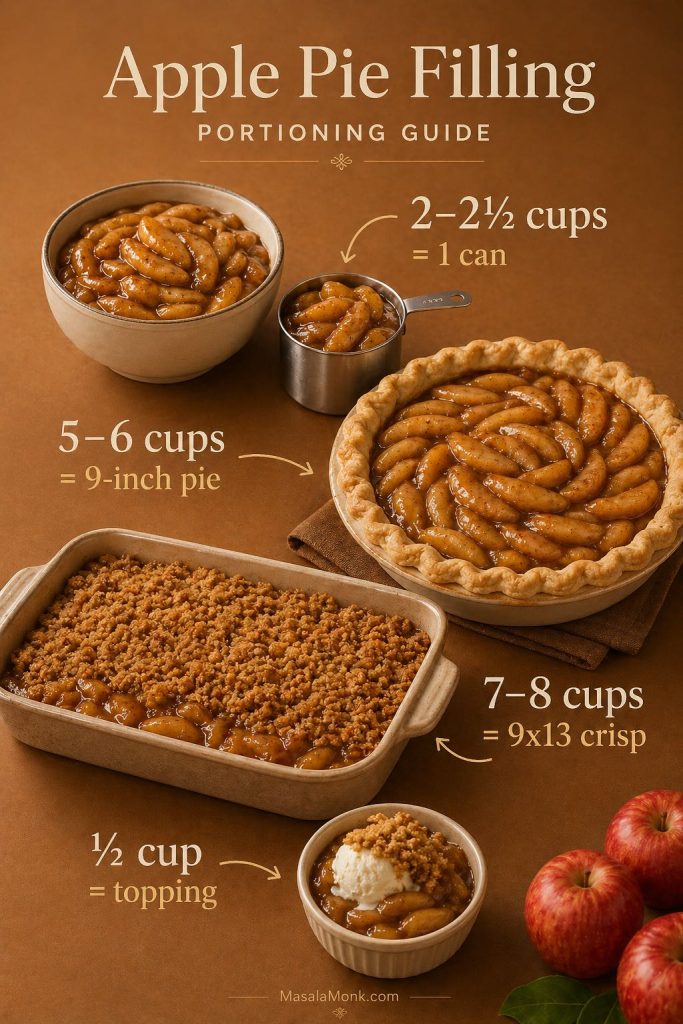
For one generous apple pie, this recipe gives you about 5 to 6 cups of filling. A shallower 8- or 9-inch pie may need closer to 4 to 5 cups, while a deep-dish pie may need 6 to 7 cups.
At this point, the filling becomes easier to use if you think in portions. The right amount depends less on the dessert name and more on the pan size, crust style, and how full you want the finished bake to be.
For a shallower pie, this recipe may need only 4 to 5 cups of apple filling. For deep-dish pie, the recipe may need to be scaled so you have closer to 6 to 7 cups of filling.
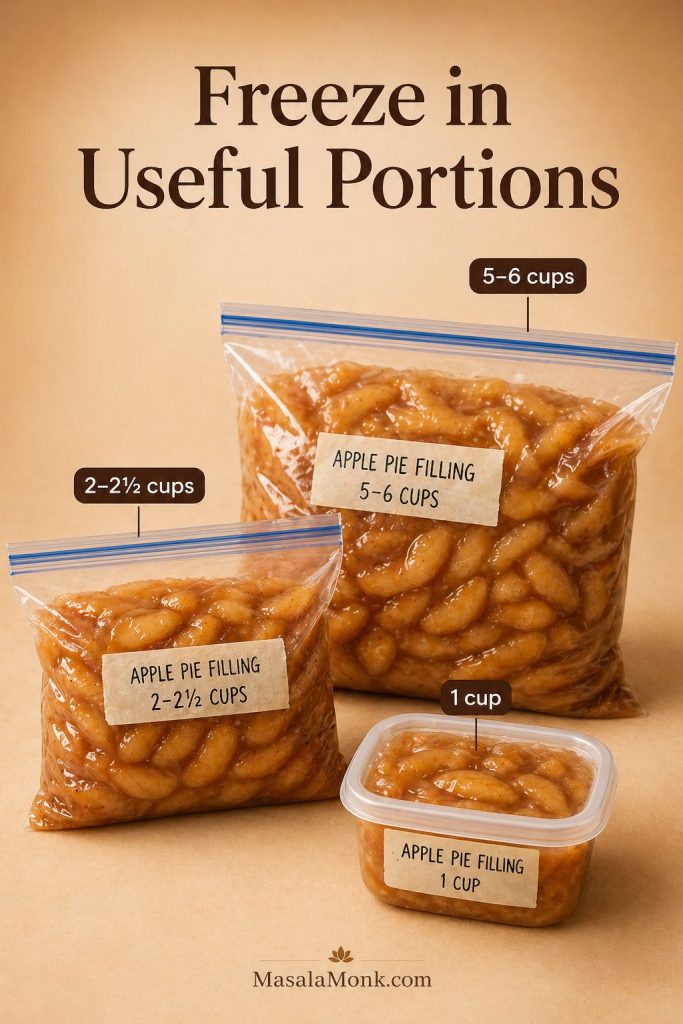
Portion before storing so the filling is easy to use later: 2–2 1/2 cups replaces one can, 5–6 cups fills a 9-inch pie, 7–8 cups works for a 9×13 crisp, and 1/2 cup is enough for one topping.
If you only need enough apple pie filling for pancakes, waffles, oatmeal, mini desserts, or one small crisp, make a half batch instead of freezing leftovers. Use 4 medium firm apples, 3/4 to 1 tablespoon lemon juice, 1 tablespoon butter, 1/4 cup brown sugar, 2 tablespoons granulated sugar, 3/4 teaspoon cinnamon, a pinch of salt, 2 tablespoons cornstarch, and 3 to 4 tablespoons water or apple juice.
The method stays the same, but the cooking time may be slightly shorter because there are fewer apples in the pan. From there, add the slurry and cook just until the sauce turns glossy.
This smaller recipe is handy when you want apple filling for a quick dessert or a small pie-style topping without committing to a full batch.
Can This Replace Canned Apple Pie Filling?
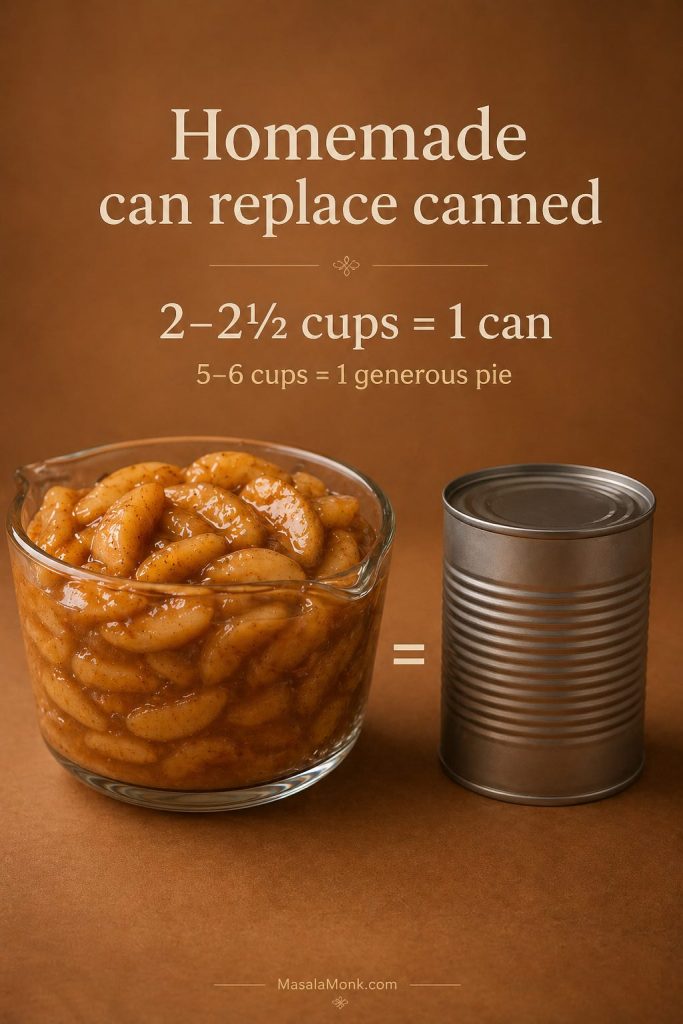
Yes. This homemade filling can replace canned filling in many desserts. Use about 2 to 2 1/2 cups as a rough replacement for one standard 20- to 21-ounce can. For one generous 9-inch pie, use about 5 to 6 cups.
Replace one 20–21 oz can with 2–2 1/2 cups homemade filling. For recipes that call for two cans, start with about 4 1/2–5 cups, then adjust if the dessert needs more sauce.
In many desserts, this recipe can replace canned apple pie filling without making the final dish overly syrupy. Compared with canned filling, the homemade version is usually less sweet, less gelled, and easier to adjust with lemon juice or a pinch of salt.
For one standard can, use about 2 to 2 1/2 cups of apple filling from this recipe in pie-style desserts. If a dessert calls for two cans of apple pie filling, this recipe usually replaces them with about 4 1/2 to 5 cups.
The full 6-cup batch gives you a little extra, which helps if you want a fuller pie, a deeper crisp, or a small topping portion left over. If you are replacing canned filling in a dessert, check the quick use chart for pie, crisp, cinnamon roll bake, dump cake, and toppings.
How to Use This Apple Pie Filling in a Pie
Although this is not a full pie-crust recipe, you can use the filling to make a classic apple pie. The key is to cool the batch first so it does not soften the crust before the pie goes into the oven.
For pie, this recipe works best when the apple filling is cooled completely before it meets the dough. Use the timing below as a starting point because pie crust thickness, pie plate material, and oven behavior can all change the final bake time.
Use cooled or chilled filling before it touches pie dough. For a full pie, bake 20 minutes at 400°F, then reduce to 375°F for 30–35 minutes, until the crust is golden and the center bubbles.
Step
What to Do
Filling amount
Use 5–6 cups cooled filling for one generous 9-inch pie
Crust
Use one bottom crust and one top crust, lattice, or crumble topping
Filling temperature
Use cooled or chilled filling, not hot filling
Oven temperature
Start at 400°F / 200°C, then reduce to 375°F / 190°C
Bake time
Bake 20 minutes at 400°F, then 30–35 minutes at 375°F
Done when
The crust is deep golden and the filling bubbles through the vents
Cooling
Cool at least 2–3 hours before slicing
With the apple filling already cooked, the oven time is mostly about baking the crust and heating the pie until the center bubbles. If the crust browns too quickly, cover the edges with foil or a pie shield.
Recipes with Apple Pie Filling: How to Use It
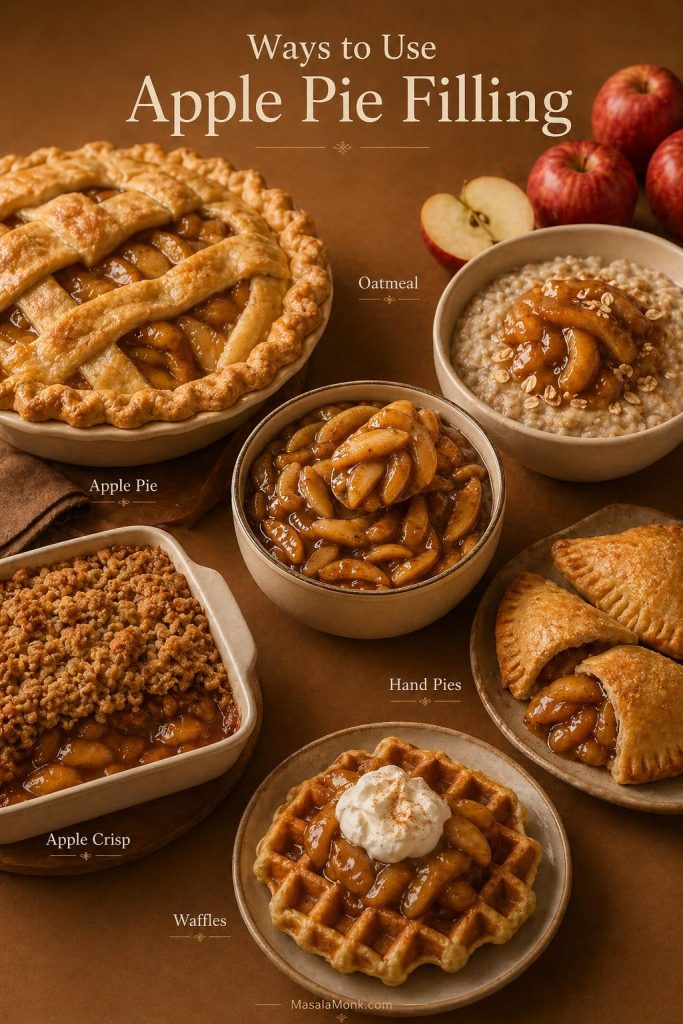
Once the apple filling is cooked and cooled, it can go far beyond pie. In real use, the important part is matching the cut, thickness, and amount to the dessert you are making.
Match the amount to the dessert: 5–6 cups for pie, 3–4 cups for an 8×8 crisp, 4 1/2–5 1/2 cups for a 9×13 cinnamon roll bake, or about 1/2 cup per breakfast serving.
Use this chart as a starting point, not a full recipe card for every dessert. That way, you can quickly see how much filling to use, what temperature usually works, and what “done” should look like before you commit to a separate recipe.
Use
Filling Amount
Temperature
Approx. Time
Done When
9-inch apple pie
5–6 cups
400°F, then 375°F
20 min, then 30–35 min
Crust golden, filling bubbling
8×8 apple crisp
3–4 cups
350°F / 175°C
25–35 min
Topping browned, edges bubbling
9×9 apple crisp
4–5 cups
350°F / 175°C
30–40 min
Topping golden, filling hot
9×13 cinnamon roll bake
4 1/2–5 1/2 cups
350°F / 175°C
45–50 min
Center dough baked through
Dump cake
4 1/2–5 1/2 cups
350°F / 175°C
45–60 min
Top golden, filling bubbling
Pancake or waffle topping
1/2 cup per serving
Low stovetop heat
3–5 min
Warm and spoonable
Apple Pie
For one generous 9-inch apple pie, 5 to 6 cups of cooled filling is usually the right amount. Since the apple pieces are already cooked, focus on baking the crust until deeply golden and crisp. Do not add hot filling to chilled pie dough, or the bottom crust can soften before baking.
Apple Crisp or Apple Crumble with Apple Pie Filling
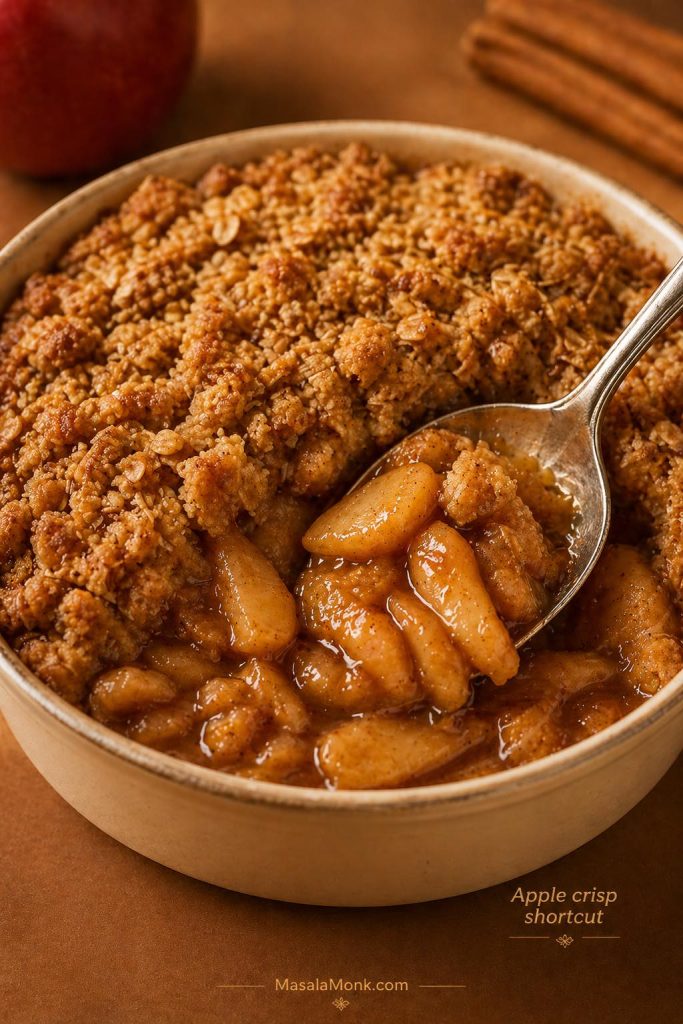
Apple crisp is one of the easiest desserts to make with this filling because the apple pieces are already cooked and the sauce is already thickened. Use 3 to 4 cups for an 8×8 pan, 4 to 5 cups for a 9×9 pan, or 7 to 8 cups for a larger 9×13 dessert. Spread the filling evenly, add a buttery oat crumble or simple flour crumble, and bake until the topping is golden and the edges are bubbling.
For an 8×8 apple crisp, spread 3–4 cups filling in the dish and bake at 350°F for 25–35 minutes. The topping should brown and the filling should bubble around the edges.
For a quick crumble topping, mix 3/4 cup oats, 1/2 cup flour, 1/2 cup brown sugar, 1/2 teaspoon cinnamon, a pinch of salt, and 6 tablespoons cold butter until crumbly. Then scatter it over 3 to 4 cups of filling for an 8×8 crisp and bake until the edges bubble and the topping is golden.
Because this homemade apple filling is usually less syrupy than canned pie filling, do not make the crumble topping too dry. If the recipe has thickened a lot after chilling, loosen the filling with a spoonful of apple juice or water before baking.
Hand Pies and Turnovers
Small pastries do not forgive large apple slices. For hand pies and turnovers, diced filling is easier to seal inside pastry and less likely to leak. After the cooked apple filling cools completely, use a modest spoonful in each pastry so it does not push through the edges.
For hand pies and turnovers, diced filling is easier to seal than long slices. Use modest spoonfuls; 2–3 cups of filling is usually enough for a batch of small pastries.
Mini Apple Pies
Diced filling works better than long slices for muffin-tin mini pies. Since the pieces are smaller, they sit neatly inside small crust rounds and make the pies easier to eat.
Cinnamon Roll Bake
For a large 9×13 cinnamon roll bake, use about 4 1/2 to 5 1/2 cups of chopped or diced apple pie filling with two tubes of cinnamon roll dough. For a smaller one-tube bake, use about 2 to 2 1/2 cups. If the filling has long slices, chop them roughly before combining so the center can bake through more evenly.
Apple Dump Cake
Use about 4 1/2 to 5 1/2 cups of this homemade filling as a replacement for two standard cans in many dump cake-style desserts. Homemade filling may be less syrupy than canned filling, so spread it evenly before adding the topping.
Pancakes, Waffles, Oatmeal, Yogurt and Ice Cream
If the filling is headed for breakfast bowls or ice cream, keep it a little softer. It should spoon easily over pancakes, waffles, oatmeal, yogurt, or ice cream instead of sitting stiffly on top. It works especially well over fluffy buttermilk pancakes, oat pancakes, almond flour pancakes, or a warm bowl of protein oatmeal.
If you want a lower-sugar version, you can reduce the sugar, but the texture will change slightly. Sugar does more than sweeten the apples; it also helps pull out juice and gives the sauce a fuller, glossier finish. As a result, a low-sugar batch may taste brighter and less syrupy than a classic pie filling.
For a lower-sugar recipe, use naturally sweet apple varieties and keep enough thickener for the filling to hold in pie. Reduce the granulated sugar first, keep some brown sugar for warmth if possible, and use lemon juice, cinnamon, vanilla, and a pinch of salt so the filling does not taste flat.
For a lightly reduced-sugar batch, use 1/2 cup brown sugar and skip the granulated sugar. For a lower-sugar version, start with 1/4–1/3 cup brown sugar and adjust with lemon, salt, cinnamon, or vanilla.
Version
How to Adjust
Best Use
Lightly reduced sugar
Use 1/2 cup brown sugar and skip the granulated sugar
Pies, crisps, toppings
Low sugar
Use 1/4 to 1/3 cup brown sugar total
Breakfast bowls, pancakes, oatmeal
No-added-sugar style
Use sweet apples and a heat-stable sweetener to taste, or skip sweetener for a tart topping
Toppings and freezer portions
If you remove most of the sugar, taste the filling before cooling. A little extra lemon juice can make it brighter, while a pinch of salt and a splash of vanilla can make the apple flavor taste rounder without adding more sweetness.
Can You Make Apple Pie Filling Ahead?
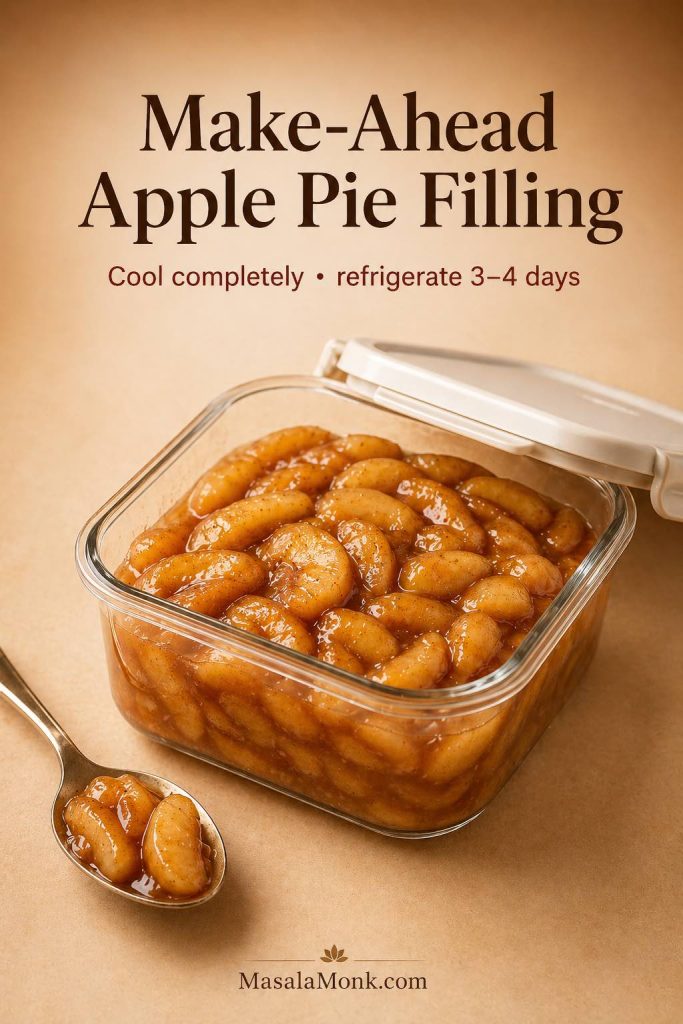
Yes. This filling is a strong make-ahead option because the cooked batch chills, portions, and freezes well. After cooking, cool it completely and refrigerate it in an airtight container for 3 to 4 days.
Cool the filling completely before storing, then refrigerate it airtight for 3–4 days. For pie dough, hand pies, or turnovers, use the filling chilled or at room temperature instead of hot.
For pie, hand pies, turnovers, or other pastry desserts, use the filling chilled or at room temperature rather than hot. Hot filling can soften dough before baking, especially in bottom crusts and small pastries.
Because this recipe freezes well, you can portion the apple filling for one pie, one can replacement, or small breakfast toppings. However, when the batch is meant specifically for pie, sliced apple filling gives you a more classic texture.
For apple-cinnamon meal prep, this same flavor direction also works well in oat-based snacks like healthy oat protein bars. Keep this filling softer if you plan to spoon it over bars, bowls, or breakfast jars instead of baking it inside pastry.
Freezer shortcut: If you freeze this filling in 2 to 2 1/2 cup portions, each bag can work like one can of apple pie filling for quick desserts.
How to Freeze Apple Pie Filling
The most useful freezer bag is the one you can use without thinking later. Since this batch makes about 6 cups, you can freeze it as one full pie batch or divide it into smaller canned-style replacement portions.
Before freezing, decide how you will use the apple filling later. For example, a 1-cup breakfast topping portion is very different from a full pie batch, so label each bag by amount as well as date.
Cook the filling until glossy and thickened.
Spread it in a shallow dish and cool completely.
Portion it into freezer bags or airtight freezer-safe containers.
Label each portion with the date and amount.
If using bags, freeze them flat so they stack easily.
Use within 3 months for best quality.
Before using in pastry, thaw overnight in the refrigerator.
Freeze by future use: 1-cup bags for toppings, 2–2 1/2 cup bags for canned-style replacement, and 5–6 cup bags for one 9-inch pie. Flat freezer bags stack better and thaw faster.
Best Freezer Portions
For later pie baking, freeze the recipe in a 5- to 6-cup apple filling portion so the full batch is ready to thaw at once. For quick desserts, smaller bags are easier to thaw than one full pie-size portion.
Portion
Best Use
1 cup
Oatmeal, waffles, pancakes, yogurt
2 to 2 1/2 cups
One-can replacement
3 to 4 cups
Small apple crisp or crumble
5 to 6 cups
One 9-inch apple pie
7 to 8 cups
9×13 crisp or larger dessert
How to Thaw Frozen Apple Pie Filling
For pastry, thaw frozen filling overnight in the refrigerator and use it cold or at room temperature. That way, the filling is thick enough to handle and does not soften the dough before baking.
For small breakfast portions, 1-cup bags are the most useful. They thaw quickly and can be warmed for pancakes, yogurt bowls, or oatmeal. For a cold breakfast option, spoon a small amount over high protein overnight oats.
If using a rigid freezer container, leave a little headspace because the filling can expand as it freezes. If using freezer bags, press out excess air before sealing.
How to Reheat Apple Pie Filling
For toppings, reheat apple pie filling gently in a small pan over low heat. Add a splash of water or apple juice if the sauce has thickened in the refrigerator, then stir often and warm only until the filling is spoonable.
For toppings, reheat over low heat for 3–5 minutes, stirring often. Add a small splash of water or apple juice only if the sauce has tightened too much in the fridge.
For pie, hand pies, turnovers, and other pastry desserts, thaw frozen filling overnight in the refrigerator and use it cold or at room temperature rather than hot. This helps protect the pastry and keeps the filling from loosening too much before baking.
Can You Can This Apple Pie Filling?
Not this version. This is a refrigerator and freezer apple pie filling recipe, not a shelf-stable canning recipe. Don’t water-bath can this cornstarch-thickened filling. Safe home-canned pie fillings require tested formulas, correct acidity, proper processing, and approved thickeners such as cook-type Clear Jel®.
Do not water-bath can this cornstarch-thickened filling. Keep it refrigerated for 3–4 days, freeze it up to 3 months, or use a tested Clear Jel® formula when you want pantry-safe jars.
Instead, keep this recipe as a refrigerator or freezer apple filling, and use tested canning guidance for pantry-safe pie filling. If you want to can apple pie filling for pantry storage, use a trusted extension or food-preservation source, such as the National Center for Home Food Preservation apple pie filling instructions.
Troubleshooting Apple Pie Filling
Most filling problems are fixable before the apples go into pastry. If the sauce looks too loose, too thick, or too cloudy, adjust it in the pan instead of hoping the oven will solve it later.
Usually, the cause is apple choice, cut size, cooking time, or starch. Luckily, the fix is often simple if you catch it before baking the filling into pie, crisp, or pastry.
Fix texture before the filling goes into pastry. If it is runny, simmer 1–2 minutes more or add a small slurry; if it is too thick, loosen it with apple juice or water.
Problem
Why It Happened
Fix
Filling is runny
Not enough starch, not bubbled long enough, or very juicy apples
Simmer 1–2 minutes more or add a small cornstarch slurry
Filling is too thick
Too much cornstarch or overcooking
Loosen with a splash of apple juice or water
Apple pieces are mushy
Soft apples or too much cooking
Use firmer apples and cook only until partly tender
Apple pieces are too firm
Pieces are too thick or undercooked
Slice thinner or cook covered a few minutes longer
Filling is too sweet
Very sweet apples plus too much sugar
Add lemon juice and a pinch of salt
Filling is too tart
All tart apples or too much lemon
Add brown sugar or blend in sweeter apples next time
Pie crust gets soggy
Hot filling added to pastry
Cool the filling completely before filling the pie
Filling looks cloudy
Starch was overheated, clumped, or flour was used
Use a smooth cornstarch slurry and simmer briefly
If the recipe gives you apple filling that looks runny before it goes into pie, fix it in the pan. After baking, the same problem is much harder to correct.
Apple Pie Filling Recipe
The full recipe uses 8 medium apples, 4 tablespoons cornstarch, and 10–12 minutes of cooking to make about 6 cups. For a softer topping, reduce the cornstarch to 3 tablespoons.
Homemade Apple Pie Filling
This apple pie filling recipe makes about 6 cups of thick, glossy cinnamon apple filling for pies, crisps, hand pies, turnovers, toppings, and freezer portions.
Prep Time 20 minutes
Cook Time 10–12 minutes
Total Time 30–35 minutes, plus cooling
Yield About 6 cups / 1.4 liters
Ingredients
8 medium firm apples, about 3 lb / 1.35 kg whole apples, or about 900 g to 1 kg after peeling and coring, sliced or diced
1 1/2 to 2 tablespoons lemon juice / 22–30 ml
2 tablespoons unsalted butter / 28 g
1/2 cup packed brown sugar / 100 g
1/4 cup granulated sugar / 50 g
1 1/2 teaspoons ground cinnamon / about 4 g
1/8 to 1/4 teaspoon ground nutmeg, optional
1/4 teaspoon fine salt
4 tablespoons cornstarch / about 32 g
1/3 to 1/2 cup water or apple juice / 80–120 ml
1 teaspoon vanilla extract / 5 ml, optional
Method
Peel, core, and cut the apples. Use 1/4-inch / 6 mm slices for pie or 1/2-inch / 1.25 cm dice for hand pies, turnovers, toppings, and cinnamon roll bakes.
Toss the apples with lemon juice.
Melt the butter in a wide pan over medium heat. Add the apples, brown sugar, granulated sugar, cinnamon, nutmeg, and salt.
Cook covered for 4–6 minutes, stirring once or twice, until the apple pieces begin to release juice and soften slightly. They should bend a little but still hold their shape.
Meanwhile, in a small bowl, whisk the cornstarch with 1/3 cup water or apple juice until smooth.
Stir the slurry into the apples. Cook for 1–2 minutes, stirring gently, until the sauce turns glossy and thick enough to coat the apple pieces. Add a little more water or apple juice only if the filling looks too stiff.
Remove the pan from the heat and stir in vanilla, if using.
Spread the filling in a shallow dish and cool it completely before using in pie crust, hand pies, turnovers, or freezer bags.
Notes
For one generous 9-inch pie, use 5 to 6 cups of filling.
For a softer topping-style filling, reduce cornstarch to 3 tablespoons.
For hand pies or turnovers, dice the apples instead of slicing them.
Cool the filling before adding it to pastry to reduce sogginess.
This recipe is for refrigerator or freezer storage, not shelf-stable canning.
Storage
Refrigerate cooled filling in an airtight container for 3–4 days, or freeze in labeled portions for best quality within 3 months. Thaw overnight in the refrigerator before using.
Let a baked pie cool for at least 2–3 hours before slicing. That resting time helps the filling set so the slice holds together instead of spilling out of the crust.
FAQs About Apple Pie Filling
How much apple pie filling do I need for one pie?
For one apple pie, this recipe gives you about 5 to 6 cups of filling. A shallower pie may need 4 to 5 cups, while a deep-dish pie may need 6 to 7 cups.
How many apples do I need for apple pie filling?
For this apple pie filling recipe, use about 8 medium firm apples, or about 3 pounds / 1.35 kg whole apples. After peeling and coring, that gives enough apple pieces for about 6 cups of cooked filling.
Do you have to peel apples for apple pie filling?
For classic apple pie filling, peeling the apples gives the smoothest texture. That said, you can leave the peels on for a more rustic filling, especially if you are using it for crisps, oatmeal, yogurt, or pancake toppings.
Can I use this instead of canned apple pie filling?
For most recipes, use about 2 to 2 1/2 cups of this homemade filling as a rough replacement for one standard 20- to 21-ounce can of apple pie filling. For a full 9-inch pie, use about 5 to 6 cups.
Can I freeze apple pie filling?
To freeze the recipe, cool the apple filling completely, portion it into bags, and thaw it overnight before using it in pie. For best quality, use frozen portions within 3 months.
Can I make apple pie filling ahead?
For make-ahead baking, prepare the filling 3 to 4 days in advance and keep it refrigerated in an airtight container. Before using it in pies, hand pies, turnovers, or other pastry desserts, let it stay chilled or come to room temperature rather than adding it hot.
Should I slice or dice the apples?
Slice the apples for classic apple pie and crisps. Dice the apples for hand pies, turnovers, cinnamon roll bakes, pancakes, waffles, oatmeal, yogurt, and ice cream toppings.
Can I use apple pie spice instead of cinnamon?
Yes. Replace the cinnamon and nutmeg with about 1 1/2 to 2 teaspoons apple pie spice. Start with the smaller amount if your blend contains cloves, allspice, or ginger, because those spices can become strong quickly.
Should apple pie filling be cooked before baking?
For this recipe, yes. Cooking the filling first gives you better control over apple texture and sauce thickness. It also helps prevent surprises like watery pie filling after baking.
Is cornstarch or flour better for apple pie filling?
Cornstarch gives apple pie filling a glossier, cleaner sauce. Flour gives a duller, more rustic filling and can look cloudier. For this stovetop filling, cornstarch is the better choice.
Why is my apple pie filling runny?
Apple pie filling is usually runny because there was too little thickener, the slurry did not bubble long enough, or the apples released more juice than expected. The easiest fix is to simmer the filling a little longer, or add a small extra cornstarch slurry if needed.
Can I make apple pie filling without cornstarch?
You can make refrigerator or freezer apple filling without cornstarch, but the recipe will behave differently in pie. Arrowroot, tapioca starch, or flour can work in some cases, although each one thickens differently. If you are making shelf-stable canned filling, do not substitute casually; use a tested canning recipe.
Can I make low-sugar apple pie filling?
For a lower-sugar recipe, use naturally sweet apple varieties and keep enough thickener for the filling to hold in pie. Since a lower-sugar filling may be less syrupy, taste before cooling and adjust with lemon juice, salt, cinnamon, or vanilla as needed.
Can I can this apple pie filling?
Not this version. This cornstarch-thickened filling is for refrigerator or freezer storage only. For shelf-stable canning, use a tested canning formula with approved ingredients and processing instructions.
What can I make with apple pie filling?
You can use apple pie filling in apple pie, apple crisp, apple crumble, hand pies, turnovers, mini pies, cinnamon roll bakes, dump cakes, pancakes, waffles, oatmeal, yogurt bowls, cheesecake topping, or ice cream topping.
Extra filling is useful beyond pie: reheat it over low heat for 3–5 minutes and serve about 1/2 cup over pancakes, waffles, oatmeal, yogurt, or ice cream.
A good healthy homemade granola bars recipe should give you bars that are chewy, sturdy, lightly sweet, and easy to pack without crumbling into oat clusters. This version starts with a simple no-bake base of oats, nut butter, a sticky sweetener, salt, and mix-ins. Once that base works, you can adjust it for peanut butter, chocolate chip, protein, low-sugar, gluten-free, vegan, nut-free, cereal-style, or baked flapjack-style bars.
The best part is that these healthy homemade granola bars can fit the way you actually snack. Keep them simple for lunchboxes, add protein powder for a more filling post-workout bar, use sunflower seed butter for a nut-free lunchbox option, or bake the mixture briefly when you want a crunchier texture. Once you know how the oat-binder-sweetener formula works, homemade granola bars become much easier to customize.
If a reader only remembers three things, it should be these: use a balanced base formula, make sure the mixture clumps when squeezed, and fix problems before chilling by adjusting binder, oats, seeds, or mix-in size.
If this is your first batch, start with the basic chewy no-bake version. Do not try to make the bars protein-rich, vegan, low-sugar, crunchy, and nut-free all at once. Instead, make one reliable batch first, learn how the mixture should feel before pressing, and then use the variations to change the flavor, sweetness, texture, or diet fit.
Start with the chewy no-bake base, then use the guides below to make the bars firmer, softer, crunchier, lower in sugar, higher in protein, vegan, gluten-free, nut-free, cereal-style, or flapjack-style.
To make chewy, healthy homemade granola bars, mix rolled oats with creamy nut butter or seed butter, a sticky sweetener such as honey, brown rice syrup, or date paste, a little salt, and small mix-ins. Then, press the mixture very firmly into a lined pan, chill until set, and slice it into bars.
The bars hold together best when the mixture looks sticky and slightly glossy before it goes into the pan. However, if it looks dusty, it will probably slice dusty. If it feels wet and loose, add more oats, seeds, or ground flaxseed. In the end, the goal is a dense mixture that clumps when squeezed in your hand.
In this recipe, the homemade oat mixture turns into chewy granola-style bars once it is pressed firmly and chilled. That texture cue matters more than any single mix-in, especially if you want a healthier bar that still slices cleanly.
In short, the formula is simple: oats give structure, nut or seed butter adds richness, sticky sweetener helps the bars hold, and small mix-ins add flavor without breaking the slab.
At a glance: These are chewy no-bake granola bars made with rolled oats, creamy peanut butter or seed butter, honey or date paste, seeds, and mini chocolate chips. You need about 15 minutes of hands-on time, then the bars chill until firm. For the most reliable first batch, use peanut butter and honey, press the mixture firmly, and chill before slicing.
Why Make Granola Bars at Home?
Making granola bars at home gives you more control over sweetness, texture, binder choice, and mix-ins. That matters because the same basic oat mixture can become a chewy snack bar, a firmer lunchbox bar, a lower-sugar seed bar, a vegan date bar, or a protein-focused bar once you know how to adjust the formula.
One of the biggest advantages of making granola bars at home is control. You decide how sweet they are, what binder to use, how chewy or firm they feel, and which real mix-ins actually go into the batch.
5-Ingredient Homemade Granola Bars
When you want the simplest possible version, use this 5-ingredient formula. It is the easiest way to make homemade granola bars without turning the recipe into a project.
Because this recipe keeps the bars homemade, you can control the granola-style base, the binder, and the final sweetness without relying on a packaged snack bar.
Because this version starts with only five ingredients, it is the easiest place to learn how the oat mixture should look before you move into protein, vegan, nut-free, or low-sugar bars.
Oats for structure and chew
Peanut butter or sunflower seed butter for richness and binding
Honey, brown rice syrup, or date paste for stickiness
Salt for balance
Mini chocolate chips, seeds, raisins, or chopped nuts for flavor
If you are making these for older kids, start with oats, peanut butter, honey, salt, and mini chocolate chips. For a nut-free version, use sunflower seed butter and seeds instead. When you want a less sweet batch, use seeds or chopped nuts as the fifth ingredient instead of chocolate or dried fruit.
For a lighter, crispier bar, replace 1/2 to 1 cup of the oats with puffed rice cereal, crisp rice cereal, or crisp oat cereal. Since cereal is lighter than oats, keep the sticky binder strong so the bars hold together.
This recipe works because homemade granola bars do not all need the same texture. A lunchbox bar, breakfast bar, protein bar, cereal bar, and crunchy bar each need slightly different handling.
Once the base recipe works, you can steer the same homemade granola bar formula toward chewy, crunchy, protein-rich, low-sugar, vegan, or nut-free versions.
You Want
Best Version to Make
What to Remember
Easiest first batch
Chewy no-bake granola bars
Use peanut butter and honey, then press hard and chill fully.
Bars that hold together best
Honey or brown rice syrup + nut butter
Brown rice syrup is especially sticky; honey is easier to find.
Prepared granola version
Ready-made granola + sticky binder
Crush large clusters first and use less added sweetener if the granola is already sweet.
Nut-free lunchbox option
Sunflower seed butter + seeds
Skip nuts and use pumpkin seeds, sunflower seeds, sesame, coconut, or mini chocolate chips.
Higher-protein bars
Protein granola bars
Start with a small amount of protein powder so the bars do not turn chalky.
Less sweet bars
Seed-heavy bars with less dried fruit and chocolate
Do not remove all sticky binder, or the bars will crumble.
Crunchy granola bars
Toasted and briefly baked bars
Cool completely before slicing; crunchy bars firm as they cool.
Cereal bars
Oats + puffed rice or crisp cereal
Use a strong binder and press firmly because cereal is lighter than oats.
Vegan granola bars
Date paste or brown rice syrup bars
Maple syrup can work, but it usually needs extra support from nut butter or flax.
Soft breakfast bars
Oat bars with banana or applesauce
These are softer and more breakfast-like than classic granola bars.
Flapjack-style oat bars
Baked granola bar variation
Use the crunchy baked method, but keep the sweetener measured for a lighter bar.
Tip: Use your browser’s print option to save this recipe card, or screenshot it if you want to keep the basic formula on your phone.
Use this base ratio as your starting point, then adjust the binder, sweetener, and mix-ins depending on whether you want softer bars, firmer lunchbox bars, or a more protein-focused batch.
Before you start: For the easiest chewy bars, use peanut butter and honey. If you have a kitchen scale, weigh the oats, nut butter, and sweetener for the most consistent texture. For vegan bars, use brown rice syrup or date paste instead of honey.
These healthy homemade granola bars are chewy, no-bake, easy to customize, and made with oats, nut butter, honey or date paste, seeds, and mini chocolate chips. Start with the base recipe, then use the variations below to change the flavor, texture, sweetness, or diet fit.
Yield12 bars
Prep Time15 minutes
Binder Warming2 minutes
Chill Time1 to 2 hours
Total TimeAbout 1 1/2 to 2 1/2 hours
Ingredients for Chewy Homemade Granola Bars
2 1/4 cups rolled oats or old-fashioned oats, about 200 g / 7 oz
3/4 cup creamy peanut butter, almond butter, sunflower seed butter, or tahini, about 190–205 g / 6.7–7.2 oz
1/2 cup honey, brown rice syrup, or thick date paste, about 160–170 g / 5.6–6 oz / 120 ml
1 teaspoon vanilla extract, 5 ml
1/2 teaspoon cinnamon, optional
1/2 teaspoon fine salt, about 3 g, or less if your nut butter is salted
1/3 cup pumpkin seeds or sunflower seeds, about 45–55 g / 1.6–2 oz
1/3 cup chopped nuts, chopped dried fruit, or extra seeds, about 40–55 g / 1.4–2 oz
1/3 cup mini chocolate chips, about 55–60 g / 2 oz, optional
1 to 2 tablespoons ground flaxseed or chia seeds, about 7–18 g, optional
Instructions for Homemade Granola Bars
Line an 8-inch / 20 cm square pan with parchment paper, leaving overhang on two sides. For thinner bars, use a 9-inch / 23 cm square pan. For thicker bars, use a 9 x 5-inch / 23 x 13 cm loaf pan or press the mixture into only part of a larger pan.
In a small saucepan over low heat, warm the nut butter and honey until smooth and pourable. Then, stir in vanilla, cinnamon, and salt. Do not boil for the basic no-bake version.
In a large bowl, mix the oats, seeds, chopped nuts or dried fruit, and flaxseed or chia seeds if using.
Pour the warm binder over the oat mixture. Stir thoroughly until every oat and mix-in is coated. At this point, the mixture should feel sticky and dense, not dry or dusty.
Let the mixture cool for 3 to 5 minutes, then fold in the mini chocolate chips.
Transfer to the lined pan. Cover with parchment and press very firmly into an even layer. Use the bottom of a measuring cup to compact the mixture into the corners.
Chill for at least 1 hour, or 2 hours for firmer bars. Before slicing, the center should feel firm when pressed.
Lift out of the pan and slice into 12 bars. Store chilled for the firmest texture.
Recipe Notes for Homemade Granola Bars
The mixture should look sticky and dense before pressing. If dry oats collect at the bottom of the bowl, add 1 tablespoon more nut butter or honey before pressing.
When the mixture crumbles before pressing, add more nut butter or honey. If it feels wet and sticky, add more oats, seeds, or ground flaxseed.
Use brown rice syrup or thick honey instead of thin maple syrup when you want firmer bars.
Vegan granola bars work best with brown rice syrup or date paste.
Nut-free bars need sunflower seed butter or tahini, plus seeds instead of nuts.
Gluten-free bars need certified gluten-free oats and checked labels on all mix-ins.
Protein granola bars work best when you replace 1/4 cup oats with protein powder and add 1 to 2 extra tablespoons nut butter if the mixture feels dry.
For a lighter crisp texture, replace 1/2 to 1 cup of the oats with puffed rice cereal, crisp rice cereal, or crisp oat cereal.
Bars made with ready-made granola need about 2 1/2 cups prepared granola in place of the oats, with less sweetener if the granola is already sweet.
A warm lunchbox needs a firmer binder, so use brown rice syrup or a short-cooked honey binder and pack with an ice pack.
Do not use honey in bars for children under 12 months old. Use date paste or another suitable sweetener instead.
Nutrition Estimate for Homemade Granola Bars
Nutrition will vary depending on the nut butter, sweetener, seeds, chocolate, dried fruit, and protein powder you use. As a rough estimate, one of 12 bars from the basic peanut butter and honey version will usually fall in the range of 180 to 230 calories, with most of the energy coming from oats, nut butter, seeds, and sweetener. For a lighter bar, cut the slab into 16 smaller squares.
How to Cut Homemade Granola Bars
Cut the slab into 12 rectangles when you want regular snack bars. For smaller lunchbox portions, slice it into 16 squares. Bite-size freezer snacks work well as 24 mini bars. In general, thicker bars hold together better, while thinner bars feel lighter and chill faster.
For the most reliable first batch, use peanut butter and honey because both help the oats stick together. Brown rice syrup makes firmer bars, especially if you need them to hold up longer outside the fridge. Maple syrup tastes good, but it usually makes softer, more fragile bars unless you add extra nut butter or ground flaxseed.
Before chilling, the mixture should look sticky, clump when squeezed, and press into a compact slab; otherwise, the bars may crumble when sliced.
The mixture should feel sticky before it goes into the pan. If dry oats are still sitting at the bottom of the bowl, do not press yet. Instead, add another spoonful of nut butter or honey, stir again, and test a small handful. Once it clumps when squeezed, it is ready to press.
Texture checkpoints: Before pressing, the mixture should look sticky, dense, and slightly glossy. After pressing, the slab should feel compact and flat, not loose or bumpy. After chilling, the center should feel firm when pressed. If the knife smears, chill longer. If the slab cracks sharply, let it sit for 5 minutes before slicing.
Best Pan Size for Homemade Granola Bars
An 8-inch / 20 cm square pan gives the best balance of thickness, chilling time, and clean slicing. A 9-inch / 23 cm square pan makes thinner bars that chill faster, but they can break more easily if the mixture is not pressed firmly. A 9 x 5-inch / 23 x 13 cm loaf pan makes thicker bars that hold together well, although the yield will be smaller.
Pan size changes the thickness of homemade granola bars more than most people expect. An 8-inch square pan usually gives the best balance, whereas a 9-inch square makes thinner bars and a loaf pan gives a thicker, taller bar.
Whatever pan you use, press the mixture into a tight, even layer before chilling. Otherwise, the slab may look set on top but crumble when sliced.
Why These Healthy Homemade Granola Bars Work
Granola bars are simple, but they can fail in frustrating ways. Sometimes they taste good but crumble as soon as you cut them. At other times, they are so sticky that they feel unfinished. Occasionally, they become hard because the binder was cooked too long.
These bars work because the oats, binder, sweetener, and mix-ins are balanced before anything goes into the pan. First, the oats give chew and structure. Then, the nut butter or seed butter adds richness and helps glue the mixture together. Meanwhile, the sticky sweetener holds the dry ingredients in place. Because small mix-ins spread through the bars instead of creating big break points, the slab cuts more cleanly. Finally, firm pressing and proper chilling turn the mixture into sliceable bars.
In other words, bars hold together because each part has a job: oats build structure, binder adds cohesion, sticky sweetener locks things in, pressing compacts the slab, and chilling firms everything up for cleaner slices.
Oats are also a strong base for a filling snack because they are a whole grain and contain beta-glucan, the main soluble fiber in oats. Harvard’s Nutrition Source notes that beta-glucan has been studied for slowing digestion and increasing satiety, which is one reason oats work so well in breakfasts and snacks. Read Harvard’s guide to oats and beta-glucan here.
Are Homemade Granola Bars Healthy?
Homemade granola bars can be a healthier everyday snack, especially when you build them around oats, nuts, seeds, and a measured amount of sweetener. Still, homemade does not automatically mean sugar-free, low-calorie, or high-protein. The real benefit is that you decide what goes in and how sweet, filling, or protein-rich the bars should be.
Homemade granola bars can be a healthier snack when they are built with balance. For example, whole oats, nuts or seeds, measured sweetener, and sensible portions make them easier to fit into everyday eating.
For a more balanced homemade granola bar, start with whole oats, a moderate amount of nut or seed butter, seeds for texture, a sticky sweetener used with restraint, and enough salt to make the flavors taste complete. If the bar is meant to replace breakfast, consider protein and fiber. However, if it is meant to be a small snack, keep the portion size realistic.
In practice, a healthy homemade granola bars recipe should not depend only on removing sugar. It should also help the bars stay satisfying, easy to portion, and sturdy enough to eat without falling apart.
Granola Bars vs Oat Bars vs Muesli Bars vs Cereal Bars
These names overlap, but they are not always used the same way. Knowing the difference helps you choose the right style instead of forcing one recipe to do everything.
Although these snack bars often get grouped together, they are not exactly the same. Granola bars are usually chewier and chunkier, oat bars are softer, muesli bars lean more toward nuts and dried fruit, and cereal bars are lighter and crispier.
Bar Type
What It Usually Means
Best For
Granola bars
Oat-based bars with nuts, seeds, dried fruit, chocolate, and a sticky binder.
In UK-style usage, usually baked oat bars made with oats, fat, sugar, and syrup.
People who want a firmer baked oat bar texture.
For this recipe, rolled oats or old-fashioned oats are the best starting point because they give homemade granola-style bars visible texture and chew. If you are still deciding which oats to use, MasalaMonk’s guide to oats, types, nutrition, and differences explains rolled oats, quick oats, instant oats, and steel-cut oats in more detail.
Ingredients for Healthy Homemade Granola Bars
This recipe uses simple homemade granola bar ingredients, but each one has a job. Once you understand what each ingredient does, it becomes much easier to make substitutions without ending up with crumbly, sticky, or dry bars.
Before you start, it helps to see the building blocks clearly. Oats provide structure, nut or seed butter adds richness, sticky sweetener helps with hold, and mix-ins bring flavor, texture, and variety.
Rolled Oats or Old-Fashioned Oats
Rolled oats are the best all-purpose choice for chewy granola bars. They are flat enough to bind into the mixture, but they still keep enough texture to feel hearty. Old-fashioned oats and rolled oats are usually the same thing, so either label works here. MasalaMonk has a full guide on substituting old-fashioned oats for rolled oats if you want the details.
Quick oats can work when you want softer bars, although the texture will be less defined. On the other hand, steel-cut oats are not ideal for this no-bake recipe because they stay too hard and do not bind well unless they are cooked or processed first.
Nut Butter or Seed Butter
Creamy peanut butter is the easiest binder for a first batch because it is thick, flavorful, and sticky. Almond butter, cashew butter, sunflower seed butter, pumpkin seed butter, and tahini can also work. If you use natural nut butter, stir it very well before measuring, since separated oil can make some parts of the bars greasy while other parts stay dry.
For peanut butter granola bars, use creamy peanut butter. For nut-free granola bars, use sunflower seed butter or tahini. If you want full control over salt, sweetness, and texture, you can also make peanut butter at home and use it as the binder.
Sticky Sweetener and Best Binders
A sticky sweetener turns oats and mix-ins into bars instead of loose granola. Honey is the easiest choice for chewy no-bake granola bars. Brown rice syrup is even stickier and can help bars hold together more firmly. Date paste works well for a no-refined-sugar version. Maple syrup tastes good, but it is thinner and less sticky, so bars made only with maple syrup can be more fragile unless you adjust the formula.
Choosing the right binder changes how your granola bars feel and slice. Honey is easy to use, brown rice syrup gives the firmest hold, date paste avoids refined sugar, and maple syrup usually makes a softer bar.
For vegan granola bars, brown rice syrup and date paste usually give a better hold than maple syrup alone. If you use maple syrup, add extra nut butter, ground flaxseed, or a slightly longer chill time. Also, if you are making bars for a baby under 12 months old, do not use honey; the CDC advises against giving honey to children younger than 12 months because of infant botulism risk. Read the CDC guidance here.
The binder is where most granola bars succeed or fail. Use this quick guide when you are choosing between honey, maple syrup, date paste, brown rice syrup, peanut butter, tahini, or seed butter.
Binder Goal
Best Choice
Why It Works
Best first batch
Peanut butter + honey
Easy, sticky, familiar, and reliable.
Firmest vegan bars
Seed butter + brown rice syrup
Brown rice syrup is thick and sticky, so it holds better than thin maple syrup.
No-refined-sugar bars
Nut butter + date paste
Thick, sweet, and caramel-like, though still naturally sweet.
Flapjack-style bars
Honey or golden syrup + butter or nut butter
Gives a firmer baked oat-bar texture.
No-peanut-butter bars
Almond butter, cashew butter, tahini, or sunflower seed butter
Useful for allergies, taste preference, and lunchbox planning.
Lunchbox-firm bars
Brown rice syrup or short-cooked honey binder
Helps bars hold up better outside the fridge.
Nuts, Seeds, Dried Fruit, and Chocolate
Mix-ins make homemade granola bars more interesting, but they can also make the bars break apart. Large almonds, whole cashews, big chunks of dates, and oversized chocolate chips create weak spots in the slab. Therefore, chop nuts and dried fruit before mixing, and use mini chocolate chips when possible.
Good mix-ins include pumpkin seeds, sunflower seeds, chia seeds, flaxseed meal, sesame seeds, chopped nuts, shredded coconut, dried cranberries, raisins, dates, mini chocolate chips, cacao nibs, and a pinch of cinnamon. In general, smaller pieces make cleaner bars because they compress more evenly into the oat mixture.
Salt, Vanilla, and Cinnamon
Do not skip the salt. A small amount keeps the bars from tasting flat and makes the nut butter, oats, and sweetener taste more complete. Vanilla adds warmth, while cinnamon gives the bars a breakfast-like flavor. You can also use cardamom, ginger, cocoa powder, orange zest, or espresso powder in specific variations.
Optional Protein Powder
Protein powder can turn this into a homemade protein granola bars recipe, but it changes the texture quickly. Whey protein usually blends more smoothly than many plant proteins. Meanwhile, plant protein powders often absorb more moisture and can make bars dry or chalky. Start small, then add more nut butter or a splash of milk if the mixture feels dry before pressing.
For a more protein-focused oat recipe, MasalaMonk already has healthy oat protein bars. If you want to understand protein powder in oats more deeply, this protein oatmeal guide explains whey, plant protein, yogurt, egg whites, paneer, tofu, and other ways to raise protein in oat-based meals.
Think of this recipe as a balance between dry structure and sticky glue. The oats and mix-ins give the bars body, while the nut butter and sweetener hold everything together. If either side gets too heavy, the texture suffers.
Once you understand the base formula, homemade granola bars become much easier to adjust. The oats build structure, while the binder and sticky sweetener help the mixture press into bars instead of crumbling apart.
Mini chips, seeds, chopped nuts, chopped dried fruit
Flavor boosters
Small amounts
Balance
Salt, vanilla, cinnamon, cocoa, cardamom
As a rule, do not keep adding dry mix-ins just because they sound good. Too many seeds, nuts, dried fruit pieces, chocolate chips, or protein powder will overwhelm the binder. Ideally, the mixture should look compact and sticky before pressing, with no dry oats collecting at the bottom of the bowl.
Can You Make Granola Bars with Ready-Made Granola?
Yes, you can make granola bars with ready-made granola, but the texture depends on what is already in the granola. If your granola is very crunchy, very sweet, or full of large clusters, crush or pulse it lightly before mixing so the bars can compact properly. Large clusters taste good in a bowl, but they can make sliced bars break apart.
Because prepared granola is often already sweetened, use less added sweetener than the main recipe. As a starting point, use 2 1/2 cups granola, 1/2 cup creamy nut or seed butter, 1/3 cup honey or brown rice syrup, and 1/4 to 1/2 cup extra seeds, mini chocolate chips, or chopped dried fruit. After that, warm the binder, mix everything well, press very firmly into a lined pan, and chill before slicing.
Ready-made granola can work, but large clusters need to be broken down first. Then, add just enough binder and press the mixture firmly so it slices more like bars than loose clusters.
With ready-made granola, the recipe still works, but homemade-style bars need smaller clusters and a strong binder. Otherwise, the slab may taste good but crumble when sliced.
Texture tip: Granola bars made with ready-made granola work best when the granola pieces are small enough to compress. If the mixture looks like loose cereal even after adding the binder, crush the granola a little more or add another spoonful of nut butter.
This step-by-step recipe shows how a homemade granola mixture becomes firm, sliceable bars after warming, mixing, pressing, chilling, and cutting.
The method is simple, although the order matters. Warm the binder first, mix until the oats are coated, press the slab firmly, and then chill before slicing for cleaner homemade granola bars.
1. Line the Pan
Line an 8-inch / 20 cm square pan with parchment paper, leaving some overhang on two sides. This makes it easier to lift the chilled slab out cleanly. For thinner bars, use a 9-inch / 23 cm square pan. For thicker bars, use a 9 x 5-inch / 23 x 13 cm loaf pan or press the mixture into only part of a larger pan.
2. Warm the Binder
Add the nut butter, honey or other sticky sweetener, vanilla, and salt to a small saucepan. Warm over low heat just until smooth and pourable. For the basic no-bake version, you are not trying to boil the mixture. Instead, you only want it loose enough to coat the oats evenly.
If you need firmer room-temperature bars, gently simmer honey for about 1 minute before mixing it with the nut butter. This creates a stickier binder, but it can also make the bars harder if cooked too long.
3. Mix the Oats and Dry Ingredients
In a large bowl, combine the rolled oats, seeds, chopped nuts, chopped dried fruit, cinnamon, and any protein powder or flaxseed meal. Keep chocolate chips aside until the binder has cooled slightly, especially if you want visible chips instead of melted chocolate streaks.
4. Combine Wet and Dry
Pour the warm binder over the oat mixture. Stir until every oat and mix-in is coated. Scrape the bottom and sides of the bowl so there are no dry pockets. The mixture should look sticky, dense, and slightly glossy. If it still looks dusty, add another spoonful of nut butter or honey.
5. Add Chocolate Chips Last
Let the mixture cool for a few minutes before folding in mini chocolate chips. Small chips work better than large chips because they spread through the bars evenly and do not create big break points. If the mixture is very warm, the chips will melt, which is fine for flavor but less tidy for slicing.
6. Press Harder Than Feels Necessary
Transfer the mixture to the lined pan. Cover the top with another piece of parchment paper and press down firmly with your hands, the bottom of a measuring cup, or a flat spatula. Push into the corners and flatten the surface. Then press again. This step is what turns a sticky oat mixture into actual bars.
Pressing is where many granola bars succeed or fail. For better structure, compact the corners, flatten the surface, and remove air gaps before the slab goes into the fridge.
7. Chill Before Slicing
Chill for at least 1 hour, or 2 hours if your kitchen is warm. Do not judge the final texture while the slab is still soft. After chilling, lift the slab out using the parchment, then slice with a sharp knife. Press straight down instead of sawing back and forth.
Even a simple homemade granola bars recipe can fail when the mixture is too dry, too wet, too chunky, or not pressed firmly enough.
Most crumbly bars come from one of three issues: the mixture is too dry, the mix-ins are too large, or the slab was not pressed firmly enough. Fortunately, each problem is easy to fix before the next batch.
Avoid overloading the mix-ins. Too many nuts, seeds, dried fruit pieces, chocolate chips, or protein powder can overwhelm the binder.
Keep large chunks out of the mixture. Big almonds, dates, chocolate pieces, and granola clusters create weak spots.
Press harder than feels necessary. Otherwise, the mixture may stay loose instead of compacting into one slab.
Wait before slicing. No-bake granola bars need chilling time before they cut cleanly.
Keep some sticky sweetener in the recipe. Sweetener is part of the structure, not just the flavor.
Let protein bars rest before judging texture. Protein powder absorbs moisture as the mixture sits.
Why Homemade Granola Bars Fall Apart
If homemade granola bars fail, they usually fail here. The recipe may taste good, but the slab slices into crumbs. Fortunately, the fix is rarely complicated: use enough sticky binder, chop the mix-ins smaller, press harder than feels necessary, and chill the slab until it is genuinely firm.
When homemade granola bars fall apart, do not guess blindly. Instead, check the texture: add binder if the mixture is dry, chop large chunks smaller, press harder, chill longer, or add oats and seeds if the mixture is too wet.
The Hand-Squeeze Test
Before pressing the mixture into the pan, squeeze a spoonful in your hand. A good mixture should hold together like a sticky cluster after a firm squeeze. When it falls apart immediately, add a little more nut butter, honey, date paste, or brown rice syrup. When it smears and feels wet, balance it with more oats, seeds, or ground flaxseed.
What to Adjust Before Pressing
Crumbly bars usually need more sticky binder, even when the homemade granola mixture looks well mixed. That is why the hand-squeeze test is so useful before everything goes into the pan. Once the mixture clumps in your hand, press it firmly into the pan instead of adding more dry mix-ins.
Clean Slicing Cues
Before slicing, press the center of the slab gently. A firm center means the bars are ready to cut. Deep dents mean they need more chilling time. Smearing on the knife usually means the bars are too warm or too wet, while sharp cracking can mean the mixture is too dry or too cold.
Quick Troubleshooting Guide
Problem
Most Likely Cause
Best Fix
Crumbles when sliced
Not enough sticky binder
Add 1 to 2 tablespoons more nut butter, honey, date paste, or brown rice syrup next time.
Breaks around nuts or fruit
Mix-ins are too large
Chop nuts and dried fruit smaller before mixing.
Falls apart after chilling
Mixture was not pressed firmly enough
Cover with parchment and press hard with a measuring cup before chilling.
Sticky and messy texture
Too much wet binder or not enough dry structure
Add more oats, seeds, shredded coconut, or ground flaxseed.
Too hard after setting
Binder was cooked too long or too much syrup was used
Warm only until smooth for chewy no-bake bars. Avoid over-boiling.
Softens in a lunchbox
No-bake bars are warmer than ideal
Pack with an ice pack, use brown rice syrup, or make the firmer cooked-binder version.
Chocolate melts into the mixture
Binder was too hot when chips were added
Cool the mixture for a few minutes, then add mini chocolate chips.
Slab cracks when cut
Mixture is too dry or too cold
Let it sit for 5 minutes before slicing, and add slightly more binder next time.
Knife smears through the bars
Bars are too warm or too wet
Chill longer, then slice with a sharp knife. Add more oats next time if needed.
Granola Bar Mixture: Too Dry, Too Wet, or Just Right
Before you ever press the mixture into the pan, texture tells you whether the bars are likely to work. The mixture should look cohesive and slightly sticky, and it should clump when squeezed instead of scattering or smearing.
This homemade recipe can make chewy, crunchy, or soft granola bars depending on how you handle the binder, oats, baking, and chilling.
Texture changes the whole experience of a homemade granola bar. For example, chilling helps create a chewier bite, baking makes bars crisper, and a slightly moister mix gives you a softer, more tender bar.
Texture
How to Get It
Best For
Chewy no-bake bars
Use nut butter + sticky sweetener, press firmly, and chill.
Use the main no-bake recipe. Keep the oats mostly whole, use creamy nut butter, choose a sticky sweetener, and chill fully. Chewy bars are the best first version because they are easy, flexible, and forgiving.
For Crunchy Granola Bars
For crunchy granola bars, toast the oats, nuts, and seeds at 325°F / 165°C until fragrant, then use slightly less wet binder than the chewy no-bake version. Press the mixture firmly into a parchment-lined pan and bake at 300°F / 150°C for 15 to 20 minutes, until the edges look lightly golden. Let the slab cool completely before slicing. If you cut while warm, the bars may bend or crumble instead of snapping cleanly.
Extra crispness comes from replacing 1/2 to 1 cup of the oats with puffed rice cereal, crisp rice cereal, or crisp oat cereal. Brown rice syrup gives a firmer bite than maple syrup because it is thicker and stickier.
For Soft Breakfast Oat Bars
Use more moisture and a baking method. Add mashed banana, applesauce, yogurt, or a flax egg to the oats. The result will be closer to oatmeal breakfast bars than classic granola bars. If you want a spoonable make-ahead breakfast instead of a sliced bar, MasalaMonk’s high protein overnight oats are a better fit.
Once the basic healthy homemade granola bars recipe works, the variations become much easier. Keep the oat-binder balance in mind, and change one or two things at a time.
Once the base recipe works, it becomes much easier to branch out. From peanut butter and protein bars to lower-sugar, nut-free, and cereal-style versions, these variations help readers adapt homemade granola bars to different needs.
Peanut Butter Granola Bars
Peanut butter is the easiest flavor to start with because it binds well, tastes familiar, and makes the bars feel richer without extra steps. Use creamy peanut butter with honey, then add mini chocolate chips, chopped roasted peanuts, or a pinch of cinnamon. If your peanut butter is very thick, warm it gently before mixing so it coats the oats instead of clumping.
To make the peanut flavor stronger, use roasted peanut butter and add chopped peanuts as part of the mix-ins. A softer bar needs finely chopped peanuts and slightly more peanut butter. When the bars need to hold up better in a lunchbox, choose honey or brown rice syrup rather than maple syrup.
Chocolate Chip Granola Bars
Mini chocolate chips are better than large chips because they spread evenly through the bars and do not create big gaps. Let the oat mixture cool for a few minutes before adding them. If you add chocolate while the binder is very hot, the chips will melt into the mixture instead of staying visible.
For a more chocolate-forward bar, stir 1 tablespoon cocoa powder into the warm binder before adding the oats. For a less sweet version, use cacao nibs or chopped dark chocolate instead of regular chocolate chips.
Protein Granola Bars
Protein granola bars need a little more care because protein powder absorbs moisture. Start by replacing 1/4 cup oats with protein powder. Then, mix the bars and check the texture before pressing. If the mixture feels dry, add 1 to 2 tablespoons more nut butter or a small splash of milk.
Protein granola bars usually work best when only part of the oats is replaced. In other words, add enough protein powder to boost nutrition, but keep enough binder so the bars stay chewy instead of dry and crumbly.
Whey protein usually blends more smoothly, while many plant protein powders make the mixture thicker and drier. Do not expect a homemade protein granola bar to feel exactly like a store-bought protein bar. The best homemade version should still taste like oats, nut butter, and real mix-ins, with extra protein added carefully.
For a simple protein version, use 2 cups oats, 1/4 cup protein powder, 3/4 cup peanut butter or almond butter, 1/2 cup honey or brown rice syrup, 1/3 cup seeds, and 1/3 cup mini chocolate chips. If the mixture feels stiff before pressing, add 1 tablespoon milk or extra nut butter at a time until it clumps when squeezed.
Low-Sugar Granola Bars
For lower-sugar granola bars, the goal is not to remove every sweet ingredient. Instead, keep the sticky binder measured, use fewer dried fruits and chocolate chips, and build more of the texture from oats, seeds, nuts, coconut, cacao nibs, or chopped dark chocolate.
Lower-sugar granola bars do not need to taste flat. Instead, leaning on seeds, oats, nut or seed butter, and carefully measured sweetener helps keep the bars satisfying while cutting back on overall sweetness.
For a lower-sugar batch, use more seeds and nuts, reduce dried fruit and chocolate, and keep the sticky binder measured. If you want a no-refined-sugar version, use date paste. For flavor without extra syrup, try cinnamon, vanilla, cocoa, orange zest, toasted coconut, or a small pinch of salt.
EatingWell’s dietitian guidance on granola bars recommends looking at added sugar, fiber, protein, whole grains, and recognizable whole-food ingredients when deciding whether a granola bar is a healthy choice. Read their granola bar health guide here.
Gluten-Free Granola Bars
For gluten-free granola bars, start with certified gluten-free oats and then check the smaller ingredients too, especially chocolate chips, protein powder, cereal-style mix-ins, and flavorings. As long as the oats and add-ins are gluten-free, the base recipe can be gluten-free too.
Gluten-Free and Vegan Granola Bar Swaps
If you need gluten-free or vegan granola bars, the easiest approach is to swap one ingredient at a time. Certified gluten-free oats, plant-based binders, seed butter, and dairy-free chocolate chips usually get you close to the original texture without rebuilding the whole recipe.
Vegan Granola Bars
For vegan granola bars, choose brown rice syrup, date paste, or maple syrup instead of honey. Brown rice syrup gives the firmest result, while date paste adds softer caramel-like sweetness. Also check that your chocolate chips are dairy-free if needed.
Nut-Free Granola Bars
For nut-free granola bars, start with sunflower seed butter, pumpkin seed butter, or tahini instead of nut butter. Then, replace nuts with pumpkin seeds, sunflower seeds, sesame seeds, chia seeds, flaxseed, dried fruit, coconut, or chocolate chips. This can be useful for lunchboxes, depending on allergy rules where the bars will be eaten.
Nut-free granola bars can still be rich, sturdy, and flavorful. For best texture, use seed butter, keep the mix-ins fairly small, and check school or allergy rules if the bars are meant for lunchboxes or sharing.
Sunflower seed butter is one of the easiest nut-free binders, and sunflower seeds also work well as crunchy mix-ins. For the best texture, keep the seeds small, use a sticky binder, and press the mixture firmly before chilling.
Muesli-Style Granola Bars
For muesli-style bars, use oats, chopped almonds, pumpkin seeds, sunflower seeds, raisins, dried cranberries, chopped dates, and a little coconut. Because fruit-and-nut bars can become chunky, keep everything chopped small and press the mixture especially firmly.
Breakfast Granola Bars
For breakfast bars, keep the chocolate light and build the flavor around oats, seeds, nut butter, cinnamon, dried fruit, and maybe protein powder. If you want something softer and more filling, use the soft oat bar variation with mashed banana or applesauce.
Date Granola Bars
Blend soft dates with a splash of warm water to make a thick date paste, then use it as part or all of the sticky sweetener. Date paste gives the bars caramel-like sweetness and helps avoid refined sugar. Even so, dates are still sweet, so balance them with salt, seeds, and unsweetened nut butter.
No-Peanut-Butter Granola Bars
If you do not want peanut butter, use almond butter, cashew butter, sunflower seed butter, tahini, or pumpkin seed butter. Almond butter gives a mild flavor, cashew butter makes the bars softer and creamier, sunflower seed butter works well for nut-free bars, and tahini gives a slightly earthy flavor that pairs well with honey, sesame, dates, and dark chocolate.
Cereal Bar Variation
For a lighter, crispier cereal bar, replace 1 cup of the oats with puffed rice cereal, toasted oat cereal, or another crisp breakfast cereal. Keep the binder sticky, because cereal is lighter than oats and can fall apart if the mixture is too dry. For chocolate chip cereal bars, use mini chocolate chips and press the mixture especially firmly before chilling.
For a stronger cereal-bar texture, use half oats and half crisp cereal. However, if you want the bars to taste more like classic granola bars, keep more oats than cereal.
No-Bake Oat Bars
If you want softer no-bake oat bars instead of classic granola bars, use quick oats for part of the oats and add a softer ingredient such as mashed banana, applesauce, or date paste. The bars will be less crisp and less granola-like, but they will feel more like breakfast bars. This is a good direction for kids, softer snacks, and make-ahead breakfasts.
For a simple no-bake oatmeal bar, use 1 cup rolled oats, 1 cup quick oats, 3/4 cup peanut butter or sunflower seed butter, 1/2 cup date paste or honey, and 1/2 cup small mix-ins. Press firmly and chill before slicing.
Healthy Granola Flapjack Variation
If you know flapjacks as baked oat bars, this recipe can move in that direction too. Use the crunchy baked variation, press the mixture into a lined tin, and bake until the edges look lightly golden. Traditional flapjacks are usually richer and sweeter because they often use butter, sugar, and syrup. This version stays closer to a healthy granola bar because it uses oats, nut or seed butter, measured sweetener, seeds, and dried fruit.
For a more flapjack-like texture, use slightly more binder and bake the slab until it looks set at the edges but still a little soft in the center. Let it cool completely before slicing, because baked oat bars firm up as they rest.
The best mix-ins depend on what you want from the bar. Crunchy batches work well with pumpkin seeds, sunflower seeds, sesame seeds, chopped almonds, cacao nibs, or toasted coconut. Chewier batches are better with raisins, chopped dates, dried cranberries, dried apricots, figs, or dried blueberries.
The best mix-ins do more than add flavor. They also shape the texture, sweetness, chew, and nutrition of your homemade granola bars, so choosing them with a purpose helps the bars taste better and hold together more reliably.
To add more protein, use hemp seeds, pumpkin seeds, peanuts, almonds, protein powder, or extra peanut butter. Meanwhile, kid-friendly bars work best when the flavor stays familiar, so try peanut butter, mini chocolate chips, cinnamon, vanilla, raisins, or dried banana chips. If you want a lower-sugar feel, lean on seeds, nuts, unsweetened coconut, cinnamon, cacao nibs, or chopped dark chocolate instead of large amounts of dried fruit.
Whatever you add, keep the pieces small. Although that sounds like a minor detail, small mix-ins make a huge difference. They help the slab compress tightly and slice cleanly.
How to Store and Freeze Homemade Granola Bars
No-bake homemade granola bars are firmest when stored cold. Once sliced, place parchment between layers so the bars do not stick together. Therefore, if your kitchen is warm, the fridge is the safest place for clean, chewy bars.
Homemade granola bars usually keep best when chilled and stored with a little separation between layers. Refrigeration helps preserve texture for the week, while freezing is the better option if you want to make a larger batch ahead.
For lunchboxes, this recipe makes homemade granola bars that slice more cleanly when chilled first. If the room is warm, pack them with an ice pack or use the firmer binder variation.
Fridge-firm vs lunchbox-firm: Most no-bake granola bars are best from the fridge. If you need bars that hold up longer at room temperature, use brown rice syrup or a short-cooked honey binder, keep mix-ins small, press very firmly, and chill before packing.
Make-Ahead Plan
For weekly meal prep, make the bars the night before you need them. Chill the whole slab overnight, then slice in the morning. After that, wrap individual bars in parchment and store them in an airtight container in the fridge or freezer. This gives the cleanest slices and the firmest texture.
Pack with parchment. Use an ice pack if the weather is warm.
To freeze, wrap bars individually or layer them with parchment in an airtight container. Thaw in the fridge or let a frozen bar sit at room temperature for a few minutes before eating. Frozen bars are especially useful in hot weather because they soften gradually instead of falling apart immediately.
As with any homemade snack, store the bars in a clean airtight container and discard them if they smell off, look moldy, or become unusually wet or sticky during storage.
Homemade granola bars are useful at several points in the day. For example, you can serve one with tea or coffee, pack one in a lunchbox, crumble one over yogurt, eat one before a workout, or keep a few in the freezer for rushed mornings.
Homemade granola bars are more versatile than just grab-and-go snacks. They can double as breakfast with yogurt and fruit, work well in lunchboxes, and even be broken up as a topping when you want a little crunch.
For a more complete breakfast, pair a bar with fruit, yogurt, eggs, cottage cheese, paneer, milk, or a smoothie. The bar gives you oats and energy; the extra protein or fruit makes the meal feel more complete.
FAQs About Healthy Homemade Granola Bars
Why do homemade granola bars fall apart?
Homemade granola bars usually fall apart because they do not have enough sticky binder, the mix-ins are too large, the mixture was not pressed firmly enough, or the bars were sliced before chilling. Use enough nut butter and sticky sweetener, chop large nuts and dried fruit, press hard, and chill fully.
What is the best binder for homemade granola bars?
A combination of creamy nut butter and honey is the easiest binder for chewy granola bars. Brown rice syrup is even stickier and works well for firm or vegan bars. Date paste is useful for no-refined-sugar bars. Maple syrup tastes good, but it is thinner and usually needs extra support from nut butter, flaxseed, or longer chilling.
Can I make granola bars without peanut butter?
Absolutely. Almond butter, cashew butter, sunflower seed butter, pumpkin seed butter, and tahini can all work. For a nut-free version, sunflower seed butter and tahini are usually the easiest swaps.
Can I use quick oats instead of rolled oats?
You can, although the texture will be softer and less defined. Rolled oats give a chewier, more classic granola bar texture, while quick oats make the bars more compact and softer for kids.
Can I use maple syrup instead of honey?
You can, but maple syrup is usually less sticky than honey or brown rice syrup. If you use maple syrup, add extra nut butter, ground flaxseed, or date paste to help the bars hold together. Chill the bars longer before slicing.
How do I make vegan granola bars?
For vegan granola bars, choose brown rice syrup, date paste, or maple syrup instead of honey. Brown rice syrup gives the firmest result, while date paste adds softer caramel-like sweetness. Also check that your chocolate chips are dairy-free if needed.
How do I make gluten-free granola bars?
Start with certified gluten-free oats, then check the labels on your chocolate chips, protein powder, cereal mix-ins, and flavorings. As long as the oats and add-ins are gluten-free, the base recipe can be gluten-free too.
How do I make nut-free granola bars?
Start with sunflower seed butter, pumpkin seed butter, or tahini instead of nut butter. Then, replace nuts with pumpkin seeds, sunflower seeds, sesame seeds, coconut, dried fruit, or chocolate chips. Depending on allergy rules where the bars will be eaten, this can be a useful lunchbox direction.
Can I add protein powder to granola bars?
Yes, but start small. Replace 1/4 cup oats with protein powder. If the mixture becomes dry or chalky, add more nut butter or a splash of milk. Plant protein powders usually absorb more moisture than whey protein.
How do I make crunchy or crispy granola bars?
Toast the oats, nuts, and seeds first, then press the mixture into a pan and bake it briefly at a low temperature. Let the slab cool completely before slicing. For a lighter crisp texture, replace part of the oats with puffed rice cereal or crisp rice cereal.
How long do homemade granola bars last?
Chewy no-bake granola bars keep best in the fridge for about 1 week. They can be frozen for up to 2 months. At room temperature, they are best eaten within a day or two unless you make a firmer cooked-binder version.
Can I freeze homemade granola bars?
Freezing works well. First, wrap bars individually or layer them with parchment in an airtight container. After that, freeze them for up to 2 months. To serve, thaw in the fridge or let a frozen bar sit at room temperature for a few minutes before eating.
Are homemade granola bars good for breakfast?
They can be, especially if they include oats, nut or seed butter, seeds, and a moderate amount of sweetener. To make breakfast more complete, pair a granola bar with fruit, yogurt, milk, eggs, cottage cheese, paneer, or another protein source.
What is the difference between granola bars and oat bars?
Granola bars are usually chewy or crunchy snack bars made with oats, nuts, seeds, dried fruit, and a sticky binder. Oat bars can be softer and more breakfast-like, especially when made with banana, applesauce, yogurt, or a baked oatmeal-style base.
Can I make granola bars with dates instead of honey?
Yes. Blend soft dates with a small amount of warm water to make a thick paste, then use it as the sticky sweetener. Date paste gives the bars a caramel-like flavor and helps avoid refined sugar, but it still adds sweetness.
Can I make granola bars with ready-made granola?
Prepared granola can work well. As a starting point, use about 2 1/2 cups prepared granola, 1/2 cup creamy nut or seed butter, and 1/3 cup honey, brown rice syrup, or date paste. Since prepared granola is often already sweetened, start with less added sweetener than you would use for plain oats.
Are granola bars the same as flapjacks?
They overlap, especially in UK-style usage. A British flapjack is usually a baked oat bar made with oats, fat, sugar, and syrup, while granola bars are often made with oats, nuts, seeds, dried fruit, and a sticky binder. This recipe is closer to a healthy homemade granola bar, but the baked variation can work like a lighter flapjack-style oat bar.
Can I add crisp rice cereal or puffed rice to granola bars?
Yes. Replace 1/2 to 1 cup of the oats with crisp rice cereal, puffed rice, crisp oat cereal, or another light breakfast cereal. This makes the bars lighter and crispier. Because cereal is less dense than oats, keep the binder sticky and press the mixture firmly before chilling.
What is the best sweetener for granola bars that hold together?
Honey and brown rice syrup are the easiest sweeteners for granola bars that hold together. Brown rice syrup is especially sticky and works well for firm or vegan bars. Date paste is useful for no-refined-sugar bars. Maple syrup tastes good, but it is thinner and usually needs extra nut butter, flaxseed, or longer chilling.
If you try this healthy homemade granola bars recipe, leave a comment with the binder, sweetener, and mix-ins you used. That helps other readers choose their own chewy, crunchy, protein, nut-free, or low-sugar version.