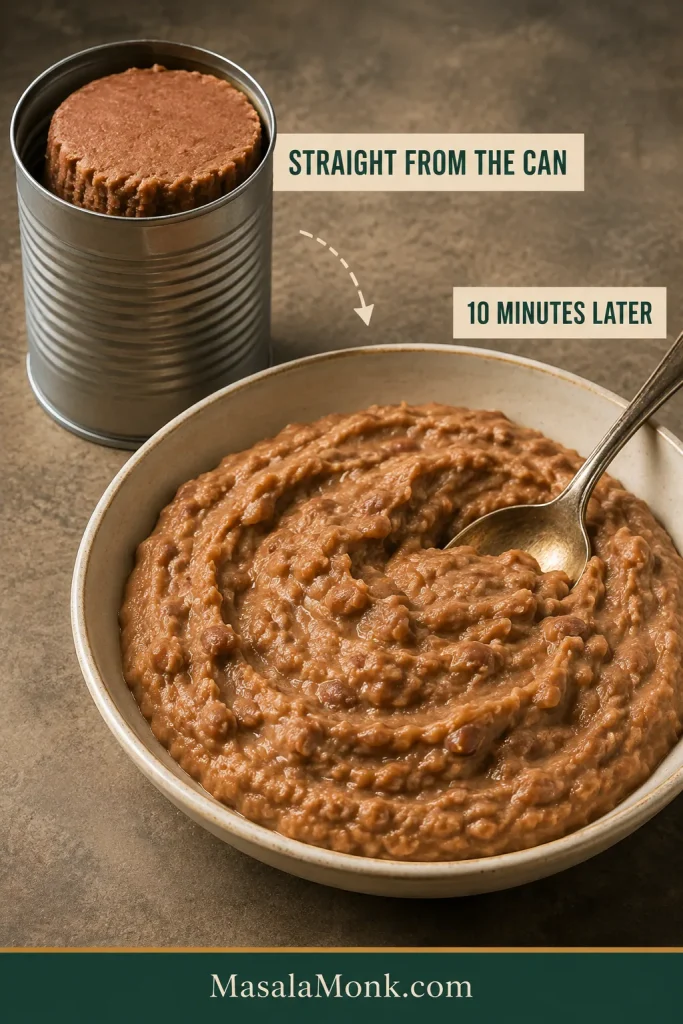
A can of refried beans is convenient, but straight from the can it can be dense enough to keep the ridges of the tin, bland enough to disappear beside the rest of dinner, or stiff enough to feel more like paste than a creamy side.
This easy refried beans recipe from a can fixes that in about 10 minutes with one small pan. The goal isn’t to bury the beans under sour cream and seasoning. It’s to loosen them, wake up the flavor, and add the richness they need to become soft and spoonable.
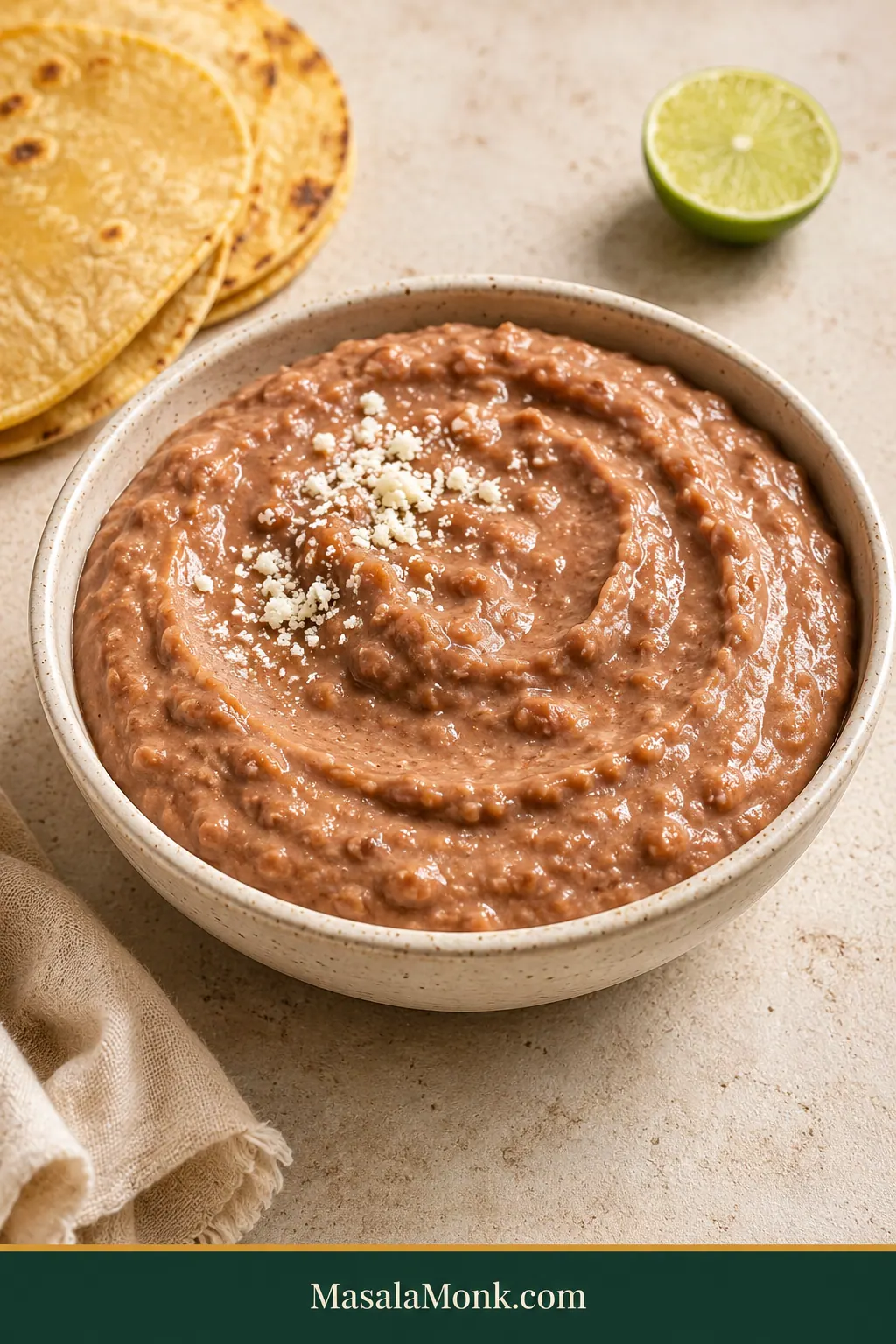
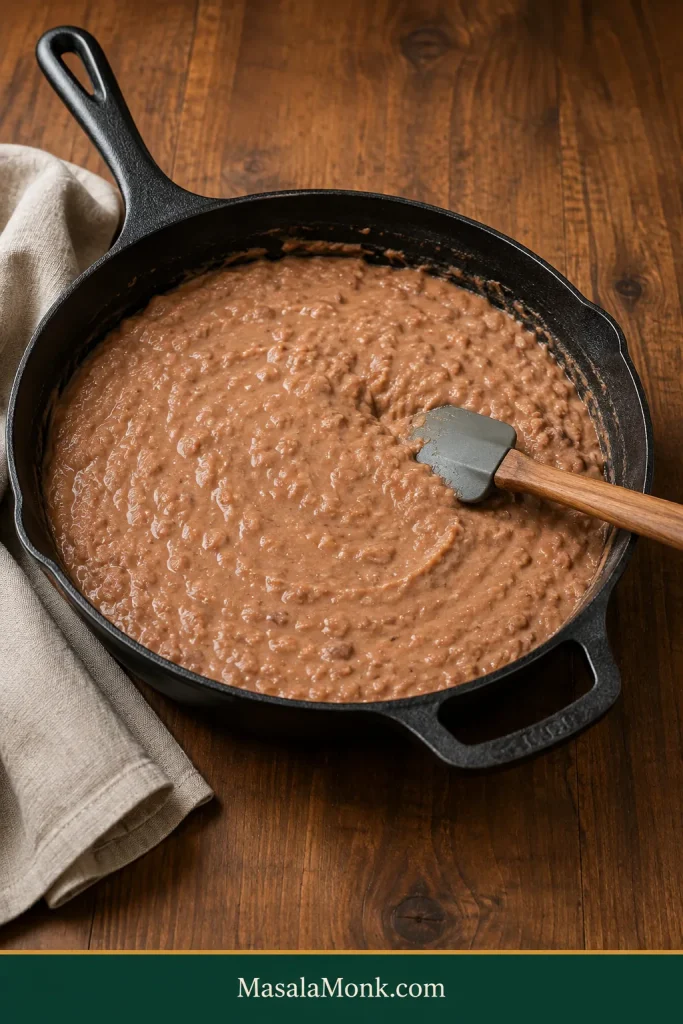
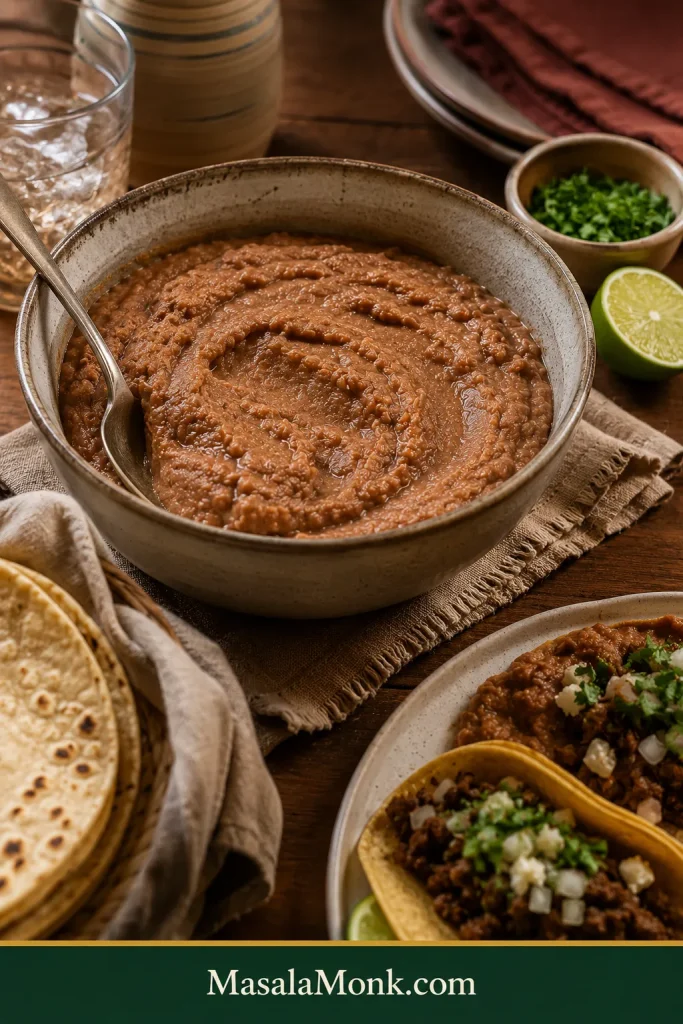
Ten minutes later, those same dense beans can be steamy, lightly glossy, and ready to settle beside tacos instead of sitting on the plate in one stiff mound.
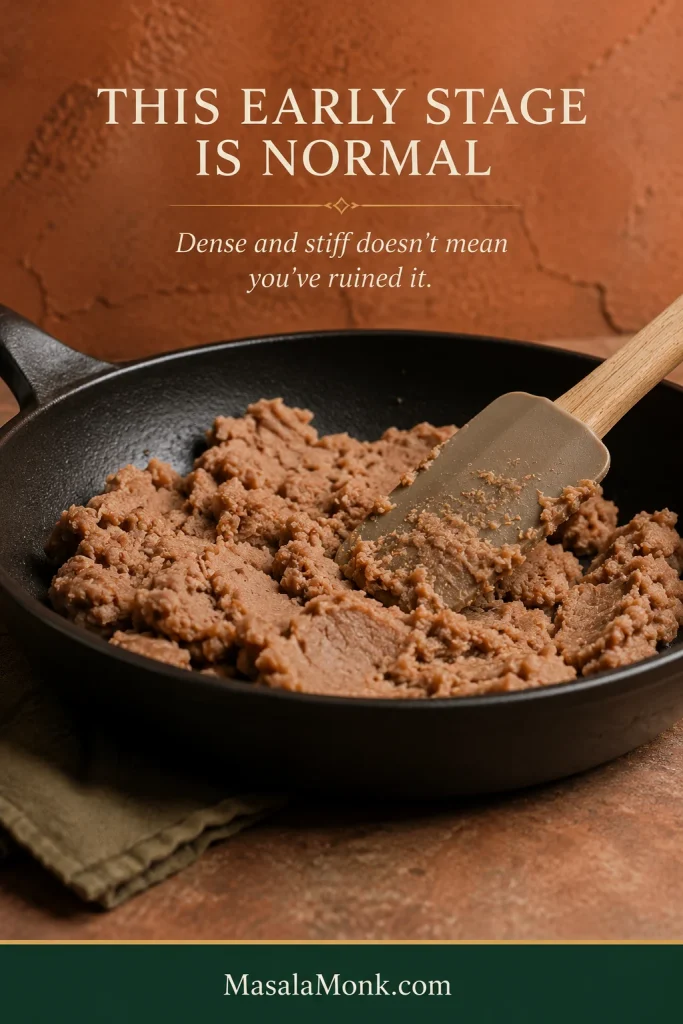
Straight-from-the-can refried beans can look hopelessly dense; judge the consistency after they are hot, not immediately after opening.
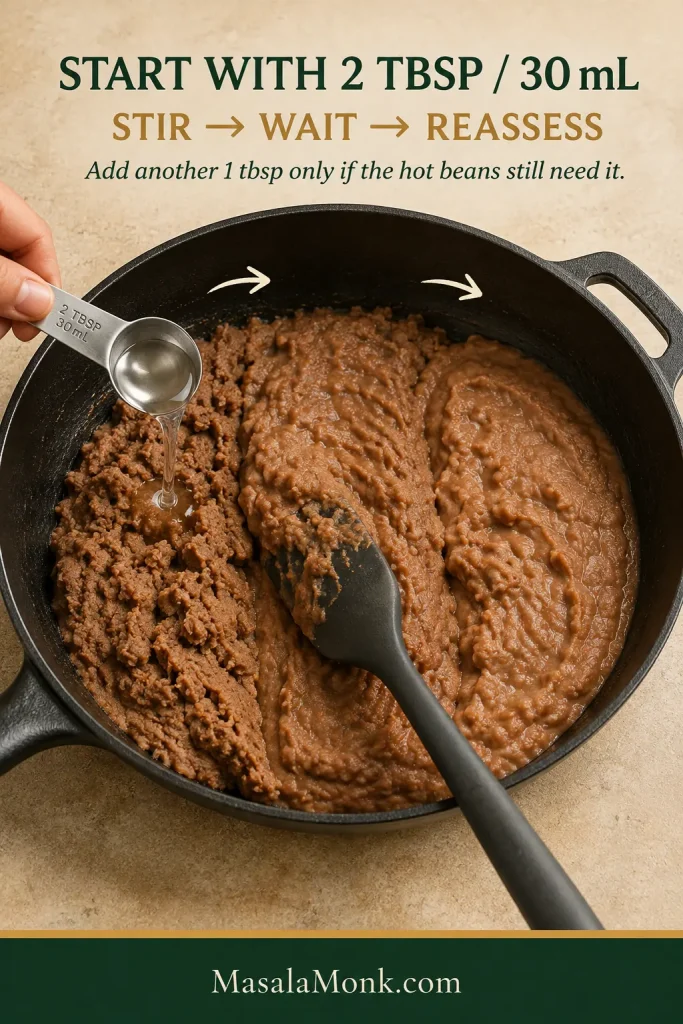
To make canned refried beans better, warm them with fat and seasoning, loosen gradually with water or broth, then stir in sour cream and taste before adding salt. For one 15–16 oz can, start with 2 tablespoons (30 mL) liquid and stop cooking while the beans are still a touch softer than you want on the plate.
Don’t want to think about the options? Use butter, water, and the base seasonings exactly as written below. Everything else is there only if you want to change the flavor or texture.
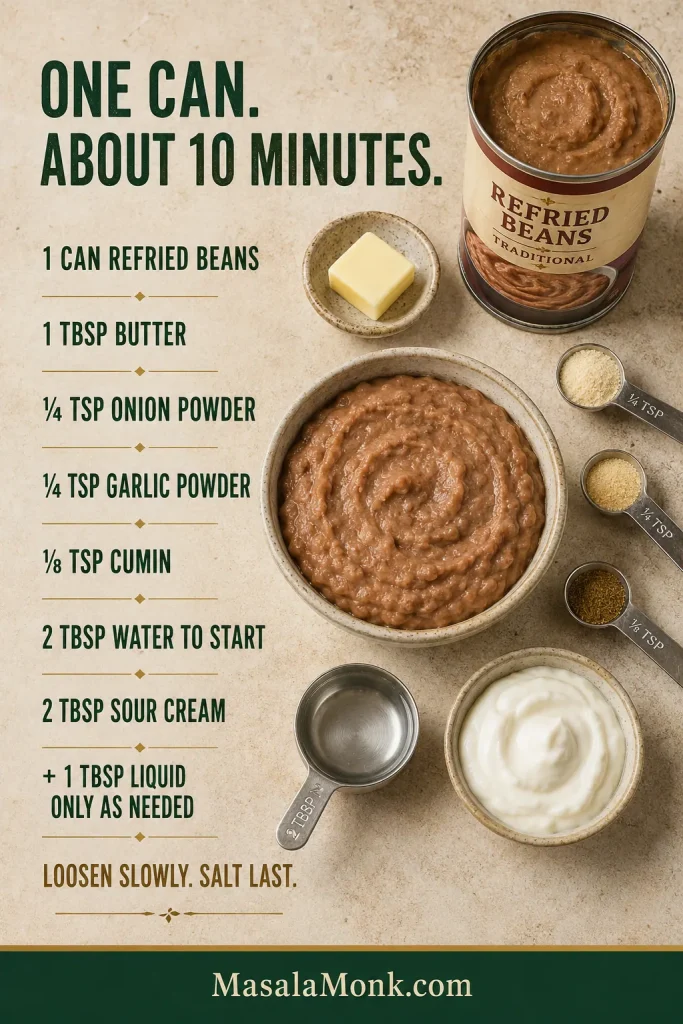
One can, measured fat and seasoning, 2 tablespoons liquid to start, then sour cream—small additions keep the texture under control.
Yes, canned refried beans are already cooked. The can has done the slow part; you’re reheating the beans while improving their texture and flavor.
You usually don’t drain them. Hold back an obvious puddle of watery liquid, though, and add only what the texture needs.
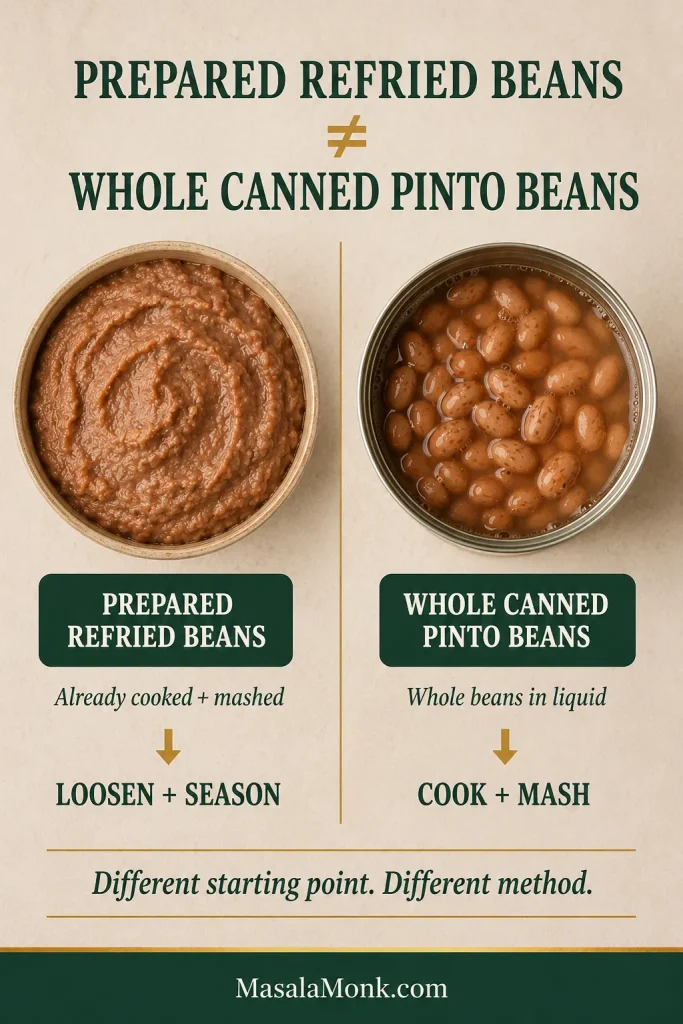
Whole pinto beans sitting in liquid? That’s a different starting point; use the quick whole-pinto guide farther down the page.
Refried Beans Recipe From a Can
Soft, creamy, restaurant-style refried beans made from one ordinary can in about 10 minutes.
Prep2 minutes
Cook7–8 minutes
TotalAbout 10 minutes
ServesAbout 4 as a side
Equipment
Small saucepan or 8–10 inch skillet
Silicone spatula or wooden spoon
Measuring spoons
Whisk, optional for a smoother texture
Base Ingredients
1 can prepared refried pinto beans, 15–16 oz (425–454 g)
1 tablespoon (15 mL) butter — or lard, bacon fat, or neutral oil
¼ teaspoon each onion powder and garlic powder
⅛ teaspoon ground cumin, or a generous pinch
2 tablespoons (30 mL) water — or unsalted chicken/vegetable broth, plus more as needed
2 tablespoons (about 30 g) sour cream
Optional Finish
½–1 teaspoon hot sauce
Fine salt, if needed after tasting
½ teaspoon lime juice or pickled-jalapeño brine, if the beans taste flat
Monterey Jack, Oaxaca, Cotija, or queso fresco, to taste
Instructions
Warm the fat and seasonings.
Heat your chosen fat over medium heat. Reduce to medium-low, add the onion powder, garlic powder, and cumin, and stir for 10–15 seconds, just until fragrant. Don’t let the spices darken.
Add the beans and first liquid.
Scrape in the refried beans and stir for about 1 minute. Add 2 tablespoons (30 mL) water or unsalted broth and cook for another 2–3 minutes, scraping the bottom and corners. A stiff canned mass may look a little hopeless at first; it should soon soften and fold over itself more easily.
Adjust the consistency.
Still stiff? Add another 1 tablespoon (15 mL) liquid, stir well, and give the pan a moment before adding more. A particularly dense can may need another tablespoon after that.
Make them creamy.
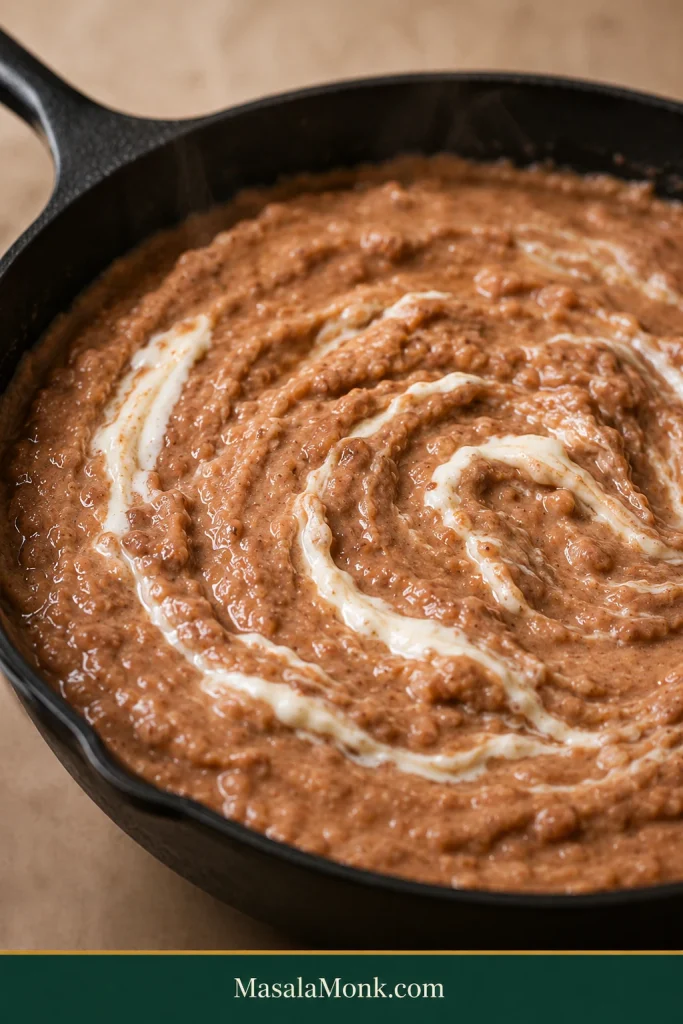
Stir in the sour cream and cook gently for 1–2 minutes. The surface should look soft and lightly glossy, without a dry crust or pools of oil.
Check the texture.
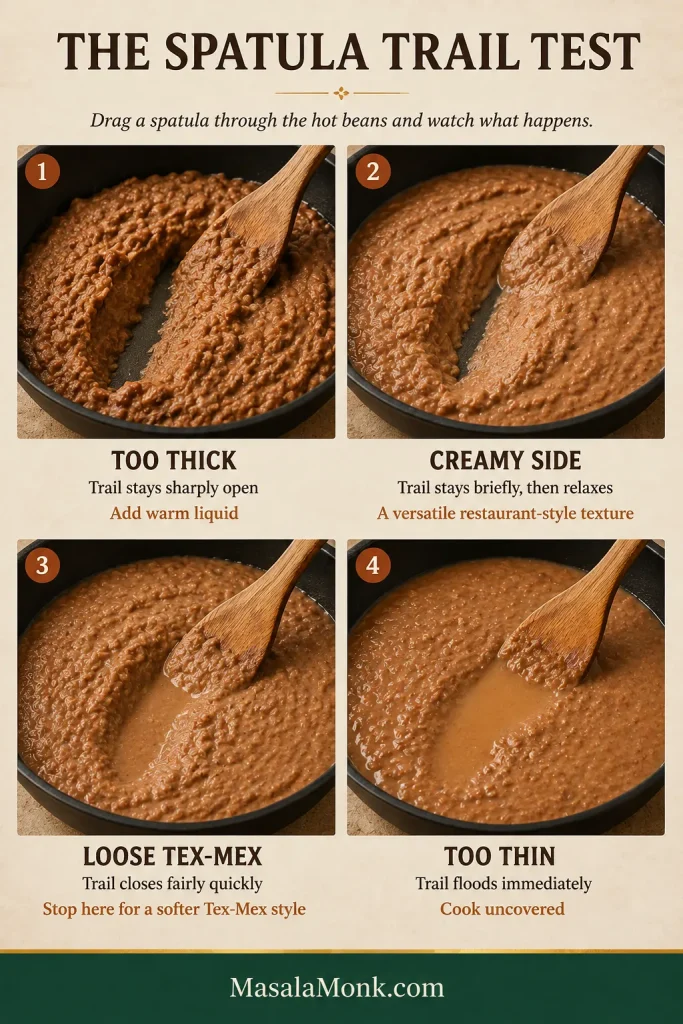
Drag the spatula through the middle. For a creamy side, the trail should remain visible briefly while the edges slowly relax inward. Leave the beans thicker for burritos and tostadas, or loosen them further for a softer Tex-Mex-style plate.
Taste and serve.
Add hot sauce if you want it, then taste before salting. Beans that are salty enough but taste heavy or flat may benefit from the optional lime juice or jalapeño brine.
Remove from the heat while they’re slightly softer than your final target, then spoon into a serving bowl while hot and creamy.
Recipe Notes
For a smoother texture, a whisk is usually enough. Prepared refried beans are already mashed, and whisking can make the texture more uniform without turning them into purée.
Vegetarian? Check the can because some traditional refried beans contain lard. Choose a lard-free can; butter, sour cream, and cheese can otherwise remain as written.
Vegan? Start with a lard-free can, use neutral oil and vegetable broth, omit or replace the sour cream, and choose dairy-free toppings instead of cheese.
For cheese: melt Monterey Jack or Oaxaca over the hot beans, or scatter Cotija or queso fresco over the top.
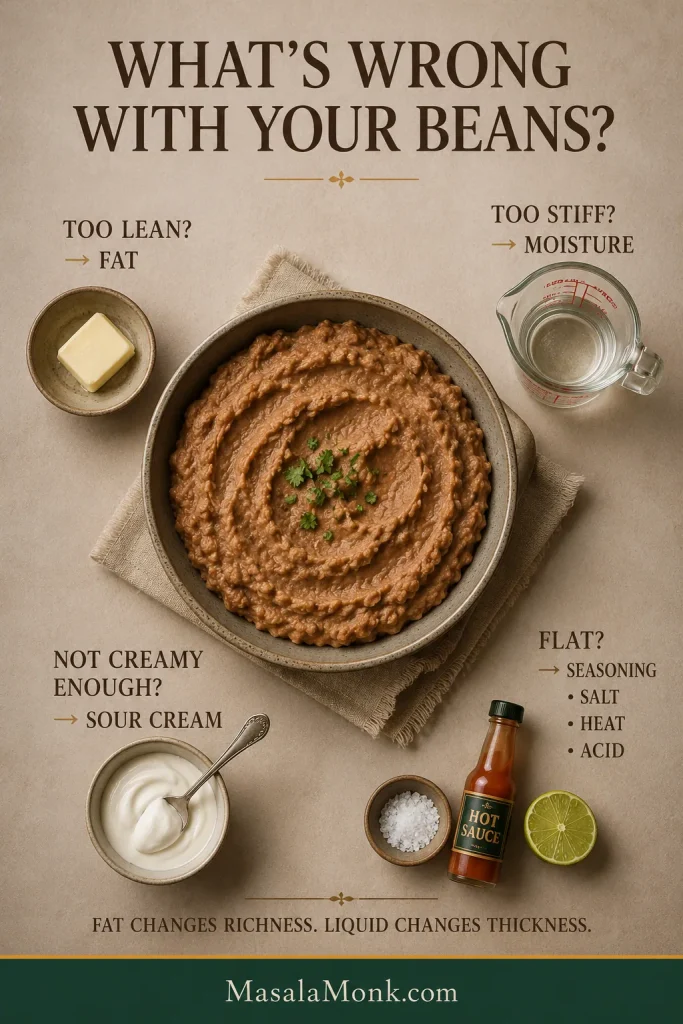
Start by identifying the problem instead of adding everything at once.
Too lean? Fat gives the beans more richness.
Too stiff? They need moisture.
Not creamy enough? A modest amount of sour cream can soften the texture.
Flat-tasting? Seasoning, salt, heat, or acidity may be missing.
Fix the right problem: richness, moisture, creaminess, and flavor each need a different adjustment.
Get Creamy Without Making Them Heavy
That keeps you from fixing the wrong thing. Stiff beans don’t automatically need more butter, and adding broth won’t make already-loose beans more flavorful. Once the consistency is right, too much sour cream can start hiding the pinto-bean flavor.
Add sour cream after the beans are nearly loose enough; it adds creaminess and tang, not the main thinning moisture.
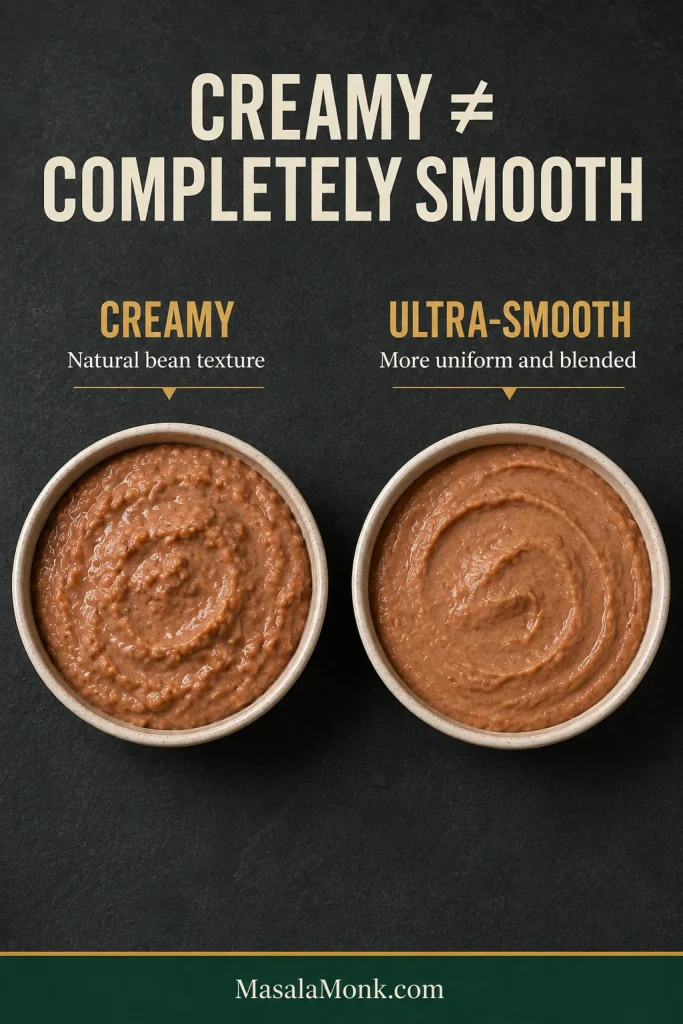
Creamy and smooth aren’t the same thing.
Creaminess comes from the mashed beans having enough moisture and a little richness. Smoothness is about how fine and uniform the bean texture is. Properly loosened beans can feel creamy while retaining some natural texture.
Creamy can still have natural bean texture; use a whisk for finer beans and blend only for an ultra-smooth finish.
How to Season One Can
For one 15–16 oz can, start with ¼ teaspoon onion powder, ¼ teaspoon garlic powder, and ⅛ teaspoon cumin. The small amount of cumin is deliberate: it should sit in the background while the pinto beans remain the main flavor.
Powdered onion and garlic also keep the texture even. Fresh onion can be delicious, but it leaves more noticeable texture. Hot sauce is optional; keeping the pan mild and serving roasted tomatillo salsa verde at the table gives everyone control over the heat.
For a little more savory depth, add a small amount of chicken or vegetable bouillon or a tiny pinch of MSG. Neither is necessary, and both can add quite a bit of salt, so go cautiously and taste before adjusting anything else.
Butter, Lard, Bacon Fat or Oil?
The best fat is mainly a flavor decision. Moisture still does most of the work of changing the consistency, so choose the fat for the kind of richness you want.
Fat
What it brings
Best for
Butter
Mild, familiar richness
Easy everyday default
Lard
Richer savory character
Savory depth without bacon smoke
Bacon fat
Stronger pork flavor and smoke
When a smoky note suits the meal
Neutral oil
Body with little added flavor
Letting the bean flavor lead
Do You Need Lard?
No. Lard can add savory richness, but butter or oil can still give you soft, creamy refried beans. The final consistency depends much more on moisture, gentle heat, and stopping at the right moment.
Clean rendered pork fat left from slow-cooker pork carnitas can work nicely here too. Leave dark or scorched drippings behind.
The can itself matters as well. Traditional, vegetarian, fat-free, and reduced-fat beans can start with very different levels of richness. A batch that already looks oily as it warms may need less added fat than a leaner one.
Fat changes flavor and richness, but it won’t loosen a thick batch. For that, you need moisture.
Water, Broth or Milk?
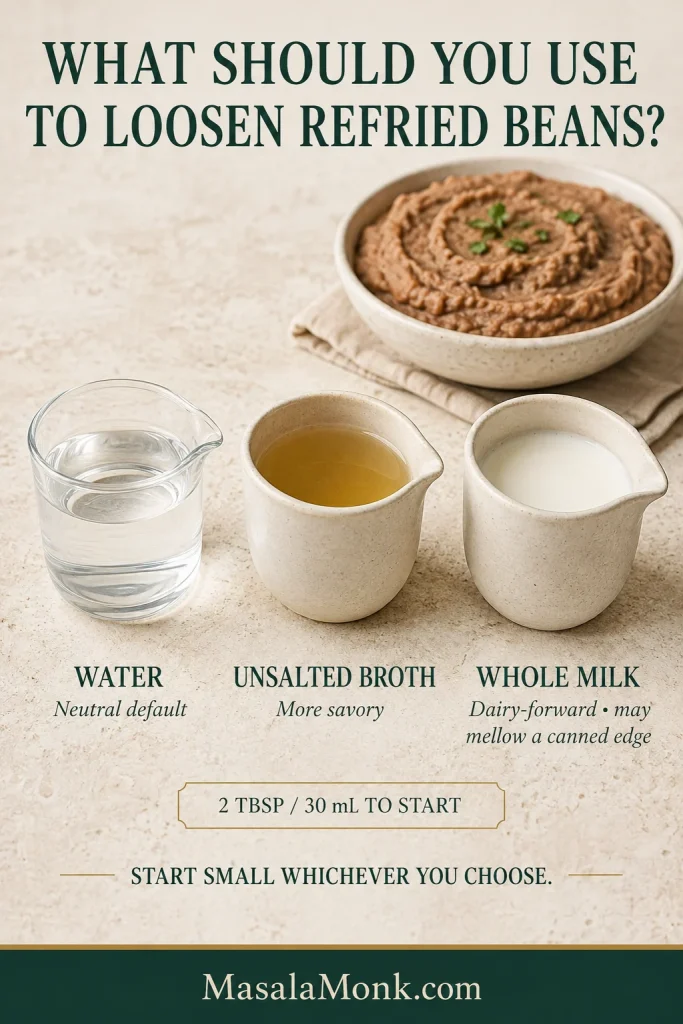
Water is the neutral default, unsalted broth adds savory flavor, and whole milk gives you a softer, more dairy-forward variation.
Liquid
What it changes
Use it when
Water
Loosens without adding flavor or salt
The beans mainly need a better consistency
Unsalted broth
Adds moisture plus savory flavor
The beans taste a little flat as well as thick
Whole milk
Adds mild dairy richness and can soften a canned-tasting edge
You deliberately want a softer, dairy-forward result
Water loosens neutrally, broth adds savory depth, and whole milk adds dairy richness and can mellow a canned-tasting edge.
Jalapeño brine is different. Treat it as a final flavor adjustment, not the main thinning liquid. It brings acid, chile, and salt together, so about ½ teaspoon is a sensible place to start when the consistency is already right but the flavor feels heavy.
Whatever liquid you choose, begin cautiously.
How Much Liquid Should You Add?
Start with 2 tablespoons (30 mL) liquid for one 15–16 oz can, then add another 1 tablespoon (15 mL) only if the hot beans still feel stiff.
A particularly dense can may need another tablespoon. Stop as soon as the mixture begins moving the way you want it to.
Why start small?
You can loosen thick beans quickly. Too much liquid means waiting for that moisture to cook back out.
Start with 2 tablespoons, stir, wait, then reassess—one extra spoonful can noticeably change a one-can batch.
Restaurant-style isn’t one exact thickness. Some Tex-Mex restaurants serve refried beans very smooth and fairly loose; others bring a thicker, more substantial scoop to the table.
Drag your spatula through the middle of the pan and watch the trail.
Test the beans while hot: the trail’s speed of closing tells you whether they are thick, creamy, loose, or watery.
What you see
Texture
What to do
The trail stays sharply open and the beans sit in two stiff banks
Too thick
Add some warm liquid and stir again
The trail stays visible briefly, then the edges slowly relax inward
Creamy side
A versatile restaurant-style consistency
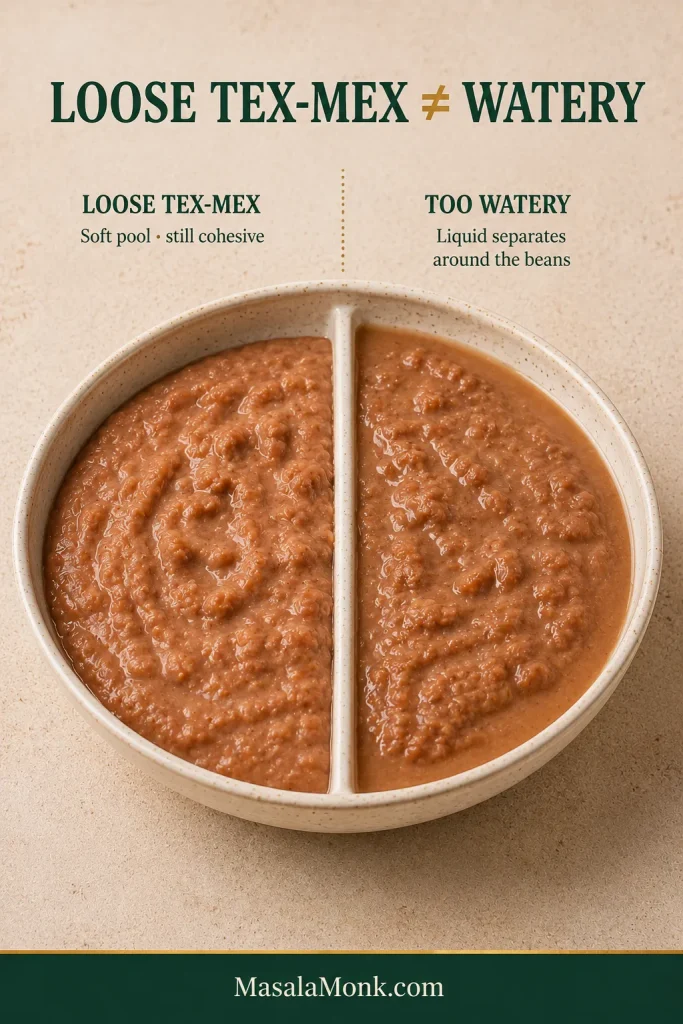
The trail closes fairly quickly and the beans settle into a low, soft pool without watery separation
Loose Tex-Mex style
Stop here if this is the restaurant texture you prefer
The trail floods shut immediately or a watery moat forms around the beans
Too thin
Cook uncovered over medium-low heat
How to Know When Refried Beans Are Done
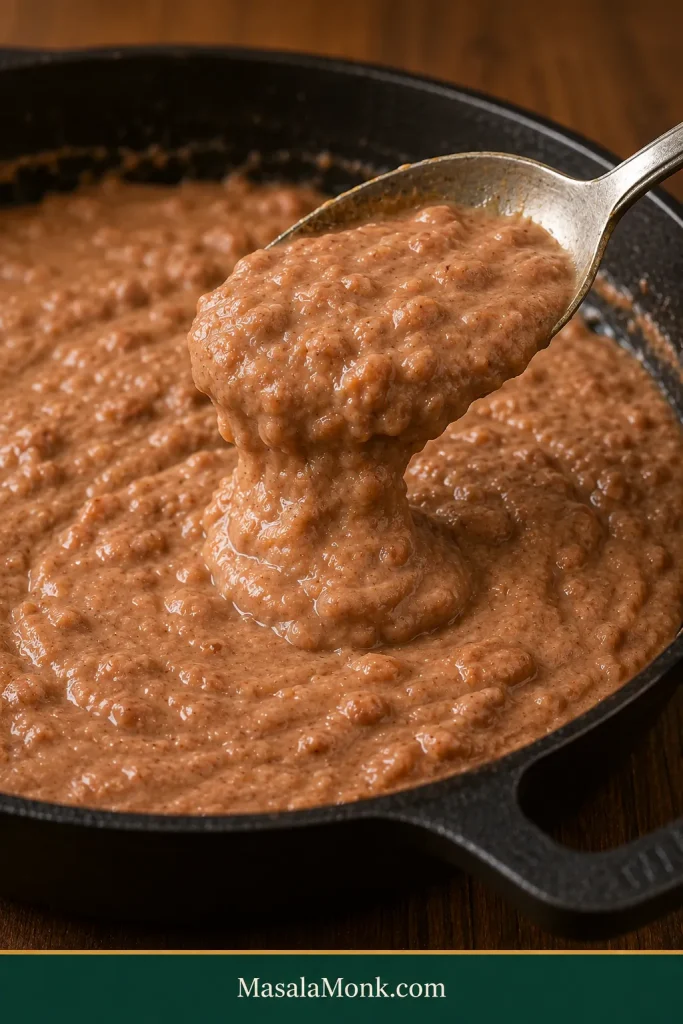
At the table, the beans should look soft and lightly glossy, fall slowly from the spoon, and settle without standing in a rigid mound or spreading like soup. When the trail looks right, you’re done; don’t keep cooking just because the clock has another minute on it.
Creamy refried beans should cling briefly, then fall back in a heavy, soft fold—not drip or stay rigid.
For an ultra-smooth Tex-Mex texture, adjust the moisture first and then give the beans a few short pulses with an immersion blender. Stop when obvious bean pieces disappear. Blend too long and the mixture can turn pasty and overprocessed.
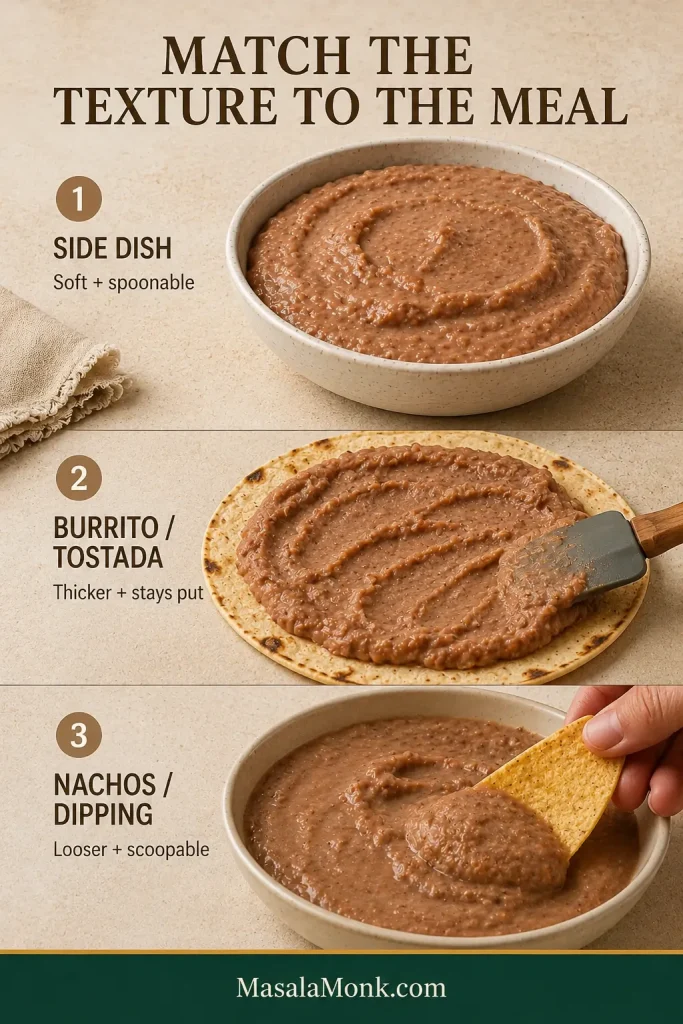
Match the Texture to the Meal
As a side: soft enough to settle gently on the plate.
For burritos, tacos, and tostadas: thicker so the beans stay where you spread them.
For nachos or dipping: looser so they remain easy to scoop as they cool.
Match texture to the job: softer for a side, thicker for filling, looser for dipping.
And if what you really want is a cold, scoopable bean layer with sour cream, guacamole, salsa, and cheese, our 7 layer dip recipe builds the beans for that job.
Match the fix to the problem. Most batches don’t need another ingredient so much as the right adjustment.
Problem
Fast fix
Too thick
Loosen gradually with warm water or unsalted broth
Too thin
Cook uncovered over medium-low heat until the excess moisture evaporates
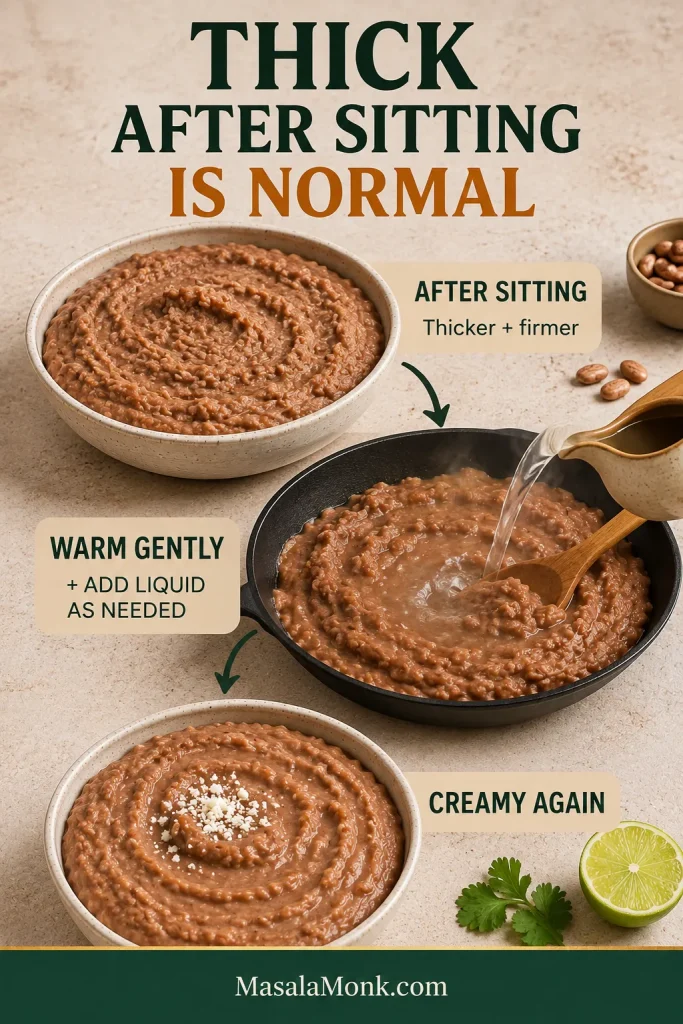
Stiff after sitting
Stir in warm liquid until the creamy consistency returns
Bland
Taste for seasoning, salt, heat, or brightness before deciding what to add
Tastes canned or slightly metallic
A small splash of whole milk can mellow the edge; warm gently and taste again
Too salty
Avoid any further salty ingredients; for a badly oversalted batch, mix in lower-sodium or unsalted beans if available
Too tangy
Stop adding acid and mix in more plain refried beans if available
Greasy
Spoon off pooled fat; if the beans are also stiff, loosen with water instead of adding more fat
Burnt
Transfer the unburnt portion immediately without scraping the scorched layer
Splattering
Lower the heat and stir carefully
Too Thick, Too Thin or Stiff After Sitting?
Thick, thin, and stiff-after-sitting beans are really three versions of the same consistency problem. Add moisture when the mixture won’t relax; let excess moisture evaporate when it floods; and expect the beans to tighten somewhat as they cool. A splash of warm water or broth usually brings a batch that sat too long straight back.
Loose beans stay cohesive; visible water separating around the edges means they have crossed into too thin.
Bland? Figure Out What’s Missing
“Bland” doesn’t automatically mean “needs more salt.” Salty enough but still flat? A touch more onion or garlic seasoning may help. A heavy-tasting batch may need a few drops of lime juice or jalapeño brine instead. Keep cumin in the background so the final spoonful still tastes first and foremost like pinto beans.
Burnt or Bitter? Get Them Out of That Pan
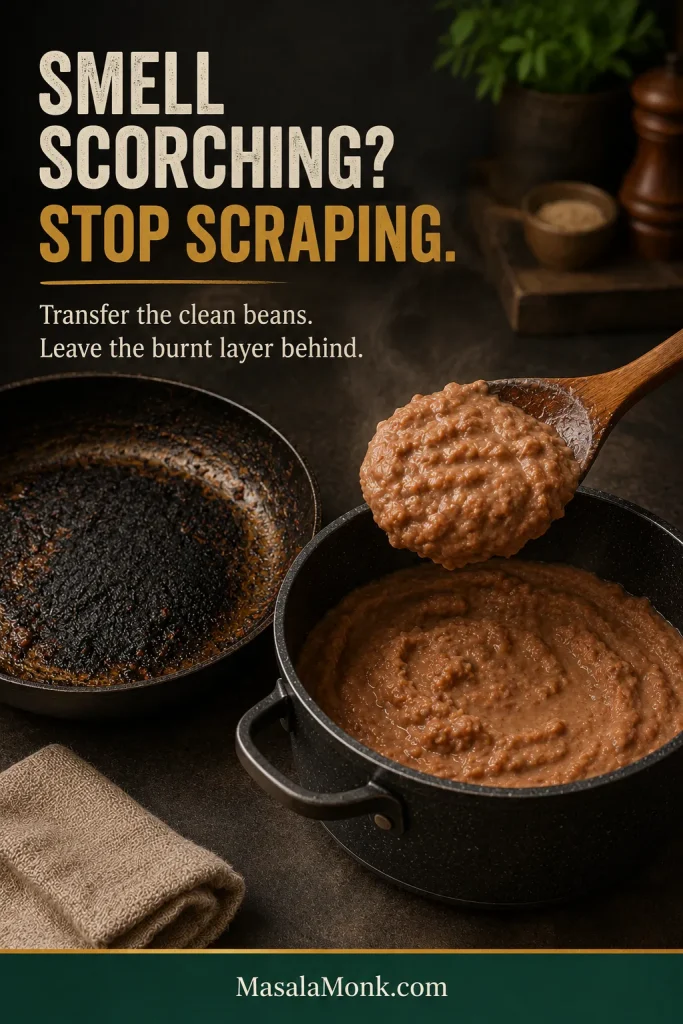
Smell scorching? Stop scraping and transfer the unburnt beans into a clean saucepan, leaving the dark layer behind. Mild bitterness can sometimes be softened after the rescue, but deeply scorched flavor is difficult to disguise. Bacon fat should also be clean rendered fat, not blackened drippings carrying burnt pieces.
Transfer clean beans before scraping the scorched bottom; once burnt residue mixes in, bitterness spreads fast.
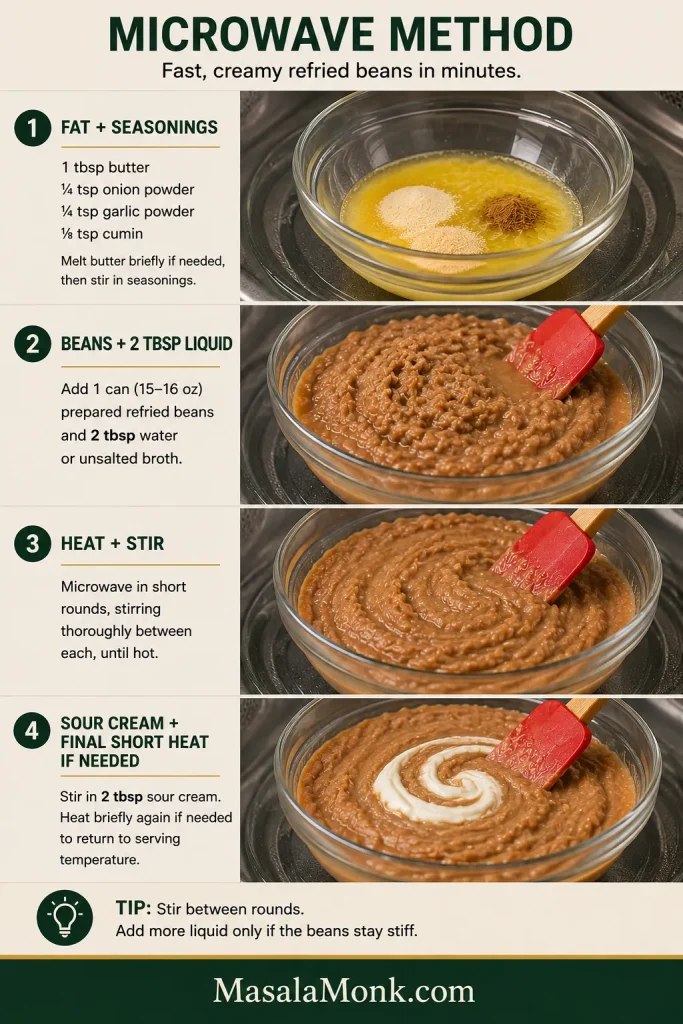
To microwave canned refried beans, heat them in short intervals, stirring between each, and add more liquid only when they remain thick. The stovetop gives you finer control, but if tacos are already hitting the table, the microwave route is perfectly respectable.
Start the flavor. Put 1 tablespoon butter—or your chosen alternative—in a large microwave-safe bowl. Melt briefly if necessary, then stir in the onion powder, garlic powder, and cumin.
Add the beans. Mix in the canned refried beans and 2 tablespoons (30 mL) water or broth. Cover loosely so steam can escape while splatters stay contained.
Heat and stir. Microwave in short rounds, stirring thoroughly between each, until hot. Use another splash of liquid only when the texture still feels stiff.
Add the sour cream and serve. Stir in the sour cream, then give the beans one final short heating round if needed to return them to serving temperature. Taste and adjust with hot sauce, acid, or salt.
Short microwave rounds plus thorough stirring give you repeated chances to adjust thickness without overcooking the beans.
Use a bowl larger than seems necessary. Thick bean mixtures have a talent for popping just when you think they won’t.
What If You Have Whole Canned Pinto Beans?
You can absolutely turn whole canned pintos into quick refried beans, but the route is different. Reserve some of the can liquid. Warm your fat and seasonings, add the whole beans with enough liquid to keep them moist, then mash and adjust until creamy.
Prepared refried beans have already been cooked and mashed. That’s why the liquid and sour-cream amounts in the recipe above shouldn’t simply be transferred to a can of whole pintos.
Prepared refried beans need loosening; whole canned pintos still need seasoning, heating, mashing, and texture adjustment.
Scaling for a Crowd
The recipe scales well for a larger taco night — perhaps alongside sheet-pan chicken fajitas — but consistency doesn’t scale perfectly by arithmetic.
For 2–3 cans, scale the fat and sour cream with the beans. Start a little conservatively with the dry seasonings, taste once everything is hot, and hold back some of the liquid until you can see how the batch moves. Let the Spatula Trail Test decide the final consistency.
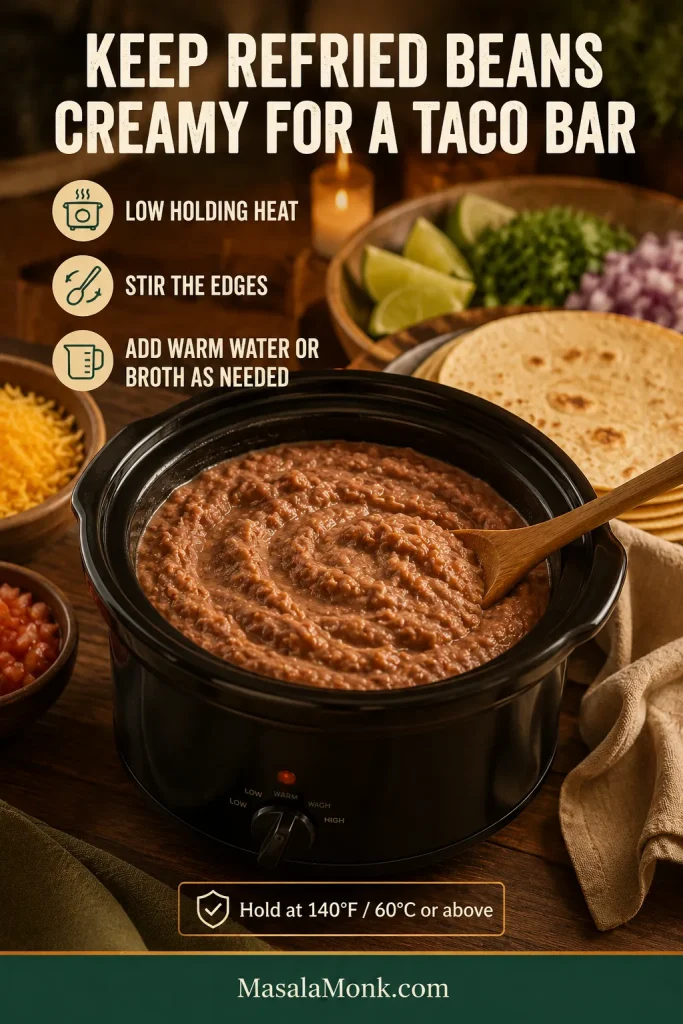
Keeping Them Creamy for a Taco Bar
Transfer the beans to a covered slow cooker or other suitable hot-holding vessel and use low holding heat. Stir periodically, especially when the edges start thickening, and add warm water or unsalted broth as needed.
Cold refried beans can look dramatically thicker than they did when freshly cooked. That’s expected; reheating is usually as much about restoring lost moisture as making the beans hot again.
Reheat first, then judge thickness; cold refried beans often look much denser than they will once hot.
How to Reheat Refried Beans
Stovetop: warm over low to medium-low heat, stirring in water or unsalted broth until the soft, spoonable consistency returns.
Microwave: cover loosely and heat in short intervals, stirring between rounds. A batch that’s hot but still dense needs moisture, not another spoonful of fat.
Can You Freeze Them?
Yes. Cool the beans, portion them into airtight freezer-safe containers, and freeze. For best quality, aim to use frozen leftovers within about 3–4 months. Thaw in the refrigerator, then reheat gently with enough water or broth to restore the texture.
Once loosened again, leftovers are handy for freezer-friendly breakfast burritos. Just make sure the filling isn’t watery before it goes into the tortilla.
What to Serve With Refried Beans
These beans are happiest anywhere you want something warm and mellow beside brighter, spicier, or crunchier food.
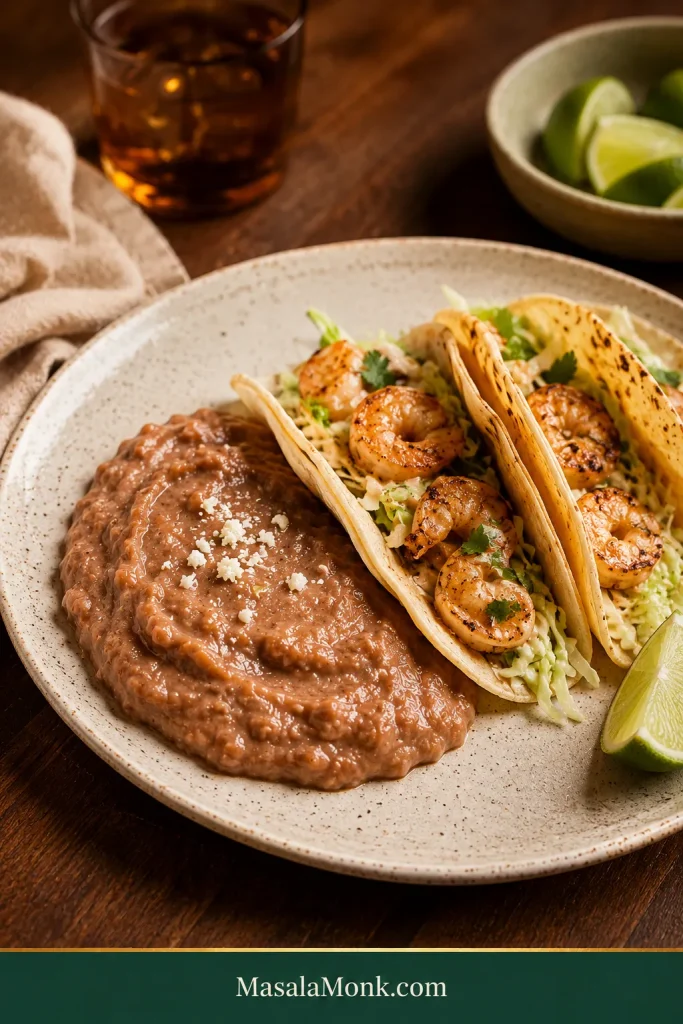
Keep them simple beside shrimp tacos with lime slaw, where the creamy beans give the fresh toppings somewhere soft to land. Mango salsa offers a fruitier contrast with lime, chile, and freshness.
Creamy refried beans make a mellow, comforting side for bright shrimp tacos and lime slaw.
They’re equally at home beside Mexican-style rice and eggs, or tucked into burritos, tostadas, quesadillas, nachos, and taco bowls.
Once You Know What the Pan Needs, This Gets Easy
Once you know what to look for, canned refried beans stop feeling like a compromise. They become the kind of ten-minute side you can fix while the tortillas warm, spoon onto the plate, and actually look forward to eating.
Next time, you probably won’t need this whole guide. Loosen slowly. Salt last. Trust what the pan is showing you.
Warm, creamy refried beans from one ordinary can—ready for the rest of dinner.
If you make them, tell us which brand you started with, which fat you used, and whether your can needed more than the first 2 tablespoons of liquid. That real-world variation can help the next person opening the same can.
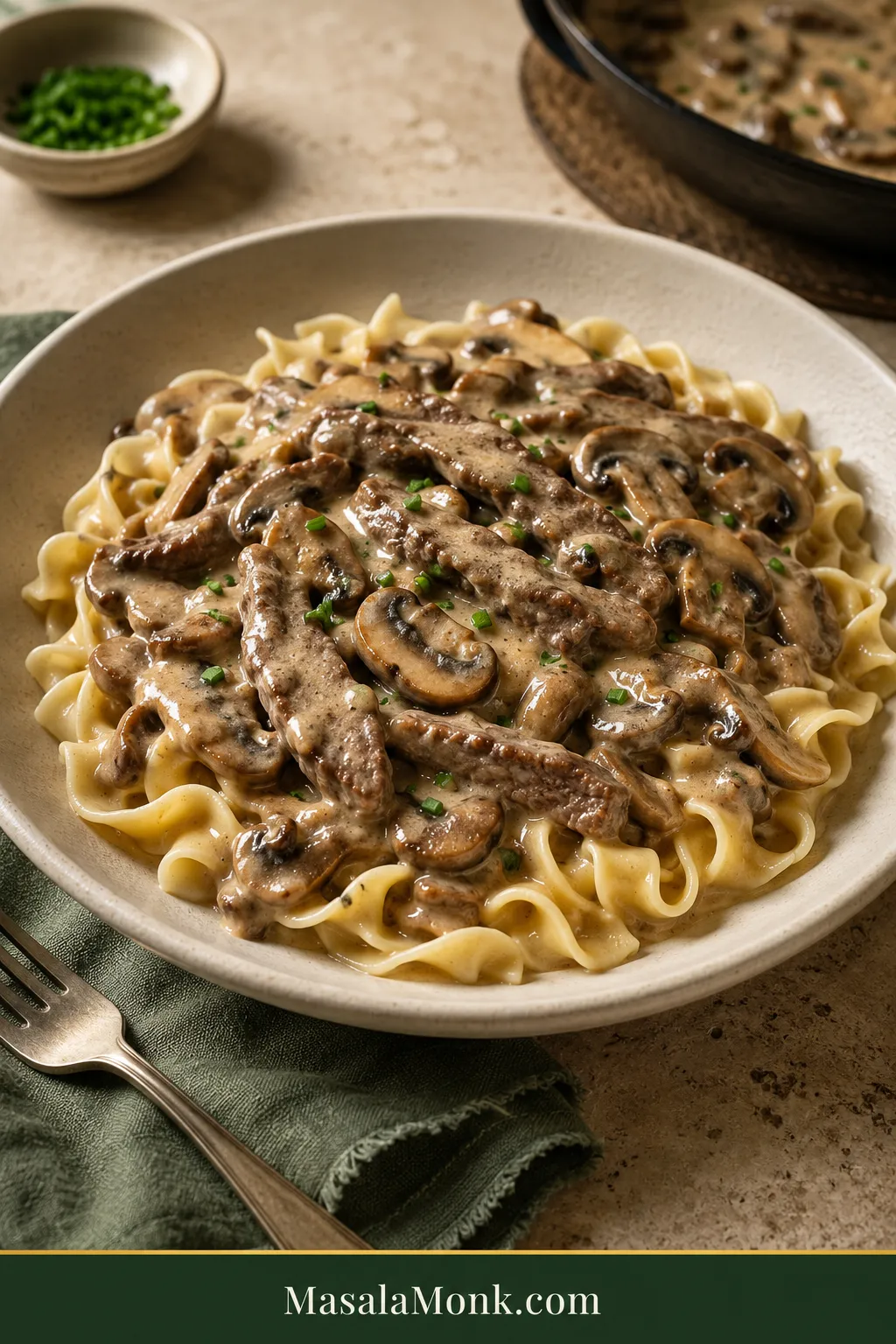
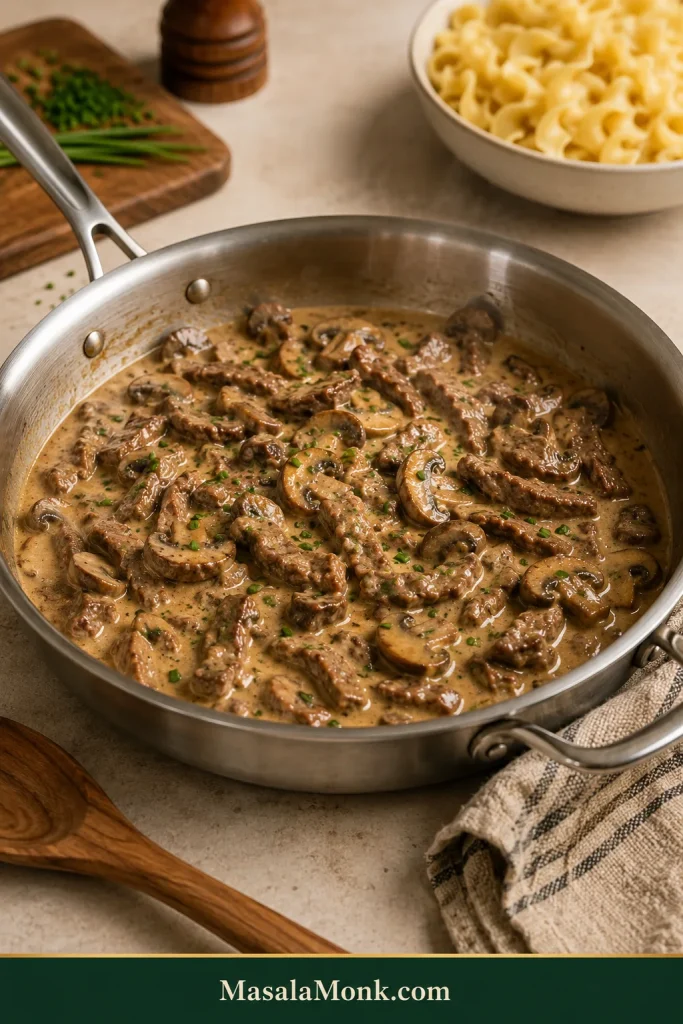
A good skillet of Beef Stroganoff is all tender browned beef, mushrooms with real color, and a glossy sour-cream sauce that finds its way into the noodles.
It can also look right and still disappoint.
A creamy sauce can hide chewy beef. Mushrooms can soften without developing much flavor. And a sauce that looked generous in the skillet can all but disappear once it meets the noodles.
The fork tells you the truth.
Tender beef yields easily instead of making you chew through long fibers. Properly browned mushrooms taste developed, not merely cooked. The sauce clings in a smooth, savory coat—creamy enough to comfort, loose enough to flow.
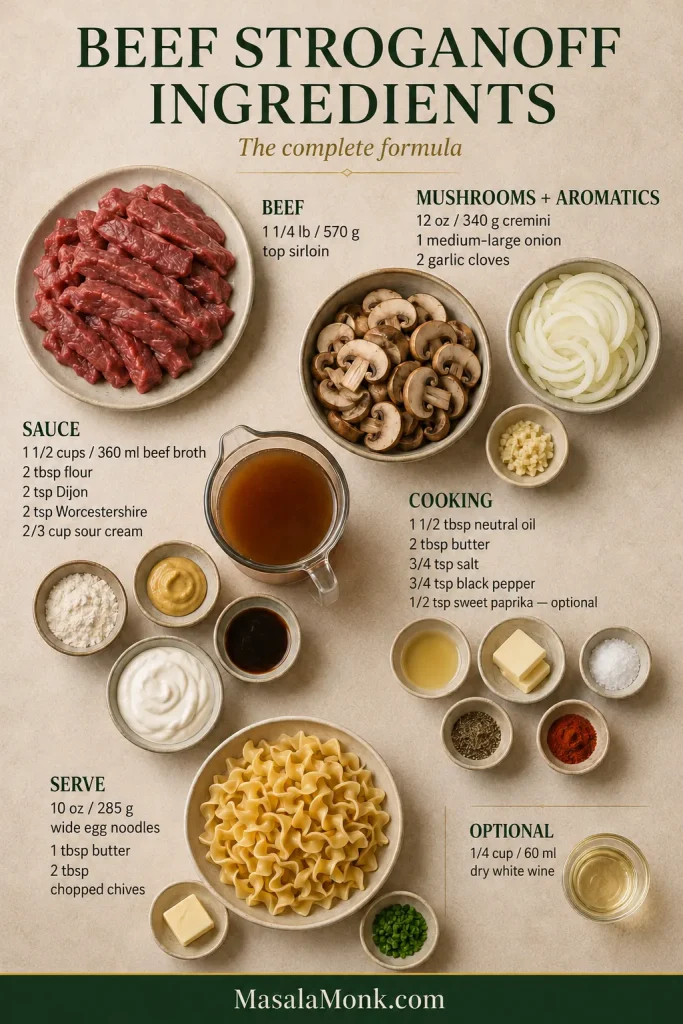
This Beef Stroganoff comes together in about 30 minutes with top sirloin, fresh cremini mushrooms, beef broth, Dijon mustard, Worcestershire sauce and full-fat sour cream. There is no cream of mushroom soup, no heavy cream and no wine required.
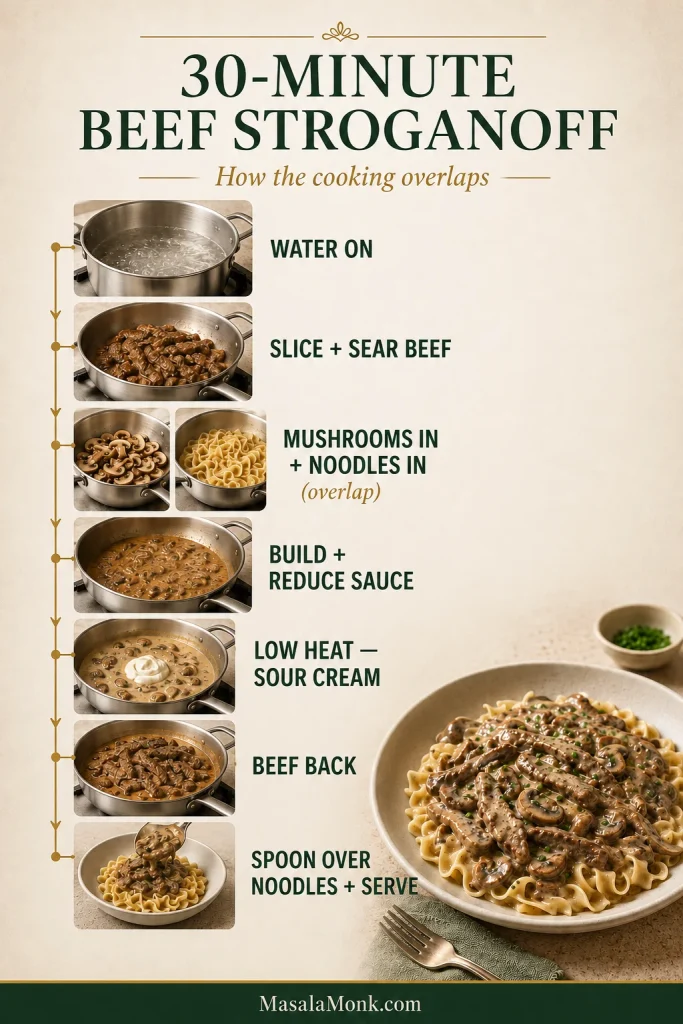
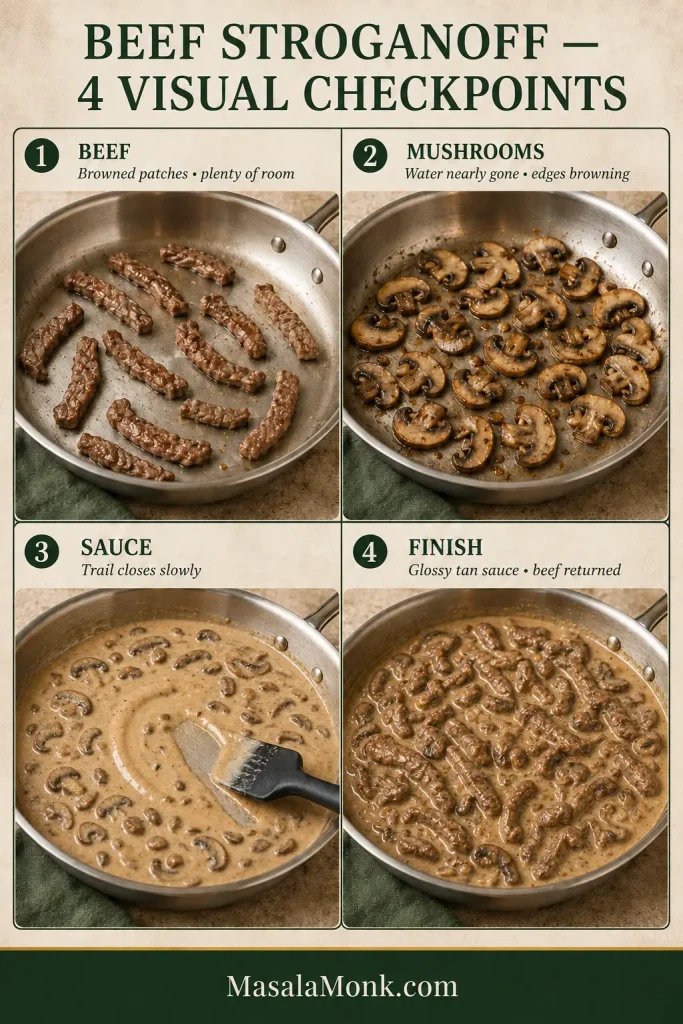
Sear fast. Brown the mushrooms fully. Build the sauce. Keep the final heat low; return the beef last.
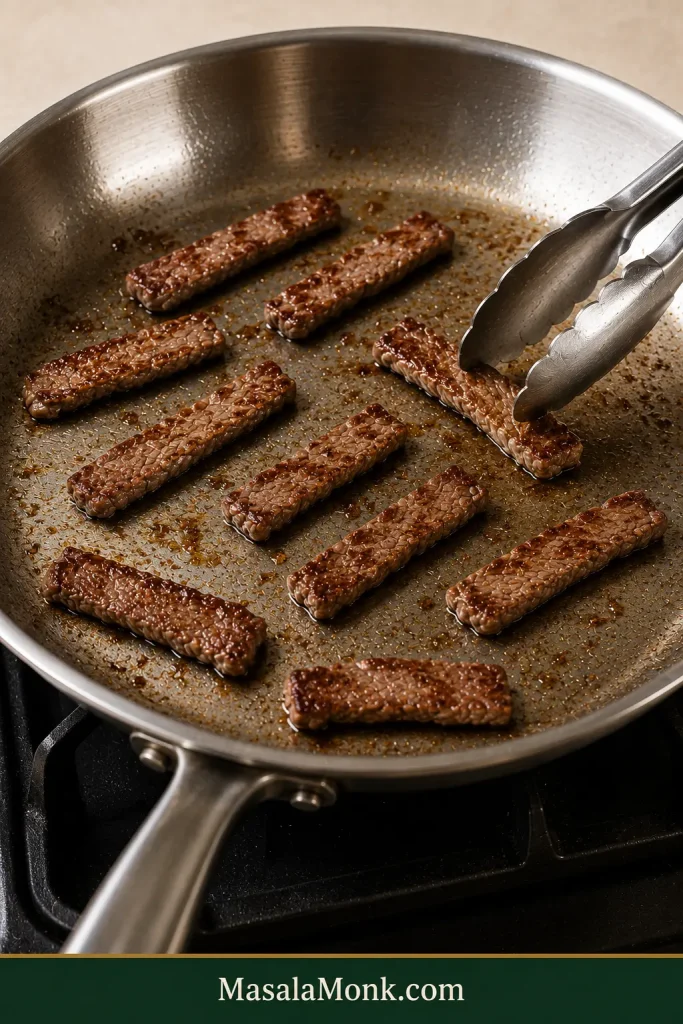
Sear fast: use tender steak, slice it thinly across the grain and brown it in uncrowded batches.
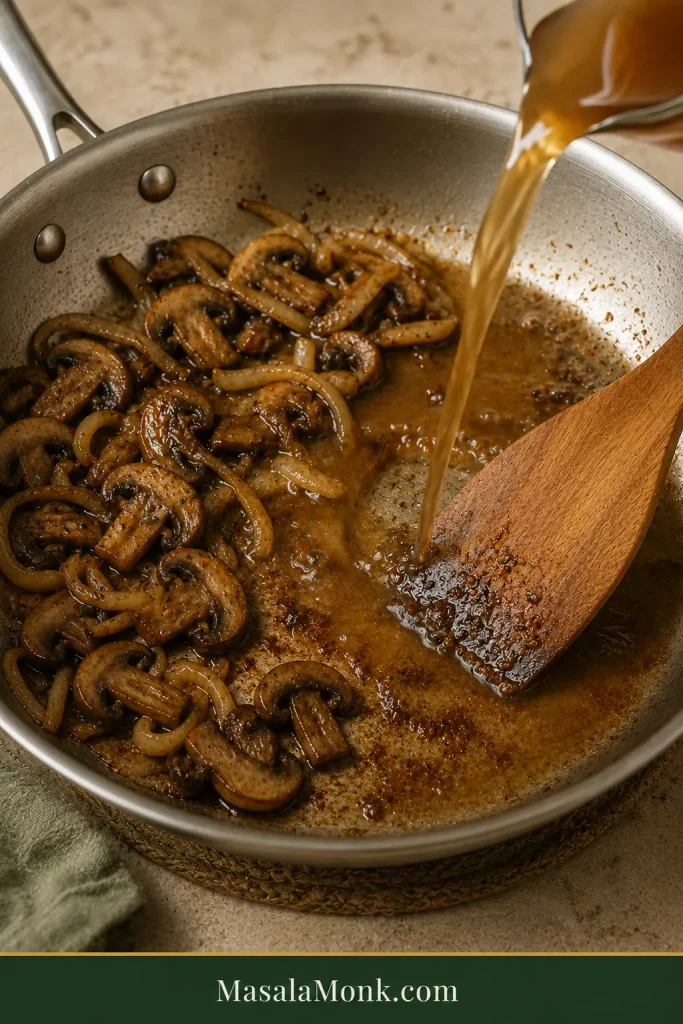
Brown the mushrooms fully: cook away the moisture they release before building the sauce.
Build the sauce: get the flavor and consistency where you want them while the beef rests.
Keep the final heat low: stir in the sour cream, then return the steak only long enough to finish cooking and heat through.
The timing works because several jobs overlap. Start the noodle water first; slice and sear the steak while it heats, drop the noodles when the mushrooms go into the skillet, and build the sauce while the beef rests. That overlap is what makes about 30 minutes of elapsed time realistic, although especially juicy mushrooms or slower knife work can add a few minutes.
If timing slips, let the noodles wait; thin sirloin is less forgiving of extra heat than buttered pasta.
It is the sort of dinner that feels richer than the time it took to make.
Beef Stroganoff Recipe
Serves: 4 generously Prep: about 10 minutes Cooking: about 20 minutes Total elapsed time: about 30 minutes, with some prep overlapping the cooking Main equipment: 12-inch (30 cm) heavy skillet and a pot for the noodles
Ingredients
For the Stroganoff
1¼ lb (570 g) top sirloin steak
¾ tsp fine sea salt (about 4–5 g), divided, plus more to taste
¾ tsp freshly ground black pepper, divided
1½ tbsp (22 ml) neutral high-heat oil, divided
12 oz (340 g) cremini or baby bella mushrooms, sliced
½ tsp sweet paprika, optional — use sweet, not smoked
2 tbsp (about 16 g) all-purpose flour
1½ cups (360 ml) low-sodium beef broth, plus extra for loosening if needed
2 tsp Dijon mustard
2 tsp (10 ml) Worcestershire sauce
⅔ cup full-fat sour cream (about 150 g), taken out of the refrigerator before cooking
2 tbsp chopped fresh chives, for serving
For Serving
10 oz (285 g) wide egg noodles
1 tbsp (14 g) unsalted butter
Salt for the noodle water
Optional Wine Variation
Add ¼ cup (60 ml) dry white wine after the garlic. Scrape up the browned bits and reduce until only a thin layer of wine remains in the skillet, then continue with the regular 1½ cups (360 ml) beef broth. The wine adds brightness and complexity; it does not replace part of the broth in this version.
Measure the sauce ingredients first so the beef can leave the heat the moment it is ready.
Instructions
Start the Noodles and Sear the Beef
Start the noodle water. Put a large pot of well-salted water over high heat, then move straight to the beef. Once the water boils, keep it ready while you sear the steak. When the mushrooms go into the skillet in Step 4, add the noodles to the boiling water. Cook according to the package directions, drain when just tender, toss with 1 tablespoon butter and keep warm. Keep the noodles separate from the Stroganoff unless every serving is going straight to the table.
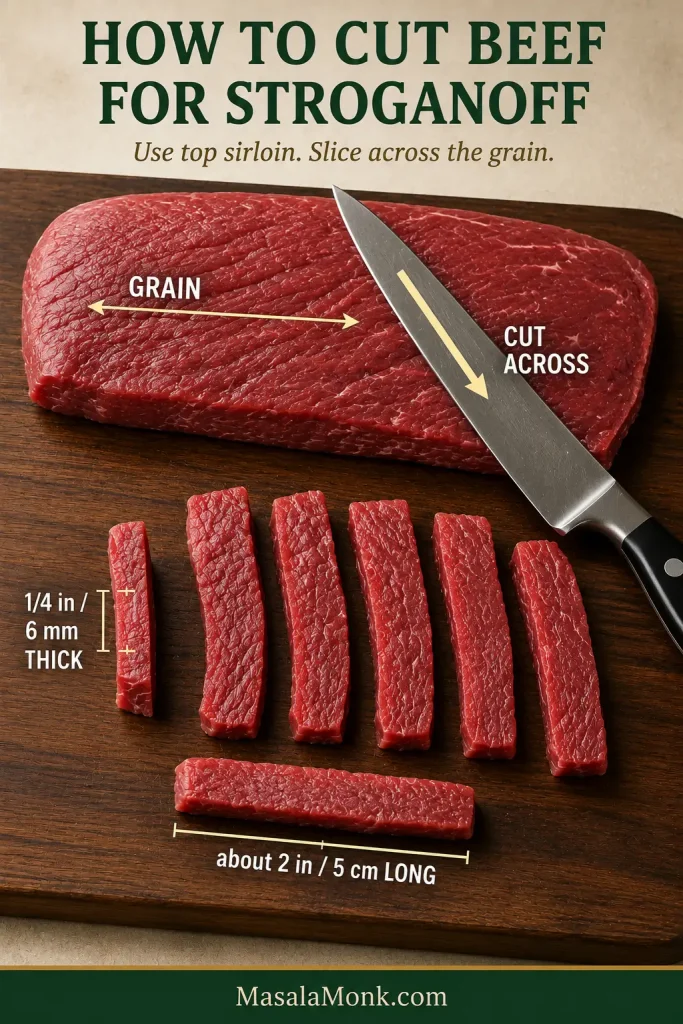
Slice and season the beef. Trim thick exterior fat and obvious tough sinew. Cut the steak across the grain into strips about ¼ inch (6 mm) thick and roughly 2 inches (5 cm) long. Pat very dry, then season with ½ teaspoon salt and ½ teaspoon black pepper.
Sear the beef in two batches. Heat a 12-inch (30 cm) heavy skillet over high heat until a strip of beef sizzles immediately on contact. Add about half the oil and half the beef in one uncrowded layer. Sear for roughly 30–45 seconds per side, just until browned patches develop. Transfer to a plate, let the skillet return to strong heat, then repeat with the remaining oil and beef. The centers may look underdone when the strips leave the pan. That’s intentional; they cook again at the end.
Brown the Mushrooms and Build the Sauce
Brown the mushrooms and onion. Lower the heat to medium. Once the aggressive searing heat has settled, add 1 tablespoon butter and the mushrooms. Drop the noodles into their boiling water now. Cook the mushrooms for about 3 minutes, then add the onion and remaining tablespoon butter. Continue for roughly 5–8 minutes, until most of the released mushroom water has evaporated and browned edges begin to appear. Listen to the pan: the wet hiss eventually gives way to a sharper sizzle. Season with the remaining ¼ teaspoon salt and ¼ teaspoon pepper.
Build the sauce. Stir in the garlic for about 30 seconds. For the wine variation, add the wine now, scrape up the browned bits and reduce until only a thin layer remains. Stir in the optional paprika, sprinkle the flour over the mushrooms and onion, and cook for about 1 minute. Add a small splash of broth and stir until smooth, scraping the browned bits from the bottom of the skillet. Gradually stir in the remaining broth, followed by the Dijon and Worcestershire.
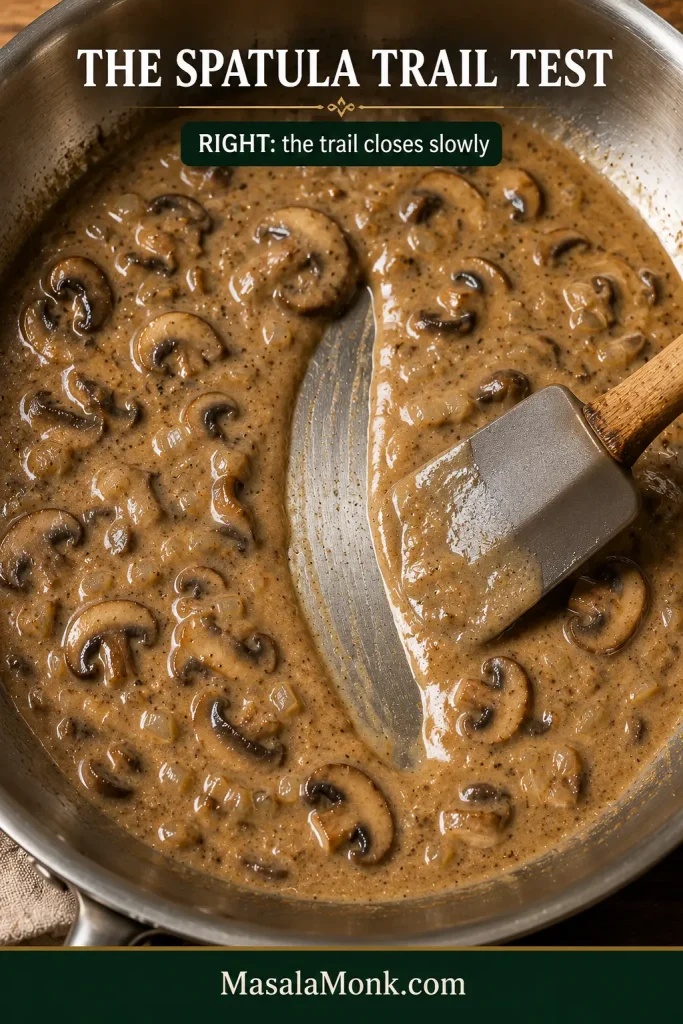
Reduce to the right consistency. Simmer for roughly 3–5 minutes. Drag a spatula through the skillet; the trail should remain visible briefly before flowing closed. A loose sauce needs more reduction. A sauce that has become too thick can be loosened with broth or hot noodle water, one tablespoon at a time.
Finish Gently and Serve
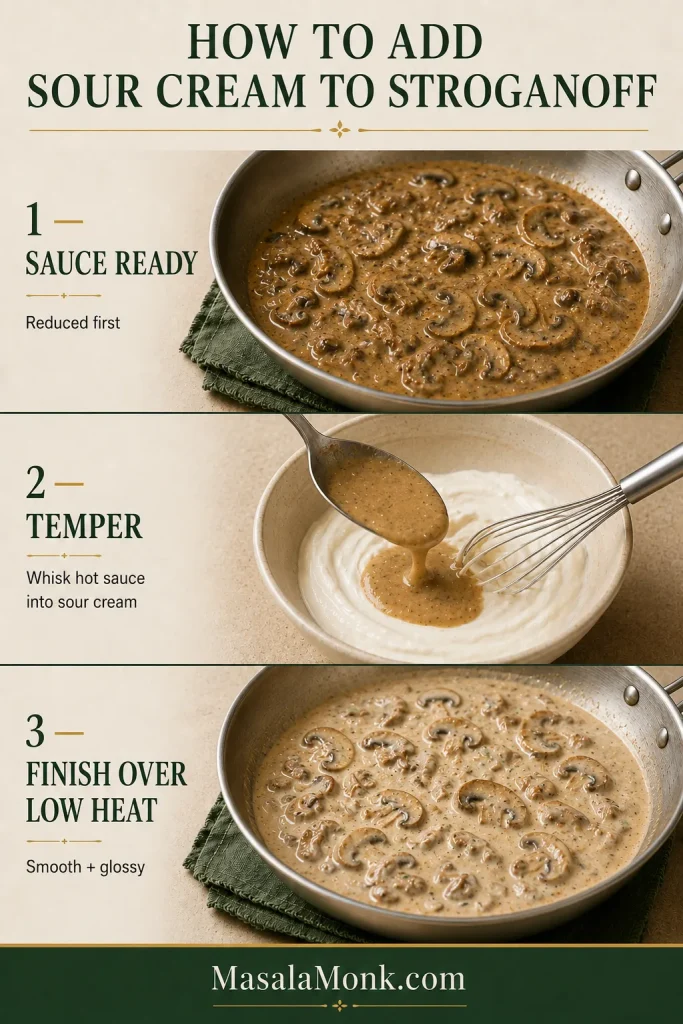
Add the sour cream over low heat. Put the sour cream in a small bowl and whisk in 2–3 tablespoons of hot sauce, one spoonful at a time. Lower the heat—or briefly take the skillet off the burner—then stir the warmed sour cream into the sauce until smooth and glossy.
Taste and adjust. Check the salt first. A muted sauce may need another ¼ teaspoon Dijon. Taste before adding anything else. Another ¼–½ teaspoon Worcestershire can deepen the savory flavor without taking over.
Return the beef. Fold in the steak and every drop of juice collected on the plate. Cook only long enough for the thin strips to finish cooking and heat through. Taste the sauce once more and adjust the salt if needed.
Serve. Spoon the Stroganoff over the warm buttered noodles and scatter the chopped chives over the top.
Use the skillet, not the stopwatch: browning, evaporated mushroom moisture and a slow-closing sauce trail are the key checkpoints.
Food-safety note: USDA guidance for whole beef steaks, chops and roasts is 145°F (63°C) followed by a 3-minute rest. See the USDA safe minimum temperature chart for current guidance.
Doubling the recipe: pan surface area becomes the limiting factor. Keep the beef batches the same size, which usually means four batches instead of two, or work with two large skillets. Twice as many mushrooms also need more room and more time for their moisture to evaporate, so a double batch will take longer than 30 minutes.
The finished sauce should still move when the skillet tilts; if it sits stiffly, loosen it before serving.
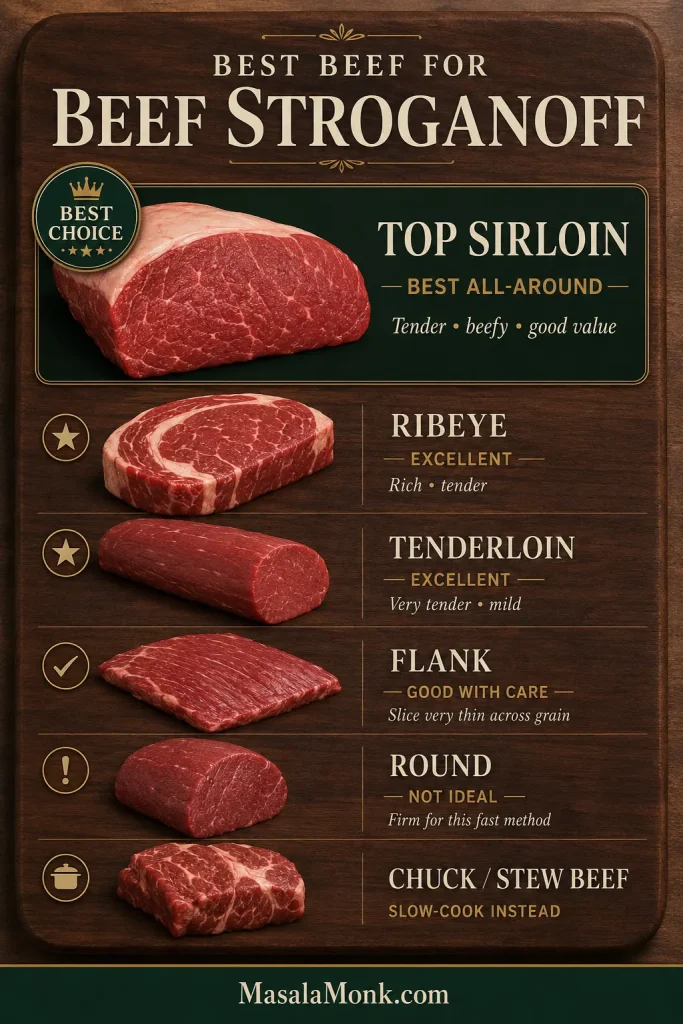
Top sirloin is the best all-around beef for this fast Beef Stroganoff. It is naturally tender enough for a short sear, has plenty of beef flavor, is easy to find and usually costs less than tenderloin or ribeye.
Price isn’t really the dividing line here. Cooking style is. Tender steaks suit this quick skillet method. Tougher cuts need a slower route; a few extra minutes in this skillet won’t suddenly make stew meat tender.
For quick Beef Stroganoff, fine marbling helps; thick fat seams and connective tissue do not have time to soften.
Chuck is much more at home in our slow cooker pot roast, where several hours of low, steady cooking give connective tissue time to soften.
Beef cut
For this fast method?
What to expect
Top sirloin
Excellent — best overall
Tender, beefy and good value
Ribeye
Excellent
Rich, tender and more expensive
Tenderloin / filet
Excellent
Very tender, mild and expensive
Pre-cut steak strips
Sometimes
Depends on the original cut
Flank steak
Good with care
Slice very thinly across the grain
Round
Not ideal
Often lean and firm in a short cook
Chuck / stew meat
No
Better with long, slow cooking
If sirloin doesn’t fit the budget tonight, Stroganoff is not off the table—the beef and cooking method just need to suit each other.
What About Beef Labeled “Stroganoff Strips”?
Check whether the original cut is listed on the package. Some pre-sliced Stroganoff strips are sirloin and work beautifully; others are inexpensive beef cut into narrow pieces. The label tells you how the store expects the meat to be used, not whether it is naturally tender. Thickness matters too: even when the cut itself is suitable, slice unusually thick strips down toward the ¼-inch (6 mm) target before cooking.
How to Keep the Beef Tender
For tender Beef Stroganoff, slice a naturally tender cut thinly across the grain, dry it well, sear it quickly in batches and keep its final cooking time brief.
Slice Across the Grain
Look at the steak before cutting it and find the direction of the long muscle fibers. Cut across those fibers, not alongside them. Shorter fibers are easier to chew.
Aim for strips around ¼ inch (6 mm) thick and 2 inches (5 cm) long. They should be easy to eat in the same forkful as a mushroom and a few noodles, not long enough to turn dinner into a tug-of-war.
If the grain changes direction, rotate the sirloin as you cut so every strip stays across the fibers.
Trim what a fast sear cannot soften. Fine marbling is welcome. Thick bands of exterior fat and tough sinew are not. This recipe cooks too quickly for a large chewy seam to render or soften.
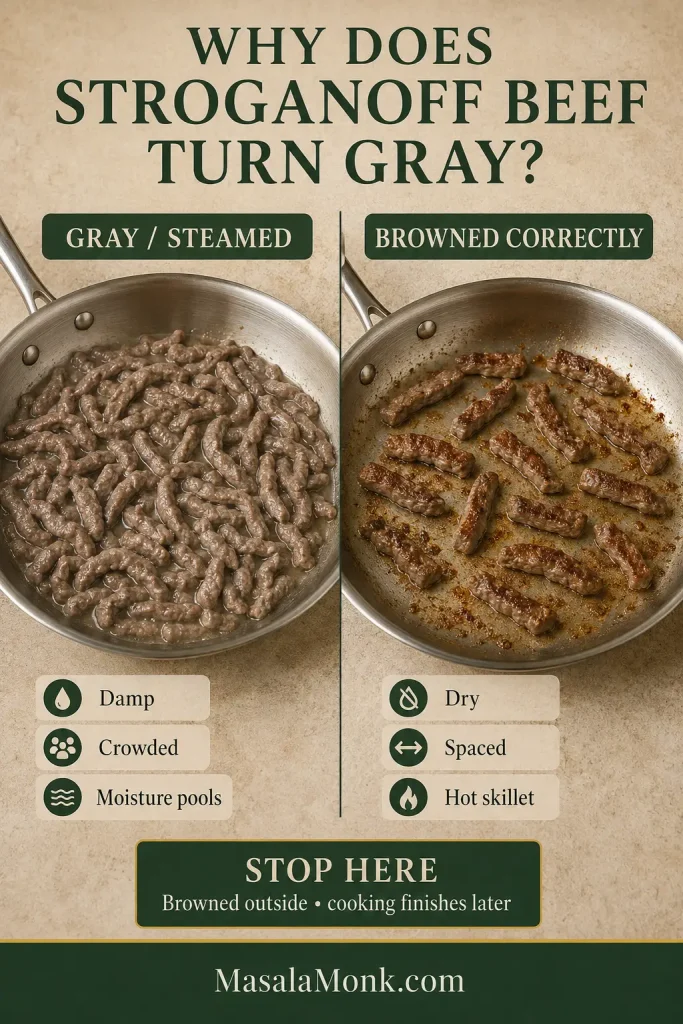
Dry beef browns better. Blot the strips thoroughly before they enter the skillet. Surface moisture has to evaporate before serious browning begins, and a pan crowded with damp beef cools quickly. With dry beef and strong heat, you get brown patches outside while those thin centers have cooking left for the return to the skillet. That’s the sweet spot.
If batch two stops sizzling on contact, let the skillet regain heat before adding more beef.
Keep the First Sear Short
Thin sirloin strips need only a brief head start. Once they have color, move them to a plate and let the mushrooms and sauce catch up. Extra simmering does not make sirloin more tender. It just keeps cooking it.
Once gray beef is cooked, stop chasing color; extra heat cannot undo steaming, but it can toughen the meat.
With the beef out of the way, the mushrooms can have the skillet to themselves.
How to Get Deeply Browned Mushrooms
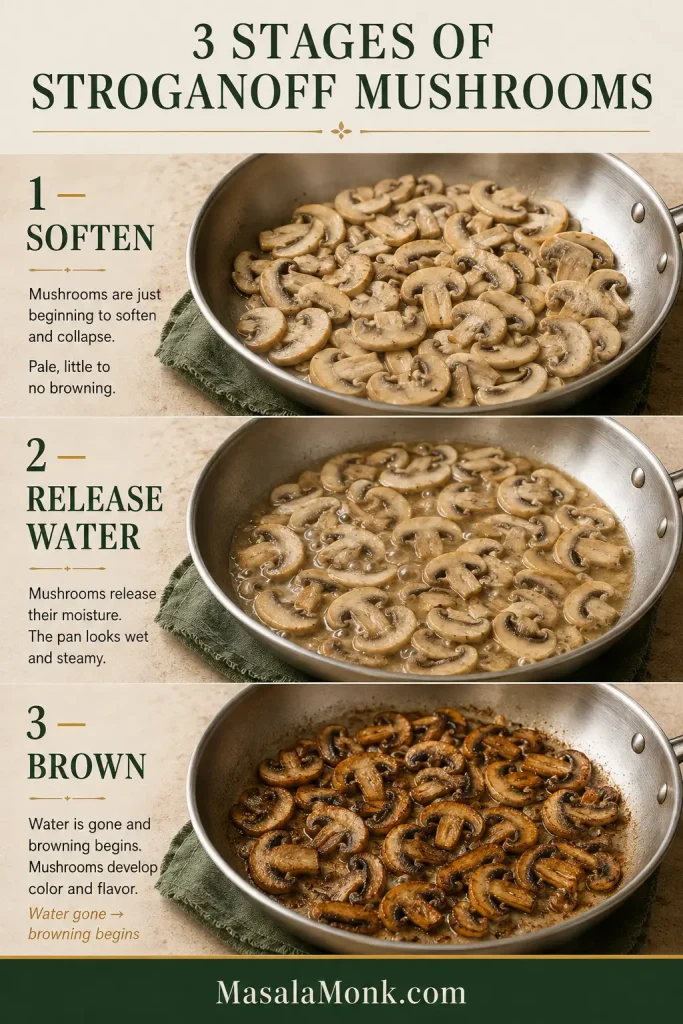
Cook the mushrooms until the water they release has evaporated and browned edges begin to appear. Soft mushrooms are not necessarily browned mushrooms.
Fresh mushrooms usually move through three recognizable stages:
They soften and absorb some of the fat.
They release water. The skillet can suddenly look much wetter than expected.
The water cooks away and browning begins.
Let released mushroom liquid evaporate in the pan; meaningful browning begins only after the wet stage passes.
The wet middle stage is where cooks often think something has gone wrong. It hasn’t.
Keep cooking while liquid covers the bottom of the skillet. As it disappears, the pan moves from a wet hiss to a sharper sizzle, and brown patches show around the mushroom edges. The aroma deepens too. Suddenly the skillet smells much more like dinner.
That change in sound, aroma and color tells you more than the clock does.
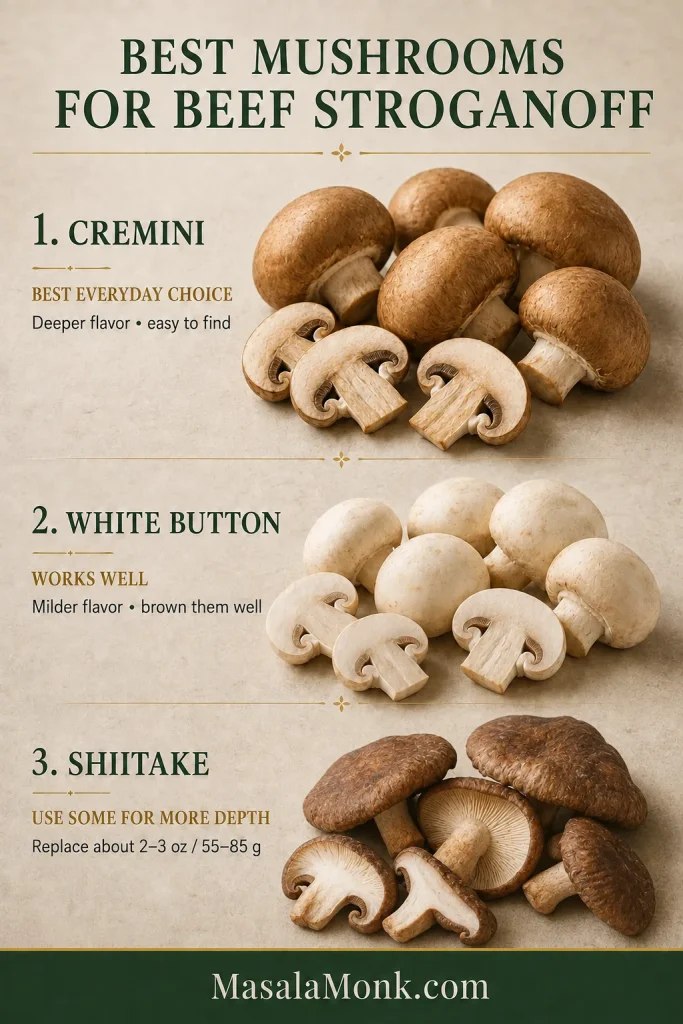
Cremini, White Button or Shiitake?
Cremini, also sold as baby bella mushrooms, are the everyday choice here. They bring more mushroom depth than white buttons while remaining easy to find.
White button mushrooms work well too. Good browning matters more than buying an expensive variety. For a deeper mushroom note, replace 2–3 oz (55–85 g) of the cremini with sliced shiitake caps.
Similar slice thickness helps cremini, white buttons or shiitake lose moisture and brown more evenly.
Love that browned-mushroom flavor? Our creamy mushroom sauce takes the same idea in a direction designed for steak, chicken or pasta. Once the mushroom water is gone and the edges have color, the skillet is ready to become the sauce.
How Beef Stroganoff Sauce Works
The sauce should taste first of browned beef and mushrooms, with sour cream smoothing the edges—not like a bowl of sour cream with a little beef in it.
What Is Stroganoff Sauce Made Of?
Stroganoff sauce is a savory sour-cream sauce built from beef broth and browned mushrooms, with Dijon and Worcestershire for depth and flour to give it body.
The broth pulls the browned bits from the skillet into the sauce, while Dijon adds brightness and Worcestershire deepens the beefy side. Flour gives the broth enough body to cling to the noodles; sour cream comes last with richness and tang.
Keep the deep-brown fond for flavor; remove any truly black, scorched residue before deglazing.
Finished Stroganoff sauce is glossy and pale brown to tan rather than stark white, with browned mushrooms visible through it.
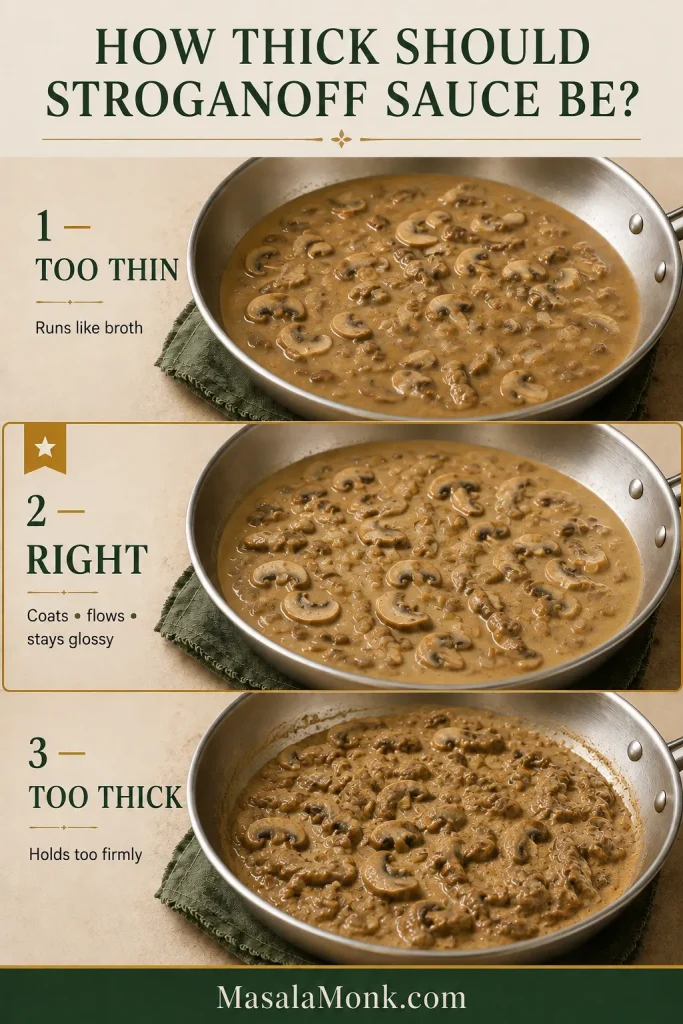
How Thick Should Stroganoff Sauce Be?
Think loose gravy rather than soup or paste: enough body to coat a noodle, but fluid enough to move around the plate.
Stop reducing slightly before perfect thickness; sour cream and a short rest will add more body.
On a spoon, the sauce leaves an opaque coating instead of running straight off. Drag a spatula through the skillet and the trail hangs around briefly before flowing closed. More reduction fixes most thin sauces at this stage; broth or hot noodle water loosens one that has gone too far.
Test an open patch of sauce—the liquid, not a pile of mushrooms, should make the spatula trail linger.
Sour Cream Is the Finish, Not the Fix
Before the sour cream goes in, the sauce should already be close to the thickness and flavor you want.
Up to this point, the skillet can simmer and reduce freely. Once the sour cream is in, keep the heat low. Tempering it with a few spoonfuls of hot sauce first makes that last stage more forgiving.
Cold sour cream benefits from tempering: a little hot sauce warms it gradually before the low-heat finish.
By then, the mushrooms have color, the sauce coats the spoon and the seasoning is nearly there. Stir in the sour cream and dinner is close.
Does Beef Stroganoff Need Heavy Cream?
No. Beef broth and flour provide the body in this version, while sour cream supplies the richness and tang. Heavy cream appears in many modern Stroganoff recipes and makes a richer, softer-tasting sauce, but it isn’t necessary here.
When the Sauce Looks Good but Tastes Flat
A beautiful skillet can still taste muted. More sour cream usually isn’t the answer.
Salt wakes up an underseasoned sauce. Dijon gives it lift, while Worcestershire adds deeper savoriness. Make small adjustments and taste between them; it is much easier to add another drop than to pull one back out.
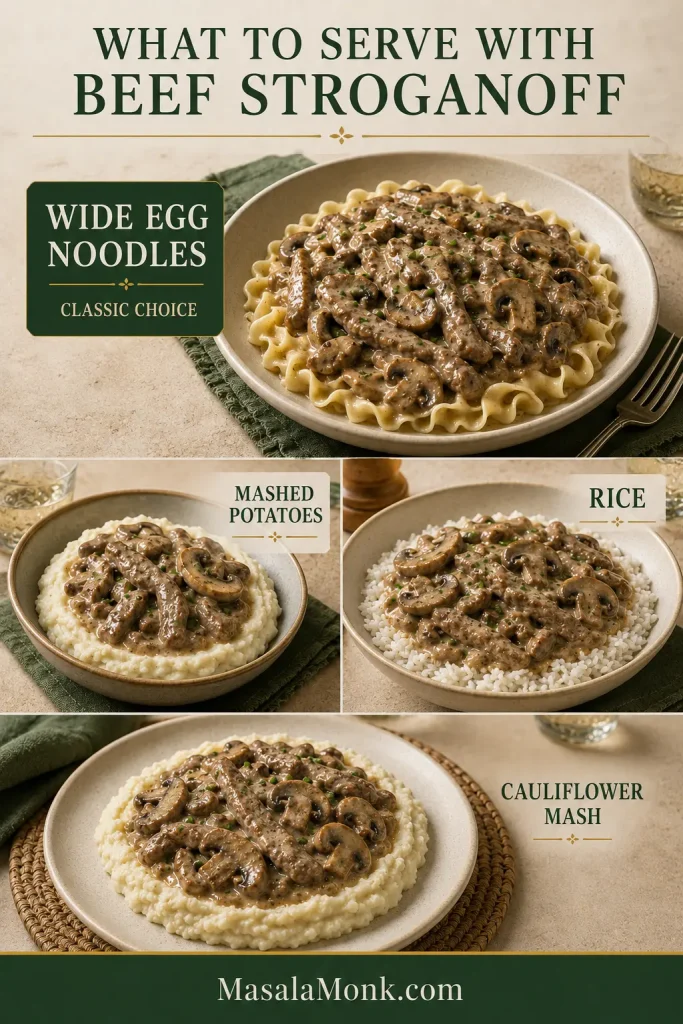
Wide egg noodles are the first choice here. Their broad surfaces catch the sauce without competing with the beef.
Mashed potatoes make the plate softer and richer; rice keeps things simple. Pappardelle or tagliatelle work when wide egg noodles are hard to find, while cauliflower mash gives you a lower-carb base that holds a creamy sauce well.
Noodles catch sauce in folds, potatoes absorb it eagerly, and rice keeps more separation between bites.
If potatoes sound especially good tonight, these creamy mashed potatoes are soft and spoonable enough for the Stroganoff to settle right into them.
The rest of the plate does not need much. Stroganoff is already warm, soft and rich, so a crisp green salad or simply cooked green vegetable gives it contrast without turning an easy skillet dinner into a project.
Swaps and Variations That Work
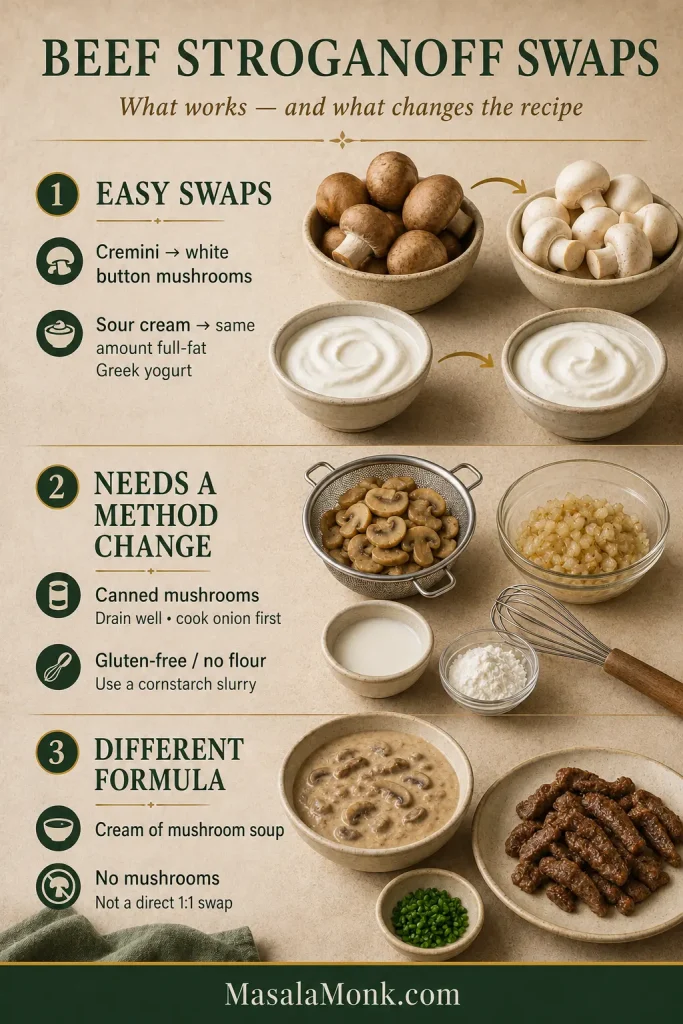
Missing an ingredient doesn’t always mean changing the whole recipe. These swaps fit the method without quietly turning it into a different Stroganoff.
Swap
How to make it work
White button mushrooms
Use them 1:1 in place of cremini and cook them through the same moisture-release and browning stages.
Canned mushrooms
Drain very well. Instead of the normal mushroom step, melt the full 2 tablespoons butter and cook the onion first until softened. Add the drained mushrooms for the final 2–3 minutes and cook off any remaining moisture. Season with the remaining ¼ teaspoon salt and ¼ teaspoon pepper, then continue with the garlic. They will not develop the same browned flavor as fresh mushrooms.
Full-fat Greek yogurt
Use the same amount as the sour cream. Temper it the same way and keep the final heat low. Expect a slightly sharper finished sauce.
No Worcestershire
Leave it out rather than forcing a substitute. Check the salt at the end. Extra Dijon can add brightness, but the finished sauce will have less savory depth.
Gluten-free
Use gluten-free noodles and check the broth, Worcestershire and mustard labels. Omit the flour. After the broth reduces, mix 1 teaspoon cornstarch with 1 tablespoon cold water and stir the slurry in gradually. Repeat only when more thickening is needed.
No flour
Omit the flour and let the broth reduce first. Mix 1 teaspoon cornstarch with 1 tablespoon cold water, add part of the slurry, and cook briefly before deciding whether the sauce needs the rest.
Ask what the ingredient does: flavor-only swaps are simpler than changes to moisture, thickening or dairy behavior.
Can I Use Cream of Mushroom Soup?
Yes—but not as a direct 1:1 replacement for the broth and sour cream here. Condensed soup brings its own salt, starch, dairy and mushroom flavor, so swapping it in changes too much of this sauce to treat it like one ordinary ingredient substitution.
A soup-based Stroganoff works best when the recipe is built around the soup from the beginning. Adding a can halfway through this version and trying to correct everything afterward creates more problems than it solves.
Using Leftover Cooked Steak
Skip the searing completely. Slice the cooked steak thinly and fold it in at the very end, only long enough to heat through. Already-cooked steak does not need another full round of cooking.
What If I Don’t Want Mushrooms?
Leaving out all 12 ounces (340 g) of mushrooms isn’t a clean swap in this formula. They account for a large amount of the food in the skillet and contribute moisture and savory flavor as they cook. With all of that removed, too much else changes for “just leave them out” to be good advice. A mushroom-free Stroganoff needs its sauce built differently from the start.
A Note on “Authentic” Beef Stroganoff
There isn’t one frozen-in-time version everyone has to reproduce. Beef Stroganoff has changed as it has traveled through countries and home kitchens, with different approaches to mushrooms, seasoning and dairy, as well as different choices of noodles, rice or potatoes underneath.
The goal here is narrower: tender quickly seared steak, deeply browned mushrooms and a tangy sour-cream sauce that works on an ordinary weeknight.
Beef Stroganoff Troubleshooting
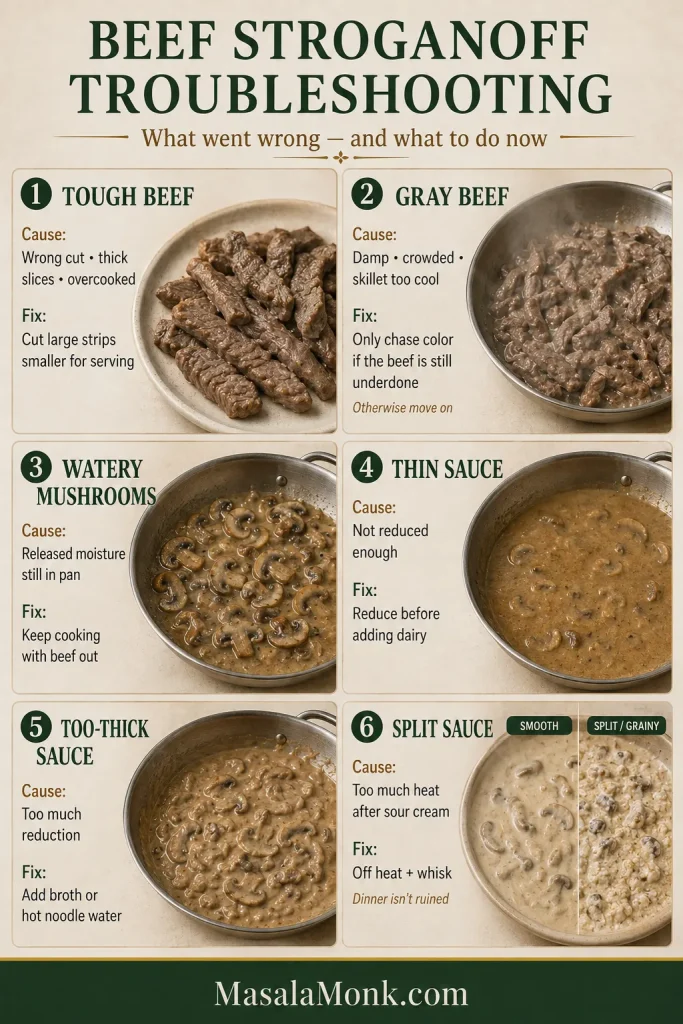
If dinner is already in the skillet and something looks wrong, start with the symptom you can see or taste. Most problems come back to the beef, the mushrooms, the sauce consistency or too much heat after the sour cream goes in.
Protect tenderness and sauce texture first; fixing color or thickness is not worth creating a worse problem.
Beef and Mushroom Problems
Problem
Likely cause
What to do now
Next time
Beef is tough
Wrong cut, thick slices or too much cooking
Cut large strips smaller to make them easier to eat
Use sirloin or another tender steak, slice across the grain and keep the cooking brief
Beef is gray
Damp meat, cool skillet or overcrowding
If still underdone, remove excess liquid and briefly restore strong heat. If already cooked, move on—don’t sacrifice tenderness chasing color
Dry the beef, work in batches and let the skillet recover between them
Mushrooms are watery
Released moisture has not evaporated yet
Keep the beef out and continue cooking until the liquid is gone and browning begins
Follow the pan rather than relying only on the timer
Sauce, Noodle and Leftover Problems
Problem
Likely cause
What to do now
Next time
Sauce is thin
Too much moisture or insufficient reduction
Reduce before adding dairy or beef; use a small slurry when reduction is not enough
Let mushroom moisture evaporate before building the sauce
Sauce is too thick
Too much reduction or thickener
Add broth or hot noodle water one tablespoon at a time
Stop reducing while the sauce is slightly looser than the texture you want on the plate
Flour is lumpy
The broth went in too quickly
Whisk or stir vigorously before adding sour cream
Start with a small splash of broth and smooth it out before adding more
Sauce is grainy or split
The sour cream met excessive heat
Take the skillet off the heat and whisk. It may not regain perfect gloss, but dinner isn’t ruined
Temper the sour cream and keep the final heat low
Sauce tastes flat
Underseasoning or weak browning
Check salt first, then adjust Dijon or Worcestershire in small amounts
Develop color on the beef and mushrooms and scrape the browned bits into the sauce
Sauce disappeared into noodles
The noodles sat in the sauce and absorbed it
Loosen the remaining sauce with some broth
Keep the main skillet and noodles separate until serving
Leftovers are dry
Noodles absorbed sauce during storage
Reheat with a splash of broth
Store the noodles separately
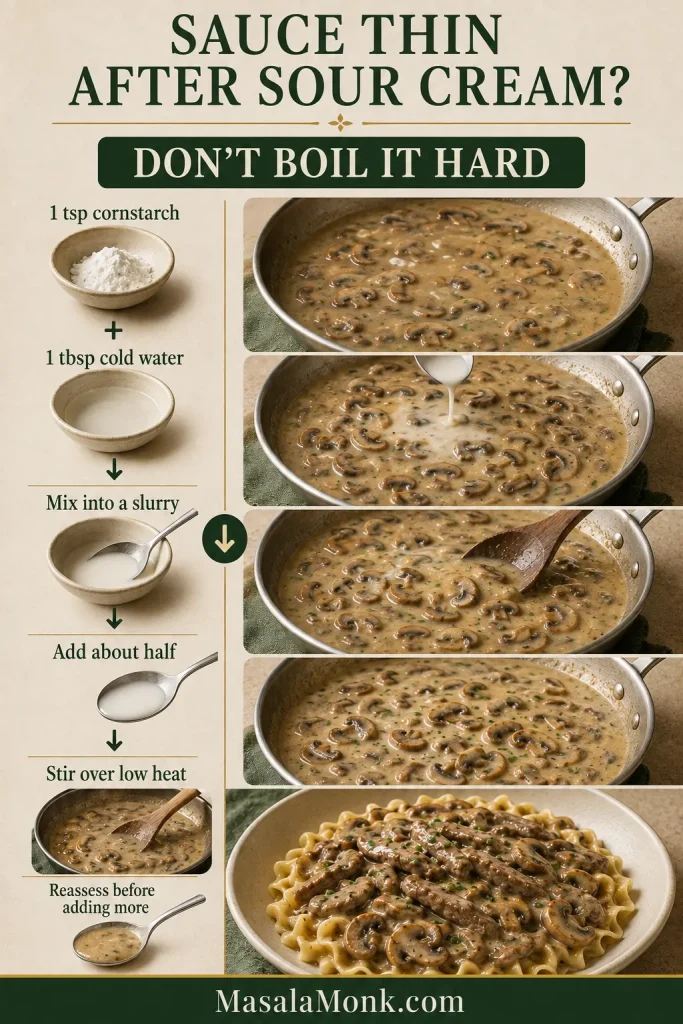
My Sauce Is Thin, but the Sour Cream Is Already In
Once the sour cream is in, boiling the sauce down hard creates a second problem while you’re trying to fix the first.
Mix 1 teaspoon cornstarch with 1 tablespoon cold water. Stir about half into the Stroganoff over low heat and give it a moment to thicken. Add more only when the sauce needs it. Next time, do most of the reducing before adding the sour cream.
Add slurry gradually and pause before adding more—cornstarch needs heat and a moment to show its full effect.
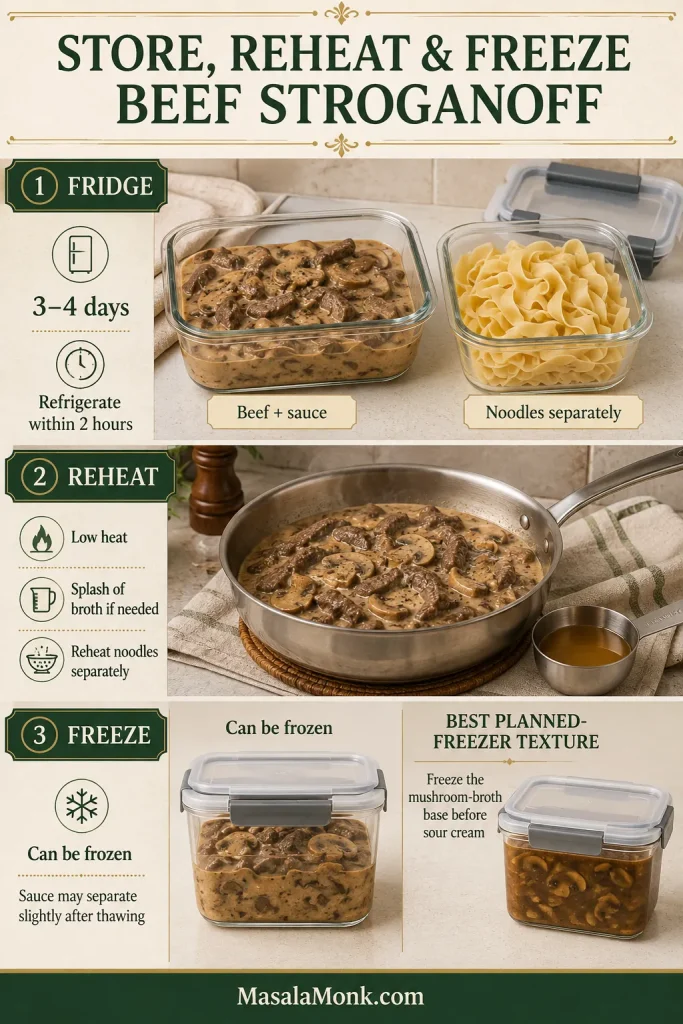
For the best leftovers, keep the noodles separate, reheat the sauce gently and treat freezing as a texture decision rather than an all-or-nothing rule. The details below cover each route.
Separate noodles give you control: loosen the sauce with broth without overcooking the pasta during reheating.
Store the beef and sauce together and the noodles separately. That prevents tomorrow’s noodles from soaking up much of the sauce while everything sits in the refrigerator.
How to Reheat It Without Breaking the Sauce
Warm Stroganoff slowly, adding a splash of broth when the chilled sauce needs loosening. Stir often so the edges do not get much hotter than the center. Reheat the noodles separately.
Where to Stop If You’re Making It Ahead
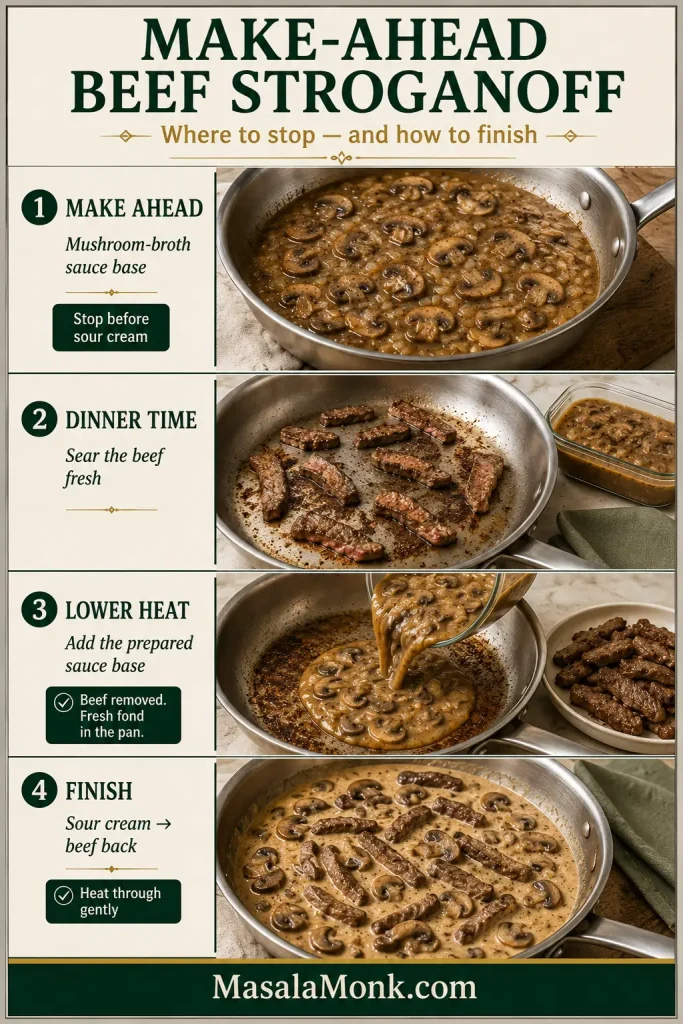
Make the mushroom-broth sauce base ahead, but sear the steak fresh when you’re ready to eat. Stop once the sauce base reaches the consistency you want, before the sour cream goes in. Cool it promptly and refrigerate it. Keep the raw steak refrigerated separately.
At dinnertime, heat the skillet and sear the beef first. Transfer it to a plate, lower the heat and let the skillet settle for a moment, then add the prepared mushroom-broth base to the same pan. Warm it through, scraping in the fresh browned bits left by the steak. Temper and stir in the sour cream, then return the beef only long enough to finish cooking and heat through. Do not partially sear the beef, refrigerate it and plan to complete its cooking later.
The chilled sauce base will thicken; loosen it gently with broth before adding sour cream and freshly seared beef.
Can You Freeze Beef Stroganoff?
Yes. Fully cooked Beef Stroganoff can be frozen, although the sour-cream sauce may look slightly separated after thawing. Thaw and reheat it slowly, adding broth as needed to loosen the sauce.
If you’re cooking specifically for the freezer, the smoother option is to freeze the mushroom-broth sauce base before adding the sour cream. Reheat the base and add fresh sour cream when you make the meal.
The Fork Should Tell You It Worked
A 30-minute dinner does not have to taste hurried.
The beef gets its short blast of high heat. The mushrooms stay in the skillet long enough to develop real color. Those browned bits make their way into the sauce, and the sour cream softens everything without burying the beef and mushrooms underneath it.
Spoon it over the warm noodles while the sauce is glossy and flowing. Add the fresh chives last.
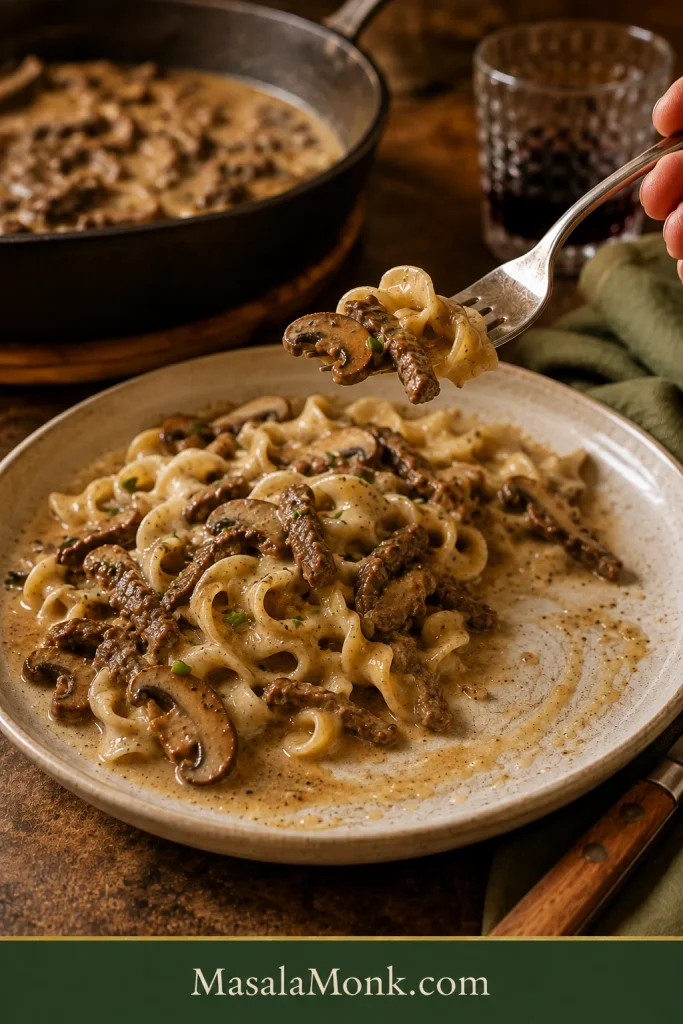
Then take the first forkful: a tender strip of beef, a browned mushroom, a few noodles and enough tangy sauce to bring all three together.
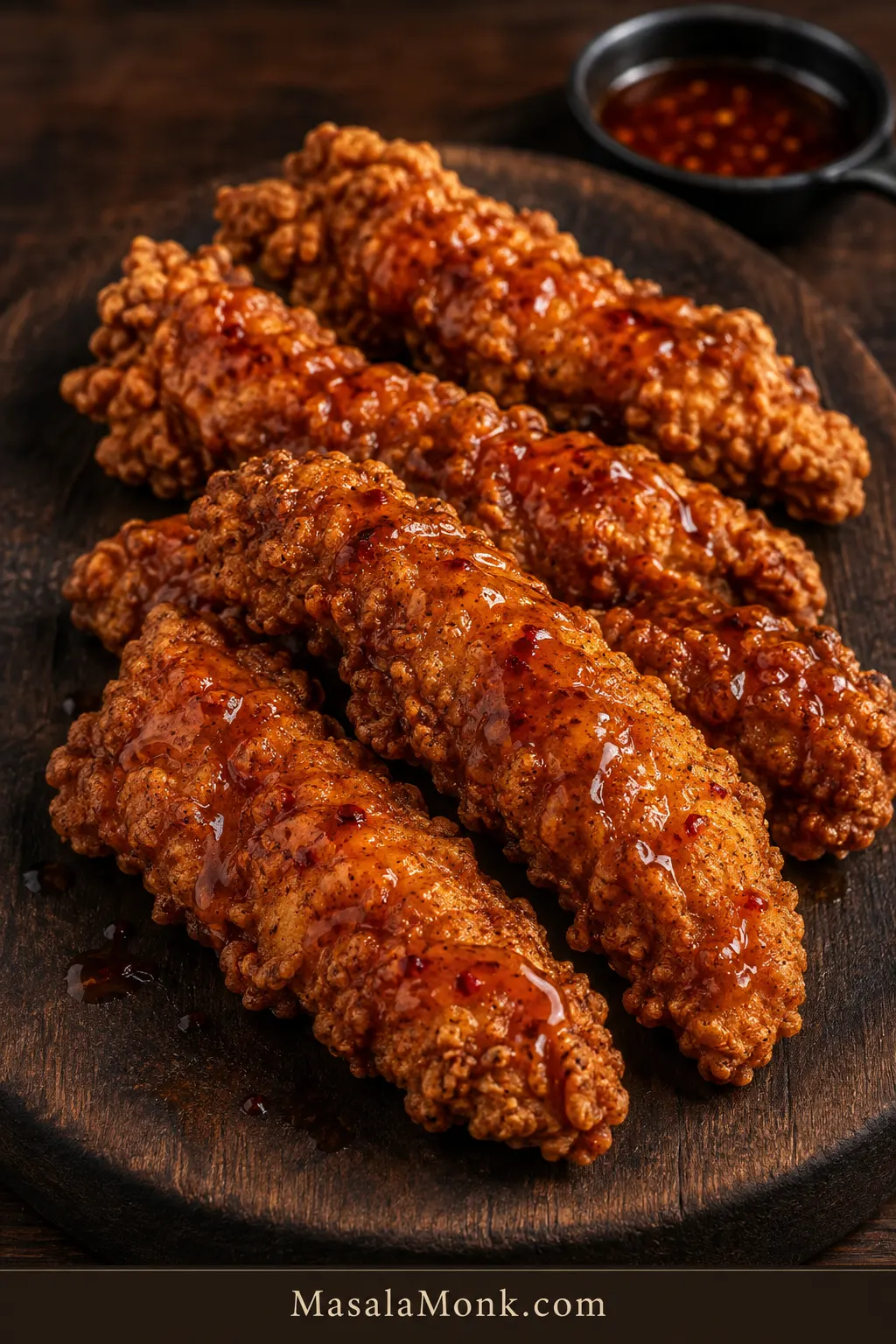
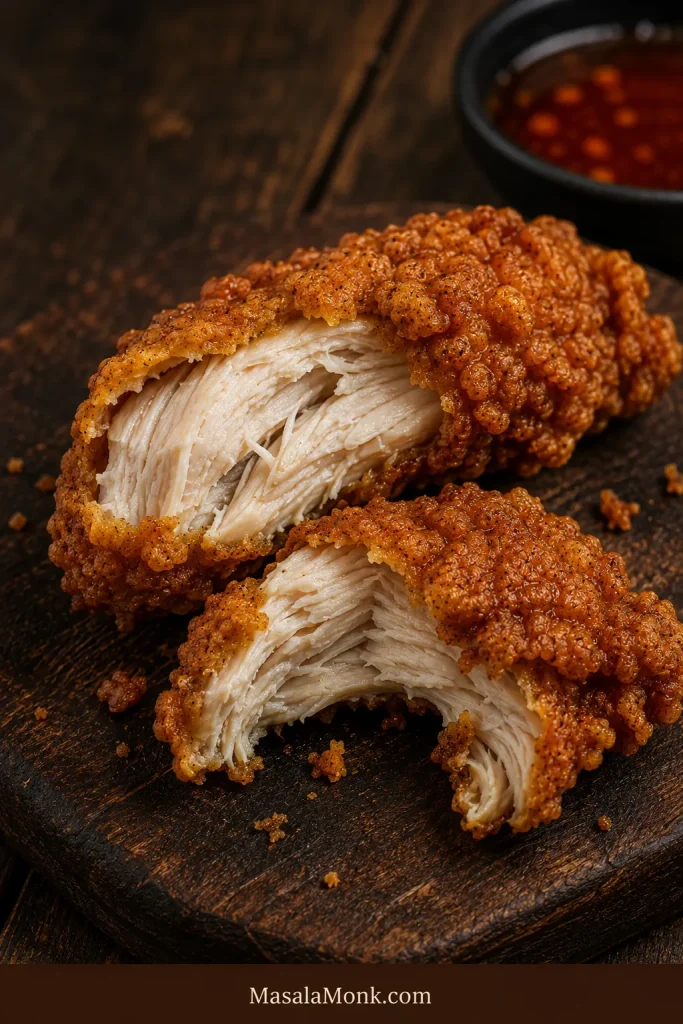
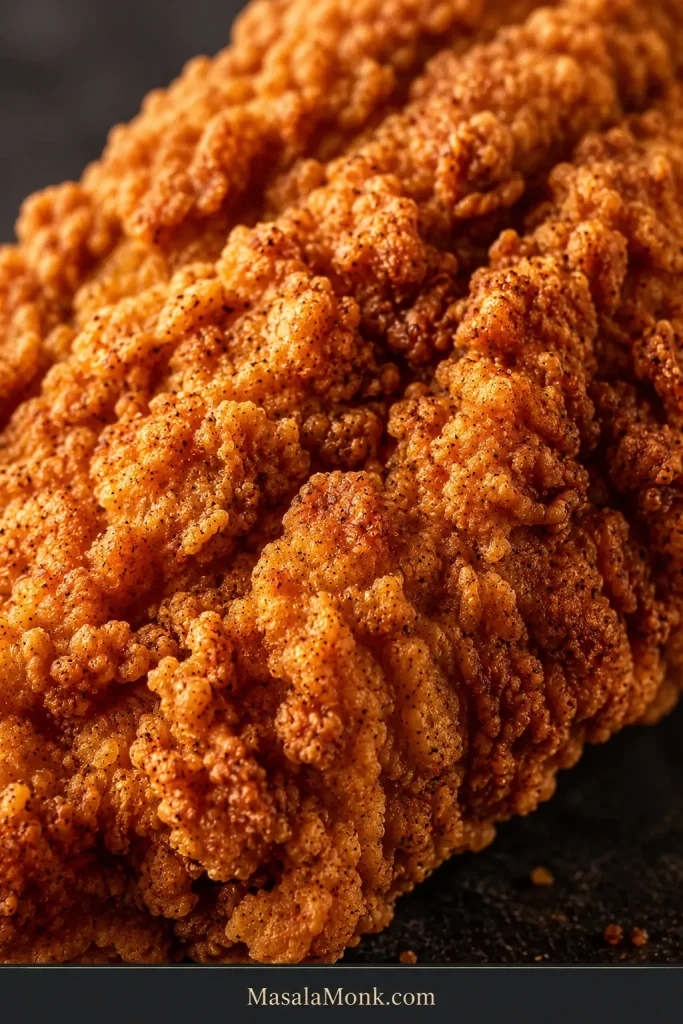
The best hot honey chicken tenders crackle when you bite through the coating, then give way to juicy chicken, sticky honey and a little heat that arrives just after the sweetness. Those rough golden ridges matter—they give the honey somewhere to catch without covering every bit of crunch.
Homemade tenders usually go wrong in a few predictable places. The breading slips off, too much chicken cools the oil, a thick piece stays underdone while the outside darkens, or the hot honey goes on so heavily that a beautiful crust turns soft almost immediately.
This version keeps those trouble spots under control without turning fried chicken into a project. The chicken is seasoned before breading, the coating gets rough little flour flakes for extra crunch, and only a few similarly sized pieces go into the oil at a time. Once the tenders hit the rack, you can drizzle, brush or toss them depending on how much crunch you want to keep.
Quick Answer: How to Make Crispy Hot Honey Chicken Tenders
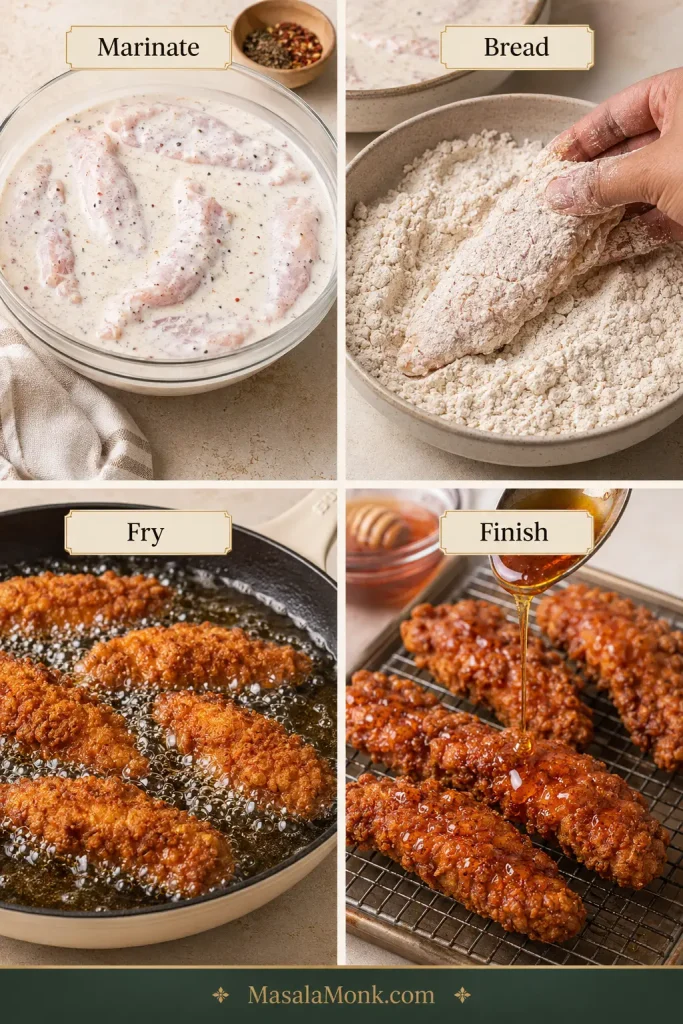
Marinate: Season 1½ lb (680 g) chicken tenders in buttermilk for at least 30 minutes; 2–4 hours gives the seasoning more time to work.
Bread: Press the chicken into a flour-cornstarch dredge with small damp flour flakes, then rest the breaded tenders for 10 minutes.
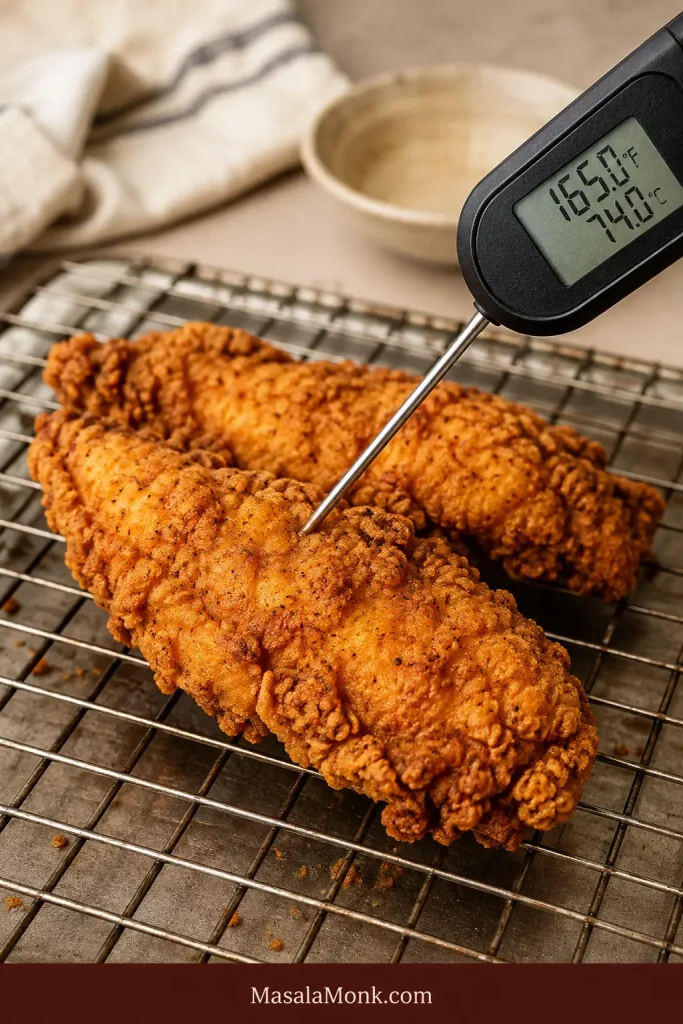
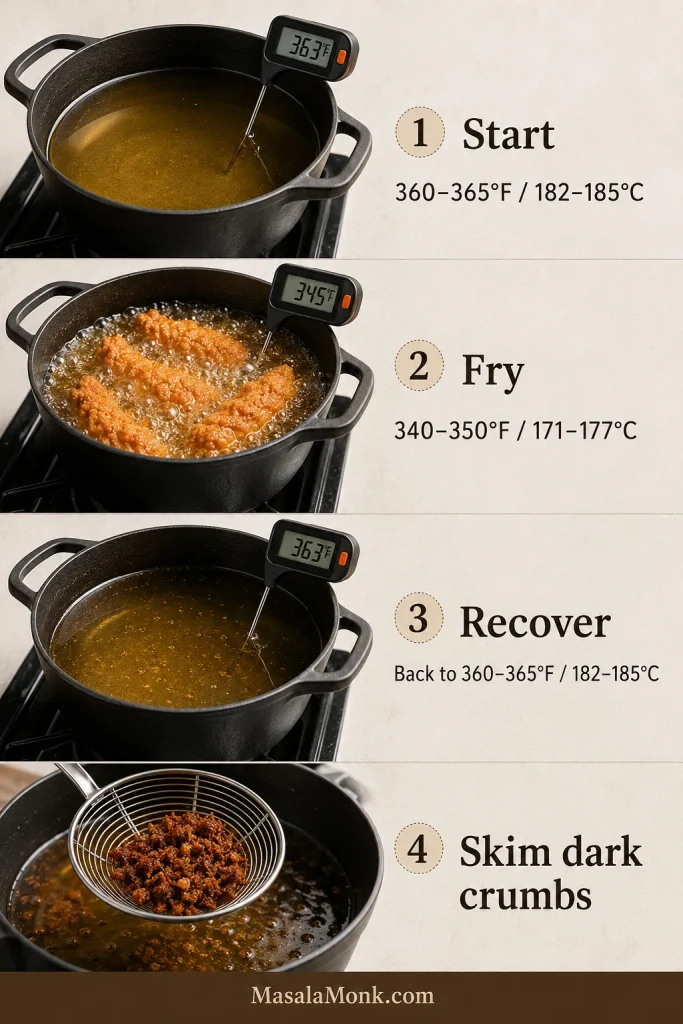
Fry: Start the oil at 360–365°F (182–185°C), keep it around 340–350°F (171–177°C) while the chicken cooks, and cook the thickest piece to 165°F (74°C).
Finish: Rest the fried chicken on a wire rack for 2–3 minutes, then add warm hot honey.
Build the crunch before frying, protect it afterward, and add the hot honey last.
Choose Your Hot Honey Finish
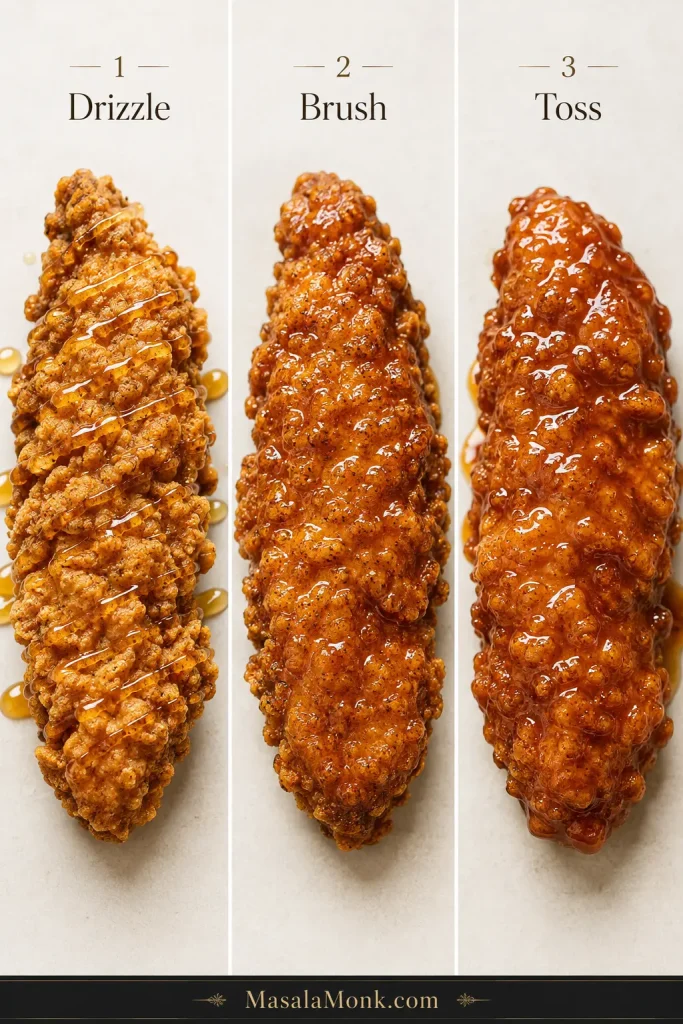
How you add the hot honey changes the bite. A drizzle leaves plenty of golden ridges exposed; a full toss fills almost every crevice with sauce.
You want
Finish
What to expect
Maximum crunch
Drizzle
Sweet heat with plenty of crisp breading still exposed. Recommended.
More even sauce
Brush
Broader coverage while much of the coating stays crisp.
Sticky glazed chicken
Toss
Maximum sauce coverage; eat it right away.
The main recipe uses the drizzle method.
Hot Honey Chicken Tenders Recipe
Craggy, deeply golden chicken tenders with juicy centers and warm hot honey that catches in the ridges instead of soaking the whole crust.
Yield: 10–12 tenders
Serves: about 4
Hands-on time: about 50 minutes
Marinate: 30 minutes minimum; 2–4 hours preferred
Total time: about 1 hour 20 minutes with the 30-minute marinade
Doubling: double the ingredients, but keep the same small frying batches
Equipment
5–6-quart heavy Dutch oven or similarly deep pot
Deep-fry thermometer or other clip-on oil thermometer
Instant-read thermometer for the chicken
Wire rack set over a rimmed tray
You will also need a parchment-lined tray or large plate for the raw breaded chicken, shallow bowls, a small saucepan and tongs or a spider/skimmer. Keep a clean utensil ready for transferring the cooked chicken.
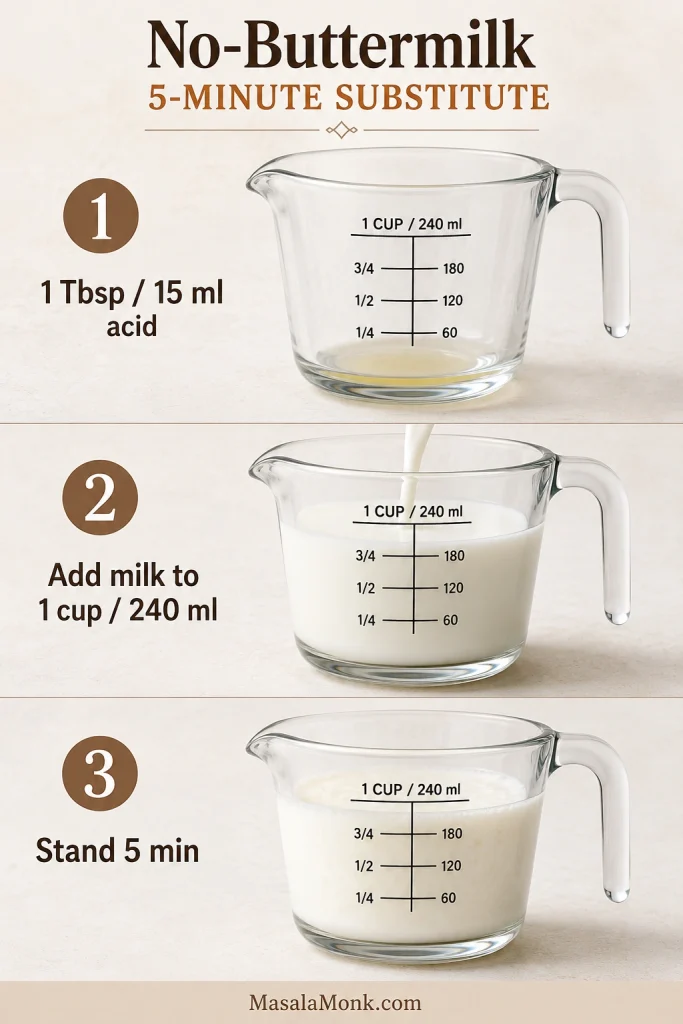
No buttermilk? Put 1 tablespoon (15 ml) lemon juice or white vinegar in a measuring cup, then add enough whole milk to reach 1 cup (240 ml). Stir and let it stand for 5 minutes.
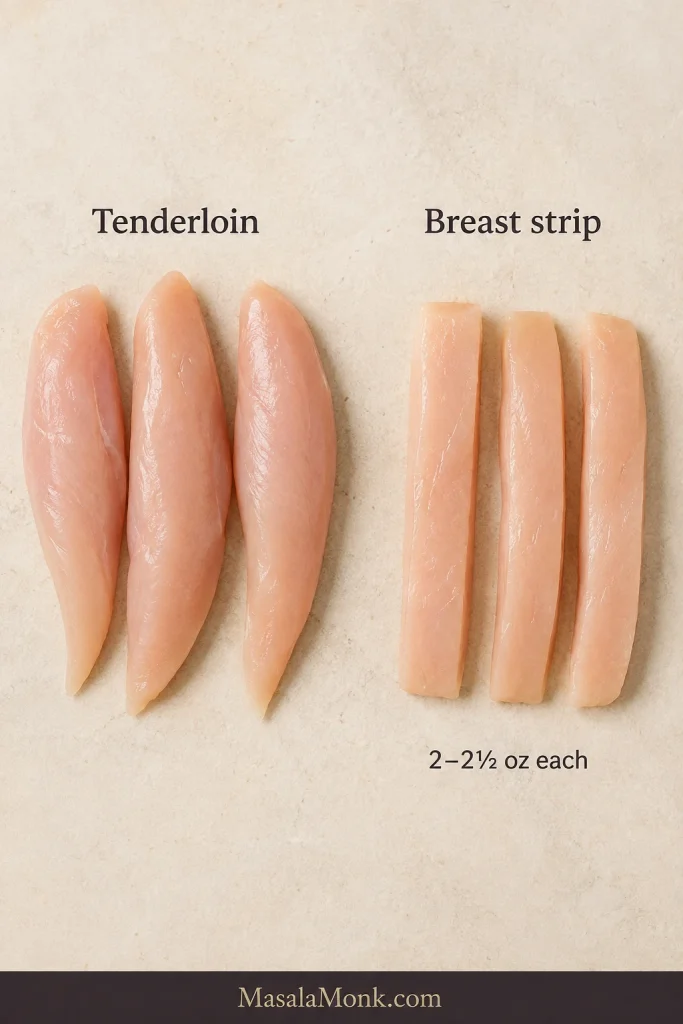
Using chicken breast? Cut it into strips ¾–1 inch (2–2.5 cm) wide and ½–¾ inch (1.25–2 cm) thick. Aim for 2–2½ oz (55–70 g) per strip.
For the Crispy Coating
1½ cups (180 g) all-purpose flour
½ cup (60–65 g) cornstarch
1½ teaspoons baking powder
8 g fine sea salt, about 1⅓ teaspoons
1 teaspoon garlic powder
1 teaspoon onion powder
1 teaspoon sweet paprika
1 teaspoon freshly ground black pepper
¼ teaspoon cayenne pepper, optional
3 tablespoons (45 ml) seasoned buttermilk mixture, removed before the raw chicken is added
If you use kosher salt, follow the gram weights rather than the teaspoon estimates because crystal size varies by brand.
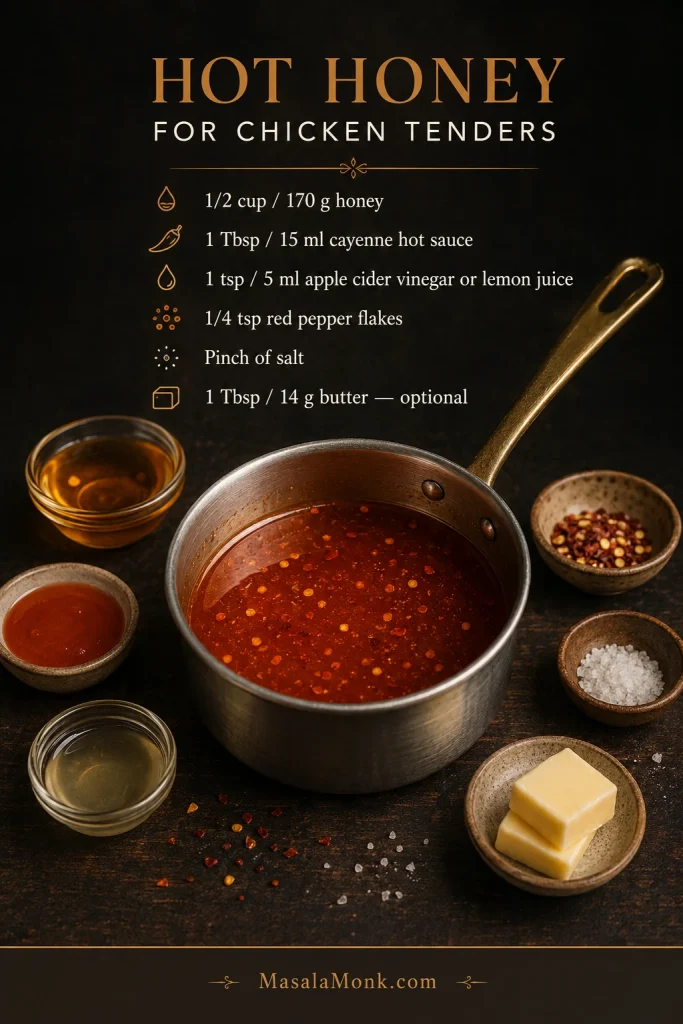
For the Medium Hot Honey
½ cup (170 g) honey
1 tablespoon (15 ml) cayenne-style hot sauce
1 teaspoon (5 ml) apple cider vinegar or fresh lemon juice
¼ teaspoon crushed red pepper flakes
Small pinch fine salt
1 tablespoon (14 g) unsalted butter, optional
Use a thin, vinegar-forward cayenne hot sauce here. Thick sriracha, chili crisp and highly concentrated pepper sauces behave differently and are not tablespoon-for-tablespoon substitutes.
1½–2 quarts (1.4–1.9 L) neutral frying oil, or enough to reach 1¼–1½ inches (3–4 cm) deep in your pot while leaving plenty of empty space above the oil
Peanut, canola, sunflower or standard vegetable oil all work well. Let the depth in your pot determine the exact amount. Fresh oil—or clean, well-filtered oil that still smells neutral—gives the cleanest flavor.
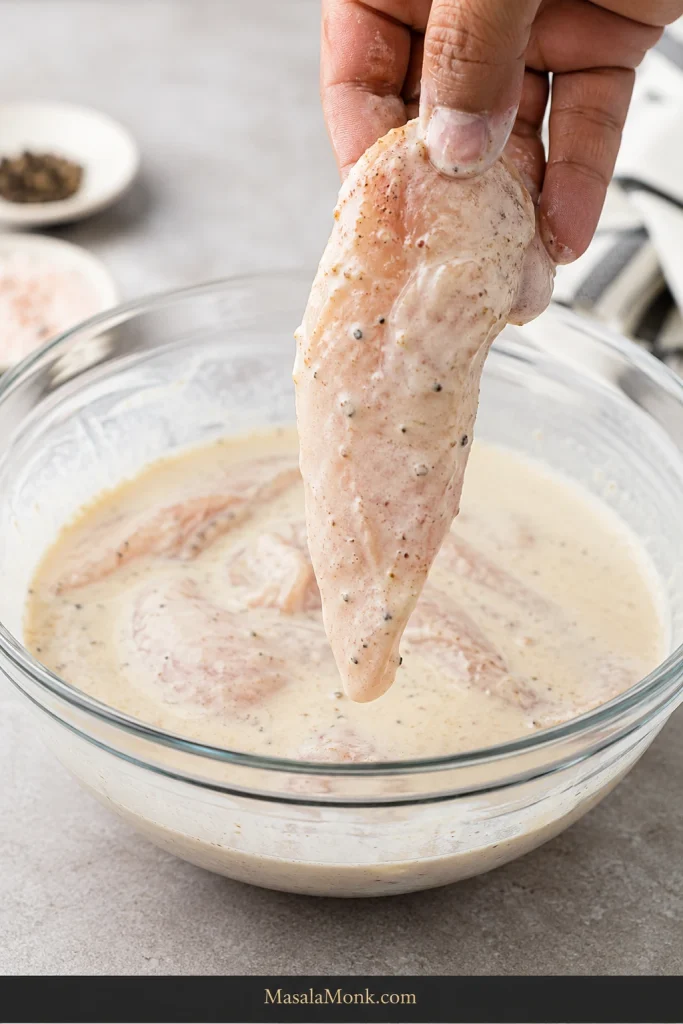
Season and marinate the chicken. Whisk together the buttermilk, hot sauce, salt, garlic powder and black pepper. Before raw chicken enters the bowl, spoon 3 tablespoons (45 ml) into a separate clean bowl for the dredge. Add the chicken, turn to coat, cover and refrigerate for at least 30 minutes. Two to four hours is ideal; these thin pieces gain little from a much longer soak.
While the chicken marinates, make the hot honey. Combine the honey, hot sauce, vinegar or lemon juice, red pepper flakes and salt in a small saucepan. Warm over low heat for 1–2 minutes, just until loose and fragrant. Do not boil. Stir in the butter if using, taste and set aside. Rewarm briefly before serving if the sauce thickens.
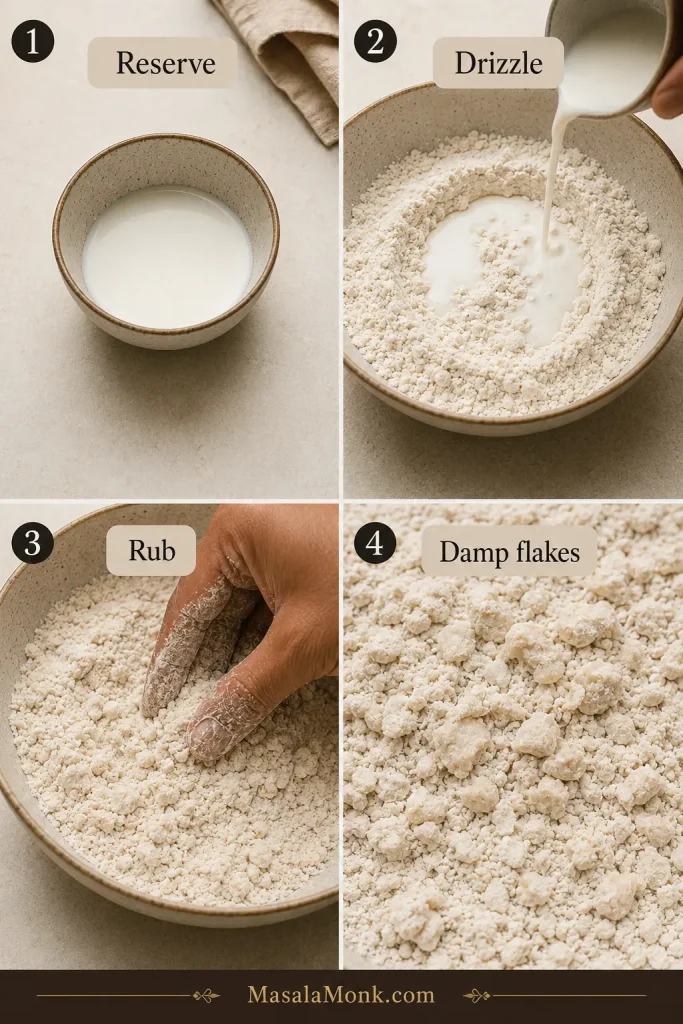
Mix the dredge while the chicken finishes marinating. Whisk together the flour, cornstarch, baking powder, salt, garlic powder, onion powder, paprika, black pepper and cayenne. Drizzle the clean reserved buttermilk over the flour mixture and rub lightly with your fingertips until small damp flakes and pebbly pieces form. Break apart anything that resembles wet dough.
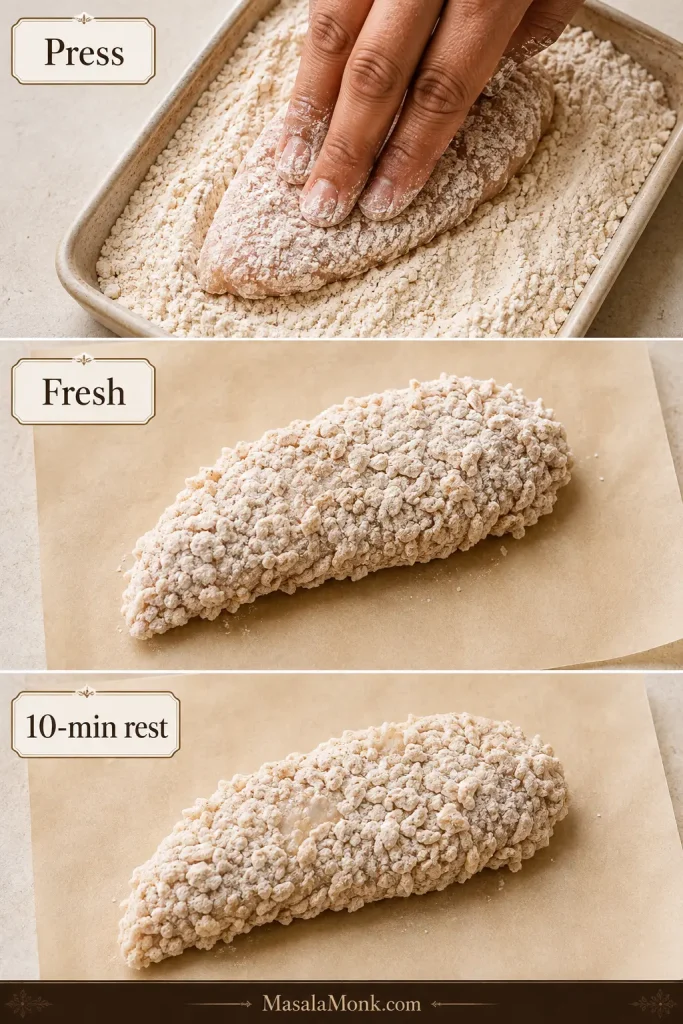
Bread the chicken. Lift one tender from the marinade and let the excess drip back into the bowl. Do not pat it dry. The surface should stay tacky without dripping in streams. Press the chicken firmly into the dredge on every side, picking up some of the rough flour flakes, then place it on the parchment-lined tray. Repeat with the remaining pieces. Discard the remaining raw-chicken marinade and any dredge that touched raw chicken.
Fry the Chicken
Rest the breading and start heating the oil. Begin heating the oil to 360–365°F (182–185°C). Let the breaded chicken rest for at least 10 minutes while the oil comes up to temperature. The coating should look shaggy and slightly hydrated in patches. If the oil needs another few minutes, the chicken can simply stay on the tray.
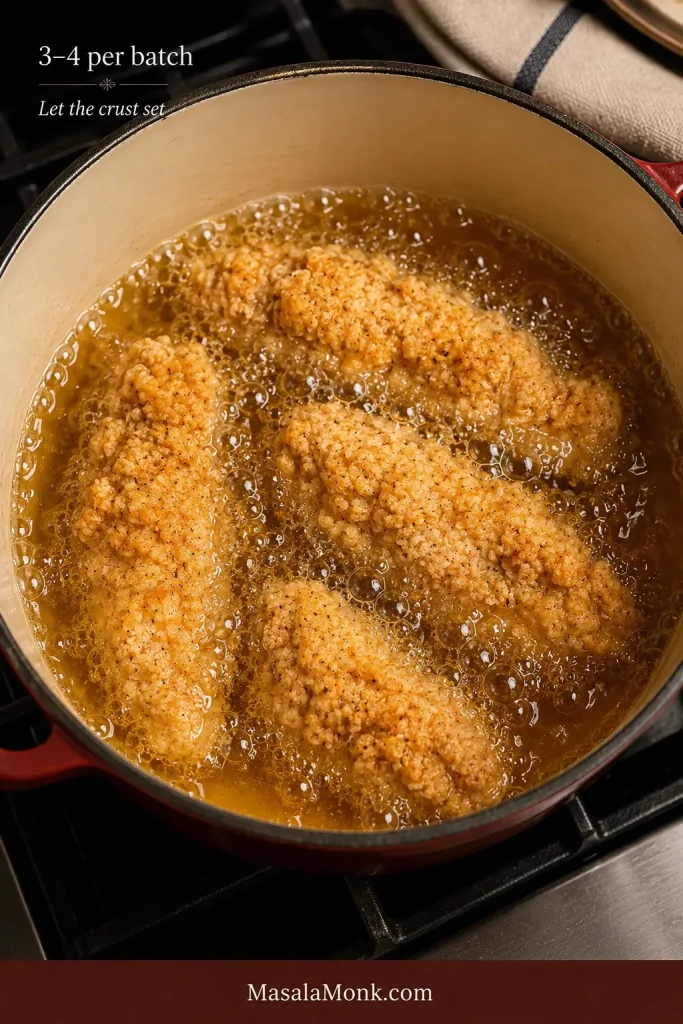
Fry the first batch and let the coating set. Lower 3–4 tenders gently into the oil, leaving visible space between them. Do not keep nudging or turning them as soon as they land; give the crust time to set. Aim to keep the oil around 340–350°F (171–177°C).
Cook until deep gold and 165°F. Pieces in the 2–2½ oz (55–70 g) range usually need 5–7 minutes total. Turn once when needed. The bubbling should stay energetic while the ridges move gradually from pale to deep gold. Start checking the largest piece near the early end of the range; poultry should reach 165°F (74°C) in the thickest part.
Once a batch comes out deep gold, crisp at the edges and 165°F (74°C) in the center, you have your pot figured out. The remaining batches are mostly repetition.
Rack, Reset and Finish
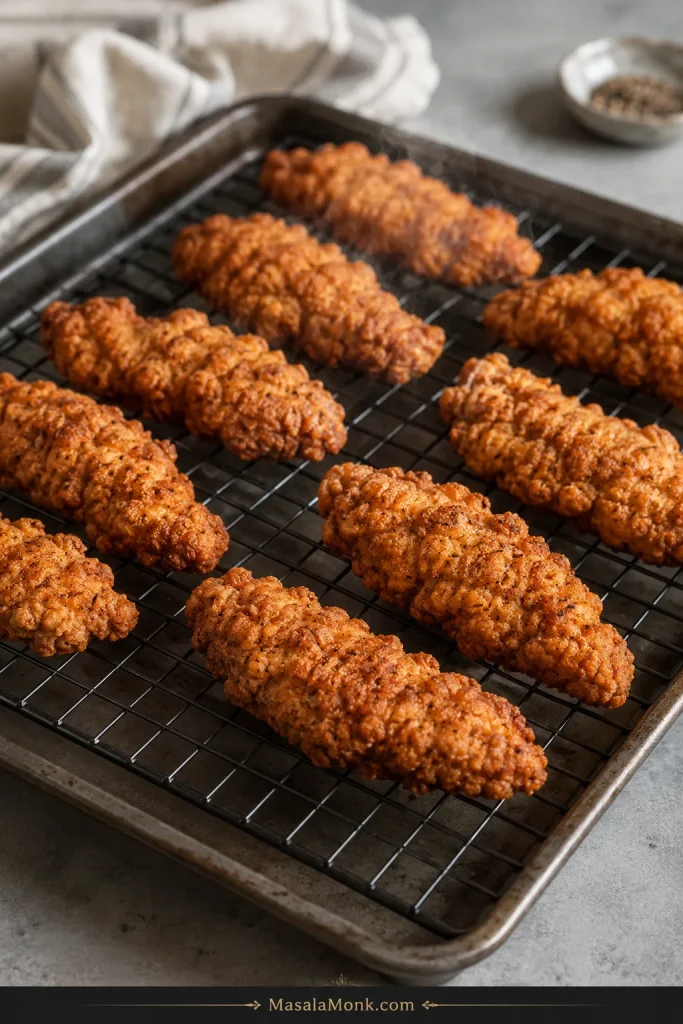
Move the cooked chicken to the rack. Transfer the tenders with clean tongs or a clean spider/skimmer and keep them in one layer so steam can escape underneath.
Reset the oil between batches. Let it return to the starting range before adding more chicken. If recovery is slow, make the next batch smaller. Skim out loose breading once it turns dark so burnt crumbs do not make later batches bitter.
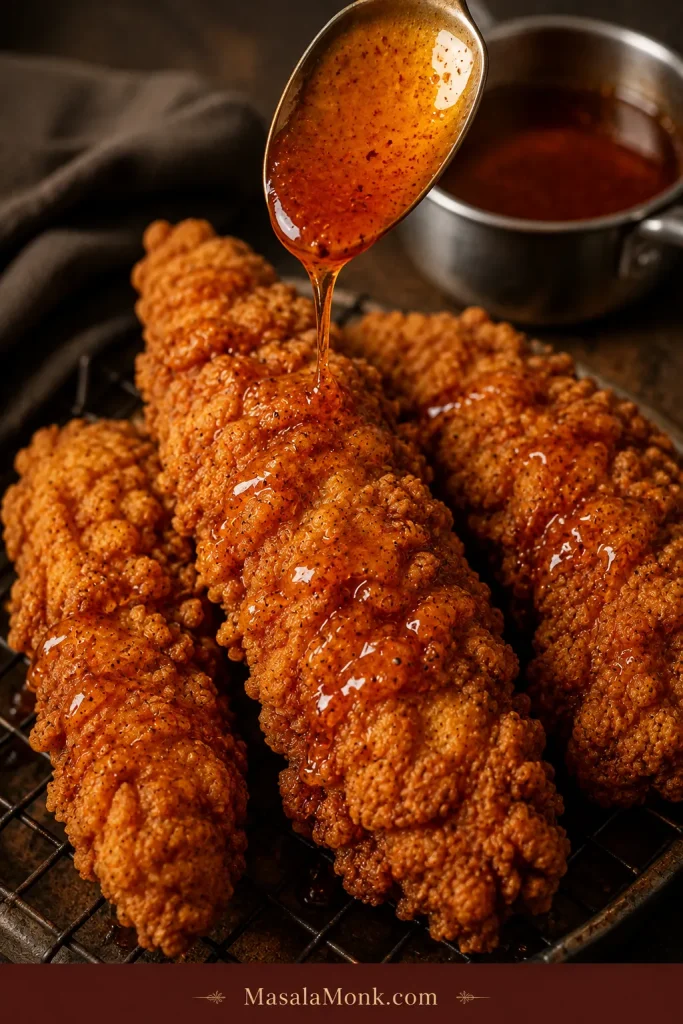
Add the hot honey last. Give each fried batch 2–3 minutes on the rack, until the strongest steam has eased. Rewarm the sauce if needed, then drizzle it over only the tenders you expect to eat right away. The honey should fall in glossy ribbons and catch on the rough ridges. Keep the rest of the sauce at the table.
Give the steam somewhere to go: the rack keeps the bottom from softening while the crust settles before the hot honey goes on.
For the first serving, drizzle a few tenders and listen for that first crunch before deciding whether the rest need more honey.
Break one open while it is still hot: the center should be moist white chicken beneath a closely attached craggy crust, not a thick hollow shell.
Tenderloins are already close to the shape you want. Split or gently flatten any unusually thick ones so they finish alongside the rest.
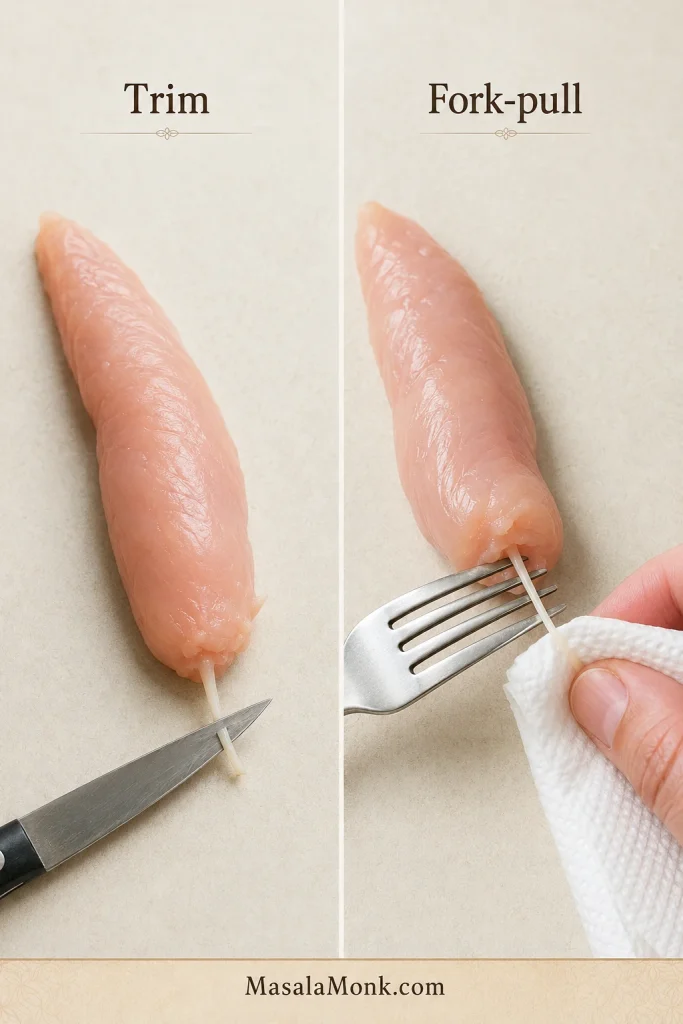
The firm white tendon is harmless. Trim the exposed portion, or grip it with paper towel and gently pull it through the tines of a fork if you prefer to remove more. Stop if the tender begins tearing.
Chicken breast is an easy substitute. Cut it to the size given in the recipe rather than making long, thick strips. Similar-size pieces are what keep the frying time predictable.
If you would rather cook the breasts whole, our baked chicken breast recipe goes deeper into thickness, timing and keeping lean chicken juicy.
Chicken fingers, strips and tenders are often used loosely for the finished dish. Here, size matters more than the label on the package.
The Ingredients That Actually Change the Result
Buttermilk
Buttermilk carries seasoning, adds mild tang and leaves a naturally tacky surface for the flour. The milk-and-acid substitute in the recipe is thinner than cultured buttermilk, but it still gives the coating something to grip.
If the recipe leaves most of a carton behind, save it for flaky Southern buttermilk biscuits. Fried chicken and warm biscuits rarely need much persuasion to share a plate.
Flour, Cornstarch and Baking Powder
Flour gives the coating enough structure to cling to the chicken, while cornstarch keeps the fried edges lighter and crisper. A little baking powder helps keep the surface rough instead of dense and smooth. When the clean reserved buttermilk is rubbed lightly through this mixture, the small damp flakes become the craggy pieces you want the chicken to pick up.
What you are building toward: a fried crust with thin ridges, folds and blisters rather than one thick, smooth shell. Those irregular edges create more crisp surface without burying the chicken in breading.
Seasoning the Chicken and the Coating
Seasoning in the marinade reaches the meat itself; seasoning in the dredge flavors the crust. Once the honey goes on, that distinction matters. Sweet, spicy sauce should finish good fried chicken rather than cover a bland center.
Sweet paprika brings color and mild pepper flavor. Cayenne in the dredge is optional, especially when several people at the table have different ideas about what “hot” means.
How to Keep Breading on Chicken Tenders
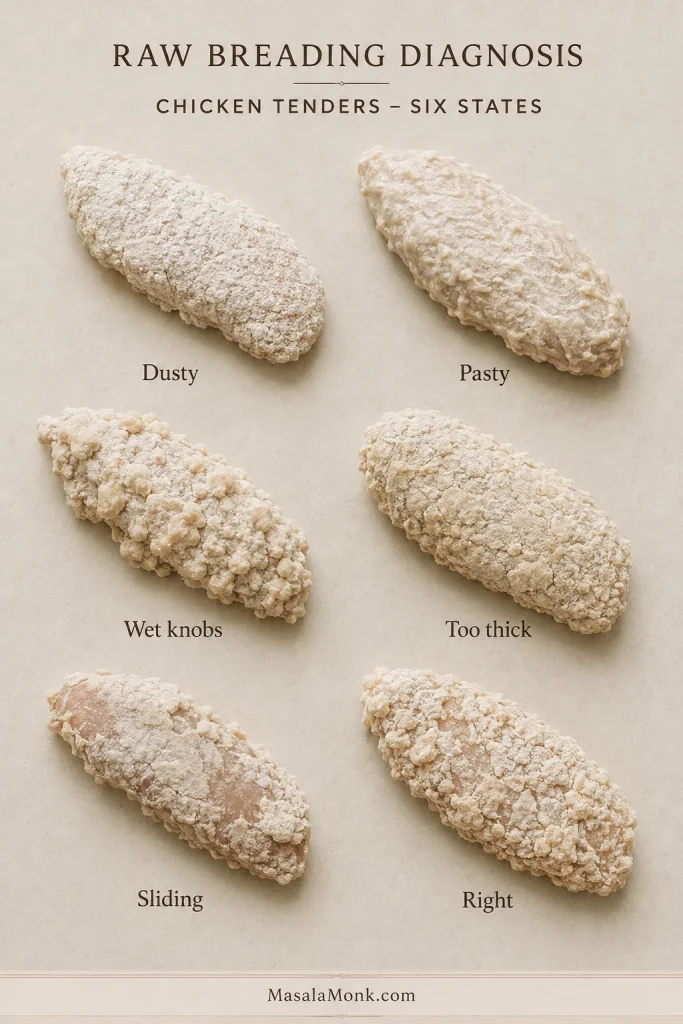
Before frying, the coating can tell you a lot. Good breading looks rough and patchy, with some flour hydrated against the chicken and little shaggy ridges still standing up.
Still dusty almost everywhere after resting? A few floury spots are fine. On the next tender, let slightly less marinade drip away before dredging; do not try to wet an already breaded piece.
Smooth and pasty? Too much marinade followed the chicken into the flour. Let the next piece drip a little longer.
Huge wet knobs? Break the damp flour clumps smaller so they fry into crisp ridges rather than hard chunks.
A thick shell forming around the meat? The coating is too heavy. One well-pressed dredge is enough for this recipe.
Coating slides when you lift the tender? Press it on more firmly and give the breading its full resting time.
Rough, patchy and a little untidy? Good. Leave it alone.
Keeping one hand for wet chicken and the other for dry dredge also prevents the breading process from turning into a bowl full of floury fingerprints.
After the breading rests: the coating should still look rough and shaggy, with only a few slightly hydrated patches. It should not turn uniformly shiny, smooth or wet.
How to Control the Oil Temperature Between Batches
A thermometer makes home frying much less mysterious. The useful number is not only where the oil starts; it is what happens after cold chicken enters the pot.
Stage
Target
What you want to see
Before chicken enters
360–365°F (182–185°C)
Enough stored heat for the initial temperature drop
While frying
340–350°F (171–177°C)
Steady bubbling and gradual golden browning
Before the next batch
Back near 360–365°F (182–185°C)
Oil recovered before more cold chicken enters
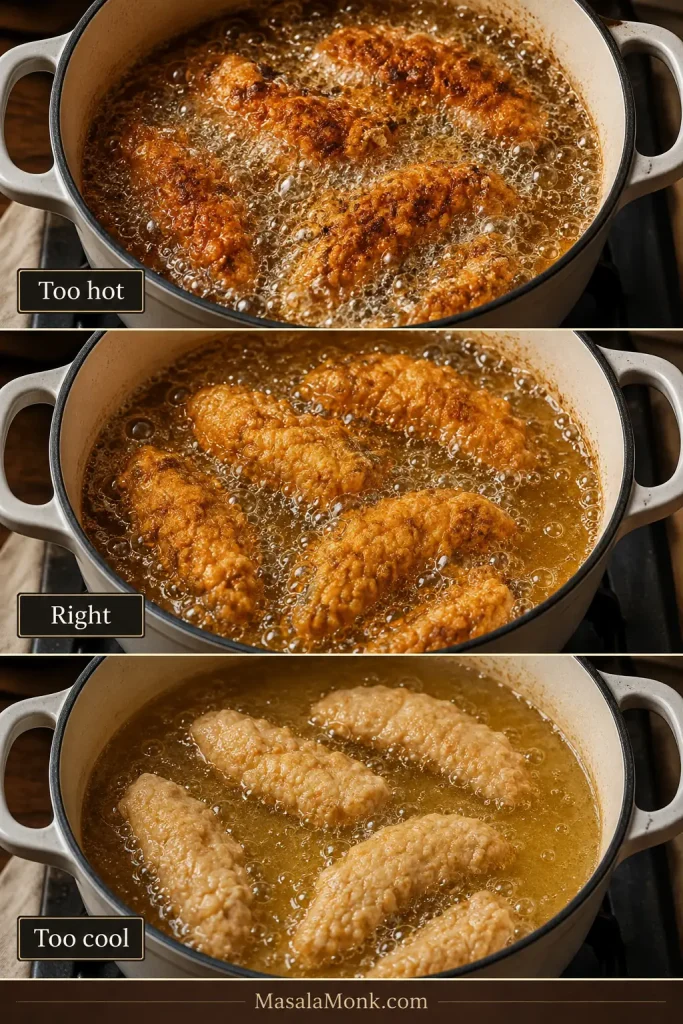
Little flour peaks that darken almost immediately mean the oil is running too hot. Pale chicken sitting in weak bubbles points the other way. Small crumbs in the pot are normal, but remove them once they turn dark.
Use the first batch to learn your pot. Once the bubbling and browning settle into the right rhythm, the remaining batches become much easier to repeat.
A deep cast-iron skillet is another good option. A Dutch oven gives you higher sides and a little more protection from splatter. An electric fryer is fine too; resist filling the basket just because there is room.
Use the bubbling as a batch-size check: leave visible oil between the tenders, and if active bubbling weakens sharply after loading the pot, make the next batch smaller rather than squeezing in another piece.
Keep the whole frying cycle in view: start near 360–365°F (182–185°C), let the oil work around 340–350°F (171–177°C), then give it time to recover before the next batch.
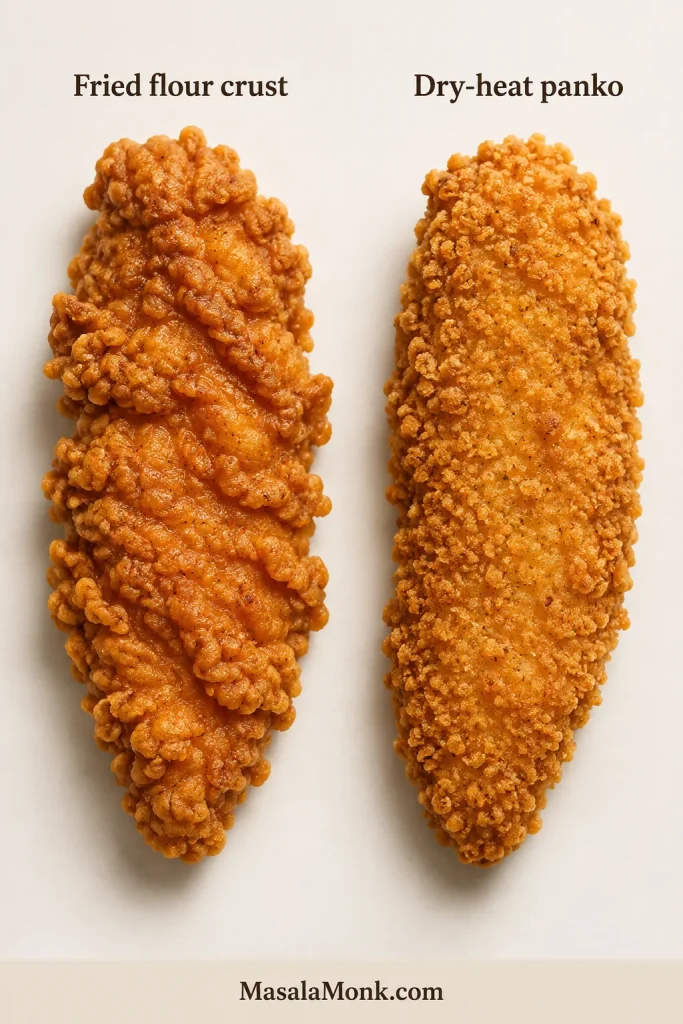
The flour coating used for frying relies on hot oil to set those craggy edges. Dry heat does better with panko. Use the air fryer when you want to avoid a pot of oil; the oven is easier when you need more tenders at once.
For the cooking times below, use 10–12 similarly sized tenderloins or chicken breast strips around 2–2½ oz (55–70 g) each. Very thick pieces will need longer.
Marinate for at least 30 minutes; 2–4 hours is ideal. Unlike the fried version, you do not need to reserve any marinade for the coating.
If you are cooking with dry heat anyway, our honey mustard chicken tenders use a similar panko approach with a tangier finish.
Panko Coating
½ cup (60 g) all-purpose flour
2 large eggs
1½ cups (95 g) panko breadcrumbs
1 tablespoon (15 ml) neutral oil
Oil spray or a little extra neutral oil for the basket, rack and any dry crumb patches
6 g fine sea salt, about 1 teaspoon
1 teaspoon garlic powder
1 teaspoon onion powder
1 teaspoon sweet paprika
½ teaspoon freshly ground black pepper
⅛ teaspoon cayenne, optional
Mix the dry seasonings together. Stir roughly one-third into the flour and the rest into the panko, then work the tablespoon of oil through the crumbs.
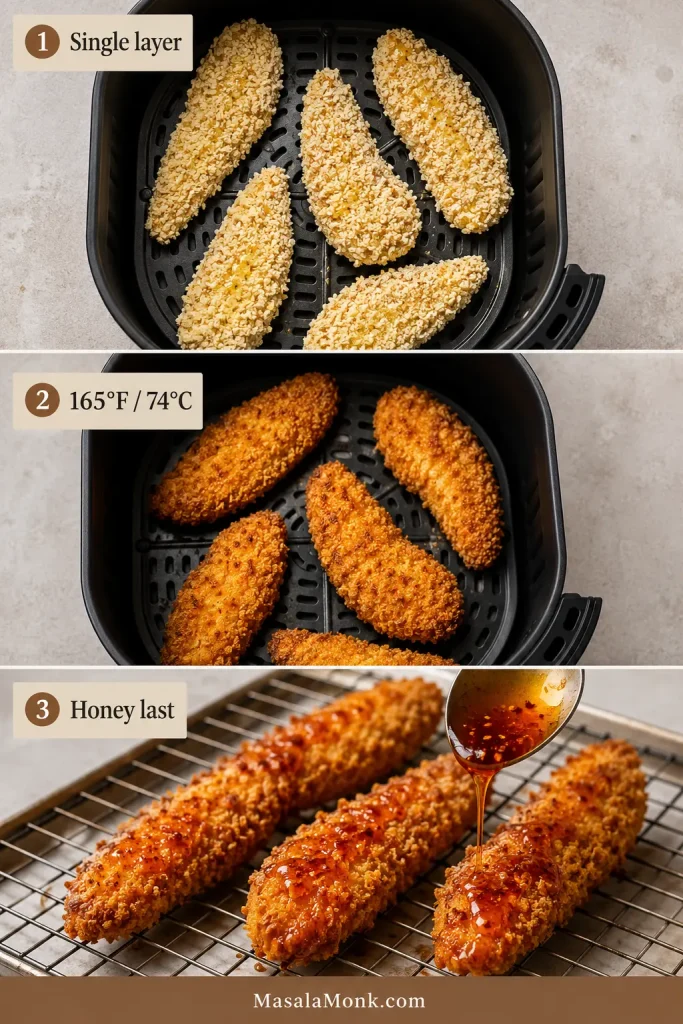
Air Fryer
Let excess marinade drip from the chicken.
Coat lightly in seasoned flour, dip in beaten egg, then press firmly into the panko.
Preheat the air fryer to 400°F (205°C) if your model benefits from preheating.
Lightly oil the basket and arrange the tenders in one layer with space around them. Mist any visibly dry crumb patches.
Air fry for 8–11 minutes, turning halfway, until golden and 165°F (74°C) in the thickest piece.
Transfer the tenders to a wire rack and rest for 2–3 minutes, until the initial steam has eased. Drizzle with warm hot honey just before serving.
Later batches may finish a little sooner once the air fryer is thoroughly hot.
Oven
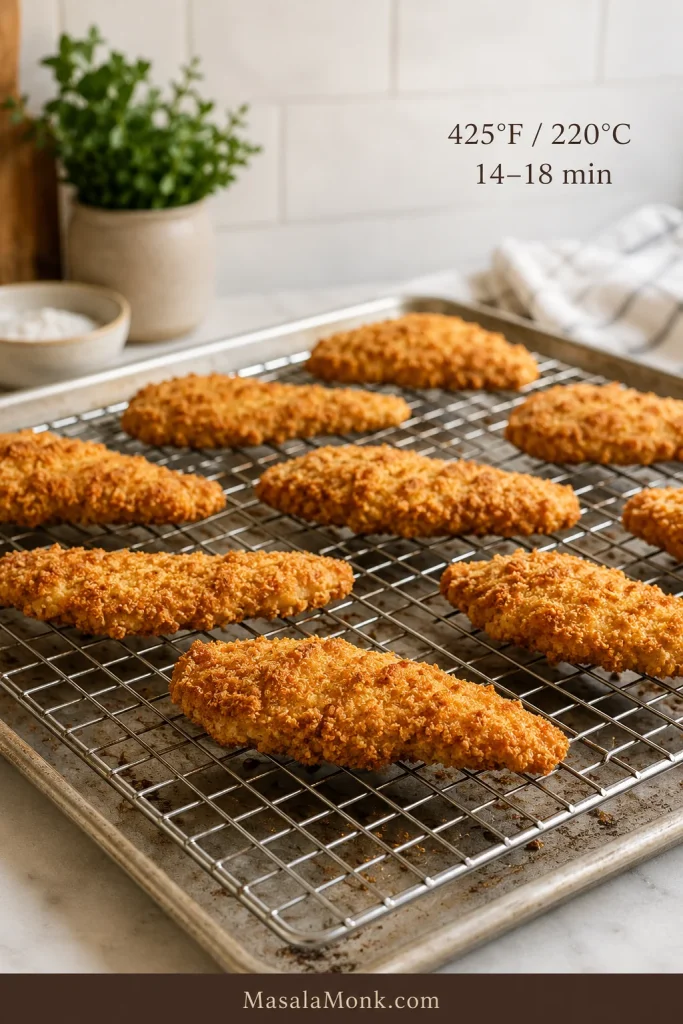
Heat the oven to 425°F (220°C).
Set a lightly greased wire rack over a rimmed baking sheet.
Bread the chicken with the panko mixture and arrange the pieces in one layer. Mist any dry-looking crumb patches.
Bake for 14–18 minutes, depending on thickness, until golden and 165°F (74°C) inside.
Leave the tenders on the rack for 2–3 minutes, until the initial steam has eased, then drizzle with warm hot honey.
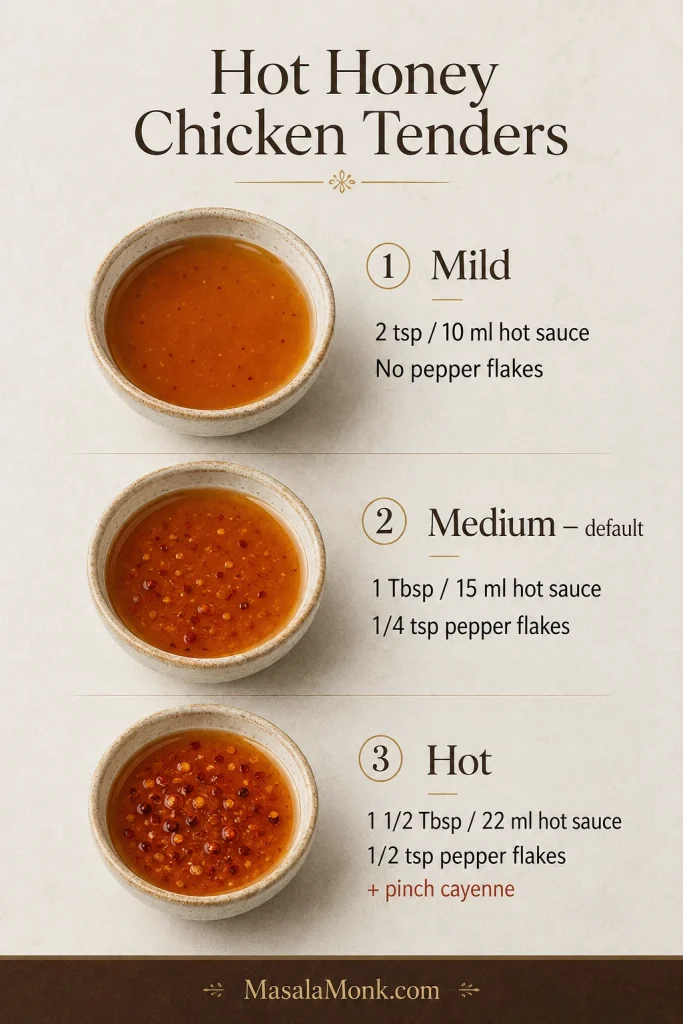
Adjust the Hot Honey: Mild, Medium or Hot
The recipe is medium as written. Keep the ½ cup (170 g) honey, teaspoon of acid and pinch of salt the same, then choose the heat level below.
Heat level
Use this
Mild
2 teaspoons (10 ml) cayenne hot sauce; no pepper flakes
Medium — default
1 tablespoon (15 ml) cayenne hot sauce + ¼ teaspoon red pepper flakes
Hot
1½ tablespoons (22 ml) cayenne hot sauce + ½ teaspoon red pepper flakes + a small optional pinch of cayenne
Taste the sauce warm before adding more heat; hot sauces and pepper flakes vary quite a bit.
One batch can easily cover two heat preferences. Divide the warm honey between two bowls and increase the chili in only one; there is no need to make the fried chicken itself aggressively spicy.
Butter is optional. One tablespoon (14 g) makes the glaze richer and slightly softens the heat; keep the sauce over low heat so it stays smooth.
How Much Hot Honey Do You Need?
Drizzle: start with ¼ cup (60 ml)
Brush: use roughly ⅓ cup (80 ml)
Toss: use most or all of the basic sauce batch
Make 1½ batches when you want heavily glazed chicken and extra sauce at the table. The sauce should be warm enough to fall in ribbons, but not thin or watery.
Already have bottled hot honey? Start with ½ cup (120 ml). A few drops of vinegar or lemon juice can sharpen it if the sweetness feels flat.
If a batch goes wrong, do not change five things at once. Start with what you can see; the crust, color and oil usually point toward the problem.
Breading and Frying Problems
What you see
What it means and what to change
Breading falls off
Too much marinade, weak pressing or too little resting time. Let excess drip, press firmly and give the coating time to settle.
Breading is thick and hard
The wet flour pieces are too large or the dredge is too heavy. Use smaller flakes and one substantial coating.
Chicken is pale and greasy
The oil spent too much of the batch too cool. Fry fewer pieces and let it recover before reloading.
Outside is dark, center underdone
The oil is too hot or the chicken is too thick. Lower the heat and make the pieces more even.
Chicken is dry
It cooked too long. Start checking the largest piece sooner.
Bottom turns soft
Steam is trapped underneath. Move cooked tenders to a wire rack in one layer.
Later batches taste bitter
Loose breading has burned in the oil. Skim out dark crumbs between batches.
A pot that starts at 360°F but spends most of the batch near 300°F is still frying too cool. What the thermometer does after the chicken enters matters more than the starting number alone.
Hot Honey and Crispness Problems
What you see
What it means and what to change
Sauce softens the crust quickly
The chicken was sauced too soon or too heavily. Give it a brief rack rest and start with a drizzle.
Hot honey is too sweet or too hot
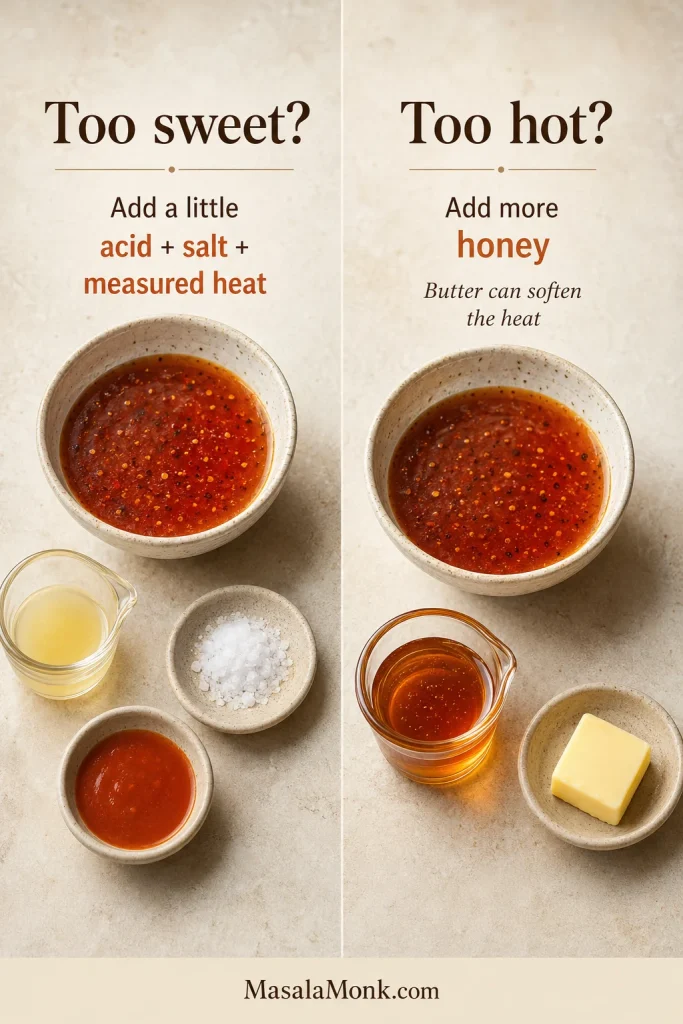
Too sweet: add a little acid, salt and measured heat. Too hot: stir in more honey; butter can soften the heat too.
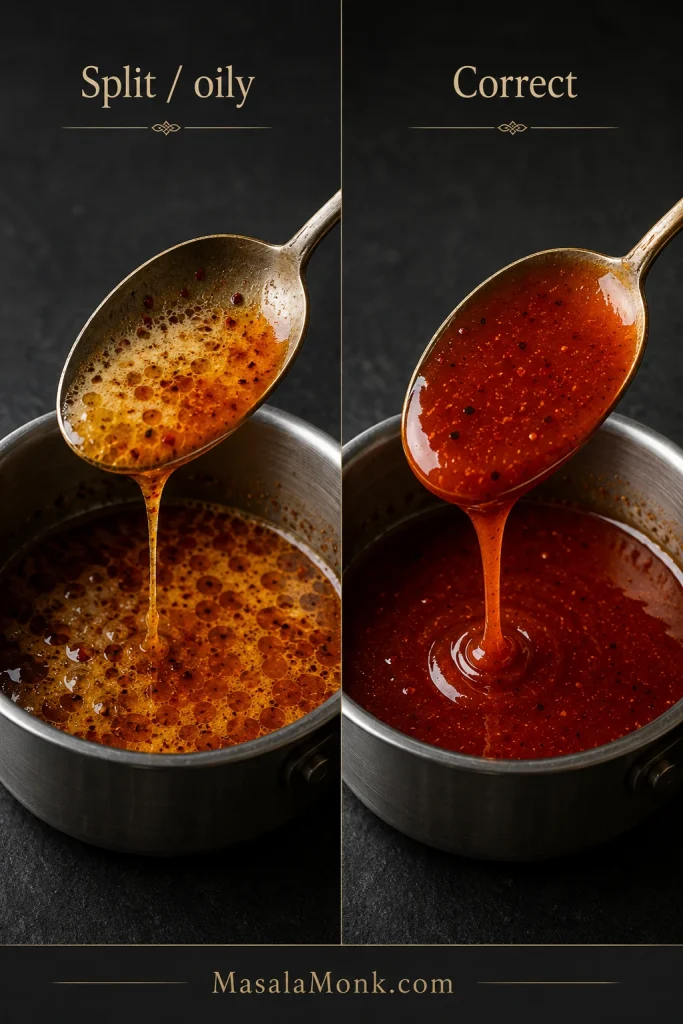
Hot honey looks oily or split
Butter-containing sauce may have overheated. Take it off the heat, whisk gently and rewarm only over low heat.
Sauce runs off
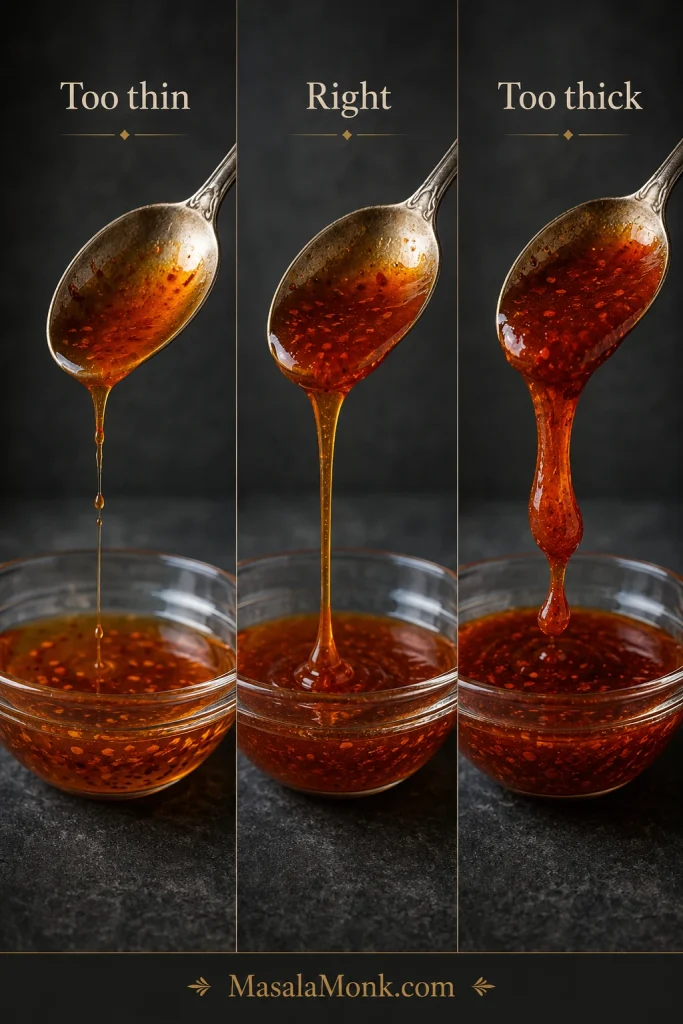
It is too hot or thin. Let it cool until it falls from the spoon in ribbons.
If buttered hot honey turns oily or streaky: take it off the heat, whisk gently and rewarm only over low heat. The finished sauce should look smooth and cohesive rather than separated.
Correct one thing at a time while the sauce is warm: use a little acid, salt and measured heat when it is too sweet; add more honey when it is too hot. If someone at the table simply wants a gentler creamy option, our easy yum yum sauce gives them another path without changing the whole batch.
Make Ahead, Store and Reheat
Hot honey: Make it up to 1 week ahead, refrigerate it in a covered container and warm it gently before serving. Low heat is especially important when butter is included.
Chicken: Marinate 2–4 hours ahead when convenient. Bread it close to frying; the short 10-minute rest helps the coating settle, while a long breaded hold works against that rough, crisp texture.
If coleslaw is part of dinner, this is a good moment to make it too. Our creamy coleslaw recipe can chill while the chicken marinates.
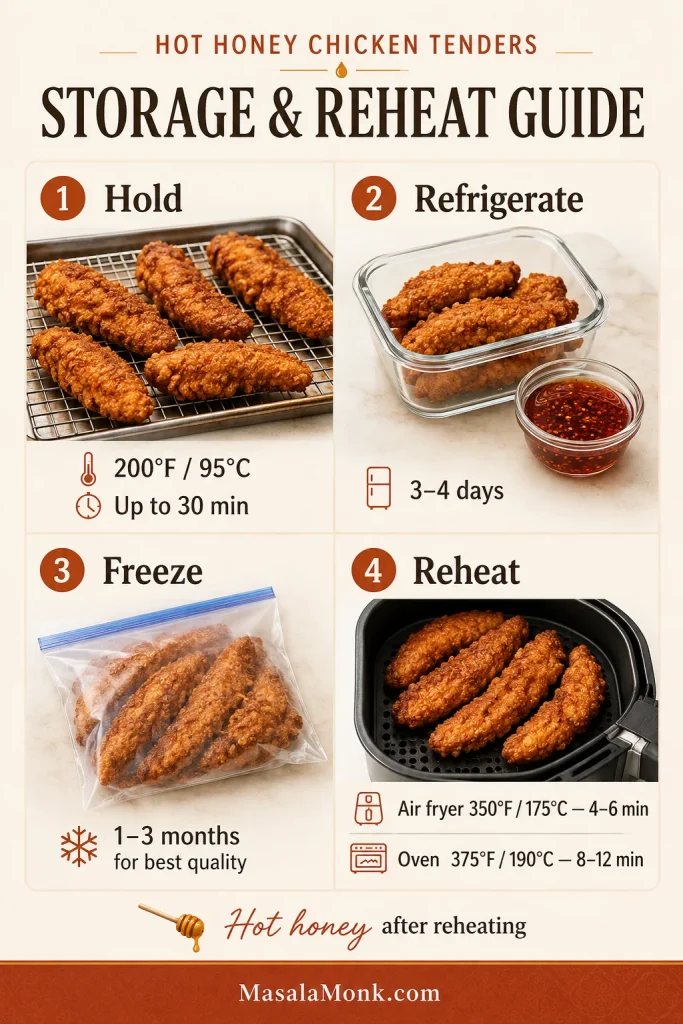
Holding fresh batches: Keep the tenders unsauced on their rack in a 200°F (95°C) oven for up to 30 minutes while you finish frying. A short hold works, but straight from frying is still best.
Leftovers: Refrigerate cooked chicken for 3–4 days, with extra hot honey stored separately whenever possible.
Freezing: Freeze cooked tenders unsauced. For best quality, use them within roughly 1–3 months, then re-crisp before adding fresh hot honey.
Air fryer: 350°F (175°C) for 4–6 minutes
Oven: 375°F (190°C) on a rack for 8–12 minutes
Microwave: quickest, but the coating will be softer
Whichever method you choose, reheat the center of the chicken to 165°F (74°C), then add fresh hot honey.
What to Serve With Hot Honey Chicken Tenders
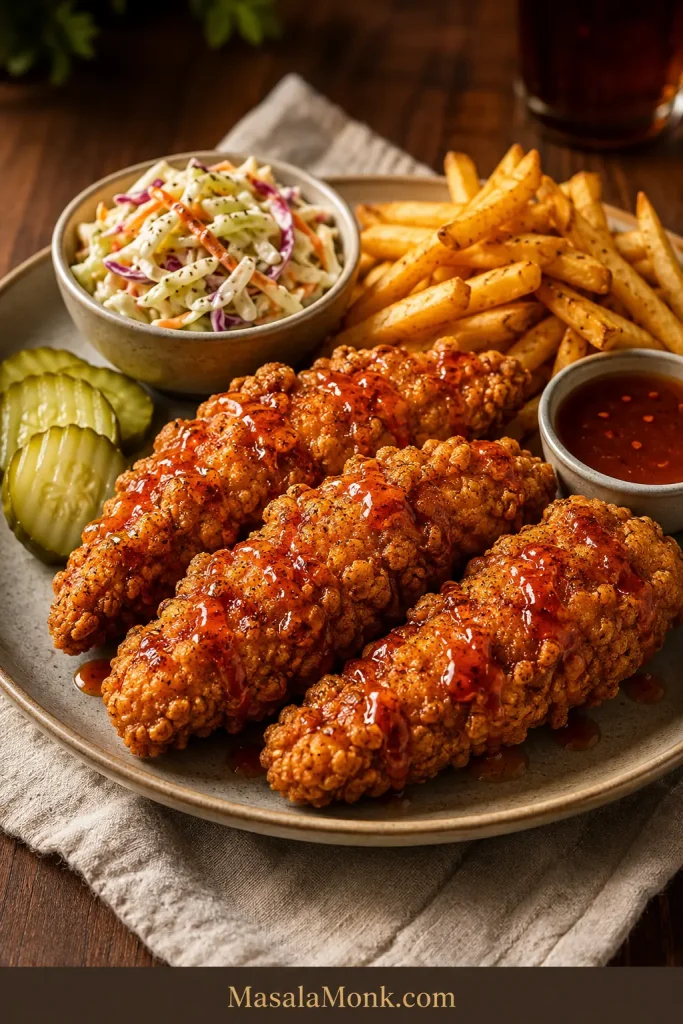
You do not need an elaborate plate. Something cold and crunchy, creamy, tart or pickled is usually enough to balance rich fried chicken and sticky sweet heat.
Sandwich night: Add slaw, pickles and a little hot honey to a toasted bun. Our chicken sandwich recipes have more ideas for building around crisp chicken.
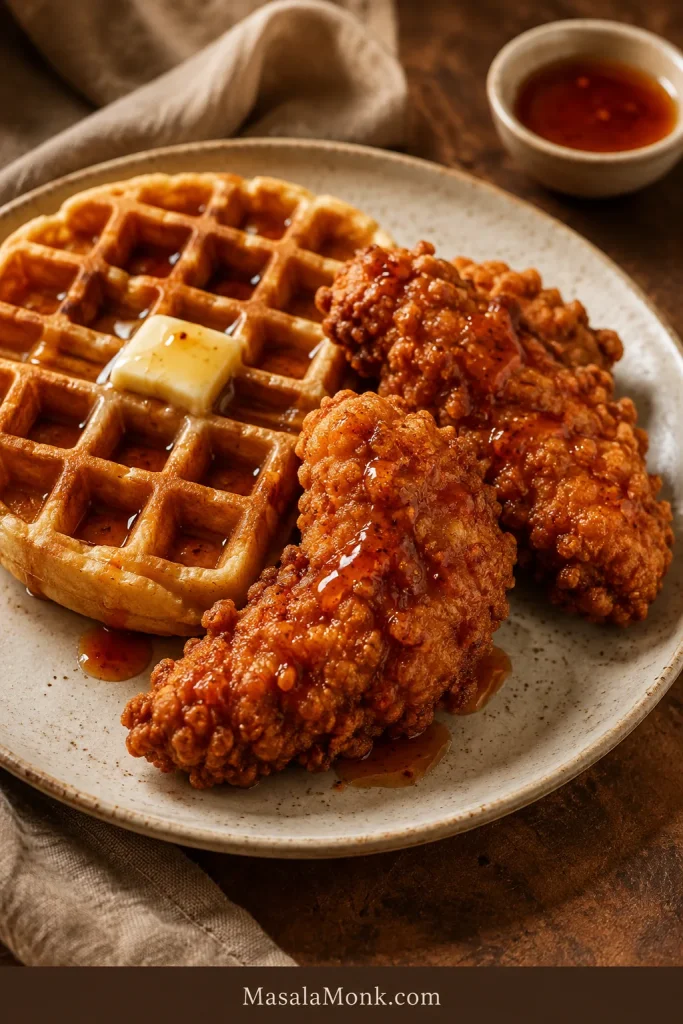
Sweet-savory: Pile the tenders onto waffles and drizzle the honey over both while leaving plenty of fried ridges exposed.
The best plate of these still lets you see rough dark-gold ridges beneath thin glossy streaks of honey. The first bite should give you crunch and juicy chicken, then sweetness, then the chili catching up a moment later.
If you make them, tell us whether you used tenderloins or breast strips, how you cooked them, and whether you drizzled, brushed or tossed the hot honey. Your notes may help the next person standing over a batch of chicken wondering whether theirs looks right.
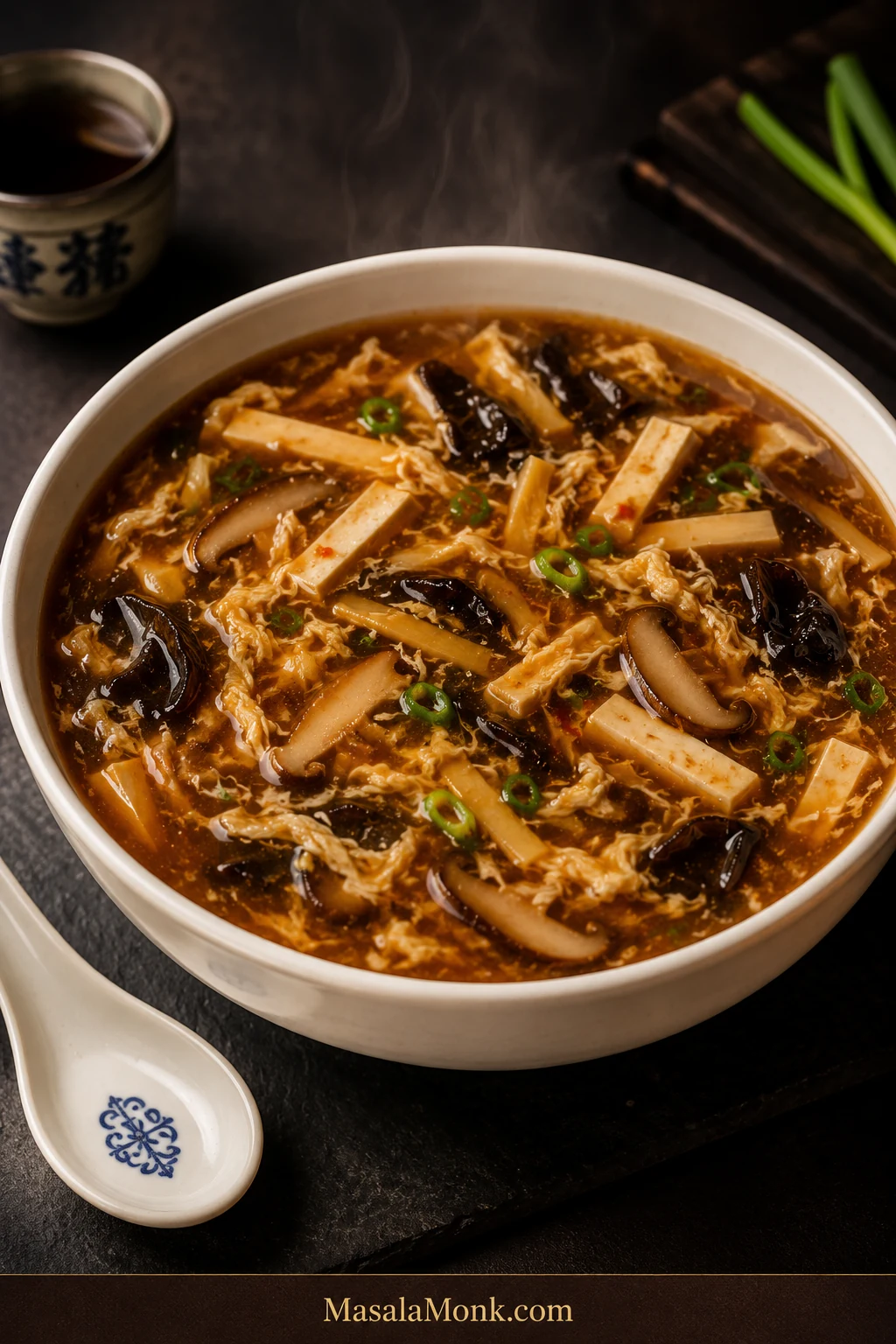
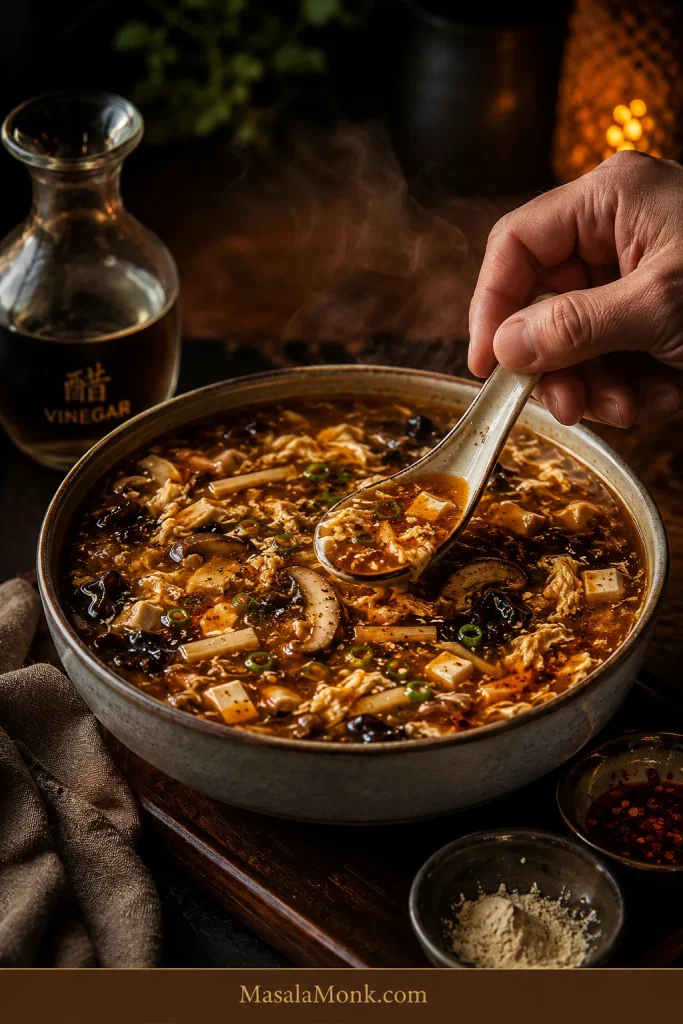
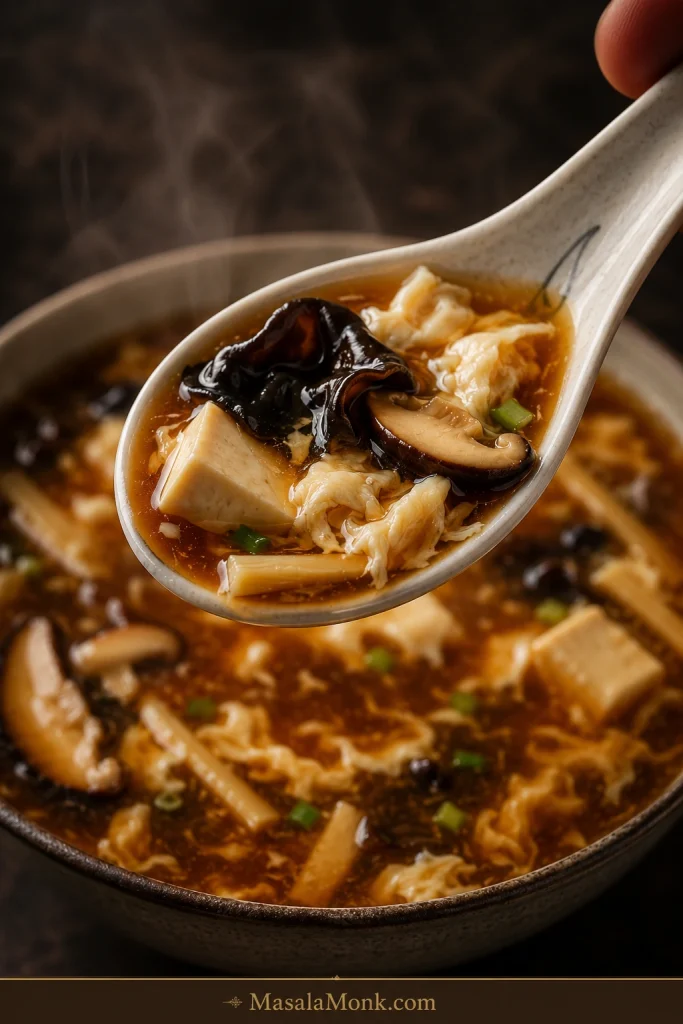
Hot and sour soup is one of those bowls you notice before the first spoonful. Vinegar rises with the steam, white pepper catches gently at the back of your throat, and underneath it all is savory broth threaded with mushrooms, tender tofu and silky ribbons of egg.
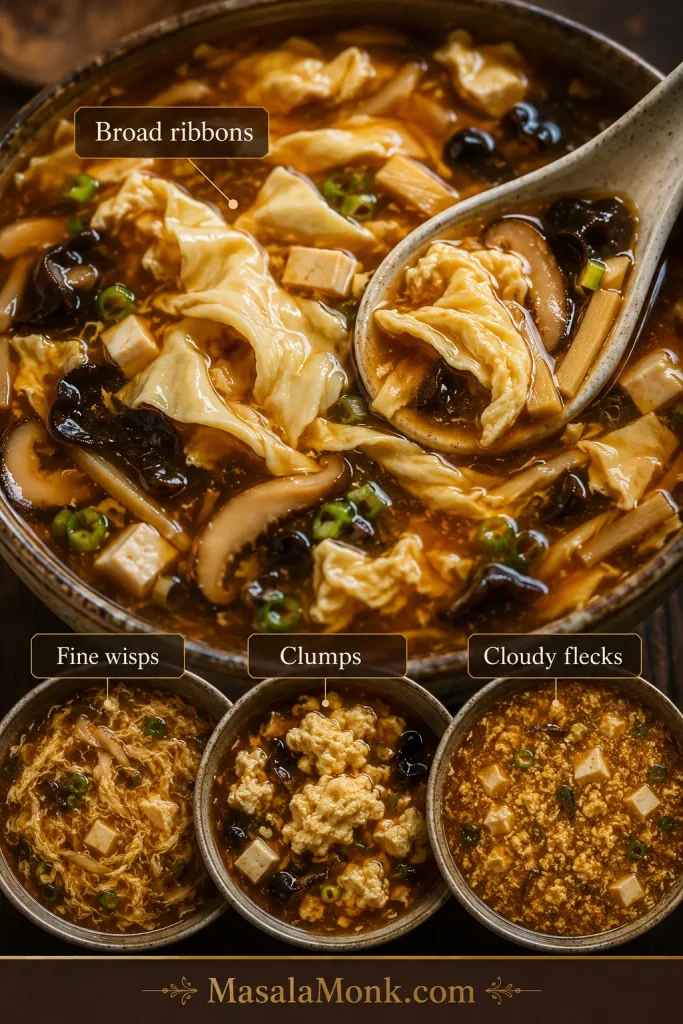
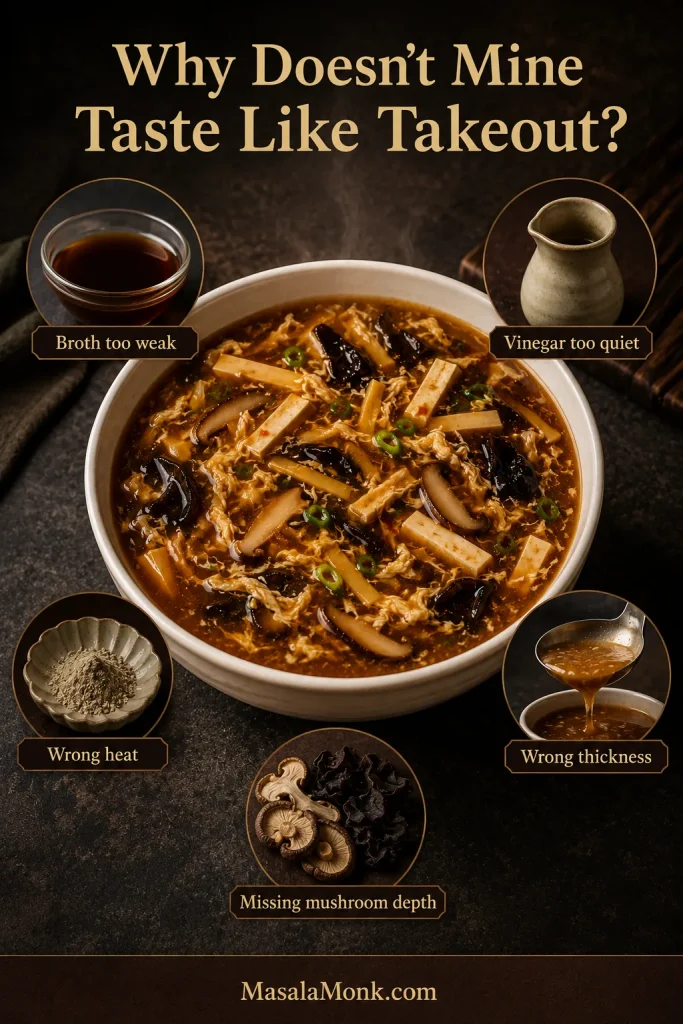
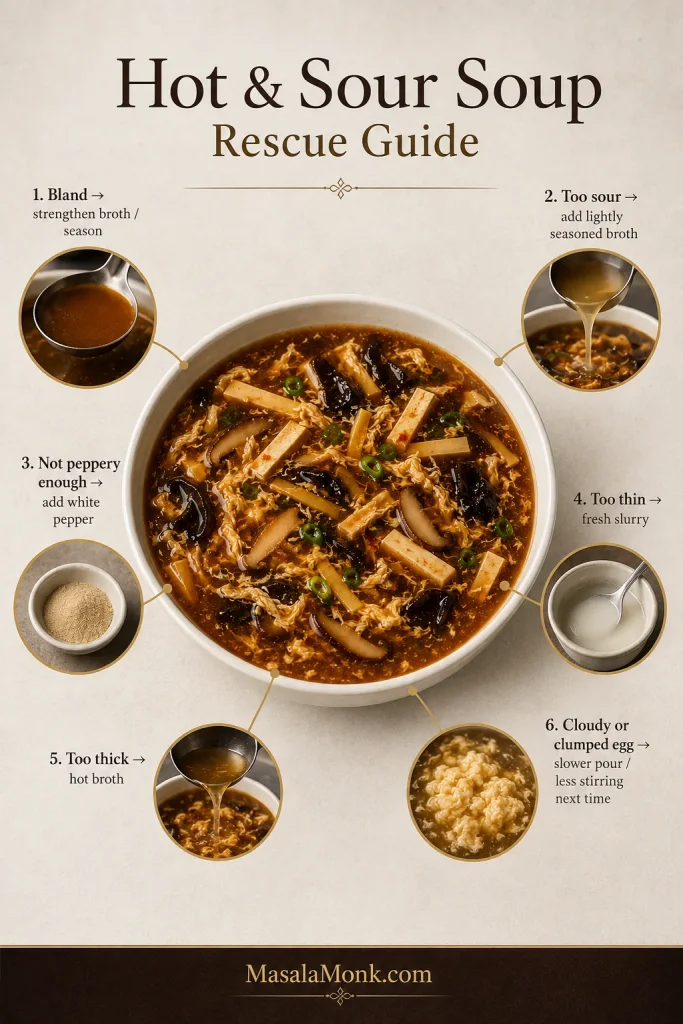
It is also surprisingly easy to get almost right. Plenty of chilli makes the soup spicy without necessarily giving it that familiar white-pepper warmth. Too much starch turns the broth gluey. Let the vinegar cook too long and some of its brightness fades. Pour the egg too quickly and it disappears into cloudy flecks instead of ribbons.
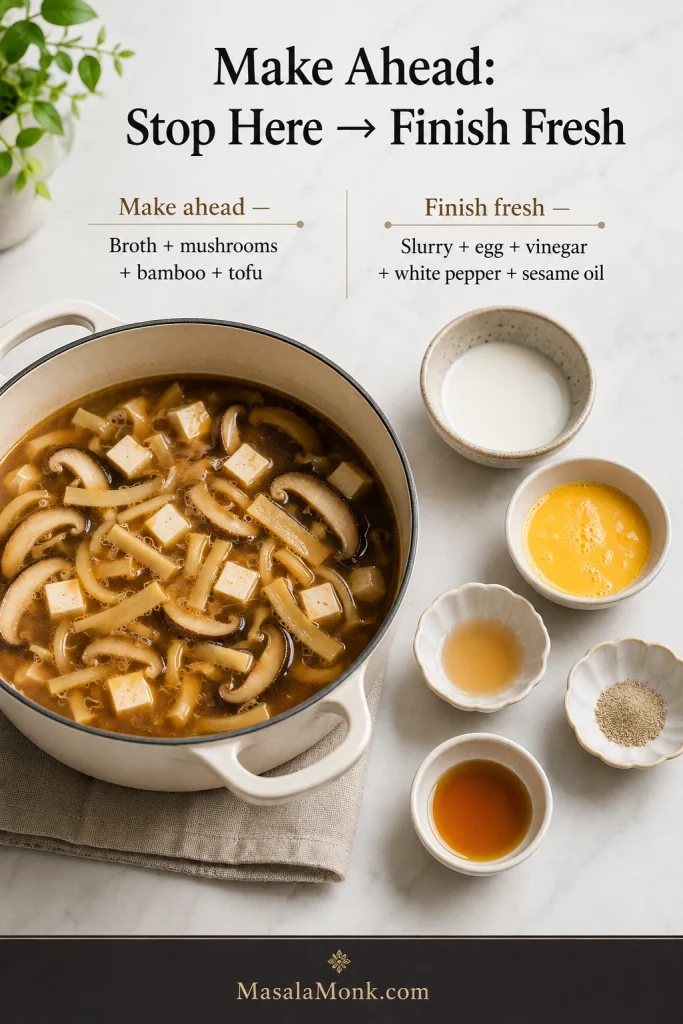
The simplest way to make restaurant-style hot and sour soup is to build it in layers: make the broth savory first, thicken only until it looks right, set the egg, then adjust sourness and peppery heat separately at the end.
Maybe the bowl in your head is thin and sharply peppery. Maybe it is darker and glossy, with enough vinegar to catch in your nose over the first spoonful. This method gives you a reliable place to start—and enough room to take the pot toward whichever version you remember.
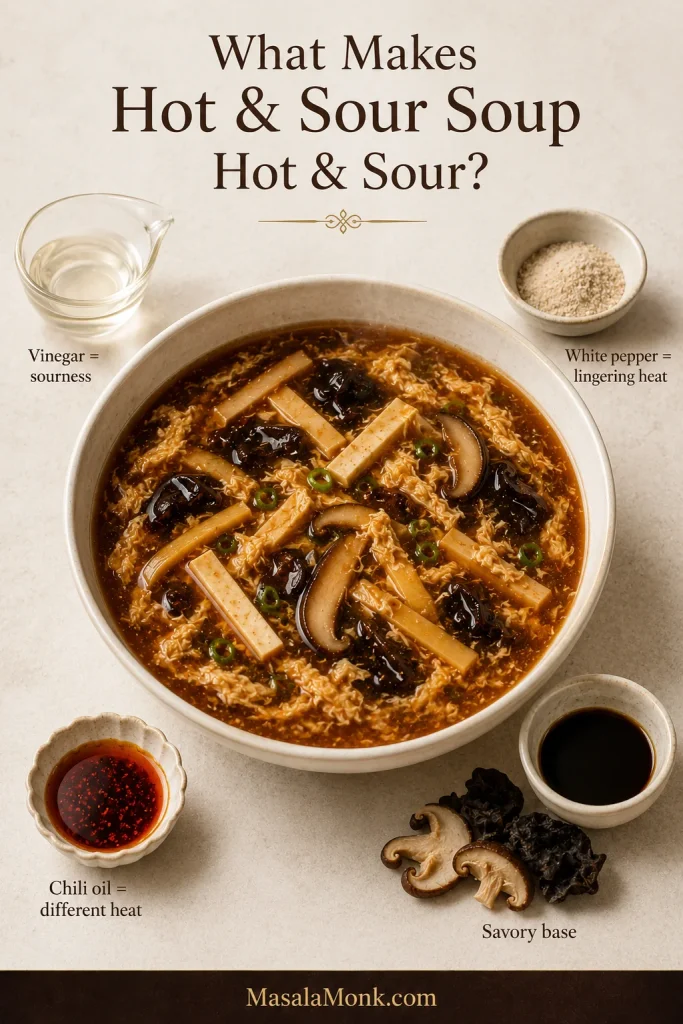
Quick Answer: What Makes Hot and Sour Soup Hot and Sour?
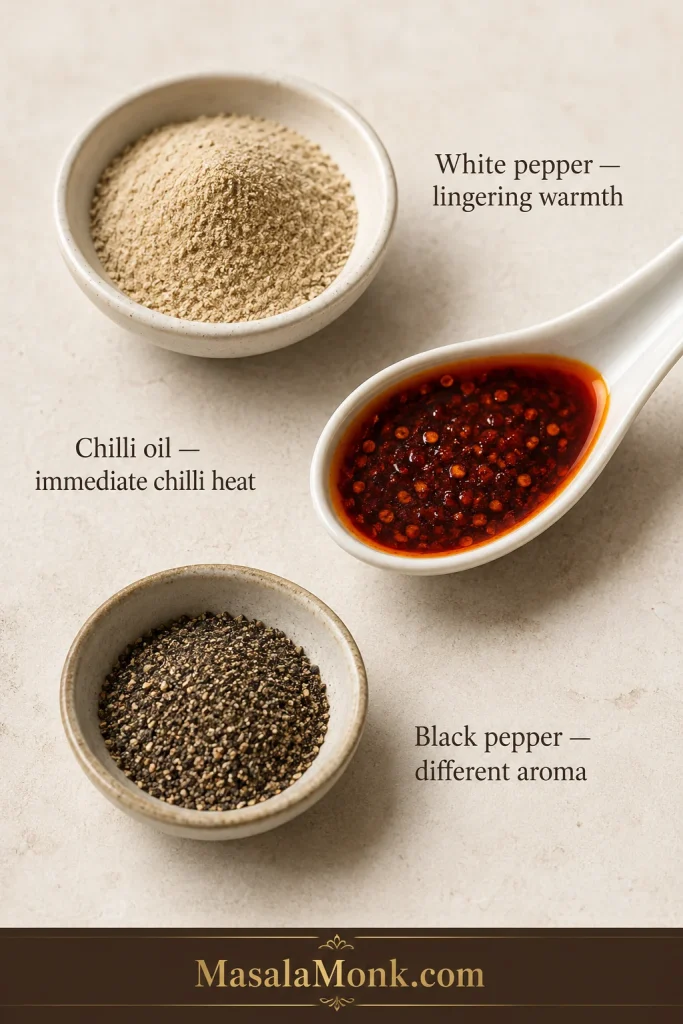
White pepper gives hot and sour soup its characteristic peppery heat. Vinegar supplies the sourness. Chilli oil gives a more immediate chilli burn. White pepper leaves the cleaner warmth that lingers after each sip.
Broth, mushrooms and soy sauce provide the savory foundation. Cornstarch controls the body of the soup, while egg provides the silky strands.
Check one thing at a time. Is the broth savory enough? Then judge the heat, sourness and thickness. Finally, look for some contrast—soft tofu or egg against something chewy or crisp. Fix only what is missing.
Sourness and heat are separate controls. Vinegar brightens the broth; white pepper provides the lingering warmth that chilli alone does not recreate.
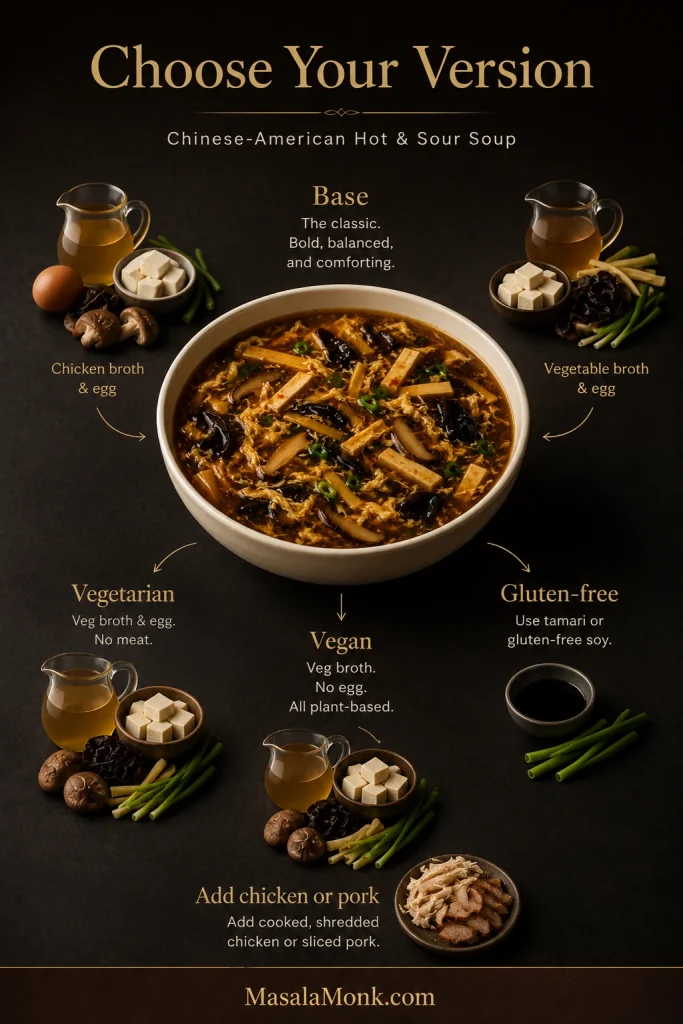
Which Hot and Sour Soup Are You Looking For?
Hot and sour soup is a Chinese soup built around peppery heat and vinegar sourness, usually with ingredients such as mushrooms, tofu and egg; restaurant versions vary considerably in thickness and supporting ingredients.
Two excellent hot and sour soups can look surprisingly different. It helps to know which style you are chasing before you start changing the vinegar, chilli or starch.
Color can mislead. Chinese-American, regional Chinese and Indo-Chinese hot and sour soups can differ in thickness, heat and ingredients, so season toward the bowl you actually want.
Style
What to Expect
Chinese-American restaurant style
Brownish, glossy, peppery and tangy, usually with mushrooms, tofu and egg. This is the style made below.
Regional Chinese versions
Recipes vary widely and may use black vinegar, dried shiitake, wood ear, dried lily buds and pork, with thickness varying considerably by style.
Indo-Chinese restaurant style
Often redder and more chilli-forward, with vegetables such as cabbage, carrot and capsicum/bell pepper, and sometimes chicken.
This recipe makes the first style: savory broth with a clear vinegar tang, white-pepper warmth, a glossy broth that still pours freely and enough contrast between mushrooms, tofu and egg to keep the soup interesting.
Many Chinese-American restaurant versions also include thin strips of pork or chicken. Here, added meat is optional, with an easy chicken or pork variation later.
Hot and Sour Soup Recipe
Using fresh mushrooms, this takes about 30–35 minutes from prep to bowl. Dried mushrooms need soaking time but give the broth more depth. Keep some vinegar and white pepper in reserve either way so you can make the final adjustment by taste.
Recipe Snapshot
Prep: about 15 minutes
Cook: about 15–20 minutes
Total with fresh mushrooms: about 30–35 minutes
Total with dried mushrooms: about 40–50 minutes, depending on how much soaking overlaps with prep
Makes: 4 generous bowls or about 6 appetizer servings
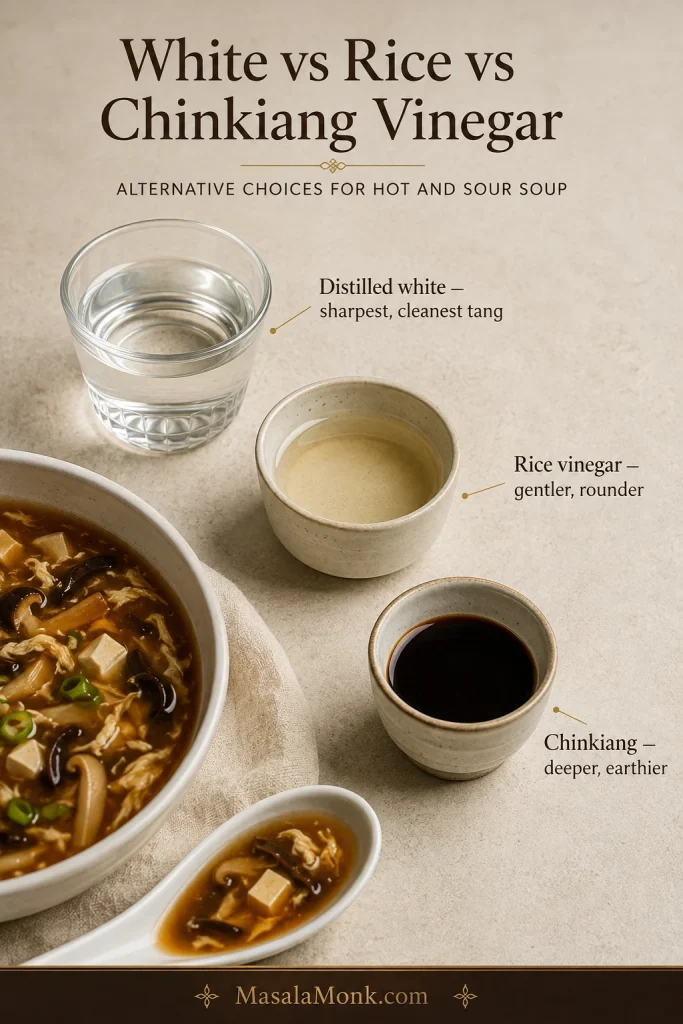
No specialty market tonight? Fresh shiitake or cremini, ordinary low-sodium broth and distilled white or unseasoned rice vinegar still make a very good soup. Wood ear and bamboo are optional.
Equipment: a 4–5 quart / 4–5 litre saucepan or Dutch oven, a few small prep bowls, and a fine-mesh strainer if using shiitake soaking liquid.
Ingredients and Measurements
Broth & Solids
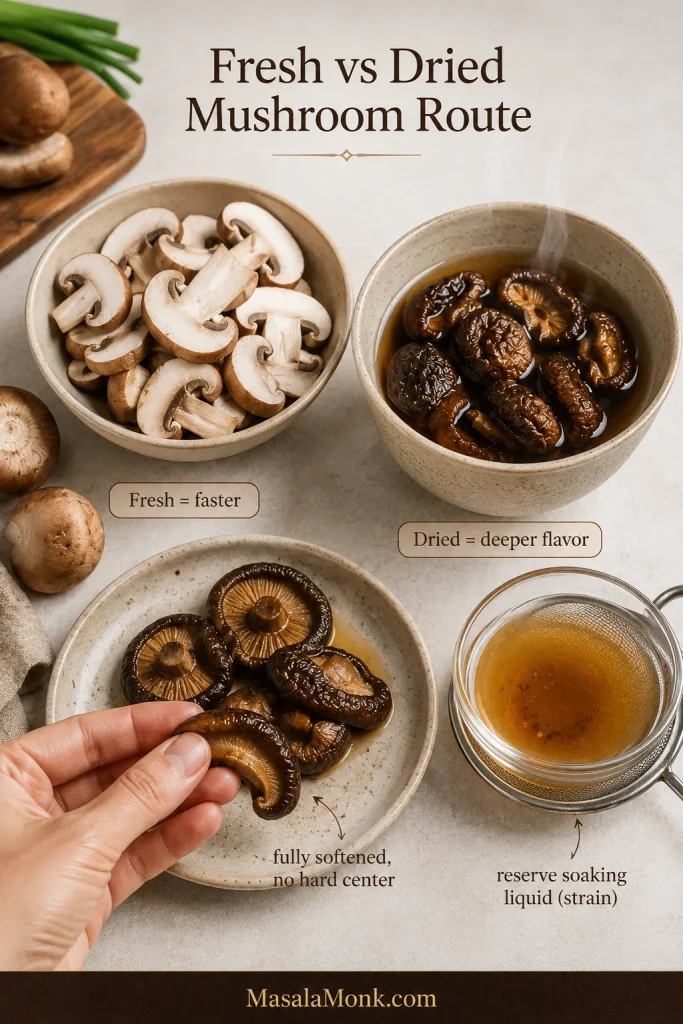
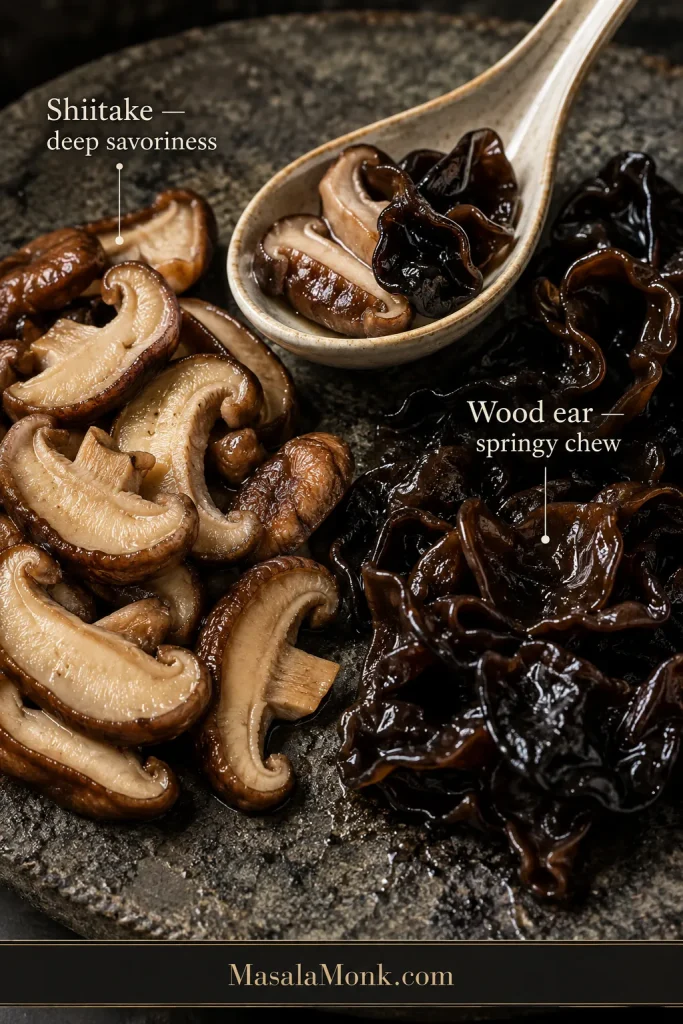
Mushrooms: 15 g dried shiitake, about 4 medium mushrooms, or 5 oz / 140 g fresh shiitake or cremini. Use up to 6 oz / 170 g fresh mushrooms for a mushroom-heavy soup.
Wood ear: ¼ oz / 7 g dried wood ear mushrooms (black fungus), dry weight, optional.
Broth: 6 cups / 1.4 litres total low-sodium chicken or vegetable broth. If using strained shiitake soaking liquid, substitute up to ½ cup / 120 ml for the same amount of broth.
Tofu: 8 oz / 225 g firm or medium-firm tofu, cut into thin strips or small spoon-sized cubes.
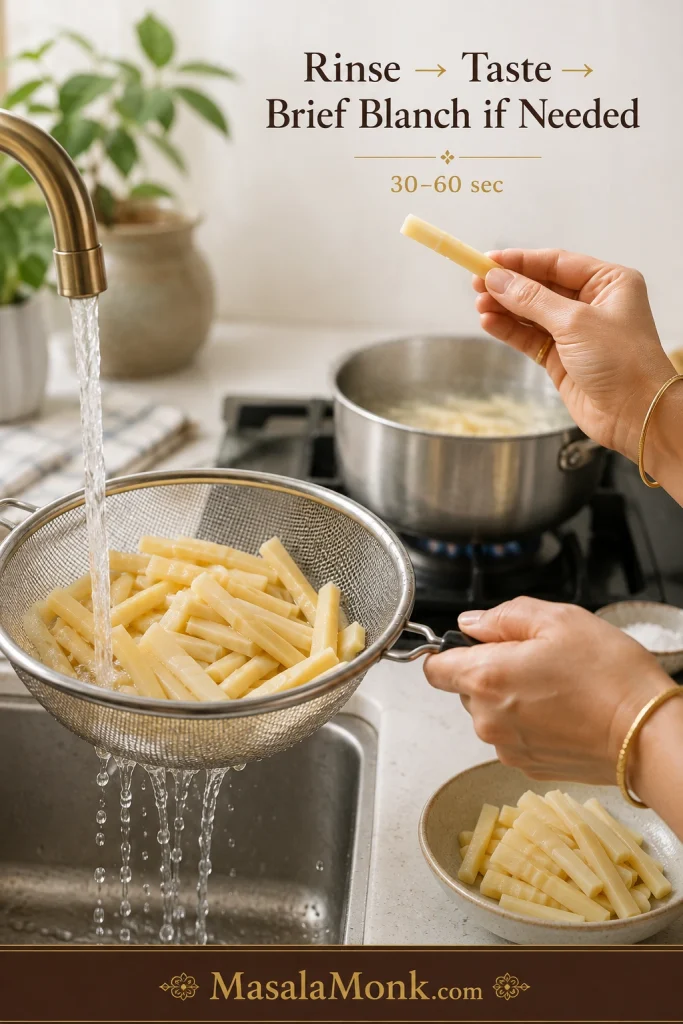
Bamboo: ½ cup / about 70 g bamboo shoots, drained, rinsed and cut into strips, optional.
Ginger: 1 teaspoon finely grated fresh ginger.
Broth Seasoning
1½ tablespoons / 22 ml Chinese light soy sauce or regular soy sauce; start with 1 tablespoon / 15 ml if your broth or bouillon is already quite salty
1 teaspoon / 5 ml dark soy sauce, optional
½ teaspoon sugar
Fine salt, only if needed after tasting
Thickening & Egg
3 tablespoons / about 24 g cornstarch (UK: cornflour). Make the full slurry but expect to begin with about two-thirds.
¼ cup / 60 ml cold water or cold broth
2 large eggs
1 teaspoon water, optional, to loosen the beaten eggs slightly
Hot-Sour Finish
¼ cup / 60 ml distilled white vinegar or unseasoned rice vinegar, divided: 3 tablespoons / 45 ml to start, plus up to 1 tablespoon / 15 ml more to taste
1 teaspoon ground white pepper, divided: ¾ teaspoon to start, plus up to ¼ teaspoon more to taste
1 teaspoon toasted sesame oil
2 scallions, thinly sliced, optional
Chilli oil, optional, for serving
1. Soak and Prep Before the Pot Gets Hot
Using fresh mushrooms? Skip the soaking instructions below, slice them, and continue with the rest of the prep.
Fresh mushrooms are the faster route. Dried shiitake are worth the soak when you want more mushroom depth, especially with a mild broth.
If using dried mushrooms, cover them with very hot water and soak until completely pliable. Most soften in about 20–30 minutes, but the mushrooms get the final say: there should be no hard, dry center left.
If you plan to use shiitake soaking liquid in the broth, soak the dried shiitake separately from the wood ear. Lift the softened mushrooms from the water, trim any tough stems and slice thinly. Strain the shiitake liquid through fine mesh or carefully pour off only the clear upper portion. Leave the sediment behind.
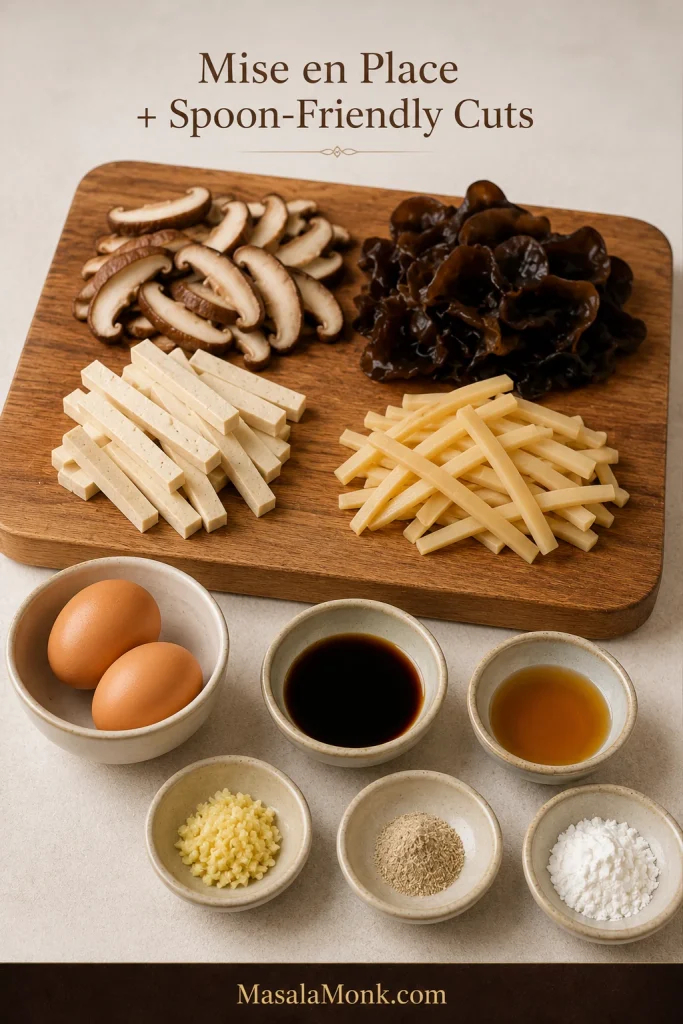
For a more restaurant-like spoonful, cut the mushrooms, tofu and bamboo into fairly thin pieces of similar length. Measure the seasonings, beat the eggs and mix the cornstarch with cold water or cold broth.
Use the spoon as the size guide. Tofu, mushrooms and bamboo should fit comfortably into one bite instead of arriving as long, awkward pieces.
In another small bowl, whisk together 3 tablespoons / 45 ml vinegar and ¾ teaspoon white pepper for the finish. Once the broth starts simmering, the remaining steps move quickly, so have everything within reach.
2. Build a Broth That Already Tastes Good
Add the broth, mushrooms, bamboo shoots, ginger, soy sauce, optional dark soy and sugar to the pot. Bring to a gentle simmer over medium-high heat, then lower the heat and cook for about 5 minutes.
Add the tofu and simmer for another 2–3 minutes. Firm tofu tolerates stirring well. With softer tofu, sweep the spoon around the pieces so they stay intact.
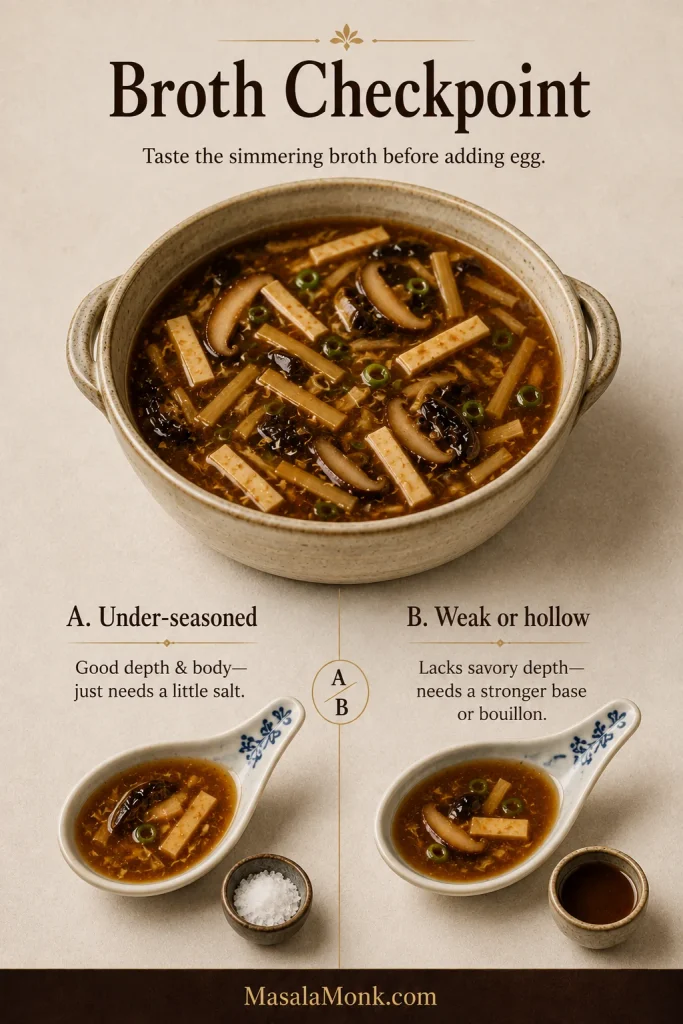
Check the broth here. It should already be savory enough to drink on its own, even though the vinegar and white pepper are still missing.
If the broth has good depth but simply needs more seasoning, add salt a small pinch at a time. If it tastes weak or hollow, deepen the base with a small amount of concentrated broth or bouillon. Extra soy alone can push the salt too far. Starch can change a watery texture; it cannot fix watery flavor.
Taste before thickening. Once starch and the final seasonings go in, a weak broth becomes harder to diagnose cleanly.
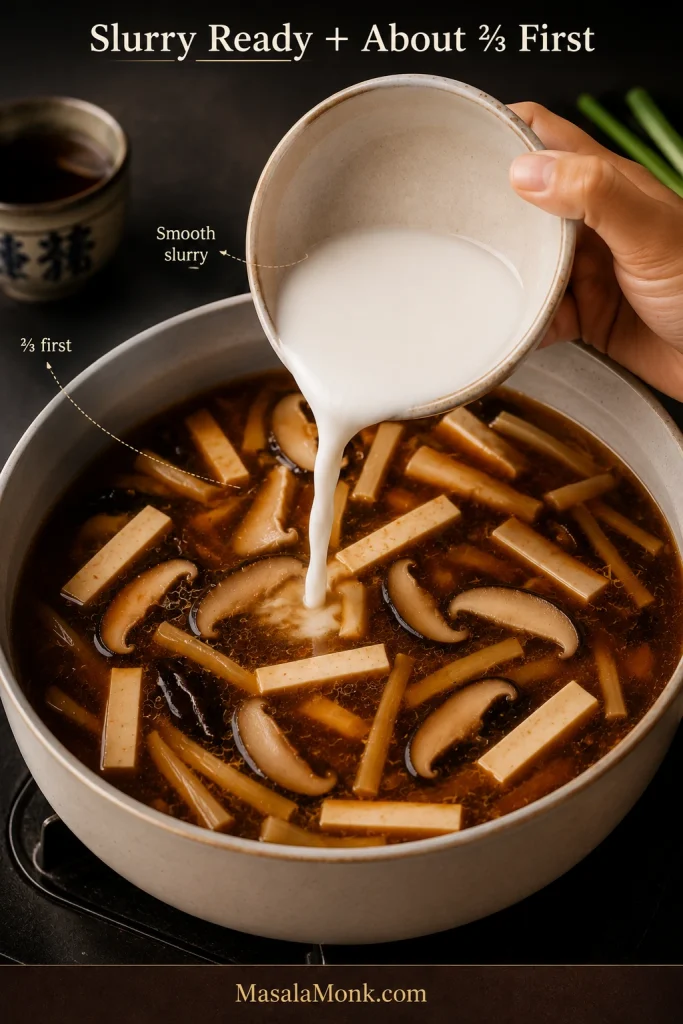
3. Add the Slurry Gradually
Cornstarch has a habit of settling the moment you stop looking at it, so stir the slurry thoroughly just before it goes into the soup.
While stirring, pour in about two-thirds of the slurry. Return the soup to a simmer and wait 20–30 seconds before judging the texture.
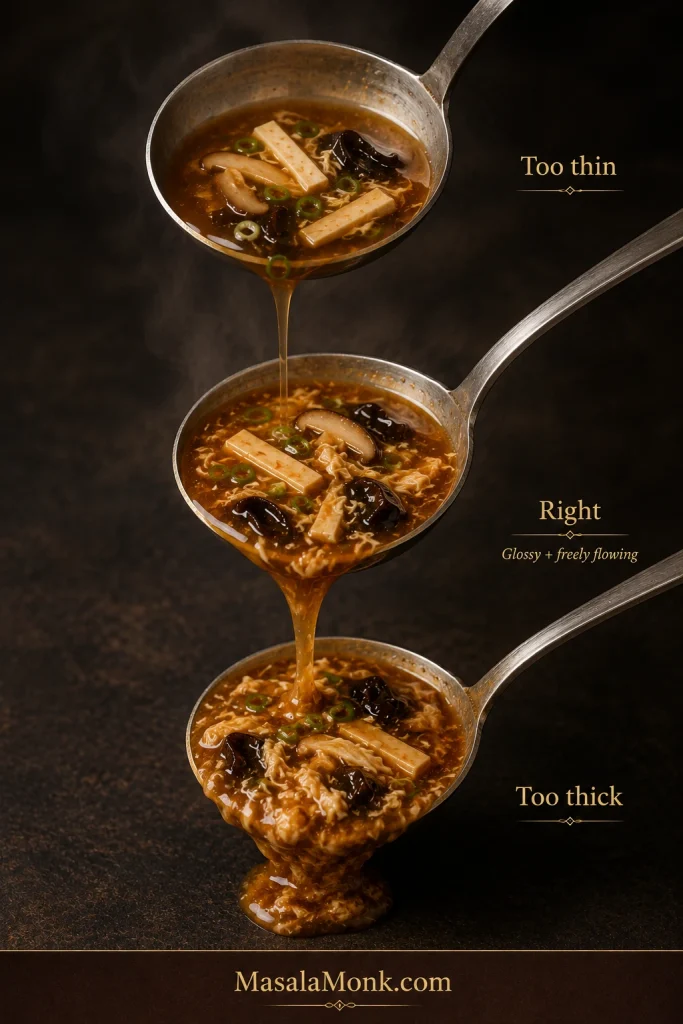
Lift some with a spoon and tip it back. The broth should leave a glossy trace, then fall away cleanly. It should still move like soup, not gravy.
Still too light? Remix the remaining slurry and add it in stages. Bring the soup back to a simmer each time before deciding whether it needs more.
Start with about two-thirds of the slurry, bring the soup back to a simmer, then judge. Add more only if the broth still needs body.
4. Pour the Egg Ribbons
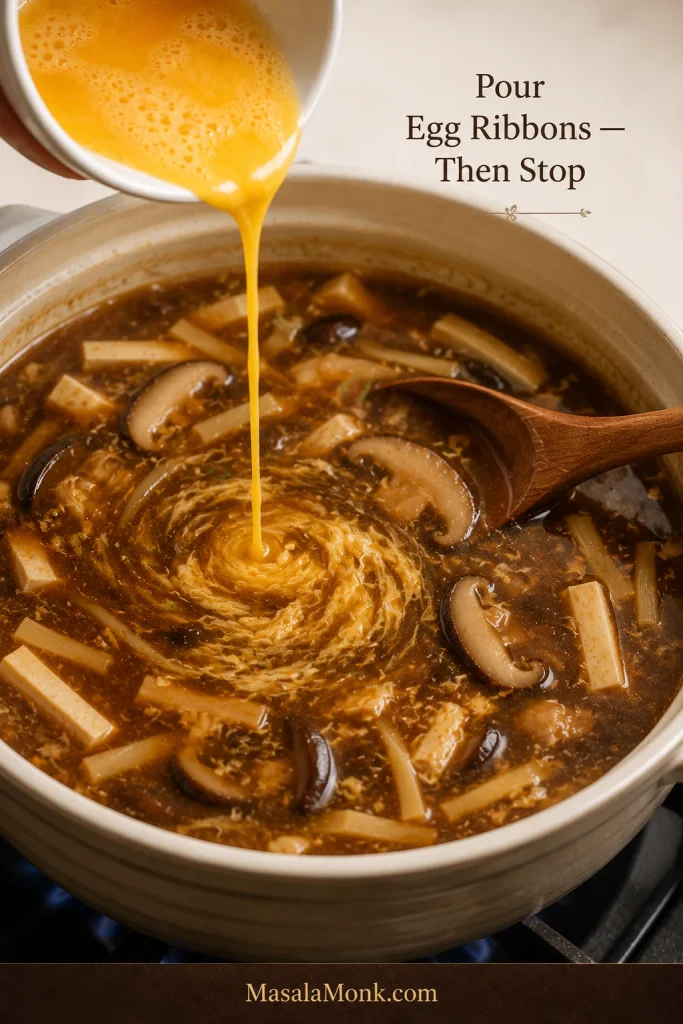
Beat the eggs until the whites and yolks are completely combined. A teaspoon of water makes them slightly easier to pour in a fine stream, but it is optional.
Keep the thickened soup at a gentle simmer. Stir slowly in one direction to create a mild current, then pour the beaten egg in a thin stream as you move your hand around the pot.
Then stop.
Once all the egg is in, leave the pot unstirred until the strands look set. Stir once or twice afterward to separate them without breaking them into tiny flecks.
Pour the egg in a thin stream into a mild current, then stop stirring until the strands look set.
5. Turn Off the Heat—Then Make It Hot and Sour
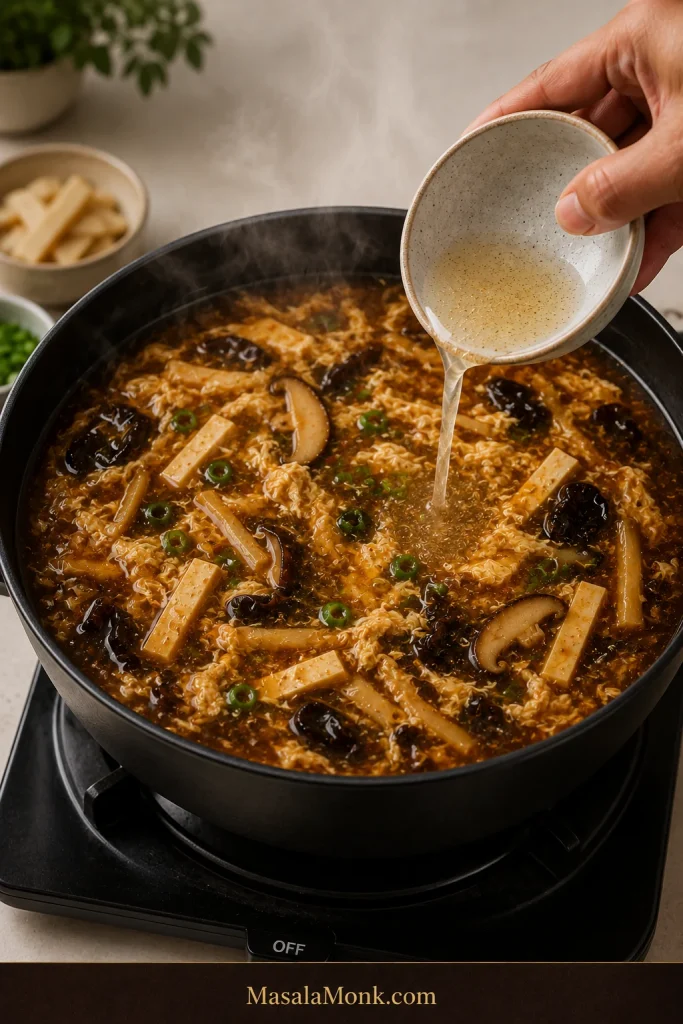
Add the vinegar and white pepper after the heat is off. Stir in the prepared vinegar-and-pepper mixture, then add the toasted sesame oil.
Once the heat is off, the job changes from cooking to preserving aroma. That is when vinegar and white pepper can stay sharp, fragrant and distinct.
Taste, Adjust and Stop
Now taste. This is where you steer the soup toward the one you remember. For more sourness, add the remaining vinegar 1 teaspoon / 5 ml at a time. For stronger peppery warmth, add the reserved white pepper in small pinches. If it tends to clump, first mix it with a teaspoon of vinegar or broth.
The vinegar should brighten the broth without erasing the mushrooms and soy underneath it. White pepper should become more noticeable toward the finish than on the first instant of the sip.
Add scallions if using and put extra vinegar, white pepper and chilli oil on the table.
Try one complete spoonful before serving. Check the savory base first, then the vinegar and white pepper, then the body and textures.
Change one thing at a time. A pale soup may already taste right. A glossy soup does not need more starch just because another restaurant serves theirs thicker.
Taste broth and solids together. Mushrooms, tofu and egg can change how strong the vinegar or white pepper feels in a complete bite.
Something crisp is lovely beside the soft tofu and egg. Crispy vegetable spring rolls make an especially good contrast.
For Chinese-American takeout-style soup, distilled white vinegar gives the sharpest, cleanest tang. Use unseasoned rice vinegar for gentler acidity, or Chinkiang black vinegar for a deeper, earthier sourness.
Distilled white vinegar is direct and bright. If the soup you remember has a nose-tingling takeout tang, this will usually get you there fastest.
Unseasoned rice vinegar is softer and rounder. The soup remains distinctly sour, but the acidity lands less sharply.
Chinkiang or Chinese black vinegar brings earthy, slightly malty flavor along with acidity. Use it in place of the white or rice vinegar, starting with the same 3 tablespoons / 45 ml off heat, then adjust by taste because brands vary.
For familiar Chinese-American takeout-style hot and sour soup, distilled white vinegar is the cleanest starting point; rice vinegar softens the edge, while Chinkiang adds darker depth.
Adding most of the vinegar after cooking keeps the acidity lively. Prolonged boiling makes its sharp edge less noticeable.
White Pepper vs Chilli
White pepper delivers the sharp warmth that builds toward the end of the sip. Chilli oil hits sooner with a more obvious chilli burn.
Black pepper will still add heat, but its aroma is different; white pepper gives the more familiar Chinese-American restaurant-style finish.
Use the timing of the heat as a clue: chilli burns sooner, while white pepper is more noticeable toward the finish and lingers differently from black pepper.
If you know you prefer gentler heat, start with ½ teaspoon white pepper instead of ¾ teaspoon in the finishing mixture. The standard recipe starts with ¾ teaspoon and keeps the final ¼ teaspoon in reserve.
Keep chilli at the table unless everyone wants it. One serving may be fiery while another stays purely peppery.
How Thick Should Hot and Sour Soup Be?
Hot and sour soup should be glossy and lightly spoon-coating while still flowing freely. It should not move like gravy.
Thickness is easiest to judge while the soup is moving. The right broth briefly coats the ladle, then falls cleanly instead of hanging like sauce.
Restaurants disagree on exactly where that line sits. Some versions are almost brothy. Others are thick enough to keep strips of tofu and mushroom suspended.
If the takeout soup you love is particularly dense, take this one thicker too. The staged slurry lets you stop early or keep building body without committing the entire pot at once.
Used all the slurry and still want it very thick? Mix another 1 tablespoon cornstarch with 1 tablespoon cold water. Add it gradually, return the soup to a simmer and reassess before making another batch.
If you overshoot, loosen the soup with hot broth and check the seasoning again.
How to Make Silky Egg Ribbons
Why do some bowls have broad egg ribbons while others have fine wisps? Broth thickness, pour speed and movement all affect the shape.
A broth with some body supports the egg better than a completely thin liquid. A calm current encourages broader ribbons. More movement breaks the egg into finer strands.
The pause matters too. Stir before the egg has set and the strands break into flecks. Pour too much into one place and you get larger clumps.
The egg itself records what happened in the pot. Broad ribbons, fine wisps, clumps and cloudy flecks reveal differences in pour speed and stirring.
Imperfect ribbons do not ruin dinner. The technique helps you get the shape you prefer more consistently.
Why Doesn’t My Homemade Hot and Sour Soup Taste Like Chinese Takeout?
You can make a perfectly good hot and sour soup and still know after the first taste that it is not the restaurant soup you were trying to make.
The usual differences are a weaker broth base, not enough fresh vinegar or white-pepper heat, and a starch level that does not match the restaurant version you remember.
The base tastes weak. Some restaurants start with a more concentrated broth or bouillon-style base.
The heat is mostly chilli. Chilli burn does not taste the same as white-pepper warmth.
The vinegar has gone quiet. A fresh splash after cooking brings the sourness back into focus.
The texture is wrong. Your favorite place may use considerably more—or less—starch.
The soup lacks mushroom depth or contrast. Dried shiitake brings savoriness. Wood ear or bamboo adds a firmer bite beside the soft tofu and egg.
When homemade hot and sour soup feels close but not quite right, start with broth depth before chasing extra vinegar, pepper or soy sauce.
Restaurant kitchens may also lean on more sodium or MSG. Our guide to MSG and umami explains what MSG does to savory perception. It is optional here; if you use it, count it as part of the overall seasoning so the broth does not become overly salty.
Once the soup is where you want it, shrimp fried rice turns it into a fuller takeout-style meal without making the soup itself heavier.
Hot and Sour Soup Ingredients: What Each One Adds
The ingredient list looks less intimidating once flavor and texture are separated. Some ingredients deepen the broth; others are there for chew, crunch or softness.
Ingredient
Main Job
If You Skip It
Dried shiitake
Deep mushroom savoriness
The broth tastes lighter
Wood ear
Springy chew
Less textural contrast
Tofu
Soft body
The soup feels less substantial
Bamboo
Clean crunch
Little change to the broth itself
Dark soy
Deeper color
The soup looks lighter
Broth: Mild Homemade or Deeper Takeout Flavor?
Chicken broth gives the most familiar base, while vegetable broth works well for a meatless version. Mild carton broth makes a lighter soup. A more concentrated chicken or bouillon-style base gets closer to the savory intensity of many Chinese-American takeout versions.
You should still be able to taste the broth after the vinegar goes in. If all you notice is sourness, the foundation was probably too weak. Concentrated broth also brings more sodium, so start with less soy and salt and adjust once everything is hot.
Mushrooms: Flavor and Texture Are Separate Jobs
Dried shiitake deepens both the smell and flavor of the broth as it simmers. Its brown soaking liquid is intensely mushroomy too, which is why a strained portion is useful in the pot.
Wood ear does something different. It brings a springy bite against the softer tofu and egg. If you omit it, bamboo or water chestnuts restore some crunch.
Using both mushrooms gives depth without making every bite soft. If one is missing, replace the job it performs—not simply the mushroom name.
Dried lily buds are another traditional addition in some Chinese versions, bringing an earthy, slightly chewy element. They are optional and not needed for the restaurant-style recipe above.
Tofu: Firm Is Easiest
Firm or medium-firm tofu is easiest because it holds its shape. Soft tofu gives the soup a silkier, more delicate texture but is more fragile.
A partly used block can go into Mapo tofu, which takes the same ingredient in a much bolder, spicier direction.
Bamboo Shoots: Taste Before They Go In
Some canned bamboo carries a strong aroma straight from the tin. Drain and rinse it well. If a piece still tastes unpleasant, blanch the bamboo in boiling water for 30–60 seconds and drain it before adding it to the soup.
The quick blanch is about cleaner flavor, not softer bamboo. If rinsing removes the canned note, there is no reason to cook it again.
Soy, Ginger, Sugar and Final Aromatics
Chinese light soy sauce or regular soy sauce supplies salt and savoriness. Dark soy is mainly useful for deeper color and is entirely optional.
A lighter-colored soup may already taste exactly right. Adding regular soy merely to darken the liquid risks making the soup saltier than intended. No need to chase the color.
Ginger gives the base a fresh aromatic edge. The small amount of sugar rounds the soy and vinegar without making the soup sweet. Toasted sesame oil goes in after cooking so its nutty aroma remains noticeable.
Making the soup without onion or garlic? Neither is required. Omit the scallions, avoid garlic-containing chilli condiments, and check packaged broth and sauce labels because some brands include onion or garlic.
Missing one ingredient rarely ruins the soup. Most substitutions change flavor, texture or both.
No dried shiitake? Use fresh shiitake or cremini. The mushroom flavor will be lighter.
No wood ear? Leave it out, or use bamboo or water chestnuts for some crunch.
No cornstarch? Leave it out for a brothier soup. The egg ribbons may not stay suspended as evenly. Potato starch is another option; add it gradually because it thickens differently.
No tofu? Omit it or use cooked chicken or pork for a firmer, meatier result.
Adding Chicken or Pork
Stir about 4 oz / 115 g cooked shredded chicken or thinly sliced cooked pork into the soup with the tofu, or use the meat in place of tofu. Heat it through briefly before finishing the soup.
Vegetarian, Vegan & Gluten-Free
For vegetarian hot and sour soup, use vegetable broth and keep the tofu, mushrooms and egg. For a vegan version, omit the egg as well. A mushroom-forward broth becomes especially useful once the chicken broth and egg are gone.
For a gluten-free version, use certified gluten-free tamari or soy sauce and check the broth, vinegar and chilli-condiment labels. Chinese black vinegars vary by brand, and some contain wheat-derived ingredients.
Most variations need only targeted swaps. Change the broth, egg, soy sauce or protein according to the version you want rather than rebuilding the entire soup.
Keep additions in proportion to the broth. Pile in too many extras and the vinegar and white pepper start getting lost among all the solids.
You want soft tofu or egg, something with bite, and enough broth around both for the soup to remain lively.
What About Indo-Chinese Hot and Sour Soup?
Indo-Chinese hot and sour soup is usually redder, more vegetable-heavy and more chilli-driven than this Chinese-American version. It works better as its own style than as this soup with extra chilli sauce.
Common additions include cabbage, carrot, capsicum/bell pepper, chicken, chilli sauce or chilli paste and sometimes tomato or ketchup, with green-chilli vinegar alongside. When that is the soup you want, those ingredients should shape the pot from the beginning.
Most problems become much easier to fix once you identify which part of the soup actually went wrong.
Fix the problem that actually failed, retaste, then move on. Changing salt, vinegar, white pepper and starch together makes the next adjustment harder to read.
What Happened?
Likely Reason
Quick Fix
Bland
The savory base is weak
Strengthen the broth; then adjust soy or salt
Not sour enough
Too little fresh acidity
Add vinegar 1 tsp / 5 ml at a time
Too sour
Too much vinegar
Add lightly seasoned broth gradually, then reassess seasoning and body
Not peppery enough
Too little white pepper
Add small pinches after cooking
Too chilli-hot
Too much chilli
Dilute gradually with lightly seasoned broth, then rebalance
Too thin
Not enough starch
Add a small fresh slurry and return to a simmer
Too thick
Too much starch
Add hot broth gradually, then reseason
Cloudy egg
The egg dispersed before setting
Pour more slowly and wait before stirring next time
Big egg clumps
Too much egg entered one spot
Use a finer stream around the pot next time
Broken tofu
Hard boiling or too much stirring
Use a softer simmer and less movement
Gritty or grainy
Sediment or a starch problem
Check the soaking liquid and slurry; see below
What the Egg Shape Tells You
Large clumps usually mean too much egg reached one area at once. Very fine flecks suggest too much movement before the egg set. A milky or cloudy broth means the egg dispersed through the liquid before distinct strands formed.
There is nothing urgent to rescue—the soup will still taste good. The shape tells you what to change next time.
Gritty, Grainy or Muddy-Tasting Soup
Visible or earthy grit often points to sediment from shiitake soaking liquid. A powdery or starchy mouthfeel may mean the slurry was not mixed smoothly, the soup did not return to a simmer after the starch went in, or the wrong corn product was used.
For thickening, use the fine white starch sold as cornstarch in the US and cornflour in the UK—not cornmeal or coarser US-style corn flour.
Poorly rinsed bamboo sometimes carries an unpleasant canned flavor. White pepper varies by brand; if yours tastes stale or unpleasantly harsh to you, try a fresher or different one before increasing the amount. Too much dark soy added only for color may make the broth taste muddy.
If one ingredient tastes wrong on its own, piling on extra vinegar or chilli usually just hides it.
Make Ahead, Storage and Reheating
For make-ahead prep, prepare the broth, mushrooms, bamboo and tofu in advance. Reheat the base before serving, then do the final starch adjustment, egg ribbons, vinegar, white pepper and sesame oil close to serving time for the freshest texture and aroma.
This make-ahead split protects the two things that fade fastest: freshly set egg texture and the bright finish from vinegar, white pepper and sesame oil.
Storage, Reheating and Freezing
Cool leftovers promptly and refrigerate them in a covered container for 3–4 days. The USDA leftovers guidance recommends reheating leftovers thoroughly to 165°F / 74°C and bringing soups to a boil during reheating.
After the soup is thoroughly reheated, lower the heat and check it again. If it has loosened, stir in a small fresh slurry and briefly return it to a simmer. If the flavor seems dull, fresh vinegar and white pepper are often more useful than extra salt.
You can freeze hot and sour soup, but the tofu, egg and starch-thickened broth may not return to exactly the same texture after thawing. Correct the body and seasoning after reheating.
Leftovers also make a quick noodle soup. Add cooked noodles or ramen, loosen with broth if needed, and refresh the vinegar and white pepper just before eating.
One Last Taste
A good hot and sour soup should feel lively rather than heavy: savory broth underneath, vinegar bright in the steam, white pepper warming the finish, and soft tofu and egg interrupted now and then by the springy bite of wood ear or the crunch of bamboo.
Some people will want another splash of vinegar. Others will reach for more white pepper. Keep both on the table, taste once more, and stop when the bowl tastes like the one you were hoping for.
The best bite carries several textures at once: silky egg and tofu, meaty shiitake, springy wood ear and crisp bamboo in the same bright, peppery-sour broth.
Lift a hot New York-style slice by the crust and the center should bend before it breaks. The underside should be browned and crisp, the rim should have a satisfying chew, and the slice should fold down the middle without snapping like a cracker or collapsing into a wet heap.
Folding a New York slice lengthwise is structural as much as cultural. It stiffens a thin center, making the slice easier to hold without turning the crust itself thick or rigid.
A perfectly respectable dough can turn out thick and bready if it stays too small, or rubbery if you stretch it while tight. A baking surface that is not ready leaves the bottom pale; a long bake in a cooler oven can make the crust dry and brittle.
This version uses a 48-hour cold ferment, bread flour, 63.5% hydration, and small amounts of sugar and olive oil that suit a home oven. Just as importantly, it shows you what normal looks and feels like along the way—so a quiet dough in the refrigerator, a tacky first mix, or a stubborn stretch does not send you into a round of fixes the dough never needed.
The finished crust should taste as good as it feels: toasted and wheaty, gently savory, with fermented depth but no obvious sweetness from the sugar. Even the bare rim should be worth eating.
For two 14–15-inch New York-style pizzas, use 400 g bread flour, 254 g water, 8 g salt, 5 g sugar, 12 g olive oil and 0.8 g instant yeast. Divide into two dough balls of about 340 g / 12 oz each and cold-ferment them for about 48 hours.
The finished pizza should be thin and browned underneath, crisp at the surface, chewy inside, and flexible enough to fold. A 14-inch pizza gives you more margin during stretching and launching; take the same ball closer to 15 inches when you want a thinner center and the dough is opening easily.
A small amount of sugar assists browning before a home-oven bake dries the crust out, while olive oil helps the interior stay tender. Stretch by hand, top with restraint, check that the pizza slides on the peel, and fully heat the steel or stone before baking.
The rule worth remembering: use the clock to plan pizza; use the dough to decide when it is ready.
How Long Should New York Pizza Dough Ferment? 24 vs 48 vs 72 Hours
The 48-hour version is the main recipe here. It gives the dough time to develop flavor and relax while leaving a comfortable margin before fermentation becomes harder to control. Shorter and longer schedules work too; change the yeast to suit the schedule.
When you want pizza
Instant yeast for 400 g flour
What to expect
Tonight
2.4 g / about ¾ tsp
About 4–6 hours total; good same-day crust with less fermented flavor
Tomorrow
1–1.2 g / about ⅓ tsp
A practical 24-hour route
In two days
0.8 g / about ¼ tsp
Recommended 48-hour version
In three days
0.4–0.5 g / about ⅛ tsp
A more mature 72-hour dough; temperature matters more
For New York-style pizza dough, longer is not automatically better. Choose the ferment that fits your schedule, then watch relaxation and remaining strength. A well-timed dough is more useful than one kept cold simply because another day sounds better.
How to Plan Your Pizza Dough Fermentation Schedule
For the refrigerated routes, 24, 48 and 72 hours refer to time in the refrigerator, not the entire schedule. Change the yeast and cold-ferment time as shown, keep the mixing and balling method the same, then let the dough’s readiness cues determine the final warm-up.
The 24- and 72-hour routes are starting points, not stopwatch formulas. A warmer refrigerator moves fermentation faster. These schedules assume about 37–40°F / 3–4°C in the refrigerator and 68–72°F / 20–22°C in the kitchen.
Planning Friday evening pizza? Mix Wednesday mid-afternoon, refrigerate the shaped balls by late afternoon, then take them out at roughly the same time Friday for a 2–3 hour warm-up before dinner.
The 48-hour route is mostly waiting, not work. Once the dough is chilled, overlap the final warm-up with oven preheating. That keeps pizza night from feeling like a two-day project.
Need Pizza Tonight? Use the 4–6-Hour Version
Keep the flour, water, salt, sugar and oil unchanged, but increase the instant yeast to 2.4 g / about ¾ teaspoon. Plan on roughly 4–6 hours from mixing to baking.
Mix, rest and knead as directed in the main recipe.
Cover the whole dough and leave it around 70–75°F / 21–24°C for 60–90 minutes.
Divide and ball it.
Leave the balls covered for another 2½–4 hours, checking for soft, aerated dough that stretches willingly.
Stretch, top and bake as usual.
The same-day version makes a crisp, chewy pizza but develops less fermented flavor than the two-day dough. If even that is too much waiting, Greek Yogurt Pizza Dough skips yeast entirely.
The complete recipe below follows the 48-hour cold-ferment path.
New York Style Pizza Dough Recipe
Recipe at a Glance
Yield: 2 dough balls, about 340 g / 12 oz each
Pizza size: Two 14–15-inch pizzas
Hands-on dough prep: About 25 minutes
Initial room-temperature stage: 45–60 minutes
Cold ferment: About 48 hours
Warm-up before stretching: Usually 2–3 hours around 70°F / 21°C
Total elapsed planning time: Roughly 51–52 hours from mixing to baking
Oven: 500–550°F / 260–288°C, or the highest suitable setting your oven allows
Bake on steel: Often about 5–7 minutes
Hydration: 63.5%
Weights are the reference measurements for this dough; cup and spoon equivalents are approximate.
Dough Ingredients
400 g / 14.1 oz bread flour, preferably around 12–13% protein; about 3⅓ cups if spooned into the cup and leveled
254 g water, about 254 ml / 1 cup plus 1 tablespoon, cool to room temperature
8 g fine sea salt, about 1⅓–1½ teaspoons depending on the salt
5 g granulated sugar, about 1¼ teaspoons
12 g olive oil, about 13 ml / 2½–2¾ teaspoons
0.8 g instant yeast, about ¼ teaspoon
A ¼-teaspoon measure is more useful than a whole-gram kitchen scale for the yeast if you do not own a 0.1 g precision scale.
Active dry yeast works too. Use about 1 g / ⅓ teaspoon and activate it in a little of the recipe water according to the package directions.
Halving the formula works, but the instant yeast drops to about 0.4 g / ⅛ teaspoon. Without a precision scale, making both balls and freezing one after its first day of cold fermentation is usually easier.
Portion by weight, not by eye. Two evenly sized pizza dough balls make the finished pizzas easier to compare. That means differences in thickness, browning or handling are less likely to come from one ball simply being larger.
For Shaping and a Plain Cheese Pizza
For each 14–15-inch pizza, have ready:
Flour for the work surface
Flour or fine semolina for the peel
115–150 g / 4–5¼ oz thick pizza sauce
115–150 g / 4–5¼ oz whole-milk low-moisture mozzarella, grated from a block if possible
For your first pizza, start around 115 g sauce and 115 g mozzarella. Move toward 150 g once you know how your sauce, dough and oven handle the extra load.
Keep the sauce and cheese chilled until you need them. If mozzarella tends to brown before the crust is ready, chill the grated cheese for 10–15 minutes before topping.
Useful Equipment
Digital kitchen scale
0.1 g precision scale or measuring spoons for yeast
Large mixing bowl
Dough scraper or flexible spatula
Two covered containers, around 1 quart / 1 liter each
Pizza peel
Pizza steel, stone or heavy baking sheet
Wire cooling rack
Optional infrared thermometer
Mix and Develop the Dough
Whisk the flour, instant yeast, sugar and salt together in a large bowl. Add the water and stir until no large pockets of dry flour remain. The dough should look rough and shaggy.
Cover and leave it alone for 15 minutes. During this short rest the flour absorbs water, and an awkward sticky mass often becomes much easier to handle.
Knead until the dough begins to smooth out, then work in the olive oil gradually.
Continue kneading until the dough is cohesive, elastic and lightly tacky—usually another 5–7 minutes by hand or 4–6 minutes on low speed in a stand mixer.
Look for a modest change after the rest: fewer dry ridges, better hydration and dough that feels more unified. It can still look rough; the smooth, elastic finish comes later during kneading.
How Tacky Should Pizza Dough Feel?
Checkpoint: press a clean finger against the dough. A little cling is fine. It should release without coating your finger in paste and feel soft and supple in your hands.
Judge the release, not just the touch. Slight cling followed by a mostly clean fingertip is manageable; a wet coating or smear left behind is the more useful warning that the dough needs another look.
Still sticky enough to worry you? Cover it for another 10 minutes before reaching for flour. Time often solves what extra flour would only hide.
If it still smears instead of holding itself together, recheck the flour and water weights. When those are correct, work in flour 5 g at a time and stop as soon as the dough becomes manageable. Record how much you needed and use that as a reference for the next batch.
If you track dough temperature, aim for roughly 76–80°F / 24–27°C after mixing. Cooler water helps in a hot kitchen and warmer water helps in a cold one. Without a thermometer, stop mixing before the dough feels noticeably warm.
Using a Food Processor or Spiral Mixer?
Food processor: pulse the dry ingredients to combine, then add the water and oil together. Process until the dough forms a ball and continue only briefly—about another 15–20 seconds—until smooth and elastic. Stop before the dough becomes noticeably warm.
Spiral mixer: fixed stand-mixer minutes are less useful because spiral mixers develop dough differently. Stop when the dough is smooth, elastic and cohesive, using finished dough temperature as a guardrail.
Ball and Cold Ferment
Cover the mixed dough and leave it at room temperature for 45–60 minutes. It does not need to double.
Divide it into two equal pieces of about 340 g / 12 oz each.
Shape each piece into a ball. Pull the outer edges underneath as you rotate the dough until the top becomes smooth, then pinch the seam lightly underneath. Create gentle surface tension and stop before the skin begins tearing.
Place each ball seam-side down in its own lightly oiled covered container and refrigerate at about 37–40°F / 3–4°C for 48 hours.
Watch where the tension goes: the top should become smoother while the seam gathers underneath. Stop once the ball is cohesive—over-tightening the skin only creates more tension for the dough to relax later.
Balling before refrigeration lets each portion ferment and relax in the shape you will later stretch. Separate containers also make it easier to lift one cleanly without disturbing the other.
Separate clear containers turn cold fermentation into something you can actually observe. You can compare spreading, bubbles and weakening from day to day while the lids protect the dough surface from drying.
After a day in the refrigerator, modest spreading and puffiness are completely normal. A quiet-looking dough ball is not a reason to add more yeast next time.
Warm, Stretch, Top and Bake
Take the dough out about 2–3 hours before baking when the room is around 70°F / 21°C. Begin checking it sooner in a warmer kitchen.
About halfway through that warm-up, start preheating the oven. Put your steel or stone in the oven and heat at 500–550°F / 260–288°C, or the highest suitable temperature your oven allows, for about an hour.
Release one dough ball gently from its container. Flour both sides lightly, then press from the center outward while leaving the outer ½–¾ inch / 1–2 cm comparatively untouched.
Lift and rotate the dough, letting gravity help. Stop around 14 inches / 36 cm for an easier, fuller crust, or continue toward 15 inches / 38 cm for a thinner center.
Check for translucent patches or pinholes, then move the dough to a lightly dusted peel. Shake it immediately. The entire skin should move freely.
Use about 115 g sauce and 115 g mozzarella for the baseline version, leaving some red sauce visible between the cheese.
Shake the peel again. Loosen any stuck point before approaching the oven.
Launch onto the fully heated steel or stone. Bake until the underside is browned, the rim has good color and the center is cooked through. On steel this is often about 5–7 minutes.
If the bottom is ready before the top has enough color, finish briefly under the broiler.
Move the finished pizza to a wire rack for 30–60 seconds, then transfer it to a board and slice.
Four Small Checks That Prevent Common Problems
Skip the rolling pin for this version; it presses gas from the rim. Preserve the outer band without building a thick rope around the pizza. The untopped edge will rise on its own.
If the dough repeatedly snaps back, cover it for 5–10 minutes and try again. A slightly oval pizza tastes just as good as a perfect circle, so protect an even center and let perfect geometry wait.
If the pizza lands oval or slightly off-center but is safely on the baking surface, leave it there. Shape matters far less than keeping your hands away from a blazing oven.
A browned underside, properly colored rim and cooked center without a broad gummy band tell you the pizza is ready.
“Thin crust” is not specific enough. Cracker crust is thin, and Neapolitan pizza is thin through the center too. The New York slice lives in the balance between crispness, chew and flexibility.
Look for a thin browned shell underneath, a narrow tender-chewy layer above it, a modest rim, and enough flexibility for the slice to fold cleanly.
It is the kind of slice you can pick up by the crust, fold lengthwise and eat one-handed without the toppings sliding into your lap.
Cracker-style pizza goes farther toward dryness and snap. Neapolitan pizza has a lighter, puffier outer rim. Thicker delivery-style pizza carries more bread through the center. New York sits between those extremes.
Compare the center as well as the rim. Cracker crust stays thin and dry. New York keeps a narrow chewy layer above the crisp base, while Neapolitan shifts more of its volume into an airy outer edge.
If what you really want is fresh mozzarella, tomato and basil on a lighter pizza, the Margherita Pizza recipe handles that wetter topping balance separately.
That crisp-chewy balance comes from more than one ingredient. Hydration, flour strength, fermentation and the home-oven bake all have to support the same result.
Why This Dough Formula Works
New York dough formulas vary. Some are relatively dry and easy to handle; others run wetter. Flour strength, sugar, oil, fermentation and oven setup all shift the result.
This formula favors a generous margin for success in a home kitchen. The point is not to chase the wettest dough you can handle; it is to make a dough that opens thin without turning the first launch into a high-wire act.
What Hydration Is Best for New York-Style Pizza Dough?
There is no single required hydration. This home-oven formula uses 63.5%. That gives the dough enough water to stay tender and stretch thin without making a first-time launch unnecessarily fussy.
Ingredient
Baker’s percentage
Flour
100%
Water
63.5%
Salt
2%
Sugar
1.25%
Olive oil
3%
Instant yeast
0.2%
63.5% water: enough for a tender, stretchable center without making the launch unnecessarily difficult.
2% salt: seasons the crust and helps control fermentation.
1.25% sugar: assists browning in a home oven without making the crust taste sweet.
3% olive oil: adds tenderness and helps the crust retain moisture during the bake.
0.2% instant yeast: enough for the recommended 48-hour schedule.
Higher hydration can make excellent pizza, but it asks more from the flour, stretching technique and launch. Lower hydration is easier to handle but has less moisture to spare during a long home-oven bake.
Why Is the Yeast Amount So Small?
Because the recommended version spends about 48 hours fermenting slowly in the refrigerator, it needs very little yeast. Using more simply moves the dough through its fermentation window faster.
The recipe uses instant yeast because it can go directly into the flour. If you prefer active dry yeast, the recipe card above gives the conversion and activation method.
Prefer natural leavening? The Sourdough Pizza Dough recipe uses starter instead. Starter strength and timing make it a different fermentation system even though some readiness cues overlap.
Once the percentages are set, flour strength determines how comfortably the dough can carry them.
What Is the Best Flour for New York-Style Pizza Dough?
Start with bread flour around 12–13% protein. It gives this dough enough strength to stretch thin while retaining the chew that makes the crust satisfying.
Only have all-purpose flour? Pizza is still on. A reasonably strong AP flour can work very well. The dough may feel softer in your hands, so stop the stretch a little sooner if the center starts thinning faster than expected.
Flour
Can you use it?
What changes?
Bread flour
Recommended
Reliable strength and chewy structure
High-gluten flour
Yes
More strength and chew; can resist stretching if heavily developed
Strong all-purpose flour
Yes
Softer crust; often an excellent option
Weaker all-purpose flour
Yes, with care
May feel wetter and tear sooner at the same hydration
Tipo 00
Sometimes
The label alone does not tell you dough strength or whether the flour suits your oven
Whole wheat
Not as a direct 1:1 swap
Changes water absorption, flavor and extensibility
Gluten-free blend
No direct swap
Needs a formula built specifically without wheat gluten
If a weaker flour makes the dough substantially softer, try taking 5–10 g water out of the next batch. If that helps, record the adjustment and use it as your starting point next time.
What Should Cold-Fermented Pizza Dough Look Like?
Should Pizza Dough Double in the Fridge?
No. New York pizza dough may expand only modestly during cold fermentation. Look for small bubbles, some spreading, a softer shape and easier stretching instead of waiting for a dramatic doubling.
Open the container after a day and the ball may look surprisingly quiet. That alone is not bad news.
Around 24 hours: expect modest fermentation activity and dough that is beginning to relax.
Around 48 hours: the ball should feel softer and more willing to open while still lifting cleanly from its container. This is the intended window for the main recipe.
Around 72 hours: expect more relaxation. Pay closer attention to strength: the dough should still hold together without turning gluey and fragile.
During cold fermentation, spread and strength tell you more than height alone. A later dough can be broader and softer yet still be healthy; the important warning is when relaxation turns into stickiness and fragility.
Refrigerator temperature matters throughout. A fridge at 37–40°F / 3–4°C gives you more predictable timing than one running several degrees warmer.
Relaxed but healthy: spread somewhat, soft, and able to lift in one piece.
Possibly overfermented: unusually flat, newly sticky, weak, translucent in places and easy to tear with little resistance.
Dough that feels much wetter after several days has not necessarily gained water. As its gluten structure weakens, it becomes less effective at holding the water already present.
Liftability is a useful maturity clue. Healthy pizza dough stretches but still comes away as one piece; overmature dough elongates, thins and tears much more readily under the same gentle handling.
How Much Dough Do You Need Per Pizza?
Ball weight and finished diameter work together. Too much dough at a small diameter gives you a thicker, breadier pizza even when fermentation is perfect.
Finished pizza
Practical dough range
How to use it
12 inches / 30 cm
About 230–270 g / 8.1–9.5 oz
Lower end for a thinner result; upper end is easier to handle
14 inches / 36 cm
About 300–340 g / 10.6–12 oz
This recipe uses 340 g for an easier first attempt
15 inches / 38 cm
About 320–360 g / 11.3–12.7 oz
The same 340 g ball gives a thinner NY-style center
16 inches / 41 cm
About 350–400 g / 12.3–14.1 oz
Best with confident stretching and a large baking surface
That extra inch changes more than the number on a ruler. The same dough is spread across a larger area, so the 15-inch version develops a thinner center and gives you less handling margin than the 14-inch version.
A clean 14-inch pizza is better than forcing a resistant ball to 15 inches. With practice, the same dough usually stretches farther and more evenly.
If what you actually want is a thicker pan crust with crisp cheese around the edges, the Detroit-Style Pizza recipe is the better direction.
Match Pizza Size to Your Baking Surface
Match the pizza to the baking surface, not just the dough ball. A 14-inch pizza is manageable on a 15-inch surface; for a 15-inch pizza, a 16-inch surface or larger gives you much more landing margin.
Work backward from your equipment. Measure the usable width of the pizza steel or stone before stretching, because a pizza that nearly fills the surface leaves very little room for an imperfect launch.
Give the dough room, too. A container around 1 quart / 1 liter works comfortably for a 340 g ball. Crowded balls can merge and flatten awkwardly, while re-balling a relaxed dough immediately before baking creates fresh tension that needs time to settle again.
Once a ball has had enough room and time to relax, the next question is whether it is ready to open.
Is My Dough Ready to Stretch?
Ready pizza dough feels soft, stretches with gentle resistance, and still has enough strength to lift cleanly.
Two hours out of the refrigerator is planning advice. Your hands get the final vote.
The center can remain cooler than the room. It only needs to warm enough for the ball to open willingly without repeated tearing or snap-back.
Still too cold: firm, tight and quick to spring back. Cover it and wait.
Ready: soft and willing to stretch, yet cohesive enough to lift cleanly.
Very warm: softer and slacker but still cohesive. Use it once it opens willingly.
Overmature: increasingly sticky, weak and fragile. Handle gently and use promptly.
Use shape and resistance together. A soft-looking ball that still snaps back may need more time, while a broad warm ball can still be perfectly usable if it lifts cleanly and retains strength.
One kitchen may have workable dough after 90 minutes; another may need 2½ hours. Once it opens comfortably, extra counter time brings no automatic benefit.
Get everything else ready first: sauce portioned, cheese grated, toppings nearby, peel dusted and oven hot. Thin dough becomes more likely to stick if it sits around while you look for ingredients.
Release the ball gently with your fingers or a plastic scraper. Flour both sides lightly, press the center outward with your fingertips, and preserve the outer ½–¾ inch / 1–2 cm.
Pressing does not manufacture a giant rim; it redistributes thickness. The outer band rises later because it has been compressed and stretched less than the center.
When the disk is large enough to lift, rotate it through your hands and let gravity help. Keep moving around the pizza so one spot does not take all the stretching.
Keep the pizza dough moving through your hands so gravity is shared around the circle. If the same low point hangs longest on every turn, that area will become the first dangerously thin spot.
An even 14-inch center beats a 15-inch pizza with one paper-thin half and one thick half.
When It Springs Back
The annoying part of spring-back is that pulling harder usually makes it worse.
Put the partially stretched dough down, cover it, and wait 5–10 minutes. That short pause often does more than another five minutes of tugging.
Already warm but still snapping back hard? Strong flour or aggressive mixing can leave the dough unusually elastic. Give it another short rest.
When the dough fights back, rest beats force.
The useful change after a short rest is resistance, not volume. The pizza dough should open farther under the same gentle pressure rather than merely looking larger because it sat on the counter.
When It Tears
How the dough felt just before it tore helps identify the problem.
Tight and resistant: it was probably stretched before relaxing enough. Stop and rest it.
Loose, sticky and fragile: the dough may be overfermented or the flour may not have enough strength for the hydration.
A small tear is repairable. Pinch the edges together. For a larger pinhole, borrow a tiny piece from a thicker part of the rim and press it over the opening, then leave the patch alone for a minute.
Read the dough around the hole. Smooth, taut tear edges point toward excess tension; ragged, wet-looking edges suggest weaker structure. The tear itself is only half the diagnosis.
When one area starts looking translucent, leave it alone and work on thicker parts of the dough. A hole that develops later can let sauce through and glue that spot to the peel.
Backlighting exaggerates thinness, so compare one area with the dough around it. A single patch that suddenly glows much brighter than its neighbors is a better warning than translucency by itself.
Thin New York-style pizza rewards restraint. Start with the 115 g sauce + 115 g mozzarella baseline from the recipe and add more only after you know how your oven handles the extra moisture and weight.
Use the baseline cheese pizza as your reference point. Once the crust bakes well with a restrained topping load, you can add more sauce, cheese or toppings later and know that moisture and weight—not a new dough formula—are the variables.
Thick pizza sauce: spread a thin, even layer. The Pizza Sauce Recipes guide has tomato, white garlic, vodka, BBQ and other options.
Whole-milk low-moisture mozzarella: grate it from a block if possible for a cleaner melt.
Other toppings: add enough to taste them without burying the thin center under excess water and weight.
Loose sauce, watery vegetables and fresh cheeses all bring more moisture. Adjust the load accordingly. Once baked, a light drizzle of Hot Honey Sauce gives you sweet heat without adding that moisture to the raw pizza.
The Peel Shake Test
Dust the peel lightly.
Put the stretched dough on it.
Shake it now. The whole skin should move.
Top quickly.
Shake it again.
If one spot sticks, free that spot before launching.
Watch the center as well as the rim. A pizza is not truly free if the edge wiggles while one hidden area in the middle remains anchored to the peel.
If the pizza will not slide on the counter, it will not suddenly become easier while you are leaning into a 550°F oven. For one stubborn spot, slide a long spatula or thin turner underneath and dust the edge of the tool lightly with flour if needed.
Rescue the problem locally. Freeing only the stuck point helps preserve the pizza’s shape and reduces the chance of dragging toppings or creating a new weak spot elsewhere.
Peel Tips: Wood vs Metal and One-Peel Setups
A wooden peel is forgiving for building and launching raw pizza. A thin metal peel works particularly well for turning and retrieving it.
Using one peel for everything is fine. Let it cool and dry completely before placing the next raw dough on it; moisture from a hot finished pizza can make the next launch unexpectedly sticky.
How Much Flour or Semolina Should Be on the Peel?
Flour or fine semolina works well for dusting. Cornmeal is optional and adds a coarser texture, but loose grains can scorch on a hot steel. Use the minimum dusting needed to keep the pizza moving.
Dusting should be barely visible once the pizza is moving. If loose flour or semolina piles around the dough after a shake, there is probably more on the peel than the launch needs.
Your first pizza is partly dinner and partly calibration. It still counts as dinner.
If the dough handled beautifully but comes out pale underneath, check the baking setup before rewriting the formula.
Setup
Preheat
Planning range
What to expect
Pizza steel
About 60 min
Often about 5–7 min
Strong bottom heat; easiest route to a crisp-chewy home-oven NY crust
Pizza stone
At least 60 min
Often about 7–15 min
Very good results, with gentler heat transfer than steel
Heavy inverted sheet
About 45–60 min
Often about 8–12+ min
Useful without specialty equipment; expect gentler bottom browning
Those are planning ranges. The pizza itself decides when it is ready.
Balance Top Heat and Bottom Heat
Put a steel or stone roughly in the middle of the oven and preheat at 500–550°F / 260–288°C, or the highest suitable setting your oven allows.
An infrared thermometer can tell you whether the baking surface is still heating or has recovered between pizzas, but you do not need one universal surface-temperature number. Use the underside of the pizza to calibrate your setup.
When the Cheese Is Done Before the Crust
Dark cheese is not proof that the crust is cooked. If the mozzarella is racing ahead while the underside remains pale, the top and bottom heat are out of balance.
Cheese and crust are separate doneness signals. When they disagree, diagnose the oven’s heat balance instead of extending the bake until the darker one becomes even darker.
Top ready, bottom pale: preheat the surface longer, move it lower, or otherwise strengthen the bottom heat.
Bottom dark too early: move the surface higher so the top has more time to catch up.
Bottom excellent, top nearly there: finish briefly under the broiler.
Treat rack position as a calibration change. Keep the dough and topping load the same on the next pizza. Then you can tell whether the new position improved the balance between top browning and bottom heat.
What a Properly Browned Pizza Underside Looks Like
The first time you lift a home-oven pizza and find a properly browned base instead of pale dough, the long preheat suddenly makes sense.
Judge the pattern as well as the darkness. The target is broad, dry, mottled browning across the pizza base—not one burnt ring around a center that is still pale.
Let the Steel or Stone Recover Between Pizzas
The preheat beep is not the finish line. Oven air heats much faster than a thick steel or stone. During a batch, the reverse problem appears: every pizza removes stored heat, so give the surface a few minutes to recover if later pizzas begin browning more slowly.
Consecutive pizzas are useful evidence. If identical dough and topping loads brown differently, the changing variable may be stored heat in the steel or stone rather than anything in the dough.
Alternative Oven Setups: 450°F Ovens and Outdoor Pizza Ovens
If your oven tops out around 450°F / 230°C: you can still make good pizza, particularly on a fully heated steel. Expect a longer bake and somewhat gentler bottom browning. Keep toppings light and use the broiler when necessary to finish the top without drying out the whole crust.
Using an Ooni or another outdoor pizza oven? Bake this as New York pizza: lower and longer than Neapolitan. Ooni’s New York-style pizza guidance notes that traditional New York pizzas bake at roughly 500–650°F / 260–340°C, while compact pizza ovens may need somewhat more heat. Follow the NY-style guidance for your oven rather than simply running maximum flame.
The sugar and oil in this dough brown much faster at extreme pizza-oven temperatures.
This is the moment the percentages stop mattering.
Lift a slice. Smell the crust. Look underneath. Fold it.
Read the Crust Before You Fold It
Start with the crust. The bare rim should smell toasted and taste wheaty and savory, with gentle fermented depth instead of a strong yeast flavor.
Look at the top. The mozzarella should be melted and lightly mottled, with patches of red sauce still visible between the cheese. The rim should look fully baked.
Look underneath. You want a thin browned shell with darker spotting, not a pale floury base or one that has burned uniformly black.
Read the slice from the bottom upward. If the shell is crisp but the center crumb is much thicker than this, look first at dough weight and finished diameter before chasing more oven heat.
Look at the cross-section. Above the crisp shell should be a narrow tender-chewy layer. A very thin moist line directly beneath the sauce can be normal; a broad pasty or gummy band is not.
Width is the useful cue. A normal moist line hugs the underside of the sauce; a gummy band occupies a noticeable portion of the crumb and looks compressed rather than simply moist.
Fold the Slice: Floppy, Flexible or Cracker-Hard?
Now fold it. The slice should bend lengthwise without snapping, and the folded slice should support its tip reasonably well. Some dip beneath the toppings is normal; immediate collapse points to a softer base or heavier load.
Use the fold as a screening test, not a single-cause diagnosis. If the slice misses the target, confirm the clue against its underside, cross-section and topping load before deciding what to change next.
Floppy: soft underside, wet tip or weak support. Check bottom heat, topping moisture, bake time and dough-to-diameter ratio.
The target: crisp shell, tender-chewy interior, toasted flavor and a clean fold.
Cracker-hard: dry, rigid and prone to snapping. The bake probably removed too much moisture.
If your slice missed the target, everything below is the repair manual. Jump to the stage where things went wrong; you do not need to read every troubleshooting table.
Troubleshooting New York Pizza Dough
Most pizza failures are surprisingly local. Sticky dough does not mean the oven is wrong, and a pale base does not mean fermentation failed. Fix the symptom you are actually seeing.
Choose the table that matches the stage where the problem appeared: dough and fermentation, stretching and launching, or baking. The best first question is often: when did it start going wrong?
Start with the earliest abnormal moment because pizza problems can cascade. A small tear can leak sauce, and that wet spot can stick to the peel. The ugly launch that follows may be the final symptom rather than the original cause.
Why Is My Pizza Dough Sticky, Flat or Weak?
What you see
What’s probably happening
Do this now
Next time
Dough is almost batter-like
Measurement error or flour too weak for the water
Check ingredient weights before adding lots of flour
Weigh flour/water; reduce water with weaker flour
Dough is lightly tacky
Probably normal
Keep going
Nothing unless it causes actual handling trouble
Very sticky immediately after mixing
Flour still hydrating or gluten not developed yet
Cover 10–15 minutes first
Keep the short hydration rest
Still smears after resting
Flour may not comfortably hold the planned hydration
After checking weights, add flour 5 g at a time
Record the correction and adjust water next batch
Much stickier after 2–3 days
Dough may be moving past its best fermentation window
Handle gently and use promptly
Shorter ferment, less yeast or colder storage
Barely expanded in the fridge
Cold fermentation may simply be slow
Judge bubbles and handling rather than waiting for doubling
Check actual fridge temperature before increasing yeast
If your symptom is already in the table, resist changing three other things on the same batch. One useful change teaches you something. Five changes create another mystery.
Why Won’t My Pizza Stretch or Slide Off the Peel?
What you see
What’s probably happening
Do this now
Next time
Won’t reach the intended diameter
Dough is tight or stretching is uneven
Rest it; bake a slightly smaller pizza
Give it enough warm-up and use the size ranges
Center becomes translucent
One area is being stretched too much
Stop touching that spot
Rotate the dough and work thicker areas
Rim is much thicker than expected
Too much dough was protected at the edge
Bake it as-is
Preserve a modest border instead of building a thick rope
Pizza sticks to the peel
Too much time, too little dusting or a wet spot
Locate and loosen the stuck area
Prepare toppings first and do both shake tests
Next pizza suddenly sticks
Peel may still be damp from retrieving the previous pizza
Dry it completely before rebuilding
Let one peel cool and dry or use separate launch/retrieval peels
One spot sticks after saucing
A small tear may be leaking sauce
Get dry flour beneath that point
Inspect for pinholes before topping
Pizza folds during launch
The skin was not moving freely
Salvage gently
Launch only when the entire pizza slides
Pizza lands oval
Imperfect launch
Leave it alone if safely on the baking surface
Prioritize a clean launch over a perfect circle
Bottom tastes burnt and floury
Too much loose flour/semolina/cornmeal
Clear burnt material before the next pizza
Brush off excess bench flour
Why Is My Pizza Pale, Gummy or Burning?
What you see
Check first
Do this now
Next time
Pale bottom
Baking-surface heat
Give it more bottom heat if the top allows
Preheat longer or adjust rack/surface position
Bottom burns first
Too much bottom heat relative to top
Move the pizza higher to finish if needed
Start the surface higher
Top done, bottom pale
Steel/stone is not delivering enough heat
Avoid drying the pizza with a very long bake
Preheat longer or move the surface lower
Cheese dark but crust underdone
Top heat is outrunning bottom heat
Finish cautiously; judge the crust separately
Rebalance rack position and baking-surface heat
Cheese browns too early
Strong top heat or warm cheese
Finish the crust carefully
Chill grated mozzarella 10–15 minutes and keep sauce cold
Pizza is thick and bready
Too much dough for the finished diameter
Serve it and note the size
Stretch farther or use a smaller ball
Crust is hard or cracker-like
Bake ran too long
No complete rescue after baking
Increase effective heat and shorten the bake
Center is soggy
Wet toppings or weak bottom heat
Return briefly if the crust can take it
Reduce moisture and strengthen bottom heat
Thick gummy band under sauce
Underbake, excess thickness or too much moisture
Cook further if possible
Stretch thinner, top lighter, strengthen bottom heat
Can You Change the Sugar, Oil, Malt or Fermentation Method?
For bread flour, all-purpose flour, Tipo 00, whole wheat and gluten-free options, use the flour guide above. The changes below affect the formula more directly.
Remove the sugar? Yes, but the crust loses some help with browning at home-oven temperatures.
Remove the oil? Yes, but expect changes in tenderness, moisture retention and high-heat behavior.
Need diastatic malt? No. Malt products vary, and some bread flours already contain malted barley flour or added enzymes. The sugar in this formula keeps the first batch simpler.
Need a poolish? No. Preferments can make excellent pizza, but a 48-hour direct dough already has plenty of time to develop flavor.
If the crust is working and you simply want another flavor, change the topping before rebuilding the dough formula. A restrained layer from the pesto recipe and variations guide is one easy direction.
How to Store and Freeze the Dough
Yes, this dough freezes well. If you know you will not use both balls, freeze one after about 24 hours of cold fermentation.
The two-day version is the main refrigerator target, with a carefully managed three-day version as the planned extension. Once a ball becomes progressively flatter, stickier and more fragile, use it.
Cold-ferment the individual balls for about 24 hours.
Transfer each to a lightly oiled airtight freezer container or freezer bag.
For best quality, aim to use the dough within about a month.
Move it to the refrigerator 12–24 hours before you plan to bake.
Once thawed, give it enough counter time to become soft and willing to stretch.
Thawed dough may feel stickier than fresh dough. A light dusting of flour is fine; avoid kneading a large amount of new flour into an already fermented ball.
A Couple of Common Questions
Can I use a bread machine?
Yes, if its dough cycle comfortably handles this quantity. Let the machine mix and knead, then remove the dough instead of letting a standard bread-program rise control the fermentation. Continue with the room-temperature rest, balling and refrigerator schedule above.
Do I need New York City water to make New York-style pizza?
No. Mineral content can affect dough behavior to some degree, but ordinary good-tasting drinking water can make excellent pizza. If your tap water tastes strongly chlorinated or has an unusual mineral character, filtered water is a sensible choice. There is no reason to import water from New York; Serious Eats’ New York water experiment likewise found no compelling reason to treat NYC water as the secret to great pizza.
The Slice Tells You Whether the Dough Worked
You do not need dramatic refrigerator rise, extreme hydration, imported flour, a poolish or a professional oven.
The payoff is much simpler: a crust worth eating all the way to the edge and a slice that folds the way you hoped it would.
A good New York slice should feel casual in the hand. The fold adds support without making the center rigid, so the slice is easy to eat without fighting either a collapsing tip or a brittle crust.
And when the first pizza is not quite there, let it teach you one thing before changing five. Sometimes the steel simply wanted another ten minutes of heat—and the second pizza is the one that makes you smile.
If you make this dough, share the flour you used, how long you fermented it, how large you stretched the ball, and whether you baked on steel, stone or a sheet. Those details make it much easier to compare notes and understand why the same dough behaves differently from one kitchen to another.