Posted on Leave a comment

Stuffed Shells Recipe: Easy Baked Ricotta Pasta Shells

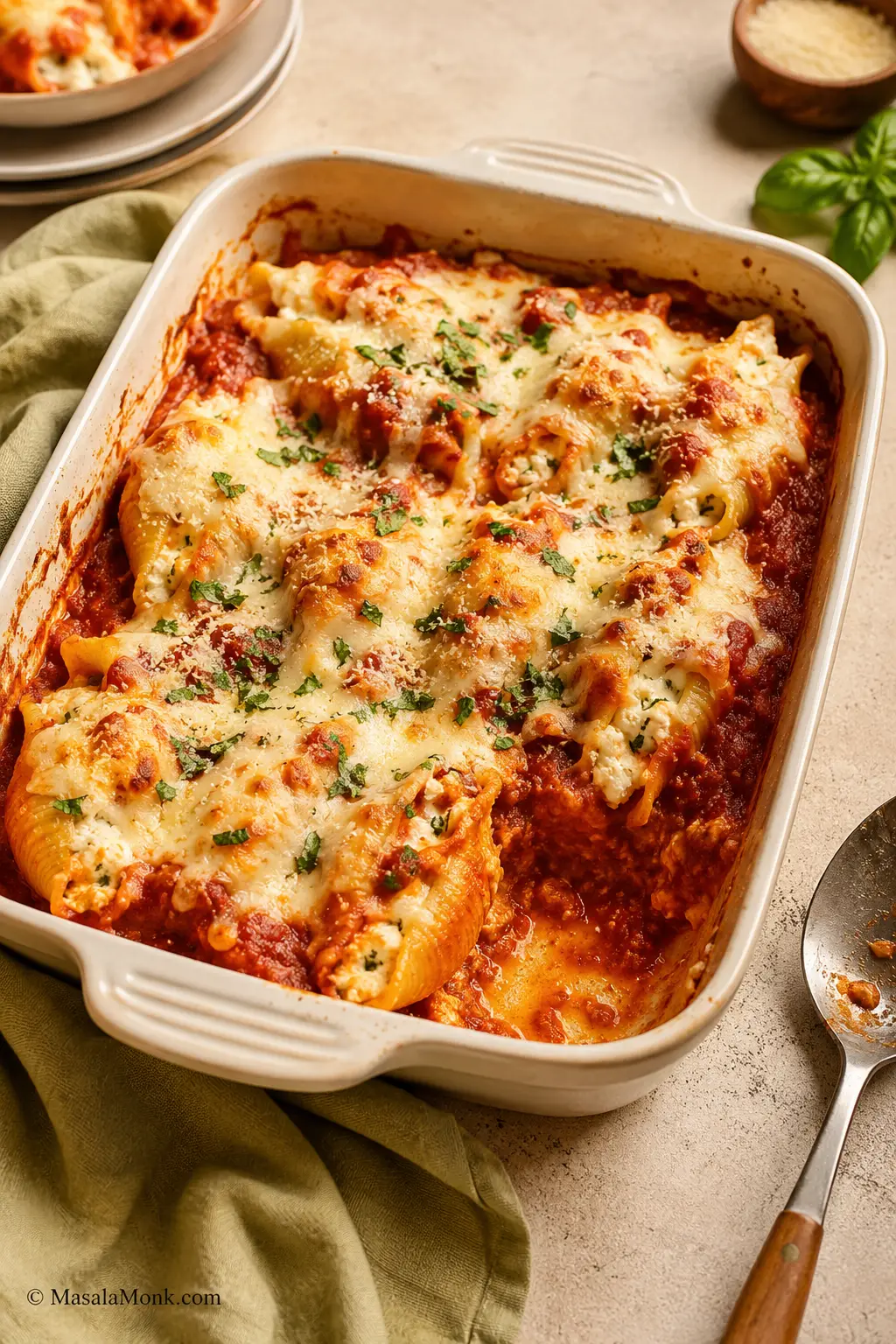
Baked ricotta stuffed shells with marinara sauce and melted mozzarella in a cream baking dish.

Stuffed shells are the kind of baked pasta that makes the table feel full before anyone even sits down: tender jumbo shells, creamy ricotta filling, tomato sauce bubbling around the edges, and mozzarella melted over the top. They give you lasagna-level comfort without all the layering, and the recipe is much more forgiving than it looks.

This version is built to avoid the usual stuffed shell problems: loose ricotta filling, dry pasta edges, shells that turn mushy after baking, and a tray that looks good on top but tastes flat in the middle. Think of it as the no-dry-shell method: thick filling, enough sauce, a covered bake first, and tender shells all the way through.

It fits one classic 9×13-inch baking dish: about 20–24 filled jumbo shells, a seasoned ricotta-mozzarella filling, marinara under and over the pasta, and mozzarella melted on top. A few shells may tear while boiling. The first few you fill may look messy. That is normal. Once everything is tucked into sauce and baked until bubbling, nobody at the table can tell which ones were imperfect.

Stuffed Shells at a Glance

No long planning needed. Here is the quick version before you start.

  • Start with a 12 oz / 340g box of jumbo pasta shells, or enough to cook 28–30 shells.
  • Aim to fill about 24 shells. If your shells are very large, you may fit closer to 20–22 in the baking dish.
  • Mix 15–16 oz / 425–454g ricotta with mozzarella, parmesan, egg, garlic, herbs, salt, and pepper.
  • Use about 3 cups / 720ml marinara sauce, with sauce under and over the shells.
  • Bake at 375°F / 190°C for 25 minutes covered, then 8–10 minutes uncovered.
  • Rest for 5–10 minutes before serving so the filling settles and the shells lift more cleanly.

Boil, fill, sauce, cover, bake, rest — that is the whole recipe. This is also a good one to save because the base method stays the same even when the filling changes.

Quick answers: Yes, you boil the shells first for this version. Use about 3 cups sauce for one 9×13-inch baking dish. Egg helps the filling set, but you can skip it if you prefer a softer filling. Stuffed shells freeze best before baking.
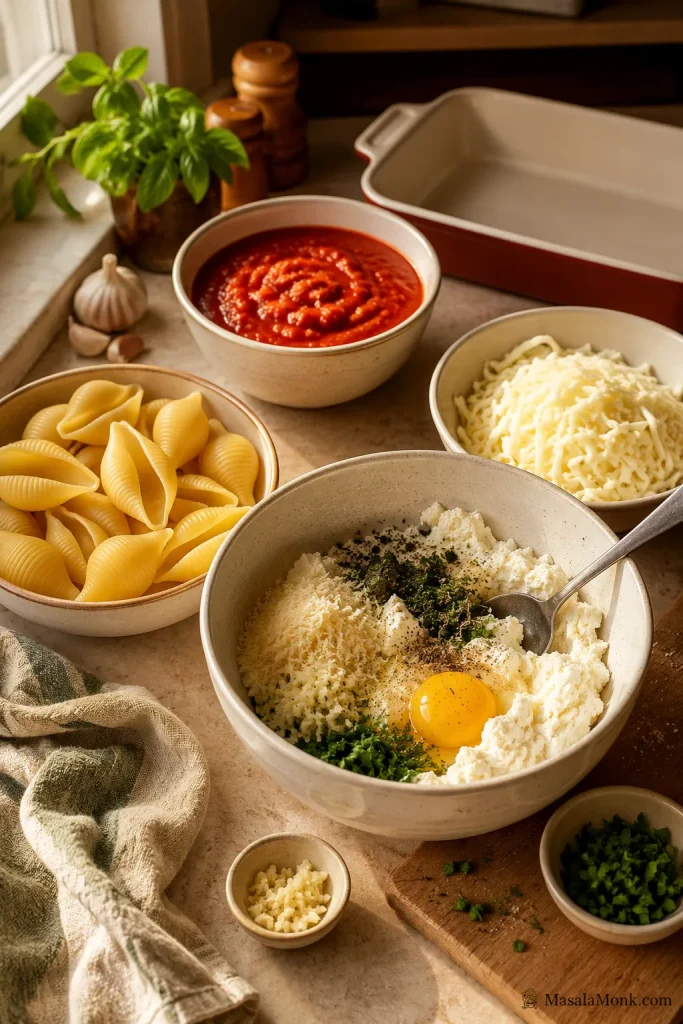
Jumbo pasta shells, ricotta, marinara sauce, mozzarella, parmesan, egg, garlic, herbs, and a baking dish on a kitchen counter.
Start with the essentials: jumbo shells, thick ricotta filling, marinara, mozzarella, parmesan, egg, garlic, and herbs.

Why This Stuffed Shells Recipe Works

This method is built around four small choices that make the biggest difference: undercook the shells slightly, keep the ricotta filling thick, use sauce under and over the pasta, and bake covered before browning the cheese.

  • Shells stay tender. Boiling them just shy of al dente keeps them flexible enough to fill, but firm enough to finish in the oven.
  • Filling stays creamy, not runny. Ricotta gives body, mozzarella gives melt, parmesan adds savory depth, and egg helps everything set.
  • Sauce protects the pasta. Marinara on the bottom keeps the shells from sticking, while sauce over and around the shells prevents dry edges.
  • A covered bake does the work. Foil traps heat and steam so the pasta finishes cooking gently before the cheese browns.
  • Flexibility is built in. Keep it classic, add spinach, stir meat into the sauce, swap in cottage cheese, or freeze a batch for later.

Best of all, the edge of the baking dish tells you dinner is almost ready: sauce bubbling up around the shells, little golden patches of mozzarella, and the smell of garlic, tomato, and browned cheese.
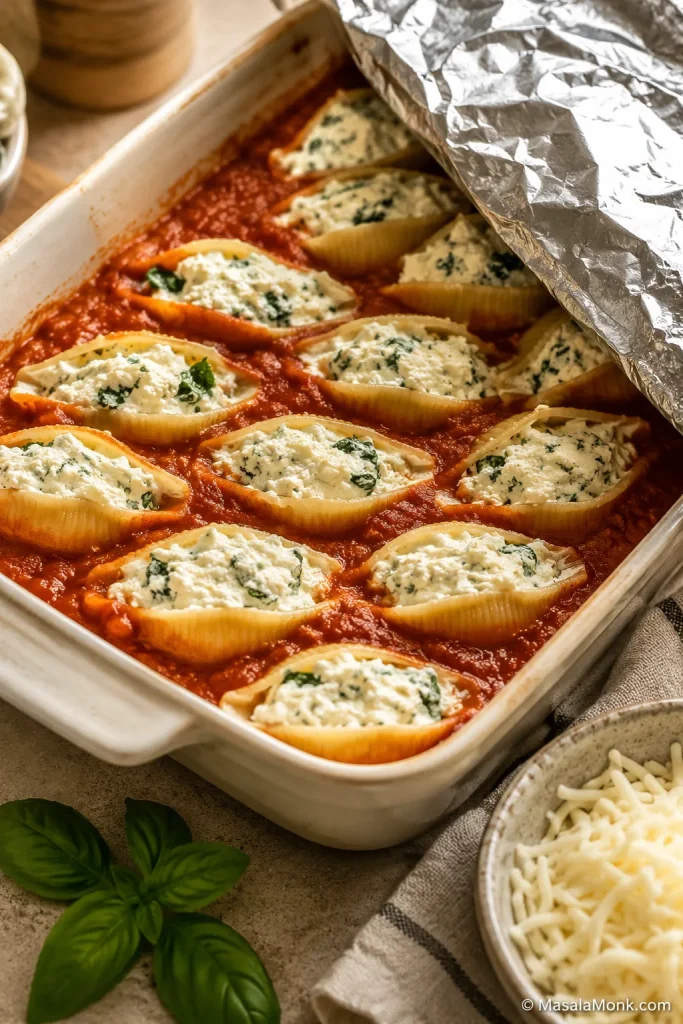
Filled jumbo shells sitting in marinara sauce with foil partly covering the baking dish before baking.
The no-dry-shell method is simple: sauce underneath, sauce around the edges, and foil on top for the first bake.

Ingredients You Need

Stuffed shells do not need complicated ingredients, but they do need the right balance: sturdy shells, thick ricotta filling, enough sauce, and mozzarella that melts without making the pasta watery.

Jumbo Pasta Shells

Choose a 12 oz / 340g box of jumbo pasta shells. These are the large shells made for stuffing, not small shell pasta or macaroni-style shells. Cook 28–30 jumbo shells for one baking dish, or cook the whole box if you like having extra backups.

Some shells will split or fold while boiling, so cook a few extras and move on. The sauce and cheese hide almost everything.

Ricotta Cheese

Use 15–16 oz / 425–454g ricotta cheese. Whole milk ricotta gives the creamiest filling. Loose or watery ricotta should be drained for 10–15 minutes in a fine-mesh strainer or on a few layers of paper towel before mixing. For the right texture, the ricotta filling section shows what the mixture should look like before stuffing.
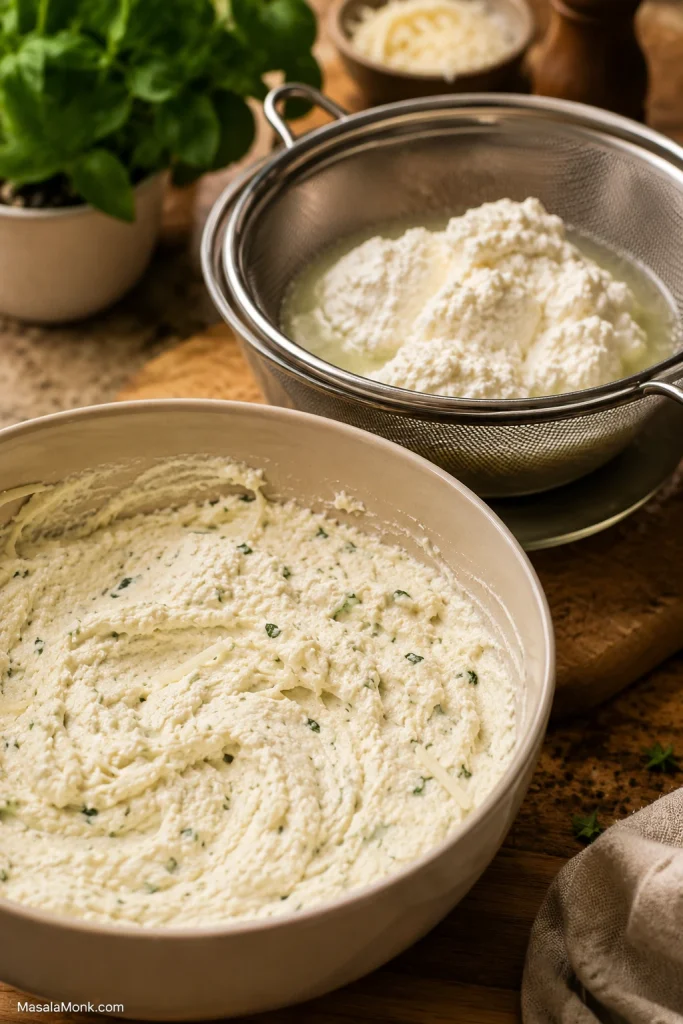
Ricotta draining in a fine-mesh strainer with thick cheese filling nearby.
Loose ricotta should be drained first; thick filling is what prevents watery stuffed shells after baking.

Mozzarella

You need 3 cups shredded low-moisture mozzarella, about 12 oz / 340g, divided between the filling and topping. Low-moisture mozzarella melts into the filling and gives the top a bubbly finish without watering down the pasta. Fresh mozzarella can be used on top in small amounts, but it is softer and wetter.

Parmesan or Pecorino

Use ½ cup / 45–55g grated parmesan or pecorino. Ricotta gives you the creamy center, but parmesan or pecorino is what makes the filling taste seasoned and savory instead of just milky.

Egg

One large egg helps bind the ricotta filling so it holds together after baking. You can skip it, but the filling will be softer. If you leave out the egg, add a little extra parmesan or mozzarella to help the filling hold.

Marinara Sauce

About 3 cups / 720ml marinara sauce gives one baking dish enough sauce for the bottom, top, and edges. A 24 oz / 680g jar is the practical shortcut and usually gives enough sauce for one batch. A good jarred marinara is not a shortcut to apologize for here; stuffed shells are mostly about enough sauce and a well-seasoned filling. If you want to make your own, this homemade marinara sauce gives you a classic base plus spicy, dipping, low-sodium, and sugar-free variations.

Very thick marinara benefits from 2–4 tablespoons of water before baking. If your jar is slightly short or extra thick, loosen it with a splash of water and save a little warm sauce for serving.

Garlic, Herbs, Salt, and Pepper

Ricotta needs seasoning. Garlic, Italian seasoning or fresh herbs, salt, pepper, and optional red pepper flakes make the filling taste like dinner instead of plain cheese. Use ½ teaspoon salt if your parmesan and sauce are already salty. Use closer to ¾ teaspoon if your ricotta is mild and your sauce is lower in salt.

Dried Italian seasoning is the easiest pantry option. Fresh parsley adds brightness, basil gives a sweeter flavor, and oregano gives the filling a stronger Italian-American note. Save fresh basil partly for the top after baking.

Optional Spinach

Either fresh or frozen spinach works; the real rule is to squeeze out as much moisture as possible. Wet spinach can turn a creamy filling loose and watery. For the full version, jump to spinach ricotta stuffed shells.

Optional Meat

The main recipe below is a classic cheese stuffed shells recipe, but cooked ground beef or Italian sausage can make the meal heartier. Brown the meat fully before adding it to the sauce or filling, then drain off excess fat so the pasta does not turn greasy. For the heartier version, see meat stuffed shells.

Tools That Help

You do not need special tools. A large pot, colander, mixing bowl, 9×13-inch / 23×33 cm baking dish, foil, and a spoon or zip-top bag are enough. A zip-top bag with one corner snipped off can make filling the shells faster and neater, but a spoon works perfectly well.

The first few shells are usually the messiest; by the fifth or sixth one, you will know exactly how much filling your shells can hold.

What Pasta Shells Should You Use?

Jumbo pasta shells are the shape you want here. They are large enough to hold ricotta filling and sturdy enough to bake in sauce. Small shells, medium shells, macaroni shells, and regular conchiglie are better for tossing with sauce, not stuffing.

Boil the shells 2–3 minutes shy of al dente. They should be flexible enough to open and fill, but not fully soft. Spread them on a tray to cool; rinse only if they are sticking badly or too hot to handle.

Depending on shell size and your baking dish, you may fit 20–24 filled shells. Aim for 24, but do not force them in. A slightly looser baking dish bakes better than crushed shells.
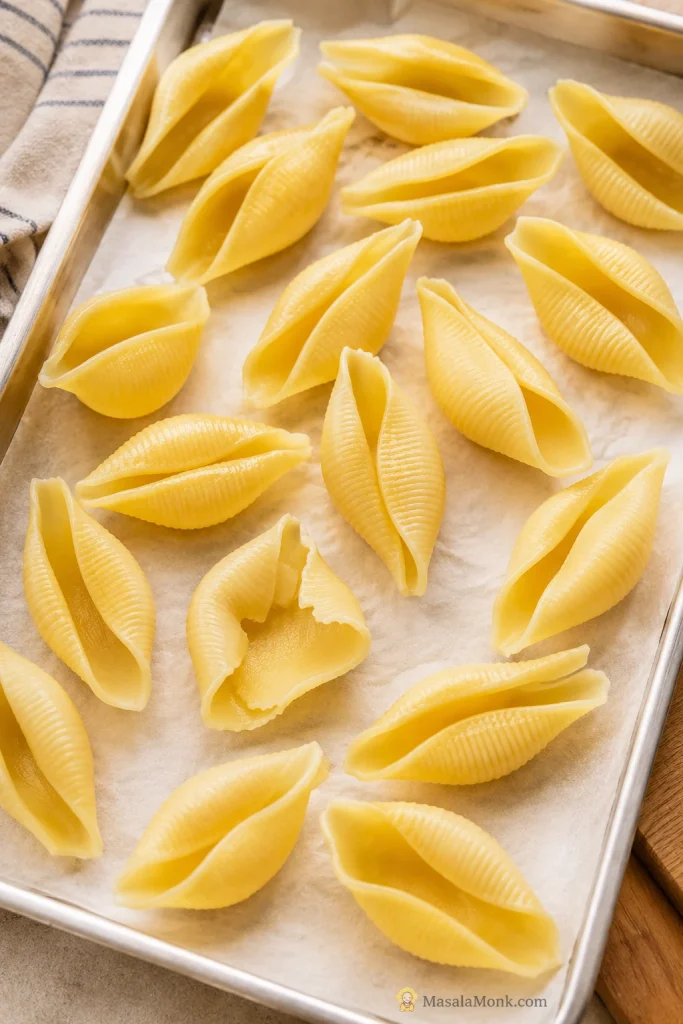
Cooked jumbo pasta shells spread on a tray with one torn shell visible.
Cook jumbo shells just shy of al dente and boil a few extras, because a torn shell or two is normal when stuffing pasta.

The Best Ricotta Filling for Stuffed Shells

The filling should look thick and scoopable, more like a cheese spread than a sauce. It should mound on a spoon without running off. If it spreads like sauce, it is too wet; if it feels dry or crumbly, a spoonful of ricotta or sauce will loosen it.

A good stuffed shells filling uses ricotta for creaminess, mozzarella for melt, parmesan or pecorino for savory depth, egg for structure, and garlic, herbs, salt, and pepper for flavor. To check the seasoning safely, mix the cheeses, garlic, herbs, salt, and pepper first, taste, then add the egg last.
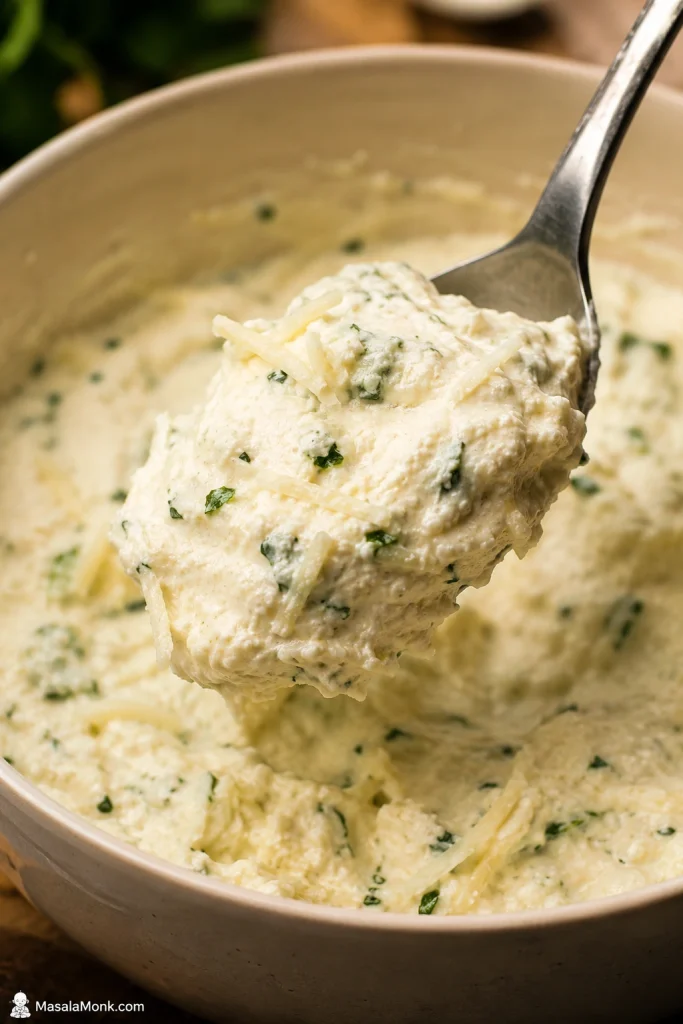
Thick ricotta cheese filling with herbs mounding on a spoon above a bowl.
A good ricotta filling should mound on a spoon, not drip, so it stays creamy inside each pasta shell.

Save This Stuffed Shells Filling Ratio

For one 9×13-inch baking dish, use:

  • 15–16 oz / 425–454g ricotta
  • 2 cups / about 225g mozzarella inside the filling
  • ½ cup / 45–55g parmesan or pecorino
  • 1 large egg
  • 1–2 garlic cloves
  • Herbs, salt, and pepper
  • 1 cup / about 115g mozzarella for the top

Once the filling looks thick and scoopable, you are in good shape.

How Much Sauce Do Stuffed Shells Need?

Use about 3 cups / 720ml marinara for one 9×13-inch baking dish. The shells should sit in sauce and have sauce spooned over and around them, but they do not need to be buried.

  • 1 cup / 240ml goes on the bottom of the baking dish
  • 1½–2 cups / 360–480ml goes over and around the filled shells
  • Extra warm sauce can be served on the side if you like a saucier plate

Before baking, you should still see the shape of each shell, but the edges should be surrounded by sauce.
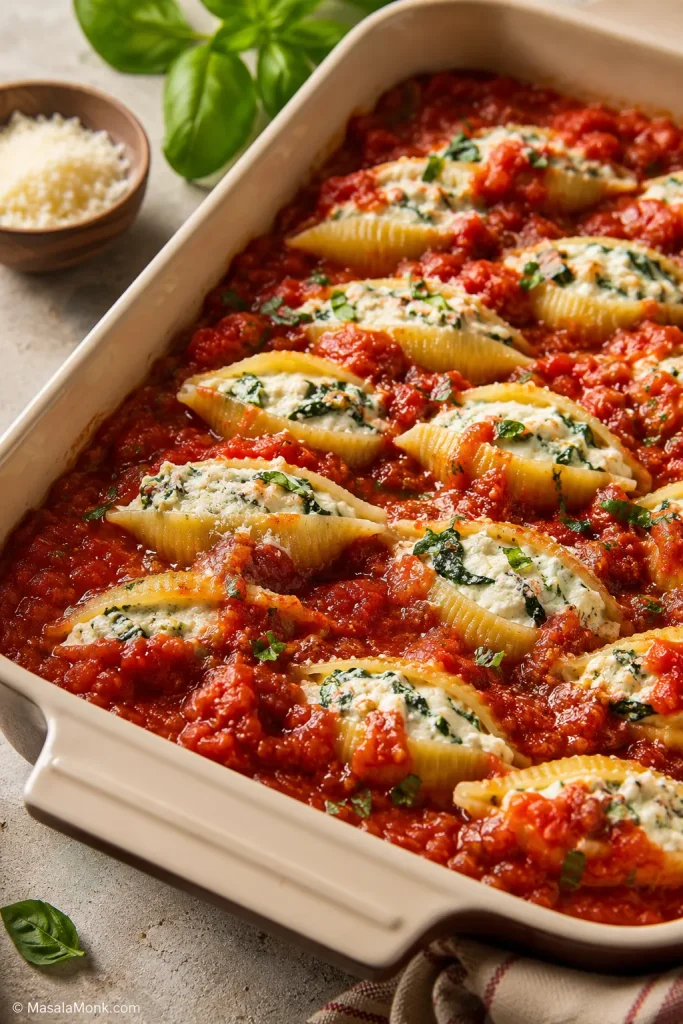
Filled stuffed shells in a baking dish with marinara sauce spooned around and between them.
The shells should stay visible, but the edges need enough marinara to finish tender instead of drying out.

How to Make Stuffed Shells

With the shells, filling, and sauce sorted, assembly is simple: sauce, filled shells, more sauce, cheese, foil, and oven. While the shells boil, mix the filling and spread sauce in the baking dish. By the time the shells are cool enough to handle, the filling and baking dish are ready.

1. Boil the shells

Bring a large pot of salted water to a boil. Add the jumbo shells and cook them 2–3 minutes less than the package says for al dente. Drain and let them cool until they are easy to handle.

2. Make the ricotta filling

In a large bowl, mix ricotta, 2 cups mozzarella, parmesan, egg, garlic, herbs, salt, pepper, and optional red pepper flakes. The filling should be creamy but thick enough to hold its shape on a spoon.

3. Add sauce to the baking dish

Spread about 1 cup of marinara sauce across the bottom of a 9×13-inch / 23×33 cm baking dish. This layer keeps the shells from sticking and protects the bottom of the pasta.

4. Fill the shells

Fill each shell with about 1½–2 tablespoons / about 30g of ricotta filling, depending on shell size. Use a spoon, piping bag, or zip-top bag. Fill generously, but not so much that the shells split. Do not worry if a little filling shows or the shells sit at slightly different angles.

A hand filling a jumbo pasta shell with ricotta mixture using a spoon.
Fill each shell generously, then stop before the pasta stretches or splits around the ricotta filling.

5. Arrange and sauce

Place the filled shells in the baking dish, filling-side up. Spoon the remaining sauce over and around the shells. You want the pasta to look full and well-coated, not dry or sparse.
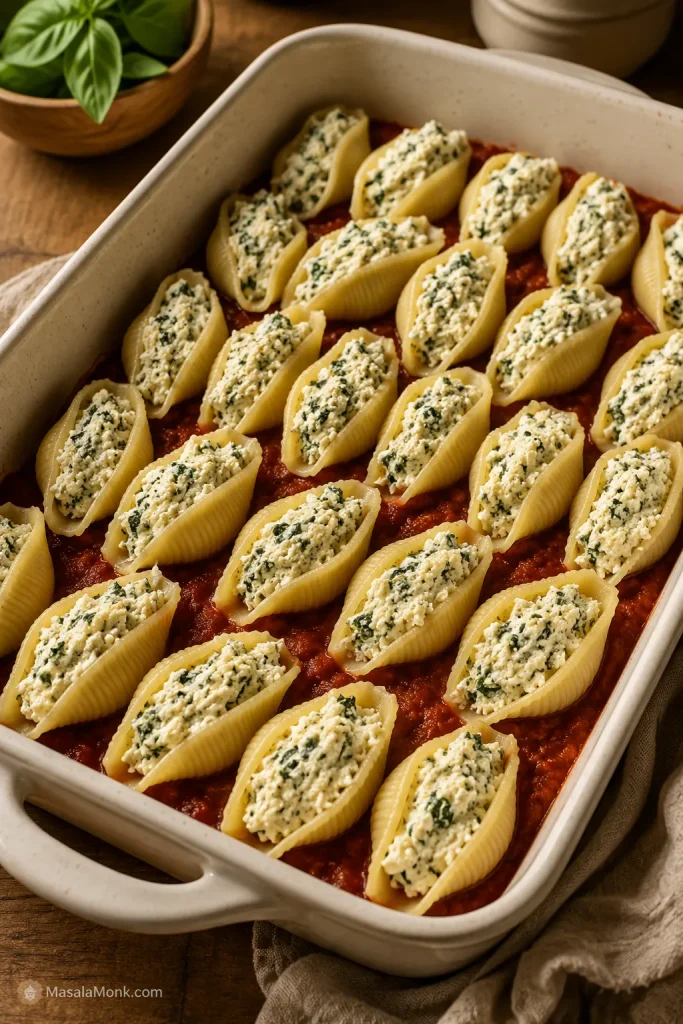
Ricotta-filled jumbo shells arranged in marinara sauce in a baking dish before baking.
Once the filled shells sit in sauce, cover the dish so the pasta can finish baking gently and evenly.

6. Bake covered, then uncovered

Cover the baking dish with foil without pressing it into the shells. If the foil may touch the sauce or cheese, place a sheet of parchment under the foil or tent the foil slightly. Bake at 375°F / 190°C for 25 minutes.
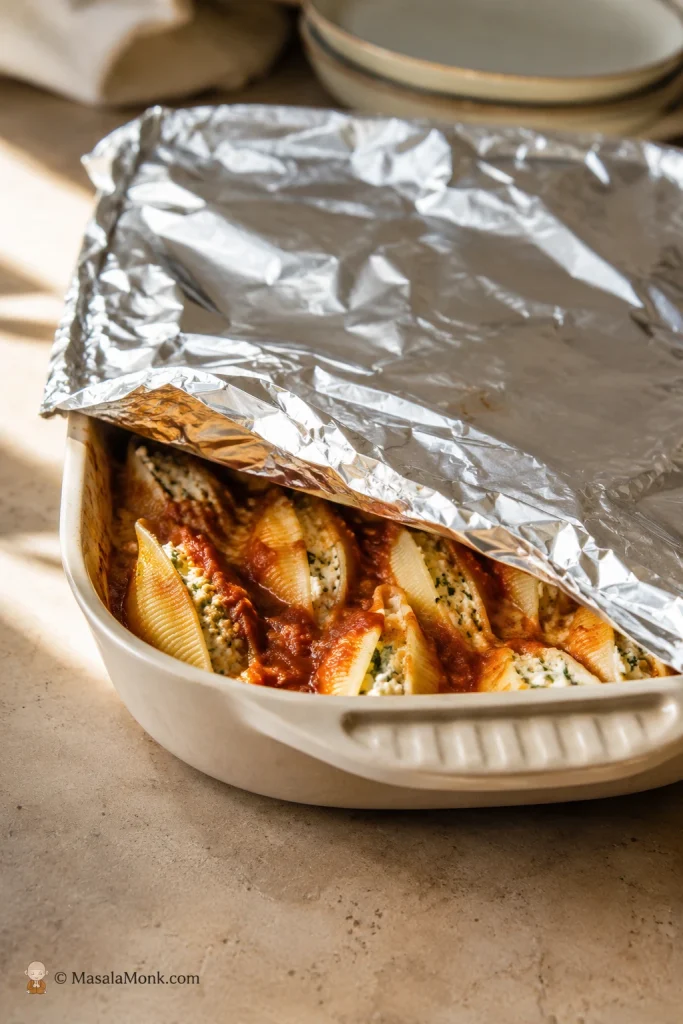
Stuffed shells in a baking dish loosely covered with foil before baking.
Foil traps steam during the first bake, which helps stuffed pasta shells stay soft and tender.

Remove the foil, sprinkle the remaining mozzarella over the top, and bake for another 8–10 minutes, until the cheese is melted and the sauce is bubbling. The uncovered bake is where the top gets those golden spots.
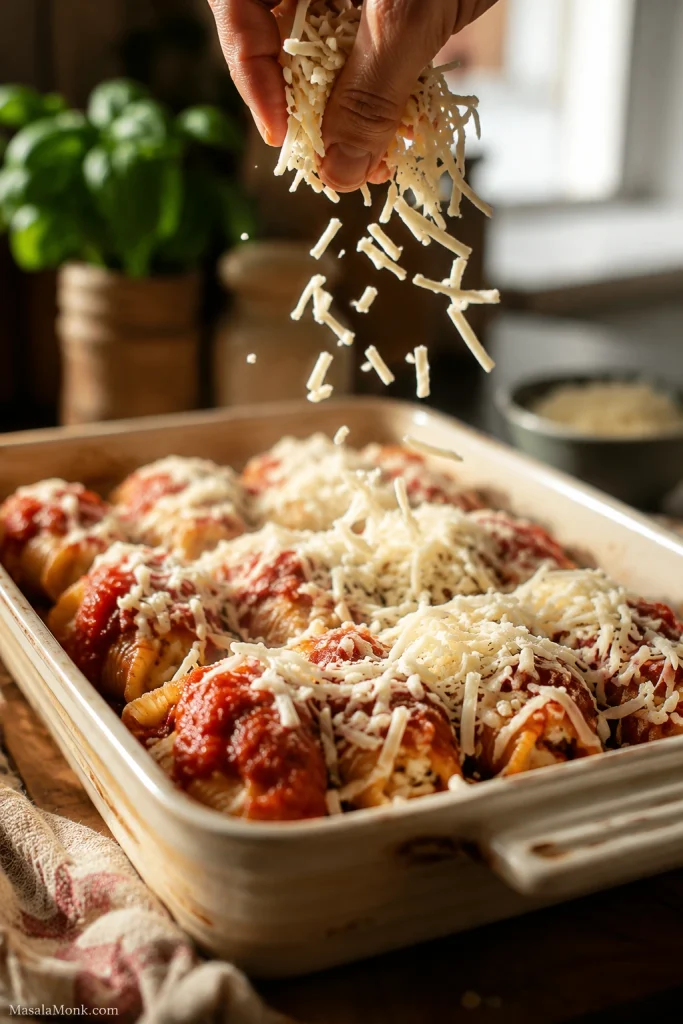
Shredded mozzarella being sprinkled over sauced stuffed shells in a baking dish.
Add mozzarella after the covered bake, then uncover the dish so the cheese melts and lightly browns.

7. Rest before serving

Let the stuffed shells rest for 5–10 minutes before serving. This is the hardest part because it smells ready, but the short rest makes serving much cleaner. After resting, the shells should lift from the baking dish without spilling all their filling.
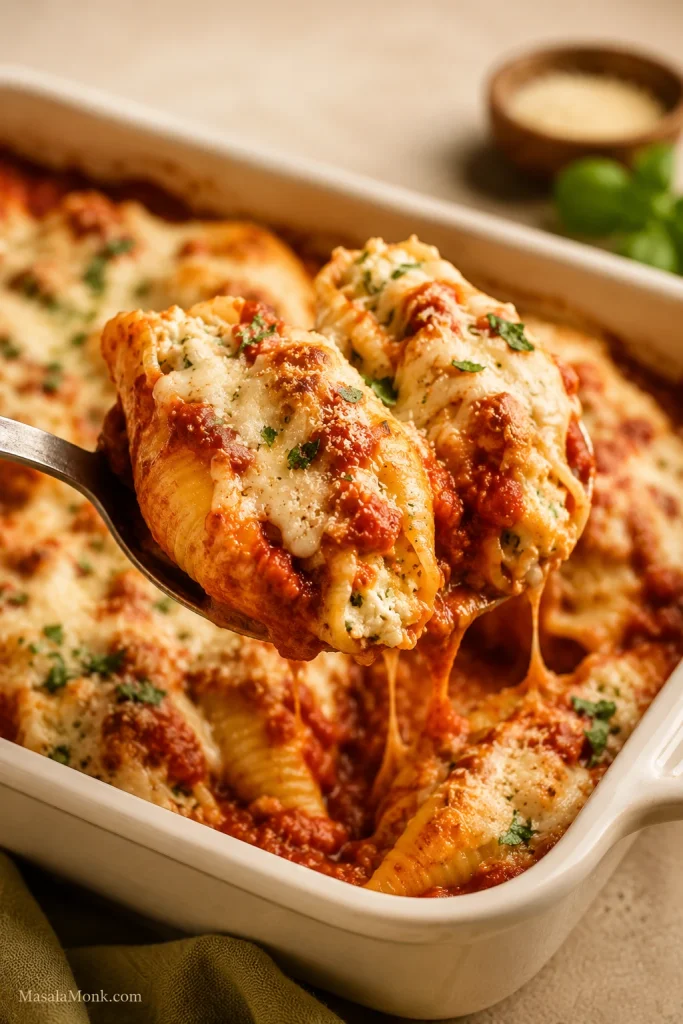
Rested stuffed shells being lifted from a baking dish with sauce and melted cheese.
Rest baked stuffed shells before serving so the filling settles and each shell lifts cleanly from the sauce.

How to Know When Stuffed Shells Are Done

The stuffed shells are done when the sauce is bubbling around the edges, the cheese is melted and lightly browned in spots, and the filling is hot in the center. The best bite is fork-tender pasta, thick ricotta filling, tangy tomato sauce, and a little golden mozzarella from the top.
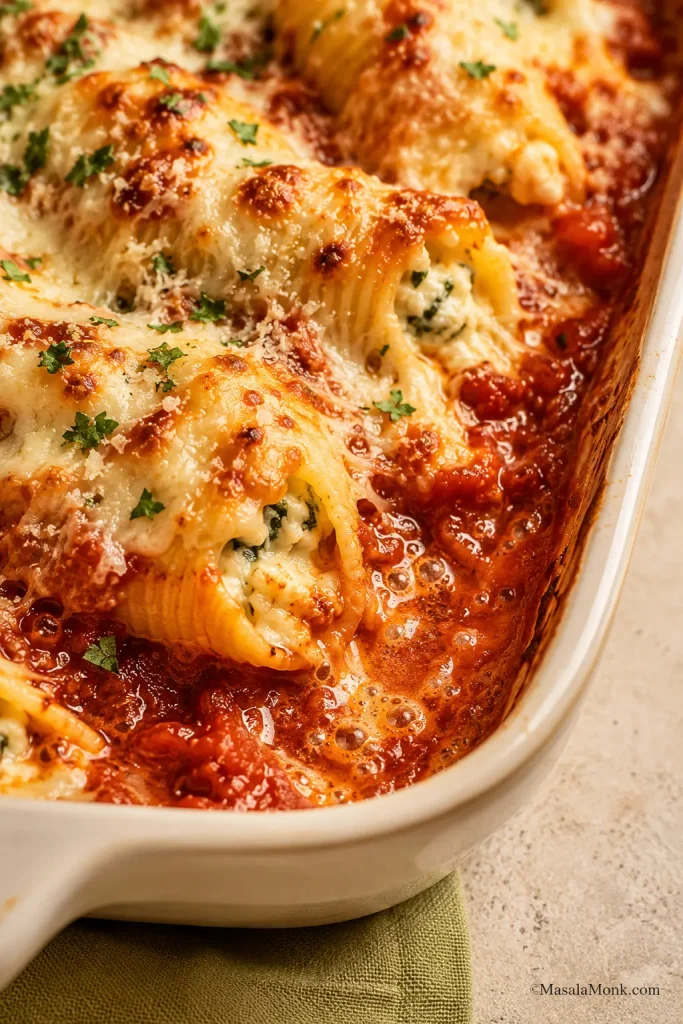
Close-up of baked stuffed shells with bubbling marinara sauce and browned mozzarella at the edge of the baking dish.
Check the edge of the baking dish: bubbling sauce and melted cheese mean the shells are hot through the center.

If the top cheese browns before the center is hot, cover the pasta loosely with foil again and keep baking until the filling is hot through the middle.

Stuffed Shells Recipe

This is the full classic version: jumbo shells filled with seasoned ricotta, tucked into marinara, covered until tender, then finished uncovered so the mozzarella melts into golden spots.

  • Yield:
    6 servings
  • Prep time:
    30 minutes
  • Cook time:
    35 minutes
  • Total time:
    1 hour 5 minutes
  • Oven temperature:
    375°F / 190°C
  • Baking dish:
    9×13-inch / 23×33 cm

Ingredients

  • 12 oz / 340g jumbo pasta shells, or enough to cook 28–30 shells
  • 3 cups / about 720ml marinara sauce, or one 24 oz / 680g jar, divided
  • 15–16 oz / 425–454g ricotta cheese
  • 3 cups shredded low-moisture mozzarella, about 12 oz / 340g, divided
  • ½ cup / 45–55g grated parmesan or pecorino
  • 1 large egg
  • 1–2 garlic cloves, minced or grated
  • 1 tsp dried Italian seasoning, or 2–3 tbsp chopped fresh parsley or basil
  • ½–¾ tsp salt, plus more for pasta water
  • ¼–½ tsp black pepper
  • Pinch of red pepper flakes, optional
  • A few drops of olive oil, only if needed to keep cooked shells from sticking

Instructions

  1. Heat the oven. Preheat the oven to 375°F / 190°C.
  2. Cook the shells. Bring a large pot of salted water to a boil. Add 28–30 jumbo shells and cook 2–3 minutes less than the package directions for al dente. Drain and let cool until easy to handle. If the shells start sticking, spread them on a tray or toss with only a few drops of olive oil.
  3. Make the filling. In a large bowl, combine ricotta, 2 cups mozzarella, parmesan, garlic, Italian seasoning or herbs, salt, pepper, and red pepper flakes if using. Taste the cheese mixture before adding the egg, then mix in the egg last.
  4. Prepare the baking dish. Spread about 1 cup of marinara sauce over the bottom of a 9×13-inch / 23×33 cm baking dish.
  5. Fill the shells. Spoon about 1½–2 tablespoons / about 30g filling into each shell. Arrange the filled shells in the dish, filling-side up. Aim for 24 filled shells; if your shells are very large, 20–22 may fit better.
  6. Add sauce. Spoon the remaining marinara sauce over and around the shells. Cover the baking dish tightly with foil, tenting it slightly so it does not press into the cheese or filling.
  7. Bake covered. Bake for 25 minutes, until the shells are hot and the sauce is bubbling around the edges.
  8. Finish uncovered. Remove the foil, sprinkle the remaining 1 cup mozzarella over the top, and bake uncovered for 8–10 minutes, until the cheese is melted and lightly browned in spots.
  9. Rest and serve. Let the stuffed shells rest for 5–10 minutes before serving. Serve with extra warm marinara if you like a saucier plate.

Recipe Notes

  • Softer top cheese: Add all the mozzarella before covering and baking if you want a fully melted top.
  • Stretchier browned top: Save the final cup of mozzarella and add it after the covered bake.
  • Spinach shells: Add 5 oz / 140g cooked fresh spinach or 8 oz / 225–250g thawed frozen spinach, squeezed very dry.
  • Meat sauce version: Add ½–1 lb / 225–450g cooked ground beef or Italian sausage to the sauce, and increase sauce by ½–1 cup if the pasta looks dry.
  • Cottage cheese swap: Blend cottage cheese briefly for a smoother filling and drain it first if it looks watery.

Small Details That Make Better Stuffed Shells

  • Cook 28–30 shells. You need backups for the ones that tear.
  • Drain watery ricotta. Loose ricotta makes the filling run instead of mound.
  • Taste before adding egg. It is easier to fix bland filling before the egg goes in.
  • Loosen very thick marinara. A few tablespoons of water help the sauce move around the shells.
  • Cover first. The pasta finishes cooking in the sauce before the cheese browns.
  • Rest before serving. The filling firms slightly as it sits.

Make-Ahead, Freezer, and Reheating Instructions

Stuffed shells are one of the best baked pasta dinners to prepare ahead. The shells, filling, sauce, and cheese all hold up well, and a freezer batch feels like a future dinner already handled. This is also a good place to make two baking dishes: bake one tonight and freeze the second before baking.

Best Make-Ahead Option

Assemble the stuffed shells up to 24 hours ahead. Fill the shells, arrange them in sauce, cover tightly, and refrigerate. Let them sit at room temperature only while the oven preheats, about 20–30 minutes. If baking straight from the fridge, add 5–10 minutes to the covered baking time.
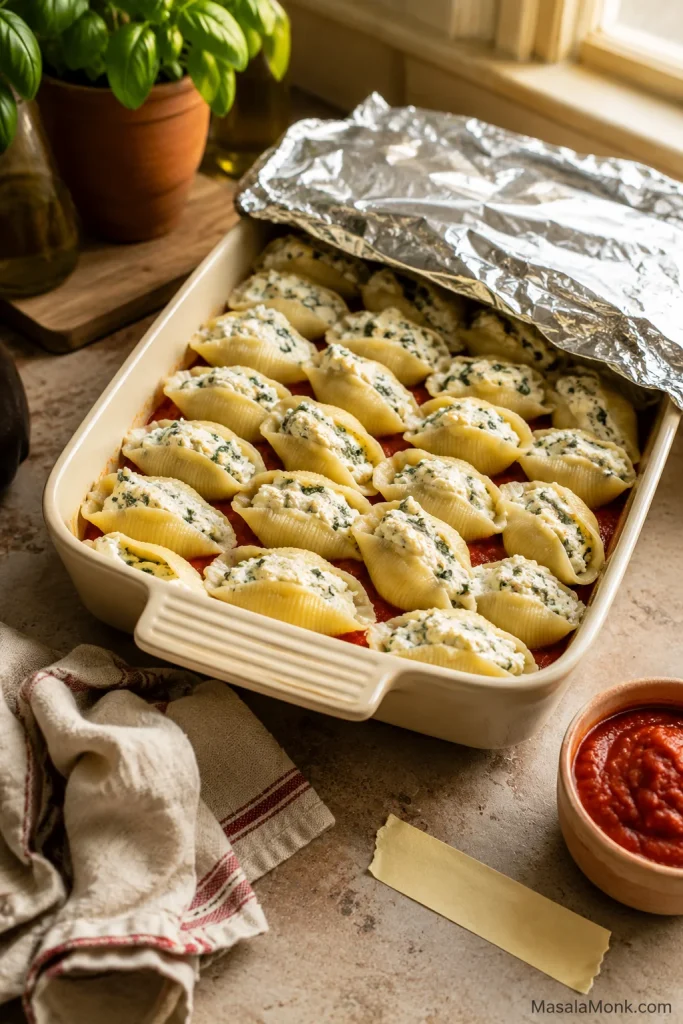
Unbaked stuffed shells in a baking dish partly covered with foil, with sauce nearby.
Stuffed shells are ideal for make-ahead dinners because you can refrigerate or freeze them before baking.

Best Freezer Option

Freeze stuffed shells before baking. Assemble the shells in a freezer-safe baking dish, cover tightly with plastic wrap and foil or a freezer-safe lid, and freeze for up to 2–3 months for best quality.

If you froze the shells in a glass or ceramic baking dish, thaw them overnight unless the dish is labeled freezer-to-oven safe. That helps prevent sudden temperature shock. You can also freeze the filled shells separately and transfer them to an oven-safe dish with sauce before baking.

Best Small-Batch Freezer Option

Freeze filled shells on a tray until firm, then transfer them to a freezer-safe bag or container. Later, place only the number of shells you need into a baking dish with sauce and cheese. This is useful when you want 2–4 servings instead of a full batch.
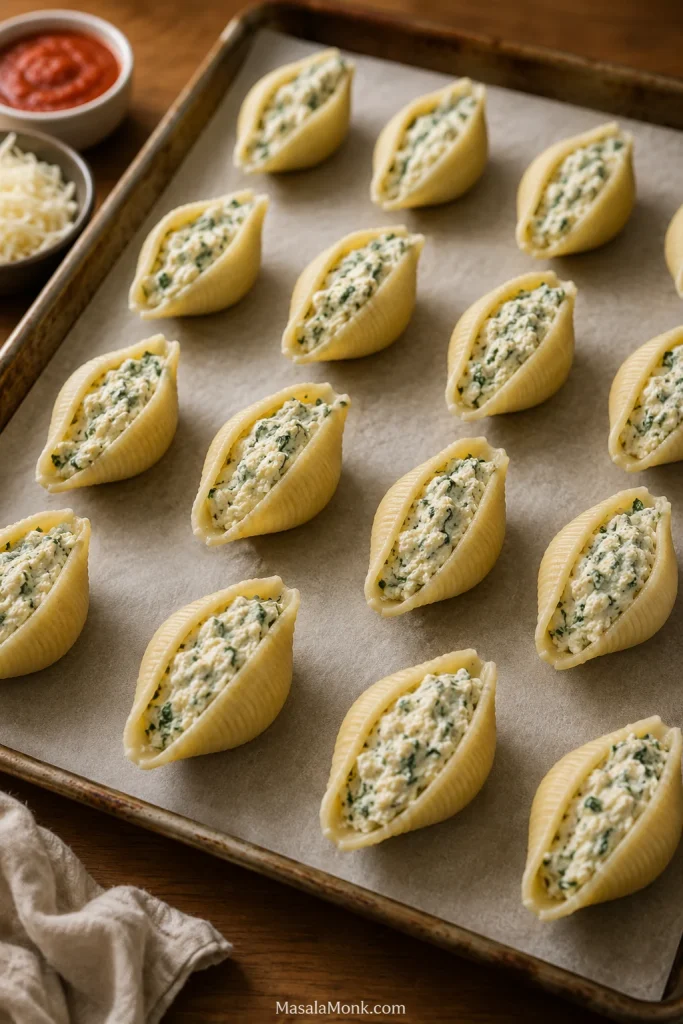
Ricotta-filled jumbo pasta shells spaced apart on a parchment-lined tray before freezing.
Freeze stuffed shells in a single layer first so they do not stick together; once firm, you can transfer them for easy small-batch freezer meals later.

Best Texture After Freezing

For the best texture, thaw frozen stuffed shells overnight in the refrigerator before baking. Before baking, remove any plastic wrap and cover the baking dish again with foil. Bake as directed, adding 5–10 extra minutes if the pasta is still cold.

How to Bake Frozen Stuffed Shells

To bake from frozen, cover the baking dish with foil and bake at 350°F / 175°C for about 60–75 minutes, or until the center is steaming hot. Uncover, add cheese if needed, and bake 10–15 minutes more until bubbling and melted.

How to Store Leftovers

Store leftover stuffed shells in an airtight container in the refrigerator for 3–4 days. A 3–4 day refrigerator window is also the general USDA guidance for cooked leftovers, so it is a good limit to use here.

How to Reheat Stuffed Shells

Reheat covered in the oven at 350°F / 175°C until hot, or microwave individual portions. Add a spoonful of extra sauce or a small splash of water before reheating so the pasta does not dry out.

Leftover Ideas

Leftover stuffed shells are best reheated with extra sauce, but you can also chop them into smaller pieces and reheat them like baked pasta. Add fresh herbs, parmesan, or a little extra marinara to wake the flavor back up. This is the sort of dinner that makes leftovers feel like a reward.

Stuffed Shells Variations

Think of the recipe card as the house version. The variations are how you adjust the pasta for the people eating it — greener for spinach lovers, meatier for Sunday dinner, lighter with cottage cheese, or richer with Alfredo.

Which Stuffed Shells Variation Should You Make?

Spinach Ricotta Stuffed Shells

Add spinach to the ricotta filling for a classic spinach stuffed shells variation. Fresh spinach and frozen spinach both work, but the spinach needs to be cooked, chopped, and squeezed very dry before it goes into the filling. Use about 5 oz / 140g fresh spinach or 8 oz / 225–250g frozen spinach.
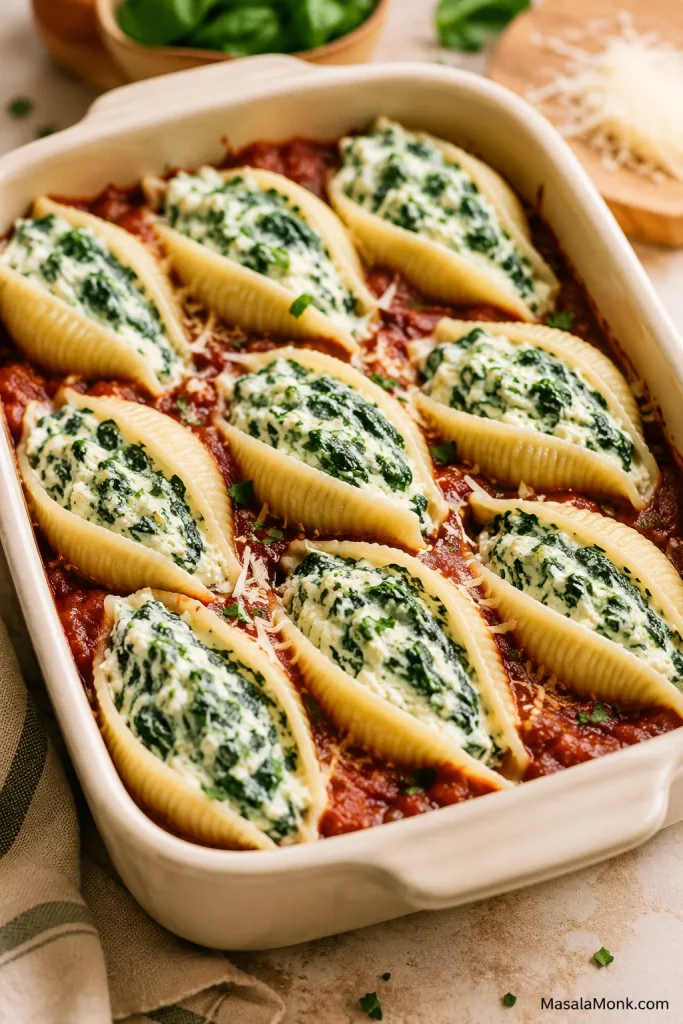
Spinach ricotta stuffed shells arranged in marinara sauce in a cream baking dish.
For spinach ricotta stuffed shells, squeeze the spinach dry so the filling stays creamy instead of watery.

Beef Stuffed Shells

For the cleanest shells, keep the ricotta filling mostly cheese-based and put the browned meat in the sauce. That gives every bite a hearty meat sauce without making the shells heavy or hard to close. Brown ½–1 lb / 225–450g ground beef with a little salt, pepper, garlic, and Italian seasoning, then drain excess fat before adding it to the marinara.

Sausage Stuffed Shells

Italian sausage brings more seasoning than ground beef, so it is the easiest way to make the sauce taste deeper. Remove it from the casing if needed, brown it well, and drain any excess fat. Sausage brings more salt and spice than plain ground beef, so taste before adding extra seasoning.
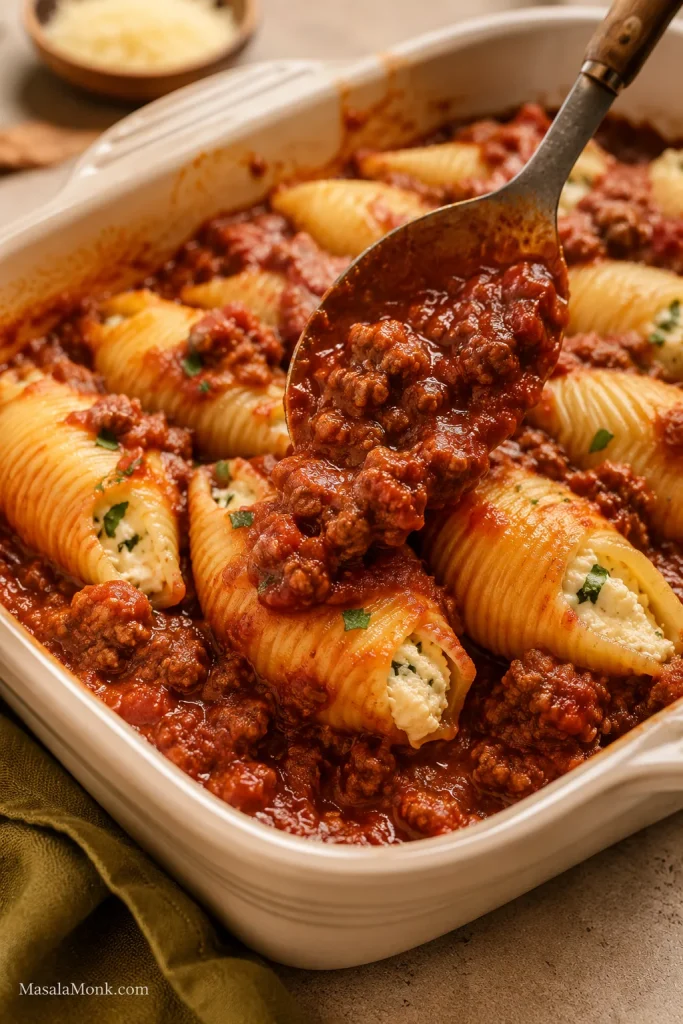
Ricotta stuffed shells with chunky beef or sausage marinara sauce spooned around them.
For meat stuffed shells, keep the cheese inside the pasta and stir browned beef or sausage into the marinara.

Cottage Cheese Stuffed Shells

Cottage cheese is the easiest ricotta swap and a good option if you want a lighter, higher-protein filling. Replace ricotta 1:1 by weight, drain it if watery, and blend it briefly for a smoother texture. The flavor is a little tangier and less classic than ricotta, but it bakes up creamy when mixed with mozzarella, parmesan, egg, garlic, and herbs.

Stuffed Shells Without Ricotta

If you do not have ricotta, use cottage cheese, a mix of cream cheese and mozzarella, a meat filling, roasted vegetables, or tofu ricotta for a dairy-free version. This helps if you dislike ricotta or simply do not have it. The recipe can still work well as long as the filling is thick and not watery.
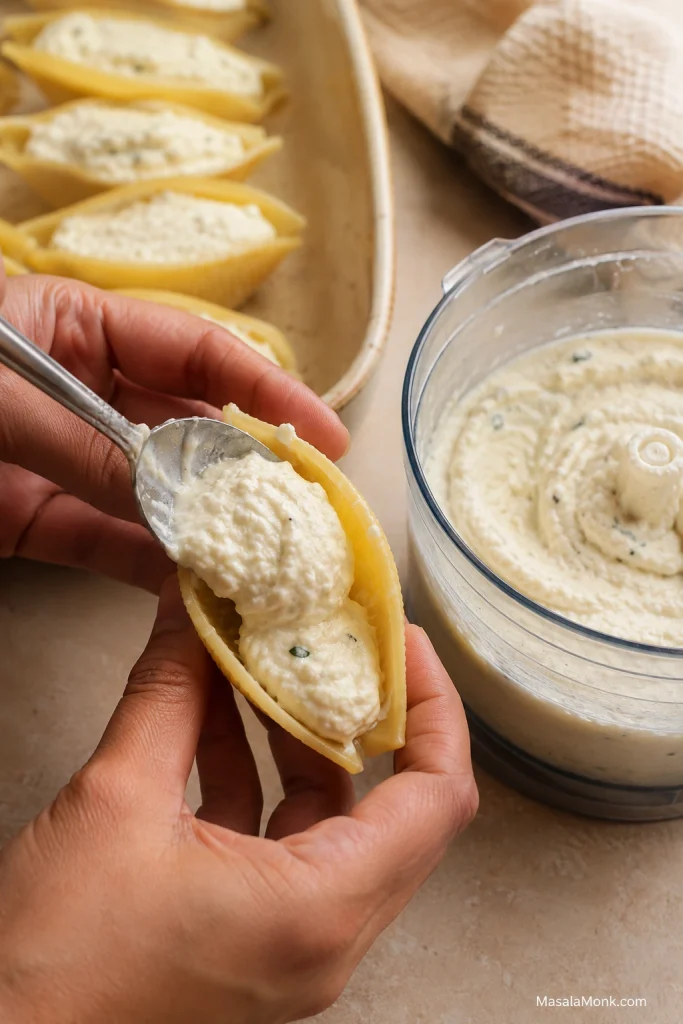
A jumbo pasta shell being filled with smooth blended cottage cheese mixture.
For stuffed shells without ricotta, blend cottage cheese until smooth so the filling holds its shape inside the pasta.

Alfredo Stuffed Shells

For a creamy white-sauce version, use Alfredo sauce instead of marinara. Because Alfredo is rich, spinach or chicken works especially well here. For more creamy pasta dinner ideas, see this chicken Alfredo pasta guide.
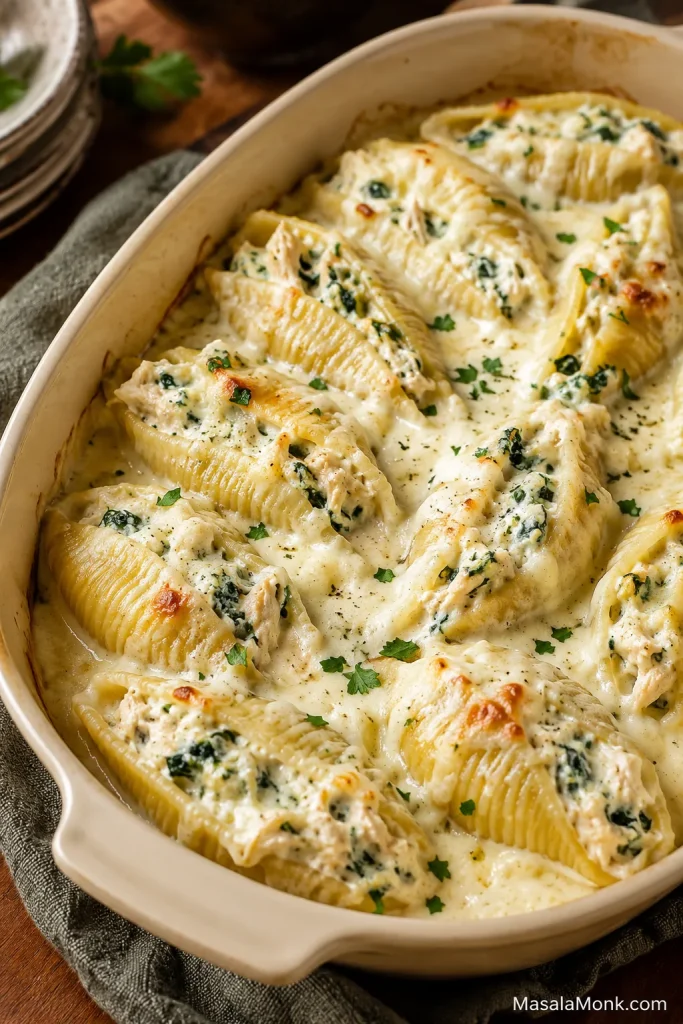
Alfredo stuffed shells with creamy white sauce, spinach, and melted mozzarella in a baking dish.
Alfredo stuffed shells are the creamy white-sauce variation to choose when you want spinach, chicken, or a richer pasta bake.

No-Boil Stuffed Shells

No-boil stuffed shells can work, but they need a different sauce ratio and a longer covered bake. This recipe is written for boiled shells because it gives the most predictable texture: shells that are flexible enough to fill, tender after baking, and less likely to stay firm in the center. If you want a true no-boil version, increase the sauce or liquid and keep the dish tightly covered until the pasta is fully tender.

Serving and Scaling

How Many Stuffed Shells Per Person?

Plan on 3–4 stuffed shells per adult if serving with salad, bread, or vegetables. Plan on 4–5 shells per person for a heartier main dish with fewer sides. A 9×13-inch baking dish with about 20–24 stuffed shells serves 6 people generously.
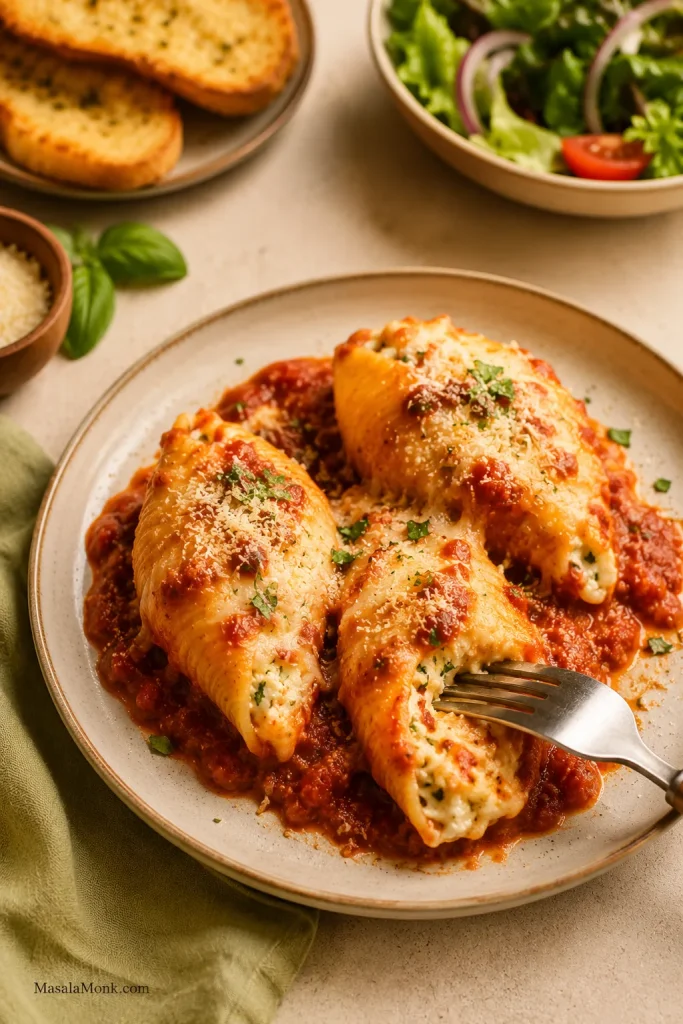
A plate of ricotta stuffed shells with marinara sauce, parmesan, herbs, and a fork.
For dinner portions, plan on three to four ricotta stuffed shells per adult with salad, garlic bread, or vegetables.

Can You Double This Recipe?

Yes. To double the recipe, use two 9×13-inch baking dishes instead of crowding everything into one deep dish. If baking both at the same time, rotate them halfway through if your oven has hot spots. If the pans are cold from the fridge, they may need a few extra minutes of covered baking time. You can also bake one now and freeze one for later.

What to Serve with Stuffed Shells

Stuffed shells are rich, cheesy, and well-sauced, so they pair best with something crisp, green, garlicky, or simple. On a weeknight, salad is enough. When serving company, add garlic bread and something fresh on the side.

Classic Comfort Sides

Light and Fresh Sides

  • Simple green salad with vinaigrette
  • Cucumber salad with vinegar, dill, and onion
  • Arugula salad with lemon

Extra Vegetable Sides

  • Roasted broccoli
  • Sautéed spinach or greens
  • Roasted zucchini or eggplant
  • Steamed green beans

Bigger Dinner Add-Ons

A fresh side can still feel filling: this chickpea salad brings lemon, herbs, cucumber, and crunch beside the cheesy shells.

Troubleshooting Stuffed Shells

Problem Cause Fix
Shells tear Overcooked or handled too hot Undercook slightly, cool, and boil extras
Shells stick Cooled in a pile Spread on a tray or use a few drops of oil
Filling is watery Wet ricotta or spinach Drain ricotta and squeeze spinach dry
Filling leaks Too much filling or loose filling Use about 30g filling per shell and keep filling thick
Shells are dry Too little sauce or uncovered too long Use sauce under and over; bake covered first
Edges dry out Not enough sauce near edges Spoon extra sauce around edges
Filling tastes bland Ricotta under-seasoned Add salt, parmesan, garlic, herbs, and pepper
Pasta is mushy Shells fully cooked before baking Boil 2–3 minutes shy of al dente
Top browns too fast Uncovered too long Cover loosely and keep baking
Frozen center is cold Covered bake too short Keep baking covered until center is hot
Cheese turns rubbery Overbaked or poor melting cheese Bake just until melted and use low-moisture mozzarella
Pasta looks watery Wet filling or vegetables Drain ingredients and rest before serving

If the shells or edges look dry after baking, spoon warm marinara around the pasta before serving. Sauce brings moisture back better than adding more cheese.
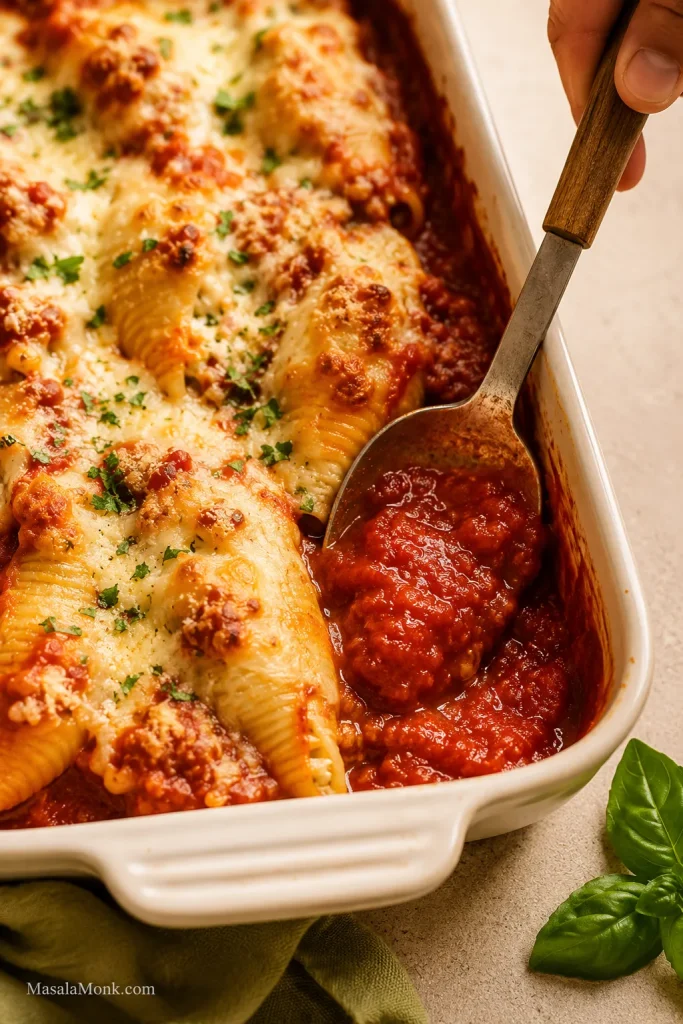
Extra marinara sauce being spooned around the edge of baked stuffed shells.
When the edges look dry, spoon warm marinara around the shells before serving to soften them again.

Frequently Asked Questions

A few common questions come up once you start adjusting the recipe. These quick answers should help you choose the right shells, filling, sauce, and make-ahead method.

What pasta shells do I use for stuffed shells?

Use jumbo pasta shells. Small shells, medium shells, and macaroni-style shells are not large enough for stuffing.

Do you have to boil shells before stuffing them?

For this version, yes. Boiling first gives you shells that are soft enough to fill but firm enough to finish in the oven. No-boil shells need more liquid and a longer covered bake.

What is the best cheese filling for stuffed shells?

The best classic filling uses ricotta, mozzarella, parmesan or pecorino, egg, garlic, herbs, salt, and pepper. Ricotta makes it creamy, mozzarella adds melt, parmesan adds depth, and egg helps it hold together.

Do I need egg in stuffed shells?

Egg helps the filling set so the shells lift more cleanly. You can skip it, but the filling will be softer. If skipping egg, add a little extra parmesan or mozzarella.

Can I use cottage cheese instead of ricotta?

You can replace ricotta 1:1 by weight, drain cottage cheese if watery, and blend it first if you want a smoother filling. The no-ricotta section gives more options.

Can I make stuffed shells without ricotta?

Yes — use cottage cheese, cream cheese mixed with mozzarella, a meat filling, roasted vegetables, or tofu ricotta. Keep the filling thick so it does not run out of the shells.

How much sauce do stuffed shells need?

For one 9×13-inch baking dish, use about 3 cups / 720ml sauce. Spread about 1 cup on the bottom and spoon the rest over and around the filled shells.

Do you bake stuffed shells covered or uncovered?

Bake them covered for most of the time so the pasta stays moist and the filling heats through. Uncover at the end to melt and lightly brown the cheese.

How do you keep stuffed shells from drying out?

Use sauce under and over the shells, cover the baking dish for the first bake, and reheat leftovers with extra sauce or a small splash of water. That is the same no-dry-shell method used in the main recipe.

Can I make stuffed shells ahead of time?

Yes. Assemble stuffed shells up to 24 hours ahead, cover, and refrigerate. The make-ahead section explains the timing and freezer options.

Can stuffed shells be frozen?

Freeze them before baking for the best texture, either as a full baking dish or as individual filled shells. Use within 2–3 months for best quality.

Can I bake stuffed shells from frozen?

You can bake them covered at 350°F / 175°C for 60–75 minutes, or until the center is hot. Then uncover and bake until the sauce bubbles and the cheese melts.

Can I add meat to stuffed shells?

Meat works best in the sauce, where it makes the dish heartier without weighing down the ricotta filling. Brown and drain the meat before adding it.

How many stuffed shells per person?

Plan on 3–4 stuffed shells per adult with sides, or 4–5 shells per person for a heartier main dish.

How long do leftover stuffed shells last?

Leftovers keep for 3–4 days and reheat best with extra sauce. Store them in an airtight container in the refrigerator and reheat until hot.

Make It Your Own

A good batch of stuffed shells should feel generous: pasta tucked into sauce, cheese bubbling around the edges, and enough filling in every shell that nobody feels shortchanged. The whole recipe comes back to the same simple method: thick filling, enough sauce, covered bake, tender shells.

This is the kind of tray that looks a little messy in the best way: sauce at the edges, cheese pulling from the spoon, and enough shells for someone to quietly go back for one more.
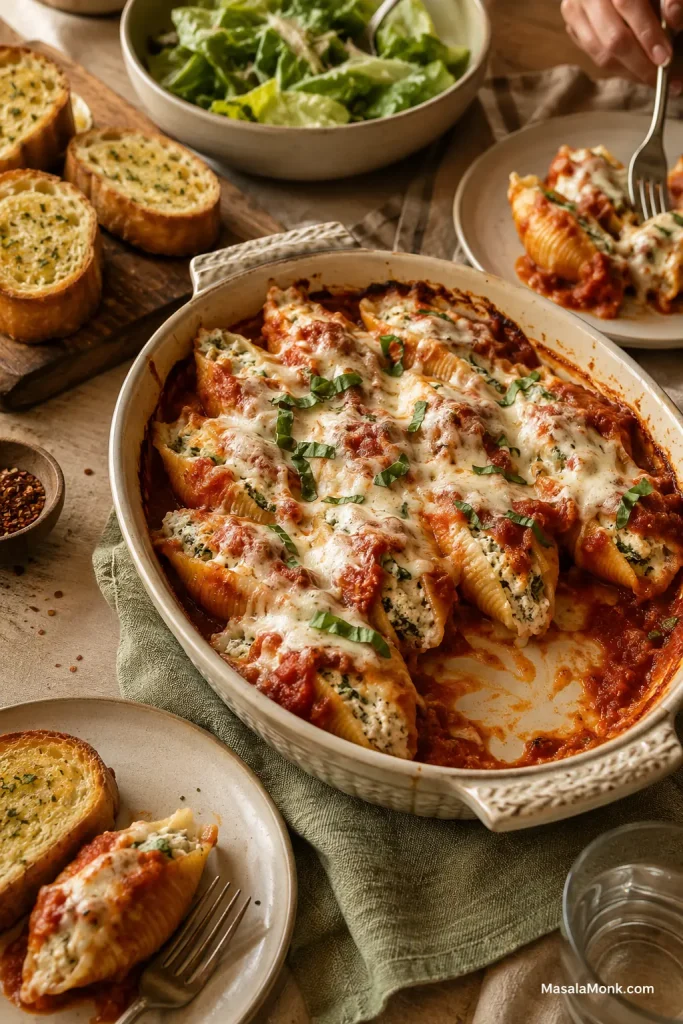
A family-style baking dish of stuffed shells served with garlic bread, salad, plates, and a fork.
Serve stuffed shells family-style with garlic bread and salad; this is the pasta bake people come back to for one more shell.

You can keep the recipe classic, add spinach, make it meaty with beef or sausage, swap in cottage cheese, use Alfredo sauce, or freeze a batch for another night. For another cozy pasta dinner after this one, save this broccoli pasta too.

If you make these stuffed shells, tell us which version landed on your table: classic ricotta, spinach, meat sauce, cottage cheese, Alfredo, or extra saucy. I especially want to know if you froze a batch for later — that is where this recipe really earns its keep.
Back to top ↑

Posted on Leave a comment

Ricotta Cheesecake Recipe

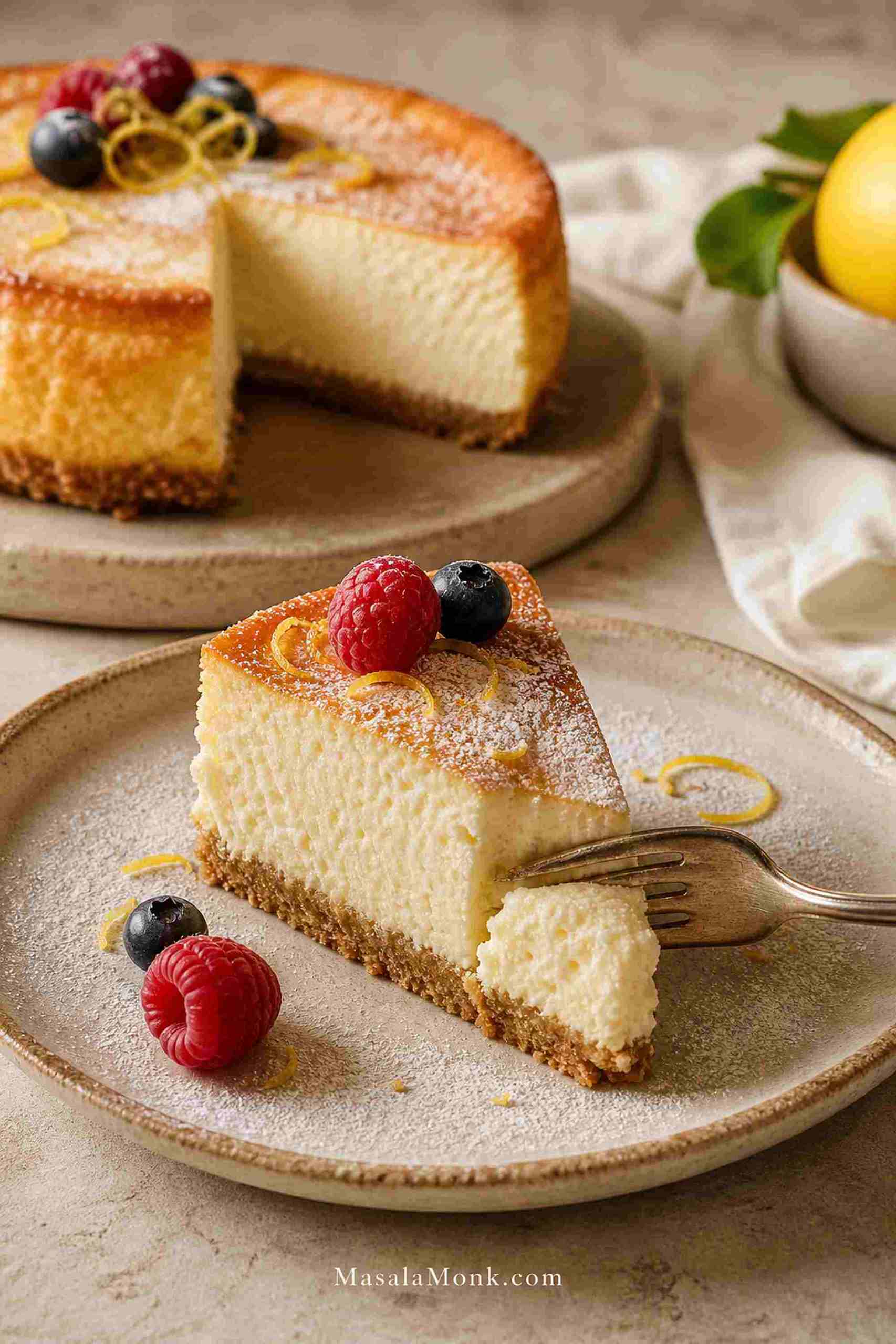
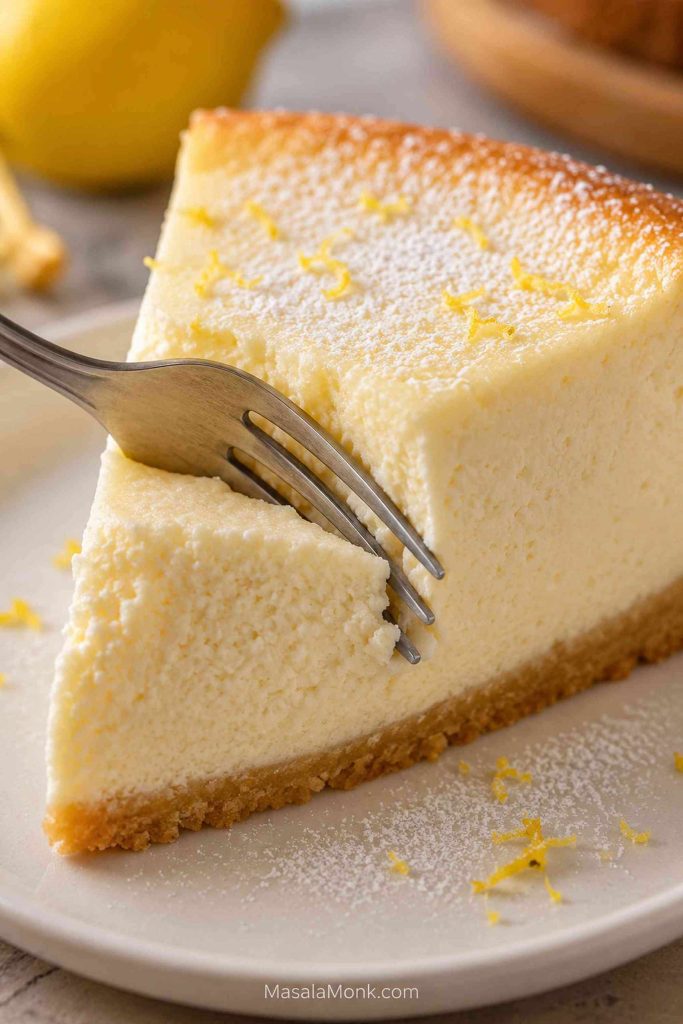
Ricotta cheesecake slice with crumb crust, lemon zest, berries, powdered sugar, and a fork cutting into the filling.

Ricotta cheesecake is the softer, lighter cousin of a dense New York cheesecake. A good slice is cool and creamy, gently citrus-lifted, just sweet enough, and tender on the fork without falling apart on the plate.

The tricky part is the ricotta. If the cheese is too wet, the filling can turn loose or weepy. If it is too grainy, the cheesecake can taste rough instead of silky. This ricotta cheesecake recipe is built for people who want real ricotta flavor without the heartbreak of a watery, crumbly, or gritty cake.

This is not the most rustic all-ricotta cheesecake, and it is not a heavy New York cheesecake with a little ricotta stirred in. It is the reliable middle version: ricotta-forward, creamy, sturdy enough to slice, and flexible enough to make with a crumb crust or as a lighter crustless dessert.

After a full chill, the slice should look clean at the edge but still feel soft under the fork, with vanilla, lemon, and ricotta coming through before the sweetness.

Close-up of a creamy ricotta cheesecake slice with a fork pressing into the soft filling
This is the texture to aim for: tender under the fork, softly creamy in the center, and lighter than a dense New York-style cheesecake.

Ricotta Cheesecake Guide

Use this guide to choose your cheesecake style, handle the ricotta properly, bake it gently, and chill it into a creamy, sliceable dessert.

Quick Answer: How to Make Ricotta Cheesecake

To make ricotta cheesecake, blend whole-milk ricotta and softened cream cheese until smooth, then mix in sugar, lemon zest, vanilla, salt, and eggs. Pour the filling into a 9-inch springform pan with an optional crumb crust, bake at 300°F / 150°C until the edges are set and the center still wobbles softly, then cool slowly and chill for at least 6 hours.

Think of this as the reliable home-baker version. Ricotta gives the cake its softer Italian-style character, while cream cheese gives the filling enough structure to cut cleanly after chilling.

Make it when you want a dessert that feels polished but not fussy: easy to prepare ahead, light enough after dinner, and still rich enough to feel special.

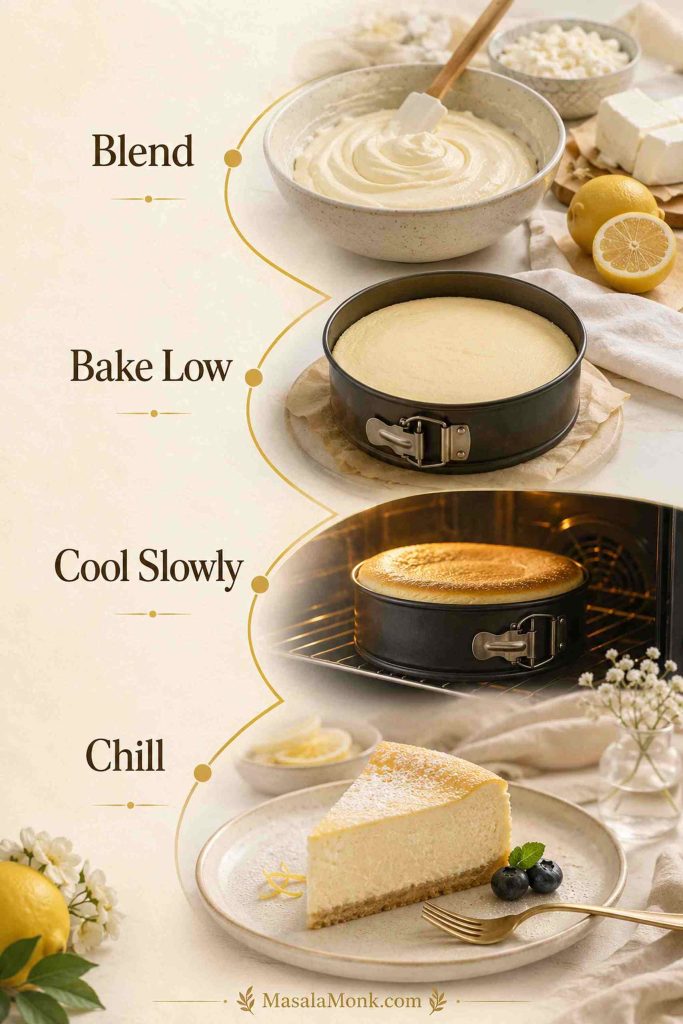
Four-step ricotta cheesecake guide showing blending, low baking, slow cooling, and chilling
The dependable path is simple: smooth the dairy first, use low heat, cool gradually, and give the filling enough time to settle before slicing.

Texture tip

Do not judge the cheesecake while it is warm. It should look slightly soft in the center when it leaves the oven. The filling finishes setting as it cools and chills, which is why overnight refrigeration gives the cleanest slices.

At a Glance

Think of this as a gentle baked cheesecake: steady heat, patient chilling, and a filling that should set softly rather than bake firm like a cake.

Style Baked ricotta cheesecake with cream cheese, lemon, vanilla, and optional crust
Best For A ricotta-forward cheesecake that feels lighter than classic cheesecake but still slices cleanly
Pan 9-inch / 23 cm springform pan
Oven 300°F / 150°C
Bake Time 85–95 minutes, depending on pan, oven, and ricotta moisture
Doneness Set edges, soft center wobble, about 150–155°F / 65–68°C in the center
Chill Time 6 hours minimum; overnight is best
Yield 10–12 slices

It should taste softly sweet, creamy, and lightly citrusy — more delicate than a classic cheesecake, but still satisfying.

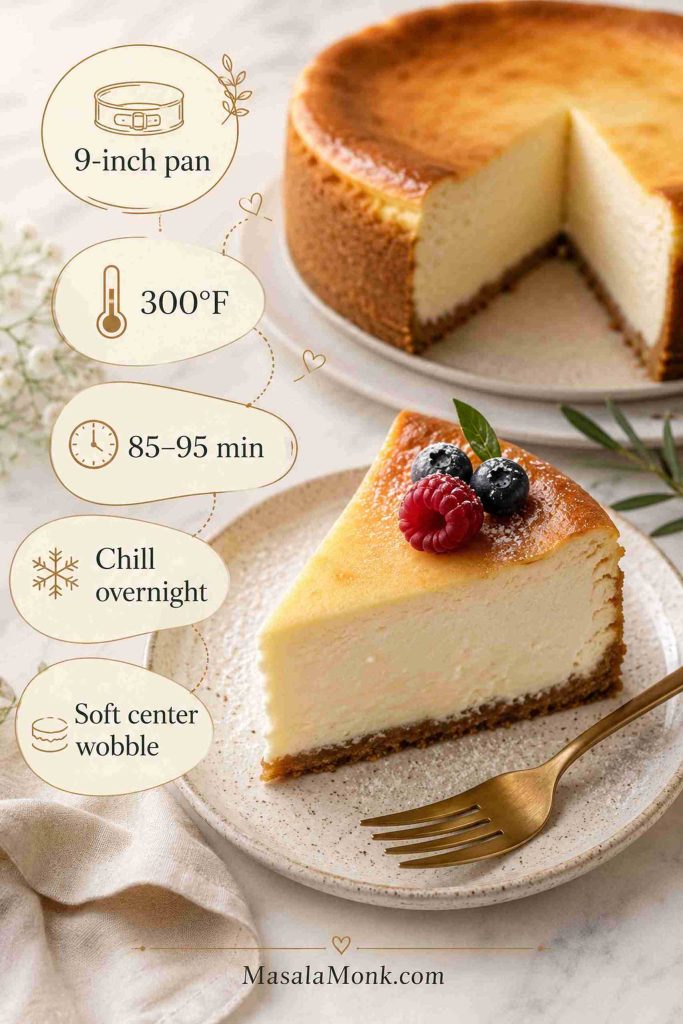
Ricotta cheesecake guide with pan size, oven temperature, bake time, chill time, and soft center wobble cues
Use the numbers as guardrails: a 9-inch pan, 300°F oven, soft center wobble, and overnight rest make the recipe easier to trust.

Why This Recipe Works

This recipe uses ricotta and cream cheese together because each one solves a different problem. Whole-milk ricotta gives the cheesecake its lighter Italian-style character, while cream cheese makes the filling smoother, richer, and easier to cut neatly.

The cream cheese is not there to hide the ricotta. It smooths the edges of the filling so the cheesecake keeps its soft dairy flavor, but still cuts like a dependable baked cheesecake.

The method is built around patience rather than fuss. Drain the ricotta only if it looks wet, blend the dairy before adding eggs, mix the eggs gently, bake with steady heat, then use the texture checkpoints before the cheesecake goes into the oven. None of the steps are difficult, but together they make the difference between a rough, weepy cheesecake and one that settles into a cool, creamy slice.

Problem Recipe Choice That Prevents It
Grainy filling Whole-milk ricotta, room-temperature dairy, and blending ricotta before eggs
Watery center Drain wet ricotta and bake until the center wobbles softly, not sloshes
Cracked top Low oven temperature, gentle egg mixing, and slow oven cooling
Dry cheesecake Pull the cheesecake before the center looks fully firm
Messy slices Overnight chill and slicing cold with a wiped knife
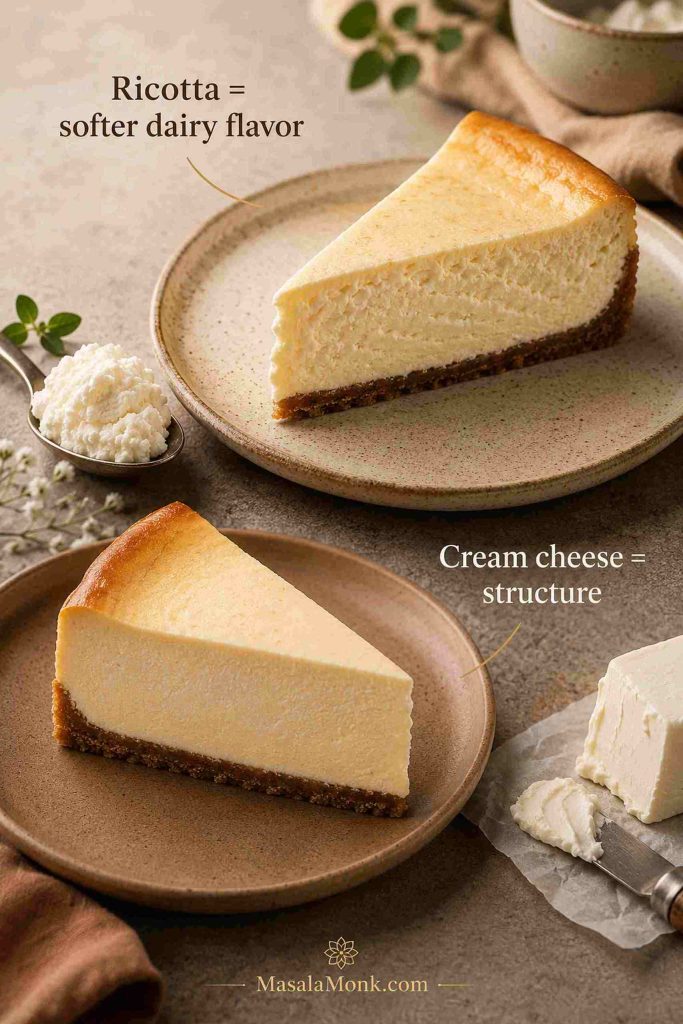
Ricotta and cream cheese cheesecake texture comparison with two cheesecake slices and dairy cues
Ricotta brings the soft dairy character, while cream cheese gives the filling enough structure to stand neatly on the plate.

What Is Ricotta Cheesecake?

Ricotta cheesecake is less one fixed recipe and more a family of desserts. Some versions are rustic and all-ricotta, some are creamy and cream-cheese-supported, some are crustless, and some move closer to ricotta pie.

This version sits in the middle: enough ricotta for a lighter dairy flavor, enough cream cheese for smoothness and structure, and enough lemon and vanilla to keep the filling bright without making it sharp.

If you like lighter dairy-based cheesecakes, it belongs in the same family as a cottage cheese cheesecake recipe, where the main challenge is also turning a textured dairy into a smooth, sliceable filling.

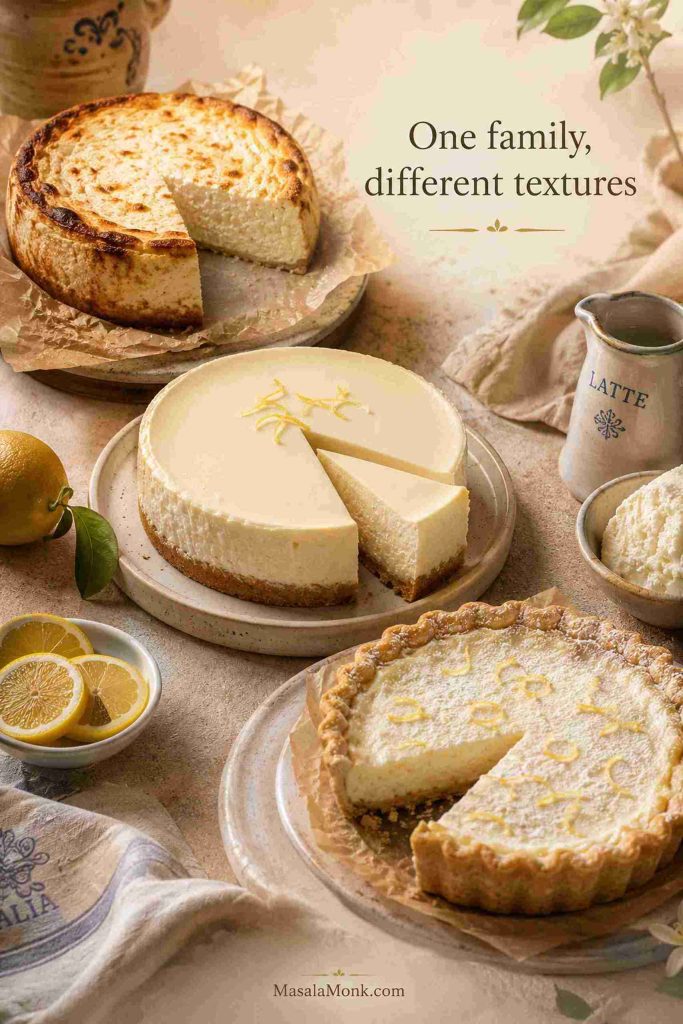
Three ricotta desserts showing rustic ricotta cheesecake, creamy ricotta cheesecake, and ricotta pie
Ricotta cheesecake can lean rustic, creamy, crustless, or pie-like; the difference usually comes down to dairy balance, pan style, and crust.

Ricotta Cheesecake vs New York Cheesecake

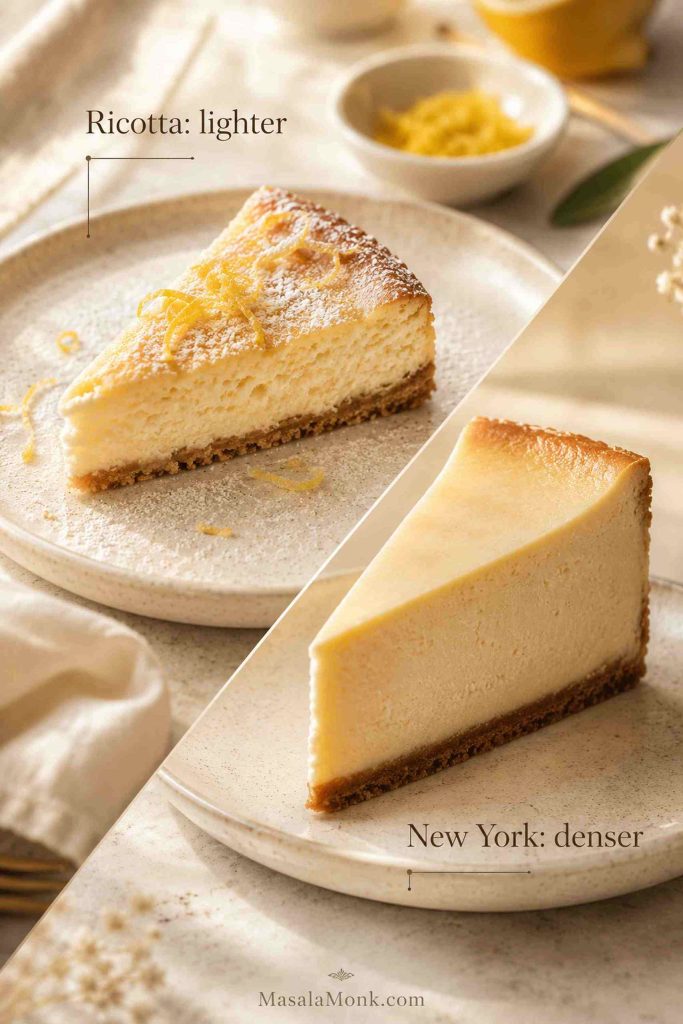
A New York cheesecake is dense, rich, and cream-cheese-forward. Ricotta cheesecake is lighter and a little more delicate, especially when lemon or vanilla is used. It can still be creamy and sliceable, but it should not feel as heavy as a classic New York-style cheesecake.

The biggest difference is texture control. With New York cheesecake, the goal is to avoid overbaking a dense cream cheese filling. With ricotta cheesecake, the ricotta itself matters more: if it is wet, gritty, or not blended well, the final slice will show it.

Feature Ricotta Cheesecake New York Cheesecake
Main dairy Ricotta with support from cream cheese or mascarpone Mostly cream cheese
Texture Lighter, softer, more dairy-forward Dense, rich, and tangy
Main risk Wet or grainy ricotta Overbaking, cracking, or heaviness
Best cue Thick ricotta, smooth batter, soft center movement Gentle bake, gradual cooling, full chill
Ricotta cheesecake slice compared with a denser New York cheesecake slice
Compared with New York cheesecake, ricotta cheesecake should feel gentler, less dense, and more dairy-delicate while still being sliceable.

Choose Your Ricotta Cheesecake Style

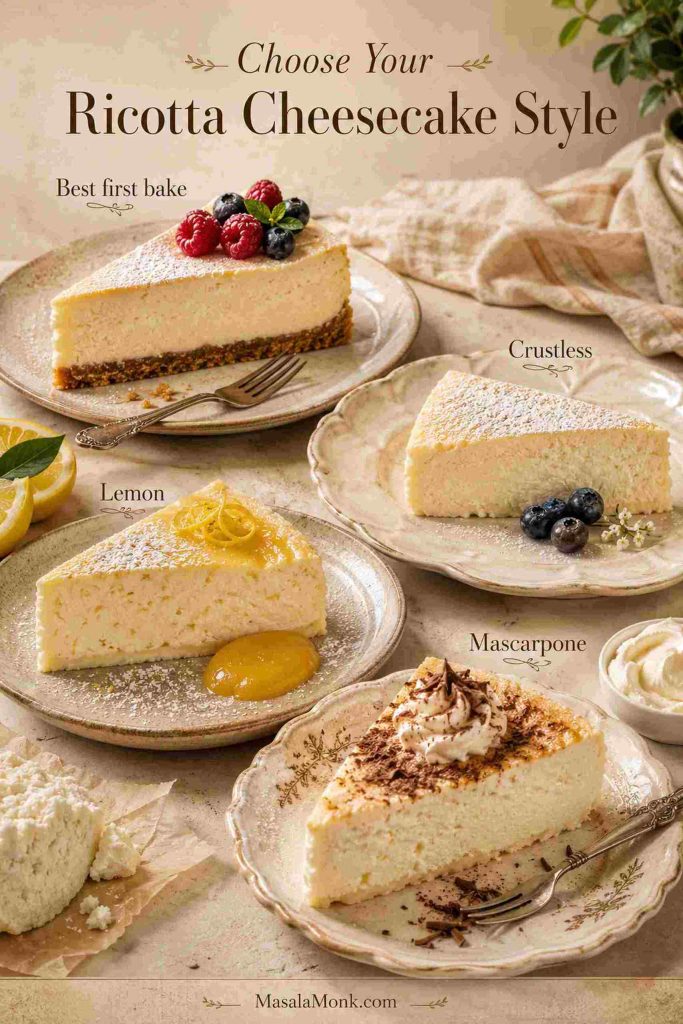
This is where ricotta cheesecake gets confusing: some recipes are crustless and rustic, some are creamy and cream-cheese-supported, some are lemon-forward, and some use mascarpone. None of those versions are wrong. They are just different styles.

The main recipe below is the safest starting point because it gives you ricotta flavor with enough structure to slice neatly. Once you know the base, you can move toward a lighter crustless cake, a brighter lemon version, or a softer mascarpone-style filling without losing the basic baking cues.

Which Version Should You Make?

Style Best For Texture Use This Recipe How?
Ricotta + cream cheese Best first bake Creamy, smooth, sliceable Use the main recipe
Crustless ricotta cheesecake Lighter Italian-style dessert More delicate, softer, less dense Skip the crust and chill fully
All-ricotta cheesecake Traditional or rustic ricotta flavor Lighter, more custardy, more ricotta-forward Use very thick whole-milk ricotta and drain if wet
Lemon ricotta cheesecake Brighter dessert flavor Creamy with more citrus lift Increase lemon zest and lemon juice slightly
Ricotta mascarpone cheesecake Softer Italian bakery-style version Rich, delicate, less tangy Replace cream cheese with mascarpone
Italian Easter / ricotta pie style Readers looking for ricotta pie or holiday ricotta desserts More custardy, often baked in a crust Use the ricotta pie comparison section

If you are choosing between a crumb base and a lighter version, start with the crust or no crust section before moving into the variation notes.

Four ricotta cheesecake styles showing classic, crustless, lemon, and mascarpone versions
Start with ricotta plus cream cheese for the safest first bake, then adjust toward crustless, lemon, or mascarpone once you know the texture you like.

Best Ricotta to Use

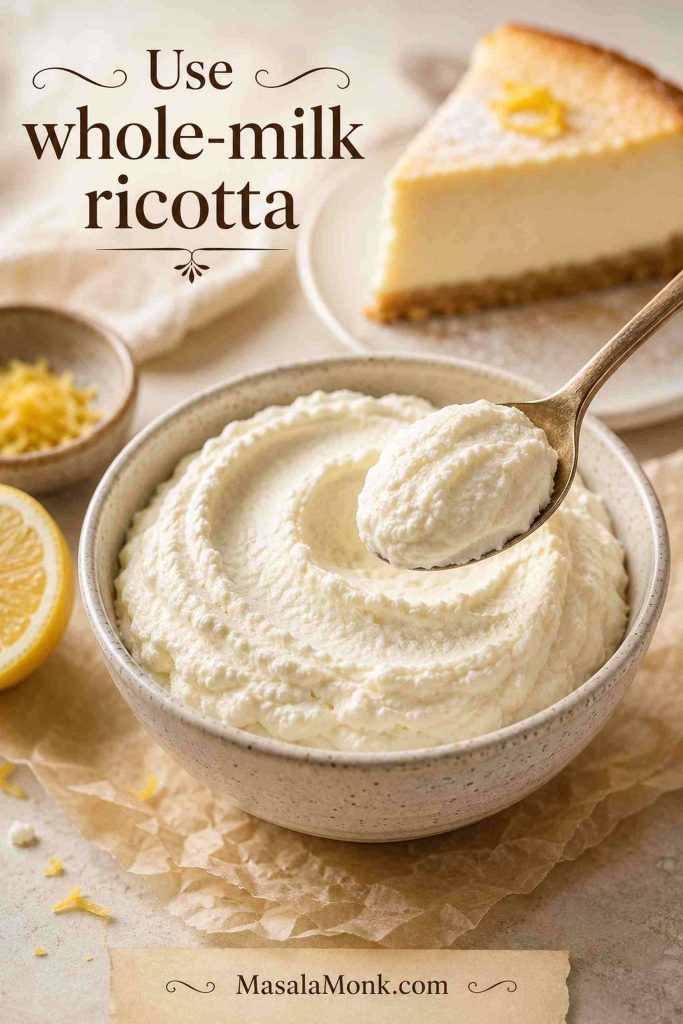
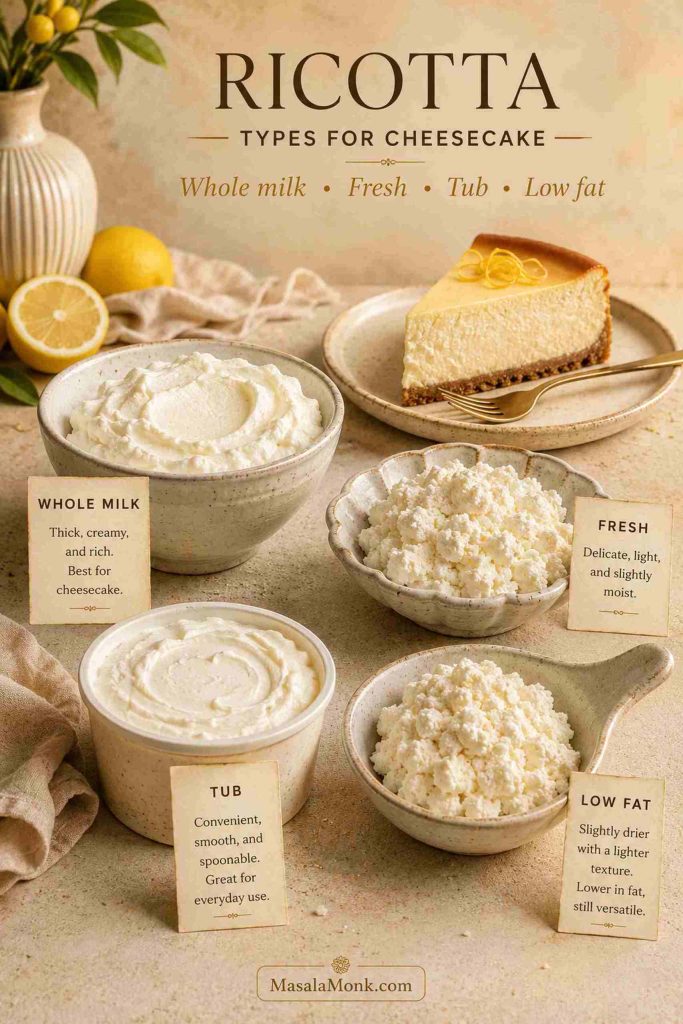
Use whole-milk ricotta for the best texture. It gives the filling body, richness, and a softer finish than low-fat ricotta. Fresh ricotta can be excellent, but it is sometimes wetter than supermarket tub ricotta, so check the texture before adding it to the batter.

Thick whole-milk ricotta on a spoon with a ricotta cheesecake slice in the background
Whole-milk ricotta is the best starting point, but texture still matters: choose a tub that looks thick, creamy, and spoonable.

The Spoon Test

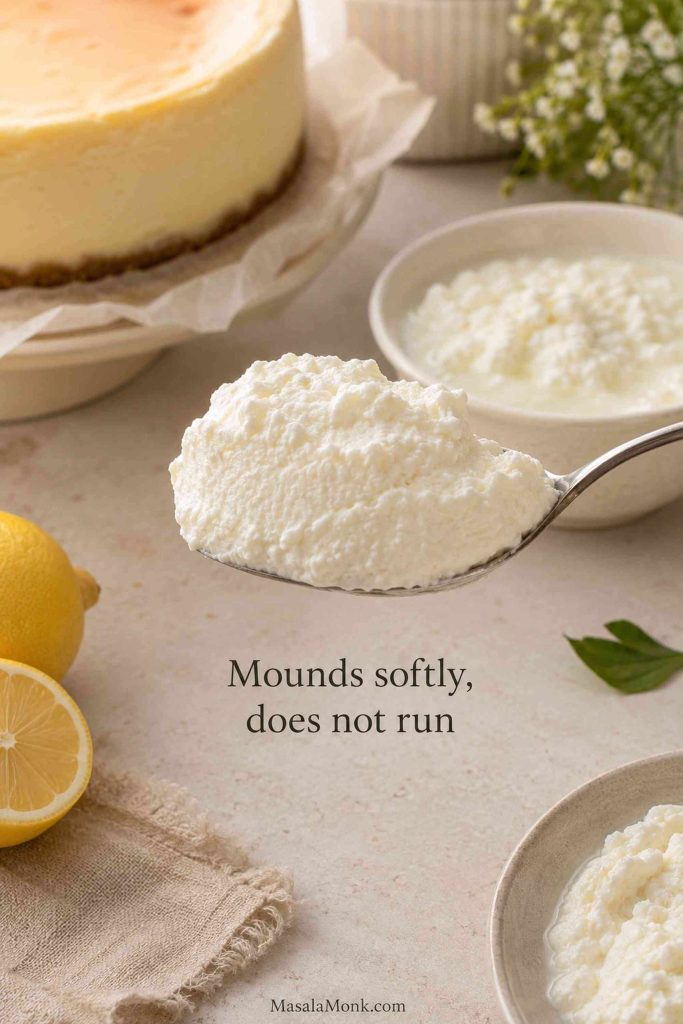
The easiest test is the spoon test: good ricotta should mound softly on a spoon, not run across it. If it looks puddled, loose, chalky, or visibly curdy before baking, the finished cheesecake will be harder to make silky.

Spoon holding thick ricotta that mounds softly with looser ricotta in a bowl behind it
If ricotta mounds softly on a spoon, it is usually ready to use; if it runs or puddles, drain it before making the filling.

The ricotta is the one ingredient worth being picky about. Everything else can be measured carefully, but the cheese itself decides whether the filling tastes creamy or rough. Blending can improve slightly grainy ricotta, but it cannot turn poor ricotta into excellent ricotta, so start with the best full-fat ricotta you can reasonably find.

If the ricotta looks loose once you open the tub, use the draining guide before mixing the filling.

Ricotta Types Compared

Ricotta Type Result in Cheesecake Best Use
Whole-milk ricotta Creamiest, richest, most forgiving Best default choice
Fresh ricotta Beautiful flavor, but moisture varies Use when thick; drain if wet
Supermarket tub ricotta Convenient and reliable when good quality Check for graininess and liquid
Low-fat ricotta Less rich, sometimes drier or slightly chalkier Use only for a lighter variation
Part-skim ricotta Can work, but less creamy Acceptable if thick and smooth
Watery ricotta Can make the cheesecake loose or weepy Drain before using
Four ricotta types for cheesecake including whole-milk, fresh, tub, and low-fat ricotta
Different ricotta types behave differently, so check moisture and texture before deciding whether to drain, blend longer, or choose a better tub.

Should You Drain Ricotta First?

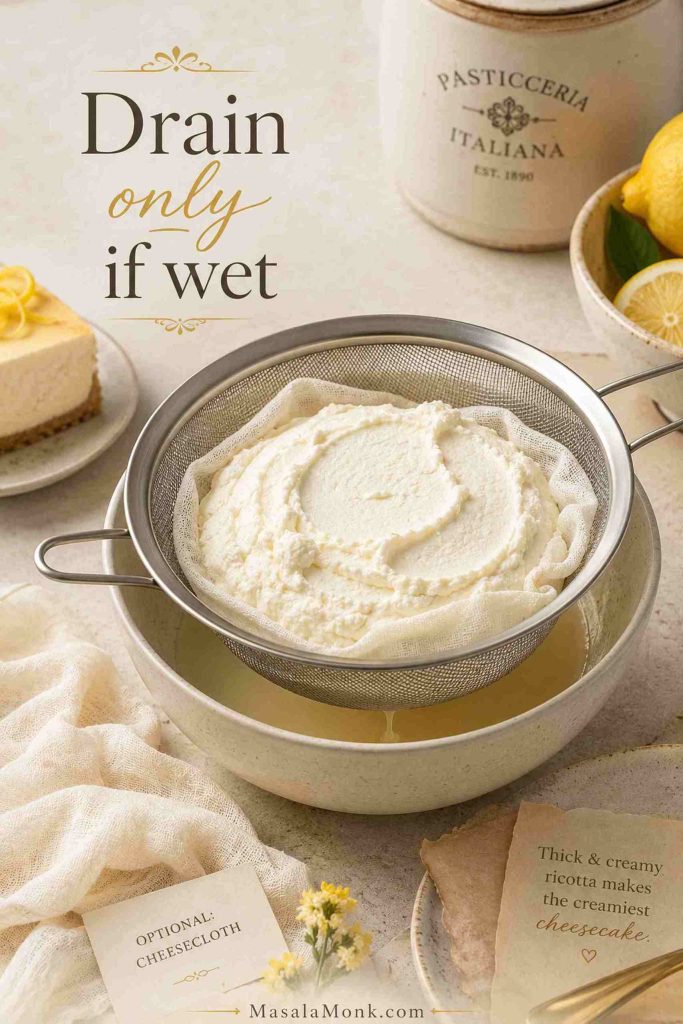
You only need to drain ricotta if it looks wet. Thick, creamy, spoonable ricotta can go straight into the filling. Ricotta with visible liquid in the container, or cheese that looks loose, should be drained before mixing.

To drain ricotta, spoon it into a fine-mesh strainer set over a bowl. Let it sit for 30–60 minutes in the refrigerator. For very wet ricotta, line the strainer with cheesecloth and drain it for several hours or overnight. The goal is not to make it dry; the goal is to remove excess liquid so the cheesecake bakes creamy instead of watery.

Do not try to fix very wet ricotta by adding lots of cornstarch or flour. That can make the filling dull or pasty. It is better to strain the ricotta first and use cornstarch only as light insurance.

Ricotta draining in a fine-mesh strainer over a bowl with whey collecting underneath
Drain ricotta only when it looks loose or wet; otherwise, good thick ricotta does not need extra handling before it goes into the filling.

Simple rule

Ricotta that holds its shape on a spoon probably does not need draining. When it spreads, puddles, or looks loose, drain it first.

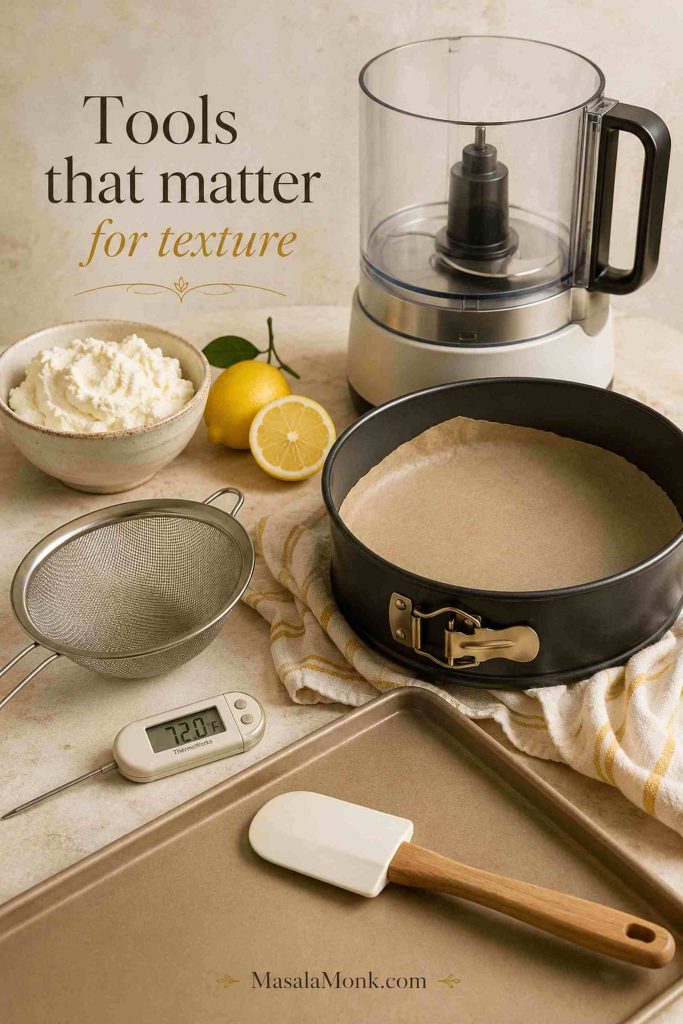
Equipment You Need

You do not need professional baking equipment, but the mixing tool matters because ricotta can stay textured if it is not smoothed properly. A food processor gives the easiest path to a creamy filling, while a mixer works best when your ricotta is already fairly smooth.

Food processor, springform pan, strainer, thermometer, spatula, and baking sheet for ricotta cheesecake
The most useful tools are the ones that control texture: a food processor for smooth dairy, a strainer for moisture, and a springform pan for easy release.
  • 9-inch springform pan: the default pan for this recipe.
  • Food processor: best for smoothing ricotta and cream cheese together.
  • Stand mixer or hand mixer: works well if your ricotta is already smooth.
  • Fine-mesh strainer: useful if the ricotta needs draining.
  • Flexible spatula: for scraping the bowl and smoothing the filling.
  • Baking sheet: catches any butter drips from the crust and makes the pan easier to move.
  • Instant-read thermometer: optional, but helpful for checking the center.
  • Thin knife or offset spatula: helps loosen the cheesecake from the pan after cooling.

Ingredients for Ricotta Cheesecake

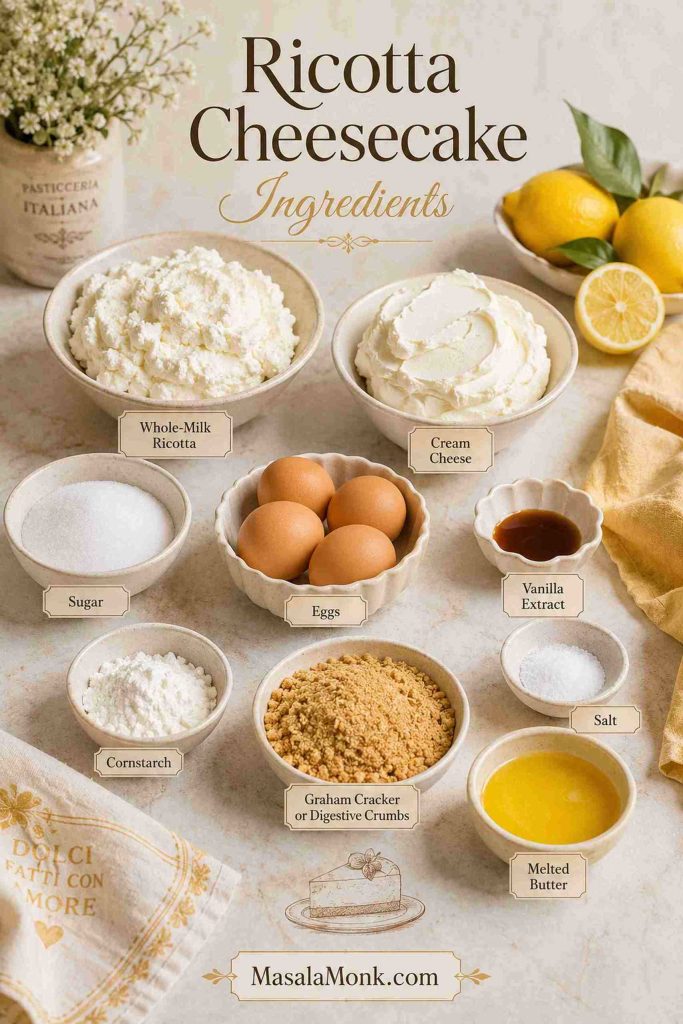
This recipe uses simple ingredients, but each one affects the final structure. Bring the ricotta, cream cheese, and eggs close to room temperature before mixing so the filling blends evenly; the mixing tool matters most if your ricotta is not already smooth.

Ricotta cheesecake ingredients including ricotta, cream cheese, eggs, sugar, lemon, vanilla, cornstarch, crumbs, and butter
The ingredient list is simple, but the balance matters: ricotta gives flavor, cream cheese adds stability, eggs set the filling, and lemon lifts the dairy.

For the Optional Crust

  • 1 1/2 cups / 150–170 g graham cracker or digestive biscuit crumbs
  • 5 tbsp / 70 g unsalted butter, melted
  • 1–2 tbsp granulated sugar, optional
  • Pinch of fine salt

For the Filling

  • 16 oz / 454 g whole-milk ricotta, room temperature, drained only if watery
  • 16 oz / 454 g full-fat cream cheese, softened to room temperature
  • 1 cup + 2 tbsp / about 225 g granulated sugar
  • 5 large eggs, room temperature
  • Zest of 1 large lemon
  • 1 tbsp / 15 ml fresh lemon juice
  • 2 tsp / 10 ml vanilla extract
  • 1/2 tsp kosher salt, or 1/4 tsp fine salt
  • 1 tbsp cornstarch, optional, for slightly cleaner slices

The cornstarch is optional. It gives the cheesecake a little more insurance against weeping and helps the slices hold neatly, especially if your ricotta is slightly soft. Skip it if you prefer a softer, more custardy center.

Crust or No Crust?

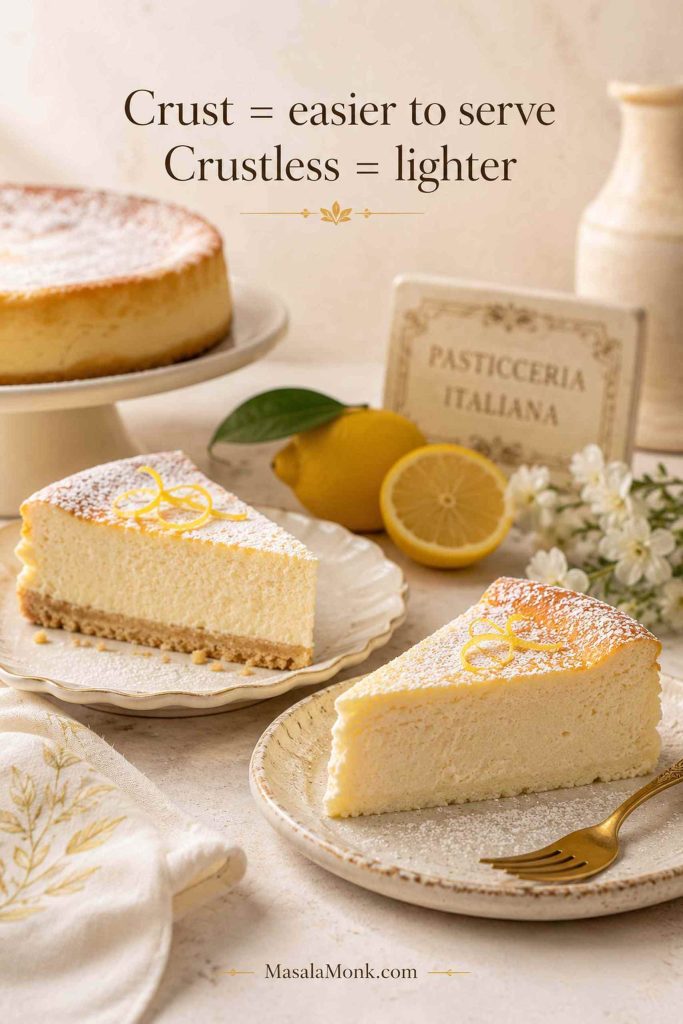
Use a crust if you want a familiar cheesecake slice that is easy to move, serve, and cut cleanly. A graham cracker crust tastes classic, while digestive biscuits give a slightly less sweet, buttery base.

Skip the crust if you want a lighter Italian-style ricotta cheesecake where the filling is the main event, then check the crustless variation notes before baking. Just line the pan carefully, grease the sides well, and chill the cheesecake fully before slicing.

For a first bake, the crusted version is easier. The crumb base gives the soft filling a little support and makes the finished cheesecake simpler to serve. If you are drawn to the crumb crust but do not want to bake a cheesecake at all, this no bake cheesecake recipe uses a similar graham cracker or digestive biscuit base with a refrigerator-set filling instead.

Either way, the filling should stay the main event: cool, lightly citrusy, and tender under the fork.

Ricotta cheesecake slice with crumb crust compared with a crustless ricotta cheesecake slice
A crumb crust makes the cake easier to serve, while a crustless ricotta cheesecake feels lighter and puts the filling completely in focus.

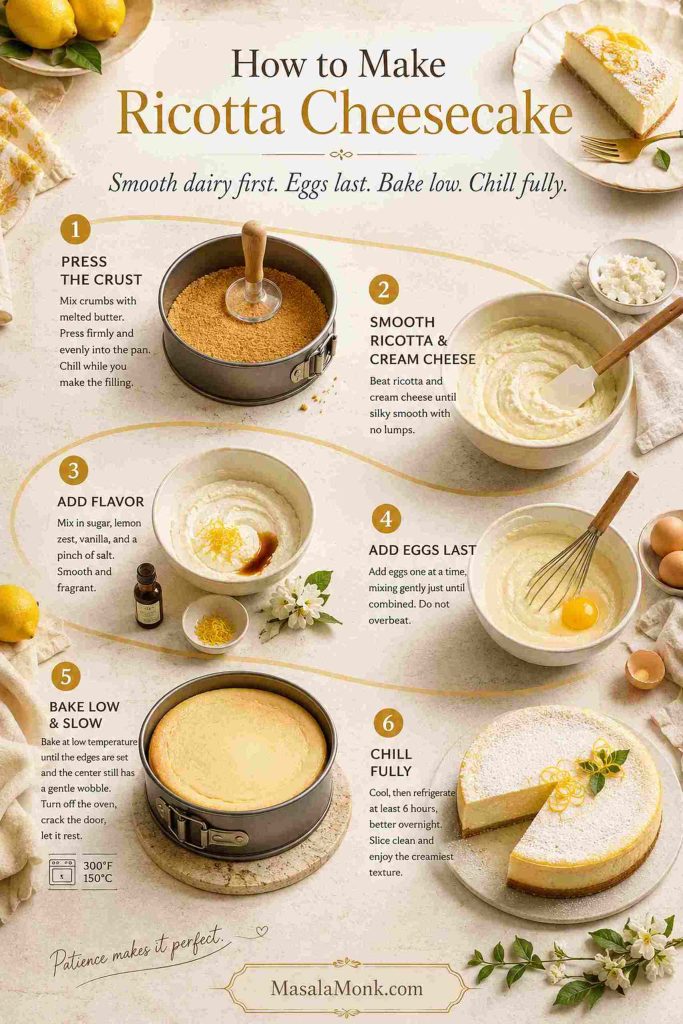
How to Make Ricotta Cheesecake

The most important technique is the mixing order. Smooth the dairy first, then add the eggs gently. Once the eggs go in, avoid whipping extra air into the batter.

Step-by-step ricotta cheesecake process showing crust, smooth dairy, flavoring, eggs, baking, and chilling
The order protects the texture: prepare the base, smooth the dairy, add eggs gently, bake with steady heat, then chill until fully set.

1. Prepare the Pan

Line the bottom of a 9-inch springform pan with parchment paper and lightly grease the sides. If you are making the crustless version, be extra careful with the parchment and greasing because the filling will touch the pan directly.

2. Make and Prebake the Crust

Mix the crumbs, melted butter, sugar, and salt until the mixture looks like damp sand. Press it firmly into the bottom of the pan with a flat-bottomed cup. Bake at 350°F / 177°C for 8–10 minutes, then let it cool while you make the filling.

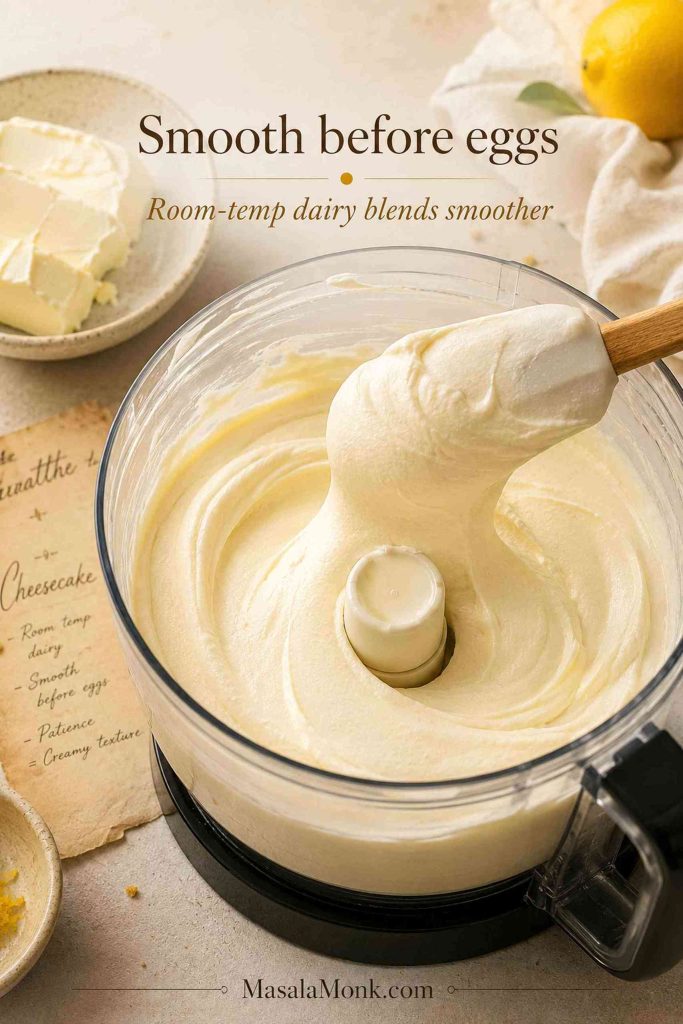
3. Smooth the Ricotta and Cream Cheese

In a food processor, blend the ricotta and cream cheese until smooth. Scrape down the sides and process again if needed. If using a stand mixer, beat the cream cheese first, then add the ricotta and beat until the mixture looks even.

This step matters more than it may seem. If the ricotta stays lumpy at this stage, the finished cheesecake will probably taste textured too.

Smooth ricotta and cream cheese mixture in a bowl with a spatula lifting the creamy base
Get the ricotta and cream cheese smooth before the eggs are added; after that, the batter needs a lighter hand.

4. Add Sugar, Lemon, Vanilla, Salt, and Cornstarch

Add the sugar, lemon zest, lemon juice, vanilla, salt, and cornstarch if using. Mix until smooth and scrape the bowl again. The batter should look creamy before the eggs are added.

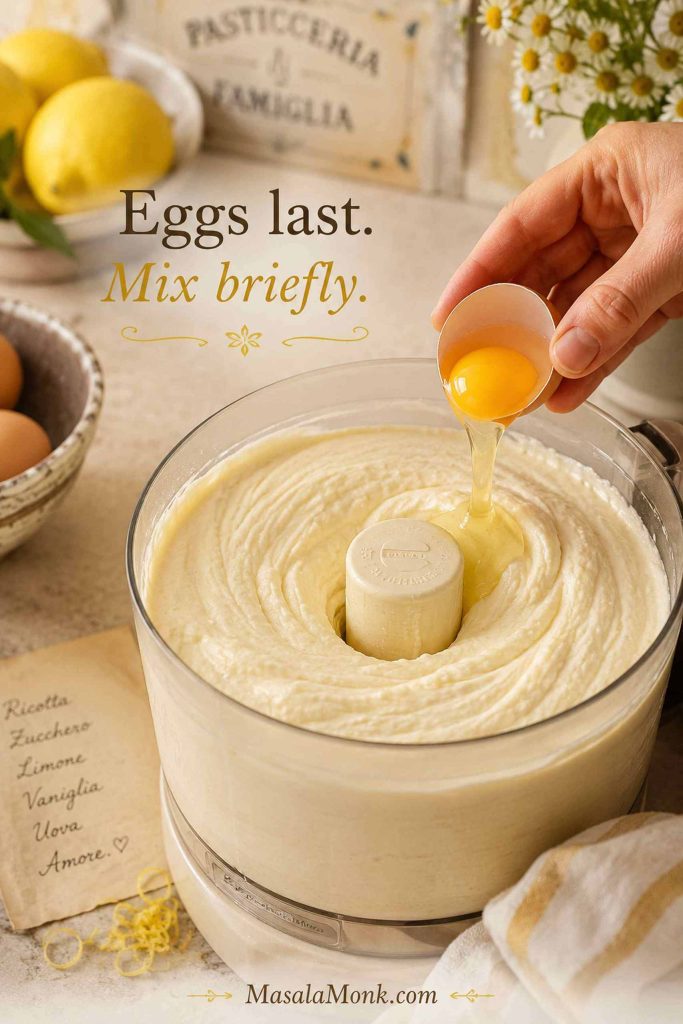
5. Add the Eggs Briefly

Add the eggs one at a time and mix on low speed, or pulse briefly if using a food processor. Stop as soon as the eggs disappear into the batter. Overmixing after the eggs go in can trap air, which makes cheesecake puff in the oven and crack as it cools.

Before the pan goes into the oven, use the texture checkpoints to catch lumps, loose batter, or wet ricotta early.

Egg being added gently to smooth ricotta cheesecake batter in a mixing bowl
Add eggs last and mix briefly, because too much air can make the cheesecake puff in the oven and settle unevenly as it cools.

6. Bake Low and Slow

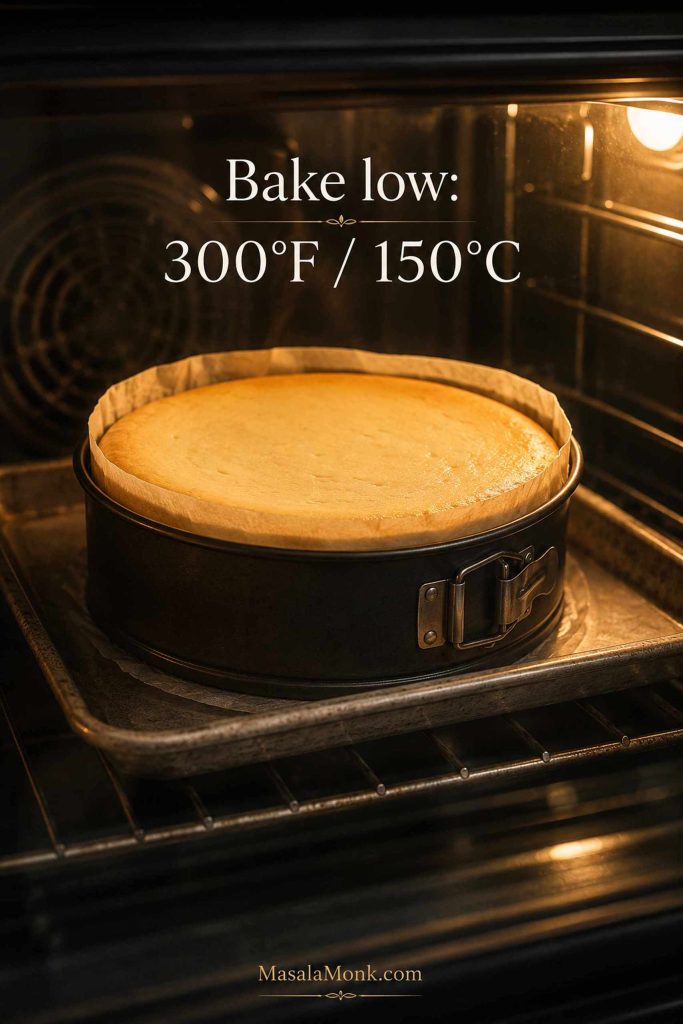
Lower the oven to 300°F / 150°C. Pour the filling over the cooled crust, smooth the top, and set the springform pan on a baking sheet. Bake for about 85–95 minutes, until the edges are set and the center still has a soft wobble.

Ricotta cheesecake baking in a springform pan inside an oven at 300 degrees Fahrenheit
Low, steady heat helps ricotta cheesecake set gradually, keeping the filling creamy instead of dry, puffed, or cracked.

7. Cool Gradually

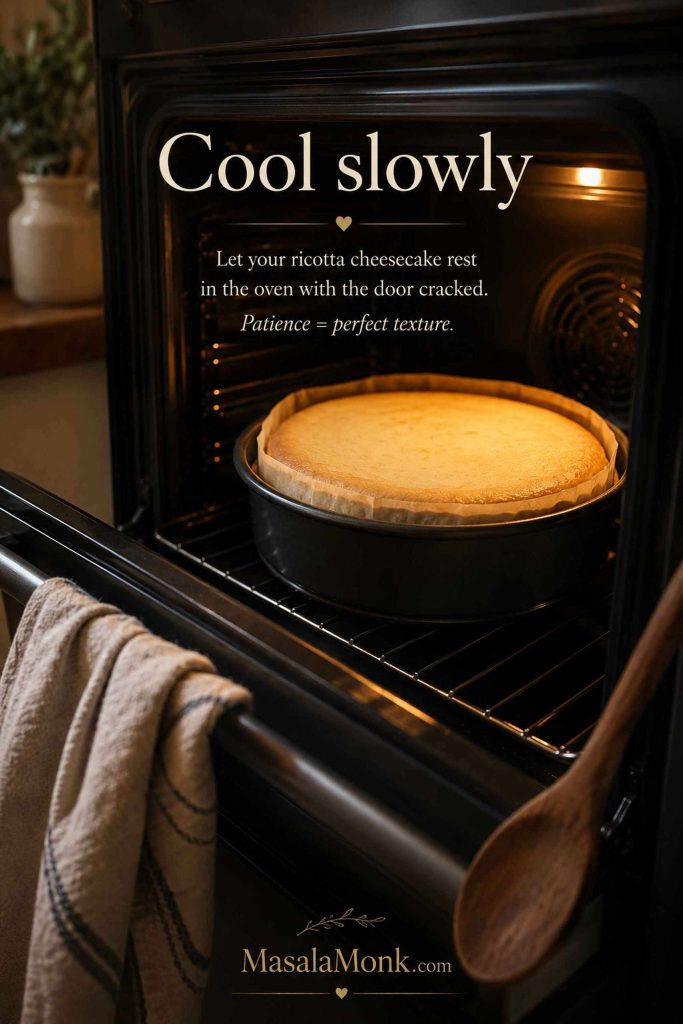
Turn off the oven, crack the door slightly, and let the cheesecake rest inside for 45–60 minutes. Then move it to a rack and let it cool to room temperature. This slow cooling helps prevent sudden sinking and cracks.

8. Chill Before Slicing

Cover the cooled cheesecake and refrigerate it for at least 6 hours. Overnight is better. Slice it cold with a sharp knife, wiping the blade between cuts.

By the time it has chilled, the lemon softens into the dairy and the filling settles into a cool, creamy slice that tastes calmer than it did straight from the oven.

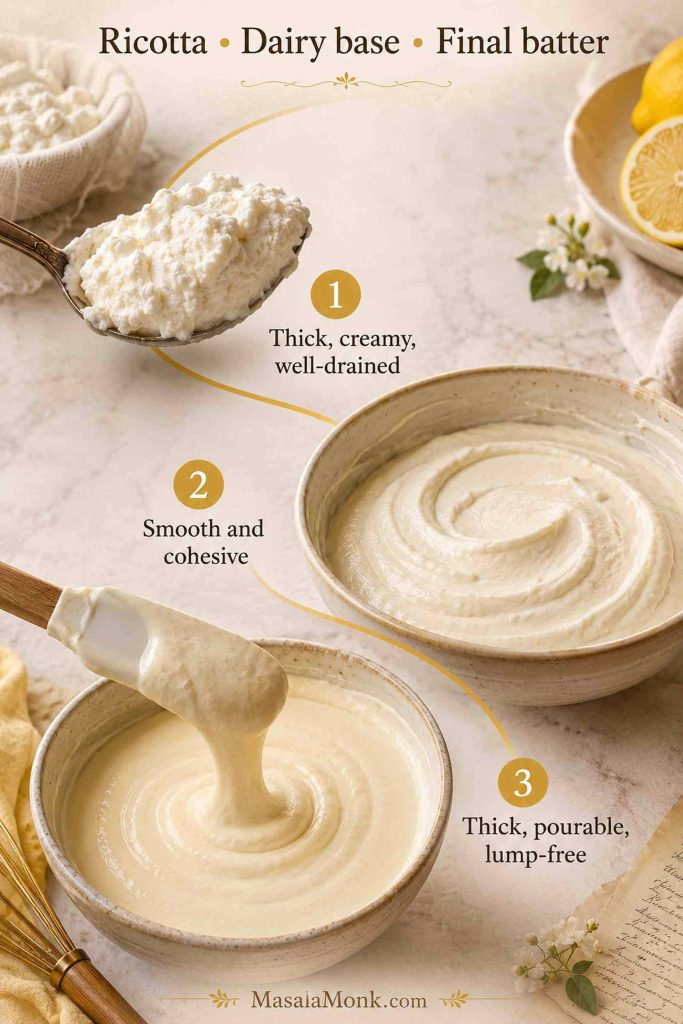
Texture Checkpoints: Check These Before the Cheesecake Goes Into the Oven

Before the cheesecake goes into the oven, pause for a few quick checks. The ricotta should not be watery, the dairy mixture should look mostly smooth before the eggs are added, and the final batter should be pourable but still thick. If the batter looks thin, loose, or full of large curds, fix that before baking rather than hoping the oven will solve it.

  • Ricotta: thick and spoonable, not puddled with liquid.
  • Dairy base: creamy before the eggs go in.
  • Final batter: pourable, but not thin like milk.
  • Pan: crust cooled, sides lightly greased, batter smoothed on top.
Ricotta cheesecake texture checkpoints showing thick ricotta, smooth dairy base, and thick pourable batter
Before baking, check the three texture points: well-drained ricotta, a smooth dairy base, and a thick batter that pours without visible lumps.

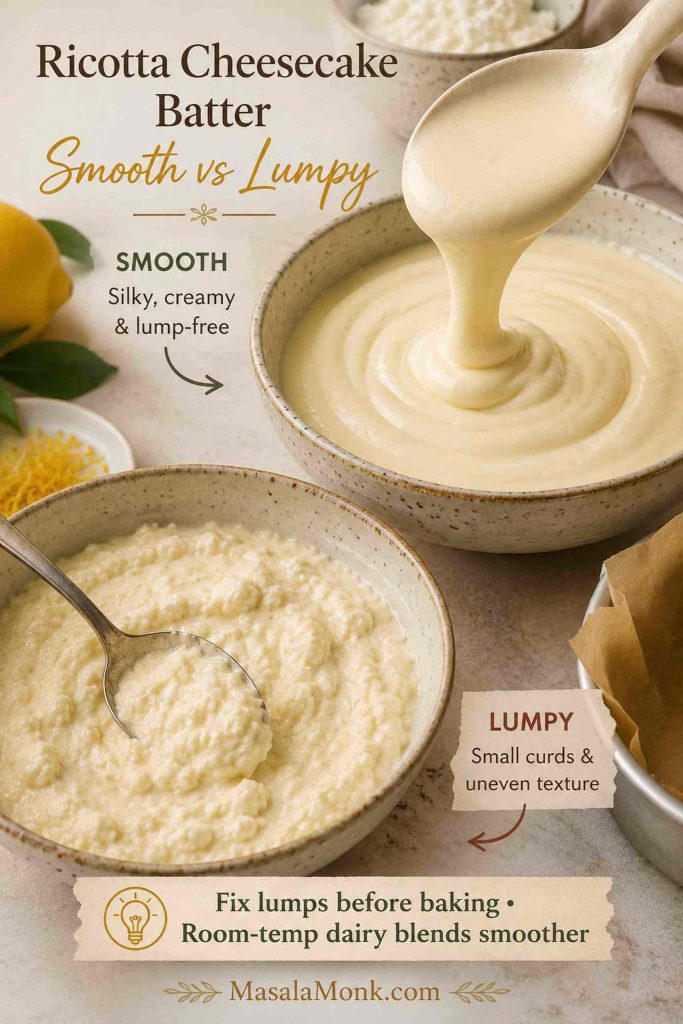
What ricotta cheesecake should feel like

Ricotta cheesecake should be creamy and softly set, but it will not always feel exactly like a dense cream-cheese-only cheesecake. A little delicacy is normal. What you do not want is visible liquid, large curds, a gritty bite, or a center that sloshes when the pan moves.

Smooth ricotta cheesecake batter compared with lumpy batter in bowls and on spoons
Lumpy batter usually starts with cold dairy or under-blended ricotta, so fix the texture before baking rather than hoping the oven will smooth it out.

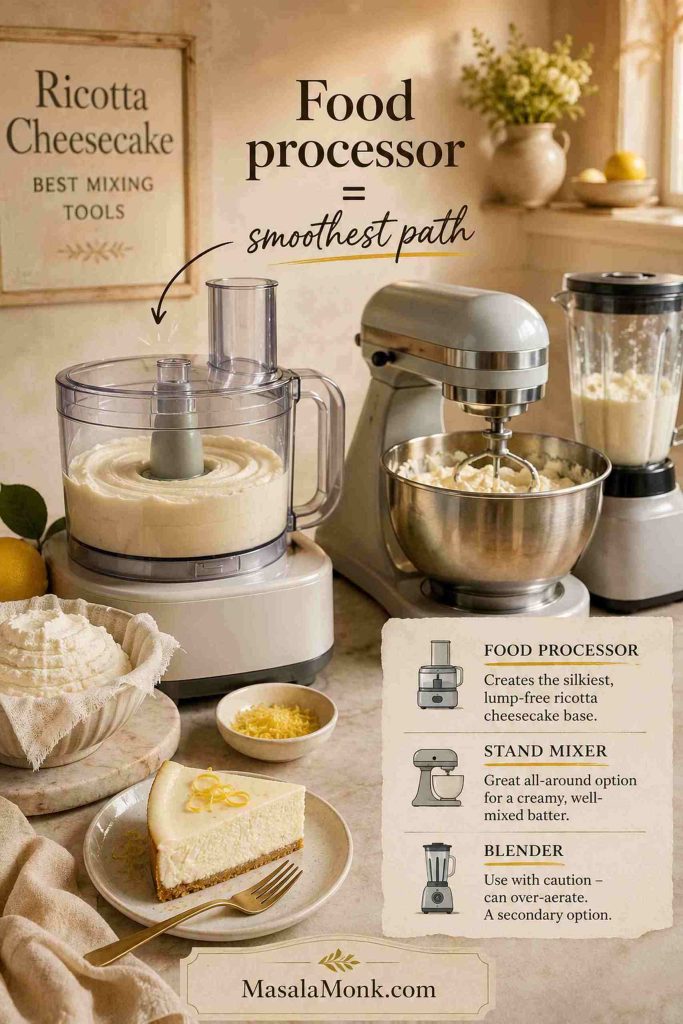
Food Processor vs Blender vs Stand Mixer

A food processor is the best default for a velvety filling because it breaks down the ricotta and cream cheese quickly without needing too much air. Other tools can work, but they need a little more attention.

Tool Best For Watch Out For
Food processor Smoothest filling and best ricotta texture Pulse gently after eggs are added
Stand mixer Classic cheesecake mixing Ricotta may stay slightly textured if it starts grainy
Hand mixer Simple home baking Scrape often and do not whip after adding eggs
Blender Loose batter and very smooth dairy Thick batter can trap air or strain the motor
Food processor, stand mixer, and blender shown as mixing tools for ricotta cheesecake batter
A food processor is the smoothest path for this recipe; a mixer works best only when the ricotta already looks creamy and not curdy.

Water Bath or No Water Bath?

This cheesecake does not require a water bath because it bakes at a low temperature and cools slowly. A water bath gives cheesecake gentle, even heat. This recipe gets a similar benefit in a simpler way: it bakes at 300°F / 150°C and cools gradually in the turned-off oven.

Use a water bath only if your oven runs hot, you are very worried about cracks, or you want extra insurance for an ultra-smooth top. If you use one, wrap the springform pan very well in heavy-duty foil, place it in a roasting pan, and pour hot water around it after the cheesecake is in the oven.

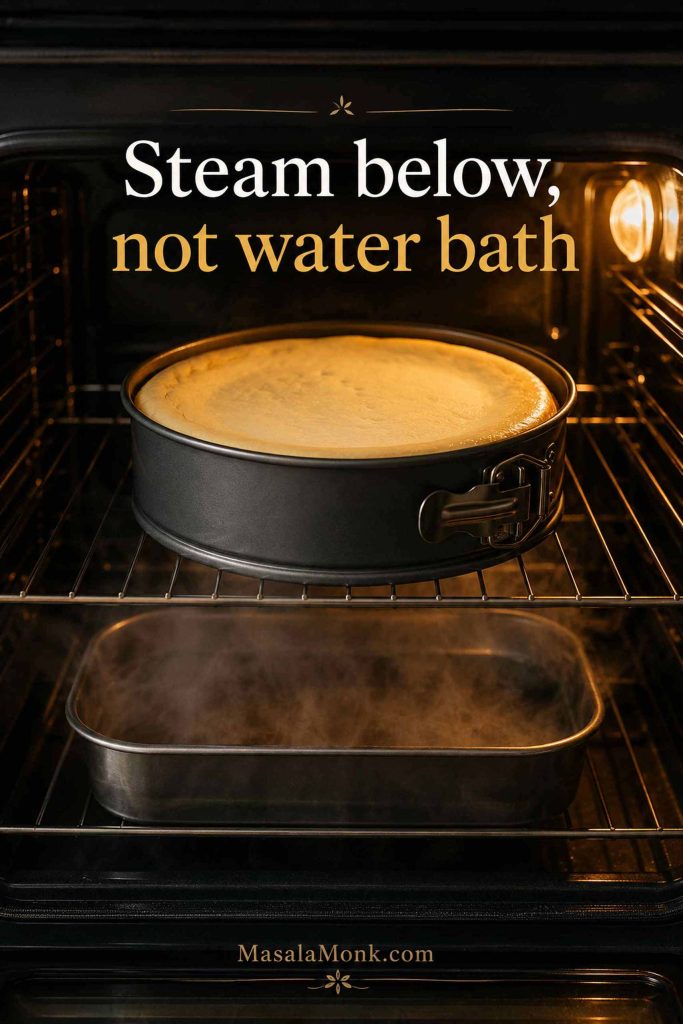
Steam, not submersion

If you do not trust your springform pan, place a pan of hot water on the lower oven rack instead of putting the cheesecake pan directly in water. It adds gentle moisture without risking a leaky crust.

Ricotta cheesecake baking above a pan of hot water in an oven instead of sitting in a water bath
A pan of hot water below the cheesecake adds oven moisture without submerging the springform pan or risking a soggy crust.

How to Know When Ricotta Cheesecake Is Done

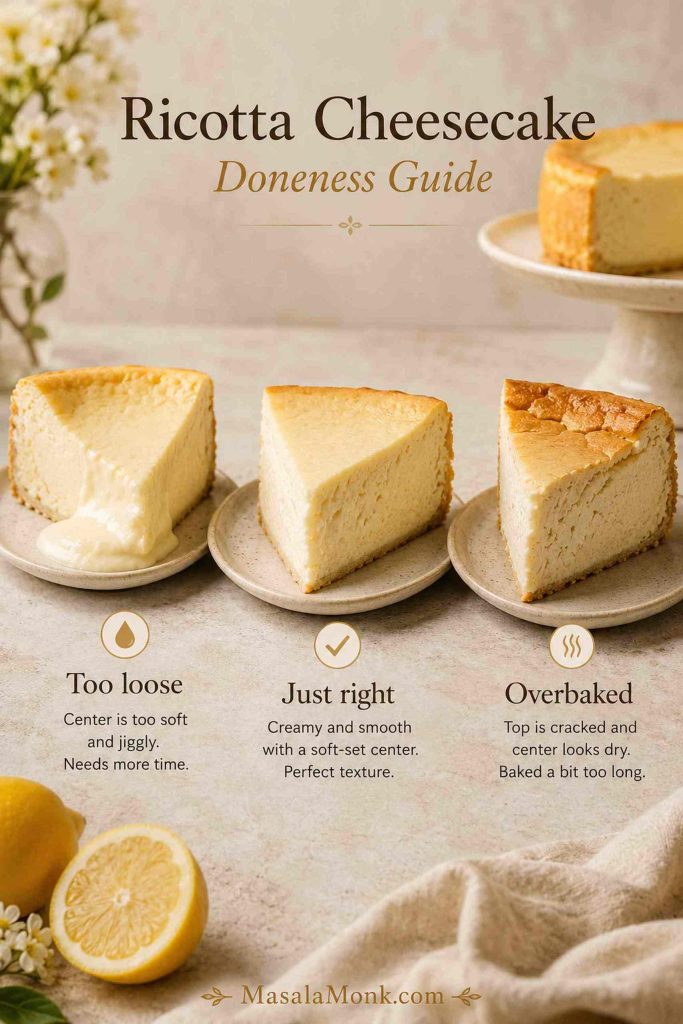
The cheesecake is done when the outer edges are set and the center still wobbles softly when you nudge the pan. The center should not look liquid, but it should not look fully firm either.

Ricotta cheesecake in a springform pan showing set edges, soft center wobble, and 150 to 155 degree Fahrenheit cue
Pull the cheesecake when the edges are set and the center still moves softly; the filling will continue to settle as it cools.

If using an instant-read thermometer, start checking around 150°F / 65°C. For this ricotta and cream cheese cheesecake, 150–155°F / 65–68°C is a good target range. Cheesecake continues setting as it cools, so do not bake until the center looks completely solid. For a broader baking reference, Better Homes & Gardens explains cheesecake doneness tests, including the jiggle, touch, and temperature methods.

Sign What It Means
Edges are set The cheesecake has structure and can finish setting as it cools
Center wobbles softly Good; it should not be fully firm in the oven
Center sloshes like liquid Needs more baking time
Top is deeply browned and puffed Likely overbaked or oven too hot
Center reads 150–155°F / 65–68°C Good target for a creamy chilled cheesecake

If your cheesecake looks too loose, cracked, or dry, use the troubleshooting guide before changing the recipe next time.

Three ricotta cheesecake slices showing too loose, just right, and overbaked textures
The center should not slosh, but it should not bake fully firm either; the best texture finishes setting during the cooling and chilling stages.

Pan Size Notes: 8-Inch, 9-Inch, and 10-Inch Pans

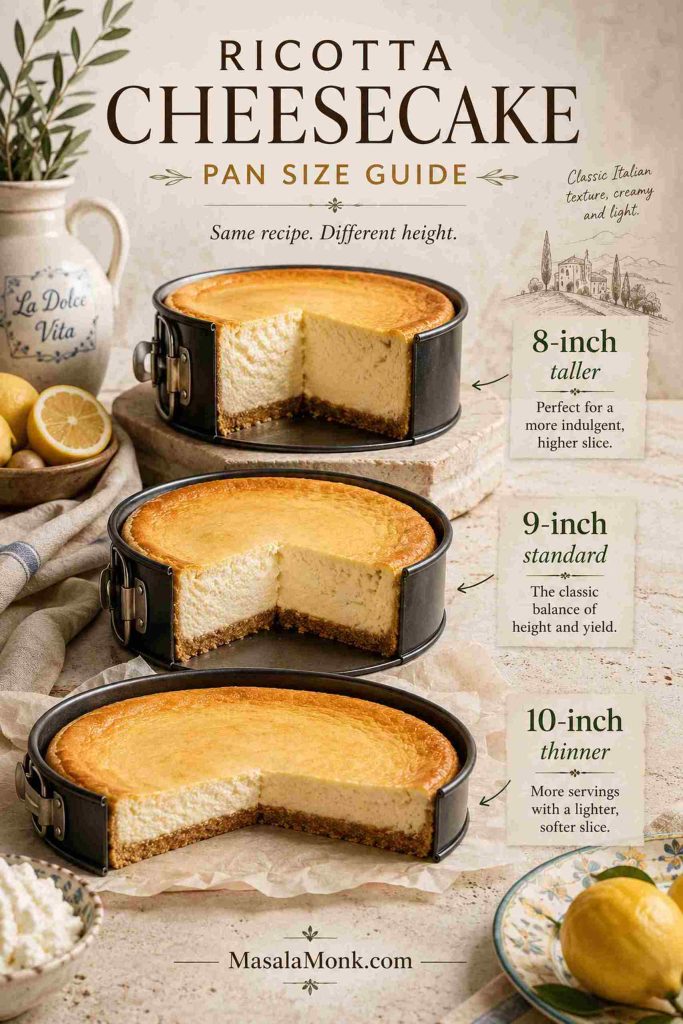
This recipe is written for a 9-inch / 23 cm springform pan. Other pan sizes can work, but the cheesecake thickness and bake time will change. Always use the wobble test and internal temperature cue instead of relying only on the clock.

Pan size changes the personality of the cheesecake. A smaller pan makes it taller and softer in the middle; a wider pan makes it thinner and faster to bake.

Pan Size What Changes? How to Adjust
9-inch springform Default size for this recipe Bake about 85–95 minutes at 300°F / 150°C
8-inch springform Taller cheesecake with a thicker center Expect a longer bake; check for a soft wobble and 150–155°F / 65–68°C center
10-inch springform Thinner cheesecake that bakes faster Start checking around 70–80 minutes
Mini cheesecakes Different timing and texture management Better as a separate mini ricotta cheesecake recipe
Pie pan Moves closer to ricotta pie Use the ricotta pie comparison rather than forcing this recipe into a pie pan
Pan size guide showing taller 8-inch, standard 9-inch, and thinner 10-inch ricotta cheesecakes
Pan size changes height and timing, so an 8-inch cake may need longer while a 10-inch cake can bake faster than the clock suggests.

After the pan-size and doneness cues, cooling is still part of texture control: sudden temperature changes can make a delicate ricotta cheesecake crack or sink.

Ricotta cheesecake cooling in a turned-off oven with the door cracked open
Slow cooling protects the delicate filling from sudden temperature changes, which helps reduce cracks, sinking, and rough texture.

How Long to Chill Before Slicing

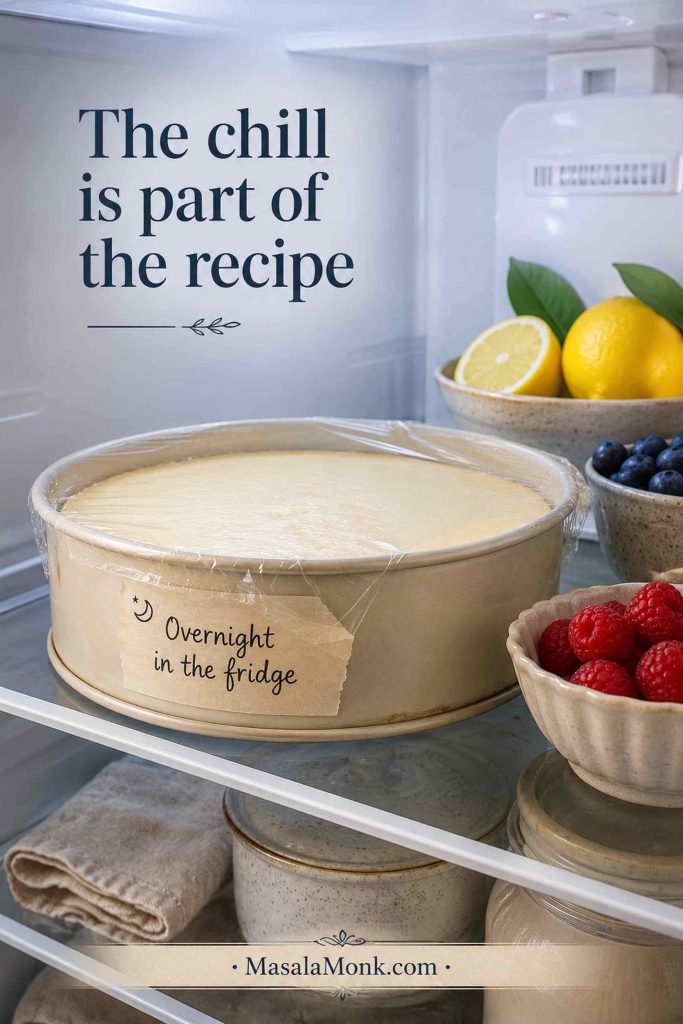
The refrigerator is not just storage here; it is part of the recipe. Ricotta cheesecake needs that cold rest to settle into a clean, creamy slice.

Chill the cheesecake for at least 6 hours before slicing. Overnight is best. The long chill gives the filling time to firm, settle, and cut neatly.

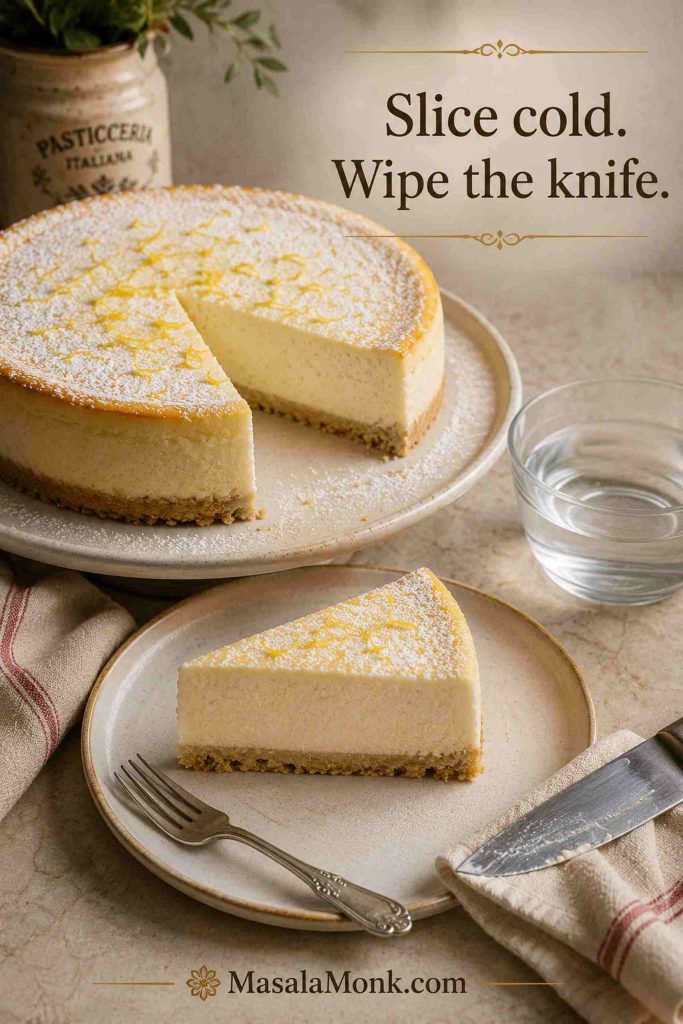
For the neatest slices, cut it cold. Dip a sharp knife in hot water, wipe it dry, cut one slice, then wipe the knife again before the next cut. Let individual slices sit at room temperature for 10–15 minutes before serving if you want a softer, creamier bite.

A good chilled slice should hold its shape on the plate, but the fork should still glide through the filling.

Covered ricotta cheesecake chilling overnight in a refrigerator with lemons and berries nearby
Chilling is where the filling firms, relaxes, and becomes easier to cut, so do not judge the texture while the cheesecake is still warm.

Once the cake is fully cold, slicing technique matters too: a warm knife and a quick wipe between cuts keep the soft filling from dragging.

Ricotta cheesecake with a clean slice removed, knife, towel, and water glass for wiping the blade
Cut the cheesecake cold and wipe the knife between slices; as a result, the soft filling stays neat instead of dragging.

Ricotta Cheesecake Variations

Use the main recipe first if you want the safest structure. Once you understand the base, these variations let you move toward lemon, crustless Italian-style, mascarpone, or lighter versions.

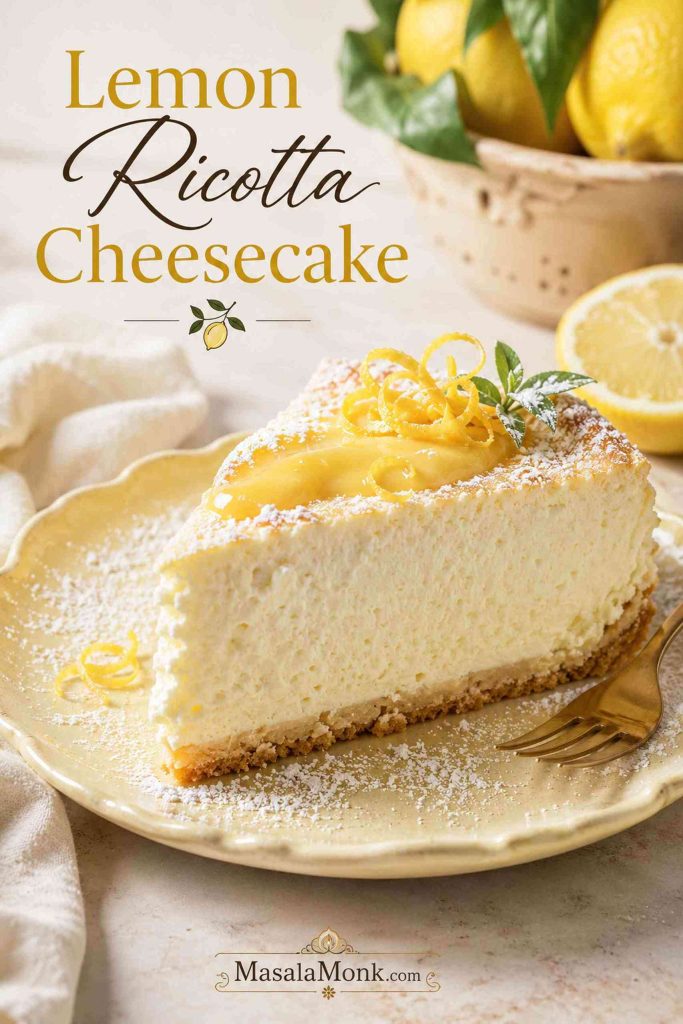
Lemon Ricotta Cheesecake

For a brighter lemon version, increase the zest to 2 lemons and use 2 tablespoons / 30 ml lemon juice. You can also serve the cheesecake with lemon curd, fresh berries, or a light dusting of powdered sugar.

Do not add a large amount of extra lemon juice without adjusting the recipe. Too much liquid can loosen the filling and make the cake harder to set.

Lemon ricotta cheesecake slice with lemon curd, lemon zest, powdered sugar, and berries
Lemon brightens the ricotta without turning the dessert sharp, so start with zest and add extra juice only when you want a stronger citrus edge.

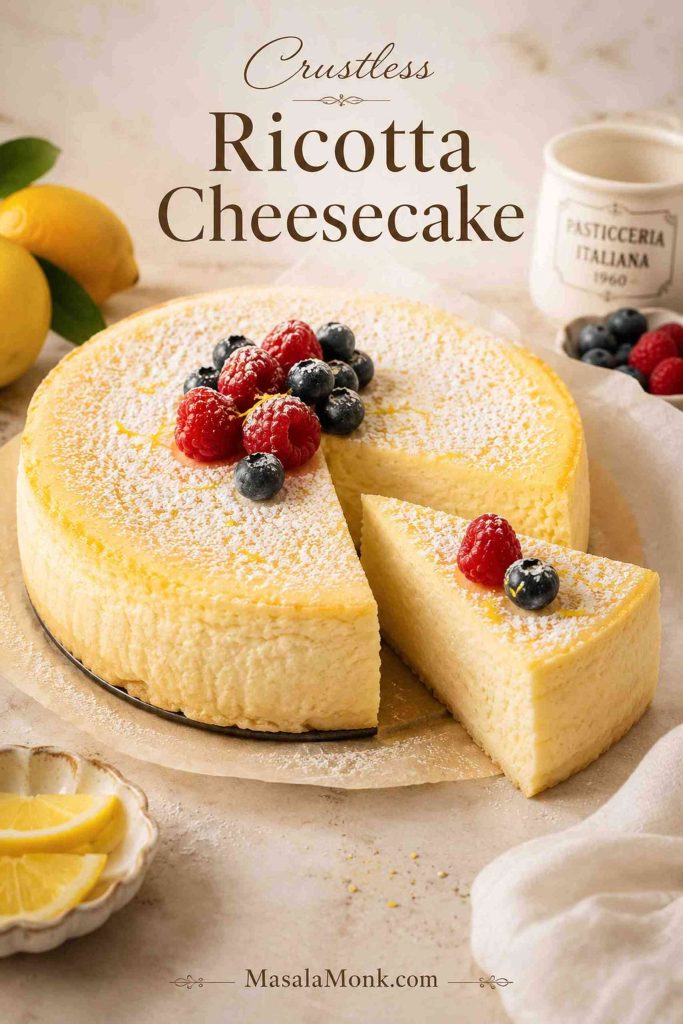
Italian-Style Crustless Ricotta Cheesecake

For a more Italian-style version, skip the crust, line the pan with parchment, and grease the sides well. You can keep the main ricotta and cream cheese filling for the most reliable texture, or make it more ricotta-forward by replacing 8 oz / 225 g of the cream cheese with extra whole-milk ricotta.

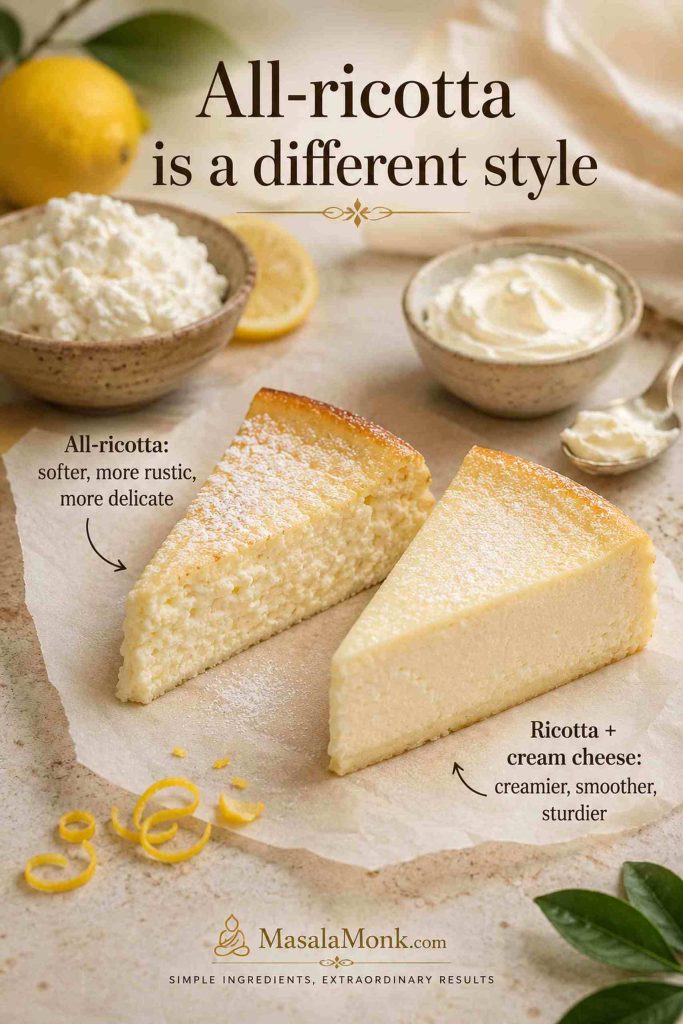
An all-ricotta cheesecake is possible, but think of it as a different style rather than a direct shortcut from the main recipe. It will be lighter, more custardy, more rustic, and more dependent on the quality and moisture level of the ricotta.

For the safest first bake, use the main recipe. For a more traditional crustless version, use very thick full-fat ricotta, drain it well if needed, and give the cheesecake a full overnight chill before judging the texture.

Crustless ricotta cheesecake with one slice removed, berries, lemon, and powdered sugar
Crustless ricotta cheesecake is lighter and more delicate, which means careful lining, full chilling, and gentle slicing matter even more.

If you remove all the cream cheese, you are making a different style of ricotta cheesecake, so expect a softer and more rustic texture.

All-ricotta cheesecake slice beside a ricotta and cream cheese cheesecake slice
All-ricotta cheesecake is a different style, not a simple swap; it tastes softer and more rustic, while cream cheese makes the filling sturdier.

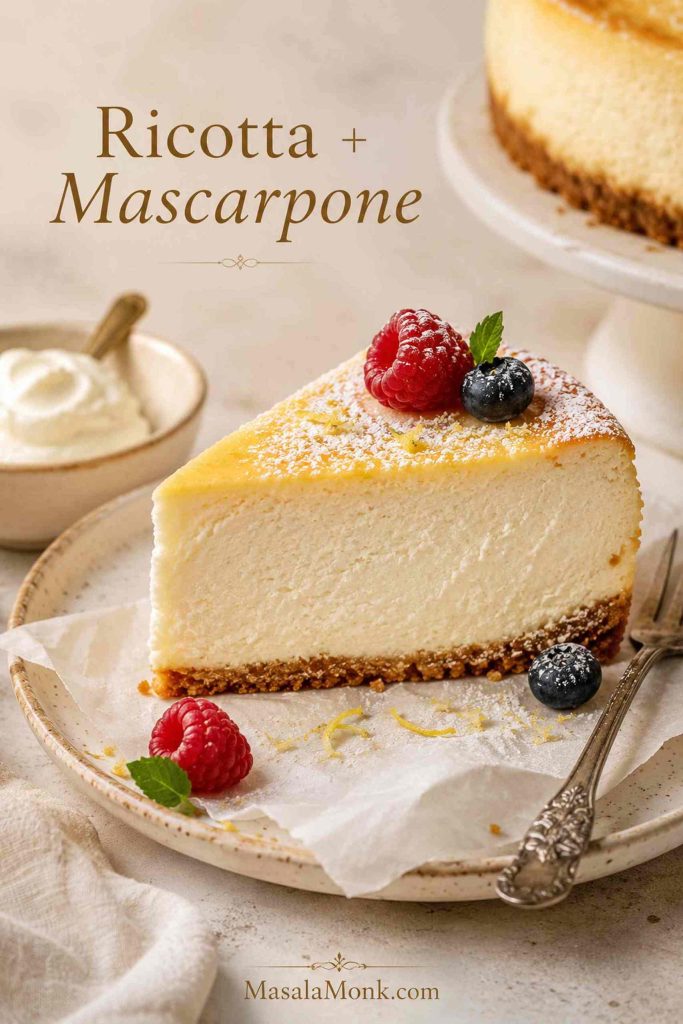
Ricotta Mascarpone Cheesecake

For a softer, richer Italian-style variation, replace the cream cheese with mascarpone. Mascarpone gives the cheesecake a delicate dairy sweetness and less tang than cream cheese. Because mascarpone is softer, chill the cheesecake overnight before slicing.

Ricotta mascarpone cheesecake slice with berries, powdered sugar, and mascarpone nearby
Mascarpone makes the filling richer and softer with less tang, but the cake still needs a long chill before it will slice cleanly.

Healthy, Low-Fat, or Keto Ricotta Cheesecake

You can make a lighter version, but the texture will change. Low-fat ricotta can bake drier and less creamy. Greek yogurt, protein powder, or sugar-free sweeteners turn the recipe into a different style of cheesecake rather than a simple swap.

For a fully low-carb dessert, start with this keto cheesecake recipe instead. It is built around sugar-free sweeteners, almond flour crust, and low-carb texture fixes.

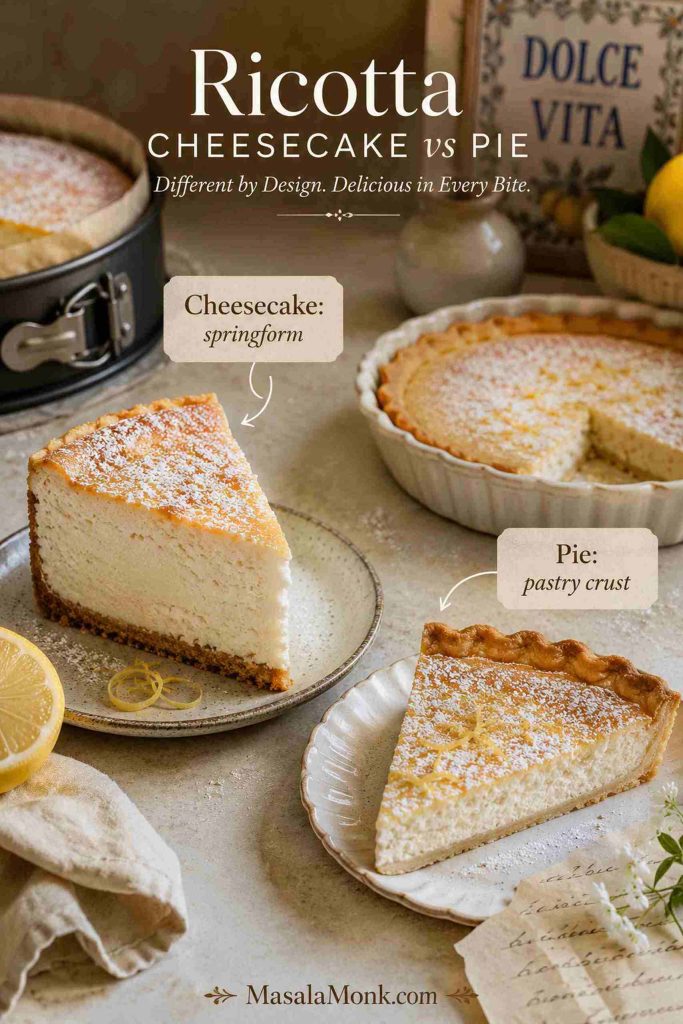
Ricotta Cheesecake and Ricotta Pie: What’s the Difference?

These two desserts are related, but they are not the same. A ricotta cheesecake is usually baked in a springform pan and sliced like cheesecake. By contrast, ricotta pie is usually baked in a pie crust or pie pan and often appears as an Italian Easter dessert.

The filling can overlap — ricotta, eggs, sugar, vanilla, citrus — but the structure is different. When the dessert is baked in a pie crust and eats more like sweet ricotta custard, you are probably thinking of ricotta pie.

Ricotta cheesecake slice from a springform pan compared with ricotta pie in a pastry crust
Ricotta cheesecake usually comes from a springform pan, while ricotta pie bakes in pastry crust and eats more like a sweet ricotta custard.

Can You Make Ricotta Cheesecake Ahead?

Yes, and it is actually better that way. Ricotta cheesecake needs time in the refrigerator for the filling to settle, the lemon and vanilla to soften into the dairy, and the slices to cut neatly. Make it the day before serving if you can.

This is exactly the kind of dessert that rewards doing less on the day you serve it. If you are serving it for a holiday or dinner party, bake it the night before, chill it overnight, and add berries, lemon curd, honey, or powdered sugar shortly before serving.

It is especially useful for spring dinners, Easter, Mother’s Day, Italian-style meals, and holidays when you want dessert ready before guests arrive.

What to Serve with Ricotta Cheesecake

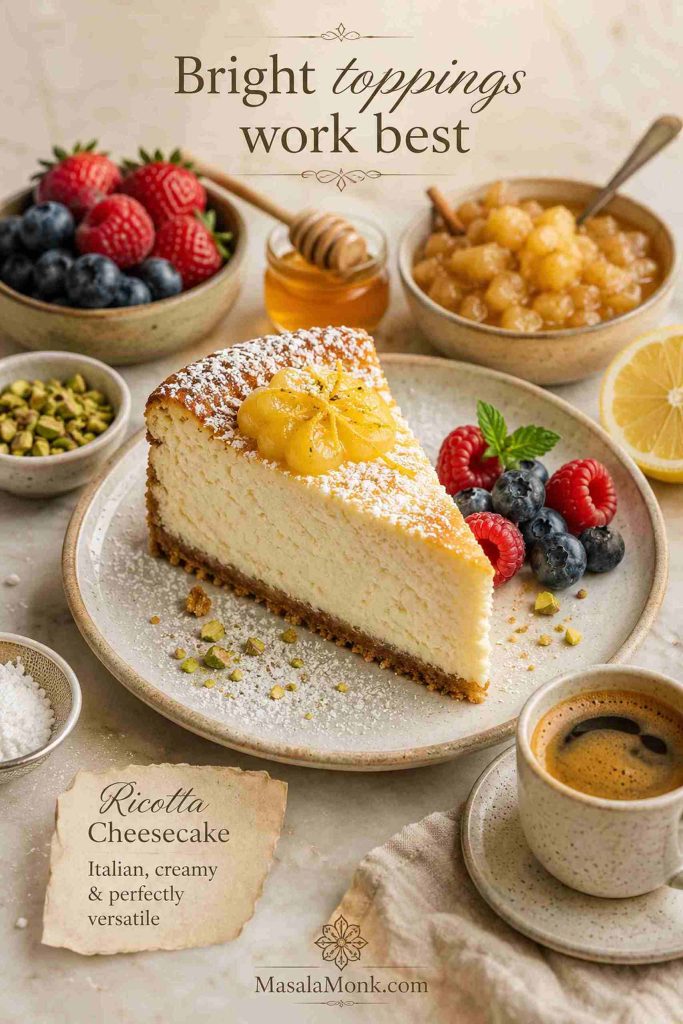
This dessert is rich but lighter than a dense New York cheesecake, so it works well with bright, simple toppings. You do not need a heavy sauce unless you want a more dramatic dessert.

The best toppings are the ones that keep the cheesecake feeling light: something tart, fresh, floral, or gently sweet rather than heavy caramel or chocolate sauce.

Plain is lovely here. A good ricotta cheesecake does not need much more than a little powdered sugar or a handful of berries; the point is the cool dairy flavor, the soft lemon, and the clean slice. A cold piece with coffee is often the best version of it.

  • Fresh berries: strawberries, raspberries, blueberries, or blackberries.
  • Lemon curd: best for a more lemon-forward cheesecake.
  • Powdered sugar: simple and classic for an Italian-style look.
  • Honey: a light drizzle works especially well with a crustless version.
  • Berry compote: good if you want a saucier dessert plate.
  • Apple topping: for a fall-style dessert, spoon on chilled homemade apple pie filling instead of berries.
  • Toasted almonds or pistachios: adds crunch without making the cheesecake too heavy.

For the softest bite, let each slice stand for 10 minutes before serving so the ricotta and lemon flavor opens up. If you are serving it later, check the storage and freezing guide before adding toppings.

Ricotta cheesecake slice served with berries, lemon curd, honey, pistachios, apple topping, powdered sugar, and coffee
Bright toppings work best because berries, lemon, honey, pistachios, and coffee support the cool dairy flavor instead of covering it.

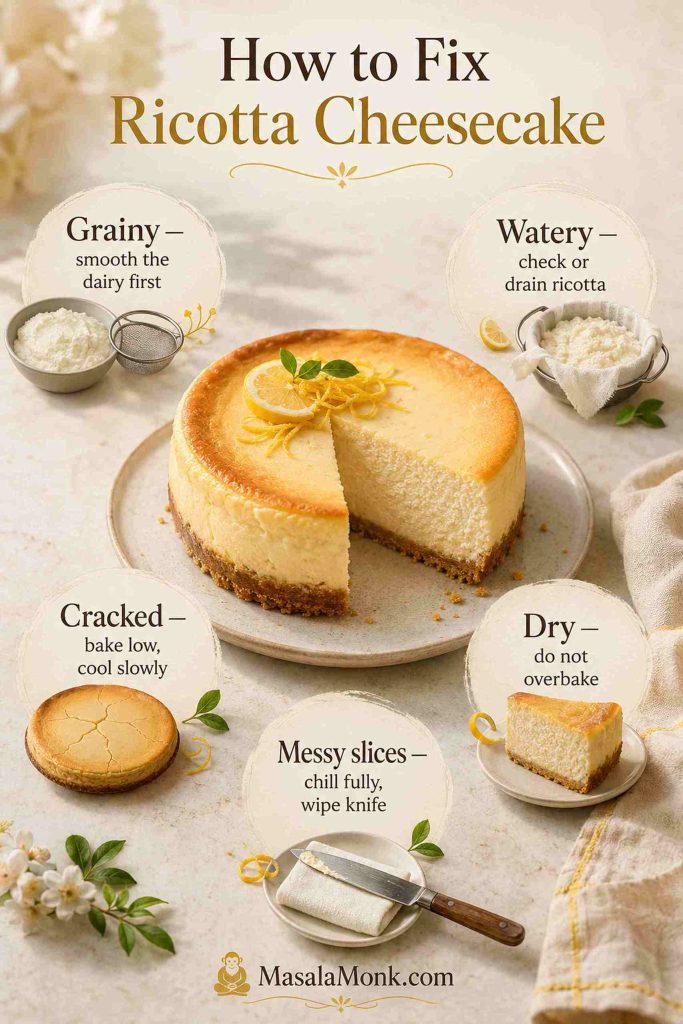
How to Fix Ricotta Cheesecake Problems

If your ricotta cheesecake does not come out exactly as planned, the problem is usually fixable next time. Most issues trace back to moisture, heat, mixing, or slicing before the cheesecake has fully chilled.

Ricotta cheesecake troubleshooting board with fixes for grainy, watery, cracked, dry, and messy slices
Most ricotta cheesecake problems trace back to moisture, mixing, heat, cooling, or slicing too early, so the fix usually starts before serving.

Texture and Baking Problems

Problem Likely Cause How to Fix It Next Time
Filling has tiny lumps before baking Cold cream cheese or under-blended ricotta Stop and blend the dairy base smoother before adding eggs. Once eggs are added, avoid aggressive mixing
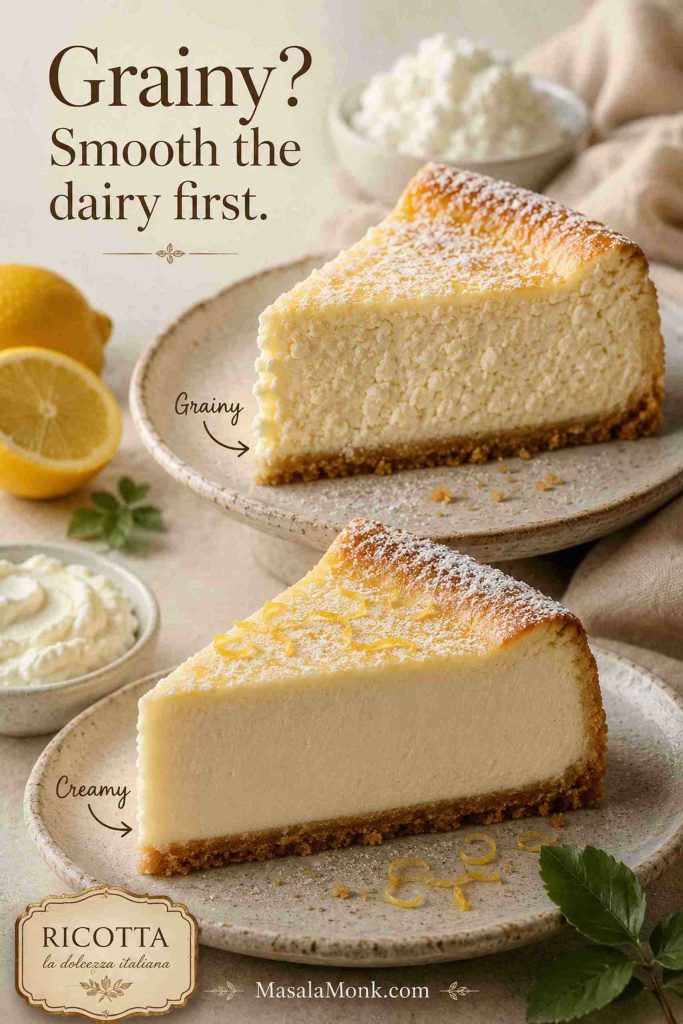
Grainy filling Grainy ricotta, cold dairy, or not enough blending Use smoother whole-milk ricotta, bring dairy to room temperature, and process ricotta with cream cheese before adding eggs
Watery cheesecake Wet ricotta, underbaked center, or not enough chill time Drain loose ricotta, bake until the center softly wobbles instead of sloshes, and chill overnight
Cracked top Overmixed eggs, oven too hot, overbaking, or sudden cooling Add eggs last, mix briefly, bake low, and cool gradually in the oven
Dry texture Overbaking or low-fat ricotta Use whole-milk ricotta and pull the cheesecake while the center still wobbles softly
Grainy ricotta cheesecake slice compared with a creamy ricotta cheesecake slice
Grainy texture is easiest to prevent before baking by using good ricotta, bringing dairy to room temperature, and smoothing the base well.

For watery centers and cracked tops, focus on moisture control, gentle heat, and slow cooling before changing the recipe.

Watery ricotta cheesecake slice with strainer cue and cracked cheesecake top with cooling cue
Watery filling usually points to excess ricotta moisture, while cracks often come from heat or sudden cooling; fortunately, both are preventable.

Cooling, Slicing, and Serving Problems

Problem Likely Cause How to Fix It Next Time
Center sank Underbaking, too much air, or fast cooling Do not whip after adding eggs, bake a little longer, and cool slowly
Soggy crust Crust not prebaked or filling too wet Prebake the crust and drain watery ricotta before mixing
Messy slices Cheesecake was sliced warm or not chilled long enough Chill at least 6 hours, preferably overnight, and slice cold with a wiped knife
Cheesecake seems too soft after baking It may be underbaked, too warm, or not chilled long enough Chill it overnight before judging. If it still will not slice cleanly, serve it cold in bowls with berries or compote instead of forcing neat slices
It tastes good but looks imperfect Minor cracks, slight sinking, or a rustic top are normal with ricotta cheesecakes Chill fully, dust with powdered sugar, and serve with berries, honey, or compote

How to Store and Freeze Ricotta Cheesecake

Ricotta cheesecake tastes best cold from the refrigerator, especially during the first two days after baking. Keep it covered so the delicate dairy flavor does not pick up refrigerator odors.

For safest home storage, use refrigerated leftovers within 3–4 days. Keep the cheesecake tightly wrapped or in an airtight container.

You can freeze it, although the texture is best within 1–2 months. Chill the cheesecake completely first, then wrap the whole cake or individual slices tightly in plastic wrap and foil. Thaw overnight in the refrigerator before serving.

Ricotta cheesecake slices stored in airtight containers and wrapped for freezing with fridge and freezer timing labels
Store ricotta cheesecake covered in the refrigerator for short-term freshness, or freeze wrapped slices when you want make-ahead dessert portions.

For general leftover food safety, the USDA Food Safety and Inspection Service recommends refrigerating leftovers promptly and using refrigerated leftovers within 3–4 days.

Ricotta Cheesecake Recipe Card

Ricotta Cheesecake Recipe

This creamy baked ricotta cheesecake uses whole-milk ricotta, cream cheese, lemon, vanilla, and an optional crumb crust for a cool, softly set slice that feels lighter than classic cheesecake but still cuts cleanly.

Serve it plain and chilled, or dress it up with berries, lemon curd, honey, or powdered sugar.

Yield10–12 slices
Prep Time25–30 minutes
Bake Time85–95 minutes
Chill Time6 hours minimum
Pan9-inch springform
Oven300°F / 150°C
TextureCreamy and sliceable
MethodBaked cheesecake

Ingredients

For the Optional Crust

  • 1 1/2 cups / 150–170 g graham cracker or digestive biscuit crumbs
  • 5 tbsp / 70 g unsalted butter, melted
  • 1–2 tbsp granulated sugar, optional
  • Pinch of fine salt

For the Filling

  • 16 oz / 454 g whole-milk ricotta, room temperature, drained only if watery
  • 16 oz / 454 g full-fat cream cheese, softened to room temperature
  • 1 cup + 2 tbsp / about 225 g granulated sugar
  • 5 large eggs, room temperature
  • Zest of 1 large lemon
  • 1 tbsp / 15 ml fresh lemon juice
  • 2 tsp / 10 ml vanilla extract
  • 1/2 tsp kosher salt, or 1/4 tsp fine salt
  • 1 tbsp cornstarch, optional, for cleaner slices

If making it crustless: skip the crust ingredients and crust steps. Line the bottom of the springform pan with parchment, grease the sides well, and preheat directly to 300°F / 150°C. Use the wobble and temperature cues rather than relying only on the exact time.

Instructions

  1. Prepare the pan. Line the bottom of a 9-inch springform pan with parchment paper and lightly grease the sides.
  2. Heat the oven. For the crusted version, preheat to 350°F / 177°C for the prebake. For a crustless cheesecake, preheat directly to 300°F / 150°C.
  3. Make the crust. Mix the crumbs, melted butter, sugar, and salt until evenly moistened. Skip this step for a crustless cheesecake.
  4. Press and prebake. Press the crust firmly into the bottom of the pan. Bake for 8–10 minutes, then let it cool. Lower the oven to 300°F / 150°C. Skip this step for a crustless cheesecake.
  5. Smooth the dairy. In a food processor, blend the ricotta and cream cheese until smooth. Scrape down the sides and blend again if needed.
  6. Add flavor and sugar. Add sugar, lemon zest, lemon juice, vanilla, salt, and cornstarch if using. Mix until smooth.
  7. Add the eggs gently. Add eggs one at a time, pulsing or mixing on low speed only until incorporated. Do not overmix after the eggs go in.
  8. Fill the pan. Pour the filling over the cooled crust, or directly into the lined pan if making it crustless. Smooth the top and set the springform pan on a baking sheet.
  9. Bake gently. Bake at 300°F / 150°C for 85–95 minutes, until the edges are set and the center still wobbles softly. If using a thermometer, aim for about 150–155°F / 65–68°C in the center.
  10. Cool gradually. Turn off the oven, crack the door slightly, and leave the cheesecake inside for 45–60 minutes.
  11. Cool at room temperature. Move the cheesecake to a rack and cool completely.
  12. Chill. Cover and refrigerate for at least 6 hours, preferably overnight.
  13. Slice and serve. Run a thin knife around the edge before releasing the springform ring. Slice cold with a sharp knife, wiping the blade between cuts.

Recipe Notes

  • If your ricotta looks watery, drain it before making the filling.
  • For a crustless version, skip the crust, line the pan well, grease the sides, and rely on the wobble and temperature cues rather than the exact time.
  • For a stronger lemon flavor, use the zest of 2 lemons and up to 2 tbsp / 30 ml lemon juice.
  • For a softer Italian-style variation, replace the cream cheese with mascarpone and chill overnight before slicing.
  • Do not bake until the center is fully firm. A softly wobbly center is correct; use the doneness cues if you are unsure.

Storage

Store covered in the refrigerator for 3–4 days. Freeze whole or sliced cheesecake for 1–2 months for best texture. Thaw overnight in the refrigerator.

If the texture seems off after baking, check the troubleshooting guide before changing the formula.

FAQs

What happens if you skip the cream cheese?

You can make ricotta cheesecake without cream cheese, and many Italian-style versions do. The texture will be different: lighter, more delicate, more custardy, and often a little more rustic. The ricotta and cream cheese version is smoother and easier to slice, which is why it is the best first version for most home bakers.

Why does ricotta cheesecake taste lighter than regular cheesecake?

Ricotta has a softer dairy flavor than cream cheese, so the finished cheesecake tastes familiar but less dense. You still get the creamy sweetness of cheesecake, plus a little brightness from the lemon and a gentler finish from the ricotta.

How do you keep ricotta cheesecake from turning grainy?

Start with the smoothest full-fat ricotta you can find, bring the dairy to room temperature, and blend the ricotta with cream cheese before adding eggs. If the ricotta tastes gritty before baking, blending can improve it, but it may not disappear completely.

When does ricotta need draining?

Check the container before you start. Thick ricotta can go straight into the batter, but ricotta with visible liquid should be strained first. Removing that extra moisture gives the cheesecake a steadier center and a cleaner cut.

Which pan size gives the best texture?

A 9-inch springform pan is the best default. An 8-inch pan makes a taller cheesecake and may need more time. A 10-inch pan makes a thinner cheesecake and may bake faster. Use the wobble and temperature cues instead of relying only on time.

How delicate is a crustless ricotta cheesecake?

A crustless ricotta cheesecake works well, but it is more delicate. Line the pan carefully, grease the sides, chill it fully, and release the springform ring only after the cake is cold.

What replaces a water bath in this recipe?

A low oven temperature, slow cooling, and full chilling replace the need for a water bath here. If you want extra moisture without risking a leak, place a pan of hot water on the lower oven rack instead of submerging the springform pan.

What should the center look like when it leaves the oven?

The edges should be set and the center should wobble softly. It should not slosh like liquid, but it should not look fully firm either. If using a thermometer, aim for about 150–155°F / 65–68°C in the center.

Mascarpone or cream cheese: which is better?

Cream cheese is better for the most reliable structure and cleanest slices. Mascarpone gives a softer, richer, less tangy Italian-style filling, but the cheesecake may feel more delicate and should be chilled overnight before slicing.

How well does ricotta cheesecake freeze?

Ricotta cheesecake freezes well enough for planning ahead, especially in slices. Chill it completely, wrap it tightly, and use it within 1–2 months for best texture. Thaw overnight in the refrigerator.

Should you serve ricotta cheesecake cold or closer to room temperature?

Slice it cold for the cleanest look. For a softer bite, let individual slices sit at room temperature for 10–15 minutes before serving. That short rest opens up the ricotta and lemon flavor without making the slice messy.

Ricotta cheesecake or ricotta pie: which one are you making?

A springform-pan dessert that slices like cheesecake is ricotta cheesecake. A pie-crust or pie-pan version that eats more like sweet ricotta custard is closer to ricotta pie. The ingredients can overlap, but the structure and eating experience are different.

Final Tip

The best ricotta cheesecake is not about chasing a perfect bakery surface. It is about giving the ricotta the right support: remove excess moisture, blend the filling well, bake gently, and let the refrigerator finish the work. Do that, and you get a cheesecake that feels creamy, calm, and elegant rather than heavy or fussy.

Back to top

Posted on 17 Comments

Béchamel Sauce for Lasagna: Classic, Vegan & Ricotta Sauce Recipe

Hand pouring silky béchamel onto a golden lasagna slice; copper saucepan and pasta sheets behind — Béchamel Sauce for Lasagna.

Some lasagne land on the plate as tidy, satiny squares, their layers distinct yet tender; others slouch apart, rich but oddly heavy. The difference, more often than not, is a confident Béchamel Sauce for Lasagna. This classic white sauce—built from a butter-and-flour roux whisked with milk—glues the pasta, ragù, and cheese together without weighing everything down. It’s one of the five “mother sauces” of French cuisine, a family of preparations that underpin countless dishes; if you’re curious about that lineage, the overview from the Auguste Escoffier School of Culinary Arts is a neat primer on why béchamel matters and how cooks riff on it across traditions (including the Mornay variation, which adds cheese) (learn more).

As we go, we’ll explore the classic method, a luscious ricotta–béchamel hybrid, and a plant-based version that behaves exactly like the dairy original. We’ll also walk through consistency cues, layering logic, and common mistakes—with calm, practical fixes—so your Béchamel Sauce for Lasagna performs beautifully every time.

Also Read: Crock Pot Lasagna Soup (Easy Base + Cozy Slow-Cooker Recipes)


What Béchamel Is—and What It Isn’t

At its heart, béchamel is simply milk thickened with a roux. You make a roux by cooking equal parts butter and flour until the paste foams and smells nutty. Keep it blond (not browned) for lasagna; a pale roux thickens more efficiently, giving you a sleeker sauce with less cooking. Season gently with salt, a pinch of white pepper, and just a whisper of fresh nutmeg. That’s it: no cheese yet, no garlic, no stock—just a neutral, creamy backbone ready to support the rest of the dish.

Add cheese to béchamel and you’ve made Mornay, which is wonderful in mac and cheese or as a gratin glue but a bit richer than you need for traditional lasagne. If you’d like to see how gently folding cheese into a hot white sauce creates that glossy, elastic finish (without turning grainy), our Macaroni & Cheese recipe offers a practical demonstration of melting off the heat and letting the sauce stabilize before serving.

Historically, Italian lasagne—especially the Bolognese style from Emilia-Romagna—embraces béchamel as a structural element rather than a dramatic flavor spike. It complements ragù; it doesn’t compete with it. La Cucina Italiana’s concise recipe for besciamella mirrors what generations of home cooks do: modest fat and flour, whisked with milk to a soft, spoon-coating body (classic Italian method).

Also Read: Cottage Cheese Lasagna Recipe | Chicken, Spinach, & Ricotta


Classic Béchamel Sauce for Lasagna: The Master Ratio and Why It Works

While plenty of cooks eyeball their béchamel by feel, a ratio keeps things reproducible—especially when you’re scaling up for guests. A widely used proportion is equal parts butter and flour by weight, then roughly ten parts warm milk by weight. For everyday home cooking, Italy’s common kitchen ratio—40 g butter + 40 g flour + 500 ml milk—is a friendly benchmark. It yields a softly thick sauce that clings to the back of a spoon (the classic nappe texture) without turning pasty.

Why blond matters. A pale roux maintains more thickening power than a darker one because less starch has broken down during toasting. That’s exactly what we want here: a silken texture at a gentle simmer, not a roasty, nutty profile that’d be more appropriate for gumbo or étouffée. If you want a deeper dive into roux behavior and the trade-off between flavor and thickening power, the science-forward guides at Serious Eats are terrific for grasping what’s happening in the pot and how to correct course if you overshoot the color (roux 101), (béchamel basics).

Texture, not time, is your compass. Rather than obsessing over minutes, watch how the sauce moves. When you lift the spoon, it should slide off in a continuous sheet, not in watery rivulets. Draw a finger along the spoon’s back; the line should stay clean. If the sauce feels sluggish, whisk in a spoon or two of warm milk. If it’s thin, simmer delicately for another minute and reassess. With that steady, patient approach, your Béchamel Sauce for Lasagna will end up glossy and cooperative, ready to layer.

Classic Béchamel Sauce for Lasagna being whisked in a copper pan; ratio 40 g butter, 40 g flour, 500 ml warm milk; melt, whisk to blond roux, add milk and simmer to nappe; yields about 4 cups.
Classic Béchamel Sauce for Lasagna—use the 40 g butter + 40 g flour + 500 ml milk ratio, whisk to a blond roux, then simmer to nappe for a silky base (≈4 cups, perfect for a standard 9×13).

Also Read: How to Make Churros (Authentic + Easy Recipe)


The Method, Step by Step – How to Make Béchamel Sauce for Lasagna

Although the technique is short, each move earns its keep. Let’s walk through it explicitly, so nothing feels rushed.
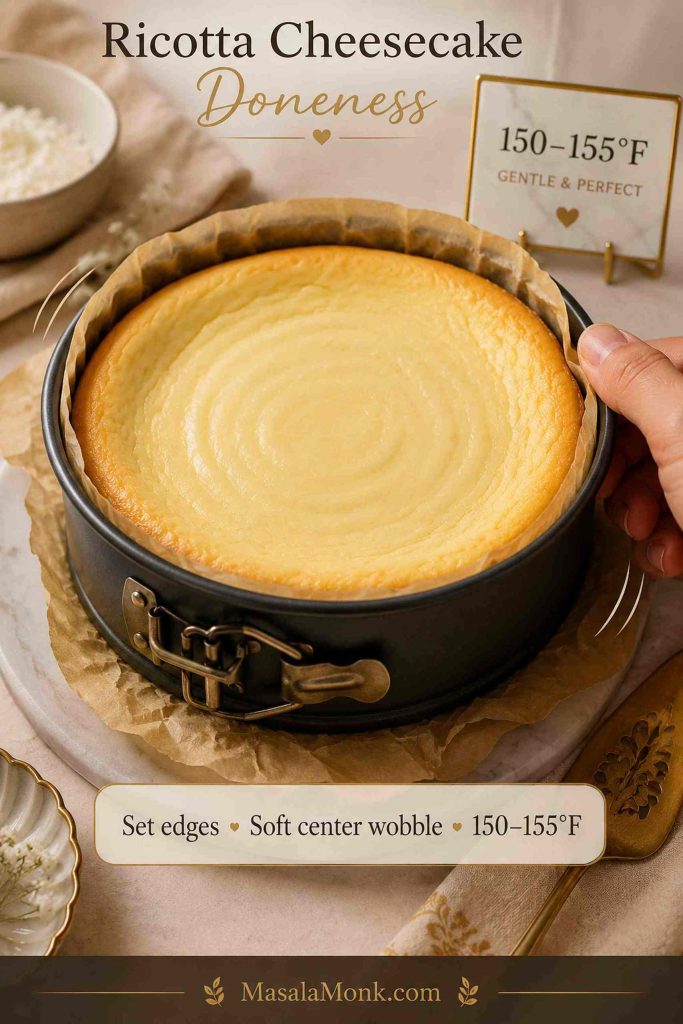
  1. Warm your milk first. Heat the milk separately until it’s steaming, not boiling. Warm liquid integrates into the roux more willingly, minimizing lumps and shaving time off the final simmer.
  2. Cook a blond roux. In a heavy-bottomed saucepan, melt butter over medium-low. Scatter in an equal weight of flour and whisk constantly for 2–3 minutes. You’re aiming for a gentle foam and a pale straw color.
  3. Off heat, add milk gradually. Take the pot off the burner. Whisk in a small splash of warm milk; when it’s smooth, add a little more, and a little more. As the mixture loosens and turns glossy, you can add the remaining milk in a steady stream.
  4. Return to low heat and simmer. Put the pot back over low heat and whisk until the sauce gently bubbles. Keep it just below a boil; vigorous bubbling can scorch milk solids or create a grainy mouthfeel.
  5. Season and adjust. Salt, a pinch of white pepper, and a tiny grating of nutmeg bring it into focus. Check texture; it should coat a spoon and flow slowly off the whisk.

That’s the base. From here, you can drive in several directions—straight into a lasagna pan, gently into ricotta for a smooth hybrid, or toward a vegan variant that behaves like this one but uses plant milk and olive oil.

Also Read: How to Cook Bacon in the Oven (Crispy, No-Mess, Crowd-Ready Recipe)


How Much Béchamel Sauce for Lasagna You Actually Need

Because pan depth and noodle thickness vary, it’s easier to think in ranges. For a standard 9×13-inch lasagna, 4 to 5 cups of béchamel usually lands you in the sweet spot. Spread a thin smear on the bottom to prevent sticking; then build in repeating layers: béchamel → noodles → ragù → béchamel → grated cheese. Keep the béchamel layers thin yet continuous—enough to gloss the pasta and moisten the ragù so everything fuses.

Traditional Lasagne alla Bolognese from Emilia-Romagna follows precisely this logic—pasta, ragù, béchamel, Parmigiano, and repeat—resulting in slices that hold shape without drying out. For a lovely regional perspective on that structure, browse the official travel resources from Emilia-Romagna or articles documenting the classic recipe; they consistently place béchamel as the quiet, essential binder rather than a showy flavor bomb (regional context).

If you enjoy ricotta’s milky sweetness, you can absolutely keep it in play; we’ll fold it into béchamel in a moment. Meanwhile, if you’re looking to cross-reference other layering styles (including a cottage-cheese-forward path that meal-preps well), peek at Cottage Cheese Lasagna: Chicken, Spinach & Ricotta and adapt the assembly by swapping your béchamel for part of the cheese mix.


Ricotta–Béchamel Recipe: The Ultra-Smooth Cheese Layer

Some cooks love ricotta’s flavor but don’t always love its grainy, slightly crumbly texture in baked layers. Béchamel Sauce for Lasagna solves that beautifully when you blend the two.

Top-down flatlay showing Ricotta–Béchamel Cheese Sauce for Lasagna: glass bowl of creamy sauce, small bowl of ricotta, wedge of Parmigiano, and lasagna sheets on a wooden board.
Ricotta–Béchamel Cheese Sauce—fold ricotta and finely grated Parmigiano into hot béchamel off heat for a glossy, non-grainy layer; makes about 5 cups, ideal for a standard 9×13 lasagna.

How to make it:

  • Start with 4 cups hot béchamel at nappe consistency.
  • Whisk in 1 cup finely grated Parmigiano Reggiano off the heat until melted and glossy.
  • Fold in ½–1 cup ricotta, choosing a smooth variety; if it’s dense, whisk it briefly to loosen before blending.
  • Taste for salt and, if needed, add an extra tablespoon of grated Parmesan to sharpen the finish.

This hybrid behaves like a mellow Mornay—silky, cohesive, and easy to spread—while preserving ricotta’s clean dairy notes. If you’re curious which cheese finishes the top layer best (for bronzing without greasy puddles), our primer on the difference between Parmesan and Parmigiano Reggiano explains why the real thing seasons with a savory snap and melts more cleanly than many pre-grated blends.


Vegan Béchamel Sauce for Lasagna: Same Feel, Plant-Based Recipe

The plant-based route is gratifyingly simple because the physics don’t change—only the fat and the milk do.

  • Fat: Use olive oil or a neutral vegan butter.
  • Flour: Stick to all-purpose. Chickpea or whole-grain flours can add flavor; if you enjoy that, use them sparingly at first.
  • Milk: Opt for unsweetened soy or oat milk. Unsweetened soy melts into the background; oat brings a subtle, round sweetness. Almond milk can work but is thinner and may need a minute more simmering.
  • Seasoning: Salt, white pepper, nutmeg, plus an optional teaspoon of onion powder for savory backbone. If you want a slightly “cheesy” direction without adding actual cheese, whisk in a tablespoon or two of nutritional yeast.
Vegan Béchamel Sauce for Lasagna whisked in a black pan—60 g olive oil, 60 g flour, 700 g unsweetened soy/oat milk—melt oil, whisk blond roux, add warm plant milk, simmer to nappe; yields about 4 cups.
Vegan Béchamel Sauce for Lasagna—use an olive-oil roux and warm unsweetened soy/oat milk, then simmer gently to nappe for a silky, slice-clean layer (≈4 cups in 12–15 minutes).

Technique-wise, everything mirrors the dairy version: warm the plant milk, cook a blond roux in oil, whisk off the heat, then return to a gentle simmer. If you’d like more ideas for building a fully vegan pasta night—high protein, big flavor—dip into our plant-based pasta collection for cashew-based sauces and other creamy profiles that pair beautifully with vegetables.


Seasoning and Aroma: Subtlety Wins

Because Béchamel Sauce for Lasagna plays a supporting role, restraint pays off. A scant pinch of nutmeg accentuates the sauce’s dairy sweetness without shouting; more than that can tilt perfumey. White pepper keeps flecks invisible and holds onto heat gently; black pepper works too, but the specks distract in a pale sauce. If your ragù is already intense, let béchamel stay quiet. Conversely, if your filling leans delicate—say, spinach and mushrooms—consider a whisper of fresh lemon zest to brighten the edges.

Crucially, avoid garlic in the béchamel itself; if you want a garlic presence, let it live in the ragù or a separate spinach layer, where it can sauté properly and won’t risk turning harsh in milk.

Also Read: 10 Best Espresso Martini Recipe Variations (Bar-Tested)


Layering Strategy: Structure Meets Tenderness

Successful layering is less about strict rules and more about a few guiding ideas:

  • Moisture distribution. Thin béchamel layers moisten the pasta while the ragù provides body. Too much béchamel in one spot can slip and puddle; too little leaves dry corners. Spread to the edges.
  • Cheese placement. Finely grate Parmigiano between layers rather than piling most of it on top. This encourages even melt and better slice integrity. Save a small handful for the surface to bronze.
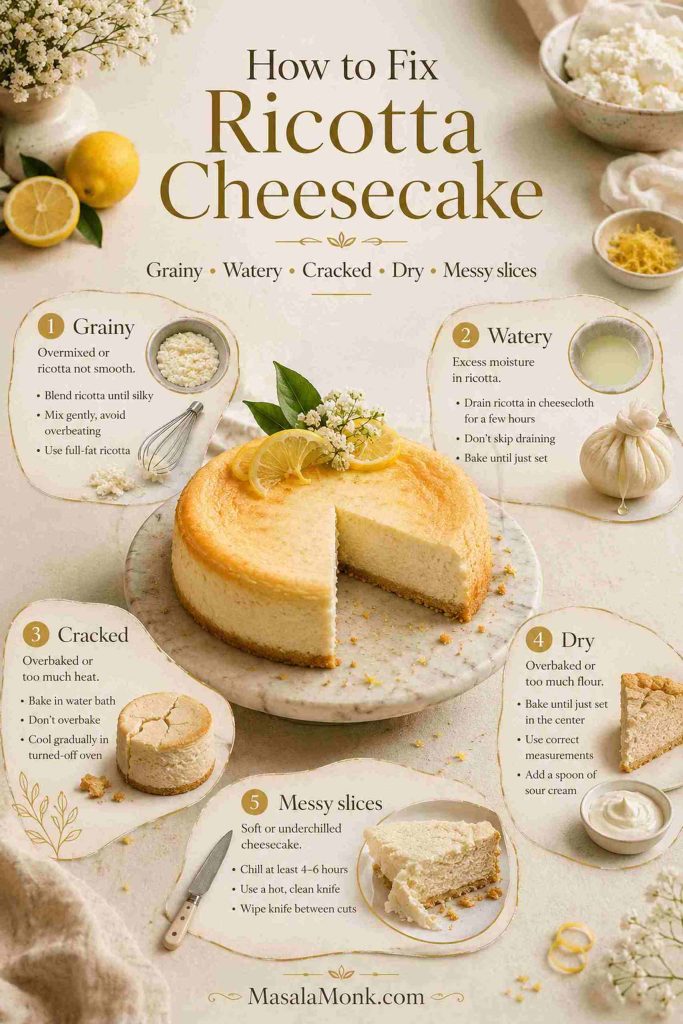
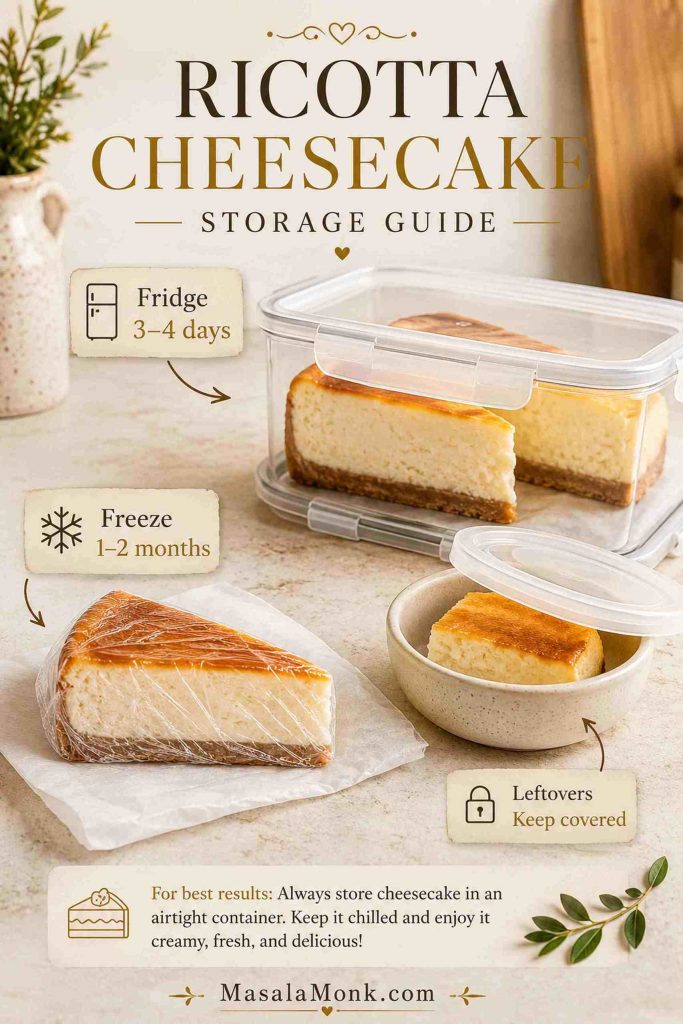
  • Top management. Finish with a modest veil of béchamel and cheese, not a thick cap. That balance prevents rubbery tops and helps steam escape.
Layering Béchamel Sauce for Lasagna in a 9×13 pan—use about 4–5 cups; sequence: base smear, pasta, ragù, béchamel, Parmesan; repeat and finish with a thin béchamel cap; rest 10–15 minutes.
Layering Béchamel Sauce for Lasagna—plan ≈4–5 cups for a 9×13. Start with a base smear, then build pasta → ragù → béchamel → Parmesan; repeat, top lightly, and rest before slicing.

If you’re ever tempted to swap béchamel for a heavy cheese sauce on every layer, consider contrast. Let béchamel do the quiet binding and reserve richer, cheesier notes for a single inner layer or the finish. For a clear comparison of white sauces versus cream-based Alfredo styles (and when each shines), our Alfredo deep-dive lays out the differences so you can choose the right tool for the flavor you want.


Troubleshooting: Calm Fixes for Common Problems

Even experienced cooks run into little snags; the key is responding gracefully.

Lumps
If lumps form, kill the heat immediately. Whisk hard for 20–30 seconds; most will dissolve as the starch hydrates fully. Still not smooth? Pour the sauce through a fine sieve into a warm pot and carry on. Next time, remember to whisk off the heat when adding milk and add it gradually.

Too Thick or Too Thin
If your Béchamel Sauce for Lasagna feels gluey, whisk in warm milk a tablespoon at a time until it flows again. If it’s thin, give it a gentle simmer and the occasional whisk for another minute. Because a pale roux retains strong thickening power, tiny tweaks go a long way.

Nappe test for Béchamel Sauce for Lasagna—spoon coated with sauce showing a clean finger line, indicating pourable, spoon-coating consistency.
Nappe = the right thickness for béchamel: it coats the spoon, holds a clean finger line, and still pours smoothly—ideal for neat, sliceable lasagna layers.

Grainy After Adding Cheese
This usually means the cheese overheated or the sauce boiled after the cheese went in. Melt cheeses off heat and stop stirring once they dissolve. You can always rewarm gently if needed. For technique cues that keep melted cheese smooth, the process notes in our Macaroni & Cheese guide are directly transferable.

Scorching
Scorched milk is stubborn. If you catch the smell early, pour the unscorched top portion into a new pot, leaving any browned film behind. Keep heat low and whisk more frequently.

Breaking in the Oven
If a lasagna looks greasy on top, it’s often because the cheese was too fatty or piled too thickly. Use a firm grana like Parmigiano for most of the top and keep any mozzarella to a light sprinkle; you’ll get bronze without pools. Our Parmesan vs. Parmigiano Reggiano piece clarifies why the real stuff behaves better under heat.

Also Read: 10 Best Chicken Sandwich Recipes (BBQ, Parm, Buffalo & More)


Make-Ahead, Cooling, and Reheating

Béchamel is an ideal make-ahead component because it reheats predictably. After cooking, cool it quickly: transfer to a shallow container, press parchment or plastic directly onto the surface to prevent a skin, and refrigerate promptly. For general food-safety timing, U.S. guidelines recommend using refrigerated leftovers within 3–4 days, and, if you need a longer hold, freezing works well; thaw overnight and whisk while reheating, loosening with a splash of milk as needed (USDA/FSIS guidance), (FoodSafety.gov storage chart).

When reheating béchamel, keep the heat low and whisk patiently; it will return to its glossy self. If you’re turning it into a ricotta–béchamel blend, bring it to just-warm before whisking in cheese so everything integrates without curdling.

Also Read: French Toast Sticks (Air Fryer + Oven Recipe) — Crispy Outside, Custardy Inside

Side-by-side pans showing white roux and blond roux—the ideal stage for béchamel.
For Béchamel Sauce for Lasagna, cook the roux to blond: more thickening power and a silkier sauce.

Béchamel Sauce for Lasagna—Scaled Recipes You Can Memorize

Classic Béchamel (about 4 cups)

  • 60 g butter
  • 60 g all-purpose flour
  • 600 g whole milk, warmed
  • 1 tsp fine salt, pinch white pepper, tiny grating nutmeg

Directions: Make a blond roux (2–3 minutes). Off heat, whisk in warm milk gradually until smooth, then simmer gently for 6–8 minutes. Season and adjust to nappe.

Ricotta–Béchamel (for one 9×13-inch lasagna)

  • 4 cups hot béchamel
  • 1 cup finely grated Parmigiano Reggiano
  • ½–1 cup smooth ricotta

Directions: Off heat, whisk Parmesan into béchamel until glossy; fold in ricotta. Taste and season. Spread thinly between layers.

Vegan Béchamel (about 4 cups)

  • 60 g olive oil (or vegan butter)
  • 60 g all-purpose flour
  • 700 g unsweetened soy or oat milk, warmed (plant milks vary in body; start here)
  • 1–1½ tsp fine salt, pinch white pepper, tiny pinch nutmeg
  • Optional: 1 tsp onion powder; 1–2 tbsp nutritional yeast

Directions: Make a blond roux with oil; whisk in warm plant milk off heat; return to low simmer until nappe. Season and adjust with milk as needed.

Also Read: Lemon Drop Martini Recipe (Classic, 3-Ingredient, & More)


Beyond Lasagna: Using Béchamel Elsewhere (With Restraint)

Because béchamel is neutral and stabilizing, it shines in unexpected places:

  • Mac and Cheese. Fold in cheeses off heat to create a classic Mornay; the method used in our stovetop and baked mac & cheese keeps the sauce silky instead of clumpy.
  • Vegetable gratins. A modest layer underneath roasted cauliflower or leeks amplifies tenderness without drowning flavor.
  • Croque monsieur. Thin béchamel brushed onto the bread provides moisture insurance and browning potential.
  • Moussaka. A thicker béchamel (sometimes enriched with egg yolks) forms the custardy top; for a Greek-leaning lasagna night, it’s a lovely twist that still uses the same roux logic.

If you want to compare white-sauce approaches with cream-based pasta styles for variety in your weekly rotation, our Alfredo overview maps where béchamel-based sauces fit, and when to pivot to cream reductions instead.


Putting It All Together: A Calm, Confident Lasagna Flow

To bring the pieces together, work in an unhurried rhythm:

  1. Cook béchamel first. It holds well and gives you time to tweak texture.
  2. Taste your ragù. Salt it to where you want it, since béchamel will not compensate for underseasoning later.
  3. Par-cook or soak noodles as needed. No-boil sheets drink up moisture; béchamel helps, but be generous with sauce coverage so the edges don’t crisp prematurely.
  4. Layer lightly but completely. Each béchamel layer should be thin yet continuous, reaching every corner.
  5. Finish modestly. A veil of béchamel and Parmigiano on top will bronze and stay supple.
  6. Rest before slicing. Ten to fifteen minutes lets the starches set, giving you clean squares rather than slumps.

On nights when you want a lighter profile, choose the classic Béchamel Sauce for Lasagna and keep cheese modest. On nights when you crave dreamy richness, fold in ricotta for the hybrid. When cooking for plant-based friends, the vegan version slips into the stack quietly and delivers the same structure. Because the method is compact and forgiving, you’ll adjust by feel in no time.

Also Read: Pumpkin Spice, Your Way: Master Blend, Variations & Real-World Recipes


A Final Word on Confidence and Craft

Great béchamel is about attention, not fussiness. Warm the milk, whisk off heat, simmer gently, season with care, and trust your eyes more than the clock. Every pan, every burner, every batch of flour behaves a little differently; nonetheless, the cues never change. When the sauce coats a spoon and glides, when the layers spread thin and even, when the bake exhales a faint butter-and-nutmeg scent as it rests—you’ll know you’re there.

If you’d like more perspective on béchamel’s role in the wider culinary family, the Escoffier piece on mother sauces helps set the stage (read here). For nitty-gritty technique and starch science, Serious Eats offers clear, test-driven guidance on roux and white sauces (roux guide), (béchamel guide). And for your own kitchen reference, keeping an eye on safe cooling and storage windows will let you make sauce ahead without worry (USDA/FSIS), (FoodSafety.gov).

Meanwhile, for variations and related dishes in our repertoire, browse these companion reads on MasalaMonk:

Make your Béchamel Sauce for Lasagna once this way—patient, glossy, and balanced—and it will quietly upgrade every batch that follows.

FAQs

1) What is Béchamel Sauce for Lasagna, exactly?

Béchamel Sauce for Lasagna is a silky white sauce made from a blond roux (butter + flour) whisked with warm milk, lightly seasoned with salt, white pepper, and a hint of nutmeg. It binds layers, prevents dryness, and gives clean, sliceable structure.

2) What’s the ideal ratio for Béchamel Sauce for Lasagna?

Use equal parts butter and flour by weight, then about 10 parts milk by weight. For home cooking, 40 g butter + 40 g flour + 500 ml milk yields a classic, spoon-coating consistency.

3) How much béchamel do I need for a 9×13-inch pan?

Plan on 4–5 cups. Start with a thin smear in the pan, then use modest, even layers between noodles and ragù so everything fuses without becoming soupy.

4) Should I use béchamel, ricotta, or both?

Either works, yet combining them is lovely. Blend warm béchamel with ricotta and a little grated hard cheese for a smooth, cohesive “cheese sauce” that spreads evenly and bakes beautifully.

5) How thick should Béchamel Sauce for Lasagna be?

Aim for nappe: it should coat the back of a spoon and leave a clean line when you swipe a finger. If it’s too thick, add a splash of warm milk; if thin, simmer briefly to tighten.

6) Can I make Béchamel Sauce for Lasagna ahead of time?

Absolutely. Cool quickly, press parchment or plastic directly on the surface, and refrigerate. Reheat gently and whisk in a bit of milk to restore gloss.

7) Can I freeze béchamel?

Yes. Freeze in flat portions. Thaw overnight, reheat slowly, and whisk to smooth; add a spoon of milk if needed.

8) What’s the best milk to use?

Whole milk delivers classic body and flavor. For a lighter take, use 2% and simmer a minute longer. If you prefer richness, blend in up to 25% cream—but keep the texture pourable.

9) How do I fix lumpy béchamel?

Remove from heat and whisk vigorously; most lumps dissolve as starch hydrates. If needed, strain through a fine sieve into a warm pot and continue.

10) Why did my sauce turn grainy after adding cheese?

Cheese overheated. Next time, add cheese off heat and stir just until melted. For this recipe, keep béchamel plain between layers and use grated cheese sparingly for balance.

11) Can I make a vegan Béchamel Sauce for Lasagna?

Certainly. Swap butter for olive oil or vegan butter, use unsweetened soy or oat milk, and season as usual. Simmer a touch longer to remove any raw flour taste.

12) Is béchamel the same as white sauce?

Yes. “White sauce” is the common name for béchamel—milk thickened with a roux and gently seasoned. Add cheese and you’ve created a daughter sauce (often called Mornay).

13) Do I need nutmeg?

A small pinch accentuates dairy sweetness without dominating. Use a light hand so the sauce stays supportive rather than showy.

14) How do no-boil noodles change the amount of sauce?

No-boil sheets drink more liquid while baking. Consequently, keep your béchamel layers continuous (edge-to-edge) and lean toward the higher end of the 4–5 cup range.

15) Can I make gluten-free Béchamel Sauce for Lasagna?

Yes. Use a 1:1 gluten-free all-purpose blend for the roux. Cook the roux gently to remove raw flavors before whisking in warm milk.

16) How should I season béchamel for lasagna layers?

Season lightly—salt, white pepper, a whisper of nutmeg. Let the ragù and finishing cheeses carry most of the bold flavors, while béchamel provides balance and moisture.

17) Will béchamel make my lasagna watery?

Not if it’s cooked to nappe and spread thinly. Watery results usually come from under-reduced ragù, overpacked fillings, or uncooked vegetables releasing liquid.

18) What’s the best way to layer with Béchamel Sauce for Lasagna?

Begin with a thin béchamel smear in the pan, then alternate: noodles → ragù → béchamel → a light sprinkle of grated hard cheese. Finish with a modest veil of béchamel and cheese on top.

19) How long should lasagna rest after baking?

Give it 10–15 minutes. Resting allows starches and fats to settle, helping slices hold their shape.

20) Can I flavor béchamel with aromatics?

For lasagna, keep it quiet. If desired, infuse the milk with a bay leaf or onion, then strain. Avoid sautéed garlic in the béchamel itself; keep stronger flavors in the ragù or vegetable layers.

21) Why use Béchamel Sauce for Lasagna instead of heavy cream?

Béchamel delivers body without greasiness, sets cleanly, and prevents separation. Heavy cream alone can feel rich yet loose; béchamel provides dependable structure.

22) Does béchamel change the bake time?

Not meaningfully. Bake until bubbling around the edges and the top is lightly bronzed. If browning too fast, tent loosely with foil.

23) How much salt should I add?

Season béchamel modestly and taste the ragù separately. Since cheeses add salt, under-seasoning the béchamel a touch keeps the final dish balanced.

24) Can I add herbs to Béchamel Sauce for Lasagna?

If you like, whisk in finely chopped parsley or chives at the end, although restraint is key. The sauce should support, not overshadow, the other layers.

25) What’s the simplest way to scale béchamel?

Multiply the base ratio. For double, use 80 g butter + 80 g flour + 1 liter milk. Watch texture cues and adjust with a splash of milk if it thickens too much.