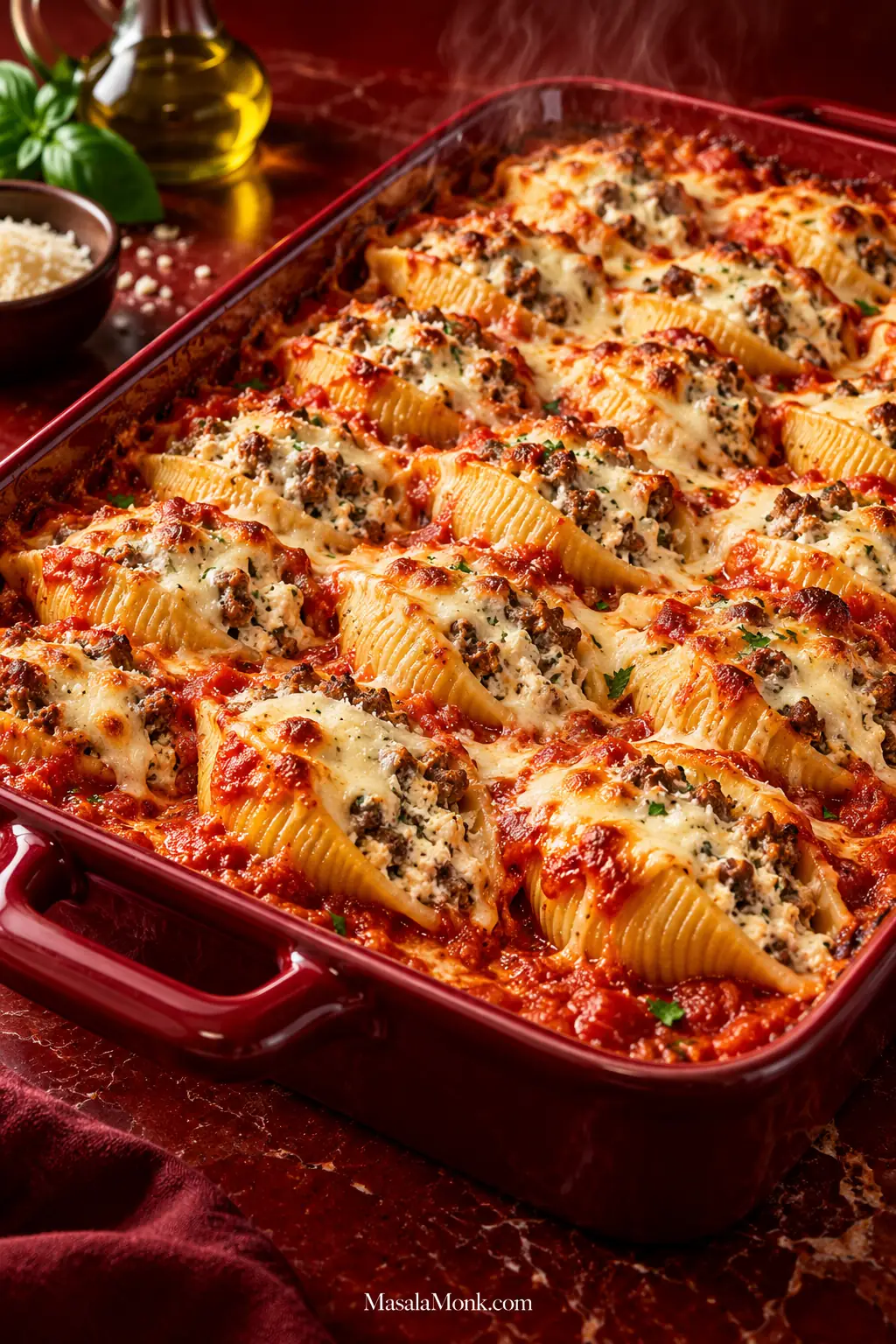
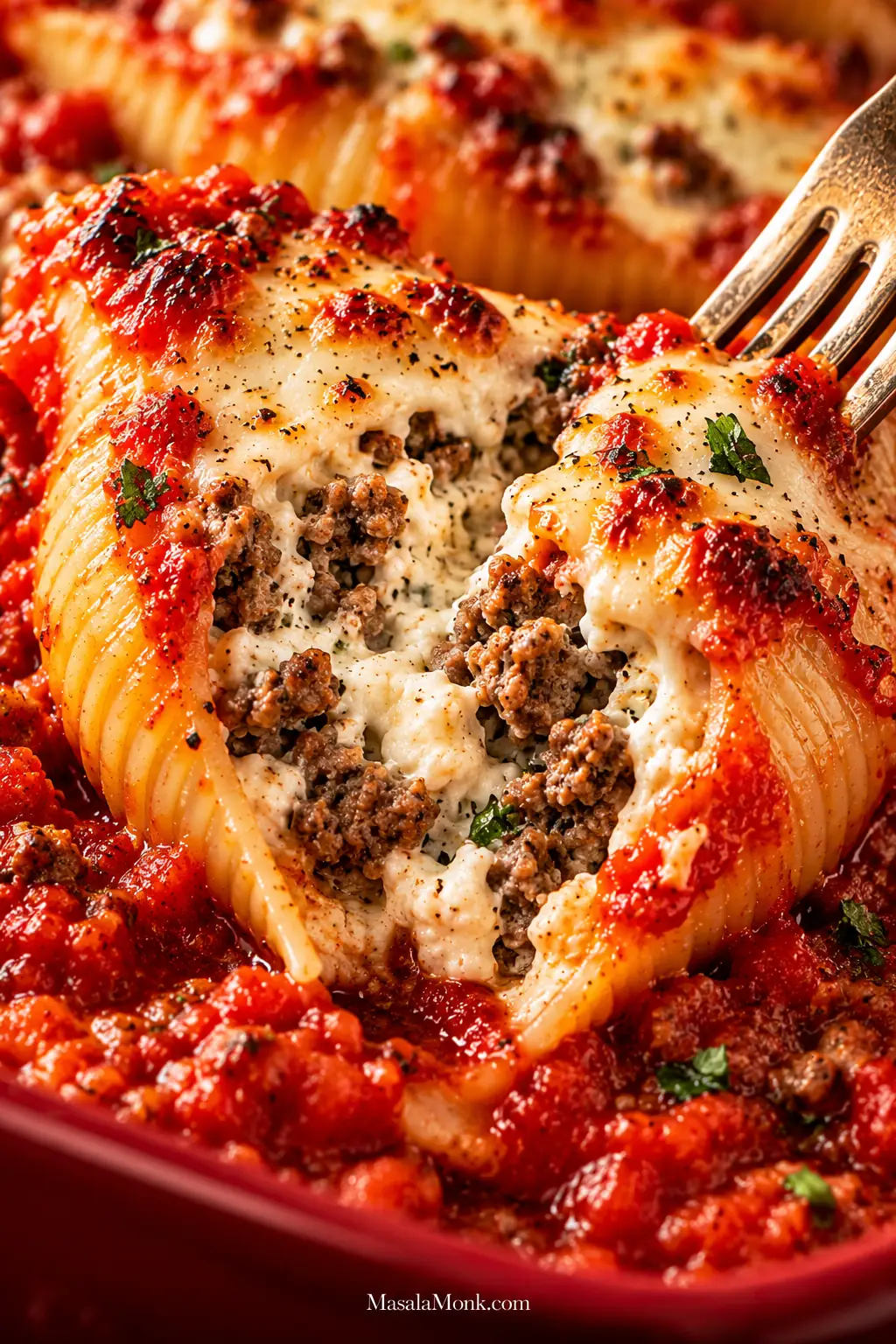
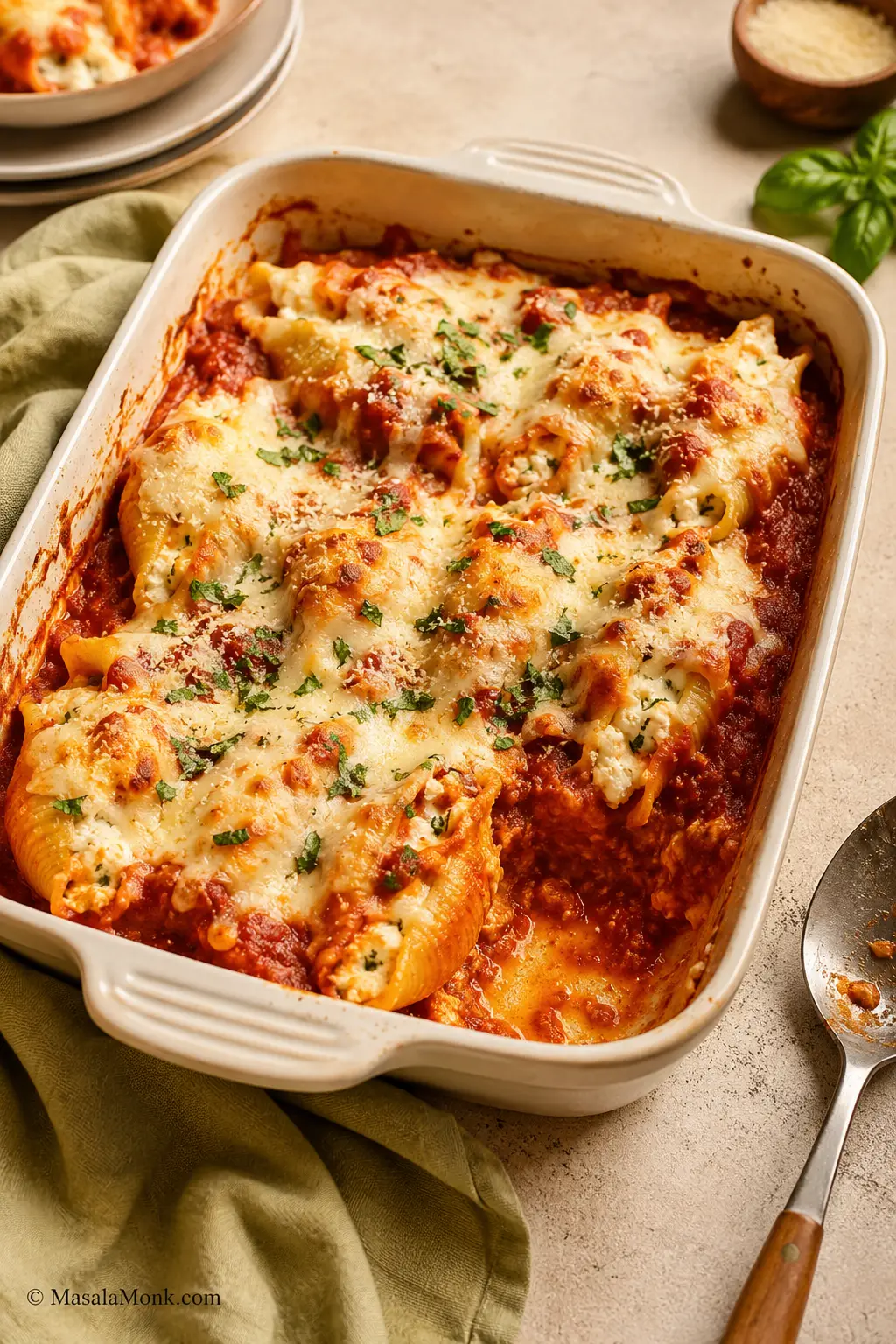
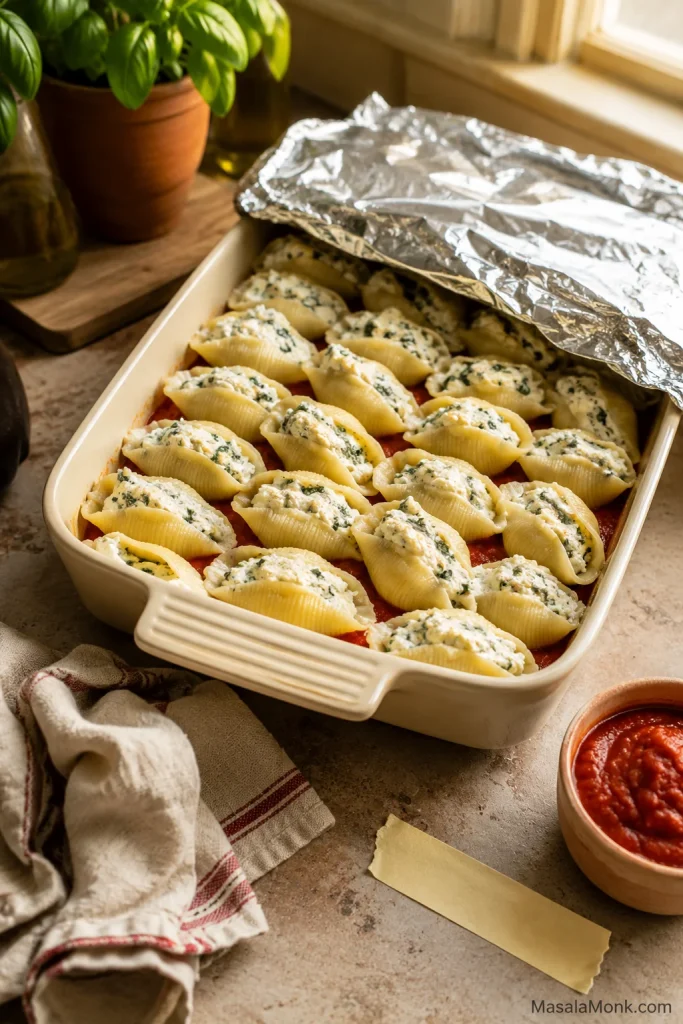
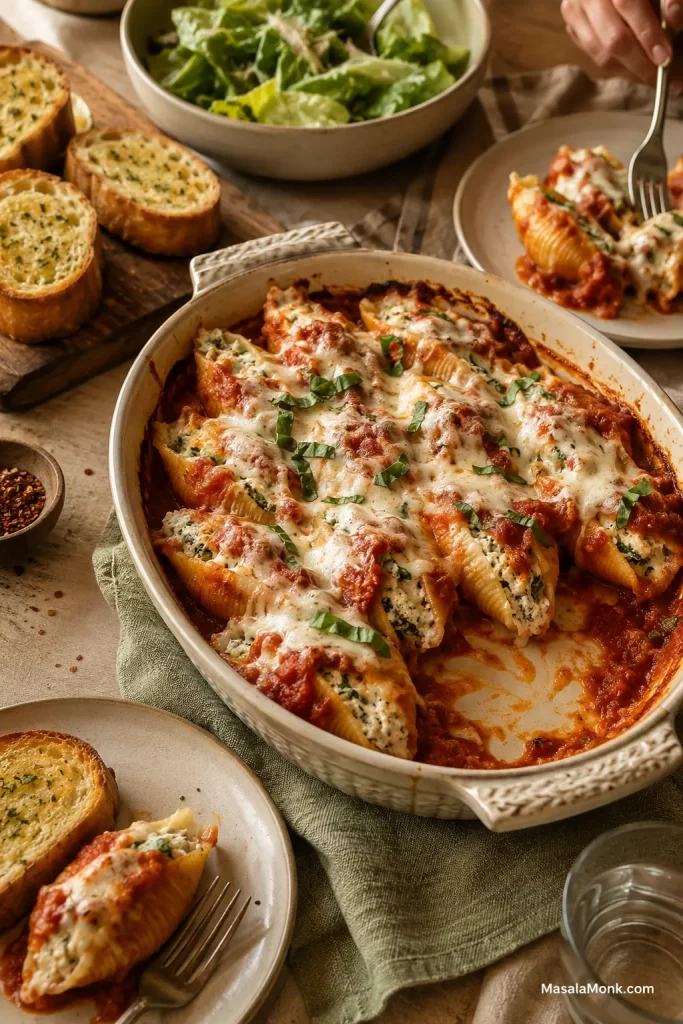
These stuffed shells with meat are filled with seasoned ground beef, creamy ricotta, mozzarella and Parmesan. They bake in marinara until the sauce bubbles around the edges and the cheese melts over the top. The beef goes right into the filling, so every shell gets a generous, savory center rather than cheese in one bite and meat in another.
Let the beef get properly browned before it goes into the ricotta, and pull the shells from the water while they’re still a little firm. They’ll be easier to fill, and they’ll finish cooking in the sauce without turning mushy.
The recipe makes about 24 stuffed shells—enough for six hearty servings or eight with sides. You can also assemble the casserole a day ahead, which is handy when you’d rather have most of dinner dealt with before the evening gets busy.
Servings6 at 4 shells each, or 8 at 3 each with sides
Oven375°F / 190°C
Baking dish9×13 in / 23×33 cm
Prep timeAbout 35 minutes
Bake time30–35 minutes
Rest time10 minutes
Total timeAbout 1 hour 20 minutes
Ingredients
Pasta and sauce
28 jumbo pasta shells, allowing a few extras in case some break
24 oz / 680 g marinara sauce
2–4 tablespoons / 30–60 ml water, only if needed to loosen a very thick sauce
Beef and ricotta filling
2 teaspoons / 10 ml olive oil
½ medium yellow onion, finely chopped (about ½ cup / 75 g)
1 lb / 454 g ground beef, preferably 90% lean
3 garlic cloves, minced
15 oz / 425 g whole-milk ricotta, drained briefly if visibly watery
8 oz / 225 g low-moisture mozzarella, shredded and divided
½ cup / about 45 g finely grated Parmesan
1 large egg
1½ teaspoons Italian seasoning
¾ teaspoon fine sea salt, divided, plus more for the pasta water
½ teaspoon freshly ground black pepper
2 tablespoons chopped fresh parsley, optional
¼ teaspoon crushed red pepper flakes, optional
Can’t find jumbo shells? Manicotti is a good alternative, and cooked lasagna sheets can be rolled around the filling. Small pasta shells are too small to stuff individually; if that’s what you have, a baked pasta such as baked ziti is a better fit.
For the beef, 90% lean gives you plenty of flavor without producing as much rendered fat as a fattier blend. An 85% lean package works too. Use low-moisture mozzarella for the filling and topping. Freshly shredded melts especially well, but a bag of pre-shredded mozzarella is completely fine here.
Because the sauce flavors every shell, use a marinara you already enjoy. Jarred sauce keeps dinner simple; our homemade marinara sauce is another option when you want to make the sauce too.
If the marinara is very thick, loosen it with a splash of water. If it’s unusually thin, simmer it briefly until it clings lightly to a spoon.
Equipment
9×13-inch / 23×33 cm baking dish
Large pot and colander
Tray or large plate for the cooked shells
Large skillet
Aluminum foil
Large mixing bowl
Large spoon or 2-tablespoon scoop, optional
Instant-read thermometer, optional
How to Make Stuffed Shells with Meat
1. Prepare the baking dish
Heat the oven to 375°F / 190°C. Spread about 1 cup of marinara over the bottom of a 9×13-inch / 23×33 cm baking dish. Keep the remaining sauce for the assembled shells.
2. Cook the shells until bendable, not tender
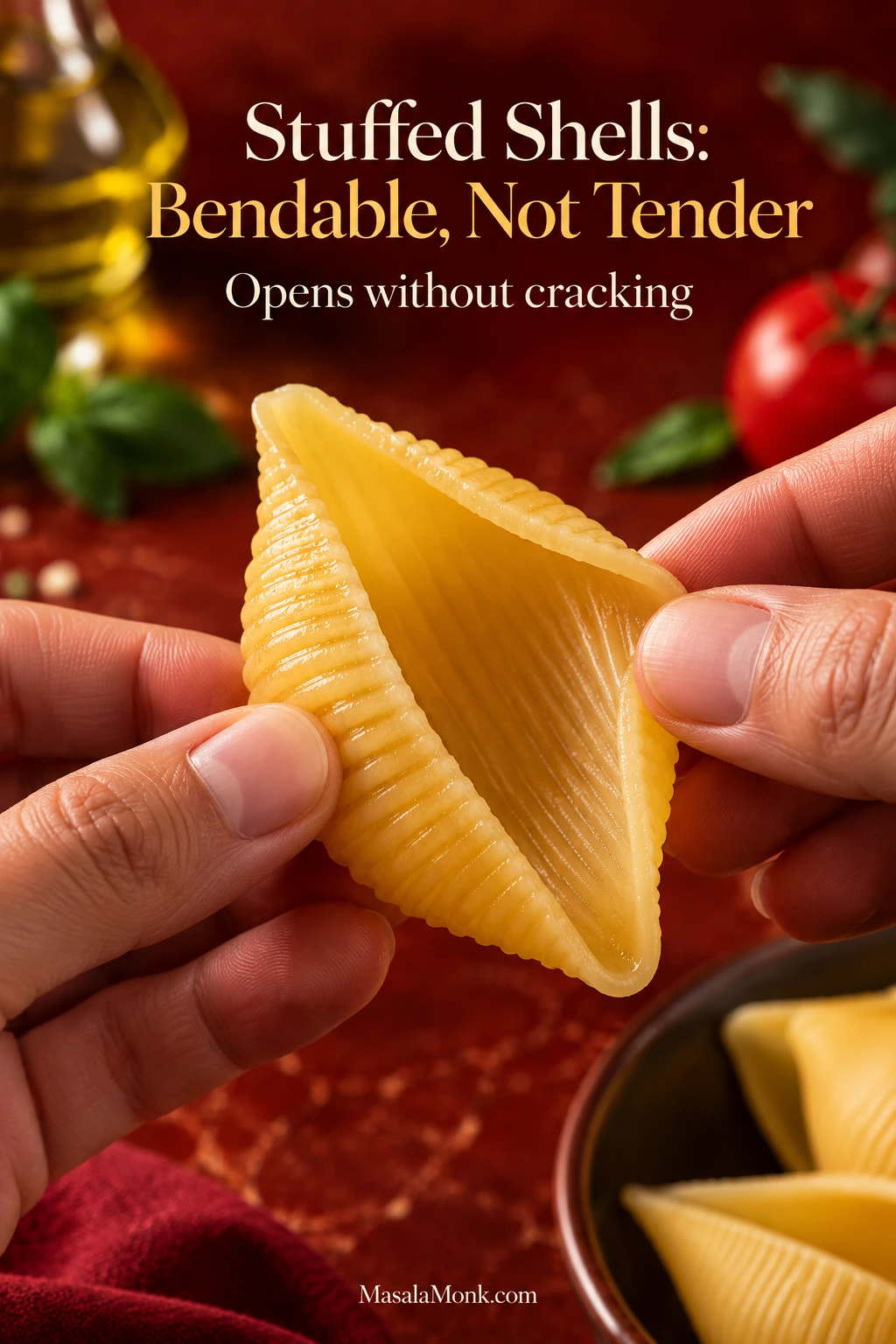
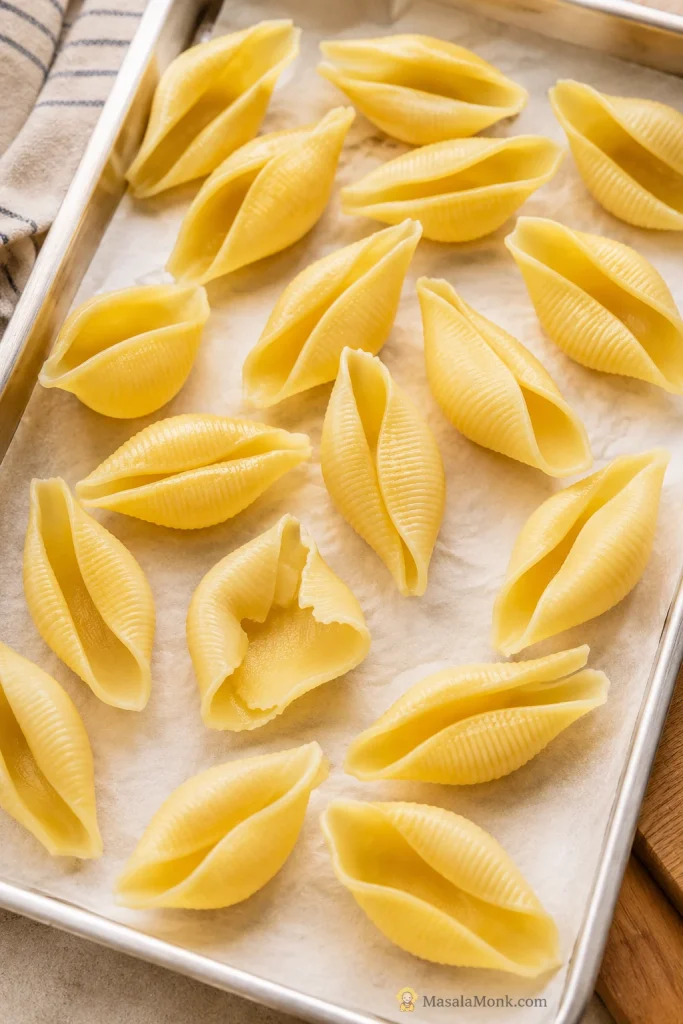
Bring a large pot of well-salted water to a boil. Add the 28 jumbo shells and start checking them about 2 minutes before the shortest cooking time listed on the package. Use their texture as the final guide: a shell should open without cracking but still feel distinctly firm.
Drain immediately and spread the shells in a single layer on a tray or large plate. Separate any that begin sticking together. They’ll finish cooking once the casserole goes into the oven.
A jumbo pasta shell that is ready to fill should flex with a little resistance. If it turns floppy in the pot, it will be harder to drain, open and stuff without tearing.
3. Brown and season the beef
Heat the 2 teaspoons / 10 ml olive oil in a large skillet over medium heat. Add the onion and cook for 3–4 minutes, until softened.
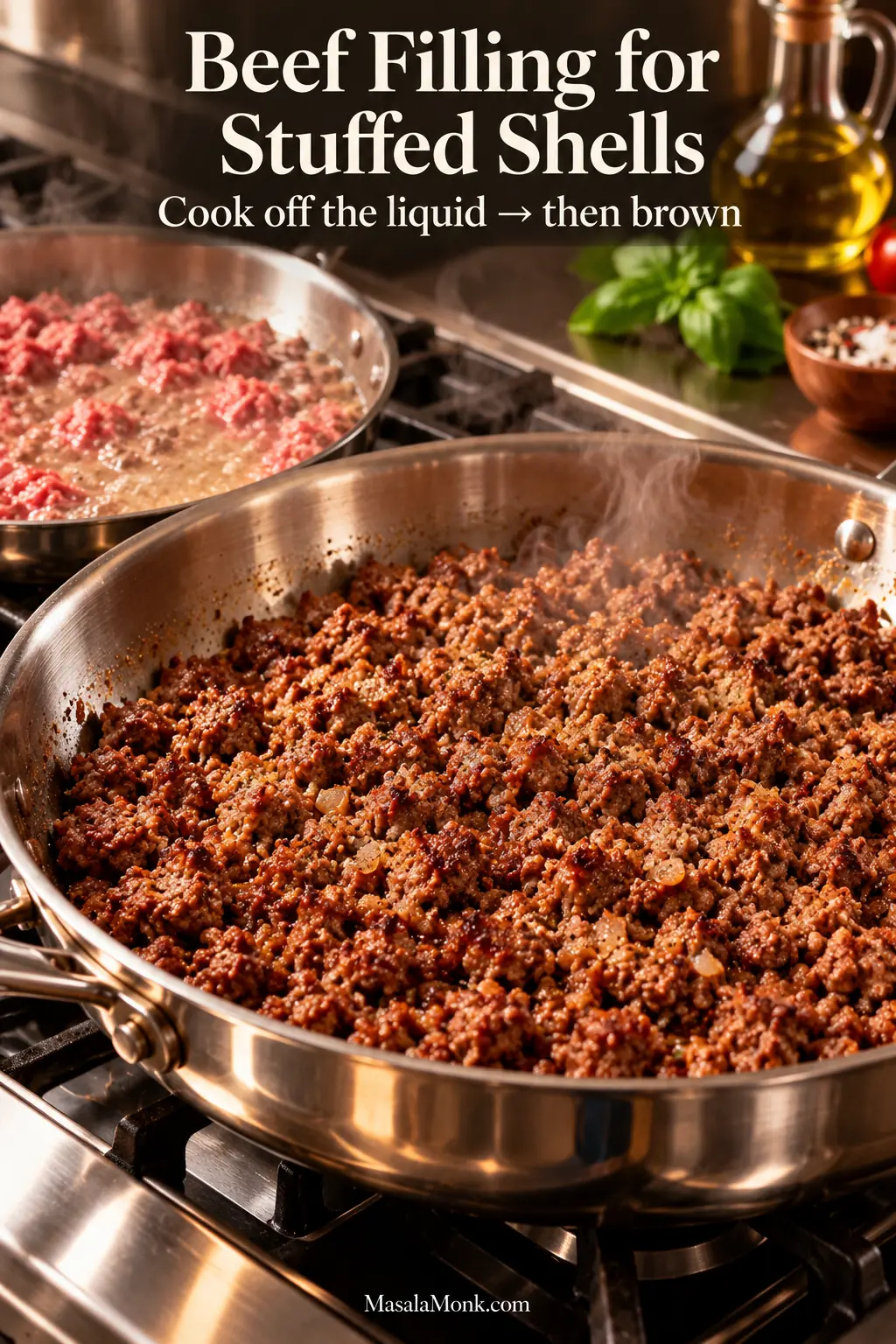
Add the ground beef and break it into small crumbles. Let the released liquid cook away, raising the heat to medium-high if needed. If a large pool of rendered fat remains, spoon or drain off the excess. Then let some of the crumbles sit against the skillet long enough to develop browned edges.
Listen as well as look when browning ground beef: the pan shifts from bubbling to a sharper sizzle once excess moisture has cooked away. That is the point when real browning can begin.
Reduce the heat to medium. Add the garlic, Italian seasoning, ½ teaspoon salt, black pepper and optional red pepper flakes. Cook for another 30–60 seconds, just until you can smell the garlic. The beef should reach 160°F / 71°C before it comes off the heat.
Taste a small piece of the cooked beef and adjust the seasoning now, before it goes into the ricotta mixture. Once the filling contains raw egg, don’t taste it. Transfer the beef to a bowl or plate and let it cool until warm, not steaming hot.
4. Mix the beef and ricotta filling
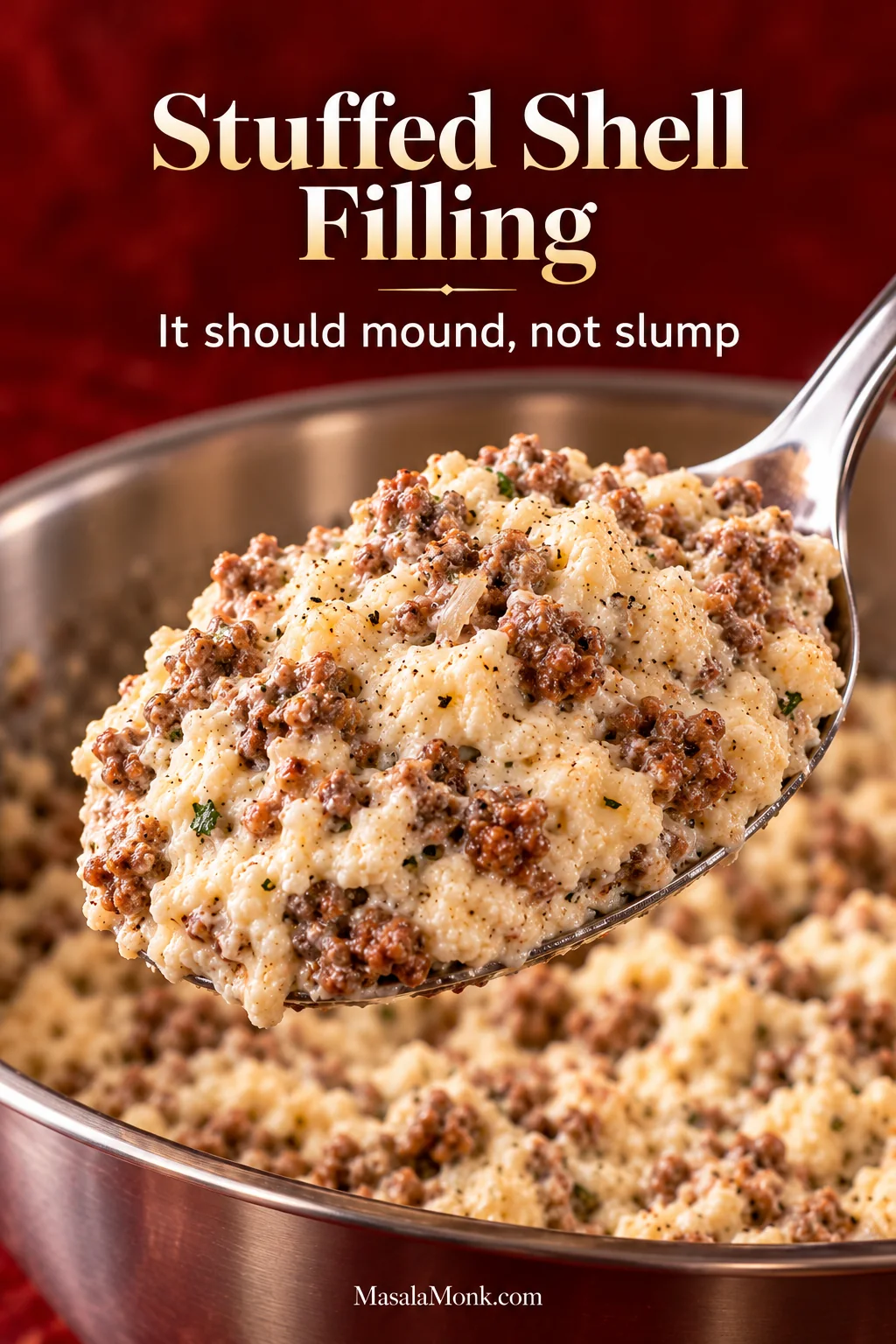
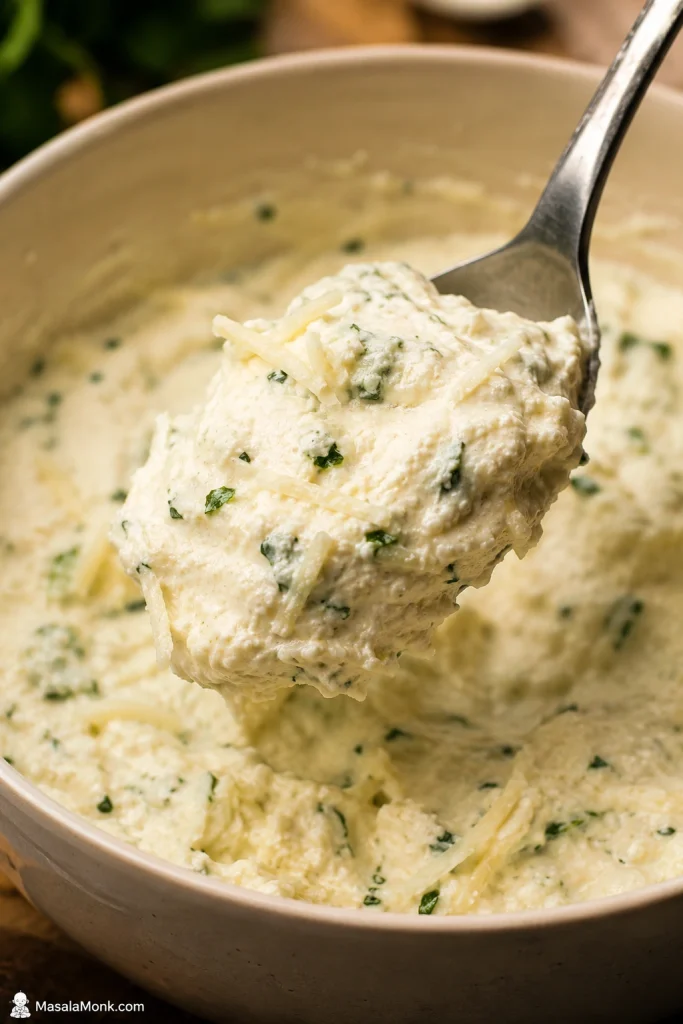
In a large bowl, combine the ricotta, 4 oz / 113 g mozzarella, Parmesan, egg and remaining ¼ teaspoon salt. Add the parsley if using, then fold in the cooled beef. The mixture should be creamy but thick enough to mound on a spoon.
If the beef-and-ricotta filling spreads flat instead of holding a soft mound, check its moisture before stuffing the shells. Watery ricotta or residual skillet liquid is much easier to correct in the bowl than after baking.
5. Fill the shells evenly
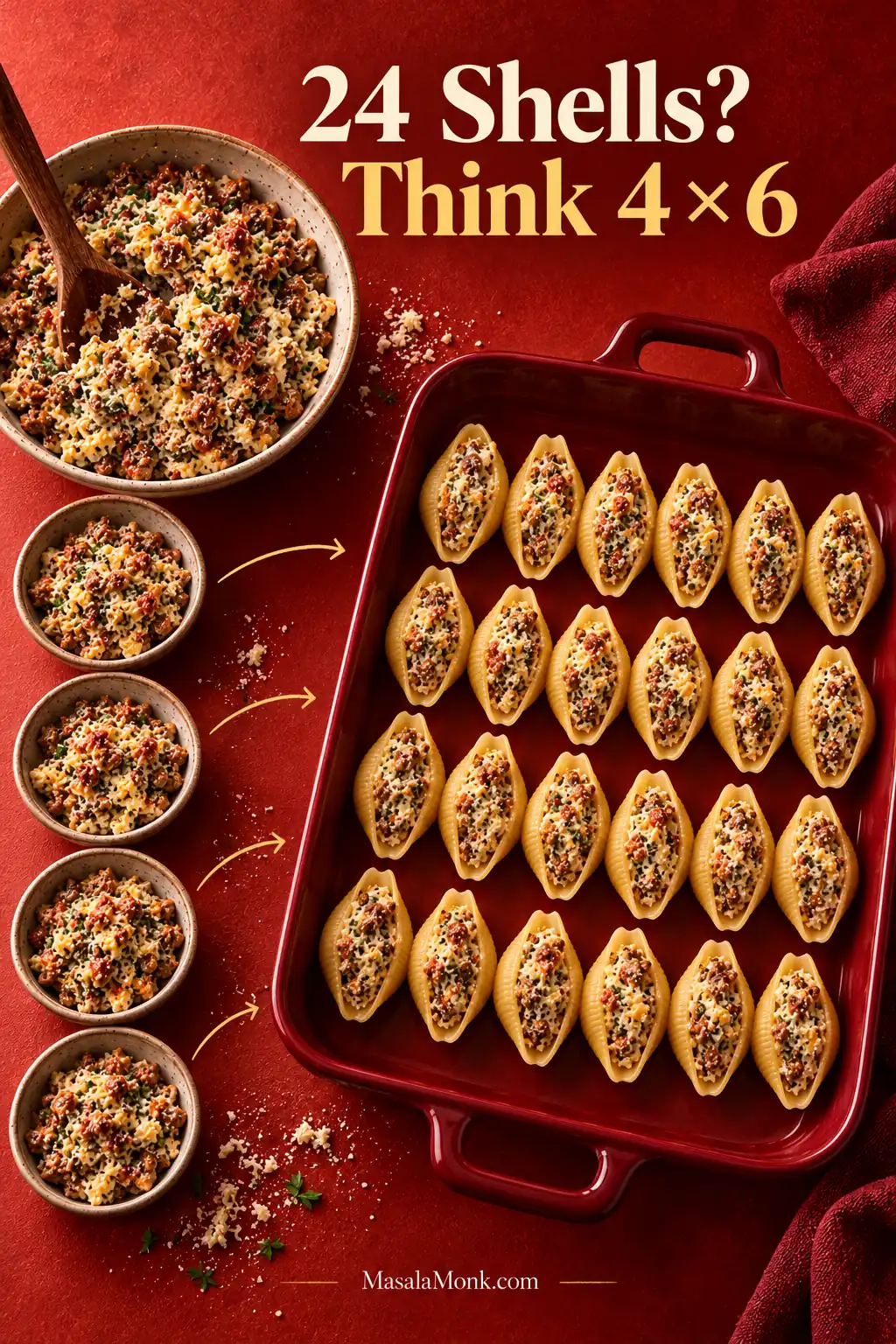
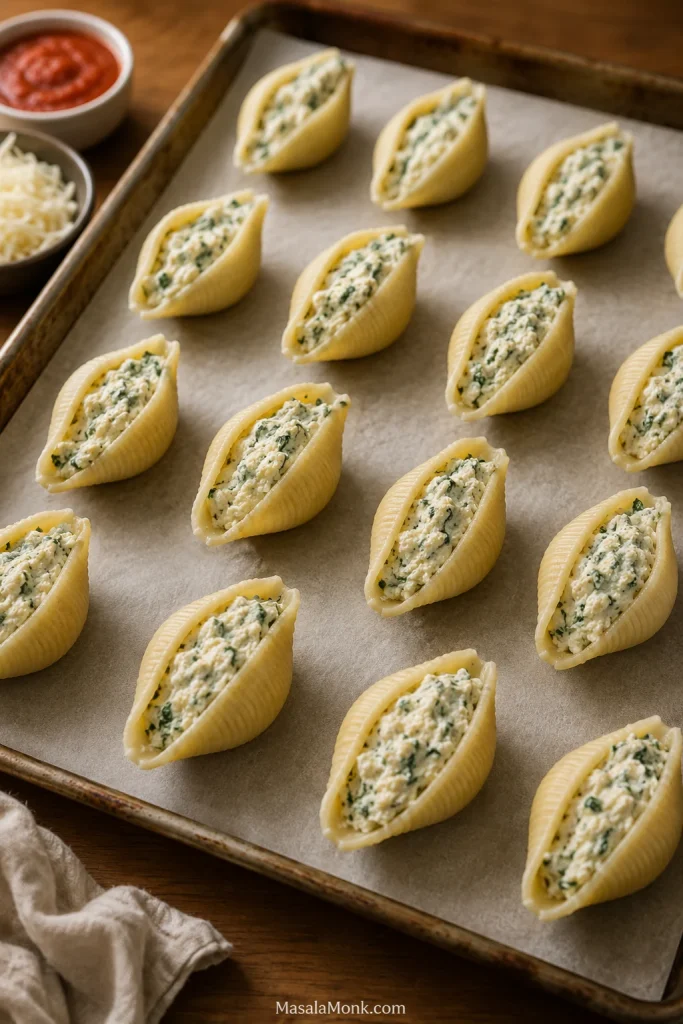
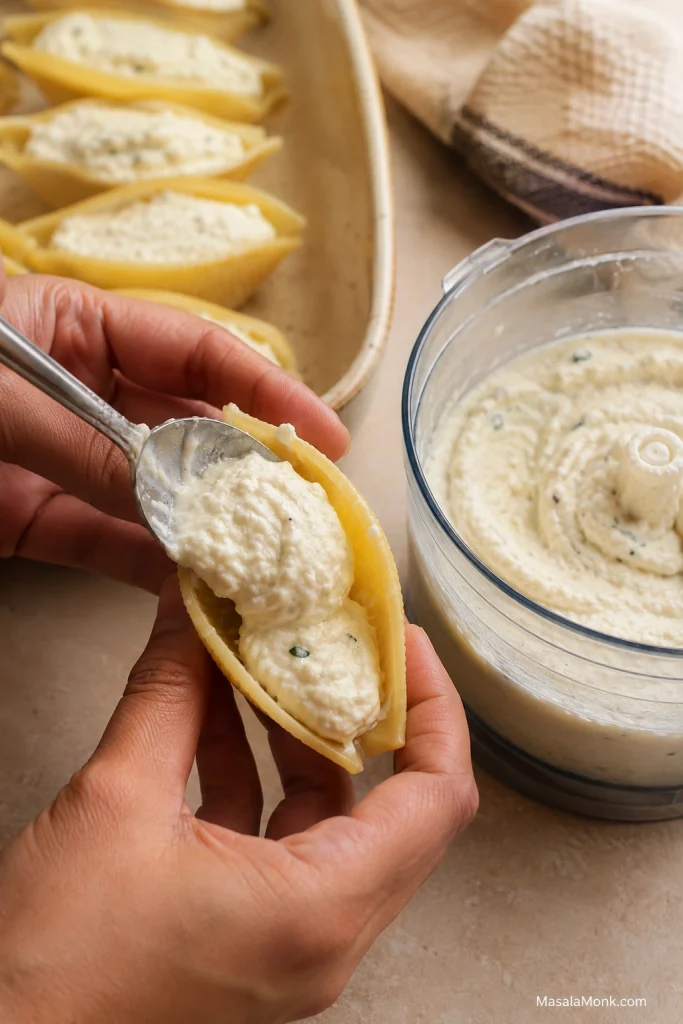
Fill about 24 intact shells with roughly 2 heaping tablespoons of filling each, adding more to any especially large shells. A 2-tablespoon scoop makes this quicker if you have one.
There’s an easy way to avoid beautifully overstuffing the first six and running short at the end. Mentally divide the filling into four portions, then use about one portion for every six shells. They don’t need to look identical. Fill them generously without forcing the pasta open.
Treat each group of six stuffed shells as a checkpoint. If one quarter of the filling is nearly gone after only four or five shells, redistribute before continuing. That is easier than discovering the shortage at the final row.
6. Add the sauce and mozzarella
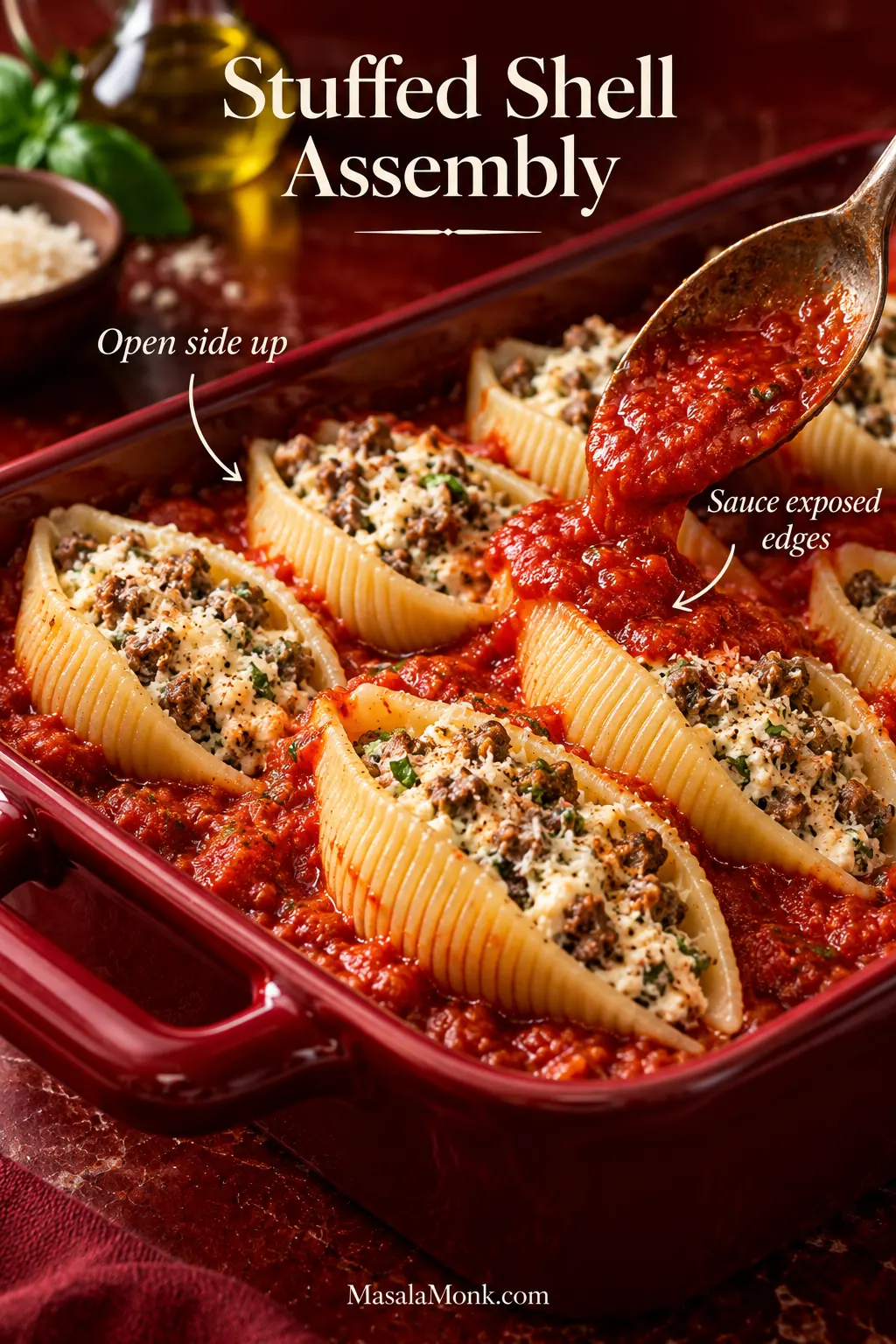
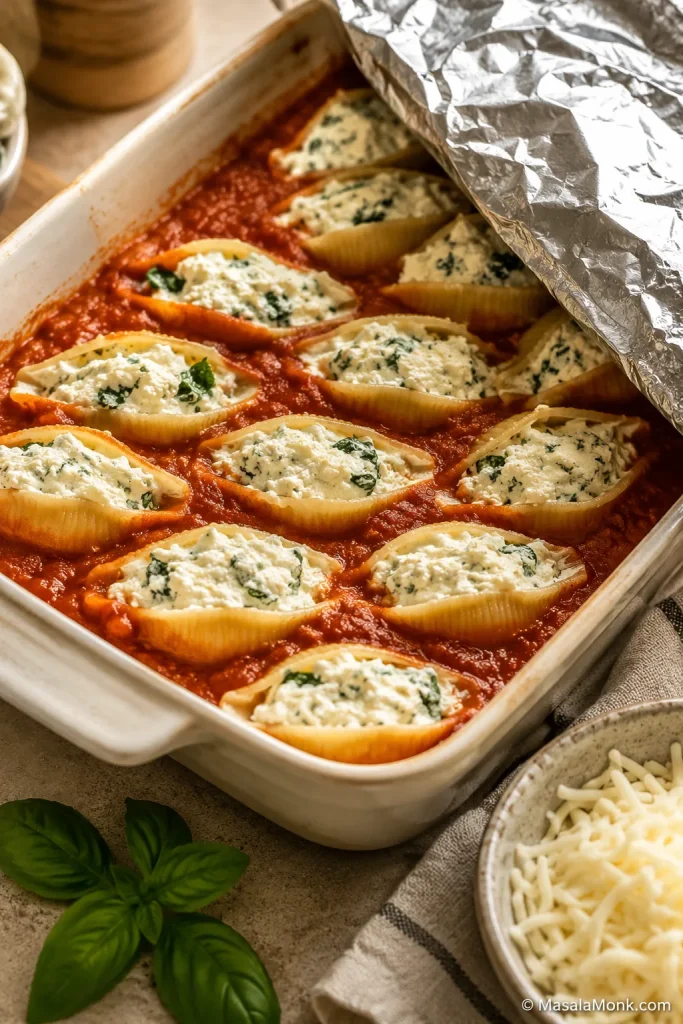
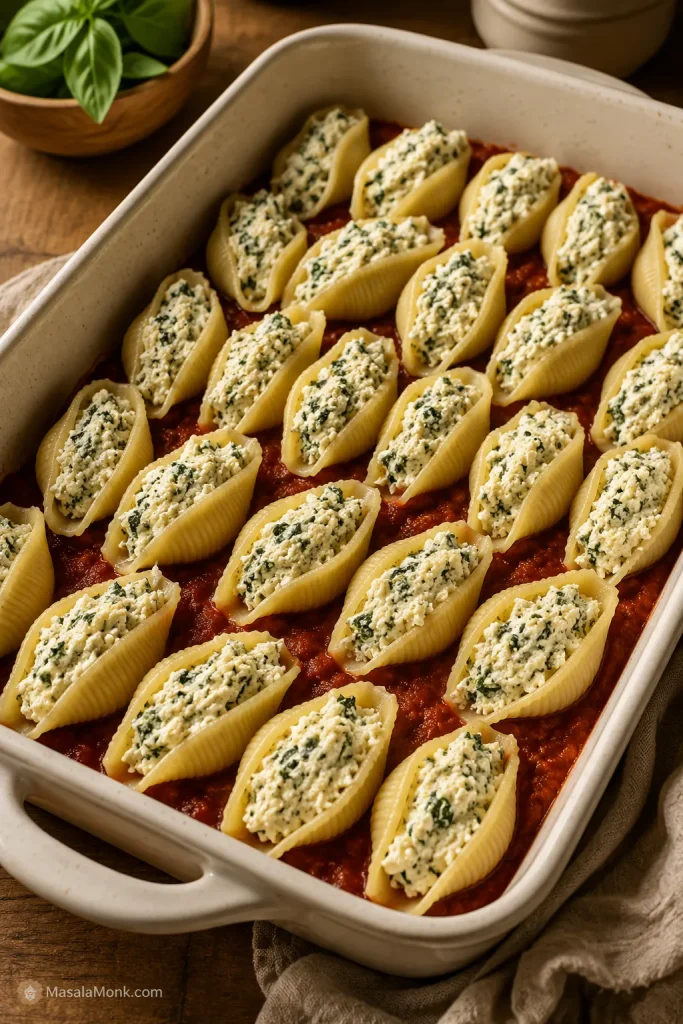
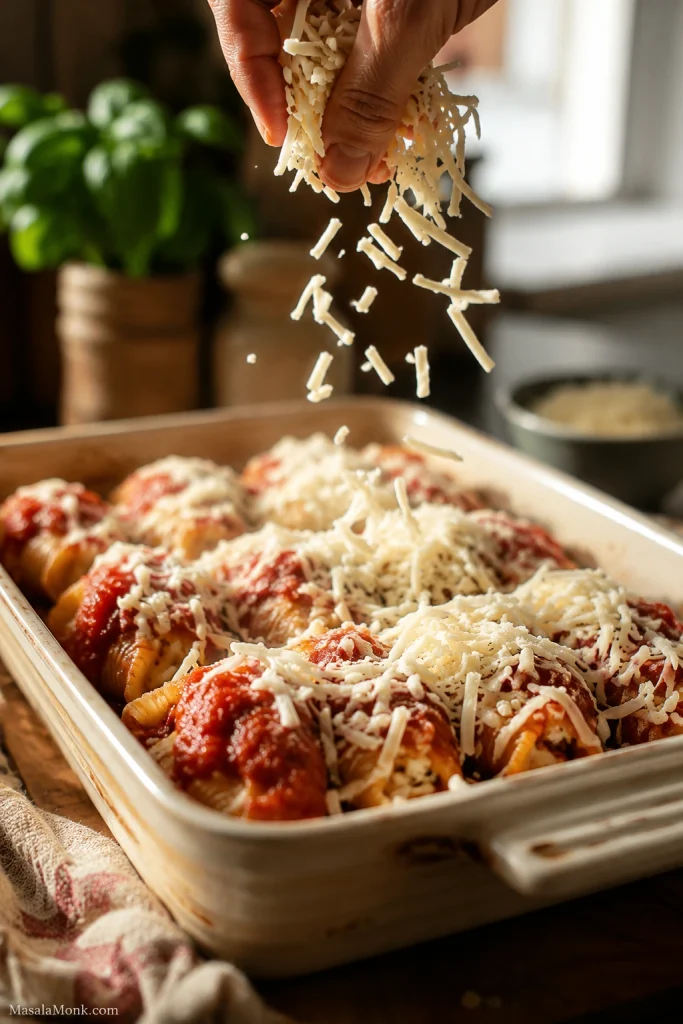
Arrange the filled shells open side up over the marinara. Spoon the remaining sauce around them and over any exposed pasta edges, then scatter the remaining 4 oz / 113 g mozzarella across the top.
It’s fine to leave the ridges visible. Just make sure the exposed pasta isn’t sitting completely dry, since those edges are the first to harden in the oven.
Focus extra marinara on the thin lips and exposed tips of the stuffed shells. Those small areas lose moisture faster than the pasta already resting against sauce, even when the main ridges remain uncovered.
7. Bake covered, then uncover
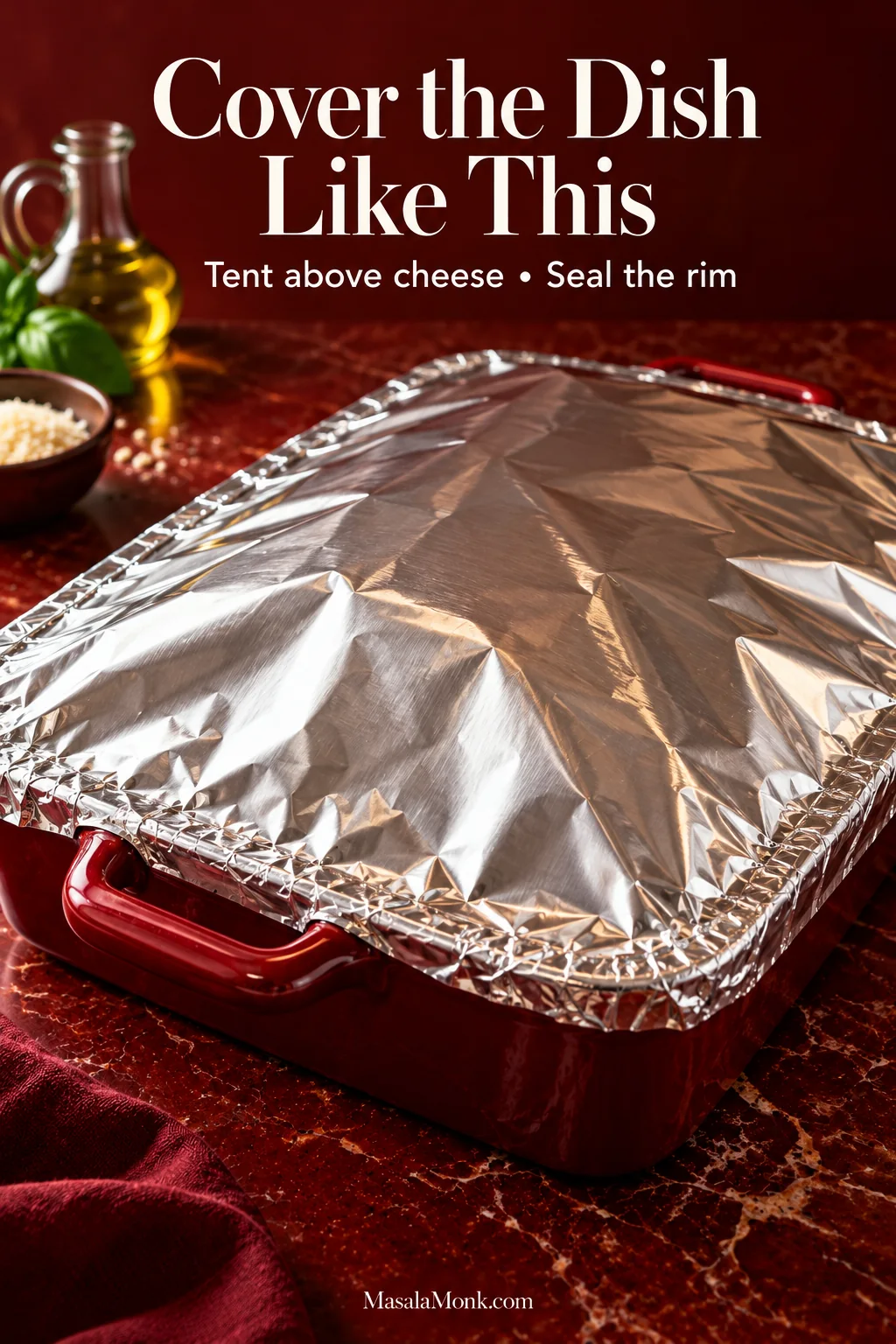
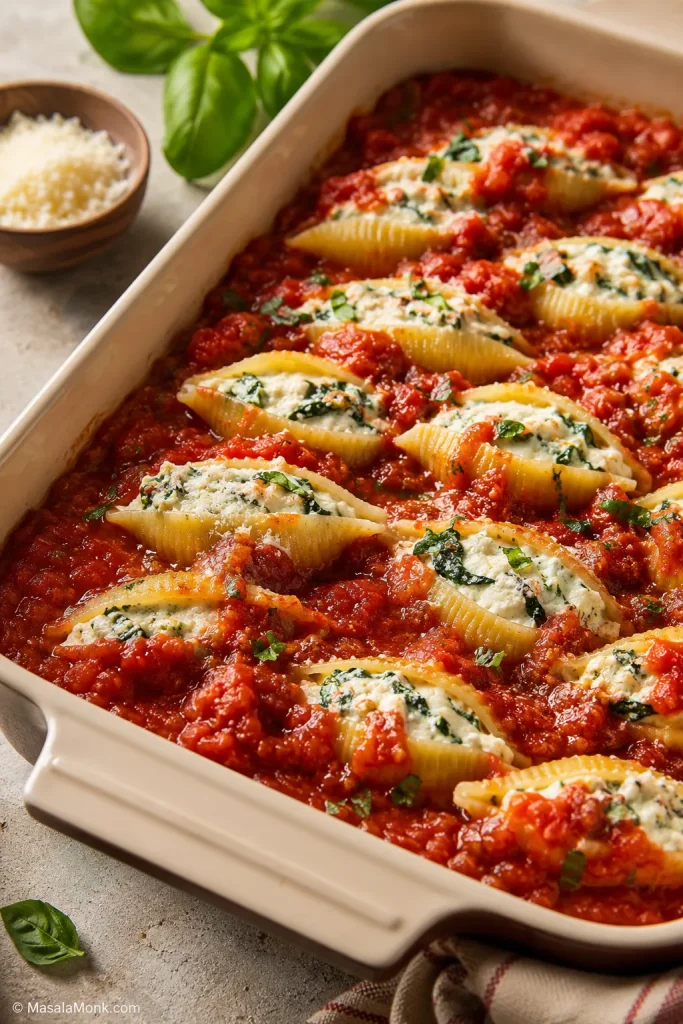
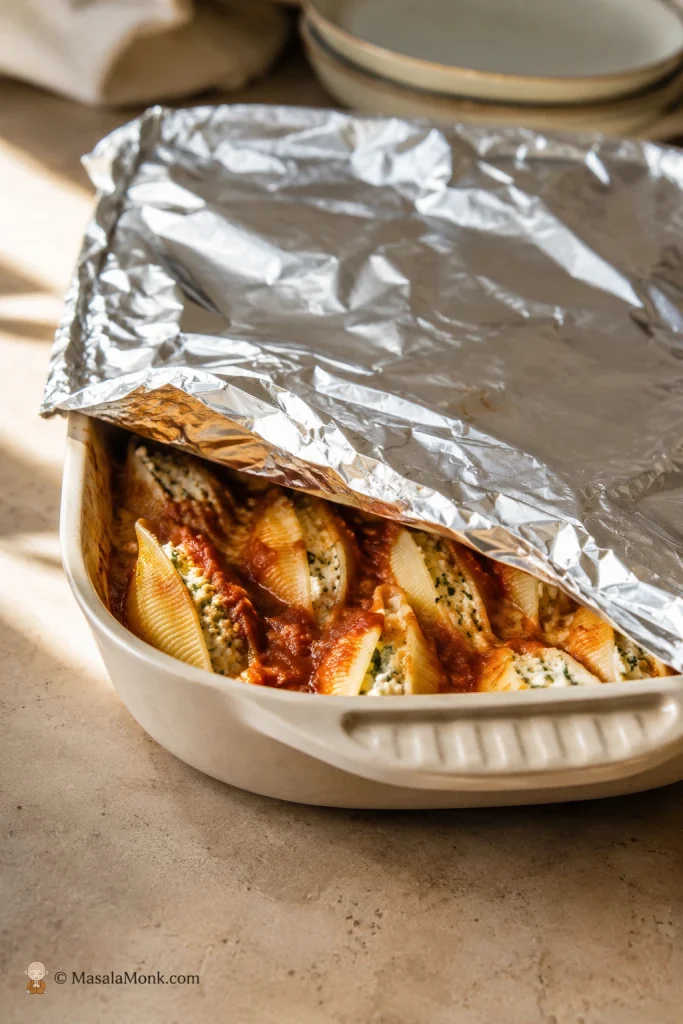
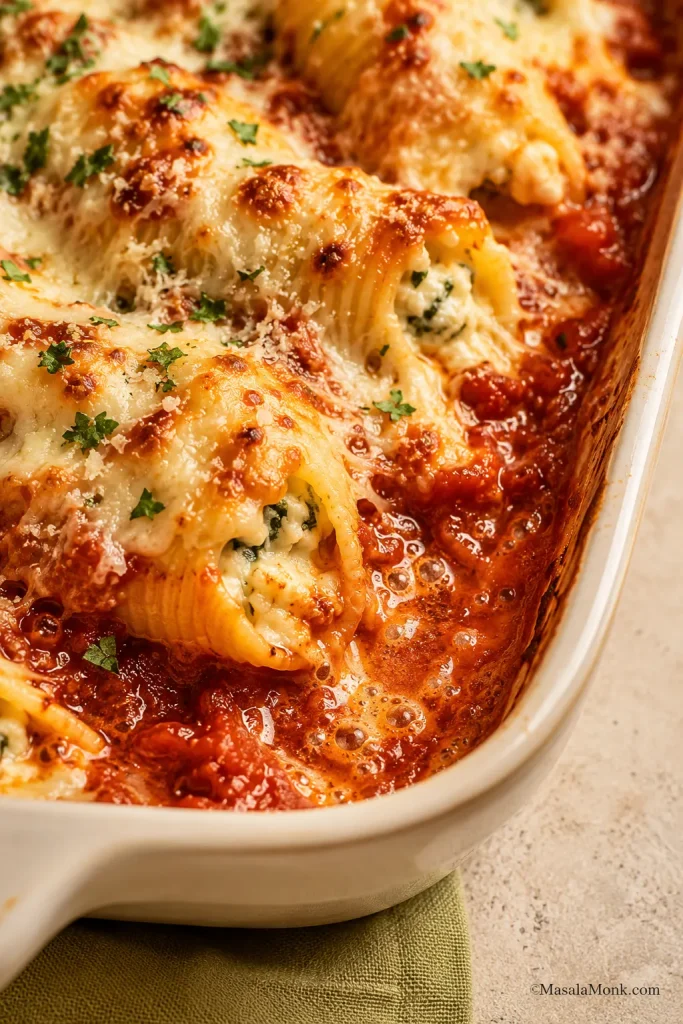
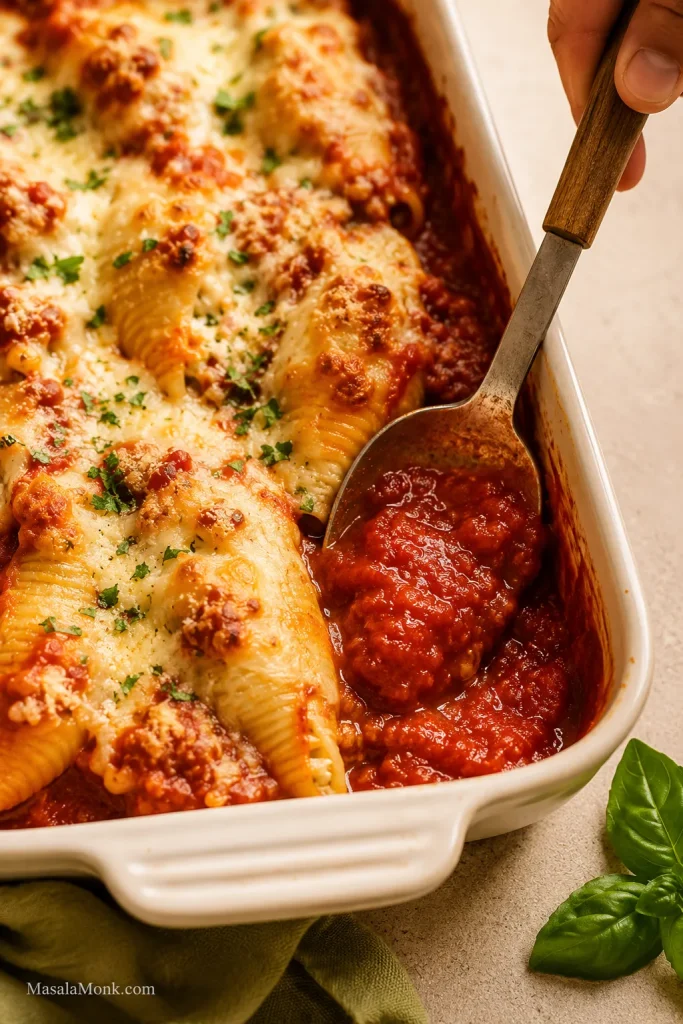
Cover the dish with foil, tenting it above the mozzarella but sealing it around the rim. Bake for 25 minutes, then remove the foil and bake for another 5–10 minutes. The sauce should be bubbling around the shells, with the mozzarella melted across the tops and catching some color in spots.
The foil only needs a shallow dome above the mozzarella. Meanwhile, a snug seal around the rim keeps humid heat inside the casserole, helping the pasta finish tenderizing without the cheese sticking to the foil.
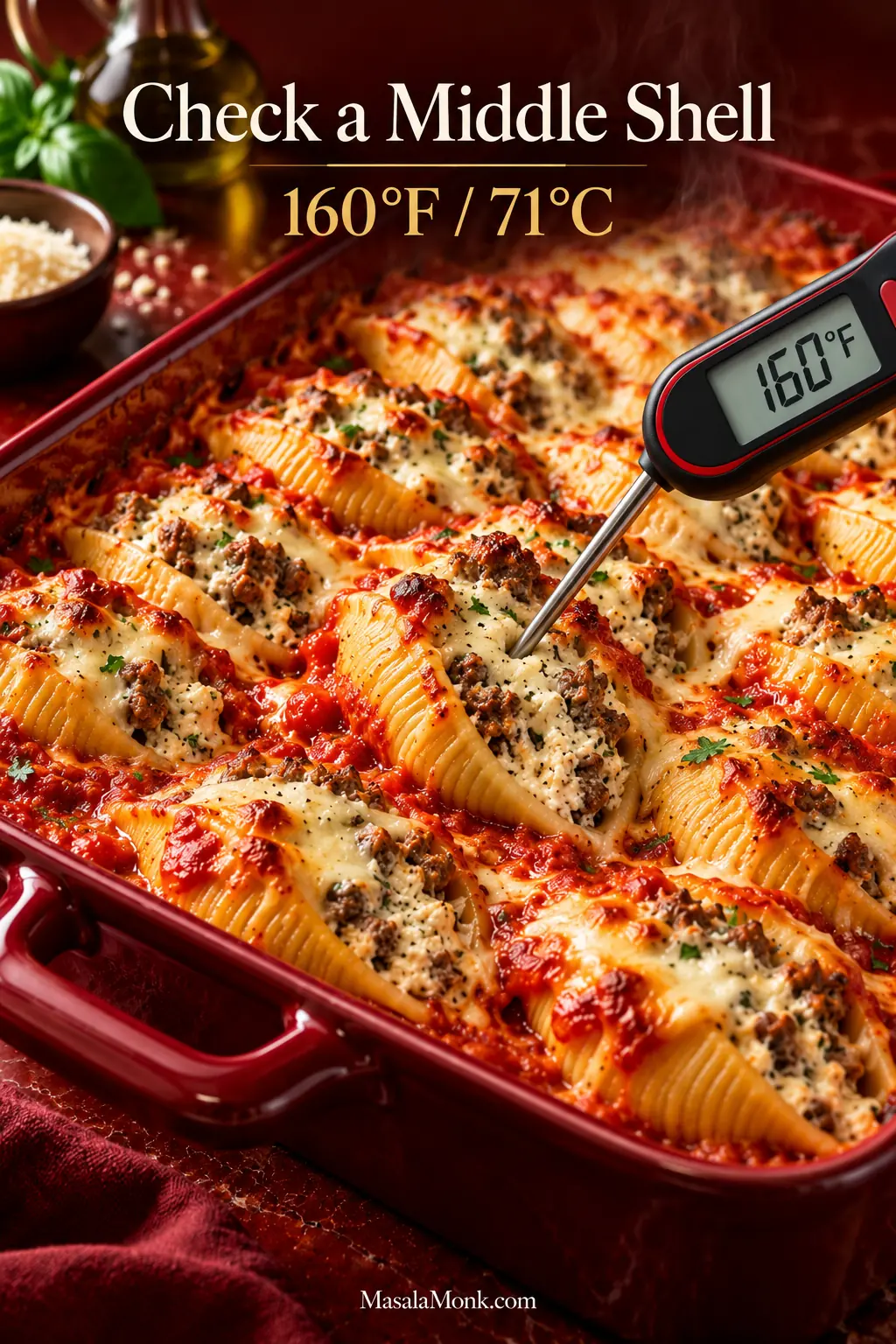
Check one of the shells near the middle of the casserole instead of judging doneness only by the bubbling edges. The pasta should be tender and the filling steaming hot all the way through. If you’re checking with a thermometer, the filling in a shell near the middle should reach 160°F / 71°C.
For the most useful temperature check, place the thermometer tip in the filling of a middle shell—not merely in hot marinara, against the pasta wall or near the hotter edge of the baking dish.
8. Rest before serving
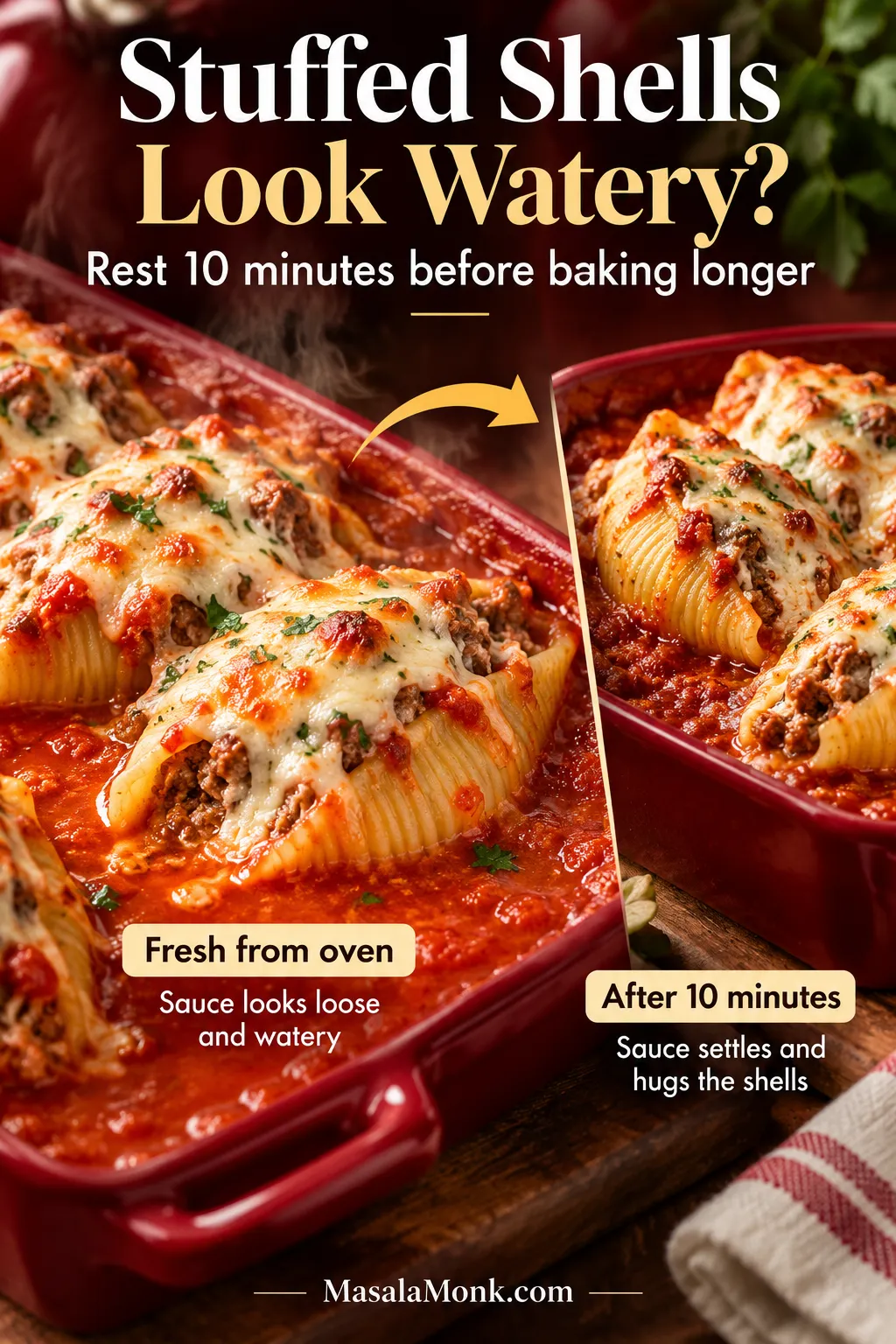
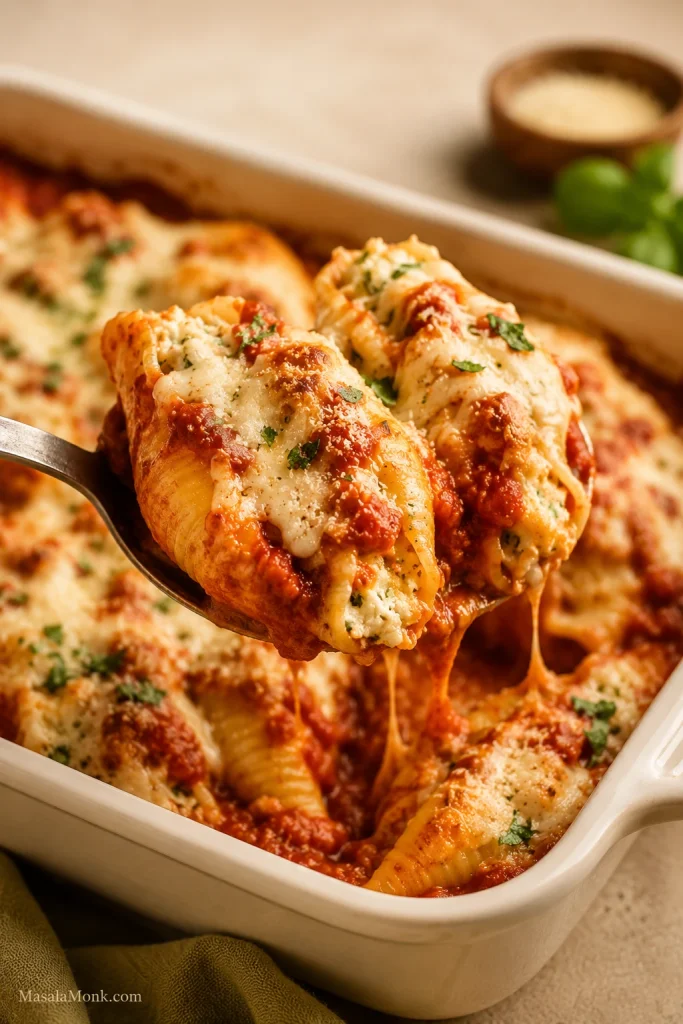
Let the casserole stand for 10 minutes. It’ll still be plenty hot, but the shells will lift from the dish more cleanly and the filling will have a chance to settle.
Cut into one and you should find browned beef throughout the ricotta filling, with marinara tucked into the shell’s ridges and mozzarella melted over the top.
A properly rested ground-beef-and-ricotta stuffed shell should hold together when lifted while the center stays soft and creamy. The goal is structure around the filling, not a dry or firmly set interior.
Getting the Meat and Ricotta Filling Right
How much beef and ricotta do you need?
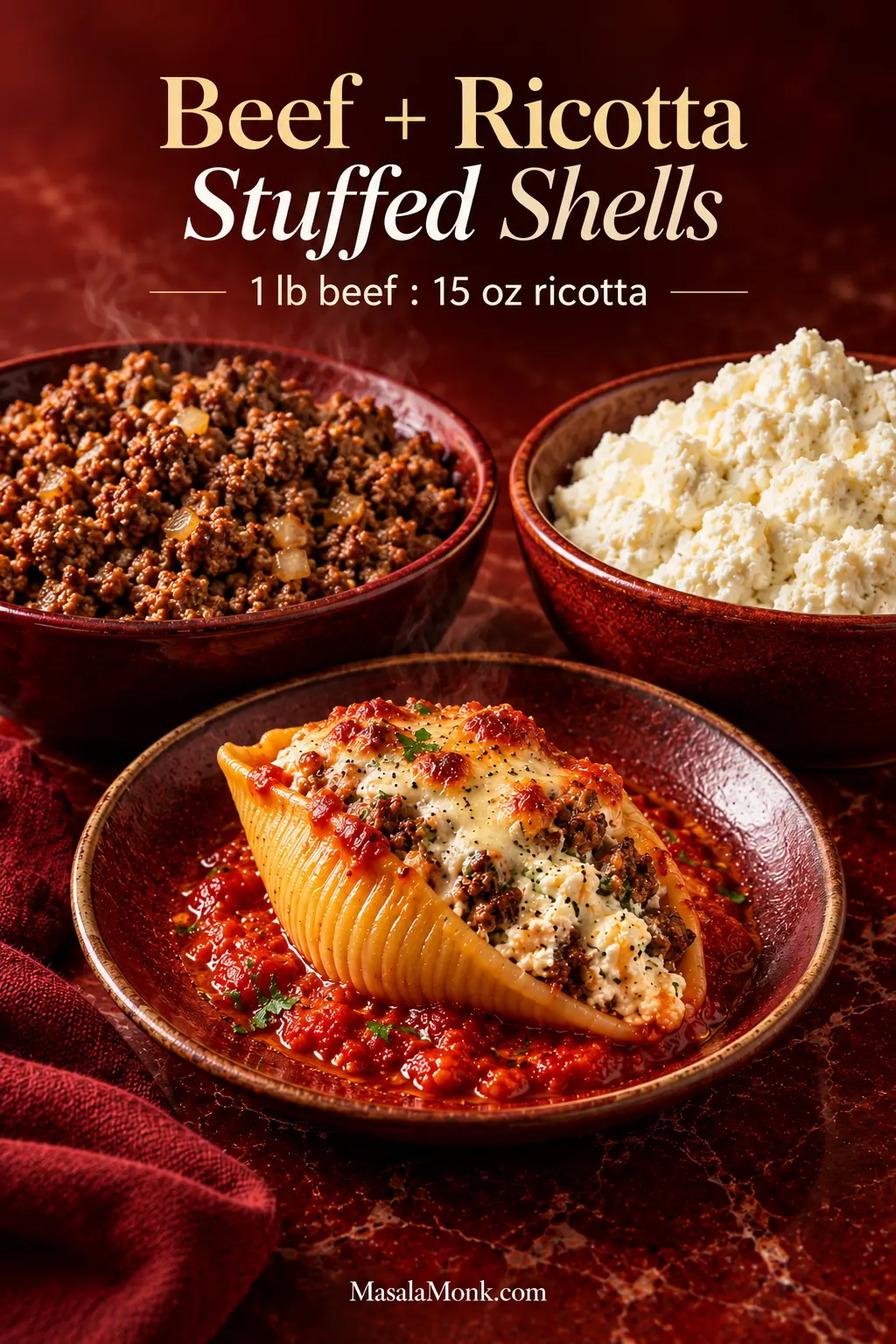
For about 24 stuffed shells, use 1 lb / 454 g ground beef with 15 oz / 425 g ricotta. That gives you beef in every shell without making the filling dense or pushing out the ricotta. The egg helps the beef-and-ricotta mixture hold together once baked.
You can change the ratio, but adding more meat isn’t necessarily the best route to stronger beef flavor. Good browning and seasoning do more without crowding the ricotta out of the shell.
Keep the browned beef in fairly small crumbles so it distributes through the ricotta instead of collecting in a few heavy pockets. That gives each stuffed shell beef throughout while the center stays creamy.
If you want the same meat, cheese and marinara combination without filling two dozen shells, our classic lasagna turns it into a different baked pasta dinner.
Should the meat go in the filling or the sauce?
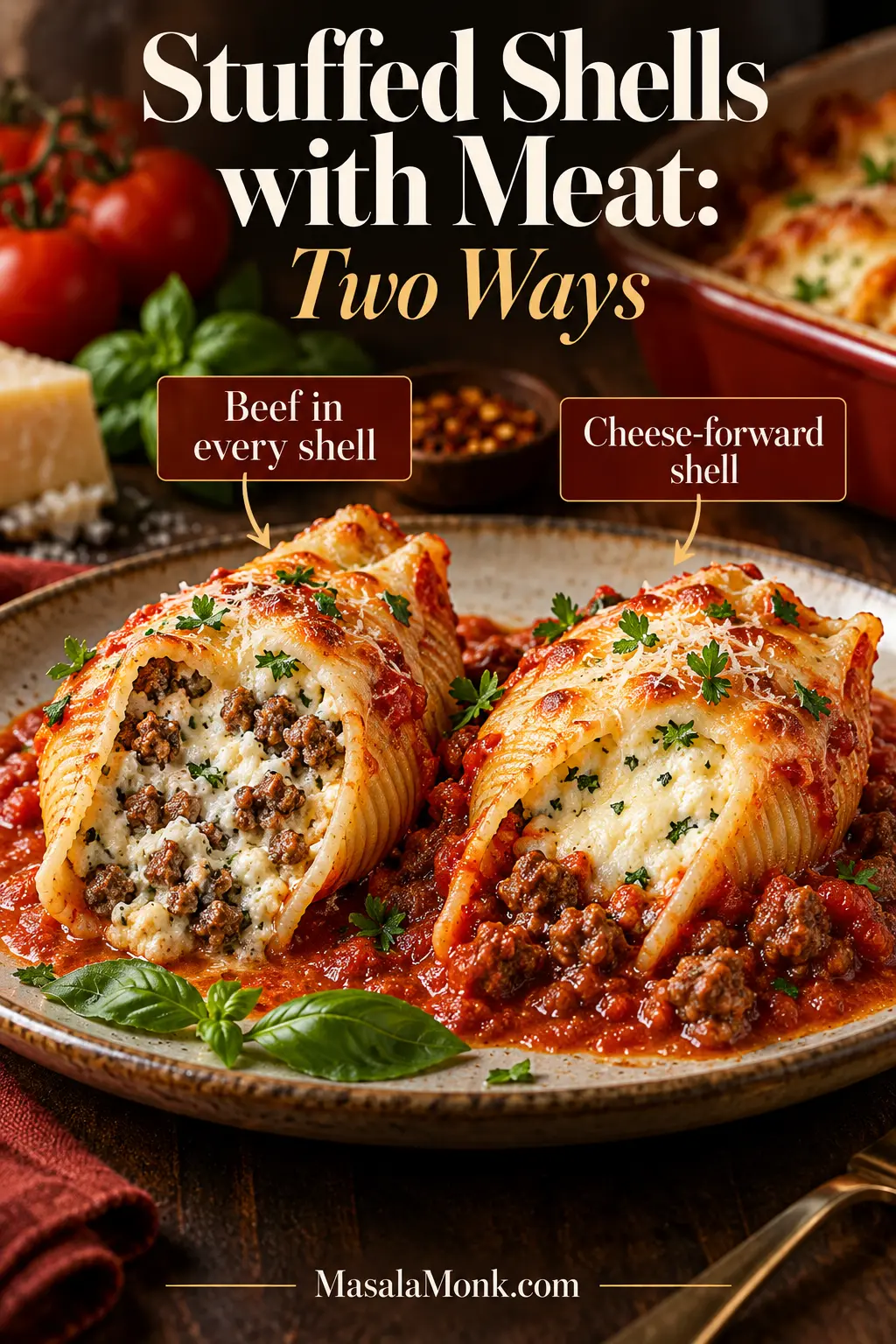
Both work; the difference is where you want the beef. Mixing it with the ricotta gives every shell a substantial meat-and-cheese filling. Stirring it into the marinara keeps the inside more cheese-forward and spreads the beef around the pasta instead.
Where the beef goes changes each forkful. Meat mixed into the ricotta makes every stuffed shell self-contained. By contrast, beef in the marinara makes the amount of meat depend more on how much sauce is served with it.
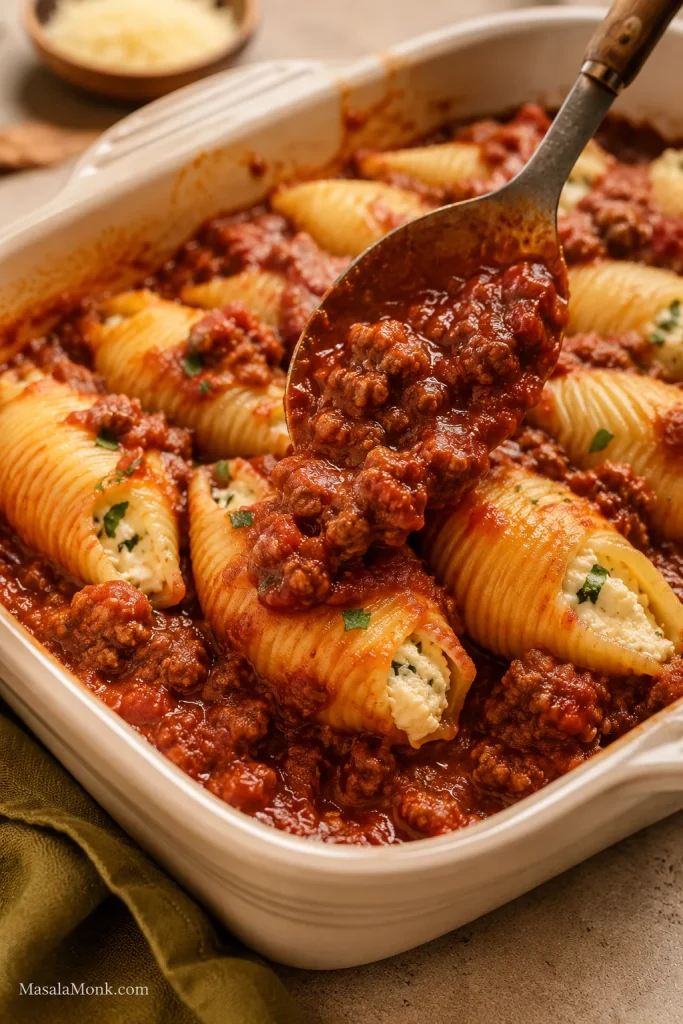
For the meat-sauce version, cook the beef as directed but stir it into the marinara instead. Fill the shells with the ricotta, mozzarella, Parmesan and egg mixture, then assemble and bake as above.
For a version without meat, our classic stuffed shells recipe keeps the filling focused on ricotta, mozzarella and Parmesan.
Troubleshooting Stuffed Shells with Meat
Why are my stuffed shells watery?
Watery stuffed shells usually come from loose ricotta, liquid left with the ground beef, wet vegetables, very thin marinara or pasta that was cooked too far before baking.
A casserole that simply looks wet when it first leaves the oven is different. Give it the full 10-minute rest before deciding it needs more heat. Some loose sauce around the shells is normal and will settle. Prolonged baking, however, can dry the pasta and make the ricotta grainy without solving the original problem.
After the 10-minute rest, judge what remains. If marinara still pools heavily around the stuffed shells, investigate ricotta, beef liquid, vegetables or sauce consistency. Do that before automatically extending the bake and drying the pasta.
Too much time in the oven is a common culprit. Whole-milk ricotta helps keep the filling tender, but prolonged heat can still dry it out. Start checking the shells near the end of the recommended baking window instead of extending the bake just because the surface still looks saucy.
Running short on filling
The first shells probably got more than their share. If you are still filling them, use the four-groups-of-six checkpoint for the remaining shells; otherwise, move some filling from the fullest shells into the emptier ones.
Why do stuffed shells tear?
They may have cooked too long or stuck together while cooling. Pull them from the water while they’re still firm, spread them out after draining and open each shell gently. The few extras in the pot are there for the occasional casualty.
Hard pasta edges
Exposed pasta probably didn’t have enough sauce or spent too long in dry oven heat. Spoon marinara over bare edges and keep the casserole covered for most of the bake. The short uncovered finish is enough to melt the cheese and give it some color.
For an all-sausage version, replace the beef with 1 lb / 454 g mild or hot Italian sausage. Or use ½ lb / 227 g each of ground beef and Italian sausage. This keeps the familiar beef flavor while adding some of the sausage’s extra seasoning and richness. Drain excess fat after browning, and go lightly with added salt until you’ve accounted for the seasoning already in the sausage.
Ground turkey
Replace the beef with 1 lb / 454 g ground turkey. Turkey is milder and often leaner, so season it well and cook away any liquid in the skillet before adding it to the cheese mixture. Ground poultry should reach 165°F / 74°C.
Beef, ricotta and spinach
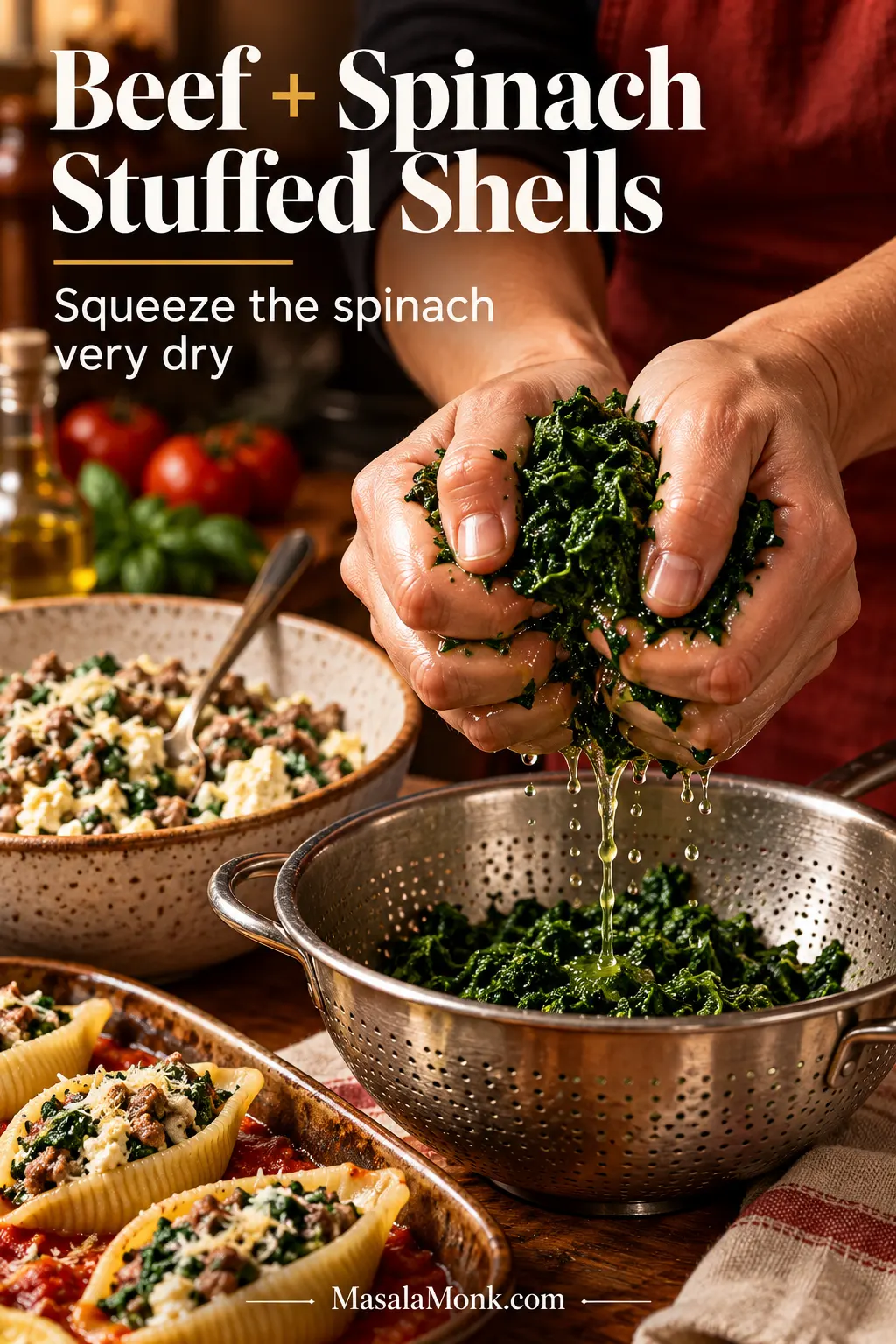
Add about 5 oz / 140 g frozen chopped spinach, thawed and squeezed very dry. Water left in the spinach goes straight into the filling. If you want vegetables to be more than an add-in, our vegetable lasagna builds the dish around them from the start.
For beef and spinach stuffed shells, properly drained spinach should form a compact clump and stop releasing water under firm pressure. That physical cue is more reliable than squeezing it for an arbitrary number of seconds.
Make Ahead, Freeze and Reheat
Can I assemble stuffed shells the day before?
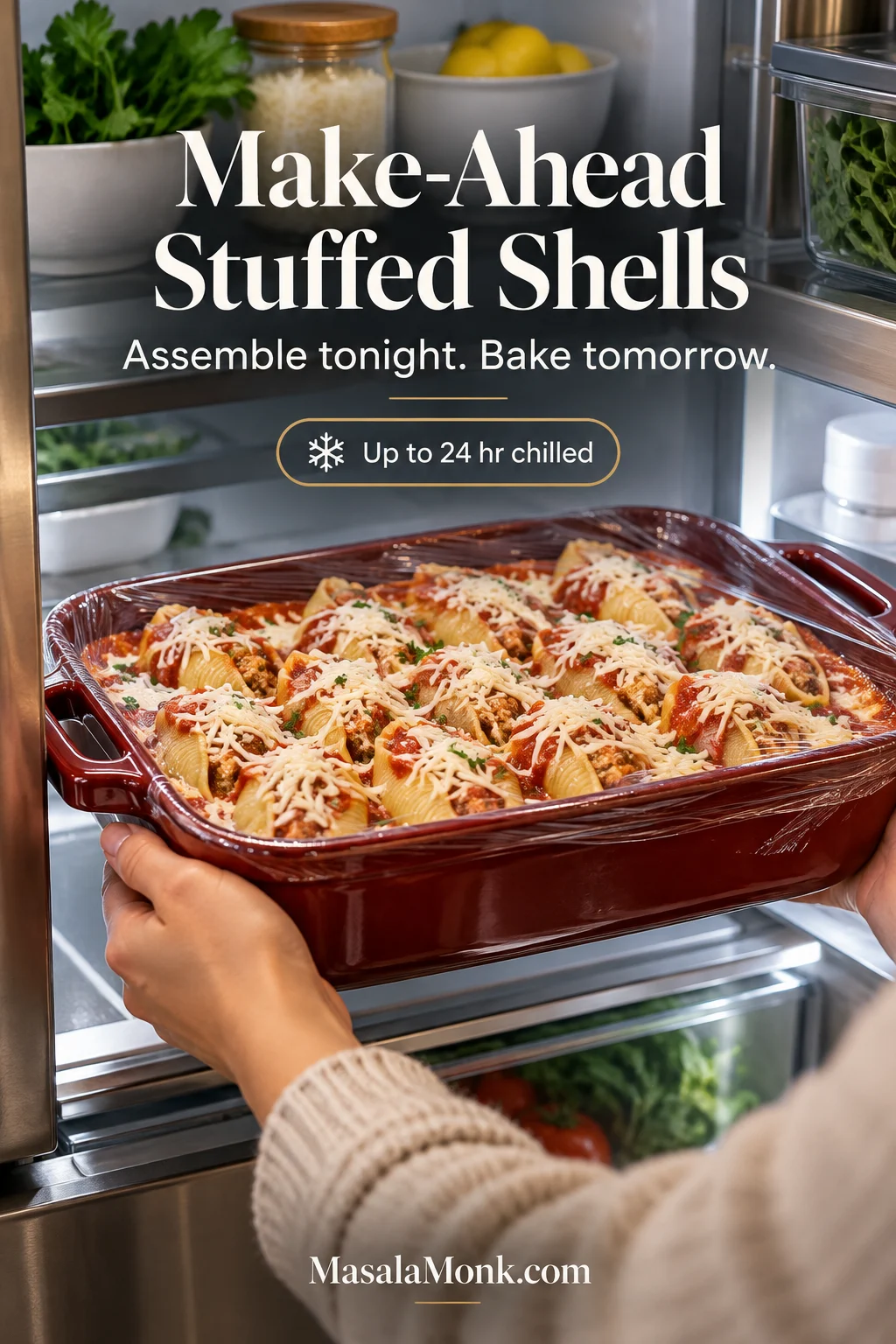
Yes. Assemble the casserole through the mozzarella topping, cover it and refrigerate promptly for up to 24 hours. That gets most of the work out of the way before dinner.
Keep make-ahead stuffed shells tightly covered while they chill. Otherwise, exposed pasta ridges can begin drying in the refrigerator before the casserole ever reaches the oven, especially around the upper edges.
When baking straight from the refrigerator, allow roughly 10–15 extra minutes of covered baking time as a starting point. A very cold dish may need longer, so check a shell near the middle before uncovering for the final 5–10 minutes.
You can also make the beef-and-ricotta filling up to 24 hours ahead, refrigerate it promptly, then cook and fill the shells closer to baking time.
Can you freeze stuffed shells?
Yes. Bake the stuffed shells first, refrigerate them promptly until chilled, then cover tightly and freeze for up to 2–3 months for best quality.
Thaw the baked shells overnight in the refrigerator for the most even reheating. Individual baked portions can also be frozen separately when you don’t want to reheat the entire casserole.
How to store and reheat leftovers
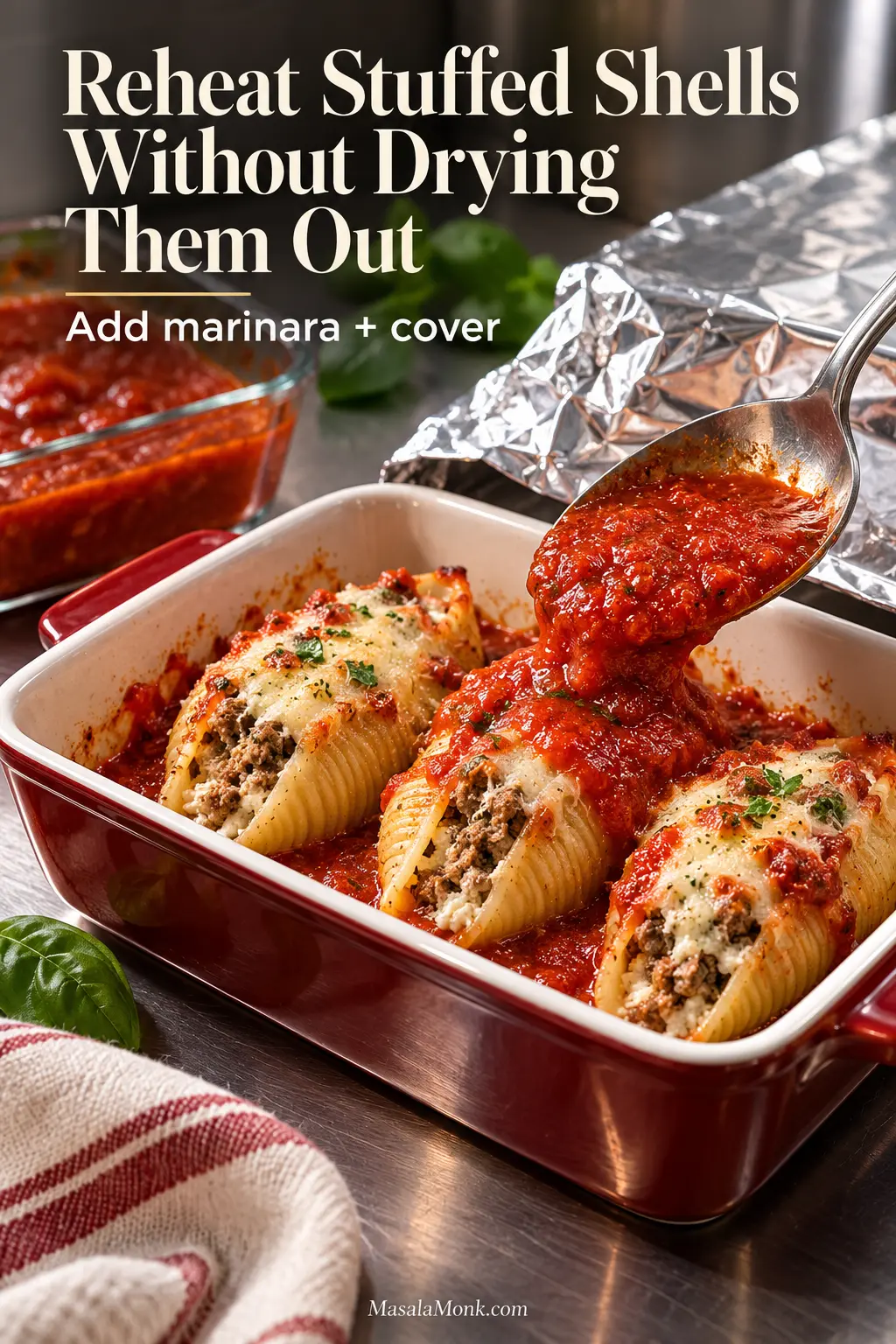
Refrigerate leftovers promptly in a covered container and use them within 3–4 days. A spoonful of marinara helps if the pasta has dried slightly in the refrigerator.
When reheating leftover stuffed shells, aim the extra marinara at pasta that looks matte or dry—particularly exposed lips and ridges. This restores moisture where it is needed without turning the whole portion unnecessarily soupy.
For a larger refrigerated or thawed portion, cover and reheat at 350°F / 175°C for about 20–25 minutes as a starting point. Continue until the center reaches 165°F / 74°C. Individual portions can be loosely covered and reheated in the microwave until hot throughout.
How Many Stuffed Shells Per Person?
These stuffed shells are substantial enough to serve as the main dish. From one batch, plan on:
4 stuffed shells per person for 6 hearty servings.
3 stuffed shells per person for about 8 servings with sides.
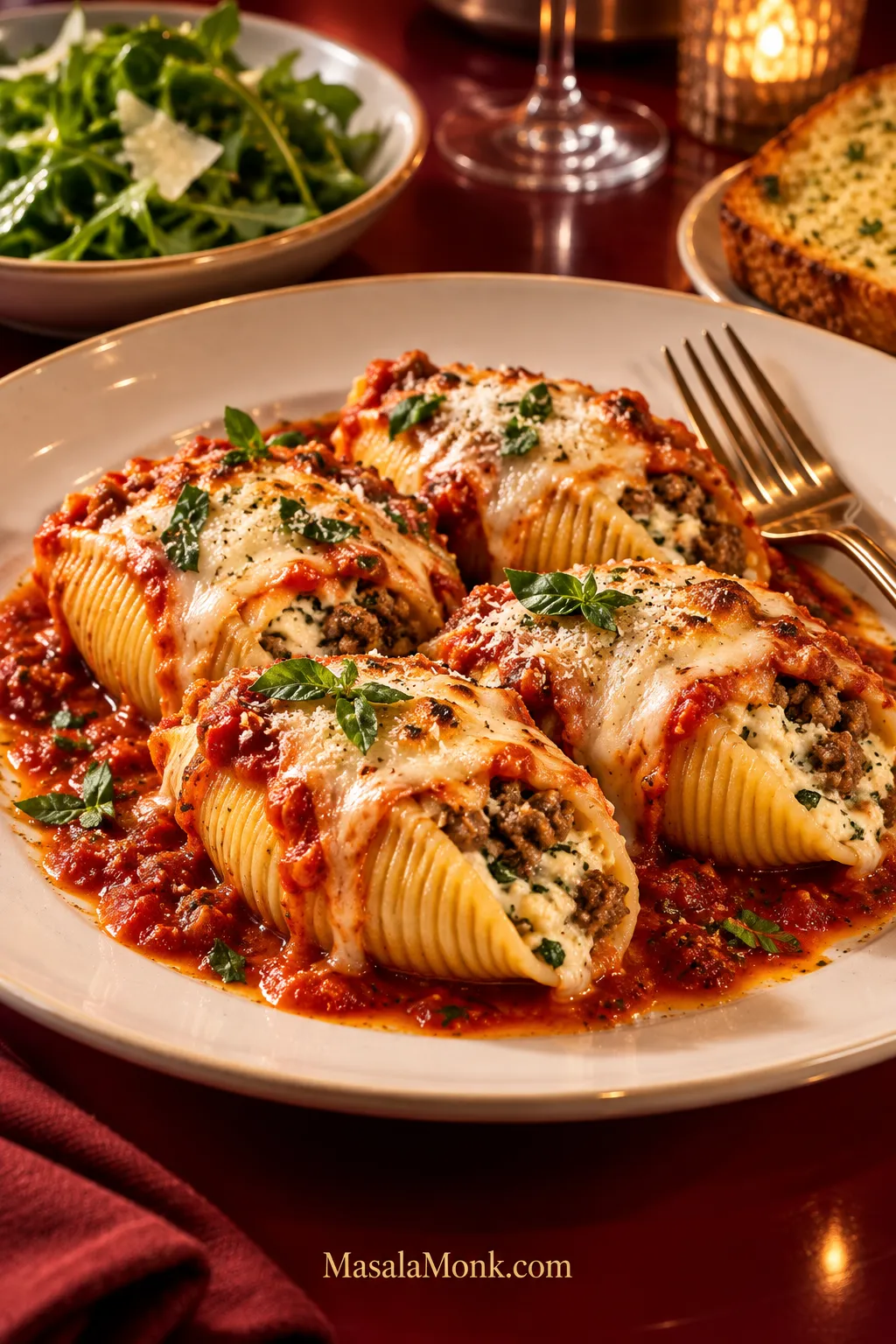
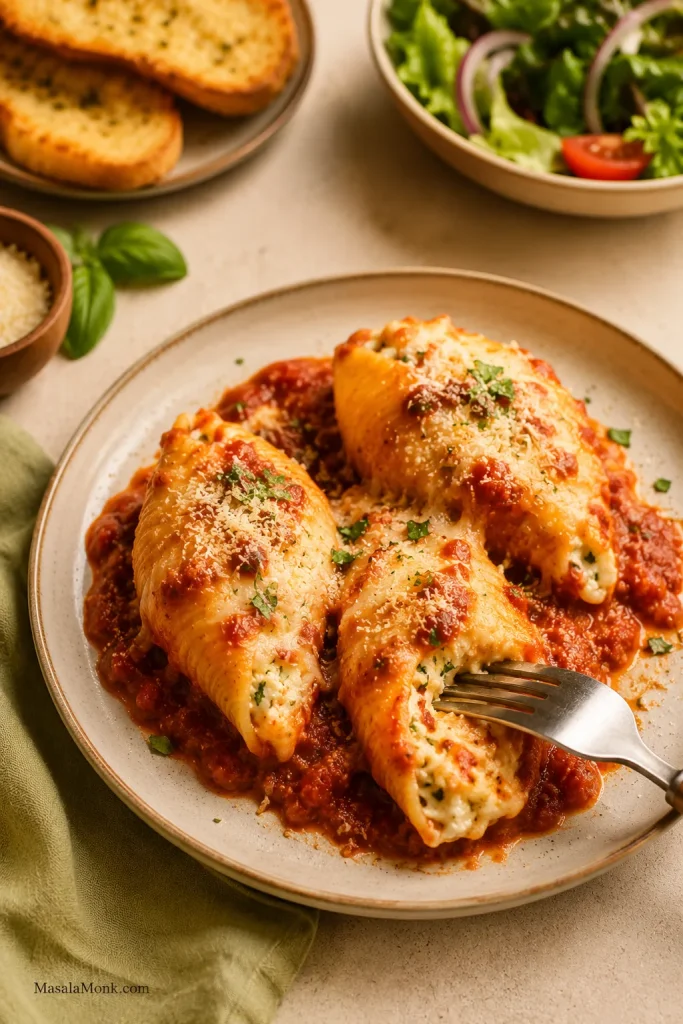
For a hearty serving of stuffed shells with meat, four shells fill the plate without needing to be buried in sauce. Spoon marinara around and lightly over them so the beef-and-ricotta centers remain visible and easy to portion.
What to Serve with Stuffed Shells
A cold, crunchy side works especially well against the hot casserole. Our broccoli salad brings crisp vegetables and a tangy dressing, while a simple green salad is an easy lighter option.
For something warm, green beans almondine adds lemon and toasted almonds without competing with the marinara. Roasted broccoli works too, and garlic bread is an easy choice when you want something for the sauce left on the plate.
Bring the casserole to the table while the mozzarella is still soft and stretchy, and spoon some of the marinara from the dish over each serving. Add something crisp or green alongside if you like. That’s really all these shells need.
Stuffed shells are the kind of baked pasta that makes the table feel full before anyone even sits down: tender jumbo shells, creamy ricotta filling, tomato sauce bubbling around the edges, and mozzarella melted over the top. They give you lasagna-level comfort without all the layering, and the recipe is much more forgiving than it looks.
This version is built to avoid the usual stuffed shell problems: loose ricotta filling, dry pasta edges, shells that turn mushy after baking, and a tray that looks good on top but tastes flat in the middle. Think of it as the no-dry-shell method: thick filling, enough sauce, a covered bake first, and tender shells all the way through.
It fits one classic 9×13-inch baking dish: about 20–24 filled jumbo shells, a seasoned ricotta-mozzarella filling, marinara under and over the pasta, and mozzarella melted on top. A few shells may tear while boiling. The first few you fill may look messy. That is normal. Once everything is tucked into sauce and baked until bubbling, nobody at the table can tell which ones were imperfect.
Stuffed Shells at a Glance
No long planning needed. Here is the quick version before you start.
Start with a 12 oz / 340g box of jumbo pasta shells, or enough to cook 28–30 shells.
Aim to fill about 24 shells. If your shells are very large, you may fit closer to 20–22 in the baking dish.
Mix 15–16 oz / 425–454g ricotta with mozzarella, parmesan, egg, garlic, herbs, salt, and pepper.
Use about 3 cups / 720ml marinara sauce, with sauce under and over the shells.
Bake at 375°F / 190°C for 25 minutes covered, then 8–10 minutes uncovered.
Rest for 5–10 minutes before serving so the filling settles and the shells lift more cleanly.
Boil, fill, sauce, cover, bake, rest — that is the whole recipe. This is also a good one to save because the base method stays the same even when the filling changes.
Quick answers: Yes, you boil the shells first for this version. Use about 3 cups sauce for one 9×13-inch baking dish. Egg helps the filling set, but you can skip it if you prefer a softer filling. Stuffed shells freeze best before baking.
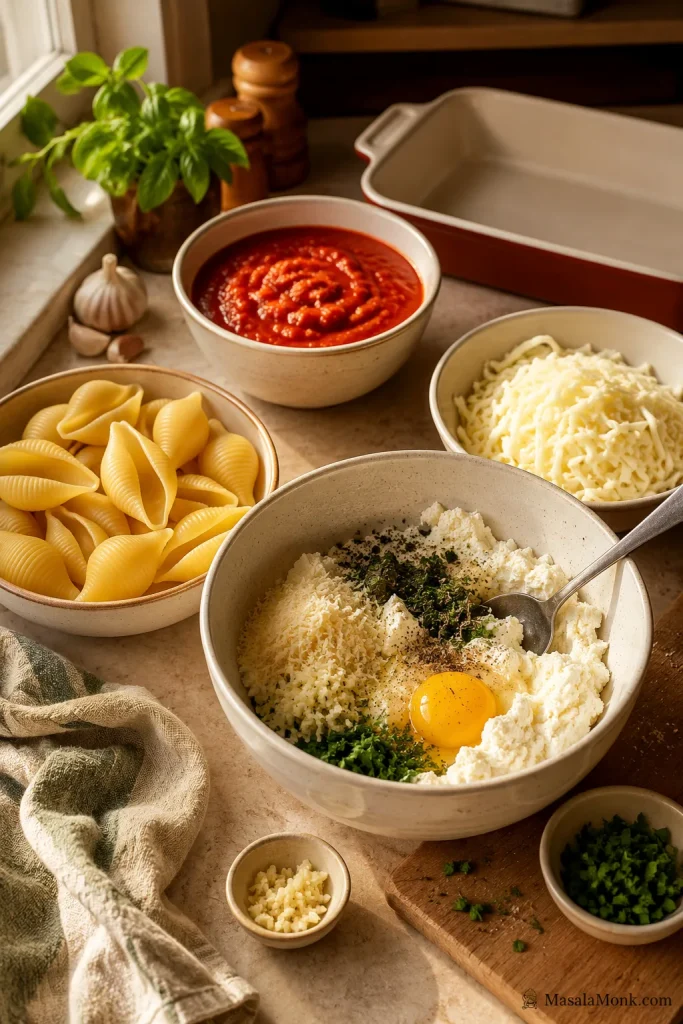
Start with the essentials: jumbo shells, thick ricotta filling, marinara, mozzarella, parmesan, egg, garlic, and herbs.
Why This Stuffed Shells Recipe Works
This method is built around four small choices that make the biggest difference: undercook the shells slightly, keep the ricotta filling thick, use sauce under and over the pasta, and bake covered before browning the cheese.
Shells stay tender. Boiling them just shy of al dente keeps them flexible enough to fill, but firm enough to finish in the oven.
Filling stays creamy, not runny. Ricotta gives body, mozzarella gives melt, parmesan adds savory depth, and egg helps everything set.
Sauce protects the pasta. Marinara on the bottom keeps the shells from sticking, while sauce over and around the shells prevents dry edges.
A covered bake does the work. Foil traps heat and steam so the pasta finishes cooking gently before the cheese browns.
Flexibility is built in. Keep it classic, add spinach, stir meat into the sauce, swap in cottage cheese, or freeze a batch for later.
Best of all, the edge of the baking dish tells you dinner is almost ready: sauce bubbling up around the shells, little golden patches of mozzarella, and the smell of garlic, tomato, and browned cheese.
The no-dry-shell method is simple: sauce underneath, sauce around the edges, and foil on top for the first bake.
Ingredients You Need
Stuffed shells do not need complicated ingredients, but they do need the right balance: sturdy shells, thick ricotta filling, enough sauce, and mozzarella that melts without making the pasta watery.
Jumbo Pasta Shells
Choose a 12 oz / 340g box of jumbo pasta shells. These are the large shells made for stuffing, not small shell pasta or macaroni-style shells. Cook 28–30 jumbo shells for one baking dish, or cook the whole box if you like having extra backups.
Some shells will split or fold while boiling, so cook a few extras and move on. The sauce and cheese hide almost everything.
Ricotta Cheese
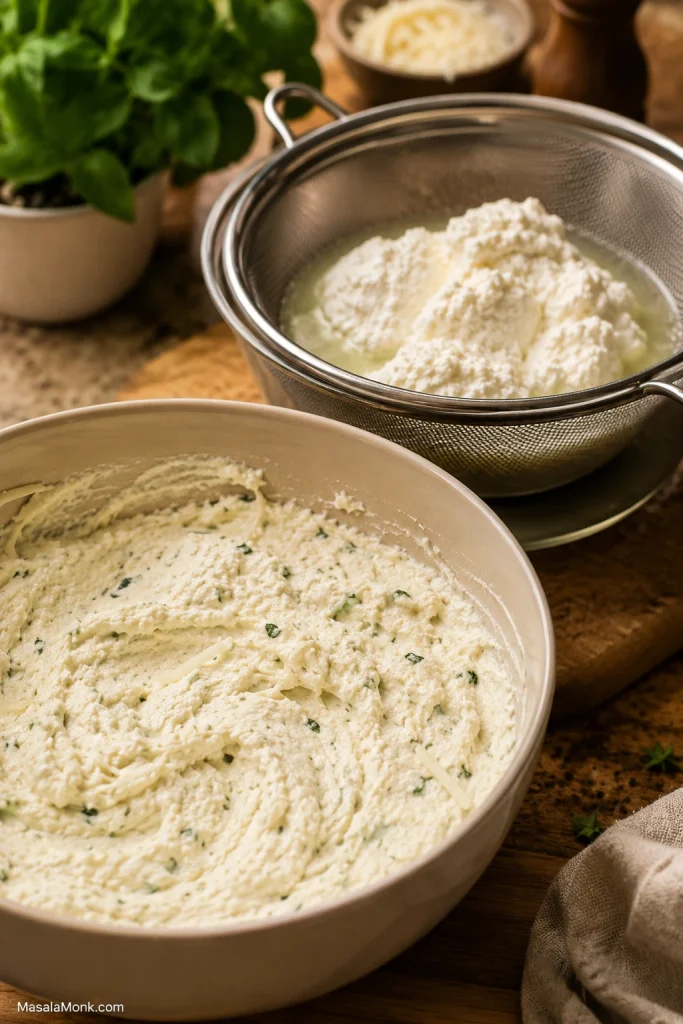
Use 15–16 oz / 425–454g ricotta cheese. Whole milk ricotta gives the creamiest filling. Loose or watery ricotta should be drained for 10–15 minutes in a fine-mesh strainer or on a few layers of paper towel before mixing. For the right texture, the ricotta filling section shows what the mixture should look like before stuffing.
Loose ricotta should be drained first; thick filling is what prevents watery stuffed shells after baking.
Mozzarella
You need 3 cups shredded low-moisture mozzarella, about 12 oz / 340g, divided between the filling and topping. Low-moisture mozzarella melts into the filling and gives the top a bubbly finish without watering down the pasta. Fresh mozzarella can be used on top in small amounts, but it is softer and wetter.
Parmesan or Pecorino
Use ½ cup / 45–55g grated parmesan or pecorino. Ricotta gives you the creamy center, but parmesan or pecorino is what makes the filling taste seasoned and savory instead of just milky.
Egg
One large egg helps bind the ricotta filling so it holds together after baking. You can skip it, but the filling will be softer. If you leave out the egg, add a little extra parmesan or mozzarella to help the filling hold.
Marinara Sauce
About 3 cups / 720ml marinara sauce gives one baking dish enough sauce for the bottom, top, and edges. A 24 oz / 680g jar is the practical shortcut and usually gives enough sauce for one batch. A good jarred marinara is not a shortcut to apologize for here; stuffed shells are mostly about enough sauce and a well-seasoned filling. If you want to make your own, this homemade marinara sauce gives you a classic base plus spicy, dipping, low-sodium, and sugar-free variations.
Very thick marinara benefits from 2–4 tablespoons of water before baking. If your jar is slightly short or extra thick, loosen it with a splash of water and save a little warm sauce for serving.
Garlic, Herbs, Salt, and Pepper
Ricotta needs seasoning. Garlic, Italian seasoning or fresh herbs, salt, pepper, and optional red pepper flakes make the filling taste like dinner instead of plain cheese. Use ½ teaspoon salt if your parmesan and sauce are already salty. Use closer to ¾ teaspoon if your ricotta is mild and your sauce is lower in salt.
Dried Italian seasoning is the easiest pantry option. Fresh parsley adds brightness, basil gives a sweeter flavor, and oregano gives the filling a stronger Italian-American note. Save fresh basil partly for the top after baking.
Optional Spinach
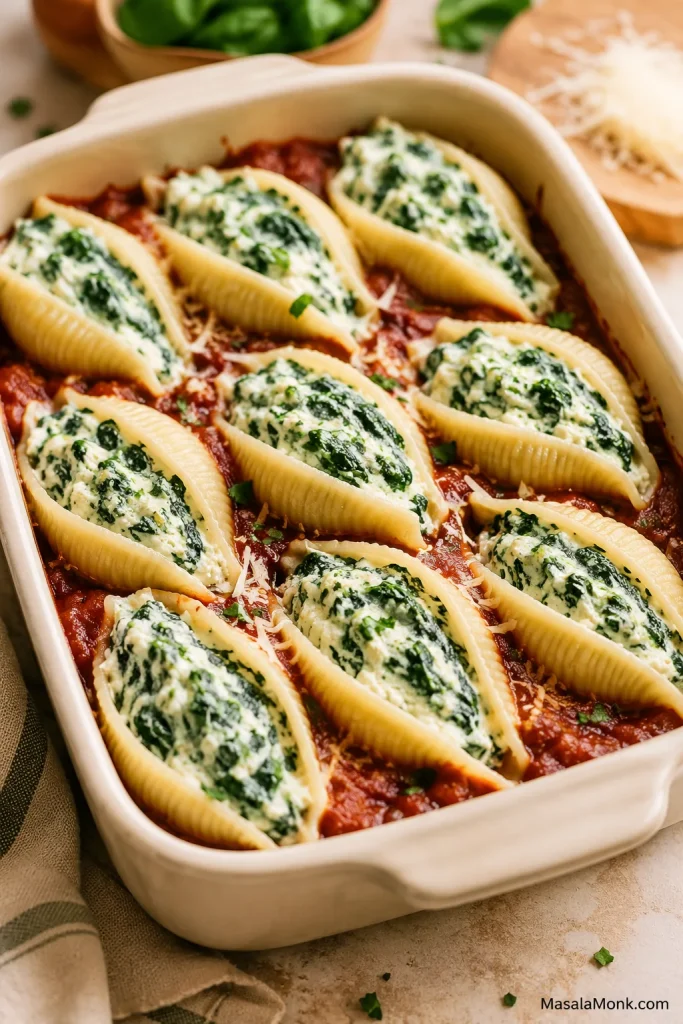
Either fresh or frozen spinach works; the real rule is to squeeze out as much moisture as possible. Wet spinach can turn a creamy filling loose and watery. For the full version, jump to spinach ricotta stuffed shells.
Optional Meat
The main recipe below is a classic cheese stuffed shells recipe, but cooked ground beef or Italian sausage can make the meal heartier. Brown the meat fully before adding it to the sauce or filling, then drain off excess fat so the pasta does not turn greasy. For the heartier version, see meat stuffed shells.
Tools That Help
You do not need special tools. A large pot, colander, mixing bowl, 9×13-inch / 23×33 cm baking dish, foil, and a spoon or zip-top bag are enough. A zip-top bag with one corner snipped off can make filling the shells faster and neater, but a spoon works perfectly well.
The first few shells are usually the messiest; by the fifth or sixth one, you will know exactly how much filling your shells can hold.
What Pasta Shells Should You Use?
Jumbo pasta shells are the shape you want here. They are large enough to hold ricotta filling and sturdy enough to bake in sauce. Small shells, medium shells, macaroni shells, and regular conchiglie are better for tossing with sauce, not stuffing.
Boil the shells 2–3 minutes shy of al dente. They should be flexible enough to open and fill, but not fully soft. Spread them on a tray to cool; rinse only if they are sticking badly or too hot to handle.
Depending on shell size and your baking dish, you may fit 20–24 filled shells. Aim for 24, but do not force them in. A slightly looser baking dish bakes better than crushed shells.
Cook jumbo shells just shy of al dente and boil a few extras, because a torn shell or two is normal when stuffing pasta.
The Best Ricotta Filling for Stuffed Shells
The filling should look thick and scoopable, more like a cheese spread than a sauce. It should mound on a spoon without running off. If it spreads like sauce, it is too wet; if it feels dry or crumbly, a spoonful of ricotta or sauce will loosen it.
A good stuffed shells filling uses ricotta for creaminess, mozzarella for melt, parmesan or pecorino for savory depth, egg for structure, and garlic, herbs, salt, and pepper for flavor. To check the seasoning safely, mix the cheeses, garlic, herbs, salt, and pepper first, taste, then add the egg last.
A good ricotta filling should mound on a spoon, not drip, so it stays creamy inside each pasta shell.
Save This Stuffed Shells Filling Ratio
For one 9×13-inch baking dish, use:
15–16 oz / 425–454g ricotta
2 cups / about 225g mozzarella inside the filling
½ cup / 45–55g parmesan or pecorino
1 large egg
1–2 garlic cloves
Herbs, salt, and pepper
1 cup / about 115g mozzarella for the top
Once the filling looks thick and scoopable, you are in good shape.
How Much Sauce Do Stuffed Shells Need?
Use about 3 cups / 720ml marinara for one 9×13-inch baking dish. The shells should sit in sauce and have sauce spooned over and around them, but they do not need to be buried.
1 cup / 240ml goes on the bottom of the baking dish
1½–2 cups / 360–480ml goes over and around the filled shells
Extra warm sauce can be served on the side if you like a saucier plate
Before baking, you should still see the shape of each shell, but the edges should be surrounded by sauce.
The shells should stay visible, but the edges need enough marinara to finish tender instead of drying out.
How to Make Stuffed Shells
With the shells, filling, and sauce sorted, assembly is simple: sauce, filled shells, more sauce, cheese, foil, and oven. While the shells boil, mix the filling and spread sauce in the baking dish. By the time the shells are cool enough to handle, the filling and baking dish are ready.
1. Boil the shells
Bring a large pot of salted water to a boil. Add the jumbo shells and cook them 2–3 minutes less than the package says for al dente. Drain and let them cool until they are easy to handle.
2. Make the ricotta filling
In a large bowl, mix ricotta, 2 cups mozzarella, parmesan, egg, garlic, herbs, salt, pepper, and optional red pepper flakes. The filling should be creamy but thick enough to hold its shape on a spoon.
3. Add sauce to the baking dish
Spread about 1 cup of marinara sauce across the bottom of a 9×13-inch / 23×33 cm baking dish. This layer keeps the shells from sticking and protects the bottom of the pasta.
4. Fill the shells
Fill each shell with about 1½–2 tablespoons / about 30g of ricotta filling, depending on shell size. Use a spoon, piping bag, or zip-top bag. Fill generously, but not so much that the shells split. Do not worry if a little filling shows or the shells sit at slightly different angles.
Fill each shell generously, then stop before the pasta stretches or splits around the ricotta filling.
5. Arrange and sauce
Place the filled shells in the baking dish, filling-side up. Spoon the remaining sauce over and around the shells. You want the pasta to look full and well-coated, not dry or sparse.
Once the filled shells sit in sauce, cover the dish so the pasta can finish baking gently and evenly.
6. Bake covered, then uncovered
Cover the baking dish with foil without pressing it into the shells. If the foil may touch the sauce or cheese, place a sheet of parchment under the foil or tent the foil slightly. Bake at 375°F / 190°C for 25 minutes.
Foil traps steam during the first bake, which helps stuffed pasta shells stay soft and tender.
Remove the foil, sprinkle the remaining mozzarella over the top, and bake for another 8–10 minutes, until the cheese is melted and the sauce is bubbling. The uncovered bake is where the top gets those golden spots.
Add mozzarella after the covered bake, then uncover the dish so the cheese melts and lightly browns.
7. Rest before serving
Let the stuffed shells rest for 5–10 minutes before serving. This is the hardest part because it smells ready, but the short rest makes serving much cleaner. After resting, the shells should lift from the baking dish without spilling all their filling.
Rest baked stuffed shells before serving so the filling settles and each shell lifts cleanly from the sauce.
How to Know When Stuffed Shells Are Done
The stuffed shells are done when the sauce is bubbling around the edges, the cheese is melted and lightly browned in spots, and the filling is hot in the center. The best bite is fork-tender pasta, thick ricotta filling, tangy tomato sauce, and a little golden mozzarella from the top.
Check the edge of the baking dish: bubbling sauce and melted cheese mean the shells are hot through the center.
If the top cheese browns before the center is hot, cover the pasta loosely with foil again and keep baking until the filling is hot through the middle.
Stuffed Shells Recipe
This is the full classic version: jumbo shells filled with seasoned ricotta, tucked into marinara, covered until tender, then finished uncovered so the mozzarella melts into golden spots.
Yield: 6 servings
Prep time: 30 minutes
Cook time: 35 minutes
Total time: 1 hour 5 minutes
Oven temperature: 375°F / 190°C
Baking dish: 9×13-inch / 23×33 cm
Ingredients
12 oz / 340g jumbo pasta shells, or enough to cook 28–30 shells
3 cups / about 720ml marinara sauce, or one 24 oz / 680g jar, divided
15–16 oz / 425–454g ricotta cheese
3 cups shredded low-moisture mozzarella, about 12 oz / 340g, divided
½ cup / 45–55g grated parmesan or pecorino
1 large egg
1–2 garlic cloves, minced or grated
1 tsp dried Italian seasoning, or 2–3 tbsp chopped fresh parsley or basil
½–¾ tsp salt, plus more for pasta water
¼–½ tsp black pepper
Pinch of red pepper flakes, optional
A few drops of olive oil, only if needed to keep cooked shells from sticking
Instructions
Heat the oven. Preheat the oven to 375°F / 190°C.
Cook the shells. Bring a large pot of salted water to a boil. Add 28–30 jumbo shells and cook 2–3 minutes less than the package directions for al dente. Drain and let cool until easy to handle. If the shells start sticking, spread them on a tray or toss with only a few drops of olive oil.
Make the filling. In a large bowl, combine ricotta, 2 cups mozzarella, parmesan, garlic, Italian seasoning or herbs, salt, pepper, and red pepper flakes if using. Taste the cheese mixture before adding the egg, then mix in the egg last.
Prepare the baking dish. Spread about 1 cup of marinara sauce over the bottom of a 9×13-inch / 23×33 cm baking dish.
Fill the shells. Spoon about 1½–2 tablespoons / about 30g filling into each shell. Arrange the filled shells in the dish, filling-side up. Aim for 24 filled shells; if your shells are very large, 20–22 may fit better.
Add sauce. Spoon the remaining marinara sauce over and around the shells. Cover the baking dish tightly with foil, tenting it slightly so it does not press into the cheese or filling.
Bake covered. Bake for 25 minutes, until the shells are hot and the sauce is bubbling around the edges.
Finish uncovered. Remove the foil, sprinkle the remaining 1 cup mozzarella over the top, and bake uncovered for 8–10 minutes, until the cheese is melted and lightly browned in spots.
Rest and serve. Let the stuffed shells rest for 5–10 minutes before serving. Serve with extra warm marinara if you like a saucier plate.
Recipe Notes
Softer top cheese: Add all the mozzarella before covering and baking if you want a fully melted top.
Stretchier browned top: Save the final cup of mozzarella and add it after the covered bake.
Spinach shells: Add 5 oz / 140g cooked fresh spinach or 8 oz / 225–250g thawed frozen spinach, squeezed very dry.
Meat sauce version: Add ½–1 lb / 225–450g cooked ground beef or Italian sausage to the sauce, and increase sauce by ½–1 cup if the pasta looks dry.
Cottage cheese swap: Blend cottage cheese briefly for a smoother filling and drain it first if it looks watery.
Small Details That Make Better Stuffed Shells
Cook 28–30 shells. You need backups for the ones that tear.
Drain watery ricotta. Loose ricotta makes the filling run instead of mound.
Taste before adding egg. It is easier to fix bland filling before the egg goes in.
Loosen very thick marinara. A few tablespoons of water help the sauce move around the shells.
Cover first. The pasta finishes cooking in the sauce before the cheese browns.
Rest before serving. The filling firms slightly as it sits.
Make-Ahead, Freezer, and Reheating Instructions
Stuffed shells are one of the best baked pasta dinners to prepare ahead. The shells, filling, sauce, and cheese all hold up well, and a freezer batch feels like a future dinner already handled. This is also a good place to make two baking dishes: bake one tonight and freeze the second before baking.
Best Make-Ahead Option
Assemble the stuffed shells up to 24 hours ahead. Fill the shells, arrange them in sauce, cover tightly, and refrigerate. Let them sit at room temperature only while the oven preheats, about 20–30 minutes. If baking straight from the fridge, add 5–10 minutes to the covered baking time.
Stuffed shells are ideal for make-ahead dinners because you can refrigerate or freeze them before baking.
Best Freezer Option
Freeze stuffed shells before baking. Assemble the shells in a freezer-safe baking dish, cover tightly with plastic wrap and foil or a freezer-safe lid, and freeze for up to 2–3 months for best quality.
If you froze the shells in a glass or ceramic baking dish, thaw them overnight unless the dish is labeled freezer-to-oven safe. That helps prevent sudden temperature shock. You can also freeze the filled shells separately and transfer them to an oven-safe dish with sauce before baking.
Best Small-Batch Freezer Option
Freeze filled shells on a tray until firm, then transfer them to a freezer-safe bag or container. Later, place only the number of shells you need into a baking dish with sauce and cheese. This is useful when you want 2–4 servings instead of a full batch.
Freeze stuffed shells in a single layer first so they do not stick together; once firm, you can transfer them for easy small-batch freezer meals later.
Best Texture After Freezing
For the best texture, thaw frozen stuffed shells overnight in the refrigerator before baking. Before baking, remove any plastic wrap and cover the baking dish again with foil. Bake as directed, adding 5–10 extra minutes if the pasta is still cold.
How to Bake Frozen Stuffed Shells
To bake from frozen, cover the baking dish with foil and bake at 350°F / 175°C for about 60–75 minutes, or until the center is steaming hot. Uncover, add cheese if needed, and bake 10–15 minutes more until bubbling and melted.
How to Store Leftovers
Store leftover stuffed shells in an airtight container in the refrigerator for 3–4 days. A 3–4 day refrigerator window is also the general USDA guidance for cooked leftovers, so it is a good limit to use here.
How to Reheat Stuffed Shells
Reheat covered in the oven at 350°F / 175°C until hot, or microwave individual portions. Add a spoonful of extra sauce or a small splash of water before reheating so the pasta does not dry out.
Leftover Ideas
Leftover stuffed shells are best reheated with extra sauce, but you can also chop them into smaller pieces and reheat them like baked pasta. Add fresh herbs, parmesan, or a little extra marinara to wake the flavor back up. This is the sort of dinner that makes leftovers feel like a reward.
Stuffed Shells Variations
Think of the recipe card as the house version. The variations are how you adjust the pasta for the people eating it — greener for spinach lovers, meatier for Sunday dinner, lighter with cottage cheese, or richer with Alfredo.
Which Stuffed Shells Variation Should You Make?
Classic: Make the ricotta version as written first if you want the most traditional baked pasta.
Beef or sausage: Use the meat sauce version for a heartier Sunday-style dinner.
Cottage cheese: Try stuffed shells without ricotta if you want a lighter, higher-protein filling or do not have ricotta.
Alfredo: Make Alfredo stuffed shells for a richer white-sauce version with chicken or spinach.
Spinach Ricotta Stuffed Shells
Add spinach to the ricotta filling for a classic spinach stuffed shells variation. Fresh spinach and frozen spinach both work, but the spinach needs to be cooked, chopped, and squeezed very dry before it goes into the filling. Use about 5 oz / 140g fresh spinach or 8 oz / 225–250g frozen spinach.
For spinach ricotta stuffed shells, squeeze the spinach dry so the filling stays creamy instead of watery.
Beef Stuffed Shells
For the cleanest shells, keep the ricotta filling mostly cheese-based and put the browned meat in the sauce. That gives every bite a hearty meat sauce without making the shells heavy or hard to close. Brown ½–1 lb / 225–450g ground beef with a little salt, pepper, garlic, and Italian seasoning, then drain excess fat before adding it to the marinara.
Sausage Stuffed Shells
Italian sausage brings more seasoning than ground beef, so it is the easiest way to make the sauce taste deeper. Remove it from the casing if needed, brown it well, and drain any excess fat. Sausage brings more salt and spice than plain ground beef, so taste before adding extra seasoning.
For meat stuffed shells, keep the cheese inside the pasta and stir browned beef or sausage into the marinara.
Cottage Cheese Stuffed Shells
Cottage cheese is the easiest ricotta swap and a good option if you want a lighter, higher-protein filling. Replace ricotta 1:1 by weight, drain it if watery, and blend it briefly for a smoother texture. The flavor is a little tangier and less classic than ricotta, but it bakes up creamy when mixed with mozzarella, parmesan, egg, garlic, and herbs.
Stuffed Shells Without Ricotta
If you do not have ricotta, use cottage cheese, a mix of cream cheese and mozzarella, a meat filling, roasted vegetables, or tofu ricotta for a dairy-free version. This helps if you dislike ricotta or simply do not have it. The recipe can still work well as long as the filling is thick and not watery.
For stuffed shells without ricotta, blend cottage cheese until smooth so the filling holds its shape inside the pasta.
Alfredo Stuffed Shells
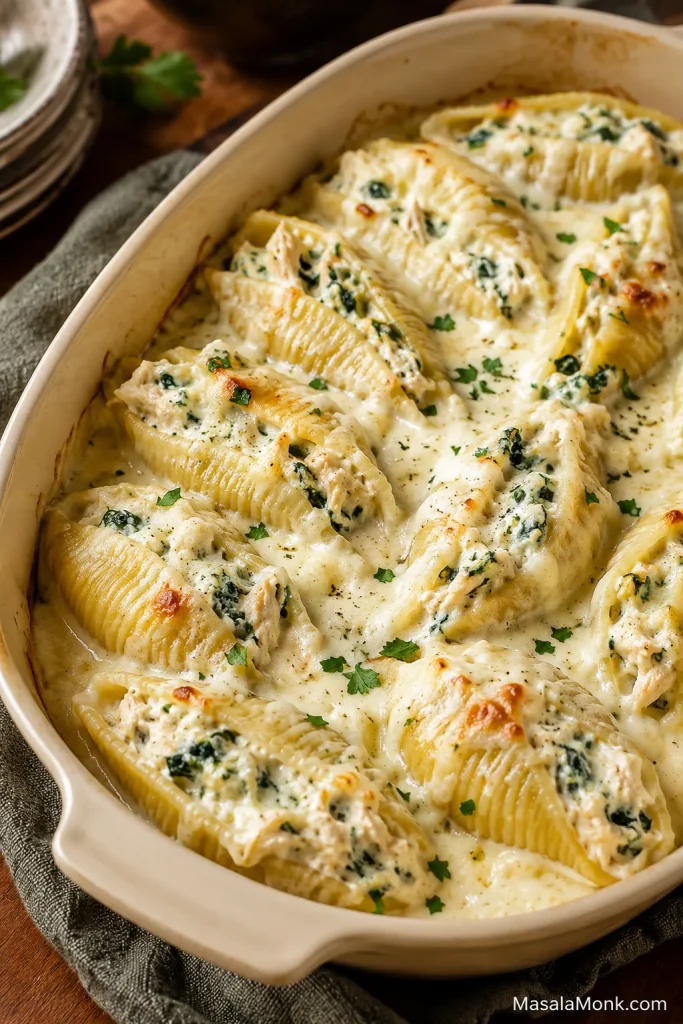
For a creamy white-sauce version, use Alfredo sauce instead of marinara. Because Alfredo is rich, spinach or chicken works especially well here. For more creamy pasta dinner ideas, see this chicken Alfredo pasta guide.
Alfredo stuffed shells are the creamy white-sauce variation to choose when you want spinach, chicken, or a richer pasta bake.
No-Boil Stuffed Shells
No-boil stuffed shells can work, but they need a different sauce ratio and a longer covered bake. This recipe is written for boiled shells because it gives the most predictable texture: shells that are flexible enough to fill, tender after baking, and less likely to stay firm in the center. If you want a true no-boil version, increase the sauce or liquid and keep the dish tightly covered until the pasta is fully tender.
Serving and Scaling
How Many Stuffed Shells Per Person?
Plan on 3–4 stuffed shells per adult if serving with salad, bread, or vegetables. Plan on 4–5 shells per person for a heartier main dish with fewer sides. A 9×13-inch baking dish with about 20–24 stuffed shells serves 6 people generously.
For dinner portions, plan on three to four ricotta stuffed shells per adult with salad, garlic bread, or vegetables.
Can You Double This Recipe?
Yes. To double the recipe, use two 9×13-inch baking dishes instead of crowding everything into one deep dish. If baking both at the same time, rotate them halfway through if your oven has hot spots. If the pans are cold from the fridge, they may need a few extra minutes of covered baking time. You can also bake one now and freeze one for later.
What to Serve with Stuffed Shells
Stuffed shells are rich, cheesy, and well-sauced, so they pair best with something crisp, green, garlicky, or simple. On a weeknight, salad is enough. When serving company, add garlic bread and something fresh on the side.
Bake just until melted and use low-moisture mozzarella
Pasta looks watery
Wet filling or vegetables
Drain ingredients and rest before serving
If the shells or edges look dry after baking, spoon warm marinara around the pasta before serving. Sauce brings moisture back better than adding more cheese.
When the edges look dry, spoon warm marinara around the shells before serving to soften them again.
Frequently Asked Questions
A few common questions come up once you start adjusting the recipe. These quick answers should help you choose the right shells, filling, sauce, and make-ahead method.
What pasta shells do I use for stuffed shells?
Use jumbo pasta shells. Small shells, medium shells, and macaroni-style shells are not large enough for stuffing.
Do you have to boil shells before stuffing them?
For this version, yes. Boiling first gives you shells that are soft enough to fill but firm enough to finish in the oven. No-boil shells need more liquid and a longer covered bake.
What is the best cheese filling for stuffed shells?
The best classic filling uses ricotta, mozzarella, parmesan or pecorino, egg, garlic, herbs, salt, and pepper. Ricotta makes it creamy, mozzarella adds melt, parmesan adds depth, and egg helps it hold together.
Do I need egg in stuffed shells?
Egg helps the filling set so the shells lift more cleanly. You can skip it, but the filling will be softer. If skipping egg, add a little extra parmesan or mozzarella.
Can I use cottage cheese instead of ricotta?
You can replace ricotta 1:1 by weight, drain cottage cheese if watery, and blend it first if you want a smoother filling. The no-ricotta section gives more options.
Can I make stuffed shells without ricotta?
Yes — use cottage cheese, cream cheese mixed with mozzarella, a meat filling, roasted vegetables, or tofu ricotta. Keep the filling thick so it does not run out of the shells.
How much sauce do stuffed shells need?
For one 9×13-inch baking dish, use about 3 cups / 720ml sauce. Spread about 1 cup on the bottom and spoon the rest over and around the filled shells.
Do you bake stuffed shells covered or uncovered?
Bake them covered for most of the time so the pasta stays moist and the filling heats through. Uncover at the end to melt and lightly brown the cheese.
How do you keep stuffed shells from drying out?
Use sauce under and over the shells, cover the baking dish for the first bake, and reheat leftovers with extra sauce or a small splash of water. That is the same no-dry-shell method used in the main recipe.
Can I make stuffed shells ahead of time?
Yes. Assemble stuffed shells up to 24 hours ahead, cover, and refrigerate. The make-ahead section explains the timing and freezer options.
Can stuffed shells be frozen?
Freeze them before baking for the best texture, either as a full baking dish or as individual filled shells. Use within 2–3 months for best quality.
Can I bake stuffed shells from frozen?
You can bake them covered at 350°F / 175°C for 60–75 minutes, or until the center is hot. Then uncover and bake until the sauce bubbles and the cheese melts.
Can I add meat to stuffed shells?
Meat works best in the sauce, where it makes the dish heartier without weighing down the ricotta filling. Brown and drain the meat before adding it.
How many stuffed shells per person?
Plan on 3–4 stuffed shells per adult with sides, or 4–5 shells per person for a heartier main dish.
How long do leftover stuffed shells last?
Leftovers keep for 3–4 days and reheat best with extra sauce. Store them in an airtight container in the refrigerator and reheat until hot.
Make It Your Own
A good batch of stuffed shells should feel generous: pasta tucked into sauce, cheese bubbling around the edges, and enough filling in every shell that nobody feels shortchanged. The whole recipe comes back to the same simple method: thick filling, enough sauce, covered bake, tender shells.
This is the kind of tray that looks a little messy in the best way: sauce at the edges, cheese pulling from the spoon, and enough shells for someone to quietly go back for one more.
Serve stuffed shells family-style with garlic bread and salad; this is the pasta bake people come back to for one more shell.
You can keep the recipe classic, add spinach, make it meaty with beef or sausage, swap in cottage cheese, use Alfredo sauce, or freeze a batch for another night. For another cozy pasta dinner after this one, save this broccoli pasta too.
If you make these stuffed shells, tell us which version landed on your table: classic ricotta, spinach, meat sauce, cottage cheese, Alfredo, or extra saucy. I especially want to know if you froze a batch for later — that is where this recipe really earns its keep.