Slow cooker lasagna tends to get into trouble after it starts smelling done. The sauce is bubbling around the edges, the mozzarella has melted, and the kitchen already smells like dinner. It is tempting to leave the lid on for another hour. Meanwhile, the noodles are still sitting in hot sauce and trapped steam, getting softer by the minute.
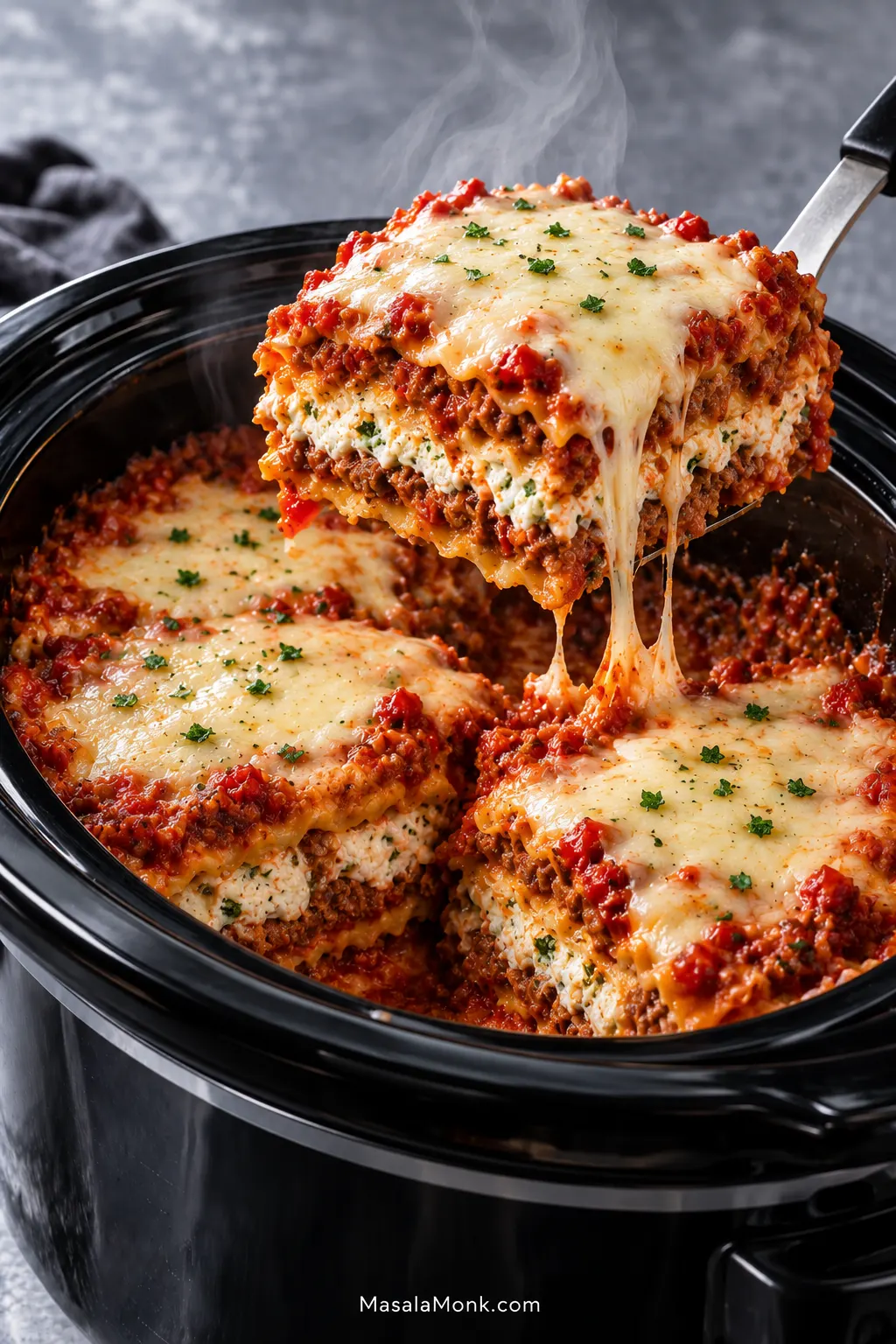
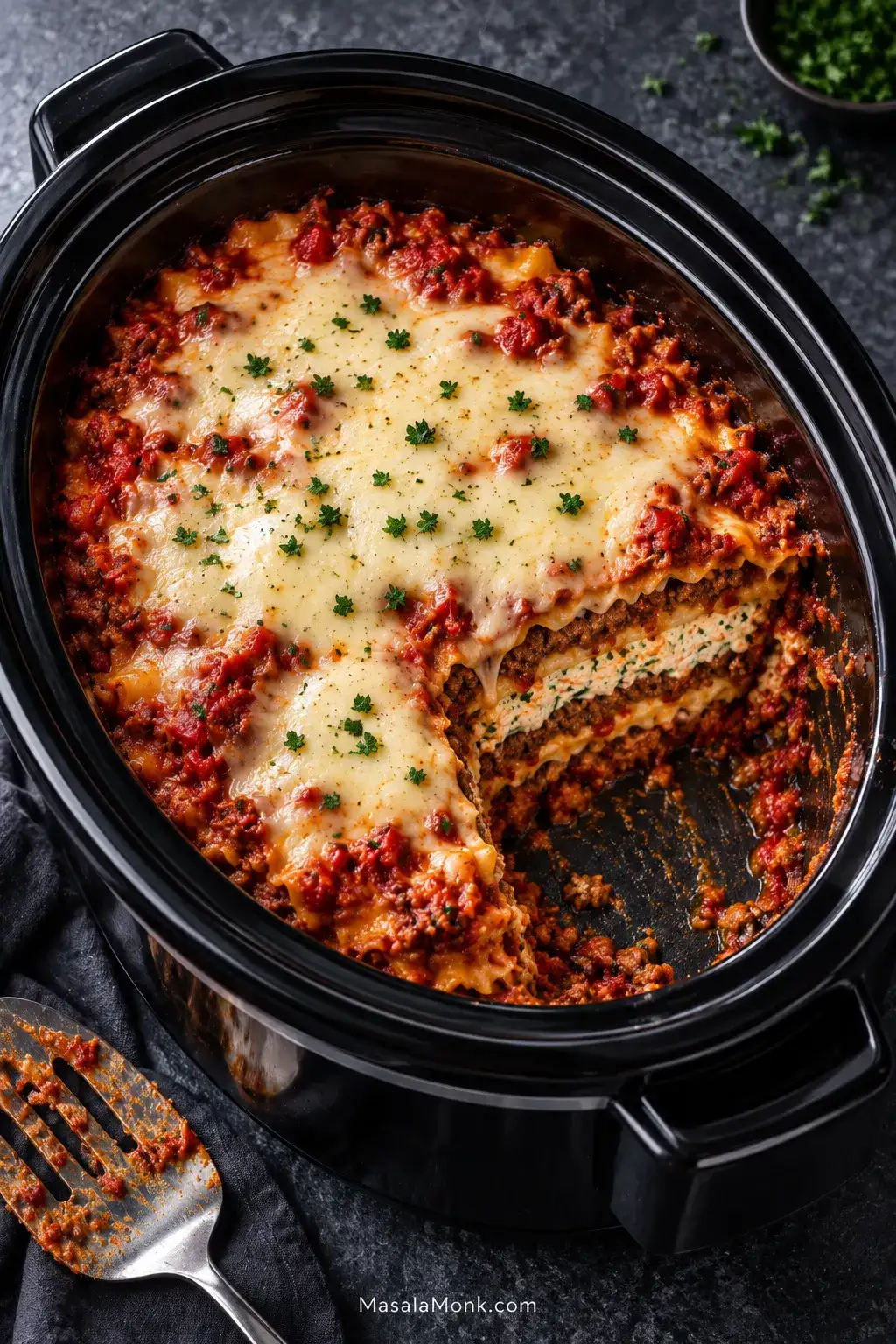
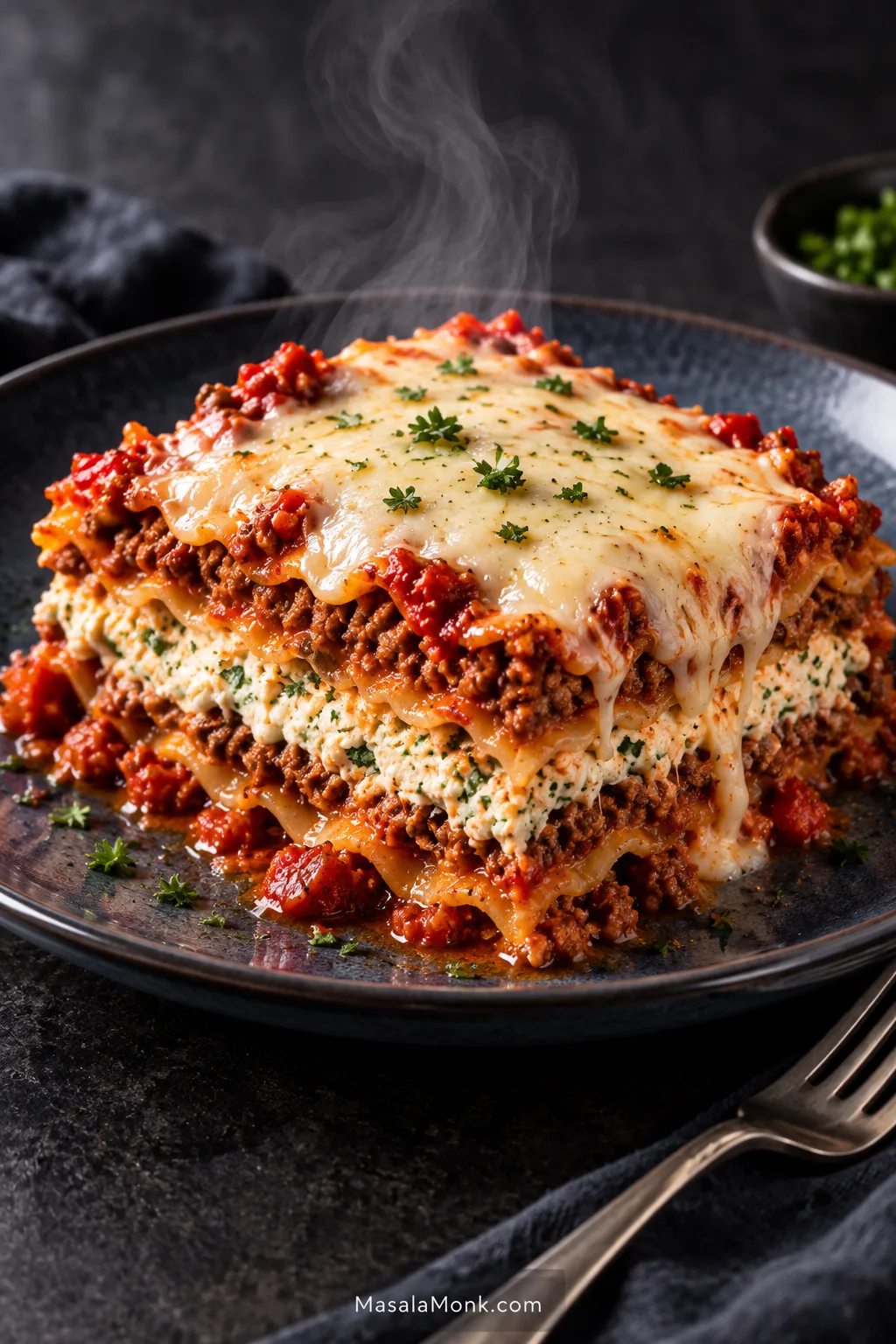
At its best, the pasta is tender all the way through but still forms layers you can see when you lift a piece. Meat sauce stays tucked between the sheets, creamy ricotta shows through the cut center, and the cheese on top remains soft and stretchy. The edges usually set a little firmer where the lasagna meets the crock.
This is where the slow cooker earns its place: no separate pot of noodles, no oven to manage, jarred marinara is completely welcome, and once the layers are assembled, most of the active work is over. It is especially useful when the oven is busy or you would rather not heat up the kitchen. Think hands-off rather than all-day. Pasta has a much narrower sweet spot than a stew or pot roast.
The assembly itself is forgiving. Noodles can break, the layers do not need to look perfect, and pre-shredded cheese is fine. Timing is the one thing worth watching closely. This slow cooker lasagna recipe keeps the convenience while aiming for the distinct layers you expect from classic oven lasagna.
Quick answer: No boiling first. Layer regular dry lasagna noodles with sauce and cheese, then cook on LOW for about 3½–4½ hours, checking from around 3 hours. Once the center noodles are tender, switch off the cooker and let the lasagna rest before serving.
Dry noodles cook directly between meat sauce, creamy ricotta and mozzarella, so there is no separate pot of pasta and no oven to manage. Jarred marinara works perfectly well here, and low-moisture mozzarella melts well without adding as much extra water.
Prep: 25 minutes
Cook: about 3½–4½ hours on LOW
Rest: 20–30 minutes
Plan ahead: about 4½–5½ hours from starting prep to serving
Yield: about 8 servings
Slow cooker: 6 qt / about 5.7 L, preferably oval
Equipment
6-qt / about 5.7-L oval slow cooker
Large skillet
Medium mixing bowl
Thin knife or skewer for checking the pasta
For the Meat Sauce
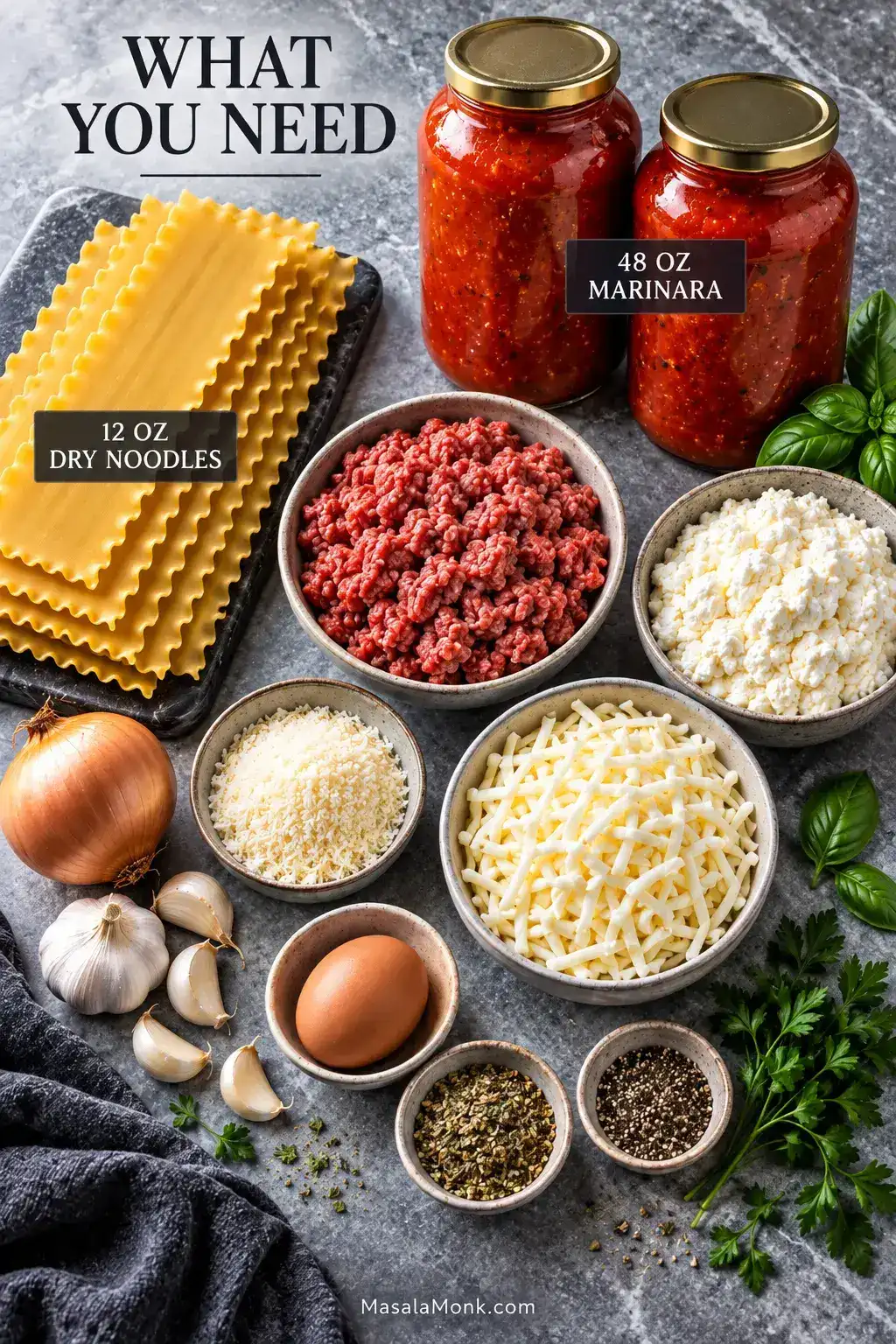
1 lb / 454 g ground beef, preferably 85–90% lean
1 medium yellow onion, about 5 oz / 140 g, finely diced
3 garlic cloves, about 9 g, minced
1 tsp Italian seasoning
½ tsp freshly ground black pepper
¼–½ tsp fine salt, or to taste
Pinch of red-pepper flakes, optional
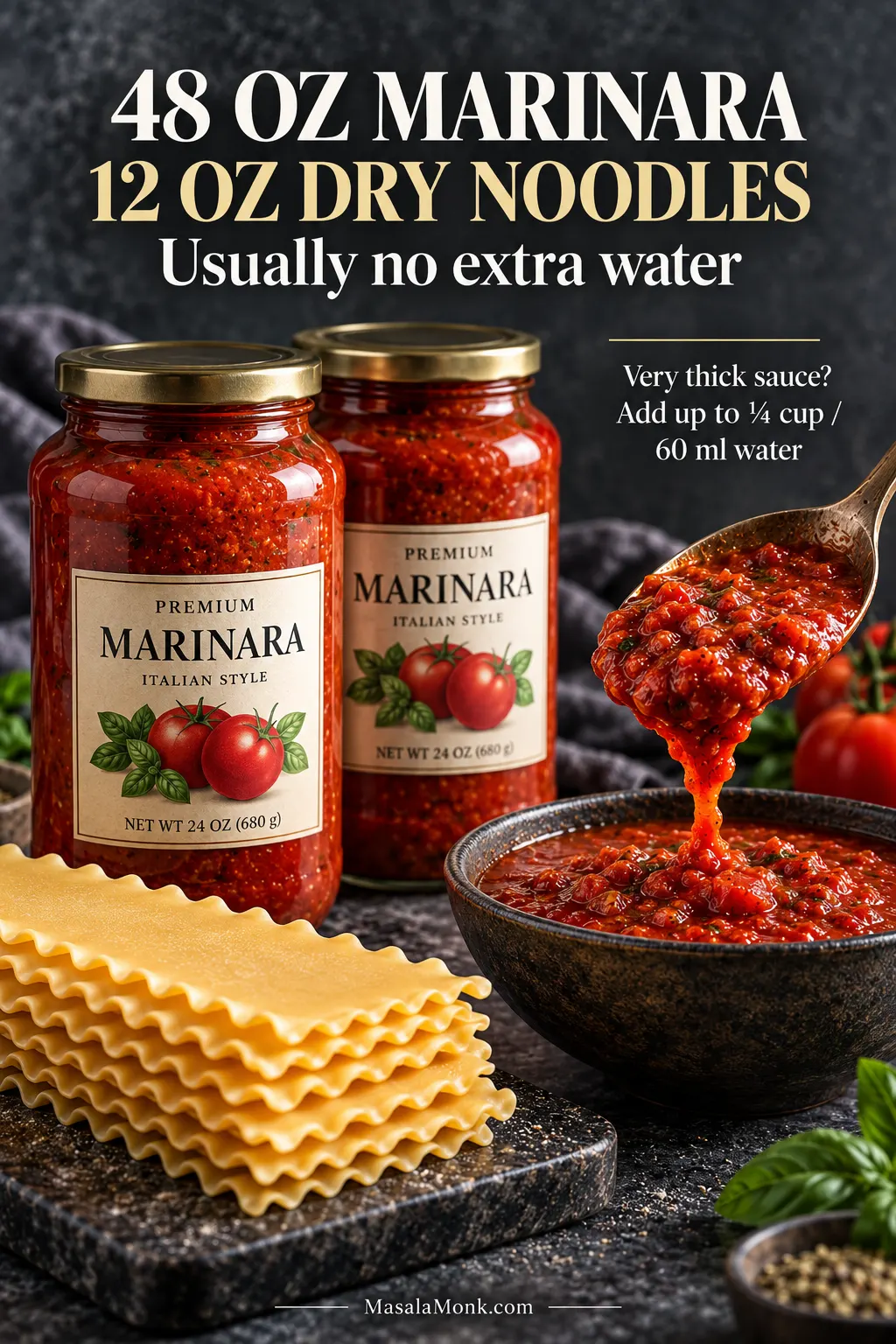
48 oz / 1.36 kg medium-thick marinara sauce (two 24-oz jars)
For more sausage flavor: use 8 oz / 227 g ground beef plus 8 oz / 227 g Italian sausage instead of all beef.
For the Cheese Filling
15 oz / 425 g whole-milk ricotta
1 large egg
⅓ cup / about 30–35 g finely grated Parmesan
2 tbsp chopped parsley or basil, optional
For Layering
12 oz / 340 g regular dry lasagna noodles, uncooked (measure 12 oz rather than automatically using a larger full box)
12 oz / 340 g shredded low-moisture mozzarella
2 tbsp / about 10–15 g finely grated Parmesan, for finishing
Neutral oil or cooking spray, for the slow-cooker insert
Two 24-oz jars make the marinara easy to measure, while weighing 12 oz of dry lasagna noodles separately prevents a larger full box from quietly changing the sauce-to-pasta balance.
Method
Brown the beef and onion. Cook over medium-high heat, breaking up the meat, until browned and the onion is soft. Drain excess fat.
Finish the meat sauce. Stir in the garlic, Italian seasoning, black pepper and optional red-pepper flakes for 30 seconds, then add the marinara and taste before salting. The sauce should pour but cling to a spoon. If it is unusually thick, loosen it with up to ¼ cup / 60 ml water.
Make the cheese filling. Mix the ricotta, egg, ⅓ cup Parmesan and optional herbs; divide roughly into thirds.
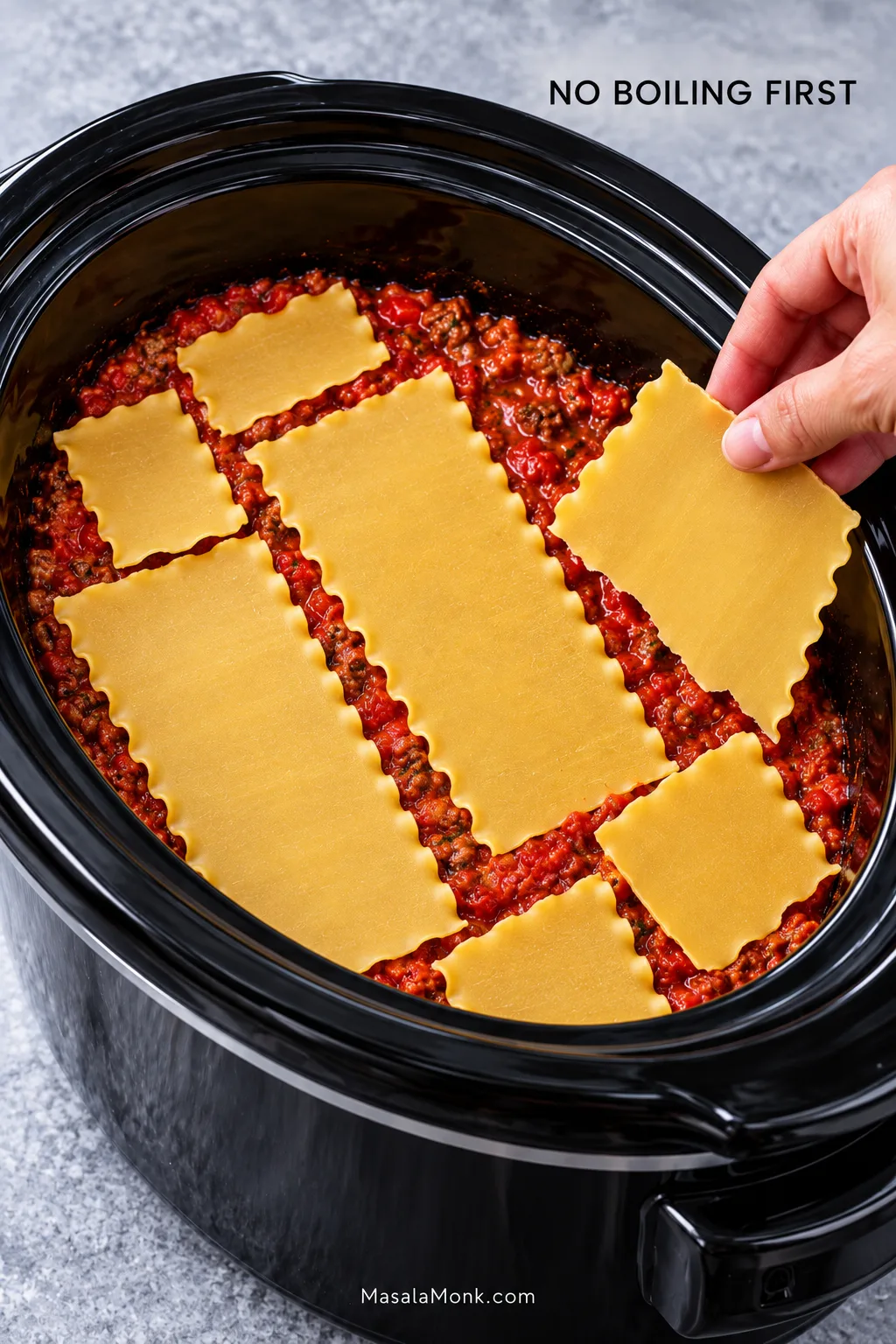
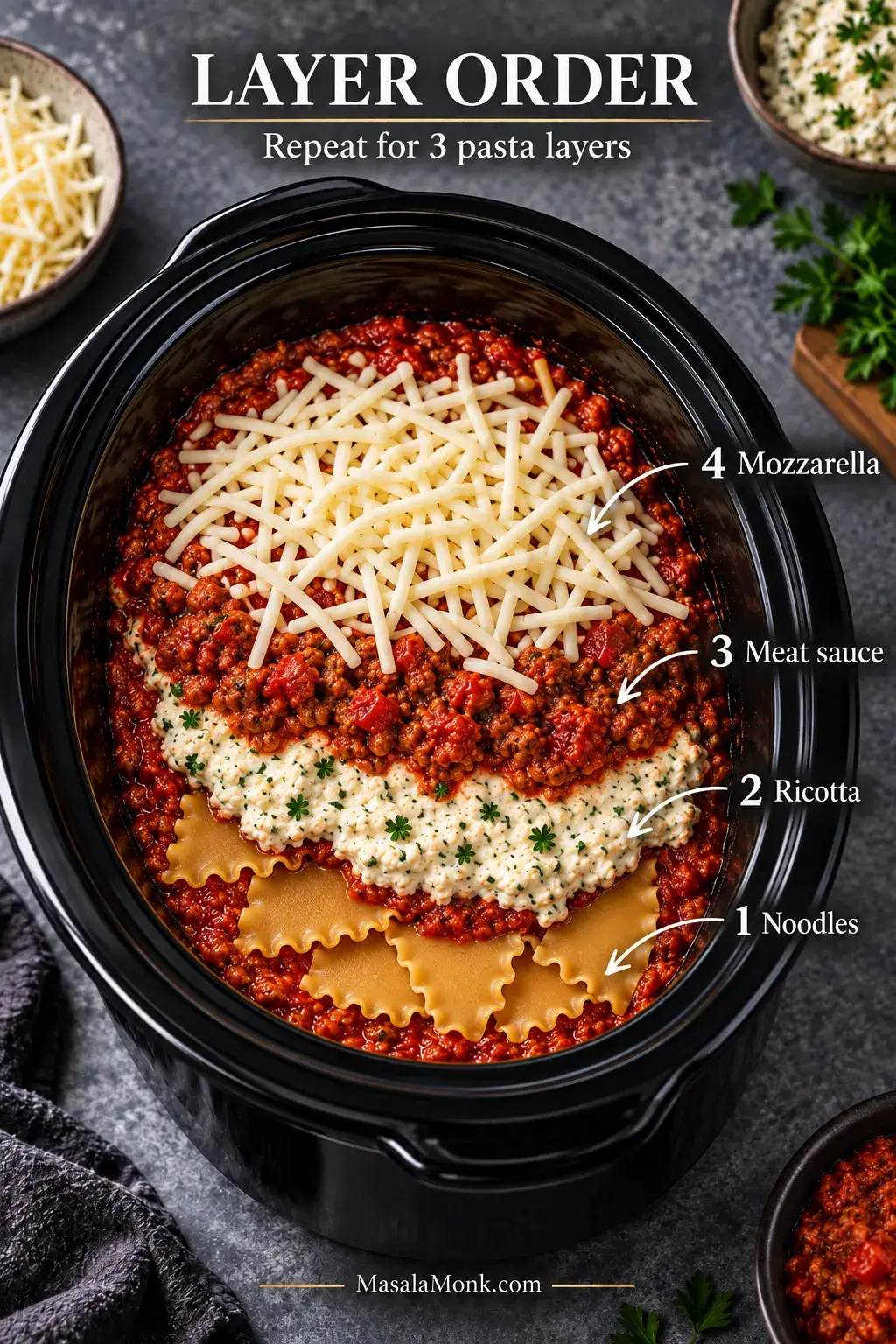
Build three layers. Grease the crock and spread about 1 cup meat sauce over the bottom. Reserve about 4 oz / 110 g mozzarella for the top. Add dry noodles, breaking them to fit, then one-third each of the ricotta, meat sauce and remaining mozzarella. Repeat for three pasta layers, keeping every noodle sauced, especially at the edges.
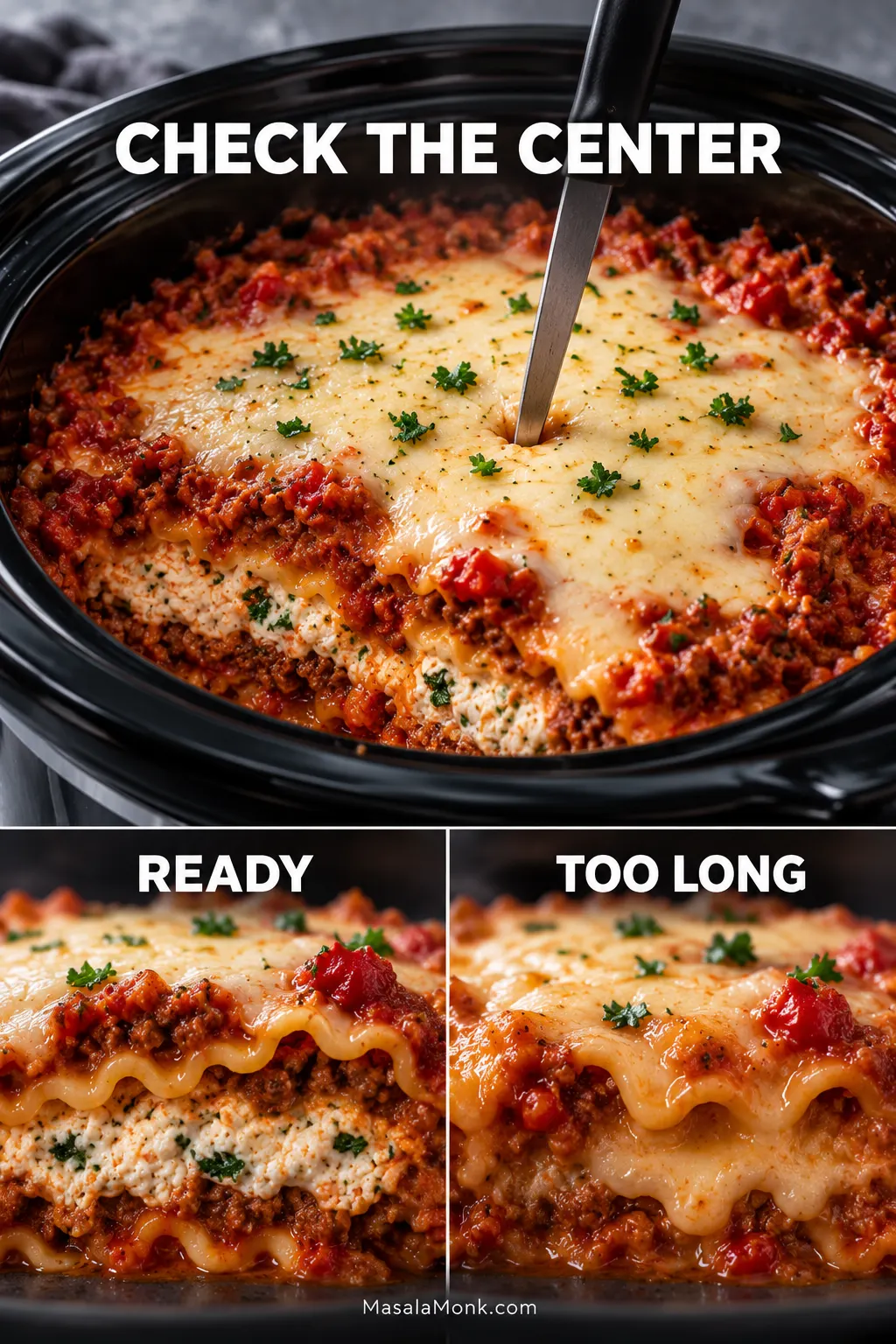
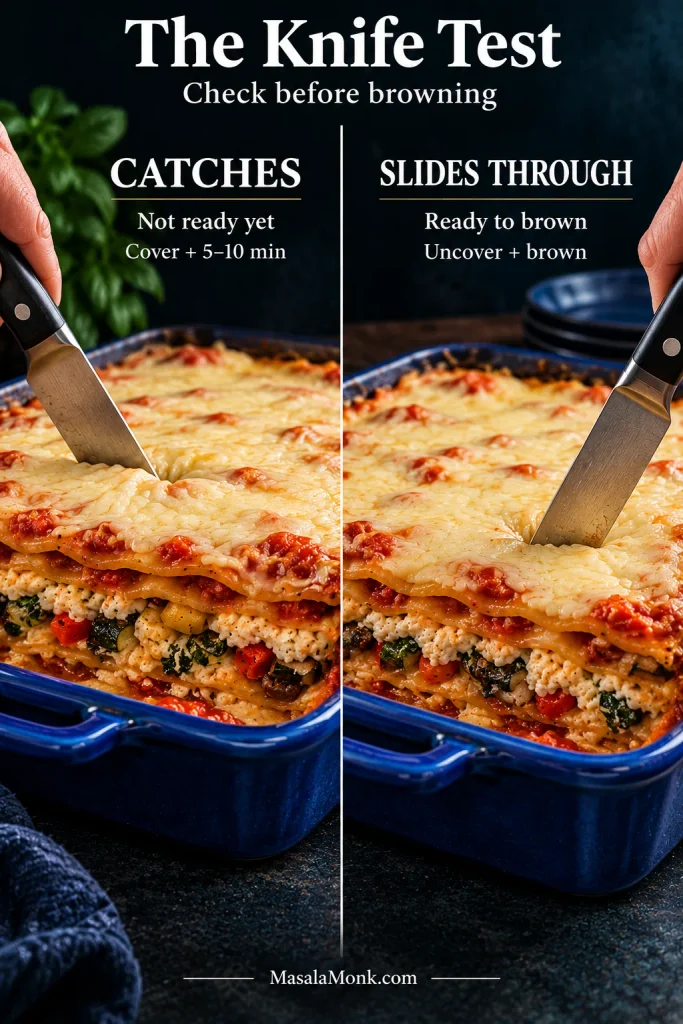
Cook on LOW and check the pasta. Begin checking around 3 hours; expect roughly 3½–4½ hours. The noodles should be fork-tender, and a thin knife or skewer should pass through the middle without a chalky core.
If it needs more time: firm pasta with plenty of moisture can cook another 20–30 minutes. For firm, dry-looking pasta, add 2–4 tbsp / 30–60 ml hot water or warm marinara around the edge.
Switch off the cooker and finish the cheese. When the pasta is tender, turn the slow cooker OFF. Add the reserved mozzarella and finishing Parmesan, cover for 5–10 minutes and let the retained heat melt the cheese.
Rest before serving. Crack or remove the lid and rest 20–30 minutes. Loosen the edge with a broad non-scratching spatula, then serve.
Recipe Notes
Regular dry noodles: measure 12 oz / 340 g, then add them dry—no boiling first.
Oven-ready noodles: they work too, but soften sooner, so check earlier.
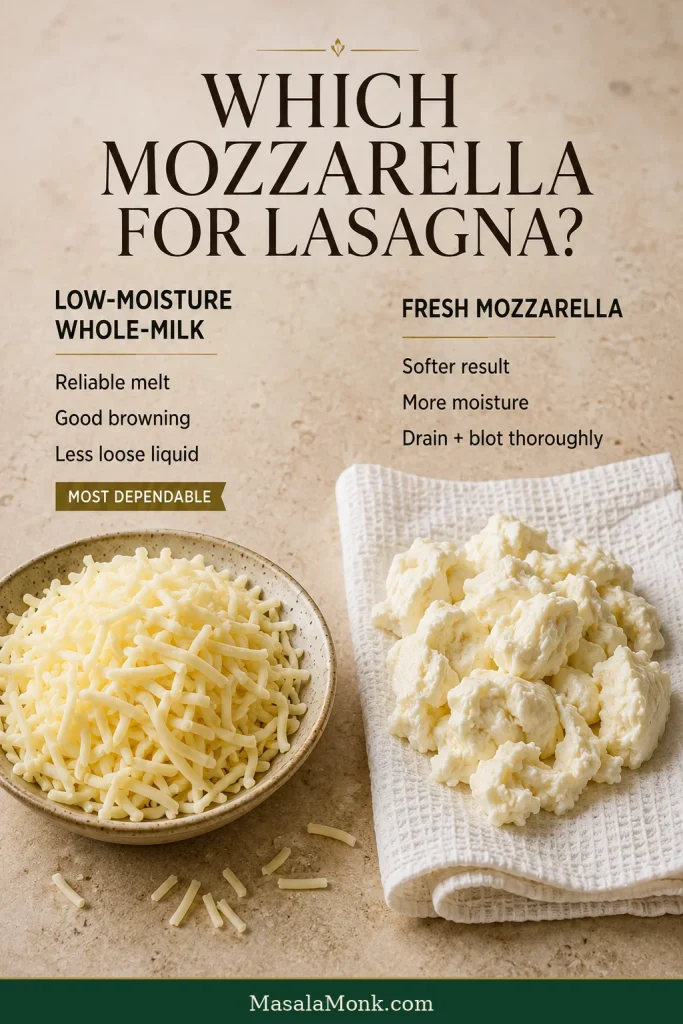
Mozzarella: low-moisture mozzarella is easiest to manage here. Fresh mozzarella can release considerably more water.
Cottage cheese: 15–16 oz / 425–454 g can replace the ricotta. Drain visible whey first.
Food safety: cook ground beef or sausage to 160°F / 71°C; ground turkey to 165°F / 74°C. If checking the finished lasagna with a thermometer, the center should reach 165°F / 74°C; reheat leftovers to the same temperature. See the USDA safe-temperature chart.
Sauce reaching the perimeter helps protect the noodle edges, while visible pasta, ricotta and a softly melted top show the texture this recipe is aiming for.
More Help With Your Lasagna
Want to understand the noodles, timing or moisture before you start? Everything below is organized so you can jump straight to what you need.
Noodles, Sauce and How Much Liquid You Actually Need
A slow cooker holds onto steam extremely well. That is what allows dry lasagna noodles to cook without a separate pot of boiling water. It also means liquid stays in the crock instead of evaporating the way it does in a hot oven.
You still want a saucy lasagna. There should be enough tomato sauce to soften every sheet and stay tucked between the layers, but not so much that the first serving leaves a puddle behind.
Can you put uncooked lasagna noodles in a slow cooker?
Yes. Regular dry lasagna noodles can go straight into the slow cooker without boiling first. They soften gradually in the sauce and give you a useful amount of time between firm and overly soft.
Oven-ready sheets work too. Because they hydrate faster, start checking them sooner.
Perfectly fitted noodles are unnecessary. Broken dry sheets work just as well when the exposed pieces are surrounded by enough sauce to soften evenly.
Do you need to add water to slow cooker lasagna?
Usually not in this recipe. The amounts matter: 48 oz / 1.36 kg marinara for 12 oz / 340 g dry noodles already gives the pasta plenty to absorb as it cooks.
This is why slow-cooker lasagna recipes can appear to contradict one another. A deeper recipe built around a full 16-oz / 454-g box of noodles may genuinely need additional liquid. With the amounts here, pouring in an automatic cup of water can leave far more moisture than the pasta needs.
If you make the sauce yourself, homemade marinara sauce works here too. Aim for one that coats the pasta generously instead of running through the crock like broth.
With 48 oz of marinara for 12 oz of dry noodles, the pasta already has plenty of moisture to work with; only a very thick sauce may need a small splash of water.
Why one corner can stay hard
Sometimes nearly the whole lasagna is tender except for one leathery corner. That piece may simply have spent the cook above the sauce or pressed dry against the crock wall. One stubborn patch does not mean the rest of the lasagna needs more water.
A little noodle overlap is fine. Several dry sheets pressed directly together are harder for moisture to reach. Before closing the lid, glance around the perimeter and cover any pale pasta still showing.
Vegetables bring their own water. Frozen spinach is a good example: thaw it and squeeze it well before layering. When zucchini, mushrooms, greens and other vegetables become the main filling, a dedicated vegetable lasagna method gives you better control over the moisture they release.
How to Build Slow Cooker Lasagna So It Cooks Evenly
The uncooked layers rarely look elegant. Noodles crack, and rectangular sheets leave awkward curved spaces in an oval crock. There is no prize for fitting them like a puzzle. Once the pasta softens, those broken pieces settle into the sauce with everything else.
Start with sauce and fit the noodles around the crock
Spread the first cup of meat sauce over the bottom before any pasta goes in. Lay the larger noodle pieces through the center, then snap smaller pieces to cover the curved spaces.
A broken noodle is not a problem; a dry noodle is.
Layer map: sauce on the bottom → dry noodles → ricotta filling → meat sauce → mozzarella. Build three pasta layers total and bury the final noodles beneath sauce.
Repeat noodles, ricotta, meat sauce and mozzarella for three pasta layers, but pay special attention to the crock wall—sauce around the perimeter helps prevent stubborn dry corners.
Keep the edges sauced and save some cheese for the top
The pasta nearest the crock wall feels the heat first, so carry the sauce all the way to the perimeter. An exposed corner can dry before the middle is ready.
Keep about a cup of mozzarella back for the finish. Under a slow-cooker lid the cheese melts pale, glossy and stretchy; it will not develop the toasted freckles and crisp bubbles you get from an oven. That’s normal.
Ricotta, Cottage Cheese, Beef or Sausage
Ricotta is the default here. Whole-milk ricotta gives you the soft, creamy layer that should still be visible between the pasta and meat sauce when you cut a piece. The egg helps the filling set during cooking, so it holds together better when served.
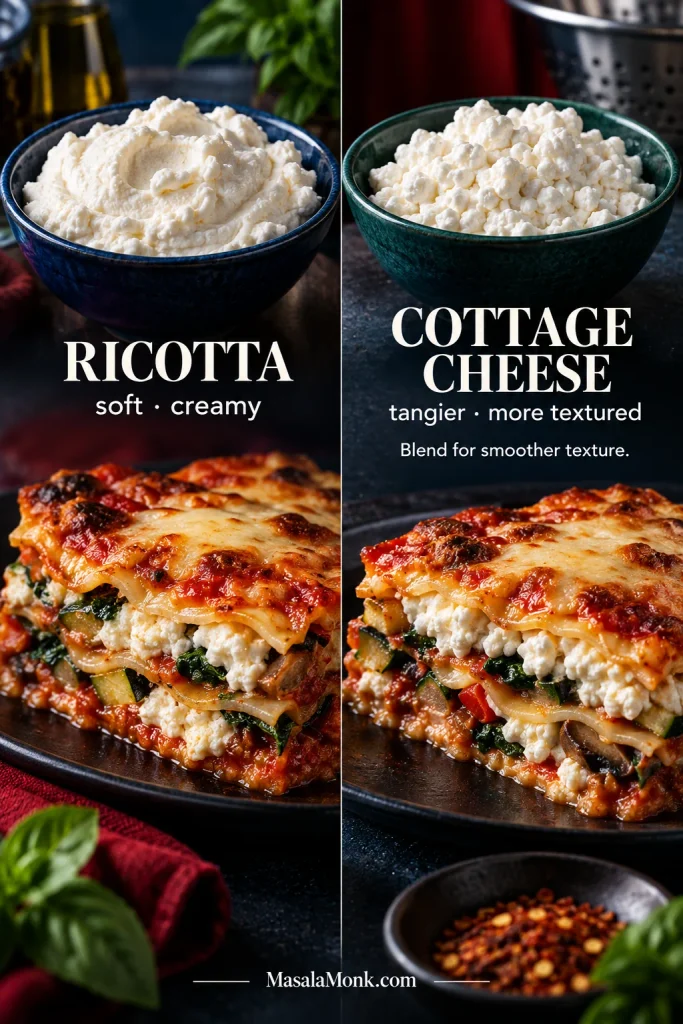
Ricotta vs cottage cheese: cottage cheese is a perfectly workable substitute, but it brings a little more loose moisture and a different texture. Use about 15–16 oz / 425–454 g, drain off visible whey, and blend it briefly if you prefer a smoother filling. Half ricotta and half cottage cheese is fine as well. For a version built specifically around it, see the cottage cheese lasagna guide.
All beef keeps the meat sauce familiar and straightforward. Replacing half with Italian sausage gives the tomato sauce a deeper, more savory flavor against the mild ricotta. Ground turkey works too; season it generously because it is leaner and milder. Whatever meat you choose, browning it first develops more flavor and gives you a chance to drain excess fat.
The finished slice should still show pasta, creamy ricotta and meat sauce as distinct layers, even though the lasagna stays soft and saucy.
LOW vs HIGH: How Long Does Slow Cooker Lasagna Take?
The smell of tomato sauce and melted cheese is not a reliable timer. Near the end, the edges may look thoroughly cooked while a noodle deep in the center still offers resistance when you test it.
LOW is the default: about 3½–4½ hours, with the first check around 3 hours. HIGH usually takes about 2½–3½ hours, but the noodles move through their tender stage faster, so you have less margin near the end.
When your schedule is flexible, LOW is easier to manage; HIGH is useful when dinner needs to happen sooner, but the pasta needs closer attention as it approaches tenderness.
Why LOW is the easier setting
LOW gives you the widest window for catching the pasta at the texture you want. Leave the lid closed during the first few hours, then begin checking the middle around 3 hours.
HIGH works when dinner needs to happen sooner, but check more closely near the end. The noodles soften faster, so the distance between firm and too soft gets shorter.
Why slow cooker lasagna times vary so much
Recipes vary because the pasta quantity, sauce amount and depth of the layers vary. A deeper lasagna made with more noodles and more liquid may simply need longer.
Some slow-cooker dinners genuinely suit an all-afternoon cook; a slow cooker sausage casserole is one example. Lasagna gives you a narrower window at the end because the pasta keeps taking up moisture while it stays hot.
How do you know slow cooker lasagna is done?
Trust the center noodle, not the bubbling edges. The pasta should be fork-tender, and a thin knife should slide through the middle without hitting a firm or chalky core. If you use a thermometer, the center should reach 165°F / 74°C.
The center usually finishes after the bubbling perimeter, so testing one noodle in the middle gives you a more dependable stopping point than judging the surface alone.
Once it is done, switch the cooker off. Melt the reserved cheese under the lid with the heat already stored in the crock, then uncover and rest the lasagna for 20–30 minutes. That rest is when the soft layers become easier to lift and the ricotta remains visible between the tomato-stained pasta sheets.
What size slow cooker is best for lasagna?
A 6-quart / about 5.7-L oval slow cooker is the default here. Smaller crocks make deeper layers and can take longer; larger ones spread everything more thinly and may finish sooner. Round cookers often create a deeper center. Whatever the shape, let the pasta make the final call.
If dinner is not quite ready yet: use WARM only after the lasagna is fully cooked. For the best texture, think in tens of minutes, not hours. WARM is for holding finished food, and a long hold will keep softening the noodles.
How to Fix Watery, Dry or Undercooked Slow Cooker Lasagna
Your lasagna is already in the Crock Pot. Now what? Look first at the pasta and at the moisture around it. Those two clues usually tell you the next move.
What You See
What to Do First
What Is Probably Happening
Tender noodles, liquid pooling
Turn the cooker off, vent the lid and rest
Loose sauce, extra water or simply not enough resting yet
Middle still firm, plenty of sauce
Continue on LOW for another 20–30 minutes
The pasta just needs more time
Middle firm and noticeably dry
Add 2–4 tbsp / 30–60 ml hot water or warm sauce
Very thick sauce or too little moisture reached the pasta
One edge dark, middle not ready
Stay on LOW and continue in short intervals
That side of the cooker is running hotter
Noodles getting mushy
Turn off the heat and uncover
The pasta has cooked too long or stayed hot too long
Grease pooling on top
Carefully spoon or blot it away
The meat released more fat than was drained off
Piece collapses when lifted
Give it another 10–15 minutes to rest
The layers are still too hot and soft to hold together
Why is my slow cooker lasagna watery?
If the noodles are already tender, switch the cooker off, crack or remove the lid and let the lasagna rest. More heat will keep softening pasta that is already cooked.
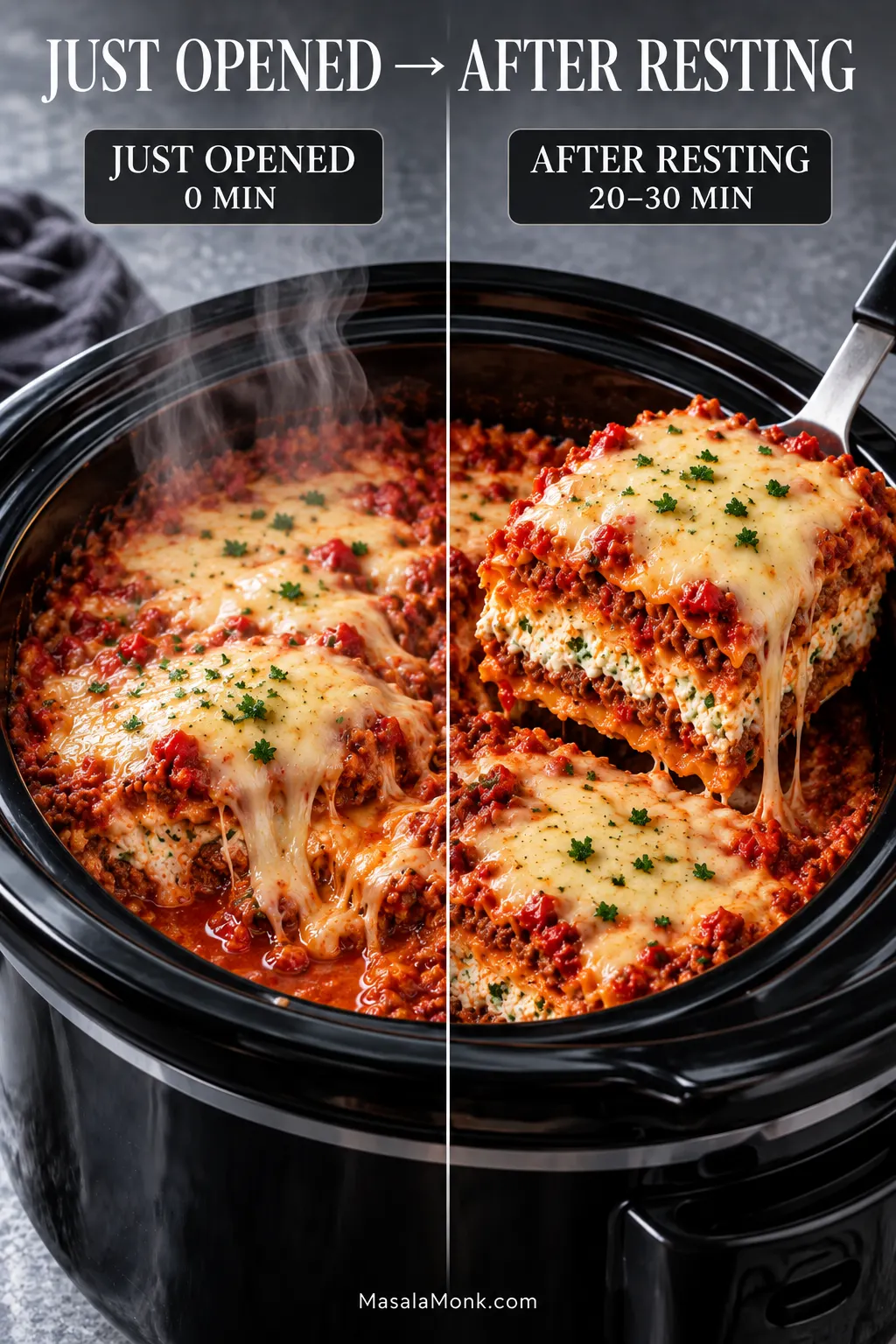
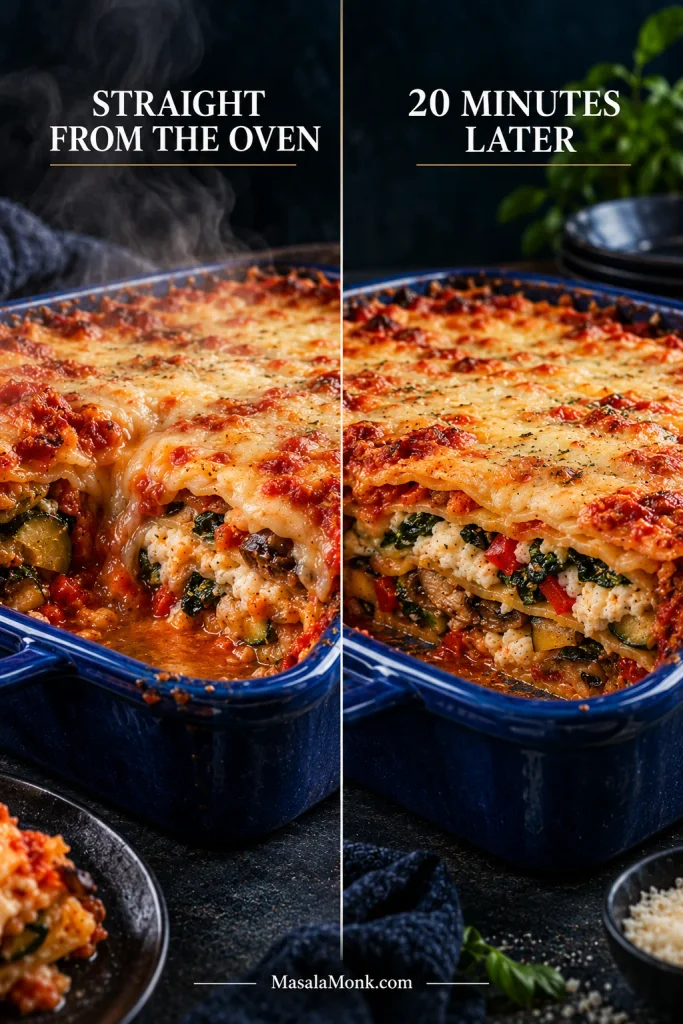
The first look under the lid can be alarming. Sauce may shimmer around the edges and a spoon pressed into the center can make everything seem loose. Ten minutes later the surface is calmer. By twenty or thirty minutes, some of that visible liquid has settled back between the layers and the cheese is holding them together more firmly.
Fresh from the cooker, the lasagna may look looser than expected. After 20–30 minutes, escaping steam and slightly firmer cheese make the layers noticeably easier to serve.
If the same thing happens next time, look first at thin marinara, unnecessary added water, cottage-cheese whey or vegetables that released a lot of liquid.
The middle is hard or one patch is dry
A firm middle surrounded by plenty of sauce can stay on LOW for another 20–30 minutes. When the center looks dry as well, add a small measured splash of hot water or warm marinara.
A single hard corner needs much less intervention. Spoon a little marinara over that spot, cover the cooker and let the pasta finish there.
The edges are ahead of the center
One dark edge usually means that side of the cooker is running hotter. Stay on LOW while the center finishes and keep future batches especially well covered along that side.
If you want a browned cheese finish, transfer individual servings to broiler-safe dishes and broil briefly. The top does not need to brown for the lasagna itself to be done.
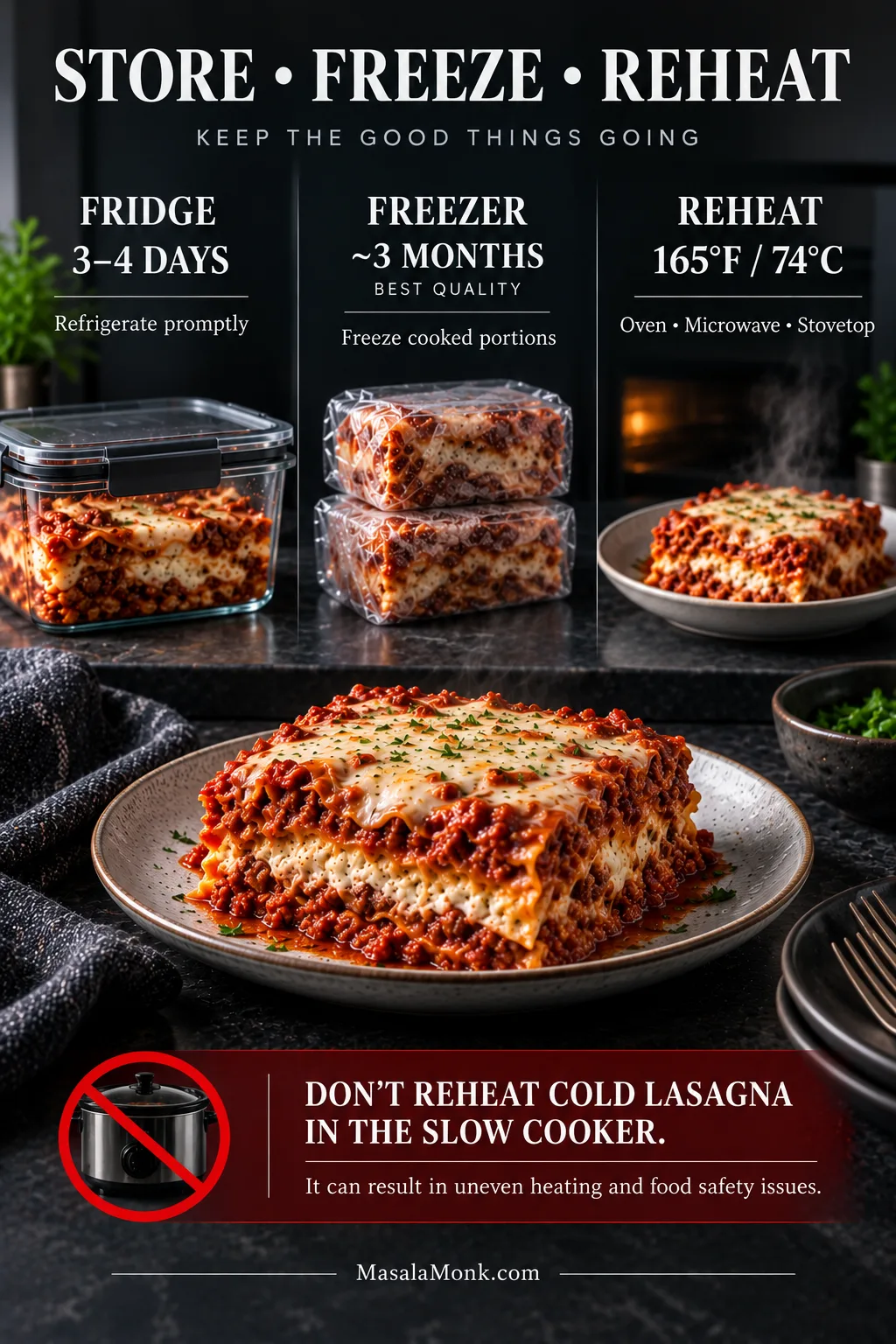
Storage at a glance: the guide below keeps the refrigerator, freezer and reheating decisions in one place; the detailed make-ahead and leftover notes follow.
Individual portions are especially practical for leftovers because they cool, freeze and reheat more evenly than one large section; use the storage times and reheat temperature shown as your quick reference.
Make the busy part ahead
Best make-ahead option: prepare the meat sauce and ricotta filling separately the day before and refrigerate them. The next day, all that is left is layering the lasagna and switching on the cooker.
You can assemble the whole lasagna ahead as well, although the dry noodles will begin taking up sauce in the refrigerator and chilled ingredients take longer to heat through. If you refrigerate it in a removable ceramic crock, follow the instructions for your particular appliance. Do not place a cold ceramic insert into a preheated slow-cooker base, allow for extra warm-up time, and check that the center reaches 165°F / 74°C.
Leftovers and freezing
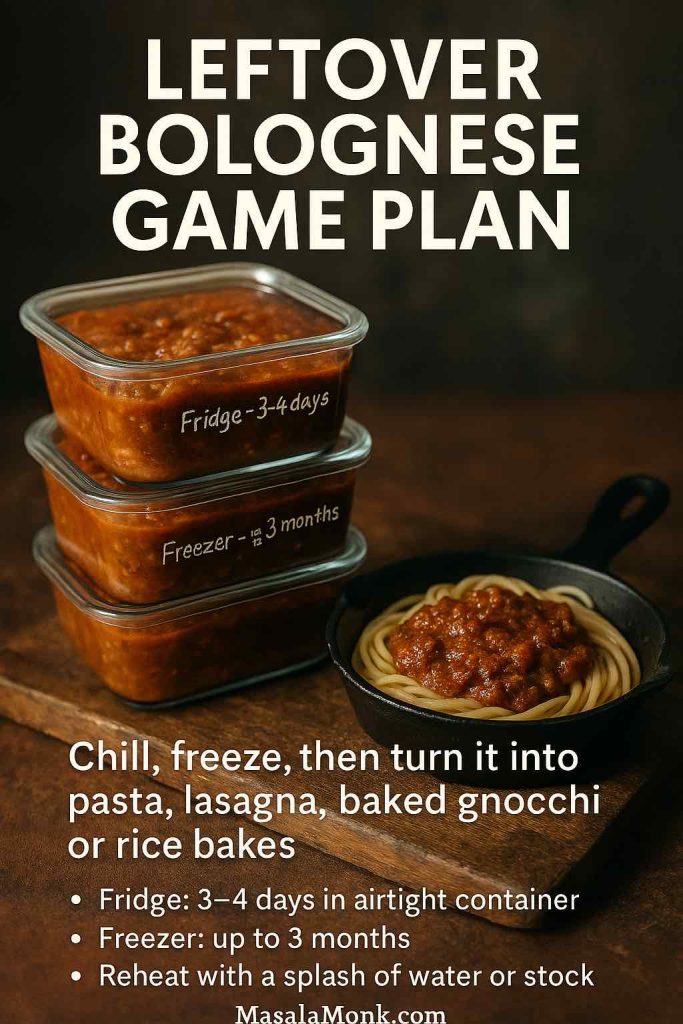
Refrigerate leftovers promptly, ideally within about 2 hours, and keep them covered for 3–4 days. Individual portions reheat more evenly than one large section. The noodles continue taking up liquid in the refrigerator, so a spoonful of marinara is useful when a leftover piece looks a little dry.
Reheat cold leftovers in the oven, microwave or on the stovetop until the center reaches 165°F / 74°C. Do not use the slow cooker itself to reheat cold leftovers; it warms food too gradually for that job.
For longer storage, cool the lasagna completely and freeze individual cooked portions for about 3 months for best quality. Thaw overnight in the refrigerator when practical. Cooked portions are also the easiest freezer-prep option here—do not put a frozen assembled lasagna straight into the slow cooker.
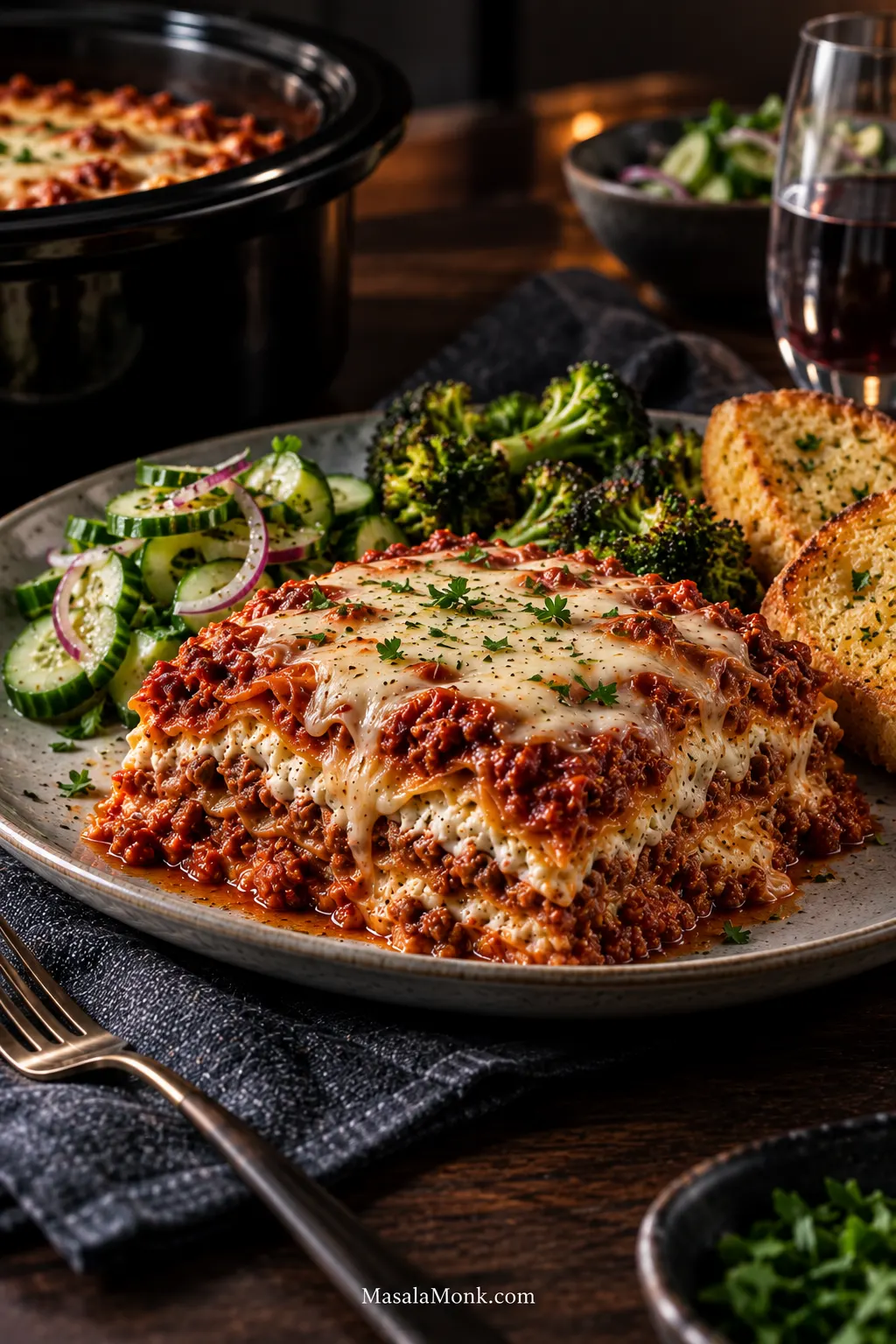
After resting, a serving should be soft and saucy while still showing its pasta, ricotta and meat-sauce layers. The first piece may lean a little as you lift it; that is lasagna, not an architecture exam. Let a little sauce slip onto the plate; that is part of the appeal.
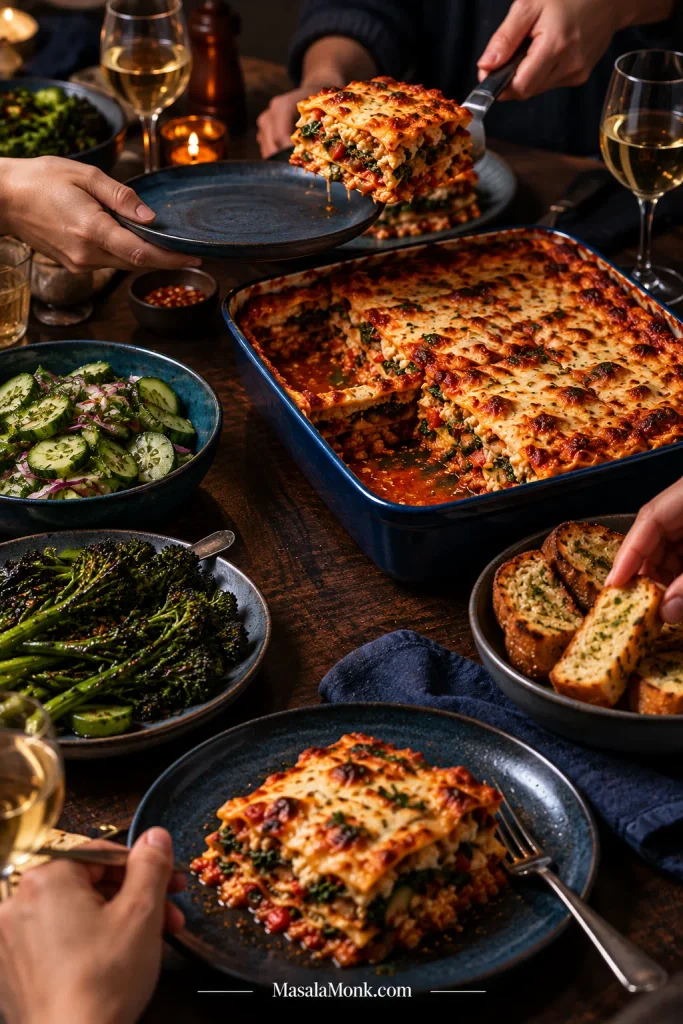
A crisp cucumber salad brings acidity and crunch, while roasted broccoli or another simply cooked vegetable keeps the plate lighter. And if there is meat sauce left behind after the lasagna is gone, garlic bread is exactly what you want for it.
A crisp cucumber salad cuts through the rich tomato-and-cheese layers, while roasted vegetables and garlic bread round out the meal without competing with the lasagna.
If next time you want the same tomato-and-cheese comfort in a brothier, spoonable dinner, try Crock Pot Lasagna Soup.
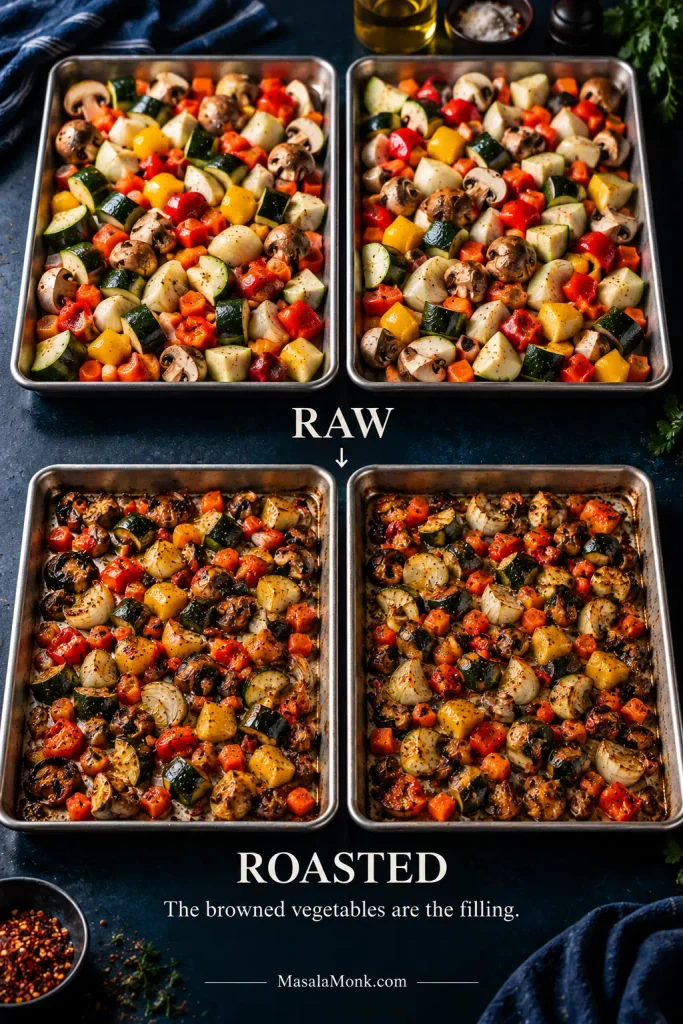
Before this becomes lasagna, the vegetables should already taste worth eating. The mushrooms need to be dark and savory, the zucchini smaller and browned at the edges, the onion sweet, and the peppers and carrots properly tender. If the filling tastes flat before it goes between the noodles, another layer of cheese will not magically make it exciting.
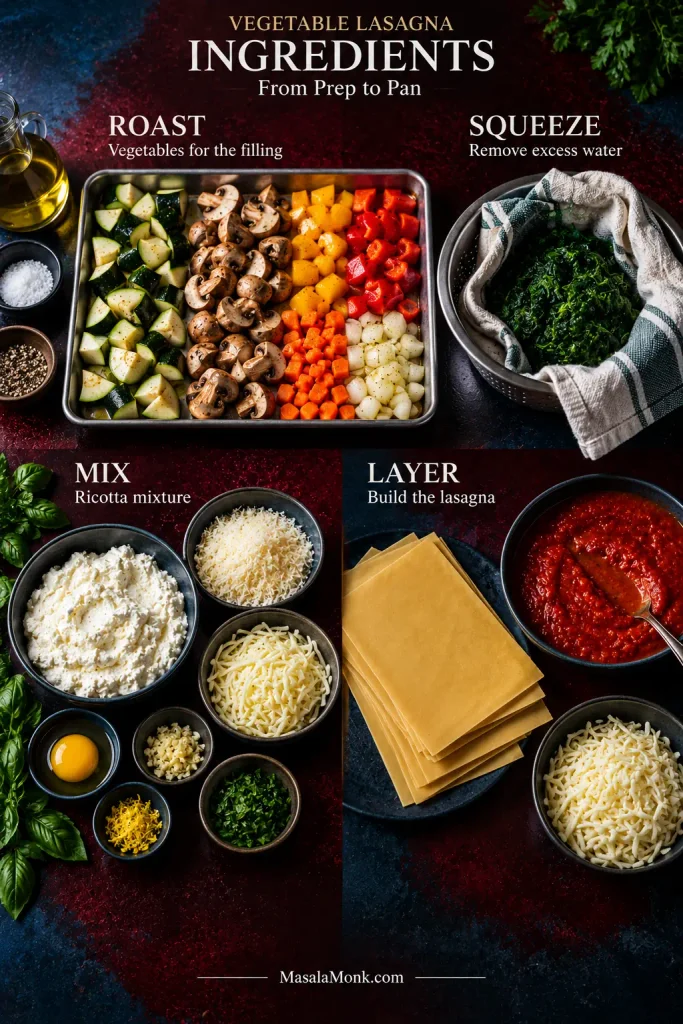
A deep 9 × 13-inch pan holds about 2 pounds / 910 g of roastable vegetables, plus spinach, layered with ricotta, mozzarella, tomato sauce and pasta. The finished lasagna is deeply cheesy, but the roasted vegetables are what give each layer its character. The browned vegetables are the filling.
Timings help, but watch the food too: mushrooms that release their water and begin browning again, marinara that clings to a spoon, and a knife that passes through the middle without catching on firm pasta.
Raw vegetable volume can be misleading: moisture loss dramatically reduces zucchini, mushrooms, peppers and onions during roasting. That is why a generous raw quantity can become two balanced filling layers without making the finished lasagna overwhelmingly vegetable-heavy.
This version uses roasted vegetables, ricotta, low-moisture mozzarella, tomato sauce and oven-ready lasagna sheets. There is no separate pot of noodles to boil.
Allow about 2 hours from the first chop to the first slice, with a little extra breathing room the first time you make it. You are not working for all of that: the ricotta, spinach and sauce can be handled while the vegetables roast, and the final 20 minutes belong to the lasagna, not you.
Pan
9 × 13 inches / 23 × 33 cm, ideally at least 2½ inches / 6 cm deep
Yield
8 main-dish servings or 10–12 smaller servings with sides
Hands-on prep
About 45–50 minutes, with some work happening while the vegetables roast
Vegetable roast
20–25 minutes using two pans; add about 20–25 minutes if you need to roast in two batches
Covered bake
40 minutes, then check; some pans need another 5–10 minutes
Uncovered bake
10–15 minutes
Rest
20 minutes; 25–30 minutes for particularly neat slices
Cooking for more people? Make two regular 9 × 13-inch pans rather than one unusually deep double batch. They bake more evenly, are easier to move, and give you more browned edges.
Ingredients
Vegetables
9 oz / 250 g zucchini, about 1 medium-large or 2 small, unpeeled and cut into roughly ½-inch / 1–1.5 cm pieces
8 oz / 225 g mushrooms, about one 8-ounce package, quartered if small or thickly sliced if larger
6 oz / 170 g red or yellow bell pepper, about 1 large, cut into roughly ½-inch / 1–1.5 cm pieces
5 oz / 150 g yellow onion, about 1 medium, cut into roughly ½-inch / 1–1.5 cm pieces
4 oz / 115 g carrot, about 1 large or 2 small, cut into smaller ¼-inch / 6 mm dice
5 oz / 140 g frozen chopped spinach, thawed; or about 8 oz / 225 g fresh spinach
3 tablespoons / 45 ml olive oil
1 teaspoon fine salt
1 teaspoon Italian seasoning
½ teaspoon garlic powder
½ teaspoon freshly ground black pepper
Ricotta Filling
15 oz / 425 g whole-milk ricotta, drained if whey is visibly pooling around it
1 large egg
1½ oz / 42 g Parmesan or another hard Italian-style cheese, finely grated
1 small garlic clove, finely grated
1 teaspoon finely grated lemon zest
2 tablespoons finely chopped fresh basil or flat-leaf parsley
¼ teaspoon fine salt, or to taste depending on the cheese
¼ teaspoon black pepper
For the Layers
4 cups / 950 ml thick marinara sauce, homemade or jarred
8–9 oz / 225–255 g oven-ready/no-boil lasagna sheets, or enough for 3 complete pasta layers; sheet count varies by brand
12 oz / 340 g low-moisture mozzarella, shredded, about 3 cups
½ oz / 14 g Parmesan or another hard Italian-style cheese, finely grated, for the top
Optional: red pepper flakes and fresh basil for serving
If you avoid animal rennet, check the cheese labels. Traditional Parmigiano Reggiano uses animal rennet, while vegetarian alternatives may use microbial or other non-animal coagulants. The Vegetarian Society’s guide to vegetarian cheese can help when the label is unclear.
Lightly oil the bottom and sides of a deep 9 × 13-inch / 23 × 33 cm baking dish. You will also need two large rimmed sheet pans; half-sheet pans, roughly 13 × 18 inches / 33 × 46 cm, are ideal. Have a mixing bowl, clean kitchen towel and foil ready too.
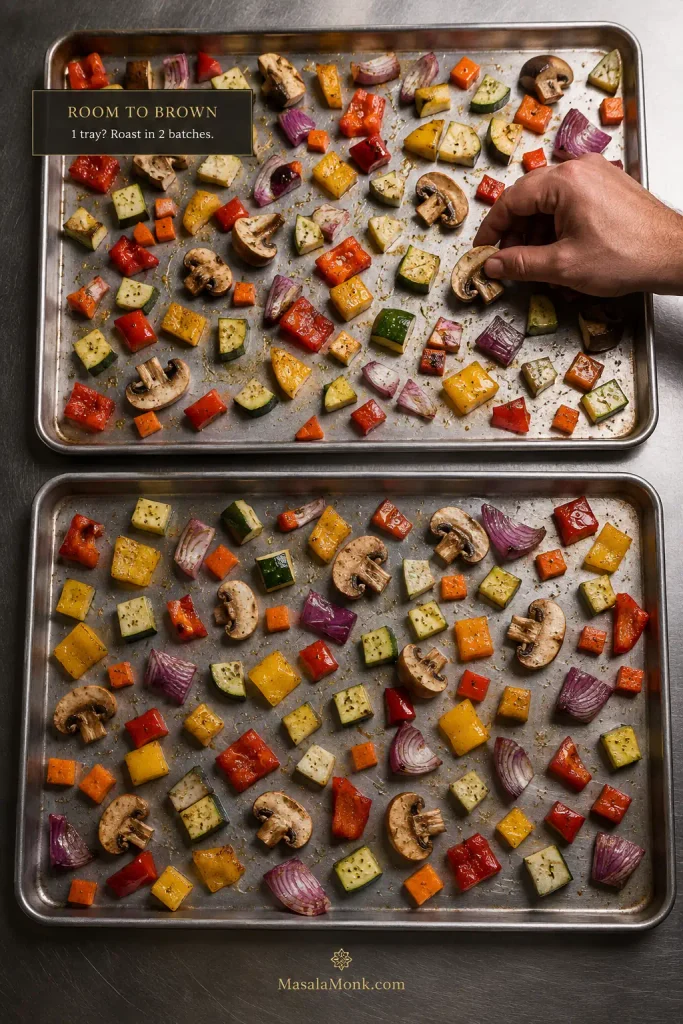
If the trays need separate oven racks, you will swap their positions halfway through roasting. Only one suitably large tray? Roast the vegetables in two batches rather than crowding them, and allow another 20–25 minutes.
Lasagna can bubble over as it bakes. If the assembled filling sits close to the rim, put the baking dish on a rimmed sheet pan before it goes into the oven.
Think of the recipe as four checkpoints rather than one long ingredient list: control vegetable moisture, control spinach moisture, season the cheese, then balance the pasta with sauce. Catching a problem at its own checkpoint is much easier than fixing it after assembly.
1. Roast the Vegetables Until They Taste Finished
Heat the oven to 425°F / 220°C.
Divide the zucchini, mushrooms, bell pepper, onion and carrot between the two sheet pans. Add the olive oil, salt, Italian seasoning, garlic powder and black pepper. Toss well and spread everything out.
Crowded vegetables steam. Give these some room.
If the trays still look wet halfway through roasting, extending the timer is not always the best first move. Redistributing crowded pieces can expose more surface to hot air, helping evaporation and browning happen together instead of simply cooking the vegetables softer.
Roast for 20–25 minutes, stirring once. If the pans are on separate racks, swap the upper and lower pans and turn them front-to-back when you stir.
How to Know the Vegetables Are Ready
What looked like an unreasonable amount of vegetables at the beginning will look much more manageable now. The onion smells sweeter and the zucchini has shrunk. Peppers are tender, carrot pieces nearly cooked through, and dark edges have started appearing across both trays.
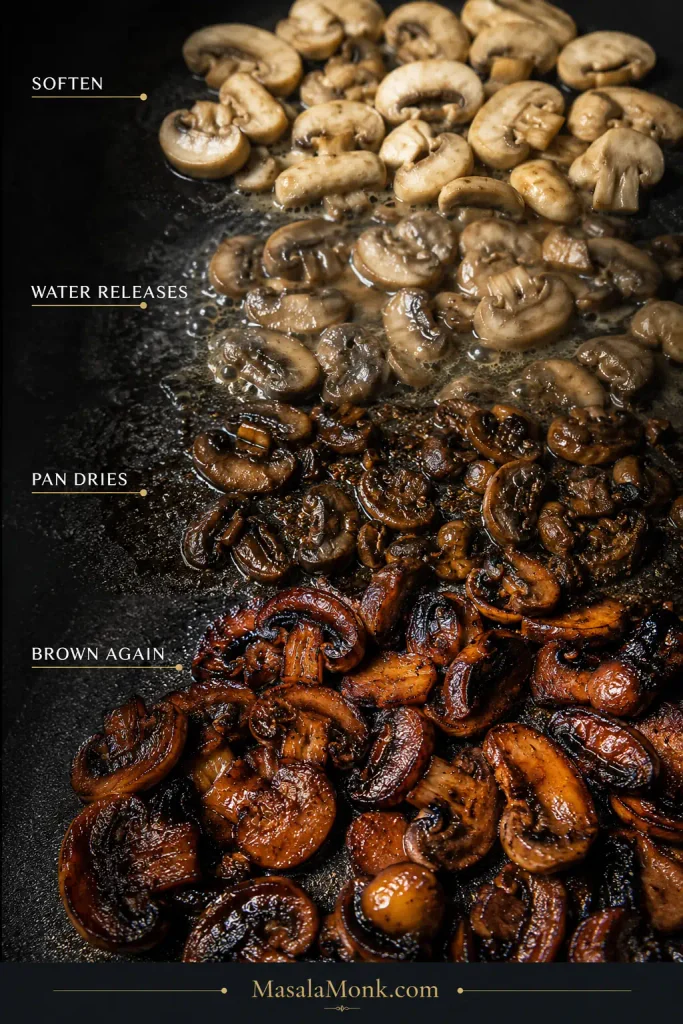
Mushrooms are especially easy to read. First they soften. Then they release enough liquid to make the pan look wetter than it did before. Keep going. The liquid disappears, the pan dries, and the mushrooms begin to brown again.
When mushrooms release a panful of liquid, keep cooking rather than draining it away. Once the pan dries, the concentrated flavor has a chance to brown.
Taste one.
Then taste a piece of zucchini and some onion. If those bites are not good now, fix the seasoning before they disappear between pasta and cheese.
Reduce the oven to 375°F / 190°C.
2. Dry the Spinach
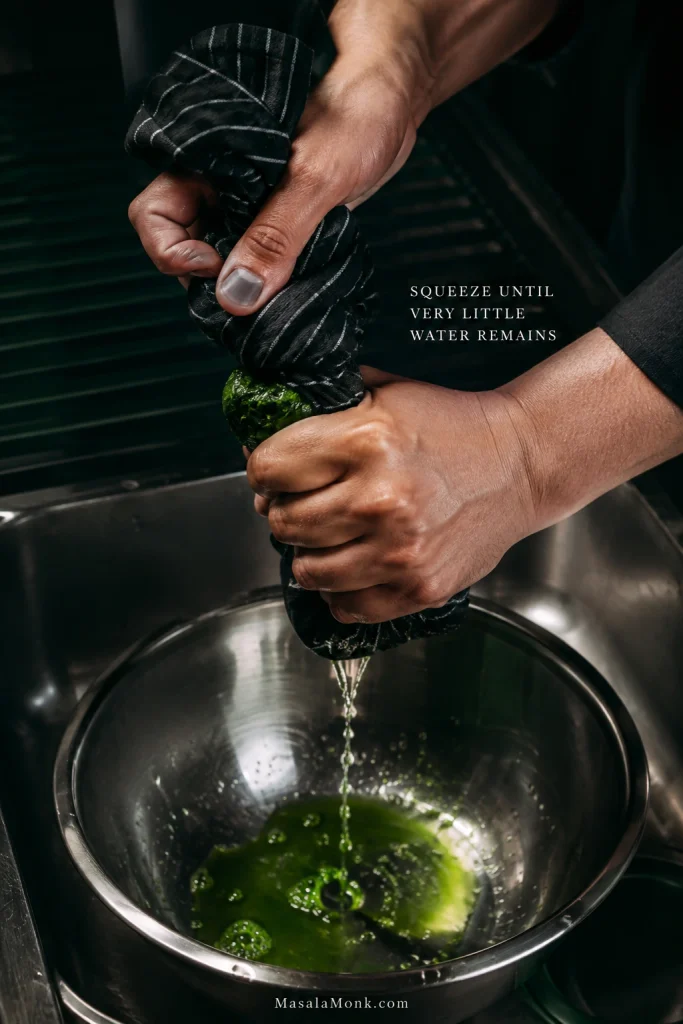
Put the thawed spinach in the center of a clean kitchen towel, gather the towel around it and twist firmly over the sink. Keep squeezing until very little more liquid comes out.
Using fresh spinach? Wilt the 8 oz / 225 g in a large pan, let it cool enough to handle, squeeze out the excess liquid and chop it.
After squeezing, loosen the compact spinach with your fingers or a fork before mixing it into the roasted vegetables. That small step distributes the greens through both filling layers instead of leaving dense wet pockets in only a few slices.
Break the spinach apart and mix it through the roasted vegetables.
3. Check the Sauce
A good jarred marinara keeps this dinner practical.
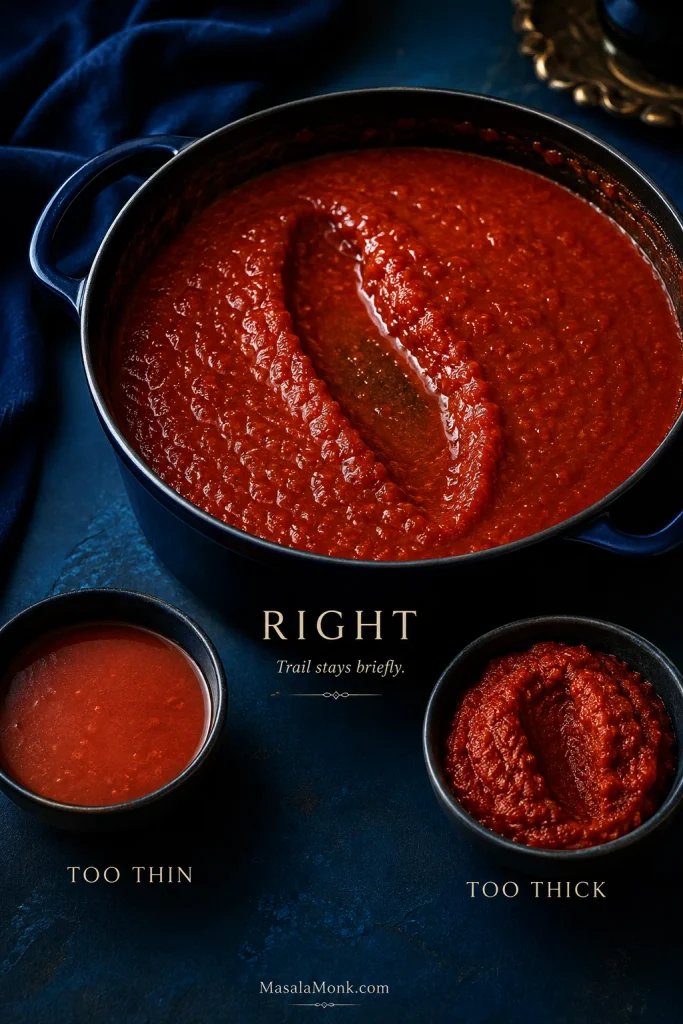
Drag a spoon through the sauce. The trail should remain for a moment before slowly closing, and the sauce needs to be loose enough to spread easily across the dry noodles. If it runs like tomato juice, simmer it uncovered for a few minutes.
For no-boil lasagna noodles, sauce is part of the cooking system as well as the flavor. If a thin marinara needs reducing, judge and measure the sauce after reduction so you still have enough finished sauce to hydrate the pasta properly.
Stop before it becomes heavily reduced or pasty. Oven-ready sheets need enough sauce around them to become tender.
Taste the sauce too. Ricotta, mozzarella and pasta soften its seasoning once everything is layered.
Making the sauce from fresh tomatoes? They carry more water, so reduction matters. The fresh tomato sauce recipe shows the consistency to look for before measuring the 4 cups / 950 ml.
4. Mix the Ricotta
Stir together the ricotta, hard cheese, garlic, lemon zest, herbs, salt and pepper without the egg first.
Taste it. The ricotta needs enough seasoning to remain noticeable once it is surrounded by pasta, vegetables and tomato sauce. The lemon zest is there for brightness rather than obvious lemon flavor.
Once the seasoning is right, stir in the egg. It helps the cheese layer set; without it, the ricotta simply stays softer.
The messy part is mostly over now. The trays are roasted, the spinach is squeezed, the sauce is ready and the ricotta is mixed.
From here, you’re building.
5. Build the Layers
The vegetables, sauce and ricotta should each taste properly seasoned on their own before you layer them.
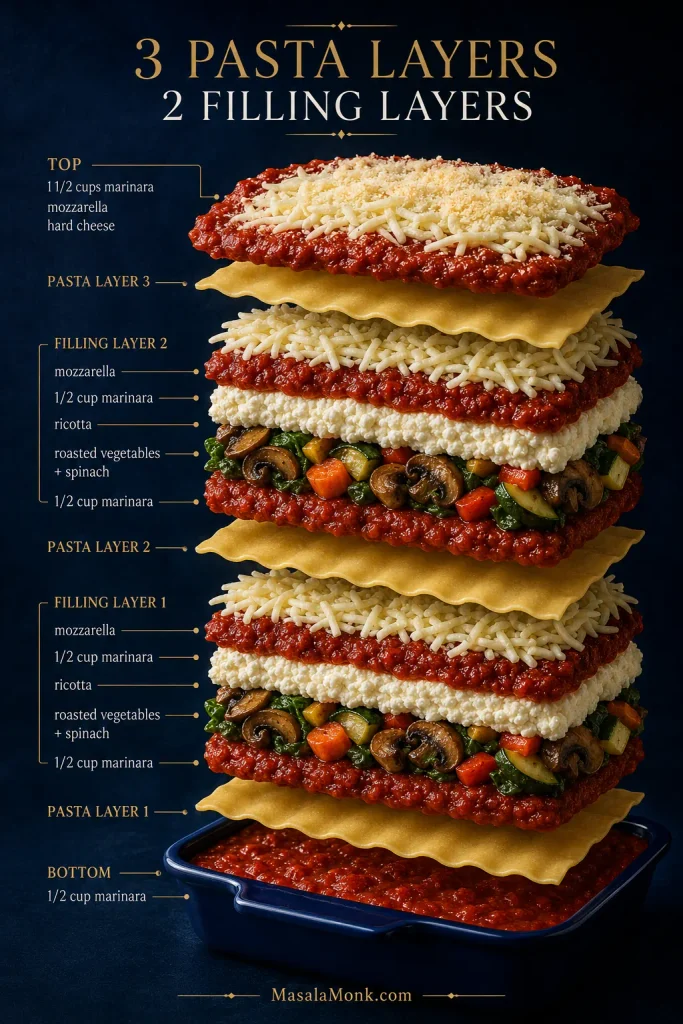
Divide the vegetables and ricotta mixture roughly in half. Keep the marinara, noodles and mozzarella beside the baking dish. You are making three pasta layers and two filling layers.
Layering evenly matters more than making every spoonful mathematically identical. Broad, fairly level filling layers heat more predictably than thick vegetable mounds, while three complete pasta layers give the finished lasagna structure without turning it into an unnecessarily tall stack.
Bottom
½ cup marinara
Enough oven-ready pasta to cover the pan
First Filling Layer
½ cup marinara, spread over the noodles
Half the ricotta filling
Half the vegetables
Another ½ cup marinara
About 1 cup mozzarella
Second Filling Layer
A second complete pasta layer
½ cup marinara
Remaining ricotta filling
Remaining vegetables
Another ½ cup marinara
About 1 cup mozzarella
Top
Final complete pasta layer
Remaining 1½ cups marinara
Remaining mozzarella
½ oz / 14 g grated hard cheese
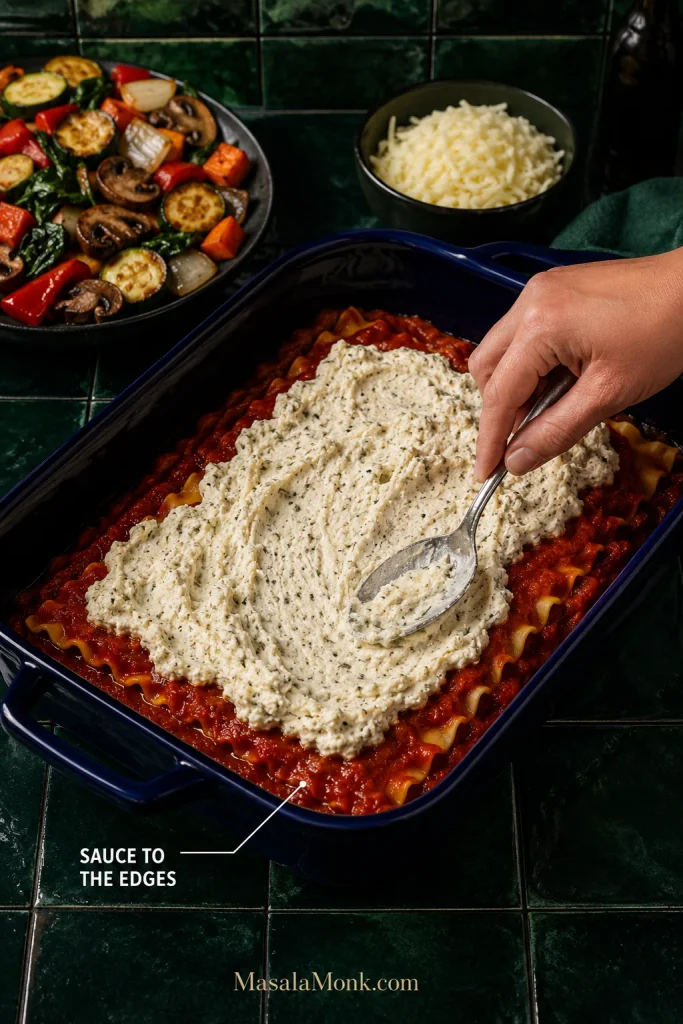
Dollop the ricotta onto the sauced noodles and spread it before adding the vegetables. It is much easier to move ricotta across a flat sheet of pasta than across a pile of zucchini and mushrooms.
Do not chase a perfectly smooth ricotta layer. A lightly spread, mottled layer lets the roasted vegetables settle into the cheese instead of sliding across a slick surface, while sauce at the perimeter protects the pasta where drying happens fastest.
Set the next pasta layer down and press gently over any obvious vegetable mounds. Don’t pack the filling.
Sheet sizes vary, sometimes a lot. Three complete pasta layers are the useful target. Break sheets to fill a real gap, but avoid thick patches of overlapping dry pasta.
Cover the final noodle layer completely with the last 1½ cups of marinara, right into the corners. Pasta left exposed here is likely to stay hard.
The two trays of vegetables, bowl of ricotta and stack of pasta have finally become one pan of lasagna.
6. Cover and Cook the Pasta
Cover the dish tightly with foil. Lightly oil the underside if it sits close to the cheese.
Bake at 375°F / 190°C for 40 minutes.
Forget about browning for now. The middle of the pan and the dry noodles need the covered heat first.
7. Check the Middle, Then Brown the Top
Push a thin knife through the middle after 40 minutes.
If it slides through without catching on firm pasta, you’re ready to uncover. If the knife catches, nothing has gone wrong. Cover the pan again and give it another 5–10 minutes.
When checking doneness, distinguish firm pasta resistance from simply bumping into a piece of carrot or another vegetable. A hydrated noodle gives way smoothly; an undercooked sheet feels broader, firmer and more leathery against the knife.
A refrigerator-cold pan or thicker oven-ready sheets may need closer to 50 minutes covered.
Once the pasta is tender, remove the foil and bake for another 10–15 minutes. Tomato sauce will bubble around the perimeter. The mozzarella picks up golden patches, darker freckles and, here and there, a crisp edge.
If your baking dish is broiler-safe, a pale but fully cooked top can have a brief broil. Stay close—the distance between bronzed mozzarella and burned cheese is surprisingly short.
8. Give It 20 Minutes Before You Ask It to Be a Slice
Take the pan out and leave it alone for 20 minutes.
The furious bubbling subsides, the ricotta firms a little and the sauce stops running quite so freely when you cut.
For particularly clean slices, wait 25–30 minutes. The middle will remain plenty hot.
Resting changes mobility more than moisture quantity. The liquid has not vanished after 20 minutes; rather, the sauce, cheese and filling have cooled just enough to move less freely, which is why the same lasagna becomes noticeably easier to portion.
This is not a 30-minute dinner. It does not need to become an all-afternoon project either.
Jarred marinara: use one that passes the consistency check above and move on.
Oven-ready noodles: no boiling, draining or handling floppy sheets.
Frozen spinach: excellent here once thoroughly squeezed.
Pre-shredded low-moisture mozzarella: a perfectly reasonable place to save a few minutes.
Vegetables roasted a day ahead: the most useful shortcut when tomorrow’s assembly needs to be quick.
Best Vegetables for Lasagna
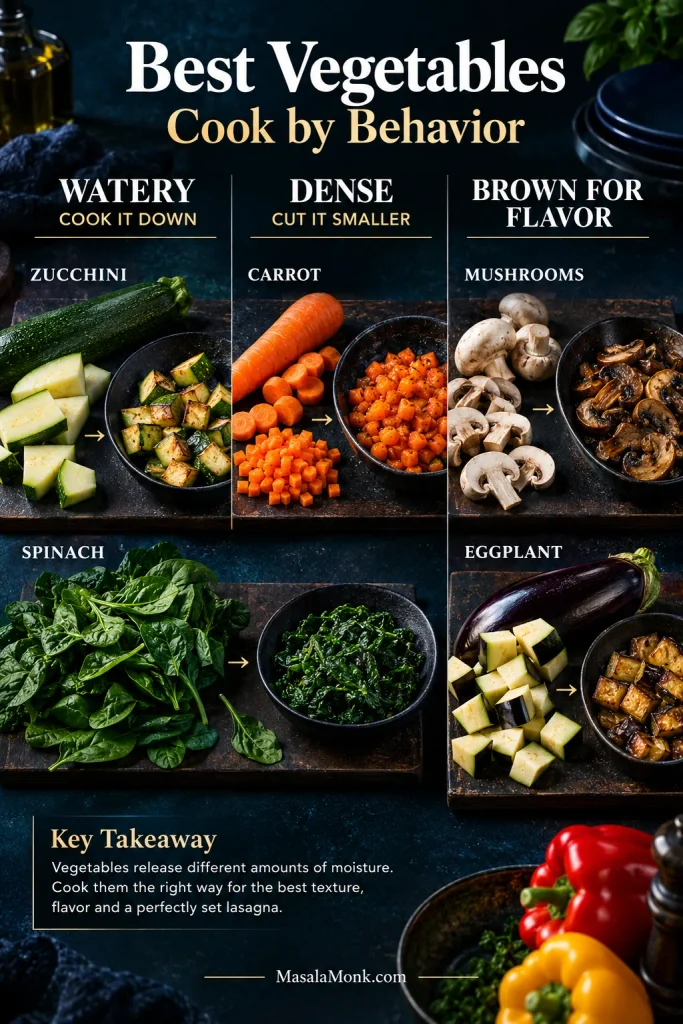
For this style of lasagna, cook the vegetables before layering them. Raw zucchini and mushrooms can release too much liquid in the pan, while dense vegetables may still be firm by the time the pasta is done.
Zucchini can become eggplant without much trouble. Carrot is different. It carries far less water and takes longer to soften, so replacing vegetables cup-for-cup can change the filling more than expected.
The base recipe uses about 2 pounds / 910 g of trimmed roastable vegetables, plus spinach. Raw weight is a useful rough guide for substitutions; then account for how dense and watery the replacement is.
The best vegetables for lasagna are often the ones that can be swapped for something with similar density and water content. Zucchini and eggplant behave more alike than zucchini and carrot, for example, so matching cooking behavior makes substitutions far more predictable.
How to Swap Vegetables Without Throwing Off the Filling
Vegetable
How to Use It
Zucchini
Tender and fairly watery. Roast until smaller and browned. Eggplant is an easy replacement.
Mushrooms
Deeply savory. Keep cooking until their released liquid is gone and browning starts again.
Spinach
Wilt fresh or thaw frozen, then squeeze firmly. Kale works too but needs more cooking.
Bell peppers
Sweet and forgiving. Roast until tender. Well-drained roasted red peppers also work.
Carrots
Sweet and relatively dry. Cut them smaller so they become tender at roughly the same time as the other vegetables.
Onion
Give it enough time to soften and brown. Large undercooked pieces are distracting in the finished slice.
Eggplant
Silky and savory after roasting. Excellent in place of some or all of the zucchini.
Butternut squash
Dense and sweet. Use small cubes and roast until nearly tender.
Broccoli or cauliflower
Use small pieces and roast first. Better as part of a mixed filling than the entire filling.
Kale
More robust than spinach. Remove tough stems and cook it until properly tender.
No mushrooms? Replace their 8 oz / 225 g with eggplant, extra pepper, zucchini or a mixture. You lose some savory depth, so give the tomato sauce a final taste before assembly.
For a smoother, more hidden-vegetable filling, grate zucchini into the marinara and simmer until tender and its extra moisture has cooked away. Browned mushrooms can be chopped very finely, and spinach can simply be minced before mixing it through.
Vegetable Lasagna With Frozen Vegetables
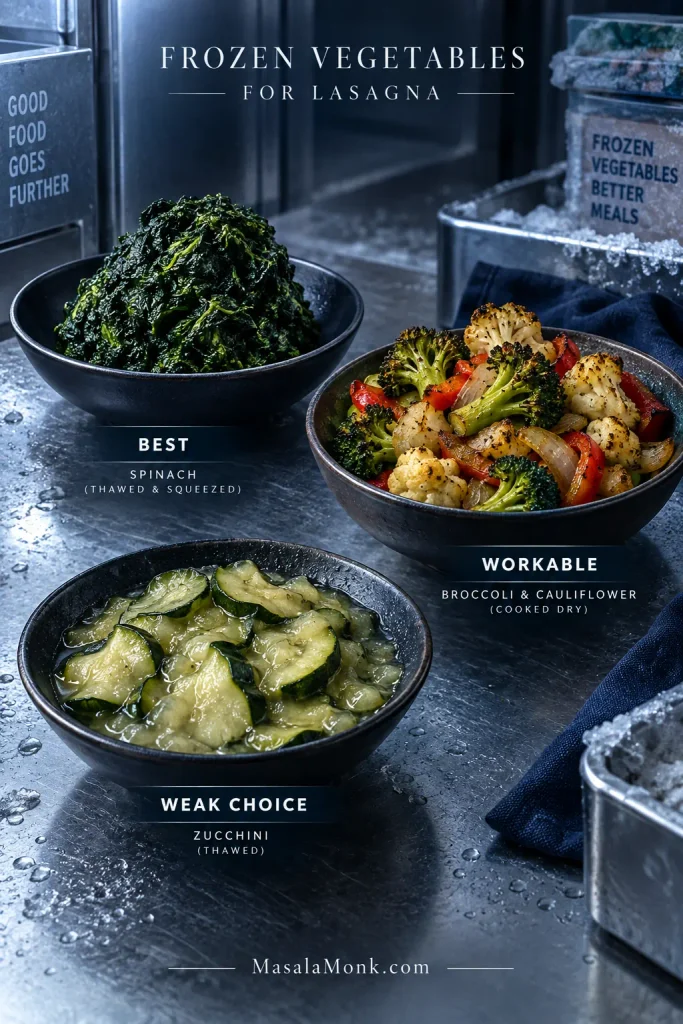
Frozen spinach is excellent here. Frozen zucchini is not. Most other frozen vegetables fall somewhere between those two.
With frozen vegetables for lasagna, fix excess moisture at the vegetable stage rather than compensating by cutting back too aggressively on marinara. That distinction matters with oven-ready pasta, which can still need plenty of sauce even when the filling itself started wet.
Frozen Vegetable
Best Approach
Spinach
Thaw completely and squeeze firmly until very little more water comes out.
Broccoli or cauliflower
Thaw, drain and blot. Roast or sauté briefly if the pieces still look wet.
Peppers or pepper-and-onion mixes
Sauté until released water evaporates and some color starts developing.
Mixed vegetables
Thaw, then sauté until the pan no longer looks wet. Choose the blend for flavor as well as convenience.
Zucchini
It can be used, but the texture is considerably softer and wetter. Fresh zucchini is much better here.
If most of the filling comes from frozen vegetables, cook and drain them before assembly. Aim for about 5 cups total cooked, well-drained vegetables across the two filling layers, including spinach if you’re using it.
The volume does not need to be exact. Two full, fairly level layers are enough.
Ricotta leaves soft, creamy pockets between the roasted vegetables, sauce and pasta. A very loose tub needs draining first.
Using Cottage Cheese Instead
Cottage cheese is tangier, with visible curds unless you blend it. Swap it for the ricotta by weight—15 oz / 425 g—and make the rest of the filling exactly the same way. Blend the cottage cheese before adding the other ingredients when you want a smoother texture, and drain off obvious liquid first.
For ricotta vs cottage cheese in lasagna, neither option is automatically “drier” across every brand. Choose the cheese for the texture you want, then judge the tub in front of you: visible pooled whey matters more to the finished pan than the name on the label.
The cottage cheese lasagna is built around that cheese from the start rather than treating it as a substitution.
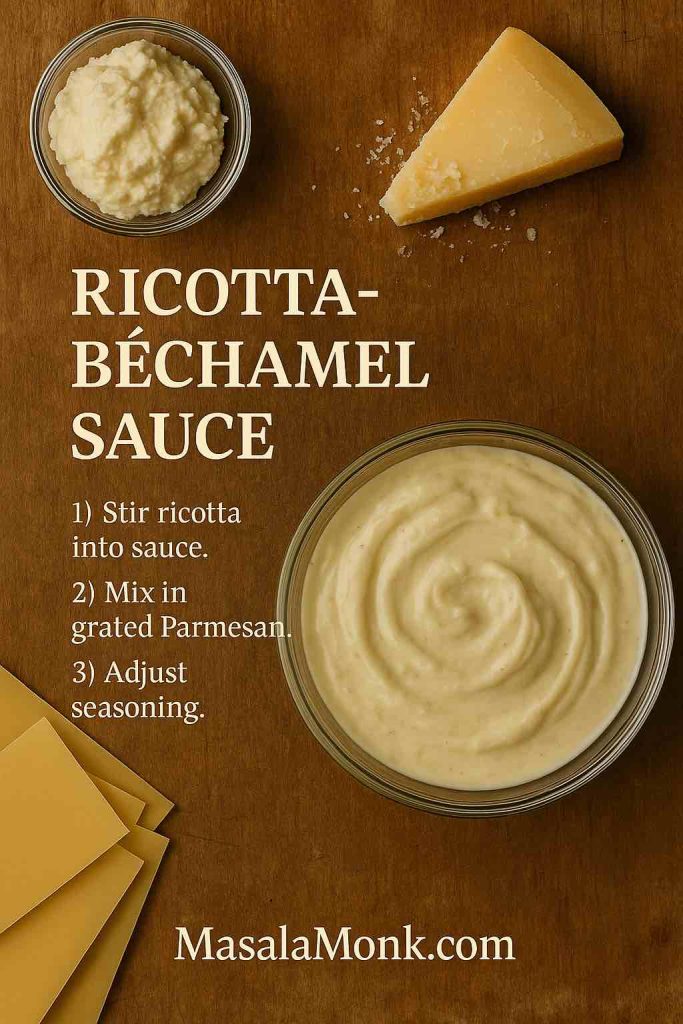
For a different style altogether, béchamel gives you a softer, silkier lasagna with creaminess spread more evenly through the layers. The béchamel sauce for lasagna is the better starting point for that version.
No-Boil and Regular Lasagna Noodles
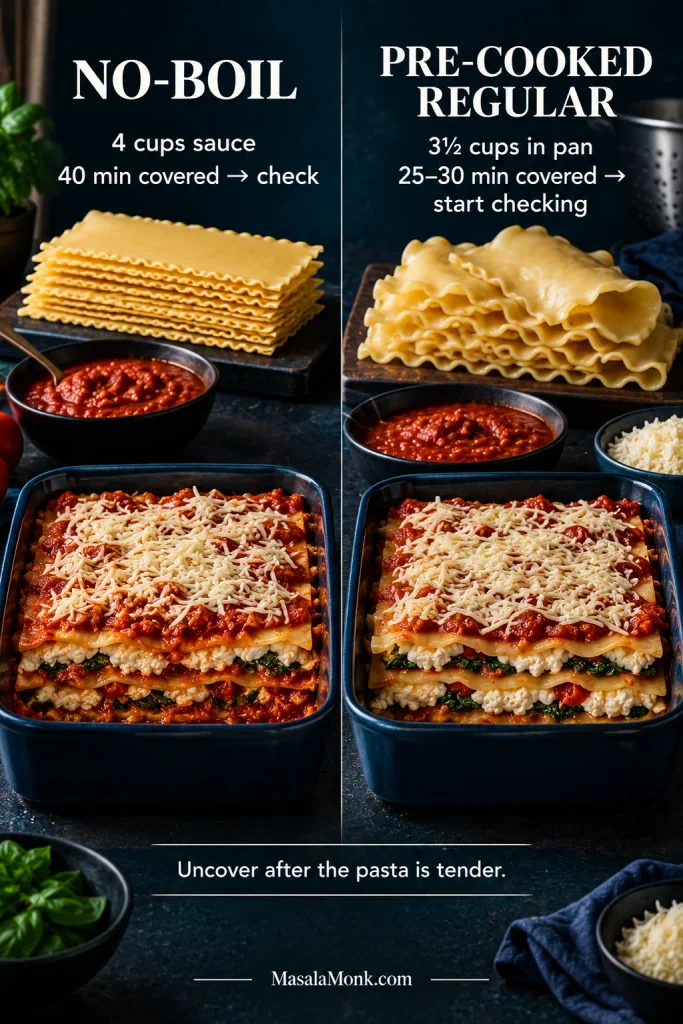
This version is built for oven-ready/no-boil sheets. Keep every sheet well covered with sauce and give the pan the full covered bake before checking the pasta.
Using Pre-Cooked Regular Noodles
Cook enough regular noodles for the same three complete pasta layers; sheet dimensions and package sizes vary. Boil them only until flexible and a little firmer than you would serve as finished pasta.
For cooked noodles, reduce the sauce over each vegetable layer from ½ cup to ¼ cup. Keep every other sauce amount the same; this uses 3½ cups in the lasagna and leaves ½ cup to warm for serving if you want extra sauce at the table.
Changing noodle type changes more than bake time. No-boil lasagna noodles arrive dry and take part of their hydration from the sauce, whereas pre-cooked noodles bring water into the pan themselves; therefore, the sauce quantity should change with the pasta method.
Pre-cooked noodles do not need the full 40–50 minute hydration stage. Cover the freshly assembled lasagna and start checking it after 25–30 minutes at 375°F / 190°C. Once the middle is hot and bubbling, uncover and brown the cheese for another 10–15 minutes.
A refrigerator-cold pan will take longer. Judge it by a thoroughly hot, bubbling middle rather than the clock alone.
Gluten-free sheets vary too much by brand for one universal method. Follow the package directions, keep dry sheets well sauced and check the pasta before uncovering.
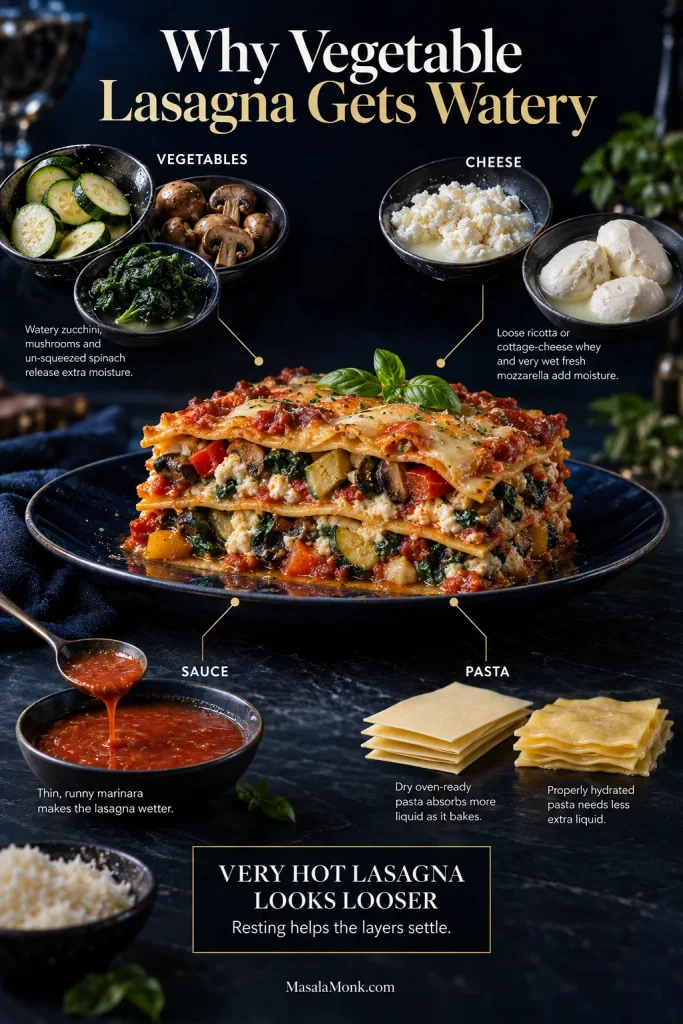
Most watery lasagnas are not ruined by one dramatic mistake. They get there by accumulation: spinach that still held water, mushrooms that never reached the browning stage, unusually loose ricotta and thin tomato sauce all meeting in the same pan.
Vegetables: zucchini, mushrooms and spinach can release plenty of water. Roasting, sautéing and squeezing deal with much of it before layering.
Cheese: ricotta and cottage cheese vary by brand. If whey is pooling, drain it. Fresh mozzarella contains considerably more water than low-moisture mozzarella and is not a straightforward 1:1 substitute here unless it is drained and blotted extremely well.
Sauce: very thin marinara loosens the whole pan. Sauce reduced too far creates the opposite problem when dry noodles need liquid.
Pasta: oven-ready sheets absorb liquid while they cook. Boiled noodles arrive in the pan already hydrated.
The useful distinction in watery vegetable lasagna is not simply “more liquid versus less liquid.” It is controlled moisture versus uncontrolled moisture: pasta needs deliberate hydration, while vegetable water, cheese whey and excessively thin sauce can accumulate where the recipe does not need them.
A lasagna also looks looser when it is extremely hot. Straight from the oven, the sauce moves more freely; after 20 minutes, the layers hold themselves together much better.
A spoonful of juices around a very hot first slice is not a failed lasagna.
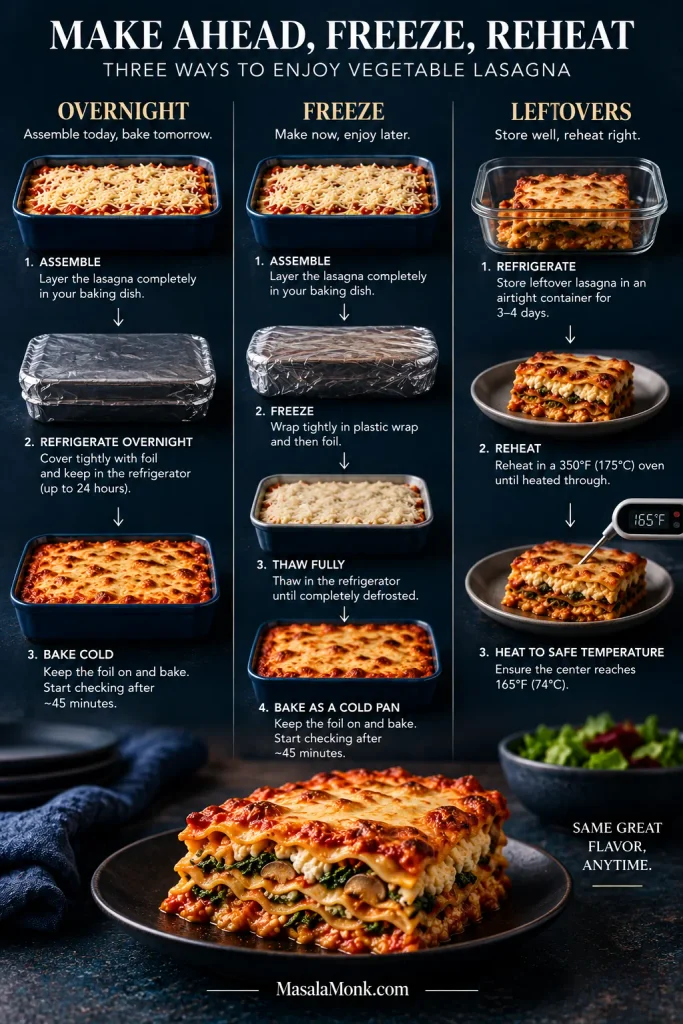
Cover the assembled pan tightly and refrigerate overnight. The next day, start checking the pasta after about 45 minutes covered. The whole dish begins cold, so it usually needs longer than a freshly assembled pan.
With make-ahead vegetable lasagna, watch the center rather than trusting the browned edges. A refrigerator-cold or fully thawed pan can look active around the perimeter while the middle is still catching up, so doneness cues remain more reliable than adding one fixed number of minutes.
Opening the refrigerator and finding dinner already built is one of the better rewards for doing the chopping a day early.
Prep the Components Earlier
The roasted vegetables and tomato sauce can be made up to 2 days ahead and refrigerated separately. Mix the ricotta and assemble closer to baking.
Freeze the Whole Pan or Individual Slices
A tightly wrapped assembled lasagna can be frozen before baking. Thaw it fully in the refrigerator; a deep frozen 9 × 13-inch pan may take longer than one night to thaw through.
Once fully thawed, treat it like any other refrigerator-cold assembled lasagna: bake covered at 375°F / 190°C and start checking the pasta after about 45 minutes. Uncover once the noodles are tender and brown the top.
For leftover slices, cool the lasagna first, divide it into individual portions, wrap well and freeze. Thawing in the refrigerator gives the most even reheating.
Leftovers and Reheating
Refrigerate leftovers promptly in covered containers and use them within 3–4 days, or freeze them for longer storage. The USDA’s leftover-safety guidance has additional storage and reheating advice.
For several refrigerated slices or a larger portion, cover and reheat at about 350°F / 175°C until hot through the middle. Uncover for the last few minutes if you want to refresh the cheese on top.
For a measurable food-safety endpoint, USDA recommends reheating leftovers to 165°F / 74°C in the center.
A single slice usually does better with gentler staged microwave heating than one long blast at maximum power. Chilled lasagna has another advantage: the layers often cut even more cleanly the next day.
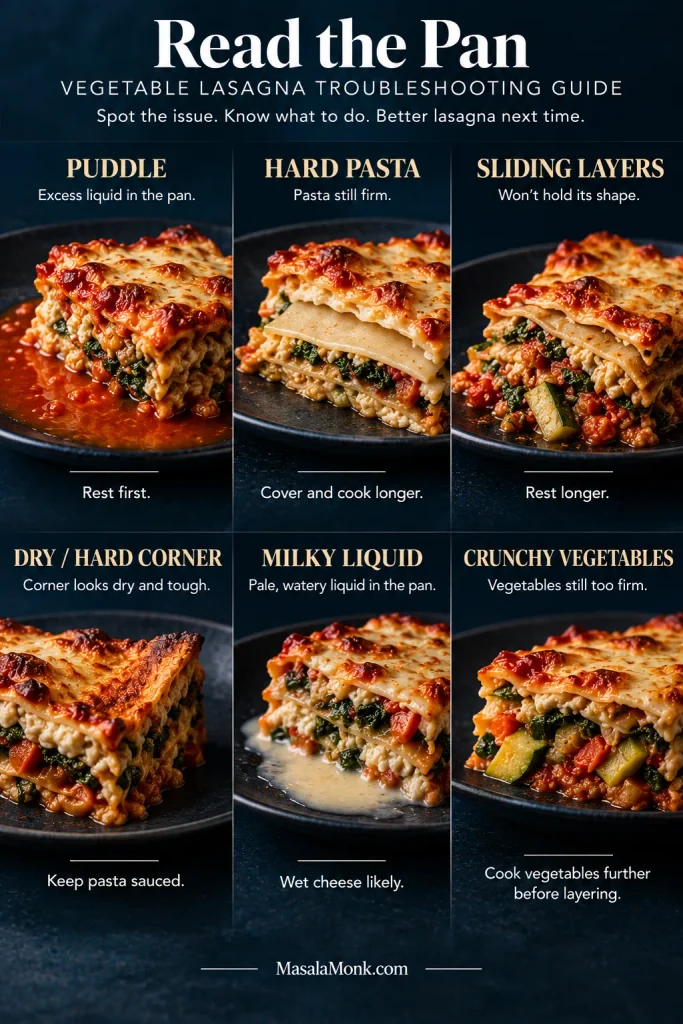
A good lasagna can slump a little at the edge of the plate and still be exactly right. What deserves attention is a real pool of liquid, genuinely hard pasta, a dry top, a cold middle or vegetables that never became tender.
If the first slice collapses, give the pan another few minutes before deciding anything dramatic. The first piece out of a very hot lasagna is often the least tidy one.
What You See
What to Do
Thin puddle around the edges
Rest the pan first. If a genuine pool remains, carefully spoon off a little before serving. Next time, cook more moisture out of the vegetables or reduce an unusually thin sauce.
Noodles hard throughout
Cover the pan again and give the pasta another 5–10 minutes, then check once more.
Mushy pasta
There is no real rescue once pasta is over-softened. Next time, boil regular noodles less or adjust the amount of liquid or baking time for very thin oven-ready sheets.
Lasagna slides apart
Give it more time to rest before cutting another slice. Very wet cheese, loose sauce and excessively thick filling layers can make the problem worse.
Lasagna is dry
Serve it with warm marinara. Next time, keep the pasta fully covered and check the bake earlier.
Everything tastes flat
Add grated hard cheese, herbs, black pepper or chile at the table. Next time, brown and season the vegetables properly and taste the sauce and ricotta before layering.
A Few Other Clues
Hard top corners: pasta was probably left exposed above the sauce.
Milky liquid: unusually wet ricotta, cottage cheese or mozzarella is often involved.
Crunchy vegetables: dense vegetables were cut too large or did not cook far enough before assembly.
Good vegetable lasagna troubleshooting starts by identifying what kind of liquid or resistance you are seeing. Tomato-colored runoff suggests a different problem from pale milky whey, while hard pasta points toward hydration rather than excess moisture—even though all three can make a slice look wrong.
Should a Watery Lasagna Stay in the Oven Longer?
Only if the pasta still needs cooking.
A slightly loose lasagna often improves more from ten minutes on the counter than ten more minutes in the oven. A flooded one can remain wet underneath while the cheese and exposed pasta get drier and drier.
What to Serve With Vegetable Lasagna
Lasagna already brings soft pasta, roasted vegetables, tomato and plenty of creamy cheese. Something crisp, green or sharply dressed beside it gives the next bite a useful contrast.
Cucumber salad: cold cucumber, onion, dill and vinegar cut through the richness; this cucumber salad recipe is a natural fit.
Roasted broccoli or broccolini: charred edges and a greener, slightly bitter contrast to the sweeter tomato sauce.
For what to serve with vegetable lasagna, think in terms of contrast rather than quantity. Choose something crisp and acidic, something green and charred, or garlic bread for maximum comfort; you do not need three additional rich sides around an already generous main dish.
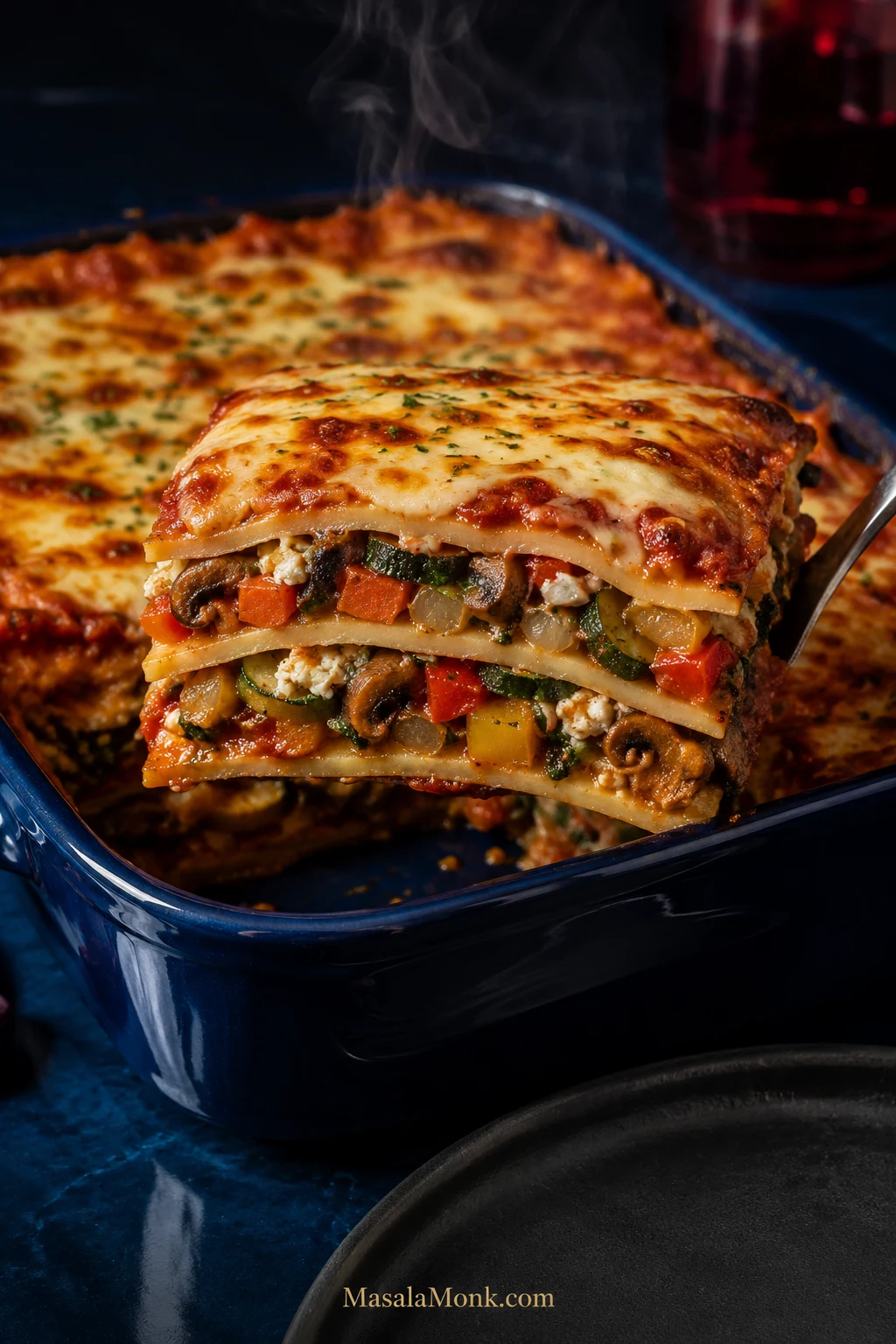
Cut through a browned corner and lift the first piece. The cheese at the edge may be a little crisp while the layers underneath stay soft, with creamy ricotta between zucchini, mushrooms and peppers and enough tomato sauce to keep the pasta tender without running across the plate.
The vegetable lasagna worth making again is the one where the vegetables taste good before they become filling, the pasta is tender, and the whole generous pan still knows how to become a slice.
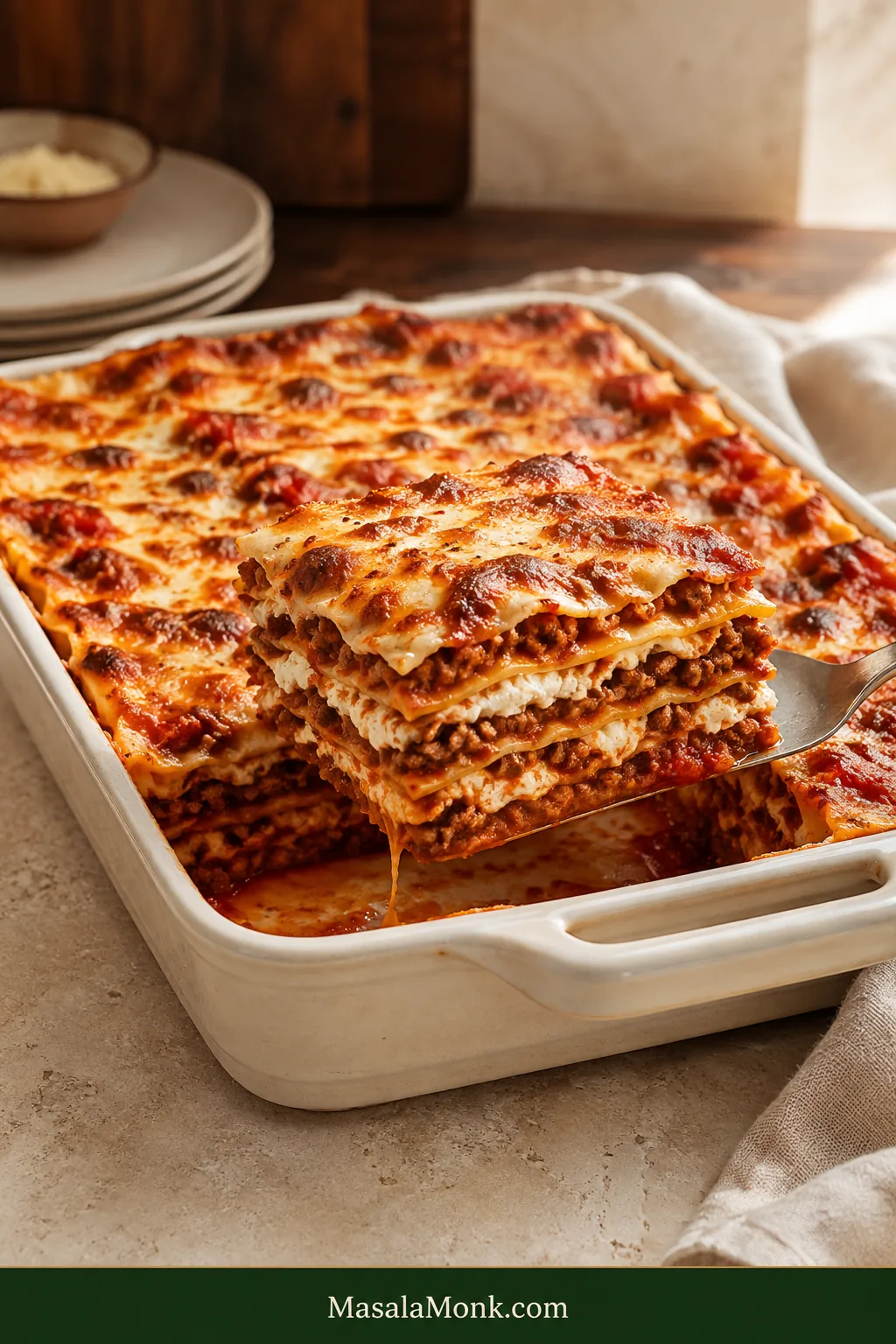
A good homemade lasagna should be generous without turning into a landslide. You want deeply flavored meat sauce between tender pasta, creamy ricotta, melted mozzarella and Parmesan, bubbling edges, and a browned top. Cut into it and the layers should still look like layers—even while the sauce stays soft and juicy.
Lasagna isn’t especially difficult; it is sequential. You prepare several things separately before they finally meet in one pan. That is where small decisions start to matter. Reduce the sauce too far and the noodles can stay hard. Start with watery cheese and the first slice may flood the plate. Leave a corner of pasta exposed and it can turn crisp before the center is ready. Cut into the pan five minutes after it leaves the oven and a perfectly good lasagna can look like it failed.
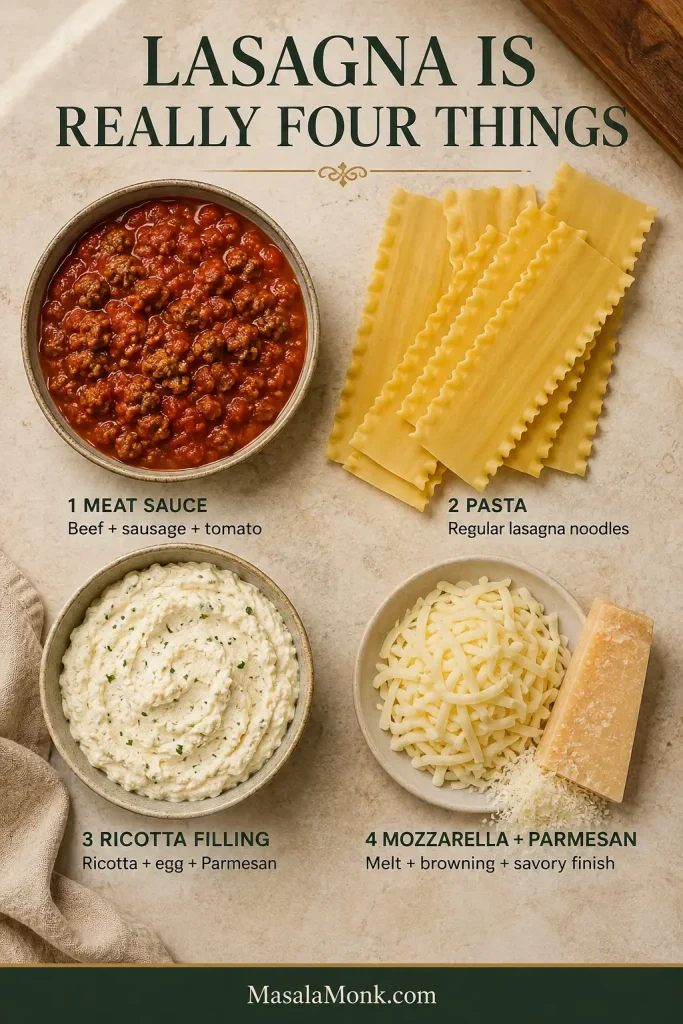
Despite the ingredient list, you are really making only four things: meat sauce, pasta, ricotta filling, and mozzarella with Parmesan. Keep the sauce spoonable, cover every noodle, and give the baked lasagna time to rest. Those three habits take most of the uncertainty out of the dish.
This is the familiar Italian-American pan: beef and Italian sausage in tomato sauce, creamy ricotta, mozzarella and Parmesan.
Once these four components are ready, most of the remaining work is simply building the layers.
Brown beef and Italian sausage, then simmer them with tomatoes until the meat sauce is concentrated but still loose enough for layering. Cook regular lasagna noodles only until very al dente and mix whole-milk ricotta with egg and Parmesan.
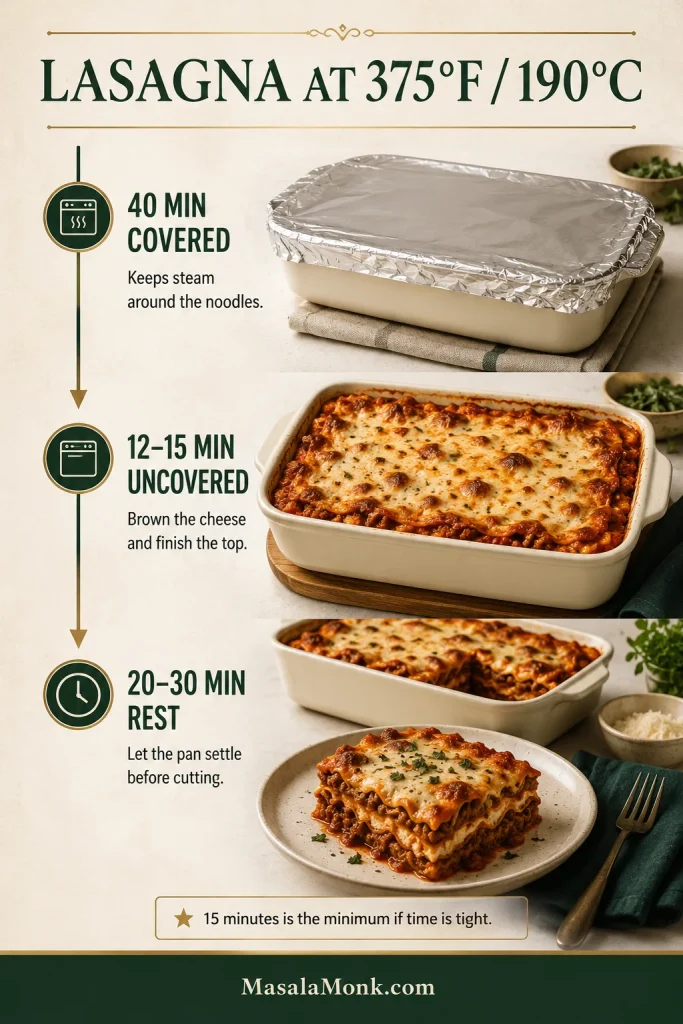
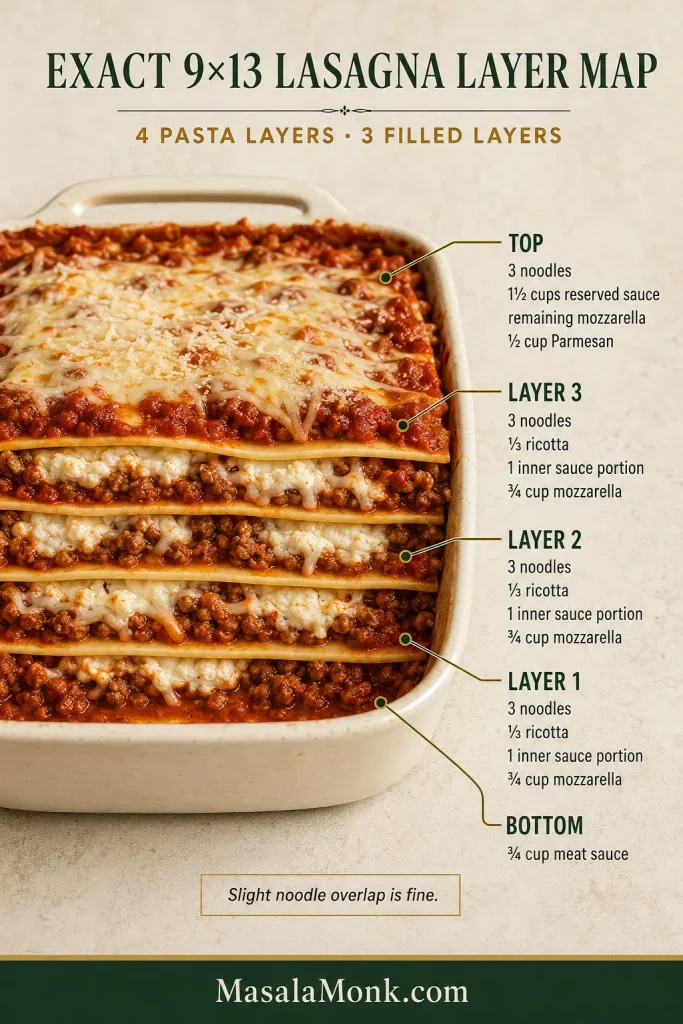
Build the lasagna in a deep 9 × 13-inch / 23 × 33-cm dish with four pasta layers and three filled layers. Keep sauce underneath the first noodles and reserve 1½ cups for complete coverage on top. Bake at 375°F / 190°C for 40 minutes covered and 12–15 minutes uncovered, then rest for 20–30 minutes before cutting.
Covered heat tenderizes the pasta, uncovered heat browns the cheese, and resting lets the hot filling settle before slicing.
Classic Homemade Lasagna Recipe
Serves
10 generous or 12 moderate portions
Pan
9 × 13 in / 23 × 33 cm, preferably 2½–3 in / 6.5–7.5 cm deep
Hands-on time
About 45 minutes
Bake
About 55 minutes
Rest
20–30 minutes
Total time
About 2 hours; allow closer to 2¼ hours the first time
Oven
375°F / 190°C
Equipment
Deep 9 × 13-inch / 23 × 33-cm baking dish
Large skillet, sauté pan or Dutch oven
Large pot for the noodles
Medium mixing bowl
Aluminum foil
Instant-read food thermometer, helpful for checking the center
Ingredients
Meat sauce
1 pound / 454 g 85–90% lean ground beef
8 ounces / 227 g mild Italian sausage, casings removed if necessary
1 medium yellow onion, finely chopped, about 150 g
4 garlic cloves, minced, about 12 g
2 tablespoons / 32 g tomato paste
1 can, 28 ounces / 794 g crushed tomatoes
1 can, 15 ounces / 425 g tomato sauce
½ cup / 120 ml beef broth or water, plus more if needed
1½ teaspoons Italian seasoning
½ teaspoon fine salt to start, plus more to taste
½ teaspoon freshly ground black pepper
¼ teaspoon red-pepper flakes, optional
A small pinch of sugar only if the finished sauce tastes sharply acidic
Ricotta filling
15 ounces / 425 g whole-milk ricotta
1 large egg
½ cup / about 45 g finely grated Parmesan
2 tablespoons finely chopped fresh parsley
¼ teaspoon fine salt
Freshly ground black pepper
For assembly
12 standard dried lasagna noodles, plus 1–2 extras in case one tears
Salt, for the pasta water
16 ounces / 454 g low-moisture whole-milk mozzarella, freshly grated, about 4 cups
½ cup / about 45 g finely grated Parmesan
Method
Make the Meat Sauce
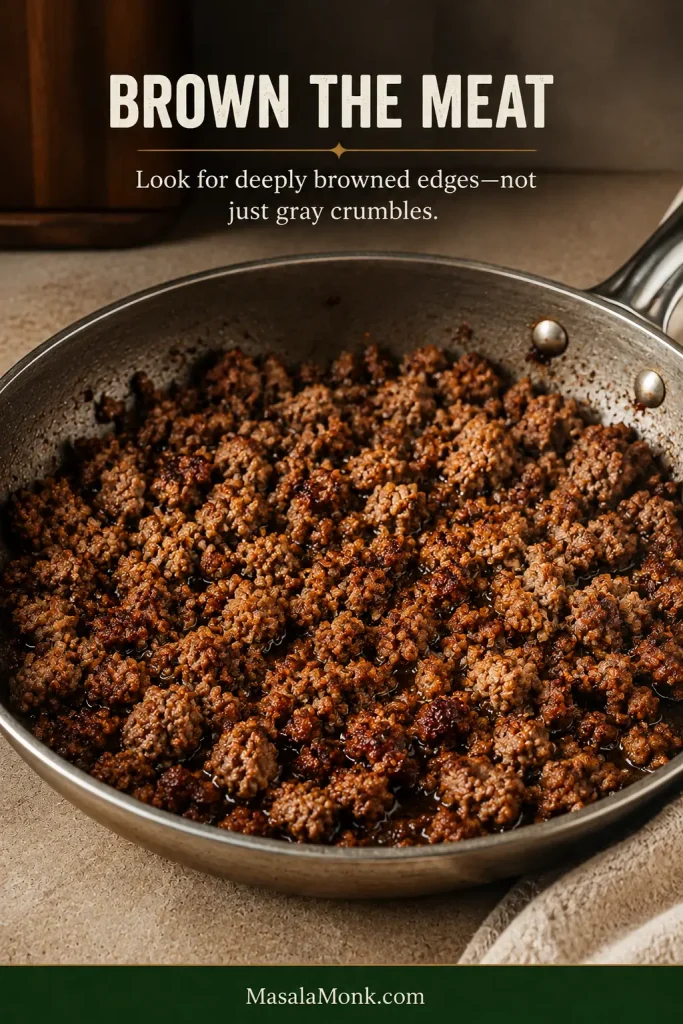
Brown the meat. Heat a large skillet or Dutch oven over medium-high heat. Add the beef and Italian sausage and give the meat time against the hot pan before breaking it into small crumbles. Cook until you have plenty of deeply browned edges. Those browned bits are what make the finished sauce taste cooked rather than merely assembled. Spoon off a substantial pool of rendered fat if one forms; a thin sheen can stay behind.
Look for irregular dark-brown edges between the crumbles, not meat that is simply gray throughout.
Build the sauce. Add the onion and cook for 4–5 minutes, until softened. Stir in the garlic for about 30 seconds, then add the tomato paste and cook for another minute. Pour in the crushed tomatoes, tomato sauce and broth. Add the Italian seasoning, ½ teaspoon salt, black pepper and optional red-pepper flakes.
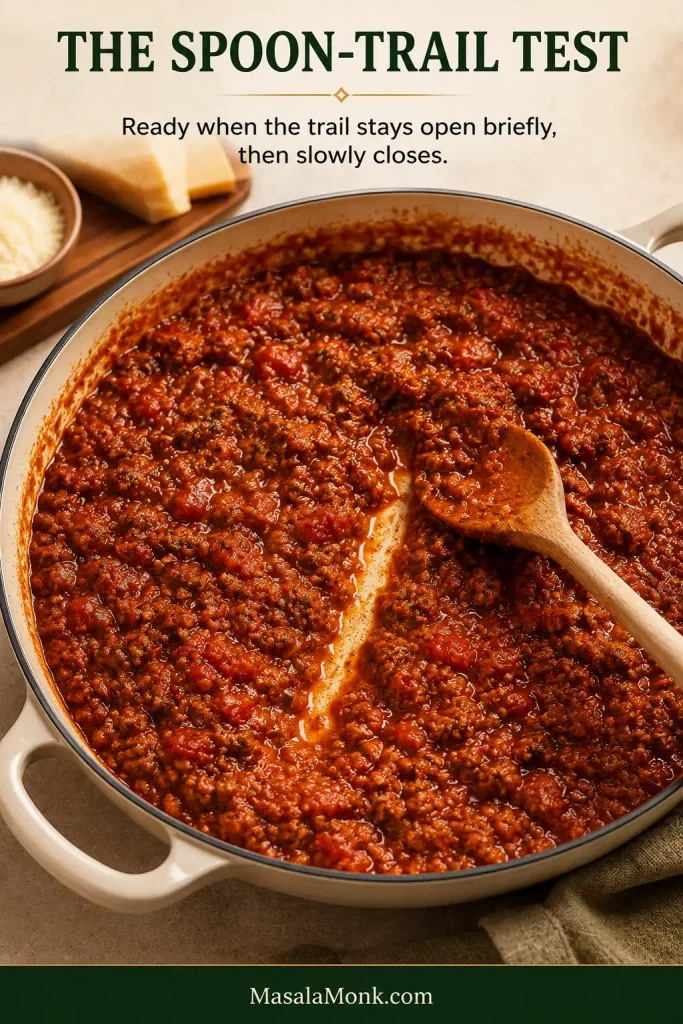
Finish and season the sauce. Simmer uncovered for about 20–25 minutes in a wide pan; a deeper pot may take longer. While it cooks, preheat the oven to 375°F / 190°C. Drag a spoon through the sauce. The trail remains for a moment, then slowly closes. The meat looks coated and glossy, with no moat of thin tomato liquid around it. You’ll usually end up with 6½–7 cups / 1.5–1.65 liters. Don’t chase the number if the sauce has already reached the right consistency. Taste it now. It should be fully seasoned but not salty; add more salt if needed and a tiny pinch of sugar only if the tomatoes still taste sharply acidic.
The sauce is ready when a spoon trail holds briefly, then slowly closes without a watery moat.
Prepare the Noodles and Ricotta
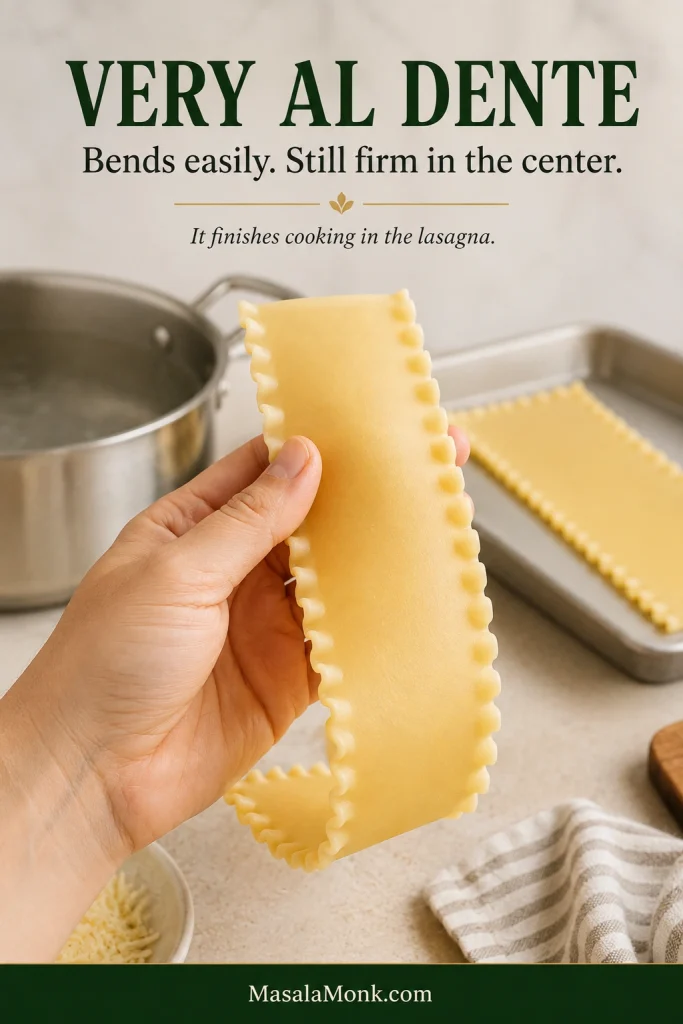
Cook the noodles until very al dente. Bring a large pot of well-salted water to a boil. Add the noodles gradually instead of dropping in the whole stack. Gently separate them with tongs during the first minute and once or twice as they cook. Begin checking about 2 minutes before the package’s suggested cooking time. Drain when the sheets bend easily but retain a firm center. They’ll feel firmer than pasta you would serve immediately. That’s intentional—they finish cooking in the lasagna. Lay them separately on clean kitchen towels or a large tray.
The noodle should bend easily but still feel firmer than pasta you would serve immediately.
Mix the ricotta filling. Stir together the ricotta, egg, ½ cup Parmesan, parsley, salt and black pepper. The mixture should be thick, creamy and scoopable, mounding softly on the spoon instead of spreading into a puddle. Drain visible whey around the ricotta first; a thick tub needs no special treatment.
Assemble the Lasagna
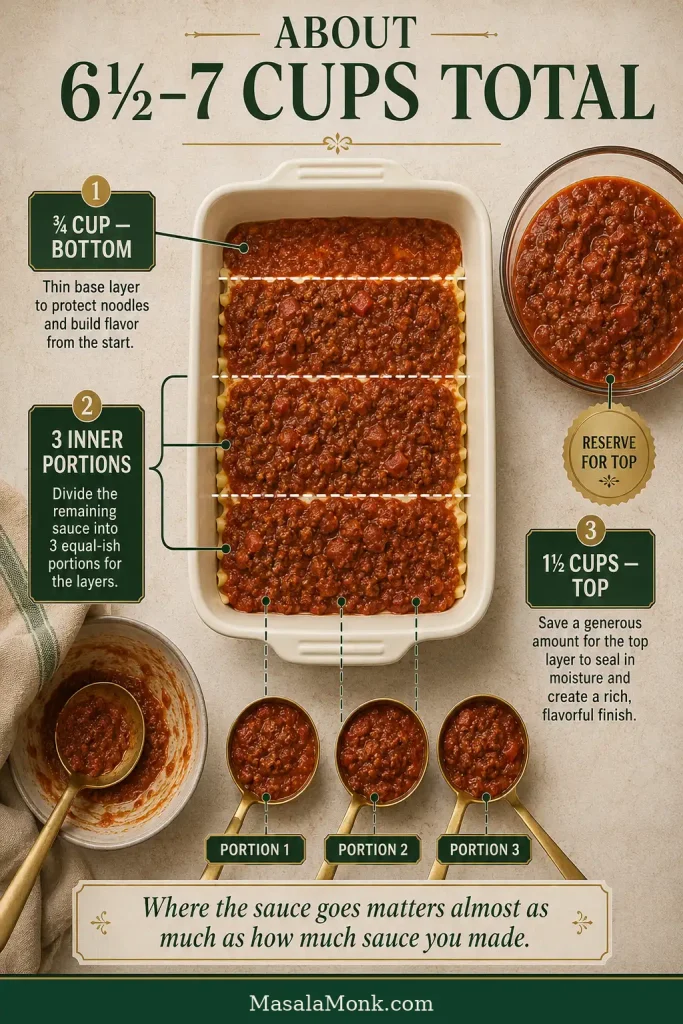
Divide the sauce and mozzarella. Reserve 1½ cups meat sauce for the top and spread ¾ cup across the bottom of the baking dish. The bottom only needs a thin layer; its job is to keep the first noodles from sitting against the bare dish. Divide the remaining sauce into three roughly equal portions—you can eyeball this. Set aside about 1¾ cups mozzarella for the top; use ¾ cup in each filled layer.
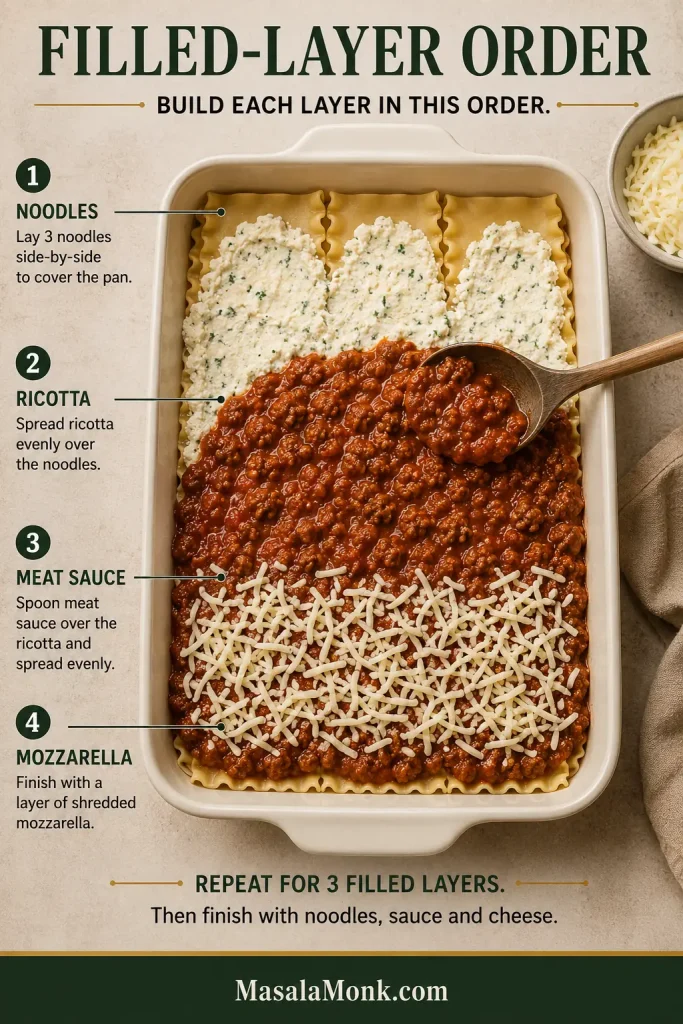
Use the same order every time: noodles, ricotta, meat sauce, then mozzarella.
Build the first filled layer. Add 3 noodles, or enough pasta to cover the pan. Slight overlap is fine, and a noodle can be trimmed or broken to fill a small gap. Dollop one-third of the ricotta mixture across the pasta and gently spread the spoonfuls together. Add one portion of meat sauce, followed by ¾ cup mozzarella.
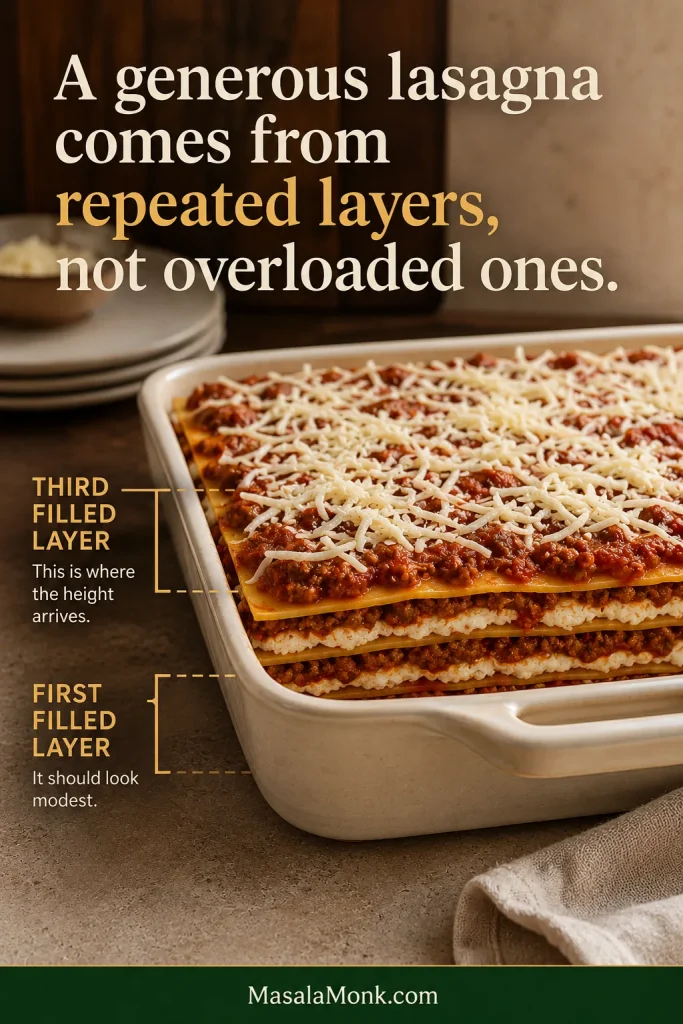
Repeat twice. Make two more layers in the same order, using another third of the ricotta, one sauce portion and ¾ cup mozzarella each time. Keep the fillings thin and fairly even. A generous lasagna comes from repeated layers, not overloaded ones. The first round can look surprisingly modest. By the third, the pan finally starts looking as generous as the finished slice will be.
Finish the top. Add the fourth pasta layer and spread the reserved 1½ cups sauce from edge to edge. Cover every visible piece of pasta, especially the corners. Finish with the reserved mozzarella and ½ cup Parmesan. A dish filled close to the rim belongs on a rimmed sheet pan before baking.
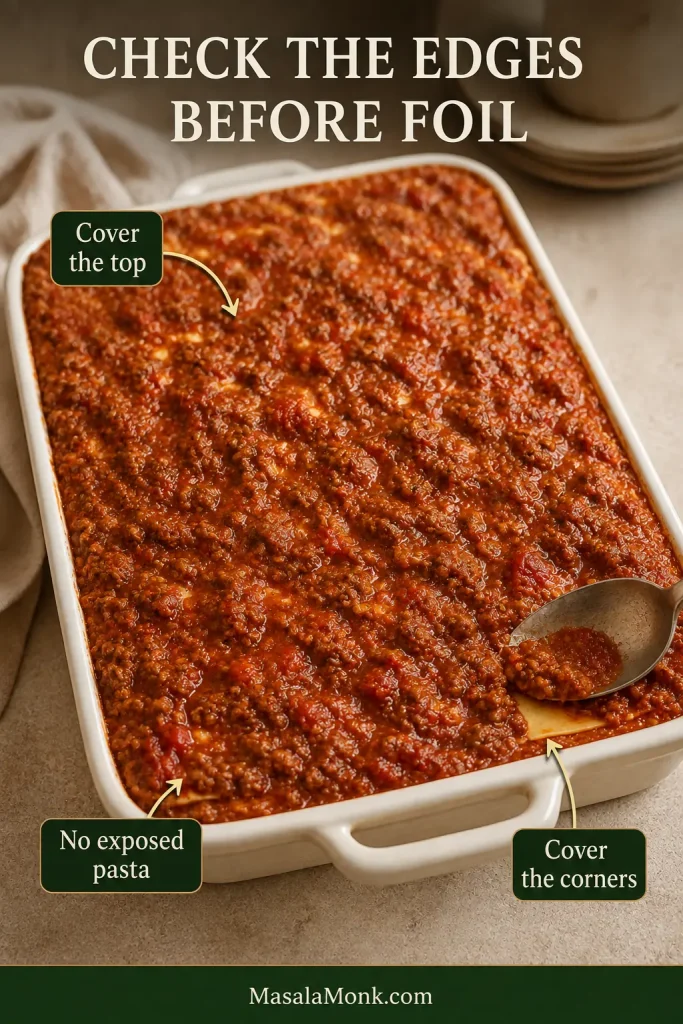
Cover exposed pasta now, especially at the corners; those small dry patches are the first places to turn chewy.
Bake, Brown and Rest
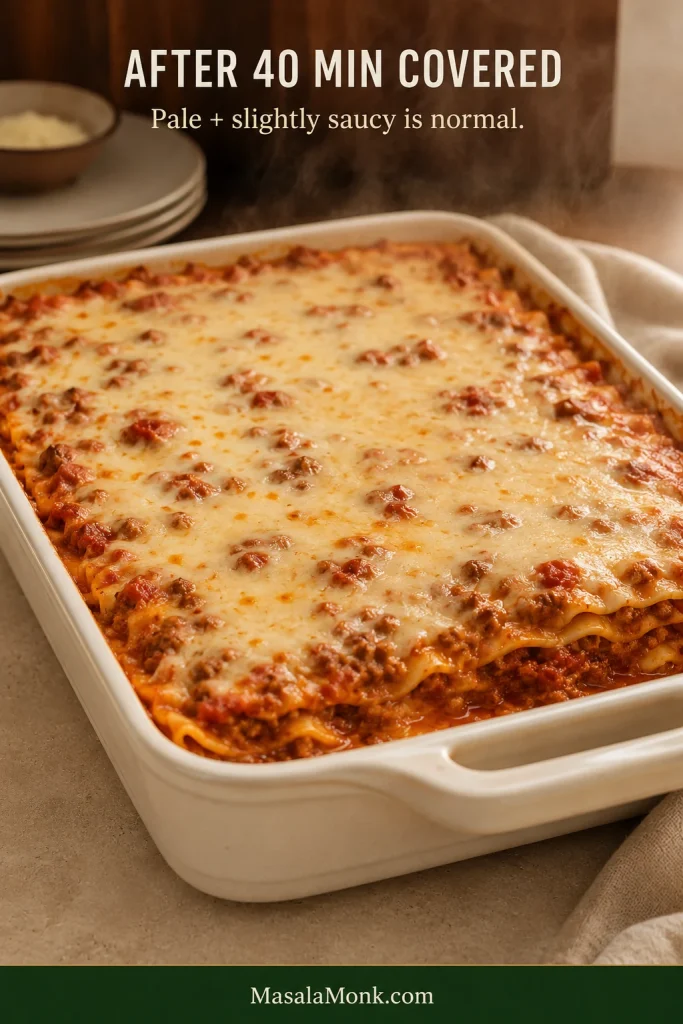
Bake covered. Lightly grease the underside of a sheet of foil, cover the dish and bake for 40 minutes. When the foil comes off, the lasagna may still look pale and slightly saucy. That’s fine. The uncovered stretch is when the top changes fastest: the cheese melts together, the edges bubble harder and the first browned spots begin to appear.
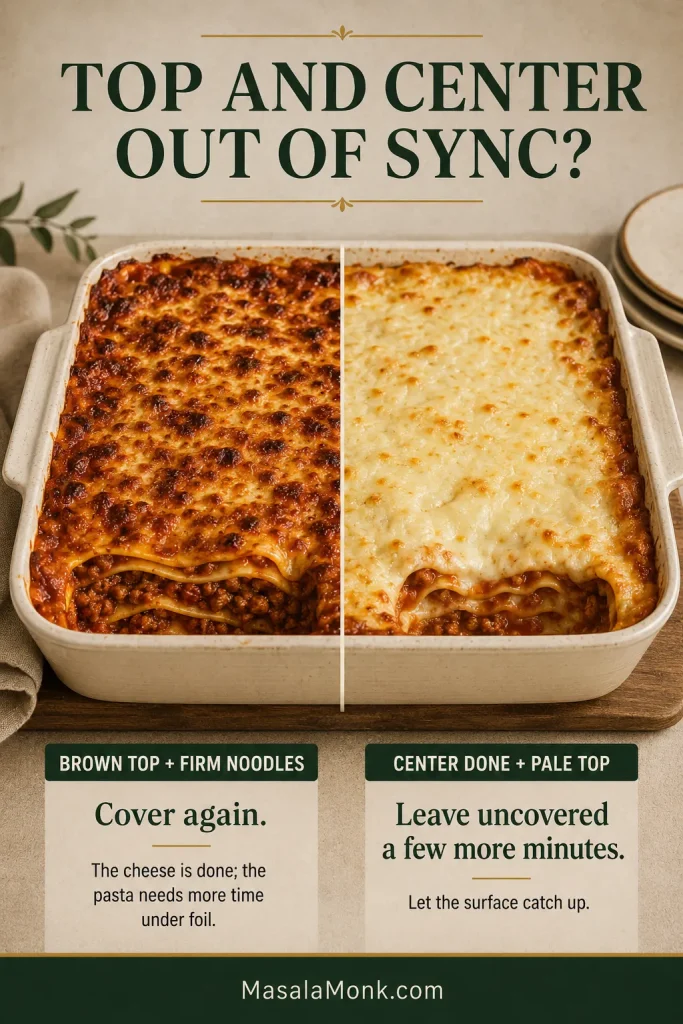
Pale cheese after the covered bake is normal. The uncovered stage is where the surface catches up.
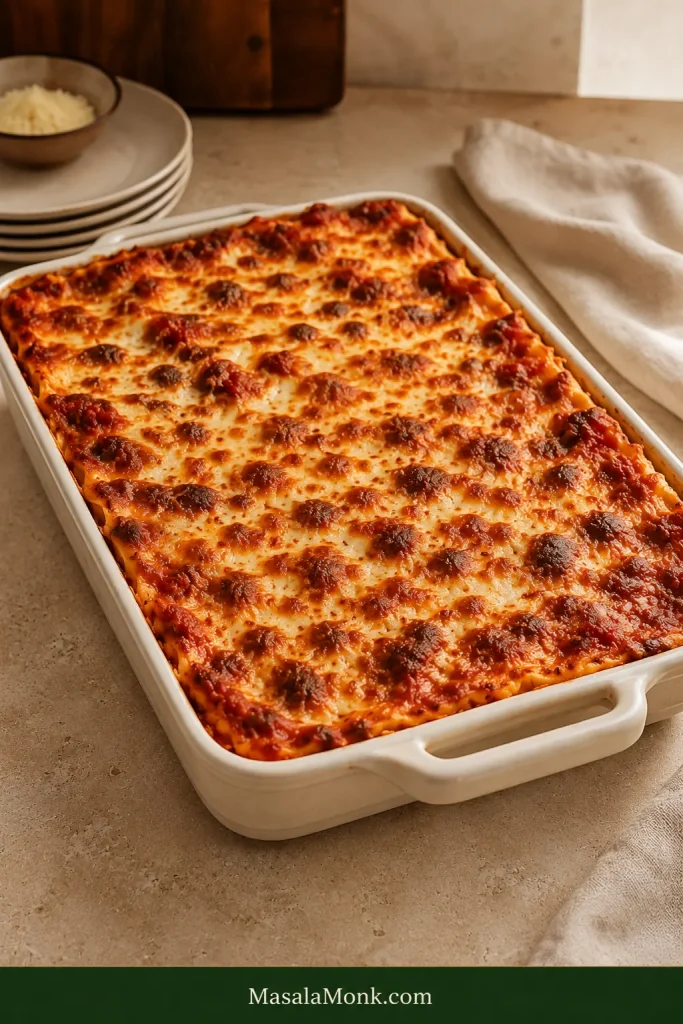
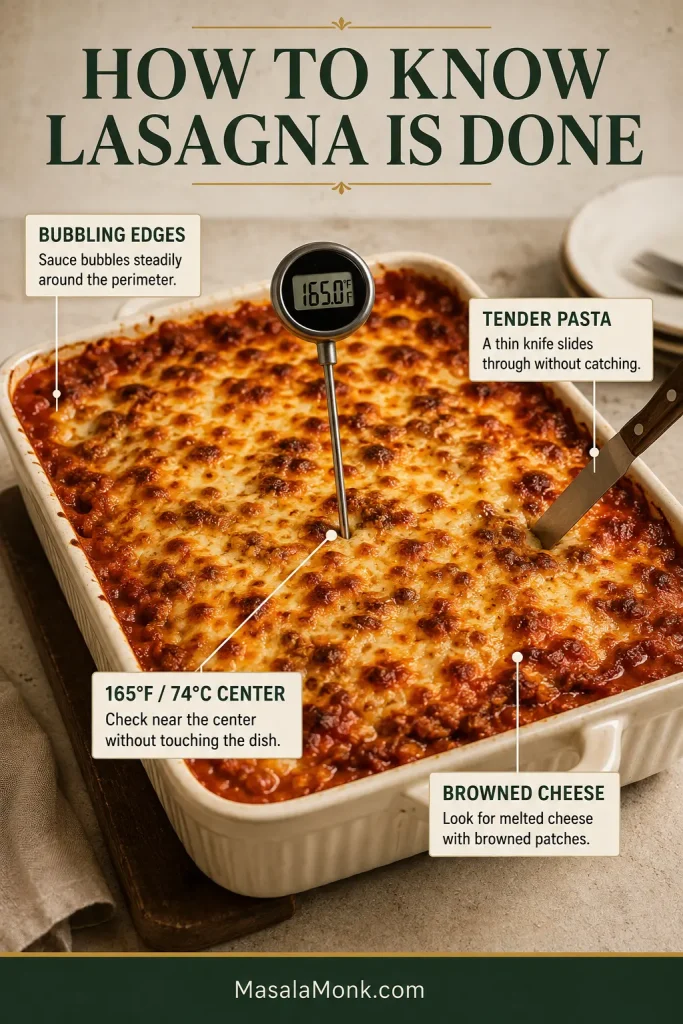
Brown and finish cooking. Bake uncovered for another 12–15 minutes. Look for steady bubbling around the edges and browned patches across the cheese. A thin knife should pass through the pasta without catching. Check the temperature near the center of the pan without touching the baking dish; it should reach 165°F / 74°C. If the top browns before the pasta is tender, cover the pan again. The cheese has browned enough; the noodles need more time under foil.
Irregular golden and mahogany patches are enough; the whole surface does not need to brown evenly.
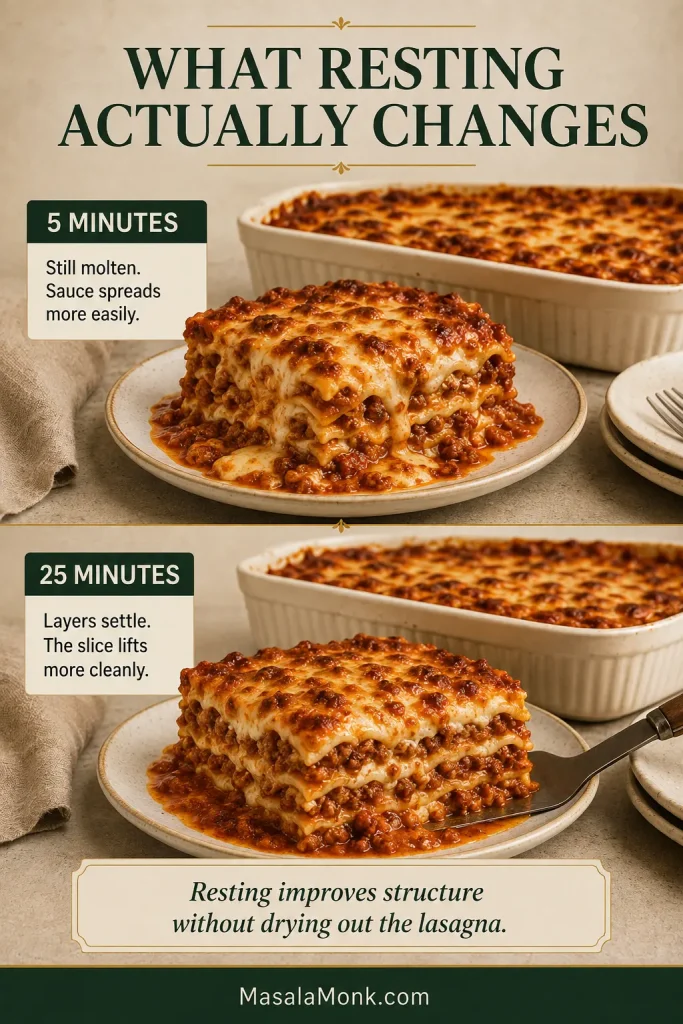
Rest and serve. Leave the lasagna for 20–30 minutes before cutting; 15 minutes is the minimum. Use a sharp knife and a wide spatula. The first corner is usually the least cooperative because there is nowhere for it to move. Give it some room and the next slices generally come out more easily.
What the Finished Lasagna Should Look Like
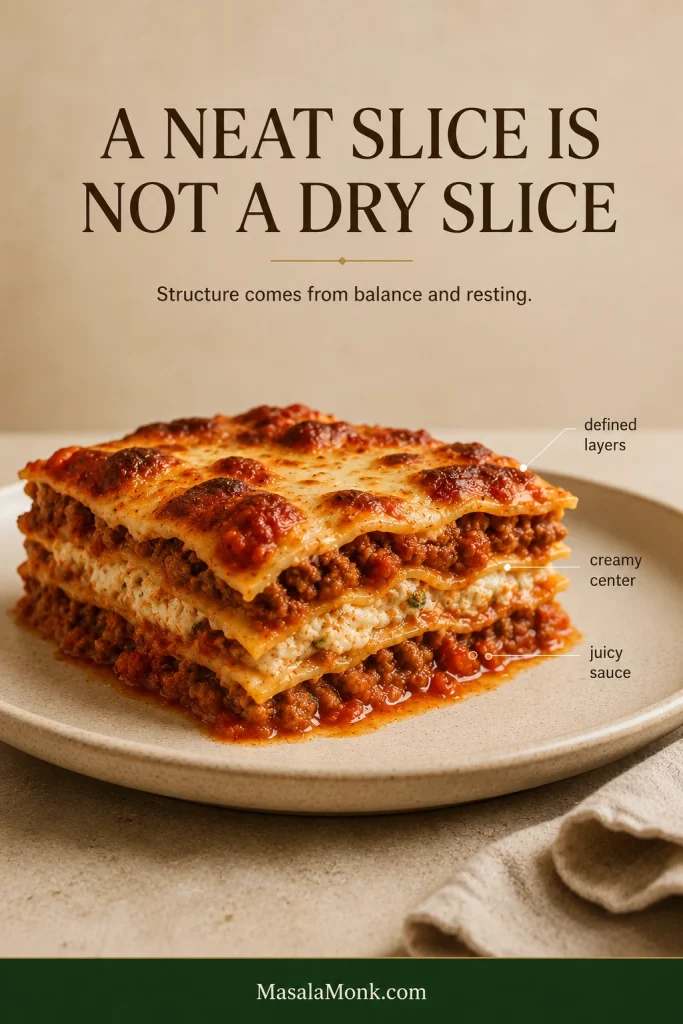
Those details all solve the same problem: moisture balance. A neat slice is not a dry slice. The noodles need enough sauce to become tender, the cheese needs enough body to stay between the pasta layers, and the finished pan needs time to settle.
A good hot slice still relaxes on the plate. The layers remain recognizable; they do not need to stand rigidly to count as a success.
A successful slice keeps recognizable layers while the sauce and ricotta stay soft, glossy and moist.
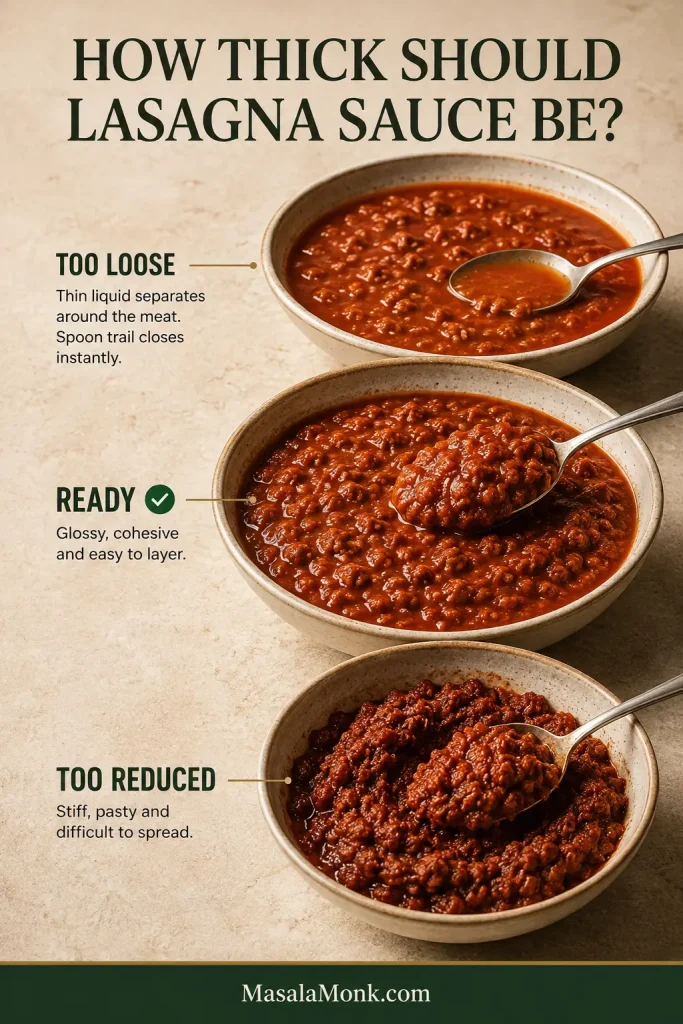
The meat sauce should be thick enough to cling to the beef and sausage but still spoonable enough to settle easily over the noodles. The pasta will absorb some moisture in the oven, so taking the sauce all the way to a stiff, pasty consistency works against you.
Aim for glossy and spoonable: loose enough to hydrate pasta, thick enough to stay between the layers.
Why Beef and Italian Sausage Work Together
Ground beef gives the sauce body; Italian sausage adds fennel, seasoning and extra richness without taking over. The 2:1 ratio keeps beef as the main flavor.
Prefer all beef? Use about 1½ pounds / 680 g ground beef. Add another ½ teaspoon Italian seasoning and, if you enjoy it, a small pinch of lightly crushed fennel seed.
Remove only the excess fat. Fat release varies with the meat. Spoon away a clear pool after browning, but leave the thin sheen behind.
The Meat Sauce Is Ready When…
Too loose: the spoon trail disappears immediately and thin tomato liquid separates around the meat.
Ready: glossy, cohesive and loose enough to settle into an even layer.
Too far reduced: the sauce piles up and drags instead of settling easily across the pasta.
For this 9 × 13-inch lasagna with four pasta layers, you want about 6½–7 cups of meat sauce. Texture still gets the final say. By this stage the sharp tomato aroma has mellowed into something deeper and more savory.
Protect the bottom and top pasta first; poor sauce distribution can leave dry noodles even when the total quantity is right.
Taste it now; once the sauce is between pasta and mild cheeses, flat seasoning is much harder to correct.
Starting with ripe garden tomatoes? Use a properly reduced fresh tomato sauce as the base instead of replacing the canned tomatoes cup for cup. Fresh tomatoes can bring considerably more water with them.
Shortcut: Use Jarred Marinara
Brown the meat and cook the onion, garlic and tomato paste as written. Skip the crushed tomatoes, tomato sauce and initial ½ cup broth, then add about 36 ounces / 1.02 kg prepared marinara. Add broth only if a particularly thick brand needs loosening, and keep a little extra marinara nearby if the meat mixture needs more sauce. You’re looking for enough sauce to coat the meat generously and settle easily into the layers.
If you would rather make the tomato base yourself, our homemade marinara sauce gives you a straightforward starting point.
Cheese for Lasagna: Ricotta, Mozzarella and Parmesan
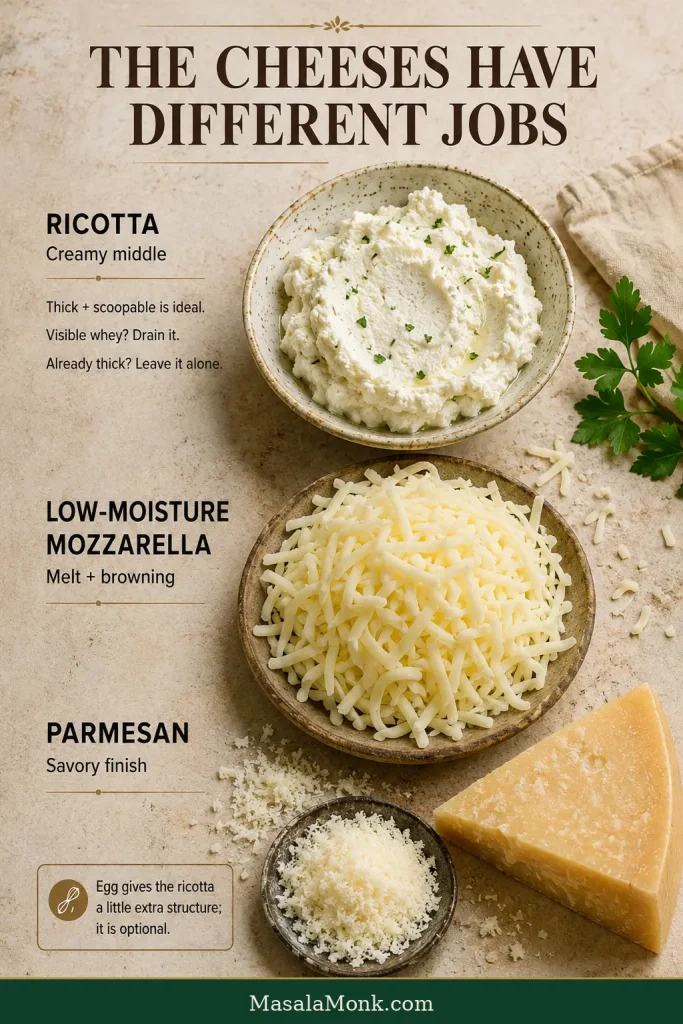
The cheeses have different jobs here: ricotta keeps the middle creamy, mozzarella gives you melt and browning, and Parmesan brings a sharper savory finish.
Ricotta brings creaminess, mozzarella brings melt, and Parmesan brings sharper savory depth; excess dairy moisture is the main thing to control.
Ricotta. Whole-milk ricotta makes the creamy middle layer. Thick and scoopable is what you want. Drain visible whey around the cheese; otherwise, leave it alone.
Do you need the egg? The egg does not turn the filling firm. It simply gives the ricotta enough structure to stay between the noodles when a slice is lifted. Leave it out if necessary and the lasagna will still work; the cheese layer will be softer.
Mozzarella. Low-moisture whole-milk mozzarella melts smoothly and browns well without adding much loose liquid to the pan. Fresh mozzarella can work too; drain and blot it thoroughly first and expect a softer slice.
Fresh mozzarella can work, but blotting away surface moisture makes the finished pan more predictable.
Parmesan. A smaller amount goes a long way here, adding salty, savory depth to the ricotta and a flavorful crust across the top. Our guide to Parmesan and Parmigiano Reggiano explains the differences if you are choosing between wedges.
Can I Use Cottage Cheese Instead of Ricotta?
Yes. Substitute it by weight and drain visible liquid around the curds first. Cottage cheese gives the filling a looser, more visibly curded texture; ricotta makes it smoother and richer.
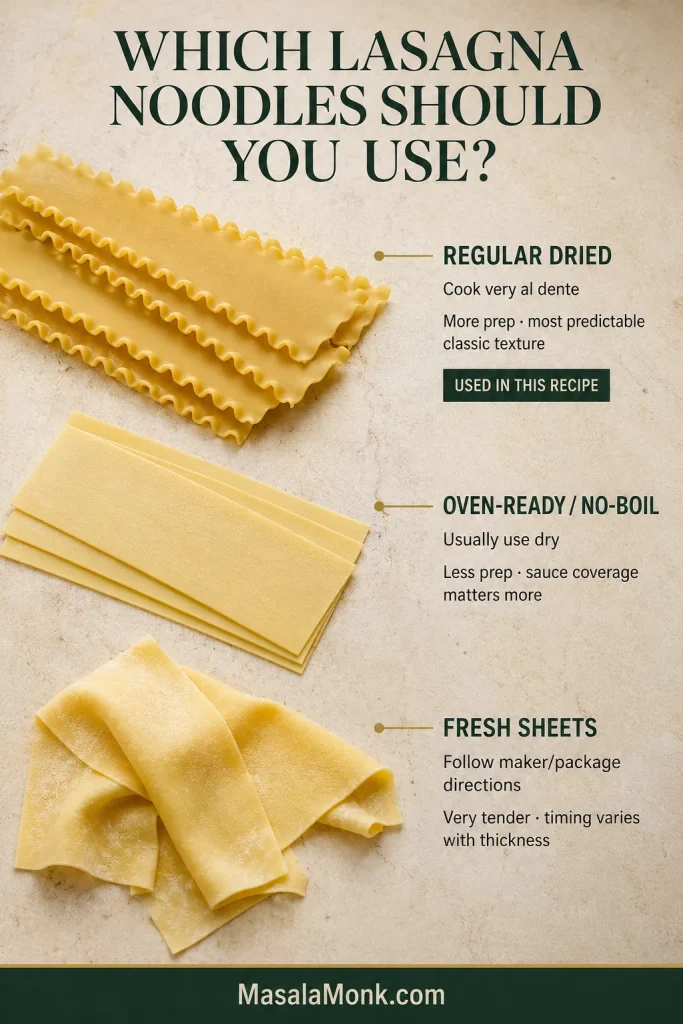
Which Lasagna Noodles Should You Use?
Regular, oven-ready and fresh sheets can all work. The main difference is how each gets its moisture and how gently it needs to be handled.
This recipe uses regular dried noodles cooked very al dente, but oven-ready and fresh sheets can work too.
Pasta
What to Do
Main Trade-Off
Regular dried noodles
Cook until very al dente
More prep, but the most predictable classic texture
Oven-ready / no-boil
Usually use dry; follow package guidance
Less prep, but sauce coverage matters more
Fresh lasagna sheets
Often need no pre-cooking; follow package or pasta-maker directions
Very tender, but timing varies more with thickness
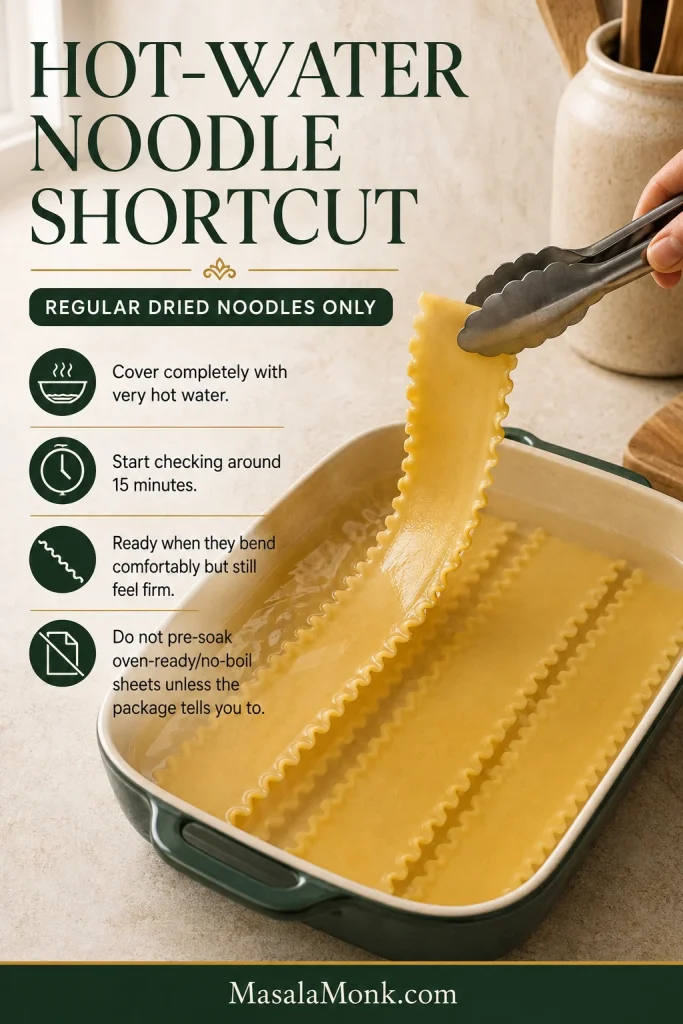
Hot-Water Shortcut for Regular Dried Noodles
This shortcut is for regular dried lasagna noodles, not oven-ready/no-boil sheets. Place the noodles in a large heatproof dish and cover them completely with very hot water. Begin checking around 15 minutes. Drain when they bend comfortably but still feel distinctly firm; thickness varies by brand.
Separate the sheets early and drain them well; flexible is the goal, not fully cooked.
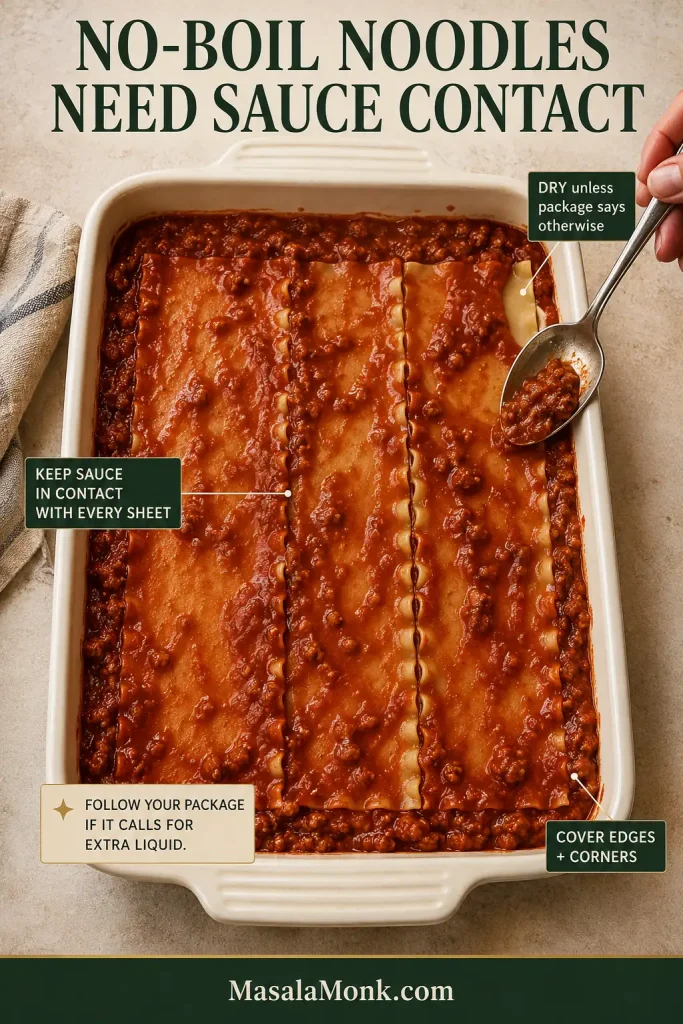
Using Oven-Ready or No-Boil Noodles
Oven-ready noodles soften entirely inside the casserole, so complete contact with sauce becomes especially important.
No-boil sheets need complete contact with sauce that still spreads easily into corners and seams.
Use them dry unless the package says otherwise.
Do not over-reduce the meat sauce.
Cover the edges and corners completely.
Follow any additional-liquid directions on your specific package.
Brands vary in thickness and formulation. Barilla’s oven-ready lasagna guidance, for example, likewise emphasizes keeping the sheets in contact with enough sauce while they bake.
How to Layer Lasagna Without Guessing
Four pasta layers. Three filled layers. Sauce underneath and sauce on top. That is the whole structure.
Four pasta layers and three restrained filled layers distribute sauce, ricotta and cheese more evenly from top to bottom.
For each filled layer: noodles → ricotta → meat sauce → mozzarella. Repeat that three times, then finish with noodles, sauce and cheese.
A generous lasagna comes from repeated layers, not overloaded ones. Keeping each filling layer fairly thin makes the pan easier to build, easier to cut and less likely to slide when you serve it.
The first filled layer can look modest; repeating thin layers is what creates height without forcing filling out the sides.
Layer Quantities for a 9 × 13-Inch Pan
Level
What Goes Into the Pan
Bottom
¾ cup meat sauce
Layer 1
3 noodles* + ⅓ ricotta + 1 of 3 inner sauce portions + ¾ cup mozzarella
Layer 2
3 noodles* + ⅓ ricotta + 1 of 3 inner sauce portions + ¾ cup mozzarella
Layer 3
3 noodles* + ⅓ ricotta + 1 of 3 inner sauce portions + ¾ cup mozzarella
Top
3 noodles* + reserved 1½ cups sauce + reserved mozzarella + ½ cup Parmesan
*Use three standard noodles or enough pasta to cover the pan. Slight overlap is fine.
Before the foil goes on, check the edges. Take ten seconds and look around the perimeter. Tuck sauce over any exposed pasta, especially at the top and corners. Small gaps can be filled by trimming, breaking or slightly overlapping a noodle.
How Long to Bake Lasagna at 375°F / 190°C
Bake a freshly assembled lasagna for 40 minutes covered, then 12–15 minutes uncovered.
The covered stage keeps steam around the noodles while they finish becoming tender. Uncovering near the end lets the mozzarella melt and develop browned patches across the surface.
How to Know Lasagna Is Done
Use both checks: 165°F / 74°C for the center, and a thin knife for actual noodle tenderness.
Sauce bubbles steadily around the edges.
A thin knife slides through the pasta without meeting a tough layer.
The center reaches 165°F / 74°C.
The top is melted and browned in patches.
How Long Should Lasagna Rest Before Cutting?
Rest lasagna for 20–30 minutes before cutting; give it at least 15 minutes if time is tight.
Straight from the oven, the sauce is bubbling and the cheese is molten. As it rests, the sauce and cheese settle around the pasta and the slices become much easier to lift.
At five minutes the filling moves readily; by 25 minutes it settles enough for cleaner, still-juicy slices.
It may simply be too hot. Give it time to settle before deciding anything went wrong.
Still watery after resting
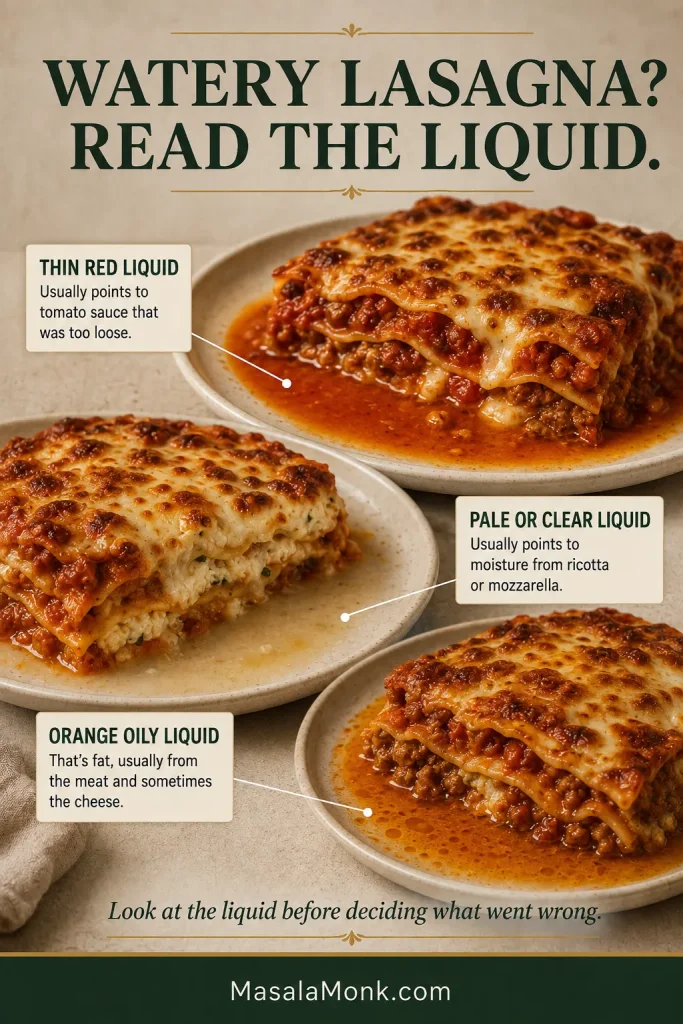
The sauce or cheese carried too much loose liquid. Thin red liquid points toward sauce; pale or clear liquid points toward cheese.
Slice collapses
It may still be too hot, too wet or overfilled. Rest longer now; next time keep the filling layers thin and even.
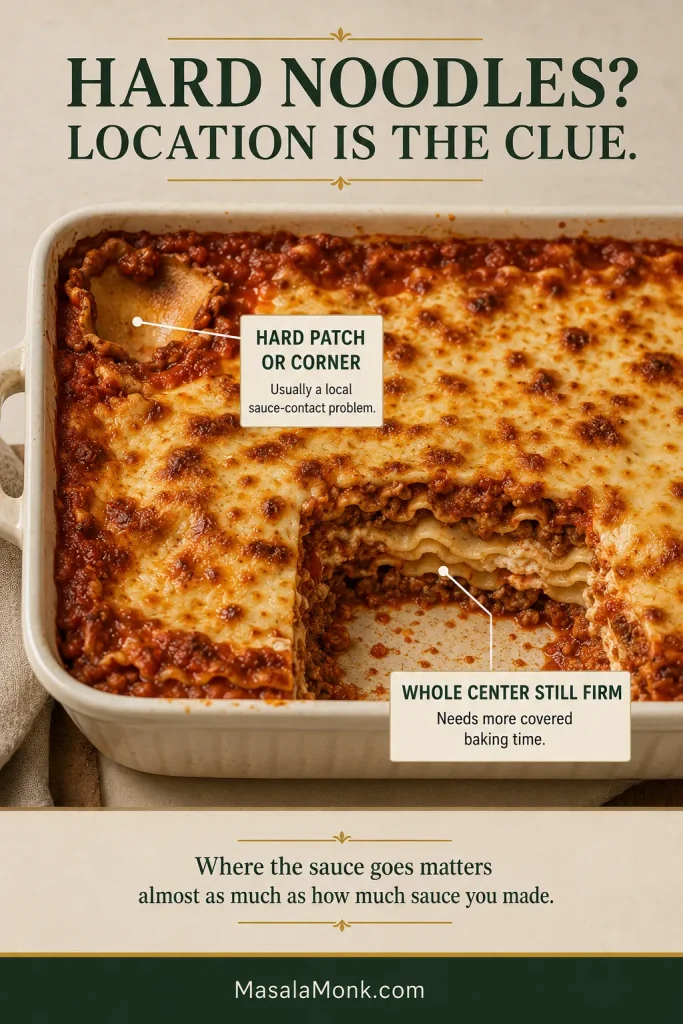
Hard patches or corners
Those areas did not have enough sauce contact. If the pan is still hot, cover it and continue baking; next time check the edges carefully before baking.
Hard bottom
The bottom noodles likely did not have enough sauce underneath. Start with a full thin layer of sauce next time.
Hard or crispy top
Part of the final pasta layer was exposed. Cover the top completely with sauce before baking.
Brown top, firm center
The surface finished before the middle. Cover the dish again and give the noodles more time under foil.
Lasagna tastes dry
The sauce was over-reduced or the uncovered bake ran too long. Stop reducing once the sauce is cohesive and keep the final uncovered bake brief.
Loose cheese layer
The cheese carried too much moisture. Drain visibly wet ricotta or cottage cheese and blot fresh mozzarella thoroughly.
Greasy orange pools
Fat can come from both the meat and cheese. Spoon away a large pool of rendered meat fat after browning instead of sending all of it into the sauce.
Lasagna tastes bland
The sauce or pasta likely went in underseasoned. Season the sauce before layering and salt the pasta water. Already baked? Serve with warm, well-seasoned marinara and extra Parmesan.
Brown Top or Pale Top?
Brown top but firm noodles? Cover the pan again. The cheese has browned enough; the noodles need more time under foil.
Center done but top still pale? Leave the lasagna uncovered for a few more minutes and let the surface catch up.
If surface and center finish at different speeds, protect what is done and keep cooking only what still needs time.
Why Is My Lasagna Watery?
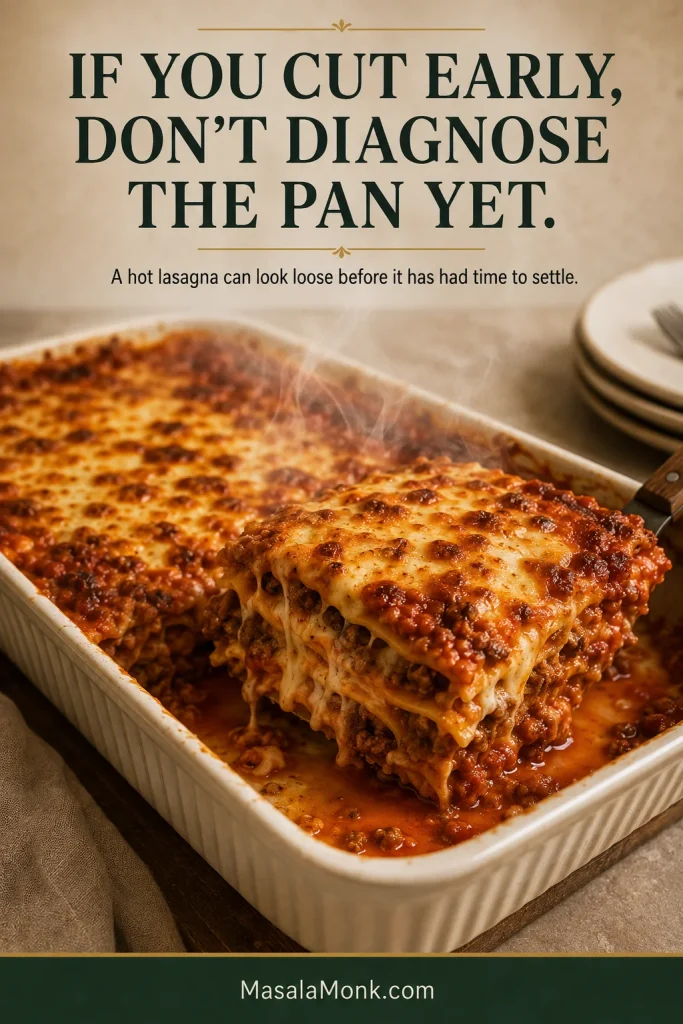
If you cut early, don’t diagnose the pan yet.
The first slice can look loose simply because the filling is still molten. Rest before diagnosing the pan.
If it still looks watery after resting, look at the liquid itself. Thin red liquid points toward under-reduced tomato sauce. Pale or clear liquid around the cheese suggests wet ricotta or mozzarella. Orange oily pools are fat.
Read the puddle: red suggests sauce, pale or clear suggests dairy, and orange sheen points toward rendered fat.
Vegetables change the balance too. Spinach, mushrooms, zucchini and eggplant all release moisture as they cook. For an eggplant-based casserole where that moisture is handled before assembly, see our baked eggplant Parmesan.
Why Are Parts of My Lasagna Noodles Still Hard?
A pan can have liquid pooled in one place while a corner of pasta stays stubbornly firm. Check the bottom, top and edges first. Where the sauce goes matters almost as much as how much sauce you made.
One hard corner is a local moisture problem, not automatically a reason to keep baking the entire pan.
Why Does My Lasagna Fall Apart?
If you’ve already given it enough time to rest, look next at excess moisture, overly thick filling layers, noodles that were too soft before assembly, or unusually wet cheese. A clean slice comes from the balance of the whole pan rather than one magic binder.
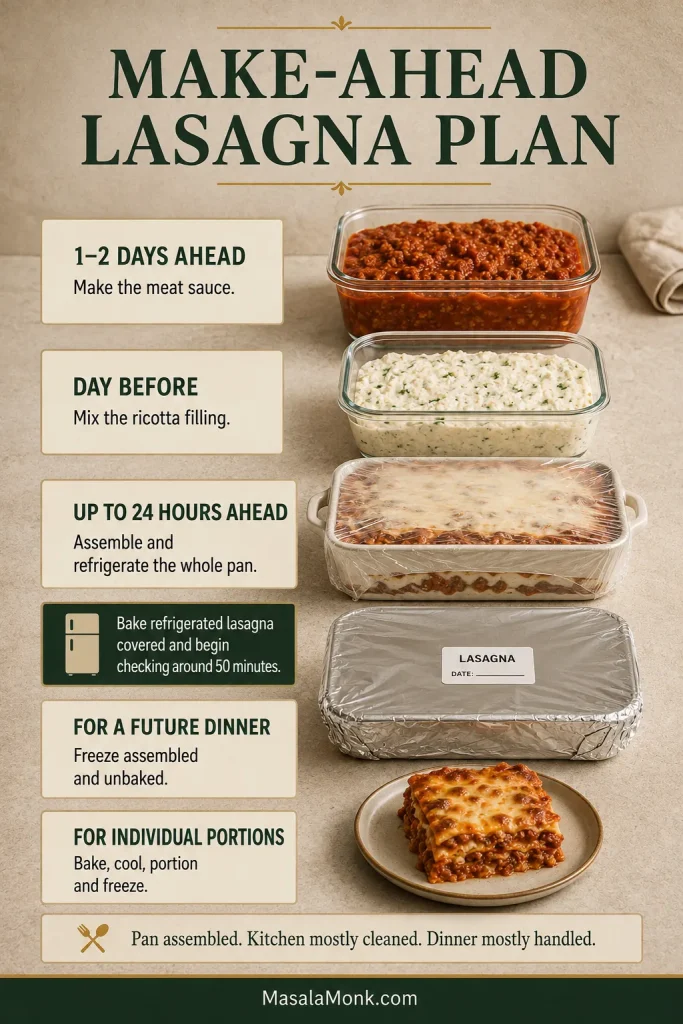
You do not have to make every component in one session. The meat sauce can be cooked 1–2 days ahead, cooled and refrigerated. The ricotta filling can be mixed the day before and kept covered in the refrigerator.
On dinner day, cook the noodles and assemble the pan—or assemble the entire lasagna up to 24 hours ahead and refrigerate it until baking. For an assembled make-ahead lasagna, keep the regular noodles very al dente because they will continue absorbing moisture in the refrigerator.
For company, this is the kind of make-ahead that actually helps: the sauce is finished, the pan can be assembled, the kitchen is mostly cleaned, and the main job left before dinner is getting the lasagna into the oven.
Freeze a whole assembled pan for a future dinner, or baked portions when you want easy individual servings.
Bake a Refrigerated Lasagna
Bake a refrigerator-cold lasagna covered at 375°F / 190°C and begin checking around 50 minutes; a very cold or especially deep pan may take longer. Once the center is hot and the noodles are nearly tender, uncover and bake for another 12–15 minutes, until the top is browned and the center reaches 165°F / 74°C.
For a glass baking dish, follow the manufacturer’s guidance about moving a refrigerator-cold dish into a hot oven because thermal-shock limits vary.
Freeze Before or After Baking?
Freeze an assembled pan when you want a complete future dinner. Freeze baked individual portions when you would rather reheat one or two servings at a time.
For an unbaked lasagna, cool the cooked components before assembly, use a freezer-safe pan, wrap well and freeze. Thaw the pan completely in the refrigerator. A full 9 × 13-inch lasagna may need about 24 hours or longer depending on its depth and freezer temperature. Once thawed, use the refrigerated-lasagna directions above.
Baked portions can be wrapped individually after cooling. For the best texture and flavor, use frozen lasagna within about 2–3 months.
How Long Does Lasagna Last in the Fridge?
Refrigerate leftovers within 2 hours—or within 1 hour when the surrounding temperature is above 90°F / 32°C. Keep covered leftovers in the refrigerator for 3–4 days. These limits follow USDA leftover food-safety guidance.
How to Reheat Lasagna Without Drying It Out
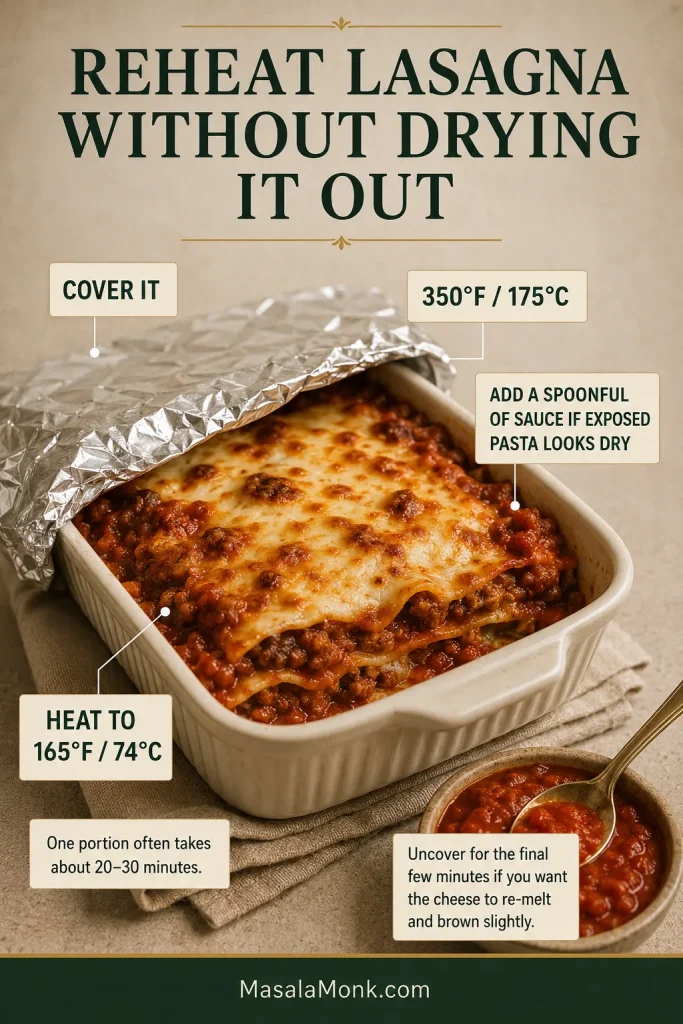
Place a portion in an oven-safe dish. Dry-looking exposed pasta benefits from a spoonful of extra sauce or a very small splash of water. Cover and reheat at 350°F / 175°C until the center reaches 165°F / 74°C.
A single portion often needs 20–30 minutes; larger amounts take longer. Uncover for the final few minutes if you want the cheese on top to re-melt and brown slightly.
Cover during most of reheating to protect the cut edges, then uncover briefly to re-melt the cheese on top.
For the microwave, cover the portion loosely and heat in shorter intervals until the center is steaming hot throughout.
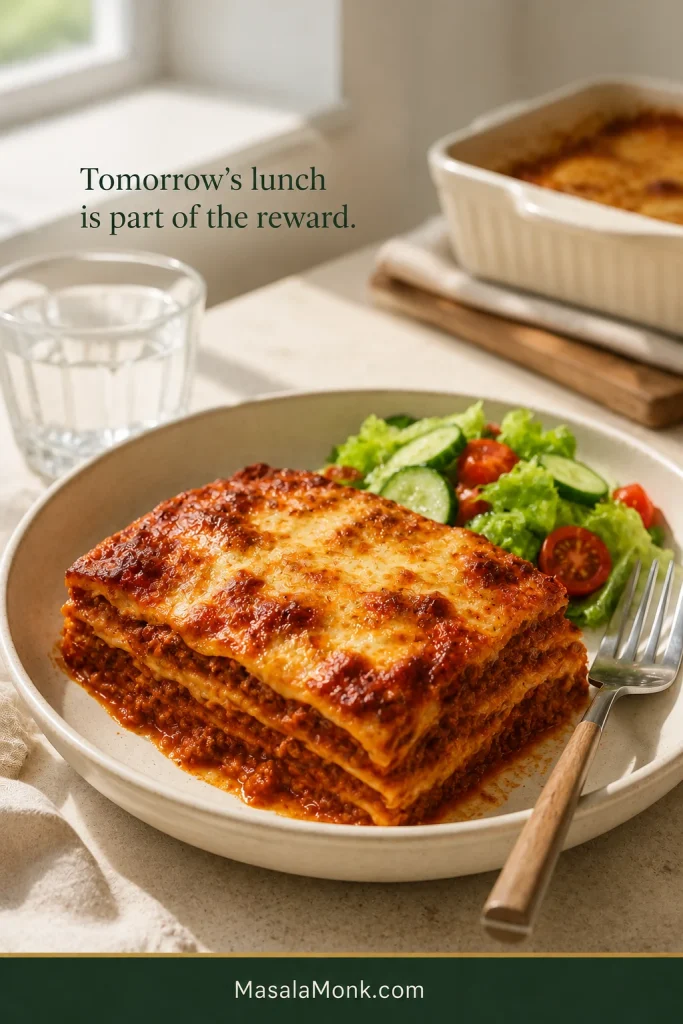
After putting this much work into one pan, having tomorrow’s lunch already handled is part of the reward. Leftover lasagna often slices even more neatly than it did on the first night because the layers have completely settled. Reheating it covered keeps those tidy layers tender.
Chilling firms the layers; gentle covered reheating softens the sauce and cheese again without drying the edges.
What to Serve With Lasagna
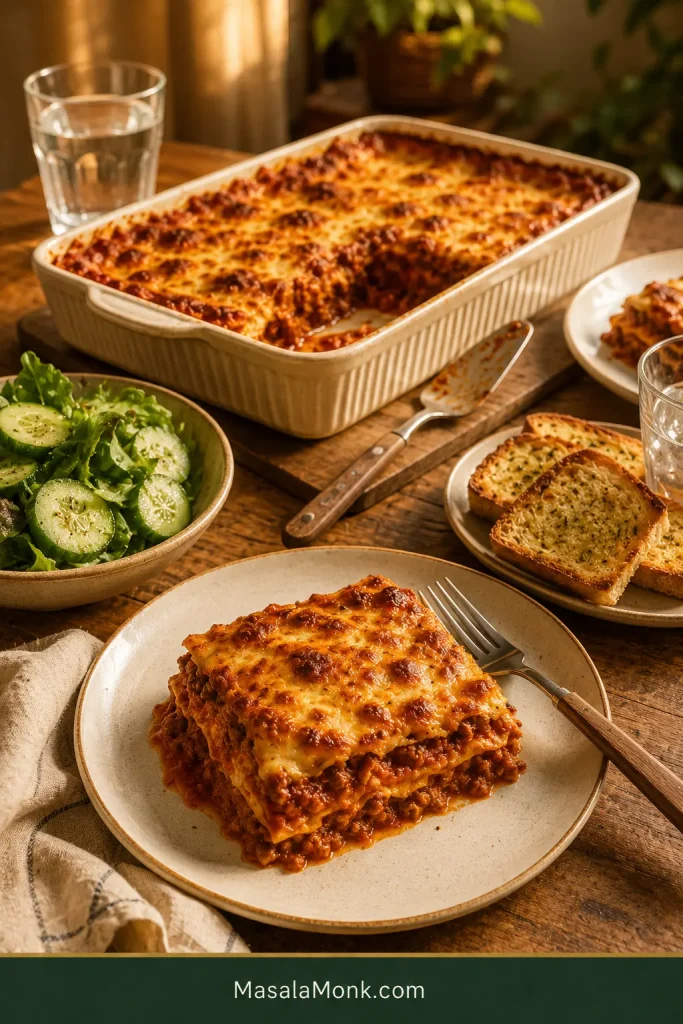
Lasagna already brings plenty of meat, cheese and tomato, so crisp, green or acidic sides work especially well. A cold cucumber salad with vinegar, dill and onion is one easy way to put something fresh beside the hot casserole.
A sharp green salad with vinaigrette
Roasted broccoli or green beans
Marinated peppers or another tangy vegetable side
And when a little meat sauce is left on the plate, homemade garlic bread earns its place beside the pan.
Crisp or acidic sides refresh the rich lasagna; garlic bread handles the sauce left on the plate.
The difficult part arrives when the lasagna comes out of the oven. The sauce is bubbling, the mozzarella has browned and everything smells ready.
Give it those last twenty minutes anyway.
Then cut in. The knife slides through without catching. The first piece may let a little sauce relax around its edges, but the layers stay recognizable, the ricotta stays creamy and the meat sauce stays rich and juicy.
Some recipes are just dinner. A really good bolognese sauce recipe becomes a whole system.
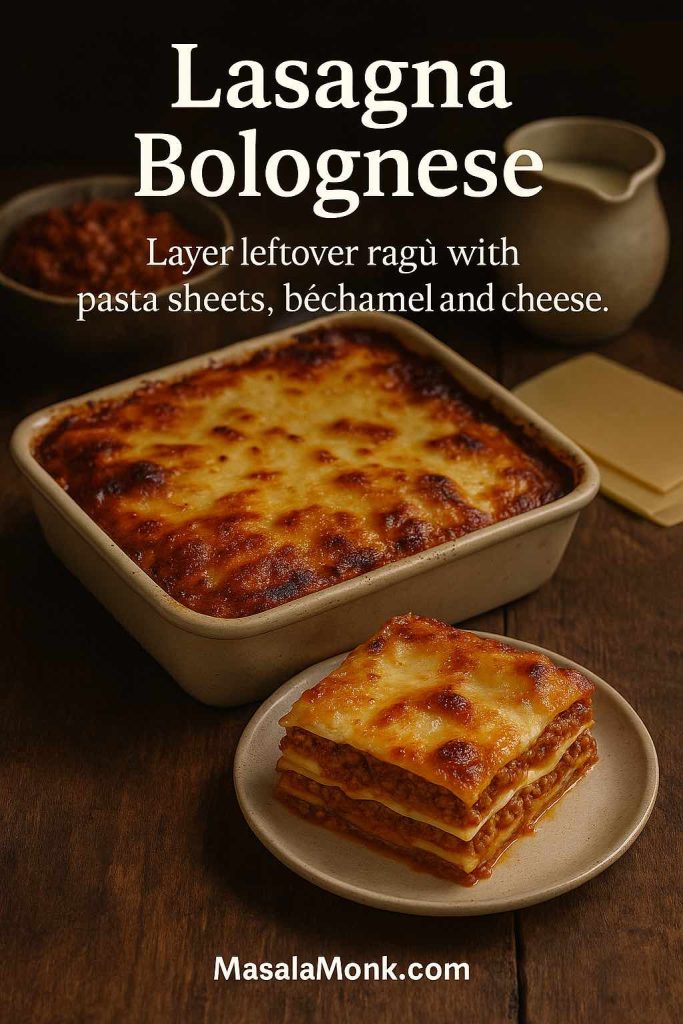
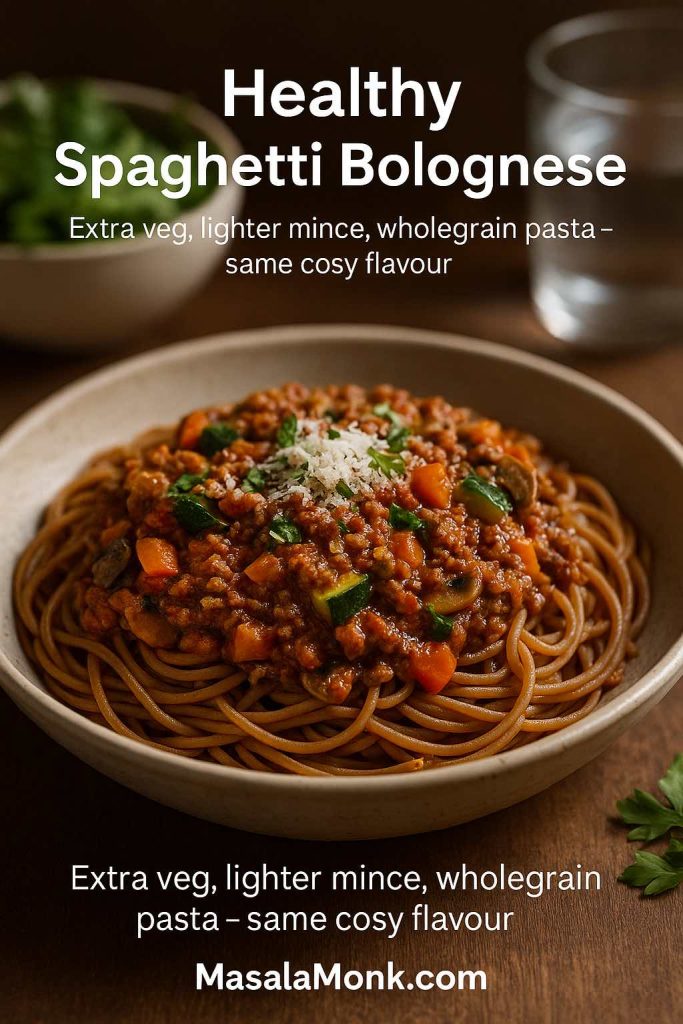
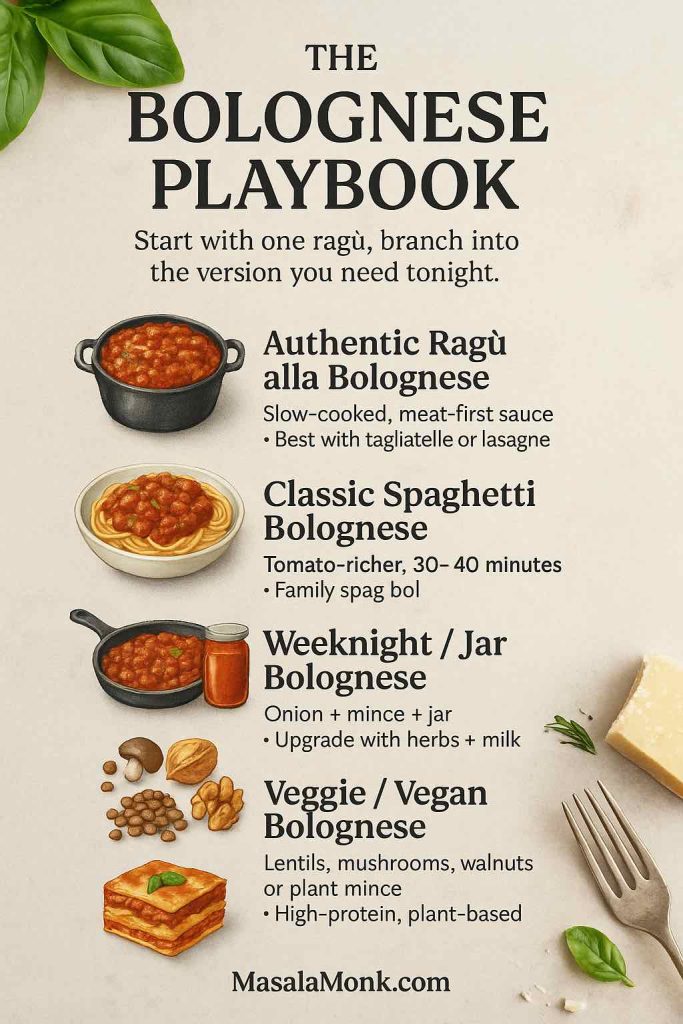
Once you’ve got a pot of slow-cooked ragù on the stove, you can spin it into classic spaghetti bolognese, tagliatelle al ragù that feels straight out of Emilia-Romagna, cosy lasagna bolognese, baked bolognese pasta, gnocchi bolognese on a chilly night, or even lighter veggie spaghetti bolognese and lentil bolognese bowls for busy weekdays.
This guide goes deep into bolognese in all its forms:
The authentic Italian ragù alla bolognese from Bologna
Home-style spag bol and traditional spaghetti bolognese
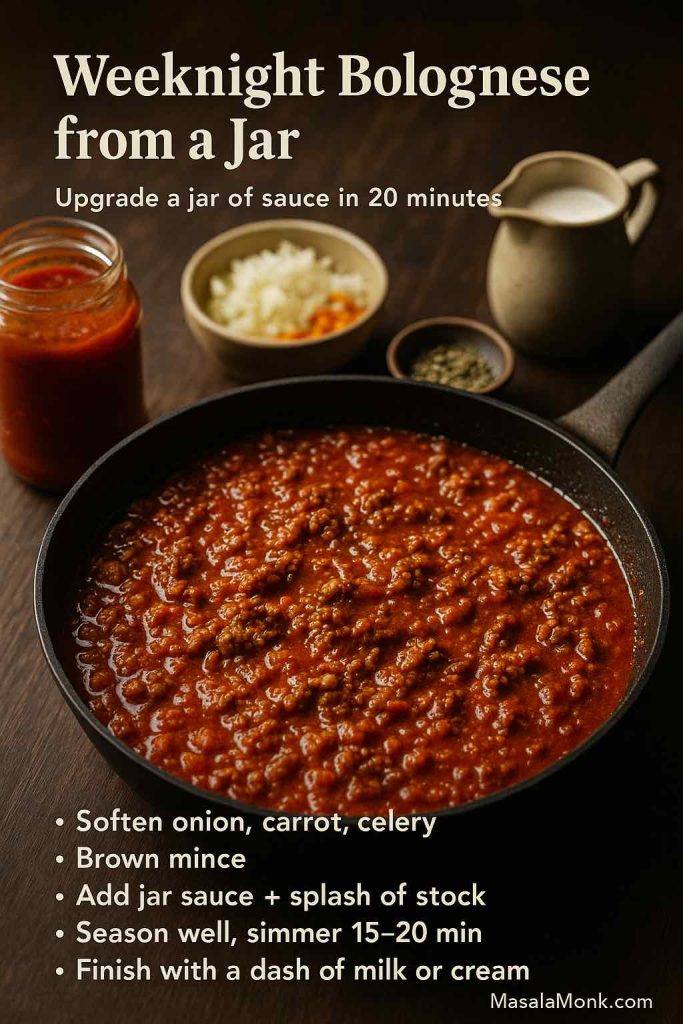
Quick, weeknight bolognese shortcuts and jar-sauce hacks
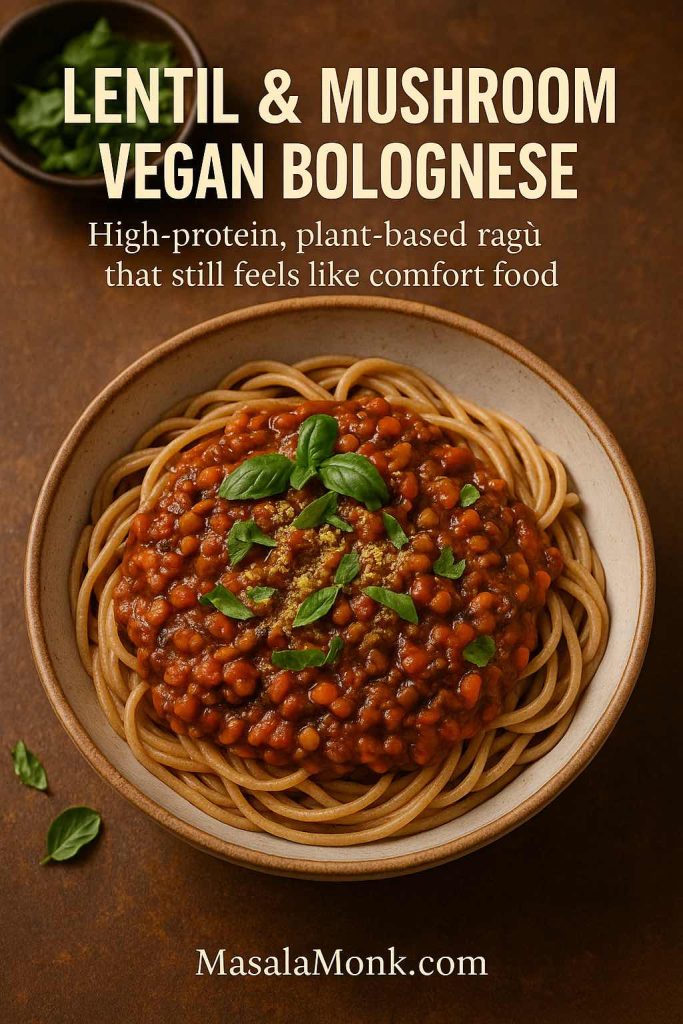
Vegetarian bolognese, vegan bolognese sauce, and mushroom bolognese
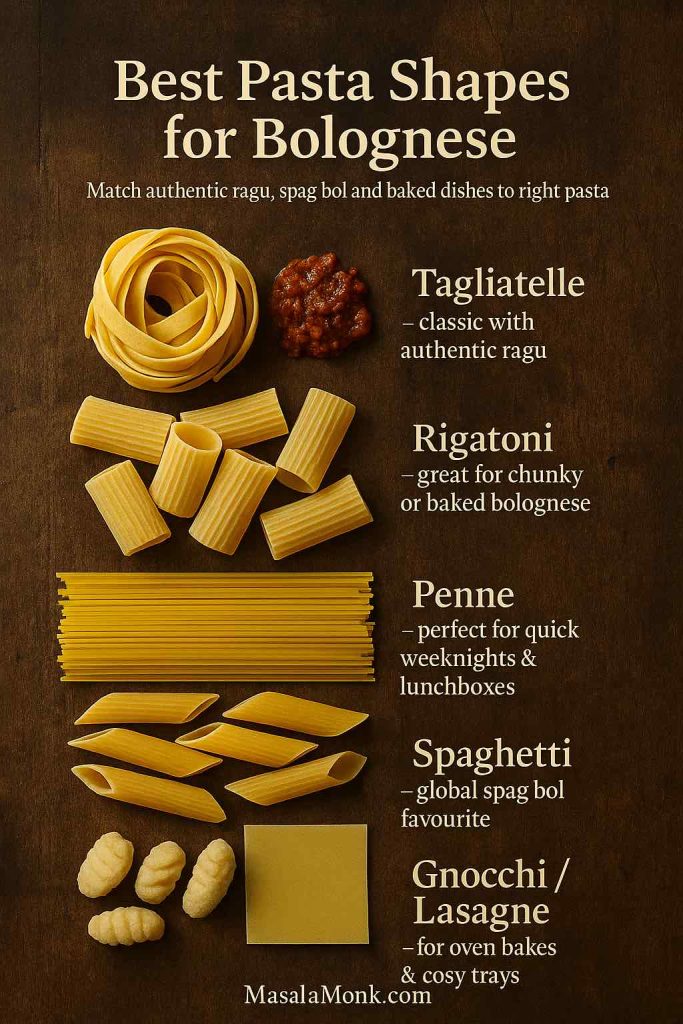
Ideas for lasagne ragu bolognese, baked bolognese pasta, and every pasta shape from rigatoni to tagliatelle
By the end, “bolognese” won’t be one recipe in your head—it’ll be a whole category you can play with.
What Bolognese Actually Is (and Why Italians Side-Eye Spag Bol)
If you’ve ever had an Italian tell you that “spaghetti bolognese doesn’t exist,” they’re not (entirely) being dramatic.
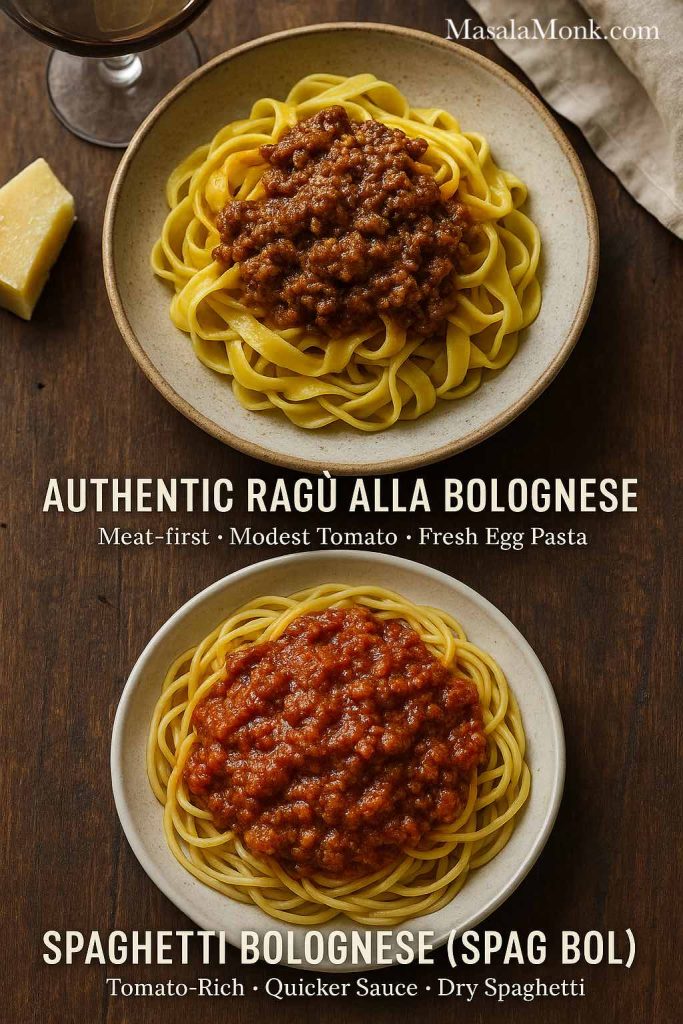
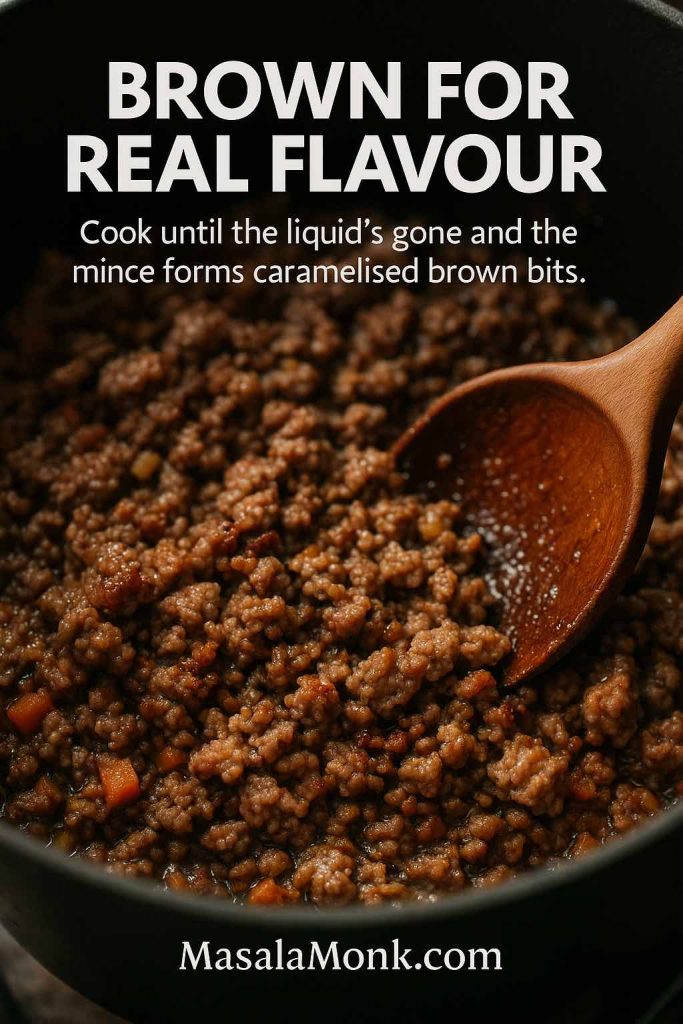
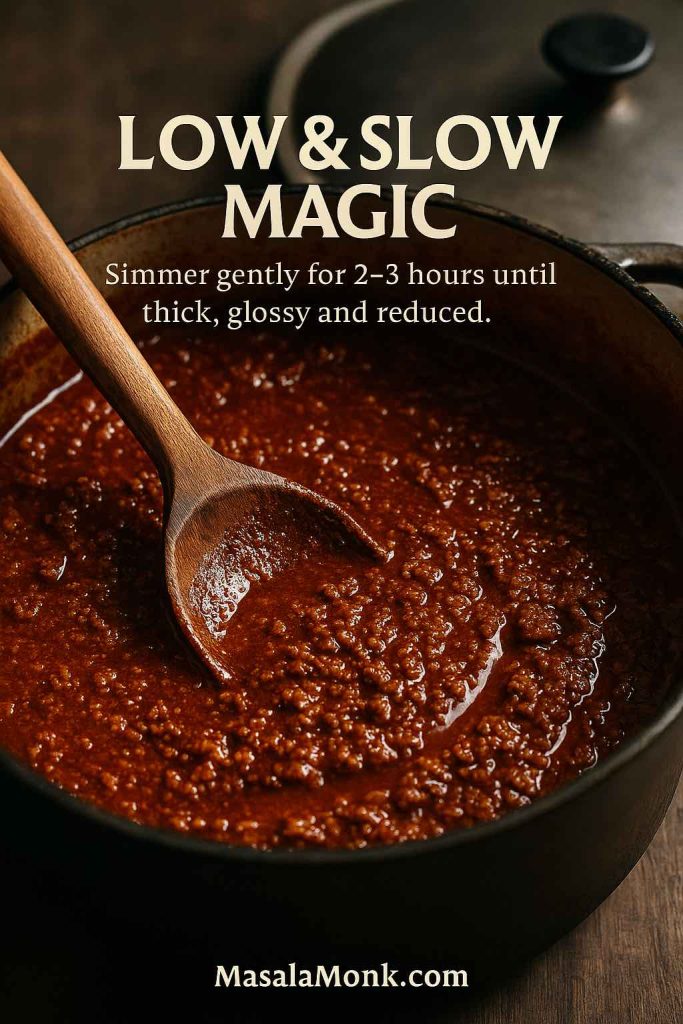
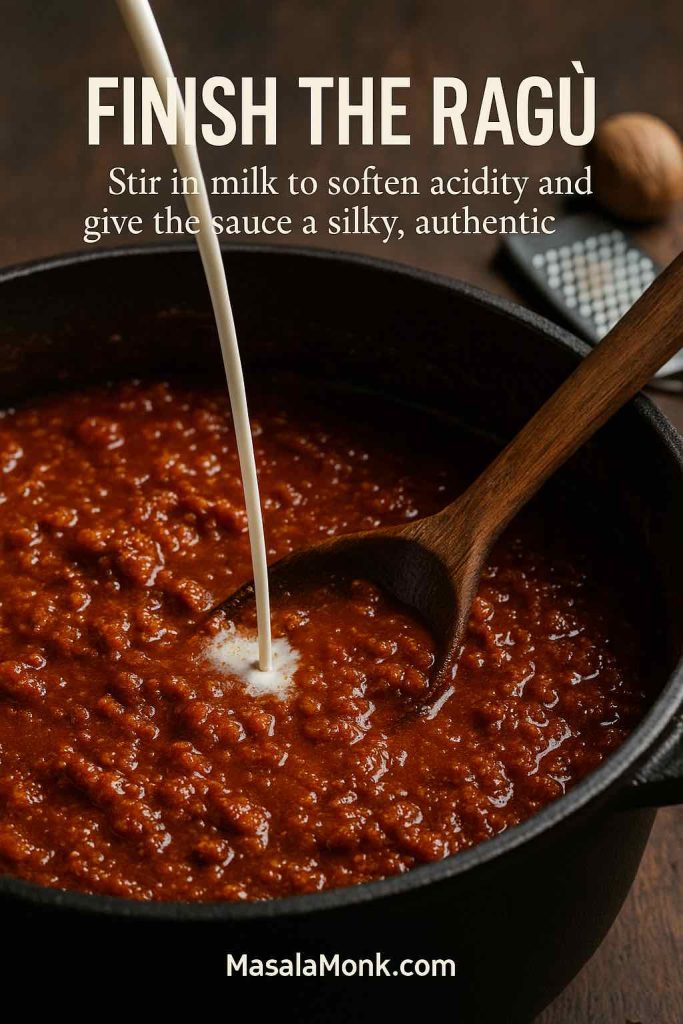
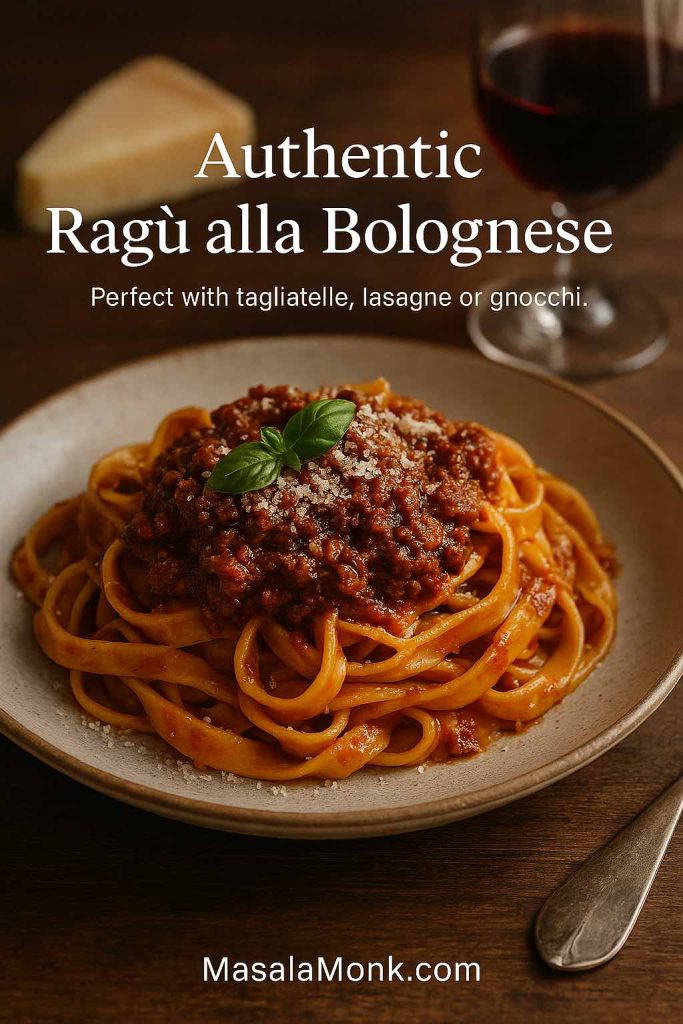
In Bologna, ragù alla bolognese is a very specific thing. The Accademia Italiana della Cucina even filed an official ragù recipe with the Chamber of Commerce, with coarsely ground beef, pancetta, onion, carrot, celery, wine, tomato, stock, and milk, cooked for hours until thick and glossy. It’s a meat sauce first, not a tomato sauce with mince floating in it, and it’s meant for fresh egg pasta like tagliatelle, not dry spaghetti.
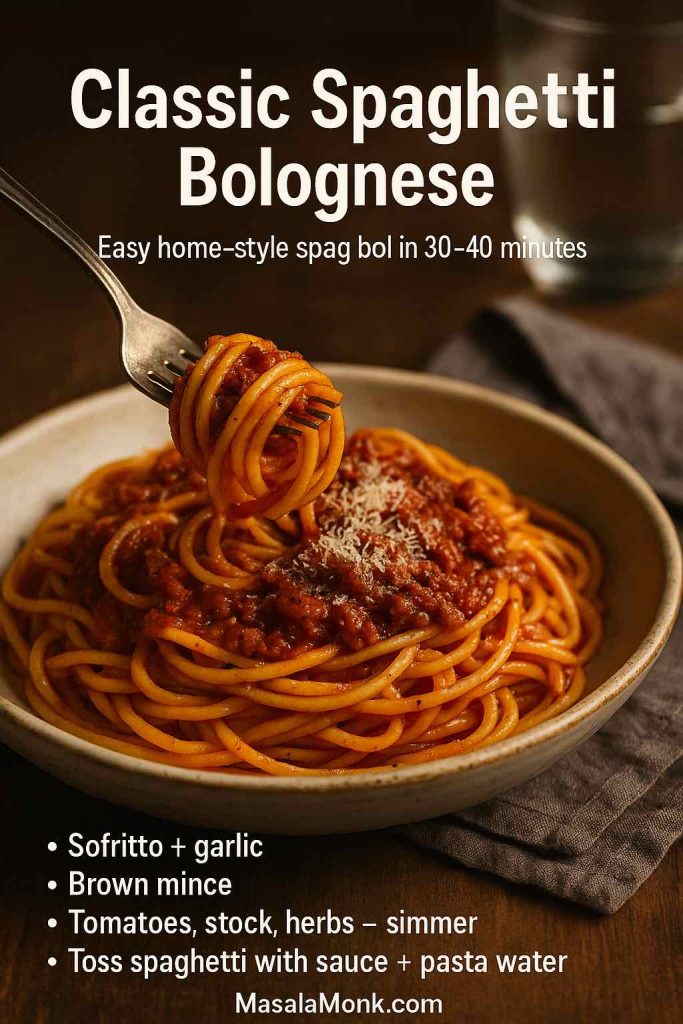
Authentic ragù alla bolognese vs spaghetti bolognese: in Italy, bolognese is a slow-cooked, meat-first ragù served with fresh egg tagliatelle, while the global “spag bol” is a brighter, tomato-rich meat sauce on dry spaghetti.
That “real bolognese” has a few defining features:
The sauce is meat-forward, with tomato playing a supporting role
Milk or cream is added later to soften the acidity and give a subtle creamy bolognese texture
It’s traditionally served as tagliatelle al ragù or used as bolognese for lasagna, not piled on spaghetti
Outside Italy, the story twists. In the UK, Australia and beyond, “bolognese” usually means something closer to a rich tomato meat sauce. Classic spaghetti bolognese, basic spag bol recipe versions, healthy spag bol with hidden veg, easy spaghetti bolognese sauce made with a jar—all of those grew from the same idea, but in a different direction.
Instead of choosing between “authentic” and “comfort,” you can have both. Start with a traditional bolognese recipe that respects its roots, then build outwards into weeknight bolognese, veggie hack bolognese, and everything else you actually want to eat during the week.
Traditional Ingredients for Bolognese Sauce Recipe
Every variation starts with a few simple, powerful building blocks. If you understand those, you can improvise comfortably, whether you’re aiming for an authentic bolognese recipe, a healthier spag bol, or a vegetarian bolognese sauce.
Aromatic Sofritto
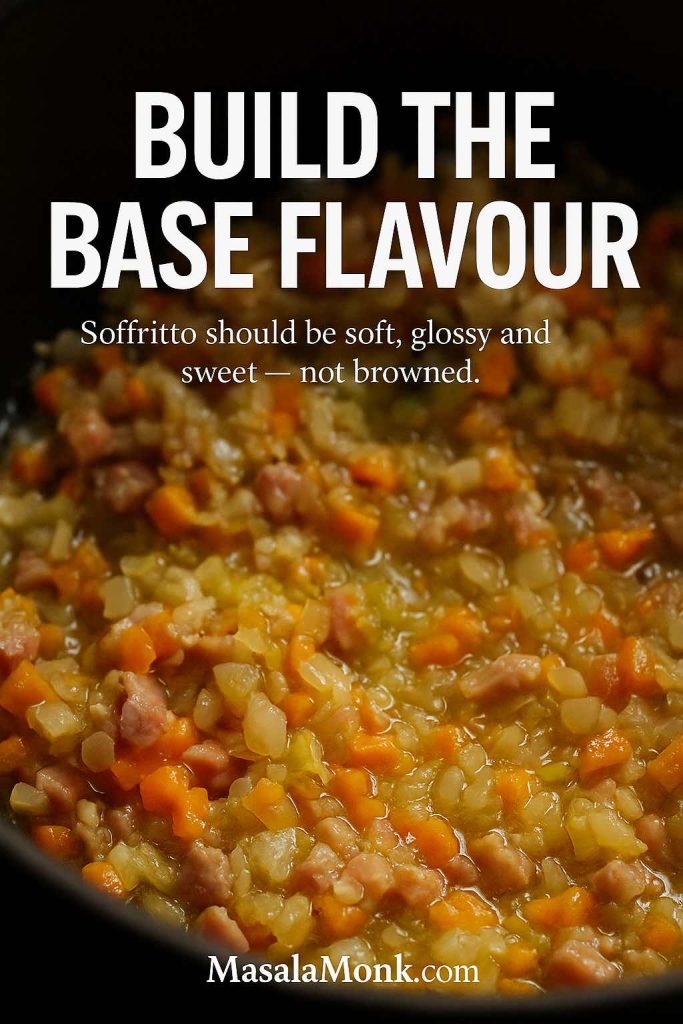
At the base of almost every traditional bolognese sauce recipe sits soffritto: finely chopped onion, carrot and celery gently cooked in fat until sweet and soft. This mixture is what gives depth and sweetness to both traditional spaghetti bolognese and more modern bolognese pasta recipes.
For four to six servings, a classic soffritto might be:
1 small onion
1 small carrot
1 celery stalk
If you’re making a big pot for bolognese for lasagna, baked bolognese pasta or bolognese lasagne, you can easily double that.
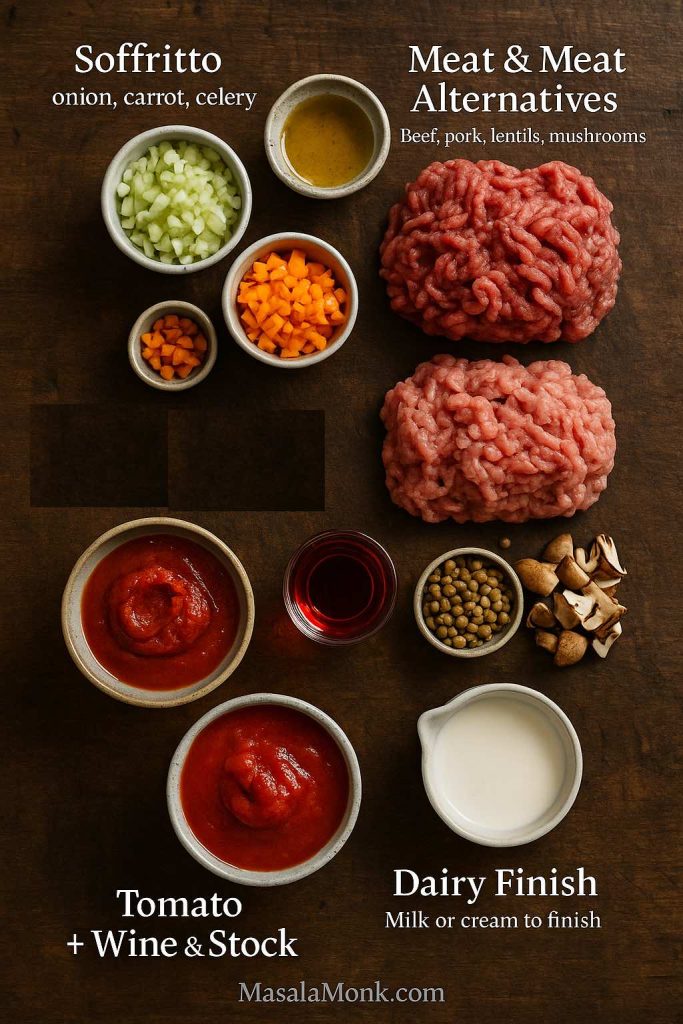
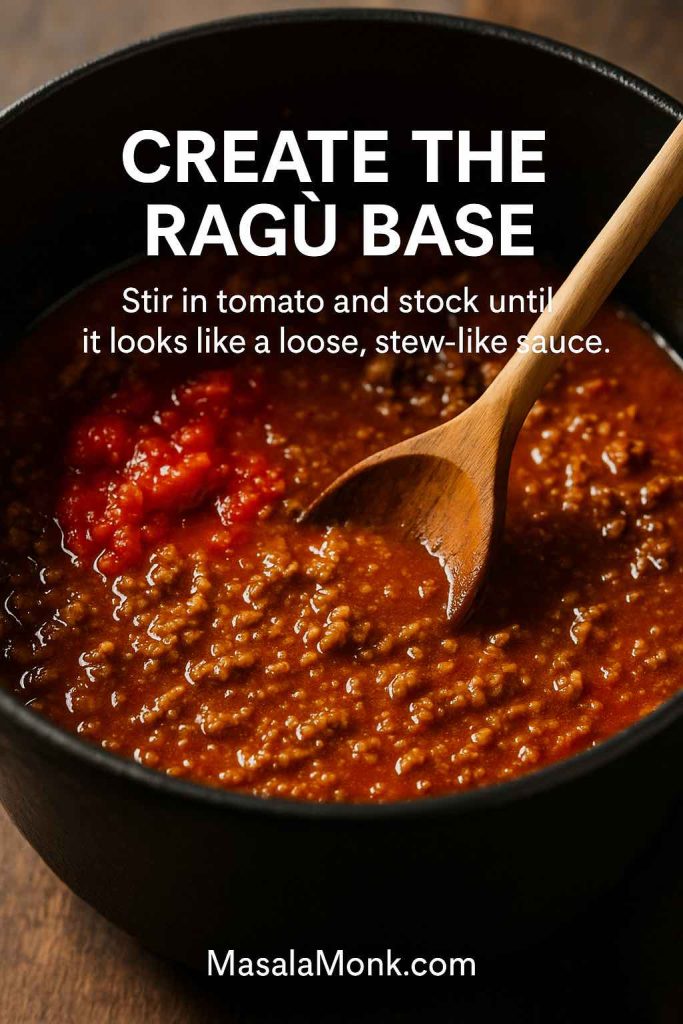
Traditional bolognese in four parts: soffritto for sweetness, beef and pork (plus lentils and mushrooms if you’re going veggie), a little tomato with wine and stock, and milk or cream to round the sauce into a classic ragù.
The Meat (or Meat Alternatives)
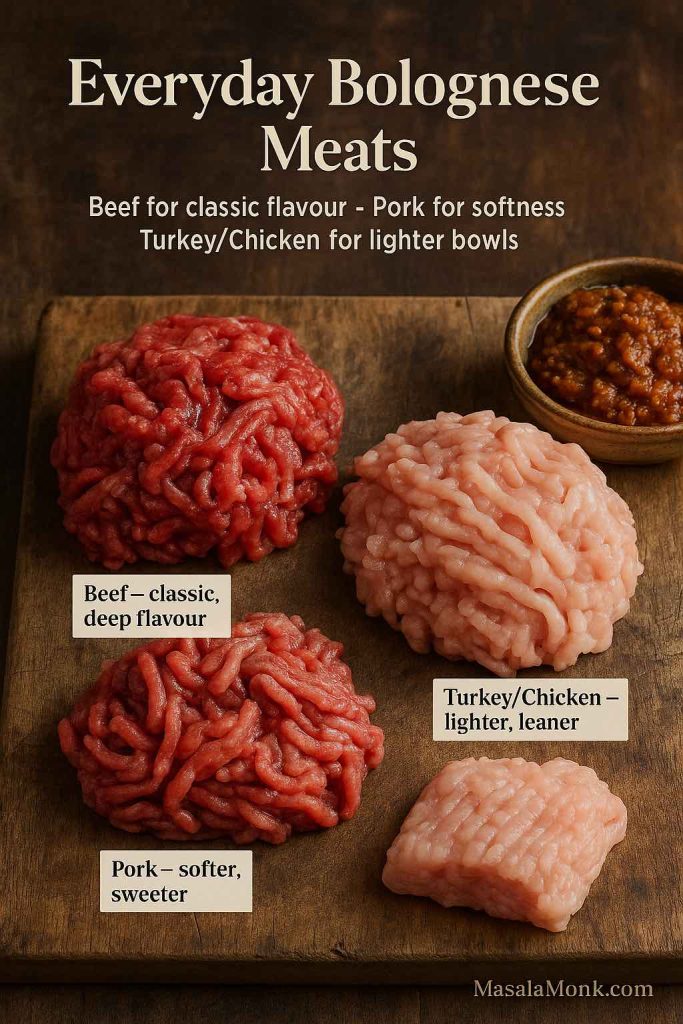
Traditional bolognese ingredients usually include:
Minced beef (often from a flavourful cut like chuck)
Sometimes pork mince or pancetta for sweetness and fat
That’s the foundation of beef bolognese, beef bolognese sauce and the best bolognese meat sauce recipes. However, the same structure works brilliantly with:
Pork mince for a softer bolognese with pork mince
A mix of beef and pork in classic spaghetti bolognese recipe variations
Turkey mince bolognese for a leaner, healthy spaghetti bolognese
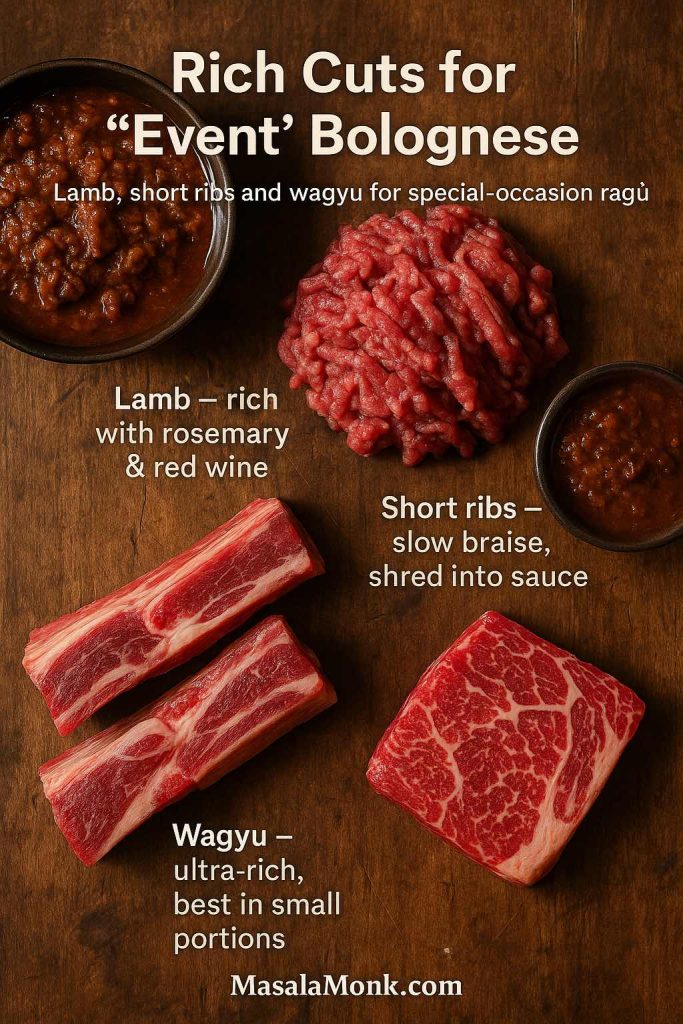
Lamb mince for a slightly gamey, richer bolognese meat
Short ribs or even wagyu in special-occasion bolognese with short ribs or wagyu bolognese
Quorn bolognese with soya or mycoprotein mince for a vegetarian spaghetti bolognese
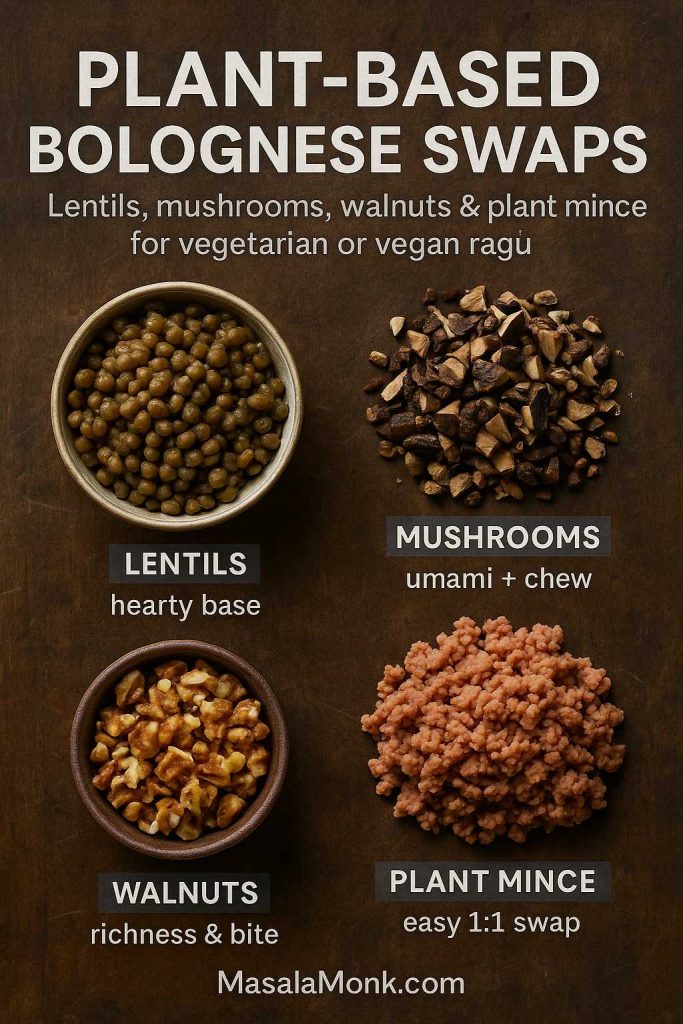
And beyond meat, lentils, mushrooms and walnuts can create a surprisingly convincing plant based bolognese, which we’ll get to in detail later.
Tomato, Wine and Stock
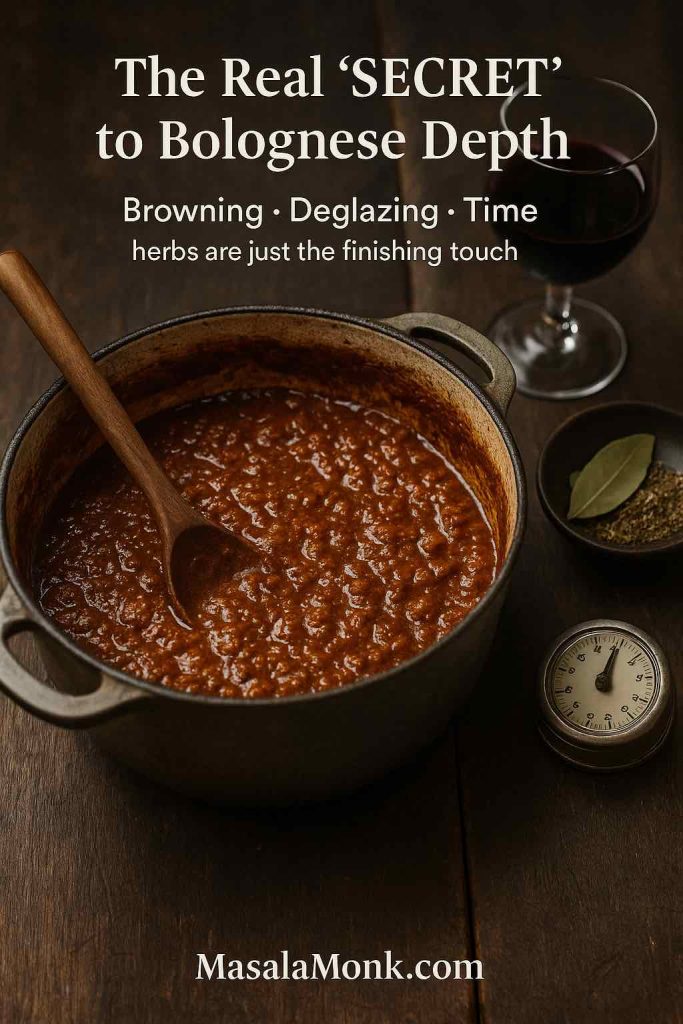
Authentic Italian bolognese sauce ingredients keep tomatoes modest. Instead of drowning the meat, tomato supports it:
A spoonful of tomato paste for colour and savoury depth
A cup or so of passata or crushed tomatoes
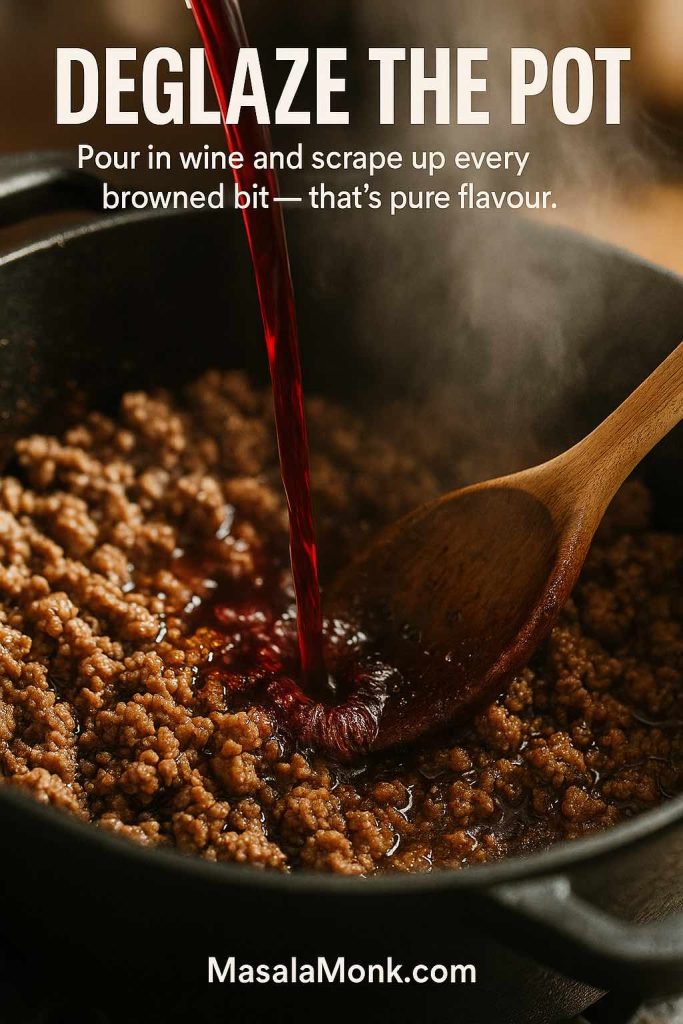
A good splash of red or white wine
Enough stock to give the sauce room to simmer and reduce
In more modern bolognese spaghetti bolognese recipes, you might see more tomato, especially in quick spag bol recipe easy variants or easy bolognese pasta that lean towards marinara. That’s still fine, as long as you keep the flavours balanced and let it cook down until rich rather than watery.
Dairy: Milk and Cream
One of the most surprising traditional bolognese sauce ingredients is milk. Many home cooks first meet this idea via Marcella Hazan’s bolognese, a justly famous recipe that finishes the ragù with warm milk to soften acidity and add silkiness.
Whether you’re following Marcella Hazan bolognese, a Serious Eats style authentic bolognese ragu recipe or your own family version, adding milk or a splash of cream at the end turns a basic meat and tomato sauce into something closer to classic bolognese sauce.
Authentic Bolognese Sauce (Traditional Ragù alla Bolognese Recipe)
Let’s start with an authentic bolognese sauce recipe you’d be happy to serve to an Italian. It’s a little closer to the official Bologna versions and to classic recipes from cooks like Marcella Hazan, but written for a home kitchen.
Think of this as your traditional bolognese recipe: deep, savoury, and patient. It’s perfect for bolognese lasagne, bolognese rigatoni or bolognese tagliatelle, and can still double up as a killer spaghetti bolognese sauce if that’s what the table expects.
Authentic bolognese sauce in the pot: after two to three hours of gentle simmering, the ragù should be thick, glossy and meat-first, leaving a trail when you drag a spoon through it—ready for that final splash of milk and a pinch of nutmeg.
Ingredients for Traditional Bolognese
For about 6–8 portions of classic bolognese sauce:
2 tbsp olive oil or a mix of oil and butter
75–100 g finely diced pancetta or streaky bacon
1 small onion, finely chopped
1 small carrot, finely chopped
1 small celery stalk, finely chopped
500 g beef mince (20% fat works well)
150–200 g pork mince or extra beef (for bolognese with pork mince, just split 50/50)
150 ml dry red or white wine
350–400 g tomato passata or crushed tomatoes
1–2 tbsp tomato paste
400–500 ml light stock (beef, chicken or vegetable)
200 ml whole milk (for that silky, creamy bolognese sauce finish)
Salt, black pepper
Pinch of nutmeg (classic in authentic bolognese sauce)
Those same ingredients work as the core bolognese ingredients list whether you’re doing tagliatelle bolognese, bolognese lasagne, or a big pan of bolognese rigatoni. You’ll notice how close this is to the Bologna and Accademia versions – same structure, just rounded in home-cook language.
Step-by-Step Method of Authentic Bolognese Sauce Recipe
Step 1 – Start with the pancetta and soffritto
Pour the olive oil into a heavy-bottomed pot (a Dutch oven is ideal) and set it over low–medium heat. Add the diced pancetta to the cold oil so the fat has time to slowly render rather than seize up and burn.
Step 1 – Build the base flavour: cook onion, carrot, celery and pancetta slowly until they’re soft, glossy and sweet. If the soffritto browns, the whole bolognese will taste harsher.
As the pancetta turns lightly golden and the fat melts out, stir in the finely chopped onion, carrot and celery. Keep the heat gentle; you’re sweating the vegetables, not frying them.
Stir every few minutes so nothing catches.
If the edges start to brown too fast, lower the heat.
After 10–15 minutes, the soffritto should be soft, glossy and smell sweet rather than sharp.
You’re building the foundation of flavour here. A patient soffritto is what makes the sauce taste like bolognese, not just “mince in tomato.”
Step 2 – Brown the mince properly
Once the vegetables are silky and fragrant, add the beef and pork mince to the pot along with a generous pinch of salt. Use a wooden spoon to break the mince up into small pieces, mixing it thoroughly through the soffritto.
Step 2 – Brown for real flavour: keep cooking after the mince turns grey; wait until the liquid evaporates and you see deep brown, caramelised bits. That’s what gives bolognese its savoury backbone.
Raise the heat slightly so the meat sizzles rather than steams.
At first, the mince will release liquid and look grey. Keep going.
Continue cooking, stirring occasionally and scraping the bottom, until that liquid evaporates.
You’re aiming for the meat to lose its raw colour and start taking on little browned, caramelised spots.
This is the point where the mince moves from “cooked” to “tasty.” The browning reactions happening here are what give a real bolognese ragù its deep savoury backbone. Don’t rush this step; it’s often the difference between an average sauce and a great one.
Step 3 – Deglaze with wine
When the mince is evenly browned and you can see some browned bits stuck to the bottom of the pot, pour in the wine. You should hear a lively hiss as the liquid hits the hot surface.
Step 3 – Deglaze the pot: add wine and scrape the bottom so every browned bit dissolves into the sauce. That’s how you turn caramelised scraps into deep bolognese flavour instead of burnt residue.
With your spoon, scrape along the base of the pot to loosen those caramelised bits into the wine. That’s pure flavour dissolving back into the sauce.
Let the wine bubble briskly for a few minutes.
You’ll see the steam change from sharp and alcoholic to softer and winey.
Stop when the pot looks mostly dry again and the meat smells rich, not boozy.
Deglazing does two things at once: it cleans the bottom of the pot and pulls all that stuck-on goodness into the sauce, while the acidity of the wine brightens the eventual richness of the ragù.
Step 4 – Add tomato and stock
Now stir in the tomato paste and cook it for a minute or so, letting it darken slightly. This cooks off any raw acidity and boosts the tomato flavour.
Step 4 – Create the ragù base: once the wine has reduced, stir in tomato and stock until the meat is just submerged and the mixture looks like a loose stew. It will thicken and concentrate later as it simmers.
Next, add the passata or crushed tomatoes and pour in enough stock to loosen everything into a thick, stew-like mixture. The meat should be fully submerged but the sauce should still feel substantial, not watery.
Give everything a good stir so the tomato, stock and mince are evenly mixed.
At this stage, the sauce will look looser than a finished bolognese—that’s exactly how it should be.
You’ve assembled all the players. The rest of the magic comes from low, slow cooking.
Step 5 – Simmer low and slow
Bring the pot just up to a simmer. As soon as you see steady bubbles, lower the heat to the point where you only see the occasional lazy blip on the surface.
Step 5 – Low & slow magic: keep the heat just high enough for lazy bubbles and let the ragù gently reduce for a couple of hours. When it’s thick, glossy and clinging to the spoon, you’re ready for the final finish.
Set the lid slightly ajar so steam can escape and the sauce can reduce. Now let time do its work.
Stir every 20–30 minutes, making sure nothing is sticking at the bottom.
If the sauce looks too thick or starts to catch, add a small splash of stock or water.
If it still looks quite liquid after an hour, don’t worry—flavour is concentrating as it reduces.
Over two to three hours, the ragù will gradually transform:
The sauce thickens and clings to the spoon.
The fat and liquid emulsify rather than separating into layers.
The vegetables almost disappear into the sauce, leaving sweetness behind.
You’ll know it’s close when a spoon dragged across the bottom leaves a faint trail before the sauce slowly flows back.
Step 6 – Finish with milk and nutmeg
When the ragù is thick, unified and deeply fragrant, pour in the milk (or milk and cream mixture). Stir it through and keep the heat low so it barely simmers.
Step 6 – Finish the ragù: stirring in milk at the end softens the acidity of the wine and tomato and gives the bolognese a mellow, silky texture that tastes unmistakably “Italian” rather than just mince in tomato sauce.
Let it cook gently for another 20–30 minutes. The dairy will:
Soften any remaining sharpness from the wine and tomato
Give the sauce a subtle, velvety richness
Add that characteristic mellow note you notice in authentic bolognese
Taste and adjust the seasoning with salt and pepper. If you like, grate in a small pinch of nutmeg—a traditional touch that adds warmth without making the sauce taste “spiced.”
Result
At this point, the ragù should be:
Thick but still spoonable
Glossy, with no oily layer sitting on top
Savoury, gently sweet, and in no way overtly tomatoey
That’s your “real bolognese sauce”—the sort of ragù you’d happily ladle over fresh tagliatelle or fold into a lasagne ragu bolognese with béchamel, cuddle with gnocchi, or be portioned into containers for future pasta nights.. If you want to compare ratios and methods, Marcella Hazan’s bolognese sauce is still one of the most respected versions in English, and you’ll see how similar the bones really are.
Authentic ragù alla bolognese: thick, meat-first sauce clinging to fresh tagliatelle, the way it’s actually served in Bologna – and just as happy layered into lasagne or spooned over gnocchi.
This traditional bolognese sauce recipe is your workhorse. Use it for:
Tagliatelle with bolognese sauce or linguine with bolognese sauce
Bolognese for lasagna (with béchamel or cottage cheese layers)
Baked gnocchi bolognese or baked bolognese spaghetti in one pot
Classic Spaghetti Bolognese (Easy, Traditional Spag Bol)
Now for the dish most people actually cook every week: spaghetti bolognese. It may not be canonical in Bologna, where they prefer egg pasta, spaghetti bolognese is a classic in countless homes isn’t going anywhere – so let’s make it as good as it can be.
Here’s a straightforward spaghetti bolognese recipe that gives you that cosy, slightly tomato-richer flavour a lot of families love:
Ingredients for Classic Spaghetti Bolognese
2 tablespoons olive oil
1 onion, finely diced
1 carrot and 1 celery stalk, finely diced
2 cloves garlic, minced
500 g beef mince (or a mix of beef and pork)
150 ml red wine (optional but nice)
400 g can chopped tomatoes
1 tablespoon tomato paste
250–300 ml beef or vegetable stock
1–2 teaspoons dried mixed Italian herbs
Salt, pepper, pinch of sugar if needed
400–500 g dried spaghetti
Classic spaghetti bolognese: a cosy, tomato-rich spag bol you can cook in 30–40 minutes. Build a quick soffritto, brown the mince, simmer with tomatoes, stock and herbs, then toss the spaghetti with the sauce and a little pasta water so it clings instead of sliding off.
How to Make Classic Spaghetti Bolognese
Sauté onion, carrot, and celery in olive oil until soft and lightly golden.
Add the garlic and cook for a minute.
Stir in the mince with salt and pepper, then cook until browned.
Mix in the tomato paste and let it toast slightly.
Pour in the wine and let it simmer down.
Add chopped tomatoes, stock, and dried herbs.
Let everything simmer for 30–40 minutes, stirring occasionally, until thick.
Meanwhile, cook the spaghetti until al dente. Instead of dumping sauce on top of plain pasta, toss the spaghetti into a pan with the sauce and a ladle of pasta water. Stir over the heat for a minute so the starch, water, and sauce form a light coating that clings, the way every good spaghetti bolognese sauce should.
From that basic structure, you can riff endlessly:
Make a traditional spaghetti bolognese by adding a splash of milk near the end.
Turn it into healthy spaghetti bolognese by swapping some of the mince for mushrooms and grated carrot.
Use pork mince spaghetti bolognese for a slightly softer, milder profile.
Make a simple bolognese recipe with no wine by just using extra stock and tomato.
The ingredients to make spaghetti bolognese are also forgiving. A handful of chopped mushrooms or zucchini can disappear into the pot and give you a subtle bolognese with veggies effect without making it feel like a health compromise.
Quick Bolognese, Weeknight Bolognese and Jar Hacks
On a Wednesday night, you may not feel like simmering a sauce for hours. That’s when easy bolognese recipes and jar-sauce upgrades get you out of trouble.
Easy Bolognese Sauce Recipe with Jarred Sauce
Think of this as “weeknight bolognese” rather than “perfect ragu”, a quick weeknight bolognese or easy spaghetti bolognese sauce can still be serious:
Soften a chopped onion and a small amount of carrot and celery in olive oil.
Brown 400–500 g mince (beef, turkey, or a mix) in the same pan.
Pour in a jar of decent tomato sauce or plain passata.
Rinse the jar with a little stock or water and add that too.
Season with bay leaf, oregano, thyme, salt, and pepper.
Simmer for 15–20 minutes while you cook the pasta.
Stir in a dash of milk or cream at the end to give it that almost creamy bolognese sauce feel.
To make a bolognese mix like this taste homemade, spices for spag bol really matter. You don’t need anything exotic—just use fresh dried herbs, grind your pepper, and let the sauce cook for at least a bit so flavours meld instead of tasting raw.
Weeknight bolognese from a jar: soften a little soffritto, brown the mince, then let a decent jar of sauce simmer with stock, herbs and a dash of milk or cream. In 20 minutes you get a bolognese that tastes far more “homemade” than its ingredients suggest.
You can then:
Toss through penne for a quick penne bolognese
Turn it into baked bolognese pasta by mixing with rigatoni, topping with cheese and baking
Layer it with lasagna sheets and béchamel for a very speedy lasagna bolognese
If you want more inspiration for turning jarred sauces into satisfying meals, the cottage cheese lasagna recipe on MasalaMonk is a good example of how a few simple tweaks can upgrade convenience ingredients into something that feels handmade.
One-Pot Bolognese Sauce Recipe and Baked Variations
Once you’ve accepted that weeknight bolognese can be quick, it opens up other possibilities:
One pot pasta bolognese: toast the pasta briefly in the pot, then add sauce and water and cook until everything is done at once.
Baked bolognese spaghetti: parboil spaghetti, mix with a thick sauce, scatter mozzarella and Parmesan, and bake until bubbling.
Baked gnocchi bolognese: toss gnocchi with sauce in a baking dish, top with cheese, and cook until the top is crisp and the inside is soft and saucy.
For a soupier, spoonable take on these flavours, MasalaMonk’s crock pot lasagna soup shows how to translate a thick meat sauce into a brothy, noodle-filled bowl. You can absolutely use leftover bolognese for that.
Meat Variations: Beef, Pork, Turkey, Lamb & Short Ribs
Once your basic bolognese sauce recipe is under control, changing the meat is an easy way to keep things interesting.
Everyday Mince: Beef, Pork, Turkey
The classic is beef bolognese sauce: all beef, cooked slowly until deep-flavoured. For a slightly sweeter, softer ragu, bolognese with pork mince or a half-and-half beef and pork mixture works beautifully.
Everyday bolognese meats: beef gives that classic, deep flavour; pork adds softness and a gentle sweetness; turkey or chicken makes a lighter, leaner sauce that still clings beautifully to pasta if you support it with good soffritto and stock.
When you want something lighter, turkey bolognese and turkey mince bolognese can be surprisingly satisfying. Turkey needs a bit more help from olive oil, soffritto and stock, but if you give it time, you still get a rich, clingy sauce that pairs nicely with penne, rigatoni or spaghetti.
Chicken mince behaves in a similar way. Combined with white wine, plenty of herbs and maybe a little cream, it leads toward a lighter bolognese cream sauce that feels somewhere between ragù and a rustic chicken pasta.
Rich Cuts and Slow Braises
Then there are the “event” versions:
Lamb bolognese: fantastic with rosemary, red wine, and pappardelle.
Wagyu bolognese: intensely rich, so best with sturdier pasta and smaller portions.
Beef short rib bolognese or bolognese with short ribs: braise the ribs in the sauce, shred the meat, and fold it back in.
Rich cuts for “event” bolognese: lamb loves rosemary and red wine, beef short ribs turn melting and silky when braised then shredded into the sauce, and wagyu brings so much richness that a little goes a long way in a luxurious ragù.
These richer versions shine in bolognese bechamel lasagna or in a big tray of rigatoni bolognese baked under a blanket of cheese. Once you’ve put in that kind of effort, it’s also worth stretching the leftovers: spooning some of the sauce over rice, polenta, or even into a bolognese and rice bake for a second dinner.
A vegetarian bolognese recipe shouldn’t feel like a consolation prize. The best versions still lean on soffritto, browning, deglazing and long simmering; they just use a different “mince.”
Lentil & mushroom vegan bolognese: proof that a plant-based ragù can still feel like proper comfort food—high in protein and fibre, rich with umami from lentils and mushrooms, and perfect over wholegrain spaghetti or tagliatelle.
Lentil Bolognese Sauce: The Classic Plant-Based Recipe
For a basic lentil bolognese recipe, you can follow almost exactly the same steps as the meat version:
Cook onion, carrot, and celery slowly in olive oil.
Add a cup of rinsed green or brown lentils and toast them briefly.
Stir in tomato paste, chopped tomatoes, herbs and stock.
Simmer until the lentils are tender and the sauce is thick.
The result is a lentil bolognese sauce that’s earthy, robust, and surprisingly “meaty” over spaghetti or tagliatelle. For a stripped-back, pantry-friendly version, this red lentil bolognese from Rainbow Plant Life is a brilliant reference: just a handful of ingredients, but a lot of depth thanks to wine, nuts and long simmering.
If you’re curious about using lentils instead of meat more broadly, MasalaMonk’s lentil meal prep ideas show how lentil bolognese slots into a week of plant-based high-protein meals alongside curries, stews and salads.
Mushroom Bolognese Sauce and Veggie Hack Bolognese Recipe
When you want something closer in appearance to mince, mushroom bolognese is your friend:
Finely chop mushrooms (a food processor helps)
Dry-fry them until they release their water and start browning
Build the rest of the sauce around them as usual
This style of mushroom bolognese works nicely in traditional spaghetti bolognese recipes, but it really shines with rigatoni, macaroni or other short pasta shapes where the mushroom pieces can tuck into the hollow spaces.
For a seriously convincing plant based bolognese, combining mushrooms and lentils gives you both chew and richness. The lentil and mushroom bolognese at Lazy Cat Kitchen is a textbook example: a deep, umami-packed ragù that just happens to be vegan.
Plant-based bolognese swaps: lentils give you a hearty base, mushrooms add umami and chew, walnuts bring richness and bite, and plant mince works as an easy 1:1 swap for meat in vegan or vegetarian ragù.
Fully Vegan Recipe of Bolognese Sauce
A good vegan bolognese recipe still relies on:
Soffritto for sweetness
Mushrooms for savoury depth
Lentils, textured soy, or plant mince for protein
Wine, stock and tomato for structure
If you swap dairy milk for oat, soy or cashew milk at the end, and use olive oil plus nutritional yeast instead of butter and Parmesan, you end up with a vegan bolognese sauce that behaves almost exactly like the traditional ragù.
For a glimpse at how hearty that can be, Lazy Cat Kitchen’s protein-rich vegan bolognese pairs wholemeal pasta with lentils and walnuts in a way that feels like a post-gym meal more than a “diet dish”.
And if you like building whole weeks of plant-based meals around pasta, sauce, and high-protein ingredients, MasalaMonk’s high-protein pasta dishes are full of ideas that sit comfortably next to a veggie bolognese on your rotation.
Pasta for Bolognese: Tagliatelle, Rigatoni, Penne, Gnocchi & More
Once the sauce is ready, the shape of the pasta changes everything. Each shape has its own vibe, and bolognese plays differently with each.
Tagliatelle, Pappardelle and “Proper” Pairings
In Bologna, the canonical order is tagliatelle al ragù: fresh egg pasta ribbons with a slightly rough surface that cling to the sauce. When you see tagliatelle with bolognese sauce on a menu in Italy, that’s usually what you’re getting.
You can extend that logic to:
Bolognese tagliatelle for Sunday lunch
Bolognese with pappardelle when you’ve got a richer, chunkier sauce
Lasagne ragu bolognese, where sheets of pasta alternate with ragù and béchamel
These pairings make the most sense when you’re using a more traditional bolognese sauce recipe—meat-forward, modest tomato, a long simmer.
Best pasta shapes for bolognese: tagliatelle is classic with authentic ragù, rigatoni and penne shine with chunkier or baked bolognese, spaghetti carries the global “spag bol” favourite, while gnocchi and lasagne turn the same sauce into cosy oven bakes.
In real life, you’re often cooking with whatever’s in the cupboard. Happily, bolognese is democratic:
Spaghetti bolognese: the iconic spag bol, easy to twirl and kid-friendly.
Rigatoni bolognese: hollow tubes that hold little pockets of sauce, perfect for chunkier ragù.
Penne with bolognese sauce: easy to eat with just a fork, brilliant in lunchboxes.
Bolognese macaroni: a comfort classic that feels like a halfway point between ragù and mac and cheese.
As long as you cook the pasta to al dente and finish it in the sauce with a bit of pasta water, nearly any shape will work. If you want to switch things up entirely, you can even step into low-carb territory and turn a thick sauce into spaghetti squash bolognese or spoon it over roasted vegetables.
If you’re in a pasta-sauce mood generally, and not just in a bolognese one, MasalaMonk’s pesto recipes are a nice counterpoint: classic basil pesto, vegan pesto, and even Indian-twist pesto for the days when you want something fresh and herb-forward rather than slow-cooked and meaty.
Lasagna, Gnocchi and Other Vehicles for Bolognese
Bolognese doesn’t have to live only on pasta shapes. It’s just as happy:
Layered in a lasagna bolognese with béchamel and Parmesan
Stirred through gnocchi and baked under a cheesy crust
Spread on toasted bread as a kind of Italian sloppy joe
Spoon-ladled over polenta or mashed potatoes on a cold night
Lasagna bolognese: the smartest way to use leftover ragù—just layer it with lasagne sheets, béchamel and cheese, then bake until the top is blistered and golden.
If you’re in a lasagna mood, the béchamel sauce for lasagna guide on MasalaMonk walks through not only classic white sauce but also cottage-cheese-based and vegan versions, so you can tune your lasagna bolognese recipe to your crowd.
Seasoning, Spices and That “Secret” Bolognese Depth
A lot of people look for bolognese seasoning or spices for spag bol as if there’s a magic sachet that turns mince and tomato into a traditional bolognese sauce. In reality, the “secret” is more about technique than ingredients.
What Really Makes a Bolognese Taste Deep
Three habits matter more than any spice mix:
Browning Let the meat and vegetables brown slowly. Colour equals flavour, especially on the bottom of the pan.
Deglazing and reducing Use wine or stock to dissolve those browned bits, then reduce until the sauce tastes concentrated instead of watery.
Time Whether you’re using a slow cooker bolognese recipe, a stovetop pot, or even a pressure cooker, it takes time for everything to meld into a unified ragù instead of feeling like separate components.
The real “secret” to bolognese depth: it isn’t a magic spice mix, it’s taking time to brown the meat and soffritto properly, deglaze with wine to capture all the flavour, and let the sauce slowly reduce until it tastes rich before you even reach for herbs.
For herbs and spices in a proper bolognese recipe:
Keep it classic: bay leaf, oregano, thyme, black pepper
Go easy on strong dried herbs so the meat shines
Use a pinch of nutmeg in the milk phase for warmth
Once you’ve built that base, you can safely adjust heat (chilli flakes), sweetness (a tiny pinch of sugar if tomatoes are sharp) or richness (extra olive oil or butter at the end).
Because bolognese is rich, people often look for healthy spaghetti bolognese, healthy pasta bolognese, or lighter spag bol ideas that don’t feel like punishment.
Healthy spaghetti bolognese: swap in wholegrain pasta, add extra veg like mushrooms, carrot and zucchini, and use leaner mince or part-lentils so you keep the cosy bolognese feel without the heavy aftermath.
Here are a few ways to nudge your bolognese in that direction without losing what makes it comforting:
Swap part of the mince for finely chopped mushrooms and grated carrot: this instantly turns it into a quiet bolognese with veggies.
Use lentils in place of half (or all) of the meat for a lentil bolognese recipe that’s high in fibre and protein.
Choose wholegrain pasta, legume pasta, or even serve the sauce over roasted vegetables or spaghetti squash.
Skim excess fat from the surface of the sauce after it cools; the flavour stays, but the heaviness goes down.
It also helps to think of bolognese as one rich meal among many. If you combine bowls of classic spaghetti bolognese or lasagna bolognese with days built around high-protein salads and lighter pasta dishes—like the healthy tuna salad bowls or plant-based pasta ideas on MasalaMonk—you get the comfort without feeling weighed down by it.
Pulling It All Together
By now, bolognese should feel less like a single fixed recipe and more like a whole family of dishes:
Authentic bolognese ragu for long, lazy cooking days
Classic spaghetti bolognese and traditional spag bol for weeknight comfort
Easy bolognese sauce recipe variations with jarred sauce when time is tight
Rich bolognese with pork mince, turkey bolognese, lamb ragù or short rib bolognese depending on your mood
Vegetarian bolognese sauce, vegan bolognese, lentil bolognese and mushroom bolognese when you want plant-based days
Lasagna bolognese, baked bolognese pasta, and gnocchi bolognese for oven-baked cosiness
The Bolognese Playbook: start with one good ragù, then decide whether tonight is for slow-cooked authentic tagliatelle, quick family spag bol, a jar-hack weeknight pan, or a lentil-and-mushroom vegan version.
Once you’ve made this kind of bolognese sauce recipe a few times, you stop worrying about exact amounts and start cooking by feel: a little more stock here, a little longer on the simmer there, maybe an extra splash of milk at the end. The sauce tells you what it needs.
And the best part? Leftovers never feel like leftovers. They feel like a head start on the next meal—whether that’s a quick bowl of pasta bolognese, a slice of lasagne ragu bolognese, or a new experiment you haven’t named yet.
Leftover bolognese game plan: cool the sauce, stash portions in the fridge for 3–4 days or freeze for up to 3 months, then reheat with a splash of water or stock and turn it into quick pasta bowls, lasagna, baked gnocchi or rice bakes.
FAQs About Bolognese Sauce & Its Recipe
1. What makes an authentic bolognese sauce recipe different from regular meat sauce?
An authentic bolognese sauce recipe is built around slowly cooked meat and soffritto rather than a big hit of tomato. The sauce is thick, savoury and almost stew-like, with wine, stock and milk creating depth and balance. By contrast, a basic meat sauce or quick spag bol is usually more tomato-led, brighter, and cooked in a fraction of the time.
2. Is spaghetti bolognese actually Italian?
Spaghetti bolognese as most people know it is more of an international classic than a dish you’ll find in traditional trattorias in Bologna. In Italy, ragù alla bolognese is normally served with fresh tagliatelle or tucked into lasagne. Even so, spaghetti bolognese has become a beloved comfort food in many countries, so you can still enjoy it without feeling “wrong.”
3. Which pasta shape really works best for bolognese sauce?
For a truly authentic feel, fresh tagliatelle is considered the ideal partner for ragù alla bolognese because its broad, slightly rough ribbons capture the sauce so well. Nevertheless, rigatoni, penne, pappardelle and even macaroni bolognese all carry a hearty meat sauce beautifully. Spaghetti bolognese remains popular too, especially for everyday family dinners.
4. How is ragù alla bolognese different from a simple spag bol recipe?
Ragù alla bolognese is traditionally cooked for hours with a modest amount of tomato, plenty of soffritto, wine, stock and milk, resulting in a dense, clingy sauce. A simple spag bol recipe tends to be quicker, more tomato-heavy and often uses more dried herbs and garlic. Both are tasty, but the ragù is usually deeper and more rounded in flavour.
5. How long should I simmer an authentic bolognese sauce?
For a traditional bolognese sauce recipe, you’ll usually want at least two hours of gentle simmering, and three is even better if you have the time. During that period, the liquid reduces, the flavours concentrate and the meat softens into the sauce. Once the ragù is thick, glossy and no longer tastes sharply of tomato or wine, it’s ready.
6. Can I still make a good easy bolognese recipe on a weeknight?
You can absolutely create a satisfying easy bolognese recipe without devoting your whole evening to it. If you brown the mince properly, use a quick soffritto, add a decent tomato base and let it simmer even for 20–30 minutes, you’ll get far better flavour than a five-minute fry-up. A dash of milk or cream at the end nudges it closer to classic ragù.
7. Why does my bolognese sauce sometimes turn out watery?
A watery bolognese usually means too much liquid and not enough reduction time. If the sauce still looks thin, keep simmering with the lid off so steam can escape and the ragù can thicken naturally. Reducing slowly allows the flavours to concentrate instead of leaving you with a diluted, soupy bolognese.
8. What role does milk or cream play in bolognese sauce?
Milk or cream softens the acidity of the tomatoes and wine while giving the sauce a subtle silkiness. It also helps the fat and liquids emulsify so the ragù looks unified rather than split. Traditionally, dairy is added near the end of cooking so it gently transforms the sauce without curdling.
9. How can I make a healthier spaghetti bolognese without losing flavour?
For a healthier spaghetti bolognese, you can replace some of the mince with finely chopped mushrooms, lentils or extra vegetables like grated carrot and zucchini. You might also use leaner turkey or chicken mince and pair the sauce with wholegrain or legume pasta. With good browning and patient simmering, you’ll still get plenty of flavour even with these lighter tweaks.
10. What meat mixture works best in a classic bolognese meat sauce?
A blend of beef and pork mince is often considered the sweet spot for a classic bolognese meat sauce. The beef brings a deep, robust flavour, while the pork adds tenderness and a faint sweetness. You can adjust the ratio either way depending on whether you prefer something richer or more straightforward.
11. Can I use turkey or chicken mince for bolognese instead of beef?
Turkey mince bolognese and chicken versions are perfectly workable and can be lighter in fat. Because these meats are lean, it helps to use a generous soffritto, enough olive oil and a good stock to keep the sauce moist and flavourful. With a bit of extra patience, you’ll end up with a comforting but less heavy bolognese.
12. How is beef short rib bolognese different from regular mince bolognese?
Beef short rib bolognese starts with whole ribs slowly braised in the sauce until the meat falls off the bone. Once shredded, the beef has a luxurious, silky texture and a deeper flavour than standard mince. This style of ragù is particularly suited to pappardelle or lasagna bolognese for special occasions.
13. Which spices and herbs are best for spag bol seasoning?
Simple, classic flavours tend to work best for spag bol seasoning: bay leaf, oregano, thyme, black pepper and a hint of nutmeg. When you brown the meat properly and deglaze the pan with wine, you often need only modest amounts of dried herbs. Heavy-handed seasoning can overwhelm the slow-cooked taste that makes bolognese special.
14. Can vegetarian bolognese really feel as satisfying as the meat version?
A well-made vegetarian bolognese can be every bit as comforting as a traditional one if you treat it with the same care. Lentils, mushrooms, or plant-based mince can be browned, deglazed and simmered with soffritto, tomato and stock just like meat. The result is a sauce with real body and depth rather than a thin vegetable stew.
15. How do I turn a regular bolognese into a vegan bolognese sauce?
To make a vegan bolognese sauce, simply replace the meat with lentils, mushrooms or plant mince and use vegetable stock instead of meat stock. Later on, swap dairy milk for a plant milk such as oat or soy, or skip the milk entirely and finish with olive oil and nutritional yeast. The method stays the same, so you keep the comforting ragù texture.
16. Is lentil bolognese a good option for spaghetti or just for other shapes?
Lentil bolognese works very well with spaghetti because the lentils cling nicely to the long strands. Green or brown lentils give a pleasantly firm texture, while red lentils melt into a softer, creamier sauce. Either way, you get a high-protein, high-fibre bowl that still tastes like a proper pasta bolognese.
17. What exactly is mushroom bolognese and how should I use it?
Mushroom bolognese relies on finely chopped mushrooms browned until they mimic the texture and flavour of mince. Once they’re deeply golden, you add the usual soffritto, tomato and herbs so the sauce develops that familiar bolognese profile. It’s fantastic with tagliatelle, rigatoni or even layered into a vegetarian lasagne.
18. Can I use bolognese sauce directly for lasagna ragu bolognese?
Yes, bolognese sauce is the classic base for lasagna ragu bolognese, as long as it’s thick enough to hold its shape between layers. You simply combine it with sheets of pasta and a béchamel or white sauce before baking. If your sauce is a bit thin, simmer it a little longer until it becomes more concentrated.
19. Is bolognese good for pasta bakes like baked gnocchi bolognese?
Bolognese is ideal for pasta bakes because it already has the rich, clingy texture you want. You can mix it with cooked gnocchi, penne or rigatoni, add cheese on top and bake until bubbling. The oven time adds a new layer of flavour, turning leftover ragù into an entirely fresh meal.
20. How much bolognese sauce should I use per portion of pasta?
As a rough guide, many cooks aim for enough bolognese to generously coat the pasta without creating a soup. Typically, that means pairing 80–100 grams of dry pasta with about one good ladle or two large spoonfuls of sauce. If the pasta looks pale or dry after tossing, you can always add a little more.
21. Can I cook bolognese in a slow cooker or crock pot?
Bolognese adapts very well to slow cookers because it thrives on long, gentle heat. It’s still worth browning the soffritto and mince in a pan first, then transferring everything to the slow cooker with tomato, stock and seasoning. Several hours on low will give you a mellow, deeply flavoured slow-cooker bolognese.
22. Is it acceptable to use jarred sauce in an easy bolognese recipe?
Using jarred sauce is perfectly practical when you’re short on time. If you first build flavour with soffritto and browned mince, then pour in a jar of tomato sauce, you can still achieve a robust weeknight bolognese. Allowing it to simmer briefly and finishing with milk or cream makes it taste far more homemade.
23. How long can homemade bolognese sauce be kept in the fridge?
Homemade bolognese usually keeps well in the fridge for about three to four days if stored in an airtight container. It often tastes even better the next day after the flavours settle. Just be sure to reheat it thoroughly and add a splash of water or stock if it has thickened too much.
24. Can I freeze bolognese sauce, and if so, how should I do it?
Bolognese freezes extremely well, which makes it perfect for batch cooking. Once the sauce has cooled completely, portion it into containers or freezer bags and store it for up to three months. Later, you can thaw it gently in the fridge and reheat on the hob, adjusting the thickness with a little liquid if needed.
25. Why does my bolognese sometimes taste bland even after a long cook?
If your bolognese tastes flat, it often means something was missing at the browning stage or the sauce wasn’t reduced enough. Thoroughly caramelising the meat and vegetables at the start and letting the ragù cook down until concentrated usually solves this. A final check for salt, pepper and a tiny splash of acid (like extra wine or tomato) can bring it to life.
26. Can I make a bolognese sauce recipe without wine?
You can absolutely skip wine if you prefer not to cook with alcohol. In that case, you can use extra stock and perhaps a little tomato juice or vinegar to bring some brightness. As long as you still brown the meat properly and simmer the sauce long enough, you’ll end up with a satisfying bolognese.
27. What’s the best way to reheat leftover spaghetti bolognese?
For the best texture, it’s ideal to reheat the bolognese sauce separately and toss it with freshly cooked pasta. However, if everything is already mixed, warm it in a pan with a splash of water, stirring gently so the spaghetti doesn’t break too much. Once heated through, you can finish with a little fresh cheese or olive oil.
28. How do I turn regular bolognese into a richer, creamy bolognese sauce?
To create a creamier bolognese, you can stir in some milk, cream or mascarpone near the end of cooking and let it simmer briefly. This technique softens the sauce and adds a luscious texture without turning it into a full cream pasta. It works beautifully over tagliatelle or as a base for bolognese lasagne.
29. Is it a good idea to add extra vegetables to my bolognese?
Adding extra vegetables is a great way to build a veggie bolognese without losing the essence of the dish. Finely chopped mushrooms, carrots, celery, peppers or spinach can all melt into the sauce and boost nutrition. When they’re cooked down properly, you still taste “bolognese” rather than a random vegetable stew.
30. What can I do with leftover bolognese sauce apart from serving it with pasta?
Leftover bolognese is incredibly versatile, so it rarely needs to go back on spaghetti unless you want it to. You can spoon it over baked potatoes, tuck it into stuffed peppers, layer it into a small lasagne or bake it with gnocchi and cheese. It also makes a fantastic filling for toasted sandwiches, pies or even a bolognese and rice bake.
Some lasagne land on the plate as tidy, satiny squares, their layers distinct yet tender; others slouch apart, rich but oddly heavy. The difference, more often than not, is a confident Béchamel Sauce for Lasagna. This classic white sauce—built from a butter-and-flour roux whisked with milk—glues the pasta, ragù, and cheese together without weighing everything down. It’s one of the five “mother sauces” of French cuisine, a family of preparations that underpin countless dishes; if you’re curious about that lineage, the overview from the Auguste Escoffier School of Culinary Arts is a neat primer on why béchamel matters and how cooks riff on it across traditions (including the Mornay variation, which adds cheese) (learn more).
As we go, we’ll explore the classic method, a luscious ricotta–béchamel hybrid, and a plant-based version that behaves exactly like the dairy original. We’ll also walk through consistency cues, layering logic, and common mistakes—with calm, practical fixes—so your Béchamel Sauce for Lasagna performs beautifully every time.
At its heart, béchamel is simply milk thickened with a roux. You make a roux by cooking equal parts butter and flour until the paste foams and smells nutty. Keep it blond (not browned) for lasagna; a pale roux thickens more efficiently, giving you a sleeker sauce with less cooking. Season gently with salt, a pinch of white pepper, and just a whisper of fresh nutmeg. That’s it: no cheese yet, no garlic, no stock—just a neutral, creamy backbone ready to support the rest of the dish.
Add cheese to béchamel and you’ve made Mornay, which is wonderful in mac and cheese or as a gratin glue but a bit richer than you need for traditional lasagne. If you’d like to see how gently folding cheese into a hot white sauce creates that glossy, elastic finish (without turning grainy), our Macaroni & Cheese recipe offers a practical demonstration of melting off the heat and letting the sauce stabilize before serving.
Historically, Italian lasagne—especially the Bolognese style from Emilia-Romagna—embraces béchamel as a structural element rather than a dramatic flavor spike. It complements ragù; it doesn’t compete with it. La Cucina Italiana’s concise recipe for besciamella mirrors what generations of home cooks do: modest fat and flour, whisked with milk to a soft, spoon-coating body (classic Italian method).
Classic Béchamel Sauce for Lasagna: The Master Ratio and Why It Works
While plenty of cooks eyeball their béchamel by feel, a ratio keeps things reproducible—especially when you’re scaling up for guests. A widely used proportion is equal parts butter and flour by weight, then roughly ten parts warm milk by weight. For everyday home cooking, Italy’s common kitchen ratio—40 g butter + 40 g flour + 500 ml milk—is a friendly benchmark. It yields a softly thick sauce that clings to the back of a spoon (the classic nappe texture) without turning pasty.
Why blond matters. A pale roux maintains more thickening power than a darker one because less starch has broken down during toasting. That’s exactly what we want here: a silken texture at a gentle simmer, not a roasty, nutty profile that’d be more appropriate for gumbo or étouffée. If you want a deeper dive into roux behavior and the trade-off between flavor and thickening power, the science-forward guides at Serious Eats are terrific for grasping what’s happening in the pot and how to correct course if you overshoot the color (roux 101), (béchamel basics).
Texture, not time, is your compass. Rather than obsessing over minutes, watch how the sauce moves. When you lift the spoon, it should slide off in a continuous sheet, not in watery rivulets. Draw a finger along the spoon’s back; the line should stay clean. If the sauce feels sluggish, whisk in a spoon or two of warm milk. If it’s thin, simmer delicately for another minute and reassess. With that steady, patient approach, your Béchamel Sauce for Lasagna will end up glossy and cooperative, ready to layer.
Classic Béchamel Sauce for Lasagna—use the 40 g butter + 40 g flour + 500 ml milk ratio, whisk to a blond roux, then simmer to nappe for a silky base (≈4 cups, perfect for a standard 9×13).
The Method, Step by Step – How to Make Béchamel Sauce for Lasagna
Although the technique is short, each move earns its keep. Let’s walk through it explicitly, so nothing feels rushed.
Warm your milk first. Heat the milk separately until it’s steaming, not boiling. Warm liquid integrates into the roux more willingly, minimizing lumps and shaving time off the final simmer.
Cook a blond roux. In a heavy-bottomed saucepan, melt butter over medium-low. Scatter in an equal weight of flour and whisk constantly for 2–3 minutes. You’re aiming for a gentle foam and a pale straw color.
Off heat, add milk gradually. Take the pot off the burner. Whisk in a small splash of warm milk; when it’s smooth, add a little more, and a little more. As the mixture loosens and turns glossy, you can add the remaining milk in a steady stream.
Return to low heat and simmer. Put the pot back over low heat and whisk until the sauce gently bubbles. Keep it just below a boil; vigorous bubbling can scorch milk solids or create a grainy mouthfeel.
Season and adjust. Salt, a pinch of white pepper, and a tiny grating of nutmeg bring it into focus. Check texture; it should coat a spoon and flow slowly off the whisk.
That’s the base. From here, you can drive in several directions—straight into a lasagna pan, gently into ricotta for a smooth hybrid, or toward a vegan variant that behaves like this one but uses plant milk and olive oil.
How Much Béchamel Sauce for Lasagna You Actually Need
Because pan depth and noodle thickness vary, it’s easier to think in ranges. For a standard 9×13-inch lasagna, 4 to 5 cups of béchamel usually lands you in the sweet spot. Spread a thin smear on the bottom to prevent sticking; then build in repeating layers: béchamel → noodles → ragù → béchamel → grated cheese. Keep the béchamel layers thin yet continuous—enough to gloss the pasta and moisten the ragù so everything fuses.
Traditional Lasagne alla Bolognese from Emilia-Romagna follows precisely this logic—pasta, ragù, béchamel, Parmigiano, and repeat—resulting in slices that hold shape without drying out. For a lovely regional perspective on that structure, browse the official travel resources from Emilia-Romagna or articles documenting the classic recipe; they consistently place béchamel as the quiet, essential binder rather than a showy flavor bomb (regional context).
If you enjoy ricotta’s milky sweetness, you can absolutely keep it in play; we’ll fold it into béchamel in a moment. Meanwhile, if you’re looking to cross-reference other layering styles (including a cottage-cheese-forward path that meal-preps well), peek at Cottage Cheese Lasagna: Chicken, Spinach & Ricotta and adapt the assembly by swapping your béchamel for part of the cheese mix.
Ricotta–Béchamel Recipe: The Ultra-Smooth Cheese Layer
Some cooks love ricotta’s flavor but don’t always love its grainy, slightly crumbly texture in baked layers. Béchamel Sauce for Lasagna solves that beautifully when you blend the two.
Ricotta–Béchamel Cheese Sauce—fold ricotta and finely grated Parmigiano into hot béchamel off heat for a glossy, non-grainy layer; makes about 5 cups, ideal for a standard 9×13 lasagna.
How to make it:
Start with 4 cups hot béchamel at nappe consistency.
Whisk in 1 cup finely grated Parmigiano Reggiano off the heat until melted and glossy.
Fold in ½–1 cup ricotta, choosing a smooth variety; if it’s dense, whisk it briefly to loosen before blending.
Taste for salt and, if needed, add an extra tablespoon of grated Parmesan to sharpen the finish.
This hybrid behaves like a mellow Mornay—silky, cohesive, and easy to spread—while preserving ricotta’s clean dairy notes. If you’re curious which cheese finishes the top layer best (for bronzing without greasy puddles), our primer on the difference between Parmesan and Parmigiano Reggiano explains why the real thing seasons with a savory snap and melts more cleanly than many pre-grated blends.
Vegan Béchamel Sauce for Lasagna: Same Feel, Plant-Based Recipe
The plant-based route is gratifyingly simple because the physics don’t change—only the fat and the milk do.
Fat: Use olive oil or a neutral vegan butter.
Flour: Stick to all-purpose. Chickpea or whole-grain flours can add flavor; if you enjoy that, use them sparingly at first.
Milk: Opt for unsweetened soy or oat milk. Unsweetened soy melts into the background; oat brings a subtle, round sweetness. Almond milk can work but is thinner and may need a minute more simmering.
Seasoning: Salt, white pepper, nutmeg, plus an optional teaspoon of onion powder for savory backbone. If you want a slightly “cheesy” direction without adding actual cheese, whisk in a tablespoon or two of nutritional yeast.
Vegan Béchamel Sauce for Lasagna—use an olive-oil roux and warm unsweetened soy/oat milk, then simmer gently to nappe for a silky, slice-clean layer (≈4 cups in 12–15 minutes).
Technique-wise, everything mirrors the dairy version: warm the plant milk, cook a blond roux in oil, whisk off the heat, then return to a gentle simmer. If you’d like more ideas for building a fully vegan pasta night—high protein, big flavor—dip into our plant-based pasta collection for cashew-based sauces and other creamy profiles that pair beautifully with vegetables.
Seasoning and Aroma: Subtlety Wins
Because Béchamel Sauce for Lasagna plays a supporting role, restraint pays off. A scant pinch of nutmeg accentuates the sauce’s dairy sweetness without shouting; more than that can tilt perfumey. White pepper keeps flecks invisible and holds onto heat gently; black pepper works too, but the specks distract in a pale sauce. If your ragù is already intense, let béchamel stay quiet. Conversely, if your filling leans delicate—say, spinach and mushrooms—consider a whisper of fresh lemon zest to brighten the edges.
Crucially, avoid garlic in the béchamel itself; if you want a garlic presence, let it live in the ragù or a separate spinach layer, where it can sauté properly and won’t risk turning harsh in milk.
Successful layering is less about strict rules and more about a few guiding ideas:
Moisture distribution. Thin béchamel layers moisten the pasta while the ragù provides body. Too much béchamel in one spot can slip and puddle; too little leaves dry corners. Spread to the edges.
Cheese placement. Finely grate Parmigiano between layers rather than piling most of it on top. This encourages even melt and better slice integrity. Save a small handful for the surface to bronze.
Top management. Finish with a modest veil of béchamel and cheese, not a thick cap. That balance prevents rubbery tops and helps steam escape.
Layering Béchamel Sauce for Lasagna—plan ≈4–5 cups for a 9×13. Start with a base smear, then build pasta → ragù → béchamel → Parmesan; repeat, top lightly, and rest before slicing.
If you’re ever tempted to swap béchamel for a heavy cheese sauce on every layer, consider contrast. Let béchamel do the quiet binding and reserve richer, cheesier notes for a single inner layer or the finish. For a clear comparison of white sauces versus cream-based Alfredo styles (and when each shines), our Alfredo deep-dive lays out the differences so you can choose the right tool for the flavor you want.
Troubleshooting: Calm Fixes for Common Problems
Even experienced cooks run into little snags; the key is responding gracefully.
Lumps If lumps form, kill the heat immediately. Whisk hard for 20–30 seconds; most will dissolve as the starch hydrates fully. Still not smooth? Pour the sauce through a fine sieve into a warm pot and carry on. Next time, remember to whisk off the heat when adding milk and add it gradually.
Too Thick or Too Thin If your Béchamel Sauce for Lasagna feels gluey, whisk in warm milk a tablespoon at a time until it flows again. If it’s thin, give it a gentle simmer and the occasional whisk for another minute. Because a pale roux retains strong thickening power, tiny tweaks go a long way.
Nappe = the right thickness for béchamel: it coats the spoon, holds a clean finger line, and still pours smoothly—ideal for neat, sliceable lasagna layers.
Grainy After Adding Cheese This usually means the cheese overheated or the sauce boiled after the cheese went in. Melt cheeses off heat and stop stirring once they dissolve. You can always rewarm gently if needed. For technique cues that keep melted cheese smooth, the process notes in our Macaroni & Cheese guide are directly transferable.
Scorching Scorched milk is stubborn. If you catch the smell early, pour the unscorched top portion into a new pot, leaving any browned film behind. Keep heat low and whisk more frequently.
Breaking in the Oven If a lasagna looks greasy on top, it’s often because the cheese was too fatty or piled too thickly. Use a firm grana like Parmigiano for most of the top and keep any mozzarella to a light sprinkle; you’ll get bronze without pools. Our Parmesan vs. Parmigiano Reggiano piece clarifies why the real stuff behaves better under heat.
Béchamel is an ideal make-ahead component because it reheats predictably. After cooking, cool it quickly: transfer to a shallow container, press parchment or plastic directly onto the surface to prevent a skin, and refrigerate promptly. For general food-safety timing, U.S. guidelines recommend using refrigerated leftovers within 3–4 days, and, if you need a longer hold, freezing works well; thaw overnight and whisk while reheating, loosening with a splash of milk as needed (USDA/FSIS guidance), (FoodSafety.gov storage chart).
When reheating béchamel, keep the heat low and whisk patiently; it will return to its glossy self. If you’re turning it into a ricotta–béchamel blend, bring it to just-warm before whisking in cheese so everything integrates without curdling.
For Béchamel Sauce for Lasagna, cook the roux to blond: more thickening power and a silkier sauce.
Béchamel Sauce for Lasagna—Scaled Recipes You Can Memorize
Classic Béchamel (about 4 cups)
60 g butter
60 g all-purpose flour
600 g whole milk, warmed
1 tsp fine salt, pinch white pepper, tiny grating nutmeg
Directions: Make a blond roux (2–3 minutes). Off heat, whisk in warm milk gradually until smooth, then simmer gently for 6–8 minutes. Season and adjust to nappe.
Ricotta–Béchamel (for one 9×13-inch lasagna)
4 cups hot béchamel
1 cup finely grated Parmigiano Reggiano
½–1 cup smooth ricotta
Directions: Off heat, whisk Parmesan into béchamel until glossy; fold in ricotta. Taste and season. Spread thinly between layers.
Vegan Béchamel (about 4 cups)
60 g olive oil (or vegan butter)
60 g all-purpose flour
700 g unsweetened soy or oat milk, warmed (plant milks vary in body; start here)
1–1½ tsp fine salt, pinch white pepper, tiny pinch nutmeg
Beyond Lasagna: Using Béchamel Elsewhere (With Restraint)
Because béchamel is neutral and stabilizing, it shines in unexpected places:
Mac and Cheese. Fold in cheeses off heat to create a classic Mornay; the method used in our stovetop and baked mac & cheese keeps the sauce silky instead of clumpy.
Vegetable gratins. A modest layer underneath roasted cauliflower or leeks amplifies tenderness without drowning flavor.
Croque monsieur. Thin béchamel brushed onto the bread provides moisture insurance and browning potential.
Moussaka. A thicker béchamel (sometimes enriched with egg yolks) forms the custardy top; for a Greek-leaning lasagna night, it’s a lovely twist that still uses the same roux logic.
If you want to compare white-sauce approaches with cream-based pasta styles for variety in your weekly rotation, our Alfredo overview maps where béchamel-based sauces fit, and when to pivot to cream reductions instead.
Putting It All Together: A Calm, Confident Lasagna Flow
To bring the pieces together, work in an unhurried rhythm:
Cook béchamel first. It holds well and gives you time to tweak texture.
Taste your ragù. Salt it to where you want it, since béchamel will not compensate for underseasoning later.
Par-cook or soak noodles as needed. No-boil sheets drink up moisture; béchamel helps, but be generous with sauce coverage so the edges don’t crisp prematurely.
Layer lightly but completely. Each béchamel layer should be thin yet continuous, reaching every corner.
Finish modestly. A veil of béchamel and Parmigiano on top will bronze and stay supple.
Rest before slicing. Ten to fifteen minutes lets the starches set, giving you clean squares rather than slumps.
On nights when you want a lighter profile, choose the classic Béchamel Sauce for Lasagna and keep cheese modest. On nights when you crave dreamy richness, fold in ricotta for the hybrid. When cooking for plant-based friends, the vegan version slips into the stack quietly and delivers the same structure. Because the method is compact and forgiving, you’ll adjust by feel in no time.
Great béchamel is about attention, not fussiness. Warm the milk, whisk off heat, simmer gently, season with care, and trust your eyes more than the clock. Every pan, every burner, every batch of flour behaves a little differently; nonetheless, the cues never change. When the sauce coats a spoon and glides, when the layers spread thin and even, when the bake exhales a faint butter-and-nutmeg scent as it rests—you’ll know you’re there.
If you’d like more perspective on béchamel’s role in the wider culinary family, the Escoffier piece on mother sauces helps set the stage (read here). For nitty-gritty technique and starch science, Serious Eats offers clear, test-driven guidance on roux and white sauces (roux guide), (béchamel guide). And for your own kitchen reference, keeping an eye on safe cooling and storage windows will let you make sauce ahead without worry (USDA/FSIS), (FoodSafety.gov).
Meanwhile, for variations and related dishes in our repertoire, browse these companion reads on MasalaMonk:
Make your Béchamel Sauce for Lasagna once this way—patient, glossy, and balanced—and it will quietly upgrade every batch that follows.
FAQs
1) What is Béchamel Sauce for Lasagna, exactly?
Béchamel Sauce for Lasagna is a silky white sauce made from a blond roux (butter + flour) whisked with warm milk, lightly seasoned with salt, white pepper, and a hint of nutmeg. It binds layers, prevents dryness, and gives clean, sliceable structure.
2) What’s the ideal ratio for Béchamel Sauce for Lasagna?
Use equal parts butter and flour by weight, then about 10 parts milk by weight. For home cooking, 40 g butter + 40 g flour + 500 ml milk yields a classic, spoon-coating consistency.
3) How much béchamel do I need for a 9×13-inch pan?
Plan on 4–5 cups. Start with a thin smear in the pan, then use modest, even layers between noodles and ragù so everything fuses without becoming soupy.
4) Should I use béchamel, ricotta, or both?
Either works, yet combining them is lovely. Blend warm béchamel with ricotta and a little grated hard cheese for a smooth, cohesive “cheese sauce” that spreads evenly and bakes beautifully.
5) How thick should Béchamel Sauce for Lasagna be?
Aim for nappe: it should coat the back of a spoon and leave a clean line when you swipe a finger. If it’s too thick, add a splash of warm milk; if thin, simmer briefly to tighten.
6) Can I make Béchamel Sauce for Lasagna ahead of time?
Absolutely. Cool quickly, press parchment or plastic directly on the surface, and refrigerate. Reheat gently and whisk in a bit of milk to restore gloss.
7) Can I freeze béchamel?
Yes. Freeze in flat portions. Thaw overnight, reheat slowly, and whisk to smooth; add a spoon of milk if needed.
8) What’s the best milk to use?
Whole milk delivers classic body and flavor. For a lighter take, use 2% and simmer a minute longer. If you prefer richness, blend in up to 25% cream—but keep the texture pourable.
9) How do I fix lumpy béchamel?
Remove from heat and whisk vigorously; most lumps dissolve as starch hydrates. If needed, strain through a fine sieve into a warm pot and continue.
10) Why did my sauce turn grainy after adding cheese?
Cheese overheated. Next time, add cheese off heat and stir just until melted. For this recipe, keep béchamel plain between layers and use grated cheese sparingly for balance.
11) Can I make a vegan Béchamel Sauce for Lasagna?
Certainly. Swap butter for olive oil or vegan butter, use unsweetened soy or oat milk, and season as usual. Simmer a touch longer to remove any raw flour taste.
12) Is béchamel the same as white sauce?
Yes. “White sauce” is the common name for béchamel—milk thickened with a roux and gently seasoned. Add cheese and you’ve created a daughter sauce (often called Mornay).
13) Do I need nutmeg?
A small pinch accentuates dairy sweetness without dominating. Use a light hand so the sauce stays supportive rather than showy.
14) How do no-boil noodles change the amount of sauce?
No-boil sheets drink more liquid while baking. Consequently, keep your béchamel layers continuous (edge-to-edge) and lean toward the higher end of the 4–5 cup range.
15) Can I make gluten-free Béchamel Sauce for Lasagna?
Yes. Use a 1:1 gluten-free all-purpose blend for the roux. Cook the roux gently to remove raw flavors before whisking in warm milk.
16) How should I season béchamel for lasagna layers?
Season lightly—salt, white pepper, a whisper of nutmeg. Let the ragù and finishing cheeses carry most of the bold flavors, while béchamel provides balance and moisture.
17) Will béchamel make my lasagna watery?
Not if it’s cooked to nappe and spread thinly. Watery results usually come from under-reduced ragù, overpacked fillings, or uncooked vegetables releasing liquid.
18) What’s the best way to layer with Béchamel Sauce for Lasagna?
Begin with a thin béchamel smear in the pan, then alternate: noodles → ragù → béchamel → a light sprinkle of grated hard cheese. Finish with a modest veil of béchamel and cheese on top.
19) How long should lasagna rest after baking?
Give it 10–15 minutes. Resting allows starches and fats to settle, helping slices hold their shape.
20) Can I flavor béchamel with aromatics?
For lasagna, keep it quiet. If desired, infuse the milk with a bay leaf or onion, then strain. Avoid sautéed garlic in the béchamel itself; keep stronger flavors in the ragù or vegetable layers.
21) Why use Béchamel Sauce for Lasagna instead of heavy cream?
Béchamel delivers body without greasiness, sets cleanly, and prevents separation. Heavy cream alone can feel rich yet loose; béchamel provides dependable structure.
22) Does béchamel change the bake time?
Not meaningfully. Bake until bubbling around the edges and the top is lightly bronzed. If browning too fast, tent loosely with foil.
23) How much salt should I add?
Season béchamel modestly and taste the ragù separately. Since cheeses add salt, under-seasoning the béchamel a touch keeps the final dish balanced.
24) Can I add herbs to Béchamel Sauce for Lasagna?
If you like, whisk in finely chopped parsley or chives at the end, although restraint is key. The sauce should support, not overshadow, the other layers.
25) What’s the simplest way to scale béchamel?
Multiply the base ratio. For double, use 80 g butter + 80 g flour + 1 liter milk. Watch texture cues and adjust with a splash of milk if it thickens too much.