Chicken and dumplings is the kind of dinner you make because you want the warm bowl, not a dough project. Tender chicken, creamy gravy, and soft biscuit dumplings all come together in the slow cooker.
The chicken is easy. Canned biscuit dough is the part that can fool you. A thick piece may look finished on top while the middle is still sticky and raw.
You only need chicken, condensed cream of chicken soup, chicken broth, and refrigerated biscuit dough. The biscuits puff and steam in the gravy, giving you soft, bread-like dumplings instead of flaky baked biscuits. If you grew up with flat rolled Southern dumplings, this is a different—and deliberately easier—style.
Prep: about 10 minutes · Hands-on: about 15–20 minutes · Serves: 6
Starting on LOW: 5–6½ hours total · Starting on HIGH: 3½–5 hours total · Dumplings: start checking at 60 minutes; often 60–90 minutes on HIGH · Slow cooker: 6 qt / 5.7 L
Ingredients
1½ lb / 680 g boneless skinless chicken breasts, thawed
2 cans condensed cream of chicken soup, 10.5 oz / 298 g each
2 cups / 16 fl oz / 475 ml low-sodium chicken broth, plus more if needed at the end
1 can (16.3 oz / 462 g) refrigerated homestyle, original, or buttermilk biscuits; use only enough to make a loose layer across the surface
The base really is four ingredients: chicken breasts, condensed soup, broth, and refrigerated biscuits. The soup and broth become the creamy gravy while the biscuit dough becomes the dumplings, so there is no separate sauce or homemade dough to prepare.
The condensed soup brings most of the salt and savory seasoning; the broth loosens it into gravy and adds more chicken flavor. Black pepper, poultry seasoning, garlic powder, or parsley are easy extras if you keep them around, but the recipe does not depend on them. Taste before adding more salt.
Using frozen raw chicken? Thaw it first. USDA slow-cooker guidance recommends thawing meat and poultry before slow cooking.
Method
The method is easiest to manage in two stages: cook the chicken and get the gravy fully hot first, then add the biscuit dough for its shorter finishing window.
Cook the chicken and get the gravy hot
Start the chicken. Put the chicken breasts in the slow cooker. Add the condensed soup and broth, stirring the liquid around the chicken until the soup is mostly blended in. Cover and cook on LOW for 4–5 hours or HIGH for 2½–3½ hours, until the chicken is tender and reaches 165°F / 74°C in the thickest part.
Shred the chicken. Lift it onto a plate or shallow bowl and pull it apart with two forks, then return it to the pot. The gravy may look a little loose. Leave it that way for now; the biscuits will absorb some of the liquid.
Get the pot fully hot. Turn the slow cooker to HIGH. Before adding the dough, the chicken mixture should be steaming, ideally with a little bubbling around the edges. If the cooker has switched to WARM, let it heat back up first.
Chicken breasts vary enormously, so weight is more useful than “two breasts.” Thin pieces may be ready early. Once the chicken is tender and has reached 165°F / 74°C, extra time in the cooker mostly gives it more opportunity to dry out.
Before the biscuits: check the gravy
Use the shredded chicken as your visual clue: the gravy should coat the strands while still pooling freely around them. It should look looser than the finished dish because the biscuit dumplings will absorb some of that moisture as they cook.
Add and finish the biscuit dumplings
Cut the biscuits small. Lightly press jumbo biscuits flatter with your fingertips, then cut them into pieces roughly 1 inch / 2.5 cm across. A jumbo biscuit will usually give you about eight pieces.
Give the dumplings room. Scatter the dough across the hot chicken mixture and press it just enough for the undersides to meet the gravy. Keep the layer loose. If the surface is already crowded, leave the extra dough out instead of piling it in the middle.
Cook the dumplings. Cover and cook on HIGH with the lid closed. Begin checking at about 60 minutes by cutting open the largest dumpling. Many batches will take roughly 60–90 minutes. A sticky, stretchy, or visibly raw center needs more time, so cover the cooker again and continue in 15-minute intervals until the middle is cooked through.
Rest for 5 minutes. Once the largest dumpling is cooked through, let the pot sit for 5 minutes. Spoon gently into bowls so the dumplings stay intact and the gravy settles around them.
After the five-minute rest, a finished dumpling should stay intact when you lift it, with creamy gravy clinging to the outside and shredded chicken underneath.
The dumpling should hold together on the spoon while staying soft and tender, with creamy gravy coating the outside and shredded chicken underneath.
Small pieces. Hot Crockpot. Lid closed. Check the center.
Once the dough is in the pot, its size and the heat around it matter more than trying to force every slow cooker onto the same timer.
Which canned biscuits work best?
Homestyle, original, or buttermilk refrigerated biscuits are the simplest choices. Flaky-layer dough may need more care because thick layered pieces can take longer to cook through.
Aim for roughly 1 inch / 2.5 cm across. Standard biscuits and jumbo biscuits will need different numbers of cuts. Look at the dough in front of you and use the finished size as your guide.
Standard and jumbo canned biscuits are different sizes, so count cuts by the finished piece rather than by a fixed formula. Aim for pieces around 1 inch across, then leave visible space between them so more of the dough is exposed to hot gravy and steam instead of being buried under another layer.
How do you know the dumplings are done?
Crockpot dumplings are done when the center is soft and bread-like with no glossy, stretchy raw dough. Pale tops are normal; these dumplings steam in the Crockpot rather than browning in an oven.
Glossy paste, stretchy dough, or a sticky raw ribbon through the center means it needs longer. Softness on its own is not a problem. If what you really want is a tall, golden biscuit with flaky edges, Southern buttermilk biscuits are a completely different route.
Gravy can make the outside look glossy even when a dumpling is cooked, so judge the cut face instead. A done center has visible crumb and structure; raw dough looks dense, smooth, and tacky enough to smear rather than break cleanly.
If the Dumplings Aren’t Cooperating
Why are my Crockpot dumplings still raw in the middle?
The usual causes are dough pieces that are too thick, a chicken mixture that was not fully hot when the biscuits went in, or too much heat escaping through the lid. A raw center normally means more cooking time, not a ruined dinner. Keep the cooker on HIGH, close the lid, and check the biggest piece again after 15 minutes.
For the other common problems, look at what is happening in the pot instead of chasing the timer.
Taking forever: check that the cooker is on HIGH and leave the lid closed. Some slow cookers simply run cooler.
Dumplings turning mushy: they may have gone in too early or been stirred while the dough was still very soft. Leave the remaining pieces alone and let them cook.
Gravy still thin: wait until the dumplings are finished. They absorb liquid and release starch as they cook. If the sauce is still loose afterward, leave the lid off on HIGH for 10–15 minutes.
Hardly any gravy left: stir in hot broth ¼ cup / 60 ml at a time until it loosens back to a creamy, spoonable consistency.
Doubling the biscuit dough in the same 6-quart cooker can create a thick, crowded layer that cooks unevenly. The creamy chicken mixture mostly cares about volume. Raw biscuit dough also cares about surface area.
Visible pockets of creamy chicken and gravy between the dumplings are a good sign at the finish. They show that the dough had room to expand instead of forming one thick surface layer, which is especially important if you ever scale the recipe up.
For a double batch, use a wider cooker with plenty of room across the top or divide the recipe between two cookers.
The One Catch With an All-Day Crockpot Dinner
The chicken has some flexibility. The biscuits do not.
With chicken breasts, LOW is roughly a 4–5 hour cooking window, not an automatic 8-to-6 workday setting. Once the meat is done, holding it for hours can leave it drier than you wanted. If the chicken needs to cook longer, boneless skinless thighs are the more forgiving choice.
Work backward from dinner time rather than treating LOW as an all-day setting. For a 7 p.m. meal, aim to have the chicken shredded and the gravy hot by roughly 5:30–6 p.m.; that leaves the usual 60–90 minutes for the biscuit dumplings.
When you are ready for the dumplings, shred the chicken, return the cooker to HIGH if it has switched to WARM, and wait until the gravy is steaming again before adding the biscuits. Plan on roughly another 60–90 minutes.
If everyone is ready to eat and another hour is not happening, bake the biscuits separately and spoon the creamy chicken over them. You will get golden biscuit tops instead of soft steamed dumplings, but dinner gets to the table.
Chicken Thighs, Rotisserie Chicken, and Vegetables
Using chicken thighs? Swap in the same 1½ lb / 680 g of boneless skinless thighs. They stay juicier through a longer slow-cooker window and are useful when your timing is less predictable.
Using rotisserie chicken? Use about 3 cups / 400–450 g shredded chicken. Heat the soup and broth on HIGH until steaming, stir in the chicken, then wait until the mixture is steaming again before adding the biscuit dough. There is no reason to slow-cook already-cooked meat for hours.
Well-drained canned chicken also works in a pinch, though the texture will be softer than rotisserie or freshly cooked chicken.
Want vegetables too? Peas, carrots, or mixed vegetables are easy additions if you do not mind stretching the ingredient count. Thaw frozen vegetables before adding them close to the biscuits so they do not cool the pot all at once.
Bisquick drop dumplings, homemade rolled dumplings, and frozen Southern-style dumplings need their own timings and methods. Don’t plug them straight into this canned-biscuit method.
For something fresh on the side, green beans almondine brings lemon, toasted almonds, and a little crunch to a meal that is otherwise soft and creamy.
Leftovers Change Overnight
USDA guidance recommends refrigerating perishable leftovers within 2 hours and using them within 3–4 days. Store the chicken and dumplings in shallow, covered containers.
After refrigeration, the dumplings absorb more gravy and become softer. Add a splash of broth or water when reheating, then heat everything thoroughly to 165°F / 74°C.
If you are making the dish ahead for the freezer, freeze the creamy chicken base without the dumplings. Reheat the base until steaming and cook fresh biscuit dumplings close to serving.
Two different problems need two different fixes the next day: safe reheating takes the chicken and dumplings back to 165°F / 74°C, while a splash of broth or water restores spoonability. Extra heat alone will not loosen gravy that has thickened overnight.
This is shortcut chicken and dumplings on purpose. It is not trying to replace somebody’s hand-rolled family recipe. It is for the night when you want the warm bowl without making dough from scratch.
Once the pot has had five minutes to settle, spoon it while the gravy is still creamy and the dumplings are soft and plump. Tomorrow they will have absorbed more of the sauce. Tonight is when they are at their best.
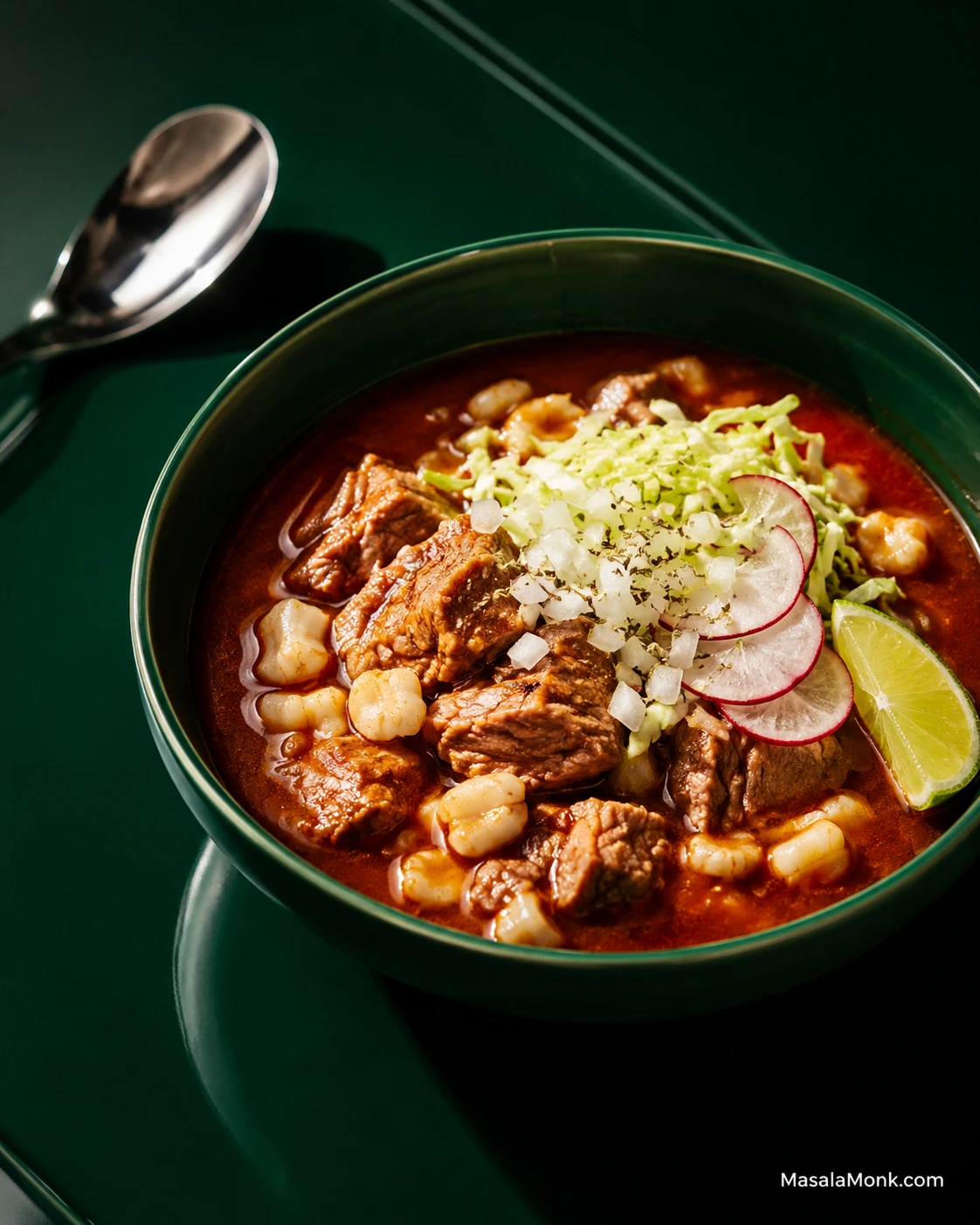
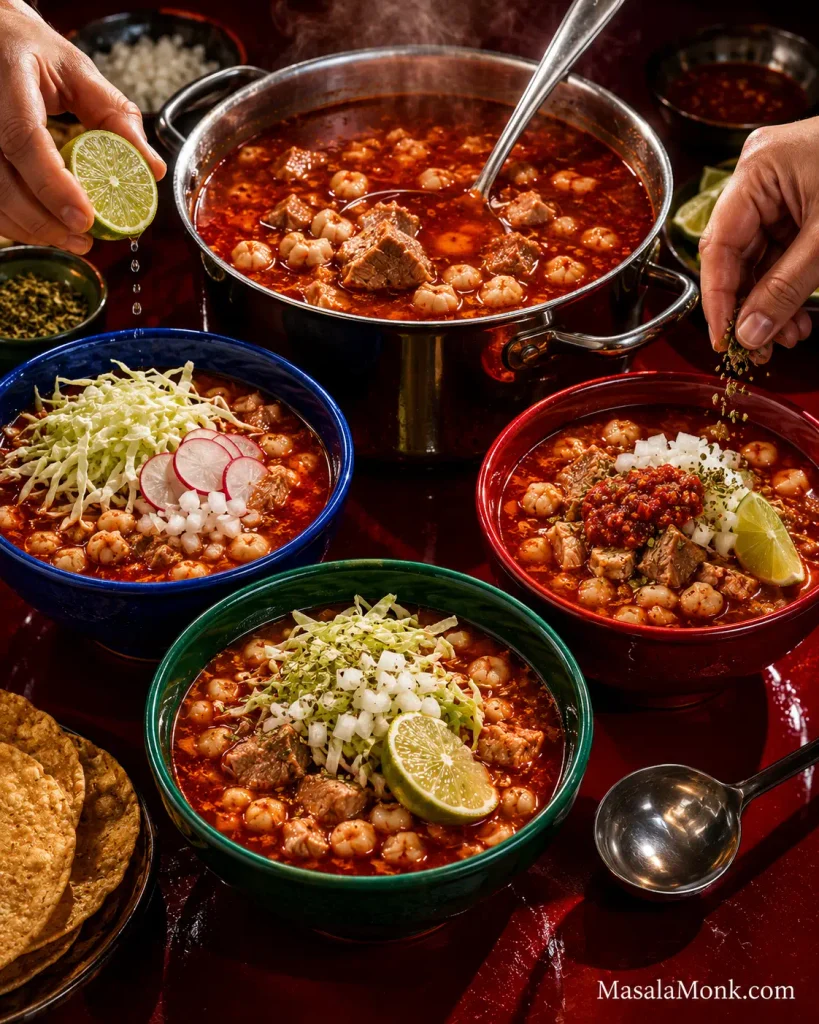
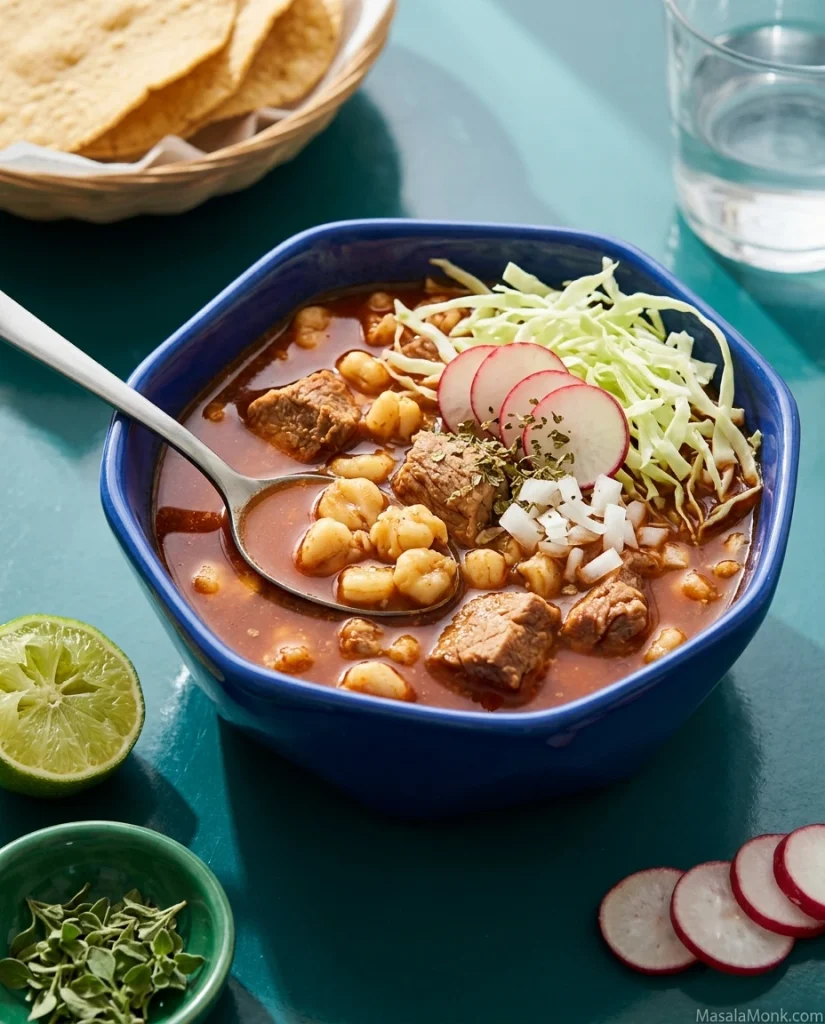
A bowl of pozole rojo lands on the table hot and deeply savory: tender pork, plump hominy and a brick-red chile broth. Then you start changing it. Cold cabbage, sliced radish, onion, crushed oregano and lime make the next spoonful sharper, fresher and crunchier than the first. Part of the pleasure is that the pot is shared, but each bowl is yours to finish.
Pozole rojo is a Mexican hominy-and-meat soup or stew flavored and colored with dried red chiles. The details vary by region and household. Here, pork shoulder builds the broth while guajillo and ancho make the rojo, with chile de árbol available when you want more heat.
None of the individual steps is especially difficult. What matters is knowing when to stop toasting a chile, when the shoulder is ready for the next stage and what kind of hominy you actually bought. Those small decisions matter far more than throwing extra spices into the pot at the end.
Use the times below as checkpoints, not finish lines. We’re aiming for a loose, brick-red broth with tender pork that still holds as pieces. The hominy should taste seasoned by the pot around it, and the garnishes should brighten an already good bowl rather than rescue it.
Simmer the pork. Cook pork shoulder gently with onion, garlic and bay until nearly tender.
Make the rojo. Briefly toast guajillo and ancho chiles, soften them, blend with aromatics, strain, then cook the puree in a little fat until glossy and no longer raw-smelling.
Bring the pot together. Add the rojo and rinsed hominy while the shoulder still has a little resistance. Simmer another 30–45 minutes.
Finish the bowls. Add cabbage or lettuce, radishes, white onion, Mexican oregano and lime. Serve tostadas and extra chile alongside.
Forgiving, flavorful and rich enough to build the broth
Chiles
Guajillo + ancho; árbol optional
Guajillo carries the red-chile flavor, ancho adds depth and árbol brings heat
Hominy
4 × 15-oz / 425-g cans
Our default: hominy in nearly every spoonful without taking over the bowl
Using bone-in shoulder? Buy roughly 3½–4 lb / 1.6–1.8 kg and, if possible, have the butcher cut it into several large pieces. A whole bone-in roast will cook differently from 2-inch chunks.
Using dried hominy? Read the dried-hominy instructions first. You need corn that has already been nixtamalized but still requires soaking and cooking; untreated dried corn is a different project.
Once those choices are settled, the cooking is mostly a matter of timing the pork and rojo so they reach the finished pot at the right moment.
Pozole Rojo Recipe
This pork pozole rojo uses whole dried guajillo and ancho chiles rather than canned enchilada or red sauce. The main pot stays mild to moderate, leaving plenty of room for extra chile at the table.
Serves: 8 as a main course; about 10–12 smaller portions
Prep: about 30 minutes
Hands-on cooking after prep: about 15–30 minutes
Cook/simmer: about 2½–3 hours
Total with canned hominy: about 3–3½ hours
Heat: mild to moderate, adjustable
Recommended pot: about 8 qt / 7.5 L
Starting with dried hominy adds considerably more time: commonly an overnight soak plus several hours of separate cooking, depending on the product.
Equipment
8-quart / approximately 7.5-L stockpot or Dutch oven
Blender suitable for hot foods
Fine-mesh sieve
Medium saucepan or high-sided skillet
Heatproof bowl
Tongs or slotted spoon
Knife and cutting board
For the Pork Broth
3 lb / 1.36 kg boneless pork shoulder, cut into roughly 2-inch / 5-cm pieces
Optional for a richer broth: 1 lb / 450 g pork neck bones, meaty ribs, shank or pig’s feet
10 cups / 2.4 L water to start, or enough to mostly cover the pork
1–2 cups / 240–475 ml additional hot water, available if needed
½ large white onion
4 garlic cloves, peeled
2 bay leaves
18 g fine sea salt, divided, plus more to taste
If the shoulder has a very thick, hard exterior fat cap, trim away the excess. Leave the softer fat and marbling that help keep the meat juicy.
Salt varies enormously by brand and crystal size, so weight is the most reliable measure. Start with about 12 g in the broth and reserve roughly 6 g for final seasoning.
No scale? With fine sea salt, about 2 teaspoons is a conservative starting point for the broth; season the finished pot gradually. Kosher salts vary substantially by crystal size and shouldn’t be substituted spoon-for-spoon.
Water is the default because the pork is building its own broth. With boneless shoulder and no extra bones, some low-sodium stock can replace part of the water for a slightly fuller starting point. Reduce the added salt accordingly.
For the Red Chile Sauce
6 medium dried guajillo chiles, 30–35 g
3 medium dried ancho chiles, 30–40 g
0–2 dried chiles de árbol, optional for heat
½ large white onion
4 garlic cloves
2 teaspoons Mexican oregano
½ teaspoon freshly ground black pepper
2 tablespoons / 30 ml lard or neutral cooking oil
1–2 cups / 240–475 ml pork broth from the pot, as needed for blending
Chile sizes vary enormously, so let the gram weight win when your particular chiles look unusually large or small.
Mediterranean oregano will work if Mexican oregano isn’t available, though the aroma is different.
For the Hominy
4 cans hominy, 15 oz / 425 g each, about 60 oz / 1.7 kg packaged weight total, drained and thoroughly rinsed
White or golden/yellow canned hominy both work.
For Serving
3–4 cups finely shredded cabbage or lettuce
6–8 radishes, thinly sliced
½–1 medium white onion, finely chopped
4–6 limes, cut into wedges
About 2 tablespoons Mexican oregano
8–12 tostadas
Optional avocado, cilantro and hot chile salsa
1. Start the Pork Broth
Put the pork shoulder, optional bone-rich pork, ½ onion, 4 garlic cloves, bay leaves, about 12 g salt and 10 cups / 2.4 L water in the pot. Most of the pork should sit beneath the liquid; add a little more water if your pot or bone-in pieces require it.
Bring the pot just to a boil over medium-high heat. Skim away the heavier gray foam that gathers on the surface.
Lower the heat as soon as the broth boils. Partially cover and maintain a gentle simmer with lazy bubbles appearing here and there.
This is the quiet part of the recipe. Keep an eye on the liquid level, add hot water if the pork becomes too exposed, and let the shoulder simmer for about 1½ hours while you turn to the chiles.
2. Prepare and Toast the Chiles Briefly
Stem the guajillo and ancho chiles and shake or scrape out most of the seeds. Stem the árbol chiles too, if using.
Heat a dry skillet over medium to medium-low heat. Press a guajillo or ancho against the hot surface for about 5–10 seconds, flip and warm the other side briefly.
The chile should smell fragrant and become slightly more pliable. Still cold and stiff? Give it another brief contact with the pan.
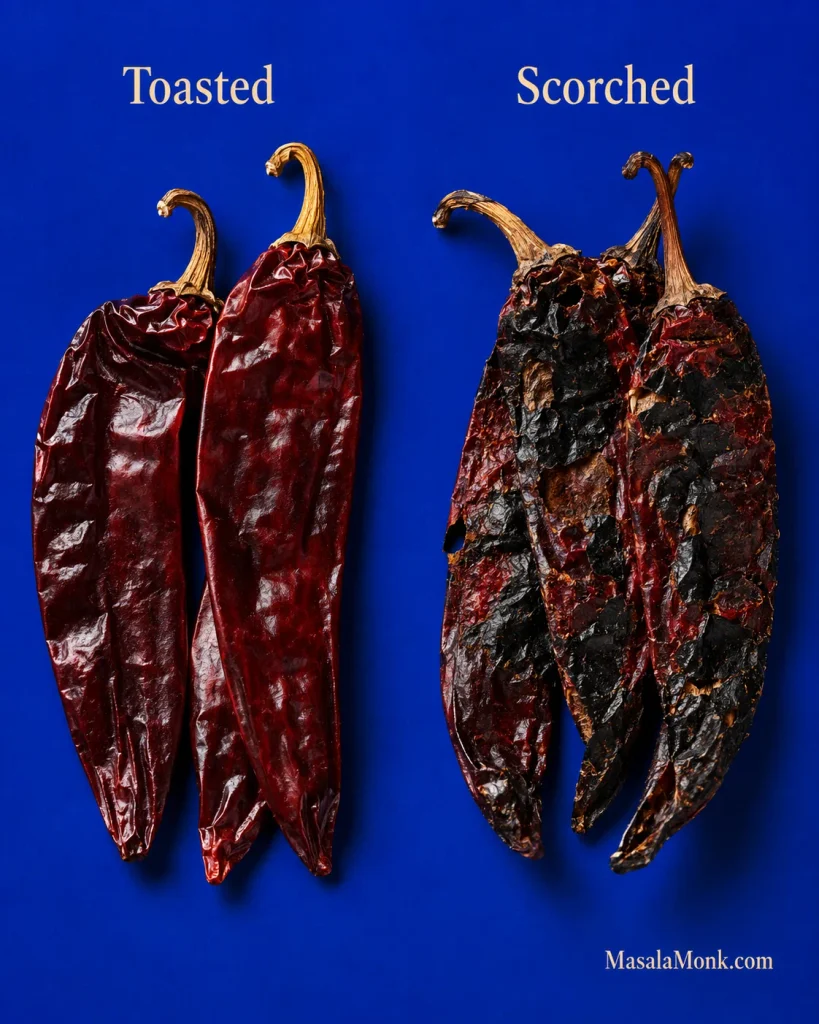
Árbol chiles are thin and scorch quickly. Warm them for only a few seconds or put them straight into the soaking bowl. Blackened patches, smoke or an acrid smell mean a chile has burned; replace a badly scorched one.
With guajillo and ancho chiles, it is safer to stop a little early than a little late. A chile that is merely under-toasted can still flavor the rojo; a badly scorched one can bring bitterness that soaking will not undo.
3. Soften the Chiles
Put the chiles in a heatproof bowl and cover with very hot water. Soak for about 15–20 minutes, until they bend and fold easily without cracking.
Taste a little of the soaking water. If it tastes pleasantly chile-like, use some for blending. If it tastes bitter, burnt or unpleasantly harsh, discard it and use pork broth instead.
4. Blend and Strain the Rojo
Put the softened chiles in a blender with the remaining ½ onion, 4 garlic cloves, Mexican oregano, black pepper and about 1 cup / 240 ml pork broth.
Let steaming-hot broth stand for a few minutes before blending. Don’t overfill the jar, and follow your blender manufacturer’s instructions for venting hot liquids safely.
Blend until smooth, adding only enough extra broth to keep everything moving. The puree should pour easily. Push it through a fine-mesh sieve to catch tougher pieces of chile skin that could make the finished broth gritty.
5. Cook the Red Chile Sauce
Heat the lard or oil in a high-sided skillet or saucepan over medium heat. Carefully pour in the strained puree; it can splatter when it meets the hot fat.
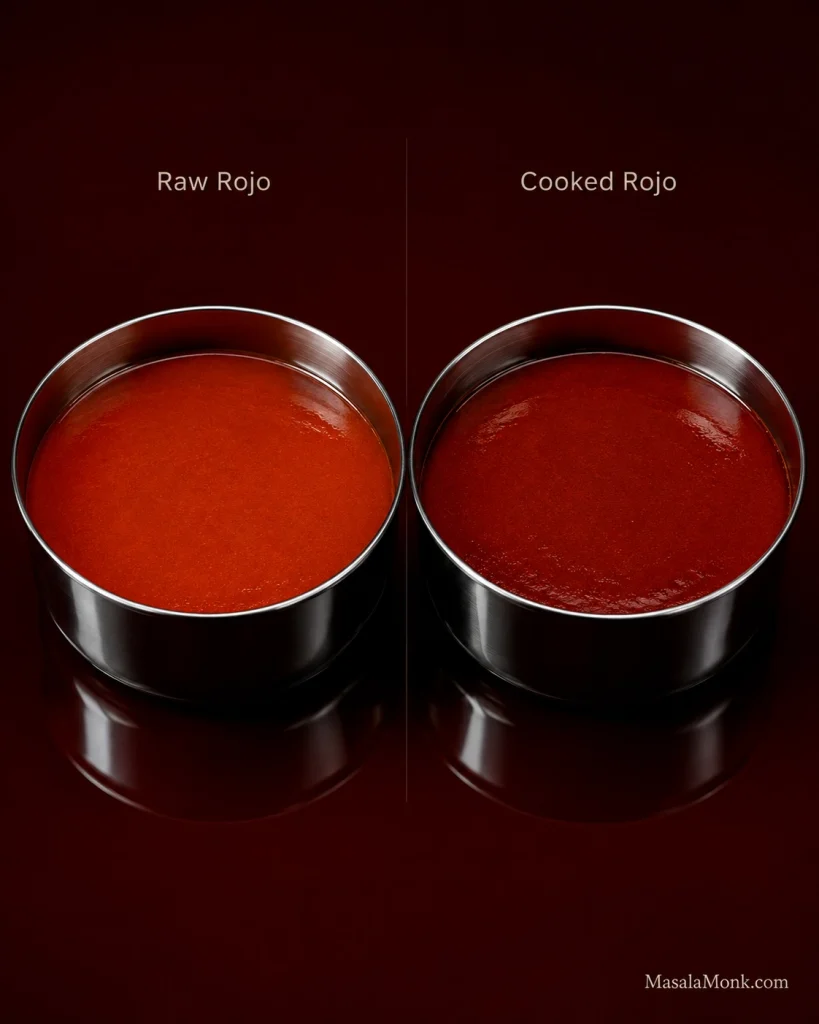
Cook for about 8–12 minutes, stirring regularly. The puree will darken slightly and turn glossy as the sharp soaked-chile smell cooks away. Once it smells cooked rather than raw, move on.
The visual change in a properly cooked red chile sauce for pozole is intentionally subtle. If the rojo becomes so thick that it has to be scraped from the pan instead of poured, it has reduced farther than this recipe needs.
Cooking the rojo separately isn’t mandatory, but it is deliberate here: the short fry concentrates the puree before it joins the pork broth.
6. Check the Pork
At around 1¾–2 hours total simmering time, test a piece of shoulder. A fork should enter much more easily than it did at the beginning. A little resistance is fine because the meat still has another 30–45 minutes in the finished pot.
Meat that remains tight and rubbery needs another 20–30 minutes at the same gentle simmer.
Remove the bay leaves and any large pieces of broth onion. If you used neck bones, ribs or shank, remove the bones, pull off any tender meat and return it to the pot. With pig’s feet, keep whatever tender edible pieces you enjoy and discard the hard bones.
Pork becomes safe to eat before shoulder becomes tender enough for pozole. Keep cooking for the texture, not the thermometer alone.
7. Add the Rojo and Hominy
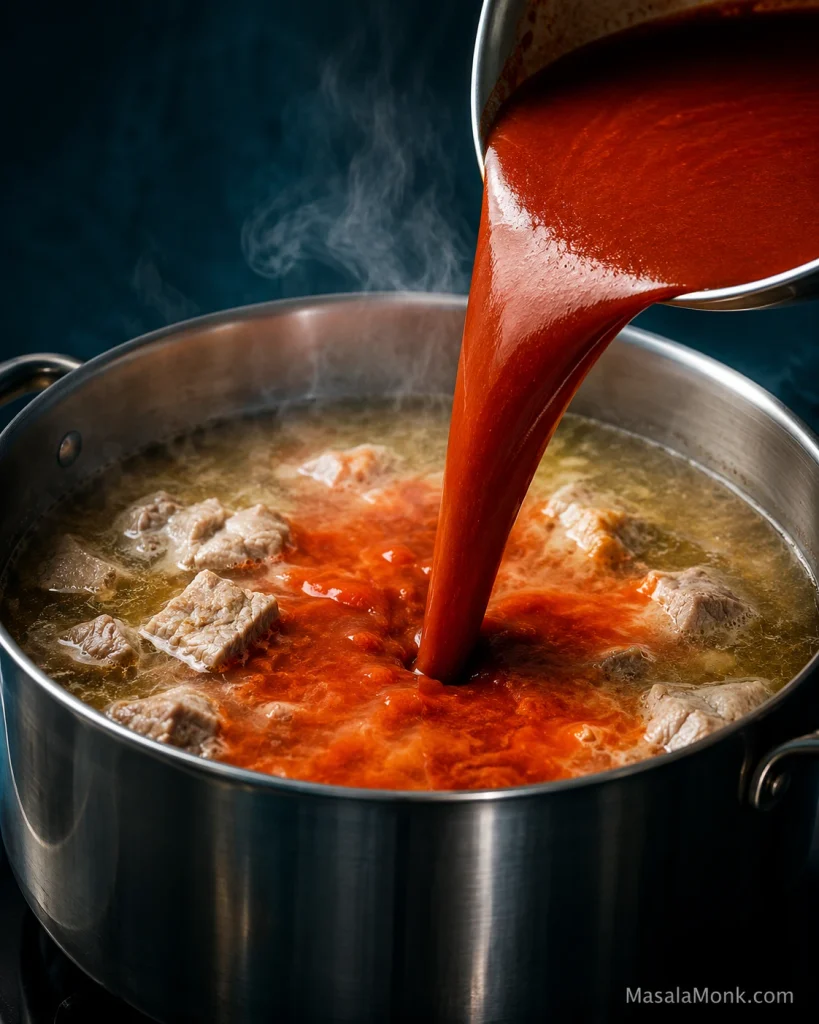
Stir the cooked rojo into the pork broth. The pale broth turns brick-red almost immediately, and the smell of the pot shifts from mostly pork and garlic to something unmistakably chile-rich.
A properly strained rojo should disappear into the pork broth, not float through it as chile-skin flecks or coarse pulp. That smooth dispersion is one reason straining matters even though the sauce will simmer again in the finished pot.
Add the drained and thoroughly rinsed hominy. Return the pot to a gentle simmer and cook for another 30–45 minutes, uncovered or partially covered.
For this version, stop before the shoulder falls completely into shreds. It should yield easily while still leaving you substantial pieces of pork.
The hominy should no longer taste like plain kernels dropped into soup; it should taste of the pork-and-chile broth around it.
8. Season and Serve
Now taste. Add the remaining reserved salt gradually, stirring and tasting between additions.
A watery broth needs reduction before much more salt. An over-concentrated one needs hot water or unsalted stock first. Skim off large pools of fat while leaving a light sheen on the surface.
Ladle pork, hominy and plenty of rojo into bowls and bring the garnishes to the table.
What Should Good Pozole Rojo Taste and Feel Like?
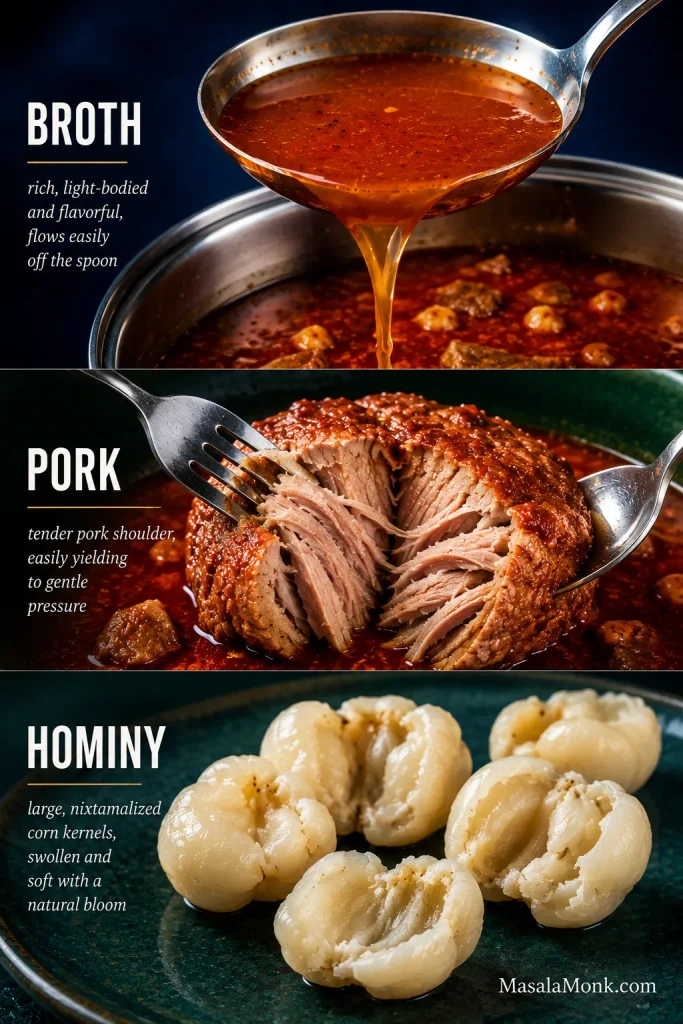
Taste the broth first. Pork and dried chile should feel like they belong to the same liquid; it shouldn’t taste like plain stock with red sauce stirred in at the end. Drag a spoon through it. The broth should move easily, with enough body from pork, corn and chile to linger lightly on the spoon without turning into chile gravy.
The color may look fiercer than the heat. A deeply red bowl can still be quite mild, especially when the rojo relies mostly on guajillo and ancho.
Break a piece of shoulder with the edge of your spoon. It should separate with gentle pressure while still giving you an actual piece of pork to lift and eat.
Bite a hominy kernel in half. Tender with a little chew is good; a hard or chalky center needs more cooking.
These three checkpoints do not always finish at the same minute. If one component still lags, cook for that cue rather than the clock, then recheck the broth, pork and hominy before serving.
Now add lime to one spoonful or one side of the bowl and taste again. Lime shouldn’t rescue a bland broth. It should make an already savory one feel brighter, fresher and less heavy.
The garnishes finish the bowl. Cabbage or lettuce cools the hot broth, radish adds a peppery snap, onion brings fresh sharpness, Mexican oregano adds aroma and lime cuts through the richness of the pork. Tostadas bring the crunch.
Put the garnishes down the middle of the table and leave the bowls unfinished. Someone will pile on cabbage, somebody else will mostly want lime and oregano, and the person chasing heat can reach for the salsa. By the time everyone starts eating, no two bowls need to look quite the same.
Avocado, cilantro and extra chile salsa are also common additions in different households. Crema and cheese also appear in some versions, but they aren’t part of the core garnish set used here.
To build a bowl, ladle in pork, hominy and plenty of broth. Add cabbage, radish and chopped onion. Rub a little oregano between your fingers over the steam, squeeze in lime and then decide how much extra chile you want.
Pozole is built for a table full of people. One pot can stay hot while everyone finishes a bowl differently. Someone goes back for seconds, someone adds another squeeze of lime, and the cook can stay at the table instead of assembling every serving.
Keep the shared pot balanced; lime, Mexican oregano and extra chile can move each bowl brighter, sharper or hotter at the table.
That flexibility at the table reflects a broader truth about pozole: there isn’t one national pot that everyone makes exactly the same way.
About This Style of Pozole Rojo
Mexican pozole rojo varies by region and household in its chile blend, pork cuts, aromatics and garnishes. Mexico’s Secretaría de Agricultura describes red pozole as particularly associated with Jalisco, with ancho and guajillo among the chiles used and pork among the common meats.
This pot follows that familiar line: nixtamalized corn, pork, guajillo and ancho. Other versions may change the chile blend, include tomato or use aromatics such as cumin, clove, mint or cilantro. Those differences are part of the dish’s regional and household life.
Pozole, Posole and the Three Main Styles
Pozole is the standard spelling in Mexican Spanish. Posole is an established spelling in the United States, particularly in New Mexican and Southwestern cooking, where the word may refer to the prepared corn as well as the finished dish. New Mexican red posole often centers on New Mexico red chile rather than the guajillo-and-ancho blend used here.
Rojo: Pozole rojo gets its defining character from dried red chiles.
Verde: Pozole verde takes its green character from ingredients such as green chiles, tomatillos and herbs, depending on the region and recipe.
Blanco: Pozole blanco leaves out a defining red or green chile sauce so the pale meat-and-hominy broth takes center stage.
Within that range, changing the chile blend is one of the easiest ways to change the character of the pot.
What Each Chile Does in Pozole Rojo
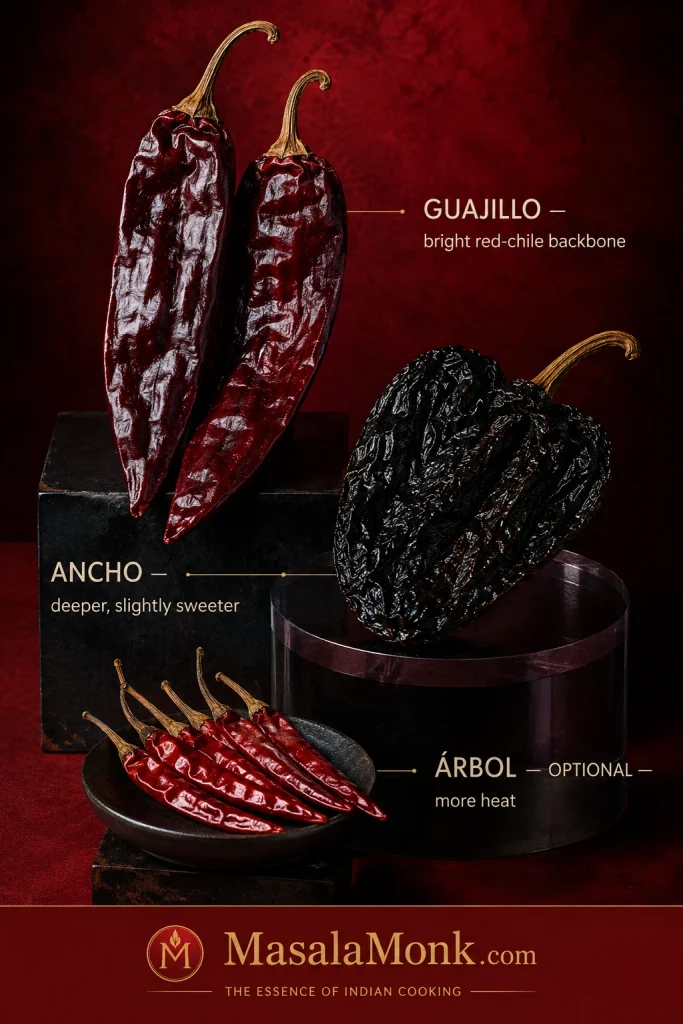
Guajillo, ancho and árbol may all look like dried red peppers in the bag, but they do very different jobs once they reach the pot.
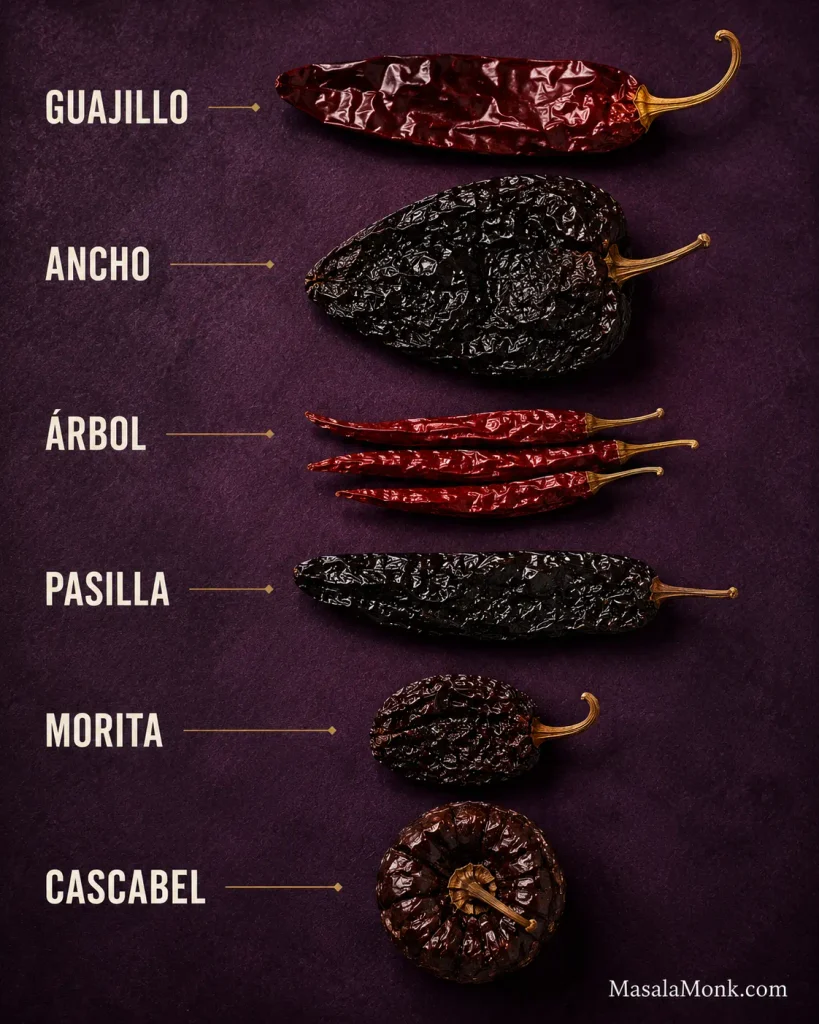
For dried Mexican chiles, silhouette is often easier to compare than exact color: ancho is broad, guajillo elongated, árbol thin, pasilla long and narrow, morita small and compact, and cascabel distinctly round.
Chile
Flavor / Role
Heat
Best When You Want…
Guajillo
Fruity red-chile backbone
Mild
A vivid red broth without much extra heat
Ancho
Dark fruit, sweetness and depth
Mild
A rounder, deeper rojo
Árbol
Clean, direct heat
Hot
More heat without adding much bulk
Pasilla
Earthy complexity
Mild
A darker, earthier blend
Morita
Smoky chile character
Medium
A noticeable smoky edge
Cascabel
Rounded, nutty chile flavor
Mild
A softer, nuttier direction
The first three make the formula above. Think of pasilla, morita and cascabel as directions you can take the blend rather than automatic one-for-one replacements.
Look for guajillos and anchos that still bend somewhat instead of shattering immediately. Their skins should retain some color and sheen, and the bag should smell fruity or earthy. A good bag announces itself before you ever turn on the stove; faded, dusty and brittle chiles tend to taste flatter.
Why Guajillo Leads the Blend
Tear open a good guajillo and its role makes sense: fruity, warm and distinctly red-chile without much aggressive heat. It carries most of the rojo’s chile character here. Ancho sits behind it with darker fruitiness and depth.
Controlling the Heat
More guajillo or ancho usually gives you more chile flavor without dramatically increasing the heat. Chile de árbol is the heat lever.
Mild: omit árbol
Moderate: start with 1 árbol
Hotter: try 2 árbol and offer extra salsa at the table
Árbol chiles vary in strength, so those amounts are only a rough guide. Build depth in the pot; let serious heat happen at the table.
Guajillo-heavy blends also tend to look brighter. More ancho, pasilla or morita pulls the broth toward brick-red or brown-red. Both can be completely normal; darker color becomes a warning sign only when the broth also tastes burnt or acrid.
Hominy begins as corn, but nixtamalization gives it the plump kernels and distinctive flavor expected in pozole. It tastes corn-forward, mildly earthy and nutty rather than sweet like canned sweetcorn, with a tender but substantial chew.
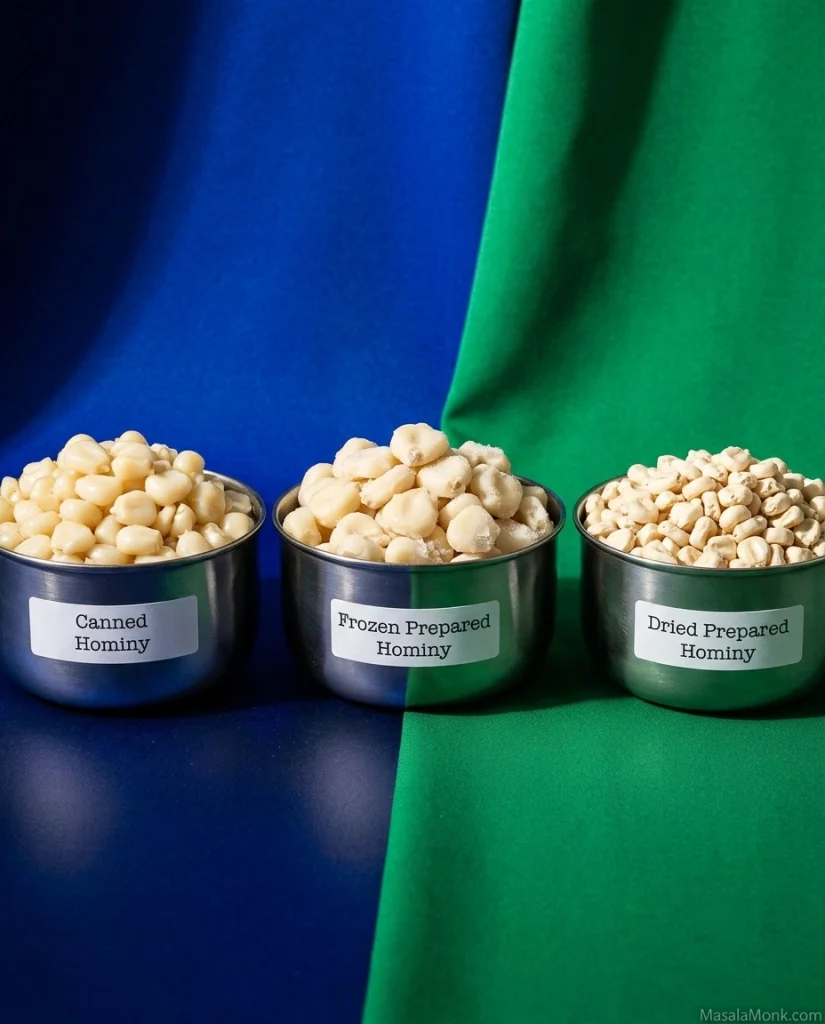
Think about prepared size rather than dry size when comparing hominy. Canned and frozen prepared kernels have already swollen substantially; dried prepared hominy starts smaller because much of that expansion still has to happen in the pot.
Our homemade corn tortilla guide explains the same transformation from the masa side: masa harina is also made from nixtamalized corn, which is why it behaves so differently from ordinary cornmeal. Regular canned sweetcorn won’t give you the same flavor or texture.
How Much Canned Hominy?
Our default is four 15-ounce cans. That puts hominy in nearly every spoonful while leaving plenty of room for pork and broth.
For About 3 lb / 1.36 kg Pork
How the Pot Changes
3 × 15-oz cans
Brothier and more pork-forward
4 × 15-oz cans
Our default
5 × 15-oz cans
Very hearty and hominy-forward
Canned hominy is already tender. The 30–45 minutes it spends in this pot are about integration: the kernels absorb the red broth while the broth picks up more corn character. Add them a little later if you prefer a firmer, more distinct kernel.
Rinse First; Blanch or Roast Only if You Want To
Rinsing is the default. Drain canned hominy and rinse it thoroughly under cool running water.
A noticeable canned flavor is a reason to blanch: put the rinsed kernels into fresh boiling water, let the water return to a boil, then drain and rinse again.
Roasting is optional. For firmer texture and a slightly more concentrated corn flavor, dry the rinsed hominy and roast at 450°F / 230°C for 15–20 minutes, tossing once, until fragrant and beginning to brown.
Prepared frozen hominy is a useful middle ground when you can find it. Cook it according to the package directions until tender, then add it with the rojo in Step 7.
Dried hominy can give pozole an especially full corn flavor. The first job is making sure you bought the right corn.
You want dried corn that has already been nixtamalized but still needs soaking and cooking. Packaging may call it prepared dried hominy, dried posole or prepared pozole corn.
Be careful with names alone. Maíz pozolero or cacahuazintle does not necessarily mean the corn in a particular bag has already been nixtamalized. Look for prepared/nixtamalized wording or follow the producer’s preparation instructions. Untreated dried corn requires another process entirely.
Prepared hominy varies by producer, so let the package directions win here. Rancho Gordo is a useful reference if you’re unsure whether the dried corn you bought is already prepared or still needs nixtamalization.
Once you know which corn you bought, the rest is mostly patience.
How to Cook Dried Hominy for Pozole
For this batch, start with 14–16 oz / 400–450 g dried prepared hominy. A pound / 454 g typically yields about 6–7 cups cooked, though variety and final tenderness affect the yield.
Sort and rinse the kernels.
Soak according to the package directions; an 8-hour or overnight soak is common for prepared dried hominy.
Drain and cover with fresh water by about 2 inches / 5 cm.
Bring the corn to a boil as directed by the producer.
Reduce to a steady simmer and cook until tender, commonly 2–4 hours or longer.
Taste a kernel. Still hard or chalky in the middle? Keep cooking. Fully cooked hominy should be tender and pleasantly chewy, and many kernels will split or bloom at one end.
Reserve some cooking liquid, then drain. Use roughly 6–7 cups cooked hominy in place of the canned hominy and add it with the rojo in Step 7. Save the cooking liquid for loosening the finished broth if needed.
For this pot, buy pork shoulder unless you have a reason not to. Its marbling and connective tissue keep the meat juicy through a long simmer and contribute body to the broth.
Neck bones, meaty ribs or shank can simmer alongside it when you want more pork flavor and gelatin. Pig’s feet bring still more collagen and body, but none of these additions is required. Pork leg makes a leaner pot and needs closer attention; pork loin is a poor fit for this long simmer.
Shoulder can seem stubborn for a while and then soften quickly once its connective tissue starts giving way. That is why the fork matters more than a rigid minute mark.
Do You Need to Brown the Pork?
No. Starting the shoulder in water keeps this broth cleaner; the cooked rojo provides the darker depth later.
Pozole Rojo Troubleshooting
If something feels wrong, identify the symptom before changing the pot. Bitterness, blandness, tough pork and thin broth all need different fixes.
Flavor Problems
Bitter or burnt? Check the chiles first. A chile may have blackened during toasting, the puree may have caught while frying, or bitter soaking water may have gone into the blender.
Caught a badly scorched rojo before it reaches the soup? Remake it. Once a strong burnt flavor has been stirred through the whole pot, it is difficult to remove completely. Mild bitterness may sometimes be softened with unsalted broth and careful seasoning, but severe scorching does not have a magic fix.
Bland? Work out what is actually missing before adding more of everything.
Watery overall: simmer uncovered and reduce.
The flavors are there but muted: add salt gradually.
The chile tastes raw or separate: give the combined pot more gentle simmering time.
Rich but dull: finish one bowl with lime before changing the whole pot.
Porky but genuinely weak on chile: Make half a batch of the rojo, cook it as in Step 5, then stir it in gradually and taste as you go. Salt and reduction can intensify the chile already present, but they can’t replace what’s missing.
Texture and Consistency Problems
Pork still tough? Keep the gentle simmer and give it another 20–30 minutes. Don’t turn up the heat. Tough shoulder usually needs more time for its connective tissue to soften.
Dried hominy still hard? First make sure the corn really is prepared/nixtamalized hominy. Once that is established, hardness usually means more cooking time. Keep it submerged and continue simmering; some products take substantially longer than others.
Broth too thin? Simmer uncovered to reduce it. When the flavor is already concentrated enough and you only want a little more body, blend ½–1 cup cooked hominy with some broth and stir it back in.
Quick Fixes for Other Problems
Problem
Likely Cause
Fix
Harsh or mouth-drying
Old chiles, tough skins, over-concentration or too little simmering after the rojo was added
Give it more gentle simmering time; check concentration and salt
Not spicy enough
Guajillo and ancho added flavor rather than much heat
Add a hot árbol or puya salsa, preferably at the table
Too spicy
Too much hot chile for the batch
Add unsalted broth and, if practical, more pork or hominy; recheck salt afterward
Brown-red instead of bright red
A darker chile blend
Do nothing unless the broth also tastes burnt or acrid
Broth too thick
Too much reduction or absorption
Add hot water, unsalted broth or reserved hominy cooking liquid gradually
Greasy surface
More rendered pork fat than you want
Skim obvious pools; chilling makes excess fat easy to remove later
Pork dry or stringy
Lean cut, small pieces, aggressive boiling or overcooking
Use shoulder in larger pieces and keep the simmer gentle next time
Canned hominy tastes separate
Not enough integration time
Simmer another 15–20 minutes
Canned hominy tastes “canned”
Brand or rinsing issue
Rinse more thoroughly; blanch or roast before adding next time
Dried hominy went mushy
Cooked beyond your preferred endpoint
Start tasting sooner next time; kernels can bloom without falling apart
Make Pozole Ahead: Recalentado, Storage and Reheating
There are two useful ways to get ahead. You can make the entire pot in advance and reheat it, or prepare the rojo 1–2 days ahead, refrigerate it separately and cook the pork and hominy on serving day.
Pozole is particularly good at becoming tomorrow’s lunch. Big pots are often made with leftovers in mind, and the reheated meal after a gathering is commonly called the recalentado.
Overnight, the hominy keeps absorbing broth while the pork and chile flavors settle together. The next bowl can taste even more integrated than the first. It will usually need a splash of water or broth because the corn has been drinking while you weren’t looking.
Reheat the pozole first, then restore the contrast with fresh cabbage, radish, white onion, Mexican oregano and lime.
For Christmas, parties or a large family meal, handle the garnishes closer to serving. Shred the cabbage, slice the radishes, chop the onion and cut the limes while the pozole reheats.
Cool a Large Pot Safely
Don’t leave a full stockpot sitting at room temperature for hours while the center cools. USDA leftovers guidance recommends dividing large amounts of food into shallow containers so they cool quickly and refrigerating leftovers within 2 hours.
Refrigerator: Store cooled pozole in covered containers for up to 3–4 days. Keep fresh garnishes separately.
Freezer: Freeze for 3–4 months for best quality, leaving a little room for expansion.
Add water or broth until the reheated pozole has the consistency you want, then taste for salt again.
Set out the fresh garnishes again and the reheated bowl feels like another meal, not simply yesterday’s leftovers.
Corn, chiles, pork and pots don’t all behave exactly alike, which is why the cues matter as much as the clock. If you make the pozole, tell us which chiles and hominy you found, whether you added any bone-rich pork and how your pot behaved.
If the hominy took longer, the shoulder softened sooner or your chile blend came out darker than expected, those details are useful too. They may help the next person cooking from the same kind of corn or bundle of dried chiles.
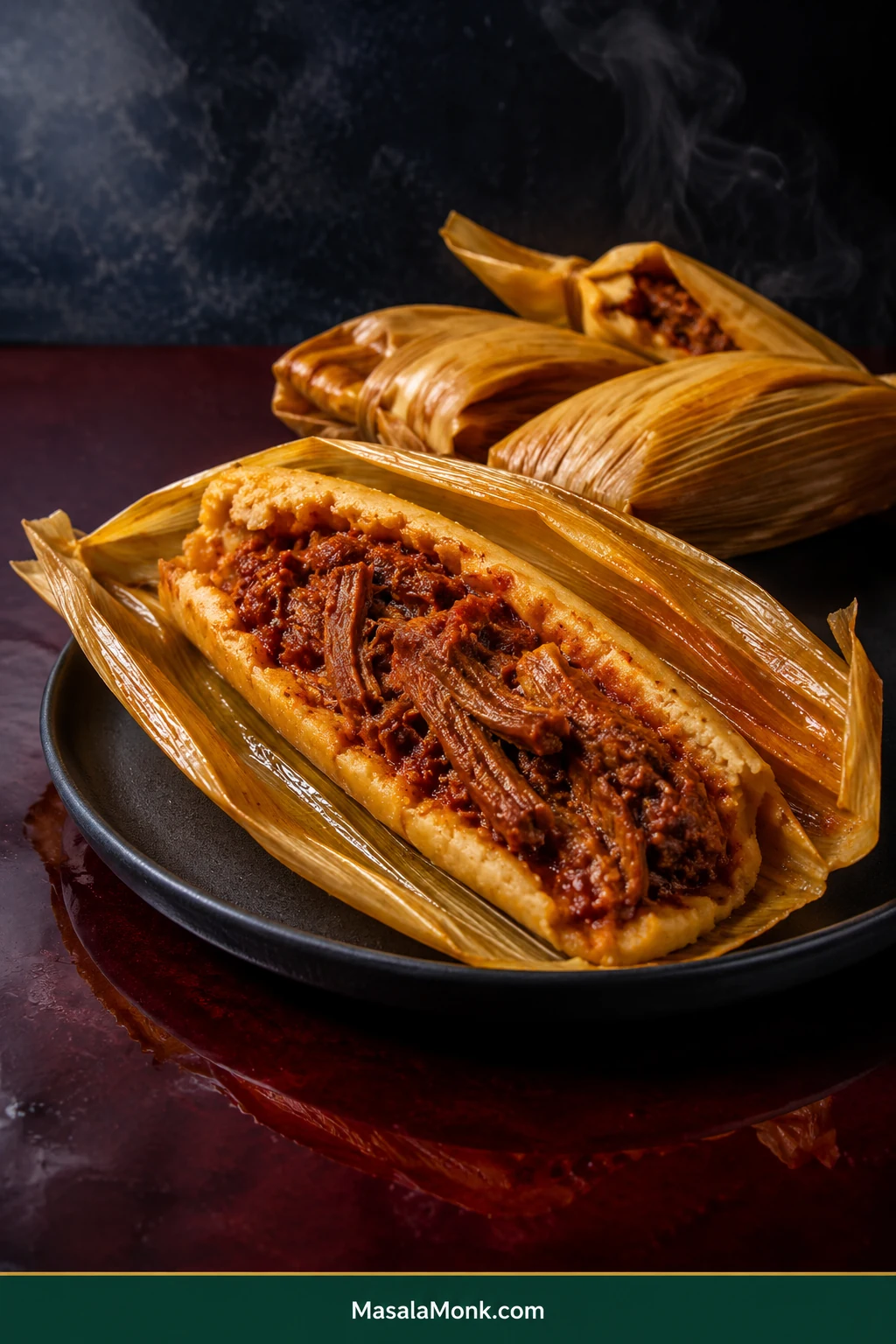
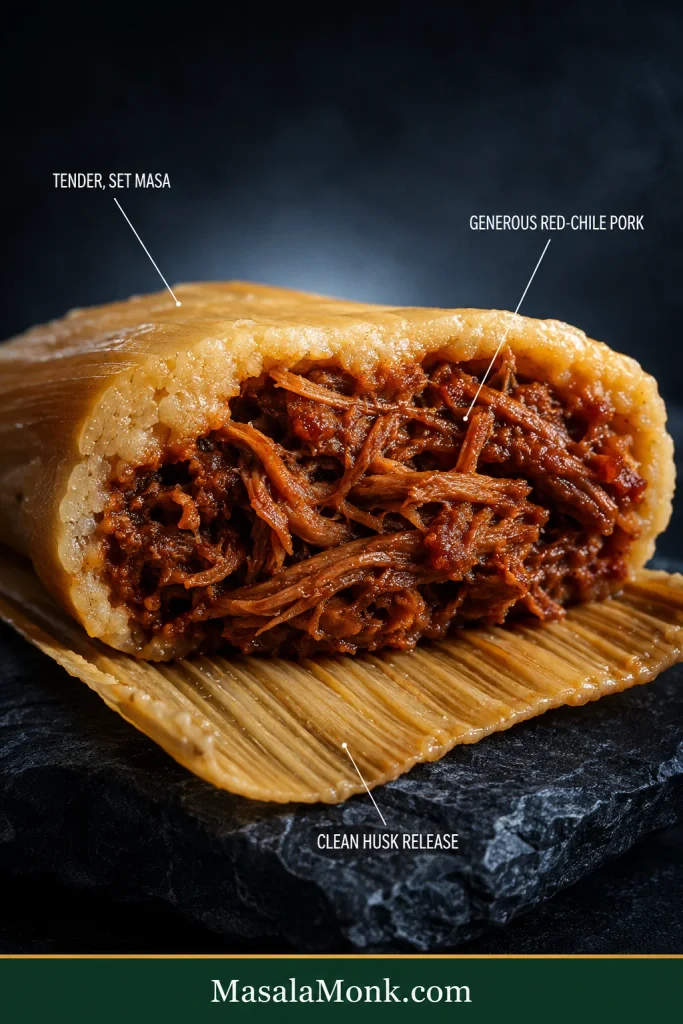
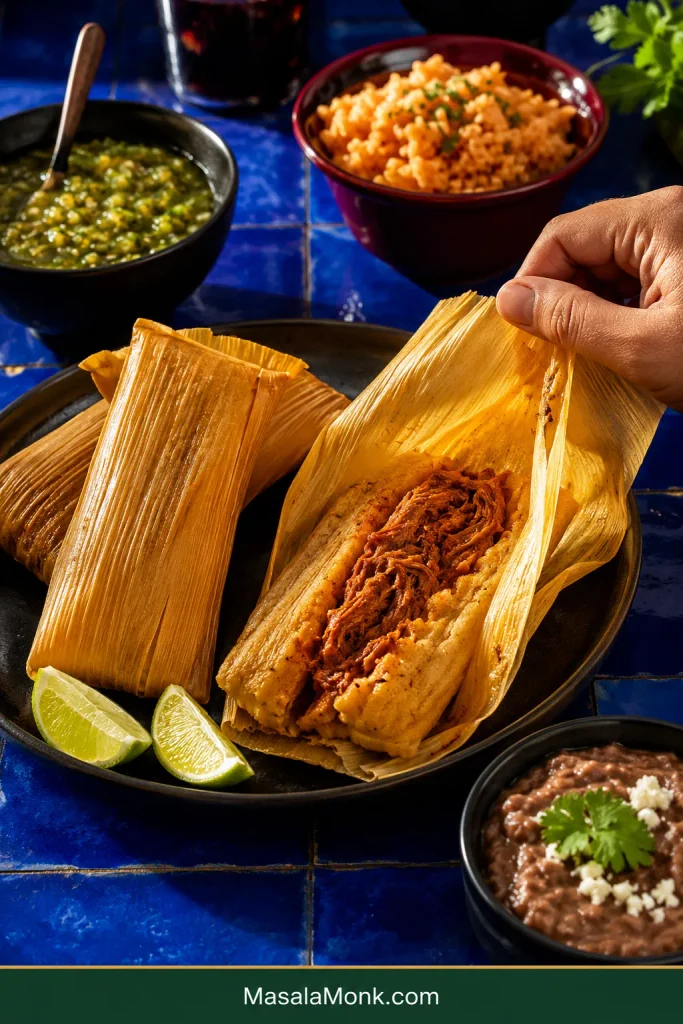
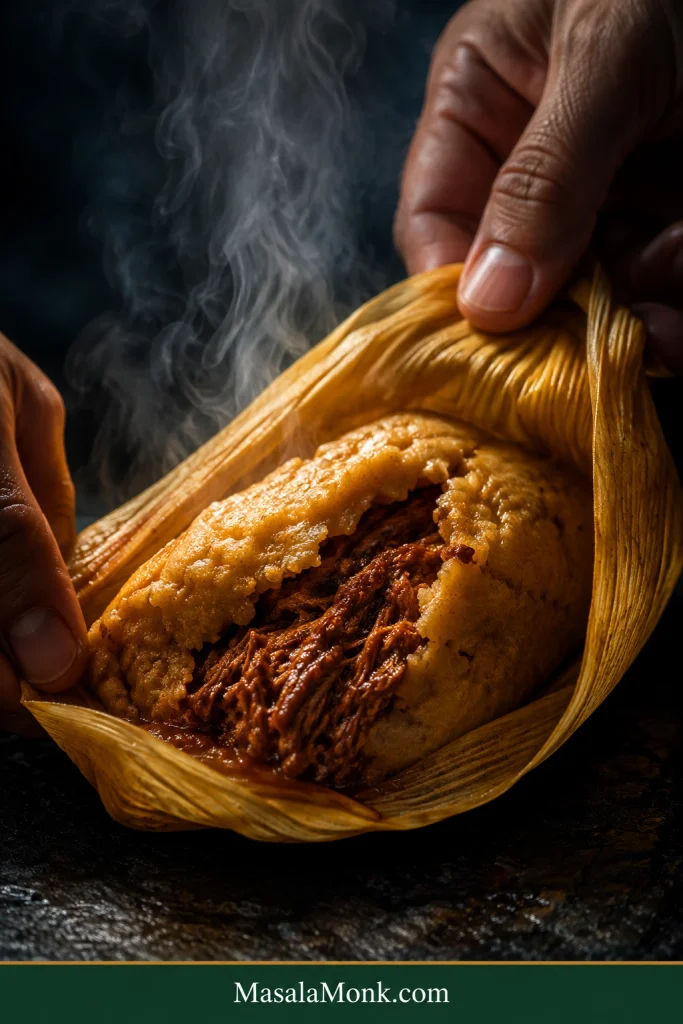
Peel back a good pork tamale and the husk releases from tender, savory masa with a line of juicy red-chile pork running through the center. The masa is soft but set, the filling is generous, and both taste seasoned enough to matter.
A consistent masa ring around a continuous pork center is a better portion check than perfectly straight edges.
Tamales are not intimidating because any one step is unusually difficult. The challenge is that the pork, chile sauce, masa, husks, and steam all have their own version of right — and on a first batch, those cues may not be obvious yet.
If tamales are new to you, that is what the checkpoints below are for. A crooked spread, an awkward husk, or a loose fold does not mean starting over; most small assembly problems are easy to fix as you go.
Quick Answer: How Do You Make Mexican Pork Tamales?
Cook pork shoulder until it pulls apart easily and save the broth. Make a guajillo-ancho red chile sauce, reserve ¼ cup / 60 ml for the masa, then start with 1 cup / 240 ml of the remaining sauce in the shredded pork. Reduce until the filling is glossy and thick enough to mound without watery sauce pooling around it.
Whip lard and mix it with masa harina, baking powder, salt, warm pork broth, and the reserved chile sauce. Use 40 g prepared masa + 30 g pork filling per medium tamale, fold inside softened corn husks, and steam upright. Start timing once steady steam is established, begin checking at 70 minutes, and rest a tester before deciding whether it needs more time.
Mexican Pork Tamales With Red Chile — Recipe Card
Red chile pork tamales with tender, broth-seasoned masa and a generous pork center. The guajillo-ancho filling is rich, savory, and gently warming, with optional chile de árbol when you want more heat.
Yield
24 medium tamales; a little extra filling is possible
Serves
8–12 with sides
Heat
Generally mild to medium; add 1–2 chiles de árbol for more heat
Active work
Roughly 2–3 hours, depending largely on wrapping speed
Elapsed time
About 5½–6½ hours, much of it hands-off
Lowest-stress workflow
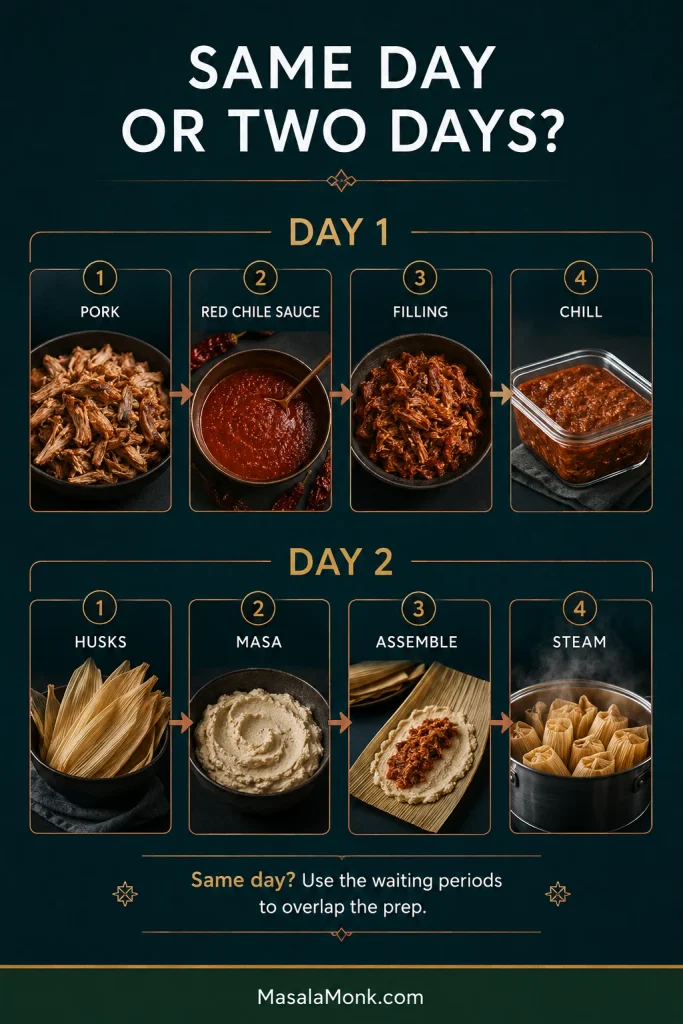
Make the filling on Day 1; assemble and steam on Day 2
Per tamale
40 g prepared masa + 30 g pork filling
Final rest
10–15 minutes
Ingredients
For the Pork
2 lb / 900 g boneless pork shoulder or pork butt, cut into 2–3 inch / 5–7 cm chunks
½ medium white onion
4 garlic cloves, lightly crushed
1 bay leaf
1½ teaspoons fine sea salt, about 8–9 g
About 6 cups / 1.4 L water to start, plus more hot water as needed
For the Red Chile Sauce
45 g dried guajillo chiles, about 8
35 g dried ancho chiles, about 3
1–2 dried chiles de árbol, optional
2 garlic cloves
1 teaspoon ground cumin
1 teaspoon Mexican oregano
2 cups / 475 ml reserved pork broth
1 tablespoon / 15 g lard or 1 tablespoon / 15 ml neutral oil
Fine sea salt to taste
For the Masa
3 cups / 360 g masa harina for tamales
6 oz / 170 g lard, softened but not melted
1½ teaspoons / about 6 g baking powder — not baking soda
1 teaspoon fine sea salt, about 5–6 g; reduce if your broth is already salty
1¾ cups / 415 ml comfortably warm pork broth
¼ cup / 60 ml red chile sauce
Up to ¼ cup / 60 ml additional warm broth, only as needed
For Assembly
30–32 dried corn husks, enough for 24 good wrappers plus extras
Instructions
Pork, Chiles & Filling
Cook the pork. Combine the pork chunks, onion, 4 garlic cloves, bay leaf, salt, and about 6 cups / 1.4 L water. Simmer gently for 2–2½ hours, adding hot water as needed to keep the pork mostly submerged, until it shreds easily. Strain and reserve at least 4 cups / 950 ml broth, preferably a little more.
Prepare the chiles. Stem and seed the guajillo and ancho chiles; stem the optional árbol chile. Toast the guajillo and ancho briefly until fragrant, adding the árbol only for the final few seconds. Soak all the chiles in very hot water for 20–30 minutes, then drain.
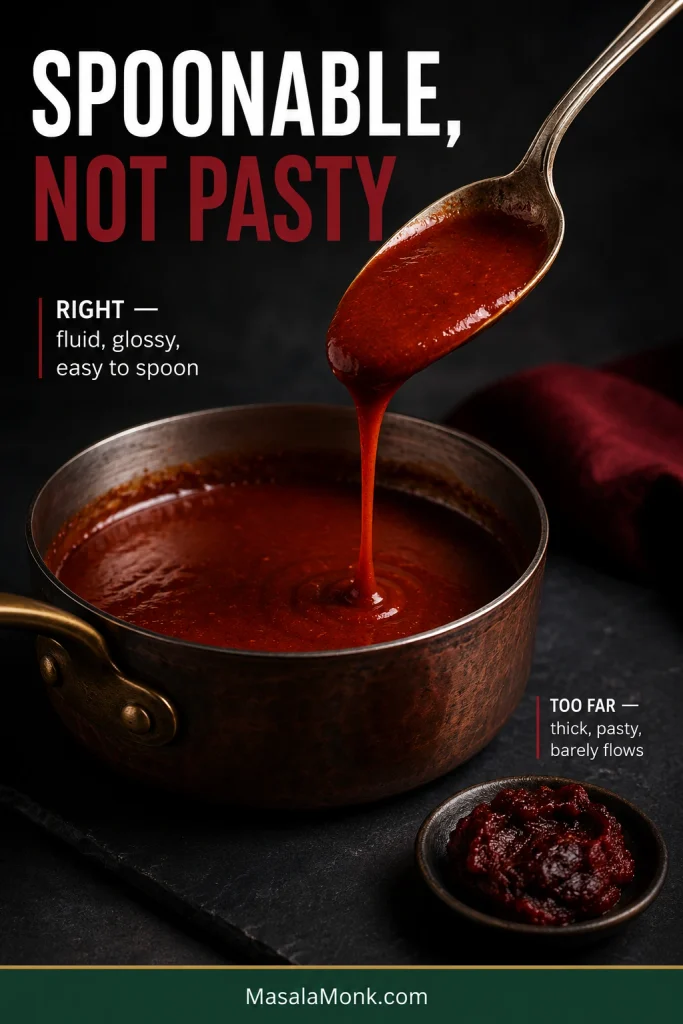
Make the sauce. Blend the softened chiles with 2 garlic cloves, cumin, oregano, and 2 cups / 475 ml pork broth. Strain. Heat 1 tablespoon lard or oil and carefully add the sauce. Simmer for 10–15 minutes until the raw chile aroma softens and the sauce remains smooth, fluid, and easy to spoon. Season with salt and reserve ¼ cup / 60 ml for the masa.
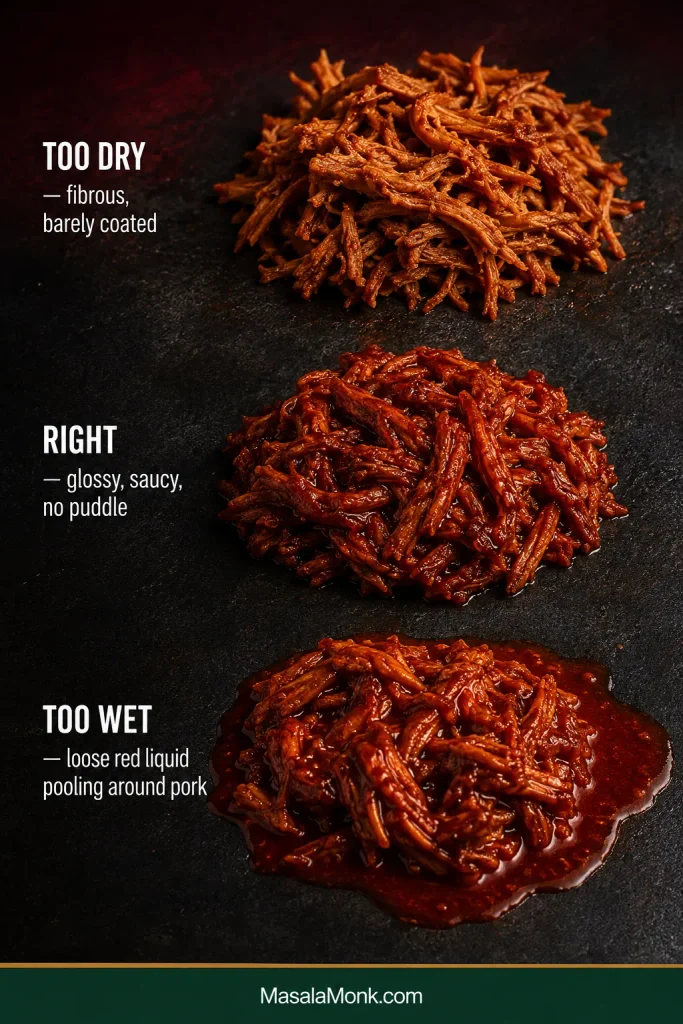
Finish the filling. Shred the pork, discarding any large pieces of fat. Stir in 1 cup / 240 ml of the remaining chile sauce. Simmer until glossy and thick, adding more sauce a few spoonfuls at a time if needed. Stop when a spoonful forms a soft mound without loose red liquid pooling around it. Set aside to cool.
Husks, Masa & Taste Test
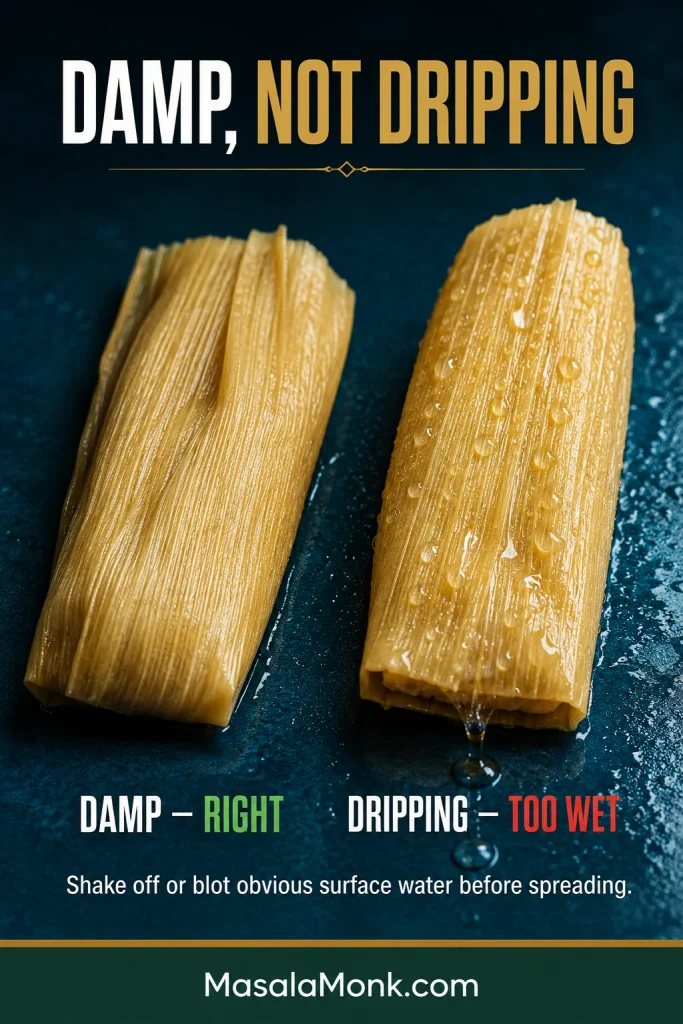
Prepare the husks. Rinse and sort 30–32 husks. Soak in very hot water for 30–60 minutes until pliable, then drain until flexible and damp, not dripping.
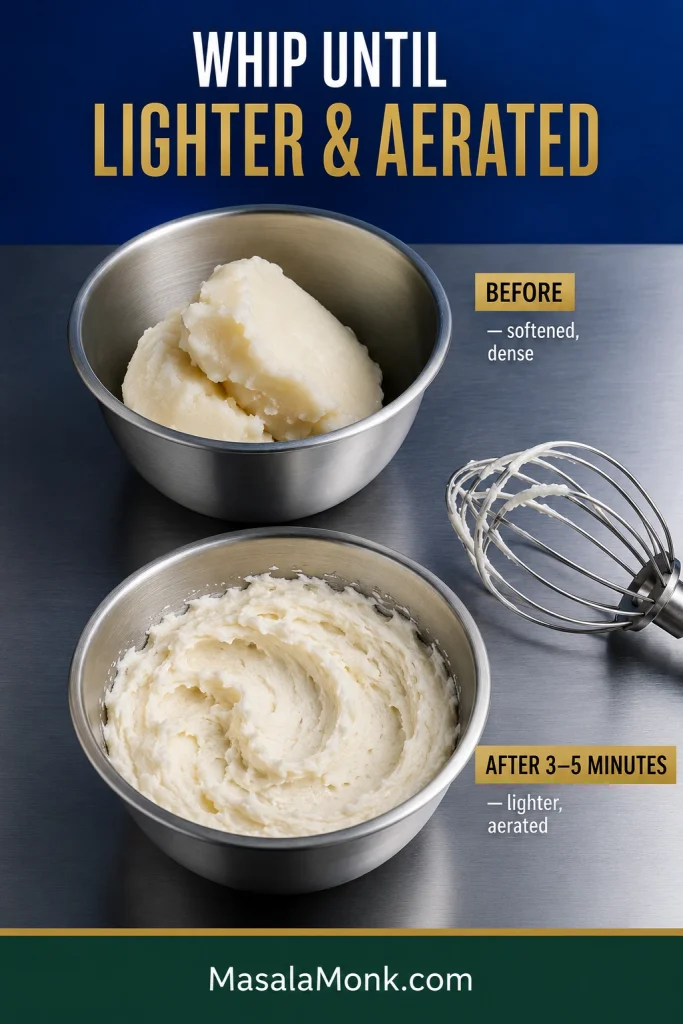
Make the masa. Beat the lard for 3–5 minutes until lighter and aerated. Whisk masa harina, baking powder, and salt separately, then add to the lard while gradually mixing in 1¾ cups / 415 ml warm broth and ¼ cup / 60 ml reserved chile sauce. Beat until creamy and easy to spread. Add extra broth 1 tablespoon / 15 ml at a time only if needed. Keep covered during assembly.
Taste the masa. Flatten a small spoonful into a thin patty and microwave in short intervals until completely set. Taste and adjust the salt before assembling the full batch.
Portion, Fill & Fold
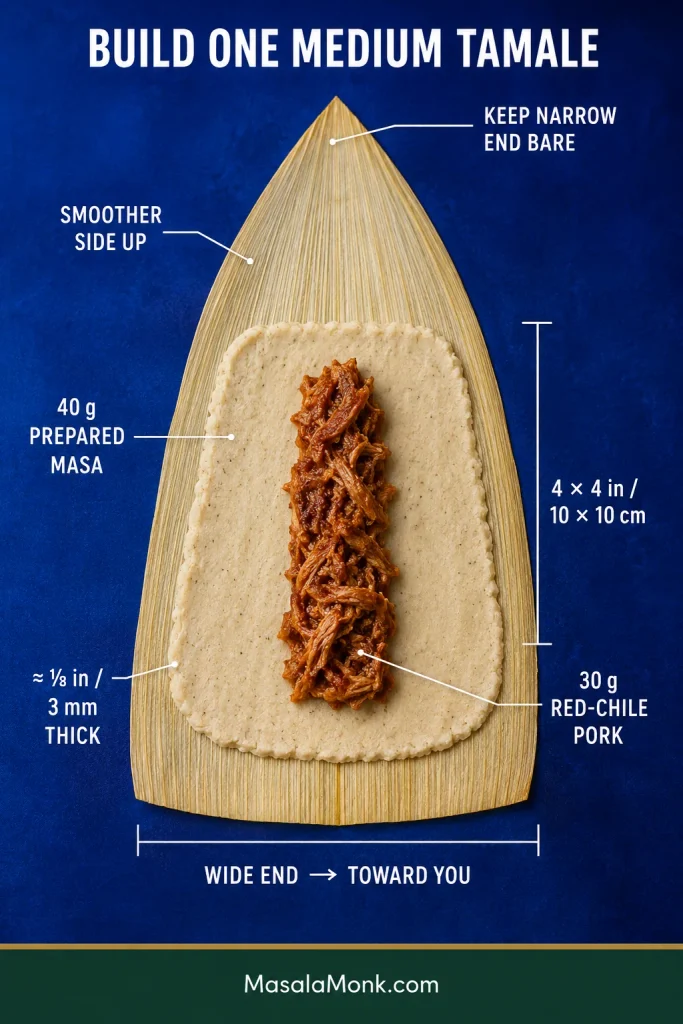
Portion and fill. Lay a husk smooth-side up with the wide end toward you. Spread 40 g masa into a roughly 4-inch / 10 cm square over the broad half, leaving the narrow end bare. Add 30 g pork filling in a line through the center.
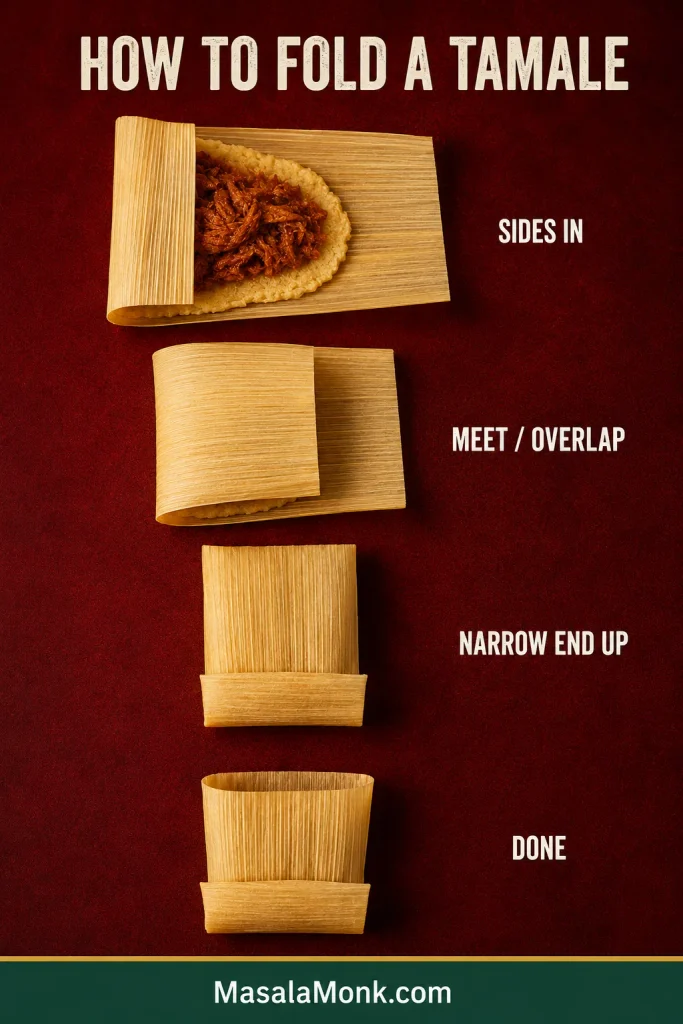
Fold. Fold the long sides around the filling, then fold the bare narrow end upward. Leave the wide end open.
Steam & Finish
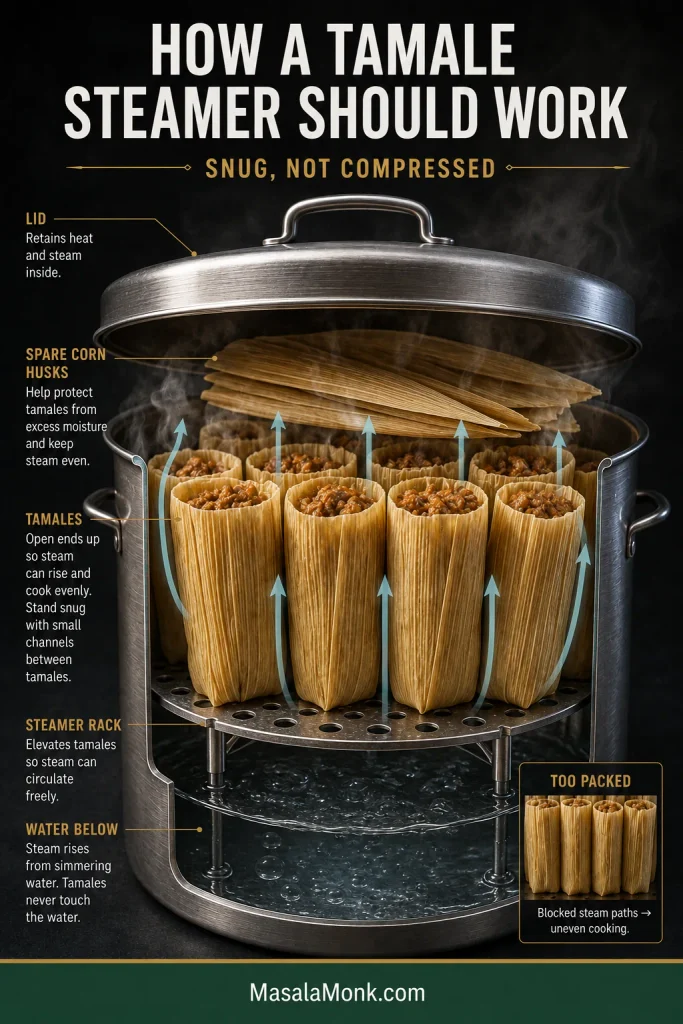
Load the steamer. Keep the water surface below the rack. Stand the tamales upright with open ends up, snug enough to support one another while leaving paths for steam. Cover the top with spare husks and close the lid.
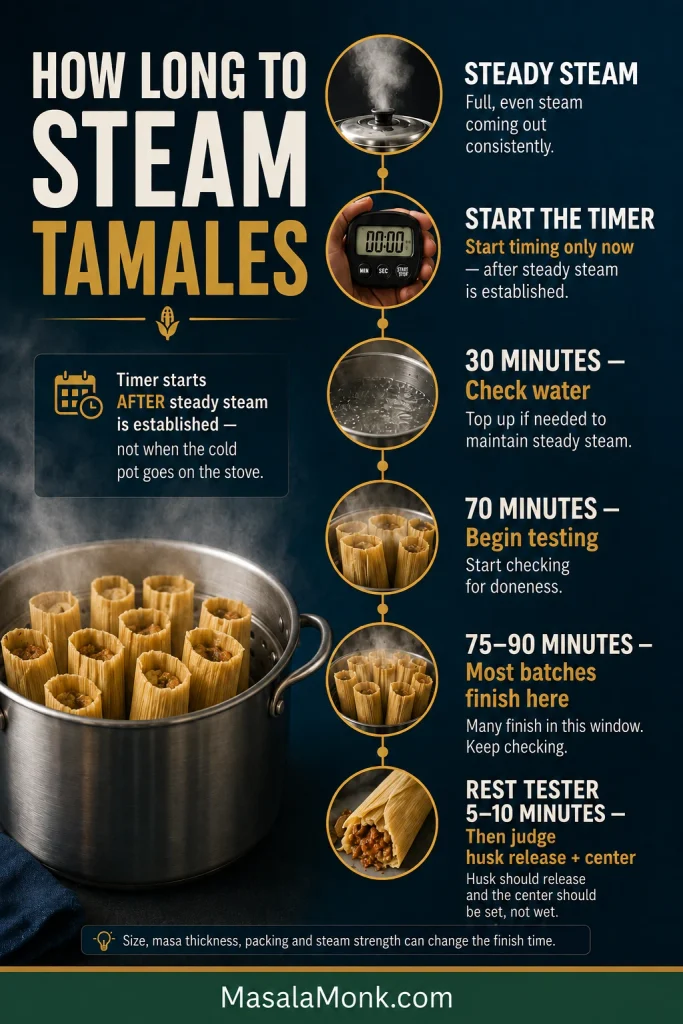
Steam. Bring the pot to steady steam, then start the timer. Check the water after 30 minutes. Begin testing at 70 minutes; most batches finish in 75–90 minutes.
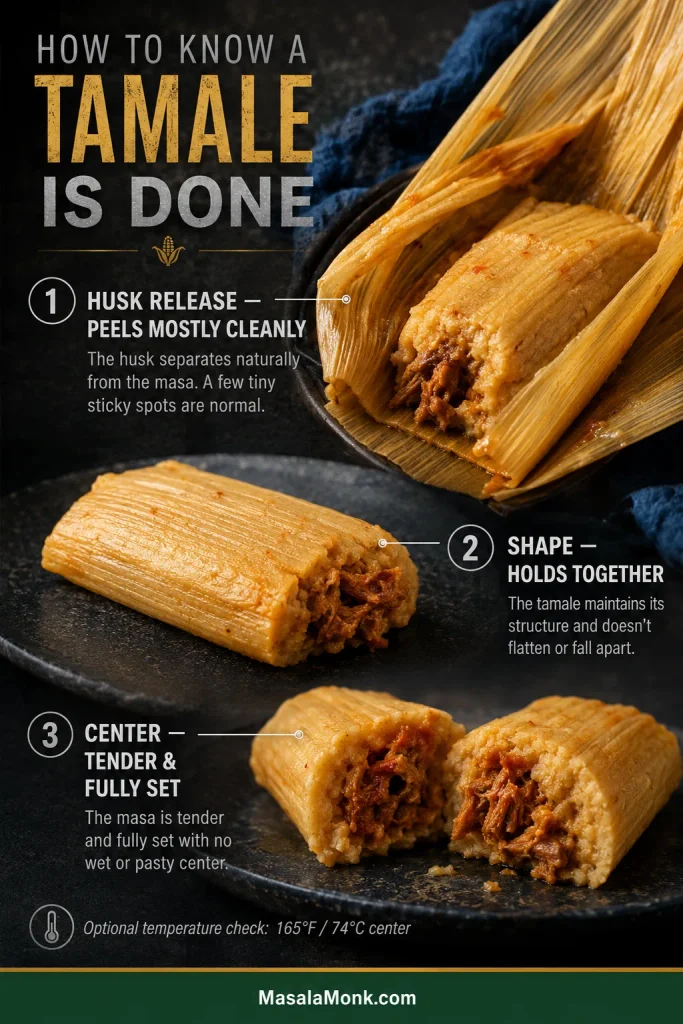
Test. Remove one tamale and rest it for 5–10 minutes. It is ready when the husk peels away mostly cleanly and the masa holds its shape with a tender, fully set center. Wet or pasty masa needs another 10–15 minutes of steam before retesting.
Rest and serve. Let the finished batch sit for 10–15 minutes before serving. Discard the corn husks before eating.
Making these for the first time? The recipe card tells you what to do. The detailed guide below shows you how to tell when each stage is right — from pork that is ready to shred to masa that spreads easily and a tamale that is actually finished steaming.
Tamales vary enormously across Mexico, and regions and families have their own preferred fillings, wrappers, masa textures, and folding styles. Here, we are making corn-husk red chile pork tamales — tamales rojos de puerco — with a relatively thin layer of tender masa and a generous pork center.
The flavor is chile-rich without being fiercely hot. Guajillo supplies the brighter dried-chile backbone while ancho brings darker, slightly sweeter depth. Some of that red chile sauce goes into the masa too, so the wrapper carries the same savory chile character as the filling.
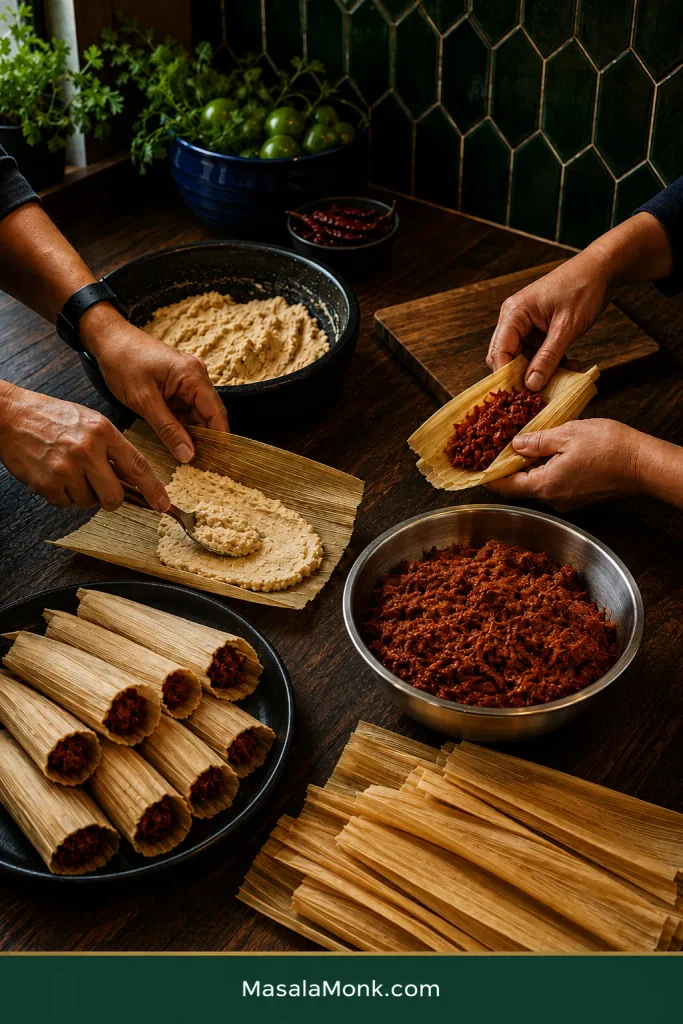
Think of the work in two halves. First, cook the pork and turn it into a thick red-chile filling. Then soften the husks, make the masa, and settle into the repetitive part: spread, fill, fold, steam.
The pork broth connects both halves. It seasons the chile sauce and the masa, so save it when the pork is done.
The Lowest-Stress Plan
Make the pork and red chile filling on Day 1. Transfer it to a shallow container and refrigerate promptly. On Day 2, soak the husks, mix the masa, assemble, steam, and serve.
Splitting the work across two days reduces the amount of hands-on assembly you have to juggle at once.
A same-day batch is completely possible. As the pork cooks, clean the chiles and sort the husks. During that cooling window, finish the sauce. Once the filling is cooling, make the masa. When the filling is finished, the longest cooking job is already behind you.
Ingredient Notes & Equipment
Pork Shoulder
Pork shoulder, pork butt, and Boston butt all refer to well-marbled shoulder meat. It has enough connective tissue and fat to stay juicy through the long simmer and become easy to shred once fully tender.
Boneless pork keeps the recipe weight predictable. Bone-in shoulder works too, but buy extra to account for the bone.
Guajillo and Ancho Chiles
Guajillo gives the sauce its brighter red-chile backbone; ancho contributes darker, slightly sweeter depth. Neither is especially fierce. The optional chile de árbol is what moves the filling noticeably hotter.
Chile sizes vary considerably, which is why the recipe gives gram weights as well as approximate counts.
The distinct shapes also help at the market: guajillo is long, ancho is broad and wrinkled, and chile de árbol is small and slender.
If dried chiles are unfamiliar territory, the guajillo section in our pepper sauce guide goes deeper into how dried peppers soften, blend, and simmer.
Masa Harina for Tamales
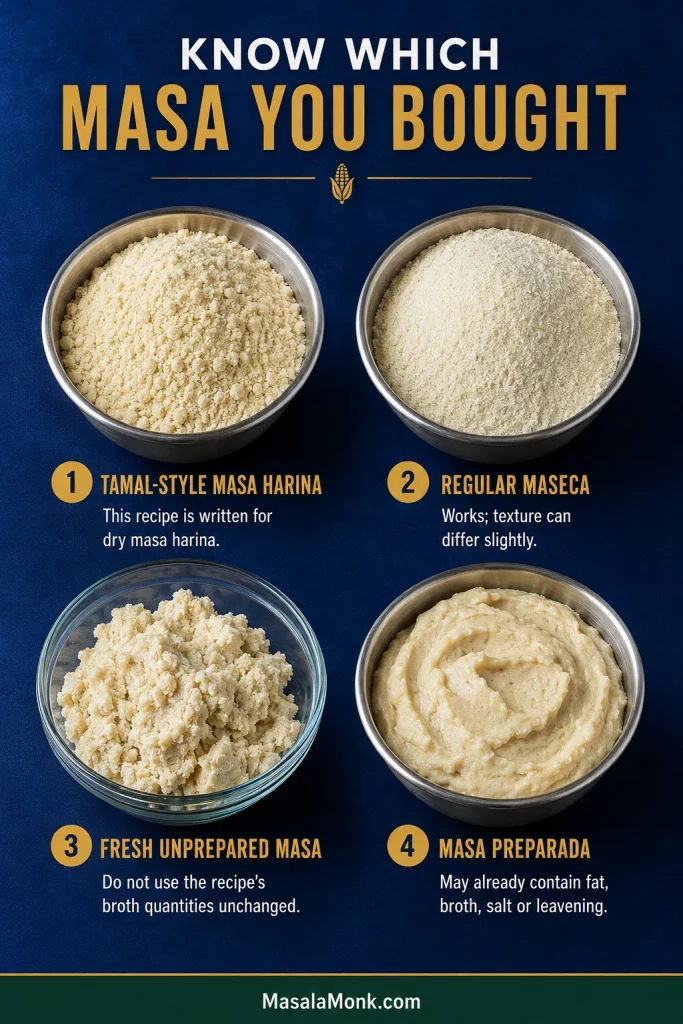
Use masa harina made from nixtamalized corn — the treated corn used to make traditional masa. Maseca Tamal is one common option, but other masa harina intended for tamales can work too. Ordinary cornmeal and polenta are different products and will not behave the same way here.
Can You Use Regular Maseca for Tamales?
Yes. If regular Maseca is what you have, you can still make tamales with it. The finished texture may be slightly different from a coarser tamal-specific masa harina, but it can still produce a good batch.
Buying fresh masa? This recipe’s quantities are written for dry masa harina. Fresh unprepared masa already contains water, so do not apply the broth quantities here unchanged. Masa preparada para tamales may already contain fat, salt, broth, or leavening, so check what you bought before adding anything else.
Before measuring broth, read the label: prepared masa may already contain fat, broth, salt or leavening.
Lard gives this version richness and tenderness. Other fats behave differently, so use a masa formula written for your chosen oil or shortening if you want to replace it.
Corn Husks
Bags of dried corn husks are naturally uneven: wide, narrow, torn, thick, thin, and occasionally awkward. That is why the recipe soaks more husks than the final yield requires. The extras give you good wrappers for the tamales and smaller clean pieces for patching, lining the steamer, or tying a stubborn fold.
For wrapping, flexibility and a broad usable spreading area matter more than a perfectly shaped husk.
Equipment
Large Dutch oven or heavy pot
Blender
Fine-mesh strainer
Large mixing bowl
Hand mixer or stand mixer
Large bowl or pot for soaking husks
Tamale steamer (tamalera), or stockpot with a steamer insert
Small offset spatula, butter knife, or spoon for spreading
Kitchen scale, especially useful while learning the portions
Instant-read thermometer, optional
You do not need a dedicated tamalera. What matters is keeping the tamales above the water inside a covered pot while leaving enough open space for steam to circulate.
No mixer? A sturdy spoon or whisk and some vigorous beating can work; a mixer simply makes aerating the lard easier.
How to Make Pork Tamales With Red Chile
Step 1: Cook the Pork Until It Shreds Easily
Put the pork, onion, crushed garlic, bay leaf, and salt in a large heavy pot. Add about 6 cups / 1.4 L water, or enough to comfortably cover the meat.
Bring to a boil, skim away any heavy foam, then lower the heat to a gentle simmer. Partially cover and cook for 2 to 2½ hours.
Check the pot occasionally and add hot water as needed to keep the pork mostly submerged. Finish with at least 4 cups / 950 ml strained broth, preferably a little more, so there is enough for the sauce, masa, and final texture adjustment.
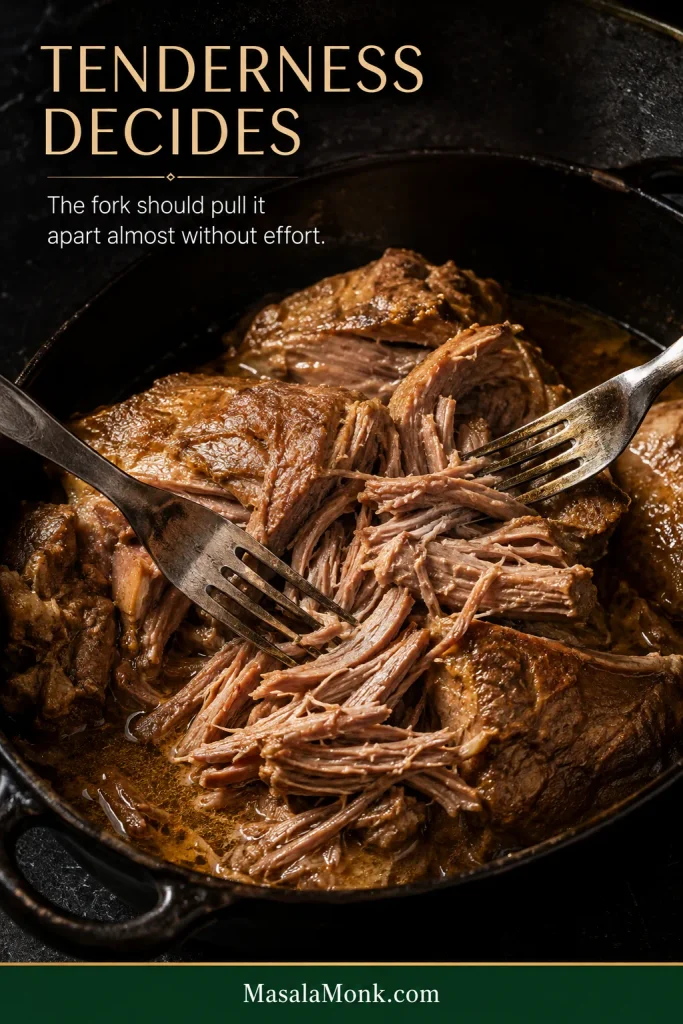
By the end, the pork should pull apart almost without effort. Shoulder often reaches roughly 190–200°F / 88–93°C by the time its connective tissue has softened enough for easy shredding, but there is no prize for hitting an exact number.
Tenderness decides. Meat that still fights the fork needs more time.
Shorter pork strands distribute more evenly through the filling and are easier to portion into consistent 30 g servings.
Save the broth. Strain the cooking liquid and set aside 2 cups / 475 ml for the chile sauce, 1¾ cups / 415 ml for the masa, and at least another ¼ cup / 60 ml for adjustments. If you come up short, make up the difference with unsalted chicken broth or hot water.
Taste the reserved broth before seasoning the sauce or masa, because a concentrated broth can already carry substantial salt.
Let the pork cool until it is comfortable to handle. While it cools, turn to the chiles.
Step 2: Make the Red Chile Sauce
Wipe the dried chiles clean. Remove the stems from the guajillo and ancho, split them open, and shake out most of the seeds. Stem the optional árbol chile too.
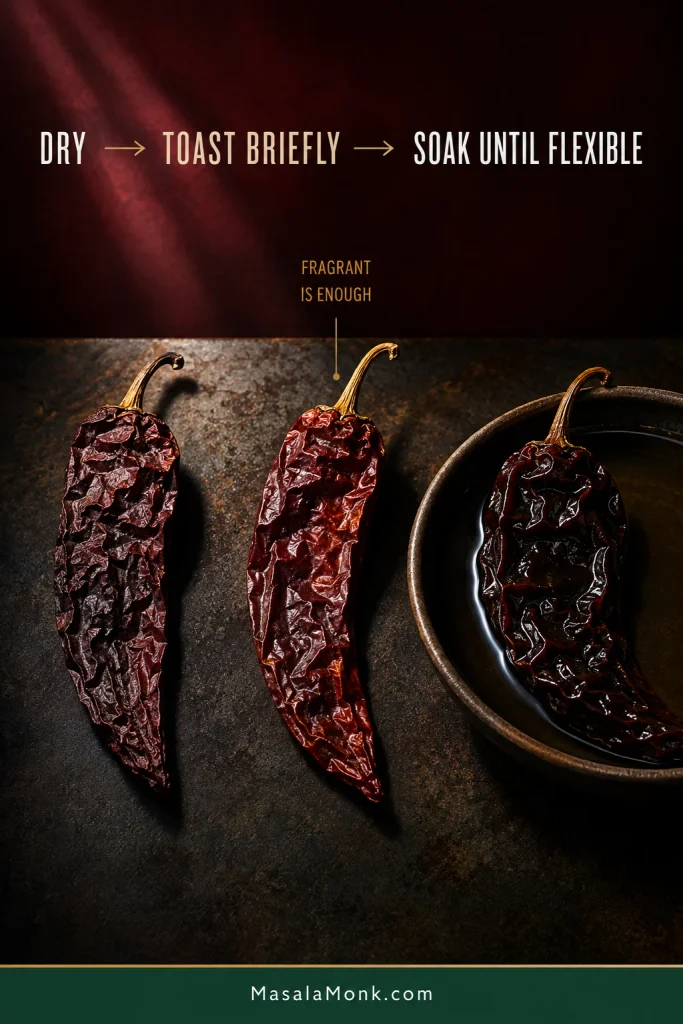
Heat a dry skillet over medium to medium-low. Toast the guajillo and ancho very briefly, turning them, until they smell warm and distinctly chile-like and become slightly more flexible. Add the árbol chile only for the final few seconds because its thin skin scorches quickly.
Fragrant is enough. That aroma is your cue to stop. A chile that turns black and smells burned is better replaced than carried into the sauce.
Transfer all the toasted chiles to a bowl, cover with very hot water, and weight them down with a small plate if needed. They are ready when they bend easily without cracking, usually after 20–30 minutes. Drain.
Brief dry heat develops aroma; soaking restores flexibility, while thin chile de árbol needs much less skillet time than guajillo or ancho.
Blend the softened chiles with the 2 garlic cloves, cumin, oregano, and 2 cups / 475 ml reserved pork broth until as smooth as possible.
Push the purée through a fine-mesh strainer. A powerful blender may leave it nearly silky already, but straining removes stubborn pieces of dried chile skin that can make the finished sauce feel gritty.
Heat 1 tablespoon lard or oil in a saucepan over medium heat. Carefully pour in the strained sauce; it can splatter when it meets the hot fat. Simmer, stirring regularly, for 10–15 minutes. The sharp, almost dusty smell of the soaked chiles gives way to something deeper and rounder as the sauce darkens slightly.
The finished sauce should remain fluid and easy to spoon, not reduced into a paste. Season with salt, then reserve ¼ cup / 60 ml for the masa.
Stopping while the sauce still flows gives you room to tighten the pork filling without making it dry or paste-like.
Step 3: Finish the Red Chile Pork Filling
Shred the pork into small strands, discarding any large pieces of fat.
Stir 1 cup / 240 ml of the remaining chile sauce into the pork to start. Simmer gently until the sauce settles around the meat. Add more a few spoonfuls at a time when the pork needs it.
Chile size, straining loss, sauce reduction, and cooked pork yield all vary slightly. Stop at the right texture; you may not need every drop of sauce.
The Filling Test
Too dry: the meat looks fibrous and there is barely enough sauce to coat the strands.
Right: every shred looks glossy and saucy, and a spoonful forms a soft mound.
Too wet: red liquid runs away from the pork and pools around a spoonful.
The Filling Test
If red liquid runs away from the pork when you tilt the spoon, the filling needs more reduction before assembly.
For 24 tamales, you will use 720 g / 1.6 lb filling. You do not need to weigh the whole pan; portioning 30 g into the first few wrappers will show you whether you are on track.
Taste a forkful before setting the filling aside. It should already be satisfying on its own: savory pork first, followed by warm dried-chile flavor. Adjust the salt now.
Extra pork or sauce is fine. Save it for tacos, eggs, rice bowls, quesadillas, or another meal. There is no benefit in squeezing it into already well-filled tamales.
Set the filling aside to cool. The longest cooking job is now done. While it cools, get the husks ready.
Step 4: Rinse, Sort, Soak and Drain the Corn Husks
Give the husks a quick rinse to remove loose dust or corn silk, then sort them before soaking. Put the widest, least damaged pieces in your wrapping pile and save smaller clean pieces for overlapping, patching, ties, and lining the steamer.
Soak 30–32 husks in very hot water, using a plate or smaller bowl to keep them submerged. Begin checking after 30 minutes; some bags need closer to an hour. A ready husk bends and folds easily without cracking.
Shake off the water and let the husks drain upright or pat away obvious droplets. Damp husks stay flexible; dripping-wet ones can make the masa slide as you spread it.
If good masa suddenly skates across the wrapper, check the husk for surface water before changing the dough.
Overlap two small husks when necessary, patch a torn wrapper with another piece, save narrow clean pieces for ties or the steamer, and discard anything musty or moldy. One unusually difficult wrapper may simply be a thick or stubborn husk.
Step 5: Make the Masa
Beat the softened lard with a hand mixer or stand mixer for 3–5 minutes, until it looks lighter and visibly aerated.
Look for a lighter, expanded texture with soft ridges rather than chasing one particular shade of white.
In another bowl, whisk together the masa harina, baking powder, and salt.
With the mixer running on low, add the dry mixture to the whipped lard in several additions. Gradually mix in the 1¾ cups / 415 ml pork broth, followed by the reserved ¼ cup / 60 ml red chile sauce. Use comfortably warm broth; steaming-hot liquid can soften the whipped lard too much.
Beat until evenly mixed. Hold back the final ¼ cup / 60 ml broth until you have checked the texture; different masa harina absorbs liquid at different rates.
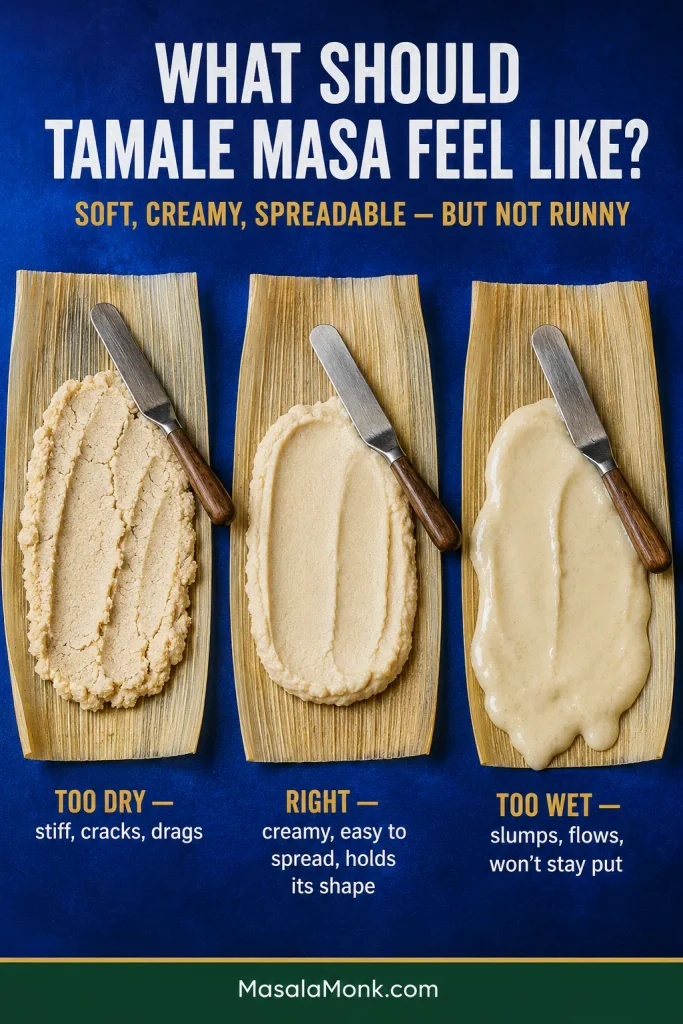
The Masa Test
Tamale masa should be soft and creamy enough to spread easily — roughly like thick hummus or soft frosting — while still staying where you put it.
Too dry: stiff, cracked around the edges, difficult to smear, and closer to firm clay than a spreadable dough.
Right: creamy, cohesive, easy to spread into a thin layer, and able to hold its shape.
Too wet: slumps, flows, or slides away from the spot where you spread it.
The Masa Test
Correct masa glides under the spreading tool and stays where it is placed; dry masa fights the stroke and loose masa keeps moving.
Masa that feels stiff or cracks while spreading needs more warm broth. Mix it in 1 tablespoon / 15 ml at a time, mixing completely before adding another spoonful.
Does Tamale Masa Have to Float?
Not necessarily. Some recipes use a floating ball of masa as a clue that enough air has been incorporated, but hydration, fat, density, and the size of the test piece can affect the result. Floating is one clue, not the final verdict. For this recipe, the more useful signs are lightness, easy spreading, good seasoning, and the texture of the cooked masa.
Do not change good masa just to make a test piece float; the cooked texture matters more than the glass.
Cook a test bite before wrapping 24 tamales. Flatten a teaspoon or two of masa into a small thin patty on a microwave-safe plate and microwave in short intervals until completely set. Taste for salt first, then for savory pork-broth depth and gentle red-chile warmth. The masa should taste good even before the pork arrives.
If the masa noticeably stiffens as you work, mix in warm broth a tablespoon at a time until it spreads easily again.
Now every component is ready. Put the husks, masa, filling, spreading tool, scale, and a tray within easy reach. From here, the job changes from cooking separate pieces to building the tamales themselves.
Step 6: Portion, Fill and Fold
The first tamale is usually the slowest. Once you have wrapped several, the motions begin to repeat themselves.
If you have another pair of hands, this is an easy job to divide: one person can spread while another fills and folds.
How Much Masa and Filling Per Tamale?
Use 40 g prepared masa + 30 g red chile pork filling for each medium tamale. Weigh the first three or four; once you recognize those portions, work by eye.
Similar masa thickness from wrapper to wrapper helps the batch steam more evenly while the measured filling keeps pork present without overloading the fold.
Which Side of the Corn Husk Does the Masa Go On?
Spread the masa on the smoother side of the husk. Lay the wide end toward you and keep the narrow end bare so it can fold upward later.
Spread. Smear the masa over a roughly 4-inch / 10 cm square on the broad half of the husk. Aim for a thin, even layer, about ⅛ inch / 3 mm thick.
A small offset spatula is easiest to control, though a butter knife or the back of a spoon works too. Masa that continually tears the husk may need a little more broth. A spread that is simply too thick or crooked can be scraped back into the bowl and tried again. Nothing has been ruined.
Fill. Run the pork through most of the masa zone instead of piling everything in the center. That puts filling into more bites while preserving enough border to close the wrapper.
Fold. Bring one long side over the filling, then the opposite side, so the masa edges meet or slightly overlap. Fold the bare narrow end upward and leave the wider end open. Most husks do not need tying; a loose wrapper can simply be opened and folded again.
If the wrapper will not close comfortably, remove a little filling or excess masa instead of squeezing the husk tighter.
Aim for consistent portions, not identical husks. Corn wrappers vary naturally. Similar amounts of masa and filling matter more than perfectly matching every finished shape.
Once several tamales are lined up on the tray, the project starts looking different from where it began. Separate bowls of pork, masa, chiles, and husks have finally started turning into dinner.
Set each folded tamale on the tray with its open end up. Once the batch is wrapped, move everything to the steamer.
Step 7: Load the Steamer
Add enough water for a long steam, then check the level before loading the tamales: the water surface must sit clearly below the steamer rack. The bottoms of the tamales should not sit in water. In many pots, 1½–2 inches / 4–5 cm is a useful starting depth.
Line the rack with spare clean corn husks if you have them. Stand the tamales upright with their open ends facing upward.
Snug is good. Compressed is not. The tamales should support one another while leaving pathways for steam to move through the pot.
A partly filled steamer can be supported with an upside-down heatproof bowl or another safe heatproof spacer so the tamales remain upright without being squeezed together. Cover the top with a few spare husks, then close the pot with a reasonably tight-fitting lid.
Step 8: How Long to Steam Tamales
Begin checking these medium tamales at 70 minutes; most batches finish in 75–90 minutes. Size, masa thickness, packing, and steam strength can move the finish point.
Bring the pot to strong, continuous steam, then adjust the heat so the steam remains steady. Start the timer once that steady steam is established.
Once the steamer settles into its rhythm, there is not much to do besides keep an ear on the pot and make sure the water does not disappear. Before long, you should begin to smell warm corn and chile beneath the lid.
Check the water level 30 minutes after the timer starts and periodically after that. Add hot or boiling water down the side when needed, taking care not to splash the tamales.
Avoid lifting the lid every few minutes just to look. Every peek releases steam and makes the pot build that heat again.
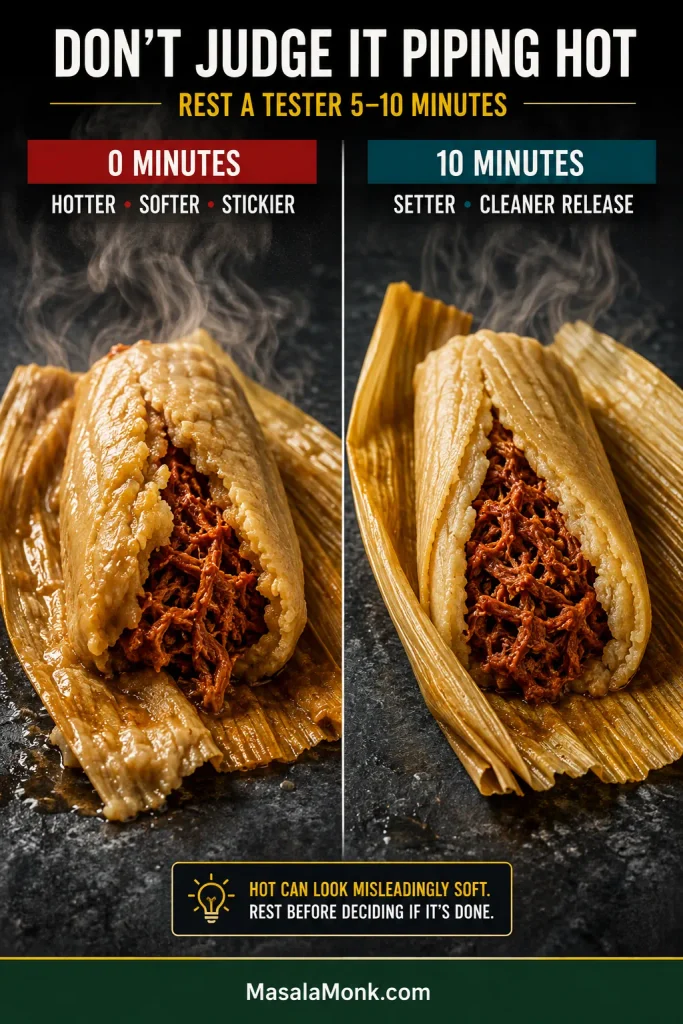
Do not judge a piping-hot tamale. Remove one tester and leave it for 5–10 minutes before peeling back the husk. Masa is softer and stickier immediately out of the steamer than it is after that short rest.
A tester with a set center and a wrapper that releases mostly cleanly is done. Wet or paste-like masa after the rest needs another 10–15 minutes of steam before you check a different tamale.
How to Tell When Tamales Are Done
Your timer tells you when to start checking. The tamale tells you when it is finished.
After the tester has rested, look for three things:
Husk: peels away mostly cleanly instead of carrying off a wet layer of masa.
Shape: the tamale stays together when unwrapped.
Center: tender and fully set, with no wet or pasty core.
After the tester has rested, look for three things:
Husk: peels away mostly cleanly instead of carrying off a wet layer of masa.
Shape: the tamale stays together when unwrapped.
Center: tender and fully set, with no wet or pasty core.
When husk release, shape and center texture agree, you have stronger evidence than any one cue can provide alone.
Temperature can confirm that the center is thoroughly hot, but texture and husk release are the more useful culinary doneness checks for this recipe. If you use a thermometer as an additional check, look for 165°F / 74°C in the center.
What to Serve With Pork Tamales
Let the finished batch rest for 10–15 minutes before serving. The masa settles slightly as the tamales cool. Two to three medium tamales per person is a useful starting point when they are the main course; peel away and discard the husks at the table.
Taste the first tamale before covering it with salsa. The masa has been seasoned with pork broth and red chile specifically so it deserves to be tasted along with the filling.
After that, keep the plate as simple or generous as you like. A spoonful of roasted salsa verde brings brightness, lime cuts through the rich pork, and creamy refried beans make an easy side. Rice works well for a fuller meal, while a crisp salad or slaw brings freshness.
Lime, salsa and simple sides add contrast to the rich pork and chile without needing to cover the tamale itself.
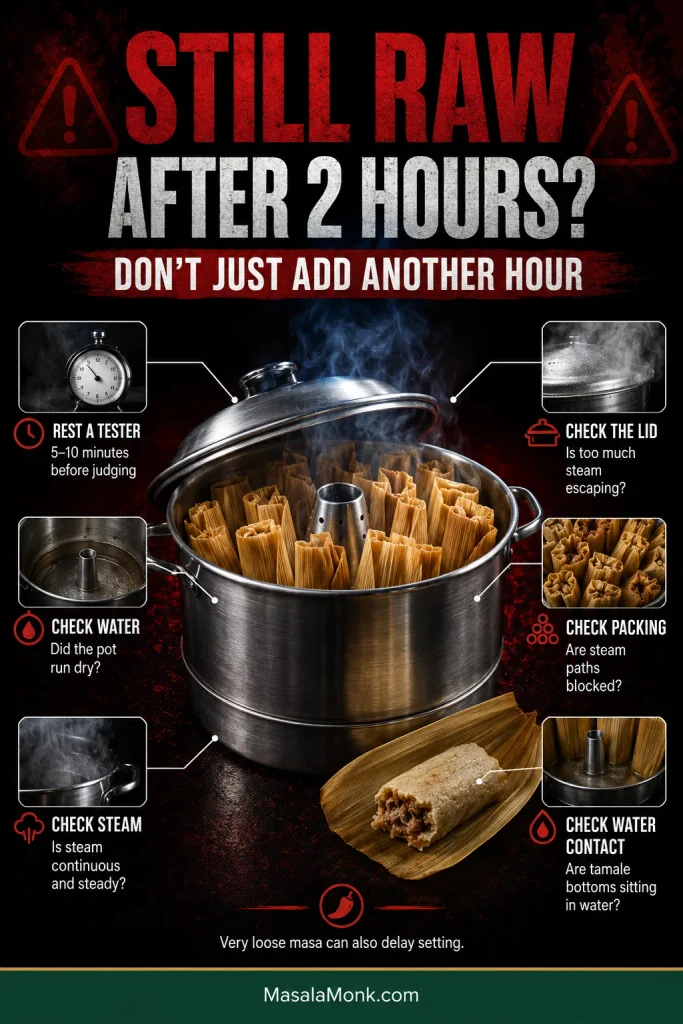
Tamales Still Raw After 2 Hours? Diagnose Before Steaming Longer
After two hours, another blind hour of steaming is the last thing you want to hear. So stop treating time as the only variable.
Before adding another long stretch of cooking, rest one tester for 10 minutes. A tamale that firms and begins releasing from its husk as it cools may already have been cooked; very hot masa can look softer and stickier than the same masa several minutes later.
A genuinely wet center after that rest means it is time to inspect the steamer:
Is there still water in the pot?
Is the pot producing continuous steam?
Does the lid fit reasonably tightly?
Are the tamales squeezed into one solid mass?
Do raw patches appear where tamales touch one another?
Are the bottoms sitting in water?
Is heavy condensation repeatedly reaching the open tops?
Was the masa extremely loose before wrapping?
When some tamales are completely done while others have isolated raw patches, steam circulation, inconsistent thickness, and packing are more likely suspects than the entire pot simply needing another hour.
Whole-batch wetness suggests a broader steam or masa problem, while isolated raw patches point more strongly toward circulation, packing or uneven thickness.
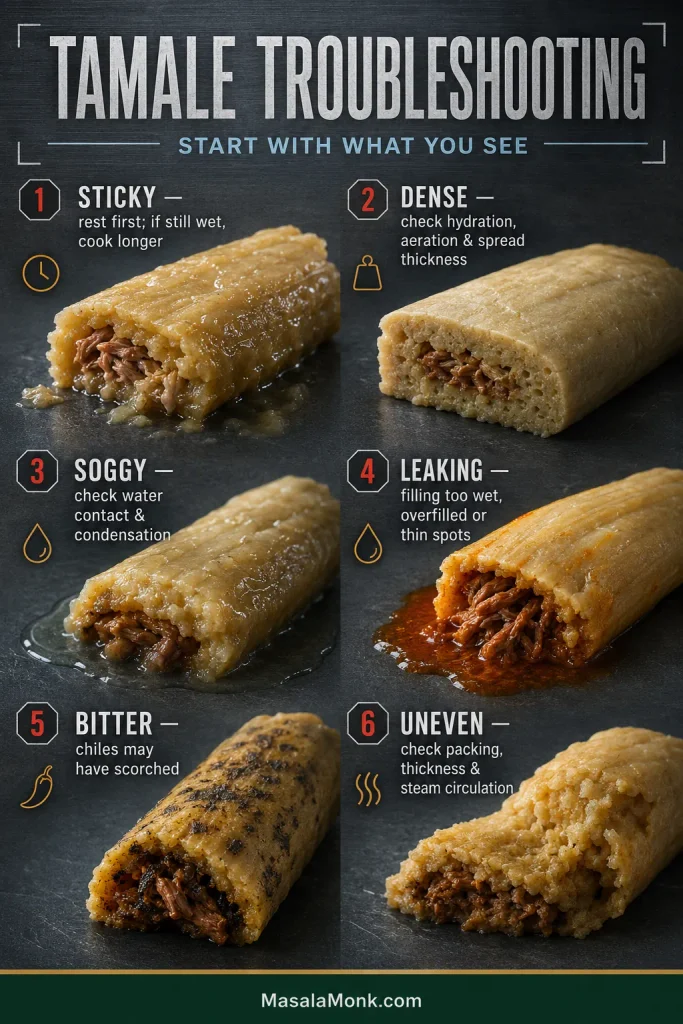
Tamale Troubleshooting
Problem
Diagnosis & Fix
Masa cracks while spreading
It is probably too dry. Mix in warm broth 1 tbsp / 15 ml at a time.
Masa slumps or flows
It is too loose. Stop adding liquid, let it sit briefly, then reassess.
Masa fights the husk
Check for stiff masa and dripping-wet husks before blaming your spreading technique.
Filling leaks
The filling may be too wet, the tamale overfilled, or the masa layer too thin in places.
Tamale is still wet after resting
It is undercooked. Steam another 10–15 minutes and test a different tamale.
Some tamales are done and others raw
Look for crowding, blocked steam paths, or noticeably different masa thicknesses.
Whole batch remains raw after excessive steaming
Check water, steam strength, lid fit, packing, and water contact before simply adding another hour.
Tamales are soggy or waterlogged
Water or heavy condensation may be reaching the masa. Keep the water below the rack and use spare husks over the batch.
Finished masa is dense
Look at masa hydration, how well the lard was aerated, and whether the masa was spread too thickly.
Tamales taste bland
The masa itself may have been underseasoned. The cooked masa taste-test catches this before assembly.
Red chile sauce is bitter
The dried chiles may have scorched. Strong burned-chile flavor is usually better remade than disguised.
Red chile sauce is gritty
Push the blended sauce through a fine-mesh strainer.
Bottom of the steamer burns
The water boiled away. Start with enough water and check the level during steaming.
Use the symptom to choose the variable to change, then leave the others alone so you can tell what actually fixed the batch.
Make Ahead, Store, Freeze & Reheat
Make the Filling Ahead
The pork filling can comfortably be made 1–2 days ahead. Transfer it to a shallow container and refrigerate promptly.
Assemble the Night Before
You can assemble the tamales, cover them well, refrigerate overnight, and steam them the following day. Because they enter the steamer colder, expect them to take somewhat longer than freshly assembled tamales.
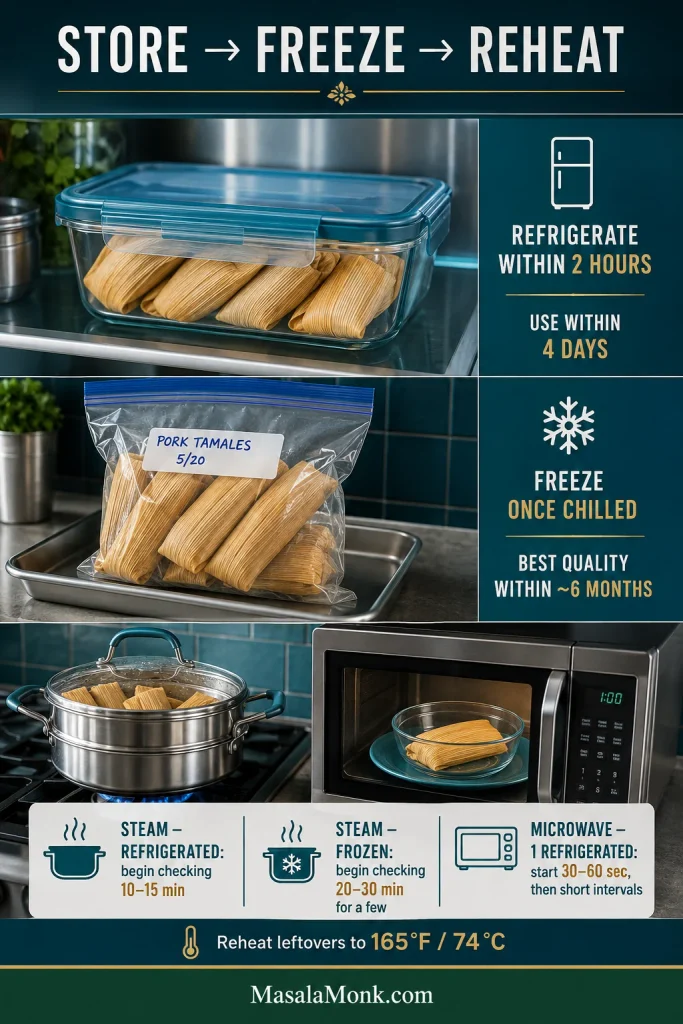
Refrigerating Cooked Tamales
Refrigerate cooked tamales within 2 hours after serving. Leave the husks on, store in a covered container, and use within 4 days.
Freezing Tamales
For the simplest first batch, cool the cooked tamales completely and freeze them with their husks still on in a well-sealed freezer container or bag. For best quality, plan to use them within about 6 months.
Can you freeze tamales before steaming? Yes. Assemble them, freeze in a single layer until firm, then transfer to a sealed freezer container or bag. They can be steamed from frozen, though they will need more time than fresh tamales. Freezing after cooking remains the easiest default when predictable reheating matters most.
How to Reheat Tamales
Freeze cooked tamales in the quantities you usually reheat so one meal does not require repeatedly opening a larger frozen batch.
Method
Starting Point
Steamer, refrigerated
Begin checking after 10–15 minutes
Steamer, a few frozen tamales
Begin checking after 20–30 minutes; a larger frozen batch can take longer
Microwave, 1 refrigerated tamale in its husk
30–60 seconds under a damp paper towel, then continue in short intervals as needed
Frozen cooked tamales can be thawed overnight or reheated directly from frozen. Keep the husks on while steaming. Reheated leftovers should reach 165°F / 74°C in the center.
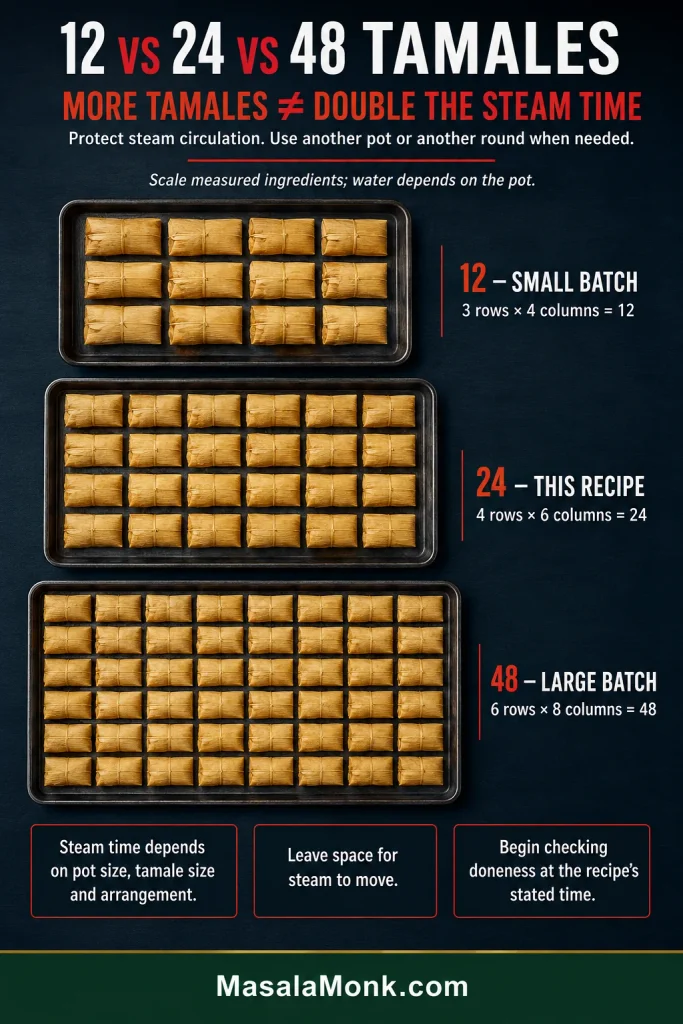
Making 12, 24 or 48 Tamales
These tables scale the measured ingredients. Pork-cooking water and steamer water depend on the size and shape of your pots, so those are handled separately below.
The larger the batch, the more physical space the tamales occupy, so vessel capacity becomes part of the scaling decision.
Pork
Ingredient
12 Tamales
24 Tamales
48 Tamales
Raw pork
1 lb / 450 g
2 lb / 900 g
4 lb / 1.8 kg
White onion
¼ medium
½ medium
1 medium
Garlic
2 cloves
4 cloves
8 cloves
Bay leaf
1 small
1
2
Fine sea salt, starting amount
¾ tsp / about 4 g
1½ tsp / 8–9 g
1 tbsp / 16–18 g
Red Chile Sauce
Ingredient
12 Tamales
24 Tamales
48 Tamales
Guajillo chiles
23 g
45 g
90 g
Ancho chiles
18 g
35 g
70 g
Garlic
1 clove
2 cloves
4 cloves
Ground cumin
½ tsp
1 tsp
2 tsp
Mexican oregano
½ tsp
1 tsp
2 tsp
Pork broth
1 cup / 240 ml
2 cups / 475 ml
4 cups / 950 ml
Lard or neutral oil
1½ tsp / about 7–8 g or ml
1 tbsp / 15 g or ml
2 tbsp / 30 g or ml
Fine sea salt
To taste
To taste
To taste
Starting sauce added to pork
½ cup / 120 ml
1 cup / 240 ml
2 cups / 480 ml
Optional chile de árbol
To taste
To taste
To taste
Scale chile de árbol to taste; heat doesn’t need to double just because the batch does.
Masa & Assembly
Ingredient
12 Tamales
24 Tamales
48 Tamales
Masa harina
1½ cups / 180 g
3 cups / 360 g
6 cups / 720 g
Lard
3 oz / 85 g
6 oz / 170 g
12 oz / 340 g
Baking powder
¾ tsp / 3 g
1½ tsp / 6 g
1 tbsp / 12 g
Fine sea salt, starting amount
½ tsp / 2.5–3 g
1 tsp / 5–6 g
2 tsp / 10–12 g
Warm pork broth
210 ml / ¾ cup + 2 tbsp
1¾ cups / 415 ml
3½ cups / 830 ml
Red chile sauce in masa
2 tbsp / 30 ml
¼ cup / 60 ml
½ cup / 120 ml
Extra broth for adjustment
Up to 2 tbsp / 30 ml
Up to ¼ cup / 60 ml
Up to ½ cup / 120 ml
Corn husks to soak
15–16
30–32
60–64
Scaling Notes
Use the listed salt quantities as starting points and taste as you go. Broth concentration and reduction can change how salty the finished sauce and masa taste.
Pork-cooking water does not need to be multiplied mechanically. Use enough to keep the meat mostly submerged and replenish with hot water when needed. Steamer water is also pot-dependent: use enough to sustain the steam while keeping its surface safely below the rack.
Steaming time does not double with batch size. A 48-tamale batch changes the geometry of the steamer, so two pots or two rounds are usually better than packing one pot tightly enough to block circulation.
Making a long group batch? A tamale-making session is often called a tamalada. When assembly stretches beyond about two hours, keep most of the cooked filling and the lard-and-broth masa refrigerated and bring out smaller working portions as needed. The USDA’s tamalada guidance covers food-safety considerations for longer sessions.
Whether you made 12 tamales or 48, the moment that tells you the work paid off is the same.
A few hours earlier, this was a pot of pork, a bowl of masa, dried chiles, and a stack of awkward corn husks. Now peel one open while it is still warm: the wrapper gives way, a little steam escapes, and the tender masa holds that red-chile pork through the center.
That small reveal is the payoff for all the spreading, folding, waiting, and checking.
If you make these, tell me how your batch went — especially what surprised you or behaved differently from what you expected.
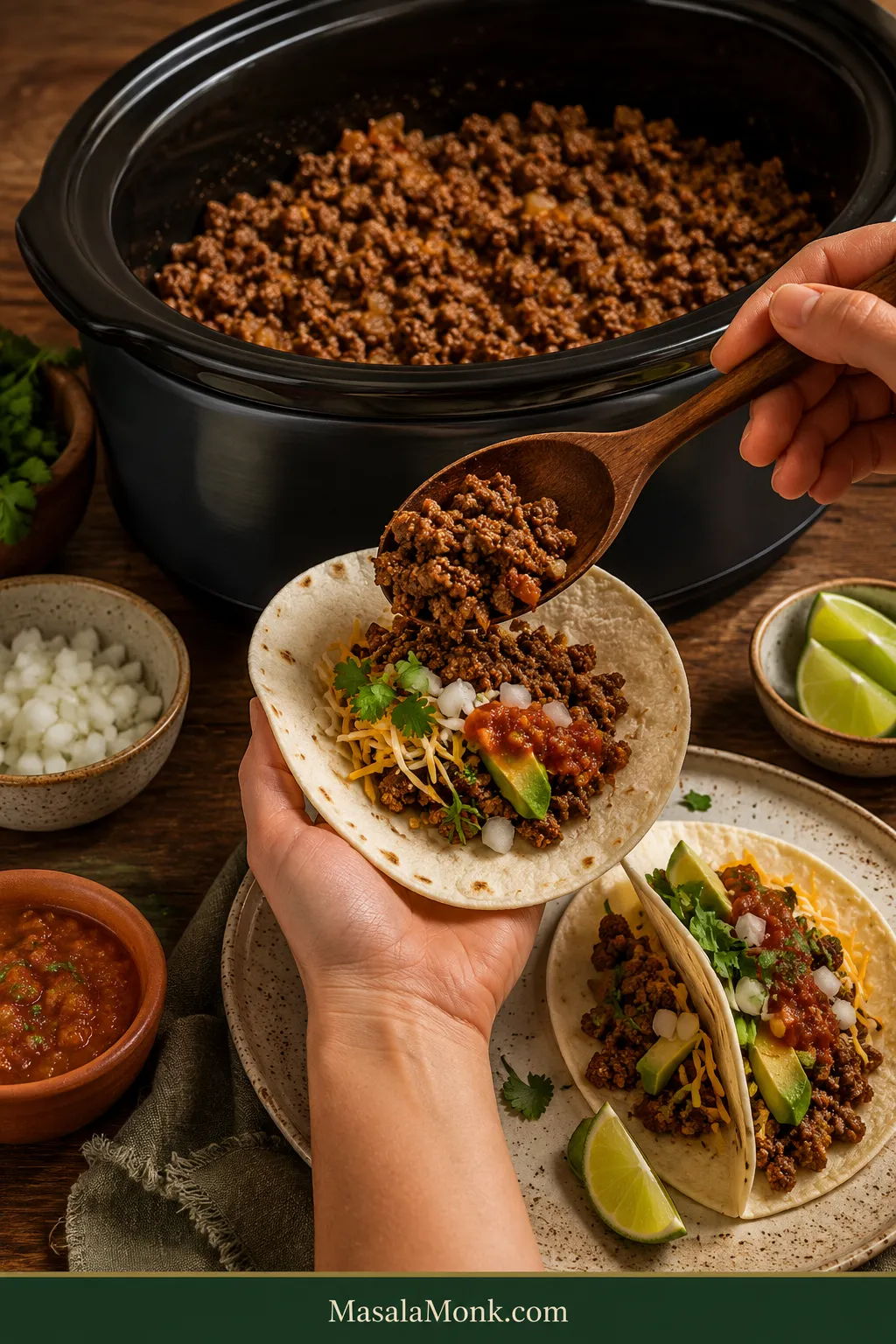
The best Crockpot taco meat has small, juicy beef crumbles coated in warm taco spices and tomato, ready to pile into soft tortillas while the cheese starts melting over the top.
And because the slow cooker does most of the work, the meat can be finished before everyone is ready to sit down. No standing over a skillet crumbling and stirring beef just as people start asking about dinner.
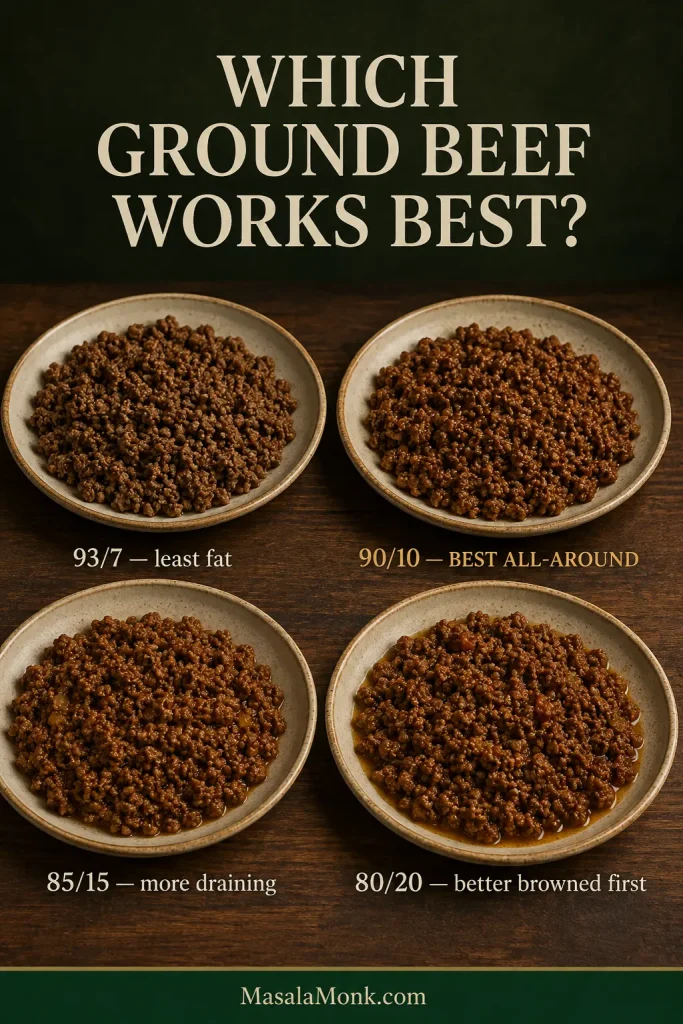
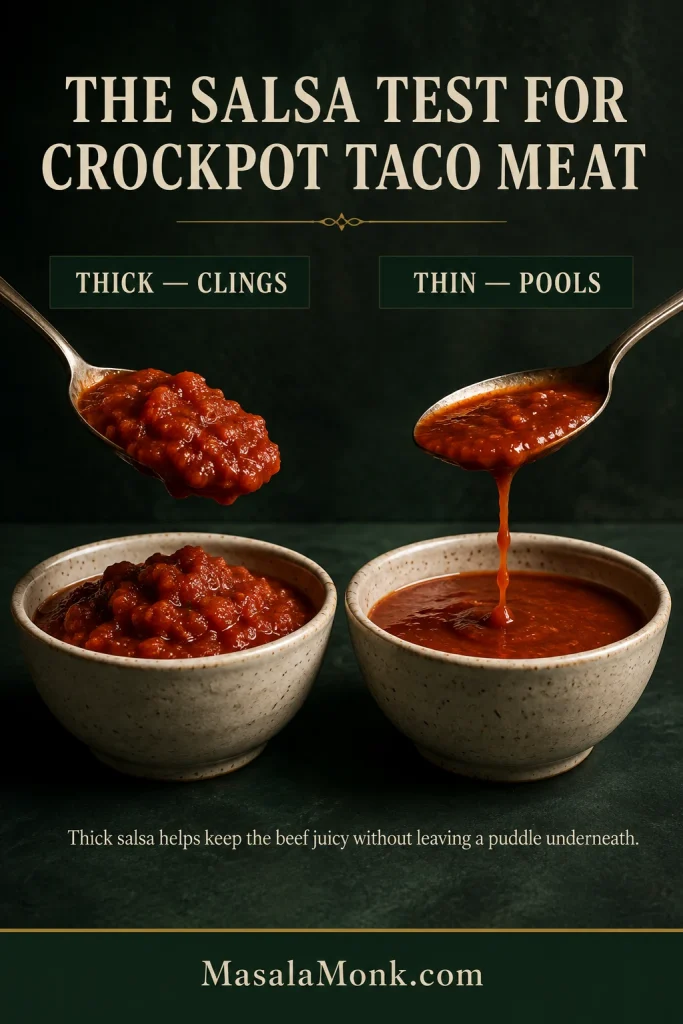
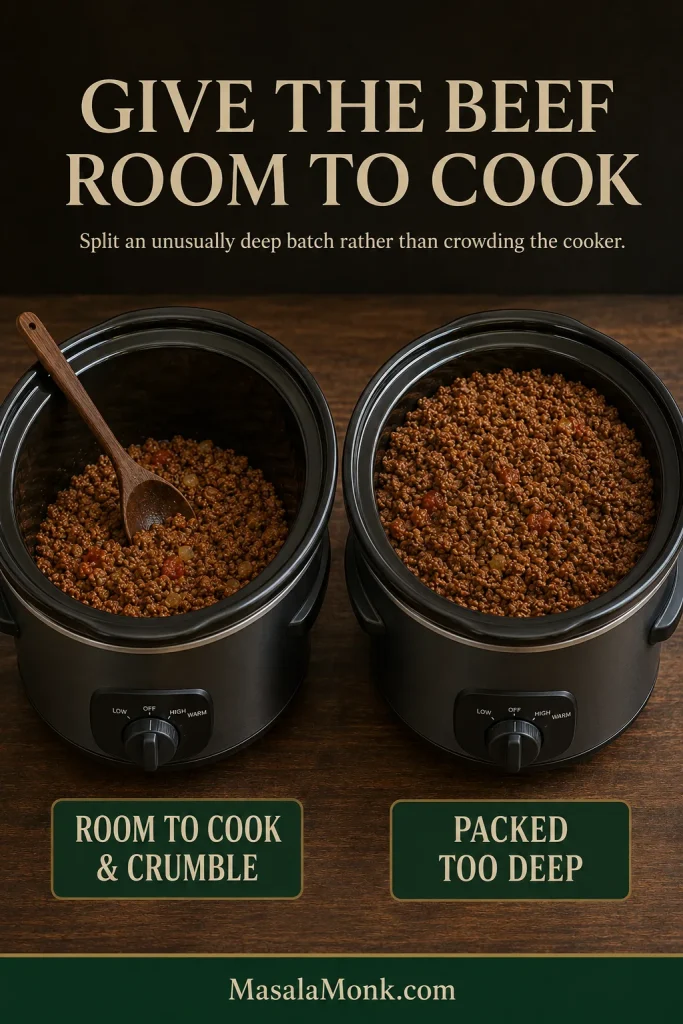
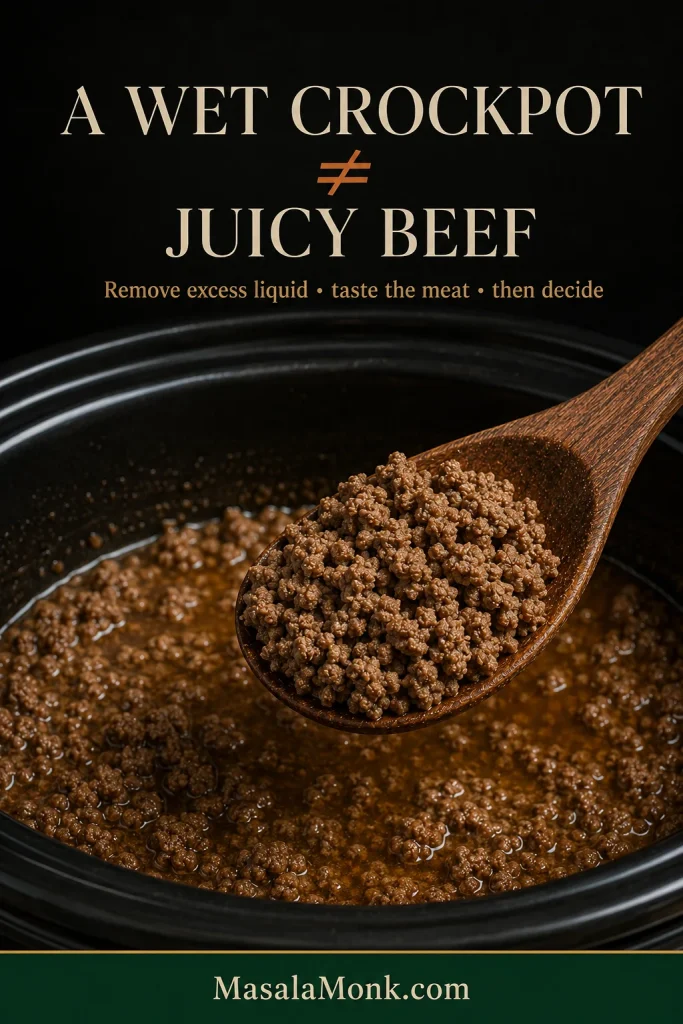
Ground beef has a few slow-cooker quirks. A dense block can stay clumpy, fatty beef can leave a slick of grease, thin salsa can make the filling watery, and extra hours do soft taco crumbles no favors. This method avoids most of those problems without turning an easy dinner into a project.
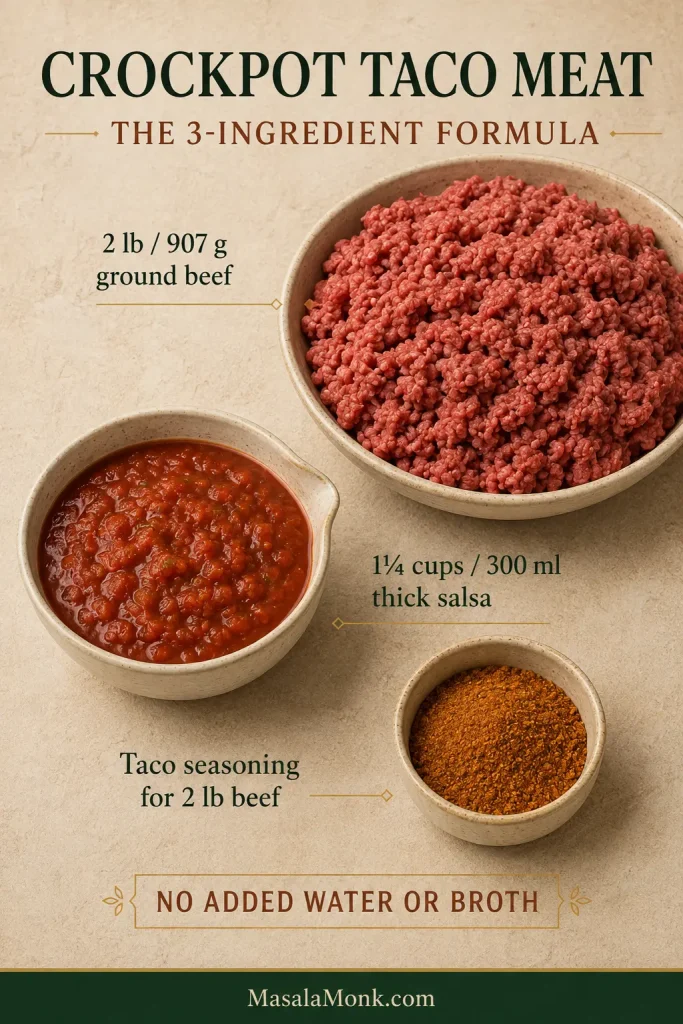
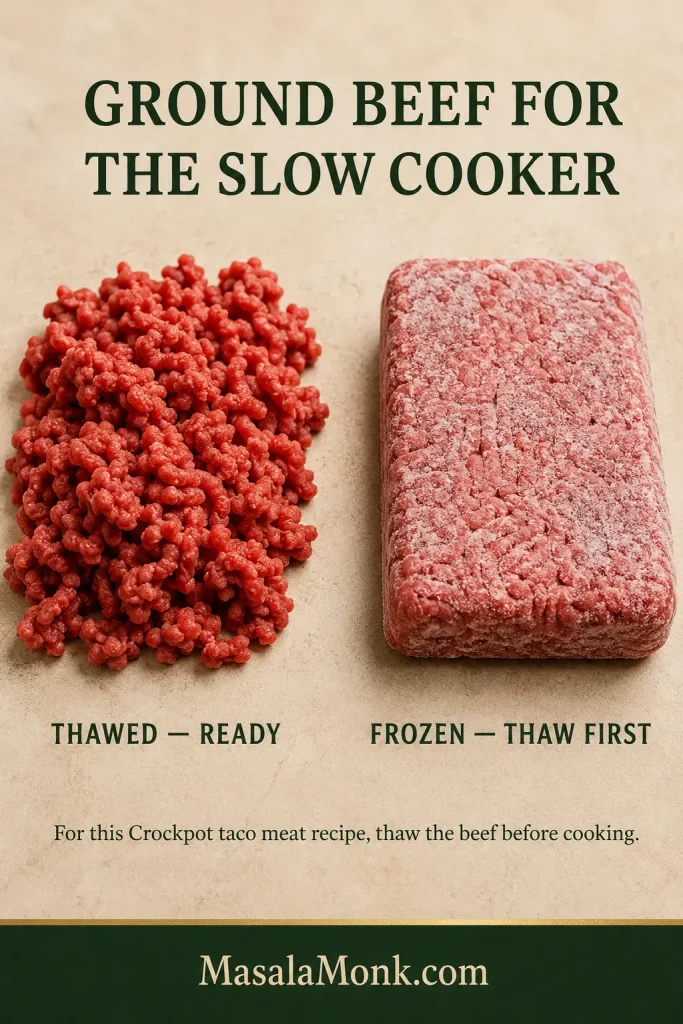
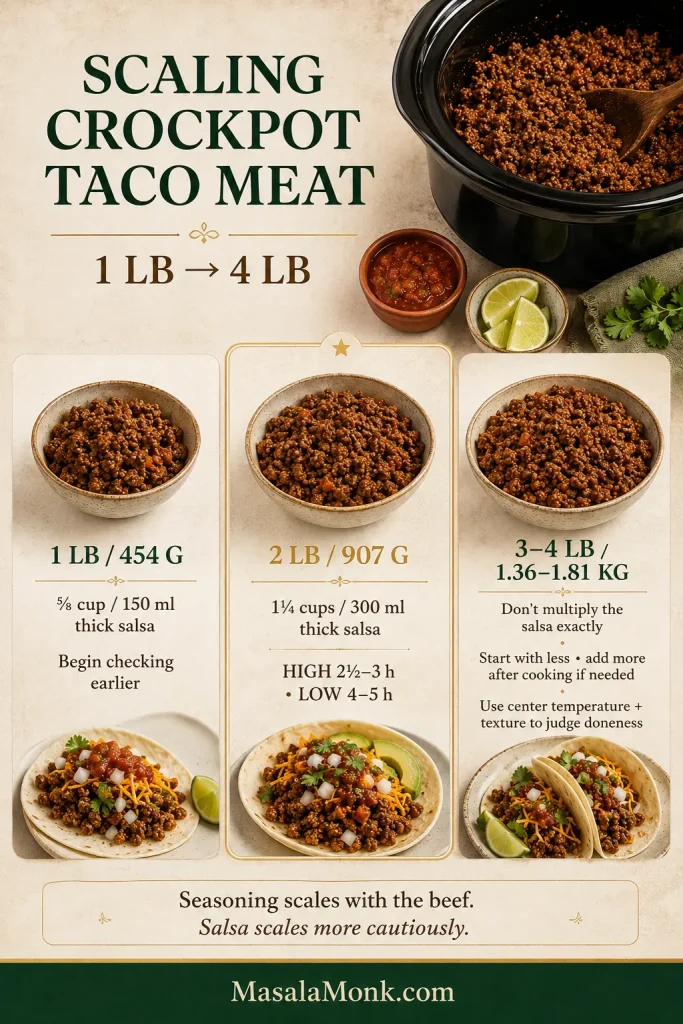
No browning or chopping is needed. For a 2-pound batch, combine 2 lb / 907 g raw, fully thawed lean ground beef with 1¼ cups / 300 ml thick salsa and taco seasoning.
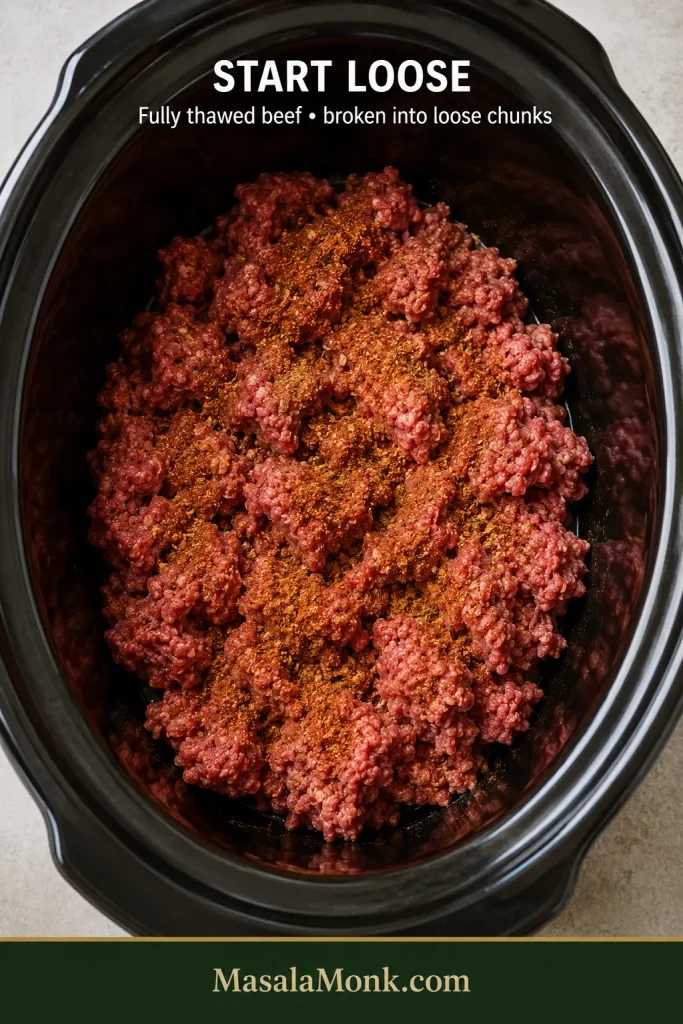
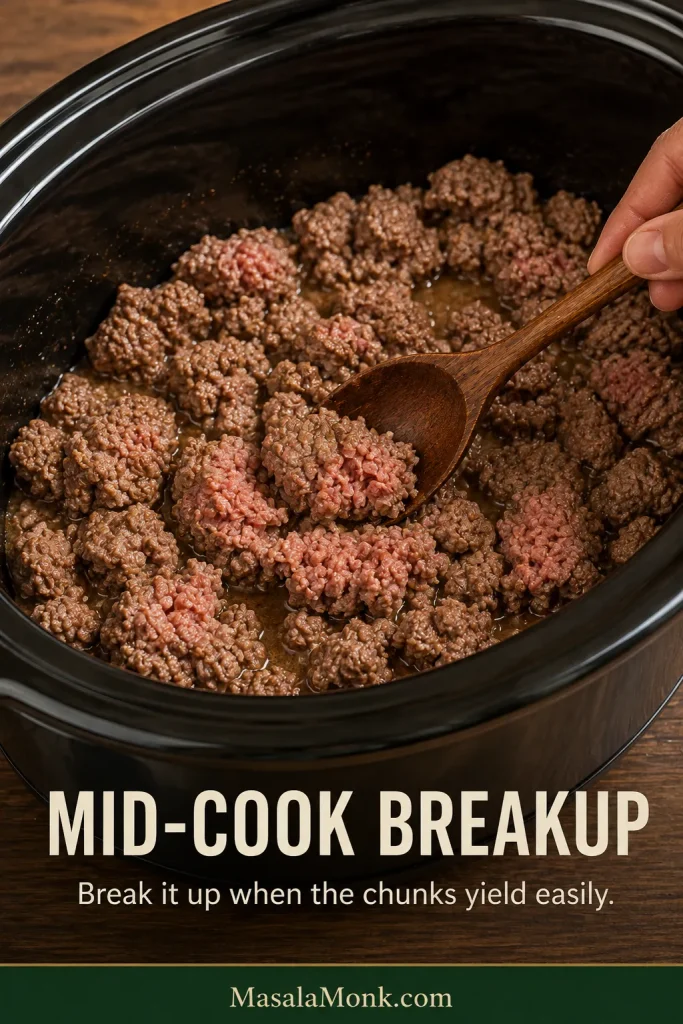
Loosen the beef before cooking, then break it into the final crumble once it begins to set. Cook on HIGH for about 2½–3 hours or LOW for about 4–5 hours, starting your checks at the early end.
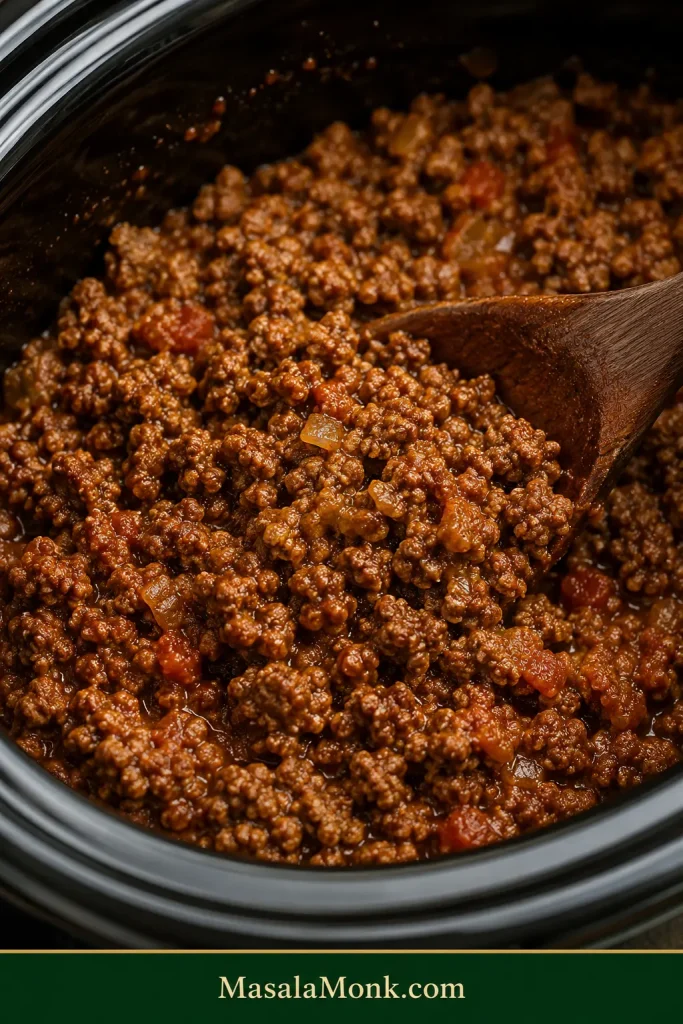
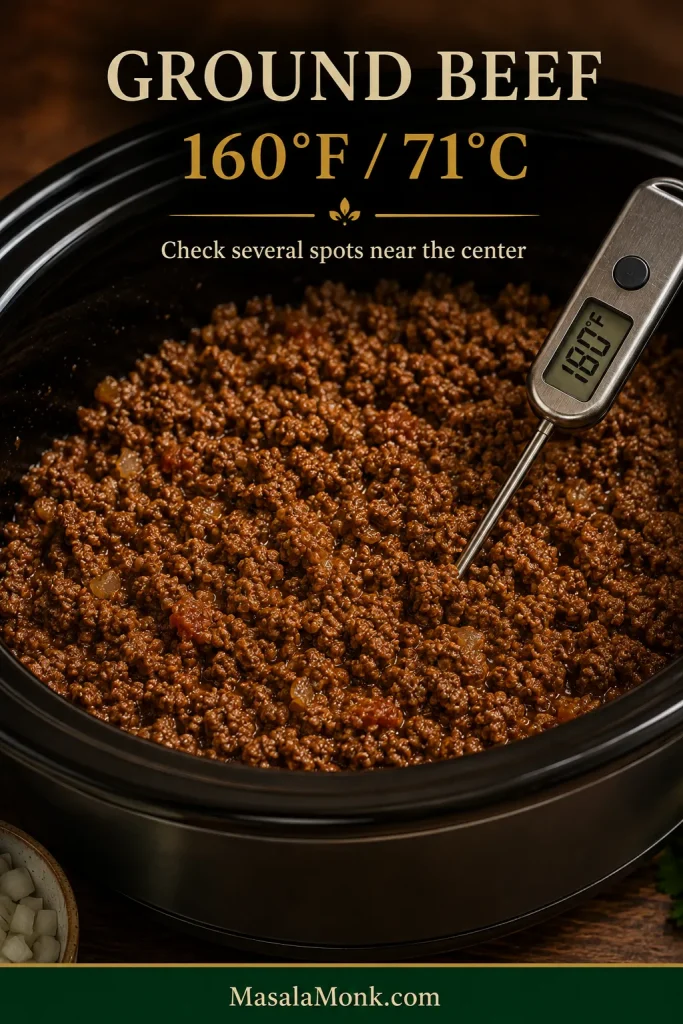
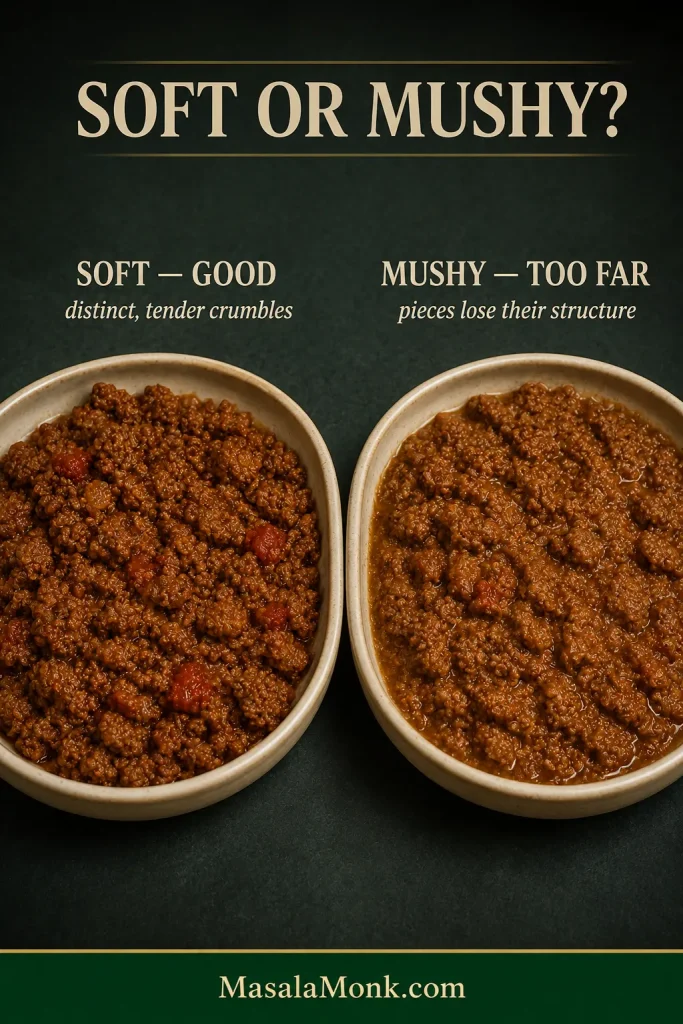
The beef is ready when it reaches at least 160°F / 71°C throughout and has the texture you want. Look for juicy, lightly glossy crumbles with very little free liquid underneath.
Added water or broth: none. Thick salsa already gives the beef the moisture it needs.
Prep: about 5 minutes with prepared taco seasoning or 10 minutes with homemade. Yield: about 8 dinner servings.
The 3-Ingredient Version
2 lb / 907 g raw, fully thawed 90/10 ground beef
1¼ cups / 300 ml thick salsa
Taco seasoning for 2 lb / 907 g beef
Using prepared taco seasoning? Use the amount your package recommends for 2 pounds of beef. If your brand’s packet is intended for 1 pound, that will usually mean two packets. Skip the packet’s stovetop water because the salsa supplies the cooking moisture here.
Thick salsa does double duty as flavor and cooking liquid, so this three-ingredient version needs no broth or packet water.
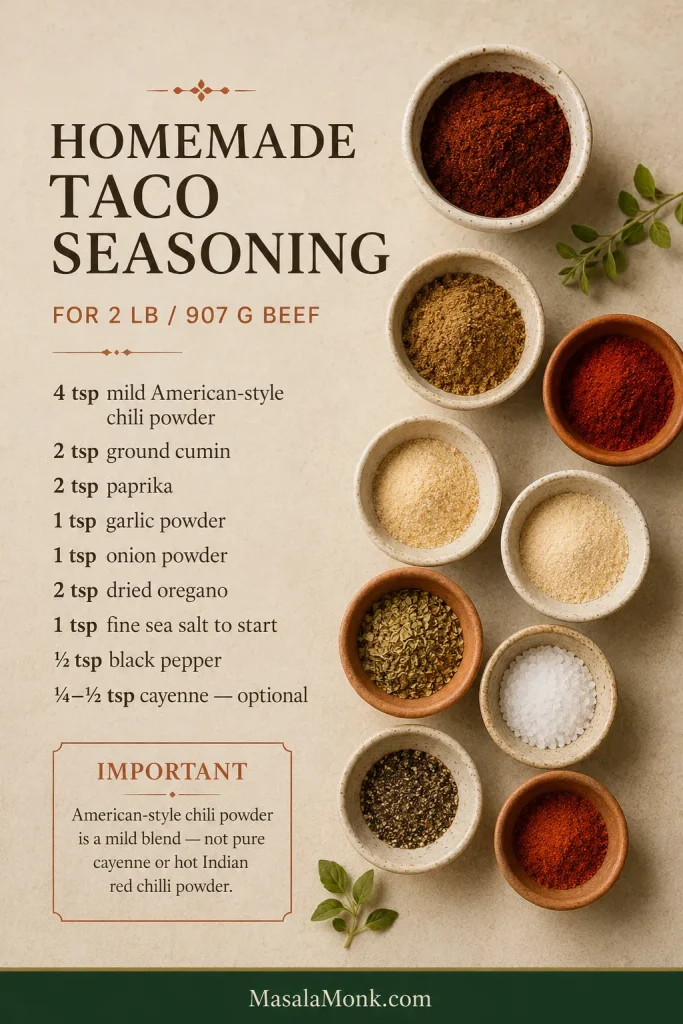
4 teaspoons mild American-style chili powder(not pure cayenne or hot Indian red chilli powder)
2 teaspoons ground cumin
2 teaspoons paprika
1 teaspoon garlic powder
1 teaspoon onion powder
2 teaspoons dried oregano
1 teaspoon fine sea salt to start, plus more if needed
½ teaspoon black pepper
¼–½ teaspoon cayenne, optional
In American taco recipes, “chili powder” usually means a relatively mild seasoning blend. Pure cayenne or a hot Indian chilli powder can be dramatically hotter, so use those much more cautiously.
Salsa can contribute plenty of sodium too. Starting with less salt gives you room to taste the cooked beef and adjust without discovering too late that the combination is overly salty.
Mix the spices before seasoning so cumin, paprika, oregano and salt distribute more evenly over the beef.
Instructions
Loosen and season the beef. Put the thawed beef in the slow cooker and pull the dense block into loose chunks. Scatter the taco seasoning evenly over the meat.
Add the salsa. Spoon the thick salsa over the beef and stir lightly. Cover the slow cooker.
Cook. Cook on HIGH for about 2½–3 hours or LOW for about 4–5 hours. Begin checking at the early end because slow cookers vary, and deeper batches can take longer.
Make the crumble. Around the middle of the cooking window, start checking the beef. When the chunks have started to set and separate easily, use a wooden spoon, meat chopper or potato masher to break them into the size you like. Replace the lid and continue cooking.
Check doneness. Test several spots near the center. The beef should reach at least 160°F / 71°C throughout, with no dense raw pockets. Color alone is not a reliable doneness test.
Finish and serve. Stir well. Skim obvious grease or remove excess thin liquid only if needed, then taste and correct the salt or seasoning. If you add more dry seasoning, give it another 5–10 minutes of heat. Spoon into warm flour tortillas or soft homemade corn tortillas with cheese, onion, avocado, salsa, cilantro, jalapeños or lime.
Before You Serve
Food-safety note: if a spoon, masher or chopper touches undercooked beef, wash it or switch to a clean utensil before using it again with the fully cooked meat.
Cook’s note: can’t be there for the mid-cook breakup? Loosen the raw beef especially well at the beginning, then crumble it thoroughly once it is safely cooked. The pieces may be less uniform, but dinner still works.
When the beef is glossy, well seasoned and easy to scoop without liquid running around the crumbles, you’re done. Warm the tortillas and eat.
When the Crockpot Works Best—and When to Brown First
The Crockpot’s advantage here is timing, not tenderness. Ground beef does not need hours of slow cooking to become tender. The Crockpot cuts down the stove work, lets the meat be ready before you need it, and keeps it hot until everyone is ready to eat.
If browned edges and a faster stovetop dinner matter more, the skillet wins.
Mostly Hands-Off
Thawed raw beef goes directly into the Crockpot with salsa and seasoning.
Best for: ordinary dinner batches, minimal cleanup and softer taco crumbles.
Browned & Firmer
Brown and drain the beef in a skillet. Stir in the seasoning and enough salsa to leave it juicy rather than saucy, then transfer it to the Crockpot to stay hot for serving.
Best for: firmer pieces, deeper browned flavor or higher-fat beef.
Big Taco Bar
Cook and drain the beef in batches, then use one or more Crockpots to keep it hot for serving.
Best for: larger quantities where even cooking and easy draining matter more than dump-and-go convenience.
Prefer firmer, deeply browned stovetop crumbles? Our Ground Beef Tacos Recipe is built around that skillet texture and a much faster cook.
Which Ground Beef Works Best?
With skillet taco meat, excess fat can be poured off before the seasoning goes in. With the raw slow-cooker method, everything released by the beef stays in the pot until the end.
For this recipe, 90/10 hits the sweet spot: plenty of beefy flavor without leaving a large slick of fat underneath.
Ground beef
What to expect
Best use
93/7
Very little rendered fat; leaner, less rich result
Minimal draining
90/10
Good beef flavor with some fat to skim if needed
Best all-around choice
85/15
Richer, with more fat collecting at the bottom
Fine if you don’t mind draining some
80/20
Can leave a substantial grease layer
Better browned and drained first
Already have 85/15 in the refrigerator? Use it. Taco night does not require a special grocery run; just expect more fat at the end.
If your store labels it beef mince, use the same lean ratio and follow the recipe as written.
Why Salsa Consistency Matters
Salsa has a big say in how wet the taco meat becomes because it brings tomato, chile, aromatics, acidity, salt and moisture all at once.
To keep the beef juicy without leaving a puddle underneath, choose a thick salsa that sits on a spoon instead of immediately running off it. Thick salsa clings to the crumbles; very thin restaurant-style or watery fresh salsa is more likely to pool around them.
Use the spoon, not the label. If salsa runs off immediately, start with less; if it holds a mound, the recipe amount is a better fit.
Thin salsa can still taste excellent. Start with less and add another spoonful after cooking if the beef needs it.
Chunky or smooth? Chunky salsa leaves visible pieces of tomato, onion and chile. A smoother salsa blends more completely into the beef and gives the filling a more uniform look. Mild, medium or hot is your call; consistency matters more to the slow-cooker method than heat level does.
For something brighter at the table, keep the finishing salsa separate. A spoonful of roasted salsa verde adds fresh acidity without making the beef wetter in the Crockpot.
Can Raw Ground Beef Go Straight Into the Slow Cooker?
Yes. Use fully thawed beef, loosen the dense block before cooking and check doneness with a food thermometer instead of relying on color.
USDA slow-cooker guidance recommends thawing meat before it goes into a slow cooker. Thawed ground beef also separates more evenly and is much easier to crumble. Read the USDA slow-cooker guidance.
What to Look for While the Beef Cooks
Start loose. Pull the raw beef into handful-size chunks before the lid goes on. They do not need to be tiny; opening up the dense block is what matters.
Expect moisture later. The pot may look surprisingly dry at first. Ground beef releases its own juices as it heats, and very little escapes from a covered slow cooker.
Break it when it yields easily. When the chunks separate with very little resistance, they are ready to crumble. Break them into the size you prefer and let the beef finish cooking.
Crush the chunks when they yield easily; if the spoon smears or drags through the meat, give them more time.
Don’t judge by color alone. Appearance can be misleading, so use the thermometer reading in the recipe as the final doneness check.
Check several dense spots near the center. 160°F / 71°C throughout is the target, not color alone.
The Taco Meat Test: Too Wet, Just Right or Too Dry?
Drag a wooden spoon or spatula through the middle of the beef and watch what happens to the channel.
Use the trail after the finished taco meat has been stirred. A little juice is desirable—the speed at which the channel disappears tells you more than visible liquid alone.
Too Wet
Thin liquid immediately floods back in and the meat looks as though it is sitting in sauce.
What to do: spoon out excess liquid or leave the lid off briefly while the beef is hot.
Just Right
The crumbles look juicy and lightly glossy. The spoon trail stays visible for a moment before a thin sheen of flavorful cooking juice slowly settles back in.
Leave it alone. You’re there. A thin layer of juice at the bottom belongs with moist taco meat, and the filling should scoop neatly without soaking the tortilla underneath.
Too Dry
The beef looks matte and loose with very little moisture clinging to the crumbles.
What to do: stir in 1–2 tablespoons of salsa if the beef could use more flavor as well as moisture, or water if the seasoning is already where you want it. Heat briefly, then check again before adding more.
Is That Liquid Cooking Juice or Grease?
Oily slick or yellow-brown beads: mostly rendered beef fat. Skim or drain it.
Thin reddish-brown liquid: mostly beef juices and salsa moisture. Remove only what is excessive.
An oily layer over thinner liquid: remove the fat first, stir the beef, then decide whether the remaining juice actually needs reducing.
Draining every drop can leave good taco meat unnecessarily dry. Remove the fat you do not want, stir again and reassess.
If shiny oil floats over darker cooking juice, skim the top layer first, stir, then reassess. Draining everything can remove useful seasoned moisture with the fat.
The Crockpot works well for fine and medium crumbles; deeply browned beef still belongs in a hot skillet. Choose the texture that fits the tacos you want tonight.
Use the guide as a stopping-point check: medium crumbles should still look unmistakably like ground beef rather than a uniform paste.
Fine Tex-Mex-style crumbles: use a potato masher or meat chopper and work the beef fairly fine. Stop while distinct small pieces remain. The meat should feel tender and meaty, not pasty.
Medium everyday crumbles: use a wooden spoon or sturdy spatula and stop earlier. This is what the main recipe aims for—tender, juicy and easy to scoop while still clearly feeling like ground beef.
Firm, browned crumbles: use a hot skillet for browned edges and a firmer bite. The Crockpot can then keep the cooked meat hot until everyone is ready.
Easy Variations
No-Salsa Version
For an intentionally smoother, saucier version without salsa, keep the 2 lb / 907 g ground beef and the same amount of taco seasoning. Replace the 1¼ cups / 300 ml salsa with 1 can plain tomato sauce, about 15 oz / 425 g.
Tomato sauces vary in saltiness, so hold back any extra salt until the beef is cooked and tasted. This version will not finish exactly like the thick-salsa recipe. If more sauce collects around the beef than you want, spoon off the excess or let the meat sit briefly uncovered while hot.
This skips salsa, not tomato. A completely tomato-free version needs a different moisture balance, so simply omitting the tomato is not a direct substitute.
Rotel Version
Replace the 1¼ cups / 300 ml salsa with 1 undrained 10-oz / 283 g can of Rotel. Keep the same homemade spice blend—or use enough packet seasoning for 2 pounds of beef. No added water is needed.
Rotel is thinner than the salsa used in the main recipe, so let the beef cook before deciding whether it needs anything else.
Stretch It With Beans
Drain and rinse a 15-oz / 425 g can of black beans or pinto beans, then stir them into the cooked beef for the final 20–30 minutes.
Whole beans stretch the batch without turning it into a completely different filling. Want the beans to become the meal instead of an add-in? That’s closer to our Crockpot chili.
Scaling Crockpot Taco Meat: What Changes From 1 to 4 Pounds
Scale the taco seasoning with the amount of beef. Salsa is different: as the batch gets larger and sits deeper in the cooker, don’t increase the salsa in exact proportion to the beef. Start with less and add more after cooking if the meat needs it.
For 3–4 lb, leave room to correct upward: adding salsa later is easy; removing excess liquid is not.
Batch
Salsa guidance
What changes
1 lb / 454 g
⅝ cup / 150 ml thick salsa
Begin checking earlier; a smaller cooker is useful if available
2 lb / 907 g
1¼ cups / 300 ml thick salsa
Main recipe: HIGH 2½–3 h or LOW 4–5 h
3–4 lb / 1.36–1.81 kg
Don’t increase the salsa in exact proportion to the beef; start with less and add more after cooking if needed
Use a roomy cooker and rely on center temperature and texture rather than adding a fixed amount of extra cooking time
When the Cooker Gets Too Full
If the beef is packed unusually deep in your cooker, split the batch rather than crowding it in. The beef cooks more evenly and is easier to crumble that way. And when your cooker manual specifies a maximum fill level, follow it rather than packing the batch too deeply.
Remove excess thin liquid or briefly cook uncovered
Use thicker salsa and avoid adding extra liquid
Greasy
Skim or drain the rendered fat
Use 90/10 or 93/7 beef, or brown fattier beef first
Big clumps
Break the hot beef apart while it separates easily
Loosen the raw block and give it one mid-cook breakup
Mushy
Remove excess liquid and stop working the meat
Check sooner and stop at a larger crumble
Dry but sitting in liquid
Remove excess liquid first; taste the beef before adding any salsa
Check sooner and begin with thick salsa instead of extra liquid
Bland
Correct the salt and seasoning; if it is seasoned but still tastes flat, finish with lime for acidity
Scale the seasoning with the amount of beef
Too salty
Dilute with unseasoned cooked beef or beans
Hold back extra salt until the meat has been tasted
If the table solved your problem, you’re done. Two problems are especially easy to misread.
Why Is the Beef Dry When There Is Liquid in the Crockpot?
A wet Crockpot doesn’t necessarily mean juicy beef. You can have plenty of liquid around the meat while the crumbles themselves still taste dry.
The meat can continue losing moisture while sitting in released juices, fat or sauce.
Remove obvious excess liquid first and taste the meat. When extra cooking time is the real problem, pouring in a cup of broth only gives you dry-feeling beef in a wetter pot. A spoonful or two of salsa is plenty if the crumbles still need help.
Drain first, then taste. More salsa or broth will not fix overcooked, dry-feeling crumbles that are already sitting in plenty of liquid.
Is It Mushy—or Just Soft?
Slow-cooker taco meat is naturally softer than beef browned hard in a skillet. Tender crumbles that still hold their shape are exactly what many people want.
When the pieces lose that structure and become paste-like or waterlogged, they have moved into mushy territory. Prefer a firmer bite every time? Brown the beef first and let the Crockpot keep it hot instead.
Once the crumble size is right, stop working the meat aggressively; continued mashing can turn tender crumbles pasty.
For a family batch, that’s most of what can go wrong. Feeding a crowd changes the Crockpot’s job.
For a full taco bar with plenty of beans, cheese, vegetables, salsa and sides, plan roughly 2½–3 oz / 70–85 g cooked taco meat per person.
For a meat-heavy meal or an especially hungry crowd, move closer to 3½–4 oz / 100–115 g cooked meat per person.
The buying amounts here assume plenty of other fillings and sides. Buy above them when the meat is doing most of the work.
Crowd
Raw beef to buy
Best approach
8–10 people
about 2–2½ lb / 0.9–1.1 kg
The main slow-cooker method works well
12–16 people
about 3–4 lb / 1.4–1.8 kg
Use a roomy cooker or split the batch
20 people
about 4½–5½ lb / 2.0–2.5 kg
Cook in batches, then keep hot for serving
30 people
about 6½–8 lb / 3.0–3.6 kg
Cook in batches; two Crockpots can make serving easier
Why the Crockpot Works for a Taco Bar
A taco bar works because everyone builds exactly what they want while you only have one hot filling to keep track of. For a cold side that can be finished before people arrive, our 7 layer dip can be waiting in the refrigerator.
For 5 Pounds or More, Change the Method
At about 5 lb / 2.3 kg and above, stop treating the meat as one giant raw slow-cooker batch. Brown the beef in batches that fit comfortably in the skillet, or divide the raw beef between multiple slow cookers. Drain excess rendered fat, season each batch, then combine the cooked meat in the Crockpot and keep it hot for serving.
Working in smaller batches keeps the crumbles distinct, makes excess fat easier to drain and helps the seasoning coat the beef evenly. For a big taco bar, the Crockpot becomes the serving station: the meat stays hot while you actually get to enjoy the gathering instead of playing line cook.
Keeping Taco Meat Warm
Use WARM only after the meat is fully cooked and already hot. Keep hot food at 140°F / 60°C or above during serving and keep the lid on between rounds.
Quick storage guide: refrigerate cooked taco meat for 3–4 days, freeze it for about 3 months for best quality, and reheat leftovers to 165°F / 74°C.
Make It the Day Before
Cook the taco meat completely and get the moisture where you want it before storing. Divide a large batch into smaller, shallow containers and refrigerate it within 2 hours. If food is sitting outdoors above 90°F / 32°C, that window drops to 1 hour.
When serving leftovers again, reheat the meat to 165°F / 74°C before transferring it to a slow cooker on WARM.
How to Freeze Taco Meat
Freeze the meat in amounts that match the way you actually eat it. A dinner-size package or larger family-size package is far more useful than one giant frozen block.
Flat freezer bags stack neatly and thaw faster. For the best eating quality, use the frozen taco meat within about 3 months.
Flatten portions before they freeze solid so they stack neatly and thaw faster than one thick block.
Reheat Without Turning It Into Soup
Cold taco meat often looks firmer and drier than it really is. Heat it first, then decide whether it needs anything.
Add salsa 1–2 tablespoons at a time if the meat could use more flavor as well as moisture, or use water if the seasoning is already where you want it. Add slowly so the beef stays juicy without becoming soupy.
Ways to Use the Leftovers
The nicest part of making 2 pounds is that tomorrow’s dinner is already halfway done.
Small leftovers disappear easily into breakfast tacos or quesadillas; larger portions are worth turning into enchiladas or taco bowls.
Need dinner fastest? Make quesadillas, another round of tacos or a tray of nachos.
Want something fresher? Spoon the beef over taco salad or build burrito bowls with crisp vegetables and salsa.
Want it to feel like a different dinner? Turn the meat into enchiladas or pile it onto loaded baked potatoes.
Saving a small portion for morning? Warm it for breakfast tacos with eggs, cheese or avocado.
Leftovers heading toward enchiladas? Pair the beef with our homemade red enchilada sauce and it feels like a completely different dinner.
Frequently Asked Questions
Can I Leave Taco Meat on LOW All Day?
This is not an 8–10 hour workday Crockpot recipe. Ground beef does not need the long tenderizing time of a tough roast. Start checking the standard batch around four hours on LOW; several extra hours can soften and dry the crumbles more than you want.
Can I Put Frozen Ground Beef in the Crockpot?
For this recipe, thaw it first. USDA slow-cooker guidance recommends thawing meat before slow cooking. Thawed beef separates much more easily, which makes it simpler to crumble and check for even doneness.
Can I Use Ground Turkey?
Yes. Expect a softer crumble, and don’t be surprised if the turkey releases more or less liquid depending on how lean it is. Because ground turkey is poultry, cook it to 165°F / 74°C, then drain excess liquid if needed.
How Long Can Taco Meat Stay on WARM?
For Crock-Pot-branded slow cookers, manufacturer guidance recommends no more than about 4 hours on WARM. Other brands may differ, so check your manual. Use WARM only for food that is already fully cooked and hot.
Taco Night Is Basically Handled
Once the beef has the crumble you like and just enough moisture to stay juicy, this is where the Crockpot earns its place: dinner can sit there ready while the tortillas warm and everyone finishes whatever they were doing.
Put out whatever cheese, onion, avocado, lettuce, salsa, jalapeños or lime you already have. Leave the Crockpot where everyone can reach it and let people build their tacos the way they want them.
The meat is hot, seasoned and waiting when everyone is finally ready to eat. That’s really the whole point.
A good skillet of Beef Stroganoff is all tender browned beef, mushrooms with real color, and a glossy sour-cream sauce that finds its way into the noodles.
It can also look right and still disappoint.
A creamy sauce can hide chewy beef. Mushrooms can soften without developing much flavor. And a sauce that looked generous in the skillet can all but disappear once it meets the noodles.
The fork tells you the truth.
Tender beef yields easily instead of making you chew through long fibers. Properly browned mushrooms taste developed, not merely cooked. The sauce clings in a smooth, savory coat—creamy enough to comfort, loose enough to flow.
This Beef Stroganoff comes together in about 30 minutes with top sirloin, fresh cremini mushrooms, beef broth, Dijon mustard, Worcestershire sauce and full-fat sour cream. There is no cream of mushroom soup, no heavy cream and no wine required.
Sear fast. Brown the mushrooms fully. Build the sauce. Keep the final heat low; return the beef last.
Sear fast: use tender steak, slice it thinly across the grain and brown it in uncrowded batches.
Brown the mushrooms fully: cook away the moisture they release before building the sauce.
Build the sauce: get the flavor and consistency where you want them while the beef rests.
Keep the final heat low: stir in the sour cream, then return the steak only long enough to finish cooking and heat through.
The timing works because several jobs overlap. Start the noodle water first; slice and sear the steak while it heats, drop the noodles when the mushrooms go into the skillet, and build the sauce while the beef rests. That overlap is what makes about 30 minutes of elapsed time realistic, although especially juicy mushrooms or slower knife work can add a few minutes.
If timing slips, let the noodles wait; thin sirloin is less forgiving of extra heat than buttered pasta.
It is the sort of dinner that feels richer than the time it took to make.
Beef Stroganoff Recipe
Serves: 4 generously Prep: about 10 minutes Cooking: about 20 minutes Total elapsed time: about 30 minutes, with some prep overlapping the cooking Main equipment: 12-inch (30 cm) heavy skillet and a pot for the noodles
Ingredients
For the Stroganoff
1¼ lb (570 g) top sirloin steak
¾ tsp fine sea salt (about 4–5 g), divided, plus more to taste
¾ tsp freshly ground black pepper, divided
1½ tbsp (22 ml) neutral high-heat oil, divided
12 oz (340 g) cremini or baby bella mushrooms, sliced
½ tsp sweet paprika, optional — use sweet, not smoked
2 tbsp (about 16 g) all-purpose flour
1½ cups (360 ml) low-sodium beef broth, plus extra for loosening if needed
2 tsp Dijon mustard
2 tsp (10 ml) Worcestershire sauce
⅔ cup full-fat sour cream (about 150 g), taken out of the refrigerator before cooking
2 tbsp chopped fresh chives, for serving
For Serving
10 oz (285 g) wide egg noodles
1 tbsp (14 g) unsalted butter
Salt for the noodle water
Optional Wine Variation
Add ¼ cup (60 ml) dry white wine after the garlic. Scrape up the browned bits and reduce until only a thin layer of wine remains in the skillet, then continue with the regular 1½ cups (360 ml) beef broth. The wine adds brightness and complexity; it does not replace part of the broth in this version.
Measure the sauce ingredients first so the beef can leave the heat the moment it is ready.
Instructions
Start the Noodles and Sear the Beef
Start the noodle water. Put a large pot of well-salted water over high heat, then move straight to the beef. Once the water boils, keep it ready while you sear the steak. When the mushrooms go into the skillet in Step 4, add the noodles to the boiling water. Cook according to the package directions, drain when just tender, toss with 1 tablespoon butter and keep warm. Keep the noodles separate from the Stroganoff unless every serving is going straight to the table.
Slice and season the beef. Trim thick exterior fat and obvious tough sinew. Cut the steak across the grain into strips about ¼ inch (6 mm) thick and roughly 2 inches (5 cm) long. Pat very dry, then season with ½ teaspoon salt and ½ teaspoon black pepper.
Sear the beef in two batches. Heat a 12-inch (30 cm) heavy skillet over high heat until a strip of beef sizzles immediately on contact. Add about half the oil and half the beef in one uncrowded layer. Sear for roughly 30–45 seconds per side, just until browned patches develop. Transfer to a plate, let the skillet return to strong heat, then repeat with the remaining oil and beef. The centers may look underdone when the strips leave the pan. That’s intentional; they cook again at the end.
Brown the Mushrooms and Build the Sauce
Brown the mushrooms and onion. Lower the heat to medium. Once the aggressive searing heat has settled, add 1 tablespoon butter and the mushrooms. Drop the noodles into their boiling water now. Cook the mushrooms for about 3 minutes, then add the onion and remaining tablespoon butter. Continue for roughly 5–8 minutes, until most of the released mushroom water has evaporated and browned edges begin to appear. Listen to the pan: the wet hiss eventually gives way to a sharper sizzle. Season with the remaining ¼ teaspoon salt and ¼ teaspoon pepper.
Build the sauce. Stir in the garlic for about 30 seconds. For the wine variation, add the wine now, scrape up the browned bits and reduce until only a thin layer remains. Stir in the optional paprika, sprinkle the flour over the mushrooms and onion, and cook for about 1 minute. Add a small splash of broth and stir until smooth, scraping the browned bits from the bottom of the skillet. Gradually stir in the remaining broth, followed by the Dijon and Worcestershire.
Reduce to the right consistency. Simmer for roughly 3–5 minutes. Drag a spatula through the skillet; the trail should remain visible briefly before flowing closed. A loose sauce needs more reduction. A sauce that has become too thick can be loosened with broth or hot noodle water, one tablespoon at a time.
Finish Gently and Serve
Add the sour cream over low heat. Put the sour cream in a small bowl and whisk in 2–3 tablespoons of hot sauce, one spoonful at a time. Lower the heat—or briefly take the skillet off the burner—then stir the warmed sour cream into the sauce until smooth and glossy.
Taste and adjust. Check the salt first. A muted sauce may need another ¼ teaspoon Dijon. Taste before adding anything else. Another ¼–½ teaspoon Worcestershire can deepen the savory flavor without taking over.
Return the beef. Fold in the steak and every drop of juice collected on the plate. Cook only long enough for the thin strips to finish cooking and heat through. Taste the sauce once more and adjust the salt if needed.
Serve. Spoon the Stroganoff over the warm buttered noodles and scatter the chopped chives over the top.
Use the skillet, not the stopwatch: browning, evaporated mushroom moisture and a slow-closing sauce trail are the key checkpoints.
Food-safety note: USDA guidance for whole beef steaks, chops and roasts is 145°F (63°C) followed by a 3-minute rest. See the USDA safe minimum temperature chart for current guidance.
Doubling the recipe: pan surface area becomes the limiting factor. Keep the beef batches the same size, which usually means four batches instead of two, or work with two large skillets. Twice as many mushrooms also need more room and more time for their moisture to evaporate, so a double batch will take longer than 30 minutes.
The finished sauce should still move when the skillet tilts; if it sits stiffly, loosen it before serving.
Top sirloin is the best all-around beef for this fast Beef Stroganoff. It is naturally tender enough for a short sear, has plenty of beef flavor, is easy to find and usually costs less than tenderloin or ribeye.
Price isn’t really the dividing line here. Cooking style is. Tender steaks suit this quick skillet method. Tougher cuts need a slower route; a few extra minutes in this skillet won’t suddenly make stew meat tender.
For quick Beef Stroganoff, fine marbling helps; thick fat seams and connective tissue do not have time to soften.
Chuck is much more at home in our slow cooker pot roast, where several hours of low, steady cooking give connective tissue time to soften.
Beef cut
For this fast method?
What to expect
Top sirloin
Excellent — best overall
Tender, beefy and good value
Ribeye
Excellent
Rich, tender and more expensive
Tenderloin / filet
Excellent
Very tender, mild and expensive
Pre-cut steak strips
Sometimes
Depends on the original cut
Flank steak
Good with care
Slice very thinly across the grain
Round
Not ideal
Often lean and firm in a short cook
Chuck / stew meat
No
Better with long, slow cooking
If sirloin doesn’t fit the budget tonight, Stroganoff is not off the table—the beef and cooking method just need to suit each other.
What About Beef Labeled “Stroganoff Strips”?
Check whether the original cut is listed on the package. Some pre-sliced Stroganoff strips are sirloin and work beautifully; others are inexpensive beef cut into narrow pieces. The label tells you how the store expects the meat to be used, not whether it is naturally tender. Thickness matters too: even when the cut itself is suitable, slice unusually thick strips down toward the ¼-inch (6 mm) target before cooking.
How to Keep the Beef Tender
For tender Beef Stroganoff, slice a naturally tender cut thinly across the grain, dry it well, sear it quickly in batches and keep its final cooking time brief.
Slice Across the Grain
Look at the steak before cutting it and find the direction of the long muscle fibers. Cut across those fibers, not alongside them. Shorter fibers are easier to chew.
Aim for strips around ¼ inch (6 mm) thick and 2 inches (5 cm) long. They should be easy to eat in the same forkful as a mushroom and a few noodles, not long enough to turn dinner into a tug-of-war.
If the grain changes direction, rotate the sirloin as you cut so every strip stays across the fibers.
Trim what a fast sear cannot soften. Fine marbling is welcome. Thick bands of exterior fat and tough sinew are not. This recipe cooks too quickly for a large chewy seam to render or soften.
Dry beef browns better. Blot the strips thoroughly before they enter the skillet. Surface moisture has to evaporate before serious browning begins, and a pan crowded with damp beef cools quickly. With dry beef and strong heat, you get brown patches outside while those thin centers have cooking left for the return to the skillet. That’s the sweet spot.
If batch two stops sizzling on contact, let the skillet regain heat before adding more beef.
Keep the First Sear Short
Thin sirloin strips need only a brief head start. Once they have color, move them to a plate and let the mushrooms and sauce catch up. Extra simmering does not make sirloin more tender. It just keeps cooking it.
Once gray beef is cooked, stop chasing color; extra heat cannot undo steaming, but it can toughen the meat.
With the beef out of the way, the mushrooms can have the skillet to themselves.
How to Get Deeply Browned Mushrooms
Cook the mushrooms until the water they release has evaporated and browned edges begin to appear. Soft mushrooms are not necessarily browned mushrooms.
Fresh mushrooms usually move through three recognizable stages:
They soften and absorb some of the fat.
They release water. The skillet can suddenly look much wetter than expected.
The water cooks away and browning begins.
Let released mushroom liquid evaporate in the pan; meaningful browning begins only after the wet stage passes.
The wet middle stage is where cooks often think something has gone wrong. It hasn’t.
Keep cooking while liquid covers the bottom of the skillet. As it disappears, the pan moves from a wet hiss to a sharper sizzle, and brown patches show around the mushroom edges. The aroma deepens too. Suddenly the skillet smells much more like dinner.
That change in sound, aroma and color tells you more than the clock does.
Cremini, White Button or Shiitake?
Cremini, also sold as baby bella mushrooms, are the everyday choice here. They bring more mushroom depth than white buttons while remaining easy to find.
White button mushrooms work well too. Good browning matters more than buying an expensive variety. For a deeper mushroom note, replace 2–3 oz (55–85 g) of the cremini with sliced shiitake caps.
Similar slice thickness helps cremini, white buttons or shiitake lose moisture and brown more evenly.
Love that browned-mushroom flavor? Our creamy mushroom sauce takes the same idea in a direction designed for steak, chicken or pasta. Once the mushroom water is gone and the edges have color, the skillet is ready to become the sauce.
How Beef Stroganoff Sauce Works
The sauce should taste first of browned beef and mushrooms, with sour cream smoothing the edges—not like a bowl of sour cream with a little beef in it.
What Is Stroganoff Sauce Made Of?
Stroganoff sauce is a savory sour-cream sauce built from beef broth and browned mushrooms, with Dijon and Worcestershire for depth and flour to give it body.
The broth pulls the browned bits from the skillet into the sauce, while Dijon adds brightness and Worcestershire deepens the beefy side. Flour gives the broth enough body to cling to the noodles; sour cream comes last with richness and tang.
Keep the deep-brown fond for flavor; remove any truly black, scorched residue before deglazing.
Finished Stroganoff sauce is glossy and pale brown to tan rather than stark white, with browned mushrooms visible through it.
How Thick Should Stroganoff Sauce Be?
Think loose gravy rather than soup or paste: enough body to coat a noodle, but fluid enough to move around the plate.
Stop reducing slightly before perfect thickness; sour cream and a short rest will add more body.
On a spoon, the sauce leaves an opaque coating instead of running straight off. Drag a spatula through the skillet and the trail hangs around briefly before flowing closed. More reduction fixes most thin sauces at this stage; broth or hot noodle water loosens one that has gone too far.
Test an open patch of sauce—the liquid, not a pile of mushrooms, should make the spatula trail linger.
Sour Cream Is the Finish, Not the Fix
Before the sour cream goes in, the sauce should already be close to the thickness and flavor you want.
Up to this point, the skillet can simmer and reduce freely. Once the sour cream is in, keep the heat low. Tempering it with a few spoonfuls of hot sauce first makes that last stage more forgiving.
Cold sour cream benefits from tempering: a little hot sauce warms it gradually before the low-heat finish.
By then, the mushrooms have color, the sauce coats the spoon and the seasoning is nearly there. Stir in the sour cream and dinner is close.
Does Beef Stroganoff Need Heavy Cream?
No. Beef broth and flour provide the body in this version, while sour cream supplies the richness and tang. Heavy cream appears in many modern Stroganoff recipes and makes a richer, softer-tasting sauce, but it isn’t necessary here.
When the Sauce Looks Good but Tastes Flat
A beautiful skillet can still taste muted. More sour cream usually isn’t the answer.
Salt wakes up an underseasoned sauce. Dijon gives it lift, while Worcestershire adds deeper savoriness. Make small adjustments and taste between them; it is much easier to add another drop than to pull one back out.
Wide egg noodles are the first choice here. Their broad surfaces catch the sauce without competing with the beef.
Mashed potatoes make the plate softer and richer; rice keeps things simple. Pappardelle or tagliatelle work when wide egg noodles are hard to find, while cauliflower mash gives you a lower-carb base that holds a creamy sauce well.
Noodles catch sauce in folds, potatoes absorb it eagerly, and rice keeps more separation between bites.
If potatoes sound especially good tonight, these creamy mashed potatoes are soft and spoonable enough for the Stroganoff to settle right into them.
The rest of the plate does not need much. Stroganoff is already warm, soft and rich, so a crisp green salad or simply cooked green vegetable gives it contrast without turning an easy skillet dinner into a project.
Swaps and Variations That Work
Missing an ingredient doesn’t always mean changing the whole recipe. These swaps fit the method without quietly turning it into a different Stroganoff.
Swap
How to make it work
White button mushrooms
Use them 1:1 in place of cremini and cook them through the same moisture-release and browning stages.
Canned mushrooms
Drain very well. Instead of the normal mushroom step, melt the full 2 tablespoons butter and cook the onion first until softened. Add the drained mushrooms for the final 2–3 minutes and cook off any remaining moisture. Season with the remaining ¼ teaspoon salt and ¼ teaspoon pepper, then continue with the garlic. They will not develop the same browned flavor as fresh mushrooms.
Full-fat Greek yogurt
Use the same amount as the sour cream. Temper it the same way and keep the final heat low. Expect a slightly sharper finished sauce.
No Worcestershire
Leave it out rather than forcing a substitute. Check the salt at the end. Extra Dijon can add brightness, but the finished sauce will have less savory depth.
Gluten-free
Use gluten-free noodles and check the broth, Worcestershire and mustard labels. Omit the flour. After the broth reduces, mix 1 teaspoon cornstarch with 1 tablespoon cold water and stir the slurry in gradually. Repeat only when more thickening is needed.
No flour
Omit the flour and let the broth reduce first. Mix 1 teaspoon cornstarch with 1 tablespoon cold water, add part of the slurry, and cook briefly before deciding whether the sauce needs the rest.
Ask what the ingredient does: flavor-only swaps are simpler than changes to moisture, thickening or dairy behavior.
Can I Use Cream of Mushroom Soup?
Yes—but not as a direct 1:1 replacement for the broth and sour cream here. Condensed soup brings its own salt, starch, dairy and mushroom flavor, so swapping it in changes too much of this sauce to treat it like one ordinary ingredient substitution.
A soup-based Stroganoff works best when the recipe is built around the soup from the beginning. Adding a can halfway through this version and trying to correct everything afterward creates more problems than it solves.
Using Leftover Cooked Steak
Skip the searing completely. Slice the cooked steak thinly and fold it in at the very end, only long enough to heat through. Already-cooked steak does not need another full round of cooking.
What If I Don’t Want Mushrooms?
Leaving out all 12 ounces (340 g) of mushrooms isn’t a clean swap in this formula. They account for a large amount of the food in the skillet and contribute moisture and savory flavor as they cook. With all of that removed, too much else changes for “just leave them out” to be good advice. A mushroom-free Stroganoff needs its sauce built differently from the start.
A Note on “Authentic” Beef Stroganoff
There isn’t one frozen-in-time version everyone has to reproduce. Beef Stroganoff has changed as it has traveled through countries and home kitchens, with different approaches to mushrooms, seasoning and dairy, as well as different choices of noodles, rice or potatoes underneath.
The goal here is narrower: tender quickly seared steak, deeply browned mushrooms and a tangy sour-cream sauce that works on an ordinary weeknight.
Beef Stroganoff Troubleshooting
If dinner is already in the skillet and something looks wrong, start with the symptom you can see or taste. Most problems come back to the beef, the mushrooms, the sauce consistency or too much heat after the sour cream goes in.
Protect tenderness and sauce texture first; fixing color or thickness is not worth creating a worse problem.
Beef and Mushroom Problems
Problem
Likely cause
What to do now
Next time
Beef is tough
Wrong cut, thick slices or too much cooking
Cut large strips smaller to make them easier to eat
Use sirloin or another tender steak, slice across the grain and keep the cooking brief
Beef is gray
Damp meat, cool skillet or overcrowding
If still underdone, remove excess liquid and briefly restore strong heat. If already cooked, move on—don’t sacrifice tenderness chasing color
Dry the beef, work in batches and let the skillet recover between them
Mushrooms are watery
Released moisture has not evaporated yet
Keep the beef out and continue cooking until the liquid is gone and browning begins
Follow the pan rather than relying only on the timer
Sauce, Noodle and Leftover Problems
Problem
Likely cause
What to do now
Next time
Sauce is thin
Too much moisture or insufficient reduction
Reduce before adding dairy or beef; use a small slurry when reduction is not enough
Let mushroom moisture evaporate before building the sauce
Sauce is too thick
Too much reduction or thickener
Add broth or hot noodle water one tablespoon at a time
Stop reducing while the sauce is slightly looser than the texture you want on the plate
Flour is lumpy
The broth went in too quickly
Whisk or stir vigorously before adding sour cream
Start with a small splash of broth and smooth it out before adding more
Sauce is grainy or split
The sour cream met excessive heat
Take the skillet off the heat and whisk. It may not regain perfect gloss, but dinner isn’t ruined
Temper the sour cream and keep the final heat low
Sauce tastes flat
Underseasoning or weak browning
Check salt first, then adjust Dijon or Worcestershire in small amounts
Develop color on the beef and mushrooms and scrape the browned bits into the sauce
Sauce disappeared into noodles
The noodles sat in the sauce and absorbed it
Loosen the remaining sauce with some broth
Keep the main skillet and noodles separate until serving
Leftovers are dry
Noodles absorbed sauce during storage
Reheat with a splash of broth
Store the noodles separately
My Sauce Is Thin, but the Sour Cream Is Already In
Once the sour cream is in, boiling the sauce down hard creates a second problem while you’re trying to fix the first.
Mix 1 teaspoon cornstarch with 1 tablespoon cold water. Stir about half into the Stroganoff over low heat and give it a moment to thicken. Add more only when the sauce needs it. Next time, do most of the reducing before adding the sour cream.
Add slurry gradually and pause before adding more—cornstarch needs heat and a moment to show its full effect.
For the best leftovers, keep the noodles separate, reheat the sauce gently and treat freezing as a texture decision rather than an all-or-nothing rule. The details below cover each route.
Separate noodles give you control: loosen the sauce with broth without overcooking the pasta during reheating.
Store the beef and sauce together and the noodles separately. That prevents tomorrow’s noodles from soaking up much of the sauce while everything sits in the refrigerator.
How to Reheat It Without Breaking the Sauce
Warm Stroganoff slowly, adding a splash of broth when the chilled sauce needs loosening. Stir often so the edges do not get much hotter than the center. Reheat the noodles separately.
Where to Stop If You’re Making It Ahead
Make the mushroom-broth sauce base ahead, but sear the steak fresh when you’re ready to eat. Stop once the sauce base reaches the consistency you want, before the sour cream goes in. Cool it promptly and refrigerate it. Keep the raw steak refrigerated separately.
At dinnertime, heat the skillet and sear the beef first. Transfer it to a plate, lower the heat and let the skillet settle for a moment, then add the prepared mushroom-broth base to the same pan. Warm it through, scraping in the fresh browned bits left by the steak. Temper and stir in the sour cream, then return the beef only long enough to finish cooking and heat through. Do not partially sear the beef, refrigerate it and plan to complete its cooking later.
The chilled sauce base will thicken; loosen it gently with broth before adding sour cream and freshly seared beef.
Can You Freeze Beef Stroganoff?
Yes. Fully cooked Beef Stroganoff can be frozen, although the sour-cream sauce may look slightly separated after thawing. Thaw and reheat it slowly, adding broth as needed to loosen the sauce.
If you’re cooking specifically for the freezer, the smoother option is to freeze the mushroom-broth sauce base before adding the sour cream. Reheat the base and add fresh sour cream when you make the meal.
The Fork Should Tell You It Worked
A 30-minute dinner does not have to taste hurried.
The beef gets its short blast of high heat. The mushrooms stay in the skillet long enough to develop real color. Those browned bits make their way into the sauce, and the sour cream softens everything without burying the beef and mushrooms underneath it.
Spoon it over the warm noodles while the sauce is glossy and flowing. Add the fresh chives last.
Then take the first forkful: a tender strip of beef, a browned mushroom, a few noodles and enough tangy sauce to bring all three together.