Posted on — Leave a comment

Homemade Bagels Recipe: Easy, Chewy New York-Style Bagels

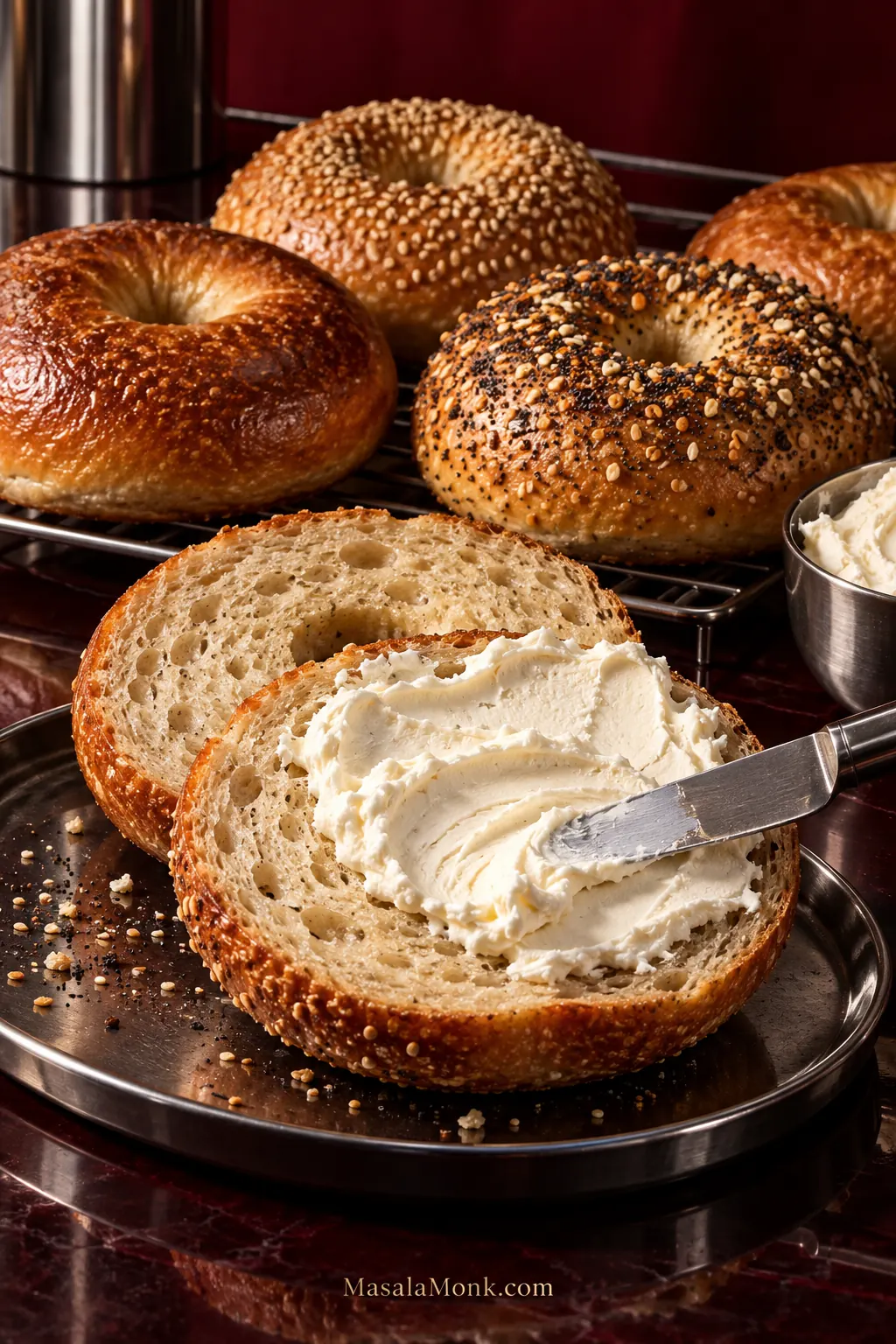
Split sesame bagel with compact crumb being spread with cream cheese, surrounded by deeply browned homemade bagels on a dark red surface.

Bagel dough is supposed to feel a little strange if you are used to ordinary bread. It is firm and pushes back when you knead it. The shaped rings puff without turning soft and pillowy. Then, just when most bread dough would be heading for the oven, these rings go into boiling water first.

Those steps give a chewy New York-style bagel its browned, slightly taut crust, compact, springy crumb with just enough air inside, and that unmistakable bit of pull when you bite through it.

Here, New York-style means a lean yeast dough made with strong flour, controlled fermentation, hand-shaped rings, boiling before baking, and enough oven heat to build real crust. You do not need professional bakery equipment to make that happen at home.

This recipe for homemade bagels gives you exact quantities and useful time ranges, but the most important cues are physical. You will know what the dough should feel like, when it has risen enough, what the rings should look like after boiling, and when the crust has gone far enough in the oven.

The texture and flavor to aim for: compact but not solid, with some irregular air inside and a springy chew. With barley malt, the flavor should be lightly malty rather than sweet, with much of the toasted character coming from the deeply browned crust.
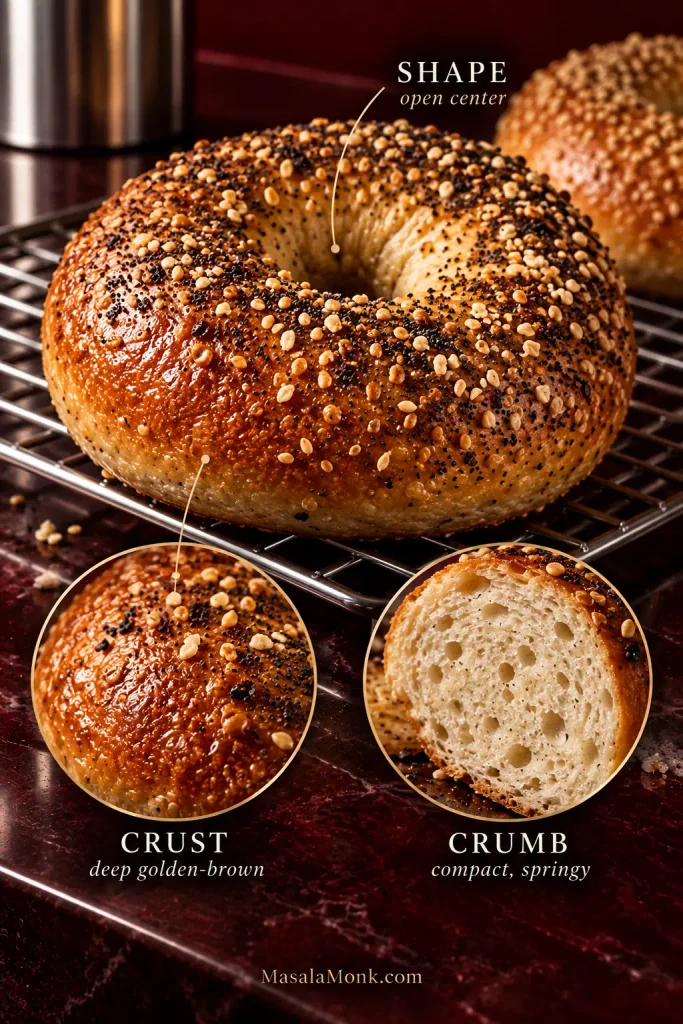
Finished New York-style bagel with close-up details showing its browned crust, compact crumb and plump ring shape with an open center.
Strong sidewalls, a properly browned crust and a compact but aerated crumb are the three visual targets to look for.

Homemade New York-Style Bagels Recipe

This is the same-day version. All-purpose flour, active dry yeast, and overnight adjustments are included here too, so you do not have to leave the recipe halfway through a batch.

Yield
8 bagels

Size
About 125 g / 4.4 oz each

Active time
About 45 minutes

Total
About 2 1/2–3 1/2 hours including cooling; longer in a cool kitchen

First rise
Usually 45–75 minutes

Final proof
About 15–30 minutes

Boil
45 seconds per side

Bake
425°F / 220°C for 20–24 minutes

What you’ll need

You’ll need a large mixing bowl, digital kitchen scale, two half-sheet pans (about 18 × 13 inches / 46 × 33 cm each), parchment paper, a wide pot, a spider or slotted spoon, and a cooling rack. A stand mixer with a dough hook is helpful but optional.

Weigh the flour if you can. Firm bagel dough has less room for error than a loose bread dough, and a heavily scooped cup of flour can change the texture noticeably.

For the dough

  • 600 g / 21.2 oz bread flour, roughly 5 cups when spooned and leveled
  • 360 g water (360 ml / 12.2 US fl oz), about 1 1/2 cups
  • 4 g instant yeast, about 1 1/4 teaspoons
  • 12 g fine salt, about 2 teaspoons depending on the salt
  • 20 g barley malt syrup, about 1 tablespoon, or honey

In a comfortable kitchen, room-temperature to mildly warm water works well. Use somewhat warmer water in a cool room so fermentation does not crawl, then let the dough’s rise and feel—not the starting water temperature alone—tell you when it is ready.

For the boiling water

  • 2 US quarts / about 1.9 liters water
  • 40 g barley malt syrup, about 2 tablespoons, or honey

Optional toppings and extras

  • Everything bagel seasoning
  • Sesame seeds
  • Poppy seeds
  • Dried minced onion
  • Coarse salt
  • 1 egg + 1 teaspoon water for optional egg wash
  • Semolina or cornmeal, optional, for dusting the parchment

Egg wash is optional. Seeds and seasoning will still cling to the damp surface after boiling; egg gives you more shine and a little extra holding power. Dried onion needs different handling because it can scorch during a full bake.

Useful Adjustments and Substitutions

All-purpose flour: keep the flour at 600 g, but hold back 20–30 g of the water when you begin mixing. Add some or all of it later if the dough needs it. Expect a slightly softer chew.

Overnight bagels: reduce the instant yeast to 2 g. After kneading, rest the dough for about 20 minutes, then divide, shape, cover and refrigerate using the method below.

Active dry yeast: use the same 4 g. If your brand recommends dissolving it first, stir it into the recipe water before mixing. Follow the dough rather than expecting the rise to match the clock exactly.

Method

Mix, knead and complete the first rise

  1. Mix. Combine the bread flour, yeast and salt. Stir the barley malt syrup or honey into the water, then add it to the flour. Mix until there are no obvious dry pockets. If the dough looks surprisingly dry, cover it for 5 minutes before adding extra water.
  2. Knead until smooth and elastic. Begin checking around 8–10 minutes in a stand mixer or about 10 minutes by hand; hand kneading can take closer to 15. The dough is ready when it feels smooth and springy and a small piece stretches thin before tearing.
  3. Let it rise until clearly fuller. Cover the dough and begin checking around 40–45 minutes. Move on when it looks roughly 50–75% larger and still feels resilient. A cool kitchen can take longer than 75 minutes.

Preheat, divide, shape and proof

  1. Position the racks, preheat and divide. Arrange oven racks in the upper and lower thirds, then preheat the oven to 425°F / 220°C. Cut the dough into 8 pieces of about 125 g / 4.4 oz each.
  2. Shape. Form each piece into a smooth, tight ball, push a finger through the center, and stretch the hole to about 2 inches / 5 cm. Go toward 2 1/2 inches / 6 cm if you particularly want a clearly open center after baking.
  3. Start the final proof and water bath. Arrange four rings on each prepared half-sheet pan. Lightly grease the parchment or dust it very lightly with semolina or cornmeal if sticking has been a problem. Cover without letting plastic cling to the dough. Immediately put the 2 quarts / 1.9 liters water and 40 g barley malt syrup or honey in the pot and begin heating toward a gentle boil while the rings proof. Have the toppings ready. The final proof usually takes 15–30 minutes; look for rings that are a little puffier and lighter but still sturdy enough to handle. If the water reaches a boil first, lower the heat until the bagels are ready.

Boil, bake and cool

  1. Boil for 45 seconds per side. Work with 2–3 bagels at a time. Lift them out, drain briefly and return them to the baking sheet. If using egg wash, brush it over the boiled bagels before adding the toppings, reserving a little if you plan to add dried onion later. Add sesame, poppy seeds, coarse salt or a seed-heavy everything blend while the surface is still damp. Save dried onion or onion-heavy seasoning for the end of baking. Let the water return to a gentle boil before adding the next batch.
  2. Bake both trays until deeply golden. Once all eight bagels are boiled and topped, get both trays into the oven promptly. Bake for 20–24 minutes, swapping the trays top-to-bottom and rotating them front-to-back about halfway through if your oven browns unevenly.
  3. Add dried onion late, if using. When the bagels are nearly browned, pull the trays out briefly. Brush the bagels you want to top with a little reserved egg wash, add dried minced onion or an onion-heavy everything blend, then return the trays to the oven for about 1–2 minutes, just long enough for the topping to toast without scorching.
  4. Cool before slicing. Transfer the bagels to a rack and give them at least 20–30 minutes. A steaming-hot crumb can look gummy even when it is properly baked.

Before the boil: pick up one ring. It should feel lighter than when you shaped it but still hold itself confidently. Puffy is good. Floppy and fragile is too far.

A simple same-day schedule

StageTypical time
Mix and kneadAbout 20 minutes
First riseUsually 45–75 minutes; longer in a cool kitchen
Divide and shapeAbout 10–15 minutes; preheat the oven as you begin
Final proof15–30 minutes while the water bath heats
Boil and topAbout 10–15 minutes
Bake20–24 minutes
Cool20–30 minutes

The dough still gets the final say.

Same-Day or Overnight Bagels?

Choose the same-day route when you want good chewy bagels in a few hours. The overnight route gives you more schedule flexibility, firmer cold dough to handle in the morning, and more fermentation time for flavor development.

RouteBest forWhat changes
Same-dayThe quickest route4 g instant yeast and a room-temperature first rise
OvernightMorning baking, cold handling and longer fermentation2 g instant yeast, a short rest, then refrigerated proofing

For the overnight version

Use 2 g instant yeast. After kneading, cover the dough and leave it for about 20 minutes. Divide and shape the rings, place them on the prepared trays, cover well and refrigerate.

For a refrigerator around 37–39°F / 3–4°C, start by planning on about 8–12 hours. A colder refrigerator slows the dough; a warmer one shortens the window.

In the morning, look at the rings before looking at the clock. They should be somewhat fuller than when they went into the refrigerator while remaining firm and easy to lift. Dramatic swelling is not necessary.
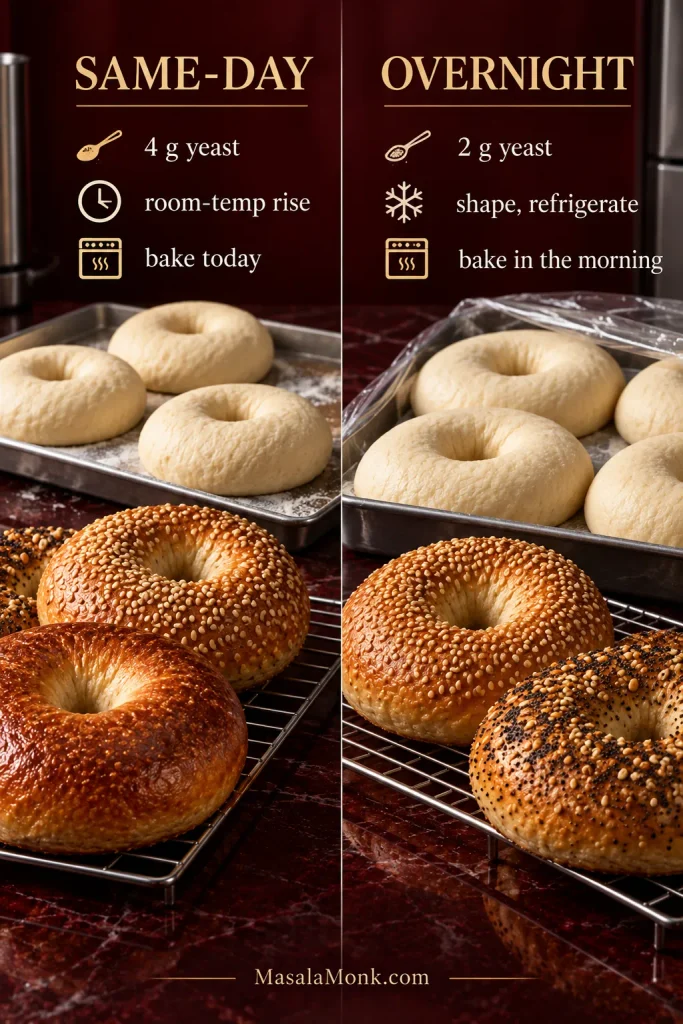
Comparison of same-day bagels made with 4 grams of yeast and room-temperature rising beside overnight bagels made with 2 grams of yeast and refrigerated shaped rings.
Same-day uses more yeast and finishes in one session; overnight uses less yeast and shifts most of the waiting time into the refrigerator.

If the chilled rings already look fuller and remain sturdy enough to lift cleanly, boil them cold. Rings that still look tight and almost unchanged can stay covered at room temperature until those readiness cues appear. When they are ready, return to the recipe method.

Back to top ↑ · Jump to recipe

Bagel Technique Guide

The recipe above gets you through the batch; these sections show what to watch for at each stage.

Start With a Firm, Well-Developed Dough

Bagel dough should gather into a firm mass that needs real kneading and holds its shape on the counter. If most of your bread-making experience is with pizza, focaccia or soft sandwich bread, the resistance can be surprising.

At first it may feel stubborn enough to make you wonder whether there is enough water. Give it a few minutes. As the gluten develops, that stubbornness should turn springy instead of crumbly.
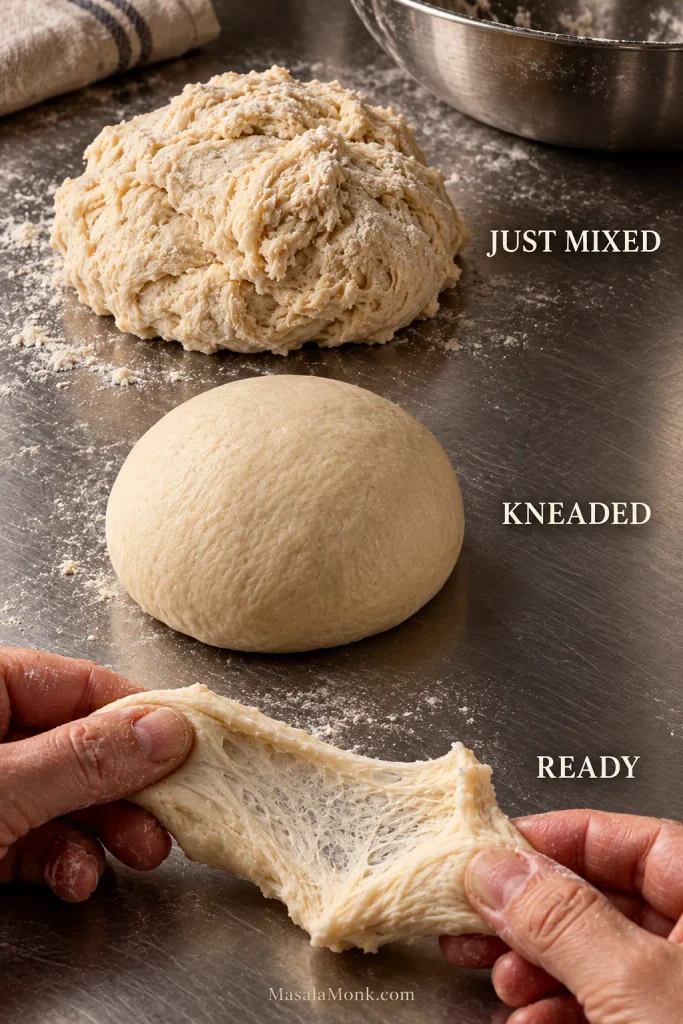
Three stages of plain bagel dough showing rough just-mixed dough, smooth kneaded dough and a stretched piece of developed dough.
Early bagel dough can look craggy because the flour has not fully hydrated. After kneading, that roughness should organize into a smoother, tighter mass rather than becoming loose or sticky.

Bread Flour Gives This Dough Its Chewy Structure

Bread flour’s higher protein content gives the dough enough elasticity to hold its shape through proofing, shaping and boiling.

All-purpose flour works too

Keep the flour at 600 g and hold back 20–30 g of water at the start. Add a little of that reserved water only if the dough still feels genuinely too dry after it has begun to smooth out.

The finished bagels will usually have a softer bite than the bread-flour version. Very strong high-gluten flour often absorbs more water, so it may need a small splash extra.

The dough should fight back a little

Pull on the dough and it should resist, then stretch. Press it and it should spring back. Once kneaded, it should sit as a compact mass instead of slowly slumping across the bowl or counter.

The contrast is especially obvious if you have made focaccia. Focaccia wants a loose, sticky dough and large pockets of air; bagels need enough firmness to keep their shape through proofing and boiling.

How do you know when bagel dough is kneaded enough?

Bagel dough is kneaded enough when it is smooth and elastic and a small piece can stretch thin before tearing. Start checking after about 8–10 minutes in a stand mixer or 10 minutes by hand.

If a lightweight mixer starts laboring, heating up or walking across the counter, finish by hand. Stiff dough can give a small machine a serious workout.

Barley malt is traditional, not mandatory

Barley malt syrup adds restrained sweetness, browning and the familiar malty note found in many classic bagels. It is the preferred choice here, although honey works well when malt is difficult to find.

Diastatic malt powder is a different ingredient because it contains active enzymes, so it is not a spoon-for-spoon substitute for malt syrup. King Arthur Baking’s guide to malt explains the differences between the common forms clearly.

Let the Dough Rise Without Taking It Too Far

A beautifully doubled, feather-soft dough may be exactly right for another loaf. With bagels, stop sooner.

What matters here is the change in the dough: it becomes fuller and visibly lighter but still feels resilient rather than pillowy. It does not need to double.
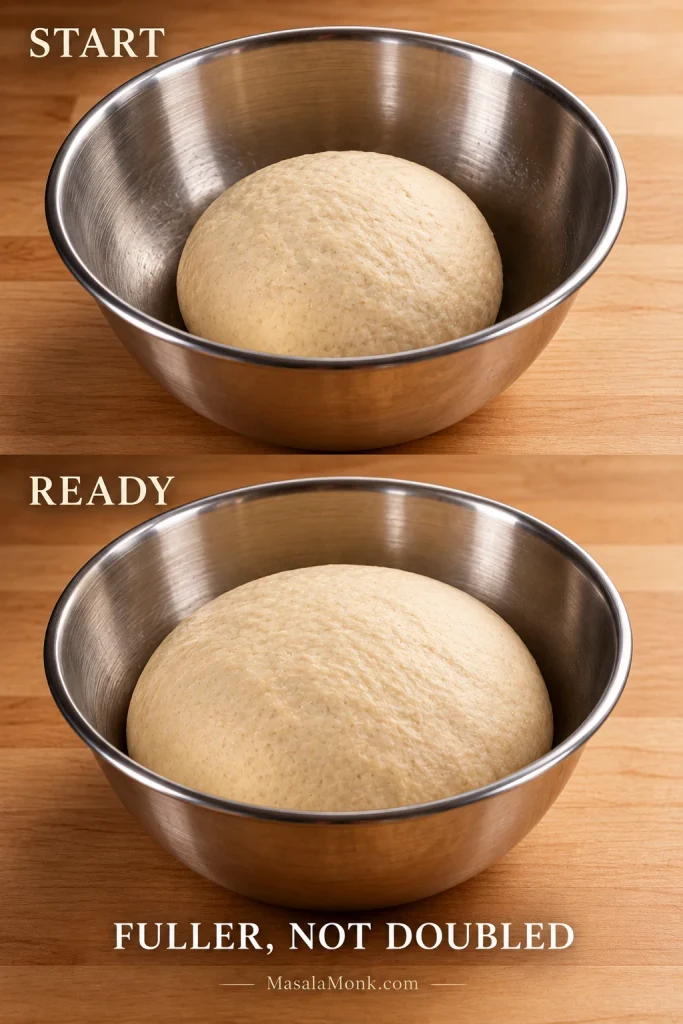
Bagel dough in the same bowl before and after its first rise, showing moderate expansion rather than doubling.
The dough should occupy noticeably more space while still looking strong and resilient rather than airy and pillowy.

Once it reaches that point, divide it before it drifts toward the soft texture you would want from a sandwich loaf.

Shape for Height and an Open Center

A taut ring is better equipped to hold its height through the final proof, the water bath and the first few minutes in the oven.

For a first batch, use poke-and-stretch

Shape each 125 g / 4.4 oz portion into a smooth, tight ball. Push your thumb or finger through the middle, then rotate and gently widen the hole to about 2 inches / 5 cm.
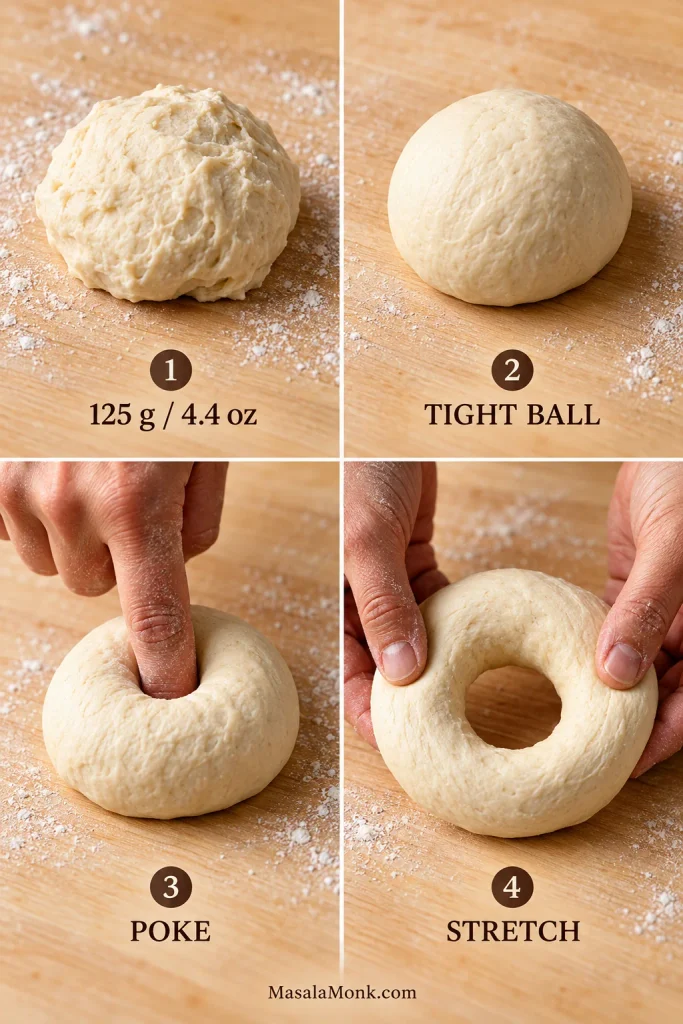
Four-step bagel shaping sequence showing a 125-gram dough portion formed into a ball, pierced through the center and stretched into a ring.
Rotate the ring through your hands as you stretch it instead of pulling hard from two opposite sides. That spreads the tension around the circle and helps prevent one thin weak spot.

If you especially like a clearly open center, stretch toward 2 1/2 inches / 6 cm. The hole looks generous at first. Leave it that way. It will shrink as the dough relaxes, proofs and bakes.
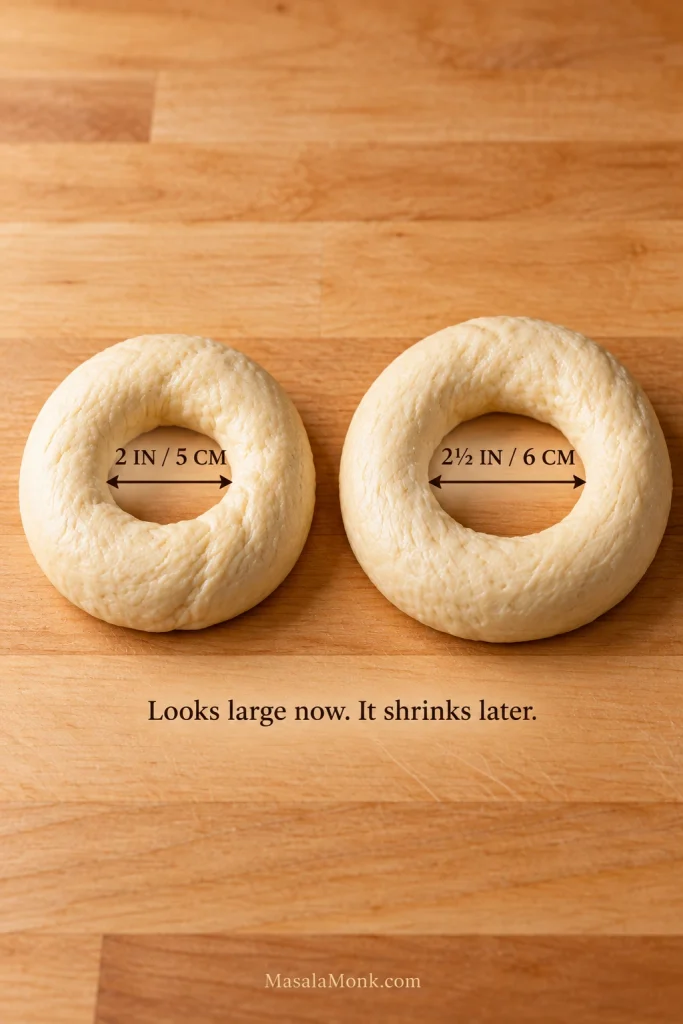
Two unbaked bagel rings comparing center holes measuring about 2 inches or 5 centimeters and 2.5 inches or 6 centimeters.
A slightly generous opening leaves room for the dough to expand inward without closing the center completely.

The first ring may be lopsided. By the third or fourth, your hands usually understand the dough much better. An uneven bagel can still have a terrific crust and crumb, so do not keep reworking it just to chase perfect symmetry.
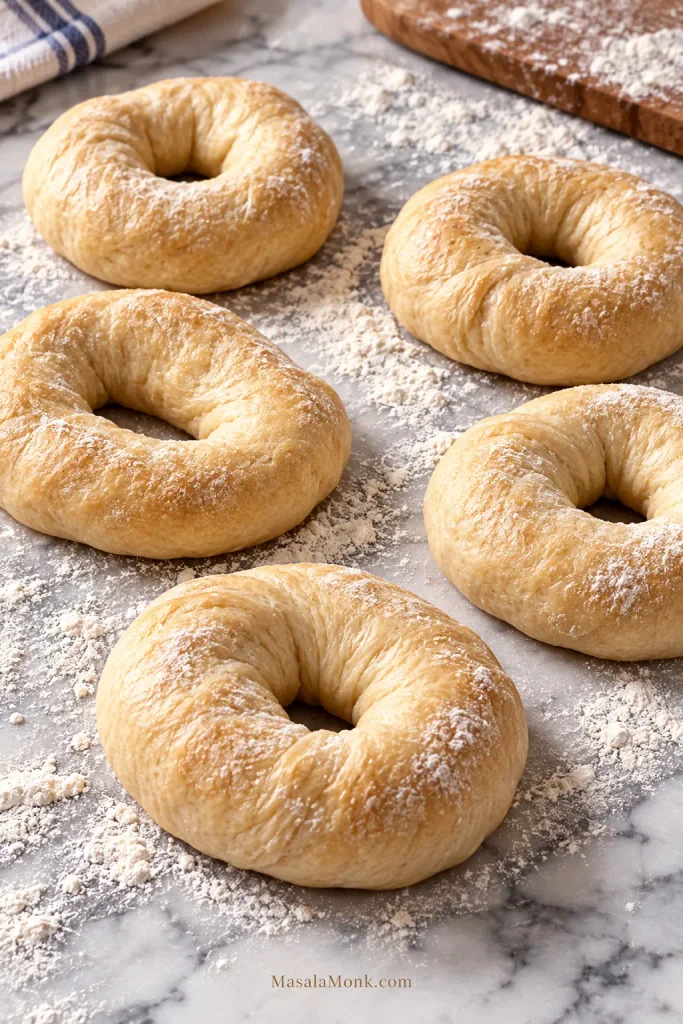
Several hand-shaped unbaked bagel rings with slightly different shapes, thicknesses and center openings arranged on a work surface.
Small differences in shape are cosmetic. Weak seams, very thin sections or collapsed rings matter much more than perfect symmetry.

Rope shaping gives a more traditional hand-rolled look

Roll each portion into a rope about 9–10 inches / 23–25 cm long. Wrap it around your hand, overlap the ends by roughly 2 inches / 5 cm, then roll the joined section firmly against the counter until it becomes one continuous ring.

Keep flour away from the seam. A little stickiness helps the ends bond. If they have dried out, dampen your fingertips lightly before sealing.
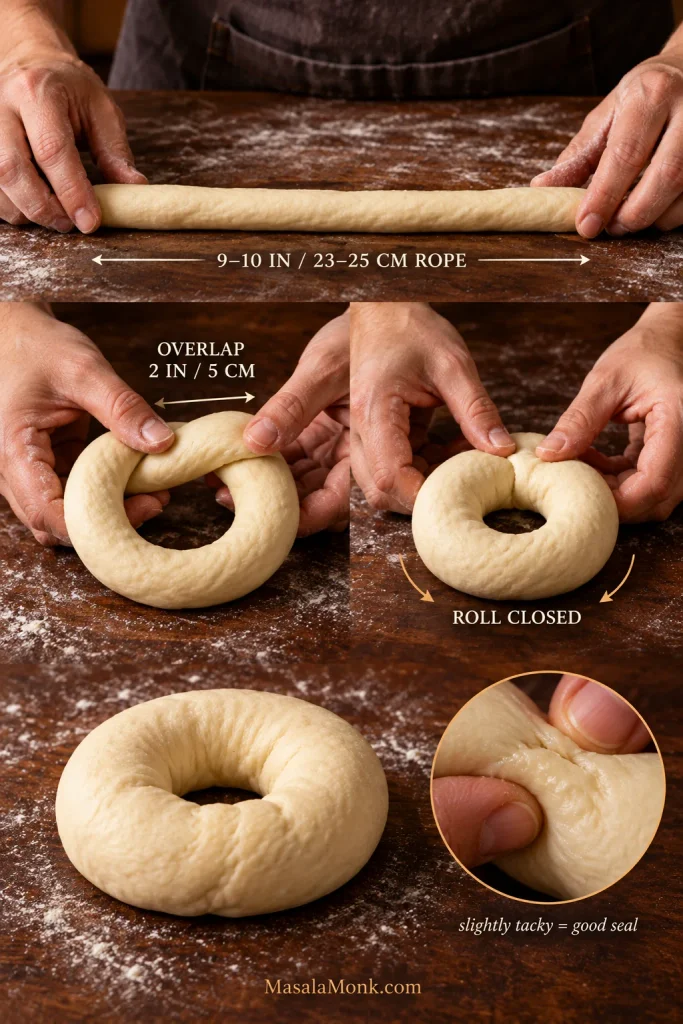
Hands shaping bagel dough with the rope method, including a 9- to 10-inch rope, overlapping ends and a rolled closed seam.
The join should feel continuous rather than like two ends pressed together. Keep rolling gently until the seam disappears into the ring.

Once the rings are shaped, continue to the final proof and float test.

Give the Shaped Rings a Short Final Proof

A ready ring looks fuller but still feels firm enough to lift cleanly. You want that extra volume without losing the sturdy feel.
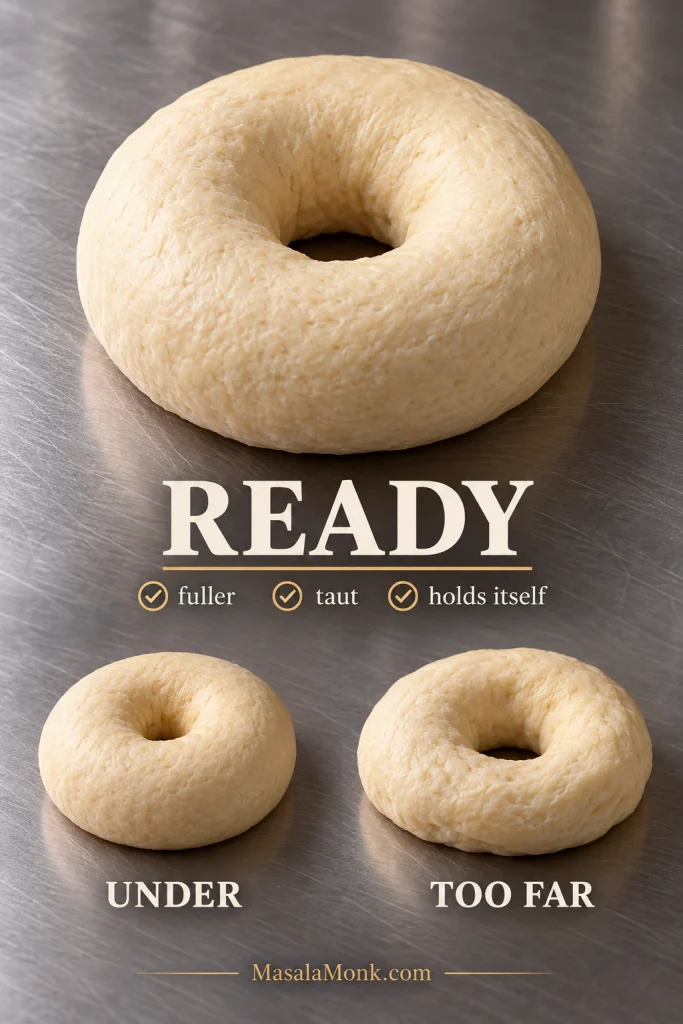
Three unbaked bagel rings comparing underproofed, properly proofed and overproofed dough, with the ready ring larger and taut.
A ready ring should lift cleanly and hold its shape. If it starts stretching under its own weight, the dough has moved beyond the sturdy proof you want.

Use the float test as a clue

If you’re unsure, lower one shaped ring into a small bowl of cool water. A sufficiently fermented ring will usually float within several seconds. If it stays submerged, lift it out, pat it dry, return it to the tray and give the rings more proofing time before checking again.

Treat the float test as one clue rather than a verdict. A cold bagel can take longer to become buoyant, while an overproofed ring may float immediately and still be too fragile.
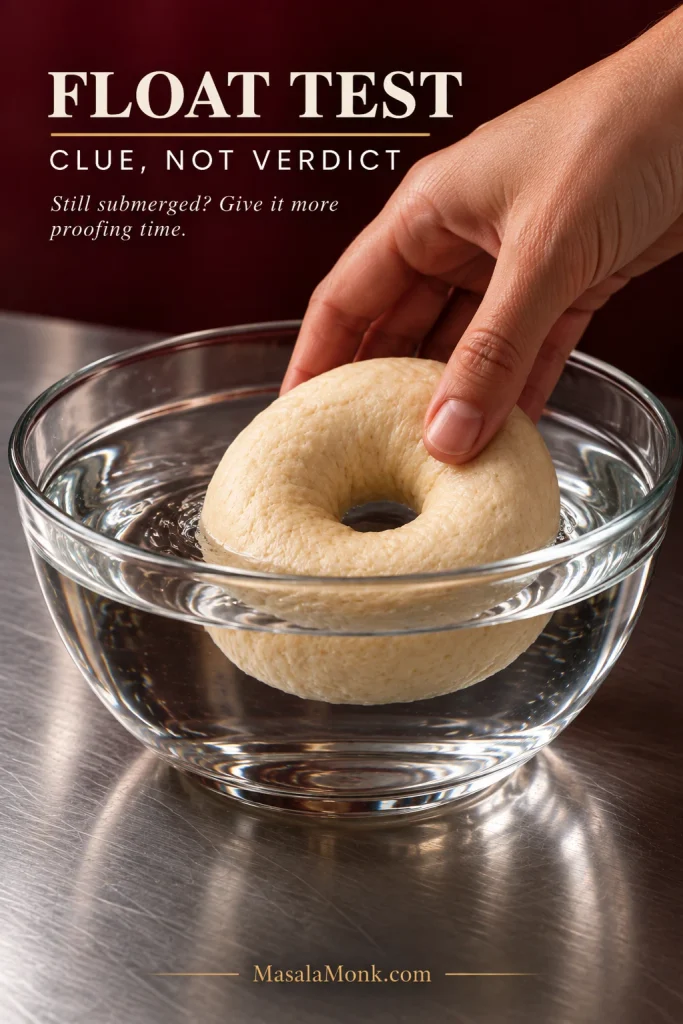
Hand lowering an unbaked bagel ring into a clear bowl of cool water on a stainless-steel counter for a float test.
Test one ring rather than soaking the whole tray, and pat it dry before returning it to the parchment if it needs more time.

Once the rings are puffy but sturdy, move straight into the water bath.

The Boil: Set the Surface Without Flattening the Ring

Boil these bagels for 45 seconds per side. The hot water gelatinizes starch at the surface, creating the skin that later bakes into the bagel’s characteristic crust.

Some bagel recipes use much longer water baths. A shorter boil leaves more room for oven expansion while still setting that surface.

This is the moment the dough finally starts looking unmistakably like a bagel. The rings swell slightly, the surface tightens, and the raw matte finish begins to disappear.
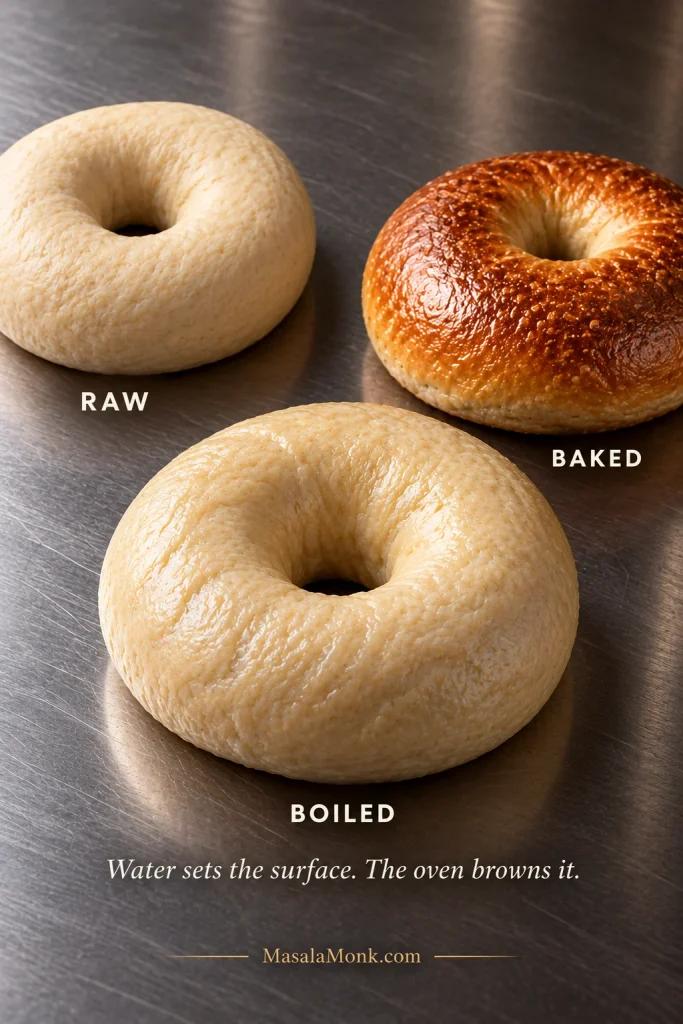
Three plain bagels showing raw matte dough, a pale wet boiled bagel and a deeply browned baked bagel on a stainless-steel surface.
Boiling tightens the outside while the center remains raw; oven heat then turns that set surface into the finished chewy crust.

What should go in the water?

Barley malt adds a mild malty note and helps the surface brown; honey is the practical substitute when malt is unavailable.

Other recipes use sugar, brown sugar or baking soda. Baking soda increases alkalinity and encourages deeper browning; in larger amounts, it moves the crust toward pretzel-like characteristics.

Keep the water steady, not violent

A gentle, steady boil is enough. You want heat, not a pot that throws delicate proofed rings around.

Work in small batches and let the water recover before adding more. Cold dough can pull the temperature down quickly.
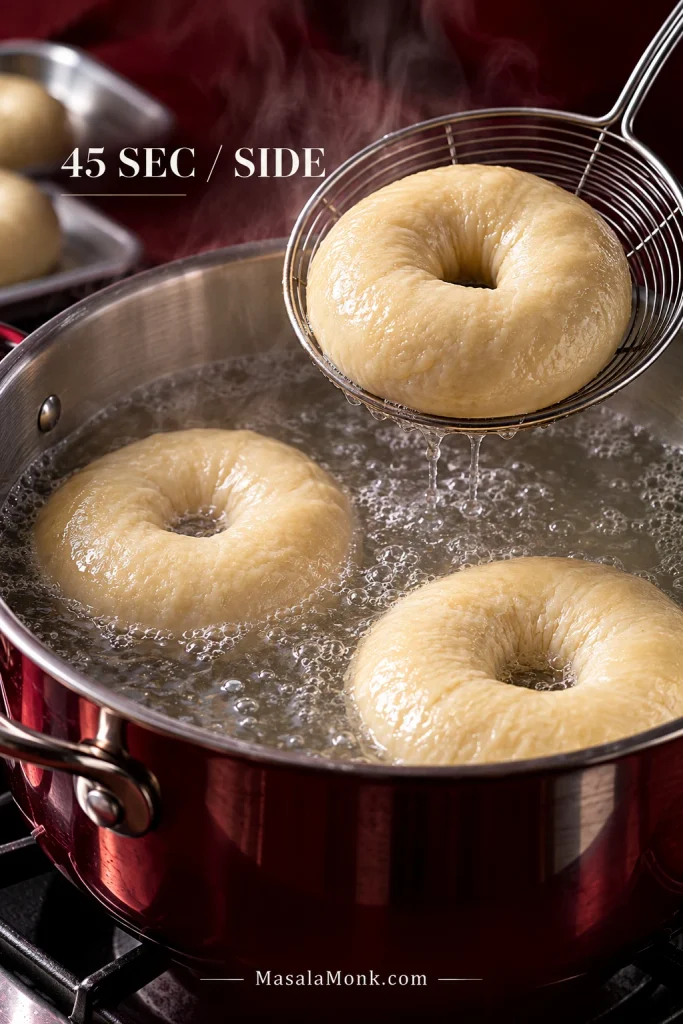
Pale bagel rings gently boiling in a stainless-steel pot while one is lifted with a wire skimmer and steam rises above the water.
A calm, uncrowded pot makes boil time and water temperature easier to keep consistent from batch to batch.

After boiling: slightly swollen is right. Ballooned is not the goal. A few wrinkles are fine; the oven still has work to do.

The first boiled ring is usually the moment the process clicks. It comes out plumper, smoother and suddenly recognizably bagel-like. Once the batch is boiled and topped, continue to baking.

Bake Until the Crust Has Real Color

The oven finishes what the water started. That pale boiled skin tightens, turns glossy in places, and deepens toward a proper golden brown.

Bake at 425°F / 220°C for about 20–24 minutes. When the bagels first look “done” at pale gold, they usually still have more flavor to develop. Pale isn’t finished.
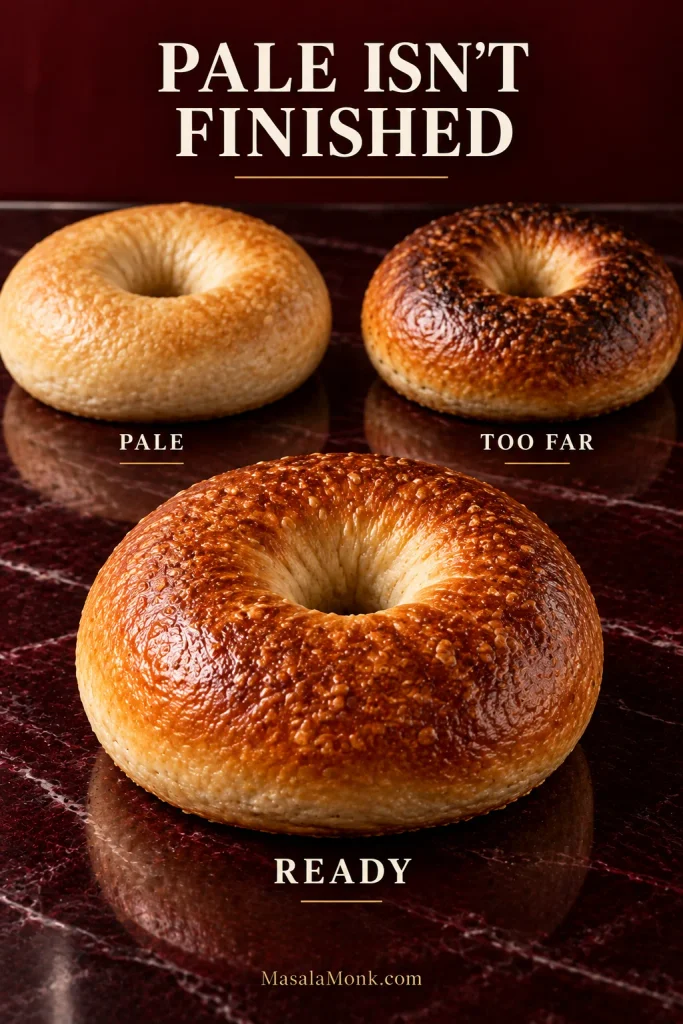
Three plain baked bagels comparing pale, properly browned and overly dark crusts, with the correctly browned bagel shown largest.
More color brings toasted, malty flavor and a firmer crust; beyond deep mahogany, bitterness can arrive quickly.

Check the bottoms too. They should be browned rather than white and soft.

What the inside should look like

  • A compact overall crumb
  • Small-to-medium irregular air pockets
  • No wet or gummy line through the center
  • No giant bread-like cavities
  • A springy, substantial chew

Wait 20–30 minutes before cutting one open. Once cooled, the knife should meet a little resistance at the crust before passing through the springy center.
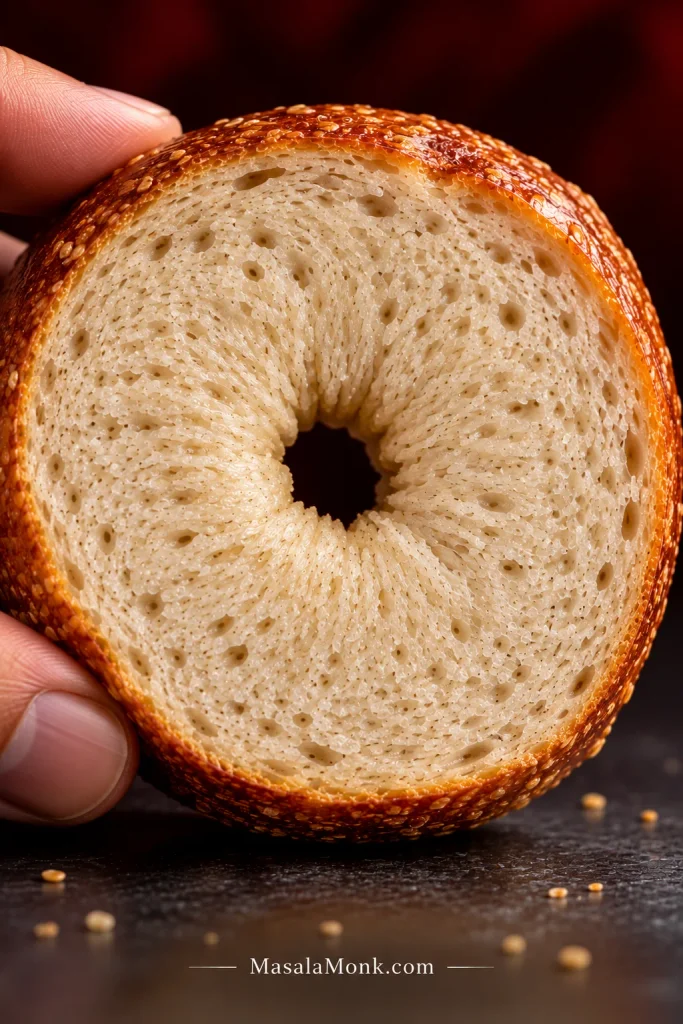
Extreme close-up of a sliced New York-style bagel showing a tight crumb with mostly small irregular air pockets and a deeply browned crust.
Look for a compact crumb with small and medium cells—not a solid center, but not the open web of a high-hydration loaf either.

If the crust, shape or crumb does not match what you expected, jump to bagel troubleshooting and start with the first stage where the batch looked wrong.

Back to top ↑ · Jump to recipe

Bagel Troubleshooting: When Did It Go Wrong?

Think back to the first moment the batch looked wrong. That usually tells you more than the finished bagel does.
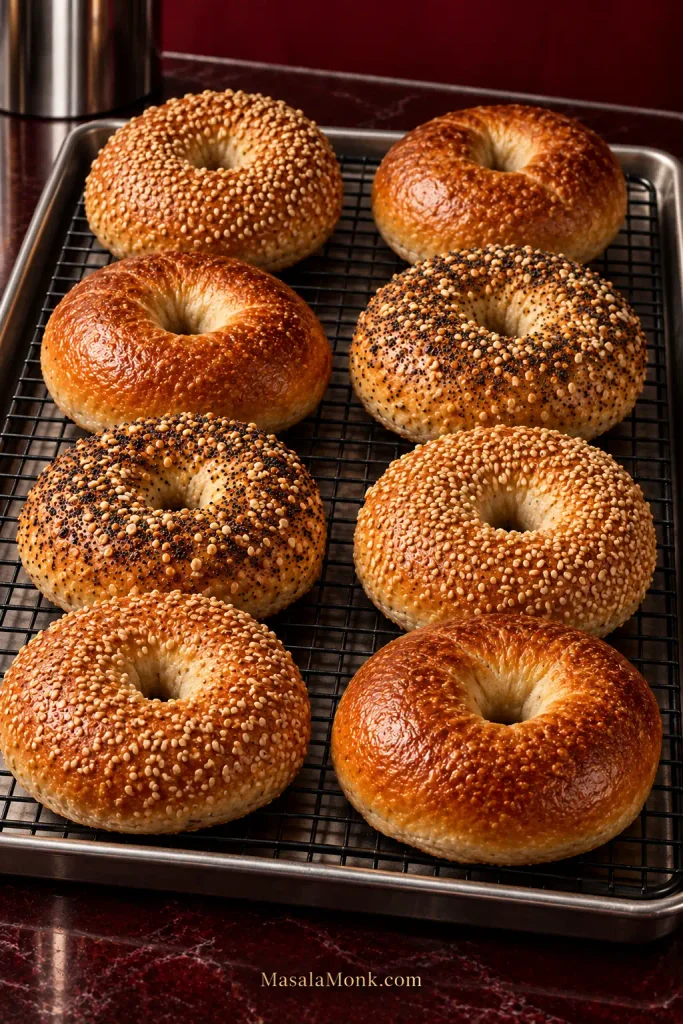
Eight freshly baked homemade bagels, including plain, sesame and everything-topped varieties, cooling on a black wire rack over a metal tray.
Consistency matters more than perfect uniformity: the bagels can vary slightly in shape while still finishing within the same general range of height and browning.

And not every imperfect-looking bagel is a failed one. A lopsided ring, a slightly closed center or a few wrinkles are mostly cosmetic. Severe collapse, a nearly solid crumb or a gummy middle point to a real process problem.

The problem started before boiling

The shaped rings are already flat. Overproofing is the first thing to check. Rings that were never especially puffy point more toward dough that was too soft or not developed enough to hold its shape. Recheck dough development and the final proof before changing the formula.

The dough barely rose. If you’ve seen almost no fermentation after a reasonable amount of time, check the yeast instead of simply waiting hour after hour. Room temperature matters too; a cool kitchen can slow an otherwise healthy dough considerably.

The dough is sticky and spreading. Make sure it is fully kneaded before adding more flour. If the dough is fully kneaded and still cannot hold its shape, add flour in small amounts rather than throwing in a large handful.

The dough cracks or crumbles. Cover it for five minutes and knead again. If it still breaks instead of bending, add water about 5 g / 1 teaspoon at a time.

The rings stick to the parchment. Lightly grease the paper or dust it very lightly with semolina or cornmeal. Lift stubborn rings from underneath with a thin bench scraper rather than peeling them up by the edge.

The problem started during handling or boiling

The rings collapse when lifted. They have probably proofed farther than ideal, especially if they already feel soft and fragile. Support them from underneath and move them gently.

Why did my bagels flatten after boiling?

Bagels that enter the pot tall but come out flat are most likely overproofed. Rough handling, a violent boil or a much longer water bath can make an already fragile ring collapse further.
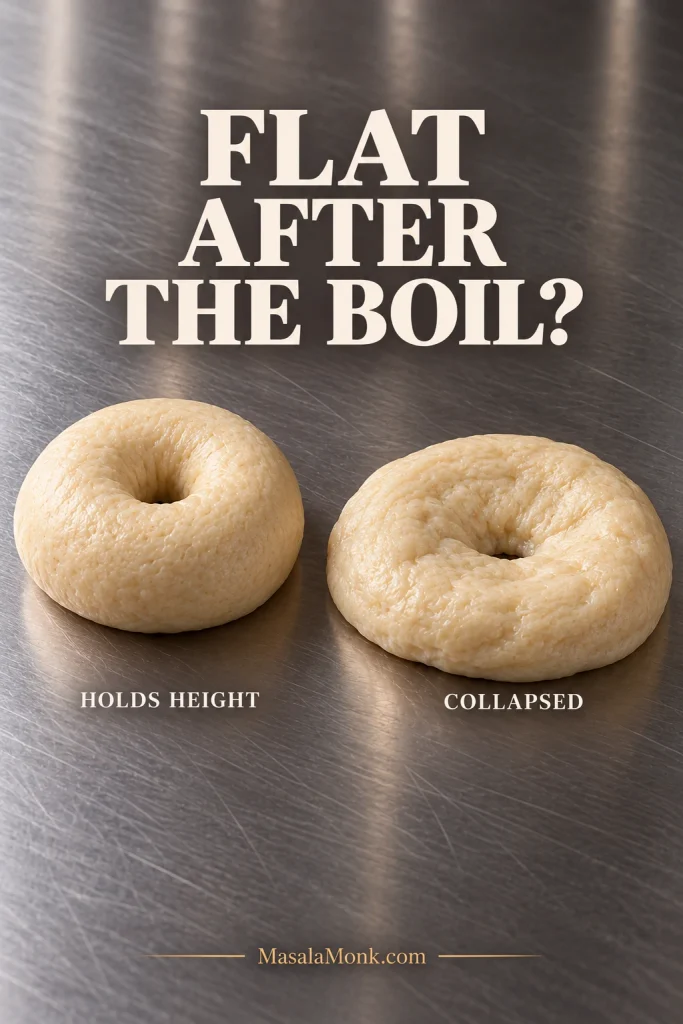
Two pale boiled bagels on stainless steel, one holding a rounded shape and the other visibly flatter and collapsed after boiling.
The useful clue is when the height disappeared: before the water points upstream, while collapse during handling or boiling narrows the problem to that stage.

A few wrinkles appeared. Usually cosmetic. Dramatic deflation is the sign to investigate.

Why won’t my bagels float?

Persistent sinking can mean the dough needs more fermentation, but a cold ring may sink briefly before floating. A properly proofed ring should also feel lighter than when it was shaped without becoming fragile.

The rope seam opened. Use a larger overlap next time, keep flour off the join, and roll the seam firmly. Slightly damp ends seal more easily than dry ones; the shaping section shows both methods again.

The problem appeared in the oven

The bagels spread instead of rising. If they survived the boil in good shape, look first at dough strength and shaping tension. When both seemed right, check whether the oven is actually reaching its set temperature.

The bottoms burn while the tops stay pale. Dark pans, baking steels and strong bottom heat can all be responsible. Move the rack higher, use a lighter pan or double-pan if needed.

The bottoms stay pale. Give them a little more baking time. Silicone mats can also insulate the base more than parchment over metal.
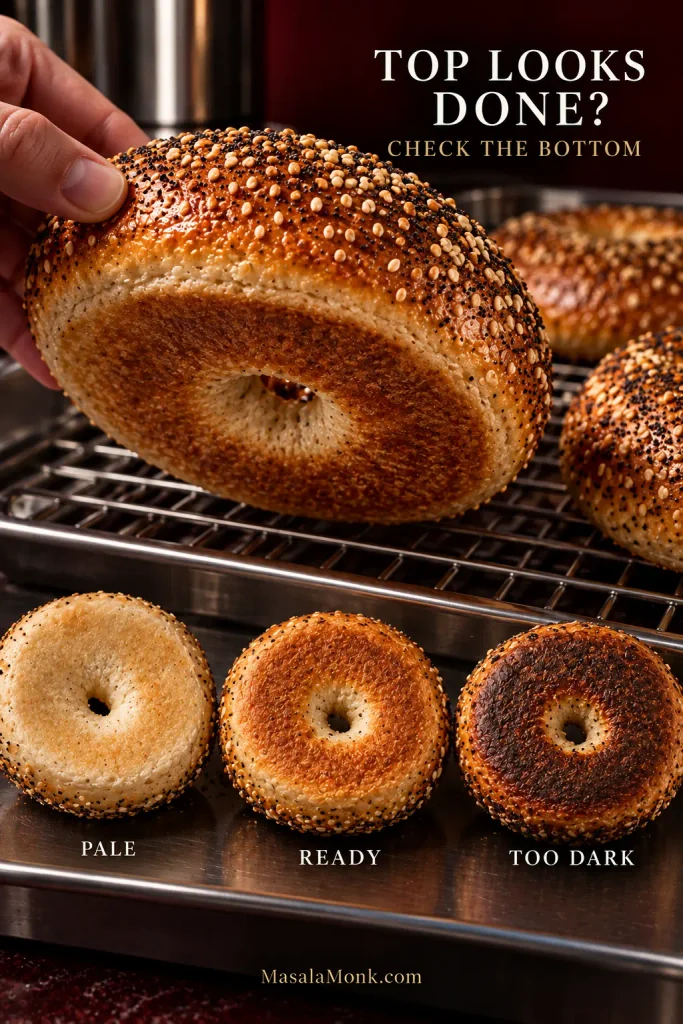
Hand lifting a baked everything bagel to reveal its browned underside, with examples of pale, properly browned and overly dark bagel bottoms.
Pan color and lower oven heat can change the underside faster than the top, so bottom browning deserves its own check.

The center hole disappeared. Mostly cosmetic. Stretch it wider next time and enjoy the bagel you have.

They look good, but the texture is wrong

Why are my bagels too dense?

A New York-style bagel is supposed to be tighter than sandwich bread. If the crumb is almost solid, underproofing or weak yeast is the first place to look. Dough that is too dry, underdeveloped or underbaked can make the problem worse.

They are fluffy and bread-like. In that case, the rings probably proofed farther than this style needs. Stop while they are still sturdy and give the crust enough time to brown deeply.

They are tough or rubbery. Rubbery or excessively chewy bagels can come from dough that was too dry or a much longer boil. If the bagels are simply dry and hard, check the bake time too.

Why is the center gummy?

First, let the bagel cool completely. If the crumb is still wet, check the oven temperature and bake time. Underbaking is the most common place to start.
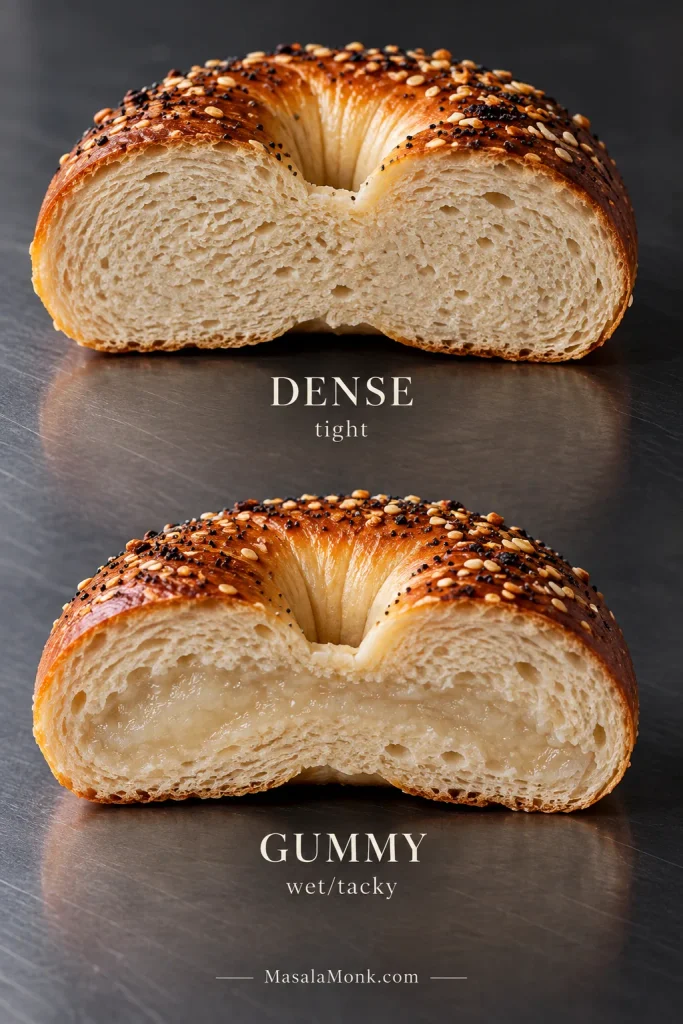
Two cut bagels comparing a tight, dry dense crumb with a visibly damp, tacky gummy center under the same lighting.
Dense can still be dry and fully set. Gummy crumb compresses, clings to the knife or fingers, and often shows a damp-looking band that does not spring back cleanly.

A few smaller surface problems

Rough or webbed crust. Fine surface blisters are normal and can be desirable. A dry, rough or webbed-looking skin is different; the dough may have dried out during proofing or may not have been kneaded enough.
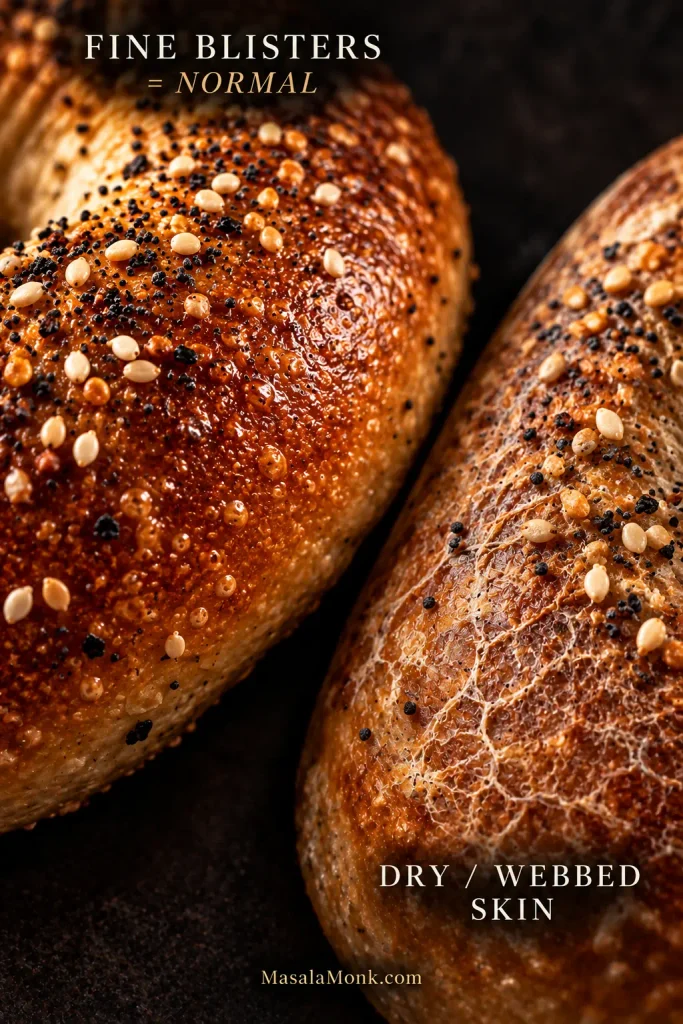
Macro comparison of a glossy browned bagel crust with small fine blisters beside a dry bagel surface covered in pale web-like cracks.
Fine blisters are small and integrated into the browned crust. Drying damage forms broader pale cracks or webbing across the surface.

Cracks or splits. Check for a dried skin, uneven shaping tension or a weak rope seam.

Toppings falling off. Add them while the boiled surface is still damp; egg wash gives extra hold and shine.

Once a batch is baked, there is very little value in judging it by perfect bakery geometry. Slice one, check the crumb, and taste it. That tells you what actually needs changing next time.

Back to top ↑ · Jump to recipe

Make the Toppings Work for You

Most seed toppings go on as soon as the bagels leave the water, while the surface is still damp. Sesame and poppy seeds adhere well this way. A seed-heavy everything blend works too.

An egg wash is optional. Brush it on before the toppings when you want a glossier crust or a little extra help keeping seeds in place.
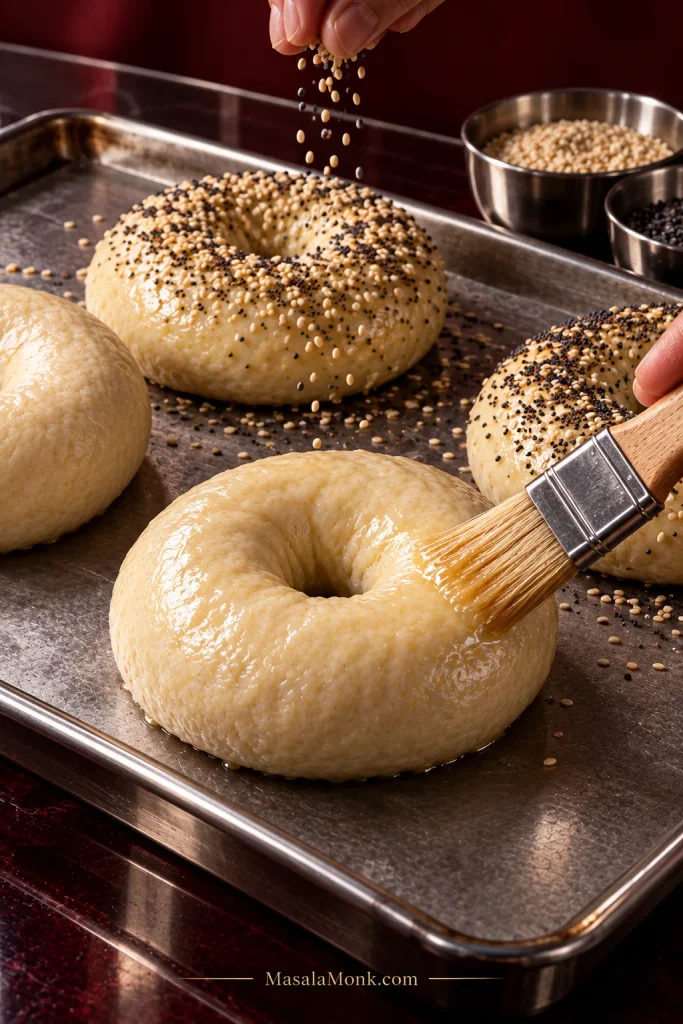
Pastry brush applying egg wash to a pale boiled bagel on a metal tray while a hand scatters sesame and poppy seeds over nearby bagels.
Use only enough egg wash to leave a thin film; heavy pooling can glue seeds to the parchment instead of the bagel.

Dried minced onion needs different handling. It can scorch during a full bake, so reserve a little egg wash. When the bagels are nearly browned, pull the trays out briefly, brush the bagels you want to top, add the dried onion or onion-heavy blend, and return them to the oven for about 1–2 minutes.
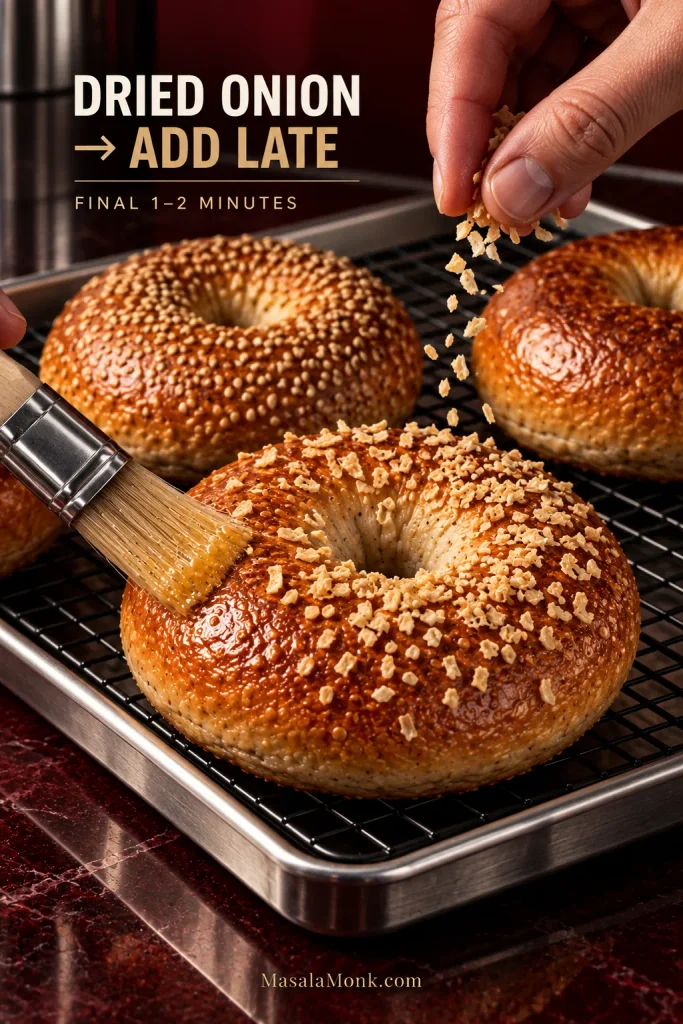
Nearly baked golden bagel being brushed with egg wash and topped with pale dried onion pieces during the final minutes of baking.
Dried onion scorches much faster than sturdier seeds, which is why it goes on near the end of baking.

Use coarse salt sparingly; a little goes a long way on a chewy bagel.

For a much broader set of cream cheese mixtures, smoked salmon combinations, savory toppings and sweeter options, see the bagel toppings and spreads guide.

Day-old bagels also make excellent breakfast sandwiches; the breakfast sandwich guide has more combinations. If you are saving the rest of the batch, continue to storage and freezing.

Store Them Like Bread, Not Cake

Bagels are at their best on the day they are baked. Once completely cool, keep them tightly wrapped or sealed at room temperature for about 1–2 days. By the second day, toasting brings back much of the crispness and chew.

For longer storage, slice before freezing. Wrap well and freeze for up to about 3 months for best quality. A pre-sliced half can go straight from freezer to toaster.
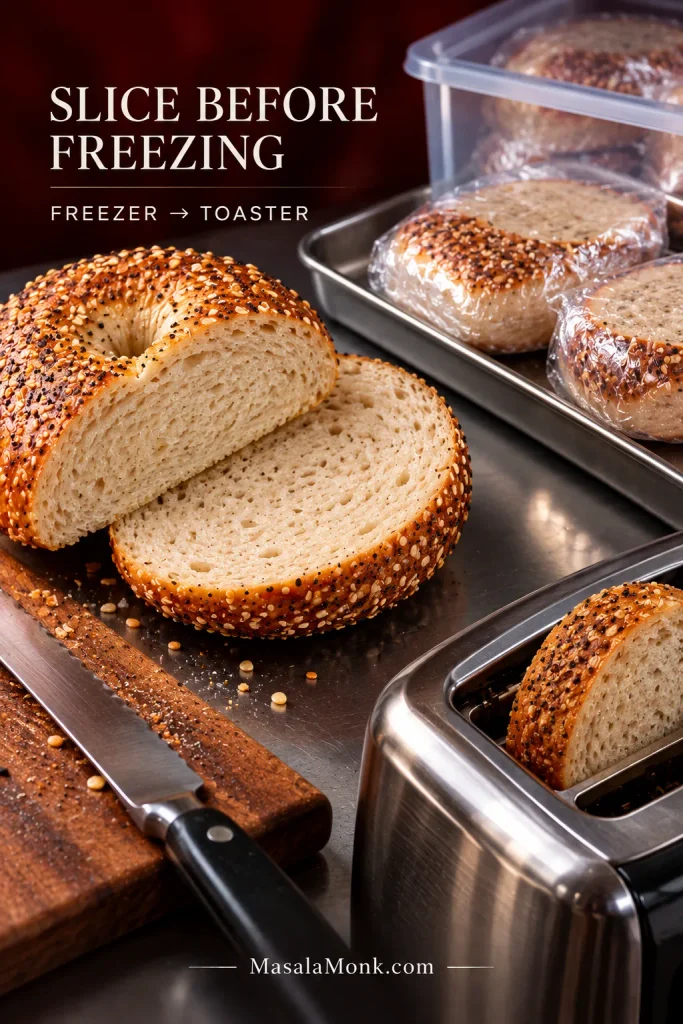
Sliced everything bagel beside wrapped bagel halves prepared for freezing, with one frozen half positioned in a stainless-steel toaster.
Cool completely before slicing and freezing so trapped steam does not soften the crust or create extra surface ice.

Back to top ↑ · Jump to recipe

Frequently Asked Questions

Do New York-style bagels require New York water?

No. Water chemistry can influence dough, but you do not need New York water to make an excellent bagel at home. For most home bakers, flour, fermentation, shaping, boiling and baking are the variables worth controlling first.

Can I double the recipe?

Yes, but this is unusually stiff dough. If your mixer is small or starts laboring, two separate batches are safer than forcing a double batch through the machine. Keep dividing by weight and continue boiling in small batches so the water stays hot.

Can I make smaller bagels?

Yes. For 10 smaller bagels, divide the dough into pieces of about 100 g / 3.5 oz each and begin checking the bake several minutes earlier.

Once the bagels are cool, split one and look for that contrast between the browned crust and the springy center.
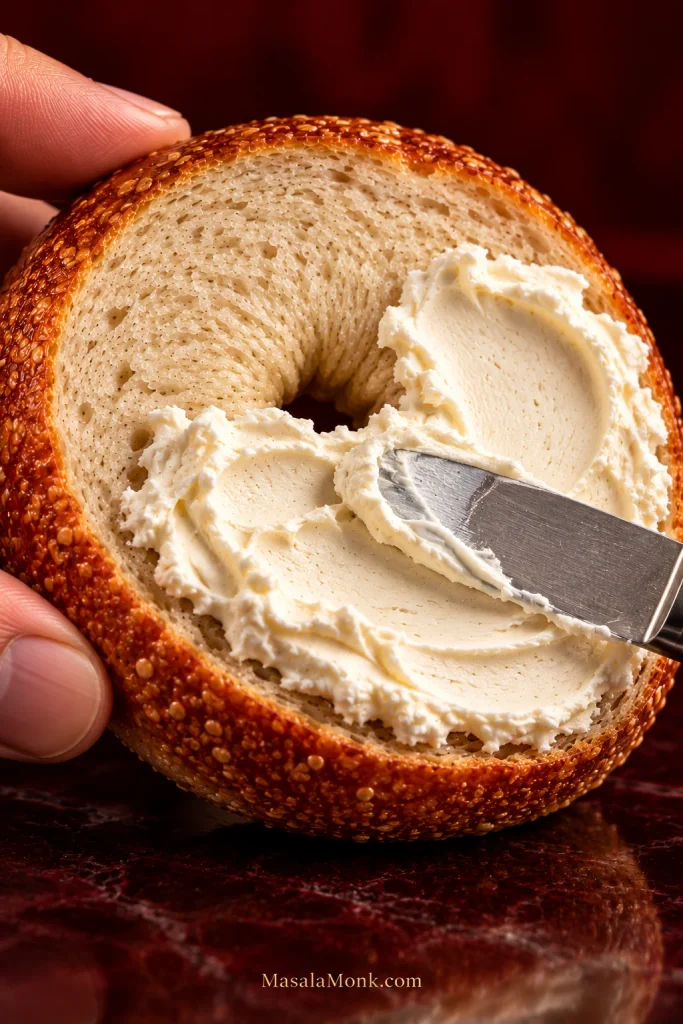
Close-up of a split sesame bagel with compact crumb held by fingertips while a metal knife spreads a thick layer of cream cheese across the cut surface.
A simple schmear lets the crust, maltiness and chew stay noticeable.

Then comes the payoff: feel the knife catch slightly on the browned crust and drag cream cheese across the springy center. At that point the boiling water and stiff dough stop feeling like bakery tricks. They are simply how you make a really good bagel.
Posted on — Leave a comment

Magic Cookie Bars Recipe: Easy 7 Layer Bars with Chocolate, Coconut & Pecans

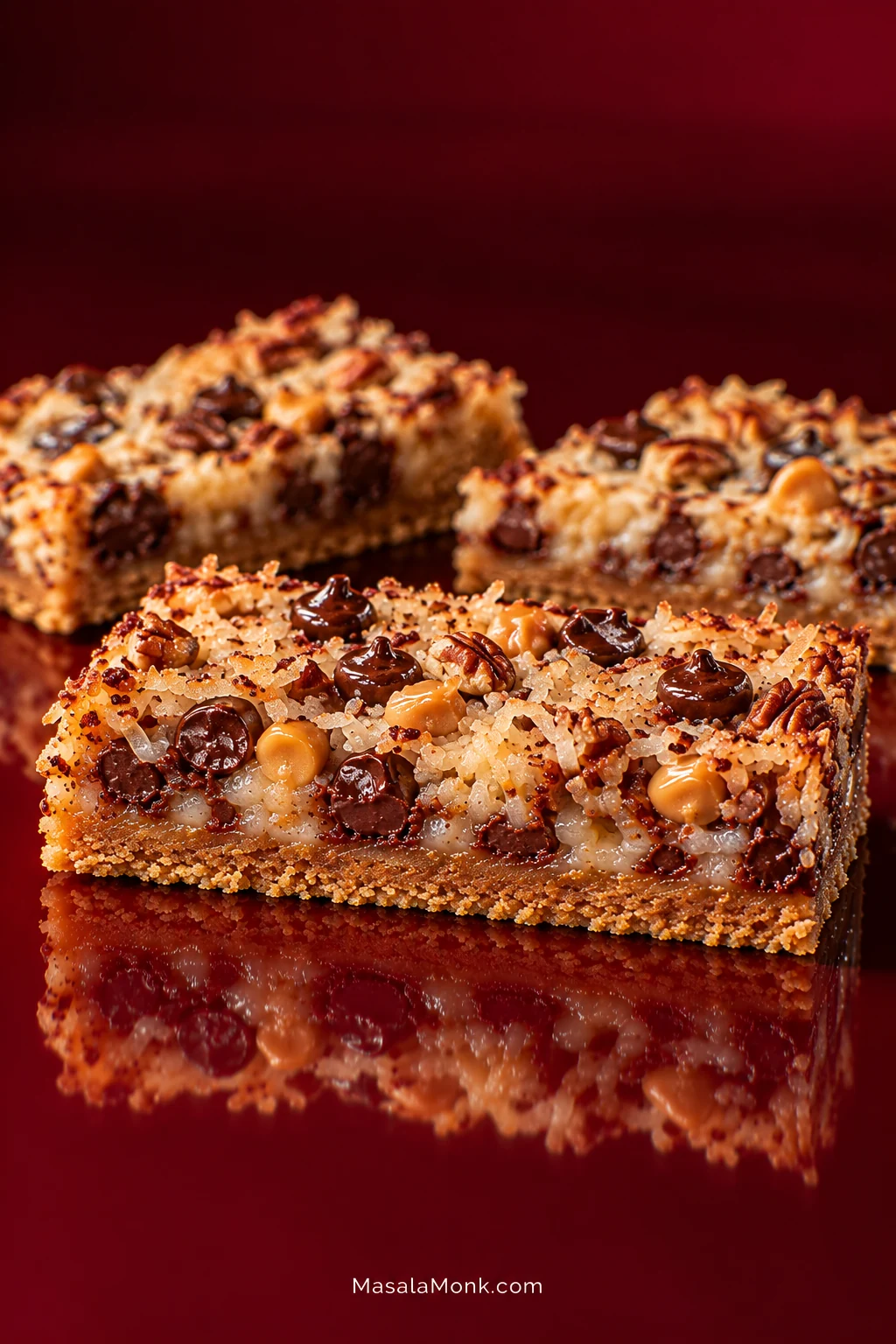
Three Magic Cookie Bars on a glossy deep-red surface, with golden graham crusts beneath toppings of coconut, pecans, chocolate chips and butterscotch chips.
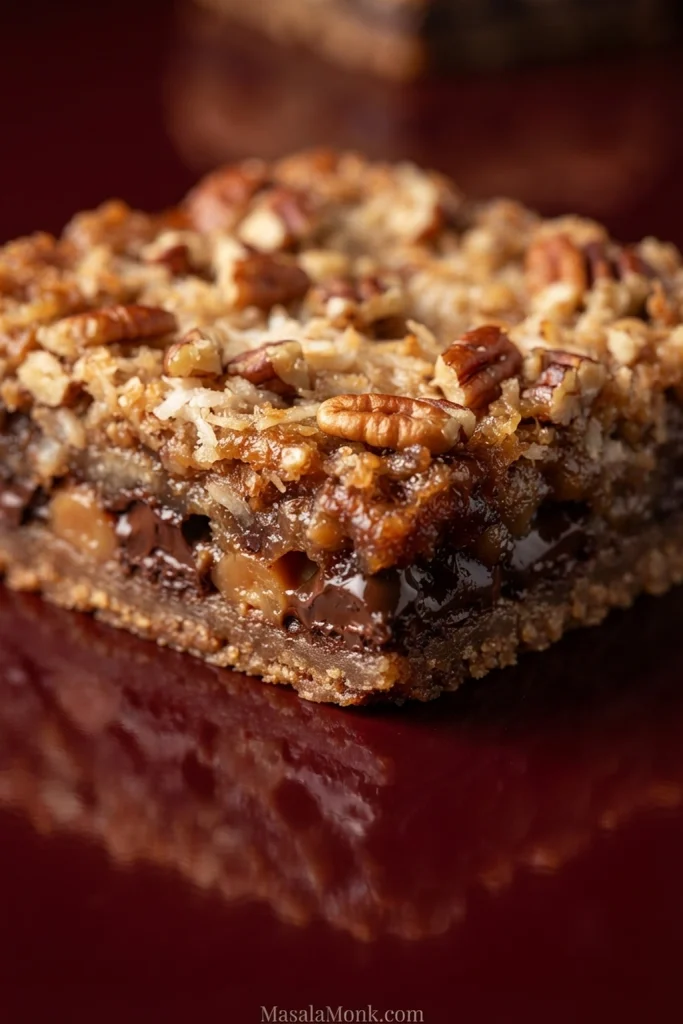
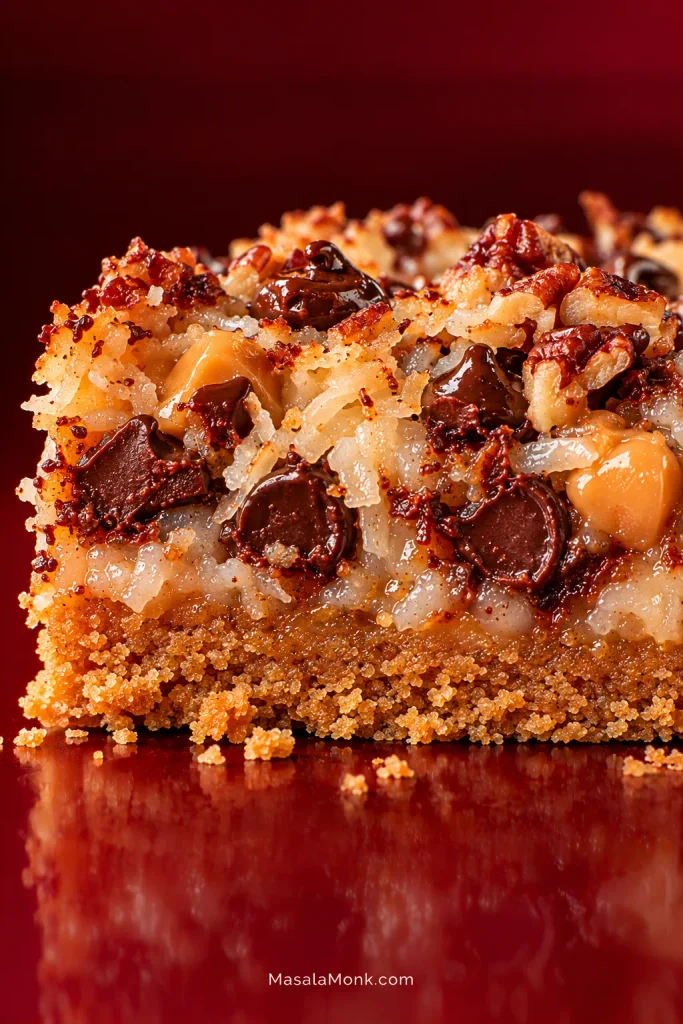
Side view of a Magic Cookie Bar with a compact golden graham base beneath a thick chewy layer containing chocolate, butterscotch, coconut and pecans.
The cut edge should show structure without looking rigid. A compact graham base supports a chewy topping where chocolate, coconut, pecans, and butterscotch still remain easy to distinguish.

This version keeps the familiar character of the bars while pulling back on some of the extra sweetness. Part of their charm is that families remember the same dessert differently anyway—under another name, with another nut, or with the condensed milk poured in a different place.

For all those layers, the method itself stays simple: press the crust, scatter the toppings, bake, and give the bars enough time to cool.

Get These Three Things Right

Crust

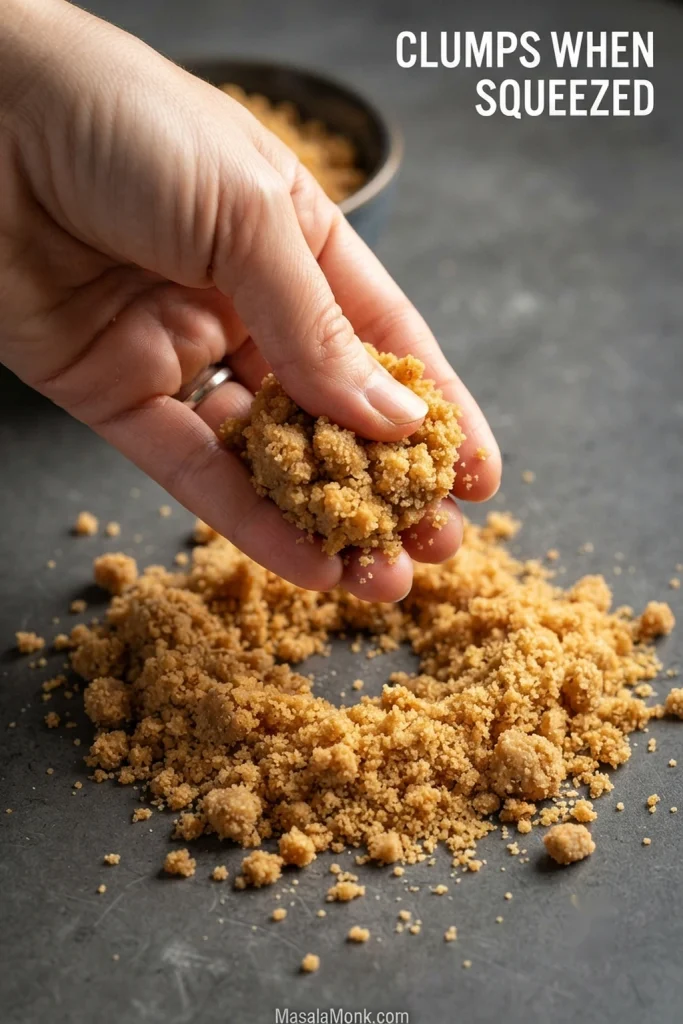
The crumbs should clump when squeezed and form an even, cohesive base when pressed, with no loose dry patches or butter pooling underneath.

Bake

Look for bubbling golden edges, toasted patches of coconut, and a center that has set but still looks soft.

Set

Give the bars 1½–2 hours before cutting. A batch that looks almost too soft while hot can become perfectly chewy as it cools.

Classic 7 Layer Bars with a buttery graham crust, chewy center, and caramelized edges, balanced with semisweet chocolate, less butterscotch, and unsweetened coconut so they stay rich without becoming candy-sweet.

Pan
9×13 in / 23×33 cm

Prep
15 min

Bake
25–30 min

Cool / Set
1½–2 hr

Yield
24 regular bars

Total time: 2 hours 10 minutes to 2 hours 45 minutes, plus an optional 20–30 minute chill for very clean cuts.

  • 9×13-inch / 23×33 cm light-colored metal baking pan
  • Parchment paper
  • Mixing bowl
  • Flat-bottom measuring cup or drinking glass for pressing the crust

Using a glass baking dish? The timing below is written for a light-colored metal pan. Follow your bakeware manufacturer’s temperature guidance and use the visual doneness cues instead of expecting the timing to transfer exactly.

  • 2 cups / 200 g finely ground graham cracker crumbs
  • ½ cup / 113 g unsalted butter, melted
  • ¼ teaspoon fine sea salt
  • 1 can sweetened condensed milk, 14 oz / 397 g, roughly 300 ml
  • 1 cup / about 170 g semisweet chocolate chips
  • ⅔ cup / about 110 g butterscotch chips
  • 1¼ cups / about 105 g unsweetened desiccated coconut, fine shred
  • 1 cup / about 105–110 g unsalted pecans, roughly chopped

Heat the oven to 350°F (175°C) with a rack in the middle. Line the pan with parchment, leaving enough overhang to lift out the cooled bars.

Mix the graham crumbs, butter, and salt until evenly moistened and able to clump when squeezed. Scatter the mixture across the pan, then press gently with a flat-bottom cup until the crust is level, cohesive, and no longer shifts.

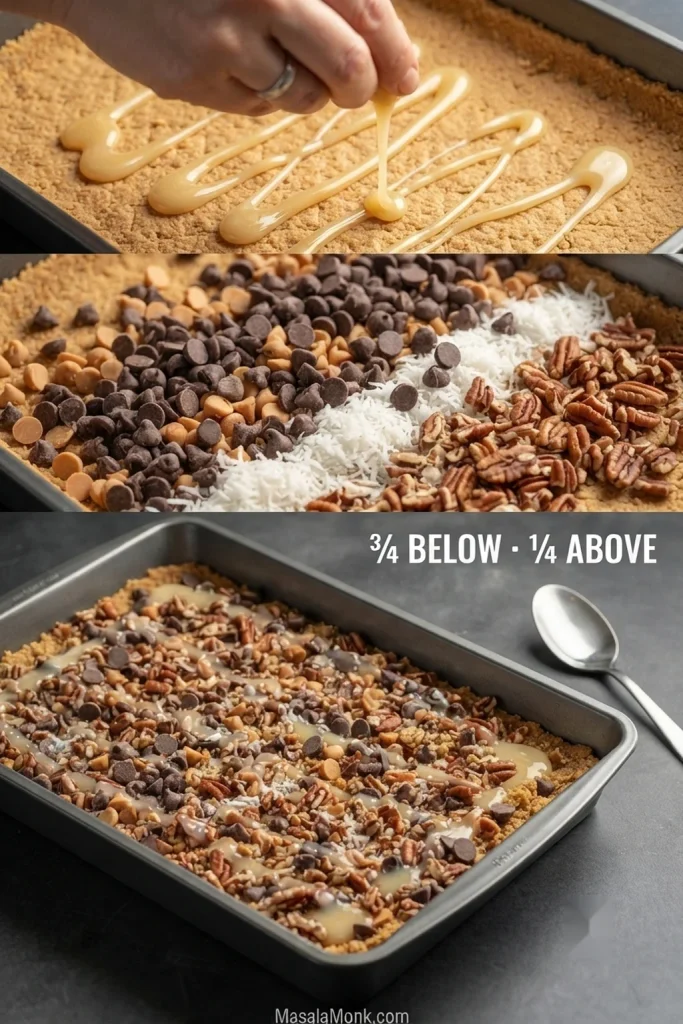
Reserve about one-quarter of the can, roughly 100 g. Pour the rest over the crust in thin ribbons. If the condensed milk is very thick, transfer it to a microwave-safe bowl or measuring jug and warm it for 10–15 seconds so it flows without dragging up crumbs.

Scatter the chocolate chips, butterscotch chips, coconut, and pecans evenly over the surface, including the corners.

Drizzle the reserved condensed milk across the toppings and press very lightly so the loose pieces make contact with the sticky layers beneath.

Before baking: the bars should look generous and slightly unruly, with the toppings evenly scattered and lightly anchored by ribbons of condensed milk.

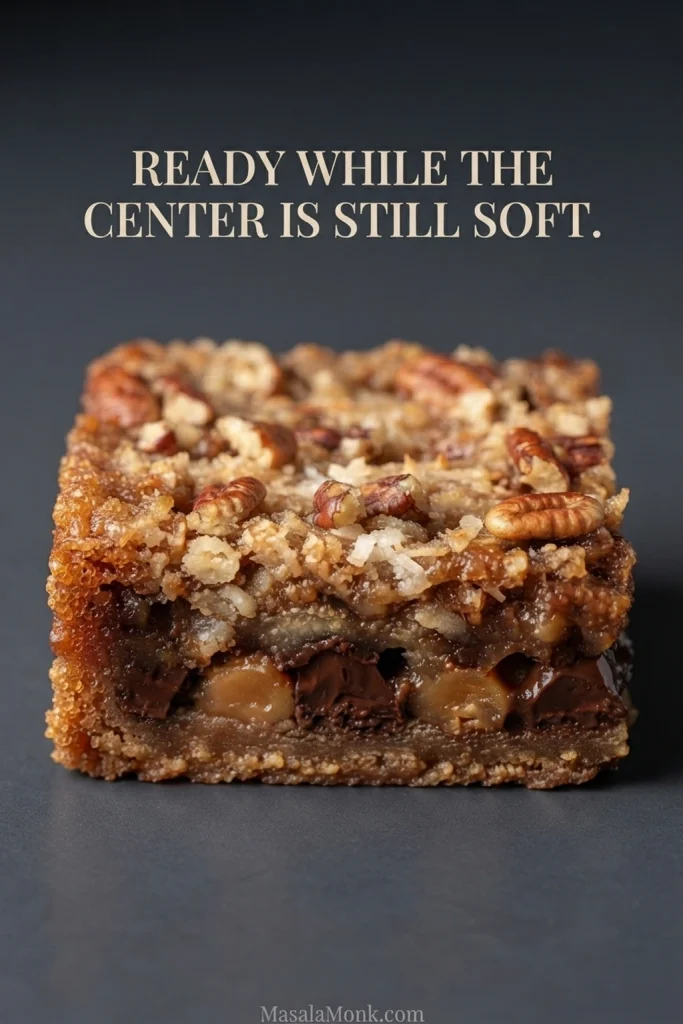
Start checking at 20–22 minutes. Most batches will take 25–30 minutes. Pull the bars when the perimeter is visibly bubbling and golden-brown, the coconut has toasted in patches, and the center looks set but still soft.

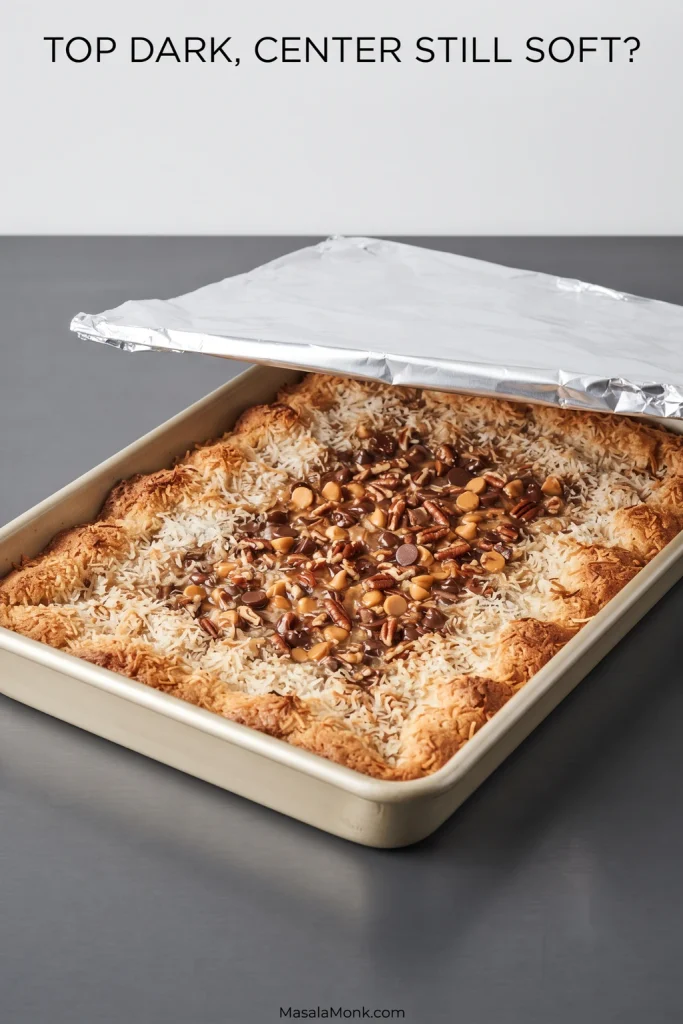
If the coconut darkens before the center is ready, lay a loose sheet of foil over the top and let the middle finish baking.

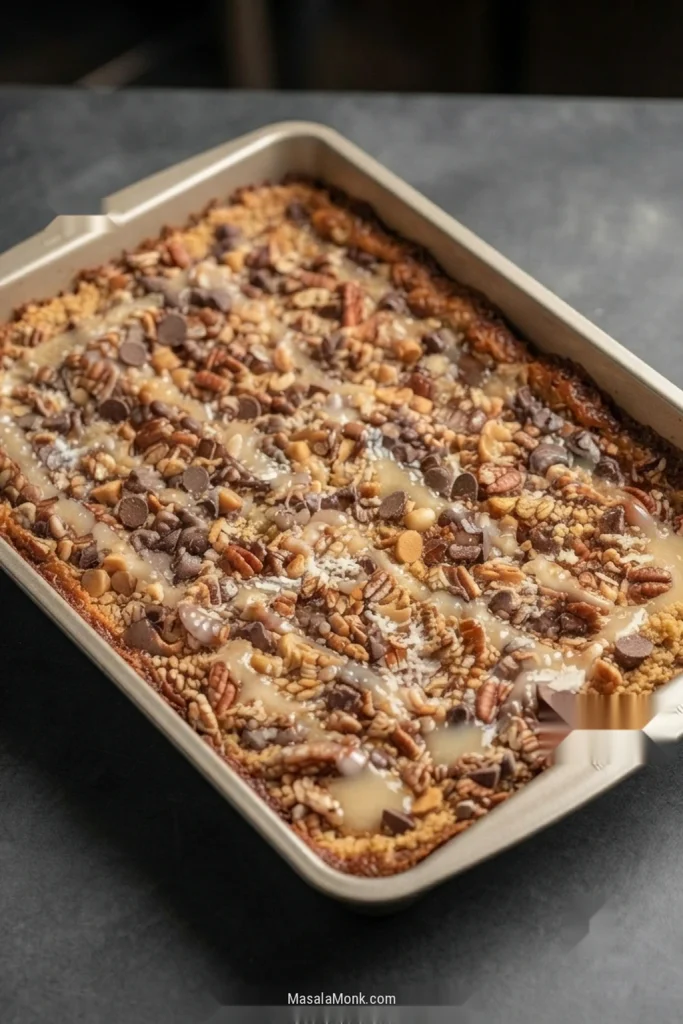
Rectangular metal pan of baked Magic Cookie Bars with browned edges, toasted coconut, pecans, chocolate and butterscotch chips, and a softer-looking center.
Use the whole pan as the checkpoint. The edges should look more advanced than the center, with scattered toasted coconut and a middle that has set without looking dry.

Let the bars cool for 1½–2 hours. Lift the slab out with the parchment and cut it into 24 bars. If you want especially neat edges, use the optional chilling and cutting method in the guide below.

The recipe above gets you to the finished bars; the guide below explains why the layers behave the way they do, how to read the bake, and how to fix the problems that most often show up.

What Are the Seven Layers, Really?

Magic Cookie Bars, Seven Layer Bars, and Hello Dolly Bars are essentially the same dessert family. Their formulas have moved through recipe boxes, community cookbooks, holiday trays, and condensed-milk labels for decades, so two households can remember the “same” bar a little differently.

By the late 1960s, Borden was already promoting Magic Cookie Bars made with Eagle Brand sweetened condensed milk, helping cement the name in American home baking. That familiar combination still appears in Eagle Brand’s Seven Layer Magic Cookie Bars.

You can see the “magic” in the method: ordinary pantry ingredients are layered straight into the pan and bake into one cohesive bar without making a conventional cookie dough.

  1. Butter
  2. Graham cracker crumbs
  3. Sweetened condensed milk
  4. Chocolate chips
  5. Butterscotch chips
  6. Coconut
  7. Pecans or walnuts

Butter and crumbs become one crust, of course, so you should not expect seven perfect stripes when you cut the bars.

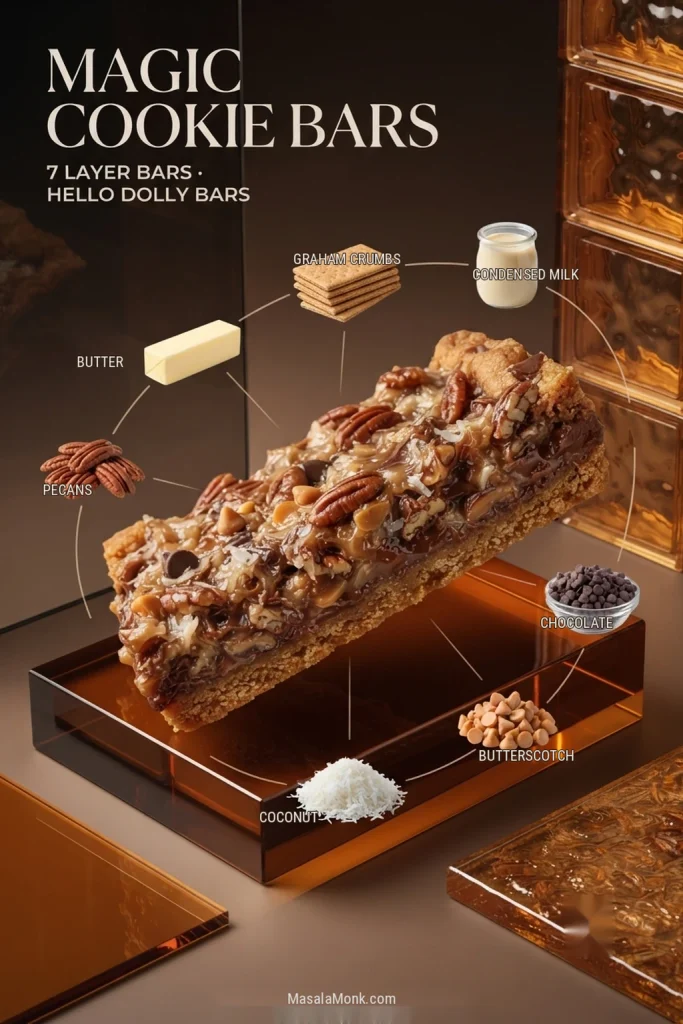
Ingredient diagram for Magic Cookie Bars showing butter, graham crumbs, sweetened condensed milk, chocolate, butterscotch, coconut and pecans around a finished bar.
Think of 7 Layer Bars by function, not by seven visible stripes: butter and crumbs form the foundation, condensed milk binds, chips add sweet pockets, coconut adds chew, and pecans add crunch.

Ingredients That Matter Most

Graham Crust

Hand squeezing buttered graham cracker crumbs into a cohesive clump above loose crumbs. Text reads “Clumps when squeezed.”
The goal is cohesion without compression. Once the crumbs hold together in your hand, pressing should make them level and stable rather than dense and hard.

Do you need to pre-bake the crust? Not for this method. The base bakes with the toppings; press it just until level and cohesive.

Sweetened Condensed Milk

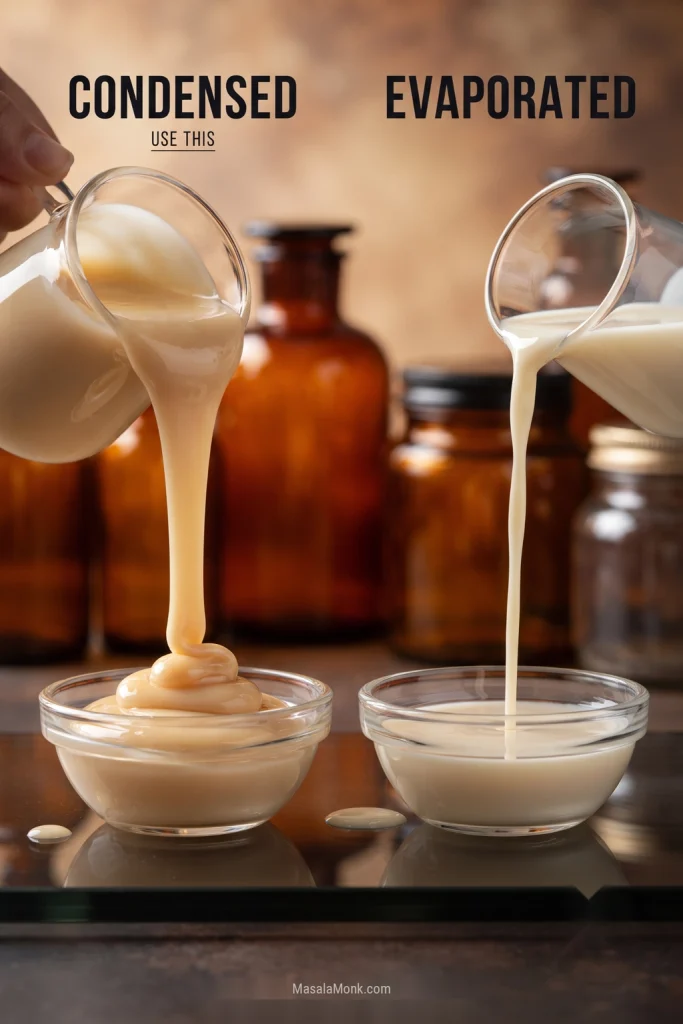
Side-by-side comparison of thick sweetened condensed milk and thinner evaporated milk, with condensed milk identified as the ingredient to use.
Use the pour as a quick check: sweetened condensed milk falls in a slow, heavy ribbon, while evaporated milk is much thinner and moves more like cream.

Chocolate, Butterscotch, Coconut & Pecans

Semisweet chocolate and unsweetened coconut keep the filling from becoming one-note sweet. Butterscotch stays for its familiar caramel flavor, just in a smaller amount than many old-school formulas use. Pecans bring toasted crunch, while a little salt keeps the richer layers from tasting flat.

That balance matters in the finished bar: toasted coconut and pecan crunch should still register against the chocolate instead of disappearing into one flat sweetness. Sweetened coconut works too if that is the version you remember; expect a sweeter result and keep an eye on the exposed strands as they brown.

Changing the coconut, nuts, or chips? Jump to the substitutions that make sense before you start swapping.

Condensed Milk First or Last?

Classic Magic Cookie Bar recipes disagree about where the condensed milk belongs. Some pour it directly over the crust; others drizzle it over the toppings.

Three-step assembly graphic showing condensed milk poured over graham crust, chocolate, butterscotch, coconut and pecans added, then more condensed milk drizzled on top. Text reads “¾ below • ¼ above.”
The split keeps both surfaces working for you. Most of the milk stays close to the crust, while the finishing ribbons catch loose coconut and nuts without burying the toppings.

Building the bars now? Return to the recipe method.

Keep the Sweetness in Balance

The easiest way to make Magic Cookie Bars less sweet is to keep the full can of condensed milk, then use semisweet chocolate, less butterscotch, and unsweetened coconut.

Keeping the condensed milk matters because it also helps hold the layers together. Meanwhile, pecans and salt add contrast, and smaller pieces help too. This is one of those desserts where a modest square often tastes better than a heroic one.

Close-up of the browned outer edge of a Magic Cookie Bar showing graham crust, chewy filling, coconut, pecans, chocolate and butterscotch chips.
The edge shows why balance matters in such a rich bar. Deep caramelization, toasted coconut, and pecans add contrast, while chocolate and butterscotch remain distinct instead of collapsing into one flat sweetness.

Don’t Judge These Bars by the Clock

The clock gives you a window; the surface tells you when the bars are ready. Start checking at 20–22 minutes, with most metal pans finishing around 25–30 minutes.

Close-up of a baked Magic Cookie Bar with browned edges and a softer center. Text reads “Ready while the center is still soft.”
“Soft” and “liquid” are the distinction that matters. A soft-set middle can finish firming as it cools; visible fluidity is the cue that the center still needs oven time.

The center is supposed to make you hesitate a little. Waiting until it looks dry or rigid risks taking the bars beyond the soft, chewy texture they develop as they cool.

The Bar Isn’t Finished When It Leaves the Oven

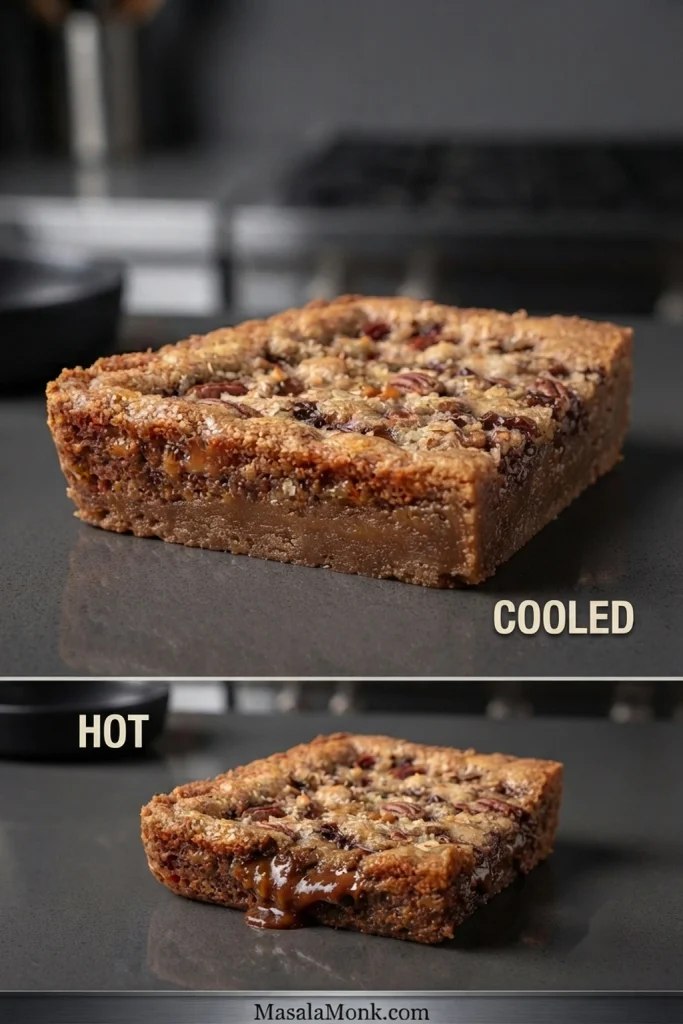
Fresh from the oven, the chocolate is melted, the condensed-milk layer is very soft, and the graham base is still fragile. The kitchen may already smell as though dessert is finished, but the texture is not there yet.

Comparison of a firm cooled Magic Cookie Bar and a hot bar with noticeably softer filling. Labels read “Cooled” and “Hot.”
The contrast here is the point: the hot bar can slump at the cut edge, while the cooled bar holds a cleaner layer structure without turning dry.

How to Cut Clean Magic Cookie Bar Squares

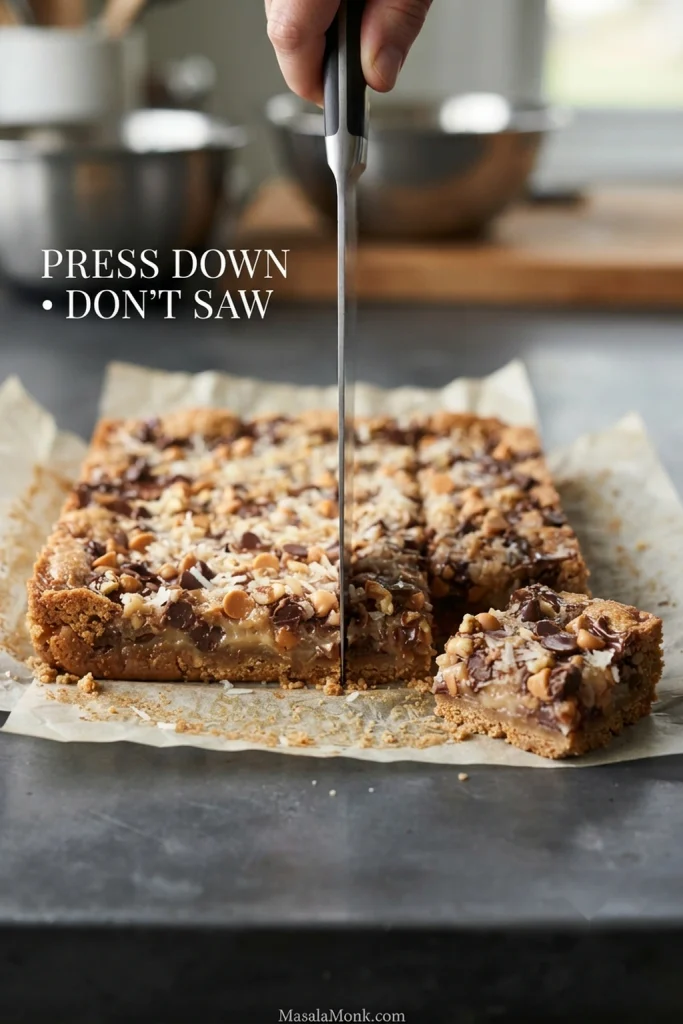
Hand pressing a long knife straight down through a cooled slab of Magic Cookie Bars on parchment. Text reads “Press down • don’t saw.”
A clean vertical edge is a useful clue that the slab was ready to cut. Ragged or dragged layers usually mean the bars were still too warm or the blade needed wiping.
  • 24 pieces: regular dessert bars
  • 30–36 pieces: potlucks, bake sales, and parties
  • 40–48 pieces: small cookie-tray bites

Troubleshooting Magic Cookie Bars

Why are my Magic Cookie Bars falling apart or still gooey?

Warm bars are naturally much softer than cooled ones. If the center had begun to set before the batch came out, let the bars cool fully before deciding they are underbaked. A center that was still visibly fluid usually needed more oven time.

Loose toppings can also make a square fall apart. The finishing drizzle and gentle press before baking help the upper layers settle together.

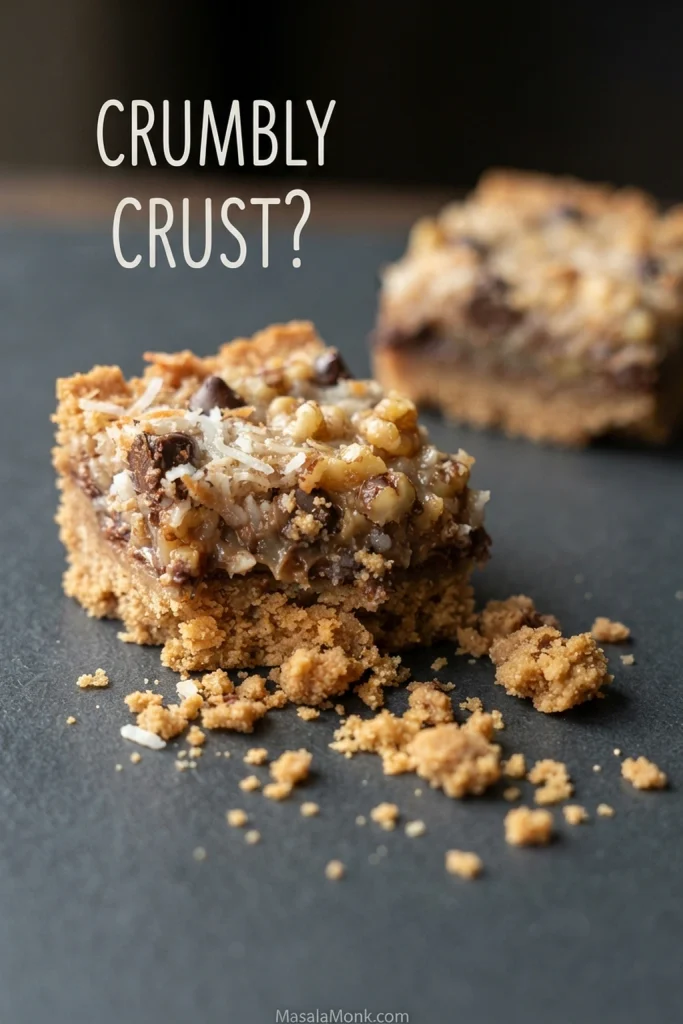
Why is the crust crumbly—or too hard?

Magic Cookie Bar with its graham cracker base breaking into loose crumbs. Text reads “Crumbly crust?”
Look at the type of break, not just the crumbs on the plate. A weak, sandy base suggests poor cohesion; a dense, brittle base points more toward overpacking.

Use finely ground crumbs and mix until evenly moistened. Once the base is level and stops shifting beneath the measuring cup, stop pressing.

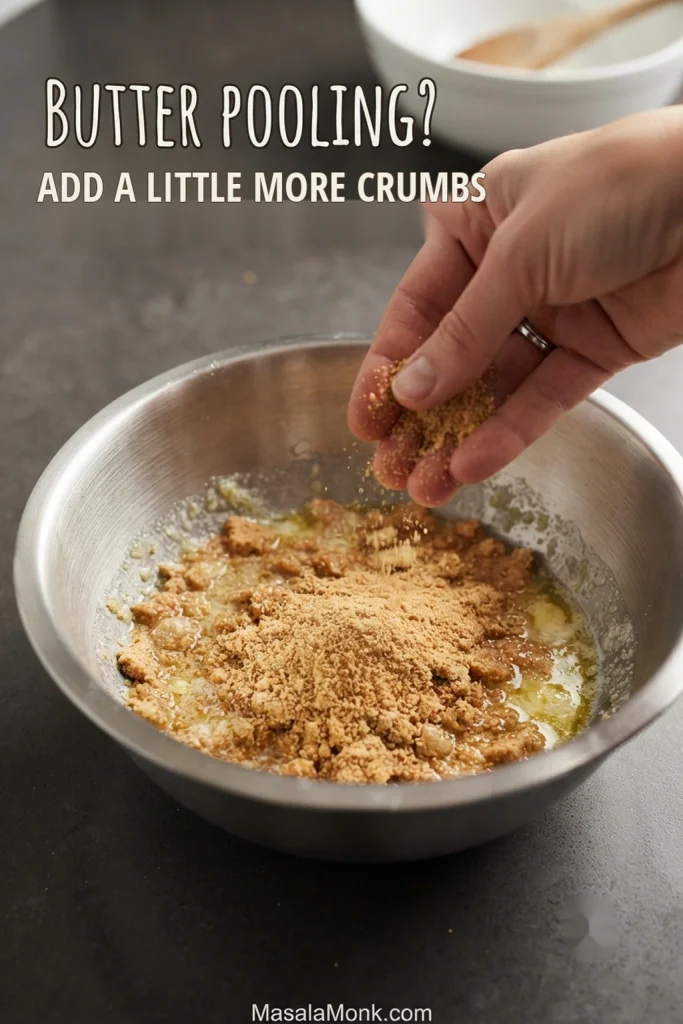
Why is the crust greasy?

Hand adding graham cracker crumbs to a bowl of wet crumb mixture with visible melted butter. Text reads “Butter pooling? Add a little more crumbs.”
Stop adjusting once the mixture looks evenly damp rather than shiny. It should clump cleanly without leaving visible free butter around the crumbs.

Why is the coconut dark before the center is ready?

Pan of Magic Cookie Bars with browned coconut on top and a loose sheet of foil being positioned over the pan. Text asks “Top dark, center still soft?”
Watch the exposed coconut, especially near the perimeter. Uneven browning is normal; intervene only when the top is clearly getting ahead of the still-soft center.

Quick fixes for a few other problems

  • Condensed milk pulls crumbs from the crust: warm it briefly and pour it in ribbons instead of repeatedly spreading it.
  • Toppings fall off: use the reserved finishing drizzle and press the surface lightly before baking.
  • Bars stick to the pan: line the baking pan with a parchment sling before building the layers.

Substitutions That Make Sense

Leaving out either coconut or nuts is straightforward; leaving out both removes a large share of the topping. When one ingredient disappears, replace texture only if you miss it instead of automatically filling the space with more sweet chips.

ChangeWhat to do
No coconutOmit it. If the top feels sparse, add some extra pecan or coarsely crushed pretzel for texture.
No nutsLeave them out for a softer bar, or use some crushed pretzel for crunch.
No coconut and no nutsRemoving both takes away a large amount of solid topping, so use a recipe specifically balanced for both omissions instead of treating them as a simple swap.
No butterscotch chipsOmit them for a more chocolate-forward bar, or replace only part of the amount with another chip or some toffee to keep the sweetness in balance.
Walnuts instead of pecansSwap directly.
Less-sweet chocolateReplace part of the semisweet chocolate with dark or bittersweet chips.
Sweetened coconutUse the same general amount, but expect a sweeter result and potentially faster browning.
No graham crackersUse plain digestive biscuits by weight. Brands vary in fat and crumb texture, so use the same clump test and adjust the butter slightly if the crumbs seem unusually dry or greasy.

Brownie batter, blondie dough, and chocolate-chip-cookie dough are different kinds of bases, not simple graham-crust swaps. If a thick cookie-dough base is what you actually want, Cookie Pie is built around that deeper center and its longer bake.

Make Ahead, Store & Freeze

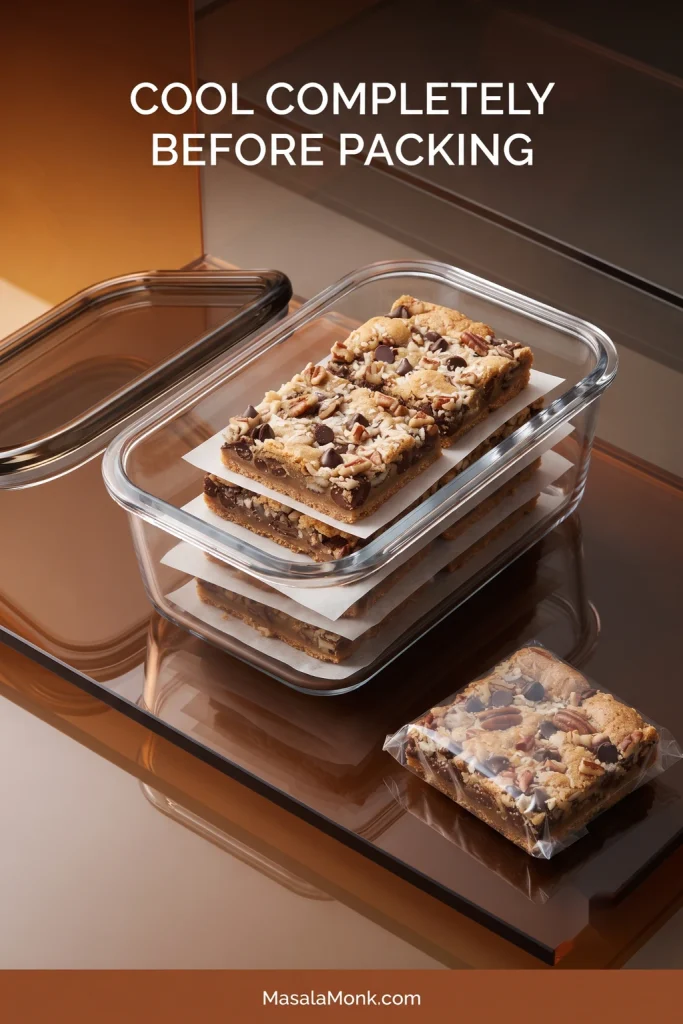
Cooled Magic Cookie Bars stacked in glass storage containers with parchment between the layers, with one separately wrapped bar nearby. Text reads “Cool completely before packing.”
Parchment does more than keep the container tidy. It separates sticky tops when the bars are stacked, while a snug airtight container helps protect the texture during storage.

Room temperature: Keep completely cooled bars airtight for 3 days. Put parchment between stacked layers.

Refrigerator: Store airtight for up to 1 week. Let the bars sit briefly at room temperature when you want a softer, chewier texture.

Freezer: Freeze completely cooled bars airtight for up to 3 months, with parchment between layers or individual pieces wrapped separately.

Do not package or freeze the bars while they are warm. Trapped steam can soften the crust and leave condensation on the sticky surface.

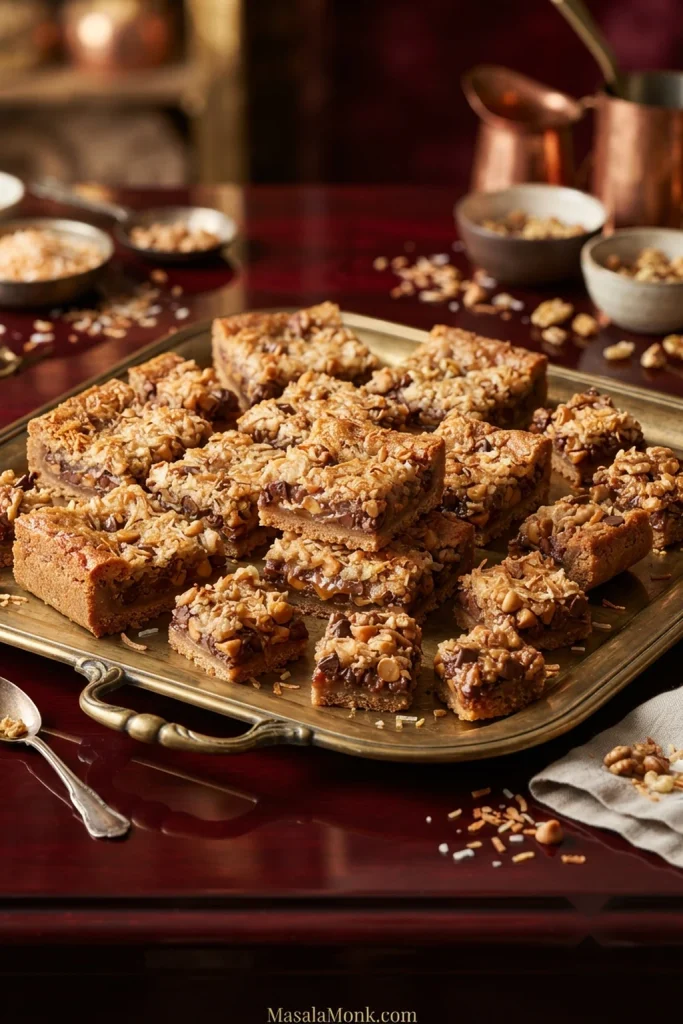
Serving tray filled with small Magic Cookie Bars topped with coconut and pecans on a warm holiday-style table setting.
Smaller squares work especially well on a mixed dessert tray. They still carry the full crust-to-topping balance, but leave room for people to sample more than one thing.

Whatever your family calls them, give the bars their full cooling time before deciding whether you got them right. By then, the messy-looking layers should have settled into what you wanted: a buttery graham base, chewy middle, toasted coconut, pockets of chocolate and butterscotch, and pecan crunch in every square.

Posted on — Leave a comment

Chocolate Lava Cake Recipe: Easy Molten Chocolate Cakes with Gooey Centers

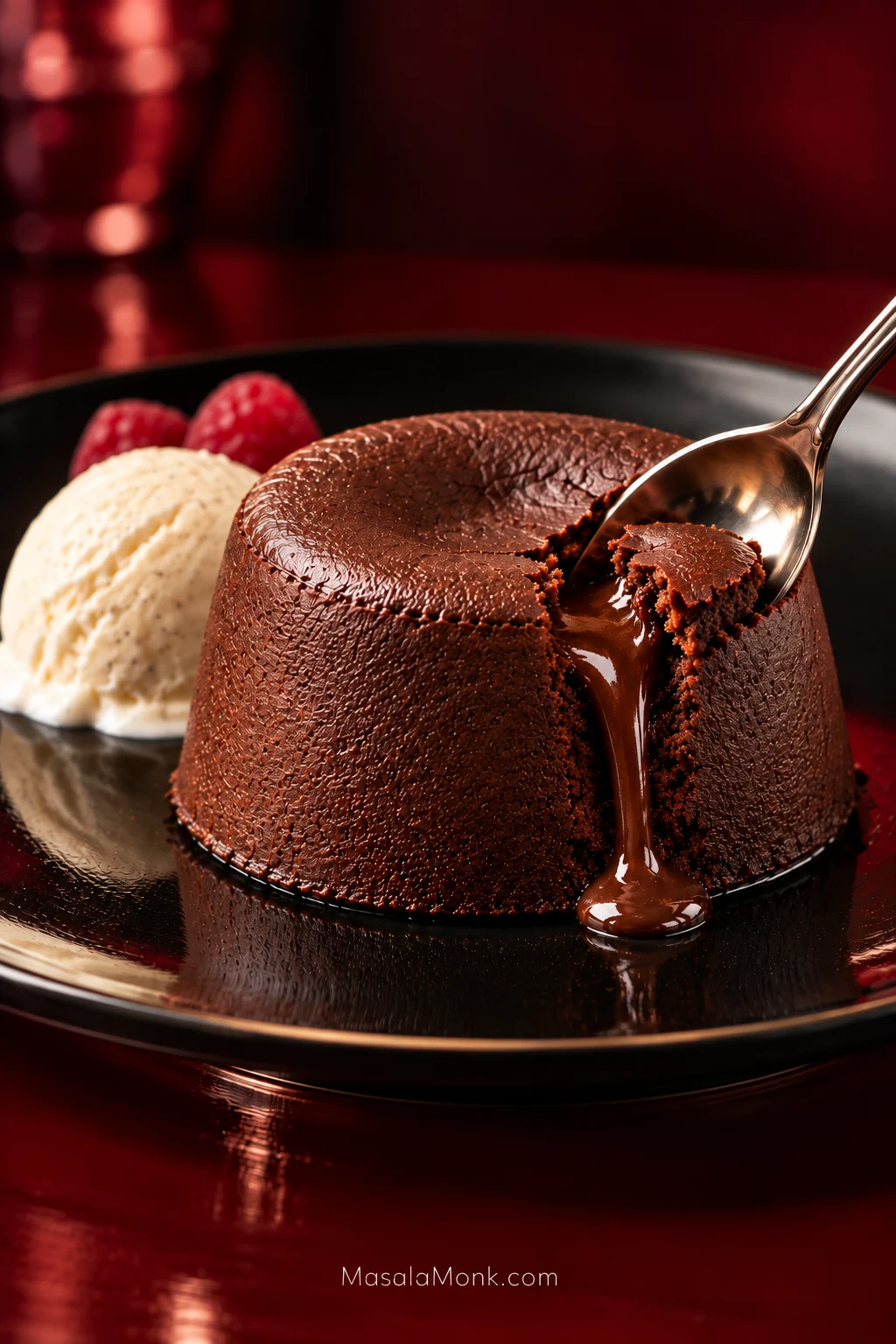
Individual chocolate lava cake on a glossy black plate as a silver spoon breaks the shell and molten chocolate begins to flow out, with vanilla ice cream and raspberries behind it.

Break into one while it is still warm and the spoon should meet a little resistance from the tender outer cake, then almost none as it reaches the molten chocolate middle. Add cold vanilla ice cream beside it and the first spoonful gives you warm cake, flowing chocolate and melting ice cream all at once.

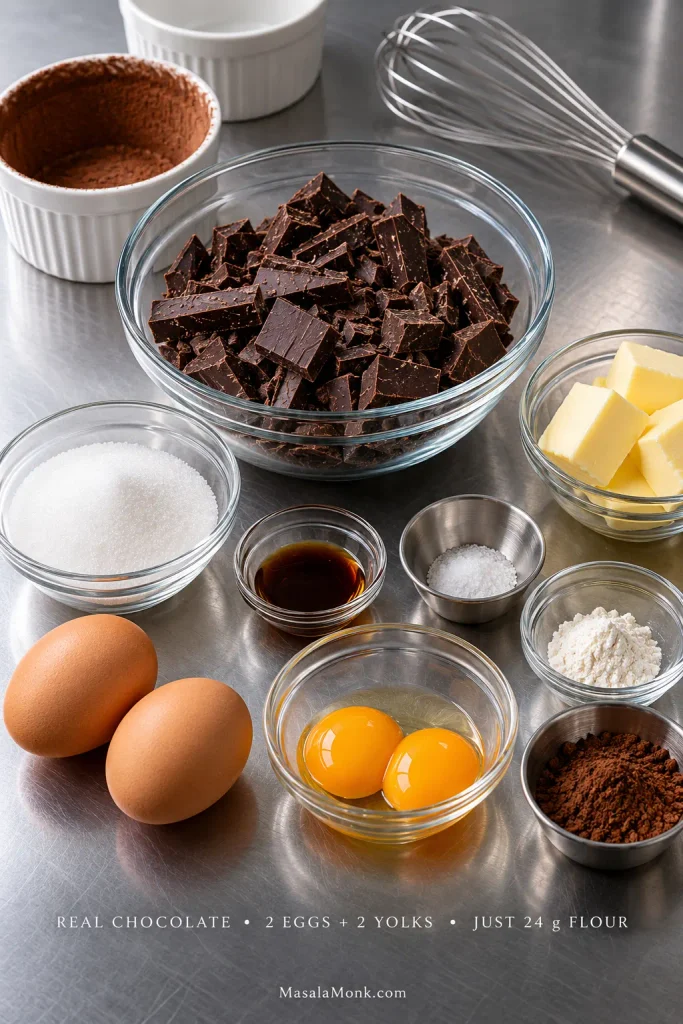
This chocolate lava cake recipe uses the classic method: real chocolate, butter, two whole eggs plus two extra yolks, and just enough flour to help the outside hold together. There is no hidden square of chocolate or separate ganache filling. The batter itself creates the molten center.

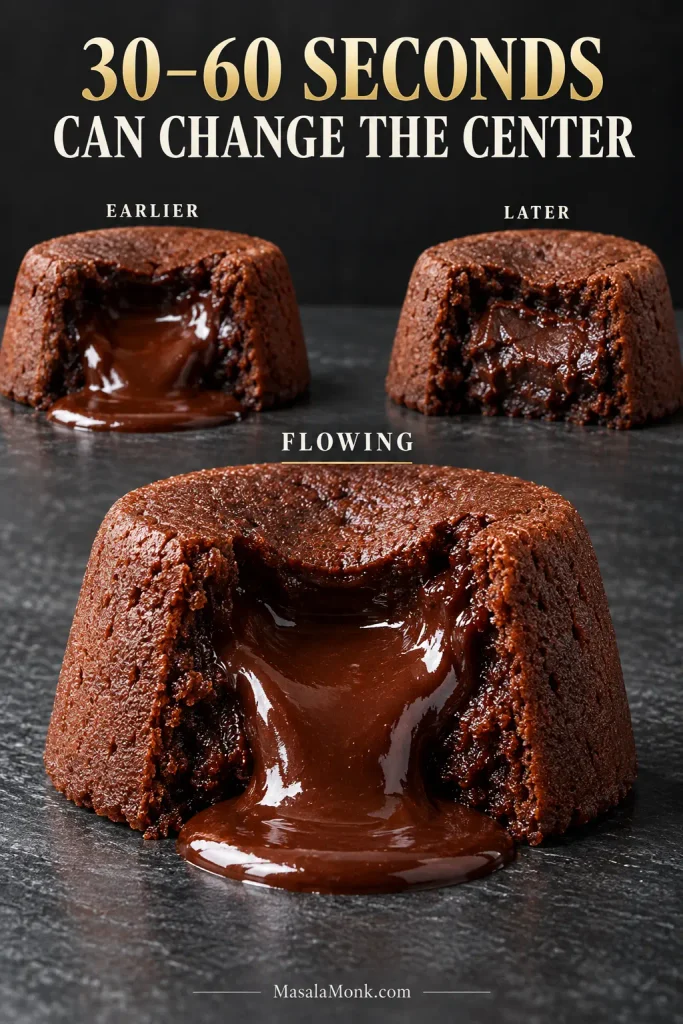
Mixing is straightforward; the bake deserves your attention. Ramekin shape, batter depth and even another 30–60 seconds in the oven can change what happens when you cut into the cake.

You’re looking for the moment when the cake can stand on the plate while the middle is still soft enough to flow.

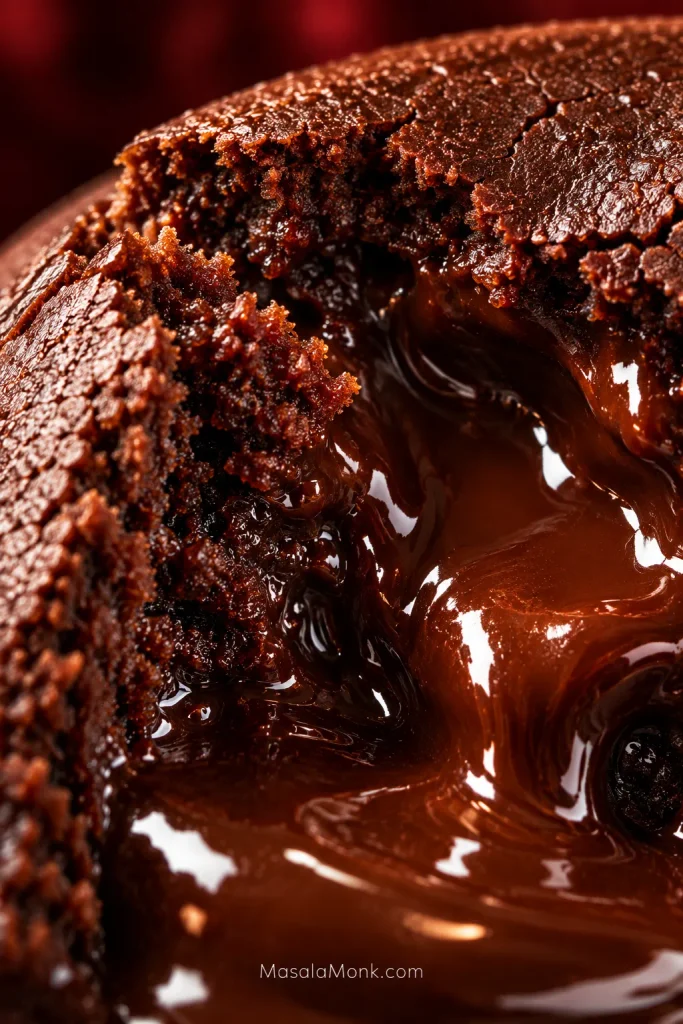
Extreme close-up of a broken chocolate lava cake showing baked crumb surrounding a glossy, fluid chocolate center.
Look at the transition, not just the pool of chocolate. The crumb becomes progressively softer as it approaches the molten center, so a properly baked cake has distinct textures rather than one uniformly fudgy interior.

Chocolate Lava Cake Recipe

Yield
4 cakes

Prep
About 15 minutes

Bake
About 10–12 minutes

First check
9 minutes

Ramekins
6 oz / 180 ml

Total
About 25–30 minutes

Oven: 425°F / 220°C, conventional. Best served: immediately.

Ingredients

  • 6 oz / 170 g semisweet or 60–70% bittersweet chocolate, preferably a bar suitable for melting, finely chopped
  • ½ cup / 4 oz / 113 g unsalted butter, plus more for the ramekins
  • 2 large eggs, ideally not refrigerator-cold
  • 2 additional large egg yolks, ideally not refrigerator-cold
  • ¼ cup / 50 g granulated sugar
  • 1 teaspoon vanilla extract
  • ¼ teaspoon fine salt
  • 3 tablespoons / 24 g all-purpose flour
  • Unsweetened cocoa powder, for coating the ramekins
Chocolate lava cake ingredients arranged on a stainless-steel surface, including chopped chocolate, butter, two whole eggs, two extra yolks, sugar, vanilla, salt, a small amount of flour and cocoa powder.
Chocolate, eggs and butter dominate this formula, while the flour stays deliberately low. That helps explain why this dessert can behave like a cake at the edge and something much softer in the middle.

Equipment

  • 4 oven-safe 6 oz / 180 ml ramekins
  • Baking sheet
  • 2 mixing bowls, including one heatproof bowl
  • Electric hand mixer or stand mixer
  • Silicone spatula
  • Digital kitchen scale, if available

Method

1. Heat the oven and prepare the ramekins

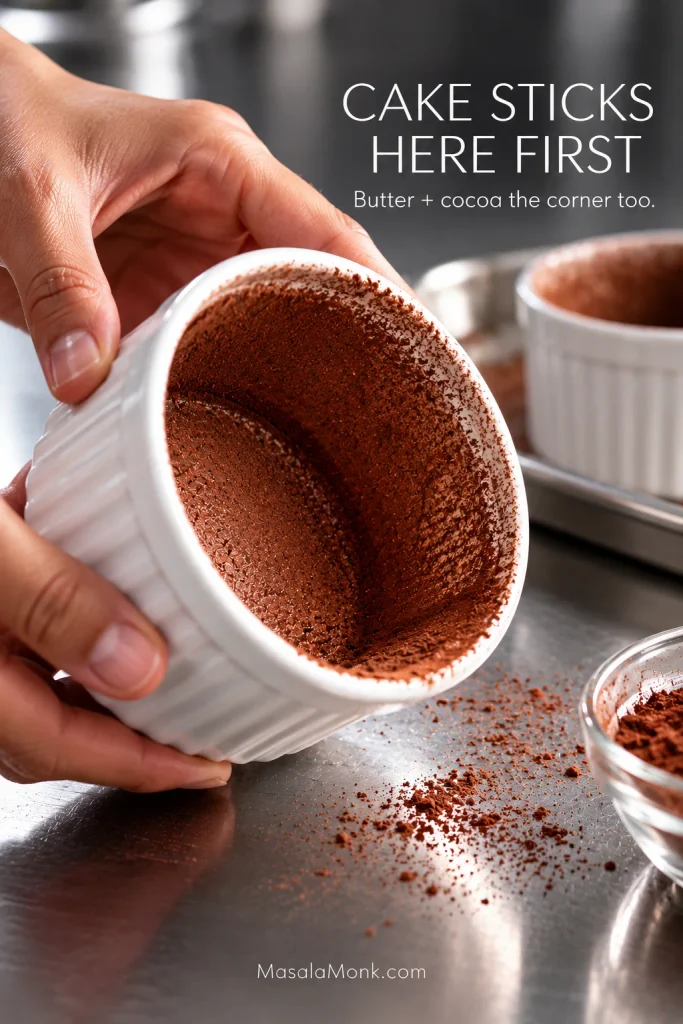
Heat a conventional oven to 425°F / 220°C. Butter the bottom and sides of four ramekins thoroughly, including the corner where the base meets the wall.

Add a little unsweetened cocoa powder and turn each ramekin until the butter has a thin coating. Tip out the loose excess. A light film is enough.

Set the ramekins on a baking sheet so all four can go into the oven together.

Hands holding a white ramekin with a thin cocoa coating over the bottom, sides and lower corner where the base meets the wall.
Think of the butter-and-cocoa coating as one continuous release layer. Excess powder on an already-covered wall cannot compensate for a bare patch where the base meets the side.

2. Melt the chocolate and butter

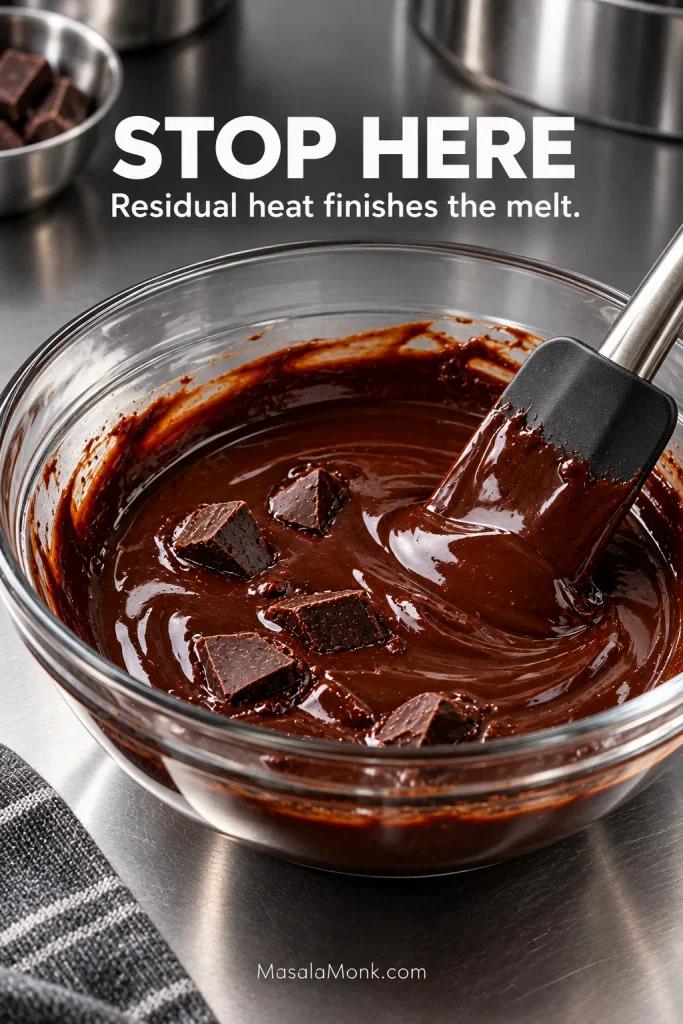
Put the chopped chocolate and butter in a heatproof bowl. Microwave in short bursts, stirring well between each one, until almost completely melted. Stop while a few small pieces remain and let the residual heat take care of them.

You can also melt them gently over barely simmering water. Once smooth, leave the mixture for 2–3 minutes. It should still be warm and fluid when it meets the eggs, but it shouldn’t be steaming.

Glass bowl of mostly melted chocolate and butter with a few small solid chocolate pieces still visible in the glossy mixture.
Complete smoothness does not have to come from more heat. Once most of the chocolate is fluid, stirring can finish the last pieces while keeping the mixture warm rather than excessively hot before it meets the eggs.

3. Beat the eggs, yolks and sugar

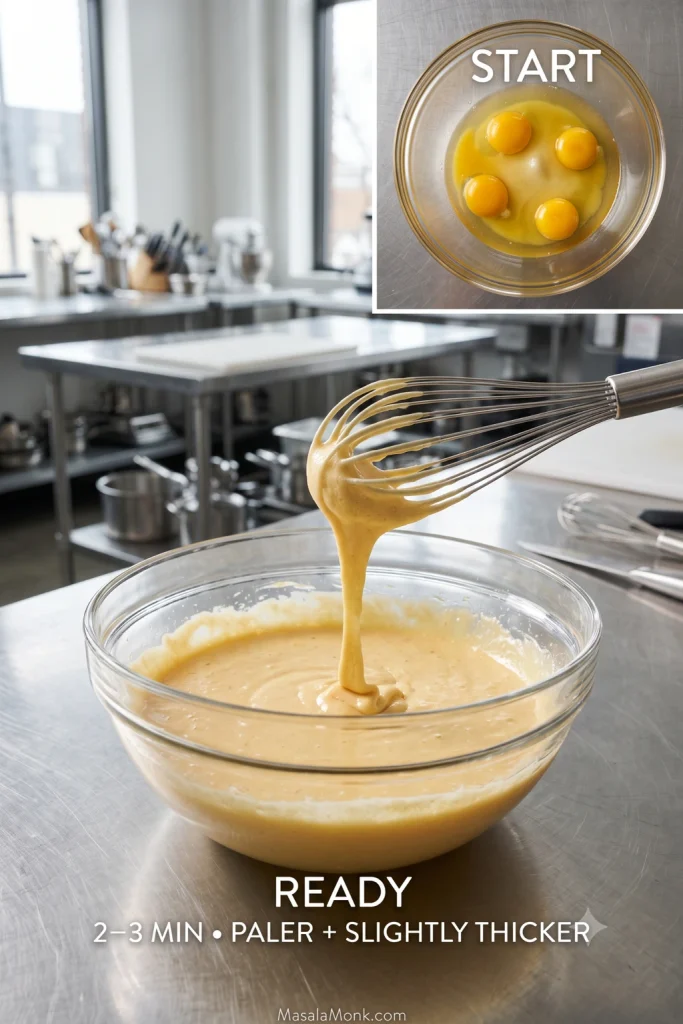
Combine the 2 whole eggs, 2 extra yolks and sugar in a second bowl. Beat with an electric mixer for about 2–3 minutes, until the mixture looks noticeably paler and slightly thicker.

You don’t need the volume of a sponge-cake batter. Beat in the vanilla and salt.

If the eggs are straight from the refrigerator, give them a little time to lose the hard chill before mixing. Very cold eggs can make the warm chocolate mixture thicken more quickly as the two come together.

Before-and-after comparison of an egg, yolk and sugar mixture, changing from deep golden and fluid to paler and slightly thicker with a short ribbon falling from a whisk.
Judge this stage by how the mixture moves, not by how tall it becomes. The ready mixture falls from the whisk with more cohesion than the starting eggs while remaining fluid rather than foamy.

4. Fold the batter together

Pour the warm chocolate-butter mixture into the eggs in two additions, folding gently with a flexible spatula after each. The batter will turn darker and glossy as the chocolate goes in.

Sprinkle the flour over the surface and fold until the dry streaks disappear. Scrape along the bottom once or twice in case any flour is hiding there, then stop.

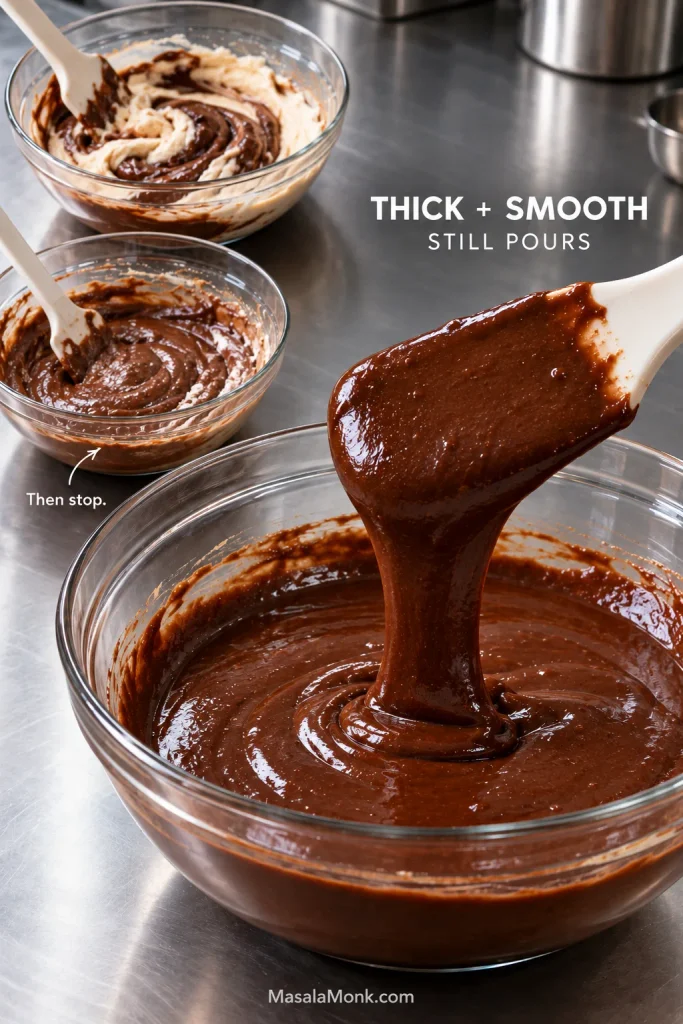
The finished batter should be thick and smooth but still pour easily.

Three stages of chocolate lava cake batter, ending with thick, smooth, glossy batter flowing from a spatula into a glass bowl.
Finished chocolate lava cake batter should move as a broad, glossy ribbon and begin settling back into itself.

5. Portion the batter

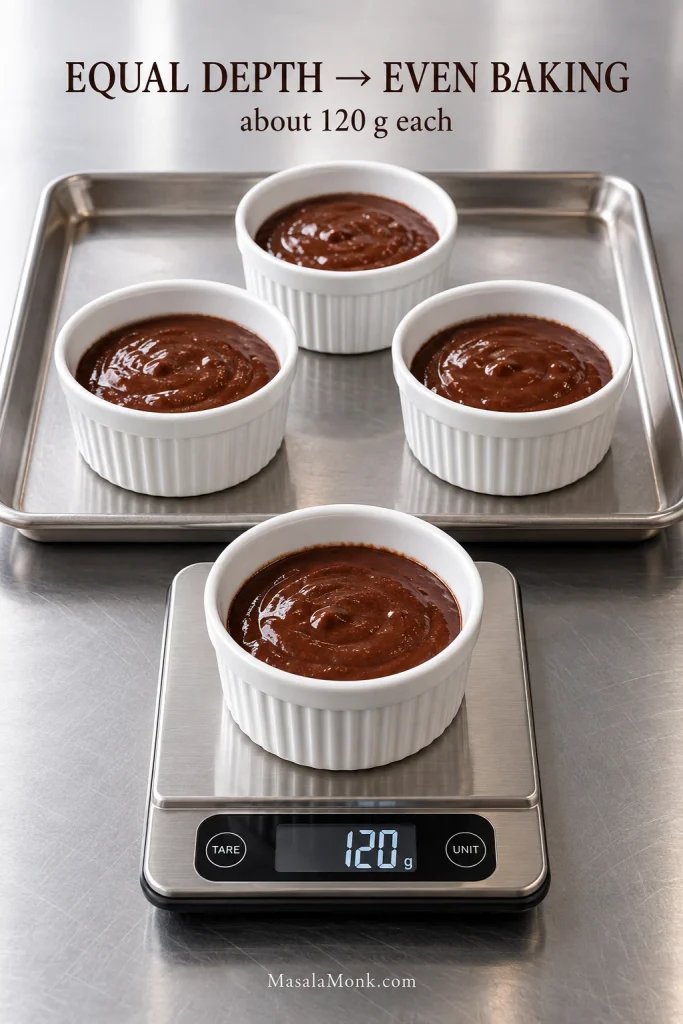
Divide the glossy batter among the four ramekins. If you’re weighing the portions, aim for about 120 g in each. Don’t worry about chasing the last gram left on the bowl or spatula; equal portions matter more than an exact number.

Four matching white ramekins filled with chocolate batter to similar depths, with one ramekin sitting on a digital scale at about 120 grams.
The scale provides a useful starting number, but the matching fill line is what you can keep checking at a glance. Similar batter depths reduce one source of variation when four cakes bake side by side.

6. Bake

Put the baking sheet in the oven. At 9 minutes, look before you touch anything. Nine minutes is the first check, not the finish line.

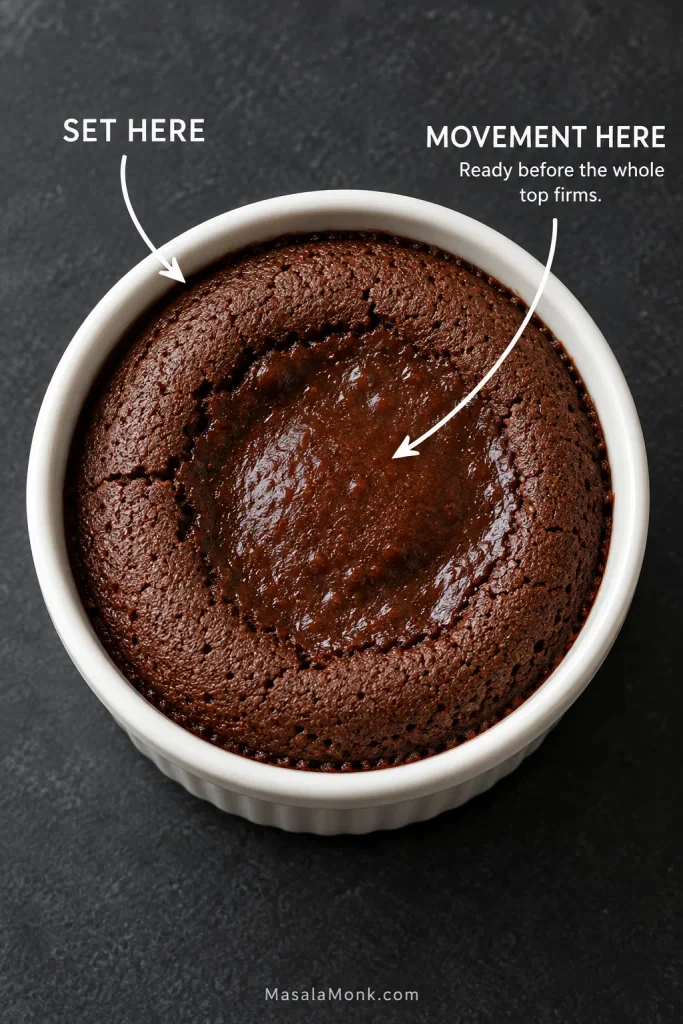
With 6-ounce ramekins, expect the cakes to reach the right stage around 10–12 minutes. Watch the surface as much as the clock: the edge should look set and less glossy while a smaller area in the middle still moves when you gently nudge the baking sheet.

Don’t wait for the entire top to become firm.

7. Rest, invert and serve

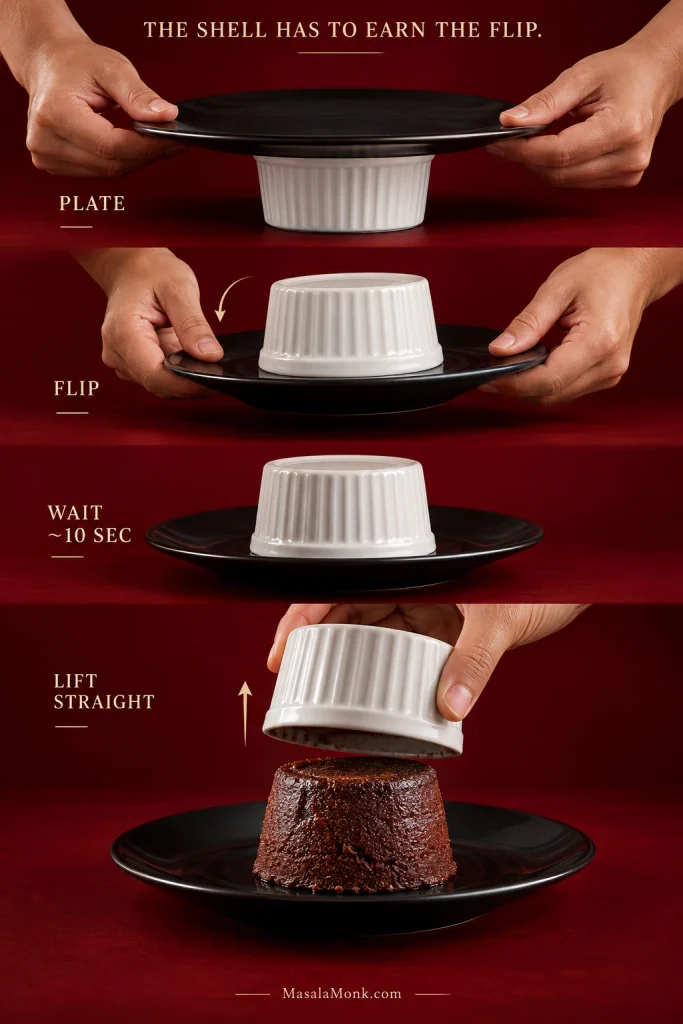
Take the cakes from the oven and leave them in their ramekins for about 1 minute. Put a serving plate over one ramekin, hold both securely with oven mitts and turn them over together.

Leave the ramekin upside down for about 10 seconds, then lift it straight up. If the cake stays standing, the most uncertain part is over. Serve it while the center is still at its softest.

Those last few minutes are what separate a cake that collapses from one that flows and one that has already turned fudgy. Fortunately, the change isn’t invisible. You can watch it happen.

The Lava Window: How to Tell When Chocolate Lava Cake Is Done

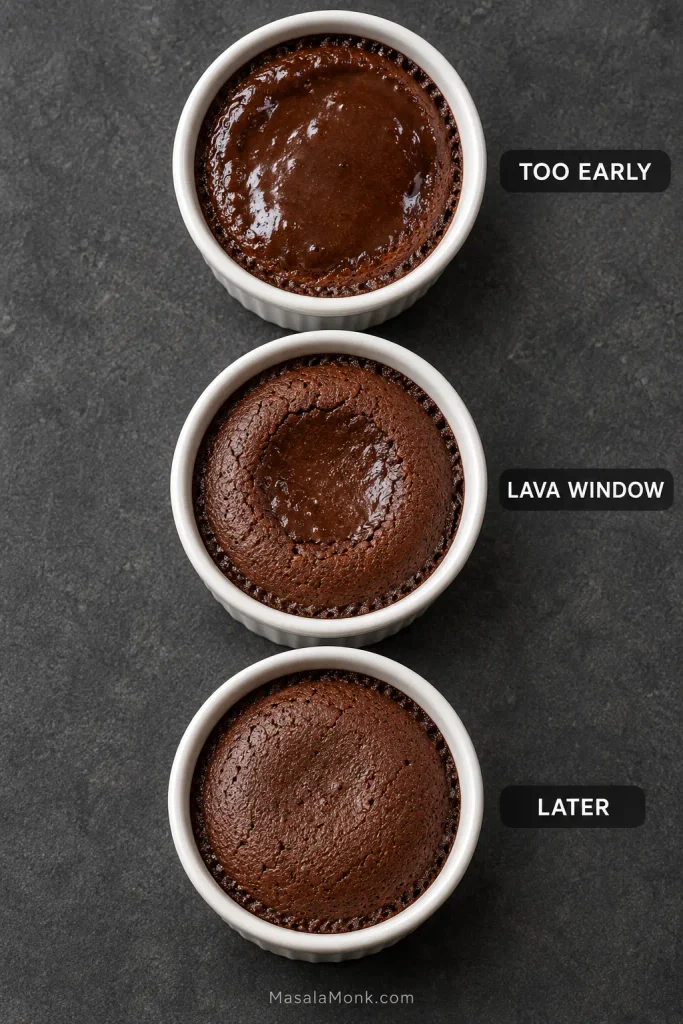
The top doesn’t finish all at once. At the edge, the wet shine disappears first and the surface begins to look more matte. Meanwhile, the middle catches up later. That short gap between the two is the window you’re trying to catch.

Three identical ramekins viewed from above showing chocolate lava cakes at too-early, lava-window and later stages with progressively firmer top surfaces.
Read these surfaces by where the softness remains. As lava cake doneness advances, the unsettled area contracts toward the center until eventually there is very little visual difference between edge and middle.
What you seeWhat it meansLikely result
The edge still looks weak and most of the top ripples when nudgedThe cake needs more timeIt may collapse when inverted
The outer ring is set, most of the wet shine is gone and only a smaller central area givesThe cake can support the softer middleMolten or very soft center
The surface is firm almost all the way acrossThe middle has cooked furtherThicker, fudgy center with little visible flow

Watch Where the Cake Still Moves

Pull the cake toward the earlier side of that window and the center will be looser, although the cake will also be more delicate. Another minute can turn flowing chocolate into something much thicker.

Overhead chocolate lava cake in a white ramekin with annotations marking the set outer area and the smaller softer center where movement remains.
A little movement is not the problem; movement across too much of the cake is. The useful cue is a small softer center surrounded by enough set cake to support it after inversion.

If you cut into one and find a rich, fudgy middle instead of a dramatic flow, dessert isn’t ruined. You simply baked it a little past the flowing stage. Start checking the next batch 30–60 seconds sooner.

Three opened chocolate lava cakes showing looser, flowing and fudgier centers, with the ideal flowing center shown most prominently.
The oven may show only a subtle change, while the cut cake reveals a dramatic one. Therefore, adjust future batches relative to the center you actually got rather than treating somebody else’s minute mark as absolute.

With an unfamiliar oven or ramekin, one tester cake can tell you more than another paragraph of timing advice. Cut into it, see where the center landed, then adjust the remaining cakes in small increments.

Your Ramekin Changes the Clock

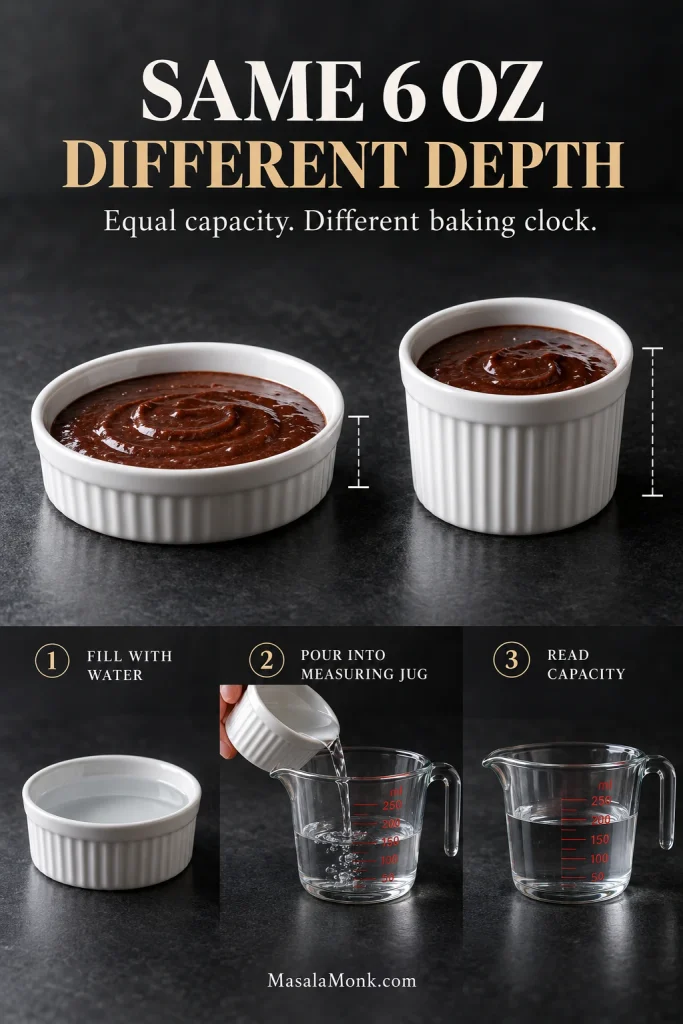
Two ramekins can both hold 6 ounces and still bake differently. A wide, shallow dish and a narrow, deep one put the same amount of batter into different shapes. The deeper fill will generally take longer for heat to reach the middle.

Not sure what your ramekin holds? Fill it to the rim with water, pour that water into a measuring jug and check the volume. Then notice how deeply the batter sits once the ramekin is filled. Capacity is useful; batter depth often tells you more about how that particular cake is likely to bake.

Wide shallow and narrow deep white ramekins holding equal amounts of chocolate batter, plus a small sequence showing ramekin capacity measured with water and a measuring jug.
Equal capacity does not mean heat travels the same distance to the center. A wider ramekin spreads the batter out; a narrower one stacks it deeper, which is why ramekin shape matters for lava cake baking time.
VesselHow to portionWhat to expect
6 oz / 180 ml ceramic ramekinAbout 120 g batterMain method; first check at 9 minutes
Smaller ramekinKeep some headroom rather than filling to the rimA shallower or smaller portion may reach the molten stage sooner
Standard metal muffin wellDivide the batch evenly among 6 wells without filling to the rimMetal and shallower portions can change the bake considerably; begin checking earlier
Larger or deeper ramekinJudge by batter depth, not capacity aloneA deeper cake generally needs more time

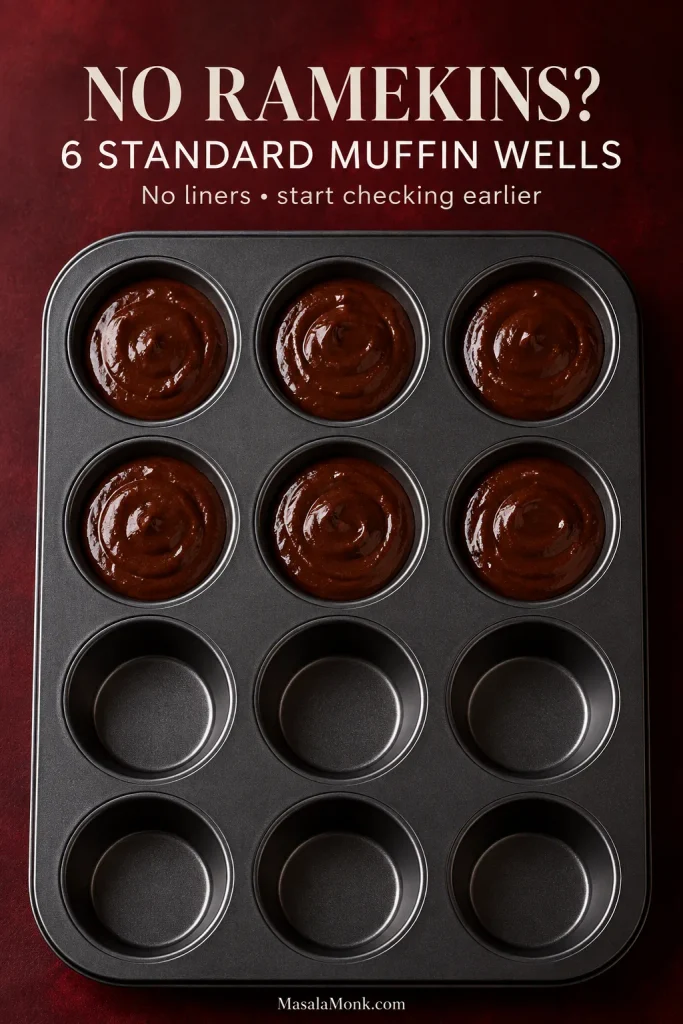
No ramekins? Use a muffin pan

Butter and lightly cocoa-coat six standard metal muffin wells, then divide the batter evenly among them without filling to the rim. Skip paper liners.

Muffin pans vary in both metal thickness and well size, so don’t give them the 9-minute ramekin clock. Start checking earlier and use the same visual cue: set edges with movement still confined to the middle.

Dark 12-cup muffin pan with chocolate lava cake batter divided evenly among six unlined wells while the remaining six wells are empty.
Switching to a muffin pan changes two things at once: the batter becomes shallower and the baking vessel becomes conductive metal. That combination matters more than the simple fact that the cakes are no longer in ramekins.

When the cakes are ready, put a flat baking sheet or board over the pan and invert the whole thing at once. Lift the pan away rather than trying to pry six delicate cakes from their wells one by one.

Getting the Lava Cake Out Is Part of the Recipe

The flip is the moment that makes many people hesitate, because it immediately reveals whether the cake has enough structure. The shell has to earn the flip.

Four-step sequence showing a plate placed over a ramekin, both flipped together, the inverted ramekin resting briefly, and the ramekin lifted straight up to reveal the cake.
The safest flip keeps the cake supported through the entire change of orientation. Once inverted, the short pause lets gravity assist the release before the ramekin is lifted away.

If the cake stays behind in the ramekin, look first at the butter-and-cocoa coating. When the ramekin lifts cleanly but the cake immediately slumps, it probably needed a little more time in the oven.

For a cake that sticks, turn the ramekin upright rather than shaking it. Run a thin knife gently around the top edge, replace the plate and invert again.

After flipping, leave the ramekin in place for about 10 seconds. Lift it straight up and let the cake be.

No Lava? Chocolate Lava Cake Troubleshooting

If something went wrong, start with the cake you actually got. Its center, shape and release usually tell you where to look next.

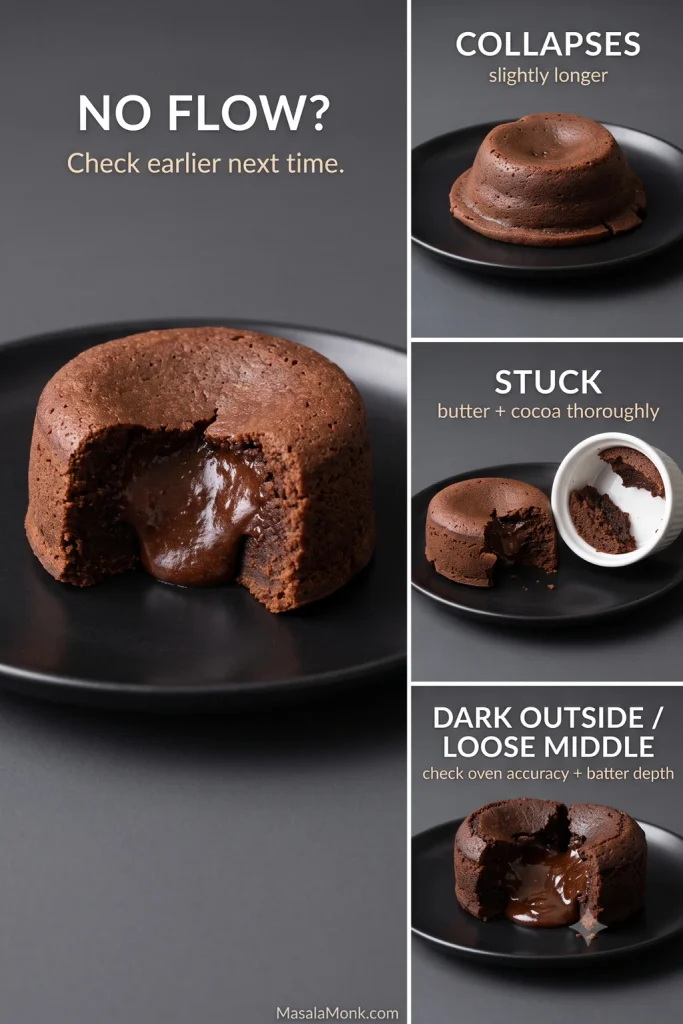
Chocolate lava cake troubleshooting graphic showing a non-flowing fudgy center, a collapsed cake, a cake torn because part remained stuck inside a ramekin, and a dark exterior with an excessively loose center.
Start by identifying which part of the cake failed: the center, the outer structure or the release. That distinction usually points you toward timing, batter depth or ramekin preparation faster than simply adding or subtracting minutes.
What happenedLikely place to lookNext time
No flowing centerBake time or batter depthBegin checking earlier
Soft and fudgy, but not flowingJust beyond the molten windowPull the cakes 30–60 seconds earlier
Cake releases but slumps or collapsesNot enough of the cake has setBake slightly longer
Outside gets very dark while the middle stays extremely looseOven heat or a particularly deep vesselCheck oven accuracy and batter depth
Cake stays in the ramekinButter-and-cocoa coatingCoat the base, walls and bottom corner thoroughly
Muffin-pan cakes bake throughSmaller, shallower portions in conductive metalStart checking earlier

Why This Lava Cake Batter Works

The proportions give the cake enough structure to hold together while keeping the middle exceptionally soft. Whole eggs help the cake hold together, while the extra yolks keep it rich and tender. Briefly beating the eggs with the sugar adds a little air before the chocolate and butter go in.

The entire batch contains only 24 g of flour. Weigh it if you can; an extra spoonful matters more here than it would in a forgiving everyday cake. You can see the same sensitivity to flour and bake time in a fudgy brownie recipe.

Real chocolate also gives the batter body as well as flavor. Semisweet and bittersweet bars contain cocoa solids, cocoa butter and sugar, which is why cocoa powder can’t simply replace them gram for gram. This guide to cacao, chocolate and dark chocolate explains what those labels mean.

Make Them Ahead, Bake Them at the Last Minute

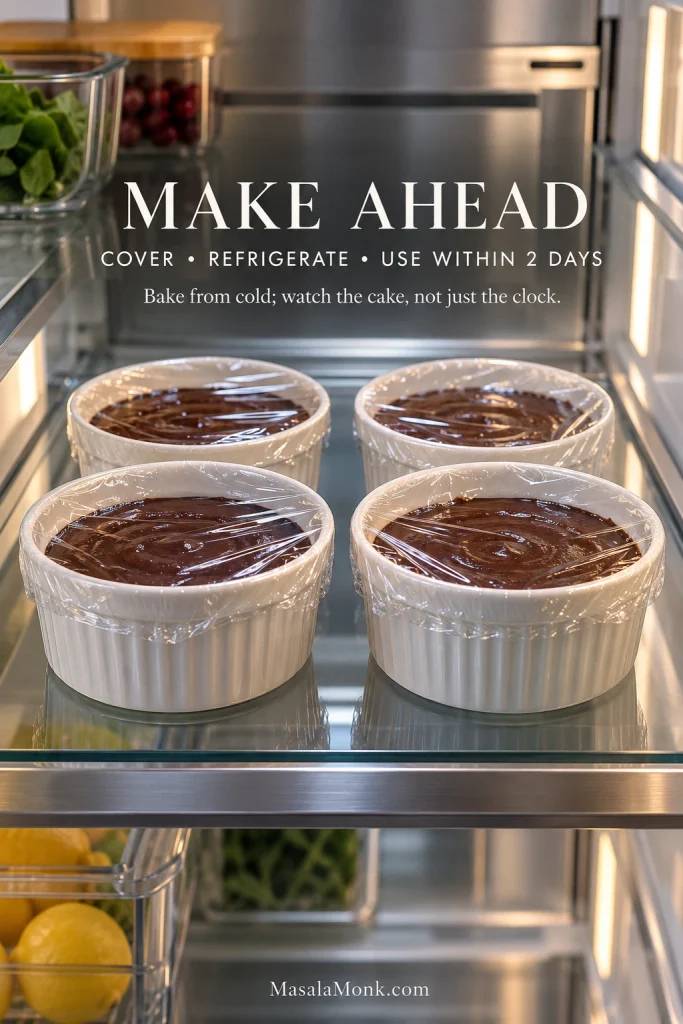
Lava cakes are easiest to make ahead as unbaked batter. For make-ahead planning, keep the filled ramekins covered and refrigerated and use within 2 days.

Four white ramekins filled with chocolate lava cake batter, covered with clear wrap and stored on a glass shelf inside a stainless-steel refrigerator.
Chilling changes the batter’s starting temperature, but it does not change the visual definition of ready. A make-ahead lava cake still needs the same relationship between a set perimeter and a softer center before it comes out.

Bake them directly from the refrigerator when dessert is getting close. Cold batter will generally need longer than the fresh-batter 10–12 minute range, so use the same visual cues rather than automatically adding a fixed number of minutes. Look for a set, less-glossy edge with movement still confined to the middle.

The mixing bowls can already be washed and put away; only the short bake, the flip and the ice cream are left when everyone is ready for dessert.

Choosing the Chocolate

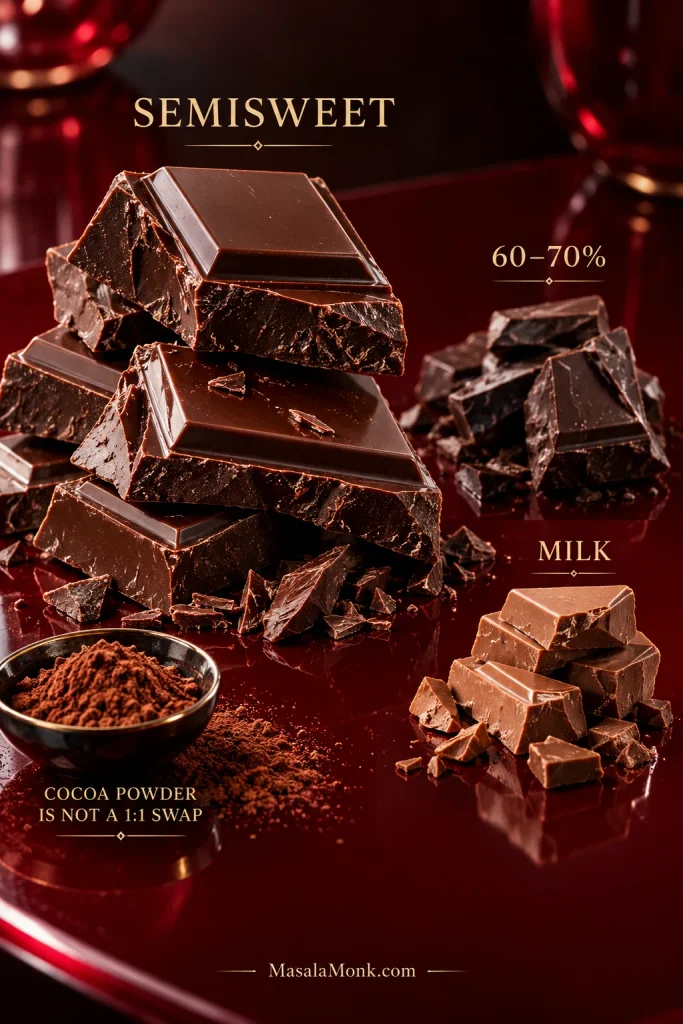
Semisweet chocolate is the easiest all-round choice. A bar around 60–70% cacao gives you a darker, less sweet cake. Both work with the same basic method, although the sweetness and flavor of the center will change with the chocolate you use.

Semisweet, 60–70 percent dark and milk chocolate arranged on a garnet surface, with semisweet most prominent and cocoa powder shown as a separate non-equivalent ingredient.
Chocolate choice changes the character of the center before you change anything about the method. Semisweet keeps sweetness and cacao intensity balanced, while darker chocolate pushes intensity upward and milk chocolate pushes sweetness much further.

Chopped bar chocolate is the most predictable choice for melting. Chocolate chips can work, but many are formulated to hold their shape during baking and may not melt as fluidly. Milk chocolate makes the cake considerably sweeter and changes the balance of cocoa solids, sugar and fat.

Can you use cocoa powder instead of chocolate?

Not in the same amount and with the same formula. Unsweetened cocoa powder doesn’t bring the cocoa butter and sugar contained in a chocolate bar, so swapping one for the other changes more than the chocolate flavor.

For this style of inverted lava cake, keep real chocolate in the batter. A cocoa-based version needs its own formula.

A filled-center lava cake behaves differently because some of the flow comes from a separate filling rather than the point at which you stop baking. Our S’mores Lava Cake uses a separate chilled chocolate center along with marshmallow, so its molten middle doesn’t depend on the cake batter alone.

Chocolate Lava Cake FAQs

Are lava cake and molten chocolate cake the same thing?

Usually. The names are commonly used for the same general dessert: an individual chocolate cake with a set exterior and a much softer center. Exact recipes and techniques vary.

Is chocolate lava cake supposed to be raw in the middle?

The goal here is a very soft, molten center, but that isn’t the same thing as deliberately eating raw cake batter. Standard flour is a raw food, and raw or undercooked eggs can also carry food-safety risk. The FDA advises against eating raw flour, dough or batter.

Pasteurized shell eggs or pasteurized egg products can reduce the egg-related risk in recipes served with undercooked egg, but they do not make raw flour safe. People at higher risk from foodborne illness—including young children, older adults, pregnant people and people with weakened immune systems—should avoid raw or undercooked egg and raw-flour preparations.

Can I make one large lava cake instead of individual cakes?

Not by simply moving this batter to a large pan and keeping the same timing. A larger cake heats differently, so use a recipe developed for a large-format molten cake.

Why doesn’t chocolate lava cake need baking powder?

The eggs, brief aeration and small amount of flour provide the structure this cake needs. The goal isn’t a tall, airy crumb; it is enough cake around the outside to hold a much softer middle.

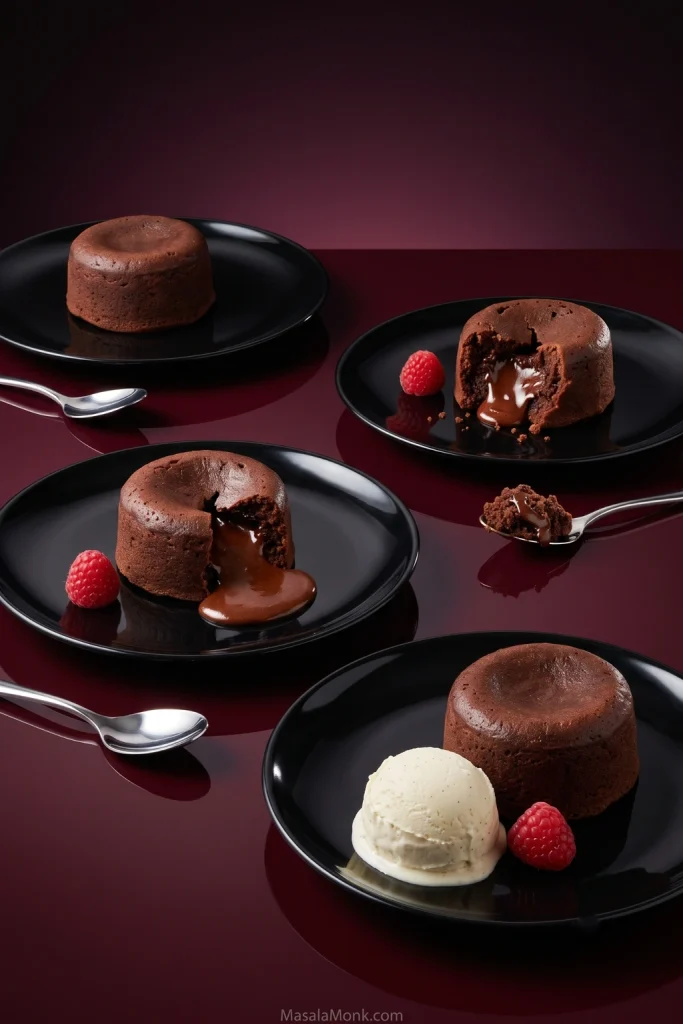
Get the Ice Cream Ready Before the Cakes Come Out

Vanilla ice cream is hard to beat here. It starts melting as soon as it touches the warm cake, while raspberries or strawberries bring a little acidity against all that chocolate. A small pinch of flaky salt works too.

Four chocolate lava cakes on glossy black plates over an oxblood surface at different serving stages, including intact and opened cakes, a spoonful of cake, vanilla ice cream and raspberries.
The cakes keep setting after they leave the oven, so the serving window is part of the recipe too. By the time the cold accompaniments begin melting, the warm center should still be fluid enough to create the contrast the dessert was built around.

If you want to make the ice cream as well, this KitchenAid vanilla ice cream guide gives you a base you can finish well before the cakes go into the oven.

Leftover cakes can be cooled, covered and refrigerated. Reheat them gently if you like, but expect the center to be soft and fudgy rather than flowing again. These are at their best the first time they leave the oven.

Have the plates, ice cream and berries ready before the cakes come out. Invert them and eat while the cake is still warm and the middle is still doing exactly what you baked it to do.

Posted on — Leave a comment

Twice Baked Potatoes Recipe: Crispy Skins, Creamy Cheesy Filling

Three finished twice-baked Russet potato halves with fluffy filling, melted cheddar, crisp bacon and chopped chives on a dark surface.

A really good twice-baked potato gives you crisp, salty skin around the edges and a generous mound of soft potato inside, rich with butter, sour cream and sharp cheddar. Bacon stays crunchy on top, while fresh chives cut through all that richness.

Twice-baked potatoes—also called double-baked potatoes—are baked whole, opened and scooped, mixed with a creamy filling, returned to their skins and baked again. In this twice baked potatoes recipe, bake the potatoes until completely tender, leave enough flesh behind to support the shells, and add the dairy gradually so the filling stays fluffy.

The method below gives you times and temperatures, but it also tells you what to look and feel for along the way. That matters more than chasing an exact minute when potatoes are a little larger, drier or simply cooking differently that day.

Before You Start: 5 Numbers That Matter

You do not need to memorize the whole recipe. These five numbers will get you through most of it.

NumberWhat it tells you
10–12 oz / 285–340 gA useful size range for each Russet. Similar weights help the potatoes finish at roughly the same time.
400°F / 205°CThe oven temperature for both fresh bakes.
208–211°F / about 98–99°CAn optional temperature check for a completely baked potato.
¼ inch / 6 mmAbout how much potato to leave attached when you scoop the shells.
¼ cup / 60 mlThe milk to add first. Keep the rest nearby and use it only if the filling needs it.
Visual guide showing a Russet potato on a scale, a 400°F oven setting, a thermometer reading 209°F, a quarter-inch shell wall and a quarter-cup measure of milk.
Five checkpoints keep the result consistent: size, oven temperature, center doneness, shell thickness, and the amount of milk you start with.

How long do twice-baked potatoes take? Plan on roughly 1 hour 45 minutes to 2 hours 15 minutes total when using 10–12 oz / 285–340 g Russets. The first bake usually takes 60–75 minutes at 400°F / 205°C, followed by another 15–20 minutes after filling. Start checking that first bake around 55 minutes rather than relying only on the clock.

Ready to cook? Jump to the recipe.

Twice Baked Potatoes Recipe

Crisp Russet shells filled with fluffy potato, butter, sour cream, sharp cheddar, bacon and chives, then baked again until the cheese melts into the ridges and the highest potato peaks begin to brown.

Yield
8 potato halves

Serves
8 as a side; about 4 as a main

Prep / active time
About 25–30 minutes

First bake
Usually 60–75 minutes

Second bake
15–20 minutes

Total time
About 1 hr 45 min–2 hr 15 min

Equipment

Rimmed baking sheet; wire rack if you have one; large mixing bowl; skillet for the bacon; sturdy spoon; potato masher or ricer; rubber spatula; clean folded kitchen towel or oven mitt; instant-read thermometer if you want a temperature check.

Ingredients

  • 4 large Russet potatoes, 10–12 oz / 285–340 g each, about 2½–3 lb / 1.15–1.35 kg total
  • 1 tbsp / 15 ml olive oil or neutral oil
  • Kosher salt, enough to lightly and evenly season all four skins, plus more for the filling if needed; use a lighter hand with fine or table salt
  • 6 oz / 170 g bacon, raw weight
  • 5 tbsp / 70 g unsalted butter, softened or cut into small pieces
  • ⅔ cup / about 160 g full-fat sour cream
  • ½ cup / 120 ml whole milk, warmed and divided—you may not need all of it
  • 1½ cups / about 170 g sharp cheddar, freshly shredded and divided
  • 3 tbsp chopped chives or ¼ cup thinly sliced green onions, divided
  • ½ tsp freshly ground black pepper, plus more to taste
  • ¼ tsp garlic powder, optional

Method

1. Bake the Russets until completely tender

Bake the oiled, salted Russets uncovered at 400°F / 205°C until a skewer slips easily through the thickest center, usually 60–75 minutes.

Set a rack in the middle of the oven. Scrub the potatoes well and dry them thoroughly. Prick each one several times with a fork, rub the skins lightly with oil and sprinkle them lightly and evenly with salt. Arrange them on a rimmed baking sheet with a little room between each potato. A wire rack improves airflow if you have one; the potatoes will still bake properly without it.

Start checking around 55 minutes. Push a thin skewer or knife through the thickest part. It should slide through the center with almost no resistance. The skin should feel dry and a little taut rather than damp, and the whole potato should give slightly when squeezed with an oven mitt. With a thermometer, look for roughly 208–211°F / about 98–99°C, the range the Idaho Potato Commission gives for a properly baked potato.

Take each potato out when it is ready. They do not all need to finish at exactly the same moment.

Baked Russet potato on a metal tray with an instant-read thermometer inserted into the center and displaying 209°F and 98°C.
Probe the thickest middle of the Russet; when the skewer meets almost no resistance, the potato is ready to scoop.

2. Cook the bacon while the potatoes bake

Meanwhile, cook the bacon over medium heat until crisp. Drain it well and chop or crumble it fairly small. Reserve about 2 tbsp cooked bacon for the finished tops.

The bacon can also cook in the air fryer while the Russets are in the oven; our air fryer bacon guide has separate timings for regular and thick-cut bacon.

3. Split and scoop while the flesh is warm

Rest the baked potatoes for 5–10 minutes. They should still be steaming inside but cool enough to handle with a folded kitchen towel or oven mitt.

Cut each potato in half lengthwise and scoop the flesh into a large bowl, leaving about ¼ inch / 6 mm attached to the skin.

The first shell may feel more delicate than expected. That is normal. Leave a little extra potato around the bottom and pointed ends and it becomes much easier to handle. The skin does not need to be scraped paper-thin.

Hand holding a baked potato half with a towel while a spoon removes the flesh, leaving about a quarter-inch layer of potato inside the skin.
Leave a sturdy layer of potato around the shell, especially at the base and tapered ends where it is easiest to tear.

For a crisper shell: lightly brush the empty skins with oil or melted butter and return them to the 400°F / 205°C oven for 5–8 minutes while you mix the filling. The edges should feel a little drier and firmer before the potato goes back in.

4. Build the filling gradually

Using a ricer? Rice the plain warm potato into the bowl first, then fold in the butter. Using a masher? Add the butter to the warm potato and mash gently until the large lumps are gone.

Add the sour cream, black pepper, optional garlic powder and ¼ cup / 60 ml warm milk. Fold everything together, then look at the texture. If it still seems stiff or crumbly, add another tablespoon / 15 ml of warm milk and fold again.

Once the potato sits in a soft mound and the spoon marks stay where you put them, stop adding liquid. A few small pieces of potato are fine; there is no need to chase a perfectly smooth filling.

Bowl of fluffy potato filling with visible spoon ridges beside a quarter-cup measure of milk and text reading “Milk is a ceiling, not a target.”
Aim slightly firmer in the bowl than you want at serving; the filling loosens as the butter and cheese heat.

5. Add the cheese, bacon and chives

Set aside ½ cup / 55–60 g cheddar and about 1 tbsp chives or green onions for the tops.

Fold the remaining cheddar, bacon and herbs into the potato. Work gently. Once the filling is creamy, extra beating only gives the starch more opportunity to turn sticky.

Taste it now. The filling should already be good enough to eat straight from the spoon. Add more salt only if the bacon and cheddar have not supplied enough.

6. Refill the shells

Spoon the filling generously into all eight shells without packing it down. They will not all look identical, and they do not need to.

Top with the reserved cheddar and leave the surface a little rough. Those small peaks are where the cheese catches and the potato browns first.

Eight filled Russet potato halves on a baking sheet with rough potato mounds and a light scattering of unmelted shredded cheddar.
Loose, rough mounds expose more edges for the cheese to settle into and the potato to brown.

7. Bake again

Return the potatoes to the 400°F / 205°C oven for 15–20 minutes. Pull them when the centers are hot, the cheddar has melted into the ridges and a few exposed potato peaks have started to turn golden.

Finish with the reserved crisp bacon, fresh chives or green onions and a little black pepper.

Freshly baked twice-baked potato halves with melted cheddar, browned potato peaks, crisp bacon and chopped chives on a metal tray.
The cheddar should be melted and the highest exposed potato peaks lightly browned.

What to Serve with Twice Baked Potatoes

One half makes a substantial side serving; two halves make a generous meal-sized portion. As a side, these fit naturally beside steak, roast chicken or pork. If the potato is the main event, something fresh and green keeps the plate from feeling too heavy.

Twice-baked potato with melted cheddar, bacon and chives served on a dark plate with sliced steak and green vegetables behind it.
Pair the rich potato with simply cooked meat and something fresh or green.

Scaling the Recipe

Cooking for two: use 2 Russets, about 1¼–1½ lb / 570–680 g total, and halve the other ingredients. With such a small batch it is easy to overshoot the liquid, so start with 2 tbsp / 30 ml milk and keep another 2 tbsp / 30 ml nearby only if you need it.

Cooking for guests: consider buying and baking one extra Russet. Its flesh can tighten filling that turns too loose, and the spare shell is useful if another one tears.

Making them ahead? Go to storage and reheating.  ·  Something went wrong? Open troubleshooting.


Best Potatoes for Twice Baked Potatoes

Russets are the best choice for classic twice-baked potatoes because their dry, starchy flesh turns fluffy while the thicker skin survives scooping and refilling.

Size matters almost as much as variety. A bag can contain several potatoes all labelled “large” even though one is visibly much heavier than another. Choosing similar weights gives them a better chance of finishing together.

Several Russet potatoes beside a digital kitchen scale, with one potato weighing 11 ounces or 312 grams and a larger potato nearby for comparison.
Similar-sized Russets are easier to bake evenly, so weight is a better guide than the word “large.”
PotatoWhat to expectUse here?
RussetFluffy flesh and a sturdy skinBest choice
Yukon GoldDenser, creamier flesh with a thinner skinYes, but handle the shell more gently
Red potatoWaxier flesh and smaller, more delicate shellsBetter suited to mini stuffed potatoes

Crisp Skin Starts With the First Bake

For crisp twice-baked potato skins, dry the Russets thoroughly, rub them lightly with oil and salt, and bake them uncovered until completely tender.

Dry skin needs exposed oven heat. Foil traps escaping steam against the potato, which is useful when you want a softer baked-potato skin but works against the crisp-edged shell here.

Two baked Russet potatoes side by side, one partly wrapped in foil with softer skin and one baked uncovered with a drier, more textured skin.
Foil keeps the skin softer, while uncovered baking builds the sturdier surface needed for crisp-edged shells.

Doneness matters too. A potato that feels tender near the surface but still resists at the center is not ready for scooping; the second bake is too short to rescue firm interior flesh.

Protect the shell without scraping it bare

The bottom and narrow ends are where the shell usually feels weakest. Leave a sturdy cushion of potato there and stop scooping before the skin turns flimsy in your hand.

Need the practical method? Go back to Step 1.

How to Keep the Filling Creamy, Not Runny or Gummy

Potatoes do not all take up dairy in exactly the same way. Size, doneness and moisture loss all change how much milk the filling needs.

Milk is a ceiling, not a target.

What the filling looks likeWhat to do
Stiff or crackingAdd warm milk a tablespoon at a time.
Soft mound; ridges stay visibleStop. The filling is ready.
Glossy or slowly spreadingFold in extra plain cooked potato if you have it.

The mixture will loosen a little more as the butter and cheese heat. In the bowl, you want it plush enough to move under the spoon while still holding those soft ridges.

Gentle mixing matters just as much

Gummy potato is a different problem from wet potato. Vigorous mixing releases more starch, which is why a blender, food processor or prolonged beating can spoil the texture even when the liquid amount is right.

Two bowls comparing fluffy potato filling with rough airy ridges against smoother, denser overmixed potato filling labeled “gummy.”
Gummy, smeary filling points to overmixing; the potato should stay soft and lightly ridged.

A masher or ricer keeps the job gentler.

A few tiny pieces are fine. Smooth enough to feel creamy is enough.

Our creamy mashed potatoes guide goes deeper into ricer versus masher, warm dairy and potato starch.

Need the exact filling method? Go back to Step 4.

Make Ahead, Freeze & Reheat Twice Baked Potatoes

For the best texture, assemble the potatoes up to 48 hours ahead and refrigerate them before the second bake. This is the useful version when dinner needs to be mostly finished before people arrive: the scooping and mixing are done, and only the final heating and browning are left.

One reheating rule: for filled potatoes chilled or frozen after the first bake, and for already-baked leftovers, use 165°F / 74°C in the center as the reheating finish line.

The USDA Food Safety and Inspection Service recommends refrigerating perishable leftovers within 2 hours and generally using refrigerated cooked leftovers within 3–4 days.

Filled potato halves stored in a covered metal container behind a reheated twice-baked potato with a thermometer reading 165°F and 74°C.
Top color can mislead during reheating; check the center, then add fresh bacon and chives.

Refrigerated before the second bake

Arrange the filled potatoes in a shallow covered container or on a covered tray. Bake them cold at 400°F / 205°C and check from about 25 minutes. Large or very cold potatoes may need 30 minutes or a little longer.

For the nicest filling texture, scoop and assemble while the potato is still warm. If whole baked potatoes have already been refrigerated, warm them until the centers are hot and pliable before scooping.

Frozen before the second bake

Filled potatoes can be frozen, although their texture is usually a little less creamy afterward than it is with refrigerated make-ahead potatoes. Let heavy steam escape briefly, refrigerate promptly, then freeze the chilled potatoes on a tray until firm before wrapping or packing them airtight.

For best quality, use them within about 2–3 months. Fresh chives, green-onion tops and some of the crisp bacon are better held back and added after reheating.

Thawed overnight: bake at 400°F / 205°C and check from about 25 minutes.

Straight from frozen: use 375°F / 190°C. After roughly 40 minutes, test the center; large, densely filled potatoes may need 50 minutes or more. Tent the tops loosely with foil if they are browning before the middle is hot.

Already baked leftovers

MethodHow to reheat
Oven375°F / 190°C; check from about 15 minutes. This brings some crispness back to the shell while the center heats through.
Air fryer350°F / 175°C; check from about 5 minutes. Fast, and particularly good at refreshing the skin.
MicrowaveUse moderate power in short intervals. It is the fastest route, although the skin softens.

Ready to cook? Back to the recipe.

Air Fryer Twice Baked Potatoes

For 10–12 oz / 285–340 g Russets, start checking the whole potatoes at about 40 minutes at 400°F / 205°C. Expect roughly 40–55 minutes, depending on potato weight, basket size and appliance power.

The thickest center still decides when they are ready. A skewer should pass through with almost no resistance before you cut them open.

Once tender, scoop and fill them as in the oven method, then return the filled shells at 375°F / 190°C for roughly 6–10 minutes, until hot and lightly browned. Leave room around them so the hot air can circulate.

Four finished twice-baked potato halves spaced apart inside an open black air fryer basket with text reading “Leave room for airflow.”
Leave room between the potato halves so hot air can reach the exposed surfaces.

Useful Substitutions

Plain Greek yogurt is a straightforward sour-cream substitute when you still want tang and creaminess. Use roughly the same amount, then add the milk gradually because Greek yogurt thickness varies by brand.

For a richer, denser filling, replace about half the sour cream with 4 oz / 113 g softened cream cheese. You may need less milk.

No bacon? Leave it out. A small pinch of smoked paprika adds smokiness, while crisp fried onions or toasted breadcrumbs can bring back some crunch.

For broccoli cheddar, use about 1½ cups / 150–170 g small broccoli florets, cooked just until tender and then dried well. Moisture trapped between the florets can loosen the filling surprisingly quickly.

Twice Baked Potatoes Troubleshooting

Most problems trace back to the first bake, a fragile shell, too much liquid or too much mixing. Several can still be rescued after the potatoes are already open.

Shell & Filling Problems

ProblemWhat to do
Hard centerNow: Microwave the scooped flesh in short bursts until tender; return firm empty shells to the oven if needed.
Next time: Probe through the thickest center before cutting.
Torn shellNow: Divide the filling among the intact shells.
Next time: Leave about ¼ inch / 6 mm of potato attached.
Soft skinNow: Bake the empty shell another 5–8 minutes before filling.
Next time: Dry the potatoes well and bake them uncovered.
Dry fillingNow: Add warm milk 1 tbsp / 15 ml at a time.
Next time: Judge the texture before deciding how much milk to use.
Loose fillingNow: Fold in extra plain cooked potato if available.
Next time: Add liquid gradually and stop while the mixture still holds ridges.
Runny after bakingNow: Let the potatoes settle for a few minutes; severe runniness is difficult to reverse once the fats melt.
Next time: Keep the filling structured before it goes into the oven.
Gummy fillingNow: Stop mixing and gently fold in extra plain potato if available.
Next time: Mash or rice gently; avoid a blender or food processor.

Seasoning, Reheating & Freezer Problems

ProblemWhat to do
Bland fillingNow: Adjust with salt, pepper and fresh chives while you still can.
Next time: Taste after the bacon and cheddar are mixed in.
Too saltyNow: Fold in plain cooked potato.
Next time: Wait until the bacon and cheese are in before final seasoning.
Brown top, cool centerNow: Tent loosely and continue heating until the center is fully reheated.
Next time: Give refrigerator-cold potatoes more time than freshly filled ones.
Dry after reheatingNow: Add a little sour cream or butter at serving.
Next time: Use the center-temperature finish cue and avoid continuing to heat long after the potato is ready.
Slightly mealy after freezingNow: Add fresh sour cream, butter or cheese.
Next time: Refrigerate rather than freeze when texture matters most.

The potatoes are already open, and the centers are undercooked

Do not force hard pieces into the filling and hope the second bake fixes them. Scoop the firm flesh into a microwave-safe bowl and heat it in short intervals until completely tender. If the potato still attached to the shells is also firm, put those shells back in the oven while the flesh cooks.

Two opened Russet potatoes comparing fluffy fully tender flesh with a denser underdone center, labeled “Fully tender” and “Underdone center.”
A firm, smooth core inside otherwise fluffy potato means the center needs more cooking before it goes into the filling.

Once everything is tender, carry on with the filling. You have not lost the batch.

You’re making 20, 30 or 40 potatoes

Scale the potatoes, butter, sour cream, cheese and bacon by weight. Keep the milk and salt responsive to the food in front of you rather than multiplying them blindly.

A full oven changes the timing too. Use multiple trays in single layers with room around the potatoes for airflow, and expect a heavily loaded oven to recover heat more slowly. Judge the largest potatoes by doneness rather than assuming the four-potato timing will scale exactly.

Multiple sheet pans of whole Russet potatoes spaced in single layers on separate oven racks in a large commercial-style oven.
For large batches, keep potatoes spaced across trays and mix filling in manageable bowls so texture can be corrected as you go.

If individual shells become cumbersome for a larger table, our twice baked potato casserole keeps the same creamy, cheesy idea in a scoop-and-serve format.

Work in manageable batches and taste each bowl before you start filling shells. Correcting one bowl takes seconds. Correcting thirty filled potatoes does not.


How a Finished Twice Baked Potato Should Feel

At serving temperature, the shell should stay sturdy enough to lift while the center gives easily to a fork without feeling loose, dense or pasty.

Close-up of a fork lifting a bite from a finished twice-baked potato with crisp brown skin, fluffy filling, melted cheddar, bacon and chopped chives.
Look for a soft, irregular center inside a sturdy crisp shell, with melted cheddar settled into the folds.

Back to the recipe  ·  Back to top

Serve them straight from the second bake, while the rough potato peaks are browned, the bacon is still crisp and the middle is hot and creamy.

Posted on — Leave a comment

Apple Cinnamon Muffins Recipe: Easy, Moist & Bakery-Style

Broken-open apple cinnamon muffin with a tender golden crumb, small apple pieces throughout and a thin cinnamon-sugar crust, with whole muffins behind it.

Break one open while it’s still warm. These apple cinnamon muffins have tender pieces of fresh apple through a moist crumb, with a thin cinnamon-sugar crackle over the top.

The apple still tastes like apple. Cinnamon warms it without taking over.

The tricky part is getting the fruit and the muffin ready at the same time. Oversized apple pieces can still be firm when the crumb is done; push the moisture too far and the center turns heavy instead. Small pieces and a thick batter do most of the work.

Apple Cinnamon Muffins Recipe

Before you start: there’s no mixer and no separate streusel. Dice the apples small, and don’t thin the batter when it looks thicker than cake batter.

Yield
12 standard muffins

Prep
About 20 minutes, including a 10-minute batter rest

Bake
About 18–21 minutes

Cool
5 minutes in the pan, then transfer to a rack

Equipment

  • Standard 12-cup muffin tin
  • Parchment-style liners or a lightly greased pan
  • Large mixing bowl, medium mixing bowl and small bowl
  • Whisk and flexible spatula
  • Kitchen scale, recommended
  • Wire cooling rack

Ingredients

For the muffins

  • 250 g (about 2 cups) all-purpose flour
  • 2 teaspoons baking powder
  • ½ teaspoon baking soda
  • ½ teaspoon fine salt
  • 2 teaspoons ground cinnamon
  • 150 g (¾ cup packed) light brown sugar
  • 2 large eggs
  • 120 ml (½ cup) neutral oil, such as canola, sunflower or vegetable oil
  • 120 g (½ cup) plain Greek yogurt
  • 60 ml (¼ cup) milk
  • 2 teaspoons vanilla extract
  • 250 g (about 9 oz) peeled and cored apple, cut into roughly ¼-inch (6 mm) pieces

For the cinnamon-sugar top

  • 2 tablespoons coarse sugar, such as Demerara or turbinado
  • ½ teaspoon ground cinnamon

Mix and Rest the Batter

  1. Heat the oven. Place a rack near the middle and heat to 425°F (220°C). Line a 12-cup muffin tin or lightly grease the wells. Mix the coarse sugar and ½ teaspoon cinnamon in the small bowl.
  1. Mix the dry ingredients. Whisk the flour, baking powder, baking soda, salt and 2 teaspoons cinnamon together in the medium bowl.
  1. Mix the wet ingredients. In the large bowl, whisk the brown sugar and eggs until smooth. Whisk in the oil, Greek yogurt, milk and vanilla.
  1. Bring the batter together. Add the dry ingredients and switch to a spatula. Fold until the last dry streaks disappear. The batter will be thick: lift the spatula and it should fall back heavily, leaving a track for a moment before settling. Fold in the apples with as few extra strokes as possible.
Thick apple muffin batter with visible apple pieces in a metal bowl, showing ridges and a channel made by a spatula.
Once the flour disappears, stop mixing; a slightly rough apple muffin batter with a soft furrow is exactly where you want to be.
  1. Rest briefly. Leave the batter at room temperature for about 10 minutes. This short pause lets the already-thick batter settle before you portion it into the pan.

Portion, Bake and Cool

  1. Fill the pan. Divide the batter evenly among the 12 wells, filling each close to the top. Scatter the cinnamon sugar loosely over them.
Apple muffin batter portioned close to the rims of white paper liners in a muffin pan while cinnamon sugar is added on top.
Judge the fill by height, not scoop count. Keeping all 12 cups near the liner rim helps them finish together even when the crowns are not identical.
  1. Bake. Start at 425°F (220°C) for 5 minutes. Lower the oven to 350°F (180°C) and continue for about 13–16 minutes. Check with a toothpick: raw batter means more time, while moist crumbs are fine. If the tester goes through apple, try another spot.
  1. Cool. Leave the muffins in the pan for about 5 minutes, then move them to a rack. Give them a few more minutes before pulling one apart—the apple stays much hotter than the crumb.
Twelve baked apple cinnamon muffins in a metal pan with golden rounded crowns that vary slightly in height.
After baking, compare set centers and browning rather than crown height; small differences from muffin to muffin are completely normal.

That’s enough to bake them. The notes below cover the few details that make the biggest difference.

Need more detail? Apple size · Batter consistency · Doneness

Cut the Apple Small Enough to Soften

Aim for pieces about ¼ inch (6 mm) across. They soften during the short bake without disappearing into the muffin. Break one open and you should see small pockets of apple through the crumb, not one wet cavity around a large chunk.

Small peeled apple cubes beside a digital caliper measuring one piece at 6.0 millimeters, with a larger apple piece nearby for scale.
Measure one 6 mm apple cube and leave it on the board as your reference. It is the fastest way to keep the rest of the dice consistently small.

Which apples are best for apple muffins?

Firm apples such as Granny Smith, Honeycrisp and Pink Lady are good choices for apple muffins. Granny Smith is sharper and tarter; Honeycrisp and Pink Lady are sweeter and more fragrant. Fuji works if you prefer a gentler, sweeter apple flavor.

Firmness matters as much as the name on the sticker. Taste a piece before it goes into the bowl. A bland or mealy apple will not suddenly become more flavorful in the oven.

Cut red and green apples with firm pale flesh arranged on a glossy red surface beneath the words “Firm Apples Work Best.”
When choosing apples for muffins, crisp, dense flesh matters more than the variety name; soft or grainy fruit will lose definition faster.

Whole apples vary so much in size that the useful number here is the prepared weight: 250 g (9 oz) after peeling and coring.

The cut changes with the bake. A fresh apple cake has enough oven time to handle larger pieces. Muffins need smaller ones.

About the peel: remove it for the softest, most even bite. Thin apple skin is perfectly edible, but it stays more noticeable than the cooked flesh.

Grated apple and applesauce behave differently

Grating releases much more juice into the batter, so dice the apple for this recipe. If you want the fruit less noticeable, cut the dice finer instead.

Small diced apple pieces beside grated apple releasing visible juice on a glossy green surface.
Grated apple exposes more cut surface, so its juice enters the batter sooner; small dice hold more of that moisture inside.

Applesauce is a bigger change. It blends through the batter rather than remaining as pieces, so it is not a direct replacement for the fresh apple here. A recipe built around applesauce, such as this moist applesauce cake, starts with a different moisture balance.

Back to Recipe

The Batter Should Mound, Not Pour

Expect the batter to look surprisingly thick the first time you make it. Leave it alone.

Drag a spatula through the bowl. The line should remain visible for a second before slowly closing. Once the apples go in, the batter will look crowded with fruit without turning wet or loose.

If you have a scale, use it for the flour. Too much flour is one of the easiest ways to make these muffins dry.

Using cups? Loosen the flour, spoon it into the cup and level the top rather than packing it down. King Arthur Baking has a useful visual guide to measuring flour.

The thick batter helps keep the apple distributed instead of letting it sink toward the bottom. Oil keeps the crumb soft after cooling; Greek yogurt adds moisture and body.

The 10-minute rest is a short pause, not a make-ahead step. During that pause, the batter may thicken a little, but don’t turn it into an overnight rest. If you want a head start, measure the dry ingredients and cinnamon sugar ahead of time instead.

Get the Crown Without Drying the Center

The tops don’t need to tower over the liners. A good crown here is rounded and lightly crisp, with a center that stays tender.

Thick batter, generously filled cups and the first 5 minutes at 425°F (220°C) help build that rounded crown. Lowering the temperature afterward gives the center more time to finish without chasing a taller top at the expense of the crumb; ThermoWorks explains the role of that initial oven heat in more detail.

Rounded apple cinnamon muffin in an oven with text indicating 425°F for 5 minutes followed by 350°F to finish baking.
At the 5-minute mark, lower the oven setting without opening the door.

The cinnamon sugar makes a thinner crust than streusel. Some melts into the surface as the muffins rise, while crystals caught on the high points remain crisp against the softer crumb. If that contrast is your favorite part, apple cider donuts take it in a much crunchier direction.

Extreme close-up of a golden muffin crown with cinnamon, small surface cracks and scattered coarse sugar crystals.
A patchy cinnamon-sugar surface is the goal: some bare muffin between the crystals keeps the topping thin rather than candy-like.

How to Tell When Apple Muffins Are Done

Start checking once the tops are rounded and set. Give one a light press near the center; it should spring back rather than hold the dent.

Then use a toothpick. Raw batter needs more time. Moist crumbs are fine. Hit apple? Try another spot.

Finger lightly pressing the center of an apple muffin beside a toothpick carrying a few moist crumbs.
Use the clues together: spring at the center, no raw batter, and a second toothpick spot if the first one hits apple.

Apple Muffin Troubleshooting

If something is off, start with what actually happened. Change one thing next time rather than changing the fruit, flour and oven all at once.

Read the Crumb: Moist or Gummy?

Two cut apple muffins comparing an open tender crumb in front with a compressed, glossy gummy center behind it.
Moist crumb still shows little air cells around the apple. By contrast, gummy crumb looks compressed, glossy and almost fused together.

Match the Symptom Before You Change the Recipe

What happened?Likely reasonTry this next time
Dry muffin, firm appleThe apple pieces were probably too large, so the muffins stayed in the oven longer while you waited for the fruit to softenCut the apple smaller and judge doneness by the crumb rather than waiting for large pieces of fruit
Dry all the way throughToo much flour or too much oven timeWeigh the flour and begin checking earlier
Wet or gummy centerThe center may be underbaked, or the batter may contain too much fruit or free juiceUse the stated apple weight and dice size, and check the crumb in more than one spot before taking the pan out
Dense, chewy crumb or long tunnelsThe batter was mixed too much after the flour went inFold only until the dry flour disappears
Apple sank toward the bottomThe batter may have been too loose, the fruit too large or heavy, or there may have been excess moistureMeasure the liquids and apple carefully, keep the dice small and do not thin the batter
Rose high, then sankThe center may not have set, or the leavener may have been overmeasuredMeasure the leavener carefully and bake until the center is set
Flat or low topsThe oven may not have been fully hot, the leavener may be weak, or the cups may have been underfilledPreheat thoroughly, use fresh leavener and fill the cups as directed
Bottoms browned too fastDark bakeware, a low rack or a hot-running ovenUse the middle rack, try a lighter pan and check the oven temperature if it keeps happening

Why Apple Muffins Sink

Properly risen apple muffin beside another muffin with a depressed center and a higher outer rim on a turquoise background.
After cooling, a sunken muffin often keeps a higher rim around a depressed center, showing that it rose before losing support. A uniformly low top tells a different story.

Back to Recipe

How to Store Apple Cinnamon Muffins

What changes by tomorrow is mostly the top. The cinnamon sugar has its best crackle on the day the muffins are baked; once they sit covered, some of that crispness fades.

Let the muffins cool completely before covering them. In a cool, dry kitchen, keep them airtight at room temperature for about 2 days. If your kitchen is very warm or humid, refrigerate them instead and let them sit at room temperature for a little while before eating.

Apple muffins beside an open clear storage container, with a closed container behind them showing condensation droplets around a warm muffin.
Once the muffins are cool, the lid should stay clear. If it fogs, uncover them and let the remaining heat escape before sealing again.

For anything beyond that short window, freezing is the better option for preserving the crumb. Freeze the cooled muffins airtight, thaw at room temperature and warm briefly if you like. The cinnamon-sugar top will be softer after freezing, but the muffin warms well.

Pull one apart and the crumb should separate softly around small pockets of apple.

Two hands pulling apart a warm apple cinnamon muffin, revealing soft golden crumb, small apple pieces and a cinnamon-sugar crust.
Warm, tender crumb with little apple pockets and a crisp cinnamon-sugar edge.

The coarse sugar hits first, then warm cinnamon and tender apple through the center.

Back to Top