Posted on 3 Comments

Slow Cooker Pork Loin Recipe (Juicy Crock Pot Pork Loin)

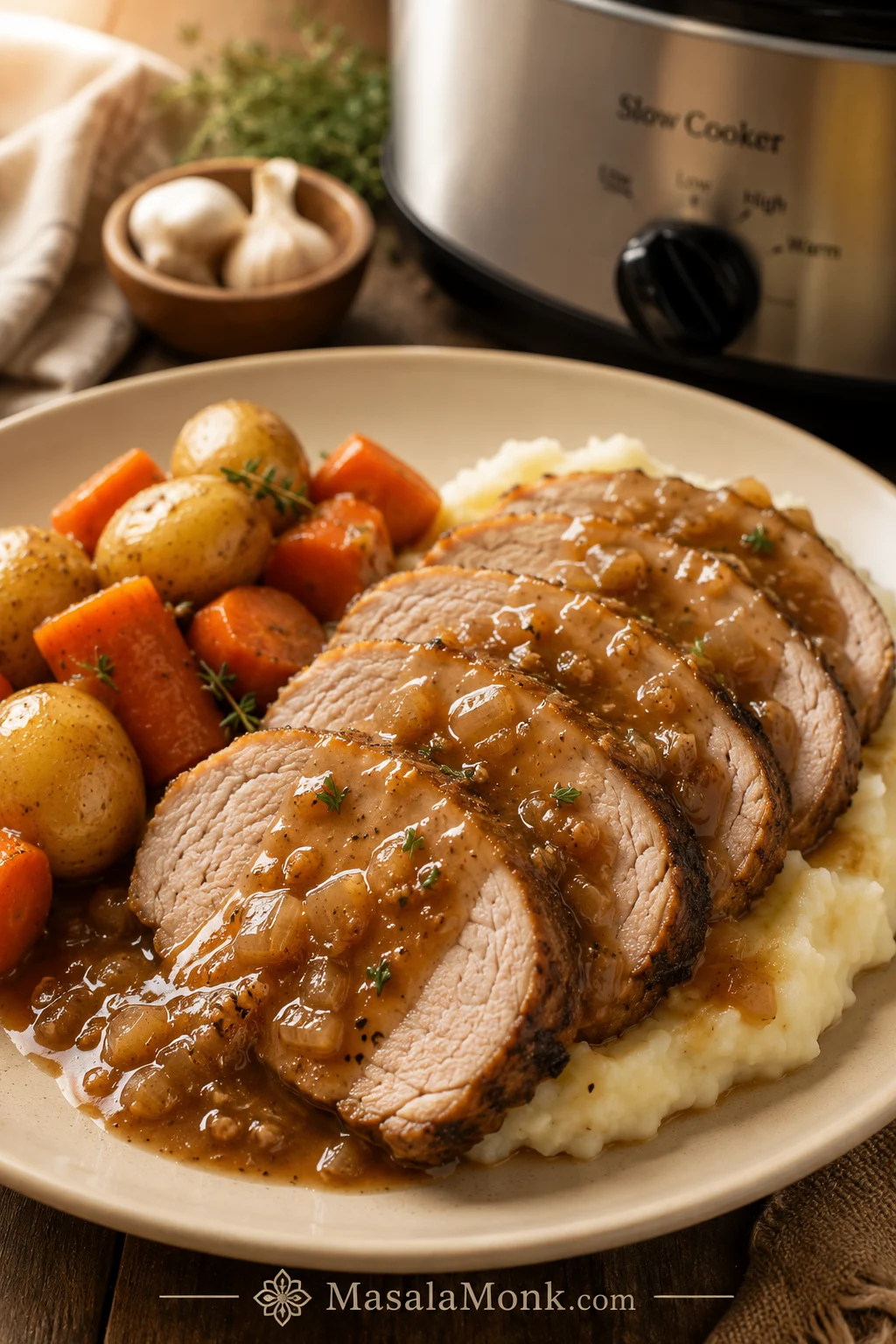
Sliced slow cooker pork loin served with onion garlic gravy, mashed potatoes, carrots, and potatoes on a warm dinner plate.

Slow Cooker Pork Loin Recipe sounds like the easiest dinner in the world until the pork comes out dry, pale, or sitting in a puddle of watery juices. Pork loin is leaner than pork shoulder, so it does best with gentle heat, an early temperature check, a short rest, and a simple sauce or gravy made from the slow-cooker juices.

This version is built for the roast most people hope for when they set up the crock pot: clean, tender slices, a savory onion-garlic sauce, and warm gravy that keeps the lean meat moist on the plate. Serve it with mashed potatoes, rice, egg noodles, roasted vegetables, or the potatoes and carrots variation below.

By the time it is ready, you want the kitchen to smell like garlic, onion, herbs, and gravy — not like plain meat that sat too long in the pot.

This recipe starts with the result pork loin does best: tender, sliceable meat with enough sauce to keep every serving moist. If you want a softer, saucier version, you will find that option below too.

If you bought pork tenderloin instead of pork loin, use that recipe instead. Tenderloin is smaller, narrower, and cooks faster, so the timing is different.

Quick Answer: How to Make Slow Cooker Pork Loin

For juicy slow cooker pork loin, use a 2–4 lb boneless roast, season it well, place it over sliced onion or sturdy vegetables, add about ½ cup broth or sauce, and cook on LOW until the thickest center reaches 145°F / 63°C. Rest before slicing. Because slow cookers vary, begin checking early; lean pork can overcook faster than you expect.
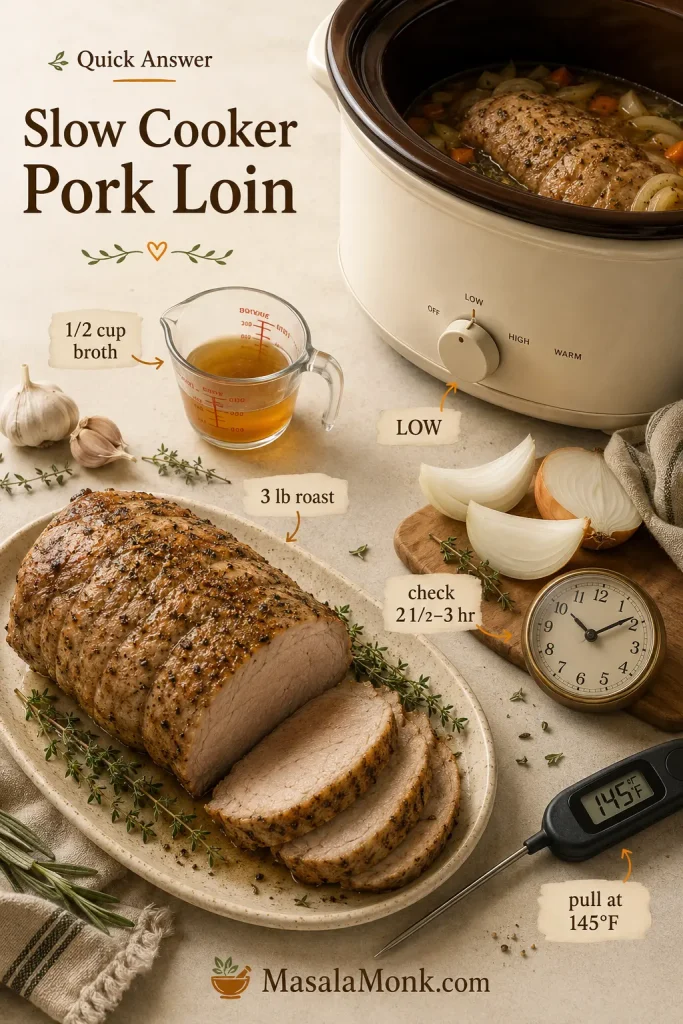
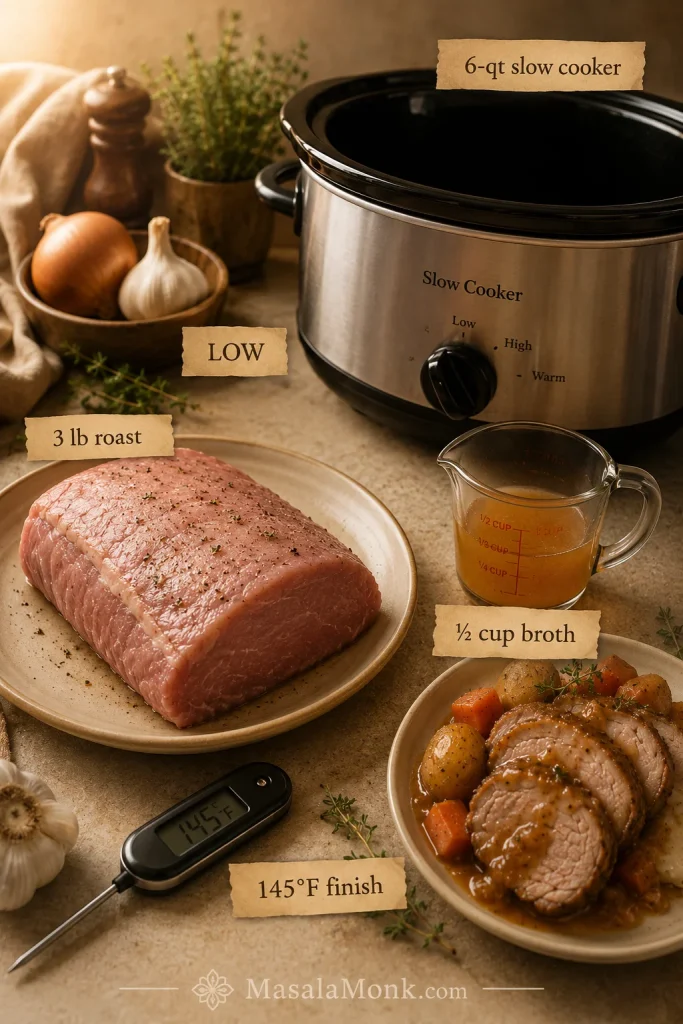
Quick answer guide showing a 3 lb pork loin roast, 1/2 cup broth, LOW setting, 2 1/2 to 3 hour check time, and 145°F finish.
Start with this baseline for juicy crock pot pork loin: modest broth, LOW heat, an early temperature check, and a 145°F finish before resting.

For smaller or larger roasts, use the cook-time chart as your first check-in guide.

Best first version: Use a 3 lb / 1.35 kg boneless pork loin roast in a 6-quart slow cooker. Cook on LOW, start checking around 2½–3 hours, and pull the pork when the center reaches 145°F / 63°C for tender slices.

Choose Your Slow Cooker Pork Loin Result
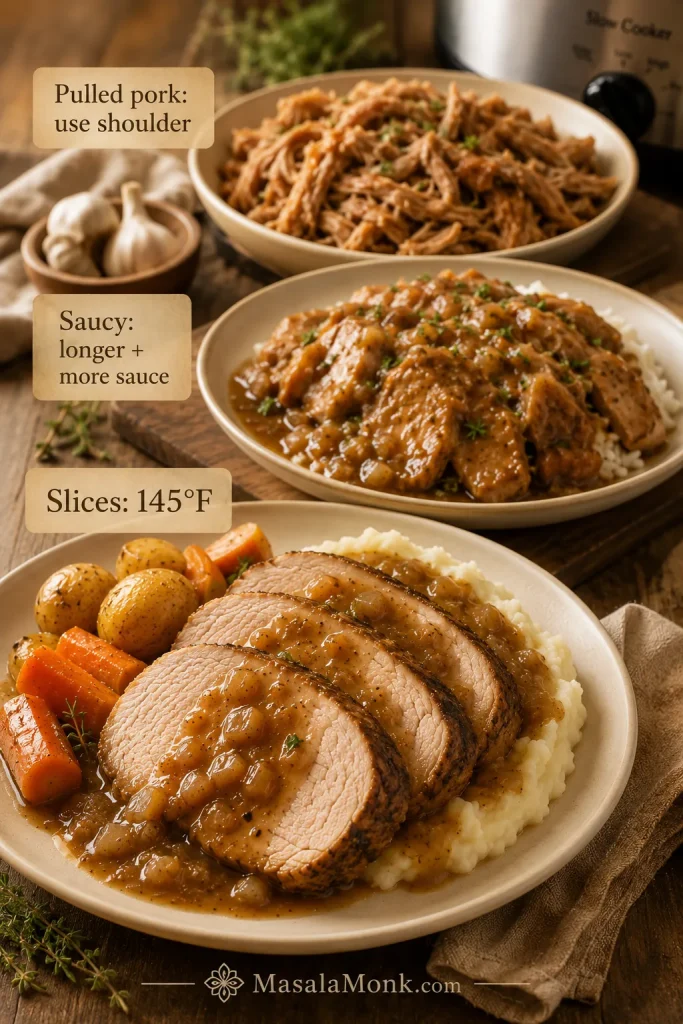
Choose your result: For neat dinner slices, cook pork loin to 145°F / 63°C and rest before slicing. For softer saucy pork, use extra sauce and cook longer. For true fall-apart pulled pork, pork shoulder or pork butt is the better cut.
Comparison guide showing sliceable pork loin, softer saucy pork loin, and pulled pork shoulder as different slow cooker results.
Choose the result before you cook, because sliceable pork loin, softer saucy pork, and true pulled pork all need different timing expectations.

For a fuller texture breakdown, see sliceable vs shreddable slow cooker pork loin.

What Juicy Slow Cooker Pork Loin Should Look Like

Done right, this is the kind of slow cooker pork loin that still feels like a roast dinner: clean slices, savory onion-garlic gravy, and enough moisture on the plate that the lean pork tastes intentional instead of tired.
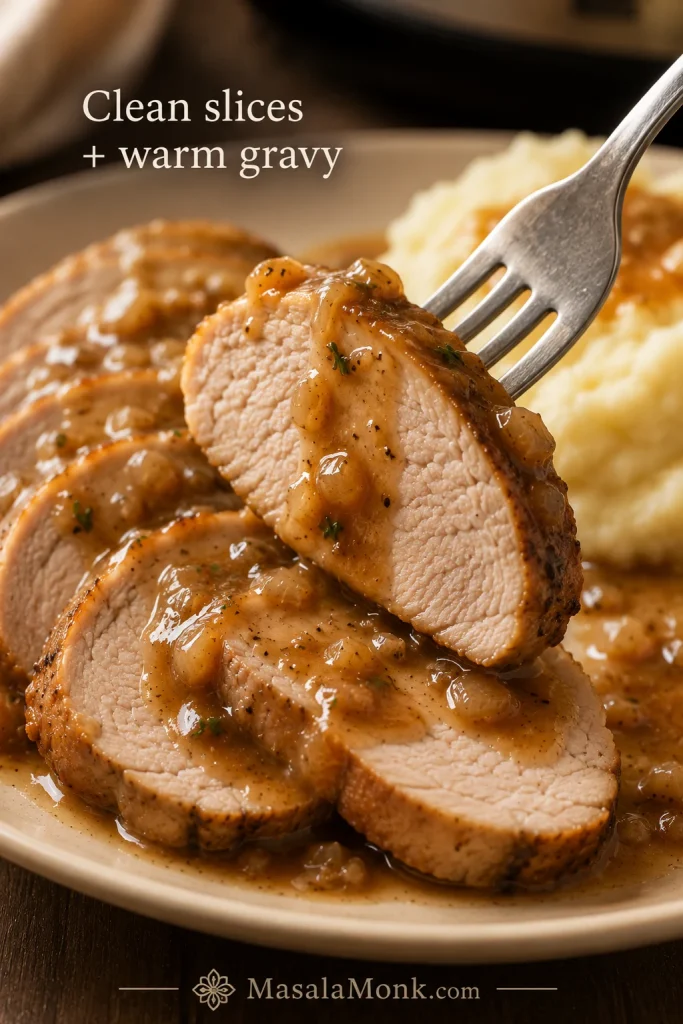
Close-up of sliced slow cooker pork loin with glossy onion garlic gravy and a fork lifting one moist slice.
Even when the pork slices cleanly, the gravy matters; it adds moisture, flavor, and a more finished roast-dinner feel.

Slow Cooker Pork Loin at a Glance

The base recipe is written for a 3 lb / 1.35 kg boneless roast, but the timing chart below will help you adjust for smaller or larger pieces.

Best cut Boneless pork loin roast, not pork tenderloin
Default size 3 lb / 1.35 kg
Slow cooker size 6-quart slow cooker
Best setting LOW for the most even, controlled result
Cook time Start checking at 2½–3 hours; many 3 lb roasts take closer to 3½–4½ hours
Internal temperature 145°F / 63°C in the thickest center, then rest
Liquid ½ cup / 120 ml broth for the base recipe; up to 1 cup / 240 ml with vegetables
Yield 6–8 servings
At-a-glance setup for slow cooker pork loin with a 3 lb roast, 6-quart slow cooker, 1/2 cup broth, LOW setting, and 145°F finish.
Before the lid goes on, check the pork cut, slow cooker size, liquid amount, heat setting, and final temperature target.

If you are unsure about liquid or timing, the liquid guide and cook-time chart explain those two decisions in more detail.

The goal is not to hover over the slow cooker all afternoon. It is to set yourself a smart checking window, then let the thermometer tell you when dinner is ready. That one check is what keeps pork loin from turning into the dry roast people remember for the wrong reasons.

Why This Crock Pot Pork Loin Works

Because pork loin is a lean roast, it needs a slightly different strategy from pork shoulder. Shoulder can handle long, slow cooking because it has more fat and connective tissue. Pork loin can still be wonderful in the slow cooker, but it is at its best when you cook it to the right endpoint instead of blindly leaving it in all day.

A good crock pot pork loin needs both flavor and control: enough seasoning to carry the lean meat, enough moisture to make a sauce, and enough restraint to stop before the slices turn dry.

It also gives you a different kind of slow-cooker meal. Instead of shredded pork or a heavy stew, you get a sliceable roast with enough sauce for mashed potatoes, noodles, or rice — easy enough for a weeknight, but polished enough for Sunday dinner.

  • It cooks by temperature, not guesswork. Time gives you a window, but the thermometer tells you when the pork is actually done.
  • It keeps the liquid controlled. Slow cookers trap moisture, so too much broth can make the sauce thin and dull.
  • It gives you two endpoints. Tender sliced pork and softer, saucier pork need different handling.
  • It protects the vegetables. Potatoes and carrots can cook slower than pork, so the method keeps the meat from drying out while you wait for them.

Pork Loin vs Pork Tenderloin vs Pork Shoulder

This is the part that saves a lot of dinners. Pork loin and pork tenderloin sound almost identical at the store, but they behave very differently once the lid goes on.

Pork loin, pork tenderloin, and pork shoulder are not the same cut, which is why slow cooker pork recipes can get confusing. They can all go into a slow cooker, but they need different timing, moisture, and texture expectations.
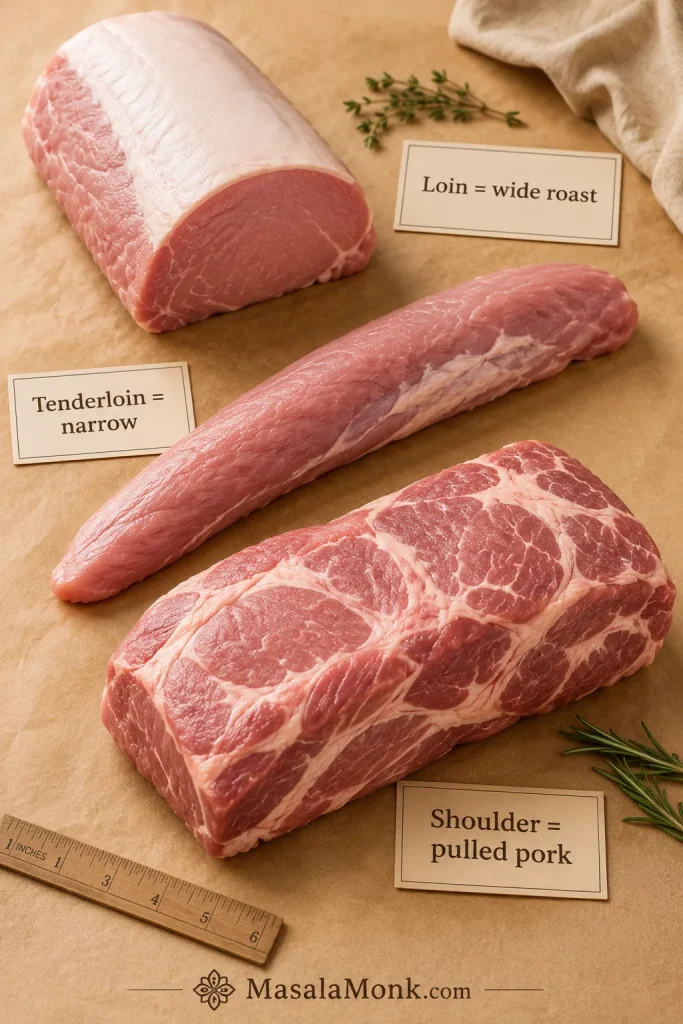
Raw pork loin roast, pork tenderloin, and pork shoulder arranged on butcher paper to compare their shapes and sizes.
This cut comparison matters because pork loin, pork tenderloin, and pork shoulder all need different timing and give different textures in the slow cooker.
Cut What it looks like Slow cooker behavior Best use
Pork loin Wide roast, often 2–5 lb Lean, sliceable when cooked to temperature; can dry out if overcooked This recipe
Pork tenderloin Long, narrow, usually 1–1.5 lb each Cooks faster; dries if treated like a large roast Use the slow cooker pork tenderloin recipe
Pork shoulder / pork butt Large, fattier roast Best for classic pulled pork because it has more fat and connective tissue Use for true fall-apart pulled pork

For this recipe, use a boneless pork loin roast. If the package says pork tenderloin, follow the tenderloin timing instead. If the package says pork shoulder or pork butt, you can cook it longer for classic pulled pork, but that is a different recipe with a different texture goal.

A pork sirloin roast can usually be cooked with the same general method, but it may be shaped differently from a center-cut pork loin. Use the thermometer in the thickest part and treat the chart as a guide, not a guarantee.

Check the Pork Roast Label Before Timing

At the store, “pork roast” may refer to pork loin, pork shoulder, pork butt, pork sirloin roast, or another cut. Check the package label and shape before you follow a slow cooker timing chart.
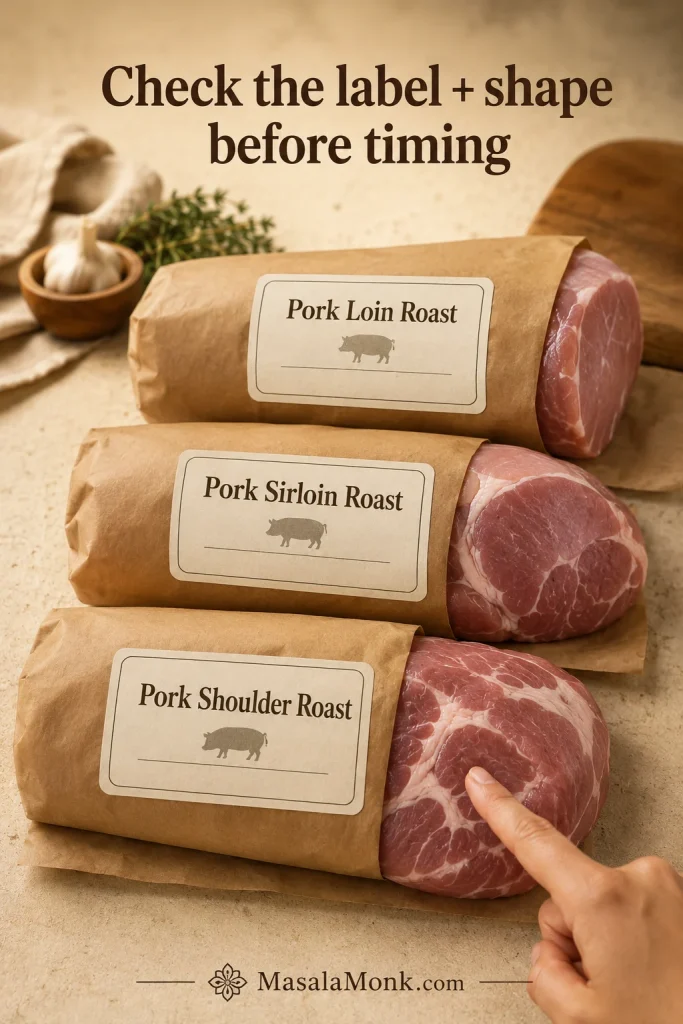
Generic pork roast labels for pork loin roast, pork sirloin roast, and pork shoulder roast with a pointer showing label and shape.
Since “pork roast” can mean several cuts, the package label and the shape matter before you follow any slow cooker timing.

Once you know it is pork loin, use the slow cooker pork loin timing chart for your roast size.

If you would rather roast that smaller cut, this pork tenderloin in oven guide gives the oven timing instead.

Ingredients for Slow Cooker Pork Loin

To keep the flavor balanced, the ingredient list is built around a garlic-herb pork loin with a small amount of savory sauce. The Dijon and vinegar keep the sauce from tasting flat, while a little honey or brown sugar rounds out the edges without turning the whole dish into a sweet roast.
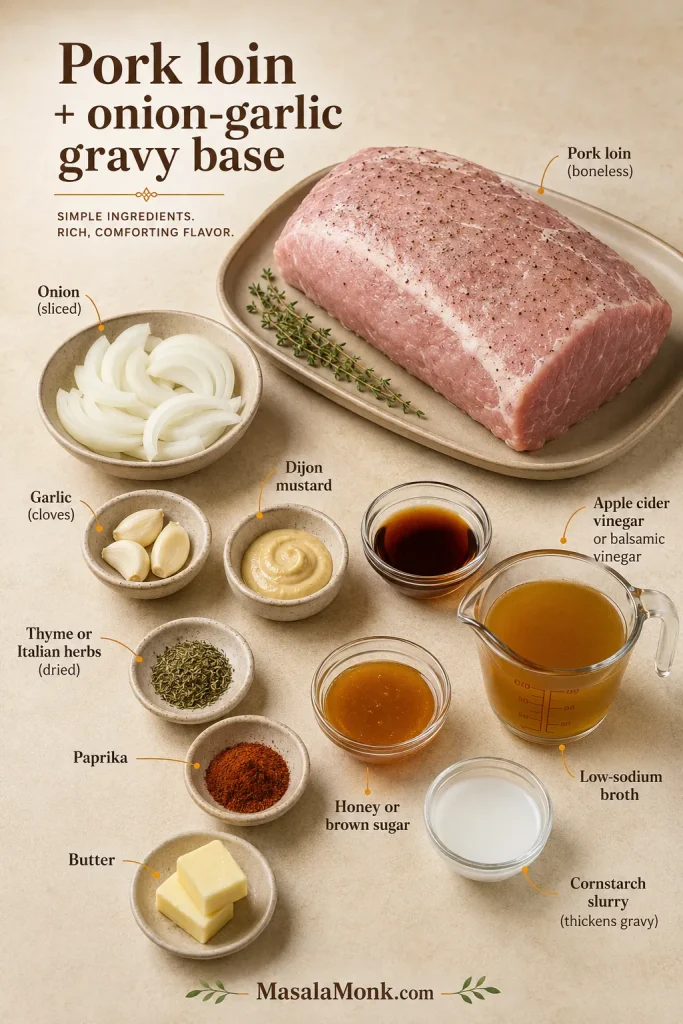
Ingredients for slow cooker pork loin including raw pork loin roast, onions, garlic, broth, Dijon, vinegar, herbs, paprika, butter, and cornstarch slurry.
The flavor starts with a seasoned pork loin roast, a small onion-garlic broth base, and a simple thickener for turning juices into gravy.

If the sauce is the part you care about most, the gravy guide shows how to turn the slow-cooker juices into a spoonable finish.

The Pork and Seasoning

Start with a boneless pork loin roast, then season it well on every side. Salt, pepper, garlic powder, onion powder, paprika, and thyme give the lean meat enough flavor before it ever touches the slow cooker.

The Sauce Base

Next, keep the liquid controlled. The roast needs moisture, but it does not need to be submerged. A small amount of broth becomes more flavorful once it mixes with onion, garlic, seasoning, mustard, vinegar, and pork juices.

The Optional Gravy Finish

Finally, cornstarch and cold water turn the slow-cooker juices into a light gravy. Butter is optional, but it gives the sauce a rounder finish if you want a richer dinner-style result.

Ingredient Amount Metric Why it matters
Boneless pork loin roast 3 lb 1.35 kg Main cut; wide roast, not tenderloin
Fine sea salt 1½ tsp About 9 g Seasons the lean pork deeply
Black pepper 1 tsp 2–3 g Adds basic savory heat
Garlic powder 1 tsp About 3 g Gives even garlic flavor on the meat
Onion powder 1 tsp 2–3 g Rounds out the seasoning
Paprika 1 tsp 2–3 g Adds color and gentle warmth
Dried thyme or Italian seasoning 1 tsp About 1 g Classic roast-style flavor
Oil, optional sear 1 tbsp 15 ml Helps brown the pork before slow cooking
Large onion, sliced 1 180–220 g Creates a flavor base under the pork
Garlic, minced 4 cloves About 12 g Flavors the juices and gravy
Low-sodium chicken broth ½ cup 120 ml Enough liquid for sauce without drowning the roast
Dijon mustard 1 tbsp 15 g Adds savory sharpness
Apple cider vinegar or balsamic vinegar 2 tbsp 30 ml Balances the rich pork and gravy
Honey or brown sugar 1–2 tbsp 20–40 g honey / 12–25 g sugar Optional sweetness for a rounder sauce
Unsalted butter, optional 2 tbsp 28 g Finishes the sauce or gravy
Cornstarch 1 tbsp 8 g For thickening the juices
Cold water 2 tbsp 30 ml Mixes with cornstarch for a smooth slurry

Best Pork Loin Size for the Slow Cooker

A 3 lb / 1.35 kg boneless pork loin is the best first size for this recipe because it fits comfortably in a 6-quart slow cooker and usually serves 6–8 people. Smaller 1–2 lb roasts cook faster, so they need earlier checking. Larger 4–5 lb roasts need more time and should not be packed tightly against the lid or walls of the slow cooker.

If you are adding potatoes and carrots, make sure the slow cooker is not overfilled. The pork should sit above or beside the vegetables with enough space for heat to circulate. Otherwise, a crowded slow cooker can cook unevenly and leave you with pork that is done before the vegetables are tender.

Equipment You Need

You do not need much equipment, but a thermometer matters more than almost anything else here. Slow cooker times are always estimates because every appliance runs a little differently.

  • 6-quart slow cooker: the best general size for a 2–4 lb pork loin, especially with vegetables.
  • Instant-read thermometer: the most important tool for avoiding dry pork loin.
  • Large skillet: optional, for searing before slow cooking.
  • Tongs: for moving the pork without tearing it.
  • Cutting board and foil: for resting before slicing.
  • Small saucepan or skillet: for reducing or thickening the slow-cooker juices.
  • Whisk: for a smooth cornstarch slurry.

How Much Liquid Do You Need for Pork Loin in the Crock Pot?

More liquid feels safer, especially with lean pork, but the slow cooker does not reduce sauce the way an open pot does. A little restraint here makes the difference between savory gravy and a thin, watered-down finish.

A 3 lb pork loin only needs about ½ cup / 120 ml broth or sauce base to start. That is enough to create steam, flavor the onions, and give you juices for gravy without making the pork taste boiled. Use ¾–1 cup / 180–240 ml only if you are adding potatoes and carrots or want extra gravy.
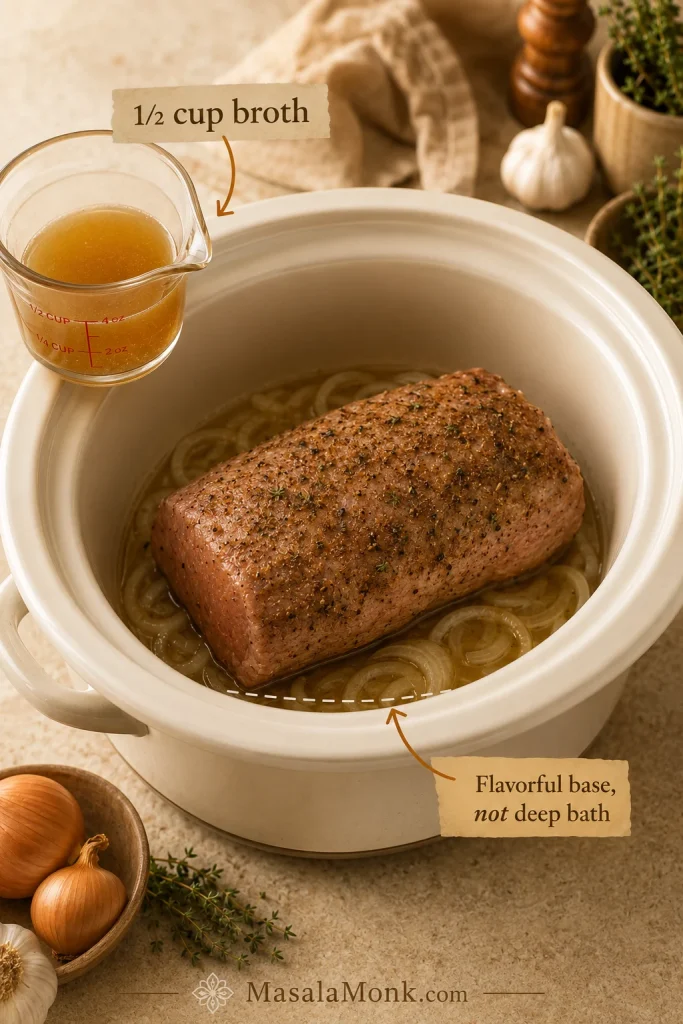
Pork loin sitting over onions in a slow cooker with a shallow 1/2 cup broth base instead of being covered with liquid.
Pork loin needs a flavorful base, not a deep bath, because the slow cooker releases more juices as the roast cooks.

The pork does not need to be submerged. Slow cookers trap moisture, and the liquid level usually rises as the pork and onions release juices. If the sauce looks thin at the end, reduce it in a saucepan or thicken it with a cornstarch slurry.

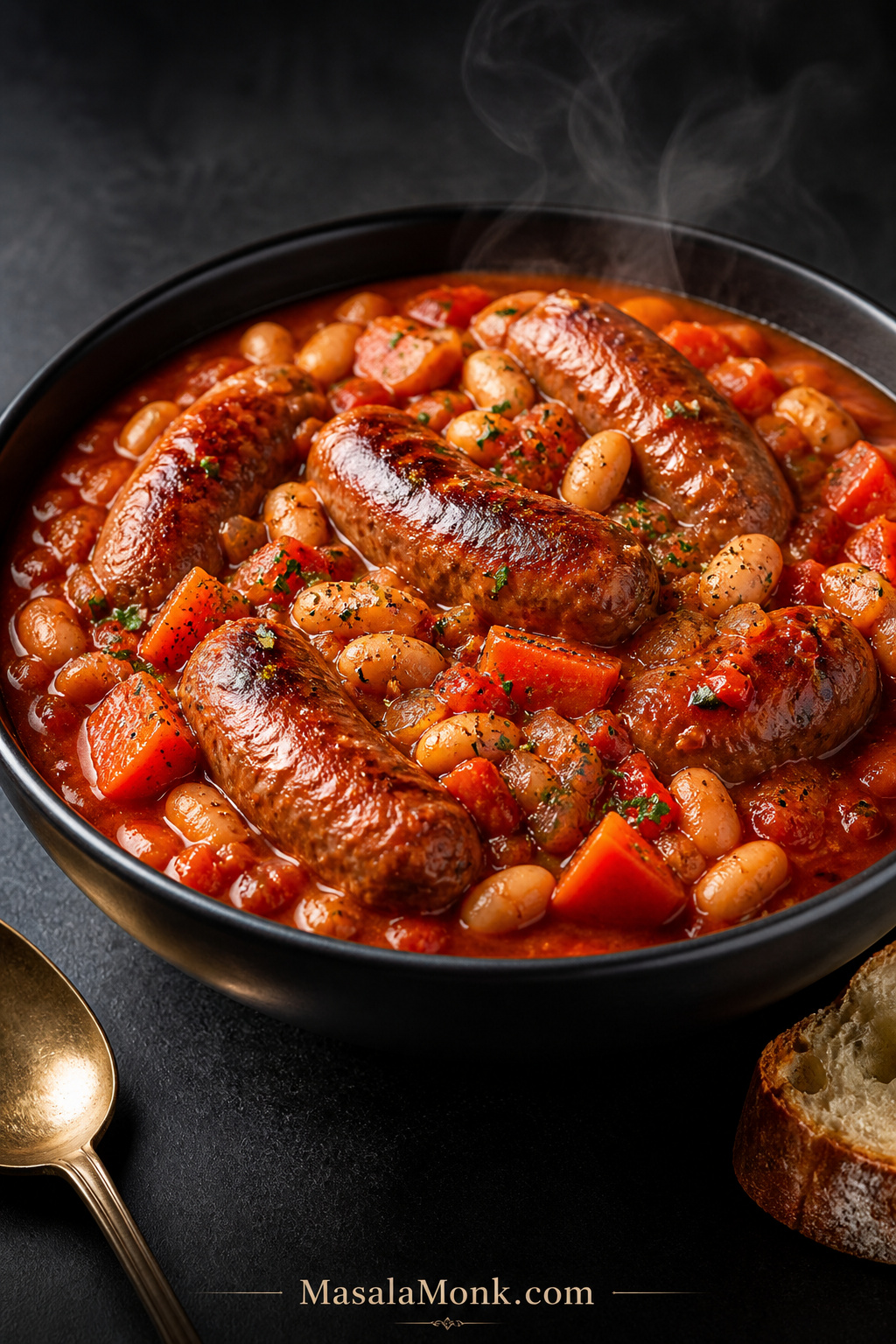
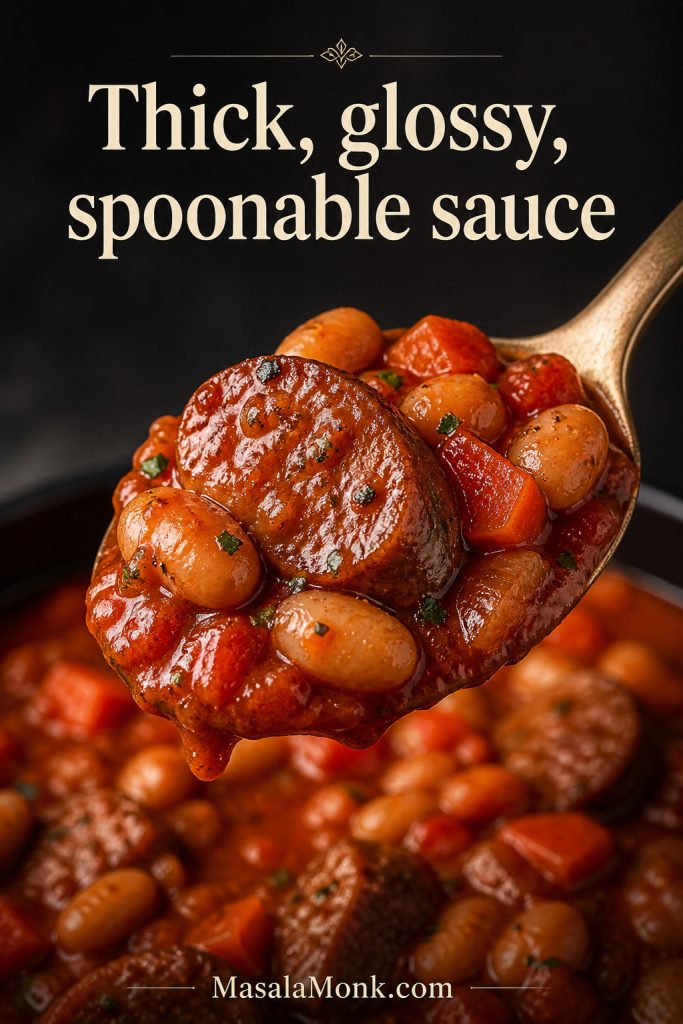
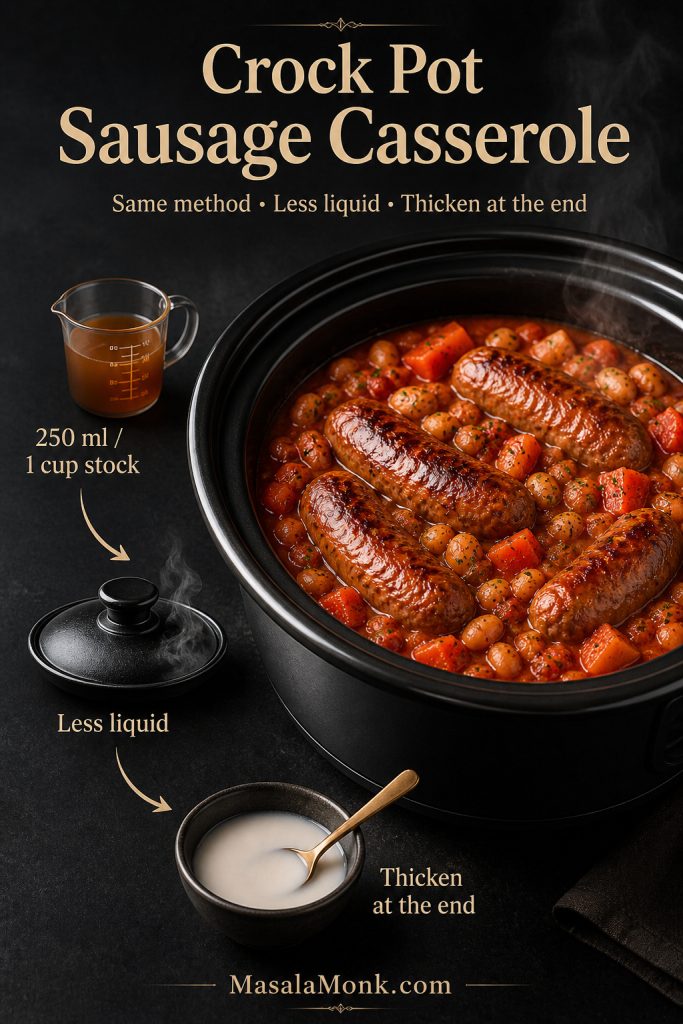
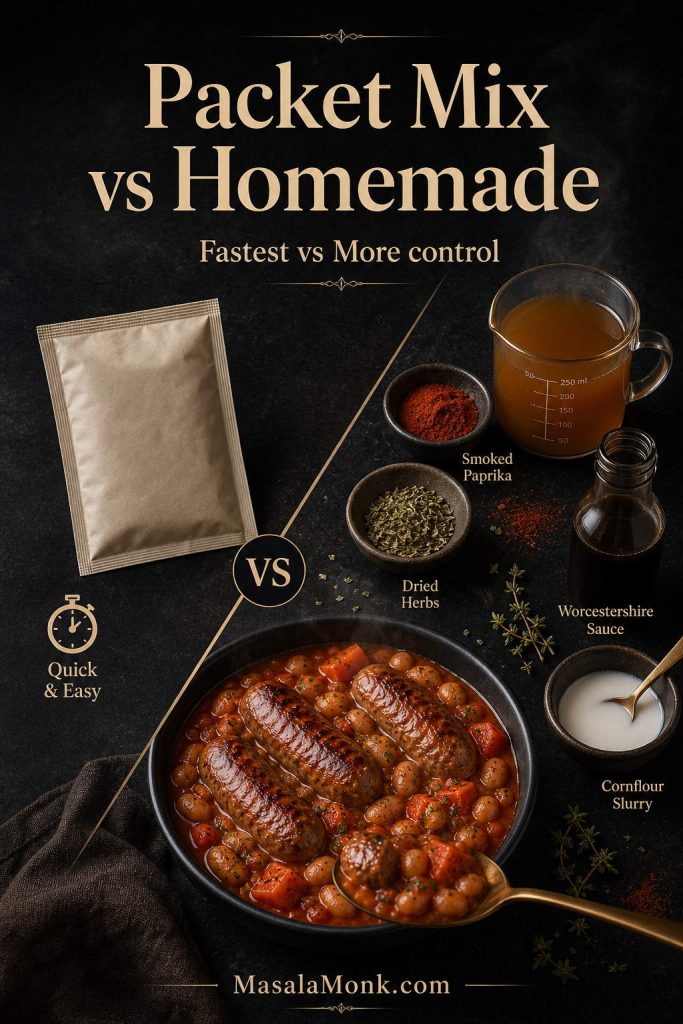
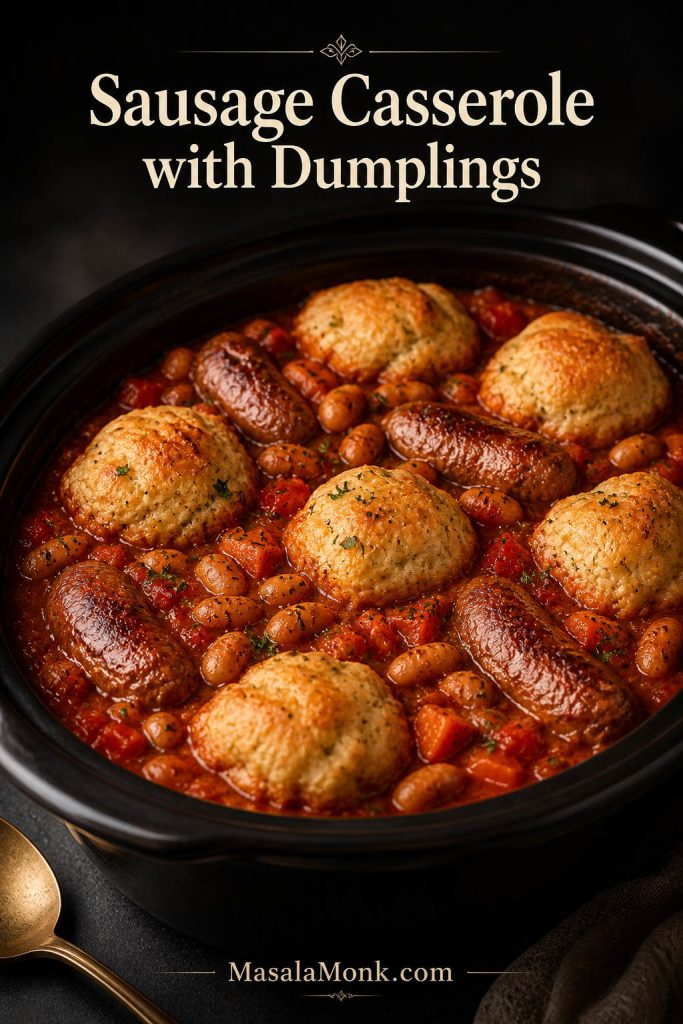
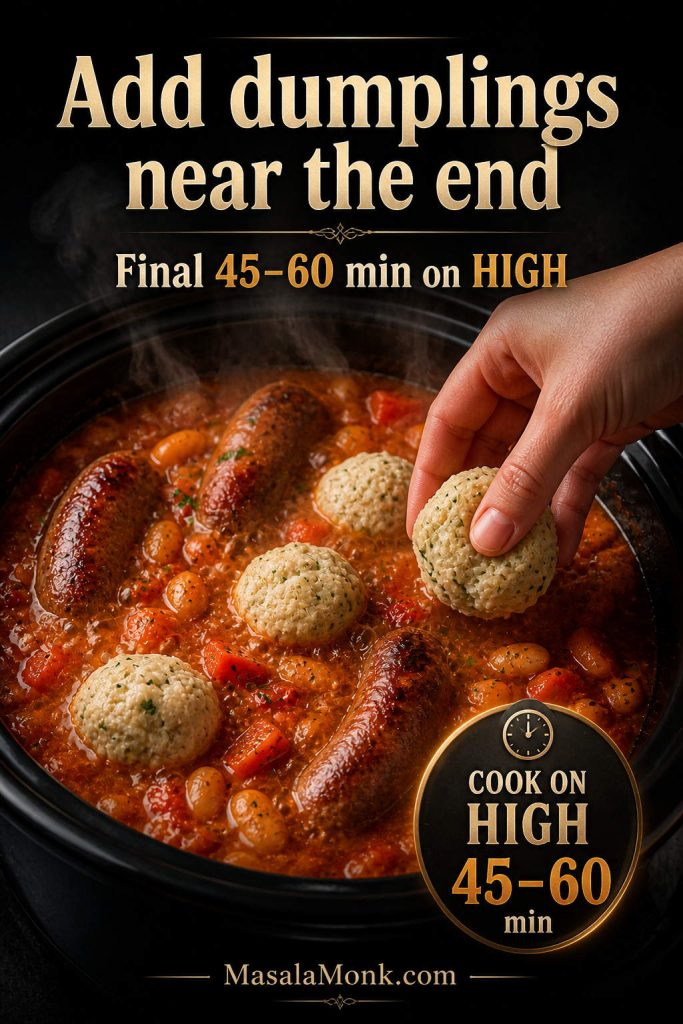
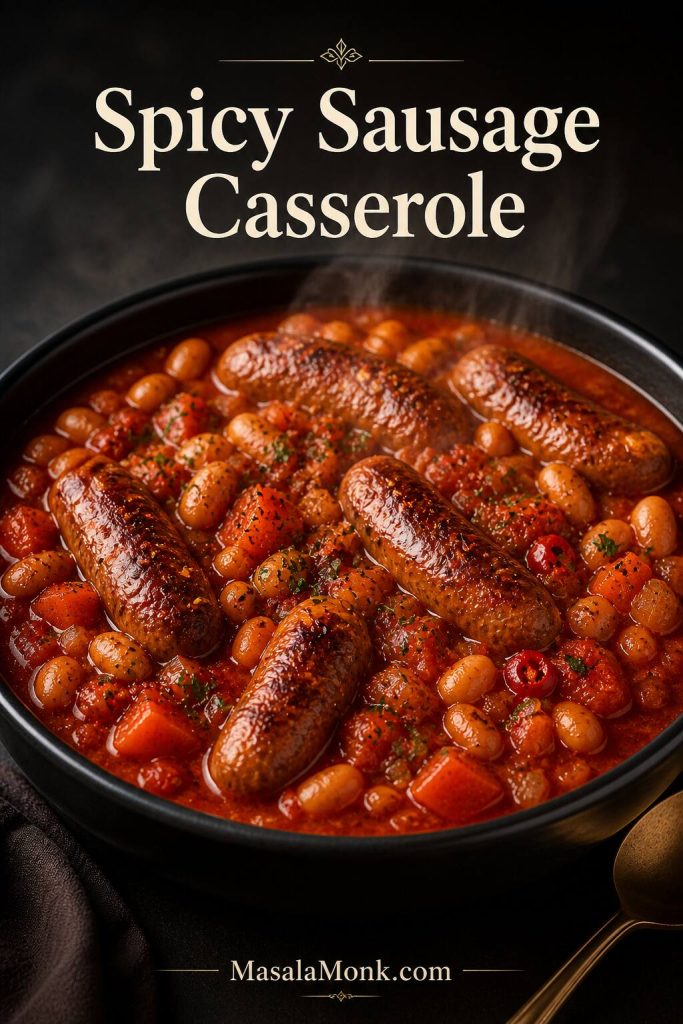
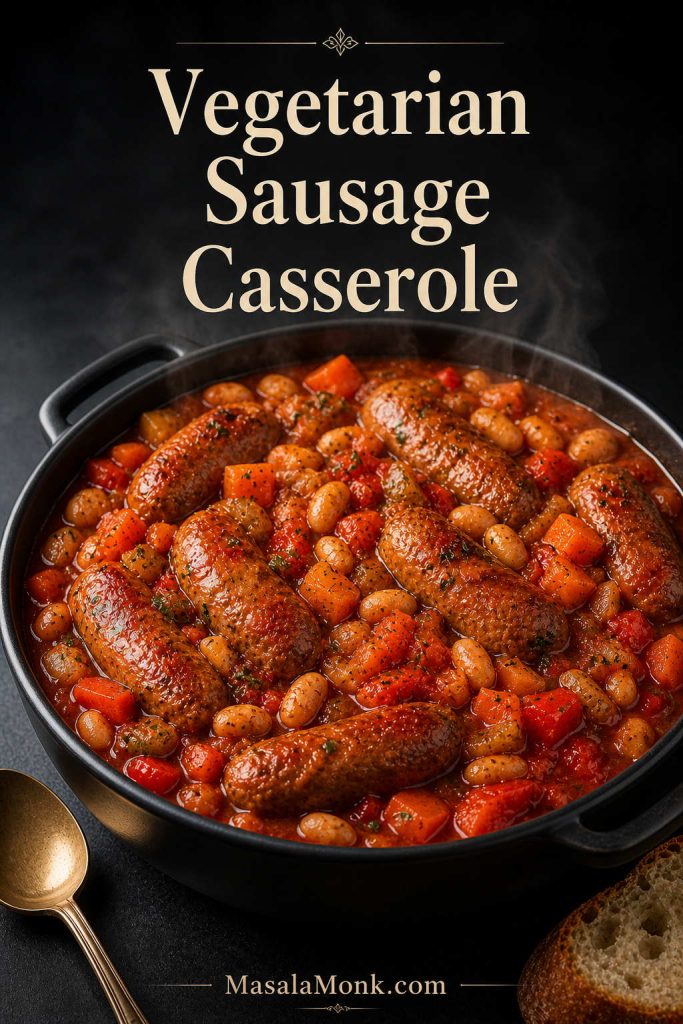
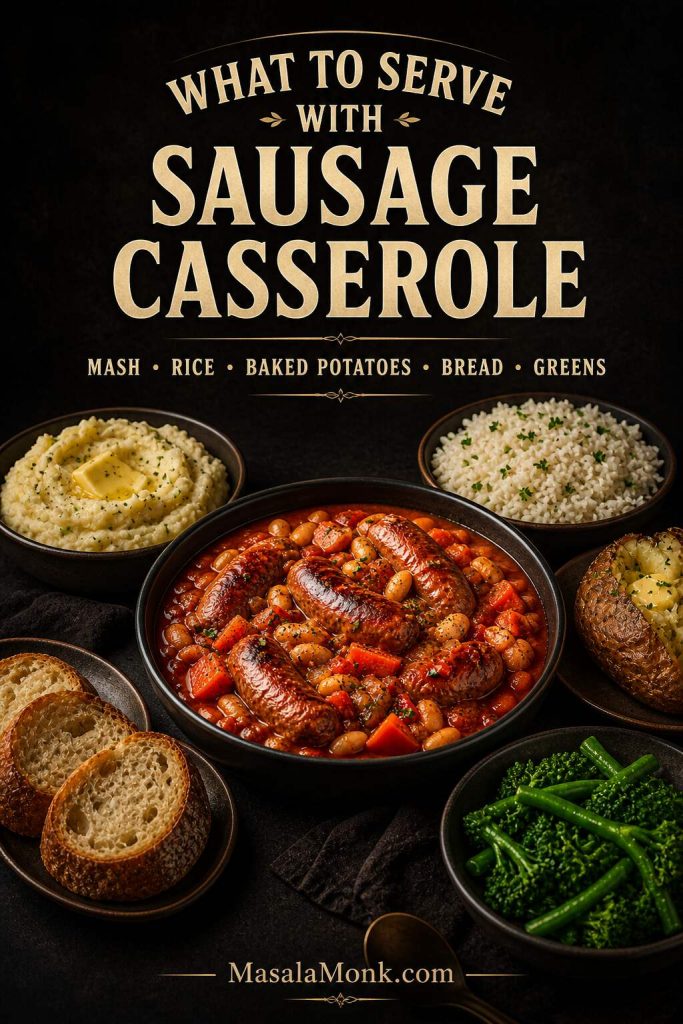
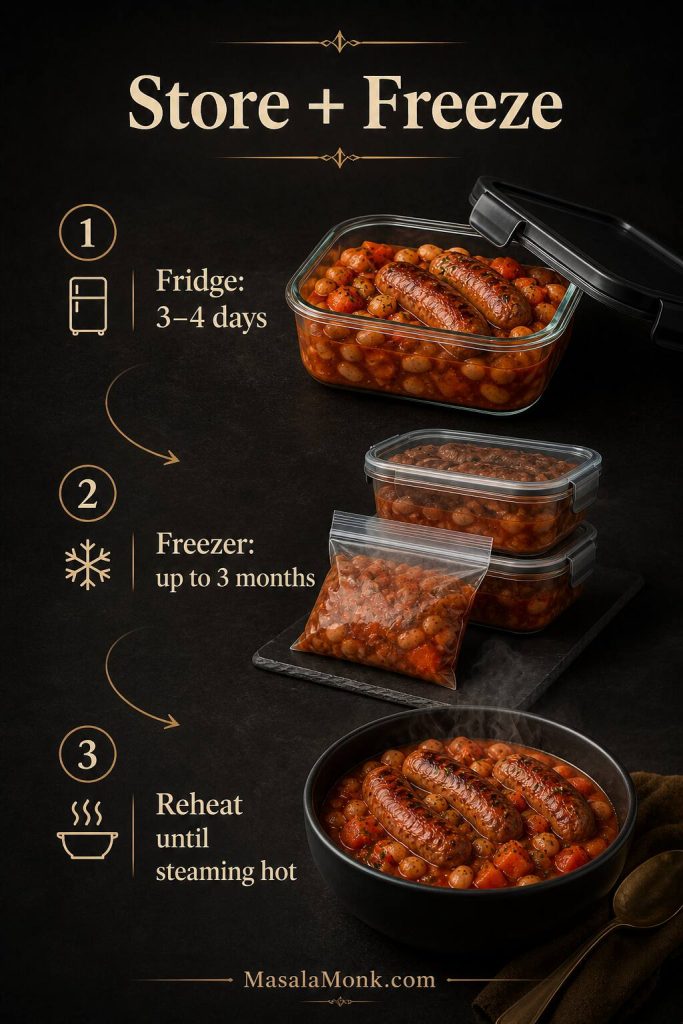
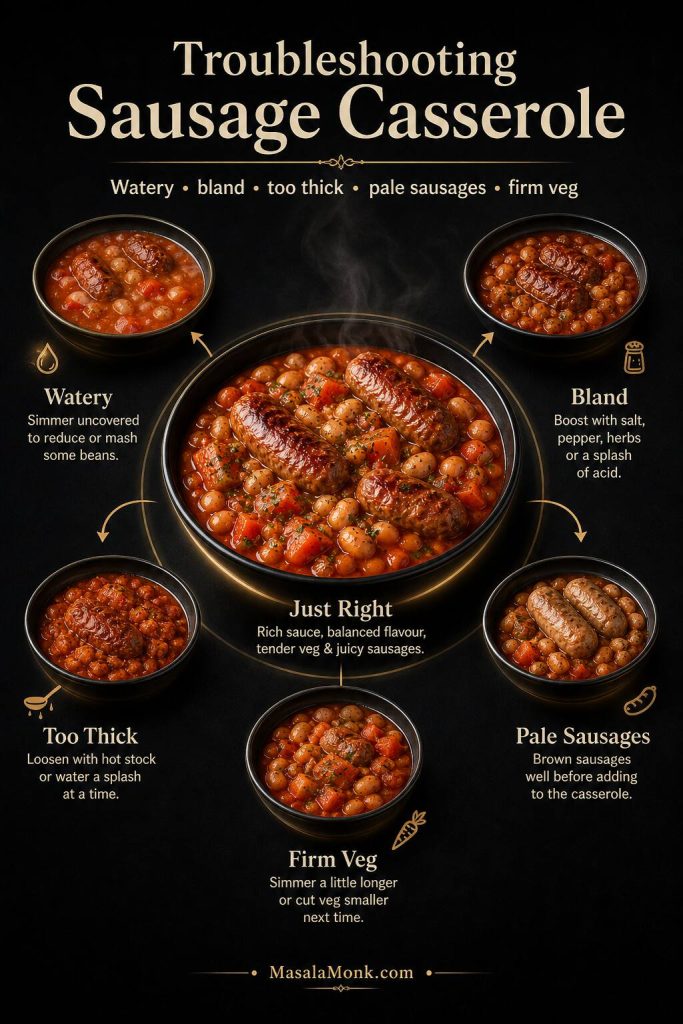
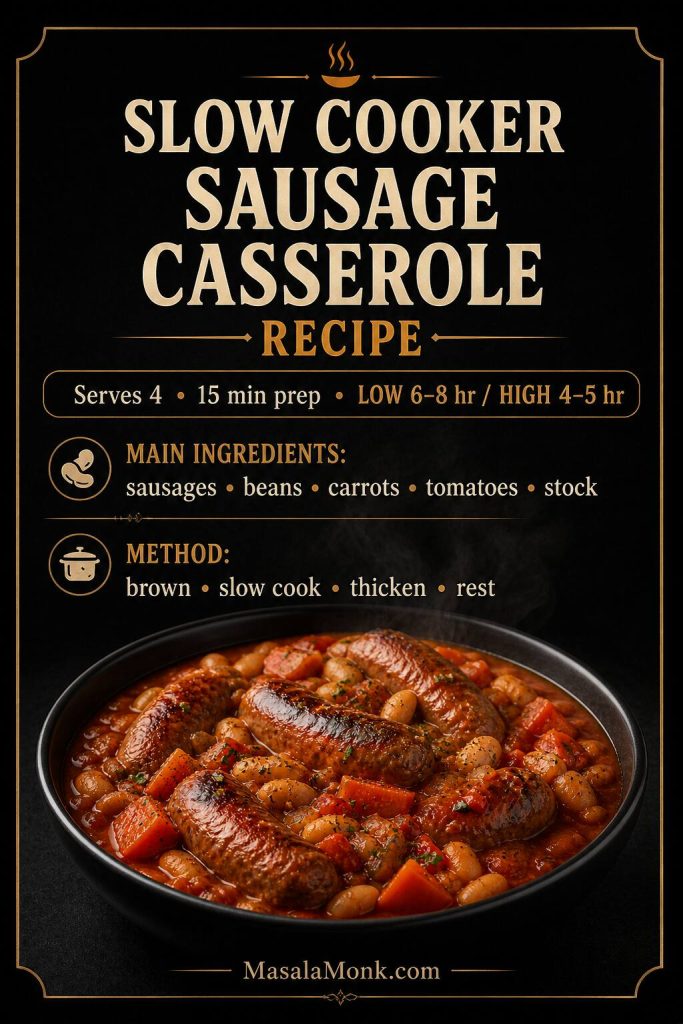
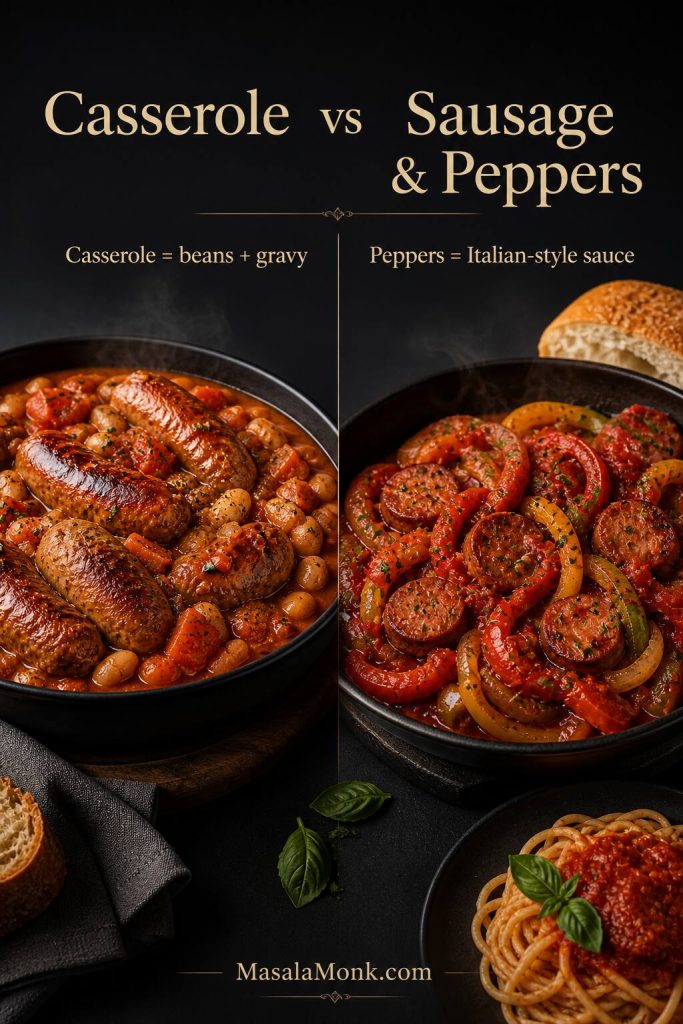
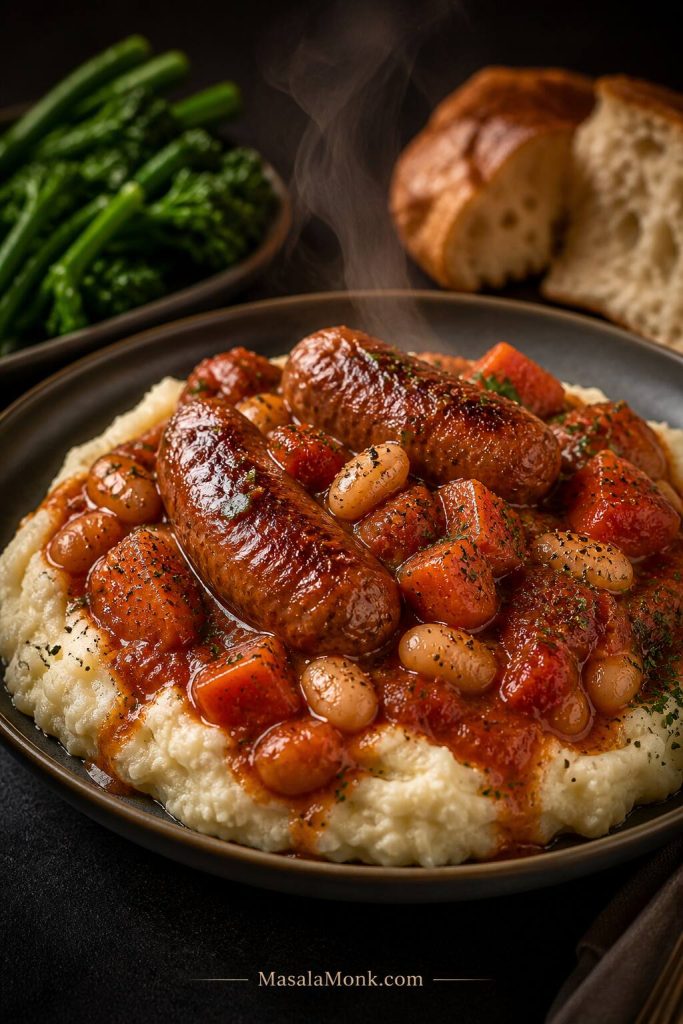
This same liquid-control issue comes up in saucy crock pot dinners too, like this slow cooker sausage casserole, where the sauce needs enough moisture to cook but not so much that it turns thin.

How to Make the Slow Cooker Juices Taste Like Real Gravy

The slow cooker gives you juices, but gravy usually needs one extra step. First, pour the juices into a small saucepan and simmer them for a few minutes so the flavor concentrates. If there is a lot of fat on top, skim off what you can before thickening.

Next, whisk cornstarch with cold water until smooth, then add the slurry to the simmering juices. Once the gravy lightly thickens, taste it before serving. A small spoonful of Dijon, a splash of vinegar, a pinch of salt, or a little butter can make the sauce taste more finished.
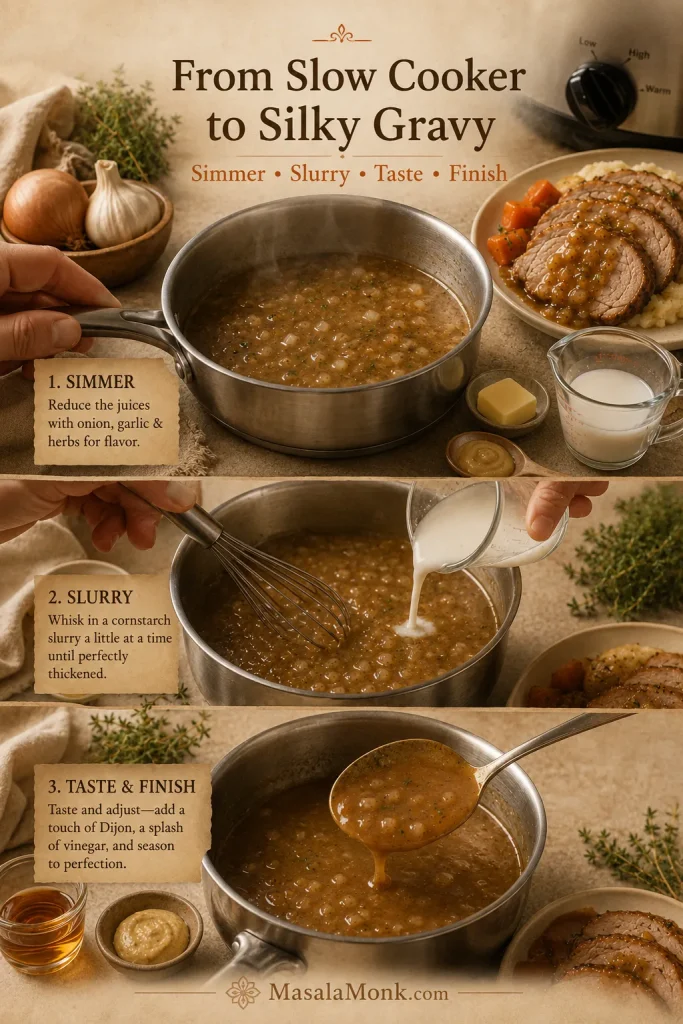
Slow cooker pork loin juices being simmered, thickened with cornstarch slurry, tasted, and finished into glossy gravy.
After the pork is done, simmering and thickening the cooking juices turns them into gravy that clings to the slices.

How to Make Slow Cooker Pork Loin

This method gives you tender sliced pork with enough sauce to spoon over the meat at the end. Searing is optional; the thermometer is what makes the result reliable.
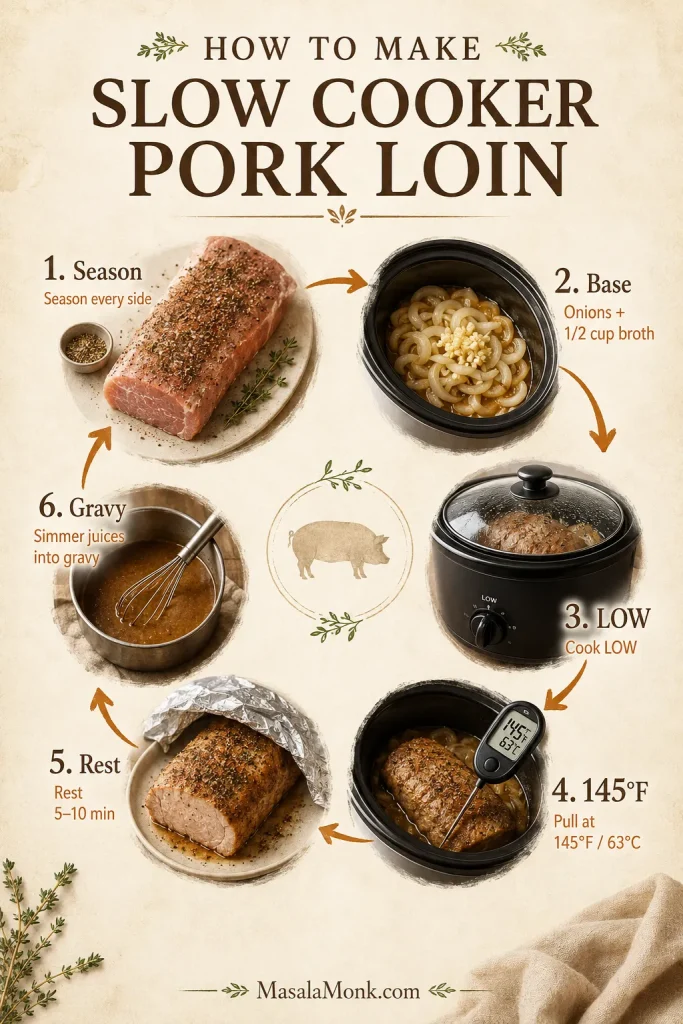
Step-by-step guide showing pork loin being seasoned, placed over an onion base, cooked on LOW, checked at 145°F, rested, and served with gravy.
The method stays simple when the order is clear: season, build the base, cook gently, check the center, rest, then make gravy.

1. Pat the pork dry and season it well

Pat the pork loin dry with paper towels. Mix the salt, pepper, garlic powder, onion powder, paprika, and thyme or Italian seasoning, then rub the mixture all over the pork. Season every side because the roast is thick and mild on its own.
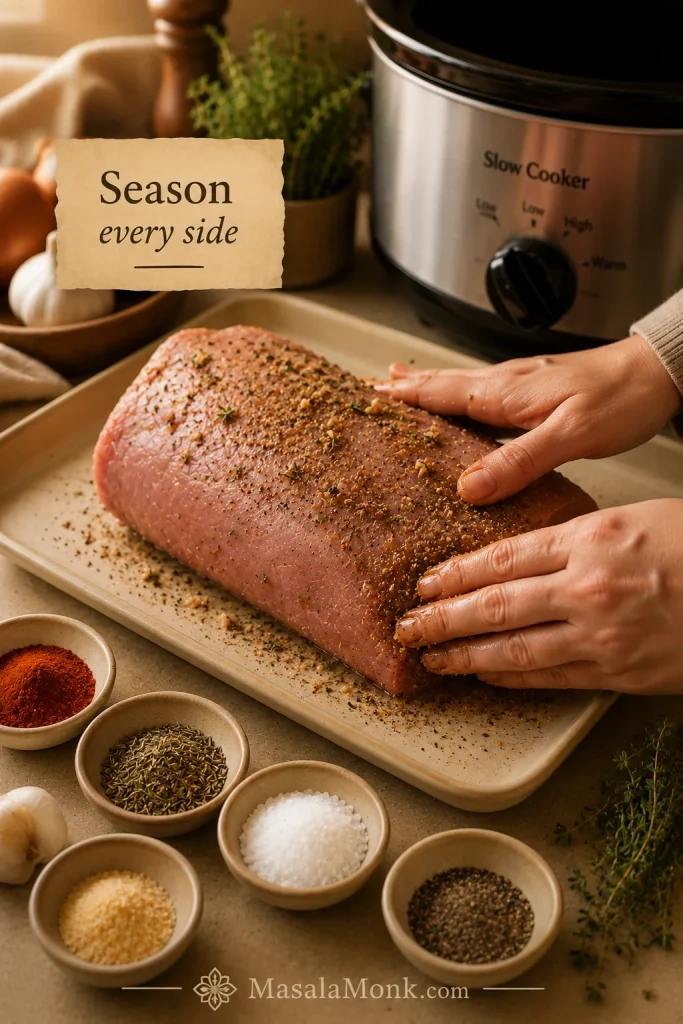
Hands rubbing garlic herb seasoning onto every side of a raw pork loin roast before slow cooking.
Season every side, not only the top, so the thick pork loin roast has flavor around the edges before slow cooking begins.

2. Sear the pork loin, or skip it for a dump-and-go version

For deeper flavor, heat oil in a large skillet and sear the pork for 2–3 minutes per side, just until browned. Searing adds color and a more roasted flavor, especially if you plan to make gravy from the juices. It does not “seal in” moisture, so you can skip this step when you need a true dump-and-go crock pot dinner.

Can You Make This Without Searing?

Yes. Searing gives the roast better color and deeper flavor, but the recipe still works without it. If you skip the skillet, season the pork well, place it over the onion and sauce base, and be especially sure to finish with the reduced juices or gravy. That final sauce step helps the dump-and-go version taste complete.
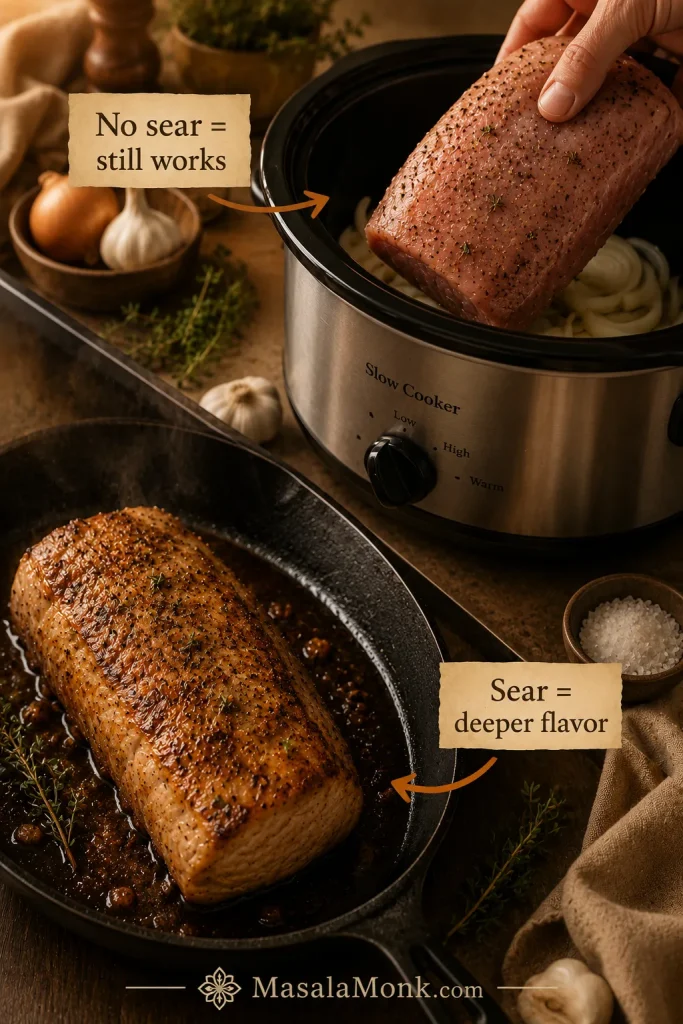
Comparison of a seared pork loin in a skillet and an unseared seasoned pork loin going into a slow cooker.
Searing adds deeper color and roasted flavor; meanwhile, a no-sear pork loin can still work when the juices are finished into gravy.

The gravy step is especially helpful when you skip searing because it gives the finished pork more roasted-dinner flavor.

3. Build the slow cooker base

Add the sliced onion to the bottom of a 6-quart slow cooker. Stir in the garlic, broth, Dijon mustard, vinegar, and honey or brown sugar if using. This gives the pork something flavorful to sit on and creates the base for the sauce later.

Start with ½ cup / 120 ml broth for a 3 lb roast. Use up to 1 cup / 240 ml only if you are adding a lot of vegetables or want extra gravy. The pork should sit in a flavorful base, not a deep bath.

4. Cook on LOW until the center reaches 145°F / 63°C

Place the roast in the slow cooker, fat side up if it has a fat cap. Cover and cook on LOW until the thickest center reaches 145°F / 63°C. For a 3 lb pork loin, begin testing around 2½–3 hours. It may need closer to 4 or 4½ hours depending on thickness, how full the slow cooker is, and how hot your appliance runs.

Use HIGH only when you need a faster dinner and can check early. LOW is the better default for pork loin because the ideal window is easier to catch.
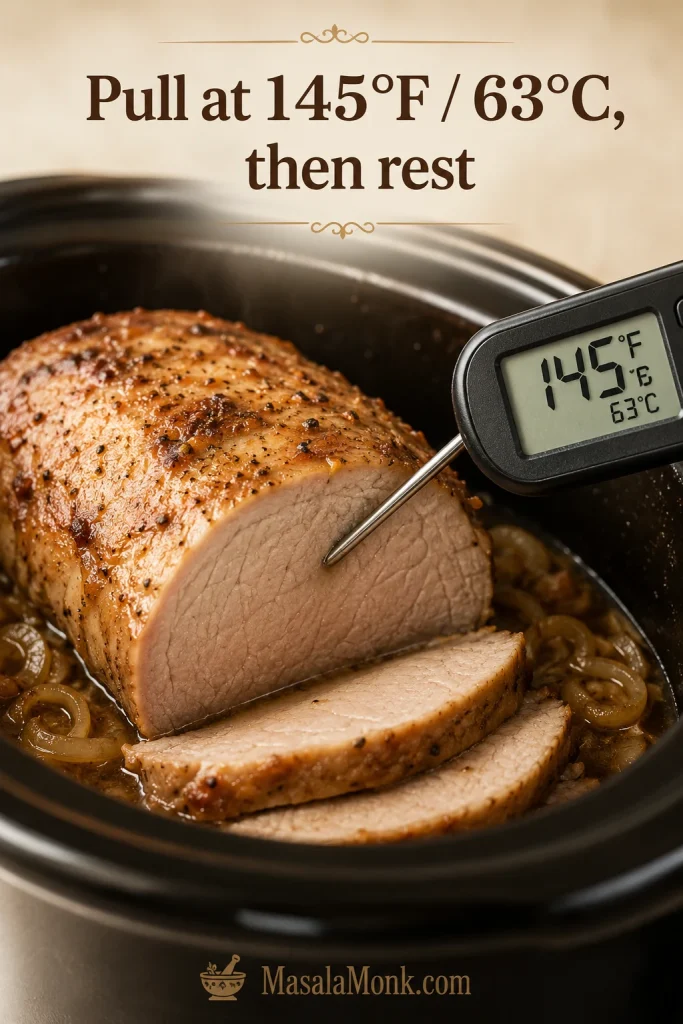
Instant-read thermometer showing 145°F and 63°C in a cooked slow cooker pork loin roast.
A thermometer makes slow cooker pork loin more reliable, since roast shape and appliance heat can shift the exact finish time.

For smaller or larger roasts, use the cook-time chart below.

5. Rest before slicing

Transfer the pork to a cutting board and tent it loosely with foil. Rest for 5–10 minutes before slicing. Then cut across the grain into slices. Resting helps the pork stay moister on the plate instead of losing everything the moment you cut into it.

6. Turn the juices into gravy or sauce

Pour the slow-cooker juices into a small saucepan. Simmer for a few minutes to concentrate the flavor. Whisk the cornstarch with cold water, then whisk the slurry into the simmering juices. Cook until lightly thickened. If you want a richer finish, whisk in the butter at the end.

Spoon the gravy over the sliced pork just before serving, especially if you are plating it with mashed potatoes, rice, or noodles. That glossy onion-garlic sauce is what turns lean pork loin from cooked meat into a real slow-cooker dinner.

How Long to Cook Pork Loin in a Slow Cooker

With pork loin, the clock gets you close, but the thermometer protects the dinner. Use the time range to know when to look, then let the center temperature make the final call.

If you only take one thing from this section, let it be this: check the center before the longest listed time.

Use the Cook-Time Chart as a Checking Window

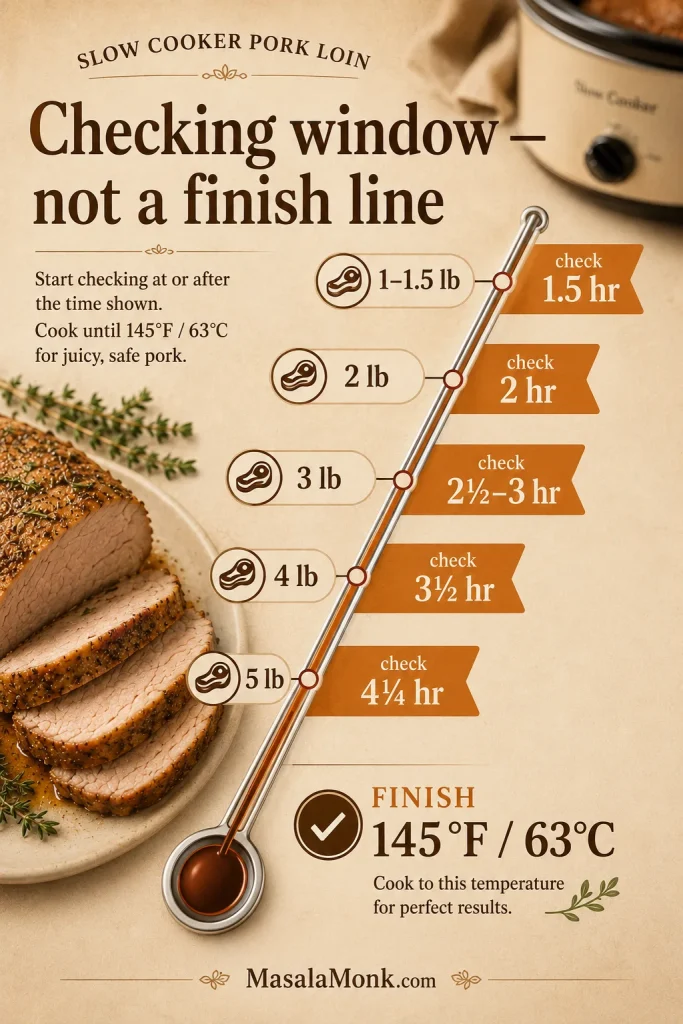
Slow cooker pork loin timing still depends on the size and thickness of the roast, how hot your slow cooker runs, whether vegetables are packed around it, and whether you want tender slices or softer, shreddable pork. Use the chart as your checking window, not a finish line.

Pork loin size LOW estimate for sliceable pork HIGH estimate Start checking
1–1.5 lb / 450–680 g 1.5–3 hours 1–1.5 hours 1.5 hours on LOW
2 lb / 900 g 2–3.5 hours 1.5–2.5 hours 2 hours on LOW
3 lb / 1.35 kg 2.5–4.5 hours 2–3.25 hours 2.5–3 hours on LOW
4 lb / 1.8 kg 3.5–5.5 hours 2.75–4 hours 3.5 hours on LOW
5 lb / 2.25 kg 4.5–6 hours 3.5–4.5 hours 4.25 hours on LOW
Cook time chart for slow cooker pork loin showing roast sizes, start-checking times, and a 145°F finish temperature.
Use the cook time chart to know when to start checking; then let the center temperature decide when the pork is ready.

Small roasts can move quickly. Once you are near the early end of the range, check every 15–20 minutes so you do not miss the best slicing window.

Important: The earlier end of the range is for hotter slow cookers, smaller or thinner roasts, and pork cooked without many vegetables. The later end is for thicker roasts, fuller slow cookers, or a softer result. Always check the thickest center with a thermometer.

For tender, sliceable pork loin, pull the roast when the thickest center reaches 145°F / 63°C, then rest before slicing. FoodSafety.gov lists pork roasts, steaks, and chops at 145°F / 63°C with a 3-minute rest. You can check the official chart here: FoodSafety.gov safe minimum internal temperatures.

Why do some recipes say 2 hours while others say 8 hours?

Because they are not always cooking the same thing to the same result. A small pork loin cooked for neat slices may be done much earlier than a larger roast cooked until very soft. Some recipes also use the words pork loin, pork roast, pork tenderloin, and pork shoulder too loosely, which makes the timing look more confusing than it needs to be.

Here, the main goal is sliceable pork loin. If you want a softer, saucier roast for sandwiches or rice bowls, you can cook it longer with extra sauce, but the texture will still be leaner than classic pork shoulder pulled pork.
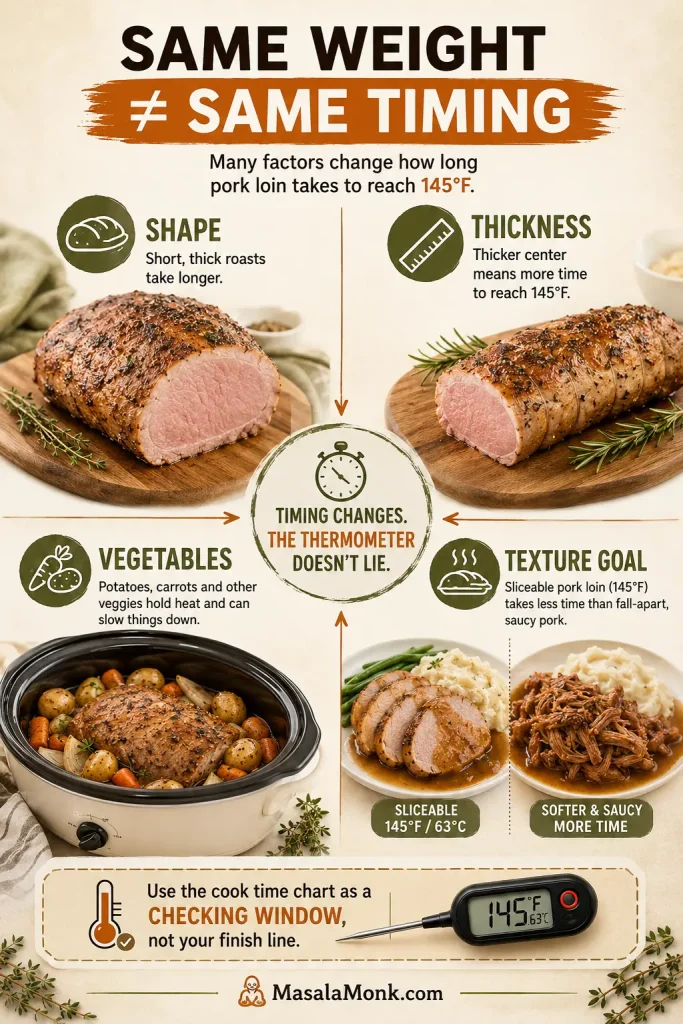
Educational guide explaining that pork loin timing varies by roast shape, thickness, vegetables, slow cooker heat, and texture goal.
Two pork loin roasts can weigh the same but cook differently when shape, thickness, vegetables, or texture goal changes.

Sliceable vs Shreddable Slow Cooker Pork Loin

Before you start cooking, decide what kind of pork loin you want. A pork loin cooked for slices and a pork loin cooked until softer and more shreddable are both useful, but they are not the same dinner.
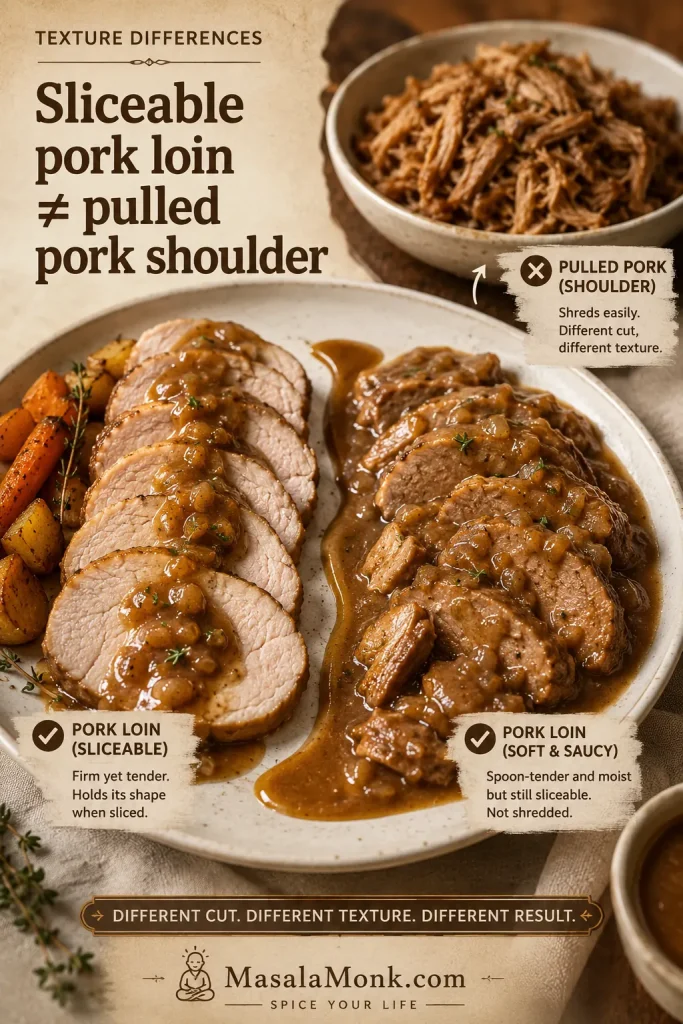
Plate comparing sliceable pork loin, softer saucy pork loin, and pulled pork shoulder as different textures.
Pork loin can become softer and saucier, although classic fall-apart pulled pork still works better with pork shoulder.
Result wanted Best approach Best use
Tender slices Cook to 145°F / 63°C, rest, slice across the grain Dinner plates, gravy, potatoes, vegetables
Softer saucy pork loin Cook longer on LOW with extra sauce or broth Rice bowls, sandwiches, saucy leftovers
Classic pulled pork texture Use pork shoulder for best results, or use pork loin as a leaner BBQ-style option BBQ sandwiches, sliders, meal prep

For true fall-apart pulled pork, pork shoulder is the better cut. For a leaner BBQ-style pork loin, use more sauce and expect a firmer, less fatty texture.

Slow Cooker Pork Loin with Potatoes and Carrots

To make this a full crock pot dinner, add potatoes and carrots under and around the pork. The important detail is size. If the vegetables are cut too small, they can break down. If they are cut too large, the pork may finish before the vegetables are tender.
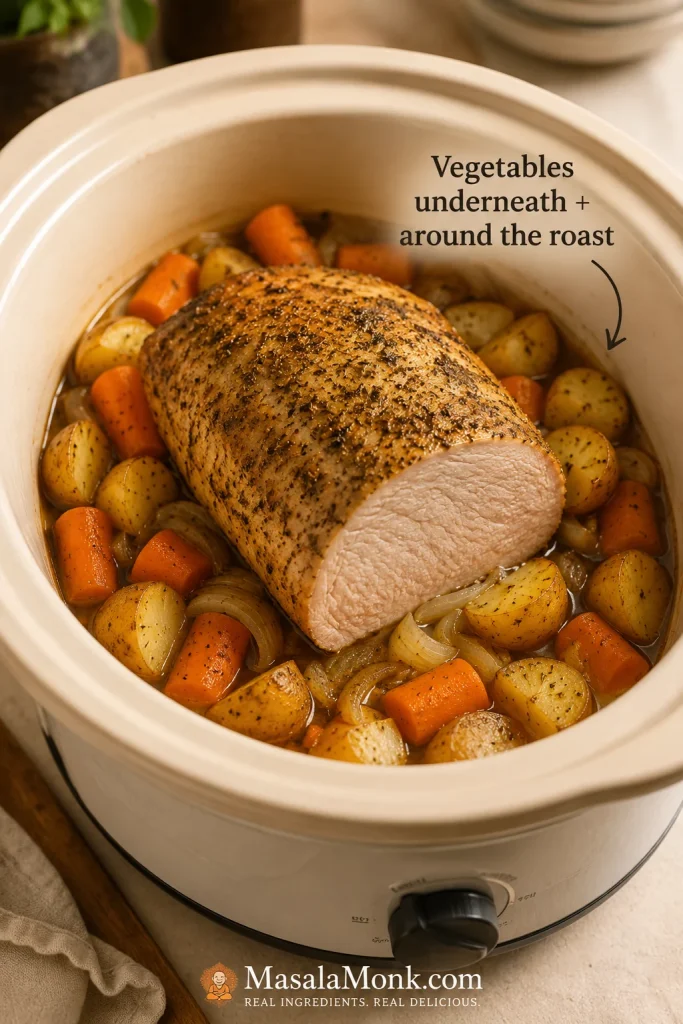
Pork loin roast in a slow cooker with potatoes, carrots, and onions arranged underneath and around the meat.
Place potatoes and carrots under and around the pork so they get more heat and liquid while the roast cooks above them.

Vegetables also cook more slowly than meat in a slow cooker, so give them the best position: the bottom and sides of the crock, where they sit closer to the heat and liquid.

Add-in Amount for this recipe How to cut it Where it goes
Baby potatoes or potato chunks 1 lb / 450 g Whole baby potatoes or 1½-inch chunks Under and around pork
Carrots 3–4 medium / 300–400 g Thick 1-inch chunks Under and around pork
Onion 1 large / 180–220 g Thick slices or wedges Bottom of slow cooker

What if the vegetables are not done yet?

If the pork reaches 145°F / 63°C before the potatoes and carrots are tender, remove the roast, tent it loosely, and let the vegetables continue cooking. Let the pork come out when it is ready; the vegetables can keep cooking after the roast rests.
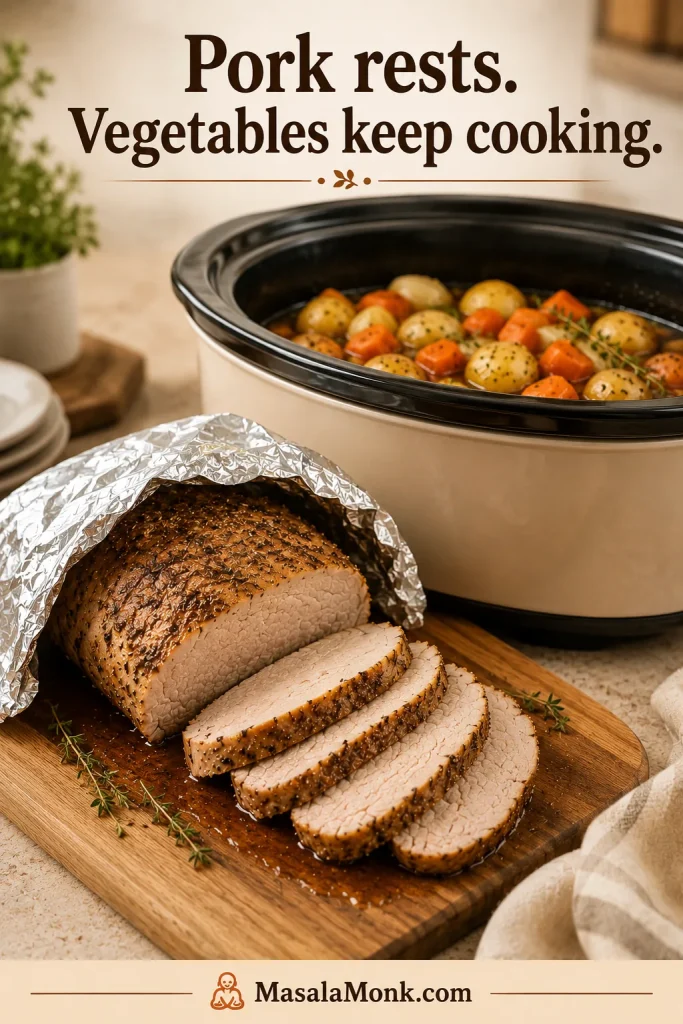
Cooked pork loin resting under foil on a cutting board while potatoes and carrots continue cooking in a slow cooker behind it.
When the pork reaches temperature first, resting the roast while the vegetables finish keeps the meat from overcooking.

If you add the full amount of vegetables, increase the broth to ¾–1 cup / 180–240 ml so there is enough liquid to help the vegetables cook and enough juice left for sauce.

Easy Slow Cooker Pork Loin Variations

Once you understand the basic method, you can take this slow cooker pork loin in several directions. Keep the same timing logic: cook by temperature for slices, and use extra sauce if you want a softer, saucier result.
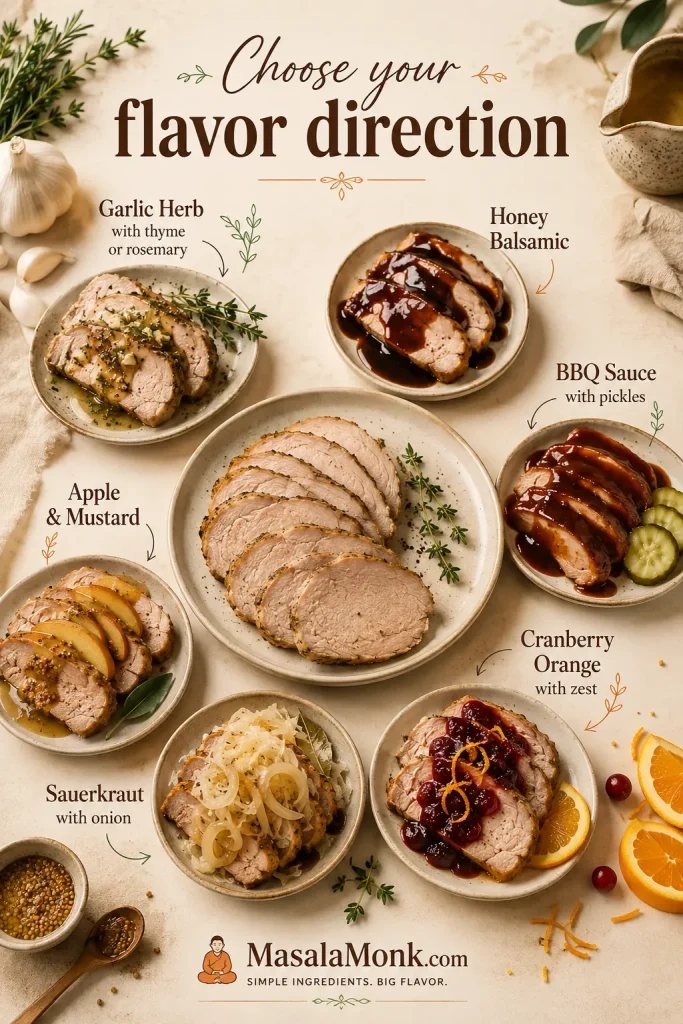
Slow cooker pork loin variation board with garlic herb, honey balsamic, BBQ, apple mustard, sauerkraut, and cranberry orange flavors.
Once the timing logic is clear, the same pork loin method can turn classic with garlic-herb gravy, sweet-tangy with balsamic, casual with BBQ, or festive with apple, sauerkraut, or cranberry-orange.

Garlic Herb Pork Loin

Choose this version for the most classic roast-dinner flavor. Thyme, rosemary, Italian seasoning, garlic, onion, broth, and a butter-finished gravy make it especially good with mashed potatoes or egg noodles.

Honey Balsamic Pork Loin

Choose this version when you want the pork to feel a little more dinner-party than weeknight. Use balsamic vinegar instead of apple cider vinegar and increase the honey to 2 tablespoons, then reduce the juices until glossy and tangy-sweet.

BBQ Pork Loin

For sandwiches, sliders, or rice bowls, replace the Dijon-vinegar base with your favorite barbecue sauce plus a splash of broth. Cook to 145°F / 63°C for saucy slices, or cook longer if you want a leaner shredded pork loin. For classic juicy pulled pork, pork shoulder is still the better cut.

Pork Loin and Sauerkraut

Add sauerkraut, onion, mustard, and a sliced apple if you like a sweet-sour balance. Keep some broth in the base so the sauerkraut does not dry out. If you are using chops instead of a roast, use this crock pot pork chops and sauerkraut guide instead.

Pork Loin with Apples

Apples, onion, mustard, thyme, and a small splash of vinegar work beautifully with pork loin. For softer apples, add them at the beginning. For apples that hold more shape, add thicker wedges during the later part of cooking.

Cranberry Orange Pork Loin

For a holiday-style version, use cranberry sauce, orange zest, a little orange juice, onion, mustard, and broth. This is a good direction for Thanksgiving, Christmas, or any dinner where you want the pork to feel more festive.

Cream of Mushroom or Onion Soup Mix Pork Loin

For an old-school comfort version, use cream of mushroom soup or onion soup mix with broth. These versions can be salty, so use low-sodium broth and reduce or skip the added salt in the seasoning rub. The sauce will be thicker and more casserole-like than the garlic-herb gravy.

What to Serve with Crock Pot Pork Loin

This is the moment to build the plate around the sauce. Mashed potatoes, noodles, rice, rolls, and roasted potatoes all catch the warm gravy well, while BBQ or apple-style versions can go more casual with sandwiches, rice bowls, or simple vegetables.
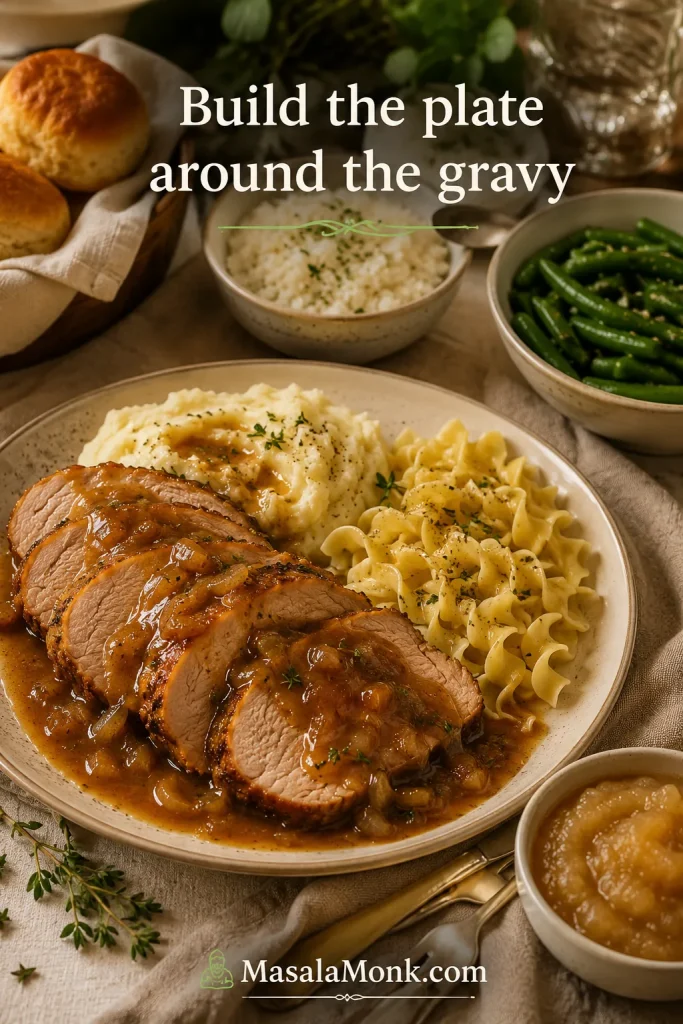
Crock pot pork loin with gravy served with mashed potatoes, egg noodles, rolls, green beans, rice, and applesauce.
Build the plate around the gravy: mashed potatoes, noodles, rice, rolls, and simple vegetables all make sliced pork loin feel complete.
  • Mashed potatoes or buttered egg noodles for the gravy
  • Rice, roasted potatoes, simple dinner rolls, or a cozy hashbrown casserole when you want a richer comfort-food side
  • Green beans, peas, broccoli, carrots, or a crisp salad
  • Roasted apples, applesauce, sauerkraut, or a simple potato salad for a classic pork pairing
  • Sandwiches with sliced pork, extra sauce, and pickles
  • Leftover rice bowls with pork, vegetables, and warm gravy

How to Store and Reheat Leftovers

After dinner, cool leftover pork loin and refrigerate it within 2 hours. Store slices in an airtight container with some gravy, broth, or slow-cooker juices so they do not dry out. Use refrigerated leftovers within 3–4 days.

To freeze leftovers, pack sliced pork loin with some sauce or cooking juices. It is best within 2–3 months for quality. Thaw overnight in the refrigerator before reheating.
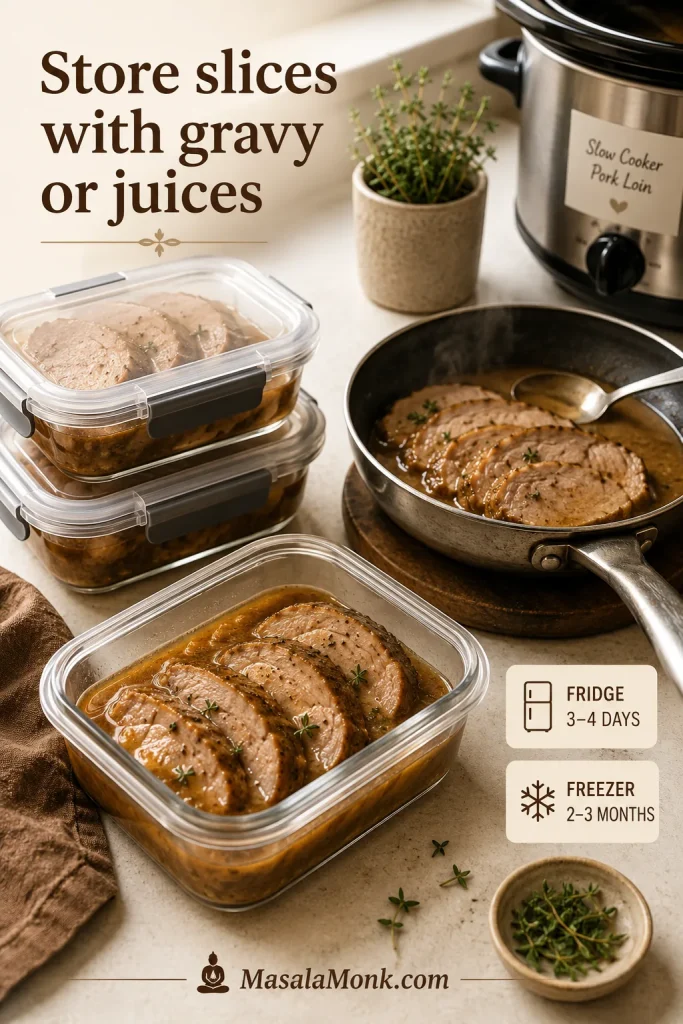
Sliced pork loin stored in containers with gravy and reheated gently in a pan with cooking juices.
Store leftover pork loin slices with gravy or juices, so gentle reheating keeps the lean meat from tasting dry the next day.
Reheating tip: Pork loin is lean, so reheat slices with a spoonful of broth, gravy, or slow-cooker juices. Dry heat makes leftovers taste tougher than they really are.

If the slices already seem dry, use the troubleshooting tips before reheating.

If you use the slow cooker for weekly protein prep, these crock pot chicken breast recipes are another easy batch-cooking option.

Troubleshooting: Dry, Tough, Watery, or Bland Pork Loin

If you have ever lifted the lid and wondered whether dinner just went dry, this section is for you. Pork loin is less forgiving than pork shoulder, but most slow cooker problems are fixable with warm juices, a quick gravy, or a better slicing strategy.

If the pork is not perfect, do not panic. Lean pork loin is easy to overcook, but thin slicing, warm juices, and a quick gravy can rescue more than you might think.
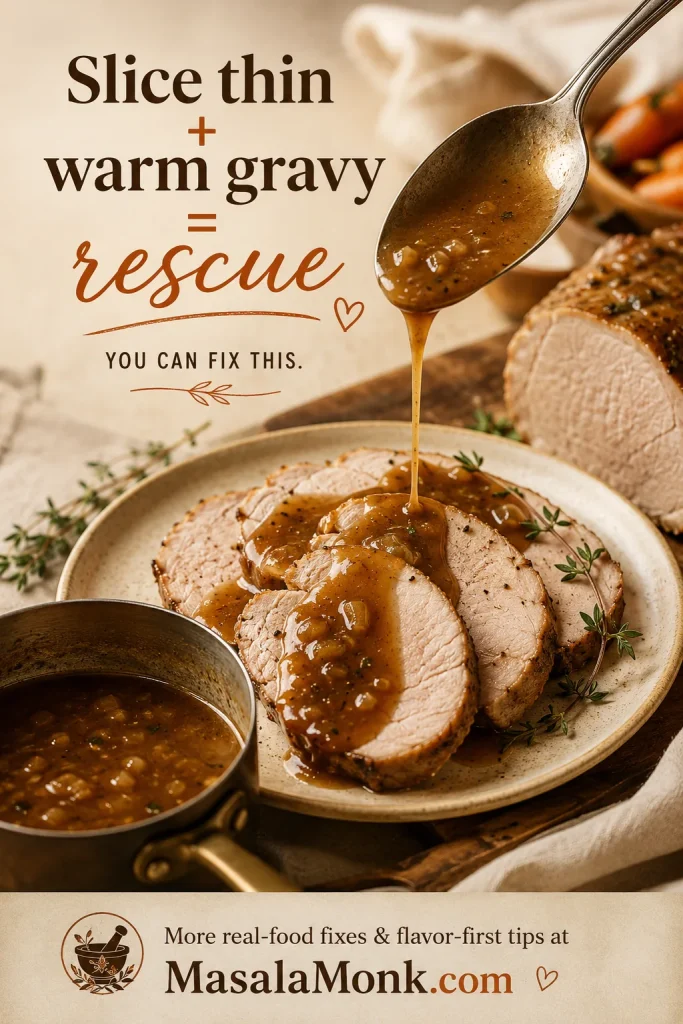
Thin slices of pork loin being covered with warm gravy as a rescue method for dry slow cooker pork.
If the pork loin went a little too far, thin slices and warm reduced juices can make the serving much more forgiving.
Problem Likely cause Best fix
Pork loin is dry Cooked too long, cooked too hot, or sliced without enough sauce Slice thin and serve with gravy or warm juices; next time begin testing earlier
Pork tastes tough Not rested, sliced too thick, or cut with the grain Rest before slicing and cut across the grain into thinner slices
Sauce is watery Too much liquid or no reduction after slow cooking Simmer juices separately and thicken with cornstarch slurry
Pork is cooked but not flavorful Seasoning stayed on the surface or sauce was too diluted Slice the pork, warm it in reduced juices, and finish with a little salt, mustard, or vinegar
Potatoes are still firm Chunks too large or slow cooker packed too full Remove pork when done and keep cooking vegetables until tender
Pork finished too early Smaller roast or hot slow cooker Hold sliced pork in warm juices, not uncovered on a board

FAQs About Slow Cooker Pork Loin

How long does pork loin take in the slow cooker?

A 3 lb / 1.35 kg pork loin usually takes about 3½–4½ hours on LOW for clean, moist slices, but the exact time depends on thickness and your slow cooker. Begin checking around 2½–3 hours and pull the pork when the thickest center reaches 145°F / 63°C. For size-by-size guidance, see the cook-time chart.

Is it better to cook pork loin on LOW or HIGH?

LOW is better for pork loin because it gives you more control and makes it less likely that the lean meat will overshoot the ideal temperature. HIGH can work when you need a faster dinner, but test the center early and do not let the clock make the final call.

What temperature should slow cooker pork loin be?

For tender, sliceable pork loin, cook the thickest center to 145°F / 63°C, then rest before slicing. Longer cooking is for a softer, saucier result, not because 145°F is unsafe for fresh pork roasts when properly rested.

Do you need liquid for pork loin in the crock pot?

Yes, but not a lot. For a 3 lb pork loin, ½ cup / 120 ml broth or sauce base is usually enough. Use more only if you are adding lots of potatoes and carrots or want extra gravy. The liquid guide explains why too much broth can leave the sauce watery.

Should pork loin be fat side up or down in the slow cooker?

If your pork loin has a fat cap, place it fat side up. As it cooks, some of the fat can baste the top of the roast. If the fat cap is very thick, trim it slightly before cooking so the sauce does not become greasy.

Can I use bone-in pork loin in the slow cooker?

Yes, but use the thermometer rather than the clock. Bone-in pork loin may cook a little differently depending on shape and thickness. Cook until the thickest part of the meat, away from the bone, reaches 145°F / 63°C, then rest before slicing.

Can I use pork tenderloin instead?

Not with the same timing. Pork tenderloin is smaller and cooks faster than pork loin. Use this slow cooker pork tenderloin recipe instead, or compare the cuts in the cut guide above.

Can I leave pork loin in the slow cooker for 8 hours?

For clean slices, 8 hours is usually too long for pork loin. It is tempting to treat it like an all-day roast, but lean pork loin can dry out when it sits in the slow cooker for that long. If you need an 8-hour cook, use extra sauce and expect a softer texture, or choose pork shoulder for a more forgiving pulled-pork result.

Can you overcook pork loin in a slow cooker?

Yes. Pork loin can overcook in a slow cooker because it is much leaner than pork shoulder. For clean slices, begin checking before the longest listed time and pull the roast when the thickest center reaches 145°F / 63°C. If it has already gone too far, slice it thin and serve it with warm gravy or reduced juices.

Should pork loin be covered with liquid in the slow cooker?

No. Pork loin does not need to be covered with liquid in the slow cooker. For a 3 lb roast, about ½ cup broth or sauce base is enough to create moisture and juices for gravy. Too much liquid can make the pork taste boiled and leave the sauce thin.

Is pork roast the same as pork loin?

Not always. “Pork roast” is a general store label, while pork loin is a specific lean roast. Check the package and shape: pork loin is usually wide and fairly lean; pork tenderloin is long and narrow; pork shoulder or pork butt is fattier and better for true pulled pork.

What if my pork loin is done before dinner?

Remove it from the slow cooker, rest it, slice it, and hold the slices in warm gravy or cooking juices. Avoid keeping a finished pork loin cooking just because the vegetables need more time. The vegetables-done-late section shows the safer order.

Can you put frozen pork loin in the slow cooker?

No. Thaw pork loin before putting it in the slow cooker. It is a frustrating answer when you forgot to thaw dinner, but a frozen roast can spend too long warming through before the center reaches a safe temperature. USDA/FSIS slow-cooker guidance says to thaw meat or poultry first. For more detail, see the USDA/FSIS slow cooker food safety guide.

If you forgot to thaw it overnight, use a safe thawing method such as cold-water thawing or microwave thawing, then cook the pork immediately. Do not thaw pork loin on the counter.

Why is my slow cooker pork loin dry?

Pork loin usually turns dry when it cooks too long, cooks too hot, or is served without enough sauce. For this batch, slice it thin, warm the slices in reduced juices, and spoon gravy over the top. For the next batch, use the cook-time chart as a checking window and pull the roast at 145°F / 63°C.

Can I make pulled pork from pork loin?

Yes, pork loin can make a leaner BBQ-style pulled pork, but it needs extra sauce and will not be as rich or moist as pork shoulder. For classic fall-apart pulled pork, pork shoulder or pork butt is usually the better cut.

Why does this recipe use temperature instead of one fixed cook time?

Pork loin can be short and thick, long and narrow, small, large, tightly packed with vegetables, or cooked in a slow cooker that runs hot. A fixed time can get you close, but it cannot see the center of the roast. The thermometer gives you the answer that matters: whether the pork is ready to rest and slice.

Once you understand the timing, this becomes a very repeatable dinner: season the pork, let the slow cooker do the quiet work, check the center, and finish with enough sauce to make every slice feel intentional.

Slow Cooker Pork Loin Recipe

Slow cooker pork loin made with garlic, onion, herbs, broth, Dijon, and a simple gravy from the crock pot juices. Cook it to temperature for clean, tender slices, then rest before serving.

Prep Time
15 minutes
Cook Time
Start checking at 2½–3 hours; usually 3½–4½ hours
Total Time
About 4–5 hours
Yield
6–8 servings

Ingredients

  • 3 lb / 1.35 kg boneless pork loin roast
  • 1½ tsp fine sea salt
  • 1 tsp black pepper
  • 1 tsp garlic powder
  • 1 tsp onion powder
  • 1 tsp paprika
  • 1 tsp dried thyme or Italian seasoning
  • 1 tbsp / 15 ml oil, optional for searing
  • 1 large onion, sliced
  • 4 garlic cloves, minced
  • ½ cup / 120 ml low-sodium chicken broth
  • 1 tbsp / 15 g Dijon mustard
  • 2 tbsp / 30 ml apple cider vinegar or balsamic vinegar
  • 1–2 tbsp honey or brown sugar, optional
  • 2 tbsp / 28 g unsalted butter, optional for sauce
  • 1 tbsp / 8 g cornstarch
  • 2 tbsp / 30 ml cold water

Optional Potatoes and Carrots

  • 1 lb / 450 g baby potatoes or large potato chunks
  • 3–4 medium carrots / 300–400 g, cut into thick chunks

Instructions

  1. Pat the pork loin dry. Mix salt, pepper, garlic powder, onion powder, paprika, and thyme. Rub the seasoning all over the pork.
  2. Optional: Heat oil in a large skillet and sear the pork for 2–3 minutes per side until browned.
  3. Add sliced onion to the bottom of a 6-quart slow cooker. Add garlic, broth, Dijon, vinegar, and honey or brown sugar if using.
  4. Place pork loin in the slow cooker, fat side up if it has a fat cap. Add potatoes and carrots around the pork if using.
  5. Cover and cook on LOW. Begin checking around 2½–3 hours, especially if your slow cooker runs hot. Many 3 lb roasts take closer to 3½–4½ hours. Pull the pork when the thickest center reaches 145°F / 63°C.
  6. Transfer pork to a cutting board, tent loosely, and rest for 5–10 minutes.
  7. Pour the slow-cooker juices into a small saucepan. Simmer. Whisk cornstarch with cold water, then add to the simmering juices. Cook until lightly thickened. Whisk in butter if using.
  8. Slice pork across the grain and serve with the gravy or sauce.

Notes

  • LOW gives better control than HIGH for lean pork loin.
  • Use the time range as a checking window; an instant-read thermometer gives the final answer for tender slices.
  • Do not cook frozen pork loin directly in the slow cooker. Thaw first.
  • If vegetables are not tender when the pork is done, remove and rest the pork while the vegetables continue cooking.
  • For a softer, shreddable result, cook longer with extra sauce, but expect a leaner texture than pork shoulder.
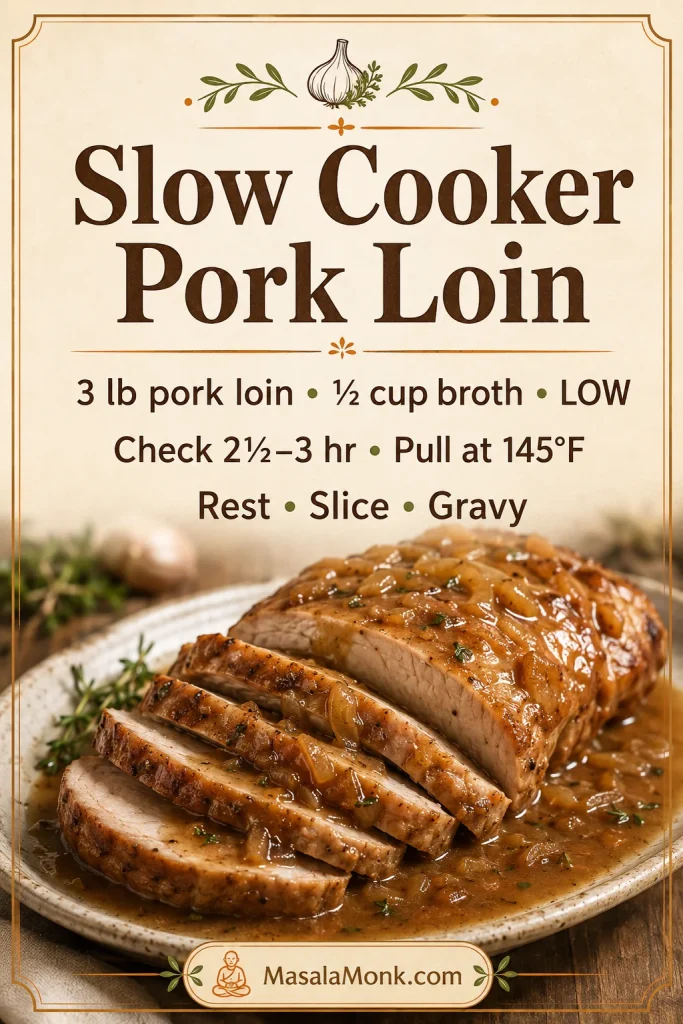
Saveable slow cooker pork loin recipe card with 3 lb pork loin, 1/2 cup broth, LOW heat, 2 1/2 to 3 hour check time, 145°F finish, rest, slice, and gravy.
Save the baseline method for repeat dinners: 3 lb pork loin, modest broth, LOW heat, a 145°F finish, a short rest, and gravy.

If you try it, note your pork loin size and cook time the first time. Once you know how your slow cooker handles this cut, the recipe becomes easy to repeat: tender slices, warm gravy, and a dinner that feels much more finished than the effort it took.
Back to top

Posted on 4 Comments

Fish and Chips Recipe: Crispy Beer Batter, Best Fish, Sauce, and Air Fryer Option

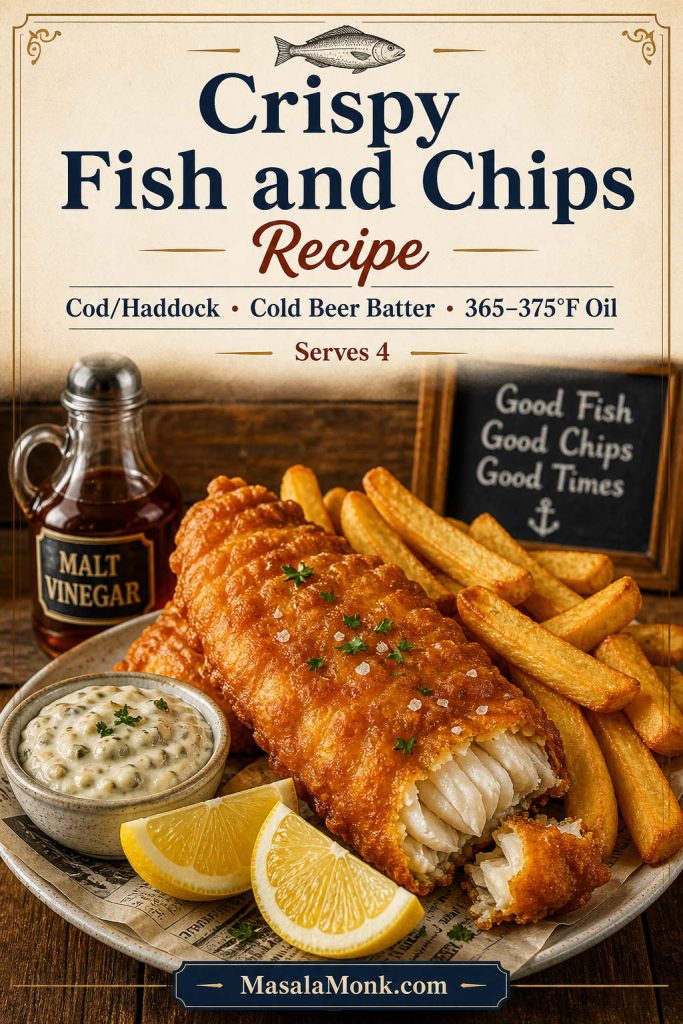
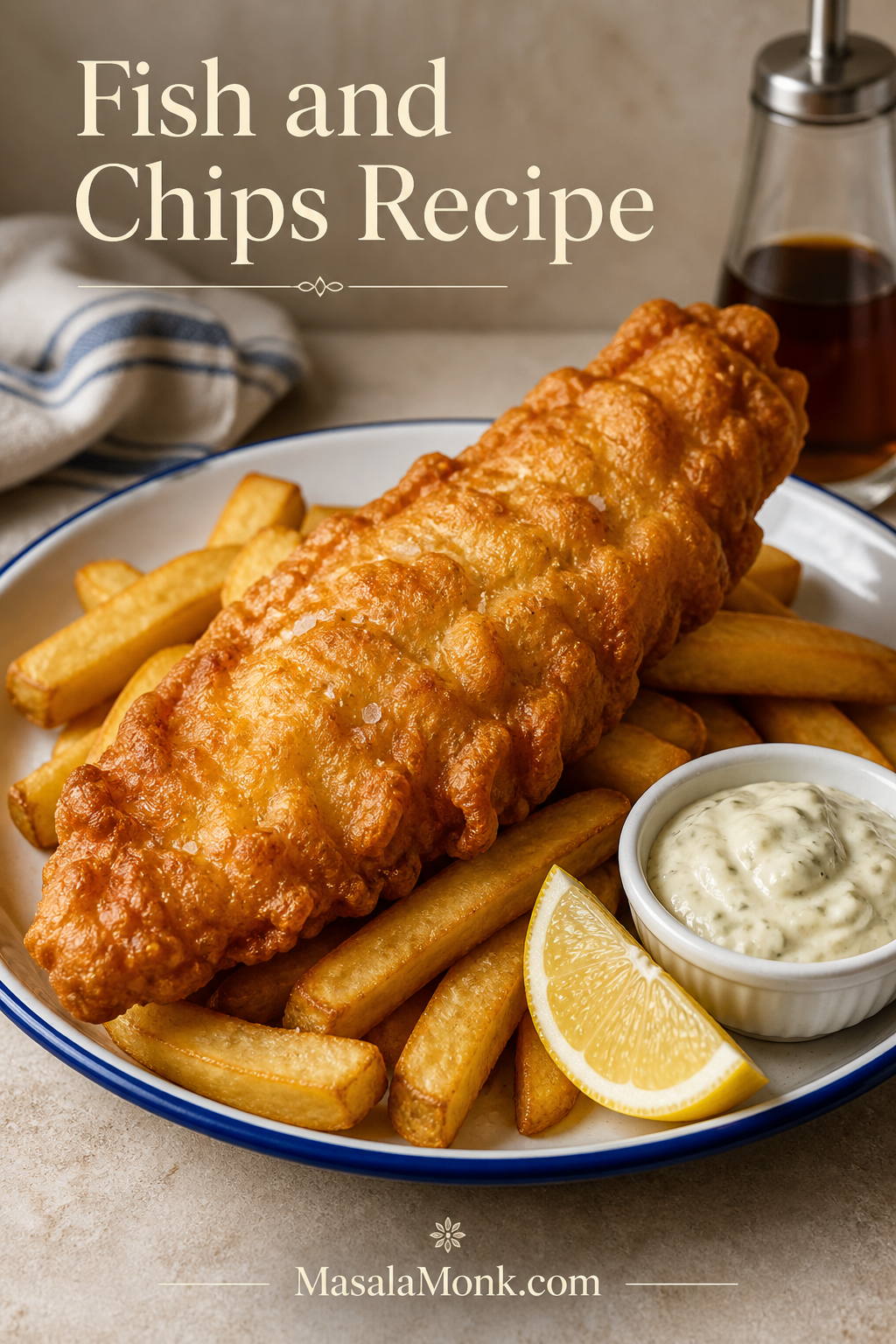
Plate of crispy beer-battered fish with thick golden chips, tartar sauce, lemon wedges, and malt vinegar.

This fish and chips recipe is built for the plate everyone actually wants: crisp beer-battered cod or haddock, thick golden chips, tartar sauce, malt vinegar, optional curry sauce, and no soggy coating sliding off the fish.

The method is classic, but the instructions are practical for a home kitchen. You will dry the fish properly, mix the batter cold, keep the oil in the right temperature range, and time the chips so the whole plate lands hot instead of one part waiting while the other goes soft.

Use the fried version as the main recipe. Then use the no-beer batter, air fryer, baked, and gluten-free notes when you want a different route without pretending every method gives the exact same chip-shop crunch.

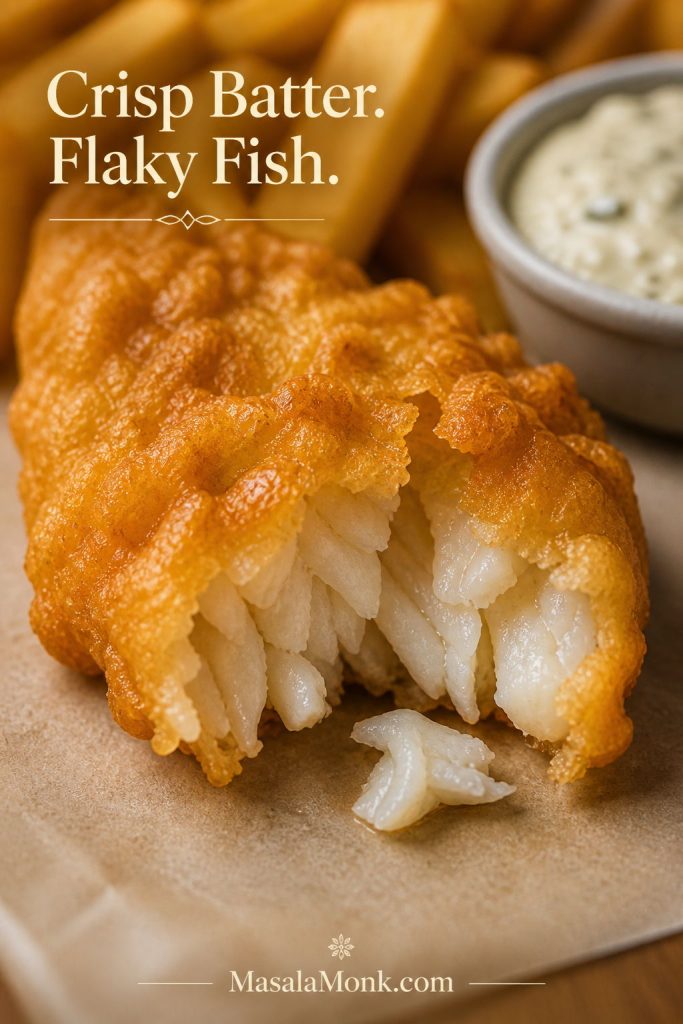
Close-up of a broken piece of beer-battered white fish showing crisp golden coating and flaky fish inside.
The coating should break cleanly while the fish stays moist and flaky inside. If both happen together, your batter thickness and oil temperature are working.

Quick Answer: How to Make This Fish and Chips Recipe

To make crispy fish and chips, use firm white fish like cod or haddock, pat the fish very dry, dust it lightly with flour, dip it in cold beer batter, and fry it in hot oil at about 365°F to 375°F / 185°C to 190°C. Meanwhile, cut floury potatoes into thick chips, rinse or soak them, dry them well, and fry until crisp and golden.

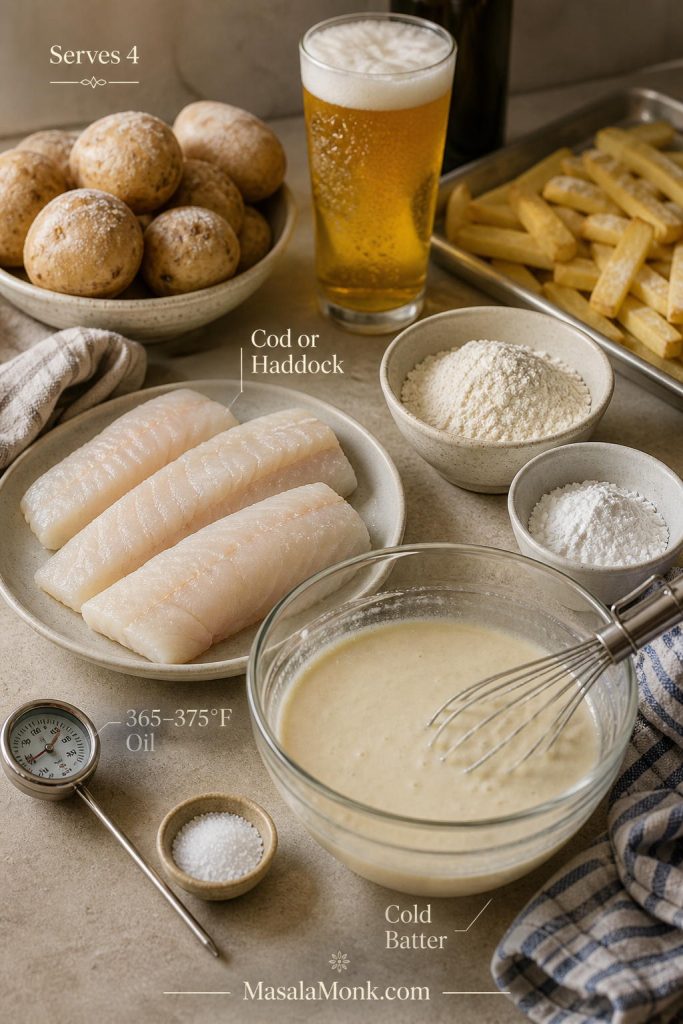
At a glance: Serves 4. Use 1½ lb / 680 g cod or haddock, 2 lb / 900 g floury potatoes, very cold beer batter, and oil at 365°F to 375°F / 185°C to 190°C for the fish. Mix the batter only when you are ready to fry.
Fish and chips prep setup with cod or haddock, potatoes, cold batter ingredients, and frying temperature notes.
Before frying, set up the essentials first: firm white fish, floury potatoes, cold batter ingredients, and a thermometer so the oil stays in the crisp zone.

Serve everything immediately with tartar sauce, malt vinegar, lemon wedges, and optional curry sauce. Fish is best checked with a thermometer and should reach 145°F / 63°C, or be opaque and flaky.

Need the exact method? Jump to the recipe card, or check the batter guide and oil temperature table first.

Why This Fish and Chips Recipe Works

A great plate of fish and chips is not about a complicated ingredient list. Instead, it comes down to moisture control, cold batter, hot oil, and good timing.

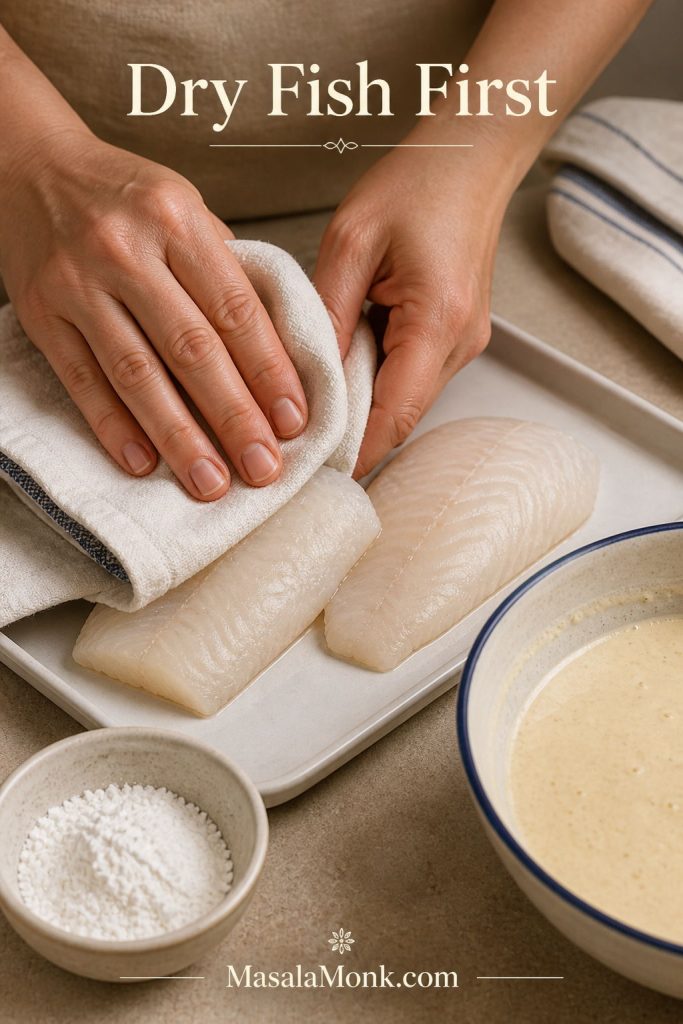
White fish fillets being patted dry with a towel before dusting and battering.
Surface moisture is one of the biggest reasons batter slips. Patting the fish dry first gives the dusting flour something to grip.
  • Dry fish holds batter better. Moisture on the surface makes batter slide off, so the fish is patted dry before seasoning and dusting.
  • A light flour dusting gives the batter grip. The coating clings instead of peeling away in the oil.
  • Cold beer or sparkling water makes a lighter batter. Cold carbonated liquid helps the batter puff quickly when it hits hot oil.
  • Rice flour, cornflour, or cornstarch improves crispness. A little starch lightens the coating and helps avoid a heavy, doughy crust.
  • Baking powder gives lift. It helps the batter puff instead of lying flat against the fish.
  • A thermometer protects the texture. Oil that is too cool makes greasy fish; oil that is too hot browns the batter before the fish cooks.
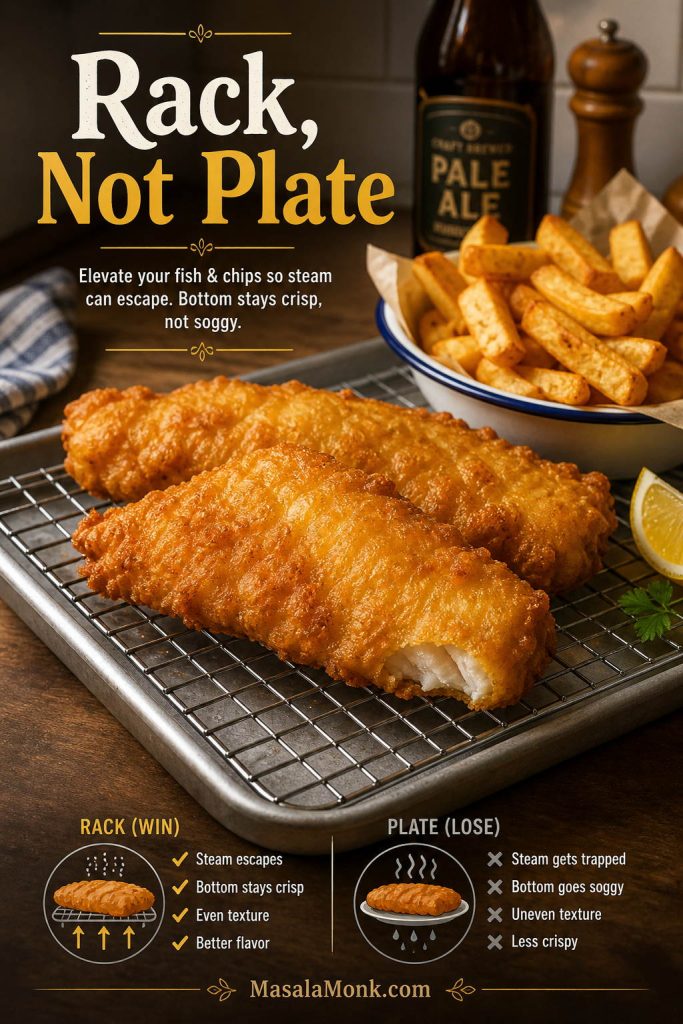
  • A wire rack keeps the underside crisp. Draining fried fish on a plate traps steam underneath.
Do this, not that: Dry the fish instead of battering it wet. Use cold beer or sparkling water instead of warm liquid. Fry in small batches instead of crowding the pot. Drain on a rack instead of a plate. Salt the chips while hot instead of after they cool.

Fish and Chips Recipe Ingredients

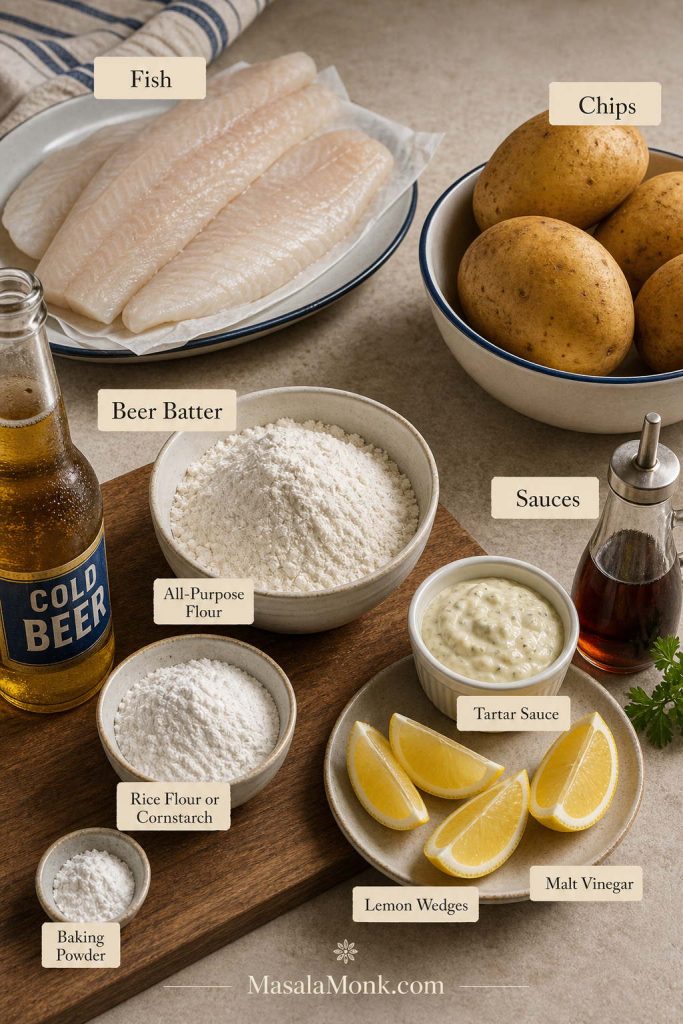
The ingredients are simple, but each one affects the final crunch: firm white fish, floury potatoes, very cold liquid, starch, baking powder, and clean high-heat oil.

Ingredients for homemade fish and chips including white fish, potatoes, flour, starch, cold beer, lemon, tartar sauce, and malt vinegar.
The ingredient list is simple, but each choice affects texture: firm fish for clean flakes, floury potatoes for better chips, and starch for a lighter coating.

Fish

  • Cod or haddock: Cod is the easiest all-purpose choice. However, haddock gives a more classic British-style fish and chips flavor.
  • Salt and black pepper: Season the fish directly before battering.
  • Rice flour, cornflour/cornstarch, or all-purpose flour: This is used for dusting the fish so the batter clings.

Beer Batter

  • All-purpose flour: Gives the batter structure.
  • Rice flour, cornflour, or cornstarch: Keeps the coating lighter and crisper.
  • Baking powder: Adds lift.
  • Fine salt: Seasons the batter.
  • Very cold lager or pale beer: Adds carbonation and lightness.
  • Optional turmeric or paprika: Adds a warmer golden color and mild flavor.

Chips

  • Russet potatoes, Maris Piper, or another floury potato: These give a fluffy inside and crisp outside.
  • Neutral oil: Use sunflower, canola, vegetable, or peanut oil.
  • Salt: Add it immediately after frying.
  • Optional malt vinegar: A small amount in the chip water can help the potatoes hold together before frying.

Serving Sauces and Sides

  • Tartar sauce
  • Malt vinegar
  • Lemon wedges
  • Chip-shop-style curry sauce
  • Mushy peas
  • Pickles or coleslaw

Best Fish for Fish and Chips

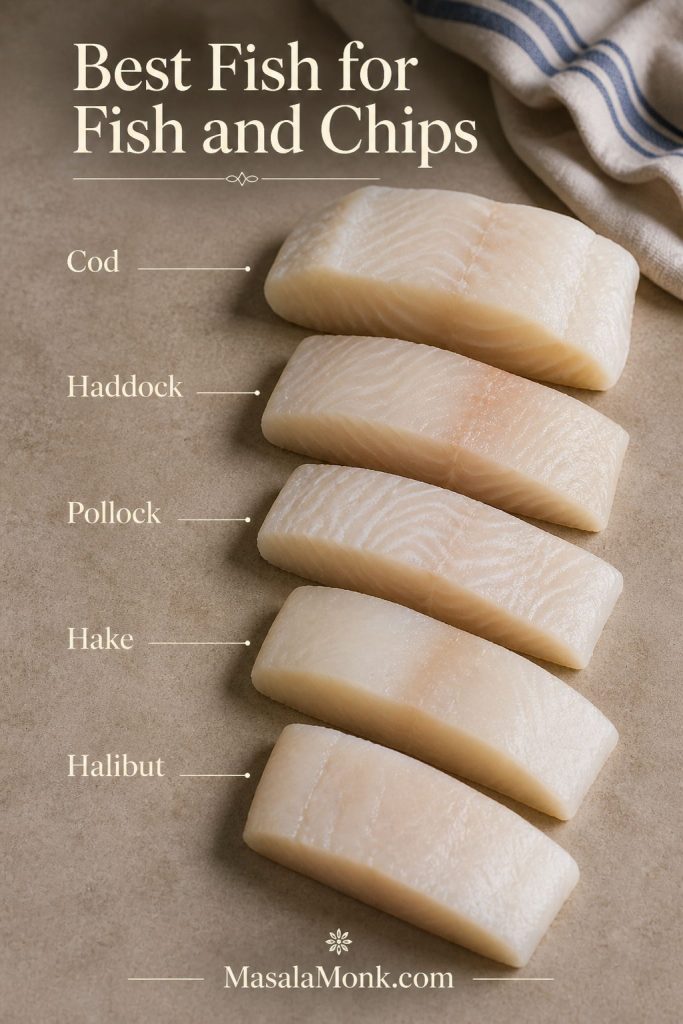
The best fish for fish and chips is a firm white fish that stays moist inside while the batter crisps outside. Cod and haddock are the two most common choices, although they are not the only options.

Comparison of white fish portions labeled cod, haddock, pollock, hake, and halibut for fish and chips.
Cod is mild and beginner-friendly, while haddock gives a more classic chip-shop flavor. Either way, choose firm white fish that can hold its shape in hot oil.
Fish Best For Notes
Cod Easiest first choice Mild, flaky, widely available, and very beginner-friendly.
Haddock Classic British-style fish and chips Slightly stronger flavor than cod and excellent in beer batter.
Pollock Budget-friendly batches Good texture when battered and fried, usually more affordable.
Hake A softer, delicate version Works well, but handle gently because it can be more delicate.
Halibut Premium fish and chips Firm, thick, and excellent, but more expensive.
Whiting or ling Traditional-style alternatives Good options where available, especially for thinner fillets.

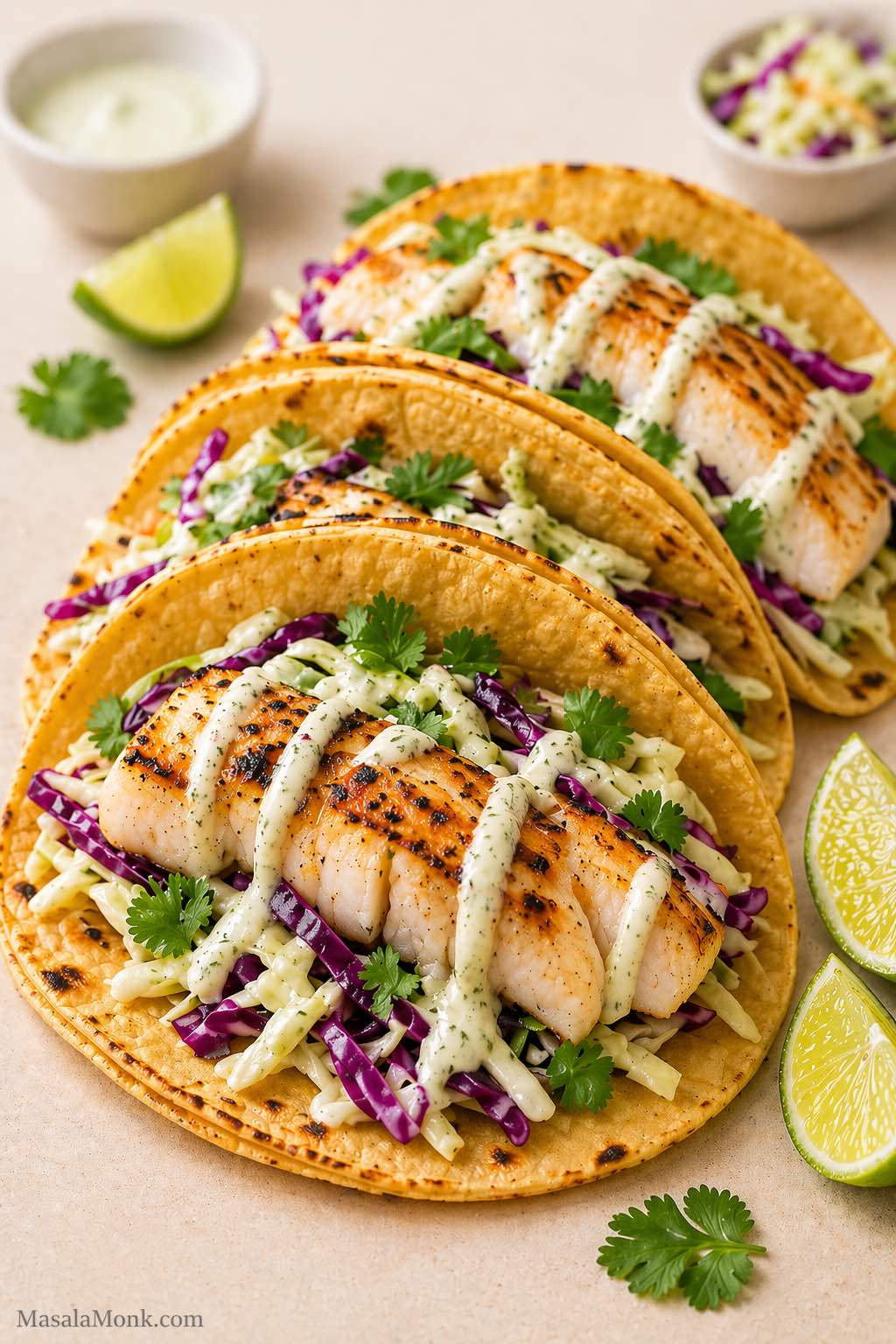
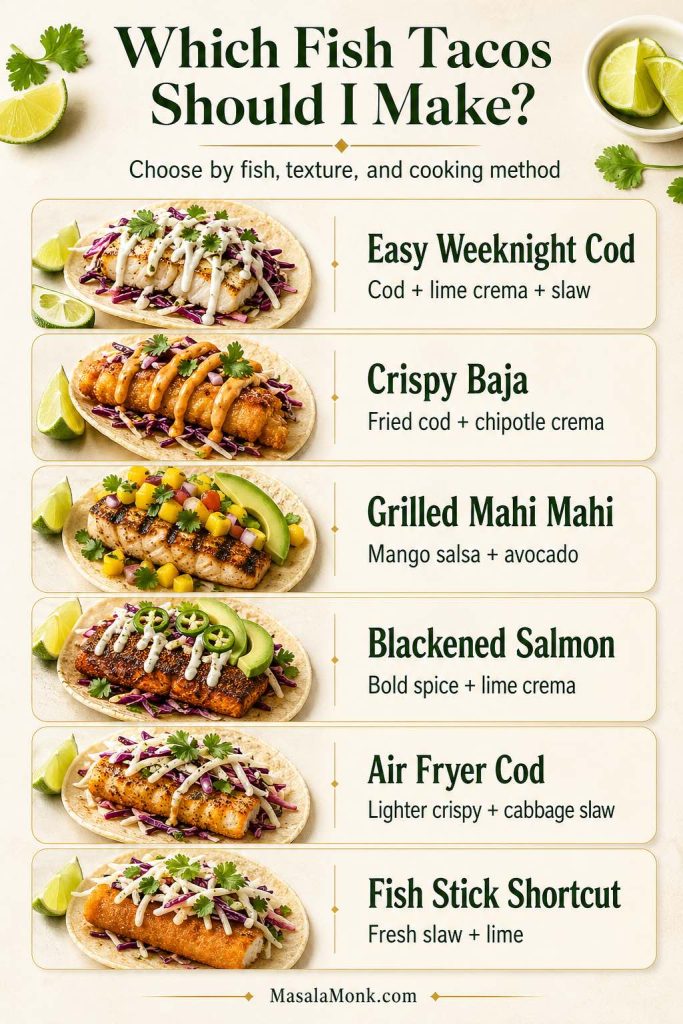
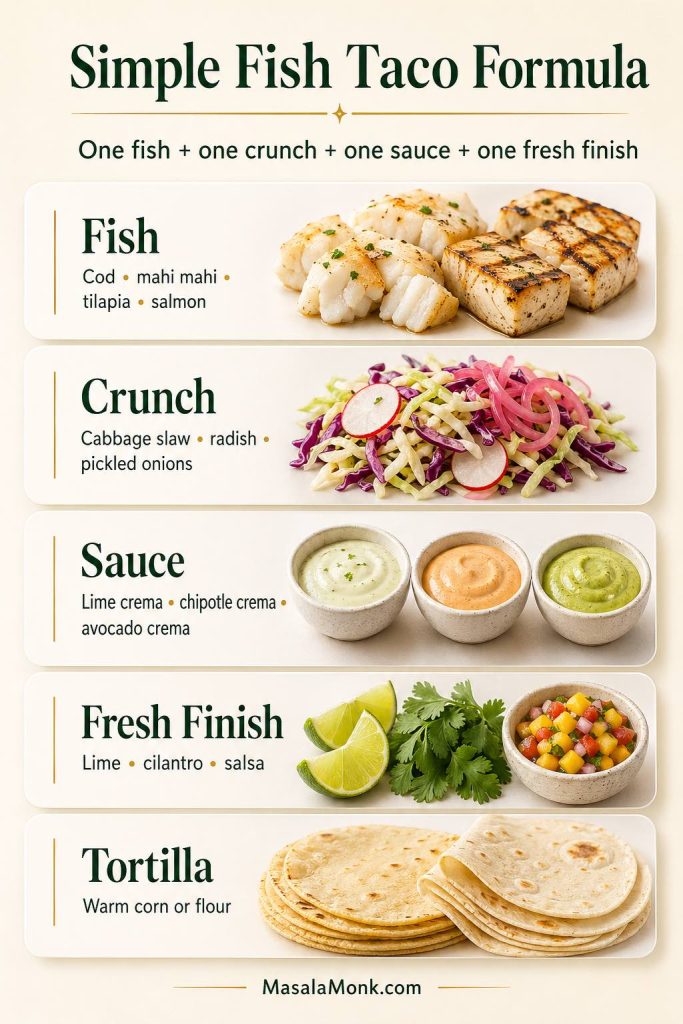
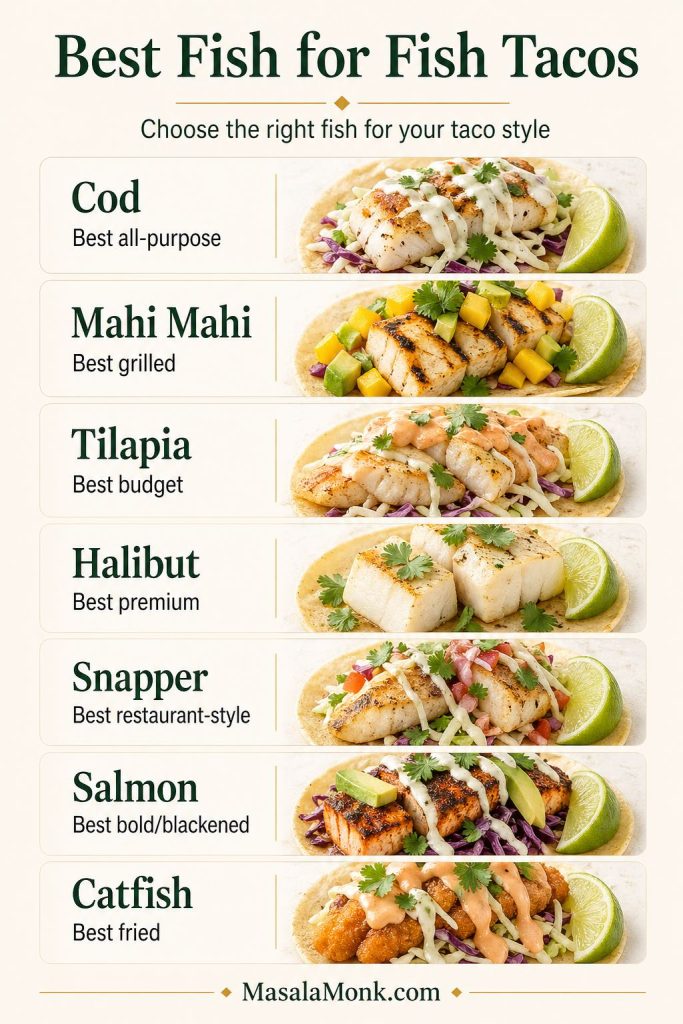
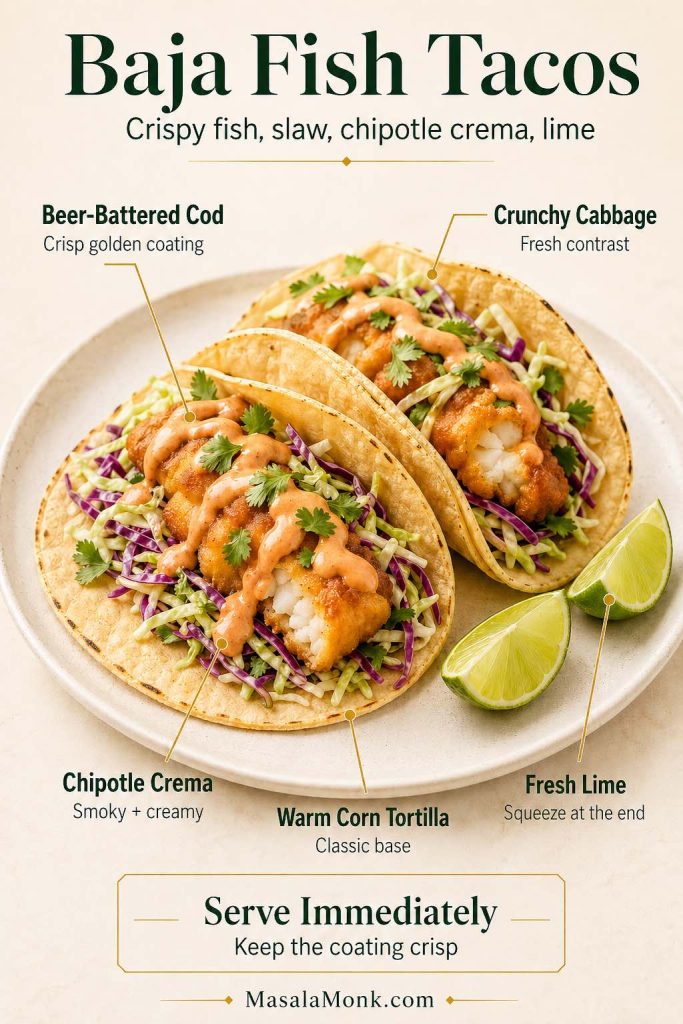
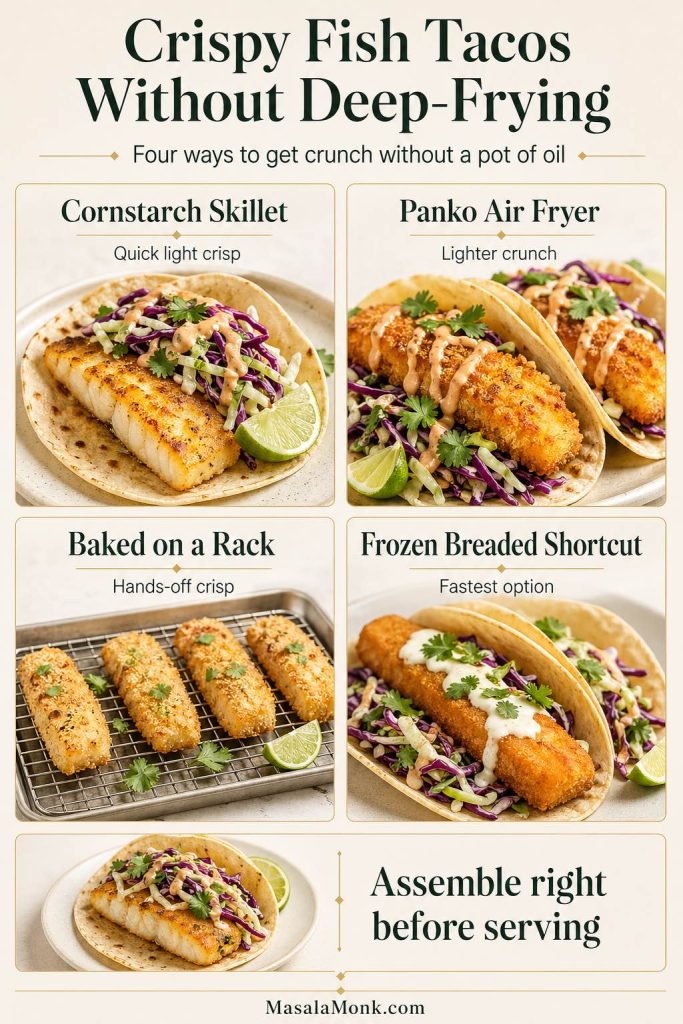
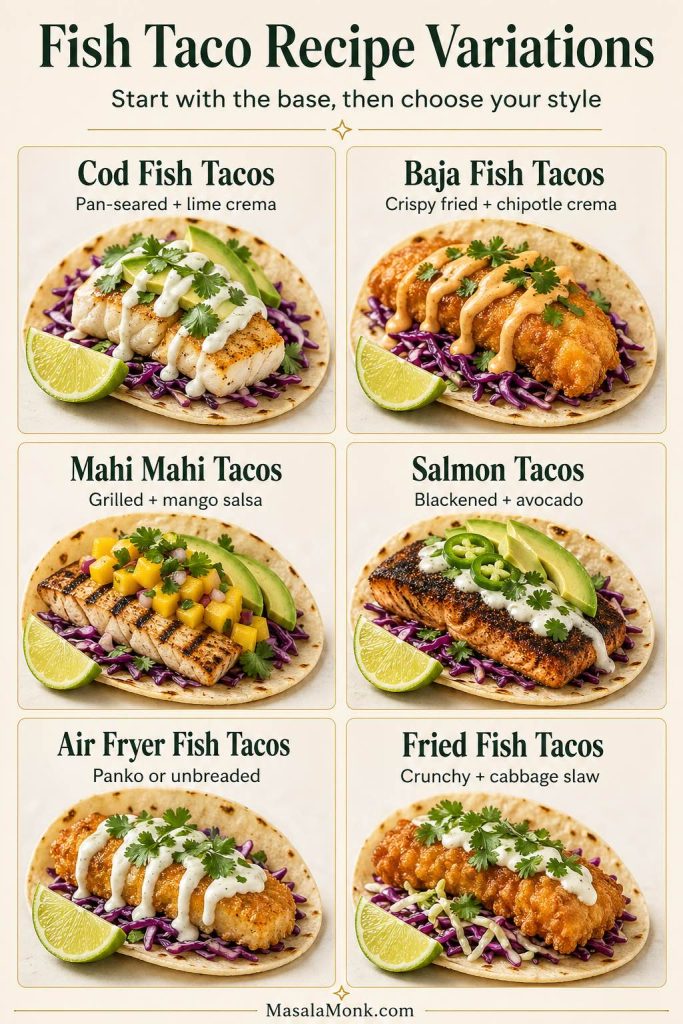
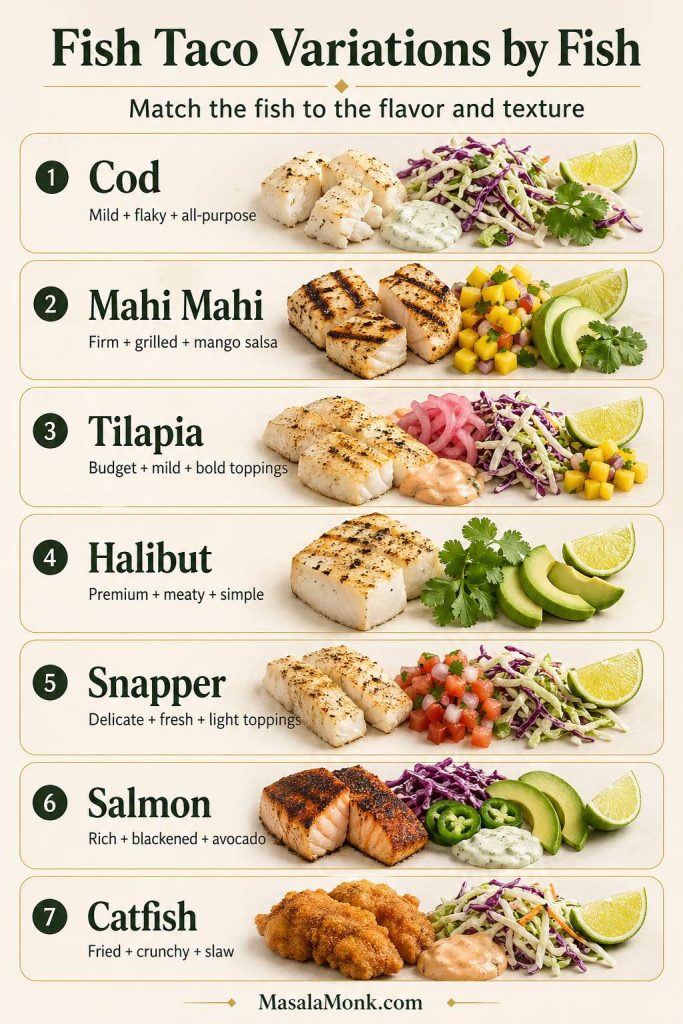
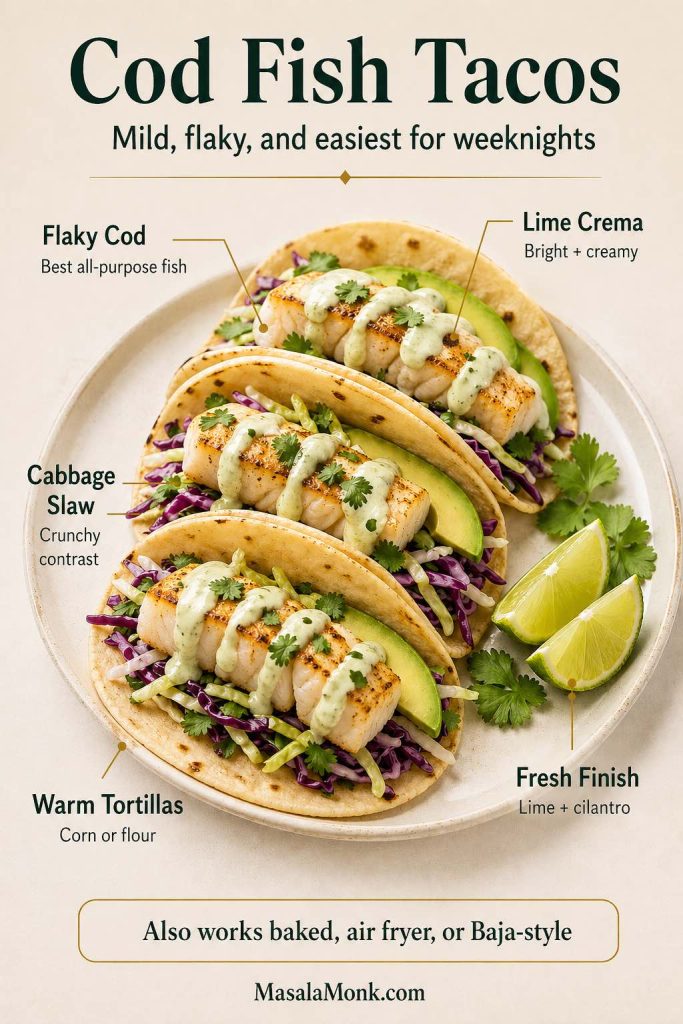
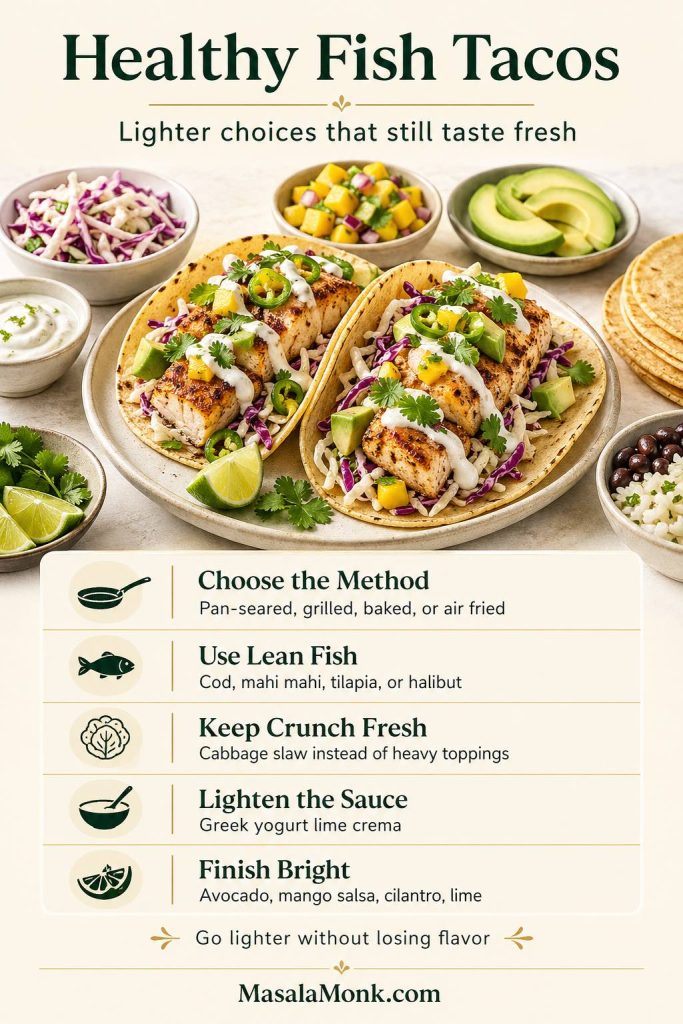
For the main version, cod is the safest first choice. However, haddock is better when you want a more classic pub-style flavor. The same fish also works beautifully in Baja-style fish tacos, where it is paired with slaw, lime crema, and a lighter taco-style build.

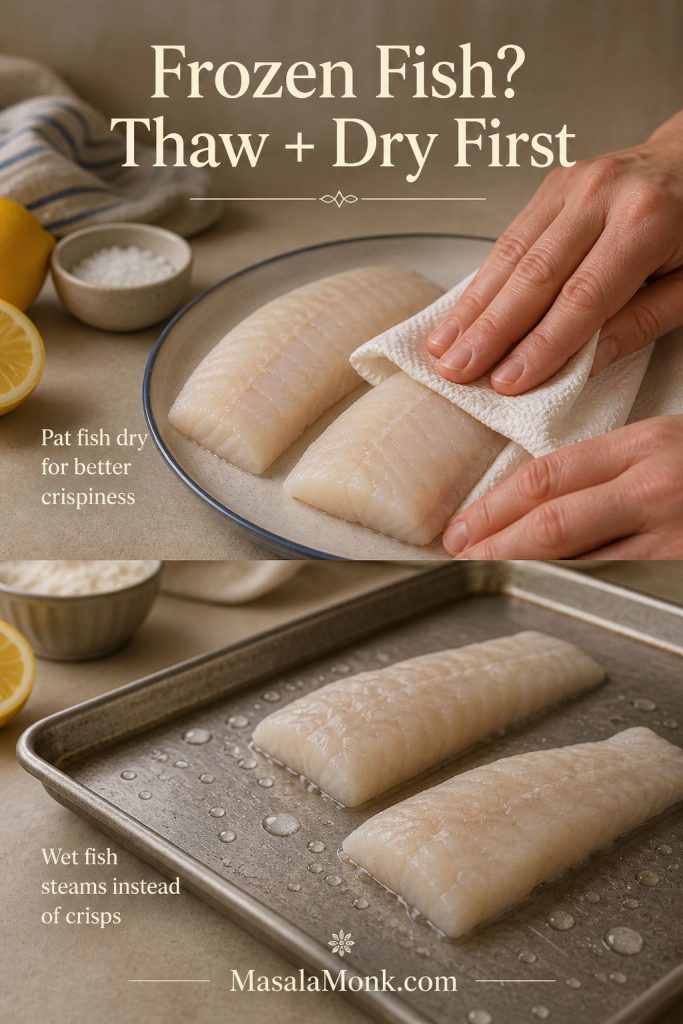
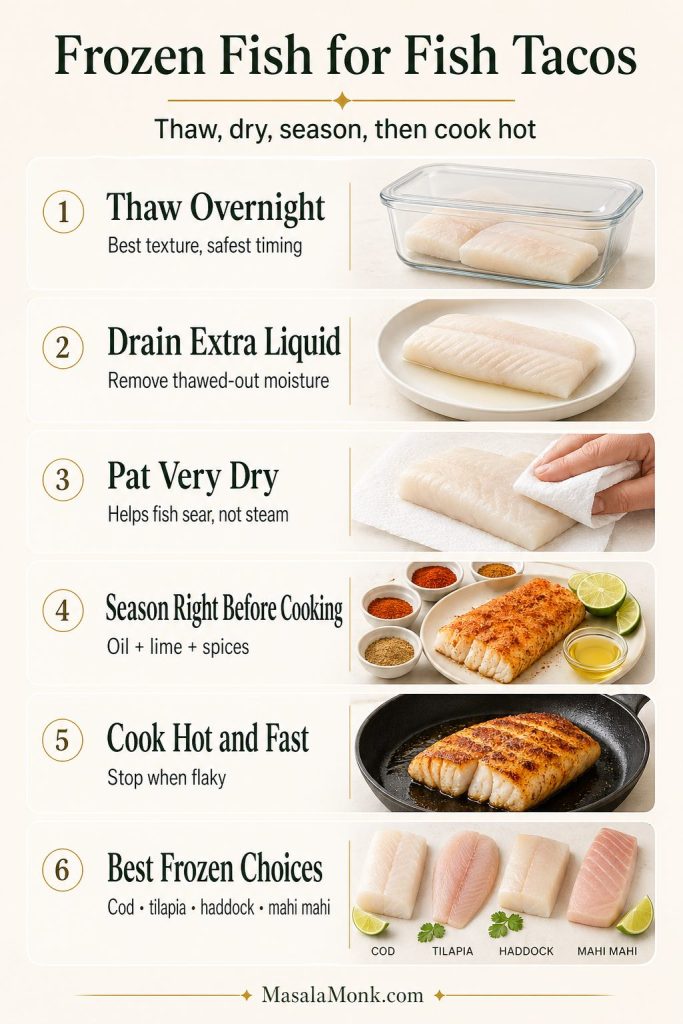
Can You Use Frozen Fish?

Yes, frozen cod or haddock can work well, but thaw it completely and pat it very dry before seasoning. Frozen fish releases extra moisture as it thaws, and that moisture can make the batter slide off or turn soft in the oil.

Frozen or thawed cod being dried before battering for fish and chips.
Frozen fish can work, but it needs extra care. Thaw it fully, then dry it well so the batter does not loosen as it fries.

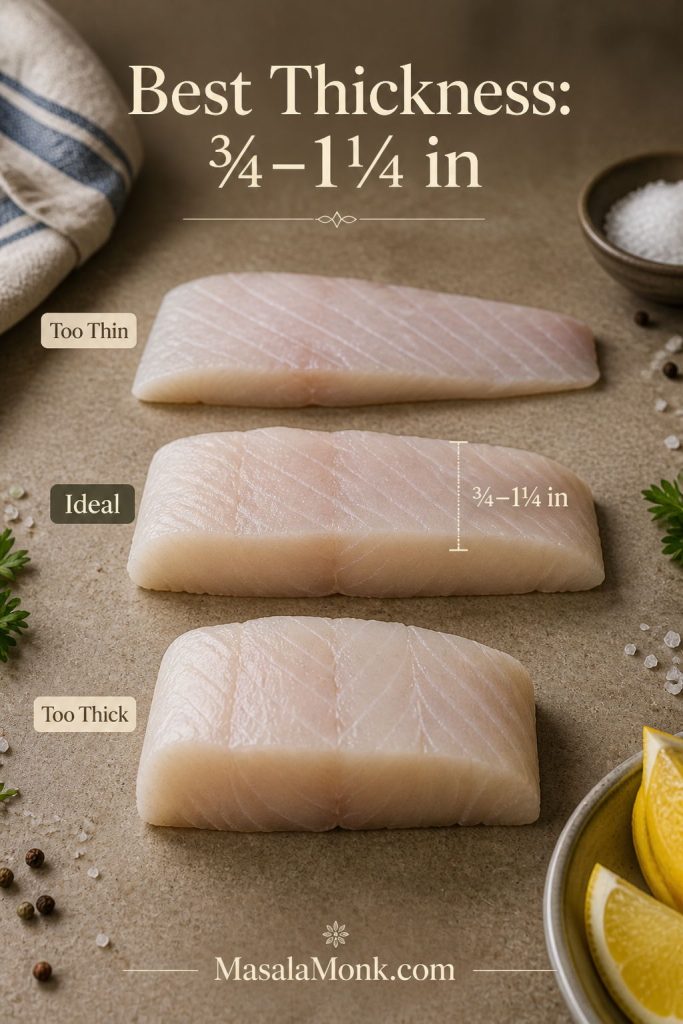
Fish thickness cue: Aim for pieces that are thick enough to stay moist, but not so thick that the batter browns before the center cooks.

Fish thickness guide showing white fish portions that are too thin, ideal thickness, and too thick for fish and chips.
Fish that is too thin dries quickly, while very thick pieces can brown outside before cooking through. Moderate thickness gives the batter and fish time to finish together.
Best thickness: Aim for fish pieces about ¾ to 1¼ inches / 2 to 3 cm thick. Very thick fish can brown outside before cooking through, while very thin fish can dry out quickly.

Once you’ve chosen your fish, move to the fish and chips batter guide or go straight to how to make fish and chips step by step.

Fish and Chips Batter

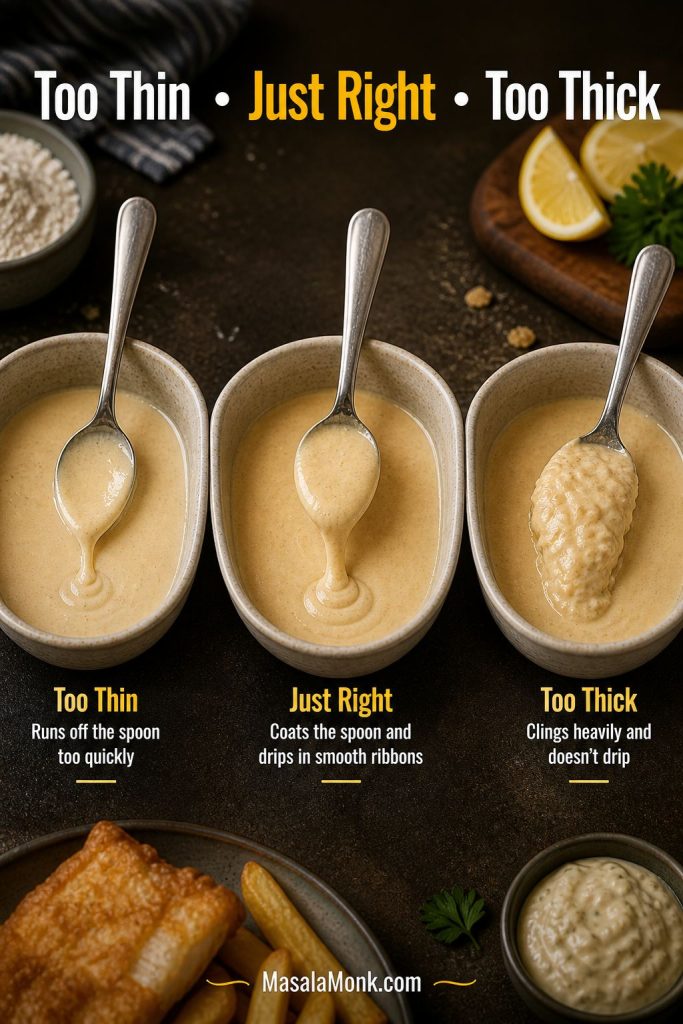
The batter should shatter lightly when you bite into it, not sit on the fish like a thick doughy coat. You are looking for a mixture that feels loose but not watery — closer to thin pancake batter or double cream than a heavy fritter mix.

It should coat the back of a spoon, then drip off in ribbons. If it runs off like water, it is too thin. If it clings in a heavy layer, it is too thick.

Batter texture cue: The batter should coat the spoon and drip in slow ribbons before you dip the fish.

Spoon lifting fish and chips batter from a bowl with batter dripping in ribbons.
The right fish batter should coat the spoon and fall in slow ribbons. If it runs off or clumps heavily, adjust before dipping the fish.

Beer Batter for Fish and Chips

Cold beer being poured into flour and starch mixture to make beer batter for fish and chips.
Cold beer adds bubbles and lightness to the batter. Mix it just before frying so the batter stays cold, active, and ready to puff in the oil.

For the main version, use cold lager or pale beer. The beer should be chilled, and the batter should be mixed just before frying. Do not overmix it; a few tiny lumps are fine.

A good basic beer batter for fish and chips uses:

  • ¾ cup / 95 g all-purpose flour
  • ¼ cup / 40 g rice flour, cornflour, or cornstarch
  • 1¼ teaspoons baking powder
  • ½ teaspoon fine salt
  • 1 cup / 240 ml very cold lager or pale beer

Lighter beers give the cleanest flavor and the most classic golden color. Save stout or porter for a darker, more bitter batter.

Fish and Chips Batter Without Beer

Sparkling water being poured into batter ingredients for a no-beer fish and chips batter.
Sparkling water or club soda is the best no-beer swap because it still brings carbonation. Keep it ice-cold so the coating fries lighter and crisper.

To make fish and chips batter without beer, use the same dry ingredients and replace the beer with 1 cup / 240 ml ice-cold sparkling water or club soda. Then add an extra ¼ teaspoon baking powder to help the batter puff.

The no-beer version tastes less malty, but it can still fry up crisp if the liquid is ice-cold and the oil is hot.

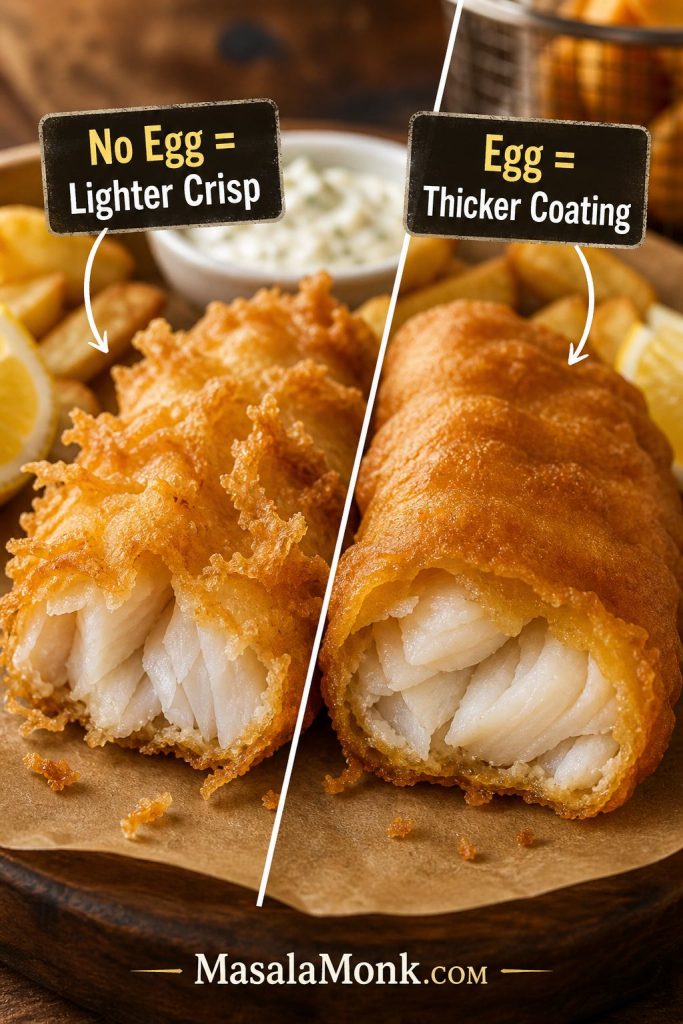
Should Fish and Chips Batter Have Egg?

Comparison of fried fish batter made without egg and with egg, showing a lighter crisp coating and a thicker coating.
Egg makes fish batter sturdier, but it can also make the coating heavier. For classic crispy fish and chips, the lighter egg-free version is the better first choice.

For the crispiest classic fish and chips batter, skip the egg. Egg can make the coating richer and sturdier, but it also pushes the batter toward a heavier, chewier, more cakey texture. This recipe uses flour, rice flour or cornstarch, baking powder, salt, and very cold beer or sparkling water for a lighter crisp shell.

If you prefer a thicker, more old-fashioned coating, you can add 1 beaten egg, but start with 2 to 3 tablespoons less beer or sparkling water and thin the batter only if needed. For a crisp pub-style finish, the egg-free batter is the better first choice.

Optional Extra-Crisp Batter Upgrade

For an extra-crisp batter, replace 2 to 4 tablespoons / 30 to 60 ml of the beer with vodka. This is optional, not required. The standard beer batter already works well for a home kitchen.

How to Fix Batter Thickness Before Frying

Three spoons of fish batter showing too thin, just right, and too thick consistencies.
Batter texture is easier to judge by sight than by mixing time. Aim for a smooth coating that clings lightly, then drips slowly.
Batter Problem What It Looks Like Fix
Too thin Runs straight off the fish and leaves bare patches. Add flour or rice flour 1 tablespoon at a time.
Just right Coats the fish and drips slowly in ribbons. Use immediately while cold.
Too thick Clings in a heavy, doughy layer. Add cold beer or sparkling water 1 tablespoon at a time.

Batter ready? Check the oil temperature and frying timing before you fry, or use the troubleshooting table if your batter feels too thick, thin, or loose.

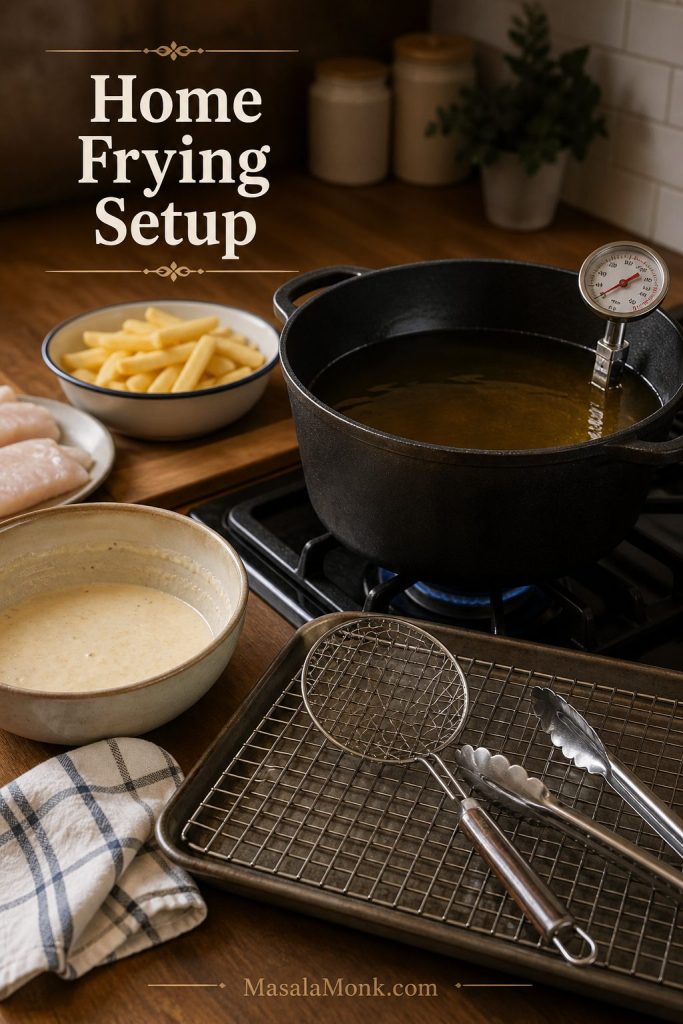
Equipment You’ll Need

You do not need a restaurant fryer for homemade fish and chips, but the right setup makes a big difference. A heavy pot, thermometer, and wire rack will do more for crispness than extra batter ever will.

Home frying setup with a heavy pot, thermometer, wire rack, tray, skimmer, towel, and batter bowl.
A heavy pot, thermometer, and wire rack are the real crispness tools. Control the oil first, then drain the fish where steam can escape.
Equipment Why It Helps
Dutch oven, deep heavy pot, wok, or deep fryer Holds heat better and gives the fish enough room to fry.
Deep-fry thermometer Keeps the oil in the crisp zone instead of guessing.
Wire rack and rimmed baking sheet Lets steam escape so the underside of the fish stays crisp.
Spider skimmer or tongs Makes lowering and removing fish safer.
Mixing bowls Useful for dredging flour, batter, and sauces.
Kitchen towels or paper towels Dry fish and potatoes before frying.
Kitchen scale Gives better accuracy for flour and fish weight.
Instant-read thermometer Confirms the fish has reached 145°F / 63°C.

How to Make Fish and Chips Step by Step

This homemade version works best when you cook in the right order. Prepare the sauce first, start the chips next, mix the batter only when the oil is ready, then fry the fish and finish the chips close to serving.

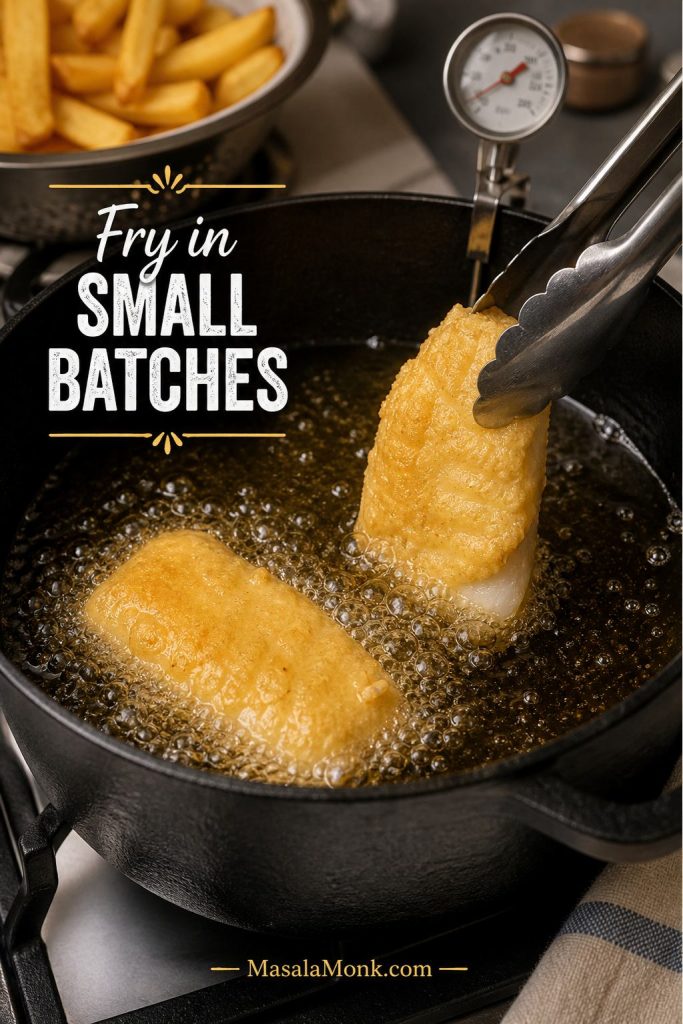
Beer-battered fish being lowered into hot oil with bubbles forming around the coating.
Small batches protect the oil temperature. As a result, the batter sets quickly instead of absorbing oil and turning greasy.
  1. Make the sauce first. Tartar sauce and curry sauce can sit while you fry.
  2. Cut the potatoes. Slice them into thick chips about ½ to ⅝ inch / 1.2 to 1.5 cm thick.
  3. Rinse or soak the chips. This removes excess starch.
  4. Dry the chips very well. Wet potatoes splatter and soften in the oil.
  5. Pat the fish dry. This is one of the most important steps.
  6. Season the fish. Use salt and black pepper before dusting.
  7. First-fry or par-cook the chips. This softens the inside before the final crisping step.
  8. Mix the cold batter. Do this just before frying the fish.
  9. Dust the fish with flour or starch. Use rice flour, cornflour, cornstarch, or plain flour.
  10. Dip the fish in batter. Let excess batter drip off.
  11. Fry the fish. Cook until deeply golden, crisp, and flaky inside.
  12. Finish the chips. Fry or final-fry them hot until crisp and golden.
  13. Serve immediately. Add salt, tartar sauce, malt vinegar, lemon, and curry sauce if using.

How to Make Crispy Chips for Fish and Chips

The chips need to earn their place on the plate: crisp-edged, fluffy inside, salted while hot, and sturdy enough for malt vinegar or curry sauce.

Best Potatoes for Fish and Chips

Comparison of potatoes for fish and chips, including floury or starchy potatoes and waxy potatoes.
Floury potatoes make chips with fluffy centers and crisp edges. Waxy potatoes can still fry, but they usually taste denser.

The best potatoes for fish and chips are floury or starchy potatoes because they cook up fluffy inside and crisp outside. Use russet potatoes in the U.S., Maris Piper or King Edward in the U.K., or another floury potato where you live. Waxy potatoes can work, but they usually make denser chips with less fluffy centers.

There are two good ways to handle the potatoes: double-fry them, or parboil them first and then fry. You do not have to do both unless you want the extra step.

Option 1: Double-Fry Chips

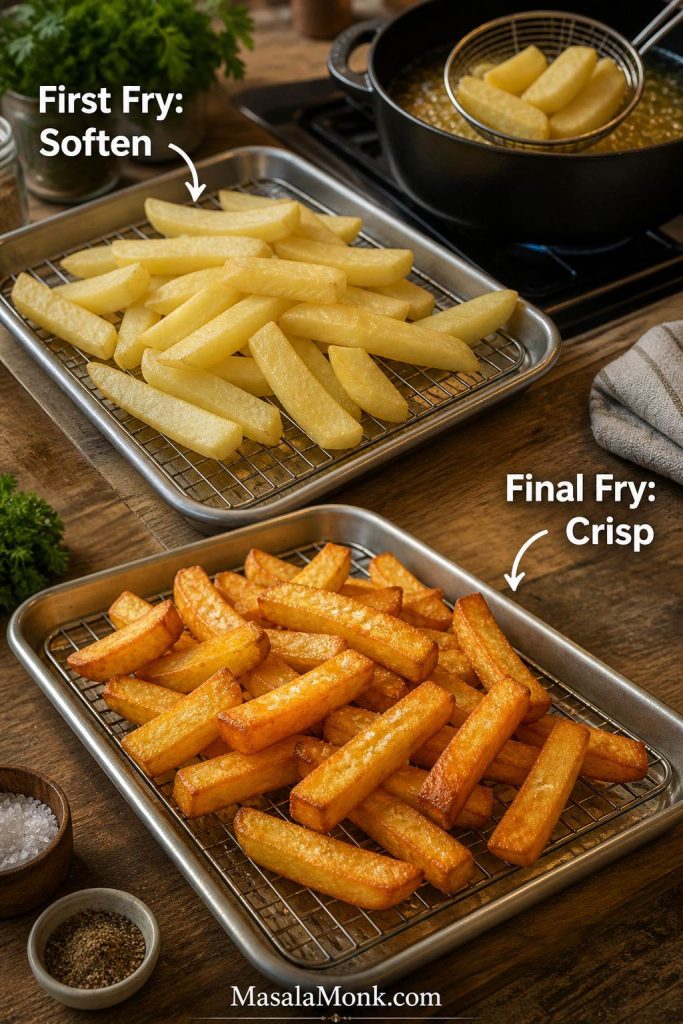
Double-fried chips showing pale first-fried chips and golden final-fried chips.
The first fry cooks the potato through; the second fry builds the golden edge. That is why double-fried chips hold up better with vinegar or curry sauce.
  • Cut chips about ½ to ⅝ inch / 1.2 to 1.5 cm thick.
  • Rinse or soak until the water is mostly clear.
  • Dry the chips very well before frying.
  • First-fry at 325°F / 160°C until softened but pale.
  • Rest briefly, then final-fry at 375°F / 190°C until golden.
  • Salt immediately after frying.

Option 2: Parboil, Dry, Then Fry

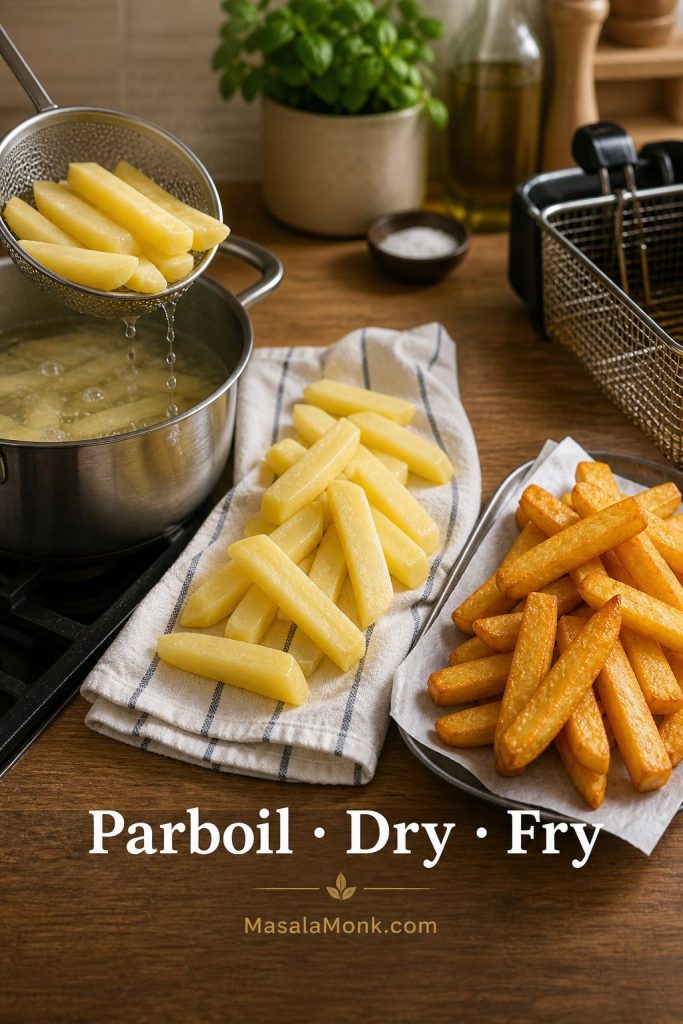
Thick-cut chips being parboiled, dried, and fried for fish and chips.
Parboiling helps chips turn fluffy inside, but drying is the step that makes frying work. Wet potatoes soften and splatter instead of crisping.
  • Cut the potatoes into thick chips.
  • Simmer in salted water with 1 teaspoon malt vinegar for 8 to 10 minutes, until just tender at the edges but not falling apart.
  • Drain carefully and dry very well.
  • Chill if you have time, then fry once at 375°F / 190°C until crisp and golden.
  • Salt immediately after frying.

For a deeper potato-only guide with double-fry timing, air fryer fries, oven fries, cuts, coatings, and seasoning ideas, use MasalaMonk’s crispy homemade French fries guide alongside this fish and chips recipe.

To time the chips with the fish, use the serve everything hot sequence before starting the final fry.

Best Oil Temperature for Fish and Chips

Oil temperature is where homemade fish and chips usually succeed or fail. Too cool, and the batter drinks oil. Too hot, and the coating browns before the fish turns flaky inside.

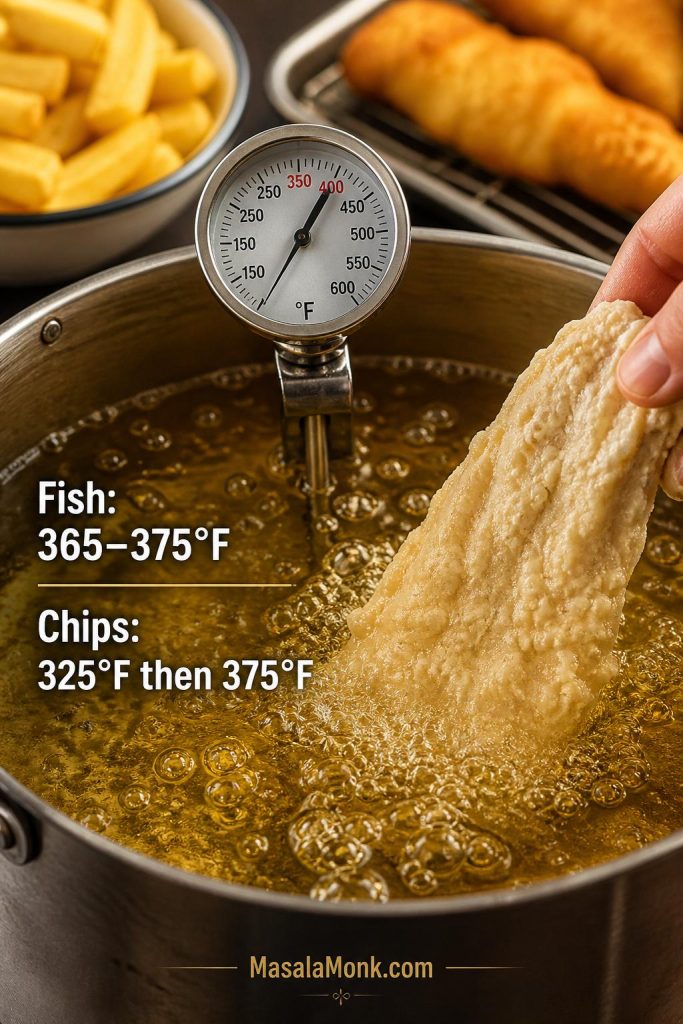
Frying thermometer in hot oil with fish and chips nearby for fish and chips temperature control.
Oil temperature decides whether fish batter crisps or turns greasy. Let the oil recover between batches rather than rushing the next piece in.
Item Temperature Time
First-fry chips 325°F / 160°C 3 to 5 minutes
Final-fry chips 375°F / 190°C 2 to 4 minutes
Fry fish 365°F to 375°F / 185°C to 190°C 4 to 6 minutes for 5 to 6 oz pieces
Fish doneness 145°F / 63°C internal temperature Until opaque and flaky

Start the oil slightly hotter than your minimum target because the temperature drops when cold battered fish goes in. Then fry in small batches and let the oil recover between batches.

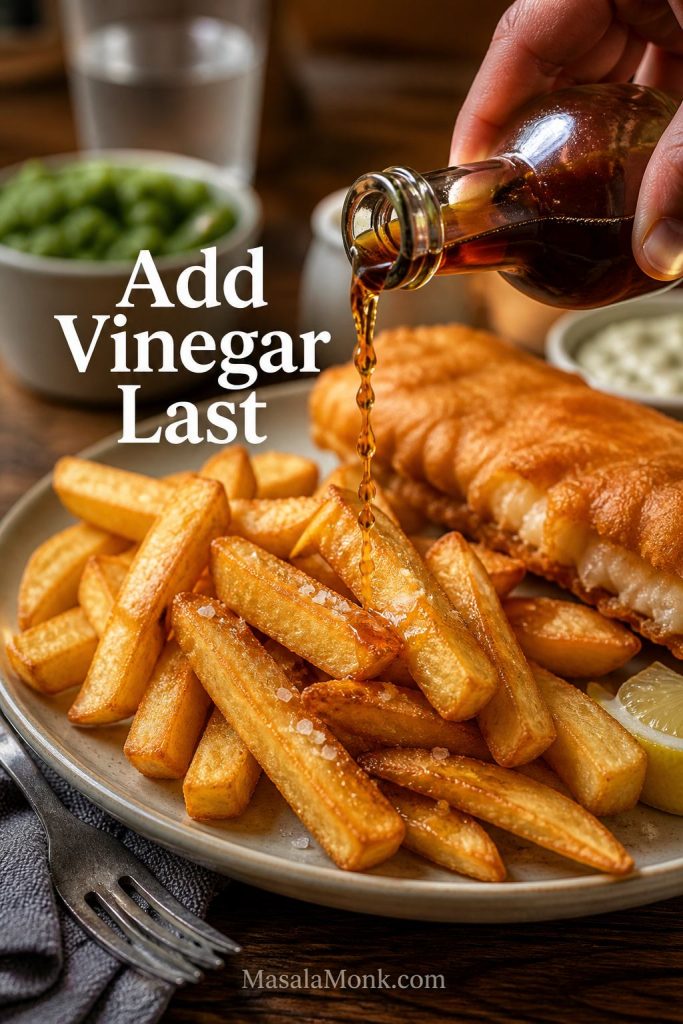
Vinegar timing cue: Add malt vinegar at the table or right before eating so the chips keep their crisp edges longer.

Vinegar timing: Add malt vinegar at the table or right before eating. If the fish or chips sit too long after vinegar is added, the crisp coating softens quickly.
Malt vinegar being poured over thick chips beside crispy battered fish.
Malt vinegar gives fish and chips their sharp finish. However, add it right before eating so the chips stay crisp longer.

If your oil temperature keeps dropping or the coating turns greasy, jump to common fish and chips fixes.

How to Serve Fish and Chips Hot at the Same Time

The danger zone is not the frying itself; it is letting one part of the meal sit while the other finishes. Fish and chips should land on the plate hot, crisp, and uncovered, with the chips salted while they are still fresh from the oil.

Crispy battered fish draining on a wire rack over a tray with chips nearby.
A wire rack keeps fried fish crisp underneath because steam can escape. By contrast, a plate traps moisture and softens the coating.

Use this order:

  1. Make tartar sauce and curry sauce first.
  2. Cut, rinse, and dry the chips.
  3. Pat the fish dry and portion it.
  4. First-fry or par-cook the chips.
  5. Heat the oil for fish.
  6. Mix the cold batter right before frying.
  7. Fry the fish and drain it on a wire rack.
  8. Final-fry or finish the chips while the fish rests briefly.
  9. Salt the chips and serve everything immediately.

If needed, keep cooked chips warm in a low oven around 250°F / 120°C while you finish the fish. However, do not cover fried fish tightly or it will steam and soften.

Ready to cook? Use the full recipe card below, and keep the oil temperature table handy while frying.

Saveable fish and chips recipe card with crispy battered fish, chips, tartar sauce, lemon, and recipe notes.
Keep the main method simple: dry the fish, mix the batter cold, fry in hot oil, then drain on a rack before serving.

Crispy Fish and Chips Recipe

This homemade fish and chips recipe uses cod or haddock, a cold beer batter, thick-cut chips, and a clear frying method so the fish turns crisp outside and flaky inside. It also includes no-beer, air fryer, baked, and gluten-free notes.

Servings4
Prep Time30 minutes
Cook Time30 minutes
Total Time1 hour
Best texture targets: Fry fish at 365°F to 375°F / 185°C to 190°C, keep the batter ice cold, cut fish into 5 to 6 oz pieces, and drain on a wire rack instead of a plate.

Ingredients

Fish

  • 1½ lb / 680 g cod or haddock fillets, cut into 4 large pieces or 6 to 8 smaller pieces
  • ½ teaspoon fine salt
  • ¼ teaspoon black pepper
  • ¼ cup / 40 g rice flour, cornflour, cornstarch, or all-purpose flour, for dusting

Chips

  • 2 lb / 900 g russet potatoes, Maris Piper, or other floury potatoes
  • 1 teaspoon malt vinegar, optional for parboiling
  • Fine salt, to taste
  • 1½ to 2 litres neutral high-heat oil, or enough for 2 to 3 inches / 5 to 7 cm depth

Beer Batter

  • ¾ cup / 95 g all-purpose flour
  • ¼ cup / 40 g rice flour, cornflour, or cornstarch
  • 1¼ teaspoons baking powder
  • ½ teaspoon fine salt
  • ¼ teaspoon turmeric, optional for color
  • ½ teaspoon paprika, optional
  • 1 cup / 240 ml very cold lager or pale beer

Serving Sauces and Sides

  • Tartar sauce
  • Malt vinegar
  • Lemon wedges
  • Curry sauce, optional
  • Mushy peas, optional

Instructions

Prep the Sauces, Chips, and Fish

  1. Start with the sauces. Prepare tartar sauce and curry sauce, if using, before anything comes out of the oil.
  2. Cut the chips. Peel if desired, then cut the potatoes into thick chips, about ½ to ⅝ inch / 1.2 to 1.5 cm wide.
  3. Rinse or soak. Rinse until the water is mostly clear, or soak in cold water for 20 to 30 minutes.
  4. Dry well. Drain and dry the potatoes thoroughly with a clean kitchen towel.
  5. Prepare the fish. Pat the fish very dry, then season with salt and black pepper.

Cook the Chips

  1. Choose your chip method. For double-fried chips, first-fry at 325°F / 160°C until softened, then final-fry at 375°F / 190°C until crisp. Alternatively, parboil with 1 teaspoon malt vinegar for 8 to 10 minutes, until just tender at the edges, dry very well, then fry once at 375°F / 190°C until crisp and golden.
  2. Heat the oil safely. Keep the pot no more than halfway to two-thirds full. Use 325°F / 160°C for the first fry, or 375°F / 190°C for the parboil-and-fry method.
  3. Cook the chips. Use your chosen method, transfer to a rack or tray, and salt while hot.

Mix the Batter and Fry the Fish

  1. Raise the oil temperature for fish. Aim for 365°F to 375°F / 185°C to 190°C.
  2. Mix the batter just before frying. Whisk together the flour, rice flour or cornstarch, baking powder, salt, turmeric, and paprika. Add the cold beer and whisk briefly. Do not overmix; a few small lumps are fine.
  3. Dust the fish. Coat each piece lightly in rice flour, cornflour, cornstarch, or plain flour, then shake off the excess.
  4. Batter the fish. Dip the fish into the batter and let the excess drip off in ribbons.
  5. Fry the fish. Fry for 4 to 6 minutes for 5 to 6 oz pieces, turning once after the batter has set. The coating should be deep golden, crisp at the edges, and firm enough that it does not dent easily when lifted from the oil; the fish inside should be opaque, flaky, and 145°F / 63°C if checked with a thermometer.
  6. Drain properly. Move the fish to a wire rack set over a baking sheet. Do not stack or cover tightly.

Finish and Serve

  1. Finish the chips if needed. If you double-fried them, do the final fry now at 375°F / 190°C for 2 to 4 minutes. If you used the parboil method and already fried once, briefly refresh in hot oil only if needed.
  2. Serve hot. Salt the chips immediately and serve this fish and chips recipe with tartar sauce, malt vinegar, lemon wedges, and curry sauce if using.

No-Beer Batter Note

Replace the beer with 1 cup / 240 ml ice-cold sparkling water or club soda. Add an extra ¼ teaspoon baking powder. The batter will be lighter and less malty but still crisp.

Egg Note

For the crispiest coating, skip the egg. If you prefer a thicker, sturdier batter, add 1 beaten egg but start with 2 to 3 tablespoons less beer or sparkling water.

Frozen Fish Note

Frozen cod or haddock can work, but thaw it completely and pat it very dry before seasoning, dusting, and battering.

Air Fryer Note

For air fryer fish and chips, do not use wet beer batter. Use a flour, egg, and panko coating instead. Air fry at 375°F to 400°F / 190°C to 200°C for about 10 to 12 minutes, flipping halfway.

Baked Note

For baked fish and chips, use a panko coating and bake in a 400°F / 200°C oven. Bake the chips first, then add the coated fish and bake until crisp and flaky.

Gluten-Free Note

Use a gluten-free flour blend, rice flour or cornstarch, gluten-free baking powder, and gluten-free beer or club soda. Start with 1 cup / 240 ml liquid, then add 1 to 3 tablespoons more only if needed. Dust the fish with rice flour before battering.

Storage Note

This fish and chips recipe is best fresh. Refrigerate leftovers up to 2 days and reheat in an oven or air fryer. Avoid microwaving if you want the coating to stay crisp.

Fish and Chips Sauce: Tartar Sauce, Curry Sauce, and Vinegar

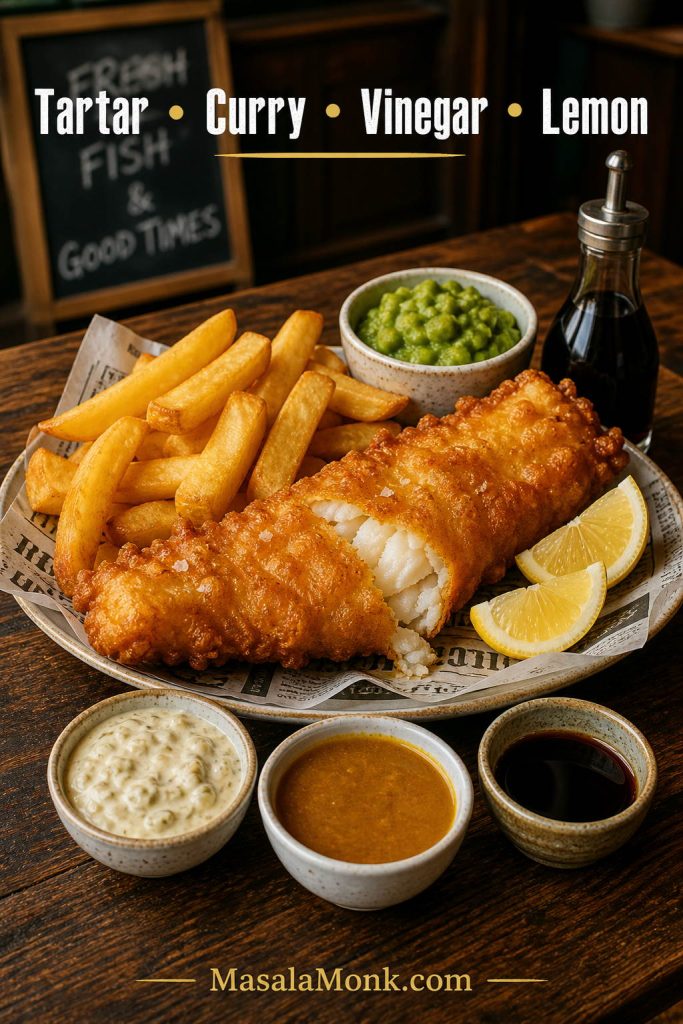
Fish and chips need contrast: creamy tartar sauce, sharp malt vinegar, lemon for brightness, and curry sauce if you want that proper chip-shop comfort-food finish.

Fish and chips served with tartar sauce, curry sauce, malt vinegar, lemon, and mushy peas.
Sauces complete the plate: tartar sauce adds creaminess, lemon adds brightness, malt vinegar cuts the fried coating, and curry sauce brings chip-shop comfort.

Tartar Sauce for Fish and Chips

For a quick tartar sauce, stir together:

  • ½ cup mayonnaise
  • 2 tablespoons finely chopped cornichons or pickles
  • 1 teaspoon chopped capers
  • 1 tablespoon lemon juice
  • 1 tablespoon chopped parsley or dill
  • ½ teaspoon Dijon mustard, optional
  • Black pepper, to taste

If you want to make the creamy base from scratch, start with this homemade mayonnaise guide, then fold in pickles, capers, lemon, herbs, and mustard for tartar sauce.

Curry Sauce for Fish and Chips

For a simple chip-shop-style curry sauce, use:

  • 1 tablespoon butter or neutral oil
  • ¼ small onion, finely chopped
  • 1 small garlic clove, grated or minced
  • ½ teaspoon grated ginger, optional
  • 1½ teaspoons mild curry powder
  • ¼ teaspoon turmeric
  • ¾ cup stock
  • 1 teaspoon malt vinegar
  • 1 teaspoon cornstarch mixed with 1 tablespoon water
  • Salt, pepper, and a small pinch of sugar, to taste

First, soften the onion in butter or oil. Next, add the garlic, ginger, curry powder, and turmeric, then stir in the stock. After that, simmer for a few minutes, add the cornstarch slurry, and cook until glossy and pourable. Finally, finish with malt vinegar and adjust salt, pepper, and sweetness.

This does not need to be fiery. A good fish and chips curry sauce should be warm, savory, lightly sweet, and loose enough to spoon over chips.

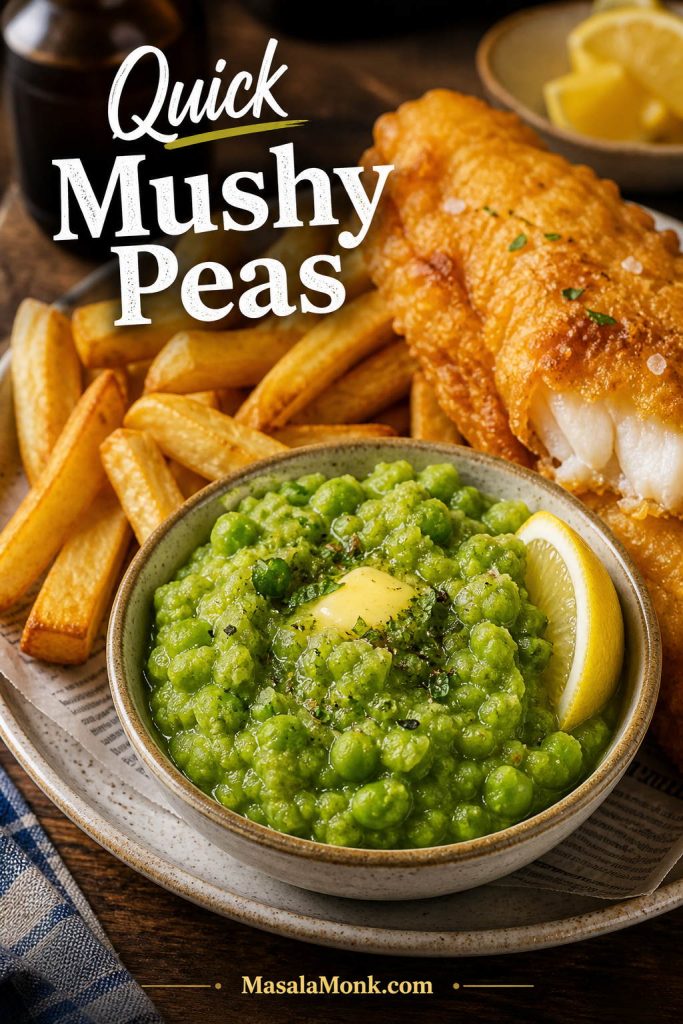
Quick Mushy Peas

For a quick green-pea version, simmer 2 cups peas with 1 tablespoon butter, a pinch of salt, black pepper, and 1 to 2 tablespoons water until hot. Mash roughly with lemon juice and chopped mint or parsley. Keep them chunky rather than completely smooth so they feel like a proper side, not a puree.

Bowl of chunky mushy peas with butter and lemon served beside fish and chips.
Quick mushy peas add freshness and color beside fried fish. For better texture, keep them chunky instead of turning them into a smooth puree.

Other Serving Ideas

  • Malt vinegar
  • Lemon wedges
  • Garlic mayo or aioli
  • Ketchup for a family-friendly plate
  • Coleslaw
  • Pickled onions or gherkins

Sauces sorted? Go back to the full fish and chips recipe or see what to serve with fish and chips.

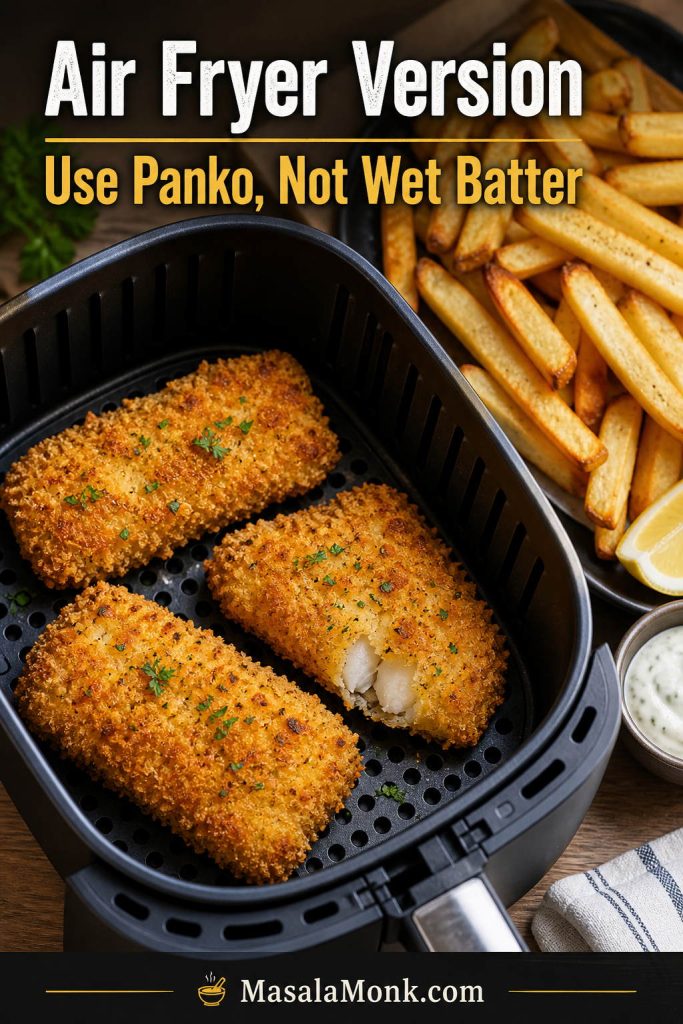
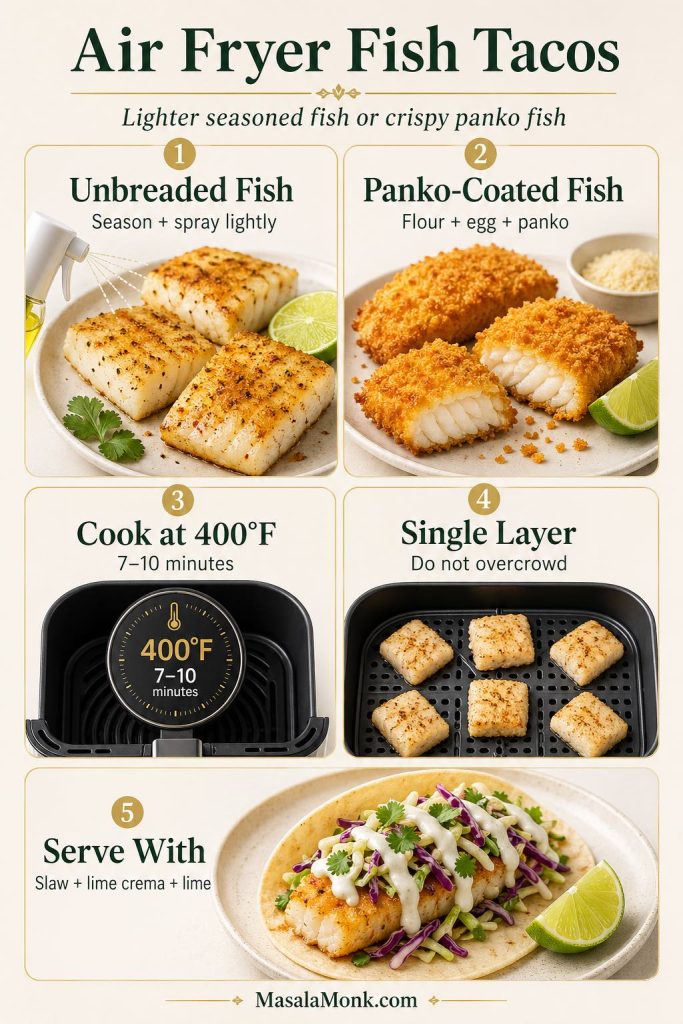
Air Fryer Fish and Chips

For air fryer fish and chips, switch from wet beer batter to a panko coating. Wet batter needs hot oil to set instantly; in an air fryer, it drips before it crisps.

Panko-coated fish and chips in an air fryer basket for air fryer fish and chips.
Air fryer fish and chips need panko or breadcrumbs because wet batter drips before it sets. It is a different method, not a direct deep-fried copy.

Instead, use a breadcrumb or panko coating:

  1. Pat cod or haddock dry and cut into pieces.
  2. Season flour with salt, pepper, paprika, and garlic powder.
  3. Dip fish in flour, then beaten egg, then panko breadcrumbs.
  4. Spray lightly with oil.
  5. Air fry at 375°F to 400°F / 190°C to 200°C for about 10 to 12 minutes, flipping halfway, until the coating is crisp and the fish is opaque, flaky, and 145°F / 63°C inside.
  6. Cook air fryer chips separately or start them first so they finish around the same time.
Air fryer rule: Use panko or breadcrumbs, not wet beer batter, for the cleanest result. Also, keep fish in a single layer and do not block airflow with heavy parchment or foil.

If air-fried food often turns pale, soft, or uneven in your kitchen, check these common air fryer mistakes before adjusting the fish recipe itself.

Want the classic fried version instead? Go back to the beer batter guide. Having air fryer issues? Check the fixes section.

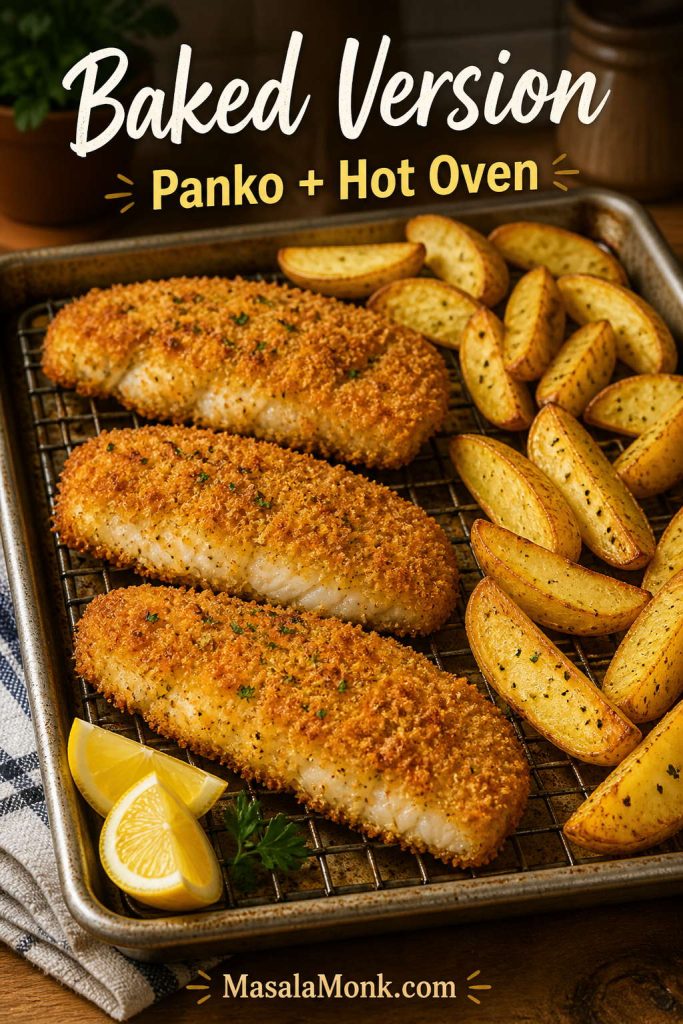
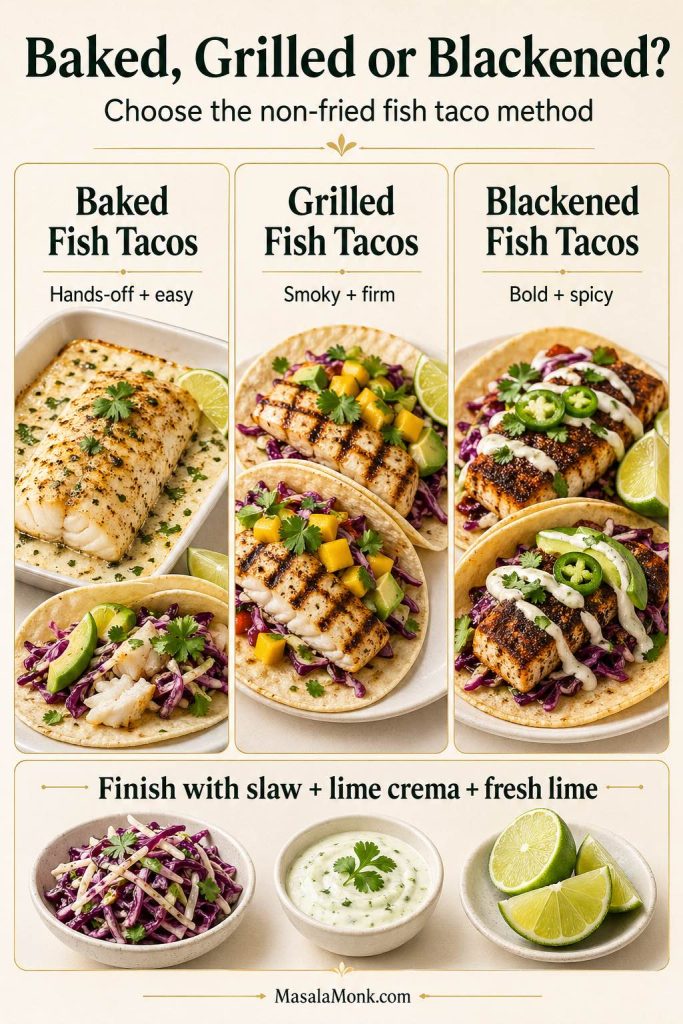
Baked Fish and Chips

Baked fish and chips works best as its own version: panko-coated fish, a hot oven, a lightly oiled tray, and chips or wedges that crisp while the fish cooks. It will not mimic deep-fried beer batter, but it can still be a very good weeknight version.

Panko-coated baked fish with oven chips or potato wedges on a sheet pan.
Baked fish and chips work best with panko, a hot oven, and space on the tray. Instead of imitating beer batter, this version gives you a crisp weeknight alternative.

Use this method:

  1. Heat the oven to 400°F / 200°C.
  2. Cut potatoes into wedges or thick fries, toss lightly with oil and salt, and bake until partly tender.
  3. Coat the fish in flour, egg, and panko breadcrumbs.
  4. Place fish on a lightly oiled rack or lined tray.
  5. Bake until the coating is crisp and the fish is opaque, flaky, and 145°F / 63°C inside.

For better browning, spray or brush the coated fish lightly with oil before baking.

Gluten-Free Fish and Chips

For a gluten-free version of this fish and chips recipe, build the batter around rice flour, cornstarch, gluten-free flour, and cold carbonated liquid.

Gluten-free fish and chips batter setup with flour blend, rice flour or cornstarch, liquid, and fried fish.
Gluten-free batter varies by flour blend, so start with less liquid and loosen slowly. The goal is still a ribbon-like batter that coats the fish.

Use:

  • 1 cup gluten-free flour blend
  • ¼ cup white rice flour or cornstarch
  • 1 teaspoon baking powder
  • ½ to 1 teaspoon salt
  • Paprika, garlic powder, or black pepper, optional
  • 1 cup / 240 ml gluten-free beer or club soda, plus 1 to 3 tablespoons more only if needed

Start with 1 cup / 240 ml liquid, then add more only until the batter coats the back of a spoon and drips off in ribbons. Gluten-free flour blends vary, so the texture matters more than the exact final tablespoon count.

Before battering, dust the fish with rice flour. Then fry in small batches at about 375°F / 190°C, knowing the oil will drop once the fish goes in.

Also, check that your baking powder, sauces, and serving sides are gluten-free.

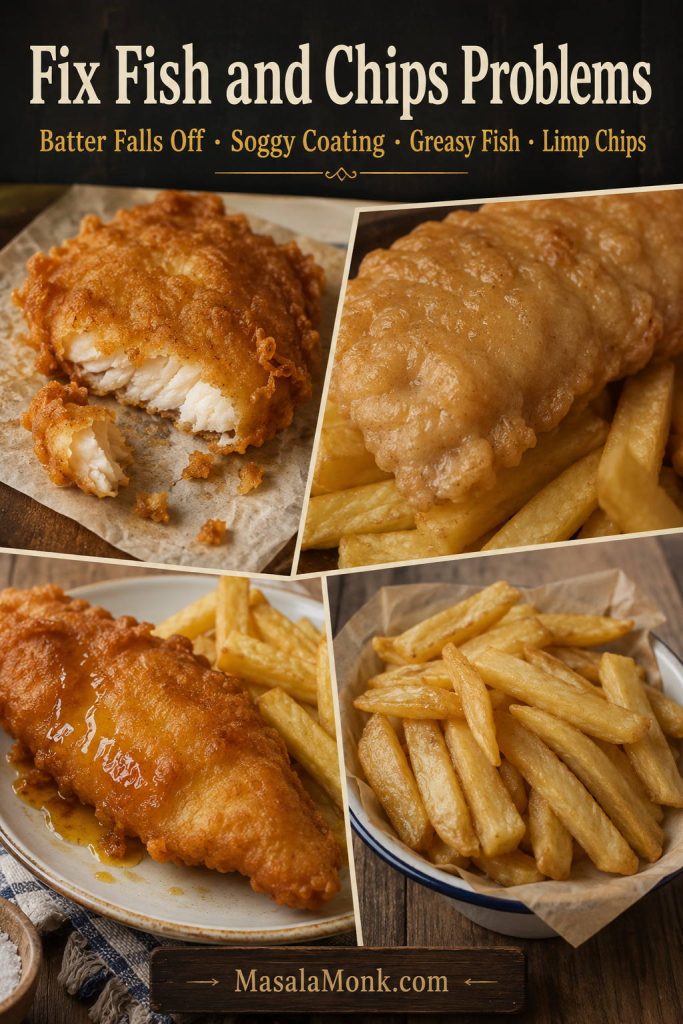
How to Fix Common Fish and Chips Recipe Problems

Most fish and chips problems come from moisture, batter thickness, or oil temperature. Before changing the whole recipe, use this table to identify the likely issue.

Troubleshooting guide for fish and chips showing batter falling off, soggy coating, greasy fish, and limp chips.
Most fish and chips problems trace back to moisture, batter thickness, oil temperature, or crowding. Once you find the cause, the fix is usually simple.
Problem Likely Cause Fix
Batter falls off Fish was too wet or not dusted first. Pat fish very dry and dust lightly with flour or rice flour before battering.
Batter is soggy Oil was too cool or the pot was crowded. Fry fewer pieces and keep oil above 350°F / 175°C.
Fish is greasy Oil temperature dropped too much. Let the oil recover between batches.
Batter browns too fast Oil was too hot. Lower heat slightly and use pieces that are not too thick.
Fish is undercooked Pieces were too thick or oil was too hot outside. Cut fish into thinner portions and check for 145°F / 63°C inside.
Batter is too thick Too much flour or not enough liquid. Add cold beer or sparkling water 1 tablespoon at a time.
Batter is too thin Too much liquid. Add flour or rice flour 1 tablespoon at a time.
Chips are limp Potatoes were wet or only fried once. Dry thoroughly and double-fry, or parboil, dry, and fry.
Fish tastes bland Only the batter was seasoned. Season the fish, the dredge, and the batter lightly.

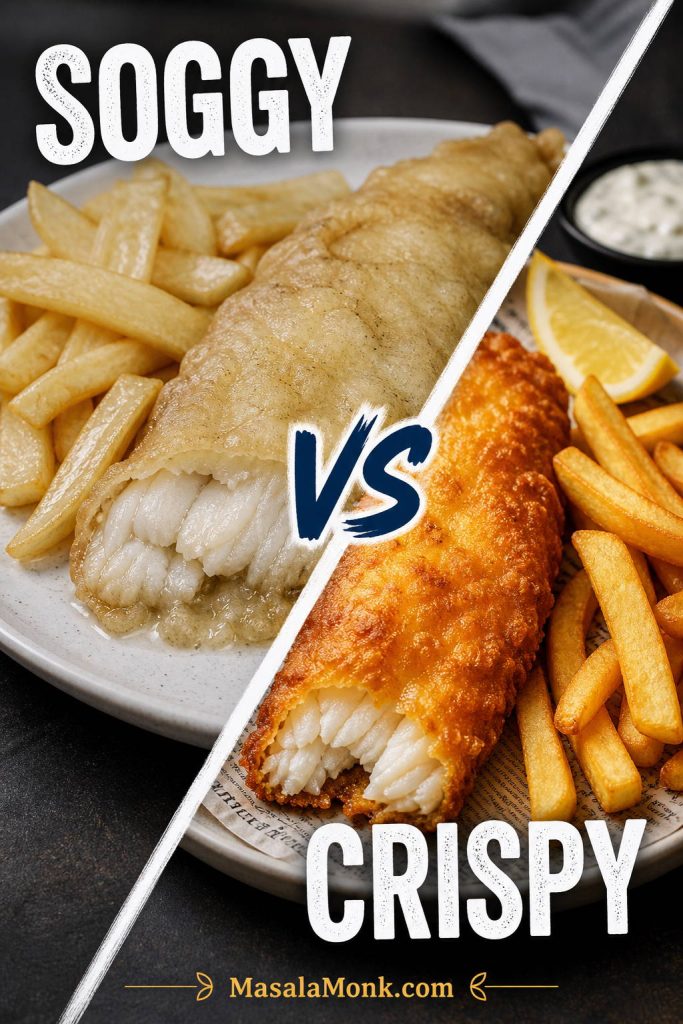
Soggy vs crispy cue: If the coating turns pale, greasy, or soft, check moisture, oil temperature, batch size, and draining method first.

Side-by-side comparison of soggy fish and chips and crispy golden fish and chips.
Crispy fish and chips need hot oil, small batches, and proper draining. Otherwise, the coating can turn pale, greasy, or soft before serving.

What to Serve with Fish and Chips

Classic fish and chips can be served simply with tartar sauce, malt vinegar, lemon, and salt. To make the plate fuller, add mushy peas, coleslaw, pickles, or curry sauce.

A cold cucumber salad recipe works especially well on the side because it is crisp, tangy, and quick enough to make while the potatoes soak.

When you want a bolder version with masala batter, chutney dips, and chaat-style chips, try MasalaMonk’s Indian twists on fish and chips. Keep this classic version as the base, then use that guide for a spicier variation.

Storage and Reheating

Fish and chips are best eaten fresh. Over time, the batter softens, especially if the fish is stacked or covered while hot.

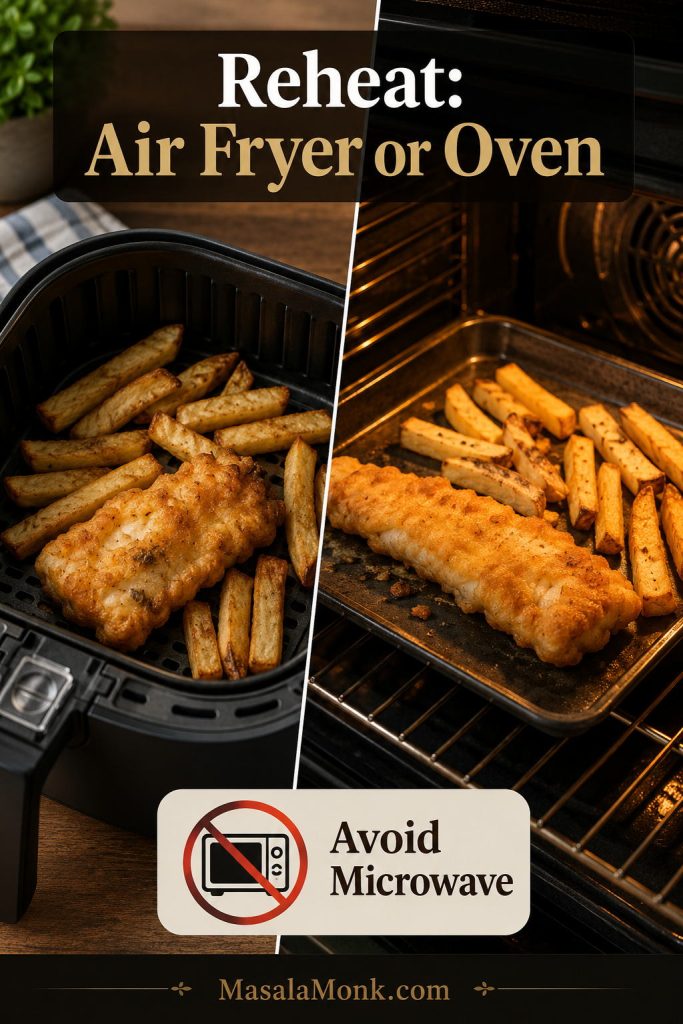
Fish and chips being reheated in an air fryer and oven with a reminder to avoid the microwave.
Reheat leftovers in an air fryer or oven when you want some crispness back. The microwave is faster, but it makes the batter and chips soft.
  • Fridge: Store leftover fish and chips in separate airtight containers for up to 2 days.
  • Air fryer reheating: Reheat at 350°F / 175°C for 4 to 6 minutes, or until hot and crisp.
  • Oven reheating: Reheat on a wire rack at 375°F / 190°C until hot.
  • Avoid the microwave: It makes the batter and chips soft.

Leftover cooked fish or extra potatoes can also be folded into patties or a croquettes recipe, especially when the pieces are still flavorful but no longer crisp enough to serve as fish and chips.

Fish and Chips Recipe FAQs

What is the best fish for fish and chips?

Cod is the easiest all-purpose fish for fish and chips because it is mild, flaky, and widely available. Haddock is the classic British-style choice with a slightly stronger flavor. Pollock, hake, halibut, whiting, and ling can also work.

Is cod or haddock better for fish and chips?

Cod is milder and easier to find, while haddock has a more traditional fish-and-chip-shop flavor. Use cod for the easiest first batch and haddock when you want a more classic taste.

How do you make fish and chips batter crispy?

To make this fish and chips recipe crisp, use very cold beer or sparkling water, add rice flour or cornstarch to the batter, avoid overmixing, pat the fish dry, dust it before battering, and fry at the correct oil temperature.

Can I make fish and chips batter without beer?

Yes. Replace the beer with ice-cold sparkling water or club soda and add an extra ¼ teaspoon baking powder. The batter will be lighter and less malty but still crisp.

Should fish and chips batter have egg?

For a lighter crisp coating, skip the egg. Egg makes the batter richer and sturdier, but it can also make the coating heavier or more cakey. If you add one, reduce the beer or sparkling water slightly and thin only if needed.

What beer is best for fish batter?

A cold lager or pale ale is best for fish batter. Avoid very dark beers for the main recipe because they can make the batter taste heavier and look darker.

Can I use frozen fish for fish and chips?

Yes, but thaw it completely and pat it very dry before seasoning and battering. Extra surface moisture can make the batter slide off or turn soft.

Why is my fish batter soggy?

Soggy batter usually means the oil was too cool, the pot was crowded, or the fish was too wet before battering. Keep the oil hot, fry in small batches, and dry the fish well.

Why does batter fall off fish?

Batter falls off when the fish is wet or not dusted first. Pat the fish dry and coat it lightly in flour, rice flour, cornflour, or cornstarch before dipping it in batter.

Can I make fish and chips in an air fryer?

Yes, but use a breadcrumb or panko coating instead of wet beer batter. Wet batter can drip in an air fryer before it sets.

Can I bake fish and chips instead of frying?

Yes. Baked fish and chips work best with panko-coated fish and oven-baked potato wedges or chips. It will be lighter than deep-fried fish and chips, but not exactly the same texture.

What sauce goes with fish and chips?

Tartar sauce, malt vinegar, lemon, curry sauce, mushy peas, garlic mayo, ketchup, and coleslaw all work well with fish and chips.

Is fish and chips the same as fish and fries?

In British-style fish and chips, “chips” usually means thicker fried potatoes. In the U.S., the same dish is sometimes described as fish and fries, especially when served with thinner fries.

Can I make gluten-free fish and chips?

Yes. Use a gluten-free flour blend, rice flour or cornstarch, gluten-free beer or club soda, and gluten-free baking powder. Also check sauces and sides for hidden gluten.

What temperature should oil be for fish and chips?

For the fish, aim for 365°F to 375°F / 185°C to 190°C. Do not let the oil fall below 350°F / 175°C, or the batter can turn greasy.

How do I reheat fish and chips?

Reheat fish and chips in an air fryer at 350°F / 175°C for 4 to 6 minutes, or in an oven at 375°F / 190°C until hot and crisp. Avoid the microwave if you want the batter to stay crisp.

Posted on Leave a comment

Slow Cooker Sausage Casserole Recipe

Slow cooker sausage casserole recipe with browned sausages, white beans, carrots and thick tomato gravy in a dark bowl.

A good slow cooker sausage casserole recipe should give you tender sausages, soft vegetables, creamy beans and a thick sauce that feels like proper comfort food — not a watery tomato stew. This version uses browned sausages, carrots, onions, beans, chopped tomatoes, stock, Worcestershire sauce and herbs to make a rich tomato-gravy casserole that is made for mashed potatoes, rice, baked potatoes or crusty bread.

If you call it a crock pot sausage casserole, the method is the same. You build the sauce, add the sausages and vegetables, let everything cook slowly, then thicken the gravy near the end so it coats the sausages instead of pooling at the bottom of the bowl.

Because a sausage casserole recipe can turn thin in the slow cooker if the liquid is not controlled, this guide also covers the details that make it reliable: whether to brown the sausages, how long to cook it on HIGH or LOW, how to thicken the sauce, which beans work best, how to make it without tomatoes, and how to add dumplings without making them heavy.

At a glance: Serves 4 • Prep 15 minutes • Cook 4–5 hours on HIGH or 6–8 hours on LOW • Best in a 4–6 litre / 4–6 quart slow cooker • Start with 250 ml / 1 cup stock to avoid watery sauce • Thicken at the end if needed.

Slow Cooker Sausage Casserole Recipe: Quick Answer

To make slow cooker sausage casserole, brown the sausages for 5–7 minutes if you have time, then add them to the slow cooker with onion, carrots, beans, chopped tomatoes, stock, tomato purée, Worcestershire sauce, garlic, smoked paprika and herbs. Cook on LOW for 6–8 hours or HIGH for 4–5 hours, depending on your slow cooker and sausage size. By the end, the vegetables should be tender, the sausages should be cooked through, and the sauce should look rich and spoonable.

When the sauce still looks loose, stir in a cornflour slurry and cook uncovered on HIGH for 15–30 minutes. Serve the casserole with mashed potatoes, rice, pasta, baked potatoes, steamed greens or bread for soaking up the gravy.

For a sausage casserole slow cooker method that stays thick, follow one simple rule: brown the sausages for deeper flavor when you can, start with less stock than an oven casserole, and thicken only after the slow cooker has done its work.

Spoon lifting thick sausage casserole with sausage, white beans, carrots and glossy tomato sauce.
A slow cooker sausage casserole should look glossy and spoonable rather than thin. If the sauce slides off the spoon like broth, it still needs finishing.

Crock Pot Sausage Casserole

If you call this a crock pot sausage casserole, you do not need a different method. Many readers use crock pot as shorthand for a slow cooker, especially in the US, so the same timing, liquid control and thickening steps apply.

If you need a reliable sausage casserole recipe in a slow cooker, the main thing is to use less liquid than you would in an oven casserole. Because the lid traps steam, start with 250 ml / 1 cup stock, let the sausages and vegetables cook slowly, then thicken the sauce near the end if it needs more body.

Crock pot sausage casserole guide showing less stock, trapped steam and cornflour slurry for thickening.
Crock pot sausage casserole follows the same method as slow cooker sausage casserole; however, the liquid needs tighter control because the lid traps moisture instead of letting it reduce away.

Why This Slow Cooker Sausage Casserole Works

This works because it gives the sausages time to become savory, the vegetables time to soften, and the sauce time to turn rich instead of thin. The beans make the dish more filling, while the carrots and onions slowly melt into the tomato-gravy base.

Meanwhile, the tomato purée, stock, Worcestershire sauce, smoked paprika and herbs create a deeper casserole base than tomatoes alone. Since slow cookers trap moisture, the sauce is thickened near the end rather than overloaded with flour at the beginning. That way, the gravy stays glossy and spoonable instead of dull or pasty.

In this recipe, the slow cooker gives the sausage casserole time to soften, deepen and thicken without needing much hands-on cooking. The appeal is similar to making a whole chicken in a crock pot: you do a little prep up front, then the cooker turns simple ingredients into a complete dinner.

Ingredients You Need

The best slow cooker sausage casserole starts with everyday ingredients, but each one has a job. Pork sausages give the casserole its main flavor. From there, the beans make the dish more filling, while the carrots and onions slowly soften into the sauce and add natural sweetness.

That balance is what keeps this recipe from tasting like plain sausages in sauce; the slow cooker turns it into a proper casserole with body, warmth and enough sauce to spoon over a side.

Ingredients for slow cooker sausage casserole including sausages, carrots, onion, garlic, tomatoes, beans, stock, herbs and cornflour slurry.
This ingredient list works because each part earns its place: sausages build flavor, beans add body, vegetables soften gently, and cornflour helps turn the cooking liquid into a proper gravy.

Sausages

Use 8 pork sausages, about 600–700 g / 1.3–1.5 lb, for the classic version. A good everyday pork sausage works well, especially one with enough fat to stay juicy through slow cooking. Chipolatas also work, though they may finish closer to the shorter end of the cooking time.

Cumberland-style or herby sausages can be excellent, but reduce the added herbs slightly so the casserole does not become overpowering. Chicken or turkey sausages make a lighter version, although they are leaner and can dry out if cooked too long. For a meat-free version, use firm vegetarian sausages and handle them gently because some soften quickly in sauce.

Beans

Cannellini beans are the cleanest all-round choice because they hold their shape and make the casserole more filling without adding much sweetness. Butter beans make the dish softer and creamier, while haricot beans keep it classic. For a sweeter family-style sausage and bean casserole, baked beans are useful too.

Use one 400 g / 14 oz can of beans, drained and rinsed. The drained weight is usually about 235–250 g / 8–9 oz. For a heartier bean-heavy version, use two cans and reduce the stock slightly.

When the sausage-and-bean combination is what you love most, you may also like red beans and rice with sausage for a smokier, Louisiana-style comfort meal.

Vegetables

Onion and carrots are the base. Use one large onion, about 180–200 g / 6–7 oz, and two medium carrots, about 150–180 g / 5–6 oz. Celery, mushrooms, peppers, potatoes or sweet potatoes can also be added, depending on how full and chunky you want the casserole to be.

Cut firm vegetables into similar-sized pieces so they cook evenly. Potatoes and sweet potatoes should be kept chunky enough to hold their shape. Smaller pieces will break down more and naturally thicken the sauce, which can be useful, but they will not stay neat.

Sauce Base

The sauce uses one 400 g / 14 oz can of chopped tomatoes, 2 tablespoons / 30 g tomato purée, 250 ml / 1 cup stock, Worcestershire sauce, garlic, smoked paprika, mixed herbs and black pepper. Together, these create a tomato-gravy base rather than a plain red sauce.

For a deeper casserole sauce, keep the stock, Worcestershire sauce, smoked paprika and herbs in the mix. They make the tomatoes taste rounder and more savory, which is what keeps the finished dish from feeling like plain sausages in tomato sauce.

Thickener

Cornflour, also called cornstarch, is the easiest thickener. Mix 1 tablespoon / 8 g cornflour with 1 tablespoon / 15 ml cold water first, then stir the slurry into the hot casserole near the end. Gravy granules or slow cooker thickening granules can also work, although they change the flavor more than cornflour does.

Important: Do not sprinkle dry cornflour directly into the slow cooker. It can clump. Always mix it with cold water first, then stir the slurry into the hot sauce.

Best Sausages for Slow Cooker Sausage Casserole

The best sausages depend on the style of casserole you want. Pork sausages with enough fat and seasoning give the most classic result and stay juicy as they slow cook. Chipolatas are a good choice for a milder family dinner because they brown quickly and portion easily. Herby sausages, meanwhile, bring a stronger savory flavor that works especially well with mashed potatoes or crusty bread.
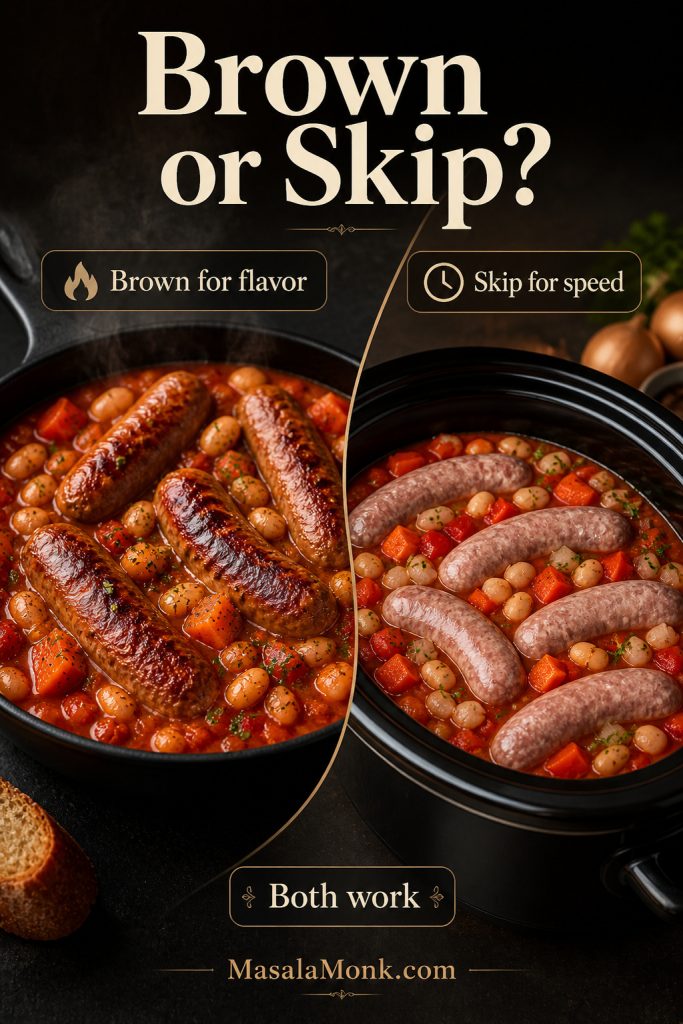
Sausage choices for slow cooker sausage casserole including pork sausages, chipolatas, herby sausages and vegetarian sausages.
Pork sausages give the most classic result, chipolatas suit a milder family dinner, and herby sausages bring a stronger savory note. Vegetarian sausages can work too, provided they are firm enough to hold their shape.
Sausage Type Best For Note
Pork sausages Classic sausage casserole Best all-round flavor and texture.
Chipolatas Quicker family dinners Brown easily and cook evenly; start checking earlier.
Cumberland or herby sausages Deeper savory flavor Reduce extra herbs slightly.
Chicken or turkey sausages Lighter casserole Can dry out if cooked too long.
Vegetarian sausages Meat-free version Choose firm sausages and handle gently.
Smoked sausage or kielbasa A different style of slow cooker meal Works, but changes the dish away from classic sausage casserole.

Smoked sausage and kielbasa are delicious in a slow cooker, but they create a different kind of dish. For this slow cooker sausage casserole recipe, fresh sausages give the most traditional comfort-food result.

Do You Have to Brown Sausages Before Slow Cooking?

You do not have to brown sausages before slow cooking, but browning gives the best flavor and appearance. It adds color, renders a little fat, and stops the sausages from looking pale after several hours in sauce.

For this recipe, browning is the step that makes a slow cooker sausage casserole taste more rounded, even though the casserole will still cook without it. Use a large frying pan over medium to medium-high heat, then brown the sausages in one layer for 5–7 minutes, turning until they have color on most sides. They do not need to cook through in the pan because they will finish in the slow cooker.

Comparison showing browned sausages in a pan and thawed sausages added directly to a slow cooker.
Browning first adds color and deeper flavor, whereas skipping that step saves time. Both methods work, so the better choice depends on whether you want maximum flavor or maximum convenience.

Dump-and-Go Option

For the quickest version, skip the browning and add the thawed sausages straight to the slow cooker with the vegetables, beans and sauce. The casserole will still cook, but the sausages will be softer and paler. For the best dump-and-go result, use good-quality sausages, avoid adding too much stock, and thicken the sauce near the end.

Thawed sausages being added to a slow cooker with beans, carrots and tomato sauce for a dump-and-go casserole.
A dump-and-go slow cooker sausage casserole can still turn out well, but it helps to start with thawed sausages and a restrained amount of stock so the finished sauce does not turn watery.
Method Best For Result
Brown the sausages first Best flavor and color Richer, more savory casserole.
Skip browning Fastest prep Softer, paler sausages but still convenient.
Brown sausages only Best compromise Good flavor without extra vegetable sautéing.

For the best balance, brown only the sausages, then let the slow cooker handle the vegetables and sauce. The same timing-first mindset matters in other slow cooker pork dinners too, especially when you want tender meat rather than dry results, as in crock pot pork chops and sauerkraut.

How to Make Sausage Casserole in a Slow Cooker

Once the sausages are browned, the rest is mostly hands-off. The slow cooker does the heavy lifting while the vegetables soften, the beans absorb flavor, and the sauce turns rich and savory.

Method snapshot: Brown sausages → add vegetables and beans → pour over tomato-gravy sauce → cook LOW or HIGH → thicken if needed → rest and serve.
Step-by-step method for slow cooker sausage casserole showing browning, adding vegetables and beans, slow cooking, thickening and resting.
The method is simple once you see the flow: build flavor first, let the slow cooker do the gentle cooking, and then finish the sauce only after the sausages and vegetables are tender.

Step 1: Brown the sausages

Heat 1 tablespoon / 15 ml oil in a large frying pan over medium to medium-high heat. Brown the sausages for 5–7 minutes, turning until colored on most sides. They only need color on the outside at this stage.

Step 2: Add the vegetables

Add the sliced onion, chopped carrots, garlic and celery, if using, to the slow cooker. Mushrooms, peppers, potatoes or sweet potatoes can go in now too. Try to keep the pieces fairly even so everything softens at the same pace.

Step 3: Add the beans

Drain and rinse the cannellini beans or butter beans, then add them to the slow cooker. Baked beans can be added with their sauce, but reduce the stock slightly because they already bring liquid and sweetness.

Step 4: Mix the sauce

In a jug or bowl, mix the chopped tomatoes, tomato purée, stock, Worcestershire sauce, smoked paprika, mixed herbs, bay leaf if using, and black pepper. Pour the sauce over the vegetables and beans, then nestle the browned sausages into the mixture.

Step 5: Slow cook

Cook on LOW for 6–8 hours or HIGH for 4–5 hours. Try not to lift the lid repeatedly because slow cookers lose heat quickly when opened. Instead, check near the end, when the vegetables should be tender, the carrots should pierce easily with a fork, and the sausages should be cooked through.

Step 6: Thicken the sauce

By the end of cooking, the sauce may already be thick and glossy. In that case, leave it alone. When it looks thin, stir together 1 tablespoon / 8 g cornflour and 1 tablespoon / 15 ml cold water, then mix the slurry into the casserole. Cook uncovered, or with the lid slightly ajar, on HIGH for 15–30 minutes.

Step 7: Rest, taste and serve

Let the casserole sit for 5–10 minutes before serving. As it rests, the sauce settles and thickens slightly. Taste before adding salt because sausages, stock cubes, Worcestershire sauce and packet mixes can already be salty.

Slow Cooker Sausage Casserole Cook Times

Slow cooker sausage casserole is forgiving, but timing still matters. Small chipolatas, finely chopped vegetables or a hotter slow cooker may finish earlier. Larger sausages, chunky carrots, potatoes or a very full pot may need the longer end of the range.

Setting or Step Time Best For
Browning sausages 5–7 minutes Better color and flavor before slow cooking.
LOW 6–8 hours Best texture, deeper sauce, easiest hands-off option.
HIGH 4–5 hours Faster dinner when you start later in the day.
Thickening after slurry 15–30 minutes on HIGH Finishing a loose sauce.
Resting before serving 5–10 minutes Lets the sauce settle and thicken slightly.
Keep warm 1–2 hours after cooking Holding only after the casserole is fully cooked.
Cook time chart for slow cooker sausage casserole showing low 6 to 8 hours, high 4 to 5 hours, thickening time and resting time.
LOW gives the fullest flavor and softest texture, while HIGH is useful when time is tighter. Either way, the last few minutes matter because thickening and resting improve the final casserole.

LOW gives the best texture because the sauce has more time to mellow and the vegetables soften gently. HIGH is still useful for weeknights, but start checking near the 4-hour mark so the sausages do not overcook.
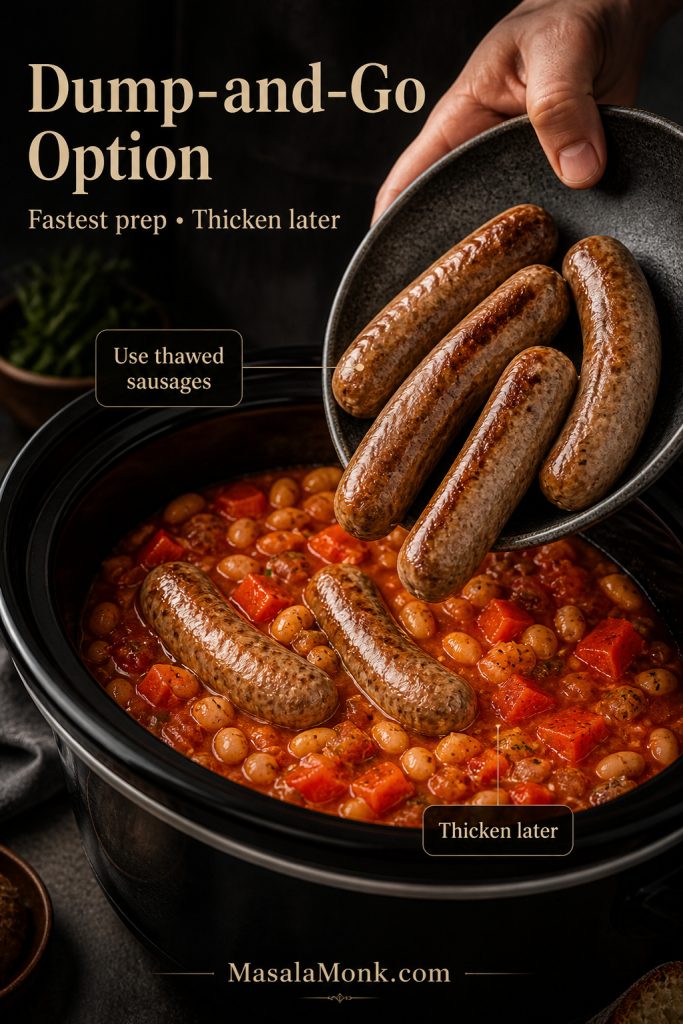
Slow cooker size: This recipe fits best in a 4–6 litre / 4–6 quart slow cooker. For even cooking, aim for the slow cooker to be about half to two-thirds full once everything is added.
Food safety note: Do not use the “keep warm” setting to cook raw sausages. Use LOW or HIGH to cook the casserole, then use keep warm only after the sausages are fully cooked.
Slow cooker setup guide showing a 4 to 6 litre cooker, half to two-thirds fill level, 250 millilitres of stock and thawed sausages.
Getting the setup right prevents most texture problems. A 4–6 litre slow cooker, a moderate fill level and just 250 ml stock give the casserole room to cook without flooding the sauce.

How to Thicken Slow Cooker Sausage Casserole

Slow cooker casseroles often turn watery because the lid traps steam. Unlike oven casseroles, the liquid does not reduce quickly. Therefore, start with 250 ml / 1 cup stock and avoid adding extra liquid at the beginning unless your slow cooker runs dry.

This is one of the most important parts of the recipe because a sausage casserole in the slow cooker often looks thinner than expected until it is finished properly. The target is a glossy gravy texture: thick enough to coat the sausages and vegetables, but still loose enough to spoon over mashed potatoes, rice or bread.

Guide to thickening slow cooker sausage casserole with cornflour slurry, lid ajar, mashed beans and reduced stock.
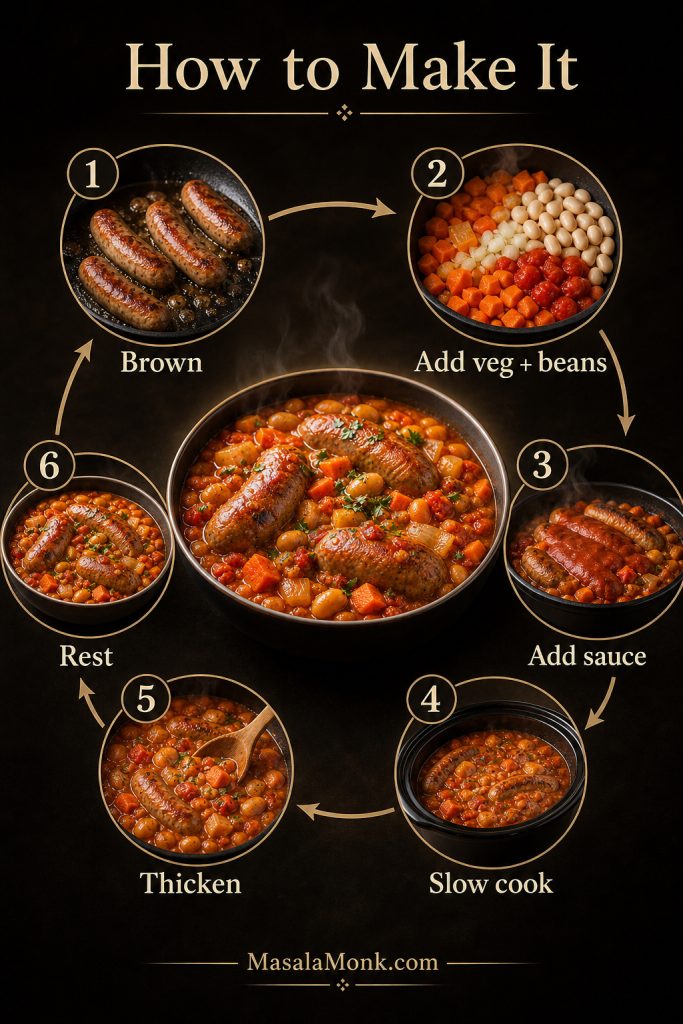
When a sausage casserole looks thin, small fixes usually work better than drastic ones. A cornflour slurry, a slightly open lid or a few mashed beans can thicken the gravy without changing the whole recipe.
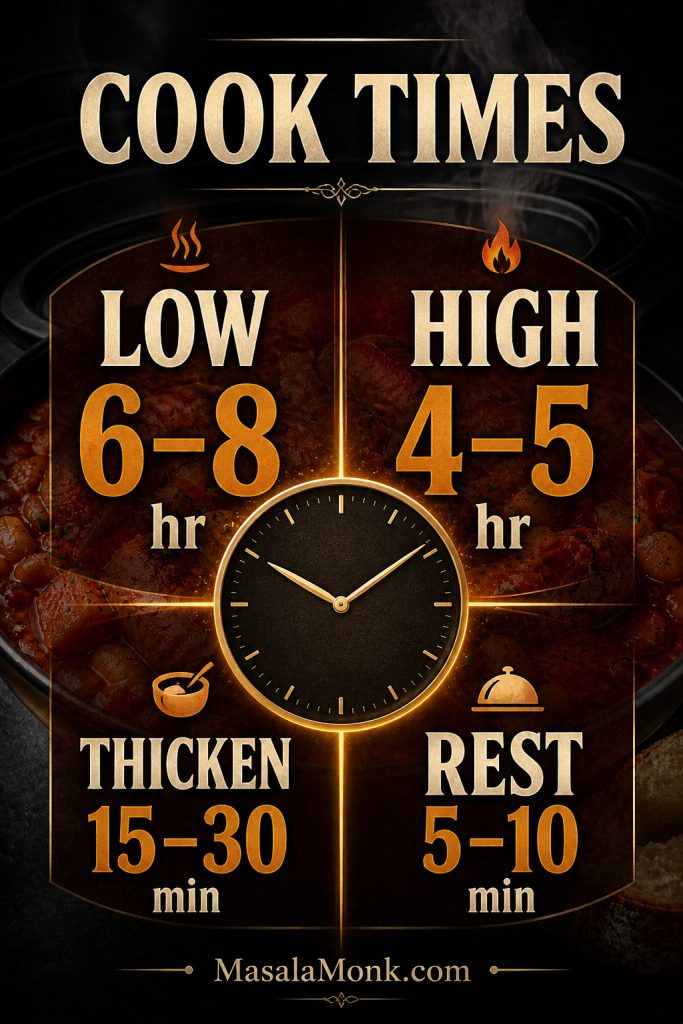
Best thickening method: cornflour slurry

Mix 1 tablespoon / 8 g cornflour with 1 tablespoon / 15 ml cold water until smooth. Stir it into the hot casserole, then cook uncovered, or with the lid slightly ajar, on HIGH for 15–30 minutes. Add more slurry only if the sauce still looks too thin after that.

When the sauce is ready, it should coat the back of a spoon and cling lightly to the sausages and vegetables. It should not look like soup, but it should still be loose enough to spoon over mash, rice or bread.

Spoon coated with thick sausage casserole sauce above a slow cooker filled with sausages, beans and carrots.
Use the spoon test before serving: the sauce should coat the spoon in a glossy layer instead of running off immediately. That is the easiest visual check for the right casserole texture.

Other ways to thicken the sauce

  • Cook with the lid slightly ajar: this helps steam escape near the end.
  • Mash a few beans: this adds body without extra thickener.
  • Use gravy granules: helpful for a darker gravy-style casserole, but they can add salt.
  • Use less stock next time: especially if your slow cooker always makes sauces watery.
  • Add potatoes or sweet potatoes: they release starch and naturally thicken the sauce.

Rather than adding lots of flour at the beginning, let the casserole cook first. At that point, you can see how much liquid your slow cooker has created and adjust the texture properly.

Do This Not This
Start with 250 ml / 1 cup stock. Do not flood the slow cooker with extra liquid early.
Brown the sausages if you want better flavor. Do not expect unbrowned sausages to look golden later.
Thicken near the end with cornflour slurry. Do not add dry cornflour straight into the sauce.
Add dumplings only when the casserole is hot. Do not add dumplings at the beginning of the cook.
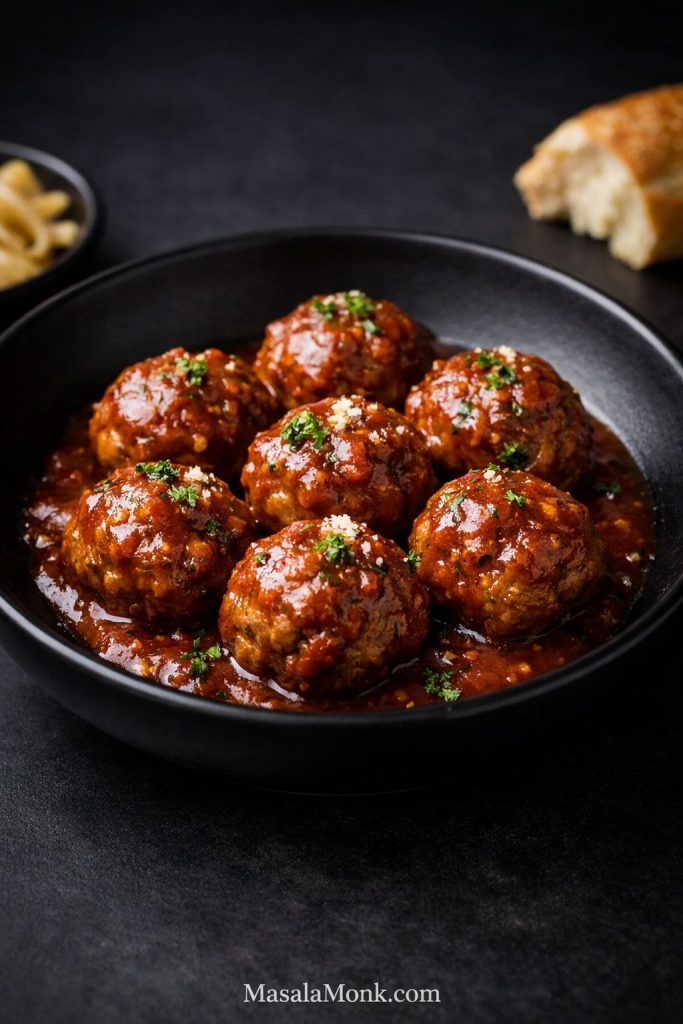
Slow Cooker Sausage Casserole Variations

The main recipe gives you a tomato-gravy sausage and bean casserole, but the slow cooker method is flexible. From there, you can make it sweeter, darker, spicier, meat-free or more old-fashioned without changing the whole method.

Slow Cooker Sausage and Bean Casserole

For a stronger slow cooker sausage and bean casserole, use two tins of beans and reduce the stock slightly. Cannellini beans give the cleanest result, butter beans make the sauce softer and richer, and baked beans make the dish sweeter and more family-style.

Slow cooker sausage and bean casserole with browned sausages, white beans, carrots and thick tomato gravy.
Adding extra beans turns this into a fuller sausage and bean casserole, and it also helps the sauce feel naturally thicker. That makes it especially useful for a hearty, budget-friendly dinner.

Baked beans already bring sauce and sweetness, so start with less stock and adjust near the end. They are especially useful when you want a kid-friendly casserole with a softer tomato flavor.

Bean options for sausage casserole including cannellini beans, butter beans, baked beans and chickpeas.
Bean choice changes the character of the dish more than many people expect: cannellini beans stay neutral, butter beans feel creamier, baked beans add sweetness, and chickpeas hold the firmest bite.

No-Tomato / Gravy-Style Sausage Casserole

For a no-tomato slow cooker sausage casserole, skip the chopped tomatoes and use extra stock instead. Add mushrooms, onions, Worcestershire sauce, black pepper and a little mustard if you like. Then thicken at the end with cornflour slurry so the sauce becomes more like sausage gravy than tomato stew.

No-tomato sausage casserole with sausages, mushrooms, onions and rich brown gravy.
A no-tomato sausage casserole leans on stock, mushrooms, onions and Worcestershire sauce for depth. As a result, the flavor feels darker and more gravy-led than the usual tomato version.

A small spoon of tomato purée can still be useful for depth, even in a gravy-style version. It will not make the casserole taste tomato-heavy, but it helps the sauce feel rounder.

How to Stretch the Casserole Further

To stretch the casserole further, add a second tin of beans, extra carrots, mushrooms, peppers or diced potatoes. Keep the stock at 250 ml / 1 cup to start, then add more only if the sauce looks too thick near the end. This keeps the casserole hearty without turning it watery.

Sausage casserole being extended into more portions with beans, carrots, mushrooms and potatoes.
Stretching sausage casserole works best when you add body before you add liquid. Beans, potatoes, mushrooms and carrots all help create extra servings without diluting the flavor.

Packet Mix vs Homemade Seasoning

You can use a sausage casserole packet mix in the slow cooker, but treat it as both seasoning and sauce body. Packet mixes often contain salt and thickener, so reduce extra salt and check the liquid before adding more stock.
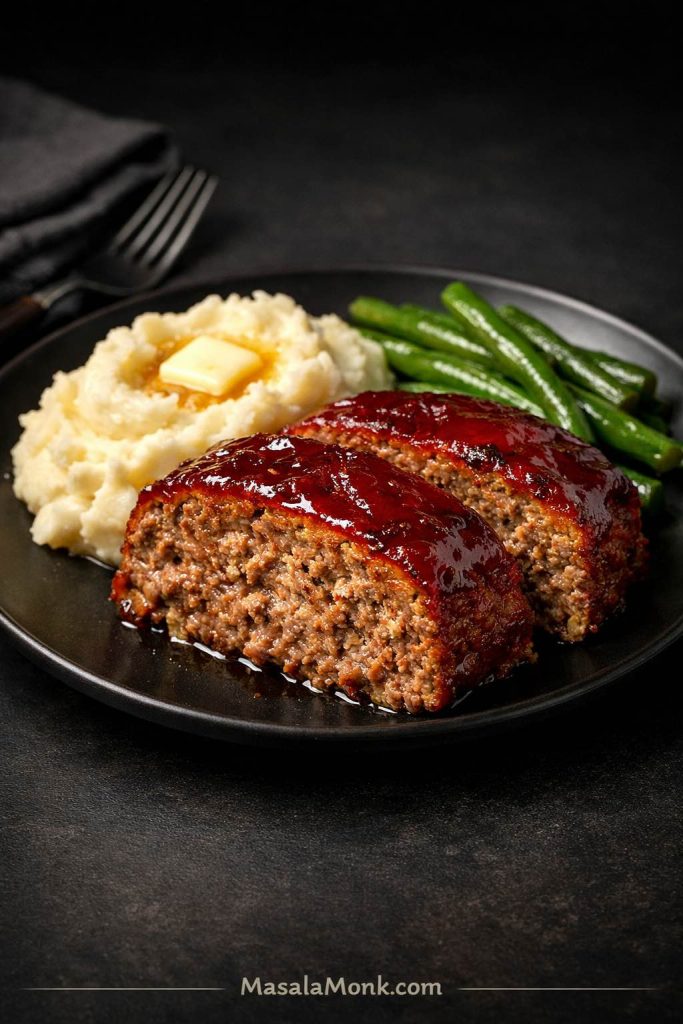
Comparison of packet mix and homemade seasoning for sausage casserole using herbs, stock, paprika and cornflour slurry.
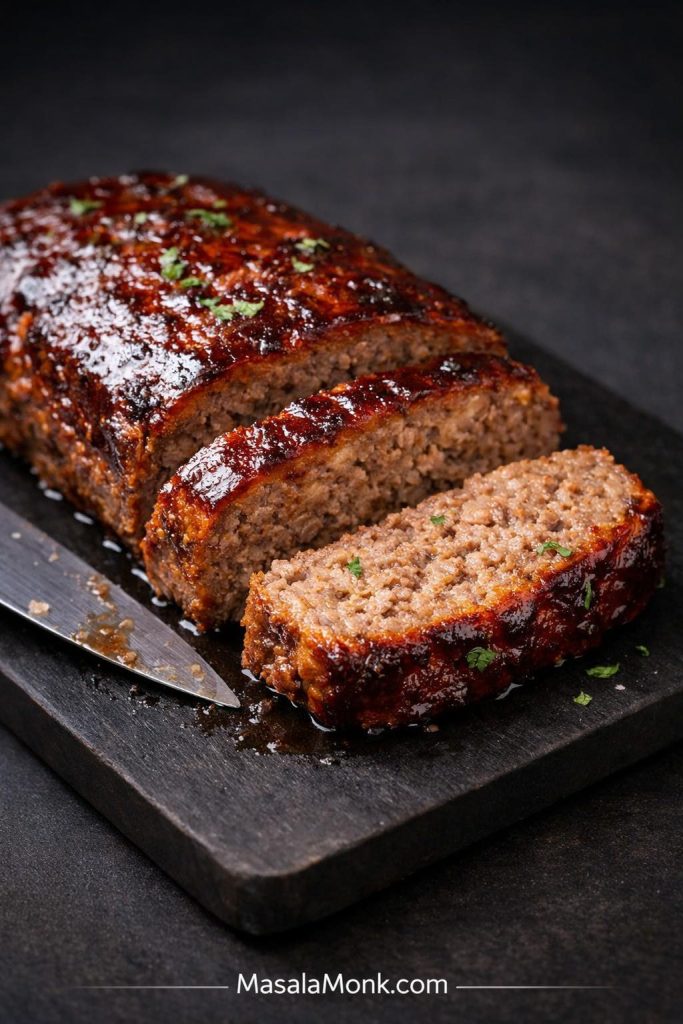
A packet mix is the faster route, yet homemade seasoning gives you far more control over salt, thickness and flavor. That is especially helpful if you want a richer slow cooker sausage casserole without guesswork.
Option Best For Watch Out For
Homemade seasoning Best flavor control Needs a few pantry spices.
Packet mix Fastest prep Can be salty or overly thick.
Stock cube + herbs + paprika Best middle ground May still need thickening at the end.
Gravy granules Darker gravy-style casserole Can overpower the tomato base.

Slow Cooker Sausage Casserole with Dumplings

To make slow cooker sausage casserole with dumplings, add the dumplings near the end, not at the beginning. The casserole should already be hot, the sauce should be bubbling around the edges, and the slow cooker should be set to HIGH.

Slow cooker sausage casserole topped with puffed dumplings and visible sausages in thick tomato gravy.
Dumplings turn sausage casserole into an even more comforting dinner, although they work best when the base underneath is already thick enough to support them.

Use small dumplings, about 35–45 g / 1.2–1.6 oz each, and leave space between them so they can expand. Place them on top of the casserole, keep the lid on, and cook for 45–60 minutes on HIGH, or until puffed and cooked through. For the best result, thicken a watery sauce before adding dumplings so they do not sink into loose liquid.

Dumplings being added to hot slow cooker sausage casserole during the final 45 to 60 minutes on high.
Add dumplings near the end, once the casserole is hot and bubbling. Otherwise, they can sit too long in the sauce and lose the light, fluffy texture you want.

Spicy Sausage Casserole

For a spicier casserole, add chilli flakes, cayenne, hot smoked paprika or a spoon of chilli sauce. Start small because sausages can already be salty and seasoned. A little heat works especially well when you are serving the casserole with rice or baked potatoes.

Spicy slow cooker sausage casserole with browned sausages, white beans, carrots, chilli flakes and glossy tomato sauce.
A spicy sausage casserole should add warmth without overwhelming the base flavor. Start modestly with chilli flakes or hot smoked paprika, then build the heat only after tasting the sauce.

Vegetarian Sausage Casserole

For a vegetarian version, use firm vegetarian sausages, vegetable stock, and a Worcestershire-style sauce that is suitable for vegetarians. Brown the sausages gently if the package allows it. When the sausages are delicate, add them later in the cooking time so they do not break apart.

Vegetarian slow cooker sausage casserole with meat-free sausages, beans, carrots and thick tomato gravy.
A vegetarian slow cooker sausage casserole still needs structure, so firmer meat-free sausages are the safest choice. Softer ones can work, but they are more likely to break during long cooking.

What to Serve with Slow Cooker Sausage Casserole

Mashed potatoes are the classic choice because they catch the sauce and turn the casserole into a proper comfort-food plate. However, you have plenty of options depending on how rich, light or casual you want the meal to feel.

  • Mashed potatoes: the best classic pairing.
  • Baked potatoes: easy, filling and good for leftovers.
  • Rice: useful when the casserole is extra saucy.
  • Pasta: good for a tomato-forward version.
  • Crusty bread: simple and excellent for soaking up sauce.
  • Steamed greens: peas, broccoli, cabbage or green beans balance the richness.
  • Cauliflower mash: lighter than potato mash but still sauce-friendly.
Serving suggestions for sausage casserole including mashed potatoes, rice, baked potato, crusty bread and steamed greens.
The best side depends on how you want to eat the gravy: mash and bread catch the most sauce, rice keeps things lighter, and greens balance the richness of the casserole.

Crusty bread works beautifully, especially if you make homemade garlic bread. For a simple plate, serve the casserole over mash or rice; for a more filling meal, spoon it over baked potatoes with greens on the side.

Storage, Freezing and Reheating

Slow cooker sausage casserole keeps well, which makes it useful for meal prep. Once the casserole has cooled, portion it into airtight containers. Keep it in the fridge for 3–4 days or freeze it for up to 3 months for best quality.

Storage guide for sausage casserole showing chilled container, freezer portions and reheated steaming serving.
Sausage casserole is excellent for leftovers because the flavor settles well overnight. Once cooled, refrigerate portions for 3–4 days or freeze them for longer meal-prep use.

To reheat, thaw frozen portions overnight in the fridge when possible. Reheat gently on the stovetop or in the microwave until steaming hot throughout. The sauce will thicken in the fridge, so add a splash of stock or water when reheating if needed.

For even reheating, stir halfway through, especially when using the microwave. As a general rule, reheat leftovers only once when possible and make sure the centre is hot before serving.

For thermometer checks, FoodSafety.gov’s safe minimum internal temperature chart lists ground meat and sausage at 160°F / 71°C and casseroles at 165°F / 74°C.

Leftover mash or extra cooked potatoes beside the casserole can also become something new. A croquettes recipe is a smart way to turn the next meal into something crisp instead of simply reheated.

Troubleshooting Slow Cooker Sausage Casserole

If your casserole looks a little thin or tastes a bit flat at the end, do not worry. Most slow cooker sausage casserole problems are easy to fix before serving.

Troubleshooting chart for sausage casserole showing watery sauce, bland flavor, overly thick sauce, pale sausages and firm vegetables.
Most slow cooker sausage casserole problems can be fixed with one targeted adjustment. Thin sauce, flat flavor, pale sausages and firm vegetables each point to a different next step rather than a failed recipe.
Problem Why It Happened Fix
Sauce is watery Slow cooker trapped moisture. Add cornflour slurry and cook uncovered on HIGH.
Sauce is too thick Too much thickener or too many beans. Add hot stock or water a little at a time.
Sausages look pale They were not browned first. Brown them next time for better color.
Casserole tastes bland Weak stock, mild sausages or under-seasoning. Add Worcestershire sauce, smoked paprika, pepper or a stock cube.
Sauce tastes sharp Tomatoes are acidic. Add a pinch of sugar or use baked beans for a sweeter variation.
Vegetables are too firm Pieces were too large or the slow cooker runs cool. Cook longer and cut vegetables smaller next time.
Beans are mushy Soft beans cooked for too long. Use firmer beans or add them later.
Sausages split Heat was too aggressive or sausages were browned too hard. Brown gently and avoid overcooking.

Slow Cooker Sausage Casserole Recipe Card

Slow Cooker Sausage Casserole Recipe

This easy slow cooker sausage casserole recipe gives you browned sausages, tender carrots, beans and a rich tomato-gravy sauce that is made for mashed potatoes, rice, baked potatoes or crusty bread.

Servings4
Prep Time15 minutes
Cook Time4–8 hours
Slow Cooker4–6 litre / 4–6 quart

Best served with: mashed potatoes, rice, baked potatoes, pasta, steamed greens or crusty bread.

Ingredients

  • 8 pork sausages, about 600–700 g / 1.3–1.5 lb
  • 1 tablespoon / 15 ml oil, for browning
  • 1 large onion, about 180–200 g / 6–7 oz, sliced
  • 2 medium carrots, about 150–180 g / 5–6 oz, chopped
  • 2 garlic cloves, about 6 g, minced
  • 1 celery stick, about 40–50 g / 1.5–2 oz, chopped, optional
  • 1 x 400 g / 14 oz can chopped tomatoes
  • 1 x 400 g / 14 oz can cannellini beans or butter beans, drained and rinsed, about 235–250 g / 8–9 oz drained weight
  • 2 tablespoons / 30 g tomato purée / tomato paste
  • 250 ml / 1 cup chicken, beef or vegetable stock
  • 1 tablespoon / 15 ml Worcestershire sauce
  • 1 teaspoon / 2–3 g smoked paprika
  • 1 teaspoon / about 1 g mixed herbs or dried thyme
  • 1 bay leaf, optional
  • Black pepper, to taste
  • Salt, only if needed after cooking
  • 1 tablespoon / 8 g cornflour / cornstarch mixed with 1 tablespoon / 15 ml cold water, optional for thickening

Instructions

  1. Heat the oil in a large frying pan over medium to medium-high heat. Brown the sausages for 5–7 minutes, turning until colored on most sides. They do not need to be cooked through.
  2. Add the onion, carrots, garlic, celery if using, and drained beans to the slow cooker.
  3. In a jug, mix the chopped tomatoes, tomato purée, stock, Worcestershire sauce, smoked paprika, herbs, bay leaf if using, and black pepper.
  4. Pour the sauce into the slow cooker and stir gently.
  5. Nestle the browned sausages into the sauce.
  6. Cook on LOW for 6–8 hours or HIGH for 4–5 hours, until the vegetables are tender and the sausages are cooked through.
  7. If the sauce is thin, stir in the cornflour slurry. Cook uncovered, or with the lid slightly ajar, on HIGH for 15–30 minutes, until thickened.
  8. Rest for 5–10 minutes, remove the bay leaf, taste, adjust seasoning, and serve.

Notes

  • This recipe fits best in a 4–6 litre / 4–6 quart slow cooker. Aim for the cooker to be about half to two-thirds full once everything is added.
  • Browning is optional but recommended for better flavor and color.
  • Use 250 ml / 1 cup stock to start. Slow cookers trap steam, so avoid adding extra liquid early unless your cooker runs dry.
  • The sausages should be cooked through and the casserole should be bubbling hot. For thermometer checks, sausage should reach 160°F / 71°C and casseroles or reheated leftovers should reach 165°F / 74°C.
  • For baked bean sausage casserole, replace the cannellini beans with baked beans and reduce the stock slightly.
  • For a no-tomato version, replace chopped tomatoes with extra stock, mushrooms, onions and Worcestershire sauce, then thicken at the end.
  • For dumplings, use small dumplings of about 35–45 g / 1.2–1.6 oz each and add them for the final 45–60 minutes on HIGH.
  • Do not slow cook frozen sausages; thaw them safely first.
  • When reheating, stir halfway through and reheat until steaming hot throughout.
Recipe card for slow cooker sausage casserole showing serving size, prep time, cook time, main ingredients and short method.
This recipe works best when you think in stages: brown for flavor, slow cook until tender, thicken only at the end, and give the casserole a short rest before serving.

More Slow Cooker Sausage Recipes and Ideas

If you came here looking for more slow cooker sausage recipes, this casserole is the best place to start because it covers the classic tomato-gravy version. Other useful sausage crock pot ideas include slow cooker sausage and peppers, cabbage and sausage, crock pot kielbasa, curried sausages, sausage hot pot and slow cooker sausage gravy. Those are related meals, but they are different enough to deserve their own recipes instead of being forced into one casserole.

Slow cooker sausage meal ideas including sausage and peppers, kielbasa and cabbage, curried sausages and sausage hot pot.
Once you have mastered sausage casserole, other slow cooker sausage ideas open up naturally. Sausage and peppers, kielbasa with cabbage, curried sausages and hot pot each deserve their own flavor direction.

If you want slow cooker sausage and peppers, use Italian sausages, sliced peppers, onions and a marinara-style sauce instead. That is a related crock pot sausage dinner, but it eats more like a sausage-and-pepper sandwich or pasta sauce than a classic sausage casserole.

Comparison of sausage casserole with beans and gravy beside sausage and peppers in Italian-style sauce.
These dishes may sound similar, but they serve different cravings. Sausage casserole is a bean-and-gravy comfort meal, whereas sausage and peppers is more of an Italian-style sauce dish.

For now, try easy crock pot chicken breast recipes when you want another hands-off dinner. For faster comfort food outside the slow cooker, air fryer burgers and ground pork recipes are useful backups.

Plated serving of sausage casserole over mashed potatoes with beans, carrots, thick tomato gravy, greens and bread.
Serving sausage casserole over mash turns the gravy into part of the meal rather than just a sauce. Add greens or bread on the side, and the result feels complete and properly comforting.

FAQs About Slow Cooker Sausage Casserole

Can you put raw sausages in a slow cooker?

Yes, you can put raw thawed sausages in a slow cooker as long as they cook fully and reach a safe internal temperature. Browning them first gives better color and flavor, but it is not required. Without browning, the sausages will be softer and paler.

Do you have to brown sausages before slow cooking?

No, browning is not compulsory. However, it is recommended because it adds savory flavor and makes the sausages look more appetizing. The best shortcut is to brown only the sausages, then add everything else straight to the slow cooker.

Can you put frozen sausages in a slow cooker?

No. Thaw sausages before adding them to the slow cooker. The USDA slow cooker food safety guidance recommends thawing meat or poultry before putting it into a slow cooker.

How long does sausage casserole take in the slow cooker?

Most slow cooker sausage casserole recipes take 6–8 hours on LOW or 4–5 hours on HIGH. The exact timing depends on sausage size, vegetable size, how full the pot is, and how hot your slow cooker runs.

Can I cook sausage casserole on HIGH?

Yes. Cook sausage casserole on HIGH for about 4–5 hours. LOW gives a slightly deeper, softer result, but HIGH is useful when you need dinner sooner.

How do you thicken slow cooker sausage casserole?

The easiest way is to stir in a cornflour slurry near the end. Mix 1 tablespoon / 8 g cornflour with 1 tablespoon / 15 ml cold water, stir it into the hot casserole, then cook uncovered on HIGH for 15–30 minutes until the sauce thickens.

Why is my slow cooker sausage casserole watery?

Slow cookers trap moisture, so sauces often look thinner than oven casseroles. Start with only 250 ml / 1 cup stock, then thicken at the end with cornflour slurry or by cooking uncovered on HIGH.

Can I make sausage casserole without tomatoes?

Yes. Replace the chopped tomatoes with extra stock, mushrooms, onions, Worcestershire sauce and a little mustard if you like. Then thicken the sauce at the end to make a gravy-style sausage casserole.

Can I add baked beans?

Yes. Baked beans make a sweeter, family-style slow cooker sausage and bean casserole. Because baked beans already include sauce, reduce the stock slightly and taste before adding extra salt.

Can I add dumplings?

Yes, but add dumplings near the end. Put small dumplings on top of the hot casserole, set the slow cooker to HIGH, keep the lid on, and cook for 45–60 minutes until the dumplings are cooked through.

What beans are best in sausage casserole?

Cannellini beans are the best all-round option because they hold their shape and taste clean. Butter beans make the casserole softer and creamier. Baked beans make it sweeter, while chickpeas give a firmer texture.

Can I use vegetarian sausages?

Yes, but use firm vegetarian sausages and handle them gently. Some meat-free sausages soften quickly, so you may prefer to brown them separately and add them later in the cooking time.

Can I cook this sausage casserole in the oven instead?

Yes. Brown the sausages, combine everything in a covered casserole dish, and bake at 180°C / 350°F for about 60–75 minutes, or until the vegetables are tender and the sausages are cooked through. Check the liquid halfway through and add a splash of stock if the sauce looks too thick.

Can I freeze slow cooker sausage casserole?

Yes. Cool the casserole fully, portion it into airtight containers, and freeze for up to 3 months for best quality. Thaw overnight in the fridge before reheating.

How long does it last in the fridge?

Slow cooker sausage casserole keeps in the fridge for 3–4 days in an airtight container. Reheat until steaming hot throughout, adding a splash of stock or water if the sauce has thickened.

Is crock pot sausage casserole the same as slow cooker sausage casserole?

Yes. Crock pot sausage casserole and slow cooker sausage casserole usually mean the same style of recipe. Crock pot is often used as shorthand for a slow cooker, especially in the US, while slow cooker is the broader term.

Posted on 4 Comments

Fish Tacos Recipe: Best Fish, Sauce, Slaw & Easy Methods

Three cod fish tacos in warm corn tortillas with cabbage slaw, lime crema, cilantro, and lime wedges.

A good fish tacos recipe should answer more than one question. Yes, you need tender fish, warm tortillas, crunchy slaw, and a creamy sauce. However, the real decision usually starts before you cook: what is the best fish for fish tacos, and should you pan-sear, grill, fry, bake, or air fry it?

This recipe for fish tacos starts with the most useful default: pan-seared cod fish tacos with lime crema and cabbage slaw. Cod is mild, flaky, easy to find, and flexible enough for weeknight tacos, Baja-style fried tacos, baked fish tacos, and air fryer fish tacos. When you have mahi mahi, tilapia, halibut, snapper, haddock, salmon, or frozen fish, this guide also shows you how to adjust.

The goal is simple: make fish tacos that taste fresh, bright, and balanced instead of soggy, bland, dry, or overloaded. Use this fish tacos recipe when you need easy fish tacos for dinner, then use the fish guide, sauce options, slaw tips, toppings, and method variations to make the tacos fit what you have.

Quick Answer: Best Fish for This Fish Tacos Recipe

The best fish for fish tacos is a firm, mild white fish such as cod, mahi mahi, halibut, snapper, haddock, or tilapia. Cod is the easiest all-purpose choice because it is mild, flaky, widely available, and works pan-seared, baked, air fried, or beer-battered. Meanwhile, mahi mahi is best for grilled fish tacos, tilapia is the best budget choice, halibut and snapper feel more premium, and salmon works best when blackened or boldly seasoned.

For the easiest fish tacos, season cod or another white fish with chili powder, cumin, smoked paprika, garlic, salt, lime, and a little oil. Then, cook it quickly until just flaky and serve it in warm corn tortillas with cabbage slaw, creamy lime sauce, cilantro, jalapeño, avocado, and fresh lime. For Baja-style fish tacos, use beer-battered cod with chipotle crema and crunchy slaw.

Fish Tacos at a Glance

Best default fishCod
Best other fishMahi mahi, tilapia, halibut, snapper, haddock, salmon
Best methodPan-seared for easiest, Baja-style fried for crispy, grilled for firm fish, baked for hands-off cooking, air fryer for lighter crispy tacos
Best tortillasCorn for classic flavor, flour for softer tacos
Best sauceLime crema or chipotle crema
Best toppingCabbage slaw, cilantro, lime, avocado, mango salsa, jalapeño
Biggest mistakeWet fish, cold tortillas, too much sauce, or assembling too early

Which Fish Tacos Should I Make?

Choose the fish taco style based on the texture and cooking method you need. The pan-seared cod version is the easiest default, while Baja-style tacos are best when crispy fried fish is the main goal.

A vertical fish taco chooser guide with six options: easy weeknight cod tacos with lime crema, crispy Baja fish tacos, grilled mahi mahi tacos with mango salsa, blackened salmon tacos, air fryer cod tacos, and fish stick shortcut tacos.
Not sure which version to make first? Start with cod for the easiest weeknight fish tacos, choose Baja when you want crispy fried fish, use mahi mahi for grilled tacos, and go with salmon when you want a bolder blackened version. Air fryer cod and fish stick tacos are the fastest shortcut paths when convenience matters.
When You NeedMake This VersionBest FishBest Topping
Easiest weeknight tacosPan-seared fish tacosCod or tilapiaCabbage slaw + lime crema
Crispy restaurant-style tacosBaja fish tacosCod or haddockChipotle crema + slaw
Grilled tacosGrilled fish tacosMahi mahi or halibutMango salsa + avocado
Bold spicy tacosBlackened fish tacosSalmon, cod, or mahi mahiAvocado + lime crema
Lighter crispy tacosAir fryer fish tacosCod or tilapiaSlaw + lime crema
Shortcut tacosFish stick tacosFrozen breaded fishFresh slaw + lime

The Simple Fish Taco Formula

The easiest way to build a good recipe for fish tacos is to use one fish, one crunchy topping, one creamy sauce, one fresh finish, and warm tortillas. This keeps the taco balanced instead of overloaded.

PartBest Choices
FishCod, mahi mahi, tilapia, halibut, snapper, haddock, salmon
Cooking methodPan-seared, grilled, baked, air fried, blackened, or Baja-style fried
CrunchCabbage slaw, radish, pickled onions, shredded lettuce when needed
SauceLime crema, chipotle crema, avocado crema, Greek yogurt sauce
Fresh finishCilantro, lime, mango salsa, pico de gallo, jalapeño
TortillaCorn for classic flavor, flour for softer tacos
A vertical guide titled “Simple Fish Taco Formula” showing the key parts of a balanced fish taco: fish, crunch, sauce, fresh finish, and warm tortillas, with examples like cod, mahi mahi, cabbage slaw, lime crema, cilantro, salsa, and corn or flour tortillas.
Use this formula to keep fish tacos balanced instead of overloaded: start with one fish, add one crunchy element, choose one creamy sauce, finish with something fresh, and serve it all in warm tortillas. It is the easiest way to build tacos that taste bright, layered, and clean without turning soggy or heavy.

Why This Fish Tacos Recipe Works

This fish tacos recipe works because every part has a job. The cod stays mild and flaky, the spice mix gives the fish enough flavor without hiding it, the cabbage slaw adds crunch, the lime crema adds fat and acidity, and the warm tortillas hold everything together.

  • Cod is easy to control: it cooks quickly, flakes cleanly, and works with most toppings.
  • The slaw is lightly dressed: it stays crisp instead of turning wet and heavy.
  • The sauce is tangy, not just creamy: lime keeps the taco bright.
  • The toppings are flexible: you can keep the tacos simple or build toward Baja, grilled, blackened, air fryer, or mango salsa versions.
  • The assembly happens last: warm tortillas, hot fish, crisp slaw, and fresh toppings keep the tacos from getting soggy.

Fish Taco Ingredients

This fish tacos recipe is built in parts: seasoned fish, warm tortillas, crunchy slaw, creamy sauce, and fresh toppings. Because each part has a job, the tacos taste clean instead of heavy when you keep the pieces simple.

A vertical fish taco ingredients guide showing cod or firm white fish, chili powder, paprika, cumin, garlic, lime, corn and flour tortillas, cabbage slaw, lime crema, chipotle crema, avocado, jalapeño, cilantro, and lime.
Great fish tacos are built in parts: mild flaky fish, warm tortillas, crisp slaw, creamy sauce, and fresh toppings. Keep each part simple and balanced so the tacos taste bright and fresh instead of heavy, soggy, or overloaded.

Fish

Use 1 pound of cod for the default recipe. You can also use mahi mahi, tilapia, haddock, halibut, snapper, grouper, bass, or another firm white fish. When using salmon, season it more boldly because it has a richer flavor than mild white fish.

Seasoning

The fish seasoning uses chili powder, smoked paprika, cumin, garlic powder, onion powder, salt, black pepper, lime juice, and oil. As a result, the fish tastes warm, bright, and lightly smoky without becoming aggressively spicy.

Fish Taco Seasoning

The easiest fish taco seasoning is chili powder, smoked paprika, cumin, garlic powder, onion powder, salt, black pepper, and a little lime. For a smokier flavor, add chipotle powder. For blackened fish tacos, increase the paprika, black pepper, and cayenne.

Flaky white fish needs enough seasoning to avoid tasting flat, but not so much that the fish disappears. Tilapia needs a slightly bolder hand, while salmon works best with a blackened-style spice blend.

A vertical fish taco seasoning guide showing chili powder, cumin, garlic, smoked paprika, chipotle, lime, salt, cayenne, jalapeño, mild white fish, salmon, and tilapia, with tips for base seasoning, smoky flavor, heat, and bolder fish.
Seasoning is what keeps fish tacos from tasting flat. Use chili powder, cumin, garlic, smoked paprika, lime, and salt for the base blend, then adjust the heat with cayenne or jalapeño. Mild white fish needs enough seasoning to taste bright, while salmon and tilapia benefit from a bolder hand.

Tortillas

Corn tortillas give fish tacos the most classic flavor. However, flour tortillas are softer and less likely to crack, so they are useful for bigger tacos. Whichever you use, warm them before filling so they bend instead of breaking.

Corn vs Flour Tortillas for Fish Tacos

Use corn tortillas for the most classic fish taco flavor. They taste more toasty and earthy, which works especially well with Baja fish tacos, cod fish tacos, and chipotle crema. Use flour tortillas for a softer, more flexible taco that is less likely to crack.

When corn tortillas break, warm them longer and keep them covered. For saucier tacos or heavy fillings, double up small corn tortillas.

Slaw

Cabbage is better than lettuce here because it stays crunchy under warm fish and sauce. Use green cabbage, red cabbage, or a bagged slaw mix. Then, add lime, cilantro, salt, and jalapeño to keep it fresh.

Sauce

A good fish taco recipe with cabbage slaw needs a creamy, tangy sauce to tie the fish, tortilla, and toppings together. The default sauce uses sour cream or Greek yogurt, a little mayonnaise, lime juice, garlic powder, salt, and hot sauce or chipotle.

Toppings

Good fish taco toppings add contrast. Use cilantro, jalapeño, avocado, pico de gallo, mango salsa, pickled onions, radish, cotija, hot sauce, or extra lime. However, avoid piling on too many wet toppings at once or the tortillas can turn soggy.

Best Fish for Fish Tacos

The best fish for this fish tacos recipe depends on the style of taco you want. In most cases, mild white fish is the safest choice because it cooks quickly, flakes easily, and lets the sauce, slaw, lime, and toppings shine.

FishBest UseTextureBest Method
CodBest all-purpose fish tacosMild, flaky, cleanPan-seared, baked, air fryer, Baja-style
Mahi mahiGrilled fish tacos and mango salsa tacosFirm, meaty, mildGrilled, blackened, skillet
TilapiaBudget-friendly easy fish tacosSoft, mild, thinSkillet, baked, air fryer
HalibutPremium fish tacosFirm, clean, meatyGrilled, pan-seared
SnapperRestaurant-style fish tacosDelicate, sweet, freshGrilled, pan-seared
HaddockCod substituteFlaky, mildBaked, pan-seared, fried
SalmonBold fish tacosRich, stronger flavorBlackened, grilled, air fryer
CatfishFried fish tacosSturdy, earthy, moistFried, cornmeal-crusted, blackened

Best overall fish: cod. Best fish for grilling: mahi mahi or halibut. Best budget fish: tilapia. Best fish for Baja tacos: cod. Best premium fish: halibut or snapper. Best bold fish taco: salmon with blackened seasoning.

A vertical guide titled “Best Fish for Fish Tacos” comparing cod, mahi mahi, tilapia, halibut, snapper, salmon, and catfish, with each fish matched to its best taco use such as all-purpose, grilled, budget, premium, restaurant-style, blackened, or fried.
The best fish for fish tacos depends on the style you want. Use cod when you want the easiest all-purpose taco, mahi mahi when you want grilled fish, tilapia when you need a budget-friendly option, salmon when you want bold blackened flavor, and catfish when crispy fried tacos are the goal.

Buying tip: choose fish that looks moist, smells clean rather than strongly fishy, and fits your budget. For the easiest result, choose a firm, mild fish that will hold together when cooked and still taste clean with lime, slaw, and sauce.

Can You Use Frozen Fish for Fish Tacos?

Yes, frozen fish works well for this fish tacos recipe as long as you thaw it completely and pat it very dry before seasoning. Otherwise, extra surface moisture makes fish steam instead of sear, which can make the tacos taste watery. Frozen cod, tilapia, haddock, mahi mahi, and halibut are all useful choices.

For best texture, thaw frozen fish overnight in the refrigerator. When the fish releases a lot of liquid after thawing, drain it and dry the surface again before adding oil, lime, and spices. The FDA seafood safety guidance also recommends thawing frozen seafood gradually in the refrigerator overnight when possible.

A vertical frozen fish for fish tacos guide showing six steps: thaw frozen fish overnight, drain extra liquid, pat the fish very dry, season right before cooking, cook hot and fast, and choose frozen cod, tilapia, haddock, or mahi mahi.
Frozen fish can make excellent fish tacos, but moisture is the part to control. Thaw it fully, drain any released liquid, pat the fish very dry, and season right before cooking so it sears instead of steaming and keeps the tacos fresh rather than watery.

Fish to Avoid for Fish Tacos

Avoid very delicate fillets that fall apart before they reach the tortilla, such as very thin sole or flounder, unless you are comfortable handling them. Also be careful with very lean, steak-like fish such as tuna or swordfish because they can turn dry in tacos when overcooked. When in doubt, choose cod, mahi mahi, tilapia, haddock, halibut, snapper, or another mild white fish.

Fish Taco Sauce

The sauce for these fish tacos ties everything together. Since the fish is lean, the cabbage is crunchy, and the tortilla is soft, a creamy, tangy sauce gives every bite balance.

Easy Lime Crema

  • 1/3 cup sour cream or Greek yogurt
  • 2 tablespoons mayonnaise
  • 1 tablespoon fresh lime juice
  • 1/2 teaspoon garlic powder
  • 1 teaspoon hot sauce or finely chopped chipotle in adobo
  • Pinch of salt

Stir until smooth. Then, taste and adjust with more lime for brightness, more hot sauce for heat, or a tiny pinch of sugar or honey when the sauce tastes too sharp.

Fish Taco Sauce Variations

  • Chipotle crema: add chopped chipotle in adobo or chipotle powder.
  • Avocado crema: blend the sauce with half a ripe avocado.
  • No-mayo sauce: use all Greek yogurt or sour cream.
  • Spicy sriracha sauce: use sriracha instead of chipotle.
  • Extra-lime crema: add more lime zest and lime juice for a sharper finish.
  • Dairy-free sauce: use thick plant-based mayo and season it with lime, garlic, and chipotle.

For a smokier or richer sauce, use this lime crema as the base and borrow the spicy mayo direction from our homemade mayo recipe.

A vertical fish taco sauce guide comparing lime crema, chipotle crema, avocado crema, Greek yogurt sauce, dairy-free sauce, and chutney crema, with notes on which sauces work best for default, Baja, grilled, lighter, plant-based, and MasalaMonk-style fish tacos.
Choose the sauce based on the taco style: lime crema is the easiest default, chipotle crema is best with crispy Baja fish tacos, avocado crema works well with grilled fish, and chutney crema adds a bright MasalaMonk-style twist when you want something fresher and more herb-forward.

MasalaMonk-Style Chutney Crema

For a brighter Indian-inspired fish taco sauce, stir 1 to 2 teaspoons of green chutney into Greek yogurt or sour cream with a squeeze of lime. It works especially well with crispy fish, grilled fish, or a lightly spiced cod filling.

Fish Taco Slaw

The slaw for this fish taco recipe with cabbage slaw should be crisp, bright, and lightly dressed. It should not taste like heavy coleslaw. Instead, the cabbage should add crunch and help protect the tortilla from the warm fish and sauce.

Simple Cabbage Slaw Formula

  • 2 cups shredded cabbage or slaw mix
  • 1 tablespoon fresh lime juice
  • 2 tablespoons chopped cilantro
  • 1 tablespoon thinly sliced jalapeño, optional
  • Pinch of salt

Toss the slaw 10 to 15 minutes before serving. That gives the cabbage enough time to soften slightly without collapsing or turning watery.

When making the tacos ahead, shred the cabbage early but wait to add lime and salt until closer to serving. That way, the slaw stays crisp instead of limp.

A fish taco slaw guide showing a bowl of crisp green and purple cabbage slaw with lime, cilantro, jalapeño, a timing tip to dress 10 to 15 minutes before serving, and a warning not to salt too early.
Cabbage slaw keeps fish tacos crisp, bright, and balanced, but timing matters. Add lime and salt close to serving so the cabbage softens slightly without turning watery, then use cilantro and jalapeño for freshness and gentle heat.

How to Make Fish Tacos

This fish tacos recipe works best when you control the timing. First, make the sauce. Next, toss the slaw. Then, cook the fish quickly, warm the tortillas, and assemble right before eating.

A step-by-step fish tacos guide showing six stages: make lime crema, toss cabbage slaw, season fish with oil, lime and spices, cook fish hot and fast, warm tortillas, and assemble the tacos right before serving.
Fish tacos turn out best when the timing is right: make the sauce and slaw first, season and cook the fish quickly, keep the tortillas warm, and assemble everything at the end. That order keeps the fish tender, the slaw crisp, and the tacos fresh instead of soggy.

1. Make the Sauce

Stir together the sour cream or Greek yogurt, mayonnaise, lime juice, garlic powder, hot sauce or chipotle, and salt. Then, refrigerate the sauce while you prepare the rest of the recipe.

2. Toss the Slaw

Combine the shredded cabbage, lime juice, cilantro, jalapeño, and salt. Keep it lightly dressed. When liquid collects at the bottom of the bowl, leave it behind while assembling the tacos.

3. Season the Fish

Pat the fish dry, then coat it with oil, lime juice, chili powder, smoked paprika, cumin, garlic powder, onion powder, salt, and black pepper. However, do not leave the fish sitting in lime juice for a long time because the acid can change the texture.

4. Cook the Fish

Heat a skillet over medium-high heat. Cook the fish until lightly browned and just flaky, usually 2 to 4 minutes per side depending on thickness. Fish is safely cooked when it reaches 145°F / 63°C, or when the flesh is no longer translucent and separates easily with a fork, according to FoodSafety.gov.

5. Warm the Tortillas

Warm the tortillas in a dry skillet, over a gas flame, or wrapped in a damp towel in the microwave. Then, keep them covered so they stay soft.

6. Assemble the Tacos

Add slaw to each tortilla, then fish, sauce, cilantro, avocado, jalapeño, and lime. Serve immediately. Fish tacos are best when the fish is hot, the tortilla is warm, and the slaw is still crisp.

For the best texture, do not overfill each tortilla. A small layer of slaw, a few pieces of fish, a drizzle of sauce, and one or two fresh toppings usually taste better than a taco packed with everything at once.

How Much Fish Do You Need for Fish Tacos?

Plan on about 4 ounces of raw fish per person, or 1 pound of fish for 4 people. That usually makes about 8 small tacos if each person gets 2 tacos. For bigger appetites, parties, or taco-bar serving, plan closer to 5 to 6 ounces of fish per person.

Fish Taco Cooking Times by Thickness

Fish cooks quickly, so thickness matters more than the exact species. Use these times as a guide, then check that the fish is opaque, flakes easily, and reaches 145°F / 63°C.

Fish ThicknessSkillet TimeBest Use
Thin fillets1 to 2 minutes per sideTilapia, thin cod, small snapper fillets
Medium fillets2 to 4 minutes per sideCod, haddock, mahi mahi pieces
Thick fillets4 to 5 minutes per side, or finish covered brieflyHalibut, thick cod, salmon
A fish taco cooking times guide showing thin fillets cooked 1 to 2 minutes per side, medium fillets cooked 2 to 4 minutes per side, thick fillets cooked 4 to 5 minutes per side, and doneness cues of opaque, flaky fish at 145°F or 63°C.
Fish cooks quickly, so thickness matters more than the exact type of fish. Thin fillets like tilapia need only a minute or two per side, while thicker cod, halibut, or salmon may need longer. Stop when the fish is opaque, flakes easily, and reaches 145°F / 63°C.

Fish Tacos Recipe Card

Pan-Seared Cod Fish Tacos with Lime Crema and Cabbage Slaw

This easy fish tacos recipe uses mild cod, warm tortillas, crunchy cabbage slaw, and a creamy lime sauce. Use cod as the default, or swap in mahi mahi, tilapia, haddock, halibut, snapper, or another firm white fish.

Yield: 4 servings / 8 small tacos

Prep time: 20 minutes

Cook time: 10 minutes

Total time: 30 minutes

Equipment

  • Large skillet
  • Mixing bowls
  • Tongs or fish spatula
  • Instant-read thermometer, optional

Ingredients

For the fish

  • 1 pound cod or firm white fish, cut into large pieces
  • 1 tablespoon olive oil, plus more for the pan if needed
  • 1 tablespoon fresh lime juice
  • 1 teaspoon chili powder
  • 1 teaspoon smoked paprika
  • 1/2 teaspoon ground cumin
  • 1/2 teaspoon garlic powder
  • 1/4 teaspoon onion powder
  • 3/4 teaspoon kosher salt, or to taste
  • 1/4 teaspoon black pepper
  • Pinch of cayenne, optional

For the lime crema

  • 1/3 cup sour cream or Greek yogurt
  • 2 tablespoons mayonnaise
  • 1 tablespoon fresh lime juice
  • 1/2 teaspoon garlic powder
  • 1 teaspoon hot sauce or finely chopped chipotle in adobo
  • Pinch of salt

For the slaw

  • 2 cups shredded cabbage or slaw mix
  • 1 tablespoon fresh lime juice
  • 2 tablespoons chopped cilantro
  • 1 tablespoon thinly sliced jalapeño, optional
  • Pinch of salt

For serving

  • 8 small corn tortillas or flour tortillas
  • Fresh cilantro
  • Lime wedges
  • Avocado slices, optional
  • Mango salsa or pico de gallo, optional
  • Crumbled cotija, optional
  • Hot sauce, optional

Method

  1. Make the sauce. Stir together the sour cream or Greek yogurt, mayonnaise, lime juice, garlic powder, hot sauce or chipotle, and salt. Refrigerate until needed.
  2. Make the slaw. Toss cabbage with lime juice, cilantro, jalapeño, and salt. Set aside for 10 to 15 minutes while you cook the fish.
  3. Season the fish. Pat the fish dry. Toss with olive oil, lime juice, chili powder, smoked paprika, cumin, garlic powder, onion powder, salt, black pepper, and cayenne if using.
  4. Cook the fish. Heat a large skillet over medium-high heat. Add a little oil if needed. Cook the fish for 2 to 4 minutes per side, depending on thickness, until browned in spots and just flaky.
  5. Warm the tortillas. Warm tortillas in a dry skillet, over a flame, or wrapped in a damp towel in the microwave.
  6. Assemble. Add slaw to each tortilla, then fish, lime crema, cilantro, avocado, lime, and any extra toppings. Serve immediately.

Notes

  • Best fish swap: mahi mahi, tilapia, haddock, halibut, snapper, or another firm white fish.
  • For salmon tacos: use a stronger blackened-style seasoning and cook until just done.
  • For mild tacos: skip cayenne, use plain lime crema, and serve hot sauce on the side.
  • For spicy tacos: add cayenne to the fish, chipotle to the crema, and jalapeño or serrano to the toppings.
  • For crispier fish: dust the seasoned fish lightly with cornstarch or use the air fryer/panko method below.
A saveable recipe card for pan-seared cod fish tacos with cabbage slaw, lime crema, warm tortillas, lime wedges, avocado, and quick notes for fish, seasoning, slaw, sauce, cooking time, and serving.
Save this base version when you want easy fish tacos without overthinking the choices. Cod gives you mild, flaky fish, cabbage slaw keeps the tacos crisp, lime crema adds brightness, and a quick 2–4 minute skillet cook keeps the fish tender instead of dry.

Best Way to Cook Fish for Tacos

The best way to cook fish for tacos depends on the texture you need. Pan-searing is the easiest everyday method, Baja-style frying gives the crispiest fish, grilling adds smoky flavor, baking is hands-off, and the air fryer gives a lighter crispy shortcut.

MethodBest FishBest ForReader Tip
Pan-searedCod, tilapia, haddock, snapperEasy weeknight fish tacosPat fish dry and cook hot and fast.
Baja-style friedCod, haddock, halibutCrispy fish tacosKeep fried fish uncovered briefly so steam does not soften the coating.
GrilledMahi mahi, halibut, salmon, snapperSmoky fish tacosUse firmer fish that can handle flipping.
BakedCod, haddock, tilapia, halibutHands-off cookingAdd crunchy slaw and bright sauce because baked fish is softer.
Air fryerCod, tilapia, haddock, salmonLighter crispy tacosDo not overcrowd the basket.
BlackenedCod, mahi mahi, salmon, snapperBold spicy fish tacosUse high heat, but do not burn the spices.
A cooking method guide for fish tacos comparing pan-seared, Baja fried, grilled, baked, air fryer, and blackened fish tacos with notes for easiest weeknight, crispiest, smoky, hands-off, lighter crispy, and bold spicy methods.
Choose the cooking method based on the texture you want. Pan-seared fish is the easiest weeknight option, Baja fried fish gives the crispiest tacos, grilled fish adds smoky flavor, baked fish is hands-off, air fryer fish is lighter and crisp, and blackened fish brings the boldest spice.

Baja Fish Tacos: Crispy, Fried and Beer-Battered

For a Baja-style recipe for fish tacos, focus on crisp texture: beer-battered white fish, cabbage slaw, chipotle crema, lime, and warm corn tortillas. Cod is the easiest choice because it is mild, flaky, and sturdy enough for batter.

What Makes Fish Tacos Baja Style?

  • Crispy battered fish, usually cod or another white fish
  • Cabbage or slaw for crunch
  • Chipotle crema or a creamy white sauce
  • Warm corn tortillas
  • Fresh lime

Quick Baja-Style Beer Batter Formula

For 1 pound of cod, whisk 1 cup all-purpose flour, 2 tablespoons cornstarch, 1 teaspoon baking powder, 1 teaspoon chili powder, 3/4 teaspoon salt, black pepper, and about 1 cup cold beer until just combined. Dip dry fish strips into the batter, fry until golden and crisp, then serve immediately with cabbage slaw, chipotle crema, lime, and warm corn tortillas.

Keep the fried fish uncovered for a few minutes before assembling so steam does not soften the coating. Also, assemble Baja fish tacos right before serving because fried fish loses crunch once it sits under sauce and slaw.

A Baja fish tacos guide showing crispy beer-battered cod in warm corn tortillas with crunchy cabbage, chipotle crema, fresh lime, and a reminder to serve immediately so the coating stays crisp.
Baja fish tacos work because every part adds contrast: crisp beer-battered cod, crunchy cabbage, smoky chipotle crema, warm corn tortillas, and fresh lime. Assemble them right before serving so the coating stays crisp instead of softening under the slaw and sauce.

Fried Fish Tacos

For a fried fish taco recipe that is not fully beer-battered, coat cod, haddock, halibut, or catfish in seasoned flour, egg, and panko or cornmeal. Fry until crisp, drain briefly on a rack, then serve with cabbage slaw, chipotle crema, lime, and warm tortillas. This gives you crunchy fish tacos without making a wet batter.

No-Beer Baja Fish Tacos

When beer is not an option, make a simple batter with flour, cornstarch, baking powder, salt, spices, and cold sparkling water or club soda. The bubbles help keep the coating lighter. For the best texture, fry the fish right after dipping so the batter stays airy instead of heavy.

Crispy Fish Tacos Without Deep-Frying

For a crispy fried fish taco recipe without deep-frying, dust the seasoned fish lightly with cornstarch before pan-searing, use the panko air fryer method below, or bake panko-coated fish on a rack so air can circulate around the pieces. Frozen breaded fish or fish sticks can also work as a shortcut when fresh slaw, lime, and sauce keep the tacos bright.

A crispy fish tacos guide comparing four ways to get crunch without deep-frying: cornstarch skillet fish, panko air fryer fish, baked fish on a rack, and a frozen breaded fish shortcut, with a reminder to assemble right before serving.
Crispy fish tacos do not always need deep-frying. A cornstarch skillet method gives quick light crisp, panko works well in the air fryer, a rack helps baked fish stay crunchy, and frozen breaded fish can become a better shortcut when you finish it with fresh slaw, lime, and sauce. Assemble right before serving so the coating stays crisp.

When the crispy battered fish is your favorite part, our fish and chips with Indian twists goes deeper into crisp coating logic, battered fish, spice-forward coatings, and chutney-style dips.

Air Fryer Fish Tacos

An air fryer recipe for fish tacos is useful when you need crispier fish without deep-frying. Cod, tilapia, mahi mahi, haddock, and halibut all work.

Unbreaded Air Fryer Fish Tacos

Season the fish as written in the main recipe. Then, lightly spray the fish and air fryer basket with oil. Cook in a single layer at 400°F for about 7 to 10 minutes for most cod or white fish pieces, checking early for thin fillets. The fish is done when it is opaque and flakes easily.

Panko Air Fryer Fish Tacos

For crispy air fryer fish tacos, coat seasoned cod pieces in flour, egg, and panko. Then, spray lightly with oil and air fry in a single layer at 400°F until golden and crisp, usually about 8 to 10 minutes depending on thickness. Serve immediately with slaw and lime crema.

The biggest air fryer mistake is overcrowding. When the pieces touch too much, the coating steams instead of crisping.

An air fryer fish tacos guide showing unbreaded seasoned fish, panko-coated fish, a 400°F cooking temperature for 7 to 10 minutes, fish pieces arranged in a single layer, and an air fryer fish taco served with slaw, lime crema, and lime.
Air fryer fish tacos can go two ways: use seasoned fish for a lighter taco or panko-coated fish when you want more crunch. Either way, cook the pieces in a single layer at 400°F so they crisp instead of steaming, then serve with cabbage slaw, lime crema, and fresh lime.

Baked Fish Tacos

For a baked fish taco recipe with flaky white fish, use cod, haddock, tilapia, halibut, or another mild white fish. Pat the fish dry, season it as written in the main recipe, place it on a lightly oiled baking sheet, and bake at 400°F for about 10 to 14 minutes, depending on thickness, until the fish is opaque, flakes easily, and reaches 145°F / 63°C.

Baked fish will not brown as deeply as skillet fish or turn as crisp as Baja-style fried fish. Therefore, finish the tacos with crunchy slaw, lime crema, fresh lime, cilantro, and a bright topping like mango salsa or pico de gallo.

Grilled Fish Tacos

For a grilled fish taco recipe with mahi mahi, halibut, snapper, salmon, or thick cod, choose firm fish that can handle being flipped. Very delicate or thin fillets are easier to cook in a skillet.

  • Pat the fish dry before seasoning.
  • Oil the fish and the grill grates.
  • Use medium-high heat.
  • Wait until the fish releases naturally before flipping.
  • Pair grilled fish with mango salsa, avocado, cabbage slaw, lime, or chipotle crema.

Most firm fish fillets need about 3 to 4 minutes per side on a hot grill, depending on thickness. When the fish sticks, wait a little longer before flipping; properly seared fish usually releases more easily from the grate.

Mahi mahi is especially good for grilled fish tacos because it is firm and meaty without tasting heavy.

Blackened Fish Tacos

For a bold salmon fish taco recipe or blackened taco recipe with cod, mahi mahi, tilapia, halibut, or snapper, use extra smoked paprika, chili powder, garlic, black pepper, and a little cayenne. This is the best option when you need a spicier taco without frying.

Blackened does not mean burnt. Instead, the goal is a dark, spice-coated surface with juicy fish underneath. Balance the heat with cabbage slaw, lime crema, avocado, mango salsa, or extra lime.

A fish taco method comparison guide showing baked fish tacos, grilled fish tacos, and blackened fish tacos, with notes for hands-off cooking, smoky firm fish, bold spicy fish, and a reminder to finish with slaw, lime crema, and fresh lime.
Use this comparison when you want fish tacos without frying. Baked fish tacos are the easiest hands-off option, grilled fish tacos work best with firmer fish like mahi mahi or halibut, and blackened fish tacos are best when you want bold spice balanced by slaw, lime crema, and fresh lime.

Fish Taco Recipe Variations

Once you know the base recipe, you can change the fish, cooking method, sauce, or topping without rebuilding the whole meal. Use this table when you need a different fish taco recipe from the same basic formula.

A fish taco recipe variations guide showing six options: cod fish tacos with lime crema, Baja fish tacos with chipotle crema, mahi mahi tacos with mango salsa, salmon tacos with avocado, air fryer fish tacos, and fried fish tacos with cabbage slaw.
Use the base recipe as your starting point, then change the fish, cooking method, sauce, and toppings to match the taco style you want. Cod is the easiest default, Baja and fried fish tacos bring the crunch, mahi mahi works well grilled with mango salsa, salmon is best blackened, and air fryer fish tacos give you a lighter crispy option.
VariationUse This FishCooking MethodBest Sauce or Topping
Cod fish taco recipeCodPan-seared, baked, air fryer, or friedLime crema + cabbage slaw
Baja fish taco recipeCod or haddockBeer-battered and friedChipotle crema + slaw
Mahi mahi taco recipeMahi mahiGrilled or blackenedMango salsa + avocado
Salmon fish taco recipeSalmonBlackened, grilled, or air friedAvocado + lime crema
Air fryer fish taco recipeCod, tilapia, or haddockAir fried, plain or panko-coatedCabbage slaw + lime
Fried fish taco recipeCod, haddock, halibut, or catfishBattered, panko-coated, or cornmeal-crustedChipotle sauce + crunchy slaw

Fish Taco Variations by Fish Type

A fish taco variations by fish guide comparing cod, mahi mahi, tilapia, halibut, snapper, salmon, and catfish with suggested flavor and texture pairings such as flaky, grilled, budget-friendly, premium, blackened, and fried.
Different fish change the whole taco. Cod is the easiest mild and flaky choice, mahi mahi works best when grilled, tilapia needs brighter toppings, halibut and snapper are best kept simple, salmon needs bold seasoning, and catfish is strongest when fried and paired with slaw.

Cod Fish Tacos

Cod is the best default for this page because it is mild, flaky, and flexible. Therefore, you can use it for pan-seared fish tacos, baked fish tacos, air fryer fish tacos, or Baja-style beer-battered fish tacos.

For a simple recipe for cod fish tacos, keep the toppings clean: cabbage slaw, lime crema, cilantro, lime, and avocado. For crispy cod tacos, dust the fish lightly with cornstarch before cooking or use the Baja-style beer batter.

A cod fish tacos guide showing flaky cod in warm tortillas with cabbage slaw, lime crema, avocado, cilantro, and lime, with notes that cod is mild, all-purpose, and works baked, air fryer, or Baja-style.
Cod is the safest fish to start with because it is mild, flaky, and easy to pair with almost any fish taco topping. Keep the build simple with cabbage slaw, lime crema, warm tortillas, cilantro, avocado, and fresh lime, then use the same cod filling for pan-seared, baked, air fryer, or Baja-style tacos.

Mahi Mahi Tacos

Mahi mahi is best grilled, blackened, or cooked in a hot skillet. For a grilled fish taco recipe with mahi mahi, season the fish with the same spice blend, grill it for about 3 to 4 minutes per side, and serve it with mango salsa, avocado, cilantro, and lime.

Mahi mahi is firm enough to hold together on the grill, so it is one of the best choices when you need smoky tacos with fish that does not fall apart. Keep the salsa chunky and not too wet when the tacos already have sauce.

A grilled mahi mahi tacos guide showing firm grilled mahi mahi with mango salsa, avocado, cabbage slaw, lime, and cilantro, with callouts for grill marks, fresh toppings, and why mahi mahi works well for grilled fish tacos.
Mahi mahi is one of the best fish for grilled fish tacos because it is firm enough to hold its shape and meaty enough to carry smoky grill marks. Pair it with chunky mango salsa, avocado, cabbage slaw, cilantro, and fresh lime for a taco that tastes bright without becoming watery.

Tilapia Fish Tacos

Tilapia is budget-friendly and mild. For budget-friendly tilapia fish tacos, season the fillets well, cook them gently in a skillet or air fryer, and use bold toppings like chipotle crema, pickled onions, mango salsa, or extra lime.

Because tilapia is delicate, handle it gently and avoid overcooking it. The seasoning and toppings do more of the flavor work, so do not skip the lime and slaw.

A tilapia fish tacos guide showing mild tilapia in warm tortillas with chipotle crema, pickled onions, cabbage slaw, cilantro, jalapeño, and lime, with notes to season tilapia well and handle the delicate fillets gently.
Tilapia is a great budget-friendly fish for tacos, but it needs help from seasoning and bright toppings. Use chipotle crema, pickled onions, cabbage slaw, cilantro, jalapeño, and fresh lime so the mild fish tastes lively instead of flat.

Halibut Fish Tacos

Halibut is a premium choice for fish tacos. Since it is firm, clean, and meaty, keep the toppings simple. Slaw, lime crema, cilantro, avocado, and lime are enough.

For a premium taco recipe with fish that feels restaurant-style, pan-sear or grill halibut until just flaky, then avoid burying it under too many wet toppings.

Snapper Fish Tacos

Snapper tastes fresh and slightly sweet. It works well grilled or pan-seared. Because the flavor is delicate, use light toppings so the fish stays the focus.

Snapper fish tacos are especially good with lime crema, cilantro, avocado, and a small amount of pico de gallo or mango salsa.

Salmon Tacos

Salmon is not the most traditional fish taco fish, but it works when the seasoning is bold. For a salmon fish taco recipe, use blackened seasoning instead of the milder cod seasoning. Salmon has a richer flavor, so it works best with avocado, lime crema, cabbage, jalapeño, and a bright salsa rather than very delicate toppings.

When making air fryer salmon tacos, use the seasoning direction here and follow the timing logic in our air fryer salmon recipe so the salmon stays juicy instead of dry.

A blackened salmon tacos guide showing spice-crusted salmon in warm tortillas with avocado, cabbage slaw, lime crema, jalapeño, cilantro, and fresh lime, with notes that salmon works best blackened, grilled, or air fried.
Salmon works best in fish tacos when the seasoning is bold enough to balance its richness. Use a blackened spice crust, then add cabbage slaw for crunch, avocado for creaminess, lime crema to cool the heat, and fresh lime to keep the tacos bright.

Fish Stick Tacos or Frozen Breaded Fish Tacos

Fish stick tacos are the shortcut version. First, bake or air fry the fish sticks or frozen breaded fish until very crisp. Then, use the same slaw, lime crema, cilantro, and lime. The fresh toppings matter here because they make frozen fish taste more like real fish tacos.

For the best texture, do not assemble the tacos until the fish is fully crisp and the tortillas are warm. When the frozen fish is already salty, keep the sauce bright and the slaw lightly seasoned so the taco does not taste heavy.

A fish stick tacos guide showing crispy frozen breaded fish in warm tortillas with fresh slaw, lime crema, cilantro, and lime, with tips to bake or air fry the fish until crisp and assemble the tacos last.
Fish stick tacos can taste fresh when the frozen breaded fish is cooked until crisp and balanced with bright toppings. Use warm tortillas, crunchy slaw, lime crema, cilantro, and fresh lime, then assemble the tacos right before serving so the coating stays crisp instead of softening under the sauce.

Best Toppings for Fish Tacos

The best toppings for this fish tacos recipe add crunch, creaminess, freshness, heat, or a salty finish. However, you do not need all of them. Choose two or three that balance the fish.

When choosing one essential fish taco topping, start with cabbage slaw. It adds crunch, protects the tortilla, and balances creamy sauce and flaky fish.

A best toppings for fish tacos guide showing cabbage slaw, lime crema, chipotle crema, avocado, mango salsa, pico de gallo, pickled onions, radish, cilantro, jalapeño, cotija, lime wedges, and finished fish tacos.
The best toppings for fish tacos add balance instead of bulk. Start with cabbage slaw for crunch, add one creamy sauce like lime crema or chipotle crema, then finish with something fresh such as cilantro, lime, mango salsa, pico de gallo, jalapeño, pickled onions, avocado, or cotija.
PurposeBest Toppings
CrunchCabbage, radish, red onion, pickled onions
CreamyLime crema, chipotle sauce, avocado, guacamole
FreshCilantro, lime, pico de gallo, mango salsa, pineapple salsa
HeatJalapeño, serrano, hot sauce, chipotle
Salty finishCotija, flaky salt, salted avocado

For an even better match, choose toppings based on the fish and cooking method.

Fish Taco StyleBest ToppingsWhy It Works
Cod fish tacosCabbage slaw, lime crema, cilantro, limeSimple toppings let mild cod stay clean and flaky.
Baja fish tacosChipotle crema, cabbage slaw, pico de gallo, limeCreamy, crunchy, and bright toppings balance fried fish.
Mahi mahi tacosMango salsa, avocado, cilantro, limeFirm grilled fish works well with fruit and creaminess.
Salmon tacosAvocado, jalapeño, cabbage, lime cremaRich salmon needs acid, crunch, and heat.
Tilapia fish tacosChipotle crema, mango salsa, pickled onionsMild tilapia benefits from bolder toppings.
Fish stick tacosFresh slaw, lime crema, cilantro, hot sauceFresh toppings make frozen breaded fish taste brighter.

How to Keep Fish Tacos from Getting Soggy

This fish tacos recipe stays fresh when you control moisture. Soggy fish tacos usually come from wet fish, watery salsa, overdressed slaw, cold tortillas, or too much sauce. Once you fix those parts, the tacos stay much better.

A guide showing how to keep fish tacos from getting soggy with crisp fish, cabbage slaw, lime crema, warm tortillas, drained salsa, lime, and tips to pat fish dry, dress slaw late, drain salsa, use sauce lightly, and assemble last.
Keep fish tacos from getting soggy by controlling moisture before you assemble. Pat the fish dry, dress the slaw close to serving, drain watery salsa, warm the tortillas, use sauce lightly, and build the tacos right before eating so the fish stays crisp, the slaw stays fresh, and the tortillas do not turn wet.
  • Pat the fish dry before seasoning so it sears instead of steaming.
  • Do not over-marinate fish in lime juice.
  • Cook hot and fast so the outside gets flavor before the fish dries out.
  • Drain salsa before adding it to tacos.
  • Use cabbage slaw instead of watery lettuce.
  • Warm tortillas so they bend without cracking.
  • Use sauce lightly and serve extra sauce on the side.
  • Assemble right before serving instead of letting filled tacos sit.
  • Keep fried fish uncovered briefly so steam does not soften the coating.

If the Fish Tastes Bland

Add more salt, lime, chili powder, or hot sauce. Usually, bland fish tacos need either more seasoning on the fish or more acidity at the end.

If the Fish Is Dry

Cook it for less time next round and use a slightly thicker fillet. However, dry fish can still be saved with lime crema, avocado, slaw, and a squeeze of fresh lime.

If the Tortillas Break

Warm them properly and keep them covered. When corn tortillas still crack, double them up or switch to flour tortillas.

If the Slaw Gets Watery

Dress the slaw closer to serving and use less salt at the beginning. When liquid collects in the bowl, lift the cabbage out with tongs instead of pouring the liquid into the tacos.

What to Serve with Fish Tacos

Fish tacos work best with fresh, bright sides rather than heavy ones. Try chips and salsa, mango salsa, guacamole, cilantro lime rice, black beans, corn salad, cabbage slaw, pickled onions, or a simple cucumber salad.

For drinks, a citrusy mango margarita is a natural fit with grilled fish tacos, mahi mahi tacos, or any version topped with mango salsa.

A what to serve with fish tacos guide showing fish tacos with mango salsa, guacamole, cilantro lime rice, black beans, corn salad, tortilla chips, pickled onions, cucumber salad, lime wedges, and a mango margarita.
Serve fish tacos with fresh, bright sides instead of heavy ones. Mango salsa, guacamole, cilantro lime rice, black beans, corn salad, tortilla chips, pickled onions, cucumber salad, lime wedges, and a citrusy mango margarita all help turn fish tacos into a complete taco-night meal.

How to Build a Fish Taco Bar

This fish tacos recipe also works well as a fish taco bar. For the best texture, keep every part separate: cooked fish, warm tortillas, slaw, sauce, lime wedges, cilantro, jalapeño, avocado, mango salsa, and any cheese or hot sauce. As a result, the tortillas stay fresher and everyone can build their own taco.

A fish taco bar guide showing cooked fish, warm tortillas, cabbage slaw, lime crema, chipotle crema, mango salsa, avocado, cilantro, jalapeño, pickled onions, lime wedges, hot sauce, and assembled fish tacos.
Set up a fish taco bar by keeping every part separate until serving. Cook the fish last, keep the tortillas warm, serve slaw in its own bowl, keep sauces on the side, and add wet toppings like salsa, lime, crema, and pickled onions at the table so everyone can build fresh tacos without soggy tortillas.
  • Cook the fish last: fish tastes best hot and freshly cooked.
  • Prep sauce ahead: lime crema and chipotle crema can be made earlier.
  • Prep cabbage ahead: shred it early, but dress it closer to serving.
  • Keep tortillas warm: wrap them in a clean towel after heating.
  • Serve wet toppings separately: salsa, crema, and lime should go on at the table.

For seafood safety at parties, do not leave cooked seafood out for more than 2 hours, or more than 1 hour when temperatures are above 90°F.

Storage and Make-Ahead Tips

Fish tacos are best fresh, but you can prep the parts ahead. That way, dinner comes together quickly without making the tortillas soggy.

A fish tacos make-ahead guide showing lime crema, cabbage slaw, cooked fish, warm tortillas, mango salsa, pickled onions, avocado, lime, and a leftover fish taco bowl, with tips to prep parts ahead and store them separately.
Fish tacos are easiest to prep when you keep every part separate. Make the sauce ahead, shred the cabbage early but dress it later, cook the fish close to serving, warm the tortillas right before eating, and store leftovers separately. For the next day, turn leftover fish into a bowl instead of trying to save assembled tacos.
  • Sauce: make 2 to 3 days ahead and refrigerate.
  • Cabbage: shred ahead, but add lime and salt closer to serving.
  • Fish: season right before cooking for the best texture.
  • Tortillas: warm right before serving.
  • Leftovers: store fish, slaw, sauce, and tortillas separately.

Do not store assembled fish tacos. Otherwise, the tortillas will absorb moisture from the fish, sauce, and slaw.

For raw seafood, the FDA recommends storing seafood in the refrigerator at 40°F or below if you plan to use it within 2 days; otherwise, wrap it tightly and freeze it.

Leftover Fish Taco Bowls

When you have leftover fish, slaw, sauce, or toppings, turn them into a bowl instead of trying to rebuild tacos the next day. Add rice, beans, cabbage, avocado, mango salsa, lime crema, and the leftover fish. Bowls are more forgiving than reheated tortillas and help use the parts without making the meal soggy.

Are Fish Tacos Healthy?

A healthy fish taco recipe usually starts with pan-seared, grilled, baked, or air-fried fish instead of deep-fried fish. Then, cabbage slaw, lime, avocado, and a moderate amount of sauce keep the tacos balanced.

For a lighter version, use grilled or pan-seared cod, Greek yogurt lime crema, cabbage slaw, corn tortillas, and avocado or mango salsa instead of extra cheese.

A healthy fish tacos guide showing grilled or pan-seared fish in corn tortillas with cabbage slaw, Greek yogurt lime crema, avocado, mango salsa, cilantro, lime, and lighter cooking tips.
Healthy fish tacos should still taste fresh and satisfying. Use pan-seared, grilled, baked, or air-fried fish, then build the tacos with cabbage slaw, Greek yogurt lime crema, avocado, mango salsa, cilantro, and fresh lime so they stay lighter without losing flavor.

Final Tips for the Best Fish Tacos

Use this fish tacos recipe as the base, then choose the fish that matches your style. Start with cod for the easiest version. Use mahi mahi for grilled fish tacos, tilapia for a budget-friendly version, halibut or snapper for something more premium, and salmon for a bolder taco. Finally, keep the slaw crisp, the sauce bright, the tortillas warm, and the toppings fresh.

The best fish tacos are not complicated. They just need the right fish, enough seasoning, a crunchy slaw, a creamy sauce, and careful assembly so every bite tastes fresh instead of wet or heavy.

Fish Tacos FAQs

What is the best fish for fish tacos?

Cod is the best all-purpose fish for fish tacos because it is mild, flaky, easy to find, and works with pan-seared, baked, air fryer, or Baja-style methods. However, mahi mahi, tilapia, halibut, snapper, haddock, and salmon also work.

Is cod good for fish tacos?

Yes. Cod is one of the best fish for fish tacos. It has a mild flavor, flakes easily, and works with lime crema, cabbage slaw, chipotle sauce, mango salsa, and Baja-style batter.

Is mahi mahi good for fish tacos?

Yes. Mahi mahi is excellent for grilled fish tacos because it is firm and meaty. It also works well blackened or pan-seared with mango salsa, avocado, cabbage, and lime.

Can you use salmon for fish tacos?

Yes, but salmon needs stronger seasoning than mild white fish. Therefore, use blackened seasoning, grilled salmon, or air fryer salmon with cabbage, avocado, lime, and a fresh salsa.

Are fish tacos better with corn or flour tortillas?

Corn tortillas give fish tacos a more classic flavor. However, flour tortillas are softer and less likely to break. Use corn for a more traditional taco and flour when you need a softer, easier wrap.

What sauce goes on fish tacos?

A creamy lime sauce is the easiest choice. Mix sour cream or Greek yogurt with a little mayonnaise, lime juice, garlic, salt, and hot sauce or chipotle. Chipotle crema, avocado crema, chutney crema, and no-mayo yogurt sauce also work.

What toppings go best with fish tacos?

The best toppings are cabbage slaw, lime crema, cilantro, jalapeño, avocado, pico de gallo, mango salsa, pickled onions, cotija, hot sauce, and fresh lime.

What makes Baja fish tacos different?

Baja fish tacos usually use crispy beer-battered white fish, cabbage slaw, creamy chipotle sauce, lime, and corn tortillas. As a result, they are crunchier and more fried-focused than simple pan-seared fish tacos.

Can I make fish tacos in the air fryer?

Yes. Air fryer fish tacos work well with cod, tilapia, mahi mahi, haddock, or halibut. Use seasoned fish for a lighter version or panko-coated fish for a crispier version.

Can I bake fish for fish tacos?

Yes. Baked fish tacos are useful when you need a hands-off method. Season cod, haddock, tilapia, or another white fish, bake at 400°F until opaque and flaky, then serve with slaw, sauce, and fresh lime.

Can I use frozen fish for fish tacos?

Yes. Thaw frozen fish completely, then pat it very dry before seasoning. Otherwise, the fish can steam instead of sear.

Can I use fish sticks for fish tacos?

Yes. Bake or air fry fish sticks until very crisp, then serve them in warm tortillas with cabbage slaw, lime crema, cilantro, and lime. Fresh toppings help frozen fish stick tacos taste brighter and more balanced.

How much fish do I need per person for fish tacos?

Plan on about 4 ounces of raw fish per person for a normal serving. One pound of fish usually makes about 8 small tacos, enough for 4 people if you serve 2 tacos each.

How do I keep fish tacos from getting soggy?

Pat the fish dry, do not over-marinate it, drain wet salsa, use lightly dressed cabbage slaw, warm the tortillas, go easy on sauce, and assemble the tacos right before serving.

Are fish tacos healthy?

Fish tacos can be healthy, especially when the fish is pan-seared, grilled, baked, or air fried instead of deep-fried. For a lighter version, use cabbage slaw, Greek yogurt sauce, avocado, lime, and corn tortillas.

Back to top

Posted on Leave a comment

Ground Pork Recipes: 10 Easy Weeknight Dinners to Make Tonight

Ground pork recipes featured image showing stir fry, tacos, fried rice, meatballs, and a burger for easy weeknight dinners.

Ground pork recipes, or pork mince recipes in many regions, are one of the easiest ways to get a flavorful, affordable dinner on the table fast. One pound can become a quick stir fry, juicy tacos, tender meatballs, fried rice, pasta, burgers, or a comforting rice-based skillet. That range is what makes ground pork one of the most useful proteins to keep around for busy nights.

Still, not every ground pork dinner solves the same problem. Some are best when dinner needs to happen in 20 minutes, while others stretch a pound farther, reheat better the next day, or feel more comforting when you want something steadier and heartier. So, the smartest move is to start with the kind of night you are actually having.

These 10 ground pork recipes cover the weeknight dinners people reach for most: fast skillets, tacos, burgers, pasta, meatballs, fried rice, lighter bowls, and a few deeper comfort-food options. Use the quick picks below when you want the answer fast, or scroll straight to the recipe that sounds right for tonight.

If you want the fastest path, jump to the comparison table or go straight to the recipe list.

Fastest pick: Ground Pork Stir Fry. Best budget pick: Ground Pork Fried Rice. Best leftovers pick: Ground Pork Meatballs. And for best comfort pick: Ground Beef and Pork Meatloaf or Pork Giniling.

Decision guide for ground pork recipes showing the fastest, budget, leftovers, comfort, and light dinner picks.
Use this quick chooser to match your night to the right ground pork dinner, whether you need speed, budget value, leftovers, comfort, or something lighter.

Quick Answers: Best Ground Pork Recipes for Weeknights

Need the short version? Start here.

Fastest Dinner

Go with ground pork stir fry. It is the fastest all-around option, works with whatever vegetables you have, and still feels like a complete dinner instead of a backup plan.

Best for Leftovers

Ground pork meatballs and ground beef and pork meatloaf are the strongest leftover picks, with pork giniling close behind when you want a rice-based comfort meal that reheats well.

Best Budget Dinner

Ground pork fried rice is the best budget-first choice, while ground pork egg roll bowl and ground pork tacos also stretch a pound well without making dinner feel skimpy.

Best Light Pick

Ground pork lettuce wraps are the freshest light option, while ground pork egg roll bowl gives you a similar lighter feel in a warmer one-pan format.

Best Comfort Pick

Choose ground beef and pork meatloaf for the most classic comfort-food dinner, ground pork pasta for a fast tomato-led comfort meal, or pork giniling for a steadier rice-based option.

At a Glance: Easy Ground Pork Recipes by Time and Type

Use this quick comparison to find the best fit for tonight.

At-a-glance comparison chart for ground pork recipes showing cooking times and best uses for stir fry, tacos, burgers, meatballs, pasta, fried rice, meatloaf, egg roll bowl, lettuce wraps, and pork giniling.
A fast side-by-side look at cooking time, leftovers value, comfort level, and weeknight usefulness across all 10 ground pork recipes in the post.
RecipeBest forTimeBest if you haveFlavor profileServe with
Ground Pork Stir FryFastest flexible dinner20 minMixed vegetablesSavory, gingery, garlickyRice or noodles
Ground Pork TacosFamily-friendly dinner25 minTortillas and toppingsSpiced, juicy, brightSlaw, salsa, lime
Ground Pork MeatballsMeal prep and leftovers30–35 minBreadcrumbs and an eggTender, savory, versatilePasta, rice, salad
Ground Beef and Pork MeatloafHearty comfort dinner60–75 minA little more timeRich, classic, homeyMash, beans, roasted veg
Ground Pork BurgersBurger night25–30 minBuns and simple toppingsJuicy, savory, classicBuns, slaw, pickles
Ground Pork PastaFast comfort dinner25–30 minPasta and pantry tomatoesSavory, garlicky, saucyParmesan, greens, salad
Ground Pork Fried RiceBudget dinner / leftover-rice night20–25 minCooked rice and odds and endsSavory, flexible, satisfyingAs-is or with egg
Ground Pork Egg Roll BowlOne-pan lighter dinner20–25 minCabbage or slaw mixSoy-ginger, cabbage-forwardAs-is or with rice
Ground Pork Lettuce WrapsFreshest light dinner20–25 minLettuce and a punchy sauceSweet-savory, bright, punchyLettuce cups, herbs, rice
Pork GinilingRice-based comfort meal35–40 minRice and a tomato baseTomatoey, savory, comfortingSteamed rice

Best first pick: choose stir fry for pure speed, tacos for easy family appeal, meatballs for leftovers, burgers for classic comfort, fried rice for budget value, and egg roll bowl for one-pan ease.

10 Easy Ground Pork Recipes for Dinner on Busy Weeknights

Each one is here because it solves a real weeknight dinner problem. Some are built for speed, some for leftovers, some for comfort, and some for stretching a pound of pork into a fuller, more affordable meal.

1. Ground Pork Stir Fry Recipe

Ground pork stir fry with broccoli, green beans, red bell pepper, and rice in a black bowl.
Because stir fry is the fastest pick in this roundup, the real win is contrast: browned pork, bright vegetables, and just enough rice to turn fridge odds and ends into a proper dinner.

Choose this if: dinner needs to happen fast and you want the most flexible recipe on the page.

When the fridge is full of odds and ends, stir fry is usually the smartest move. The pork browns quickly, stays juicy enough to support a lot of vegetables, and carries sauce well. That makes it especially useful on nights when dinner depends on what is already in the fridge.

Time: about 20 minutes
Serves: 4
Best for: speed, flexibility, and using up vegetables

What you need

  • 1 pound ground pork
  • 1 tablespoon neutral oil, only if needed
  • 1 small onion or 3 to 4 scallions, chopped
  • 3 to 4 cloves garlic, minced
  • 1 tablespoon grated ginger
  • 4 to 5 cups mixed vegetables, cut into bite-size pieces
  • 3 tablespoons soy sauce
  • 1 to 2 teaspoons chili paste or chili flakes
  • 1 teaspoon sesame oil
  • 1 to 2 teaspoons rice vinegar or lime juice
  • 1/2 teaspoon black pepper
  • Cooked rice or noodles, for serving
Ground pork stir fry process image showing browned pork with red peppers, green beans, onions, and a wooden spoon in a hot skillet.
Proper browning is what gives this stir fry real flavor, while the vegetables should stay bright and the skillet should look glossy, not watery.

How to make ground pork stir fry

  1. Heat a large skillet or wok over medium-high to high heat. Add the pork and let it sit for 45 to 60 seconds before stirring so it browns instead of steaming.
  2. Break up the meat and cook until no longer pink and browned in spots, about 5 to 6 minutes. Add a little oil only if the pan looks dry.
  3. If the skillet looks very greasy, spoon off some fat, but leave enough behind to carry flavor.
  4. Add the onion, garlic, and ginger. Cook for about 1 minute, stirring often, until fragrant.
  5. Add the vegetables that take longer first, such as broccoli or carrots. Follow with faster-cooking vegetables like mushrooms, peppers, cabbage, or spinach.
  6. Stir in the soy sauce, chili, sesame oil, vinegar or lime juice, and black pepper. Toss until the vegetables are just tender and the skillet looks glossy rather than watery.
  7. Taste and adjust. Add more soy for depth or more acid for brightness.

Best ways to serve it

Serve the stir fry over 3 to 4 cups cooked rice or with about 8 ounces cooked noodles. For a lighter plate, spoon it over shredded cabbage or cauliflower rice and add cucumber on the side for contrast.

Easy variations and leftovers

Add a sweeter savory finish with a quick teriyaki sauce for a glossier version. You can also lean hotter with chili crisp and extra scallions. Leftovers reheat well for lunch, especially when you keep the rice separate so the vegetables stay in better shape overnight.

Best result: do not crowd the pan. The browning is what keeps this from tasting flat.

Related next pick: want a rice-based budget dinner instead? Try Ground Pork Fried Rice.

2. Ground Pork Tacos Recipe

Ground pork tacos on a dark plate with juicy seasoned pork, soft tortillas, cilantro, red onion, lime, and salsa.
Juicy pork, soft tortillas, and just enough fresh topping make these tacos one of the easiest crowd-pleasing dinners in the whole post.

Choose this if: you want a fast, flexible family dinner that still feels generous.

Tacos are one of the easiest ways to turn one pound of pork into a dinner that feels bigger than it is. Pork stays juicy, takes spice well, and works with enough toppings, slaws, and sides that the meal feels generous without getting expensive.

Time: about 25 minutes
Serves: 4
Best for: family dinners, easy customization, and stretching one pound of pork

Ingredients for ground pork tacos

  • 1 pound ground pork
  • 1 small onion, finely chopped
  • 2 to 3 cloves garlic, minced
  • 1 tablespoon chili powder
  • 1 teaspoon cumin
  • 1 teaspoon paprika
  • 1/2 teaspoon oregano
  • 3/4 teaspoon kosher salt, or to taste
  • 1/2 teaspoon black pepper
  • 1 tablespoon tomato paste
  • 2 to 4 tablespoons water
  • 8 to 12 tortillas, flour or corn
  • Toppings such as slaw, salsa, avocado, cilantro, lime, pickled onions, or shredded lettuce

How to cook the filling

Ground pork tacos process image showing browned juicy taco filling with onions in a skillet and a wooden spoon.
A good taco filling should look deeply browned, richly seasoned, and moist enough to spoon easily into tortillas without turning greasy or dry.
  1. Cook the ground pork in a skillet over medium-high heat until browned and broken up well, about 5 to 6 minutes.
  2. Add the onion and cook until softened, about 3 minutes, then stir in the garlic.
  3. Add the chili powder, cumin, paprika, oregano, salt, and pepper. Cook for 30 seconds so the spices bloom instead of tasting dusty.
  4. Stir in the tomato paste and water. The filling should stay juicy enough to spoon into tortillas easily, not dry and crumbly.
  5. Warm the tortillas while the filling finishes.
  6. Squeeze lime over the meat just before serving for a brighter finish.

Toppings and serving ideas

Build the tacos with one crunchy element and one fresh one. Slaw, shredded lettuce, salsa, chopped onion, cilantro, avocado, and lime are enough for a strong version. For a more relaxed family dinner, set everything out taco-bar style so everyone can build their own plate.

Leftover ideas

For a creamier taco, add a quick eggless mayonnaise-based sauce or a spoonful of green chutney for something brighter. Leftover taco meat also works well in rice bowls, quesadillas, stuffed peppers, or a quick breakfast hash with eggs.

Watch out for this: the filling should stay juicy. A dry taco filling makes the whole dinner feel flatter than it needs to.

Related next pick: want the same kind of fast dinner in burger form instead? Try Ground Pork Burgers.

3. Ground Pork Meatballs Recipe

Ground pork meatballs in tomato sauce in a dark bowl, garnished lightly and styled as a comforting leftovers-friendly dinner.
Tender meatballs and a glossy, controlled sauce make this one of the easiest dinners in the post to cook once and enjoy again later.

Choose this if: you want the best all-around meal-prep and leftovers option in the guide.

Meatballs are the easiest make-ahead winner in the lineup. Pork stays tender naturally, the mixture is forgiving, and the finished meatballs can move into pasta, rice bowls, sandwiches, or freezer meals without much extra work.

Time: about 35 minutes
Serves: 4
Makes: about 16 medium meatballs
Best for: leftovers, freezer cooking, and versatile dinners

What you need

  • 1 pound ground pork
  • 1 egg
  • 1/2 cup breadcrumbs, panko or fine dried crumbs
  • 1/4 cup grated Parmesan, optional
  • 2 to 3 cloves garlic, minced
  • 2 tablespoons finely chopped parsley or onion
  • 3/4 teaspoon kosher salt
  • 1/2 teaspoon black pepper
  • 1 tablespoon milk or water if the mixture feels tight
  • Oil for the pan or a parchment-lined baking sheet
  • Sauce for serving

How to make them

  1. Heat the oven to 425°F if baking.
  2. Combine the pork, egg, breadcrumbs, Parmesan, garlic, parsley or onion, salt, pepper, and milk or water.
  3. Mix gently and stop as soon as everything holds together. Overmixing makes meatballs dense.
  4. Form into evenly sized meatballs, about 1 1/2 inches wide, so they cook at the same rate.
  5. Bake for 12 to 15 minutes, or until cooked through and lightly browned. You can also sear them in a skillet and finish in sauce.
  6. The finished meatballs should feel lightly firm and springy, not tight or dry.
  7. Simmer the cooked meatballs in sauce for a few minutes when using one, so they stay moist and pick up more flavor.
Baked ground pork meatballs on a parchment-lined sheet pan with a spatula lifting one meatball.
This is the point where ground pork meatballs prove why they are one of the smartest make-ahead dinners in the post: even sizing and light browning give you a tender batch that can head to sauce, pasta, subs, or the freezer without falling apart.

How to serve them

Serve them with marinara sauce and pasta, over rice with a gingery glaze, in sub rolls, or with roasted vegetables and salad. Because the seasoning starts fairly neutral, the same batch can move in several directions without feeling repetitive.

Make-ahead and freezer notes

Double the batch when possible. You can freeze cooked meatballs for quick dinners later, or freeze them uncooked on a tray first and then transfer them to a container once firm. Either way, they are one of the best meal-prep dinners in the whole guide.

Best result: mix gently and stop early. Tender meatballs come from restraint, not extra mixing.

Related next pick: want another leftovers-first comfort option? Try Ground Beef and Pork Meatloaf.

4. Ground Beef and Pork Meatloaf

Ground beef and pork meatloaf slices with glaze, mashed potatoes, and green beans on a black plate.
Meatloaf is the slow, hearty comfort turn in this roundup, and the beef-and-pork mix earns its place by staying juicier than all-beef while giving you the kind of leftovers that justify the longer cook time.

Choose this if: you want the most classic, hearty comfort dinner on the page with especially good leftovers.

When you want something slower, steadier, and more classic than the skillet dinners, meatloaf makes sense. The beef brings familiar meatloaf depth, while the pork keeps the slices juicy. It takes longer, but the leftovers are strong enough to make that extra time feel worth it.

Time: about 70 minutes including rest time
Serves: 6
Best for: comfort food, planned leftovers, and make-ahead dinners

Ingredients for the loaf

  • 1/2 pound ground beef
  • 1/2 pound ground pork
  • 1 egg
  • 3/4 cup breadcrumbs
  • 1 small onion, finely chopped
  • 2 cloves garlic, minced
  • 2 tablespoons ketchup or tomato paste
  • 1 tablespoon Worcestershire sauce or soy sauce
  • 1 teaspoon kosher salt
  • 1/2 teaspoon black pepper
  • For the top: 3 tablespoons ketchup, 1 teaspoon brown sugar or honey, and 1 teaspoon vinegar

How to bake it

  1. Heat the oven to 375°F.
  2. Mix the beef, pork, egg, breadcrumbs, onion, garlic, ketchup or tomato paste, Worcestershire, salt, and pepper just until combined.
  3. The mixture should feel moist enough to hold together but not wet or loose.
  4. Shape into a loaf in a loaf pan or on a lined sheet tray.
  5. Stir together the glaze ingredients and spread over the top.
  6. Bake for 45 to 55 minutes, or until the loaf is cooked through and firm but still juicy.
  7. Rest for 10 minutes before slicing so it does not crumble and lose its juices.
Ground beef and pork meatloaf process image showing glossy rested slices on a dark board with a knife.
Clean slices and a glossy set glaze are the payoff for letting meatloaf rest before cutting into it too early.

How to serve it

Serve meatloaf with mashed potatoes, roasted carrots, green beans, or a crisp salad to balance the richness. Plain steamed vegetables also work especially well here because the loaf brings enough flavor on its own.

Leftover ideas

Leftover slices make excellent sandwiches, rice bowls, or quick dinner plates. You can also pan-crisp a slice the next day so the leftovers feel more deliberate and less like repetition.

Watch out for this: let the loaf rest before slicing. Cutting too early is the easiest way to lose juices and structure.

Related next pick: want another leftovers-friendly option that cooks faster? Try Ground Pork Meatballs.

5. Ground Pork Burgers Recipe

Ground pork burger with cheese, pickles, red onion, tomato, and lettuce on a toasted bun.
A juicy ground pork burger works best with a well-browned patty, a soft toasted bun, and crisp toppings that keep the dinner rich but still balanced.

Choose this if: you want a classic burger-night dinner with a juicier, slightly richer twist than beef.

Burger night does not need to rely on beef. Ground pork makes especially juicy patties, and the flavor works best when the seasoning stays simple and the toppings bring a little crunch or brightness.

Time: about 25 to 30 minutes
Serves: 4
Best for: burger night, family dinners, and classic comfort

What you need

  • 1 pound ground pork
  • 1 teaspoon kosher salt
  • 1/2 teaspoon black pepper
  • 1/2 teaspoon garlic powder or 1 small clove garlic, finely grated
  • 1 teaspoon Worcestershire sauce or soy sauce, optional
  • 4 burger buns or sturdy lettuce leaves
  • Cheese, pickles, lettuce, onion, tomato, or slaw for serving
  • Oil for the pan, only if needed

How to make the patties

Ground pork burgers process image showing two browned pork patties in a skillet, one with melted cheese and a spatula underneath.
A good pork burger patty should look well browned, gently handled, and juicy enough to rest briefly before it ever goes into the bun.
  1. Combine the pork, salt, pepper, garlic, and Worcestershire if using. Mix just until the seasoning is distributed.
  2. Divide into 4 patties and shape them slightly wider than the buns. Keep them a little thicker in the center than you would with very lean beef.
  3. Chill the patties for 10 minutes if you have time. That helps them hold together more neatly in the pan.
  4. Cook in a hot skillet or grill pan over medium-high heat for about 4 to 5 minutes per side, or until cooked through and browned well on the outside.
  5. Add cheese during the last minute if using, then rest the patties briefly so the juices settle.

Best ways to serve them

Keep the toppings simple so the burger still tastes like pork. Pickles, slaw, onion, lettuce, tomato, and cheese all work well. A swipe of eggless mayonnaise or a spoonful of chimichurri can brighten the burger without making it fussy.

Easy variations and leftovers

Serve them in buns for a classic burger dinner or in lettuce leaves when you want something lighter. Leftover patties also work well sliced into rice bowls or chopped into a breakfast hash the next day.

Watch out for this: do not overwork the meat. The more you mix and press, the less juicy the burgers feel.

Related next pick: want a handheld dinner with more spice and less assembly? Try Ground Pork Tacos.

6. Ground Pork Pasta Recipe

Ground pork pasta with penne, tomato sauce, Parmesan, and basil in a black bowl.
When the lighter skillet dinners do not sound satisfying enough, ground pork pasta is the fast comfort turn in this roundup: tomato sauce, browned pork, and pantry pasta that still feel like a proper dinner.

Choose this if: you want a fast comfort dinner that feels fuller and more familiar than rice or stir fry.

This is the pasta option for nights when you want a quick tomato-pork sauce without spending all evening on it. The pork brings richness, garlic and onion build the base, and a modest amount of tomato turns everything into a weeknight sauce that clings to the pasta instead of pooling underneath it.

Time: about 25 to 30 minutes
Serves: 4
Best for: comfort dinners, pantry cooking, and easy leftovers

Ingredients

  • 1 pound ground pork
  • 8 ounces pasta such as spaghetti, penne, or rigatoni
  • 1 small onion, finely chopped
  • 3 to 4 cloves garlic, minced
  • 2 tablespoons tomato paste
  • 1 cup crushed tomatoes or tomato sauce
  • 1/2 teaspoon chili flakes, optional
  • 1/2 teaspoon black pepper
  • Salt, to taste
  • 1/4 to 1/2 cup pasta water, as needed
  • Parmesan and basil or parsley, optional

How to cook it

Ground pork pasta process image showing penne coated in tomato sauce with browned pork in a skillet and a wooden spoon lifting the pasta.
A good skillet finish leaves the pasta evenly coated and glossy, with the pork worked into the sauce instead of sitting loose underneath it.
  1. Cook the pasta in salted water until just shy of done. Save some pasta water before draining.
  2. Brown the ground pork in a large skillet until cooked through and lightly caramelized.
  3. Add the onion and cook until softened, then stir in the garlic and chili flakes if using.
  4. Stir in the tomato paste and cook for 30 to 60 seconds so it darkens slightly and loses its raw edge.
  5. Add the crushed tomatoes or sauce and a splash of pasta water. Simmer for a few minutes until the sauce looks savory and lightly concentrated.
  6. Add the pasta and toss until the sauce coats it well. Use more pasta water as needed so the pan looks glossy rather than dry.
  7. Finish with Parmesan and herbs if you like.

How to serve it

Serve it with Parmesan, herbs, and a simple salad when you want a fuller plate. Mushrooms, spinach, or zucchini also fit naturally here if you want more volume. For a deeper tomato route, a fuller Bolognese sauce style can pull this dinner in a richer direction.

Leftover notes

Leftovers reheat well with a splash of water so the sauce loosens instead of tightening up. That small step keeps the pasta from feeling dry the next day.

Best result: use the pasta water. It is what helps the sauce cling instead of sitting loose in the bowl.

Related next pick: want another comfort dinner with even better next-day leftovers? Try Ground Beef and Pork Meatloaf.

7. Ground Pork Fried Rice Recipe

Ground pork fried rice with egg, peas, carrots, scallions, and separate rice grains in a black bowl.
Fried rice is the best budget-first pick in the post because leftover rice stretches the pork beautifully, while separate grains, egg, and vegetables keep the bowl from feeling flat or skimpy.

Choose this if: you have leftover rice and want one of the best budget-friendly dinners in the roundup.

Fried rice is the budget-first answer when there is already rice in the fridge. The rice stretches the pork, the eggs and vegetables fill out the bowl, and the whole thing comes together quickly once the prep is done.

Time: about 20 to 25 minutes
Serves: 4
Best for: leftover rice, budget dinners, and quick one-pan meals

What you need

  • 1 pound ground pork
  • 3 to 4 cups cold cooked rice
  • 2 eggs
  • 1 small onion or several scallions
  • 2 to 3 cloves garlic
  • 1 to 2 cups mixed vegetables such as peas, carrots, mushrooms, or cabbage
  • 2 to 3 tablespoons soy sauce
  • 1 teaspoon sesame oil
  • 1/2 teaspoon black pepper
  • Chili crisp or hot sauce, optional

How to make ground pork fried rice

Ground pork fried rice process image showing separate rice grains with browned pork, peas, carrots, egg, and a wooden spoon in a skillet.
Separate grains, browned pork, and just enough gloss are what make fried rice feel properly stir-fried instead of soft, sticky, or clumped together.
  1. Heat a large skillet well and brown the ground pork first. Remove excess fat if needed, but keep enough for flavor.
  2. Push the pork aside or remove it briefly, then scramble the eggs.
  3. Add the onion, garlic, and vegetables. Cook until the vegetables soften but still keep some texture.
  4. Add the cold rice and break up any clumps. Let it sit in the pan for a minute or two so some grains pick up light toasty color.
  5. Return everything together, then season with soy sauce, sesame oil, pepper, and chili if using. Seasoning near the end helps keep the rice from turning mushy.
  6. Finish with scallions for freshness.

How to serve it

Serve fried rice as a complete bowl, or top it with extra chili crisp, sliced cucumber, or a fried egg. If you need a refresher on getting the grains right before they ever hit the pan, this guide on how to cook rice is a useful starting point.

Easy variations and leftovers

Kimchi, leftover roasted vegetables, chopped greens, or mushrooms all fit naturally here. Leftovers also reheat well in a skillet, and the flavor often improves slightly the next day once everything settles together.

Watch out for this: use cold rice and let it toast a little. Fresh hot rice is much more likely to turn soft and clumpy.

Related next pick: want another rice-friendly comfort dinner? Try Pork Giniling.

8. Ground Pork Egg Roll Bowl

Ground pork egg roll bowl with cabbage, carrots, scallions, and sesame in a black bowl.
This ground pork egg roll bowl works best when the pork is well browned, the cabbage stays tender-crisp, and the whole bowl looks glossy and savory rather than wet or heavy.

Choose this if: you want the best one-pan mix of speed, value, and a lighter overall feel.

Ground pork egg roll bowl is one of the easiest one-pan dinners here. It works best when you want something fast, lighter, and practical enough to repeat often, especially if you are using a bag of slaw mix or extra cabbage that needs using.

It lands between the other lighter options: warmer and easier than lettuce wraps, but still cleaner and less heavy than the richer comfort dinners.

Time: about 20 to 25 minutes
Serves: 4
Best for: one-pan dinners, cabbage-heavy meals, and lighter weeknights

Ingredients for the skillet

  • 1 pound ground pork
  • 1 small onion, chopped
  • 3 cloves garlic, minced
  • 1 tablespoon grated ginger
  • 5 to 6 cups shredded cabbage or slaw mix
  • 2 to 3 tablespoons soy sauce
  • 1 teaspoon sesame oil
  • 1 to 2 teaspoons rice vinegar or lime juice
  • Scallions, sesame seeds, peanuts, or chili crisp for topping
  • Optional rice for serving

How to cook it

Ground pork egg roll bowl cooking in a skillet with cabbage, carrots, scallions, and a spoon.
This is the texture you want before serving: the cabbage should be softened and glossy but still distinct, so the bowl stays lighter and fresher than a heavier pork skillet or a soggy cabbage stir-fry.
  1. Brown the pork in a large skillet until cooked through.
  2. Add the onion, garlic, and ginger, then cook until fragrant.
  3. Add the cabbage in batches if needed. It will look like too much at first, but it cooks down quickly.
  4. Season with soy sauce and sesame oil. Taste before topping. The skillet should already taste savory and balanced on its own.
  5. Cook until the cabbage is tender but still slightly crisp, not limp or watery.
  6. Finish with rice vinegar or lime so the dish stays bright.

Toppings and serving

You can serve it straight from the pan, which is part of the appeal. For a fuller dinner, spoon it over rice or add a fried egg. Scallions, sesame seeds, peanuts, or chili crisp make the bowl feel more finished without adding much work.

Leftover notes

Reheat leftovers quickly over medium heat so the cabbage keeps some texture. Otherwise, slow reheating softens the vegetables too much and makes the bowl feel flatter the second time around.

Best result: stop while the cabbage still has a little bite. Once it goes limp, the whole skillet feels heavier.

Related next pick: want a fresher handheld version? Try Ground Pork Lettuce Wraps.

9. Ground Pork Lettuce Wraps

Ground pork lettuce wraps on a dark plate with crisp lettuce, glossy pork filling, peanuts, scallions, herbs, and lime.
Crisp lettuce, glossy pork filling, and a few bright toppings turn this into the freshest dinner in the lineup without making it feel skimpy.

Choose this if: you want the freshest, brightest, most hands-on dinner on the page.

Lettuce wraps work best when the filling is seasoned more assertively than usual, because the lettuce softens the impact and needs a punchier pork mixture to keep the wraps lively.

It is not only lighter. It is fresher, crisper, and more interactive at the table.

Time: about 20 to 25 minutes
Serves: 4
Best for: lighter dinners, interactive meals, and crisp fresh textures

What you need

  • 1 pound ground pork
  • 2 to 3 cloves garlic, minced
  • 1 tablespoon grated ginger, optional but useful
  • 2 to 3 tablespoons soy sauce
  • 1 teaspoon chili paste or chili flakes
  • 1 teaspoon brown sugar or honey, optional
  • 1 to 2 teaspoons lime juice or rice vinegar
  • Butter lettuce, romaine leaves, or another sturdy lettuce
  • Toppings such as herbs, peanuts, scallions, shredded carrots, or cucumber

How to make the filling

  1. Brown the pork in a skillet and cook until lightly caramelized.
  2. Add the garlic and ginger, then stir in the soy sauce, chili, and sugar or honey if using.
  3. Cook until the filling is glossy and well seasoned. It should taste slightly stronger than you think it needs to, because the lettuce will soften the impact.
  4. Brighten with lime juice or vinegar at the end so the richness stays under control.
  5. Wash and dry the lettuce well so the wraps stay crisp instead of slippery.

How to serve it

Ground pork lettuce wraps with two filled lettuce cups, extra leaves, peanuts, scallions, carrots, and lime on a black plate.
The trick with lettuce wraps is not to overfill them: a modest spoonful of pork, a little crunch, and a squeeze of lime keep this dinner feeling fresher and lighter than the warmer bowl-style recipes in the roundup.

Set out the lettuce, warm filling, and toppings separately so everyone can build their own wraps. Butter lettuce makes softer, neater wraps, while romaine gives more crunch. Extra lime, cucumber, herbs, peanuts, and scallions make the whole meal feel brighter and more complete.

Easy swaps and leftovers

When the lettuce is not great or the leftovers feel awkward the next day, turn the filling into rice bowls or noodle bowls instead. That backup plan makes this recipe even more practical on a busy night.

Best result: season the filling a little harder than usual. The lettuce mutes it more than most people expect.

Related next pick: want a warm one-pan cabbage dinner instead? Try Ground Pork Egg Roll Bowl.

10. Pork Giniling (Filipino Ground Pork)

Pork giniling served with white rice in a dark bowl, showing tomato-based ground pork with potatoes, carrots, and peas.
Tomato-based pork, tender vegetables, and white rice make this one of the steadier, more comforting dinners in the whole lineup.

Choose this if: you want a practical, tomato-based rice dinner that feels especially comforting and complete.

Pork giniling brings a different kind of comfort to the lineup. Instead of soy, cabbage, or noodles, it gives you a tomato-based, rice-first dinner that feels warm, homey, and complete in a way the faster skillet meals do not.

Time: about 35 to 40 minutes
Serves: 4
Best for: rice-based comfort food, homey dinners, and tomato-forward ground pork meals

Ingredients

  • 1 pound ground pork
  • 1 small onion, chopped
  • 3 cloves garlic, minced
  • 2 tomatoes, chopped, or 1 cup tomato sauce
  • 1 to 2 tablespoons tomato paste for deeper flavor
  • 1 potato, diced small
  • 1 carrot, diced small
  • 1/2 cup peas, optional but useful
  • 3/4 teaspoon salt, or to taste
  • 1/2 teaspoon black pepper
  • 1 to 2 teaspoons soy sauce or fish sauce, optional
  • Steamed rice, for serving

How to make it

Pork giniling cooking in a skillet with ground pork, tomato sauce, diced potatoes, carrots, peas, and a wooden spoon.
This is the stage that makes pork giniling different from taco meat or pasta sauce: the tomato base should be cooked down and spoonable, with tender potatoes and carrots turning the skillet into a true rice dinner rather than just seasoned mince.
  1. Brown the pork in a skillet or sauté pan until cooked through.
  2. Add the onion and garlic, then cook until softened and fragrant.
  3. Add the tomatoes and tomato paste, then cook until the mixture looks saucy rather than raw.
  4. Add the potato and carrot with 1/2 to 3/4 cup water so they can soften as the sauce simmers.
  5. Season with salt, pepper, and soy sauce or fish sauce if using.
  6. Add peas near the end so they stay bright, then simmer until the vegetables are tender and the sauce lightly coats the pork.

How to serve it

Serve pork giniling over steamed rice first and keep the rest of the plate simple. The rice and saucy pork do most of the work together, which is why the meal feels complete even without many side dishes.

Leftover notes

Leftovers reheat well and often taste even better the next day once the tomato and pork have had more time together. For a looser bowl, keep it slightly saucier. For a thicker finish, reduce it a little more before serving.

Best result: let the tomatoes cook down properly before adding water. That is what gives the dish a deeper, rounder base.

Related next pick: want another rice-based dinner that is faster and cheaper? Try Ground Pork Fried Rice.

How to Choose the Best Ground Pork Recipe Tonight

Use this section when you know the constraint, but not the recipe. Pick the dinner that fits the problem in front of you.

When You Need Dinner in 20 Minutes

Start with ground pork stir fry, ground pork fried rice, ground pork egg roll bowl, or ground pork lettuce wraps. These are the quickest options, they stay on the stovetop, and they do not ask for much downtime. Best first pick: choose stir fry when you need flexibility, or fried rice when the rice is already cooked.

When Tomorrow’s Lunch Matters Too

ground pork meatballs, ground beef and pork meatloaf, ground pork fried rice, and pork giniling all hold up well. None of them depend on delicate textures that disappear overnight. Best first pick: go with meatballs when you want the most flexible leftovers.

When You Want Something Lighter

Choose ground pork lettuce wraps for the freshest option, ground pork egg roll bowl for a warm one-pan dinner, or a vegetable-heavy ground pork stir fry when you still want a fuller plate.

When You Need to Stretch Leftover Rice

Go straight to ground pork fried rice if the rice is already cooked. After that, pork giniling or ground pork egg roll bowl both work well over rice when you want the meal to feel fuller and more affordable.

When You Need a Safe Family-Friendly Pick

ground pork tacos, ground pork burgers, ground pork meatballs, ground pork pasta, and ground pork fried rice are the safest broad-appeal choices. Best first pick: choose tacos when you want the most customization at the table, or burgers when you want something more classic.

How to Cook and Season Ground Pork Better

Ground pork cooks fast, but a few small mistakes can make dinner taste flat. In most cases, bland results come from weak browning, weak seasoning, or no contrast to cut through the richness. A little better browning and seasoning makes a big difference.

Build flavor in the pan, season it clearly, and finish with something bright, fresh, or sharp so the dish does not feel heavy. That balance is what makes dinner taste finished rather than flat.

Instructional guide showing how to cook and season ground pork better with five fixes for browning, fat, seasoning, moisture, and finishing.
Use this card as the fast reset: brown harder, grease less, season with intent, stop before the meat dries out, and finish with something that brings the whole dish back to life.

How to Brown the Meat for Better Flavor

Use enough heat and enough pan space. When the pan is crowded, the meat releases moisture and steams. When you let it sit before stirring too much, you get caramelized bits that deepen the flavor of the whole dish.

How Much Fat to Leave in the Pan

Leave enough fat behind to carry flavor, especially in stir fries, fried rice, and bowl dinners. However, when the pan looks greasy rather than lightly slick, spoon off some excess before adding the aromatics. That keeps the finished dish savory instead of heavy.

Best Seasoning for Tacos

Chili powder, cumin, paprika, garlic, onion, oregano, salt, pepper, lime, and a spoonful of tomato paste make a strong taco base. The tomato paste helps round out the meat so it tastes fuller and less dry.

Best Seasoning for Stir Fries and Bowls

Soy sauce, garlic, ginger, chili, sesame, scallions, and something bright like rice vinegar or lime work especially well. That combination keeps the meat savory and flavorful without letting it feel too rich.

Best Seasoning for Meatballs, Meatloaf, and Patties

Garlic, onion, black pepper, herbs, and either tomato-based or smoky-savory accents usually work best. Meatballs can go more herby, meatloaf benefits from a stronger savory base and glaze, and burgers work best when the seasoning stays fairly simple.

How to Keep It Juicy

Do not overcook it, and use ingredients that support juiciness too. Sauces, tomatoes, cabbage, rice, noodles, and fresh toppings all help keep it satisfying. For food safety, cook it to a safe internal temperature and check the USDA safe temperature chart when you need a quick reference.

How to Keep It From Tasting Bland

Brown it properly, season it with purpose, and balance the richness with something bright. Lime, vinegar, herbs, scallions, chili, pickled toppings, and crisp vegetables all help. The best dinners work because they combine savory depth with a little lift.

Ground Pork Dinner FAQs

What Are the Best Weeknight Picks?

The best weeknight options are usually ground pork stir fry, ground pork tacos, ground pork fried rice, ground pork egg roll bowl, and ground pork pasta. They cook quickly, use practical ingredients, and still feel like proper dinners rather than last-minute compromises.

What Can I Make With 1 Pound?

You can make all ten recipes on this page with about one pound, though some stretch better than others. Tacos, fried rice, egg roll bowl, lettuce wraps, and pork giniling are especially strong when you want that pound to go farther with rice, cabbage, tortillas, vegetables, or toppings.

Is It Good for Meal Prep?

Yes, many of these meals are. Meatballs, beef and pork meatloaf, fried rice, and pork giniling all hold up well and reheat well, which makes them especially useful for meal prep and next-day lunches.

Are Ground Pork and Pork Mince the Same Thing?

In most recipe contexts, yes. Ground pork is the more common label in some regions, while pork mince is the usual wording in others. For this kind of weeknight cooking, they usually refer to the same ingredient.

Can It Replace Ground Beef?

Yes, in many recipes it can. It is often juicier and a little richer, so it works especially well in meatballs, meatloaf, tacos, burgers, bowls, and sauces. The final flavor will still be different, though, so the best results usually come from choosing recipes that genuinely suit it.

What Vegetables Pair Best?

Cabbage, mushrooms, carrots, peppers, broccoli, greens, onions, and scallions all pair especially well with it. For contrast, cucumber, herbs, and crunchy slaws help brighten richer dishes.

What Seasonings Work Best?

Garlic, onion, black pepper, soy, ginger, chili, lime, herbs, paprika, cumin, and tomato all work well. The smartest approach is to match the flavor profile to the dinner you want rather than look for one universal spice blend.

How Long Do Leftovers Keep?

As a general rule, cooked leftovers keep well for a few days in the fridge and longer in the freezer. For current food-safety guidance, see the USDA leftovers and food safety guide.

↑ Back to top

Start with stir fry for speed, tacos for family-friendly flexibility, burgers for classic comfort, meatballs for leftovers, fried rice for budget value, or egg roll bowl for one-pan ease. That is the strength of ground pork, or pork mince if that is the label you usually buy: it can turn into several very different dinners without making weeknights harder. A quick marinara sauce can push meatballs or pasta in a more classic comfort-food direction, while a fresh green chutney or bright chimichurri can change tacos, burgers, bowls, and wraps completely. Pick the dinner that fits tonight, and one pound of pork can take you a long way.