Posted on 8 Comments

Chicken Pesto Pasta (Easy Base Recipe + Creamy, One-Pot, Baked & More)

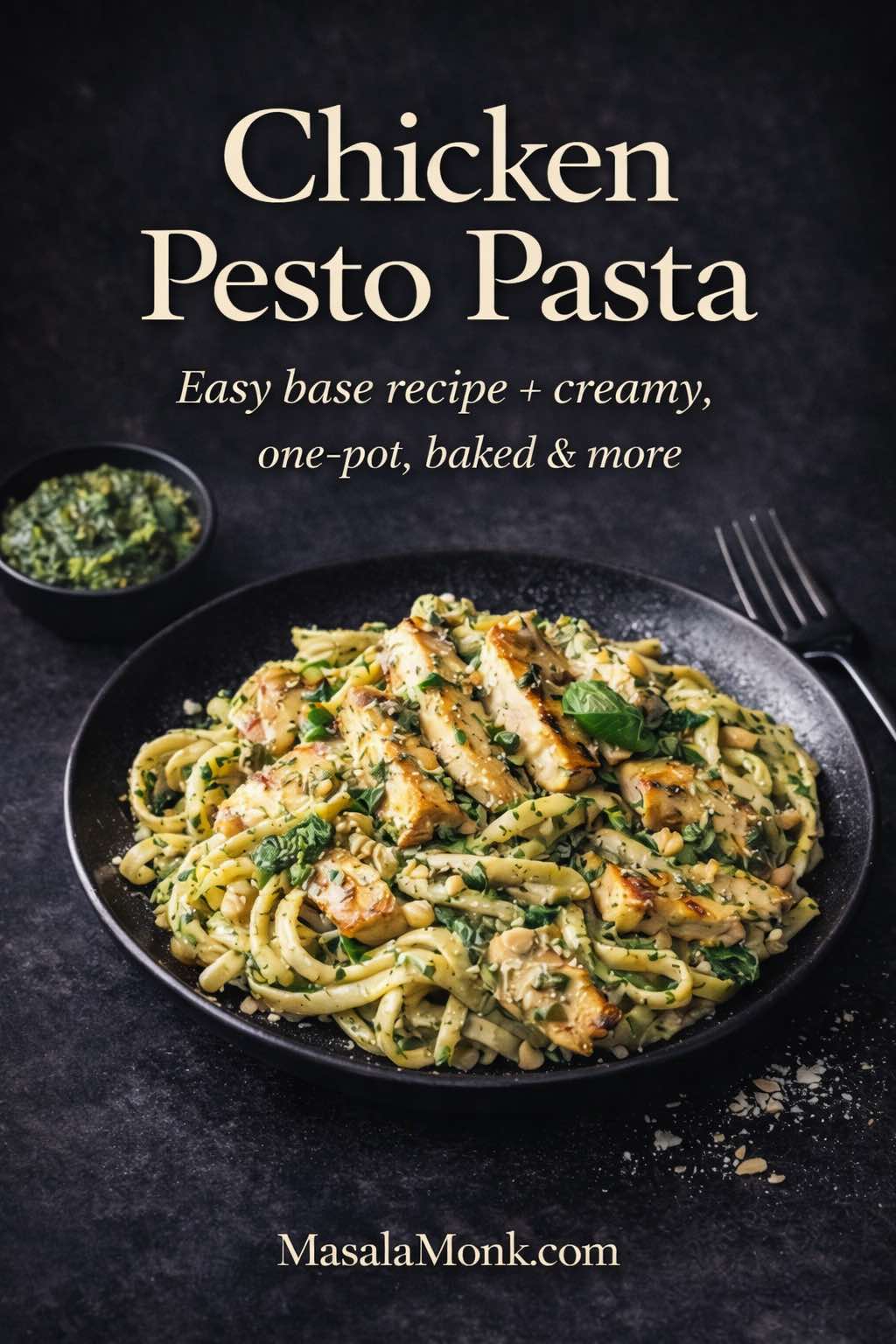
Dark, luxe magazine-style cover showing chicken pesto pasta on a black plate with basil, parmesan, and pine nuts, with text overlay “Chicken Pesto Pasta” and “Easy base recipe + creamy, one-pot, baked & more,” plus MasalaMonk.com footer.

Some dinners earn a permanent spot in your rotation because they’re both effortless and deeply satisfying. Chicken pesto pasta is exactly that kind of meal. It’s bright without feeling “light,” comforting without being heavy, and flexible enough to match whatever’s in your fridge—mushrooms you need to use up, a handful of tomatoes getting soft, leftover grilled chicken, or a craving for something creamy and cozy.

Even better, once you understand one dependable base method, everything else becomes a variation you can steer with tiny choices. Want a weeknight sprint? Make the fast version with a quick sauté and a splash of starchy water. Prefer a richer plate? Turn it creamy with a gentle swirl of dairy (or a lighter trick that still feels lush). Need fewer dishes? A one-pan finish gives you the same restaurant-style gloss with less mess. Feeding a crowd? A baked version becomes a bubbling, golden pasta bake with almost no extra effort.

So instead of treating each version like a different recipe, this guide gives you one reliable foundation—then shows you how to pivot into the best version for the mood you’re in.


Chicken Pesto Pasta (Easy Base Recipe)

This is the anchor—the version you’ll make on repeat. Whether you’re using basil pesto from the store or pulling a jar of homemade pesto from the fridge, the method stays the same. Nail this once, and every other variation becomes a simple, confident detour rather than a whole new recipe.

If you want pesto that tastes vivid and fresh, homemade is worth it whenever you have ten minutes. MasalaMonk’s guide to classic basil pesto sauce plus easy variations is a handy starting point, especially when you want to change the personality of the sauce without changing dinner. If you’re aiming for a dairy-free approach, this fresh basil vegan pesto gives you a bold base that still feels lush.

And if you’re the kind of cook who likes understanding ingredients a little more deeply, it’s surprisingly useful to know what Parmesan brings to a dish beyond “salty cheese.” MasalaMonk’s Parmesan guide and varieties helps you pick the right style and use it well—especially when you’re finishing a sauce.
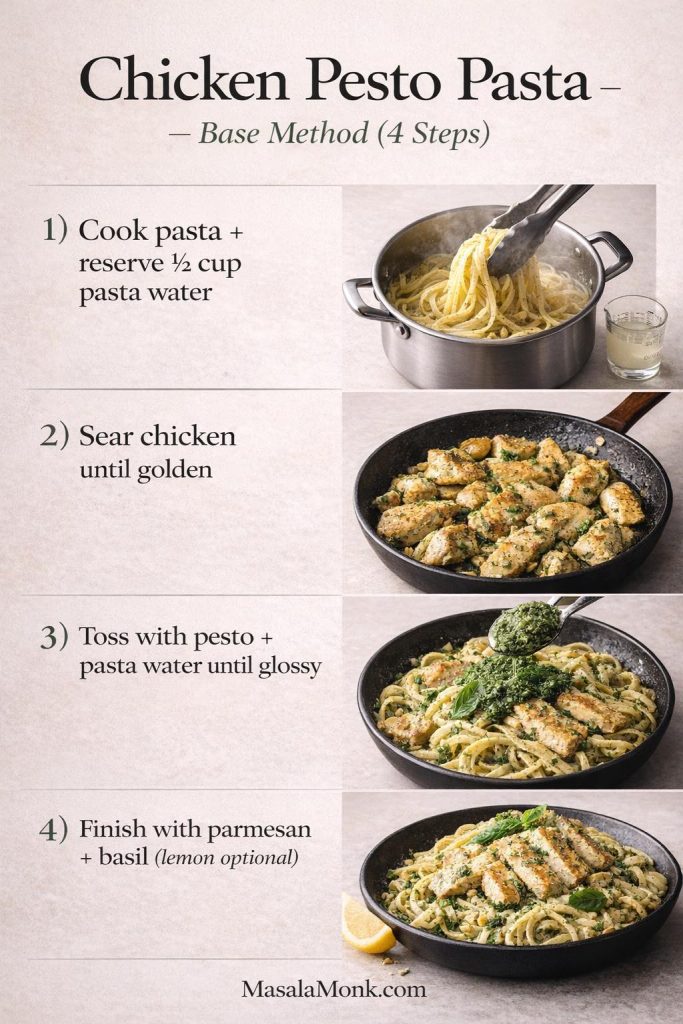
Four-step Chicken Pesto Pasta base method infographic showing: cook pasta and reserve pasta water, sear chicken until golden, toss pasta with pesto and pasta water until glossy, then finish with parmesan and basil; MasalaMonk.com footer.
Chicken pesto pasta, made simple: follow this 4-step base method (pasta water + pesto = glossy sauce) and you’ll be able to turn the same foundation into creamy, one-pot, baked, mushroom, or tomato variations without starting from scratch.

Base Recipe Card: Chicken Pesto Pasta (Serves 4)

Time: 25–35 minutes
Best for: weeknights, meal prep, “I want something comforting but not heavy” nights

Ingredients

  • 400 g pasta (penne, linguine, spaghetti, fettuccine—choose what you love)
  • 450–500 g chicken breast or chicken thighs, cut into bite-size pieces
  • 2–3 tablespoons olive oil
  • 3–4 garlic cloves, finely chopped (optional, but excellent)
  • ½ cup pesto, plus more to taste
  • ½ cup reserved pasta water, plus more as needed
  • ¼–½ cup grated Parmesan (optional, but helps everything cling)
  • Black pepper
  • Lemon wedge (optional, but often perfect)
  • Chili flakes (optional)
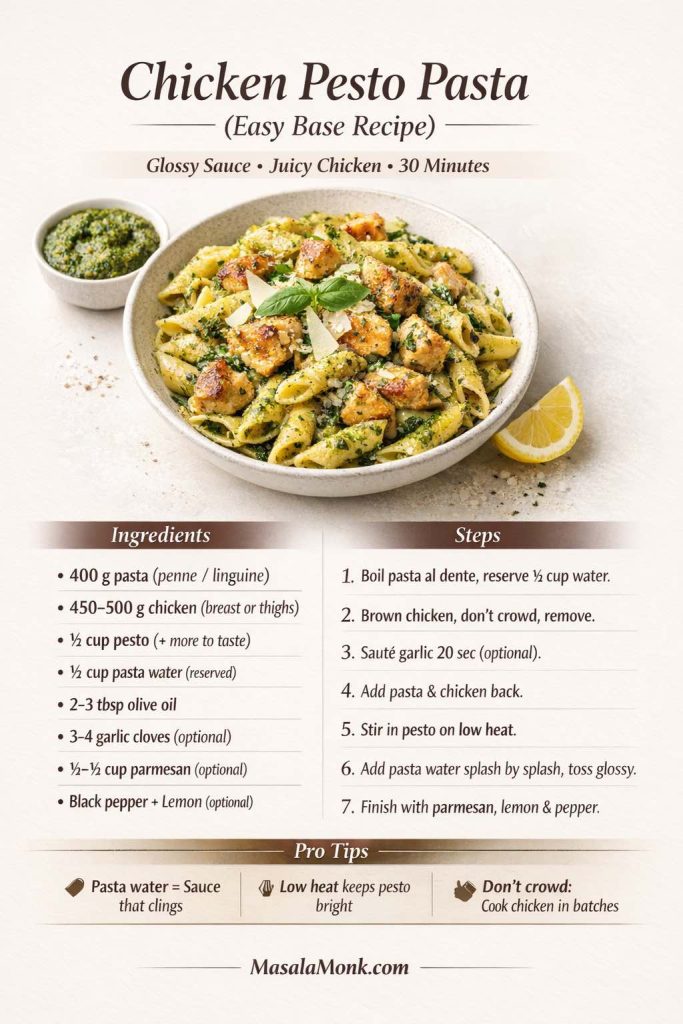
Chicken pesto pasta recipe card showing a bowl of pesto-coated penne with browned chicken, pesto ramekin, and lemon wedge, plus an ingredient list, step-by-step method, and pro tips for glossy sauce using reserved pasta water and low heat.
This Chicken Pesto Pasta “easy base recipe” card is your quick, no-scroll guide: ingredients, simple steps, and the three small moves that make it taste restaurant-level—brown the chicken, keep pesto on low heat, and use reserved pasta water to turn it glossy and clingy. Save it for busy nights, then scroll for creamy, one-pan, one-pot, baked, mushroom, and tomato variations.

The one move that changes everything

Keep pesto bright. It tastes best when it’s warmed gently, not cooked aggressively. In other words, pesto goes in at the end, on low heat.

How to cook chicken for pesto pasta (juicy, browned, not dry)

Start with a simple truth: if the chicken is dry, the whole bowl feels dry—no matter how good the pesto is. Fortunately, the fix is straightforward, and it’s more about timing than fancy technique.
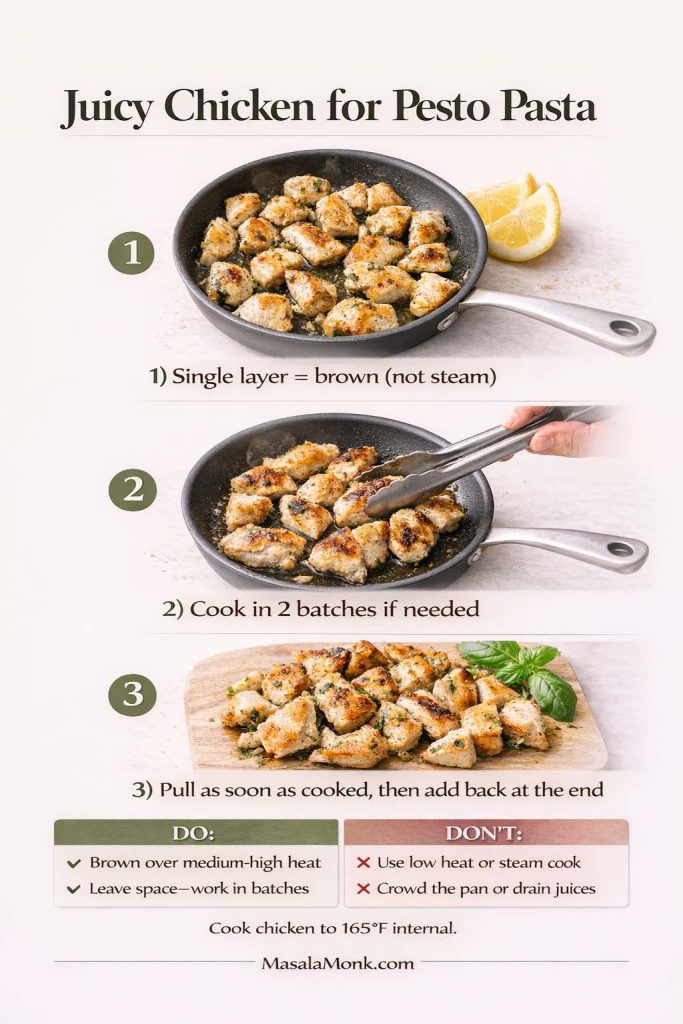
Infographic titled “Juicy Chicken for Pesto Pasta” showing three steps to keep chicken tender: brown chicken in a single layer, cook in two batches if needed, and remove as soon as cooked before adding back at the end. Includes a do/don’t box about avoiding steaming or crowding the pan and a note to cook chicken to 165°F internal.
Dry chicken can make even great pesto pasta feel disappointing—this quick guide fixes it. Brown chicken in a single layer (so it sears instead of steaming), cook in batches if the pan feels crowded, and pull it as soon as it’s cooked through—then add it back only at the end so it stays juicy. Save this technique card for chicken pesto pasta, creamy versions, and pasta salad meal prep, and scroll the post for the full base recipe plus one-pan, one-pot, baked, mushroom, tomato, grilled, and BBQ variations.
  1. Pat the chicken dry. This sounds minor, yet it’s the difference between browning and steaming. Dry surface browns; wet surface turns pale and watery.
  2. Season lightly. Pesto is often salty, so go easy with salt at first. Add black pepper generously.
  3. Brown, don’t crowd. Heat a large skillet until it’s properly hot, then add olive oil. Spread the chicken in a single layer. If the pan looks crowded, cook in two batches. That small bit of patience pays off because you’ll get color, and color equals flavor.
  4. Pull it early rather than late. As soon as the pieces are cooked through, move them to a plate. They’ll get a gentle warm-up later, and that’s how they stay tender instead of turning tough.

For a clear safety reference, chicken should reach a safe internal temperature of 165°F / 74°C. If you like referring to an authoritative standard, the USDA’s Safe Minimum Internal Temperature Chart is the one many cooks rely on.

How to make chicken pesto pasta (base method)

  1. Cook the pasta. Bring a large pot of water to a boil and salt it well. Cook pasta until al dente. Before draining, scoop out ½ cup of pasta water and keep it nearby.
  2. Build flavor in the pan. While the pasta cooks, brown the chicken as described above. Once it’s done, remove it to a plate. If you’re using garlic, add it to the same pan for about 20–30 seconds—just until fragrant.
  3. Combine pasta + chicken. Add drained pasta to the skillet, followed by the chicken and any juices on the plate (those juices are flavor).
  4. Add pesto, then loosen with pasta water. Turn the heat low. Stir in pesto, then immediately add a splash of pasta water and toss. Keep adding small splashes as you toss until the sauce turns glossy and clings to every bite.
  5. Finish with Parmesan if using. Sprinkle in Parmesan and toss again. If it thickens too much, add another spoonful of pasta water.
  6. Taste and adjust. A squeeze of lemon can brighten everything if the pesto tastes heavy. Chili flakes wake up the bowl. Black pepper almost always helps.

That pasta-water step is not optional if you want the sauce to behave. It’s what keeps pesto chicken pasta from turning into oily noodles with green streaks. For those who enjoy technique writing, Serious Eats explains the logic beautifully in The Right Way to Sauce Pasta—and once you “get it,” you’ll use the same idea in countless dishes.
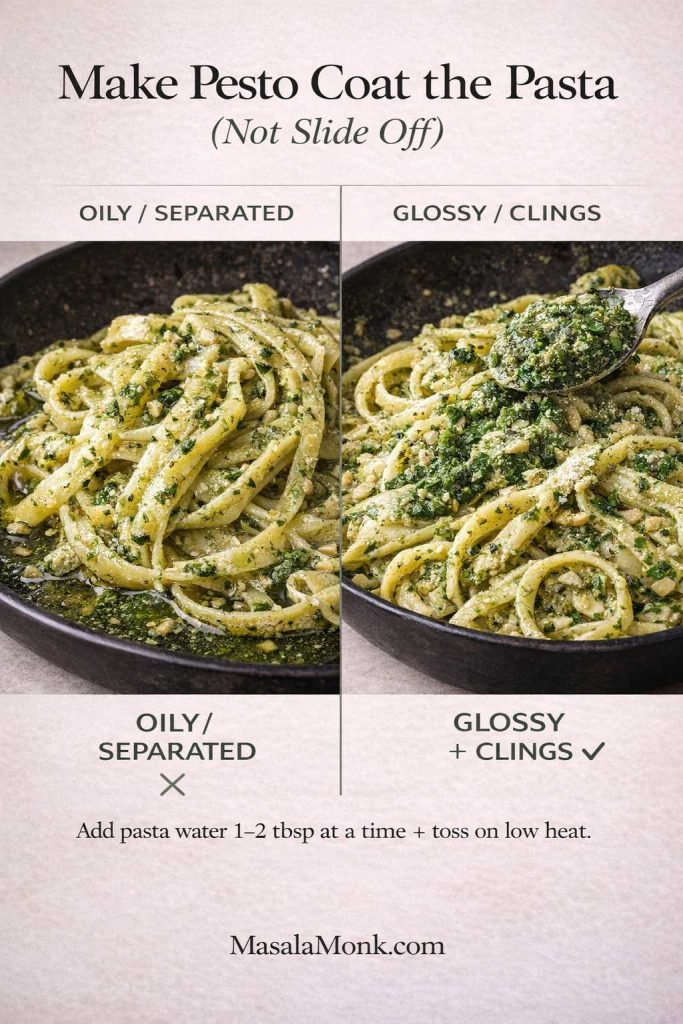
Side-by-side infographic showing pesto pasta sauce texture: left panel “oily/separated” pesto on noodles and right panel “glossy/clings” pesto coating pasta, with instruction to add pasta water 1–2 tablespoons at a time and toss on low heat; MasalaMonk.com footer.
If your chicken pesto pasta looks oily instead of silky, this is the fix: add reserved pasta water a tablespoon at a time and toss on low heat until the pesto turns glossy and clings to the noodles—no extra cream needed.
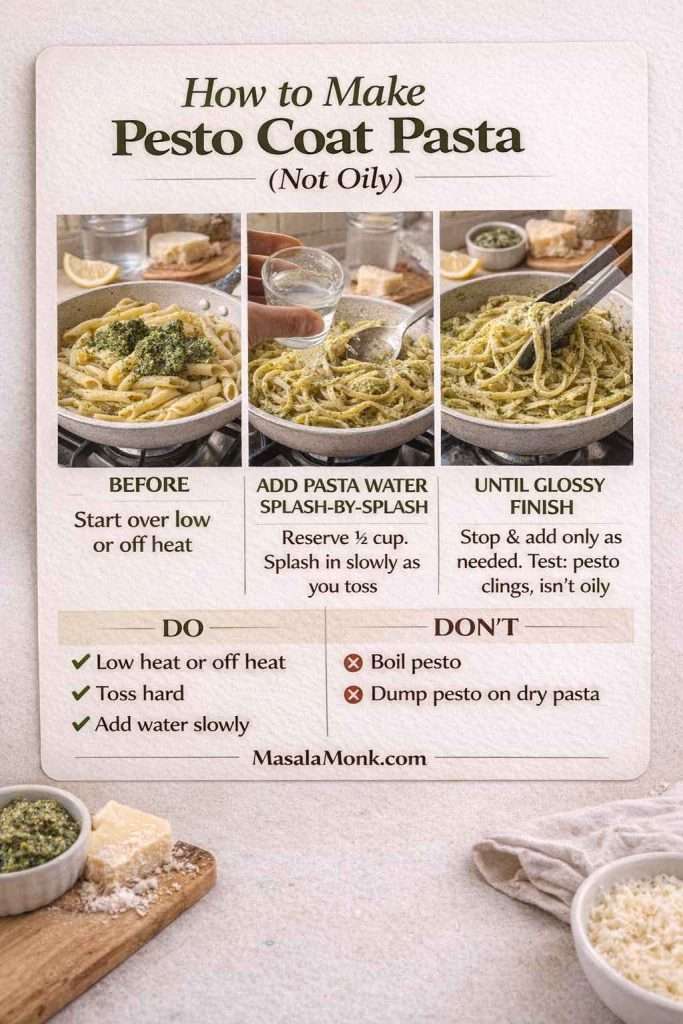
Step-by-step infographic showing how to make pesto coat pasta without turning oily: add pesto on low heat, splash in reserved pasta water while tossing, and stop when the sauce looks glossy and clings. Includes a simple do-and-don’t list, plus photos of pesto pasta in a pan and on a spoon.
If your pesto pasta ever turns into oily noodles with green streaks, this is the fix. Keep the heat low, stir pesto in gently, then add reserved pasta water splash-by-splash while you toss until the sauce turns glossy and clings to every bite. Use the quick “cling test” on a fork to know when to stop. Save this technique card—you’ll use it for chicken pesto pasta, creamy versions, and even pasta salad.

Simple swaps that keep it delicious

Even a “basic” pesto chicken pasta becomes more interesting when you know what swaps play nicely:

  • Chicken thighs stay tender and forgiving, which makes them ideal for quick pasta on busy nights.
  • A small spoon of butter added at the end can soften sharp edges if your pesto is very garlicky.
  • Extra Parmesan helps emulsify if your pesto is oily.
  • A squeeze of lemon balances rich pesto, especially when you turn it creamy.

Easy Chicken Pesto Pasta (Weeknight Fast)

There are nights when you want dinner to land quickly without losing its charm. This version is the fast route—minimal fuss, still full flavor, and it proves that “easy” doesn’t have to mean “meh.”
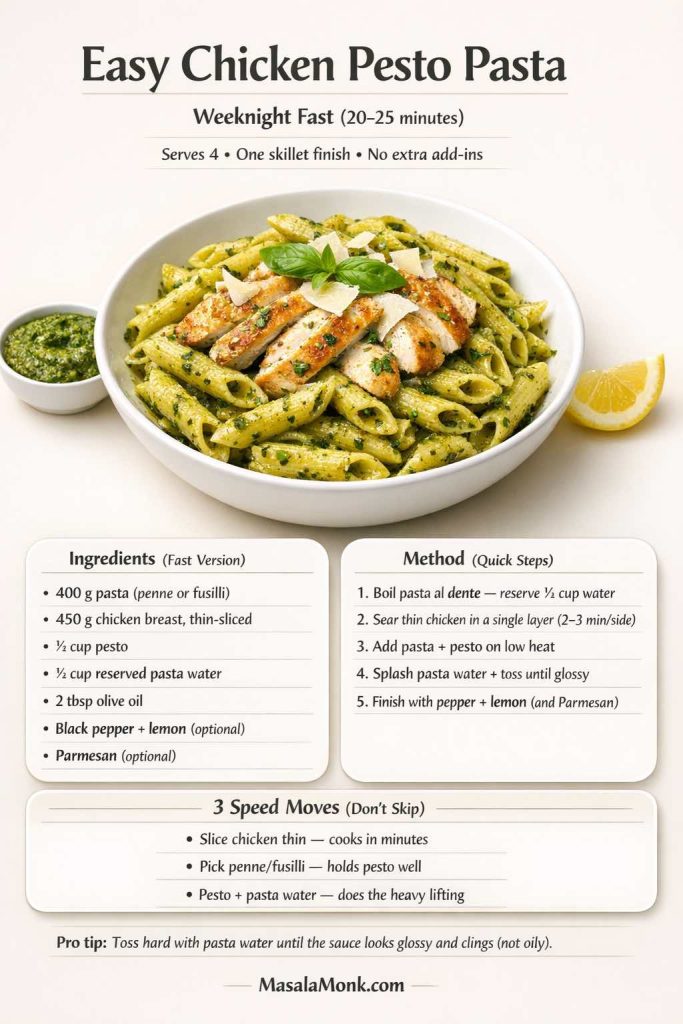
Recipe card for “Easy Chicken Pesto Pasta — Weeknight Fast (20–25 minutes)” showing a bowl of pesto penne topped with sliced chicken, plus a fast-version ingredients list, quick method steps (reserve pasta water, sear thin chicken, toss pesto on low heat until glossy), three speed moves, and a pro tip to toss with pasta water so the sauce clings instead of turning oily.
Need dinner fast without sacrificing flavor? This easy chicken pesto pasta recipe card is built for weeknights: thin-slice the chicken so it sears in minutes, cook penne or fusilli for reliable sauce cling, then finish everything in one skillet with pesto on low heat and a splash of reserved pasta water until glossy. The “3 speed moves” keep it effortless, but the real upgrade is the toss—so it tastes cohesive, not “assembled.” Save this for busy nights and scroll for creamy options, one-pan/one-pot methods, baked pasta, and the mushroom/tomato twists.

Recipe Card: Weeknight Fast Version (Serves 4)

Time: 20–25 minutes
Best for: busy nights, “I need dinner now,” last-minute guests

Do these three things to make it faster:

  • Slice chicken thinly so it cooks quickly.
  • Choose a pasta shape that cooks evenly and holds sauce well (penne, fusilli).
  • Skip extra add-ins and let pesto + pasta water do the heavy lifting.

Even then, don’t rush the finish. Tossing pasta and sauce together until glossy is what makes an easy bowl feel like something you’d happily serve to company—because it tastes cohesive, not “assembled.”


Creamy Chicken Pesto Pasta (Three Ways)

Some evenings are calling for something richer. The creamy version is still bright and herbal, yet it has that soft, comforting body that makes everyone go quiet after the first bite. Importantly, “creamy” doesn’t have to mean heavy—so you can choose your lane.
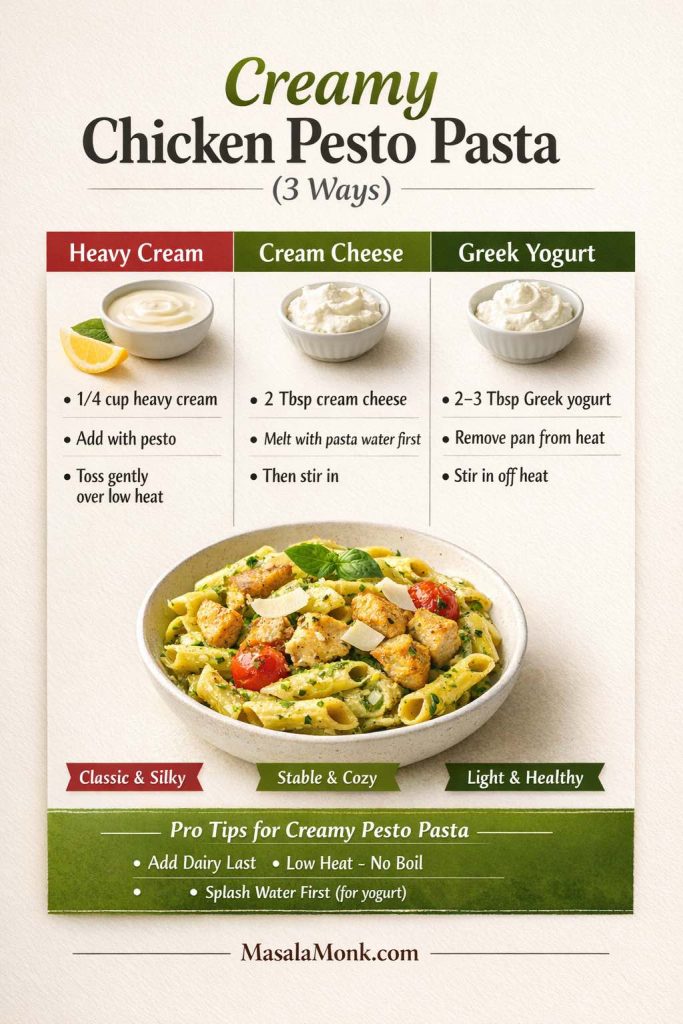
Creamy chicken pesto pasta infographic comparing 3 methods—heavy cream, cream cheese, and Greek yogurt—with amounts, when to add each one, and tips to prevent splitting, plus a bowl of pesto chicken pasta and “low heat, no boil” guidance.
Want creamy chicken pesto pasta without guesswork? This “3 ways” guide shows the exact amounts and timing for heavy cream (classic), cream cheese (stable), or Greek yogurt (lighter—stir in off heat). Keep the heat low, add dairy last, and use a splash of pasta water so the sauce turns silky instead of splitting. Save this for cozy nights, then scroll for one-pan, one-pot, baked, mushroom, and tomato variations.

Recipe Card: Creamy Chicken Pesto Pasta (Core Method)

Start with the base recipe. Once pasta and chicken are in the pan and pesto is added, choose one of these creamy paths:

1) Chicken pesto pasta with cream (classic)

  • Add ¼ cup heavy cream (or cooking cream).
  • Add a small splash of pasta water.
  • Toss gently over low heat for about a minute, just until silky.

Key point: Keep the heat gentle. Pesto tastes freshest when it isn’t cooked hard, and cream behaves best when it’s warmed rather than boiled.

2) Creamy without heavy cream (lighter but still lush)

If you want creamy texture without leaning hard on cream, these options work beautifully:

  • Greek yogurt (bright and light): Remove the pan from heat. Add a splash of pasta water first (so the pan cools slightly), then stir in 2–3 tablespoons yogurt until smooth.
  • Cream cheese (cozy and stable): Stir 1–2 tablespoons cream cheese into warm pasta water first, then toss it through. This is especially good with penne or “noodlier” shapes.
  • Milk + Parmesan (simple and classic): Add a small splash of milk, then use Parmesan as your thickener while you toss until glossy.

Each version still tastes unmistakably like pesto chicken pasta—just softer around the edges.

3) Chicken pesto Alfredo pasta (comfort-forward)

If you love the idea of pesto Alfredo, treat it as a direction rather than a separate universe. Use the creamy method above, then increase Parmesan slightly and finish with a tiny knob of butter. Suddenly you’re in the territory of pesto Alfredo without turning dinner into a long project.

If you want to explore creamy pasta beyond this dish, MasalaMonk’s Alfredo twists make a fun companion read—especially if you enjoy playing with flavors.


One Pan Chicken Pesto Pasta (Skillet Style)

One-pan pesto chicken pasta is the version you make when you want the “real” result with fewer steps and less cleanup. It’s not a totally different dish—it’s the same idea, just streamlined.
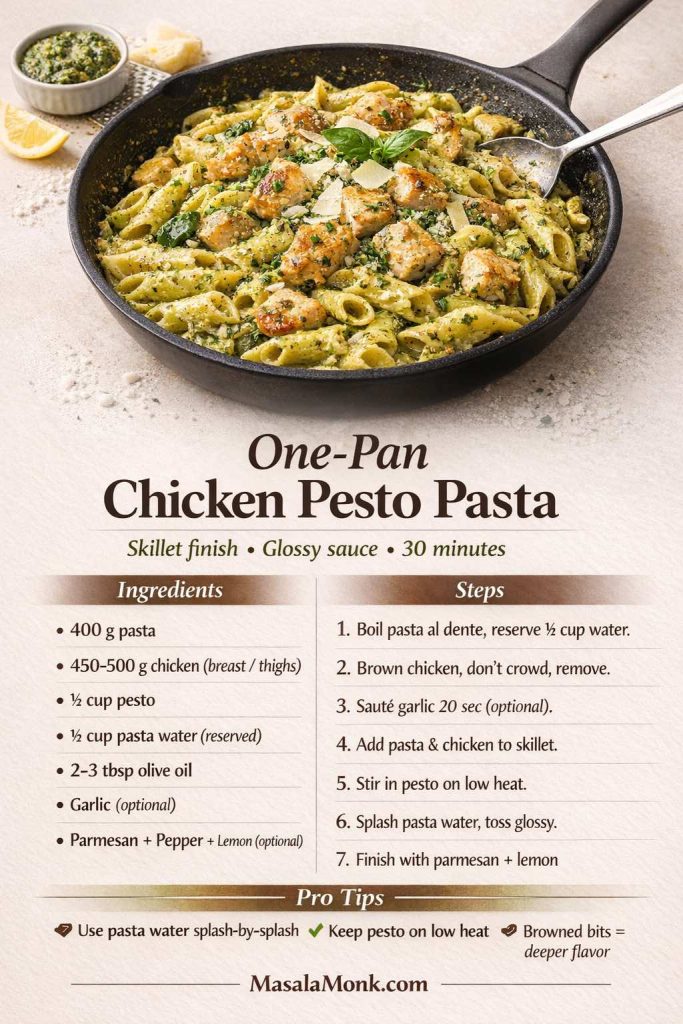
One-pan chicken pesto pasta recipe card showing a skillet of pesto-coated pasta with browned chicken, Parmesan, basil, pesto ramekin, and lemon wedge, plus an ingredient list, step-by-step skillet method, and pro tips to use reserved pasta water and keep pesto on low heat for a glossy sauce.
This one-pan chicken pesto pasta recipe card is the fastest way to get a glossy, restaurant-style bowl with minimal cleanup. Boil pasta al dente, brown the chicken (don’t crowd the pan), then toss everything together in the skillet with pesto on low heat and reserved pasta water splash-by-splash until it clings. Save this for busy nights—and scroll for the one-pot version, creamy options, baked pasta, and add-ins like mushrooms and tomatoes.

Recipe Card: One-Pan Finish (Serves 4)

How it works:

  • Boil pasta in a pot as usual (because it’s faster and more reliable).
  • Brown chicken in the skillet.
  • Add drained pasta directly to the chicken pan.
  • Stir in pesto on low heat, then finish with pasta water right there.

Because the skillet still holds those browned chicken bits, the flavor is deeper than you’d expect from such a simple method. Additionally, it’s the easiest way to control sauce texture because everything is already in one hot, wide surface where tossing is natural.


One Pot Chicken Pesto Pasta (Minimal Dishes, Big Reward)

One-pot pesto chicken pasta is a different style altogether. It’s not “pasta + sauce,” it’s a single-simmer approach where the cooking liquid turns into sauce. Done well, it tastes like a clever shortcut; done poorly, it can turn sticky. The good news? A few small rules keep it perfect.
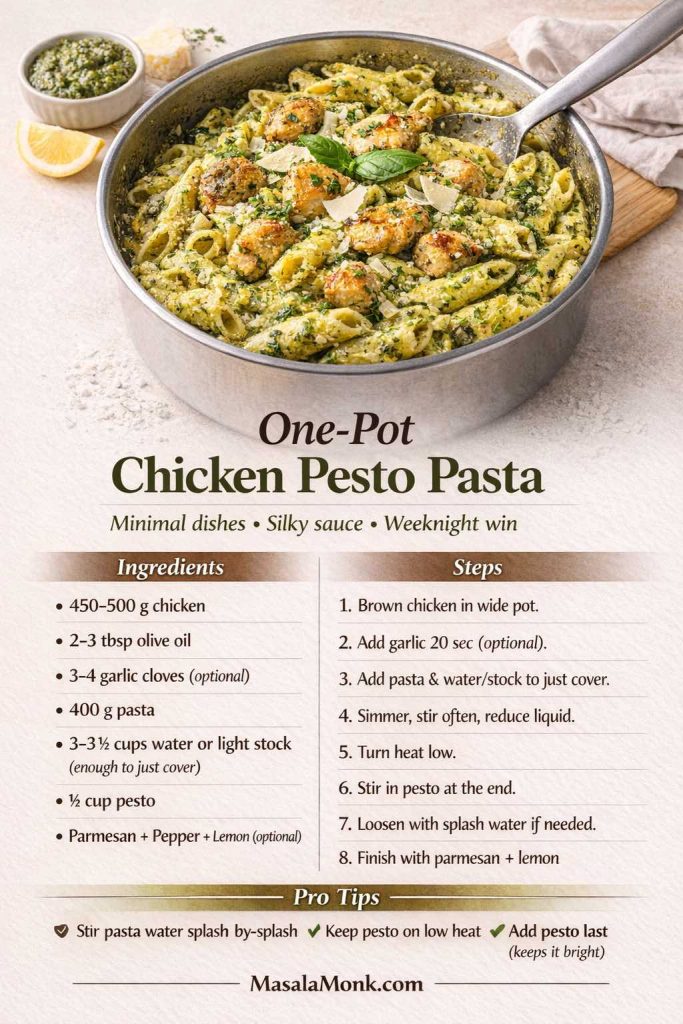
One-pot chicken pesto pasta recipe card showing a wide pot of pesto-coated pasta with browned chicken, Parmesan, basil, and a pesto ramekin, plus ingredients, step-by-step one-pot simmer instructions, and pro tips to stir often, add pesto at the end on low heat, and loosen the sauce with a splash of water if needed.
This one-pot chicken pesto pasta recipe card is for nights when you want big flavor with minimal dishes. Brown the chicken, simmer pasta in just enough water or light stock until it turns saucy, then add pesto at the end on low heat so it stays bright. Stir often, stop at al dente, and loosen with a splash of water if the sauce tightens. Save this for weeknights—and scroll for creamy options, baked pesto pasta, mushroom and tomato add-ins, plus storage and reheating tips.

Recipe Card: One-Pot Method (Serves 4)

  1. Brown chicken in a wide pot or deep skillet. Remove it if you want more control, or leave it in for maximum convenience.
  2. Add garlic (optional) for 20–30 seconds.
  3. Add pasta and enough water (or light stock) to just cover.
  4. Simmer, stirring often, until pasta is al dente and the liquid is reduced.
  5. Turn heat down low, then stir pesto in at the end.
  6. Loosen with a splash of water until glossy.
  7. Add chicken back (if removed), then finish with Parmesan if you like.

Why it works: The starch that normally goes down the drain stays in the pot, which helps everything cling.
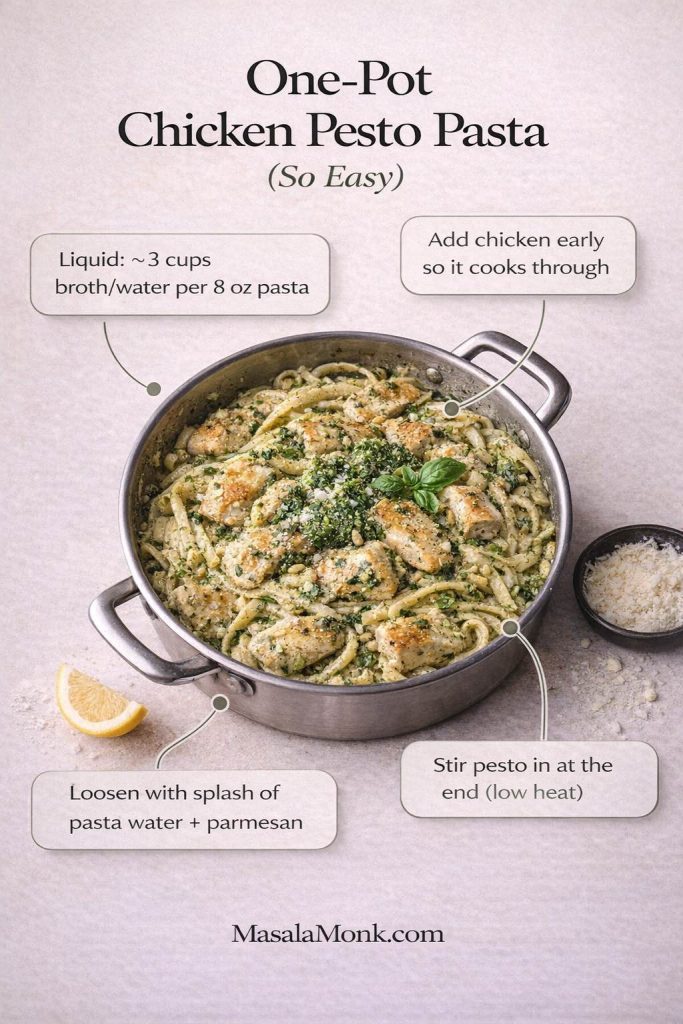
Top-down one-pot chicken pesto pasta infographic showing a pot of pesto pasta with chicken and basil, with callouts for liquid ratio (about 3 cups broth or water per 8 oz pasta), adding chicken early, stirring pesto in at the end on low heat, and finishing with pasta water plus parmesan; MasalaMonk.com footer.
One-pot chicken pesto pasta made foolproof: follow this simple ratio and timing—add chicken early, stir pesto in at the end on low heat, and finish with a splash of pasta water plus parmesan for a glossy sauce that coats every noodle.

One-pot creamy pesto chicken pasta

Once pesto is stirred in, add one of these:

  • 2–4 tablespoons cream, or
  • a spoon of cream cheese, or
  • Greek yogurt off heat (with a splash of water first)

Then toss until silky. That’s how the one-pot creamy version becomes something you’ll crave—not just a shortcut.


Chicken Pesto Pasta with Mushrooms (Deep, Savory, Balanced)

Mushrooms are the easiest way to make this pasta taste more “restaurant” without making it complicated. They add depth and make the pesto feel rounder, almost like the dish has been simmering longer than it has.
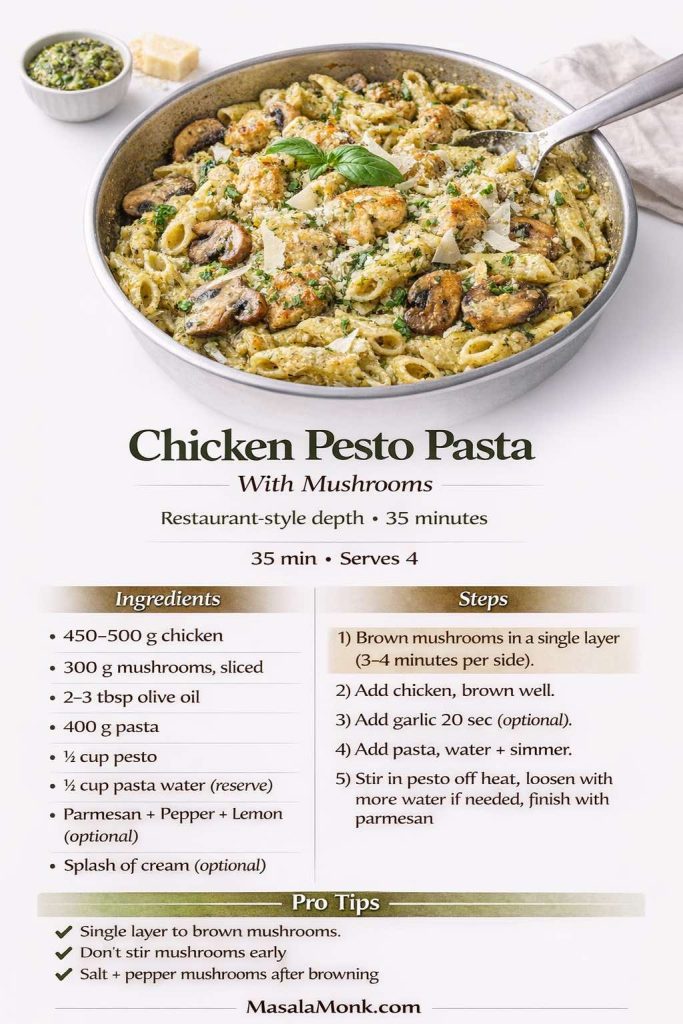
Chicken pesto pasta with mushrooms recipe card showing a skillet of pesto-coated penne with browned chicken, sautéed mushrooms, Parmesan, and basil, plus an ingredient list, step-by-step method, and pro tips to brown mushrooms in a single layer, avoid stirring early, and season after browning.
This chicken pesto pasta with mushrooms recipe card is the “restaurant-depth” upgrade—without extra work. The key is browning mushrooms in a single layer first (don’t stir early), then tossing everything with pesto on low heat and a splash of reserved pasta water so the sauce clings instead of turning oily. Save this for cozy weeknights, then scroll for the tomato version, grilled chicken option, pasta bake, creamy variations, and the one-pan/one-pot methods.

Recipe Card: Mushroom Add-In (Serves 4)

The essential rule: Don’t steam mushrooms. Brown them.

  • Heat the pan properly.
  • Add mushrooms and let them sit until they pick up color.
  • Only then stir. Once they’re browned, they taste nutty and savory rather than watery.

From there, the flow stays familiar:

  • Brown chicken (or brown it first and set aside).
  • Cook pasta.
  • Toss together with pesto and pasta water.

If you want a cozier bowl, this version transforms beautifully into a creamy mushroom pesto chicken pasta with a small splash of cream—no separate recipe required.


Chicken Tomato Pesto Pasta (Bright and Slightly Jammy)

Tomato and pesto can be magic together if you keep the balance right. Tomatoes bring sweetness and acidity, pesto brings richness and salt. When the two meet in the pan, you get a sauce that feels bright, not heavy.
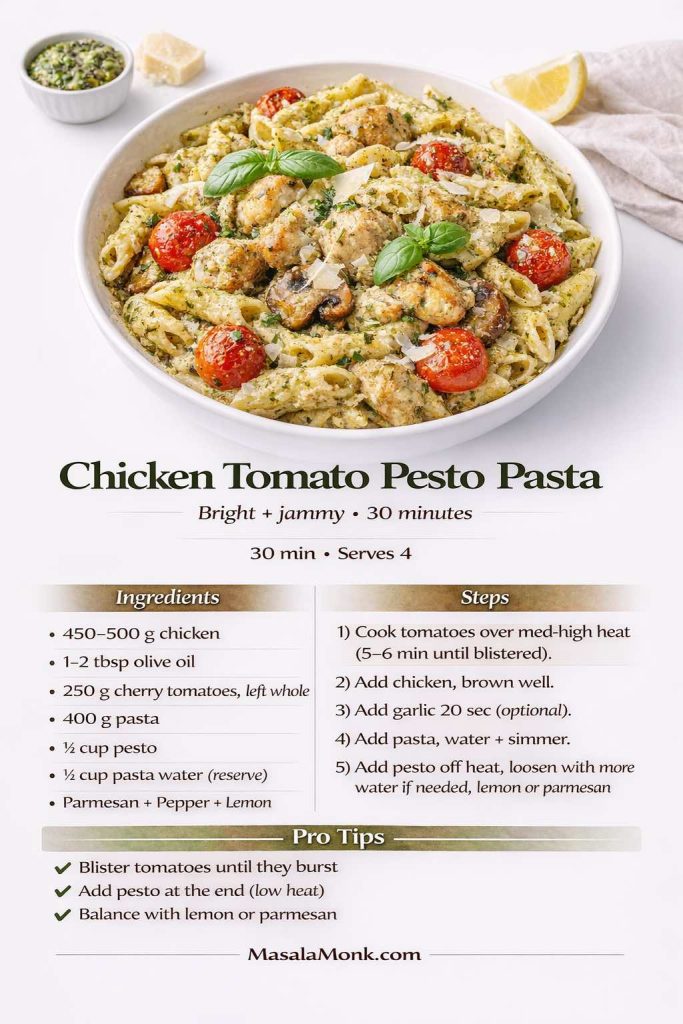
Chicken tomato pesto pasta recipe card showing a bowl of pesto-coated penne with browned chicken and blistered cherry tomatoes, plus a clear ingredient list, step-by-step instructions, and pro tips to blister tomatoes until they burst, add pesto at the end on low heat, and balance the sauce with lemon or Parmesan.
This chicken tomato pesto pasta recipe card is the bright, slightly jammy twist that makes pesto feel lighter and fresher. Blister cherry tomatoes until they burst, brown the chicken, then toss everything with pesto on low heat and reserved pasta water so the sauce turns glossy and clings. If the flavor needs balance, lemon brightens while Parmesan rounds it out. Save this for weeknights—then scroll for creamy options, one-pan and one-pot methods, the baked pesto pasta version, and the mushroom variation.

Recipe Card: Tomato Options

Option 1: Blistered cherry tomatoes (best flavor, easiest)
After browning the chicken, add cherry tomatoes to the same pan. Let them blister until they burst and soften. Then add pasta, pesto (on low heat), and pasta water.

Option 2: A little canned tomato (use as an accent)
If you’re using canned, think “accent,” not “marinara.” A few spoonfuls of crushed tomato simmered briefly is enough. Then turn the heat low before adding pesto so basil stays bright.

Balancing tomato + pesto

  • If it tastes flat, lemon helps.
  • If it tastes too sharp, Parmesan rounds it out.
  • If it tastes too salty, more pasta water (and an extra handful of pasta or veg) fixes it quickly.

If you’d like another dinner idea that leans into the same flavor family, MasalaMonk’s tortellini cooking guide includes a pesto direction with tomatoes that adapts easily to this style.


Grilled Chicken Pesto Pasta (Smoky, Fast, Summery)

When grilling is already happening—or you have leftover grilled chicken—this becomes one of the best “second dinners” you can make. It tastes like you planned it, even if it was born from leftovers.
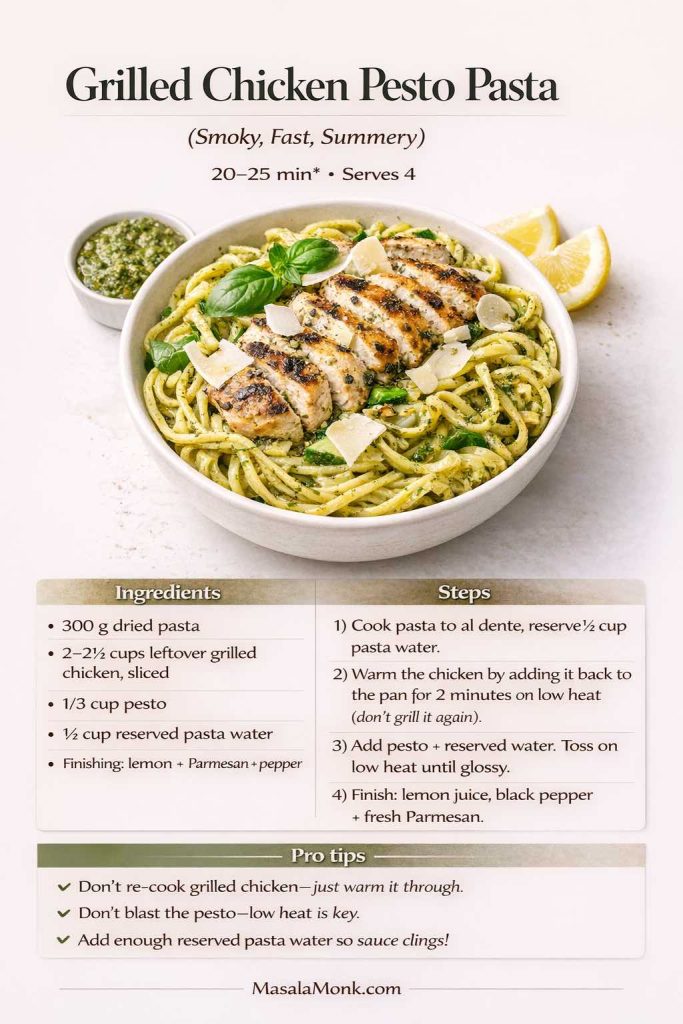
Grilled chicken pesto pasta recipe card showing a bowl of pesto-coated linguine topped with sliced grilled chicken, basil, and Parmesan, with a pesto ramekin and lemon wedges beside it. The card includes ingredients, quick steps to warm leftover grilled chicken gently, toss pesto with reserved pasta water on low heat until glossy, and pro tips to avoid overcooking the chicken.
This grilled chicken pesto pasta recipe card is the perfect “second dinner” when you already have leftover grilled chicken. Cook pasta al dente, warm the chicken gently (don’t re-grill it), then toss everything with pesto on low heat and reserved pasta water until the sauce turns glossy and clings. Finish with lemon, black pepper, and fresh Parmesan for a bright, smoky bowl that tastes like summer—even on a weeknight. Save this for busy nights, then scroll for creamy options, one-pan/one-pot methods, the baked pasta version, plus mushroom and tomato twists.

Recipe Card: Leftover Grilled Chicken Version

  • Cook pasta.
  • Make the sauce in the skillet with pesto + pasta water on low heat.
  • Add sliced grilled chicken at the end and warm it gently.

Because grilled chicken already has smoke and char, keep the rest simple: lemon, black pepper, and a glossy toss. The result tastes like summer even on a random Tuesday.


BBQ Chicken Pesto Pasta (Sweet-Smoky Twist)

BBQ chicken pesto pasta sounds unusual until you remember that pesto loves sweet tomato notes and smoky flavors. The trick is keeping barbecue as a supporting actor—more glaze than sauce—so the pesto still tastes like pesto.
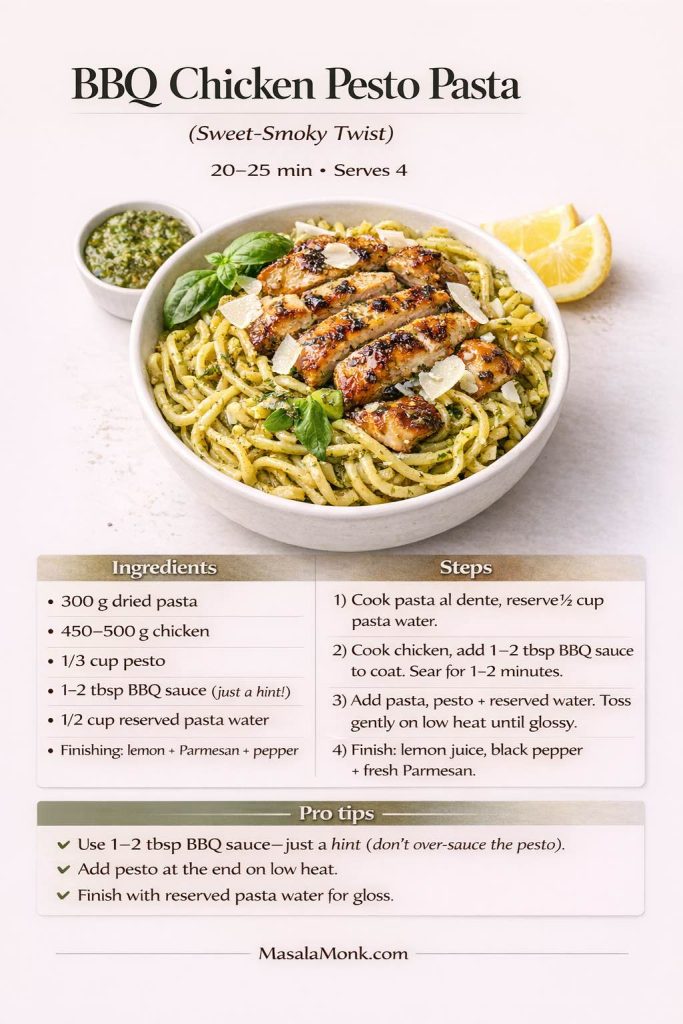
BBQ chicken pesto pasta recipe card showing a bowl of pesto-coated noodles topped with BBQ-glazed chicken, basil, Parmesan, a pesto ramekin, and lemon wedges. The card lists ingredients, 4 quick steps, and pro tips to use only 1–2 tablespoons BBQ sauce, add pesto at the end on low heat, and use reserved pasta water for a glossy sauce.
This BBQ chicken pesto pasta recipe card is a sweet-smoky twist that still tastes like pesto—not barbecue pasta. The trick is restraint: coat the chicken with just 1–2 tablespoons BBQ sauce, then toss everything with pesto on low heat and reserved pasta water until glossy. Finish with lemon, black pepper, and Parmesan to keep the bowl bright and balanced. Save this for weeknights when you want something different, then scroll for the base recipe, creamy options, one-pan and one-pot methods, the baked pesto pasta version, plus mushroom, tomato, grilled, and pasta-salad variations.

Recipe Card: BBQ Twist (Serves 4)

  • Toss cooked chicken lightly with 1–2 tablespoons barbecue sauce.
  • Add it to pasta and pesto at the end.
  • Use pasta water to keep everything cohesive and glossy.

The result is a sweet-smoky bowl that’s surprisingly addictive, especially with penne or fusilli.


Baked Chicken Pesto Pasta (Pasta Bake)

When you want a dish that feels generous—something you can spoon into bowls and watch people go back for seconds—baked chicken pesto pasta delivers. It’s also one of the easiest ways to make dinner feel like an event without extra work.
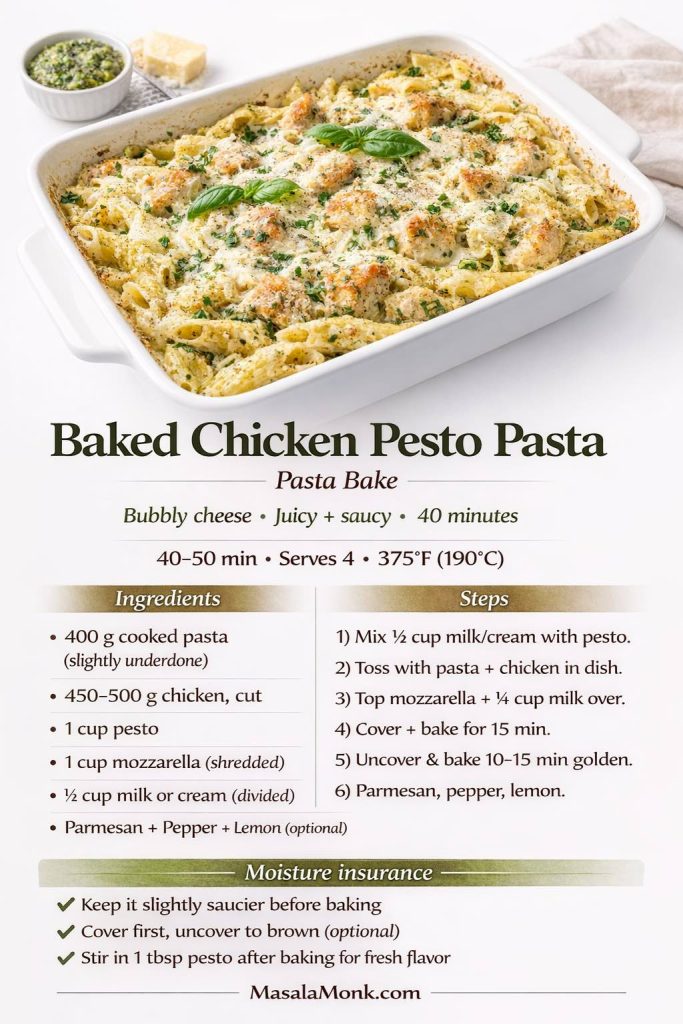
Baked chicken pesto pasta recipe card showing a white baking dish of pesto pasta with browned chicken, melted cheese, Parmesan, and basil, plus ingredients, oven temperature, bake time, step-by-step instructions, and “moisture insurance” tips to keep the pasta bake juicy and saucy.
This baked chicken pesto pasta recipe card is your no-fail pasta bake guide: keep the pasta slightly underdone, mix in enough sauce so it stays juicy, then bake until bubbly and lightly golden. The “moisture insurance” tips (cover first, don’t overbake, stir in a spoon of pesto after baking) make the top taste fresh instead of dull. Save this for cozy dinners, then scroll for the base method, creamy options, one-pan and one-pot versions, plus mushroom and tomato variations.

Recipe Card: Baked Pesto Chicken Pasta (Serves 6–8)

Time: 40–55 minutes
Oven: 200°C / 400°F

  1. Make the base chicken pesto pasta, but keep it slightly saucier than usual. That means extra pasta water and, if you like, a small splash of cream.
  2. Stir in cheese: mozzarella for melt, Parmesan for flavor.
  3. Transfer to a baking dish.
  4. Bake until bubbling and lightly golden.

Because pesto can lose its brightness under high heat, reserve a tablespoon of pesto and stir it in right after baking. That simple move makes the whole dish taste fresher instantly.

If you want extra baked-pasta technique—make-ahead tricks, moisture management, and how to keep a bake from turning dry—MasalaMonk’s baked ziti variations are a surprisingly relevant reference even when you’re not making ziti.


Best Pasta Shapes for Chicken Pesto Pasta

Pasta shape isn’t just aesthetics. It changes how sauce clings, how bites feel, and whether the dish reads “light and glossy” or “thick and cozy.” Once you notice this, you start choosing shapes with intention.
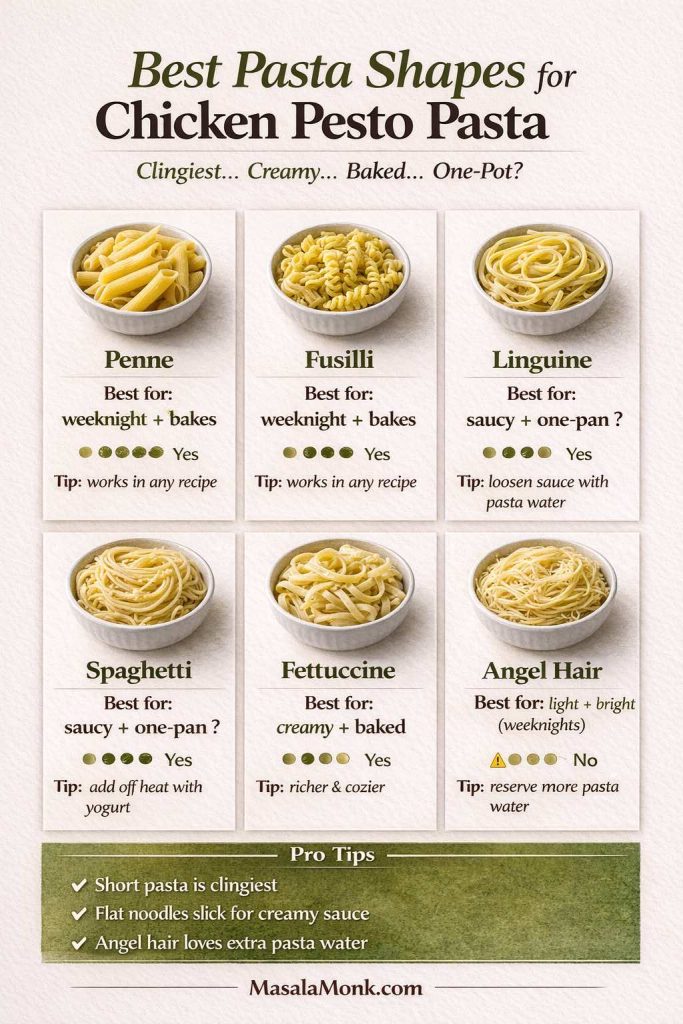
Infographic titled “Best Pasta Shapes for Chicken Pesto Pasta” showing six options—penne, fusilli, linguine, spaghetti, fettuccine, and angel hair—with notes on which is best for weeknights, creamy sauce, baked pasta, or one-pot methods, plus quick tips for sauce cling and using extra pasta water.
Not all pasta shapes behave the same with pesto. This cheat sheet shows the best pasta for chicken pesto pasta—whether you want a glossy one-pan bowl, a true one-pot method, or a creamier, cozier finish. Penne and fusilli grab sauce, linguine and spaghetti feel sleek, fettuccine shines in creamy versions, and angel hair needs extra pasta water to avoid clumping. Save this for later, then scroll for the base recipe card, creamy options, one-pan and one-pot methods, baked pasta, and add-ins like mushrooms and tomatoes.

Penne (weeknight MVP)

Penne holds pesto in the tubes, which makes it ideal for pesto penne chicken pasta. It also holds up well to baking, so if you’re making a pasta bake, penne is a safe bet.

Linguine (silky and polished)

Linguine makes the sauce feel sleek. It’s especially good when you’re chasing that glossy finish and want the pesto to coat each strand evenly.

Spaghetti (simple and fast)

Spaghetti shines when you keep it clean—pesto, chicken, pasta water, Parmesan. It’s also a great “starter” shape because it shows off the base method without distractions.

Fettuccine (best for creamy)

Fettuccine is at its best when the sauce is slightly thicker. That’s why it feels so satisfying in creamy versions.

Angel hair (quick cook notes)

Angel hair cooks quickly, which makes it tempting on busy nights. However, it clumps if you don’t toss immediately with enough pasta water. Go generous with water and keep tossing until glossy.


Chicken Pesto Noodles (When You Want Comfort in a Bowl)

Sometimes you’re not craving “pasta” in the classic sense—you’re craving noodles and sauce. Chicken pesto noodles are perfect for that, especially with egg noodles or a thinner pasta shape.
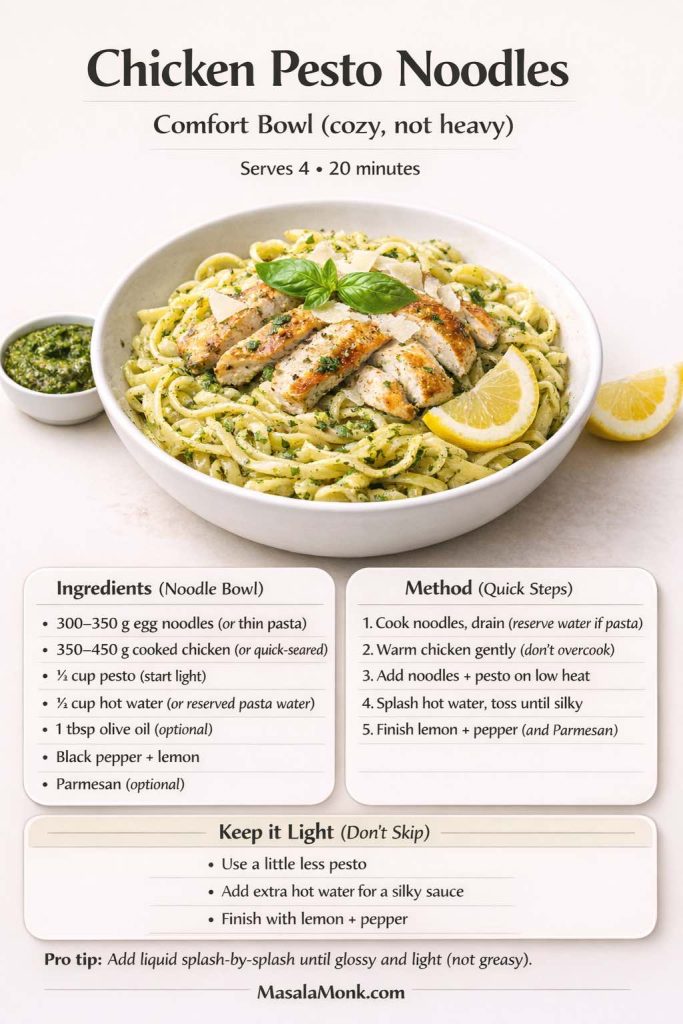
Recipe card for “Chicken Pesto Noodles — Comfort Bowl (cozy, not heavy)” showing a bowl of pesto-coated egg noodles topped with sliced chicken, basil, Parmesan, and lemon wedges, plus ingredients and quick steps to warm chicken gently, add pesto on low heat, and splash hot water or reserved pasta water until the noodles turn silky, then finish with lemon and black pepper.
Craving comfort without the heaviness? This chicken pesto noodles recipe card keeps it cozy and bright: start with egg noodles (or thin pasta), use a little less pesto, and loosen everything with hot water (or reserved pasta water) until silky. Warm the chicken gently, keep the heat low once pesto goes in, then finish with lemon + black pepper (and Parmesan if you want). Save this for quick dinners and scroll the post for the weeknight-fast pasta card, creamy options, one-pan/one-pot methods, baked pasta, plus mushroom and tomato twists.

Recipe Card: Noodle-Style Bowl

To keep it from feeling heavy:

  • Use a little less pesto than usual.
  • Add extra hot water (or reserved pasta water if you’re using pasta).
  • Finish with lemon and pepper.

That combination makes the bowl feel bright again, even when the noodles are cozy.


Basil Pasta Chicken (A Fresh Finish That Changes Everything)

Even if your pesto is basil-based, an extra handful of basil at the end can make the dish smell brand-new. This isn’t a different recipe; it’s the same pasta, simply finished with fresh basil ribbons and, if you like, a tiny drizzle of olive oil.

It’s a small flourish, yet it makes the bowl feel intentional—like you planned it, even if you didn’t.


Healthy Chicken Pesto Pasta (Without Losing What Makes It Great)

“Healthy” is easiest to sustain when it still tastes indulgent. Fortunately, you can make this dish lighter and more balanced without stripping away what makes it comforting.
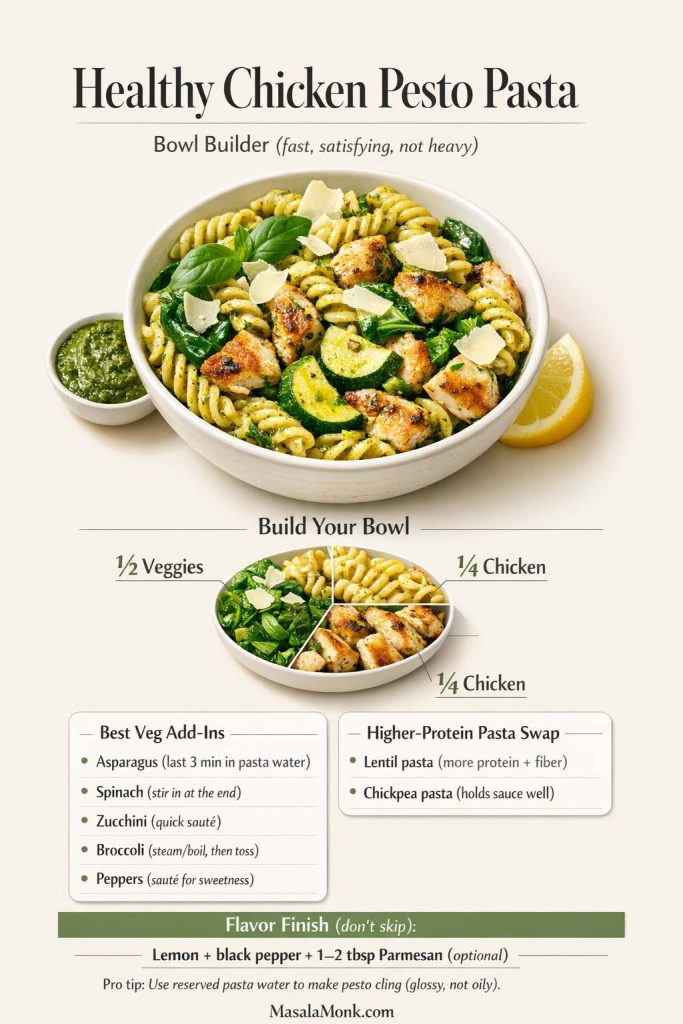
Healthy chicken pesto pasta bowl builder infographic showing a pesto chicken pasta bowl with zucchini and spinach, plus a “Build Your Bowl” plate formula (½ veggies, ¼ pasta, ¼ chicken), a list of best vegetable add-ins (asparagus, spinach, zucchini, broccoli, peppers), higher-protein pasta swaps (lentil, chickpea), and a flavor finish tip (lemon, black pepper, optional Parmesan) with a pasta-water pro tip.
Want healthy chicken pesto pasta that still tastes satisfying? Use this bowl-builder: fill half your bowl with veggies, then add pasta and chicken for balance. The quick add-ins (asparagus, spinach, zucchini, broccoli, peppers) boost volume without dulling pesto, while lentil or chickpea pasta adds extra protein and fiber. Finish with lemon + black pepper (and a little Parmesan if you want), then use reserved pasta water to keep the pesto glossy—not oily. Save this for meal-prep nights and scroll the post for the base recipe, creamy options, one-pan/one-pot methods, baked pasta, and mushroom/tomato twists.

Healthy upgrades that actually stick

  • Add vegetables for volume: asparagus, spinach, zucchini, peppers, broccoli.
  • Choose chicken breast if you want leaner protein, but cook it carefully so it stays tender.
  • Use pesto confidently, then stretch it with pasta water and brightness (lemon, pepper).
  • Finish with a smaller amount of Parmesan rather than removing it entirely—flavor helps you stay satisfied.

If you want a simple portion strategy that still feels generous, build the bowl like this: half vegetables, a quarter pasta, a quarter chicken—then sauce everything with pesto + pasta water so it tastes cohesive.

Asparagus (easy add-in)

Asparagus is made for pesto. Add chopped asparagus to boiling pasta water during the last 2–3 minutes. Drain, then toss into the base recipe. The asparagus stays vibrant, and the bowl feels lighter without feeling “diet.”

Higher-protein pasta swaps

If you want extra protein and fiber, lentil pasta is a strong option. MasalaMonk’s lentil pasta guide goes deeper into how it behaves and what to pair it with, which is helpful when you’re experimenting.


The Small Moves That Make This Pasta Outstanding

A great pasta dish isn’t about complicated ingredients. It’s about a few small moves that keep everything balanced, especially when pesto is involved.
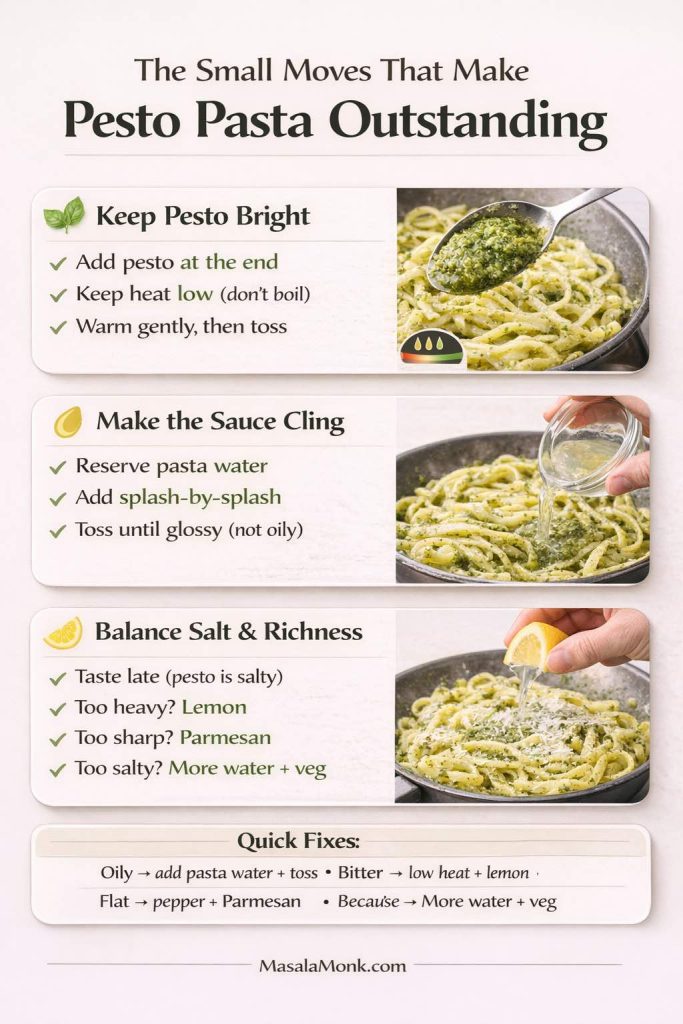
Infographic titled “The Small Moves That Make Pesto Pasta Outstanding” with three technique panels: keep pesto bright by adding it at the end on low heat, make the sauce cling by using reserved pasta water splash-by-splash until glossy, and balance salt and richness by tasting late and adjusting with lemon, Parmesan, or more water and vegetables. Includes a quick fixes strip at the bottom and MasalaMonk.com.
These are the small moves that make chicken pesto pasta taste restaurant-level. Add pesto at the end and keep the heat low so it stays bright. Use reserved pasta water splash-by-splash while tossing until the sauce turns glossy and clings (not oily). Then taste late—pesto is salty—and balance fast with lemon for freshness, Parmesan for roundness, or a little more water + veg if it’s too salty. Save this technique card for every pesto pasta you make, then scroll the post for the fast, creamy, one-pan, one-pot, baked, mushroom, tomato, grilled, BBQ, and pasta-salad versions.

Keep pesto bright

Pesto tastes best when it’s warmed gently rather than cooked hard. So, whether you’re making a clean spaghetti version or a creamy bowl, stir in pesto at the end and keep the heat low.

Make the sauce cling

Pasta water isn’t a garnish—it’s structure. Add it gradually while tossing until the pesto becomes a silky coating. That’s how the sauce goes from “thin” to “glossy.”

Balance salt and richness

Because pesto can be salty, taste late and adjust carefully. If it’s too salty, loosen with water and add a handful of vegetables. If it feels heavy, lemon fixes it fast. And if it tastes sharp, Parmesan softens it.


Chicken Pesto Pasta Salad (A Cold Version That Actually Works)

Even though this post focuses on hot versions, chicken pesto pasta salad deserves a spot because it’s one of the smartest ways to turn leftovers into tomorrow’s lunch. Better still, it’s genuinely delicious when you build it the right way.
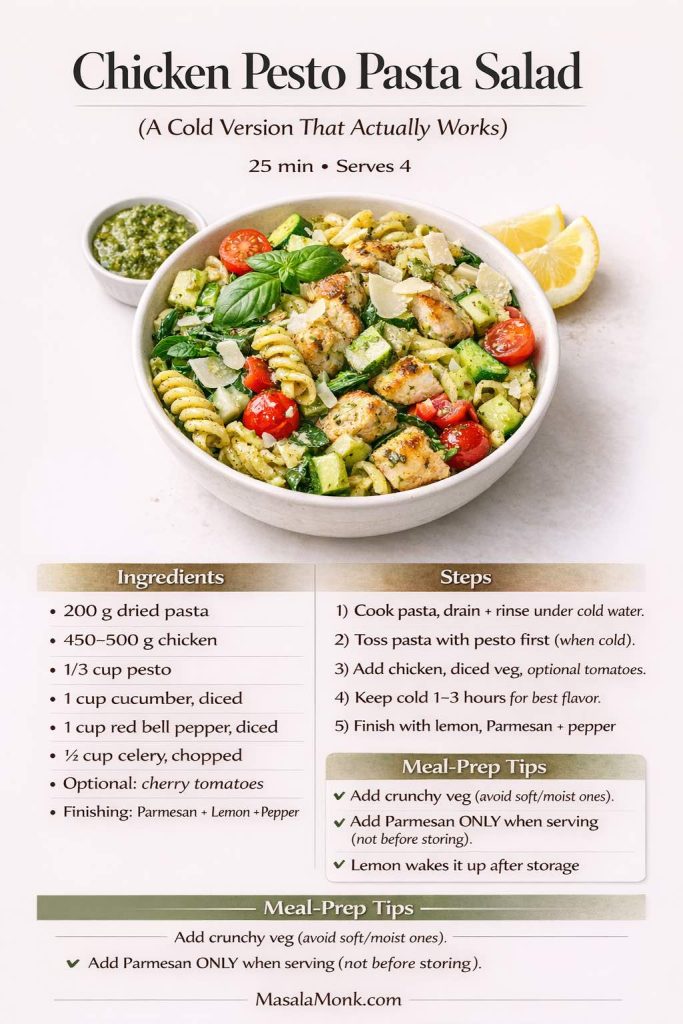
Chicken pesto pasta salad recipe card showing a bowl of cold pesto pasta with grilled chicken pieces, cucumber, cherry tomatoes, basil, Parmesan shavings, a pesto ramekin, and lemon wedges, plus ingredients, step-by-step instructions to rinse pasta and toss with pesto first, and meal-prep tips like using crunchy vegetables and adding Parmesan only when serving.
This chicken pesto pasta salad recipe card is the meal-prep version that actually stays good. Rinse and drain the pasta, toss it with pesto first, then add chicken and crunchy veg like cucumber, bell pepper, and celery so the salad stays fresh—not soggy. Chill for the best flavor, then finish with lemon, black pepper, and Parmesan right before serving (it keeps the texture better). Save this for quick lunches, and scroll the post for the hot base recipe, creamy options, one-pan and one-pot methods, the baked pasta version, plus mushroom and tomato twists.

Recipe Card: Pesto Pasta Salad with Chicken

  • Cook pasta, then rinse briefly under cool water and drain well.
  • Toss pasta with pesto first, then add chicken.
  • Add crunchy vegetables like cucumber, bell pepper, or celery.
  • Finish with lemon and pepper.
  • Add Parmesan right before serving.

Because cold pasta absorbs sauce, you’ll often want a little extra pesto or a drizzle of olive oil plus lemon to keep it lively.

If you plan to meal prep, it’s useful to keep safe storage windows in mind. FoodSafety.gov’s Cold Food Storage Charts is a strong reference, especially when you’re storing mixed dishes.


Storage and Reheating (So It Still Tastes Like Pesto)

Chicken pesto pasta tends to thicken in the fridge. The good news is the fix is easy, and you can bring back the glossy texture without turning the chicken rubbery.
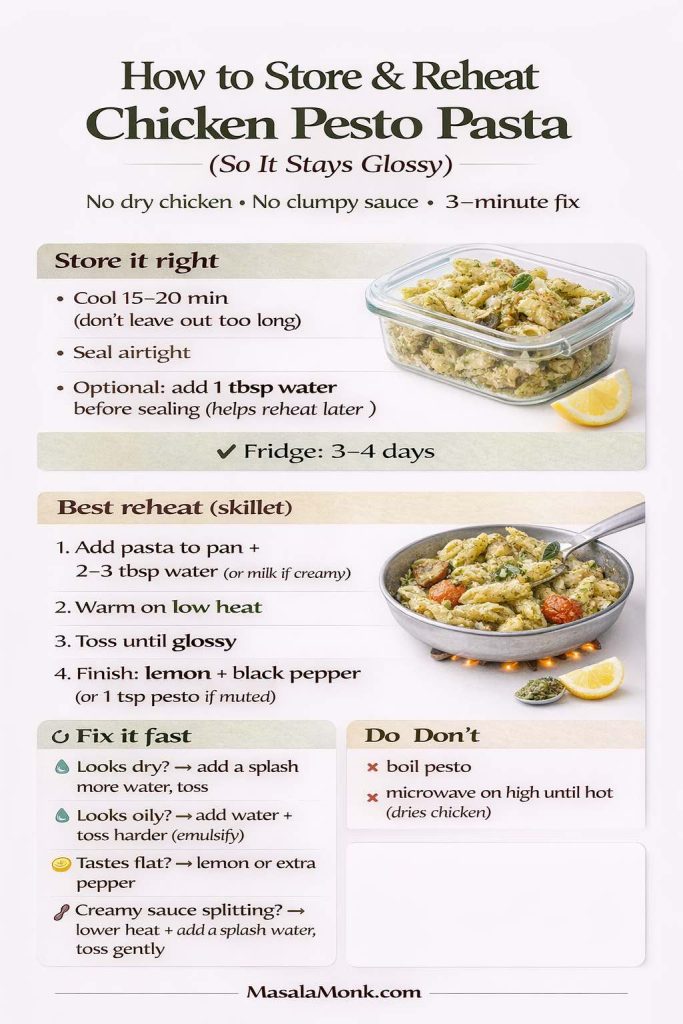
Infographic titled “How to Store & Reheat Chicken Pesto Pasta (So It Stays Glossy)” showing storage steps, fridge time (3–4 days), the best skillet reheat method with added water or milk for creamy versions, quick fixes for dry or oily sauce, and do/don’t tips like avoiding boiling pesto and microwaving on high.
Leftover chicken pesto pasta doesn’t have to taste dry or clumpy. This quick guide shows how to store it properly, then reheat it in a skillet with a splash of water (or milk if creamy) until the sauce turns glossy again. Use the “fix it fast” tips if it looks oily, tastes flat, or starts to split—then finish with lemon and black pepper (or a tiny spoon of pesto) to bring everything back to life. Save this for meal prep nights, and scroll for the base recipe, creamy options, one-pan/one-pot methods, baked pasta, and mushroom/tomato variations.

How to reheat without ruining it

  • Reheat gently in a skillet (low to medium-low).
  • Add a splash of water (or milk if it’s creamy).
  • Toss until glossy again.
  • If it tastes muted, add a tiny spoon of pesto or a squeeze of lemon at the end.

For general leftovers safety guidance, the USDA’s Leftovers and Food Safety page is a trustworthy reference worth bookmarking.


Pesto Storage (If You Make It in Batches)

If you start making pesto at home, you’ll quickly realize the real joy is batch-making and freezing portions. When pesto is ready in the freezer, dinner becomes a toss-and-go situation.
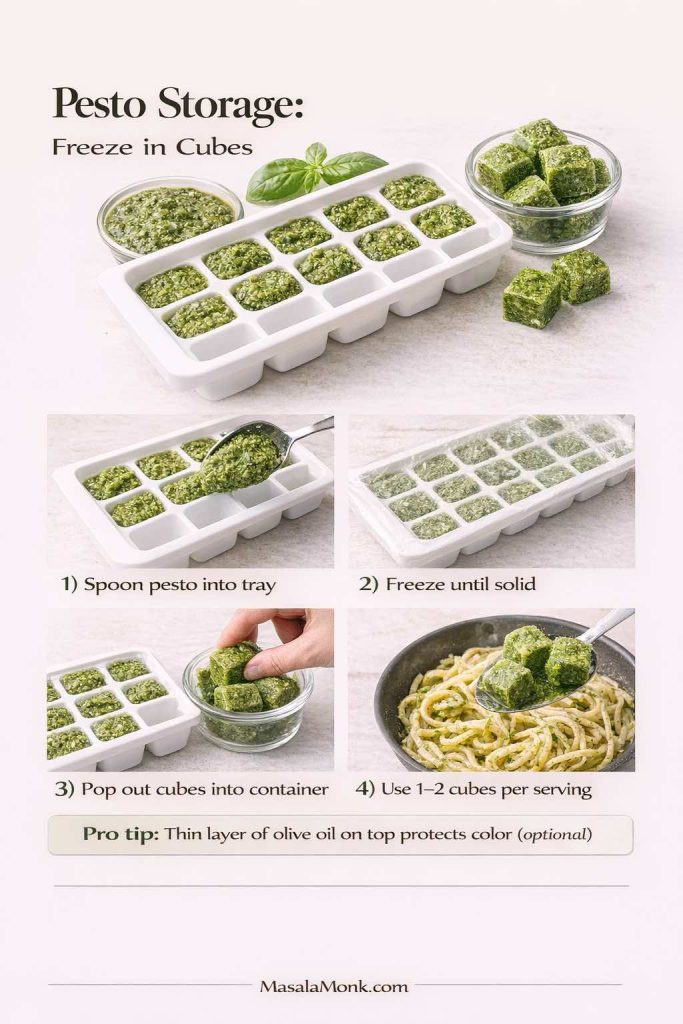
Step-by-step infographic titled “Pesto Storage: Freeze in Cubes” showing pesto spooned into an ice cube tray, frozen until solid, popped into a container, and added to hot pasta. Includes a pro tip that a thin layer of olive oil on top can help protect pesto color, and the footer MasalaMonk.com.
Make pesto once, then make weeknight chicken pesto pasta in minutes. This “freeze pesto in cubes” guide shows the easiest method: spoon pesto into an ice tray, freeze until solid, then store cubes in a container so you can grab 1–2 cubes per serving anytime. It’s the simplest way to keep pesto tasting fresh without wasting basil, and the optional olive-oil tip helps protect color. Save this for meal prep—then use those cubes for the base chicken pesto pasta recipe, creamy versions, one-pan/one-pot methods, pasta salad, and more.

For specific guidance on freezing pesto safely, the National Center for Home Food Preservation’s page on freezing pesto is excellent—especially if you like freezing pesto in cubes, then transferring them to a container once solid.


A Few Delicious Next Steps (If You Want More Ideas)

If you’re in a pesto mood and want to keep the momentum going:


Closing thought

Chicken pesto pasta is the kind of recipe that rewards you every time you make it. Once you’ve cooked it a couple of ways—maybe the fast version on a rushed weeknight, the creamy version on a cozy evening, and a baked one when friends come over—you’ll notice something: it stops being “a recipe” and becomes a flexible dinner you can steer on instinct.

So start with the base. Then pick a direction. A handful of mushrooms, a few tomatoes, a splash of cream, or a one-pot shortcut can take you somewhere new—while still tasting unmistakably like pesto, chicken, and comfort in a bowl.
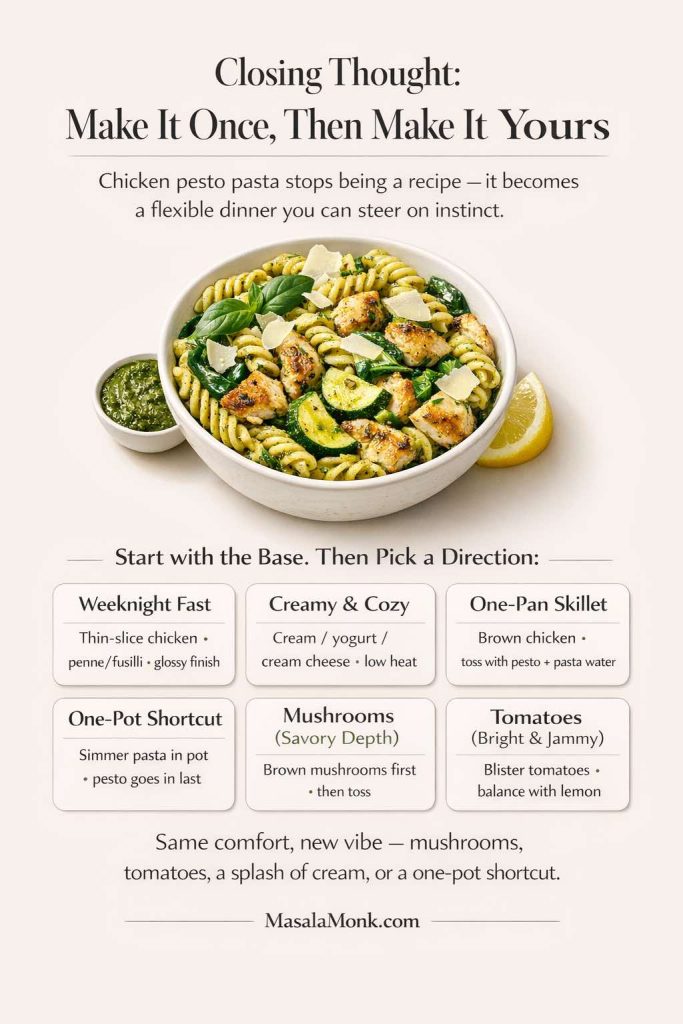
Closing summary infographic titled “Closing Thought: Make It Once, Then Make It Yours” showing a bowl of chicken pesto pasta and a “pick a direction” grid with six variations: Weeknight Fast, Creamy & Cozy, One-Pan Skillet, One-Pot Shortcut, Mushrooms (Savory Depth), and Tomatoes (Bright & Jammy). Includes a closing line about choosing mushrooms, tomatoes, a splash of cream, or a one-pot shortcut, with MasalaMonk.com at the bottom.
Chicken pesto pasta is the kind of dinner that gets better the more you make it—because once you learn the base, you can steer it on instinct. Use this “choose your path” guide to match the mood: go Weeknight Fast, turn it Creamy & Cozy, keep it One-Pan Skillet, simplify with a One-Pot Shortcut, or pivot into Mushrooms for savory depth or Tomatoes for a bright, jammy finish. Save this as your quick decision map, then scroll the post for the full base method and every variation in detail.

Chicken Pesto Pasta FAQs

1) How do I keep chicken juicy?

Pat it dry, cook it in a hot pan without crowding, and pull it as soon as it’s cooked through. Then add it back at the end so it warms up without overcooking.

2) What’s the best way to cook chicken breast so it doesn’t dry out?

Slice it thinner (or butterfly it), then cook quickly over medium-high heat. Because breast cooks fast, pulling it a minute early and letting carryover heat finish it prevents dryness.

3) Why does my pesto sauce look oily instead of coating the pasta?

This usually happens when there isn’t enough starchy water in the pan. Add reserved pasta water a splash at a time while tossing until the sauce turns glossy and clings. Also, keep the heat gentle once pesto goes in.

4) Which pasta shapes work best here?

Penne and fusilli grab sauce easily and hold up well to mix-ins. Linguine and spaghetti give a silkier feel. If you’re making a creamier version, fettuccine is especially satisfying.

5) How can I make this in under 25 minutes?

Use a fast-cooking pasta, cut chicken smaller, and cook both at the same time. Once the pasta drains, toss everything with pesto and a splash of reserved water right in the skillet for a quick finish.

6) Can I make a creamy version without heavy cream?

Yes. Stir in Greek yogurt off heat (with a splash of water first), add a spoon of cream cheese melted with pasta water, or use a small splash of milk plus Parmesan for body.

7) How do I keep a creamy sauce from splitting?

Lower the heat before adding dairy and avoid boiling once it’s in the pan. If using yogurt, add it off heat. If it starts to look grainy, add a little more pasta water and toss gently to bring it back together.

8) What’s the difference between one-pan and one-pot versions?

One-pan usually means pasta is boiled separately, then tossed in a skillet with chicken and pesto. One-pot means pasta simmers in the same pot as the chicken so the cooking liquid becomes part of the sauce.

9) How do I avoid gummy pasta in the one-pot method?

Stir often, keep enough liquid so the pasta can move freely, and stop cooking as soon as it reaches al dente. Then add pesto at the end and loosen with a splash of water if needed.

10) How do I cook mushrooms so they don’t turn watery?

Start with a hot pan, spread mushrooms out, and let them brown before stirring. Once they’ve released moisture and picked up color, they’ll taste deeper and won’t dilute the sauce.

11) What’s the easiest way to add tomatoes without making it too acidic?

Blister cherry tomatoes until they burst for natural sweetness. If using canned tomatoes, keep the amount small and simmer briefly before adding pesto at the end on low heat.

12) Can I turn it into a baked pasta dish?

Absolutely. Make the skillet version slightly saucier, mix in cheese, then bake until bubbling and lightly golden. For extra freshness, stir in a spoon of pesto right after baking.

13) How do I keep a pasta bake from drying out?

Add extra pasta water before baking and include enough cheese or a small splash of cream. If your oven runs hot, cover for part of the bake time, then uncover briefly to brown.

14) Can I use leftover grilled chicken?

Definitely. Slice it and warm it gently at the end. Since it’s already cooked, it only needs a brief heat-through to stay tender.

15) Does a BBQ twist work with pesto?

It can, as long as you use barbecue sauce lightly. Think of it as a glaze on the chicken, then combine with pesto and pasta water so the flavors stay balanced.

16) How do I store and reheat leftovers so it still tastes fresh?

Store in a sealed container in the fridge. Reheat gently with a splash of water (or milk for creamy versions), then finish with black pepper and a squeeze of lemon if it tastes muted.

17) Why does pesto sometimes taste bitter?

Bitterness can come from old basil, too much raw garlic, or overheating. Add pesto on low heat and avoid boiling it. If it still tastes sharp, Parmesan and a touch of lemon balance it quickly.

18) What should I serve on the side?

Go simple: a crisp salad, roasted vegetables, sautéed greens, or garlic bread. If your pasta is creamy, something bright and lemony on the side pairs especially well.
Posted on 13 Comments

Crock Pot Chicken Breast Recipes: 10 Easy Slow Cooker Dinners (Juicy Every Time)

Portrait cover image with text overlay “Crock Pot Chicken Breast” and “10 Juicy Dinners (No Dry Chicken)”. A slow cooker is filled with glossy shredded chicken in a rich sauce, steam rising as a ladle lifts a scoop. MasalaMonk.com appears in the footer.

There’s a particular kind of relief that comes from putting dinner in motion early—then letting the evening unfold without hovering over a stove. A crock pot is built for that. It turns a handful of ingredients into something warm and comforting, while you do everything else life asks for—and crock pot chicken breast is one of the easiest ways to make that happen.

Crock Pot Chicken Breast: The Simple Rules That Keep It Juicy

Chicken breast, though, has a reputation. It’s lean, which is exactly why it can dry out when it’s cooked too long. Even so, slow cooker chicken breast doesn’t have to be bland or overdone. With the right approach—enough moisture, steady timing, and a finishing touch that brightens flavor—you can get tender chicken breast in a crock pot that tastes like you actually tried.

To keep things consistent, it helps to anchor your cooking to one simple target: chicken is done when it reaches 165°F / 74°C in the thickest part. After that, the next step matters just as much—pull it on time, then let it rest before slicing or shredding. That short pause is what keeps the juices where you want them: in the chicken, not on the cutting board.

At the same time, starting with thawed chicken makes the whole process more predictable. Since slow cookers warm food gradually, thawed pieces cook more evenly, which means fewer dry edges and fewer “is this done yet?” moments. As a result, you get better texture with less fuss.

One more thing keeps prep calmer: skip washing raw chicken. Instead, go straight from package to pot, then wash hands and surfaces well. Not only is it simpler, it also avoids spreading raw chicken juices around the sink and countertop.

With those basics in place, everything else becomes easier. From here, you can choose a direction based on what you’re craving: creamy and cozy, tangy and ranchy, sweet-smoky BBQ, bright lemon-garlic, spicy buffalo, or hearty bowls with rice and potatoes. In other words, these ten slow cooker chicken breast dinner recipes aren’t just different—they’re built to rotate nicely, so you can keep dinner interesting without reinventing the wheel every week.


How to Cook Chicken Breast in a Crock Pot Without Drying It Out

Chicken breast becomes “juicy” in the slow cooker for one reason: it finishes at the right temperature and stays surrounded by moisture. Everything else—seasonings, sauces, sides—builds on that foundation.

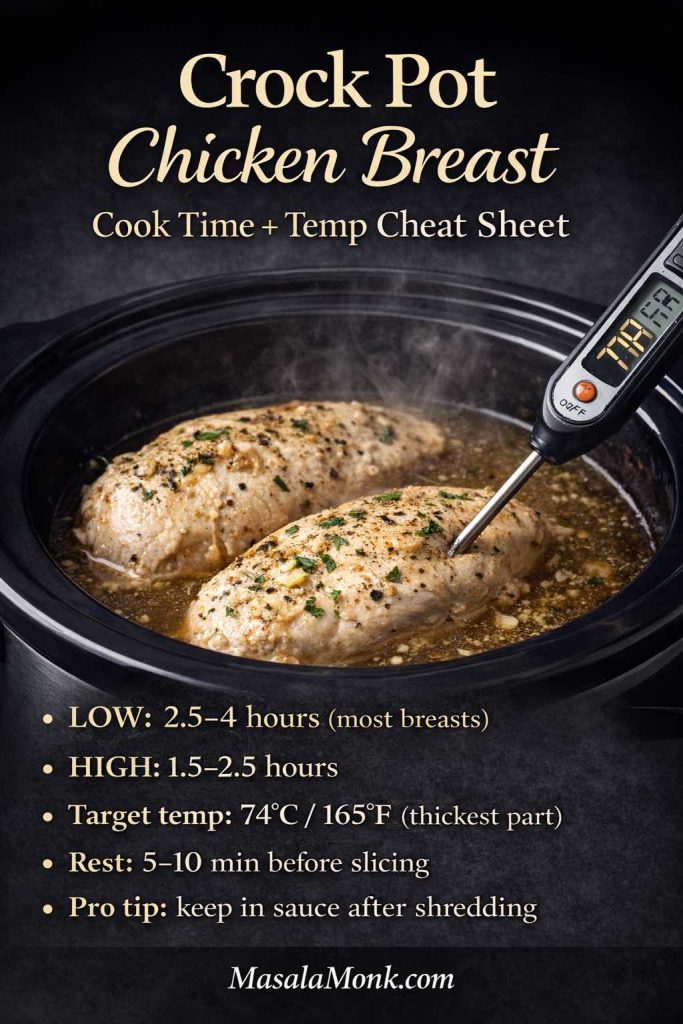
Crock pot chicken breast cook time and temperature cheat sheet with text overlay. Two chicken breasts cook in a slow cooker as a meat thermometer reads 74°C / 165°F. Bullet points list LOW 2.5–4 hours, HIGH 1.5–2.5 hours, rest 5–10 minutes, and a tip to keep chicken in sauce after shredding. MasalaMonk.com in footer.
Bookmark this crock pot chicken breast cheat sheet before your next slow cooker dinner. It shows the key timings (LOW vs HIGH), the target internal temp (74°C / 165°F), and the quick rest rule that keeps chicken juicy—plus the simple “shred + soak in sauce” trick for meal-prep friendly pulled chicken. Save it, share it, and use it as your go-to reference right before you start Recipe #1.

Timing that works in real kitchens

Slow cookers run differently, so time is a guide rather than a guarantee. Still, these ranges are a good starting point for boneless, skinless chicken breasts (roughly 2–3 cm thick):

  • LOW: 2.5 to 4 hours
  • HIGH: 1.5 to 2.5 hours

And if you are doing 1–1.5 cm chicken cutlets/tenders, then check early, while for 3.5+ cm thick breasts, expect the long end of the above time range (or slice horizontally).

Tenderloins, thin cutlets, and bone-in chicken breasts in the crock pot

These cuts follow the same rule—cook to 74°C / 165°F—but the timing window changes fast. The key is simple: check early, then pull as soon as you hit temperature.

  • Chicken tenderloins / tenders: usually finish sooner than whole breasts. Start checking around LOW 1.5–2.5 hours or HIGH 1–1.5 hours.
  • Thin-sliced breasts / cutlets: quickest to overcook. Treat them like a short cook, keep them in sauce, and start checking at the early end (similar to tenderloins).
  • Bone-in chicken breast: takes longer because the bone slows heat transfer. Expect a longer cook (often LOW 4–6 hours), but temperature is still the real finish line.

Consistency hack: Keep pieces similar in thickness, cook in a single layer when possible, and avoid lifting the lid. If you’re shredding, do it in the cooking liquid and let it sit a few minutes to soak.

In other words, these cuts aren’t harder—just faster or slower. Start checking early, pull at 74°C / 165°F, and then rest briefly. Finally, if you’re shredding, do it in the cooking liquid and let it sit for a few minutes so the chicken reabsorbs moisture and flavor.

One-pot layering rules (potatoes, vegetables, and rice)

Quick rule card: firm veg on the bottom, chicken on top, and rice goes in late (or gets checked early) to avoid mush.

When you want a true one-pot slow cooker dinner, ingredients can’t all be treated the same. Instead, you’ll get better results by arranging the crock pot based on how quickly each component cooks—and how easily chicken breast can overdo.

For potatoes and firm vegetables (the “bottom first” rule):

Potatoes, carrots, and similar sturdy vegetables need more direct heat. Therefore, place them on the bottom, closest to the heat source. Next, lay the chicken on top so it cooks gently while the vegetables catch up. In addition, keep potato chunks fairly large (around 3 cm) so they soften at the same pace instead of turning grainy or falling apart.

For softer vegetables (the “late add” rule):

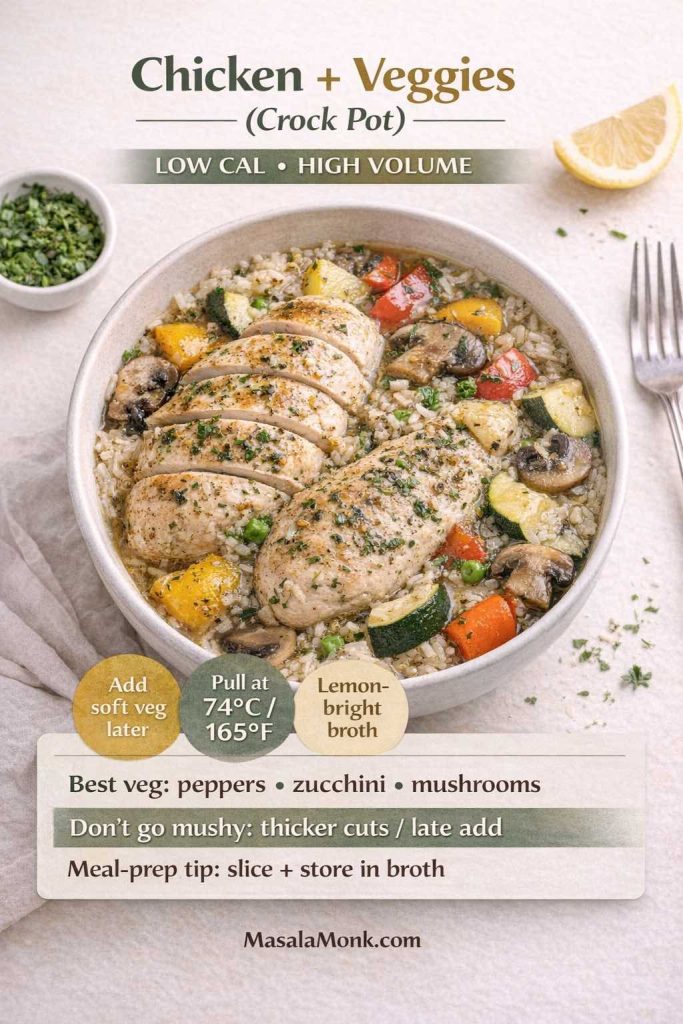
Zucchini, bell peppers, and mushrooms cook faster and can go limp if they sit too long. Consequently, add them later when possible—especially if your slow cooker runs hot. If you do cook them from the start, keep the slices thicker so they hold their shape.

For rice (the “don’t let it idle” rule):

Rice is delicious in the slow cooker, yet it’s also the easiest to overdo. Once rice is tender, it keeps absorbing liquid; which means, it can drift from fluffy to mushy if it sits too long. To avoid that:

  • Use long-grain rice for better separation.
  • Start with hot stock so the rice moves toward tenderness sooner and spends less time lingering.
  • Begin checking early and stop as soon as the rice is done.
  • If your cooker tends to run strong, consider adding rice later (often the final 60–90 minutes on LOW) so chicken doesn’t have to wait around on heat.

In short, the layout and timing do the heavy lifting—so the chicken stays juicy and the “side” stays the right texture.

Why chicken breast turns dry in a slow cooker or crock pot

Dry crock pot chicken breast usually comes from one of these:

  • It stayed on heat long after reaching temperature.
  • It cooked without enough liquid or sauce to protect moisture.
  • Pieces cooked unevenly because some were much thicker than others.
  • The lid came off repeatedly, causing temperature swings and longer cooking.
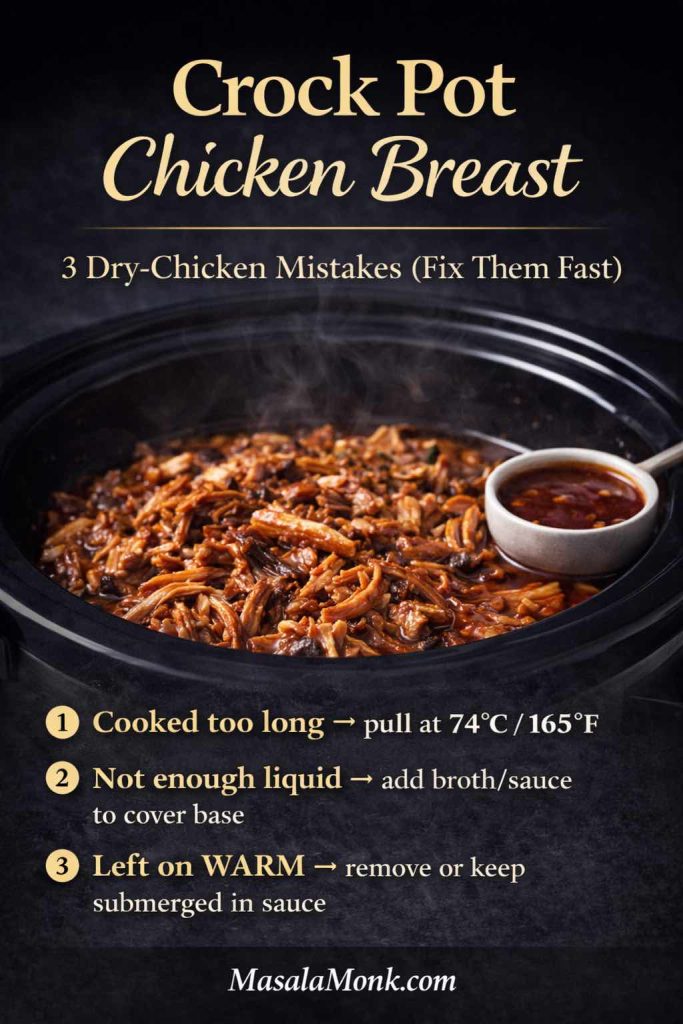
Vertical guide card titled “Crock Pot Chicken Breast: 3 Dry-Chicken Mistakes (Fix Them Fast)” showing shredded chicken in sauce inside a slow cooker with steam. Text lists: 1) Cooked too long—pull at 74°C/165°F, 2) Not enough liquid—add broth or sauce to cover the base, 3) Left on WARM—remove chicken or keep it submerged in sauce. MasalaMonk.com in footer.
Dry crock pot chicken breast is usually one of these three mistakes: cooking too long, too little liquid, or leaving it on WARM after it’s done. This quick fix card shows exactly what to do instead—pull at 74°C/165°F, keep enough sauce in the pot, and hold chicken submerged so it stays juicy. Save this before your next slow cooker dinner, then scroll for the 10 crock pot chicken breast recipes and variations.

Instead, keep chicken in one layer when possible, build a saucy environment, and avoid constant lifting of the lid. Meanwhile, if the breasts are thick, slicing them horizontally into thinner fillets can be the difference between tender and overdone.

About frozen chicken breast in a crock pot or slow cooker

It’s tempting to lean on “crock pot frozen boneless chicken breast recipes,” especially on hectic days. Still, thawed chicken is the easiest path to consistent tenderness and safety, and it follows USDA guidance on slow cooker use. If you want the details, the USDA addresses this directly in its Q&A on frozen foods in a slow cooker.

If you’re stuck with frozen chicken, a practical workaround is to partially thaw in the microwave just until pieces separate, then start cooking immediately in a sauce-heavy recipe and check temperature early. All the same, thawed will taste better.

The simple “rest, then slice” rule

Once chicken reaches temperature, let it rest 5–10 minutes before slicing. Resting keeps juices from running out on the cutting board. Afterward, slice across the grain for tenderness.

Shredding that stays moist

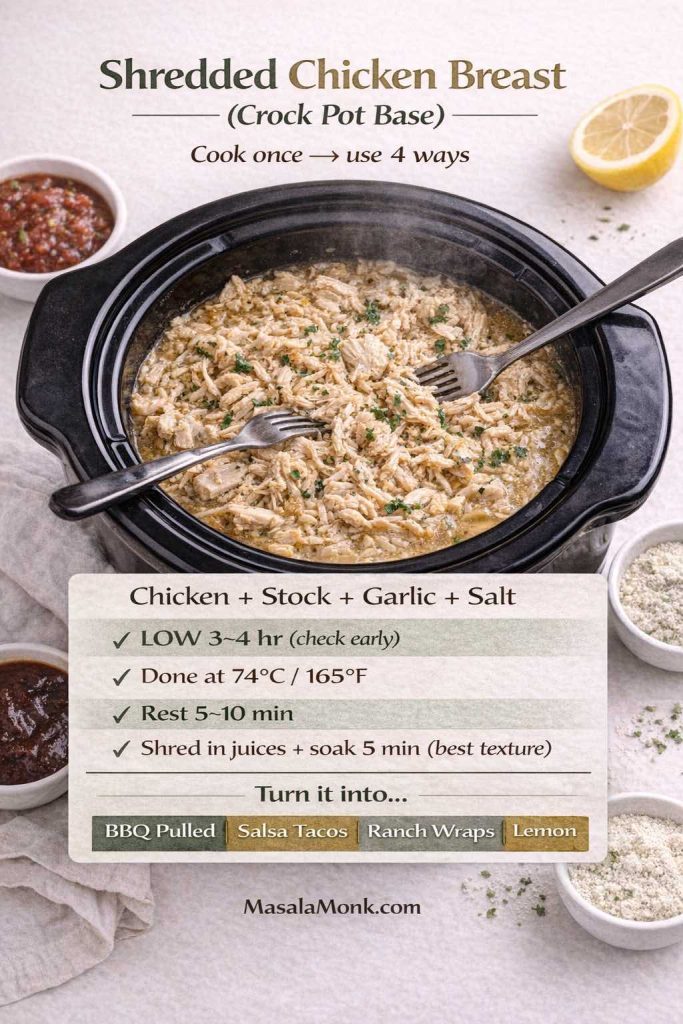
If you want shredded chicken breast slow cooker style, shred it in the cooking juices, then let it sit for a few minutes so it reabsorbs sauce. From there, leftovers can become wraps, bowls, soups, or sandwiches. For lunch ideas, MasalaMonk’s Chicken Salad Sandwich is a great direction when you want something creamy and bright without a lot of work.

Also Read: Double Chocolate Chip Cookies – Easy Recipe with 7 Variations


The 10 Crock Pot Chicken Breast Recipes

Each recipe below is written as a fully developed “card” with metric weights, clear steps, serving ideas, and multiple variations. You’ll also see options that naturally fit different needs—few-ingredient nights, low fat dinners, gluten free swaps, low carb tweaks, and bold flavors like salsa chicken and spicy slow cooker chicken.

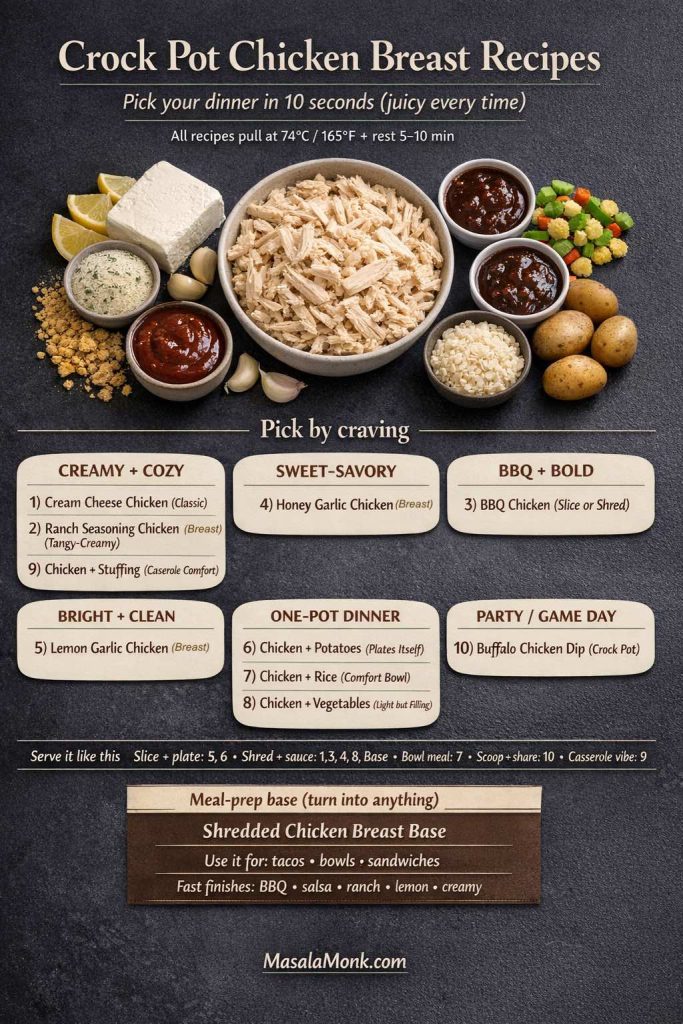
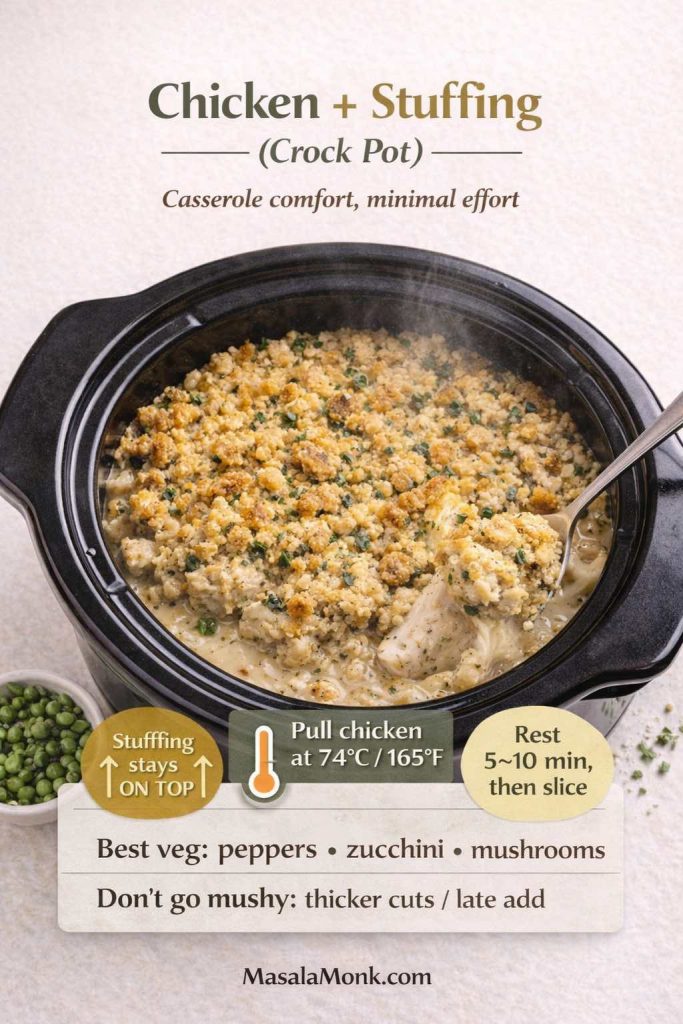
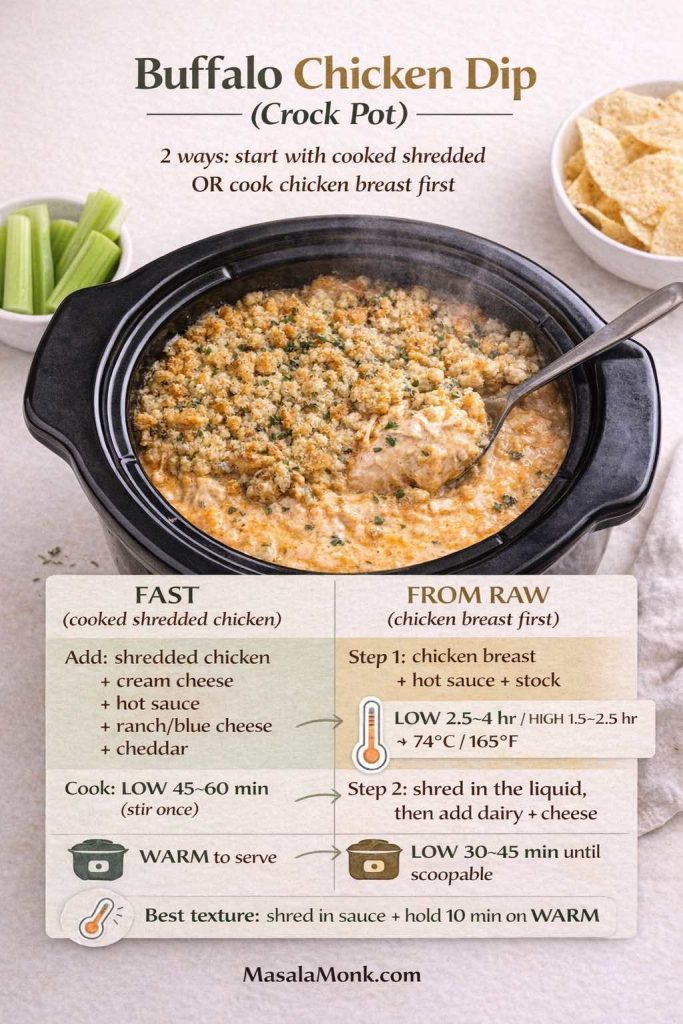
Vertical guide card titled ‘Crock Pot Chicken Breast Recipes’ showing a bowl of shredded chicken and ingredients, plus a ‘Pick by craving’ menu that groups 10 crock pot chicken breast recipes: creamy (cream cheese, ranch, chicken & stuffing), sweet-savory (honey garlic), BBQ (BBQ chicken), bright (lemon garlic), one-pot dinners (chicken with potatoes, rice, vegetables), and party (buffalo chicken dip). Notes: pull at 74°C/165°F and rest 5–10 minutes. MasalaMonk.com in footer.
Use this ‘pick by craving’ cheat sheet to choose the right crock pot chicken breast dinner fast — creamy, BBQ, lemony, one-pot (rice/potatoes/veg), or party-style buffalo dip. Every recipe is built around the same juicy rule: pull at 74°C/165°F, rest 5–10 minutes, then slice or shred in sauce. Save this guide for busy weeknights, and scroll to Recipe #1 to start cooking.

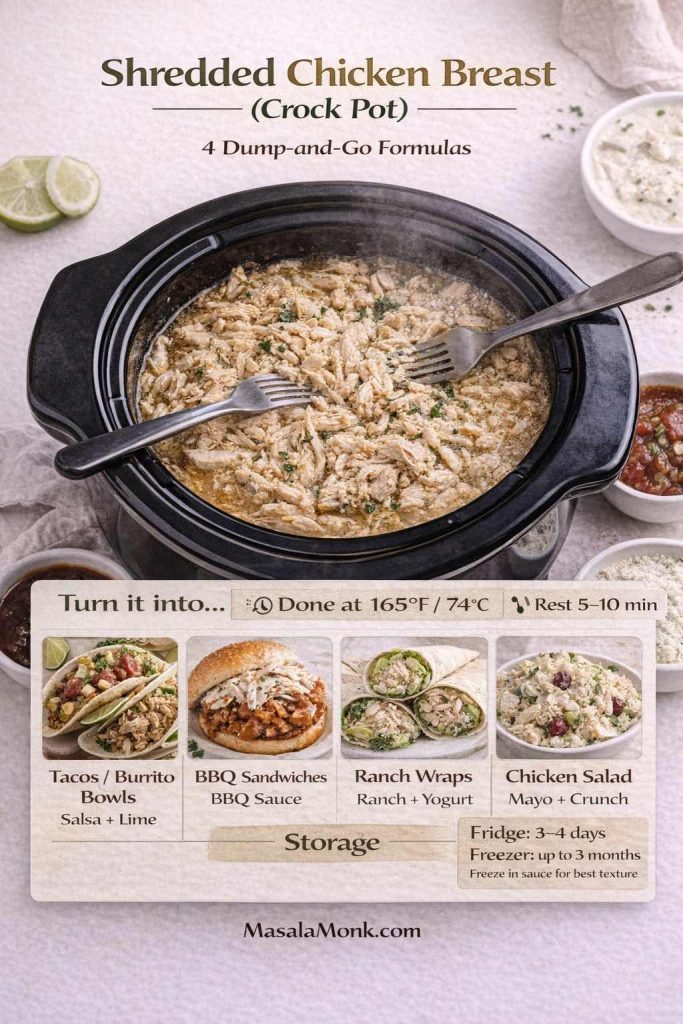
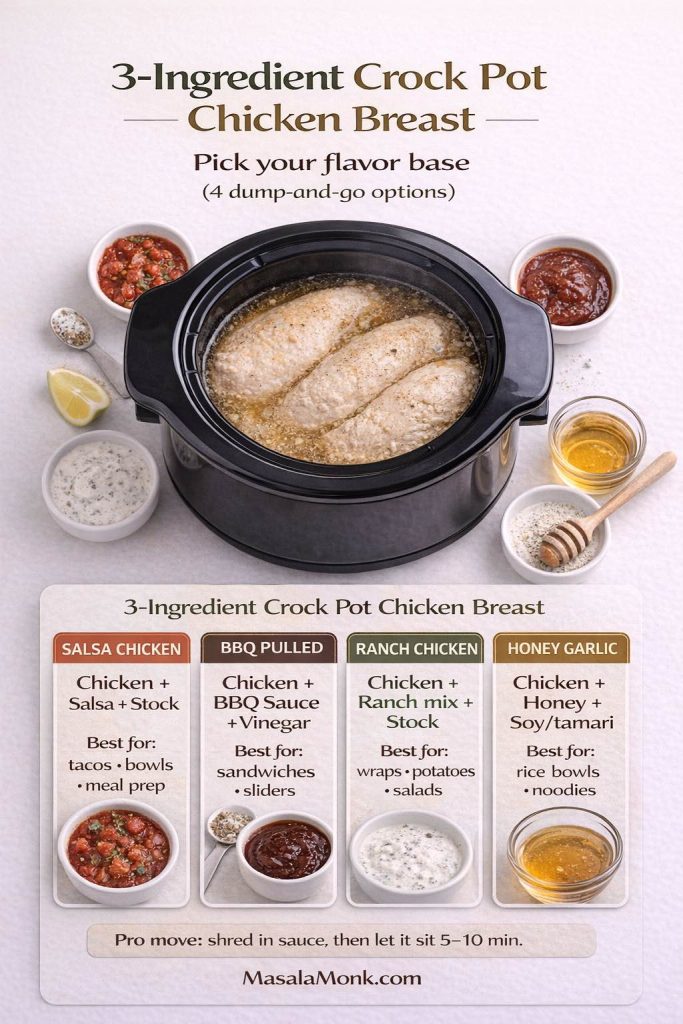
If you want ultra-minimal ingredient options, jump to the 3-ingredient dump-and-go formulas towards the end of this post.

Pick by goal (healthy, low carb, gluten free)

Sometimes you’re not choosing dinner by mood—you’re choosing by the kind of week you’re having. With that in mind, here’s a quick way to match the recipes below to common goals without overthinking it.

  • Low calorie / low fat:
    #5 Lemon Garlic Chicken Breast (bright, broth-based) and #8 Chicken Breast and Vegetables (lighter, filling, meal-prep friendly). Both stay satisfying as the flavor comes from aromatics and acidity rather than heavy dairy.
  • Low carb / keto-ish:
    #3 BBQ Chicken Breast (use a no-sugar-added BBQ sauce), #2 Ranch Seasoning Chicken (finish with Greek yogurt instead of richer dairy), and #5 Lemon Garlic (naturally lower carb). Together, they give variety while keeping the plate simpler.
  • Gluten free:
    #4 Honey Garlic Chicken (use tamari), #5 Lemon Garlic, #8 Chicken + Vegetables, and #10 Buffalo Chicken Dip—just double-check the labels on hot sauce, dressing, and seasoning blends since those are the usual hidden sources.

Finally, no matter which direction you pick, the same juicy rule still applies: pull the chicken at 74°C / 165°F, rest briefly, then keep it in sauce so leftovers stay tender.


1) Cream Cheese Chicken Breast (Crock Pot Creamy Classic)

Creamy chicken breast in a crock pot can feel like a cheat code: it tastes rich, yet it’s built from everyday ingredients. The sauce turns silky, the chicken stays tender, and the leftovers reheat surprisingly well when you keep them saucy.

This version has a subtle lemon lift that keeps the creaminess from feeling heavy. Still, it’s flexible—add mushrooms for deeper savoriness, stir in spinach for a greener finish, or turn it into a cozy casserole-style dinner with a soup swap. Given that it’s a foundational creamy recipe, it also becomes the base for several variations people love: cream cheese ranch chicken, cream-of-mushroom versions, cream-of-chicken versions, and even a stuffed chicken breast approach if you want something a little more dramatic.

Serves: 4
Prep: 10 minutes
Cook: 3–4 hours on LOW (or 1.75–2.5 hours on HIGH)
Slow cooker size: 4–6 qt / 4–5.5 L

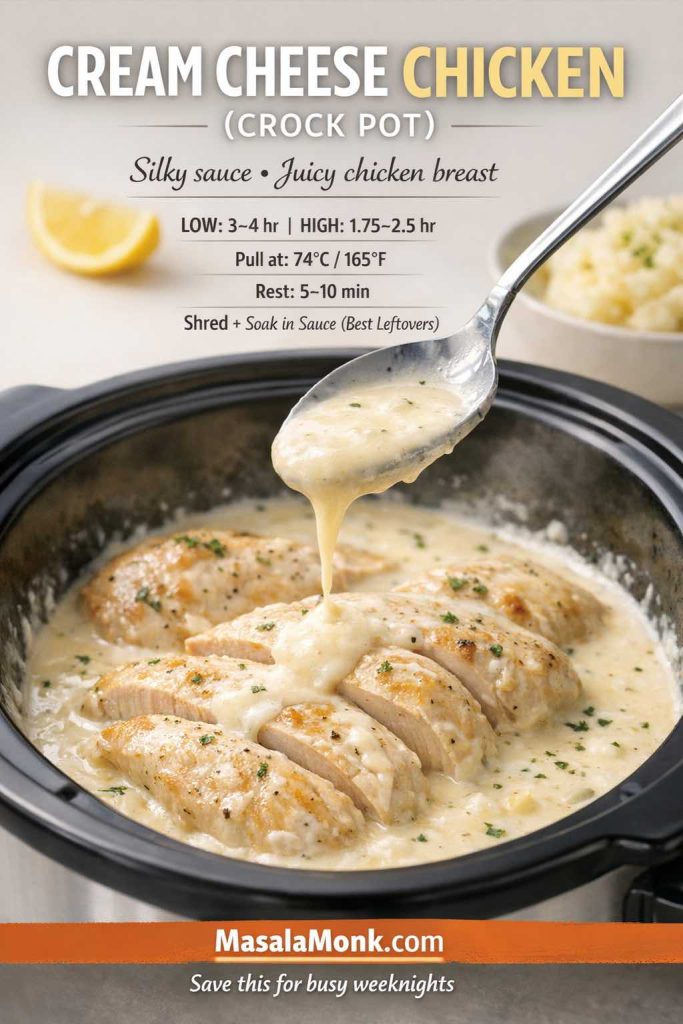
Cream cheese chicken breast in a crock pot with a spoon lifting silky sauce over sliced chicken. Text overlay reads “Cream Cheese Chicken (Crock Pot)” with cook times LOW 3–4 hr and HIGH 1.75–2.5 hr, pull at 74°C/165°F, rest 5–10 min, and “shred + soak in sauce.” MasalaMonk.com branding in the footer.
Creamy crock pot chicken breast with cream cheese is one of the easiest ways to get juicy chicken without babysitting dinner. Use this quick timing guide as your “don’t overcook it” reference: LOW 3–4 hours / HIGH 1.75–2.5 hours, pull at 74°C / 165°F, then rest 5–10 minutes before slicing or shredding. For the best texture (and better leftovers), shred the chicken in the sauce and let it sit a few minutes so it soaks flavor back in.

Ingredients

  • 700 g boneless, skinless chicken breasts
  • 200 g cream cheese
  • 180 ml chicken stock
  • 12 g garlic, minced
  • 8 g onion powder
  • 6 g fine salt
  • 2 g black pepper
  • 5 g smoked paprika (optional)
  • 15 ml lemon juice
  • Optional thickener: 10 g cornstarch + 15 ml water
  • Optional add-ins: 150 g mushrooms (sliced), 60–80 g baby spinach

Method or Recipe for Cream Cheese Chicken Breast in a Crock Pot

  1. Add chicken stock, garlic, onion powder, salt, pepper, paprika, and lemon juice to the slow cooker. Stir to combine.
  2. Add chicken breasts in a single layer if possible.
  3. Scatter cream cheese in chunks over the chicken.
  4. Cook until chicken reaches 165°F / 74°C internally, following the guidance on the safe temperature chart.
  5. Rest chicken 5–10 minutes. Then slice or shred.
  6. Stir the sauce until smooth. If you want it thicker, whisk in cornstarch slurry, cover, and cook on HIGH for 10–15 minutes, stirring once.

What it tastes like

Creamy, gently tangy, savory, and comforting. The lemon keeps the sauce lively rather than flat.

Best sides

This sauce loves starch. It’s fantastic over rice, pasta, or mashed potatoes. For a classic pairing, MasalaMonk’s perfect mashed potatoes fits beautifully.

Variations (pick what matches your mood)

  • Cream of mushroom soup version: replace stock + seasonings with 300 g condensed cream of mushroom soup + 120 ml stock; keep garlic and black pepper.
  • Cream of chicken soup version: same swap, different soup.
  • Half-and-half split: use 150 g cream of mushroom + 150 g cream of chicken for deeper flavor.
  • Spicy creamy chicken: add 10–15 g chili paste or 2–3 g cayenne to the liquid before cooking.
  • Salsa chicken creamy finish: stir in 200–250 g salsa after cooking, then taste and adjust salt.
  • Stuffed chicken breast in a crock pot (spinach-cream cheese): butterfly the breasts, season lightly, fill with a mixture of 120 g cream cheese + 80 g chopped spinach + 1 g garlic powder, secure with toothpicks, then cook in the sauce as written. Slice to reveal the filling.

Storage and reheating

Cool leftovers promptly and refrigerate. Reheat gently (low heat on the stove or a lower-power microwave) so the sauce stays smooth. For general chicken handling and safety basics, the CDC’s chicken food safety guidance is a solid reference.

Also Read: How to Cook Tortellini (Fresh, Frozen, Dried) + Easy Dinner Ideas


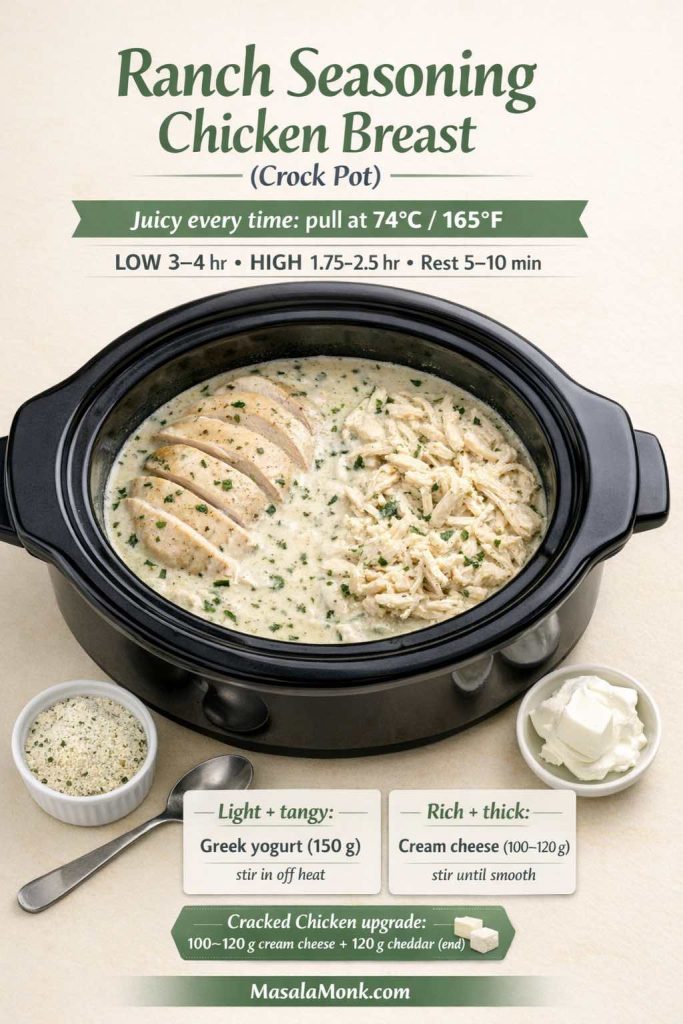
2) Ranch Seasoning Chicken Breast (Crock Pot Tangy + Creamy)

Ranch seasoning and slow cooker chicken breast is a combination that just works. It’s savory, herb-forward, and comforting in a familiar way. Unlike some creamy crock pot chicken breast recipes, this one can go lighter or richer depending on how you finish it—Greek yogurt for a brighter, lower-fat version, or cream cheese for a thicker, more luxurious sauce.

It’s also a great “few ingredients” dinner: chicken, broth, ranch seasoning, and one creamy finish. Then, if you want, you can add mushrooms or vegetables without changing the method.

Serves: 4
Prep: 10 minutes
Cook: 3–4 hours on LOW (or 1.75–2.5 hours on HIGH)

Ranch seasoning chicken breast in a crock pot with creamy sauce. Text overlay shows: pull chicken at 74°C / 165°F, LOW 3–4 hours, HIGH 1.75–2.5 hours, rest 5–10 minutes. Bottom cards compare lighter finish (Greek yogurt) vs rich finish (cream cheese) and include a ‘cracked chicken’ upgrade with cream cheese + cheddar.
Ranch chicken is all about the finish: pull at 74°C / 165°F, rest 5–10 minutes, then choose your texture—Greek yogurt for a lighter tangy sauce or cream cheese for a thicker, richer one. Want the viral-style upgrade? Turn it into cracked chicken by stirring in cheddar at the end. Save this card as your quick-reference before you start Recipe #2.

Ingredients

  • 700 g boneless, skinless chicken breasts
  • 240 ml chicken stock
  • 20 g ranch seasoning mix
  • 10 g garlic, minced
  • 30 ml lemon juice (optional, brightens)
  • 2 g black pepper
  • Finish (choose one):
    • 120 g sour cream
    • or 150 g thick Greek yogurt
    • or 100–120 g cream cheese

Method or Recipe for Ranch Crock Pot Seasoning Chicken Breast

  1. Whisk stock, ranch seasoning, garlic, lemon juice, and pepper in the slow cooker.
  2. Add chicken. Spoon liquid over the top.
  3. Cook until chicken reaches 74°C internally, using the safe temperature chart.
  4. Rest briefly, then shred or slice.
  5. Stir in sour cream, yogurt, or cream cheese until smooth.

Serving ideas

Ranch chicken is great with potatoes, rice, or wraps. For a cool contrast, a yogurt-based sauce is surprisingly good alongside ranchy flavors—MasalaMonk’s tzatziki sauce guide has several variations worth trying.

Variations

  • Cracked-style creamy ranch: add 100 g cream cheese at the start, then stir in 120 g shredded cheddar at the end until melted. Detailed instructions are given below.
  • Ranch + vegetables crock pot dinner: add 150 g mushrooms + 120 g sliced onion at the start; stir in spinach at the end.
  • Ranch pasta night later: if you love this flavor family, the One-Pot Chicken Bacon Ranch Pasta is a fun change of pace.

Cracked Chicken (Crock Pot Ranch + Cream Cheese + Cheddar)

If ranch chicken is the cozy classic, cracked chicken is the indulgent upgrade. It keeps the same easy slow-cooker recipe; however, it finishes richer, cheesier, and more “scoopable,” which is why people with slow cooker look it up so often—and why the method matters.

To make it, start with the Recipe #2 base (ranch seasoning + stock + chicken), then follow these tweaks:

  • Add cream cheese early for body: drop in 100–120 g cream cheese in chunks at the beginning (or during the last hour on LOW if you prefer a cleaner melt). As it softens, it turns the cooking liquid into a thicker, clingier sauce.
  • Cook as usual, but shred in the juices: once the thickest part hits 74°C / 165°F, rest briefly, then shred directly in the ranchy sauce. That way, the chicken stays moist instead of stringy.
  • Finish with cheddar for the “cracked” texture: stir in 120 g shredded cheddar until it melts and looks glossy. At this point, the flavor becomes deeper and the texture turns properly creamy.
  • Optional, but popular: add crumbled cooked bacon at the end. It brings salt and crunch, so the dip-like vibe becomes even more pronounced.

As a result, you get a dish that feels like comfort food without changing your workflow—just a smarter finish.

Also Read: Whole Chicken in Crock Pot Recipe (Slow Cooker “Roast” Chicken with Veggies)


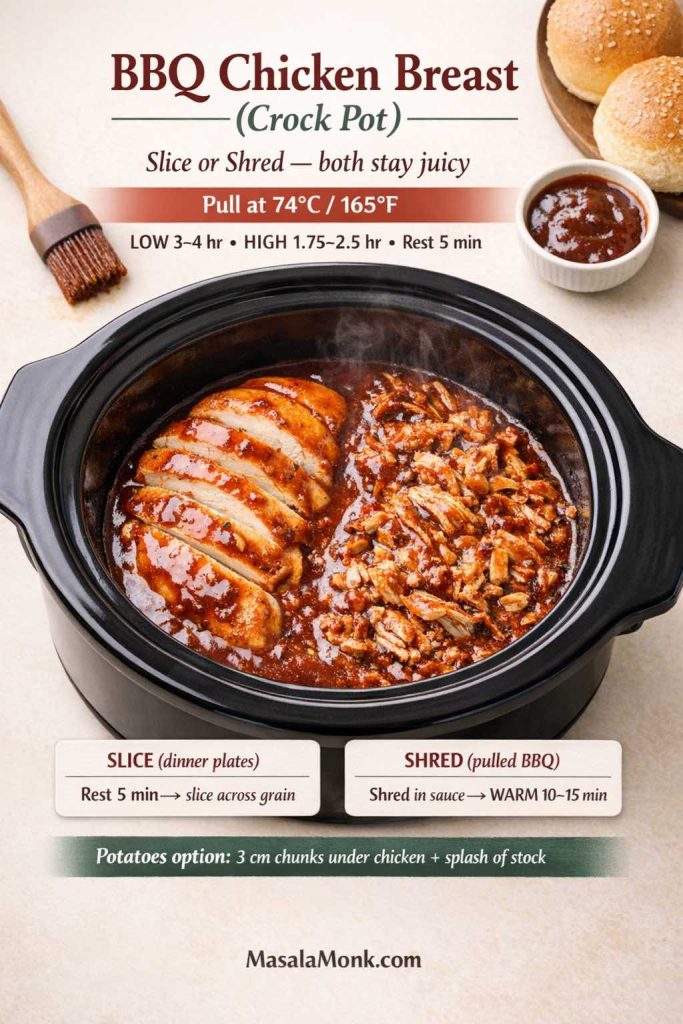
3) BBQ Chicken Breast (Crock Pot, Slice or Shred)

BBQ chicken breast in a crock pot is one of those meals that feels like it belongs at a weekend cookout—even when it’s a Tuesday. It’s bold, saucy, and forgiving. As the sauce surrounds the chicken, it stays moist as long as you don’t overcook it. Later, leftovers become sandwiches, rice bowls, nachos, or a quick loaded baked potato situation.

This recipe can be served sliced for dinner plates, or shredded for pulled chicken breast in the crock pot. Either way, it’s deeply useful.

Serves: 4–5
Prep: 10 minutes
Cook: 3–4 hours on LOW (or 1.75–2.5 hours on HIGH)

BBQ chicken breast in a crock pot with two outcomes shown: sliced chicken and shredded pulled BBQ chicken in sauce. Text overlay highlights pull at 74°C/165°F, LOW 3–4 hours or HIGH 1.75–2.5 hours, rest 5 minutes, and a tip to shred in sauce then hold on WARM 10–15 minutes.
BBQ chicken breast is a weeknight cheat code because it works two ways: slice it for dinner plates or shred it for pulled chicken. The quick rule is the same—pull at 74°C/165°F, rest 5 minutes, then (if shredding) let it sit in the sauce on WARM for that glossy, juicy finish.

Ingredients

  • 800 g boneless, skinless chicken breasts
  • 240 g BBQ sauce
  • 120 ml chicken stock
  • 15 ml apple cider vinegar
  • 6 g salt
  • 2 g smoked paprika
  • 2 g garlic powder
  • Optional sweetness: 12 g brown sugar (skip if you prefer)

Method or Recipe of BBQ Chicken Breast in a Slow Cooker

  1. Stir BBQ sauce, stock, vinegar, salt, paprika, and garlic powder in the slow cooker.
  2. Add chicken and coat well.
  3. Cook until chicken reaches 74°C, referencing the safe temperature chart.
  4. Rest 5 minutes. Slice for plates, or shred directly in the sauce for pulled chicken.
  5. Leave on WARM 10–15 minutes so the chicken absorbs sauce.

Best sides

For a hearty comfort pairing, try it with MasalaMonk’s Red Beans and Rice. For something crisp and salty, homemade fries are always a win—MasalaMonk’s homemade French fries is a great reference if you want to go all-in.

Variations

  • Low carb BBQ: use a no-sugar-added BBQ sauce and skip brown sugar.
  • Spicy BBQ: add 10–15 g hot sauce or 2 g chili flakes.
  • Honey BBQ: add 20 g honey for shine.
  • BBQ chicken breast and potatoes slow cooker dinner: add 500–600 g potato chunks under the chicken and increase stock to 180 ml.

If you like turning leftovers into lunch, MasalaMonk’s chicken sandwich recipes is a great place to find a new direction.


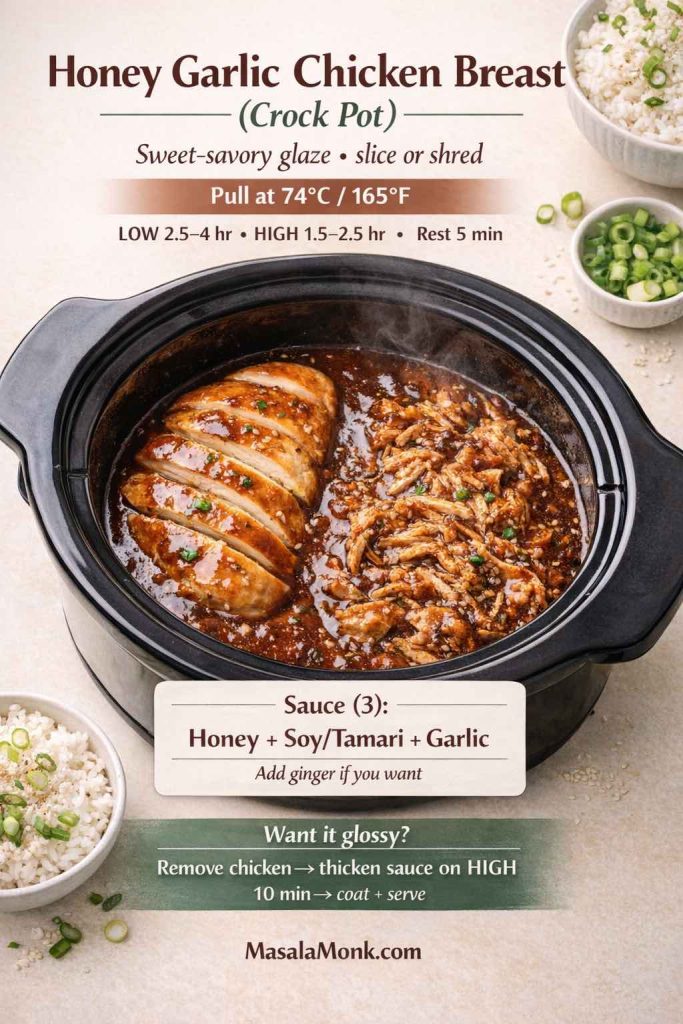
4) Honey Garlic Chicken Breast (Crock Pot Sweet-Savory)

Honey garlic chicken breast is weeknight-friendly in the best way: the ingredient list is short, the sauce tastes balanced, and the final plate feels like something you’d happily eat twice. The vinegar keeps sweetness in check, while garlic does the heavy lifting. If you add ginger, it becomes even more fragrant.

Since the sauce is glossy and strong, you can pair it with simple sides and still feel like dinner has personality. Moreover, it reheats well, which makes it ideal for meal prep.

Serves: 4
Prep: 10 minutes
Cook: 2.5–4 hours on LOW (or 1.5–2.5 hours on HIGH)

Honey garlic chicken breast in a crock pot with a glossy brown sauce. Text overlay shows “Pull at 74°C / 165°F,” cook times (LOW 2.5–4 hr, HIGH 1.5–2.5 hr), and “Rest 5 min.” A small recipe card lists the 3-ingredient sauce: honey + soy/tamari + garlic, with an optional ginger note and a tip to thicken sauce on HIGH for a shinier finish.
Honey garlic chicken breast is one of the best “set-and-forget” crock pot dinners because the glaze keeps it juicy and the leftovers stay flavorful. Use this quick cheat sheet to nail the one rule that matters: pull at 74°C / 165°F, rest briefly, then slice for plates or shred for bowls. Want that glossy, sticky finish? Remove the chicken and reduce the sauce on HIGH for 10 minutes, then coat and serve.

Ingredients

  • 700 g chicken breasts
  • 90 g honey
  • 60 ml soy sauce (or tamari for gluten free)
  • 30 ml rice vinegar (or apple cider vinegar)
  • 12 g garlic, minced
  • 10 g fresh ginger, grated (optional)
  • 15 ml water
  • Optional thickener: 12 g cornstarch + 15 ml water

Method or Recipe for Slow Cooker Honey Garlic Chicken Breast

  1. Whisk honey, soy sauce, vinegar, garlic, ginger, and water in the slow cooker.
  2. Add chicken and coat.
  3. Cook until chicken reaches 74°C.
  4. Remove chicken to a plate. If you want thicker sauce, stir in cornstarch slurry and cook on HIGH 10 minutes.
  5. Return chicken, coat, then slice to serve.

Serving ideas

Rice is the obvious partner. If rice texture ever drives you crazy, MasalaMonk’s how to cook rice is a steady guide.

Variations

  • Spicy honey garlic: add 10 g chili paste or 2 g chili flakes.
  • Orange-honey twist: add 60 ml orange juice and reduce water accordingly.
  • Teriyaki night: swap the sauce direction entirely using MasalaMonk’s teriyaki sauce as your base.

Also Read: How to Cook Perfect Rice Every Time (Recipe)


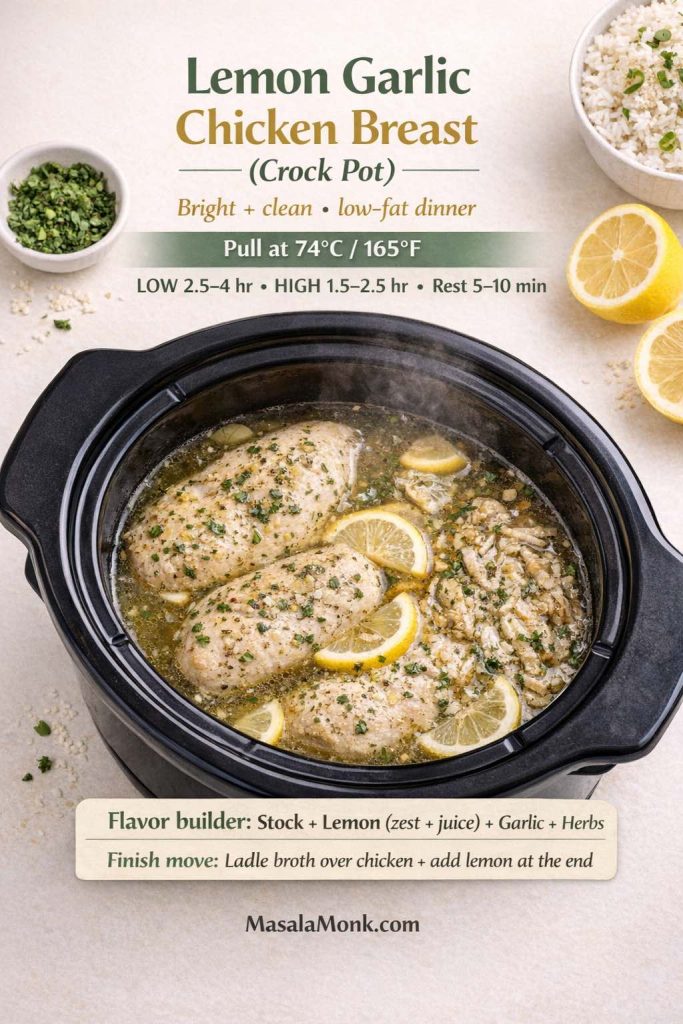
5) Lemon Garlic Chicken Breast (Crock Pot Bright + Clean)

After a stretch of creamy dinners, lemon garlic chicken is refreshing. It’s light yet satisfying, and the broth becomes a simple sauce you can ladle over everything. The key is balance: lemon juice for brightness, stock for depth, and herbs for aroma.

This is also one of those slow cooker chicken breast recipes that fits a low fat dinner comfortably, especially when paired with vegetables or rice.

Serves: 4
Prep: 10 minutes
Cook: 2.5–4 hours on LOW (or 1.5–2.5 hours on HIGH)

Lemon garlic chicken breast in a crock pot with lemon slices and herbs in a light broth. Text overlay shows the juicy rule “Pull at 74°C / 165°F,” cook times (LOW 2.5–4 hr, HIGH 1.5–2.5 hr), rest 5–10 min, plus flavor builder notes (stock + lemon zest/juice + garlic + herbs) and a finishing tip to ladle broth and add lemon at the end.
Bright, low-fat slow cooker dinner made simple: cook chicken breast in broth with lemon + garlic, pull at 74°C/165°F, then rest 5–10 minutes. The “finish move” here is the difference-maker—ladle the lemony broth over the sliced chicken and add a final squeeze of lemon for a clean, vivid flavor that keeps leftovers tasting fresh.

Ingredients

  • 700 g chicken breasts
  • 240 ml chicken stock
  • 2 g lemon zest
  • 45 ml lemon juice
  • 18 g garlic, minced
  • 15 ml olive oil
  • 6 g salt
  • 2 g black pepper
  • 5 g oregano (or Italian herb mix)
  • Optional: 120 g sliced onion

Method or Recipe for Lemon Garlic Chicken Breast in a Slow Cooker

  1. Add stock, zest, lemon juice, garlic, olive oil, salt, pepper, and herbs to the slow cooker. Stir.
  2. Add chicken and spoon liquid over.
  3. Cook until chicken reaches 74°C, using the safe temperature chart.
  4. Rest, slice, then ladle broth over the chicken.

Best sides

This chicken loves rice, potatoes, or a crisp salad. If you want a herb-forward finish, pesto stirred in at the end is excellent—MasalaMonk’s pesto recipes offer plenty of directions.

Variations

  • Spicy lemon chicken: add 2 g cayenne or 10 g chili paste.
  • Creamy lemon: stir in 120 g Greek yogurt at the end (off heat) for a tangy creamy sauce.
  • Mediterranean-style: add 100 g olives and 150 g cherry tomatoes in the last 30 minutes.

Also Read: Peanut Butter Cookies (Classic Recipe & 3 Variations)


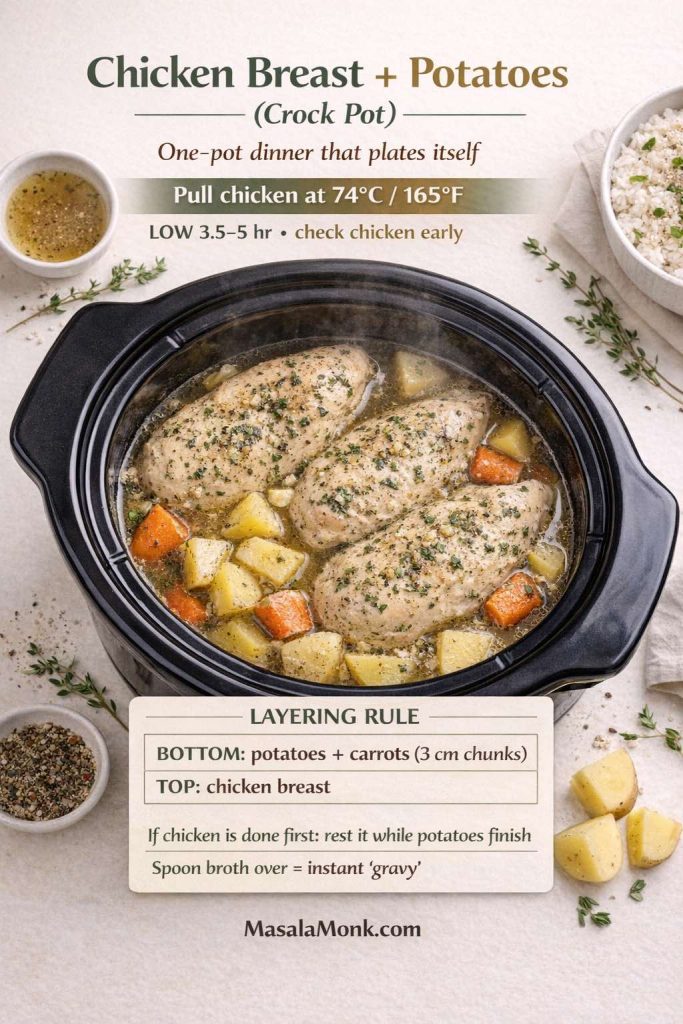
6) Chicken Breast and Potatoes (Crock Pot Dinner That Plates Itself)

Chicken breast and potatoes in the crock pot is comfort with built-in convenience. Potatoes soak up seasoning, the broth turns into a quick gravy, and dinner is basically ready the moment you lift the lid. This is especially useful when you want a complete meal without a second pot of sides.

As potatoes can take longer than chicken, the most dependable approach is to keep potato pieces chunky and start checking chicken for doneness before the potatoes are fully done. Then, if needed, chicken can rest while potatoes finish.

Serves: 4
Prep: 15 minutes
Cook: 3.5–5 hours on LOW

Top-down crock pot chicken breast and potatoes dinner with carrots in broth. Text overlay shows the key rule: pull chicken at 74°C / 165°F, cook LOW 3.5–5 hours, and “layering rule” (bottom: potatoes + carrots in 3 cm chunks; top: chicken breast). Note says rest chicken if it finishes first and spoon broth over as quick gravy, with MasalaMonk.com in the footer.
This one image explains why “chicken breast and potatoes in the crock pot” actually works: potatoes + carrots go on the bottom (they need direct heat), chicken sits on top (so it stays juicy), and you pull chicken at 74°C / 165°F. If the chicken finishes first, let it rest while the potatoes keep going—then spoon that broth over everything like instant gravy.

Ingredients

  • 700 g chicken breasts
  • 600 g potatoes, cut into 3 cm chunks
  • 120 g carrots, cut thick (optional)
  • 120 g onion, sliced (optional)
  • 240 ml chicken stock
  • 20 ml olive oil
  • 8 g salt
  • 2 g black pepper
  • 5 g paprika
  • 3 g dried thyme

Method or Recipe for Crock Pot Chicken Breast and Potatoes

  1. Toss potatoes (and carrots) with olive oil, paprika, thyme, and half the salt.
  2. Add vegetables to the slow cooker first. Pour in stock.
  3. Place chicken on top and season with remaining salt and pepper.
  4. Cook until chicken reaches 74°C and potatoes are tender.
  5. Rest chicken. Slice and serve with potatoes and broth.

Cozy companion idea

If you love the “big payoff, minimal effort” slow cooker vibe, MasalaMonk’s Whole Chicken in Crock Pot is a great batch-cooking follow-up.

Variations

  • BBQ chicken breast and potatoes: add 200 g BBQ sauce and reduce stock to 120 ml.
  • Creamy potatoes finish: stir in 80–100 g cream cheese at the end.
  • Spicy potatoes: add 2 g cayenne and 3 g cumin to the seasoning mix.

Also Read: How to make the Best Peanut Butter at Home


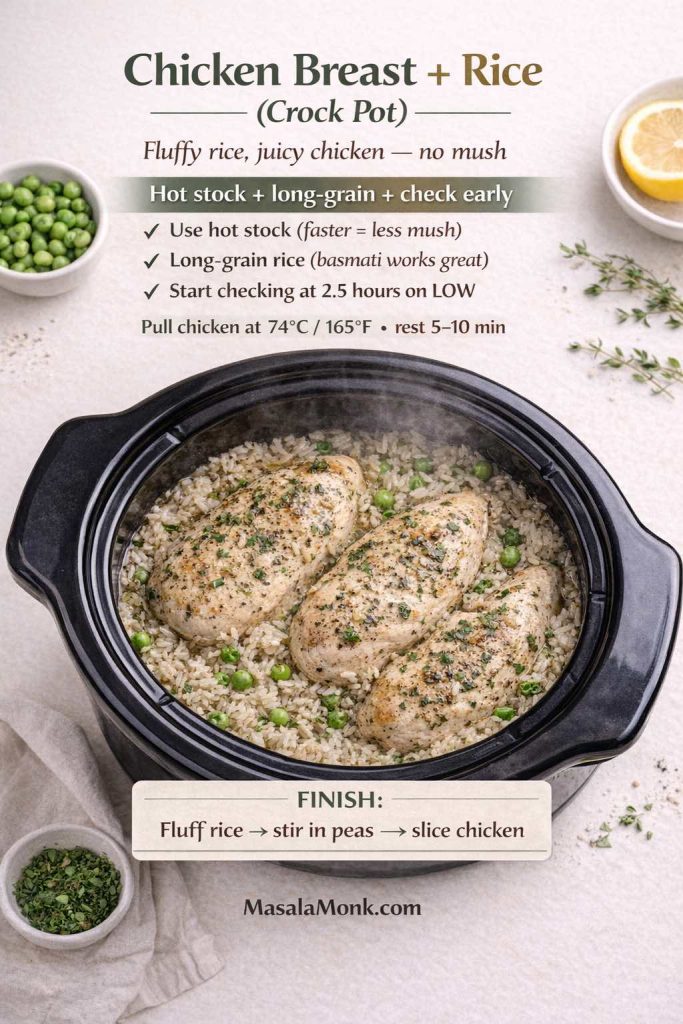
7) Chicken Breast and Rice (Crock Pot Comfort Bowl)

Chicken breast and rice in a slow cooker is deeply satisfying when it works: one pot, balanced plate, cozy texture. The challenge is that rice can turn mushy if it sits too long after it’s done. The solution is straightforward: use hot stock, choose long-grain rice, and check earlier rather than later. If the chicken hits temp first, pull it to rest while the rice finishes—don’t keep the chicken hostage to the rice.

Once you dial this in, it becomes an easy dinner staple—especially if you like making rice bowls.

Serves: 4
Prep: 10 minutes
Cook: 2.5–3.5 hours on LOW

Vertical infographic titled “Chicken Breast + Rice (Crock Pot)” showing chicken breasts cooking on long-grain rice with peas in a slow cooker. Text overlay highlights “Hot stock + long-grain + check early” with tips: use hot stock, use long-grain/basmati, start checking around 2.5 hours on LOW, pull chicken at 74°C/165°F and rest 5–10 minutes, then fluff rice and stir in peas before slicing chicken. Footer branding from MasalaMonk.com.
If your chicken breast and rice crock pot dinners ever turn soft or mushy, this is the fix: hot stock + long-grain rice + check early. Long-grain (basmati is perfect) stays separated, hot stock helps the rice finish sooner (less time idling = better texture), and checking at the early end keeps both the rice and chicken from overcooking. The real “juicy” rule still applies: pull chicken at 74°C / 165°F, rest 5–10 minutes, then slice. Save this as your quick reference before you make Recipe #7 (Chicken Breast + Rice) so you get fluffy rice and tender chicken every time—no guesswork, no mush.

Ingredients

  • 700 g chicken breasts
  • 220 g long-grain rice (basmati works well)
  • 600 ml hot chicken stock
  • 120 g onion, finely chopped
  • 10 g garlic, minced
  • 6 g salt
  • 2 g black pepper
  • 5 g paprika
  • 15 ml olive oil
  • 120 g peas (stir in at end)

Method or Recipe for Chicken Breast and Rice in a Slow Cooker

  1. Add onion, garlic, rice, salt, pepper, paprika, and olive oil to the slow cooker.
  2. Pour in hot stock and stir.
  3. Lay chicken on top in a single layer.
  4. Cook until chicken reaches 74°C and rice is tender.
  5. Remove chicken to rest. Fluff rice, stir in peas, then slice chicken and serve.

Serving ideas

A bowl like this loves toppings: chopped herbs, lemon, yogurt drizzle, or a quick salad on the side. If you’re curious about making rice feel lighter, MasalaMonk’s guide to reducing the glycemic impact of rice is a useful read.

Variations

  • Cheesy rice dinner: stir in 80–100 g cream cheese at the end, or try a comfort cousin recipe like Cheesy Chicken Broccoli Rice.
  • Southwest rice bowl: add 200 g salsa and 150 g corn; finish with lime.
  • Spicy chicken breast slow cooker version: add 10 g chili paste and top with green onions.

Also Read: How to make Mango Chia Pudding? 5 Creative Ideas


8) Chicken Breast and Vegetables (Healthy Crock Pot Dinner That Still Feels Filling)

Some nights you want dinner to feel lighter without feeling like you’re giving something up. This chicken breast and vegetables crock pot dinner does that beautifully: colorful vegetables, a simple broth-based sauce, and enough flavor to keep things satisfying.

It also fits meal prep well. Because the sauce is broth-based and lemon-bright, it reheats without the “heavy” feel that some creamy leftovers can develop.

Serves: 4
Prep: 15 minutes
Cook: 2.5–4 hours on LOW

Vertical recipe card titled “Chicken + Veggies (Crock Pot)” showing sliced chicken breast in a bowl with bell peppers, zucchini, mushrooms, peas, and broth. Text overlay highlights “Low Cal • High Volume,” “Pull at 74°C / 165°F,” “Add soft veg later,” and “Lemon-bright broth,” plus tips for best vegetables, avoiding mushy texture, and meal-prep storage in broth.
A fast “pick-and-cook” guide for slow cooker chicken breast and vegetables: cook until the thickest part hits 74°C / 165°F, keep veggies in thicker cuts (or add softer veg later), and finish with a lemon-bright broth so leftovers stay juicy. Perfect for low calorie crock pot chicken breast meal prep—slice and store the chicken in the broth so it reheats tender.

Ingredients

  • 700 g chicken breasts
  • 250 g bell peppers, sliced
  • 200 g zucchini, thick half-moons
  • 150 g mushrooms, sliced
  • 150 g onion, sliced
  • 240 ml chicken stock
  • 30 ml lemon juice
  • 15 ml olive oil
  • 6 g salt
  • 2 g black pepper
  • 5 g Italian herb mix

Method or Recipe for Slow Cooker Chicken Breast and Vegetables

  1. Add vegetables, stock, lemon juice, olive oil, salt, pepper, and herbs to the slow cooker. Stir.
  2. Add chicken on top.
  3. Cook until chicken reaches 74°C, using the safe temperature chart.
  4. Slice chicken and serve with vegetables and broth.

Serving ideas

Serve over rice, potatoes, or with a crusty bread. If you want something fun alongside, crispy fries can turn it into a more “treat yourself” plate—MasalaMonk’s homemade French fries is a great reference.

Variations

  • Southwest slow cooker chicken: add 200 g salsa, 150 g corn, and 2 g cumin; finish with lime.
  • Salsa chicken meal prep: keep it simple with salsa + stock; shred at the end and serve in bowls.
  • Spicy version: add chili paste or cayenne, then cool it down with a yogurt sauce. MasalaMonk’s tzatziki variations work surprisingly well here.

Also Read: Sourdough Starter Recipe: Make, Feed, Store & Fix Your Starter (Beginner Guide)


9) Chicken and Stuffing in a Crock Pot (Casserole Comfort, Minimal Effort)

This is the dinner that feels like a warm blanket. Chicken and stuffing in a slow cooker gives you tender chicken, savory gravy, and that buttery stuffing layer that makes everything feel like a holiday plate—even on a random weekday.

It’s also wonderfully practical: you stir the sauce, add the chicken, top with stuffing, then let the slow cooker do the rest. The leftovers reheat well, which makes it a good candidate for busy weeks.

Serves: 4–5
Prep: 10 minutes
Cook: 3–4 hours on LOW

Chicken and stuffing in a crock pot with creamy chicken breast underneath a golden stuffing layer. Text overlay highlights: “Stuffing stays ON TOP,” “Pull chicken at 74°C / 165°F,” and “Rest 5–10 min, then slice,” with a small bowl of green peas beside the slow cooker.
Chicken + stuffing is the “casserole comfort” slow-cooker dinner that plates itself. The key move: keep the stuffing on top (don’t stir it in), then pull the chicken breast at 74°C/165°F and rest 5–10 minutes so it stays juicy. Save this as your quick reminder before you make Recipe #9.

Ingredients

  • 700 g chicken breasts
  • 240 ml chicken stock
  • 300 g condensed cream of chicken soup (or cream of mushroom soup)
  • 200 g dry stuffing mix
  • 60 g butter, melted
  • 2 g black pepper
  • Optional: 120 g onion, diced
  • Optional finish: 120 g sour cream (stir in at end)

Method or Recipe for Slow Cooker Chicken Stuffing

  1. Whisk stock, condensed soup, and black pepper (and onion, if using) in the slow cooker.
  2. Add chicken and spoon sauce over the top.
  3. Mix stuffing with melted butter, then sprinkle evenly over the chicken. Keep it on top rather than stirring it in.
  4. Cook until chicken reaches 74°C.
  5. Rest chicken, then slice. If using sour cream, stir it into the sauce just before serving.

Cream-of-mushroom vs cream-of-chicken

Both work. Cream of chicken tastes classic and mild, while cream of mushroom adds deeper savory notes. If you can’t decide, a half-and-half split is a surprisingly good middle ground.

Pairing idea

For a cozy side, MasalaMonk’s green bean casserole ideas pair perfectly with this comfort style dinner.

Also Read: Chicken Adobo — Step-by-Step Recipe — Classic Filipino Adobong Manok


10) Buffalo Chicken Dip (Crock Pot + Chicken Breast, Party-Ready)

This one belongs on the list because it’s one of the most satisfying ways to use cooked chicken breast—especially if you’ve made shredded chicken earlier in the week. Buffalo chicken dip is creamy, spicy, salty, and extremely scoopable. It’s also flexible: more tang, more heat, more cheese, less cheese—whatever your crowd likes.

Serves: 8 as an appetizer
Prep: 10 minutes
Cook: 2–3 hours on LOW, then WARM

Buffalo chicken dip (crock pot) infographic showing 2 methods: FAST using cooked shredded chicken with cream cheese, hot sauce, ranch/blue cheese dressing, and cheddar; and FROM RAW cooking chicken breast first with hot sauce + stock to 74°C/165°F, shredding in liquid, then adding dairy and cheese until scoopable. Includes LOW/HIGH timing and a ‘hold on WARM for best texture’ tip.
Save this Buffalo Chicken Dip crock pot cheat sheet: make it fast with cooked shredded chicken, or start from raw chicken breast (cook to 74°C/165°F, shred in the hot sauce liquid, then melt in the cheeses). The ‘hold 10 minutes on WARM’ step is the texture trick that keeps it creamy, scoopable, and never stringy.

Ingredients

  • 500 g cooked shredded chicken breast
  • 200 g cream cheese
  • 120 g Greek yogurt or sour cream
  • 120 ml hot sauce (adjust to taste)
  • 60 ml ranch or blue cheese dressing
  • 120 g shredded cheddar
  • Optional: 60 g shredded mozzarella

Method or Recipe for Buffalo Chicken Dip

  1. Add everything to the slow cooker and stir roughly.
  2. Cook until melted and smooth, stirring once or twice.
  3. Hold on WARM and serve with celery, carrots, chips, or toasted bread.

Starting with raw chicken breast (instead of cooked shredded chicken)

If you are looking specifically for “buffalo chicken dip crock pot with chicken breast,” this is the version you want. You cook the chicken breast first, shred it, then turn it into the dip—same slow cooker, same comfort, no extra pans.

Step 1 (cook + shred the chicken): Add 700 g boneless, skinless chicken breasts to the slow cooker with 120 ml hot sauce + 120 ml chicken stock (or water). Cook on LOW 2.5–4 hours (or HIGH 1.5–2.5 hours) until the thickest part hits 74°C / 165°F. Rest 5 minutes, then shred directly in the liquid.

Step 2 (turn it into dip): Stir in the remaining dip ingredients (cream cheese, yogurt/sour cream, dressing, cheddar, optional mozzarella). Cover and cook on LOW 30–45 minutes, stirring once or twice, until smooth and scoopable. Hold on WARM for serving.

Juicy tip: Keep the shredded chicken bathed in the buffalo liquid while the cheeses melt—this is what keeps the dip rich and not dry or stringy.

Serving extras

If you’re firmly on team blue cheese, MasalaMonk’s blue cheese dip guide is a great companion. For a full MasalaMonk take on this dish, including other methods, the Buffalo Chicken Dip recipe is worth bookmarking.

Also Read: Paper Plane Cocktail Recipe + Best Amaro Substitutes & Tips


Shredded Chicken Breast Base in Crock Pot (For Tacos, Bowls, and Sandwiches)

If you want a plain, dependable slow cooker chicken breast recipe that becomes anything, this is it. It’s the kind of cooked shredded chicken breast you can stretch across multiple meals—tacos tonight, rice bowls tomorrow, sandwiches the day after. Because the seasoning stays gentle, you can steer it toward BBQ, salsa, ranch, lemon garlic, or spicy flavors later without starting over.

Serves: 4–6
Prep: 5 minutes
Cook: 3–4 hours on LOW

Vertical recipe-style infographic titled “Shredded Chicken Breast (Crock Pot Base) — Cook once, use 4 ways.” A slow cooker is shown filled with shredded chicken in cooking juices, with two forks for shredding. Text overlay lists: “Chicken + Stock + Garlic + Salt,” “LOW 3–4 hr (check early),” “Done at 74°C / 165°F,” “Rest 5–10 min,” and “Shred in juices + soak 5 min (best texture).” A bottom bar suggests four uses: BBQ pulled, salsa tacos, ranch wraps, and lemon.
Cook once, then remix all week: this shredded chicken breast crock pot base is the meal-prep “starter” that keeps dinner easy without tasting repetitive. Use the temp rule (74°C/165°F), rest briefly, then shred in the juices and let it soak for 5 minutes—this is the small step that keeps chicken moist for leftovers. Turn it into BBQ pulled sandwiches, salsa taco bowls, ranch wraps, or lemony rice bowls with almost no extra work. Save this card so you can batch-cook chicken once and build multiple dinners fast.

Ingredients

  • 900 g chicken breasts
  • 240 ml chicken stock
  • 10 g garlic, minced
  • 6 g salt
  • 2 g black pepper
  • Optional: 1 bay leaf

Method or Recipe for Shredded Chicken Breast Base in Crock Pot

  1. Add stock, garlic, salt, pepper (and bay leaf) to the slow cooker.
  2. Add chicken in a single layer.
  3. Cook until chicken reaches 74°C, then rest 5 minutes.
  4. Shred in the juices, then let it sit a few minutes so it absorbs flavor.
Vertical infographic titled “Shredded Chicken Breast (Crock Pot) – 4 Dump-and-Go Formulas.” Photo shows shredded chicken in a slow cooker with forks. Text overlay highlights “Done at 165°F / 74°C,” “Rest 5–10 min,” and “Turn it into” ideas: tacos/burrito bowls (salsa + lime), BBQ sandwiches (BBQ sauce), ranch wraps (ranch + yogurt), and chicken salad (mayo + crunch). Storage box notes fridge 3–4 days and freezer up to 3 months.
Your “make-once, eat-all-week” slow cooker base: shredded chicken breast that stays juicy because you pull it at 165°F / 74°C, rest 5–10 minutes, then shred in the cooking juices. Save this formula card for meal prep—turn the same crock pot chicken into tacos/burrito bowls, BBQ sandwiches, ranch wraps, or chicken salad (plus storage guidance so leftovers stay tender instead of dry).

Easy “turn it into…” ideas

  • Salsa chicken: stir in salsa + lime and serve with rice.
  • Ranch shredded chicken: stir in ranch seasoning + a spoon of yogurt.
  • BBQ pulled chicken: stir in BBQ sauce and simmer on WARM.
  • Creamy chicken: stir in cream cheese until smooth.
  • Chicken salad: mix with mayo, crunch, and herbs—MasalaMonk’s homemade mayo guide is a great base if you like making it from scratch.

Also Read: Authentic Punjabi Style Rajma Curry Recipe


3-Ingredient Crock Pot Chicken Breast (Fast Dump-and-Go Formulas)

There are nights when you don’t want “a recipe.” You want a reliable formula that works every time, tastes like you tried, and doesn’t create extra dishes. That’s what these are: four 3-ingredient crock pot chicken breast recipes built around the same juicy rule—cook to 74°C / 165°F, rest, then slice or shred in the sauce.

Vertical infographic titled “3-Ingredient Crock Pot Chicken Breast” with a top-down slow cooker photo showing chicken breasts in liquid. Below are four labeled flavor cards—Salsa Chicken (chicken + salsa + stock), BBQ Pulled (chicken + BBQ sauce + vinegar), Ranch Chicken (chicken + ranch mix + stock), and Honey Garlic (chicken + honey + soy/tamari)—each with “best for” uses like tacos, sliders, wraps, or rice bowls. A tip reads “shred in sauce, then let it sit 5–10 min,” with MasalaMonk.com in the footer.
A true dump-and-go cheat sheet: four 3-ingredient crock pot chicken breast flavor bases (salsa, BBQ pulled, ranch, honey-garlic) plus the one finishing move that makes it taste better—shred in the sauce and let it sit 5–10 minutes so it turns glossy and stays juicy. Keep this right above the 3-ingredient section so readers can choose a direction at a glance.

The base rules (use for all 4 recipes below)

  • Chicken: 700 g boneless, skinless chicken breasts (best if similar thickness; single layer if possible)
  • Cook: covered on LOW 2.5–4 hours or HIGH 1.5–2.5 hours
  • Done = 74°C / 165°F in the thickest part
  • Rest: 5–10 minutes before slicing
  • If shredding: shred in the cooking liquid, then let it sit 5 minutes so it soaks flavor back in

Pro tip that saves texture: Don’t keep opening the lid. Every peek slows the cook and increases the chance you overcook the chicken at the end.

Salsa Chicken (Crock Pot) — tacos, bowls, and meal prep

This is the weeknight MVP: tangy, juicy, and built for shredding. It’s also one of the best “few ingredients” slow cooker chicken breast dinners because salsa does the seasoning work for you.

Vertical infographic for 3-ingredient salsa chicken in a crock pot showing shredded chicken in salsa inside a slow cooker with tortillas and salsa on the side. Text overlay lists: 700 g chicken breast, 300 g salsa, 120 ml stock (or water), plus steps to cook to 74°C / 165°F, rest 5–10 minutes, then shred in sauce and hold on WARM.
3-Ingredient Salsa Chicken (Crock Pot): a true dump-and-go formula for tacos, burrito bowls, and meal prep. The big win is the texture rule—cook to 74°C / 165°F, rest, then shred in the salsa + keep it warm 10 minutes so the chicken soaks flavor back in (and leftovers stay juicy).

Ingredients (3):

  • 700 g boneless, skinless chicken breasts
  • 300 g salsa (any style you like)
  • 120 ml chicken stock (or water)

Method:

  1. Pour salsa and stock into the slow cooker and stir.
  2. Add chicken in a single layer (or as close as you can). Spoon sauce over the top.
  3. Cook on LOW or HIGH until the chicken reaches 74°C / 165°F.
  4. Rest 5–10 minutes.
  5. For shredded salsa chicken: shred directly in the sauce, then leave on WARM 10 minutes so it absorbs flavor.

Serving ideas:

  • Tacos, burrito bowls, quesadillas, nachos, salads, baked potatoes.

Easy upgrades (optional, not required):

  • Add 10–15 ml lime juice at the end for brightness.
  • Stir in chopped cilantro after shredding.
  • Want it creamier? Add a spoon of Greek yogurt when serving (not while cooking).

BBQ Pulled Chicken Breast (Crock Pot) — sandwiches and sliders

If you want “pulled chicken” texture without it turning dry, the trick is simple: shred it in sauce, then give it a short soak on WARM so it goes glossy and tender.

Vertical infographic for “3-Ingredient BBQ Pulled Chicken (Crock Pot)” showing shredded BBQ chicken inside a slow cooker with tongs and two pulled-chicken sliders. Text overlay lists ingredients (700–800 g chicken breast, 240 g BBQ sauce, 15 ml apple cider vinegar/lemon) and steps: cook to 74°C/165°F, rest 5 minutes, shred in sauce, then warm 10–15 minutes for glossy pulled texture. MasalaMonk.com branding appears in the footer.
3-Ingredient BBQ Pulled Chicken (Crock Pot): the key to real pulled texture (not dry strings) is shredding in the sauce, then letting it sit on WARM for 10–15 minutes so it turns glossy and tender. Use it for sandwiches, sliders, bowls, wraps, or loaded baked potatoes—and remember the finish line is 74°C / 165°F, then a short rest before shredding.

Ingredients (3):

  • 700–800 g boneless, skinless chicken breasts
  • 240 g BBQ sauce
  • 15 ml apple cider vinegar (or lemon juice)

Method:

  1. Stir BBQ sauce + vinegar in the slow cooker.
  2. Add chicken and coat well.
  3. Cook on LOW or HIGH until the thickest part hits 74°C / 165°F.
  4. Rest 5 minutes.
  5. Shred in the sauce, then keep it on WARM 10–15 minutes for proper pulled texture.

Serving ideas:

  • Sandwiches, sliders, rice bowls, loaded baked potatoes, wraps.

Easy upgrades (optional):

  • Add a splash of stock (60–120 ml) if your BBQ sauce is very thick.
  • Add chili flakes or hot sauce for spicy BBQ.

Ranch Seasoning Chicken (Crock Pot) — creamy finish, few ingredients

This one hits the “crock pot chicken breast recipes with ranch seasoning” intent perfectly. It’s also flexible: you can finish it lighter with yogurt or richer with cream cheese.

Vertical infographic titled “3-Ingredient Ranch Chicken (Crock Pot)” showing a slow cooker of shredded ranch chicken with the 3 ingredients: 700 g boneless skinless chicken breasts, 20 g ranch seasoning, and 180 ml chicken stock. Includes two creamy finish options: Greek yogurt 150 g (stir in off heat) or cream cheese 100–120 g (stir until smooth and glossy). Notes: cook to 74°C/165°F, rest 5–10 minutes, slice or shred.
3-Ingredient Ranch Chicken (Crock Pot): a dump-and-go chicken breast formula that stays juicy if you cook to 74°C / 165°F and rest 5–10 minutes. Finish it two ways—Greek yogurt (light + tangy) or cream cheese (rich + thick)—then slice or shred for rice bowls, potatoes, wraps, or salads. Save this card for busy nights.

Ingredients (3):

  • 700 g boneless, skinless chicken breasts
  • 20 g ranch seasoning mix
  • 180 ml chicken stock

Method:

  1. Whisk ranch seasoning into the stock in the slow cooker.
  2. Add chicken and spoon liquid over the top.
  3. Cook until chicken reaches 74°C / 165°F.
  4. Rest 5–10 minutes, then slice or shred in the ranchy juices.
  5. Creamy finish (choose one):
    • Stir in 150 g thick Greek yogurt (lighter, tangier)
    • OR stir in 100–120 g cream cheese (richer, thicker)

Serving ideas:

  • Over rice, with potatoes, inside wraps, or on salads.

Important texture note: If you use yogurt, stir it in at the end (off high heat) so it stays smooth.

Honey Garlic Chicken Breast (Crock Pot) — sweet-savory plates or shredded bowls

This one tastes like a complete sauce even with only 3 ingredients. It’s excellent sliced for dinner plates, but it also shreds beautifully for meal prep.

Vertical recipe infographic for 3-ingredient honey garlic chicken breasts in a crock pot. Shows a slow cooker filled with honey-soy chicken and the ingredient amounts: 700 g chicken breasts, 90 g honey, 60 ml soy sauce (or tamari). Notes: cook to 74°C/165°F, rest 5–10 minutes, then slice for plates or shred in sauce for bowls. Optional: thicken sauce by simmering on HIGH uncovered 10–15 minutes.
3-ingredient Honey Garlic Chicken (crock pot) at a glance: cook to 74°C/165°F, rest, then choose your finish — slice for dinner plates or shred in the sauce for bowls. If you want a thicker glaze, simmer the sauce uncovered on HIGH for 10–15 minutes, then coat the chicken.

Ingredients (3):

  • 700 g boneless, skinless chicken breasts
  • 90 g honey
  • 60 ml soy sauce (or tamari for gluten free)

Method:

  1. Whisk honey and soy sauce (or tamari) in the slow cooker.
  2. Add chicken and coat.
  3. Cook until chicken reaches 74°C / 165°F.
  4. Rest 5 minutes.
  5. Slice for plates, or shred in the sauce for bowls and sandwiches.

Serving ideas:

  • With rice, noodles, stir-fried vegetables, lettuce wraps, or sandwiches.

Optional (if you want thicker sauce):

  • Remove chicken, simmer sauce on HIGH uncovered 10–15 minutes, then return chicken to coat.

The “small rule” that makes all chicken recipes taste better

If you shred the chicken, don’t serve immediately. Let it sit in the sauce for 5–10 minutes (WARM is perfect). It reabsorbs flavor and stays moist—especially for leftovers.

Vertical infographic titled “Shredded Crock Pot Chicken: Serve It 6 Ways” showing six meal ideas in a 2×3 grid: tacos, rice bowls, sandwiches/sliders, loaded baked potatoes, salad protein, and nachos/quesadillas. Includes a tip: shred chicken in sauce, rest 5–10 minutes, then serve.
Turn one batch of crock pot shredded chicken into six fast dinners: tacos, rice bowls, sliders, loaded baked potatoes, salad protein, and nachos/quesadillas. Save this as your “leftovers plan” for the 3-ingredient formulas—best texture comes from shredding in the sauce and letting it rest 5–10 minutes before serving.

Also Read: What to Mix with Jim Beam: Best Mixers & Easy Cocktails


Keeping the Rotation Fresh (Without Making Dinner Harder)

Even the best crock pot chicken breast recipes can start to feel similar if the finish never changes. Luckily, small swaps create big variety.

  • A spoon of pesto at the end transforms lemon chicken into something herbaceous—MasalaMonk’s pesto recipes are full of ideas.
  • A sauce swap changes the entire vibe; MasalaMonk’s pizza sauce recipes can spark smoky, spicy, or tangy directions that work with shredded chicken.
  • A cozy slow cooker dinner doesn’t always have to be chicken; sometimes a comfort soup resets the week. MasalaMonk’s Crock Pot Lasagna Soup keeps the same ease while changing texture and flavor.
  • When you want a non-slow-cooker night that’s still effortless, Sheet Pan Chicken Fajitas brings big flavor without another long cook.

Finally, if you ever want to double-check slow cooker basics (especially around timing and safety), the USDA’s page on slow cookers and food safety is a practical reference, and the CDC’s chicken food safety guidance is a helpful reminder for clean prep habits.


One more thing for juicy crock pot chicken breast

If your slow cooker chicken breast has ever come out dry, it usually wasn’t the recipe. It was timing. Pull it when it’s done, rest it, then keep it in sauce. After that, everything becomes easier: creamy chicken stays silky, BBQ chicken stays tender, rice bowls stay satisfying, and leftovers actually taste good.

Also Read: 19 Essential Kitchen Tools That Make Cooking Easier

FAQs about making Chicken Breast in Crock Pot

1) How long should crock pot chicken breast cook on LOW?

Most boneless, skinless chicken breasts finish in 2.5 to 4 hours on LOW, depending on thickness and your slow cooker. In practice, the most reliable cue is doneness: pull the chicken as soon as the thickest part hits 74°C so it stays juicy.

2) How long should chicken breast cook in a crock pot on HIGH?

On HIGH, chicken breast typically takes 1.5 to 2.5 hours. Even so, thinner pieces can finish earlier, so start checking sooner rather than later.

3) What’s the best way to keep chicken breast moist in a crock pot?

First, use enough liquid or sauce to surround the chicken. Next, keep pieces similar in thickness so they cook evenly. Finally, stop cooking once it’s done and let it rest briefly before slicing or shredding—those small steps make a big difference.

4) Can I cook frozen chicken breast in the crock pot?

It’s possible, yet it’s not ideal. Because frozen chicken warms slowly, it may cook unevenly and turn stringy. Whenever you can, thaw first for better texture and more consistent results.

5) Why is my slow cooker chicken breast tough or rubbery?

Usually it’s overcooked, even if it doesn’t look dry. Chicken breast firms up the longer it stays hot. A better move is to aim for doneness, then switch to WARM or remove it and keep it in sauce.

6) Is it better to cook chicken breast in the crock pot with broth or with water?

Broth adds flavor immediately, whereas water stays neutral. If you’re keeping the recipe very simple, broth is the easier win. That said, water can work when you’re using bold seasonings or a strong sauce.

7) Can I cook thin sliced chicken breast in a crock pot?

Yes, although it cooks faster than whole breasts. Consequently, thin sliced chicken breast can go from perfect to dry quickly, so check early and avoid long “keep warm” time.

8) How do I cook chicken tenderloins in the crock pot?

Chicken tenderloins generally finish quicker than full breasts. For that reason, treat them like a shorter cook: keep them in sauce, begin checking around the early end of your time window, and pull as soon as they’re done.

9) What’s the easiest crock pot chicken breast recipe with few ingredients?

A simple combination is chicken breast + salsa, or chicken breast + BBQ sauce, or chicken breast + ranch seasoning with a splash of broth. In other words, pick one strong flavor base, then keep everything else minimal.

10) Can I make crock pot buffalo chicken dip with chicken breast?

Absolutely. You can cook the chicken breast first and shred it, then stir it into a slow cooker with cream cheese, hot sauce, and cheese. Alternatively, use already cooked shredded chicken to make it even faster.

11) What’s the best way to shred chicken breast for tacos in the slow cooker?

Cook chicken in a flavorful liquid, then shred it directly in the juices. Afterward, let it sit a few minutes so it soaks flavor back in. That extra minute makes the chicken taste fuller, not washed out.

12) Can I make chicken breast and potatoes in the slow cooker at the same time?

Yes—just keep potato chunks fairly large. Meanwhile, place potatoes underneath and chicken on top so the potatoes get direct heat. If the chicken finishes first, remove it to rest while the potatoes continue until tender.

13) Can I make chicken breast and rice in a slow cooker?

Yes, although rice texture depends on timing. Use long-grain rice for better separation, keep the liquid ratio steady, and check as soon as the rice turns tender so it doesn’t turn mushy.

14) What’s the best slow cooker chicken breast recipe for meal prep?

Saucy recipes tend to reheat better—think BBQ, honey garlic, ranch, or creamy versions. Moreover, shredding chicken into the sauce keeps it moist for later lunches.

15) How do I make creamy chicken breast in a crock pot without it getting watery?

First, don’t add too much broth. Next, add dairy at the right time: cream cheese is stable and can go in early, while sour cream or yogurt is better stirred in at the end. If you still want thicker sauce, a small cornstarch slurry can tighten it up quickly.

16) Can I use cream of mushroom soup in slow cooker chicken breast recipes?

Yes, and it adds deeper savory flavor. Similarly, cream of chicken soup works when you want something milder. If you want the best of both, a half-and-half mix gives a more rounded taste.

17) Is crock pot chicken breast healthy?

It can be, depending on the sauce. For a lighter option, choose broth-based recipes with vegetables, or use yogurt instead of heavier dairy. On the other hand, creamy recipes still fit if you balance the plate with vegetables and simpler sides.

18) How do I avoid bland slow cooker chicken breast?

Salt early, add aromatics like garlic/onion, and finish with something bright—lemon, vinegar, salsa, or a spoon of sauce stirred in at the end. In addition, letting shredded chicken sit in the cooking juices helps the flavor deepen.

19) Can I cook bone-in chicken breast in a crock pot?

Yes, although it generally takes longer than boneless. Also, it benefits from enough liquid to keep it moist. Once it’s done, remove the chicken and rest it briefly before serving.

20) What temperature should crock pot chicken breast be when it’s done?

Chicken breast is done at 165°F / 74°C in the thickest part. After that, rest it briefly; then slice or shred, and keep it in sauce to stay juicy.

Posted on 13 Comments

7 Pizza Sauce Recipes | Marinara, White Garlic, Alfredo, Buffalo, BBQ, Vodka & Ranch

Hand pouring ranch over a buffalo chicken pizza on a wooden board for MasalaMonk’s pizza sauce recipe guide featuring 7 sauces.

If you’ve ever looked up a pizza sauce recipe and somehow ended up with a dozen tabs open, you already know what’s going on: pizza night isn’t one craving, it’s several. One person wants marinara pizza that tastes bright and classic. Someone else is hoping for a white base pizza with a creamy, garlicky bite. Meanwhile, another person is basically chanting “buffalo sauce on pizza” and refusing to negotiate unless pizza ranch dressing is on the table.

So, rather than forcing everyone into a single sauce choice, this post gives you a practical lineup of seven sauces that cover the major moods—red, white, rich, spicy, smoky, creamy-tomato, and tangy-cool. Each pizza sauce recipe is written to work in a hot oven (so your crust stays crisp), and each one includes the small decisions that make a big difference: whether it should be a base, a swirl, or a finish, plus the toppings that actually make sense with it.

If you like a lighter foundation for your pizza nights, you can also borrow ideas from MasalaMonk’s Satvic pizza approach. On the other hand, if you want full comfort-mode slices, you’re still in the right place—because these sauces are built to taste bold even under cheese.


The pizza sauce recipe basics: thickness, layering, timing

A sauce can taste perfect in a spoon and still fail on pizza. However, that usually isn’t because the recipe is “bad.” More often, it’s because pizza cooking is unforgiving: high heat, dry air, and dough that turns steamy if the sauce is too loose.

So before you pick your favorite pizza sauce recipe below, keep these three rules in mind. They’ll protect your crust, sharpen your flavor, and make the whole night feel smoother.

Top-down flatlay of ingredients used across 7 pizza sauce recipes, including tomatoes, tomato paste, garlic, oregano, butter, flour, milk, cream, parmesan, hot sauce, vinegar, and smoked paprika.
With a handful of pantry staples—tomatoes, tomato paste, dairy basics, and a few bold seasonings—you can make seven distinct pizza sauce recipes that cover red, white, creamy, spicy, and smoky styles.

1) Make it thicker than a pasta sauce

Pasta sauces can be a little loose because pasta carries them. In contrast, pizza sauce sits on top of dough and has to behave under heat. Therefore, if your sauce pours like soup, reduce it longer. When the sauce coats a spoon and slowly slides off, you’re in the right range.

If you’re starting from fresh tomatoes, MasalaMonk’s guide on tomato sauce from fresh tomatoes is useful, especially for learning how reduction changes texture.

Pizza sauce thickness test infographic showing sauce clinging to a spoon with a slow drip and a swirl holding shape on pizza dough, with quick visual cues.
If your sauce coats the spoon and drips slowly, it’s pizza-ready—thicker sauce means a crisp center and better flavor in every slice.

2) Decide: base, swirl, or finisher

This is where pizza starts tasting like you planned it.

  • Base sauce goes under cheese (marinara, white pizza sauce, Alfredo sauce, barbecue pizza sauce, pizza vodka sauce).
  • Swirl sauce goes lightly on top (buffalo sauce on pizza works best like this; vodka and BBQ can, too).
  • Finisher goes on after baking (pizza ranch dressing is the classic example).

Because of that simple choice, you stop oversaucing by default, and your crust stops turning soggy.

Infographic showing how to layer pizza sauces using base, swirl, and finish, with examples like marinara and white sauce for the base, buffalo and BBQ for swirls, and ranch as a finishing drizzle.
Layer your sauces for better flavor and texture: start with a base sauce, add a bold swirl for impact, then finish with a cool drizzle like ranch after baking.

3) Use less than your instincts suggest

Most home pizzas go wrong in the middle because there’s too much moisture. Instead of spreading a thick layer edge-to-edge, start modestly, then add extra flavor as a swirl or drizzle later. As a result, your pizza slices hold together and taste cleaner.

Infographic showing how much pizza sauce to use on dough, comparing too much sauce, a just-right thin layer, and too little sauce, with a tip to aim for a layer you can still see through.
The best pizza sauce layer is thin enough to see the dough through it—too much sauce can make the center soggy, while too little leaves dry bites.

A quick safety note on leftovers

If you’re making sauce ahead, you’ll want to store it safely. For reliable refrigerator and freezer guidance, the USDA’s Leftovers and Food Safety page and FoodSafety.gov’s Cold Food Storage Chart are good references.

And if you want a dependable dough to carry all of these sauces, King Arthur Baking’s Pizza Crust Recipe is straightforward and reliable.

Now, with that framework set, let’s get into the seven sauces—starting with the red classic.

Also Read: Negroni Recipe: Classic Cocktail & Its Variation Drinks


1) Marinara sauce recipe for pizza (marinara pizza / pizza marinara)

When people say “marinara pizza,” they usually mean a tomato base that tastes bright, garlicky, and clean—not heavy, not sweet, and not overloaded with spices. In other words, this is the pizza red sauce lane in its simplest form.

If you want a deeper companion version, MasalaMonk’s dedicated marinara sauce recipe is worth bookmarking. Additionally, Serious Eats has a solid technique reference for a classic marinara-style sauce: Serious Eats marinara.

This pizza sauce recipe, however, is tuned specifically for pizza: thick enough to cling, balanced enough to taste vivid under cheese.

Marinara pizza sauce recipe card showing sauce being spread on pizza dough with quick steps (sauté, simmer, spread) and key ingredients.
A classic marinara pizza sauce in its simplest form—reduce it until it clings to a spoon, then spread a thin layer for a crisp, non-soggy base.

Ingredients for marinara pizza sauce recipe

  • 1 tbsp olive oil
  • 1 medium onion, finely chopped (optional, but helpful for body)
  • 4–6 garlic cloves, finely chopped or grated
  • 1 can (400g) crushed tomatoes (or blended whole peeled tomatoes)
  • 1 tsp salt (start here; adjust later)
  • ½ tsp dried oregano
  • ½ tsp dried basil (or fresh basil at the end)
  • Pinch chilli flakes (optional)
  • ½ tsp sugar (optional, only if your tomatoes are sharp)

Method

  1. Warm olive oil over medium heat. If using onion, add it first with a pinch of salt. Then cook until soft and glossy, about 6–8 minutes.
  2. Add garlic and stir for 30–45 seconds. You want fragrance, not browning.
  3. Add tomatoes, salt, oregano, basil, and chilli flakes if you like.
  4. Bring to a gentle simmer and cook uncovered until thickened, usually 12–18 minutes.
  5. Taste and adjust. If it feels sharp, add a pinch of sugar; if it tastes flat, add salt gradually.

If you like comparing different classic approaches, Ooni’s Classic Pizza Sauce is another good reference point.

How to use it for pizza marinara

Spread a thin layer, then add mozzarella and minimal toppings. After baking, finish with fresh basil if you have it. That last touch makes pizza marinara feel brighter immediately.

Toppings that work especially well

Because marinara sauce for pizza is bright, it pairs beautifully with:

  • mushrooms, olives, roasted bell peppers
  • onions, jalapeños, sweet corn
  • chicken, paneer, or tofu

Make-ahead and storage

Marinara thickens further as it cools, which is ideal for pizza sauce. So, you can cook it earlier in the day, chill it, and spread it easily at night.

Quick fixes

  • If it’s watery, simmer longer or whisk in a spoon of tomato paste.
  • If it’s too acidic, add a pinch of sugar or cook onions longer next time.
  • If it tastes dull, add salt in small increments, then reassess.

This is one of the most useful “base” answers to the general pizza sauce query, and it’s the simplest pizza sauce recipe to master first.

Also Read: Classic Deviled Eggs (Easy) + 8 Flavorful Variations


2) Pizza sauce from tomato paste (fast pantry pizza sauce recipe)

Sometimes you don’t want to open a can of tomatoes. Sometimes you don’t want to simmer anything. You just want pizza—fast. That’s exactly where pizza sauce from tomato paste shines.

Because tomato paste is concentrated, this sauce tastes bold even with lots of cheese. Additionally, it starts thick, which means it’s naturally pizza-friendly. So, as a weeknight shortcut, this pizza sauce recipe is hard to beat.

Recipe card showing pizza sauce from tomato paste in a bowl with a whisk, plus quick steps (whisk, rest, spread) and pantry ingredients.
Short on time? This tomato paste pizza sauce is ready in 5 minutes—rest it briefly so the herbs bloom, then spread a thin layer for a bold, crisp base.

Ingredients

  • 6 tbsp tomato paste
  • 6–10 tbsp warm water (adjust for thickness)
  • 1–2 tbsp olive oil
  • 1 tsp dried oregano
  • ½ tsp garlic powder (or 1 small grated garlic clove)
  • ¾ tsp salt (adjust later)
  • Pinch black pepper
  • Pinch chilli flakes (optional)
  • Optional: a squeeze of lemon or a tiny pinch of sugar (choose one only if needed)

Method

  1. Whisk tomato paste and warm water until smooth.
  2. Stir in olive oil, oregano, garlic, salt, pepper, and chilli flakes if using.
  3. Let it sit 5 minutes so the herbs hydrate and the flavor rounds out.

Two easy upgrades (if you have time)

  • Warm it in a small pan with a drizzle of olive oil for 2–3 minutes; it will taste richer.
  • Add a spoon of finely grated onion; it softens the sharp edge quickly.

How to use it

Spread a thin layer as your base. Then add cheese and toppings. Because it’s concentrated, you don’t need much.

Best toppings for this style

This sauce loves bold flavors:

  • spicy toppings (jalapeños, chilli flakes, hot chicken)
  • smoky toppings (roasted peppers, tandoori-style pieces)
  • mixed cheeses (mozzarella plus something sharper)

When you want variety without extra work, pairing this with a white sauce pizza in the same night is a great move.

Also Read: Baked Jalapeño Poppers (Oven) — Time, Temp & Bacon Tips


3) White pizza sauce recipe (white sauce in pizza / white garlic pizza sauce / white base pizza)

White sauce in pizza isn’t just “cream on bread.” A proper white pizza sauce has structure, seasoning, and enough thickness to hold up under cheese.

The classic foundation is béchamel: butter, flour, milk. From there, turning it into white garlic pizza sauce is easy. If you want a clear baseline, MasalaMonk’s béchamel guide is helpful. Likewise, Serious Eats has a detailed method: béchamel / white sauce technique.

This pizza sauce recipe focuses on a white base that tastes garlicky and cozy, not bland.

White pizza sauce recipe card showing creamy white garlic sauce being whisked in a saucepan with quick steps (whisk, simmer, spread) and key ingredients.
White pizza sauce works best when it’s thick and glossy—whisk it smooth, simmer briefly, then spread a thin layer for a rich white base pizza that won’t turn watery.

Ingredients for White pizza sauce recipe

  • 2 tbsp butter
  • 2 tbsp all-purpose flour
  • 1½ cups milk (warm if possible)
  • 3–5 garlic cloves, grated (depending on preference)
  • ½ tsp salt (start light)
  • ¼–½ tsp black pepper
  • Pinch nutmeg (optional, but excellent)
  • Optional: 2–3 tbsp grated cheese (parmesan, mozzarella, or both)

Method

  1. Melt butter over medium heat.
  2. Add flour and whisk constantly for 1–2 minutes, until it smells lightly nutty.
  3. Add milk gradually while whisking. At first it may clump; nevertheless, keep whisking and it will smooth out.
  4. Simmer gently until thick, usually 3–6 minutes.
  5. Add garlic, salt, pepper, and nutmeg if using.
  6. If adding cheese, stir it in off heat to keep the sauce smooth.

How to use it on a white base pizza

Spread a thin layer—less than you’d use for marinara. Then build toppings that add contrast.

Toppings that make white pizza sauce recipe shine

  • mushrooms + caramelized onions
  • spinach + corn
  • roasted bell peppers + olives
  • chicken, paneer, or tofu

If you want plant-forward topping inspiration that fits a white base pizza, MasalaMonk’s tofu Italian meal prep ideas includes concepts that adapt nicely.

Make-ahead notes

White sauce thickens a lot in the fridge. So, when reheating, warm gently and loosen with a spoon of milk. Avoid aggressive boiling; otherwise, it can split.

Quick fixes

  • Too thick? Add warm milk, a tablespoon at a time.
  • Too bland? Add salt gradually, then recheck.
  • Too heavy? Use less sauce and finish with something bright (like a squeeze of lemon after baking).

This is the pizza sauce recipe that usually convinces people that white sauce belongs on pizza.

Also Read: Peanut Butter Cookies (Classic Recipe & 3 Variations)


4) Alfredo sauce pizza: pizza sauce recipe for a creamy base

Alfredo sauce pizza is its own craving. It’s richer than white sauce, more buttery, and more cheese-forward. At the same time, Alfredo can separate if overheated or handled roughly. Therefore, the trick is gentle heat and careful mixing.

For Alfredo variations and styles, MasalaMonk has two useful reads: Classic vs Authentic Alfredo and Alfredo Pasta Reinvented: Indian-inspired twists.

This pizza sauce recipe gives you a pizza-friendly Alfredo: smooth, rich, and spreadable.

Alfredo pizza sauce recipe card showing creamy Alfredo being spooned onto pizza dough with quick steps, time, yield, and key ingredients (butter, cream, parmesan).
For Alfredo sauce pizza, keep the heat low and spread a thin layer—this keeps the sauce smooth and creamy instead of separating under high oven heat.

Ingredients for Alfredo pizza sauce recipe

  • 3 tbsp butter
  • 1 cup cream (or half-and-half for lighter)
  • ¾ cup finely grated parmesan (or parmesan + a little mozzarella)
  • Black pepper to taste
  • Optional: 1 small garlic clove, grated
  • Salt only after tasting

Method

  1. Melt butter on low heat.
  2. Add garlic if using and stir briefly.
  3. Warm the cream gently—avoid a hard boil.
  4. Lower heat further, then whisk in cheese gradually until smooth.
  5. Add pepper, taste, and add salt only if needed.

How to use Alfredo sauce on pizza

Spread lightly as a base. Then, instead of piling on more rich items, add toppings that bring contrast: greens, roasted vegetables, or something spicy.

Best toppings for Alfredo sauce pizza

  • spinach + mushroom
  • chicken + corn
  • paneer tikka-style topping (great Indo-Italian vibe)

Make-ahead notes

Alfredo is best fresh. Still, if you store it, reheat gently with a splash of cream or milk. Stir continuously, and keep the heat low.

Quick fixes

  • Grainy texture usually means the heat was too high. Next time, lower heat and add cheese slowly.
  • Oily separation often comes from overheating or too much sauce on the pizza. Use a thinner layer.

This is a pizza sauce recipe that feels restaurant-like without requiring restaurant equipment.

Also Read: Oat Bars: The Perfect Snack or Breakfast, Tastier than Candy, No Sugar, No Baking, Ready in 5 Minutes!


5) Buffalo sauce on pizza: pizza sauce recipe used as a swirl

Buffalo sauce on pizza can be incredible. However, if you spread it thick like marinara, you’ll usually end up with a damp center and harsh acidity. So, the smartest approach is to treat buffalo as a swirl or finisher.

If you want to explore hot sauce ideas beyond buffalo, MasalaMonk’s pepper sauce guide is a great rabbit hole. For classic buffalo sauce logic (hot sauce + butter), Serious Eats’ wing technique is a useful reference: buffalo wings technique.

This pizza sauce recipe is intentionally simple so it tastes like true buffalo.

Buffalo pizza sauce recipe card showing buffalo sauce swirled over a cheese pizza with quick steps (melt, stir, swirl) and ingredients (hot sauce, butter, garlic).
Buffalo sauce on pizza works best as a swirl—add it after baking (or in the last minute) so the flavor stays bright and the crust doesn’t turn soggy.

Ingredients

  • ⅓ cup hot sauce
  • 3 tbsp butter
  • ½ tsp garlic powder (optional)
  • Optional: tiny drizzle of honey (only if you want a sweet edge)

Method

  1. Melt butter over low heat.
  2. Stir in hot sauce.
  3. Add garlic powder if using.
  4. Taste and adjust.

Two ways to use buffalo sauce on pizza

Swirl method (recommended):
Bake the pizza with a base sauce underneath (marinara, white sauce, or Alfredo). Then, right at the end, swirl buffalo sauce over the top. As a result, the flavor stays bold and the crust stays crisp.

Reduced base method:
If you want pizza with buffalo sauce as the base, simmer it for 2–3 minutes to thicken slightly, then spread very thinly.

Toppings that match pizza with buffalo sauce

  • shredded chicken (or crispy chicken)
  • onions, jalapeños
  • mozzarella + cheddar blend
  • ranch drizzle after baking

If you want the whole table to lean into the buffalo theme, MasalaMonk’s buffalo chicken dip is a natural side.

Also, because buffalo pairs beautifully with wings, MasalaMonk’s air fryer chicken wings can turn pizza night into a full-on party spread.

This is one of the most high-impact sauces in the lineup, and it’s a pizza sauce recipe that rewards restraint.

Also Read: Potato Salad Recipe: Classic, Russian, German, Vegan & More


6) BBQ pizza sauce recipe (bbq pizza sauce / barbecue pizza sauce / barbeque pizza)

Barbeque pizza is a crowd-pleaser, yet it needs balance. Many BBQ sauces are sweet, and sweetness can flatten under cheese. Therefore, the best bbq pizza sauce is smoky, thick, and slightly sharp so it stays interesting.

If you want a classic external baseline for simmer-and-thicken, BBC Good Food’s barbecue sauce recipe is a solid reference.

This pizza sauce recipe is tuned specifically for pizza: thicker and more “clingy” than a dipping BBQ sauce.

BBQ pizza sauce recipe card showing thick barbecue sauce being brushed in a swirl on pizza dough, with quick steps (stir, simmer, spread) and key ingredients.
A good BBQ pizza sauce should be thick and glossy—simmer it briefly, then spread a light layer so the crust stays crisp and the smoky-sweet flavor doesn’t overwhelm.

Ingredients for BBQ pizza sauce recipe

  • ¾ cup ketchup (or passata + extra sweetener)
  • 2 tbsp vinegar
  • 2 tbsp brown sugar or jaggery (adjust to taste)
  • 1 tbsp soy sauce
  • 1 tsp smoked paprika (or paprika + pinch cumin)
  • 1 garlic clove, grated
  • Optional: chilli flakes or hot sauce

Method

  1. Combine everything in a small pan.
  2. Simmer 8–12 minutes until glossy and thicker.
  3. Cool slightly; it thickens more as it rests.

How to use barbecue pizza sauce

Use a thin layer as a base. Then add toppings that cut sweetness: onions, jalapeños, pickled elements, or even a squeeze of lime after baking.

Best toppings for barbeque pizza

  • chicken, paneer, or tofu
  • onions (fresh or caramelized)
  • bell peppers
  • mozzarella + a sharper cheese

If you want a vegetable topping prep that works well here, MasalaMonk’s mushroom and zucchini stir fry can be adapted into a drier topping (cook off moisture, then scatter).

This pizza sauce recipe is also great for “mixed crowd” nights because you can keep it mild and still flavorful.

Also Read: Homemade Hot Chocolate with Cocoa Powder Recipe


7) Pizza vodka sauce recipe (pizza vodka sauce / vodka pizza / pizza with vodka sauce)

Pizza vodka sauce sits between marinara and Alfredo: it has tomato depth, but it’s also creamy and a little luxe. That’s why vodka pizza has become such a thing—it tastes like a “restaurant slice” even when made at home.

For technique reference, Serious Eats has a widely referenced vodka sauce method. And if you like the story behind its popularity, Bon Appétit’s piece on why vodka sauce is everywhere is a fun read.

This pizza sauce recipe is written so the sauce stays smooth and thick enough for pizza.

Pizza vodka sauce recipe card showing creamy tomato vodka sauce being spooned onto pizza dough, with quick steps and key ingredients (tomato paste, cream, garlic).
Pizza vodka sauce is a creamy tomato base that stays bold under cheese—build depth with tomato paste first, then stir in cream and keep the layer light on the dough.

Ingredients for Pizza vodka sauce recipe

  • 1 tbsp butter
  • 1 tbsp olive oil
  • 1 small onion, finely chopped
  • 2–3 garlic cloves, sliced
  • 3–4 tbsp tomato paste
  • ¼ cup vodka (optional)
  • ¾ cup crushed tomatoes (or blended peeled tomatoes)
  • ½–¾ cup cream
  • Chilli flakes
  • Salt to taste

Method

  1. Warm butter and oil. Add onion with a pinch of salt and cook until soft.
  2. Add garlic briefly, then stir in tomato paste.
  3. Cook tomato paste 1–2 minutes until it darkens slightly; this step builds depth quickly.
  4. Add vodka if using and simmer briefly.
  5. Add tomatoes and simmer 5–8 minutes.
  6. Stir in cream, add chilli flakes, and season with salt.

No-alcohol option

If you don’t want vodka, skip it and add a splash of water or stock instead. You’ll still have a creamy tomato sauce that behaves well on pizza. In other words, you can still do “vodka pizza vibes” without the vodka.

How to use pizza vodka sauce

You can use it as a base, or you can swirl it over mozzarella on top of a marinara base. Either way, keep the layer modest because cream sauces loosen under heat.

Toppings that match vodka pizza

  • mozzarella + parmesan
  • basil
  • chilli flakes
  • roasted peppers
  • spicy chicken or paneer

This is the pizza sauce recipe for nights when you want something different from classic pizza sauce, but still want tomato at the center.

Also Read: Vodka Pasta (Penne alla Vodka) + Spicy Rigatoni, Chicken, and Gigi Recipes


Ranch as the finishing move (pizza ranch dressing / pizza and ranch dressing)

Pizza and ranch dressing is a real thing for a reason: ranch is cooling, tangy, and creamy, which makes spicy pizza feel balanced. That said, ranch is almost always best as a finisher or dip—not baked into the base.

For an external reference, Serious Eats has a strong homemade ranch dressing recipe. For an egg-free foundation, MasalaMonk’s eggless mayonnaise recipe is a great starting point.

This pizza sauce recipe (in the “finisher” category) is quick, flexible, and easy to adjust.

Pizza ranch dressing recipe card showing ranch sauce being drizzled over a spicy pizza slice, with quick steps and key ingredients for dipping or drizzling.
Pizza ranch dressing is best added after baking—use it as a cool drizzle or dip to balance spicy buffalo and peppery slices.

Ingredients

  • ⅓ cup mayonnaise
  • ⅓ cup sour cream or thick yogurt
  • 2–4 tbsp buttermilk (or milk + lemon)
  • 1 tsp lemon juice
  • 1 garlic clove, grated
  • dried dill/parsley (or fresh)
  • salt and pepper

Method

  1. Whisk mayo and sour cream/yogurt until smooth.
  2. Thin gradually with buttermilk until it’s dip- or drizzle-consistency.
  3. Add lemon, garlic, herbs, salt, and pepper.
  4. Chill briefly if you can; the flavor improves as it rests.

How to serve pizza ranch dressing

Drizzle after baking, not before. Or serve it as a dip for crusts. In both cases, you get that cooling contrast that makes buffalo sauce on pizza taste even better.

Also Read: One-Pot Chicken Bacon Ranch Pasta (Easy & Creamy Recipe)


A simple way to plan pizza night so it never feels repetitive

Once you have these sauces, you don’t need to reinvent pizza night every time. Instead, you can rotate styles based on mood. As a result, even the same dough and cheese can feel completely different from week to week.

Top-down lineup of seven pizza sauce recipes in bowls—marinara, tomato paste sauce, white garlic sauce, Alfredo, buffalo, BBQ, and finishing drizzles—labeled as base, swirl, or finish.
Choose your sauce based on how you’ll use it: thick sauces work best as a base, bold sauces shine as a swirl, and cool drizzles finish the slice after baking.

Here’s a rhythm that works surprisingly well:

Build “pairs” instead of picking one pizza sauce recipe forever

If you’re making two smaller pizzas, do one red and one white. For example:

  • marinara pizza on one
  • white pizza sauce on the other

Or, for bolder nights:

  • bbq pizza sauce on one
  • pizza vodka sauce on the other

Because the flavor profiles are different, the table feels satisfied without anyone feeling like they “lost the vote.”

Use contrast like a secret ingredient

  • If the sauce is bright (marinara), you can go heavier on cheese or earthy toppings.
  • If the sauce is rich (Alfredo), add something sharp or spicy.
  • If the sauce is sweet (barbecue pizza sauce), bring acidity or heat.

In practice, this keeps every slice from tasting one-note.

Pizza sauce pairing guide infographic listing marinara, tomato paste sauce, white garlic, Alfredo, buffalo, BBQ, and vodka sauce with suggested toppings, plus MasalaMonk.com branding.
Use this quick pairing guide to match each pizza sauce recipe with toppings that balance it—bright marinara loves herbs and olives, while buffalo and BBQ taste best with savory toppings and a cooling finish.

Add sides that match the mood

If you’re leaning into marinara pizza, a side like MasalaMonk’s homemade garlic bread loaf makes the meal feel complete.

Meanwhile, if you’re doing buffalo or BBQ, wings can tie the whole spread together, and MasalaMonk’s air fryer chicken wings are an easy way to get that crispy side without fuss.


Make-ahead strategy: cook once, eat twice (or three times)

If you want this lineup to feel effortless, treat it like prep. Even one extra batch can make pizza night smoother later.

Tomato sauces (marinara and tomato paste sauce)

These store and reheat well. Additionally, they often taste better the next day. So, you can make marinara once, use it for pizza marinara tonight, and then use leftovers for another marinara pizza or a quick pasta later.

White sauce and Alfredo

These are more delicate. Still, they can be stored for a couple of days if cooled quickly and reheated gently. When reheating, add a splash of milk or cream and keep the heat low. Otherwise, they can split.

Photo-realistic magazine-style cover showing a hand drizzling creamy ranch over a freshly baked pizza on a rustic wooden board, titled “Pizza Sauce Recipe,” with MasalaMonk.com in the footer.
A quick visual cheat sheet: use thicker sauces as the base, then finish bold pizzas (like buffalo or BBQ) with a cool drizzle such as ranch to balance heat and keep the crust crisp.

Buffalo and BBQ

Both are easy to store, and both are flexible. In fact, buffalo often tastes best warmed gently and applied as a swirl at the end. Likewise, BBQ sauce thickens as it cools, which actually makes it more pizza-ready the next day.

Vodka sauce

Vodka sauce stores well, although it can thicken in the fridge. Therefore, warm it gently and loosen with a spoon of water or cream until spreadable again.

And if you ever want to add a green sauce into the rotation later, pesto is the natural next step. MasalaMonk’s pesto variations fit the same structure without changing your overall process.


Bringing it back to the point: a lineup you’ll actually use

Pizza night doesn’t need to be complicated. It just needs a small set of reliable sauces that match different cravings. That’s why this post is built as a rotation rather than a single “one true sauce.”

To recap the seven core styles covered here:

  • marinara sauce for pizza for classic pizza marinara nights
  • pizza sauce from tomato paste for speed and intensity
  • white pizza sauce for white base pizza comfort
  • Alfredo sauce pizza for rich, buttery slices
  • buffalo sauce on pizza for spicy tang and party vibes
  • bbq pizza sauce / barbecue pizza sauce for smoky-sweet crowd-pleasers
  • pizza vodka sauce for creamy tomato “restaurant slice” energy
  • plus pizza ranch dressing as the cooling finisher that makes spicy slices sing

If you save only one idea from this post, make it this: each pizza sauce recipe works best when it’s used in the right role—base, swirl, or finish—and when it’s thick enough to respect the crust.

And once that clicks, pizza night stops being stressful. Instead, it becomes the easiest kind of creative: pick a sauce, pick a couple toppings that make sense, and let the oven do the rest.

When to add pizza sauce infographic showing timing for base sauces before baking, swirl sauces in the last 1–2 minutes, and finishing sauces like ranch after baking.
Sauce timing changes everything: use thicker sauces as a base before baking, add bold swirls near the end, and finish with ranch or herb oil after the pizza comes out for the brightest flavor.

FAQs

1) What is the best pizza sauce recipe for beginners?

If you’re starting out, a basic marinara-style pizza sauce recipe is usually the easiest because it’s forgiving, fast, and doesn’t rely on tricky temperature control. Additionally, it tastes familiar under cheese, so you can focus on getting the texture right rather than chasing complex flavors.

2) What’s the difference between pizza sauce and marinara pizza sauce?

Although they’re close, marinara pizza sauce is often a little brighter and simpler, while a classic pizza sauce recipe is typically thicker and more seasoned to stand up to heavy toppings. In practice, the main difference is consistency: pizza sauce tends to be reduced more so it doesn’t waterlog the crust.

3) How do I make pizza sauce from tomato paste?

To make pizza sauce from tomato paste, whisk tomato paste with warm water until it turns smooth and spreadable, then stir in olive oil, oregano, garlic, salt, and pepper. Afterward, let it rest a few minutes so the dried herbs bloom; as a result, the flavor tastes more “cooked” even before it hits the oven.

4) Why does my pizza sauce make the center soggy?

Usually it happens because the sauce is too thin or there’s simply too much of it. Instead, aim for a thicker pizza sauce recipe and spread a lighter layer; then, if you want extra punch, add a small swirl on top near the end rather than soaking the dough from the start.

5) What is white sauce in pizza, exactly?

White sauce in pizza is a creamy base—often built from a butter-and-flour thickener plus milk—then seasoned with garlic, pepper, and sometimes cheese. Consequently, a white pizza sauce recipe behaves more like a structured cream sauce than plain cream, which is why it bakes well without turning runny.

6) Is white pizza sauce the same as Alfredo sauce?

Not necessarily. White pizza sauce is usually a lighter, béchamel-style base, whereas an Alfredo sauce pizza base is richer and more cheese-forward. Put differently, both are creamy, yet Alfredo tends to taste buttery and intense, while white sauce feels smoother and more neutral.

7) How do I keep an Alfredo sauce pizza from turning greasy?

First, keep the heat gentle when making the sauce so it stays cohesive. Then, use a thinner layer on the dough, because Alfredo loosens under oven heat. Finally, pair it with toppings that add contrast—greens, roasted vegetables, or a little spice—so the slice doesn’t feel heavy.

8) Can I use buffalo sauce on pizza as the base?

Yes, but it’s often better as a swirl. Since buffalo sauce is thinner and more acidic, spreading it as a full base can make the crust damp. Alternatively, bake with a different base sauce and add buffalo sauce on pizza as a finishing swirl so the flavor stays bright.

9) What toppings go best on pizza with buffalo sauce?

Generally, chicken, onions, jalapeños, and a mozzarella-cheddar mix work well because they balance heat and tang. Moreover, a cooling drizzle makes the whole bite feel complete, which is why pizza and ranch dressing is such a common pairing for buffalo-style slices.

10) What’s the difference between bbq pizza sauce and regular barbecue sauce?

BBQ pizza sauce is usually thicker and slightly more balanced for baking, because regular barbecue sauce can be too sweet or too loose under cheese. Therefore, a barbecue pizza sauce recipe often includes extra simmering (to thicken) and enough tang to keep the flavor lively.

11) What does “barbeque pizza” usually mean in recipes?

Typically, barbeque pizza refers to a pizza built around a smoky-sweet sauce base, often topped with onions and a savory protein like chicken or paneer. In addition, it frequently benefits from something sharp—pickled onions or jalapeños—so the sweetness doesn’t dominate.

12) What is pizza vodka sauce, and why is vodka pizza popular?

Pizza vodka sauce is a creamy tomato sauce that often starts with tomato paste cooked for depth, then finished with cream for a plush texture. Meanwhile, vodka pizza became popular because that sauce tastes “restaurant-like” at home: rich, slightly spicy, and still tomato-forward.

13) Do I need vodka to make a pizza vodka sauce recipe?

No. You can still make a great pizza vodka sauce recipe by skipping the vodka and using a small splash of water or stock instead. Even without it, the tomato paste plus cream combination delivers the same creamy tomato character most people want.

14) What’s the best way to use pizza ranch dressing?

Most of the time, pizza ranch dressing works best as a dip or a post-bake drizzle. That way, it stays cool and tangy, which contrasts nicely with hot, spicy slices. Conversely, baking ranch into the pizza can mute its flavor and make it feel heavier.

15) How much sauce should I use on one pizza?

As a rule of thumb, use just enough to lightly coat the dough—more like a thin spread than a thick layer. Then, if you want stronger sauce flavor, add a small extra swirl near the end. This approach keeps the center crisp while still delivering sauce in every bite.

16) Can one post really cover multiple pizza sauce recipes without confusing readers?

Yes, provided each section is clearly separated by sauce type and purpose. For instance, marinara pizza sauce recipe content serves a classic red base intent, while white pizza sauce recipe sections handle creamy base intent, and buffalo or ranch sections cover finishing/drizzle intent. As long as each sauce solves a distinct craving, the structure stays easy to follow.

17) Which pizza sauce recipe is best for a party crowd?

If you’re cooking for a mixed crowd, bbq pizza sauce and marinara-style sauces are usually safest because they’re familiar and broadly liked. Then, for guests who want bolder flavors, offer buffalo sauce on pizza as a swirl and keep ranch available as an optional dip.

18) How do I thicken a sauce quickly if it’s already made?

If it’s a tomato sauce, simmer it uncovered for a few minutes until it reduces. If it’s a creamy sauce, warm it gently and let it simmer briefly so water evaporates without splitting. In either case, aim for a texture that clings—because a thicker pizza sauce recipe is almost always easier to bake successfully.

Posted on 6 Comments

Marinara Sauce Recipe: Classic Homemade Marinara

A couple stirring a pot of homemade marinara sauce in a warm, elegant kitchen with fresh tomatoes, garlic, and basil on the counter.

Some sauces demand a Sunday afternoon, a stocked pantry, and a willingness to hover over the stove. Marinara isn’t that kind of sauce. Instead, a good marinara is built for real life: dinner after a long day, a quick lunch you still want to enjoy, or a last-minute plan that somehow turns into friends at your table. That’s why a reliable marinara sauce recipe is one of the most useful things you can learn—it’s simple, adaptable, and endlessly repeatable.

At the same time, marinara is honest. Because the ingredient list is short, every choice matters. Consequently, a watery tomato can make the sauce taste thin. Likewise, a scorched garlic clove can tint the whole pot bitter. Yet, when you get the fundamentals right, the payoff is immediate: a classic homemade marinara sauce that tastes bright, rich, and clean all at once.

In this post, we’ll start with one sturdy marinara sauce recipe you can memorize. Then, we’ll branch into variations that still feel like marinara—just tuned for different needs. For instance, we’ll make a thicker version for pizza. Additionally, we’ll build a punchier marinara dipping sauce. Moreover, we’ll cover options like sugar free marinara sauce, tomato sauce keto and low carb tomato sauce, and low sodium marinara sauce without turning the sauce bland. Finally, we’ll talk storage and reheating, because having marinara ready in the fridge is basically a superpower.

Also Read: Tomato Sauce From Fresh Tomatoes (Food Mill Method & Recipe)


What marinara is, and why it works

Marinara is a quick tomato sauce that’s meant to taste fresh, not heavy. In other words, it’s not a long-simmered ragù built on meat and bones, and it’s not a creamy tomato sauce. Instead, marinara leans on the flavor of tomatoes and a few supporting ingredients: garlic, olive oil (optional), basil, and salt. As a result, it tastes direct and vibrant, while still feeling comforting.

Because marinara is uncomplicated, it’s also flexible. Once you have a base marinara sauce recipe, you can use it as a pasta sauce, a pizza sauce, a dipping sauce, or a component in baked dishes. Meanwhile, you can keep the same method and adjust only one or two “dials” to meet different preferences: less salt, no added sugar, no oil, more heat, or a different tomato choice.

Also Read: Double Chocolate Chip Cookies – Easy Recipe with 7 Variations


Marinara sauce ingredients

A classic marinara sauce ingredients list is short for a reason. Still, each ingredient has a job, so it helps to know what you’re aiming for.

Flat lay of tomatoes, garlic, basil, olive oil, salt, and chili flakes on a marble counter for a homemade marinara sauce recipe.
Setting up the marinara sauce ingredients first keeps the cooking fast—so you can focus on aroma, simmer, and texture.

Tomatoes: the main character

  • Canned tomatoes are the most consistent option for most of the year. Therefore, they’re the default in this marinara sauce recipe.
  • Fresh tomatoes can be wonderful in season. However, they require a bit more simmering to concentrate flavor and reduce water.
  • San Marzano sauce / San Marzano tomatoes can be an upgrade when you want a smoother, more balanced tomato profile. If you’re curious about what PDO (Protected Designation of Origin) means and how it’s used, the European Commission’s explanation is a solid reference: PDO and quality schemes explained. Likewise, for San Marzano specifically, the official consortium offers background: San Marzano consortium site and about the consortium.

Aromatics: the backbone

  • Garlic is the signature. Nevertheless, you can make a garlic free marinara sauce with a few smart swaps (we’ll do that later).
  • Onion is optional. If you want a minimalist, authentic Italian marinara sauce feel, you can skip it. On the other hand, if you like a slightly rounder sweetness, onion is helpful.

Fat: optional, but useful

  • Olive oil adds richness and carries aroma. Even so, an oil free marinara sauce can still taste good if you rely on gentle reduction and careful seasoning.

Herbs and seasoning: the finishing touch

  • Basil is classic. Additionally, black pepper adds warmth.
  • Salt is essential for “completeness.” However, if you’re making low sodium marinara sauce, you can build flavor using other levers.

If you enjoy understanding ingredients beyond flavor—especially tomatoes—this MasalaMonk post on tomato nutrition and benefits is a useful deep dive that pairs naturally with marinara.

Also Read: Upma Recipe: 10+ Easy Variations (Rava, Millet, Oats, Semiya & More)


A classic marinara sauce recipe you can repeat anytime

This is the heart of the post: a dependable, classic homemade marinara sauce. It’s also intentionally adaptable, which is why it serves as the foundation for every variation later on.

Quick recipe card for homemade marinara sauce on a photo of simmering marinara in a pan, with MasalaMonk.com in the footer.
Save this quick marinara sauce recipe for busy nights—once you know the base steps, you can tweak it for pasta, pizza, or dipping in minutes.

Classic homemade marinara sauce recipe (base)

Makes: ~3–4 cups
Time: ~25–35 minutes

Ingredients

  • 2 tbsp olive oil (or see the oil-free variation later)
  • 4–6 garlic cloves, thinly sliced or minced
  • 1 small onion, finely chopped (optional)
  • 800 g / 28 oz canned whole peeled tomatoes, crushed by hand (or crushed tomatoes)
  • 1 tsp salt to start, then adjust
  • Black pepper to taste
  • 8–12 basil leaves (fresh is best; dried works in a pinch)
  • Optional: pinch of red pepper flakes

How to make Marinara Sauce – Step by Step Method

1. Start gently. Place a saucepan over medium heat. Add olive oil. If you’re using onion, cook it slowly until soft and translucent. The goal is sweetness and aroma, not browning.

Chopped onion softening in olive oil in a saucepan with a wooden spoon, showing step 1 of a homemade marinara sauce recipe.
Keep the heat low while the onion turns glossy and sweet—this gentle start makes the final marinara taste fuller without extra ingredients.

2. Add garlic carefully. Stir in garlic and cook just until fragrant. If the garlic starts to brown aggressively, lower the heat. Otherwise, a bitter edge can show up later.

Garlic gently sizzling in olive oil with softened onion in a saucepan, showing step 2 of a homemade marinara sauce recipe before adding tomatoes.
The moment garlic smells nutty and warm, move on—another 20–30 seconds can shift it from fragrant to bitter.

3. Add tomatoes and season. Pour in tomatoes, then add salt, pepper, and optional chili flakes.

Crushed tomatoes being poured into a saucepan with softened onion and garlic, while salt is sprinkled in, showing step 3 of a homemade marinara sauce recipe.
Add tomatoes first, then season lightly—once the marinara reduces, you can fine-tune salt without overshooting.

4. Simmer steadily. Bring to a gentle bubble, then reduce heat to maintain a calm simmer. Stir occasionally. Over time, the sauce thickens and tastes more cohesive.

Marinara sauce gently simmering in a saucepan with small bubbles and basil leaves, showing step 4 of a homemade marinara sauce recipe.
Look for small, steady bubbles—this is the sweet spot where marinara thickens and deepens without tasting harsh or overcooked.

5. Finish bright. Stir in basil at the end, then taste and adjust salt. If you want it smoother, blend briefly. If you prefer rustic texture, leave it chunky.

Fresh basil being torn and sprinkled into a pot of thickened marinara sauce, showing step 5 of a homemade marinara sauce recipe just before serving.
Add basil at the very end so the sauce keeps its bright, fresh aroma—then taste once more and adjust salt and texture.

This is the kind of marinara sauce you can cook without measuring once you’ve made it a few times. In fact, after you learn the rhythm—soften aromatics, add tomatoes, simmer, finish with basil—you’ll be able to steer it by taste.

Two bowls of marinara sauce on a marble counter, one chunky and one smooth, showing texture options for homemade marinara sauce.
Chunky marinara is perfect for rustic pasta, while a smooth blend spreads beautifully for pizza or dipping—same sauce, different finish.

If you like reading technique explanations, Serious Eats offers a well-respected reference for a similar style of method: a marinara technique reference. Notice how the logic is the same: gentle aromatics, controlled simmer, and a clean tomato finish.

Also Read: Potato Salad Recipe: Classic, Russian, German, Vegan & More


Why some marinara tastes watery, sharp, or flat

If your marinara has ever felt “almost good,” it usually helps to identify what’s missing. Then, you can fix it quickly next time.

Watery sauce

Often, watery marinara is simply under-reduced. Therefore, simmer a little longer with the lid off. Alternatively, choose a more concentrated tomato product, like crushed tomatoes, when you want a faster cook.

Sharp, sour, or acidic sauce

Sometimes the tomatoes are naturally sharper. In that case, a longer simmer helps. Additionally, finishing with basil can soften the perception of acidity. If you’re specifically aiming for low acid marinara sauce, we’ll cover that variation in detail.

Flat sauce

Flat marinara usually needs one of three things:

  • more salt (or a smarter low-sodium strategy)
  • a little more reduction
  • fresher finishing aromatics (especially basil)

Consequently, a sauce that tastes “fine” can become genuinely satisfying with one small adjustment.

Also Read: Healthy Tuna Salad – 10 Easy Recipes (Avocado, Mediterranean, No Mayo & More)


Authentic Italian marinara sauce, in spirit

“Authentic” can mean many things, so it’s better to talk about intent. Traditional Italian-style marinara tends to be restrained. Instead of piling in herbs and sugar, it relies on tomatoes, garlic, olive oil, and basil, with a gentle simmer. As a result, the sauce feels clean and tomato-forward.

If you want a different classic pasta direction that’s still deeply Italian but completely tomato-free, MasalaMonk’s carbonara guide is a great companion for another night.


San Marzano marinara (San Marzano sauce upgrade)

If you’ve been curious about san marzano sauce or san marzano marinara sauce, the simplest approach is to swap the tomatoes and keep the rest minimal. That’s it.

Comparison of San Marzano PDO tomatoes and standard whole tomatoes with two spoonfuls of marinara sauce, showing how tomato choice affects marinara texture and finish.
If you want a smoother, more polished marinara, start with better tomatoes—San Marzano-style tomatoes often give a cleaner finish with less effort.

How to do it

  • Use San Marzano tomatoes (ideally with clear PDO/DOP references if that matters to you).
  • Keep herbs restrained; basil is enough.
  • Simmer only until the sauce tastes cohesive and slightly thickened.

Because San Marzano tomatoes are prized for balance, you often don’t need extra sweetness tricks. Nevertheless, the technique still matters: gentle simmer, careful garlic, and basil at the end.

For context, PDO is a protected origin scheme; you can read the official overview here: PDO explained. Similarly, if you want the “source-of-truth” angle for San Marzano DOP/PDO, the consortium links are here: San Marzano consortium site and about the consortium.

Also Read: Whiskey Sour Recipe: Classic Cocktail, Best Whiskey & Easy Twists


Marinara sauce from fresh tomatoes

A marinara sauce from fresh tomatoes can taste brighter and more “garden-like,” especially when tomatoes are in peak season. However, fresh tomatoes also bring more water. Consequently, the key is patient reduction.

Fresh tomatoes simmering in a wide pan with peeled tomatoes on a cutting board, showing how to make marinara sauce from fresh tomatoes by reducing uncovered.
When you cook fresh tomatoes uncovered, excess water evaporates fast—so the sauce thickens naturally and tastes brighter than a long, covered simmer.

A simple fresh tomato method

  1. Score tomatoes with a small “X” at the bottom. Then, blanch them in boiling water for 30–45 seconds.
  2. Transfer to cool water, peel, and chop.
  3. Sauté garlic (and onion if using) gently, then add chopped tomatoes and salt.
  4. Simmer uncovered until thickened. Finally, finish with basil.

This variation naturally satisfies the idea of a marinara sauce made with fresh tomatoes, while still using the same overall structure as the base marinara sauce recipe. In other words, you’re not learning a new sauce—you’re simply changing the tomato input.

Also Read: High Protein Overnight Oats | 5 Recipes (Low Calorie, Vegan, Bulking & More)


Spicy marinara sauce

Spicy marinara sauce should feel warm and lively, not harsh. Therefore, the best method is to bloom chili flakes briefly in the oil before adding tomatoes. That way, the heat spreads evenly and tastes integrated.

Chili flakes blooming in olive oil with sliced garlic in a saucepan, showing how to start a spicy marinara sauce before adding tomatoes.
Blooming chili flakes in oil perfumes the whole pot, so the heat tastes smooth and even instead of sharp or raw.

How to build balanced heat

  • Add a pinch of red pepper flakes right before garlic.
  • Simmer as usual.
  • Taste near the end, because heat perception changes as the sauce reduces.

If you like playing with different kinds of heat beyond chili flakes, MasalaMonk’s pepper sauce guide can inspire a range of spicy add-ins without forcing you into one flavor profile.


Marinara dipping sauce (including mozzarella sticks)

A marinara dipping sauce should be thicker and slightly more assertive than your everyday pasta marinara. Consequently, you don’t need new ingredients—you need a small shift in reduction and seasoning.

Mozzarella stick with a cheese pull dipping into a ramekin of thick marinara dipping sauce, showing a reduced marinara for dipping.
When marinara is reduced a little longer, it turns into a dip that clings—perfect for mozzarella sticks and any crispy snack.

How to adapt the base

  • Simmer 5–10 minutes longer so it thickens.
  • Add an extra clove of garlic, if you like.
  • Optionally add a pinch more chili flakes for “snack” energy.

This version works naturally as marinara sauce for mozzarella sticks, but it’s also great with toasted bread, roasted vegetables, or anything crispy.

If you want a natural pairing idea that fits beautifully, try it with arancini. MasalaMonk’s arancini balls post is an easy internal read for a snack that practically demands a tomato dip.

Also Read: Authentic Louisiana Red Beans and Rice Recipe (Best Ever)


Marinara sauce for pizza

Marinara sauce for pizza needs to be thick enough to spread without soaking the crust. Therefore, the “pizza shift” is mainly about texture.

Thick marinara sauce being spread with a spoon on pizza dough, showing how to use marinara sauce for pizza without making the crust soggy.
A thicker marinara spreads in a thin, even layer—so the pizza stays crisp while still tasting boldly tomato-forward.

How to make it pizza-ready

  • Reduce the sauce slightly more than usual.
  • Blend for a smooth consistency, if you like.
  • Go easy on basil inside the sauce; instead, use fresh basil on top after baking.

If you enjoy a lighter homemade pizza approach, MasalaMonk’s Satvic pizza recipe is a good internal companion for dough and topping ideas.

Also Read: Air Fryer Hard-Boiled Eggs (No Water, Easy Peel Recipe)


Marinara sauce for pasta (and how to make it cling)

Marinara sauce for pasta is at its best when it coats, not pools. Consequently, the finishing technique matters as much as the sauce itself.

Spaghetti being lifted with tongs from a skillet of marinara sauce, showing how to toss pasta in the sauce for a glossy coating.
Tossing pasta directly in marinara helps the sauce cling to every strand, so each bite tastes evenly seasoned and rich.

The simplest upgrade

  • Reserve a splash of pasta water.
  • Toss pasta with marinara in a pan for 30–60 seconds.
  • Add a little pasta water as needed.

As a result, the sauce emulsifies slightly and clings more smoothly. If you want a technique-oriented reference for sauce behavior and pasta finishing, the Serious Eats approach to sauce method is a helpful baseline: a marinara technique reference.

Also, when you want a meatier cousin to marinara, bolognese is the logical next step. MasalaMonk’s bolognese recipe is a natural internal link for a different kind of red sauce night.


Diet-friendly marinara variations that still taste good

This is where many sauces fall apart: they chase “diet” first and flavor second. Instead, we’ll keep the core identity intact. Then, we’ll adjust only what’s necessary so each version still tastes like marinara.

Sugar free marinara sauce (and no-sugar variations)

A sugar free marinara sauce is mostly about avoiding the need for sugar in the first place. Therefore, focus on tomato quality and simmering, rather than adding sweeteners.

Two ramekins of marinara sauce labeled 10 min and 25 min in front of a simmering pot, showing how longer reduction naturally deepens flavor without added sugar.
Instead of adding sugar, let the sauce reduce—extra simmer time concentrates tomatoes, darkens the color, and makes marinara taste naturally balanced.

How to make it work

  • Use tomatoes with no added sugar.
  • Simmer long enough for the tomato edge to soften.
  • Finish with basil for sweetness-by-aroma.

If you still want more balance, add a small piece of carrot while simmering, then remove it at the end. Consequently, you get a gentle sweetness without making the sauce taste sugary.

This approach also aligns naturally with no sugar marinara sauce, no sugar added marinara sauce, and zero sugar marinara sauce expectations, while keeping the base marinara sauce recipe intact.

Tomato sauce keto and low carb tomato sauce

Tomato sauce keto and low carb tomato sauce usually depend more on serving context than the sauce itself. Nonetheless, the sauce should be clean: tomatoes, garlic, basil, and no added sugar.

Zucchini noodles topped with marinara sauce and basil in a bowl, showing a keto and low carb way to serve tomato sauce.
For a keto or low carb plate, keep the marinara the same and swap the base—zucchini noodles (or spaghetti squash) carry the sauce without the extra carbs.

A practical keto-leaning approach

  • Keep onions minimal if you’re strict.
  • Avoid any sweetener additions.
  • Pair the sauce with low-carb “noodles” (zucchini, spaghetti squash) or roasted vegetables.

For serving ideas, MasalaMonk’s keto pasta alternatives fits naturally here, since it helps you build a satisfying plate around a low carb tomato sauce.

Low sodium marinara sauce (and salt-free options)

Low sodium marinara sauce isn’t just “less salt.” Instead, it’s a different strategy for building completeness. Therefore, you replace salt’s job with other kinds of intensity.

Bowl of low sodium marinara sauce with basil, garlic, chili flakes, black pepper, and lemon on a marble counter, showing flavor boosters used instead of extra salt.
When you cut back on salt, lean on aroma—garlic, basil, pepper, and a tiny squeeze of citrus can make low sodium marinara taste vivid and complete.

How to keep flavor strong with less salt

  • Sweat onion longer for more natural sweetness.
  • Use a little more garlic.
  • Add black pepper for warmth.
  • Finish with basil for lift.

If you’re going toward no salt marinara sauce or salt free marinara sauce, it helps to simmer a little longer so the sauce concentrates. Moreover, the carrot trick can be helpful here too, because perceived sweetness can reduce the “need” for salt.

Oil free marinara sauce and low fat marinara sauce

An oil free marinara sauce can still be delicious; it just tastes cleaner and slightly lighter. Consequently, reduction becomes even more important.

Chopped onions sweating in a saucepan with a splash of broth or water instead of oil, showing how to start an oil free marinara sauce.
For oil-free marinara, use a small splash of water or broth to soften onions—then let the sauce simmer a bit longer to build body.

Oil-free method

  • Start with a few tablespoons of water or unsalted broth.
  • Sweat onion gently, stirring often.
  • Add garlic briefly, then tomatoes.
  • Simmer a bit longer, then finish with basil.

This also supports low fat marinara sauce and light marinara sauce goals while keeping the sauce recognizable.

Garlic free marinara sauce

Garlic free marinara sauce is trickier because garlic is a signature note. However, you can still make a satisfying tomato sauce by leaning on onion, basil, and black pepper.

Onions slowly cooking in a saucepan with basil nearby and no garlic present, showing the base technique for a garlic free marinara sauce.
Without garlic, slow-cooked onion becomes the flavor engine—let it turn soft and sweet before tomatoes go in.

How to make it taste “complete”

  • Cook onion slowly until very soft.
  • Use basil generously at the end.
  • Add black pepper and optional chili flakes.

It won’t taste identical to the base marinara sauce recipe, yet it will still land as a classic tomato sauce you can use across meals.

Low acid marinara sauce

Low acid marinara sauce is mostly about perception. In other words, you’re reducing sharpness, not rewriting tomato chemistry.

Marinara sauce gently simmering with a piece of carrot in the pot and two ramekins in the background, showing a low acid marinara method that softens sharp tomato flavor.
A gentle simmer is the real fix for sharp tomato sauce—time smooths the edges, and a small carrot can round the flavor without making it taste sweet.

The most reliable moves

  • Start with better tomatoes when possible.
  • Simmer gently and long enough to soften harshness.
  • Use the carrot balancing trick if needed.
  • Avoid adding extra acidic ingredients.

As a result, the sauce reads smoother and easier to eat, especially for people sensitive to sharp tomato flavors.

Also Read: Blueberry Pancakes (6 Recipes) + Homemade Pancake Mix


Taking marinara into full meals

Once you’ve built confidence with a marinara sauce recipe, it becomes a building block, not just a pasta topping. Therefore, it’s worth knowing a few natural ways to fold it into dinner without repeating the same plate.

Lasagna and baked pasta nights

Marinara is often one half of lasagna’s personality. The other half is the creamy layer that creates structure and comfort. If you want that classic route, MasalaMonk’s béchamel guide for lasagna is a natural internal link, especially because it includes options beyond the standard approach.

Alternatively, if you want the cozy flavor profile without assembling layers, MasalaMonk’s crock pot lasagna soup is a fun pivot that still uses marinara logic in a more relaxed form.

Two-sauce pasta nights

Sometimes you want tomato brightness plus something creamy or herbal. Consequently, pairing marinara with a second sauce can make dinner feel intentional without extra work.

  • For basil-forward variety, MasalaMonk’s pesto recipes fit beautifully alongside marinara.
  • For creamy comfort, MasalaMonk’s Alfredo recipes provide a different direction, while still keeping dinner in the “simple and satisfying” lane.

A snack table that actually feels complete

A thick marinara dipping sauce anchors a snack spread. Meanwhile, a cool sauce creates contrast. If you want that refreshing counterpoint, MasalaMonk’s tzatziki guide pairs nicely with warm tomato-based dips.

Likewise, if you want something herbal with bite, MasalaMonk’s chimichurri post offers a different kind of sauce energy that still makes sense on the same table.


Storage, freezing, and reheating

Marinara is one of the best batch-cook sauces because it freezes well and reheats with minimal quality loss. Therefore, it’s worth making a bigger pot when you can.

Homemade marinara sauce portioned into labeled glass containers and a silicone freezer tray on a marble counter, showing how to store and freeze marinara.
Freeze marinara in small portions so you can thaw exactly what you need—perfect for fast pasta, pizza, and dipping sauce nights.

Refrigeration

Let the sauce cool, then store it in a sealed container. For reliable guidance on how long leftovers keep, FoodSafety.gov’s cold storage charts are a strong reference: cold food storage charts.

Reheating

When reheating, bring the sauce up to a safe temperature. The USDA’s guidance on leftovers includes reheating to 165°F, and also notes that sauces, soups, and gravies should be brought to a boil when reheating: USDA leftovers and food safety.

Freezing

Freeze marinara in portions so you only thaw what you need. Consequently, you reduce waste while preserving texture.

Also Read: How to Cook Bacon in the Oven (Crispy, No-Mess, Crowd-Ready Recipe)


Bringing it all together

A good marinara sauce recipe is less like a single dish and more like a kitchen skill. Once you know the base, you can create a classic marinara sauce for pasta, a thicker marinara sauce for pizza, or a marinara dipping sauce for mozzarella sticks without starting over. Moreover, you can adjust the same core recipe into sugar free marinara sauce, tomato sauce keto or low carb tomato sauce, low sodium marinara sauce, oil free marinara sauce, or even garlic free marinara sauce—each one still recognizable as marinara.

So start with the base marinara sauce recipe and cook it once exactly as written. Then, cook the same marinara sauce again, but tweak one dial—maybe texture for pizza, maybe heat for a spicy marinara sauce, or maybe the salt strategy for a low sodium marinara sauce. After that, repeat with a fresh tomato version when tomatoes are at their best. Eventually, you’ll stop thinking of it as “a recipe” and start thinking of it as “your sauce.”

And that’s the point: a marinara sauce recipe should make dinner easier, not harder.

Also Read: Coconut Water Cocktails: 10 Easy, Refreshing Drinks

FAQs

1) What is the best marinara sauce recipe for beginners?

If you’re new to cooking, the best marinara sauce recipe is the one that stays simple: tomatoes, garlic, salt, basil, and a gentle simmer. More importantly, keep the heat moderate so the garlic doesn’t brown too fast. Afterward, taste near the end and adjust salt little by little, because that final tweak usually makes the biggest difference.

2) What are the essential marinara sauce ingredients?

At minimum, marinara sauce ingredients include tomatoes, garlic, salt, and basil. Additionally, olive oil is common for richness, while onion is optional for sweetness. Meanwhile, black pepper and a pinch of chili flakes are helpful if you want extra warmth without changing the sauce’s core character.

3) How do I make a marinara sauce recipe easy and quick on weeknights?

For a marinara sauce recipe easy enough for busy nights, start with canned tomatoes and keep the simmer short—about 15–25 minutes—so it thickens without turning heavy. Moreover, slice garlic thinly so it releases flavor fast. Then, finish with basil at the end for a fresher taste.

4) How do I make homemade marinara sauce taste less acidic?

To reduce sharpness, simmer the homemade marinara sauce a little longer at a steady, gentle bubble so the flavors mellow. Also, add basil near the end because it softens the perception of acidity. In some cases, a small piece of carrot simmered in the sauce can round out the flavor without making it sweet.

5) How do I make low acid marinara sauce without adding sugar?

For low acid marinara sauce, focus on tomato quality and time rather than sweeteners. Instead of sugar, use a longer simmer, finish with basil, and consider the carrot-balancing method if the tomatoes taste especially sharp. As a result, the sauce becomes smoother while still tasting like classic marinara.

6) Can I make marinara sauce from fresh tomatoes?

Yes—marinara sauce from fresh tomatoes works beautifully when tomatoes are ripe and flavorful. However, fresh tomatoes release more water, so you’ll typically need a longer uncovered simmer. Once it thickens, you can keep it rustic or blend it briefly for a smoother texture.

7) What’s the easiest marinara sauce recipe fresh tomatoes method?

For a marinara sauce recipe fresh tomatoes version that isn’t complicated, peel tomatoes quickly by blanching, then chop and simmer them with garlic and salt until reduced. Next, finish with basil and adjust seasoning. If the sauce stays watery, simply simmer longer rather than adding extra ingredients.

8) What’s the difference between marinara sauce and tomato sauce?

Marinara sauce is usually a quick, bright tomato-based sauce with garlic and basil, whereas tomato sauce can be broader and sometimes cooked longer or seasoned differently. In other words, marinara is typically lighter and faster, while tomato sauce may be more general-purpose depending on how it’s made.

9) How do I make classic marinara sauce thicker?

To thicken classic marinara sauce, simmer it uncovered so excess water evaporates. Alternatively, use crushed tomatoes for a naturally thicker starting point. If you prefer a smooth finish, blending can also create a thicker mouthfeel even without extra cooking.

10) How do I make marinara sauce for pizza so it doesn’t soak the crust?

Marinara sauce for pizza should be thicker and more concentrated than pasta marinara. Consequently, simmer it a bit longer and, if you want, blend it so it spreads evenly. Also, avoid making it too watery with extra liquid, since that’s what can soften the crust.

11) How do I make marinara sauce for pasta that clings to noodles?

For marinara sauce for pasta, toss the cooked pasta with the sauce in a pan for about a minute, adding a small splash of pasta water as needed. Then, keep stirring so the sauce coats evenly. This approach helps the marinara cling rather than slide off.

12) What is marinara dipping sauce and how is it different from pasta marinara?

Marinara dipping sauce is usually thicker and more boldly seasoned than a pasta version. For example, you might simmer it longer and add slightly more garlic or chili flakes. That way, it tastes punchy even when served in small amounts.

13) How do I make marinara sauce for mozzarella sticks?

For marinara sauce for mozzarella sticks, reduce the sauce until it’s thick enough to cling to the food. Additionally, a little extra garlic and a pinch of chili flakes can make it taste more “snack-friendly.” If you want it smoother, blend briefly so it becomes dip-like.

14) How do I make spicy marinara sauce without overpowering the tomatoes?

To make spicy marinara sauce, bloom chili flakes gently in oil before adding tomatoes, so heat spreads evenly. Still, start small—heat intensifies as the sauce reduces. Finally, taste near the end and add more only if needed.

15) How do I make sugar free marinara sauce that still tastes balanced?

Sugar free marinara sauce relies on tomato choice and simmering rather than sweeteners. In addition, finishing with basil can make the sauce taste rounder. If the tomatoes are sharp, simmering a small piece of carrot can soften the edge without adding refined sugar.

16) What’s the difference between no sugar marinara sauce and no sugar added marinara sauce?

No sugar marinara sauce generally means the recipe contains no added sugars, while no sugar added marinara sauce emphasizes that nothing was added beyond naturally occurring sugars in tomatoes. Practically speaking, both aim for the same goal: a sauce without sweeteners. Therefore, check ingredients and keep the method simple.

17) How do I make zero sugar marinara sauce at home?

To make zero sugar marinara sauce, use tomatoes with no added sugar and avoid sweeteners entirely. Then, rely on reduction, basil, and careful seasoning for balance. If it tastes too sharp, extend the simmer rather than adding sugar.

18) Is marinara sauce keto friendly?

Marinara can be keto friendly in moderation, although tomatoes contain natural carbs. Consequently, keep portions reasonable and avoid recipes that add sugar. Additionally, pairing it with low-carb noodles or vegetables makes it easier to fit into a tomato sauce keto style meal.

19) What’s the best low carb tomato sauce approach for everyday meals?

For low carb tomato sauce, keep the ingredient list clean and skip sweeteners. Next, build the meal around low-carb pairings like zucchini noodles or roasted vegetables. That way, the sauce stays familiar while the plate stays lighter.

20) How do I make low sodium marinara sauce without it tasting bland?

Low sodium marinara sauce tastes better when you boost flavor in other ways: more garlic, plenty of basil, black pepper, and a longer simmer for concentration. Also, adding salt gradually at the end helps you avoid oversalting. If you’re cutting sodium sharply, a slightly thicker sauce often tastes fuller.

21) How do I make no salt marinara sauce or salt free marinara sauce that still tastes good?

For no salt marinara sauce or salt free marinara sauce, focus on concentration and aromatics. In particular, simmer longer to intensify tomato flavor, and use garlic, basil, and pepper more generously. If the sauce tastes harsh, the carrot-balancing trick can help smooth it out.

22) How do I make oil free marinara sauce?

Oil free marinara sauce is made by sautéing onion and garlic gently with a little water or broth instead of oil. Then, add tomatoes and simmer a bit longer for body. As the sauce reduces, it becomes richer tasting even without oil.

23) How do I make garlic free marinara sauce?

Garlic free marinara sauce works best when you lean into onion, basil, and black pepper. Start by cooking onion until very soft, then add tomatoes and simmer until thickened. Finally, finish with basil so the sauce still tastes aromatic.

24) How long does homemade marinara sauce last in the fridge?

Homemade marinara sauce is best used within a few days for quality, although exact timing depends on storage temperature and handling. To stay safe, cool it promptly, store it sealed, and reheat thoroughly. If you won’t use it soon, freezing is a better option.

25) Can I freeze marinara sauce?

Yes—marinara freezes very well. For easier thawing, freeze it in smaller portions. Then, reheat gently on the stove, adding a splash of water if it thickened too much in the freezer.
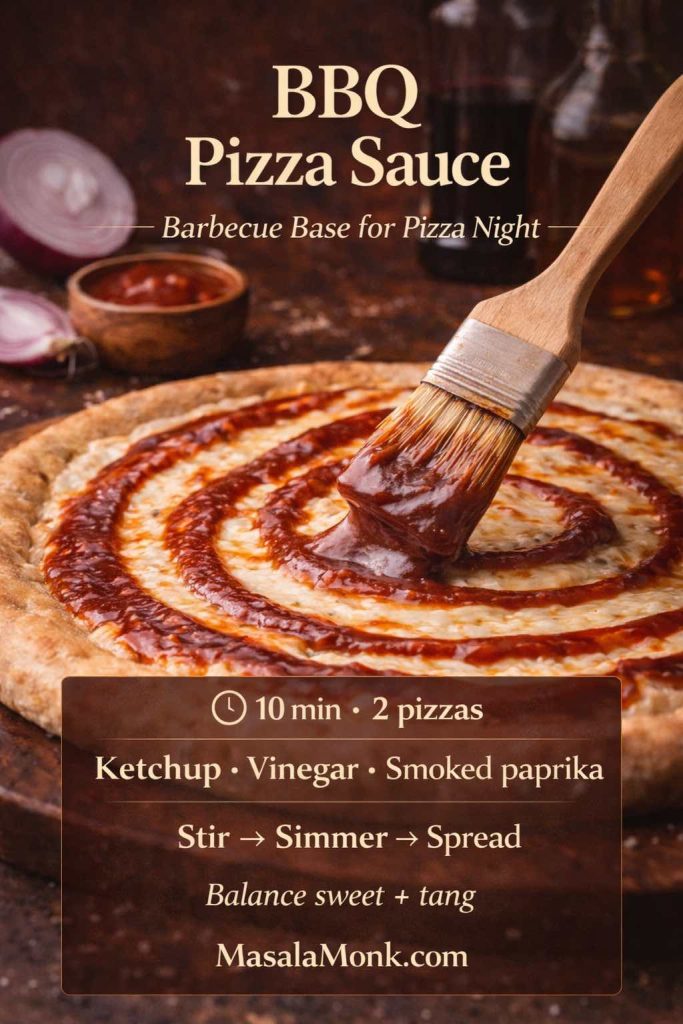
26) Why does my marinara sauce taste bitter?

Bitterness often comes from garlic browning too much or herbs scorching early in cooking. Next time, keep the heat gentler at the start and add basil closer to the end. Also, choose tomatoes you like, because some cans can taste more harsh than others.

27) Why is my marinara sauce watery even after simmering?

Watery marinara usually needs more uncovered simmering or a tomato product with less liquid. Therefore, let it reduce longer and stir occasionally. If you want faster results, start with crushed tomatoes or blend and then reduce briefly to tighten texture.

28) How do I fix marinara sauce that tastes too salty?

If the marinara tastes too salty, add more tomatoes or a small splash of water and simmer briefly to rebalance. Additionally, a bit of basil at the end can soften the overall perception. For the future, start with less salt and adjust only after the sauce reduces.

29) What is the best marinara sauce to buy if I don’t have time to cook?

If you’re buying instead of cooking, look for a jarred marinara with a short ingredient list: tomatoes, olive oil, garlic, basil, and minimal additives. Furthermore, avoid added sugars if you want a cleaner taste. Then, improve it at home by simmering briefly with basil or garlic.

30) Can I use marinara as a simple tomato pasta sauce for meal prep?

Absolutely. Because marinara reheats well and pairs with many proteins and vegetables, it’s one of the easiest sauces for meal prep. Moreover, you can cook one big batch and split it into variations—spicy, low sodium, or sugar free—so your meals don’t feel repetitive.

Posted on 8 Comments

Tomato Sauce From Fresh Tomatoes (Food Mill Method & Recipe)

Homemade fresh tomato sauce from fresh tomatoes with basil, made using the food mill method.

A pot of tomatoes simmering on the stove has a way of making the whole day feel softer. The kitchen smells warm and familiar, the bubbling is gentle instead of loud, and dinner suddenly feels inevitable—in a good way. That’s the quiet power of making tomato sauce from fresh tomatoes: it turns something simple into something steady. You start with raw tomatoes and end with a sauce that tastes like actual tomatoes—bright, a little sweet, slightly tangy, and far more alive than anything that’s been sitting on a shelf.

This fresh tomato sauce recipe is built around one idea: keep the tomato flavor clean, then make the texture as smooth—or as rustic—as you like. The method I prefer most is the food mill approach, because food mill tomato sauce hits a sweet spot: it feels traditional, it tastes fresh, and it saves you from the most annoying parts of sauce-making (peeling, seeding, and picking at skins). Even so, if you don’t own a food mill yet, you’re still covered. You can make a beautiful tomato sauce recipe with fresh tomatoes without fancy tools; it’s simply a different route.

What you’ll get at the end is a sauce that works in multiple directions: spaghetti sauce from fresh tomatoes that clings to strands, pasta sauce using fresh tomatoes that coats penne, and a flexible tomato pasta sauce with fresh tomatoes you can spoon into other meals when you want variety. Most importantly, it’s a sauce you’ll want to make again—because it feels doable on a normal day, not just on an ambitious one.


Tomato sauce from fresh tomatoes: the style we’re making

Tomato sauce names get messy. People look for tomatoes sauce, sauce tomato sauce, recipe with spaghetti sauce, marinara sauces, red sauce, italian red sauce, pizza red sauce—often meaning slightly different things. Some sauces are cooked for hours, some are barely cooked at all, and some are thickened until they’re almost spreadable. Because of that, it helps to be clear about what this recipe is aiming for.

This is an Italian tomato sauce from fresh tomatoes style that stays tomato-forward. Closer to sauce pomodoro or a simple sugo recipe than a long-simmered spaghetti sauce bolognese, it keeps the spotlight on the tomatoes. Unlike tomato and cream sauce, it isn’t meant to be rich and silky. Rather than leaning into a tomato cream sauce for alla vodka pasta, it stays clean and bright. It also skips the built-in heat you’d expect from an arrabbiata sauce recipe. Ultimately, it’s a flexible base you can enjoy as-is or spin into those variations later.

In other words, you’re making the sauce you’ll want on hand—because it’s the one you can reshape depending on the night.

Also Read: Blueberry Pancakes (6 Recipes) + Homemade Pancake Mix


Ingredients for a fresh tomato sauce recipe that tastes like tomatoes

When the tomatoes are good, you don’t need much else. That’s why this homemade tomato sauce stays intentionally simple.

You’ll need:

  • Fresh ripe tomatoes
  • Olive oil
  • Salt
Fresh tomatoes, basil, garlic, olive oil, and salt arranged for making tomato sauce from fresh tomatoes.
Start with ripe tomatoes and a few pantry basics—this sauce gets its depth from the tomatoes, not a long ingredient list.

Optional, yet worth considering:

  • Onion (adds sweetness and body)
  • Garlic (adds aroma)
  • Fresh basil (for a fresh finish)
  • Black pepper
  • Chili flakes (if you want a gentle heat)

That’s enough to create a homemade tomato sauce that reads as “complete” without tasting heavy. It also keeps you far away from the sweetness people associate with some jarred sauces—helpful if you’ve ever looked up sugar free pasta sauce, low sugar pasta sauce, or healthy tomato sauce and felt like everything tasted oddly sweet. Here, the balance comes from tomatoes and technique, not from added sugar.

Also Read: How to Make Eggless Mayo at Home (Egg Free Mayonnaise Recipe)


Choosing tomatoes for tomato sauce from tomatoes (what matters and what doesn’t)

You can turn almost any tomato into sauce, yet the flavor ceiling depends on the tomato you start with. Consequently, choosing well pays off more than adding extra ingredients later.

Best tomatoes for pasta sauce from fresh tomatoes

  • Roma / plum tomatoes: Meaty, fewer seeds, less water—great for thickening into red pasta sauce.
  • Vine-ripened tomatoes: Fragrant and juicy—excellent, though they may need a longer reduction.
  • Cherry tomatoes: Small but intense—great for a bright, slightly sweeter sauce.

About San Marzano (and why people chase it)

San Marzano tomatoes—most often found canned—are prized for their balanced flavor, with a natural sweetness and a gentler bite. If you’re using fresh tomatoes instead, chase that same idea: choose tomatoes that smell deeply tomato-like and taste great straight from the cutting board.

Passata tomato as a seasonal backup (and why it’s related to this method)

Passata is essentially strained tomato puree—smooth, seedless, and skinless. It’s often made by cooking tomatoes briefly and running them through a milling process. That’s why, later, a tomato passata recipe or passata pasta sauce post can connect directly to what you’re learning here.

If you want the clearest explanation in plain language, Serious Eats has a practical guide to passata and why it’s useful: Italian passata gives you fresh tomato flavor all year long.


Why food mill tomato sauce is worth it (texture and taste, both)

A blender is fast, but it can also change the sauce in ways you might not want. It whips air into the tomatoes, which makes the sauce feel lighter and sometimes slightly frothy. Moreover, when seeds are pulverized, they can contribute bitterness and a gritty edge. A food mill avoids those problems. It presses soft tomato flesh through holes while holding back skins and seeds. As a result, you get a smoother sauce without turning it into foam.

If you want to see a reliable, tomato-forward version of this approach from an established cooking publication, Serious Eats lays out the logic clearly in their method for a fresh tomato pasta sauce: The best fresh tomato sauce for pasta.

Even so, don’t treat a food mill as a gatekeeping tool. You can absolutely make tomato sauce from fresh tomatoes without one. The food mill method is simply the easiest path to a clean texture.


Tomato sauce from fresh tomatoes (food mill method): step-by-step recipe

This is the core method. It’s straightforward; nonetheless, a few small choices make the finished sauce taste noticeably better.

1) Wash, core, and rough-chop the tomatoes

Rinse the tomatoes well. Remove the stem area and any tough core. Chop into rough chunks. Uniformity doesn’t matter because everything will soften and collapse.
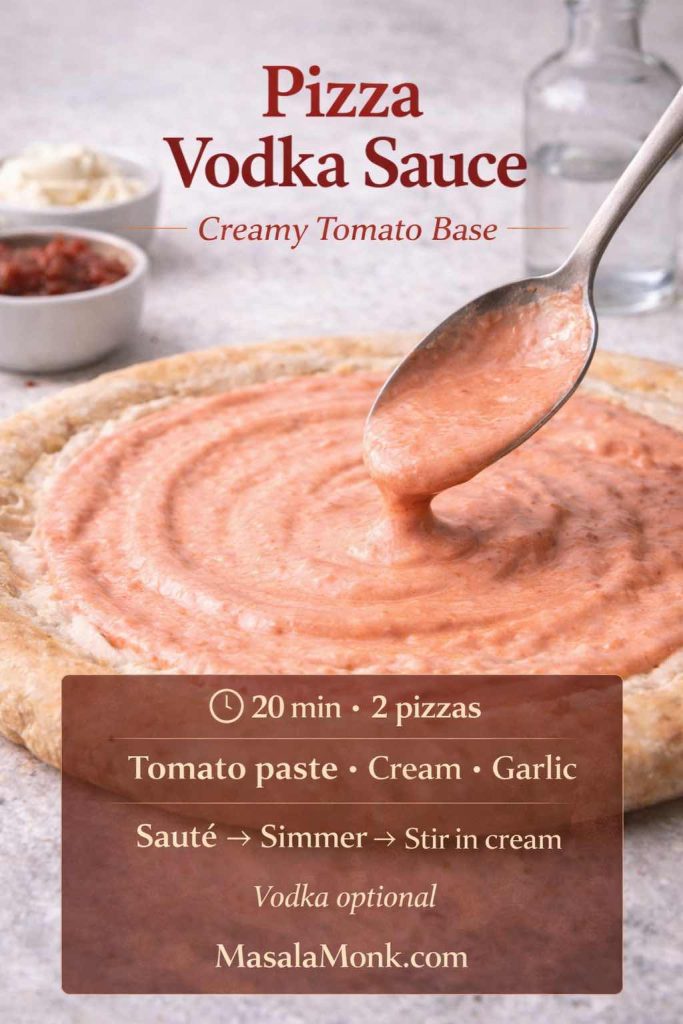
If the tomatoes are very juicy, you can chop them in a bowl so you keep the juices. Then, when those juices go into the pot too, the flavor stays with the sauce rather than disappearing into the sink.

Hands chopping fresh tomatoes into rough chunks for tomato sauce from fresh tomatoes, with chopped tomatoes in a bowl behind.
Keep the cuts rough and quick—the smaller pieces soften sooner, so your sauce gets moving fast.

2) Start a gentle base (optional, but helpful)

Set a wide pot over medium heat. Add olive oil.

If using onion, add it first with a pinch of salt. Let it soften until translucent and sweet-smelling. Don’t rush browning here; instead, aim for gentle cooking that supports the tomatoes without overtaking them.

Add garlic next, if using, and cook briefly until fragrant. Then move on quickly—garlic can go from fragrant to bitter if it browns too hard.

If you like having a reference from a mainstream test kitchen, Bon Appétit’s approach to a simple base tomato sauce follows a similar rhythm: Basic tomato sauce.

Onion sautéing in olive oil with garlic being added in a pot to start tomato sauce from fresh tomatoes.
Let the onion turn soft and glossy before adding garlic—this gentle base gives the sauce depth without overpowering the tomatoes.

3) Add tomatoes and salt early

Add the chopped tomatoes to the pot. Salt them right away. Early salting helps pull out liquid and starts building flavor from the start. Stir well and let the tomatoes begin to heat through.

Chopped tomatoes being poured into a pot over sautéed onion and garlic while salt is sprinkled in to start tomato sauce from fresh tomatoes.
Salting at the beginning draws out tomato juices and helps the sauce taste balanced from the very first simmer.

4) Simmer until the tomatoes break down completely

Lower the heat so the pot stays at a steady simmer. Stir occasionally.

You’re ready for milling when:

  • the tomatoes look collapsed and soft,
  • the mixture resembles a loose, chunky tomato stew,
  • and the skins have loosened.

Timing depends on the tomatoes. Cherry tomatoes break down quickly; larger tomatoes can take longer. Either way, let texture lead your decisions instead of the clock.

Pot of tomato sauce simmering until tomatoes break down and skins loosen, ready to be processed through a food mill.
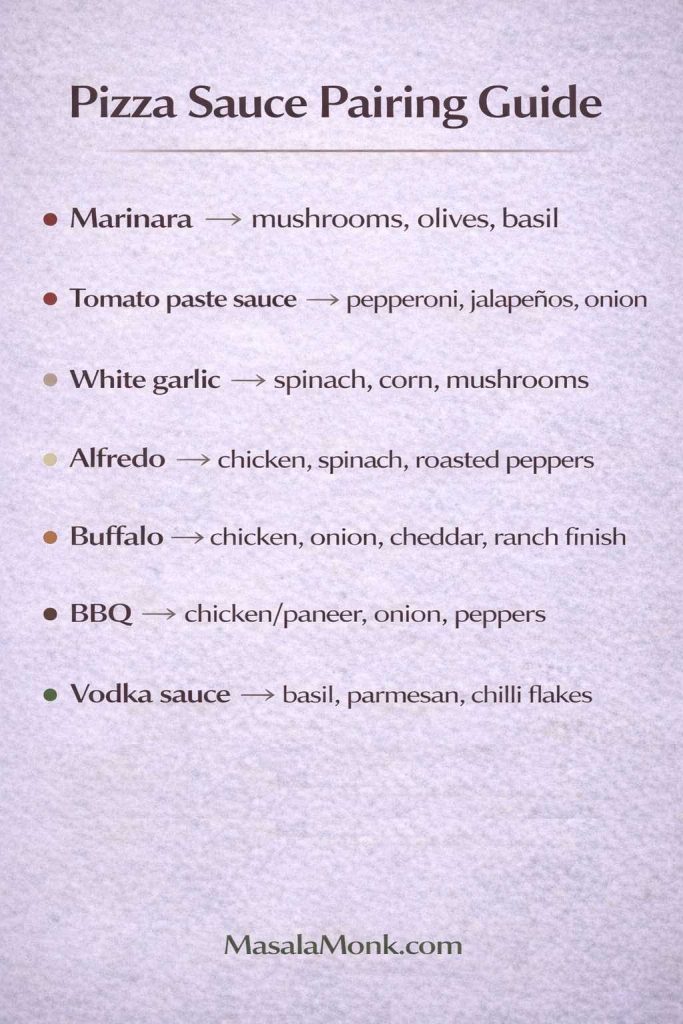
Once the tomatoes look collapsed and jammy, you’re ready for the next step—milling for that smooth, classic texture.

5) Mill the tomatoes

Set your food mill over a bowl or a clean pot. Ladle the softened tomatoes into the mill and crank.

This step is satisfying for a reason: underneath, you get smooth tomato puree; above, you’re left with skins and seeds that would otherwise interrupt the texture. It’s one of the cleanest ways to get a smooth tomato sauce from fresh tomatoes without a blender.

The mill does the cleanup for you—skins and seeds stay behind while the sauce turns silky and spoonable.
Tomato skins and seeds left behind in a food mill after processing cooked tomatoes into smooth tomato sauce.
This is the texture upgrade: the mill holds back skins and seeds so the sauce underneath stays silky and clean.

6) Reduce the sauce to your preferred thickness

Return the milled sauce to the pot and simmer uncovered. Now you choose what kind of sauce this becomes.

  • For a lighter, more “pomodoro” feel, reduce lightly.
  • For a thicker tomato pasta sauce with fresh tomatoes that clings to ridged pasta, reduce longer.
  • For a sauce that can hold up in a bake, reduce until it falls from a spoon in thicker ribbons.

Meanwhile, keep the heat gentle. A rolling boil can dull the fresh flavor and push the sauce into an overly cooked taste.

Spoon lifted over a pot of simmering tomato sauce, showing the sauce falling in ribbons to indicate the right thickness.
When the sauce drips in slow ribbons and coats the spoon, it’s thick enough to cling to pasta instead of sliding off.

7) Finish with basil (and adjust seasoning)

Turn off the heat. Stir in torn basil. Taste and adjust salt. Add black pepper if you like.
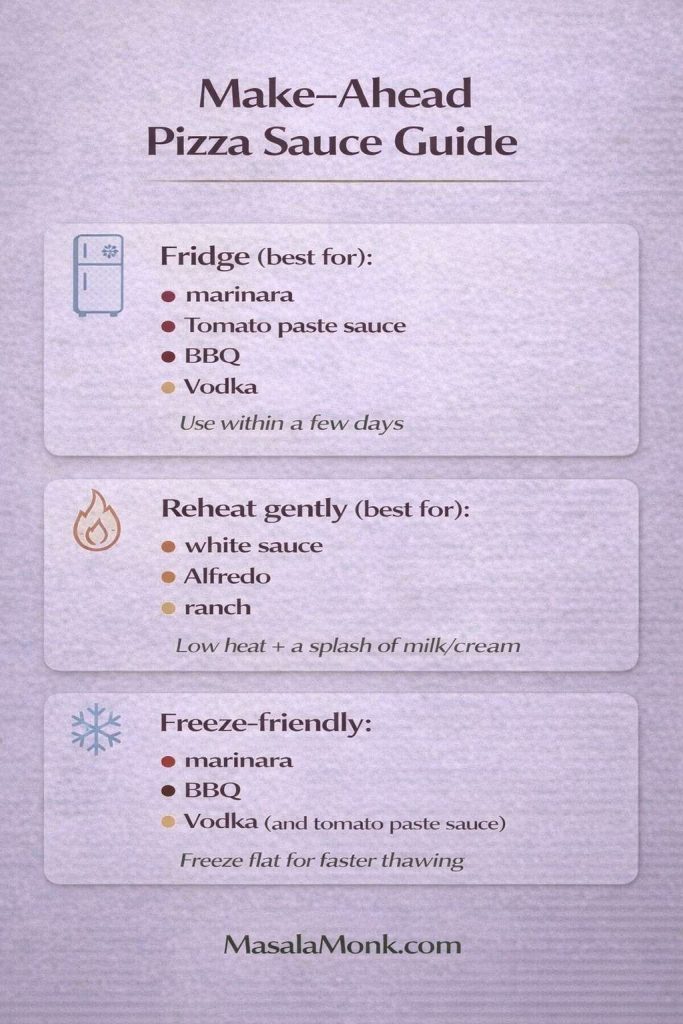
Now you have a fresh tomato sauce recipe that stands on its own—yet it can also become tomato sauce for spaghetti, a base for lasagna, or the start of a bigger sauce later.

Hands tearing fresh basil over a pot of finished tomato sauce from fresh tomatoes to add freshness at the end.
Add basil off the heat so it stays fragrant—this final touch keeps the sauce tasting bright and tomato-forward.

Also Read: 10 Best Espresso Martini Recipe Variations (Bar-Tested)


Tomato sauce recipe with fresh tomatoes (no food mill): two good paths

If you don’t have a food mill, you can still make a great sauce. You’ll simply choose between a smoother route and a rustic route.

Option A: Peel tomatoes for a smoother fresh tomato sauce

Peeling helps a lot when you want a clean texture without milling. The classic blanch-and-slip method is straightforward: score an “X,” blanch briefly, shock in cold water, then peel.

If you want a clear, step-by-step explanation from a dependable cooking site, Serious Eats breaks it down neatly: How to peel tomatoes.

Hands peeling and seeding tomatoes over a bowl to make smooth tomato sauce from fresh tomatoes without a food mill.
Peeling first keeps the sauce silky even without a mill—most of the “rough texture” disappears before cooking begins.

After peeling:

  1. Cut tomatoes and remove seeds if you want a smoother sauce.
  2. Chop the flesh and simmer.
  3. Mash with a spoon or blend briefly.
  4. Reduce to thicken.

This is close to tomato concasse prep, where tomatoes are peeled, seeded, and chopped for refined sauces.

Option B: Keep it rustic (and still delicious)

If you don’t mind bits of tomato and occasional peel texture, skip peeling entirely. Simmer until the tomatoes are soft, then crush with a spoon and reduce. You’ll get a chunkier, homestyle sauce that’s excellent on short pasta.

Chunky crushed tomatoes simmering in a pot while being stirred with a wooden spoon for a rustic fresh tomato sauce.
Rustic sauce is a choice, not a compromise—crushing as it simmers keeps the texture hearty and the flavor bold.

In fact, for some kitchens, this becomes the default “home made spaghetti sauce” texture because it feels honest and hearty.

Also Read: Double Chocolate Chip Cookies – Easy Recipe with 7 Variations


Spaghetti sauce from fresh tomatoes vs pasta sauce from fresh tomatoes

The same sauce can behave differently depending on how you finish it. That’s why people seek spaghetti sauce from fresh tomatoes and pasta sauce using fresh tomatoes separately—they want a specific eating experience.

Spaghetti sauce from fresh tomatoes (for long noodles)

For spaghetti, you usually want a sauce that’s smooth enough to coat strands and loose enough to toss easily.

Spaghetti being tossed directly in tomato sauce from fresh tomatoes with tongs so the sauce clings to the noodles.
Tossing spaghetti in the sauce (with a splash of pasta water) helps it cling—so every bite tastes evenly coated, not just “topped.”

Cook spaghetti until just shy of done. Warm the sauce in a pan. Add spaghetti and a splash of pasta water, then toss vigorously. As the starch meets the sauce, it turns glossy and clings to noodles instead of sliding off.

This is the detail that turns “spaghetti and tomato sauce” into something that tastes cohesive.

Pasta sauce from fresh tomatoes (for short shapes)

For penne, rigatoni, fusilli, and other shapes designed to hold sauce, reduce the sauce a little more. The thicker consistency settles into ridges and pockets, so each bite tastes balanced without drowning in sauce.

If you’re ever building toward penne vodka pasta or penne alla vodka pasta later, this base is still useful—you’d simply add cream and finish differently. For now, keeping it clean highlights the tomato.

Also Read: Avocado, Basil, and Grilled Tomato Sandwich: A Perfect Breakfast Option


Italian tomato sauce from fresh tomatoes: keeping the flavor bright

Fresh tomato sauce is at its best when it tastes lively. Accordingly, the method matters more than a long list of seasonings.

Keep the simmer steady, not aggressive

A gentle simmer preserves brightness. A hard boil can flatten flavor.

Season gradually

Salt early, then adjust at the end. That way, you don’t over-salt before the sauce reduces.

Don’t bury the tomato

A sprinkle of herbs is fine, but a heavy hand can make the sauce taste like “herb sauce with tomatoes,” rather than tomato sauce from tomatoes.

Finish with basil at the end

Basil tastes fresher when added off heat. It brings a green perfume that makes the sauce feel instantly more Italian.

Also Read: Healthy Tuna Salad – 10 Easy Recipes (Avocado, Mediterranean, No Mayo & More)


Tomato sauce from fresh tomatoes: ways to use it beyond pasta

Once you have a pot of sauce, dinner options multiply. In other words, this is one of those recipes with tomato sauce that keeps paying you back.

Build a meat sauce night (without forcing it into this recipe)

If you want a heartier dinner, use this sauce as a base and build from there.

When you’re ready for a true ragù-style sauce, MasalaMonk’s bolognese sauce recipe is a natural next step, because it shows how a tomato base becomes a deep, satisfying meat sauce without losing balance.

Layer it into lasagna (tomato + white sauce = perfect balance)

Fresh tomato sauce pairs beautifully with a creamy white layer. For a classic approach, pair it with MasalaMonk’s béchamel sauce for lasagna. The contrast matters: the béchamel is rich, so the tomato layer stays bright and keeps the dish from feeling heavy.

If you want a different lasagna direction, MasalaMonk’s cottage cheese lasagna recipe is another excellent path—especially when you want a protein-forward bake that still feels comforting.

On colder days, when you want “lasagna flavor” with far less effort, MasalaMonk’s crock pot lasagna soup is a cozy alternative that fits beautifully with a tomato base.

Serve it with arancini (a restaurant-feeling snack at home)

Warm tomato sauce as a dip is an easy way to make something feel special. Crispy rice balls dipped into a bright sauce are hard to beat. If you want the method for rice balls, MasalaMonk’s arancini balls guide makes it approachable. Then you simply ladle your sauce into a bowl and dip generously.

Turn it into a chicken parm-style sandwich night

Tomato sauce plus crispy chicken and melted cheese is a reliable crowd-pleaser. If you want inspiration, MasalaMonk’s chicken sandwich recipes includes ideas that naturally pair with a homemade red sauce—either as the main component or as a dipping side.

Make it spicy without changing the whole pot

If you want to lean toward spicy tomato sauce, add chili flakes at the end. Alternatively, stir in a spoon of a bright pepper sauce to add heat and tang at once. MasalaMonk’s pepper sauce recipe is a great place to explore heat styles if you enjoy experimenting.


Tomato sauce from tomatoes: balancing flavor without making it sweet

Many store-bought sauces lean on added sugar to round out acidity and boost flavor. Homemade sauce doesn’t need that shortcut—you can create balance by gently reducing the tomatoes, seasoning thoughtfully, and finishing with the right touch of fat and herbs.

If the sauce tastes too sharp

First, simmer longer. Acidity often softens as the sauce reduces.

If it still tastes sharp, a small knob of butter can mellow the edges and add a smoother mouthfeel. If you want a clear explanation of why this works, Simply Recipes (a long-running home-cooking publication) talks through easy ways to improve tomato sauce flavor, including richness and balance: How to make store-bought tomato sauce taste better. The idea applies just as well to homemade sauce—especially when tomatoes are a little tart.

If the sauce tastes watery

Reduce uncovered in a wide pot. The wider the surface area, the faster water evaporates. Consequently, the sauce thickens without needing starches or tricks.

If the sauce tastes flat

It almost always needs salt. Add a small pinch, stir, and taste again. After that, finish with basil or a drizzle of olive oil to bring it to life.

Also Read: Peanut Butter Cookies (Classic Recipe & 3 Variations)


Tomato pasta sauce with fresh tomatoes: texture choices that change the meal

Two people can follow the same recipe and end up with two very different sauces—simply because they reduced to different thicknesses. That’s not a mistake; it’s a feature.

For a light sauce (best for tossing with pasta water)

Reduce just until the sauce coats a spoon. It should still flow easily.

For a clingy red sauce (best for short pasta and baked dishes)

Reduce longer until the sauce falls in thicker ribbons. This version sits on pasta instead of pooling underneath.

For a thicker base

If you reduce even further, the sauce can hold up for layering in casseroles. That’s one reason this is such a useful pasta sauce from fresh tomatoes: you can steer the texture to match the meal.

Also Read: Healthy Oat Protein Bars – 5 Easy No Sugar Recipes for Snacks


Homemade tomato sauce: scaling up without making it complicated

Tomato sauce from fresh tomatoes scales well, but the workflow stays smoother if you respect a few realities.

  • Use a wide pot so reduction doesn’t take forever.
  • Salt in stages: early, then adjust late.
  • Mill in batches if you’re making a large pot.

If you double the tomatoes, you don’t need to double your attention—just your pot size and your patience. Eventually, you’ll find your personal rhythm: simmer while you tidy the kitchen, mill while the pasta water heats, and finish while dinner plates come out.


Storage: fridge, freezer, and a careful word about canning tomato sauce

Fridge

Cool the sauce, then store in an airtight container. Reheat gently so the flavor stays bright.

Freezer

Freeze in small portions so you can thaw exactly what you need. This is the easiest way to keep tomato sauce for spaghetti nights effortless later.

If you plan to can it

Canning tomato products is absolutely doable, but it’s also an area where tested guidance matters. Tomato acidity varies, and safe canning depends on correct acidification and proven methods.

If you want reliable sources:

If you’re not canning, freezing is the simplest long-term option—less stress, less equipment, and still excellent results.


When you want a different sauce night (still pasta, just a new mood)

Fresh tomato sauce is a cornerstone. Still, variety keeps cooking exciting.

If you want to switch gears:

  • MasalaMonk’s pesto recipes are a great way to pivot into something herby and bright.
  • If you prefer a lighter pesto direction, MasalaMonk’s fresh basil pesto (vegan) is another easy next step.
  • For creamy comfort with no tomato at all, MasalaMonk’s carbonara recipe is a classic alternative.
  • Likewise, if you’re craving a rich bowl on another night, MasalaMonk’s chicken alfredo pasta is a strong companion read.

Meanwhile, your homemade tomato sauce can sit in the freezer, ready for the next time you want dinner to feel simple and excellent.


Tomato sauce from fresh tomatoes, made once—used again and again

Once you’ve made tomato sauce from fresh tomatoes using the food mill method, it stops feeling like a special project and starts feeling like a skill you own. On days when market tomatoes look especially good, you’ll reach for this fresh tomato sauce recipe without overthinking it. When you want something clean and reliable, it naturally becomes your go-to pasta sauce using fresh tomatoes. And when the craving hits on an ordinary weeknight, it turns into the spaghetti sauce from fresh tomatoes you’ll be glad you already know how to make.

And because it’s flexible, it fits different moods. Keep it simple and you get a bright sauce that tastes like summer. Reduce it more and you get a clingy tomato pasta sauce with fresh tomatoes that feels comforting and rich. Build on it and you get a base for bigger dishes—bakes, sandwiches, even hearty meat sauces—without needing a separate starting point.

So when you spot tomatoes that smell sweet and look truly ripe, don’t save them only for salads. Put a pot on the stove, let the kitchen smell incredible, and make a sauce you’ll be happy to have—tonight, and many meals from now.

Also Read: 10 Creative Chia Pudding Recipes for Every Taste

FAQs

1) How do I make tomato sauce from fresh tomatoes without a food mill?

Start by cooking chopped tomatoes with a little salt until they fully collapse. Afterward, peel and seed first (for a smoother result) or keep it rustic, then mash well and simmer until it reaches the thickness you want for pasta.

2) What’s the easiest tomato sauce from fresh tomatoes method for beginners?

A simple approach is to simmer chopped tomatoes with salt (plus onion or garlic if you like) until soft, then reduce uncovered until the flavor concentrates. Finally, finish with basil for a fresh, Italian-style taste.

3) Can I use this tomato sauce for spaghetti?

Absolutely. For tomato sauce for spaghetti, keep the sauce slightly looser, then toss it with cooked spaghetti and a splash of pasta water so it coats the noodles instead of pooling underneath.

4) How do I turn tomato sauce into spaghetti sauce?

To shift tomato sauce to spaghetti sauce, simmer a bit longer for deeper flavor, then adjust texture with pasta water at the end. Additionally, you can add sautéed onion/garlic or herbs for a more “spaghetti sauce” profile.

5) How do I make spaghetti sauce from fresh tomatoes that isn’t watery?

Choose meatier tomatoes when possible, then simmer uncovered to evaporate excess liquid. If needed, widen the pot surface area to speed up reduction while keeping the simmer gentle.

6) What tomatoes are best for tomato sauce from tomatoes?

Roma or plum tomatoes are ideal because they’re less watery and have more flesh. Still, vine-ripened tomatoes work well too, especially if you’re willing to reduce longer for a richer tomato taste.

7) Is fresh tomato sauce the same as marinara sauce?

Not always. Fresh tomato sauce is often lighter and more tomato-forward, whereas marinara sauces usually include a more defined seasoning profile and can be slightly thicker, depending on the style.

8) How do I make a marinara sauce recipe from this fresh tomato base?

Begin with your fresh tomato sauce, then add garlic, herbs, and a longer simmer for a more classic marinara feel. In many cases, a pinch of oregano plus basil moves it firmly into marinara territory.

9) What’s the difference between sauce pomodoro and regular tomato sauce?

Sauce pomodoro typically stays bright, simple, and basil-forward, with a clean tomato flavor. By comparison, “tomato sauce” can range from quick and fresh to longer-simmered and more robust.

10) What is sugo recipe style tomato sauce?

Sugo generally refers to an Italian-style sauce that’s often tomato-based and used broadly for pasta. Depending on the region, it can be simple like pomodoro or richer with longer cooking and added ingredients.

11) Can I make tomato pasta sauce with fresh tomatoes ahead of time?

Yes. Let the sauce cool completely, then refrigerate for a few days or freeze in portions. Later, reheat gently to keep the flavor lively and the texture smooth.

12) How long should I simmer homemade tomato sauce?

Simmer just until the tomatoes break down, then reduce until the sauce tastes concentrated and coats a spoon. The exact time varies by tomato type, batch size, and how thick you want your red pasta sauce.

13) How do I thicken pasta sauce from fresh tomatoes quickly?

Use a wide pot, keep it uncovered, and maintain a steady simmer to drive off moisture faster. Alternatively, start with less-watery tomatoes to reduce thickening time.

14) How do I fix fresh tomato sauce that tastes too acidic?

First, reduce a bit longer because acidity often softens with cooking. If it still tastes sharp, add a small knob of butter or a tiny pinch of sugar—just enough to round the edges, not sweeten the sauce.

15) Can I make low sugar pasta sauce with fresh tomatoes?

Yes—fresh tomato sauce is naturally low sugar when you skip sweeteners. Focus on good tomatoes, proper salt, and reduction for balanced flavor without added sugar.

16) How do I make sugar free marinara sauce?

Use tomatoes, olive oil, salt, and herbs—then avoid any added sweeteners. For extra depth, sauté onion gently; it boosts perceived sweetness naturally without adding sugar.

17) What’s the best way to season Italian tomato sauce from fresh tomatoes?

Salt early, then adjust at the end. Beyond that, basil is a classic finish, while onion and garlic provide depth; keep dried herbs modest so the tomato flavor stays front and center.

18) Can I use this as pizza tomato sauce?

You can, especially if you reduce it until it’s thick enough to spread. However, pizza tomato sauce is often uncooked or paste-based, so expect a slightly different flavor and texture.

19) How do I make pizza sauce using tomato paste instead?

Whisk tomato paste with water, olive oil, salt, and herbs until spreadable. Then adjust thickness and seasoning to taste; it’s a fast option when fresh tomatoes aren’t available.

20) Can I make roasted tomato sauce from fresh tomatoes?

Definitely. Roast tomatoes until caramelized, then simmer briefly and blend or mill for texture. Roasting adds sweetness and depth, creating a richer roasted tomato spaghetti sauce.

21) What’s the difference between fresh tomato sauce and red sauce?

“Red sauce” is a broad label that can include marinara, longer-simmered Italian-American sauces, and other tomato-based sauces. Fresh tomato sauce is typically lighter, quicker, and more tomato-forward.

22) Can I turn this into arrabbiata sauce pasta?

Yes. Add chili flakes (or fresh chilies) and simmer briefly so the heat infuses. Then toss with pasta for an easy arrabbiata sauce pasta style dinner.

23) How do I make arrabbiata sauce recipe style from scratch?

Start with olive oil and garlic, add chili flakes, then pour in tomato sauce and simmer. Finish with salt and basil or parsley, then serve immediately with pasta.

24) Can I make puttanesca sauce using this tomato base?

Yes. Add olives, capers, garlic, and chili, then simmer briefly to meld flavors. As a result, you get a bold puttanesca sauce without needing a separate tomato foundation.

25) How do I make tomato cream sauce from this base?

Warm the tomato sauce, then stir in heavy cream or a splash of milk and simmer gently. This creates a creamy tomato sauce that’s ideal for pasta.

26) Is this the same as penne alla vodka pasta sauce?

Not exactly. Penne alla vodka pasta uses a tomato base plus vodka and cream for a silky finish. Still, this sauce is the perfect starting point for a penne alla vodka recipe later.

27) Can I use passata tomato instead of fresh tomatoes?

Yes. Passata is strained tomato puree, so it behaves like a smooth base right away. Simmer it with aromatics and finish like you would a fresh tomato sauce recipe.

28) How do I make tomato sauce using tomato paste if I’m out of tomatoes?

Combine tomato paste with water (or broth), olive oil, and seasonings, then simmer briefly. After that, adjust salt and herbs until it tastes balanced and full.

29) What’s the best way to store homemade tomato sauce?

Cool it fully, store in airtight containers, and refrigerate for short-term use. For longer storage, freeze in smaller portions so you can thaw just what you need.

30) How do I use this for meatballs in tomato sauce?

Simmer meatballs directly in the sauce until cooked through, allowing the sauce to pick up their flavor. Then serve over spaghetti or with bread for a classic meatballs and tomato sauce meal.