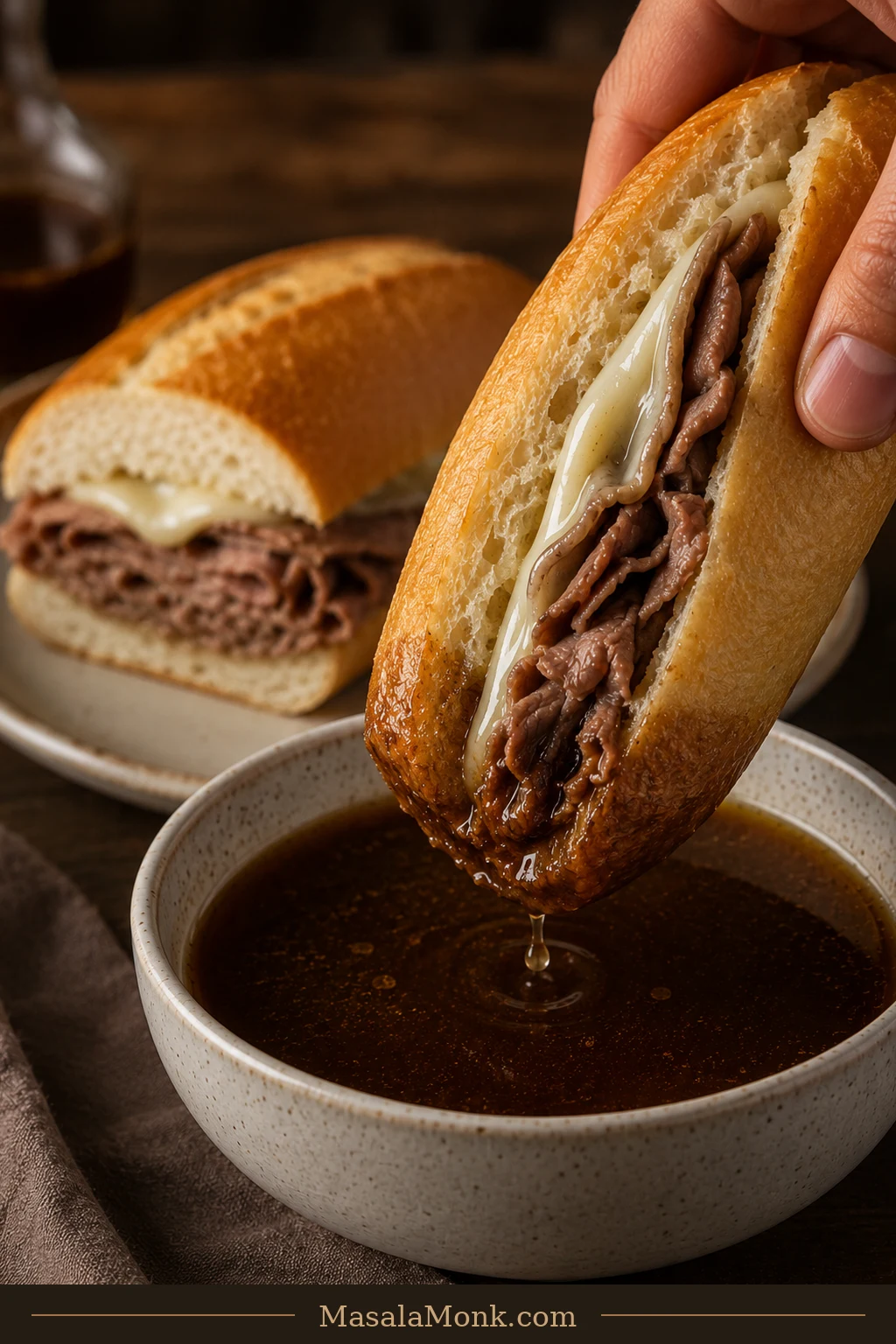
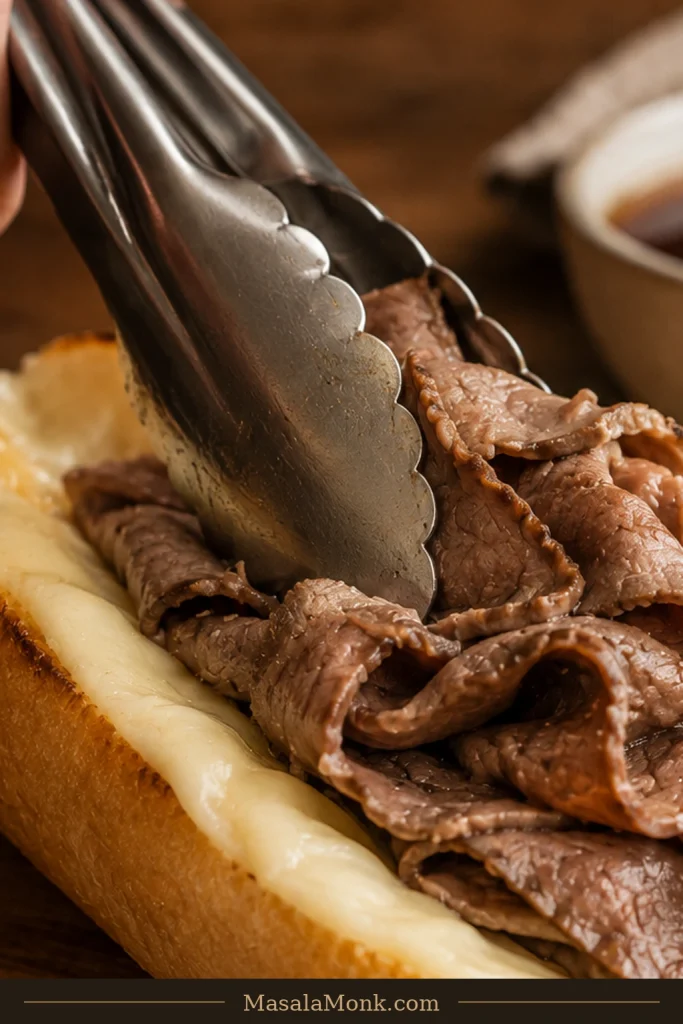
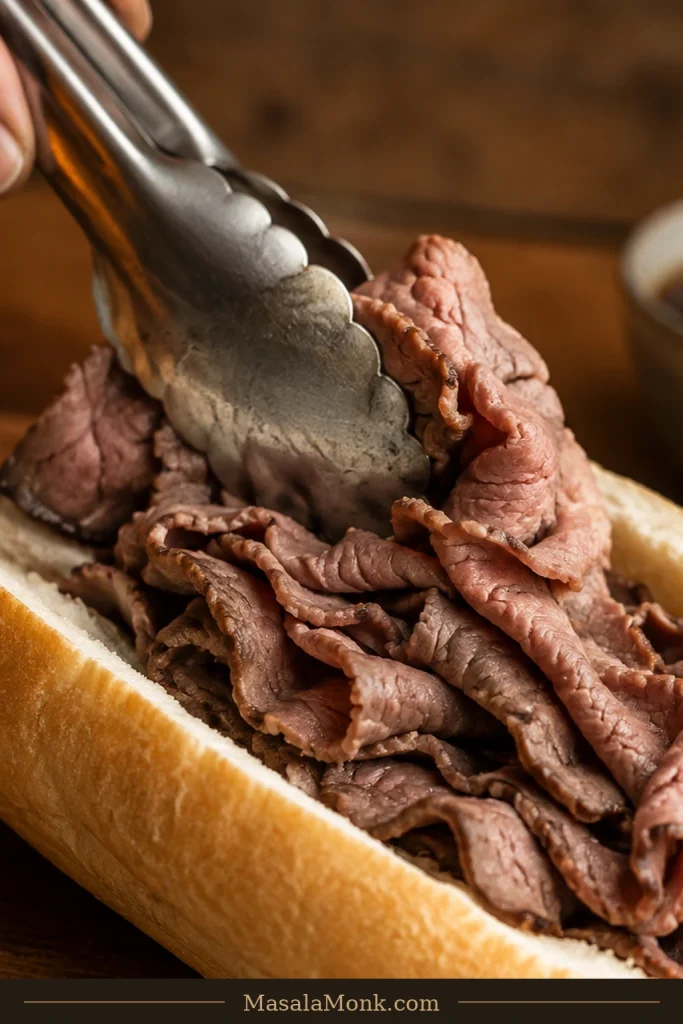
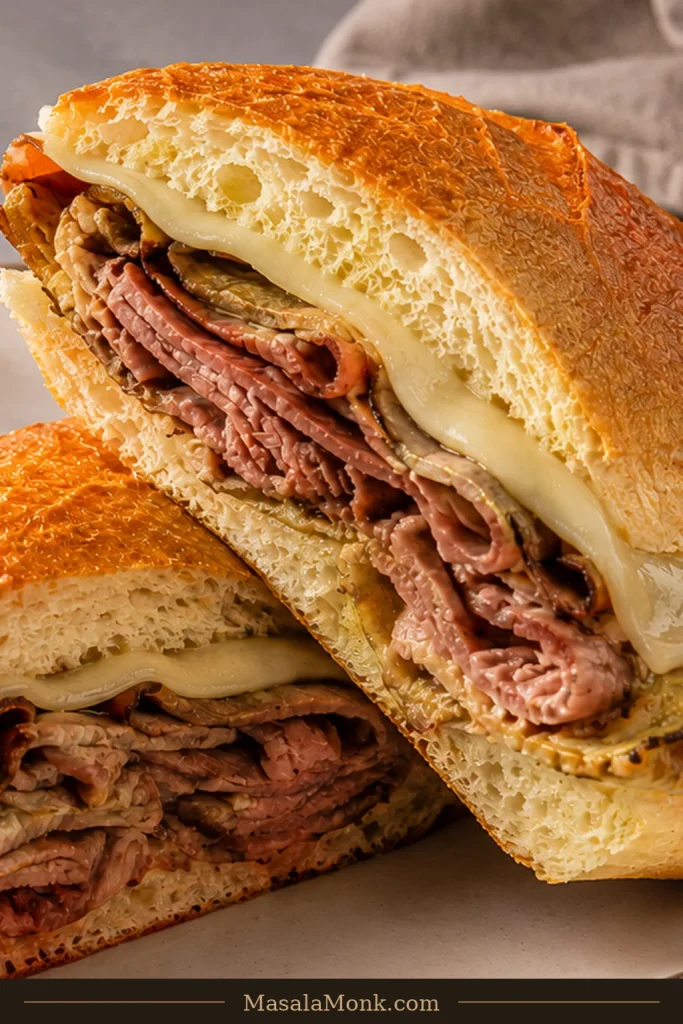
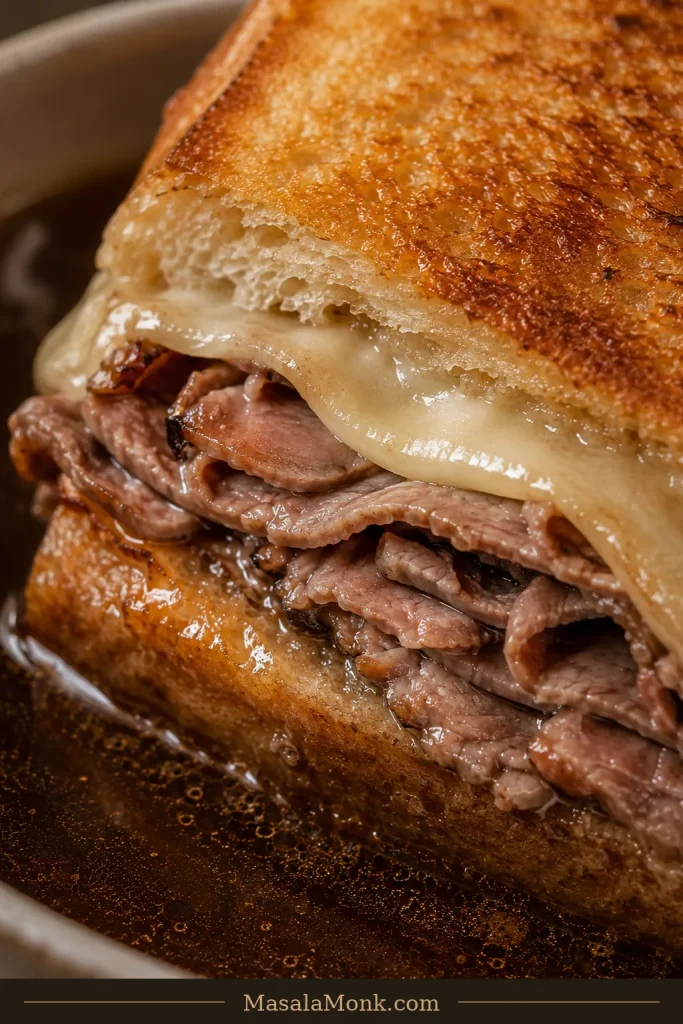
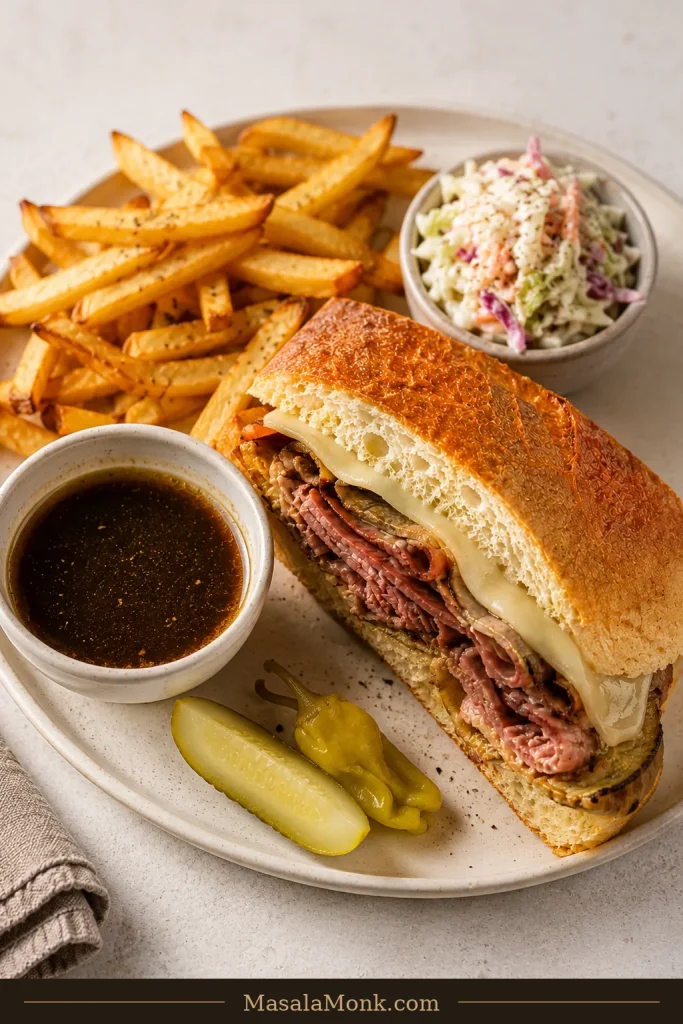
The first bite of a good French dip gives you several things at once: bread with a little chew, folds of hot roast beef, melted provolone and warm, oniony jus soaking into the cut edge.
The disappointing version loses that balance fast. Thin roast beef tightens from too much heat, the jus tastes saltier than savory, or the bread softens long before you wanted it to.
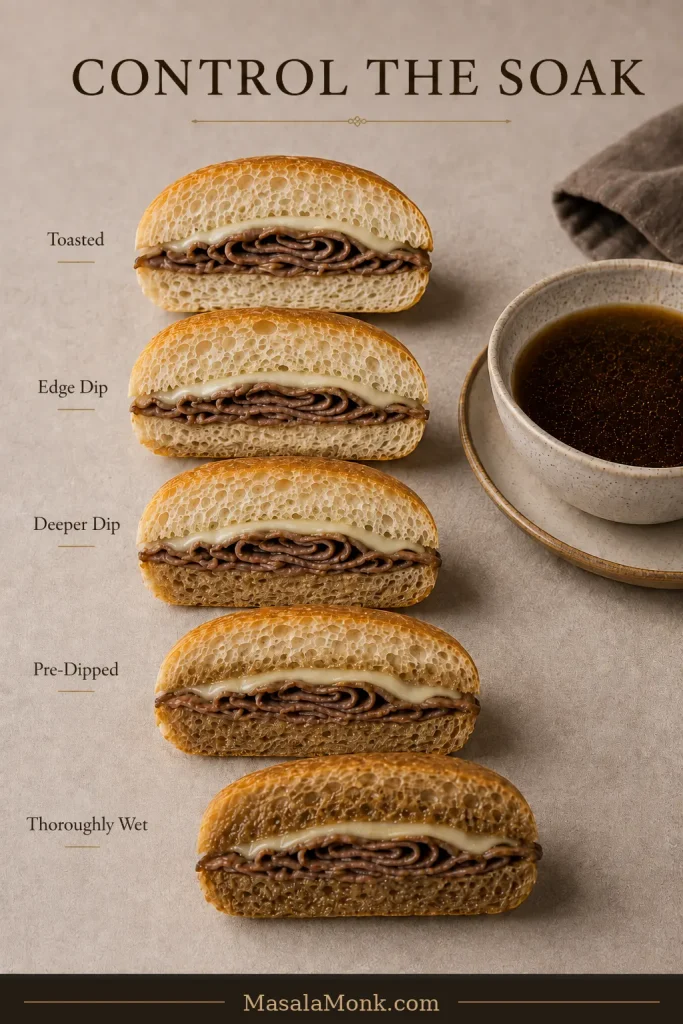
A French dip is one of the few sandwiches you keep finishing as you eat it. How much jus reaches the bread—and when—changes the whole experience. Keep some chew and dunk each bite as you go, or deliberately soften the roll for a wetter, old-school version. Both can be excellent. The important part is that you control the soak.
This easy version starts with sliced cooked roast beef, builds a quick jus while the rolls toast, and puts four substantial sandwiches on the table in about 30 minutes. No whole roast or long braise—just hot beef, good bread, melted cheese and a bowl of jus that changes the sandwich bite by bite.
Use thinly sliced cooked roast beef, a 6-inch / 15-cm roll that can absorb jus without falling apart, and mild provolone. Plan on 4–6 oz (115–170 g) beef per person; 5 oz / 140 g makes a generous sandwich. For four sandwiches, make about 2½ cups / 600 ml jus—enough for individual dipping bowls plus some for warming the beef.
Make It Now: Easy French Dip Sandwiches With Au Jus
Recipe at a Glance
Yield: 4 substantial sandwiches
Prep time: 10 minutes
Cook time: about 20 minutes
Total time: about 30 minutes
Equipment
Medium saucepan
Rimmed baking sheet
Tongs
Sharp knife, if slicing leftover roast beef
4 small bowls or ramekins for the jus
Fine-mesh strainer, optional
Ingredients
For the Au Jus
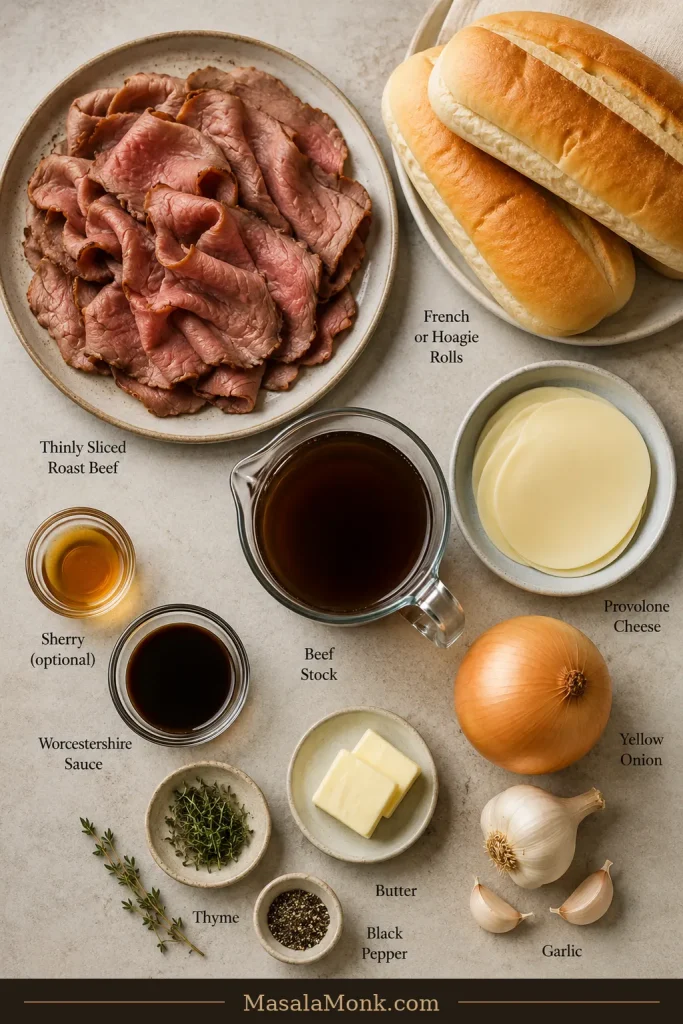
1 tablespoon (14 g) unsalted butter
1 large yellow onion, about 7 oz (200 g), halved and thinly sliced
2 garlic cloves, about 6 g, finely chopped
3 cups (710 ml) low-sodium beef stock
2 teaspoons (10 ml) Worcestershire sauce
½ teaspoon dried thyme, or 1 teaspoon fresh thyme leaves
½ teaspoon freshly ground black pepper
1 tablespoon (15 ml) dry sherry, optional
Kosher salt, only if needed after tasting
For the Sandwiches
1¼ lb (567 g) thinly sliced cooked roast beef
4 French, hoagie or Italian-style rolls, about 6 inches / 15 cm each
2 tablespoons (28 g) softened unsalted butter
8 thin slices mild provolone, about 4–6 oz / 115–170 g total depending on thickness
Low-sodium stock gives the jus room to reduce without turning salty; Worcestershire, roast beef and cheese bring additional seasoning once the sandwich comes together.
Instructions
1. Start the Au Jus
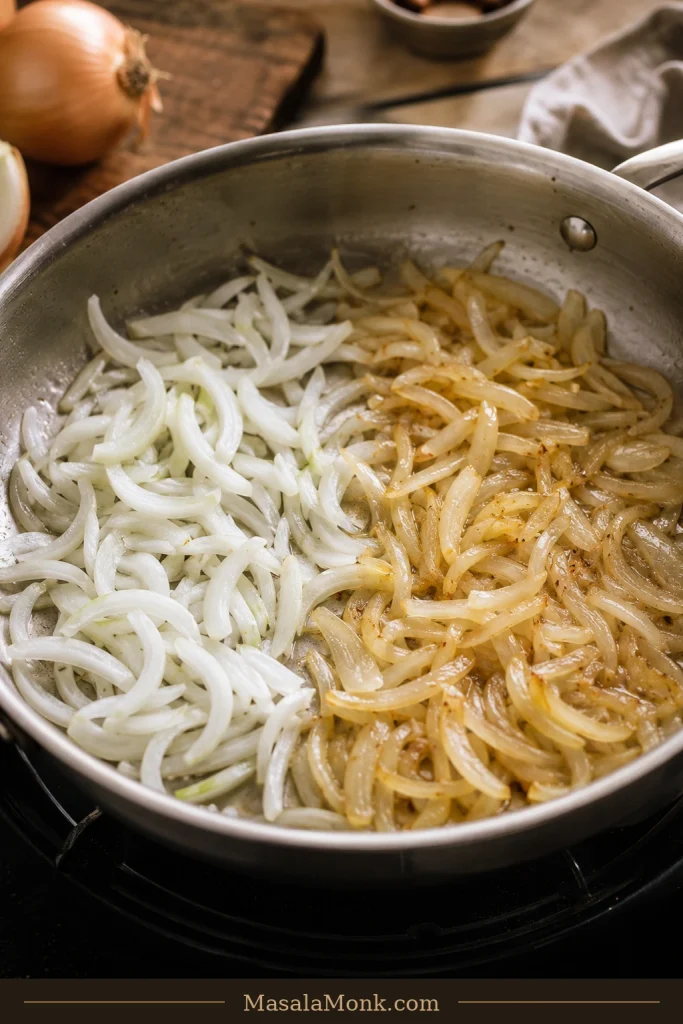
Melt 1 tablespoon butter in a medium saucepan over medium heat. Add the onion and cook for 8–12 minutes, stirring occasionally, until soft and lightly golden around some of the edges.
For this quick jus, lightly golden edges are enough. Once the onions bend easily and smell sweet, deeper caramelization adds more time than the sandwich needs.
Add the garlic and cook for 30 seconds. If using sherry, pour it in and let it bubble briefly while you scrape up the browned bits from the bottom of the pan.
Add the beef stock, Worcestershire sauce, thyme and black pepper. Bring to a gentle boil, lower the heat and simmer uncovered for 8–10 minutes, until the broth tastes fuller and more concentrated.
Quiet bubbling gives you more control. A hard boil reduces the jus faster, so salt and other concentrated flavors can overshoot before you notice.
While the jus simmers, toast the rolls in Step 2. Working on both at once keeps the meal comfortably around the 30-minute mark.
2. Toast the Rolls and Melt the Cheese
Heat the broiler (high, if adjustable) and position an oven rack about 5–7 inches / 13–18 cm from the element, if your oven allows. Split the rolls and butter the cut surfaces.
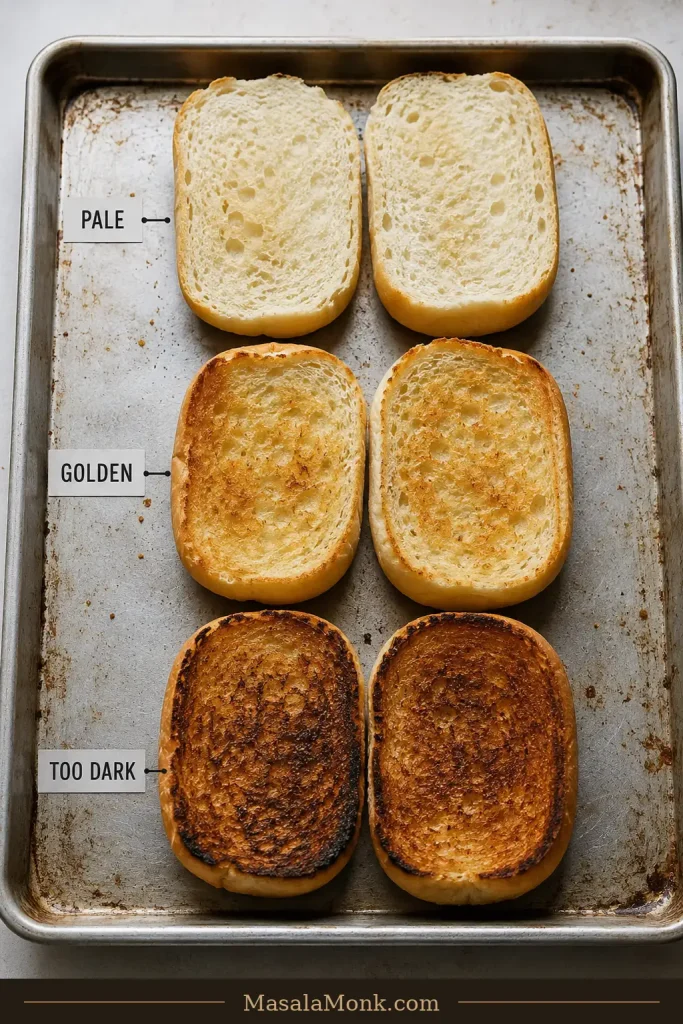
Arrange them cut-side up on a rimmed baking sheet and broil for 1–3 minutes, until golden and lightly crisp while the centers still give when pressed.
Aim for a golden cut face: enough toast to resist the first dip, but not so much that the roll becomes hard to bite.
Place 1 slice provolone on each cut half and return the rolls to the broiler for 30–60 seconds, just until the cheese turns glossy and melts against the bread. Stay close; a broiler can go from pale to scorched while you’re reaching for the tongs.
Melt the provolone before adding the beef so the delicate slices never need a second trip under the broiler.
No broiler? Toast the rolls in a preheated 425°F / 220°C oven for 5–7 minutes, adding the cheese for the final 1–2 minutes.
3. Finish the Jus and Warm the Beef
Return to the saucepan. You will usually have around 2½ cups / 600 ml jus, though pan width and simmer strength will affect the exact yield. Taste before adding salt.
Strain out the onions for a clearer dipping bowl and save them for the sandwiches. Leave them in and the jus becomes more rustic and onion-forward.
Turn the heat to low. Add the ready-to-eat deli roast beef in manageable batches and separate the slices gently with tongs. Warm until the meat loses its refrigerator chill and relaxes into soft folds, usually 1–2 minutes. Avoid a hard boil.
Lift the beef out and let excess jus drip back into the saucepan. For higher-risk diners, heat deli meat to 165°F / 74°C or steaming hot; see the food-safety note below.
Look for relaxed, glossy folds rather than curled edges. Once the beef is hot and supple, get it out of the jus.
4. Build the Sandwiches
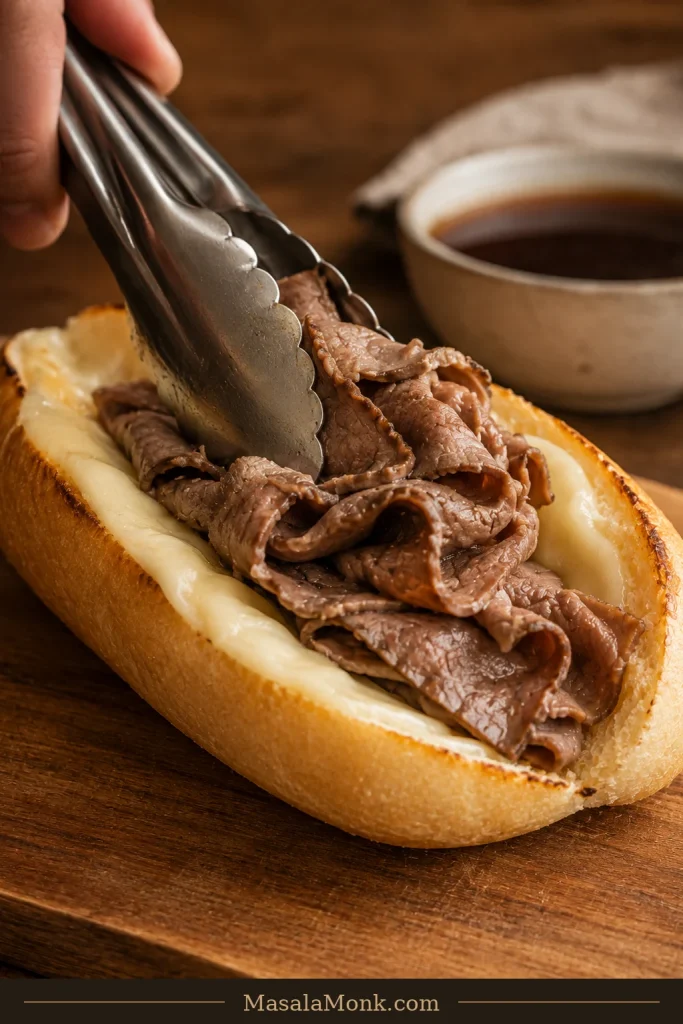
Divide the beef among the four rolls, using about 5 oz / 140 g per sandwich. Pile the slices in loose folds. The layers stay tender and catch pockets of jus between them.
Stagger the slices instead of stacking them flat. The beef spreads from end to end, and fewer long slices pull out with the first bite.
Add some of the reserved onions if using, close the rolls and serve while everything is still warm.
Keeping the jus beside the sandwich preserves the bread’s starting texture until you decide how wet each bite should be.
5. Serve With Hot Jus
Divide the remaining hot jus among four small bowls, aiming for about ½ cup / 120 ml per person. Serve immediately and dip each bite as deeply as you like—the first one is especially good while the bread still has some toast left in it.
The exposed crumb softens first because the crust absorbs more slowly. A shallow dunk adds tenderness without sacrificing the roll’s structure.
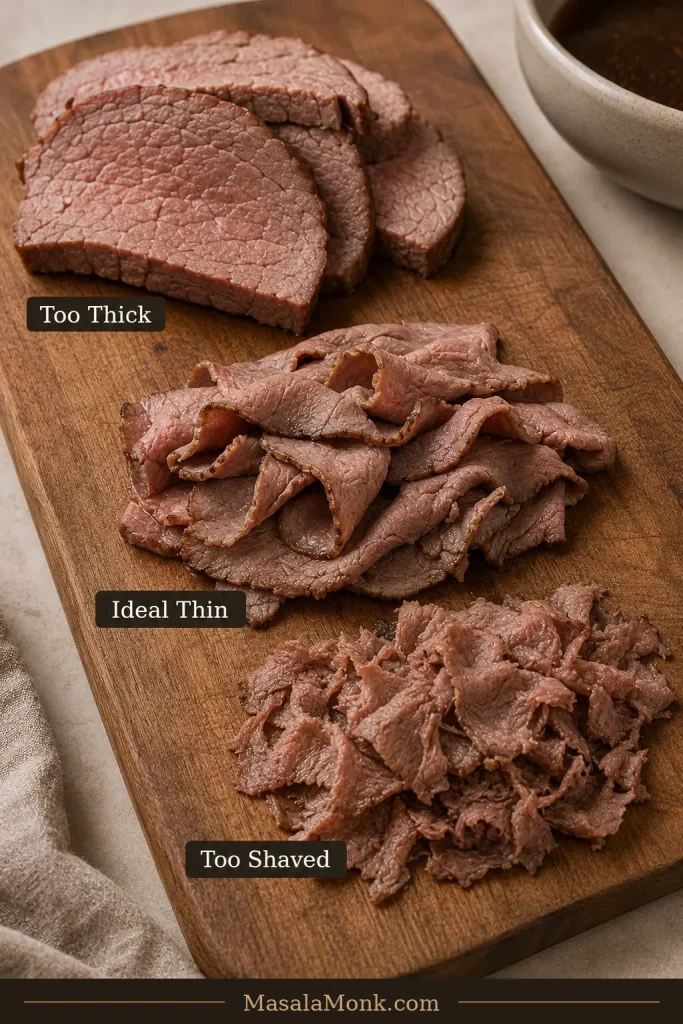
Standing at the deli counter? Ask for roast beef sliced thinly, but not shaved into wispy pieces. Thick slices eat more like little steaks; meat shaved too finely can break apart as it warms.
Thin, intact slices give the jus plenty of surface area while still behaving like slices when warmed, folded and bitten.
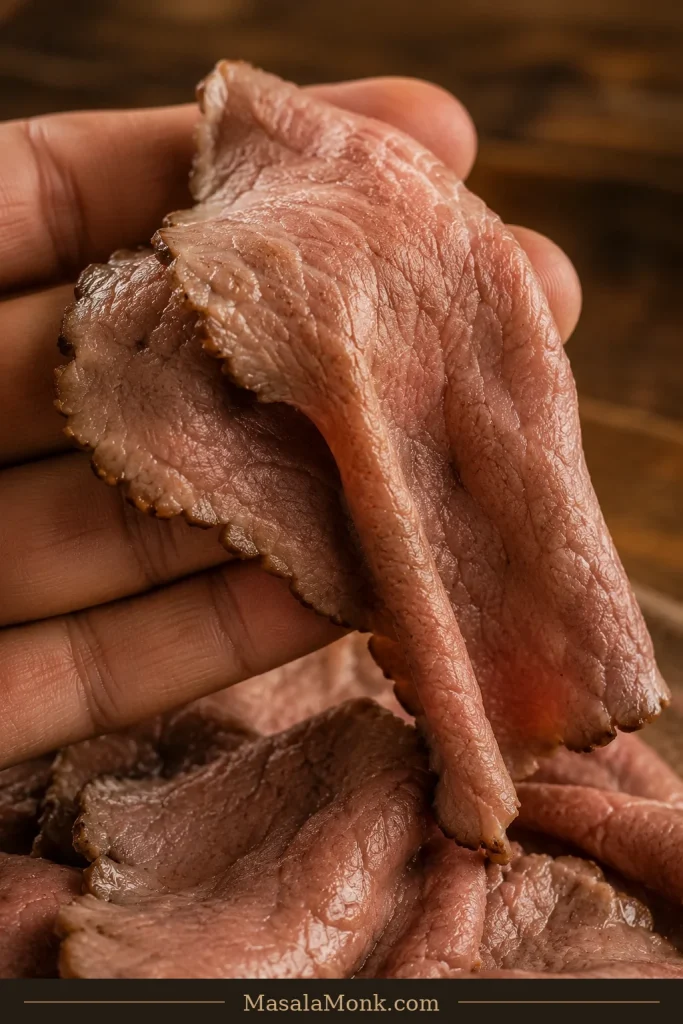
A good slice should fold without immediately tearing. It should droop over your fingers rather than stand stiff. Those flexible folds stay tender and hold jus between the layers when you bite.
The fold test predicts warming too: flexible slices separate easily in hot jus, while stiff pieces stay slab-like.
Plain or lightly seasoned roast beef gives the oniony jus and cheese room to show up. Heavy smoke and thick pepper crusts can take over quickly.
How Much Roast Beef per Sandwich?
Plan on 4–6 oz (115–170 g) cooked beef per person. Four ounces gives you more bread and jus in each bite. Five ounces is a generous everyday portion. At six ounces, the beef becomes unmistakably the main event.
For four people, buy 1–1½ lb / 454–680 g. The 1¼ lb / 567 g in the recipe lands neatly in the middle.
About 5 oz / 140 g fills a 6-inch roll generously without forcing it open; go lighter or heavier depending on whether bread or beef should lead.
Leftover roast beef works beautifully. Chill it before slicing if necessary; cold meat firms up and is easier to cut thinly across the grain.
Prime rib makes a richer sandwich, especially with some of its defatted drippings in the jus. Horseradish or spicy mustard keeps those richer bites lively.
Starting With Raw Beef?
Match the cut to the cooking method. Top round or rump suits a sliced-roast approach. Chuck and shoulder need a longer, moist cook. Ribeye gives you a tender steak-style French dip at a much higher price.
Got a shoulder roast instead? Our beef shoulder roast Crock Pot guide covers the slower route for chuck shoulder, arm roast and shoulder clod.
Best Bread and Rolls for French Dip
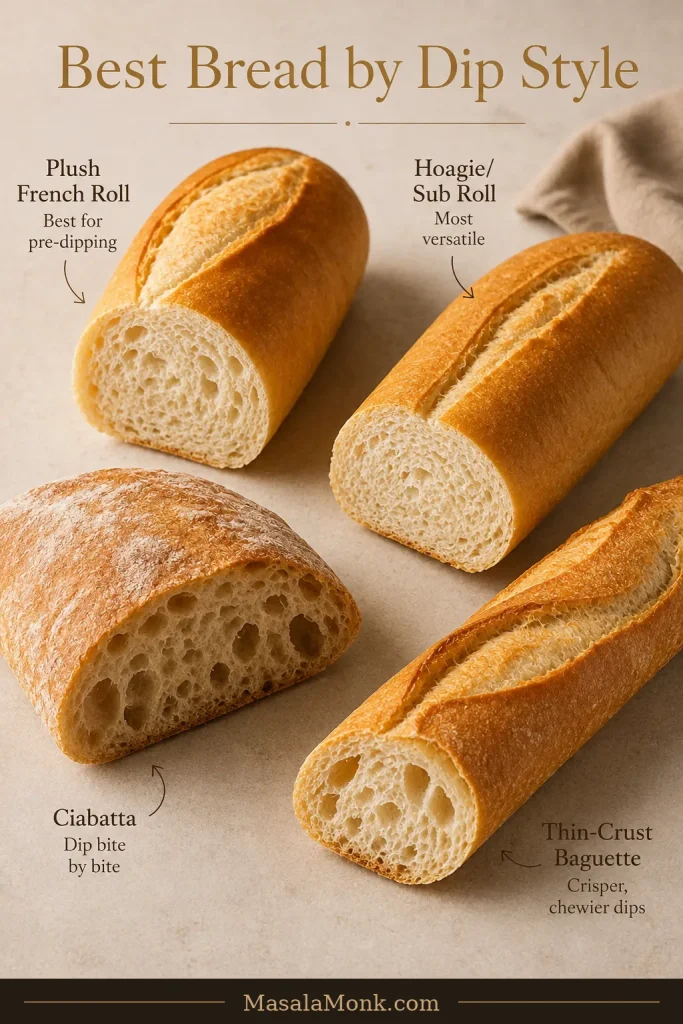
Once the beef is tender and thin, the roll decides what the jus feels like. It needs to absorb plenty without becoming unpleasant to hold or bite. At the store, give it a gentle squeeze. The crumb should spring back and the crust should yield easily when you bite through it.
Deeply dented rolls may soften too fast; barely yielding rolls can stay tough. The sweet spot is soft, springy and still structured.
Plush French roll: soaks up plenty of jus and stays tender; ideal for a softer or pre-dipped sandwich.
Hoagie or sub roll: soft enough to soak, sturdy enough to hold together; a good middle ground between softness and structure.
Ciabatta: airier inside with more crust and chew; good for dipping bite by bite.
Thin-crusted baguette: crisp and slightly chewier, with more resistance at the bite.
The strongest roll is not automatically the best. Choose first for absorbency, then for how much crust and chew you want after dipping.
Very hard artisan baguettes are a different matter. They may survive the jus beautifully while making the sandwich far more work than your jaw would like.
Aim for rolls around 6 inches / 15 cm long. If you want to make the bread too, these sourdough hoagie and sub rolls have the chew and structure for a generously filled sandwich.
Provolone, Swiss or Gruyère?
I would reach for provolone first: mild, smooth and easy to melt. Swiss tastes nuttier, while Gruyère brings more richness and is especially good with prime rib. Two thin slices per sandwich are plenty. Skipping cheese entirely lets the roast beef and jus stand on their own.
How to Make Better Au Jus for French Dip
The roll controls how quickly the jus gets in. The jus decides whether that soak is worth chasing.
Deli roast beef does not give you a roasting pan full of fresh meat juices, so this quick version starts with beef stock, onion, garlic, Worcestershire and herbs.
Lightly golden onions provide enough sweetness for a 30-minute sandwich. Cook them until soft and fragrant, add the stock, then simmer until the separate ingredients begin tasting like one savory broth. For fully caramelized onions, our French onion soup recipe takes the slower route.
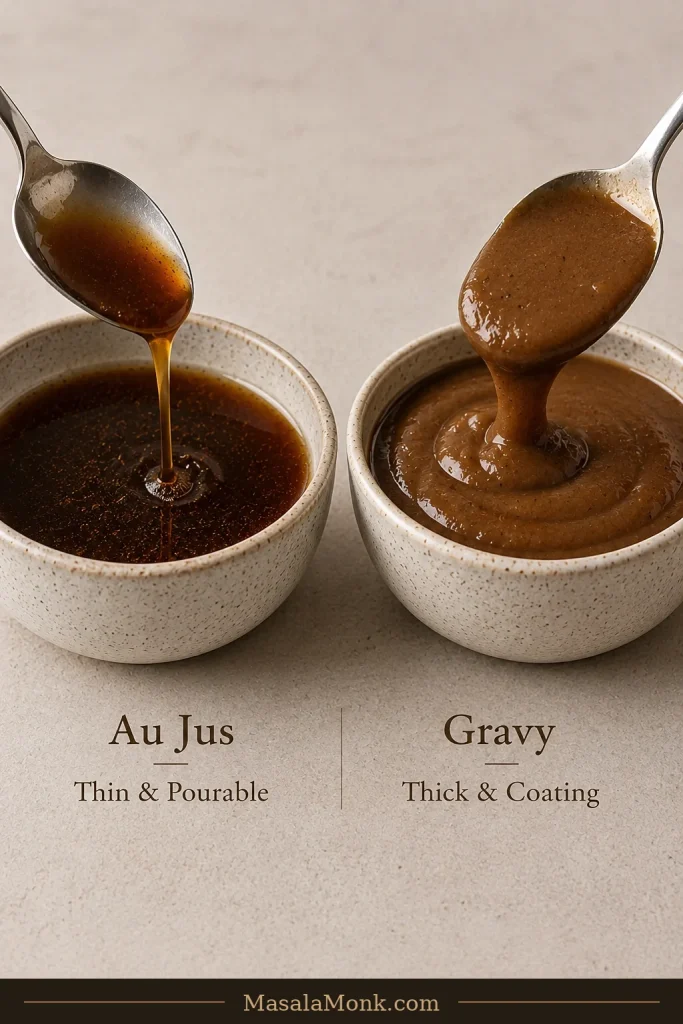
Keep the jus thin enough to soak into the bread. Flour, cornstarch and gravy mix produce a heavier coating. Low-sodium beef stock gives you the most control; broth works too. Consommé starts more concentrated, so taste before adding more salt.
Au jus should move into the bread; gravy tends to remain on it. That difference in flow is why thickening the dipping sauce changes more than its appearance—it changes how the sandwich eats.
Taste a spoonful. If you would happily take another sip, the jus is probably ready for the sandwich. If all you notice is salt, it still needs balancing.
Using Roast Beef or Prime Rib Drippings
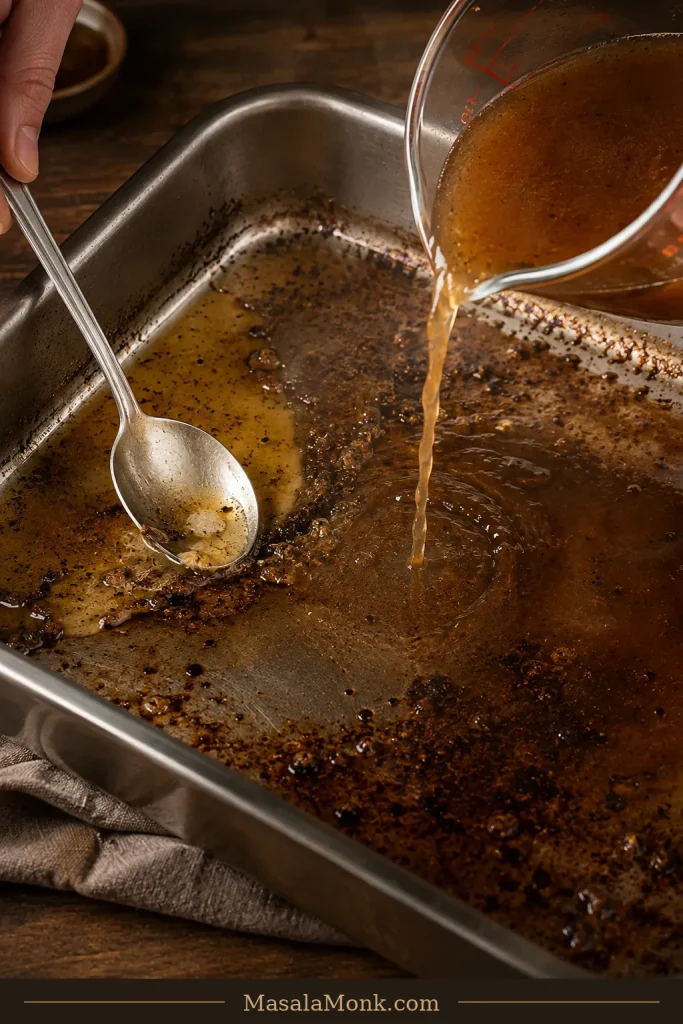
Have roast or prime-rib drippings? Separate excess rendered fat but keep the meat juices and browned bits. Add a splash of beef stock to the hot roasting pan, scrape up the fond, pour that liquid into a saucepan and add stock until you have the quantity of jus you need.
Fond and fat are not the same thing. Keep the browned bits in the pan, remove excess rendered fat, then deglaze so the jus tastes beefy rather than greasy.
Strain it for a clear bowl, or keep the softened aromatics for a more rustic dip.
How Wet Should a French Dip Be?
Once the jus tastes right, the last decision is how much of it should reach the bread.
A French dip is supposed to get wet. The real question is how wet, and when.
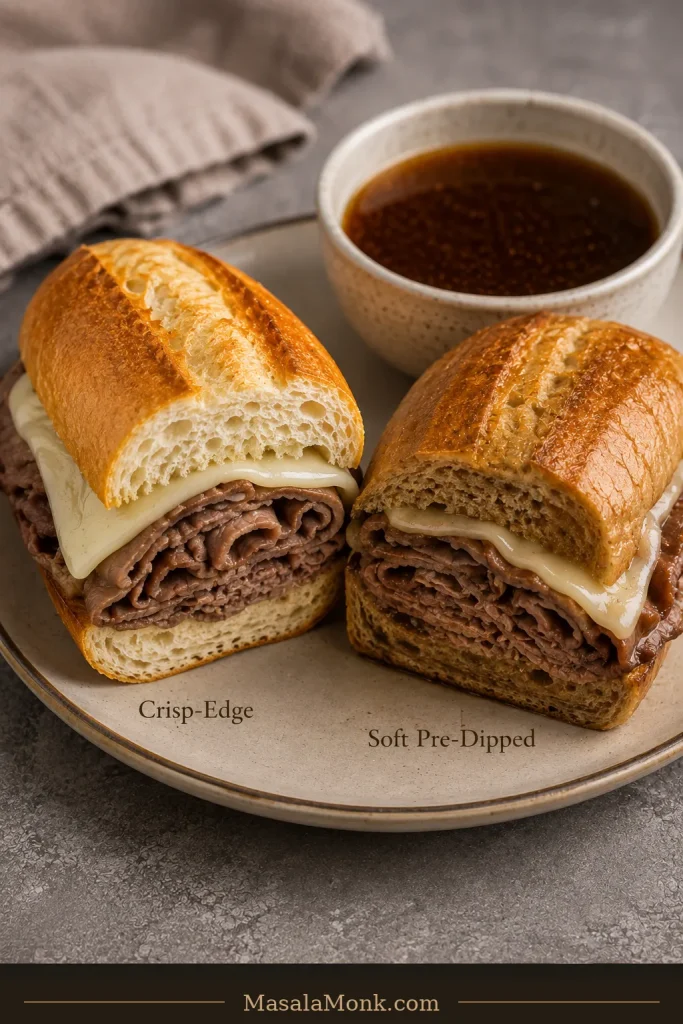
Crisp-Edge, Dip-at-the-Table Style
This is the default method in the recipe above. Toast the cut surfaces, melt the cheese against the bread, fill the roll with hot beef and bring the jus to the table. The first dunk softens the cut edge while the rest of the roll still has some chew.
For a first French dip, I would start here. Everyone gets to decide how far to take it.
Soft, Pre-Dipped Style
Soft is its own style of French dip. Historic Los Angeles versions deliberately moisten the bread before serving, from a light dip to sandwiches that are thoroughly wet.
For this version, change the assembly slightly: do not melt the cheese onto the bread before dipping. Lightly toast the plain buttered roll—or leave a plush roll untoasted if it already has enough structure—then briefly dip one cut half in hot jus for a lighter sandwich or both halves for a softer one.
Add the hot beef and provolone immediately. Thin cheese will soften against the warm meat; for a fully melted finish, place the cheese over the beef and put the open sandwich under a hot broiler for 30–60 seconds before closing it.
A pre-dipped sandwich keeps absorbing jus while it waits, whereas a crisp-edge version is more forgiving if dinner is delayed. Match the dipping style to when you can actually serve it.
The dipped crumb becomes tender and deeply savory, almost custardy where the jus has soaked all the way through.
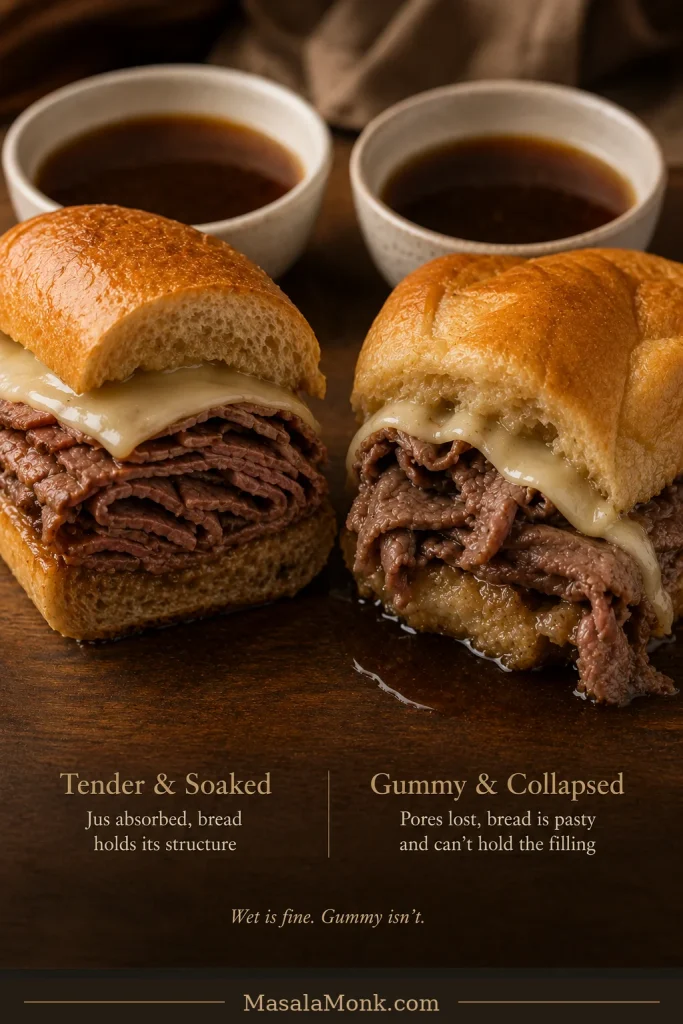
When Is a Pre-Dipped French Dip Too Soggy?
The bread has gone too far when it turns gummy, falls apart too early, or can no longer hold the filling. Let excess liquid drain from the beef, assemble close to serving, and adjust the dip to the roll in your hand.
If a pre-dipped roll sags before filling, shorten the dip or drain the beef more thoroughly. Once the crumb turns compressed and pasty, extra toasting will not restore it.
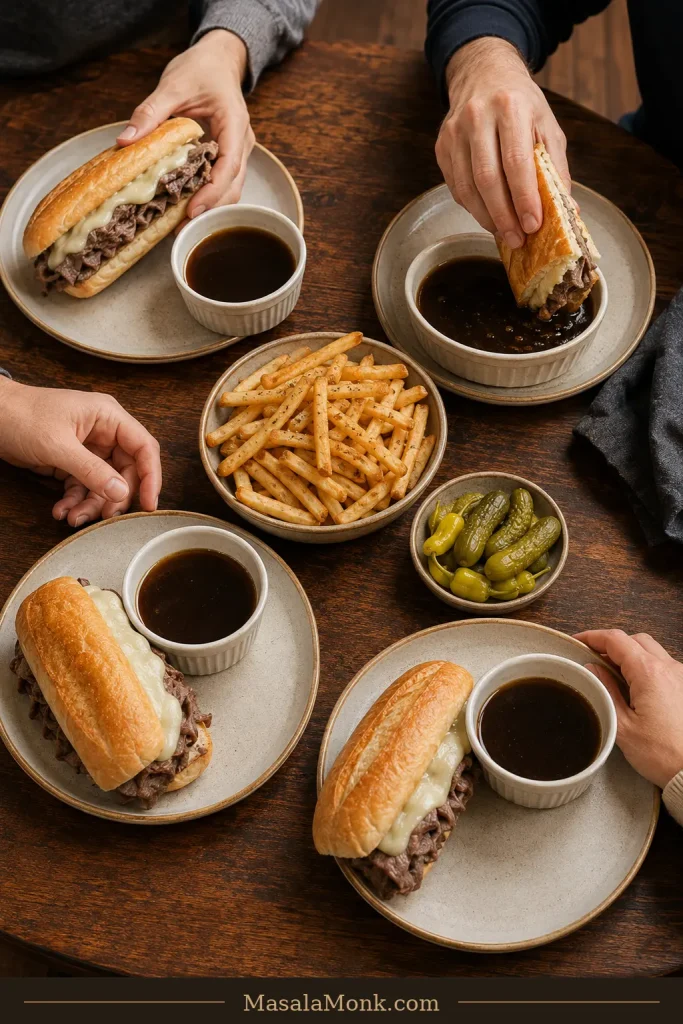
This is a good sandwich to finish at the table. Bring over the hot sandwiches and individual bowls of jus, then let everyone choose: careful edge dips, half the sandwich submerged, or progressively wetter bites as dinner goes on.
Dipping depth changes more than wetness. As the jus travels farther through the crumb, you steadily trade toasted resistance for tenderness, until bread and beef begin to feel almost like one continuous bite.
French Dip Troubleshooting
Salty jus, tight beef and failing bread account for most French dip trouble.
Problem
What Happened
Fix
Au jus tastes too salty
The stock and other salty ingredients became too concentrated
Dilute gradually with unsalted or very low-sodium stock; use small additions of water if needed. For the balance cues, return to the au jus guide.
Au jus tastes weak or flat
The stock is mild or has not concentrated enough
Simmer a little longer; if it is still flat, add a small splash of Worcestershire or some defatted roast drippings rather than simply adding salt.
Deli roast beef turned tight
It spent too long at a hard boil
Lower the heat and stop once the slices are hot and supple; revisit the gentle warming step.
Bread falls apart immediately
The roll is too fragile or took on more liquid than it could handle
Choose a more tender French or hoagie-style roll next time.
Easy French Dip Variations and Shortcuts
Leftover brisket: Sliceable brisket can stand in for roast beef if it still holds together rather than collapsing into shreds. Starting from raw? See our slow cooker brisket recipe.
Creamy horseradish: Stir 2 tablespoons mayonnaise with 1–2 teaspoons prepared horseradish, a squeeze of lemon and black pepper. Spread it thinly; the cool horseradish bite is especially good with richer beef.
Shortcut jus: Prepared au-jus mix works when dinner needs to move even faster. Dilute it according to the package directions and taste before adding anything else salty.
What to Serve With French Dip Sandwiches
Crispy homemade French fries with dill pickles or pepperoncini are the obvious classic. A few fries will probably find their way into the jus too, and there are worse things that can happen to a potato.
After several rich, dipped bites, cold creamy coleslaw or a sharp green salad tastes especially good. Roasted green beans or broccoli keep the plate lighter, while potato salad works well when you need a side that can be finished before the sandwiches.
Think in contrasts: pickles and pepperoncini add acidity, cold slaw refreshes, and crisp fries bring crunch back after a softer jus-soaked bite.
French Dip for a Crowd
For every four people, plan on 1–1½ lb / 454–680 g cooked roast beef, 4 rolls and about 2½ cups / 600 ml prepared jus. Keep the components separate and build the sandwiches in batches so the bread stays ready for the jus at the table.
Put the hot jus into individual bowls. It turns serving into part of the meal and saves you from guessing whether everyone wants a cautious dip or a sandwich approaching full submersion.
Set out the jus only when the sandwiches are ready; keeping it hot until the last moment gives every diner a better first dip.
Make Ahead, Store and Reheat French Dip
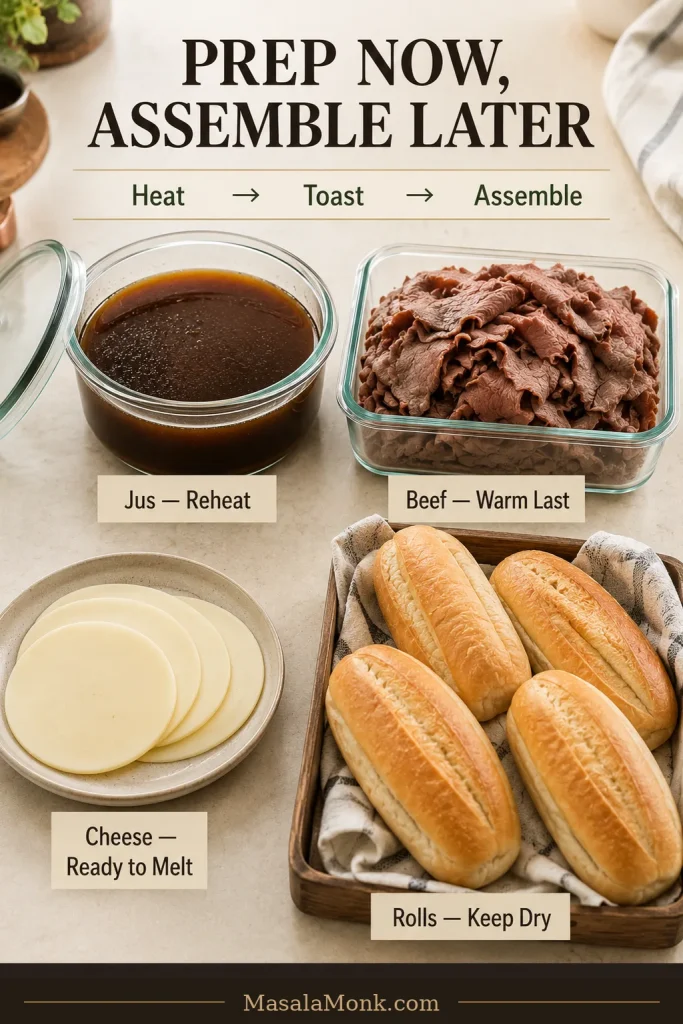
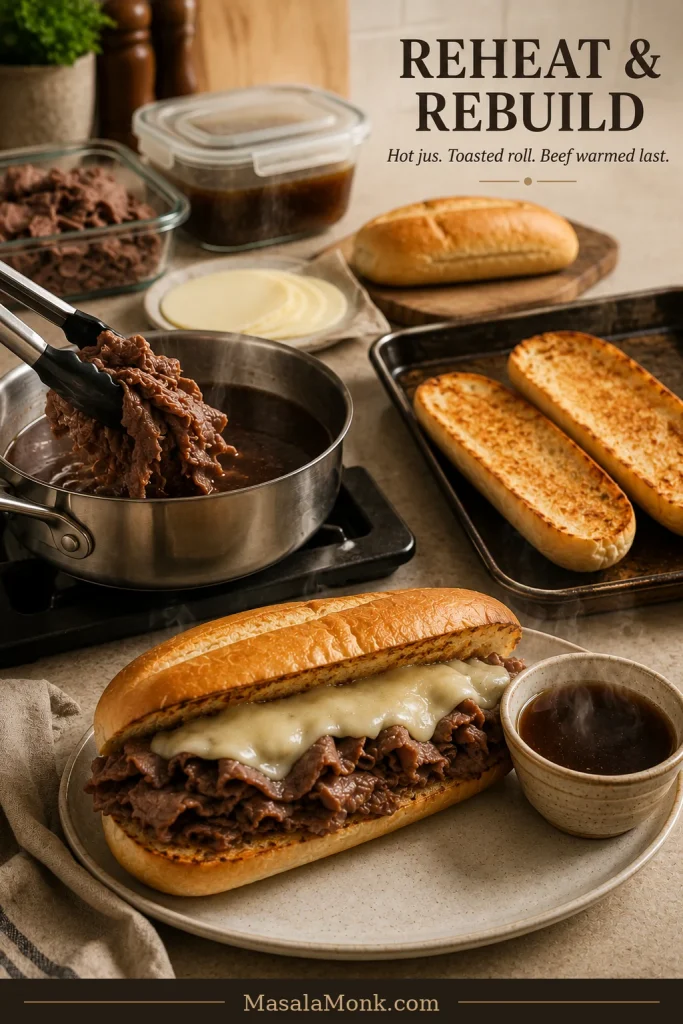
French dip is easy to prep ahead as long as you stop before assembly. Make the jus, portion or slice the beef, and have the cheese ready in the refrigerator. Leave the rolls whole and dry. At serving time, reheat the jus, toast the bread, melt the cheese and warm the meat last.
For the fastest finish, portion the beef and cheese before chilling so serving-time work is limited to reheating, toasting and assembly.
For leftovers, keep the beef, jus and cheese refrigerated separately and store the bread away from moisture. Cool the jus promptly in a covered container; if chilled roast drippings leave a firm cap of fat on top, remove the excess before reheating.
Refrigerate perishable food within 2 hours of serving—or within 1 hour when the surrounding temperature is above 90°F / 32°C. Most cooked leftovers should be used within 3–4 days. See the current USDA leftovers and food-safety guidance for the full recommendations.
Serving someone at higher risk from Listeria? People who are pregnant, aged 65 or older, or have weakened immune systems have a higher risk of serious illness. Current USDA guidance recommends heating deli meat to 165°F / 74°C or until steaming hot.
How to Reheat French Dip
Reheat the jus first. Previously cooked refrigerated beef should reach 165°F / 74°C; once safely hot, thin slices do not need to linger over high heat.
Toast the roll separately, melt the cheese, then rebuild the sandwich. Done in that order, yesterday’s French dip feels like a sandwich again instead of a container of reheated leftovers.
Bread and beef need different kinds of heat. Dry heat restores the roll’s toast, while brief moist heat is gentler on thin roast beef. That is why rebuilding works better than reheating the assembled sandwich.
French Dip Sandwich FAQs
What is a French dip sandwich?
A French dip is a hot sliced-meat sandwich—most commonly roast beef—served with savory meat juices or jus for dipping. Depending on the style, the bread may be dipped before serving, dunked bite by bite at the table, or both.
Is a French dip sandwich actually French?
No. Despite the name, French dip is an American sandwich strongly associated with Los Angeles. Its exact origin is disputed, with more than one historic Los Angeles restaurant connected to the story.
What does “au jus” mean?
“Au jus” means “with juice” and refers to serving meat with its juices. When a French dip starts with a freshly cooked roast, those juices and pan drippings can form the heart of the dip. With deli roast beef, a seasoned beef-stock dipping liquid fills the same practical role.
The moment to aim for is that first dunk: the bread darkens where it touches the jus, then gives way into hot beef and melted cheese. Maybe the rest of the roll still has some chew; maybe the next bite deserves a longer soak. That is part of what makes French dip so satisfying—the bowl beside it lets you keep changing the sandwich until you find exactly the version you like.
If you make it, tell us where you landed: deli roast beef or leftovers, provolone or Swiss, clear jus or onions left in—and whether you stayed with careful edge dips or eventually sent half the sandwich straight into the bowl.
A really good breakfast sandwich does two things at once. First, it tastes like you treated yourself—melty cheese, a warm egg, something crisp, something creamy. Then, almost secretly, it makes your morning easier because you can build it with whatever bread you already have: an English muffin, a croissant, a bagel, even waffles.
That’s the heart of this breakfast sandwich recipe. Instead of giving you one rigid version, we’ll start with a simple master build you can repeat, and then we’ll branch into the most-loved styles people actually search for and crave: egg and cheese, English muffin breakfast sandwich, breakfast croissant, croissant sandwiches, bagel with egg and cheese, scrambled egg sandwich, fried egg sandwich, high protein breakfast sandwich, vegetarian breakfast sandwich, gluten free breakfast sandwich, plus make-ahead frozen breakfast sandwiches for meal prep.
Along the way, we’ll lean on sauces and spreads that make a sandwich feel “finished” without being fussy—like a quick homemade mayo, a punchy pepper sauce, a bright pesto, or a thick tzatziki-style yogurt sauce—so every bite stays balanced instead of flat.
Breakfast sandwich: the master formula that works every time
Before we get into variations, it helps to have a dependable “base.” Think of it as a choose-your-own-adventure breakfast sandwich where each layer has a job.
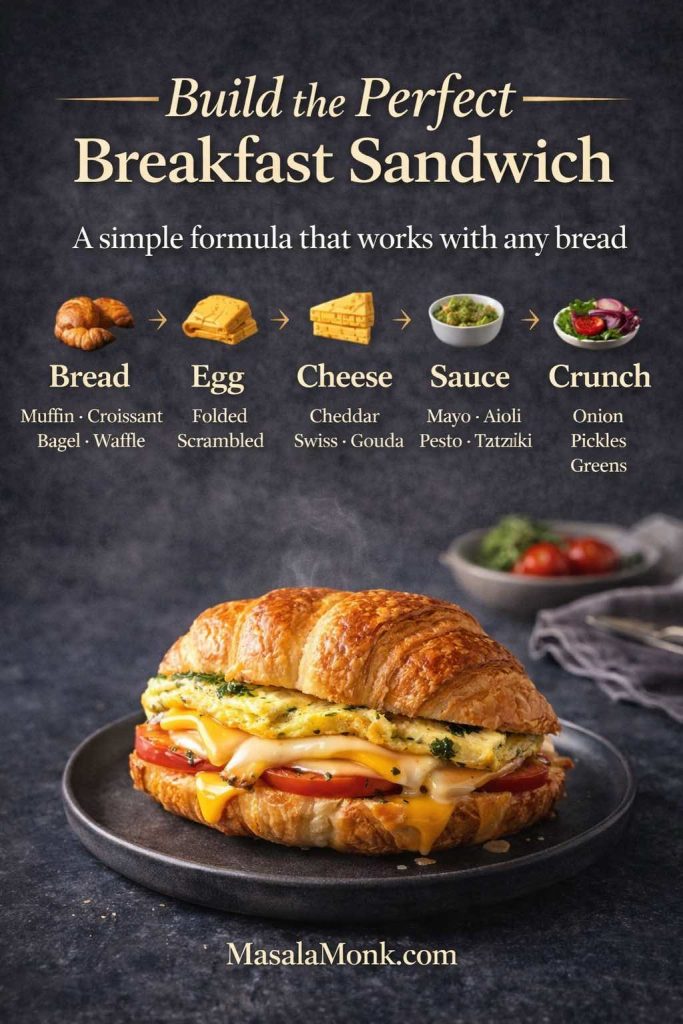
Use this breakfast sandwich formula to mix and match your favorites—choose a bread base, add eggs and cheese, finish with a sauce, then layer on crunch for the perfect bite every time.
The five layers
Bread (or bread substitute) English muffin, croissant, bagel, biscuit, sliced bread, waffles, or an egg-based “eggwich.”
Eggs for sandwiches (the engine) Fried egg, scrambled egg, folded omelet, baked egg patty, or boiled eggs turned into a spread.
Cheese (the glue) Cheddar, mozzarella, gouda, pepper jack, or whatever melts well.
Sauce or spread (the comfort layer) Mayo, eggless mayo, vegan mayo, pesto, tzatziki, or a quick chili-mayo.
Texture + freshness (the wake-up layer) Crisp veggies, pickles, herbs, peppery greens, onions, tomatoes, even a little crunchy spice mix.
Once you understand those roles, breakfast sandwich ideas become effortless: swap the bread, switch the egg style, keep the sauce, change the crunch—suddenly you have a new breakfast without starting over.
First, toast or warm your bread. You’re not just adding crunch—you’re building a barrier so the sandwich doesn’t go soggy.
Next, cook your eggs in the style you want (fried or scrambled sections are coming up). While they’re still hot, add cheese and let it melt.
Then, spread sauce on the bread while it’s warm. That small detail matters: warm bread helps spreads cling instead of sliding.
After that, stack egg + cheese, add your texture layer, close the sandwich, and press gently for a few seconds so everything holds together.
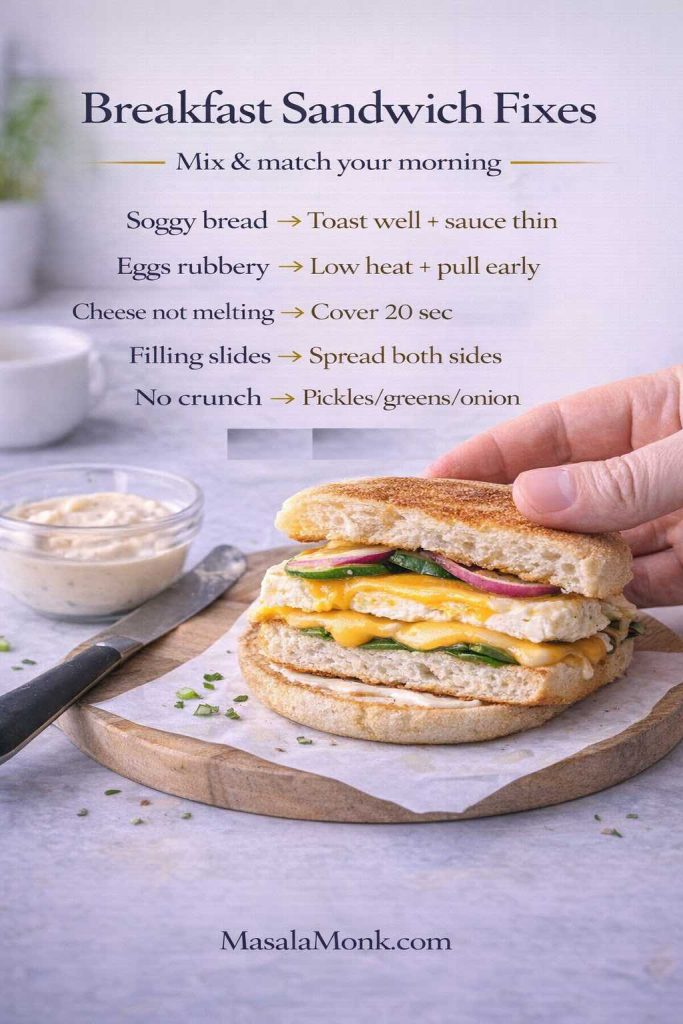
Save this breakfast sandwich fixes guide: toast bread well to prevent sogginess, cook eggs low and pull early for softness, cover briefly to melt cheese fast, spread sauce on both sides to stop slipping, and add pickles/greens/onion for crunch.
If you like checking food safety temps (especially when you’re batch-cooking), egg dishes are commonly cooked to 160°F / 71°C, and leftovers reheated to 165°F / 74°C—guidance you can see on the USDA safe temperature chart and on FoodSafety.gov’s chart.
Egg and cheese: the classic egg & cheese breakfast sandwich
Sometimes you don’t want a “creative” breakfast. You want the one that always works: egg and cheese, warm bread, a little seasoning, done.
Fried egg sandwich recipe (crispy edges, runny or set yolk)
Heat a pan, add butter or oil, crack in an egg, season it. Let the edges crisp; cover briefly if you want the top to set faster. Once it’s nearly where you want it, lay cheese on top and cover for 20–30 seconds so it melts smoothly.
For the best fried egg sandwich, aim for crispy edges and melted cheese—choose a runny yolk for richness or cover the pan briefly for a set yolk that travels better.
This version is ideal when you want a clean, structured bite—especially on an English muffin or bagel.
Scrambled egg sandwich (soft, fluffy, and forgiving)
Whisk 2 eggs with salt and pepper. Cook on low heat, stirring slowly. Pull the eggs off the heat while they’re still slightly glossy; the residual heat finishes them.
A scrambled egg sandwich is the best make-ahead egg sandwich—cook low and slow for soft, fluffy eggs that reheat well, then melt the cheese onto the eggs so every bite stays creamy instead of dry.
Scrambled egg sandwiches are particularly good when you’re packing breakfast for later, because the eggs stay tender instead of turning rubbery.
Choose Your Bread Base for the Perfect Breakfast Sandwich
Before you cook a single egg, pick the bread. It decides almost everything: how tidy the sandwich feels, how rich the bite is, and whether it holds up for meal prep or needs to be eaten right away. Once the base is locked in, the “best” egg and sauce choices become obvious—so you’re not building a great filling on the wrong foundation.
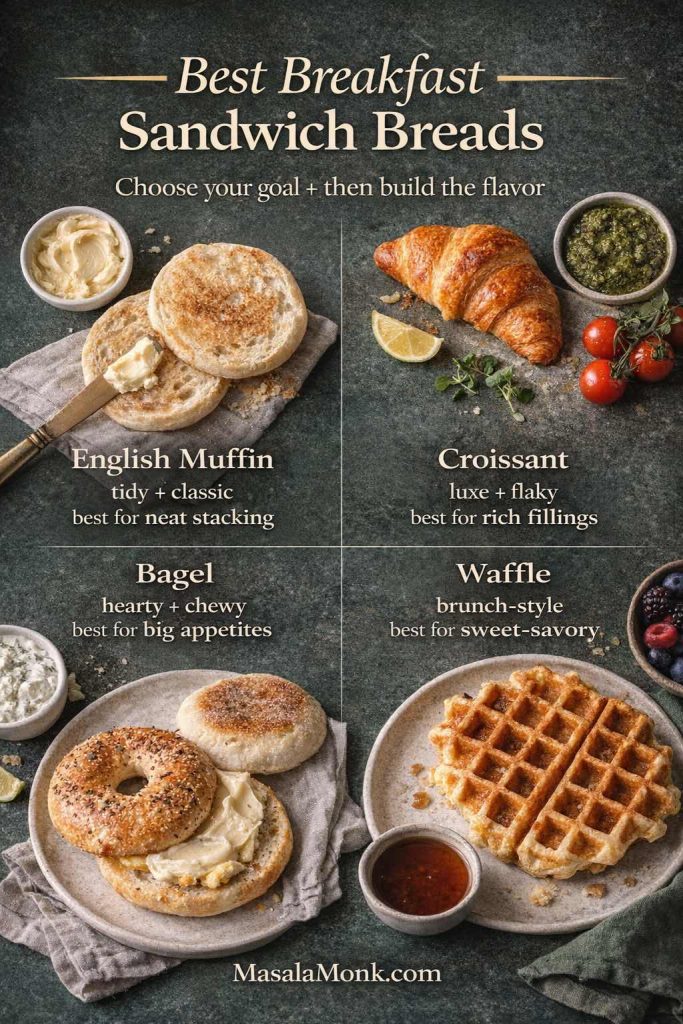
Pick your base first: English muffin for tidy stacking, croissant for a flaky breakfast croissant, bagel for a hearty breakfast bagel sandwich, or waffle for sweet-savory brunch sandwiches.
English muffin: the neat, classic breakfast sandwich
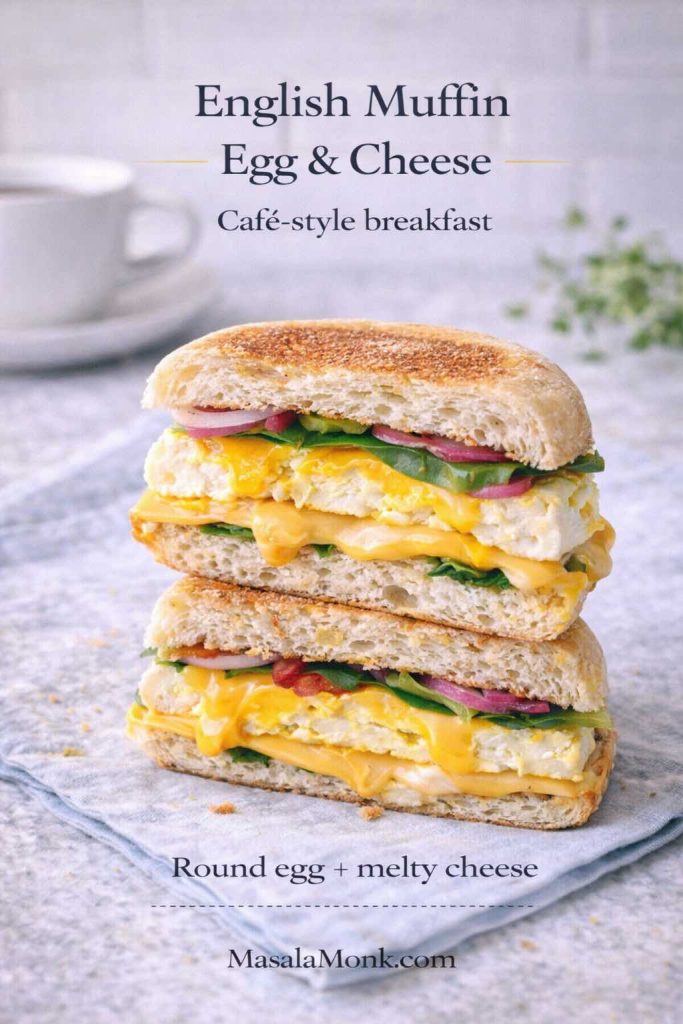
If you want a café-style breakfast sandwich that’s easy to hold and doesn’t slide around, the English muffin is the safest bet. It toasts beautifully, stays sturdy under egg and cheese, and naturally supports the “stacked” look most people want in an English muffin breakfast sandwich.
Croissant: the premium, flaky breakfast croissant
A croissant makes breakfast feel like a treat. It’s buttery and delicate, so it works best when your fillings are bold but not watery. Choose it when you want croissant sandwiches with a “bakery morning” vibe—just keep sauces and fresh veggies controlled so it doesn’t turn soft.
Bagel: the hearty breakfast bagel sandwich
Bagels are dense and satisfying, which is why a bagel with egg and cheese can feel like a full meal. They shine when you want contrast—soft egg, melty cheese, plus something bright and crunchy like onion, cucumber, or pickles. If you’re hungry-hungry, this is the base that delivers.
Waffles: sweet-savory waffle breakfast sandwich energy
Waffles turn the same ingredients into brunch. Because waffles carry a gentle sweetness, they pair especially well with salty cheese, peppery sauces, and savory fillings. Pick this base when you want a waffle breakfast sandwich that feels fun, dramatic, and very shareable.
Quick rule to decide in 5 seconds
For a tidy, classic bite, choose an English muffin. For luxury and flaky layers, reach for a croissant. When you want something big and seriously filling, go with a bagel. And if you’re craving brunch-style sweet-savory energy, waffles are the move.
English muffin breakfast sandwich (café-style, sturdy, and easy to hold)
The English muffin breakfast sandwich is popular for a reason: it’s compact, it toasts beautifully, and it doesn’t fall apart mid-commute.
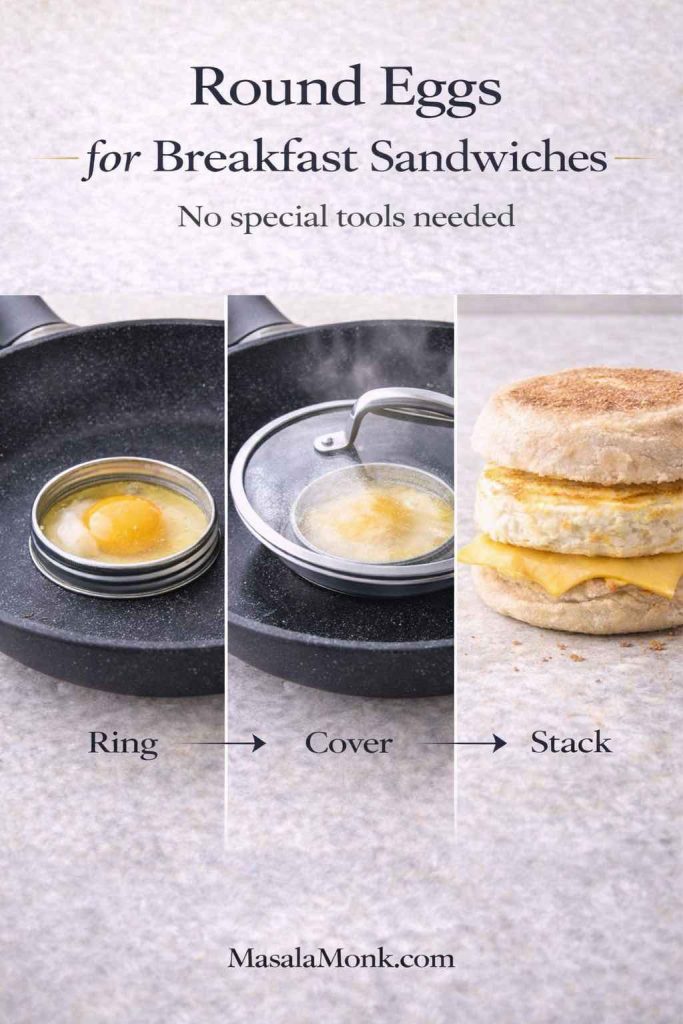
How to make round eggs for breakfast sandwiches (without special gear)
If you want that neat “egg patty” look, you don’t need a fancy ring. A wide mason jar lid ring, a cleaned metal cookie cutter, or even a DIY foil ring works.
Want café-style egg patties? This quick method shows how to make round eggs for breakfast sandwiches using a simple jar-lid ring—perfect for an English muffin breakfast sandwich that stacks neatly and stays easy to hold.
Warm the ring in the pan, grease it lightly, crack in the egg, and cover. As the egg sets, it becomes the perfect shape for English muffins.
Build: egg and cheese on English muffin
Toast muffin halves until crisp
Spread sauce on both sides
Add egg + cheese
Add one crisp layer (thin onion, tomato slice, spinach, or pickles)
Close, press gently, eat
This English muffin egg and cheese breakfast sandwich stacks neatly with a round egg patty and melty cheese—add a thin layer of spinach and onion for crunch and freshness without making the muffin soggy.
For a creamy base that can swing classic or spicy, a simple homemade mayo is hard to beat. If you want a versatile one with a lot of variations you can reuse for other sandwiches too, this guide is handy: homemade mayonnaise with 15+ easy variations.
If you’re feeding a mixed crowd—some people avoiding eggs in spreads or preferring egg-free condiments—you can also keep a jar of eggless mayonnaise or a fully dairy-free vegan mayo in rotation.
Breakfast croissant: when you want croissant sandwiches that feel like a treat
A breakfast croissant sandwich is the “I went out for breakfast” vibe—without leaving home. Because croissants are rich and flaky, the best versions keep fillings bold but not watery.
Croissant egg and cheese (the simple starter)
Warm the croissant (don’t over-toast—just warm and lightly crisp)
Add a soft scrambled egg layer
Add cheese while eggs are hot
Finish with pepper or chili flakes
Bacon egg and cheese croissant
Crisp bacon, melt cheese onto the egg, then add something fresh so it doesn’t feel heavy: a thin tomato slice, peppery greens, or even quick-pickled onions.
This bacon egg and cheese croissant delivers the classic breakfast croissant vibe at home—keep the croissant lightly warmed (not over-toasted), melt the cheese onto the eggs, then add crisp bacon and one fresh layer so it stays rich but balanced.
Sausage egg and cheese croissant
Sausage + egg + cheese is a classic breakfast sandwich trio for a reason. The croissant turns it into a weekend-level meal. If your sausage is strongly seasoned, keep the sauce simple—mayo or a yogurt-based spread—so it doesn’t clash.
Ham egg and cheese croissant
Ham loves mustard-mayo or herby mayo. Even a thin swipe makes the whole sandwich taste “designed,” not accidental.
If you want a sandwich spread that’s creamy yet tangy, Greek yogurt-style sauces are perfect on croissants too. This Greek tzatziki sauce recipe with variations gives you a thick, garlicky option that stays put instead of leaking out the sides.
Bagel with egg and cheese: the breakfast bagel sandwich that actually feels balanced
A bagel with egg and cheese is dense and satisfying, so it helps to build contrast—soft + crisp, rich + fresh, salty + bright.
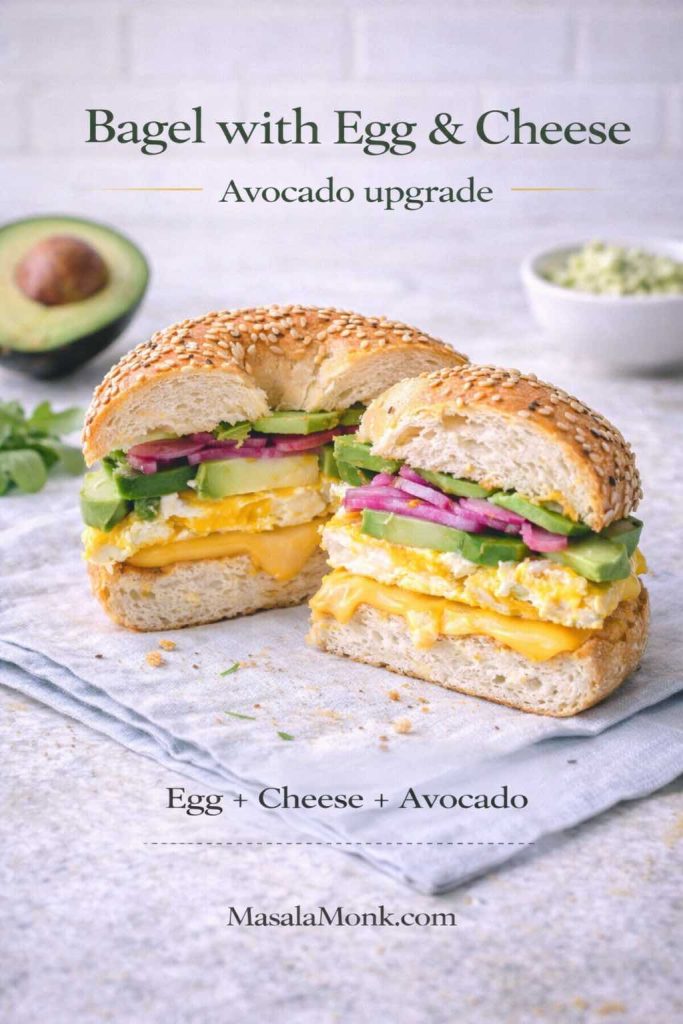
This bagel with egg and cheese gets an easy avocado upgrade—add creamy avocado plus a sharp, crunchy layer like pickled onions to balance the richness and make a more satisfying breakfast bagel sandwich.
Bagel with egg and cheese (the core build)
Toast the bagel cut sides well. Spread sauce on both halves. Add egg + cheese, then add one “fresh” element: tomato, cucumber, avocado, or herbs.
Avocado egg sandwich on a bagel
Avocado and egg are a natural pair. Add black pepper, a squeeze of lemon, and something crunchy (onion or cucumber). The result feels like a healthy breakfast sandwich, even though it’s still comforting.
For a flavor blueprint you can borrow directly, this one is built for mornings: avocado, basil, and grilled tomato sandwich. You can adapt the same idea onto a bagel and add egg + cheese to turn it into a bigger breakfast.
Egg sandwich spread for bagels (when you want it creamy)
Instead of a whole egg, use a spreadable egg layer (egg mayo / egg salad style). It’s easier to eat, especially if you’re walking out the door.
We’ll do that properly in the egg mayo sandwich recipe section below.
Breakfast muffin sandwich: egg, cheese, and a sturdy base
“Breakfast muffin sandwich” can mean an English muffin sandwich, or it can mean a muffin-shaped bread base you toast and fill. Either way, the goal is the same: structure.
Egg and cheese muffin-style sandwich
Toast the base, add a folded omelet or egg patty, add cheese, then add a little sauce. Because this style is compact, it’s great for meal prep breakfast sandwiches as well.
If you’re making eggs in bulk for this, an easy workflow is to cook and peel a batch of eggs quickly. An air fryer is surprisingly effective for that—here’s a reliable method: air fryer hard boiled eggs.
Waffle breakfast sandwich: sweet-savory brunch energy
A waffle breakfast sandwich is where brunch gets playful. The key is using waffles that are crisp enough to hold fillings.
If you want to make waffles that stay golden and crisp even without dairy, this is a solid base: waffle recipe without milk. For more adventurous directions (including Indian twists that still feel natural), this is fun inspiration: Belgian waffle recipe + Indian twists.
This waffle breakfast sandwich turns a simple egg and cheese into a sweet-savory brunch—keep the waffles crisp, add melty cheese, then finish with spicy mayo for a bold contrast that still feels breakfast-friendly.
Waffle sandwich build ideas
Egg + cheese + spicy mayo
Scrambled egg + herbs + pepper sauce
Egg + cheese + avocado for a more “healthy breakfast sandwich” feel
Because waffles lean slightly sweet, a bright sauce works especially well. If you like heat, a pepper sauce can turn waffles and eggs into something unforgettable. This is a deep rabbit hole if you want options: pepper sauce recipe guide.
Egg sandwiches recipes: choosing the egg style that matches your morning
It’s easy to treat eggs like “one ingredient,” yet the cooking method changes the entire sandwich. So, instead of guessing, pick based on the kind of morning you’re having.
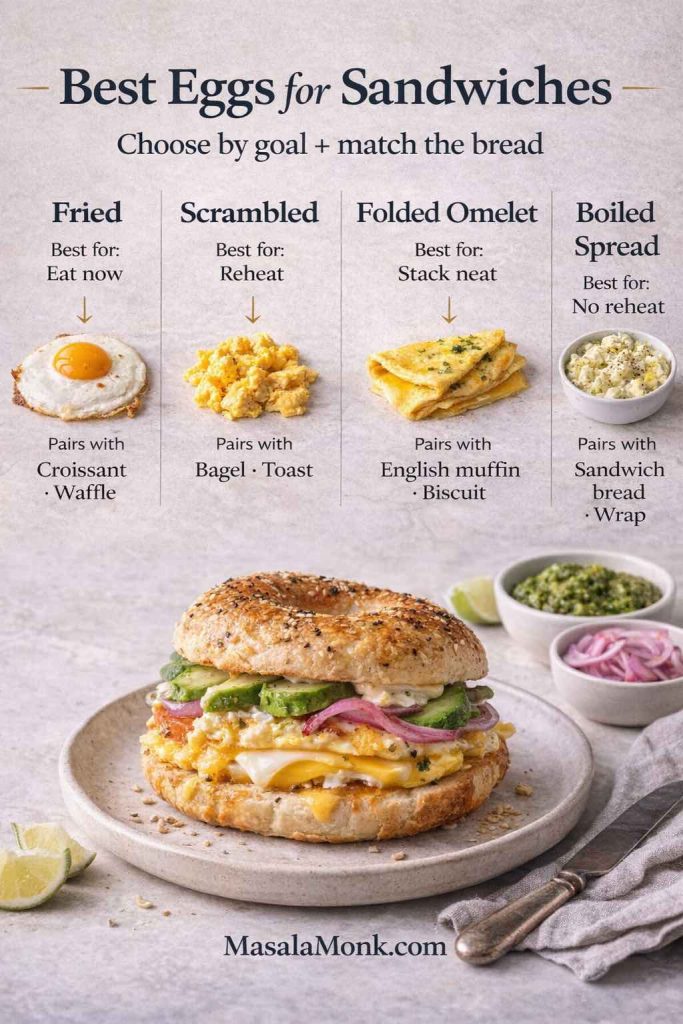
Not all egg sandwiches eat the same—use this guide to pick the best eggs for sandwiches (fried, scrambled, folded omelet, or boiled spread) and match them to the right bread for a better breakfast sandwich every time.
Fried egg sandwich (best for immediate eating)
Fried eggs are at their peak right out of the pan. That’s when the edges stay crisp and the yolk is still luscious. Consequently, this version shines for weekends or slow mornings.
Scrambled egg sandwich (best for reheating)
Scrambled eggs hold better than fried eggs in the fridge and reheat more evenly. Therefore, if you’re thinking meal prep, scrambled is your friend.
Folded omelet-style egg (best for neat layers)
Beat eggs, cook into a thin sheet, fold into a rectangle. This makes a tidy “egg patty” without tools. It’s also ideal for breakfast slider sandwiches because the pieces cut cleanly.
Boiled eggs for sandwiches (best for cold breakfast)
Boiled eggs can become a spread, which means you can eat your breakfast sandwich cold and still enjoy it. This is where egg mayo sandwich recipes, egg salad sandwiches, and even tuna egg sandwich variations come in.
If you want a broader set of ideas for using small egg counts creatively, this list can spark options: egg dishes with 2 eggs.
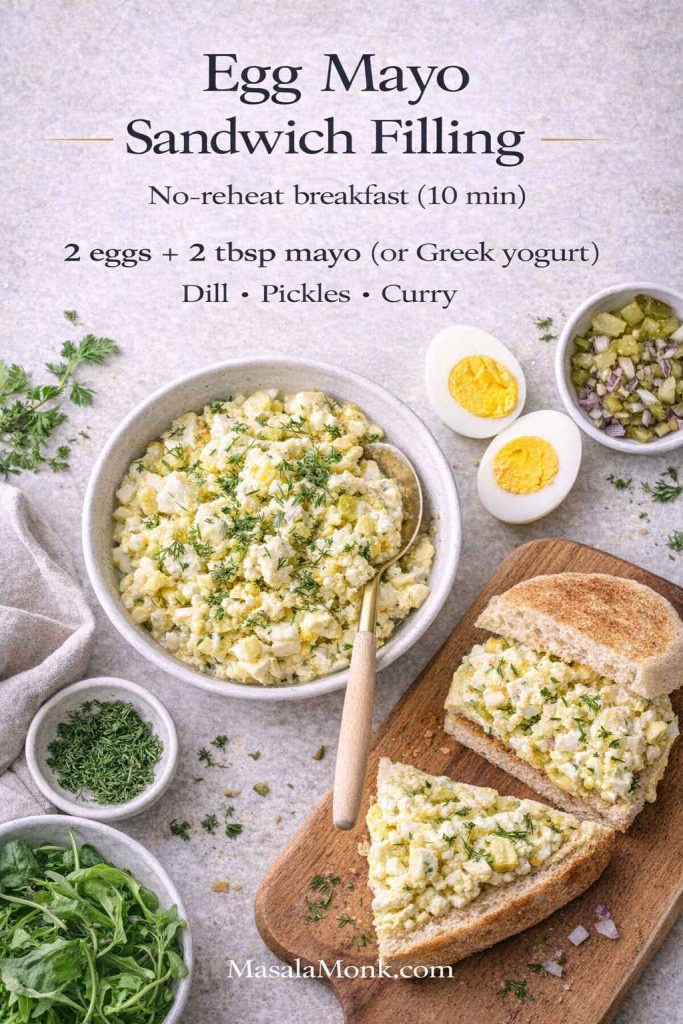
Egg mayo sandwich recipe: creamy, fast, and surprisingly breakfast-friendly
Egg mayo often gets treated as “lunch food,” yet it’s one of the best solutions for busy mornings. It’s fast, it’s filling, and it turns into a portable sandwich without needing to reheat anything.
Optional: chopped onion, dill, cucumber, chili flakes, a squeeze of lemon
This egg mayo sandwich filling doubles as a simple egg salad sandwich recipe—mix chopped boiled eggs with mayo (or Greek yogurt), then add dill and pickles for crunch and a fresher, lighter bite.
Method
Mash the eggs lightly, stir in mayo, season, then adjust texture. If you want it looser, add a tiny splash of milk or lemon. If you want it thicker, add more egg or a little grated cheese.
Turn egg mayo into egg salad sandwich recipe territory
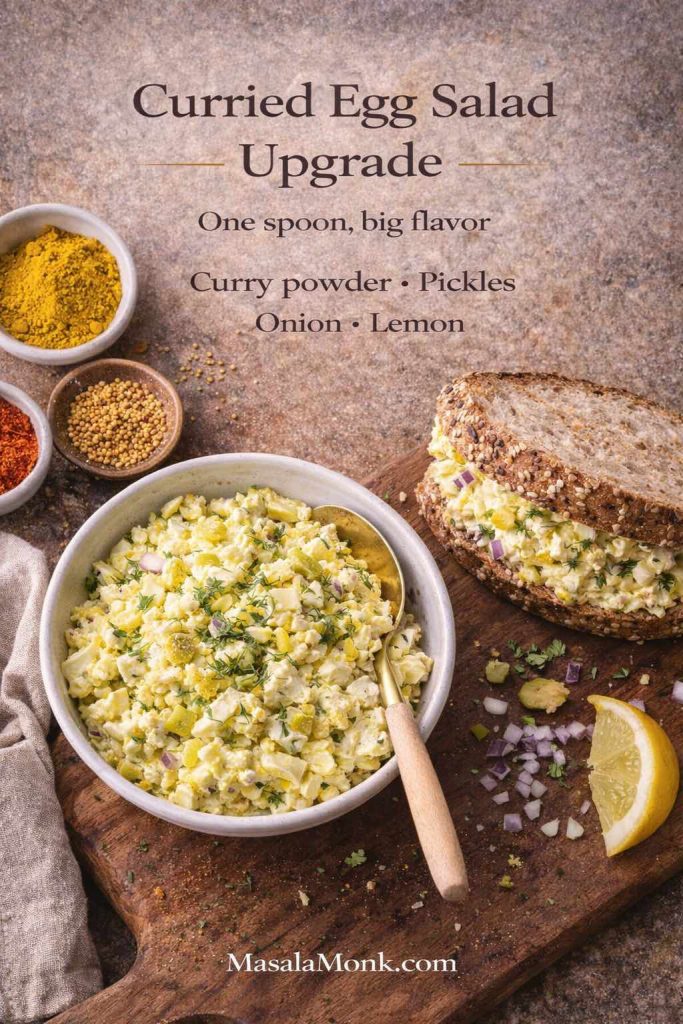
If you want the “egg salad” vibe, fold in crunch: finely chopped celery (if you like), onion, pickles, or cucumber. Add a pinch of curry powder for a curried egg sandwich direction, or add paprika for a classic style.
Turn a basic egg mayo sandwich into a curried egg sandwich by stirring in curry powder, chopped pickles, onion, and a squeeze of lemon—an easy upgrade that adds brightness, crunch, and bold flavor.
Egg salad with greek yogurt (lighter, tangier)
Instead of all mayo, use thick yogurt or hung curd for part of the spread. It stays creamy, tastes fresher, and feels closer to a healthy breakfast sandwich.
Breakfast sandwich ideas that borrow from “real sandwich culture”
A breakfast sandwich doesn’t have to be only egg + cheese + meat. It can borrow from classic sandwich styles and still feel totally breakfast-appropriate.
The Bombay-inspired breakfast sandwich
If you’ve ever loved a spicy, chutney-forward sandwich, you can bring that energy to breakfast: toast bread, add green chutney or herby mayo, add egg + cheese, then add thin-sliced onion and tomato.
The hummus-and-veg morning sandwich (egg optional)
Some mornings you want breakfast without eggs. A hummus-based sandwich gives you protein and staying power while keeping things fresh.
Here’s a straightforward build to borrow: hummus veggie sandwich. Add a fried egg if you want it heartier, or keep it egg-free for a vegetarian breakfast sandwich that still satisfies.
Healthy breakfast sandwich and high protein breakfast sandwich variations
“Healthy” can mean a lot of things. For some people it means higher protein; for others it means lighter sauces; for many it means fewer ultra-processed ingredients. Thankfully, breakfast sandwiches can adapt without losing their comfort-food soul.
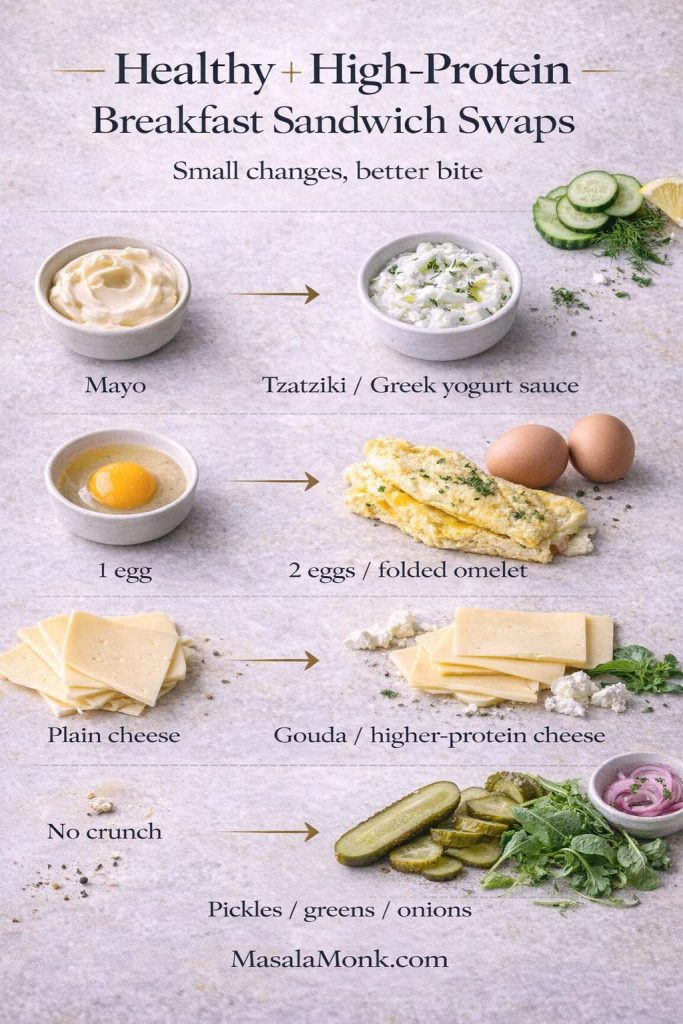
Build a healthy high-protein breakfast sandwich with simple swaps—use tzatziki or Greek yogurt sauce instead of mayo, double the eggs with a folded omelet layer, choose a more filling cheese, and add crunch with pickles, greens, or onions.
High protein breakfast sandwich (simple ways to level up)
Use 2 eggs instead of 1
Add an extra slice of cheese or use a higher-protein cheese
Vegetarian breakfast sandwich: options that don’t feel like “second place”
A vegetarian breakfast sandwich can be just as craveable as any meat-based version—provided you build for texture and seasoning.
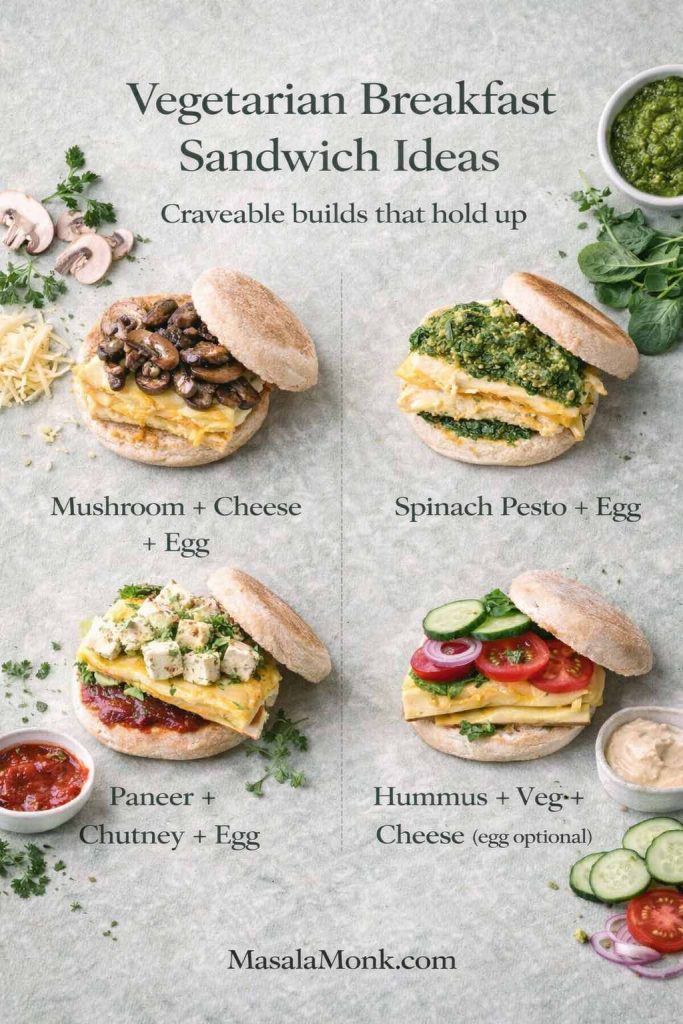
Save these vegetarian breakfast sandwich ideas for easy morning variety—mushroom and cheese with egg, spinach pesto with egg, paneer with chutney, or hummus with crunchy veggies (egg optional) for a satisfying vegetarian breakfast sandwich.
Vegetarian breakfast sandwich (easy templates)
Egg + cheese + mushrooms + pepper sauce
Egg + cheese + spinach + pesto
Hummus + veggies + cheese (egg optional)
Paneer + egg + chutney (if you like a bigger, spiced bite)
If you want a leftover-friendly option that turns dinner into breakfast, this is a smart template: paneer sabji sandwich recipe. Add a fried egg and it becomes a powerful breakfast sandwich meal prep option.
Gluten free breakfast sandwich: easy swaps that still feel satisfying
Going gluten free doesn’t mean giving up the breakfast sandwich experience. It simply means switching the base while keeping the same layers.
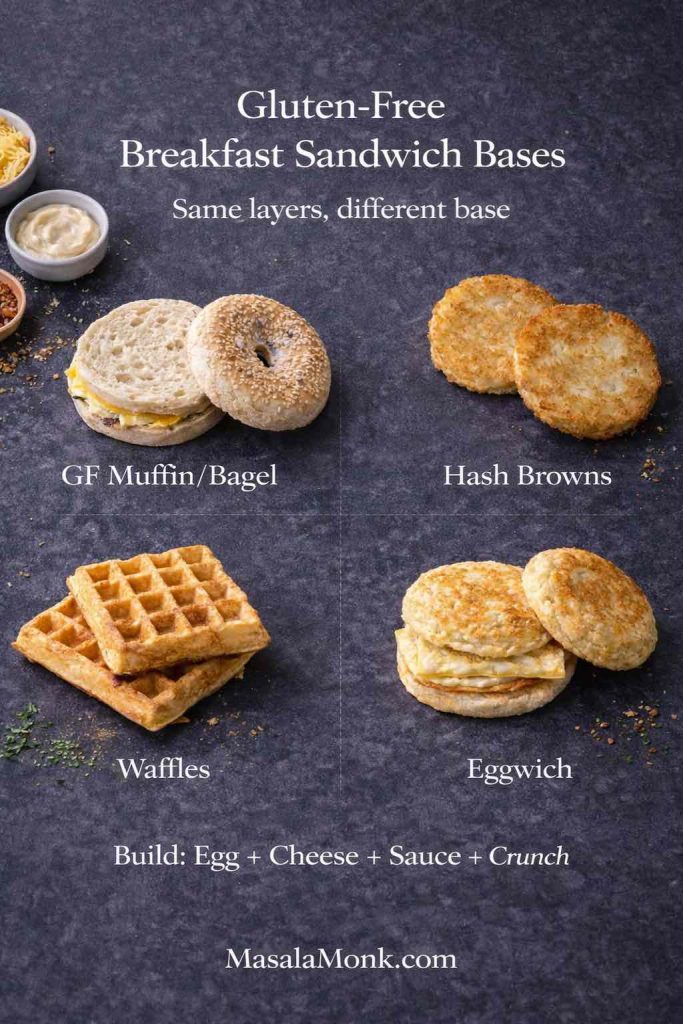
For a gluten free breakfast sandwich, swap the base—not the whole idea: use a gluten-free muffin or bagel, crispy hash brown “buns,” gluten-free waffles, or an eggwich, then build with egg, cheese, sauce, and crunch.
Gluten free breakfast sandwich bases
Gluten-free English muffins or bagels
Hash brown “buns” (crispy potato rounds)
Waffles made with a gluten-free mix
Egg “buns” (eggwich style)
Once you pick the base, the rest is identical: egg + cheese + sauce + crunch. In other words, you’re not learning a new recipe—you’re just changing the vehicle.
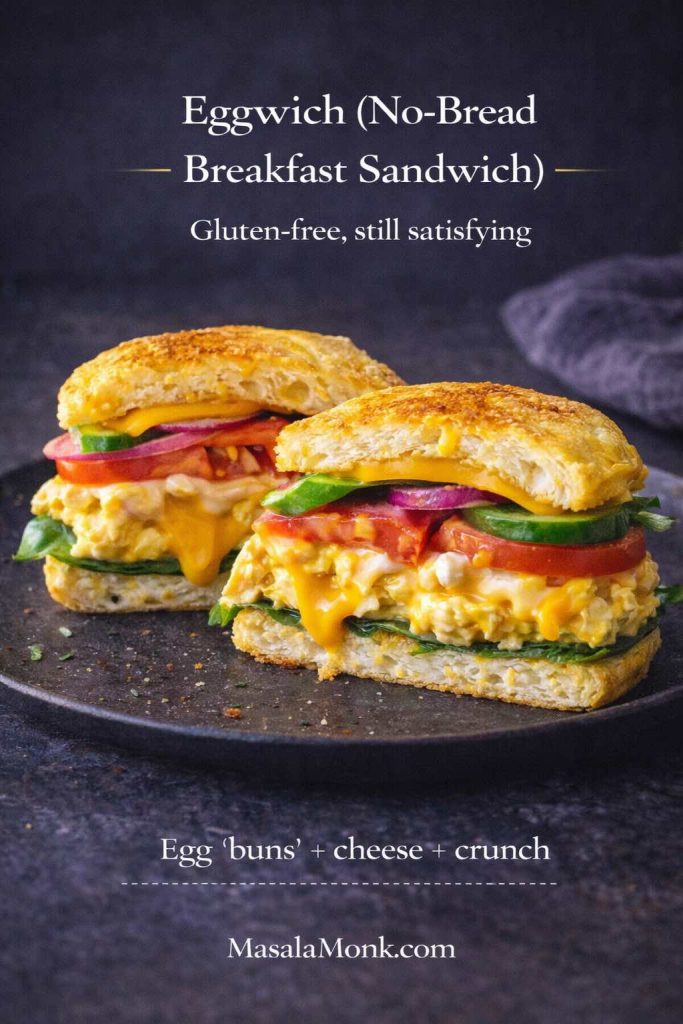
An eggwich is essentially an egg sandwich where eggs replace bread. If you want a lower-carb or gluten-free breakfast sandwich that still feels indulgent, this is a strong move.
An eggwich is the easiest no-bread breakfast sandwich—use two thin egg “buns,” add melty cheese and a crunchy veggie layer, then finish with a sauce so it eats like a real breakfast sandwich while staying gluten-free.
How to build it
Cook two thin omelet “rounds,” let them cool slightly so they firm up, then use them as top and bottom. Add cheese, add filling, add sauce, press gently, and eat with a napkin because it’s joyfully messy.
Breakfast sandwich homemade sauces that make everything taste intentional
A sandwich can have perfect eggs and still taste “unfinished” without a good spread. Sauce isn’t extra; it’s the layer that ties everything together.
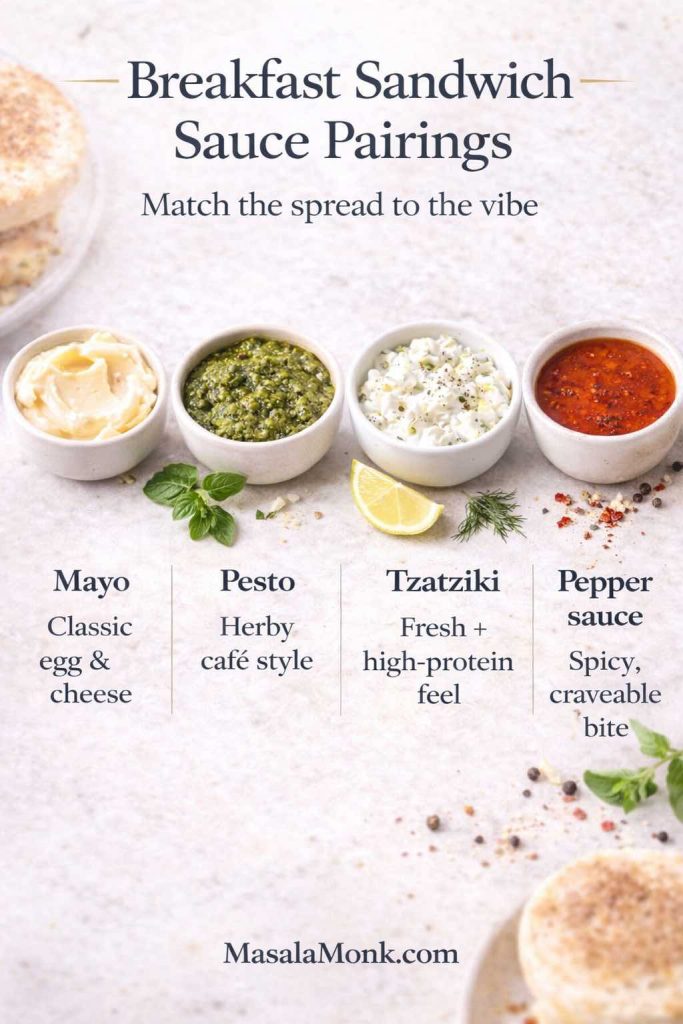
Use these breakfast sandwich sauce pairings to change the flavor fast—mayo for classic egg and cheese, pesto for a herby café-style sandwich, tzatziki for a fresh high-protein feel, and pepper sauce for a spicy, craveable bite.
If you’re cooking for pregnancy or generally avoiding raw-egg preparations, the FDA’s guidance for higher-risk groups is worth reading: Food Safety for Moms-to-Be.
Pepper sauce: the fastest way to make breakfast taste exciting
A little heat transforms egg and cheese into something you crave instead of something you tolerate. If you want options ranging from tangy vinegar hot sauces to creamy peppercorn-style sauces, this is a complete guide: pepper sauce recipe guide.
Tzatziki: cooling, thick, and perfect for breakfast sandwiches
Yogurt-based sauces are especially good when you’re building a healthy breakfast sandwich. They add creaminess without feeling heavy, and they pair beautifully with herbs and cucumbers: Greek tzatziki sauce recipe with variations.
Frozen breakfast sandwiches: make-ahead meal prep you’ll actually use
Frozen breakfast sandwiches have one job: save your morning when you have no time. The secret is building them in a way that reheats well. That means slightly drier eggs, sturdy bread, and sauces added after reheating.
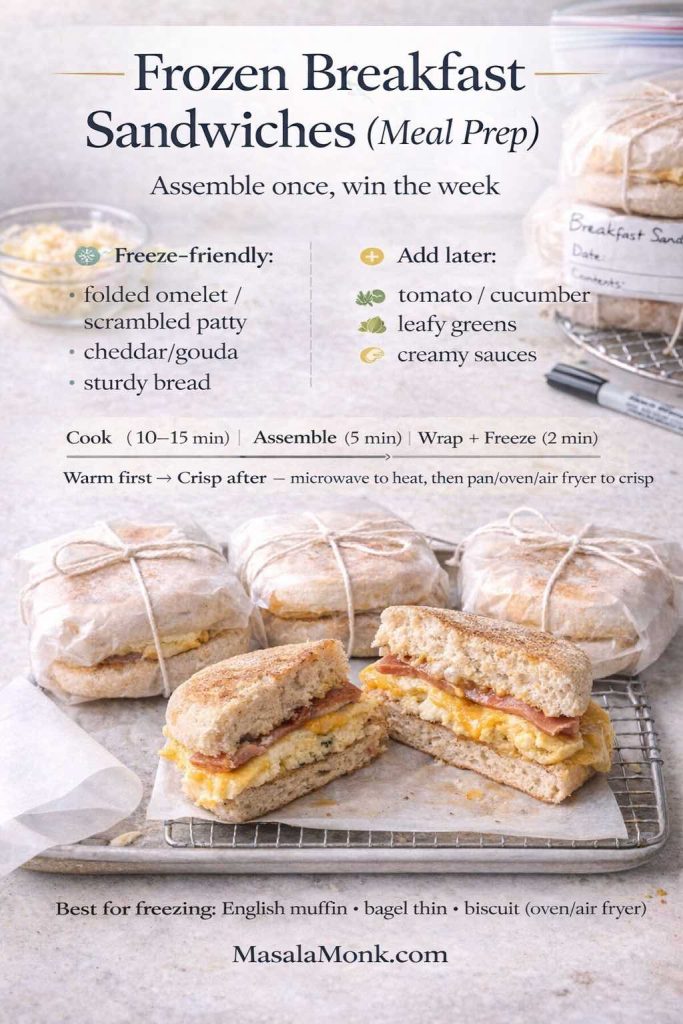
Make-ahead frozen breakfast sandwiches work best when you freeze sturdy bread with a folded omelet or scrambled patty and melty cheese, then add fresh veggies and creamy sauces after reheating for the best texture.
What freezes well
English muffin breakfast sandwich builds
Bagel breakfast sandwich builds (slice thin so it reheats faster)
Biscuit-style builds (best reheated in oven/air fryer)
Folded omelet egg layers (they hold shape beautifully)
What to add later
Fresh tomato, cucumber, lettuce, delicate herbs, and most creamy sauces are better after reheating. Otherwise, you risk soggy bread or watery textures.
How to assemble frozen breakfast sandwiches
Cook eggs (scrambled patties or folded omelets work best). Melt cheese onto the eggs. Assemble on toasted bread. Wrap tightly. Freeze.
How to reheat
Microwave for speed, then finish in a pan or toaster oven for texture
Oven/toaster oven for the best overall result
Air fryer for crisp edges (especially on biscuits and croissants)
Reheat frozen breakfast sandwiches the café way: warm the center first in the microwave, crisp the outside in a pan or oven/air fryer, then finish with fresh toppings like pickled onions or greens for the best texture.
If you ever want a quick reference on storage timelines beyond “it seems fine,” the FoodKeeper app is a practical tool developed with USDA FSIS partners to help with fridge/freezer guidance.
For egg-specific safety basics, USFDA’s guidelines are clear and straightforward, including: methods for cooking eggs safely.
Meal prep breakfast sandwiches: a one-hour batch that changes your week
If you’re doing sandwich meal prep, it helps to commit to a single batch session. The goal isn’t perfection—it’s making weekday mornings almost automatic.
A simple batch plan
Toast a stack of English muffins or bagels
Cook eggs as folded omelets (fast, neat, scalable)
Breakfast sandwiches for a crowd: the easiest way to feed everyone without chaos
Sometimes you’re not making one breakfast sandwich. You’re making breakfast sandwiches—plural—because family is hungry, guests are over, or you want leftovers that actually feel useful.
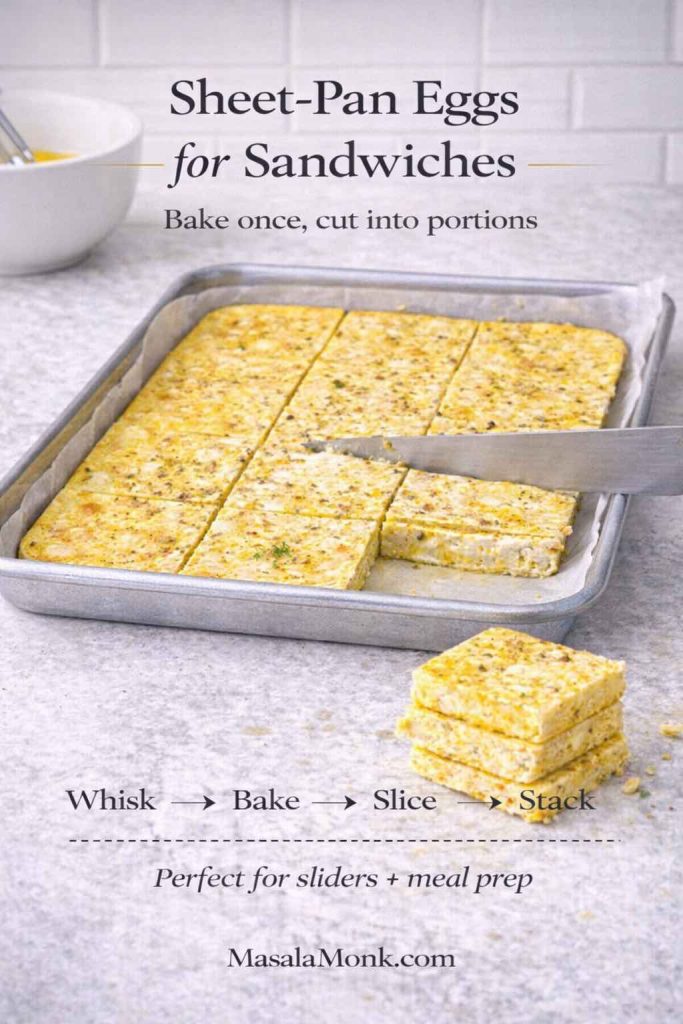
Feeding a group? Use sheet-pan eggs for sandwiches: bake one large egg slab, slice into squares, then stack into slider rolls with cheese and warm—fast, tidy, and perfect for breakfast slider sandwiches.
Breakfast slider sandwiches (the party-friendly move)
Use a sheet of rolls, slice horizontally, layer eggs and cheese across the whole surface, add fillings, close, and bake until warm.
Sheet-pan eggs for sandwiches are the fastest way to prep a crowd—bake one tray, slice into tidy squares, then stack into breakfast sliders or meal prep breakfast sandwiches without the mess of cooking eggs one-by-one.
Sheet pan eggs for sandwiches (the cleanest bulk method)
Whisk eggs, season, pour into a sheet pan, bake until set, then cut into squares. This gives you uniform pieces that stack easily into every sandwich format: croissants, bagels, English muffins, and even waffles.
The reason breakfast sandwiches stay popular isn’t just convenience. It’s the way they adapt. On a slow day, you can make a fried egg sandwich with crisp edges and melty cheese. On a packed morning, you can grab a frozen breakfast sandwich, reheat it, and still feel like you ate something real. When you’re trying to eat lighter, you can pivot to yogurt sauces and veggie layers. When you’re craving comfort, you can go full breakfast croissant mode and lean into it.
If you take only one thing from this: build your breakfast sandwich recipe around layers with purpose—bread for structure, eggs for richness, cheese for glue, sauce for harmony, and crunch for contrast. Once that clicks, the rest becomes a rotation you can enjoy all year.
1) What is the best breakfast sandwich recipe for beginners?
The best breakfast sandwich recipe for beginners is a simple egg and cheese sandwich on toasted bread. Start with one fried or scrambled egg, add a slice of cheese while the egg is still hot, and finish with a light spread so the sandwich stays moist without turning soggy.
2) How do I make egg sandwiches that don’t fall apart?
To keep egg sandwiches from falling apart, toast the bread well, use cheese as a “glue” layer, and avoid overfilling with watery ingredients. If you’re adding tomato or cucumber, blot them first and keep the slices thin so the sandwich holds its shape.
3) What’s the easiest way to make round eggs for an English muffin breakfast sandwich?
For an English muffin breakfast sandwich, crack an egg into a lightly greased ring (a mason jar ring or cookie cutter works) and cover the pan so the top sets quickly. In this way, the egg cooks into a neat patty that matches the muffin size.
4) Which egg style works best for a breakfast sandwich: fried egg or scrambled egg?
A fried egg sandwich is ideal when you’re eating right away and want crisp edges or a runny yolk. By contrast, a scrambled egg sandwich is better for reheating and meal prep because the texture stays softer after warming.
5) Can I use boiled eggs for sandwiches?
Yes—boiled eggs for sandwiches are great when you want a no-reheat option. Simply chop or mash the eggs and mix with a spread to make an egg sandwich filling that’s easy to pack and quick to assemble.
6) What is an eggwich, and how is it different from an egg sandwich?
An eggwich is a breakfast sandwich made without bread, where eggs act as the “bun.” In other words, it’s a gluten free breakfast sandwich option that still includes classic fillings like cheese, veggies, and a sauce layer.
7) How do I make a high protein breakfast sandwich without changing the flavor too much?
A high protein breakfast sandwich can be made by using two eggs instead of one, adding an extra slice of cheese, or including a protein-forward filling like paneer or a thick yogurt-based spread. As a result, you get more staying power while keeping the taste familiar.
8) What’s the best bread for a breakfast sandwich?
The best bread depends on the texture you want. English muffins create a tidy breakfast muffin sandwich feel, croissants make a rich breakfast croissant, bagels give a chewy bite for a breakfast bagel sandwich, and waffles create a crisp-sweet waffle breakfast sandwich.
9) How do I keep croissant sandwiches from getting soggy?
Because croissants are delicate, warm them lightly, avoid watery fillings, and keep spreads thin. Additionally, add fresh items like tomato only right before eating so the layers stay flaky instead of soft.
10) What’s the simplest bagel with egg and cheese build?
Toast the bagel cut sides, spread a small amount of sauce, add egg and cheese, then finish with one fresh layer like tomato, cucumber, or avocado. Consequently, you get a bagel breakfast sandwich that feels balanced rather than heavy.
11) How can I make a healthy breakfast sandwich that still tastes satisfying?
A healthy breakfast sandwich can stay satisfying by focusing on texture and seasoning rather than extra fat. For example, use toasted bread, a well-seasoned egg, plenty of crunchy veggies, and a tangy spread such as yogurt-style sauce or a lighter mayo blend.
12) What are easy vegetarian breakfast sandwich options?
Vegetarian breakfast sandwich options include egg and cheese with sautéed mushrooms, egg with spinach and herbs, hummus with veggies (with or without egg), or paneer with onions and spices. Likewise, adding a crisp layer keeps it lively.
13) How do I make a gluten free breakfast sandwich at home?
For a gluten free breakfast sandwich, use gluten-free bread, a gluten-free bagel, or swap bread entirely by making an eggwich. Alternatively, you can use waffles made with a gluten-free mix for a sturdier base.
14) What are the best breakfast sandwich ideas when I’m bored of egg and cheese?
If you’re bored of egg and cheese, switch just one layer: try pesto instead of mayo, add mushrooms instead of bacon, use a croissant instead of an English muffin, or add avocado for a creamy contrast. Similarly, a peppery sauce can change the flavor without changing the structure.
15) Can I make frozen breakfast sandwiches for busy mornings?
Yes—frozen breakfast sandwiches are one of the easiest meal prep wins. Assemble sandwiches with egg and cheese, skip watery vegetables, wrap tightly, and freeze. Then reheat and add fresh toppings afterward for better texture.
16) What’s the best method for meal prep breakfast sandwiches that reheat well?
For meal prep breakfast sandwiches, use scrambled eggs or a folded omelet layer because they reheat evenly. Furthermore, toast the bread first, keep sauce minimal before freezing, and wrap each sandwich tightly to reduce freezer burn.
17) How long do frozen breakfast sandwiches last in the freezer?
Frozen breakfast sandwiches typically keep their best quality for about 1–2 months, although they can remain safe longer if stored properly. Even so, using airtight wrapping helps prevent dry edges and off flavors.
18) How do I reheat frozen breakfast sandwiches without making the bread rubbery?
To avoid rubbery bread, thaw slightly, microwave briefly to warm the center, then finish in a pan, toaster oven, or air fryer to crisp the outside. In short, heat for speed first, then crisp for texture.
19) What’s the difference between breakfast sandwich ideas and breakfast sandwich recipes?
Breakfast sandwich ideas are quick combinations or swaps you can try, whereas breakfast sandwich recipes include clear steps, timings, and a method you can repeat. Consequently, recipes are better when you want consistent results.
20) How do I make breakfast sandwiches for a crowd?
To make breakfast sandwiches for a crowd, cook eggs in a larger batch (scrambled or sheet-pan style), lay out bread bases, and assemble an assembly line. Afterwards, keep sandwiches warm in a low oven so everyone can eat together.
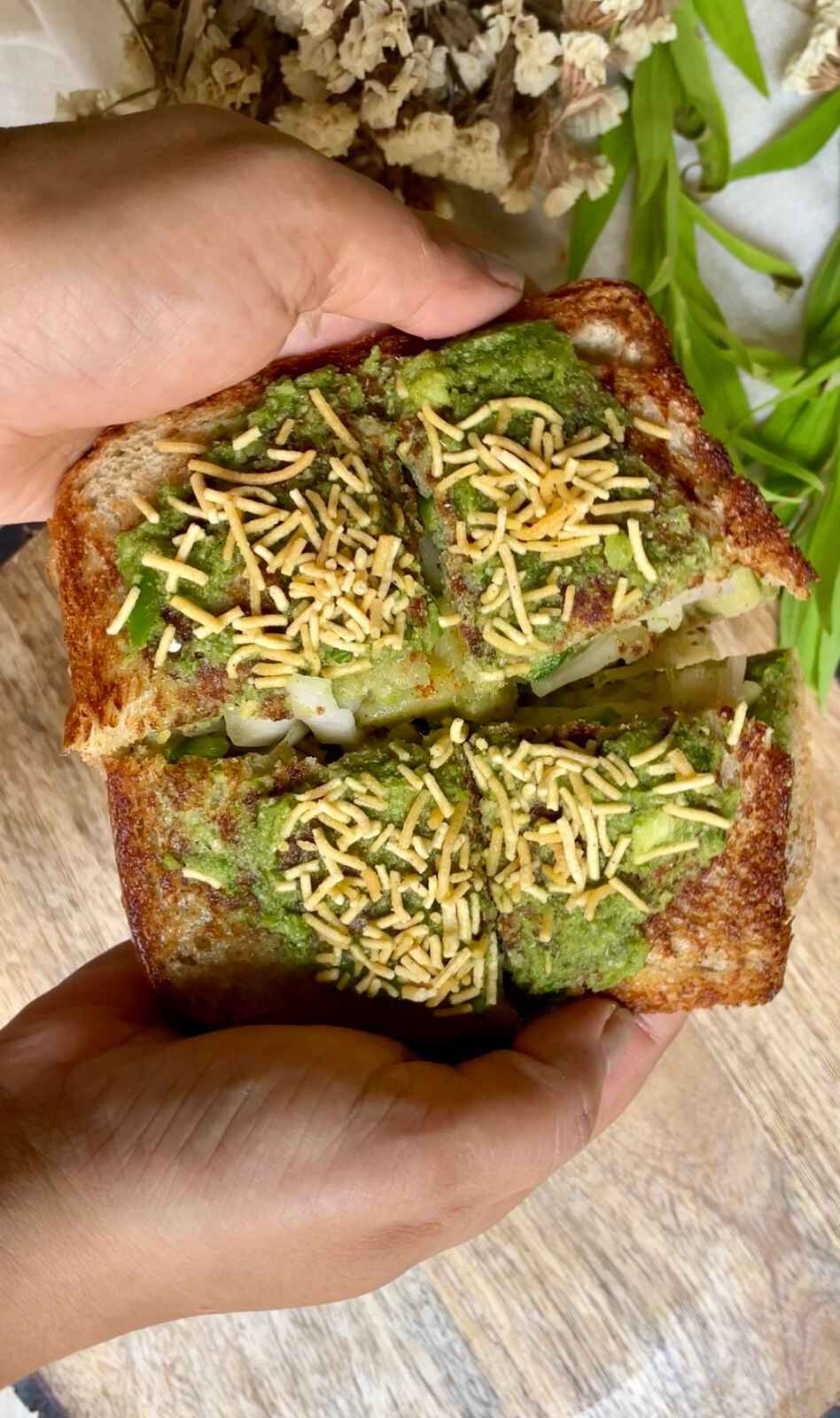
Bombay is a heaven for food lovers, with street foods that are rich in flavour. From spicy pav bhaji to crispy vada pav, the city’s street food is a delightful exploration of taste and culture. Bombay grilled sandwich is popular Maharashtrian street food and if you are a sandwich lover, then you definitely need to try this recipe. This sandwich can be quick prepared without much hassle. This Bombay sandwich is a sweet, salty, spicy and savory recipe filled with a flavor that will leave you wanting for more and more. The best part is that this veggies – loaded sandwich can be given in kids lunch boxes or taken to your office too. Just use the below given ingredients and make the easy tasty sandwich for you and your family.
Ingredients:
Bread slices
Boiled potatoes, sliced
Cucumber, thinly sliced
Capsicum, thinly sliced
Onion, thinly sliced
Chat masala
Salt, to taste
Green coriander chutney
Butter
Tomato slices (optional)
Besan bhujiya
Method:
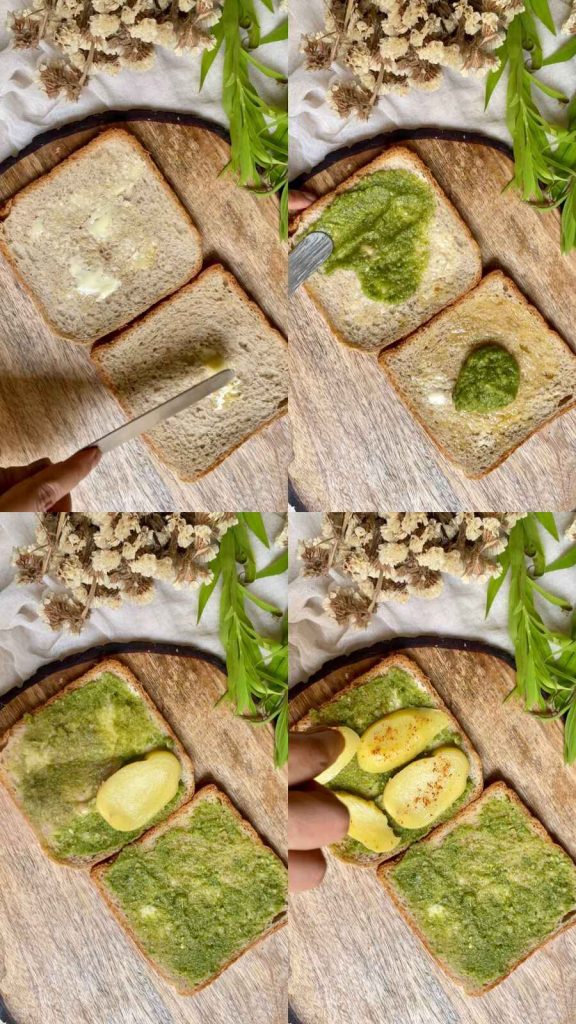
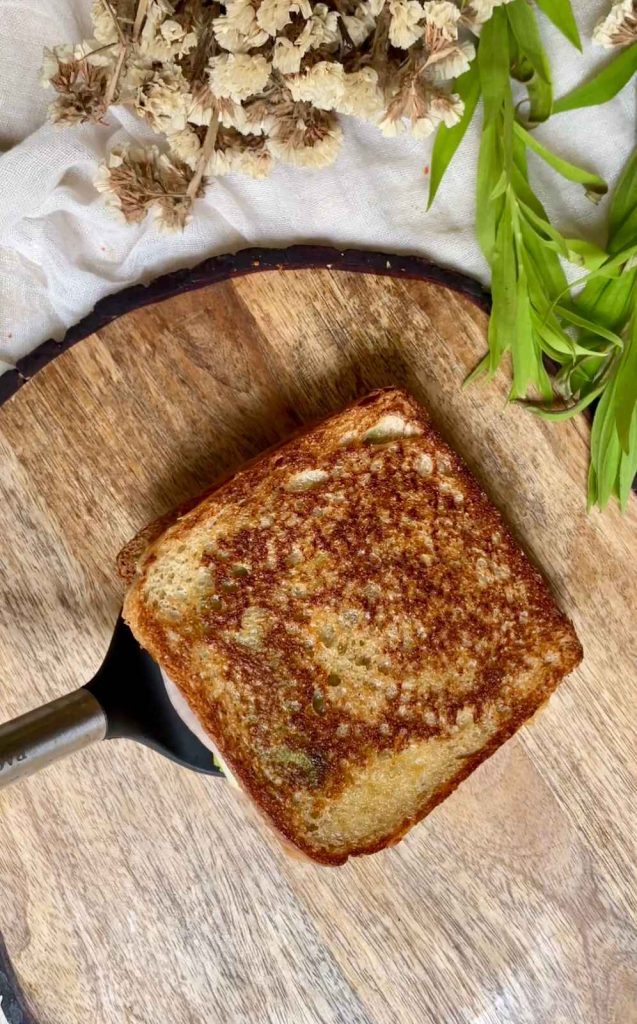
Begin by spreading a thin layer of butter on one side of each bread slice. On the unbuttered side of one bread slice, spread a generous layer of green coriander chutney. Adjust the amount based on your taste preference. Place the sliced boiled potatoes evenly on top of the chutney.
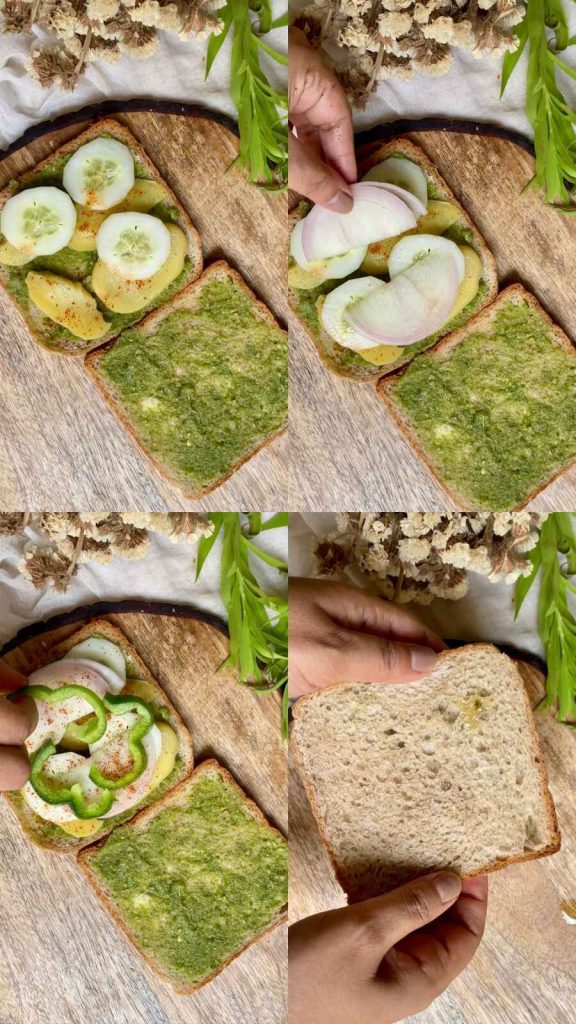
Layer cucumber, capsicum, onion, and tomato (if using) slices on top of the potatoes. Sprinkle a pinch of chat masala and a bit of salt over the vegetables for added flavor. If desired, you can spread a bit more green chutney on the unbuttered side of another bread slice before placing it on top of the assembled vegetables.
Heat a tawa and Spread a small amount of butter on tawa. Carefully place the assembled sandwich on the tawa. Allow it to cook for a few minutes on one side until it turns golden brown and crispy. Cook the other side until it becomes crispy and golden brown as well. Once both sides are nicely grilled remove the sandwich from the tawa.
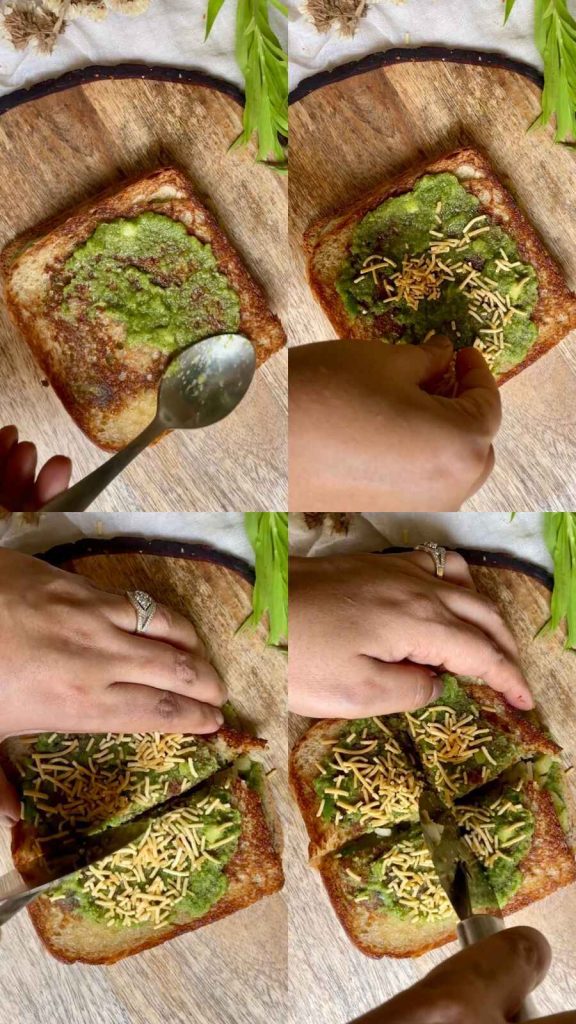
Place the sandwich on a cutting board and cut it into halves or quarters as desired. Spread a final layer of green coriander chutney on top of the grilled sandwich. Sprinkle a generous amount of besan bhujiya over the chutney layer. This adds a delightful crunch and flavor to the sandwich.
Your mouthwatering Bombay sandwich is now ready to be served! This Bombay grilled sandwich is just of the many delectable treats that Bombay street food has to offer. Easy to prepare and incredibly satisfying, this veggie-loaded sandwich is a fantastic option for a quick meal at home.
Explore More Delicious Sandwich Recipes If you enjoyed this sandwich, be sure to check out our other sandwich recipes for more tasty ideas!
I would love to see your creations. If you tried this recipe , just click a pictures and tag us on @masala.monk or use the hashtag #MasalaMonkRecipe and share on Instagram and Facebook. Happy cooking!
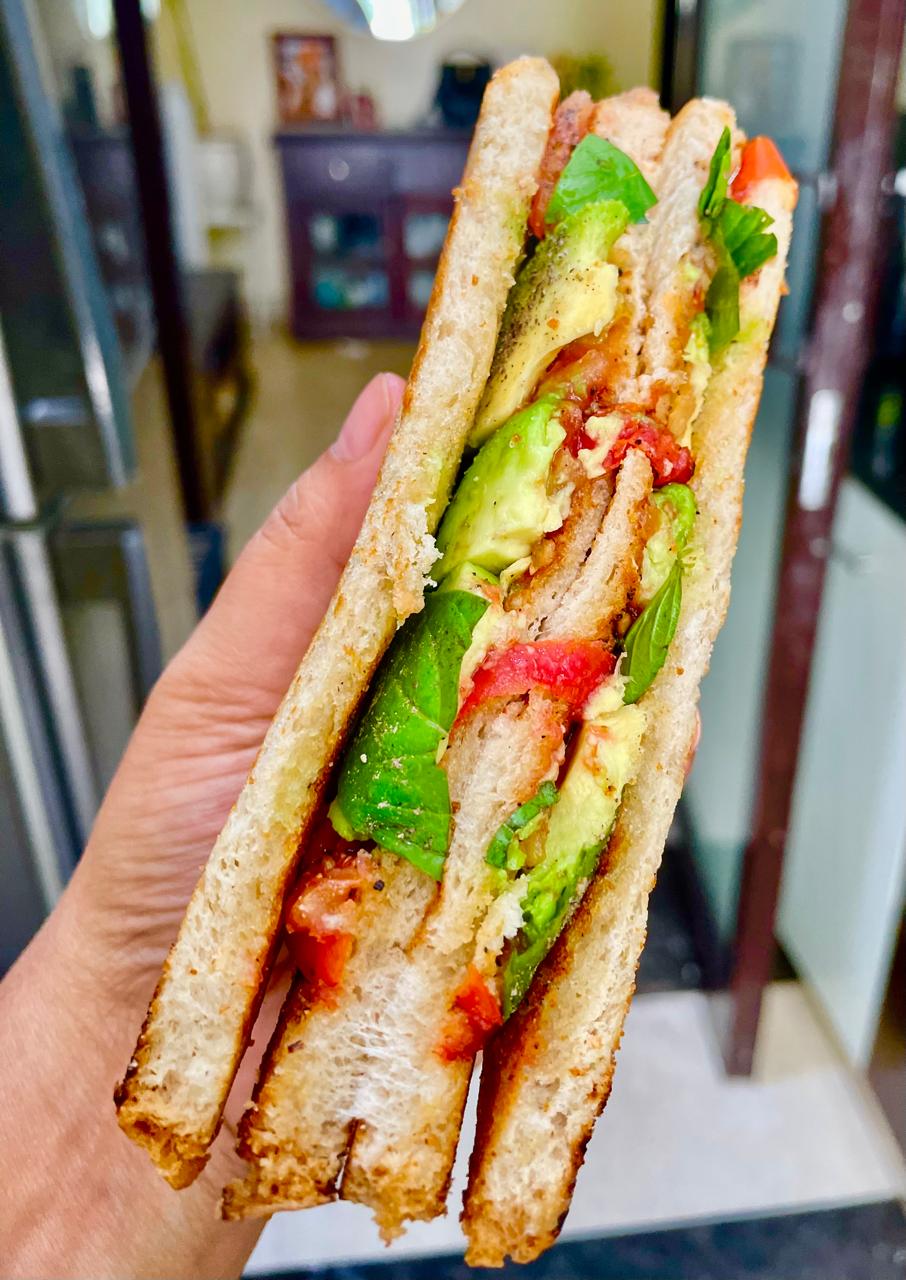
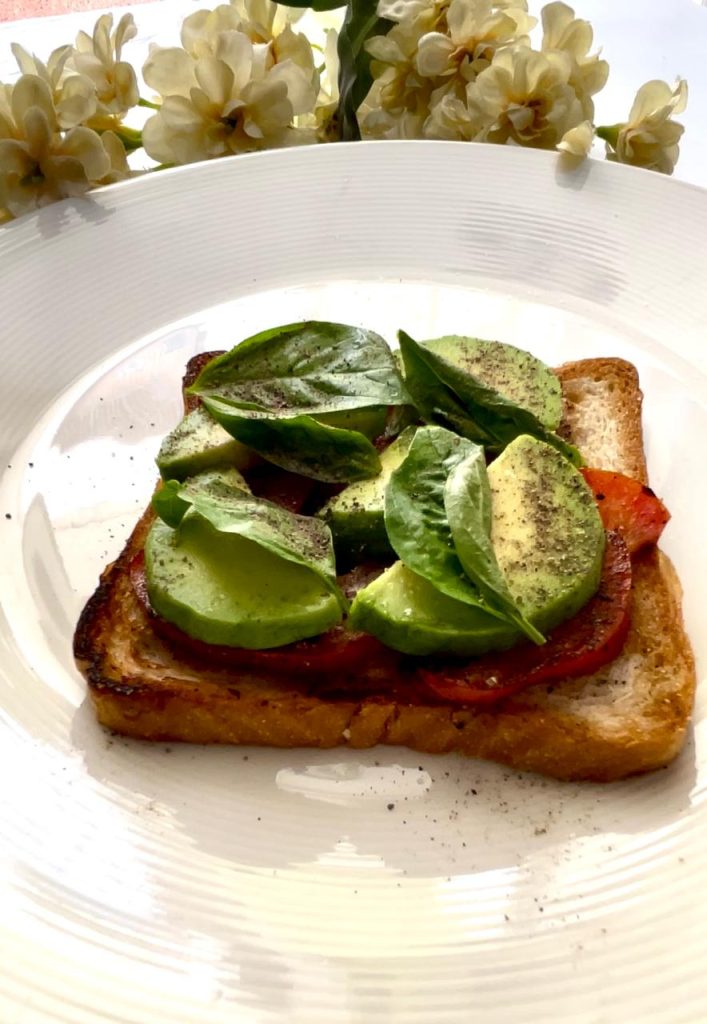
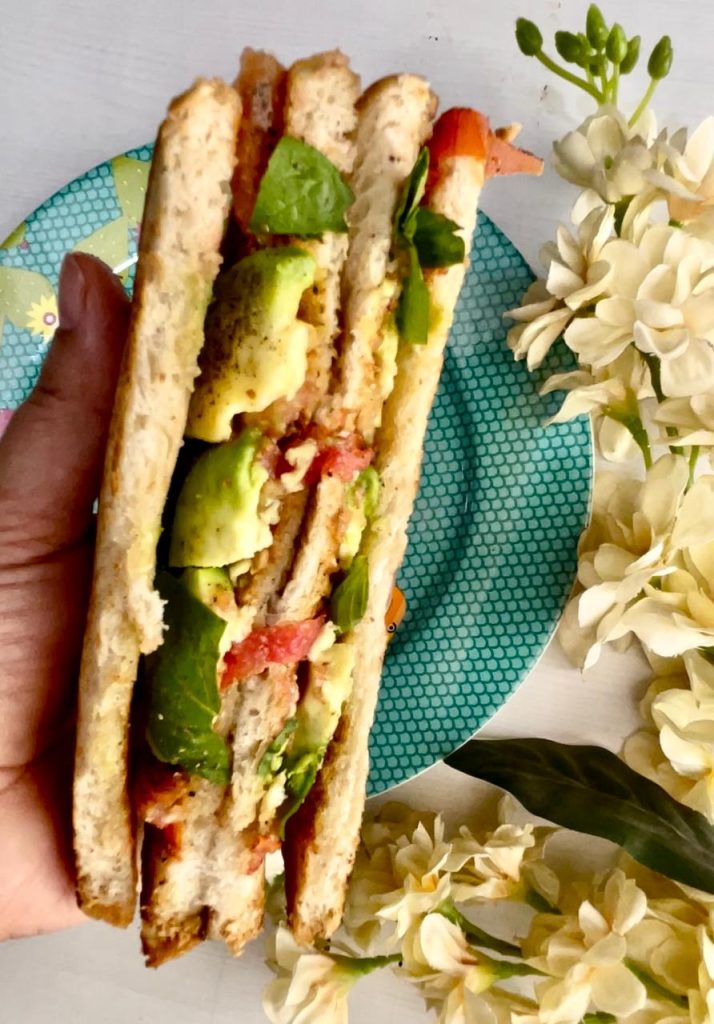
Looking for a healthy and delicious breakfast option? This Avocado, Basil, and Grilled Tomato Sandwich is the perfect way to kickstart your day. Packed with fresh ingredients and bursting with flavors, this sandwich not only tastes amazing but also provides essential nutrients to keep you energized throughout the morning. The creamy avocado, aromatic basil, and juicy grilled tomatoes come together in a delightful combination that will make your taste buds sing.
Ingredients:
Sliced avocado Basil leaves Grilled tomato slices Salt and pepper Butter
Method:
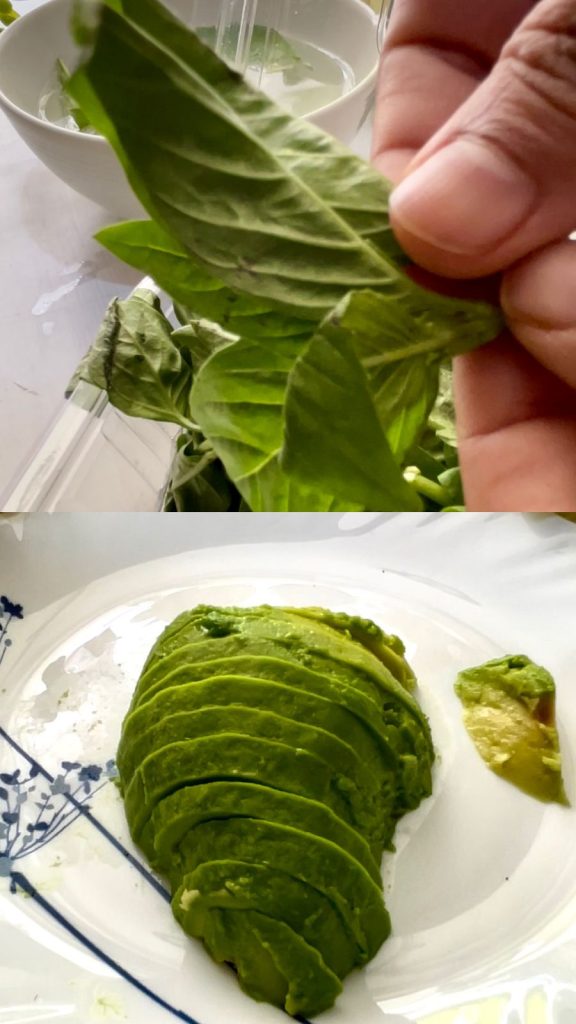
Wash and clean the basil leaves. Cut the avocado into slices.
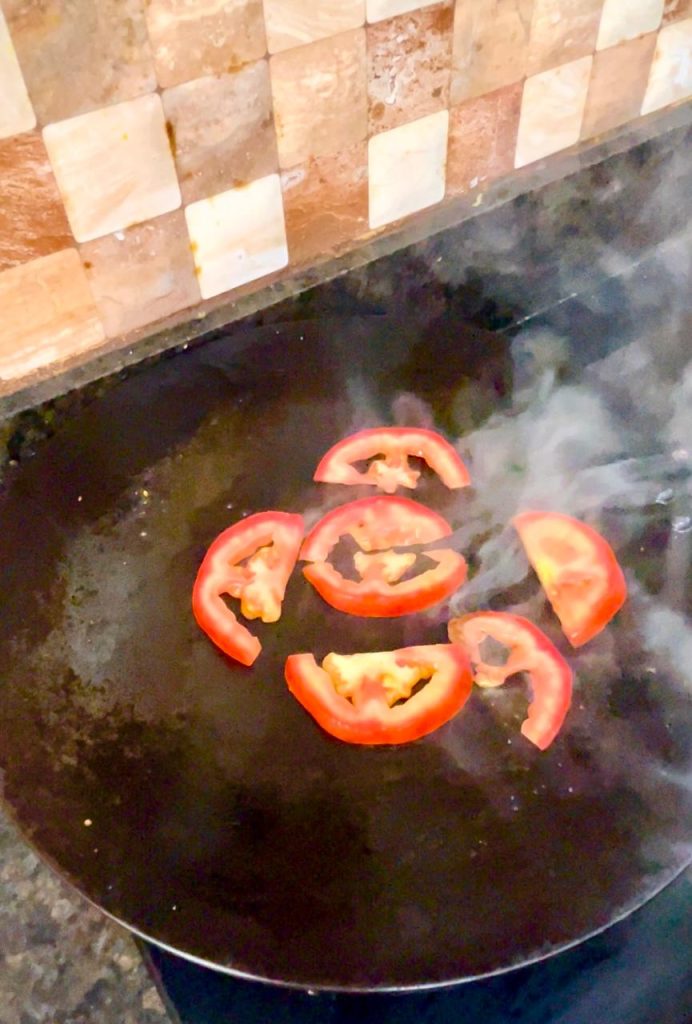
Heat a pan and add butter. Grill the tomato slices in the butter until they are slightly charred. Sprinkle with salt and pepper.
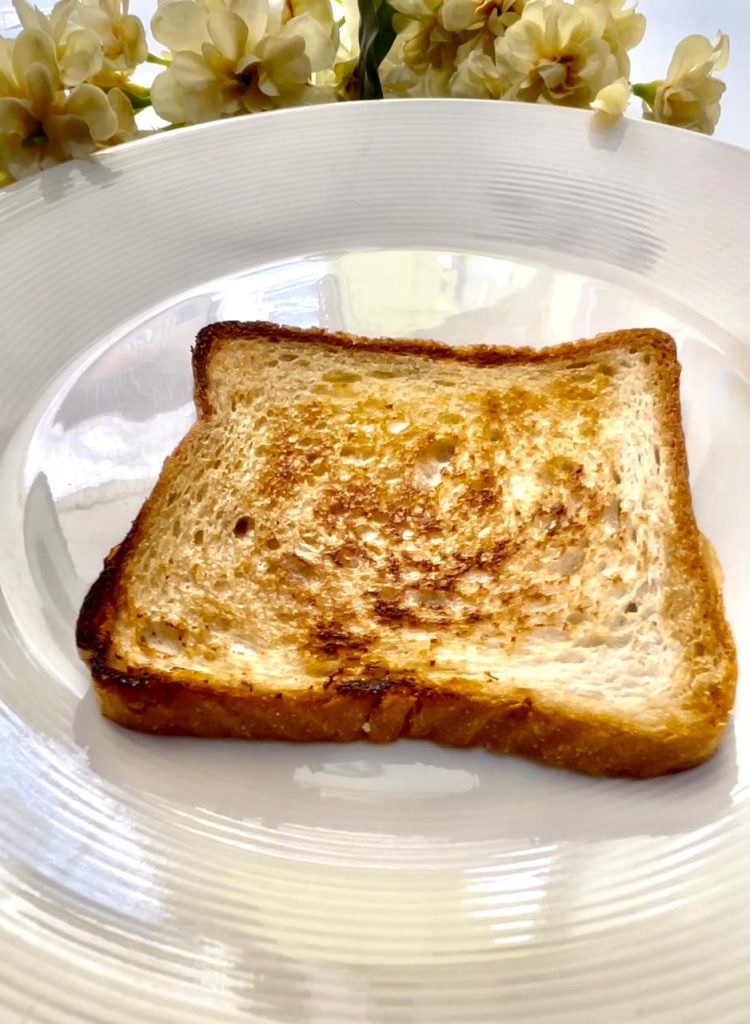
Toast your bread slices until they are golden and crispy.
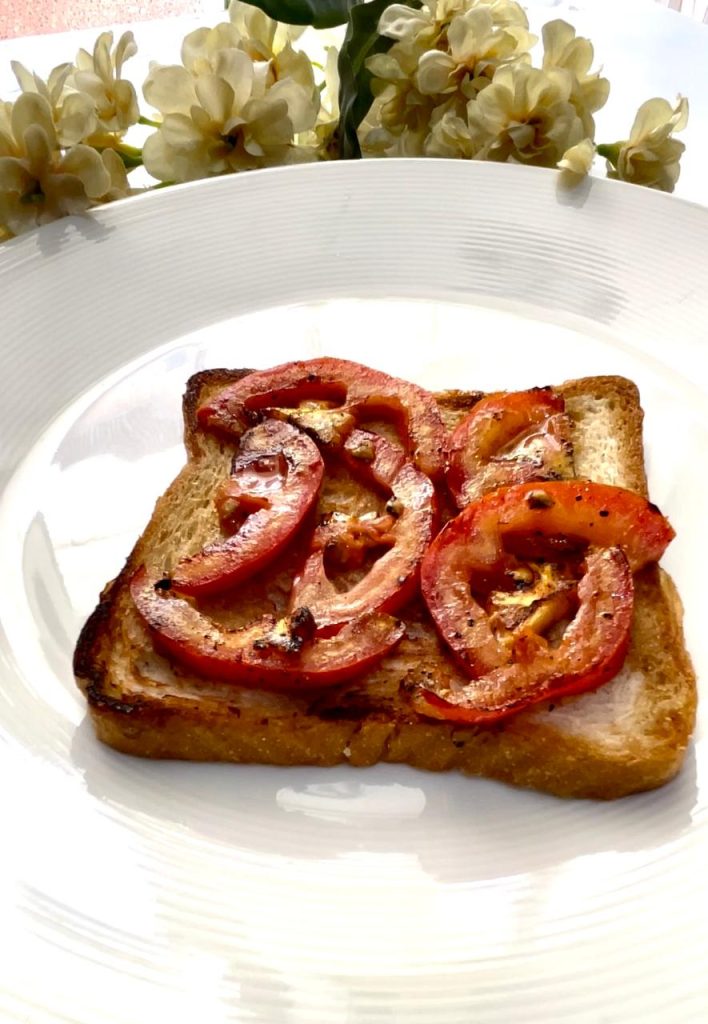
Start by placing the grilled tomato slices on one piece of toast.
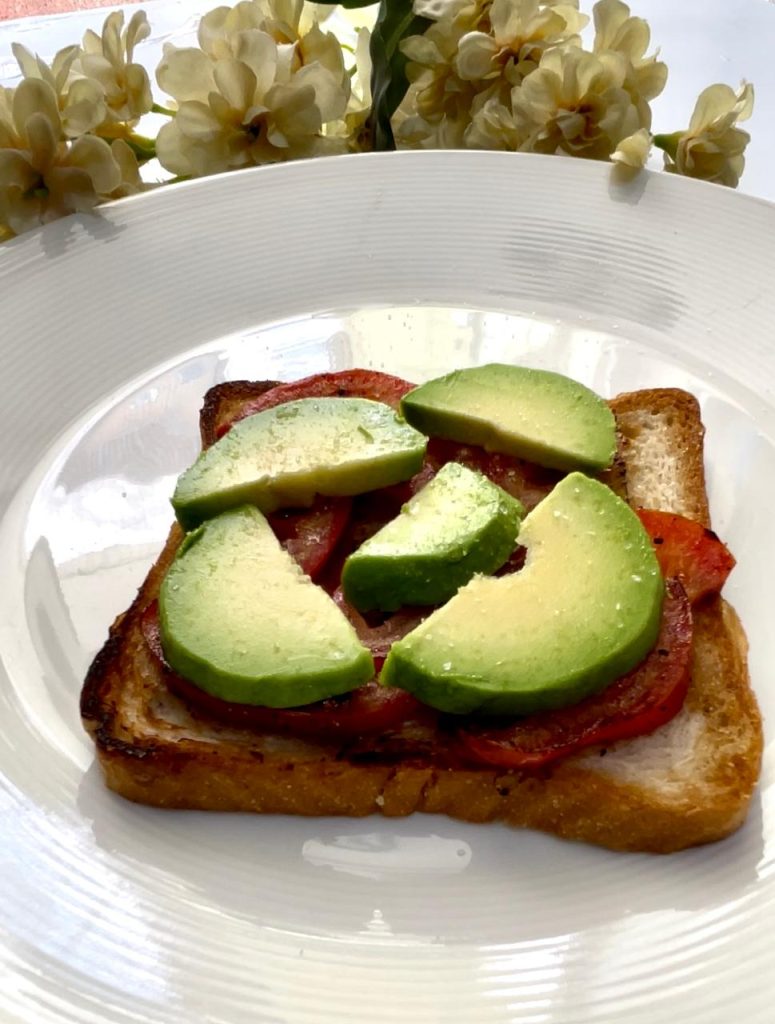
Layer the avocado slices on top of the tomatoes.
Add the fresh basil leaves. Sprinkle a little more salt and pepper for extra flavor.
Serve: Cut the sandwich into two pieces and serve with your favorite sauce or chutney.
Why This Sandwich is Great for Breakfast This sandwich is not only quick and easy to make but also incredibly nutritious. Avocados are rich in healthy fats and fiber, which help keep you full longer. Basil adds a refreshing flavor and is packed with antioxidants. Grilled tomatoes bring a slight sweetness and are a good source of vitamins A and C. Together, these ingredients create a balanced meal that is perfect for a satisfying breakfast.
Give this Avocado, Basil, and Grilled Tomato Sandwich a try and start your day on a delicious note. It’s a simple yet flavorful recipe that you can enjoy any day of the week. Don’t forget to share your feedback or any variations you try! Enjoy your breakfast!