Posted on Leave a comment

Creamy Salmon Pasta Recipe

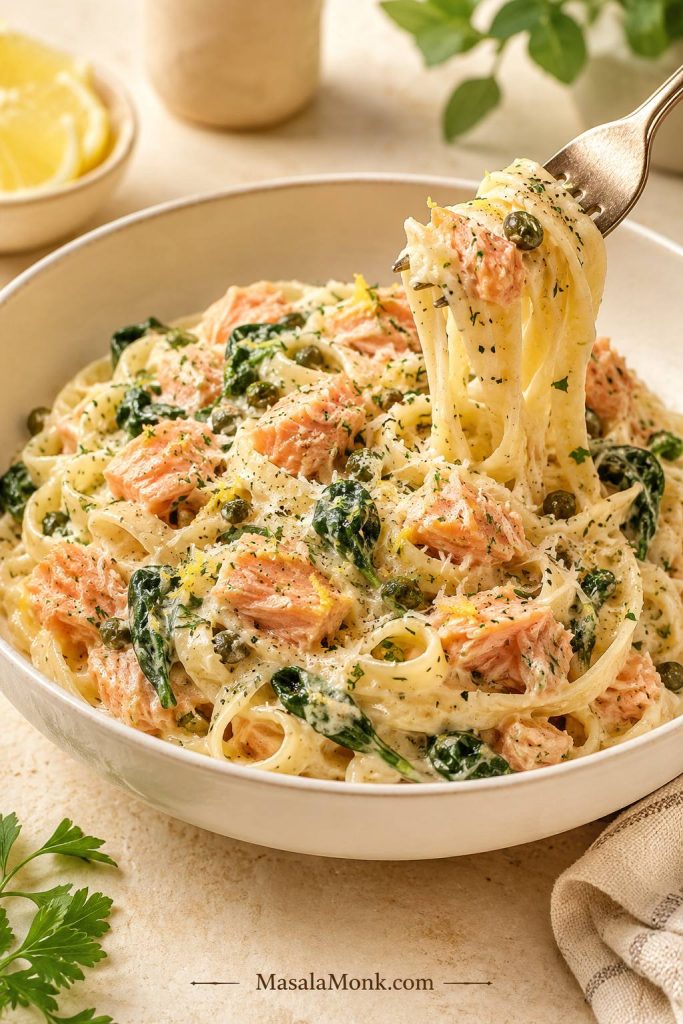
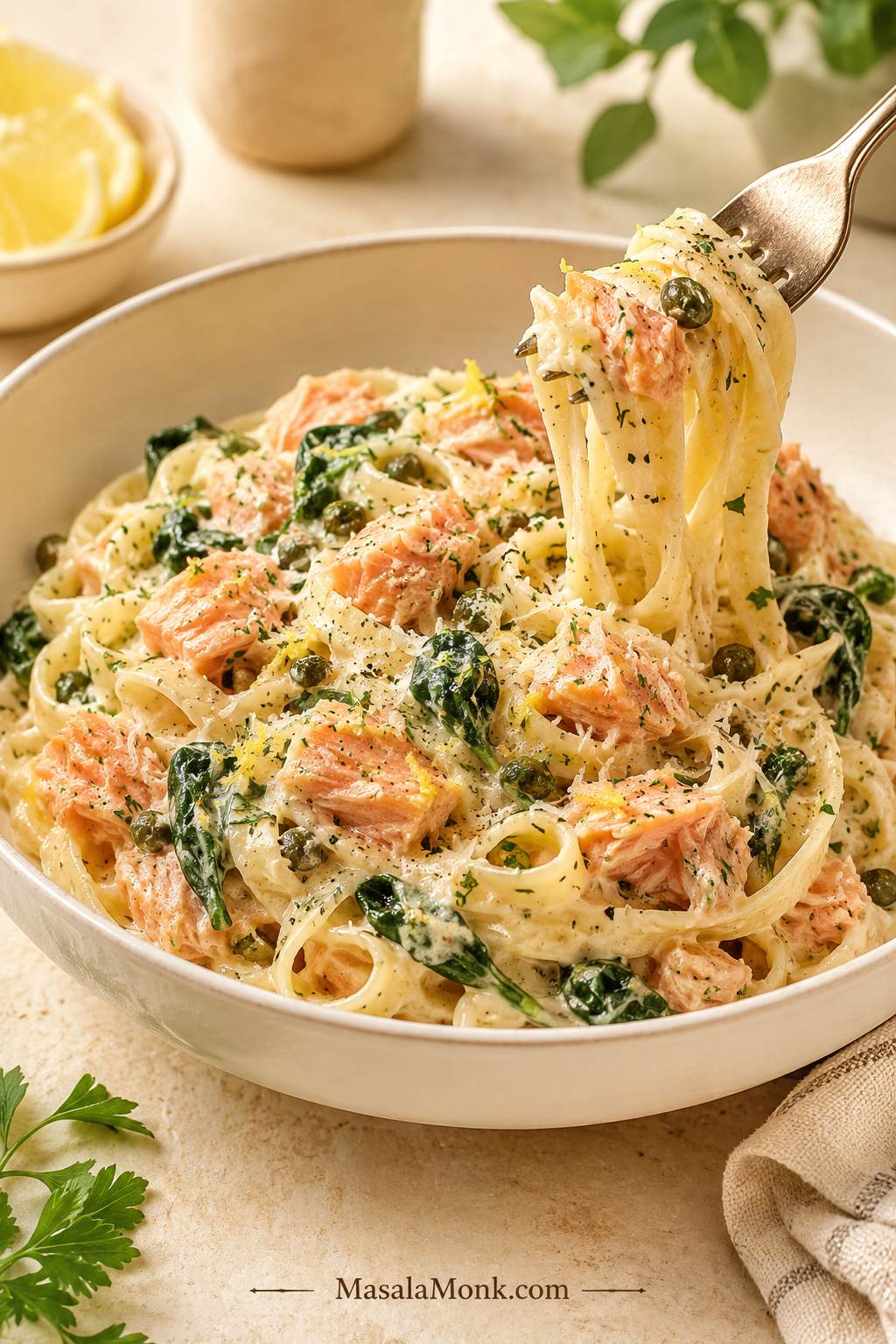
Creamy salmon pasta in a shallow bowl with salmon flakes, spinach, capers, lemon zest, Parmesan, herbs, and a fork lifting pasta.

This creamy salmon pasta recipe is the kind of 35-minute dinner that makes an ordinary night feel handled: tender salmon, silky lemon garlic cream sauce, pasta that actually holds the sauce, Parmesan, spinach, and little pops of capers. It feels restaurant-style without being fussy — rich enough to feel special, but fresh enough for another bite.

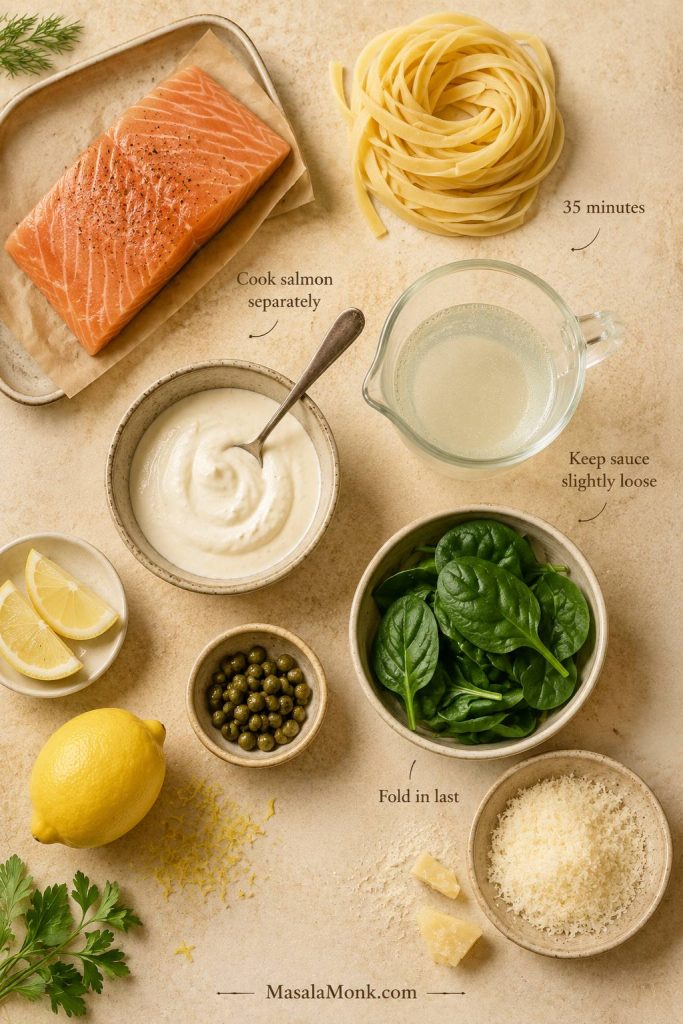
The trick is not more cream. It is control: cook the salmon separately, keep the sauce slightly looser than you think, and fold the fish in at the end so you get large, soft flakes instead of dry crumbs scattered through the pan.

The best bite has a little of everything: a ribbon of sauce-coated pasta, a soft piece of salmon, a bit of spinach, a salty caper, and enough lemon to make you want the next forkful. That is the difference between a cream pasta that feels heavy halfway through and one that stays alive to the last bite.
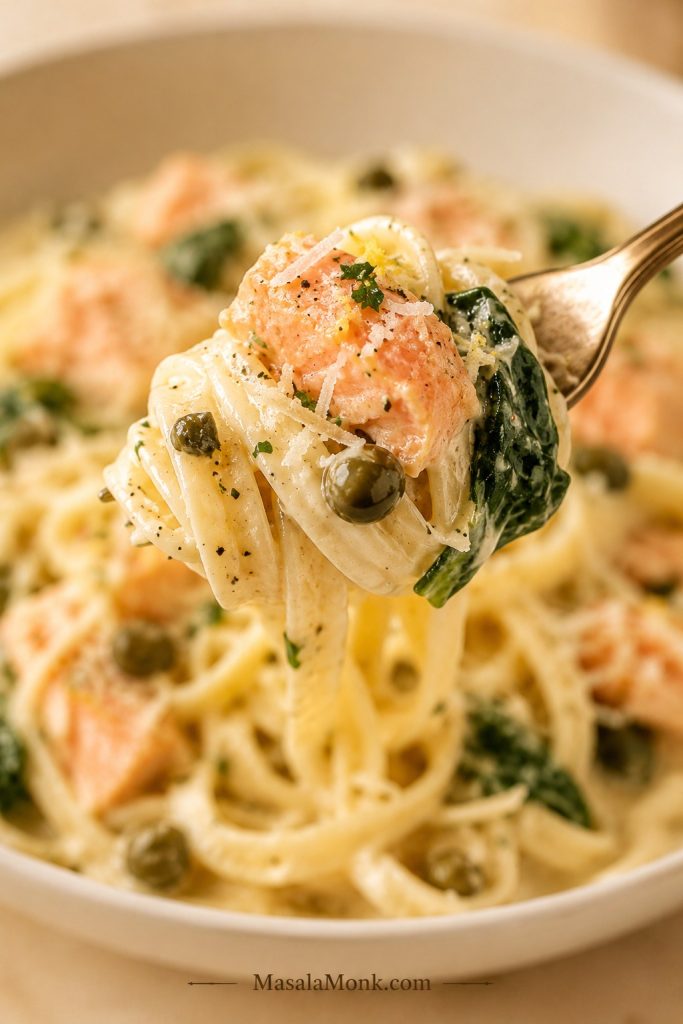
Forkful of creamy salmon pasta with pasta, salmon, spinach, capers, lemon zest, and Parmesan
A balanced forkful has pasta, salmon, spinach, caper, Parmesan, and lemon working together, so the richness stays lively.

Quick Answer: How Do You Make Creamy Salmon Pasta?

To make creamy salmon pasta, roast or pan-sear salmon until tender, boil pasta until just shy of al dente, and reserve some starchy pasta water before draining. Then, in a wide skillet, make a lemon garlic cream sauce with butter, shallot, garlic, white wine or broth, heavy cream, Parmesan, and a splash of pasta water.

Toss the pasta in the sauce first, wilt in spinach, and gently fold in large flakes of salmon at the end. Finally, finish with lemon zest, lemon juice, herbs, black pepper, and capers so the final bite tastes creamy, lifted by lemon, and savory. For the texture cue, see how to keep the sauce smooth.
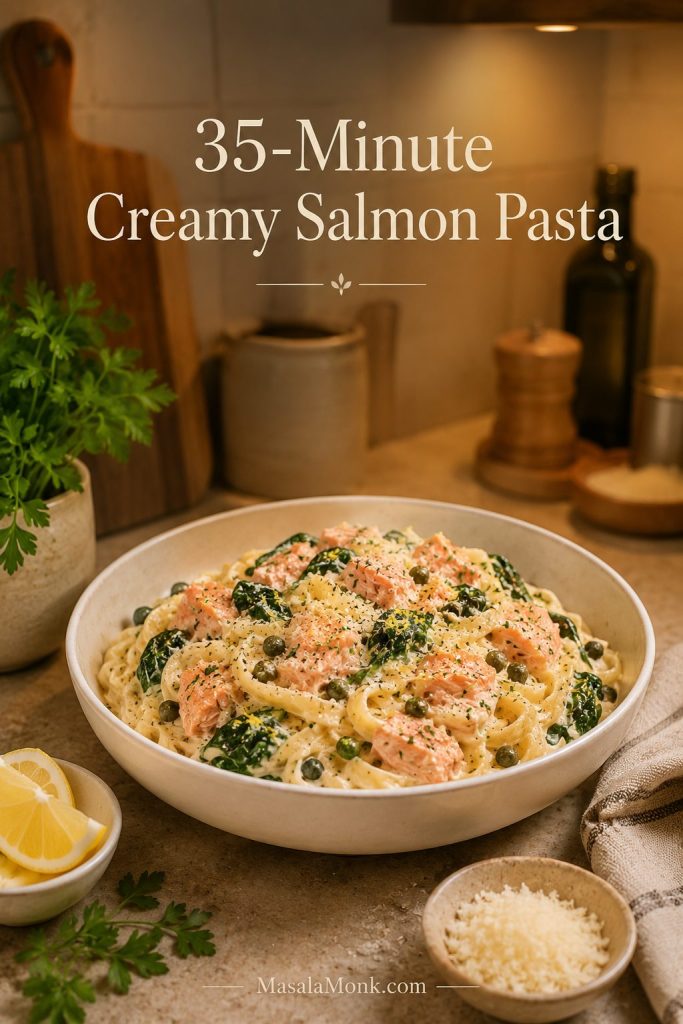
Bowl of creamy salmon pasta served with lemon, Parmesan, herbs, and a 35-minute dinner cue
Because the salmon cooks separately and the pan sauce comes together quickly, this dinner feels special without becoming a project.

Creamy Salmon Pasta Recipe at a Glance

Best salmon Fresh salmon fillet, cooked separately and folded in at the end
Best pasta Fettuccine, linguine, penne, rigatoni, or spaghetti
Sauce style Lemon garlic cream sauce with Parmesan and pasta water
Total time About 35 minutes
Safe salmon temperature 145°F / 63°C, or opaque and easy to flake
Best add-in Baby spinach
Best fix for thick sauce Reserved pasta water, added 1–2 tablespoons at a time
Best finish Lemon zest, herbs, capers, Parmesan, and black pepper
Choose your version: use fettuccine or linguine for a smoother date-night feel, penne or rigatoni for a chunkier family dinner, extra lemon and capers for a sharper finish, or a little more Parmesan when the sauce needs more depth.
What it tastes like: creamy first, then lemony, garlicky, and savory, with tender salmon flakes, soft spinach, Parmesan depth, and little salty pops from capers. It should feel rich without turning stodgy.
Creamy salmon pasta overview with salmon, pasta, cream sauce, lemon, capers, spinach, Parmesan, and pasta water
The whole recipe is built around three moves: cook salmon separately, keep the sauce flexible, and fold the fish in last.

Ready to cook? Go straight to the step-by-step method, or use the recipe card if you already know the sauce cues.

Why This Creamy Salmon Pasta Recipe Works

A good salmon pasta has to solve two problems at once: the fish should stay soft and juicy, and the sauce should coat the noodles without clumping or pooling. Because this version handles both, the final bowl tastes rounded by cream, lifted by lemon, and balanced by herbs and capers.

This is especially helpful if salmon pasta has disappointed you before — dry fish, sauce that tightens too fast, or a bowl that tastes rich for three bites and then starts to feel flat. The method is built to avoid those problems before they happen.

  • The salmon cooks separately. You can season it properly, cook it gently, and fold it into the pasta in large, moist flakes.
  • Pasta water keeps the sauce silky. Starchy water helps the cream and Parmesan cling to the noodles instead of turning thick and clumpy.
  • Lemon balances the richness. Lemon zest and juice keep the cream sauce clean on the finish.
  • Spinach makes it feel complete. It adds color, freshness, and a little vegetable comfort without another pan.
  • Capers and herbs wake up the salmon. Their salty, fresh finish keeps the dish from tasting flat.

Creamy weeknight pasta fans may also enjoy this Cajun chicken pasta, which uses a bolder smoky-spicy sauce but follows the same idea: the sauce should coat the pasta, not drown it.

Ingredients for Creamy Salmon Pasta

The best version of this dish does not come from a long ingredient list. Instead, it comes from balance: rich salmon, enough lemon to wake up the cream, Parmesan for body, and a splash of pasta water so the sauce coats the noodles instead of weighing them down.
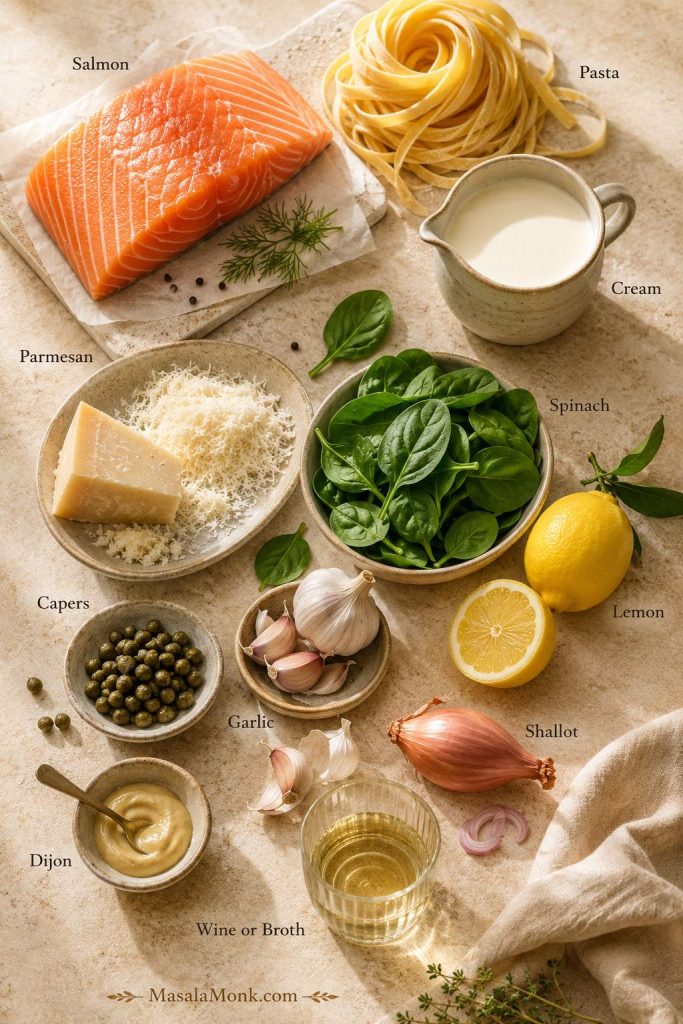
Ingredients for creamy salmon pasta including salmon, pasta, cream, Parmesan, spinach, lemon, capers, garlic, shallot, Dijon, and wine or broth
Each ingredient has a job: salmon brings richness, lemon sharpens the finish, Parmesan adds body, and pasta water helps everything cling.

Not sure which type of salmon to use? The salmon guide below covers fresh, smoked, canned, frozen, and leftover salmon.

Salmon

Fresh salmon fillet is the best choice for this recipe. Use about 1 lb / 450 g for 4 servings. Skin-on or skinless both work; after roasting or pan-searing, the salmon should break into large, moist flakes that still feel soft in the finished pasta.

Pasta

Use 12 oz / 340 g dried pasta. Fettuccine and linguine feel elegant with cream sauce, while penne or rigatoni are easier to toss with chunky salmon pieces. Spaghetti is also a perfectly good pantry option.

Cream Sauce

The sauce starts with butter, shallot, garlic, dry white wine or low-sodium broth, heavy cream, Parmesan, and reserved pasta water. Low-sodium broth is the easiest wine-free swap; then, if the sauce needs brightness, add a little extra lemon at the end. A small spoon of Dijon mustard is optional, but useful. It does not make the sauce taste mustardy; instead, it adds a quiet savory sharpness that balances the cream.
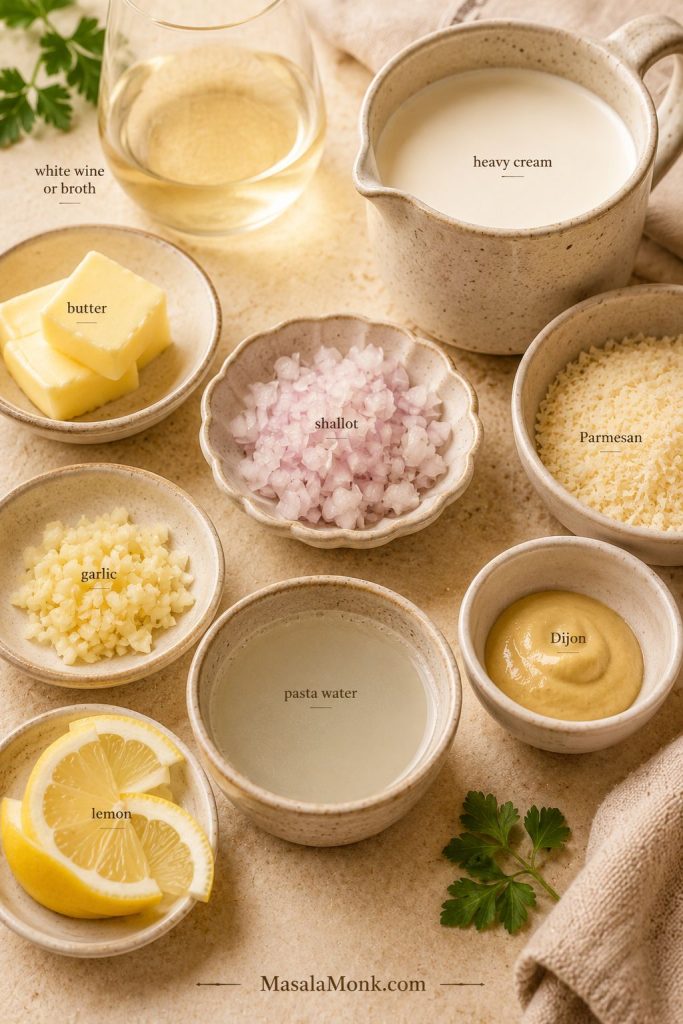
Lemon garlic cream sauce ingredients with butter, shallot, garlic, cream, Parmesan, pasta water, lemon, Dijon, and wine or broth
Instead of letting cream do all the work, garlic, Parmesan, Dijon, lemon, and starchy pasta water give the sauce more balance.

If cream sauces usually make you nervous, the sauce section explains how to keep this one smooth before the salmon goes in.

That pasta-water trick is also what makes dishes like bacon carbonara turn glossy and cohesive without needing a heavy pool of sauce.

The Fresh Finish

Lemon zest, lemon juice, herbs, and capers keep the finished pasta lively. Add lemon juice near the end, when the sauce is warm but not boiling hard, so the cream stays smooth and the lemon tastes fresh rather than sharp.
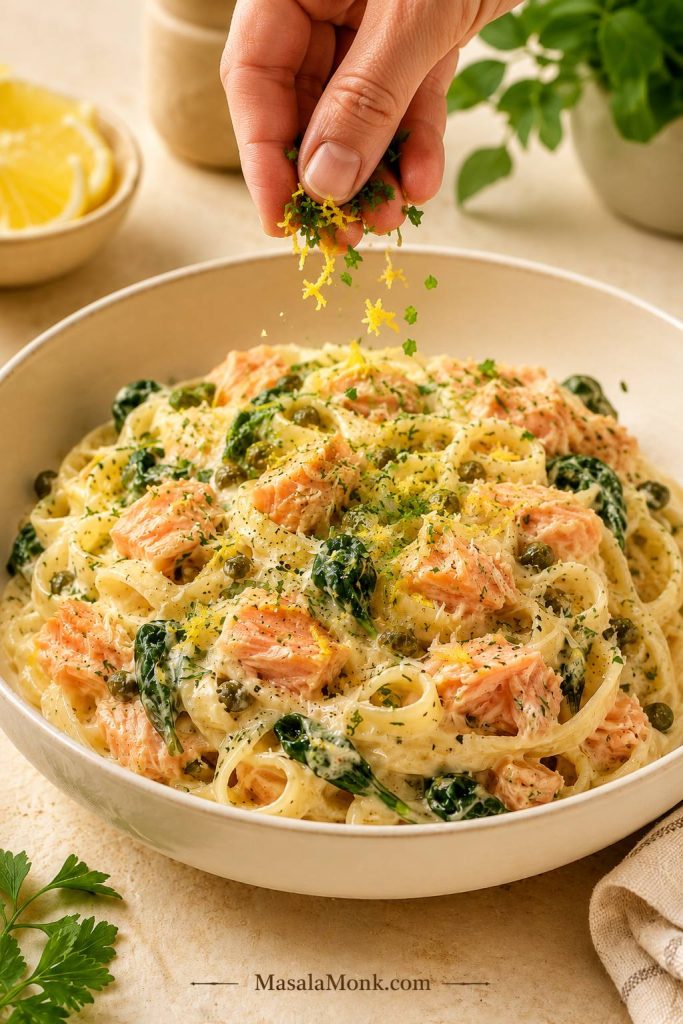
Hand adding lemon zest, herbs, capers, and black pepper to creamy salmon pasta
Add lemon, herbs, capers, and pepper near the end so the pasta tastes layered rather than one-note creamy.

Optional Vegetable Add-Ins

Baby spinach is the easiest add-in because it wilts directly into the sauce. Peas, asparagus, broccoli, cherry tomatoes, and mushrooms also work. However, firmer vegetables should be cooked first so they do not water down the sauce.

Best Salmon for Creamy Salmon Pasta

Fresh salmon gives the cleanest flavor and the best texture for this dinner-style pasta. The goal is soft flakes that stay visible in the sauce, not dry shreds that disappear into the pan.

If salmon has ever turned dry on you, this is the section that matters most. The goal is not just cooked fish; it is soft flakes that still feel generous once they hit the pasta.
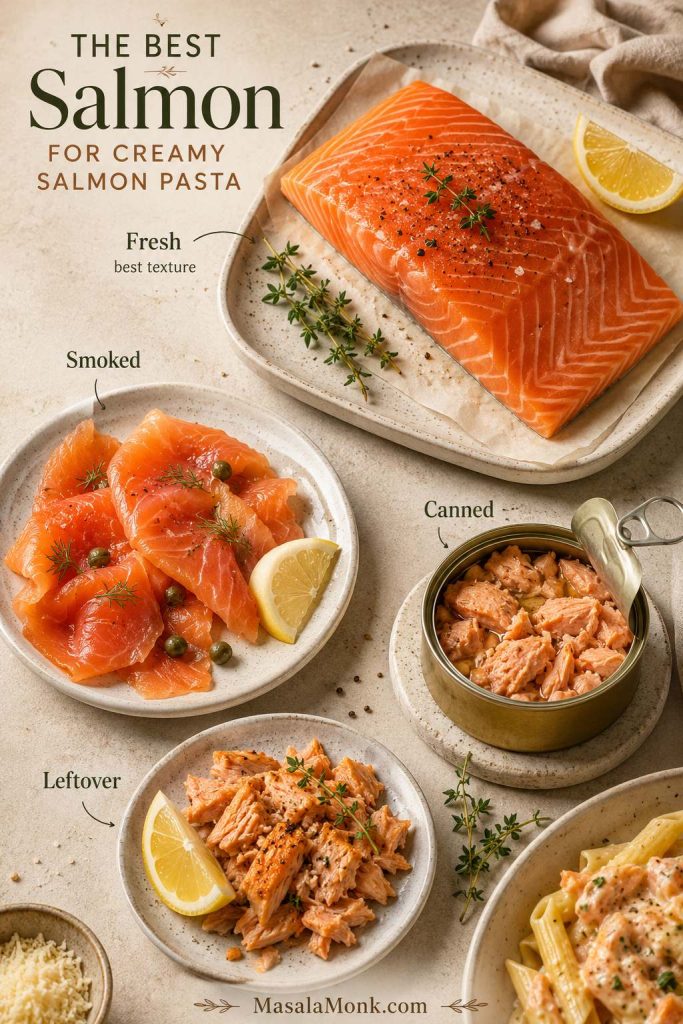
Fresh salmon, smoked salmon, canned salmon, and leftover cooked salmon options for creamy salmon pasta
Fresh salmon gives the cleanest texture, although smoked, canned, and leftover salmon can still work when handled gently.

Fresh Salmon Fillet

This is the most reliable option. Use one large fillet or a few smaller pieces. Pat the fish dry before seasoning so it roasts or sears cleanly instead of steaming on the surface. When buying salmon, choose fish that smells fresh and mild, not sour, fishy, or ammonia-like; the FDA seafood safety guide is a useful reference for fresh and frozen seafood handling.
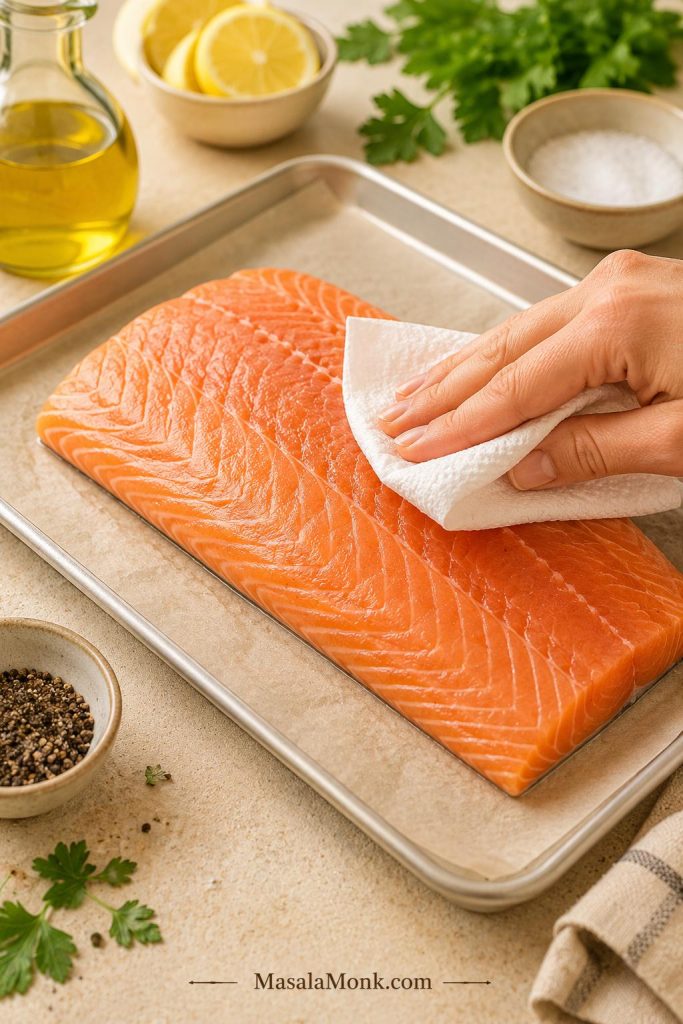
Fresh salmon fillet on parchment with olive oil, salt, pepper, lemon, and a paper towel for drying
Patting salmon dry before cooking helps it roast or sear cleanly instead of steaming on the surface.

Skin-On Salmon

Skin-on salmon works well. Roast it skin-side down, then lift the salmon away from the skin after cooking. The skin does not need to go into the pasta.

Skinless Salmon

Skinless salmon is the easiest option because there is nothing to remove after cooking. Still, watch thinner pieces closely because they cook faster.

Frozen Salmon

Frozen salmon is fine as long as it is fully thawed and patted dry before cooking. After thawing, dry the surface well before seasoning. Frozen salmon should not go straight into the cream sauce because it releases moisture and makes the sauce harder to control.

Leftover Cooked Salmon

Leftover salmon can make this dinner even faster. Add it at the end and warm it gently in the sauce. Since it is already cooked, too much stirring will break it into small pieces. For a lighter rice-based meal, extra cooked salmon also works beautifully in a salmon bowl with rice, vegetables, avocado, and sauce.

Smoked Salmon

Hot-smoked salmon flakes nicely and can be used as a quick swap. Cold-smoked salmon is saltier and more delicate, so add it off heat and reduce the salt in the sauce. After that, a little extra lemon, dill, capers, or black pepper helps smoked salmon taste fresh instead of heavy.

Canned Salmon

Canned salmon gives a softer, more pantry-style version. Drain it well, remove any large bones or skin if preferred, and fold it in gently so it does not disappear into the sauce. For a crisp canned-salmon dinner instead, try these salmon croquettes.

Best Pasta Shapes for This Creamy Salmon Pasta Recipe

The best pasta shape depends on the bite you want. Long noodles give you a silky fork twirl, while short shapes make more room for salmon chunks, spinach, and capers.

Pasta shape Best for Notes
Fettuccine Classic creamy salmon pasta Wide enough to hold a silky lemon garlic cream sauce.
Linguine A slightly lighter twirl Elegant with salmon, lemon, herbs, and capers.
Spaghetti Pantry-friendly version Works well when the salmon is flaked into slightly smaller pieces.
Penne or rigatoni Chunky salmon pieces Easy to toss with spinach and larger flakes of fish.
Orzo or gnocchi Softer comfort-food versions Both absorb sauce differently, so keep the sauce looser.

For a slightly more filling pasta base, lentil pasta can work too. Cook it carefully so it stays tender rather than mushy, and use the same sauce rule from this lentil pasta guide: keep lemon, garlic, and pasta water balanced so the sauce still clings.

How to Make This Creamy Salmon Pasta Recipe

This is the part where the recipe becomes easier than it looks. You are not juggling everything at once; the salmon cooks first, the pasta water waits nearby, and the sauce comes together calmly in one skillet.

1. Cook the Salmon

First, heat the oven to 400°F / 200°C. Place the salmon on a parchment-lined baking sheet, rub it with a little olive oil, and season with salt and black pepper. Roast for 10–12 minutes for an average fillet, or until the fish is opaque and flakes easily.

Thin fillets may need only 8–10 minutes, while thicker pieces may need 12–14 minutes. For food safety, fish should reach an internal temperature of 145°F / 63°C, or be opaque and separate easily with a fork, according to FoodSafety.gov’s safe minimum internal temperature chart.
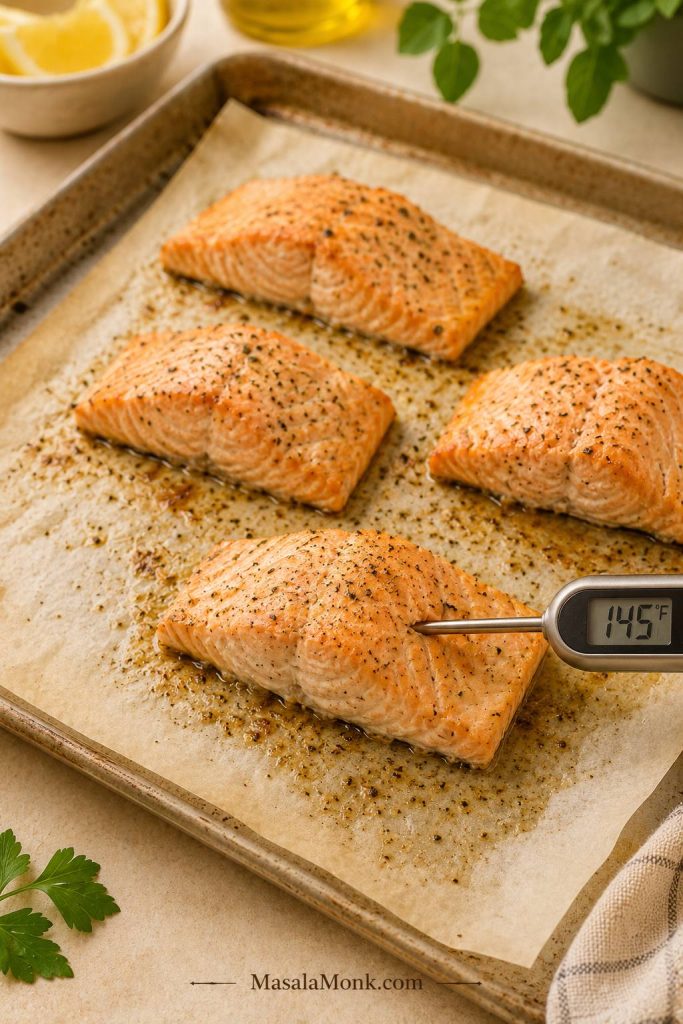
Salmon roasting on parchment with lemon and herbs for creamy salmon pasta
Roasting the salmon separately gives you better control over doneness before the flakes meet the cream sauce.

Optional: Pan-Sear the Salmon Instead

Prefer a stovetop version? Pat the salmon dry, season it, and sear it in a lightly oiled skillet over medium heat for 3–4 minutes per side, depending on thickness. Let it rest for 5 minutes, then flake it into large pieces. Keep the heat moderate so the outside browns without drying the center.
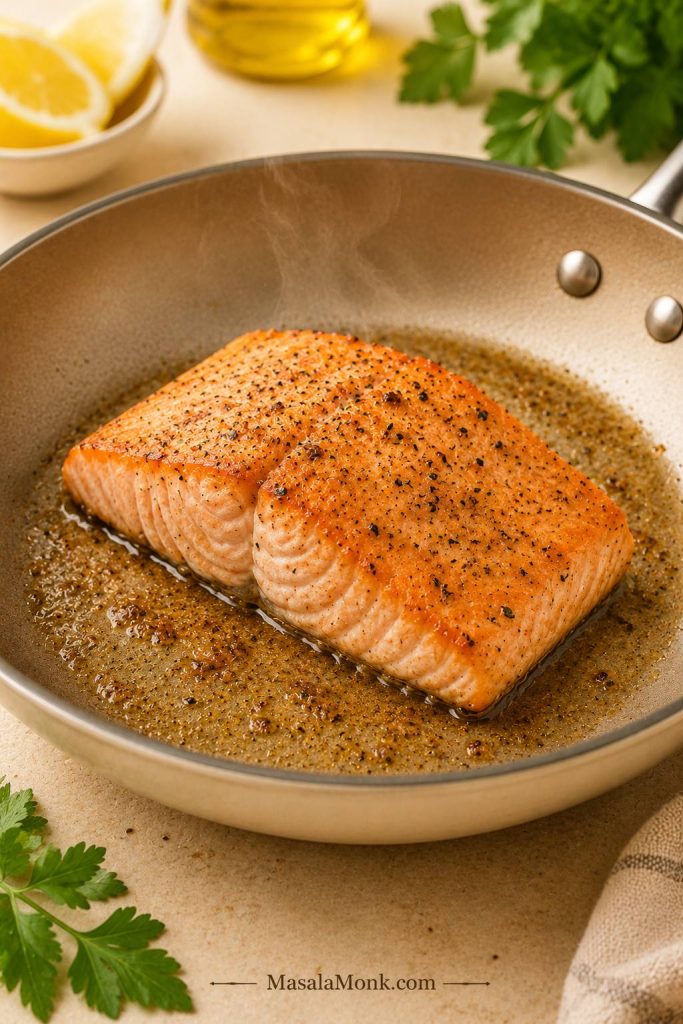
Salmon fillet searing in a skillet with a lightly browned surface for creamy salmon pasta
Pan-searing is a good stovetop option; however, moderate heat lets the surface brown before the center dries out.

After roasting or searing, let the salmon rest for 5 minutes before flaking. Resting helps the juices settle, and larger flakes look and taste better in the finished pasta.
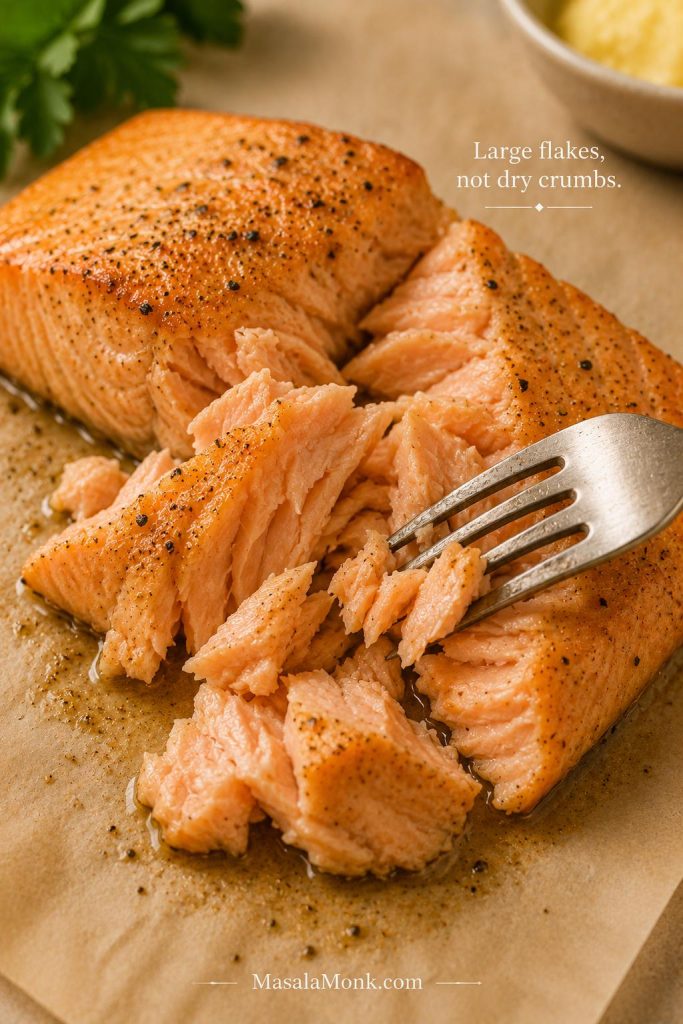
Cooked salmon being separated with a fork into large moist flakes
Large, moist flakes make salmon pasta feel generous, while tiny dry pieces disappear into the sauce.

2. Boil the Pasta

Meanwhile, bring a large pot of water to a boil and salt it well. Add the pasta and cook it about 1 minute shy of al dente. Before draining, scoop out 1 cup / 240 ml of pasta water.
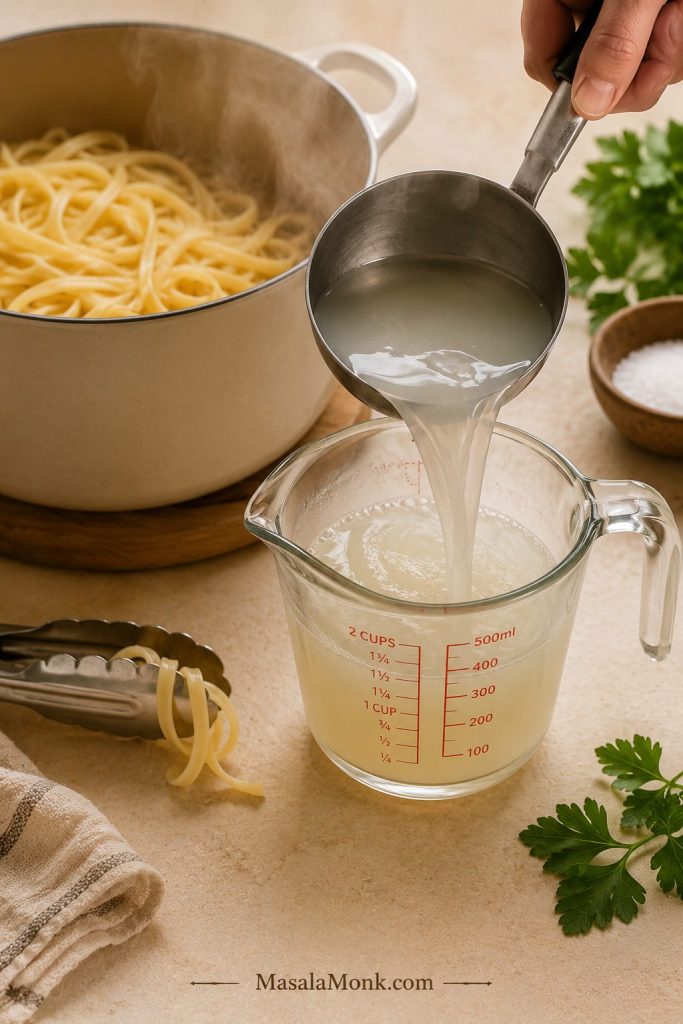
Cloudy pasta water being scooped into a measuring cup beside a pot of pasta
Reserve pasta water before draining because its starch helps the lemon garlic cream sauce hold onto the noodles.

Do not rinse the pasta after draining. The starch on the surface helps the sauce cling, and that little bit of cling is what makes the finished dish feel glossy instead of watery.
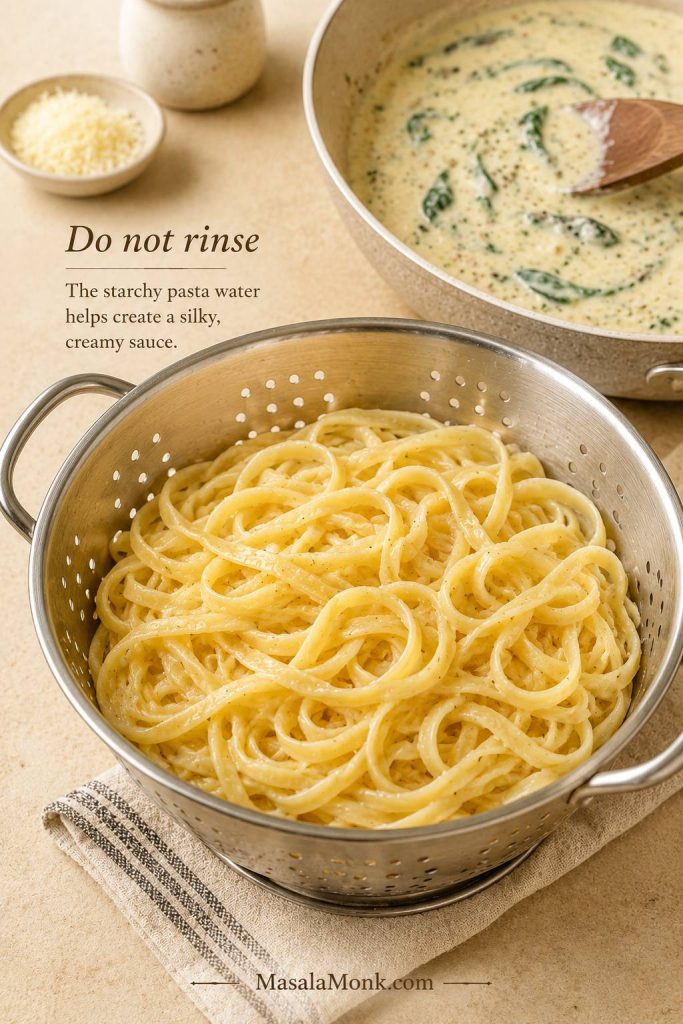
Drained pasta in a colander with a small Do not rinse label beside the pasta
Do not rinse the pasta after draining; that surface starch is what helps the sauce coat instead of slide off.

You may not use all the pasta water. Still, having extra gives you control because creamy pasta sauce tightens as it sits, and pasta water is the easiest way to loosen it without making it thin. For a visual cue on when to add more, jump to the 1-minute sauce control trick.

3. Build the Lemon Garlic Cream Sauce

Next, in a large high-sided skillet, melt the butter with a little olive oil. Add the shallot and cook until softened. Then stir in the garlic and cook just until fragrant, about 30 seconds. Add white wine or broth and simmer briefly so the sharp edge cooks off.

At this stage, the pan should smell like garlic, butter, and lemon waiting to happen — not raw onion, scorched garlic, or plain cream.
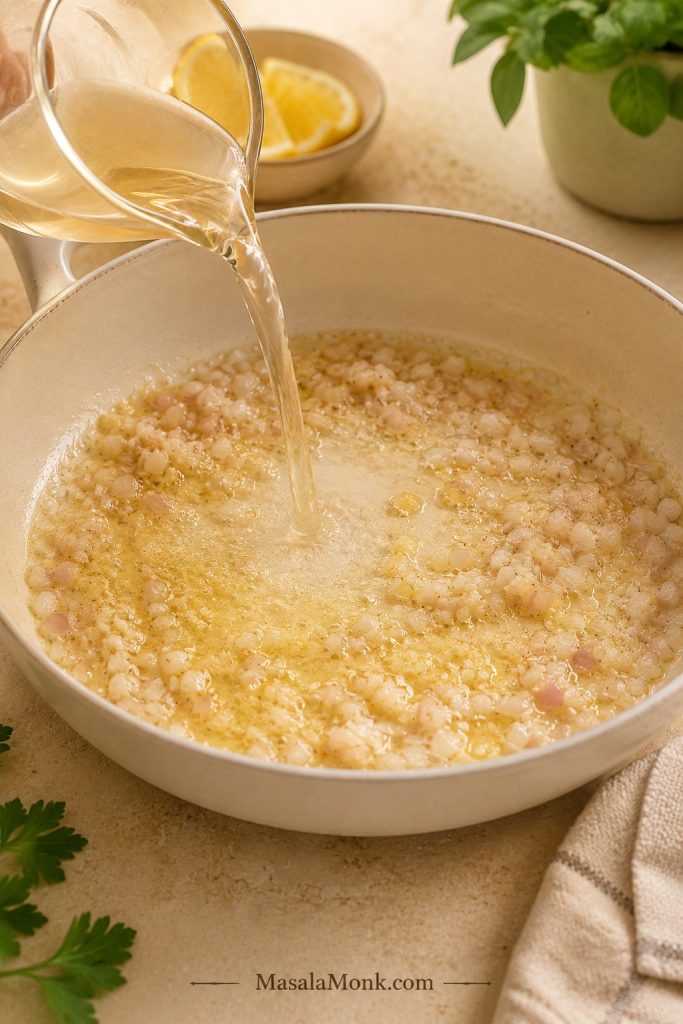
Shallot and garlic cooking in butter while wine or broth is poured into a skillet
Let the shallot and garlic soften gently before adding cream, so the sauce tastes rounded instead of harsh.

Lower the heat before adding the cream. Stir in Dijon if using, then add finely grated Parmesan a little at a time. After that, add a splash of pasta water and stir until the sauce looks creamy, loose, and glossy. It should move easily in the pan before the pasta goes in. If the sauce already looks thick before the pasta is added, loosen it now; the noodles will only make it tighter.
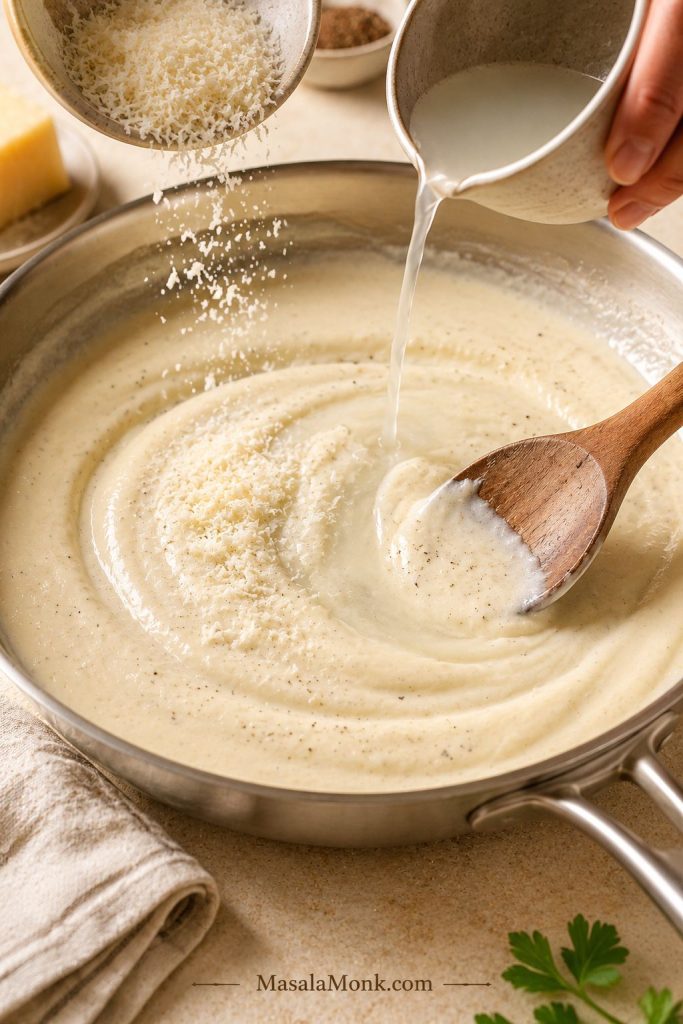
Parmesan and pasta water being stirred into cream sauce in a skillet
Add Parmesan gradually, then loosen with pasta water as needed, so the sauce stays smooth enough to toss.

4. Toss the Pasta, Wilt the Spinach, and Fold in the Salmon

Add the drained pasta to the skillet and toss until coated. At this point, the sauce should cling to the noodles but still look fluid.
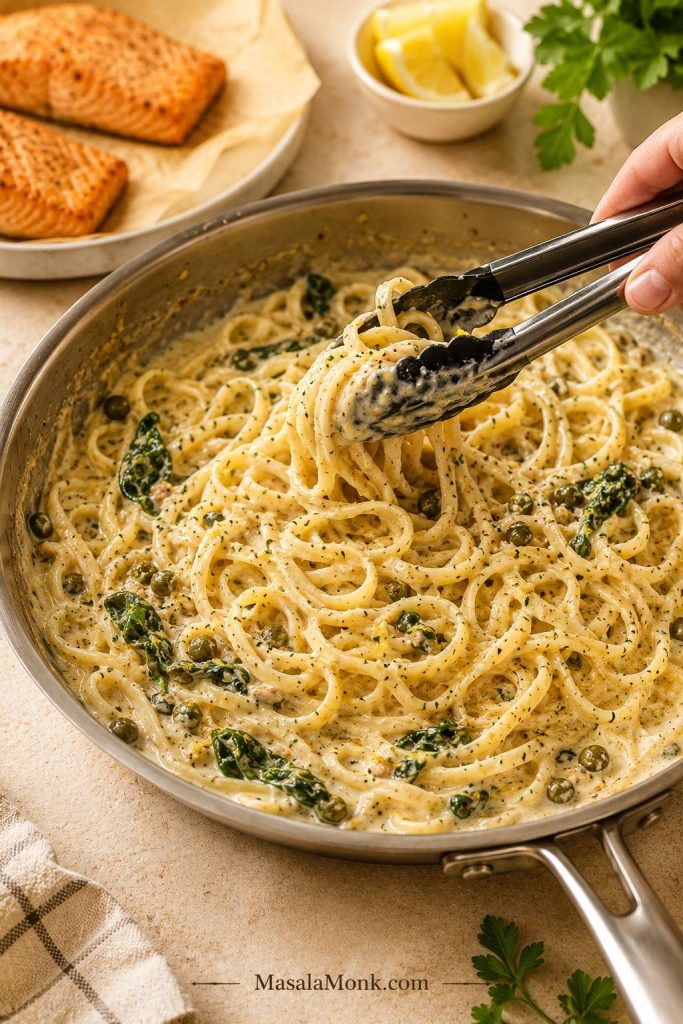
Pasta being tossed in lemon garlic cream sauce while cooked salmon rests nearby
Toss the pasta before adding salmon, because coated noodles need less stirring once the delicate fish goes in.

Add spinach and let it wilt briefly, just until bright green and soft.
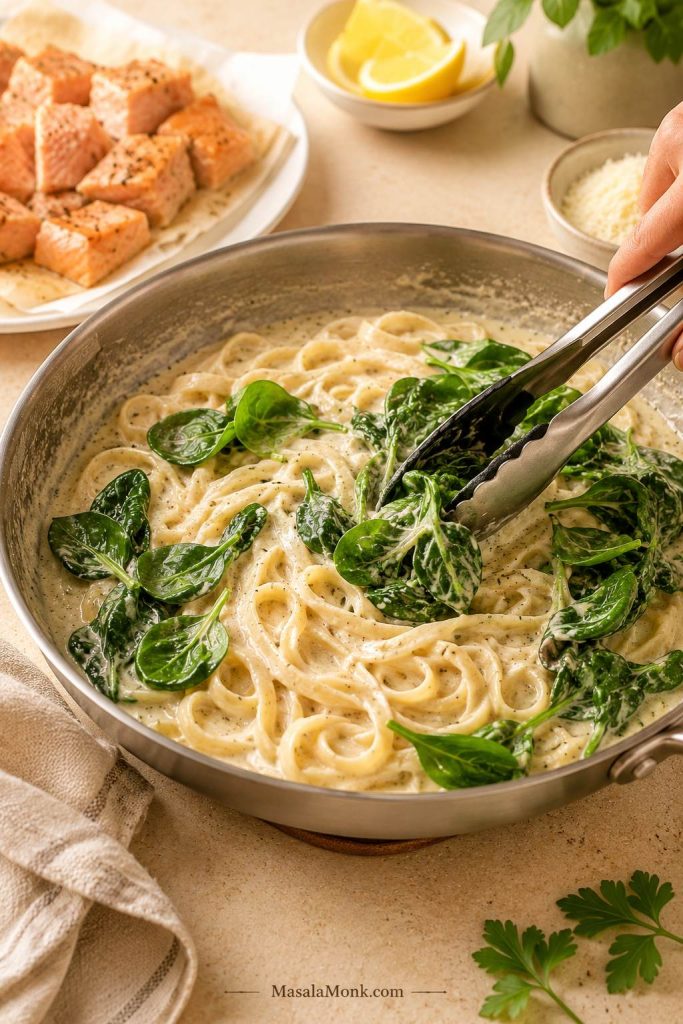
Baby spinach being tossed into creamy pasta while cooked salmon waits on a plate nearby
Wilt the spinach before folding in the salmon; this keeps the greens bright and protects the fish from extra stirring.

Finally, turn the heat low and fold in the salmon in large flakes with only a few gentle turns. The less you stir at this point, the prettier and softer the salmon stays. Add lemon zest, a little lemon juice, herbs, capers, and black pepper. Taste before serving: when the sauce feels too rich, add more lemon or herbs; when it feels too thick, loosen it with pasta water. For more depth, finish with a little extra Parmesan or black pepper.
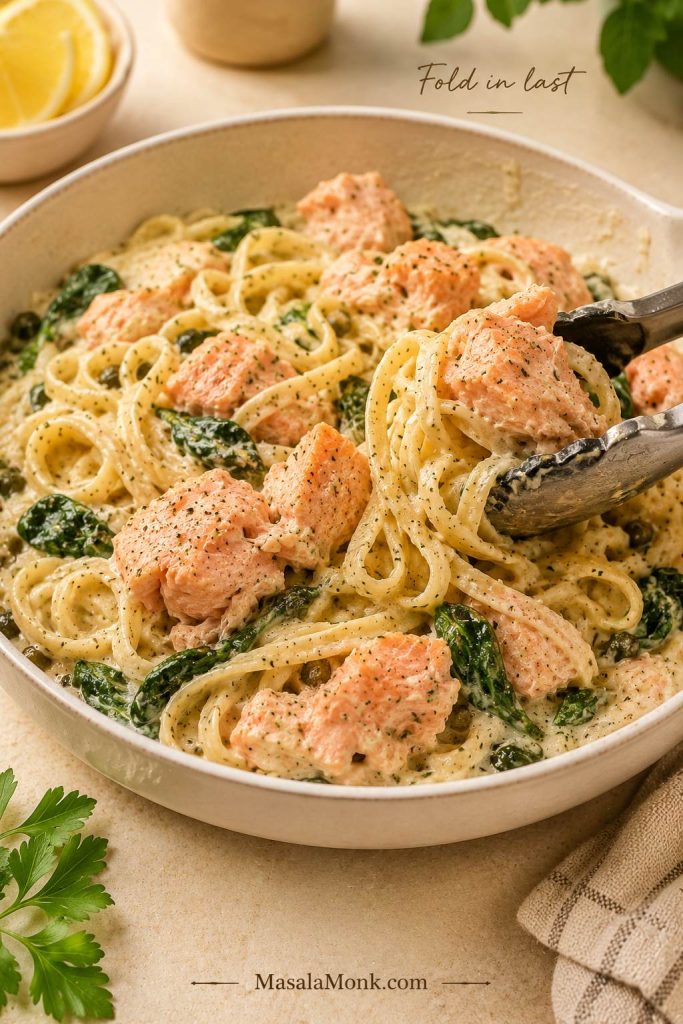
Large salmon flakes being folded into creamy pasta with spinach and sauce
Fold the salmon in last with only a few turns, so the pieces stay large, soft, and visible.

If the sauce tightens, splits, or the salmon starts breaking apart, check the troubleshooting table before adding more cream.

How to Keep Creamy Salmon Pasta Sauce Smooth

The sauce should coat the pasta in a thin creamy layer rather than sitting at the bottom of the pan. Because cream sauces tighten quickly, these small details are what make the dish feel restaurant-style instead of rushed.

Cream sauces can feel intimidating at first. However, this one is mostly about patience: keep the heat gentle, add the cheese gradually, and let the pasta water do the smoothing.

The 1-Minute Sauce Control Trick

Keep the sauce slightly looser than you want before the pasta goes in. The noodles will keep absorbing liquid, so a sauce that looks perfect in the pan can turn tight on the plate. A few spoonfuls of pasta water at the end are not a rescue move — they are the finishing move.

  • Before pasta goes in: the sauce should move easily when you tilt the pan.
  • After pasta goes in: toss first, then loosen with pasta water only as needed.
  • Before salmon goes in: fix the sauce texture now, because heavy stirring later can break the fish.
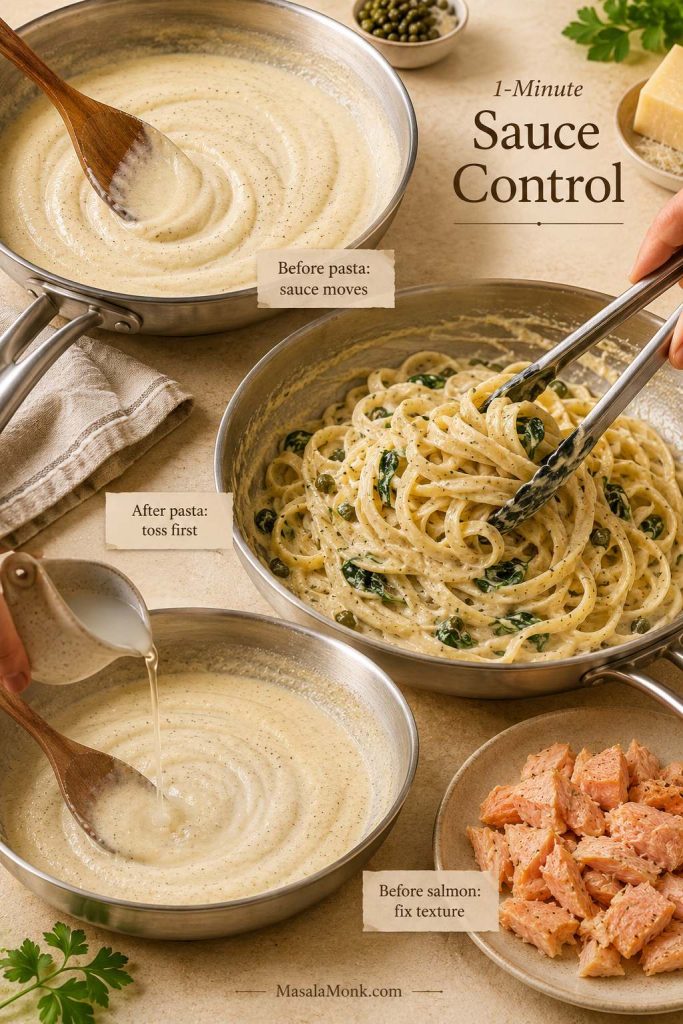
Three-stage sauce control guide with labels for before pasta, after pasta, and before salmon
Fix the sauce texture before the salmon goes in; after that, gentle folding works better than heavy stirring.
Best texture cue: when you drag tongs through the pasta, the sauce should coat the noodles and leave a light creamy trail in the pan. If it clumps, add pasta water. If it pools like soup, simmer gently for another minute before adding the salmon.
Tongs pulling creamy pasta through sauce and leaving a light trail in the pan
The sauce is ready when it coats the noodles and leaves a light trail in the pan, not when it clumps or pools.

Keep the Heat Gentle Once Cream and Cheese Go In

  • Use gentle heat after adding cream. Cream and cheese do not need aggressive boiling.
  • Finely grate the Parmesan. Fine cheese melts more smoothly than large shreds.
  • Add Parmesan gradually. Stir in small handfuls instead of dumping it all in at once.
  • Add lemon juice near the end. Lemon is essential, but hard boiling can make cream less stable.
  • Fold salmon in last. This keeps the fish tender and prevents it from shredding into dry flakes.

The same gentle-heat rule also helps in creamy macaroni and cheese, where rushing the cheese can make the sauce grainy.

Taste and Adjust Before Serving

The final forkful should taste creamy first, then lemony and savory. If it tastes rich but flat, reach for lemon, capers, herbs, or black pepper before adding more cream.
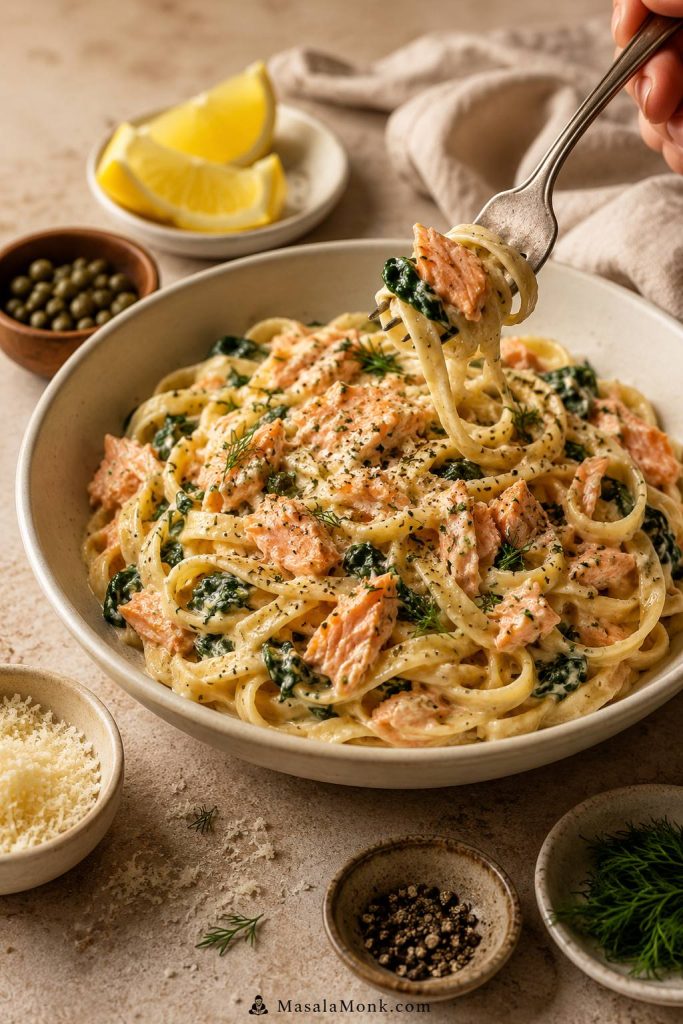
Before you serve: taste one forkful with salmon, pasta, and sauce together. A heavy finish needs lemon, a thin sauce needs Parmesan, and a flat bite usually needs capers, herbs, or black pepper. The final adjustment is where this pasta becomes yours.
Forkful of creamy salmon pasta with lemon, capers, herbs, Parmesan, and black pepper nearby
Taste before serving, then choose the fix: lemon for sharpness, capers for salt, herbs for freshness, Parmesan for depth.

Creamy Salmon Pasta Recipe

Creamy Salmon Pasta Recipe

This creamy salmon pasta recipe brings together tender salmon, pasta, spinach, capers, and a silky lemon garlic cream sauce in about 35 minutes. The sauce should coat the pasta without clumping, the salmon should stay in soft flakes, and the lemon should lift the cream instead of fighting it.

Yield 4 servings
Prep Time 15 minutes
Cook Time 20 minutes
Total Time 35 minutes

Equipment

  • Large pot or Dutch oven
  • Rimmed baking sheet or large skillet for the salmon
  • Parchment paper, if roasting
  • Large high-sided skillet for the sauce
  • Tongs
  • Measuring cup for pasta water
  • Instant-read thermometer, optional but helpful

Ingredients

For the salmon

  • 1 lb / 450 g salmon fillet, skin-on or skinless
  • 1 tsp olive oil
  • ½ tsp kosher salt
  • ¼ tsp black pepper

For the pasta and sauce

  • 12 oz / 340 g dried fettuccine, linguine, spaghetti, penne, or rigatoni
  • 2 tsp olive oil
  • 2 tbsp / 28 g butter
  • 1 medium shallot or small onion, finely chopped, about 40–60 g
  • 3–4 garlic cloves, minced, about 10–15 g
  • ½ cup / 120 ml dry white wine or low-sodium broth
  • 1 tsp Dijon mustard, optional
  • 1 cup / 240 ml heavy cream
  • ½ cup / 45–55 g finely grated Parmesan, plus more for serving
  • 1 cup / 240 ml reserved pasta water, use ¼–½ cup as needed
  • 4–5 oz / 115–140 g baby spinach
  • Zest of 1 lemon
  • 1–2 tbsp / 15–30 ml fresh lemon juice, to taste
  • 1–2 tbsp capers, drained, optional
  • 2 tbsp chopped fresh dill, parsley, or chives
  • ¼–½ tsp kosher salt for the sauce, plus more to taste
  • Additional black pepper, to taste

Instructions

  1. Cook the salmon. Heat the oven to 400°F / 200°C. Place the salmon on a parchment-lined baking sheet. Rub with 1 tsp olive oil and season with ½ tsp salt and ¼ tsp black pepper. Roast for 10–12 minutes, depending on thickness, or until the salmon is opaque and flakes easily. Rest for 5 minutes, then flake into large pieces. Stovetop option: sear the seasoned salmon in a lightly oiled skillet over medium heat for 3–4 minutes per side, then rest and flake.
  2. Cook the pasta. Bring a large pot of salted water to a boil. Cook the pasta 1 minute shy of al dente. Reserve 1 cup / 240 ml pasta water, then drain. Do not rinse the pasta.
  3. Start the sauce. In a large high-sided skillet, warm 2 tsp olive oil and melt the butter over medium heat. Add the shallot and cook for 2–3 minutes, until softened. Add the garlic and cook for 30 seconds.
  4. Deglaze. Add the white wine or broth and simmer for 1–2 minutes, scraping up any flavorful bits from the pan.
  5. Add cream and Parmesan. Lower the heat to medium-low. Stir in Dijon if using, then add the cream. Add Parmesan in small handfuls, stirring until smooth. Add ¼ cup / 60 ml reserved pasta water to loosen the sauce.
  6. Toss the pasta. Add the drained pasta to the skillet and toss until coated. Add more pasta water, 1–2 tbsp at a time, until the sauce moves easily and coats the noodles.
  7. Wilt the spinach and fold in the salmon. Toss in the spinach just until it softens, then gently fold in the salmon flakes with only a few turns.
  8. Finish with lemon, herbs, and capers. Add lemon zest, 1 tbsp lemon juice, capers if using, herbs, and black pepper. Taste, then add more lemon, salt, pepper, Parmesan, or pasta water as needed.
  9. Serve immediately. This pasta is best while the sauce is freshly tossed and the salmon is still warm and soft.

Notes

  • For the smoothest sauce, avoid boiling hard after the cream and Parmesan are added.
  • The sauce should look slightly loose before serving because pasta keeps absorbing liquid as it sits.
  • Do not rush the final fold. Once the salmon is in, a few gentle turns are enough.
  • Warm bowls help the sauce stay loose a little longer at the table.
  • Leftover cooked salmon: skip the roasting step and fold the salmon in at the end just to warm through.
  • Smoked salmon: reduce added salt and add the smoked salmon off heat.
  • Sauce getting thick? Loosen it with a splash of reserved pasta water before serving.
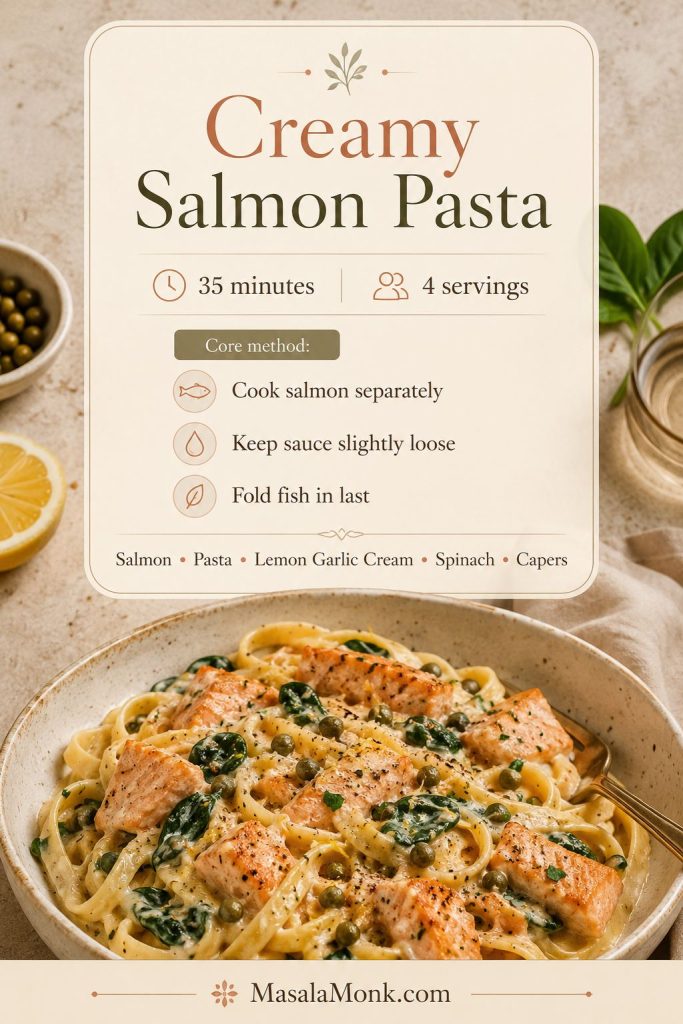
Saveable creamy salmon pasta recipe card with a bowl of salmon pasta, 35-minute time, 4 servings, and core method tips
Remember the method, not just the ingredients: cook salmon separately, keep the sauce slightly loose, and fold fish in last.

Creamy Salmon Pasta Recipe Variations

Once the base sauce makes sense, the variations are easy. Use the main recipe card as the starting point, then change the salmon or sauce direction without changing the rhythm: keep the pasta coated, warm the fish gently, and finish with something sharp, fresh, or salty enough to balance the cream.

Make It for Two

For two servings, use 8 oz / 225 g salmon, 6 oz / 170 g pasta, ½ cup / 120 ml cream, ¼ cup / 25 g Parmesan, and about ½ cup / 120 ml reserved pasta water. Keep the lemon, capers, and herbs flexible, then taste at the end.
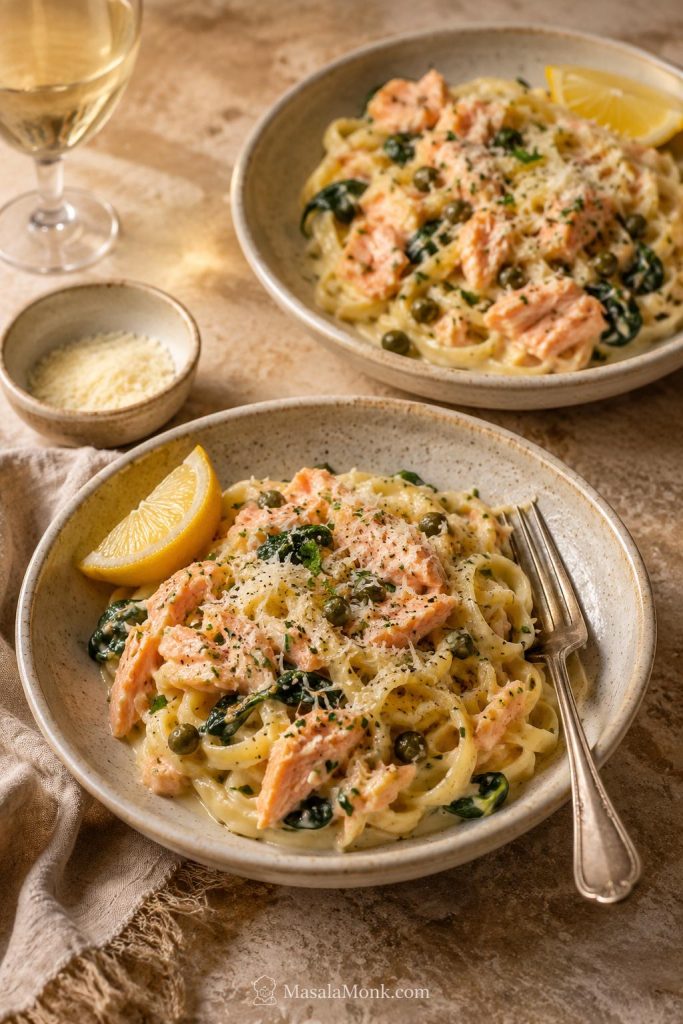
Two bowls of creamy salmon pasta with salmon, spinach, capers, lemon, Parmesan, and forks on a warm table
For two servings, scale down the pasta and salmon, then adjust lemon, herbs, and capers at the end.

Smoked Salmon Pasta

Hot-smoked salmon gives you firmer flakes, while cold-smoked salmon melts more softly into the sauce and brings a saltier, silkier finish. Add either one off heat, then lean on dill, lemon, capers, or a little cream cheese to keep the flavor fresh.
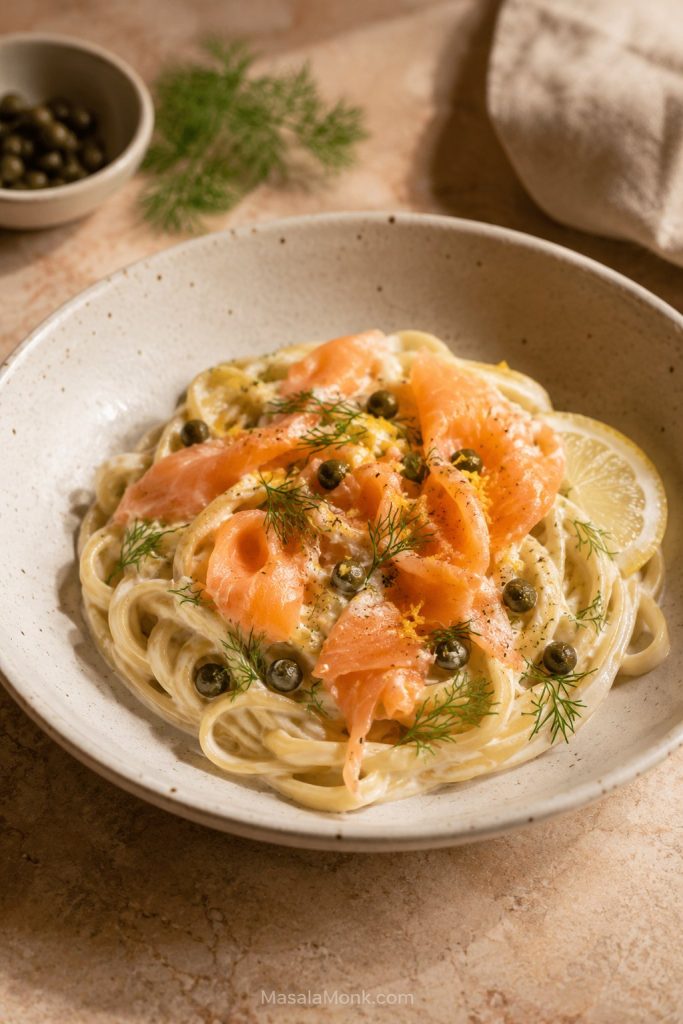
Smoked salmon pasta with creamy sauce, dill, lemon, capers, and thin salmon pieces
Smoked salmon is saltier and more delicate than roasted salmon, so add it off heat and finish with lemon and dill.

Canned Salmon Pasta

Canned salmon makes the pasta softer and more pantry-friendly. Drain it well, fold it in gently near the end, and use lemon, parsley, capers, and black pepper to keep the flavor clean and bright.
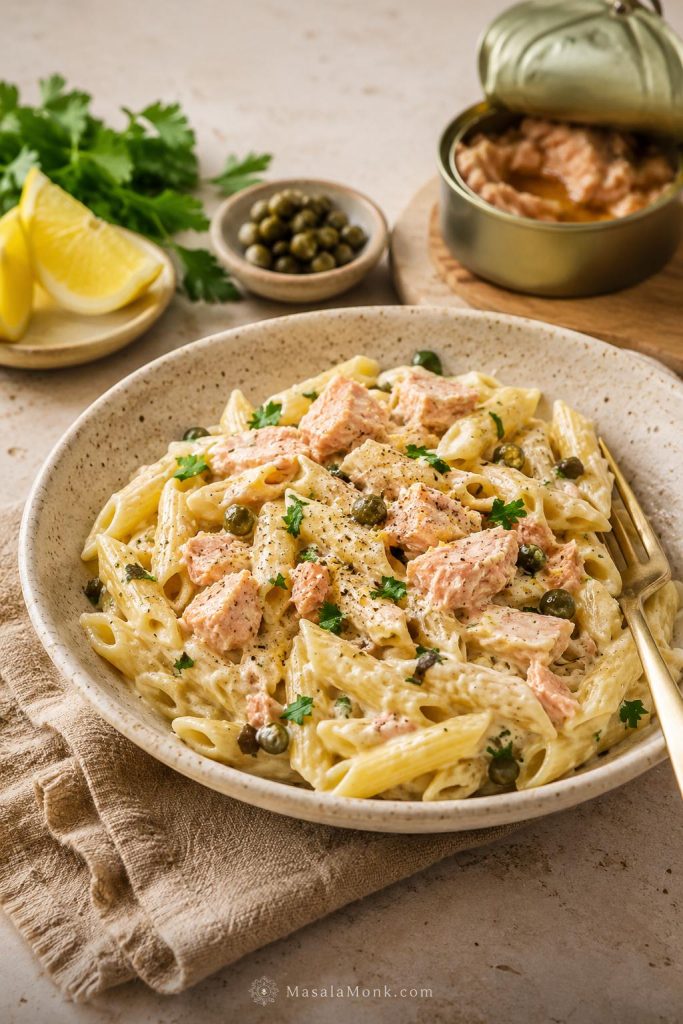
Canned salmon pasta with penne, creamy sauce, parsley, lemon, capers, and an open salmon can in the background
Canned salmon makes a practical pantry version, while lemon, parsley, capers, and pepper keep the flavor clean.

Salmon Pasta Without Cream

A lighter creamy texture can come from crème fraîche, Greek yogurt, cream cheese, or a sauce built mostly from Parmesan and pasta water. Yogurt and crème fraîche are happiest off heat or over very low heat, where they can loosen into the sauce without curdling.
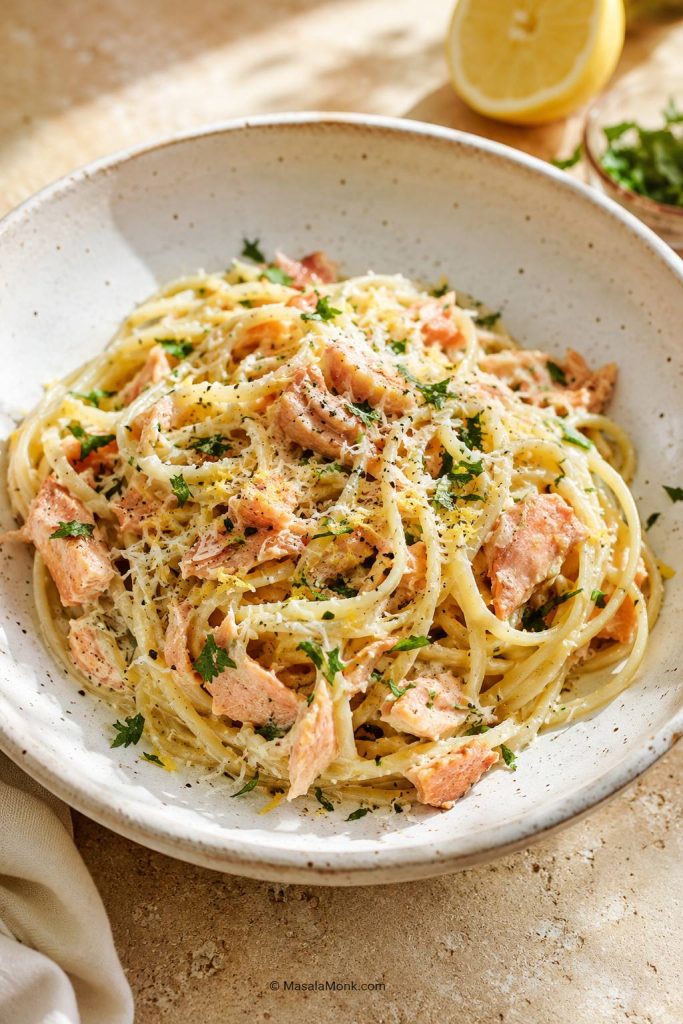
Salmon pasta without heavy cream using Parmesan, lemon, herbs, and a light sauce on spaghetti
A no-cream salmon pasta can still feel satisfying when Parmesan, pasta water, lemon, and herbs carry the sauce.

Salmon Alfredo Pasta

An Alfredo-style version leans more heavily on Parmesan and cream, with softer lemon and plenty of black pepper. For another rich pasta dinner, this chicken Alfredo pasta guide has useful sauce ideas.

Salmon Pasta Bake

A baked version needs a looser sauce from the start because the pasta keeps drinking it in the oven. Undercook the pasta by about 2 minutes, top with Parmesan or a little panko, and bake until bubbling.
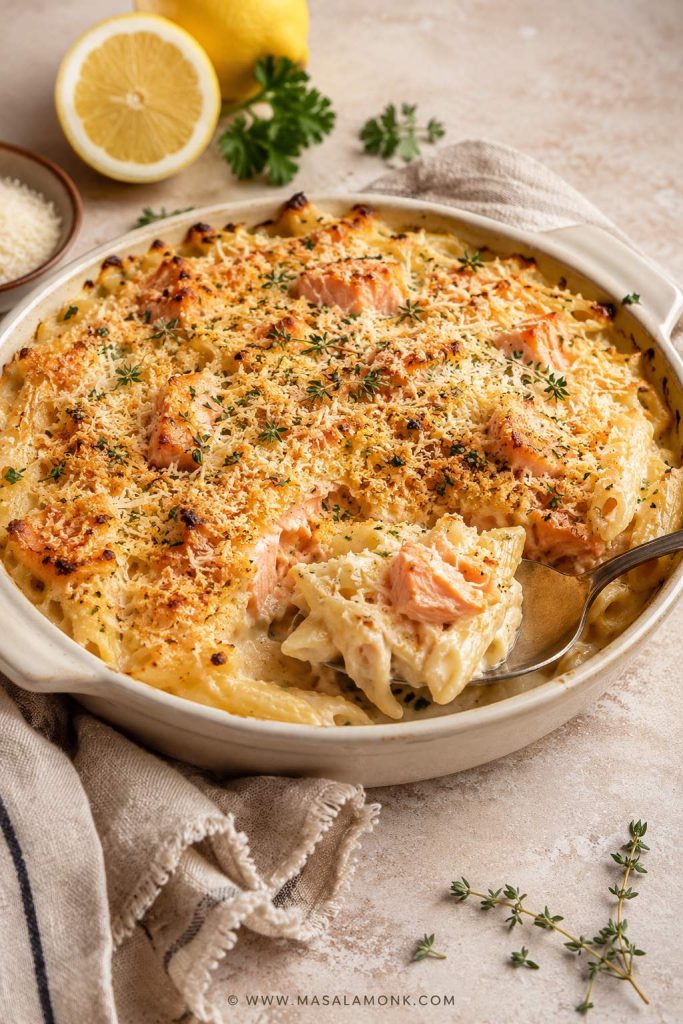
Salmon pasta bake in a cream-colored baking dish with golden Parmesan topping, herbs, and a spoonful lifted out
For a salmon pasta bake, start with a looser sauce because the pasta keeps absorbing liquid in the oven.

Salmon Pesto Pasta

Basil pesto gives salmon pasta a greener, more herbal direction. Use pesto, lemon, pasta water, and salmon flakes, then decide whether the sauce needs cream or feels bright enough without it. For homemade pesto, this pesto recipe guide has classic basil pesto plus useful variations.

Salmon Orzo

Orzo absorbs liquid quickly, so use a looser sauce and stir gently. The same lemon, garlic, cream, Parmesan, and salmon flavors work well, but the texture will be softer and more risotto-like.

Salmon Gnocchi

Gnocchi makes the dish softer and more comfort-food heavy. Keep the sauce loose, use enough lemon to balance the richness, and fold the salmon in gently so both the gnocchi and fish stay intact.

Salmon Pasta Salad

A cold salmon pasta salad needs a different base: cooked cooled pasta, flaked salmon, lemon dressing, herbs, cucumber, peas, capers, or a little yogurt-based dressing. Skip the hot cream sauce and focus on freshness.

What to Serve With Creamy Salmon Pasta

This is already a full dinner, so the best sides should make the plate feel brighter, not heavier. Think crisp salad, lemony greens, roasted vegetables, or garlic bread for the extra sauce left in the bowl.

  • Simple green salad: arugula, cucumber, lemon dressing, or a sharp vinaigrette.
  • Roasted asparagus or broccoli: both work well with lemon and Parmesan.
  • Garlic bread: cozy, useful, and great for catching extra sauce. For a homemade option, this garlic bread loaf works well beside creamy pasta.
  • Roasted cherry tomatoes: bright and juicy against the cream sauce.
  • Steamed peas: easy, sweet, and very good with salmon.
  • Lemon wedges: helpful at the table for anyone who wants a brighter plate.

Storing and Reheating Creamy Salmon Pasta

This dish is best right after tossing, while the sauce still coats the pasta easily and the salmon is warm and soft. However, leftovers can still be good if you reheat them gently so the cream stays smooth and the salmon does not dry out.
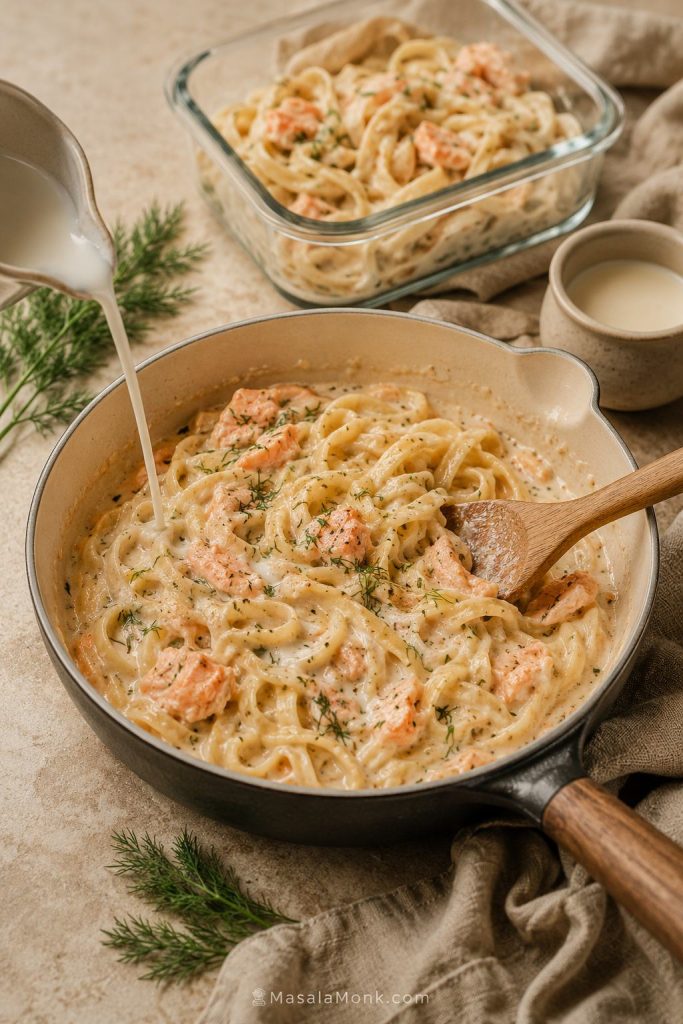
Creamy salmon pasta reheating in a skillet with a splash of liquid and leftovers in a glass storage container nearby
Reheat leftovers gently with a splash of liquid so the sauce loosens again and the salmon stays soft.

How Long Does It Keep?

Store leftovers in an airtight container in the refrigerator and use within 2 days for the best texture.

How to Reheat It

Reheat in a skillet over low heat with a splash of water, milk, cream, or broth. Stir gently until the sauce loosens. Avoid high heat, which can make the cream separate and the salmon dry.

If reheated sauce looks too thick or separated, use the same fixes in the troubleshooting section.

Microwave Method

Use short bursts at lower power and add a splash of liquid first. Stir gently between bursts. The microwave is convenient, but it can overcook salmon quickly.

Freezing

Freezing is not recommended. Cream sauces can split, pasta can soften, and salmon can become dry once thawed and reheated.

Creamy Salmon Pasta Troubleshooting: Sauce, Salmon, and Texture Fixes

If something feels off, do not panic and do not add more cream first. A thick sauce, broken sauce, dry salmon, or watery spinach does not mean dinner is ruined; it usually means one small adjustment is needed.
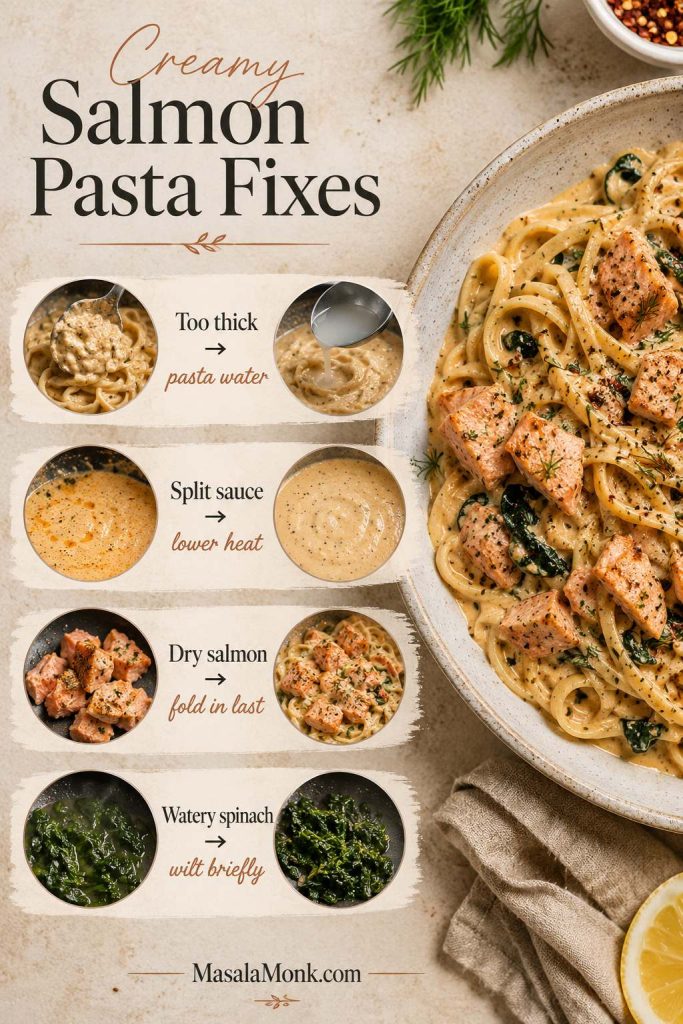
Creamy salmon pasta troubleshooting board with fixes for thick sauce, split sauce, dry salmon, and watery spinach
Most salmon pasta problems are fixable: loosen thick sauce with pasta water, lower the heat if it splits, and fold salmon in last.
Problem Why it happened Fix
Sauce is too thick The pasta absorbed more liquid than expected. Add reserved pasta water 1–2 tbsp at a time and toss until glossy.
Sauce split The heat was too high, or lemon was added while the cream was boiling hard. Lower the heat, add a splash of cream or pasta water, and stir gently. Next time, add lemon near the end.
Salmon is dry It was overcooked or stirred too much in the sauce. Cook salmon separately, rest it, and fold it in last in large pieces.
Pasta tastes bland The pasta water or sauce was under-seasoned. Salt the pasta water well and finish with Parmesan, lemon, herbs, and black pepper.
Sauce tastes too heavy Too much cream, not enough acid or herbs. Add lemon zest, lemon juice, capers, herbs, or a splash of pasta water.
Pasta tastes fishy The salmon may be old, overcooked, or not balanced with enough brightness. Use fresh salmon, avoid overcooking, and finish with lemon, herbs, capers, and black pepper.
Spinach made it watery Too much spinach was added too early, or it cooked too long. Add spinach at the end and wilt it briefly. If needed, simmer the sauce for a minute before adding salmon.

FAQs

What is the best pasta for this creamy salmon pasta recipe?

Fettuccine and linguine are best for a glossy, twirlable cream sauce. Penne and rigatoni are better for larger salmon chunks and an easier forkful.

Should salmon be cooked before adding it to pasta?

Cook the salmon first, then fold it into the pasta at the end. That gives you better control over doneness and keeps the pieces tender.

Can I pan-sear the salmon instead of roasting it?

Yes. Pat the salmon dry, season it, and sear it in a lightly oiled skillet over medium heat for 3–4 minutes per side, depending on thickness. Rest it for 5 minutes before flaking so the pieces stay moist in the pasta.

Fresh salmon or smoked salmon — which is better?

Fresh salmon is better for this creamy dinner-style pasta. Smoked salmon is better for a faster, saltier version. Add smoked salmon off heat so it stays delicate.

How do you stop cream sauce from splitting?

Use gentle heat once the cream is added, stir Parmesan in gradually, and add lemon juice near the end instead of boiling it hard with the cream. Reserved pasta water also helps smooth the sauce.

Why did my salmon pasta turn dry?

The salmon may have been overcooked, the pasta may have absorbed too much sauce, or the dish may have sat too long before serving. Fold salmon in last and keep extra pasta water nearby to loosen the sauce.

What temperature should salmon be cooked to?

For food safety, fish should reach 145°F / 63°C, or be opaque and separate easily with a fork. A thermometer is the most reliable way to check.

How much pasta water should I save?

Save 1 cup / 240 ml. You may only need ¼–½ cup, but it is better to have extra because the sauce thickens as the pasta sits.

What vegetables go well with salmon pasta?

Spinach is the easiest. Peas, asparagus, broccoli, cherry tomatoes, mushrooms, and zucchini also work. Add quick-cooking vegetables near the end and pre-cook firmer vegetables so they do not water down the sauce.

Is crème fraîche better than heavy cream?

Crème fraîche gives a tangier, slightly lighter sauce. Heavy cream is easier to find and gives the most classic creamy texture. Both work.

What is the best way to reheat leftovers?

Reheat leftovers gently in a skillet over low heat with a splash of water, milk, cream, or broth. Stir slowly until the sauce loosens. Avoid high heat because it can dry out the salmon and split the sauce.

Does this creamy salmon pasta recipe freeze well?

Not really. The cream sauce can split, the pasta can become soft, and the salmon can dry out after thawing. Refrigerating leftovers for a day or two is a better choice.

How do I make this creamy salmon pasta recipe without wine?

Use low-sodium chicken broth, vegetable broth, seafood stock, or even a splash of pasta water instead. Then add a little extra lemon at the end if the sauce needs brightness.

Once you understand the rhythm — cook the salmon gently, save pasta water, keep the cream sauce calm, and fold the fish in last — this creamy salmon pasta recipe becomes the kind of dinner you can adjust without stress. Fresh salmon makes it feel cozy and polished, smoked salmon makes it faster, and extra lemon or herbs can pull the whole bowl in a brighter direction.

That is the real win here: not just a rich pasta, but a plate that still tastes cared for at the last forkful.

Did you make it with fresh salmon, smoked salmon, canned salmon, or leftovers? Tell us which version you tried — and what you adjusted at the end. Extra lemon, more capers, dill, spinach, Parmesan, or black pepper all change the personality of the bowl.

Back to top

Posted on 1 Comment

Salmon Croquettes Recipe with Canned Salmon

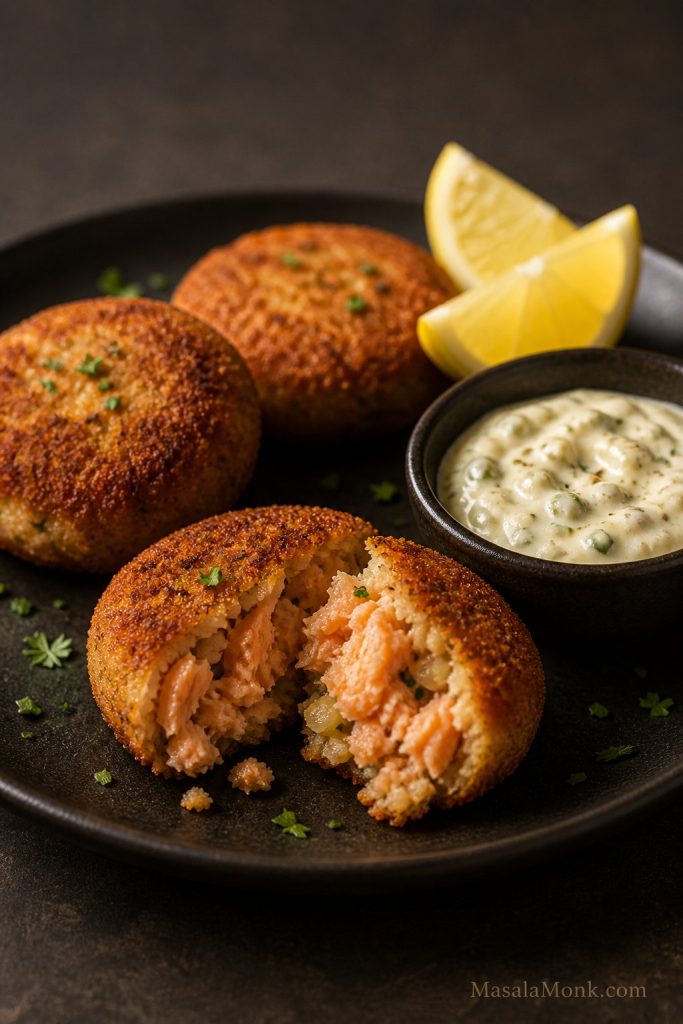
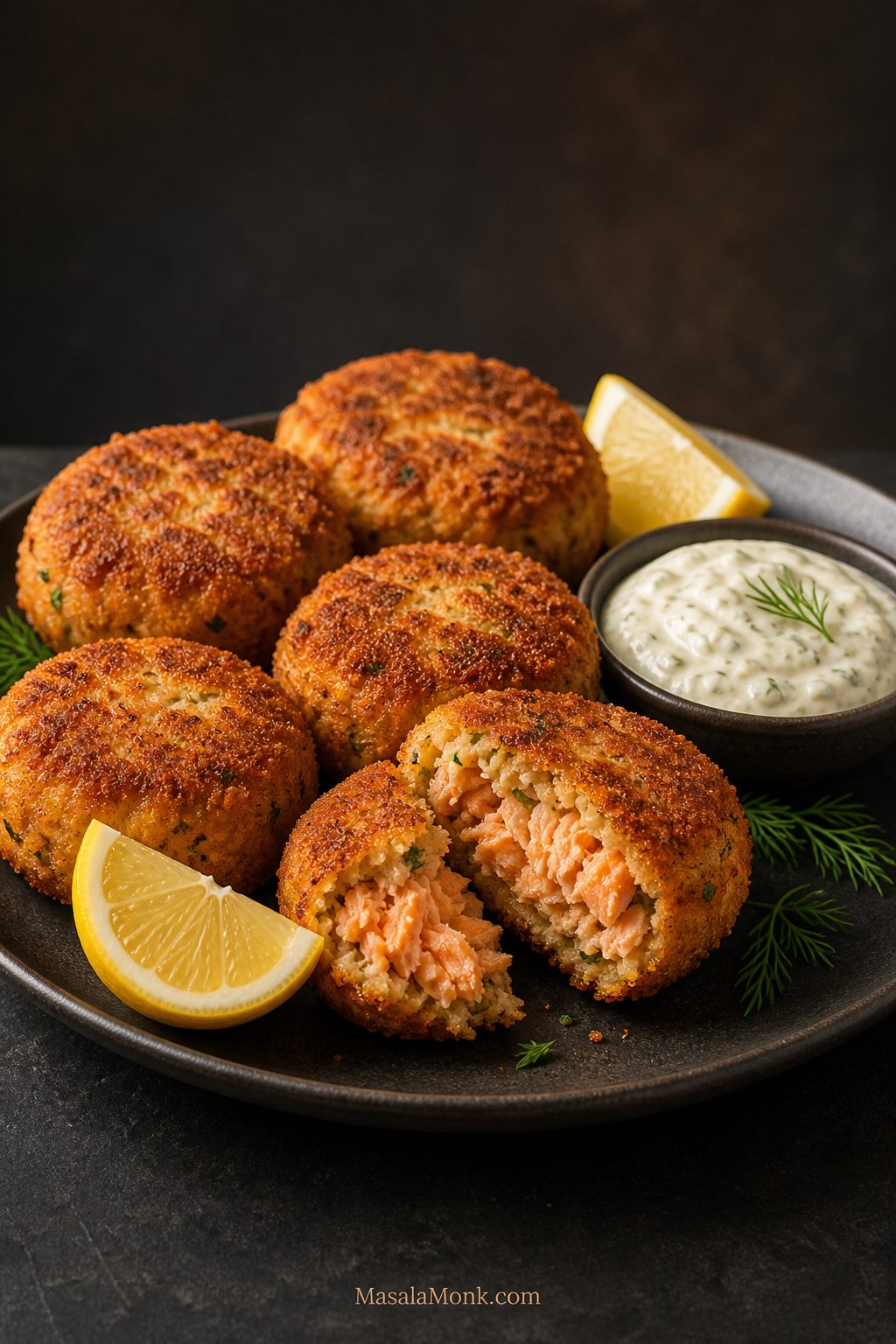
Crispy salmon croquettes on a dark plate with lemon wedges, dipping sauce, herbs, and one croquette broken open

This salmon croquettes recipe gives you crisp, golden patties with a tender, flaky center using canned salmon, egg, cornmeal, flour, onion, bell pepper, lemon, and simple pantry seasoning. The main version is pan-fried and Southern-style, with baked salmon croquettes, air fryer salmon croquettes, and a fresh salmon option included below.

Most importantly, this recipe is built to work on the first try, even if salmon croquettes or salmon patties have fallen apart on you before. You will learn how to drain and bind the salmon, how thick to shape the patties, when to use cornmeal versus panko or crackers, what sauce to serve with them, and how to fix common problems like patties falling apart, turning mushy, or tasting dry.

What Salmon Croquettes Should Look Like

Close-up of a salmon croquette split open to show a crisp crust and flaky salmon filling
A good croquette should not be pasty inside. Instead, the crust should crack slightly while the center stays moist, flaky, and easy to break with a fork.

Quick Answer: How to Make Salmon Croquettes

This salmon croquettes recipe starts with well-drained canned salmon, egg, mayonnaise, cornmeal, flour, onion, bell pepper, Worcestershire sauce, lemon juice, and seasonings. Shape the mixture into ¼-cup patties, then pan-fry them in hot oil for 3–4 minutes per side until crisp and golden.

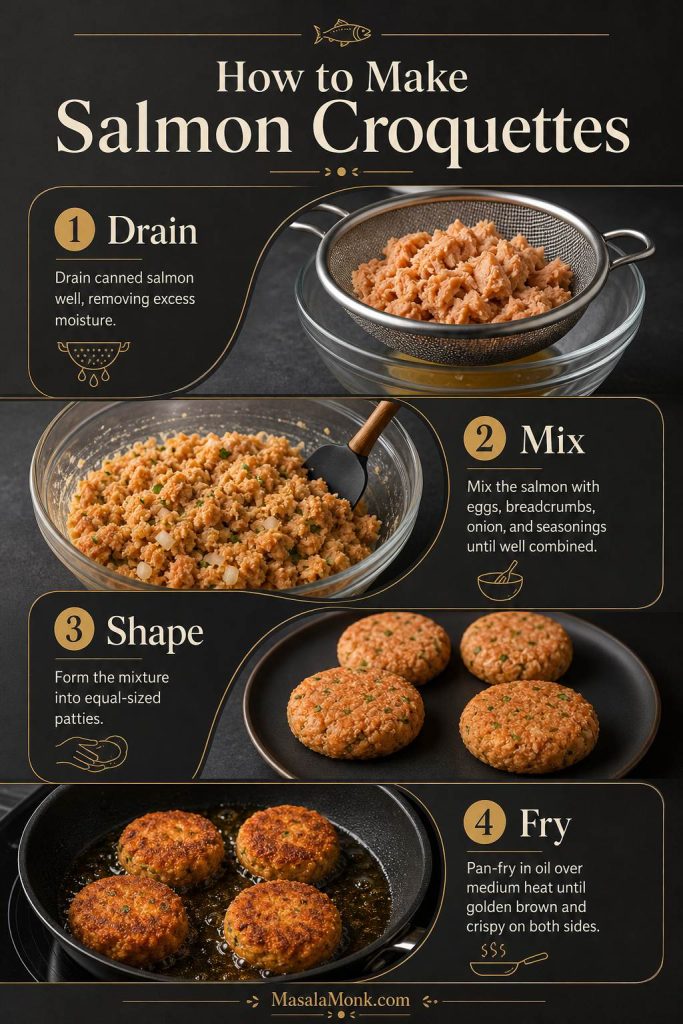
Quick Visual Guide to Salmon Croquettes

Four-step visual guide showing salmon being drained, binder being mixed, patties being shaped, and croquettes being fried
The fastest way to understand this salmon croquettes recipe is to follow the sequence: drain the salmon, mix the binder, shape evenly, and fry only once the pan is hot enough.

At a Glance

Detail Best answer
Yield 8 medium croquettes
Main salmon Canned pink salmon for the classic version
Best binder Egg, mayo, cornmeal, and flour
Best method Pan-fried in a cast iron skillet or heavy skillet
Oil temperature About 350°F / 175°C
Cook time 3–4 minutes per side
Total time 25–45 minutes, depending on whether you chill the patties
Patty size ¼ cup mixture each, about ½–⅔ inch thick
Best sauces Tartar sauce, lemon dill mayo, remoulade, green chutney mayo, tzatziki, or mango mustard
Make-ahead tip Chill shaped patties 10–20 minutes if the mixture feels soft

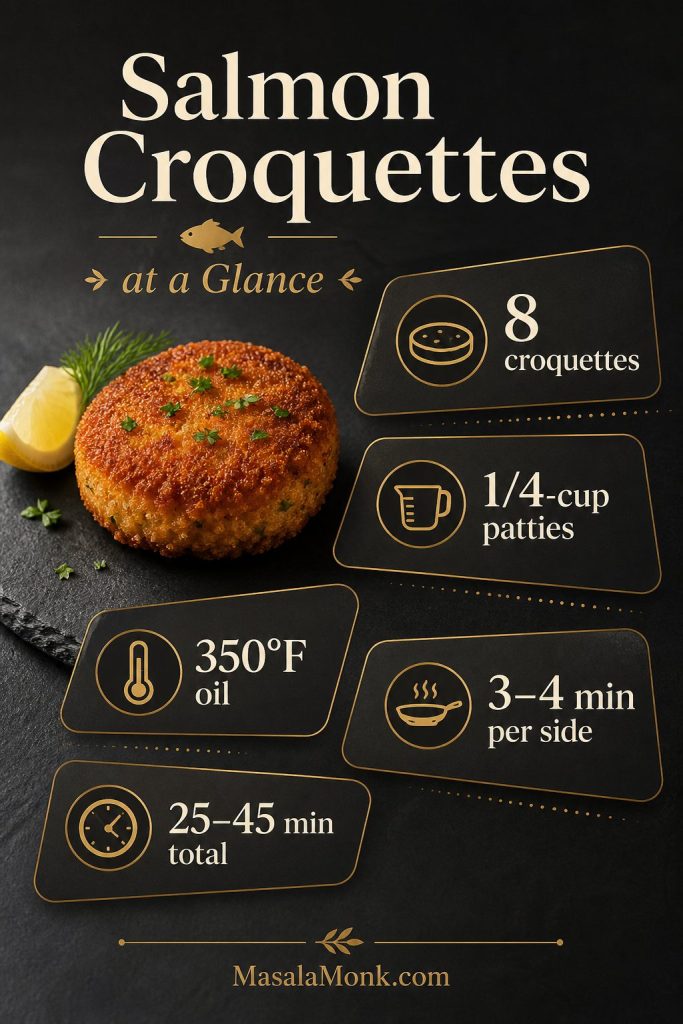
Salmon Croquettes at a Glance

At-a-glance guide for salmon croquettes showing yield, patty size, oil temperature, cook time, and total time
These quick numbers make the salmon croquettes recipe easier to repeat successfully. Once the patties stay near ¼ cup and the oil stays around 350°F, the crust browns evenly while the center stays moist.

Ready to cook? Jump to the recipe card or see the step-by-step method.

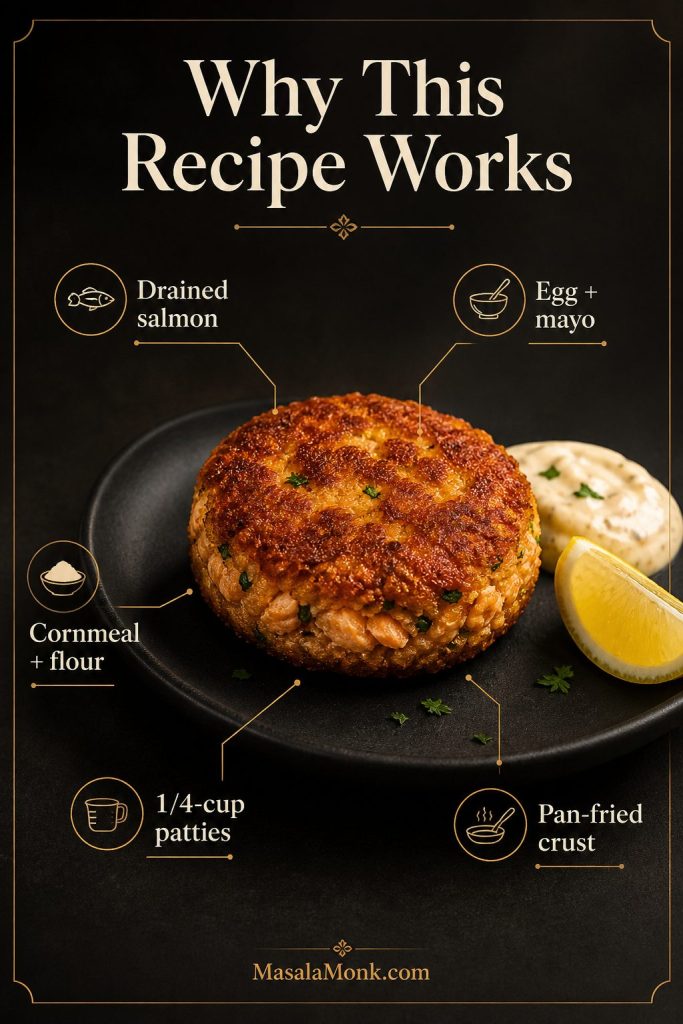
Why This Salmon Croquettes Recipe Works

  • Draining the salmon first prevents mushy patties. Too much liquid is one of the biggest reasons croquettes fall apart.
  • Egg, mayo, cornmeal, and flour give balanced structure. The egg binds, the mayo keeps the center tender, the cornmeal adds crispness, and the flour helps the mixture hold together.
  • ¼-cup patties cook evenly. This size gives you crisp edges without drying out the center.
  • Pan-frying gives the best crust. Baked and air fryer versions work, but the skillet method gives the most classic Southern-style texture.
  • The troubleshooting guide fixes common failures. If the mixture is wet, bland, dry, greasy, or falling apart, there is a direct fix below.

Why This Recipe Works Visually

Visual guide showing drained salmon, egg, mayonnaise, cornmeal, flour, patty size, and pan-fried crust for salmon croquettes
These salmon croquettes hold together because the moisture is controlled first, and then the binder is balanced. As a result, the patties stay crisp outside while still breaking apart in tender flakes.

What Are Salmon Croquettes?

Salmon croquettes are crisp, shaped patties made from flaked salmon, egg, dry binder, aromatics, and seasoning. In many Southern-style versions, they are made with canned salmon, cornmeal or flour, onion, bell pepper, egg, and a hot skillet. They are inexpensive, fast, and deeply satisfying when the outside is crisp and the inside stays tender.

The basic logic is the same as a good croquettes master method: control moisture, bind the filling, shape it evenly, and cook until the outside sets before you flip.

Salmon Croquettes vs Salmon Patties vs Salmon Cakes

These names overlap, and many people use them interchangeably. Still, there are a few useful differences.

Term Usually means How to think about it
Salmon croquettes Often Southern-style, made with canned salmon, binder, and a crisp fried crust. This is the main recipe here.
Salmon patties A broader term for flatter salmon cakes or patties, usually made with canned or leftover cooked salmon. Same family, slightly less specific.
Salmon cakes Often a little more restaurant-style, sometimes made with fresh salmon, panko, herbs, Dijon, or mayo. Use the fresh salmon variation below if you want this style.
Comparison of salmon croquettes, salmon patties, and salmon cakes arranged as three different plated examples
The names overlap, but the texture is the real clue. Croquettes usually lean crisp-edged and Southern-style, patties are often flatter and simpler, while salmon cakes tend to feel more polished.

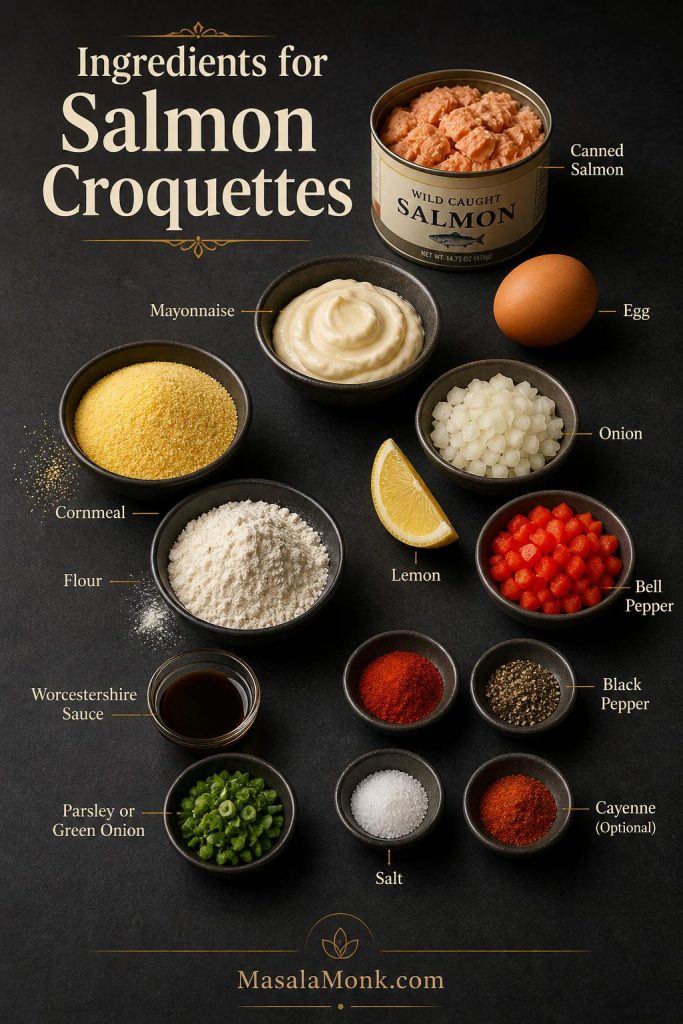
Ingredients for Salmon Croquettes

A good salmon croquettes recipe is simple, but balance still matters. Too much wet binder makes the mixture mushy; meanwhile, too much flour or cornmeal can make the patties dry. This version uses canned salmon, egg, mayo, cornmeal, and flour so the croquettes hold together while the center stays flaky.

Visual Guide to Salmon Croquettes Ingredients

Ingredients for salmon croquettes including canned salmon, egg, mayonnaise, cornmeal, flour, onion, bell pepper, lemon, Worcestershire sauce, herbs, and spices
The ingredient list is simple, but balance matters. Canned salmon gives the base, while egg, mayo, cornmeal, and flour help the croquettes stay moist without falling apart.

Salmon

For classic salmon croquettes, use one standard can of pink salmon, usually 14.75–15 ounces / 418–425 grams. Drain off excess liquid, but do not squeeze the salmon completely dry. It should be moist enough to flake, not watery. You can remove the larger bones and skin if you prefer, although many canned salmon recipes leave the small soft bones in because they mash easily and add calcium.

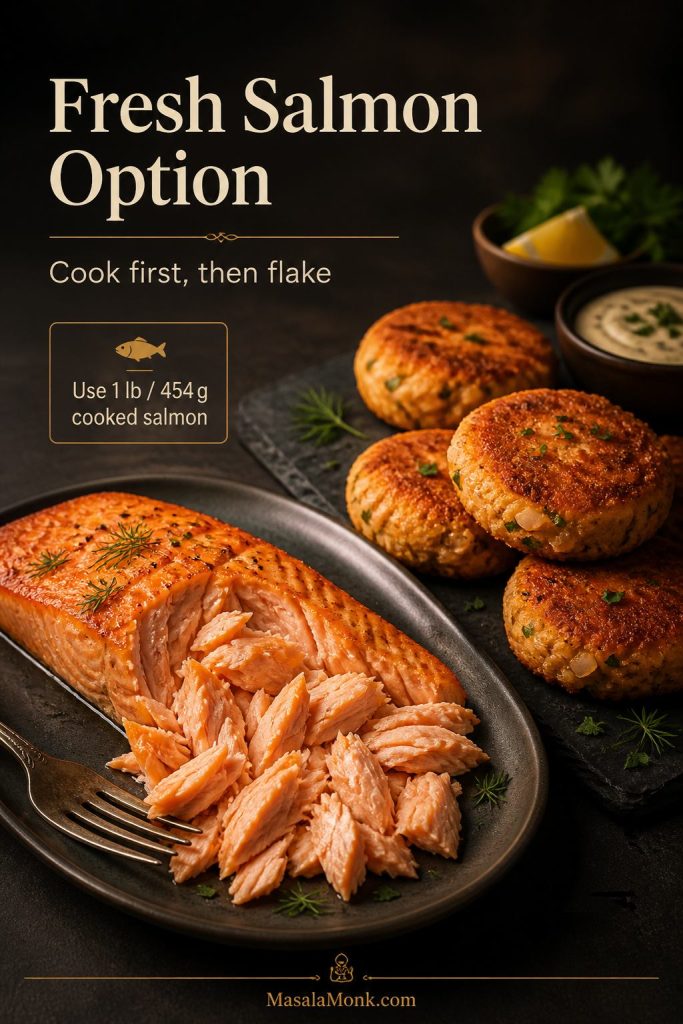
Fresh cooked salmon also works. Use about 1 pound / 454 grams raw salmon, cook it first, cool it slightly, then flake it into the mixture. Leftover cooked salmon is even easier because it is already cooked and ready to flake.

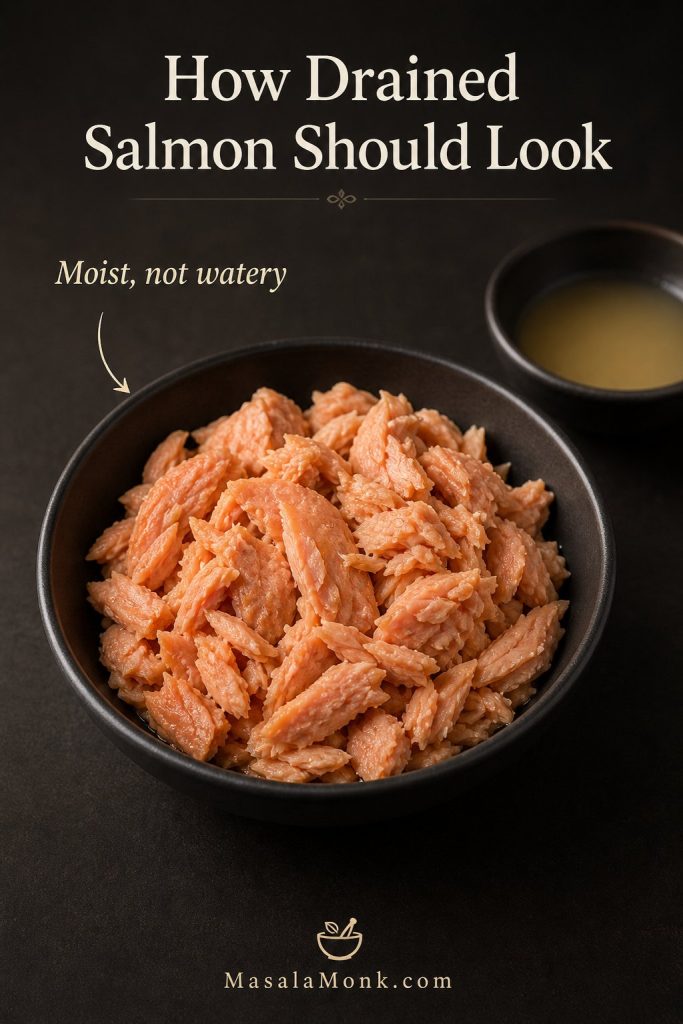
How Drained Salmon Should Look

Drained canned salmon flakes in a bowl with excess liquid shown separately
The salmon should be moist, not watery. Draining off excess liquid prevents mushy croquettes; however, keeping a little moisture helps the center stay tender.

Egg, Mayo, Cornmeal, and Flour

The egg gives structure. Mayo adds moisture and helps keep the center from drying out. Cornmeal adds a crisp, old-fashioned Southern texture. Flour helps the mixture bind without making the croquettes too crumbly.

Mayo also gives you an easy sauce base. If you like homemade condiments, use homemade mayo to make lemon dill mayo, garlic mayo, spicy mayo, tartar sauce, or a quick remoulade-style dip for serving.

Onion, Bell Pepper, Herbs, and Seasoning

Finely diced onion and bell pepper give the croquettes sweetness and texture. Green onion or parsley adds freshness. Worcestershire sauce gives a savory backbone, lemon juice brightens the salmon, and paprika, garlic powder, black pepper, and a little cayenne or hot sauce round out the flavor.

For a seafood-style flavor, add ½ teaspoon Old Bay-style seafood seasoning, Cajun seasoning, or Creole seasoning and reduce the added salt if the blend is already salty.

Texture tip: Dice the onion and bell pepper small. Large pieces can make the patties crack or break apart when you flip them.


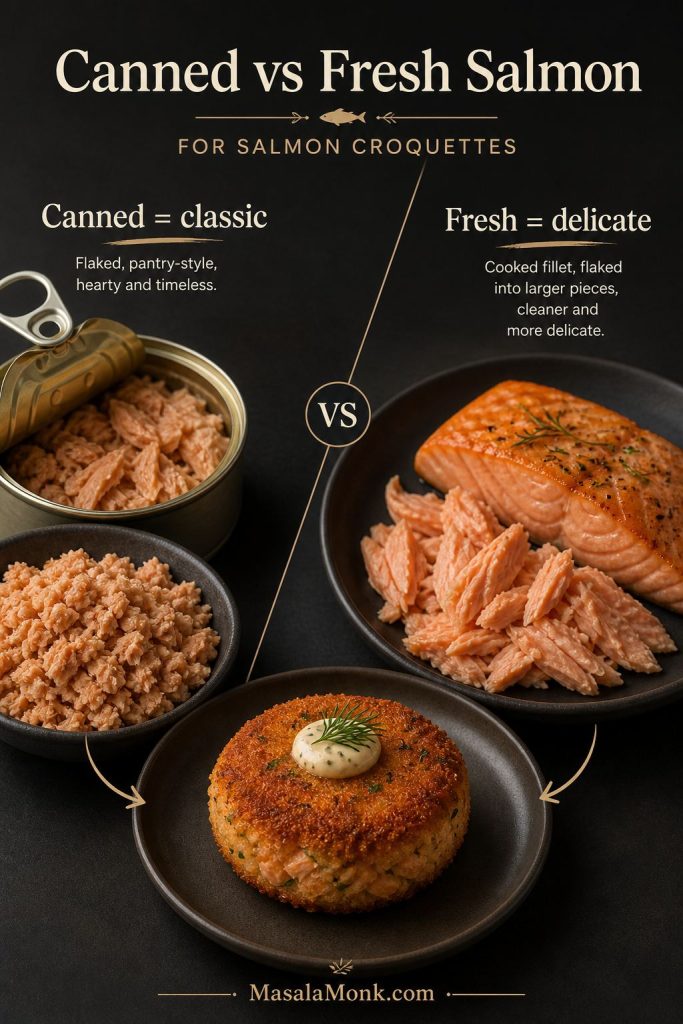
Canned Salmon vs Fresh Salmon for Croquettes

Canned salmon is the best first choice for classic salmon croquettes because it is already cooked, affordable, easy to flake, and traditional in many old-fashioned and Southern-style recipes. Fresh salmon, meanwhile, gives a cleaner flavor and a softer, more delicate texture, but it needs to be cooked before you mix the croquettes.

Canned vs Fresh Salmon at a Glance

Canned salmon and cooked fresh salmon shown side by side for making salmon croquettes
For a classic pantry-style batch, use canned salmon; meanwhile, cooked fresh salmon gives you a cleaner, more delicate croquette when you want a softer salmon cake texture.

Canned Salmon Croquettes

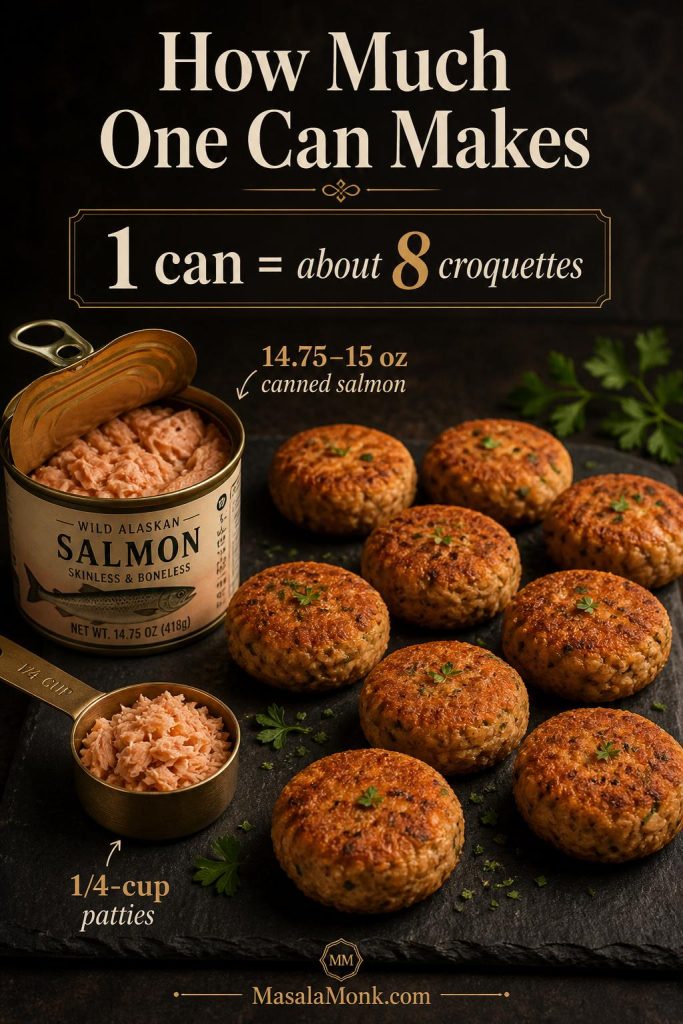
For classic croquettes, canned salmon is the easiest and most traditional choice. Drain it very well, flake it gently, and use one 14.75–15 ounce / 418–425 gram can for about 8 croquettes. In this recipe, canned pink salmon gives a milder, budget-friendly patty, while canned red salmon tastes richer. Remove large pieces of skin or bone if you prefer a smoother texture.

How Much One Can of Salmon Makes

Open can of salmon with a quarter-cup scoop and about eight salmon croquettes on a dark surface
One standard can of salmon makes about eight medium croquettes, so the recipe is easy to scale for dinner or meal prep. If you keep the patties the same size, they also cook more evenly in the skillet.

Once your salmon is drained and flaked, jump to the step-by-step method.

Salmon type Best for How to use it
Canned pink salmon Classic salmon croquettes, Southern salmon croquettes, quick dinners Drain off excess liquid, flake with a fork, and remove large bones or skin if desired. The salmon should be moist, not watery.
Canned red salmon A richer canned salmon version Use the same amount as pink salmon, but reduce added salt if the can tastes salty.
Fresh salmon Fresh salmon croquettes or salmon cakes Cook first, cool slightly, then flake into the binder.
Leftover cooked salmon Fastest fresh-style version Flake gently and reduce salt if the salmon was already seasoned.

If you have extra cooked salmon after dinner, use some for croquettes and turn the rest into a salmon bowl with rice, cucumber, sauce, avocado, herbs, and crunchy toppings.

How to Make Fresh Salmon Croquettes

To use fresh salmon, start with about 1 pound / 454 grams of salmon fillet. Cook it until just done, cool it slightly, then flake it into large pieces before mixing. For food safety, fresh fish should reach 145°F / 63°C, or the flesh should be opaque and separate easily with a fork, according to FoodSafety.gov.

When buying fresh salmon, the FDA’s seafood safety guidance recommends choosing fish that smells fresh and mild, not fishy, sour, or ammonia-like. Fresh fillets should look firm, not dried or discolored around the edges.

How to Use Fresh Salmon Instead

Cooked fresh salmon fillet flaked into pieces with salmon croquettes nearby
Fresh salmon can make excellent salmon croquettes, although the texture is usually cleaner and more delicate than the canned version. For that reason, cook it first, cool it slightly, and then flake it gently before mixing.
Fresh salmon adjustment: Because fresh salmon is usually less salty than canned salmon, taste the mixture before shaping and add a little extra salt, lemon, or Worcestershire if needed.

How to Make Salmon Croquettes Step by Step

This method keeps the salmon flaky and the croquettes sturdy, which is the main thing a good recipe needs to get right. Drain well, mix the wet binder first, fold gently, shape evenly, and avoid flipping until the first side has formed a crust.

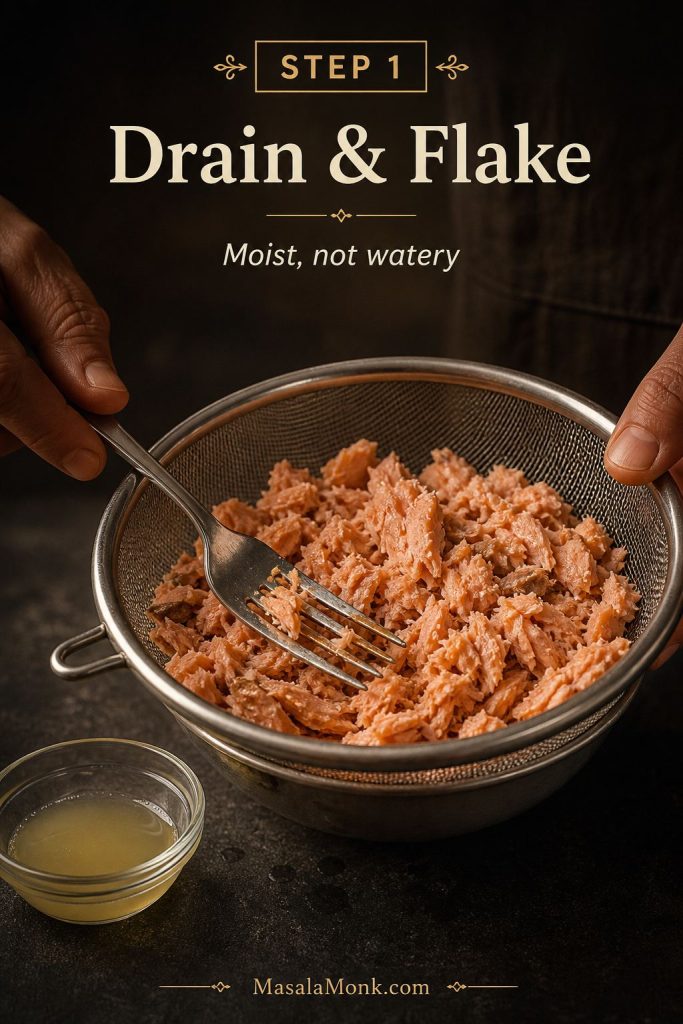
Step 1: Drain and Flake the Salmon

Drain the canned salmon thoroughly. Press out extra liquid if needed, then flake it with a fork. Do not mash it into a paste. A little texture gives the croquettes a better center.

Canned salmon being flaked with a fork in a strainer after draining
Start by draining and flaking the salmon gently. This step removes extra liquid, but it also keeps enough texture so the croquettes do not turn into a paste.

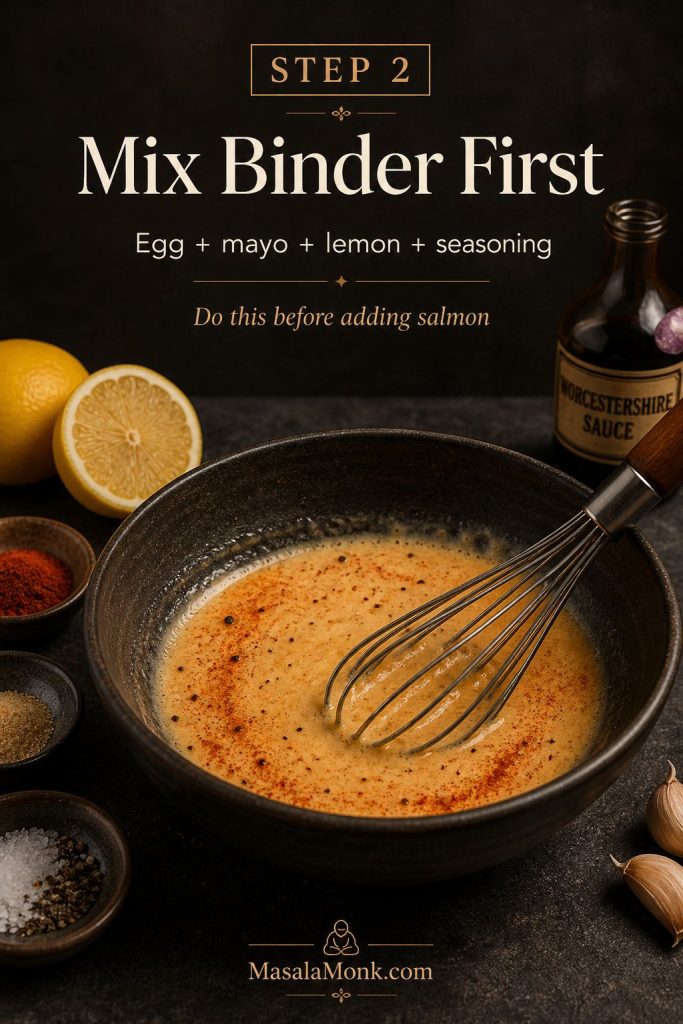
Step 2: Mix the Wet Binder First

In a large bowl, whisk the egg, mayonnaise, Worcestershire sauce, lemon juice, garlic powder, paprika, black pepper, salt, and cayenne or hot sauce if using. Mixing the wet ingredients first helps the seasoning spread evenly.

Egg, mayonnaise, lemon juice, Worcestershire sauce, and seasonings being whisked together in a bowl
Mixing the wet binder first spreads the seasoning evenly. As a result, you can fold in the salmon gently later instead of overworking the mixture.

Step 3: Fold in Salmon, Vegetables, Cornmeal, and Flour

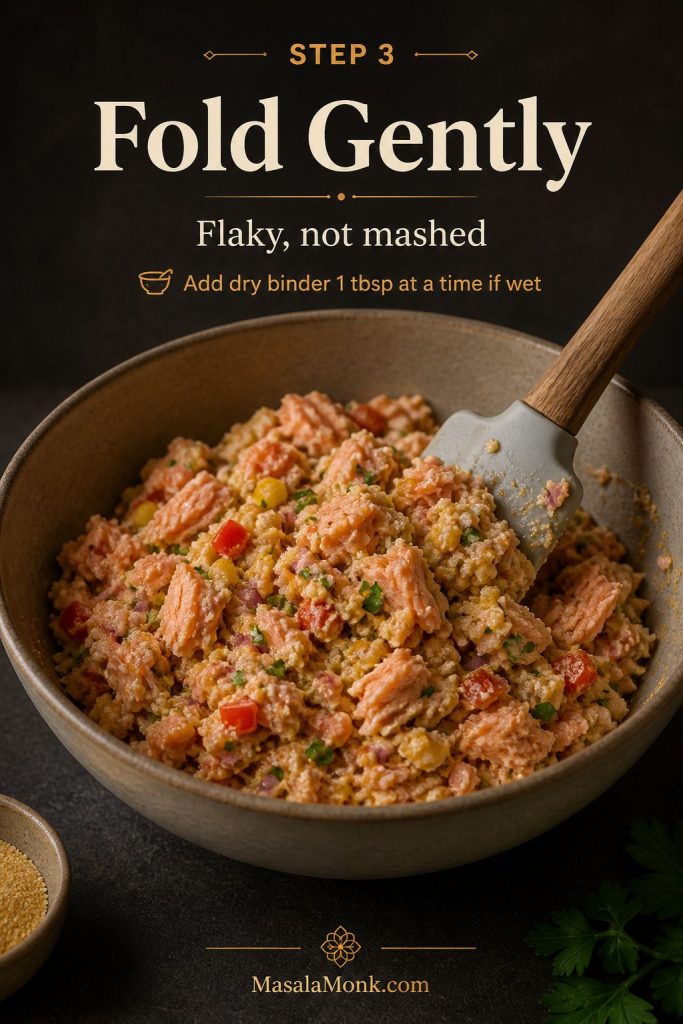
Add the flaked salmon, onion, bell pepper, green onion or parsley, cornmeal, and flour. Fold gently until the mixture holds together when pressed. If it feels very wet, add another tablespoon of cornmeal, flour, panko, or crushed crackers.

Salmon croquette mixture with salmon flakes, onion, bell pepper, cornmeal, flour, and herbs being folded with a spatula
Fold the mixture just until it holds together. You should still see salmon flakes, small vegetables, and binder throughout rather than a smooth mashed filling.

Step 4: Shape Into ¼-Cup Patties

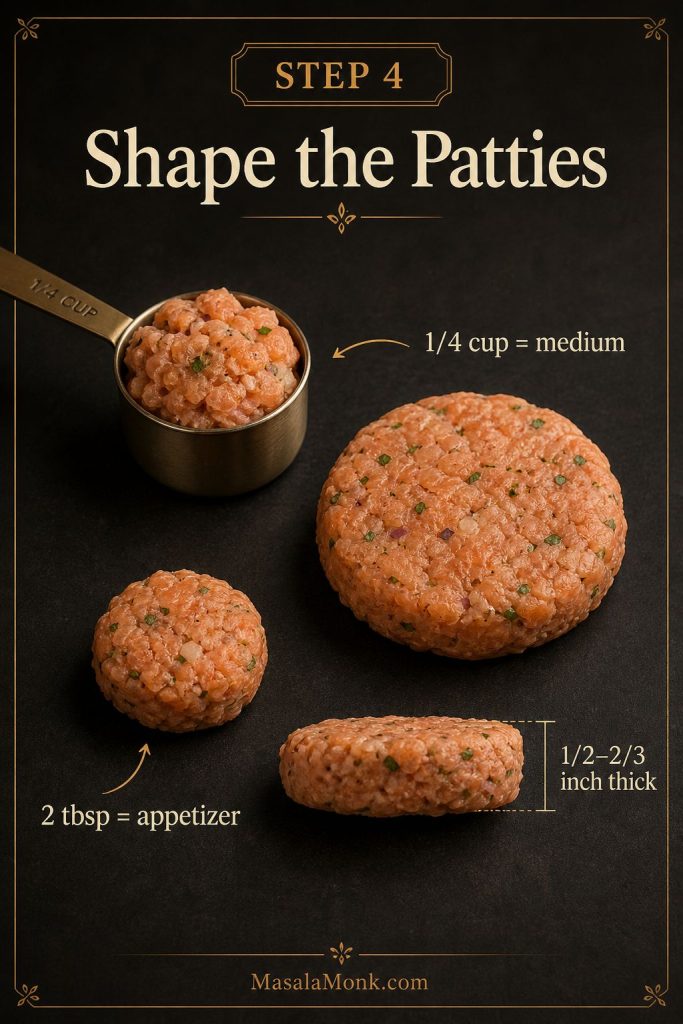
Scoop about ¼ cup of mixture for each croquette. Shape into patties about ½–⅔ inch thick. Do not pack them too tightly; press just enough so they hold together.

Appetizer size: For smaller salmon croquettes, use 2 tablespoons of mixture per patty and cook slightly less, about 2–3 minutes per side.
Quarter-cup scoop, medium salmon croquette patty, smaller appetizer patty, and thickness guide
Even sizing helps the croquettes cook at the same speed. Use ¼ cup for dinner-size patties or 2 tablespoons for smaller appetizer croquettes.

Step 5: Chill if the Mixture Feels Soft

If the croquettes feel delicate, chill them for 10–20 minutes. Chilling firms the binder and makes them easier to flip. This is especially useful if your salmon was very moist or if you used fresh salmon.

Shaped uncooked salmon croquettes resting on a parchment-lined tray before frying
If the patties feel soft, chill them before cooking. This short rest firms the binder and makes the salmon croquettes easier to move without cracking.

Step 6: Pan-Fry Until Crisp

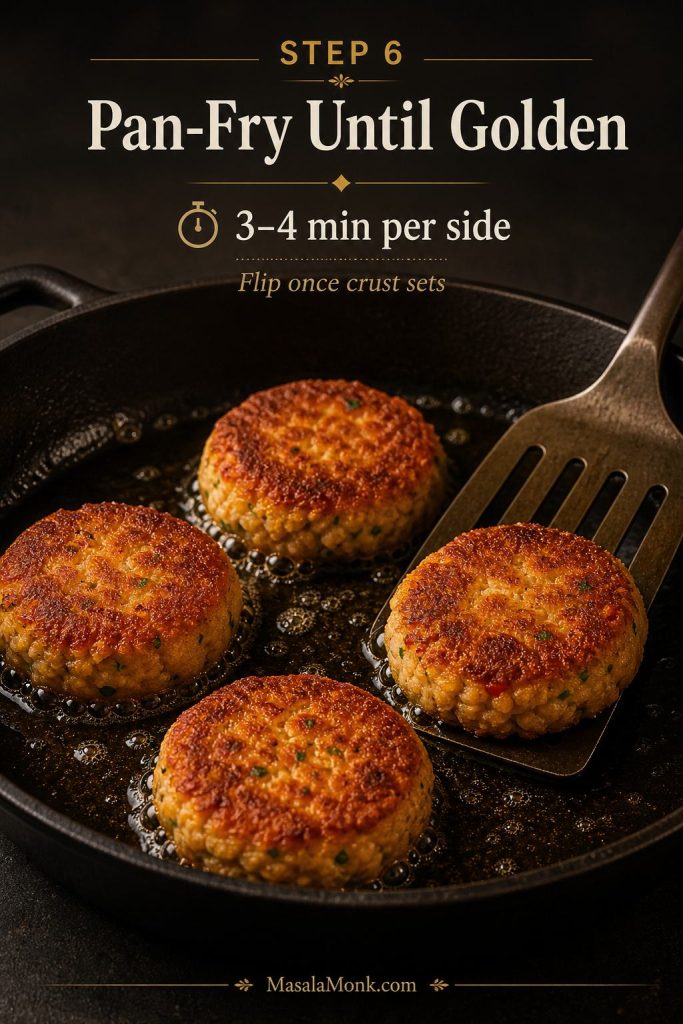
Heat neutral oil in a cast iron skillet or heavy-bottom skillet until it reaches about 350°F / 175°C, or until a small crumb sizzles steadily when dropped in. Fry the croquettes for 3–4 minutes per side, flipping once, until deeply golden and crisp. Drain on a wire rack or paper-towel-lined plate.

Salmon croquettes frying in shallow oil in a skillet until golden brown
Pan-fry the croquettes until the first side is golden and set. Once that crust forms, the patties are much easier to flip cleanly.

Pan-Fried Salmon Croquettes

Pan-frying is the best default method because it gives salmon croquettes the crispest crust and the most classic texture. Use a 10-inch cast iron skillet or heavy-bottom skillet, and fry in batches so the oil temperature does not drop too much.

Because the salmon is already cooked when you use canned salmon, the real goal is to set the croquettes, crisp the crust, and heat the center without drying them out.

You do not need to deep-fry them. A shallow layer of oil is enough. For 8 croquettes, start with about ¼ cup / 60 ml oil and add a little more if the pan looks dry. For a more old-fashioned Southern fry, use closer to ½ cup / 120 ml.

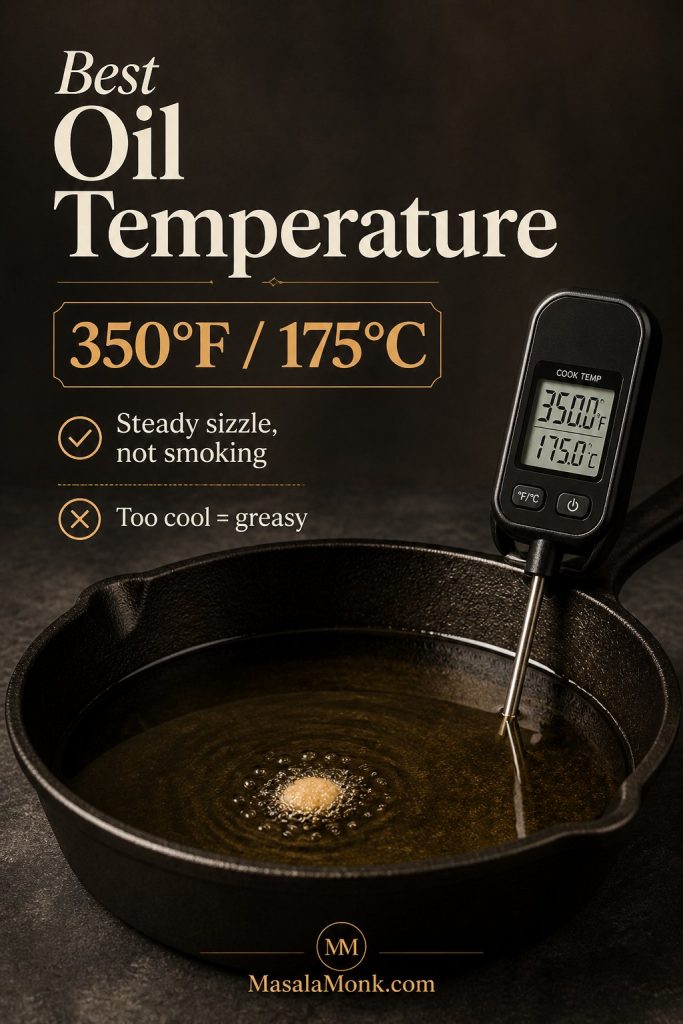
Use a neutral frying oil such as canola, vegetable, avocado, or peanut oil. The oil should shimmer, and a small crumb should sizzle steadily when dropped in. Croquettes that brown too fast need slightly lower heat. Croquettes that absorb oil and taste greasy usually need hotter oil or fewer patties in the pan.

Best Oil Temperature for Salmon Croquettes

Frying thermometer in shallow oil at 350 degrees Fahrenheit with a small crumb sizzling in a cast iron skillet
Oil temperature matters because cool oil makes croquettes greasy, while overheated oil browns the crust too fast. Aim for a steady sizzle around 350°F.

The croquettes are done when the outside is deeply golden, the center feels hot, and the patties feel set when lifted with a spatula.

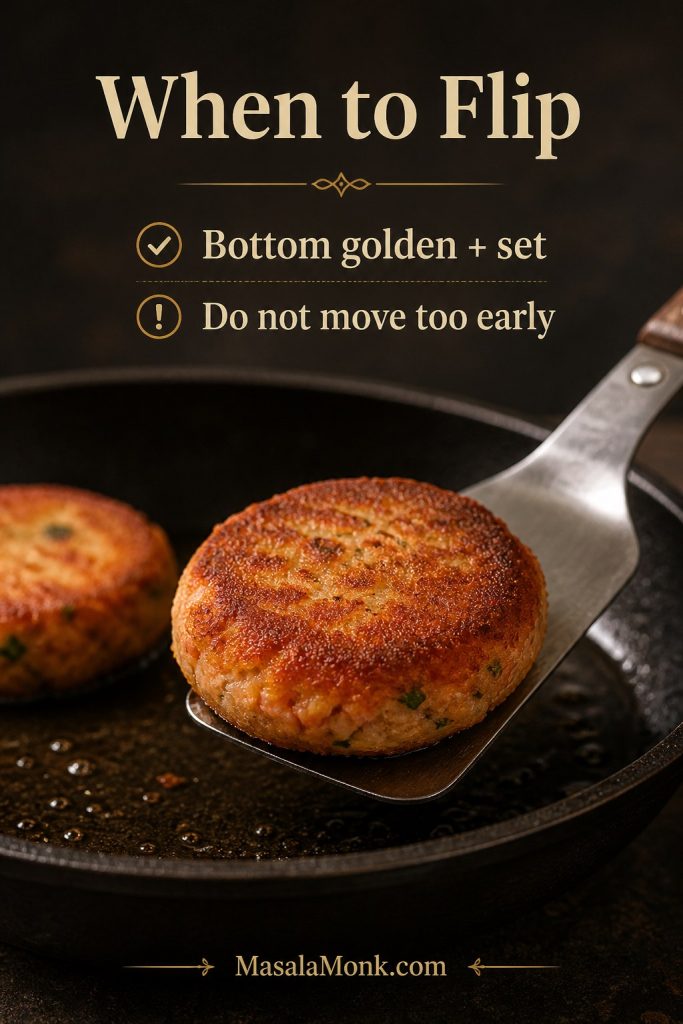
Do not flip too early. If the first side has not formed a crust, the croquette may tear. Let it cook until the edges look set and the bottom is golden.

When to Flip Salmon Croquettes

Salmon croquette lifted on a spatula to show a golden, set underside in a skillet
Flip only when the underside is golden and firm. Otherwise, the crust may tear before it has enough structure to hold the patty together.

Southern Salmon Croquettes

Southern salmon croquettes usually start with canned pink salmon, onion, bell pepper, egg, cornmeal, flour, and a hot skillet. The texture is crisp-edged and old-fashioned, with a savory salmon center and a little sweetness from the vegetables.

For a stronger Southern-style version, keep the cornmeal and flour combination in the recipe card, add a pinch of cayenne or a few dashes of hot sauce, and serve the croquettes with remoulade, lemon dill mayo, green chutney mayo, or hot sauce.

Extra cornmeal on the outside creates a rougher, crunchier crust. For a softer patty, skip the extra coating and let the flour do more of the binding.

Southern Salmon Croquettes Texture Cue

Southern-style salmon croquettes with a cornmeal crust served with sauce, lemon, herbs, and one croquette broken open
Southern salmon croquettes lean into canned salmon, cornmeal, and skillet frying. That combination gives them a crisp old-fashioned crust and a tender, savory center.

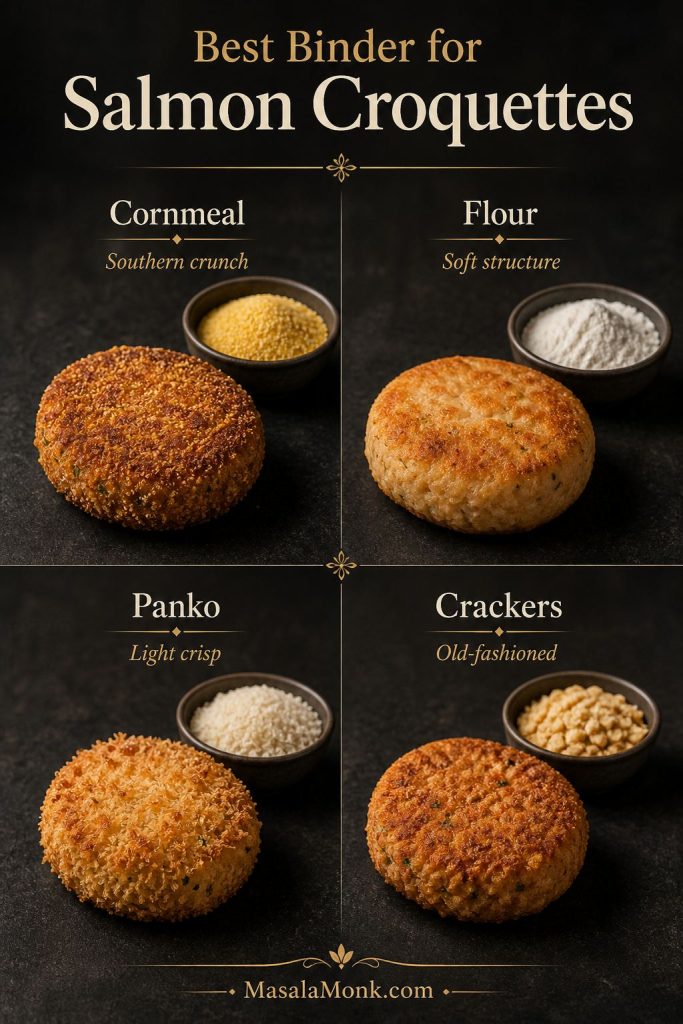
Cornmeal vs Flour vs Crackers vs Panko

The binder changes the texture of salmon croquettes more than most people realize. Cornmeal gives a classic Southern texture. Flour makes the mixture more cohesive. Panko makes the croquettes lighter and crispier. Crushed crackers give an old-fashioned pantry flavor.

Binder or coating Best for Texture
Cornmeal Southern salmon croquettes Crisp, grainy, old-fashioned crust
Flour Softer salmon patties Tender, cohesive, less crunchy
Panko Modern crispy salmon cakes Light, airy crunch
Crushed saltines Pantry-style salmon patties Savory, tender-crisp, nostalgic
Regular breadcrumbs Classic salmon cakes Even structure and mild crust
Almond flour Low-carb or gluten-free variation Softer and less crisp, but useful for dietary swaps

Best Binder for Salmon Croquettes

Four salmon croquettes compared with cornmeal, flour, panko, and crushed crackers as binders
The binder changes the final bite. Cornmeal adds crunch, flour gives structure, panko makes the crust lighter, and crackers create a more old-fashioned pantry-style patty.

For the best first batch, use cornmeal plus flour. If you want a lighter, crispier version, replace some or all of the cornmeal with panko. For old-fashioned salmon patties, crushed saltines work beautifully instead of panko or breadcrumbs.

If your mixture feels too wet or too loose, jump to the troubleshooting guide.

Baked Salmon Croquettes

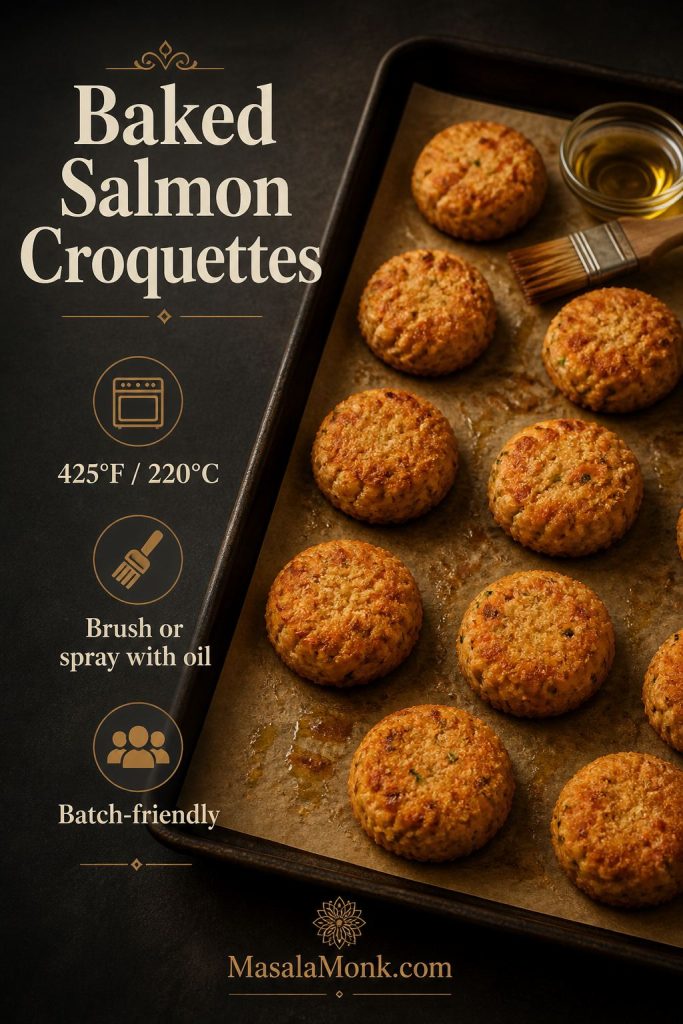
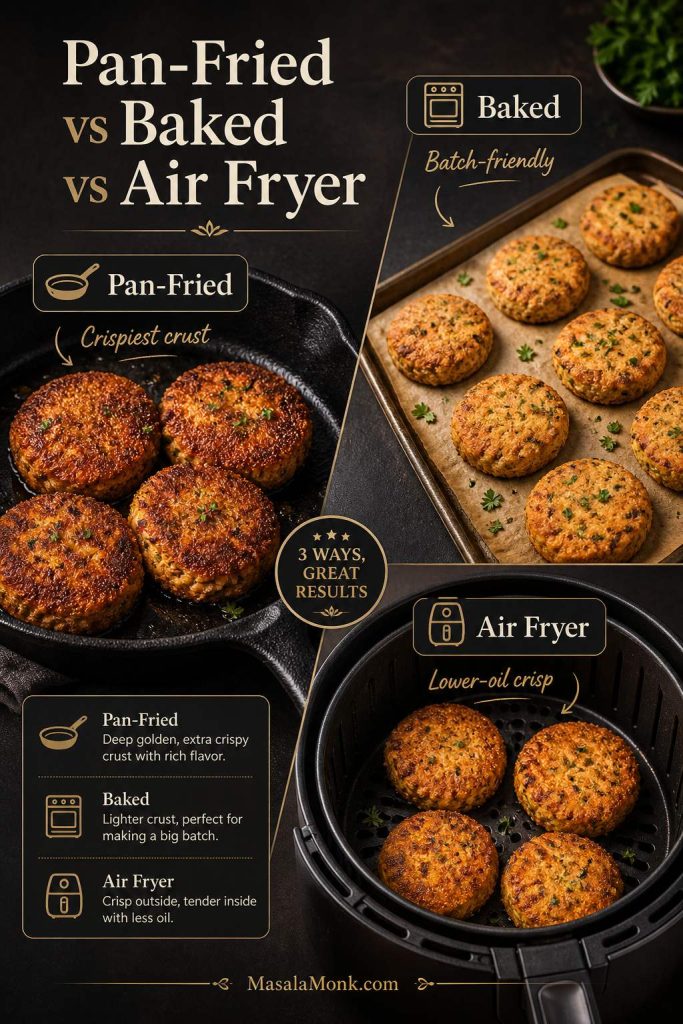
Baked salmon croquettes are useful when you want less oil or need to cook a whole batch at once. Although they will not be quite as deeply crisp as pan-fried croquettes, a hot, well-oiled sheet pan helps them brown.

To bake them, heat the oven to 425°F / 220°C. Place the shaped croquettes on a well-oiled sheet pan, brush or spray the tops lightly with oil, and bake for 15 minutes. Flip carefully, then bake for another 5–7 minutes, until golden and firm.

Baked Salmon Croquettes Texture Cue

Baked salmon croquettes on a parchment-lined sheet pan with oil brush and small bowl of oil
Baked salmon croquettes are useful when you want a lighter batch or need to cook several at once. However, brushing or spraying them with oil helps the surface brown better and keeps the crust from tasting dry.
Baked texture tip: Keep baked croquettes slightly thinner, around ½ inch, so they heat through and brown before drying out.

Want a crisp, lower-oil option without using the oven? See the air fryer method.

Air Fryer Salmon Croquettes

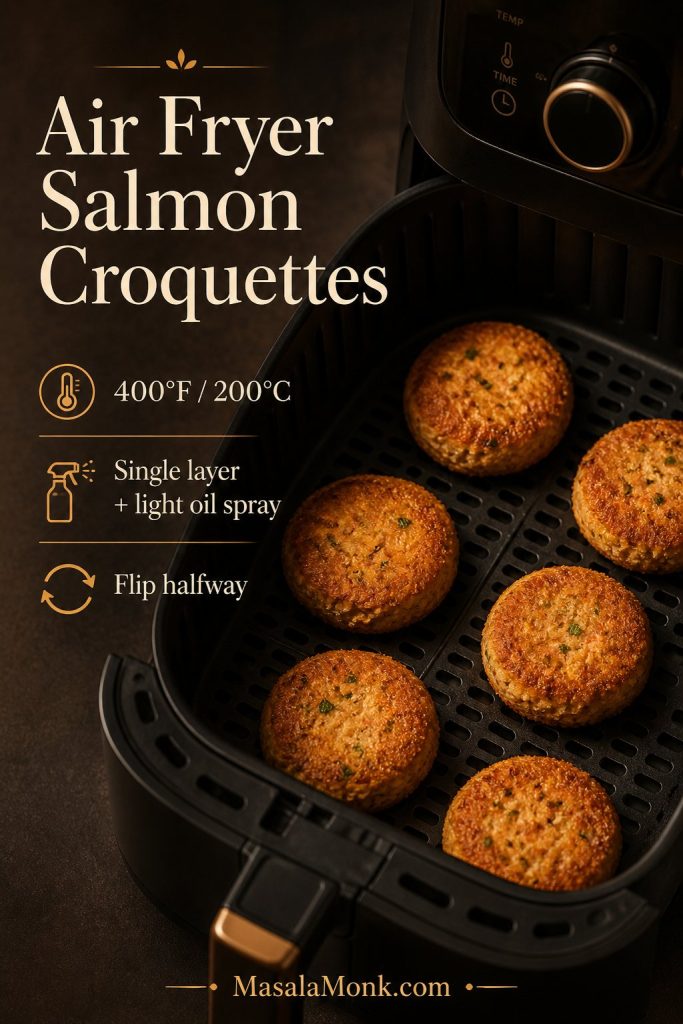
Air fryer salmon croquettes are a good middle ground between pan-fried and baked. They use less oil than skillet frying; however, they can still develop a crisp surface if you spray them lightly and avoid overcrowding the basket.

Preheat the air fryer to 400°F / 200°C. Spray the basket or use perforated parchment. Add the croquettes in a single layer, spray the tops lightly with oil, and air fry for 8–10 minutes. Flip, spray again if needed, and cook for another 3–5 minutes, depending on thickness.

Air Fryer Salmon Croquettes Texture Cue

Salmon croquettes arranged in a single layer inside an air fryer basket
Air fryer salmon croquettes can crisp surprisingly well, provided the patties are spaced apart and lightly oiled. Meanwhile, overcrowding the basket traps steam and makes the crust softer.

If you are building a full air fryer meal, serve the croquettes with something crisp and simple like air fryer hash browns or a cold salad on the side.

Pan-Fried vs Baked vs Air Fryer Salmon Croquettes

Comparison board showing pan-fried, baked, and air fryer salmon croquettes with different cooking equipment
Each cooking method changes the result a little. Pan-fried salmon croquettes give the boldest crust, baked croquettes are easiest for a larger batch, and the air fryer offers a crisp finish with less oil.

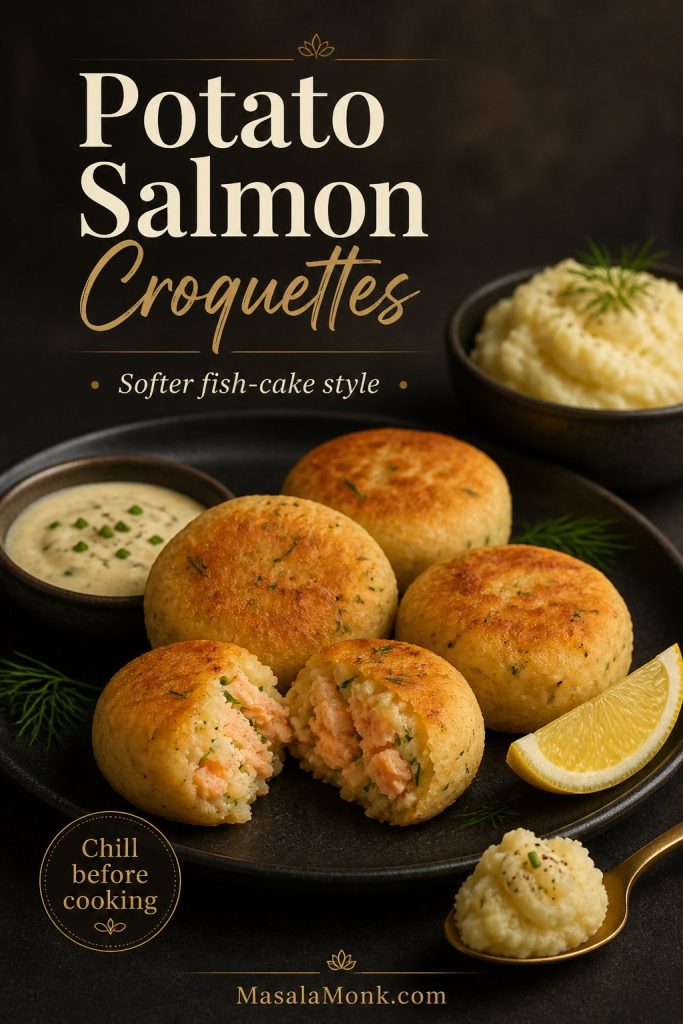
Potato Salmon Croquettes

Potato salmon croquettes are softer and more like fish cakes. To make them, mix the drained salmon with about 1 cup mashed potatoes, one egg, onion, herbs, lemon, and seasoning. Reduce the cornmeal and flour because the potatoes already add body.

Chill potato salmon croquettes before cooking. They are more delicate than the canned salmon version, so a short rest in the fridge helps them hold their shape.

Potato Salmon Croquettes Texture Cue

Potato salmon croquettes served with mashed potato, lemon, sauce, and one croquette broken open
Potato salmon croquettes are softer than the cornmeal version. Because the mixture is more delicate, chilling before cooking helps them hold their shape.

Best Sauce for Salmon Croquettes

Salmon croquettes need a sauce with acid, creaminess, herbs, or heat. Tartar sauce is the familiar classic, lemon dill mayo is the easiest homemade option, remoulade gives a more Southern seafood-style finish, and brighter sauces like green chutney mayo, tzatziki, mango mustard, or mango habanero can change the whole plate.

Best Sauces for Salmon Croquettes

Salmon croquettes served with three sauces labeled tartar, lemon dill, and remoulade
The best sauce depends on the mood of the plate. Tartar keeps things classic, lemon dill adds brightness, and remoulade gives the croquettes a Southern seafood-style finish.

Quick Tartar Sauce Shortcut

  • ½ cup mayonnaise
  • 1–2 tablespoons chopped pickles or relish
  • 1 teaspoon lemon juice
  • 1 teaspoon Dijon mustard, optional
  • Black pepper, to taste

Stir everything together and chill until serving. This is the easiest classic dip for salmon patties, salmon cakes, and crisp croquettes.

Quick Lemon Dill Sauce

  • ½ cup mayonnaise or Greek yogurt
  • 1 tablespoon lemon juice
  • 1 teaspoon Dijon mustard
  • 1 tablespoon chopped dill or parsley
  • 1 small grated garlic clove
  • Salt and black pepper, to taste

Mix everything together and chill until ready to serve. If the sauce tastes flat, add more lemon. If it tastes too sharp, add a spoonful more mayo or yogurt.

Quick Remoulade-Style Sauce

  • ½ cup mayonnaise
  • 1 teaspoon Dijon mustard
  • 1 tablespoon lemon juice or pickle juice
  • 1 teaspoon hot sauce
  • ½ teaspoon paprika
  • 1 tablespoon chopped pickles, relish, or capers, optional
  • Black pepper, to taste

Mix everything together and chill for 10–15 minutes if you have time. This sauce is especially good with Southern salmon croquettes, cornmeal-crusted croquettes, and fried salmon patties.

For an Indian-style twist, stir green chutney into mayo or yogurt. The coriander, mint, chilli, ginger, cumin, and citrus make a sharp, fresh dip that cuts through the fried crust.

For baked or air fryer croquettes, a cool tzatziki sauce works beautifully. The cucumber and yogurt keep the plate lighter, especially if the croquettes are spicy or served as lunch.

For a sweet, tangy, fish-friendly sauce, try mango mustard sauce instead of plain mustard. For more heat, finish the plate with mango habanero sauce, especially with slaw, rice, or a bowl-style meal.

Building a full plate? See what to serve with salmon croquettes.

What to Serve with Salmon Croquettes

A cold, crisp cucumber salad is one of the easiest sides for salmon croquettes. The vinegar, dill, onion, and crunch balance the fried crust without making the meal heavy.

Tabbouleh is a brighter herb-heavy side because parsley, mint, lemon, tomato, and bulgur bring freshness to the plate.

For a more filling lunch, add chickpea salad on the side or tuck the croquettes into bowls with greens, cucumber, herbs, and sauce.

A classic comfort-food plate works well with potato salad, fries, roasted potatoes, green beans, coleslaw, or a simple green salad.

During warmer months, serve the croquettes with mango salsa, lime, and shredded cabbage for a fresher, taco-inspired plate.

Visual Side Dish Guide

Salmon croquettes served with cucumber salad, potato salad, tabbouleh, chickpea salad, lemon wedges, and creamy sauce
For a balanced meal, pair crisp salmon croquettes with something fresh and something creamy. Cucumber salad, tabbouleh, chickpea salad, and potato salad all work well because they cut through the richness.

Healthy, Gluten-Free, Low-Carb, and Egg-Free Variations

For a lighter or dietary-specific version, keep the same basic method and adjust the binder, cooking method, or sauce.

Variation How to adjust it
Lighter salmon croquettes Bake or air fry instead of pan-frying, and serve with a yogurt-based sauce like tzatziki.
Gluten-free salmon croquettes Use certified gluten-free cornmeal plus gluten-free flour, gluten-free crackers, gluten-free breadcrumbs, or almond flour. Expect almond flour to make a softer croquette.
Low-carb salmon croquettes Use almond flour in place of flour and skip crackers or breadcrumbs. Expect a softer texture than the cornmeal version.
Egg-free salmon croquettes Use 2–3 tablespoons mashed potato or a flax egg as the binder, then chill the patties well before cooking.
Dairy-free salmon croquettes The base recipe is already dairy-free if your mayo is dairy-free.

Healthy Salmon Croquettes Variations

Healthy salmon croquette variation board showing lighter, gluten-free, low-carb, and egg-free options
You can adapt this salmon croquettes recipe in several directions without starting over. For example, bake or air fry for a lighter version, use a gluten-free binder if needed, or swap the binder to fit low-carb or egg-free needs.

In these gluten-free, low-carb, or egg-free versions, treat the croquette mixture more gently and chill it before cooking. These swaps usually need a short rest because they are softer than the classic canned salmon and cornmeal version.

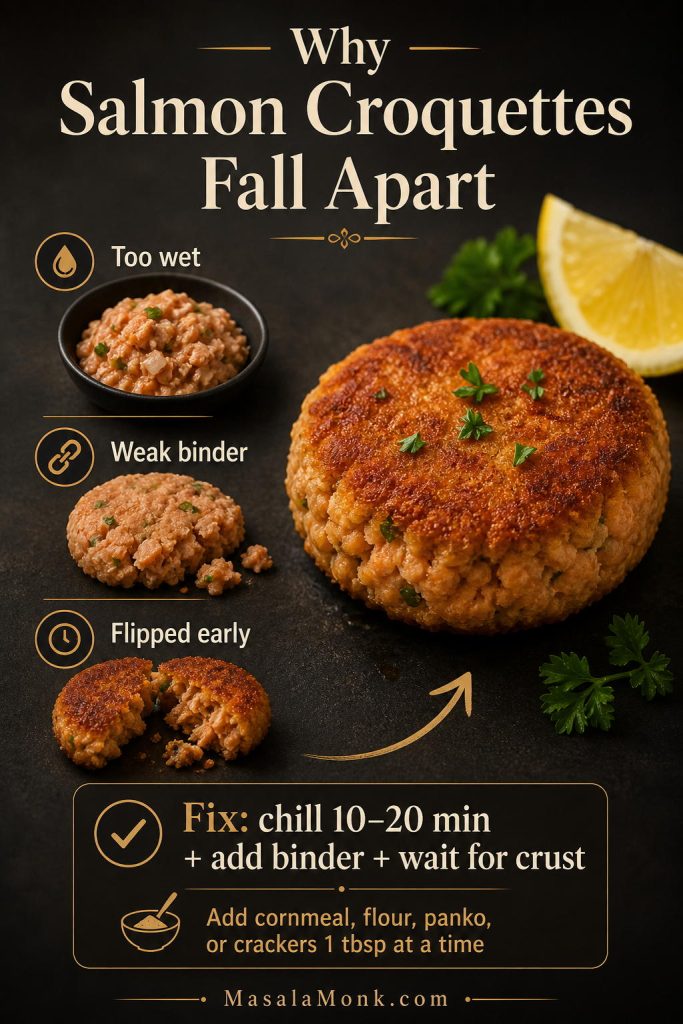
Why Do Salmon Croquettes Fall Apart?

Croquettes usually fall apart when the salmon mixture is too wet, the binder is too weak, the patties were not chilled, or they were flipped before the crust had time to set. Fortunately, the fix is simple: drain the salmon better, add dry binder one tablespoon at a time, chill the shaped patties, and flip only after the bottom is golden.

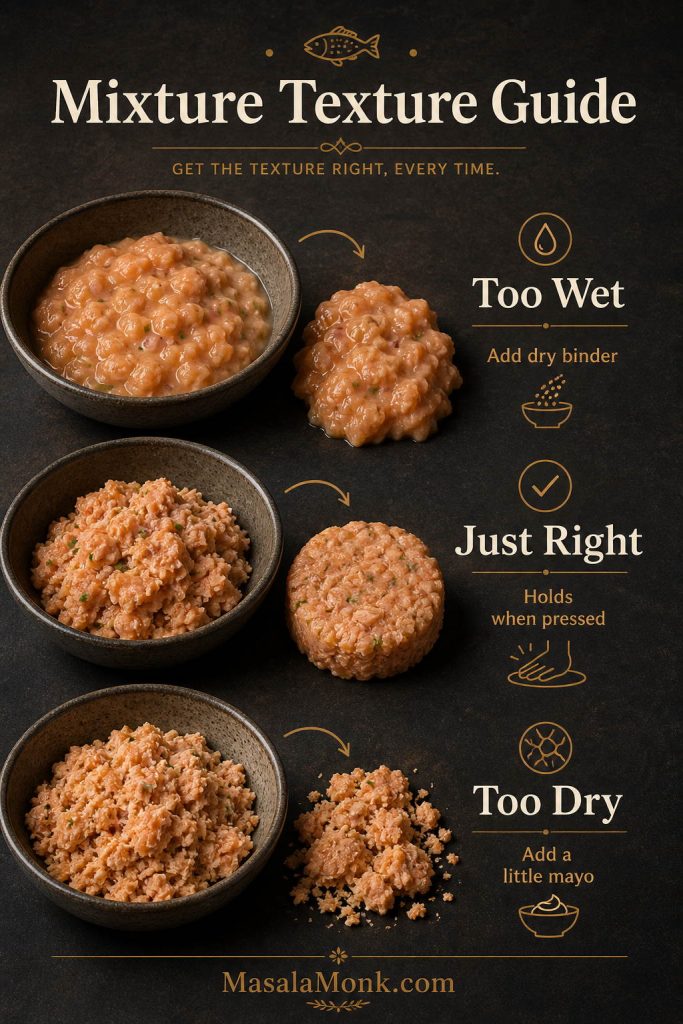
Salmon Croquettes Mixture Texture Guide

Three salmon croquette mixtures labeled too wet, just right, and too dry
The mixture should hold together when pressed, but still look flaky. If it is wet, add dry binder; if it crumbles, add a little mayo.
Problem Why it happens Fix
Croquettes fall apart Too wet, weak binder, or flipped too early. Add 1–2 tablespoons dry binder, chill 10–20 minutes, and flip only after a crust forms.
Mixture is too wet Salmon was not drained well or there is too much mayo. Add cornmeal, flour, panko, or crushed crackers 1 tablespoon at a time.
Croquettes are dry Too much flour or cornmeal, or they cooked too long. Add a little mayo to the mixture next time and serve with sauce.
Croquettes are mushy Too much wet binder or salmon mashed too finely. Drain salmon well, leave some flakes, and reduce mayo slightly.
They stick to the pan Oil was not hot enough or they were moved too soon. Heat oil until shimmering and let the bottom set before flipping.
They taste greasy Oil was too cool or the pan was crowded. Fry hotter, cook in batches, and drain on a wire rack.
They taste bland Not enough salt, acid, or savory seasoning. Add lemon, Worcestershire, herbs, black pepper, cayenne, hot sauce, or a small amount of Old Bay-style seasoning.

Why Salmon Croquettes Fall Apart

Troubleshooting guide showing wet mixture, weak binder, early flipping, and a corrected salmon croquette
Salmon croquettes usually fall apart for one of three reasons: too much moisture, weak binder, or flipping too early. Therefore, chill the patties, adjust the binder, and wait for the crust to set.

Ready to try again? Return to the recipe card.

Storage, Freezing, and Reheating

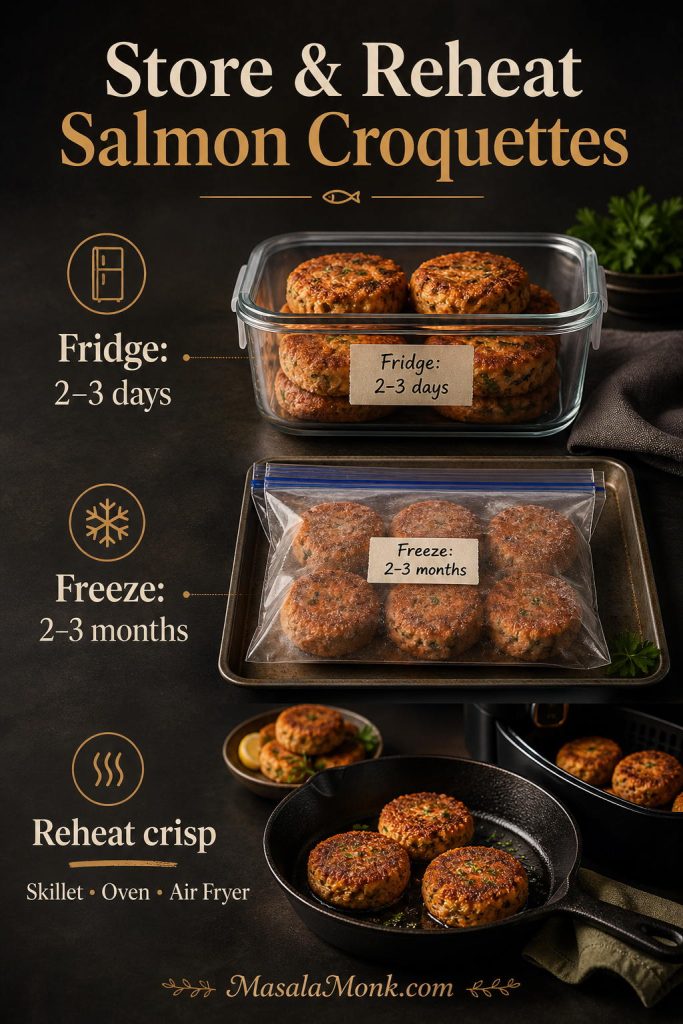
Salmon croquettes are best right after frying, but leftovers reheat well if you use a skillet, oven, or air fryer. Avoid microwaving if you want to keep the crust crisp.

Storage method Time Best reheating method
Fridge 2–3 days Skillet, oven, or air fryer
Make ahead Up to 1 day Shape the croquettes, cover, and refrigerate. Fry straight from the fridge, adding an extra minute if needed.
Freeze uncooked Up to 2–3 months Freeze on a tray first, then transfer to a bag. Thaw before cooking.
Freeze cooked Up to 2–3 months Cool fully, freeze in a single layer, then reheat from thawed.
Skillet reheat 2–3 minutes per side Best for restoring the crust
Air fryer reheat 375°F / 190°C for 4–7 minutes Fast and crisp
Oven reheat 350°F / 175°C for 10–15 minutes Best for larger batches

How to Store and Reheat Salmon Croquettes

Salmon croquettes stored in a fridge container, frozen in a freezer bag, and reheated in a skillet or air fryer
Leftover croquettes keep best when stored properly and reheated with dry heat. Use the fridge for short storage, the freezer for longer storage, and a skillet, oven, or air fryer to bring back the crust.

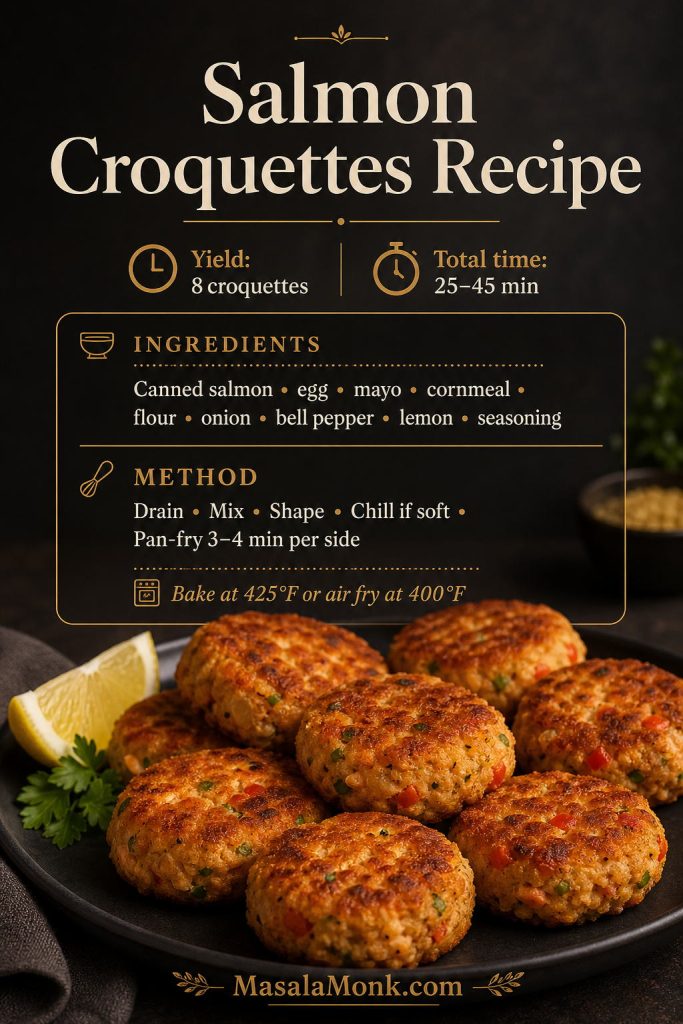
Saveable Salmon Croquettes Recipe Card

Saveable salmon croquettes recipe card with yield, total time, ingredients, method, and cooked croquettes
This saveable salmon croquettes recipe card keeps the core method simple: drain well, bind carefully, shape evenly, and fry until the crust sets. Therefore, it works as a quick refresher when you do not want to reread the full post.

Crispy Salmon Croquettes Recipe

These salmon croquettes are crisp outside, tender inside, and made with canned salmon, egg, mayo, cornmeal, flour, onion, bell pepper, lemon, Worcestershire, and pantry seasoning. Pan-fry them for the classic version, or use the baked and air fryer notes below.

Prep Time15 minutes
Cook Time8–10 minutes
Optional Chill10–20 minutes
Total Time25–45 minutes
Yield8 croquettes

Equipment

  • Large mixing bowl
  • Fork for flaking salmon
  • ¼-cup measuring cup or scoop
  • 10-inch cast iron skillet or heavy-bottom skillet
  • Thin spatula or fish spatula
  • Wire rack or paper-towel-lined plate
  • Optional instant-read thermometer for oil

Ingredients

  • 1 can canned pink salmon, 14.75–15 oz / 418–425 g, drained well
  • 1 large egg
  • ¼ cup / 60 g mayonnaise
  • ½ cup / about 75 g fine yellow cornmeal
  • ¼ cup / about 30 g all-purpose flour
  • ¼ cup / about 40 g finely diced onion
  • ¼ cup / about 35 g finely diced bell pepper
  • 2 tablespoons chopped green onion or parsley
  • 1 tablespoon / 15 ml Worcestershire sauce
  • 1 tablespoon / 15 ml fresh lemon juice
  • ½ teaspoon garlic powder
  • ½ teaspoon paprika or smoked paprika
  • ¼ teaspoon black pepper
  • ¼–½ teaspoon salt, to taste
  • Pinch of cayenne or a few dashes hot sauce, optional
  • Optional: ½ teaspoon Old Bay-style seafood seasoning, Cajun seasoning, or Creole seasoning; reduce salt if using a salty blend
  • ¼–½ cup / 60–120 ml neutral oil, such as canola, vegetable, avocado, or peanut oil, for frying

Instructions

  1. Drain and flake the salmon. Drain the canned salmon well, but do not squeeze it completely dry. Flake it with a fork, leaving some texture.
  2. Mix the wet binder. In a large bowl, whisk the egg, mayonnaise, Worcestershire sauce, lemon juice, garlic powder, paprika, black pepper, salt, and cayenne or hot sauce.
  3. Add the salmon and dry binder. Fold in the salmon, onion, bell pepper, green onion or parsley, cornmeal, and flour. Mix gently until the mixture holds together when pressed.
  4. Adjust texture if needed. If the mixture feels too wet, add cornmeal, flour, panko, or crushed crackers 1 tablespoon at a time.
  5. Shape. Scoop about ¼ cup mixture per croquette and shape into patties about ½–⅔ inch thick. You should get about 8 croquettes.
  6. Chill if needed. If the patties feel soft, chill them for 10–20 minutes.
  7. Heat the oil. Add oil to a cast iron skillet or heavy-bottom skillet and heat to about 350°F / 175°C.
  8. Fry. Cook the croquettes for 3–4 minutes per side, flipping once, until golden, crisp, hot in the center, and set enough to lift with a spatula.
  9. Drain and serve. Transfer to a wire rack or paper-towel-lined plate. Serve hot with lemon wedges, tartar sauce, lemon dill sauce, remoulade, green chutney mayo, tzatziki, mango mustard, or hot sauce.

Baked Version

Heat oven to 425°F / 220°C. Place croquettes on a well-oiled sheet pan, brush or spray the tops with oil, and bake for 15 minutes. Flip and bake 5–7 minutes more.

Air Fryer Version

Air fry at 400°F / 200°C for 8–10 minutes. Flip, spray lightly with oil, and cook 3–5 minutes more, until crisp and heated through.

Fresh Salmon Version

Use 1 lb / 454 g cooked fresh salmon. Cool slightly, flake, and use in place of canned salmon. Taste before shaping because fresh salmon may need a little extra salt or seasoning.

Notes

  • For a lighter crispy version, replace some or all of the cornmeal with panko.
  • For old-fashioned salmon patties, use crushed saltines instead of panko or breadcrumbs.
  • For gluten-free salmon croquettes, use certified gluten-free cornmeal plus gluten-free flour, gluten-free crackers, gluten-free breadcrumbs, or almond flour.
  • For spicier croquettes, add cayenne, hot sauce, Cajun-style seasoning, or extra black pepper.
  • You can shape the croquettes up to 1 day ahead, cover, and refrigerate. Fry them straight from the fridge, adding an extra minute if needed.
  • Serve with lemon wedges and one creamy sauce, such as tartar sauce, lemon dill mayo, or remoulade.

If this salmon croquettes recipe helped you get crisp patties that actually hold together, save it for the next time you have canned salmon in the pantry. You can also come back to the binder guide, sauce ideas, and troubleshooting table whenever you want to adjust the recipe with panko, crackers, fresh salmon, or the air fryer.

Serving Salmon Croquettes

Finished salmon croquettes served with lemon wedges and creamy dipping sauce, with one croquette broken open
Serve salmon croquettes as soon as they come out of the pan if you want the contrast at its best. The crust stays crispest early on, while lemon and a creamy sauce brighten the rich, savory center.

FAQs About Salmon Croquettes

Are salmon croquettes the same as salmon patties?

They are very similar, and many people use the names interchangeably. Salmon croquettes are often associated with a crisp, Southern-style version made with canned salmon, cornmeal or flour, egg, onion, and skillet frying. Salmon patties is a broader term and can refer to thinner or simpler salmon cakes.

Are salmon croquettes the same as salmon cakes?

They are in the same family, but salmon cakes often sound a little more restaurant-style and may use fresh salmon, panko, herbs, Dijon, or mayo. Croquettes usually feel more old-fashioned, pantry-friendly, and crisp-edged.

Can I use canned salmon?

Yes. Canned salmon is the easiest and most traditional choice for classic salmon croquettes. Drain it well and flake it before mixing.

Do I remove the bones and skin from canned salmon?

You can remove the larger bones and skin if you prefer a smoother texture. The small soft bones are edible and mash easily, but it is fine to take them out if you do not like them.

Is this recipe better with canned salmon or fresh salmon?

For classic croquettes, canned salmon is easier because it is already cooked, budget-friendly, and easy to bind. Fresh salmon also works, but you need to cook it first, cool it slightly, and flake it before mixing the patties.

Can I use fresh salmon?

Yes. Cook fresh salmon first, cool it slightly, then flake it and use it in place of canned salmon. Fresh salmon croquettes usually taste cleaner and more delicate than canned salmon croquettes.

What keeps salmon croquettes from falling apart?

Good drainage, enough binder, even shaping, and patient frying. Use egg plus a dry binder, chill the patties if they feel soft, and do not flip until the first side has formed a crust.

Do you use cornmeal or flour for salmon croquettes?

Use both for the best classic texture. Cornmeal gives crispness and an old-fashioned Southern feel, while flour helps bind the mixture. You can also use panko, breadcrumbs, or crushed crackers.

Can I use crackers instead of breadcrumbs?

Yes. Crushed saltines are a classic pantry binder for salmon patties and croquettes. They give a savory, tender-crisp texture.

Can salmon croquettes be baked?

Yes. Bake them at 425°F / 220°C on a well-oiled sheet pan for 15 minutes, flip, then bake 5–7 minutes more. Brush or spray the tops with oil for better browning.

Can salmon croquettes be cooked in the air fryer?

Yes. Air fry at 400°F / 200°C for 8–10 minutes, flip, then cook 3–5 minutes more. Spray lightly with oil for a crisp surface.

How long do you cook salmon croquettes?

Pan-fried salmon croquettes usually take 3–4 minutes per side. Baked salmon croquettes take about 20–22 minutes total at 425°F / 220°C. Air fryer salmon croquettes usually take 11–15 minutes total at 400°F / 200°C, depending on thickness.

What sauce goes with salmon croquettes?

Tartar sauce, lemon dill mayo, remoulade, green chutney mayo, tzatziki, mango mustard, mango habanero sauce, hot sauce, or a simple garlic mayo all work well.

What sides go with salmon croquettes?

Cucumber salad, tabbouleh, chickpea salad, potato salad, coleslaw, roasted potatoes, rice, green beans, and mango salsa all pair well with salmon croquettes.

Can you freeze salmon croquettes?

Yes. Freeze shaped uncooked croquettes on a tray, then transfer to a freezer bag. You can also freeze cooked croquettes after they cool fully. For best texture, thaw before reheating or frying.

How do you reheat salmon croquettes?

Reheat them in a skillet for 2–3 minutes per side, in an air fryer at 375°F / 190°C for 4–7 minutes, or in the oven at 350°F / 175°C for 10–15 minutes. The microwave works, but it softens the crust.

Are salmon croquettes healthy?

They can be part of a balanced meal, especially if you serve them with salad, vegetables, or a yogurt-based sauce. Pan-fried croquettes use more oil, while baked or air fryer salmon croquettes are lighter.