Posted on 5 Comments

Sweetened Condensed Milk Fudge: 10 Easy Recipes

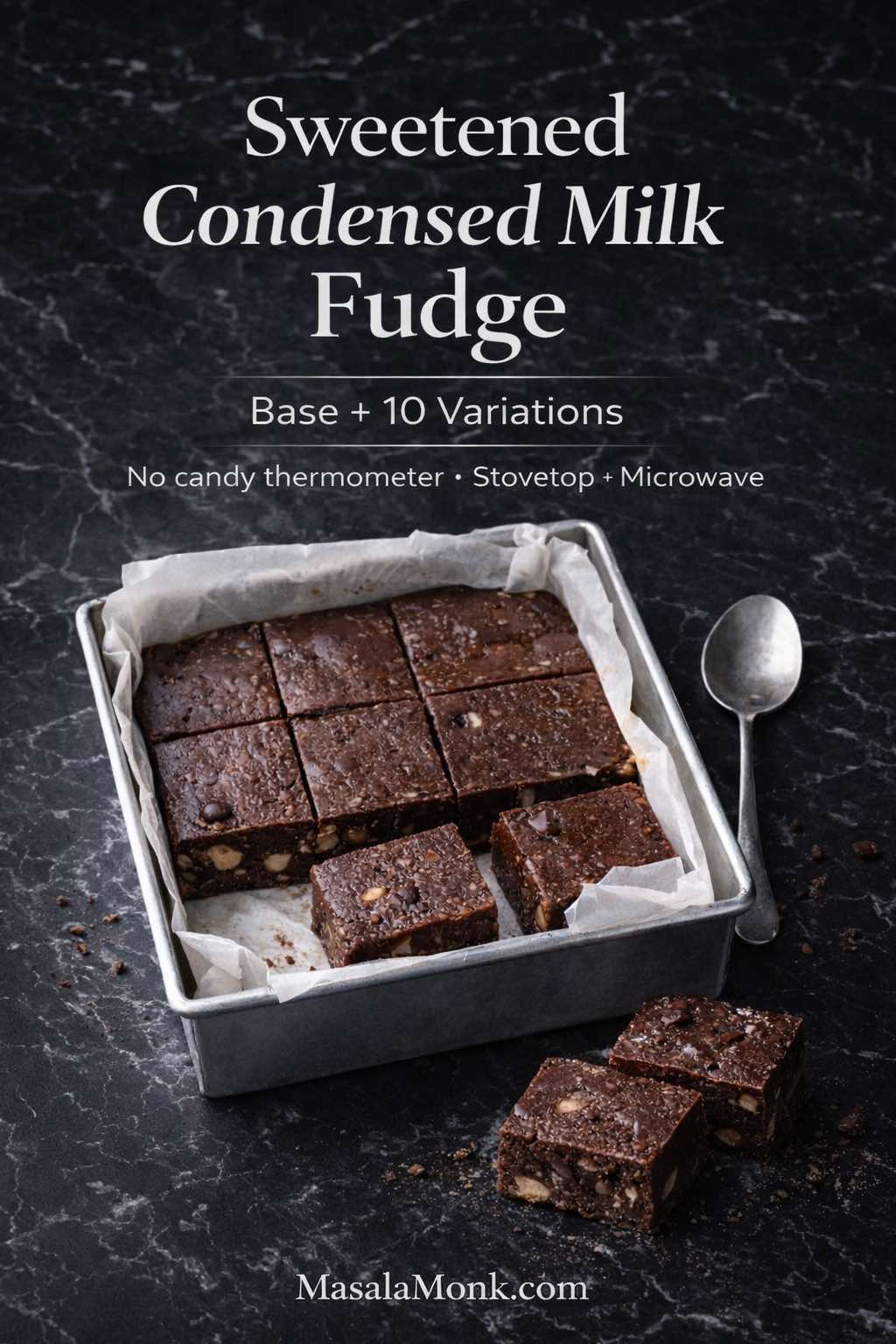
Dark marble food photo of sweetened condensed milk fudge in a parchment-lined tin, cut into squares, with “Base + 10 Variations” text overlay and MasalaMonk.com footer.

Some desserts are worth the effort. Fudge is worth it precisely because it doesn’t demand much effort at all—at least not in the versions you’ll make here. With fudge made from sweetened condensed milk, you get a shortcut that still tastes rich and finished: glossy, sliceable, and the kind of treat that looks at home on a festive platter or tucked into a small gift box.

Better yet, one dependable approach can branch into a whole set of flavors. That’s why this post is built like a guide you’ll actually use: a simple master method, then 10 full recipes that share the same rhythm. As you move through them, you’ll see the same ideas repeating in fresh ways—chocolate and sweetened condensed milk, peanut butter and condensed milk, cocoa powder structure, white chocolate as a firming backbone, and marshmallow crème for that plush “fantasy” bite.

Although the recipes vary, the goal stays the same: a smooth set, clean cuts, and a texture that feels creamy rather than crumbly or gritty. So, before we dive into the flavors, let’s set the stage properly—because a few small choices at the start make every pan easier to nail.


The simple rule that makes condensed milk fudge feel “no-fail”

Fudge is one of those candies where texture is everything. When it’s right, it’s firm but tender, dense yet smooth. When it’s off, it can turn sticky-soft, oddly greasy, or grainy in a way that makes you wish you’d just eaten a spoonful straight from the saucepan and called it a day.

In the condensed milk style, the easiest way to stay on the “right” side of that line is to remember one practical rule:

Sweetened condensed milk needs a strong setting partner.

Most often, that partner is melted chocolate (dark, milk, or white). Sometimes it’s a mix of cocoa powder and sugar for structure. In the marshmallow crème version, the fluff helps the mixture hold together while keeping the bite soft and cohesive. However it shows up, the setting partner is what turns a thick sauce into a sliceable square.

This is also why some “two ingredient” ideas—like condensed milk plus peanut butter—can feel unpredictable in warm kitchens. Peanut butter is rich, yes, but it doesn’t always firm up enough on its own. Once you add white chocolate (or another firming element), the entire batch becomes more stable, and the texture shifts from spoonable to sliceable.

If you’re curious about the classic condensed milk fudge baseline that inspired a lot of these modern shortcuts, you can glance at the traditional-style formula in Eagle Brand’s chocolate fudge recipe. It’s the same general idea you’ll use here—melt, stir, spread, chill—just translated into a full set of variations.

Also Read: Sourdough Recipe: 10 Easy Bread Bakes (Loaves, Rolls & Bagels)


Your setup (and why it matters more than you think)

Tin size (keep it consistent)

Every recipe below is written for a 20 × 20 cm (8 × 8-inch) square tin. You can use a slightly larger pan for thinner pieces, but consistency makes life easier—especially when you’re moving between flavors and you want them to set similarly.

Lining the tin

Line the pan with baking paper so it overhangs on two sides. That overhang becomes your handle later. As a result, you can lift the whole slab out cleanly, then slice it neatly without scraping corners.
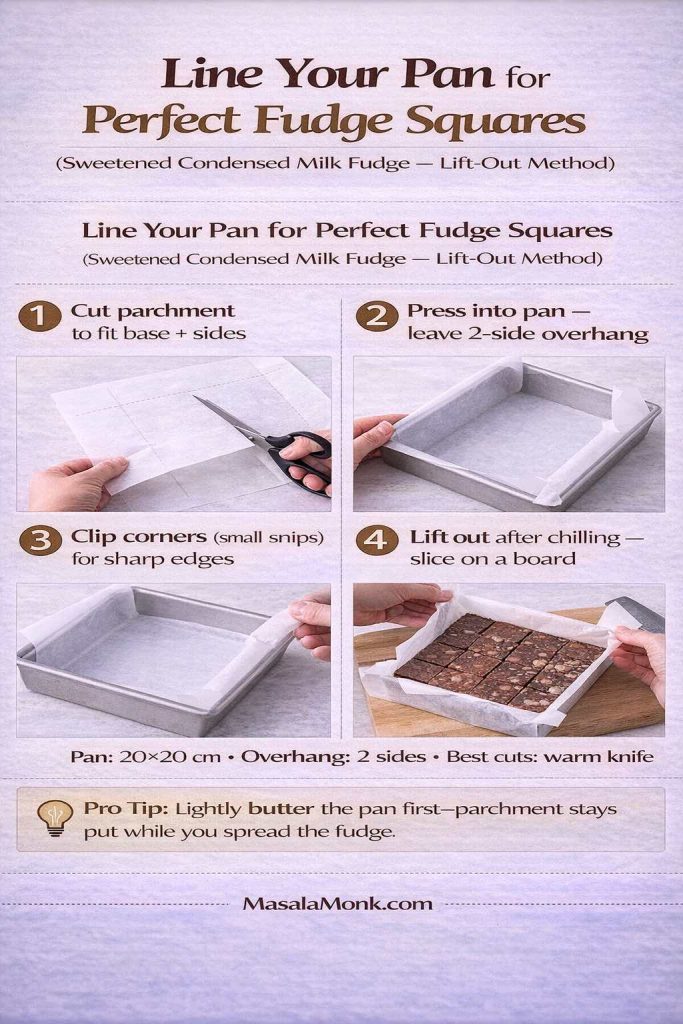
Infographic titled “Line Your Pan for Perfect Fudge Squares (Sweetened Condensed Milk Fudge — Lift-Out Method)”. Shows four steps with photos: 1) cut parchment to fit base and sides, 2) press into the pan and leave a two-side overhang, 3) clip corners with small snips for sharp edges, 4) lift out after chilling and slice on a board. Includes specs: pan 20×20 cm, overhang two sides, best cuts with a warm knife. Pro tip says to lightly butter the pan first so parchment stays in place while spreading the fudge. MasalaMonk.com branding appears in the footer.
If you want clean, gift-box fudge squares, don’t skip the parchment overhang. This sweetened condensed milk fudge pan-lining guide shows the lift-out method that prevents stuck corners and broken edges: cut parchment, leave a two-side handle, snip corners for sharp sides, then lift and slice on a board. Save it once and you’ll use it for every condensed milk fudge batch—especially when you’re making multiple flavors for holiday trays.

Heat level

Low heat is your friend. Chocolate scorches quickly when pushed, and white chocolate is especially sensitive. So, even though it’s tempting to rush, keep the flame gentle and stir steadily.

A note on “chips”

You’ll see two roles in these recipes: chopped chocolate is for a smoother, more reliable melt in the base, while chocolate chips are best used as fold-ins when you want real chocolate pockets in each bite. Also, chips can look stubborn in the microwave and then suddenly melt once stirred—that’s why short bursts and frequent stirring matter. If you’d like a dependable microwave reference for the rhythm, King Arthur Baking’s easy microwave fudge demonstrates the stop-and-stir approach that prevents scorching.
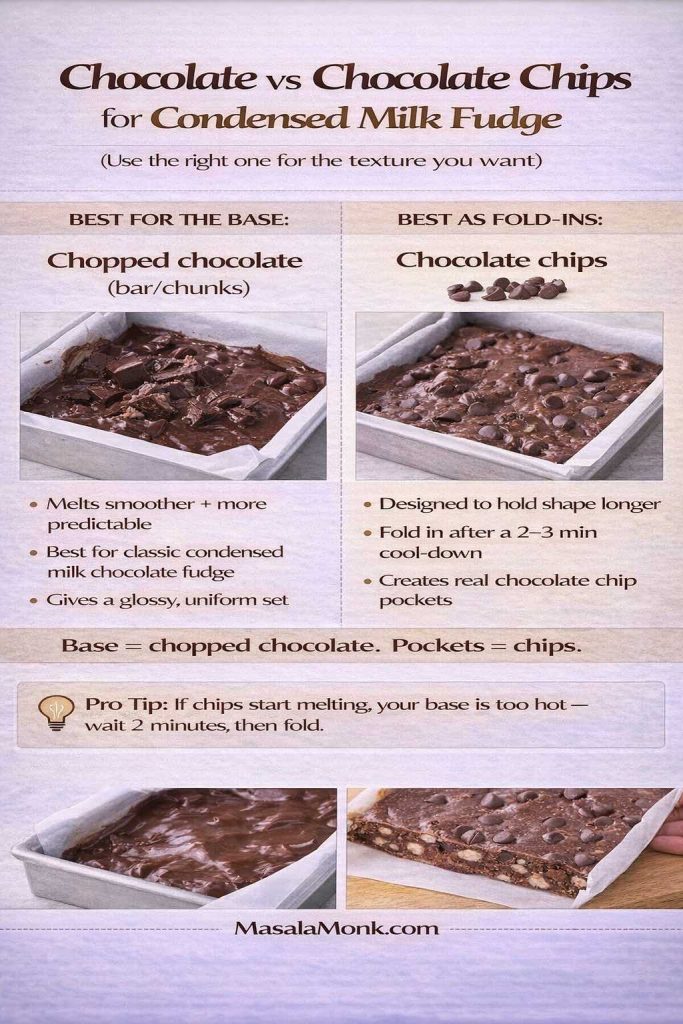
Split infographic titled “Chocolate vs Chocolate Chips for Condensed Milk Fudge (Use the right one for the texture you want)”. Left side says “Best for the base: Chopped chocolate (bar/chunks)” with notes that it melts smoother, is best for classic condensed milk chocolate fudge, and gives a glossy uniform set, shown with a photo of melted fudge base with chopped chocolate. Right side says “Best as fold-ins: Chocolate chips” with notes that chips hold shape longer, should be folded in after a 2–3 minute cool-down, and create real chocolate chip pockets, shown with a photo of fudge topped with chips. A rule line reads “Base = chopped chocolate. Pockets = chips.” Pro tip box: “If chips start melting, your base is too hot—wait 2 minutes, then fold.” MasalaMonk.com branding is in the footer.
If you’re making fudge with sweetened condensed milk and chocolate chips, this quick guide prevents the most common mistake. Use chopped chocolate when you want a smooth, glossy base that sets cleanly—then use chocolate chips as fold-ins when you want real chip pockets in every bite. Save this card for any condensed milk fudge recipe so you get the texture you intended (uniform fudge vs chocolate-chip fudge) without scorching or melting your chips into streaks.

Cooling and slicing sweetened condensed milk fudge

Chill until firm—usually 2 to 4 hours—then slice with a warm knife. Warm doesn’t mean blazing hot; rather, run the knife under hot water, wipe it dry, and cut. Repeat as needed. Consequently, you get sharp edges instead of ragged cracks.

Also Read: Peanut Butter Fudge: Recipes & Guide (8 Methods + Easy Variations)
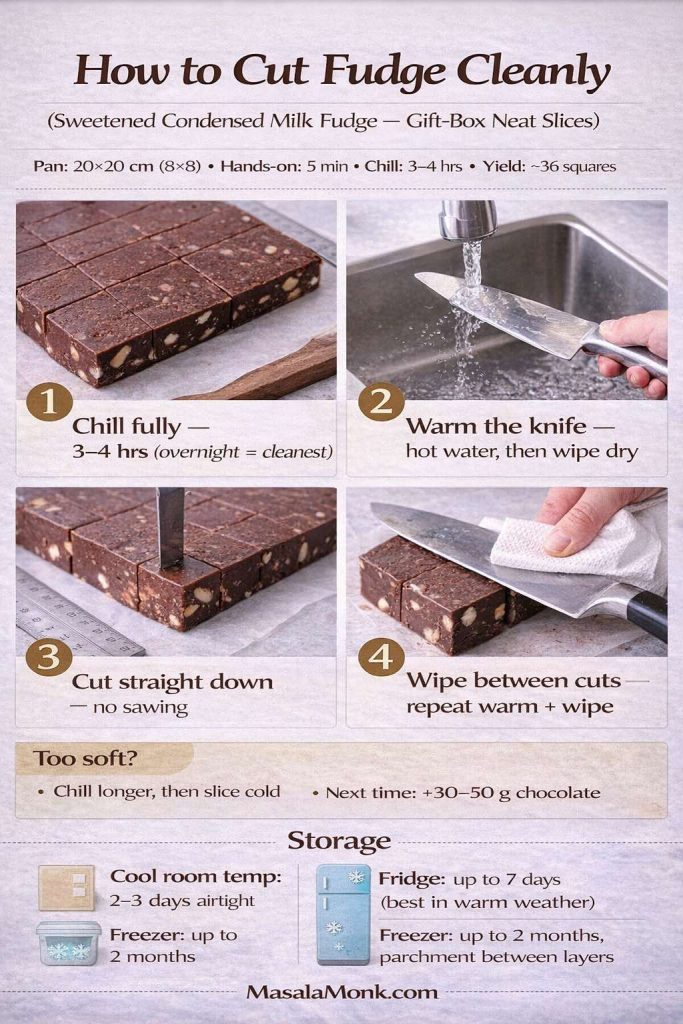
Step-by-step infographic titled “How to Cut Fudge Cleanly (Sweetened Condensed Milk Fudge — Gift-Box Neat Slices)”. Shows four photo steps: (1) chill fudge fully 3–4 hours (overnight cleanest), (2) warm knife with hot water then wipe dry, (3) cut straight down with no sawing, (4) wipe blade between cuts and repeat warm + wipe. Includes a “Too soft?” tip (chill longer and slice cold; next time add 30–50 g chocolate) plus storage guidance: cool room temperature 2–3 days airtight, fridge up to 7 days (best in warm weather), freezer up to 2 months with parchment between layers. MasalaMonk.com branding appears in the footer.
Want gift-box neat slices every time? Save this “warm knife” cutting guide for sweetened condensed milk fudge (and every other fudge, honestly). The difference between ragged edges and clean squares is simple: chill fully, warm the knife, cut straight down, wipe between cuts. It also includes the quick fix for warm kitchens—if fudge feels soft, slice it cold now, and next batch add 30–50 g extra chocolate for a firmer set. Keep this pinned for holiday trays, edible gifts, and Christmas fudge season.

The master method you’ll reuse (stovetop + microwave)

Most of the recipes below follow one of two paths:

  1. Melted chocolate + sweetened condensed milk, then flavor and set
  2. A structured cocoa base (cocoa + sugar + butter + condensed milk), then set

Because the steps repeat, you’ll get faster with every batch. In fact, after you make the first pan, the others feel almost effortless.
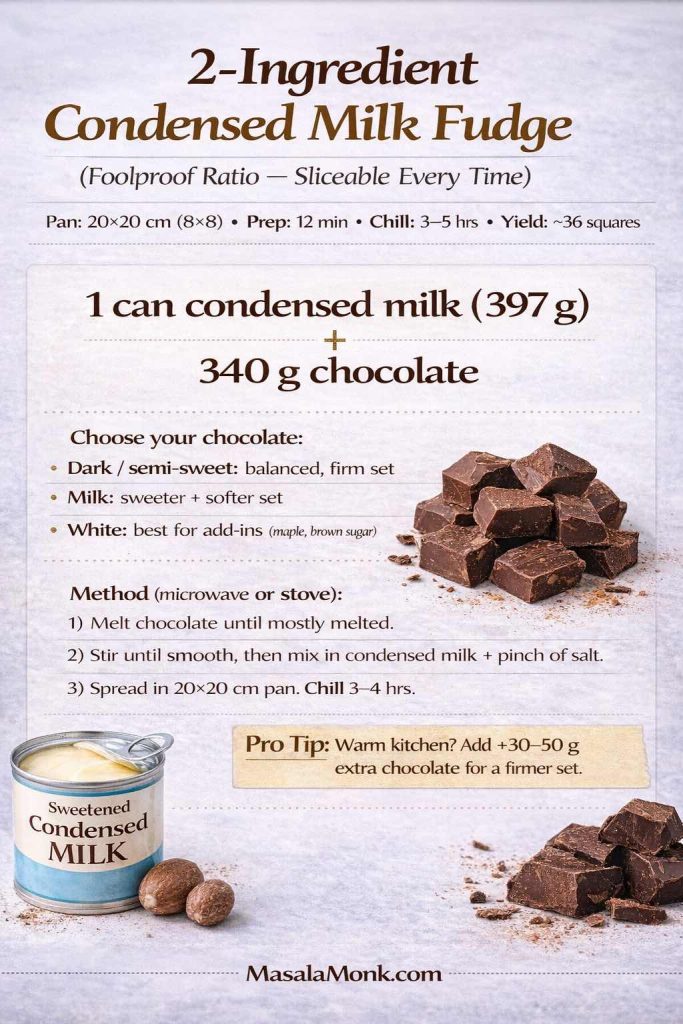
Infographic reference card titled “2-Ingredient Condensed Milk Fudge (Foolproof Ratio — Sliceable Every Time)”. Shows the ratio: 1 can sweetened condensed milk (397 g) + 340 g chocolate, with guidance for choosing dark/semi-sweet, milk, or white chocolate. Includes quick method steps (microwave or stove), pan size (20×20 cm), prep time (12 min), chill time (3–5 hrs), yield (~36 squares), a pro tip to add 30–50 g extra chocolate for a firmer set in warm kitchens, and MasalaMonk.com branding in the footer.
Save this 2 ingredient fudge with condensed milk ratio card for the moment you need an instant dessert that actually sets. The “foolproof” formula is simple: 1 can sweetened condensed milk + 340 g chocolate—then you can choose dark for a firmer, balanced bite, milk for a softer candy-bar vibe, or white as the base for flavors like maple and brown sugar. The pro tip is your safety net for warm kitchens: add a little extra chocolate for a clean, sliceable set every time.

Stovetop master method (best for control)

  1. Line the tin and set it aside.
  2. Add your chocolate (or white chocolate) plus sweetened condensed milk to a saucepan.
  3. Place on low heat and stir slowly but consistently until glossy.
  4. Remove from heat, then stir in salt, vanilla, and any flavor additions.
  5. Spread into the tin and smooth the top.
  6. Chill until firm.

Microwave master method (best for speed)

  1. Put chopped chocolate in a large microwave-safe bowl.
  2. Microwave in 20–30 second bursts, stirring very well each time, until the chocolate is mostly melted (a few soft lumps are fine).
  3. Keep stirring until those last lumps disappear and the chocolate turns smooth and shiny.
  4. Add sweetened condensed milk and mix until the mixture becomes thick and glossy.
  5. Warm for 10–15 seconds only if needed, then stir again until fully smooth. Stir in flavor additions, spread, and chill.

One reminder worth repeating: in microwave batches, stirring finishes the melt. Stop when the chocolate is mostly melted, then stir until smooth. That’s how you get a glossy set without scorched edges or greasy separation.

Also Read: 10 Vegan Chocolate Cake Recipes (Easy, Moist, & Dairy-Free)


Microwave sweetened condensed milk fudge (3–5 minute method that won’t scorch)

If you’re looking for microwave fudge with condensed milk, the trick isn’t “longer cooking.” It’s short bursts + aggressive stirring. Chocolate keeps melting from residual heat, so stirring is what finishes the job without scorching the edges or splitting the mixture.
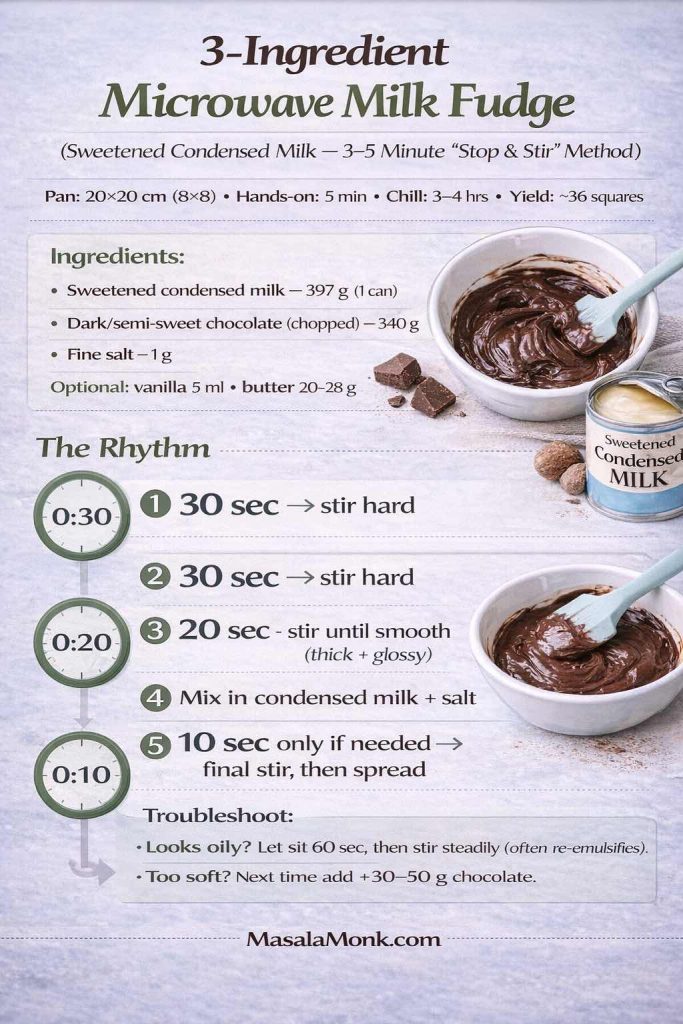
Step-by-step infographic titled “3-Ingredient Microwave Milk Fudge (Sweetened Condensed Milk — 3–5 Minute ‘Stop & Stir’ Method)”. Shows pan size 20×20 cm (8×8), hands-on time 5 minutes, chill time 3–4 hours, yield about 36 squares. Lists ingredients: sweetened condensed milk 397 g (1 can), dark/semi-sweet chocolate 340 g, fine salt 1 g, optional vanilla 5 ml and butter 20–28 g. Includes a “Rhythm” timeline with timers: 30 seconds stir hard, 30 seconds stir hard, 20 seconds stir until smooth (thick + glossy), mix in condensed milk + salt, then 10 seconds only if needed and final stir. Troubleshooting notes: let sit 60 seconds if oily; add 30–50 g extra chocolate next time if too soft. MasalaMonk.com branding appears in the footer.
This 3 ingredient microwave fudge with sweetened condensed milk is the fast method that prevents scorching: short bursts + aggressive stirring. Save this “stop & stir” rhythm card for the days you want easy microwave fudge that sets cleanly—because the chocolate keeps melting from residual heat, and stirring is what makes it glossy (not grainy or oily). Bonus tip built in: if your kitchen runs warm, adding 30–50 g extra chocolate gives you a firmer, sliceable set without changing the flavor.

What you need (for a 20 × 20 cm tin)

  • Sweetened condensed milk: 397 g
  • Dark / semi-sweet chocolate, chopped: 340 g
  • Fine salt: 1 g
  • Optional (smoother bite): 20–28 g unsalted butter
  • Optional (rounds sweetness): 5 ml vanilla extract

Microwave method (the reliable rhythm)

  1. Line the tin with baking paper (overhang on two sides).
  2. Put the chopped chocolate in a large microwave-safe bowl.
  3. Microwave in 20–30 second bursts, stirring very well each time, until the chocolate is mostly melted (it can look lumpy, but should feel soft).
  4. Add the sweetened condensed milk + salt. Stir firmly until the mixture turns thick and glossy.
  5. If it still looks streaky or stubborn, microwave 10–15 seconds, then stir again until fully smooth.
  6. Stir in butter (if using) until melted, then vanilla.
  7. Spread into the tin, smooth the top, and chill until firm.

How long does it take?

  • Total microwave time is usually 60–120 seconds (plus stirring).
  • The more important number is how many times you stir: 4–8 proper stirs beats “one long blast” every time.

Microwave troubleshooting (quick fixes)

  • Grainy or oily look: the chocolate got too hot. Next time use shorter bursts. For now, let it sit 1 minute, then stir steadily; it often re-emulsifies as it cools slightly.
  • Too soft after chilling: you didn’t have enough “setting partner” (chocolate/white chocolate), or your add-ins softened the ratio. Chill longer, then store in the fridge. Next batch: increase chocolate by 30–50 g if your kitchen is warm.
  • Chocolate seized or clumped: Chocolate chips and some chocolates can clump before smoothing out because of stabilizers and uneven heating. Don’t blast it longer—let it sit 30–60 seconds, then stir steadily. Next time, use shorter bursts and a larger bowl for gentler heat.

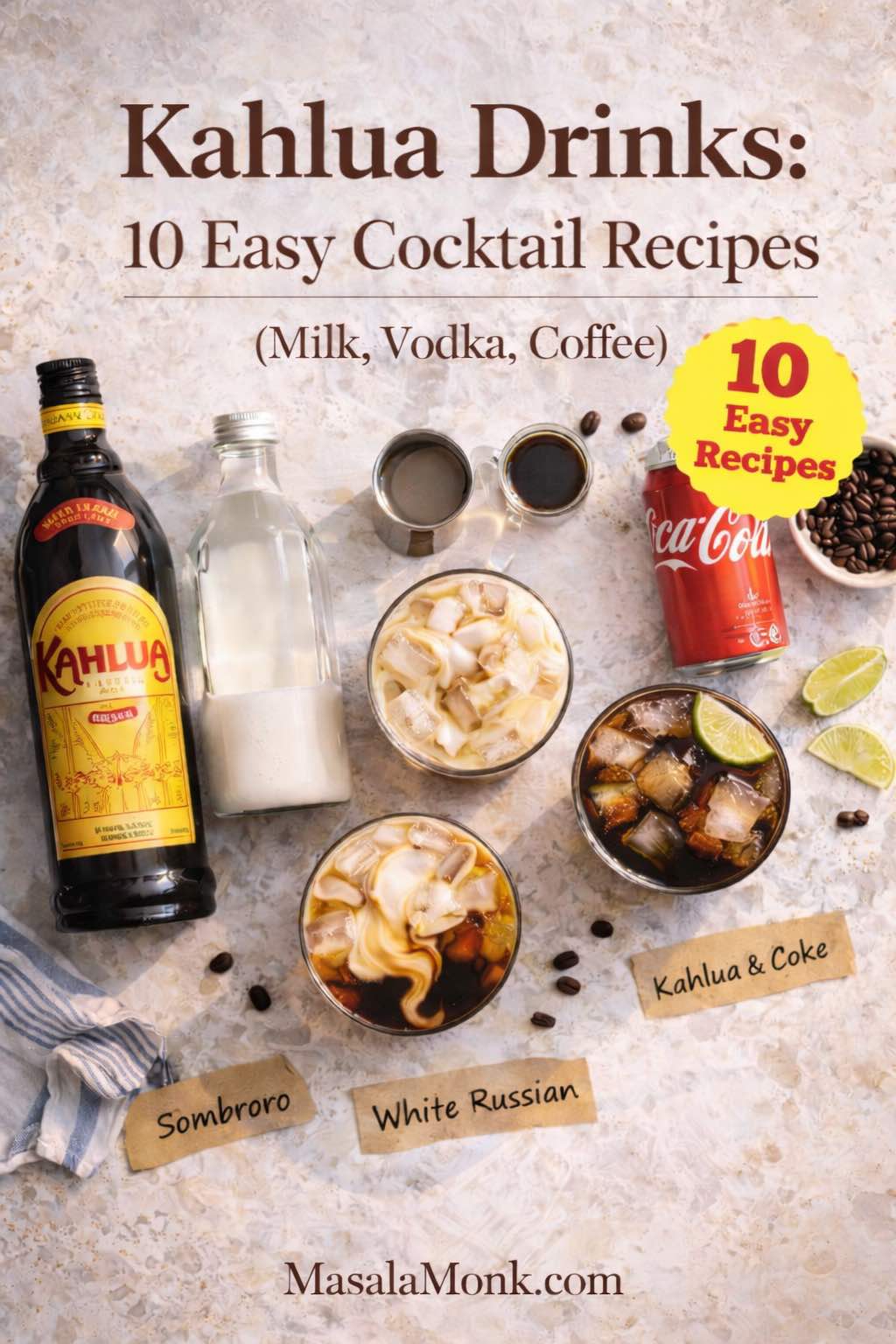
Also Read: Kahlua Drinks: 10 Easy Cocktail Recipes (Milk, Vodka, Coffee)


Why fudge turns grainy (and how these recipes avoid it)

Graininess in fudge is almost always about sugar crystallization: you get crystals, but they’re too large to feel smooth. The interesting twist is that fudge actually wants crystals—just tiny ones that make the texture creamy rather than sandy. The science explanation in Exploratorium’s “What’s Special About Fudge?” is a surprisingly readable deep dive into that microcrystal sweet spot.
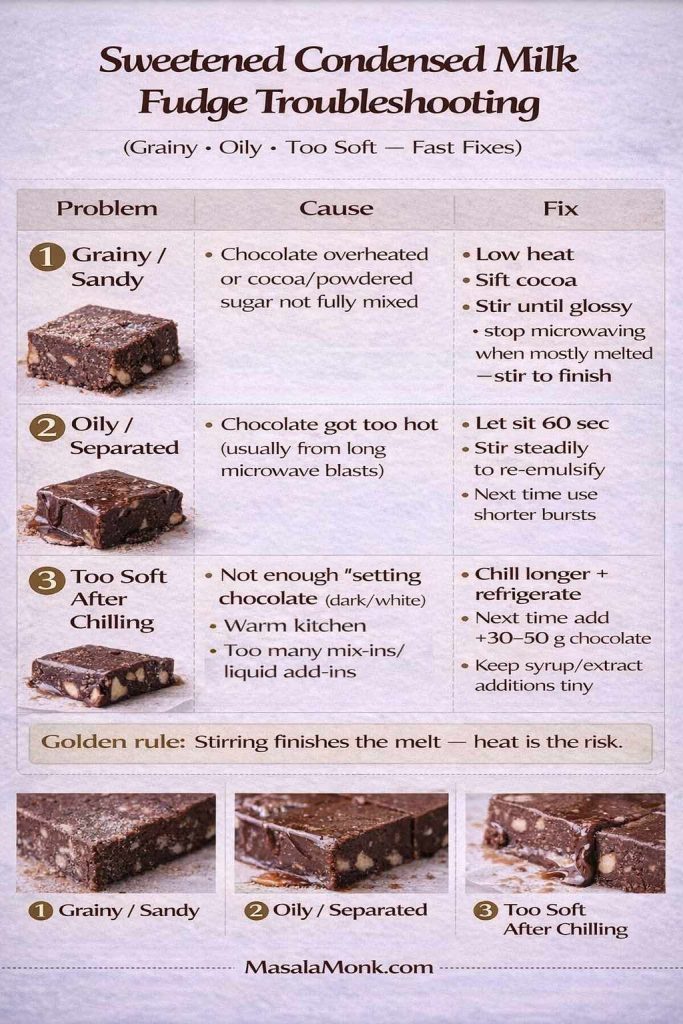
Vertical troubleshooting infographic titled “Sweetened Condensed Milk Fudge Troubleshooting (Grainy • Oily • Too Soft — Fast Fixes)”. It’s laid out as a 3-row table with columns for Problem, Cause, and Fix. Row 1 covers grainy/sandy fudge (overheated chocolate or cocoa/powdered sugar not fully mixed) with fixes: low heat, sift cocoa, stir until glossy, and stop microwaving when mostly melted—stir to finish. Row 2 covers oily/separated fudge (chocolate got too hot, often from long microwave blasts) with fixes: let sit 60 seconds, stir steadily to re-emulsify, and use shorter bursts next time. Row 3 covers fudge too soft after chilling (not enough setting chocolate, warm kitchen, too many mix-ins/liquid add-ins) with fixes: chill longer + refrigerate, next time add 30–50 g chocolate, and keep syrup/extract additions tiny. A callout reads “Golden rule: Stirring finishes the melt — heat is the risk.” Includes three small example photos along the bottom and MasalaMonk.com branding in the footer.
Save this sweetened condensed milk fudge troubleshooting card for the batch that goes sideways. It gives you fast fixes for the three most common problems—grainy fudge, oily/separated fudge, and fudge that’s too soft after chilling—plus the one rule that prevents most fails: stirring finishes the melt; too much heat is the risk. If you’re making holiday trays or gifting, this is the cheat sheet that helps every condensed milk fudge recipe set glossy and slice cleanly.

In condensed milk fudge, you usually sidestep the worst crystallization issues because you’re not boiling sugar syrup to a precise stage. Still, graininess can happen if:

  • the mixture overheats and separates,
  • you stir aggressively after it’s already thickening in a cooked style,
  • or dry ingredients clump and never fully dissolve.

That’s why these recipes emphasize gentle heat, steady stirring, and sifting cocoa where needed. In other words, the “no-fail” feeling isn’t magic—it’s good handling.

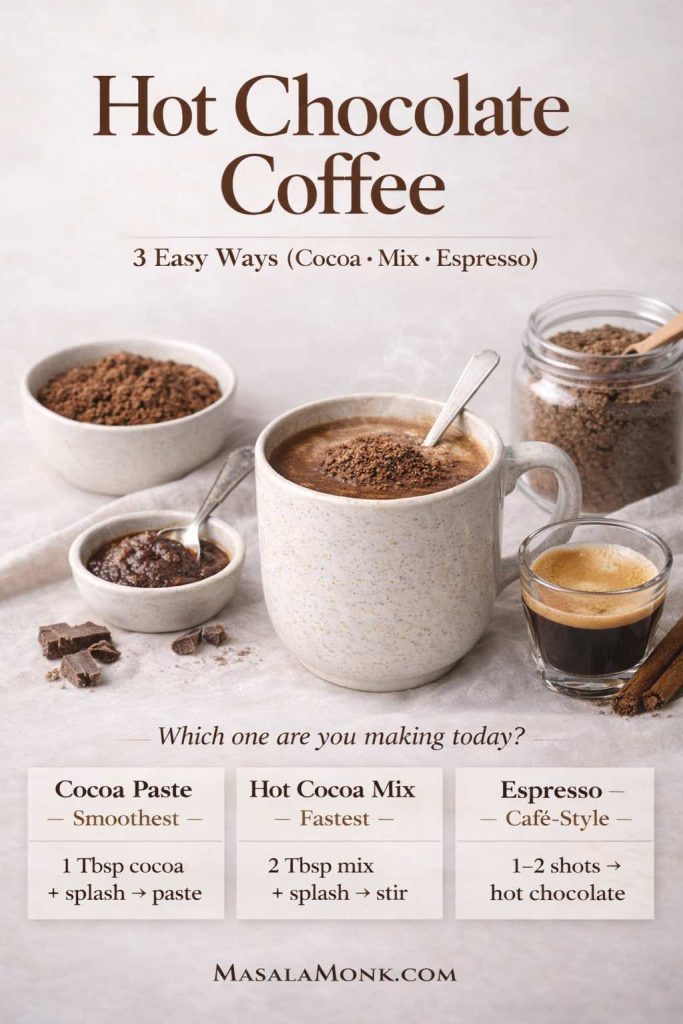
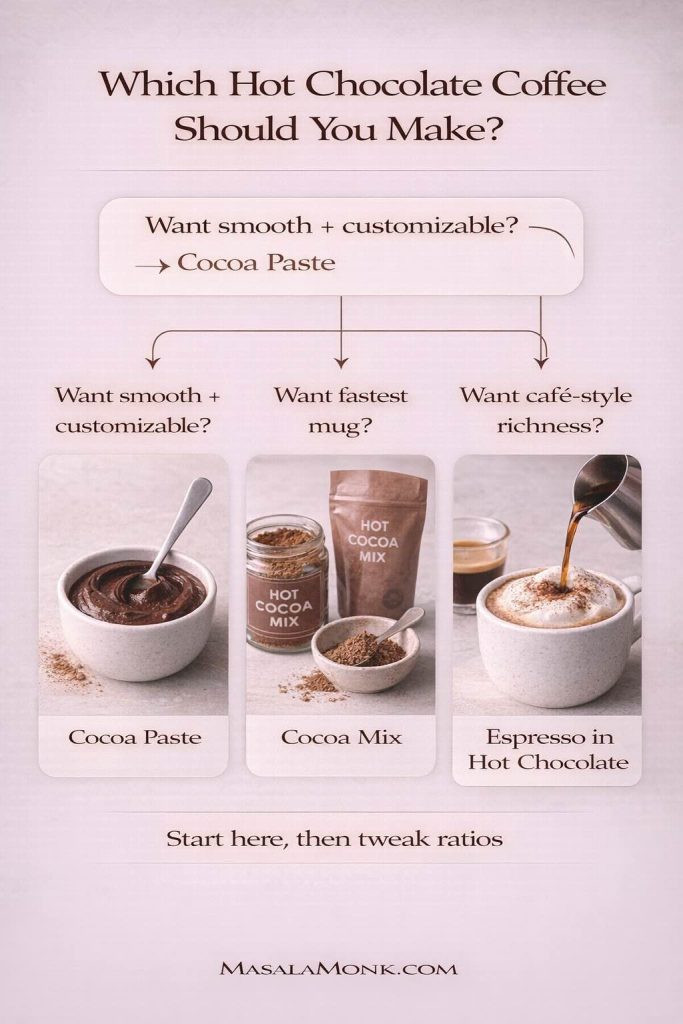
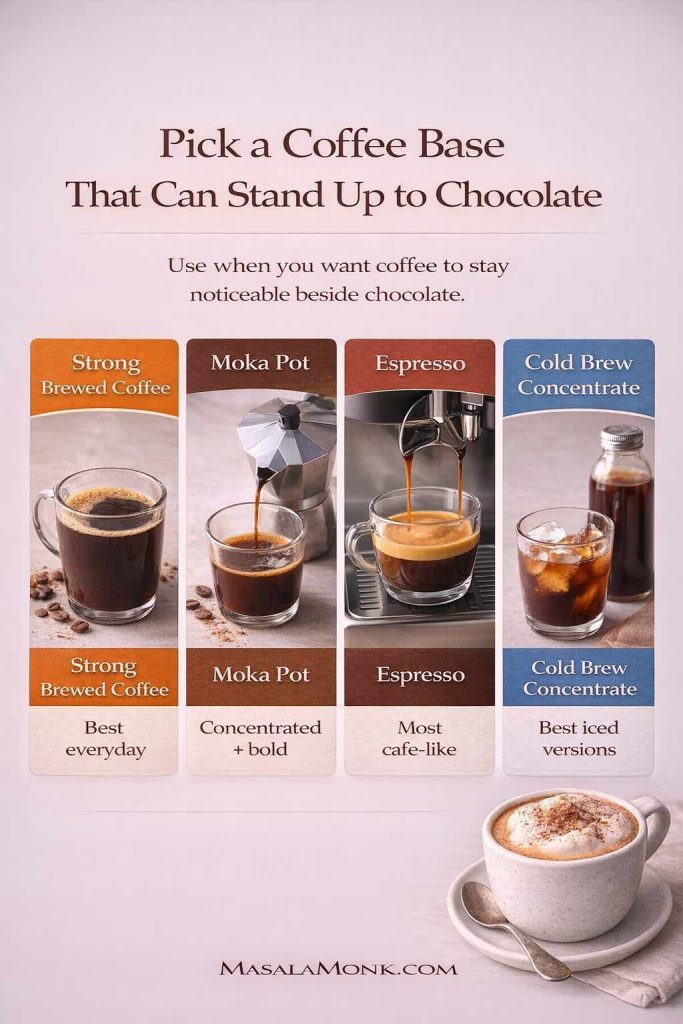
Also Read: Hot Chocolate Coffee: 3 Easy Recipes (Cocoa, Mix, or Espresso)


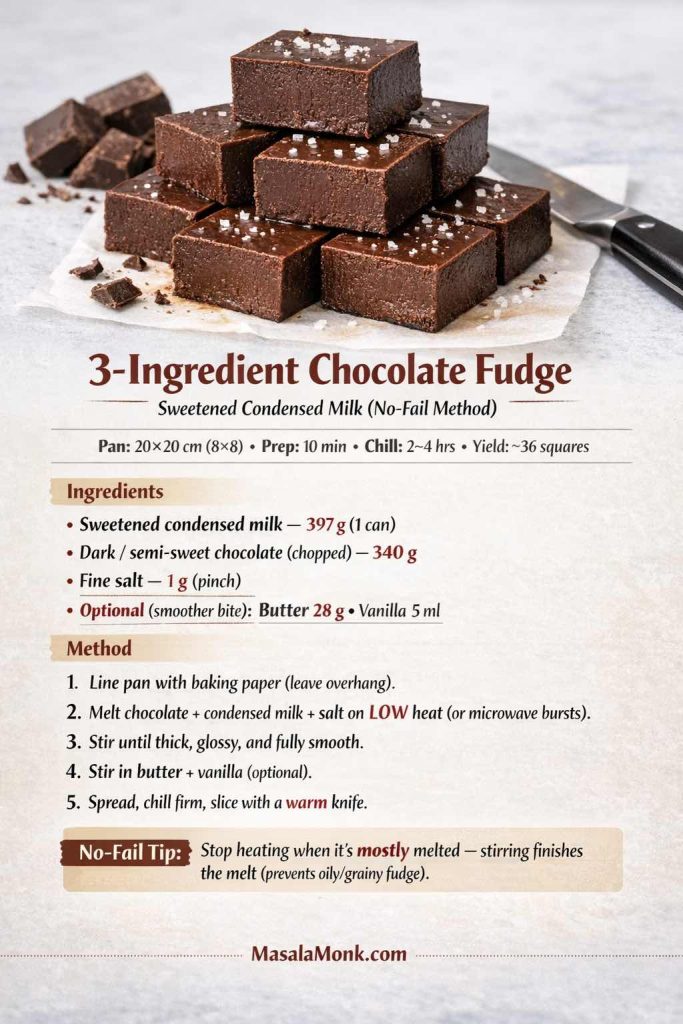
1) Sweetened condensed milk chocolate fudge (classic 3-ingredient style recipe)

This is the one you’ll come back to when you want something simple and dependable. It’s the core condensed milk fudge recipe—smooth, glossy, and sliceable without drama. It also adapts easily: change your chocolate, add nuts, switch the aroma with vanilla, and you still end up with a finished candy.

Ingredients (20 × 20 cm tin)

  • Sweetened condensed milk: 397 g
  • Dark or semi-sweet chocolate, chopped: 340 g
  • Fine salt: 1 g

Optional, but genuinely worth it:

  • Unsalted butter: 28 g
  • Vanilla extract: 5 ml
Recipe card image showing glossy 3-ingredient chocolate fudge made with sweetened condensed milk. Includes pan size (20×20 cm), prep and chill time, ingredient amounts in grams, 5-step stovetop/microwave method, a no-fail tip (“stirring finishes the melt”), and MasalaMonk.com branding in the footer.
This 3-ingredient chocolate fudge with sweetened condensed milk is the baseline “no-fail” recipe for the entire guide: one can of condensed milk + chopped dark/semi-sweet chocolate + a pinch of salt. Use the stovetop or microwave method, then chill until firm for clean slices. The key tip is simple but crucial—stop heating when the chocolate is mostly melted and let stirring finish the melt to avoid oily or grainy fudge. Save this card for quick holiday trays, edible gifts, or anytime you want dependable fudge without candy thermometers.

Method (stovetop)

  1. Line the tin and set it aside.
  2. Combine chocolate, sweetened condensed milk, and salt in a saucepan.
  3. Warm on low heat, stirring until the mixture becomes glossy and uniform.
  4. Remove from heat. Add butter (if using) and stir until fully melted. Then add vanilla.
  5. Spread into the tin, smooth the top, and chill until firm.

Microwave version (fast and clean)

Use the microwave master method above: melt chopped chocolate in short bursts, stirring until it’s mostly melted, then stir until fully smooth. Add sweetened condensed milk and salt and mix until the mixture turns thick and glossy. If it looks streaky, warm it for 10–15 seconds and stir again. Finish with vanilla, spread, and chill.

How it tastes (so you can choose your chocolate)

  • Dark chocolate makes the sweetness feel balanced and grown-up.
  • Milk chocolate makes it softer and sweeter—more “candy bar.”
  • A blend lands in the middle, which is often the safest crowd-pleaser.
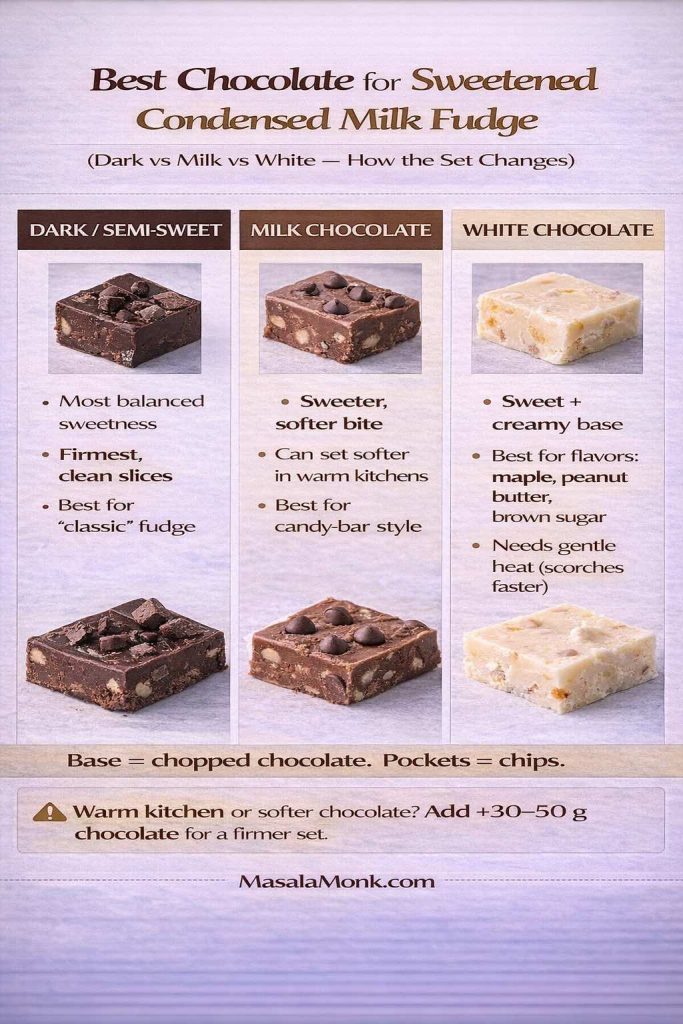
Guide-style infographic titled “Best Chocolate for Sweetened Condensed Milk Fudge (Dark vs Milk vs White — How the Set Changes)”. Three columns compare dark/semi-sweet, milk chocolate, and white chocolate with photos of fudge squares. Dark/semi-sweet notes: most balanced sweetness, firmest clean slices, best for classic fudge. Milk chocolate notes: sweeter softer bite, can set softer in warm kitchens, best for candy-bar style. White chocolate notes: sweet creamy base, best for flavors like maple, peanut butter, and brown sugar, needs gentle heat because it scorches faster. A rule line says “Base = chopped chocolate. Pockets = chips.” A tip box says “Warm kitchen or softer chocolate? Add +30–50 g chocolate for a firmer set.” MasalaMonk.com branding appears in the footer.
Save this best chocolate for sweetened condensed milk fudge guide before you swap ingredients. Dark/semi-sweet gives the firmest, cleanest slices with balanced sweetness, milk chocolate makes a softer candy-bar style fudge (especially in warm kitchens), and white chocolate is the best base for flavors like maple fudge, peanut butter fudge, and brown sugar fudge—just melt it gently. If you want a firmer set, the card includes the simplest adjustment: add 30–50 g extra chocolate.

A serving direction that feels intentional

Instead of just stacking squares, treat it like a dessert plate. A thin drizzle of cocoa syrup and a pinch of flaky salt makes each piece feel “finished.” If you want a quick drizzle that’s already designed to stay smooth, try MasalaMonk’s 3-minute homemade chocolate syrup. It pairs beautifully with condensed milk chocolate fudge, especially when the fudge is slightly chilled and the syrup is warm.

Also Read: Cappuccino Recipe: How to Make a Perfect Cappuccino at Home


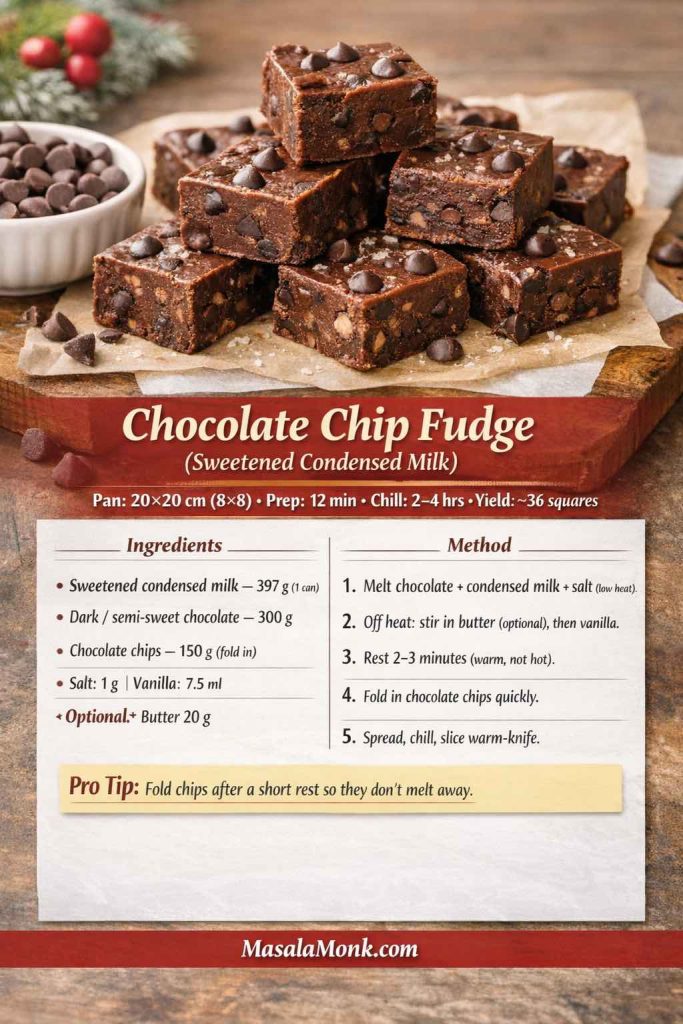
2) Chocolate chip and sweetened condensed milk fudge (quick set, classic flavor)

Sometimes you want that familiar holiday-tray vibe: a smooth chocolate fudge base with real chocolate chips baked right into the bite. This version delivers exactly that—rich, straightforward, and full of little chocolate pockets—because the chips are folded in at the end, not melted into the base.

Ingredients (20 × 20 cm tin)

Fudge base

  • Sweetened condensed milk: 397 g
  • Dark or semi-sweet chocolate, chopped: 300 g
  • Fine salt: 1 g
  • Vanilla extract: 7.5 ml (1½ tsp)

Fold-in chips (kept as chips)

  • Chocolate chips (semi-sweet or milk): 150 g

Optional (smoother bite)

  • Unsalted butter: 20 g
Recipe card showing chocolate chip fudge made with sweetened condensed milk. The image includes a photo of fudge squares with visible chocolate chips, pan size (20×20 cm), prep time (12 min), chill time (2–4 hrs), yield (~36 squares), ingredient amounts in grams, a 5-step method, a pro tip to rest before folding in chips so they don’t melt, and MasalaMonk.com branding in the footer.
This chocolate chip fudge with sweetened condensed milk is the “holiday tray” version of the classic—smooth chocolate base, plus real chocolate chip pockets in every bite. The key move is simple: rest the warm fudge base for 2–3 minutes before folding in the chips, so they stay as chips instead of melting into streaks. Save this card when you want an easy, sliceable fudge that looks impressive and tastes like a familiar chocolate-chip dessert—without candy thermometers or complicated steps.

Method (stovetop)

  1. Line the tin with baking paper and set it aside.
  2. In a saucepan on low heat, melt the chopped chocolate with sweetened condensed milk and salt, stirring steadily until glossy and completely smooth.
  3. Remove from heat. Stir in butter (if using), then vanilla.
  4. Let the mixture sit 2–3 minutes so it’s still warm but not scorching hot.
  5. Fold in the chocolate chips quickly so they stay intact rather than melting into streaks.
  6. Spread into the tin, smooth the top, and chill until firm.

Method (microwave)

  1. Melt the chopped chocolate in short bursts, stirring between bursts until smooth.
  2. Stir in sweetened condensed milk and salt until thick and glossy (warm briefly only if needed).
  3. Stir in butter (if using) and vanilla.
  4. Rest 2–3 minutes, then fold in chips.
  5. Spread and chill.

Why this stays a separate recipe from the chopped-chocolate classic

Even though the base is similar, the experience is different: instead of one uniform chocolate bite, you get bursts of chocolate from the chips. That “chip pop” is what people expect from chocolate chip fudge, and it’s the reason this version earns its own spot.

A small shift that makes it feel “new”

Add a handful of chopped walnuts or toasted pecans—about 60 g—and fold them in just before spreading. Then, once it’s set, slice and serve with hot coffee or iced coffee. If you’re building a “dessert and drink” pairing moment, the condensed milk angle flows naturally into MasalaMonk’s iced coffee recipes collection, which includes condensed milk-style coffee variations for that café feel.

Also Read: Cold Brew Espresso Martini: How to Make It (Step-by-Step Recipe)


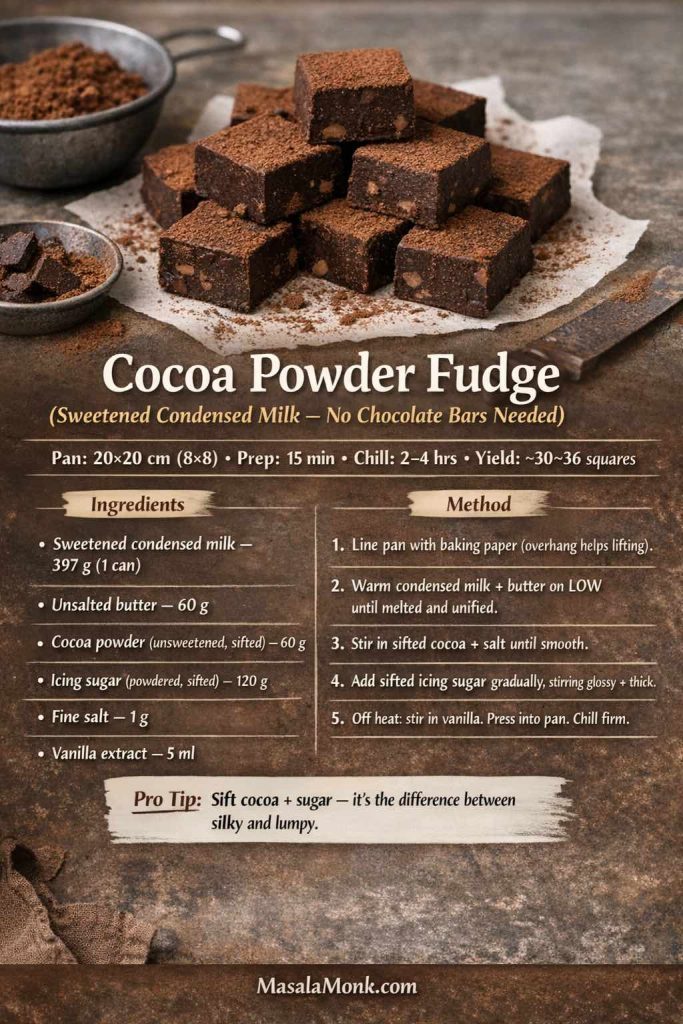
3) Cocoa powder fudge with sweetened condensed milk (deep chocolate, no melted chocolate required)

This one leans into cocoa powder and structure. It’s bold, dark, and intensely chocolatey without relying on a mountain of melted chocolate. The texture is slightly more “fudge-like” in a traditional way—dense and smooth, with a clean slice.

Ingredients

  • Sweetened condensed milk: 397 g
  • Unsalted butter: 60 g
  • Cocoa powder (unsweetened), sifted: 60 g
  • Icing sugar (powdered sugar), sifted: 120 g
  • Fine salt: 1 g
  • Vanilla extract: 5 ml
Recipe card image for cocoa powder fudge made with sweetened condensed milk (no chocolate bars needed). Shows cocoa-dusted fudge squares plus pan size (20×20 cm), prep time (15 min), chill time (2–4 hrs), yield (~30–36 squares), ingredient amounts in grams (condensed milk, butter, cocoa powder, icing sugar, salt, vanilla), a 5-step low-heat method, a pro tip to sift cocoa and sugar for a silky texture, and MasalaMonk.com branding in the footer.
If you’re searching for a condensed milk cocoa powder fudge recipe, this is the reliable pantry version—no chocolate bars required. Sweetened condensed milk + butter builds a smooth base, while sifted cocoa powder and icing sugar give the fudge its structure and deep chocolate flavor. Save this card for those days when you want a bold, sliceable cocoa fudge fast—and remember the one detail that changes everything: sifting keeps the texture silky instead of lumpy.

Method

  1. Line the tin and set it aside.
  2. In a saucepan on low heat, warm condensed milk and butter until the butter melts and the mixture is unified.
  3. Add sifted cocoa and salt. Stir until smooth.
  4. Add sifted icing sugar gradually, stirring until the mixture thickens and becomes glossy.
  5. Remove from heat, stir in vanilla, then press into the tin.
  6. Chill until firm.

What to expect

This version sets quickly and tastes strongly of cocoa. Therefore, it’s a smart choice when you want the chocolate flavor to feel clear rather than candy-sweet.

A satisfying way to serve it

Cut into small squares and plate it with something crisp. Churros are especially good because they bring warmth, crunch, and cinnamon. If you want a full churros guide with sauces and variations, MasalaMonk’s churros recipe gives you plenty of options for turning fudge into a dip or a dessert board centerpiece.

Also Read: Cranberry Moscow Mule Recipe: A Festive Holiday Cocktail With Easy Variations


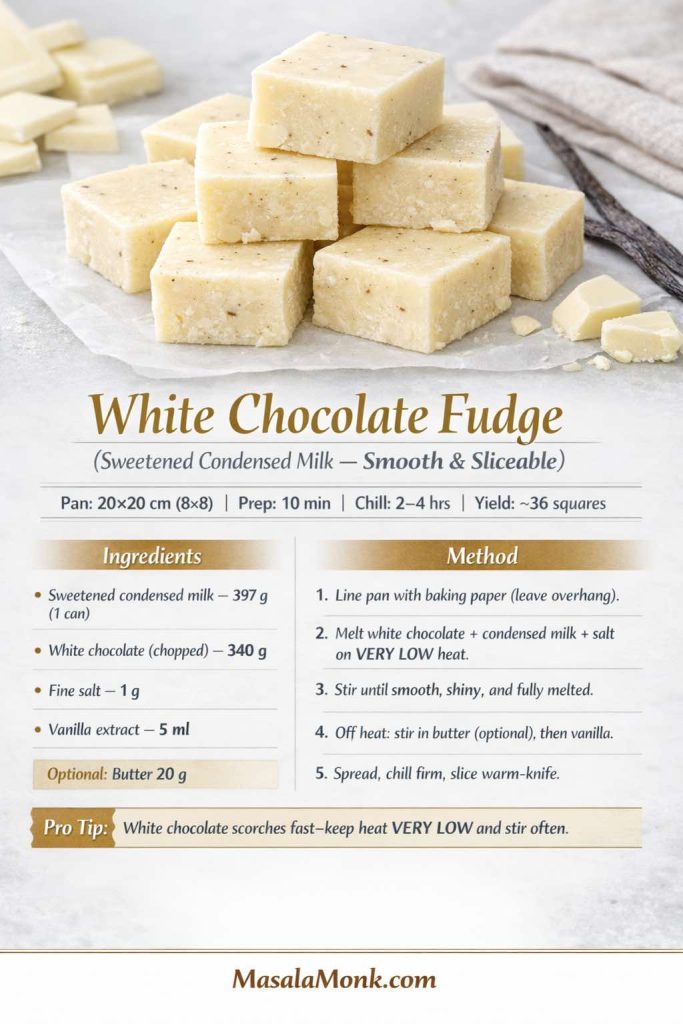
4) White chocolate fudge with sweetened condensed milk recipe (smooth, creamy, and versatile)

White chocolate condensed milk fudge is the quiet powerhouse of this collection. It’s creamy, sweet, and a perfect base for vanilla, maple, and “holiday tray” flavors. The key is gentle heat. White chocolate scorches faster than dark chocolate, so take your time.

Ingredients

  • Sweetened condensed milk: 397 g
  • White chocolate, chopped: 340 g
  • Fine salt: 1 g
  • Vanilla extract: 5 ml

Optional:

  • Unsalted butter: 20 g
Recipe card image for white chocolate fudge made with sweetened condensed milk. Shows creamy white fudge squares with vanilla flecks, pan size (20×20 cm), prep time (10 min), chill time (2–4 hrs), yield (~36 squares), ingredient amounts in grams (condensed milk, white chocolate, salt, vanilla, optional butter), a 5-step very-low-heat method, a pro tip to keep heat very low to prevent scorching, and MasalaMonk.com branding in the footer.
This white chocolate fudge with sweetened condensed milk is the smooth, sliceable base that powers the “non-dark-chocolate” side of the guide—think vanilla, maple, brown sugar, and butterscotch-style variations. The only rule that matters here is heat control: white chocolate scorches fast, so keep the flame very low and stir until glossy. Save this card when you want a creamy, gift-box-friendly fudge that sets cleanly and cuts into neat squares every time.

Method

  1. Line the tin and set it aside.
  2. Melt white chocolate with condensed milk and salt on very low heat, stirring often.
  3. Remove from heat and stir in butter (if using), then vanilla.
  4. Spread, smooth, chill.

Why this base matters

White chocolate fudge is the bridge between candy and dessert. It also behaves beautifully with add-ins like nuts, dried fruit, or maple. So, even if you make only one “non-chocolate” fudge from this post, make it this one—because it becomes several other recipes with minor shifts.

A gentle, natural pairing link

If you like desserts that lean creamy and layered rather than purely chocolate, you’ll probably love MasalaMonk’s savoiardi chocolate vanilla pudding. It’s a different format, yet it hits the same comfort-dessert note, especially after a meal.

Also Read: Baked Ziti Recipe Collection: 15 Easy Variations


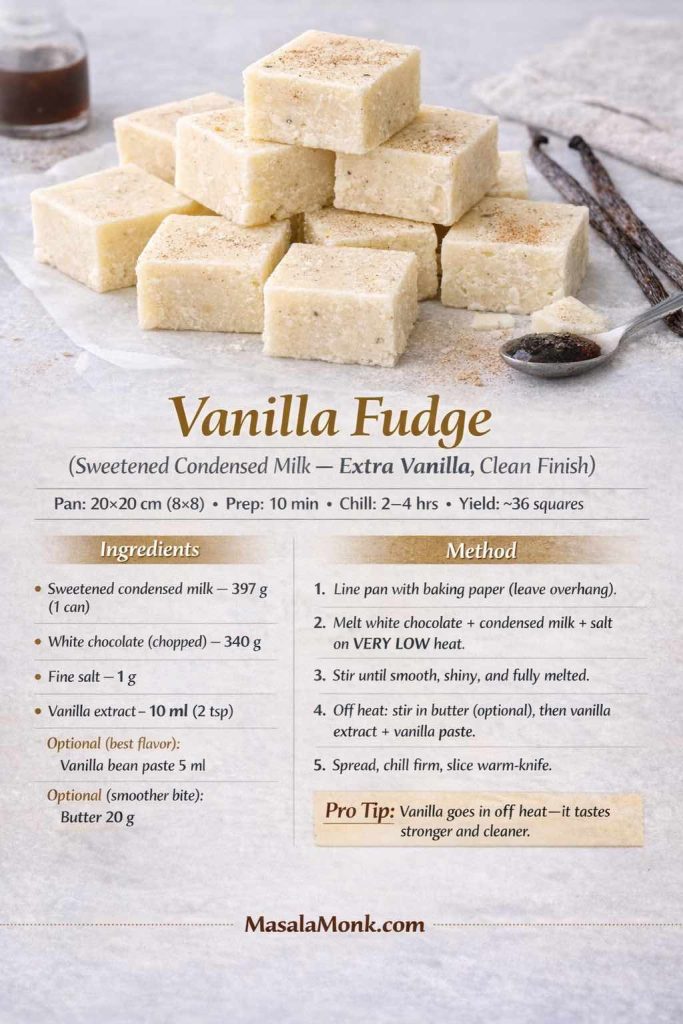
5) Vanilla fudge (sweetened condensed milk) recipe with a clean, classic finish

Vanilla fudge often gets dismissed as “just white chocolate,” but it doesn’t have to taste vague. The difference comes from how you build the flavor: more vanilla, a pinch of salt, and an option for vanilla bean paste if you want that speckled bakery look.

Ingredients

  • Sweetened condensed milk: 397 g
  • White chocolate, chopped: 340 g
  • Fine salt: 1 g
  • Vanilla extract: 10 ml (2 tsp)

Optional:

  • Vanilla bean paste: 5 ml
  • Unsalted butter: 20 g
Recipe card image for vanilla fudge made with sweetened condensed milk. Shows pale vanilla-speckled fudge squares with vanilla beans and a spoon of vanilla paste. The card includes pan size (20×20 cm), prep time (10 min), chill time (2–4 hrs), yield (~36 squares), ingredients in grams (condensed milk, white chocolate, salt, vanilla extract, optional vanilla bean paste and butter), a 5-step very-low-heat method, a pro tip to add vanilla off the heat for stronger flavor, and MasalaMonk.com branding in the footer.
This vanilla fudge recipe using sweetened condensed milk is the “clean finish” version of white chocolate fudge—same easy method, but with the flavor turned up so it tastes unmistakably vanilla, not just sweet. The trick is timing: add vanilla (and vanilla bean paste, if using) off the heat so the aroma stays bold and fresh. Save this card for gift boxes, holiday trays, and quick make-ahead desserts when you want a creamy, sliceable fudge that feels bakery-level without extra work.

Method

  1. Melt white chocolate, condensed milk, and salt on very low heat.
  2. Remove from heat. Stir in vanilla extract (and paste if using).
  3. Spread into the tin. Chill until firm.

Make it feel special without making it complicated

Once set, sprinkle a light dusting of cinnamon or cardamom on top and press gently so it clings. It reads like a deliberate flavor choice rather than “plain.” Even more, it pairs beautifully with fruit-forward desserts, which makes it a nice companion to something like MasalaMonk’s no-bake blueberry cheesecake if you’re building a dessert table with variety.

Also Read: Manhattan Cocktail Recipe (Classic + 6 Variations)


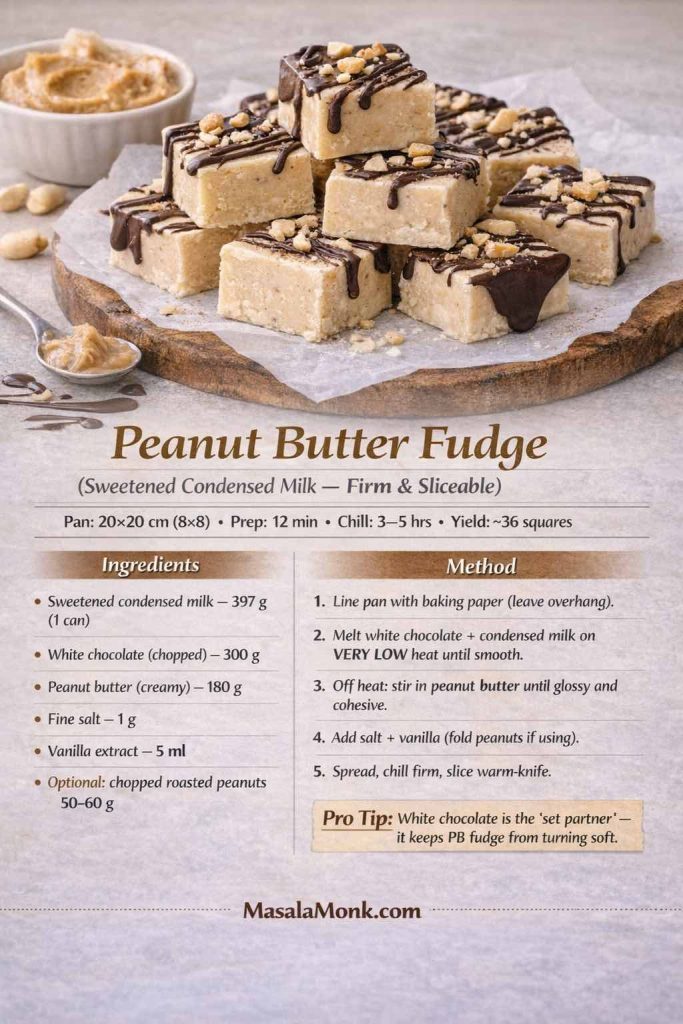
6) Peanut butter fudge using sweetened condensed milk (firm, creamy, and sliceable)

This is where a lot of people get disappointed when they improvise: peanut butter and condensed milk taste wonderful, but the set can be too soft. So, this recipe uses white chocolate as the structure. The result is creamy, stable, and easy to cut—even when your kitchen runs warm.

For a broader peanut butter fudge universe (including old fashioned cooked versions, marshmallow crème methods, and more), MasalaMonk’s peanut butter fudge guide is a great companion read.

Ingredients

  • Sweetened condensed milk: 397 g
  • White chocolate, chopped: 300 g
  • Peanut butter (creamy): 180 g
  • Fine salt: 1 g
  • Vanilla extract: 5 ml

Optional:

  • Roasted peanuts, chopped: 50–60 g
Recipe card image for peanut butter fudge made with sweetened condensed milk. Shows tan peanut butter fudge squares drizzled with dark chocolate and topped with chopped peanuts. The card lists pan size (20×20 cm), prep time (12 min), chill time (3–5 hrs), yield (~36 squares), ingredients in grams (condensed milk, white chocolate, peanut butter, salt, vanilla, optional chopped peanuts), a 5-step method using very low heat, a pro tip explaining white chocolate as the “set partner” to prevent soft fudge, and MasalaMonk.com branding in the footer.
This peanut butter fudge with sweetened condensed milk is the sliceable, reliable version people are actually trying to get when they search “easy peanut butter fudge condensed milk.” The secret is structure: white chocolate acts as the setting partner, so the fudge firms up cleanly instead of staying soft—especially in warm kitchens. Save this card for quick batches, edible gifts, and dessert trays when you want that classic peanut-butter flavor with neat, gift-box cuts every time.

Method

  1. Line the tin and set it aside.
  2. Melt white chocolate with condensed milk on very low heat until smooth.
  3. Remove from heat and stir in peanut butter until glossy.
  4. Add salt and vanilla. Fold in peanuts if using.
  5. Spread into the tin and chill.

What the texture should look like

When you stir in the peanut butter, the mixture should turn silky and cohesive, not greasy or separated. If it looks oily, keep stirring gently until it emulsifies. In most cases, it comes together with patience rather than extra heat.

A dessert-board idea

Peanut butter fudge is fantastic with crisp cookies, bananas, or even spooned onto toast. If you want a no-oven dessert that shares the same “layer and chill” ease, MasalaMonk’s banana pudding sits in the same comfort zone and pairs well on a dessert spread.

Also Read: Green Chutney Recipe (Coriander–Mint / Cilantro Chutney)


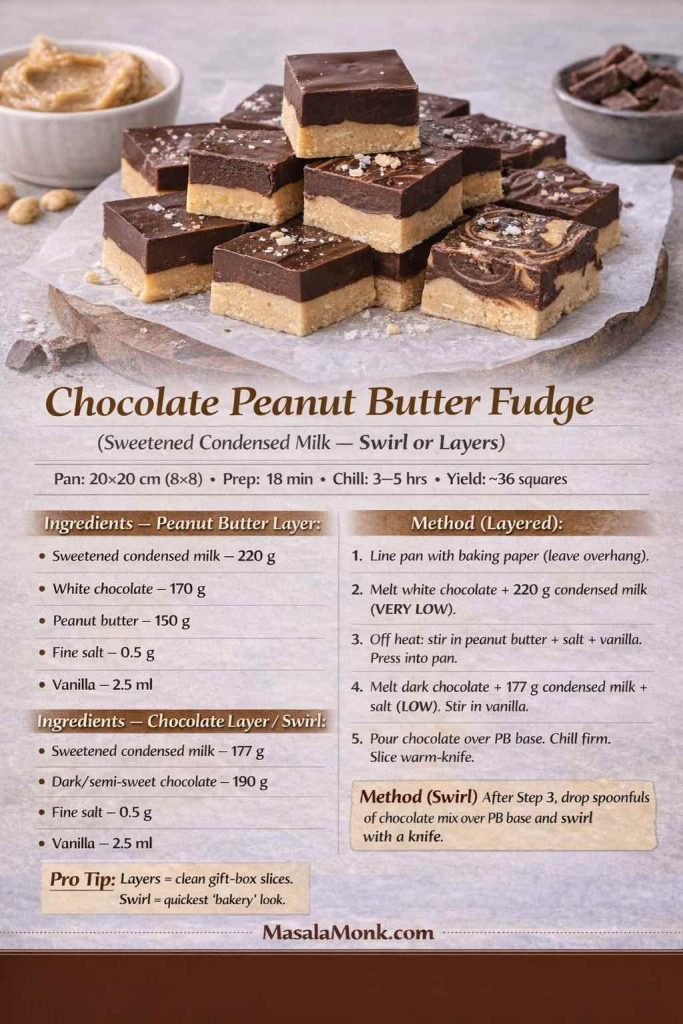
7) Chocolate peanut butter fudge recipe (Sweetened condensed milk) — swirl or layers

Chocolate and peanut butter together are always a win, yet you can choose the vibe: swirled for a casual look, layered for that clean “buckeye” feel. Either way, this version is built to set firmly and slice beautifully.

Ingredients (two mixtures)

Peanut butter base

  • Sweetened condensed milk: 220 g
  • White chocolate: 170 g
  • Peanut butter: 150 g
  • Fine salt: 0.5 g
  • Vanilla extract: 2.5 ml

Chocolate layer/swirl

  • Sweetened condensed milk: 177 g
  • Dark or semi-sweet chocolate: 190 g
  • Fine salt: 0.5 g
  • Vanilla extract: 2.5 ml
Recipe card image for chocolate peanut butter fudge made with sweetened condensed milk, showing both swirl and layered versions. The image includes stacked two-layer fudge squares and one marbled swirl piece, pan size (20×20 cm), prep time (18 min), chill time (3–5 hrs), yield (~36 squares), separate ingredient lists with grams for the peanut butter layer and chocolate layer, a 5-step layered method, a short swirl option note, and MasalaMonk.com branding in the footer.
This chocolate peanut butter fudge with sweetened condensed milk is the showstopper version of the guide—choose clean layers for gift-box-perfect slices or a quick swirl for that bakery-style marbled top. The recipe is built to set firmly (thanks to the white-chocolate peanut-butter base) while still tasting rich and balanced. Save this card for holiday trays, edible gifts, or anytime you want a reliable “wow” fudge that cuts neatly and looks impressive with minimal effort.

Method (layered)

  1. Make the peanut butter mixture: melt white chocolate with condensed milk, then stir in peanut butter, salt, and vanilla. Press it into the tin.
  2. Make the chocolate mixture: melt dark chocolate with condensed milk and salt, then stir in vanilla.
  3. Pour the chocolate layer over the peanut butter base.
  4. Chill until firm, then slice with a warm knife.

Method (swirled)

Instead of pouring the chocolate as one layer, drop spoonfuls of chocolate mixture over the peanut butter base and swirl with a knife. Then chill.

Make it feel a bit more “dessert-like”

Serve a square with a spoonful of lightly sweetened cream, or drizzle with cocoa syrup. A warm cocoa drizzle (even a simple cocoa + sugar + hot water syrup) makes the swirl taste more ‘dessert’ than candy—especially when the fudge is chilled.

Also Read: Rob Roy Drink Recipe: Classic Scotch Cocktail (Perfect + Dry + Sweet Variations)


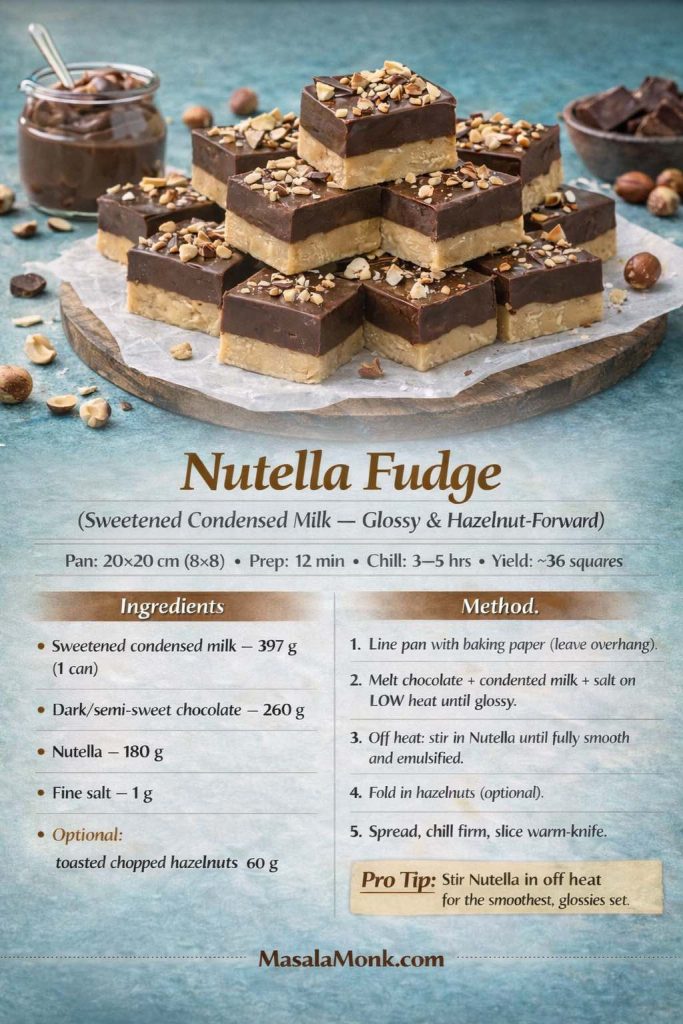
8) Nutella fudge with sweetened condensed milk (rich, glossy, and hazelnut-forward)

Nutella and condensed milk are an intuitive match: creamy, sweet, and deeply comforting. However, the best Nutella condensed milk fudge still benefits from real chocolate for structure and depth. This version keeps the hazelnut flavor clear without becoming overly sweet.

Ingredients

  • Sweetened condensed milk: 397 g
  • Dark or semi-sweet chocolate: 260 g
  • Nutella: 180 g
  • Fine salt: 1 g

Optional:

  • Toasted hazelnuts, chopped: 60 g
Recipe card image for Nutella fudge made with sweetened condensed milk, shown on a teal textured background. The card features stacked glossy Nutella-chocolate fudge squares topped with toasted chopped hazelnuts, plus a jar of Nutella and chocolate pieces in the scene. Text overlay includes pan size (20×20 cm), prep time (12 min), chill time (3–5 hrs), yield (~36 squares), ingredients in grams (condensed milk, dark/semi-sweet chocolate, Nutella, salt, optional hazelnuts), a 5-step low-heat method, a pro tip to stir Nutella in off heat for the smoothest set, and MasalaMonk.com branding in the footer.
This Nutella fudge with sweetened condensed milk is the glossy, hazelnut-forward variation people look for when they want something richer than plain chocolate fudge. The method stays simple—melt chocolate with condensed milk, then stir Nutella in off the heat so it emulsifies smoothly and sets into neat, sliceable squares. Finish with toasted hazelnuts for crunch, and you’ve got a gift-box-ready fudge that feels special without extra effort. Save this card for holiday trays, edible gifts, or anytime you want a quick Nutella dessert that actually slices cleanly.

Method

  1. Line the tin and set it aside.
  2. Melt chocolate with condensed milk and salt on low heat until glossy.
  3. Remove from heat and stir in Nutella until fully emulsified.
  4. Fold in hazelnuts if using, then spread and chill.

A festive pairing suggestion

Nutella fudge sits beautifully next to truffles on a holiday tray. If you want a second bite-sized chocolate treat that doesn’t require baking, MasalaMonk’s Irish rum truffles add variety while staying in the same “rich and celebratory” mood.

Also Read: Sandwich for Breakfast: Breakfast Sandwich Recipe + 10 Variations


9) Maple fudge recipe (sweetened condensed milk) with a warm caramel edge

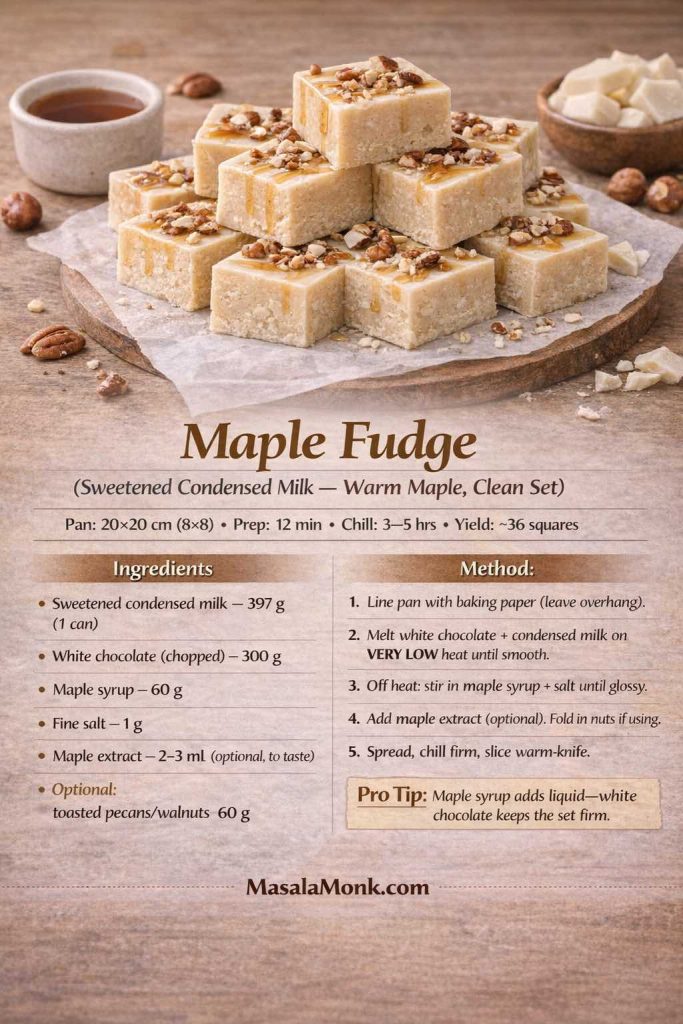
Maple fudge can be tricky if you rely on maple syrup alone—too much liquid can affect the set. So, this recipe uses white chocolate as the structure and a balanced amount of syrup for flavor, then finishes with maple extract (optional but helpful) for that unmistakable maple aroma.

Ingredients

  • Sweetened condensed milk: 397 g
  • White chocolate: 300 g
  • Maple syrup: 60 g
  • Fine salt: 1 g
  • Maple extract: 2–3 ml (optional, to taste)

Optional:

  • Toasted pecans or walnuts: 60 g
Recipe card image for maple fudge made with sweetened condensed milk. Shows creamy maple fudge squares topped with chopped pecans and a maple syrup drizzle on a warm wooden background, plus a small cup of maple syrup and white chocolate pieces. Text overlay includes pan size (20×20 cm), prep time (12 min), chill time (3–5 hrs), yield (~36 squares), ingredients in grams (condensed milk, white chocolate, maple syrup, salt, optional maple extract and nuts), a 5-step method, a pro tip noting maple syrup adds liquid so white chocolate keeps the set firm, and MasalaMonk.com branding in the footer.
This maple fudge recipe with sweetened condensed milk is the cozy, sliceable version that actually sets cleanly—because maple syrup adds liquid, and white chocolate provides the structure. The result is creamy, warm-maple flavored fudge that looks gift-box ready with a simple pecan topping. Save this card for holidays, dessert trays, or anytime you want maple flavor without candy-thermometer stress—then use the pro tip as your “insurance” for neat squares.

Method

  1. Line the tin and set it aside.
  2. Melt white chocolate with condensed milk on very low heat.
  3. Remove from heat and stir in maple syrup and salt.
  4. Add maple extract gradually if using. Fold in nuts if you like.
  5. Spread into the tin and chill.

Make it feel seasonal without forcing it

Maple fudge pairs beautifully with coffee. If you enjoy desserts that lean into creamy sweetness and milk flavors, it also connects naturally to a three-milks dessert like MasalaMonk’s tres leches cake guide, which uses sweetened condensed milk in a completely different (and equally comforting) way.

Also Read: Paper Plane Cocktail Recipe + Best Amaro Substitutes & Tips


10) Marshmallow fluff fudge (sweetened condensed milk + chocolate) — plush “fantasy” texture

This is the soft, cohesive style that feels especially giftable because it stays tender and creamy. Marshmallow crème (or fluff) adds body and that signature “pull” to the bite. Meanwhile, chocolate provides structure so it still slices cleanly.

Ingredients

  • Sweetened condensed milk: 397 g
  • Dark or semi-sweet chocolate: 300 g
  • Marshmallow fluff/crème: 200 g
  • Unsalted butter: 28 g
  • Fine salt: 1 g
  • Vanilla extract: 5 ml
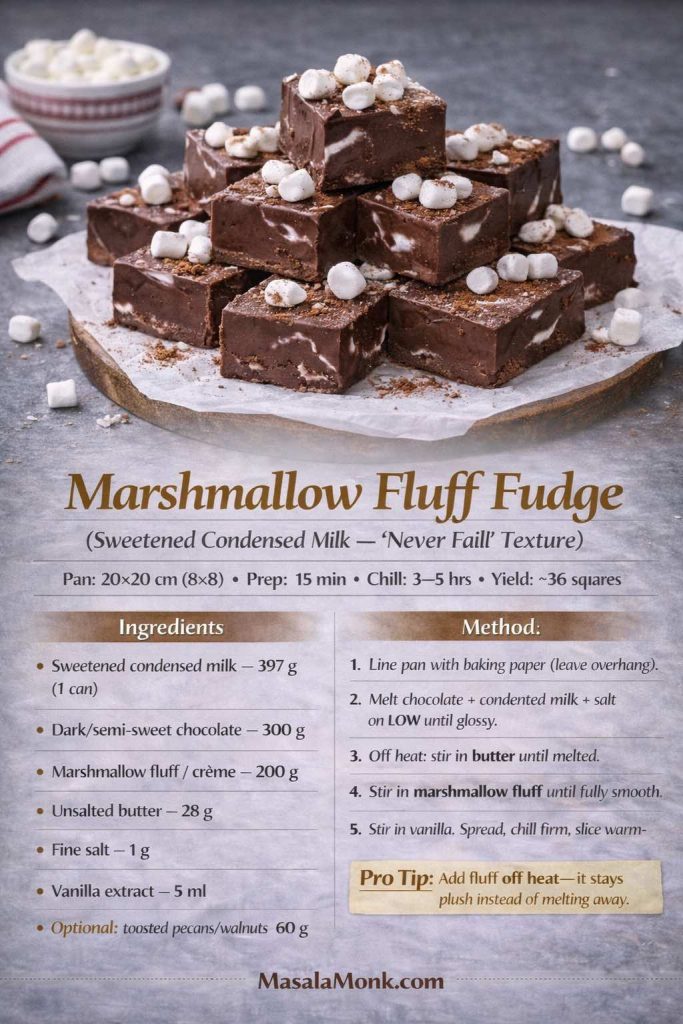
Recipe card image for marshmallow fluff fudge made with sweetened condensed milk. Shows chocolate fudge squares with visible marshmallow swirls, topped with mini marshmallows and cocoa dust on a grey background. The card lists pan size (20×20 cm), prep time (15 min), chill time (3–5 hrs), yield (~36 squares), ingredients in grams (condensed milk, dark/semi-sweet chocolate, marshmallow fluff/crème, butter, salt, vanilla), a 5-step method, a pro tip to add fluff off heat for a plush texture, and MasalaMonk.com branding in the footer.
If you’re searching for “never fail fudge” with sweetened condensed milk, this is the one to save. Marshmallow fluff + butter gives the fudge that plush, creamy bite people expect from classic holiday-tray fudge, while chocolate keeps the set firm enough for clean squares. The most important step is timing: stir the fluff in off the heat so it stays fluffy and smooth instead of melting away. Keep this card for edible gifts, dessert boards, and quick make-ahead fudge that slices neatly every time.

Method

  1. Line the tin and set it aside.
  2. Melt chocolate with condensed milk and salt on low heat until glossy.
  3. Remove from heat. Stir in butter until melted.
  4. Add marshmallow fluff and stir until fully combined and smooth.
  5. Stir in vanilla, spread into the tin, and chill.

How to make the slices look “clean”

Because this style is softer, it benefits even more from a warm knife. Chill thoroughly, warm the knife, wipe it dry, and cut with confident, straight pressure. If the edges smear, pause and rewarm the blade.

Also Read: Classic Rum Punch + 9 Recipes (Pitcher & Party-Friendly)


Sweetened condensed milk fudge variations (brown sugar, butterscotch, rocky road, peppermint, eggnog)

These are built on the same “strong setting partner” rule, so you don’t need a whole new method each time. Start with the base recipe that matches the flavor, then swap in the add-ins below.

1) Brown sugar sweetened condensed milk fudge (caramel-ish, holiday-tray friendly recipe)

Start with: White chocolate fudge with sweetened condensed milk (Recipe #4)
Add:

  • Brown sugar: 70–90 g
  • Unsalted butter: 30 g (use it here even if you skip it elsewhere)
  • Vanilla: 5 ml
  • Optional: toasted pecans/walnuts 60 g
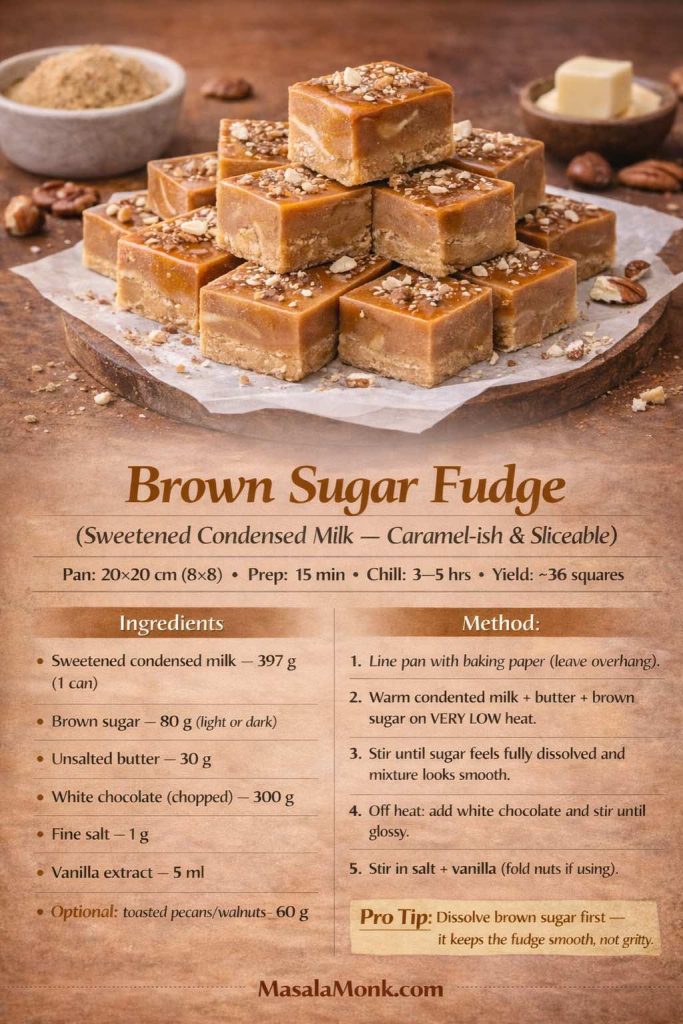
Recipe card image for brown sugar fudge made with sweetened condensed milk. Shows caramel-colored fudge squares stacked on parchment with chopped nuts on top, plus bowls of brown sugar and butter in the background. Text overlay includes pan size (20×20 cm), prep time (15 min), chill time (3–5 hrs), yield (~36 squares), ingredients in grams (condensed milk, brown sugar, butter, white chocolate, salt, vanilla, optional pecans/walnuts), a 5-step very-low-heat method, a pro tip to dissolve brown sugar first for smooth (not gritty) fudge, and MasalaMonk.com branding in the footer.
This brown sugar condensed milk fudge is the caramel-ish, gift-box favorite—sweetened condensed milk makes it creamy, while white chocolate helps it set firm enough to slice cleanly. The key step is what most recipes skip: dissolve the brown sugar gently in condensed milk + butter first, then add white chocolate off the heat for a smooth, glossy finish (no gritty texture). Save this card for holiday trays, edible gifts, or whenever you want “butterscotch vibes” without candy thermometers.

How:
Warm sweetened condensed milk + butter + brown sugar on very low heat, stirring until the sugar feels fully dissolved and the mixture looks uniform. Remove from heat, add white chocolate, and stir until completely melted and glossy. Add salt and vanilla, fold in nuts if using, then spread and chill.

Why this works: brown sugar brings moisture; the white chocolate keeps the set firm and sliceable.

2) Butterscotch fudge with sweetened condensed milk (easy “gift box” flavor)

Start with: White chocolate fudge (Recipe #4)
Swap/Add:

  • Replace 100–120 g of the white chocolate with butterscotch chips (or butterscotch pieces)
  • Optional salt bump: add an extra pinch (butterscotch loves salt)
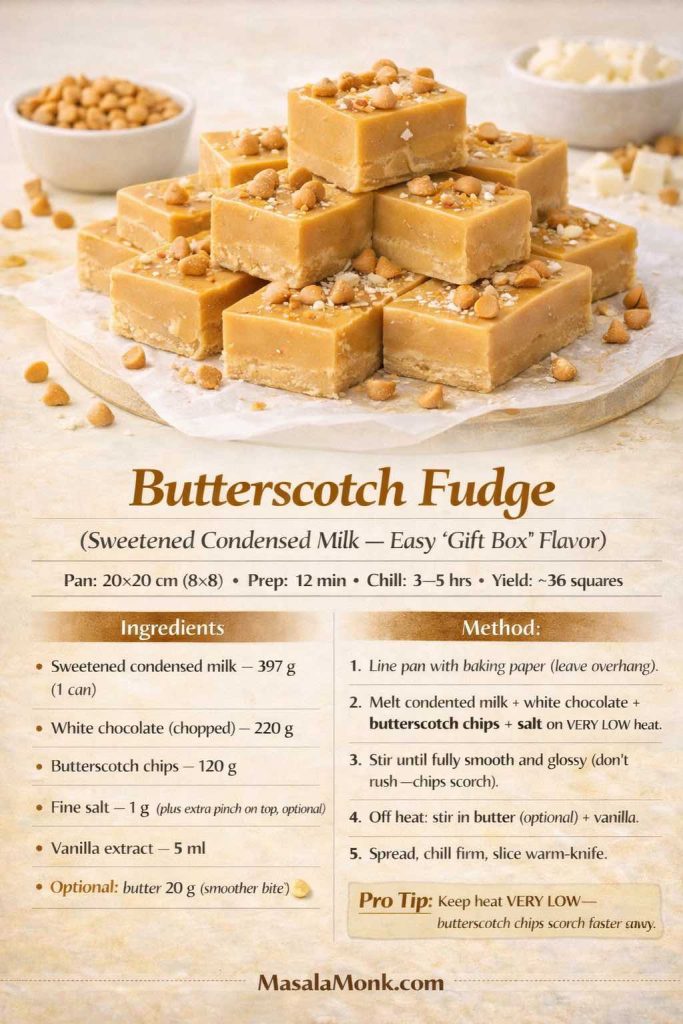
Recipe card image for butterscotch fudge made with sweetened condensed milk. Shows golden butterscotch fudge squares topped with butterscotch chips and flaky salt on a light background. Text overlay includes pan size (20×20 cm), prep time (12 min), chill time (3–5 hrs), yield (~36 squares), ingredients in grams (condensed milk, white chocolate, butterscotch chips, salt, vanilla, optional butter), a 5-step very-low-heat method, a pro tip warning that butterscotch chips scorch quickly so keep heat very low, and MasalaMonk.com branding in the footer.
This butterscotch fudge with sweetened condensed milk is the easiest “gift box” flavor—creamy, golden, and nostalgic, yet still firm enough to cut into neat squares. The success trick is temperature: butterscotch chips scorch faster than chocolate, so melt everything on very low heat and stir until glossy. Save this card for holiday trays, edible gifts, or quick make-ahead desserts when you want that classic butterscotch candy vibe without a thermometer.

How:
Melt gently (butterscotch scorches easily). Stir until fully smooth, then chill as usual.
Optional: top with flaky salt or crushed toasted nuts.

3) Rocky road sweetened condensed milk fudge (chocolate + marshmallow + crunch)

Start with: Sweetened condensed milk chocolate fudge (Recipe #1)
Fold in (off heat):

  • Mini marshmallows: 80–100 g
  • Toasted nuts (walnuts/almonds/peanuts): 60–80 g
  • Optional biscuit pieces: 40–50 g
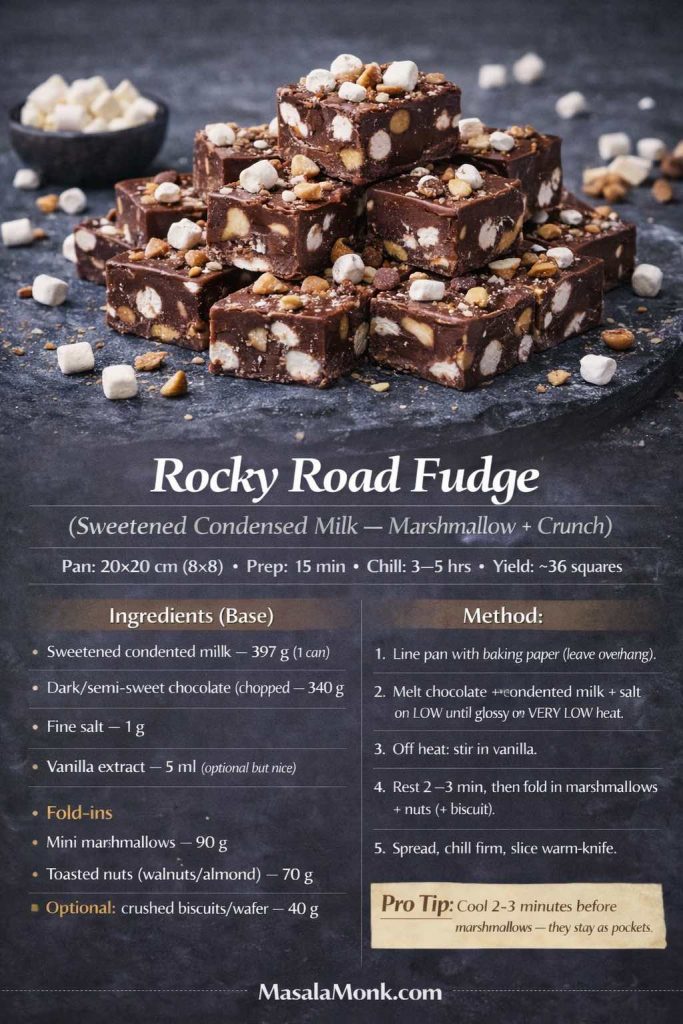
Recipe card image for rocky road fudge made with sweetened condensed milk. Shows chunky chocolate fudge squares on a dark slate background with visible mini marshmallows and toasted nuts, plus extra marshmallows scattered around. Text overlay includes pan size (20×20 cm), prep time (15 min), chill time (3–5 hrs), yield (~36 squares), base ingredients in grams (sweetened condensed milk, dark/semi-sweet chocolate, salt, optional vanilla), fold-ins (mini marshmallows, toasted nuts, optional crushed biscuits/wafer), a 5-step method, a pro tip to cool 2–3 minutes before adding marshmallows so they stay as pockets, and MasalaMonk.com branding in the footer.
This rocky road fudge with sweetened condensed milk is the “texture contrast” superstar—rich chocolate base, chewy marshmallow pockets, and crunchy nuts in every bite. The make-or-break detail is simple: rest the melted fudge base for 2–3 minutes before folding in marshmallows, so they stay as soft pockets instead of melting into the chocolate. Save this card for dessert boards, edible gifts, and Christmas trays when you want a crowd-pleaser that looks chunky, festive, and bakery-style with almost zero effort.

How:
Make the chocolate base. Let it cool 2–3 minutes so it’s thick but not scorching hot, then fold in marshmallows + nuts (+ biscuit). Spread, chill.
Tip: if you fold marshmallows while the base is too hot, they’ll melt into the fudge instead of staying as pockets.

4) Peppermint fudge recipe condensed milk (clean, festive, not toothpaste-y)

Start with: Chocolate fudge (Recipe #1) or White chocolate fudge (Recipe #4)
Add:

  • Peppermint extract: 1–2 ml (start tiny, then adjust)
  • Crushed peppermint candy/candy cane: 25–40 g (sprinkle on top or fold in last)
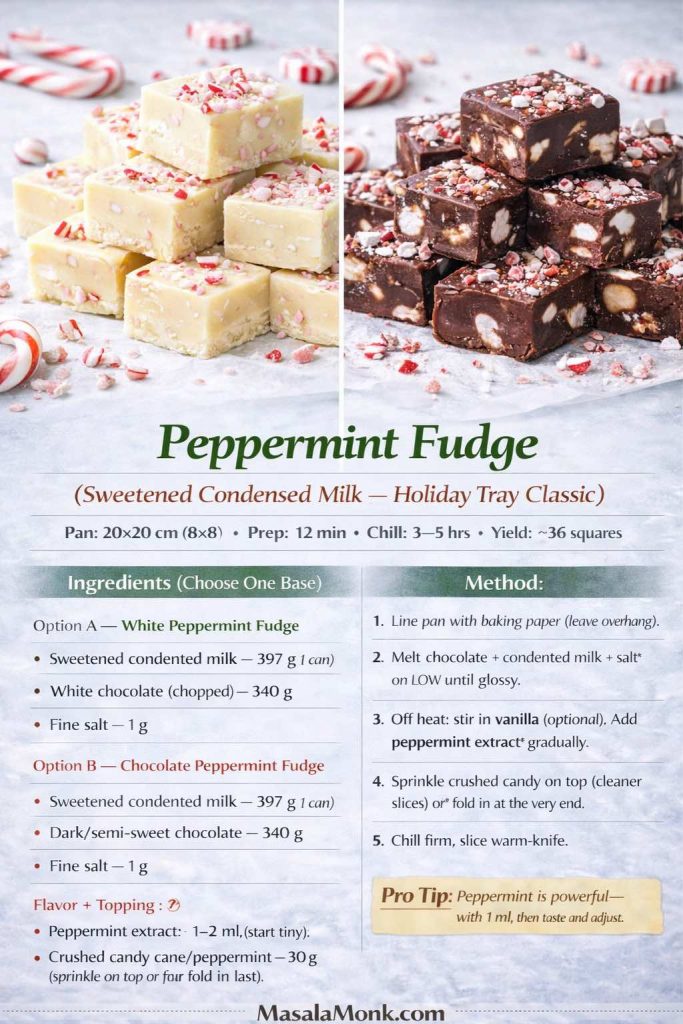
Recipe card image for peppermint fudge made with sweetened condensed milk, showing two versions side-by-side: white peppermint fudge and chocolate peppermint fudge, both topped with crushed candy cane pieces. The card includes pan size (20×20 cm), prep time (12 min), chill time (3–5 hrs), yield (~36 squares), ingredients for each base in grams (condensed milk, white chocolate or dark chocolate, salt), flavor/topping amounts (peppermint extract 1–2 ml, crushed candy cane 30 g), a 5-step low-heat method, a pro tip to start with 1 ml peppermint extract and adjust, and MasalaMonk.com branding in the footer.
This peppermint fudge recipe with sweetened condensed milk is the easiest way to get that classic Christmas candy vibe—cool, minty, and perfectly sliceable. The card gives you two options (white peppermint or chocolate peppermint) so you can match your tray, then nails the one detail that matters: peppermint extract is powerful, so start tiny and adjust. Save this for holiday trays, edible gifts, and last-minute Christmas desserts when you want festive flavor with a reliable condensed milk fudge set.

How:
Stir extract in off heat. If using crushed candy, either press it on top (cleaner slices) or fold in at the very end (more candy bits inside).

5) Eggnog fudge recipe condensed milk (holiday flavor without extra work)

Start with: Vanilla fudge (Recipe #5)
Add:

  • Nutmeg: ¼ tsp
  • Cinnamon: ⅛ tsp
  • Vanilla: keep as written (don’t reduce)
  • Optional: rum extract 1–2 ml (only if you want that “eggnog” aroma)
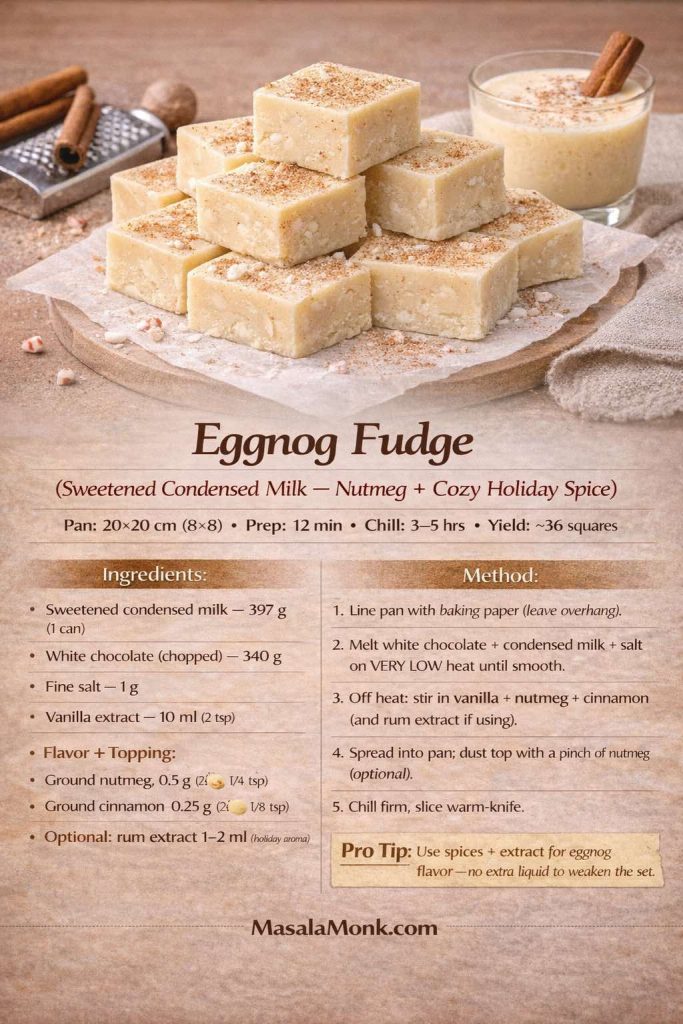
Recipe card image for eggnog fudge made with sweetened condensed milk. Shows creamy white chocolate fudge squares dusted with nutmeg on a parchment-lined wooden board, with cinnamon sticks, whole nutmeg, and a glass of eggnog in the background. Text overlay includes pan size (20×20 cm), prep time (12 min), chill time (3–5 hrs), yield (~36 squares), ingredients in grams (sweetened condensed milk, white chocolate, salt, vanilla, nutmeg, cinnamon, optional rum extract), a 5-step method using very low heat, a pro tip to use spices + extract for eggnog flavor without adding extra liquid, and MasalaMonk.com branding in the footer.
This eggnog fudge with sweetened condensed milk is the cozy holiday flavor without the usual set problems—because it gets “eggnog” taste from nutmeg + cinnamon + vanilla (and optional rum extract), not extra liquid. The result is a creamy, sliceable white-chocolate fudge that looks gift-box ready with a simple nutmeg dusting. Save this card for Christmas trays and edible gifts when you want something festive that still behaves like a reliable condensed milk fudge.

How:
Make vanilla fudge as written, then stir spices in off heat. Chill.
Tip: spice blooms better if you stir it into the warm mixture, not after it’s cooling.

Also Read: 7 Pizza Sauce Recipes | Marinara, White Garlic, Alfredo, Buffalo, BBQ, Vodka & Ranch


A few gentle dessert connections (so the fudge isn’t alone on the table)

Even though fudge can be the star, it also plays well with other easy, make-ahead sweets. So, if you’re building a spread—especially for holidays—these pairings keep the table interesting without adding stress:

  • Something fruity and chilled like no-bake blueberry cheesecake complements the richness of chocolate and peanut butter fudge.
  • Something crisp and warm like homemade churros turns fudge into a dipping moment, especially if you soften a spoonful gently.
  • Something creamy and layered like savoiardi chocolate vanilla pudding offers a different texture while staying in the same comfort-dessert family.
  • Something cake-like with the same pantry charm, such as peach condensed milk cake, keeps the condensed milk theme running without repeating the same bite.

Sweetened condensed milk fudge add-ins that keep the set reliable

Once you’ve made one or two batches, it’s tempting to start improvising—and you should. Still, it helps to choose add-ins that don’t fight the texture.
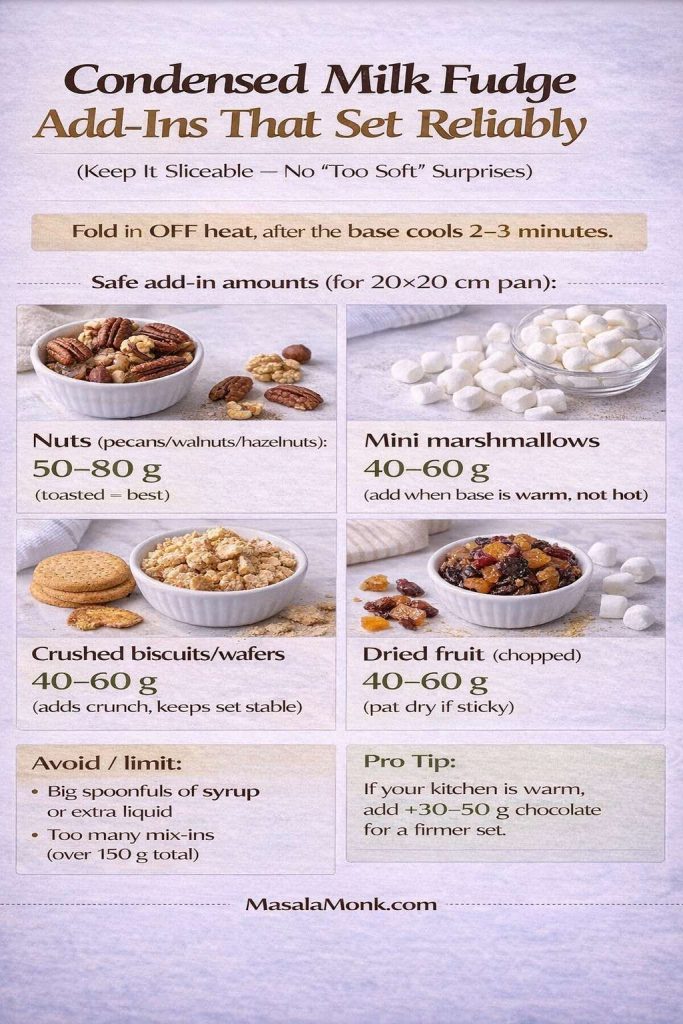
Infographic titled “Condensed Milk Fudge Add-Ins That Set Reliably (Keep It Sliceable — No ‘Too Soft’ Surprises)”. It instructs to fold mix-ins in off heat after the base cools 2–3 minutes and lists safe add-in amounts for a 20×20 cm pan: nuts (pecans/walnuts/hazelnuts) 50–80 g (toasted best), mini marshmallows 40–60 g (add when base is warm, not hot), crushed biscuits/wafers 40–60 g, and chopped dried fruit 40–60 g (pat dry if sticky). It warns to avoid or limit big spoonfuls of syrup/extra liquid and too many mix-ins (over 150 g total). Includes a pro tip: if the kitchen is warm, add 30–50 g extra chocolate for a firmer set, plus MasalaMonk.com branding in the footer.
Save this sweetened condensed milk fudge add-ins cheat sheet before you start “just throwing things in.” These are the mix-ins that keep fudge sliceable—with the exact gram ranges for nuts, mini marshmallows, crushed biscuits, and dried fruit (for a 20×20 cm pan). The biggest win is timing: fold add-ins off heat after a 2–3 minute cool-down so marshmallows stay as pockets and your base doesn’t loosen. If you’re making Christmas trays or gifting, this one card helps every condensed milk fudge variation set cleanly.

Mix-ins that work beautifully with sweetened condensed milk fudge

  • Toasted nuts (pecans, walnuts, hazelnuts): 50–80 g
  • Crushed biscuits or wafer pieces: 40–60 g
  • Mini marshmallows (best in chocolate bases): 40–60 g
  • Dried fruit (chopped): 40–60 g

Fold these in at the end, off the heat, right before spreading.

Flavor additions that lift sweetened condensed milk fudge without changing texture

  • Vanilla, of course (especially in white chocolate bases)
  • A small pinch of cinnamon or cardamom in vanilla fudge
  • Espresso powder (½ to 1 tsp) in chocolate fudge for deeper flavor
  • Orange zest in dark chocolate fudge for a bright edge

When you keep add-ins modest, the fudge still sets cleanly and slices neatly.

Also Read: How to Cook Tortellini (Fresh, Frozen, Dried) + Easy Dinner Ideas


How to build a 10-flavor sweetened condensed milk fudge tray without chaos

Making one batch is easy. Making several batches in a row can still feel easy if you set up the flow.
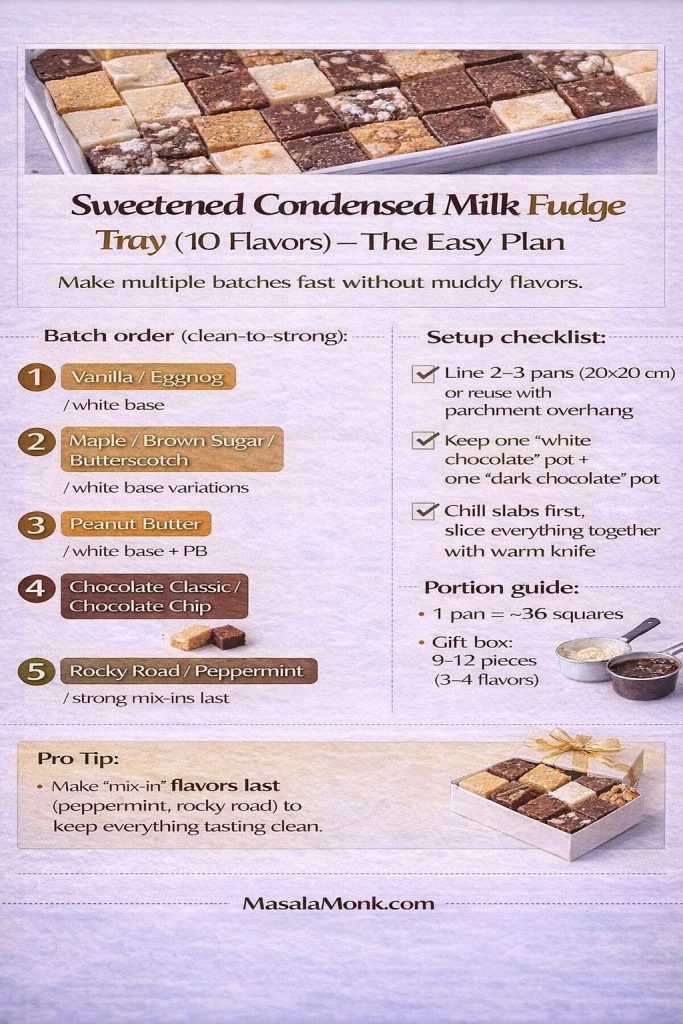
Guide-style infographic titled “Sweetened Condensed Milk Fudge Tray (10 Flavors) — The Easy Plan” with a photo strip of assorted fudge squares at the top. The card explains how to make multiple batches without muddy flavors and lists a clean-to-strong batch order: 1) Vanilla/Eggnog (white base), 2) Maple/Brown Sugar/Butterscotch (white base variations), 3) Peanut Butter (white base + PB), 4) Chocolate Classic/Chocolate Chip, 5) Rocky Road/Peppermint (strong mix-ins last). A setup checklist recommends lining 2–3 pans (20×20 cm) or reusing with parchment overhang, keeping one “white chocolate” pot and one “dark chocolate” pot, and chilling slabs first before slicing everything with a warm knife. Portion guide notes 1 pan makes about 36 squares and a gift box holds 9–12 pieces (3–4 flavors). Pro tip: make mix-in flavors last to keep everything tasting clean. MasalaMonk.com is branded in the footer.
Planning a Christmas fudge tray with sweetened condensed milk? Save this 10-flavor game plan. It shows the best batch order (clean-to-strong) so your vanilla/maple flavors don’t get “muddy,” plus a simple setup checklist for making multiple pans efficiently. You’ll also get a portion guide for gift boxes (9–12 pieces across 3–4 flavors), so you can build a tray that looks intentional—without turning your kitchen into a full-day project.

Start with the “clean pan” flavors

Begin with vanilla or white chocolate fudge, then move into peanut butter, then finish with dark chocolate. That order keeps flavors distinct and reduces lingering aromas.

Line multiple tins, even if you reuse them

If you only have one tin, line it, chill the slab until firm enough to lift, then transfer it to a board to finish chilling while you line the tin again. You don’t need perfection—just a steady rhythm.

Keep your slicing moment separate

Let everything chill fully first, then slice all slabs at once. This makes your pieces more uniform and reduces the “warm kitchen” effect that can soften edges.


Storage (so your fudge stays the right texture)

Fudge is forgiving, but storage still matters because temperature affects texture.

  • Room temperature (cool climate): keep in an airtight container for 2–3 days.
  • Refrigerator (best in warm kitchens): store in an airtight container up to a week. Let pieces sit for a few minutes before serving so the bite softens slightly.
  • Freezer: wrap the slab (or individual squares) tightly and freeze for up to 2 months. Thaw in the fridge overnight, then bring to cool room temperature before serving.

If you’re making several flavors at once, keep strong aromas (like peppermint or heavy extracts) sealed separately so the flavors stay distinct.

Also Read: How to Cook Bacon in the Oven (Crispy, No-Mess, Crowd-Ready Recipe)


How to make this your “forever” Sweetened Condensed Milk Fudge guide

The best thing about sweetened condensed milk fudge is that it doesn’t ask for a special occasion—yet it still feels like one when you serve it. Once you’ve made a couple of these, you’ll notice something satisfying: you’re no longer “following a recipe,” you’re using a method. That method is what gives you freedom.

On a busy day, you can make condensed milk chocolate fudge and be done. Then on a festive week, you can stack your fridge with vanilla, peanut butter, Nutella, maple, and marshmallow crème slabs, then slice them into tidy squares that look like a gift. On a cozy weekend, you can build a dessert board with churros for dipping, a drizzle of chocolate syrup, and a few different fudge flavors so every bite feels slightly different.

If you’re in the mood to keep the condensed milk theme going beyond fudge, it’s worth pairing this with one creamy chilled dessert like no-bake blueberry cheesecake or a layered comfort dessert like banana pudding. That way, you get contrast in texture and style without adding stress.

Most importantly, don’t feel like you need to “save” these for holidays. Fudge is at its best when it’s part of real life—one square after dinner, a small box shared with someone you like, a sweet bite with coffee on an ordinary afternoon. Make one batch first, then choose the next flavor based on your mood. The guide will still be here when you’re ready to build the full ten. Whenever you want to expand beyond the core ten, use the white chocolate base for brown sugar and butterscotch, and the classic chocolate base for rocky road and peppermint.


Sweetened condensed milk fudge FAQ

1) What is sweetened condensed milk fudge, exactly?

Sweetened condensed milk fudge is a quick fudge method where sweetened condensed milk provides sweetness and creaminess, while chocolate (or other setting ingredients) helps the fudge firm up into sliceable squares. In other words, you get a rich, classic fudge texture without boiling sugar syrup to a specific temperature.

2) Is condensed milk fudge the same as sweetened condensed milk fudge?

Most of the time, yes. When recipes say “condensed milk fudge,” they usually mean sweetened condensed milk fudge. However, evaporated milk is sometimes confused with condensed milk, and it’s not the same product—so check the can before you start. Also, any brand of sweetened condensed milk works, but low-fat versions can set softer than expected.

3) Can I make fudge with condensed milk and chocolate chips?

Absolutely. Fudge with sweetened condensed milk and chocolate chips is one of the easiest versions: melt, stir, spread, and chill. That said, for a cleaner set, use enough chocolate so the mixture firms properly, especially if your kitchen is warm.

4) What’s the best condensed milk fudge recipe for beginners?

A simple sweetened condensed milk chocolate fudge with three ingredients—sweetened condensed milk, chocolate, and salt—is the most beginner-friendly. After that, peanut butter fudge with condensed milk or Nutella fudge with sweetened condensed milk are excellent next steps because they’re still straightforward.

5) Can I make two ingredient fudge with condensed milk?

You can, although “2 ingredient fudge condensed milk” often works best when one ingredient is chocolate (or white chocolate) and the other is sweetened condensed milk. On the other hand, condensed milk and peanut butter alone can turn out softer than expected, so many reliable versions include white chocolate for structure.

6) How do I make three ingredient fudge with condensed milk?

Three ingredient fudge with condensed milk typically uses sweetened condensed milk + chocolate + a pinch of salt (or vanilla). First, melt gently, then stir until glossy, and finally chill until firm. As a result, you get a no-fuss fudge that slices cleanly.

7) Can I make easy microwave fudge with sweetened condensed milk?

Yes—microwave sweetened condensed milk fudge is one of the fastest ways to make it. Still, the method works best with short bursts and frequent stirring so the chocolate melts evenly and doesn’t scorch.

8) Why is my sweetened condensed milk fudge too soft?

Usually it’s because there wasn’t enough setting ingredient (like chocolate or white chocolate), or the ratio shifted due to add-ins. Additionally, warm kitchens can keep fudge softer. To fix it next time, increase the chocolate slightly, chill longer, and store in the fridge if needed.

9) Why did my condensed milk fudge turn grainy?

Graininess typically comes from sugar crystallizing in larger grains or from dry ingredients not dissolving smoothly. Therefore, keep heat low, stir steadily, and sift cocoa or powdered sugar in cocoa-based versions so the mixture stays uniform.

10) Why is my fudge oily or separated?

Most often, the mixture got too hot or was heated too quickly. Instead of increasing heat, melt slowly and stir continuously. Also, when adding peanut butter or Nutella, stir them in off the heat so they emulsify smoothly.

11) Can I use cocoa powder and sweetened condensed milk instead of chocolate?

Yes. Cocoa powder condensed milk fudge is a popular option, yet it usually needs additional structure—commonly butter plus powdered sugar—so it sets properly and doesn’t taste dry. As long as cocoa is sifted and fully mixed, the texture can be smooth and dense.

12) Can I make chocolate fudge with condensed milk and marshmallows?

You can, and it’s a classic style. Marshmallow crème or fluff helps create a plush, creamy bite, which is why “marshmallow fudge recipe condensed milk” and “fluff fudge sweetened condensed milk” are so loved for gift trays.

13) What is “never fail” fudge with sweetened condensed milk?

“Never fail” usually refers to a very forgiving method—often a sweetened condensed milk fudge that uses chocolate plus marshmallow crème (or sometimes butter) to keep the texture creamy and stable. Consequently, it sets reliably and stays tender.

14) Can I make peanut butter fudge using sweetened condensed milk?

Yes, and it’s one of the most requested flavors. However, for a firm set, many peanut butter and condensed milk fudge recipes add white chocolate as the setting backbone. Otherwise, the fudge may stay too soft, especially in warm weather.

15) How do I make chocolate peanut butter fudge with sweetened condensed milk?

Use a chocolate condensed milk fudge mixture and a peanut butter condensed milk fudge mixture, then layer or swirl them before chilling. That way, you get distinct flavors in every bite and a clean slice once it’s firm.

16) Can I make Nutella fudge with sweetened condensed milk?

Yes—Nutella fudge condensed milk style is rich and glossy. Still, it works best with some real chocolate included for structure and depth, so the squares set cleanly and don’t become overly soft.

17) How do I make maple fudge with sweetened condensed milk?

Maple fudge condensed milk versions usually set best with white chocolate. Then, add maple syrup for flavor and, if you want a stronger aroma, a small amount of maple extract. As a result, you get a clear maple taste without a runny texture.

18) What about brown sugar fudge with sweetened condensed milk?

Brown sugar condensed milk fudge has a deeper, caramel-like sweetness. Typically, it works well as a variation of a white chocolate condensed milk fudge base, with brown sugar and butter helping create that butterscotch-style flavor.

19) Can I make white chocolate fudge with condensed milk?

Definitely. White chocolate and sweetened condensed milk fudge is one of the easiest non-dark-chocolate options. Even so, melt it gently—white chocolate can scorch faster—then chill until firm for clean squares.

20) Can I make vanilla fudge with sweetened condensed milk?

Yes. Vanilla condensed milk fudge is often based on white chocolate plus sweetened condensed milk, then boosted with extra vanilla (and a pinch of salt) so it tastes intentionally “vanilla” rather than just sweet.

21) Can I use evaporated milk instead of sweetened condensed milk?

Not in the same way. Evaporated milk fudge is a different method because evaporated milk isn’t sweetened and doesn’t have the same thickness. So, if a recipe calls for sweetened condensed milk, swapping evaporated milk usually won’t set correctly without other changes.

22) Can I make fudge without sweetened condensed milk?

Yes, but it becomes a different style of fudge—often old fashioned fudge made with sugar, milk (or evaporated milk), butter, and careful cooking. Therefore, if your goal is quick condensed milk fudge, it’s better to use the intended ingredient.

23) How long does sweetened condensed milk fudge take to set?

Most batches firm up in 2–4 hours in the refrigerator. Meanwhile, a thicker pan or a softer flavor (like peanut butter-heavy versions) may take longer. If you want the neatest cuts, chilling overnight is ideal.

24) Should I store condensed milk fudge in the fridge or at room temperature?

If your kitchen is cool, room temperature works for a couple of days in an airtight container. Otherwise, refrigeration keeps the texture firm and stable. For longer storage, freezing also works well once pieces are wrapped tightly.

25) Can I freeze sweetened condensed milk fudge?

Yes. Freeze it in layers with parchment between pieces, sealed well to prevent freezer smells. Then thaw in the fridge and let it sit a few minutes before serving so the texture softens slightly.

26) How do I scale a sweetened condensed milk fudge recipe up or down?

Start by scaling based on the sweetened condensed milk amount, then keep the chocolate ratio consistent. For example, doubling the batch usually means using two cans of sweetened condensed milk and roughly double the chocolate, then using a larger tin.

27) What’s the easiest way to cut fudge neatly?

First, chill until fully firm. Next, use a warm knife (run it under hot water, wipe dry). Then slice with steady pressure, wiping the blade between cuts. As a result, edges stay clean and the pieces look gift-box ready.

28) Why does my condensed milk fudge taste too sweet?

Milk chocolate and some white chocolates are very sweet on their own, and sweetened condensed milk adds more sugar. Instead, use darker chocolate, add a pinch more salt, or balance the flavor with nuts. Additionally, vanilla and espresso powder can make the sweetness feel more rounded.

29) Can I make a “creamy fudge recipe with condensed milk” on the stove without overcooking it?

Yes—low heat is the safest route. Stir constantly until the mixture is glossy and smooth, then remove it from heat promptly. Overheating is what most often causes separation or a dull, greasy texture.

30) What’s a good “Christmas fudge recipe condensed milk” approach without extra fuss?

Choose one dark chocolate batch, one white chocolate or vanilla batch, and one peanut butter batch for contrast. Then add simple mix-ins—nuts, crushed biscuits, or a peppermint sprinkle—so the tray feels festive while the method stays easy.
Posted on 9 Comments

Sourdough Recipe: 10 Easy Bread Bakes (Loaves, Rolls & Bagels)

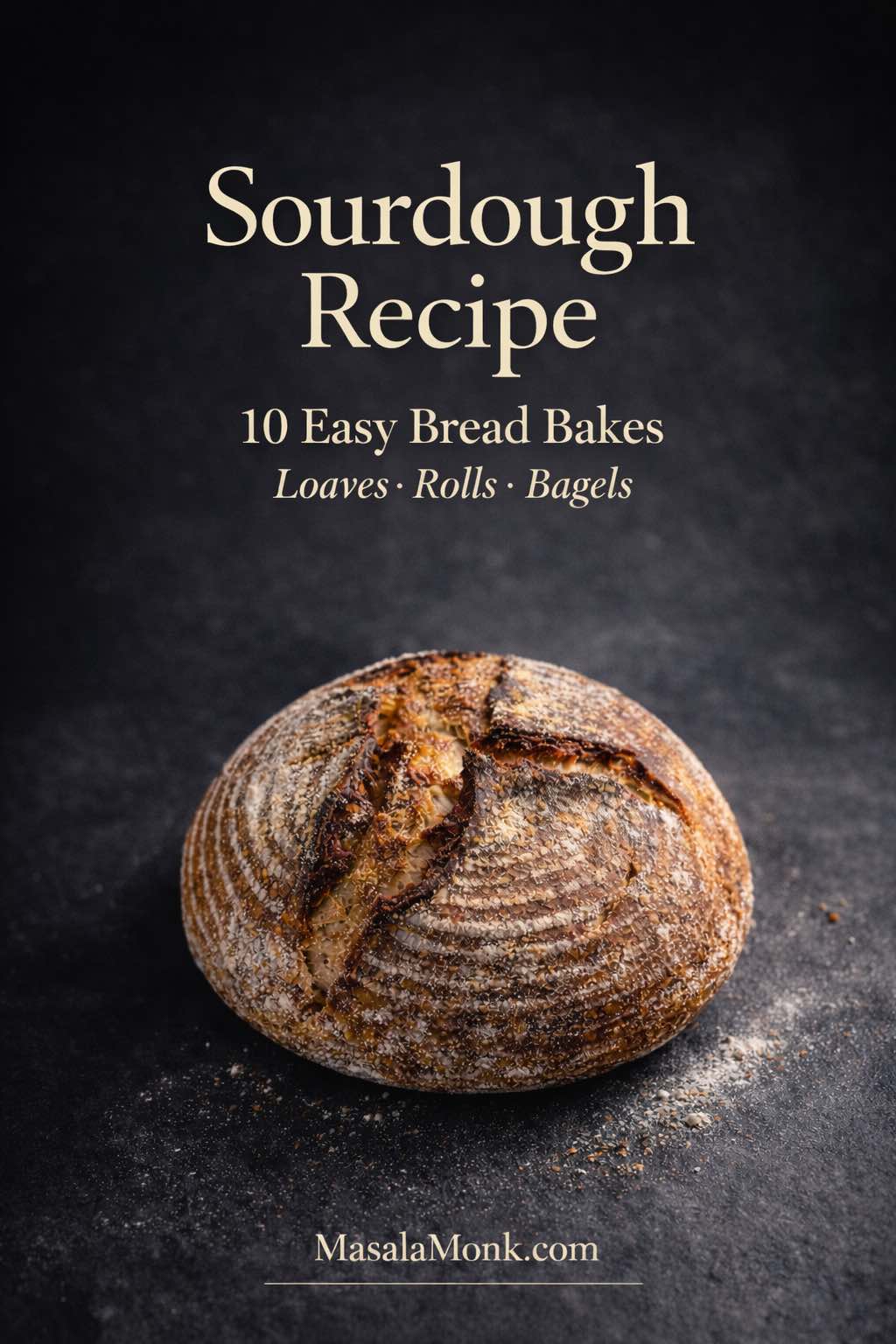
Portrait magazine-style cover on a dark slate background with a rustic sourdough boule dusted with flour. Text overlay reads “Sourdough Recipe” and “10 Easy Bread Bakes — Loaves • Rolls • Bagels,” with “MasalaMonk.com” in the footer.

Some days you want a dramatic crusty loaf that sings when it cools. Other days you just want a soft sandwich slice that behaves, a pan of dinner rolls that tear like cotton, or a chewy bagel that makes breakfast feel like a small win. This sourdough recipe guide is built for all of those moods—without forcing you to become a different person each time you bake.

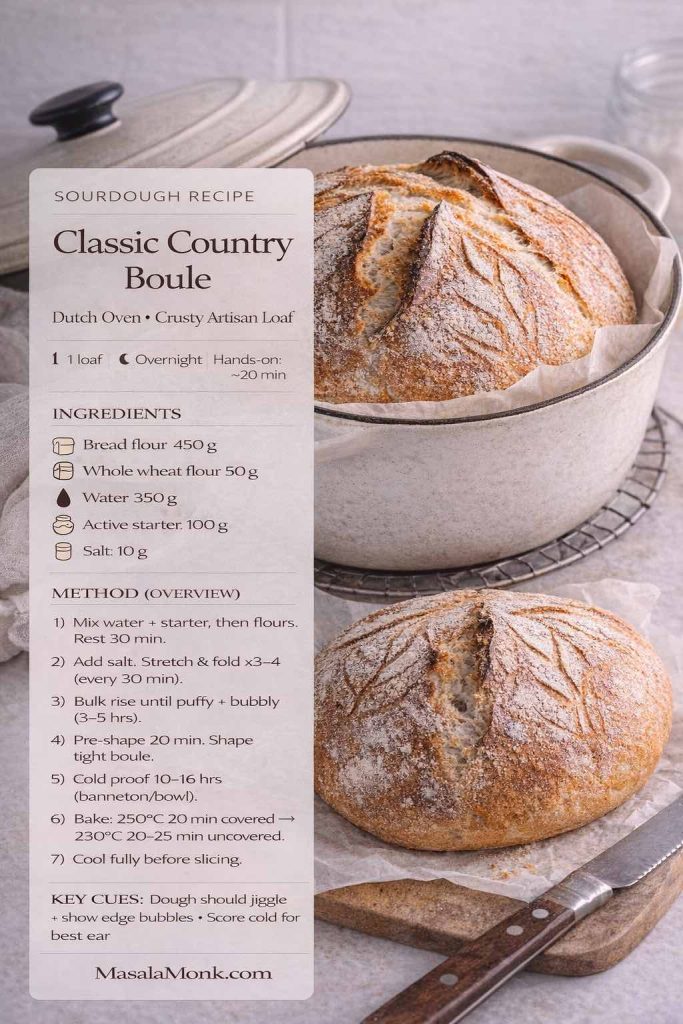
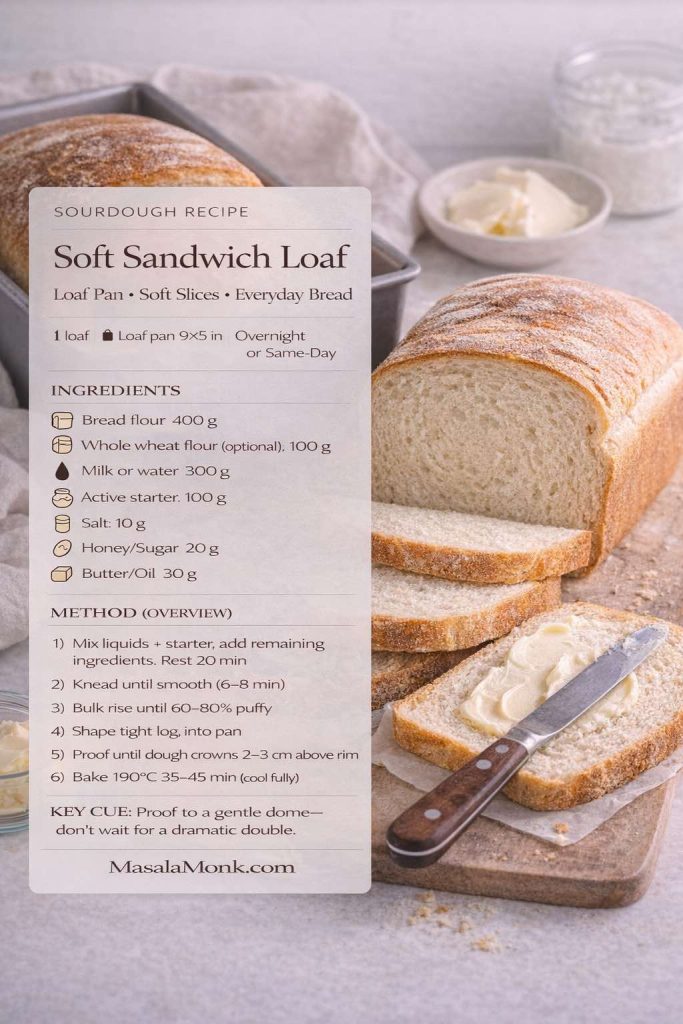
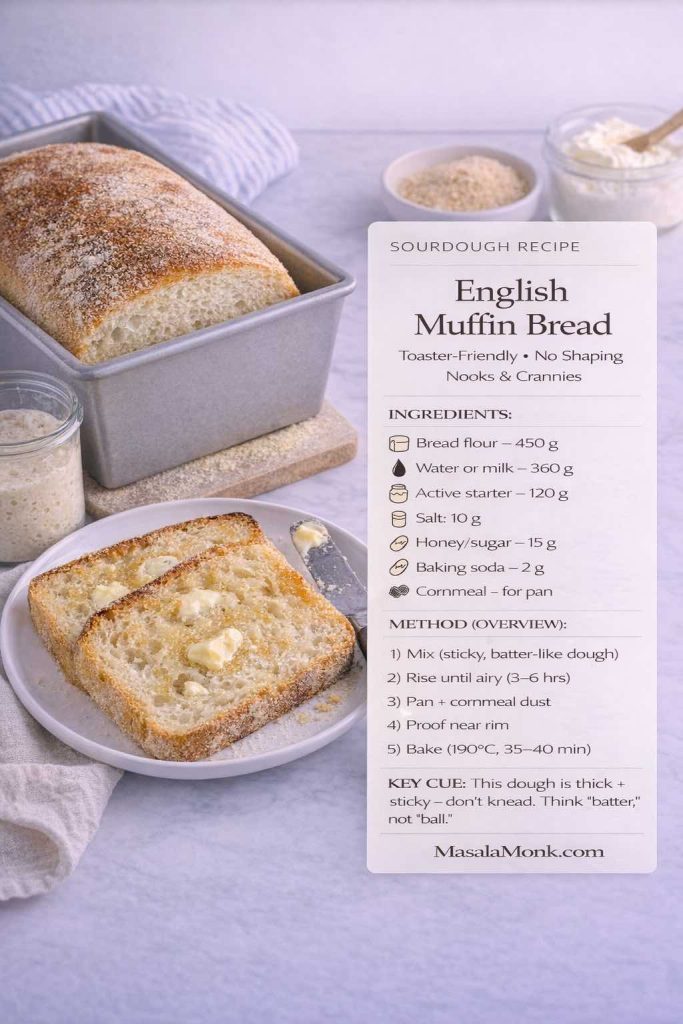
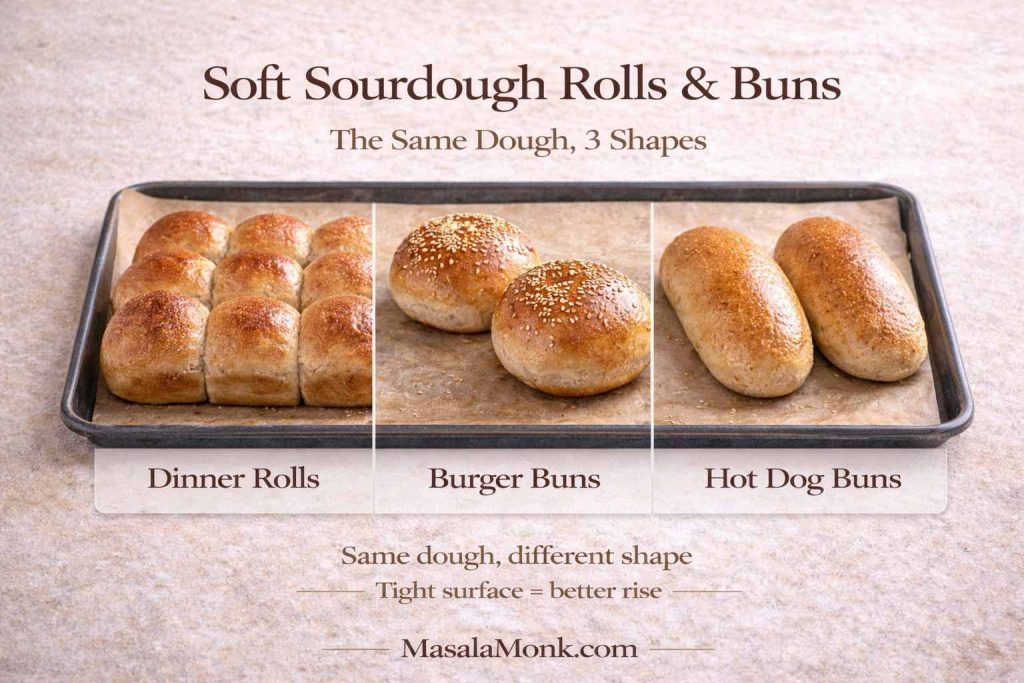
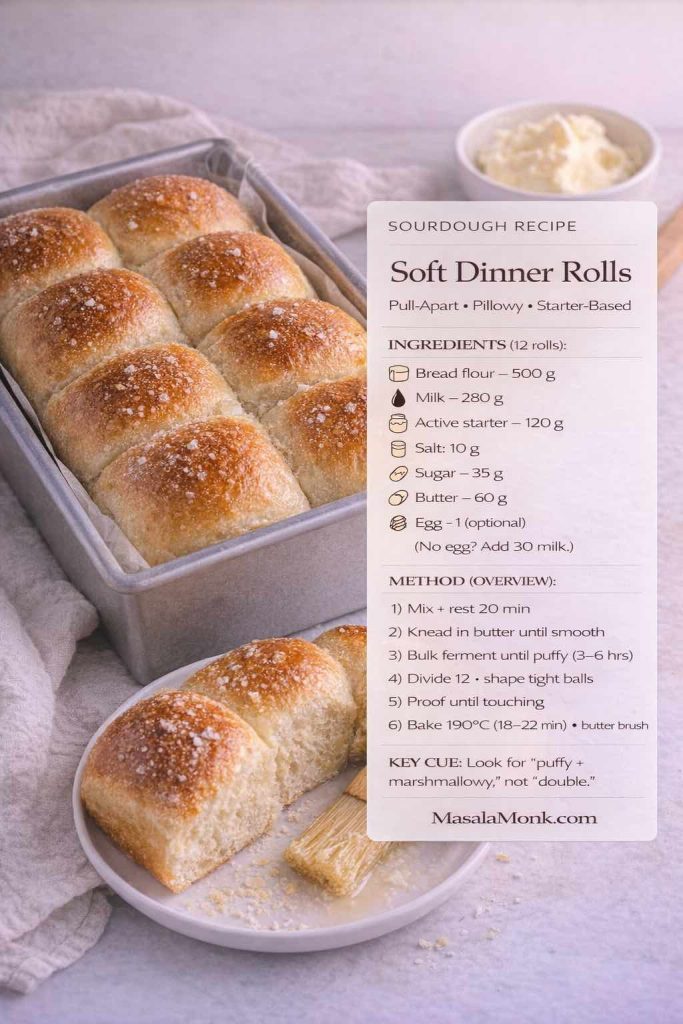
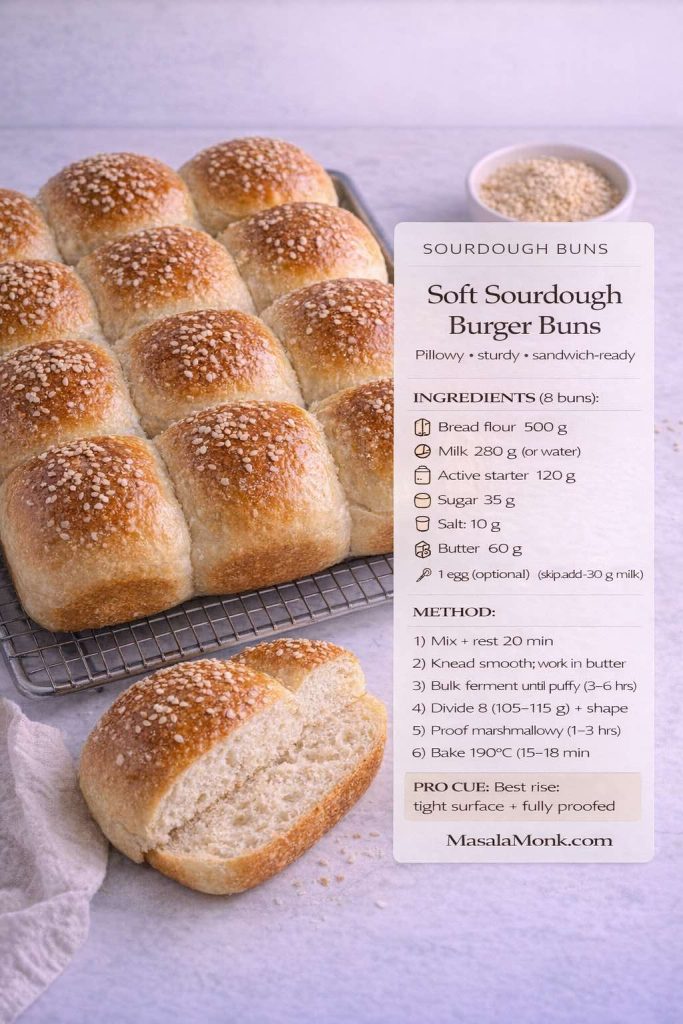
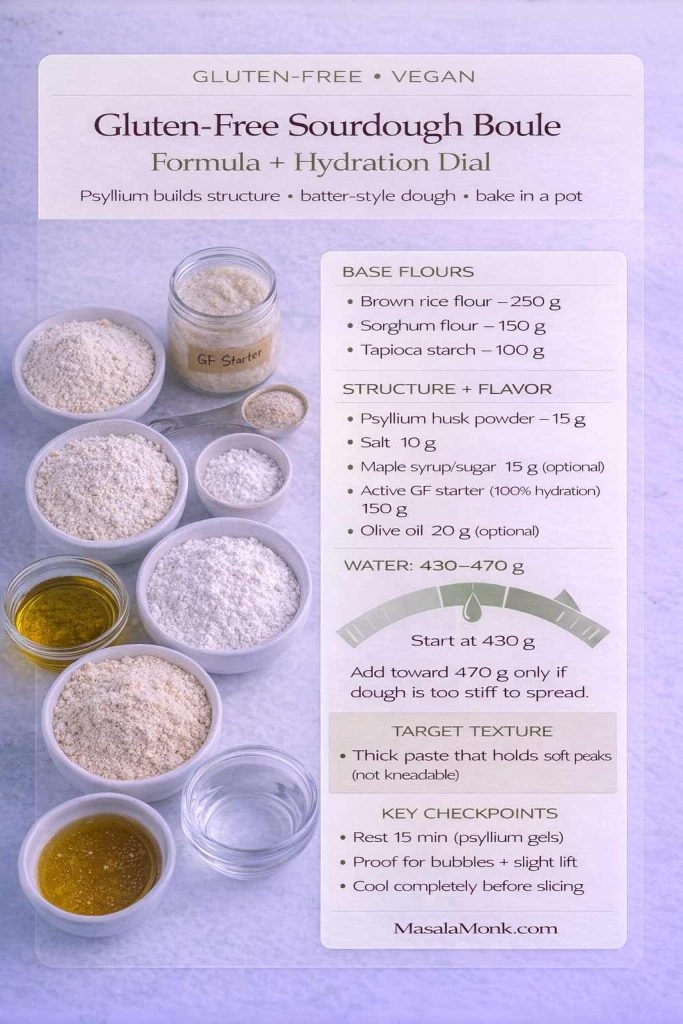
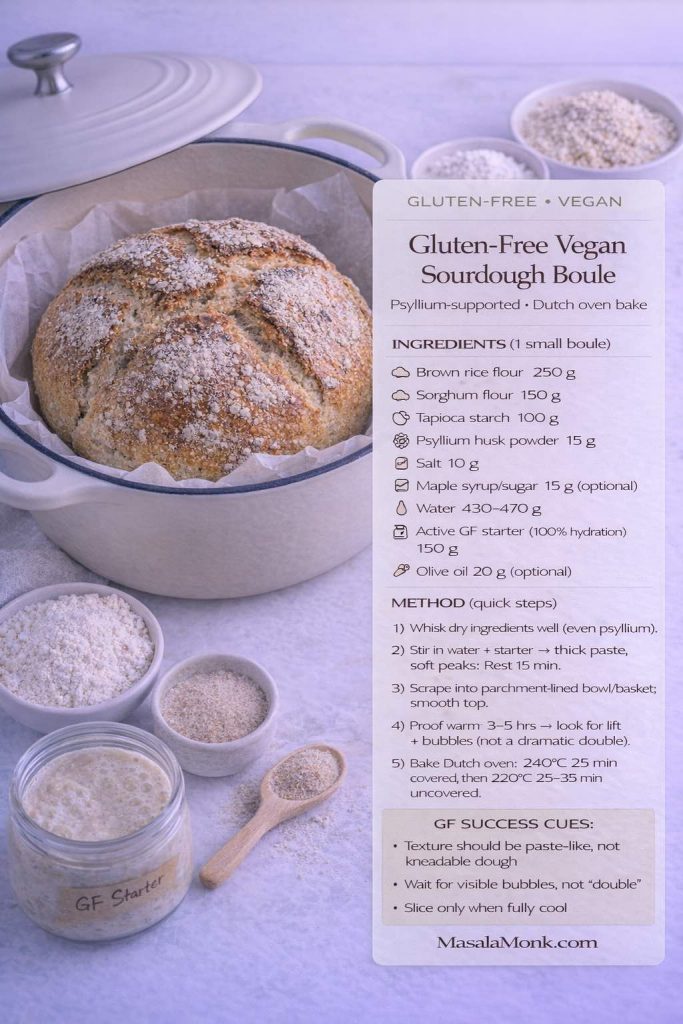
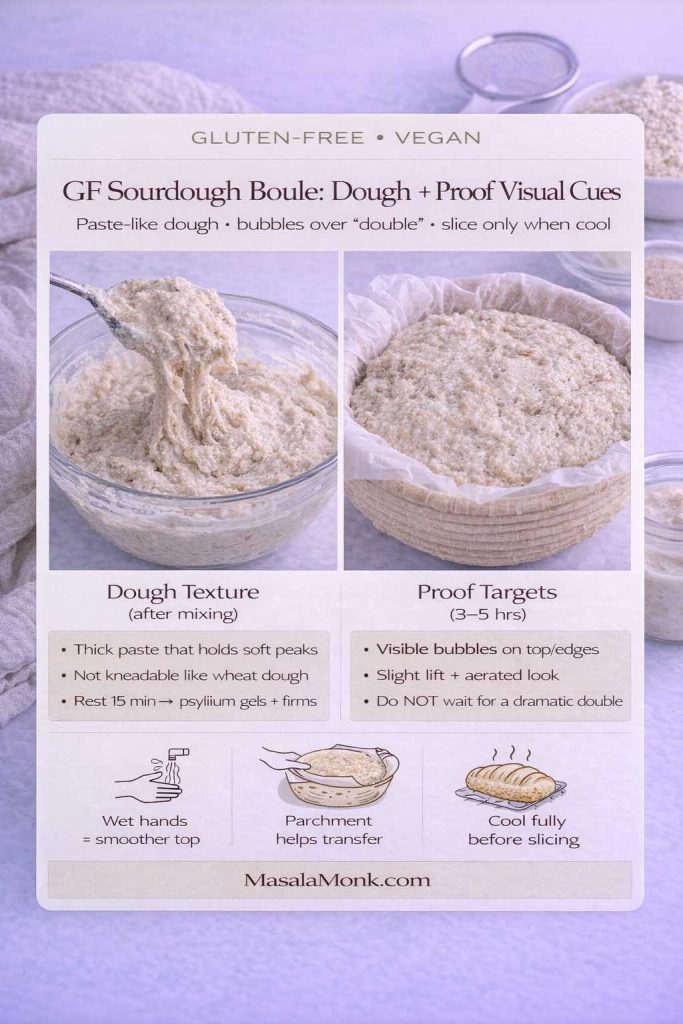
We’ll work in metric, lean on a single “house” starter, and then branch into ten bakes you can rotate through: a classic boule, a loaf-pan sandwich bread, a same-day loaf, a no-knead Dutch oven bread, English muffin bread, soft dinner rolls, burger buns, hot dog buns, hoagie/sub rolls, and sourdough bagels—plus one gluten-free vegan boule that still feels like real bread.

Along the way, you’ll also see where discard fits naturally, how to nudge your bread more sour when you want that tang, and how to choose equipment—cast iron, Dutch oven, bread pot, loaf pan, baking dish, stand mixer—without overthinking it.

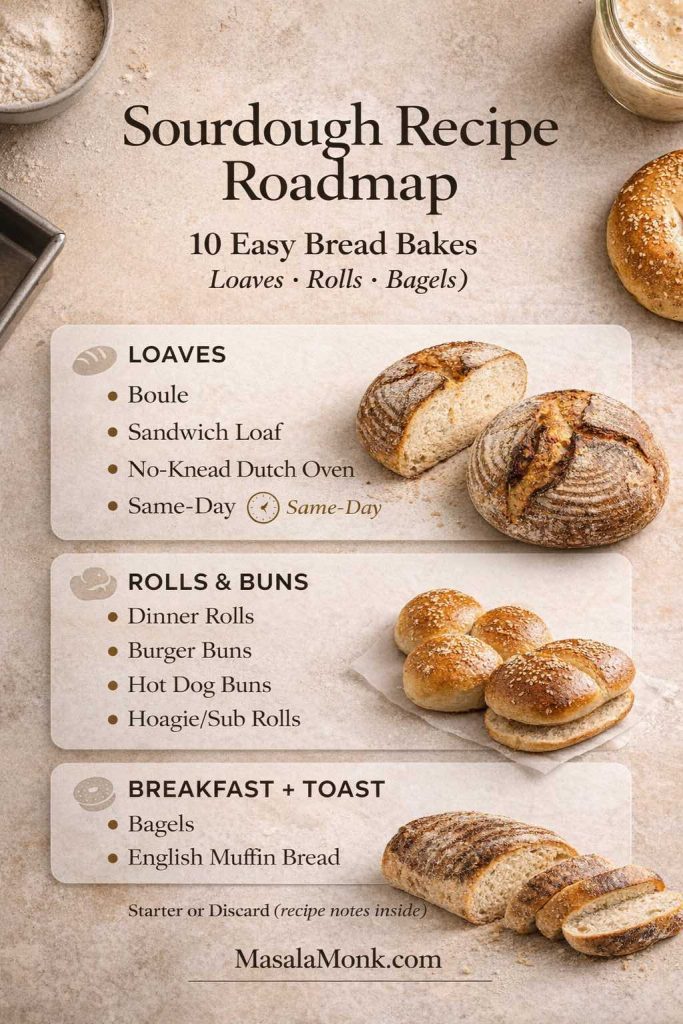
Portrait infographic titled “Sourdough Recipe Roadmap” showing 10 easy bread bakes grouped into three sections: Loaves (boule, sandwich loaf, no-knead Dutch oven, same-day), Rolls & Buns (dinner rolls, burger buns, hot dog buns, hoagie/sub rolls), and Breakfast + Toast (bagels, English muffin bread). Photoreal bread flatlay background with MasalaMonk.com in the footer.
This sourdough recipe roadmap helps you pick your next bake at a glance—classic loaves, soft rolls and buns, plus bagels and English muffin bread. Use it as a quick guide while you work through the 10 recipes below (and save it for future baking days).

For foundational starter and technique references, these are genuinely useful reads you can keep open in another tab:


The starter you have vs the starter you need

A sourdough starter isn’t one thing—it’s a living culture that behaves differently depending on when you use it. Once you get that, the entire process becomes easier.

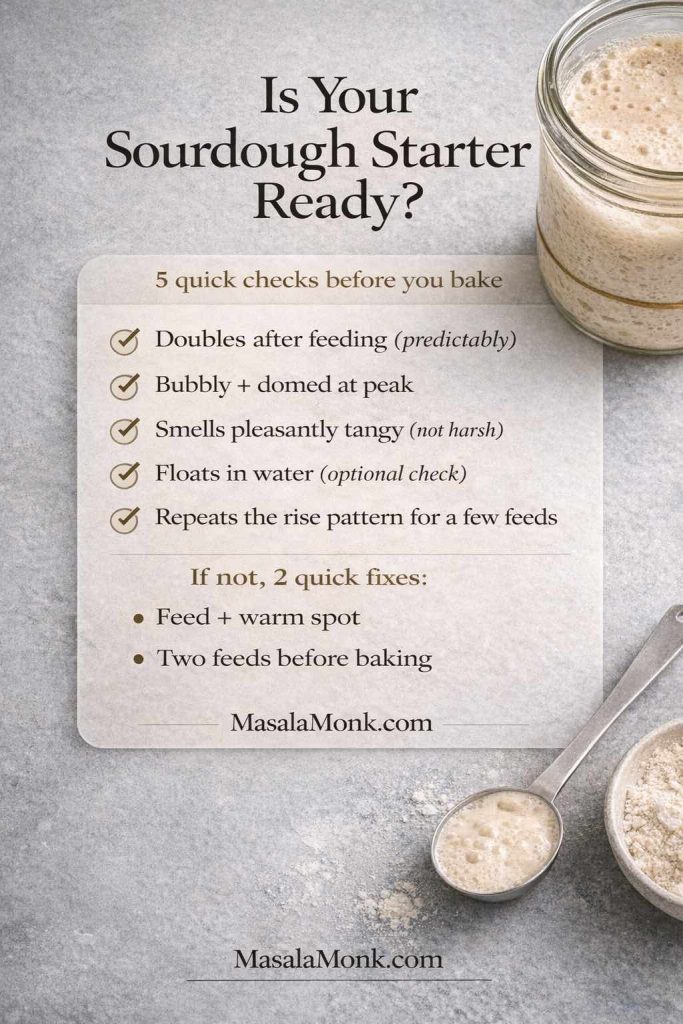
Portrait infographic titled “Is Your Sourdough Starter Ready?” on a gray stone background with a jar of bubbly starter. Text lists 5 quick checks before you bake (doubles after feeding, bubbly and domed, pleasant tangy smell, optional float test, repeats rise pattern) plus 2 quick fixes, with MasalaMonk.com in the footer.
Before you start any sourdough recipe, run this 60-second starter checklist—especially if your last loaf turned out dense or flat. A starter that rises predictably and looks bubbly at peak makes every bake below (boule, sandwich loaf, rolls, buns, and bagels) far more reliable.

Active (ripe) starter

This is the starter that’s been fed and has risen predictably—bubbly, domed, and at or near peak. It has the strength to lift dough without help. Most “true sourdough bread” recipes use this version: boules, baguette-style loaves, bagels, and most rolls.

If your starter feels sluggish, it’s usually not “dead,” it’s just underfed, too cold, or too new. A steady feed schedule and a warmer spot often fixes it. King Arthur’s step-by-step method is a solid reference: Sourdough starter recipe.

Discard (unfed starter)

Discard is starter that hasn’t been fed recently—often pulled straight from the fridge. It brings flavor, but it doesn’t always bring the same lift. That’s why many discard-friendly doughs either:

  • use a longer fermentation window, or
  • add a small amount of commercial yeast (a common, perfectly valid approach for a same-day sourdough bread).
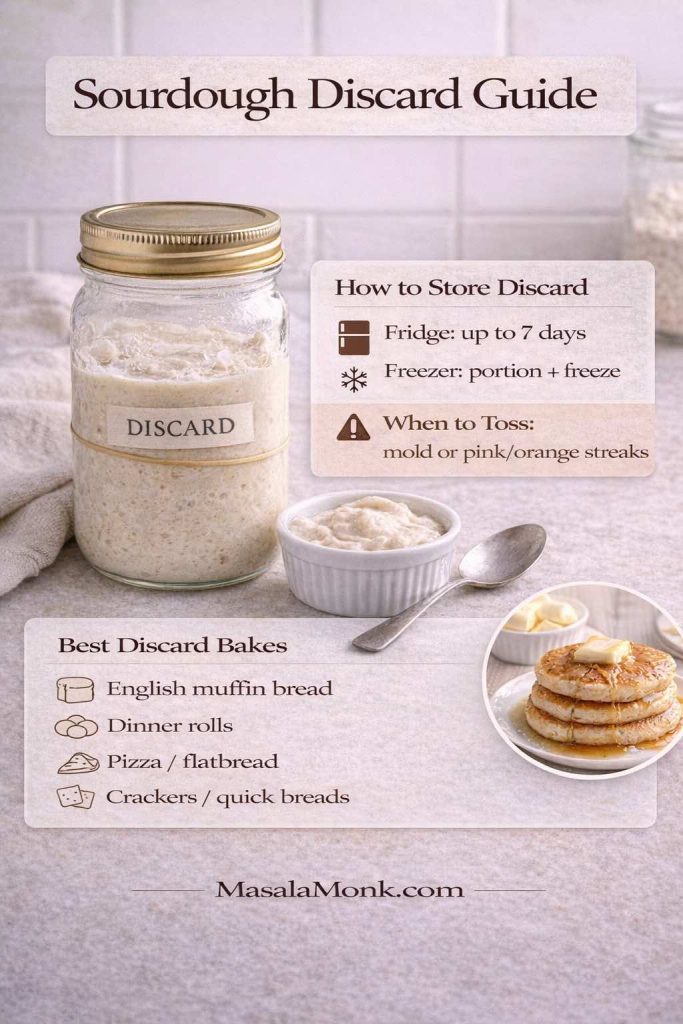
Portrait infographic titled “Sourdough Discard Guide” showing a jar labeled “DISCARD” on a neutral kitchen counter. A text card explains how to store discard (fridge up to 7 days, freezer portion and freeze) and when to toss (mold or pink/orange streaks). Another card lists best discard bakes: English muffin bread, dinner rolls, pizza/flatbread, and crackers/quick breads. MasalaMonk.com appears in the footer.
Don’t waste starter—this sourdough discard guide shows how to store discard safely, when to toss it, and the best ways to use it. Keep it handy whenever you’re baking through this sourdough recipe collection, especially for quick breads, rolls, and easy discard bakes.

Discard also shines in recipes that don’t rely solely on fermentation for rise—crackers, pancakes, waffles, English muffins. Serious Eats has a great discard roundup if you like repurposing: What to do with sourdough discard.

Freezing or drying sourdough starter (so you always have a backup)

If you want a safety net, keep a backup starter in one of these forms:

  • Freeze: spoon starter into small portions (ice-cube style), freeze solid, then store airtight. Thaw in the fridge, then feed 2–3 times until it rises predictably again.
  • Dry: spread a thin layer of starter on parchment, air-dry until fully brittle, then crush and store airtight. Rehydrate with water and flour, then feed daily until active.

When to toss starter: mold, or pink/orange streaks and an unpleasant “off” smell. Otherwise, most “dead” starters are simply cold, underfed, or inconsistent.

Also Read: Peanut Butter Fudge: Recipes & Guide (8 Methods + Easy Variations)


Equipment that makes sourdough feel simpler

You can bake great sourdough with very little. Still, a few choices remove friction.

Dutch oven, cast iron, or “bread pot”

A preheated Dutch oven (including enameled cast iron like a Le Creuset-style bread pot) traps steam, which helps oven spring and crust. If you don’t have one, a heavy lidded pot works. If all you have is a sheet pan, you can still bake—steam becomes the puzzle instead of the pot.

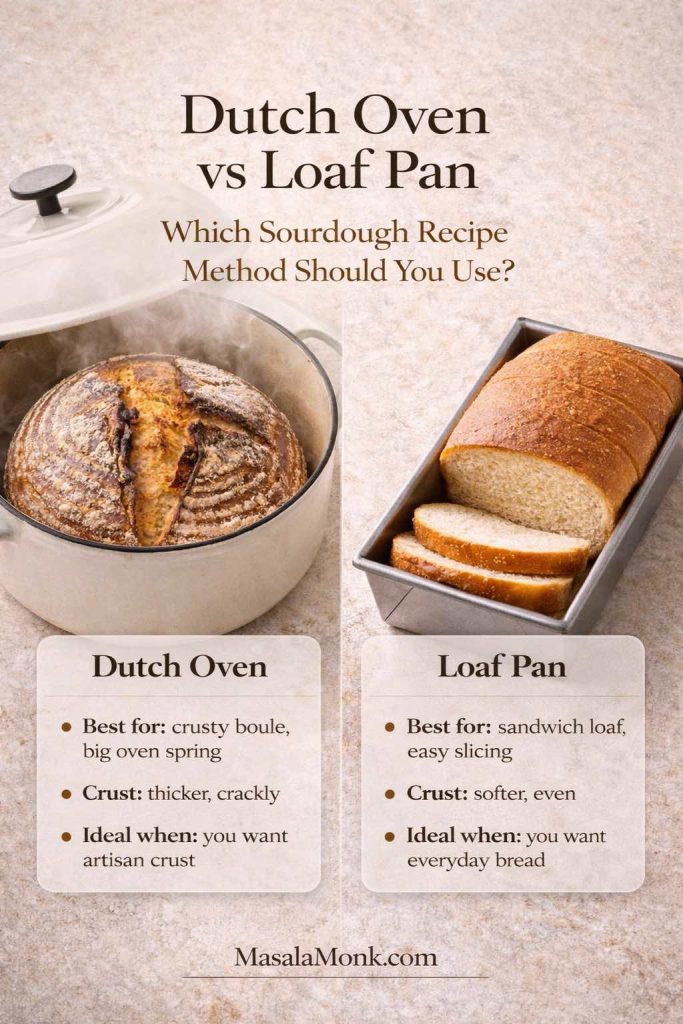
Portrait infographic titled “Dutch Oven vs Loaf Pan: Which Sourdough Recipe Method Should You Use?” showing a sourdough boule steaming in a Dutch oven on the left and a sliced sandwich loaf in a loaf pan on the right. Text compares each method: Dutch oven for a crusty boule and big oven spring with a thicker crackly crust, and loaf pan for easy-slicing sandwich bread with a softer even crust. MasalaMonk.com appears in the footer.
Not sure which sourdough recipe method to choose? Use this quick comparison: bake in a Dutch oven when you want a crusty artisan boule and strong oven spring, or use a loaf pan for softer sandwich bread that slices neatly for everyday toast and lunches.

Loaf pan, bread tin, baking pan

Loaf-pan sourdough is underrated. It’s practical, it slices cleanly, and it turns “homemade bread” into “weekday bread” immediately. If you’re building a sourdough sandwich loaf routine, a loaf pan becomes your best friend.

Loaf pan size matters more than people think

A standard 9×5 in / 23×13 cm pan gives the most forgiving rise and clean slices. Smaller pans make taller loaves but can overproof faster; larger pans can look “short” unless you scale the dough up. When in doubt, use the 9×5 and proof until the dough crowns 2–3 cm above the rim.

Stand mixer (KitchenAid and friends)

A stand mixer can make softer enriched doughs—rolls, buns, sandwich loaves—feel effortless. Meanwhile, high-hydration boules still benefit from folds and time more than aggressive mixing. If you do use a mixer for rustic dough, keep it gentle and brief, then rely on folds to finish the job.

Bread makers and Bread machine sourdough: what it’s best for (and how to adapt)

Some machines include a sourdough setting, and many can handle mixing, kneading, and baking a loaf-pan style sourdough bread. The main limitation is crust and shape, not flavor. A bread machine is most useful for loaf-pan style sourdough—think sandwich bread, English muffin bread, and soft everyday loaves. The machine won’t mimic a Dutch-oven crust, yet it can still deliver excellent flavor.

A simple way to adapt any loaf-pan sourdough in this guide:

  • Use active starter for the most reliable rise (discard can work, but timing gets unpredictable).
  • Choose the machine’s “Dough” cycle to mix + knead, then let the dough rise in the pan until it’s puffy and close to the rim.
  • If your kitchen is cool or your starter is young, a tiny pinch of instant yeast (like in the same-day loaf) keeps the schedule dependable without killing sourdough flavor.
  • For a softer crust, remove the loaf promptly and cool on a rack; for a deeper crust, use the “dark crust” setting if available.

If your goal is consistent everyday sandwich bread, a bread maker can be the easiest “set it and forget it” sourdough routine.

King Arthur even builds machine options into their recipes, including a bread-machine note for their beginner-friendly loaf: Basic sourdough bread recipe.

Also Read: 10 Vegan Chocolate Cake Recipes (Easy, Moist, & Dairy-Free)


Portrait infographic titled “Sourdough Recipe Timeline: Same-Day vs Overnight (Cold Proof)” showing two side-by-side timelines. The Same-Day sourdough column lists feed starter, mix dough, bulk ferment with folds, shape, proof, and bake. The Overnight column lists feed starter, mix dough, bulk ferment with folds, shape, refrigerate overnight (cold proof 10–16 hours), then bake next day. Warm neutral stone background with simple step icons and MasalaMonk.com in the footer.
Use this sourdough recipe timeline to plan your bake without guesswork. Choose Same-Day sourdough when you want fresh bread by evening, or go Overnight (cold proof) for an easier schedule and deeper flavor—then follow the matching recipe method below.

One base rhythm that makes every sourdough recipe easier

Before we dive into the ten bakes, it helps to know the three levers you can pull:

  1. Time: longer fermentation tends to build more flavor.
  2. Temperature: warmer ferments move faster, cooler ferments move slower and can deepen flavor.
  3. Hydration: wetter doughs can give a more open crumb, while tighter doughs (bagels!) give chew.

If you want to keep starter at a steady temperature—especially in a warm climate or a cold kitchen—temperature control helps. Serious Eats has a clear explanation of the “sweet spot” and cooler maintenance ranges in their review of a dedicated starter box: Brod & Taylor Sourdough Home review. Even without a device, that concept matters: warmer for activity, cooler for steadier, slower fermentation.

Now, let’s bake.


1) Classic Country Boule Recipe (crusty sourdough bread in a Dutch oven)

This is the loaf that anchors everything else. Once you can bake a confident sourdough boule, you can branch into rye, wholegrain, spelt, einkorn, seeded loaves, cinnamon raisin bread, cranberry walnut bread, and even mini sourdough bread bowls without changing your identity.

Ingredients (1 large boule)

  • Bread flour: 450 g
  • Whole wheat flour: 50 g
  • Water: 350 g
  • Active starter (100% hydration): 100 g
  • Salt: 10 g
Recipe card for a classic country sourdough boule baked in a Dutch oven, showing two crusty round loaves and a clean overlay with ingredients (bread flour, whole wheat flour, water, active starter, salt) plus an overnight method overview, bake temperatures, and key dough cues for oven spring.
This Classic Country Boule sourdough recipe card condenses the full method into one scannable reference—ingredients, key fermentation cues, and the Dutch oven bake schedule—so you can bake the crusty artisan loaf confidently without jumping around the page.

Method

Mix (evening works beautifully)

  1. Stir water and starter until milky.
  2. Add the flours and mix until no dry flour remains.
  3. Cover and rest 30 minutes. This pause makes the dough easier to strengthen later.

Build strength
4. Sprinkle salt over the dough and work it in with pinches and folds.
5. Over the next 2 hours, do 3–4 rounds of stretch-and-folds (every 30 minutes). Each round should feel easier as the dough tightens.

Bulk ferment
6. Let the dough rise until it looks puffier and lively—jiggly, with bubbles forming along the sides. Depending on room temperature, this can take 3–5 hours after your last fold.

Shape
7. Turn the dough onto a lightly floured surface. Pre-shape into a loose round, then rest 20 minutes.
8. Final shape into a tight boule: pull the dough toward you to create surface tension without tearing.

Cold proof
9. Place seam-side up in a floured banneton or cloth-lined bowl. Refrigerate 10–16 hours.

Bake
10. Preheat a Dutch oven to 250°C for 30–45 minutes.
11. Tip the dough onto parchment, score, and place it into the hot pot.
12. Bake 20 minutes covered, then reduce to 230°C and bake 20–25 minutes uncovered until deeply browned.
13. Cool fully. The crumb keeps setting as it cools, and slicing early can make it gummy.

Make it more sour (without making it dense)

If you want extra sour sourdough bread, the simplest shift is time and temperature: a longer cold proof often deepens tang. Another option is using a slightly lower hydration starter and letting the dough ferment a little longer before shaping. Serious Eats explains the microbial balance clearly in their deep dive on starter behavior: The Science of Sourdough Starters.

Wholegrain, spelt, rye, and einkorn variations

  • For a whole wheat sourdough bread: increase whole wheat flour to 150 g and reduce bread flour to 350 g. Add 10–20 g extra water if the dough feels tight.
  • For a rye sourdough or sourdough rye loaf: replace 50–100 g of bread flour with rye flour. Rye ferments enthusiastically, so watch the dough rather than the clock.
  • For spelt sourdough: swap 100 g of bread flour with spelt. Spelt dough can feel softer, so handle gently and avoid over-proofing.
  • For einkorn flour sourdough: start small—swap 50–75 g first. Einkorn’s gluten behaves differently, so the dough may spread more; a loaf pan version can be easier at first.
Infographic titled ‘Whole Wheat, Rye, Spelt & Einkorn — Sourdough Swap Guide’ with four columns. Each column shows a loaf/crumb photo and a quick swap rule: Whole wheat—raise whole wheat to 150 g and reduce bread flour to 350 g; add 10–20 g water if dough feels tight. Rye—swap 50–100 g rye; ferments faster so don’t overproof. Spelt—swap 100 g spelt; dough feels softer so handle gently. Einkorn—swap 50–75 g; spreads more so a loaf pan helps. MasalaMonk.com footer.
Use this sourdough flour swap guide when you want to push the classic boule toward whole wheat, rye, spelt, or einkorn without guessing. It keeps the change simple (what to swap) and practical (what to watch) so you can get the flavor you want while keeping structure, rise, and scoring predictable.

If you’re curious which flours help starters thrive, Serious Eats tested options and explains why rye and wholegrain often jump-start activity: The best flour for sourdough starters.

Easy add-ins: cinnamon raisin, cranberry orange, cranberry walnut, pumpkin

Once you’ve made the classic boule, add-ins become straightforward—keep the dough the same, then fold these in after the first fold set:

  • Cinnamon raisin swirl: 120–150 g raisins + a thin cinnamon-sugar layer during shaping (don’t overdo sugar or the swirl can leak).
  • Cranberry orange: 120 g dried cranberries + zest of 1 orange (add 10–15 g extra water if the dough tightens).
  • Cranberry walnut: 100–120 g cranberries + 80–100 g toasted walnuts (toast first for better flavor).
  • Pumpkin sourdough: replace 50–80 g of the water with pumpkin purée (pumpkin changes dough feel—watch texture, not the clock).

These small swaps help you hit a lot of “flavored sourdough bread” searches without writing full extra recipes.

Turn this boule dough into mini sourdough bread bowls

Instead of one boule, divide the dough into 4–6 pieces after bulk fermentation. Shape each piece tightly into a small round, cold proof on a tray, then bake on a preheated stone or heavy sheet with steam. Once cooled, slice the tops and hollow gently. These sourdough soup bowls are perfect with thick stews or creamy soups.

Also Read: Kahlua Drinks: 10 Easy Cocktail Recipes (Milk, Vodka, Coffee)


These sourdough scoring ideas make shaping and baking feel less intimidating. Start with the single slash for the most reliable oven spring, then try a cross or leaf pattern once you’re comfortable. Use the angle + depth cues here right before baking your boule.

2) Soft Sandwich Loaf Recipe (loaf pan sourdough bread for everyday)

A sourdough sandwich bread recipe should slice cleanly, toast beautifully, and feel soft enough for breakfast and lunch. This is the bread you’ll reach for when you want peanut butter, grilled cheese, or a turkey sourdough sandwich without wrestling a crust.

Ingredients (1 loaf pan, about 23×13 cm / 9×5 in)

  • Bread flour: 400 g
  • Whole wheat flour: 100 g (optional; replace with bread flour for a whiter loaf)
  • Milk or water: 300 g
  • Active starter: 100 g
  • Salt: 10 g
  • Honey or sugar: 20 g
  • Butter or neutral oil: 30 g
Soft sourdough sandwich loaf on a cutting board with buttered slices and a clean text overlay recipe card titled “Soft Sandwich Loaf,” showing loaf-pan size, ingredients (flour, milk/water, active starter, salt, honey/sugar, butter/oil) and a short method overview; MasalaMonk.com in the footer.
This soft sourdough sandwich loaf recipe card is the quick-glance version of the loaf-pan method below—ingredients + the exact proofing cue to watch so your slices stay tender, even, and clean-cut.

Method

  1. Mix milk and starter until combined.
  2. Add flours, honey/sugar, salt, and butter/oil. Mix to a shaggy dough, then rest 20 minutes.
  3. Knead until smoother and elastic—6–8 minutes by hand or 4–5 minutes in a stand mixer on low.
  4. Cover and let rise until noticeably puffy, about 60–80% increased in size.
  5. Shape into a log: flatten into a rectangle, roll tightly, pinch the seam.
  6. Place seam-side down in a greased loaf pan.
  7. Proof until the dough crowns 2–3 cm above the pan rim.
  8. Bake at 190°C for 35–45 minutes. Cool fully before slicing.

Make it sandwich-ready with MasalaMonk pairings

Once this loaf becomes routine, sandwiches become a rotating habit rather than a repetitive meal:


Portrait infographic titled “Bulk Fermentation + Proofing: 6 Visual Cues (So You Don’t Under/Overproof)” showing a glass bowl of risen sourdough dough on a light stone counter with a small bubble close-up inset. Text lists six cues: dough looks puffier and slightly domed, bubbles at edges and top, dough feels lighter and jiggly, volume increase not necessarily double, poke test slowly springs back, and dough holds shape after pre-shape. MasalaMonk.com is in the footer.
Nail the rise on every sourdough recipe with these bulk fermentation and proofing cues. Use the dome, bubbles, jiggle, and poke-test signals here to know when your dough is ready to shape and bake—so your loaves, rolls, buns, and bagels come out lighter instead of dense or flat.

3) Same-Day Sourdough Bread Recipe (fast, reliable, still flavorful)

Some days you want fresh bread by dinner without the full overnight arc. This same day sourdough recipe borrows the best idea from “everyday sourdough” approaches: give the starter a head start, then use a tiny pinch of yeast as backup so the loaf rises on your schedule.

Ingredients (1 loaf)

  • Bread flour: 500 g
  • Water: 340 g
  • Active starter: 120 g
  • Salt: 10 g
  • Instant yeast: 1 g (optional but extremely helpful)
Recipe card overlay for Same-Day Sourdough Bread showing a sliced loaf on a board. Text lists ingredients (bread flour, water, active starter, salt, optional instant yeast) and a short method: mix + rest, 2–3 fold sets, bulk until airy, shape + proof, bake covered then uncovered. MasalaMonk.com in footer.
Same-Day Sourdough Bread (quick visual checklist): This card is the fast version of Recipe #3—ingredients + the five checkpoints that matter most (folds → airy bulk → short proof → covered bake → uncovered finish). Use it to keep your timing on track while you follow the full steps in this section.

Method

  1. Mix water and starter, then add flour, salt, and yeast (if using). Mix until no dry flour remains. Rest 20 minutes.
  2. Over the next 60–90 minutes, do 2–3 sets of folds.
  3. Bulk ferment until the dough looks inflated and airy, typically 2–4 hours depending on warmth.
  4. Shape into a boule and proof 45–75 minutes while you preheat the oven and pot.
  5. Bake in a preheated Dutch oven at 250°C for 20 minutes covered, then 230°C for 20–25 minutes uncovered.

If you love this “forgiving but tasty” lane, King Arthur’s loaf-pan version is worth bookmarking because it’s built for success, even when your starter isn’t perfect: Easy everyday sourdough bread recipe.

Also Read: Hot Chocolate Coffee: 3 Easy Recipes (Cocoa, Mix, or Espresso)


If a sourdough recipe ever turns out dense, flat, or gummy, use this quick troubleshooting guide to diagnose the problem and fix your next bake. It’s especially helpful when you’re switching between methods (same-day vs overnight) or moving from loaf pans to Dutch oven boules.

4) No-Knead Dutch Oven Loaf Recipe (hands-off, overnight, crusty)

No knead sourdough is ideal when you want a rustic loaf without shaping drama. You mix, you wait, you fold a little, and time does the rest. It’s also a nice entry point when you’re still learning what “fermented enough” feels like.

Ingredients (1 loaf)

  • Bread flour: 500 g
  • Water: 375 g
  • Active starter: 100 g
  • Salt: 10 g
Photographic recipe card for “No-Knead Dutch Oven Loaf” (sourdough recipe). A golden sourdough loaf sits in a white Dutch oven as a hand lifts the lid; steam rises. A clean text overlay lists ingredients (bread flour, water, active starter, salt) and a simple method overview (mix at night, rest, fold, shape + proof, bake covered then uncovered). MasalaMonk.com appears in the footer.
No-knead sourdough Dutch oven loaf (recipe card): a hands-off, overnight method you can follow at a glance—ingredients + the exact flow (mix → rest → fold → shape → bake) so you get a crusty loaf without overthinking timing. Save this card as your quick checkpoint while you bake the full method in Section 4.

Method

  1. In the evening, mix everything until combined. Cover.
  2. Leave at room temperature 10–14 hours.
  3. In the morning, gently fold the dough over itself a few times to tighten it. Rest 20 minutes.
  4. Shape lightly into a round and proof 45–90 minutes.
  5. Bake in a preheated Dutch oven: 250°C for 20 minutes covered, then 230°C for 20–25 minutes uncovered.

If you like seeing the method explained step-by-step with visuals, King Arthur’s guide-style post is clear: How to make no-knead sourdough bread.

Also Read: Cappuccino Recipe: How to Make a Perfect Cappuccino at Home


5) English Muffin Bread Recipe (toaster-friendly sourdough, minimal effort)

English muffin bread is the bread you bake when you want nooks and crannies without shaping rounds or dealing with a stone. It’s especially good for breakfast—toast it hard, then let butter and jam do their thing.

Ingredients (1 loaf)

  • Bread flour: 450 g
  • Water or milk: 360 g
  • Active starter: 120 g
  • Salt: 10 g
  • Honey or sugar: 15 g
  • Baking soda: 2 g
  • Cornmeal (for dusting): as needed
Photograph-style recipe card for sourdough English muffin bread in a loaf pan with cornmeal crust and two buttered toasted slices. Clean overlay lists ingredients and a short method overview for a no-shaping, toaster-friendly sourdough loaf with “nooks and crannies,” plus MasalaMonk.com branding in the footer.
This sourdough English muffin bread card is the “easy breakfast loaf” in this guide—no shaping, no Dutch oven, just a sticky batter-style dough that bakes up with nooks and crannies. Use it as a quick visual checklist while you follow the full method below (and save it for repeat toaster mornings).

Method

  1. Mix liquids and starter, then add flour, salt, and honey/sugar. The dough will be sticky—closer to a thick batter than a kneadable dough.
  2. Cover and rise until noticeably airy, often 3–6 hours.
  3. Grease a loaf pan and dust lightly with cornmeal.
  4. Scrape in the dough, smooth the top with wet fingers, and proof until it nears the rim.
  5. Bake at 190°C for 35–40 minutes.

Breakfast ideas with this sourdough bread recipe

Once you have this loaf, breakfast becomes easy to repeat without feeling repetitive:


Portrait infographic titled “Soft Sourdough Rolls & Buns” showing one dough made into three shapes on a baking tray: dinner rolls (pull-apart), burger buns (round seeded buns), and hot dog buns (oval rolls). Text notes “Same dough, different shape” and “Tight surface = better rise,” with MasalaMonk.com in the footer.
This soft sourdough rolls and buns guide shows how one dough becomes three bakes—dinner rolls, burger buns, and hot dog buns. Use it as a quick shaping reference before you start the rolls section below, so your dough rises higher and bakes up pillowy.

6) Soft Dinner Rolls Recipe (pull-apart sourdough rolls with starter)

Soft sourdough dinner rolls are a different kind of pleasure: tender crumb, gentle sweetness, a golden top, and a pan that disappears faster than you expect. They’re also forgiving, especially if you keep the dough enriched.

Ingredients (for recipe of 12 sourdough dinner rolls )

  • Bread flour: 500 g
  • Milk: 280 g
  • Active starter: 120 g
  • Salt: 10 g
  • Sugar: 35 g
  • Butter: 60 g
  • Egg: 1 (about 50 g) — optional
    • If skipping egg, add 30 g extra milk.
Soft sourdough dinner rolls in a baking pan with a clean recipe card overlay titled “Soft Dinner Rolls.” The card lists ingredients for 12 rolls (bread flour, milk, active starter, salt, sugar, butter, optional egg) and a short method overview: mix and rest, knead in butter, bulk ferment until puffy, divide and shape, proof until touching, then bake and brush with butter. MasalaMonk.com in the footer.
This soft sourdough dinner rolls recipe card gives you the full ingredient list plus the key checkpoints (bulk ferment “puffy + marshmallowy,” proof until the rolls touch, then bake). Use it as a quick visual recap while you follow the detailed steps in Section 6: Soft Dinner Rolls—especially helpful when you’re baking enriched dough and don’t want to overproof.

Method

  1. Mix milk and starter (plus egg, if using). Add flour, sugar, and salt. Mix until shaggy. Rest 20 minutes.
  2. Knead until smoother, then knead in butter until the dough is cohesive and elastic.
  3. Bulk ferment until it looks puffy and lighter, typically 3–6 hours depending on temperature.
  4. Divide into 12 pieces (about 85–90 g each). Shape into tight balls.
  5. Place in a greased pan, cover, and proof until the rolls are soft and touching.
  6. Bake at 190°C for 18–22 minutes. Brush with butter while warm.

If you like comparing your rolls to a well-tested benchmark, this recipe is excellent for technique and texture: Super soft sourdough rolls.

Also Read: Cranberry Moscow Mule Recipe: A Festive Holiday Cocktail With Easy Variations


7) Burger Buns Recipe (soft sourdough buns for sandwiches)

A sourdough bun should be sturdy enough to hold sauces yet tender enough to bite through cleanly. This dough builds on the roll formula because it already has that soft, enriched structure.

Ingredients (for recipe of 8 sourdough buns for sandwiches)

Use the same dough as the Soft Dinner Rolls. After bulk fermentation, shape as buns instead of rolls.

Method

  1. Divide dough into 8 pieces (about 105–115 g each).
  2. Shape into tight balls, then gently flatten to a thick disc.
  3. Proof on a tray until puffy and marshmallowy.
  4. Brush with milk or egg wash if desired.
  5. Bake at 190°C for 15–18 minutes.
Photo of soft sourdough burger buns on a cooling rack with sesame tops, plus a clean recipe overlay card titled “Soft Sourdough Burger Buns” showing ingredients and a short step-by-step method for pillowy, sandwich-ready buns, with MasalaMonk.com in the footer.
This soft sourdough burger buns recipe card gives you the full buns-at-a-glance view—ingredients, proofing checkpoints, and the bake window—so you can follow the bun method without scrolling back and forth while shaping and proofing.

Sandwich pairings that make buns feel “planned”

  • Build a spicy, street-style vibe with authentic grilled Bombay sandwich flavors adapted into bun form—chutney, potatoes, crisp veg, and heat.
  • For a creamy upgrade, the base ideas in homemade mayo variations let you swing from garlic mayo to spicy mayo without changing the whole sandwich.
  • If you want chicken options that don’t feel repetitive, chicken sandwich recipes gives multiple directions that work brilliantly in soft sourdough buns.

8) Hot Dog Buns Recipe (sourdough hotdog buns that stay soft)

Hot dog buns often dry out quickly. Sourdough can help them stay tender longer, especially when the dough includes milk and butter.

Ingredients (for recipe of 10 sourdough hotdog buns)

Use the same dough as Soft Dinner Rolls.

Recipe card photo of golden sourdough hot dog buns in a baking pan with one bun sliced open to show a soft crumb. Text overlay reads ‘Sourdough Hot Dog Buns’ with ingredients, short method steps, and a pro cue for softer buns. MasalaMonk.com in the footer.
This sourdough hot dog buns recipe card gives you the full at-a-glance method—soft crumb, split-top shape, and a proofing cue that keeps the buns pillowy. Use it right before shaping so your buns bake up tall and tender, then follow the full steps in the section above for timing details and swaps.

Method

  1. Divide into 10 pieces (about 85–90 g).
  2. Shape each piece into a tight ball, rest 10 minutes, then roll into a short log.
  3. Place seam-side down on a tray or in a bun pan.
  4. Proof until the logs look puffy and almost doubled.
  5. Bake at 190°C for 14–17 minutes.

If you want to keep buns soft for longer, cool them fully, then store airtight. For freezing, slice before freezing so you can toast from frozen without thawing.

Also Read: Baked Ziti Recipe Collection: 15 Easy Variations


9) Hoagie + Sub Rolls Recipe (sourdough sandwich rolls)

These are the rolls you bake when you want an honest-to-goodness sub: crisp edge, chewy bite, enough structure to handle fillings. They’re also the shape that makes leftover chicken, roasted vegetables, or paneer feel like an actual meal.

Ingredients (for recipe of 6 sourdough sandwich rolls)

  • Bread flour: 500 g
  • Water: 320 g
  • Active starter: 120 g
  • Salt: 10 g
  • Sugar: 15 g
  • Olive oil: 20 g
Photographic recipe card for sourdough hoagie and sub rolls (sourdough sandwich rolls) showing sesame-topped rolls on a board plus a filled sub. Overlay lists ingredients for 6 rolls and a short method (mix, knead, bulk ferment, shape, proof, bake) with a steam tip; MasalaMonk.com in the footer.
Sourdough hoagie + sub rolls, at a glance: use this quick recipe card when you want sandwich rolls that hold fillings—crisp edge, chewy bite, and a soft interior. Screenshot/save it for repeat bakes, then follow the full method below for timing cues during bulk fermentation and proofing.

Method

  1. Mix water and starter, then add flour, sugar, salt, and oil. Mix until combined. Rest 20 minutes.
  2. Knead until smooth—6–8 minutes by hand or 4–5 minutes on low in a stand mixer.
  3. Bulk ferment until puffy, usually 3–5 hours depending on warmth.
  4. Divide into 6 pieces (about 160–170 g). Pre-shape into small logs, rest 15 minutes.
  5. Shape tightly into longer rolls: flatten gently, roll up firmly, pinch seam, then taper ends if you like.
  6. Proof seam-side down until the rolls feel lighter and look expanded.
  7. Bake at 220°C for 16–20 minutes. For better crust, create steam by placing a tray of hot water on the bottom rack during the first 10 minutes.

For a filling that’s simple but ridiculously satisfying, try a hot, melty build based on mushroom cheese sandwich flavors—sautéed mushrooms, spice, cheese, and a spread.

Also Read: Manhattan Cocktail Recipe (Classic + 6 Variations)


10) Chewy Sourdough Bagels Recipe (boil + bake, real bagel texture)

Sourdough bagels are a different animal: stiff dough, serious kneading, tight shaping, then a quick boil that sets the crust before baking. The payoff is huge—chew, shine, and that “real bagel” bite.

For a classic reference recipe with a proven method, King Arthur’s version is excellent: Sourdough bagels recipe. Here’s a streamlined metric approach that stays true to the technique.

Portrait four-panel infographic titled “Sourdough Bagels” showing the steps: Shape (raw bagel rings on a floured surface), Float Test (bagel floating in water), Boil (bagels boiling with note “30–60 sec/side”), and Bake (golden sesame bagels on a tray). Text at bottom says “Chewy crust, tender inside,” with MasalaMonk.com in the footer.
This sourdough bagels step card breaks the method into four simple checkpoints—shape, float test, boil, then bake—so you get that classic chewy crust and tender inside. Save it as a quick reference, then follow the full sourdough bagel recipe below for exact timings and quantities.

Ingredients (for Recipe of 8 Sourdough bagels)

  • Bread flour: 500 g
  • Water: 250 g
  • Active starter: 150 g
  • Salt: 10 g
  • Honey or sugar: 25 g

Water bath

  • Water: 2000 g
  • Honey: 20 g
  • Salt: 3 g
Photograph of sesame sourdough bagels on a rack and board with a clean recipe overlay titled “Sourdough Bagels: Chewy Bagels (Boil + Bake),” listing ingredients (bread flour, water, active starter, salt, honey/sugar), a water-bath formula, float-test cue, boil time per side, bake temperature, and MasalaMonk.com in the footer.
This sourdough bagels recipe card gives you the full method in one glance—stiff dough, a quick float test, 30–45 seconds per side in the honey water bath, then bake until deep golden. Use it right before you boil so you nail the chew without over-proofing or over-boiling.

Method

  1. Mix everything into a stiff dough. Knead until very smooth, 8–10 minutes. A stand mixer helps here, although hand kneading works if you stay patient.
  2. Bulk ferment 2–4 hours. Bagel dough doesn’t need to double; it should simply look slightly puffier and smoother.
  3. Divide into 8 pieces (about 115–120 g). Rest 10 minutes.
  4. Shape: either poke a hole in the center and stretch, or roll into a rope and wrap around your hand.
  5. Proof 30–60 minutes. A quick float test helps: if a bagel floats in water, it’s ready to boil.
  6. Boil 30–45 seconds per side in the honey-salt water bath.
  7. Bake at 220°C for 18–22 minutes until deeply golden.

Bagels make breakfast feel effortless, especially when you pair them with a spread and something crunchy. For ideas that stay practical, this roundup is full of combinations: breakfast sandwich recipes.

Also Read: Classic Rum Punch + 9 Recipes (Pitcher & Party-Friendly)


Bonus: Gluten-Free Vegan Sourdough Boule Recipe (a true gluten-free boule path)

Gluten-free sourdough can be genuinely good—provided you treat it like its own category instead of pretending it will behave like wheat. The dough is usually more like a thick batter, structure often comes from psyllium husk, and baking in a pot helps hold shape.

This gluten-free vegan sourdough bread recipe uses a gluten-free starter (often built from brown rice flour). If you need a starter method, Serious Eats offers a clear baseline starter guide (wheat-based), and the fermentation logic still helps even when your flour changes: Sourdough starter basics.

Gluten-free vegan sourdough boule recipe card showing measured ingredients (brown rice flour, sorghum flour, tapioca starch, psyllium husk, salt, maple/sugar optional, active gluten-free starter, olive oil optional) plus a hydration dial recommending water 430–470 g, target texture “thick paste that holds soft peaks,” and key checkpoints (rest 15 minutes, proof for bubbles + slight lift, cool before slicing). MasalaMonk.com in footer.
Gluten-Free Vegan Sourdough Boule (Formula + Hydration Dial): Use this as your mixing reference—start your water at 430 g, then only move toward 470 g if the dough feels too stiff to spread. For gluten-free sourdough, the goal isn’t a kneadable dough; it should look like a thick paste that holds soft peaks, then show bubbles + a little lift before baking in a pot.

Ingredients (for 1 small Sourdough Boule Recipe)

  • Brown rice flour: 250 g
  • Sorghum flour: 150 g
  • Tapioca starch: 100 g
  • Psyllium husk powder: 15 g
  • Salt: 10 g
  • Maple syrup or sugar: 15 g (optional, helps fermentation)
  • Water: 430–470 g (start with 430 g, add as needed)
  • Active gluten-free starter (100% hydration): 150 g
  • Olive oil: 20 g (optional, improves tenderness)
Gluten-free vegan sourdough boule in a Dutch oven with a clean recipe-card overlay listing brown rice flour, sorghum, tapioca, psyllium, starter, and quick bake steps, plus “success cues,” with MasalaMonk.com in the footer.
This gluten-free vegan sourdough boule recipe card pulls the full method into one glance—key flours, psyllium “structure,” the paste-like dough reminder, and the two-stage Dutch oven bake. Use it while you mix and proof so you don’t chase a wheat-style “double,” and save it as your quick checkpoint for repeat gluten-free bakes.

Method

  1. Whisk dry ingredients thoroughly so psyllium distributes evenly.
  2. Stir in water and starter. The dough should resemble a thick, sticky paste that holds soft peaks. Rest 15 minutes to let psyllium gel.
  3. Scrape into a parchment-lined bowl or proofing basket. Smooth the top with wet fingers.
  4. Proof at warm room temperature until slightly risen and aerated—often 3–5 hours. Don’t chase a dramatic double; aim for visible lift and bubbles.
  5. Bake in a preheated Dutch oven at 240°C for 25 minutes covered, then 220°C for 25–35 minutes uncovered.
  6. Cool completely before slicing. Gluten-free sourdough firms as it cools, and cutting early can make it feel gummy.
Gluten-free vegan sourdough boule visual guide showing thick paste-like dough after mixing and a proofed dough in a lined basket, with notes to look for bubbles and slight lift (not a full double), plus tips: wet hands to smooth, parchment for transfer, and cool completely before slicing.
Gluten-free sourdough behaves differently from wheat dough—use these dough + proof cues to stay on track. Aim for a thick paste that holds soft peaks, then proof for visible bubbles and a slightly aerated lift (don’t wait for a dramatic double). Finish by cooling the boule fully before slicing so the crumb sets instead of turning gummy.

This loaf pairs beautifully with soups and sauces, because gluten-free crust loves something to soak up. If you want a simple sauce rotation for dipping and topping, keep these handy:


A sourdough pizza detour that fits naturally (starter or discard)

Even if you’re not baking pizza weekly, sourdough pizza dough is one of the best ways to “use your starter without a ceremony.” It’s also a satisfying path for evenings when you want something baked, but not another loaf.

When pizza night happens, the dough is only half the story. A great sauce makes sourdough crust taste intentional—whether you want classic red, garlicky, spicy, or creamy. Start with your pizza sauce recipes for easy options that work on sourdough bases, then switch it up with a fresh, herby spread like pesto recipes and variations when you want something brighter.

Sourdough pizza dough: an easy base formula (starter or discard)

Sourdough pizza works because the dough doesn’t need a dramatic rise to taste great—fermentation does the heavy lifting for flavor.

Base formula (2 medium pizzas):

  • Bread flour: 500 g
  • Water: 325–350 g (start lower if your flour is weaker)
  • Salt: 10 g
  • Active starter: 100 g (or discard 150–200 g if you’re using it for flavor)
  • Olive oil (optional): 10–20 g

Simple timeline options:

  • Same-day: warm kitchen, starter at peak → mix → 2–3 fold sets → bulk until airy → divide → rest → stretch and bake.
  • Overnight: mix → bulk partway → refrigerate → next day portion → warm up → stretch and bake.

If you want the crust more sour, choose the overnight path and give it more time cold.


Where this leaves you (and what to bake first)

If you want the most “foundational” two-bake pairing, start with the classic country boule and the soft sandwich loaf. You’ll get crust, crumb, shaping, and loaf-pan confidence in one week, and after that the rolls and buns feel like friendly variations rather than new projects.

Meanwhile, if you want quick wins, the same-day loaf plus English muffin bread makes sourdough feel useful immediately—toastable, sliceable, repeatable.

Whenever you’re ready to turn today’s bread into tomorrow’s meal, a few MasalaMonk staples make the rotation easy:

FAQs: Sourdough Recipe Questions (Starter, Timing, Flavor, Tools)

1) What’s the difference between a sourdough recipe using active starter vs discard?

An active (ripe) starter has peak strength, so it can lift the dough on its own and gives you the most predictable rise for a true sourdough bread. By contrast, discard is older and usually less powerful; still, it brings flavor, and it works well in longer-fermented doughs or recipes designed for discard. In practice, if you want a classic sourdough bread recipe with a tall loaf and open crumb, use active starter. Meanwhile, if you want a faster, more flexible bake or you’re trying to reduce waste, a sourdough discard recipe can be the right fit.

2) How do I know when my sourdough starter is ready to bake with?

Look for a starter that rises reliably after feeding, shows plenty of bubbles, and smells pleasantly tangy rather than harsh. Ideally, it should reach its peak in a predictable window in your kitchen. If it’s doubling, holding some structure at peak, and looks airy instead of watery, it’s generally ready. Even so, if your starter is new, it may still bake fine in a sandwich loaf recipe or same-day sourdough bread recipe before it’s strong enough for a lofty country boule.

3) Why didn’t my sourdough bread rise?

Usually it’s one of three things: the starter wasn’t strong enough, the dough was under-fermented, or the dough was over-fermented. Under-fermentation can happen if your kitchen is cool or the dough didn’t get enough time. Over-fermentation can happen if the dough sat too long in warmth and lost strength before baking. Additionally, too much flour during shaping can prevent a good seal and weaken structure. When in doubt, aim for dough that feels lighter, looks puffier, and shows bubbles at the edges before you shape.

4) Why is my sourdough recipe turning out dense and tight?

Density often comes from either weak fermentation or insufficient gluten development. If the dough never becomes airy during bulk, the crumb stays tight. On the other hand, if the dough is handled roughly late in fermentation, you can knock out the gas that would have become lift in the oven. Also, very low hydration doughs tend to be tighter. If you want a more open crumb, choose a slightly higher hydration sourdough boule recipe and handle it more gently near the end.

5) How do I make my sourdough more sour?

To get extra sour sourdough bread, extend fermentation in cooler conditions. A longer cold proof in the fridge generally increases tang without sacrificing structure. Similarly, using more whole grain flour (especially rye) can boost flavor. Another approach is keeping the starter on a slightly stiffer feeding routine, which can shift acidity. However, if you push too far, the loaf can turn slack, so aim for “more sour” through time and temperature rather than simply letting dough sit forever.

6) How do I make my sourdough less sour?

If your loaf tastes sharper than you like, shorten the cold proof, reduce the total fermentation time, and keep the starter on a regular feeding rhythm so it stays mild. In addition, using more bread flour and less whole grain can soften acidity. Finally, bake sooner once the dough is properly fermented; waiting far past readiness can intensify sour notes.

7) What does “same-day sourdough” really mean?

Same-day sourdough usually means you bake within a single day rather than doing an overnight cold proof. Sometimes it’s a true starter-only approach in a warm kitchen with excellent timing. More often, it’s a hybrid sourdough bread recipe that uses starter for flavor plus a tiny amount of yeast for reliability. Either way, the goal is similar: a good loaf today, without needing to plan two days ahead.

8) Is a no-knead sourdough recipe actually better for beginners?

Often, yes. No-knead sourdough relies on time and folds rather than intensive kneading, which reduces the chance of overworking the dough. Additionally, the schedule can feel simpler: mix, rest, fold occasionally, then shape and bake. That said, even a no-knead method still needs fermentation awareness, so learning what “puffy and airy” looks like is more important than memorizing minutes.

9) Can I bake sourdough without a Dutch oven?

Absolutely. While a Dutch oven makes steam management easy, you can bake on a preheated tray or stone with a steam setup. For example, you can place a metal tray in the oven while it preheats, then pour hot water into it when the bread goes in. Alternatively, you can bake in a loaf pan to support shape and still get great results. The crust may be slightly different, yet the flavor can be just as good.

10) Can I bake sourdough in a loaf pan instead of shaping a boule?

Yes, and it’s one of the most practical ways to make sourdough bread for sandwiches. Loaf-pan sourdough is easier to slice, easier to store, and less sensitive to shaping technique. Additionally, if you’re working with higher whole grain content or softer dough, the pan provides helpful structure.

11) What’s the best flour for sourdough starter?

Bread flour works well, although many starters become more vigorous with some whole wheat or rye added to feedings. Rye flour, in particular, often boosts activity quickly. That said, the best flour for starter is ultimately the one you can feed consistently, because regular feeding rhythm matters more than chasing a “perfect” flour.

12) What’s the best flour for sourdough bread?

For a classic loaf with strong structure, bread flour is the easiest choice. Whole wheat flour adds flavor and nutrition but can reduce loft if you go too high without adjusting hydration. Rye flour increases fermentation activity and adds a deeper flavor. Spelt and einkorn bring character; however, they behave differently, so smaller substitutions are easier at first.

13) Why is my sourdough dough so sticky?

Stickiness can come from higher hydration, insufficient gluten development, or fermentation that has gone too far. First, use slightly wet hands for folds and shaping rather than dumping in extra flour. Next, add an extra fold set early to strengthen the dough. Finally, watch fermentation—if the dough becomes slack and puddly, it may be over-proofed.

14) How do I know when bulk fermentation is done?

Instead of waiting for a perfect “double,” look for a dough that feels lighter, looks puffier, and shows bubbles along the edges. The surface should appear smoother and slightly domed rather than flat. If you gently shake the bowl, the dough should jiggle. Once those signs show up, shaping usually goes better and the crumb improves.

15) How long should I cold proof sourdough?

Most loaves do well with an overnight cold proof, roughly 10–16 hours. Shorter proofs can still work, especially for same-day sourdough bread. Longer proofs can increase sourness and improve scoring, although if you go too long the dough can weaken and lose oven spring.

16) Why did my sourdough spread out instead of rising up?

Spreading often happens when the dough is over-fermented, under-shaped, or too wet for your flour’s strength. Additionally, if the dough isn’t tightened enough during shaping, it won’t hold a tall profile. A banneton can help support the dough during proofing. Otherwise, using a loaf pan is a simple fix while you build shaping confidence.

17) Why did my sourdough crust go soft after cooling?

A soft crust usually means steam got trapped during cooling or the loaf wasn’t baked long enough to drive off moisture. Cool bread on a rack with airflow. Also, bake a bit longer until the crust is deeply browned. Finally, avoid storing the loaf in a sealed bag until it’s fully cool.

18) How do I score sourdough so it opens nicely?

Scoring works best when the dough is cold and the surface is slightly dry, which is why many bakers score after a fridge proof. Use a sharp blade, make confident cuts, and angle slightly to encourage an “ear.” Additionally, one clean primary cut usually performs better than many shallow decorative lines when you’re chasing oven spring.

19) Can I use a stand mixer for sourdough dough?

Yes, especially for sandwich loaf recipes, buns, and sourdough dinner rolls. For rustic boules, mixing briefly in a stand mixer can help, yet folds still matter for structure. Either way, avoid overheating the dough—if it warms too much, fermentation can race ahead before the dough is strong.

20) Can I make sourdough in a bread machine?

You can, particularly for loaf-pan style sourdough bread. Bread machines are great for mixing and baking a consistent sandwich loaf. However, if you want a crusty Dutch-oven boule with a bold ear, an oven bake is usually better. Still, a bread machine can be a practical everyday sourdough option when you value convenience.

21) What’s the easiest sourdough recipe for beginners?

A loaf-pan sourdough sandwich bread recipe is often the easiest place to start because the pan supports the dough and slicing is straightforward. Alternatively, a no-knead sourdough recipe can be beginner-friendly because it relies more on time than technique. If your starter is still maturing, those two styles tend to be forgiving.

22) How should I store sourdough starter?

If you bake often, keeping the starter at room temperature with regular feedings works well. If you bake occasionally, storing it in the fridge slows it down and reduces maintenance. Either way, try to feed it once or twice after refrigeration before you use it in a true sourdough bread recipe, especially for a boule or bagels.

23) How do I store sourdough bread so it stays fresh?

For crusty loaves, a paper bag or bread box helps maintain the crust better than plastic. For soft sandwich loaves and buns, airtight storage keeps them tender. And for longer storage, slice and freeze; then toast straight from frozen to revive texture.

24) Can I make sourdough rolls from starter without commercial yeast?

Yes. Soft sourdough rolls can rise solely from active starter, although they take longer and benefit from a warm proof. If your starter is young or your kitchen is cool, the dough may need extra time. Alternatively, a tiny amount of yeast can make timing easier without erasing sourdough flavor.

25) Why do my sourdough bagels turn out tough?

Bagels need a stiff dough, but if they ferment too long or bake too hard, they can become overly tough. Also, too much flour during shaping can dry the surface. Aim for a smooth, well-kneaded dough, proof until slightly puffy, then boil briefly rather than excessively. That balance keeps chew pleasant rather than jaw-breaking.

26) How do I revive a frozen or dried sourdough starter?

If your starter was frozen, thaw it in the fridge first, then give it a few patient feeds at room temperature. Start small: stir 20–30 g starter with equal parts water and flour (by weight), keep it warm, and feed again once it rises and begins to fall. Most starters need 2–4 feed cycles to regain predictable lift, especially if they were frozen for a while.

For a dried starter, crumble a small amount into water first and let it soften fully before adding flour. It may look sleepy for a day or two, so focus on signs of life—tiny bubbles and a mild tang—before you judge strength. Once it begins rising in a repeatable pattern after feeding, it’s ready to bake with. Until then, use it in loaf-pan breads or same-day methods rather than a tall country boule.

27) What’s the best hydration for a beginner sourdough loaf?

For most beginners, a “middle” hydration is the sweet spot: wet enough to get a tender crumb, but not so wet that shaping feels like wrestling. In practical terms, dough that feels tacky yet manageable usually performs better than dough that’s either stiff and dry or so loose it spreads instantly.

If you’re using strong bread flour, you can push hydration higher over time. Meanwhile, if you’re using more whole wheat, rye, spelt, or einkorn, the dough can feel stickier or softer even at the same hydration, so it helps to start slightly lower and add water only if the dough truly feels tight. The goal is not maximum water—it’s a dough you can strengthen with folds and shape with confidence.

28) Can I bake sourdough in a loaf pan without a banneton?

Yes—and it’s one of the easiest ways to make sourdough more consistent. A loaf pan supports the dough during proofing, which means you can get good height even if your shaping is still developing. It’s also the most practical path to sourdough you can slice neatly for toast and sandwiches.

To make it work smoothly, focus on one cue: proof until the dough crowns above the rim of the pan, looks aerated, and feels lighter. If you underproof, the loaf stays tight; if you overproof, it can collapse or bake up gummy. The pan won’t replace fermentation, but it does remove a lot of stress from the shaping stage.

29) What’s the easiest way to use sourdough discard every week without waste?

The easiest rhythm is to keep a small “discard jar” in the fridge and use it in one repeatable bake you actually enjoy—something that fits your week. For many people that’s English muffin bread (toaster-friendly), pancakes/waffles, quick flatbreads, or a simple discard pizza crust. Those options use discard for flavor and don’t demand perfect starter strength.

A good habit is portioning: if you know you’ll only bake once or twice, freeze discard in small amounts so you can thaw exactly what you need. Also, label the jar with the date so you’re not guessing. If the discard ever shows mold or pink/orange streaks, toss it—otherwise, most “old” discard is still perfectly useful for baking.

30) Why did my sourdough bagels fail the float test?

The float test is really a fermentation test: a bagel that sinks is usually underproofed, meaning there isn’t enough gas trapped inside yet. The fix is simple—give the shaped bagels a little more proofing time in a warm spot, then test again. Bagel dough is stiff, so it can look “fine” on the surface while still needing more time.

Less often, bagels fail the float test because the starter wasn’t strong enough, the dough was too cold, or the bagels were over-tightened and degassed during shaping. If your kitchen is cool, proofing takes longer. If your starter is young or sluggish, you’ll need more time—or you can choose a more forgiving schedule (like a longer fermentation or a small yeast assist) until your starter becomes reliably powerful.

Posted on 11 Comments

Kahlua Drinks: 10 Easy Cocktail Recipes (Milk, Vodka, Coffee)

Flat lay of Kahlua, milk, coffee, cola, and three iced Kahlua cocktails labeled White Russian, Sombrero, and Kahlua & Coke for a 10-recipe guide.

Kahlua drinks have a way of making ordinary evenings feel a little more intentional. Maybe it’s the familiar aroma—coffee, caramel, a hint of vanilla—or maybe it’s the way this coffee liqueur slips so easily into what’s already in your kitchen. Either way, drinks using Kahlua don’t demand a crowded bar cart. In fact, the best Kahlua drink recipes often start with everyday staples: milk, cream, vodka, coffee, Coke, and a handful of ice.

That’s exactly what you’ll find here: kahlua cocktail recipe classics you can build with confidence, plus the kind of variations that keep things interesting when you’re in the mood to tweak. Some nights call for a creamy Kahlua and cream drink recipe that tastes like dessert in a glass. Other times, vodka and Kahlua drinks like a White Russian or a Black Russian are the cleanest answer. And when you want something modern, nothing beats an espresso martini with Kahlua—cold, foamy, and café-scented.

Before you start pouring, one detail matters more than it seems: coffee strength. Whenever a recipe uses espresso, cold brew, or strong coffee, you’ll get a much better drink if the coffee is bold enough to stand up to ice and alcohol. If you want a simple, espresso-like concentrate without a machine, this guide to Moka Pot Mastery is a good place to start. Likewise, if you’re still getting comfortable with coffee intensity and extraction, Masala Monk’s Quick Espresso Guide helps you understand what “strong enough” actually means in a practical way.

Now, with the basics in place, let’s make some genuinely satisfying kahlua liqueur drinks—starting with the easiest combinations and building toward the showstoppers.

What mixes with Kahlúa cheat sheet showing the best mixers—milk, cream, vodka, espresso/cold brew, cola, and brandy/bourbon—with a quick ratio guide.
Quick guide: what mixes with Kahlúa. Use milk, cream, vodka, espresso/cold brew, cola, or brandy/bourbon—and start with a simple ratio of 1 oz Kahlúa to 2–3 oz mixer over ice.
Pick your Kahlúa drink infographic that helps choose the best Kahlúa cocktails by vibe—creamy, strong no-dairy, coffee-forward, fizzy, or dessert.
Not sure what to make? Use this Kahlúa drink picker to match your mood—creamy classics, coffee-forward favorites, fizzy quick drinks, or dessert-style cocktails—then jump to the recipe section below.

Kahlua drinks with milk that feel like an iced latte (but better)

Milk and Kahlua drinks are popular for a reason: they’re creamy without being heavy, sweet without being cloying, and easy enough to make while you’re still chatting in the kitchen. Even better, they’re forgiving—so you can adjust ratios to taste without ruining the vibe.

Kahlua Sombrero drink (milk + Kahlúa, the simplest classic)

If you’re collecting kahlua drink ideas that require almost zero effort, this is the one. The Kahlúa Sombrero is a true two-ingredient drink: Kahlúa + milk over ice. Kahlúa’s official version keeps it beautifully minimal, which is exactly why it works: Kahlúa Sombrero Drink Recipe.

Serves: 1
Glass: Highball (or any tall glass)

Ingredients

  • 60 ml (2 oz) Kahlúa
  • 120–180 ml (4–6 oz) cold milk (start with 4 oz, add more to taste)
  • Ice
Kahlúa Sombrero recipe card showing a 2-ingredient Kahlúa and milk drink over ice with ingredients and step-by-step method.
Kahlúa Sombrero (2 ingredients): a classic Kahlúa and milk drink over ice. Use 2 oz Kahlúa + 4–6 oz cold milk, stir gently, and adjust the milk to taste.

Method

  1. Fill a highball glass with ice.
  2. Pour in the Kahlúa.
  3. Add cold milk, starting with 120 ml (4 oz).
  4. Stir gently, then taste. Add a little more milk if you want it lighter.

Variations that still taste “Sombrero,” not random

  • Extra creamy: Use half-and-half instead of milk. The drink turns silkier and feels more dessert-like.
  • Oat milk Sombrero: Oat milk makes the coffee flavor taste rounder and more “latte-ish,” especially when everything is very cold.
  • Mocha Sombrero: Drizzle a little homemade chocolate syrup inside the glass first. If you like a quick syrup that tastes rich without being fussy, try this 3-minute homemade chocolate syrup.
  • Spiced finish: Dust the top with cinnamon or cocoa. It’s subtle, yet the aroma makes the whole drink feel more deliberate.

Make it for a group (without turning into a bartender)
Pour Kahlúa into glasses first, then add milk. This way, you’re not measuring perfectly; you’re building the drink in a way that stays consistent. As a result, everyone gets roughly the same strength, and you still get to adjust per person (“lighter” or “stronger”) in seconds.

Also Read: Cranberry Moscow Mule Recipe: A Festive Holiday Cocktail With Easy Variations


Kahlua drinks with milk and coffee (a stronger “grown-up iced latte”)

Sometimes the Sombrero is almost too gentle. In that case, a splash of strong coffee deepens the coffee note and pulls the sweetness back into balance.

Serves: 1
Glass: Highball

Ingredients

  • 45–60 ml (1.5–2 oz) Kahlúa
  • 30–60 ml (1–2 oz) strong coffee or espresso, cooled
  • 90–150 ml (3–5 oz) cold milk
  • Ice
Kahlúa iced latte recipe card showing a highball glass with ice, Kahlúa, cooled coffee, and milk, plus ingredients and quick build method.
Kahlúa Iced Latte (milk + coffee): the stronger ‘grown-up’ upgrade to a Sombrero. Add Kahlúa to ice, pour in cooled espresso or strong coffee, top with cold milk, and stir for a coffee-forward finish.

Method

  1. Fill a glass with ice.
  2. Add Kahlúa.
  3. Pour in cooled espresso or strong coffee.
  4. Top with milk and stir.

Variations

  • Cold brew version: Use cold brew concentrate for a smooth, intense coffee base. If you want a clear concentrate method and dilution approach, Serious Eats has a practical recipe: Cold Brew Iced Coffee Recipe.
  • Froth the milk: If you like café textures, froth the milk lightly before pouring. Masala Monk’s cappuccino recipe is aimed at cappuccino, yet the milk-handling tips translate beautifully to foamy iced drinks too.
  • Iced coffee playground: If you enjoy switching between cold brew, iced latte, and frappe-style textures, this roundup of iced coffee recipes gives you plenty of bases that pair well with coffee liqueur.

Also Read: Baked Ziti Recipe Collection: 15 Easy Variations


Kahlúa cocktail measurements infographic with quick oz-to-ml conversions and starter ratios for Kahlúa drinks like White Russian, Black Russian, and Espresso Martini.
Kahlúa cocktail measurement guide: quick oz-to-ml conversions plus the most-used ratios in this post (White Russian, Black Russian, Espresso Martini, and easy Kahlúa mixers). Save this for quick scaling and batching.

Kahlua and cream drink recipes that taste like dessert in a glass

Cream changes everything. It doesn’t just make Kahlúa richer—it makes it slower, softer, and more “after dinner.” If you’re in the mood for cocktails with Kahlua that feel like a treat, cream is your best friend.

Kahlua and cream drink recipe (the minimalist indulgence)

This is the stripped-down version of the White Russian—no vodka, just coffee liqueur and cream. It’s fast, comforting, and surprisingly elegant. Kahlúa’s official method is as simple as it sounds: Kahlúa and Cream Drink Recipe.

Serves: 1
Glass: Rocks glass

Ingredients

  • 60 ml (2 oz) Kahlúa
  • 45–60 ml (1.5–2 oz) heavy cream (or half-and-half for lighter)
  • Ice
Kahlúa and cream drink recipe card (no vodka) showing a rocks glass with cream swirling into Kahlúa over ice, with ingredients and simple steps.
Kahlúa & Cream (no vodka): the minimalist, dessert-style Kahlúa cream drink. Pour 2 oz Kahlúa over ice, float 1.5–2 oz cream, then stir lightly (or sip it layered).

Method

  1. Fill a rocks glass with ice.
  2. Pour in the Kahlúa.
  3. Slowly add cream.
  4. Stir lightly—or leave it layered and let it mingle as you sip.

Variations

  • “Cream cloud” style: Float the cream gently so you get a creamy top and a coffee-rich bottom. The first sip is soft; the last sip is deeper.
  • Pinch of salt: If the drink tastes too sweet, a tiny pinch of salt instantly balances it. The flavor stays dessert-like, yet it becomes cleaner.
  • Chocolate ripple: Add a thin swirl of chocolate syrup inside the glass first. Again, this homemade chocolate syrup is a great option because it blends smoothly.
  • Plant-based cream: Oat-based creamers tend to keep the drink thick and velvety, while coconut cream makes it taste like a coconut-coffee dessert.

Serve it with something that makes sense
Creamy coffee drinks love a slightly bitter or deeply chocolate dessert. For an easy pairing, these double chocolate chip cookies fit the mood without competing.

Also Read: Manhattan Cocktail Recipe (Classic + 6 Variations)


Whipped cream that doesn’t collapse (for the nights you want the full dessert vibe)

If you want whipped cream on Mudslides or iced Kahlúa coffee, stability and texture matter. Serious Eats lays out multiple methods (hand, mixer, processor) in a way that’s easy to follow: The Best Ways to Make Whipped Cream.

This isn’t about being fancy. Instead, it’s about keeping your topping soft and cloud-like long enough to enjoy the drink, rather than watching it melt into a sad puddle.


Vodka and Kahlua drinks that belong in every home bar

Vodka and Kahlua drinks are classics because vodka adds strength without stealing the show. Meanwhile, Kahlúa brings sweetness and coffee depth. With cream, you get something dessert-like. Without cream, you get something cleaner and sharper.

Kahlua White Russian drink (the creamy icon)

The White Russian is arguably the most famous of all drinks made with Kahlua. It’s rich, smooth, and almost absurdly satisfying when served ice-cold. Kahlúa’s official recipe keeps it classic: White Russian Recipe. If you want a second trusted reference with a clear format, Liquor.com also maintains a classic build: White Russian.

Serves: 1
Glass: Rocks glass

Ingredients

  • 60 ml (2 oz) vodka
  • 30 ml (1 oz) Kahlúa
  • 30 ml (1 oz) heavy cream (or half-and-half / milk)
  • Ice
White Russian recipe card showing a vodka and Kahlúa cocktail with cream over ice, including ingredients and step-by-step method.
Classic White Russian: a creamy vodka and Kahlúa cocktail. Build over ice with 2 oz vodka + 1 oz Kahlúa, stir to chill, then float 1 oz cream (stir lightly if you prefer it blended).

Method

  1. Fill a rocks glass with ice.
  2. Add vodka and Kahlúa.
  3. Stir briefly to chill.
  4. Slowly pour cream over the top.
  5. Stir lightly if you prefer a uniform drink, or keep it layered.

Variations (still a White Russian, just smarter)

  • Milk version: Replace cream with cold milk for a lighter finish. The drink shifts toward “iced coffee dessert” rather than “liquid cream.”
  • Oat milk White Russian: Oat milk gives thickness without dairy and plays nicely with coffee sweetness.
  • Extra coffee-forward: Add a tiny splash of espresso or strong coffee. It keeps the drink from feeling overly sweet.
  • Dessert finish: Dust cocoa on top, or add a micro-drizzle of chocolate syrup.
  • Brunch-style pairing: Serve with something salty and crunchy to balance the creamy sweetness. For a spicy option that wakes up your palate, try baked jalapeño poppers.

Batch it without losing the texture
Mix vodka + Kahlúa in a jug and keep it in the fridge. When it’s time to serve, pour that chilled base over ice, then finish each glass with cream. This way, you keep the “fresh cream” look and feel, rather than pre-mixing everything into a uniform beige pitcher.

Also Read: Chicken Salad Sandwich: Classic Base + 10 Global Variations


Cold Brew White Russian (the modern coffee upgrade)

If you love the White Russian but want it more coffee-forward, this version is a natural next step. Kahlúa’s official build adds cold brew to the standard structure: Cold Brew White Russian Drink Recipe.

Serves: 1
Glass: Rocks glass

Ingredients

  • 45 ml (1.5 oz) vodka
  • 30 ml (1 oz) Kahlúa
  • 30 ml (1 oz) cold brew (or strong chilled coffee)
  • 30 ml (1 oz) cream (or oat creamer)
  • Ice
Cold Brew White Russian recipe card showing vodka, Kahlúa, cold brew coffee, and cream over ice in a rocks glass with a coffee-forward cream float.
Cold Brew White Russian (coffee upgrade): add cold brew to the classic White Russian for a stronger coffee finish. Stir vodka + Kahlúa + cold brew over ice, then float cream (or oat creamer) on top.

Method

  1. Fill a rocks glass with ice.
  2. Add vodka, Kahlúa, and cold brew.
  3. Stir briefly.
  4. Float cream on top.

Variations

  • Concentrate-friendly: If your cold brew isn’t strong enough, use a concentrate method and dilute carefully. Serious Eats explains concentrate ratios and dilution clearly: Cold Brew Iced Coffee Recipe and A Guide to Cold Brew Coffee.
  • Salted cold brew version: A tiny pinch of salt makes the coffee taste rounder and less sharp, especially if your brew leans bitter.
  • Cinnamon finish: A very light dusting makes it smell like a café pastry without turning the drink into a spice bomb.

Also Read: Vodka Pasta (Penne alla Vodka) + Spicy Rigatoni, Chicken, and Gigi Recipes


Black Russian (the clean, no-dairy classic)

The Black Russian is the sharp, stirred cousin of the White Russian. It’s still sweet, yet it feels more like a true cocktail. Kahlúa’s official recipe is straightforward: Black Russian Drink Recipe. Liquor.com’s version also emphasizes the chilled, stirred style: Black Russian.

Serves: 1
Glass: Rocks glass

Ingredients

  • 60 ml (2 oz) vodka
  • 30 ml (1 oz) Kahlúa
  • Ice
  • Optional garnish: cherry or orange peel
Black Russian recipe card showing a vodka and Kahlúa cocktail over ice with an optional orange peel garnish, plus ingredients and quick steps.
Black Russian (no dairy): a simple vodka and Kahlúa cocktail. Pour 2 oz vodka + 1 oz Kahlúa over ice, stir until very cold, and finish with an orange peel if you want a brighter aroma.

Method

  1. Fill a rocks glass with ice.
  2. Add vodka and Kahlúa.
  3. Stir until very cold.
  4. Garnish if you like, then sip slowly.

Variations

  • Less sweet: Reduce Kahlúa slightly and increase vodka a touch. It becomes more spirit-forward, less dessert-like.
  • Orange peel lift: Express an orange peel over the glass, then discard it. The aroma makes the coffee note feel brighter.
  • Chilled glass: If you chill the glass first, the drink stays crisp longer, which helps the sweetness feel more restrained.

What to serve alongside
Because the Black Russian is cleaner than the creamy drinks, it pairs beautifully with salty snacks. If you want a no-stress party platter idea, these easy potato appetizers offer a lot of options without pulling attention away from the drink.

Also Read: Oat Pancakes Recipe (Healthy Oatmeal Pancakes)


Kahlua cocktail recipe with brandy: the Dirty Mother

Brandy and coffee liqueur is an underrated pairing. It’s warm, round, and just a little old-school in the best possible way. The Dirty Mother is essentially a Black Russian with brandy instead of vodka, and it’s a perfect after-dinner pour. Kahlúa’s official recipe is here: Dirty Mother Drink Recipe.

Dirty Mother (Kahlúa + brandy, stirred and smooth)

Serves: 1
Glass: Rocks glass

Ingredients

  • 45–60 ml (1.5–2 oz) brandy
  • 30 ml (1 oz) Kahlúa
  • Ice
Dirty Mother cocktail recipe card showing Kahlúa and brandy over a large ice cube with expressed orange peel, plus ingredients, method, and variations.
Dirty Mother (Kahlúa + brandy): a smooth, after-dinner cocktail with a warm, glossy finish. Stir brandy and Kahlúa over ice, then express an orange peel for a quietly sophisticated aroma.

Method

  1. Fill a rocks glass with ice.
  2. Add brandy and Kahlúa.
  3. Stir until chilled and glossy.

Variations

  • Dirty White Mother: Add a small splash of cream on top. It becomes richer and more dessert-like while keeping the brandy warmth.
  • Citrus aroma: Express orange peel over the glass. Brandy loves citrus; coffee loves citrus; the result feels quietly sophisticated.
  • Longer drink: Add a cube or two of ice and sip slowly—the dilution actually improves the balance over time.

Dessert pairing that fits the mood
If you want a dessert that matches the caramel warmth, sticky toffee pudding is an excellent companion—soft, sweet, and deeply comforting without clashing with coffee flavors.

Also Read: How to Cook Tortellini (Fresh, Frozen, Dried) + Easy Dinner Ideas


Kahlua mudslide cocktail recipe (creamy, dreamy, and party-friendly)

If someone says they don’t like “cocktails,” then happily drinks a Mudslide, you’ll understand why this drink has a reputation. It’s creamy, sweet, and dessert-forward, yet it’s still a legitimate cocktail when made cold and balanced. Kahlúa’s official Mudslide is a solid baseline: Mudslide Recipe. Liquor.com also maintains a classic Mudslide structure: Mudslide.

Classic Mudslide (shaken, cold, and properly smooth)

Serves: 1
Glass: Rocks glass

Ingredients

  • 30 ml (1 oz) vodka
  • 30 ml (1 oz) Kahlúa
  • 30 ml (1 oz) Irish cream liqueur
  • Ice
  • Optional: chocolate drizzle, cocoa dusting, whipped cream
Classic Mudslide recipe card showing a creamy Kahlúa cocktail with vodka and Irish cream, chocolate drizzle, and step-by-step instructions.
Classic Mudslide: a creamy Kahlúa cocktail with vodka and Irish cream. Shake equal parts vodka, Kahlúa, and Irish cream with ice, strain over fresh ice, and finish with chocolate drizzle for a dessert-style drink.

Method

  1. Fill a shaker with ice.
  2. Add vodka, Kahlúa, and Irish cream.
  3. Shake hard until the shaker feels very cold.
  4. Strain into a rocks glass filled with fresh ice.
  5. Finish with a light chocolate drizzle or cocoa dusting if you want.

Variations

  • Lighter Mudslide: Add a splash of milk and reduce Irish cream slightly. It becomes easier to sip without feeling heavy.
  • Extra chocolate: Use a thin swirl of homemade chocolate syrup inside the glass before pouring.
  • Whipped cream top: If you go this route, the topping matters—this guide to making whipped cream helps you keep it soft and stable.
  • Spiced Mudslide: A whisper of cinnamon or a tiny pinch of salt can make the coffee-chocolate combination taste more “grown-up.”

Serve something savory so the night stays balanced
Since Mudslides lean sweet, pairing them with something savory keeps the table from feeling like pure dessert. A warm, crowd-friendly option is a dip situation—this spinach dip recipe collection gives you multiple variations depending on whether you want cold, baked, or artichoke-style.

Also Read: How to Cook Perfect Rice Every Time (Recipe)


Frozen Mudslide (blended dessert energy)

For celebrations, a frozen Mudslide is pure fun. Kahlúa’s official frozen version leans into ice cream, which is exactly what makes it so crowd-pleasing: Frozen Mudslide Drink Recipe.

Serves: 1 large or 2 smaller
Glass: Tall glass

Ingredients

  • 30 ml (1 oz) vodka
  • 30 ml (1 oz) Kahlúa
  • 30 ml (1 oz) Irish cream liqueur
  • 3 scoops vanilla ice cream
  • Ice (optional, for thicker texture)
  • Optional: chocolate sauce swirl
Frozen Mudslide recipe card showing a blended Kahlúa drink with vodka, Irish cream, vanilla ice cream, whipped cream, and chocolate drizzle.
Frozen Mudslide (blended): a creamy Kahlúa dessert drink made with vodka, Irish cream, and vanilla ice cream. Blend until thick, pour into a tall glass, then top with whipped cream and chocolate drizzle.

Method

  1. Add vodka, Kahlúa, Irish cream, and ice cream to a blender.
  2. Blend until thick and smooth.
  3. If you want it thicker, add a little ice and blend again.
  4. Pour into a glass and finish with a light chocolate swirl if you like.

Variations

  • Mocha frozen version: Add a spoon of espresso or strong coffee. It sharpens the coffee note and keeps the sweetness from dominating.
  • Salted finish: A tiny pinch of salt makes the drink taste richer and more balanced.

Also Read: Vegan Mayo Recipe Guide: 5 Plant-Based Mayonnaise


Espresso martini with Kahlua (the café cocktail that feels like a night out)

Among modern kahlua cocktail recipe favorites, the espresso martini keeps winning because it’s simple, elegant, and intensely aromatic. It also looks impressive, even when you’re making it in your kitchen. Kahlúa’s official espresso martini recipe is a great starting point: Espresso Martini. Liquor.com also offers a classic structure, including a small amount of syrup for balance: Espresso Martini.

Classic Kahlua espresso martini (strong, cold, foamy)

Serves: 1
Glass: Martini or coupe

Ingredients

  • 60 ml (2 oz) vodka
  • 30 ml (1 oz) Kahlúa
  • 30 ml (1 oz) espresso, cooled (or strong coffee concentrate)
  • Ice
  • Optional: 5–10 ml (1–2 tsp) simple syrup (only if you want it sweeter)
  • Garnish: 3 coffee beans (optional)
Kahlúa Espresso Martini recipe card in a coupe glass with foamy top and coffee bean garnish, showing ingredients and shake-and-strain method.
Kahlúa Espresso Martini: a coffee-forward vodka martini with a creamy foam top. Shake vodka + Kahlúa + cooled espresso hard with ice for 15–20 seconds, then strain into a chilled coupe and garnish with coffee beans.

Method

  1. Brew espresso, then let it cool for a few minutes so it’s not steaming hot.
  2. Fill a shaker with ice.
  3. Add vodka, Kahlúa, and cooled espresso.
  4. Shake hard for 15–20 seconds until the shaker feels icy cold.
  5. Strain into a chilled martini glass (fine strain if you want a smoother foam).
  6. Garnish if you like, then serve immediately.

Variations that keep it coherent

  • Moka pot version: If you don’t have espresso, moka pot coffee makes an excellent substitute because it’s concentrated. Start with Moka Pot Mastery if you want to dial it in.
  • Cold brew espresso martini style: Cold brew concentrate is smoother and easier for batching. Masala Monk’s cold brew espresso martini recipe is a helpful reference when you want that cold, clean coffee note.
  • Spiced espresso martini direction: If you like the idea of warming spices alongside coffee, Masala Monk’s spiced espresso martini ideas can inspire flavor pairings that still feel intentional rather than chaotic.
  • Chocolate-leaning espresso martini: A light chocolate swirl in the glass (not a heavy pour) makes it taste like mocha without burying the coffee.

If you’re serving this at a gathering
Make sure the espresso (or concentrate) is already chilled before guests arrive. That way, you’re not juggling hot coffee and melted ice at the same time. Once everything is cold, shaking becomes the fun part rather than the stressful part.

Also Read: Strawberry Smoothie Recipes (12 Easy Blends + Bowls & Protein Shakes)


Kahlua coffee drinks for hot nights, cold nights, and lazy afternoons

Not every good drink needs a shaker. Kahlua coffee drinks are proof that simple can still feel special, especially when your coffee base is strong and your ingredients are properly chilled.

Hot Kahlua coffee (the cozy classic)

Serves: 1
Glass: Mug

Ingredients

  • 180–240 ml (6–8 oz) hot coffee
  • 30–45 ml (1–1.5 oz) Kahlúa
  • Optional: 15–30 ml (0.5–1 oz) cream
  • Optional: cinnamon, cocoa, or a small chocolate drizzle
Hot Kahlúa coffee recipe card showing a warm coffee cocktail in a mug with cinnamon and whipped cream, plus ingredients and quick steps.
Hot Kahlúa Coffee (cozy classic): a warm coffee cocktail for cold nights. Stir 1–1.5 oz Kahlúa into 6–8 oz hot coffee, add a splash of cream if you like, and finish with cinnamon or cocoa.

Method

  1. Pour hot coffee into a mug.
  2. Add Kahlúa and stir.
  3. Add cream if you want it softer and richer.
  4. Finish with a small dusting of cinnamon or cocoa if you like.

If you want to explore coffee bases that taste better in general—not just for cocktails—Masala Monk’s coffee brewing methods guide is a great deep dive into why different methods taste different.

Also Read: Air Fryer Chicken Wings (Super Crispy, No Baking Powder)


Iced Kahlua coffee (easy, crisp, surprisingly refreshing)

Serves: 1
Glass: Highball

Ingredients

  • 150–180 ml (5–6 oz) strong coffee or cold brew
  • 30–45 ml (1–1.5 oz) Kahlúa
  • Optional: 60–90 ml (2–3 oz) milk or oat milk
  • Ice
Iced Kahlúa coffee recipe card showing a layered iced coffee cocktail with optional milk, plus ingredients and quick steps in a highball glass.
“Iced Kahlúa Coffee (easy + refreshing): a quick iced coffee cocktail with Kahlúa. Pour strong coffee or cold brew over ice, add 1–1.5 oz Kahlúa, and finish with a splash of milk or oat milk if you want it creamy.

Method

  1. Fill a tall glass with ice.
  2. Add coffee (or cold brew).
  3. Pour in Kahlúa.
  4. Add milk if you want it creamy.
  5. Stir and serve.

If you love rotating through iced styles, you’ll get a lot of inspiration from Masala Monk’s iced coffee recipes and the quick comparison in Iced Coffee Simplified.

Also Read: Classic Deviled Eggs (Easy) + 8 Flavorful Variations


Kahlua drinks with Coke (fizzy, fun, and way better than it sounds)

Kahlua and Coke is one of those combinations that feels almost too simple, until you taste the way cola spice and coffee sweetness meet in the middle. The result is fizzy, lightly dessert-like, and genuinely easy to enjoy.

Kahlua and Coke (the fast highball)

Serves: 1
Glass: Highball

Ingredients

  • 45 ml (1.5 oz) Kahlúa
  • 150–180 ml (5–6 oz) cola, chilled
  • Ice
  • Optional: lime wedge
Kahlúa and Coke recipe card showing a fizzy highball over ice with a lime squeeze, including ingredients and quick steps.
Kahlúa & Coke (fast highball): a fizzy, surprisingly good Kahlúa mixer. Pour 1.5 oz Kahlúa over ice, top with chilled cola, stir once, and add a squeeze of lime for a brighter finish.

Method

  1. Fill a glass with ice.
  2. Add Kahlúa.
  3. Top with cola.
  4. Stir once, lightly.
  5. Add a squeeze of lime if you want brightness.

Variations

  • Creamy cola twist: Add a splash of milk or cream. It turns into a float-like dessert drink.
  • Coffee-forward fizz: Add a tiny splash of cold brew first, then top with cola.

Also Read: Pumpkin Spice, Your Way: Master Blend, Variations & Real-World Recipes


Colorado Bulldog (vodka + Kahlua + cream, finished with cola)

If you want a drink that sits directly between a White Russian and a cola highball, this is it. Kahlúa’s official recipe is a reliable reference: Colorado Bulldog Drink Recipe.

Serves: 1
Glass: Short glass (rocks)

Ingredients

  • 45 ml (1.5 oz) vodka
  • 30 ml (1 oz) Kahlúa
  • 30 ml (1 oz) cream (or half-and-half)
  • Cola, to top (about 60–90 ml / 2–3 oz)
  • Ice
Colorado Bulldog recipe card showing vodka, Kahlúa, cream, and cola poured over ice in a rocks glass with fizzy marbling and step-by-step method.
Colorado Bulldog (White Russian + cola twist): shake vodka, Kahlúa, and cream with ice, strain into a rocks glass, then top with cola for a creamy-fizzy cocktail with a marbled finish.

Method

  1. Add vodka, Kahlúa, and cream to a shaker with ice.
  2. Shake briefly until cold.
  3. Strain into a rocks glass filled with fresh ice, leaving space at the top.
  4. Top with cola and stir gently once.

What to serve with it
Because it’s creamy and fizzy, something spicy and crunchy works beautifully. A tray of baked jalapeño poppers disappears fast with drinks like this, especially when you want a snack that feels party-ready without being complicated.

Also Read: Pepper Sauce Recipe Guide: Classic Vinegar Heat to Chipotle, Ají & Peppercorn


Kahlua shot drinks that feel like tiny desserts

Kahlua shot drinks are easy to serve, easy to sip, and friendly for guests who prefer sweet flavors. At the same time, they can look surprisingly impressive with minimal effort.

Classic creamy Kahlua shot (simple, smooth, no layering stress)

Serves: 1 shot
Glass: Shot glass

Ingredients

  • 20 ml (about 2/3 oz) Kahlúa
  • 20 ml (about 2/3 oz) Irish cream (or heavy cream)
Classic creamy Kahlúa shot recipe card showing a layered shot with Kahlúa and Irish cream, plus 20 ml + 20 ml ingredients and quick pour-and-top method.
Classic Creamy Kahlúa Shot: the easiest 2-ingredient Kahlúa shot. Pour 20 ml Kahlúa, top with 20 ml Irish cream (or heavy cream), and sip—add a tiny pinch of salt to make it taste less sweet and more coffee-forward.

Method

  1. Pour Kahlúa into a shot glass.
  2. Top with Irish cream or heavy cream.
  3. Sip immediately.

Variation
If you want it to taste a little less sweet and more like coffee, add a tiny pinch of salt to the cream before pouring. It’s subtle, yet it makes the flavor feel more balanced.

Also Read: Crock Pot Lasagna Soup (Easy Base + Cozy Slow-Cooker Recipes)


B-52 shot (layered, classic, always a crowd-pleaser)

The B-52 is the shot that looks like a magic trick: three neat layers, each with its own flavor. Kahlúa’s official recipe explains the equal-parts layering style: B-52 Shot Recipe.

Serves: 1 shot
Glass: Shot glass

Ingredients

  • 15 ml (1/2 oz) Kahlúa
  • 15 ml (1/2 oz) Irish cream liqueur
  • 15 ml (1/2 oz) triple sec (orange liqueur)
B-52 shot layering guide showing step-by-step how to pour Kahlúa, Irish cream, and triple sec into three clean layers using a spoon.
B-52 Shot: how to layer it (equal parts). Pour Kahlúa first, then slowly float Irish cream and triple sec over the back of a spoon for three clean layers—perfect for a classic layered Kahlúa shot.

Method

  1. Pour Kahlúa into a shot glass.
  2. Very slowly layer Irish cream over the back of a spoon so it floats.
  3. Very slowly layer triple sec the same way, forming the top layer.
  4. Serve immediately.

Variations

  • Less sweet: Use slightly less triple sec and slightly more Irish cream for a softer top.
  • Dessert pairing: Churros are a perfect match for coffee-and-cream shots. If you want a full churros guide with dough and sauce options, Masala Monk’s how to make churros is a great starting point, and the classic pairing is hard to beat: BBC Good Food’s churros with chocolate dipping sauce.

Also Read: High Protein Overnight Oats | 5 Recipes (Low Calorie, Vegan, Bulking & More)


A few more Kahlua drinks that keep the theme going

At this stage, you’ve got a well-rounded lineup of drinks with Kahlua—milk-based comfort pours, creamier dessert-style cocktails, vodka classics, coffee-forward martinis, fizzy cola highballs, and easy party shots. Even so, if you’d like to stretch the bottle further without sliding into oddball mashups, one simple guideline keeps everything on track: stay within the same flavor family.

For example, coffee and dairy naturally belong together, so milk or cream will almost always feel seamless. Likewise, coffee and vodka pair cleanly because vodka adds strength without competing. Meanwhile, coffee and cola can be surprisingly harmonious—the fizz and spice lift the sweetness instead of fighting it. In the same way, coffee and chocolate tend to amplify each other, making dessert-style builds taste intentional rather than accidental. Finally, coffee and warmer spirits like brandy work beautifully when you want something mellow and after-dinner.

Once that pattern clicks, improvising becomes far easier—because instead of guessing, you’re simply choosing combinations that already make sense.

Masala Monk’s guide on what mixes well with Baileys is a surprisingly useful companion for Kahlúa because it explores the same creamy, dessert-leaning flavor world. Even when you’re not mixing Baileys specifically, it’s a helpful way to think about what tastes harmonious together.

If you’re building a snack table alongside these Kahlua drinks

Creamy and sweet cocktails are more enjoyable when there’s something savory nearby. A few options that pair naturally without stealing attention:

And if you’re leaning into dessert pairings instead, you already have some easy wins:


One last round: how to make these Kahlua drinks taste “clean” instead of sugary

Even though Kahlúa is sweet by design, your drink doesn’t have to taste sugary. A few small choices change the entire finish:

  • Make everything colder. Cold ingredients reduce the perception of sweetness and keep the coffee note sharper.
  • Use enough ice. Plenty of ice chills quickly and prevents the drink from warming up too fast.
  • Strengthen the coffee base when you add coffee. Weak coffee makes watered-down drinks. Strong coffee makes the coffee liqueur taste richer.
  • Keep additions intentional. One accent (chocolate, cinnamon, orange peel) is usually enough. Two can be great. Five makes the drink confused.
Infographic showing how to make Kahlúa drinks taste less sweet with quick fixes like chilling ingredients, using more ice, stronger coffee, a pinch of salt, and going spirit-forward.
Kahlúa too sweet? Use this quick cocktail balance guide: chill everything, use more ice, strengthen the coffee, add a tiny pinch of salt, and keep add-ons minimal for a cleaner finish.

If you enjoy going deeper on coffee strength and methods, it’s worth exploring both Masala Monk’s coffee brewing methods overview and the practical cold brew resources from Serious Eats: Cold Brew Iced Coffee Recipe and A Guide to Cold Brew Coffee. Once your coffee base improves, nearly every coffee cocktail improves with it.

Also Read: Béchamel Sauce for Lasagna: Classic, Vegan & Ricotta Sauce Recipe


Closing: the best Kahlua drinks are the ones you’ll actually make again

It’s easy to collect recipes and never repeat them. On the other hand, the best Kahlua drinks are the ones that slide naturally into your routine: a Sombrero when you want something easy and creamy, a White Russian when you want a classic, a Black Russian when you want it clean, a Mudslide when you want dessert, and an espresso martini when you want something that feels like a night out.

Start with one recipe that matches your mood, then use the variations to make it yours. After that, you’ll stop wondering what to mix with Kahlua—because you’ll already have a short list of favorites that never disappoint.

Also Read: Green Chutney Recipe (Coriander–Mint / Cilantro Chutney)

FAQs: Kahlua drinks, mixers, and easy recipe questions

1) What can you mix with Kahlua?

Kahlúa mixes well with milk, cream, vodka, coffee, cola, and even cold brew concentrate. In practice, the easiest starting point is either a milk-and-Kahlua drink for a smooth, mellow sip or a vodka and Kahlua drink for a cleaner cocktail base.

2) What are the easiest Kahlua drinks to make at home?

To keep it simple, start with Kahlua and milk, Kahlua and cream, or Kahlua and Coke. After that, move to classic Kahlua drink recipes like a White Russian or Black Russian once you’re comfortable with the basic flavor balance.

3) What are the best Kahlua drink recipes for beginners?

Beginner-friendly options include the Kahlua Sombrero drink, a straightforward Kahlua and cream drink recipe, and a Black Russian. These drinks using Kahlua are low-effort and teach you how sweetness, coffee notes, and dilution behave over ice.

4) What are the best Kahlua drinks with milk?

Kahlua drinks with milk include the Sombrero, lighter “latte-style” mixes with a splash of coffee, and milk-based variations of the White Russian. Additionally, oat milk and almond milk can shift the texture and sweetness without changing the overall idea.

5) Is Kahlua good with milk?

Yes—milk softens the sweetness and highlights the coffee flavor, which is why milk and Kahlua drinks feel like a café-style treat. Moreover, choosing a richer milk (or a thick plant milk) can make the drink taste closer to dessert.

6) What’s the difference between a Kahlua and cream drink and a White Russian?

A Kahlua and cream drink uses coffee liqueur and cream only, while a White Russian adds vodka for extra strength and a drier finish. Consequently, the Kahlua and cream drink recipe tends to taste sweeter and softer, whereas the White Russian feels more like a cocktail.

7) What are the most popular vodka and Kahlua drinks?

The most popular vodka & Kahlua drinks are the White Russian and the Black Russian. In comparison, the White Russian is creamy and dessert-like, while the Black Russian is spirit-forward and simpler.

8) Can you make a White Russian with milk instead of cream?

Absolutely. Using milk creates a lighter White Russian that still keeps the classic coffee-cream profile. Alternatively, half-and-half offers a middle ground if you want it smoother than milk but less heavy than cream.

9) What are the best drinks with Kahlua and vodka besides the Russians?

Beyond the White Russian and Black Russian, you can use vodka and Kahlua as the base for dessert-style cocktails such as Mudslide-inspired builds, or you can lean into coffee-forward mixes by adding espresso for an espresso martini with Kahlua.

10) What is the Kahlua Mudslide cocktail recipe supposed to taste like?

A Mudslide is creamy, sweet, and coffee-chocolate adjacent—closer to a dessert drink than a sharp cocktail. Even so, when it’s properly chilled and balanced, it still finishes cleanly rather than tasting heavy.

11) What can you mix with Kahlua for a quick party drink?

For speed, Kahlua and Coke is one of the fastest options. Likewise, simple creamy shooters are easy Kahlua drink ideas for groups because they pour quickly and don’t require shaking.

12) Is Kahlua and Coke a good combination?

Yes—cola brings fizz and spice, and Kahlúa adds coffee sweetness. As a result, Kahlua and Coke tastes like a grown-up soda dessert, especially over plenty of ice.

13) What are good Kahlua shot drinks?

Popular kahlua shot drinks include simple creamy Kahlua shots and layered dessert-style shots. Notably, layered options work best when you pour slowly so the layers stay distinct.

14) What’s the best way to make an espresso martini with Kahlua?

Use strong espresso (cooled slightly), vodka, and Kahlúa, then shake hard with ice to build foam. Afterward, strain into a chilled glass so the top stays smooth and creamy.

15) How do you make an espresso martini no Kahlua?

If you’re making an espresso martini no Kahlua, replace Kahlúa’s coffee-and-sweetness role with strong coffee or cold brew concentrate plus a small amount of sweetener. Then shake with vodka and ice until you get the same foamy texture.

16) What are Kahlua coffee drinks?

Kahlua coffee drinks include hot coffee spiked with Kahlúa, iced Kahlúa coffee with cold brew, and creamier “latte-style” mixes. In the same vein, you can adjust sweetness and texture by choosing milk, cream, or a plant-based alternative.

17) What’s the best substitute for Kahlua in recipes?

If Kahlúa isn’t available, use another coffee liqueur, or combine strong coffee with a little sweetener to mimic the flavor and sweetness. Ultimately, the goal is to preserve the coffee note and the gentle caramel-like sweetness.

18) Are Kahlua martini recipes the same as an espresso martini?

Not exactly. Kahlua martini recipes often mean vodka and Kahlúa shaken and served up, while an espresso martini includes espresso for deeper coffee intensity and a thicker foam. Therefore, a Kahlua martini can be simpler and sweeter, whereas the espresso martini leans bolder.

19) What is a chocolate Kahlua martini?

A chocolate Kahlua martini is a dessert-style martini that combines vodka and Kahlúa with a chocolate element such as cocoa or chocolate syrup. Meanwhile, adding a small splash of cream can make it softer and more indulgent.

20) How can you make Kahlua drinks less sweet?

To reduce sweetness, increase dilution with ice, use stronger coffee when coffee is included, or add a bit more vodka in vodka and Kahlua drinks. Additionally, a tiny pinch of salt can make the sweetness feel more balanced without changing the drink’s identity.

Posted on 8 Comments

Hot Chocolate Coffee: 3 Easy Recipes (Cocoa, Mix, or Espresso)

Hot chocolate coffee in a ceramic mug with cocoa powder sprinkled on top, showing three easy ways: cocoa, mix, and espresso

Some days call for a clean, straight cup of coffee. Other days beg for hot chocolate—thick, sweet, and unapologetically comforting. Then there are the in-between days, when you want both: the aroma and edge of coffee plus the soft, chocolatey warmth of cocoa. That’s where hot chocolate coffee earns its place.

Hot chocolate coffee is simple in concept—coffee and chocolate together in one drink—but it’s surprisingly flexible in practice. You can make it bold or mellow, intensely chocolatey or lightly kissed with cocoa. You can go fast with a packet, slow with a real cocoa paste, or café-style by adding espresso to a proper hot chocolate base. And when the weather refuses to match your cravings, you can even pivot into a chilled version—hot cocoa cold brew—so you still get chocolate comfort without the steam.

This is a reader-first guide built to be genuinely useful. You’ll get three reliable methods (each with clear steps), the small decisions that make the difference between “fine” and “I’m making this again,” a set of ratios you can memorize, variations that taste distinct (not like the same drink in a new outfit), plus a crowd-friendly approach for gatherings that won’t punish your equipment.

If you want a stronger foundation for choosing a coffee base—because strength matters when chocolate enters the picture—this guide to coffee brewing methods is a helpful companion.


Hot chocolate coffee at a glance

If you want the “what should I do today?” answer before you read a word more:

  • Best everyday version: cocoa paste + strong brewed coffee + milk
  • Fastest version: hot chocolate mix in coffee (two-minute comfort)
  • Most café-like version: espresso added to hot chocolate (deep, dessert-forward, bold)
Hot chocolate coffee guide showing 3 easy ways—cocoa paste, hot cocoa mix, and espresso—with simple ratios on a cozy linen background.
Hot chocolate coffee at a glance: choose cocoa paste for the smoothest mug, hot cocoa mix for the fastest fix, or espresso for a café-style finish—each with a simple ratio you can remember.

Each method works. The difference is mood, time, and whether you want coffee leading or chocolate leading.

Also Read: Cold Brew Espresso Martini: How to Make It (Step-by-Step Recipe)


Coffee and hot chocolate: what it is, and why it works

At its heart, hot chocolate coffee is exactly what it sounds like: coffee combined with chocolate in one drink. The chocolate might come from cocoa powder, from hot chocolate mix, from chocolate syrup, or from a full hot chocolate base made with milk. The coffee might be brewed coffee, espresso, moka pot concentrate, instant coffee, or cold brew.

The reason it works is beautifully simple: coffee brings bitterness, roastiness, and aroma; chocolate brings richness, sweetness, and body. When the balance is right, the mug feels cohesive—like one drink that happens to have two kinds of comfort, instead of coffee and cocoa competing for attention.

Mocha vs hot chocolate coffee comparison infographic showing two drinks side by side and explaining mocha as espresso with chocolate and milk versus hot chocolate coffee as coffee with cocoa or mix and milk.
Mocha vs hot chocolate coffee: both are coffee-and-chocolate drinks, but mocha is espresso with chocolate and milk (café-style), while hot chocolate coffee uses brewed coffee with cocoa or hot cocoa mix plus milk (home-friendly).

You’ll often hear people call this a “mocha.” In most cafés, a mocha usually means espresso + chocolate + milk (often with foam). Definitions support the same idea; you can see it in the Cambridge Dictionary’s mocha entry and Merriam-Webster’s mocha definition. Still, you don’t need the label to enjoy the mug. If anything, thinking in terms of “hot chocolate coffee” helps because it keeps the drink flexible—you can go coffee-forward, chocolate-forward, or right down the middle.

And that’s the magic: you decide what the drink becomes, every single time. One day you’re adding hot chocolate to coffee for a quick cozy upgrade. Another day you’re adding coffee to hot chocolate because you want chocolate to lead and caffeine to quietly support. Both are valid. Both are delicious. And both can happen at home, without a café line or a complicated setup.

Also Read: Cranberry Moscow Mule Recipe: A Festive Holiday Cocktail With Easy Variations

Which hot chocolate coffee should you make infographic comparing three methods: cocoa paste for smooth customizable flavor, cocoa mix for the fastest mug, and espresso in hot chocolate for café-style richness.
Not sure where to start? This quick guide helps you pick the best hot chocolate coffee method—cocoa paste for a smooth customizable mug, cocoa mix for the fastest hot cocoa coffee, or espresso in hot chocolate for a richer café-style drink.

The two decisions that change everything

Before we jump into the methods, two small choices matter more than people expect:

  1. How strong your coffee is
  2. How you introduce cocoa

These aren’t fussy details. They’re the difference between “a little watery” and “exactly what I wanted.”

1) Coffee strength: don’t let chocolate bully your coffee

Chocolate has a surprisingly loud voice. If your coffee is weak, the drink can drift into “sweet cocoa with a faint coffee memory.” Sometimes that’s fine. Often, it’s not what you were craving—especially if you wanted coffee aroma and a bit of roast edge.

Coffee base strength selector infographic for hot chocolate coffee showing four options—strong brewed coffee, moka pot, espresso, and cold brew concentrate—with quick notes on when to use each.
Chocolate can overpower a weak brew—use this quick selector to choose a coffee base that stays noticeable beside cocoa: strong brewed coffee for everyday mugs, moka pot for bold concentration, espresso for the most café-like depth, and cold brew concentrate for iced hot cocoa coffee.

So aim for a base that can hold its own:

  • Robust brewed coffee (slightly stronger than your usual cup)
  • Moka pot coffee (concentrated and bold)
  • Espresso (one or two shots)
  • Cold brew concentrate (for iced versions)

If you want to sharpen your moka pot technique, this moka pot mastery guide is a great refresher. And if you want clarity on espresso—especially outside café contexts—this quick espresso guide is a useful primer.

2) Cocoa clumps: always give cocoa a head start

Cocoa powder doesn’t dissolve like sugar. If you toss cocoa into a full mug of coffee, it tends to float, clump, and form dry pockets that never fully integrate. That’s why so many people conclude that coffee with hot chocolate powder “always turns gritty.” It doesn’t have to.

No-clumps cocoa paste method for hot chocolate coffee, showing cocoa and sugar mixed with a splash of hot coffee to make a smooth paste before adding the rest of the coffee and milk.
Stop cocoa powder clumps in coffee: mix cocoa and sugar with a splash of hot coffee to make a smooth paste, then pour in the rest of the coffee and finish with milk for a silky hot chocolate coffee.

The fix is simple: make a paste first. Cocoa + sweetener + a small splash of hot coffee, stirred until smooth and glossy. Once the cocoa is hydrated, it blends beautifully.

This one habit turns hot chocolate coffee from a gamble into a repeatable ritual.

Also Read: Baked Ziti Recipe Collection: 15 Easy Variations


Method 1: Hot chocolate coffee with cocoa powder (the best everyday version)

If you want the version you’ll come back to again and again, start here. This method is controllable, consistent, and easy to personalize. It also scales well—once you learn it, you can adjust sweetness, intensity, and texture without needing a new recipe every time.

Time: 3–5 minutes
Difficulty: Easy
Best for: Balanced mugs that taste intentional

Ingredients (one generous mug)

  • 200–240 ml hot brewed coffee (strong is best)
  • 1 tablespoon unsweetened cocoa powder
  • 1–2 teaspoons sugar (or jaggery powder), to taste
  • 60–120 ml milk (dairy, oat, soy—whatever you like)
  • ¼ teaspoon vanilla (optional)
  • Tiny pinch of salt (optional, but genuinely helpful)
Cocoa paste hot chocolate coffee recipe card with espresso being poured into a mug, showing ingredients, quick steps, and ratio for a 5-minute drink.
Cocoa paste hot chocolate coffee (5 minutes): stir cocoa and sugar with a splash of coffee into a smooth paste, pour in the rest of the coffee slowly, then finish with warm milk for a rich, café-style mug.

Step-by-step method

Step 1: Make the cocoa paste (this is the whole trick)

Add cocoa powder and sugar to your mug. Pour in 1–2 tablespoons of hot coffee (hot matters; lukewarm coffee makes cocoa harder to smooth). Stir until you have a glossy paste—no visible dry cocoa, no gritty pockets.

Think of this as a miniature chocolate “starter.” Once it’s smooth, the rest is easy.

Step 2: Build the drink gradually

Add the remaining coffee slowly, stirring as you go. This keeps the drink silky and prevents cocoa from clumping. It also helps the chocolate flavor distribute evenly so you don’t get “chocolate at the bottom, coffee at the top.”

Step 3: Soften with milk

Add warm milk until the mug feels balanced. More milk makes it gentler and creamier; less milk keeps it coffee-forward. If you like your coffee bold, start with a small splash and adjust. If you want a softer, rounder drink, be generous.

Step 4: Finish thoughtfully (optional, but worth it)

A little vanilla can make chocolate taste rounder and more dessert-like, even if you don’t add much sugar. A tiny pinch of salt can make chocolate taste deeper without making the drink taste salty. It’s subtle, but it works.
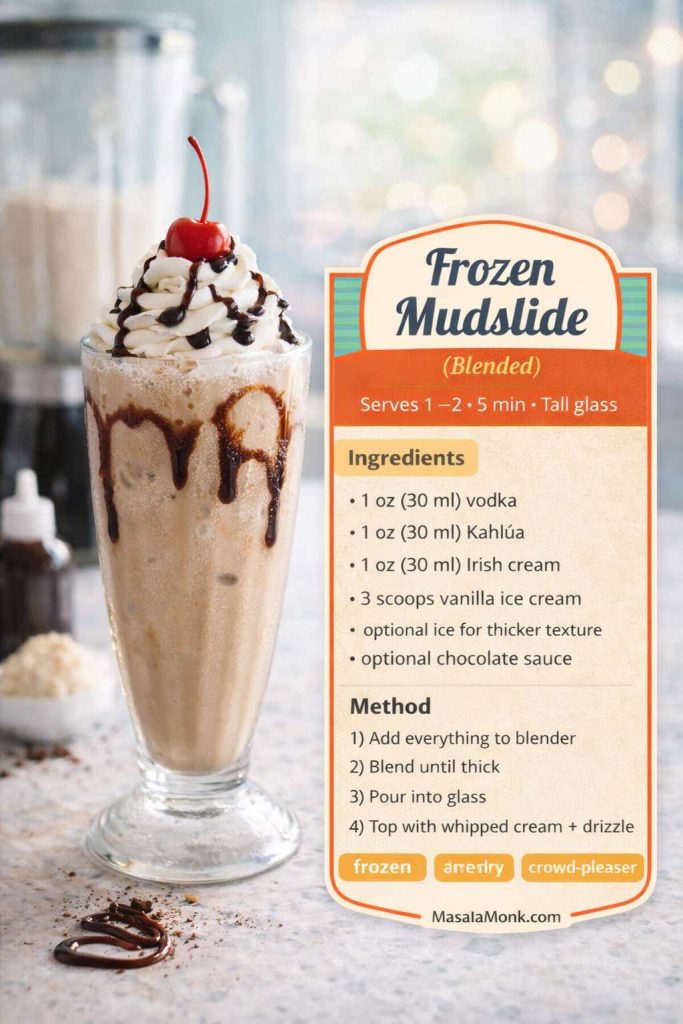
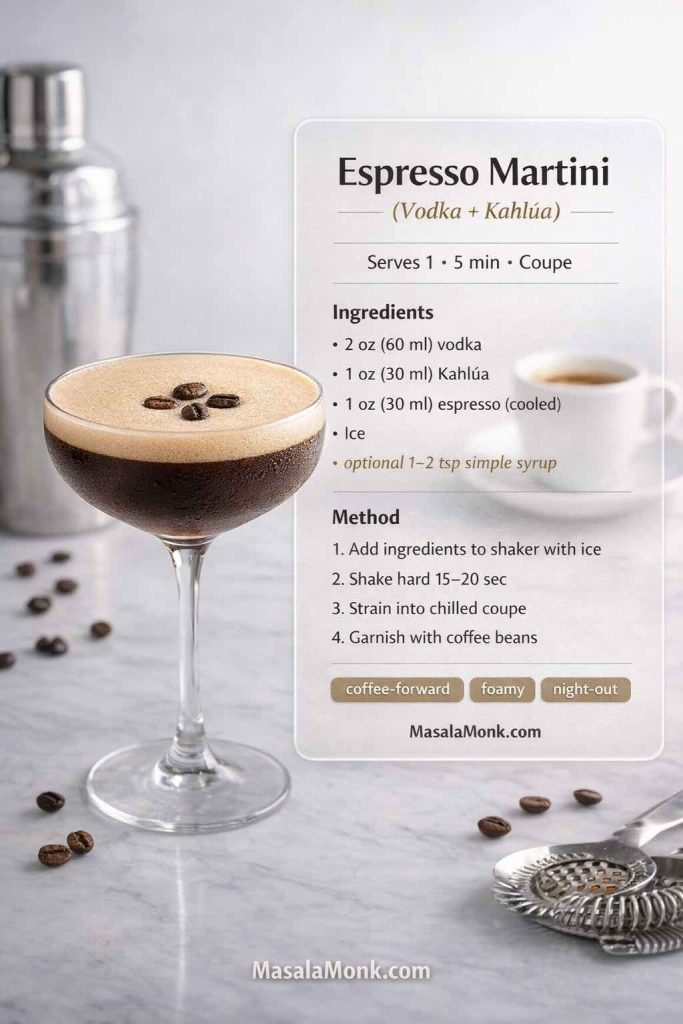
How to tune it without overthinking

This is where the method becomes yours:

  • Too intense? Add milk before adding sugar. Milk changes both texture and flavor balance.
  • Too bitter? Increase sugar slightly or reduce cocoa by ½ teaspoon next time.
  • Too mild? Add ½ teaspoon more cocoa and stir briskly (or use a stronger coffee base next time).
  • Too sweet? Reduce sugar, then add a pinch of salt or a touch more cocoa to deepen chocolate flavor without leaning on sweetness.
Hot chocolate coffee fixes infographic with color-coded troubleshooting tips for clumpy cocoa, too bitter, too sweet, too thin, too mild, and not coffee enough.
Hot chocolate coffee troubleshooting, fast: fix clumpy cocoa by making a paste first, soften bitterness with milk, balance sweetness with stronger coffee and a pinch of salt, and adjust cocoa or milk to dial in body and flavor.

A smoother shortcut: chocolate syrup

If you want something that blends instantly—especially for iced versions—chocolate syrup can deliver a seamless chocolate base with minimal effort. If you like making your own, this quick homemade chocolate syrup is fast enough to feel practical.

Zero-clump shortcut infographic showing chocolate syrup being poured into an iced coffee/cold brew glass with steps: 1 Tbsp chocolate syrup, add coffee or cold brew, milk optional.
Zero-clump iced cocoa coffee shortcut: add 1 tablespoon chocolate syrup first, pour in coffee or cold brew, then swirl—finish with a splash of milk if you want it creamier. It’s the smoothest way to get a chocolate-coffee drink without gritty cocoa powder.

A DIY “hot chocolate coffee mix” you can keep in a jar

If you like the convenience of packets but want a homemade approach, make a small jar of dry blend: cocoa + sugar + a pinch of salt. Then you can make hot chocolate coffee in seconds—just scoop your mix, add a splash of coffee to form a paste, and build the mug.

Hot chocolate coffee dry mix jar label showing cocoa, sugar, and a pinch of salt with simple “scoop → paste first → add coffee → finish with milk” instructions and a 1–2 tablespoon per mug ratio.
DIY hot chocolate coffee dry mix (make once, use all week): combine cocoa + sugar + a pinch of salt in a jar, then for each mug scoop 1–2 tablespoons, stir into a smooth paste with a splash of hot coffee, top up with coffee, and finish with milk for a fast, clump-free hot cocoa coffee.

If you want a deeper ingredient lens (and why cocoa type changes flavor), this cacao vs chocolate guide is worth reading.

Also Read: Green Chutney Recipe (Coriander–Mint / Cilantro Chutney)


Method 2: Hot cocoa mix in coffee (the quickest mug you’ll ever love)

Some days don’t invite ceremony. They demand speed, comfort, and a clean path from “not awake” to “functioning.” This is where hot chocolate mix shines.


Yes—adding hot cocoa mix to coffee can taste genuinely good. The key is not dumping powder into a full mug and hoping for the best. The “smooth way” takes about ten extra seconds and saves the whole drink.

Time: 2 minutes
Difficulty: Easiest
Best for: Quick comfort, minimal cleanup

Ingredients (one mug)

  • 200–240 ml hot coffee
  • 2 tablespoons hot chocolate mix (start here)
  • Optional: 30–90 ml milk
Hot cocoa mix in coffee recipe card showing cocoa powder falling from a spoon into a mug of coffee, with 2-minute steps and ratio for a smooth drink.
Hot cocoa mix in coffee (2 minutes): stir the powder with a small splash of hot coffee first, then top up and mix well—add a little milk if you want a creamier hot chocolate coffee drink.

Step-by-step method

Step 1: Start with the mix

Add your hot chocolate mix to the mug.

Step 2: Add a small splash of coffee and stir smooth

Pour in just a little hot coffee and stir until the powder is fully moistened and smooth. This is the same logic as the cocoa paste method, only you’re working with a sweeter, pre-blended powder. It prevents the classic “powdery pockets” problem.

Step 3: Add the rest of the coffee and stir again

Now build the mug with the remaining coffee. Stir well.

Step 4: Add milk if you want it creamier

A splash of milk rounds everything out. If your hot chocolate mix includes powdered milk, you might not need much. If it’s a dark or intense mix, milk can help balance it without adding more sugar.

How to make it taste less “packet-like”

Some mixes lean very sweet. That’s not always bad, but if you want more depth:

  • Use 1 tablespoon of mix + 1 teaspoon cocoa powder
  • Add a small splash of milk

This gives you more real cocoa flavor without overloading the mug with sugar.

When you want a “real” hot chocolate baseline

It’s helpful to know what truly rich hot chocolate tastes like, even if you don’t make it every time. A straightforward, dependable reference is this homemade hot chocolate recipe. Once you have that flavor in your mind, it becomes easier to adjust your coffee-and-chocolate balance: you’ll know when you want coffee to lead versus when you want chocolate to lead.

Also Read: Paper Plane Cocktail Recipe + Best Amaro Substitutes & Tips


Method 3: Espresso in hot chocolate (café-style, deeply satisfying)

If you want the chocolate to feel like a true base—rich, thick, and cozy—then espresso in hot chocolate is your move. Instead of adding cocoa to coffee, you’re adding coffee to cocoa. That sounds like a small change, but the result often feels dramatically more indulgent.

This is also the method that most closely resembles what cafés serve when you order a mocha: espresso + chocolate + milk, balanced and bold.

Time: 5–7 minutes
Difficulty: Easy–Medium
Best for: Dessert-forward mugs that still feel like coffee

Option A: Espresso hot chocolate (classic café direction)

Ingredients

  • 1–2 espresso shots
  • 200 ml hot chocolate (milk-based cocoa, or mix made with milk for body)
  • Optional: foam, whipped cream, or shaved chocolate

Method

  1. Make your hot chocolate in your preferred style. Milk-based versions taste richer and help everything integrate.
  2. Pull 1–2 espresso shots.
  3. Pour espresso into the hot chocolate and stir gently. (Adding espresso into the chocolate base helps it integrate smoothly.)
  4. Finish with foam or whipped cream if you want the full café mood.
Espresso in hot chocolate (café-style): pour 1–2 espresso shots into a rich hot chocolate base, stir gently, and you’ve got a bold, silky espresso hot chocolate in minutes.

Option B: “Espresso-style” hot chocolate coffee without a machine (moka pot version)

No espresso machine? You can still create a concentrated coffee that behaves beautifully in chocolate using a moka pot. Brew a strong moka coffee, make your hot chocolate base, and combine them the same way.

If you want a step-by-step refresher, this moka pot mastery guide is a great companion. And if you want clarity on espresso as a concept—strength, concentration, and what “one shot” means—this espresso guide helps.

Make it feel even more café-like: foam, texture, balance

If you love that cappuccino texture—foam, warmth, airy lift—borrow technique from this cappuccino recipe guide. Then you can build a chocolate-leaning drink that feels like a mocha cappuccino: espresso (or moka concentrate) + cocoa base + foamed milk.

Also Read: Manhattan Cocktail Recipe (Classic + 6 Variations)


The ratios that make hot chocolate coffee feel intentional

Once you know the methods, ratios become your quiet superpower. They help you get exactly what you’re craving without needing a full recipe every time. Think of these as flexible defaults rather than rigid rules.

Hot chocolate coffee ratios infographic showing coffee-forward, balanced, chocolate-forward, and extra creamy measurements with cocoa, hot cocoa mix, espresso-style coffee, and milk.
Hot chocolate coffee ratios, made simple: go coffee-forward for a cozy coffee-first mug, choose balanced for a café-style blend, try chocolate-forward for half coffee half hot chocolate, or make it extra creamy with more milk.

Coffee-forward (for “I want coffee, but make it cozy”)

  • 240 ml coffee
  • 1 tablespoon cocoa
  • 1–2 teaspoons sugar
  • 30–60 ml milk

This reads as coffee first, with chocolate acting like a warm accent.

Balanced (for “I want a chocolate-coffee café drink”)

  • 180 ml coffee
  • 1 tablespoon cocoa or 2 tablespoons hot chocolate mix
  • 60–90 ml milk

This lands in the middle—neither too dark nor too sweet.

Chocolate-forward (for “dessert in a mug”)

  • Half coffee + half hot chocolate

Make hot chocolate first (milk-based is best), then add coffee until it tastes right. This approach works especially well when you want body, richness, and a cozy thickness.

Extra creamy (for “soft, rounded, lingering”)

  • Use more milk than usual and slightly less coffee
  • Keep cocoa steady, let milk carry the chocolate flavor

Oat milk is especially good here because it naturally reads sweet and creamy.

Also Read: Strawberry Smoothie Recipes (12 Easy Blends + Bowls & Protein Shakes)


Hot chocolate coffee variations you’ll want to repeat

The three methods cover most moods. Still, the fun starts when you make small changes on purpose. The goal with variations is not novelty for its own sake—it’s creating mugs that feel genuinely different, so you don’t get bored after three days.

Infographic titled “8 Hot Chocolate Coffee Variations” listing cinnamon cozy, champurrado-inspired, vanilla + salt, cappuccino-style foam, decaf night mug, cocoa cold brew, instant emergency mug, and coffee liqueur treat.
8 hot chocolate coffee variations to save: cinnamon cozy, champurrado-inspired, vanilla + salt, cappuccino-style foam, decaf night mug, cocoa cold brew, instant emergency mug, and coffee liqueur treat—use these as flavor upgrades for any base method (cocoa paste, hot cocoa mix, or espresso in hot chocolate).

1) Coffee and hot cocoa with cinnamon (cozy without being spicy)

Cinnamon makes chocolate feel warmer and more aromatic. Instead of adding a lot, keep it light.

Recipe card photo for coffee + hot cocoa with cinnamon showing a creamy mug topped with cinnamon and a quick ratio plus three steps: make cocoa paste, stir in a pinch of cinnamon, then add coffee and milk to taste.
Coffee + hot cocoa with cinnamon (cozy, not spicy): make a cocoa paste with a splash of hot coffee, stir in just a pinch of cinnamon, then build with the remaining coffee and a little milk. Start light (about 1/16 tsp) and adjust after tasting.

How to do it:

  • Make the cocoa paste (cocoa + sugar + splash of coffee)
  • Add a pinch of cinnamon to the paste
  • Build the drink as usual, then taste before adding more spice

If you like the idea of spicing coffee more broadly, this cardamom-in-coffee guide is a lovely rabbit hole.

2) Champurrado-inspired coffee (Mexican-style comfort in a coffee mug)

Champurrado is traditionally a thick chocolate drink often made with masa and warming spices. This version borrows the vibe—deep cocoa, cozy body, aromatic spice—without requiring a full traditional setup.

Champurrado-inspired coffee recipe card photo showing a frothy cocoa-coffee mug with cinnamon and vanilla, plus a quick ratio and three steps for making Mexican-style hot chocolate coffee without masa.
Champurrado-inspired coffee (Mexican-style cocoa + warm spice): start with a smooth cocoa paste, then add cinnamon and vanilla before finishing with more milk and slightly less coffee for a thicker, cozier mug.

How to do it:

  • Use the cocoa paste method as your base
  • Add cinnamon and vanilla
  • For extra body, use a bit more milk and slightly less coffee

For a deeper ingredient lens that helps you choose between cacao and chocolate, this cacao vs chocolate guide is worth reading.

3) Vanilla + a tiny pinch of salt (the “richer than it should be” trick)

This doesn’t look different. It just tastes more expensive.

Vanilla and pinch of salt hot chocolate coffee hack card showing salt being added to a cocoa-coffee mug with text overlay: add 1/4 tsp vanilla and a tiny pinch of salt for deeper chocolate and less sweet taste.
Vanilla + a tiny pinch of salt (the “tastes more expensive” trick): add 1/4 tsp vanilla and the smallest pinch of salt to your hot chocolate coffee to deepen cocoa flavor and make the sweetness feel calmer—start microscopic, then adjust.

How to do it:

  • Add ¼ teaspoon vanilla
  • Add the tiniest pinch of salt

If you’re skeptical, start microscopic. You’re not aiming for “salty.” You’re aiming for depth.

4) Cappuccino-style hot chocolate coffee (foam-forward, café-like)

This one is a joy when you want texture. The trick is building chocolate flavor without crushing the foam.

Cappuccino hot chocolate recipe card showing a foamy cappuccino-style hot chocolate topped with cocoa dust, plus 3-step method and ratio.
Cappuccino hot chocolate (foam-forward, café-style): combine espresso with cocoa paste, top with frothed milk, then finish with a cocoa dusting for a plush, chocolate-coffee mug that feels straight from a coffee bar.

How to do it:

  • Stir cocoa paste into espresso (or moka concentrate)
  • Add steamed or frothed milk
  • Finish with cocoa dusting or shaved chocolate

For foam technique and proportions, this cappuccino guide is your friend.

5) Decaf hot chocolate coffee (comfort without the buzz)

Perfect for evenings when you want a warm mug without the same caffeine lift.

Decaf hot chocolate coffee recipe card on a cozy nightstand with warm lamp light, showing an evening-friendly ratio and 3 simple steps
Decaf hot chocolate coffee for nights: use decaf coffee with cocoa (or a little hot cocoa mix), then finish with milk for a cozy mug that feels like dessert without the buzz.

How to do it:

  • Use decaf brewed coffee (or decaf instant)
  • Make any version you like—cocoa paste, mix-in-coffee, or espresso-style with decaf shots

If you want general caffeine context, the FDA’s overview Spilling the Beans: How Much Caffeine Is Too Much? is a clear reference point.

6) Hot cocoa cold brew (summer comfort that still tastes like chocolate)

Chocolate and coffee can feel refreshing when the structure is right. Cold brew concentrate gives you strength; a quick cocoa syrup keeps everything smooth.

How to do it:

  1. Start with cold brew concentrate or very strong chilled coffee
  2. Make a quick cocoa syrup: cocoa + sugar + a spoon of warm water (or warm coffee), stirred smooth
  3. Stir syrup into cold brew
  4. Add milk and ice
Hot cocoa cold brew recipe card showing cold brew pouring over ice with chocolate syrup swirls, plus ingredients, steps, and ratio for a cool and creamy cocoa coffee
Hot cocoa cold brew (cool & creamy): stir quick cocoa syrup into cold brew, then add milk and ice for a chocolatey iced coffee that’s refreshing, smooth, and easy to remake.

If you want more iced directions beyond this one mug, these internal guides are great companions: iced coffee recipes and cold brew vs iced latte vs frappe.

7) Instant coffee + cocoa (a surprisingly good emergency mug)

When brewed coffee isn’t happening, instant coffee can still make a satisfying hot chocolate coffee if you treat it kindly.

Instant coffee hot chocolate 3-minute recipe card showing hot water poured into a mug, cocoa mix stirred smooth, milk added, and a simple ratio for one mug.
Instant coffee hot chocolate (3 minutes, 1 mug): dissolve instant coffee first, smooth cocoa or hot cocoa mix with a small splash, then combine and finish with milk for a quick chocolate-coffee drink that never turns gritty.

How to do it:

  • Dissolve instant coffee fully in a small amount of hot water first
  • Make a cocoa paste in the mug (cocoa + sugar + a splash of the hot coffee)
  • Add remaining liquid and milk, then adjust

Same rule, different day: don’t dump powders into a full mug and expect silk.

8) Hot chocolate coffee with coffee liqueur (optional, festive, dessert-forward)

This one is optional, but undeniably festive. Coffee liqueur brings sweetness and a roasted note that pairs naturally with cocoa. If you’re using a well-known coffee liqueur like Kahlua, remember it already leans sweet—so dialing back sugar in your base keeps the mug balanced rather than syrupy.

Kahlua hot chocolate coffee recipe card showing a creamy chocolate-coffee drink with whipped cream and cinnamon, plus steps to add 1 oz coffee liqueur and cocoa dust.
Kahlua hot chocolate coffee (optional treat): make your hot chocolate coffee slightly less sweet, add 1 oz coffee liqueur, then stir and finish with a cocoa dusting for a dessert-in-a-mug vibe.

How to do it:

  • Make your base slightly less sweet than usual
  • Add a small pour of coffee liqueur at the end and stir
  • Finish with cocoa dusting or shaved chocolate

Also Read: Sandwich for Breakfast: Breakfast Sandwich Recipe + 10 Variations


Making hot chocolate coffee for a crowd (without wrecking your equipment)

A cozy chocolate-coffee drink feels even better when it’s shared—winter evenings, family gatherings, holiday brunches, or a casual “come over” moment that turns into an unplanned hangout. But scaling up changes the rules.

In general, it’s best not to run cocoa powder, hot chocolate mix, chocolate syrup, or milk-based mixtures through brewing systems. Doing so can leave residue, affect taste, and make cleanup much harder—especially in percolators and urn setups that aren’t designed for chocolate or dairy.

So if someone asks, “Can we brew hot chocolate in a coffee maker?” the most reliable answer is: brew coffee in the coffee maker, then mix it with a hot chocolate base afterward. You get the same result—coffee and hot chocolate together—without turning your machine into a sticky project.

Coffee and hot chocolate for a crowd guide showing separate coffee and hot chocolate base dispensers, then mixing in a serving urn with quick ratios for coffee-forward, balanced, and dessert-style.
Making coffee and hot chocolate for a crowd—without wrecking your equipment: brew coffee separately, make a hot chocolate base separately, then combine in an urn and choose your ratio (3:1 coffee-forward, 2:1 balanced, 1:1 dessert).

The reliable large-batch method (best for most homes)

  1. Brew coffee normally using your coffee maker or brewer (coffee only).
  2. Make a concentrated hot chocolate base separately in a pot: warm milk + cocoa + sugar stirred smooth (or hot chocolate mix made with milk for body).
  3. Combine in a serving vessel—a large pot, dispenser, or insulated carafe—then adjust to taste.
  4. Keep it gently warm, not boiling. Milk-based mixes can scorch if held too hot for too long.

If you want a dependable hot chocolate base that scales cleanly, this homemade hot chocolate recipe is a solid anchor.

Hot cocoa in a coffee maker: the “yes, but not through the machine” version

People often mean one of two things when they say “hot cocoa in a coffee maker”:

  • They want to use the coffee maker to heat and mix everything (not ideal)
  • Or they want a way to serve hot cocoa and coffee together for a group (very doable)

The safe approach:

  • Brew coffee in the coffee maker
  • Make cocoa or mix separately with milk (stovetop is easiest)
  • Combine in a pot or dispenser

This gives you a crowd-friendly hot chocolate coffee without chocolate residue in your machine.

Do not run cocoa powder, hot cocoa mix, or milk through a coffee maker, urn, or percolator; brew coffee separately, make a chocolate base separately, then combine for hot chocolate coffee.
Can you brew hot chocolate in a coffee maker (or percolator/urn)? Don’t run cocoa, mixes, or milk through the machine—brew coffee separately, build a chocolate base separately, then combine. It’s the same hot chocolate coffee result with better flavor and far easier cleanup.

Coffee percolator for hot chocolate: keep cocoa out of the brew chamber

Percolators are great for coffee. They’re not designed for cocoa powder or milk-based mixes circulating through the system. If you’re tempted to try “coffee percolator for hot chocolate,” treat the percolator as a coffee-only brewer:

  • Percolate coffee
  • Mix hot chocolate separately
  • Combine afterward in a serving vessel

You’ll protect your equipment and preserve flavor.

Hot cocoa urn setup: build the chocolate base first

A hot cocoa urn is often the right tool for events—easy serving, steady warmth, familiar setup. But the same logic applies: don’t treat the urn like a brewer for cocoa powder. Instead:

  • Make a milk-based hot chocolate base in a stockpot
  • Brew coffee separately
  • Combine in the hot cocoa urn using your preferred ratio
  • Hold at gentle heat to avoid scorching

For events, it can be helpful to offer two profiles:

  • Coffee-forward (for people who want “coffee, but cozy”)
  • Dessert-forward (for people who want “hot chocolate, but energized”)

Add a toppings station—cocoa dusting, cinnamon, shaved chocolate, whipped cream—and suddenly the drink feels like an experience, not just a beverage.

Also Read: Waffle Recipe Without Milk: Fluffy, Golden, and Crisp


A deeper hot chocolate base (when you want chocolate to lead)

Sometimes you don’t want “coffee with cocoa.” You want hot chocolate with coffee energy. In those moments, start with a real hot chocolate base, then add coffee to taste. This keeps the chocolate rich and structured while still giving you the lift you’re after.

If you prefer a guided approach to a cocoa-and-milk base, this homemade hot chocolate with cocoa powder recipe is an excellent internal companion.

Once your hot chocolate is ready:

  • Add brewed coffee little by little
  • Stop at a whisper of coffee, or push toward a bolder, mocha-like finish
  • If you want the simplest “dessert mug” rule, try half coffee and half hot chocolate, then adjust

This is one of the easiest ways to make the drink feel deliberate, indulgent, and café-adjacent—without needing equipment beyond a pot and a mug.

Also Read: Vodka Pasta (Penne alla Vodka) + Spicy Rigatoni, Chicken, and Gigi Recipes


Flavor directions that keep the drink from feeling repetitive

After a few mugs, you might crave variety without changing the entire routine. That’s when choosing a direction helps more than looking for a totally new recipe.

The warm-spice lane

Cinnamon, cardamom, nutmeg—these make hot chocolate coffee feel seasonal even when it’s not a holiday. If you want a cozy entry point, cardamom in coffee is a wonderful starting place.

The dessert lane

Chocolate syrup, whipped cream, shaved chocolate, extra milk—this makes the mug feel like a treat. If you like making syrup quickly, this 3-minute chocolate syrup keeps it practical.

The café lane

Espresso in hot chocolate, foam on top, balanced sweetness. If foam is part of the vibe you’re chasing, this cappuccino guide is the technique bridge that makes your home mug feel more like a café cup.

The chilled lane

Cold brew meets cocoa in a way that can be refreshing rather than heavy. For more iced directions, explore these iced coffee recipes and this guide comparing cold brew vs iced latte vs frappe.

Also Read: 7 Pizza Sauce Recipes | Marinara, White Garlic, Alfredo, Buffalo, BBQ, Vodka & Ranch


A seasonal twist (when you want it to taste like “winter” even if it isn’t)

There’s a flavor mood that shows up every year—warm spice, soft sweetness, cozy nostalgia. If you love that, you can borrow the vibe of spiced lattes and apply it to hot chocolate coffee without turning every mug into a production.

A gentle version:

  • Vanilla + cinnamon (subtle, comforting, easy)

A bolder version:

  • Borrow pumpkin spice energy

If that’s your lane, you’ll probably enjoy this sister drink: healthy pumpkin spice latte.

Having one “winter mode” mug you can make on autopilot is surprisingly satisfying. It’s the beverage equivalent of throwing on a warm hoodie.

Also Read: Pumpkin Spice, Your Way: Master Blend, Variations & Real-World Recipes


Small finishing touches that make the mug feel special

Sometimes you don’t need a new recipe. You need a small ending—something that makes the mug feel like you meant it.

  • A dusting of cocoa powder makes it smell like chocolate before you sip
  • Grated dark chocolate melts into the surface and tastes richer than it looks
  • A spoon of foam (even shaken milk) changes mouthfeel dramatically
  • A cinnamon stick scents the mug in a quiet, cozy way
  • A tiny pinch of salt turns “sweet cocoa” into “deep chocolate”
Hot chocolate coffee flavor add-ins infographic showing cinnamon, vanilla, pinch of salt, chocolate syrup, and whipped cream to make the drink taste richer
Flavor add-ins that make hot chocolate coffee taste expensive: a pinch of cinnamon for warmth, vanilla for roundness, a tiny pinch of salt for deeper chocolate, chocolate syrup for richness, and whipped cream or foam for a café-style finish.

None of these are mandatory. Still, they’re the difference between “I mixed something” and “I made something.”

Also Read: How to Cook Tortellini (Fresh, Frozen, Dried) + Easy Dinner Ideas


Putting it all together: choose your mug today

When you want hot chocolate coffee, you have options that match the day you’re having.

  • If you want the most reliable everyday version, go with the cocoa paste method. It’s quick, flexible, and consistently smooth.
  • If you want speed above all else, use hot chocolate mix in coffee, but stir the powder with a small splash of coffee first so it dissolves properly.
  • If you want café depth, make espresso in hot chocolate (or use a moka concentrate). It’s the most dessert-forward approach, and it still feels unmistakably like coffee.

From there, you can tilt coffee-forward or chocolate-forward, warm it with spice, cool it into hot cocoa cold brew, or add a foamy café finish. Whether you’re adding hot chocolate to coffee or adding coffee to hot chocolate, the best cup is the one you’ll actually make again.

Also Read: How to Make Churros (Authentic + Easy Recipe)

FAQs

1) What is hot chocolate coffee?

Hot chocolate coffee is a single drink that blends coffee with chocolate flavor. Depending on how you make it, the chocolate can come from cocoa powder, hot chocolate mix, chocolate syrup, or a prepared hot chocolate base, while the coffee can be brewed coffee, espresso, moka pot coffee, instant coffee, or cold brew.

2) Is coffee and hot chocolate the same as a mocha?

In many cases, yes—at least in flavor and concept. Generally, a mocha refers to coffee (often espresso) combined with chocolate and milk. However, “coffee and hot chocolate” can be looser and more flexible, because you can build it with cocoa powder, hot chocolate mix, or a full hot chocolate base.

3) How do I make hot chocolate coffee at home?

You can make hot chocolate coffee in three straightforward ways: (1) mix cocoa powder and sweetener into a smooth paste, then add coffee and milk; (2) stir hot chocolate mix into coffee; or (3) add espresso to hot chocolate for a café-style result.

4) Can I put hot chocolate powder in coffee?

Yes, you can. To avoid gritty clumps, first stir hot chocolate powder with a small splash of hot coffee until smooth, and only then add the rest of the coffee. As a result, the drink blends more evenly and tastes less “powdery.”

5) Can I add cocoa powder to coffee?

Absolutely. In fact, cocoa powder is one of the easiest ways to control sweetness and chocolate intensity. To keep it smooth, make a quick cocoa paste with sugar and a little hot coffee before topping up the mug.

6) Why is my cocoa powder clumping in coffee?

Cocoa powder tends to clump because it doesn’t dissolve like sugar. When it hits liquid all at once, dry pockets form and float. Instead, mix cocoa and sweetener with a small splash of hot coffee first, then add the remaining liquid gradually.

7) How much hot chocolate mix should I add to coffee?

A practical starting point is 2 tablespoons of hot chocolate mix for one mug of coffee (around 200–240 ml). If it turns out too sweet, reduce to 1 tablespoon and deepen the chocolate flavor with a teaspoon of cocoa powder.

8) What’s the best ratio for coffee and hot chocolate?

It depends on the experience you want. For a coffee-forward mug, use a full mug of coffee with about 1 tablespoon cocoa and only a small splash of milk. For a dessert-like version, go half coffee and half hot chocolate. Meanwhile, for a balanced café-style drink, aim for roughly 3 parts coffee to 1 part milk or chocolate base.

9) What’s the difference between hot cocoa coffee and hot chocolate coffee?

In everyday use, they often mean the same thing: coffee combined with chocolate flavor. Still, “hot cocoa” commonly suggests cocoa powder or a cocoa mix, whereas “hot chocolate” can imply a richer base made with milk and sometimes melted chocolate. Even so, both can land in a very similar place once blended with coffee.

10) Can I add espresso to hot chocolate?

Definitely. Espresso in hot chocolate is one of the most café-like methods. Simply add 1–2 espresso shots to prepared hot chocolate and stir gently until the flavor is integrated.

11) How many espresso shots are best for espresso hot chocolate?

Usually, 1 shot gives a softer coffee note, while 2 shots create a more pronounced coffee presence. If your hot chocolate is especially sweet, 2 shots often balance it better.

12) How can I make espresso hot chocolate without an espresso machine?

Instead of espresso, you can use a concentrated coffee base. For example, moka pot coffee behaves similarly in hot chocolate because it’s stronger than standard drip coffee. After brewing, mix it into hot chocolate the same way you would with espresso.

13) Can I make hot chocolate with coffee instead of water?

Yes. For a creamier result, prepare hot chocolate with milk first, then add brewed coffee to taste. This approach keeps the chocolate base rich while still delivering clear coffee aroma.

14) Can I mix hot cocoa mix with coffee and milk?

Yes, and it often tastes smoother than coffee plus mix alone. In addition, milk rounds the edges and makes the drink feel more like a hot chocolate coffee drink rather than simply sweetened coffee.

15) What coffee works best for hot chocolate coffee?

Typically, medium to dark roast works best because it stays noticeable beside chocolate. Likewise, brewing the coffee slightly stronger than usual helps prevent the drink from tasting like cocoa first and coffee second.

16) How do I make coffee with cocoa powder taste less bitter?

First, add more milk to soften the bitterness before adding more sugar. Next, reduce cocoa slightly if the mug feels too intense. Finally, a touch of vanilla or a tiny pinch of salt can make the chocolate taste rounder and less sharp.

17) How do I make hot chocolate coffee less sweet?

Start by using unsweetened cocoa powder instead of a sweet mix, or cut the amount of mix in half. Then increase milk slightly for a gentler profile. Alternatively, add a bit more coffee to balance sweetness without losing chocolate flavor.

18) Can I make hot cocoa in a coffee maker?

You can brew coffee in a coffee maker and combine it with hot chocolate afterward. However, it’s usually better not to run cocoa powder or hot chocolate mix through the machine because it can leave residue and complicate cleaning.

19) Can I brew hot chocolate in a coffee maker?

If by “brew” you mean running cocoa or milk through the machine, that’s not recommended. Instead, brew coffee normally, then stir it into a hot chocolate base made separately. That way, you get the same flavor outcome with much easier cleanup.

20) Can I make hot cocoa in a coffee percolator?

It’s best to use the percolator for coffee only, then mix hot chocolate separately and combine afterward. Otherwise, cocoa powder and milk-based mixes can create buildup and affect performance over time.

21) What is a hot cocoa urn and can I make a coffee-and-cocoa mix in it?

A hot cocoa urn is a large dispenser used for serving warm drinks at gatherings. Yes, you can serve a coffee-and-cocoa blend in it—however, it works best when you prepare hot chocolate and coffee separately, then combine them in the urn and keep the heat gentle to avoid scorching.

22) How do I make coffee and hot chocolate for a crowd?

For consistent results, brew a large batch of coffee separately and make a concentrated hot chocolate base in a pot. Then combine them in a serving vessel and adjust the ratio based on whether you want a coffee-forward or dessert-forward drink.

23) Can I make half coffee half hot chocolate taste balanced?

Yes. Start with equal parts and then adjust. If it tastes too sweet, add more coffee. Conversely, if it tastes too strong or bitter, add more hot chocolate or a splash of milk.

24) Can I make hot cocoa cold brew?

Yes. Use cold brew concentrate or strong chilled coffee, then mix in a cocoa syrup (cocoa + sugar + a small splash of warm water or warm coffee stirred smooth). After that, add milk and ice for a refreshing chocolate-coffee drink.

25) Does hot chocolate coffee work with instant coffee?

Yes. Dissolve instant coffee fully in hot water first so it’s smooth, then combine it with cocoa paste or hot chocolate mix. That extra step helps avoid grittiness and improves texture.

26) Can I make a decaf hot cocoa coffee?

Absolutely. Use decaf brewed coffee (or decaf instant), then follow any method you like. Consequently, you get the flavor and comfort of a chocolate-coffee mug without the same caffeine lift.

27) Can I make coffee liqueur hot chocolate?

Yes, if you want an adult, dessert-style version. Make the base slightly less sweet, then add a small pour of coffee liqueur at the end and stir. That way, the final drink tastes balanced rather than overly sugary.

28) What’s the difference between chocolate hot coffee and hot chocolate coffee?

They’re often used interchangeably in casual searches. Generally, “hot chocolate coffee” suggests coffee mixed with a cocoa or hot chocolate base, while “chocolate hot coffee” can imply coffee flavored with chocolate notes. Either way, the result is a warm chocolate-coffee drink—your method determines whether coffee or chocolate leads.

Posted on 4 Comments

Cappuccino Recipe: How to Make a Perfect Cappuccino at Home

Perfect cappuccino at home in a white cup on a marble counter with cocoa-dusted foam, plus text overlay: Machine & No-Machine Methods (MasalaMonk.com).

A cappuccino recipe can feel deceptively simple: coffee, milk, foam. Yet when it’s done well, it tastes like more than the sum of its parts—deep, fragrant espresso wrapped in sweet, warm milk, finished with a cap of foam that holds long enough for you to draw a spoon through it and still find coffee underneath.

This cappuccino recipe is written for real kitchens, not showroom counters. You’ll learn how to make cappuccino coffee at home whether you have an espresso setup, a moka pot, or nothing more than a saucepan and a jar. Along the way, you’ll also see how to make an iced cappuccino at home, how to make a cold cappuccino that stays creamy, and how to make homemade cappuccino mix for the mornings when you want “easy cappuccino” energy without sacrificing taste.

If you want a tidy, competition-style reference point, the cappuccino is typically described as a 5–6 oz (roughly 150–180 ml) coffee-and-milk drink with a clear foam layer and a balanced espresso-to-milk profile—an idea echoed in specialty definitions such as those discussed in this overview of cappuccino standards and evolution: What is a cappuccino & how has it developed over time? and in the official competition language inside the World Barista Championship rules and regulations PDF. That said, you don’t need to “compete” to make the perfect cappuccino. You just need a repeatable method.

Let’s build that method from the cup up.


Cappuccino recipe basics: what makes it taste “right”

Cappuccino ingredients (and why each one matters)

At its cleanest, cappuccino ingredients are short:

  • espresso (or a strong espresso-like coffee base)
  • milk
  • foam (made from that same milk)
  • optional toppings like cocoa powder, cinnamon, or chocolate sprinkles

What’s missing from that list is the thing that makes cappuccino tricky: technique. The drink relies on contrast—concentrated coffee against sweet milk; silky liquid under a foam blanket. When that contrast disappears, you end up with something closer to a milky coffee than a cappuccino coffee recipe worth repeating.

If you like a quick orientation on espresso itself (what it is, how it behaves in milk drinks, and why it anchors the whole experience), this internal guide is a helpful companion: Quick Espresso Guide – Know Your Coffee. It’s especially useful if you’re still deciding whether your base tastes “espresso-forward” enough for cappuccino.

Cappuccino recipe ratio: espresso, milk, and foam

You’ll see “equal thirds” mentioned often: one-third espresso, one-third steamed milk, one-third milk foam. That picture is useful because it nudges you toward the cappuccino’s signature structure.

Cappuccino ratio and cup size cheat sheet showing a 150–180 ml cup with labeled layers—espresso, steamed milk, and foam—plus base options (espresso or moka pot concentrate).
Use this cappuccino ratio and cup-size cheat sheet to keep your drink balanced: build a small 150–180 ml cup, layer espresso (or moka pot concentrate), add steamed milk, then finish with a foam cap.

In practice, the best way to make cappuccino at home is to think in cup size first, then fill it with the right balance:

  • Choose a 150–180 ml cup if you want a classic feel.
  • Use one strong espresso base (single or double depending on your preference and cup size).
  • Add enough milk to soften the espresso without burying it.
  • Finish with foam that sits confidently on top.

If your cup is much larger, the drink will drift toward latte territory unless you increase espresso and keep the total volume controlled. Conversely, if you keep the cup small, the cappuccino stays intense and aromatic—exactly what many people mean when they say “the perfect cappuccino.”

Cappuccino vs latte vs flat white comparison chart showing cup size, foam thickness, milk amount, and taste, with three drinks displayed side by side and MasalaMonk.com footer.
Cappuccino vs latte vs flat white: cappuccino is smaller with a thicker foam cap, latte is taller and milkier with lighter foam, and flat white stays short with thin microfoam and a stronger, silkier finish.

What coffee to use for cappuccino (and why roast matters)

“What coffee to use for cappuccino” is less about a single best bean and more about choosing a profile that still tastes like coffee after milk enters the room.

  • If you prefer chocolatey, nutty comfort: medium to medium-dark roasts tend to shine.
  • If you like fruitier brightness: lighter roasts can work, although you may want a slightly smaller milk volume to keep clarity.
  • If your cappuccino tastes thin: the problem is often the base, not the milk. A stronger extraction or a more concentrated brew method helps.

For a practical overview of brew variables—grind, ratio, brew time—MasalaMonk’s foundational explainer is worth a skim: Coffee Brewing Methods: A Fusion of Art, Science, and Flavor. Even if you’re not obsessing over numbers, it helps you recognize why one cup tastes full and another tastes flat.

Also Read: Cold Brew Espresso Martini: How to Make It (Step-by-Step Recipe)


What do you need to make a cappuccino at home?

There’s a version of this drink for every setup. So instead of asking, “Do I have the right gear?”, ask, “Which cappuccino style am I making today?”

Cappuccino tools checklist showing what you need to make a cappuccino at home, with a machine list (espresso machine, milk pitcher, steam wand, thermometer) and a no-machine list (moka pot, saucepan, French press or jar frother, small cup).
What you need to make cappuccino at home: use an espresso machine and milk pitcher if you have one—or make cappuccino without a machine using a moka pot, a saucepan, and a French press or jar to froth milk.

Option 1: Espresso machine + steam wand (classic)

If you have a machine to make cappuccino with a steam wand, you’re closest to café method:

  • espresso machine (or espresso-capable machine)
  • milk pitcher
  • thermometer (optional but helpful early on)

Option 2: Moka pot + DIY milk foam (best no-machine taste)

If you’re aiming for “cappuccino recipe without machine” but still want a bold base, the moka pot is a standout. It’s beloved precisely because it makes an espresso-like concentrate that holds up beautifully in milk drinks. For an in-depth walkthrough, see: Moka Pot Mastery: Elevate Your Coffee Game. If you want an outside perspective on why the moka pot works so well as a cheap espresso alternative, this piece captures the spirit: Why We Love the Bialetti Moka Pot.

Option 3: Strong brewed coffee + foam (gentler, still satisfying)

If you don’t have espresso tools, you can still make a coffee that tastes like cappuccino in spirit:

  • brew strong coffee (reduce water, increase coffee, or brew a concentrate)
  • heat milk
  • foam milk with a French press, jar, whisk, or handheld frother

It won’t be identical to espresso-based cappuccino, but it can be delicious—especially when your milk texture is on point.

Option 4: Instant cappuccino mix or homemade cappuccino mix (fastest)

This is the “instant cappuccino mix” route—simple, sweet, and quick. It’s also the route where ingredient choices matter most, because the mix itself becomes the personality of the cup. We’ll cover a good homemade cappuccino mix recipe later.

If you’re still deciding what coffee maker for cappuccino fits your home—espresso machine, pod system, semi-automatic, or fully automatic coffee machine for home—keep your cappuccino recipe post focused on making the drink, then point readers to a separate gear overview when needed. MasalaMonk’s internal machine explainer is a neat, non-salesy link for that: A Coffee Lover’s Guide to Machines.

Also Read: Baked Ziti Recipe Collection: 15 Easy Variations


Cappuccino recipe method: how to make a cappuccino at home (step by step)

This is the heart of it: cappuccino recipe step-by-step, from base to foam to pour.

Classic cappuccino recipe card showing a cappuccino in a white cup with cocoa-dusted foam, plus ingredients, 3-step method (espresso, steam/froth milk, pour), cup size guidance, and a quick fix tip.
Classic cappuccino recipe in one card: brew espresso, steam or froth milk into microfoam, then pour espresso → milk → foam for a café-style cappuccino at home.
5-minute cappuccino flow checklist showing warm cup, brew base, heat milk, froth, and pour + finish, with a cappuccino, moka pot, milk pitcher, and timer on a kitchen counter.
Short on time? This 5-minute cappuccino flow keeps it simple: warm your cup, brew a strong base, heat and froth milk, then pour espresso (or moka pot coffee) → milk → foam for a fast café-style cappuccino at home.

Step 1: brew the coffee base (espresso or espresso-like)

If you have an espresso machine

Pull a shot into a warmed cup. If you’re making a traditional cappuccino size (150–180 ml), a single shot can work; a double shot gives a deeper coffee presence. If you love bolder cappuccino, the double shot is often the best cappuccino recipe starting point.

A small detail makes a bigger difference than it should: warm your cup with hot water while the machine heats. That warmth preserves aroma and keeps the milk from cooling too quickly.

Choose your cappuccino base infographic comparing espresso, moka pot concentrate, and strong brewed coffee, with a note that a stronger base makes a better cappuccino at home.
Not sure what to brew first? Choose your cappuccino base: espresso for a bold classic cup, moka pot for a rich concentrate, or strong brewed coffee as the easiest backup—stronger base means a better cappuccino.

If you’re using a moka pot (best way to make cappuccino at home without an espresso machine)

The moka pot’s strength is that it produces concentrated coffee with enough intensity to remain recognizable under milk. Follow your moka pot routine, then pour the coffee into your cappuccino cup immediately.

If you’d like to refine your moka pot technique—heat management, grind, and how to avoid harsh bitterness—the internal guide is genuinely useful: Moka Pot Mastery: Elevate Your Coffee Game.

If you’re brewing strong coffee (French press, drip, etc.)

Brew it stronger than usual. That could mean:

  • using less water
  • increasing coffee
  • steeping slightly longer (where appropriate)

If your base tastes like “normal coffee,” it’s likely to disappear once milk arrives. A stronger base is the difference between “home made cappuccino” and “coffee with milk.”

Step 2: texture and heat milk (the foam is the point)

If espresso is the backbone, foam is the signature. Milk that’s merely hot isn’t enough; cappuccino wants milk that’s sweet, glossy, and stable.

A widely referenced target range for steaming milk is about 55–65°C, which helps preserve sweetness and avoid scalding; this overview discusses the recommended range and why it matters: What temperature should your cappuccino milk be?.

Milk frothing guide for cappuccino showing microfoam that doesn’t collapse, with tips for glossy foam, 150–160°F milk temperature, texture cues, and fixes for big bubbles.
This milk frothing guide helps you get cappuccino foam right: aim for glossy microfoam (tiny bubbles), heat milk to about 150–160°F, and use the quick fixes to avoid big bubbles or collapsing foam.

If you’re using a steam wand: how to steam milk for cappuccino

Milk texturing is often taught as a two-part motion: introduce air early, then mix and heat to create microfoam. Barista Hustle breaks that “two-part” idea down clearly here: Making microfoam (the two-part heuristic) and also in their general microfoam lesson: Making microfoam.

Here’s the home-friendly version:

  1. Start with cold milk in a cold pitcher.
  2. Purge the steam wand briefly.
  3. Keep the tip near the surface just long enough to add air—listen for a gentle paper-tearing sound, not loud splashing.
  4. Then sink the tip slightly deeper to create a rolling motion that polishes the foam into a glossy texture.
  5. Stop when the pitcher feels hot but still touchable; if you use a thermometer, aim roughly within the 55–65°C zone.

If your milk ends up with large bubbles, aeration was too aggressive or too long. On the other hand, if it’s silky but completely foam-less, you didn’t add enough air at the beginning.

If you don’t have a wand: how to froth milk for cappuccino without a frother

This is where “cappuccino recipe without machine” becomes practical rather than aspirational. You have several good paths:

French press foam (reliable and surprisingly good)
Heat milk on the stove until it’s hot but not boiling. Pour it into a French press and pump the plunger briskly until it becomes foamy. Then let it rest briefly so the biggest bubbles rise and settle.

Serious Eats even calls out the French press as a handy tool for frothing milk in its moka pot piece: Why We Love the Bialetti Moka Pot. If you want a broader love letter to the French press (including why it stays useful even if you later upgrade), this is a fun read: Don’t forget about the French press.

Jar shake (fast, no special tools)
Heat milk, pour it into a jar (leave headspace), seal tightly, shake vigorously, then pour milk first and spoon foam on top. It’s simple, which is exactly why it’s still one of the best ways to make cappuccino at home when you’re traveling or short on tools.

Handheld frother (quick texture with minimal cleanup)
A handheld whisk-style frother makes foam quickly, although the foam can be a bit “drier” depending on your milk and technique. If you’re choosing a countertop frother, this Serious Eats guide gives a helpful sense of what makes good foam at home: We tested milk frothers and landed on favorites.

Step 3: pour and assemble (where cappuccino becomes cappuccino)

Now the fun part—making cappuccino feel like a real drink rather than two layers fighting.

  1. Pour espresso into your cup.
  2. Swirl your milk pitcher (or stir your foamed milk gently) so foam and liquid are integrated, not separated.
  3. Pour steamed milk first to blend with espresso.
  4. Finish with a deliberate foam layer on top.
Three-panel cappuccino pouring guide showing espresso first, then milk, then foam, with a tip to swirl milk before pouring for a better cappuccino at home.
Pouring order matters for a proper cappuccino: start with espresso, add milk to blend, then finish with foam for a stable cap—swirling the milk first helps keep the texture silky.

If you’re after a classic look, you can dust the foam with cocoa powder. If you want a slightly more playful finish, cappuccino chocolate sprinkles are a simple touch that reads like a café garnish without changing the drink itself.

Pause for a moment before sipping. The aroma from the foam carries upward, and that first breath is half the experience.

Also Read: Cranberry Moscow Mule Recipe: A Festive Holiday Cocktail With Easy Variations


How to make perfect cappuccino at home: small adjustments that change everything

A cappuccino can be “good” in a forgiving way, yet the perfect cappuccino is a different creature—balanced, sweet, and structured.

Make it smaller than you think

A cappuccino drink that’s too large often becomes indistinguishable from a latte. Keeping the cup modest helps the espresso stay present and the foam stay meaningful.

Strengthen the base before you add more milk

If the coffee tastes weak, the fix is not always “less milk.” Sometimes it’s:

  • a finer grind (for espresso)
  • a more concentrated moka pot brew
  • a stronger brewed coffee ratio

That’s why “best coffee to make cappuccino” is often a coffee that’s comfortable being intense.

Heat milk to the sweet spot, not the scorch point

Milk sweetness peaks before it tastes cooked. If you frequently get “hot milk” rather than “sweet milk,” aim for that 55–65°C zone discussed here: What temperature should your cappuccino milk be?. It’s the simplest way to upgrade a hot cappuccino recipe without changing anything else.

Also Read: Green Chutney Recipe (Coriander–Mint / Cilantro Chutney)


Cappuccino recipe without machine: a complete no-machine cappuccino you’ll actually want again

Let’s put it together as a full method.

Cappuccino without a machine infographic showing a moka pot, milk frothing in a French press, and a finished cappuccino with steps: brew moka pot concentrate, heat milk, froth, and pour coffee–milk–foam.
Cappuccino without a machine is completely doable: brew moka pot concentrate, heat milk until steaming, froth it in a French press (or jar), then pour coffee → milk → foam for a café-style cup at home.

Cappuccino home recipe (moka pot + French press foam)

  1. Brew moka pot coffee.
  2. Heat milk in a small pan until steaming (not boiling).
  3. Froth milk in a French press until foamy.
  4. Pour coffee into your cup.
  5. Add hot milk first, then spoon foam on top.

This method nails the feeling of “real cappuccino” because the base is concentrated and the foam is generous. It’s also flexible: you can make a cappuccino for one or scale it for guests, and the texture remains consistent.

If you want more home-brewing inspiration beyond cappuccino—French press, pour-over, or other methods—MasalaMonk’s internal guide is a nice sidebar without stealing focus from this recipe: Art of Home Coffee Brewing: A Quick Guide.

Easy cappuccino at home (strong brew + jar foam)

If you don’t have a moka pot, make your strongest brewed coffee, then build foam with the jar method. It won’t be identical to espresso-based cappuccino, although it can still hit that “comforting café drink” note. In particular, this approach is friendly for anyone who wants to do a cappuccino at home without buying a new coffee machine.

Also Read: Paper Plane Cocktail Recipe + Best Amaro Substitutes & Tips


Iced cappuccino recipe: make iced cappuccino at home without watery disappointment

An iced cappuccino recipe has one enemy: dilution. Ice melts, flavor thins, and suddenly your “iced coffee cappuccino recipe” tastes like vague sweetness.

The solution is to use a strong base and treat foam as a topping rather than something you stir away.

Iced cappuccino at home with cold foam in a tall glass, showing espresso and milk layers, plus text overlay with the cold foam method steps and MasalaMonk.com footer.
Iced cappuccino at home, done right: start with a strong espresso base, chill quickly, add cold milk, then finish with cold foam so the drink stays bold instead of watery.

How to make a cold cappuccino that stays creamy

  1. Brew espresso or moka pot coffee.
  2. Cool it quickly (a short stir over ice works, or a brief chill in the fridge).
  3. Add cold milk to taste.
  4. Top with cold foam.

Cold foam can be made in a jar, with a handheld frother, or in some countertop frothers that include a cold setting. The key is that you want the foam to sit like a cap—so each sip moves from airy to creamy to coffee.

For a broader menu of cold coffee drinks—because sometimes you want to rotate beyond cappuccino—this internal roundup is easy to weave in: Iced Coffee: 15 Drink Recipes—Latte, Cold Brew, Frappe & More. If you’re curious about the differences between cold brew, iced latte, and frappe (especially when you’re deciding what texture you want), this explainer also fits naturally: Iced Coffee Simplified: Cold Brew vs Iced Latte vs Frappe & More.

Iced cappuccino at home (quick shaker method)

If you want a frothier iced coffee cappuccino, shake:

  • espresso + milk + ice in a sealed jar for 10–15 seconds
  • strain into a glass
  • top with fresh foam (optional, but lovely)

This creates tiny bubbles and a slightly thicker feel, which is why it reads as “iced cappuccino” rather than simply “iced coffee with milk.”

Cappuccino with ice cream (dessert-style, still balanced)

Sometimes you want the drink to feel like a treat. In that case, pour hot espresso over a small scoop of vanilla ice cream, then add a little foamed milk. It lands somewhere between an affogato mood and a frozen cappuccino recipe, without turning into an overly sweet milkshake.

Also Read: Sandwich for Breakfast: Breakfast Sandwich Recipe + 10 Variations


Cappuccino mix recipe: homemade cappuccino mix that tastes clean, not chalky

Instant cappuccino mix is convenient, yet it’s often either too sweet or oddly flat. A homemade cappuccino mix recipe lets you control sweetness, coffee strength, and the “creaminess” that makes the drink satisfying.

Homemade cappuccino mix in a mason jar with text overlay showing an easy pantry jar recipe using milk powder, instant coffee, sugar (or sweetener), and optional cocoa plus a pinch of salt.
Homemade cappuccino mix makes quick cappuccino at home easy—stir 2–3 tablespoons into hot milk (or water) for a creamy, café-style cup in minutes.

Homemade cappuccino mix recipe (base blend)

A good mix has three jobs:

  1. provide coffee flavor (instant coffee)
  2. add body (milk powder or a non-dairy creamer powder)
  3. balance sweetness (sugar or a chosen sweetener)

A simple homemade cappuccino mix formula can look like this:

  • milk powder (largest portion, for body)
  • instant coffee (enough to taste like coffee, not cocoa)
  • sugar (or a low-cal substitute)
  • optional cocoa powder (for roundness)
  • a pinch of salt (tiny, but it makes the flavors pop)

Because cocoa quality varies widely, it helps to understand cocoa behavior in hot drinks. MasalaMonk’s internal recipe is great for that: Homemade Hot Chocolate with Cocoa Powder Recipe. It’s not a cappuccino post, of course, yet it teaches you why one cocoa tastes smooth and another tastes dusty.

Cappuccino mix measurements infographic showing 2 tbsp, 3 tbsp, or 4 tbsp homemade cappuccino mix per mug, with a serving note to use hot milk (or half milk/half water).
Use this cappuccino mix measurement guide to get the cup you want: 2 tablespoons for lighter, 3 for classic and creamy, or 4 for a stronger, dessert-like mug—best mixed with hot milk (or half milk/half water).

How to make your own cappuccino mix (and actually enjoy it)

To use your mix:

  • Add 2–3 tablespoons to hot water, or better yet hot milk.
  • Whisk thoroughly so it dissolves without clumps.
  • Finish with a small spoon of foam if you want the cappuccino look and mouthfeel.

If you want a mocha-style drizzle that’s quick and glossy, this internal recipe can be linked naturally right where readers would want it: 3 Minutes Homemade Chocolate Syrup. It’s an easy way to turn a cappuccino powder mix recipe into something that feels café-like.

Cappuccino sweetness control infographic showing three options—sugar-free, low-carb, and less sweet—with ingredient swaps and a cappuccino cup on a countertop.
Customize your cappuccino at home: go sugar-free with a sweetener plus vanilla or cinnamon, keep it low-carb with a lower-sugar mix and aroma boosters, or make it less sweet by cutting sugar and adding a pinch of salt with cocoa.

Sugar free decaf cappuccino mix and low carb cappuccino mix (simple swaps)

If you want a sugar free decaf cappuccino mix, the idea is the same:

  • use decaf instant coffee
  • swap sugar for your preferred sweetener
  • choose milk powder or a low-carb creamer option that suits your diet

Likewise, a low carb cappuccino mix usually comes down to milk choice and sweetener. The drink can still taste indulgent; it just relies on aroma (vanilla, spice) rather than sugar to create that “dessert-like” feeling.

Also Read: Classic Rum Punch + 9 Recipes (Pitcher & Party-Friendly)


Cappuccino and latte recipes: how to keep your cappuccino from turning into a latte

Cappuccino and latte recipes share ingredients but differ in structure. A latte tends to be larger, milk-forward, and built with thinner microfoam integrated into the drink. A cappuccino is typically smaller and more foam-capped.

Cappuccino vs latte visual guide comparing cup size, foam cap thickness, milk amount, and taste, shown with a cappuccino in a small cup and a latte in a tall glass.
Cappuccino vs latte in one glance: cappuccino stays smaller with a thicker foam cap and a stronger coffee bite, while latte is larger, milkier, and topped with thinner foam.

If you want a deeper context piece (history, size, and how modern versions drifted larger over time), this overview is a good reference: What is a cappuccino & how has it developed over time?. Even if you never think about definitions again, it’s reassuring to know why your “cappuccino latte recipe” sometimes feels confused: you’re really choosing between two valid styles.

A simple rule keeps you aligned:

  • If you want cappuccino: keep it smaller and foam-forward.
  • If you want latte: make it larger and more integrated.

Also Read: Rob Roy Drink Recipe: Classic Scotch Cocktail (Perfect + Dry + Sweet Variations)


Flavored cappuccino recipe variations (without losing the cappuccino soul)

Once your base method is solid, flavored cappuccino becomes playful rather than chaotic. The goal is to add flavor without drowning coffee.

Cappuccino flavor variations guide showing four cups—vanilla, mocha, pumpkin spice, and cardamom—with quick instructions for each and MasalaMonk.com branding.
Four easy cappuccino variations to try at home: vanilla (add to the cup before milk), mocha (cocoa + espresso, then milk + foam), pumpkin spice (spice + light sweetener, finish with a dusting), and cardamom (a pinch in the base or on the foam).
Cappuccino toppings guide showing a cocoa-dusted cappuccino with ramekins of cocoa powder, cinnamon, chocolate sprinkles, and vanilla/caramel swirl, plus recommended amounts for each topping.
Cappuccino toppings that elevate flavor without overpowering it: a light cocoa dusting, a pinch of cinnamon, a few chocolate shavings or sprinkles, or a small vanilla/caramel swirl—aim for aroma first, sweetness second.

Vanilla cappuccino recipe (clean, not perfumey)

Vanilla can taste artificial if you overdo it. Instead:

  • add a small amount of vanilla extract or vanilla syrup to the cup before pouring milk
  • keep sweetness restrained so espresso still shows up

This is especially good when you’re making a cappuccino with instant coffee at home, because vanilla can smooth rough edges without turning the drink into candy.

Mocha cappuccino recipe (chocolate that complements coffee)

Mocha cappuccino works best when coffee leads and chocolate follows.

  • Use cocoa powder + a little sugar, or a thin drizzle of chocolate syrup.
  • Avoid heavy chocolate sauces that make the drink feel thick and syrupy.

If you’d like an internal link that supports a more “from-scratch” vibe, this one fits naturally: Exploring the combination of coffee and hot chocolate. It gives readers ideas for chocolate-coffee balance without turning your cappuccino post into a dessert manifesto.

Pumpkin spice cappuccino recipe (cozy and balanced)

Pumpkin spice is easiest to love when it doesn’t taste like pure sweetness. A more grounded approach uses real pumpkin purée, warm spices, and a controlled sweetener.

MasalaMonk’s internal recipe is already structured around those principles, so it’s a natural link inside a pumpkin spice cappuccino paragraph: Healthy Pumpkin Spice Latte (Hot or Iced). If readers want to mix their own spice blend, this companion guide makes the flavor feel intentional rather than random: Homemade Pumpkin Pie Spice.

Even if you keep pumpkin spice as an occasional variation, the same idea improves any flavored cappuccino recipe: build aroma first, then add sweetness only as needed.

Italian cappuccino recipe twist: a hint of spice (cardamom works beautifully)

If you want a subtle “Italian cappuccino recipe meets warm spice” direction, add a tiny pinch of cardamom to the coffee base or dust the foam lightly. It doesn’t need to be loud; it just needs to be present enough to make the aroma feel a little more layered.

For a deeper look at how cardamom and coffee pair (and why it’s such a natural fit), this internal piece is a lovely addition: Cardamom in Coffee: A Delightful Fusion of Aromas.

Also Read: 7 Pizza Sauce Recipes | Marinara, White Garlic, Alfredo, Buffalo, BBQ, Vodka & Ranch


Making a cappuccino with a coffee machine: keeping automatic drinks from tasting watery

Automatic machines can be a joy: press a button, get a drink. Still, “coffee machine make cappuccino” often translates to a larger, milkier beverage unless you guide it.

Pod machine cappuccino guide showing Nespresso-style and Keurig-style steps: brew a strong shot, froth milk, then pour coffee/espresso → milk → foam in a small cup.
Making cappuccino with a pod machine is all about keeping it small: brew the strongest shot your machine allows, froth milk, then build the drink coffee/espresso → milk → foam for a richer, café-style result.

If your cappuccino from a coffee machine tastes diluted, try this sequence:

  • Choose the smallest cappuccino size setting.
  • Use the strongest coffee intensity option.
  • Reduce the milk volume slightly (even 10–20 ml less can bring espresso back into focus).
  • If the machine lets you customize ratios, prioritize coffee first, then milk.

This is also where the “best way to make a cappuccino” might look like making less drink rather than adding more settings. A smaller cup and a stronger base create cappuccino structure instantly.

If you’re deciding between a small cappuccino machine for home, a fully automatic coffee machine for home, or something more manual, keep your priorities clear: the best cappuccino at home is the one you’ll actually make often. For a broader overview of how different machines behave, this internal explainer is a natural place to send readers without derailing the recipe: A Coffee Lover’s Guide to Machines.

Also Read: Vodka Pasta (Penne alla Vodka) + Spicy Rigatoni, Chicken, and Gigi Recipes


Best cappuccino recipe troubleshooting: how to fix taste and foam fast

Even a good cappuccino recipe has a few predictable failure points. Fortunately, most fixes are quick.

Cappuccino troubleshooting infographic listing five common issues—watery, bitter, sour, big bubbles, and foam collapses—with quick fixes, shown beside a cocoa-dusted cappuccino.
If your cappuccino tastes watery or bitter—or your foam keeps collapsing—use these quick fixes to adjust cup size, strength, temperature, and bubble texture for a better cappuccino at home.

If your cappuccino tastes bitter

This can come from over-extracted coffee or overheated milk.

  • Shorten extraction slightly (espresso) or adjust grind.
  • With moka pot, avoid blasting heat; steady heat tends to taste smoother.
  • Keep milk in the sweet zone rather than letting it scorch.

If you want to zoom out and understand how extraction variables create bitterness (or sourness), revisit the fundamentals here: Coffee Brewing Methods: A Fusion of Art, Science, and Flavor.

If it tastes sour or thin

This usually means the base is underpowered.

  • Strengthen the coffee base.
  • Reduce milk volume.
  • Use a smaller cup.

In other words, if you’re thinking “what coffee to use for cappuccino,” the immediate answer might be: use coffee that’s brewed strong enough to stand up to milk.

If your foam is big and bubbly

Large bubbles make cappuccino feel like it has “bath foam” instead of creamy foam.

  • Aerate less aggressively.
  • Swirl the milk to integrate foam and liquid.
  • If using a jar method, let it rest briefly so big bubbles pop.

Barista Hustle’s microfoam explanations are especially useful if you want to understand why bubble size matters and how “drainage” affects foam stability: Microfoam (concepts and stability).

If your foam collapses immediately

This often happens when milk overheats or when there isn’t enough protein structure to hold bubbles.

  • Try a different milk (whole dairy milk is typically easiest).
  • Keep temperature controlled.
  • For plant-based milks, “barista” blends often foam more predictably.

Also Read: Belgian Waffle Recipe + 5 Indian Twists on a Breakfast Classic


A few satisfying cappuccino directions to keep in rotation

Once you can make cappuccino at home reliably, it’s worth having a handful of variations that feel distinct without requiring a new learning curve.

Simple cappuccino recipe (weekday version)

  • strong coffee base
  • milk heated and foamed with your easiest method
  • no toppings, no syrup

It’s the version you’ll make most often, which is why it deserves to taste good.

Cappuccino easy recipe (guest-friendly batch approach)

If you’re making cappuccino for a few people:

  • brew bases back-to-back (espresso shots or moka pot)
  • foam milk in larger batches (a countertop frother helps here)
  • pour coffee first, then milk, then foam

The rhythm makes it feel effortless, and the results look impressive without extra work.

Healthy-ish cappuccino (less sugar, same comfort)

If you like sweetness but don’t want a sugar-heavy drink, lean on aroma: vanilla, cinnamon, or cardamom. For cold coffee days with a lighter approach, this internal recipe is a natural link for readers who want a plant-based direction: Vegan and Sugar Free Creamy Cold Coffee.

Also Read: Oat Pancakes Recipe (Healthy Oatmeal Pancakes)


Closing thought: the perfect cappuccino is the one you can repeat

The most satisfying cappuccino recipe isn’t the one that demands perfect tools. It’s the one you can make on a random Tuesday, half-awake, and still feel proud of after the first sip.

Start with a strong base, keep your milk sweet and controlled, and give foam the respect it deserves. From there, everything opens up: cappuccino recipe at home becomes second nature, cappuccino without machine stops being a compromise, and iced cappuccino at home becomes a summer staple rather than a watery disappointment.

Whenever you want to deepen a specific part of the craft, these reads fit naturally alongside the sections above:

FAQs

1) What is the best cappuccino recipe for beginners?

A beginner-friendly cappuccino recipe starts with a strong coffee base and focuses on milk texture rather than fancy techniques. Brew espresso if you have it; otherwise, use a concentrated moka pot coffee or extra-strong brewed coffee. Then heat milk until steaming (not boiling), froth it, and pour so you finish with a visible foam cap. The simplest path is: strong base + hot milk + stable foam.

2) How do you make a cappuccino at home step by step?

To make a cappuccino at home, brew a strong espresso (or espresso-like concentrate), heat milk, froth it into fine foam, then assemble: coffee first, milk second, foam last. Keep the cup size moderate so the drink stays bold and structured rather than drifting into latte territory.

3) How can I make cappuccino without a machine?

For a cappuccino without machine, choose a strong coffee base (moka pot works especially well). Next, heat milk in a saucepan and froth it using a French press, jar-shake method, whisk, or handheld frother. Finally, pour the milk into the coffee and spoon foam on top. This cappuccino recipe without machine still delivers the classic layered feel.

4) How do I froth milk for cappuccino without a frother?

If you don’t have a frother, you can still froth milk for cappuccino using everyday tools. A French press is reliable: pour hot milk in and pump until foamy. Alternatively, shake hot milk in a sealed jar, then pour milk first and add the foam on top. In a pinch, vigorous whisking can also create foam, although it’s usually lighter and less stable.

5) How do I steam milk for cappuccino without a machine?

Without a steam wand, “steaming” becomes gentle heating plus aeration. Warm milk until it’s steaming but not boiling, then create foam with a French press, jar, or whisk. Aim for smaller bubbles rather than large froth; that smoother texture makes the drink taste closer to a classic cappuccino coffee recipe.

6) What coffee should I use for cappuccino?

What coffee to use for cappuccino depends on the flavor you enjoy, yet the key is strength. Espresso is ideal; if you’re using brewed coffee, make it concentrated so it doesn’t vanish under milk. Medium to medium-dark roasts often read well in milk drinks because they keep chocolatey, nutty notes even after dilution.

7) What do I need to make a cappuccino at home?

At minimum, you need coffee, milk, a way to heat milk, and a way to create foam. With an espresso machine, you’ll use a steam wand and pitcher. Without one, you can rely on a moka pot (or strong coffee), a saucepan, and a French press or jar for foaming. In other words, what do you need to make cappuccino? A strong base and a workable foam method.

8) What are the basic cappuccino ingredients?

Cappuccino ingredients are straightforward: espresso (or concentrated coffee), milk, and foam made from the milk. Optionally, you can add cocoa powder, cinnamon, or chocolate sprinkles on top. Still, the texture—especially the foam—is what makes it feel like a cappuccino rather than regular coffee with milk.

9) What is the perfect cappuccino ratio?

Many people describe the perfect cappuccino ratio as equal parts espresso, steamed milk, and foam. In everyday home terms, that usually means one strong espresso base and enough milk to balance it, finished with a noticeable foam layer. If you want a “perfect cappuccino” feel, keep the total drink smaller so espresso remains the lead voice.

10) Why does my cappuccino taste watery?

A watery cappuccino usually happens when the coffee base is too weak, the cup size is too large, or too much milk is added. Strengthen the espresso (or brew more concentrated coffee), reduce the drink volume, and keep the milk-to-coffee balance tighter. Often, the best cappuccino at home comes from making a smaller cup with a stronger base.

11) Why is my cappuccino foam too bubbly?

Big bubbles typically mean the milk was aerated too aggressively or for too long. Instead, aim for finer foam by adding only a little air at first, then mixing it into a smooth texture. Additionally, swirling the milk before pouring helps collapse oversized bubbles and improves consistency.

12) Why does my foam collapse so quickly?

Foam collapses when milk overheats, when bubbles are too large, or when the milk doesn’t have enough structure to hold air well. Keep the milk hot but not boiling, focus on smaller bubbles, and try a different milk if needed. With practice, your cappuccino foam will become thicker, glossier, and longer-lasting.

13) How do I make iced cappuccino at home?

To make iced cappuccino at home, start with a strong espresso or concentrate, cool it, add cold milk, then top with cold foam. This method keeps the drink creamy even as ice melts. If you shake coffee and milk with ice, you’ll get a frothier texture—then you can finish with an extra spoon of foam for a true iced cappuccino feel.

14) What’s the easiest iced cappuccino recipe that still tastes good?

An easy iced cappuccino recipe is: strong coffee concentrate + cold milk + ice + a foam topping. The main trick is concentration—if the coffee is strong, the drink won’t taste diluted. For extra body, shake the coffee and milk briefly with ice, strain, and add foam on top.

15) How do I make a cold cappuccino that stays frothy?

A cold cappuccino stays frothy when the foam is added last and treated like a cap, not stirred away. Use cold milk foam made with a handheld frother, jar, or French press method. Meanwhile, keep your coffee base strong and cooled so the foam doesn’t melt into the drink immediately.

16) Can I make cappuccino with instant coffee?

Yes—cappuccino with instant coffee works best when you build it like a milk drink rather than a watered-down cup. Dissolve instant coffee in a small amount of hot water first, add hot milk (or mostly hot milk), then top with foam. This approach tastes closer to homemade cappuccino than simply mixing instant coffee into a full mug of water.

17) What is a good homemade cappuccino mix recipe?

A good homemade cappuccino mix recipe typically combines milk powder (for creaminess), instant coffee (for flavor), sugar or sweetener (for balance), and optional cocoa (for roundness). For use, whisk a few spoonfuls into hot water or hot milk. If you want the best homemade cappuccino mix, keep the coffee strong enough that it still tastes like cappuccino after mixing.

18) How do I make my own cappuccino mix less sweet?

To make your own cappuccino mix less sweet, reduce sugar and boost aroma instead. A little cocoa, vanilla, cinnamon, or a pinch of salt can make the mix feel richer without relying on extra sweetness. You can also increase the instant coffee portion slightly so the drink tastes more robust.

19) How do I make a low carb cappuccino mix?

A low carb cappuccino mix usually swaps sugar for a low-carb sweetener and uses a milk powder or creamer option that fits your carb goals. Beyond that, the method stays the same: mix into hot water or hot milk and finish with foam if you want the classic cappuccino texture.

20) What’s the difference between cappuccino and latte?

A cappuccino is generally smaller and foam-forward, while a latte is typically larger with more steamed milk and a thinner foam layer. Consequently, if you prefer a stronger coffee presence and a thicker foam cap, cappuccino is the better fit. If you want a milkier drink with a smoother, integrated texture, latte may suit you more.

21) How do I make a vanilla cappuccino at home?

For a vanilla cappuccino at home, add a small amount of vanilla extract or vanilla syrup to the cup, brew your coffee base, then pour steamed milk and finish with foam. Keep vanilla subtle so the drink remains a cappuccino rather than a dessert beverage.

22) How do I make a mocha cappuccino at home?

To make a mocha cappuccino at home, add cocoa (or a light chocolate syrup) to the coffee base, stir until smooth, then add steamed milk and top with foam. The best mocha cappuccino keeps chocolate supportive, not overpowering, so coffee flavor still comes through.

23) How do I make a pumpkin spice cappuccino?

A pumpkin spice cappuccino can be made by adding pumpkin spice flavor (spice blend and a touch of sweetener) to your coffee base, then pouring steamed milk and finishing with foam. If you want it more aromatic, sprinkle spice lightly on top rather than stirring in too much at once.

24) How can I make cappuccino taste like a café drink?

To make cappuccino taste like a café drink, keep the coffee base strong, control milk temperature, and aim for fine, glossy foam rather than big bubbles. Also, use a smaller cup and pour with intention—milk first to integrate, then foam to finish. Over time, these small choices add up to a noticeably better cappuccino recipe result.