Posted on 4 Comments

Croquettes Recipe: One Master Method + 10 Popular Variations

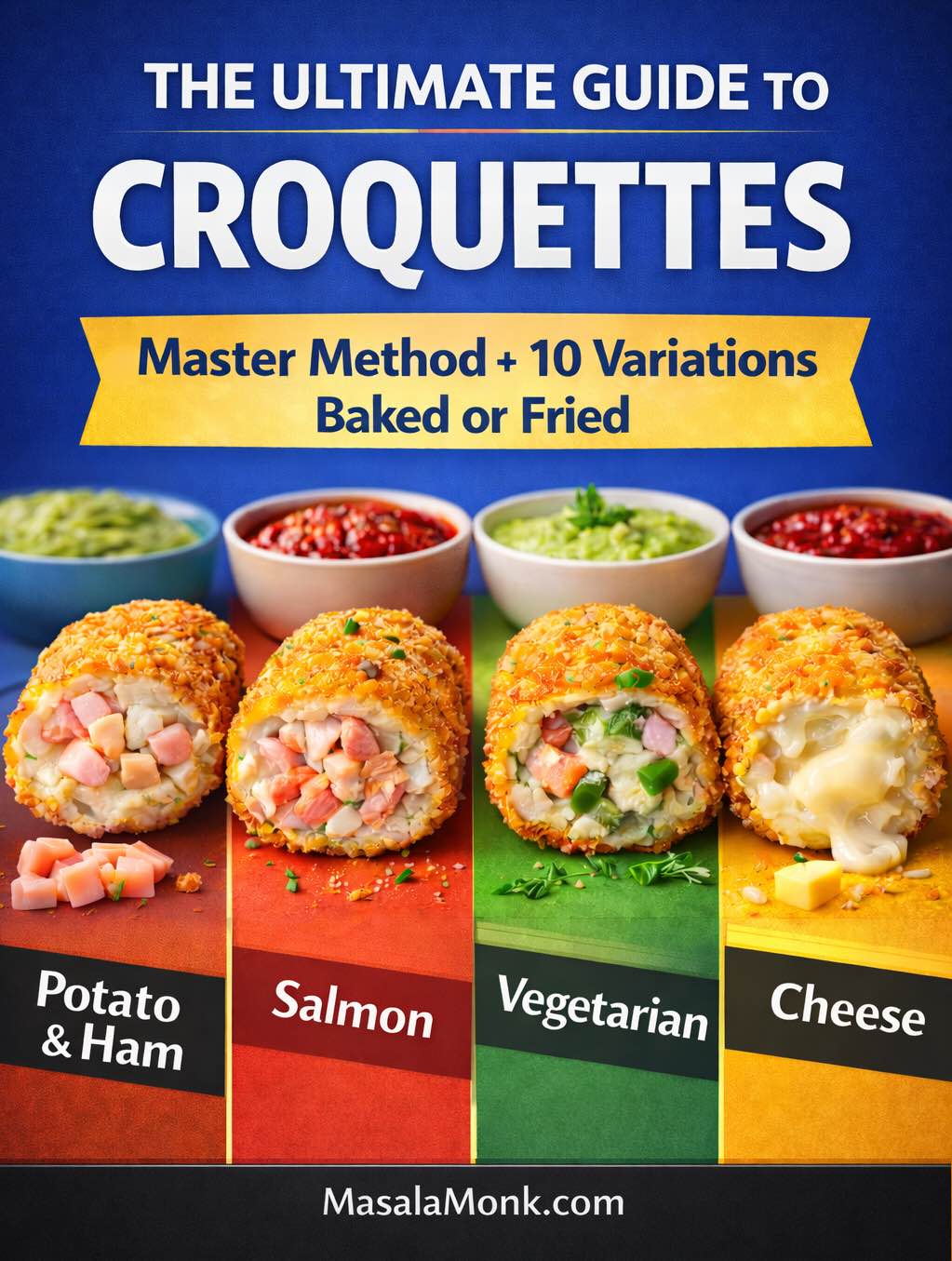
Magazine-style cover graphic titled “The Ultimate Guide to Croquettes” showing four colored lanes—Potato & Ham, Salmon, Vegetarian, and Cheese—with croquettes cut open to reveal fillings, plus “Master Method + 10 Variations (Baked or Fried)” and MasalaMonk.com at the bottom.

Croquettes have a way of making an ordinary day feel a little more celebratory. The outside turns crisp and golden, the inside stays soft and savory, and suddenly a handful of simple ingredients becomes something you’d happily serve to guests. Even so, a lot of people hesitate to try a croquettes recipe because they’ve had the frustrating version: croquettes that crack in the oil, croquettes that taste bland inside, croquettes that go oily, or croquettes that collapse the moment you flip them.

Fortunately, once you learn one reliable croquettes recipe method, everything clicks. After that, you can make easy croquettes on a weeknight, bake them when you want healthy croquettes, or go all-in with Spanish croquetas that are creamy enough to feel like a tapas bar at home. You can also work through the classics—potato croquettes, ham croquettes, chicken croquettes, tuna croquettes, salmon croquettes (canned or fresh salmon croquette), cod croquettes, vegetarian croquettes, vegan croquettes—without learning a new technique every time.

This post is exactly that: a single, detailed, step-by-step guide that covers croquette fish styles, croquette veggie options, and the “perfect croquettes” approach—plus the oven baked croquettes route when you want crunch with less fuss.

And because croquettes are at their best when they’re part of a spread, you’ll also get natural pairings: cooling chutneys, fiery chutneys, and a few drink and dessert ideas to finish the meal without feeling heavy.


Croquettes Recipe: The Four Rules That Make Them Work Every Time

Before you pick a variant, it helps to understand what croquettes really are. Whether you call it a croquette, a croqueta recipe, a kroket (you’ll see “chicken kroket” and “dutch croquettes” used in different places), or even a Japanese potato croquette style, the structure is the same:

  1. A flavorful filling
  2. A binder that holds it together
  3. A coating that creates crunch
  4. A chill step that turns “hope” into “confidence”

If you keep those four rules steady, you can change almost everything else.
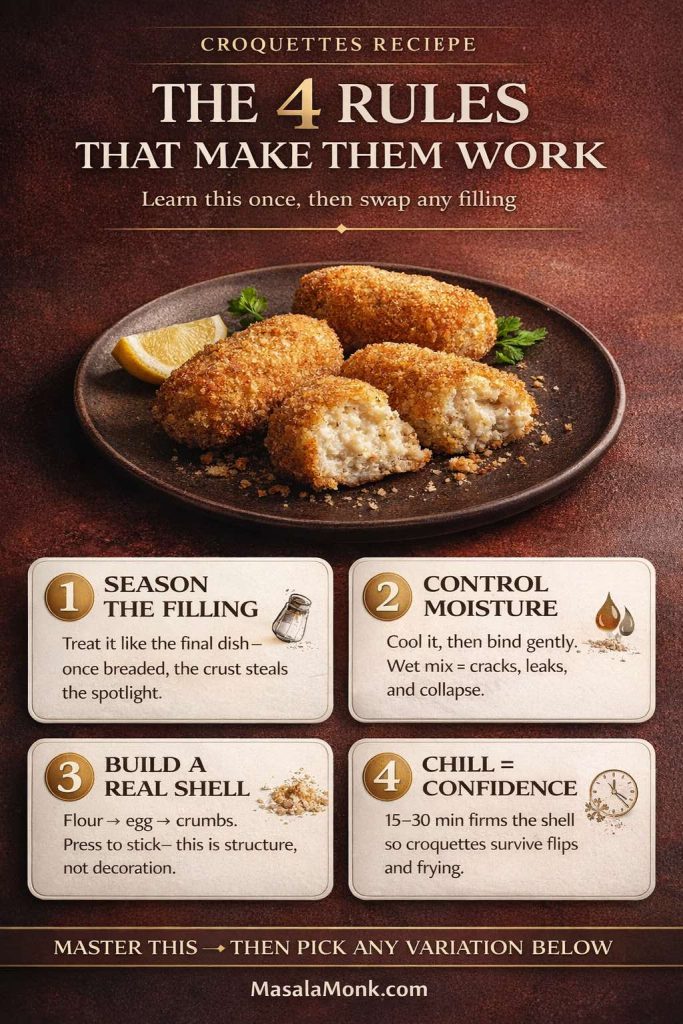
Infographic showing the four rules for a croquettes recipe: season the filling, control moisture, build a strong flour–egg–crumb shell, and chill 15–30 minutes for croquettes that don’t crack, leak, or fall apart. Includes a croquette hero photo and MasalaMonk.com footer.
Croquettes falling apart? This is the “save it forever” checklist. Season the filling like it’s the final dish, cool and control moisture, build a real shell (flour → egg → crumbs), then chill so the coating firms up before you cook. Once these four rules click, you can swap in potato, salmon (canned or fresh), ham & cheese, chicken, tuna, cod, vegetarian, or vegan fillings without changing the method. Bookmark this guide, pin it for later, and use it as your quick reset before frying, baking, or air frying.

Rule 1: Season the filling like it’s the final dish.
Once croquettes are breaded, the outside becomes the star. That means the inside must be seasoned enough to hold its own.

Rule 2: Control moisture, don’t fight it.
Wet fillings are the number one reason croquettes fall apart. Instead of adding more egg (which can make them softer), you remove or offset moisture: cool the mixture, add just enough dry binder, and chill properly.

Rule 3: The coating is a shell, not decoration.
Flour → egg → crumbs isn’t tradition for tradition’s sake. It builds a sturdy exterior so the inside can stay creamy.

Rule 4: Chilling is non-negotiable for perfect croquettes.
Chilling firms fat and starches, reduces steam pressure, and makes shaping easier. It’s the difference between croquettes that survive the pan and croquettes that become snack-flavored chaos.

Keep these rules in mind, and suddenly “how do you make croquettes” becomes a calm question rather than a stressful one.

Also Read: Ravioli Recipe Reinvented: 5 Indian-Inspired Twists on the Italian Classic


How to Make Croquettes: The Master Step-by-Step (Works for Every Variant)

This is the core croquettes recipe method you’ll use for everything in the post—potato, fish, chicken, turkey, vegetarian, vegan, Spanish croquetas, and more.
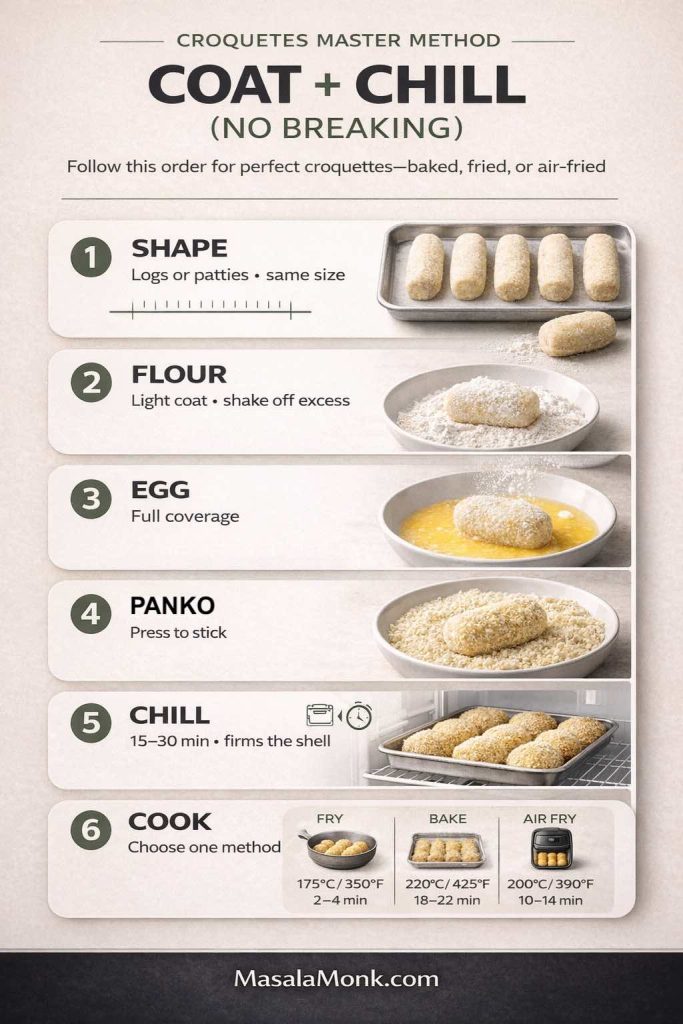
Step-by-step croquettes master method infographic showing how to shape croquettes, coat in flour, dip in egg, press into panko, chill 15–30 minutes, then cook by frying (175°C/350°F 2–4 min), baking (220°C/425°F 18–22 min), or air frying (200°C/390°F 10–14 min), with MasalaMonk.com at the bottom.
If your croquettes crack, leak, or fall apart, this is the fix: shape → flour → egg → panko → chill. That 15–30 minute chill firms the coating so you can fry for max crunch or bake/air-fry for a lighter batch—then plug in any filling from the post (potato, salmon, ham & cheese, tuna, chicken, cod, or vegan) without changing the method.

What you’ll need

  • 3 shallow bowls (for breading)
  • A tray (for chilling shaped croquettes)
  • A rack (for draining fried croquettes or baking with airflow)
  • Optional but helpful: a food thermometer for meat and fish variants

Base quantities (Recipe makes 10–12 croquettes)

Think of these as the “croquettes template.” Your filling changes, the structure stays.

For the croquette mixture

  • 2 packed cups prepared filling (pick a variant below)
  • 1 large egg (binder)
    Vegan binder method is included later
  • 2–6 tablespoons breadcrumbs or flour, only as needed (moisture control)
  • Salt and pepper (plus any spices/herbs your filling wants)

For the coating

  • ½ cup flour
  • 2 eggs, beaten with a pinch of salt
  • 1½ cups breadcrumbs or panko (panko gives the crispest bite)

Step 1: Prepare the filling, then cool it completely

Make your filling according to the variant recipe you’re using. When it’s done, spread it out on a plate or tray and let it cool. If you rush and mix while it’s warm, you’ll need more breadcrumbs, the texture will be heavier, and shaping will feel like wrestling mashed clouds.
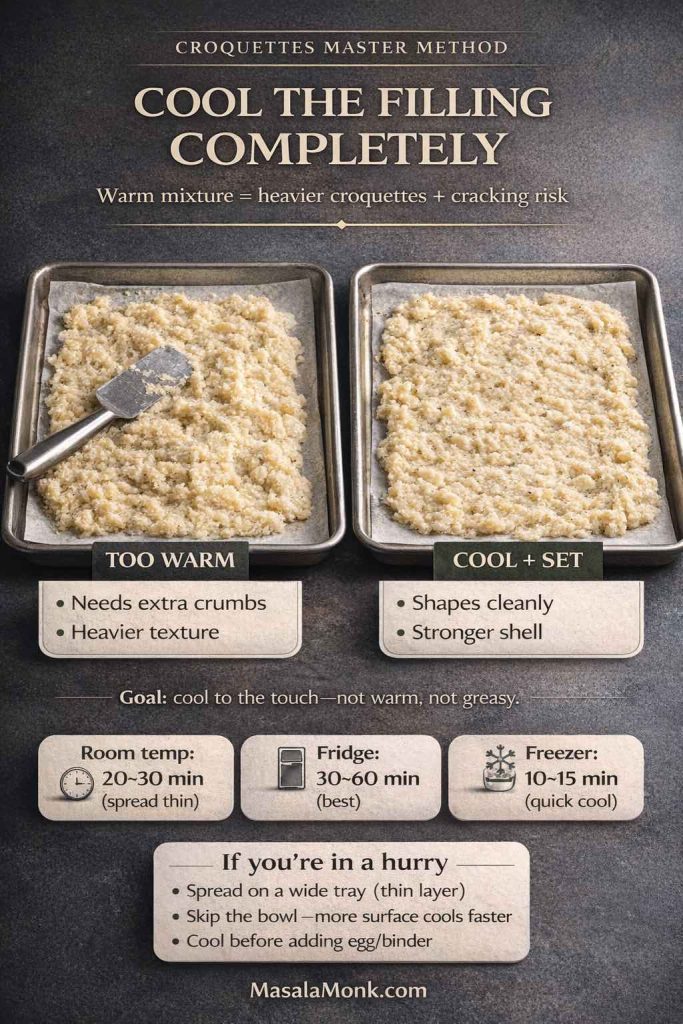
Croquettes filling spread on two trays showing why the mixture must cool completely before shaping and breading croquettes. Left tray is too warm and needs extra crumbs; right tray is cool and sets firm for a stronger shell. Includes cooling options: room temp, fridge, quick-freeze, with MasalaMonk.com.
Warm croquette mixture is the fastest way to end up with heavy croquettes that crack or soak up oil. Spread your filling thin, cool it fully, then bind and bread—your croquettes shape cleanly, hold their coating, and cook with less drama whether you fry, bake, or air fry. Save this card for every potato, salmon, chicken, veg, or vegan batch.

Step 2: Bind the mixture

Add your egg and mix thoroughly. Then test the texture:

  • If it holds together when you press a small handful, you’re good.
  • If it feels loose or wet, add breadcrumbs 1 tablespoon at a time until it firms up.

This step is where people often over-correct. Slow down. You’re aiming for a mixture that is cohesive, not dry.
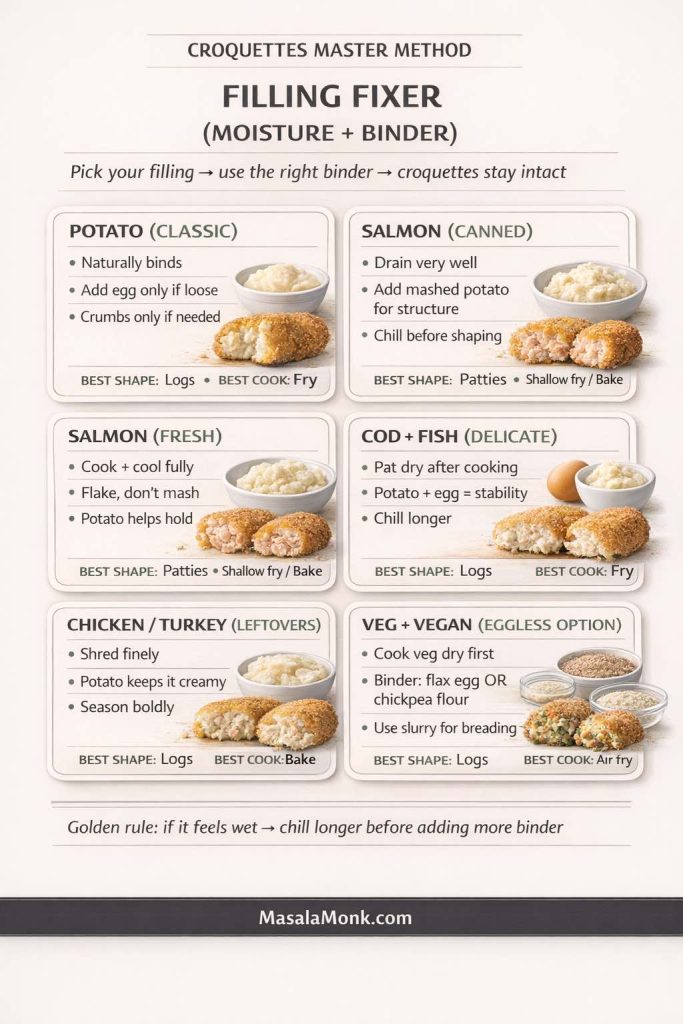
Croquettes master method ‘Filling Fixer’ infographic showing how to keep croquettes from falling apart by matching moisture level to the right binder for six fillings: potato, canned salmon, fresh salmon, cod/fish, chicken/turkey, and veg/vegan, with best shape and best cooking method tips plus a note to chill longer if the mixture feels wet.
Use this quick ‘filling fixer’ before you shape anything: it shows the one adjustment that saves a batch—drain/pat dry where needed, then choose the right binder so croquettes stay intact. It’s especially handy for fish croquettes (salmon/cod) and vegan croquettes, where moisture control makes or breaks the crust.

Step 3: Chill the mixture (30–60 minutes)

This single step makes shaping easier and prevents cracking. In addition, it helps the mixture set so it survives turning.
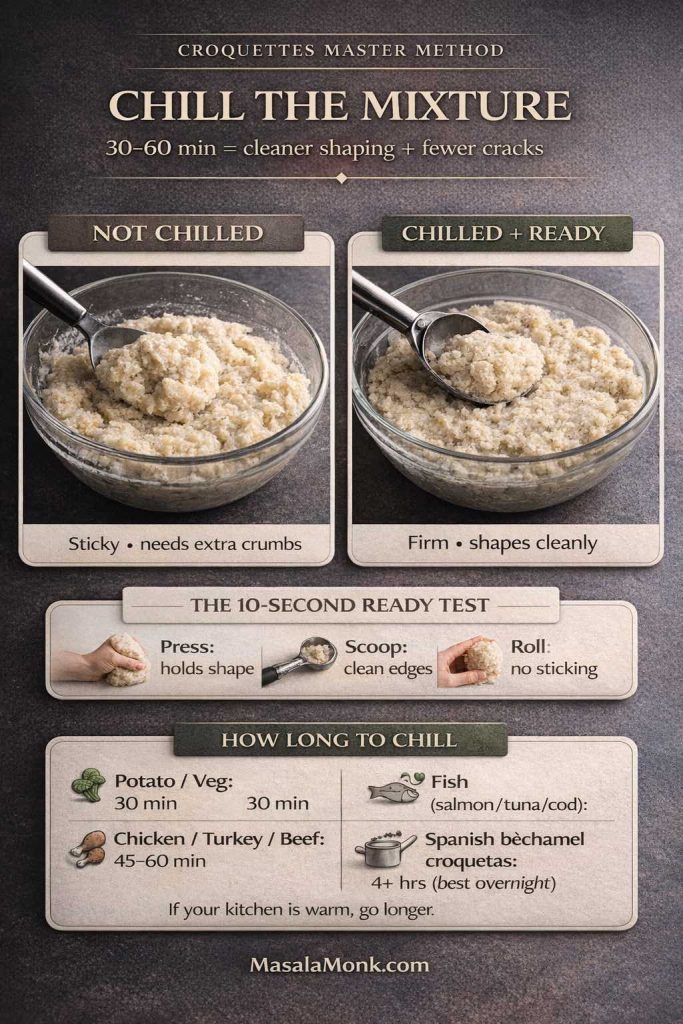
Infographic showing why to chill croquettes mixture 30–60 minutes before shaping: not chilled mixture is sticky, chilled mixture shapes cleanly. Includes a 10-second readiness test (press, scoop, roll) and a “how long to chill” guide for potato/veg, fish (salmon/tuna/cod), chicken/turkey/beef, and Spanish béchamel croquetas, with MasalaMonk.com footer.
Chilling the croquettes mixture is the quiet step that prevents most disasters. A cold mix holds its shape, needs fewer extra crumbs, and is far less likely to crack once it hits hot oil. Use the quick ready test here (press → scoop → roll), then match the chill time to your filling—potato/veg sets fast, fish benefits from a steady firm-up, and béchamel-based Spanish croquetas really shine with a longer rest. Keep this guide nearby before shaping so every batch stays tidy, crisp, and confident.

Step 4: Shape your croquettes

You can shape croquettes as:

  • Logs (classic croquette shape)
  • Thick patties (great for salmon croquettes, tuna croquettes, and easy croquettes you want to flip quickly)
  • Small cylinders (perfect for Spanish croquetas, which are often bite-sized)

As you shape, keep the sizes consistent so cook times match.
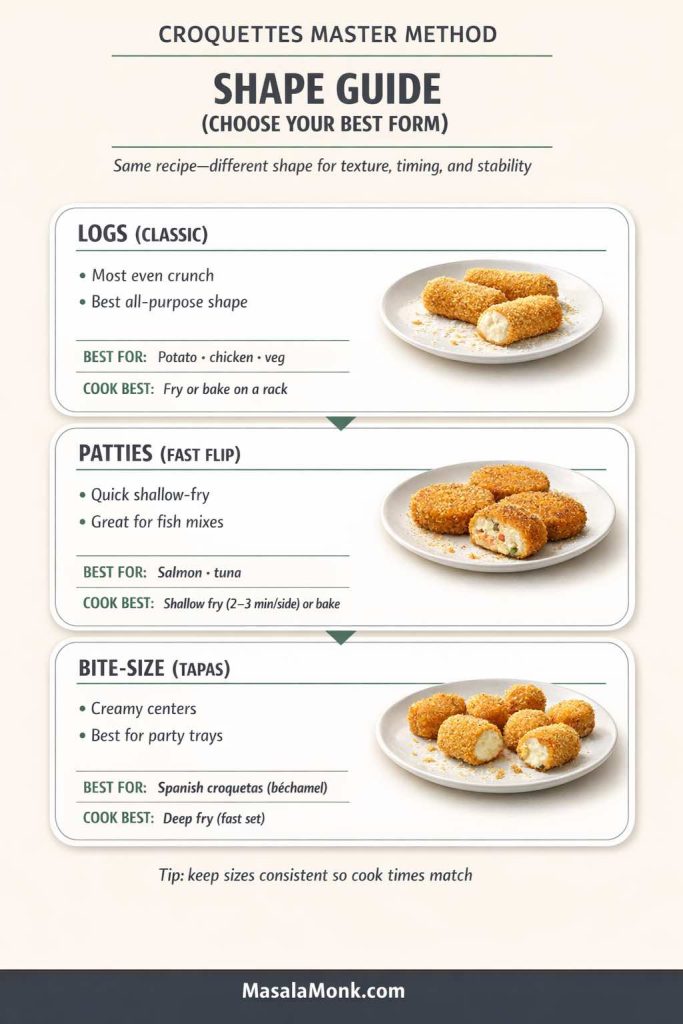
Infographic titled “Croquettes Master Method: Shape Guide” showing three croquette shapes—logs (classic), patties (fast flip), and bite-size (tapas). Each card lists what the shape is best for (potato/chicken/veg; salmon/tuna; Spanish croquetas béchamel) and the best cooking method (fry or bake on a rack; shallow fry 2–3 minutes per side or bake; deep fry fast set). Footer reads MasalaMonk.com.
Not sure which croquettes shape to make? Use this quick shape guide: logs cook evenly (great for potato, chicken, veg), patties are perfect for salmon croquettes and tuna croquettes when you want a quick shallow-fry, and bite-size croquetas are the tapas-style choice for creamy béchamel centers. Keep sizes consistent so every batch cooks evenly—then bake, air fry, shallow fry, or deep fry with confidence.

Step 5: Bread the croquettes (flour → egg → crumbs)

Set up a breading station:

  1. Flour bowl
  2. Egg bowl
  3. Breadcrumb bowl

Coat each croquette in flour first, shaking off excess. Then dip in egg. Finally, press into breadcrumbs so the crumbs actually stick rather than merely dust the surface.
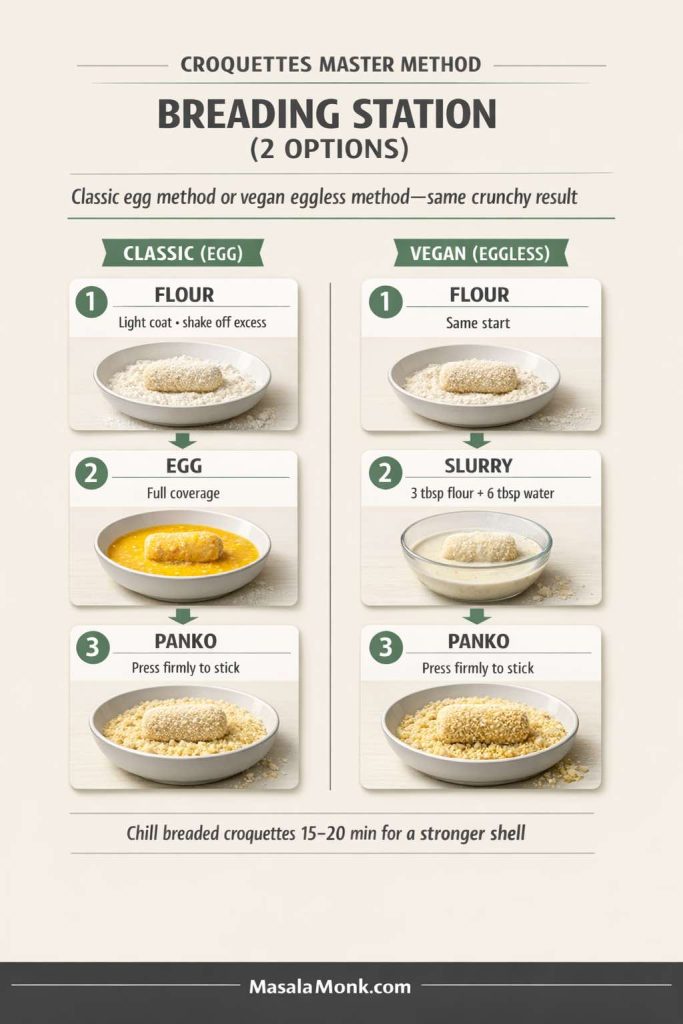
Infographic showing a croquettes breading station with two methods: classic (egg) and vegan (eggless). Both use flour then panko; the classic method dips in egg, while the vegan method uses a slurry (3 tbsp flour + 6 tbsp water). Note says to chill breaded croquettes 15–20 minutes for a stronger shell. MasalaMonk.com in the footer.
Want croquettes that stay sealed and crisp? Use this breading station every time: flour → egg (or eggless slurry) → panko, then chill 15–20 minutes so the coating sets like a shell before you fry, bake, or air fry. The right side is perfect for vegan croquettes or when you’re out of eggs—same crunch, less stress.

Step 6: Chill again (15–20 minutes)

This second chill is optional for potato croquettes, yet extremely helpful for béchamel-based Spanish croquetas and any very soft filling. It firms the exterior and helps the coating adhere.
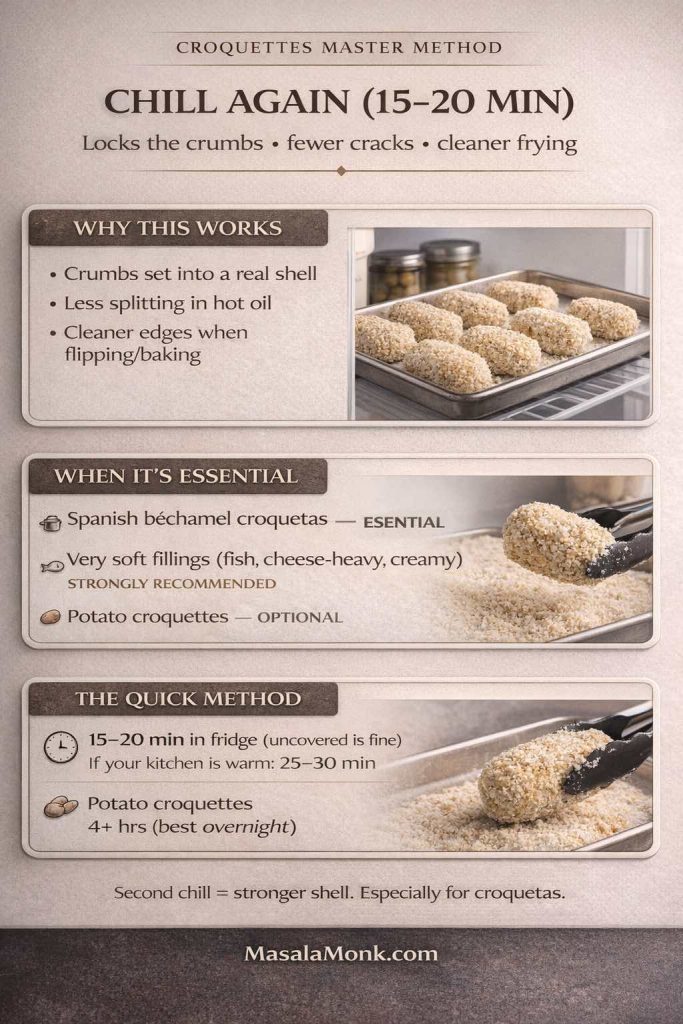
Recipe card infographic showing breaded croquettes on a tray chilling in the fridge for 15–20 minutes to lock in crumbs and reduce cracks. Includes quick notes on why the second chill helps coating adhesion and when it’s most useful (soft fillings like béchamel-based Spanish croquetas), with MasalaMonk.com in the footer.
That “second chill” is the quiet upgrade that stops croquettes from cracking or shedding crumbs. After flour → egg/slurry → panko, refrigerate the breaded croquettes for 15–20 minutes so the coating hydrates, firms up, and grips the surface—especially for very soft fillings like béchamel-style Spanish croquetas, fish, or cheese-heavy centers. Then cook with confidence: the shell sets faster, edges stay cleaner, and frying feels far less stressful. Keep this card saved as your quick reminder whenever your coating feels fragile.

Step 7: Cook using your method of choice (fry, shallow fry, bake, or air fry)

You’ve got options. None of them are “wrong,” so choose based on your time and your mood.
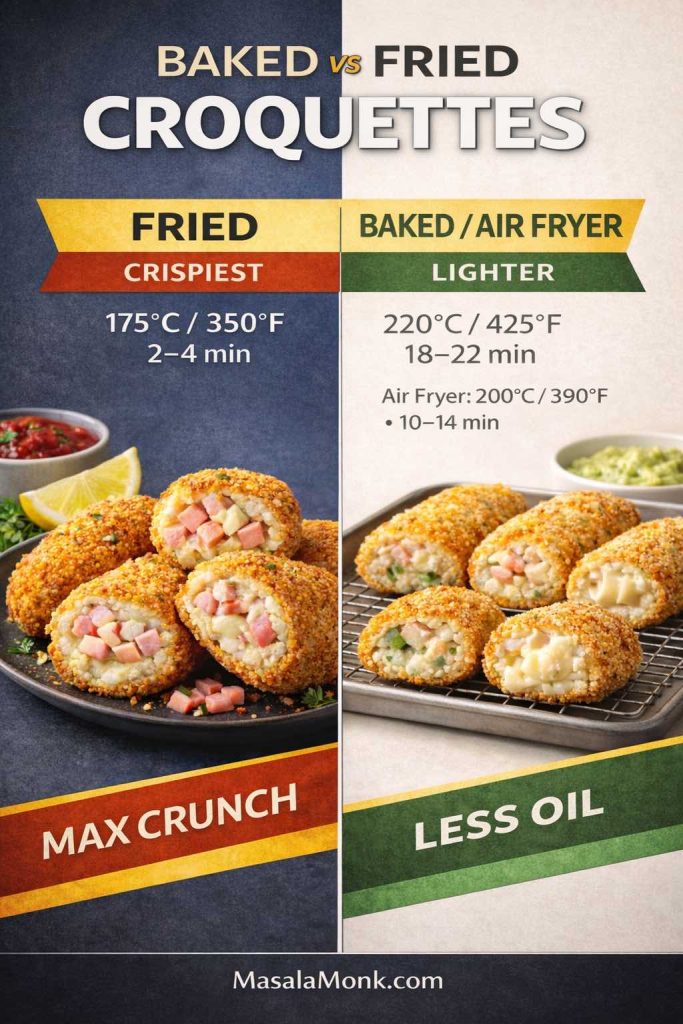
Split infographic comparing croquettes baked vs fried: left shows fried croquettes with 175°C/350°F cook time 2–4 minutes and “Max Crunch,” right shows baked/air fryer croquettes with 220°C/425°F 18–22 minutes plus air fryer 200°C/390°F 10–14 minutes and “Less Oil,” with MasalaMonk.com in the footer.
Baked vs fried croquettes at a glance: fry at 175°C/350°F for 2–4 minutes for maximum crunch, or bake at 220°C/425°F for 18–22 minutes (air fryer 200°C/390°F for 10–14 minutes) for a lighter option. Use this as your quick timing guide before you jump into the master croquettes recipe and pick a variation.

Also Read: Fish and Chips Reimagined: 5 Indian Twists (Recipe + Method)


Croquettes Cooking Methods (Fried, Shallow-Fried, Oven Baked, Air Fryer)

Deep-fried croquettes recipe (crispiest and fastest)

  • Heat oil to 175°C / 350°F
  • Fry in batches, 2–4 minutes, until deep golden
  • Drain on a rack so they stay crisp
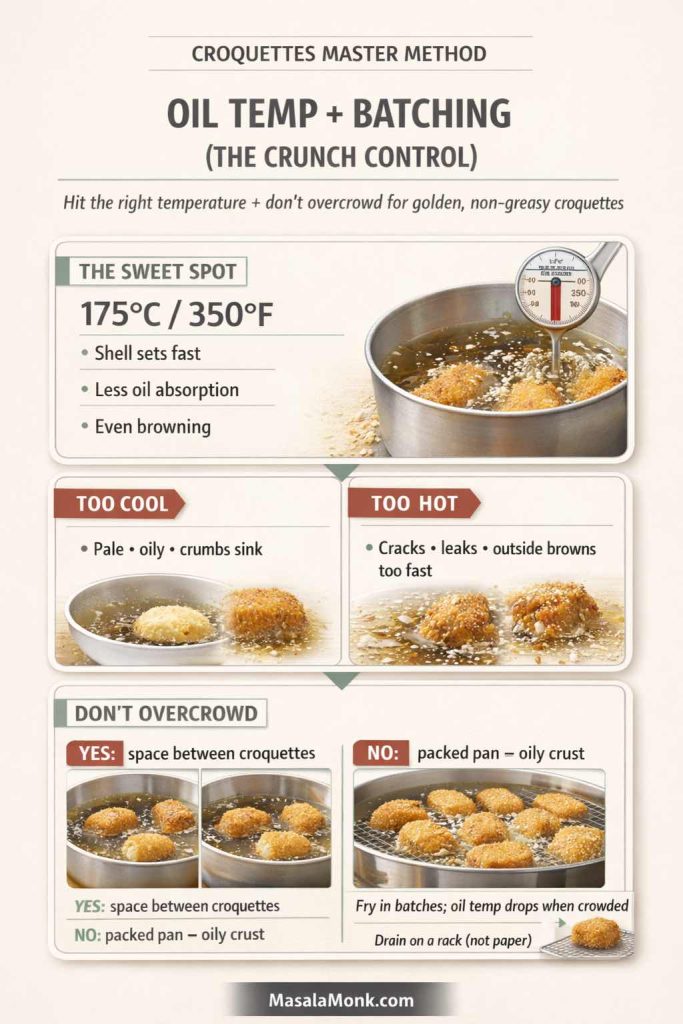
A croquettes master method infographic about oil temperature and batching for crisp, non-greasy croquettes. It highlights the sweet spot of 175°C/350°F, shows what happens when oil is too cool (pale, oily, crumbs sink) or too hot (cracks, leaks, outside browns too fast), and compares spaced frying vs overcrowding. It also notes frying in batches and draining on a rack, with MasalaMonk.com in the footer.
If your croquettes ever turn greasy or crack in the oil, this is the reset: aim for 175°C / 350°F and fry in small batches so the shell sets fast and browns evenly. Use the “too cool vs too hot” cues here to troubleshoot in seconds, then drain on a rack (not paper) to keep the crust crunchy—whether you’re making potato croquettes, salmon croquettes, chicken croquettes, or Spanish croquetas.

Because the shell sets quickly, deep frying is surprisingly forgiving—provided the oil is hot enough and you don’t overcrowd the pot.

Shallow-fried croquettes (easier, still crisp)

  • Add about 1 cm of oil to a skillet
  • Medium heat
  • Fry 2–3 minutes per side

Shallow frying is excellent for salmon croquette patties and old fashioned tuna croquettes where you want more surface browning.

Croquettes oven baked (the best “healthy croquettes” recipe)

If you want croquettes oven baked without losing that crunch, do this:

  • Preheat oven to 220°C / 425°F
  • Place croquettes on a rack over a tray
  • Lightly spray or brush with oil
  • Bake 18–22 minutes, flipping once

Baked croquettes won’t taste “fried,” but they can be crisp and satisfying when you use panko and high heat.

Air fryer croquettes (fast, crisp, low mess recipe)

  • Preheat if your air fryer benefits from it
  • Cook at 200°C / 390°F
  • Spray lightly with oil
  • Air fry 10–14 minutes, flipping once

Air frying is fantastic for frozen croquettes you’ve made ahead, because it re-crisps without drying out the center too harshly.

Also Read: Dirty Martini Recipe (Classic, Extra Dirty, No Vermouth, Spicy, Blue Cheese, Tequila + Batched)


Croquettes and Sauces: The Secret to Keeping Every Batch Exciting

Croquettes are rich by design. Therefore, they love sauces that bring contrast: bright, spicy, tangy, or herbaceous.

For an Indian-inspired spread, you can rotate between:

Meanwhile, if you’re turning croquettes into cocktail snacks, the pairing is almost too natural: salty croquettes with a briny drink, or crispy croquettes with a citrusy drink. A crisp Dirty Martini fits especially well with Spanish croquetas and ham and cheese croquettes, while a bright Lemon Drop Martini works beautifully when you want freshness to cut richness. If you prefer something lighter and longer, Vodka with Lemon is an easy match.

Now that the method is clear, let’s cook through the variants properly.

Also Read: Keto Hot Chocolate Recipe (Sugar-Free Hot Cocoa) + Best Homemade Mix


Potato Croquettes (Classic, Leftover Mash Friendly, and Japanese Potato Croquette Recipe)

Potato croquettes are the easiest place to start because potatoes naturally bind. That’s why “mashed potato croquette” and “how to make potato croquettes with leftover mashed potatoes” are such popular queries—this version welcomes leftovers.
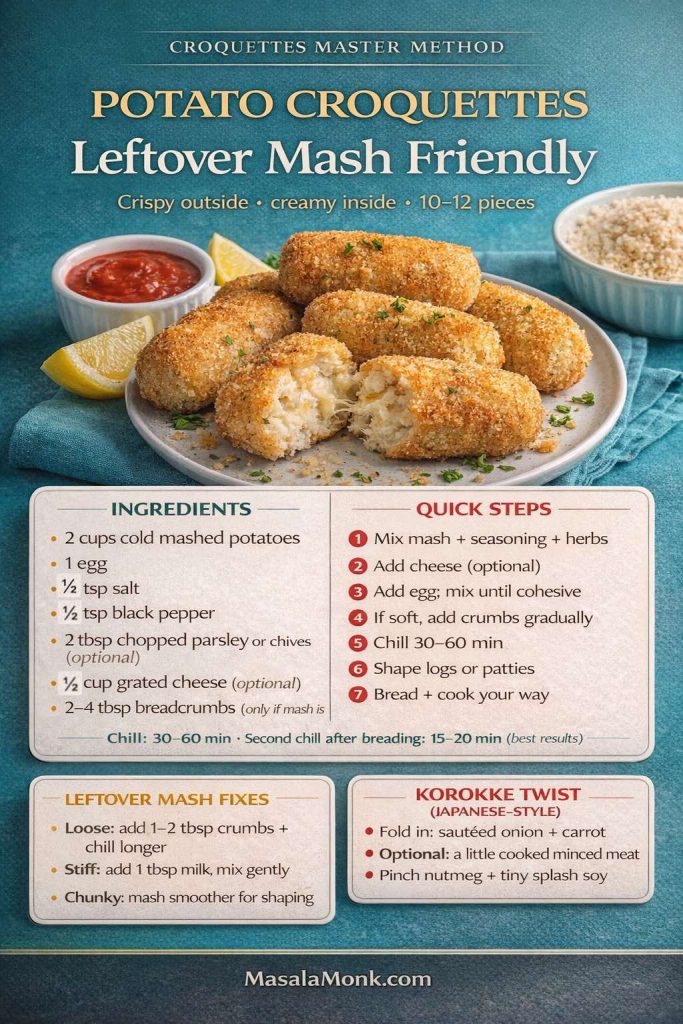
Potato croquettes are the easiest starting point because mashed potatoes bind naturally. This quick card gives you the exact ingredient ratios, the chill window (30–60 minutes), and the 3 “leftover mash” fixes (loose/stiff/chunky), plus a Japanese korokke-style twist—so you can get crisp, golden croquettes without guessing.

Easy potato croquettes recipe (makes 10–12)

Ingredients

  • 2 cups cold mashed potatoes
  • 1 egg
  • ½ teaspoon salt
  • ½ teaspoon black pepper
  • 2 tablespoons chopped parsley or chives (optional)
  • ½ cup grated cheese (optional, great for cheese croquettes vibes)
  • 2–4 tablespoons breadcrumbs if needed (only if your mash is loose)

Step-by-step

  1. Mix the mashed potatoes with salt, pepper, and herbs.
  2. Stir in cheese if you want a richer center.
  3. Add the egg and mix until cohesive.
  4. If it feels too soft to shape, add breadcrumbs gradually.
  5. Chill 30–60 minutes.
  6. Shape into logs or patties.
  7. Bread and cook using your preferred method.

If you like checking a classic baseline, BBC Good Food’s potato croquettes are a handy reference for the traditional approach.

Recipe for leftover mashed potato croquettes: making them sturdier

Leftover mash varies a lot. Some is buttery, some is stiff, some has milk or cream. Consequently, the fix also varies:

  • If your mash is loose: add 1–2 tablespoons breadcrumbs and chill longer
  • If your mash is stiff: add 1 tablespoon milk, mix gently, then chill
  • If your mash is chunky: mash a bit more so shaping is smoother

Japanese potato croquette direction (korokke vibe recipe)

If you want Japanese potato croquette style, keep the potato base, then fold in one of these:

  • sautéed onions and carrots
  • a little cooked minced meat (beef croquettes style)
  • a pinch of nutmeg plus a tiny splash of soy for depth

Shape into patties, bread with panko, then shallow fry or bake hot for a crisp shell.

Also Read: 10 Low Carb Chia Pudding Recipes for Weight Loss (Keto, High-Protein, Dairy-Free)


Spanish Croquetas (Ham, Jamón, and Ham and Cheese Croquettes recipe)

Spanish croquetas are the ones people describe as “perfect croquetas” because the interior is creamy in a way potato croquettes simply aren’t. Instead of mash, you build a very thick béchamel that sets in the fridge, then you bread and fry.

This is the point where “how do you make ham croquettes” becomes a real cooking question, because béchamel croquetas reward patience. Luckily, the steps are straightforward.

Jamón croquetas recipe (classic Spanish croquetas)

Makes: about 15–20 small croquetas

Ingredients

  • 3 tablespoons butter
  • ⅓ cup flour
  • 2 cups milk, warmed
  • 1 cup finely chopped ham or jamón (tiny dice)
  • ¼ teaspoon nutmeg
  • black pepper (generous)
  • salt only if needed

Step-by-step

  1. Melt butter in a pan over medium heat.
  2. Whisk in flour and cook 1–2 minutes so it loses its raw taste.
  3. Slowly pour in warm milk while whisking constantly.
  4. Keep stirring until it thickens dramatically; you want it thick enough that it pulls away from the pan.
  5. Stir in ham, nutmeg, and pepper. Taste before adding salt.
  6. Spread the mixture into a shallow tray so it cools quickly.
  7. Cool at room temp, then refrigerate at least 4 hours (overnight is better).
  8. Scoop and shape quickly, then bread carefully.
  9. Chill the breaded croquetas 15–20 minutes, then fry at 175°C / 350°F until golden.

For external references that echo this traditional Spanish food croquettes method, you can use:

Ham and cheese croquettes (extra creamy recipe)

If you want ham and cheese croquettes (also written as ham and cheese croquetas), do the same base, then stir in:

  • ¾ cup shredded cheese (manchego is classic; cheddar is excellent)

Chill overnight, bread, then fry. Because cheese browns quickly, keep the oil steady and don’t overcook.

Also Read: Garlic & Paprika Cabbage Rolls (Keto-Friendly Recipes) – 5 Bold Savory Twists


Salmon Croquettes (Canned, Fresh, Southern Style, and Baked Salmon Croquette Recipe)

Salmon croquettes are popular because they hit the sweet spot: inexpensive enough for regular meals, yet special enough for guests. They also adapt well to baking, so “baked salmon croquette recipe” and “easy salmon croquette” versions fit nicely alongside fried.
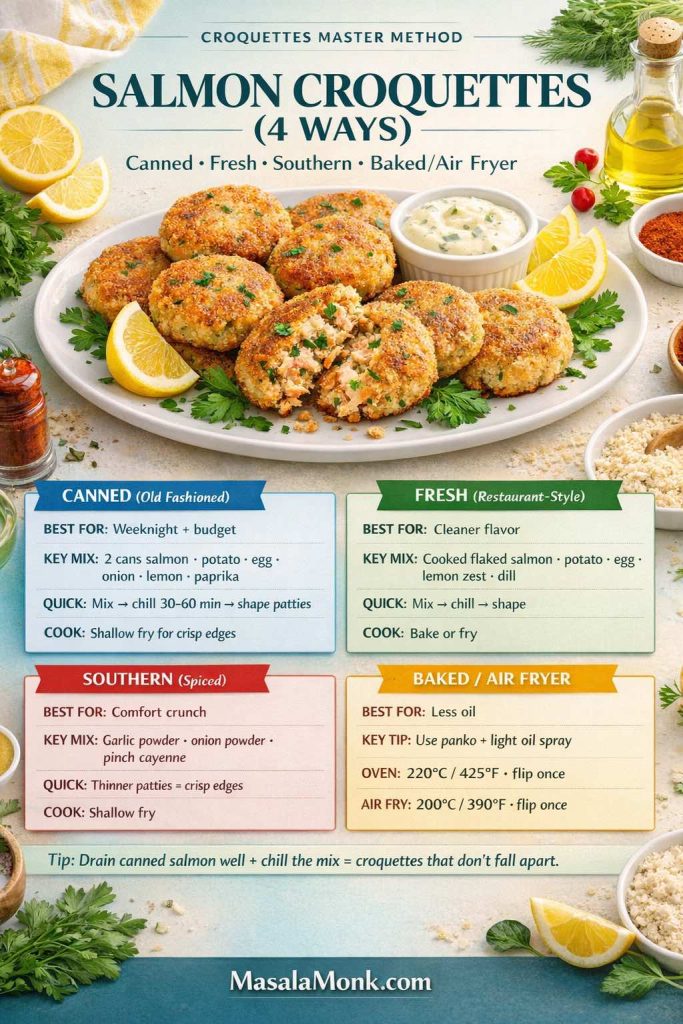
Salmon croquettes recipe card showing four options—canned (old fashioned), fresh (restaurant-style), southern (spiced), and baked/air fryer—with a platter of crispy salmon croquette patties, lemon wedges, creamy dip, and quick notes for key mix, chill time, and cooking temperatures, plus MasalaMonk.com footer.
Use this as your salmon croquettes shortcut: canned for weeknight budget patties, fresh for a cleaner “restaurant” bite, southern for crisp, spiced edges, or baked/air fryer when you want less oil. The big wins are the same across all four—drain well, chill the mix, and keep patties consistent—so they hold together whether you shallow fry, bake hot, or air fry.

Canned salmon croquettes recipe (old fashioned, reliable)

Makes: 10–12 patties

Ingredients

  • 2 cans salmon, drained well
  • 1½ cups mashed potatoes (best structure)
  • 1 egg
  • ¼ cup finely minced onion (or scallions)
  • 1 tablespoon lemon juice
  • 1 teaspoon paprika (or Old Bay)
  • black pepper
  • salt to taste
  • 2 tablespoons parsley

Step-by-step

  1. Flake salmon into a bowl.
  2. Add mashed potatoes, onion, lemon juice, and seasoning.
  3. Stir in the egg until cohesive.
  4. Chill 30–60 minutes.
  5. Shape into patties.
  6. Bread, then shallow fry, deep fry, bake, or air fry.

If you want the crispest shell with minimal mess, shallow frying is a wonderful middle ground.

Fresh salmon croquette (more “restaurant” recipe)

Ingredients

  • 2 cups cooked flaked salmon, cooled
  • 1½ cups mashed potatoes
  • 1 egg
  • zest of ½ lemon + 1 tablespoon lemon juice
  • 2 tablespoons dill or parsley
  • salt and pepper

Step-by-step

  1. Mix salmon, potato, herbs, lemon.
  2. Add egg; chill.
  3. Shape, bread, then cook.

Southern salmon croquettes (southern fried salmon croquettes recipe feel)

For southern-style salmon croquettes, keep the canned salmon base, then add:

  • ½ teaspoon garlic powder
  • ½ teaspoon onion powder
  • pinch of cayenne

Shape thinner patties and shallow fry for crisp edges. This style leans into that “recipe salmon croquettes soul food” comfort.

Salmon croquettes oven baked

To do salmon croquettes oven baked:

  • Use panko for the coating
  • Spray lightly with oil
  • Bake hot at 220°C / 425°F
  • Flip once for even browning

This is a great route when you want healthy croquettes that still feel satisfying.

Also Read: Eggless Yorkshire Pudding (No Milk) Recipe


Tuna Croquettes (Easy, Budget-Friendly, and Sturdy)

Tuna croquettes are simple, but they demand one thing: dry tuna. If you drain it aggressively, the rest is easy.
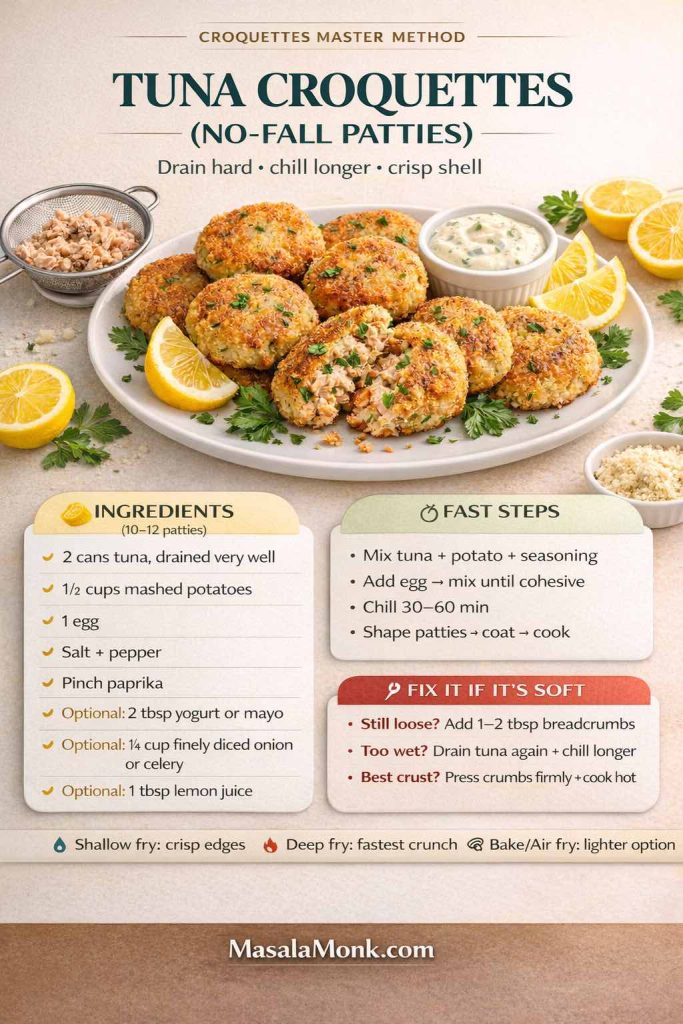
Tuna croquettes recipe card showing crispy tuna croquette patties with lemon wedges and creamy dip, plus a no-fail guide: ingredients for 10–12 patties, fast steps (mix, chill 30–60 minutes, shape, coat, cook), and fixes if the mixture is soft (add breadcrumbs, drain tuna again, press crumbs firmly), with MasalaMonk.com footer.
Tuna croquettes only ask for one thing: drain the tuna hard, then chill the mix so patties stay intact. Use this card as your quick reference—basic tuna + mashed potato + egg, plus the simple “fix-it” moves (breadcrumbs, extra draining, firm crumb press) that stop croquettes from turning mushy or breaking when you fry, bake, or air-fry.

Easy tuna croquette recipe (makes 10–12)

Ingredients

  • 2 cans tuna, drained very well
  • 1½ cups mashed potatoes
  • 1 egg
  • 2 tablespoons yogurt or mayo (optional)
  • 1 tablespoon lemon juice
  • ¼ cup finely diced onion or celery (optional)
  • salt and pepper
  • pinch paprika

Step-by-step

  1. Mix tuna with mashed potatoes and seasoning.
  2. Add egg and mix until cohesive.
  3. Chill, shape, bread, cook.

If you’re asking “how do you make tuna croquettes” without them falling apart, the answer is nearly always the same: drain more, chill more, and don’t rush the breading.

Also Read: Crock Pot Chicken Breast Recipes: 10 Easy Slow Cooker Dinners (Juicy Every Time)


Chicken Croquettes and Turkey Croquettes (Best Use of Leftovers)

Chicken croquettes are a brilliant leftover solution because shredded chicken gives texture and protein while the binder creates creaminess. Turkey croquettes follow the same pattern, and they’re especially useful after a roast dinner.

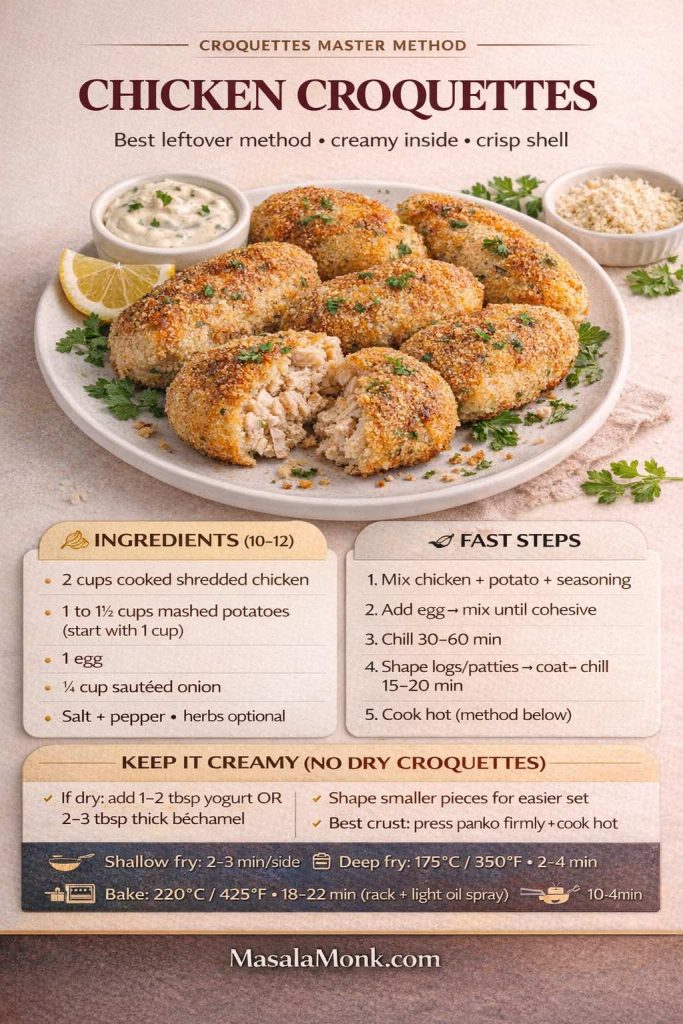
Chicken croquettes recipe (makes 10–12)

Ingredients

  • 2 cups cooked shredded chicken
  • 1 to 1½ cups mashed potatoes (start with 1 cup)
  • 1 egg
  • ¼ cup sautéed onion (or finely minced onion)
  • salt and pepper
  • optional: thyme or mixed herbs
Chicken croquettes are the best leftover upgrade: mix shredded chicken with mashed potatoes and egg, chill so they hold shape, then choose your cook method—shallow fry for crisp edges, deep fry for fastest crunch, or bake/air fry for a lighter batch. Use this card as your quick reference when you reach the chicken/turkey croquettes section, especially if your mixture feels dry or you want that creamy center every time.

Step-by-step

  1. Mix chicken with potatoes, onion, and seasonings.
  2. Add egg and mix well.
  3. If it feels loose, add breadcrumbs 1 tablespoon at a time.
  4. Chill, shape, bread, then fry or bake.

For a restaurant-style croquetas de pollo approach, Food & Wine’s chicken croquettes is a solid external reference.

Turkey croquettes (leftover-friendly recipe)

Use the chicken method, then lean into turkey flavors:

  • add chopped sage
  • add black pepper generously
  • optionally tuck a tiny cranberry center inside each croquette for a sweet-savory surprise

Because turkey can be drier than chicken, the potato ratio often helps: aim for the higher end (closer to 1½ cups potato).
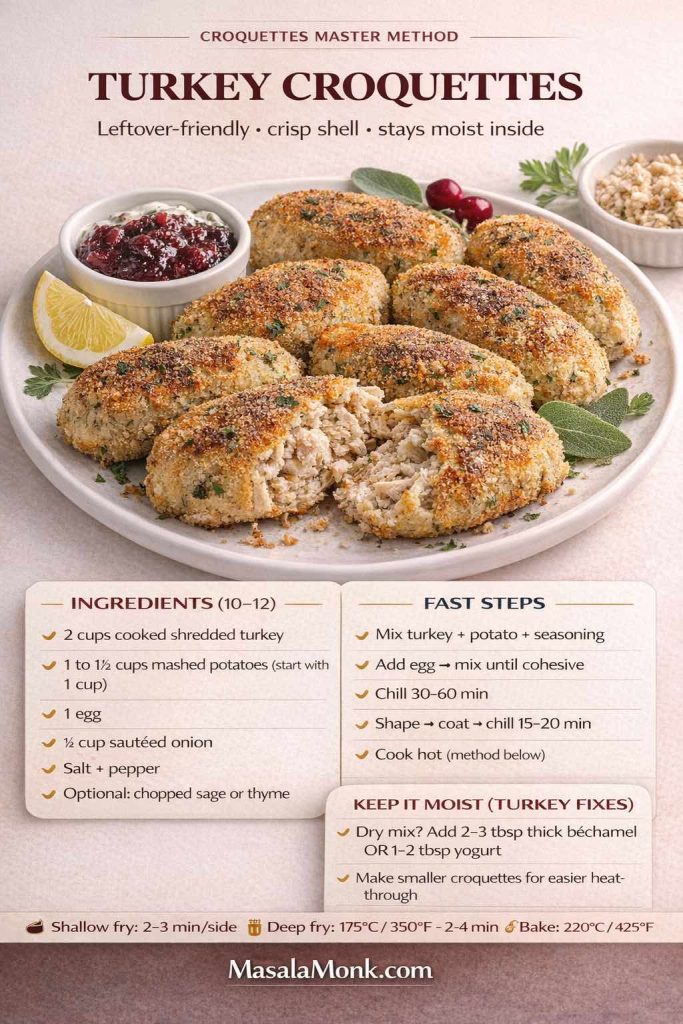
Turkey croquettes recipe card infographic showing golden, crispy turkey croquettes on a plate with lemon wedges, herbs, and cranberry sauce, plus ingredient list (shredded turkey, mashed potatoes, egg, onion, seasonings), fast mixing and chilling steps, tips to keep turkey croquettes moist, and cooking options for shallow fry, deep fry, bake, or air fry.
These turkey croquettes are the easiest way to turn leftover roast turkey into a crisp, restaurant-style snack: bind shredded turkey with mashed potatoes, chill so the mixture firms up, then coat well for a sealed shell that stays moist inside. Use the “keep it moist” fixes if your mix feels dry, and pick your cook style—shallow fry for crisp edges, deep fry for fastest crunch, or bake/air fry when you want a lighter batch with less mess. Save this card as your quick reference when you’re making turkey (or chicken) croquettes again.

Also Read: Mozzarella Sticks Recipe (Air Fryer, Oven, or Fried): String Cheese, Shredded Cheese, and Every Crunchy Variation


Cod Croquettes Recipe and Croquette Fish Variants (Moisture Control Wins)

Cod croquettes are delicate, light, and surprisingly elegant. However, cod holds water, which is why “croquettes cod” attempts sometimes go wrong.

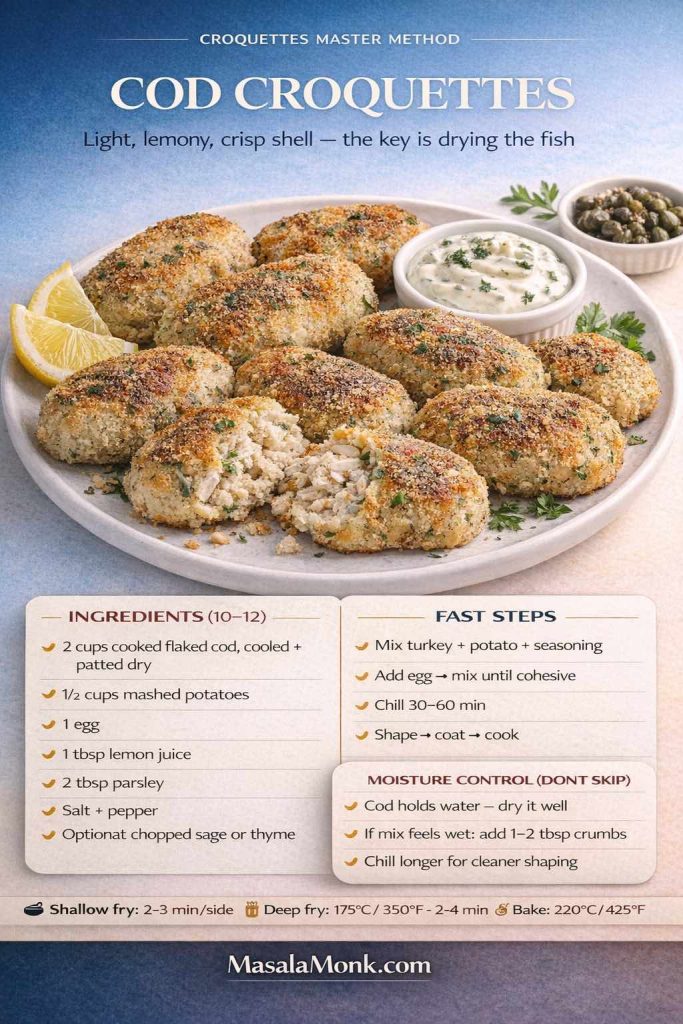
Cod fish croquettes (Recipe for 10–12 pieces)

Ingredients

  • 2 cups cooked flaked cod, cooled and patted dry
  • 1½ cups mashed potatoes
  • 1 egg
  • 1 tablespoon lemon juice
  • 2 tablespoons parsley
  • salt and pepper
Cod croquettes recipe card showing crispy cod patties with lemon wedges and dipping sauce, plus ingredients, fast steps, and moisture-control tips to pat cod dry, chill the mix, and keep croquettes from falling apart.
Cod croquettes are delicate because cod holds water—so the “secret” isn’t more binder, it’s drying the fish properly. Pat the cooled cod dry, mix with mashed potatoes + lemon + herbs, then chill before shaping so the patties stay firm. Use this card as your quick guide whenever you want light, lemony fish croquettes that don’t crack, leak, or turn mushy.

Step-by-step

  1. Pat cod dry after it cools.
  2. Mix cod with potatoes, lemon, herbs, seasoning.
  3. Add egg; chill.
  4. Shape, bread, then cook.

If you’re cooking fresh and frozen seafood, the FDA’s guidance is a helpful safety reference, especially for handling and storage: Selecting and Serving Fresh and Frozen Seafood Safely.

Also Read: Sourdough Starter Recipe: Make, Feed, Store & Fix Your Starter (Beginner Guide)


Vegetarian Croquettes (Croquette Veggie, Veg Croquettes Recipe)

Vegetarian croquettes work best when vegetables are flavorful and dry. In other words, cook out moisture before you ever add potato.

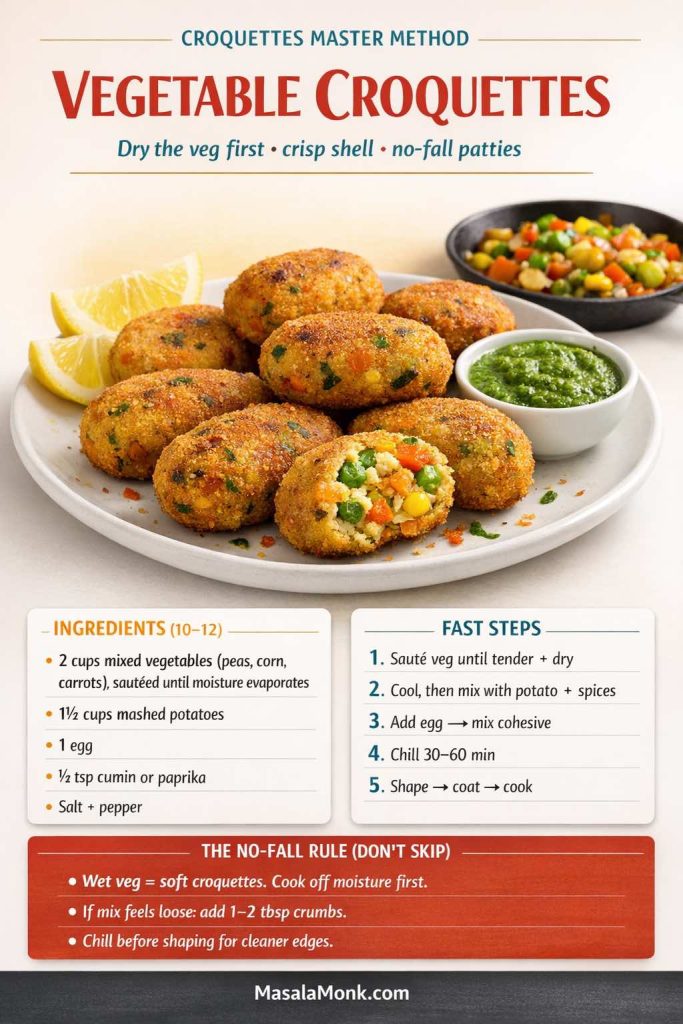
Veg croquettes recipe (makes 10–12)

Ingredients

  • 2 cups mixed vegetables (peas, corn, carrots), sautéed until moisture evaporates
  • 1½ cups mashed potatoes
  • 1 egg
  • ½ teaspoon cumin or paprika
  • salt and pepper
Vegetarian croquettes recipe card showing golden mixed-vegetable croquettes with visible peas, corn, and carrots, plus ingredients, quick steps, and the key tip to sauté vegetables until moisture evaporates before mixing with mashed potatoes.
Vegetarian croquettes succeed or fail on one detail: dry vegetables. Sauté peas, corn, and carrots until the pan looks dry (no steam, no watery shine), then mix with mashed potatoes, season well, and chill before shaping. This card is your quick guide for crisp, sturdy veg croquettes that don’t crumble—perfect for weeknight snacks, lunchboxes, or party platters.

Step-by-step

  1. Sauté vegetables until they’re tender and relatively dry.
  2. Cool, then mix with potatoes and spices.
  3. Add egg; chill.
  4. Shape, bread, cook.

These are especially good with South Indian Coconut Chutney because the creamy chutney doubles down on comfort without overpowering the filling.

Also Read: How to make No-Bake Banana Pudding: No Oven Required Recipe


Vegan Croquettes (Croquettes Vegan, Eggless Binding and Coating)

These croquettes can be just as crisp, yet the vegan version needs a binder that sets and a coating that sticks without eggs.
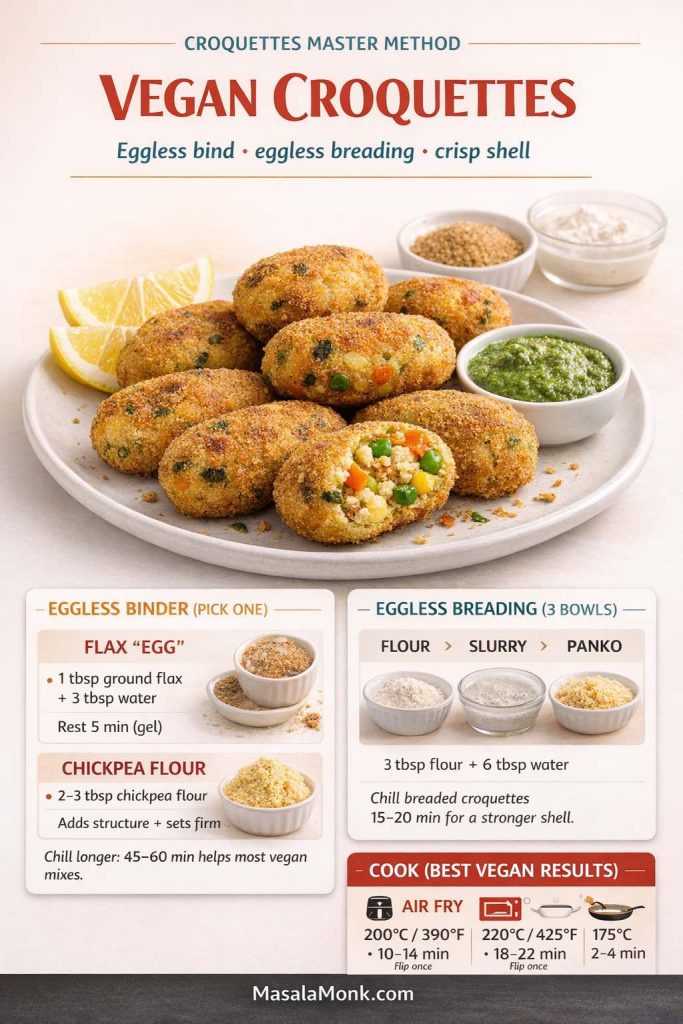
Vegan croquettes recipe infographic showing eggless binding options (flax egg or chickpea flour), eggless breading station (flour, slurry, panko), and cooking options for air fryer, oven, or frying, with MasalaMonk.com in the footer.
Vegan croquettes don’t fail because they’re vegan—they fail because the coating doesn’t set. Use one strong binder (flax egg or chickpea flour), then bread the smart way (flour → slurry → panko) and chill the breaded croquettes 15–20 minutes so the shell holds. This card gives you the full eggless workflow plus the best cook options (air fryer, oven, or quick fry) for a crisp crust and a center that stays together.

Vegan binder options

  • Flax “egg”: 1 tablespoon ground flax + 3 tablespoons water (rest 5 minutes)
  • Chickpea flour: 2–3 tablespoons stirred into the mixture for structure

Eggless breading method

  • Bowl 1: flour
  • Bowl 2: slurry (3 tablespoons flour + 6 tablespoons water)
  • Bowl 3: breadcrumbs or panko

Vegan croquettes recipe (makes 10–12)

Ingredients

  • 2 cups mashed potatoes (or half mashed chickpeas + half potato)
  • flax egg or chickpea flour binder
  • salt, pepper, paprika/garlic powder
  • breadcrumbs as needed

Step-by-step

  1. Mix the base, add binder, then adjust with breadcrumbs if the mixture is soft.
  2. Chill longer than usual—45–60 minutes helps.
  3. Shape, bread with slurry method, then bake or air fry for the best texture.

For dipping, vegan croquettes pair beautifully with Spicy Peanut Chutney (no onion, no garlic) because it brings richness without dairy.

Also Read: Chicken Adobo — Step-by-Step Recipe — Classic Filipino Adobong Manok


Beef Croquettes and Lamb Croquettes (When You Want Something Heartier)

Even though potato and fish croquettes get most of the attention, beef croquettes and lamb croquette versions are excellent when you want deeper savoriness.
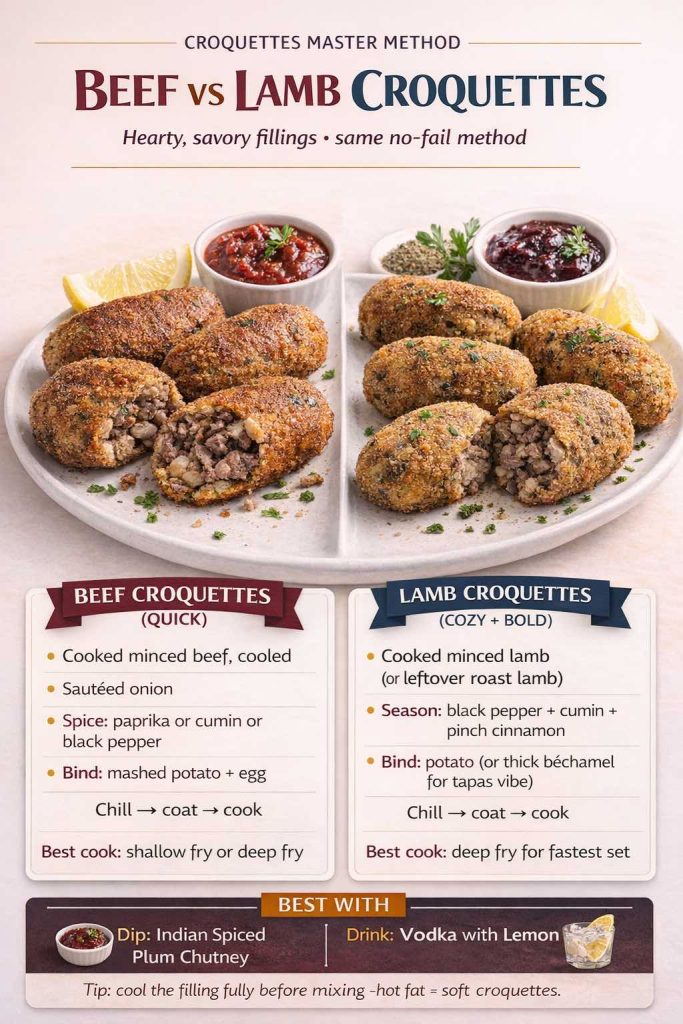
Beef vs lamb croquettes comparison card showing two plates of crispy croquettes and two recipe panels: beef croquettes with minced beef, sautéed onion, spices and mashed potato binder, and lamb croquettes with minced lamb, cumin and a pinch of cinnamon, plus serving suggestions with plum chutney and vodka with lemon.
Craving something heartier than potato croquettes? This quick beef vs lamb croquettes guide helps you pick the vibe: beef croquettes for fast, savory comfort and lamb croquettes for a cozier, bolder batch (cumin + a pinch of cinnamon). Either way, the method stays the same—cool the filling, bind, chill, coat, then cook hot—so you get a crisp shell without the “fall apart” drama. Serve these with a sweet-tangy chutney (plum is perfect) and something bright like vodka with lemon to keep the plate feeling balanced.

Beef croquettes (quick recipe)

  • Use cooked minced beef, cooled
  • Add sautéed onions and a pinch of spice (paprika, cumin, or black pepper)
  • Bind with mashed potato and egg
  • Chill, bread, cook

Lamb croquette (cozy, bold recipe)

  • Use cooked minced lamb or finely chopped leftover roast lamb
  • Season with black pepper, cumin, and a small pinch of cinnamon
  • Bind with potato (or a thicker béchamel if you want a tapas vibe)
  • Serve with a sweet-tangy chutney like Indian Spiced Plum Chutney for contrast

These richer croquettes also pair nicely with a bright drink. Even a simple citrus-forward Vodka with Lemon can lighten the overall feel.

Also Read: Sourdough Recipe: 10 Easy Bread Bakes (Loaves, Rolls & Bagels)


Making Croquettes That Don’t Fall Apart (Without Overcomplicating It)

It’s tempting to treat croquettes like a mysterious technique. In reality, croquettes fail for a few predictable reasons. Once you can spot them, you can fix them quickly.
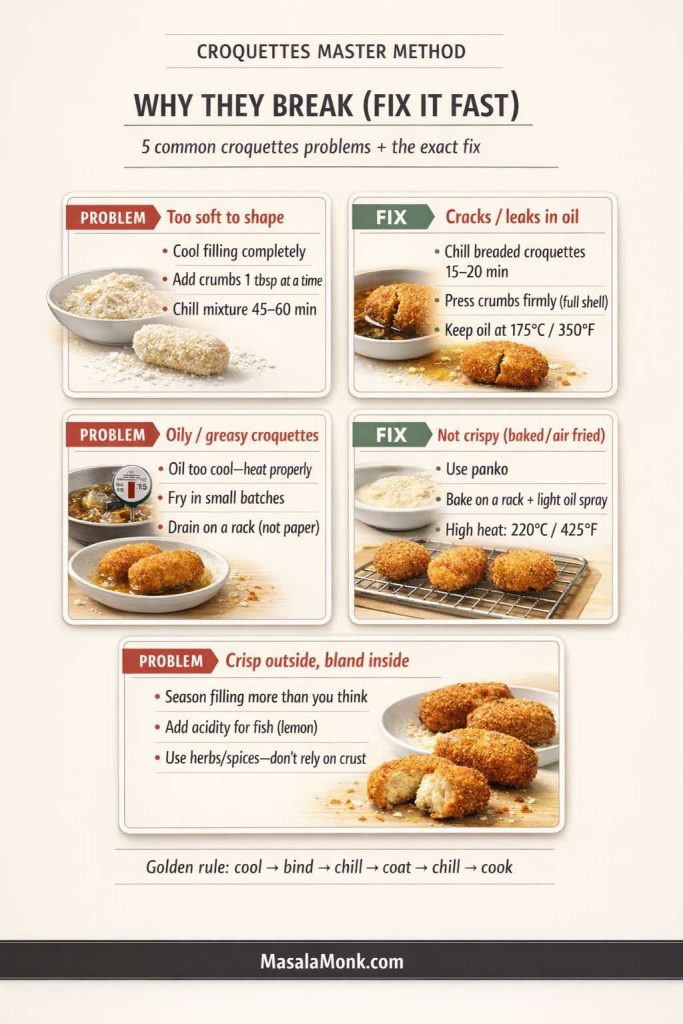
Troubleshooting infographic for croquettes showing five common problems and fixes: too soft to shape (cool filling, add crumbs, chill), cracks/leaks in oil (chill breaded croquettes, press crumbs, keep oil 175°C/350°F), oily croquettes (oil too cool, fry small batches, drain on rack), not crispy baked/air fried (use panko, rack + light oil spray, 220°C/425°F), and crisp outside but bland inside (season filling, add lemon for fish, use herbs/spices). MasalaMonk.com footer.
Croquettes cracking, going oily, or turning soft? Save this “fix it fast” guide. It covers the 5 issues that ruin a croquettes recipe—too-wet filling, weak coating, wrong oil temp, baked croquettes not crisp, and bland centers—plus the exact quick fixes (including the key chill steps). Use it right before you cook potato croquettes, salmon croquettes (canned or fresh), ham and cheese croquetas, chicken croquettes, cod croquettes, or vegan croquettes so every batch comes out golden and sturdy.

If your croquettes are too soft to shape

  • Cool the mixture fully
  • Add 1–2 tablespoons breadcrumbs
  • Chill 45–60 minutes
  • Shape smaller pieces (large croquettes are harder to stabilize)

Croquettes crack or leak while frying

  • Your oil may be too hot
  • Your croquettes may not be chilled enough
  • The mixture might be too wet
  • The coating may be too thin (press crumbs in firmly)

And if croquettes are crisp outside but bland inside

Season more than you think. Croquettes are not a stew. The crust dilutes the perceived seasoning, so the filling needs confidence: salt, pepper, acidity (lemon in fish croquettes), and aromatics.

If croquettes oven baked are not crisp

  • Use panko
  • Bake at high heat
  • Oil-spray the crumbs
  • Place on a rack so air circulates
  • Leave space between croquettes

Baked croquettes can be genuinely crunchy. They just need structure and heat rather than hope.

Also Read: Peanut Butter Fudge: Recipes & Guide (8 Methods + Easy Variations)


Food Safety for Croquettes (Simple, Practical, Calm)

Croquettes often start with cooked ingredients—leftover chicken, canned salmon, cooked mashed potatoes—then get chilled and cooked again. That’s normal. Still, it’s worth cooking to safe internal temperatures and reheating leftovers properly.

For authoritative temperature guidance, you can reference:

If you’re dealing with fish croquettes and you want handling guidance for fresh and frozen seafood, the FDA resource is helpful: Selecting and Serving Fresh and Frozen Seafood Safely.

Also Read: Cold Brew Espresso Martini: How to Make It (Step-by-Step Recipe)


Make-Ahead, Freezing, and “Frozen Croquettes” Without Store-Bought Anything

Even though “frozen croquettes” and “croquetas frozen” often show up as shopping intent, freezing homemade croquettes is one of the smartest ways to keep this recipe in your regular rotation. In fact, croquettes are almost designed for batch cooking.
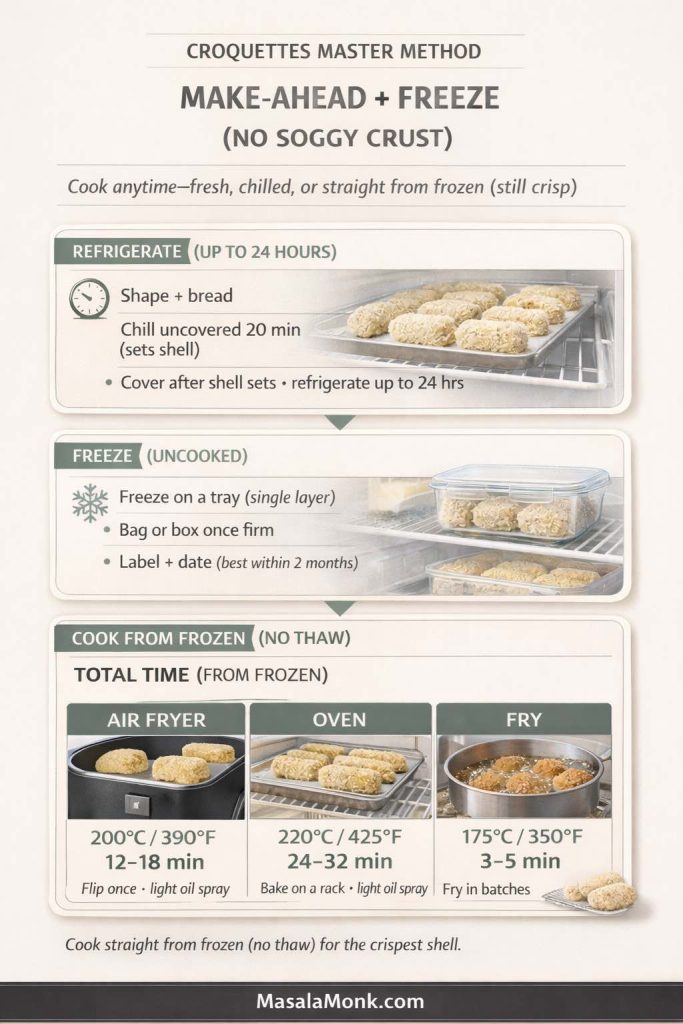
Infographic titled “Croquettes Master Method: Make-Ahead + Freeze (No Soggy Crust)” showing how to refrigerate breaded croquettes up to 24 hours, freeze uncooked croquettes on a tray, and cook croquettes from frozen without thawing. It lists frozen cook times: air fryer 200°C/390°F 12–18 min, oven 220°C/425°F 24–32 min, and fry 175°C/350°F 3–5 min, plus tips like flip once and light oil spray.
Croquettes are made for batch cooking. Shape and bread a double batch, freeze them uncooked, then cook straight from frozen whenever you want easy croquettes—no soggy crust, no defrosting drama. Use this quick guide for frozen croquettes: air fryer 200°C/390°F (12–18 min), oven baked croquettes 220°C/425°F (24–32 min), or fry at 175°C/350°F (3–5 min). Flip once and add a light oil spray for the crispiest shell—then pair with your favorite chutney, dip, or sauce from the post.

Make-ahead (best texture)

  1. Prepare filling
  2. Shape croquettes
  3. Bread them
  4. Refrigerate up to 24 hours before cooking

This keeps the coating intact and gives you that “ready whenever” flexibility.

Freeze croquettes (uncooked, breaded)

  1. Place breaded croquettes on a tray in a single layer
  2. Freeze until firm
  3. Transfer to a freezer bag or container

Cook from frozen

  • Air fryer: add 2–4 minutes
  • Oven: add 6–10 minutes
  • Frying: lower into oil carefully, fry slightly longer at steady temperature

Frozen homemade croquettes are also a lifesaver when you want easy croquettes for guests without spending the whole evening at the stove.

Also Read: 19 Essential Kitchen Tools That Make Cooking Easier


Serving Croquettes Like a Complete Meal (Not Just a Snack)

Croquettes can be appetizers, lunch, or dinner. The difference is what you serve around them.

Infographic titled ‘Serve Croquettes Like a Meal’ showing three serving ideas: a snack platter with cooling chutney, spicy chutney, lemon wedges, and crunchy sides like cucumbers/pickles/salad; a cocktail night pairing croquettes with a dirty martini, lemon drop martini, or vodka with lemon; and a simple dinner with croquettes plus salad or sautéed greens, including a fish croquettes option with cucumber-onion salad and lemon.
Croquettes are rich and crispy—so the easiest way to make them feel like a complete meal is to add contrast. Use this serving guide for three go-to setups: a snack platter with a cooling chutney + spicy chutney, lemon wedges (especially for fish croquettes), and something crunchy like cucumbers, pickles, or salad; a cocktail-night spread with salty-sip pairings (Dirty Martini, Lemon Drop Martini, or Vodka with Lemon); or a simple dinner with croquettes alongside salad or sautéed greens. Keep the rule simple: bright + crunchy + tangy makes every croquettes recipe taste sharper and more satisfying.

For a snack platter

  • A cooling chutney + a spicy chutney
  • Lemon wedges for fish croquettes
  • Something crunchy on the side (salad, pickles, sliced cucumbers)

Try a duo like South Indian Coconut Chutney and Thecha—one soothing, one loud. Alternatively, Kara Chutney adds a sharp, spicy note that makes potato croquettes feel brighter.

For a cocktail night

Croquettes were practically made for a salty sip. A briny Dirty Martini pairs especially well with ham croquettes, jamon croquettes, and ham and cheese croquettes because the flavors reinforce each other instead of competing. On the other hand, if you want the opposite effect—freshness that cuts richness—a citrusy Lemon Drop Martini is a fun counterpoint. And when you want something lighter, Vodka with Lemon keeps the whole spread breezy.

For a simple dinner

  • Croquettes + salad
  • Croquettes + sautéed greens
  • Fish croquettes + a quick cucumber-onion salad with lemon

Croquettes don’t need much. They just need contrast.

Also Read: 10 Vegan Chocolate Cake Recipes (Easy, Moist, & Dairy-Free)


A Sweet Finish That Doesn’t Feel Heavy

After croquettes, most people want dessert that’s clean and easy rather than overly rich. That’s why a fruit-forward finish works so well.

If you’re keeping it simple, Quick Mango Pudding (10 minutes) is an easy win. If you’re building a full menu, you can also browse these mango dessert recipes and pick something that matches your mood.


Putting It All Together: Choose Your Croquettes Recipe, Then Follow the Same Flow

At this point, you’ve got everything you need:

  • a single croquettes recipe method
  • detailed recipes for the most common variants
  • a baked option for healthy croquettes
  • make-ahead and freezing guidance
  • sauces, drinks, and dessert pairings that turn croquettes into a full experience

So the only question left is what you’re making first.
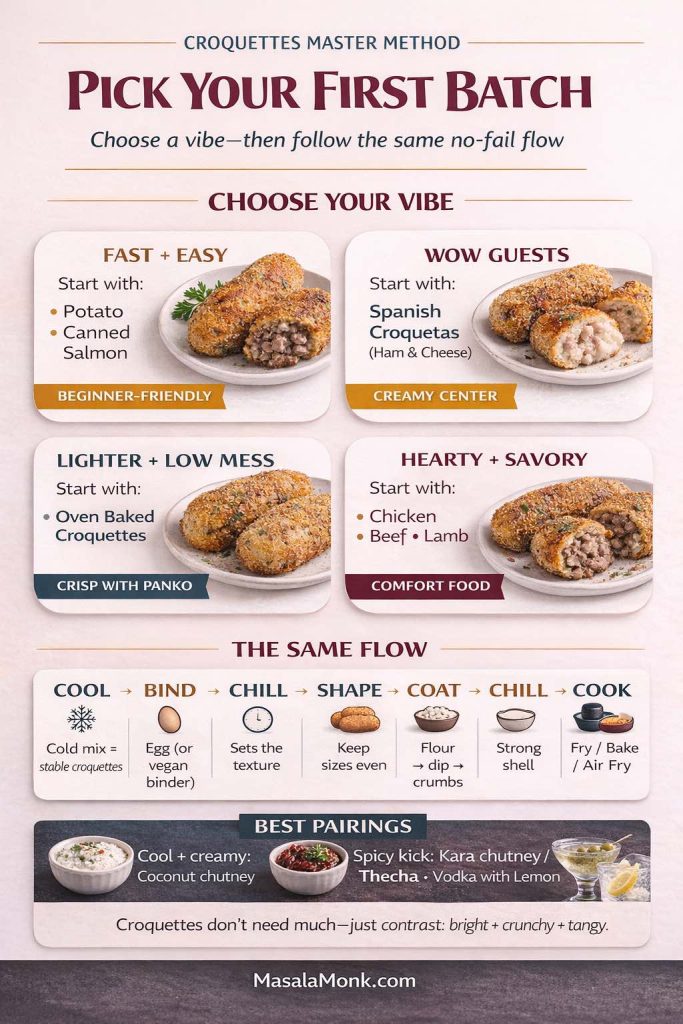
Croquettes master method infographic titled ‘Pick Your First Batch’ with four starter options—fast and easy (potato or canned salmon), wow guests (Spanish croquetas ham and cheese), lighter low mess (oven baked croquettes), and hearty savory (chicken, beef, lamb)—plus a simple flow: cool, bind, chill, shape, coat, chill, cook, and a best pairings bar with coconut chutney, kara chutney/thecha, and vodka with lemon.
Not sure which croquettes recipe to start with? Use this “pick your first batch” guide to match your mood—potato croquettes or canned salmon croquettes for fast weeknights, Spanish croquetas (ham & cheese) to wow guests, oven baked croquettes for a lighter, low-mess option, or chicken/beef/lamb croquettes when you want hearty comfort. Whichever you choose, the success formula is the same: cool → bind → chill → shape → coat → chill → cook—then finish with contrast (coconut chutney for cool creaminess, kara chutney/thecha for heat, and a bright drink like vodka with lemon).

For a fast, no-drama batch, potato croquettes or canned salmon croquettes are the easiest place to begin. Planning to wow guests? Spanish croquetas—especially ham and cheese croquettes—feel instantly special alongside coconut chutney and a dirty martini. On busy nights when you’d rather skip splatter and cleanup, croquettes oven baked with a punchy kara chutney keep things crisp, flavorful, and wonderfully low-effort.

Whichever path you pick, the method stays the same—and that’s the real upgrade.

Also Read: Hot Chocolate Coffee: 3 Easy Recipes (Cocoa, Mix, or Espresso)


FAQs about Croquettes Recipe

1) What are croquettes, exactly?

Croquettes are crispy, breaded bites with a soft, savory center—usually made from mashed potato, béchamel, flaked fish, or shredded meat. In other words, a croquette is less about one “fixed” ingredient and more about the method: a seasoned filling, a binder, and a crunchy coating.

2) How do you make croquettes so they don’t fall apart?

Start by cooling the filling completely, then add just enough binder to make it hold its shape. After that, chill the shaped croquettes before cooking. Finally, keep the oil at a steady temperature (or bake hot on a rack) so the shell sets quickly instead of soaking.

3) How to make a croquette with the classic flour–egg–breadcrumbs coating?

First, roll each croquette in flour and shake off the excess. Next, dip in beaten egg. Then press firmly into breadcrumbs (panko if you want extra crunch). Afterward, chill briefly so the coating adheres, and cook.

4) What’s the easiest croquettes recipe for beginners?

Potato croquettes are the simplest starting point because mashed potatoes naturally bind and shape easily. Alternatively, canned salmon croquettes are very forgiving when you combine drained salmon with mashed potatoes and a single egg.

5) Can I make croquettes oven baked instead of fried?

Yes—croquettes oven baked can be crisp when you use panko, bake at a high temperature, and lightly oil the surface. Even so, spacing matters; if croquettes touch, steam builds and the coating softens.

6) Are baked croquettes actually “healthy croquettes”?

Compared with deep-frying, baking uses less oil, so it’s often a lighter option. However, “healthy” still depends on the filling and portion size—especially for ham and cheese croquettes or béchamel-based Spanish croquetas.

7) How do I make potato croquettes with leftover mashed potatoes?

Use cold mashed potatoes, mix in an egg, then adjust with a little breadcrumb only if needed. After that, chill the mixture, shape, bread, and cook. If your mash is very buttery or loose, chilling longer makes a big difference.

8) What’s the difference between potato croquettes and mashed potato croquette patties?

Potato croquettes are often shaped as logs, while mashed potato croquette patties are flattened and typically pan-fried. Because patties have more surface area, they brown quickly and feel extra crisp around the edges.

9) What are Spanish croquetas and how are they different from regular croquettes?

Spanish croquetas usually use a thick béchamel base instead of mashed potato. As a result, the center is creamier and softer. That said, they need more chilling time so they’re firm enough to bread and fry cleanly.

10) How do you make ham croquettes the Spanish way?

Make a very thick béchamel, stir in finely chopped ham or jamón, then chill until solid. Next, shape quickly, bread thoroughly, and fry at a steady temperature until golden. In practice, patience during chilling is what separates perfect croquetas from messy ones.

11) How to make ham and cheese croquettes without the filling leaking out?

Let the béchamel cool completely, then chill overnight if possible. Also, dice ham finely and use grated cheese that melts smoothly. Finally, keep the croquettes small and the coating firm so the shell seals before the cheese gets too runny.

12) Can I make cheese croquettes without ham?

Absolutely. Swap ham for grated cheese, sautéed mushrooms, spinach, or finely chopped herbs. Even so, avoid watery fillings; otherwise, the mixture turns loose and needs more binder.

13) What’s the best salmon croquette recipe: canned salmon or fresh salmon croquette?

Canned salmon croquettes are quicker and more consistent, especially for weeknights. Meanwhile, a fresh salmon croquette tastes cleaner and more “restaurant-like,” particularly when you add lemon zest and herbs.

14) How do I make old fashioned salmon croquettes?

Use drained canned salmon, mashed potatoes (or a small amount of breadcrumbs), egg, onion, and seasoning. Then shape into patties and shallow-fry until deeply golden. Traditionally, this style is simple, crisp, and comfort-forward.

15) How to make southern salmon croquettes (southern fried salmon croquettes recipe style)?

Season more boldly—think garlic powder, onion powder, and a pinch of cayenne—then shape thinner patties for extra crunch. After that, shallow-fry until the edges brown well. As a result, you get that classic southern-style crispness without a deep fryer.

16) Can I use fresh salmon for salmon croquettes southern style?

Yes—cook and flake the salmon first, then cool it completely before mixing. Still, add mashed potatoes for stability; fresh salmon can be softer than canned once it’s flaked.

17) How do you make tuna croquettes that aren’t mushy?

Drain tuna extremely well, then bind it with mashed potatoes and egg. Additionally, chill the mixture before shaping. If needed, add a small amount of breadcrumbs, but don’t overdo it or the croquettes turn dry.

18) How do you make chicken croquettes so they stay creamy inside?

Use shredded chicken plus a creamy binder like mashed potato (or a thick béchamel-style base). Then chill before shaping so the mixture firms up. Finally, cook until the crust is deeply golden, which helps seal in moisture.

19) How do you make turkey croquettes from leftovers?

Combine shredded turkey with mashed potatoes, seasoning, and an egg. Next, chill, shape, bread, and cook. For extra flavor, add herbs like sage or a little minced onion, and keep the croquettes slightly smaller so they heat through evenly.

20) What’s the best method for cod croquettes or cod fish croquette?

Pat the cooked cod dry after it cools, then mix with mashed potatoes, egg, lemon, and herbs. Afterward, chill thoroughly. Because cod holds moisture, that drying step is the quiet key to croquettes cod that hold together.

21) Can I make croquettes vegetarian without them crumbling?

Yes—use a sturdy base like mashed potatoes and cook vegetables until most moisture evaporates. Then add egg and chill before shaping. Consequently, vegetarian croquettes stay cohesive and fry or bake neatly.

22) How do I make croquettes vegan without eggs?

Use a binder such as a flax “egg” (ground flax + water) or chickpea flour. For breading, replace the egg dip with a simple flour-and-water slurry. Then chill longer before cooking to help everything set.

23) Why are my croquettes not crispy?

Usually, the oil wasn’t hot enough, the pan was overcrowded, or the coating was too thin. For oven baked croquettes, the most common issue is low heat or skipping oil on the crumbs. In contrast, using panko and baking on a rack improves crispness dramatically.

24) Why do croquettes crack while frying?

Cracking often happens when the mixture is too wet or not chilled, or when oil is too hot and the outside sets before the inside stabilizes. Therefore, chilling and steady oil temperature solve most cracking problems.

25) Can I freeze croquettes?

Yes—freeze breaded croquettes on a tray, then transfer to a container once firm. Later, bake, air-fry, or fry from frozen with a slightly longer cook time. This is especially handy for easy croquettes on busy days.

26) How do I reheat croquettes so they stay crisp?

Reheat in an oven or air fryer rather than the microwave. That way, the exterior re-crisps while the center warms through. If you must microwave, finish in a hot pan or oven for a quick crisping boost.

27) What can I serve with croquettes?

Pair croquettes with bright, tangy sides or sauces—something that cuts richness. Also, salads, pickles, citrus wedges, and herby dips all work well. Meanwhile, for party food, croquettes fit beautifully on snack platters alongside other small bites.

28) What’s the single biggest tip for perfect croquettes?

Chill twice: chill the mixture before shaping, and chill the breaded croquettes before cooking. Ultimately, that one habit makes croquettes easier to handle, cleaner to cook, and far more consistent.
Posted on 3 Comments

Garlic & Paprika Cabbage Rolls (Keto-Friendly Recipes) – 5 Bold Savory Twists

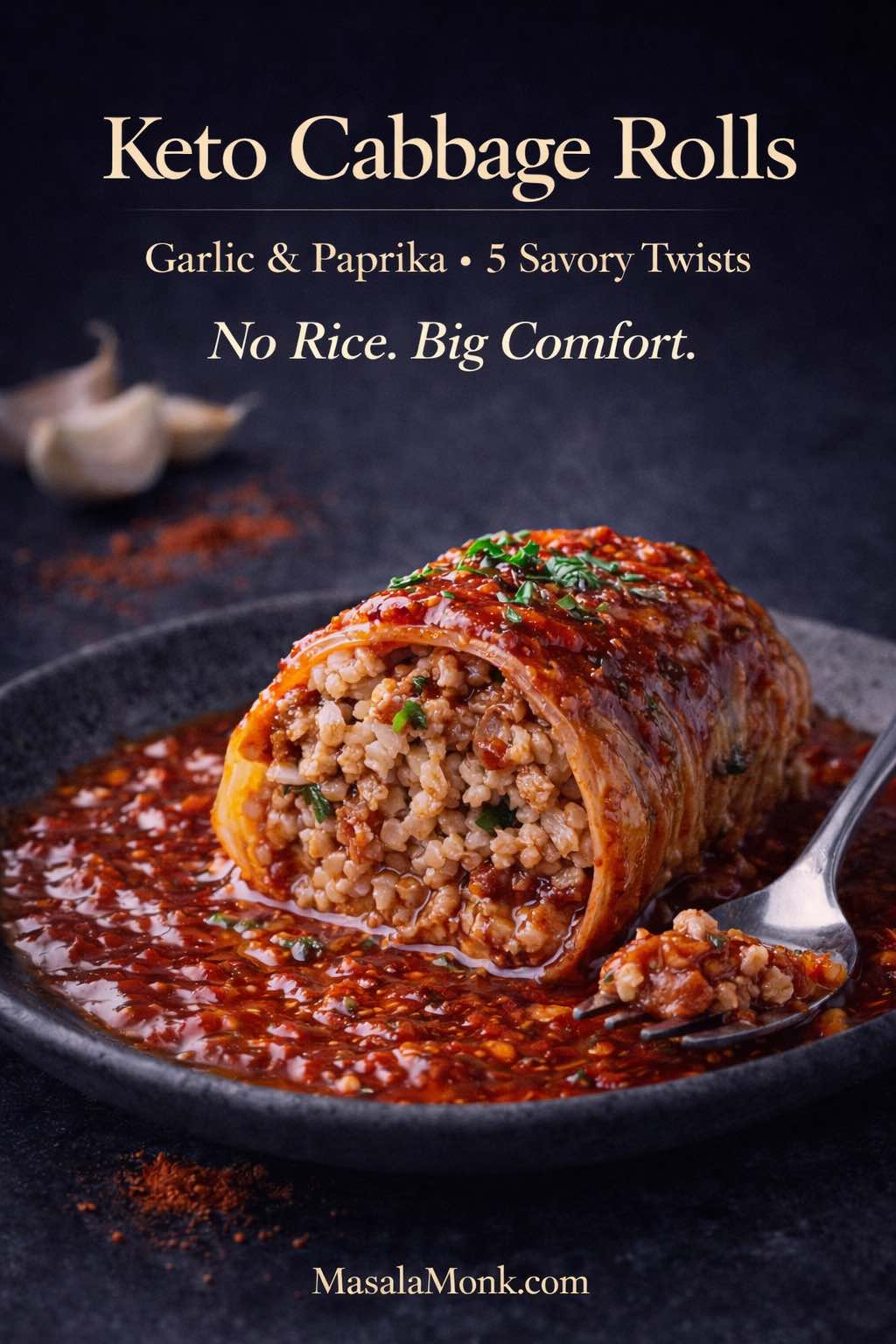
Moody close-up of a keto cabbage roll cut open to show a savory meat filling, sitting in a glossy garlic-paprika tomato sauce in a dark bowl, with a fork on the side and “Keto Cabbage Rolls” text overlay plus MasalaMonk.com at the bottom.

Stuffed cabbage rolls, keto or not keto – have a way of making a kitchen feel calm. Even before the oven is hot, the process itself—softening cabbage leaves, mixing a savory filling, rolling everything into neat parcels—turns dinner into something deliberate. Once the sauce bubbles and the cabbage goes silky at the edges, the whole dish tastes like it belongs on a table where people linger.

The classic version is famous for a reason. It’s hearty, tender, and deeply satisfying. It’s also often built around rice, which is exactly why cabbage rolls can feel tricky on a low carb diet. Still, the comfort isn’t coming from rice alone. It’s coming from the structure—cabbage wrapped around seasoned meat—plus a sauce that sinks into every fold and seam.

Keto Cabbage Rolls

That’s where these keto cabbage rolls shine. They keep everything that matters: the cozy, homey feel; the fork-tender cabbage; the rich tomato-forward sauce; the filling that tastes better the next day. The only difference is that instead of rice, the filling uses lower-carb “bulk” that still holds moisture and texture. More importantly, the flavor leans hard into garlic and paprika, so the rolls never feel like a compromise.

This is also not a one-note recipe. Cabbage rolls are a template, and once you have the core method, you can push them in completely different directions—smoky and deep, tangy with sauerkraut, bright and herb-forward, spicy, or Mediterranean-leaning. Each twist still tastes like cabbage rolls, yet each one feels like its own dinner.

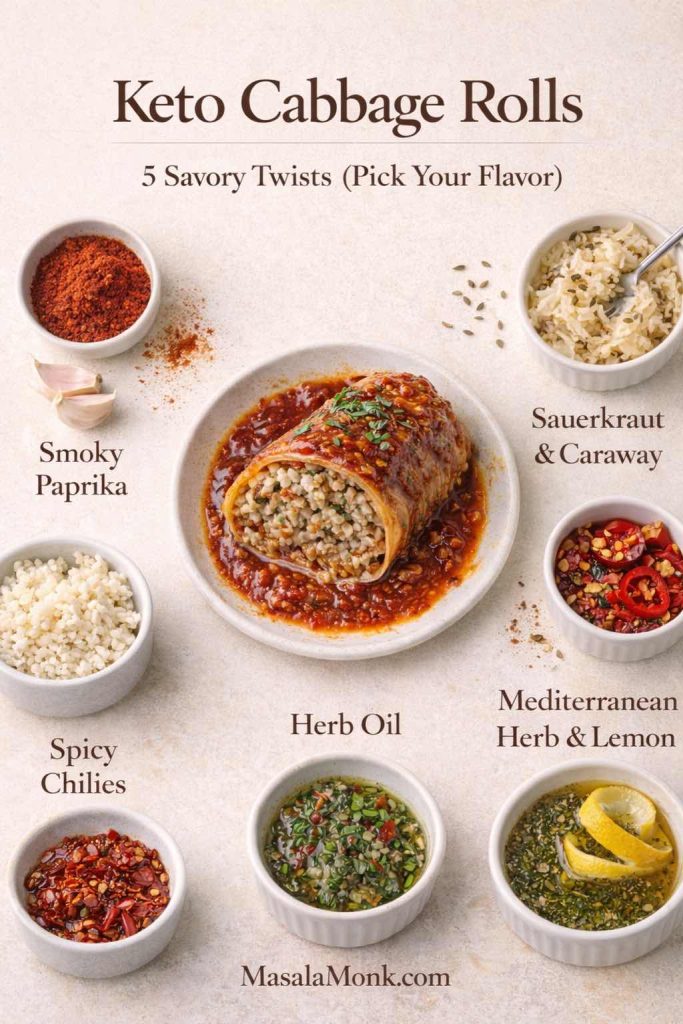
Keto cabbage rolls in garlic-paprika tomato sauce with “5 savory twists” flavor picker: smoky paprika, spicy chilies, sauerkraut & caraway, Mediterranean herb & lemon, and herb oil, arranged around one cabbage roll on a light background.
Not sure which version to make tonight? Use this “pick your flavor” guide for keto cabbage rolls—same easy roll-and-bake base, five garlic-paprika twists (smoky, spicy, sauerkraut + caraway, Mediterranean herb + lemon, and herb oil). It helps readers choose a direction fast, keeps the recipe flexible, and makes meal prep easier when you’re cooking for different taste buds.

If you’re easing into keto or simply trying to eat fewer carbs without feeling deprived, it can help to understand the bigger picture of how low-carb swaps work. MasalaMonk’s guide to keto for beginners lays out the basics in a simple way. Even if you’re already comfortable with low carb eating, it’s a useful reminder that sustainable dinners come from repeatable patterns—structure, flavor, and satisfaction—rather than strict perfection.


Why cabbage rolls work so well when you’re keeping it low carb

Cabbage is one of those ingredients that behaves like a built-in plan. It gives you volume without heaviness, structure without flour, and a gentle sweetness that plays well with savory seasonings. Because it’s naturally sturdy, it holds up to long cooking times, which is why old-fashioned cabbage rolls show up across cuisines—Polish gołąbki (often spelled golabki), Ukrainian-style cabbage rolls, Hungarian cabbage roll recipes, Jewish stuffed cabbage, German cabbage rolls (including kohlrouladen), and Balkan sarma rolls.

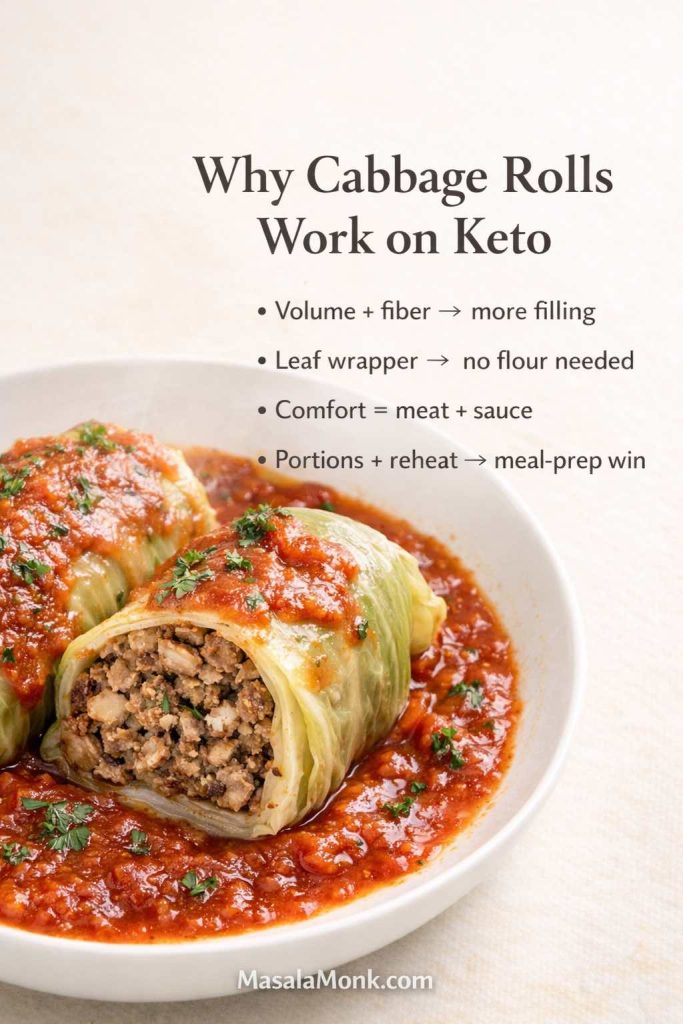
Keto cabbage rolls in a rich tomato garlic paprika sauce, one roll sliced open to show the meat filling. Text overlay reads “Why Cabbage Rolls Work on Keto” with bullets: volume + fiber = more filling, leaf wrapper = no flour needed, comfort = meat + sauce, portions + reheat = meal-prep win. MasalaMonk.com at bottom.
Why cabbage rolls work so well on keto: cabbage gives you volume + fiber without flour, and the “real comfort” still comes from meat + sauce. Use this quick cheat sheet when you’re deciding what to cook for the week—cabbage rolls portion cleanly, reheat beautifully, and stay satisfying even without rice.

Why the format stays satisfying even without rice

Even when spice blends change, the concept stays consistent: cabbage leaves stuffed with something rich, then cooked in a flavorful sauce until everything melds. That’s exactly the kind of dish that adapts beautifully to keto-friendly cooking, because the original structure doesn’t rely on breading or flour. Instead, you’re mostly adjusting the filling and the sauce while keeping the comfort intact.

From a nutrition standpoint, cabbage is also a practical base. It’s low calorie and fiber-rich, and it tends to make meals feel more filling—useful if you’re aiming for weight loss without feeling like you’re eating tiny portions. Cleveland Clinic’s overview of cabbage highlights its fiber and nutrient profile and explains why it can support a healthier eating pattern when used in satisfying meals: the health benefits of cabbage.

Meanwhile, cabbage rolls also make sense for meal prep. They portion cleanly, reheat well, and often taste even better after a rest. If you’re the kind of person who does better with a plan, they’re the sort of anchor dinner that makes the rest of the week easier.

Cabbage is one of the easiest low-carb staples to build meals around, and it does more than just “fill space.” If you want to go deeper on the nutrition side—fiber, nutrients, and why it works so well in everyday keto cooking—here’s a fuller guide on why cabbage is a staple in the keto kitchen.

Also Read: Eggless Yorkshire Pudding (No Milk) Recipe


Keto cabbage rolls versus cabbage rolls with rice: the swap that keeps the comfort

Traditional stuffed cabbage rolls with rice are built around a familiar equation: meat + rice + seasonings + cabbage + tomato sauce. Sometimes the rice goes in uncooked, sometimes it’s partially cooked first. Either way, rice is there for bulk and to absorb juices.

However, rice is not the heart of cabbage rolls. The heart is the combination of tender cabbage and savory filling, plus the sauce that soaks into everything. So the strategy here is simple: keep what matters, replace what doesn’t.

To be clear, there’s nothing wrong with classic stuffed cabbage rolls with ground beef and rice if that’s how you cook. They’re a classic stuffed cabbage recipe for a reason. Yet if you want cabbage rolls that are keto compatible, you’re looking for a filling that stays moist, holds together, and doesn’t taste “substitution-y.”

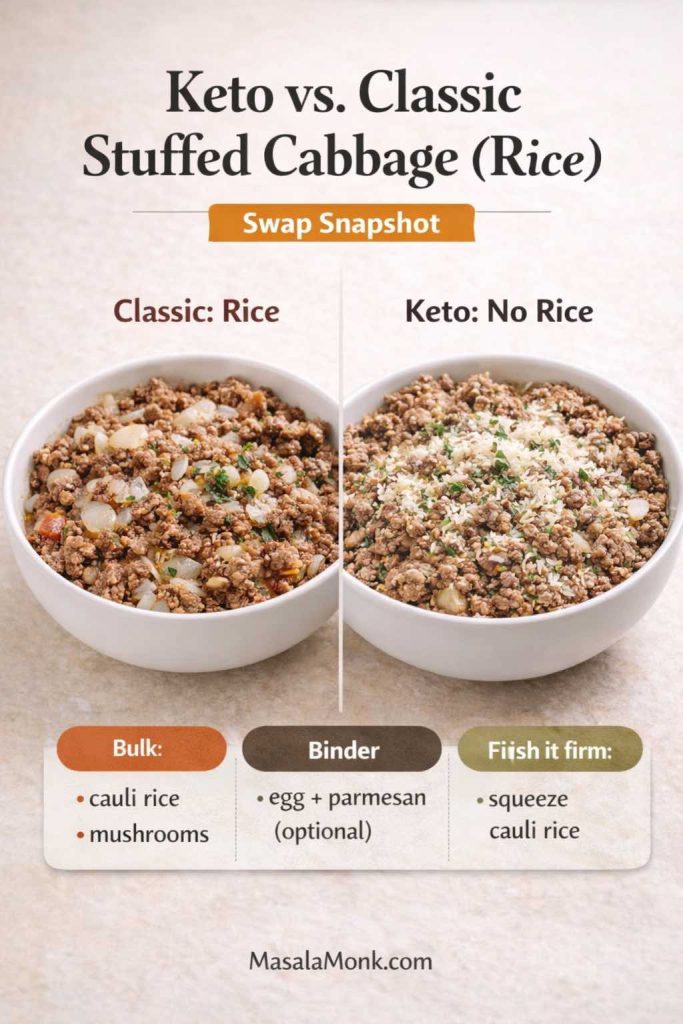
Side-by-side photo of two bowls of stuffed cabbage roll filling. Left bowl labeled “Classic: Rice” shows ground beef mixed with rice, onion, and herbs. Right bowl labeled “Keto: No Rice” shows ground beef with cauliflower rice, mushrooms, and parmesan. Text overlay says “Keto vs. Classic Stuffed Cabbage (Rice) — Swap Snapshot” with tips: bulk (cauli rice, mushrooms), binder (egg + parmesan optional), and keep it firm (squeeze cauliflower rice). MasalaMonk.com footer.
If you grew up on stuffed cabbage rolls with ground beef and rice, this is the exact swap that keeps the comfort: replace rice with squeezed cauliflower rice + finely chopped mushrooms for bulk and moisture, and use egg + parmesan (optional) when you want the filling extra tight. It tastes like the classic version—just lighter, lower carb, and less likely to turn watery in the pan.

What replaces rice in keto-friendly cabbage rolls?

You have a few excellent options, and you can mix them depending on what you like:

  • Cauliflower rice is the closest texture match. It bulks the filling without bringing carbs, and it disappears into the meat once baked.
  • Finely chopped mushrooms bring moisture and umami. They make the filling taste deeper, almost like it simmered longer.
  • Riced broccoli or finely shredded zucchini can work too, although zucchini needs to be squeezed well so it doesn’t water out the filling.
  • A small amount of grated parmesan or other hard cheese adds richness and helps bind.

Rice is mostly there for bulk and to soak up juices, not because it’s the “main flavor.” If you want a clearer sense of how rice compares to other options—and why swapping it out doesn’t change the comfort of the dish—this quick breakdown of quinoa vs rice and lower-carb alternatives

The point isn’t to mimic rice perfectly. Instead, it’s to build a filling that feels right: juicy, savory, substantial, and not crumbly. Once you do that, you’re no longer “making keto cabbage rolls.” You’re simply making cabbage rolls—ones that happen to be low carb.

Also Read: Crock Pot Chicken Breast Recipes: 10 Easy Slow Cooker Dinners (Juicy Every Time)


Ingredients for tender, flavorful keto-friendly cabbage rolls

Before the steps, it helps to understand what each ingredient is doing. That’s what makes these rolls reliable, even if you swap meats or choose a different twist.

The cabbage (and the best cabbage for cabbage rolls)

Most cabbage roll recipes start with green cabbage, and it’s still the most forgiving choice.

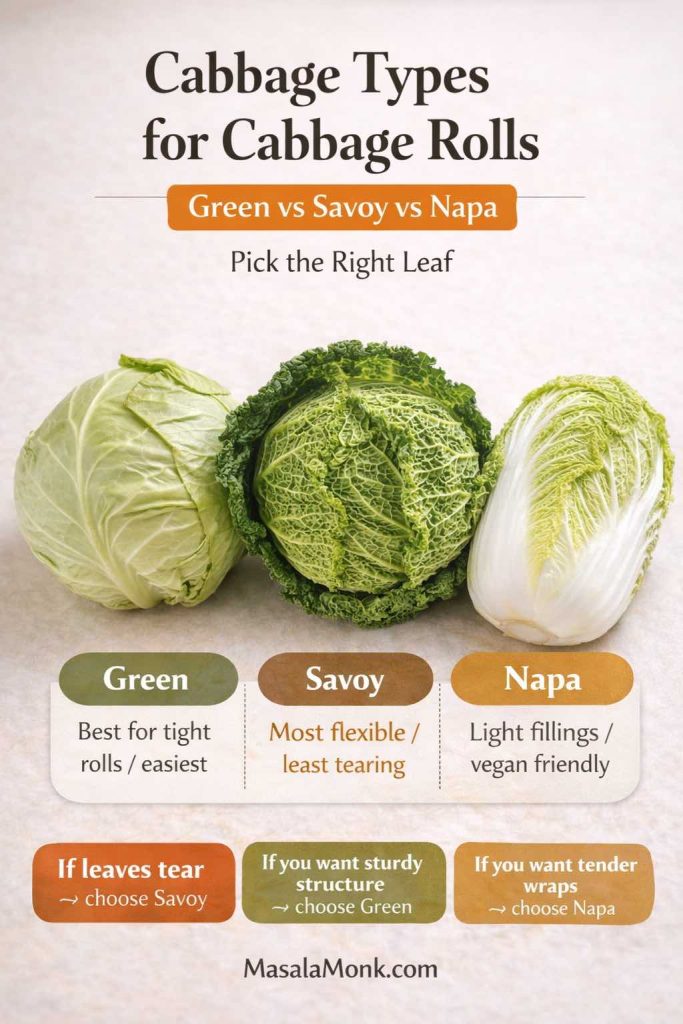
Infographic titled “Cabbage Types for Cabbage Rolls: Green vs Savoy vs Napa.” Three photos show green cabbage, savoy cabbage, and napa cabbage. Labels say: Green—best for tight rolls and easiest; Savoy—most flexible and least tearing; Napa—best for light fillings and vegan friendly. Bottom tips say: if leaves tear choose Savoy; for sturdy structure choose Green; for tender wraps choose Napa. MasalaMonk.com at bottom.
Choosing the right cabbage makes rolling feel easy. Use this quick picker: Green cabbage is the sturdy classic for tight rolls, Savoy is the most flexible (best if your leaves tear), and Napa is tender and great for lighter or vegan fillings. Pick the leaf first—then the rest of the recipe becomes simple.
  • Green cabbage: sturdy leaves, easy to roll, holds up well in oven or slow cooker.
  • Savoy cabbage: softer leaves that bend easily; it’s great if you want less wrestling while rolling.
  • Napa cabbage: thinner and more delicate; it’s especially good for vegan cabbage rolls or lighter fillings, though it can tear if overcooked.

If you’ve ever been frustrated by cabbage leaves splitting, savoy is often the answer. On the other hand, if you want maximum structure for a pan of stuffed cabbage in a thick sauce, green cabbage is the steady classic.

The filling (protein and flavor)

This recipe works with different meats, and each one gives a slightly different result:

  • Ground beef: richest flavor, most forgiving texture, classic “stuffed cabbage” taste.
  • Ground turkey: lighter but still satisfying; it benefits from extra fat and bold seasoning.
  • Ground pork: juicy and savory; paprika and garlic love pork.
  • Beef + pork blend: especially good for a more traditional European feel.
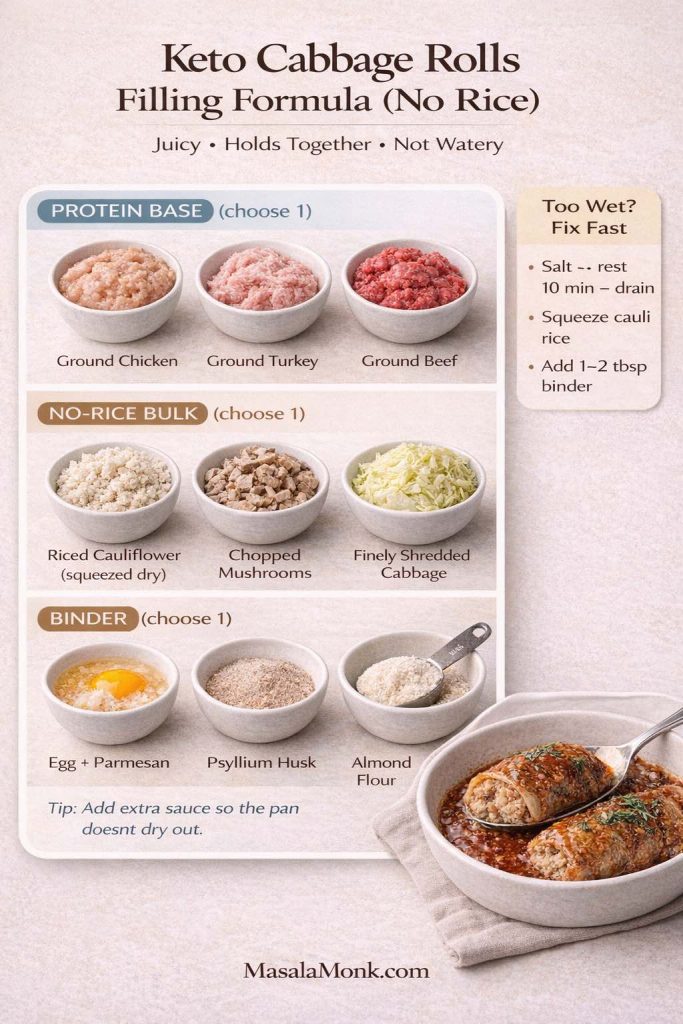
Infographic titled “Keto Cabbage Rolls Filling Formula (No Rice)” showing a mix-and-match chart: choose 1 protein (ground chicken, turkey, or beef), choose 1 no-rice bulk (riced cauliflower squeezed dry, chopped mushrooms, or finely shredded cabbage), and choose 1 binder (egg + parmesan, psyllium husk, or almond flour). Includes “Too wet? Fix fast” tips and a serving photo of cabbage rolls in tomato sauce.
This “no-rice” filling formula makes keto cabbage rolls that stay juicy without turning watery. Pick your protein, pick your bulk (cauli rice, mushrooms, or extra cabbage), then lock it together with the right binder (egg + parmesan, psyllium, or almond flour). Use the quick “too wet” fixes before you roll—so the cabbage wraps bake up neat, tender, and saucy every time.

To keep the filling cohesive without rice, you’ll use:

  • Egg as a binder (optional but helpful)
  • Cauliflower rice and/or chopped mushrooms for bulk
  • Garlic and paprika as the core flavor signature
  • Salt and pepper for structure (salt does more than people think here)

Meat choice changes the whole feel of cabbage rolls. Beef and pork tend to stay richer and more satisfying, while turkey usually needs a little extra fat and bold seasoning to keep the filling juicy. If you’ve noticed fattier meats keep you full longer, there’s a real reason for that—here’s a deeper look at beef and the keto diet.

The sauce (tomato comfort without the sugar reliance)

Many classic cabbage rolls rely on a sweet-leaning tomato sauce. On keto, you can still use tomatoes; the trick is building depth with garlic, paprika, broth, and fat rather than sugar. When done well, the sauce tastes like the cozy “cabbage rolls in tomato soup” style people love—round, mellow, and comforting.

Also Read: Sourdough Starter Recipe: Make, Feed, Store & Fix Your Starter (Beginner Guide)


How to soften cabbage leaves: three practical methods

This is where cabbage rolls either feel easy or feel impossible. The truth is that softening cabbage leaves is straightforward once you choose the method that fits your life.

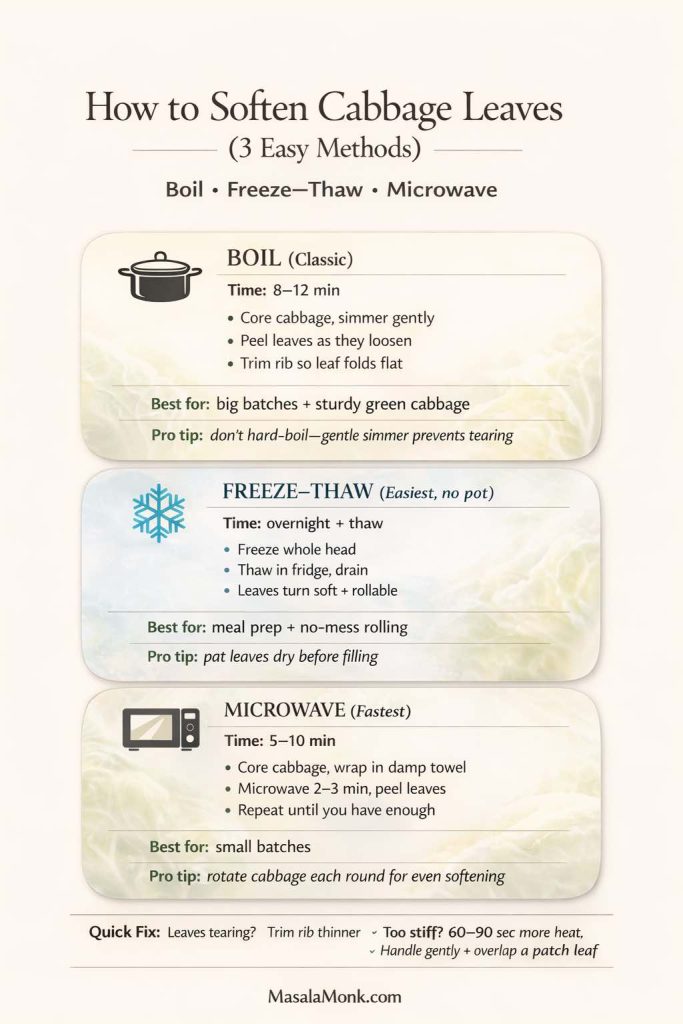
Infographic showing three ways to soften cabbage leaves for cabbage rolls: boiling (8–12 minutes), freeze–thaw method (freeze whole head, thaw to make leaves rollable), and microwave method (wrap in a damp towel and heat in short rounds). Includes quick fixes for torn leaves, stiff leaves, and overly soft leaves.
Soft cabbage leaves = rolls that don’t tear. Use this quick method picker to choose the best way to prep cabbage for cabbage rolls: boil (classic + reliable), freeze–thaw (quietly the easiest), or microwave (fastest for small batches). The “quick fix” line at the bottom saves you when leaves rip or feel stiff—so rolling stays calm and the pan bakes up neat.

Method 1: Boiling (the classic approach)

Bring a large pot of water to a gentle boil. Core the cabbage, then lower the whole head into the water. After a few minutes, the outer leaves will loosen. Use tongs to peel them off as they soften.

Once you have enough leaves, trim the thick rib at the base of each leaf. Rather than cutting it out completely (which can weaken the leaf), slice it down so the leaf lies flatter and rolls more easily.

Boiling is reliable, and it works with any cabbage variety. Still, it requires a big pot and a little patience.

Method 2: Freeze and thaw (quietly the easiest way to make cabbage rolls)

If you want the easiest way to make cabbage rolls without boiling water, freeze the whole head of cabbage overnight, then thaw it in the fridge. The freezing breaks down cell walls, which means the leaves become flexible and rollable once thawed.

This method is also excellent if you’re doing cabbage rolls for freezing later, because you’re already in a meal prep mindset. It feels like a small trick, yet it changes everything: the leaves soften without a pot of water, and you can prep when you have time rather than when you’re hungry.

Method 3: Microwave (the fastest shortcut)

Core the cabbage, wrap it in a damp towel, and microwave for a few minutes. Peel off softened leaves, then repeat until you have enough.

Microwave softening is quick and surprisingly effective. It’s also helpful if you’re making a small batch and don’t want to boil a huge pot of water.

If you’re newer to low carb cooking and want quick clarity on what counts as keto-friendly (and what doesn’t), these keto diet FAQs

Also Read: How to make No-Bake Banana Pudding: No Oven Required Recipe


The base keto cabbage rolls recipe (oven baked)

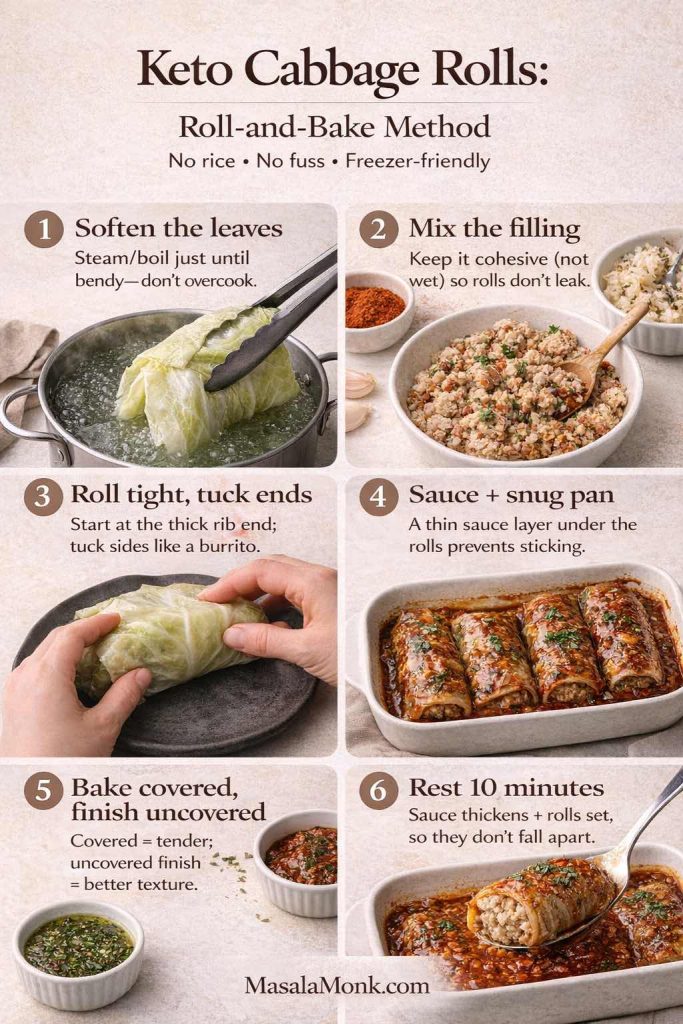
This is the core method. After you make it once, the twists become easy, because you’re no longer learning how to roll—you’re simply changing the flavor.

Roll-and-bake keto cabbage rolls, made simple: soften the leaves, mix a tight (not wet) filling, roll and tuck, then bake covered and finish uncovered for the best texture. This quick visual is the “don’t-mess-it-up” guide for sturdy rolls that hold together—especially if you’re meal-prepping or freezing a batch.

Ingredients (base)

For the cabbage rolls

  • 1 large green cabbage (or savoy)
  • 680 g / 1.5 lb ground beef (or turkey or pork)
  • 3–5 cloves garlic, finely minced or grated
  • 2 teaspoons paprika (sweet or smoked)
  • 1 teaspoon salt, plus more as needed
  • 1/2 teaspoon black pepper
  • 1 1/2 cups cauliflower rice (fresh, or thawed and squeezed dry)
  • 1/2 cup finely chopped mushrooms (optional but recommended for juiciness)
  • 1 egg (optional binder)
  • 1/3 cup grated parmesan (optional, helps bind and adds richness)
  • 2 tablespoons chopped parsley (optional)

For the sauce

  • 2 cups crushed tomatoes or tomato passata
  • 1 cup broth (beef or chicken)
  • 1 tablespoon tomato paste (optional, for deeper tomato flavor)
  • 1–2 tablespoons olive oil or butter
  • 1 teaspoon paprika
  • 1/2–1 teaspoon garlic powder (or another clove of garlic, minced)
  • Salt and pepper to taste
  • Optional: a splash of vinegar for balance

Step 1: Prep the cabbage leaves

Use one of the softening methods above. Once the leaves are pliable, trim the thick rib near the base so each leaf rolls without cracking.

Set leaves aside while you make the filling.

Step 2: Make the filling

In a large bowl, combine ground meat, garlic, paprika, salt, pepper, cauliflower rice, mushrooms (if using), egg (if using), and parmesan (if using). Mix gently until combined.

Mixing too aggressively can make the filling dense. Instead, fold everything together until it looks even, then stop.

Step 3: Roll

Lay a cabbage leaf flat. Place a portion of filling near the base. Fold the sides in, then roll up tightly. Place seam-side down in a baking dish.

Continue until you’ve used your leaves and filling. If you have extra small or torn leaves, tuck them around the rolls in the dish—those bits often become the best parts after baking.

Step 4: Make the sauce

In a bowl or measuring jug, whisk crushed tomatoes, broth, tomato paste, olive oil or butter, paprika, garlic, salt, and pepper. Taste it. You want it slightly stronger than you think you need, because it will mellow as it cooks.

Pour sauce over the rolls. Cover the dish tightly with foil.

Step 5: Bake

Bake at 190°C / 375°F until the cabbage is tender and the filling is cooked through. The time will vary based on roll size and meat choice, but 55–75 minutes is common for oven cabbage rolls.

For a thicker sauce, uncover the dish for the last 10–15 minutes to let it reduce slightly.

Food safety, written in a way that doesn’t interrupt dinner

Because these are rolls made with ground meat, safe internal temperature matters. USDA guidance for ground beef food safety recommends cooking ground beef to 160°F / 71°C. For ground turkey and other poultry, USDA’s turkey safe cooking guidance points to 165°F / 74°C. A thermometer makes this effortless, and it removes the guesswork.

If you’re cooking once and reheating during the week, USDA’s notes on leftovers and food safety reinforce reheating leftovers to 165°F / 74°C. That’s especially useful for soup and casserole versions, where it’s easy to assume the middle is hot when it isn’t.

Also Read: Chicken Adobo — Step-by-Step Recipe — Classic Filipino Adobong Manok


The sauce that tastes like “tomato soup” cabbage rolls—without leaning on sugar

Some cabbage roll casseroles and soups are famous for tasting like tomato soup, even when they’re not made with canned soup. That flavor comes from a few details working together: enough tomato concentration, a savory broth backbone, paprika’s gentle sweetness, and fat to round out acidity.

If your sauce tastes too sharp, a small splash of vinegar can actually help, because it adds a clean acidity that makes tomato taste more “complete.” Meanwhile, finishing with olive oil or a little butter can soften everything so the sauce tastes rich rather than harsh.

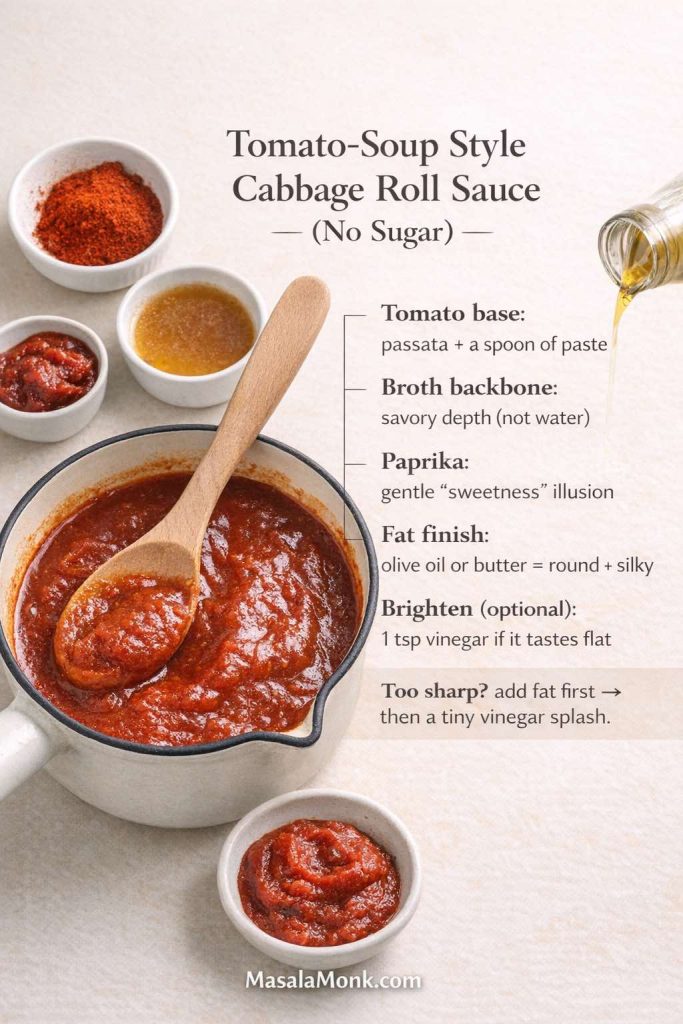
Tomato-soup style cabbage roll sauce in a small pot on a cream background with paprika, tomato paste, broth, and olive oil nearby. Text overlay lists the formula: passata + paste, broth for savory depth, paprika for “sweetness,” finish with olive oil or butter, and optional vinegar to brighten if the sauce tastes flat.
Want that cozy “tomato soup” cabbage-roll sauce without adding sugar? This visual nails the formula: concentrate the tomato base (passata + a spoon of paste), use broth for depth, lean on paprika for gentle warmth, then finish with olive oil or butter to round the acidity. If it tastes sharp or flat, add fat first—then a tiny vinegar splash to brighten.

If you want a credible external reference on why olive oil is often considered a strong everyday fat choice, Harvard Health’s article on extra-virgin olive oil offers a balanced take. For a broader “what fats matter most” reference, Harvard’s Nutrition Source overview of types of dietary fats is a solid citation that avoids fad language while still supporting a keto-friendly approach that focuses on quality.

When you’re serving cabbage rolls, something crunchy on the side is always welcome. A quick slaw is a natural pairing, and if you want a creamy base without fuss, MasalaMonk’s eggless mayonnaise makes a useful recipe – if you want want a simple dressing foundation and if you are not avoiding eggs, then have a look at Mayo Recipe: 15+ Homemade Mayonnaise Variations.


Five savory garlic and paprika twists (same method, different dinner)

Now for the fun part. Each of these twists starts from the base keto-friendly cabbage rolls recipe above. In other words, you’re not learning five different recipes. You’re choosing one flavor direction, then making small changes to the filling and sauce.

Because the base is already bold, the twists don’t need many extra ingredients. The goal is to keep the dish cohesive: cabbage, savory filling, tomato-based sauce, and one clear flavor identity.

Twist 1: Smoky garlic and paprika (deep, cozy, and bold)

If you like cabbage rolls that taste almost grilled—dark, savory, and rich—this is the direction.

Best meat choice: ground beef or ground pork
Add to the filling:

  • 1 teaspoon smoked paprika (in addition to the base paprika)
  • 1/2 teaspoon cumin
  • Optional: 1 teaspoon mustard (Dijon works well)
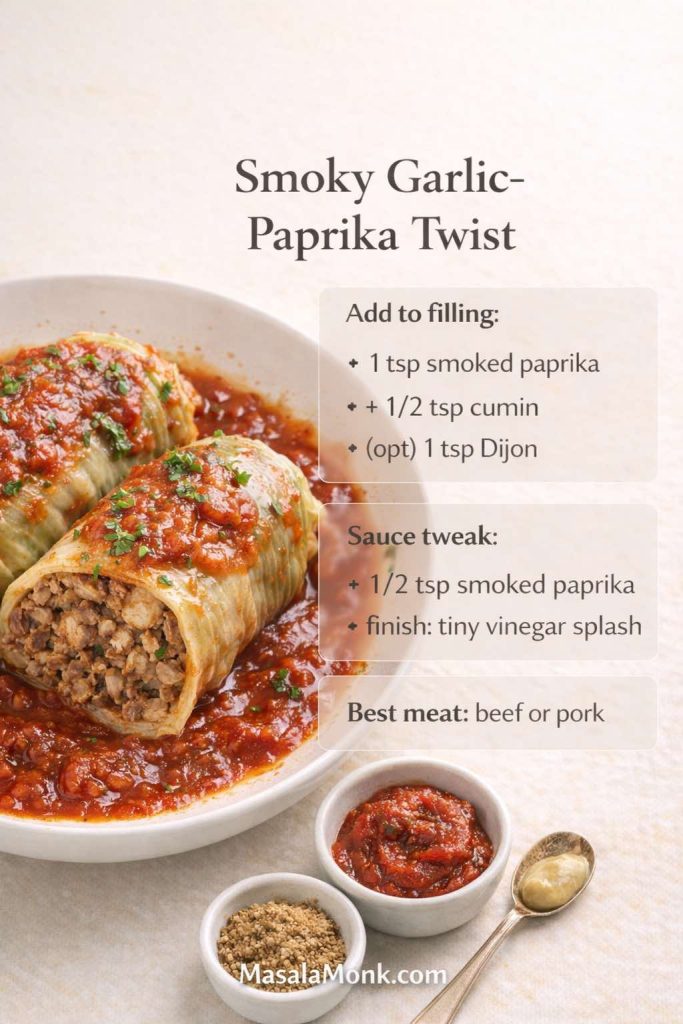
Smoky garlic–paprika keto cabbage rolls in rich tomato sauce, shown as two rolls on a plate (one cut open). Text overlay lists the twist: add 1 tsp smoked paprika, 1/2 tsp cumin, optional 1 tsp Dijon to the filling; sauce tweak adds 1/2 tsp smoked paprika and a small vinegar splash; best meat: beef or pork. MasalaMonk.com footer.
Twist #1 (Smoky): Want cabbage rolls that taste almost “grilled”? Add smoked paprika + a touch of cumin to the filling (optional Dijon for depth), then finish the sauce with an extra pinch of smoked paprika + a tiny vinegar splash. It keeps the rolls bold and cozy—and they taste even better on day two.

Adjust the sauce:

  • Add another 1/2 teaspoon smoked paprika
  • Finish with a small splash of vinegar

Smoked paprika adds a “slow-cooked” illusion. Meanwhile, vinegar keeps the sauce from feeling heavy. This twist is particularly good if you’re someone who likes robust flavors and wants a dish that still tastes exciting on day three.

If you’re in the mood for more hearty, high-protein keto dinners that reheat well, you’ll probably like these beef recipes for a weight loss keto plan.

Twist 2: Tangy sauerkraut garlic paprika rolls (a nod to Polish comfort)

Sauerkraut turns cabbage rolls into a different kind of comfort—bright, tangy, and deeply savory. This twist is inspired by the flavors people love in cabbage rolls with sauerkraut, stuffed cabbage and sauerkraut bakes, and many traditional Polish-style cabbage rolls, without trying to claim one strict “authentic” blueprint.

Best meat choice: beef + pork blend, or pork alone
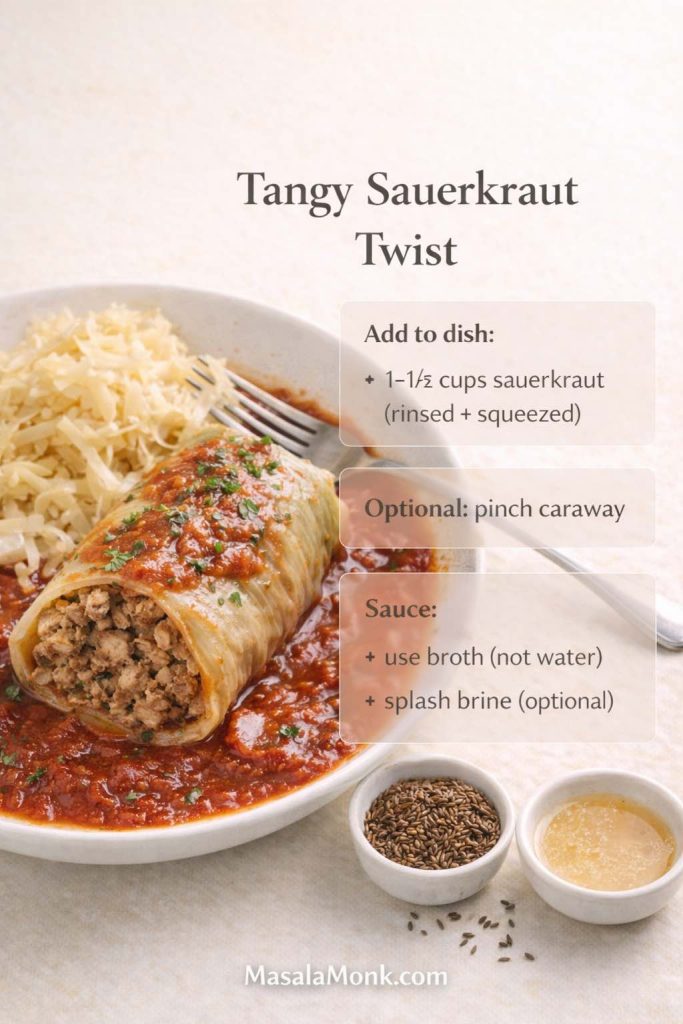
Add to the baking dish:

  • 1 to 1 1/2 cups sauerkraut, rinsed and squeezed dry
  • Optional: a pinch of caraway seed
Tangy sauerkraut keto cabbage rolls in rich tomato sauce on a plate, shown with a side of sauerkraut plus small bowls of caraway seeds and sauerkraut brine. Text overlay reads “Tangy Sauerkraut Twist” with notes: add 1–1½ cups rinsed, squeezed sauerkraut; optional pinch of caraway; use broth (not water) and add a splash of brine.
Want the Polish-comfort vibe without changing the base method? This tangy sauerkraut twist shows exactly what to add: 1–1½ cups rinsed + squeezed sauerkraut, an optional pinch of caraway, and a broth-based sauce with a small brine splash for brighter, deeper flavor—without turning the pan watery.

Adjust the sauce:

  • Use broth rather than water so the tang stays balanced
  • Add a splash of sauerkraut brine for more bite, if you like

Sauerkraut makes the whole dish taste brighter. It’s also a smart trick if someone in your house thinks cabbage rolls can taste “one-note.” This version is anything but.

Twist 3: Sour cabbage leaves and “sarma-inspired” flavor (bright, savory, addictive)

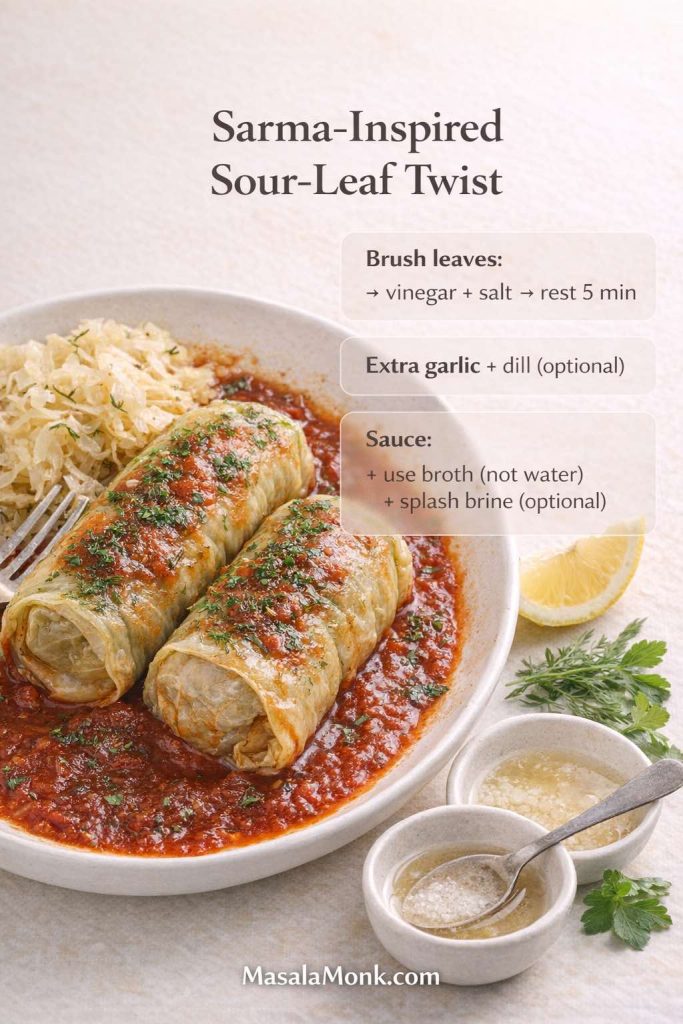
Sarma rolls often use sour cabbage leaves, which brings a tang that feels uniquely satisfying with meat. If you can find sour cabbage leaves, use them. If not, you can mimic the effect by brushing softened cabbage leaves with a little vinegar and salt, then letting them rest briefly before filling.

Best meat choice: pork or turkey
Add to the filling:

  • Extra garlic (one more clove)
  • Optional: dried dill, mint, or parsley
Sarma-inspired keto cabbage rolls on a light plate in rich tomato sauce, topped with herbs, with a lemon wedge and small bowls of vinegar and salt beside them. Text overlay highlights the “sour-leaf” trick: brush cabbage leaves with vinegar + salt and rest briefly, plus optional extra garlic and dill.
Sarma-inspired sour-leaf twist: If you can’t find sour cabbage leaves, this is the clean workaround—brush softened leaves with vinegar + salt, rest 5 minutes, then roll as usual. The result tastes brighter and more addictive, without changing the base method.

Adjust the sauce:

  • Keep the sauce slightly looser; it will reduce as it bakes
  • Finish with a small squeeze of lemon if you want a brighter edge

The result is tangy without being sharp. It also feels lighter than a pure beef version, which makes it a strong option if you want keto cabbage rolls that don’t sit too heavy.

Twist 4: Spicy garlic paprika rolls (for heat lovers)

If your goal is to make cabbage rolls that feel energizing rather than sleepy, add heat. Spicy cabbage rolls can still be comforting; they just also happen to be exciting.

Best meat choice: beef or turkey
Add to the filling:

  • 1/2 to 1 teaspoon cayenne (start small)
  • 1 teaspoon chili flakes
“Two keto cabbage rolls in rich tomato sauce on a light background with chili flakes and parsley; text overlay reads ‘Spicy Garlic–Paprika Twist’ with tips: add 1/2–1 tsp cayenne (start small) + 1 tsp chili flakes, sauce tweak with chili flakes or chili oil, and optional balance with sour cream/yogurt; MasalaMonk.com footer.”
Spicy Garlic–Paprika Twist: Turn the base keto cabbage rolls into a heat-lover’s version by adding cayenne + chili flakes to the filling, then finishing the sauce with a little chili oil if you want extra punch. The “optional balance” tip (a spoon of sour cream/yogurt) is the fastest way to keep the sauce tasting rich—not harsh—while the rolls stay bold and satisfying.

Adjust the sauce:

  • Add chili flakes or a little chili oil
  • Keep garlic forward

This variation is also useful when you’re eating low carb and you miss “snacky” flavors. Heat and spice create the kind of satisfaction that helps you forget you’re even thinking about carbs.

Twist 5: Mediterranean herb garlic paprika rolls (fresh, fragrant, still cozy)

This twist leans into herbs rather than tang or smoke. It’s still tomato-based and still boldly seasoned, but the finish feels brighter and more fragrant.

Best meat choice: ground turkey (or lean beef)
Add to the filling:

  • 2 teaspoons oregano
  • 1 teaspoon thyme
  • Optional: lemon zest
Mediterranean herb garlic-paprika keto cabbage rolls in rich tomato sauce, topped with chopped herbs and olive oil. Text overlay lists: add oregano, thyme, optional lemon zest; finish with olive oil and herbs; serve with chimichurri or pesto. MasalaMonk.com footer.
Mediterranean Herb Twist (fresh, fragrant, still cozy): Add oregano + thyme (and optional lemon zest) to the base garlic-paprika filling, then finish the baked rolls with a drizzle of olive oil + chopped herbs. The little bowl of chimichurri (or pesto) is the “dinner-party” shortcut—bright, garlicky, and perfect with tomato sauce. (Save/Pin this twist so you can swap flavors without relearning the recipe.)

Adjust the sauce:

  • Finish with a drizzle of olive oil and chopped herbs

For a punchy finishing sauce that fits perfectly here, a spoon of chimichurri on the side is almost unfairly good—garlic, herbs, acidity, and brightness, all in one. It’s especially helpful if you want the rolls to feel a bit more “dinner party” without changing the main recipe.

Herb-forward sauces are especially good with this version. If you like that kind of bright, garlicky finish, these pesto recipes are a great match alongside cabbage rolls.

Also Read: Sourdough Recipe: 10 Easy Bread Bakes (Loaves, Rolls & Bagels)


Cabbage roll soup and unstuffed cabbage roll soup (same flavors, easier weeknights)

Some nights, rolling feels like therapy. Other nights, it feels like too much. That’s where the soup version steps in.

Unstuffed cabbage roll soup—sometimes called unrolled cabbage soup, stuffed cabbage roll soup, or simply cabbage roll soup—is essentially the same recipe expressed differently. You still get garlic, paprika, tomato, tender cabbage, and savory meat. You’re just skipping the wrapping.

A bowl of unstuffed cabbage roll soup with ground beef, tender cabbage, tomatoes, and herbs in a tomato broth. Text overlay reads “Unstuffed Cabbage Roll Soup (Keto + One Pot)” plus a quick recipe card showing ingredients, 5 steps (brown beef with garlic and paprika, add cabbage, add tomatoes and broth, simmer, stir in cauliflower rice at end), and meal prep notes (fridge 4 days, freeze 3 months).
Want cabbage roll comfort without rolling? This unstuffed cabbage roll soup is the one-pot shortcut: ground beef + cabbage + tomato broth + garlic + paprika, finished with cauliflower rice at the end so it stays pleasantly textured. Save this card for busy nights—then scroll for baked rolls, casserole, skillet, and slow cooker versions in the same flavor family.

Unstuffed cabbage roll soup (keto-friendly method)

What you’ll do:

  1. Brown ground beef, turkey, or pork in a pot with garlic, paprika, salt, and pepper.
  2. Add chopped cabbage and stir until it begins to soften.
  3. Pour in crushed tomatoes and broth.
  4. Simmer until the cabbage is tender.
  5. Stir in cauliflower rice near the end, so it stays pleasantly textured rather than mushy.

Because this is a soup roll in spirit—cabbage roll flavors in a bowl—it works beautifully as a high-protein meal prep option. It also freezes well.

If you like cooking once and coasting for a few days, you might also enjoy these crock pot chicken breast recipes.

When you store soup for the week, safe reheating matters. FoodSafety.gov’s chart of safe minimum internal temperatures supports the common recommendation to reheat leftovers to 165°F / 74°C, which is especially relevant for meat-based soups.

Also Read: Peanut Butter Fudge: Recipes & Guide (8 Methods + Easy Variations)


Cabbage roll casserole: deconstructed, layered, and effortless

Cabbage roll casserole is the lazy cousin of stuffed cabbage rolls, and it’s a gift. It gives you the same taste profile without the rolling step. That’s why you’ll see it described as unrolled cabbage casserole, deconstructed cabbage roll casserole, or even “cabbage roll in a pan.”

This is also the format that best captures cravings for “easy cabbage casserole recipes” and “cabbage casserole with hamburger meat,” while staying firmly in keto-friendly territory.

Photoreal cabbage roll casserole in a glass baking dish with saucy ground beef, tomatoes, and tender cabbage, topped with melted golden cheese. Text overlay reads “Cabbage Roll Casserole (Unrolled) — Layer + Bake” and shows quick cards: layer order (cabbage → meat → sauce → repeat), bake at 190°C/375°F covered 45–55 minutes then uncover 10–15 minutes, and “keep it thick” tips (squeeze cauliflower rice, add tomato paste). MasalaMonk.com footer.
If you want stuffed cabbage flavor without rolling, this cabbage roll casserole (unrolled) is the lazy-night win: layer cabbage + meat filling + sauce, bake covered until tender, then uncover briefly to thicken. The “keep it thick” tips prevent the #1 casserole problem (watery sauce), so you get a rich, spoonable result that reheats beautifully.

Keto cabbage roll casserole method (unrolled)

  1. Brown your ground meat with garlic, paprika, salt, and pepper.
  2. Stir in cauliflower rice and mushrooms (if using).
  3. In a baking dish, layer chopped cabbage and the meat mixture.
  4. Pour sauce over the top.
  5. Cover and bake until the cabbage is tender.
  6. Uncover near the end so the sauce thickens.

If you love a richer casserole, you can add cheese on top for a “cabbage rolls with cheese” feel—still very much in the spirit of cheese stuffed cabbage rolls, just without the fiddly wrapping.

Also Read: Best Vermouth for a Negroni Cocktail Drink Recipe


Skillet cabbage rolls and “cabbage roll in a bowl” (fast comfort)

Sometimes you want “stuffed cabbage” flavor in under 30 minutes. Skillet cabbage rolls—also described as cabbage roll in a skillet, cabbage roll skillet recipe, or cabbage roll in a bowl—deliver exactly that.

Skillet filled with “cabbage roll in a bowl” mixture: ground beef, tender cabbage, tomatoes, and herbs in a saucy garlic-paprika tomato base. Text overlay reads “Skillet Cabbage Rolls (In a Bowl) — 25 minutes • One pan” and includes quick steps: brown beef with garlic and paprika, add cabbage, add tomato + broth and simmer, finish with olive oil/sour cream/parmesan. Note says cauliflower rice is optional—add in the last 3 minutes. MasalaMonk.com footer.
When you want stuffed cabbage flavor fast, this skillet cabbage roll in a bowl hits the same comfort notes in one pan—garlic, paprika, tomato, tender cabbage, and savory beef—without rolling or baking. Keep this visual handy for weeknights, then use the rest of the post to choose your “format”: baked rolls, soup, casserole, slow cooker, and freezer-friendly prep.

The method is simple: brown meat with garlic and paprika, add shredded cabbage, pour in tomato and broth, then simmer until everything turns saucy and tender. You can finish with olive oil, sour cream, or parmesan, depending on your mood.

This is also one of the most forgiving versions if you’re using lean meat. Because the dish is saucy, you can adjust richness right at the end.

Also Read: Keto Flour: Guide to Low-Carb Flours That Bakes Like the Real Thing


Slow cooker cabbage rolls and crock pot cabbage roll casserole

Cabbage rolls in a slow cooker feel like a different kind of comfort. The cabbage becomes extra tender, the sauce sinks deeper into the filling, and the whole dish tastes like it spent the day becoming itself.

If you’re making cabbage roll crock pot style, the main difference is liquid management. Slow cookers trap moisture, so sauces tend to thin out unless they start thicker.

Photoreal slow cooker filled with cabbage rolls in rich tomato sauce, sprinkled with herbs, with steam rising. Text overlay reads “Slow Cooker Cabbage Rolls — No watery sauce” and shows three tip boxes: layering (sauce bottom → rolls → sauce top), start thicker (less broth + tomato paste), and finish to thicken (crack lid last 30–45 min to reduce). A thermometer icon notes safe internal temperature for ground meat. MasalaMonk.com footer.
Slow cooker cabbage rolls are effortless—until the sauce turns thin. Use this quick guide to keep crock pot stuffed cabbage rich and spoonable: layer sauce on the bottom and top, start with a thicker tomato base, and crack the lid near the end to reduce. It’s the easiest way to get slow-cooked tenderness without the “watery soup” problem.

Slow cooker stuffed cabbage rolls (keto-friendly)

  • Make and roll the cabbage rolls as usual.
  • Layer sauce on the bottom, then rolls, then more sauce.
  • Cook on low until the cabbage is very tender and the filling is safely cooked through.

Crock pot cabbage roll casserole (unstuffed)

  • Layer chopped cabbage, browned filling, and sauce in the slow cooker.
  • Cook on low until tender.
  • If the sauce is too thin, crack the lid for the final stretch or stir in a small amount of tomato paste near the end.

Again, safe internal temperature guidance matters, especially when cooking ground meat. USDA’s references for ground beef and poultry/ground turkey are good citations to keep the recipe grounded.

Also Read: Whole Chicken in Crock Pot Recipe (Slow Cooker “Roast” Chicken with Veggies)


Freezing cabbage rolls, freezing cabbage for cabbage rolls, and meal prep that actually works

Cabbage rolls are one of the best “cook once, eat twice” dinners. They’re also one of the best “cook once, eat six times” dinners if you freeze them.

That matters, because meal prep is often where a low carb diet either becomes easy or becomes exhausting. When you have a freezer-friendly high-protein option that you genuinely enjoy, it’s much easier to stay consistent.

Infographic titled “Keto Cabbage Rolls: Freeze • Bake • Reheat” showing three steps: freeze unbaked rolls (cool filling, roll tight, tray-freeze 45–60 minutes, layer with parchment), bake from frozen (covered at 190°C/375°F for 40–45 minutes then uncover 10–15), and reheat options (oven, stovetop simmer, microwave last resort). Photos show unbaked rolls in a container and baked rolls in sauce.
Freezer-friendly keto cabbage rolls made easy: freeze unbaked, bake from frozen, then reheat without drying out. Use this quick chart to get the timing right, keep the rolls intact, and make meal-prep weeks feel effortless—no rice needed, just big comfort. (Perfect to save/print and great for batch cooking.)
Infographic photo showing two glass meal-prep containers of cabbage rolls: left is “Freeze Uncooked (Best texture)” with raw cabbage rolls and a cup of sauce; right is “Freeze Cooked (Fastest)” with baked cabbage rolls in tomato sauce. Text overlay includes: “Bake from frozen: covered 190°C/375°F 40–45 min + uncover 10–15,” “Prevent watery: squeeze cauliflower rice + cool before freezing,” and “Reheat: oven covered or gentle simmer (keeps juicy).” MasalaMonk.com at bottom.
Freezing cabbage rolls is the difference between “I’ll cook later” and actually having dinner ready. This quick visual shows the two best options: freeze uncooked for the best texture or freeze cooked for the fastest reheat, plus the exact bake-from-frozen timing. The “prevent watery” note is the big one—squeeze cauliflower rice and cool before freezing so your rolls stay firm, saucy, and satisfying.

Freeze the cabbage (a simple prep trick)

If you haven’t tried it, freezing cabbage for cabbage rolls is one of the easiest prep hacks available. Freeze the whole head, thaw it, and the leaves become pliable. You can prep leaves on a calm day, then roll and cook later when you’re busy.

Freezing stuffed cabbage rolls (uncooked)

Freezing uncooked rolls often gives the best texture because everything cooks fresh later.

  • Assemble the rolls in a freezer-safe dish.
  • Pour sauce over.
  • Wrap tightly.
  • Freeze.

When you bake, you can cook from frozen, simply allowing extra time. Keep the dish covered so the sauce doesn’t evaporate too quickly before the center heats.

Freezing cabbage rolls (cooked)

Freezing cooked cabbage rolls is the convenience route:

  • Let rolls cool fully.
  • Portion with sauce.
  • Freeze in containers.

To reheat, warm gently so the filling stays juicy rather than drying out. USDA’s guidance on leftovers and food safety and FoodSafety.gov’s temperature chart both support reheating leftovers to 165°F / 74°C for safety.

Also Read: Frozen Chicken Wings in Air Fryer (No Thaw) — Crispy From Frozen + Time & Temp


Vegan cabbage rolls, vegetarian cabbage rolls, and meatless stuffed cabbage that still feels hearty

Even though this post is built around keto cabbage rolls, it’s useful to include an option for households that mix diets. Maybe you’re eating low carb, while someone else wants a meatless version. Maybe you want a “lighter day” dinner that still has cabbage-roll comfort.

Vegan cabbage rolls and vegetarian cabbage rolls work especially well with napa cabbage or savoy cabbage, because the leaves are tender and the filling can be softer.

Vegan cabbage rolls in a rich tomato sauce on a white plate; one roll is cut open to show a hearty filling of crumbled tofu, mushrooms, and cauliflower rice. Text overlay reads “Vegan Cabbage Rolls (Still Hearty)” with notes: “Mushrooms = depth,” “Tofu = protein,” “Cauli rice = bulk,” and “Best leaves: Savoy (flexible) • Napa (tender).” MasalaMonk.com footer.
Vegan cabbage rolls that still eat like comfort food: tofu brings protein, mushrooms add deep savory flavor, and cauliflower rice gives that “bulk” without heaviness. If you’re cooking for a mixed table (keto + vegetarian/vegan), this is the easiest way to keep the cabbage-roll vibe consistent—same sauce, same cozy payoff, just a different filling.

A vegan, cabbage-roll-style filling that works

For a plant-forward approach, the goal is to create a filling that’s savory and satisfying:

  • Finely chopped mushrooms (for depth)
  • Crumbled tofu (for protein)
  • Cauliflower rice (for bulk)
  • Garlic and paprika (for continuity with the main recipe)
  • A binder such as ground flax mixed with water, if needed

You can bake these the same way, using the tomato sauce method above.

If you’re trying to keep a few plant-based, high-protein options in rotation, this list of plant-based protein sources for high-protein meal prep is full of practical ideas.

Also Read: Innovate Your Vegan Keto Breakfast: 5 Pistachio and Sunflower Seed Smoothie Recipes for Meal Replacement


Cabbage wraps, cabbage roll ups, and “cabbage wrap meat” shortcuts

Not everyone wants full baked cabbage rolls. Sometimes you want something quicker—something closer to a cabbage wrap recipe than a casserole. That’s where cabbage wraps come in.

You can think of cabbage wraps as a lighter, fresher cousin to baked cabbage rolls. Instead of cooking the rolls in sauce for an hour, you’re wrapping a cooked filling in softened leaves, then serving with a spoonable sauce.

Top-down food graphic titled “Cabbage Wraps (Keto) — No Bake Shortcut.” It shows a plate with two cabbage wraps filled with seasoned ground meat and topped with tomato sauce. On the side are softened cabbage leaves on a board, plus step labels: “Brown filling,” “Soften leaves,” “Wrap + spoon sauce,” and “Serve (or pack for lunch).” MasalaMonk.com appears at the bottom.
When you want stuffed cabbage roll flavor without baking, these keto cabbage wraps are the fastest move: brown the garlic-paprika filling, soften a few leaves, wrap, and spoon sauce over top. The 4-step strip makes this a true weeknight shortcut—and it doubles as a lunch idea when you pack wraps with a little sauce cup on the side.

Quick cabbage wraps (keto-friendly)

  1. Brown ground beef with garlic and paprika.
  2. Make a quick sauce in the same pan (tomato + broth + paprika + olive oil).
  3. Spoon filling into softened cabbage leaves.
  4. Wrap and serve with sauce over top.

This gives you the comfort without committing to a baking dish. It’s also a great lunch format because the wraps hold together well in containers.

Also Read: Keto Fiesta: Spicing up Your Meals with Flavorful Taco Pie and Creative Toppings!


A note on “cabbage balls” and stuffed cabbage balls (when you want bite-sized comfort)

Cabbage balls show up in a few different traditions, and they’re essentially cabbage roll filling expressed as a small ball, sometimes wrapped partially in cabbage or simmered in sauce.

For a keto-friendly cabbage balls recipe approach, you can do this:

  • Make the same garlic paprika filling.
  • Roll it into small balls.
  • Brown them quickly, then simmer in the tomato sauce until cooked through.

It’s the same flavor story, just a different shape. The advantage is speed: no leaf-by-leaf rolling. The tradeoff is that you lose some of the classic cabbage roll structure. Still, if someone loves the filling more than the wrap, cabbage balls can be a satisfying variation.

Also Read: Air Fryer Hard-Boiled Eggs (No Water, Easy Peel Recipe)


Making cabbage rolls taste “traditional” without being stuck in one tradition

Cabbage rolls are one of those foods where families are fiercely loyal to what they grew up with. One home might swear by sweet-and-sour Jewish stuffed cabbage. Another might prefer a paprika-forward Hungarian stuffed cabbage rolls recipe. Someone else might love sauerkraut-heavy Polish cabbage rolls. Meanwhile, German cabbage rolls and kohlrouladen recipes often lean into deeper, darker savory notes.

Keto cabbage balls (no-rice) simmering in chunky garlic-paprika tomato sauce in a cast-iron skillet, with a small bowl of sour cream on the side. Text overlay reads ‘Keto Cabbage Balls (No-Rice)’, ‘Same filling, faster shape’, ‘Roll • Sear • Simmer’, ‘20 minutes’, and ‘Keep it firm: squeeze cauliflower rice’. MasalaMonk.com at bottom.
Keto cabbage balls are the “same filling, faster shape” version of cabbage rolls: roll the no-rice mix into balls, sear for crust, then simmer in the tomato sauce until juicy. The one tip that prevents mushy meatballs is right here—squeeze cauliflower rice dry before mixing.

This garlic and paprika foundation sits comfortably in that broader family of flavors. Garlic shows up everywhere. Paprika bridges sweet and smoky. Tomato sauce ties the whole dish to the “stuffed cabbage” comfort zone.

So if you’ve been chasing a version that feels familiar—old fashioned cabbage rolls, traditional stuffed cabbage, classic cabbage roll recipe—this approach can scratch the same itch. It doesn’t claim to replace any one grandmother’s method. Instead, it gives you a dependable base with enough flexibility to feel personal.

Also Read: Baked Jalapeño Poppers (Oven) — Time, Temp & Bacon Tips


Serving ideas that keep cabbage rolls satisfying (and keto-friendly)

A pan of cabbage rolls is already a complete meal, yet the right side can elevate it:

  • A crunchy slaw with a creamy dressing (again, eggless mayonnaise is handy as a base)
  • A spoon of herb sauce like chimichurri for brightness
  • A drizzle of olive oil and fresh herbs for the Mediterranean twist
  • A sprinkle of parmesan or feta for richness

Keeping one good red sauce around makes weeknight dinners easier—cabbage rolls, skillet cabbage, meatballs, and more. If you like having options ready in the fridge, these pizza sauce recipes are worth saving.


Troubleshooting Cabbage Rolls that are Keto Friendly

Even with a solid recipe, cabbage rolls can go sideways if a few details are off. The fixes are straightforward, though, and once you know them, you rarely run into the same problem twice.

Troubleshooting infographic for keto cabbage rolls in a glass baking dish with tomato-garlic sauce and parsley. Callouts list fixes: leaves tear (trim rib, don’t overboil, use savoy), watery filling (squeeze cauliflower rice, chop mushrooms fine), rolls fall apart (egg binder, roll tight, seam down), sauce too acidic (finish with olive oil or butter, tiny vinegar), tastes bland (salt filling and sauce separately). MasalaMonk.com footer.
Keto cabbage rolls going sideways? Save this troubleshooting visual. It covers the most common problems—torn leaves, watery “no-rice” filling, rolls that fall apart, sharp tomato sauce, and bland flavor—plus quick fixes that work fast (like squeezing cauliflower rice dry, rolling seam-side down, and balancing acidity with a little fat). Keep it right above the troubleshooting section so readers can scan, fix, and keep cooking.

If your cabbage leaves tear

The rib is usually the culprit. Trim it thinner so the leaf lies flat. Also, don’t overboil; overcooked leaves tear easily. If tearing keeps happening, switch to savoy cabbage, which folds more gently.

If your filling turns watery

Frozen cauliflower rice often holds water. Thaw and squeeze it dry. Mushrooms can also release liquid, so chop them finely and mix them with the meat so they cook evenly inside the roll.

If your rolls fall apart

Use an egg binder, roll tightly, and always place seam-side down. If you’re making a casserole or soup version, this is less of a concern, which is one reason unstuffed cabbage roll casserole is so forgiving.

If the sauce tastes too acidic

Finish with olive oil or butter, and consider a small splash of vinegar to balance. It sounds counterintuitive, yet it often makes tomato taste smoother rather than sharper. If you want a citation that supports the choice of olive oil as a staple fat, Harvard Health’s piece on extra-virgin olive oil is a useful reference.

If the dish tastes bland

Salt is not optional here. Cabbage is mild, and meat needs seasoning to taste “finished.” Season the filling well, then season the sauce separately. Paprika also needs enough salt to taste like something rather than like colored dust.

Also Read: Keto Mocktails: 10 Low-Carb Recipes for Guilt-Free Happy Hour Indulgence


Bringing it all together: one template, many dinners

Once you’ve made the base recipe, you’ve effectively unlocked multiple meals:

  • Oven baked keto cabbage rolls with garlic and paprika
  • Unstuffed cabbage roll soup for weeknights
  • Deconstructed cabbage roll casserole when you want comfort without rolling
  • Skillet cabbage rolls when time is short
  • Slow cooker cabbage rolls when you want hands-off cooking
  • Freezer-friendly cabbage rolls for meal prep
  • A vegan or vegetarian cabbage roll variation for mixed-diet households
  • Sauerkraut and sour cabbage leaf styles when you want tang
  • Spicy cabbage rolls when you want heat
  • Mediterranean cabbage rolls when you want herbs and brightness

That’s the hidden power of this dish. It isn’t just a recipe for stuffed cabbage rolls; it’s a repeatable system. You’re learning how to cook cabbage leaves, how to build a filling that stays juicy without rice, and how to make a tomato sauce that tastes like comfort without relying on sweetness.

And because these rolls are so satisfying, they also make it easier to stick with low carb eating without feeling like you’re losing your favorite foods.

If you want to keep building a keto dinner rhythm after this, it can feel natural to explore other high-protein, low carb anchors—MasalaMonk’s beef recipes for a weight loss keto plan is a solid next stop, especially if you like dinners that reheat well and feel filling without being complicated.

Also Read: Keto pancakes that actually taste like pancakes


Full printable-style recipe (base + quick twist guide)

Garlic & Paprika Keto Cabbage Rolls (Base Recipe)

Serves: 6–8
Prep time: 30–45 minutes (depending on cabbage method)
Cook time: 55–75 minutes

Ingredients

  • 1 large green cabbage (or savoy)
  • 680 g / 1.5 lb ground beef (or turkey or pork)
  • 3–5 cloves garlic, minced or grated
  • 2 teaspoons paprika
  • 1 teaspoon salt
  • 1/2 teaspoon black pepper
  • 1 1/2 cups cauliflower rice (squeezed dry if previously frozen)
  • 1/2 cup finely chopped mushrooms (optional)
  • 1 egg (optional)
  • 1/3 cup grated parmesan (optional)

Sauce

  • 2 cups crushed tomatoes or passata
  • 1 cup broth
  • 1 tablespoon tomato paste (optional)
  • 1–2 tablespoons olive oil or butter
  • 1 teaspoon paprika
  • Garlic powder or an extra clove of garlic
  • Salt and pepper
  • Optional: splash of vinegar

Method

  1. Soften cabbage leaves using boiling, freeze-thaw, or microwave. Trim ribs so leaves fold easily.
  2. Mix filling ingredients gently until combined.
  3. Roll filling in leaves; place seam-side down in a baking dish.
  4. Whisk sauce and pour over rolls. Cover tightly.
  5. Bake at 190°C / 375°F until tender and cooked through. Uncover at the end for a thicker sauce, if desired.
  6. Rest briefly before serving so the rolls hold together better.

Safety note: USDA guidance recommends cooking ground beef to 160°F / 71°C and poultry/ground turkey to 165°F / 74°C—see USDA ground beef safety and USDA poultry safety. Leftovers should be reheated to 165°F / 74°C as referenced in USDA’s leftovers guidance and FoodSafety.gov’s temperature chart.

Quick twist guide (additions only)

  • Smoky: add smoked paprika + cumin; finish sauce with vinegar
  • Sauerkraut: layer rinsed, squeezed sauerkraut in the dish; optional caraway
  • Sour-leaf style: brush leaves lightly with vinegar + salt; add dill or mint
  • Spicy: add chili flakes + cayenne; finish with chili oil
  • Mediterranean: add oregano + thyme; finish with olive oil, herbs, and optionally chimichurri or pesto

Also Read: How to Make Churros (Authentic + Easy Recipe)


FAQs

1) What are keto cabbage rolls?

Keto cabbage rolls are stuffed cabbage rolls made without rice or other high-carb fillers. Instead, the filling relies on meat, seasonings, and low-carb “bulk” like cauliflower rice or mushrooms, then everything bakes or simmers in a savory sauce until the cabbage turns tender and the filling stays juicy.

2) Can cabbage rolls be keto friendly even with tomato sauce?

Yes. Tomato-based sauce can still work for cabbage rolls that are keto compatible, especially when the flavor comes from garlic, paprika, broth, and fat—not added sugar. In practice, the sauce tastes comforting and rich without needing sweetness to feel complete.

3) What replaces rice in keto-friendly cabbage rolls?

Cauliflower rice is the closest stand-in for the texture of rice stuffed cabbage rolls. Meanwhile, finely chopped mushrooms add moisture and depth, almost like the filling simmered longer. Additionally, riced broccoli can work, and shredded zucchini can too—just squeeze it well so it doesn’t water out the filling.

4) Can I make cabbage rolls with uncooked rice on keto?

Not really. Cabbage rolls with uncooked rice (or cooked rice) are typically not low carb. If you love the “classic stuffed cabbage rolls with ground beef and rice” style, the keto approach is to keep the same seasonings and sauce while swapping rice for cauliflower rice or mushrooms.

5) Which meat works best for keto cabbage rolls: ground beef, turkey, or pork?

Ground beef gives the richest, most classic stuffed cabbage flavor and stays forgiving when baked. Ground pork turns especially juicy and savory, and paprika loves it. And then ground turkey is lighter, yet it usually benefits from extra fat and bolder seasoning so the filling doesn’t taste dry.

6) How do I keep keto cabbage rolls from falling apart?

First, roll tightly and place the rolls seam-side down. Next, trim the thick cabbage rib so the leaf folds smoothly. Also, using an egg binder can help, particularly if your filling is very lean or you’re using extra vegetables like mushrooms or zucchini.

7) What’s the easiest way to soften cabbage leaves for cabbage rolls?

Freeze-and-thaw is quietly one of the easiest methods: freeze the whole cabbage head, thaw it, and the leaves become pliable. Otherwise, boiling works reliably, and the microwave method is fast for smaller batches. Either way, trimming the rib makes rolling far easier.

8) Can I make cabbage rolls with frozen cabbage?

Yes. Cabbage rolls with frozen cabbage work well if the cabbage is thawed fully and the leaves are handled gently. In fact, freezing cabbage for cabbage rolls is a common prep trick because it softens the leaves without a big pot of water.

9) Are cabbage rolls healthy?

They can be, especially when the filling is high-protein and the sauce is balanced. Cabbage rolls healthy versions often focus on leaner meat, more vegetables, and a sauce that isn’t sugar-heavy. Even so, richer versions can still fit well in a low carb or keto diet when portions are sensible.

10) How long do cabbage rolls cook in the oven?

Cabbage rolls in oven typically take around 55 to 75 minutes at 375°F / 190°C, depending on roll size, cabbage thickness, and the meat used. If you make smaller rolls or use thinner leaves, they may finish sooner.

11) Can I make stuffed cabbage rolls in the oven ahead of time?

Absolutely. Assemble the rolls, cover tightly, and refrigerate. Then bake when needed. Because the flavors deepen after resting, homemade stuffed cabbage rolls often taste even better the next day.

12) What is unstuffed cabbage roll soup?

Unstuffed cabbage roll soup is the same comfort flavor—cabbage, meat, garlic, paprika, and tomato—without rolling. It’s also called stuffed cabbage roll soup, cabbage roll soup recipe, unrolled cabbage soup, or simply cabbage roll soup, depending on how people describe it.

13) How do I make easy cabbage roll soup recipe style but keto-friendly?

Brown ground meat with garlic and paprika, add chopped cabbage, then pour in crushed tomatoes and broth. Simmer until tender. Finally, stir in cauliflower rice near the end so it keeps a pleasant bite instead of turning mushy.

14) What is a cabbage roll casserole?

Cabbage roll casserole is a deconstructed version of stuffed cabbage—everything layered or mixed in one dish. You’ll also see it called unrolled cabbage casserole, stuffed cabbage roll casserole recipe, cabbage rolls casserole layered, or deconstructed cabbage roll casserole.

15) Can I make cabbage roll casserole crock pot style?

Yes. Slow cooker stuffed cabbage casserole is a popular option because it’s hands-off. Brown the meat first for better flavor, then layer cabbage, filling, and sauce in the crock pot. Since slow cookers trap moisture, start with a slightly thicker sauce.

16) What’s the fastest “cabbage roll in a bowl” method?

Skillet cabbage rolls—often called cabbage roll in a skillet or cabbage roll in a bowl—are the quick route. Brown meat with garlic and paprika, add shredded cabbage, stir in tomato and broth, then simmer until everything becomes saucy and tender.

17) Can I freeze cabbage rolls for meal prep?

Yes, cabbage rolls for freezing are one of the best meal-prep moves. You can freeze them cooked or uncooked. Cooked rolls are convenient for quick reheating, whereas uncooked rolls often give the best texture after baking.

18) How do I freeze stuffed cabbage rolls without getting watery?

Squeeze moisture from cauliflower rice and any watery vegetables like zucchini. Cool cooked rolls fully before freezing. Also, freeze portions with sauce so the filling stays juicy instead of drying out.

19) Can I cook frozen cabbage rolls without thawing?

Yes. Frozen cabbage rolls can bake from frozen; they simply need extra time. Keep them covered so the sauce doesn’t reduce too quickly before the center heats through.

20) What are cabbage balls, and are they keto friendly?

Cabbage balls are basically stuffed cabbage filling shaped into bite-sized portions, then simmered or baked in sauce. For a keto-friendly cabbage balls recipe, keep the same garlic-paprika filling and skip rice, using cauliflower rice or mushrooms for bulk instead.

21) Are there vegetarian cabbage rolls or vegan cabbage rolls that still feel hearty?

Yes. Vegetarian cabbage rolls and cabbage rolls vegan versions often use mushrooms for depth, cauliflower rice for bulk, and a protein base like tofu or a mix of nuts and seeds. The sauce and seasonings do a lot of the “comfort” work, so the result can still feel satisfying.

22) What’s the difference between sarma rolls, gołąbki, and galumpkis?

They’re all cabbage roll traditions with regional differences. Sarma rolls often use sour cabbage leaves and can have a tangier profile. Gołąbki refers to Polish cabbage rolls, commonly with meat and rice. Galumpkis is another name used for Polish-style stuffed cabbage rolls, especially in North American kitchens.

23) What are German cabbage rolls and kohlrouladen?

German cabbage roll recipes often lean savory and rich, and the term kohlrouladen usually refers to cabbage leaves stuffed with meat, then braised until tender. Even when the seasoning style differs, the method overlaps closely with classic stuffed cabbage.

24) What makes “old fashioned cabbage rolls” taste like the classic version?

Classic cabbage roll recipes usually rely on well-seasoned meat, tender cabbage, and a sauce that simmers long enough to meld everything. Even when you remove rice for keto-friendly cabbage rolls, keeping the same garlic, paprika, onion, and tomato comfort notes preserves that traditional feel.

25) Why do some cabbage roll recipes taste like tomato soup?

That “cabbage rolls in tomato soup” flavor happens when tomato, broth, and fat balance each other. Tomato gives sweetness and acidity, broth adds savory backbone, and fat rounds off sharpness so the sauce tastes smooth and comforting.

26) How do I make cabbage wraps instead of baked cabbage rolls?

Cabbage wraps are a quicker approach: cook the filling first, soften leaves, then wrap and serve with sauce spooned over top. It’s a useful shortcut when you want cabbage wrap meat style comfort without a long bake.

27) What’s the best cabbage for stuffed cabbage rolls?

Green cabbage is the most forgiving and sturdy for rolling. Savoy cabbage is more flexible and easier to fold, which helps if tearing is a problem. Napa cabbage is tender and great for vegan cabbage rolls, although it can be more delicate.

28) Why are my cabbage rolls bland, even with paprika?

Cabbage is mild, so seasoning has to be strong enough to carry through. Salt matters more than most people expect, and paprika needs salt to taste like something rather than just color. Also, season both the filling and the sauce separately for the best result.

29) Can I make “best cabbage roll recipe ever” style flavor on keto?

Yes—because “best stuffed cabbage recipe ever” usually means juicy filling, tender cabbage, and a sauce that tastes deep and balanced. You can keep that same goal while swapping rice for low-carb bulk and leaning into garlic and paprika for bold flavor.

30) How do I make keto cabbage rolls feel more filling for weight loss?

Prioritize protein, include enough fat to keep the filling satisfying, and don’t skimp on sauce because it prevents dryness. Also, pairing cabbage rolls with a crunchy low-carb side (like slaw) can make the meal feel larger without adding many carbs.

Posted on Leave a comment

Perfectly Crispy!! Garlic Cheese Potatoes!! So Delicious, No Frying

potatoes beside stainless steel cooking pot

Hello, food lovers! 🍽️💕 Today, we’re exploring the delightful world of Korean cuisine with a focus on a popular dish: Garlic Cheese Potatoes. This dish is not only incredibly delicious but also healthier than your average fried potatoes. It’s brought to us by 쿠킹하루 Cooking Haru 🙂, a YouTube channel that specializes in bringing mouthwatering recipes from around the world to your kitchen.

🥔 The Magic of Garlic Cheese Potatoes 🧀

Garlic Cheese Potatoes are a popular dish in Korea, known for their crispy exterior and soft, flavorful interior. The combination of garlic and cheese gives these potatoes a rich and savory flavor that’s hard to resist. Plus, they’re not fried in oil, making them a healthier alternative to traditional fried potatoes.

🍽️ The Recipe: How to Make Garlic Cheese Potatoes 🥔

The recipe starts with 750 grams of potatoes, which are peeled and cut into wedges. The potatoes are then soaked in hot water with a tablespoon of salt for 20 minutes. This process helps to remove excess starch and makes the potatoes crispier when cooked.

After soaking, the potatoes are gently dried with a paper towel. They’re then placed in a plastic bag for easy seasoning. The potatoes are coated with 2 tablespoons of olive oil, 30-40 grams of Parmesan cheese, 2 tablespoons of corn or potato starch (optional), 1/2 tablespoon of oregano, 1 teaspoon of red pepper powder, a pinch of salt, and 1 teaspoon of minced garlic. All these ingredients are mixed together in the bag to ensure the potatoes are evenly coated.

The potatoes are then rolled in 40 grams of bread crumbs for an extra layer of crunch. They’re baked in the oven at 365 degrees Fahrenheit for 40-50 minutes until golden brown and crispy.

🧀 The Cheese Sauce 🧀

To complement the garlic cheese potatoes, a simple cheese sauce is prepared. This involves melting 40 grams of cheddar cheese and 5 grams of butter in 2.5 tablespoons of milk. The mixture is heated in the microwave for 30 seconds and then mixed until smooth. For a spicy kick, 1 teaspoon of Sriracha sauce is added.

🍴 Enjoying Garlic Cheese Potatoes: Tips and Suggestions 🍽️

When enjoying these Garlic Cheese Potatoes, here are a few tips and suggestions:

  • Feel free to experiment with different types of cheese for the sauce. You can also add more spices or herbs to the potato seasoning to suit your taste.
  • These potatoes are best enjoyed hot from the oven. The cheese sauce can be served on the side for dipping, or you can drizzle it over the potatoes for a more indulgent experience.
  • These Garlic Cheese Potatoes make a great side dish for any meal. They’re also perfect for snacking on their own!

🎉 Join the Foodie Community! 🍽️

If you try this recipe or have other delicious recipes to share, join the vibrant and engaging food lovers community on Facebook. It’s a place where you can share your culinary experiments, discover new recipes, and connect with fellow food enthusiasts.

🙏 Credits 🙏

A big thank you to 쿠킹하루 Cooking Haru 🙂 for sharing this fantastic Garlic Cheese Potatoes recipe. Their channel is a treasure trove of delicious recipes that are easy to follow and absolutely delightful to taste. If you’re a fan of Korean cuisine or just love trying out new recipes, be sure to check out their YouTube channel for more culinary inspiration.

So, are you ready to bring a taste of Korean street food into your kitchen? With this Garlic Cheese Potatoes recipe, you can enjoy a delicious and unique snack right at home. Happy cooking! 🍽️🎉

Remember to check out more amazing recipes on 쿠킹하루 Cooking Haru 🙂‘s YouTube channel. Enjoy the delicious day! 🌞🍡🌭