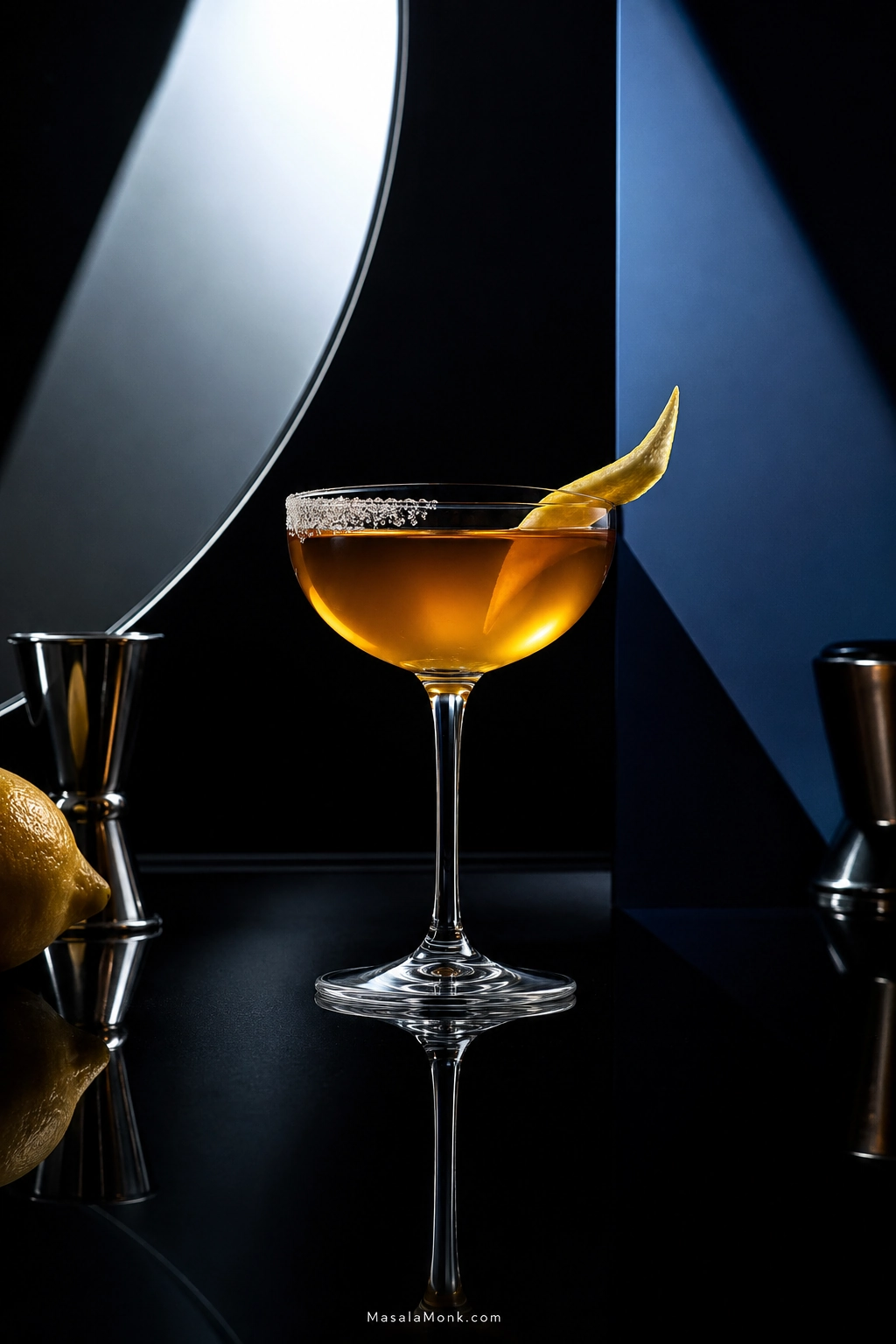
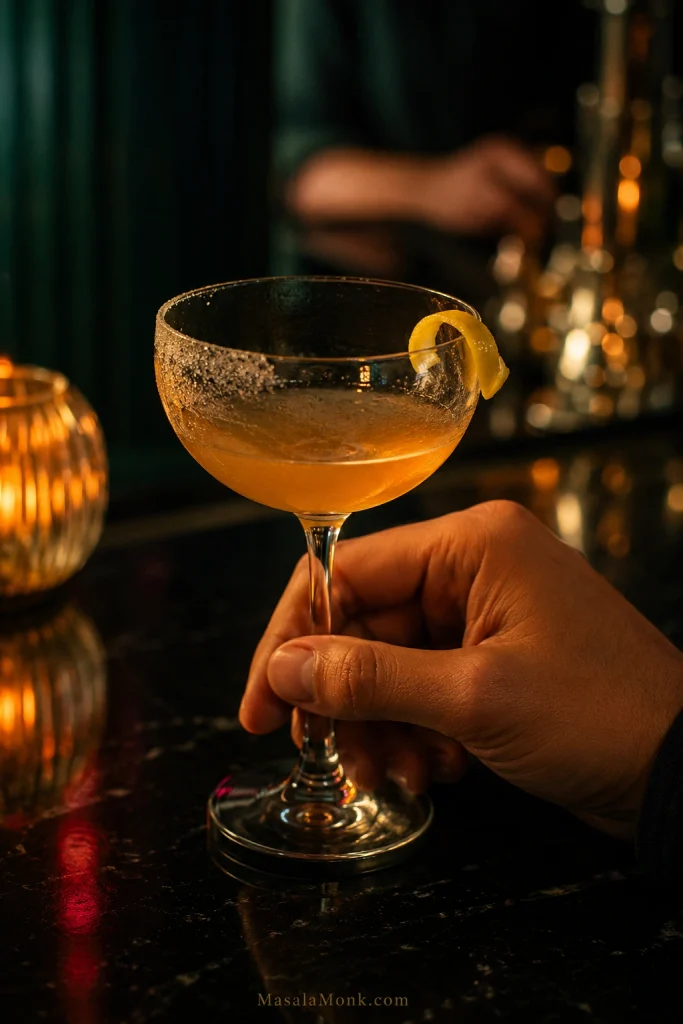
A Sidecar is a classic shaken cocktail made with Cognac, orange liqueur—usually Cointreau—and fresh lemon juice. A good one tastes like Cognac sharpened by lemon and lifted by orange, not lemon juice with brandy hiding somewhere underneath it.
With so little in the shaker, a few milliliters can be obvious in the glass. Push the lemon too far and it takes over. Add more orange liqueur and the drink grows sweeter and more orange-led. Under-shake it and even good Cognac can taste hot and disconnected.
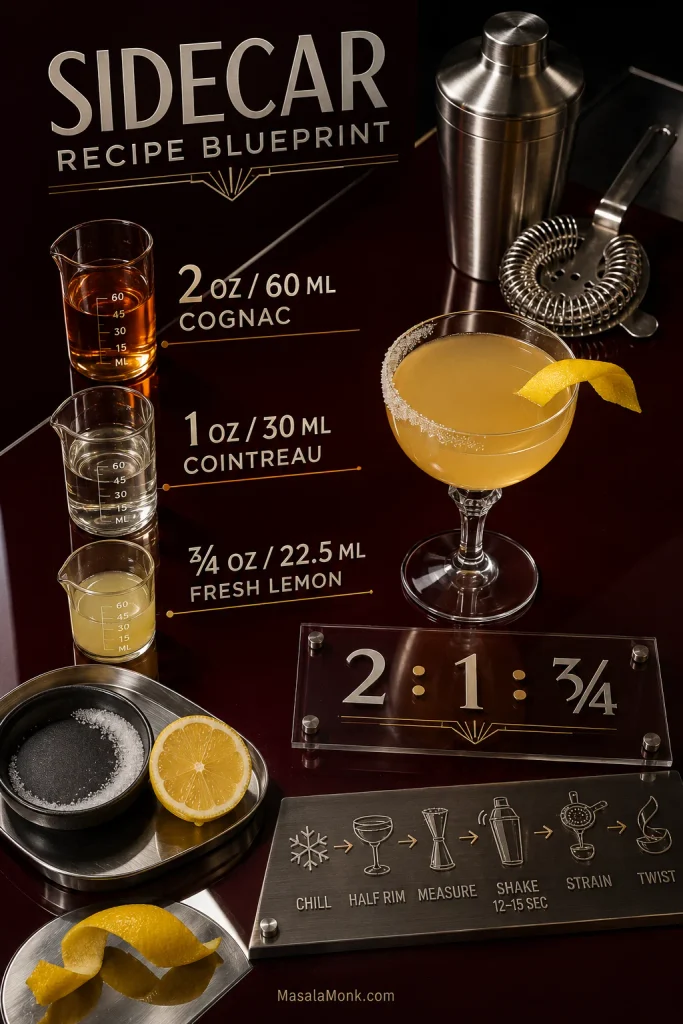
This recipe starts with 2 oz (60 ml) Cognac, 1 oz (30 ml) Cointreau and ¾ oz (22.5 ml) fresh lemon juice. It leaves the Cognac easy to taste while keeping the finish lively and citrusy. A sugar rim is optional; half-rimming the glass gives you both a sweetened and a bare edge.
Keep the Cognac visible. Let the lemon sharpen it, not bury it.
One cold, Cognac-first cocktail, shaken hard and served up. The starting ratio is 2 : 1 : ¾.
Makes 1 cocktail
Prep About 5 minutes
Ratio 2 : 1 : ¾
Shake 12–15 seconds
Serve Up, no ice in glass
Glass 5–6 oz coupe or Nick & Nora
Ingredients
2 oz (60 ml) Cognac
1 oz (30 ml) Cointreau
¾ oz (22.5 ml) freshly squeezed lemon juice
Superfine or caster sugar, for an optional half rim
Ice, for shaking
Lemon or orange twist, for garnish
Equipment
Cocktail shaker
Jigger or small liquid measure
Cocktail strainer
Coupe, Nick & Nora or other small cocktail glass
Fine-mesh strainer, optional
No shaker? A tightly sealed jar works in a pinch. Shake it with plenty of ice, then strain through a small kitchen sieve.
Method
Chill the glass. Put it in the freezer while you gather the ingredients, or fill it with ice and cold water.
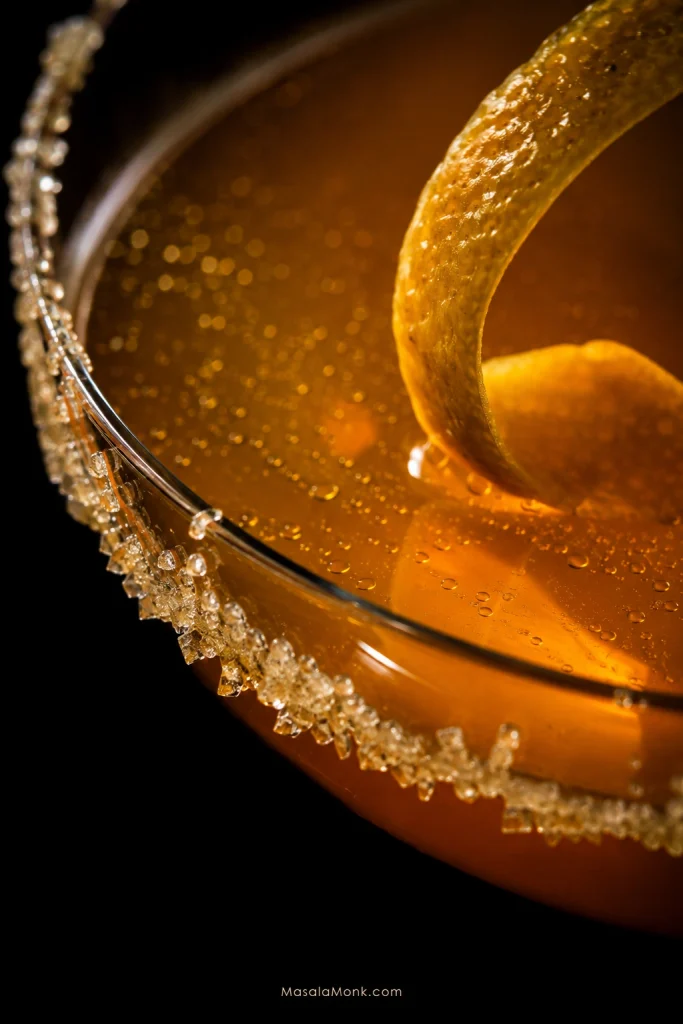
Prepare the rim, if using one. Run a cut piece of lemon around half of the outside edge. Dip that half lightly into superfine sugar, then tap away the excess.
Measure. Pour the Cognac, Cointreau and fresh lemon juice into the shaker.
Shake. Fill generously with cold, solid ice and shake hard for about 12–15 seconds, until the outside of the shaker feels thoroughly cold.
Strain and finish. Empty the chilled glass if necessary, strain in the cocktail, then twist a strip of citrus peel over the surface so its oils mist across the drink. Add the peel as garnish. Fine-strain too if you want to catch little ice chips and citrus pulp.
Keep the sequence; tune the ratios later.
What Should a Sidecar Taste Like?
Cognac first, orange close behind, then fresh lemon pulling the drink into focus. Shaken properly, it arrives icy cold and fragrant with citrus oil, with enough Cognac warmth beneath the lemon-orange snap to keep it from feeling merely sour.
If your first glass tastes almost entirely of lemon, don’t assume you’ve done something terribly wrong. A particularly sharp piece of fruit can move this drink a surprising distance.
The aroma should reach you before the sourness does.
Why Do Sidecar Recipes Use Different Ratios?
If you’ve looked up two Sidecar recipes and wondered how both can be called “classic” when the measurements barely agree, you’re not imagining it.
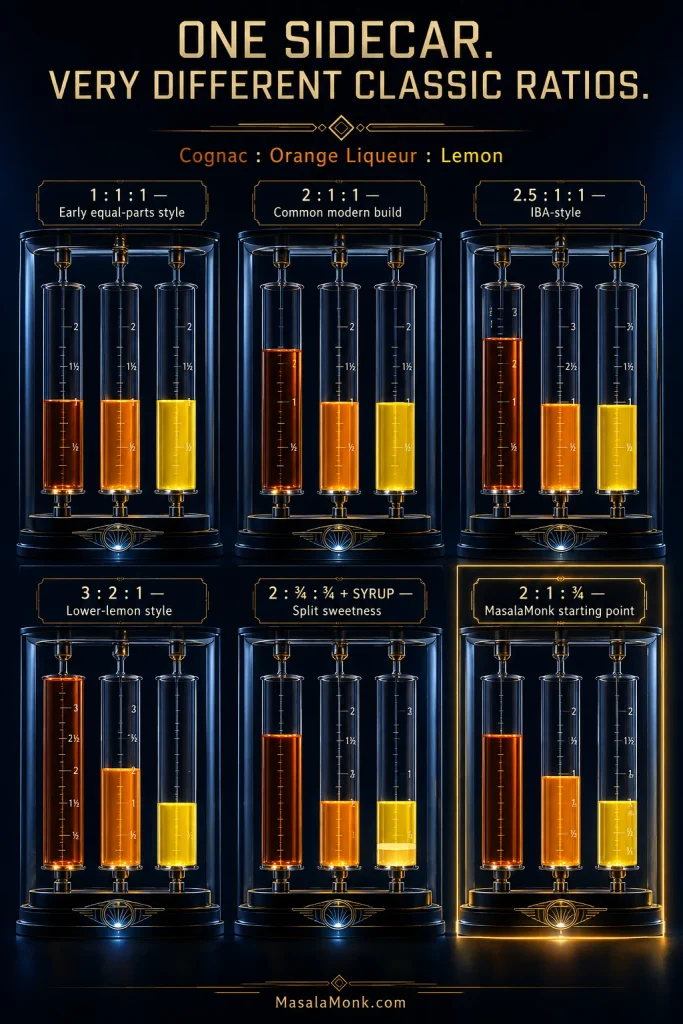
The International Bartenders Association currently specifies 50 ml Cognac, 20 ml triple sec and 20 ml fresh lemon. Elsewhere you’ll find equal-parts recipes, the familiar 2:1:1 build, lower-lemon 3:2:1 versions, and formulas that move some sweetness into syrup.
Ratios below are Cognac : orange liqueur : lemon.
Common approach
Approx. formula
What it does in the glass
Equal parts
1 : 1 : 1
Citrus and orange become very prominent
2:1:1
2 : 1 : 1
Bright and familiar; sharp lemon can push it quite tart
IBA-style
2.5 : 1 : 1
Leaves more room for the Cognac
3:2:1
3 : 2 : 1
Uses less lemon while giving orange more room
Split the sweetness
About 2 : ¾ : ¾ + syrup
Softens the finish without adding as much orange liqueur
This recipe
2 : 1 : ¾
Citrusy, with the Cognac still easy to taste
In PUNCH’s blind tasting of 10 bartender Sidecars, small syrup additions appeared repeatedly, and the winning version used Cognac, Cointreau, lemon and a teaspoon of rich Demerara syrup. Syrup isn’t a cheat. It lets sweetness move without bringing another pour of orange liqueur with it.
Different formulas are different balance choices, not mistakes.
For the recipe here, we keep the familiar amount of Cointreau and use slightly less lemon. That’s only the starting point: lemons vary in acidity, Cognacs in fruit and weight, and orange liqueurs in sweetness and strength. A stripped-back Daiquiri exposes the same problem—unusually sharp fruit has nowhere to hide when there are only a few ingredients.
There isn’t one secret ratio waiting to be uncovered. What matters is knowing what each choice changes once the drink reaches the glass.
How Cognac, Orange Liqueur and Lemon Change a Sidecar
Best Cognac for a Sidecar: Spend Enough, Not the Most
Cognac is grape brandy from the Cognac region of France. XO is unnecessary here; a lively VS or VSOP usually gives better value in a drink with lemon and orange liqueur.
Official Cognac guidance defines VS by a youngest wine spirit of at least two years and VSOP by a youngest wine spirit of at least four years. VS tends to feel younger and more energetic, while VSOP often brings more fruit, spice and depth.
Need actual bottle names? Hennessy VS is an easy mixing reference; Rémy Martin 1738 Accord Royal is a fuller step-up. If another decent VS or VSOP costs less where you live, buy that instead. The label matters less than choosing a Cognac with enough character to remain recognizable after lemon and dilution.
You don’t need to build a home bar around this drink. One good Cognac, one orange liqueur and fresh lemons are enough.
Spend for character, not prestige.
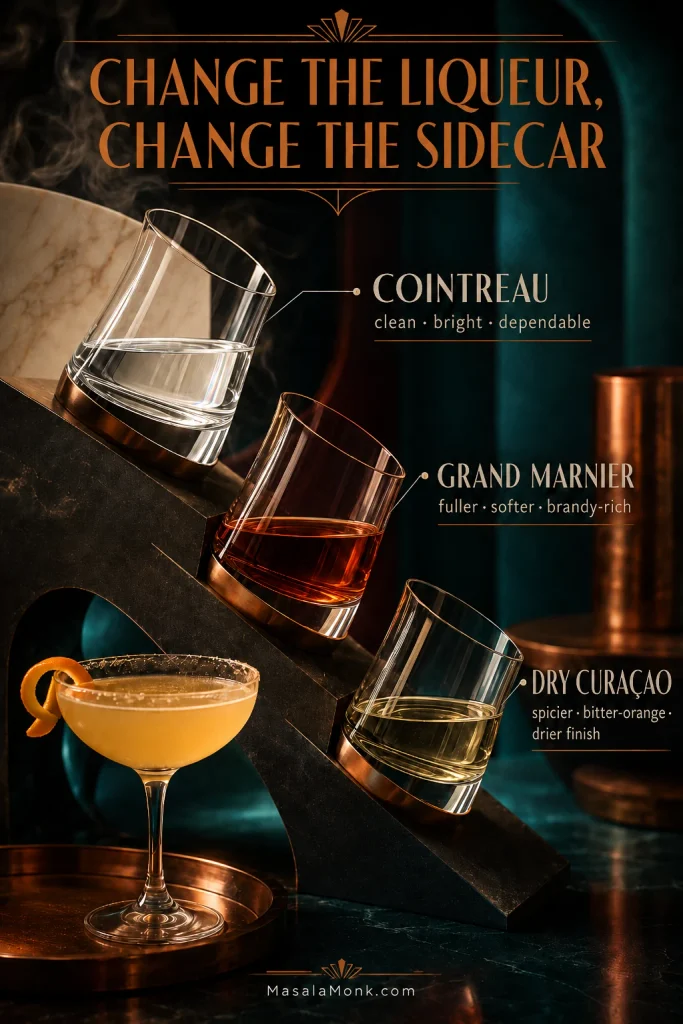
Cointreau, Grand Marnier or Dry Curaçao?
Cointreau is the easiest reference point: clear orange aroma, predictable sweetness and enough strength to remain noticeable after shaking.
Grand Marnier makes the orange feel softer and fuller against the lemon, with extra brandy richness underneath. Dry curaçao lets more spice and bitter orange show through and may leave the finish noticeably drier.
Other triple secs vary widely in sweetness and strength, so an identical measure won’t necessarily behave like Cointreau.
The same measure can shift the whole orange profile.
Fresh Lemon Can Move the Whole Drink
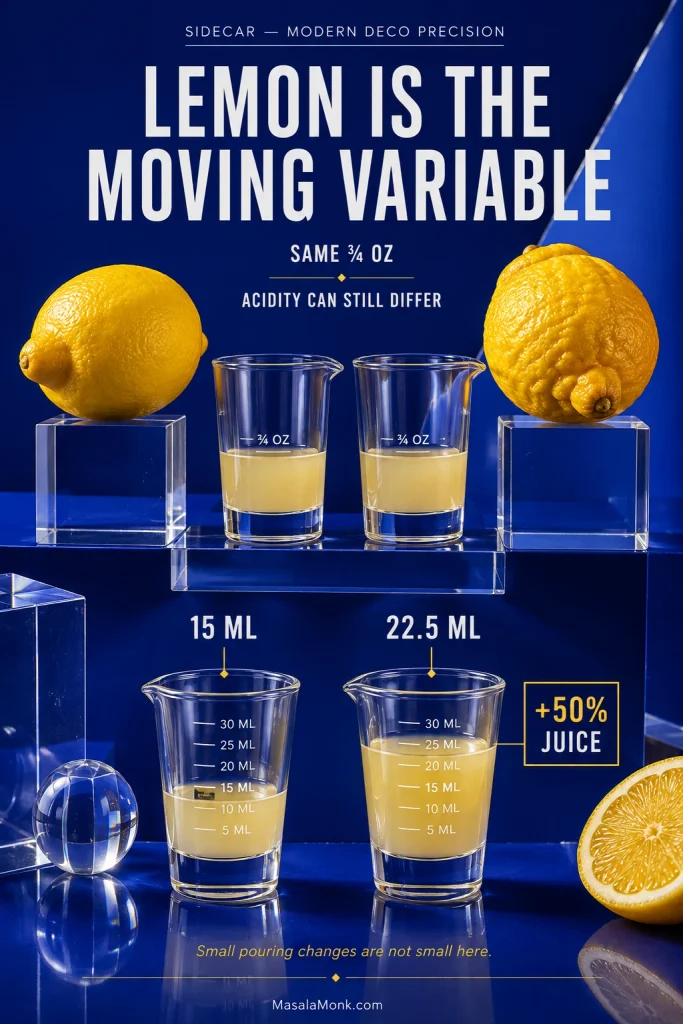
Fresh juice matters here, but fresh doesn’t mean identical. ¾ oz is a fixed volume. It isn’t a fixed amount of acidity. One lemon may make the recipe beautifully lively; another can be noticeably fiercer at exactly the same measurement. Taste the fruit itself if it seems unusually sharp.
Once the bottles and lemon are right, the remaining variables are mostly in your hands: measuring, temperature and dilution.
Measure, Shake and Chill: Where Sidecars Go Off Course
1. Measure the First Few
Citrus gets unforgiving quickly. A pour that grows from 15 ml to 22.5 ml is 50% more lemon. Measure the first few Sidecars; once you know the baseline, you’ll recognize what an extra splash actually changed.
Measure the volume; taste the fruit.
2. Shake Hard, Not Forever
About 12–15 seconds of vigorous shaking with plenty of cold, solid ice is a sensible home target. The exact second matters less than the result: a thoroughly cold shaker and a drink that tastes joined-up rather than like alcohol and lemon taking turns.
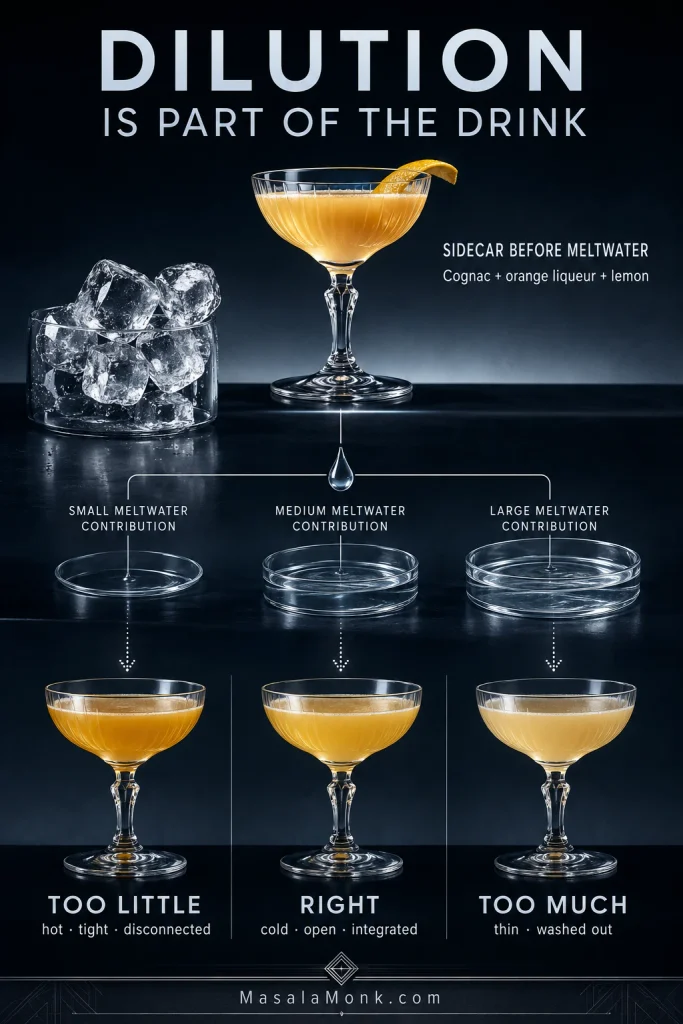
3. Dilution Is Part of the Drink
The water melting from the ice ends up in your glass. Too little and the Sidecar tastes hot, tight and unfinished. Too much and the Cognac turns thin. At the useful point between them, the spirit opens up, the lemon loses its hard edge and the orange aroma becomes easier to notice.
Use plenty of good ice instead of counting cubes. Home ice varies too much in size and melt rate for “five cubes” to mean much.
Cold matters. Integration matters more.
4. Chill, Strain and Serve
Pre-chill the glass because the finished cocktail contains no serving ice. A freezer is easiest; ice water while you shake gets you there too. For straining, a normal cocktail strainer is enough; fine-straining catches little shards of ice and citrus pulp if you prefer a cleaner texture.
Choose a 5–6 oz (roughly 150–180 ml) coupe, Nick & Nora or other small cocktail glass for this amount. An oversized modern coupe can make a perfectly normal Sidecar look as though someone forgot half your drink.
Served up means shaken with ice and then strained into the glass without that ice.
Lemon or orange twist? Both are legitimate. Lemon smells sharper over the first sip; orange makes the drink seem softer and more orange-led before you’ve even tasted it. Whichever peel you choose, twist it over the glass first so the oils land on the surface.
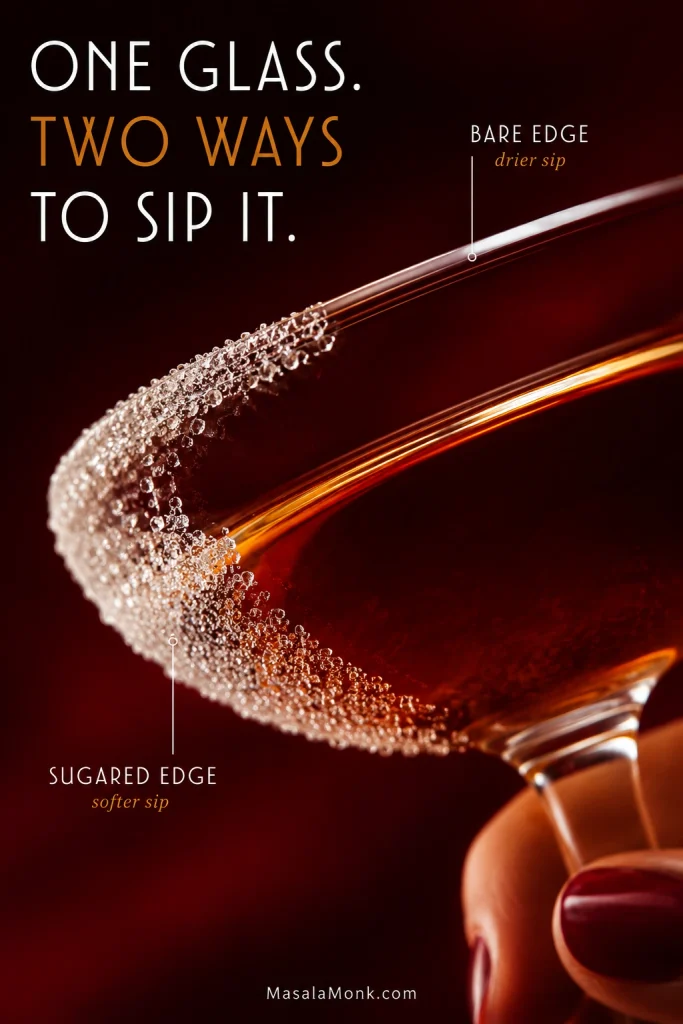
Bartenders disagree about the sugar rim too. A Sidecar is perfectly happy without one.
If you enjoy the sugar, a half rim is more interesting than coating the whole glass. One side softens the sip; turn the glass and the cocktail tastes drier from the bare edge. Use superfine or caster sugar and moisten mainly the outside edge so loose sugar doesn’t slowly dissolve into the drink.
Selective sweetness beats an all-or-nothing rim.
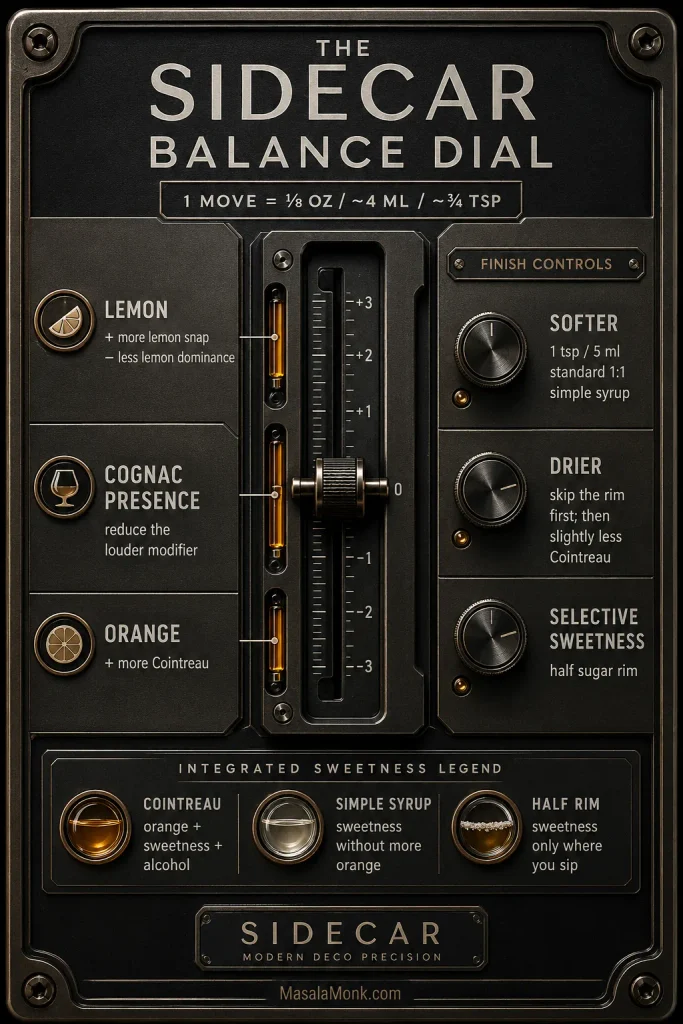
The Sidecar Balance Dial: Fine-Tune a Good Drink
If your Sidecar already tastes good, stop troubleshooting. This is the fun part.
Think in ⅛-oz moves—about 4 ml, roughly ¾ teaspoon. That’s enough to learn something in a three-ingredient cocktail without turning your kitchen into a bar lab. In the table below, one “step” means that amount.
You want…
Move
What you’ll notice
More lemon snap
Add one step of lemon
The Cognac becomes less prominent
Less lemon dominance
Take one step of lemon away
The spirit becomes easier to taste without adding sweetness
More Cognac presence
Reduce whichever is masking it—lemon or Cointreau—by one step
The Cognac moves forward without making the drink larger
More orange
Add one step of Cointreau
Orange, sweetness and alcohol all rise together
A softer finish without more orange
Add 1 tsp (5 ml) standard 1:1 simple syrup
Using rich 2:1 syrup? Start with roughly three-quarters as much
Sweetness only on selected sips
Use a half sugar rim
The liquid itself stays unchanged
A drier finish
Skip the rim first; then consider one step less Cointreau
Less Cointreau also means less orange flavor
Cointreau, Syrup and Sugar Do Different Jobs
More Cointreau brings sweetness, orange flavor and alcohol together. Standard 1:1 simple syrup softens the drink without adding more orange. Sugar on the rim changes only the sips that touch it.
A lemon-heavy Sidecar isn’t automatically asking for sugar. Use less citrus when lemon is the problem; reach for syrup when Cognac and lemon already taste right together but the finish is still too dry. A Lemon Drop Martini makes those different kinds of sweetness especially easy to taste because all three appear in the same drink.
One small move makes the next glass more informative.
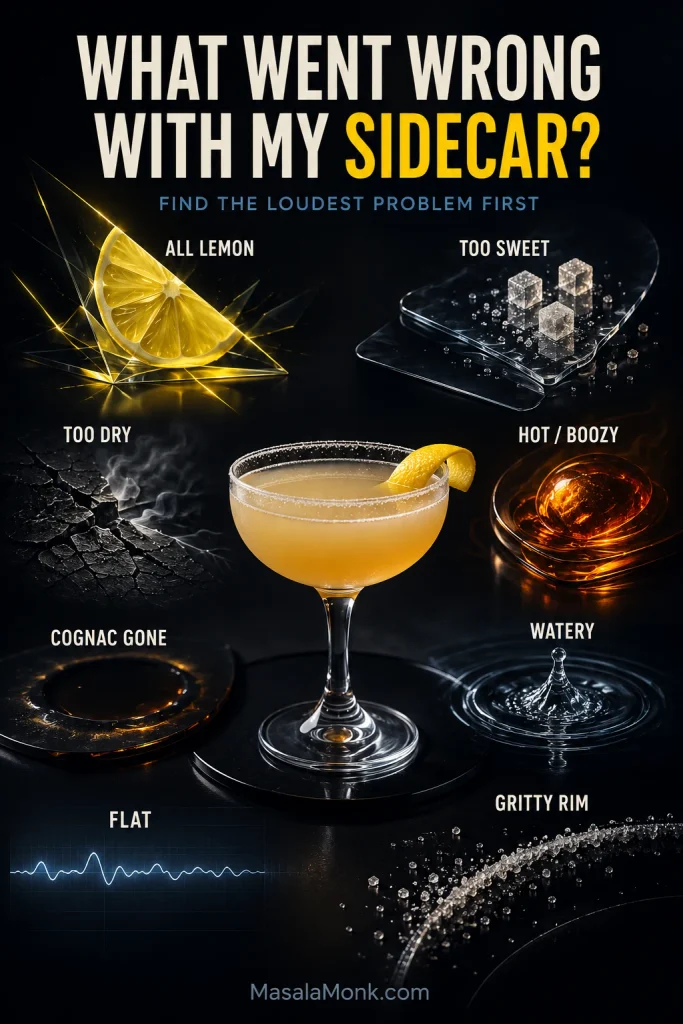
Fix My Sidecar
A drink that’s simply not your preferred ratio belongs in the Balance Dial above. This section is for the Sidecar that’s plainly unpleasant: puckering, hot, washed out, gritty or mysteriously flat.
Name the loudest flaw first; change one thing.
What happened?
Likely reason
Try this first
All lemon / too sour
The citrus is drowning the Cognac and orange
Reduce the lemon by the small increment described above
Too sweet
Syrup, rim sugar or Cointreau is pushing sweetness too far
Remove syrup or the rim first. Added neither? Use slightly less Cointreau
Too dry
The drink needs sweetness, not more citrus
Try the half rim or about 1 tsp (5 ml) 1:1 simple syrup
Hot or boozy
Often under-dilution
Look at the ice and shake before rewriting the ratio
Can’t taste the Cognac
Lemon or orange liqueur is masking it
Ease back whichever ingredient you notice first
Watery / washed out
Too much dilution or fast-melting ice
You can’t take water back out; use colder, sturdier ice and stop sooner next time
Flat aroma
Tired citrus or no fresh peel oils
Use fresh lemon and express the garnish over the surface
Gritty or unevenly sweet
A heavy sugar rim
Use finer sugar on only half the outside edge
Different every time
Fruit, pouring and dilution are all moving
Measure the next one and write down the ratio that lands
Something stranger? Bitterness can come from citrus pith, an aggressively squeezed peel or the orange liqueur itself. If the drink tastes oddly soapy or perfumed, check the glass for detergent residue and wash and dry the citrus before blaming the recipe.
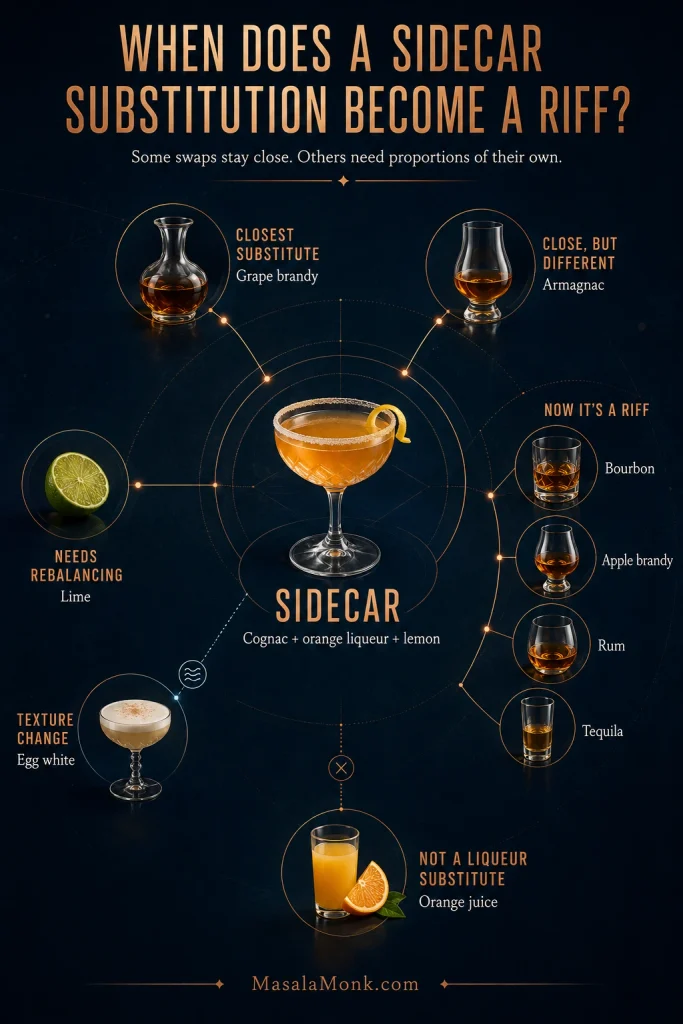
What Can You Substitute—and When Is It a Different Drink?
Some swaps keep you close to a Sidecar. Others move far enough away that you’re better off treating the result as a riff with proportions of its own.
Good grape brandy is the closest Cognac substitute. Armagnac takes the drink somewhere darker and more rustic, with earthier fruit and spice.
Lime can replace lemon, but its different acidity and aroma may need a new balance. Egg white changes the texture, giving you a softer, foamy sour-style drink.
Bourbon, apple brandy, rum or tequila take you firmly into riff territory. And orange juice is not a substitute for orange liqueur: juice adds water and acidity while removing much of the alcohol and concentrated orange character the liqueur contributes.
Preserve the structure—or break it deliberately for a riff.
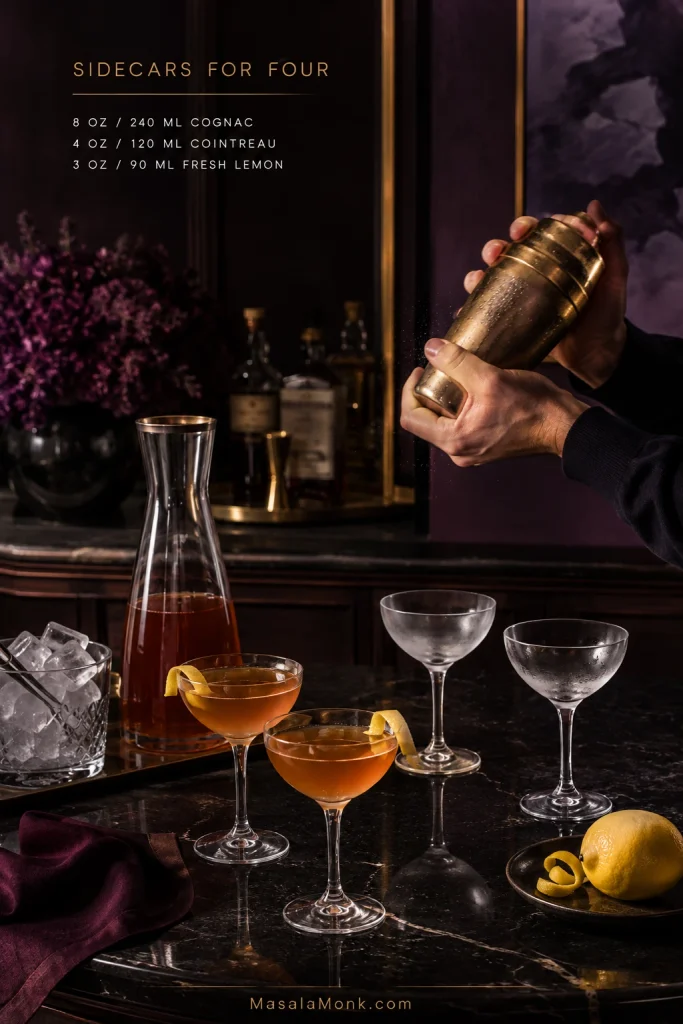
How to Batch Sidecars for Four
8 oz (240 ml) Cognac
4 oz (120 ml) Cointreau
3 oz (90 ml) fresh lemon juice
Combine the Cognac and Cointreau ahead of time and refrigerate. Add the fresh lemon shortly before serving. Once everything is mixed, measure 3¾ oz (about 112 ml) per drink into the shaker and shake with ice as usual.
Chill the glasses before people arrive. If your shaker comfortably holds two drinks, shaking two at a time is practical; don’t crowd all four into a standard shaker.
If all four will be served within a short window, mix the full batch shortly beforehand and keep it cold until you’re ready to shake.
Prebatch the stable ingredients; keep fresh lemon close to service.
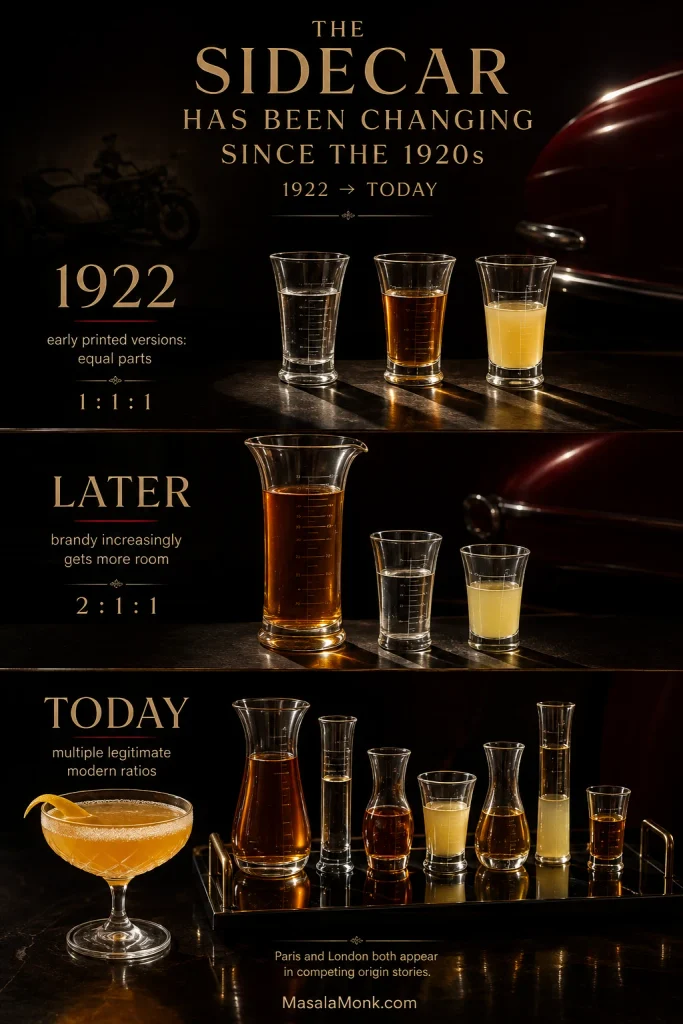
The Sidecar Has Been Changing Since the 1920s
The modern argument over ratios isn’t particularly modern. Sidecar recipes were appearing in cocktail books by 1922, and their proportions have been shifting for almost as long as the drink has been in print.
Its exact birthplace is difficult to pin down. Both Paris and London appear in competing accounts, while the familiar tale of a customer arriving at a bar in a motorcycle sidecar is better treated as cocktail lore than settled history.
Early printed versions used equal quantities of brandy, orange liqueur and lemon. Later recipes increasingly gave the brandy more room. Today’s “classic” Sidecars disagree because variation has been part of the drink for a very long time.
The ratio argument is almost as old as the drink.
The Sidecar also belongs to the broader Daisy tradition: base spirit, citrus and sweetness supplied partly or entirely by a liqueur. That’s why a White Lady or Margarita can feel distantly familiar without being interchangeable with it.
Sidecar Cocktail FAQ
Is a Sidecar a Martini?
No. A Sidecar isn’t part of the Martini family. The confusion mostly comes from the stemmed glass, which is often casually called a martini glass.
Can you serve a Sidecar on the rocks?
Yes, although the classic presentation is served up without ice in the finished glass. Over fresh ice, the cocktail keeps diluting as you drink it.
How strong is a Sidecar?
It’s a strong cocktail because most of the liquid comes from spirits. With 40% ABV Cognac and 40% ABV Cointreau, this recipe contains roughly two U.S. standard drinks. Shaking adds water and lowers the percentage of alcohol in the finished cocktail, but it doesn’t remove alcohol. The exact finished ABV depends heavily on how much dilution your ice and shaking contribute.
A good Sidecar should make all the argument about ratios disappear once you take a sip: cold, orange-scented and still unmistakably like Cognac. When you hit the version that makes you want another sip, write the ratio down. That’s the one worth repeating.
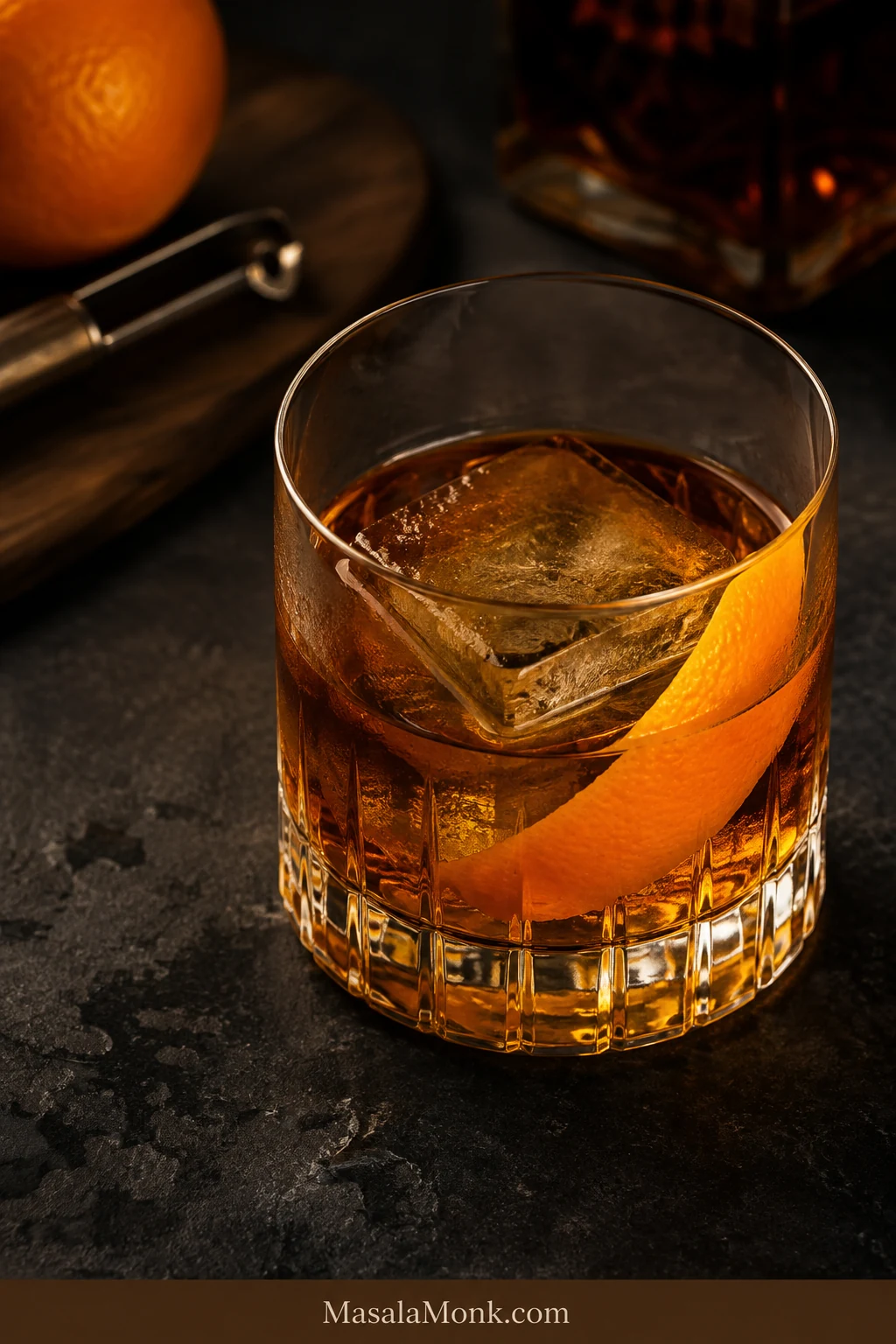
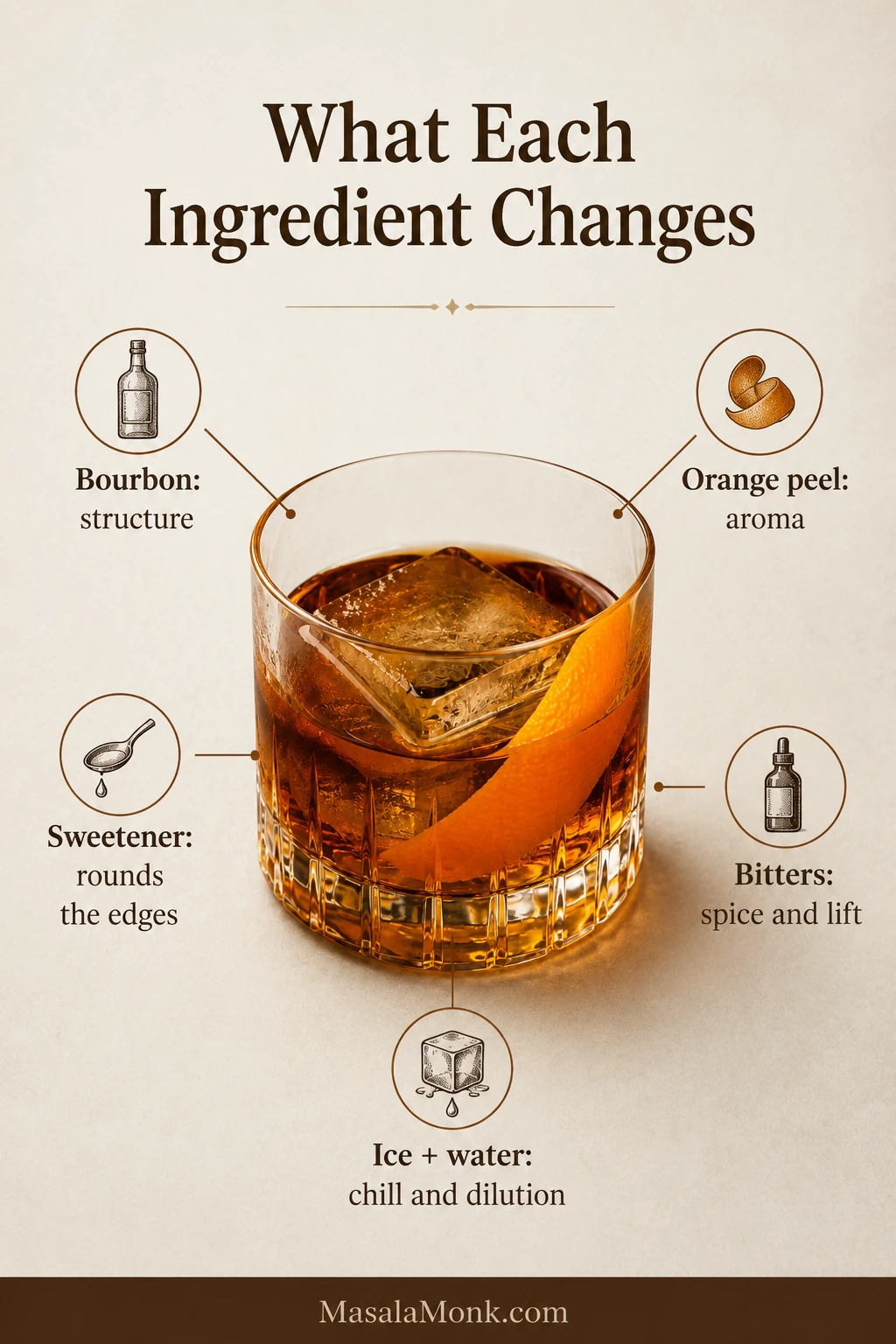
An Old Fashioned is simple enough to make in minutes—and exposed enough that every decision shows. When the balance is right, bourbon leads with oak, vanilla, caramel, and spice; bitters pull those flavors into focus; orange oil reaches you before the first sip; and just enough water takes away the raw edge without thinning the whiskey.
When it goes wrong, the same short list becomes sweet whiskey over melting ice. Too much syrup buries the bottle; too little stirring leaves it sharp; muddled orange turns a clear, spirit-forward drink into something fruitier. The fix is not more ingredients—just better control of the few already there.
This version starts with bourbon, rich demerara syrup, Angostura bitters, and expressed orange peel. The sweetness stays low enough for the whiskey to lead, with clear routes to a spicier rye drink, a traditional sugar-cube build, or a brighter touch of orange bitters.
Quick Answer: How to Make a Balanced Old Fashioned
Whiskey: 2 oz / 60 ml bourbon
Sweetener: 1 teaspoon / 5 ml rich 2:1 demerara syrup
Bitters: 3 firm dashes Angostura
Method: stir with plenty of ice for 20–25 seconds, then strain over a large serving cube or several solid cubes
Finish: express a wide orange peel over the drink
Using standard simple syrup or a sugar cube? The exact substitute measurements are in the recipe immediately below.
Keep the balance simple: whiskey first, sweetness second, and orange on the nose rather than orange juice in the glass.
Classic bourbon cocktail
Old Fashioned Recipe
A whiskey-forward Old Fashioned with just enough demerara to round the bourbon, Angostura for spice, and orange oil over the surface. It should taste strong and full, never raw, syrupy, or watery.
Time 5 minutes
Yield 1 cocktail
Glass 8–10 oz / 240–300 ml rocks glass
Method Stirred and served over fresh ice
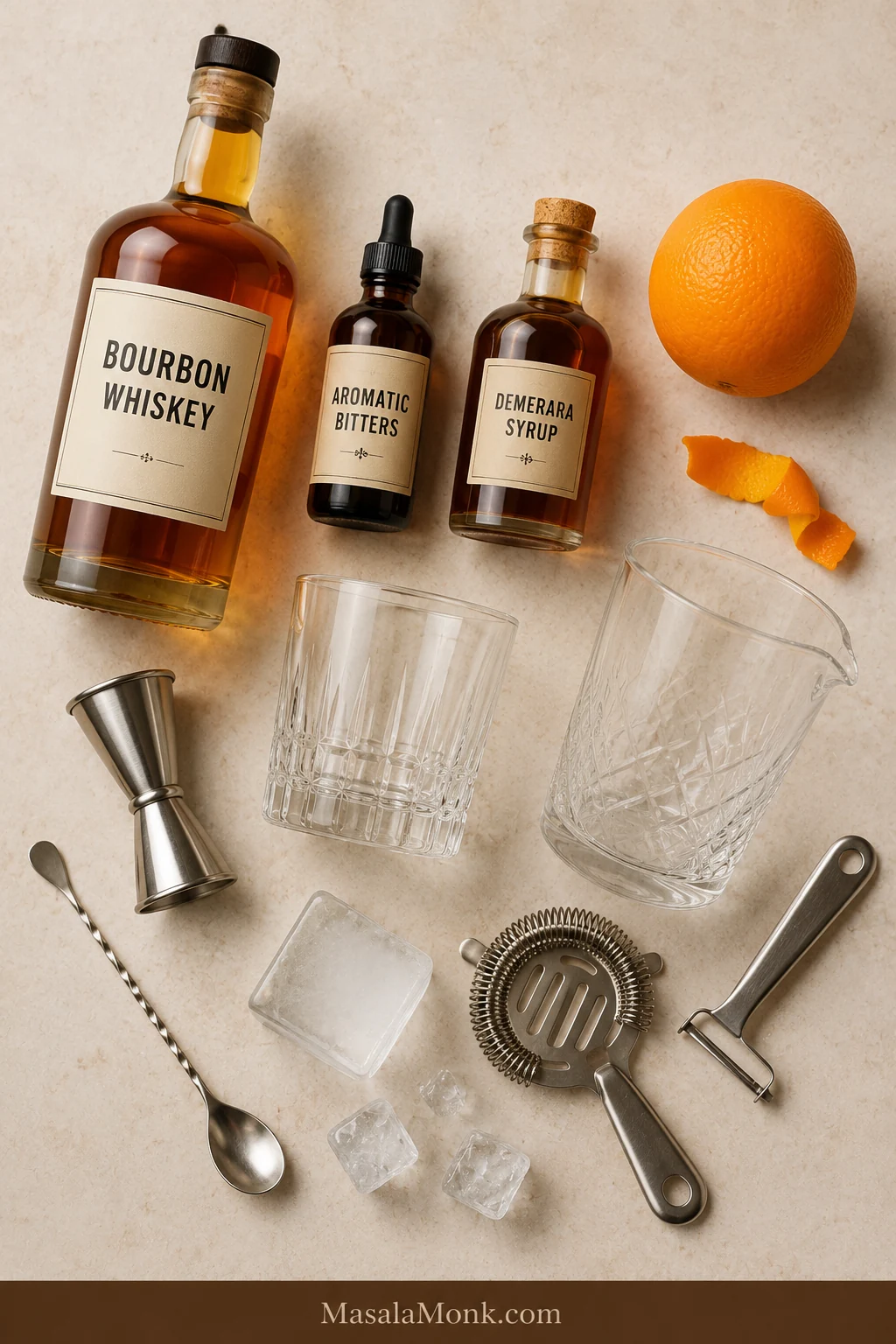
Equipment
Jigger or small measuring cup
Mixing glass or another sturdy glass
Bar spoon or long-handled teaspoon
Julep, Hawthorne, or small kitchen strainer
Vegetable peeler or small sharp knife
Ingredients
2 oz / 60 ml bourbon, preferably around 90–100 proof
1 teaspoon / 5 ml rich 2:1 demerara syrup
3 firm dashes Angostura aromatic bitters
Plenty of solid ice for stirring
Serving ice: 1 fresh large cube, about 1¾–2 inches / 4.5–5 cm
Orange peel: 1 wide strip, freshly cut
Cocktail cherry: 1 good cherry, optional
Sweetener Alternatives
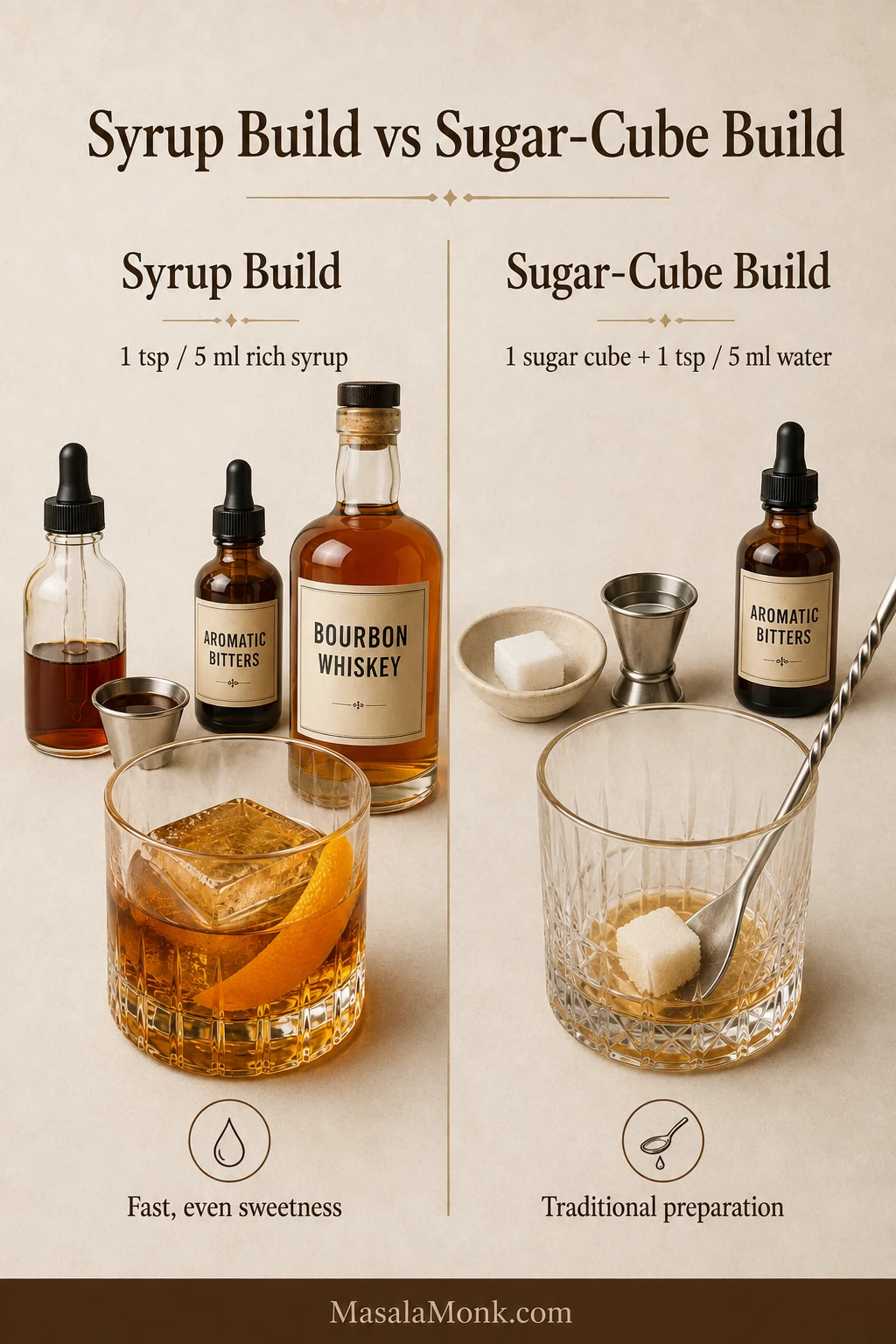
Replace the rich demerara syrup with ¼ oz / 7.5 ml standard 1:1 simple syrup. For a traditional build, use 3.5–4 g granulated sugar or one standard sugar cube, plus 1 teaspoon / 5 ml water.
Why 5 ml works: this is deliberately a little drier than some modern builds. One teaspoon of properly made 2:1 syrup provides roughly the sweetness of a standard sugar cube; increase it by ¼ teaspoon at a time when your bourbon or preference calls for more.
Instructions
Measure the drink. Combine the bourbon, rich demerara syrup, and Angostura bitters in a mixing glass.
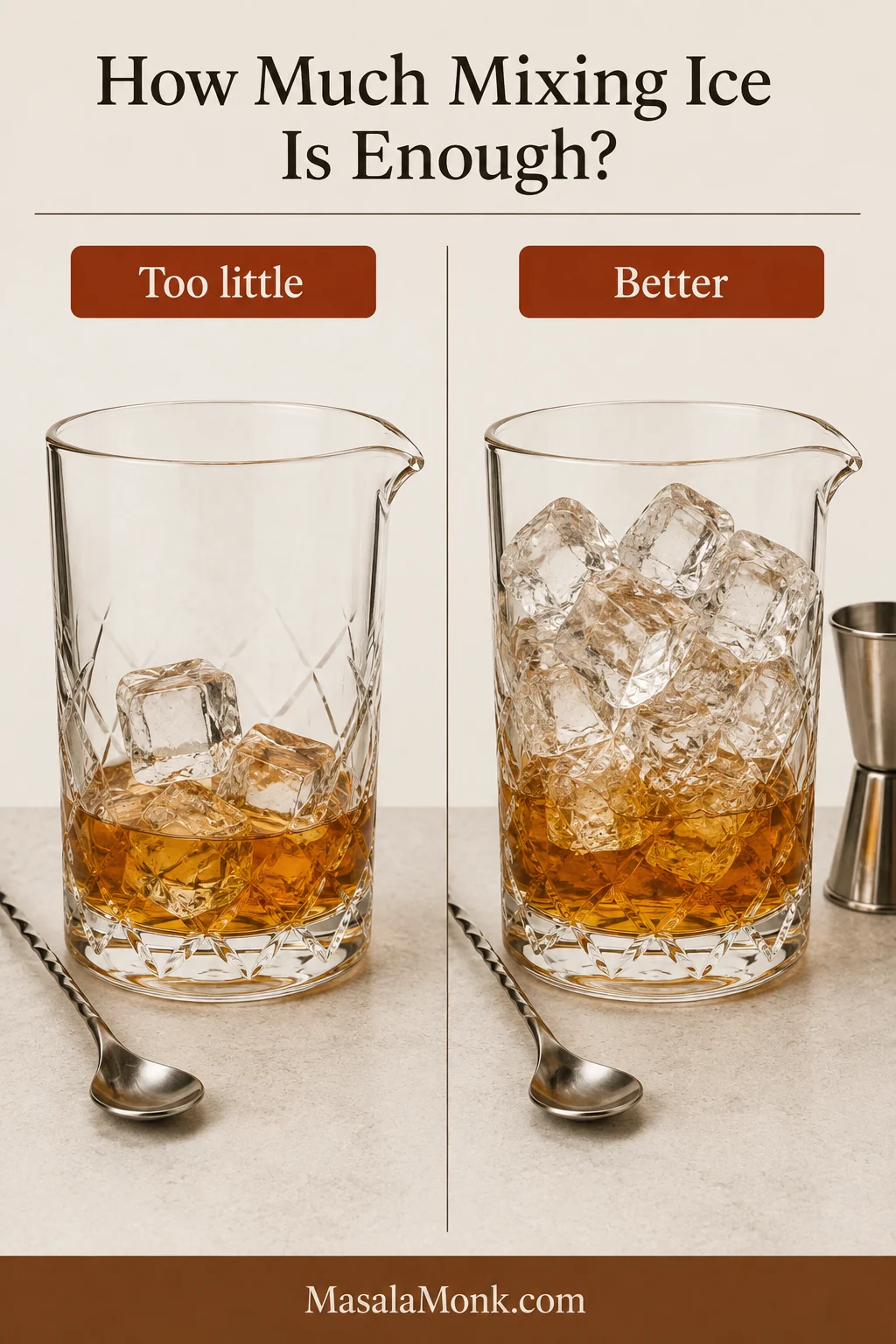
Add plenty of ice. Fill the mixing glass at least two-thirds full with solid cubes.
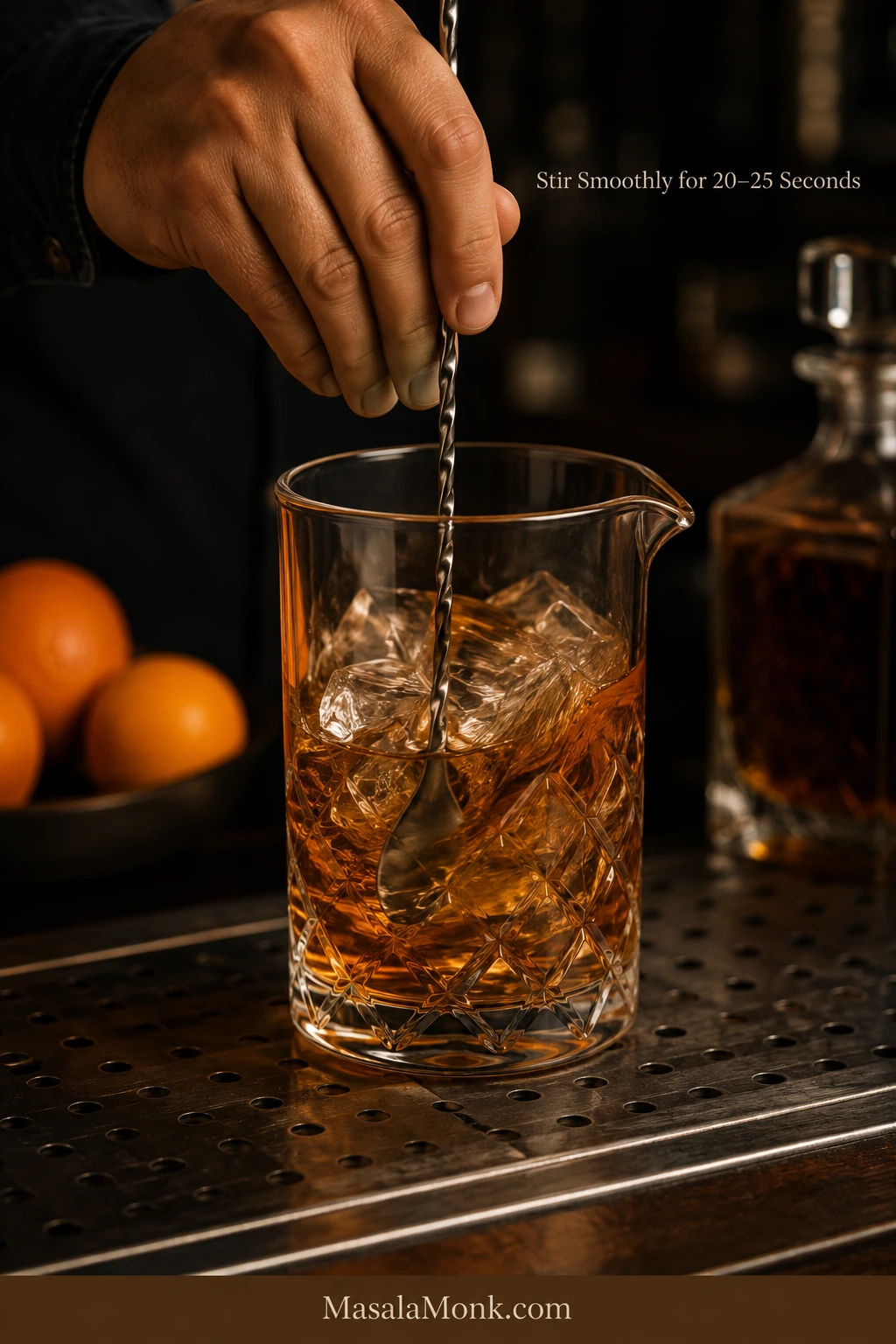
Stir until cold and settled. Move the spoon smoothly for about 20–25 seconds. Sample a few drops with a clean teaspoon or straw: the alcohol should no longer feel separate, while the bourbon still leads.
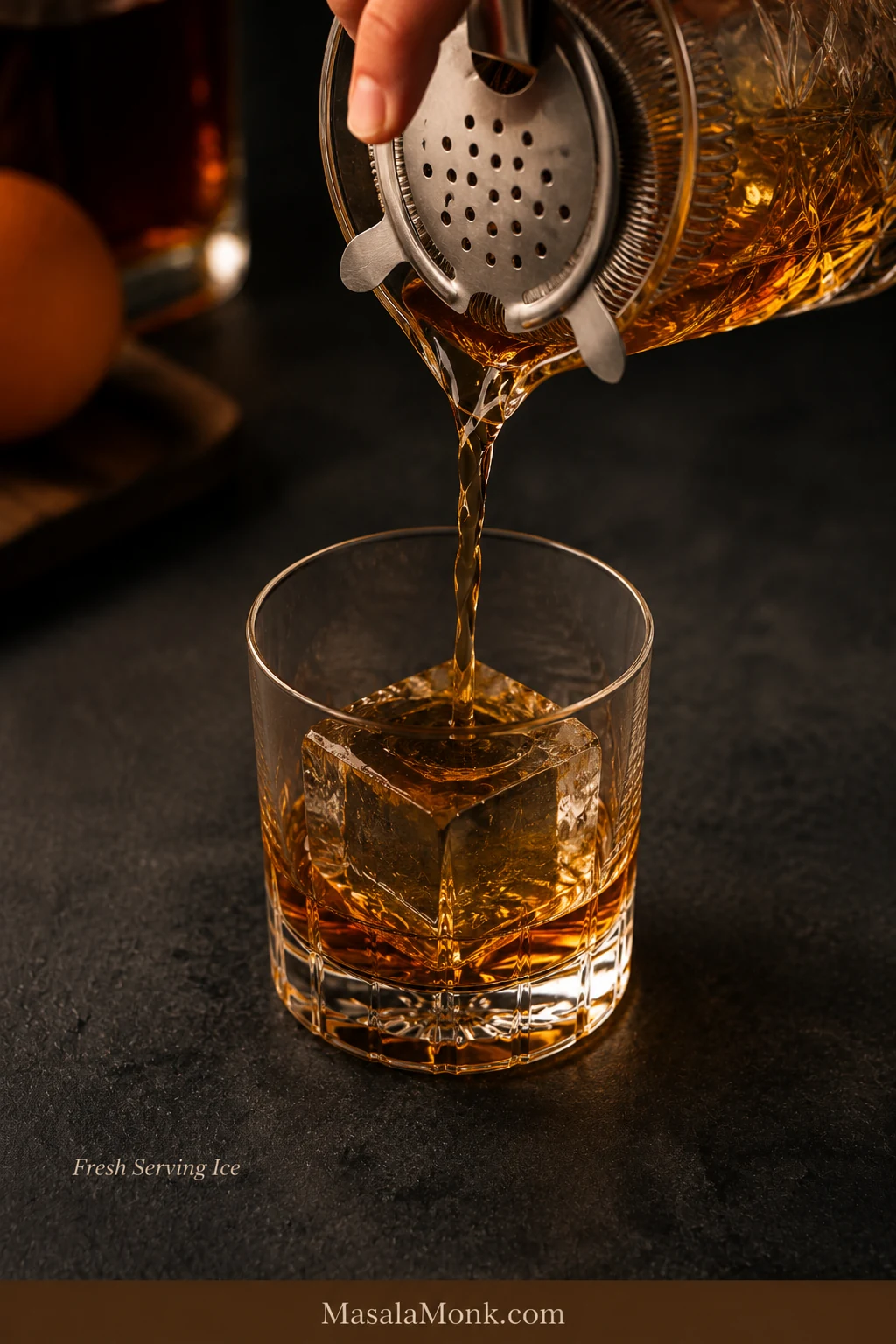
Strain over fresh ice. Place one large fresh cube in a rocks glass and strain the cocktail over it.
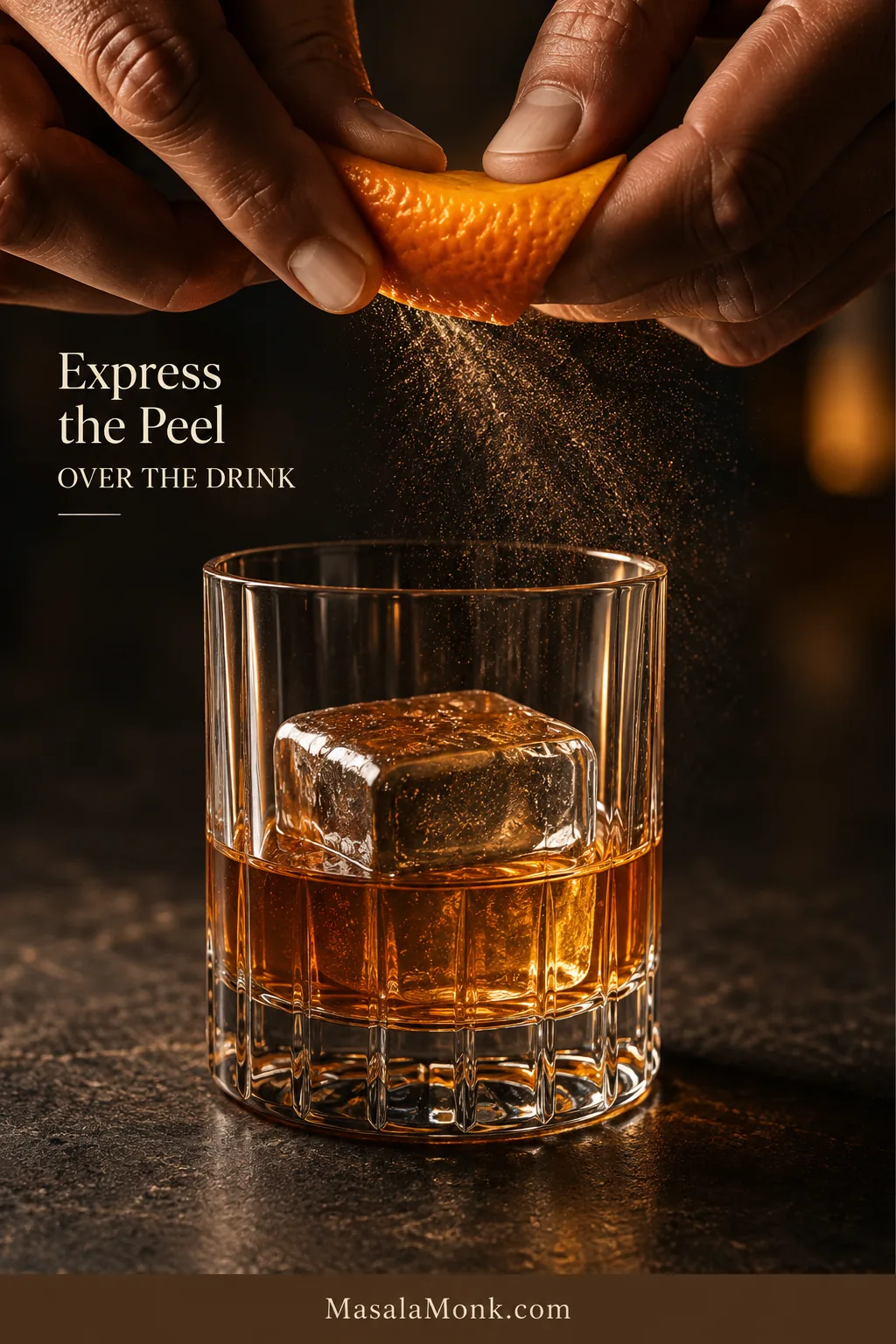
Express the orange peel. Hold the peel over the drink with the colored side facing down. Pinch or bend it firmly to release the citrus oils over the surface.
Finish and serve. Run the peel once around the rim, place it in the glass, and add an optional cocktail cherry.
Make this version once before changing it. On the next glass, adjust only one variable—syrup, whiskey, bitters, or stirring time—so you can tell what the change actually did.
Enjoy responsibly, and serve alcohol only to adults of legal drinking age in your location.
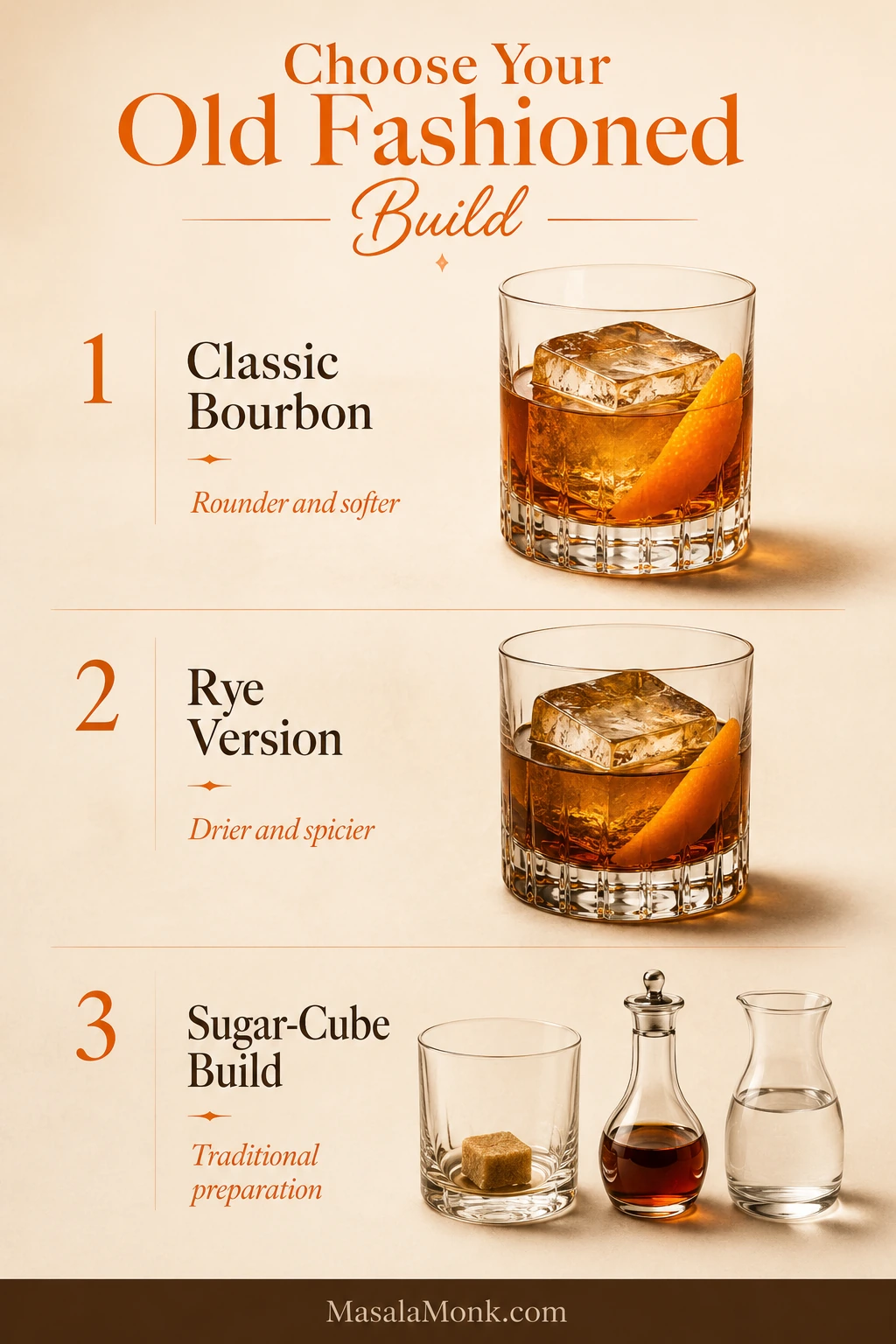
Start with bourbon, rich demerara syrup, Angostura, serving ice, and orange peel. Then use the options below when your ingredients—or your taste—point somewhere else.
To learn your preference, keep the bitters and sweetness steady while changing only the whiskey or build method. That makes bourbon, rye, and sugar-cube differences easier to recognize.
Replace bourbon with rye and begin with the same sweetener amount.
Traditional sugar-cube method
Dissolve one 3.5–4 g cube with bitters and a teaspoon of water directly in the glass.
Softer and rounder
Use an 80–90-proof bourbon, 2 dashes Angostura, and careful dilution.
No mixing glass
Build with syrup directly in the rocks glass and stir over the serving ice.
What Should an Old Fashioned Taste Like?
The finished drink should smell of orange before it tastes of orange. Bourbon should remain the clearest flavor, with bitters adding spice and depth behind it. Sweetness should round the whiskey rather than sit on top of it.
Water is part of the recipe even when it is not poured from a measuring cup. Stirring melts some ice, softening the alcohol and opening the aroma. Too little leaves the drink hot and disconnected; too much makes it thin and faint.
A useful memory cue: orange on the nose, whiskey through the sip, and spice in the finish.
Use this sequence as the fast sensory check: orange on the nose, whiskey through the sip, and spice in the finish. The table below shows where that balance usually slips.
Balanced Old Fashioned
Something needs adjusting
Whiskey remains clear from first sip to finish
Syrup, fruit, or water takes over
Cold and smooth, but still full-bodied
Raw alcohol burn or watery thinness
Gently sweet
Sticky, syrupy, or dessert-like
Orange on the nose
Orange juice and pulp in the drink
Bitters add spice and shape
Medicinal bitterness dominates
Old Fashioned Ingredients—and What Each One Does
Because there are so few ingredients, every one of them shows. Each controls a different part of the drink: flavor, sweetness, aroma, or dilution.
Use this ingredient map as a troubleshooting key: syrup controls sweetness, melted ice controls softness, bitters restore definition, and fresh peel can revive a cocktail that smells dull.
Ingredient
What it controls
Bourbon or rye
The dominant flavor, body, proof, oak, spice, and overall character.
Sugar or syrup
Sweetness, texture, and how sharply the alcohol is perceived.
Aromatic bitters
Spice and aroma that keep the sweetness from feeling flat.
Water from stirring
Chilling and softening the alcohol so the whiskey no longer feels hot or separate.
Orange peel
Citrus aroma without adding juice or pulp.
Cocktail cherry
An optional dark-fruit accent; it is not required for balance.
Equipment You Need—and What to Use Instead
You need a way to measure, enough clean ice, and a short glass with room for the serving cube.
The barware can flex, but the measurements should not. A sturdy glass and long spoon work well when bourbon, sweetener, bitters, and ice are handled deliberately.
No jigger? Use kitchen measures: 2 oz is about ¼ cup or 4 tablespoons; 1 teaspoon is 5 ml.
No mixing glass? Use a sturdy drinking glass, small jug, or the metal half of a cocktail shaker. Stir rather than shake.
No bar spoon? A long-handled teaspoon works. Smooth movement matters more than specialist equipment.
No large cube? Use two or three large solid cubes. Clean-tasting ice matters more than perfect shape.
No demerara sugar? Use white-sugar simple syrup or a properly dissolved sugar cube.
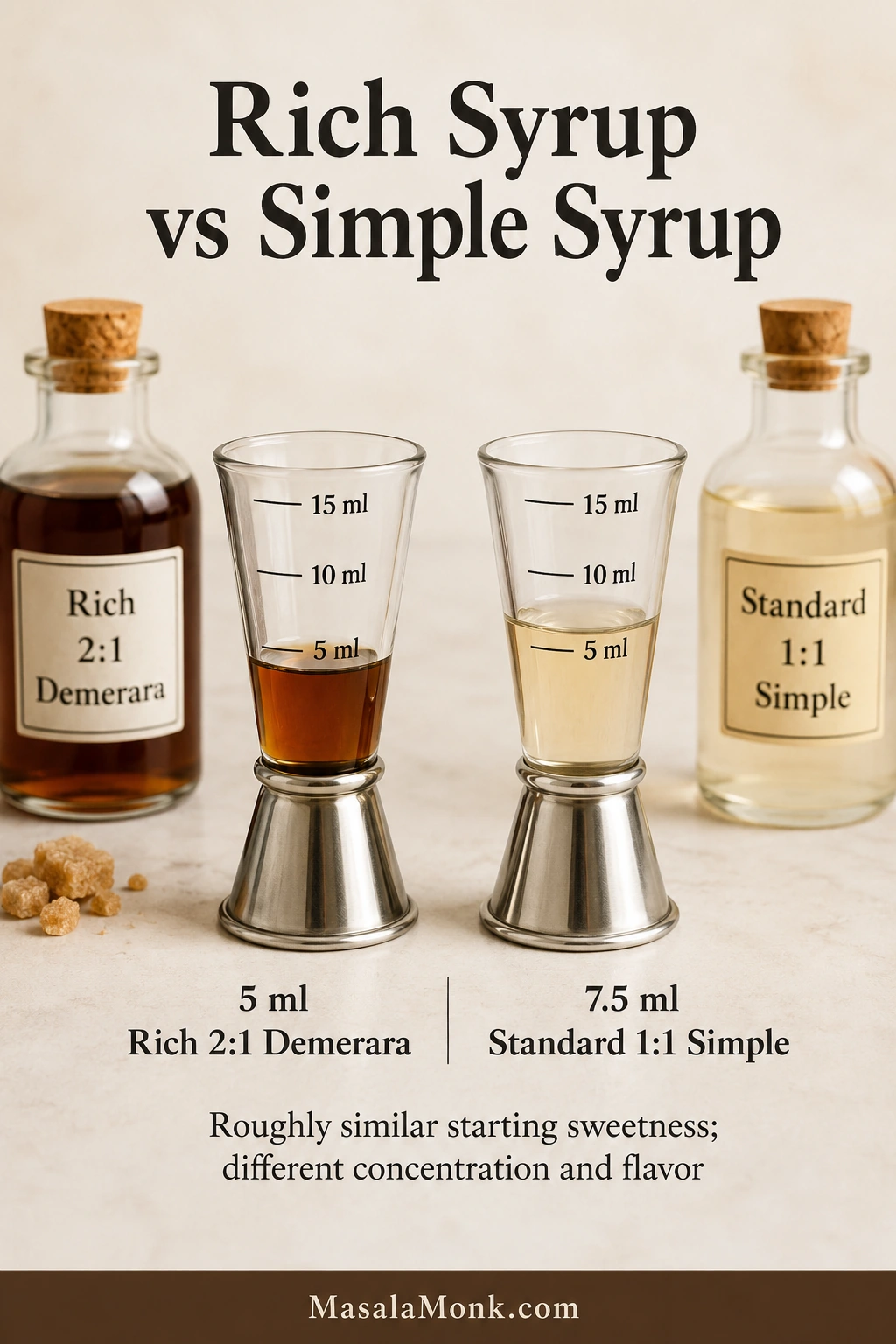
Know your syrup: by weight, rich syrup is two parts sugar to one part water; standard syrup uses equal weights. The same volume does not contain the same amount of sugar.
How to Judge Chilling, Dilution, and Garnish
The ratio gets you close; temperature, dilution, and aroma decide whether the finished drink feels complete.
Measure Carefully and Add Enough Ice
One extra teaspoon of syrup can shift the whole glass. Measure the bourbon and sweetener, use consistent dashes from the same bitters bottle, and fill the mixing glass at least two-thirds full with solid ice.
A sparse handful warms quickly, so the drink may pick up too much water before reaching a deep chill. Ordinary cubes are fine for mixing; save a large clear cube, when available, for serving.
A fuller mixing glass can produce more controlled dilution, not automatically more water. Plenty of cold, solid ice lowers the temperature before the cubes begin melting rapidly.
Stir for About 20–25 Seconds—Then Taste
Move the spoon smoothly so the ice and liquid rotate together. As the mixture chills, condensation will often begin gathering outside the glass. Stirring also adds water without the aeration or small ice chips created by shaking.
When the spoon follows the inside wall, the cubes rotate together instead of being churned. The movement should feel smooth and controlled, with tasting—not speed—deciding the endpoint.
Still hot and separate? Stir for another few seconds.
Cold, glossy, and clearly whiskey-led? It is ready.
Thin and fading? It has probably gone too far.
Do not judge Old Fashioned dilution by color alone. Taste a small sample before straining; stop when the alcohol feels integrated, the aroma has opened, and the whiskey still has definition.
Strain, Garnish, and Serve
Strain over one 1¾–2-inch cube or two or three large solid cubes. Well-frozen serving ice usually slows warming and further dilution, though temperature, quantity, and time all matter.
Fresh serving ice gives the stirred method a cleaner handoff from mixing to drinking. A direct-build Old Fashioned differs because the same ice intentionally handles both jobs.
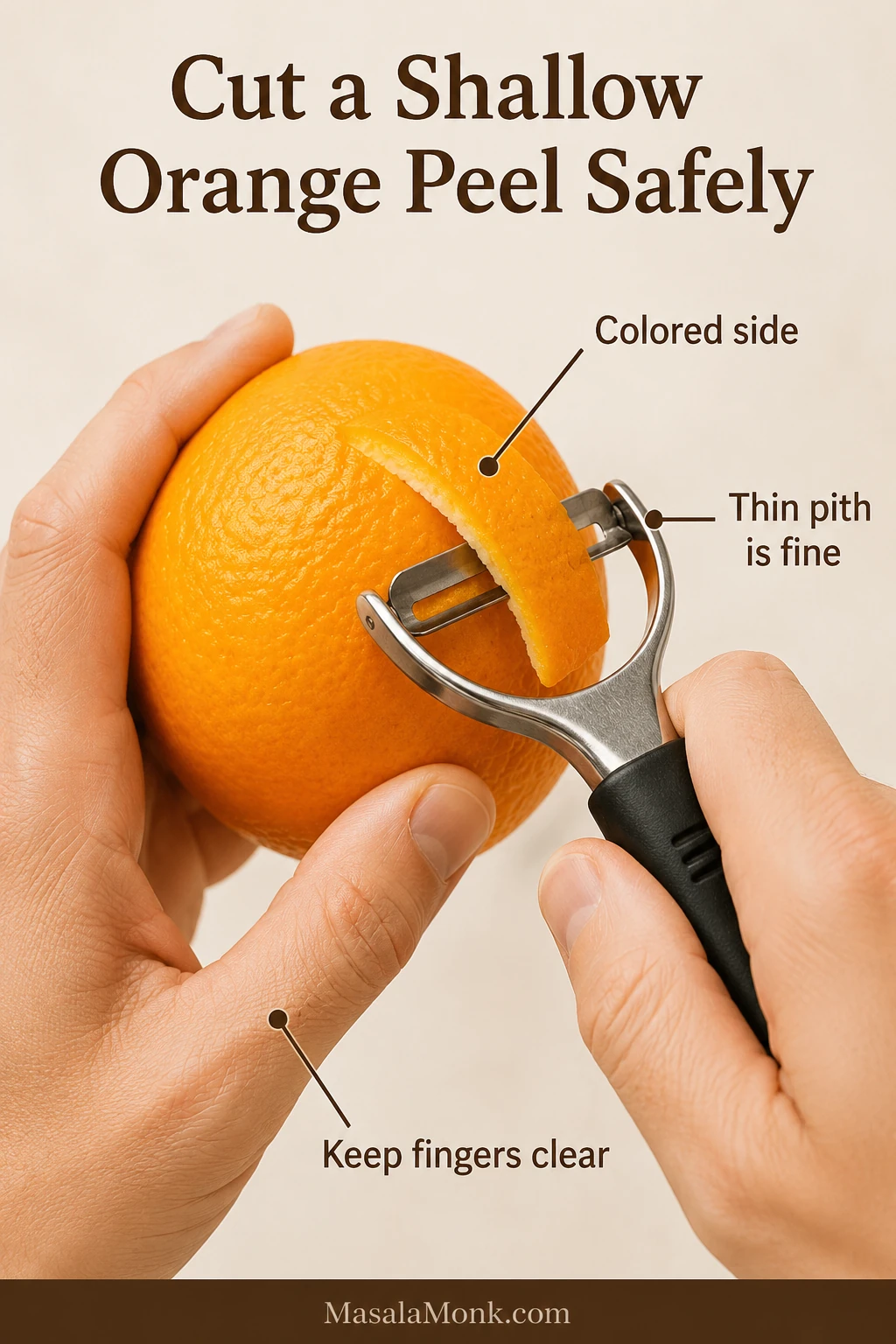
Wash and dry a navel orange before cutting the peel. Its broad skin is fragrant and easy to handle. Cut a shallow 2–3-inch / 5–7.5 cm strip away from your fingers; a thin layer of white pith is fine, while a thick chunk is harder to bend.
The best orange peel bends without cracking and carries only a thin layer of pith. A flexible strip is easier to express and safer to handle above the finished cocktail.
Hold the colored side over the drink, pinch it sharply to release the oils, then run it once around the rim. The aroma should be bright, without adding juice or pulp.
One freshly cut strip performs both garnish jobs: express its oil over the surface first, then sweep it around the rim before placing it in the glass.
Stir this cocktail, even if a shaker is your only vessel. Shaking is useful when citrus juice, dairy, or egg white needs aeration. For that bright, aerated texture, make a Whiskey Sour; here, smooth stirring keeps the drink clear and silky.
No Mixing Glass? Build It Directly in the Serving Glass
The separate mixing-glass method gives you fresh serving ice and slightly easier control. The direct build is simpler, uses fewer tools, and still makes an excellent drink.
Choose rich syrup when speed, consistency, or batching matters. The sugar-cube Old Fashioned suits traditional ritual and slight texture, provided the sweetener is fully incorporated.
Direct Build With Syrup
Measure the syrup and bitters into the rocks glass.
Pour in the bourbon and stir briefly.
Add one large cube or several solid cubes.
Stir until the drink feels cold, smooth, and no longer sharply alcoholic.
Express the orange peel over the surface.
Traditional Sugar-Cube Build
Add one standard 3.5–4 g sugar cube, 3 dashes Angostura, and 1 teaspoon / 5 ml still water to the glass.
Muddle and stir until no hard cube remains.
Add the bourbon and ice.
Stir thoroughly, taste, and finish with orange peel.
A soda-water top-up makes the drink longer, lighter, and less whiskey-forward. When bourbon and ginger fizz are what you want, a Kentucky Mule is designed for that job.
The best bourbon for an Old Fashioned does not need to be rare. It needs enough flavor and proof to remain recognizable after sugar, bitters, ice, and a few minutes in the glass. In the United States, proof is twice the alcohol-by-volume figure, so 90–100 proof means approximately 45–50% ABV.
For a fair bourbon-versus-rye Old Fashioned comparison, hold the syrup, bitters, ice, and stirring steady. The whiskey then becomes the only variable shaping the finish.
Whiskey Styles and Proof
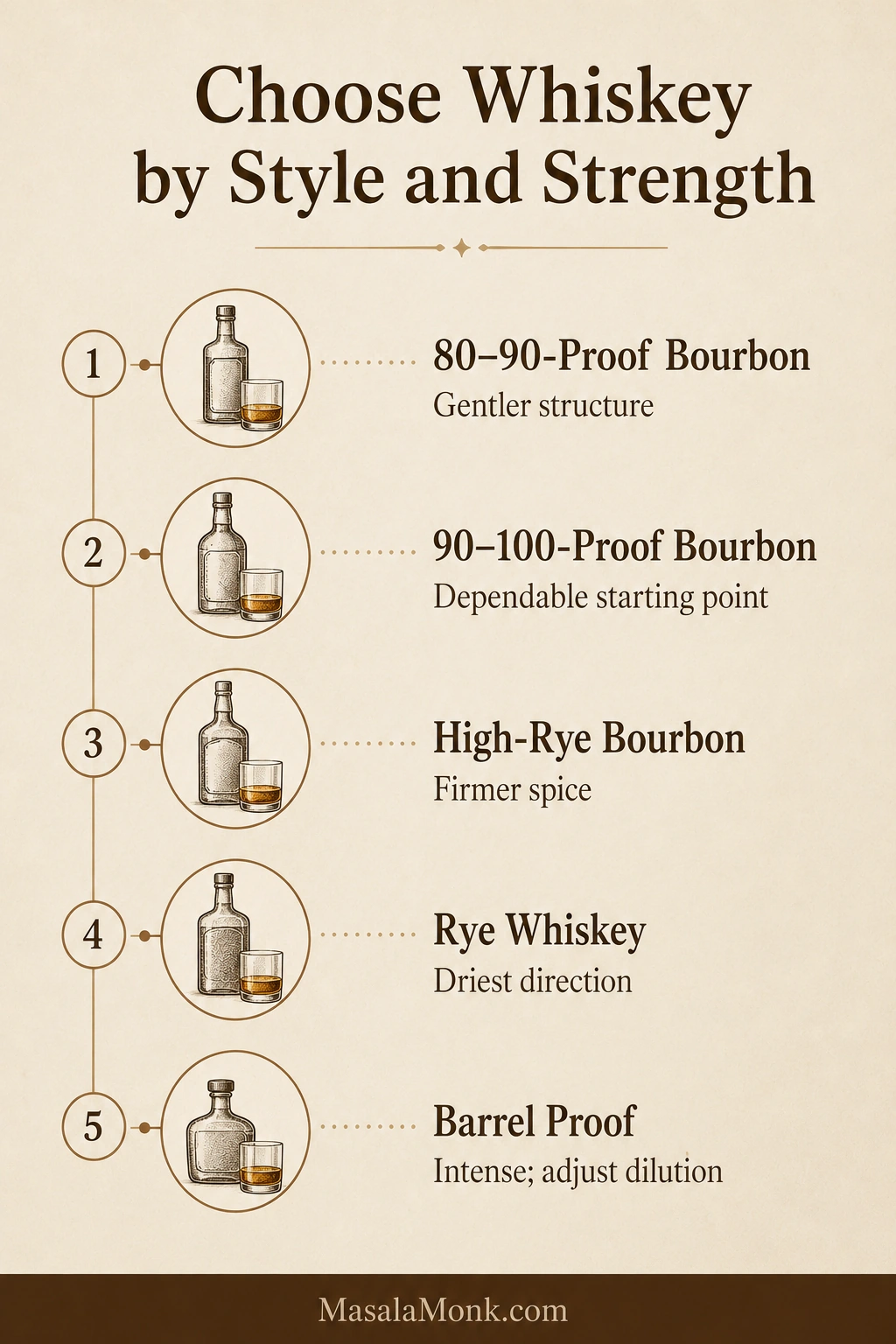
Use this as the quick style map: 90–100 proof is the dependable home starting range, while rye and barrel-proof whiskey need closer control of sweetness and dilution. The table below adds the tradeoffs.
Whiskey style
What it brings
Best for
80–90-proof bourbon
Softer alcohol and a gentler overall structure
A gentler drink; keep the syrup modest
90–100-proof bourbon
More body and enough structure without excessive heat
The most dependable starting point
High-rye bourbon
More grain spice and a firmer finish
A bolder drink that still feels rounded
Rye whiskey
Pepper, herbs, grain, and less apparent sweetness
The driest, spiciest direction
Barrel-proof whiskey
Concentrated flavor and alcohol
A bold drink when you are comfortable adjusting sweetness and dilution
Maker’s Mark illustrates a softer wheated style; Buffalo Trace and Elijah Craig Small Batch sit in the balanced middle; Wild Turkey 101 and Old Forester 100 make a firmer drink; and Rittenhouse Rye or Bulleit Rye move it in a drier direction. These are style examples, not a ranking.
The same bourbon-versus-rye contrast appears in a Boulevardier. Here, begin with the same syrup amount whichever whiskey you choose, then adjust after tasting.
Sugar Cube, Simple Syrup, or Demerara Syrup?
Sugar is where many home Old Fashioneds quietly drift. A small amount rounds the whiskey; too much turns it into a sweet drink with whiskey in it. The form you choose also changes texture, added water, and repeatability.
Rich Demerara Syrup
Rich demerara syrup uses two parts sugar to one part water by weight. Use 1 teaspoon / 5 ml for darker caramel flavor and a fuller texture. To make a small batch, warm 100 g demerara sugar with 50 g water just until dissolved, then cool completely.
Standard Simple Syrup
Standard syrup uses equal weights of sugar and water and tastes more neutral. Use ¼ oz / 7.5 ml. For a small batch, warm 50 g white sugar with 50 g water just until dissolved, then cool.
Rich and standard simple syrup are not equal-volume substitutes. Start with 5 ml of rich 2:1 demerara or 7.5 ml of standard 1:1 syrup, then fine-tune the next glass.
Sugar Cube or Granulated Sugar
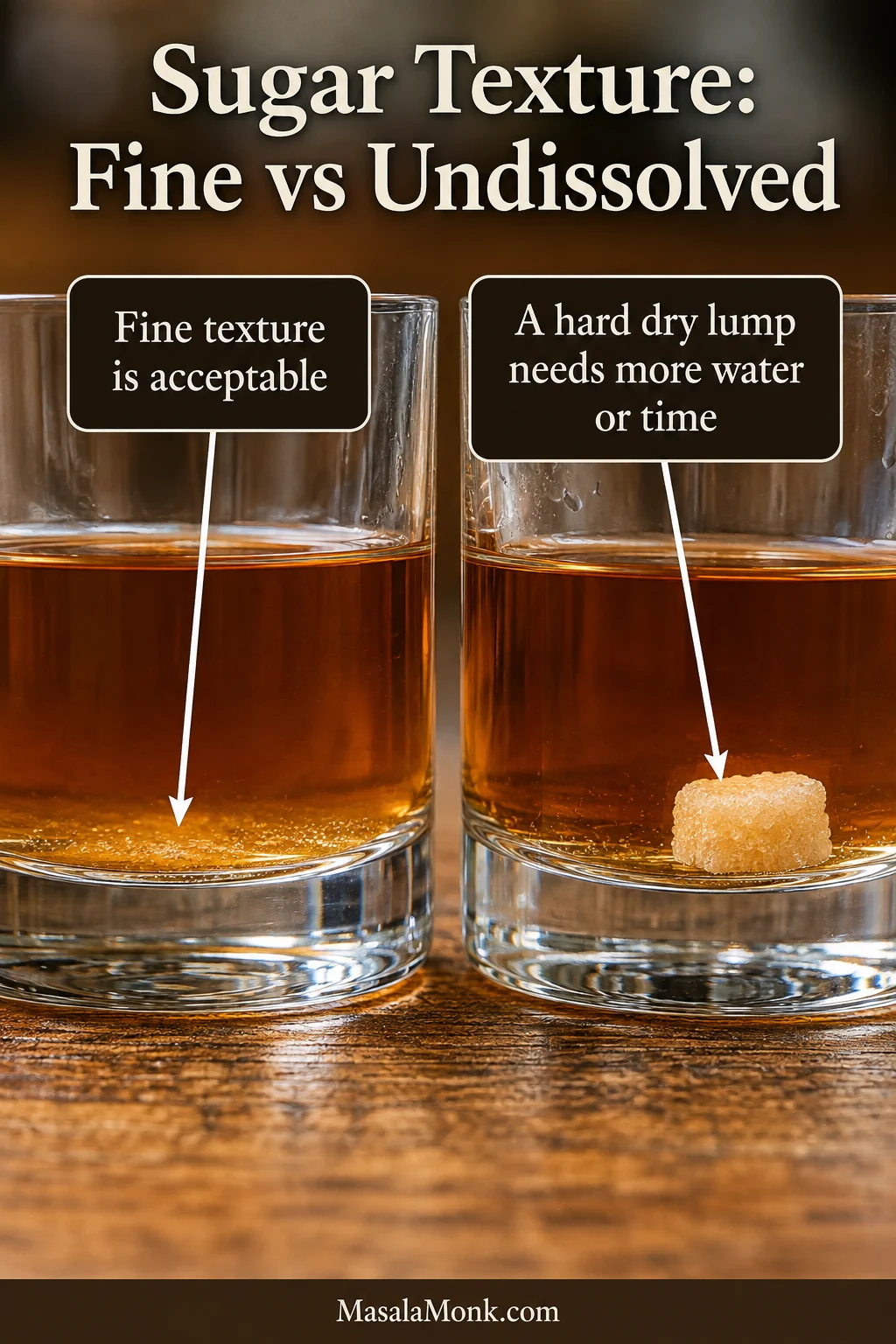
For a traditional build, use approximately 3.5–4 g sugar with 1 teaspoon / 5 ml water and the bitters. Muddle and stir until no hard cube remains. Fine sugar texture is acceptable; a dry lump is not.
Look through the base of a sugar-cube Old Fashioned before serving. Fine crystals are part of the traditional texture; a compact dry lump shows that the cube never fully dissolved.
Choose this
When you want
Watch for
Rich demerara syrup
Consistency, fuller body, and darker flavor
It can cover a very delicate whiskey
Standard 1:1 syrup
Neutral sweetness and common ingredients
Use more volume than rich syrup
Sugar cube
Traditional preparation and gradual change in the glass
A hard undissolved lump
Granulated sugar
A practical pantry substitute
Dissolve it before adding cold whiskey
Sweetness guide
Exceptionally dry: ½ teaspoon / 2.5 ml rich syrup
Drier: about ¾ teaspoon / 4 ml
Balanced starting point: 1 teaspoon / 5 ml
Sweeter: increase in ¼-teaspoon increments
Without sweetener, the alcohol and bitters become much more prominent.
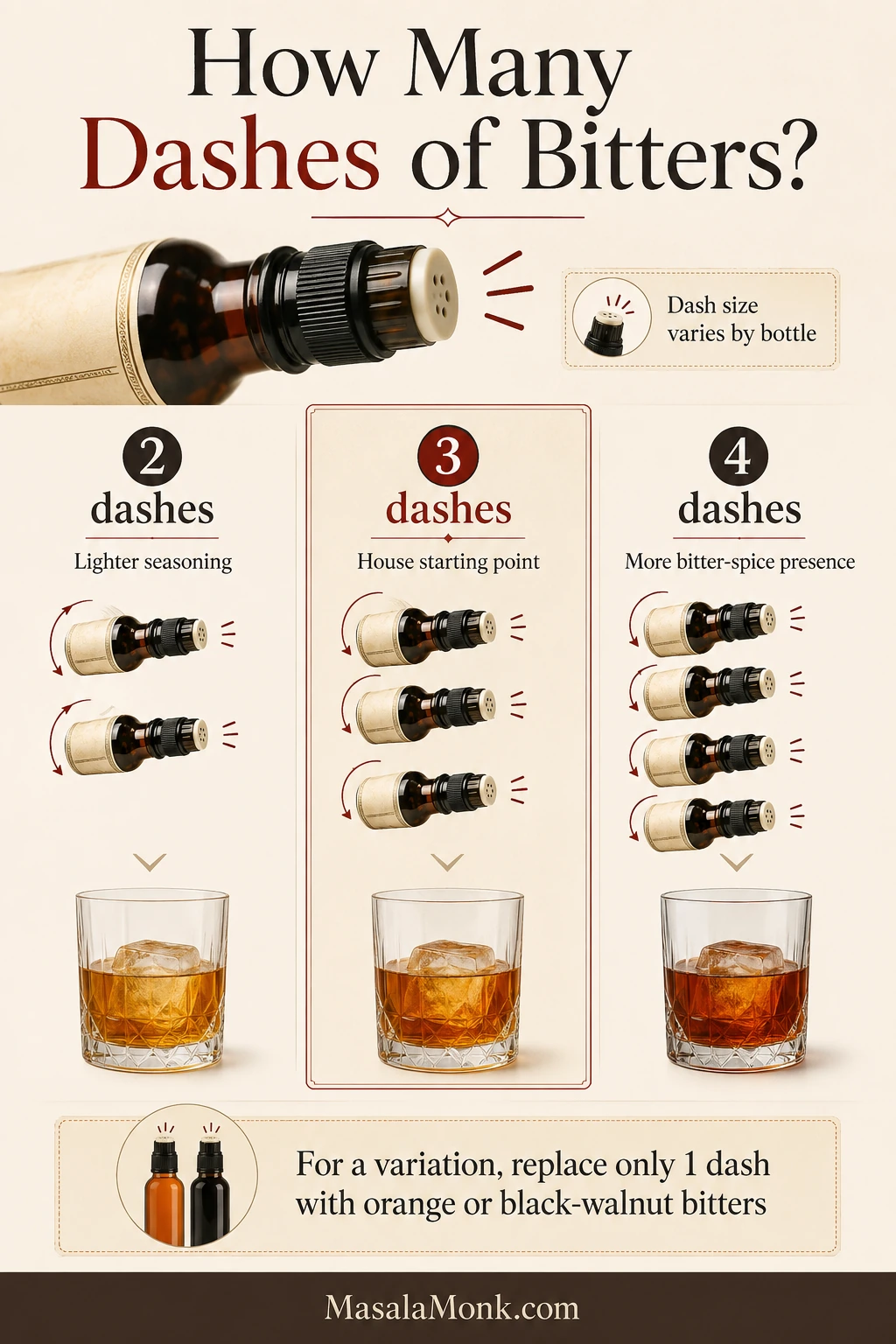
How Many Dashes of Bitters—and Which Kind?
Three dashes look almost insignificant, yet the drink feels flatter without them. Bitters behave more like seasoning than another full liquid ingredient, pulling whiskey and sugar together with concentrated spice, herbs, and aroma.
Start with 3 firm dashes of Angostura. Dash size varies with the bottle, insert, angle, and pouring force, so use the same bottle and motion each time.
2 dashes: softer and more whiskey-forward.
3 dashes: the balanced starting point.
4 dashes: more aromatic and spice-led.
Treat three dashes as a reproducible starting point rather than an exact universal volume. Use the same bitters bottle, angle, and firm motion before deciding whether a fourth dash helps.
For a brighter, nuttier, or darker variation, change only part of the bitters:
Angostura aromatic: the classic choice, with baking spice, herbs, and warmth.
Orange bitters: brighter citrus; begin with one dash alongside Angostura.
Black walnut bitters: darker, nuttier, and especially good with rich bourbon.
Chocolate or mole bitters: cocoa and deeper spice for a deliberate variation.
Peychaud’s: a more floral profile with cherry and anise notes.
Can You Make It Without Bitters?
If Angostura is unavailable, another aromatic cocktail bitter is the closest substitute. Orange peel or muddled fruit can add aroma, but neither provides the same spice. Amaro changes the drink much more substantially; use it as a deliberate variation, as in a Black Manhattan, not as a one-for-one replacement.
Best Glass, Ice, and Garnish
Glass and Serving Ice
An 8–10 oz / 240–300 ml rocks, lowball, or Old Fashioned glass gives the drink and its ice enough room. Chill it in the freezer for five minutes, or fill it with ice while you mix the cocktail and discard that ice before serving.
Use one 1¾–2-inch cube, a large sphere, or two or three solid cubes for serving.
Clear ice is attractive but optional.
Clean, well-frozen ice matters more than perfect clarity.
The best Old Fashioned ice fits the glass comfortably and begins deeply frozen. Cube size matters, but starting temperature, quantity, and time in the drink matter too.
Orange Peel, Cherry, and Muddled Fruit
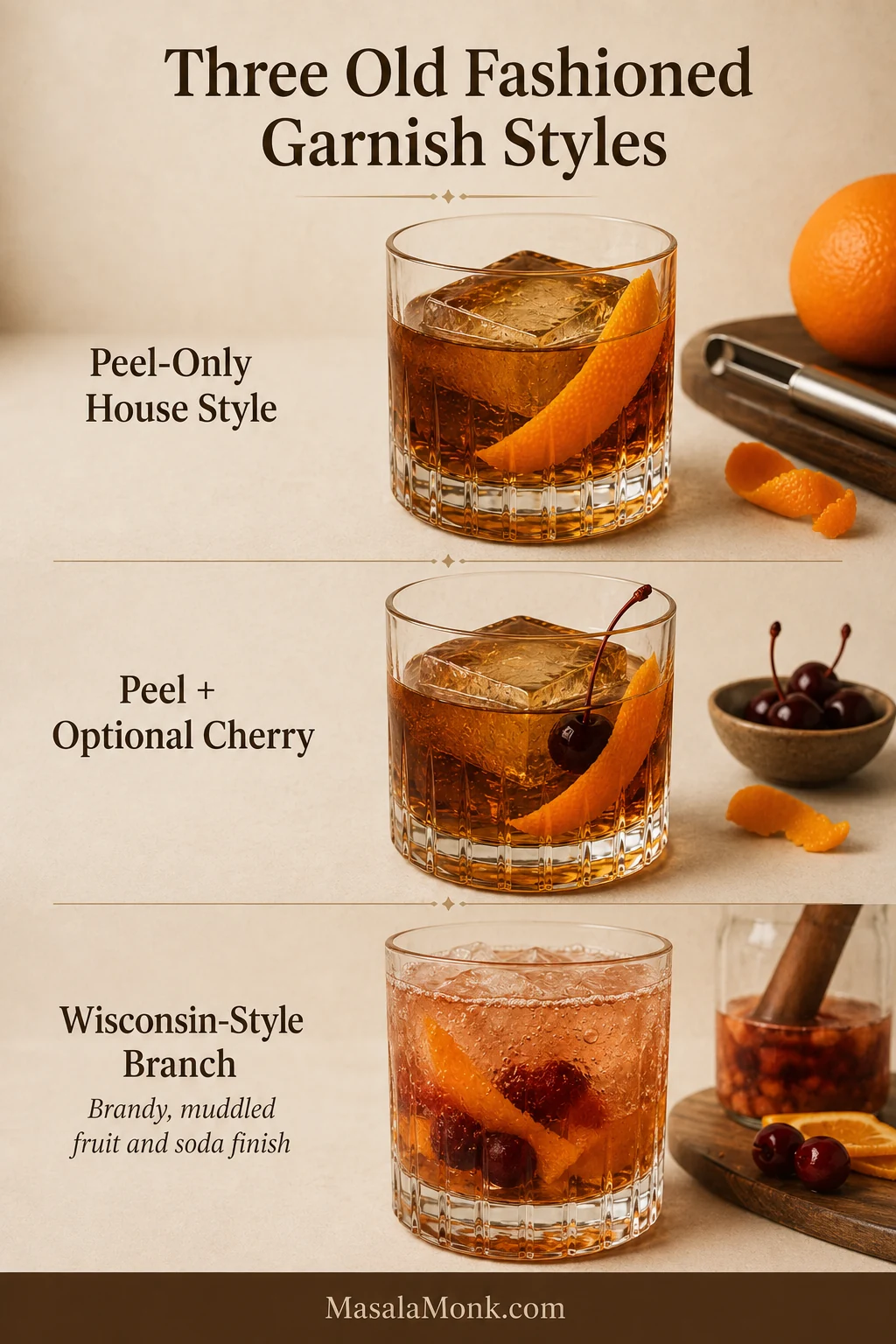
The peel is the last ingredient you add but the first one the drinker encounters. Expressed peel gives aroma without juice. An orange slice—especially when muddled—adds juice, pulp, and a softer fruit-forward character.
Muddled orange and cherry are strongly associated with Wisconsin-style Old Fashioneds, which are often made with brandy and finished sweet, sour, or as a press—typically a combination of lemon-lime soda and soda water. It is a distinct regional branch, not an incorrect drink.
A cocktail cherry is optional. Add one for a dark-fruit accent, or leave it out for a drier finish. Avoid pouring cherry syrup into a drink that already tastes sweet enough.
Clear garnish language prevents ordering surprises: ask for expressed peel, peel with one cherry, or a Wisconsin Old Fashioned with brandy, muddled fruit, and a soda finish.
Ordering one at a bar: ask for bourbon or rye and say “less sweet” when that is what you mean. Specify “orange peel, no muddled fruit” when the garnish style matters.
Adjust It to Your Taste
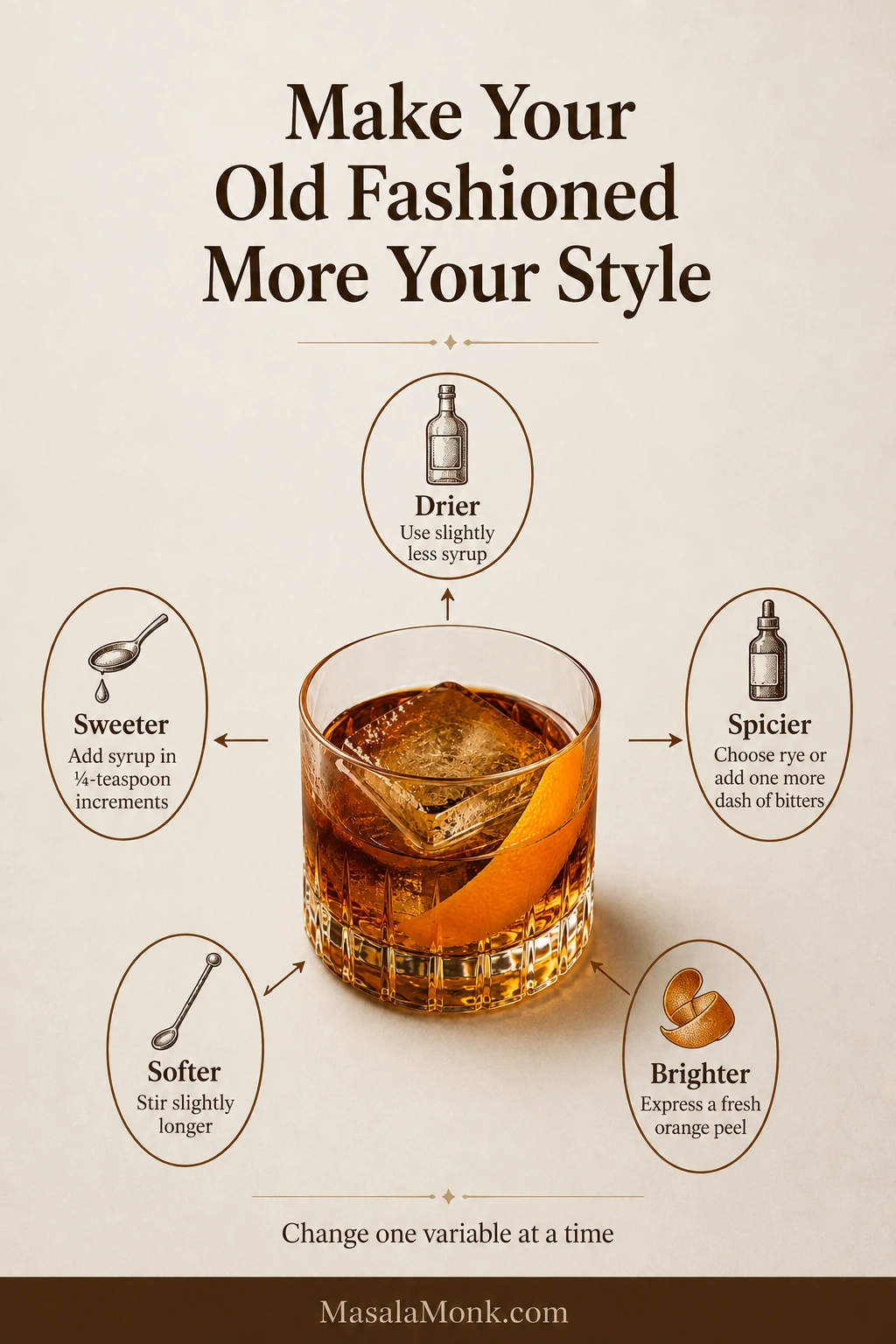
This section is for a correctly made drink that is not yet your preferred style. Change one variable at a time so the next glass tells you what worked.
Use the graphic to choose a direction, then use the table below for the measured next-glass adjustment. Change one variable and write it down so you know what actually worked.
You want
Change this first
Drier
Reduce rich syrup to about ¾ teaspoon / 4 ml, or use rye. Keep the expressed peel and skip the cherry.
Sweeter
Increase syrup in ¼-teaspoon increments. Do not jump straight to a large pour.
Spicier
Use rye or a high-rye bourbon with 3 dashes Angostura. Add a fourth dash only when you specifically want more bitters spice.
Softer
If the current glass still tastes hot, stir for a few more seconds and taste again. For the next one, use an 80–90-proof bourbon or reduce the bitters to 2 dashes.
Brighter
Express a freshly cut orange peel for brighter surface aroma. For more orange character within the drink, add one restrained dash of orange bitters beside the Angostura.
Richer
Choose demerara syrup and a fuller 100-proof bourbon; extra sugar alone can make the drink cloying.
Common Old Fashioned Mistakes—and How to Fix Them
Small misses are normal in a drink with no juice or mixer to hide them. A slightly imperfect glass is still useful because it tells you what the next one needs.
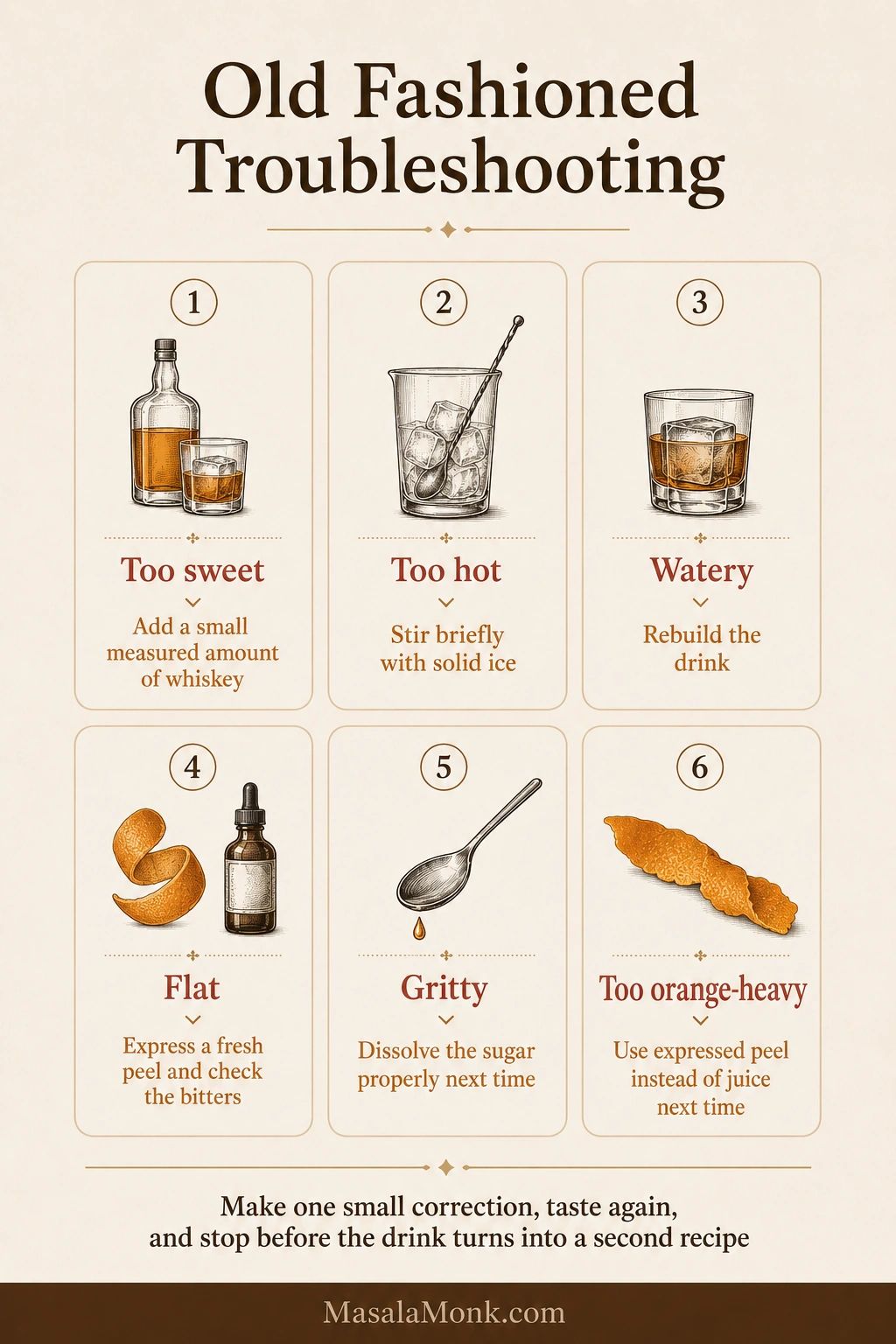
Most disappointing Old Fashioneds come down to sweetness, dilution, bitters, or fruit. If the glass is only slightly off, use the quick fix below. When repairing it would require half another recipe, start again.
Any repair changes more than one ratio. Make one small correction, taste again, and stop before the drink turns into a second recipe.
Quick Fixes by Symptom
Match one correction to one symptom, then taste again. Once sweetness, dilution, fruit, and bitters all need repair, rebuilding the Old Fashioned is usually the cleaner decision.
Sweetness, Heat, and Dilution
Problem
Why it happened
How to fix it
Too sweet
Too much syrup, cherry syrup, or a very soft bourbon.
If it is only slightly off, add 1 teaspoon / 5 ml bourbon, stir briefly, and taste. Repeat once only if the drink is still close; otherwise, rebuild with less syrup.
Too strong or hot
The drink is under-chilled or under-diluted, or the whiskey is unusually high-proof.
Stir briefly with solid ice and taste again. With barrel-proof whiskey, the next glass may also need slightly more dilution.
Thin or watery
Too much stirring, too little ice, or ice that was already wet and melting.
Rebuilding is usually better than adding more whiskey and sugar. Stop stirring sooner on the next glass.
Too bitter
Too many dashes or an unusually generous dasher bottle.
Add 1 teaspoon / 5 ml bourbon and two or three drops of syrup, then taste. If it still feels medicinal, rebuilding is cleaner than chasing the balance.
Aroma, Sugar, Fruit, and Whiskey
Problem
Why it happened
How to fix it
Flat or dull
Too little bitters, stale bitters, weak whiskey, or no citrus oil.
Express a newly cut peel over the surface. Use livelier bitters or a stronger bourbon when you make it again.
Gritty
A hard piece of sugar remains in the glass.
Continue stirring only if the drink can take more dilution. Use syrup or dissolve the sugar first in a future build.
Too orange-heavy
Orange juice or muddled fruit entered the drink.
It cannot be fully reversed. Use expressed peel instead of a wedge on the next glass.
The whiskey disappears
Too much syrup, water, fruit, or a very low-proof bottle.
Add a measured amount of whiskey only when the drink is still close. Use less syrup or a stronger bottle when making it again.
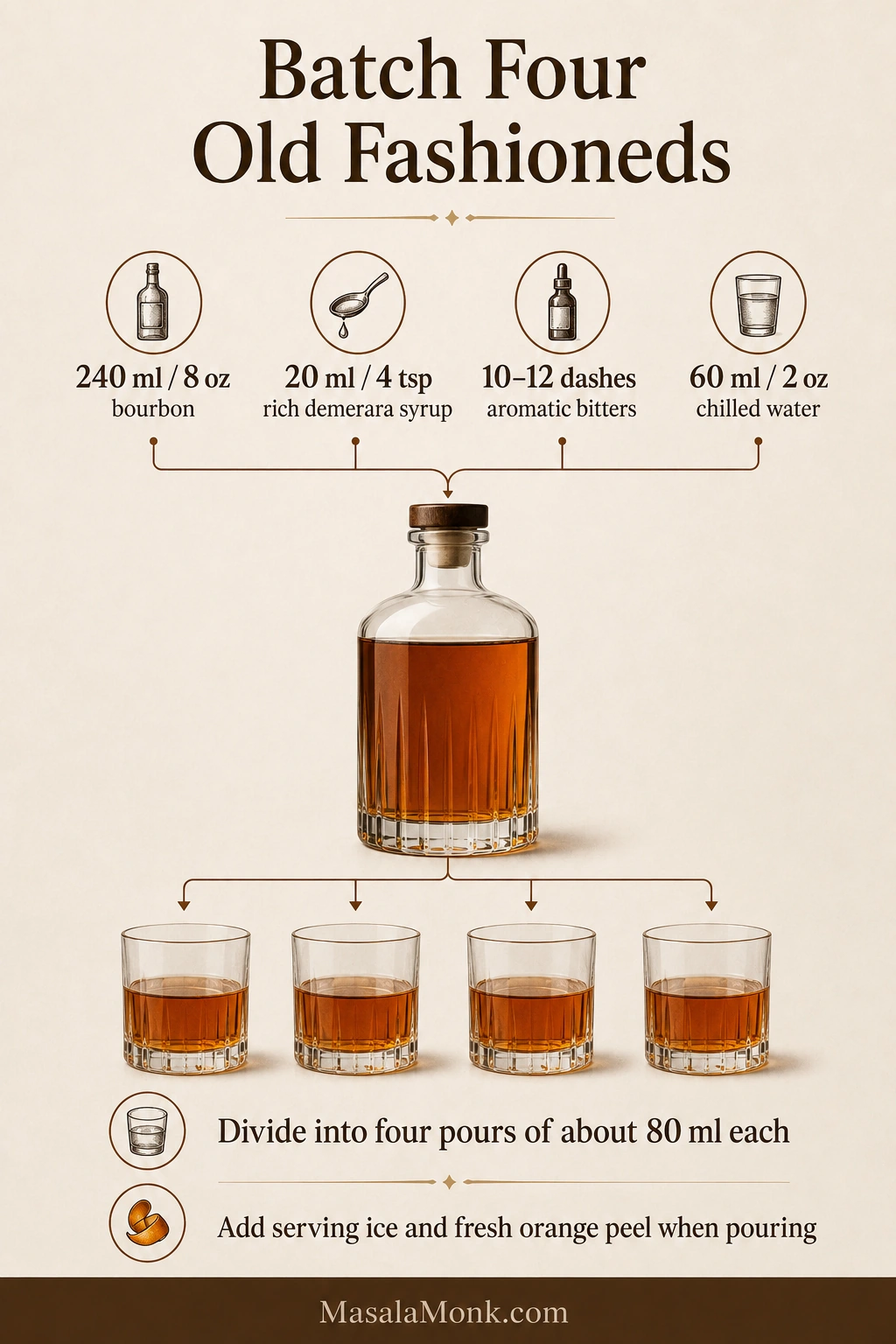
A small batch lets you pour four good drinks without spending the first part of the evening facing the bar instead of your guests. The important addition is water: a refrigerated batch does not receive the dilution that an individual drink picks up while stirring over ice.
Test one complete batched Old Fashioned over the actual serving ice before guests arrive. The drink continues softening in the glass, so the first chilled taste is not the final one.
Four-Drink Batch Formula
8 oz / 240 ml bourbon
4 teaspoons / 20 ml rich 2:1 demerara syrup
10–12 firm dashes Angostura bitters
2 oz / 60 ml chilled water
Combine the bourbon, syrup, 10 dashes bitters, and water in a clean bottle or covered jug.
Seal and mix gently, then refrigerate until thoroughly cold.
Taste the chilled batch. Add the final 1–2 dashes only if it still smells or tastes a little flat.
Pour about 2⅔ oz / 80 ml into each rocks glass over one large cube or several solid cubes.
Express an orange peel over every glass immediately before serving.
Divide the batch evenly among four glasses, roughly 80 ml each before any further dilution from serving ice. Add extra chilled water only in small measured amounts.
Judge a batch only after it is thoroughly chilled. Warm whiskey tastes sharper, so adjusting syrup or bitters too early can push four otherwise balanced Old Fashioneds in the wrong direction.
Before guests arrive, taste one complete 80 ml pour over its serving ice because the drink will soften further in the glass. Keep orange peels out of the batch; their aroma fades, and prolonged contact can add unwanted bitterness.
Make-Ahead and Storage
Syrup: cool it completely, transfer it to a clean sealed container, label it as 1:1 or 2:1, and refrigerate. Aim to use homemade syrup within about 2–4 weeks. Rich 2:1 syrup may keep longer, but cleanliness and refrigeration matter more than a precise calendar date.
Discard syrup sooner if you notice cloudiness, mold, fermentation, gas, or an unusual smell.
Pre-batched cocktail: for easy entertaining, prepare it up to 1 week ahead and keep it tightly sealed in the refrigerator. Add ice, peel, and cherries only when serving.
Finished drink: enjoy it immediately. The serving ice keeps diluting the cocktail while the orange aroma fades.
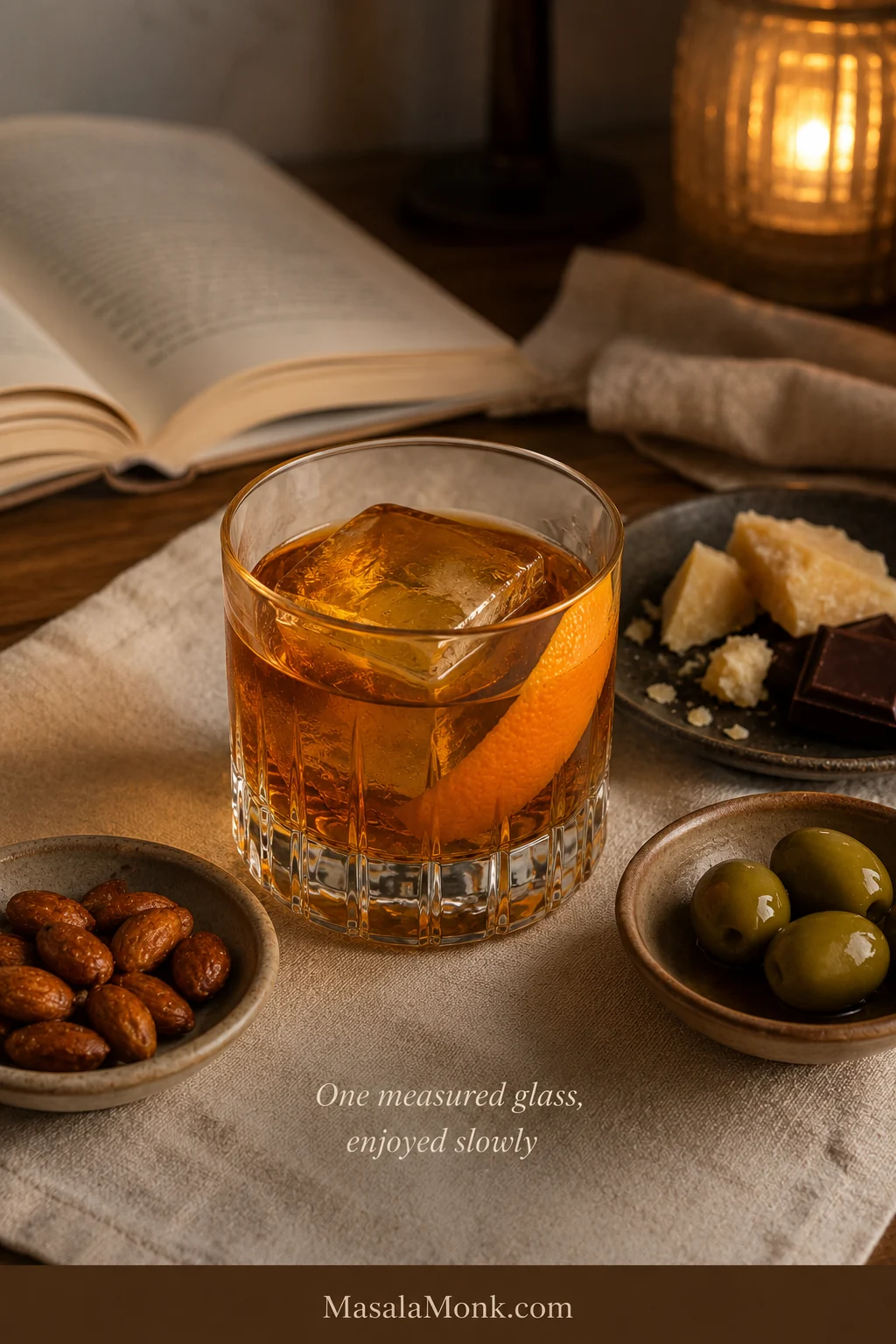
This is a slow-sipping drink rather than a bright thirst-quencher. Serve it before dinner with modest sweetness, or after dinner with richer whiskey, demerara, and an optional cherry. Salty roasted nuts, olives, aged cheese, crisp potato snacks, mushroom toast, and dark chocolate all sit comfortably beside it.
The setting does not need to be formal. Sometimes it is simply the first quiet drink after a long week—one measured glass made properly, then enjoyed slowly.
Keep Old Fashioned food pairings small and contrasting. Salty nuts, olives, aged cheese, or dark chocolate frame the bourbon and bitters instead of turning the cocktail into background.
Five Variations to Try
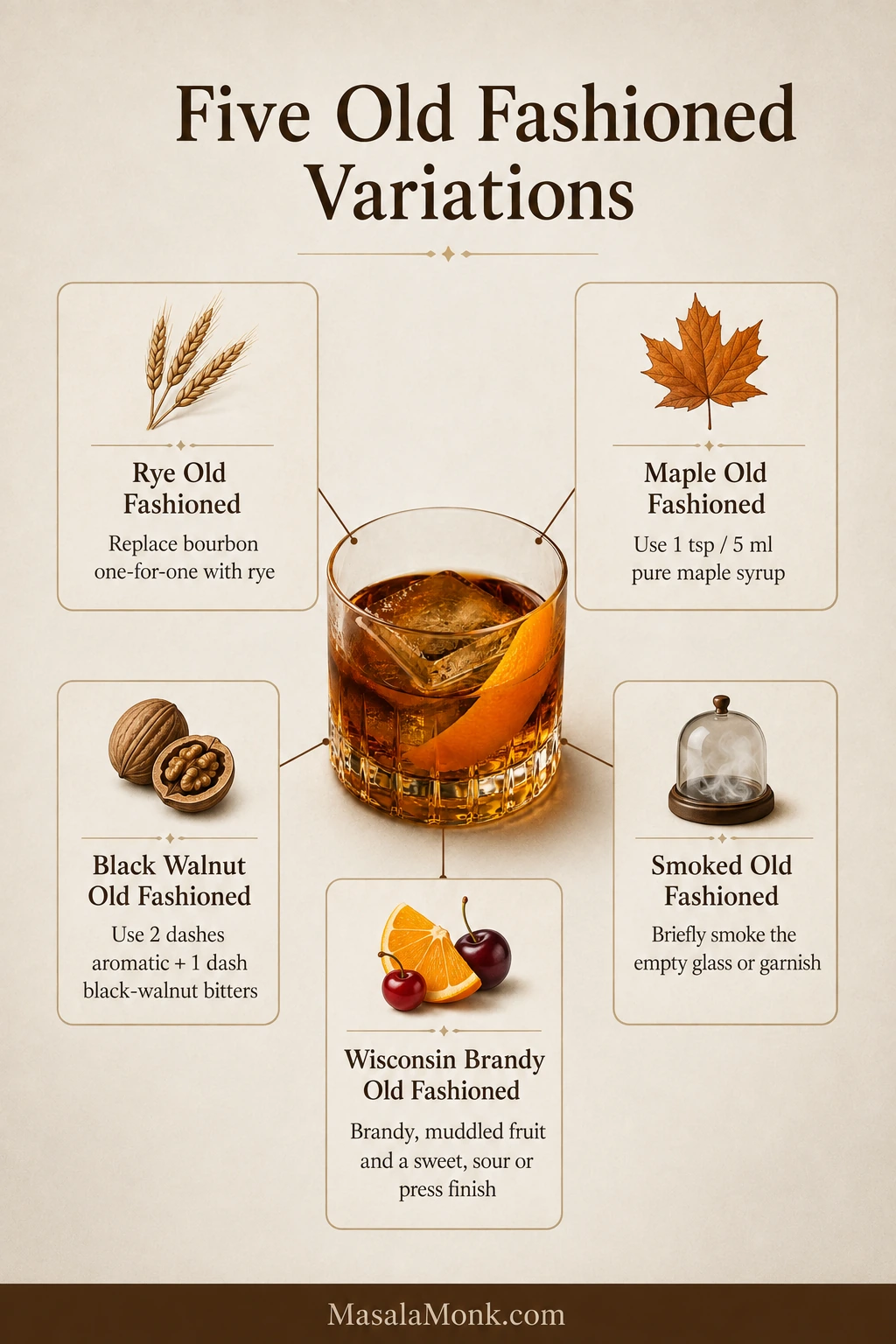
Use the board to choose a direction; the list below gives the exact swap or method. The strongest variations change one clear idea while keeping the spirit-sweetener-bitters structure recognizable.
Rye Old Fashioned: replace bourbon one-for-one with rye for a drier, spicier finish.
Maple Old Fashioned: replace the demerara with 1 teaspoon / 5 ml pure maple syrup, then adjust after tasting.
Black Walnut Old Fashioned: begin with 2 dashes Angostura and 1 dash black-walnut bitters.
Smoked Old Fashioned: briefly smoke the empty glass or garnish; avoid burning ingredients directly into the drink.
Wisconsin Brandy Old Fashioned: treat this as a separate regional branch with brandy, muddled fruit, and a sweet, sour, or press finish.
For Scotch, a Rob Roy keeps the stirred-whiskey character and replaces sugar with sweet vermouth.
Old Fashioned vs Manhattan
Both drinks are whiskey-forward and stirred, but they create different experiences. An Old Fashioned uses a small amount of sugar or syrup; a Manhattan uses sweet vermouth, adding wine, herbs, and greater richness.
Reach for an Old Fashioned when you want the base whiskey most exposed. A Manhattan suits the moments when sweet vermouth’s wine, herbs, and richness are part of the flavor you seek.
The name points back to an older cocktail formula: spirit, sugar, bitters, and water. As newer drinks gained liqueurs and modifiers, drinkers could ask for whiskey in the “old-fashioned” way.
The International Bartenders Association still lists an official version made with bourbon or rye, sugar, Angostura bitters, and water. Modern recipes vary in whiskey volume, syrup, fruit, ice, and technique. A clear sensory target is more useful than treating one ritual as the only correct method.
Frequently Asked Questions
What whiskey is best for an Old Fashioned?
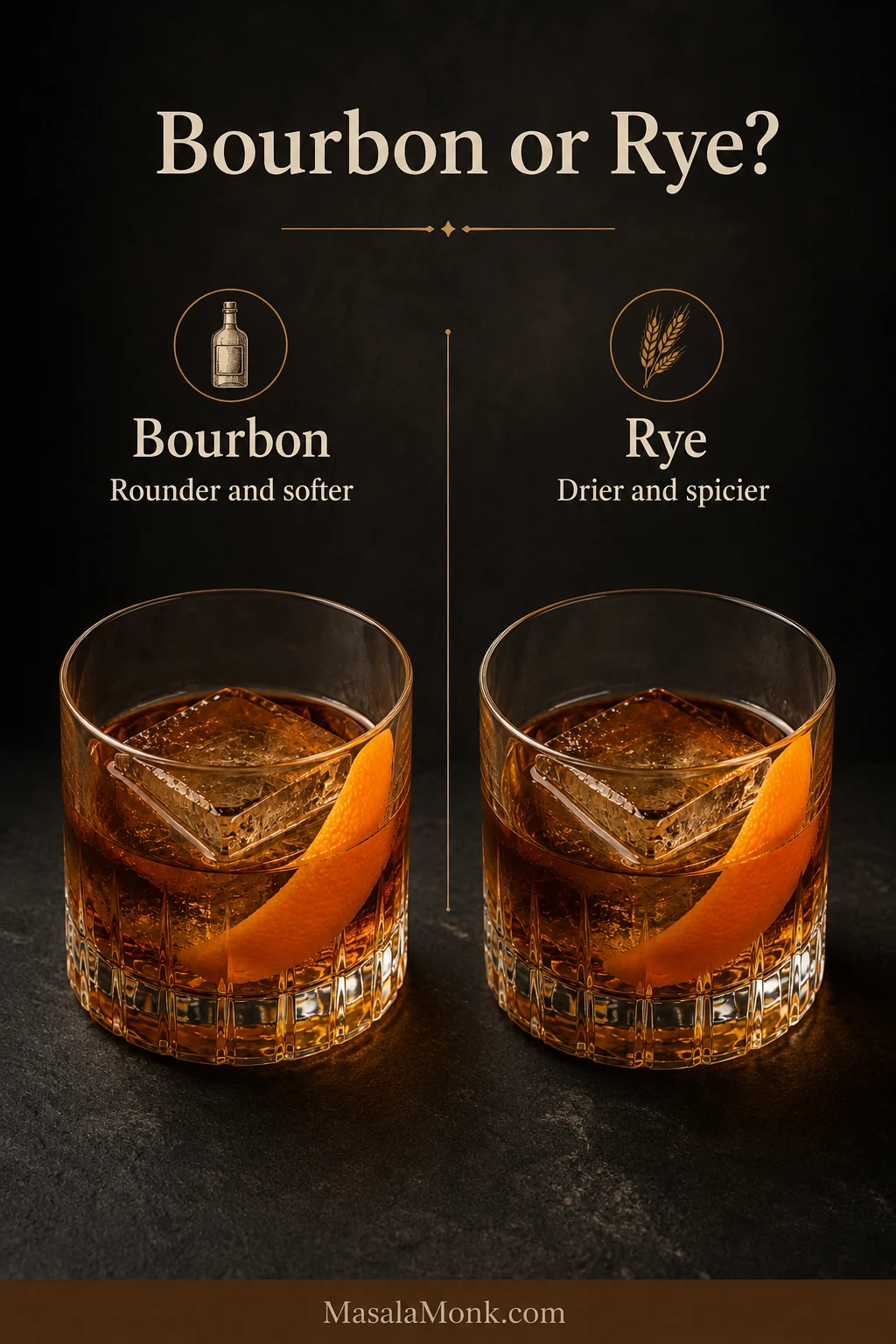
A 90–100-proof whiskey is the most dependable starting point. Bourbon is rounder and sweeter; rye is drier and spicier.
Should an Old Fashioned contain a cherry or muddled orange?
A cherry is optional. This version uses expressed peel, while muddled orange and cherry belong to Wisconsin-style and other regional preparations.
Can I make an Old Fashioned without orange?
The cocktail still works without orange. Lemon peel gives a sharper fragrance, or you can leave the garnish out entirely.
Why does my Old Fashioned taste too strong?
It is probably under-diluted. Stir briefly with ice and taste again; the alcohol should remain strong without feeling raw or separate.
Start With the Whiskey, Then Listen to the Glass
A memorable Old Fashioned is not defined by the most expensive bourbon, the clearest ice, or the longest history lecture. It is the one where every small addition makes the whiskey easier to notice.
Stir until the drink feels cold and settled. Express the orange peel, notice what reaches you before the first sip, and taste it slowly.
Then make the next one a little more yours—drier, spicier, softer, or brighter. The essential shape remains the same: whiskey, sweetness, bitters, and water, with orange arriving first on the nose.
Do you reach for bourbon or rye, and how dry do you like the finished drink? Share what tastes right to you.
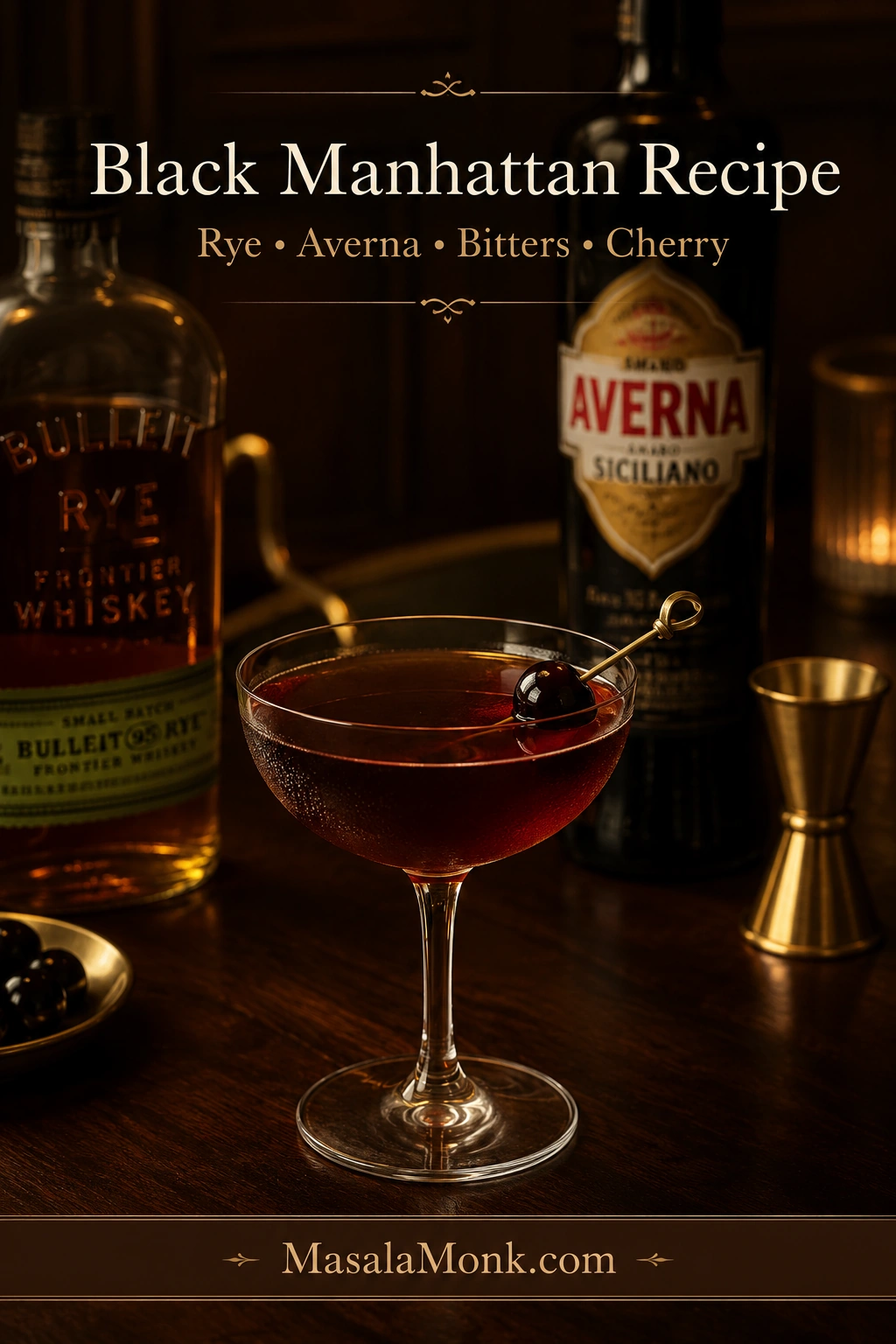
A Black Manhattan is what happens when a classic Manhattan turns moodier. Rye whiskey gives it spine, Averna brings bittersweet caramel and herbs, and a good cherry waits at the bottom like a small reward.
It is not a complicated cocktail, but it does ask for care. A cold glass, a proper stir, and the right amaro make the difference between a drink that tastes hot and heavy and one that feels dark, smooth, structured, and composed.
The core formula is easy to remember: 2 oz rye whiskey, 1 oz Averna amaro, bitters, ice, and a cherry. Make that rye-and-Averna build first. Once it tastes balanced, you can try bourbon, switch the amaro, add black walnut bitters, batch it for guests, or serve it over one large cube.
Black Manhattan Recipe Quick Answer
A Black Manhattan is a stirred whiskey cocktail made with 2 oz rye whiskey, 1 oz Averna amaro, Angostura bitters, orange bitters, and a brandied cherry. It is a Manhattan variation where amaro replaces sweet vermouth, giving the drink a darker, more herbal, bittersweet flavor.
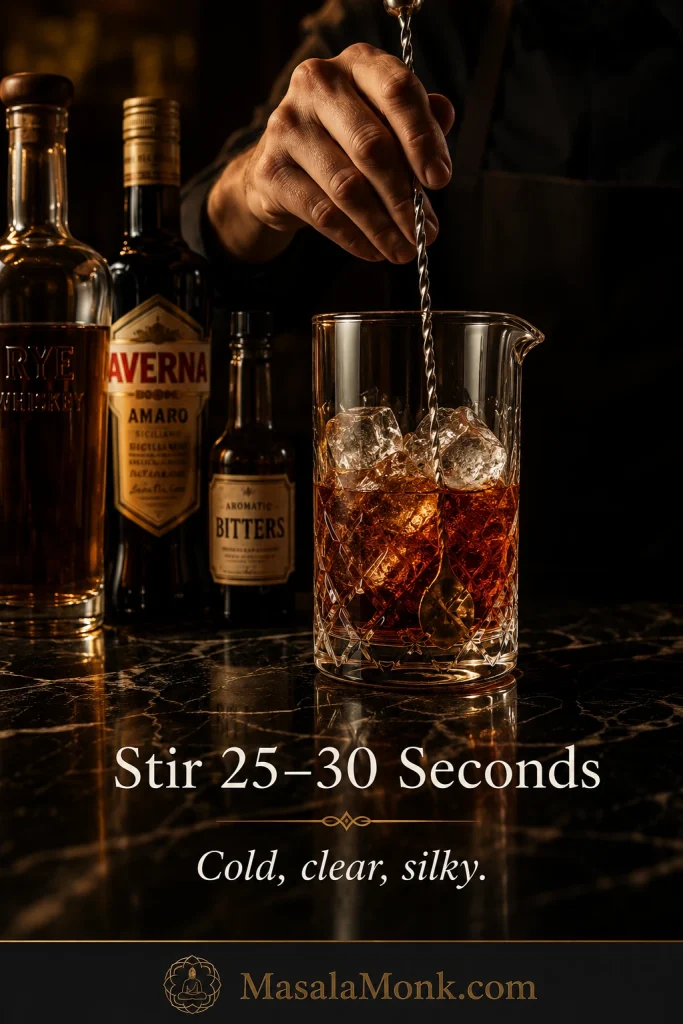
Stir the whiskey, amaro, and bitters with plenty of ice for 25–30 seconds, then strain into a chilled coupe or Nick & Nora glass. Start with rye and Averna if this is your first round; use bourbon when you want a softer, sweeter drink.
Best first build: rye whiskey + Averna.
Main ratio: 2 parts whiskey to 1 part amaro.
Method: stir, never shake.
Garnish: brandied cherry or dark cocktail cherry.
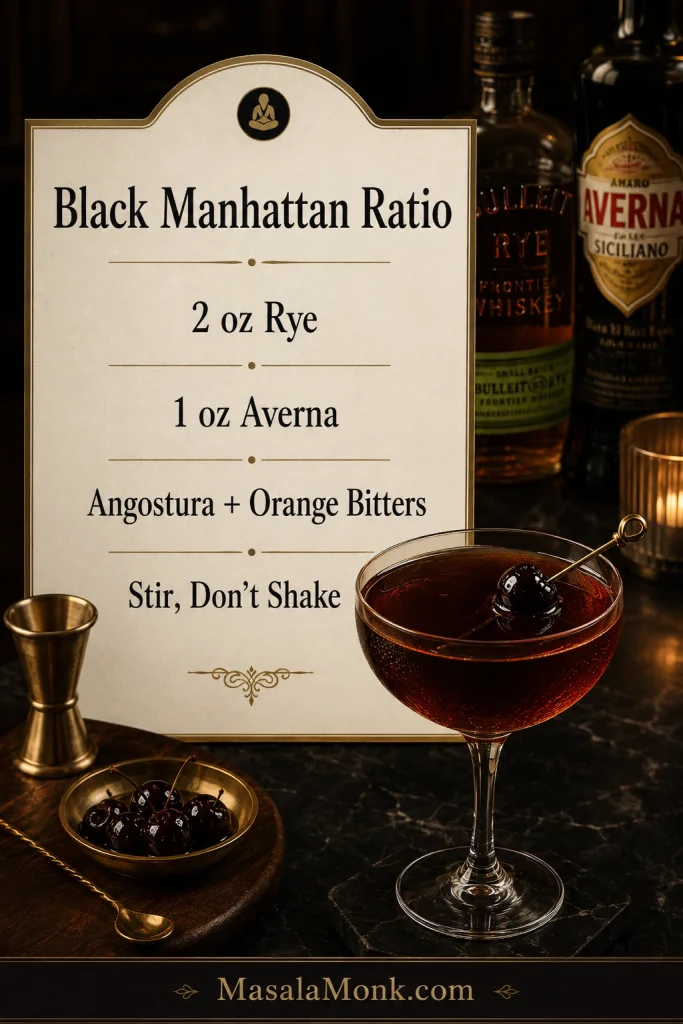
Ratio cue: check this 2:1 guide before measuring the first drink, especially if you are new to stirred whiskey cocktails.
First, lock in the ratio: 2 parts rye to 1 part Averna. From there, bitters and proper stirring turn the formula into a balanced cocktail.
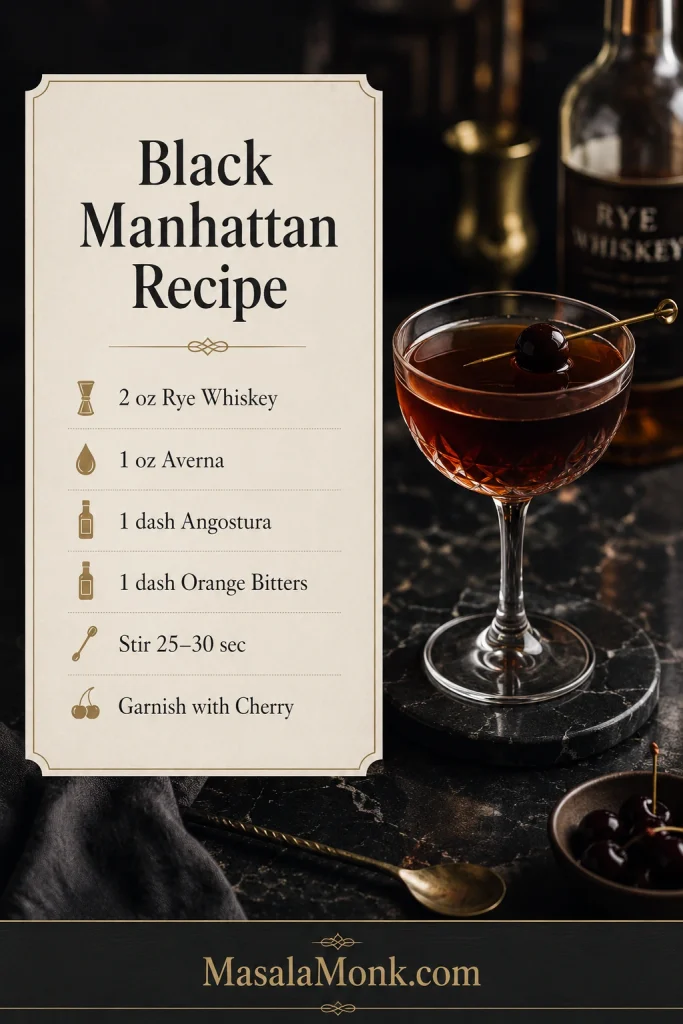
Recipe cue: keep this rye-and-Averna card close while you make the reference version.
Use this quick Black Manhattan recipe card when you want the classic rye-and-Averna build without recalculating the measurements.
Black Manhattan With Rye and Averna
Start here. This is the version that teaches the drink: rye whiskey, Averna, Angostura bitters, orange bitters, and a brandied cherry. Rye keeps the cocktail dry and upright, while the amaro gives it the caramel-herbal depth that separates it from a regular Manhattan.
Prep Time
5 minutes
Total Time
5 minutes
Servings
1 cocktail
Method
Stirred
Glass
Chilled coupe or Nick & Nora
Equipment
Mixing glass, jigger, bar spoon, strainer
Ingredients
Ingredient
Amount
Rye whiskey
2 oz / 60 ml
Averna amaro
1 oz / 30 ml
Angostura bitters
1 dash
Orange bitters
1 dash
Ice
Enough to fill the mixing glass
Brandied cherry
1, for garnish
Instructions
Chill a coupe or Nick & Nora glass for at least 5 minutes.
Add the rye whiskey, Averna, Angostura bitters, and orange bitters to a mixing glass.
Fill the mixing glass with ice.
Stir for 25–30 seconds, until the drink is very cold.
Strain into the chilled glass.
Garnish with a brandied cherry and serve right away.
Bar-Style Adjustments
For a more aromatic Black Manhattan, use 2 dashes each of Angostura and orange bitters. If your bitters bottle pours very lightly, 2 dashes of each may taste closer to a cocktail-bar pour.
Choose a rye with enough proof and spice to stand up to Averna. A bottle around 90–100 proof usually gives enough backbone without making the cocktail harsh. If your rye is very soft, the drink may need an extra dash of Angostura, a brighter orange twist, or a spicier rye next time.
House Rules Before You Experiment
MasalaMonk house take: Make the first one with rye and Averna. Do not change the ratio, do not add cherry syrup, and do not shake it. Once that drink tastes right, make one controlled swap at a time: the whiskey, the amaro, or the bitters.
Strength note: A Black Manhattan is a spirit-forward cocktail. Serve it cold, small, and slow, and only to adults of legal drinking age. For a general reference, the NIAAA explains what counts as a standard drink.
House cue: get the disciplined version right first, then make only one bottle or bitters swap at a time.
Next, make the first version disciplined: rye, Averna, bitters, no cherry syrup, and no shaking. After that, small changes become easier to taste.
From here: if you already have the bottles, continue to how to make it. If the drink tastes off later, use the troubleshooting guide before rebuilding the recipe.
When to Make a Black Manhattan
Make a Black Manhattan when you want one serious drink, not a round of light cocktails. It is ideal after dinner, with a small snack board, or on a quiet night when an Old Fashioned feels too sweet and a classic Manhattan feels too familiar.
Serving cue: this is the mood for the drink — serious, slow, and better after dinner than before a loud round.
Choose a Black Manhattan when you want a serious after-dinner whiskey cocktail: darker than a classic Manhattan and less sweet than an Old Fashioned.
Make it when you want whiskey, but not another Old Fashioned — the elegance of a Manhattan with more shadow, less winey sweetness, and a slower finish.
It is dark without being harsh, bitter without being punishing, and slow enough to make you pay attention. This is not the drink for a blender, a shaker tin, or a crowded glass of crushed ice. It is the drink for a chilled glass, a quiet stir, and one good cherry at the end.
Black Manhattan at a Glance
Main ratio
2 parts whiskey to 1 part amaro
Sweet vermouth?
No. Amaro replaces sweet vermouth.
Best whiskey
Rye for the traditional build; bourbon for a softer pour
Best amaro to start
Averna
Serve style
Stirred, served up, without ice
Flavor
Cold, whiskey-led, herbal, bittersweet, polished
Why This Recipe Works
A good Black Manhattan works because nothing in the glass is wasted. Rye brings the dry, spicy backbone. Averna gives the cocktail its low light. Angostura adds spice, while orange bitters keeps the amaro from feeling too heavy.
Stirring is just as important as the ingredients. This is an all-spirit cocktail, so it needs controlled dilution, not shaking. A gentle 25–30 second stir chills the drink, softens the alcohol heat, and gives the final pour the clear, silky texture you want.
The cherry should feel like a finish, not the whole story. A bad cherry will not ruin the drink, but a good one makes the last sip feel intentional. Too much cherry syrup pushes the cocktail away from balance and into something sticky.
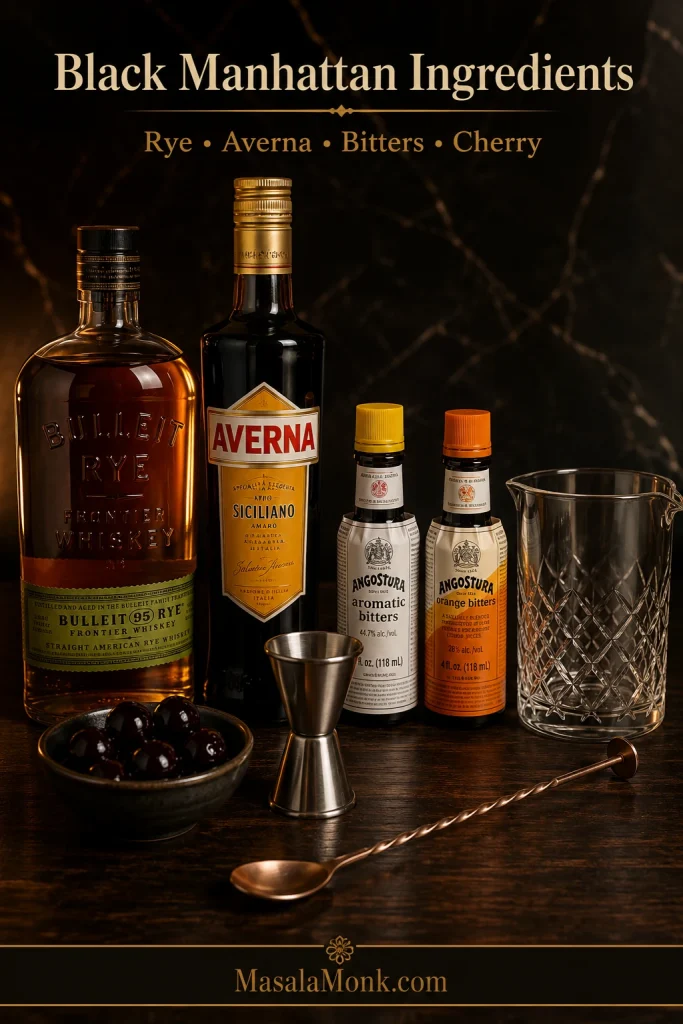
Black Manhattan Ingredients
With a drink this spare, every bottle shows. You do not need a huge home bar to make this well, but you do need a whiskey and amaro that work together instead of fighting each other.
Ingredient cue: the whiskey, amaro, bitters, and cherry each change the balance, so choose them with intention.
Because the ingredient list is short, every bottle has a job: rye keeps it dry, Averna makes it bittersweet, and bitters keep it from tasting heavy.
Rye Whiskey
Rye whiskey is the traditional choice because it brings spice, dryness, and structure. It is not here to shout; it is here to keep the drink upright while Averna brings the dark, sweet-herbal weight.
Choose a bottle you enjoy in stirred drinks. Something around 90–100 proof usually gives enough backbone without making the cocktail harsh. If the whiskey is very soft, the drink may need an extra dash of Angostura, a brighter orange twist, or a spicier bottle next time.
Averna or Another Amaro
Averna is the most reliable starting point for a Black Manhattan. It is bittersweet, rounded, and gently herbal, with caramel and orange-like notes that work beautifully with whiskey.
The amaro replaces sweet vermouth, and that one swap changes the whole cocktail. A classic Manhattan tastes winey, smooth, and lightly sweet; by contrast, a Black Manhattan tastes deeper, more herbal, and more bittersweet.
Do not worry about finding the “perfect” bottle on your first try. Averna gives you the reference point; the other amari make more sense after you know what the first version tastes like.
If you are choosing your first bottle, do not overthink it: Averna first, Cynar later, Montenegro if you want something gentler.
For a brighter bourbon-and-amaro drink, the Paper Plane cocktail uses amaro in a completely different way, with citrus and Aperol instead of a dark stirred build.
Angostura and Orange Bitters
Angostura bitters add spice and structure. Orange bitters add lift and brightness, which helps the drink feel polished instead of heavy. Start with 1 dash of each; go to 2 dashes each if you want a more aromatic bar-style version.
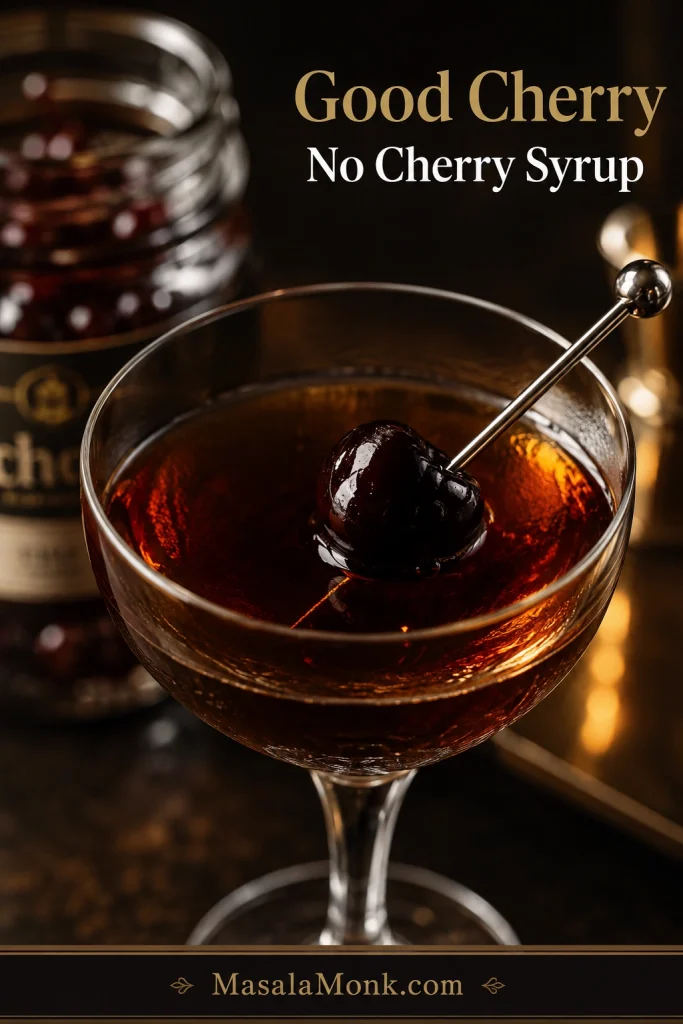
Brandied Cherry
Brandied cherries or Luxardo-style cocktail cherries work better than bright neon-red sundae cherries. The garnish should add a small, rich finish, not turn the drink into a cherry cocktail.
An orange twist can also work, especially if you are using a brighter amaro. For the classic build, start with a cherry.
Garnish cue: the cherry should finish the cocktail with richness, not turn it into a syrupy cherry drink.
Finally, finish with a good brandied cherry. It should add richness, not enough syrup to cover the whiskey and amaro.
How to Make a Black Manhattan
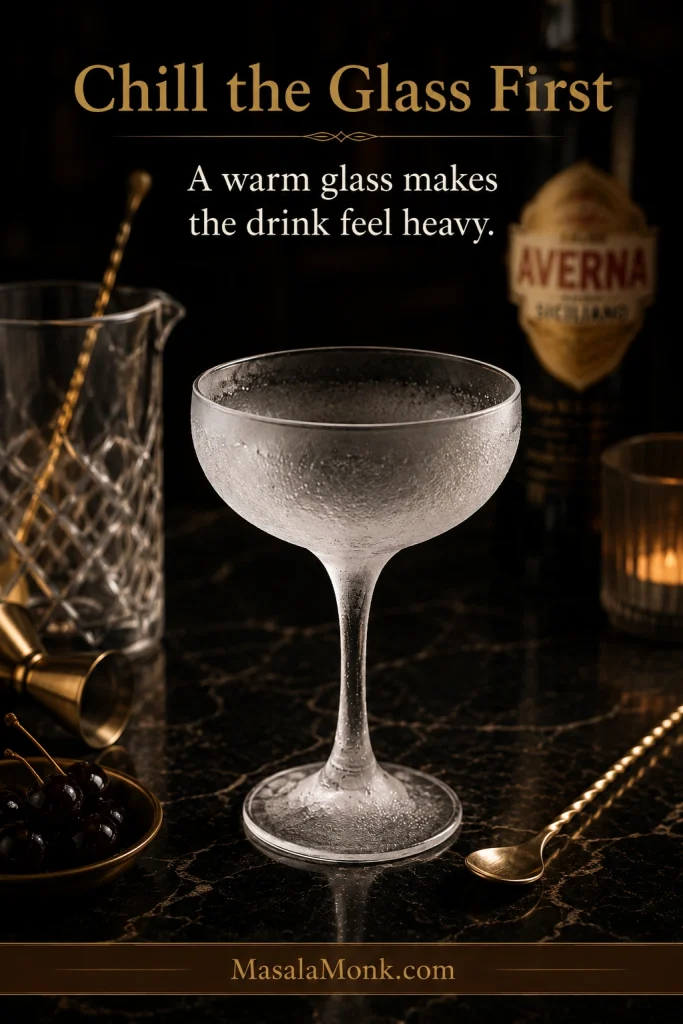
Chill the Glass First
Start by chilling your glass. This is a small detail, but it makes a real difference because the cocktail is served up, without ice. A cold glass keeps the first sip crisp and stops the last sip from feeling warm or heavy.
Temperature cue: chill the glass before mixing because the finished cocktail is served up, without ice.
Before mixing, chill the coupe. Since this cocktail is served up, a cold glass keeps the first sip crisp and the last sip from feeling warm.
Measure, Ice, and Stir
Add the rye, Averna, Angostura bitters, and orange bitters to a mixing glass. Fill it with plenty of ice, then stir for 25–30 seconds, until the glass feels frosty and the sharp edge of the whiskey has softened. Stir smoothly, not violently. You are chilling and diluting the drink, not trying to beat it into submission.
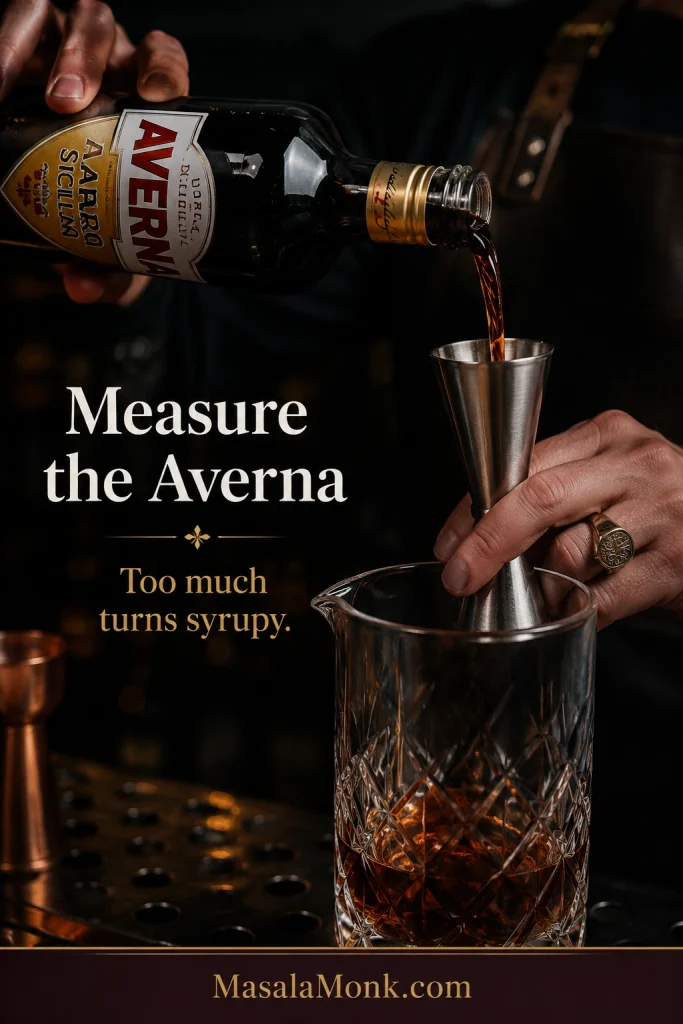
Amaro cue: measure Averna carefully because it controls the drink’s sweetness, weight, and herbal depth.
Then measure the Averna carefully. A little too much amaro can make the drink taste syrupy, medicinal, or sweeter than the recipe intends.
Do not shake a Black Manhattan. Shaking makes it cloudy and changes the texture. Stirring keeps it smooth, clear, and silky.
Technique cue: use plenty of ice and a calm stir to make the drink cold, diluted, clear, and silky.
After measuring, stir with plenty of ice for 25–30 seconds so the cocktail becomes cold, clear, diluted, and silky instead of harsh.
Strain and Garnish
Once the drink is very cold, strain it into the chilled glass and garnish with a brandied cherry. Serve it right away.
After the first stir: if the cocktail tastes hot, sweet, or flat, jump to how to fix it. If it tastes balanced, compare whiskey choices below. Back to recipe card.
Rye vs Bourbon: Which Works Better?
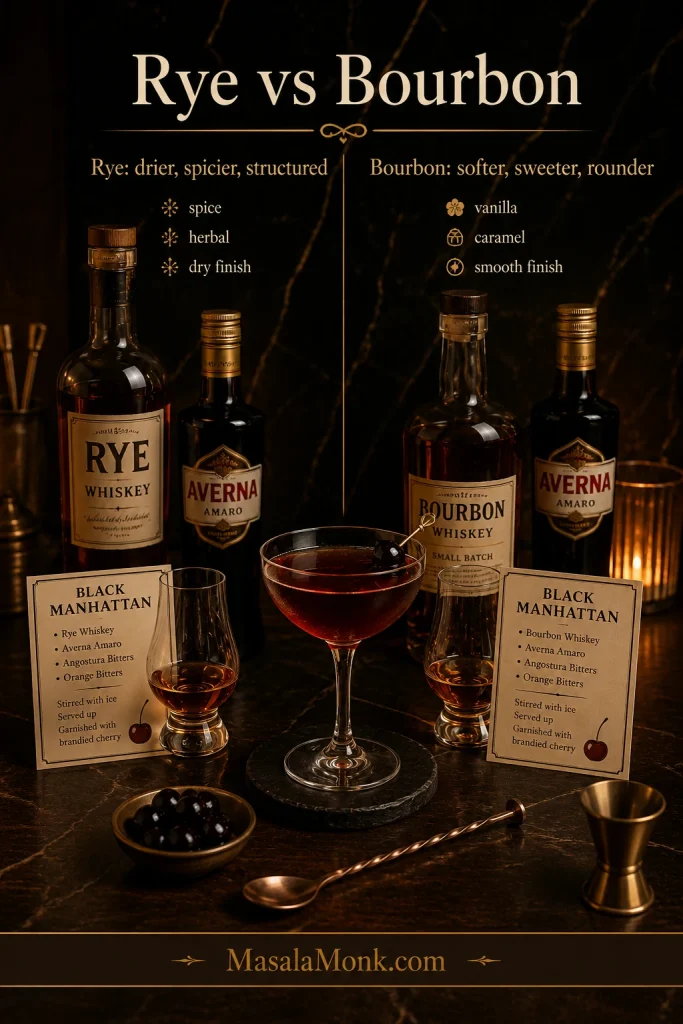
Whiskey cue: rye keeps the Black Manhattan dry and structured, while bourbon makes it softer and sweeter.
For a drier Black Manhattan, choose rye; for a softer and sweeter version, use bourbon. The whiskey changes the whole shape of the drink.
Rye is the best first choice for the traditional Black Manhattan. Bourbon works too, but it changes the mood of the drink. It makes the cocktail friendlier, while also making it easier to over-sweeten.
Whiskey
Best For
Flavor
Rye whiskey
The traditional Black Manhattan
Drier, spicier, sharper, more structured
Bourbon
A softer variation
Sweeter, rounder, warmer, gentler
A too-sweet drink usually needs rye, not more garnish. If the drink tastes too sharp or bitter, bourbon can soften the edges. When bourbon meets a sweeter amaro, an extra dash of Angostura or an orange twist helps keep the cocktail from feeling too round.
Next bottle decision: after choosing rye or bourbon, use the amaro section below to decide whether your next Black Manhattan should be classic, sweeter, lighter, smokier, or more bitter.
Best Amaro for a Black Manhattan
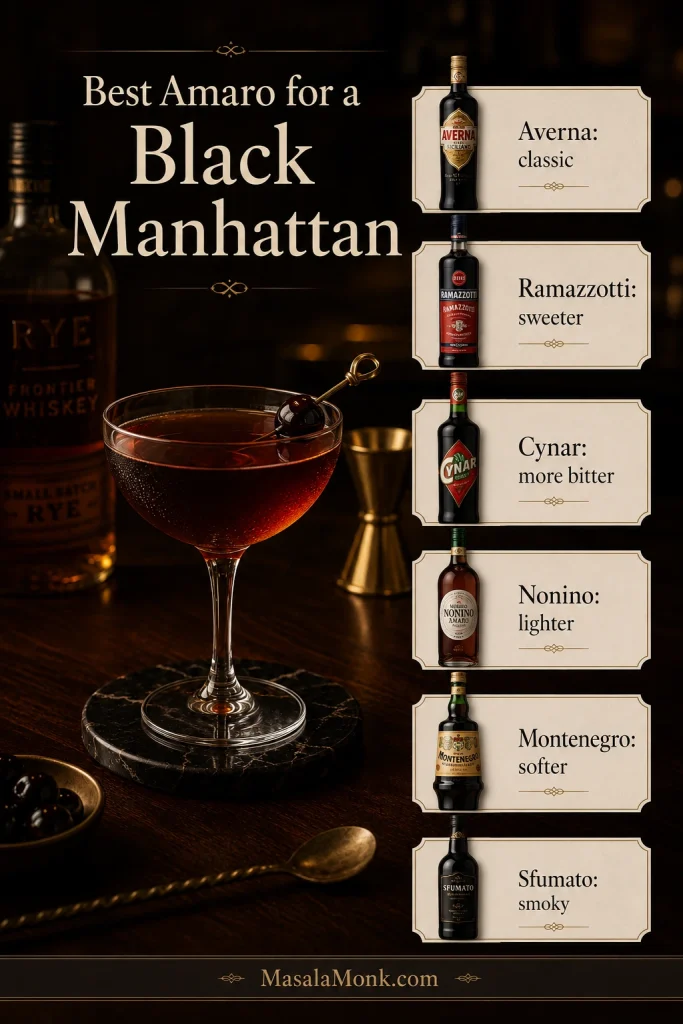
Amaro cue: once you know Averna, this guide helps you choose a sweeter, lighter, smokier, softer, or more bitter version.
Once the Averna version makes sense, use the amaro choice to steer the cocktail sweeter, lighter, smokier, softer, or more bitter.
How Each Amaro Changes the Drink
The whiskey gives the frame; the amaro paints the room. Averna keeps it familiar and balanced. Ramazzotti makes it rounder and sweeter. Cynar turns it earthier and more bitter. Nonino and Montenegro lighten the mood.
Averna is the classic choice for a reason. Other amari can make excellent whiskey-amaro Manhattans, but they may not taste as recognizably like a Black Manhattan at the same 2:1 ratio.
Choice Type
Amaro
Best For
Watch Out For
Best first bottle
Averna
The classic shape: smooth, caramel-herbal, balanced
Reliable, but not the most bitter option
Sweeter
Ramazzotti
A rounder cocktail with orange-spice and cola-like notes
Can feel too sweet with bourbon
Rich and warm
Meletti
Burnt sugar, bitter citrus, spice, and vanilla-like warmth
Can move the drink toward dessert territory
Lighter
Nonino
A brighter, more elegant pour
Less dark and brooding than the Averna build
More bitter
Cynar
Earthy, bitter, more assertive variation
Can taste medicinal or vegetal to beginners
Soft beginner swap
Montenegro
Floral, gentle, approachable pour
May feel too light if you want a deeper profile
Smoky / adventurous
Sfumato
Rhubarb-like, smoky, unusual cocktail
Can dominate the whiskey if used without care
How to Test Amaro Swaps
When Averna leaves the drink, keep everything else steady. Leave the whiskey and bitters alone, then swap only the amaro. Very bitter bottles may also need a tiny ratio adjustment, such as a little less amaro or an extra touch of orange bitters.
If you see bottles like Amaro Lucano, Ciociaro, Bigallet China-China, or Foro, treat them as experimental swaps rather than the first bottle to buy. Start with the classic amaro choice, then branch out once you know how the first version should taste.
If you want another whiskey cocktail with a bittersweet edge, a Boulevardier moves the idea toward Campari and sweet vermouth.
What Changes the Drink Most
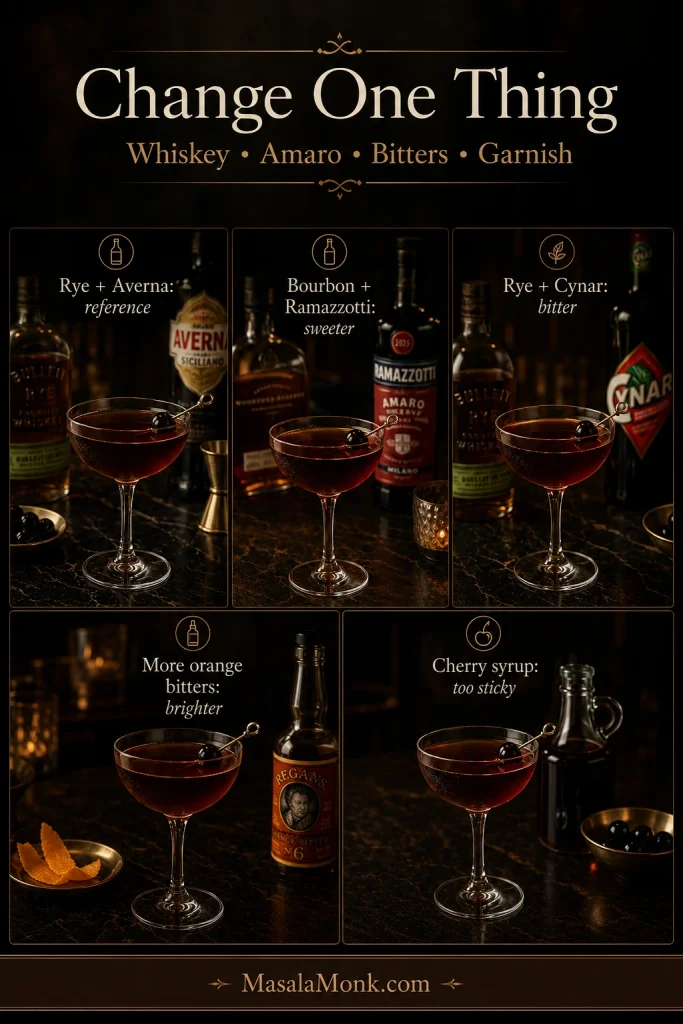
Variation cue: change one ingredient at a time so you can tell what actually improved the cocktail.
Instead of rebuilding the whole cocktail, adjust one variable. That way, you can actually taste what the whiskey, amaro, bitters, or garnish changed.
Use the reference version as your baseline. Then adjust one variable at a time so you can learn what your whiskey, amaro, and bitters are actually doing.
Change
What Usually Happens
Rye + Averna + 1 dash each bitters
Cleanest reference version for learning the drink
Bourbon + Ramazzotti
Softer, sweeter, rounder
Rye + Cynar
More bitter, earthy, and intense
2 dashes orange bitters
Better aroma if the drink feels flat
Cherry syrup added
Usually makes the drink too sticky
Is a Dark Manhattan the Same as a Black Manhattan?
Most of the time, yes. If you heard someone say “dark Manhattan,” they were probably talking about a Black Manhattan-style cocktail: whiskey, dark amaro, bitters, and a cherry or orange garnish.
The cocktail is not actually black. It usually lands somewhere between deep amber, brown, and reddish-brown. The “black” or “dark” idea comes from the amaro replacing sweet vermouth and giving the drink a deeper, more herbal mood.
Some bars use “dark Manhattan” loosely for bourbon-and-amaro drinks or other darker Manhattan variations. If you want the recognizable rye-and-Averna build, start with rye whiskey, Averna, Angostura bitters, orange bitters, and a cherry.
Black Manhattan vs Classic Manhattan
Comparison cue: the key difference is simple: sweet vermouth gives a classic Manhattan its winey roundness, while amaro makes the Black Manhattan deeper and bittersweet.
Meanwhile, the classic Manhattan stays winey and rounded with sweet vermouth, while the Black Manhattan becomes darker and more bittersweet with amaro.
Sweet Vermouth vs Amaro
The Black Manhattan stays close to the classic Manhattan, but the flavor lands in a different place. Both drinks are stirred whiskey cocktails, and each one uses bitters. Usually, they are served up in a chilled glass. The big difference is what replaces the vermouth.
Drink
What balances the whiskey
Flavor
Classic Manhattan
Sweet vermouth
Winey, smooth, lightly sweet, rounded
Black Manhattan
Averna or amaro
Deeper, herbal, bittersweet, richer
If you like Manhattans but want something less vermouth-forward, this is a natural next drink. For another smooth member of the stirred-whiskey family, the Rob Roy brings Scotch into the picture.
If you want to understand the vermouth side of bitter cocktails more deeply, this guide to sweet vermouth is a useful companion.
A Quick Note on the Original
The Black Manhattan is generally credited to bartender Todd Smith in San Francisco in 2005 and is closely associated with Bourbon & Branch. Most modern home-bar versions now use rye, Averna, aromatic bitters, and orange bitters, though like many modern classics, the drink has been adapted by bars and home bartenders over time. For another look at the core modern formula, see Liquor.com’s Black Manhattan recipe.
How to Make a Better Black Manhattan
Use this as your final pre-pour checklist. Most Black Manhattan problems come from warmth, weak dilution, too much amaro, or a garnish that tries too hard.
Chill the glass. A warm glass makes a spirit-forward drink feel heavy too quickly.
Measure the ingredients. The 2:1 ratio matters. Too much amaro can make the cocktail syrupy or medicinal.
Pack the mixing glass with ice. A full glass chills better than a glass with just a few cubes.
Do not shake it. Stirring keeps the drink clear, smooth, and elegant.
Begin with the reference version. Rye and Averna teach you what the drink should taste like before you start swapping bottles.
Finish with a good cherry. A rich cocktail cherry works better than a bright, candy-like cherry.
Small fix that works often: If the drink tastes good but a little flat, add an orange twist or use 2 dashes of orange bitters next time. If it tastes too sweet, use rye instead of bourbon or choose a more bitter amaro.
Black Manhattan Variations
After the rye-and-Averna version makes sense, the variations become easier to control. Keep the main idea the same: whiskey, amaro, bitters, cold dilution, and a clean garnish.
Bourbon Black Manhattan
Swap in bourbon for a softer, sweeter drink. This variation is warmer and rounder, especially with Averna or Ramazzotti. Add an extra dash of Angostura if you want more structure.
Black Walnut Manhattan
Choose black walnut bitters in place of, or alongside, the orange bitters. For a deeper walnut version, replace a small part of the amaro with nocino. This becomes a nuttier variation rather than the classic Black Manhattan, but it can be excellent in colder weather.
Black Cherry Manhattan
Reach for a rich cocktail cherry and a very small amount of cherry liqueur if you want a cherry-forward pour. Keep it restrained. Too much cherry liqueur can make the drink taste sticky.
Smoked Orange Black Manhattan
Try smoked orange bitters or express an orange twist over the finished drink. This works especially well with rye and Averna because the citrus oil lifts the heavier amaro notes.
Black Manhattan on the Rocks
The traditional serve is up, without ice. If you prefer a slower-sipping version, strain the drink over one large cube in a rocks glass. It will soften as the ice melts.
If you are making more than one, you do not need to build every glass from scratch. This cocktail batches beautifully because there is no juice or fizz to fade.
Batch Black Manhattan for a Party
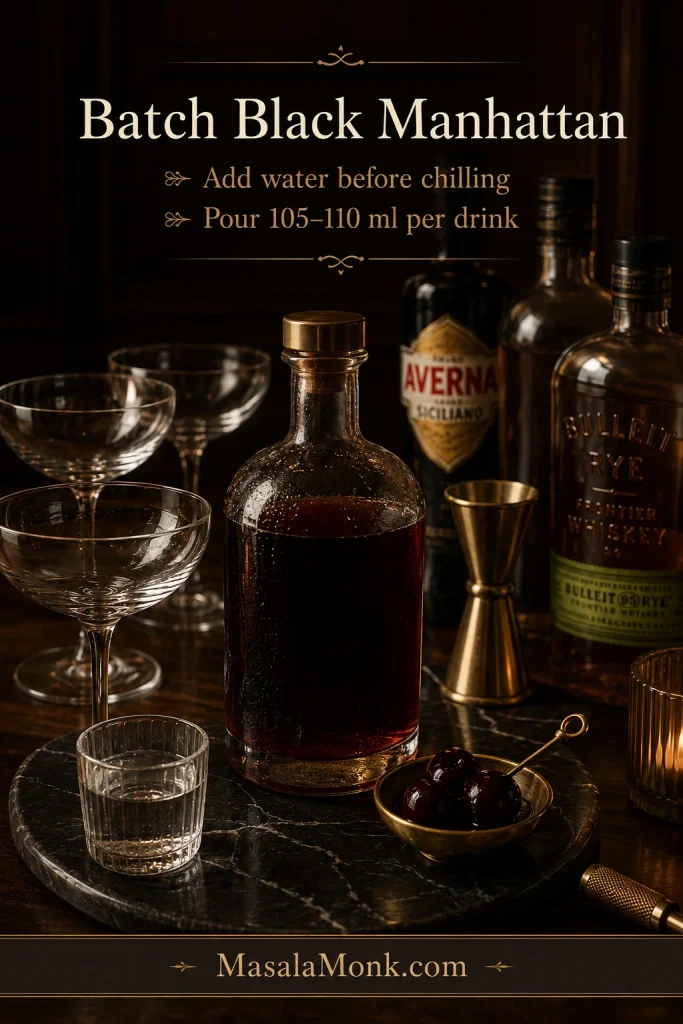
Batch cue: add water before chilling so each serving tastes like a stirred cocktail, not straight whiskey and amaro.
When batching, add water before chilling. Otherwise, each pour can taste like straight whiskey and amaro instead of a properly stirred cocktail.
Why This Cocktail Batches Well
A Black Manhattan is a good cocktail to batch because it does not use citrus juice, soda, cream, egg, or fresh fruit. You can mix the whiskey, amaro, bitters, and water ahead of time, chill the batch, then pour and garnish when guests arrive.
A batched Black Manhattan should taste like a stirred cocktail, not a bottle of room-temperature whiskey with ideas. The water matters because stirring with ice normally adds dilution to a single drink. For a batched drink, adding water ahead of time keeps the cocktail balanced without needing to stir every serving.
Batch Dilution Chart
The table below uses about 20% water based on the undiluted cocktail volume, which gives the batch the dilution it would normally get from stirring with ice.
Servings
Rye Whiskey
Averna
Angostura
Orange Bitters
Water
4
8 oz / 240 ml
4 oz / 120 ml
4 dashes
4 dashes
2.4 oz / 70 ml
8
16 oz / 475 ml
8 oz / 240 ml
8 dashes
8 dashes
4.8 oz / 140 ml
12
24 oz / 710 ml
12 oz / 355 ml
12 dashes
12 dashes
7.2 oz / 215 ml
How to Serve the Batch
Do not worry if the water is not perfect to the last milliliter. The goal is a cold, balanced batch, not laboratory precision.
Combine the rye, Averna, bitters, and water in a clean bottle or pitcher.
Cover and chill for at least 2 hours.
Pour about 105–110 ml per drink into a chilled coupe or Nick & Nora glass.
Garnish each serving with a brandied cherry.
Taste the chilled batch before guests arrive. If it feels hot, add a teaspoon or two of cold water per serving. When it feels thin, serve it colder rather than adding more ice.
Label the bottle if you are chilling it ahead, especially if guests may mistake it for straight whiskey or liqueur.
If you do not add water to the batch, stir each serving with ice before straining. Otherwise, the drink will taste too hot and too concentrated.
Before serving guests: taste the chilled batch, then use this fix guide if it feels too sweet, bitter, hot, thin, or flat.
Troubleshooting: How to Fix a Black Manhattan
Fix cue: when the drink tastes too sweet, bitter, hot, or flat, correct one variable before changing the whole recipe.
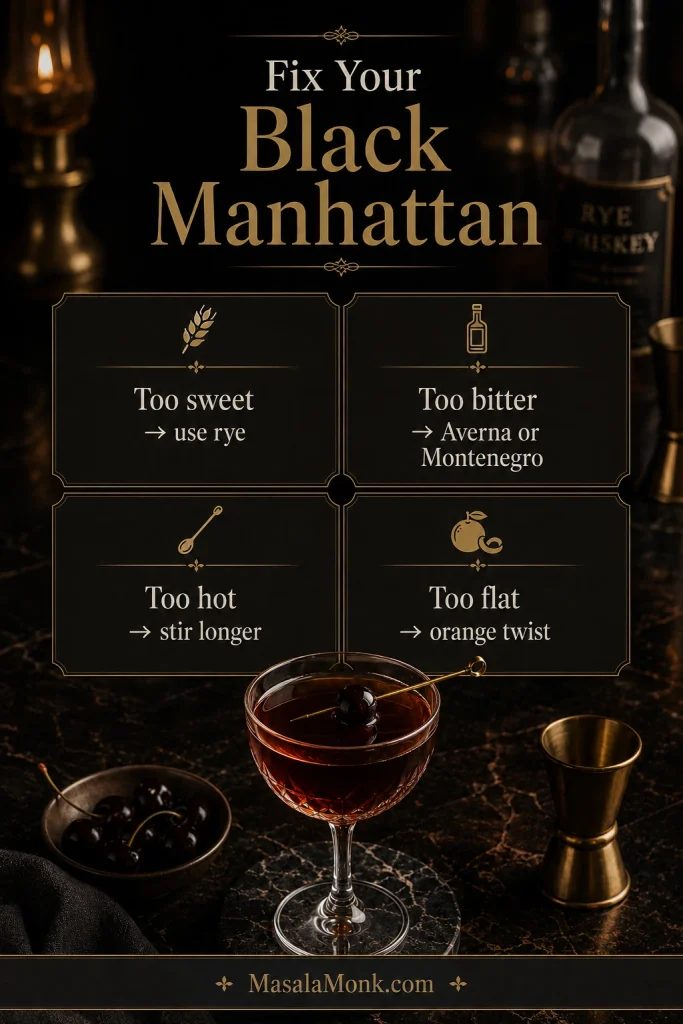
If the drink tastes too sweet, bitter, hot, or flat, fix one variable first. Most problems come from whiskey choice, amaro choice, temperature, or dilution.
If your first Black Manhattan tastes a little off, do not blame the whole cocktail. Most bad Black Manhattans are not bad recipes. They are warm, under-diluted, over-sweetened, or built with bottles that do not quite fit together yet.
Problem
How to Fix It
Overly bitter
Choose Averna, Montenegro, or bourbon. Avoid very bitter amari like Cynar until you know the drink.
Overly sweet
Reach for rye instead of bourbon, add an extra dash of Angostura, and avoid adding cherry syrup.
Boozy or hot
Stir longer with plenty of ice, or add a tiny splash of cold water before straining.
Thin or watery
Go with a richer amaro like Averna or Ramazzotti and avoid over-diluting.
Medicinal
Switch from aggressive bitter amari to Averna, Ramazzotti, or Montenegro.
Not cold enough
Chill the glass and stir for 25–30 seconds with plenty of ice.
Flat or dull
Add orange bitters, express an orange twist, or use a rye with more spice.
Make-Ahead and Storage
A single Black Manhattan is best made fresh because the texture is nicest right after stirring. For parties, batching works very well.
Single drink: Measure, stir with ice, strain, and serve right away.
Party batch: Mix the whiskey, amaro, bitters, and water ahead of time, then chill.
Do not garnish early: Add the cherry only when serving.
Keep it cold: Store the batch in the refrigerator until ready to pour.
If your batch has already been diluted with water, pour it straight into chilled glasses. Otherwise, stir each serving with ice first.
What to Serve With a Black Manhattan
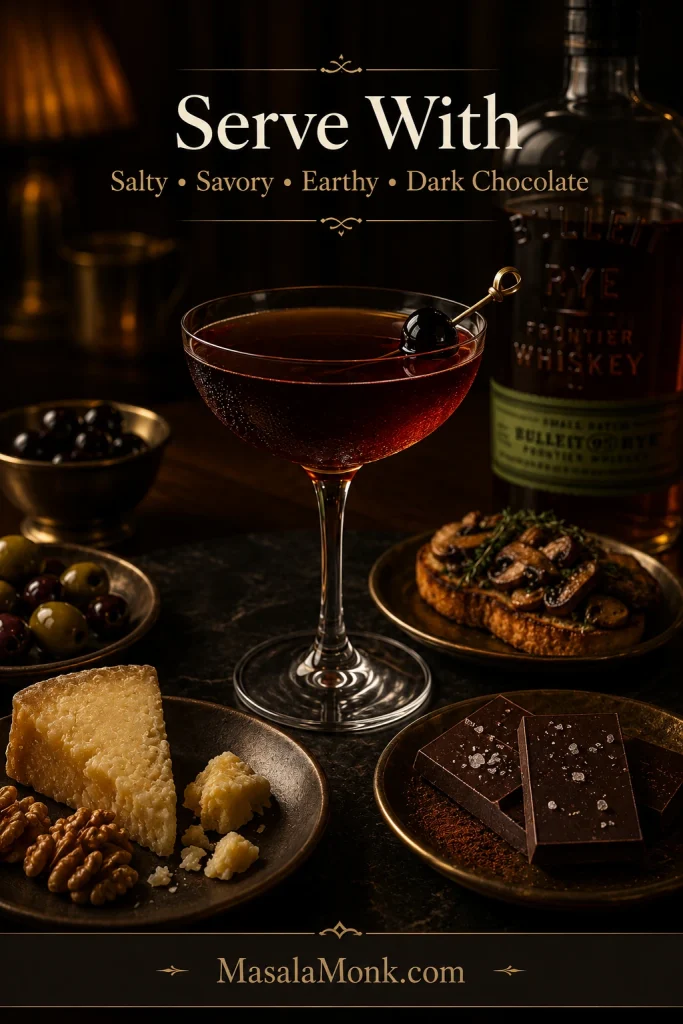
A Black Manhattan is rich and spirit-forward, so it works best with small, savory bites that can stand up to whiskey and amaro. Think salty, roasted, smoky, earthy, or gently sweet — not delicate snacks that disappear next to the drink.
Pairing cue: choose salty, savory, earthy snacks that can meet the whiskey and amaro instead of disappearing beside them.
To serve it well, pair the cocktail with salty, savory, earthy bites like aged cheese, roasted nuts, olives, mushroom toast, and dark chocolate.
Best Small Bites to Pair With It
Salty roasted nuts, especially almonds, pecans, or walnuts
Aged cheddar, gouda, or parmesan for a sharp, savory bite
Mushroom toast or roasted mushrooms for an earthy pairing
Steak bites with pepper, butter, or a simple pan sauce
Charcuterie-style snacks with cured meats, olives, and pickles
Dark chocolate with sea salt if you want a small sweet finish
If you want an easy make-ahead snack board, a cream cheese ball with crackers fits the rich, savory mood of the drink. For something warm, creamy, salty, and shareable, a spinach dip also works well.
Keep the food simple. This is a slow-sipping cocktail, so the best pairings support it without stealing the room. The food should have enough salt or savoriness to meet the whiskey halfway.
Need a fast answer? The FAQ covers vermouth, ml measurements, bourbon, amaro choices, batching, and strength. You can also go back to top or return to the recipe card.
FAQ
What is a Black Manhattan made of?
A Black Manhattan is made with rye whiskey, Averna or another amaro, Angostura bitters, orange bitters, ice, and a brandied cherry. The common ratio is 2 oz whiskey to 1 oz amaro.
Does a Black Manhattan have vermouth?
No. A Black Manhattan usually replaces sweet vermouth with Averna or another amaro. That swap is what gives the cocktail its deeper, more herbal, bittersweet flavor.
What is the Black Manhattan recipe in ml?
Use 60 ml rye whiskey, 30 ml Averna amaro, 1 dash Angostura bitters, and 1 dash orange bitters. Stir with ice for 25–30 seconds, then strain into a chilled coupe or Nick & Nora glass and garnish with a cherry.
Is a Black Manhattan the same as a dark Manhattan?
In most cases, yes. A dark Manhattan usually means a Black Manhattan-style drink made with whiskey and dark amaro instead of sweet vermouth. Some bars use the name differently, but the flavor idea is usually the same: deeper, richer, and more bittersweet than a classic Manhattan.
Do you need Averna for a Black Manhattan?
No, but Averna is the easiest bottle to trust. It gives the drink its classic smooth, bittersweet shape. Once you know that version, Ramazzotti, Cynar, Nonino, Montenegro, and other amari become easier to judge.
Can you make a Black Manhattan with bourbon?
Yes. Bourbon works well if you want a softer, sweeter drink. Rye is more traditional because it is drier and spicier, but bourbon can be very good with Averna or Ramazzotti.
What is the best amaro for a Black Manhattan?
Averna is the best place to start because it gives you the classic shape of the drink: smooth, bittersweet, herbal, and balanced. After that, try Ramazzotti for a sweeter drink, Cynar for a more bitter one, or Nonino for a lighter, more elegant variation.
Do you shake or stir a Black Manhattan?
Stir it. Because the drink is all spirits and liqueur, stirring keeps it clear, smooth, and properly chilled. Shaking makes it cloudy and changes the texture.
Can you batch Black Manhattans ahead of time?
Yes. Mix the whiskey, Averna, bitters, and water ahead of time, chill the batch, then pour about 105–110 ml per serving into chilled glasses and garnish each drink when serving.
Is a Black Manhattan stronger than a regular Manhattan?
Not necessarily. A Black Manhattan and a classic Manhattan are both small, spirit-forward whiskey cocktails. The Black Manhattan can feel heavier or more intense because amaro is darker and more herbal than sweet vermouth, but the exact strength depends on the whiskey proof and dilution.
Final Sip
A good Black Manhattan should feel composed: a cold glass, measured whiskey, dark amaro, clean bitters, and one rich cherry waiting at the end. Start with rye and Averna, stir it properly, and let the drink stay simple. Once that glass tastes balanced, you can start playing with bourbon, black walnut bitters, different amari, or a chilled batch for guests.
It is not a loud cocktail. That quiet balance is the point: the drink works because everything is in the right place.
Try the rye-and-Averna version first, then test one controlled swap: the whiskey, the amaro, or the bitters. If you test a different amaro, leave a comment with what you used and whether it made the drink sweeter, more bitter, lighter, or deeper.
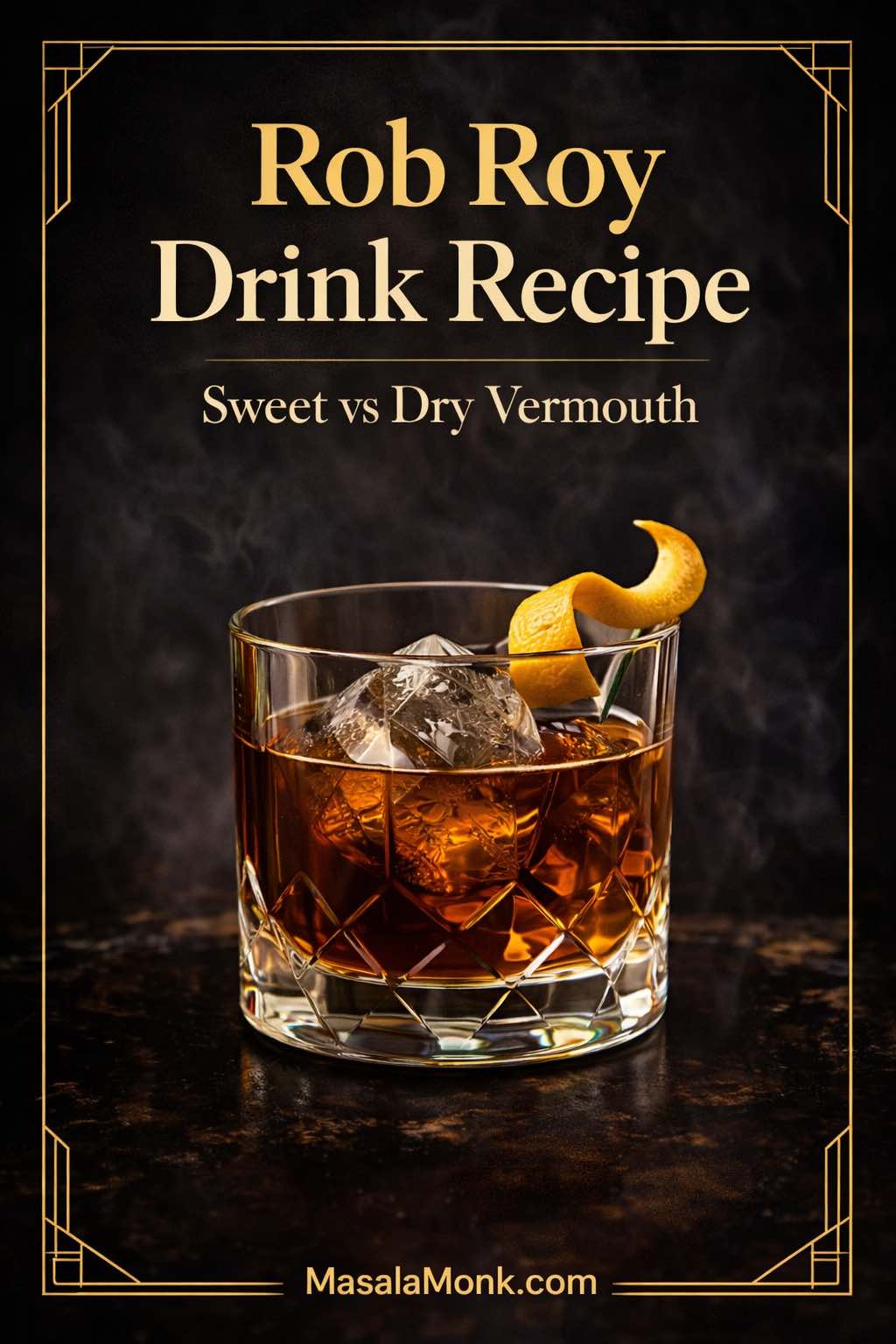
There are drinks that feel like a performance, and then there are drinks that feel like a decision. A Rob Roy belongs to the second camp—and this Rob Roy drink recipe is the kind of classic you reach for when you want the night to slow down, not because you’re trying to be fancy, but because you want something steady and satisfying in your hands. It arrives dark and glossy, the aroma lifting before you even take a sip. The first taste is warm and structured: whisky depth, vermouth richness, a faint bitter edge that keeps everything from going soft.
A Scotch classic worth knowing
That’s why a Rob Roy drink recipe is worth learning properly. Not because it’s complicated (it isn’t), but because it rewards attention. Cold becomes part of the flavor. Dilution reshapes texture. Fresh vermouth changes the aroma in a way you can’t miss. After a few rounds, it’s easy to see why people fall hard for spirit-forward cocktails.
If you’ve heard it described as a cousin of the Manhattan, that’s a useful way to place it. The Rob Roy cocktail uses the same basic architecture—whisky, vermouth, bitters—yet the switch to Scotch whisky shifts the accent. Depending on the Scotch, it can taste honeyed, fruity, toasted, or gently smoky. In other words, the drink has range without needing extra ingredients.
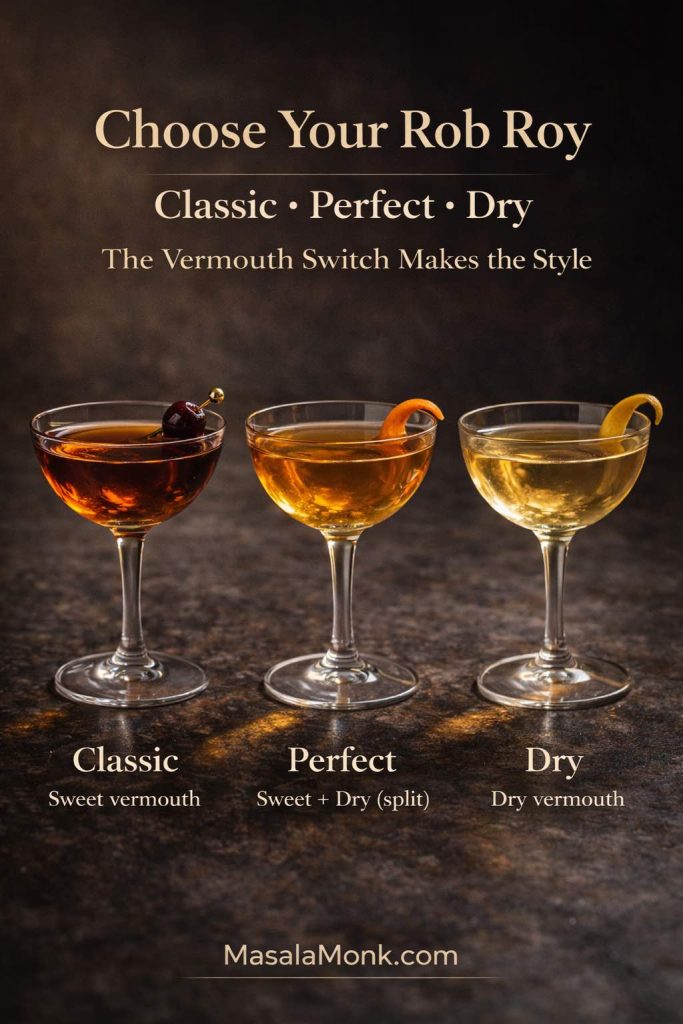
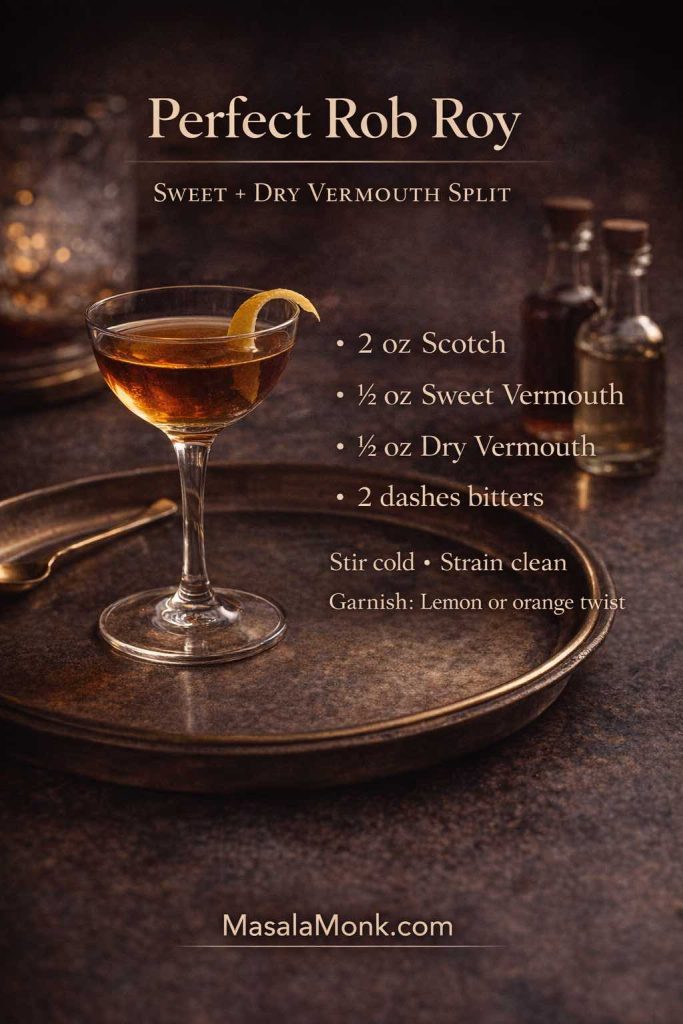
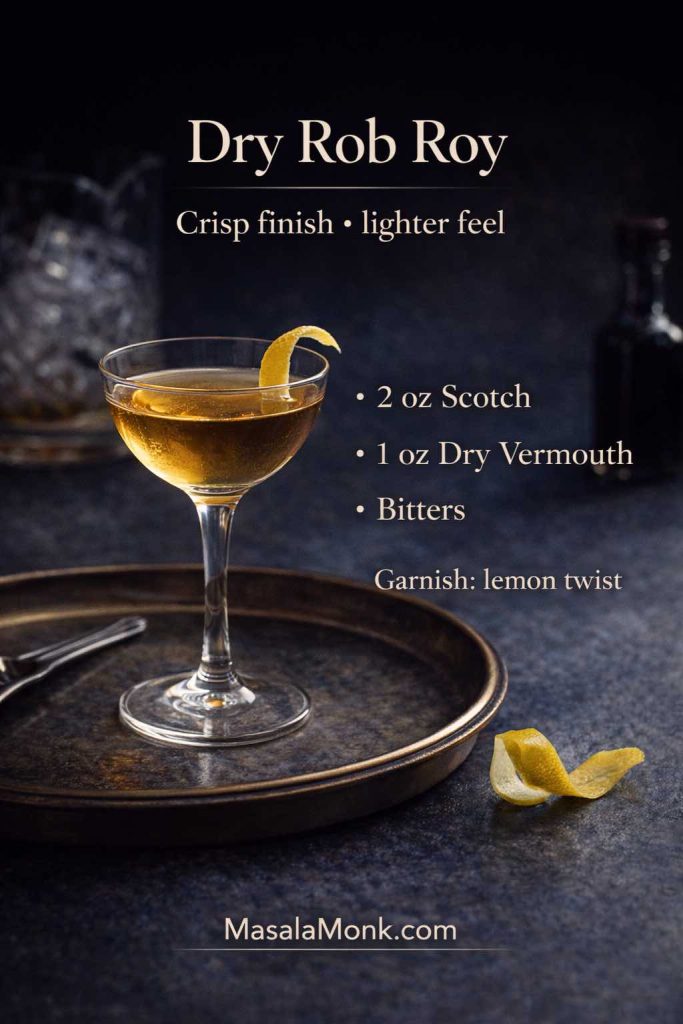
What follows is a full guide you can actually use: classic Rob Roy ingredients, the classic Rob Roy cocktail recipe, and the variations that genuinely earn their place—perfect Rob Roy, dry Rob Roy, and sweet Rob Roy. Along the way, you’ll get practical clarity on how to make a Rob Roy, how to mix a Rob Roy without fuss, and how to serve it up or on the rocks so it fits the moment.
A Rob Roy is a whisky cocktail built with Scotch whisky, vermouth, and bitters, stirred with ice until it’s cold enough to feel silky, then strained into a glass and finished with a garnish. If you’ve ever wanted a definition you could say out loud without sounding like you’re reading a textbook, that’s it.
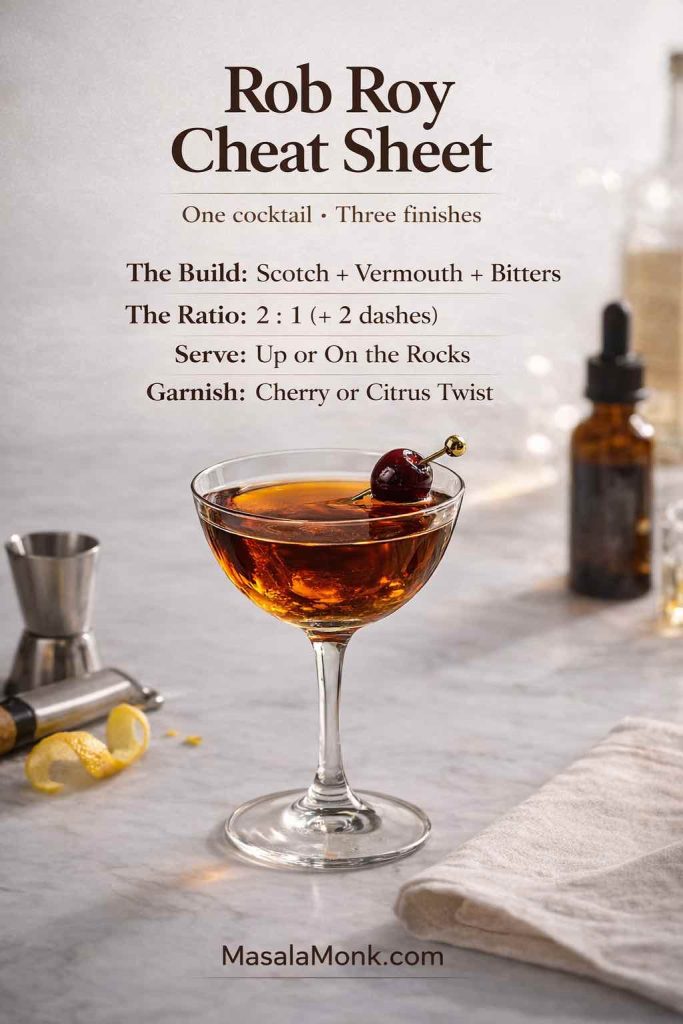
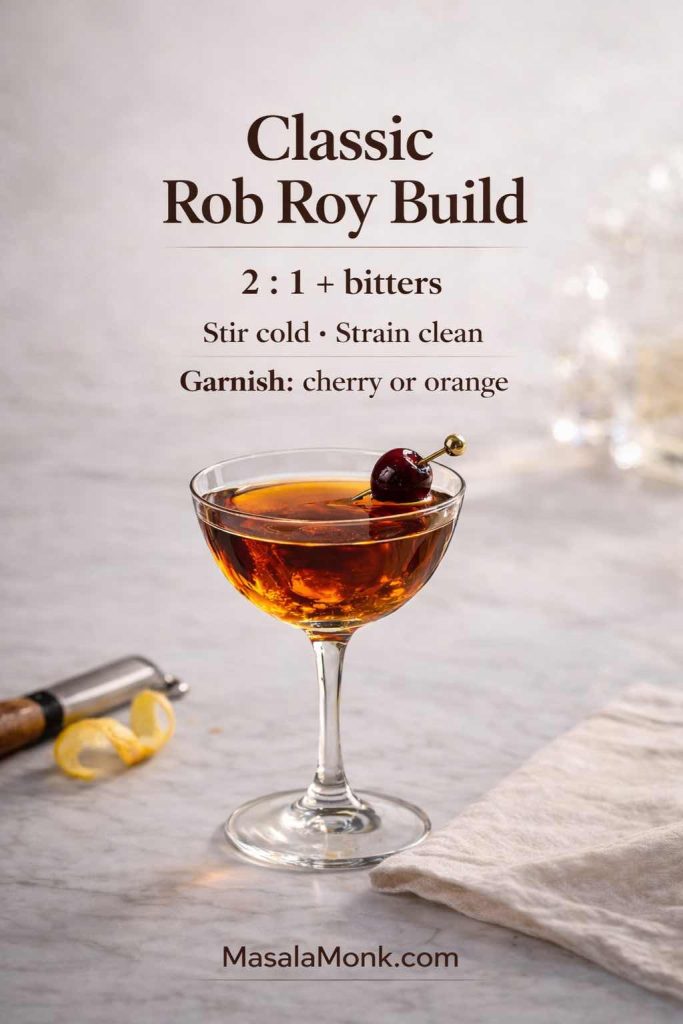
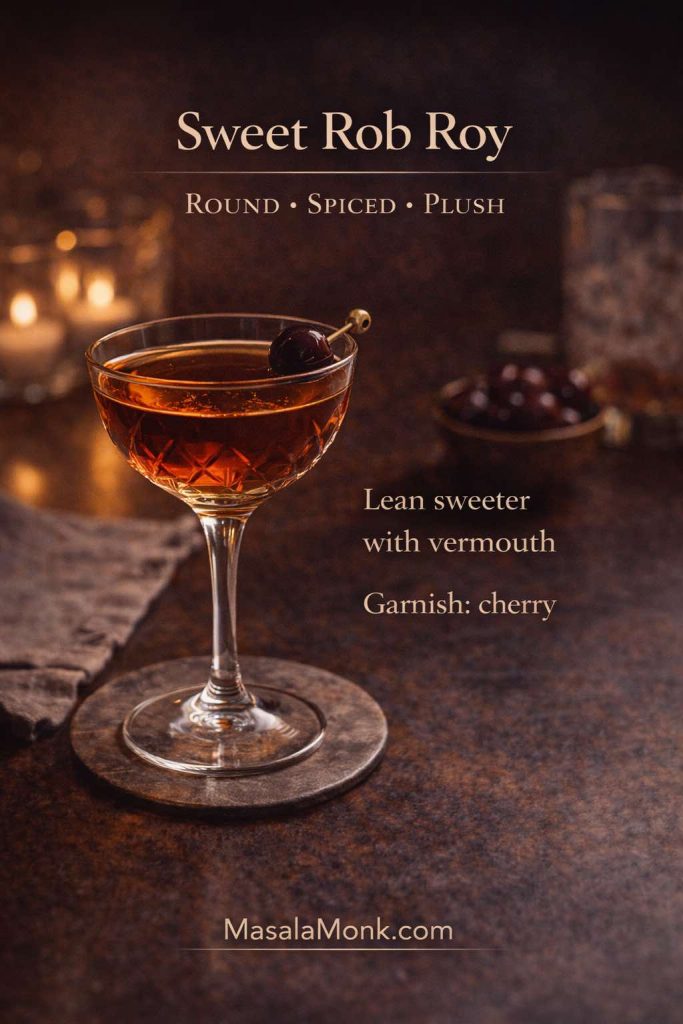
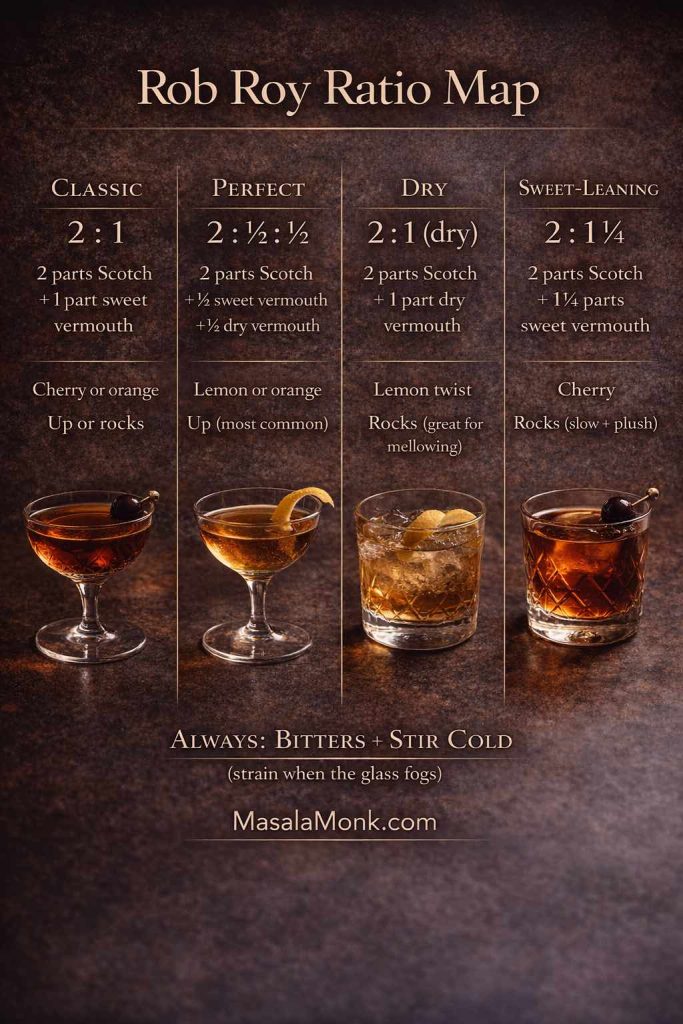
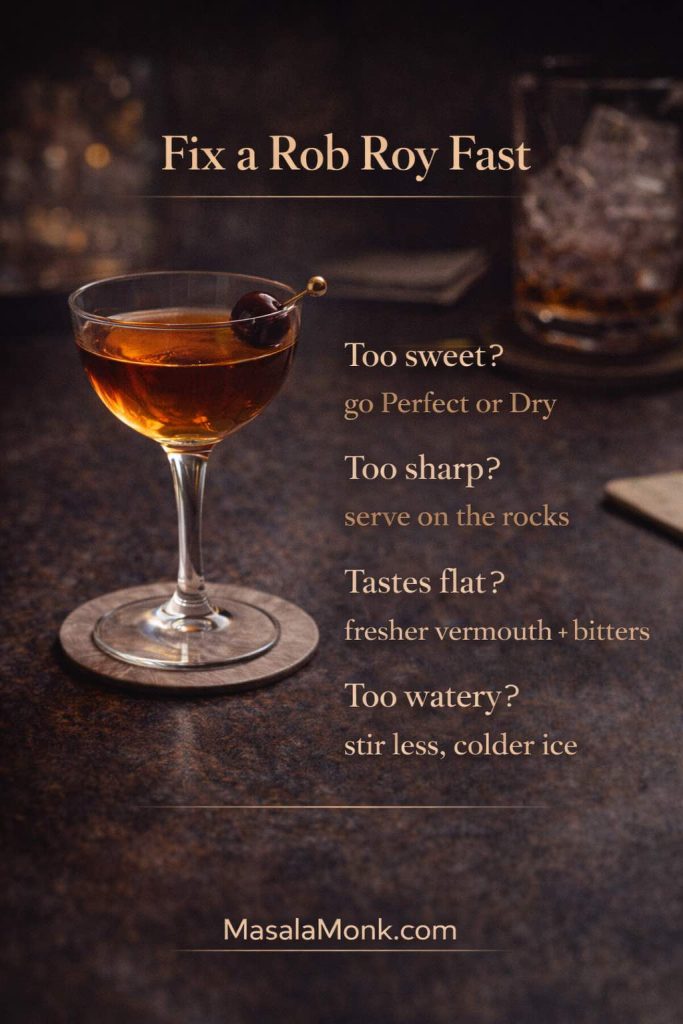
Save this Rob Roy cheat sheet for quick reference: start with the 2:1 Scotch-to-vermouth build, add bitters for structure, then choose your finish—up for focus or on the rocks for a slower, softer sip.
Still, the reason it works is more interesting than the definition. The Rob Roy is a “balance” cocktail, meaning it’s designed around a tension that feels good: strength and softness, sweetness and bitterness, warmth and chill. Scotch provides the backbone. Vermouth adds body, aromatics, and a kind of herbal sweetness that makes the drink feel complete rather than merely boozy. Bitters add shape, keeping the edges crisp enough that you want another sip.
This is also why the Rob Roy drink doesn’t need a long ingredient list. It isn’t trying to be flashy. It’s trying to be satisfying in a way that feels composed. Even the garnish is more about aroma than decoration. A cherry makes the drink feel rounder; a twist makes it feel brighter. Those small choices matter because the cocktail is so clean.
If you like seeing a classic spec from a major cocktail source, you can compare what you make at home with the version on Liquor.com’s Rob Roy recipe. The core idea stays the same, even as different bartenders nudge the details.
Rob Roy Ingredients for the Classic Cocktail Drink Recipe
You’ll see a lot of ways people ask for this—rob roy ingredients, ingredients for a rob roy, rob roy drink ingredients, ingredients of a rob roy—and they all come down to the same simple lineup:
Scotch whisky
Sweet vermouth
Aromatic bitters
Garnish (cherry or citrus twist)
That list is short, but each ingredient pulls real weight. In a drink with five or six components, one slightly tired bottle might not show up as strongly. In a three-ingredient classic, it absolutely does.
Scotch whisky for Rob Roy
Scotch whisky is the soul of this drink. If you want a robust, steady Rob Roy cocktail, a blend can be a great choice—smooth, consistent, friendly to vermouth. That’s why you’ll see people use familiar blends and why there are so many “brand + Rob Roy” combinations floating around in cocktail culture.
On the other hand, a single malt can make a Rob Roy feel more distinctive—more fruit, more honey, more oak, or more smoke depending on what you pour. That can be wonderful. It can also become intense quickly. The beauty of the Rob Roy is that it lets you discover what you like without needing a lab.
Sweet vermouth is the ingredient that turns whisky into a cocktail rather than “whisky plus something.” It contributes sweetness, yes, but also bitterness and aromatics: herbs, spice, dried fruit. It’s the bridge between the whisky’s warmth and the bitters’ structure.
Because vermouth is a fortified, aromatized wine, it changes after opening. Treat it like wine, not like whisky. That’s where the biggest “home cocktail glow-up” lives. If you want to understand why, The Spruce Eats’ vermouth overview is a solid reference on what vermouth is and how it behaves.
Aromatic bitters (Angostura and the “two dashes” magic)
Bitters act like seasoning. They tighten the drink, deepen the aroma, and keep the vermouth sweetness from feeling floppy. Angostura is the classic choice and is often what people mean when they reference bitters in whisky cocktails. If you enjoy the backstory behind the bottle, the official Angostura “Our Story” page is a fun, quick read.
Garnish (Rob Roy garnish)
A Rob Roy garnish is more than garnish; it’s aroma. A cherry leans into the drink’s richness. An orange twist makes it feel vivid. A lemon twist makes it feel clean and lifted—especially in a dry Rob Roy drink.
Garnish is the easiest way to steer a Rob Roy: choose a cherry for a rounder, richer finish, orange twist for warmth and lift, or lemon twist when you want the drink crisp and clean.
If you’re only going to do one garnish well, choose the one you love most and repeat it. Consistency teaches you faster than constantly switching.
How to Make a Rob Roy: The Stir That Changes Everything
“How to make a Rob Roy” sounds like it should be elaborate—because the drink feels elegant—yet the method is almost minimalist. You stir with ice, you strain, you garnish.
Still, that stir is doing the heavy lifting. It’s not just mixing. It’s chilling the drink to the right temperature and adding the right amount of water so the flavors become unified instead of separate.
A Rob Roy gets its signature smoothness from stirring—aim for a well-chilled mix, stop once the glass frosts, then strain quickly so the drink stays silky instead of over-diluted.
The reliable method (how do you make a Rob Roy or how to mix a Rob Roy)
Chill the glass if you’re serving the drink up. Even a quick chill helps.
Add Scotch whisky, vermouth, and bitters to a mixing glass (or any sturdy glass you can stir in).
Add plenty of ice.
Stir until the drink is very cold and slightly glossy.
Strain into your glass.
Add the garnish.
That’s the whole method. What makes it special is how it feels when it’s done right: smooth, cohesive, not harsh.
Rob Roy up vs Rob Roy on the rocks
A Rob Roy up is precise and aromatic. It stays concentrated. It feels like a tailored choice.
Serving style changes the whole experience: a Rob Roy “up” tastes more focused and aromatic, while “on the rocks” mellows slowly as the ice softens the edges—choose based on whether you’re hosting or unwinding.
A Rob Roy on the rocks is slower and softer. It evolves as the ice melts, becoming gentler over time. This style is especially nice when you’re eating, because the cocktail stays in step with snacks and conversation rather than demanding your attention.
Neither is “better.” They’re just different versions of comfort.
Rob Roy Drink Recipe: The Classic Ratio (and the ml version)
Here is the classic Rob Roy drink recipe in a clean, dependable ratio:
2 oz (60 ml) Scotch whisky
1 oz (30 ml) sweet vermouth
2 dashes aromatic bitters
Stir with ice until very cold, strain, garnish.
Use this classic Rob Roy build when you want a whisky-forward drink that still feels smooth—keep the 2:1 Scotch-to-vermouth balance, add bitters for structure, and garnish with cherry for richness or orange for lift.
If you prefer thinking in milliliters, this is your rob roy cocktail recipe ml version: 60 ml Scotch, 30 ml sweet vermouth, bitters.
This ratio is popular for a reason. It’s whisky-forward without being aggressive, and the vermouth stays present without turning the drink syrupy. It’s also the easiest place to start if you’re going to explore variations.
Rob Roy Cocktail Drink Recipe Variations: Perfect, Dry, and Sweet
The best variations aren’t gimmicks. They’re different expressions of the same template. Each one works because it adjusts the vermouth in a way that changes the drink’s personality without breaking its structure.
Not sure which Rob Roy to make? Start with the style you’re craving: Classic for richness (sweet vermouth), Perfect for balance (split sweet + dry), or Dry for a crisp finish (dry vermouth).
Perfect Rob Roy
A perfect Rob Roy uses both sweet and dry vermouth. The result sits beautifully in the middle: aromatic and balanced, less sweet than the classic, yet still rich enough to feel satisfying.
Perfect Rob Roy ingredients
2 oz (60 ml) Scotch whisky
½ oz (15 ml) sweet vermouth
½ oz (15 ml) dry vermouth
2 dashes aromatic bitters
Stir, strain, garnish with a lemon or orange twist.
A Perfect Rob Roy is the easiest way to dial in balance—splitting sweet and dry vermouth keeps the drink aromatic and smooth without leaning too rich or too sharp.
This is often the “crowd-pleaser” version. If someone says they want a Rob Roy but worry it will be too sweet, the perfect Rob Roy recipe is a confident answer. It’s also a wonderful way to use both vermouth styles without making a drink that feels like an experiment.
You might see people casually call it a “perfect Rob Roy martini” because it’s served in a martini-style glass. The build is still a stirred Scotch cocktail; the glass is simply a serving choice.
Recipe for perfect Rob Roy (simple recap): 60 ml Scotch, 15 ml sweet vermouth, 15 ml dry vermouth, bitters, stirred and strained.
Dry Rob Roy
A dry Rob Roy swaps sweet vermouth for dry vermouth. That single change makes the drink sharper and more lifted. It can feel brisk, herbal, and surprisingly refreshing while still being unmistakably whisky-forward.
Dry Rob Roy drink recipe
2 oz (60 ml) Scotch whisky
1 oz (30 ml) dry vermouth
1–2 dashes aromatic bitters
Stir, strain, garnish with a lemon twist.
A Dry Rob Roy is the clean, crisp take on the classic—dry vermouth brightens the whisky, bitters keep it structured, and a lemon twist lifts the aroma with every sip.
If you’ve ever wanted a Rob Roy that feels less plush and more precise, this is it. It’s also a strong choice when you’re serving snacks that are rich or spicy, because the dry vermouth’s crispness cuts through heaviness.
Dry Rob Roy on the rocks is particularly good. It slows the drink down, and the gradual dilution can make the dry vermouth feel more perfumed rather than sharp. If you like a citrus finish, a lemon twist is the natural pairing—this is essentially what people mean by “dry Rob Roy on the rocks with a twist.”
Sweet Rob Roy Drink Recipe
A classic Rob Roy already uses sweet vermouth, yet sometimes you want the cocktail to lean rounder—more lush and comforting, less sharp. That’s where a sweet Rob Roy recipe comes in.
When you want the Rob Roy to feel softer and more indulgent, lean into sweet vermouth and finish with a cherry—this version drinks warmer, rounder, and especially good for slow sipping.
There are two clean ways to achieve it without turning the drink into a sugar bomb:
Choose a richer sweet vermouth.
Nudge the ratio slightly toward vermouth.
Sweet Rob Roy drink recipe (richer lean)
2 oz Scotch whisky
1¼ oz sweet vermouth
2 dashes bitters
Stir, strain, garnish with a cherry or orange twist.
A sweet Rob Roy on the rocks can be especially lovely on a cold evening. The ice gradually softens the drink and stretches the experience, keeping it smooth and leisurely.
This Rob Roy ratio map makes every variation easy to remember: keep the Scotch-forward 2:1 foundation, then change only the vermouth style (or split it) to land on classic richness, perfect balance, a crisp dry finish, or a sweeter slow-sipping pour.
Rob Roy Glass, Rob Roy Cocktail Glass, and the Role of Presentation
A Rob Roy doesn’t require special glassware, but it does benefit from a thoughtful choice. The right glass helps aroma rise and keeps the drink feeling “finished.”
For Rob Roy up, a coupe or Nick & Nora is ideal. The shape gathers aroma, and the drink feels elegant in your hand.
For Rob Roy on the rocks, a rocks glass is the classic. It’s comfortable, stable, and suits slow sipping.
Glass choice changes the entire feel of a Rob Roy: coupe or Nick & Nora keeps it focused and aromatic “up,” while a rocks glass stretches the sip and softens the finish—chill whichever glass you use for a smoother pour.
If you’re working with what you have, a small wine glass can do the job surprisingly well—just chill it first. The drink cares more about temperature than tradition.
It’s natural to wonder about the best scotch for a rob roy or the best scotch for rob roy cocktail, especially because Scotch can vary so wildly. Instead of chasing a single “correct” bottle, focus on the experience you want.
If you want smooth, classic, and easy
A blended Scotch is often perfect. It tends to be balanced, which helps the vermouth and bitters integrate seamlessly. This is also the easiest direction for hosting, because the drink will land well with the widest range of palates.
Choosing the best Scotch for a Rob Roy is easier when you match the whisky’s style to the build: classic for smooth and fruity pours, perfect for light smoke balance, and dry or perfect when peat gets bold—then finish with the garnish that pulls it together.
If you want fruit and warmth
Try a Scotch with honeyed, orchard-fruit notes. It can make the Rob Roy feel like dried apricots, toast, and gentle spice. An orange twist often works beautifully here.
If you want a whisper of smoke
A lightly peated Scotch can be wonderful in a Rob Roy. The smoke adds a shadowy complexity without overwhelming the vermouth. A cherry garnish can make this version feel especially rich.
If you want bold smoke
Heavily peated whisky can dominate the Rob Roy. For smoke lovers, that intensity can be thrilling. For a more balanced pour where the vermouth still speaks, a gentler Scotch tends to work better.
Because vermouth plays such a visible role in the flavor, “best vermouth for rob roy” is a more meaningful question than it first appears. A Rob Roy can taste plush and dessert-like with one vermouth, then herbal and bittersweet with another—all without changing the whisky.
Choosing vermouth changes the Rob Roy more than most people expect: sweet vermouth gives a round, spiced finish, while dry vermouth turns the drink crisp and bright—use cherry for “sweet,” lemon for “dry.”
Match vermouth to the Scotch’s personality
If your Scotch is soft and honeyed, a more herbal sweet vermouth can add contrast and complexity. If your Scotch is smoky or spicy, a rounder, fruitier sweet vermouth can soften the edges and make the drink feel cohesive.
For dry Rob Roy variations, fresh dry vermouth matters even more because there’s less sweetness to disguise dullness. A crisp, lively dry vermouth makes the cocktail feel lifted. A tired dry vermouth can make it feel thin.
xIf your Rob Roy drink recipe tastes muted, check the vermouth first—once opened, refrigerate it and aim to use it within 4–8 weeks for brighter aroma and a cleaner finish.
Treat vermouth like what it is: fortified wine
Refrigerate it after opening, and use it while it still tastes vibrant. If you want a clear baseline on what vermouth is and why it behaves this way, The Spruce Eats’ vermouth explainer is a practical, readable guide.
This one habit—keeping vermouth fresh—often makes the difference between a home Rob Roy that tastes “fine” and one that tastes genuinely polished.
Rob Roy Cocktail History: A Classic With Staying Power
The Rob Roy has a kind of longevity that only a few drinks earn. It survives because it’s simple, adaptable, and built on ingredients that make sense together. You can keep the structure the same and change the character dramatically just by switching Scotch or vermouth.
If you like having a deeper, reference-style page that also discusses background and variations, Difford’s Guide’s Rob Roy entry is a rich resource. If you prefer a straightforward mainstream reference spec, Liquor.com’s Rob Roy recipe is clean and widely cited.
Neither link is required to enjoy the drink. They simply add context for anyone who likes knowing where a classic sits in the broader cocktail world.
A Rob Roy Night at Home: Food Pairings That Make the Cocktail Shine
A Rob Roy is strong by design, which means it loves food—especially salty, creamy, crunchy bites that can stand up to whisky and vermouth. If you’re hosting, it also helps to choose foods that don’t require constant kitchen attention. The whole point is to enjoy the evening, not run a restaurant.
Rob Roy pairings work best when the table has contrast—salty bites for the whisky, crunchy snacks for texture, and a creamy dip to soften each sip so the cocktail feels even smoother.
Build a board that does most of the work
A snack board is the easiest “make it feel special” move in home hosting. Cured meats, aged cheeses, olives, pickles, a little fruit, a few crackers—it’s the kind of spread that makes a Rob Roy feel inevitable.
If you like structure, MasalaMonk’s guide to the 3-3-3-3 charcuterie board approach makes it easy to build something abundant without overbuying.
A Rob Roy on the rocks pairs beautifully with a board because the drink’s slow evolution mirrors slow grazing.
Add something spicy and creamy for energy
Baked jalapeño poppers are a near-perfect match for whisky cocktails: heat, creaminess, a crispy bite, and enough boldness to keep your palate interested.
MasalaMonk’s baked jalapeño poppers recipe is ideal when you want something that feels “party food” without being complicated. If you’re pouring dry Rob Roy drinks, the crispness of dry vermouth plays especially well with spicy, rich bites.
Keep one classic, tidy bite on the table
Deviled eggs are quietly perfect for spirit-forward cocktails. They’re creamy, savory, and familiar in a way that makes the evening feel relaxed. They also behave well on a table—no drama, no mess.
MasalaMonk’s deviled eggs recipe includes variations, which is handy if you want to keep things classic or add a small twist without turning it into a theme.
A perfect Rob Roy feels particularly at home with deviled eggs because both land in that satisfying middle ground—rich, yet balanced.
Let a dip anchor the center of the spread
A dip is an effortless way to make a gathering feel abundant. People naturally gather around it, scoop, snack, and talk. Better still, dips can be made ahead, which keeps your evening calm.
For bold and indulgent, MasalaMonk’s buffalo chicken dip covers different cooking methods so you can choose what fits your schedule. For creamy comfort, MasalaMonk’s spinach dip recipes offer multiple variations that work for different crowds.
If you want a warm, garlicky “dip delivery system” that feels more satisfying than crackers alone, homemade garlic bread is hard to beat. MasalaMonk’s homemade garlic bread loaf turns dips into something that feels almost like a meal.
Finish with crunch and salt
At some point, crunchy and salty becomes essential—especially alongside strong cocktails. Wings are a classic for a reason: crispy texture, bold flavor, endlessly snackable.
MasalaMonk’s air fryer chicken wings are a great option when you want crispness without fuss. Pair wings with a Rob Roy up if you want a more “bar” feel, or keep it on the rocks if you want the drink to drift slowly while people snack.
If you want a vegetarian-friendly crunchy option, potato appetizers are basically guaranteed to disappear. MasalaMonk’s potato appetizer ideas give you multiple directions—crispy, cheesy, party-friendly—without locking you into one format.
Add a cooling counterpoint so the table doesn’t feel heavy
If your spread leans spicy or rich, something cool and bright keeps everything from feeling too much. Tzatziki does that beautifully—yogurt tang, cucumber freshness, herbal lift.
MasalaMonk’s Greek tzatziki sauce guide gives a reliable base plus variations, making it easy to match whatever else you’re serving.
Rob Roy Drink Recipe for Hosting: Easy Rounds at Home
One of the most charming things about this cocktail is how quietly it supports hosting. Stirring replaces shaking, so there’s no noise and no mess. Citrus doesn’t need to be juiced, and no syrup demands a prep session. As a result, you can make excellent drinks and still stay part of the room.
Hosting with a Rob Roy is effortlessly smooth: pre-batch Scotch and vermouth, keep it chilled, then stir each drink with ice and bitters as guests arrive—finish by serving it up for a sharper aroma or on the rocks for a slower sip.
A simple approach that works wonderfully is to offer a few choices that cover most preferences:
Classic Rob Roy (sweet vermouth)
Perfect Rob Roy (half sweet, half dry vermouth)
Dry Rob Roy (dry vermouth)
Then the only question you ask is “up or on the rocks?” It feels personal to guests, yet it keeps your workflow calm.
If you’re making a round, you can batch the base (Scotch + vermouth) in a bottle in the fridge, then add bitters and stir each drink with ice as needed. This keeps the pacing smooth and lets you stay present.
Common Rob Roy Missteps (And How to Smooth Them Out)
Even with a simple recipe, your first few attempts might not taste exactly the same. That isn’t a failure; it’s the nature of a drink where temperature and dilution matter.
If your Rob Roy drink recipe feels “off,” the fix is usually simple—adjust vermouth style for sweetness, use fresh vermouth and bitters for flavor, and control dilution with colder ice and shorter stirring.
If it tastes flat
Vermouth is often the culprit. Fresh vermouth tastes aromatic and alive; tired vermouth tastes muted. Refrigeration and sensible use timelines help preserve flavor. The Spruce Eats’ vermouth guide explains the logic clearly.
If it tastes too sweet
Move toward a perfect Rob Roy recipe or a dry Rob Roy. Those variations are designed for exactly this preference. They change the drink’s balance without changing its identity.
If it tastes too sharp
Serve it on the rocks, or choose a softer Scotch. Both options smooth the experience without requiring new ingredients.
If it tastes watery
Stir a bit less, use colder ice, and strain promptly. Also, avoid using ice that’s already half-melted; it can dilute the drink before you even begin.
The Rob Roy as a House Cocktail You Can Make Yours
After you make this drink a few times, something shifts. It stops being “the Rob Roy drink recipe you learned” and becomes “your Rob Roy.” One Scotch will read warm and honeyed; another will land dry and structured. Preferences sharpen quickly—cherry versus twist, up versus on the rocks, quick and focused versus slow and mellow.
In time, a default emerges: the one you mix without thinking when someone’s at the door. Sometimes it’s the classic Rob Roy cocktail recipe because sweet vermouth rounds the whisky in exactly the way you like. Other nights, the perfect Rob Roy fits better because balance feels like the point. For a crisper profile, a dry Rob Roy drink makes sense; when winter calls for comfort, a sweet Rob Roy on the rocks can feel just right.
None of those choices are wrong. The drink endures because it isn’t a novelty—it’s a structure that holds taste, mood, and company with quiet confidence.
Once it clicks, you’ll find yourself reaching for it far more often than you expected.
A Rob Roy drink is a classic Scotch-based cocktail made by stirring Scotch whisky with vermouth and bitters, then serving it either up or on the rocks. In essence, it’s a spirit-forward drink with a smooth, aromatic finish.
2) What are the Rob Roy ingredients?
The core Rob Roy ingredients are Scotch whisky, sweet vermouth, and aromatic bitters. Finally, it’s finished with a garnish—most commonly a cherry or a citrus twist.
3) What are the ingredients for a Rob Roy cocktail specifically?
Ingredients for a Rob Roy cocktail typically include 2 oz (60 ml) Scotch whisky, 1 oz (30 ml) sweet vermouth, and 1–2 dashes bitters. Additionally, a cherry or orange twist is a classic garnish choice.
4) How do you make a Rob Roy?
To make a Rob Roy, combine Scotch whisky, sweet vermouth, and bitters in a mixing glass with ice. Next, stir until thoroughly chilled, then strain into a chilled glass (for “up”) or over fresh ice (for “on the rocks”). Afterward, add your garnish.
5) How to make a Rob Roy cocktail that tastes balanced?
For a balanced Rob Roy cocktail, start with the classic 2:1 ratio (Scotch to sweet vermouth). Then, stir long enough to chill and lightly dilute the drink. If it still feels too sweet, shift toward a perfect Rob Roy or dry Rob Roy variation.
6) What is the best Rob Roy drink recipe ratio?
The most widely used Rob Roy drink recipe ratio is 2 oz Scotch whisky to 1 oz sweet vermouth, plus bitters. Alternatively, you can slightly increase the whisky for a drier profile or increase vermouth for a rounder profile.
7) What is the Rob Roy cocktail recipe in ml?
A common Rob Roy cocktail recipe ml build is 60 ml Scotch whisky + 30 ml sweet vermouth + 1–2 dashes bitters. Then, stir with ice and strain.
8) What is a perfect Rob Roy?
A perfect Rob Roy uses both sweet and dry vermouth instead of only sweet vermouth. Consequently, it tastes more aromatic and less sweet than the classic.
9) What is the perfect Rob Roy recipe?
The perfect Rob Roy recipe is 2 oz (60 ml) Scotch whisky, ½ oz (15 ml) sweet vermouth, ½ oz (15 ml) dry vermouth, plus bitters. Then, stir with ice, strain, and garnish.
10) What are perfect Rob Roy ingredients?
Perfect Rob Roy ingredients include Scotch whisky, sweet vermouth, dry vermouth, and bitters—plus a garnish such as lemon or orange twist. Notably, the vermouth is split evenly to create the “perfect” balance.
11) What is a dry Rob Roy?
A dry Rob Roy is a Rob Roy variation made with dry vermouth instead of sweet vermouth. As a result, it’s crisper, lighter, and less sweet.
12) What is the dry Rob Roy recipe?
The dry Rob Roy recipe is 2 oz (60 ml) Scotch whisky, 1 oz (30 ml) dry vermouth, and 1–2 dashes bitters. Then, stir with ice, strain, and garnish with a lemon twist.
13) What does “Rob Roy drink dry” mean?
“Rob Roy drink dry” generally refers to the dry Rob Roy variation (using dry vermouth). In some cases, it can also mean reducing sweet vermouth in the classic recipe for a drier taste.
14) What is a sweet Rob Roy?
A sweet Rob Roy typically leans richer by emphasizing sweet vermouth—either by choosing a fuller-bodied sweet vermouth or by slightly increasing the vermouth portion. Thus, it becomes rounder and more dessert-like.
15) What is the sweet Rob Roy drink recipe?
A sweet-leaning sweet Rob Roy drink recipe can be 2 oz Scotch whisky, 1¼ oz sweet vermouth, and bitters. Then, stir and strain; garnish with cherry or orange twist.
16) How to make a Rob Roy on the rocks?
To make a Rob Roy on the rocks, prepare the cocktail by stirring with ice first. Then, strain over fresh ice in a rocks glass. Thereafter, garnish as desired.
17) What is “dry Rob Roy on the rocks with a twist”?
This phrase usually refers to serving a dry Rob Roy over ice and finishing it with a citrus twist—most often lemon. Accordingly, it highlights both the serving style (on the rocks) and the garnish (twist).
18) What does “Rob Roy up” mean?
“Rob Roy up” means the cocktail is served without ice in the glass, strained into a chilled coupe or similar stemmed glass. Hence, the drink stays concentrated and aromatic.
19) What is the best vermouth for Rob Roy?
The best vermouth for Rob Roy depends on the style you prefer. For the classic, use sweet vermouth with a flavor profile you enjoy; for a dry Rob Roy, use a crisp dry vermouth. Furthermore, freshness matters—vermouth tastes best when stored properly after opening.
20) What is the best Scotch for a Rob Roy cocktail?
The best Scotch for a Rob Roy cocktail is one you enjoy the taste of, since it remains front and center. Generally, blended Scotch makes a smooth, approachable Rob Roy, while certain single malts can add extra character.
21) What is the difference between a Manhattan and a Rob Roy?
A Manhattan typically uses rye or bourbon, while a Rob Roy uses Scotch whisky. Otherwise, both often share the same template: whisky, vermouth, and bitters.
22) What does “Rob Roy recipe scotch” refer to?
“Rob Roy recipe scotch” simply emphasizes that Scotch whisky is the base spirit in the Rob Roy cocktail recipe. In other words, the drink is essentially the Scotch version of a Manhattan-style build.
23) Can I make a Rob Roy cocktail recipe without bitters?
You can make a Rob Roy without bitters, but it will usually taste flatter and less structured. If you’re out of bitters, try reducing vermouth slightly to keep the drink from feeling overly sweet.
24) What are common Rob Roy garnish options?
Common Rob Roy garnish options include a cherry (classic), orange twist (bright), and lemon twist (crisp). Depending on your preference, the garnish can push the drink warmer or fresher.
25) Is “Rob Roy recipe bourbon” actually a Rob Roy?
A “Rob Roy recipe bourbon” isn’t technically a Rob Roy because the defining feature is Scotch whisky. If you use bourbon, you’re closer to a Manhattan-style cocktail, even if the method is the same.
Choosing the best vermouth for a Negroni is the fastest way to turn this drink from “sometimes great, sometimes weird” into something you can make on autopilot and still be proud of. A Negroni is simple on paper—gin, Campari, vermouth, ice, orange—yet it’s unforgiving in the glass. Because there’s nowhere to hide, the vermouth you use doesn’t just add sweetness; it decides the drink’s whole personality.
If you want a reliable baseline to build from as you read, keep MasalaMonk’s Negroni recipe handy. It’s an easy reference for method and the classic feel of the drink before you start tuning it.
Negroni vermouth type: what vermouth is used in a Negroni?
The classic vermouth for a Negroni is sweet red vermouth—often labeled sweet vermouth, rosso, or rouge. The official IBA Negroni recipe lays it out cleanly: equal parts gin, Campari, and sweet red vermouth, stirred gently over ice and finished with orange. Campari itself echoes the same idea in its own Negroni guide: London Dry gin, sweet red vermouth, Campari, built in the glass over ice with orange.
Not all “sweet vermouth” tastes the same in a Negroni—start by choosing the style you want (classic, bitter, rich, or light), then match your vermouth to that profile for a better-balanced drink.
So the default answer to “what type of vermouth is used in a Negroni?” is straightforward: sweet red vermouth.
However, “sweet red vermouth” is a wide lane, not a single flavor. Two bottles can both be sweet and red yet make noticeably different Negronis. One might feel light and winey. Another might be rich and vanilla-forward. A third can lean bitter, pushing the drink drier and sharper even at the same 1:1:1 ratio. That’s why the better question isn’t only “what vermouth is used in a Negroni?” but “which sweet vermouth for a Negroni matches the kind of bitterness and balance I like?”
Why sweet vermouth for a Negroni matters more than gin debates
People love arguing about gin in a Negroni, and sure—gin choice matters. Still, vermouth is the quiet lever that changes everything: body, sweetness perception, spice, herbal depth, and how the bitterness lands.
Think of a Negroni as a three-way negotiation:
Gin brings structure and aromatic lift.
Campari brings bitterness and bitter-orange punch.
Sweet vermouth brings roundness, a wine-like core, and a botanical echo that ties the other two together.
A Negroni is a three-way balance: gin provides structure, Campari brings bitterness, and sweet vermouth adds roundness—so when your drink tastes “off,” the vermouth choice (and freshness) is often the lever that fixes it fastest.
When the vermouth is too light for your build, Campari takes over and the drink turns into bitterness plus alcohol heat. Go the other direction—too heavy for your preferences—and the Negroni can feel thick and sweet, still bitter but oddly syrupy. Then there’s the most common spoiler: stale vermouth. Once it’s tired, the whole drink collapses into flat sweetness and blunt bitterness, which is why so many people conclude they “don’t like vermouth” when they’ve really just been using a bottle past its best.
That’s the first truth: “best sweet vermouth for Negroni” is less about prestige and more about fit.
The second truth is even more practical: vermouth is wine-based, and once opened it evolves quickly. If you’re chasing the best vermouth for a Negroni while storing it like a spirit, you’re handicapping yourself from the start. We’ll cover storage properly later, because it’s the easiest quality upgrade you can make.
Sweet vermouth for a Negroni: rosso, sweet, rouge, di Torino—what you’re really choosing
Labels help, but taste decides.
Shopping for vermouth gets easier when you decode the label: sweet/rosso is the classic Negroni lane, bianco (blanc) runs lighter and often sweeter, dry turns the drink sharper and more gin-forward, and “di Torino” is a traditional Italian style cue—not a single flavor guarantee.
“Sweet vermouth” usually signals the classic Negroni lane.
“Rosso/rouge/red” points to the darker style most people associate with the drink.
“Bianco/blanc” is a different direction entirely (more on that later).
“Vermouth di Torino” often signals a classic Italian style with a reputation for quality, but it’s still not one flavor.
What matters in the bottle is how it behaves with Campari and gin. In practice, the most useful approach is to choose by taste lane, not by label lore.
Not sure which vermouth to use in a Negroni? Rosso (sweet) gives the classic ruby balance, bianco shifts the drink lighter and more floral, while dry makes it sharper and more gin-forward—choose the base style first, then fine-tune ratios.
To keep this genuinely helpful, let’s break the Negroni vermouth question into four lanes that cover almost every preference.
Best sweet vermouth for Negroni: pick by taste (the four lanes)
Instead of hunting a single winner, decide what you want your Negroni to feel like. Then choose the vermouth accordingly.
Classic & balanced
Bitter & snappy
Rich & round
Light & less sweet
You can absolutely enjoy more than one. In fact, many people do: a crisp, bitter Negroni before dinner and a richer, spiced one later in the evening are both valid, just different moods.
If you want to find your “best vermouth for a Negroni” fast, do a mini flight: keep the gin and Campari the same, change only the vermouth, and you’ll immediately see whether you prefer classic balance, a snappier bitter edge, richer sweetness, or a lighter finish.
Best vermouth for a Negroni if you want it classic and balanced
This is the “textbook” Negroni: bitter orange, gentle spice, herbal depth, and a finish that feels firm without being punishing. The sweetness is present, yet integrated. Nothing tastes like it’s shouting over anything else.
What to look for A classic vermouth rosso for a Negroni tends to be:
medium-bodied
aromatic (citrus peel, herbs, subtle spice)
sweet enough to round Campari, but not so sweet it turns jammy
bold enough to stay visible in the glass
When you’re unsure where to start, this is the safest lane: choose a sweet vermouth that tastes like citrus peel and herbs with a medium body (not overly vanilla-sweet), build a classic 1:1:1 Negroni, then make tiny tweaks until it lands exactly where you like.
Why it works Campari has a strong, distinct profile. A balanced sweet vermouth acts like a hinge: it smooths the bitterness while keeping the drink lively. When people say “Negroni sweet vermouth,” this is usually the vibe they mean.
Brand examples that fit naturally If you want known, reliable starting points, bartender roundups are a decent shortcut:
These aren’t the only good bottles; they’re just common reference points that behave predictably in a 1:1:1 build.
How to build it so it tastes clean Start with the official equal-parts structure from the IBA Negroni page, then pay attention to two details:
Ice quality: large, cold cubes make the drink taste more integrated and less watery over time.
Orange oils: express a twist over the drink even if you also use a slice. Aroma makes the Negroni feel rounder without changing the ratio.
An orange twist is the fastest “vermouth upgrade” in a Negroni: express the oils over the glass and rub the rim—aroma makes the vermouth feel rounder and the bitterness taste smoother.
If you want easy upgrades without overcomplicating your life, MasalaMonk’s cocktail ice ideas are surprisingly practical.
Best vermouth for Negroni if you want it bitter and snappy
Some people love the bite. They want the Negroni to feel bracing, crisp, and sharp—more aperitivo, less plush. In this lane, the drink finishes drier and feels more “tonic-like” in its bitterness.
What to look for A bitter-leaning sweet vermouth for a Negroni tends to have:
a firmer herbal bitterness
less vanilla sweetness
a cleaner, drier finish even if it’s technically sweet
enough backbone to stand up to Campari
Why it works Campari is already bitter. A vermouth with bitter edges doesn’t “double the bitterness” so much as it tightens the profile, reducing the sense of syrupy sweetness that some people dislike.
Brand examples that fit naturally Punt e Mes is the classic name that comes up in this lane, often described as vermouth with an amaro-like edge. You’ll see it in bartender lists like Food & Wine’s Negroni vermouth roundup and referenced all over cocktail resources.
If you want to explore how bitter-leaning bottles behave across cocktails (and not just Negronis), Difford’s Guide is a useful rabbit hole—start with a general search like Difford’s vermouth references and then follow the trails that interest you.
Not every “bitter red bottle” is the same: sweet vermouth (rosso) is wine-based and built to round a classic Negroni, while amaro-leaning bottles push the drink darker, heavier, and more bitter—both can be great, as long as you choose intentionally.
How to build it so it doesn’t get harsh Because this lane can turn sharp quickly, a few small moves keep it elegant:
Use a bold, structured gin so the drink has three clear voices. Food & Wine’s Negroni tips explicitly notes that Campari is strong and a bold gin (often London Dry) helps keep balance.
Favor an orange twist over a thick wedge if you want a cleaner finish.
Stir until the drink feels integrated; under-stirring makes bitterness feel jagged.
Best sweet vermouth for Negroni if you want it rich and round
This lane is for people who want the Negroni to feel lush: deeper sweetness, richer spice, sometimes a vanilla-and-cocoa impression, with bitterness cushioned rather than sharpened. It’s still a Negroni, yet it feels like evening instead of pre-dinner.
Rich sweet vermouth makes a Negroni feel plush and velvety—keep it balanced by serving it colder (big ice + a longer stir), nudging gin up if the drink feels heavy, and sticking to a simple orange twist so the richness stays elegant, not syrupy.
What to look for A rich vermouth rosso for a Negroni often has:
vanilla and baking spice
dried fruit depth
a thicker mouthfeel
a longer aromatic finish
Why it works Campari’s bitterness becomes more velvety when the vermouth’s mid-palate is fuller. The drink feels rounder and more luxurious, especially when served very cold.
Brand examples that fit naturally Carpano Antica Formula is the famous example. It’s often recommended in bartender roundups, including Food & Wine’s Negroni vermouth list.
At the same time, it’s not for everyone. A thoughtful comparison is helpful because it explains why people disagree so loudly. Drinks and Drinking’s Negroni tasting write-up notes that Carpano Antica can read too sweet and vanilla-forward compared with peers, calling it almost a “vanilla Negroni.” You can read that perspective in their Negroni vermouth comparison.
Some sweet vermouths read distinctly vanilla-and-spice forward in a Negroni—if you love baking spice, vanilla, and cocoa-like notes, they’ll feel plush and luxurious; if you prefer a crisp, winey, snappier finish, choose a lighter lane instead.
That’s a feature if you like it; it’s a bug if you don’t.
How to build it so richness stays balanced Equal parts can work, but many people prefer small adjustments:
If it feels too sweet or heavy, increase gin slightly.
If it feels too thick, stir a little longer for a touch more dilution, which can brighten the profile without changing ingredients.
Keep garnish simple—orange twist often works better than a thick slice if you want the drink to stay clean.
Vermouth for a Negroni if you want it light and less sweet
“Less sweet” is often shorthand for “less heavy.” In this lane, you keep the Negroni’s identity while making the drink feel lighter, more wine-like, and less plush. It’s a great direction when you want something refreshing without going fully dry.
If you want a Negroni that feels lighter without turning it into a dry-leaning variation, shift your vermouth lane: classic rosso drinks deeper and rounder, while a “light lane” vermouth makes the same template brighter and more wine-like—keep it crisp with a structured gin and fresh vermouth.
What to look for A lighter sweet vermouth for Negroni tends to have:
more floral and botanical lift
less vanilla richness
a cleaner finish
a more obvious wine character
Brand examples that fit naturally Dolin Rouge is a common reference point for this lane and appears in bartender lists like Food & Wine’s best vermouths for Negronis.
If you want a broad, approachable overview of sweet vermouth bottles and how they behave in cocktails, The Spruce Eats has a guide (written as a “best sweet vermouth” list) that includes Negroni-oriented recommendations too: The Spruce Eats sweet vermouth guide.
Lighter vermouth can get drowned out in a Negroni—support it with a juniper-and-citrus gin, keep the vermouth refrigerated and fresh, and lean into orange oils so the drink stays bright and balanced instead of turning into “just Campari.”
How to build it so Campari doesn’t steamroll the drink Because lighter vermouths can get overshadowed:
Choose a gin with clear structure (juniper/citrus) rather than very delicate florals.
Keep the vermouth fresh and refrigerated—stale vermouth shows up faster in this lane.
Best vermouth for a Negroni: the simplest “home bar” setup
If you want a practical answer that works in real life, you don’t need ten bottles. You need a small set that covers moods.
A genuinely useful setup is:
one classic/balanced sweet vermouth
one bitter/snappy option
one rich/round option
A simple home bar strategy: keep three vermouth “lanes” on hand—classic for everyday balance, bitter for a snappier finish, and rich for a rounder, plush Negroni—then refrigerate and use them fresh so your best vermouth choice stays bright.
That gives you range without clutter. Meanwhile, if you discover you always reach for one lane, you can stop buying the others. The goal is repeatable drinks, not a collection.
Dry vermouth Negroni: can you use dry vermouth in a Negroni?
You can use dry vermouth in a Negroni. It just changes the drink into a sharper, more gin-driven variation.
Dry vermouth tends to reduce the rounding sweetness that balances Campari, so the drink becomes more austere. Sometimes that’s exactly what you want. Other times it’s why people decide “Negronis are too bitter,” when the real issue was the substitution.
If you’re curious about vermouth styles broadly (from dry and white through sweet and red), Difford’s is a good general explainer starting point: Difford’s vermouth overview.
Sweet (rosso) vermouth keeps a Negroni round and classically balanced, while dry vermouth makes it leaner and more gin-forward—pick the style you want, then tweak with a touch more gin or extra orange aroma so the drink stays intentional.
How to make a dry vermouth Negroni taste intentional (not accidental)
A dry vermouth Negroni works best when you change one more thing so the drink stays balanced.
Approach 1: keep structure by leaning gin-forward Food & Wine highlights the core formula and discusses how bold gin matters against Campari in its Negroni tips article. The principle you can borrow is simple: when sweetness drops, structure and aroma become more important. More gin (or a bolder gin) can keep the drink vivid.
Approach 2: use aroma as “softness” With dry vermouth, orange peel becomes even more important. Express a twist over the drink and rub the rim. The aroma helps the drink feel rounder even as the palate stays crisp.
A dry vermouth Negroni tastes intentional when you balance what you removed: lean slightly gin-forward for structure, use an orange twist for rounder aroma, and stop dilution at “integrated” so the drink stays crisp instead of thin.
Approach 3: don’t let dilution drift Dry-leaning builds can taste thin if you over-dilute. Use solid ice and stir until integrated, then stop. Consistency matters more here.
If what you actually want is a cleaner, less heavy Negroni without changing the drink’s identity, a lighter sweet vermouth lane is often a happier solution than fully switching to dry.
Vermouth rosso for a Negroni vs bianco: what changes when you swap the style?
Rosso is the classic answer, but bianco deserves attention because it changes the drink in a different way than “dry” does. Bianco is typically sweeter than dry and can even be sweeter than some rossos, depending on brand. In practice, it tends to feel more floral and lifted, sometimes with a softer sweetness.
Rosso vermouth gives the Negroni its classic deep, round profile, while bianco vermouth shifts the same template lighter and more floral—use this swap when you want a brighter, softer variation without changing the drink’s core structure.
The result:
lighter color
brighter, more perfumed aroma
bitterness that reads “brighter” rather than deep
sometimes a softer overall feel
If you like the Negroni template but want a lighter mood, bianco is an interesting path. Just know you’re making a variation, not the canonical drink.
Use these Negroni ratios to match your vermouth and your mood: keep it classic at 1:1:1, go brighter by boosting gin, cut sweetness by trimming vermouth, or lean richer with a little more vermouth for a rounder finish.
Yet vermouth bottles vary enough that tiny adjustments can turn a “good” drink into a “perfect for you” drink.
A practical way to adjust is to follow what you taste:
If it’s too bitter, increase sweet vermouth slightly.
If it’s too sweet or heavy, increase gin slightly.
If it tastes flat, check vermouth freshness before changing ratios.
If it tastes disjointed, stir longer for better integration.
Because the Negroni is minimal, small changes are obvious. That’s a blessing: you don’t need complicated math; you need deliberate tasting.
Negroni tasting off? Use this quick fix guide: add a touch more vermouth to soften bitterness, add a touch more gin to cut sweetness, swap in fresh vermouth if flavors feel dull, and stir longer with solid ice when the finish is harsh.
If you want the method side of things laid out clearly (glass, ice, stirring), MasalaMonk’s Negroni recipe is a steady reference.
Stirring, ice, and dilution: the hidden difference between “fine” and “wow”
Two people can use the same vermouth for a Negroni and still end up with different drinks. The difference is nearly always dilution and temperature.
Under-stirred Negronis taste sharp and separated.
Over-diluted Negronis taste muted and thin.
Poor ice makes both problems worse.
Stirring is where a Negroni goes from sharp to seamless—chill it until ice-cold, stop once the flavors taste integrated, and use bigger ice to keep dilution steady so the vermouth stays bright.
If you want to improve consistency without turning this into a hobby project, start with ice. Large, cold cubes slow dilution and keep aromatics alive longer. If you want easy DIY upgrades, MasalaMonk’s cocktail ice ideas can take you from “whatever the freezer gave me” to “this tastes like a bar drink” quickly.
Then focus on stirring: stir until the drink feels silky and integrated, not watery. That’s the moment when the vermouth stops tasting like a separate sweet thing and starts behaving like the drink’s connective tissue.
Store vermouth properly: how to store vermouth after opening (and why your Negroni depends on it)
This is the most unglamorous advice in the Negroni world, and it might be the most important.
Vermouth is wine-based. Once opened, oxygen slowly dulls it. Warm storage accelerates that change. The result is a bottle that loses brightness and herbal definition, turning “complex and aromatic” into “flat and vaguely sweet.”
Want your vermouth to stay aromatic longer? Re-bottle it into a smaller container so there’s less air in the bottle, fill it closer to the top, then refrigerate and cap tightly—fresh vermouth keeps a Negroni tasting vivid instead of flat.
If you want a clear, practical breakdown of what works, Serious Eats tested storage methods and concluded that refrigeration is plenty effective for vermouth storage for up to about a month. You can read it in The Best Way to Store Vermouth.
For the best Negroni, treat vermouth like wine: refrigerated vermouth is usually brightest in the first 1–2 weeks, typically still good up to about a month, and ready to replace once the aroma turns dull and the flavor tastes flat.
So the simplest rule is:
refrigerate vermouth after opening
aim to use it within roughly a month for best flavor
Vermouth is wine-based, so storage changes your Negroni: refrigerate it after opening, seal it tightly to protect aroma, and use it while it still tastes bright—stale vermouth is one of the main reasons a Negroni tastes flat.
How to tell your vermouth is past its best
A tired vermouth usually shows up as:
muted aroma
sweetness that tastes flat rather than fragrant
herbal notes that feel dull
a Negroni that tastes like bitterness and alcohol without a graceful middle
Before blaming your ratio, check the bottle: good vermouth smells bright and herbal, tastes lively bittersweet, and finishes clean—when it turns dull or muddy, your Negroni will taste flat no matter what gin you use.
If your Negroni suddenly tastes worse and nothing else changed, suspect the vermouth before you suspect your skills.
Buy vermouth online and vermouth cost: spend like a person who wants great Negronis, not shelf trophies
Vermouth cost is easy to overthink because it’s tempting to treat price as the proxy for quality. In reality, a modest bottle used while fresh can make better Negronis than a premium bottle that sits open and warm for months.
Vermouth shopping is simpler than it looks: if you make Negronis occasionally, buy a smaller bottle you’ll finish while it’s fresh; if you drink them often, a bigger bottle makes sense—just keep it refrigerated so the flavor stays bright.
So instead of asking “which vermouth is expensive,” ask:
Which bottle will I actually finish while it’s tasting good?
If you drink Negronis regularly, it makes sense to buy the bottle you love and keep it refrigerated. If you drink them occasionally, smaller formats are often the smarter buy because freshness is the real upgrade.
Buying vermouth online can be convenient, especially if you’re looking for a specific style lane (classic, bitter, rich, light). Just keep the same logic: buy what you will actually use.
Choosing the best vermouth for a Negroni gets easier when you start with the flavor result: classic balance, a snappier bitter edge, a richer round finish, or a lighter bright profile—then you can fine-tune your Negroni ratios to match.
What to serve with a Negroni: snacks that make bitterness feel effortless
A Negroni becomes dramatically more enjoyable with the right food. Bitter drinks love salty, fatty, crunchy, briny things—because those textures and flavors make the bitterness feel refreshing rather than aggressive.
If you’re hosting, a board is the easiest win. MasalaMonk’s charcuterie board guide uses the 3-3-3-3 structure, which makes building a balanced spread feel simple.
If you want warm bites instead, these pair beautifully:
More drinks to explore (so your vermouth doesn’t sit untouched)
Once you have sweet vermouth in the fridge, the simplest way to keep it tasting bright is to put it to work in more than one drink. Fortunately, it’s not a one-cocktail ingredient—sweet vermouth slips easily into both classics and modern favorites.
Staying in the gin lane is effortless with MasalaMonk’s gin cocktail recipes, which give you plenty of directions without drifting too far from that crisp, botanical vibe. For another balanced modern classic that delivers the same “this just works” satisfaction, the Paper Plane cocktail guide is a smart next pour. When the mood shifts toward something brighter and more celebratory, the French 75 keeps things lively with citrus and bubbles. And when you want structure with a completely different flavor arc—more tart, more silky, less bitter—the Whiskey Sour is a reliable companion.
Using vermouth regularly isn’t just about avoiding waste; it’s how you ensure the bottle you chose for your Negroni stays fresh, expressive, and worth reaching for every time.
Bringing it together: a simple way to find your best vermouth for a Negroni
If you want a method that works every time, keep it this simple:
Refrigerate vermouth after opening so it stays bright—Serious Eats’ tested guidance is clear in The Best Way to Store Vermouth.
Make tiny ratio tweaks based on taste: more gin if it feels heavy, more sweet vermouth if it feels too bitter.
Do that and the question “what vermouth for a Negroni?” stops being a debate. It becomes a repeatable answer: the bottle that matches your lane, stored properly, used fresh, and tuned to your palate.
The best vermouth for a Negroni is usually a sweet vermouth (rosso) that matches your taste. For a classic balance, choose a medium-bodied sweet red vermouth; for a sharper finish, go more bitter and structured; for a plusher drink, pick a richer, spice-forward rosso.
2) What vermouth is used in a Negroni?
Traditionally, a Negroni uses sweet red vermouth (often labeled sweet vermouth, rosso, or rouge). In other words, the standard Negroni vermouth type is sweet/rosso rather than dry.
3) Is sweet vermouth used in a Negroni?
Yes. A classic Negroni is built with sweet vermouth—specifically sweet red vermouth—because it rounds Campari’s bitterness and ties it to the gin’s botanicals.
4) Is vermouth rosso the same as sweet vermouth?
Most of the time, vermouth rosso and sweet vermouth refer to the same general style family for cocktails: sweeter, darker vermouth meant to be sipped in bitter classics. That said, sweetness level and flavor intensity can vary by producer, so “rosso” is a helpful cue, not a guarantee of a specific taste.
5) What type of vermouth is used in a Negroni: rosso or bianco?
For the classic drink, rosso is the default. Bianco can work too, yet it changes the character—often making the drink lighter, more floral, and sometimes unexpectedly sweeter.
6) Can you use dry vermouth in a Negroni?
You can, although it becomes a different style of drink. Dry vermouth tends to make a Negroni drier, sharper, and more gin-forward; consequently, many people prefer a lighter sweet vermouth if the goal is simply “less sweet.”
7) What happens if you use dry vermouth instead of sweet vermouth in a Negroni?
The bitterness usually feels more pointed, while the mid-palate becomes leaner. As a result, the drink can taste more austere unless you adjust the ratio slightly or boost orange aroma with a twist.
8) What’s the best sweet vermouth for a Negroni?
The best sweet vermouth for Negroni depends on the profile you want: classic and balanced (citrus peel + herbs), bitter and snappy (more backbone), or rich and round (vanilla/spice/dried fruit). Choosing by taste is the most reliable way to land on “best” for you.
9) What vermouth for a Negroni if I don’t like sweet drinks?
Start with a lighter-bodied sweet vermouth rather than jumping straight to dry. That approach keeps the Negroni recognizable, while still feeling cleaner and less heavy. If you still want it sharper, then dry vermouth can be a deliberate variation.
10) How much vermouth should you use in a Negroni?
The classic ratio is equal parts gin, Campari, and sweet vermouth. However, small tweaks help: add a touch more gin if the drink feels too sweet or rich; add a touch more sweet vermouth if it feels too bitter or harsh.
11) Should vermouth be refrigerated after opening?
Yes—vermouth is wine-based, so refrigeration helps preserve its flavor after opening. Otherwise, it can flatten quickly, and that dullness shows up immediately in a Negroni.
12) Why does my Negroni taste flat even with good ingredients?
Most often, the vermouth is past its best, or the drink is over-diluted. Refreshing the vermouth, tightening technique, and using firmer ice typically brings the brightness back fast.