Posted on 1 Comment

Irish Mule Recipe

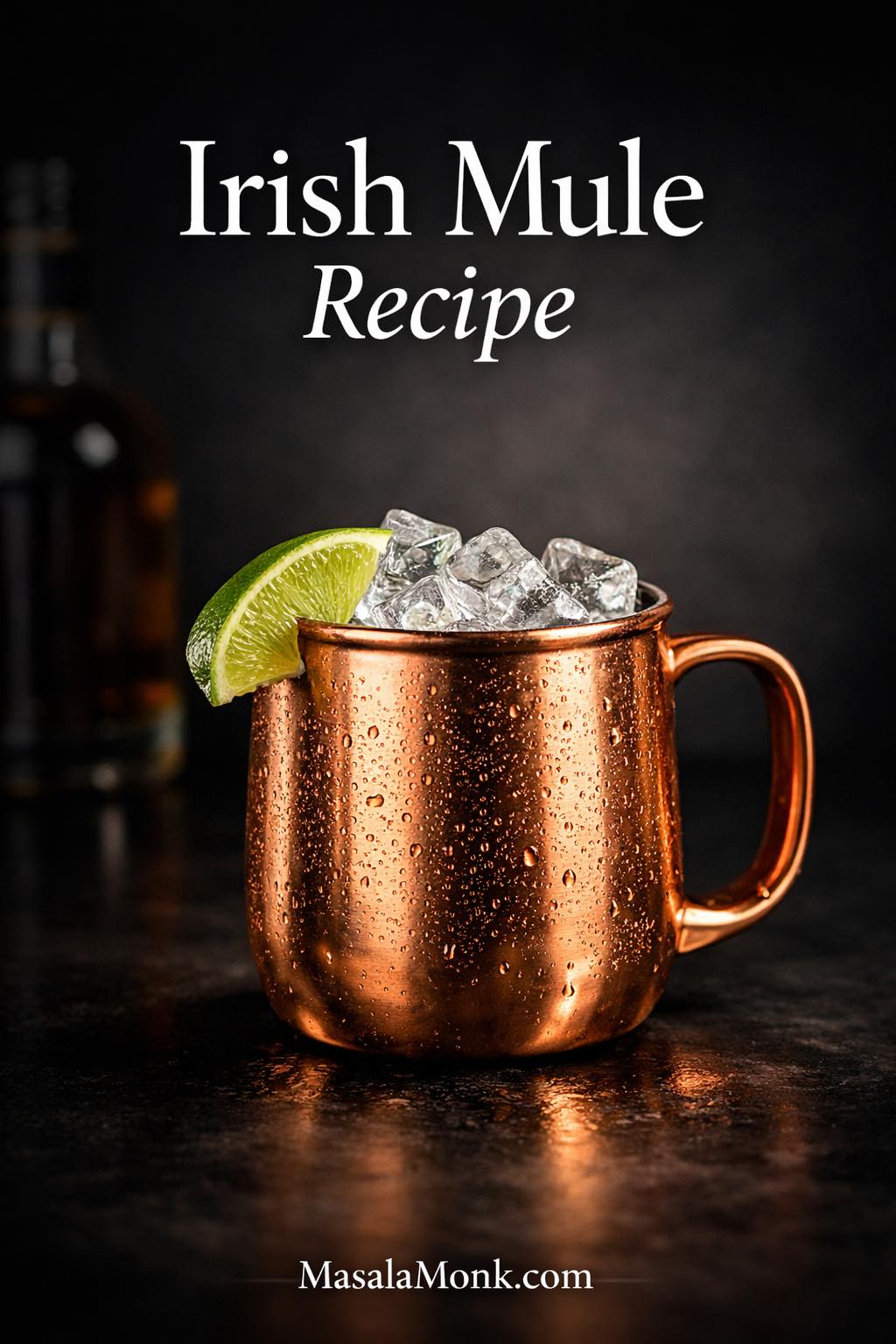
Irish mule recipe in a chilled copper mug with ice and lime on a dark background

An Irish mule recipe gives you the cold ginger-and-lime snap of a Moscow mule with the rounder character of Irish whiskey. The classic build is simple: Irish whiskey, fresh lime juice, ginger beer, and ice. Even so, the ratio matters. Too much lime can make the drink feel sharp, while too much ginger beer can soften it and pull it away from the crisp mule profile that makes an Irish mule work.

Start with the balanced classic first. From there, it is easy to make the drink a little softer, a little drier, or a little bolder without losing the bright ginger-and-lime shape that makes an Irish mule feel finished. Below, you’ll find the classic ratio in ounces and milliliters, Irish whiskey and ginger beer guidance, a clear Jameson explanation, a crowd version, troubleshooting tips, and a clean recipe section you can use right away.

Irish Mule Quick Answer

A balanced Irish mule uses 2 ounces Irish whiskey, 1/2 to 3/4 ounce fresh lime juice, and 4 ounces chilled ginger beer over plenty of ice. In metric terms, that is 60 ml Irish whiskey, 15 to 22 ml fresh lime juice, and 120 ml ginger beer. For most readers, this is the most useful starting range because the whiskey still comes through, the lime stays bright, and the ginger beer keeps the finish lively and clearly mule-like.

Start at 1/2 ounce lime if you want a slightly softer first glass. Move up to 3/4 ounce if you want a brighter, sharper version with more citrus snap. That small change matters more than many people expect.

This is one of the easiest Irish whiskey cocktails to balance at home because the structure is simple and the ratio is easy to adjust. If you are comparing it with a Moscow mule, the build stays familiar, but the spirit changes the feel of the drink. Vodka stays neutral, whereas Irish whiskey adds a rounder, warmer note underneath the ginger and lime. As a result, it feels a little softer at the center while still staying bright and refreshing from the first sip to the last.

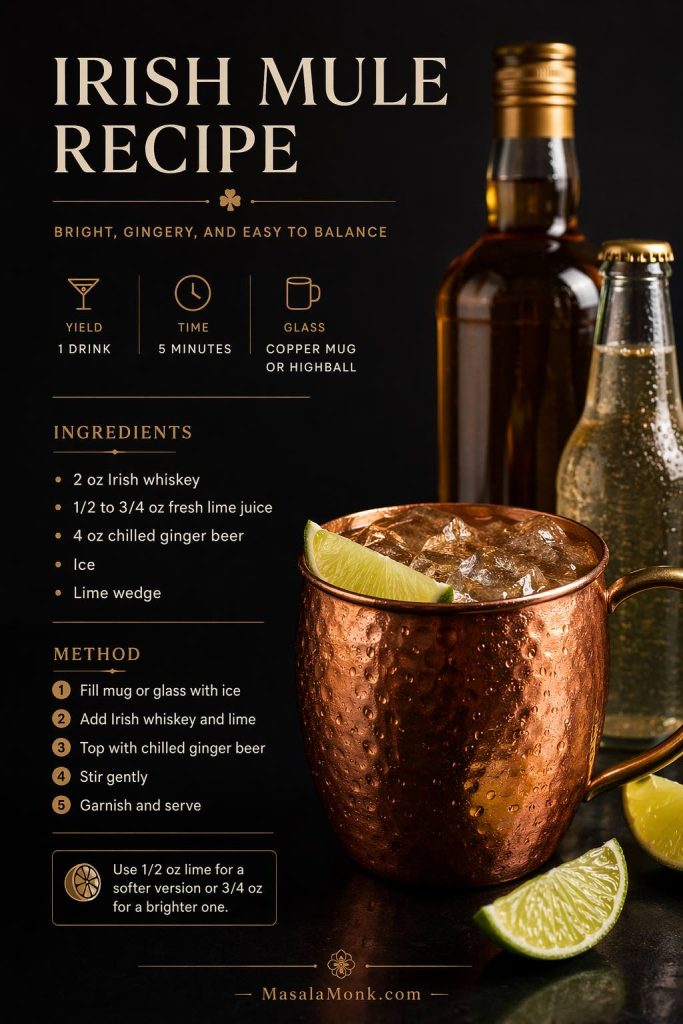
Irish mule recipe card showing a finished drink in a copper mug with Irish whiskey and ginger beer bottles in the background, plus ingredients, quick method, yield, time, and glassware.
This is the fast-reference version to save or screenshot: use 1/2 oz lime for a softer Irish mule or 3/4 oz for a brighter one, then add the ginger beer last so the drink stays crisp and fizzy.

Jameson is an easy bottle to start with, and although a copper mug is traditional, a highball glass works perfectly well too. In other words, you do not need special barware to make a very good Irish mule at home.

Best First Setup

  • Best first bottle: Jameson
  • Best first mixer: a balanced ginger beer with real ginger bite
  • Best first glass: a copper mug or highball glass
  • Best first garnish: a lime wedge

This setup gives you the clearest classic Irish mule. Jameson keeps the base smooth and easygoing, the ginger beer supplies the bite a mule needs, and the lime wedge finishes the drink without complicating it. Once you know that version, it becomes much easier to decide whether you want more ginger spice, a drier finish, or a slightly softer variation next time.

Why This Irish Mule Recipe Works

This version works because the ratio gives each part enough room to do its job. The Irish whiskey stays present, the lime keeps the drink bright without turning it sharp too quickly, and the ginger beer still finishes with enough bite to taste clearly mule-like. Nothing gets buried, and nothing runs too far ahead.

  • The whiskey stays noticeable: 2 ounces gives the drink real Irish whiskey character.
  • The lime stays adjustable: 1/2 ounce gives you a softer version, while 3/4 ounce gives you a brighter, sharper one.
  • The ginger beer still leads the finish: 4 ounces gives the drink the lift and ginger bite a mule needs.
  • It is easy to adjust: once you taste the classic version, small changes in lime or ginger beer let you fine-tune the cocktail without losing its shape.

If you want the most reliable first glass, use Jameson, a balanced ginger beer, plenty of ice, and fresh lime. That combination gives you a clean baseline before you start pushing the drink softer, drier, or bolder.

Irish Mule Ingredients

The ingredient list is short, so each part has a clear job. Irish whiskey gives it its base, lime adds brightness, ginger beer brings the signature mule bite, and ice keeps everything crisp. Because there are so few moving parts, ingredient quality shows up quickly in the glass. Fresh lime juice and well-chilled ginger beer are worth using here.

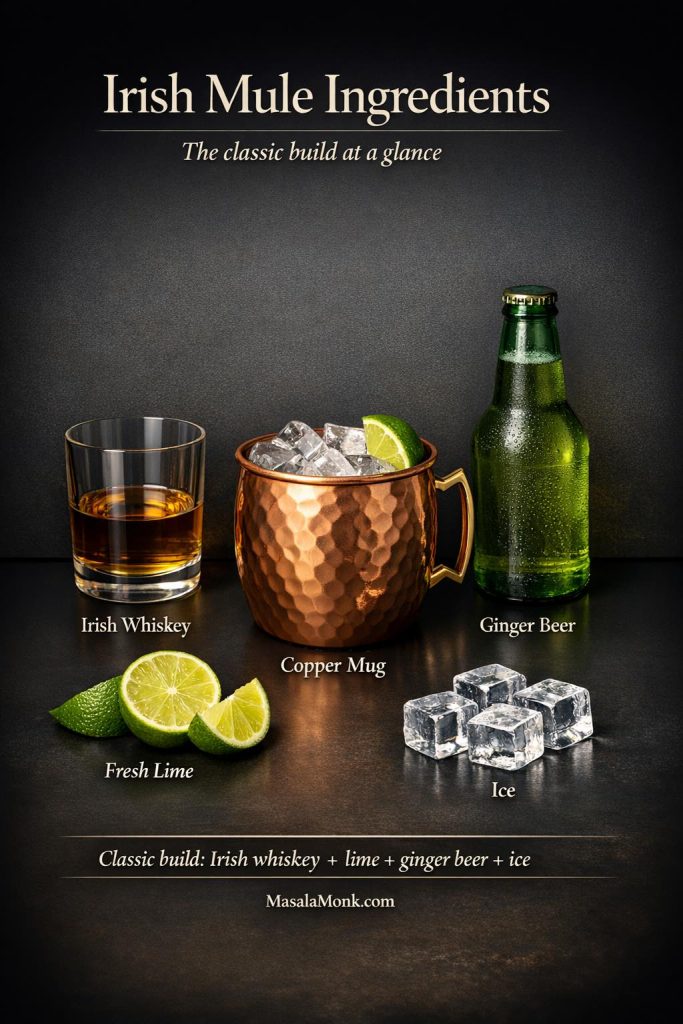
Irish mule ingredients guide showing Irish whiskey, ginger beer, fresh lime, ice, and a copper mug for the classic build at a glance.
A classic Irish mule stays simple on purpose: once the whiskey, lime, ginger beer, and ice are right, the drink already feels balanced before you start adjusting the ratio.
  • Irish whiskey: Jameson is a reliable starting choice because it is smooth, approachable, and widely available.
  • Fresh lime juice: freshly squeezed tastes cleaner and brighter than bottled juice.
  • Ginger beer: choose one with enough ginger character to stand up to the whiskey.
  • Ice: fill the mug or glass generously so the drink stays cold and lively.
  • Garnish: a lime wedge or wheel is enough.

Since the build is so simple, this is not the place to overcomplicate things. A good bottle of Irish whiskey, a lime, chilled ginger beer, and enough ice will take you most of the way there. Once those basics are right, the drink already feels finished.

How to Make an Irish Mule

This drink is built directly in the glass, which is part of what makes it so useful. There is no shaker, no straining, and no fussy setup. Start with ice, add the whiskey and lime, then finish with the ginger beer and stir gently. Adding the ginger beer last helps the cocktail stay brighter and keeps more fizz in the glass than pouring everything together and stirring hard.

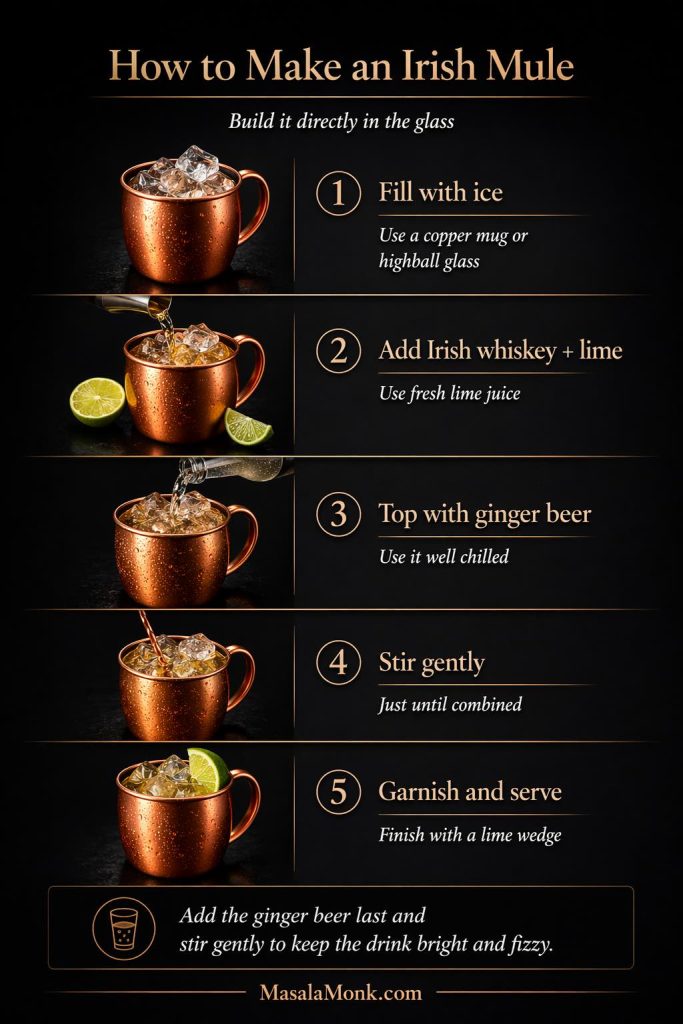
Step-by-step Irish mule method guide showing five steps: fill with ice, add Irish whiskey and lime, top with ginger beer, stir gently, and garnish and serve.
An Irish mule stays easy as long as you keep the build simple: use plenty of ice, add the ginger beer last, and stir gently so the drink stays bright instead of going flat.
  1. Fill a copper mug or highball glass with ice.
  2. Pour in 2 oz Irish whiskey and 1/2 to 3/4 oz fresh lime juice.
  3. Top with 4 oz chilled ginger beer.
  4. Stir gently just until combined.
  5. Garnish with a lime wedge or wheel and serve immediately.

The gentle stir matters. Overmixing can flatten the drink faster than many people expect, especially if the ginger beer is not very cold to begin with. For that reason, it helps to chill the mixer well before you build the cocktail rather than trying to make up for warm ginger beer with extra stirring later.

Best Ratio for an Irish Mule

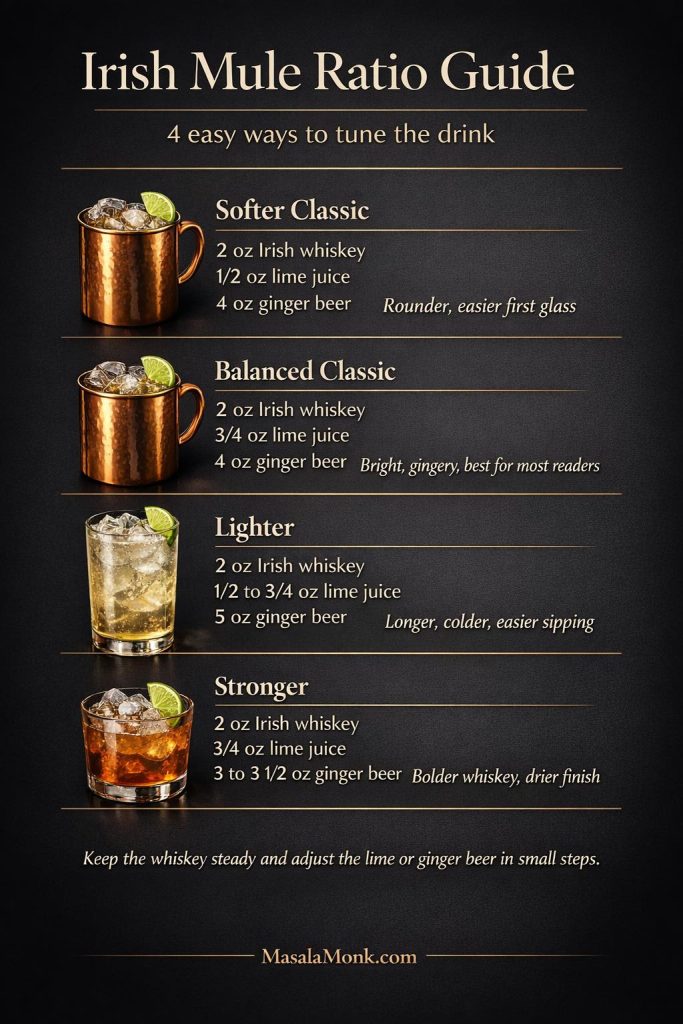
The easiest way to adjust an Irish mule is to keep the whiskey steady and change the lime or ginger beer in small steps. In most cases, those two ingredients do more to change the feel of the final glass than the whiskey does. Lime controls the edge. Ginger beer controls the length, sweetness, and overall mule character.

Irish mule ratio guide showing four versions: softer classic, balanced classic, lighter, and stronger, with Irish whiskey, lime juice, and ginger beer measurements plus short tasting notes.
Start with the balanced classic for the clearest Irish mule profile, then adjust the lime and ginger beer in small steps to make the drink softer, lighter, or more whiskey-forward without losing its shape.
StyleIrish whiskeyLime juiceGinger beerHow it drinks
Softer classic2 oz / 60 ml1/2 oz / 15 ml4 oz / 120 mlRounder, easier first glass
Balanced classic2 oz / 60 ml3/4 oz / 22 ml4 oz / 120 mlBright, gingery, and best for most readers
Lighter2 oz / 60 ml1/2 to 3/4 oz / 15 to 22 ml5 oz / 150 mlLonger, colder, easier sipping
Stronger2 oz / 60 ml3/4 oz / 22 ml3 to 3 1/2 oz / 90 to 105 mlBolder whiskey, drier finish

Keep the whiskey at 2 ounces and adjust the other parts in small steps. A little less lime softens the edge. A little less ginger beer makes the drink drier and more whiskey-forward. A small extra splash of ginger beer lightens a strong pour without flattening the whole glass. Small changes work better than big ones here.

Which Irish Whiskey to Use

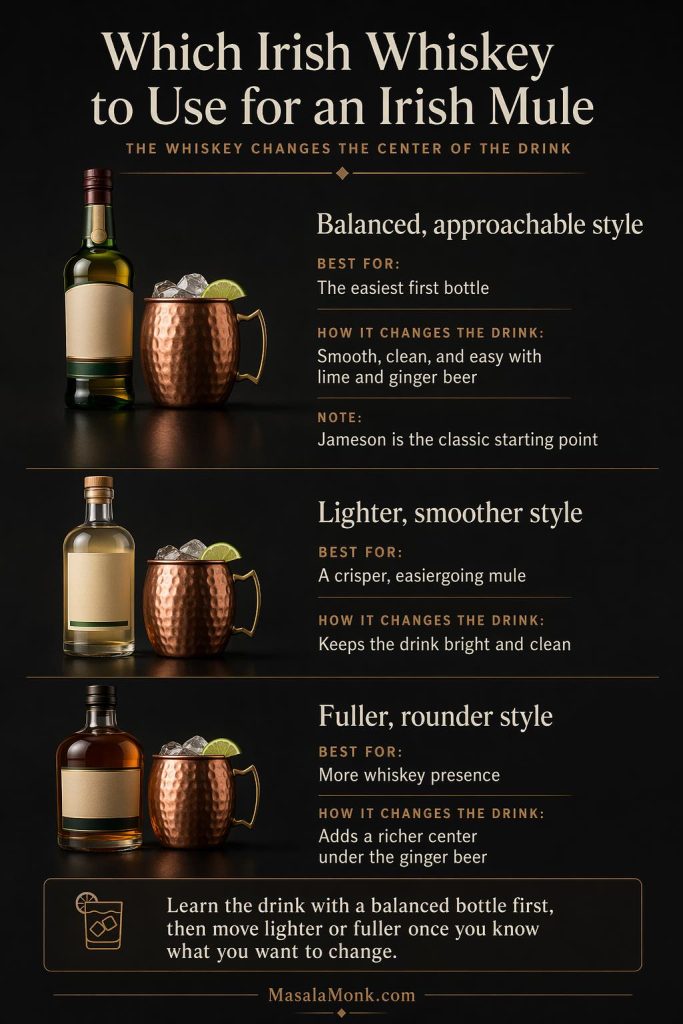
Jameson is the easiest place to start because it is smooth, approachable, and light enough to work cleanly with lime and ginger beer. It gives the drink a clear Irish whiskey base without making it feel heavy. For most home readers, that is the best first balance.

Guide showing three Irish whiskey styles for an Irish mule: a balanced approachable style for the easiest first bottle, a lighter smoother style for a crisper mule, and a fuller rounder style for more whiskey presence..
Start with a balanced bottle such as Jameson to learn the drink clearly, then move lighter for a crisper mule or fuller for more whiskey presence once you know what you want to change.

After that, choose your bottle based on the direction you want the drink to go. A lighter Irish whiskey keeps the mule crisp and easygoing, while a fuller one brings a rounder finish and a little more whiskey presence underneath the ginger beer. Still, the smartest first move is learning the drink with Jameson or another similarly balanced bottle before chasing a bigger style.

Which Ginger Beer to Use

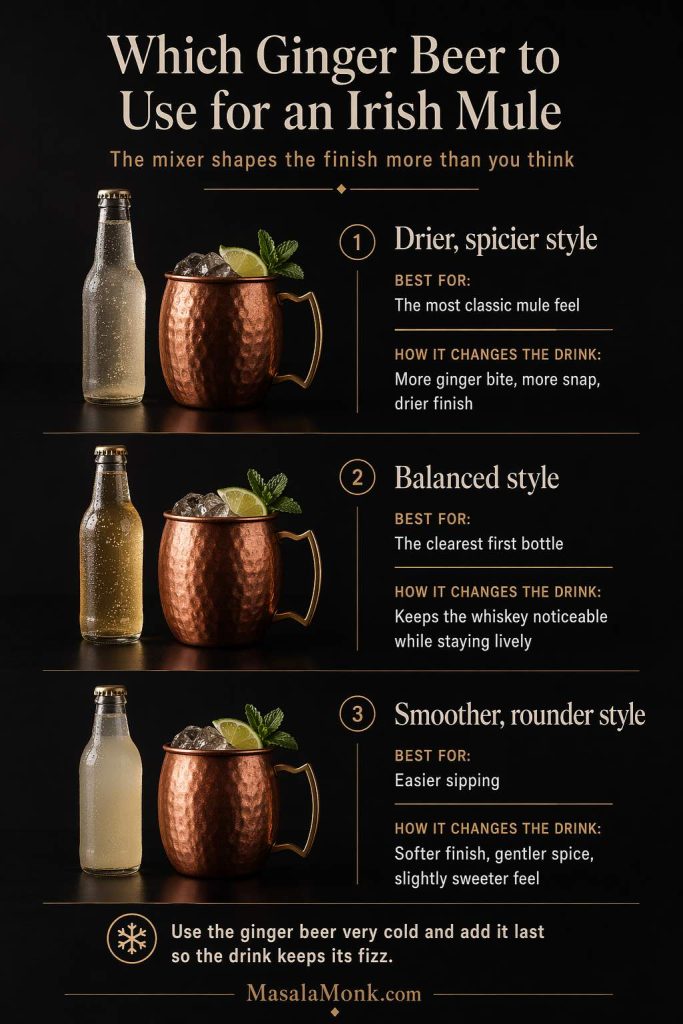
The ginger beer shapes the finish of the whole drink. A spicier bottle gives the mule more snap and a drier edge, while a softer or sweeter one makes it rounder and easier to sip. If you want a quick refresher on the mixer difference, this guide to ginger ale vs ginger beer is helpful.

Guide showing three ginger beer styles for an Irish mule: drier and spicier for a classic mule feel, balanced for the clearest first bottle, and smoother and rounder for easier sipping.
Start with a balanced ginger beer if you want the clearest first version, then move drier for more bite or rounder for a softer finish depending on how sharply you want the mule to drink.
  • For the most classic mule feel: choose a ginger beer with real ginger bite and a fairly dry finish.
  • For easier sipping: choose one that is smoother and a little rounder.
  • For better whiskey balance: avoid overly sweet ginger beers that cover the base spirit.
  • For the best texture: use it very cold and add it last so the drink keeps its fizz.

If you are unsure where to begin, use a balanced ginger beer rather than the sweetest bottle on the shelf. That gives you the clearest baseline, and from there you can decide whether you want more spice, more softness, or a drier finish next time.

Irish Mule vs Jameson Ginger & Lime vs Irish Buck

Most of the time, Irish mule, Irish whiskey mule, and Jameson mule all point to the same basic idea: Irish whiskey, lime, ginger beer, and ice. In everyday use, the Jameson version is usually just the same drink made with Jameson.

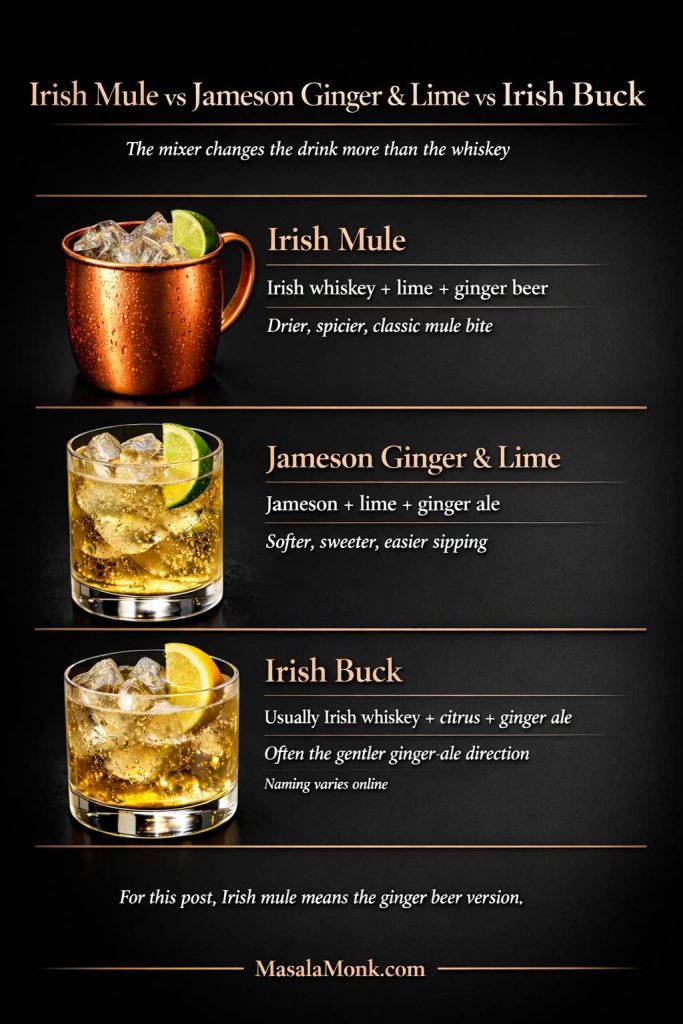
Where the confusion starts is the mixer. A classic mule uses ginger beer, which gives the drink more bite, more snap, and a drier finish. Many Jameson-style serves, however, use ginger ale instead. That creates a softer, sweeter drink with less mule-like bite, which pushes it closer to a whiskey-and-ginger highball.

Online, these names often get blurred together. For this page, an Irish mule means the ginger beer version. A Jameson Ginger & Lime style drink means the ginger ale version. Some sites also use the term Irish Buck for the ginger-ale direction, although naming is not perfectly consistent across the web.

Comparison guide showing the difference between an Irish mule, Jameson Ginger & Lime, and an Irish Buck. The Irish mule uses Irish whiskey, lime, and ginger beer for a drier, spicier mule-style drink. Jameson Ginger & Lime uses ginger ale for a softer, sweeter drink. Irish Buck usually uses Irish whiskey, citrus, and ginger ale, with naming that varies online.
This side-by-side guide clears up the biggest naming confusion around the drink: for this post, an Irish mule means the ginger beer version, while Jameson Ginger & Lime and many Irish Buck builds lean ginger ale and drink softer.

That distinction matters because it helps you choose the version you actually want. Start with the ginger beer version first if your goal is the clearest classic Irish mule. Then, if you want something softer and easier, test the ginger ale route after that. Jameson’s own Ginger & Lime serve is a good example of that gentler direction.

Irish Mule vs Moscow Mule vs Kentucky Mule

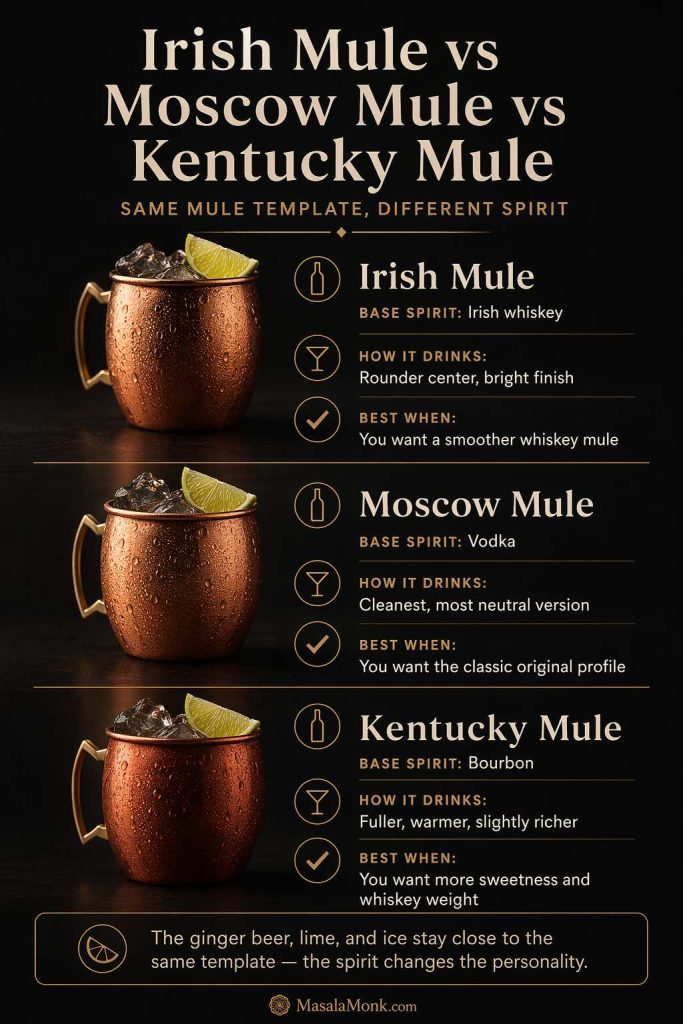
If you are choosing between mule-style cocktails, the fastest way to separate them is by the spirit. An Irish mule uses Irish whiskey, a Moscow mule uses vodka, and a Kentucky mule uses bourbon. The ginger beer, lime, and ice stay close to the same template, but the base spirit changes the personality of the drink quite a bit.

Comparison guide showing the differences between an Irish mule, Moscow mule, and Kentucky mule, including base spirit, how each one drinks, and when to choose each version.
The build stays familiar across all three drinks, but the base spirit shifts the feel: Irish whiskey gives a rounder center, vodka keeps the mule cleaner, and bourbon makes it fuller and warmer.

Choose an Irish mule when you want a smoother, rounder mule than vodka gives, but a brighter, lighter one than bourbon usually does. If you want the vodka original, see our Moscow Mule recipe. If you want the fuller bourbon version, see our Kentucky Mule recipe.

Irish Mule Recipe for a Crowd

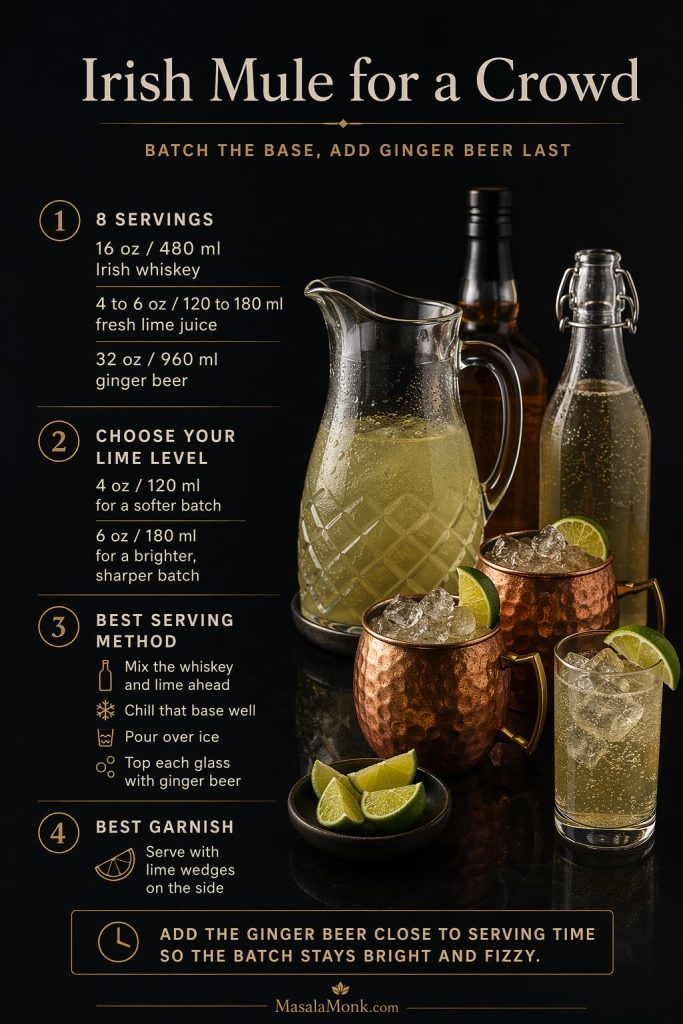
This recipe is easy to scale for guests, but the ginger beer tastes fresher if you add it close to serving time. Mix the whiskey and lime ahead, chill that base well, and then pour in the ginger beer just before serving. That way, each glass keeps its sparkle instead of tasting flat halfway through the gathering.

Irish mule for a crowd guide showing an 8-serving batch with Irish whiskey, lime juice, and ginger beer amounts, plus advice to batch the base, choose the lime level, and add ginger beer close to serving time.
For a group, keep the whiskey-and-lime base and the ginger beer as separate jobs: chill the base ahead, then top each glass at the last minute so the batch stays lively instead of going flat in the pitcher.
  • 8 servings: 16 oz / 480 ml Irish whiskey + 4 to 6 oz / 120 to 180 ml fresh lime juice + 32 oz / 960 ml ginger beer
  • How to choose the lime amount: use 4 oz / 120 ml for a softer crowd-pleasing batch, or 6 oz / 180 ml for a brighter, sharper one
  • Best serving method: pour the whiskey-and-lime base over ice in individual mugs or glasses, then top with ginger beer
  • Best garnish: lime wedges on the side

For parties, this setup works especially well because you can chill the base in advance and let guests top their own glass with ginger beer. In contrast, a fully mixed pitcher can lose some lift if it sits too long before serving.

Irish Mule Troubleshooting

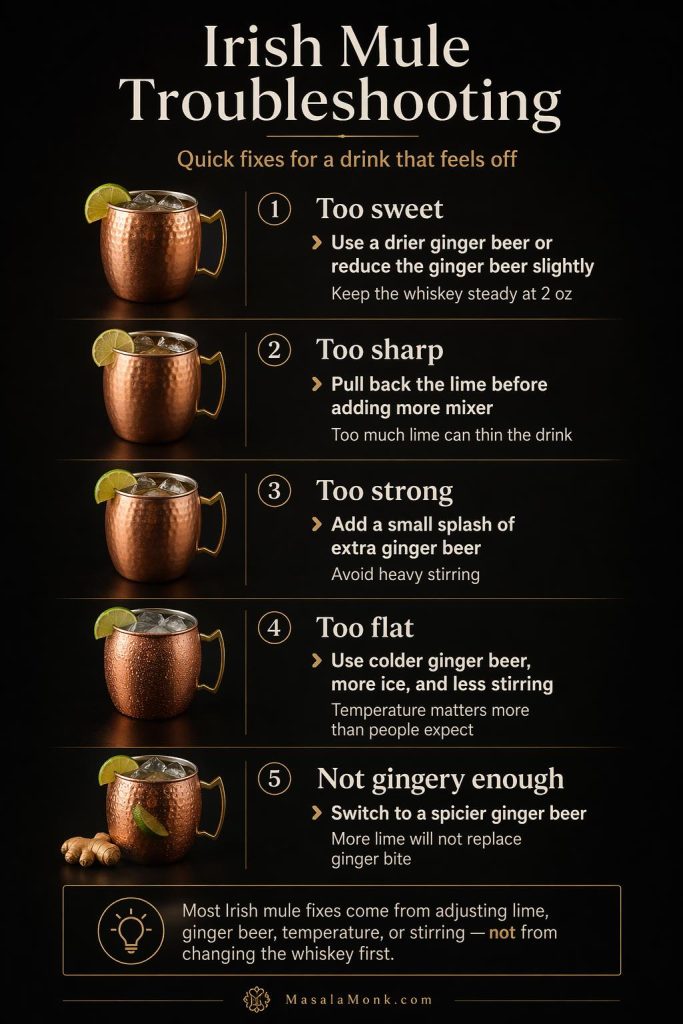
Even a very simple drink can drift off balance if one part runs too far ahead of the others. Fortunately, this one is easy to correct once you know which direction the flavor has moved.

Irish mule troubleshooting guide with quick fixes for a drink that is too sweet, too sharp, too strong, too flat, or not gingery enough.
If the first sip feels off, fix the lime, ginger beer, temperature, or stirring before you start changing the whiskey, because that is usually where the balance slips.

Too sweet

Use a less sweet ginger beer next time, or reduce the ginger beer slightly while keeping the whiskey at 2 ounces. That way, the drink stays mule-like instead of turning soft and soda-heavy.

Too sharp

Pull the lime back a little before adding more ginger beer. Too much lime can make the drink feel thinner and harsher than it should, especially once the ice starts to melt.

Too strong

Add a small splash of extra ginger beer rather than watering it down with heavy stirring. Usually, that is enough to soften the drink without flattening it.

Too flat

Use colder ginger beer, more ice, and less stirring. Mule-style drinks lose their snap quickly when they sit warm or get overmixed, so temperature and handling matter more than many people think.

Not gingery enough

Switch to a spicier ginger beer rather than adding more lime. More lime makes the drink brighter, but it does not replace the missing ginger bite that gives a mule its identity.

Irish Mule Recipe

This Irish mule recipe is bright, gingery, and easy to balance at home. It uses Irish whiskey, fresh lime juice, ginger beer, and ice for a crisp mule-style drink that works especially well with Jameson. Start with 1/2 ounce lime for a softer first glass, or 3/4 ounce if you want a brighter, sharper finish.

  • Yield: 1 drink
  • Prep time: 5 minutes
  • Total time: 5 minutes
  • Glassware: copper mug or highball glass
  • Serve: very cold, right after building

Ingredients

  • 2 oz (60 ml) Irish whiskey
  • 1/2 to 3/4 oz (15 to 22 ml) fresh lime juice
  • 4 oz (120 ml) chilled ginger beer
  • Ice, for filling the mug or glass
  • Lime wedge or wheel, for garnish
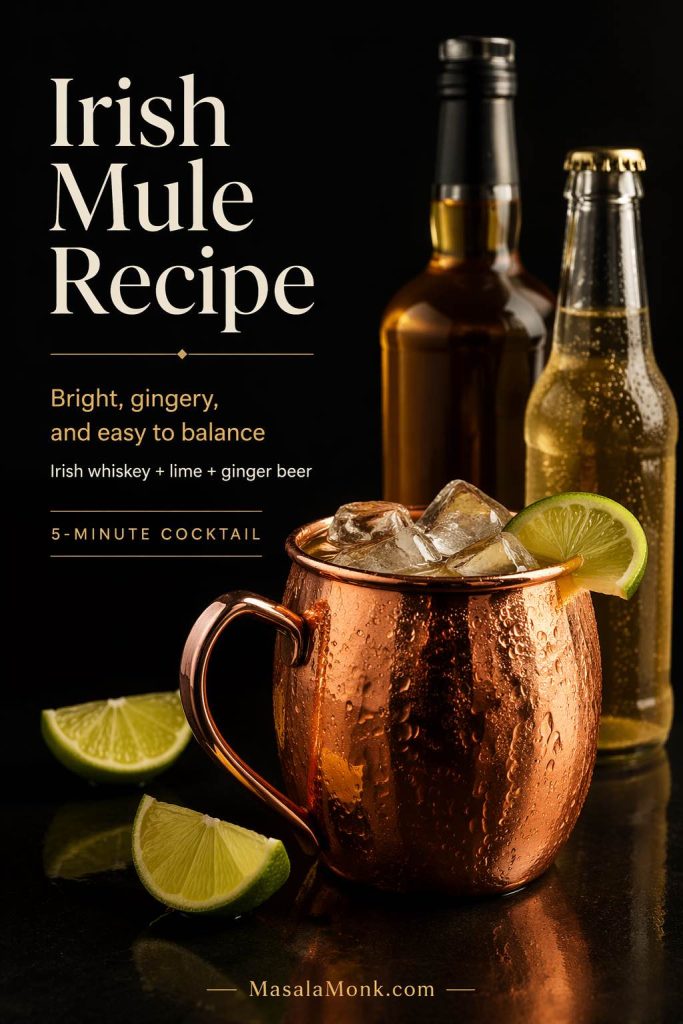
Promotional Irish mule recipe image showing a finished copper mug cocktail with lime wedges, an Irish whiskey bottle, a ginger beer bottle, and text overlay reading Irish Mule Recipe, bright, gingery, and easy to balance, and 5-minute cocktail.
Save this as the quick visual version: an Irish mule is just Irish whiskey, lime, and ginger beer built over ice, with enough citrus and fizz to stay bright from the first sip to the last.

Method

  1. Fill a copper mug or highball glass with ice.
  2. Add the Irish whiskey and fresh lime juice.
  3. Top with chilled ginger beer.
  4. Stir gently just until combined.
  5. Garnish with lime and serve right away.

Notes

  • Jameson is a reliable first bottle here.
  • Use 1/2 oz lime for a softer version or 3/4 oz for a brighter, sharper one.
  • Use very cold ginger beer and add it last for the liveliest finish.
  • For a lighter version, increase the ginger beer slightly.
  • For a drier, bolder finish, reduce the ginger beer slightly rather than increasing the whiskey first.
  • Ginger ale makes a softer Jameson Ginger & Lime style drink rather than a classic mule.
  • A lime wedge is the cleanest classic garnish.

Irish Mule FAQs

What is an Irish mule?

An Irish mule is the Irish whiskey version of a Moscow mule. It is usually made with Irish whiskey, fresh lime juice, ginger beer, and ice.

What is the difference between an Irish mule and a Moscow mule?

The difference is the base spirit. A Moscow mule uses vodka, while an Irish mule uses Irish whiskey.

Can you make an Irish mule with Jameson?

Yes. Jameson is a very good choice because its lighter style works especially well with lime and ginger beer in this cocktail.

Is a Jameson mule the same as an Irish mule?

Usually, yes. In most cases, a Jameson mule is simply the drink made with Jameson Irish whiskey.

Do you use ginger beer or ginger ale in an Irish mule?

The classic version uses ginger beer. Ginger ale makes a softer, sweeter variation that drinks differently.

Is an Irish Buck the same as an Irish mule?

Not always. Online, the names often overlap, but an Irish mule usually points to the ginger beer version, while Irish Buck more often points to the ginger ale direction. In practice, the mixer is the detail that changes the drink most.

Do you need a copper mug for an Irish mule?

No. A copper mug is traditional for mule-style drinks, but a highball glass works perfectly well.

Can you make Irish mules for a crowd?

Yes. Mix the whiskey and lime first, chill that base, and add the ginger beer close to serving time so the drink stays bright and fizzy.

↑ Back to top

Posted on Leave a comment

Kentucky Mule Recipe

Kentucky mule recipe in a copper mug with ginger beer, bourbon, lime, and mint

A Kentucky mule recipe is the bourbon-based version of the mule cocktail, built with bourbon, fresh lime juice, ginger beer, and ice. It keeps the bright, gingery snap that makes mule-style drinks so easy to like, while the bourbon gives it a warmer, fuller finish. Even so, the bourbon you choose, the ginger beer you pour, and the ratio you build can noticeably change the final cocktail.

Start with the classic version first, then adjust after the first sip. Below, you’ll find the standard build, an easy ratio guide, bourbon and ginger beer tips, a pitcher version, and simple fixes for a drink that tastes too sweet, too sharp, too boozy, or too flat.

Quick Answer: Kentucky Mule Recipe Basics

A Kentucky mule is the bourbon version of a mule-style cocktail. For the classic build, use 2 ounces bourbon, 1/2 ounce fresh lime juice, and 3 to 4 ounces ginger beer over ice, then garnish with lime or mint if you like. For most readers, that is still the best place to start because the drink stays crisp, gingery, and clearly bourbon-led without turning too sweet.

At the same time, the drink is flexible. Once you know whether you want it lighter, tighter, spicier, or softer, the next round becomes easy to adjust without changing its basic identity.

  • Best starting ratio: 2 oz bourbon + 1/2 oz lime + 4 oz ginger beer
  • Best glass: copper mug or highball glass
  • Best garnish: lime wedge, mint sprig, or both
  • Best first bourbon style: balanced, not too oaky, not too hot

Kentucky Mule Recipe

This bourbon cocktail is fast to build, easy to adjust, and bright enough to stay refreshing while still tasting clearly like bourbon. Start with the balanced version below, then move it lighter or more bourbon-forward after the first glass depending on how you want it to land.

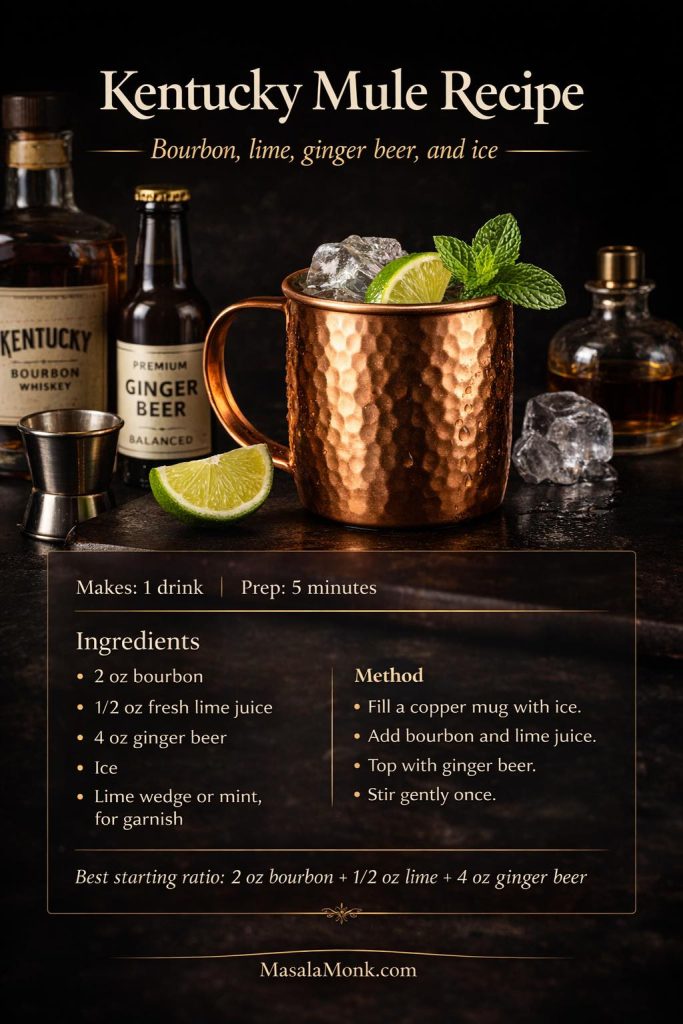
Kentucky mule recipe card image showing a finished bourbon mule in a hammered copper mug with lime, mint, ginger beer, and bourbon props, plus on-image ingredients and method for making the cocktail.
This Kentucky mule recipe card shows the classic bourbon, lime, ginger beer, and ice build in one saveable visual. Use it when you want the full drink at a glance: the ingredients, the quick method, and the best starting ratio for a cold, crisp bourbon mule.

At a Glance

  • Makes: 1 drink
  • Prep time: 5 minutes
  • Total time: 5 minutes
  • Difficulty: Easy
  • Method: Built in the glass
  • Glass: Copper mug or highball glass
  • Garnish: Lime wedge, mint sprig, or both
  • Taste: Bright, crisp, gingery, and bourbon-forward

Ingredients

  • 2 oz bourbon (60 ml)
  • 1/2 oz fresh lime juice (15 ml)
  • 3 to 4 oz ginger beer (90 to 120 ml)
  • Ice
  • Lime wedge or mint sprig, for garnish

How to Make It

  1. Fill a copper mug or highball glass with ice.
  2. Add the bourbon and fresh lime juice.
  3. Top with ginger beer.
  4. Stir gently once, just enough to combine.
  5. Garnish with a lime wedge or mint sprig and serve immediately.

Best Starting Ratio

For the most balanced first version, use 2 oz bourbon, 1/2 oz lime juice, and 4 oz ginger beer. Move closer to 5 oz ginger beer for a lighter drink, or closer to 3 oz if you want a tighter, more bourbon-forward finish.

Recipe Notes

  • Use fresh lime juice for the cleanest, brightest result.
  • Chill the ginger beer first so the drink stays colder and fizzier.
  • If the drink tastes too sweet, use a drier ginger beer or slightly less of it.
  • If the drink tastes too strong, add a little more ginger beer and ice rather than more lime.
  • A copper mug looks the part, but a cold highball glass works perfectly well.

Kentucky Mule Ingredients

The ingredient list is short, so each choice matters. The bourbon controls the warmth and weight, while the ginger beer shapes the bite, sweetness, and lift. As a result, two versions can taste surprisingly different even when the ingredient list looks nearly identical on paper.

Keep the first one simple: a balanced bourbon, a lively ginger beer, fresh lime juice, and plenty of cold ice. Once that baseline tastes right, it becomes much easier to decide whether the next round should be drier, spicier, lighter, or more bourbon-forward.

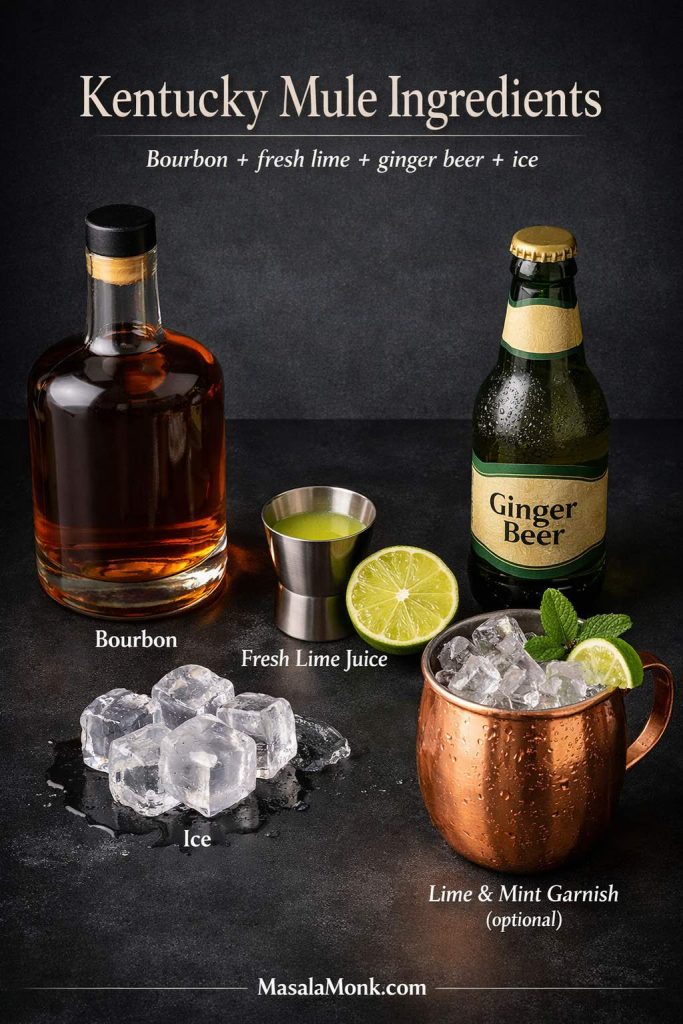
Labeled Kentucky mule ingredients guide showing bourbon, fresh lime juice, ginger beer, ice, and a copper mug with optional lime and mint garnish on a dark editorial background.
A Kentucky mule keeps the ingredient list short: bourbon, fresh lime juice, ginger beer, and ice. Once those pieces are in place, the drink mostly comes down to ratio, which is why the next step is deciding whether you want it lighter, balanced, or more bourbon-forward.

How to Choose the Bourbon

Use a bourbon that tastes balanced and easy on its own rather than something aggressively oaky or overly hot. A softer bourbon makes a rounder drink, while a higher-rye bourbon brings more edge and spice. The sweet spot is a bottle that stays present under the ginger beer without pushing too hard.

Easy starting points include Maker’s Mark, Buffalo Trace, Four Roses, Woodford Reserve, and Bulleit. You do not need your rarest bottle here. A bourbon that feels too delicate can disappear, while one that feels too heavy can make the drink louder than it needs to be.

How to Choose the Ginger Beer

Ginger beer is what makes the classic version feel like a mule instead of bourbon with soda. A drier, spicier ginger beer gives more bite and structure. A sweeter one makes the drink softer, but it can flatten the bourbon if you pour too much.

Good starting points include Fever-Tree, Reed’s, and Q Mixers. When the first attempt feels too gentle, switch to a sharper ginger beer before changing anything else. On the other hand, when it feels harsher than you want, a rounder ginger beer usually brings it back into balance more cleanly.

Why Fresh Lime Matters

Fresh lime keeps the drink bright and stops the bourbon and ginger from feeling heavy together. Since this is a short drink with only a few parts, fresh juice tastes cleaner and more finished than bottled lime in most home-bar setups.

The lime should sharpen the drink, not take it over. With an especially tart lime, the balance can tip from refreshing into something too pointed. Start with the classic amount, taste, then decide whether the next round needs a small adjustment.

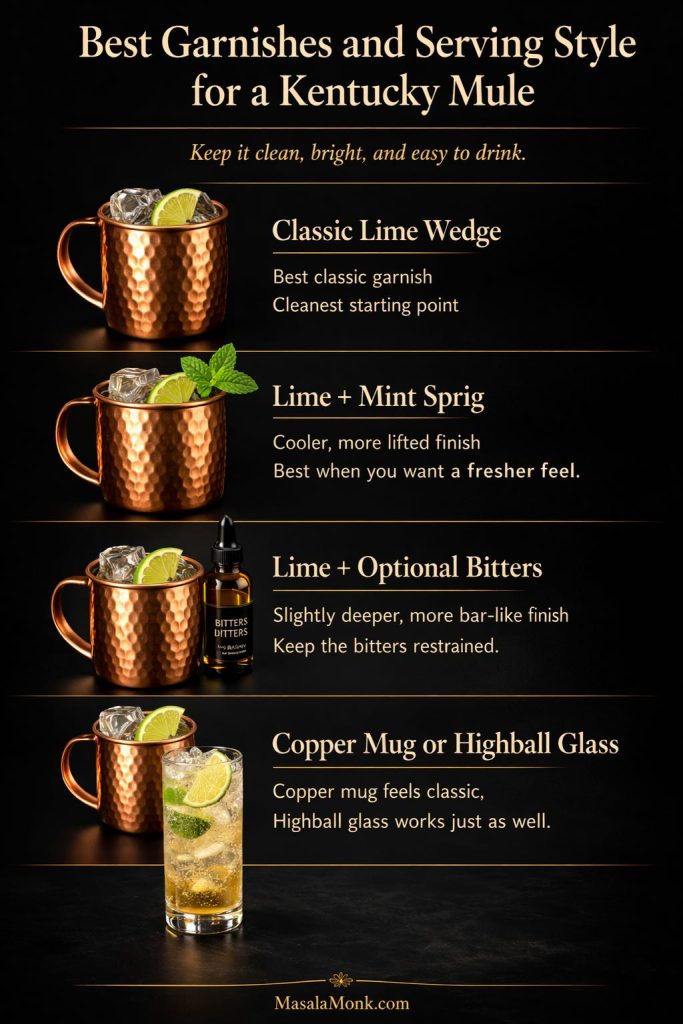
Kentucky mule garnish and serving guide showing four options: classic lime wedge, lime with mint sprig, lime with optional bitters, and serving the drink in either a copper mug or a highball glass.
A Kentucky mule does not need a fussy garnish to work well. Start with a lime wedge for the cleanest classic version, add mint when you want a cooler and more lifted finish, use bitters sparingly when you want a slightly deeper bar-style edge, and serve it in either a copper mug or a highball glass depending on what you have.

Garnishes and Optional Bitters

A lime wedge is enough for the classic version. Mint makes the drink feel cooler and more lifted. Aromatic bitters can add depth, but they work best as an optional riff rather than a required part of the standard build.

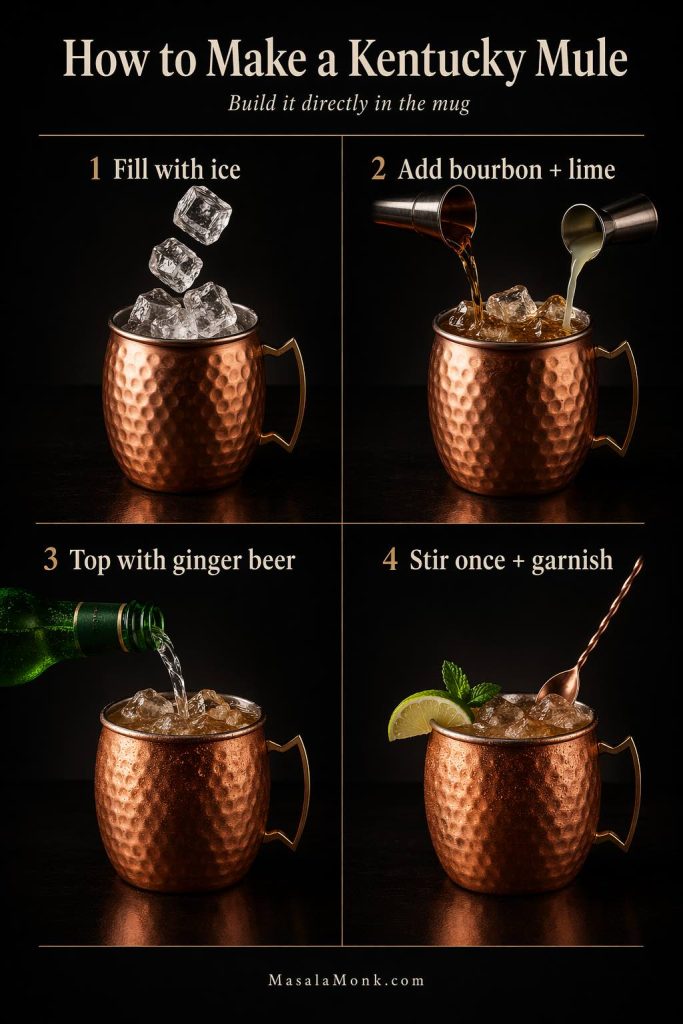
How to Make a Kentucky Mule

This is a built drink, which is one reason it is so useful. You do not need a shaker or mixing glass for this recipe. Build it directly in the mug or glass, stir lightly, and the whole thing stays fast and approachable.

Four-panel Kentucky mule step-by-step guide showing a copper mug filled with ice, bourbon and lime being added, ginger beer poured in, and the finished drink stirred once and garnished with lime and mint.
A Kentucky mule is built directly in the mug: fill with ice, add bourbon and fresh lime, top with ginger beer, then stir once and garnish. The order matters because it keeps the ginger beer lively and the final drink clean, cold, and balanced.
  1. Fill a copper mug or highball glass with ice.
  2. Pour in the bourbon and fresh lime juice.
  3. Top with ginger beer.
  4. Stir gently once, just enough to combine.
  5. Garnish with a lime wedge or mint sprig and serve immediately.

For a colder, livelier drink, chill the ginger beer first and build quickly. That small step helps it stay brighter and fizzier in the glass. Meanwhile, a light stir keeps everything mixed without flattening it too early.

Kentucky Mule Ratio Guide

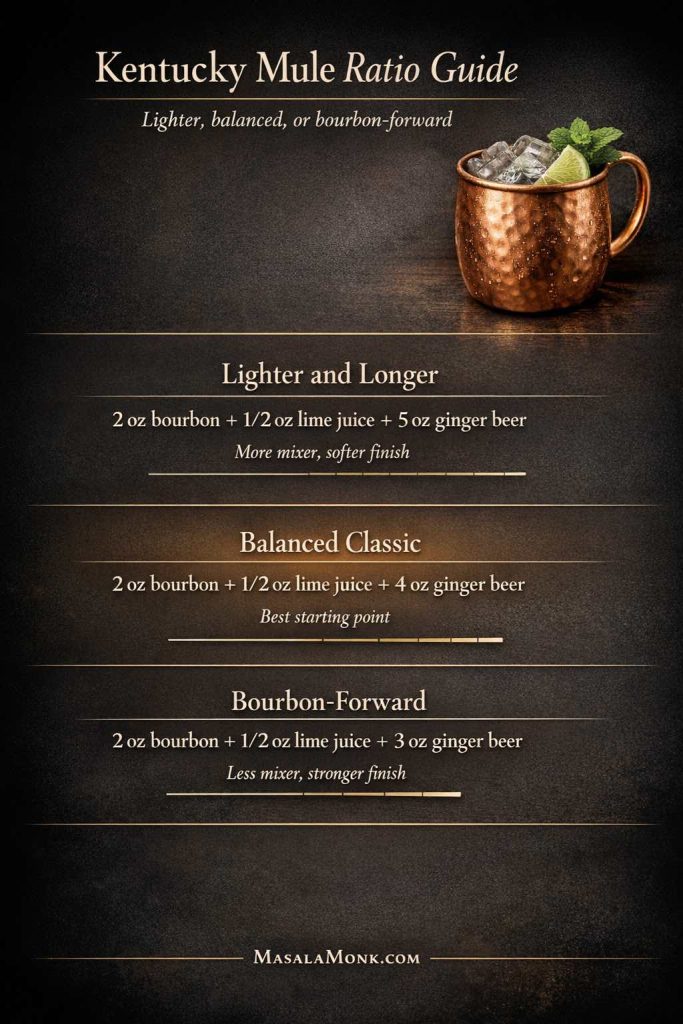
The easiest way to adjust a Kentucky mule recipe is to keep the bourbon steady at 2 ounces and change the ginger beer slightly depending on whether you want the drink lighter, more balanced, or more spirit-forward. Even a 1-ounce shift in mixer can noticeably change how sweet, sharp, or bourbon-led the final drink feels.

Kentucky mule ratio guide showing three builds: lighter and longer with 5 oz ginger beer, balanced classic with 4 oz ginger beer, and bourbon-forward with 3 oz ginger beer, plus one copper mug hero image on a dark editorial background.
The easiest way to adjust a Kentucky mule is to keep the bourbon and lime steady, then change the ginger beer. More mixer makes the drink longer and softer, while less mixer makes it tighter and more bourbon-forward.

Lighter and Longer

Use 2 ounces bourbon, 1/2 ounce lime juice, and 5 ounces ginger beer. This version drinks colder, softer, and easier, which makes it a good first choice for casual sipping.

Balanced Classic

Use 2 ounces bourbon, 1/2 ounce lime juice, and 4 ounces ginger beer. This is the clearest starting point because the bourbon stays visible while the drink still feels crisp and unmistakably mule-like.

Bourbon-Forward

Use 2 ounces bourbon, 1/2 ounce lime juice, and 3 ounces ginger beer. The result is tighter, warmer, and more whiskey-led without becoming clumsy or overly strong.

Style Bourbon Lime Juice Ginger Beer Best for
Lighter and longer 2 oz 1/2 oz 5 oz Easier sipping, softer finish
Balanced classic 2 oz 1/2 oz 4 oz Best first version for most readers
Bourbon-forward 2 oz 1/2 oz 3 oz More whiskey presence, less sweetness

How to Fix a Kentucky Mule

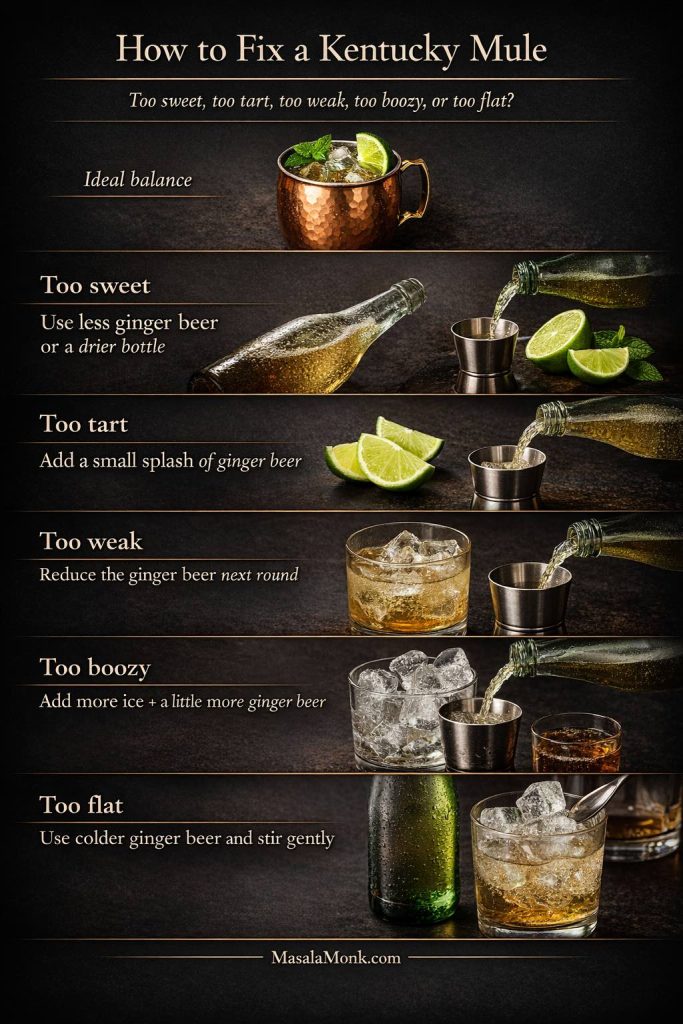
A good Kentucky mule is easy to fix in the glass once you know what actually went wrong. Most problems come from one of four places: the ginger beer is too sweet, the lime is too sharp, the bourbon is getting buried, or the drink has lost its chill and fizz. Usually, the smartest fix is a small one rather than a complete rebuild.

Ask what the drink is missing. When it tastes heavy, it usually needs brightness or a drier mixer. When it tastes harsh, it usually needs a little more softness or dilution. And when it tastes dull, the issue is often temperature or flat ginger beer rather than the bourbon itself.

Kentucky mule troubleshooting guide showing how to fix a drink that is too sweet, too tart, too weak, too boozy, or too flat, using visual cues like ginger beer, lime, ice, and freshness adjustments on a dark editorial background.
Most Kentucky mule problems come down to balance: too much mixer, too much lime, too little whiskey presence, not enough dilution, or lost fizz. These quick fixes make it easier to correct the drink without rebuilding it from scratch.

If It Tastes Too Sweet

This usually means the ginger beer is doing more than the bourbon can support. The cleanest fix is to use slightly less ginger beer or switch to a drier bottle next time. When the drink is already built, add a little more ice and a small squeeze of lime first.

If It Tastes Too Sharp or Too Tart

This usually happens when the lime is louder than the ginger beer and bourbon can comfortably carry. A small splash of extra ginger beer usually softens the edges while keeping the mule structure intact. Next time, pull the lime back slightly rather than changing everything else.

If It Tastes Too Weak

When a Kentucky mule tastes weak, it often does not need more bourbon. More often, the ginger beer is simply covering too much of the whiskey. Reduce the ginger beer slightly on the next round so the structure tightens up. When it still feels buried, add only a small splash of bourbon rather than a full extra pour.

If It Tastes Too Boozy or Too Hot

This usually means the drink needs more cushion, not more acidity. Add more ice and a modest splash of ginger beer. That softens the alcohol impression while keeping the drink recognizable. More lime usually makes it feel sharper rather than more balanced.

If It Tastes Too Flat

A flat Kentucky mule usually points to temperature and carbonation more than ratio. Start colder and build faster. Chill the ginger beer first, use plenty of fresh ice, and stir only once or twice. When you are making a pitcher for a crowd, add the ginger beer only at the end.

The Simplest Troubleshooting Rule

A simple way to troubleshoot it is this: a soft drink usually needs less ginger beer or a drier one, a sharp drink needs a lighter hand with the lime, and a hot drink needs a little more mixer and ice. When the drink just seems dull, look at temperature, carbonation, and freshness before blaming the bourbon.

What Is a Kentucky Mule?

A Kentucky mule is the bourbon-based version of a mule-style cocktail. In its classic form, it combines bourbon, fresh lime juice, ginger beer, and ice, usually served in a copper mug or a highball glass. The build is simple, but the drink tastes warmer, fuller, and slightly richer than the vodka-based original because bourbon brings vanilla, caramel, and light oak into the mix.

That is what makes it so useful. It still drinks cold and refreshing like a mule, yet it feels more flavorful and more whiskey-led than a standard Moscow mule. The lime and ginger keep the bourbon from feeling heavy, so the final drink lands somewhere between an easy highball and a simple bourbon cocktail.

It also works unusually well at home. The drink is fast to build, easy to adjust, and flexible enough to go lighter, tighter, spicier, or softer without losing its identity.

Kentucky Mule vs Bourbon Mule vs Whiskey Mule vs Moscow Mule

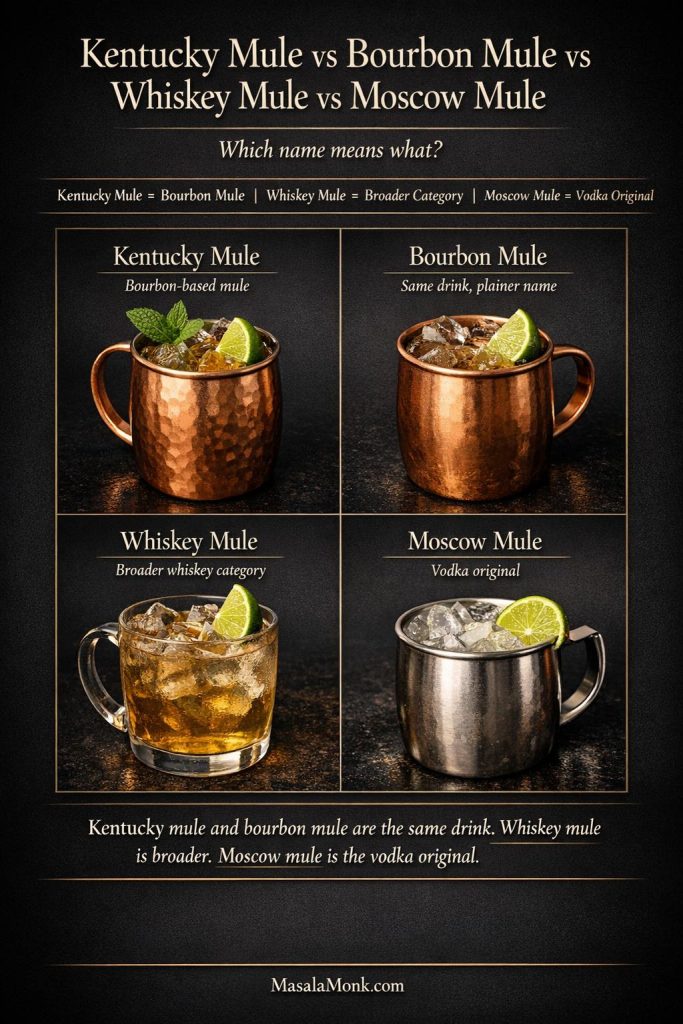
These names sit close together, but they do not all mean exactly the same thing. Some are precise names for this specific drink, while others are broader category terms.

Comparison guide showing Kentucky Mule and Bourbon Mule as the same bourbon-based mule, Whiskey Mule as the broader whiskey category, and Moscow Mule as the vodka original.
Kentucky mule and bourbon mule mean the same bourbon-based drink. Whiskey mule is the broader umbrella term, while Moscow mule is the vodka original and usually tastes lighter and more neutral.
  • Kentucky Mule: the standard name for the bourbon version of the mule
  • Bourbon Mule: the closest and clearest synonym for a Kentucky mule
  • Whiskey Mule: a broader umbrella term that can include bourbon, rye, Irish whiskey, and other whiskey-based versions
  • Moscow Mule: the vodka original

When you are talking specifically about the bourbon version, Kentucky mule and bourbon mule are the most accurate names. Whiskey mule can still fit, but it is less exact because it could point to more than one whiskey style. Moscow mule refers to the vodka version, which follows the same broad template but lands cleaner, lighter, and less whiskey-shaped in the glass.

Kentucky Mule vs Bourbon Mule

For practical recipe purposes, there is no meaningful difference here. Both names point to the same drink. Kentucky mule is the more established cocktail-style name, while bourbon mule is often the clearest plain-language label for readers scanning quickly.

Kentucky Mule vs Whiskey Mule

A Kentucky mule is always a whiskey mule because bourbon is whiskey. A whiskey mule is not always a Kentucky mule, though, since the drink might be made with rye, Irish whiskey, or another whiskey style instead. That makes whiskey mule a category term, while Kentucky mule is the more precise choice for this recipe.

Kentucky Mule vs Moscow Mule

The base spirit is the main difference. A Kentucky mule uses bourbon, while a Moscow mule uses vodka. A Kentucky mule tastes warmer, rounder, and more flavor-led, whereas a Moscow mule usually feels cleaner, crisper, and more neutral.

So these drinks belong to the same family, but the name changes how specific you are being. For both readers and search intent, Kentucky mule is the strongest label for this bourbon-based version.

Best Bourbon for a Kentucky Mule

The best bourbon for a Kentucky mule is not necessarily the most expensive bottle you own. What matters more is how the bourbon behaves under ginger, lime, and ice. You want it to still taste like bourbon in the finished drink while leaving enough room for the ginger and lime to stay clear.

That usually means avoiding the two extremes. A bourbon that is too soft can disappear, while one that is too aggressive can make the drink feel more like a diluted whiskey pour than a balanced mule. The most useful way to choose is by flavor style rather than price or hype. In practice, a mid-proof bourbon with clear caramel, vanilla, light oak, and enough structure to hold up under ginger beer works especially well.

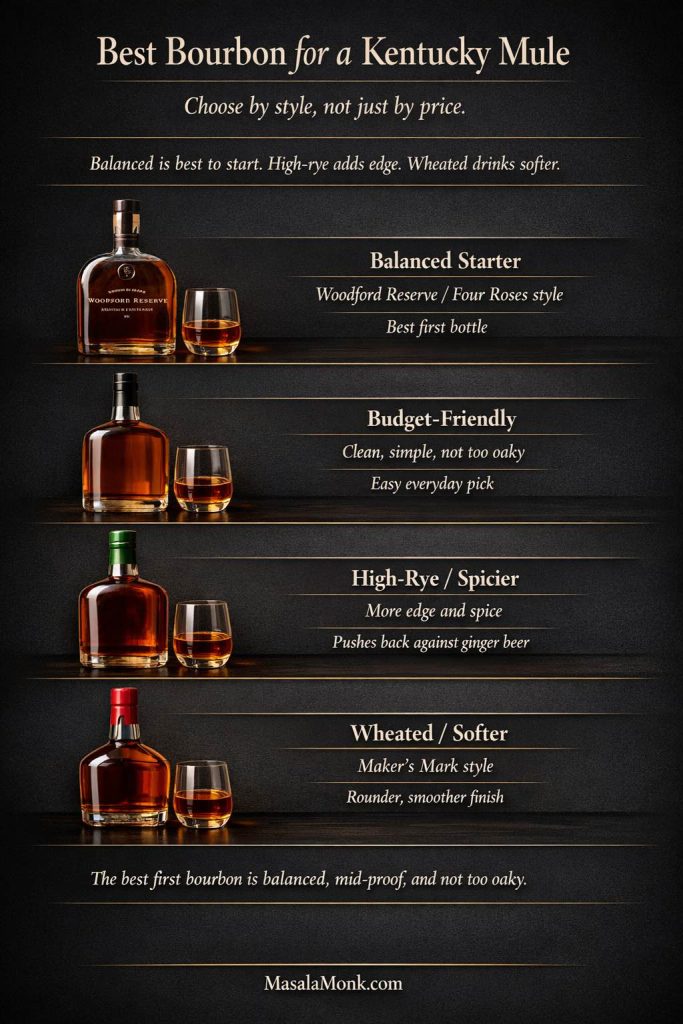
Labeled bourbon chooser guide for a Kentucky mule showing four styles: balanced starter, budget-friendly, high-rye or spicier, and wheated or softer, with bottle and tasting glass visuals on a dark editorial background.
A balanced mid-proof bourbon is the easiest place to start for a Kentucky mule. After that, the choice comes down to style: high-rye bourbons bring more edge against the ginger beer, while wheated bourbons make the drink rounder and softer.

Best Budget Bourbon

For an everyday Kentucky mule, look for a straightforward bourbon that tastes clean, a little sweet, and not overly woody. You want enough caramel and vanilla to read clearly, but not so much oak that the drink starts tasting rough or heavy once the ginger beer goes in.

When the bottle feels pleasant in a simple highball, it will usually work here too. When it drinks hot, bitter, or sharply oaky on its own, that roughness often shows up even more clearly once the lime sharpens the drink.

Best Balanced Bourbon

This is the safest starting point. A balanced bourbon gives you enough caramel, vanilla, and light spice to stay visible, yet it still leaves room for the ginger beer to bite and the lime to brighten. The final drink feels structured from the first sip instead of tipping too sweet, too sharp, or too whiskey-heavy.

One useful rule helps here: choose a bourbon that feels rounded and steady, not flashy. That kind of bottle usually makes the clearest classic version because none of the parts have to fight for space.

Best Spicier or Higher-Rye Bourbon

Choose this style when you want a drier, livelier Kentucky mule with more edge. A higher-rye bourbon usually brings more pepper, baking-spice energy, and firmness, which helps the bourbon push back against the ginger beer instead of melting quietly into it.

This style works especially well with a crisp or dry ginger beer. Pair it with a very sweet ginger beer and the contrast gets softer and less defined than many readers expect.

Best Softer or Wheated Bourbon

Choose this style when you want a rounder, smoother Kentucky mule with less bite from the whiskey itself. Softer bourbons tend to lean more toward gentle caramel, vanilla, and a plush texture rather than peppery spice. That can make the drink feel easier and more crowd-friendly.

Pairing matters more here. A soft bourbon with a sweet ginger beer can flatten the drink when the lime is not bright enough. This is the right lane for a gentler mule, but the ginger beer still needs to stay lively and the lime still needs to stay fresh.

Best Ginger Beer for a Kentucky Mule

Ginger beer changes the drink more than many readers expect. One bottle can make the Kentucky mule feel sharp and dry, while another makes it rounder and softer. In practice, the mixer choice often matters more than a small bourbon swap.

Rather than asking only which ginger beer is “best,” ask what kind of result you want in the glass. Once you decide whether you want more bite, more balance, or a softer finish, the choice gets much easier. You are really choosing the level of ginger heat, sweetness, and fizz that you want the bourbon to sit inside.

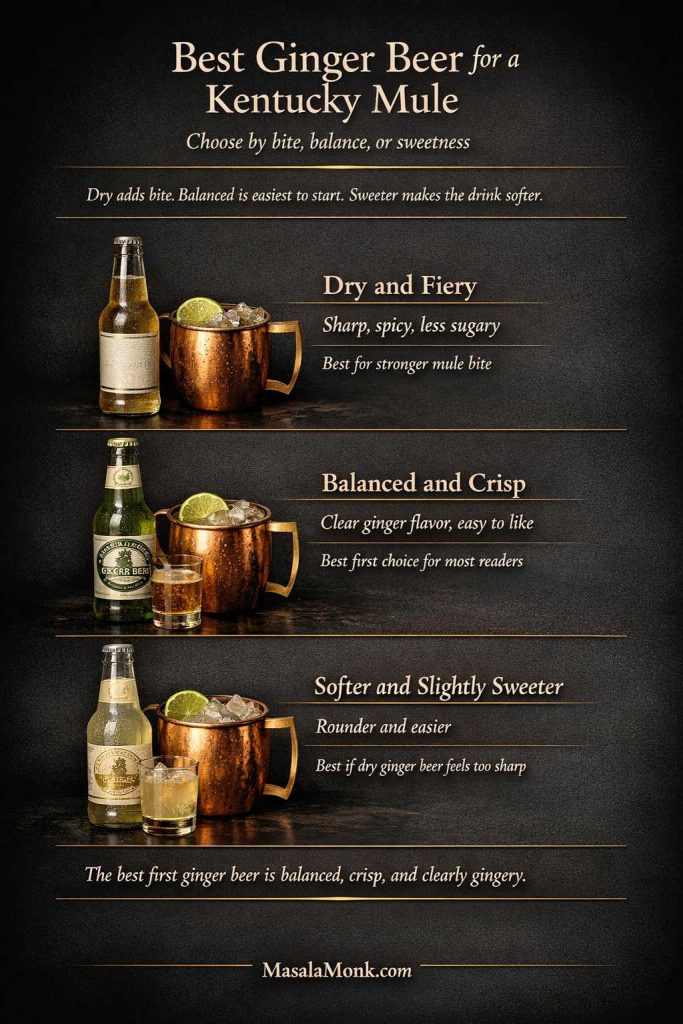
Ginger beer chooser guide for a Kentucky mule showing three styles: dry and fiery, balanced and crisp, and softer and slightly sweeter, with bottle and drink visuals on a dark editorial background.
A balanced, crisp ginger beer is the easiest place to start for a Kentucky mule. Go drier when you want stronger ginger bite, or choose a softer bottle when very sharp ginger beer feels too aggressive.

Best Dry and Fiery Ginger Beer

This style gives the drink the strongest mule identity. It usually tastes sharper, less sugary, and more ginger-led, so the final Kentucky mule feels brisk, bright, and clearly structured. When you take a sip and notice real ginger bite right away rather than plain sweetness, you are in the right lane.

Use this style when you want the bourbon to feel tighter and the finish to stay crisp. It pairs especially well with a balanced or slightly spicier bourbon because the drink stays lively without turning sticky or soft.

Best Balanced and Crisp Ginger Beer

This is the best first choice. A balanced ginger beer still tastes clearly gingery, but it does not hit too hard or finish too sweet. That gives you the easiest classic Kentucky mule to like because the bourbon, lime, and ginger all stay readable at the same time.

When you are not sure where to start, start here. This style makes it much easier to judge whether the next round should be drier, spicier, or softer, since the first version gives you a clean middle point rather than pushing too far in one direction.

Best Softer and Slightly Sweeter Ginger Beer

This style works when you want an easier, smoother, more crowd-friendly Kentucky mule. The drink usually feels rounder and less aggressive, with the ginger acting more like lift than a spicy counterpoint. That can be especially pleasant for readers who find dry ginger beer too sharp.

This is also the easiest lane to overpour. Too much sweet ginger beer can blur the bourbon and make the lime feel disconnected rather than integrated. Keep the pour modest, keep the ice cold, and let the lime stay bright so the finished drink still feels like a mule instead of a sweet bourbon soda.

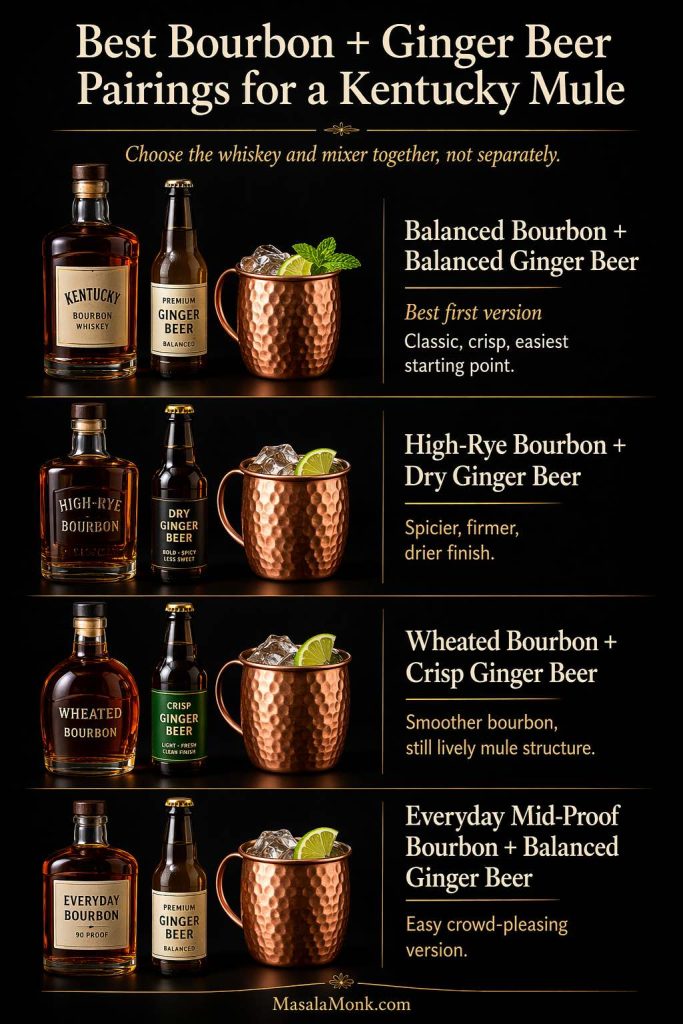
Kentucky mule pairing guide showing four bourbon and ginger beer combinations: balanced bourbon with balanced ginger beer, high-rye bourbon with dry ginger beer, wheated bourbon with crisp ginger beer, and everyday mid-proof bourbon with balanced ginger beer.
A better Kentucky mule starts with the pairing, not just the ratio: balanced bourbon and balanced ginger beer make the easiest first version, high-rye bourbon and dry ginger beer taste spicier and firmer, wheated bourbon with crisp ginger beer drinks smoother but still lively, and an everyday mid-proof bourbon with balanced ginger beer is the easiest crowd-pleasing option.

Ginger Beer vs Ginger Ale

If you want the classic Kentucky mule profile, use ginger beer. It gives more ginger bite and more cocktail definition. Ginger ale makes the drink softer, sweeter, and more casual.

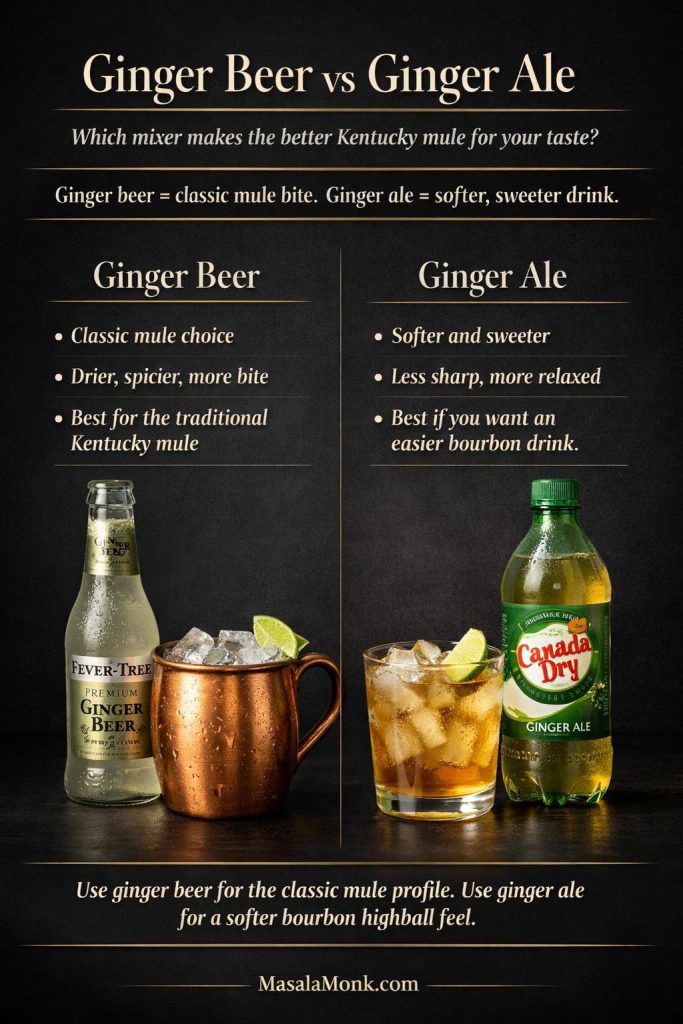
Comparison guide showing ginger beer versus ginger ale for a Kentucky mule, with ginger beer paired with a classic copper-mug mule and ginger ale paired with a softer bourbon highball-style version.
Ginger beer gives a Kentucky mule its classic sharper bite, while ginger ale makes the drink softer, sweeter, and easier. If you want the traditional mule profile, use ginger beer. If you want a smoother bourbon drink, ginger ale works too.
  • Use ginger beer when you want the classic mule shape, stronger ginger bite, and a more bar-like finish.
  • Use ginger ale when you want a lighter, smoother bourbon drink that feels more relaxed and less sharp.

When you do switch to ginger ale, keep the rest of the structure the same first, then adjust only after tasting. That makes it easier to tell whether the drink needs more lime, less mixer, or a slightly spicier bourbon rather than guess too early. For a deeper mixer breakdown beyond this drink, Food & Wine’s guide to ginger beer vs ginger ale is a useful reference.

Kentucky Mule Pitcher Recipe for a Crowd

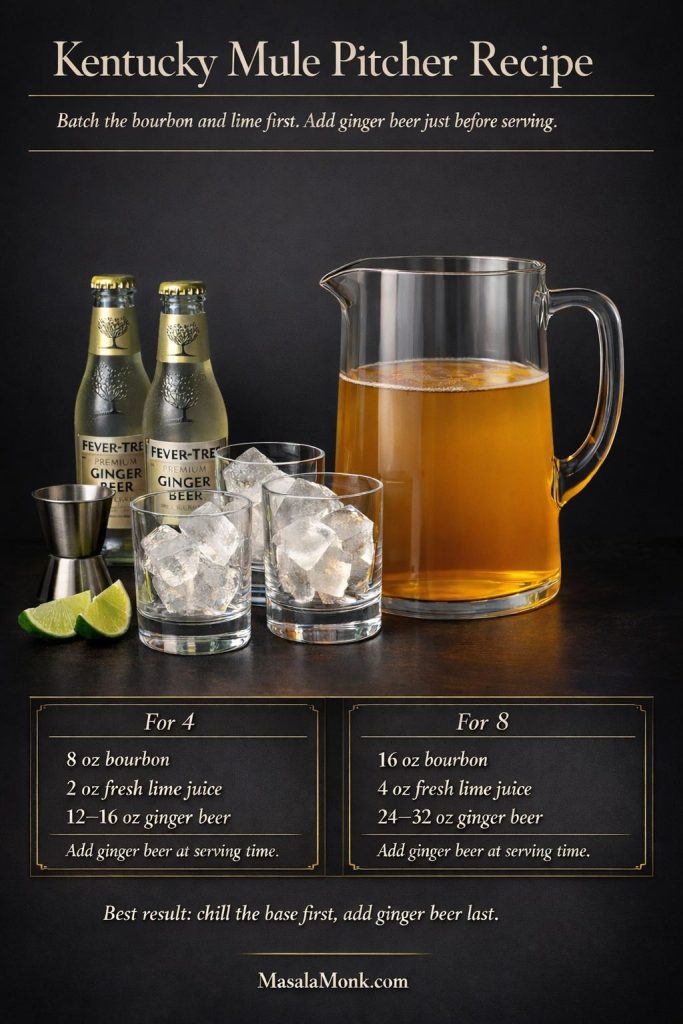
A Kentucky mule pitcher works best when you batch the still ingredients first and add the fizzy part at the end. In practice, that means mixing the bourbon and lime juice ahead, chilling the base well, and topping each glass or the pitcher with ginger beer just before serving. The batch stays lively that way instead of going flat too early.

Kentucky mule pitcher recipe guide showing a chilled bourbon-and-lime base in a glass pitcher, ginger beer bottles kept separate, ice-filled serving glasses, and batch amounts for 4 and 8 servings.
For a crowd, batch the bourbon and fresh lime juice first, then add ginger beer only when serving. That keeps the pitcher base cold and ready while preserving the fizz that makes a Kentucky mule taste bright and lively.

Small Batch for 4

  • 8 oz bourbon
  • 2 oz fresh lime juice
  • 12 to 16 oz ginger beer, added just before serving
  • Ice, lime wedges, and mint as needed

Party Batch for 8

  • 16 oz bourbon
  • 4 oz fresh lime juice
  • 24 to 32 oz ginger beer, added just before serving
  • Ice, lime wedges, and mint as needed

What to Mix Ahead and What to Add Last

Mix the bourbon and lime ahead. Add the ginger beer at the end so the pitcher keeps its lift. For a seasonal crowd version after this, our Cranberry Moscow Mule guide shows the same big-batch logic in a more festive direction.

Easy Kentucky Mule Variations

Once the classic version is dialed in, small changes are usually enough. Keep the structure recognizable, then change one element at a time so the drink still feels like a Kentucky mule instead of drifting into a vague bourbon cooler.

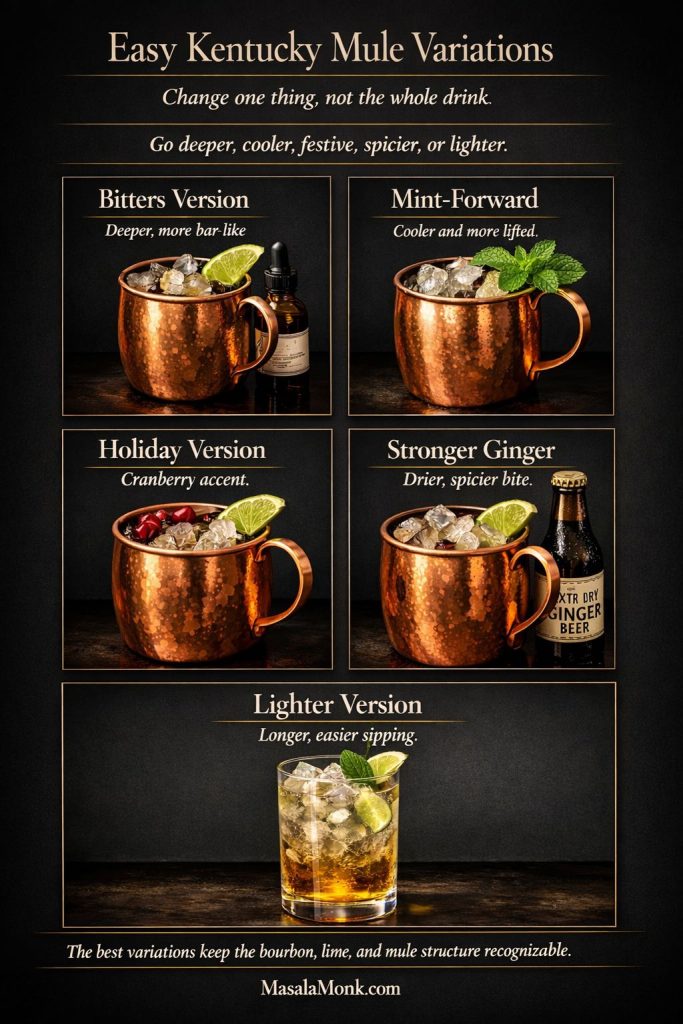
Easy Kentucky mule variations guide showing five ways to change the drink: bitters version, mint-forward, holiday cranberry version, stronger ginger version, and a lighter longer version, all styled as premium editorial bourbon mule variations on a dark background.
These easy Kentucky mule variations work best when you change just one element at a time: bitters deepen the finish, mint makes it feel cooler, cranberry adds a festive accent, a drier ginger beer brings more bite, and extra ginger beer makes the drink longer and lighter without losing the bourbon-mule structure.

Bitters Version

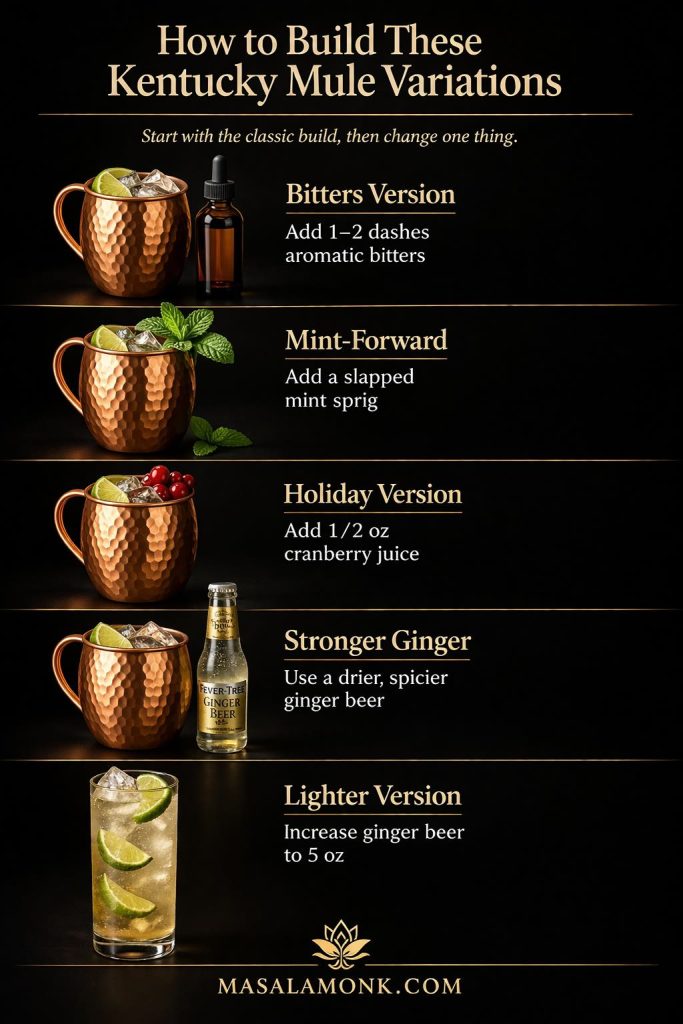
Add 1 to 2 dashes of aromatic bitters when you want the drink to feel a little deeper and slightly more bar-like. This is one of the easiest upgrades because it changes the finish more than the structure. Keep the bitters restrained so the ginger and lime still read clearly.

Mint-Forward Version

Use a generous mint sprig when you want the Kentucky mule to feel cooler and more lifted without changing the actual ratio. Slap the mint first to wake up the aroma, then garnish right before serving. The drink feels fresher from the first sip, especially in warm weather.

Holiday Version

Add a small splash of cranberry when you want a more festive riff that still stays recognizable. Keep the cranberry modest rather than turning the drink into a juice-forward cocktail. The bourbon, ginger beer, and lime should still lead, with the cranberry adding color and a tart seasonal accent.

Kentucky mule variations build guide showing five easy recipe changes: bitters version, mint-forward version, holiday cranberry version, stronger ginger version, and a lighter version with more ginger beer.
Use the classic Kentucky mule as your base, then change only one thing: add bitters for a deeper finish, mint for a cooler feel, cranberry for a festive accent, drier ginger beer for more bite, or extra ginger beer for a lighter, longer drink.

Stronger Ginger Version

For more mule character, choose a drier, spicier ginger beer before you start adding extra lime. That usually gives a cleaner result because it strengthens the ginger side of the drink without making the Kentucky mule more tart than balanced.

Lighter Version

For a longer, easier-drinking version, keep the bourbon and lime the same and move the ginger beer closer to 5 ounces. This makes the drink softer and more casual while still keeping the classic mule shape intact. It is the best variation when you want it to stay refreshing for slower sipping.

Kentucky Mule FAQs

What is the difference between a Kentucky mule and a Moscow mule?

The main difference is the base spirit. A Kentucky mule uses bourbon, while a Moscow mule uses vodka. Bourbon brings vanilla, caramel, and a little oak, so a Kentucky mule tastes warmer and richer. A Moscow mule usually tastes cleaner, crisper, and more neutral.

Is a Kentucky mule the same as a bourbon mule?

Yes. For practical recipe purposes, Kentucky mule and bourbon mule mean the same drink: bourbon, lime juice, ginger beer, and ice. Kentucky mule is usually the more established name, while bourbon mule works as the clearest plain-English synonym.

Is a Kentucky mule the same as a whiskey mule?

Not exactly. A Kentucky mule is a type of whiskey mule, but whiskey mule is the broader term. Every Kentucky mule is a whiskey mule because bourbon is whiskey, but not every whiskey mule is a Kentucky mule, since some versions use Irish whiskey, rye, or another whiskey style.

Can I make a Kentucky mule with ginger ale?

Yes, but it will taste softer and sweeter than the classic ginger beer version. The drink can still be pleasant, especially when you want something easier and less fiery, but it will feel less like a classic mule. Start with the same basic structure first, then adjust after tasting.

What bourbon is best for a Kentucky mule?

A balanced mid-proof bourbon is the best starting point. Look for a bottle with enough caramel, vanilla, and light spice to stay visible under the ginger beer without turning the drink too hot or too woody. From there, go spicier for more edge or softer for a rounder, easier Kentucky mule.

What ginger beer is best for a Kentucky mule?

The best ginger beer depends on the result you want. A drier, spicier ginger beer gives the drink a stronger mule identity and a crisper finish, while a softer, sweeter one makes a Kentucky mule easier but less defined. For most readers, a balanced and crisp ginger beer is the safest first choice.

Do I need a copper mug for a Kentucky mule?

No. A copper mug looks classic and helps the drink feel extra cold in the hand, but it is not required. A cold highball glass works perfectly well and changes very little about the actual taste.

Can I add bitters to a Kentucky mule?

Yes. A dash or two of aromatic bitters can add depth and make the drink feel slightly more bar-style. It works best as an optional riff rather than part of the classic build, since the standard version is already balanced with bourbon, lime, ginger beer, and ice.

Can I make a Kentucky mule ahead of time?

Yes, partly. Batch the bourbon and lime juice first, chill that base well, and add the ginger beer only when serving. That keeps the drink lively instead of flat by the time it reaches the glass.

What is the best ratio for a Kentucky mule?

For most readers, the best starting ratio is 2 ounces bourbon, 1/2 ounce fresh lime juice, and 4 ounces ginger beer. That version keeps the drink balanced, clearly bourbon-led, and still bright enough to feel refreshing. Use a little more ginger beer for a lighter mule or a little less for a tighter, more whiskey-forward one.

Does the bourbon have to be from Kentucky?

No. Kentucky-made bourbon fits the name nicely, but the more important factor is how the bourbon tastes in the finished drink. A bourbon from outside Kentucky can still make an excellent Kentucky mule if it has the right balance of sweetness, spice, and structure. For the formal distinction between bourbon and Kentucky bourbon, the Kentucky Distillers’ Association FAQ explains it clearly.

More Bourbon and Whiskey Cocktails to Try

To stay in the same general flavor family after this, try our Whiskey Sour recipe for a citrus-led classic, our Boulevardier recipe for a more bitter bourbon drink, or our Moscow Mule recipe for the vodka original.

↑ Back to top

Posted on Leave a comment

Whiskey Ginger Drink Recipe

Whiskey ginger recipe featured image showing a tall highball with ice, ginger ale bubbles, and lime on a dark editorial background.

A whiskey ginger recipe is one of the easiest ways to make whiskey feel colder, lighter, and more refreshing without losing its character. This whiskey ginger drink is simple: whiskey, ginger ale, ice, and lime. Even so, when the ratio is right, it still tastes finished, balanced, and genuinely worth making again.

The only real point of confusion is the mixer. Some readers mean the classic whiskey and ginger ale version, while others want a spicier whiskey and ginger beer drink with more bite. Therefore, this whiskey ginger recipe starts with the smooth, classic build first, and then shows you exactly how to adjust the ratio, the whiskey, and the mixer to suit your taste.

Quick Answer: Whiskey Ginger Recipe Basics

A whiskey ginger is a simple highball made with whiskey, ginger ale, ice, and lime. For most readers, the best whiskey ginger recipe to start with is still the classic ginger ale version because it is smoother, more forgiving, and easier to balance on the first try.

If you want the easiest starting point, use Irish whiskey and ginger ale. If you want a sweeter version, use bourbon instead. However, if you want more bite, switch to ginger beer or a spicier whiskey rather than trying to force the classic version to do everything at once.

  • Best first version: Irish whiskey + ginger ale + lime
  • Best sweeter version: bourbon + ginger ale
  • Best spicier version: whiskey + ginger beer
  • Best brighter version: use a firmer squeeze of lime and move toward an Irish Buck style

That gives you the cleanest baseline first. Then, once you know what feels too soft, too sweet, or too sharp, the next round becomes much easier to adjust well.

Choose your whiskey ginger version guide comparing Irish whiskey and ginger ale, bourbon and ginger ale, rye and ginger ale, and whiskey with ginger beer by flavor, finish, and drinking style.
The easiest way to choose a whiskey ginger is to decide what you want the glass to feel like first: Irish whiskey keeps it smooth, bourbon makes it rounder, rye adds sharper spice, and ginger beer pushes it bolder and more assertive.

Choose Your Version

  • Use Irish whiskey + ginger ale for the smoothest, most classic version.
  • Use bourbon + ginger ale for a sweeter, rounder drink.
  • Use rye + ginger ale for more spice and edge.
  • Use whiskey + ginger beer for the boldest, sharpest variation.

This quick choice matters because the drink changes more than people expect from only one ingredient swap. Ginger ale keeps things softer and easier, while ginger beer pushes the drink into a noticeably spicier direction almost immediately.

Whiskey Ginger Recipe Card

This whiskey ginger recipe is the best first version to make because it is easy, balanced, and flexible enough to adjust after a single sip. In other words, it gives you the classic drink most readers actually want first, and then leaves plenty of room to push it sweeter, spicier, or stronger later.

Formula: 2 ounces / 60 ml whiskey + 4 to 5 ounces / 120 to 150 ml ginger ale + 1 lime wedge
Easy ratio: 1 part whiskey to about 2 to 2.5 parts ginger ale

  • Yield: 1 drink
  • Time: 5 minutes
  • Glass: Highball glass or tall glass
  • Garnish: Lime wedge
  • Best first bottle: Irish whiskey
  • Best first mixer: Ginger ale
  • Flavor: cold, lightly sweet, bright, and easy to sip

Best first version: Start with Irish whiskey and ginger ale if you want the smoothest, most classic whiskey ginger.

Whiskey Ginger Ingredients

  • 2 ounces whiskey (60 ml)
  • 4 to 5 ounces ginger ale (120 to 150 ml)
  • Ice
  • 1 lime wedge

Whiskey Ginger Method

Fill a tall glass with ice. Add the whiskey, top with ginger ale, stir gently, then squeeze in the lime wedge and serve right away.

Notes for the best whiskey ginger: Start with ginger ale if this is your first whiskey ginger because it is easier to balance and less likely to overpower the whiskey. Then, once you know the classic version, move to bourbon if you want a fuller, sweeter drink or to ginger beer if you want more spice and edge. Also, keep the lime modest at first. A little brightens the drink beautifully; however, too much can pull it away from classic whiskey ginger territory and into a brighter buck-style direction.

Easy first adjustment: If the drink tastes too soft, use a little less ginger ale next time. On the other hand, if it tastes too strong, add a small splash more and stir once. Because the drink is so simple, those small adjustments show up immediately.

Whiskey ginger recipe card showing the classic formula, easy ratio, ingredients, and quick method for making a whiskey ginger with ginger ale and lime.
Save the classic build once and the drink becomes easy to repeat: start with 2 ounces of whiskey to 4 to 5 ounces of ginger ale, then adjust lighter or stronger once you know your preferred balance.

Whiskey Ginger Ingredients

The ingredient list is short. Even so, each part matters more than it first seems because there is nowhere for weak choices to hide in a drink this simple.

Labeled whiskey ginger ingredients guide showing whiskey, ginger ale, lime, ice, and a highball glass on a dark editorial background.
A whiskey ginger stays simple, so each ingredient matters: the whiskey sets the tone, the ginger ale brings lift, the lime sharpens the finish, and the ice keeps the drink crisp.
  • Whiskey: This sets the tone of the drink. Irish whiskey tastes smoother, bourbon tastes sweeter, rye tastes spicier, and scotch tastes drier or maltier.
  • Ginger ale: This is the classic mixer because it keeps the drink fizzy, lightly sweet, and easy to sip.
  • Lime: A small squeeze brightens the finish. Without it, the drink can taste a little flat; with too much of it, the drink can start tasting like a different branch of the family.
  • Ice: Use plenty so the drink stays crisp instead of turning dull too quickly.

That short list is part of the reason a good whiskey ginger recipe works so well. The drink is accessible enough for beginners, yet still flexible enough for regular whiskey drinkers who want to tweak the profile around the bottle they already enjoy.

If you already know you enjoy more ginger bite, ginger beer can work too. Still, that is not a tiny swap. It changes the whole feel of the drink, so it is better treated as a true variation rather than a casual substitution.

Step-by-step whiskey ginger method board showing a tall highball glass filled with ice, whiskey being added, and ginger ale topped with lime before a gentle stir.
A whiskey ginger is easiest to build directly in the glass: start with plenty of ice, add the whiskey, then top with ginger ale and finish with a modest squeeze of lime.

How to Make a Whiskey Ginger

The method is straightforward. Build the drink over ice, stir briefly, and finish with lime. Because of that, this is one of the easiest whiskey drinks to make well at home.

  1. Fill a highball glass or tall glass with ice.
  2. Pour in the whiskey.
  3. Top with ginger ale.
  4. Stir gently just until combined.
  5. Squeeze in a lime wedge and, if you like, drop it into the glass.
Finished whiskey ginger drink in a tall highball glass with clear ice, lively bubbles, and a lime wedge on a dark editorial background.
After the ginger ale and lime go in, the drink should look light, bubbly, and easy to sip, with the whiskey still showing through the glass.

Then taste it before you walk away. If it feels too strong, add a little more ginger ale. If it feels too soft, use slightly less mixer next time. Therefore, the first glass gives you the baseline, and the next one gets even better.

Whiskey Ginger Recipe Ratio Guide

A dependable starting point is 2 ounces / 60 ml of whiskey to 4 to 5 ounces / 120 to 150 ml of ginger ale. In simple parts, that is about 1 part whiskey to 2 to 2.5 parts ginger ale. That ratio works well because it lets the whiskey show up clearly while still keeping the drink cold, refreshing, and easy to sip.

After that, you can adjust the drink around your taste. In fact, one of the best things about a whiskey ginger recipe is how quickly it responds to small changes. Once you know your preferred balance, this whiskey ginger recipe becomes one of the easiest whiskey drinks to repeat consistently.

Whiskey ginger recipe ratio guide showing lighter, balanced classic, and stronger versions with whiskey and ginger ale measurements.
Start with the balanced classic ratio first, then move lighter for a softer highball or stronger for a firmer whiskey presence in the glass.
  • Lighter: 2 ounces / 60 ml whiskey to 5 to 6 ounces / 150 to 180 ml ginger ale
  • Balanced classic: 2 ounces / 60 ml whiskey to 4 to 5 ounces / 120 to 150 ml ginger ale
  • Stronger: 2 ounces / 60 ml whiskey to 3.5 to 4 ounces / 105 to 120 ml ginger ale

If you are serving guests, the balanced middle version is usually the safest place to start. Meanwhile, if you are mixing for yourself, you can push the drink lighter or stronger without much risk.

How to Fix a Whiskey Ginger

This is where the drink becomes more useful than a one-line recipe. Once the first sip tells you what is missing, the fixes are simple.

How to fix a whiskey ginger guide showing quick fixes for a drink that tastes too sweet, too sharp, too strong, too soft, or too flat.
If your first sip feels off, do not rebuild the drink blindly. Small changes to ice, lime, mixer, or whiskey style can bring a whiskey ginger back into balance fast.
  • Too sweet: add a little more ice, use a firmer squeeze of lime, or reduce the ginger ale slightly next time.
  • Too sharp: ease back on the lime or switch from ginger beer to ginger ale.
  • Too strong: add a small splash of ginger ale and stir gently.
  • Too soft: use a little less mixer, switch to rye, or move to ginger beer.
  • Too flat: start with colder mixer, fresh ice, and a fresh lime wedge.

Above all, remember that too much lime changes the drink more than most readers expect. Lime should brighten a whiskey ginger, not dominate it.

What Is a Whiskey Ginger?

A whiskey ginger is best understood as a simple whiskey highball. The classic build uses whiskey, ginger ale, ice, and lime, so the drink stays light, fizzy, and easy to sip. That is exactly why it works when you want something colder and more refreshing than a neat pour, but easier and faster than a more elaborate cocktail.

At the same time, the category gets muddy because people use the name loosely. Some mean the classic ginger ale version, while others mean a spicier ginger beer build. As a result, the name often covers a few related drinks rather than one absolutely rigid formula.

That is also why the drink sits so close to Irish Buck territory. Once the lime becomes more noticeable and the structure feels more citrus-led, the drink starts moving away from the softest everyday whiskey ginger style and toward a brighter branch of the same family.

Best Whiskey

The best whiskey for a whiskey ginger depends on the finish you want in the glass. In practice, that flexibility is one of the drink’s biggest strengths because the same basic build can feel smoother, sweeter, drier, or spicier depending on the bottle you choose.

Best whiskey for whiskey ginger guide comparing Irish whiskey, bourbon, rye, and scotch by how each changes the drink.
A whiskey ginger changes faster than most people expect: Irish whiskey keeps it smooth and easy, bourbon makes it rounder, rye adds sharper spice, and scotch pushes it drier and maltier.
  • Irish whiskey: best if you want the smoothest, easiest-drinking whiskey ginger
  • Bourbon: best if you want a rounder, sweeter drink with a softer finish
  • Rye: best if you want more spice and a little more edge
  • Scotch: best if you want a drier, maltier, or slightly smoky version

For most readers, Irish whiskey is the safest starting point because it stays clean and mellow against the ginger. As a result, the drink feels balanced quickly and rarely needs much correction. Bourbon, by contrast, makes the drink feel fuller almost immediately, so it is a better choice if you want a softer, sweeter finish from the start.

Rye is useful when the classic version tastes a little too easy or too rounded for your taste. Because rye pushes more spice into the glass, it gives the drink extra edge without forcing you to change the overall structure. Scotch can work too; however, it is usually smartest to start with a gentler blended scotch rather than a heavily smoky one. Otherwise, the whiskey can dominate the lighter ginger profile too easily.

That flexibility is one reason a whiskey ginger recipe works so well for both beginners and regular whiskey drinkers.

If bourbon is usually your first choice, MasalaMonk’s guide on what to mix with Jim Beam is a useful next read because ginger ale fits naturally into that easy bourbon-mixer lane.

Ginger Ale vs Ginger Beer and Irish Buck

The quickest way to avoid confusion is to compare the branches that actually change the drink in a noticeable way: the mixer choice and the citrus level. Although the names around this cluster overlap, the drinking experience does not always stay the same.

Ginger ale vs ginger beer comparison guide for whiskey ginger showing how ginger ale makes a smoother, lighter drink and ginger beer makes a spicier, bolder version.
Ginger ale gives a whiskey ginger its smoother, lighter classic feel, while ginger beer pushes the drink toward a spicier, bolder, more assertive profile.
  • Whiskey ginger with ginger ale vs whiskey ginger with ginger beer: ginger ale is smoother, sweeter, and more classic, whereas ginger beer is spicier, drier, and more assertive.
  • Whiskey ginger vs Irish Buck: both belong to the same family, but an Irish Buck usually leans harder on lime and a brighter citrus structure.

The easiest way to think about it is this: ginger ale gives you the safer, more crowd-friendly whiskey ginger, while ginger beer gives you the bolder variation. Likewise, once the lime becomes one of the main things you notice, the drink starts moving away from classic whiskey ginger territory and toward an Irish Buck-style direction.

Whiskey ginger vs Irish Buck comparison guide showing a classic whiskey ginger with modest lime beside a brighter Irish Buck style drink with a more lime-forward, citrus-led profile.
A whiskey ginger and an Irish Buck can sit very close to each other, but the balance shifts once lime becomes more noticeable: the whiskey ginger stays softer and ginger-led, while the Irish Buck-style version drinks brighter and more citrus-forward.

If you want an external reference on that naming overlap, The Spruce’s whiskey ginger and Irish Buck guide is a useful high-authority explainer. Meanwhile, if you already know you enjoy ginger beer in cold mixed drinks, this Moscow Mule recipe is a strong internal companion because it shows how differently ginger beer behaves once lime becomes more important.

Best Garnish for a Whiskey Ginger

The best garnish for a whiskey ginger is lime. A lime wedge is usually the smartest choice because you can squeeze fresh juice into the drink and still leave the wedge in the glass. A lime wheel looks cleaner, but it does less for the flavor unless you squeeze it first.

Best garnish for a whiskey ginger comparison showing a lime wedge versus a lime wheel on two tall whiskey ginger highballs, explaining flavor impact, citrus effect, and which garnish gives the best balance.
A whiskey ginger usually tastes best with a modest lime wedge because it gives you real brightness in the glass, while a lime wheel keeps the look cleaner but adds a lighter citrus effect.

Keep the garnish simple. This is not a drink that needs a dramatic finish to feel complete. In fact, the cleaner the garnish, the more the whiskey and ginger stay in focus.

Whiskey Ginger Variations

Make each variation exactly like the main recipe unless noted below. Even though the names change, the structure stays similar: whiskey, ginger, ice, and citrus, with one part pushed slightly harder than the others.

Whiskey ginger variations guide comparing Jameson and Ginger, bourbon and ginger ale, spicy ginger beer version, Jack and Ginger, and scotch and ginger ale.
The base build stays simple, but the drink changes quickly once you swap the whiskey or the mixer: Jameson keeps it smooth, bourbon rounds it out, ginger beer sharpens it, Jack stays mellow, and scotch makes it drier and maltier.

Jameson and Ginger Whiskey Drink

Jameson and ginger is one of the smoothest, easiest-drinking versions of the drink. Because Jameson is an Irish whiskey, the result usually feels light, mellow, and especially approachable.

Mini formula: 2 ounces Irish whiskey + 4 to 5 ounces ginger ale + 1 lime wedge

For an official brand reference, Jameson’s Ginger & Lime recipe shows the same easy, highball-style direction.

Bourbon and Ginger Ale Whiskey Drink

Bourbon and ginger ale is the sweeter, rounder side of the family. Therefore, it is often the easiest variation to like right away if you enjoy caramel, vanilla, or a softer finish in whiskey drinks.

Mini formula: 2 ounces bourbon + 4 ounces ginger ale + 1 lime wedge

If you want to stay in that bourbon-friendly lane afterward, MasalaMonk’s Boulevardier recipe is a great next step when you want something deeper and more spirit-forward.

Spicy Ginger Beer Version

This variation is the spicier, sharper side of the family. As a result, it usually feels livelier from the first sip and stands up better to a whiskey with more edge.

Mini formula: 2 ounces whiskey + 3 to 4 ounces ginger beer + 1 lime wedge

Jack and Ginger

Jack and ginger follows the same easy pattern, yet Tennessee whiskey gives the drink a slightly different sweetness and spice balance. In other words, it still drinks like a whiskey ginger, but the whiskey profile shifts the mood.

Mini formula: 2 ounces Tennessee whiskey + 4 to 5 ounces ginger ale + 1 lime wedge

Scotch and Ginger Ale Whiskey Drink

Scotch and ginger ale can work well when you want a drier, maltier version of the same basic idea. Generally, a softer blended scotch is the easiest place to start because a heavily smoky bottle can overpower the lighter mixer.

Mini formula: 1.5 to 2 ounces blended scotch + 4 to 5 ounces ginger ale + 1 lime wedge

Whiskey Ginger for a Crowd

If you want to serve several people at once, a whiskey ginger is easy to batch as long as you keep the bubbles lively. The main trick is to add the ginger ale just before serving instead of letting it sit too long.

Whiskey ginger for a crowd recipe card showing a pitcher, two finished glasses, batch formula for 8 drinks, quick method, and serving tip.
Batch the whiskey first, add the ginger ale just before serving, and keep the ice in the glasses so each whiskey ginger stays cold, fizzy, and properly balanced.

Batch formula for 8 drinks: 2 cups whiskey + 4 to 5 cups ginger ale + lime wedges for serving

  1. Pour the whiskey into a pitcher.
  2. Chill the pitcher and the ginger ale separately.
  3. Just before serving, add the ginger ale and stir gently.
  4. Serve over ice and finish each glass with a lime wedge.

For the best result, keep the ice in the glasses rather than the pitcher. That way, the batch stays cold without getting watered down too quickly.

FAQs

What is it made of?

A whiskey ginger is usually made with whiskey, ginger ale, ice, and lime.

Ginger ale or ginger beer?

Ginger ale is better if you want the smoothest, most classic result. And ginger beer is better if you want a spicier, drier, more assertive version.

What whiskey works best in a whiskey ginger?

Irish whiskey is the easiest place to start if you want a smooth, classic result. Meanwhile, bourbon gives you a sweeter version, rye gives you more spice, and scotch can give you a drier or maltier finish.

Can bourbon work in a whiskey ginger?

Yes. In fact, bourbon and ginger ale is one of the easiest and most approachable riffs on the drink, especially if you like a slightly sweeter whiskey profile.

What is the best whiskey ginger recipe ratio?

A reliable starting point is 2 ounces of whiskey to 4 to 5 ounces of ginger ale. Then, once you know your preference, you can make it lighter or stronger as needed.

Is it the same as an Irish Buck?

They are very close, but an Irish Buck usually leans more clearly on lime and ginger together. So, whiskey ginger is the broader everyday name, while Irish Buck points to a slightly more citrus-led direction.

Can ginger beer work too?

Yes, and it can taste great. However, it is not just a tiny swap. Ginger beer makes the drink spicier, drier, and more assertive, so the result feels like a bolder variation rather than the classic whiskey ginger most readers expect first.

How do you make Jameson and ginger?

To make Jameson and ginger, fill a tall glass with ice, add 2 ounces of Jameson, top with 4 to 5 ounces of ginger ale, squeeze in a lime wedge, and stir gently.

Can you batch a whiskey ginger recipe for a crowd?

Yes. A whiskey and ginger recipe is easy to batch for guests as long as you keep the ginger ale chilled and add it just before serving so the drink stays lively and fizzy.

If you want another easy whiskey drink afterward, this whiskey sour recipe is a good next step because it keeps the whiskey front and center while moving in a brighter, more citrus-forward direction.

↑ Back to top

Posted on 2 Comments

Boulevardier Recipe

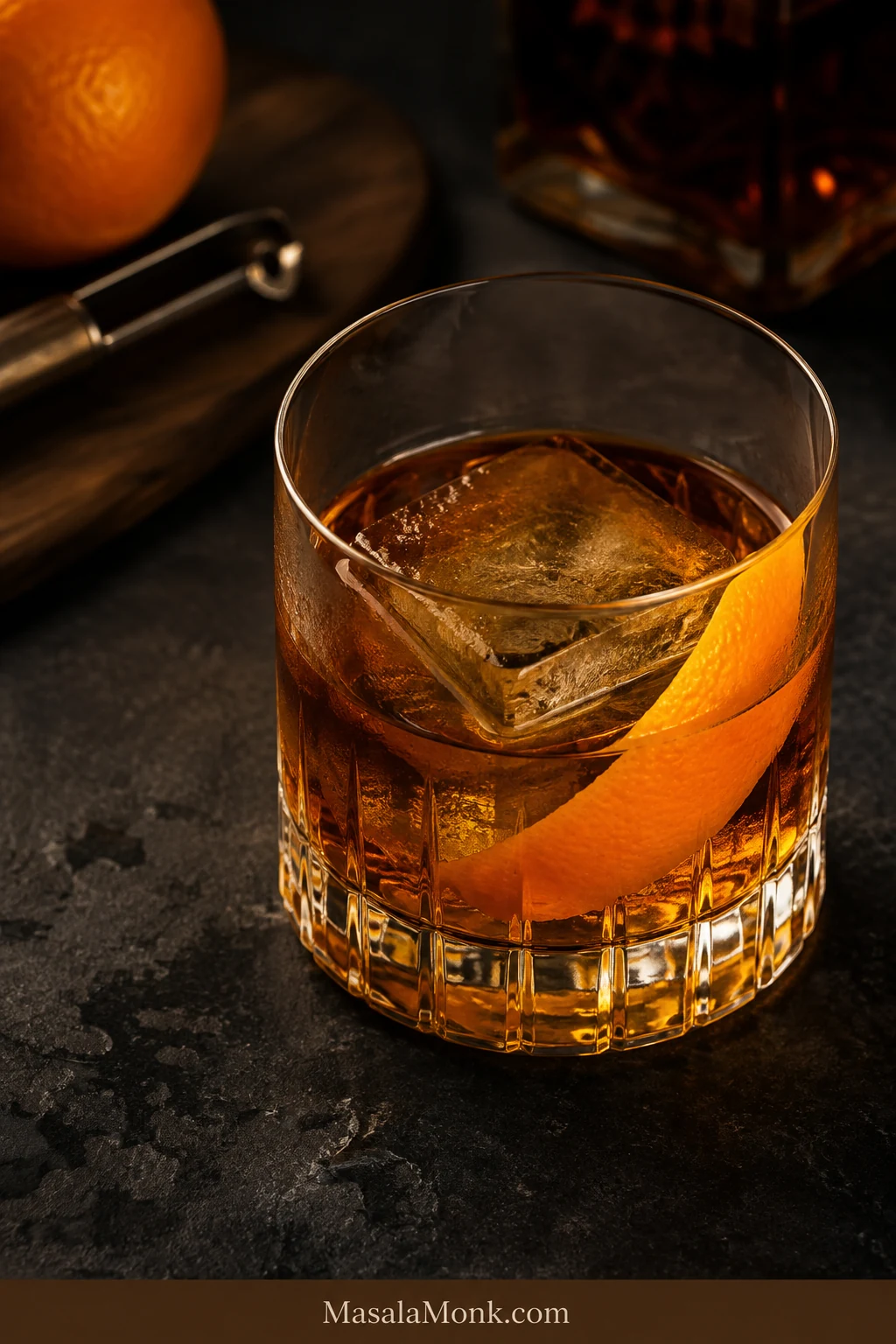
Boulevardier recipe hero image showing a ruby-red Boulevardier in a rocks glass with a large ice cube and orange twist.

A good Boulevardier recipe should give you a cocktail that feels balanced from the first sip: bitter but not harsh, rich but not heavy, and strong without losing its polish. This version is built around whiskey, Campari, and sweet vermouth, with a house ratio that works especially well for most home bars.

The Boulevardier recipe is often described as a whiskey Negroni, which is a useful starting point. Yet the ratio, the whiskey, and the serving style change the drink more than that shorthand suggests. So this guide gives you the best make-now version first, then helps you understand the classic equal-parts build, the official IBA-style formula, and the choices that shape the drink most.

If you already enjoy a Negroni recipe or a Manhattan cocktail recipe, this Boulevardier will feel like the natural bridge between those two classics.

Boulevardier Recipe Quick Answer

Best default Boulevardier recipe: 1 1/2 ounces whiskey, 3/4 ounce Campari, and 3/4 ounce sweet vermouth, stirred with ice and finished with an orange twist.

This is the Boulevardier recipe I recommend first because it keeps the whiskey clearly in front while still tasting unmistakably like the classic drink. Bourbon is the easiest place to start because it makes a rounder, softer version. Rye works better when you want something drier, spicier, and more structured.

Classic equal-parts Boulevardier recipe: 1 ounce whiskey, 1 ounce Campari, and 1 ounce sweet vermouth. Serve it up for the cleanest classic feel, or pour it over one large cube for a slower, slightly softer home-bar version.

Boulevardier Recipe Card

Best Boulevardier Recipe

Yield: 1 drink
Prep time: 5 minutes
Method: Stirred
Glass: Coupe or rocks glass
Garnish: Orange twist

Ingredients

  • 1 1/2 ounces rye or bourbon
  • 3/4 ounce Campari
  • 3/4 ounce sweet vermouth
  • Ice
  • Orange twist

Method

  1. Fill a mixing glass with ice.
  2. Add the whiskey, Campari, and sweet vermouth.
  3. Stir until the drink is very cold and lightly diluted.
  4. Strain into a chilled coupe, or pour over one large cube in a rocks glass.
  5. Express an orange twist over the surface and garnish.
Boulevardier recipe card with a rocks-glass serve, large ice cube, orange twist, and a 1 1/2 oz whiskey, 3/4 oz Campari, 3/4 oz sweet vermouth build.
This is the easiest Boulevardier to start with when you want the whiskey to stay clearly in front without losing the drink’s bitter-sweet classic shape.

Notes

  • For the classic version, use 1 ounce each whiskey, Campari, and sweet vermouth.
  • Use bourbon for a rounder drink, while rye gives a drier, spicier result.
  • Serve it up for a sharper classic feel or on a large cube for a slower, softer sip.
  • For the official modern spec, see the IBA Boulevardier formula.

If you are new to this Boulevardier recipe, start with bourbon, an orange twist, and an up serve. Then try rye when you want a drier, spicier edge, or make the equal-parts version when you want to taste the more bitter, more symmetrical classic shape.

Decision guide for choosing a first Boulevardier by whiskey style, ratio, bitterness, and serve.
For most first pours, bourbon plus the house ratio is the easiest entry point; after that, rye, equal parts, or a rocks serve let you steer the drink drier, more bitter, or more relaxed.

What Is a Boulevardier?

At its core, a Boulevardier is a stirred cocktail made with whiskey, Campari, and sweet vermouth. Although it belongs to the same bitter-cocktail family as the Negroni, whiskey changes the drink’s center of gravity and gives it a warmer, deeper feel.

Boulevardier flavor guide describing the drink as bittersweet, warming, spirit-forward, and richer than a Negroni.
A Boulevardier lands in a very appealing middle ground: bitter enough to feel serious, whiskey-led enough to feel warm, and rounded enough to be more approachable than many first-time Negroni drinkers expect.

What a Boulevardier Tastes Like

A Boulevardier tastes bittersweet, warming, and richer than a Negroni. Campari still gives it bitterness and citrus-peel tension, but whiskey replaces gin’s botanical snap with grain, spice, oak, caramel, or vanilla depending on the bottle you choose. As a result, the drink often feels more evening-ready and more autumnal than a classic gin-based aperitivo.

Is It Basically a Whiskey Negroni?

Yes, that is the fastest useful shorthand. If you already know the shape of a Negroni recipe, the Boulevardier makes immediate sense. Still, the swap from gin to whiskey changes more than the ingredient list. The drink becomes broader, sturdier, and more grounded, so “whiskey Negroni” is the doorway, not the whole story.

When This Drink Fits Best

Choose a Boulevardier when you want something richer than a Negroni, especially if you already prefer whiskey to gin. It is a very good fit for evening drinking, cooler weather, or any time you want a bitter classic that feels more warming than bright.

Boulevardier Recipe Ingredients

Boulevardier ingredients guide showing whiskey, Campari, sweet vermouth, and orange twist around a finished cocktail.
A Boulevardier works best when each piece has a clear job: whiskey brings structure, Campari supplies bitterness, sweet vermouth rounds the center, and orange oil lifts the drink before the first sip.

Whiskey in a Boulevardier: Bourbon or Rye

Your first ingredient choice is bourbon or rye. Bourbon makes the drink rounder, broader, and a little easier on first sip. Rye makes it drier, spicier, and more sharply defined. Both are classic choices, so the best starting point depends less on rules and more on whether you want a softer Boulevardier or a firmer one.

How Campari Shapes a Boulevardier Recipe

Campari is the ingredient that keeps a Boulevardier tasting like a Boulevardier rather than a sweet whiskey-and-vermouth drink. It brings bitter orange, herbal tension, and that red-fruit bitterness that cuts through the richness of the whiskey. Pull it too far back and the drink may become easier, but it also loses some of its identity.

Why Sweet Vermouth Matters

Sweet vermouth is the bridge that pulls the whiskey and Campari into one composed drink. It softens the point where bitterness and alcohol would otherwise clash, and its style changes the final impression more than many home bars expect. A richer sweet vermouth makes the drink rounder and darker, a lighter one keeps it brighter, and a slightly more bitter one makes the Boulevardier feel tighter and more serious. For a deeper bottle guide, MasalaMonk’s guide to the best sweet vermouth is the natural companion.

Comparison guide showing a brighter Boulevardier made with fresh sweet vermouth beside a flatter one made with tired vermouth.
Fresh sweet vermouth is one of the easiest upgrades in this drink, because it keeps the Boulevardier brighter, cleaner, and more composed instead of letting it turn dull and muddy.

One practical detail matters just as much as bottle choice: once you open sweet vermouth, refrigerate it and use it while it still tastes fresh and lively. Even a good Boulevardier can turn dull and muddy surprisingly quickly when the vermouth is tired.

Best Citrus Twist for a Boulevardier Recipe

Orange twist is the best default garnish because it echoes Campari’s bitter-citrus profile and makes the drink smell rounder before the first sip. Lemon twist works when you want a leaner, brighter top note, especially with rye. In a spirit-forward cocktail like this, expressed citrus oil is part of the flavor, not just decoration.

Boulevardier Recipe Ratio Guide

Boulevardier ratio guide comparing equal parts, the IBA build, and a whiskey-forward house ratio.
Start with the house ratio for the friendliest first Boulevardier, then try equal parts or the IBA build when you want to taste the drink in a more classic or more official form.

Classic Equal-Parts Boulevardier Recipe

1 ounce whiskey, 1 ounce Campari, 1 ounce sweet vermouth.

This is the version many readers think of first because it mirrors the familiar Negroni template. It is memorable, easy to build, and still worth making. Even so, it produces a more symmetrical, more Campari-forward drink, which some people love.

IBA Boulevardier Recipe

45 ml whiskey, 30 ml Campari, 30 ml sweet red vermouth.

The official IBA Boulevardier spec nudges the cocktail toward the whiskey without losing the classic structure. It is also served up in a chilled cocktail glass with orange zest, optionally lemon zest. So it becomes a useful bridge between the older equal-parts version and the more spirit-led modern style.

House Boulevardier Recipe for Most Readers

1 1/2 ounces whiskey, 3/4 ounce Campari, 3/4 ounce sweet vermouth.

This is the best starting point for most home bars. It keeps the drink clearly whiskey-led, smooths the bitterness, and still feels unmistakably like a Boulevardier. As a result, it is easier to enjoy on first try than a stricter equal-parts build if you are still learning how much Campari bitterness you like.

Which Ratio Should You Start With?

Start with the house ratio if you are new to the drink: 1 1/2 ounces whiskey, 3/4 ounce Campari, and 3/4 ounce sweet vermouth. It shows the Boulevardier as a whiskey-led cocktail first while still keeping the bitter-sweet structure intact.

Try equal parts next if you already enjoy more bitter classics and want the most symmetrical version. Use the IBA build when you want the official modern spec served up in its clearest, most polished form. For a modern bartender-focused take on that split, Punch’s Boulevardier tasting panel is a useful reference.

Best Whiskey for a Boulevardier Recipe

Choose Bourbon If…

Bourbon is the better place to start when you want a Boulevardier that lands rounder and a little more generously. It gives the drink a softer middle and makes Campari feel less angular, which is why bourbon is often the easier first choice for readers who are still learning how much bitterness they enjoy.

Bourbon vs rye Boulevardier guide showing bourbon as rounder and softer, and rye as drier and spicier.
Start with bourbon when you want a softer, broader Boulevardier, then switch to rye when you want the drink to feel leaner, firmer, and more sharply drawn.

Choose Rye If…

Rye makes more sense when you want the drink to feel drier, spicier, and more tightly structured. It cuts through the sweetness of vermouth and the bitterness of Campari with more edge, so the finished cocktail usually feels leaner and more exact.

What Bourbon Works Best?

For most home bars, the best bourbon for a Boulevardier is not the sweetest one on the shelf. A softer wheated bourbon can make the drink very approachable, while a higher-rye bourbon adds a little more lift and spice without leaving bourbon territory. In general, bottles that feel balanced, lightly spicy, and not overly oaky tend to work better here than bourbons that taste syrupy or heavily charred.

What Rye Works Best in a Boulevardier Recipe?

A classic rye usually makes the cleanest, firmest Boulevardier. Look for a rye that tastes structured and spicy rather than aggressively woody, because the drink already has bitterness and herbal weight from Campari. When the rye is too oaky or too sharp, the cocktail can start feeling hard instead of composed.

What Proof Works Best?

The sweet spot for most Boulevardiers is roughly 90 to 100 proof. That gives the whiskey enough backbone to stay present after stirring without making the drink feel hot or heavy. Below that, the cocktail can lose shape. Far above that, the alcohol can start crowding the bitterness and vermouth instead of integrating with them.

Whiskey style guide for a Boulevardier comparing soft bourbon, spicier bourbon, classic rye, and bolder rye.
The choice is not just bourbon or rye: softer bourbons make the drink easier and rounder, while firmer rye styles push the Boulevardier toward a drier, more structured finish.

Which Whiskey Should You Try First?

Start with bourbon if you want the easiest entry point. Start with rye if you already enjoy drier stirred drinks and want a Boulevardier with more tension from the first sip. Once you know which side you prefer, the drink becomes much easier to tune to your taste.

Once that difference clicks, drinks like a Rob Roy recipe become even more interesting, because you start tasting how base spirit and vermouth style reshape an entire family of stirred classics.

How to Make a Boulevardier Recipe

Make-Now Method

  1. Add whiskey, Campari, and sweet vermouth to a mixing glass filled with ice.
  2. Stir until very cold and lightly diluted.
  3. Strain into a chilled coupe or over one large cube.
  4. Express an orange twist over the drink and garnish.
Four-step Boulevardier method guide: add ingredients, stir with ice, strain, and garnish with an orange twist.
A Boulevardier is simple to build, but it improves fast when you stir until fully cold and finish with fresh orange oil instead of treating the garnish like an afterthought.

Why It Is Stirred, Not Shaken

A Boulevardier is stirred because you want clarity, chill, and controlled dilution. Shaking would add unnecessary aeration and cloudiness, which is not what this cocktail wants.

How Long to Stir

Stir until the drink is fully cold and the hard edge of the alcohol has softened. In most home setups, that means about 20 to 30 seconds of steady stirring. In other words, proper dilution is part of the recipe, not an afterthought.

How to Know It Is Properly Diluted

You are looking for a drink that feels fully cold, slightly softened, and more integrated than it did when first built. The mixing glass should feel very cold in your hand, the raw alcoholic edge should settle down, and the first sip should taste composed rather than hot, sticky, or sharply bitter.

Common Mistakes in a Boulevardier Recipe

The most common misses are tired vermouth, under-stirring, weak ice, and a lazy garnish. Old vermouth makes the drink feel dull, while too little stirring makes it taste hotter and more bitter than it should. Small wet ice can dilute it too fast. Finally, skipping a properly expressed orange twist removes one of the details that makes the drink feel finished.

Served Up vs on the Rocks

Serve it up if you want the clearest classic presentation. In that form, it will taste sharper, colder, and more focused from the first sip. Serve it on one large cube if you want a slower, friendlier home-bar version that opens gradually as it sits.

Boulevardier up vs on the rocks guide comparing a chilled coupe serve with a rocks-glass serve over one large cube.
Serve your Boulevardier up when you want it colder, sharper, and more classic, or on a large cube when you want it to open slowly and soften across the glass.

The official IBA standard is served up, but both styles are common and both can be excellent.

How to Adjust It to Your Taste

Troubleshooting guide for fixing a Boulevardier that tastes too bitter, too sweet, too hot, or too flat.
If your Boulevardier tastes off, the fix is usually straightforward: soften it with bourbon and a gentler ratio, tighten it with rye or an up serve, and restore polish with proper chill, fresh vermouth, and orange oil.

If It Tastes Too Bitter

Use bourbon instead of rye, stay with the house ratio rather than equal parts, and make sure you are not under-diluting the drink. In practice, a Boulevardier that has not been stirred enough can feel more aggressive than it really is.

If It Tastes Too Sweet or Too Heavy

Switch to rye, serve the drink up, or edge closer to the IBA build. Together, those changes tighten the cocktail and bring bitterness and structure back into focus.

If It Tastes Too Hot

Stir longer, chill your glass first, and use colder, solid ice in the mixing glass. Spirit-forward cocktails depend on correct temperature and dilution more than many home bars expect.

If It Tastes Soft or Flat

Check the vermouth first, then the garnish. Very often, fresh vermouth and a properly expressed orange twist do more for a Boulevardier than chasing a more expensive bottle of whiskey.

Boulevardier, Negroni, and Old Pal comparison showing whiskey with sweet vermouth, gin with sweet vermouth, and rye with dry vermouth, all with Campari.
A Boulevardier sits between two familiar bitter classics: warmer and richer than a Negroni because it uses whiskey, but rounder than an Old Pal because it keeps sweet vermouth instead of dry.

Boulevardier vs Negroni

The core structural difference is simple: the Negroni uses gin and the Boulevardier uses whiskey. That one swap changes the mood of the drink dramatically. Gin makes a Negroni brighter, more botanical, and more aperitivo-like. By contrast, whiskey makes the Boulevardier feel deeper, warmer, and more grounded.

The bitterness does not disappear in a Boulevardier, but it often feels broader and less piercing because whiskey gives it more body. Readers who enjoy the idea of a bitter classic but never fully fall for gin often find their way in through the Boulevardier. That is exactly why a Negroni recipe makes sense as the most natural companion read.

For a compact outside explainer on that contrast, Tales of the Cocktail’s Boulevardier vs Negroni guide is a good companion read.

Boulevardier vs Old Pal

The fastest way to separate these two cocktails is vermouth. Whereas the Boulevardier uses sweet vermouth, the Old Pal uses dry vermouth. As a result, the Old Pal tastes drier and sharper.

The Old Pal is also more tightly associated with rye, which pushes it further toward a dry, spicy profile. By contrast, the Boulevardier has more room to move between bourbon and rye without losing its identity. If the Boulevardier feels plush and bittersweet, the Old Pal usually feels crisper and sharper.

That is another reason your guide to the best sweet vermouth fits naturally into the wider classic-cocktail cluster around this post.

Best Boulevardier Recipe Garnish

Orange twist is the default garnish because it fits the drink naturally. It reinforces Campari’s bitter-citrus profile, softens the first aroma, and makes the whole cocktail feel more integrated. Most importantly, express the peel over the surface so the oil becomes part of the drink’s first impression.

Boulevardier garnish guide comparing orange twist, lemon twist, and cherry.
Start with an orange twist for the most natural Boulevardier garnish, switch to lemon when you want a brighter edge, and use cherry only when you want the drink to lean richer and moodier.

Lemon twist works when you want a brighter, leaner expression, especially with rye. Cherry can work, but it should feel deliberate rather than automatic. A cherry pulls the drink slightly toward a Manhattan-like mood, while orange keeps it rooted in its Campari identity.

History of the Boulevardier

Historically, the Boulevardier is tied to Erskine Gwynne and 1920s Paris drinking culture, and it appears in Harry MacElhone’s 1927 Barflies and Cocktails. That combination of expatriate style, hotel-bar culture, and printed cocktail history helps explain the drink’s lasting cachet.

For many years, it sat in the shadow of the Negroni. Then the modern cocktail revival brought bitter stirred classics back into focus, and the Boulevardier returned as one of the most appealing whiskey-based standards in the canon. For a fuller history note, Imbibe’s Boulevardier history piece is the cleanest supporting reference.

Easy Boulevardier Recipe Variations

Bourbon Boulevardier

This is the easiest first version for most readers. It rounds the drink out, softens the edges, and makes the bitter-sweet structure feel more generous without losing the drink’s identity.

Rye Boulevardier

Swap bourbon for rye and keep everything else the same for a drier, spicier, more sharply drawn Boulevardier.

Equal-Parts Boulevardier

Use 1 ounce each whiskey, Campari, and sweet vermouth when you want the most symmetrical, most classically Negroni-like expression. It is a more Campari-forward drink and a useful reference point even if you later prefer a whiskey-led version.

IBA-Style Boulevardier, Served Up

Use the 45 ml, 30 ml, 30 ml structure and serve it in a chilled cocktail glass with orange zest. That version feels compact, polished, and closer to the modern official standard.

Boulevardier on a Large Cube

Choose this version when you want the drink to open more slowly and feel more relaxed at home. It is especially good for readers who enjoy watching a spirit-forward drink soften across ten or fifteen minutes.

Softer First-Time Boulevardier

Use bourbon, the house ratio, a well-chilled coupe, and an orange twist. Together, those choices give most first-time drinkers the clearest path into the style without sanding away what makes the drink interesting.

Once you know which direction you prefer, the next natural branch-outs are a Paper Plane cocktail recipe for a brighter modern whiskey bitter and a Whiskey Sour recipe when you want whiskey in a fresher, more citrus-led format.

Boulevardier Recipe FAQs

What are the ingredients in a Boulevardier?

A Boulevardier is made with whiskey, Campari, and sweet vermouth. The official IBA version uses 45 ml whiskey, 30 ml Campari, and 30 ml sweet red vermouth.

What is the best ratio for a Boulevardier?

For most readers, the best place to start is 1 1/2 ounces whiskey, 3/4 ounce Campari, and 3/4 ounce sweet vermouth. It keeps the whiskey clearly in front while still tasting unmistakably like a Boulevardier.

Is a Boulevardier made with bourbon or rye?

Either works. Bourbon gives you a rounder, softer Boulevardier, while rye gives you a drier, spicier, more structured one. Both are classic choices.

Is the classic Boulevardier equal parts?

Many classic versions are discussed as equal parts, and that build is still worth making. However, the official IBA specification is not equal parts and shifts the drink slightly toward the whiskey.

Is a Boulevardier served up or on the rocks?

Both are common. Serve it up for a colder, sharper, more classic feel, or on a large cube for a slower, slightly softer drink that opens as it sits.

What garnish goes on a Boulevardier?

Orange twist is the best default garnish. Lemon twist gives the drink a leaner, brighter edge, while cherry is more optional than standard.

What sweet vermouth works best?

That depends on the style you want. A richer sweet vermouth makes the drink rounder and darker, a lighter one keeps it brighter, and a slightly more bitter one makes it feel firmer and more serious. Whatever bottle you use, refrigerate it after opening and use it while it still tastes fresh.

Is a Boulevardier stronger than a Negroni?

Not necessarily in a dramatic way, but it often tastes weightier because whiskey gives it more body and warmth than gin. The bigger difference is usually mood and texture rather than raw strength.

What is the difference between a Boulevardier and a Negroni?

A Negroni uses gin, while a Boulevardier uses whiskey. That change makes the Boulevardier richer and warmer, while the Negroni stays brighter and more botanical.

What is the difference between a Boulevardier and an Old Pal?

The Boulevardier uses sweet vermouth, while the Old Pal uses dry vermouth. As a result, the Old Pal tastes drier and sharper, while the Boulevardier stays rounder and more bittersweet.

Closing Boulevardier guide highlighting five keys: ratio, whiskey choice, stirring, fresh sweet vermouth, and orange twist.
A better Boulevardier usually comes down to a few small choices made on purpose: start with the right ratio, choose your whiskey deliberately, stir until fully cold, use fresh vermouth, and finish with a properly expressed twist.

Final Notes for Making the Best Boulevardier Recipe

The best Boulevardier usually comes down to four things.

  • Start with a ratio that lets the whiskey lead clearly.
  • Choose bourbon for a rounder drink or rye for a drier, sharper one.
  • Stir until the drink is properly cold and lightly diluted.
  • Finish with an orange twist and let the aroma do part of the work.

Start with the house ratio and bourbon if you are new to the drink. Then try rye if you want a drier, sharper Boulevardier. From there, the most natural next reads are a Negroni recipe, a Manhattan cocktail recipe, or a Rob Roy recipe.

The Boulevardier recipe that wins most readers is usually the one that feels composed on the first try. That is why a whiskey-led ratio, proper stirring, fresh vermouth, and an orange twist matter so much here. Once those pieces click, the Boulevardier recipe stops feeling like a niche bitter classic and starts feeling like one you will actually make again.

Posted on 8 Comments

Cranberry Moscow Mule Recipe: A Festive Holiday Cocktail With Easy Variations

Cranberry Moscow Mule in a copper mug garnished with rosemary, cranberries, and lime, with text “Pitcher + Single Serve” and “Holiday party-ready.”

There are cocktails that feel like a project, and then there are cocktails that feel like a decision. The cranberry Moscow mule sits firmly in that second camp: you grab a bottle of ginger beer, you find a lime, you pour, you stir, and suddenly the glass looks like a holiday postcard.

That’s the quiet charm of this drink. It can be a cozy Christmas Moscow mule, a bright Thanksgiving cranberry mule, a casual cranberry mule cocktail after work, or the kind of holiday mule you make when friends “just happen” to stop by. Either way, you get the same three-note magic: ginger heat, citrus snap, and that tart-sweet cranberry glow that makes the whole thing taste like winter without tasting heavy.

Even better, it’s easy to steer. Want something sharper? You lean into lime. Prefer it rounder and sweeter? You choose cranberry cocktail instead of 100% juice or add a touch of syrup. Craving something more aromatic? Rosemary, thyme, or orange peel transforms the drink in seconds. And if you’re making cranberry moscow mules for a crowd, a pitcher base takes the stress out of hosting.

If you like having a dependable starting point before you riff, Masala Monk’s guide to the classic mule template is a great foundation: Moscow Mule Recipe: Master Ratio + 10 Easy Variations. From there, cranberry slides in naturally—like the drink was always meant to wear red.


Why Ginger Beer and Cranberry Juice Work So Well Together

At first glance, ginger beer and cranberry juice sounds almost too simple. Yet the pairing makes sense the moment you sip it.

Cranberry brings bright acidity and a clean fruit note. Ginger beer brings spicy fizz and a slight sweetness. Put them together, and you get a cranberry ginger beer cocktail that tastes lively instead of sugary—especially once lime shows up to keep everything crisp.

Infographic showing why ginger beer, cranberry juice, and lime create a balanced cranberry Moscow mule, highlighting tartness, spicy fizz, and crisp citrus balance.
Why ginger beer and cranberry juice work so well together: cranberry adds bright tartness, ginger beer brings spicy fizz, and lime keeps everything crisp—so the mule tastes lively, not sugary.

That balance is the real “secret” here. A mule is essentially a bright, gingery highball; cranberry gives it holiday color and a tart backbone, but ginger beer keeps it from turning into straight-up juice. Meanwhile, lime keeps the drink from getting flat or cloying, which is why moscow mule with cranberry juice almost always tastes better when you don’t skip the citrus.

If you’ve ever wondered why two “mule” drinks can taste wildly different, the answer is often hiding in the mixer. Ginger beer tends to be bolder and more ginger-forward, while ginger ale is usually softer and sweeter; Food & Wine’s breakdown of the difference explains why the swap changes the entire drink’s profile (Ginger Beer vs. Ginger Ale), and Epicurious dives into how production and flavor affect cocktails (Ginger Beer vs. Ginger Ale). In other words: both can work, but they won’t taste the same—and cranberry amplifies that difference.

So if you’re using ginger ale because that’s what you have, you can still make a cranberry mule drink you’ll love; you’ll just want a bit more lime to keep the drink sharp and mule-like.

Also Read: Baked Ziti Recipe Collection: 15 Easy Variations


Cranberry Moscow Mule Ingredients (And What Each One Does)

A good cranberry mule recipe doesn’t need many ingredients, but each one has a job. Once you know what those jobs are, you can tweak the drink confidently—whether you’re building a spiced cranberry mule, an apple cranberry moscow mule, or a big batch cranberry moscow mule.

Vodka (or your spirit of choice)

Vodka keeps the drink clean and neutral, which is why cranberry vodka mule recipes are the classic lane. If you want a specific bottle recommendation, you can absolutely make a cranberry mule recipe with Tito’s—its smooth profile works well with tart juice and spicy ginger.

That said, vodka isn’t your only option. Later on, you’ll see how easily this becomes a gin mule, a whiskey cranberry mule, or a tequila cranberry mule with one simple swap.

Cranberry juice (the fork in the road)

This is where people unknowingly choose their drink’s personality.

  • Cranberry juice cocktail (sweetened) gives you a crowd-pleasing holiday mule cocktail that’s easy to sip.
  • 100% cranberry juice makes the drink tarter, brighter, and more “grown-up,” but it often benefits from a touch of sweetener.

If you’re chasing the best cranberry mule recipe for a party, cranberry cocktail is typically the easiest win. On the other hand, if you love sharp drinks, 100% cranberry can be stunning—especially when you add a teaspoon or two of syrup to round the edges.

Ginger beer (the mule’s engine)

Ginger beer is what makes this drink a mule instead of a vodka cranberry with bubbles. It brings spice, fizz, sweetness, and a slightly fermented tang.

If you’re curious about classic proportions for a Moscow mule, Serious Eats lays out the familiar format—vodka, lime, and 4–6 ounces of ginger beer—clearly and simply (Moscow Mule). Liquor.com offers a similarly straightforward approach (Moscow Mule Cocktail Recipe). Those classics are useful here because cranberry is an add-on, not a replacement. You’re still building a mule; you’re just tinting and flavoring it.

Fresh lime juice (non-negotiable if you want the “mule” taste)

Bottled lime juice can work in a pinch, yet fresh lime gives the drink a brightness that plays beautifully with cranberry. More importantly, it keeps ginger beer and cranberry juice from tasting like a sweet soda.

Ice (more important than it looks)

A mule is at its best when it’s cold and crisp. Lots of ice keeps the ginger beer lively and slows dilution so the drink stays balanced.

Copper mugs (optional—and worth one safety note)

Copper mugs are fun and iconic, although a highball glass is perfectly fine. If you do use copper, it’s smart to choose a lined mug because acidic drinks (ginger, lime) can encourage copper to leach from unlined copper vessels. KFF Health News summarizes research and recommends lined mugs as a safer option (Don’t Nurse That Moscow Mule). You don’t need to panic; you just don’t want an unlined copper cup holding an acidic drink for a long time.

Also Read: Manhattan Cocktail Recipe (Classic + 6 Variations)


The Cranberry Moscow Mule Recipe (Single Drink)

This is the version you’ll come back to again and again—the one you can make by memory once you’ve done it twice.

Ingredients (1 drink)

  • 2 ounces vodka
  • 1 ounce cranberry juice (cocktail or 100%, your call)
  • 1/2 ounce fresh lime juice
  • 4–6 ounces cold ginger beer
  • Ice

Method

  1. Fill a copper mug or tall glass generously with ice.
  2. Add vodka, cranberry juice, and lime juice.
  3. Top with ginger beer.
  4. Stir gently, just enough to combine.
  5. Garnish and serve immediately.
Cranberry Moscow Mule recipe graphic showing a copper mug cocktail with rosemary, cranberries, and lime, plus measurements for single serve and an 8-drink pitcher.
Save this cranberry Moscow mule recipe: make one drink in minutes or mix a pitcher base for eight—then top each glass with ginger beer for the freshest fizz.

If you want the fastest possible route—almost a “dump and stir” approach—Food Network’s cranberry mule is famously minimal: vodka, cranberry juice, ginger beer, ice, garnish (Cranberry Mule Recipe). That style is great when you’re making drinks while chatting, because it’s nearly impossible to mess up. Still, adding lime makes the drink taste more like a true mule and less like a sweet highball, so consider it the small extra step that pays you back with every sip.

Also Read: Green Chutney Recipe (Coriander–Mint / Cilantro Chutney)


Garnishes That Make It Look Like a Holiday Moscow Mule

A cranberry mule already looks festive, but garnishes change the experience as much as they change the photo.

  • Fresh cranberries: classic, simple, and instantly “holiday.”
  • Rosemary sprig: the aroma hits before the sip, which makes it feel like a Christmas mule cocktail.
  • Thyme: softer than rosemary, more delicate, and quietly elegant.
  • Orange peel: warm citrus perfume that turns it into an orange cranberry moscow mule moment.
  • Lime wheel: keeps things bright and crisp.
Sugared cranberries on a cocktail pick with a cranberry mule drink in the background, featuring on-image instructions to dip in simple syrup, roll in sugar, and dry 10–15 minutes.
Sugared cranberries (5 minutes): dip fresh cranberries in simple syrup, roll in sugar, and let them dry—an instant “wow” garnish for cranberry Moscow mules and holiday drinks.

If you want to go all-in, sugared cranberries are the easiest “wow” garnish because they look fancy and take almost no effort. Alternatively, an orange peel and rosemary sprig together makes the drink smell like winter as soon as you lift the mug.

Also Read: Best Vermouth for a Negroni Cocktail Drink Recipe


Christmas Moscow Mule Recipe (The Holiday Mule Version)

The difference between an everyday cranberry mule and a Christmas moscow mule isn’t a new ingredient list—it’s the way you layer aroma and warmth.

Christmas cranberry Moscow mule in a copper mug with sugared cranberries, rosemary, and orange peel, featuring an on-image recipe with vodka, cranberry, lime, and ginger beer.
Christmas cranberry Moscow mule: rosemary and orange peel add instant holiday aroma—mix vodka, cranberry, and lime over ice, then top with ginger beer right before serving.

Start with the base cranberry Moscow mule recipe. Then:

  • Add a rosemary sprig and a handful of cranberries.
  • Express an orange peel over the mug (twist it to release the oils), then drop it in.
  • If you like a sweeter edge, add a small spoon of simple syrup before the ginger beer and stir lightly.

As the drink sits, rosemary perfumes the ginger, orange lifts the cranberry, and suddenly it tastes like a holiday mule without tasting like a candle. That’s the sweet spot.

Cranberry sauce Moscow mule in a tall glass with a spoonful of cranberry sauce, lime wheel, and rosemary, with an on-image recipe for a leftover cranberry sauce mule.
Cranberry sauce Moscow mule: stir a spoonful of leftover cranberry sauce into vodka and lime, then top with ginger beer for a smooth, bold mule with holiday flavor.

If your holiday table already includes cranberry-orange flavors, it’s also fun to pair this drink with something like Cranberry Sauce with Orange Juice, because the same flavor family shows up on both the plate and the glass. The result feels cohesive without feeling planned.

Also Read: Sandwich for Breakfast: Breakfast Sandwich Recipe + 10 Variations


Cranberry Lime Moscow Mule (For People Who Like It Crisp)

Sometimes you want the cranberry to be present but not sweet. In that case, pull the drink toward citrus.

Make the base recipe, then:

  • Use 100% cranberry juice, and
  • Increase lime slightly (a fuller half ounce, or even a touch more if your ginger beer is sweet).
Cranberry lime Moscow mule in a tall glass with lime wedge and wheel, with an on-image recipe highlighting extra lime for a crisp, tart mule.
Cranberry lime Moscow mule: the extra squeeze of lime keeps the drink sharp and mule-like—especially if your ginger beer or cranberry juice runs sweet.

What you get is a cranberry lime mule that drinks clean and bright. It’s the kind of mule that tastes refreshing even after a rich meal, which is exactly why it fits a holiday spread so well.

Also Read: Paper Plane Cocktail Recipe + Best Amaro Substitutes & Tips


Cranberry Orange Moscow Mule (Warm Citrus Without Heaviness)

Cranberry and orange is a classic duo, and it fits the mule format naturally. Instead of making the drink sweeter, orange adds perfume and warmth.

You can do it two easy ways:

  1. Orange peel garnish method: build the base drink, then add orange peel and stir.
  2. Orange juice method: replace a small portion of cranberry juice with orange juice (just enough to bring in the aroma without turning it into a brunch drink).
Cranberry orange Moscow mule in a tall glass with orange peel twist, cranberries, and ice, with an on-image recipe using vodka, cranberry, lime, and ginger beer.
Cranberry orange Moscow mule: add an orange peel twist for warm citrus aroma without making the drink heavy—then top with ginger beer for a crisp finish.

If you want inspiration from a more “designed” version, Bobby Flay’s cranberry-orange mule recipe leans into cranberry vodka and orange notes for a festive spin (Cranberry-Orange Mule). You don’t need to follow it exactly to enjoy the idea; even a simple orange peel garnish can shift your cranberry mule cocktail into a more holiday-forward direction.

Also Read: Strawberry Smoothie Recipes (12 Easy Blends + Bowls & Protein Shakes)


Apple Cranberry Moscow Mule (Cran-Apple, But Make It a Mule)

Apple and cranberry together taste like fall and winter in one sip. The trick is keeping the apple from making the drink taste like sparkling juice.

Here’s the approach that stays mule-like:

Apple Cranberry Mule (1 drink)

  • 2 ounces vodka
  • 1 ounce cranberry juice
  • 1 ounce apple cider (or cloudy apple juice)
  • 1/2 ounce lime juice
  • Ginger beer to top

Build it over ice, then garnish with apple slices and cranberries.

Apple cranberry Moscow mule in a copper mug with apple slice, cranberries, and cinnamon, with an on-image recipe using vodka, cranberry juice, apple cider, lime, and ginger beer.
Apple cranberry Moscow mule: a cozy cider twist on the classic—vodka, cranberry, apple cider, lime, then ginger beer for that signature mule sparkle.

Liquor.com’s apple cranberry moscow mule goes directly at the “cran-apple” idea using cran-apple juice and a smaller lime measure, then tops with ginger beer (Apple Cranberry Moscow Mule). It’s a great reference point if you want that specific flavor lane.

If you’re serving a mix of drinkers—some doing alcohol, some not—an apple-forward zero-proof option fits nicely alongside this version. Masala Monk’s apple juice mocktails are handy for that kind of table, since you can keep the same garnish style and make everything look intentional.

Also Read: Classic Rum Punch + 9 Recipes (Pitcher & Party-Friendly)


Spiced Cranberry Moscow Mule (Cinnamon, Thyme, and Winter Warmth)

A spiced cranberry mule should feel like winter, not like potpourri. The goal is warmth in the background, not a spice rack in the foreground.

Spiced Cranberry Mule, Cinnamon Style

Build the base drink, then add:

  • a tiny pinch of cinnamon, or
  • a cinnamon stick as garnish, or
  • a dash or two of aromatic bitters (if you keep them around)

Cinnamon plays especially well with cranberry and orange peel, so it’s also a natural fit for a Christmas mule cocktail.

Spiced cranberry mule in a crystal glass with cinnamon, thyme, and cranberries, with an on-image recipe using vodka, cranberry juice, lime, and ginger beer.
Spiced cranberry mule: cranberry, lime, and ginger beer with a cinnamon stick and thyme garnish for a warm holiday twist that still tastes crisp and bright.

Spiced Cranberry Thyme Moscow Mule

Thyme is subtler than rosemary, which means it’s easier to use without overpowering the drink.

Build the base drink, then:

  • clap a thyme sprig between your hands to wake up the aroma
  • garnish with the sprig and stir gently once

The result feels like a spiced cranberry thyme mule—fresh, herbal, slightly wintry—without losing that classic mule snap.

Also Read: 7 Pizza Sauce Recipes | Marinara, White Garlic, Alfredo, Buffalo, BBQ, Vodka & Ranch


Cranberry Rosemary Mule (That “Smells Like the Holidays” Version)

Rosemary is the garnish that does the most work with the least effort. It turns a cranberry moscow mule into a cranberry rosemary mule almost instantly.

Build the base drink, then:

  • garnish with rosemary and cranberries
  • stir lightly so the rosemary oils lightly perfume the top of the drink

Because rosemary is assertive, you don’t need to muddle it. In fact, muddling can make the herb taste woody. Instead, let it behave like a fragrant accent.

Cranberry rosemary mule in a dark glass with rosemary, cranberries, and lime, featuring an on-image recipe and a tip to clap rosemary before garnishing.
Cranberry rosemary mule: clap the rosemary sprig before garnishing so the drink smells like the holidays—then add ginger beer last for the brightest fizz.

If you enjoy herbal directions in drinks in general—especially for alcohol-free versions—Masala Monk’s guide to herbal infusions in mocktails is a fun rabbit hole to go down. Rosemary and thyme show up often for a reason: they’re instantly aromatic and pair well with citrus.

Also Read: Vodka Pasta (Penne alla Vodka) + Spicy Rigatoni, Chicken, and Gigi Recipes


Cranberry Pomegranate Moscow Mule (A Deeper, Brighter Fruit Twist)

Cranberry is tart. Pomegranate is tart in a different way—more jewel-toned, slightly floral, and a little rounder.

For a cranberry pomegranate mule:

  • Use half cranberry juice and half pomegranate juice in the base recipe
  • Keep lime and ginger beer the same
Cranberry pomegranate Moscow mule in a tall glass with lime and pomegranate arils, featuring an on-image recipe that uses half cranberry and half pomegranate juice.
Cranberry pomegranate Moscow mule: swap in a half-and-half cranberry–pomegranate juice blend for a deeper, jewel-toned mule that still finishes crisp with ginger beer and lime.

The drink stays crisp, yet the fruit layer feels more complex. It’s a great option when you want something that tastes a little more “special occasion” without adding steps.

Also Read: Mayo Recipe: 15+ Homemade Mayonnaise Variations


Cranberry Vanilla Moscow Mule (A Soft, Dessert-Leaning Option)

If your ginger beer is sharp and you want the drink to feel smoother, vanilla can give it a gentle “holiday dessert” vibe.

There are a few easy routes:

  • Use a small splash of vanilla syrup (the same kind you’d use in coffee), or
  • Use vanilla vodka, or
  • Add a tiny pinch of vanilla extract to a big batch base (very little goes a long way)
Cranberry vanilla Moscow mule in a stemless glass with cranberries and orange peel, with an on-image recipe including vodka, cranberry juice, lime, vanilla syrup, and ginger beer.
Cranberry vanilla Moscow mule: a softer, dessert-leaning twist—add just a teaspoon of vanilla syrup to round the cranberry and let ginger beer keep it crisp.

This turns the drink into a cranberry vanilla mule—still fizzy and gingery, just rounder at the edges. It’s especially nice with orange peel.

Also Read: Blueberry Pancakes (6 Recipes) + Homemade Pancake Mix


Choose Your Spirit: Vodka, Gin, Bourbon, Whiskey, or Tequila

One reason “mule” drinks are so popular is that the template welcomes substitutions. Once you’ve made a cranberry mule with vodka, you can spin it into several other crowd-pleasing directions.

Cranberry mule spirit swaps graphic showing four drinks labeled vodka, gin, bourbon, and tequila, with a base recipe ratio and flavor notes.
Cranberry mule spirit swaps: use the same mule base, then choose vodka (classic), gin (botanical), bourbon (warm), or tequila (bright) to match your mood and menu.
Cranberry Vodka Mule (Classic and Clean)

This is the standard cranberry mule recipe: vodka, cranberry, lime, ginger beer. It’s the most neutral, the most widely loved, and the easiest to batch.
If you like the idea of balancing citrus and sweetness in simple highballs, Masala Monk’s vodka with lemon guide explains the logic behind adding a little syrup to keep tartness bright rather than harsh—an idea that carries over beautifully when you use unsweetened cranberry.

Gin Mule (Cranberry Gin Mule)

Swap vodka for gin and you’ll get a cranberry gin mule that feels more aromatic and botanical. Rosemary garnish becomes even more compelling here, because gin and rosemary play beautifully together.

Cranberry gin mule in a tall glass with lime and rosemary, featuring an on-image recipe for a gin mule made with cranberry juice, lime, and ginger beer.
Cranberry gin mule (gin mule): a more botanical take on the mule—gin, cranberry, lime, then ginger beer, finished with rosemary for an aromatic holiday-ready sip.

This is a great “holiday mule” option when you want something that tastes a touch more complex without adding any extra ingredients.

Bourbon Cranberry Mule (Whiskey Cranberry Mule / Cranberry Kentucky Mule)

Swap vodka for bourbon (or whiskey) and the drink turns warmer and richer. That’s why bourbon cranberry mule and whiskey cranberry mule variations show up so often in colder months: the vanilla-caramel notes in bourbon make cranberry taste more like a winter fruit.

Bourbon cranberry mule (Kentucky mule) in a rocks glass with orange peel and cinnamon, with an on-image recipe using bourbon, cranberry juice, lime, and ginger beer.
Bourbon cranberry mule (Kentucky mule): swap vodka for bourbon to make cranberry taste warmer and richer—then finish with ginger beer and an orange peel twist.

If you want the drink to feel extra seasonal, add orange peel and a cinnamon stick and you’ve basically got a Christmas mule drink that tastes like it belongs next to a fire.

Tequila Cranberry Mule (Cranberry Mexican Mule)

Swap vodka for tequila blanco and you’ll get a brighter, punchier drink. The cranberry becomes sharper, the ginger feels louder, and orange peel suddenly makes a lot of sense.

Tequila cranberry mule (Mexican mule) in a tall glass with a salt-sugar rim, lime wheel, and orange peel, with an on-image recipe using tequila, cranberry, lime, and ginger beer.
Tequila cranberry mule (Mexican mule): tequila blanco makes the cranberry-and-ginger combo brighter and punchier—serve it icy cold with a lime wheel and ginger beer on top.

If you enjoy margarita-style flavors, this version is a natural bridge—especially with a salt-sugar rim or a chili-salt rim if you like heat.

Also Read: Whiskey Sour Recipe: Classic Cocktail, Best Whiskey & Easy Twists


Big Batch Cranberry Moscow Mule (Pitcher Recipe That Actually Works)

If you’re hosting, the best gift you can give yourself is a plan that doesn’t require you to play bartender all night. A cranberry moscow mule pitcher base does exactly that.

The most important rule: batch everything except the ginger beer.

Ginger beer is your fizz, so you want it fresh. Once it sits in a pitcher, it goes flat, and your big batch cranberry moscow mule turns into a sweet, diluted punch. Still tasty, but not the drink you meant to make.

Big Batch Cranberry Mule Base (About 8 Drinks)

  • 2 cups vodka
  • 1 cup cranberry juice
  • 1/2 cup fresh lime juice
  • Optional: 1/4 to 1/2 cup simple syrup (especially if using 100% cranberry juice)

Stir this base in a pitcher and chill it thoroughly.

To Serve

Fill each mug with ice, pour in the base, then top with ginger beer. Stir gently and garnish.

Big batch cranberry mule pitcher filled with cranberries and lime, with an on-image recipe for an 8-serving pitcher and a note to top each glass with ginger beer.
Big batch cranberry mule made for hosting: mix the vodka–cranberry–lime pitcher base, then top each glass with ginger beer so every serving stays cold and fizzy.

That’s it. Suddenly, cranberry moscow mule large batch service becomes effortless. You can chat, refill the snack table, and actually enjoy your own party.

If you want a reference point for a “no-fuss” cranberry mule direction, Food Network’s approach is as straightforward as it gets (Cranberry Mule Recipe), and it scales easily. Meanwhile, if you like a more styled holiday direction that leans orange and cranberry, Bobby Flay’s cranberry-orange mule is a fun idea to borrow elements from when you’re building your garnish bar (Cranberry-Orange Mule).

A Simple Hosting Rhythm (So You’re Not Stuck in the Kitchen)

Instead of pre-pouring full drinks, set up a “build your own” station:

  • a chilled pitcher of cranberry mule base
  • ginger beer bottles on ice
  • a bowl of cranberries
  • sliced limes
  • rosemary and thyme sprigs
  • orange peels or orange slices
Build-your-own cranberry mule bar setup with a pitcher of cranberry mule base, ginger beer on ice, sliced limes, orange peel, cranberries, and herbs, with on-image text.
Build-your-own cranberry mule bar: set out a chilled pitcher base, keep ginger beer cold, and let guests add lime, orange peel, and herb garnishes—easy hosting, fresher fizz.

That small setup makes holiday moscow mules feel abundant, even if you’re keeping things casual.

Also Read: Waffle Recipe Without Milk: Fluffy, Golden, and Crisp


Virgin Cranberry Moscow Mule (The Zero-Proof Version That Still Feels Festive)

A virgin cranberry moscow mule shouldn’t feel like a consolation prize. It should taste like a real drink—bright, fizzy, gingery, and finished with the same garnishes as the alcoholic version.

Virgin Cranberry Mule (1 drink)

  • 2–3 ounces cranberry juice
  • 1/2 ounce lime juice
  • Ginger beer to top
  • Ice

Build over ice, stir gently, and garnish with cranberries and rosemary.

Virgin cranberry Moscow mule mocktail in a crystal glass with cranberries, rosemary, and lime, plus an on-image recipe with cranberry juice, lime, and ginger beer.
Virgin cranberry Moscow mule (mocktail): all the ginger-lime sparkle with a ruby cranberry twist—perfect for kids, drivers, and anyone skipping alcohol.

If you want a clear, tested reference for the non-alcoholic format, Skinnytaste’s cranberry mule mocktail keeps it clean with cranberry juice, ginger beer, and lime (Cranberry Mule Mocktail). You can keep it that simple, or you can dress it up the same way you would a Christmas mule cocktail: rosemary, orange peel, sugared cranberries, the whole works.

For a more “grown-up” herbal direction—especially if you’re serving mocktails at a holiday gathering—Masala Monk’s piece on herbal mocktail infusions is a nice source of ideas. Even one sprig of rosemary can make a zero-proof drink feel intentional.

Also Read: Sheet Pan Chicken Fajitas Recipe (Easy One-Pan Oven Fajitas)


Ginger Ale, Ginger Beer, and Cranberry: Two Easy Routes

Sometimes the question isn’t “which cranberry mule recipe should I make?” It’s “what do I do with what’s already in my fridge?”

Portrait graphic comparing ginger beer vs ginger ale for a cranberry mule, showing how to adjust lime, plus a base recipe and quick tips for sweetness and scaling.
Ginger beer vs ginger ale for a cranberry mule: ginger beer gives sharper mule bite, while ginger ale is softer—so bump the lime and add bubbly last for the best fizz.

If you have ginger beer

You’re in classic mule territory. Build the drink normally. You’ll get more spice, more bite, and a more defined mule identity.

If you only have ginger ale

You can still make a moscow mule recipe with cranberry juice that tastes refreshing. It will be softer and sweeter, so lean into lime a little more. Those differences are exactly why guides like Food & Wine and Epicurious emphasize that ginger beer and ginger ale aren’t interchangeable without changing the result (Food & Wine’s comparison, Epicurious’ comparison).

Either way, cranberry and ginger is a winning pairing. You just steer the balance with lime and sweetness.

Also Read: Strawberry Mojito Mocktails – 10 Easy Variations


What to Serve With Cranberry Moscow Mules (So the Night Feels Complete)

A cranberry mule cocktail is fizzy, gingery, and slightly tart. That means it loves food that’s creamy, salty, crunchy, or gently spicy. In other words, it pairs beautifully with party snacks.

Instead of trying to cook ten things, aim for contrast:

  • one creamy dip
  • one crunchy bite
  • one “fresh” element
  • one cozy holiday side if you’re doing dinner

Here are combinations that work especially well.

Creamy dips and spreads

A creamy dip softens the ginger bite and makes the drink feel smoother.

  • A classic option is Easy Spinach Dip (Cold, Baked, Artichoke & 10 Variations). It’s rich enough to balance the drink, yet it still feels party-friendly rather than heavy.
  • If you want something bolder, Buffalo Chicken Dip is a natural match because spicy, tangy food and fizzy ginger drinks tend to make each other more exciting.
  • For something cool and bright, Greek tzatziki pairs beautifully with the lime and cranberry notes, especially alongside roasted or fried snacks.

One-bite, tidy appetizers

This is the category that makes a gathering feel effortless.

The “hot and crispy” anchor

Every snack table benefits from one warm, crisp tray that disappears quickly.

  • Air fryer chicken wings are ideal here: spicy wings plus a cranberry mule is the kind of pairing that keeps people hovering near the table.

Boards and grazing plates (the easiest party trick)

If you want the room to feel festive without cooking all day, a board does most of the work.

Masala Monk’s guide to charcuterie boards and the 3-3-3-3 rule makes it easy to build something abundant. Add crackers, cheese, something briny, something sweet, and a bowl of cranberries as a playful nod to the drink. With a holiday mule in hand, it feels like an event.

Holiday sides that make everything feel seasonal

If you’re serving these drinks with dinner—especially if you’re leaning into Christmas moscow mule vibes—cozy sides fit right in.

  • Green bean casserole is a classic companion to a holiday table, and it works surprisingly well with a crisp cranberry mule because the drink cuts through creamy, savory dishes.
  • If cranberry is already on your menu, cranberry sauce with orange juice ties the whole spread together, especially if you’re also making a cranberry orange mule variation.

And if you want something simple that helps dips disappear even faster, homemade garlic bread is a cozy, crowd-friendly move—particularly when the weather is cool and the drinks are icy.

Also Read: Katsu Curry Rice (Japanese Recipe, with Chicken Cutlet)


A Cranberry Mule You’ll Actually Make Again

The best thing about this drink is that it doesn’t ask you to commit. You can keep it simple—vodka, cranberry, lime, ginger beer—and it’s already delicious. Then, whenever you feel like it, you pivot:

  • rosemary and cranberries for a cranberry rosemary mule
  • orange peel for a cranberry orange moscow mule
  • apple cider for an apple cranberry mule
  • cinnamon and thyme for a spiced cranberry mule
  • bourbon for a whiskey cranberry mule
  • tequila for a cranberry mexican mule
  • a pitcher base when you’re making cranberry moscow mules for a crowd
  • zero-proof when you want a virgin cranberry moscow mule that still feels special

No matter which direction you choose, the drink keeps its personality: bright, fizzy, gingery, and unmistakably festive.

Also Read: Peanut Butter Cookies (Classic Recipe & 3 Variations)

FAQ

1) What is a cranberry Moscow mule?

A cranberry Moscow mule is a Moscow mule made with vodka, ginger beer, lime juice, and cranberry juice. Compared to a classic mule, it tastes fruitier, looks more festive, and often shows up as a holiday mule or Christmas mule cocktail.

2) What are the cranberry Moscow mule ingredients?

Typically you’ll need vodka, cranberry juice, fresh lime juice, ginger beer, and ice. Afterward, garnishes like cranberries, rosemary, lime, or orange peel make it feel more seasonal.

3) How do I make a cranberry mule cocktail taste less sweet?

If your cranberry mule tastes too sweet, first increase the lime juice slightly. Next, choose a less-sweet cranberry juice (or reduce the cranberry portion) and use a spicier ginger beer for more bite and balance.

4) Can I use 100% cranberry juice in a cranberry moscow mule recipe?

Yes—however, 100% cranberry juice is much tarter than cranberry juice cocktail. Because of that, many people add a small amount of simple syrup to soften the edges while keeping the drink bright.

5) What’s the best ginger beer for a cranberry ginger beer mule?

Since ginger beers vary a lot, pick based on your preference: a spicier ginger beer creates a sharper mule, while a sweeter ginger beer makes a smoother cranberry mule drink. Either way, fresh lime keeps it tasting like a mule.

6) Can I make a moscow mule recipe with cranberry juice and ginger ale?

You can. Even so, ginger ale is usually sweeter and less spicy than ginger beer, so the result will be softer and closer to a cranberry highball. To bring it back toward mule territory, add a bit more lime and use plenty of ice.

7) What vodka works best for a cranberry mule recipe?

Any smooth vodka works well. In particular, a cranberry mule recipe with Tito’s is popular because it’s clean and easy-drinking, letting ginger and cranberry stand out.

8) How do I make an easy cranberry moscow mule?

For an easy version, fill a mug with ice, add vodka and cranberry juice, then top with ginger beer and squeeze in lime. Finally, stir once and garnish—done.

9) How do I make a Christmas Moscow mule recipe?

To turn it into a Christmas mule drink, keep the base recipe and add holiday garnishes such as rosemary sprigs, fresh cranberries, and orange peel. Optionally, add a cinnamon stick for a cranberry cinnamon moscow mule feel.

10) What is an apple cranberry Moscow mule?

An apple cranberry Moscow mule is a cranberry mule variation that includes apple cider or apple juice along with cranberry, then finishes with ginger beer and lime. As a result, it tastes like a cran-apple mule with the classic mule fizz.

11) How do I make an apple cider cranberry Moscow mule?

Instead of using only cranberry juice, use a split—cranberry plus apple cider—then add vodka, lime, and ginger beer. In addition, cinnamon garnish pairs especially well with this version.

12) Can I make a spiced cranberry Moscow mule?

Absolutely. For instance, add aromatic bitters, a cinnamon stick, or a light dusting of cinnamon. Alternatively, use herbs like thyme for a spiced cranberry thyme Moscow mule that still tastes fresh.

13) What’s the difference between a cranberry rosemary mule and a cranberry thyme moscow mule?

Rosemary is more piney and bold, while thyme is gentler and more floral. Consequently, rosemary gives a stronger holiday aroma, whereas thyme keeps the drink lighter.

14) What is a cranberry pomegranate Moscow mule?

A cranberry pomegranate mule combines cranberry juice with pomegranate juice, then adds vodka, lime, and ginger beer. Because pomegranate is naturally tangy, it deepens the fruit flavor without making the drink heavy.

15) Can I make a cranberry mule with gin?

Yes—swap vodka for gin to make a gin mule or cranberry gin mule. Compared to vodka, gin adds botanical notes that taste especially good with rosemary or orange peel.

16) How do I make a bourbon cranberry mule or whiskey cranberry mule?

Replace vodka with bourbon or whiskey. Then build the drink the same way with cranberry, lime, and ginger beer. In turn, the flavor becomes warmer and richer, similar to a cranberry Kentucky mule style.

17) Can I make a tequila cranberry mule (Mexican mule)?

Definitely. Use tequila blanco instead of vodka, then add cranberry juice, lime, and ginger beer. For extra lift, garnish with orange peel or a lime wheel.

18) How do I make a big batch cranberry Moscow mule?

Make a pitcher base with vodka, cranberry juice, and lime juice, and chill it. Then, when serving, pour the base over ice and top each glass with ginger beer so the fizz stays lively.

19) What’s the best cranberry moscow mule pitcher recipe for a crowd?

A reliable approach is batching vodka + cranberry + lime in advance, then topping with ginger beer per glass. That method scales easily for a cranberry moscow mule for a crowd, a large batch cranberry mule, or a party pitcher.

20) How far ahead can I prep a cranberry moscow mule batch?

You can mix the vodka, cranberry juice, and lime juice several hours ahead and keep it refrigerated. Still, add ginger beer only at serving time to maintain carbonation.

21) Can I make a virgin cranberry Moscow mule?

Yes—a virgin cranberry mule uses cranberry juice, lime juice, and ginger beer over ice. For a more “holiday mule” feel, garnish with rosemary and cranberries just like the cocktail.

22) Can I use cranberry vodka in a moscow mule with cranberry vodka?

Yes. Cranberry vodka works well and reinforces the fruit notes. Even so, keep lime in the recipe so it doesn’t drift into overly sweet territory.

23) What can I use instead of lime in a cranberry mule recipe?

If you’re out of lime, lemon can work. Nevertheless, lime is the classic mule citrus and tends to pair best with ginger beer and cranberry.

24) Why does my cranberry mule taste flat?

Usually it’s because the ginger beer wasn’t cold, the drink sat too long, or it was stirred too aggressively. To fix it, use chilled ginger beer, add it last, and stir gently.

25) Can I serve cranberry mules for Thanksgiving and Christmas?

Yes—cranberry mules fit both. For Thanksgiving, apple cider and cinnamon variations feel especially fitting. For Christmas, rosemary, orange, and pomegranate versions look and smell extra festive.