Posted on Leave a comment

Whiskey Ginger Drink Recipe

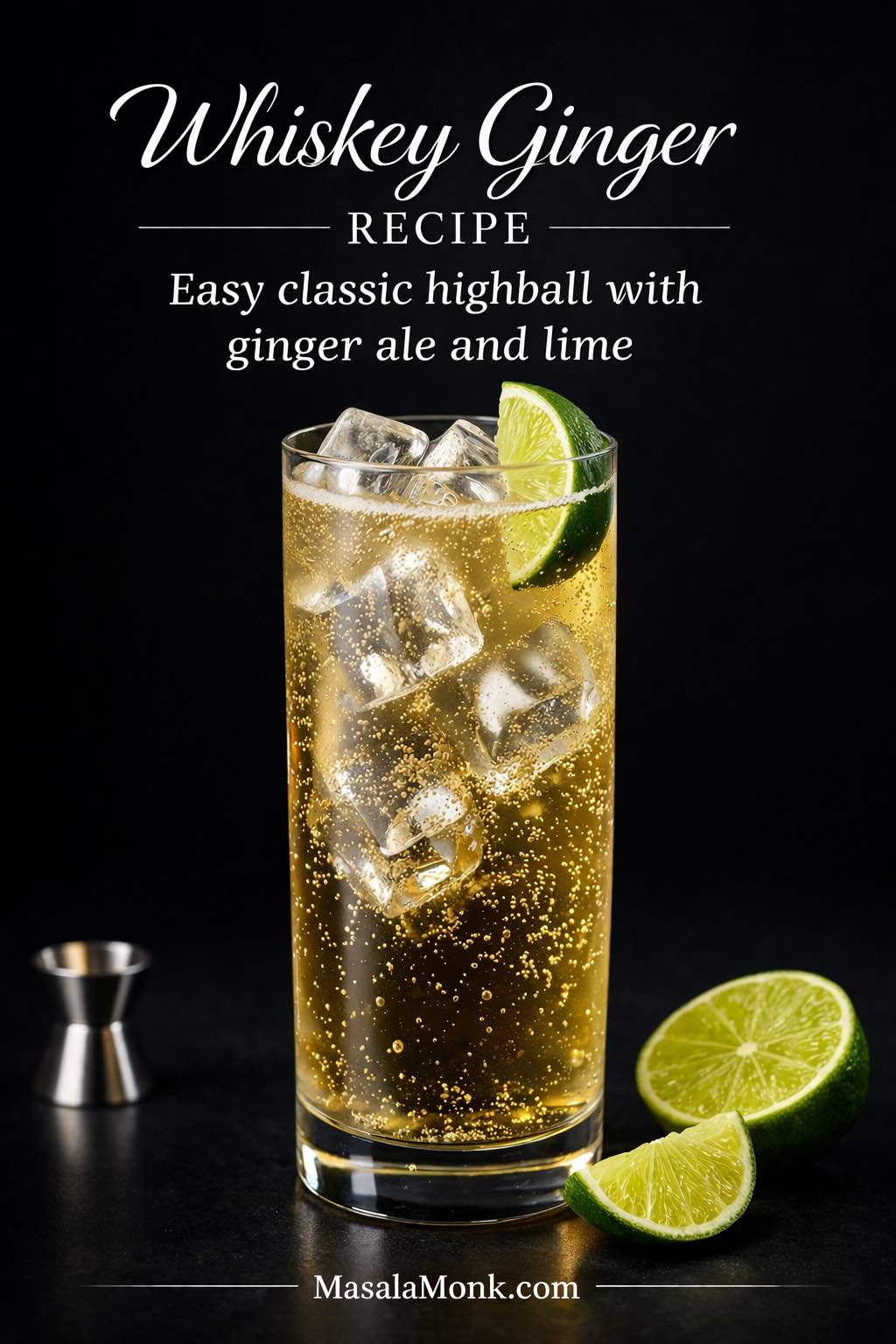
Whiskey ginger recipe featured image showing a tall highball with ice, ginger ale bubbles, and lime on a dark editorial background.

A whiskey ginger recipe is one of the easiest ways to make whiskey feel colder, lighter, and more refreshing without losing its character. This whiskey ginger drink is simple: whiskey, ginger ale, ice, and lime. Even so, when the ratio is right, it still tastes finished, balanced, and genuinely worth making again.

The only real point of confusion is the mixer. Some readers mean the classic whiskey and ginger ale version, while others want a spicier whiskey and ginger beer drink with more bite. Therefore, this whiskey ginger recipe starts with the smooth, classic build first, and then shows you exactly how to adjust the ratio, the whiskey, and the mixer to suit your taste.

Quick Answer: Whiskey Ginger Recipe Basics

A whiskey ginger is a simple highball made with whiskey, ginger ale, ice, and lime. For most readers, the best whiskey ginger recipe to start with is still the classic ginger ale version because it is smoother, more forgiving, and easier to balance on the first try.

If you want the easiest starting point, use Irish whiskey and ginger ale. If you want a sweeter version, use bourbon instead. However, if you want more bite, switch to ginger beer or a spicier whiskey rather than trying to force the classic version to do everything at once.

  • Best first version: Irish whiskey + ginger ale + lime
  • Best sweeter version: bourbon + ginger ale
  • Best spicier version: whiskey + ginger beer
  • Best brighter version: use a firmer squeeze of lime and move toward an Irish Buck style

That gives you the cleanest baseline first. Then, once you know what feels too soft, too sweet, or too sharp, the next round becomes much easier to adjust well.

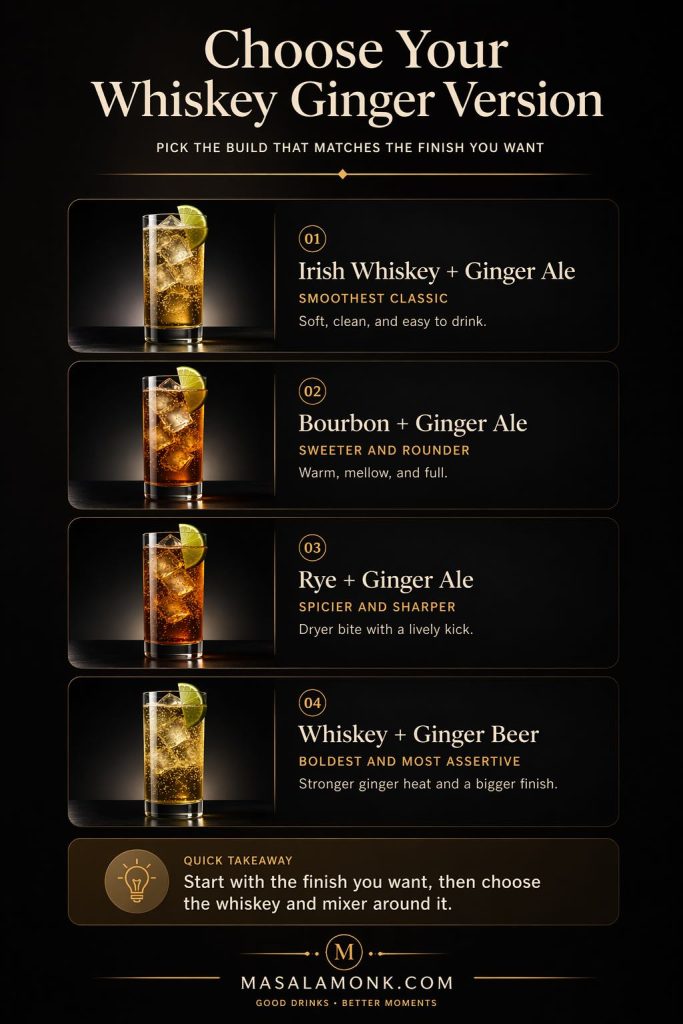
Choose your whiskey ginger version guide comparing Irish whiskey and ginger ale, bourbon and ginger ale, rye and ginger ale, and whiskey with ginger beer by flavor, finish, and drinking style.
The easiest way to choose a whiskey ginger is to decide what you want the glass to feel like first: Irish whiskey keeps it smooth, bourbon makes it rounder, rye adds sharper spice, and ginger beer pushes it bolder and more assertive.

Choose Your Version

  • Use Irish whiskey + ginger ale for the smoothest, most classic version.
  • Use bourbon + ginger ale for a sweeter, rounder drink.
  • Use rye + ginger ale for more spice and edge.
  • Use whiskey + ginger beer for the boldest, sharpest variation.

This quick choice matters because the drink changes more than people expect from only one ingredient swap. Ginger ale keeps things softer and easier, while ginger beer pushes the drink into a noticeably spicier direction almost immediately.

Whiskey Ginger Recipe Card

This whiskey ginger recipe is the best first version to make because it is easy, balanced, and flexible enough to adjust after a single sip. In other words, it gives you the classic drink most readers actually want first, and then leaves plenty of room to push it sweeter, spicier, or stronger later.

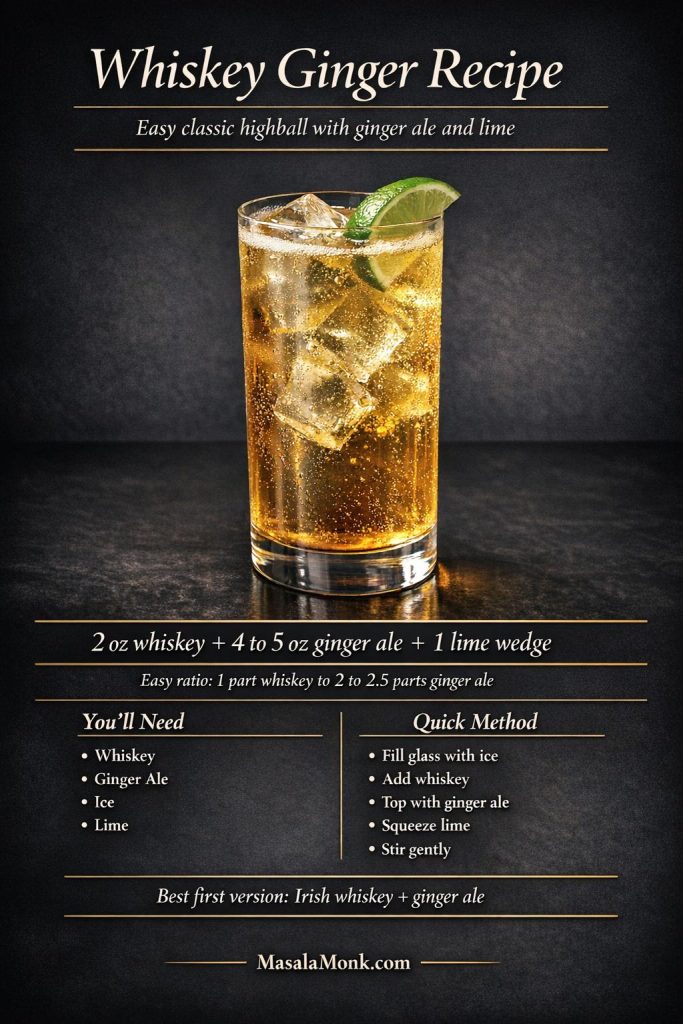
Formula: 2 ounces / 60 ml whiskey + 4 to 5 ounces / 120 to 150 ml ginger ale + 1 lime wedge
Easy ratio: 1 part whiskey to about 2 to 2.5 parts ginger ale

  • Yield: 1 drink
  • Time: 5 minutes
  • Glass: Highball glass or tall glass
  • Garnish: Lime wedge
  • Best first bottle: Irish whiskey
  • Best first mixer: Ginger ale
  • Flavor: cold, lightly sweet, bright, and easy to sip

Best first version: Start with Irish whiskey and ginger ale if you want the smoothest, most classic whiskey ginger.

Whiskey Ginger Ingredients

  • 2 ounces whiskey (60 ml)
  • 4 to 5 ounces ginger ale (120 to 150 ml)
  • Ice
  • 1 lime wedge

Whiskey Ginger Method

Fill a tall glass with ice. Add the whiskey, top with ginger ale, stir gently, then squeeze in the lime wedge and serve right away.

Notes for the best whiskey ginger: Start with ginger ale if this is your first whiskey ginger because it is easier to balance and less likely to overpower the whiskey. Then, once you know the classic version, move to bourbon if you want a fuller, sweeter drink or to ginger beer if you want more spice and edge. Also, keep the lime modest at first. A little brightens the drink beautifully; however, too much can pull it away from classic whiskey ginger territory and into a brighter buck-style direction.

Easy first adjustment: If the drink tastes too soft, use a little less ginger ale next time. On the other hand, if it tastes too strong, add a small splash more and stir once. Because the drink is so simple, those small adjustments show up immediately.

Whiskey ginger recipe card showing the classic formula, easy ratio, ingredients, and quick method for making a whiskey ginger with ginger ale and lime.
Save the classic build once and the drink becomes easy to repeat: start with 2 ounces of whiskey to 4 to 5 ounces of ginger ale, then adjust lighter or stronger once you know your preferred balance.

Whiskey Ginger Ingredients

The ingredient list is short. Even so, each part matters more than it first seems because there is nowhere for weak choices to hide in a drink this simple.

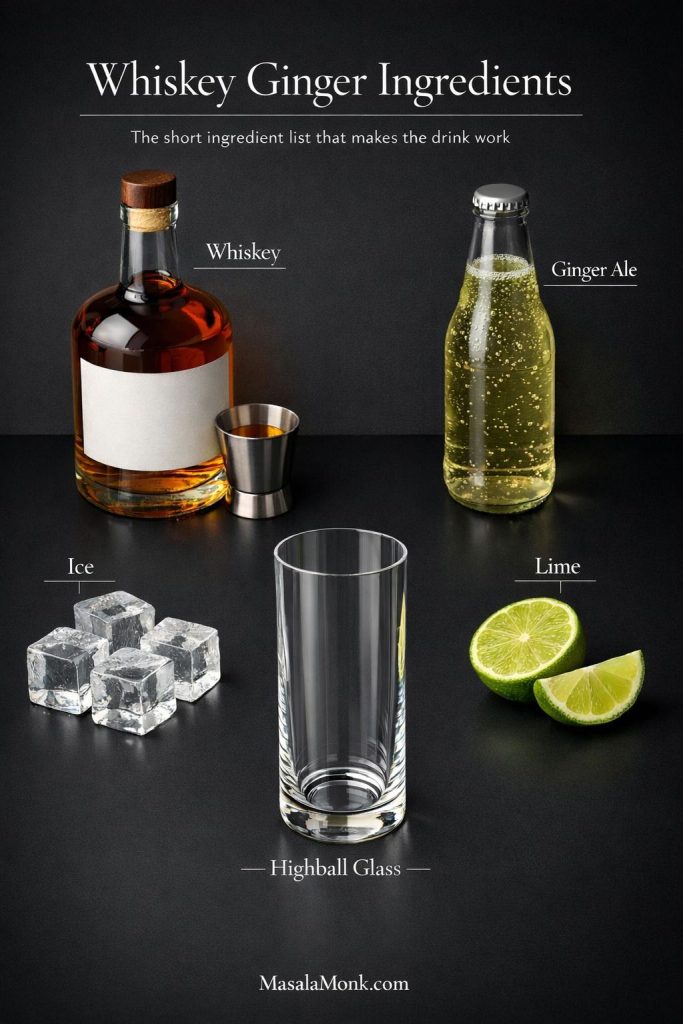
Labeled whiskey ginger ingredients guide showing whiskey, ginger ale, lime, ice, and a highball glass on a dark editorial background.
A whiskey ginger stays simple, so each ingredient matters: the whiskey sets the tone, the ginger ale brings lift, the lime sharpens the finish, and the ice keeps the drink crisp.
  • Whiskey: This sets the tone of the drink. Irish whiskey tastes smoother, bourbon tastes sweeter, rye tastes spicier, and scotch tastes drier or maltier.
  • Ginger ale: This is the classic mixer because it keeps the drink fizzy, lightly sweet, and easy to sip.
  • Lime: A small squeeze brightens the finish. Without it, the drink can taste a little flat; with too much of it, the drink can start tasting like a different branch of the family.
  • Ice: Use plenty so the drink stays crisp instead of turning dull too quickly.

That short list is part of the reason a good whiskey ginger recipe works so well. The drink is accessible enough for beginners, yet still flexible enough for regular whiskey drinkers who want to tweak the profile around the bottle they already enjoy.

If you already know you enjoy more ginger bite, ginger beer can work too. Still, that is not a tiny swap. It changes the whole feel of the drink, so it is better treated as a true variation rather than a casual substitution.

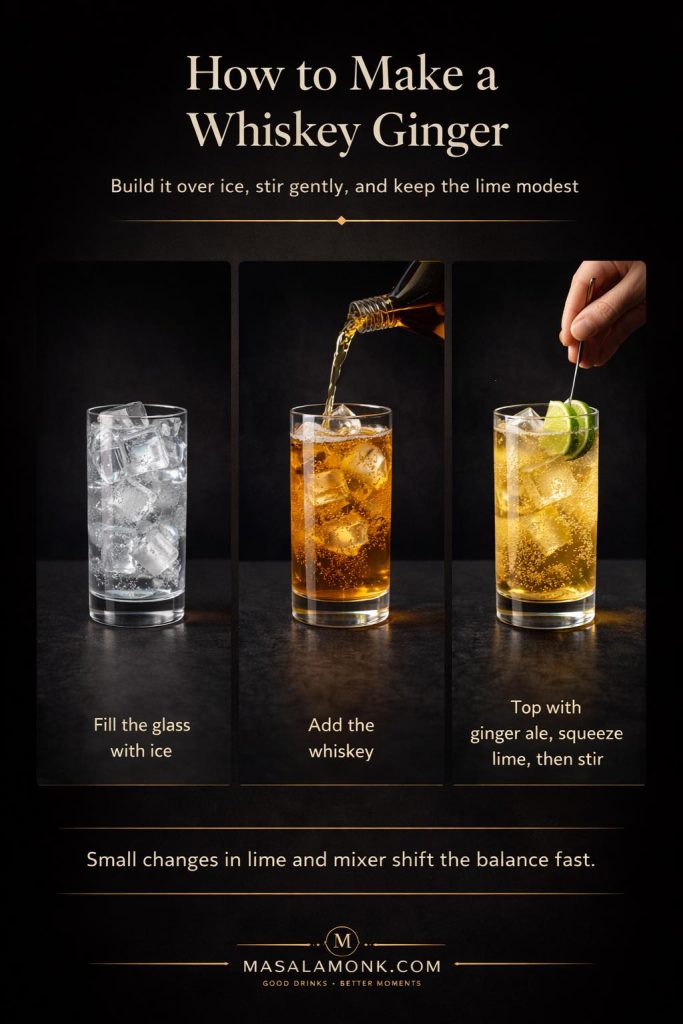
Step-by-step whiskey ginger method board showing a tall highball glass filled with ice, whiskey being added, and ginger ale topped with lime before a gentle stir.
A whiskey ginger is easiest to build directly in the glass: start with plenty of ice, add the whiskey, then top with ginger ale and finish with a modest squeeze of lime.

How to Make a Whiskey Ginger

The method is straightforward. Build the drink over ice, stir briefly, and finish with lime. Because of that, this is one of the easiest whiskey drinks to make well at home.

  1. Fill a highball glass or tall glass with ice.
  2. Pour in the whiskey.
  3. Top with ginger ale.
  4. Stir gently just until combined.
  5. Squeeze in a lime wedge and, if you like, drop it into the glass.
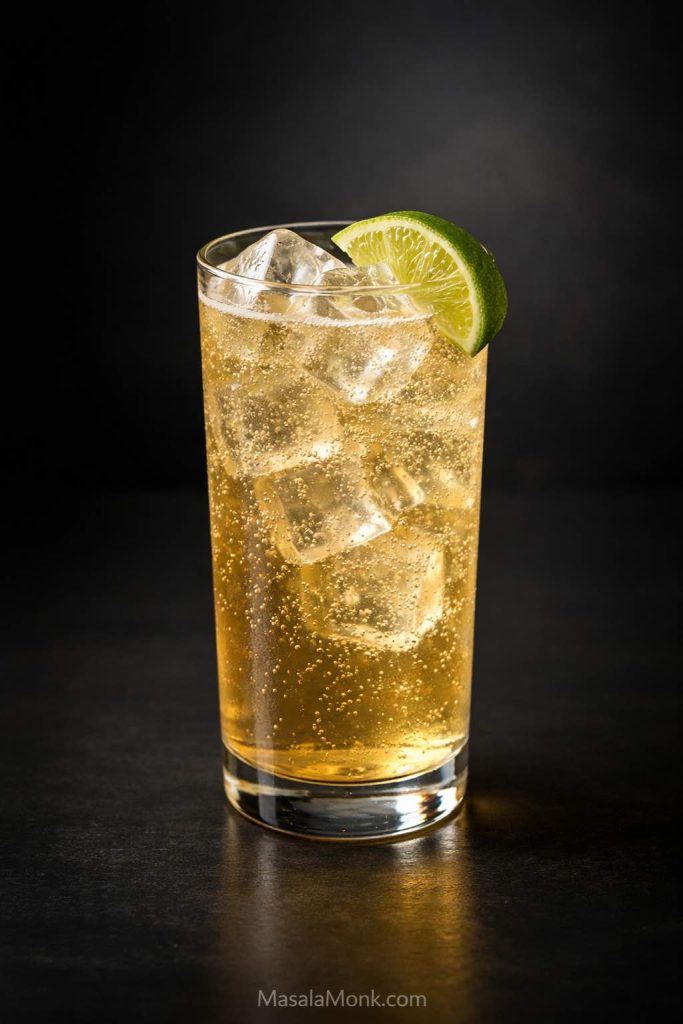
Finished whiskey ginger drink in a tall highball glass with clear ice, lively bubbles, and a lime wedge on a dark editorial background.
After the ginger ale and lime go in, the drink should look light, bubbly, and easy to sip, with the whiskey still showing through the glass.

Then taste it before you walk away. If it feels too strong, add a little more ginger ale. If it feels too soft, use slightly less mixer next time. Therefore, the first glass gives you the baseline, and the next one gets even better.

Whiskey Ginger Recipe Ratio Guide

A dependable starting point is 2 ounces / 60 ml of whiskey to 4 to 5 ounces / 120 to 150 ml of ginger ale. In simple parts, that is about 1 part whiskey to 2 to 2.5 parts ginger ale. That ratio works well because it lets the whiskey show up clearly while still keeping the drink cold, refreshing, and easy to sip.

After that, you can adjust the drink around your taste. In fact, one of the best things about a whiskey ginger recipe is how quickly it responds to small changes. Once you know your preferred balance, this whiskey ginger recipe becomes one of the easiest whiskey drinks to repeat consistently.

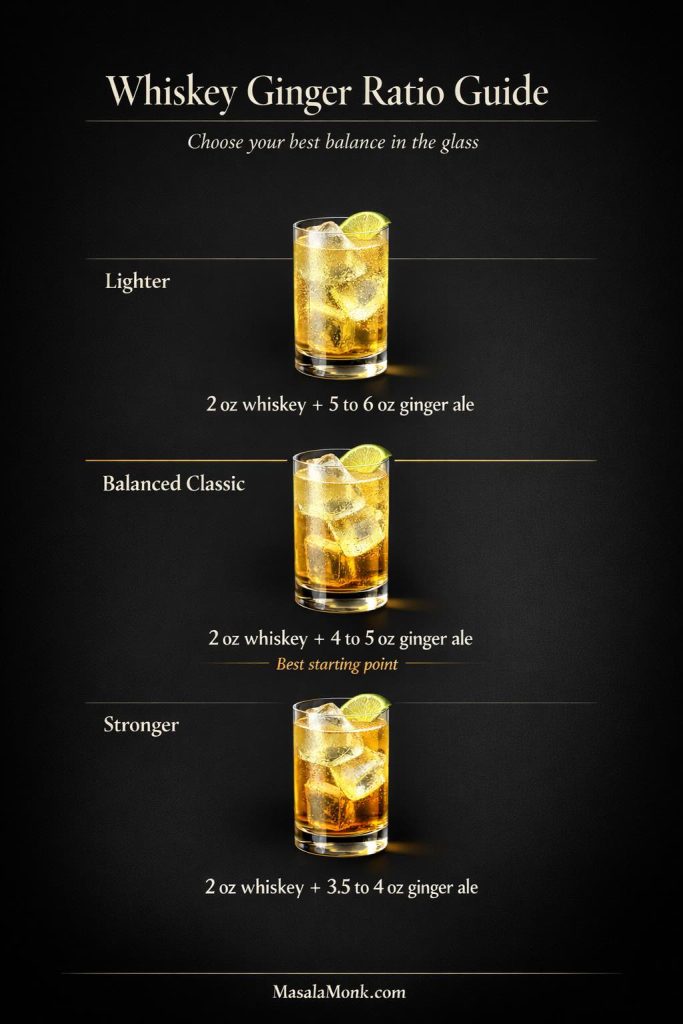
Whiskey ginger recipe ratio guide showing lighter, balanced classic, and stronger versions with whiskey and ginger ale measurements.
Start with the balanced classic ratio first, then move lighter for a softer highball or stronger for a firmer whiskey presence in the glass.
  • Lighter: 2 ounces / 60 ml whiskey to 5 to 6 ounces / 150 to 180 ml ginger ale
  • Balanced classic: 2 ounces / 60 ml whiskey to 4 to 5 ounces / 120 to 150 ml ginger ale
  • Stronger: 2 ounces / 60 ml whiskey to 3.5 to 4 ounces / 105 to 120 ml ginger ale

If you are serving guests, the balanced middle version is usually the safest place to start. Meanwhile, if you are mixing for yourself, you can push the drink lighter or stronger without much risk.

How to Fix a Whiskey Ginger

This is where the drink becomes more useful than a one-line recipe. Once the first sip tells you what is missing, the fixes are simple.

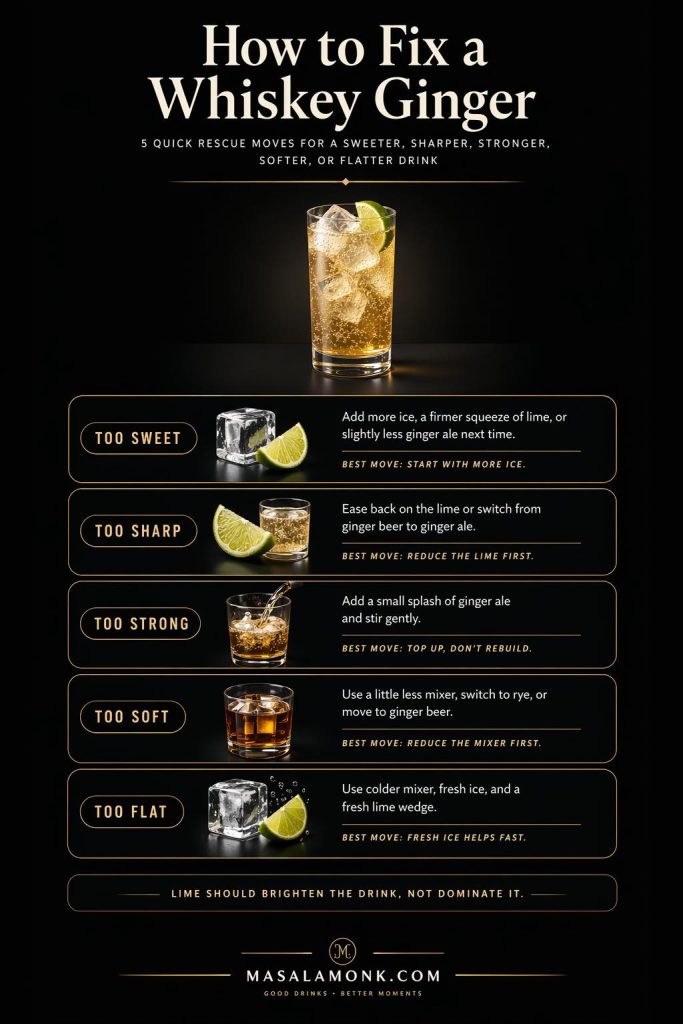
How to fix a whiskey ginger guide showing quick fixes for a drink that tastes too sweet, too sharp, too strong, too soft, or too flat.
If your first sip feels off, do not rebuild the drink blindly. Small changes to ice, lime, mixer, or whiskey style can bring a whiskey ginger back into balance fast.
  • Too sweet: add a little more ice, use a firmer squeeze of lime, or reduce the ginger ale slightly next time.
  • Too sharp: ease back on the lime or switch from ginger beer to ginger ale.
  • Too strong: add a small splash of ginger ale and stir gently.
  • Too soft: use a little less mixer, switch to rye, or move to ginger beer.
  • Too flat: start with colder mixer, fresh ice, and a fresh lime wedge.

Above all, remember that too much lime changes the drink more than most readers expect. Lime should brighten a whiskey ginger, not dominate it.

What Is a Whiskey Ginger?

A whiskey ginger is best understood as a simple whiskey highball. The classic build uses whiskey, ginger ale, ice, and lime, so the drink stays light, fizzy, and easy to sip. That is exactly why it works when you want something colder and more refreshing than a neat pour, but easier and faster than a more elaborate cocktail.

At the same time, the category gets muddy because people use the name loosely. Some mean the classic ginger ale version, while others mean a spicier ginger beer build. As a result, the name often covers a few related drinks rather than one absolutely rigid formula.

That is also why the drink sits so close to Irish Buck territory. Once the lime becomes more noticeable and the structure feels more citrus-led, the drink starts moving away from the softest everyday whiskey ginger style and toward a brighter branch of the same family.

Best Whiskey

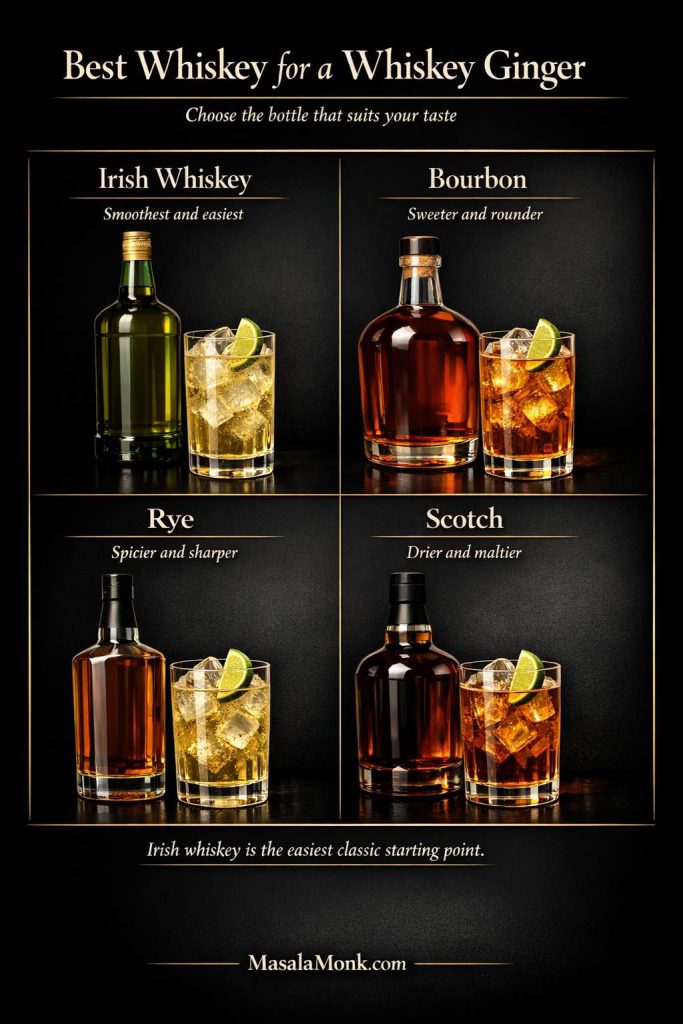
The best whiskey for a whiskey ginger depends on the finish you want in the glass. In practice, that flexibility is one of the drink’s biggest strengths because the same basic build can feel smoother, sweeter, drier, or spicier depending on the bottle you choose.

Best whiskey for whiskey ginger guide comparing Irish whiskey, bourbon, rye, and scotch by how each changes the drink.
A whiskey ginger changes faster than most people expect: Irish whiskey keeps it smooth and easy, bourbon makes it rounder, rye adds sharper spice, and scotch pushes it drier and maltier.
  • Irish whiskey: best if you want the smoothest, easiest-drinking whiskey ginger
  • Bourbon: best if you want a rounder, sweeter drink with a softer finish
  • Rye: best if you want more spice and a little more edge
  • Scotch: best if you want a drier, maltier, or slightly smoky version

For most readers, Irish whiskey is the safest starting point because it stays clean and mellow against the ginger. As a result, the drink feels balanced quickly and rarely needs much correction. Bourbon, by contrast, makes the drink feel fuller almost immediately, so it is a better choice if you want a softer, sweeter finish from the start.

Rye is useful when the classic version tastes a little too easy or too rounded for your taste. Because rye pushes more spice into the glass, it gives the drink extra edge without forcing you to change the overall structure. Scotch can work too; however, it is usually smartest to start with a gentler blended scotch rather than a heavily smoky one. Otherwise, the whiskey can dominate the lighter ginger profile too easily.

That flexibility is one reason a whiskey ginger recipe works so well for both beginners and regular whiskey drinkers.

If bourbon is usually your first choice, MasalaMonk’s guide on what to mix with Jim Beam is a useful next read because ginger ale fits naturally into that easy bourbon-mixer lane.

Ginger Ale vs Ginger Beer and Irish Buck

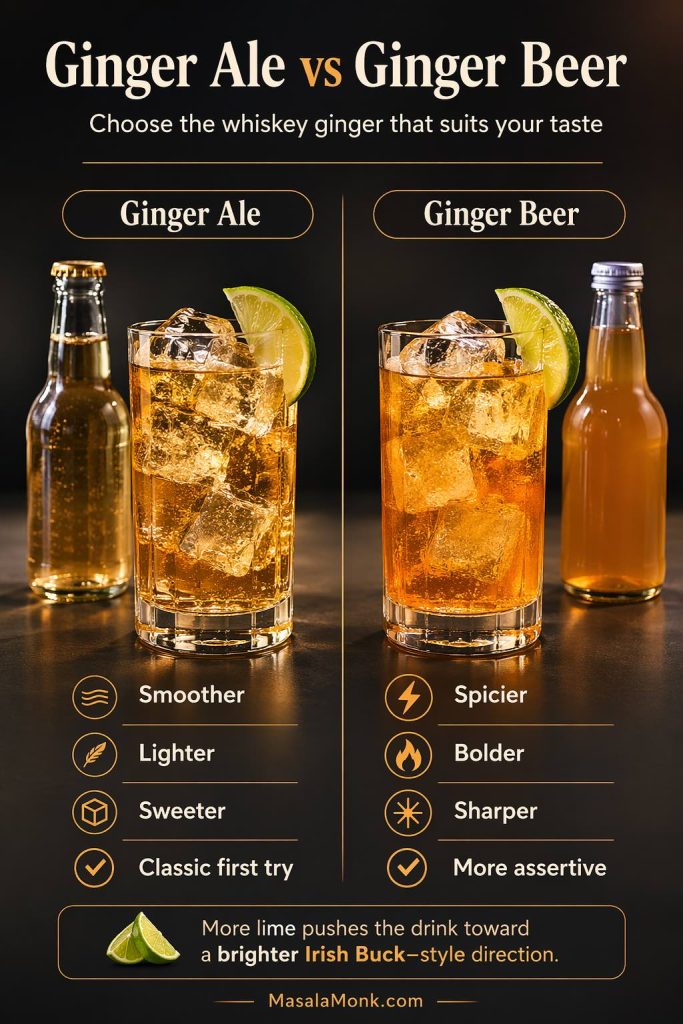
The quickest way to avoid confusion is to compare the branches that actually change the drink in a noticeable way: the mixer choice and the citrus level. Although the names around this cluster overlap, the drinking experience does not always stay the same.

Ginger ale vs ginger beer comparison guide for whiskey ginger showing how ginger ale makes a smoother, lighter drink and ginger beer makes a spicier, bolder version.
Ginger ale gives a whiskey ginger its smoother, lighter classic feel, while ginger beer pushes the drink toward a spicier, bolder, more assertive profile.
  • Whiskey ginger with ginger ale vs whiskey ginger with ginger beer: ginger ale is smoother, sweeter, and more classic, whereas ginger beer is spicier, drier, and more assertive.
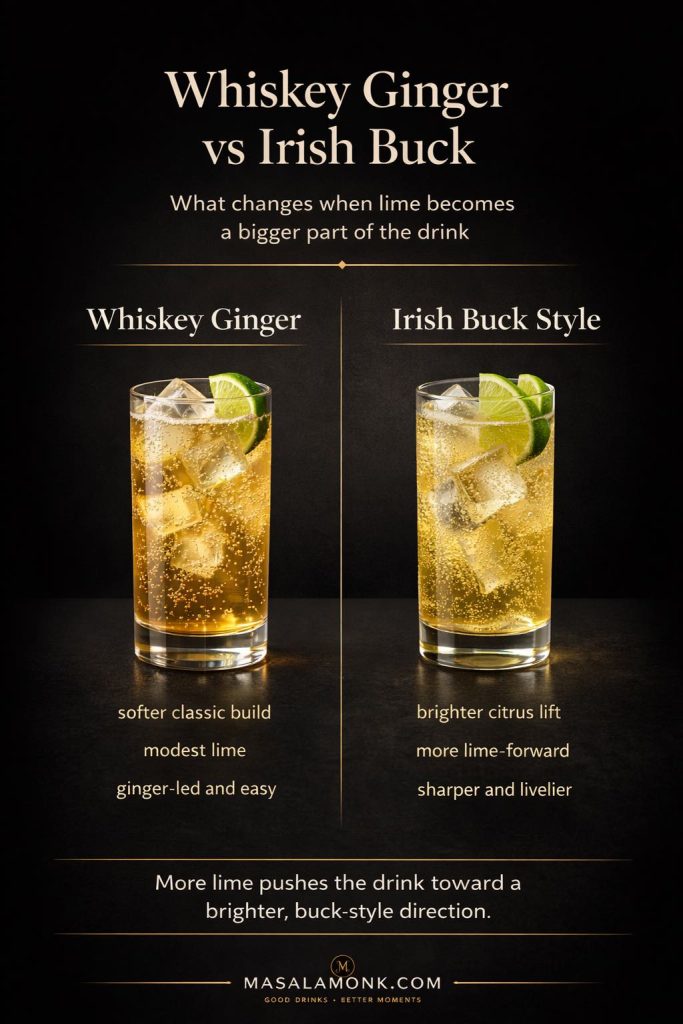
  • Whiskey ginger vs Irish Buck: both belong to the same family, but an Irish Buck usually leans harder on lime and a brighter citrus structure.

The easiest way to think about it is this: ginger ale gives you the safer, more crowd-friendly whiskey ginger, while ginger beer gives you the bolder variation. Likewise, once the lime becomes one of the main things you notice, the drink starts moving away from classic whiskey ginger territory and toward an Irish Buck-style direction.

Whiskey ginger vs Irish Buck comparison guide showing a classic whiskey ginger with modest lime beside a brighter Irish Buck style drink with a more lime-forward, citrus-led profile.
A whiskey ginger and an Irish Buck can sit very close to each other, but the balance shifts once lime becomes more noticeable: the whiskey ginger stays softer and ginger-led, while the Irish Buck-style version drinks brighter and more citrus-forward.

If you want an external reference on that naming overlap, The Spruce’s whiskey ginger and Irish Buck guide is a useful high-authority explainer. Meanwhile, if you already know you enjoy ginger beer in cold mixed drinks, this Moscow Mule recipe is a strong internal companion because it shows how differently ginger beer behaves once lime becomes more important.

Best Garnish for a Whiskey Ginger

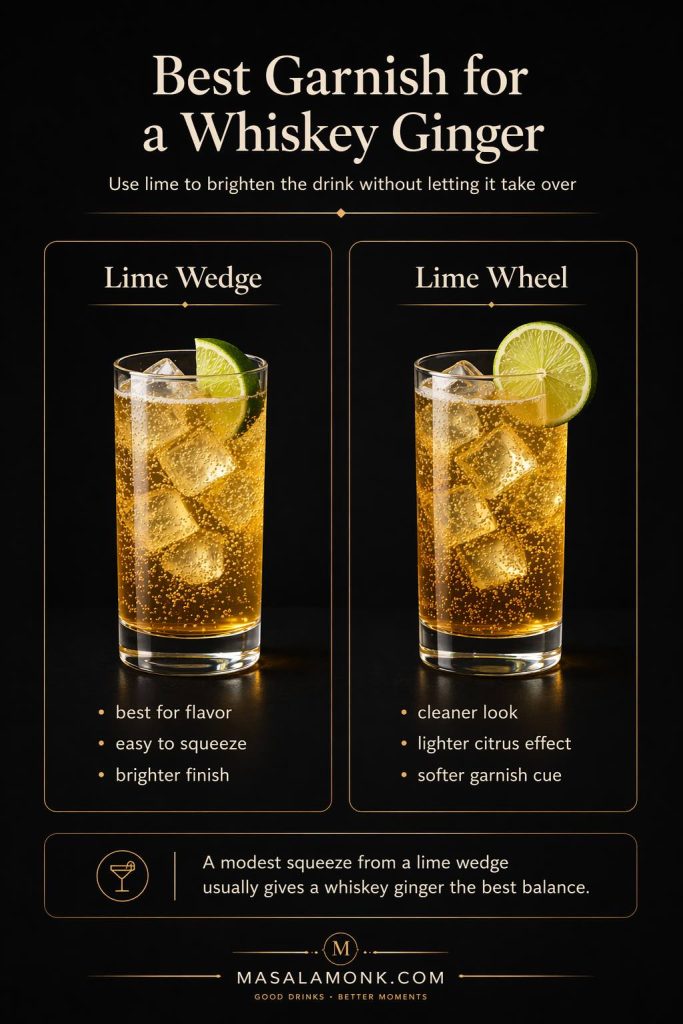
The best garnish for a whiskey ginger is lime. A lime wedge is usually the smartest choice because you can squeeze fresh juice into the drink and still leave the wedge in the glass. A lime wheel looks cleaner, but it does less for the flavor unless you squeeze it first.

Best garnish for a whiskey ginger comparison showing a lime wedge versus a lime wheel on two tall whiskey ginger highballs, explaining flavor impact, citrus effect, and which garnish gives the best balance.
A whiskey ginger usually tastes best with a modest lime wedge because it gives you real brightness in the glass, while a lime wheel keeps the look cleaner but adds a lighter citrus effect.

Keep the garnish simple. This is not a drink that needs a dramatic finish to feel complete. In fact, the cleaner the garnish, the more the whiskey and ginger stay in focus.

Whiskey Ginger Variations

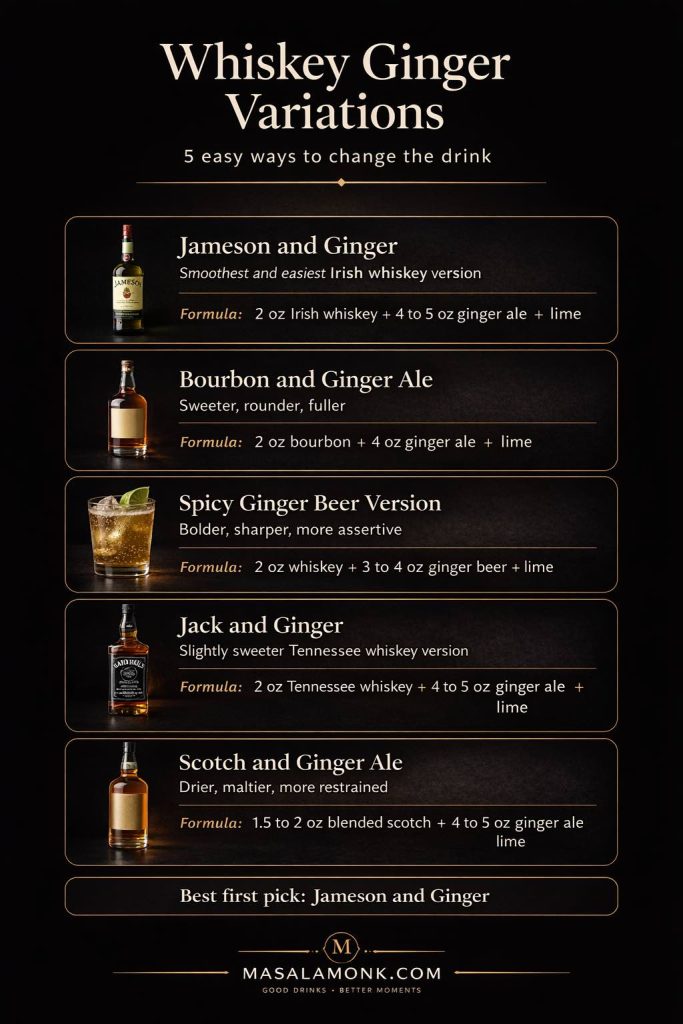
Make each variation exactly like the main recipe unless noted below. Even though the names change, the structure stays similar: whiskey, ginger, ice, and citrus, with one part pushed slightly harder than the others.

Whiskey ginger variations guide comparing Jameson and Ginger, bourbon and ginger ale, spicy ginger beer version, Jack and Ginger, and scotch and ginger ale.
The base build stays simple, but the drink changes quickly once you swap the whiskey or the mixer: Jameson keeps it smooth, bourbon rounds it out, ginger beer sharpens it, Jack stays mellow, and scotch makes it drier and maltier.

Jameson and Ginger Whiskey Drink

Jameson and ginger is one of the smoothest, easiest-drinking versions of the drink. Because Jameson is an Irish whiskey, the result usually feels light, mellow, and especially approachable.

Mini formula: 2 ounces Irish whiskey + 4 to 5 ounces ginger ale + 1 lime wedge

For an official brand reference, Jameson’s Ginger & Lime recipe shows the same easy, highball-style direction.

Bourbon and Ginger Ale Whiskey Drink

Bourbon and ginger ale is the sweeter, rounder side of the family. Therefore, it is often the easiest variation to like right away if you enjoy caramel, vanilla, or a softer finish in whiskey drinks.

Mini formula: 2 ounces bourbon + 4 ounces ginger ale + 1 lime wedge

If you want to stay in that bourbon-friendly lane afterward, MasalaMonk’s Boulevardier recipe is a great next step when you want something deeper and more spirit-forward.

Spicy Ginger Beer Version

This variation is the spicier, sharper side of the family. As a result, it usually feels livelier from the first sip and stands up better to a whiskey with more edge.

Mini formula: 2 ounces whiskey + 3 to 4 ounces ginger beer + 1 lime wedge

Jack and Ginger

Jack and ginger follows the same easy pattern, yet Tennessee whiskey gives the drink a slightly different sweetness and spice balance. In other words, it still drinks like a whiskey ginger, but the whiskey profile shifts the mood.

Mini formula: 2 ounces Tennessee whiskey + 4 to 5 ounces ginger ale + 1 lime wedge

Scotch and Ginger Ale Whiskey Drink

Scotch and ginger ale can work well when you want a drier, maltier version of the same basic idea. Generally, a softer blended scotch is the easiest place to start because a heavily smoky bottle can overpower the lighter mixer.

Mini formula: 1.5 to 2 ounces blended scotch + 4 to 5 ounces ginger ale + 1 lime wedge

Whiskey Ginger for a Crowd

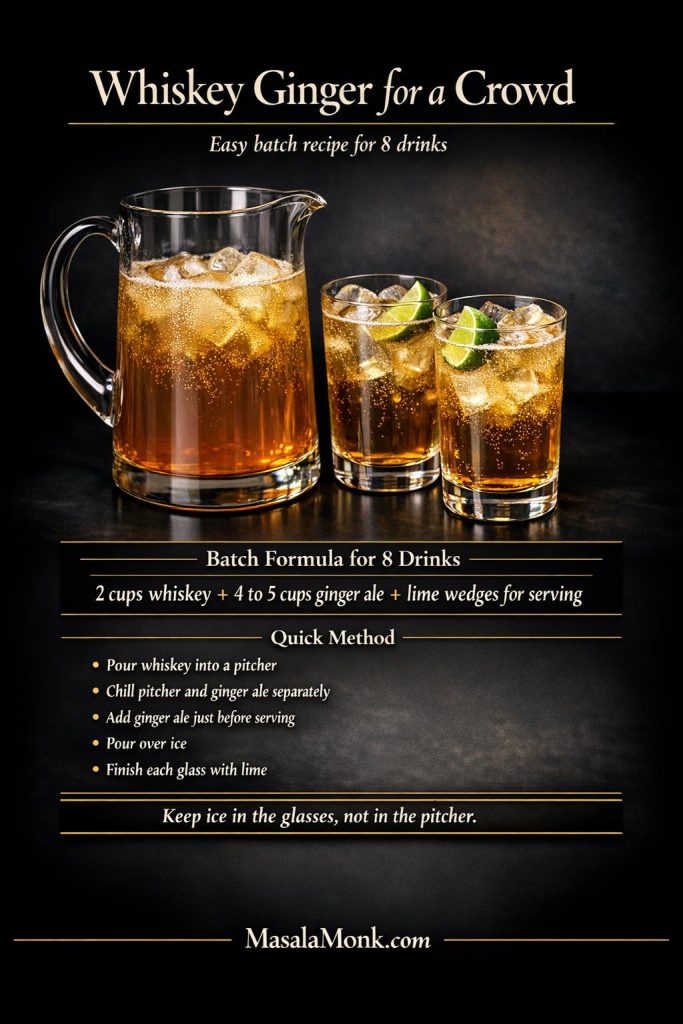
If you want to serve several people at once, a whiskey ginger is easy to batch as long as you keep the bubbles lively. The main trick is to add the ginger ale just before serving instead of letting it sit too long.

Whiskey ginger for a crowd recipe card showing a pitcher, two finished glasses, batch formula for 8 drinks, quick method, and serving tip.
Batch the whiskey first, add the ginger ale just before serving, and keep the ice in the glasses so each whiskey ginger stays cold, fizzy, and properly balanced.

Batch formula for 8 drinks: 2 cups whiskey + 4 to 5 cups ginger ale + lime wedges for serving

  1. Pour the whiskey into a pitcher.
  2. Chill the pitcher and the ginger ale separately.
  3. Just before serving, add the ginger ale and stir gently.
  4. Serve over ice and finish each glass with a lime wedge.

For the best result, keep the ice in the glasses rather than the pitcher. That way, the batch stays cold without getting watered down too quickly.

FAQs

What is it made of?

A whiskey ginger is usually made with whiskey, ginger ale, ice, and lime.

Ginger ale or ginger beer?

Ginger ale is better if you want the smoothest, most classic result. And ginger beer is better if you want a spicier, drier, more assertive version.

What whiskey works best in a whiskey ginger?

Irish whiskey is the easiest place to start if you want a smooth, classic result. Meanwhile, bourbon gives you a sweeter version, rye gives you more spice, and scotch can give you a drier or maltier finish.

Can bourbon work in a whiskey ginger?

Yes. In fact, bourbon and ginger ale is one of the easiest and most approachable riffs on the drink, especially if you like a slightly sweeter whiskey profile.

What is the best whiskey ginger recipe ratio?

A reliable starting point is 2 ounces of whiskey to 4 to 5 ounces of ginger ale. Then, once you know your preference, you can make it lighter or stronger as needed.

Is it the same as an Irish Buck?

They are very close, but an Irish Buck usually leans more clearly on lime and ginger together. So, whiskey ginger is the broader everyday name, while Irish Buck points to a slightly more citrus-led direction.

Can ginger beer work too?

Yes, and it can taste great. However, it is not just a tiny swap. Ginger beer makes the drink spicier, drier, and more assertive, so the result feels like a bolder variation rather than the classic whiskey ginger most readers expect first.

How do you make Jameson and ginger?

To make Jameson and ginger, fill a tall glass with ice, add 2 ounces of Jameson, top with 4 to 5 ounces of ginger ale, squeeze in a lime wedge, and stir gently.

Can you batch a whiskey ginger recipe for a crowd?

Yes. A whiskey and ginger recipe is easy to batch for guests as long as you keep the ginger ale chilled and add it just before serving so the drink stays lively and fizzy.

If you want another easy whiskey drink afterward, this whiskey sour recipe is a good next step because it keeps the whiskey front and center while moving in a brighter, more citrus-forward direction.

↑ Back to top

Posted on 15 Comments

Whiskey Sour Recipe: Classic Cocktail, Best Whiskey & Easy Twists

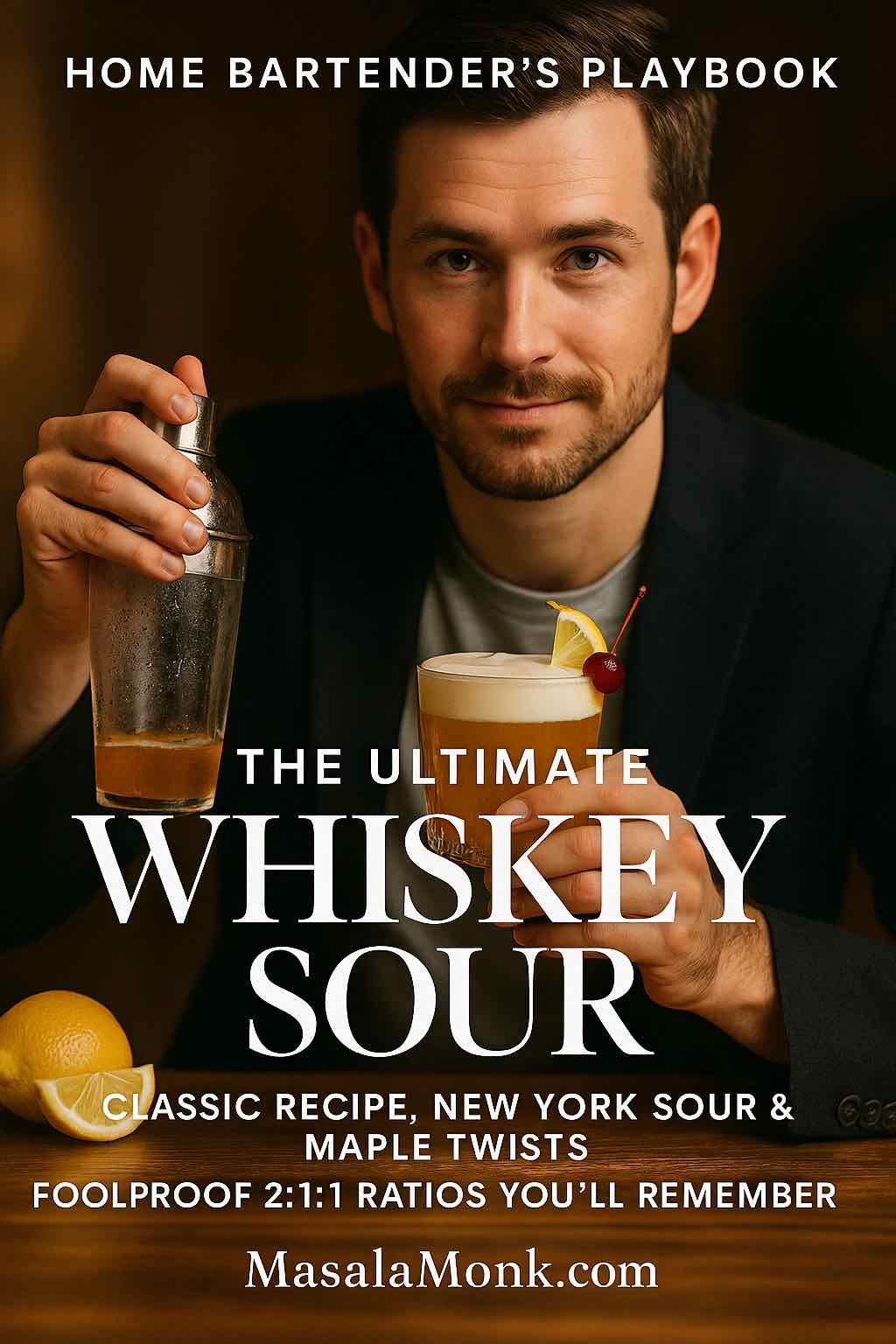
Bartender holding a whiskey sour cocktail and shaker on a wooden bar, cover image for MasalaMonk whiskey sour recipe guide

There’s something wonderfully honest about a whiskey sour. No smoke and mirrors, no mile-long ingredient list—just whiskey, citrus, and sweetness, shaken together until they become more than the sum of their parts. Whether you like yours sharp and bracing, frothy with egg white, or dressed up with a red wine float as a New York sour drink, mastering a great whiskey sour recipe gives you a whole family of cocktails to play with.

Let’s walk through it slowly, glass in hand.


What Exactly Is a Whiskey Sour?

At its core, a whiskey sour cocktail is a “sour”: one spirit, one citrus, one sweetener. That template shows up everywhere in cocktail culture—margaritas, daiquiris, sidecars—but the whiskey sour drink might be the most comforting of the lot.

In its simplest form, you’re working with:

  • Whiskey
  • Fresh lemon juice
  • Sugar (usually as simple syrup)

Shake it with ice, strain it into a glass, garnish if you like, and you’re done. That’s your basic answer when someone asks, “What’s in a whiskey and sour?” or “What’s the whiskey sour cocktail recipe?”

Over the years, bartenders have added little twists:

  • A splash of egg white to create the creamy Boston Sour
  • A float of dry red wine to turn it into a dramatic New York whiskey sour
  • Swapping in different sweeteners (honey, maple, ginger syrup)
  • Experimenting with different styles of whiskey—bourbon, rye, Irish, Scotch

Yet the structure stays the same. Spirit, sour, sweet. Once you understand that, you can see how every sour whisky drink you encounter is just a variation on this backbone.

Also Read: Negroni Recipe: Classic Cocktail & Its Variation Drinks


A Short, Spirited History

Like many great drinks, the traditional whiskey sour grew out of necessity. Long before cocktail bars and Instagram, sailors mixed spirits with lemon or lime juice and sugar to ward off scurvy and make rough spirits more palatable on long voyages. Over time, that practical mixture migrated onto dry land and into early American bars.

By the mid-19th century, manuals like Jerry Thomas’s Bartender’s Guide were formalizing the idea of “sours”—brandy sour, gin sour, whiskey sour. The original whiskey sour recipe would have been pretty rustic by modern standards: spirit, citrus, and powdered sugar, maybe with a bit of water to help it dissolve.

Fast forward to today, and the drink still follows the same logic, though we’ve traded powdered sugar for simple syrup, added the option of egg white, and fine-tuned the whiskey sour ratio so it suits modern palates. Meanwhile, new variations keep spinning off—from the red-wine-topped New York sour cocktail recipe to maple- and spice-laced twists like the Nutmeg Maple Whiskey Sour you’ll find in Masala Monk’s nutmeg-inspired cocktails for Saturday nights.

The drink has evolved, but its spirit hasn’t changed much: a simple, reliable way to turn whiskey and lemon into something you want to linger over.

Also Read: How to Cook Perfect Rice Every Time (Recipe)


Whiskey Sour Ingredients: The Building Blocks

Before shaking, it helps to get familiar with the core whiskey sour ingredients and why they matter.

1. Whiskey

The whiskey is your base, so choose wisely. Almost any style can work:

  • Bourbon – The default for a bourbon whiskey sour and bourbon sour. It’s naturally sweet, with notes of vanilla and caramel that play beautifully with lemon.
  • Rye – Spicier and drier, great for a rye whiskey sour if you like more bite.
  • Irish whiskey – Light, smooth, and friendly. Ideal for an easy-drinking Irish whiskey sour or Jameson whiskey sour.
  • Scotch – Malty and sometimes smoky. That’s your scotch sour, scotch whiskey sour, or sour scotch, and it can be delicious in the right hands.

Later on, when you’re ready to get very specific about the best whiskey for whiskey sour, you can dip into more brand-focused guides like Masala Monk’s deep dive on what to mix with Jim Beam or bottle lists from cocktail sites that compare bourbon and rye for mixed drinks.

2. Fresh Lemon Juice

Lemon is the “sour in whiskey sour.” It’s what turns a glass of straight spirit into a refreshing lemon whiskey drink and gives the cocktail its signature brightness.

Fresh makes a big difference. Bottled juice tends to taste flat or sharp in the wrong way, while fresh lemons give you aroma and zest along with acidity. If someone asks about whiskey and lemon juice or drinks with whiskey and lemon, this is the heart of the answer: fresh citrus, not shelf-stable juice.

3. Sweetener

Traditional recipes used sugar and water; today, most bartenders reach for:

  • Simple syrup – Equal parts sugar and water, dissolved. This is the most common simple syrup for whiskey sour and makes it easy to adjust sweetness.
  • Maple syrup – For a maple whiskey sour, especially in colder weather.
  • Honey syrup – For a honey lemon whiskey sour, floral and cozy.
  • Ginger syrup – For a ginger whiskey sour with a warming kick.

Even if you’re using a flavoured syrup, the logic is the same: balance the lemon with enough sweetness that the cocktail tastes harmonious rather than punishingly sour.

4. Egg White (Optional)

Egg white is technically optional, but if you’ve ever admired a cocktail with a thick, silky foam on top, you’ve seen what it can do. Adding a small amount and shaking properly turns your drink into a luscious whiskey sour with egg white—what many people call a Boston Sour.

You’ll also see recipes labelled:

  • Whiskey sour cocktail recipe egg white
  • Whiskey sour cocktail with egg white
  • Whiskey drink with egg white

All of them are describing this creamy variation. We’ll get into the technique in a moment.

Also Read: Homemade Hot Chocolate with Cocoa Powder Recipe


Classic Whiskey Sour Recipe (No Egg)

Let’s start with the most straightforward whiskey sour recipe: clean, bright, and easy to remember.

Simple Whiskey Sour

This is your go-to simple whiskey sour, perfect for a weeknight drink or a first experiment at home.

Ingredients (1 drink)

  • 50 ml (1¾ oz) whiskey
  • 25 ml (¾–1 oz) fresh lemon juice
  • 20–25 ml (⅔–¾ oz) simple syrup
  • Ice
  • Lemon wheel or twist, plus a cherry

Think of this as the standard whiskey sour recipe ml and whiskey sour measurements you can rely on. It’s essentially a 2:1:1 whiskey sour ratio, which is easy to scale up.

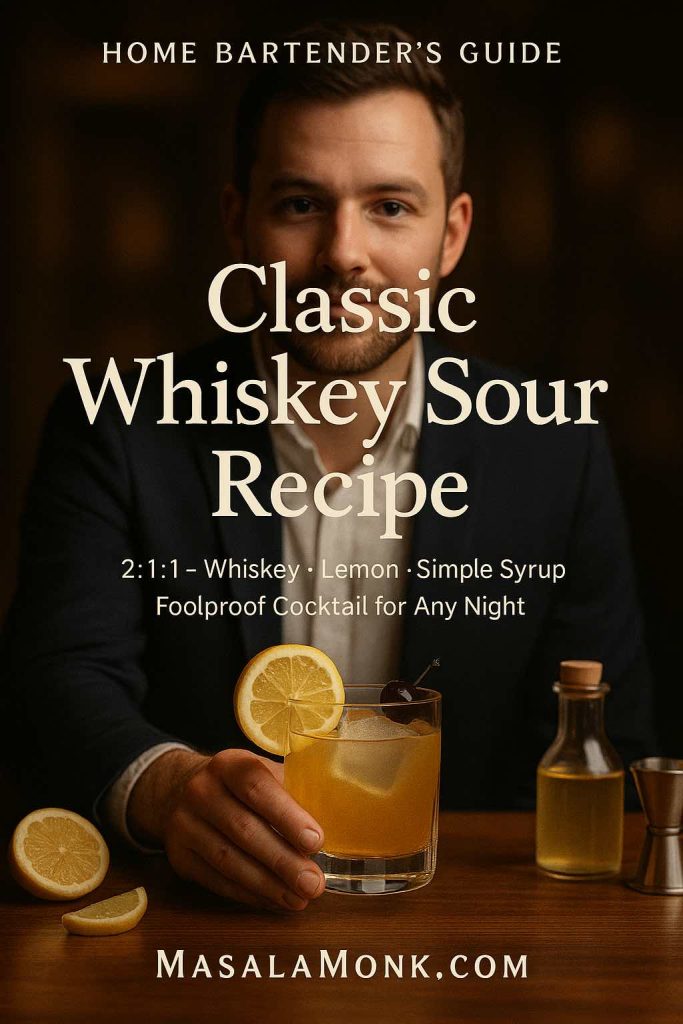
Home bartender in a navy blazer holding a classic whiskey sour cocktail on a wooden bar, with text overlay describing a 2-1-1 whiskey lemon simple syrup recipe for MasalaMonk
Classic Whiskey Sour Recipe – a 2:1:1 mix of whiskey, fresh lemon, and simple syrup, styled as a home bartender’s guide cover for MasalaMonk.com.

Method

  1. Add the whiskey, lemon juice, and simple syrup to a cocktail shaker filled with ice.
  2. Shake briskly for 10–15 seconds, until the outside of the shaker is frosty.
  3. Strain into a rocks glass filled with fresh ice.
  4. Garnish with a lemon wheel or twist and a cherry.

That’s it. In just a few steps, you’ve made an easy whiskey sour from scratch. You can call this your basic whiskey sour, classic whiskey sour, traditional whiskey sour recipe, or just “my house whiskey sour.”

If a friend asks, “How do you make a whiskey sour?” or “How do I make a whisky sour at home?”—this is the version to teach them.

Also Read: Peanut Butter Cookies (Classic Recipe & 3 Variations)


Whiskey Sour Recipe with Egg White (Boston Sour)

Once you’re comfortable with the basic build, you might want to explore the creamy, velvety side of the style: the whiskey sour with an egg white, often referred to as a Boston Sour.

Why Add Egg White?

Egg white doesn’t change the flavour dramatically; instead, it transforms texture. It gives the drink:

  • A thick, luxurious foam cap
  • A softer, rounder mouthfeel
  • A canvas for a few drops of aromatic bitters

That’s why you’ll sometimes see recipes titled egg white whisky sour or boston sour cocktail. They’re all talking about the same technique.

Egg-White Whiskey Sour Recipe

Ingredients (1 drink)

  • 50 ml (1¾ oz) whiskey
  • 25 ml (¾–1 oz) fresh lemon juice
  • 20–25 ml (⅔–¾ oz) simple syrup
  • 10–15 ml (⅓–½ oz) egg white (about half the white of a large egg)
  • Ice
  • Bitters + lemon twist, to garnish
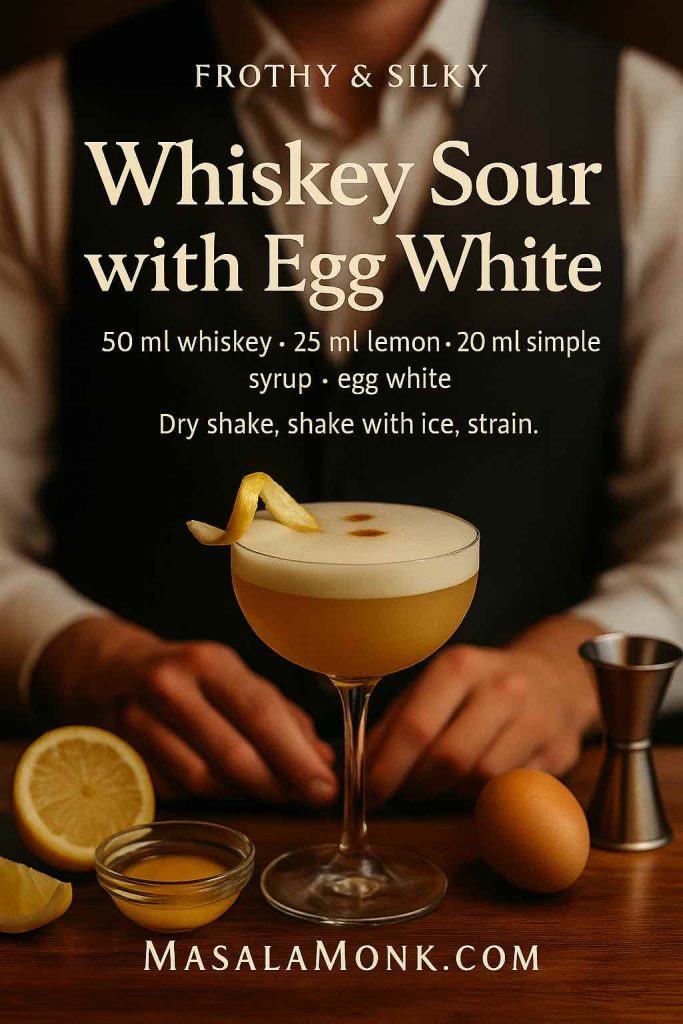
Recipe card style image showing a frothy whiskey sour with egg white in a coupe glass, with text listing 50 ml whiskey, 25 ml lemon, 20 ml simple syrup and egg white plus dry shake instructions from MasalaMonk
Frothy & silky Whiskey Sour with Egg White – a Boston Sour recipe in one glance: 50 ml whiskey, 25 ml lemon, 20 ml simple syrup and egg white, dry shaken then shaken with ice for MasalaMonk.com.

Method

  1. Add whiskey, lemon, simple syrup, and egg white to a shaker without ice.
  2. Seal and dry shake for about 10–20 seconds. This whips air into the egg white.
  3. Open the shaker, add ice, and shake again until chilled.
  4. Strain into a rocks glass over ice or into a chilled coupe.
  5. Dot the foam with a few drops of bitters and garnish with a twist.

You now have a lush, restaurant-worthy whiskey sour cocktail. If you want more context about this style and why bartenders swear by the dry-shake method, you can always look to classic recipe resources like Liquor.com’s take on the whiskey sour or similar guides that spell out both the egg and no-egg versions in detail.

Anyone looking for a whisky sour recipe with egg white or a whiskey sour cocktail recipe that looks truly pro will be delighted with this version.

Also Read: Green Tea Shot with Jameson | Recipe & 10 Variations


Whiskey Sour Recipe Without Egg (No-Fuss & Vegan Friendly)

Not everyone is comfortable with egg in a drink, and that’s completely fine. A whiskey sour without egg white is:

  • Easier to batch for parties
  • Faster to shake on a busy night
  • Naturally lighter and more zippy

The good news is you don’t need to change much. The whiskey sour recipe no egg is simply the simple recipe from above: whiskey, lemon, syrup, ice, shake.

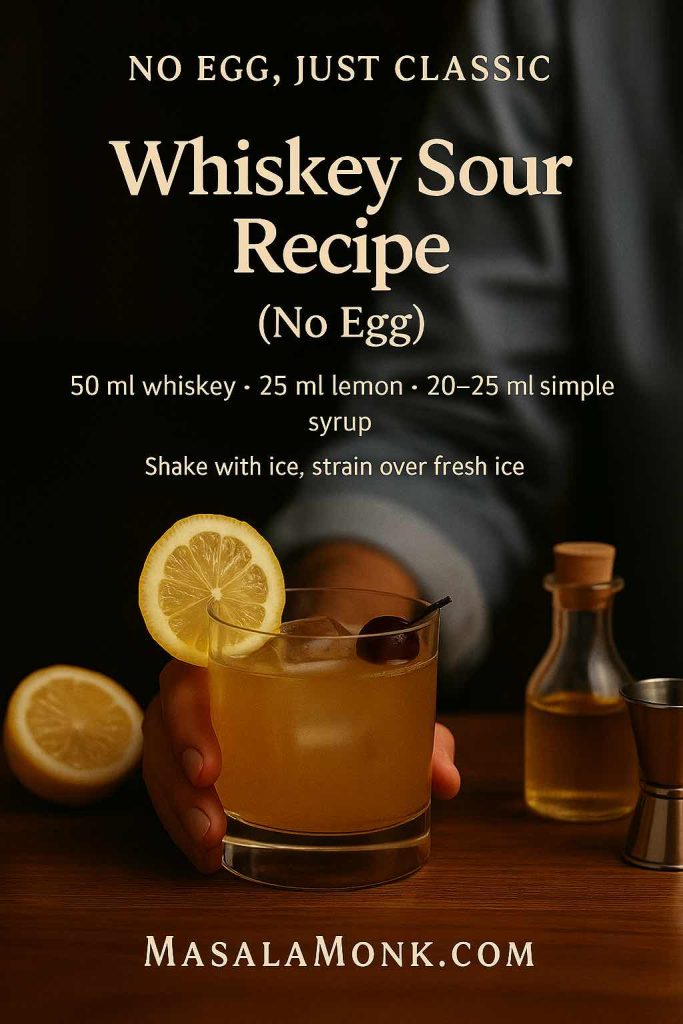
Recipe card image for a classic whiskey sour without egg, showing a rocks glass with lemon and cherry garnish held by a bartender, with text listing 50 ml whiskey, 25 ml lemon and 20–25 ml simple syrup.
No egg, just classic – this Whiskey Sour Recipe (No Egg) keeps it simple with 50 ml whiskey, 25 ml lemon and 20–25 ml simple syrup, shaken with ice and strained over fresh ice for MasalaMonk.com.

You’ll see plenty of variations on the phrase—whiskey sour ingredients no egg, whiskey sour ingredients without egg, whisky sour no egg, whisky sour recipe no egg, whisky sour without egg—but they all boil down to the same thing: a classic, foam-free sour that puts the citrus and whiskey front and centre.

If you still want that foamy look but don’t want to use egg, some bartenders use aquafaba (the liquid from a can of chickpeas) as a vegan substitute. The technique is the same: dry shake first, then shake with ice.

Also read: Béchamel Sauce for Lasagna: Classic, Vegan & Ricotta Sauce Recipe


Whiskey Sour with Sour Mix: Shortcuts That Still Taste Great

Sometimes you’re making one perfect drink for yourself. Other times you’re in full host mode and squeezing lemons for ten people feels like too much. That’s where whiskey sour mix comes in handy.

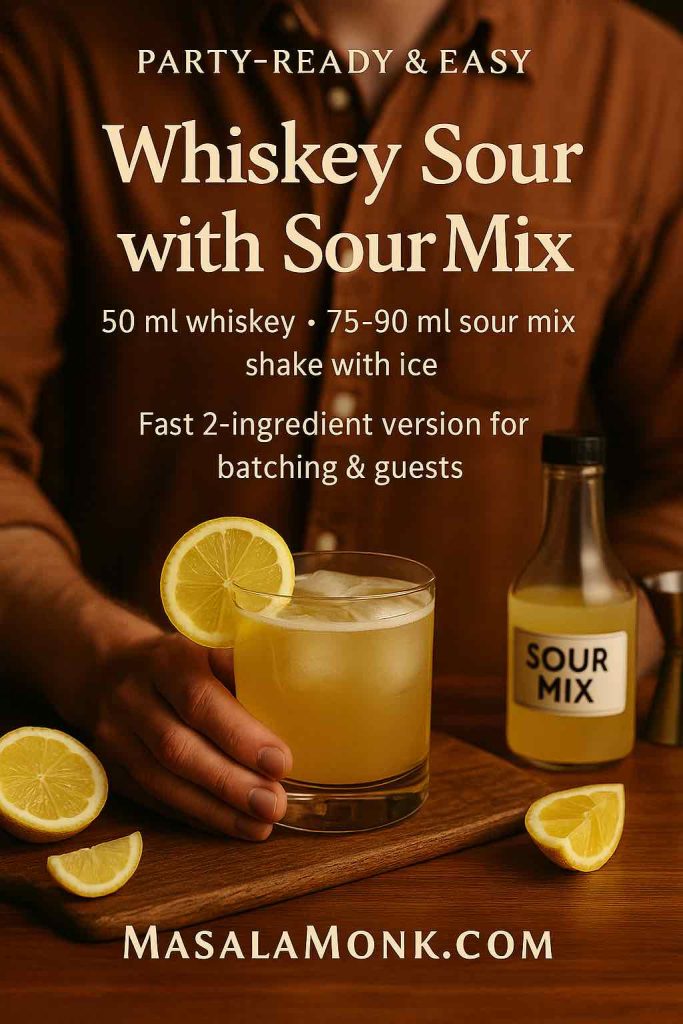
Recipe card image showing a whiskey sour with sour mix in a rocks glass garnished with lemon, held by a person in a casual shirt with a labeled sour mix bottle beside it and text listing 50 ml whiskey and 75–90 ml sour mix.
Party-ready Whiskey Sour with Sour Mix – a fast 2-ingredient recipe card for batching: 50 ml whiskey, 75–90 ml sour mix, shake with ice and serve, created for MasalaMonk.com.

Using Bottled Mix

For a quick-and-easy whiskey sour with sour mix, try:

  • 50 ml (1¾ oz) whiskey
  • 75–90 ml (2½–3 oz) commercial sour mix

Shake with ice, strain over fresh ice, garnish. That’s your classic shortcut for a whiskey sour drink mix–based serve.

You might also see this loosely described as:

  • Whiskey and sour mix
  • Sour mix and whiskey
  • Whisky sour with sour mix
  • Whiskey sour with sweet and sour mix

If you’re already using sour mix for shots and party drinks, you can keep the same bottle on hand for sours. For instance, if you enjoy the Green Tea Shot with Jameson from Masala Monk—Jameson, peach schnapps, sour mix—that same mix gives you a fast route to a Jameson whiskey sour–style drink in a pinch.

Homemade Whiskey Sour Mix Recipe

For better flavour and more control, it’s worth making your own homemade whiskey sour mix. A simple version:

  • 1 part fresh lemon juice
  • 1 part fresh lime juice (optional but bright)
  • 1 part sugar (stirred into the juice or turned into syrup)

Combine, chill, and you’ve got a versatile lemon sour recipe drink base that works for:

  • Classic whiskey sweet and sour highballs
  • Batch whiskey sour recipe with sour mix pitchers
  • Other sour-style cocktails and even tea-based drinks

Masala Monk’s love affair with tea and whiskey shows up in posts like their cinnamon-spiced iced tea whiskey cocktails and saffron iced tea cocktails, and a homemade sour mix slots perfectly into that style of mixing.

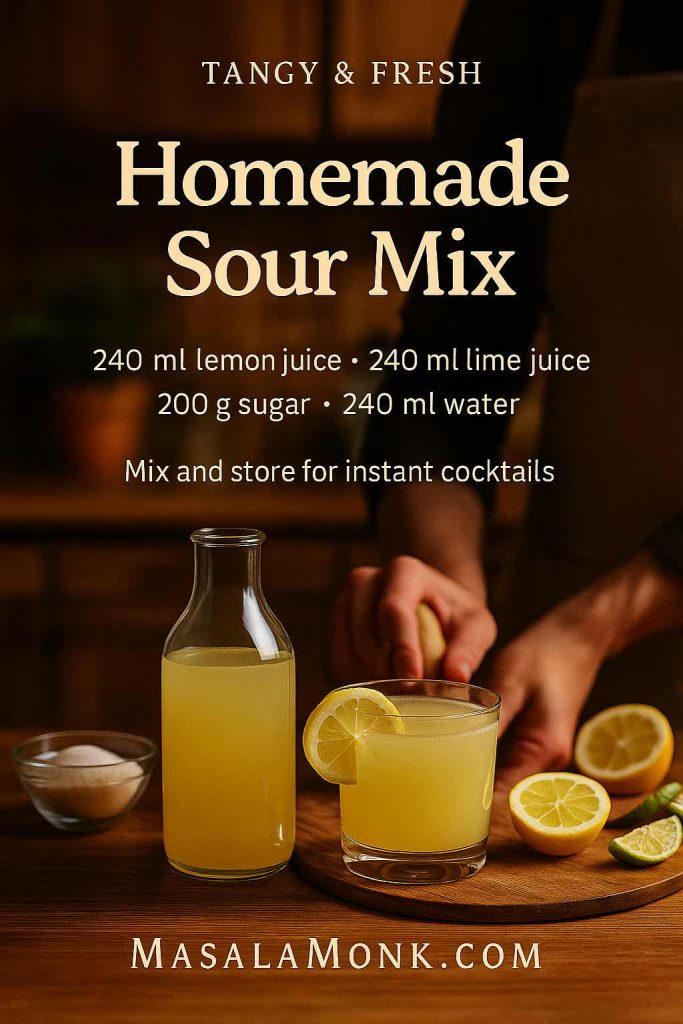
Homemade sour mix recipe card showing a glass bottle and glass of yellow citrus mix on a wooden counter with lemons and limes, plus text listing lemon juice, lime juice, sugar and water for MasalaMonk
Tangy & fresh Homemade Sour Mix – lemon juice, lime juice, sugar and water mixed and bottled so your next round of whiskey sours on MasalaMonk.com is always just a shake away.

Once your mix is ready, you can use roughly 50 ml whiskey to 75–90 ml of your sour blend for a fast, consistent drink. It may not be as precise as the single-serve whiskey sour from scratch, but it’s very party-friendly.

Also Read: Crock Pot Lasagna Soup (Easy Base + Cozy Slow-Cooker Recipes)


Best Whiskey for Whiskey Sour: Choosing the Right Bottle

Talk to ten bartenders about the best whiskey for whiskey sour recipe, and you’ll get at least twelve opinions. That said, a few patterns show up again and again.

Bourbon

Bourbon is the classic choice for a bourbon whiskey sour or bourbon sour:

  • Naturally sweeter, with vanilla, caramel, and baking-spice notes
  • Often feels rounder and softer with lemon juice
  • Plays nicely with a wide range of sweeteners, from simple syrup to maple

When you’re browsing the shelf, look for a bottle you’d happily sip neat but don’t mind mixing. If you’ve already been experimenting with ideas from “what to mix with Jim Beam” style articles—including highballs, long drinks, and sours—that same Jim Beam or similar bourbon will make a very solid good whiskey for whiskey sour.

Rye

Rye brings more spine to the party. A rye whiskey sour:

  • Tastes drier and spicier
  • Leans into pepper and baking spice notes
  • Works beautifully if you don’t like your cocktails overly sweet

If you already enjoy Manhattan-style drinks, a rye-based sour might feel like the perfect bridge between sharp and refreshing.

Irish Whiskey

For something lighter, Irish whiskey is tailor-made for a whiskey and lemon combination. A Jameson sour or Jameson whiskey sour tends to be:

  • Smooth and approachable
  • Slightly grassy or cereal-like in a pleasant way
  • Great for people who say they “don’t really like whiskey” but enjoy balanced cocktails

In fact, if you’ve made the Green Tea Shot mentioned earlier, you already know how friendly Jameson is with sour mix and citrus.

Scotch & Beyond

Scotch in a sour can be a little more polarizing, yet a good scotch sour drink or scotch sour cocktail can be lovely:

  • Blended scotch gives you malt, honey, and a gentle smokiness
  • Some peated whiskies add a smoky surprise to the lemon

The same logic applies when you’re playing with other recipes on Masala Monk that feature bourbon or rye—like the cinnamon Old Fashioned–style cocktails or cinnamon-spiced iced tea highballs. If a whiskey works there, it will probably work in a sour too.

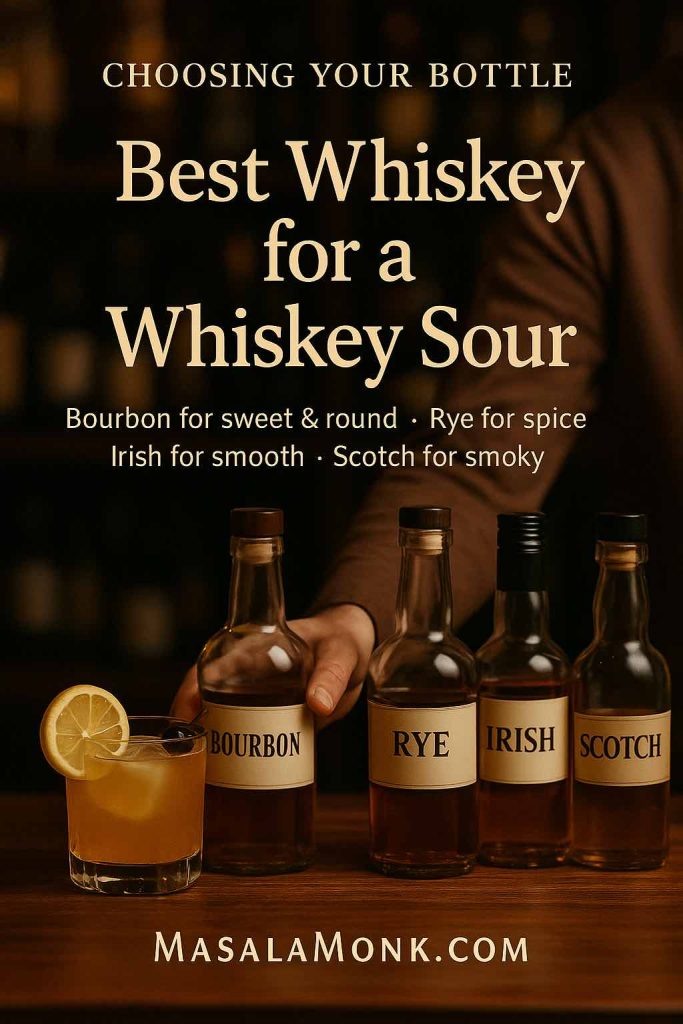
Best whiskey for a whiskey sour recipe card showing a classic whiskey sour in front of four bottles labeled bourbon, rye, Irish and Scotch with a bartender’s hand choosing a bottle.
Choosing your bottle – bourbon for sweet and round, rye for spice, Irish for smooth and Scotch for smoky, all ready to turn into your perfect whiskey sour on MasalaMonk.com.

So What’s “Best”?

When people ask for:

  • Best whiskey for whiskey sour
  • Best whiskey for sour
  • Best whisky for a whisky sour
  • Whisky sour best whisky

…they’re usually looking for reassurance more than a single magical brand. As a guideline:

Choose a whiskey you’d drink on the rocks, with enough character to stand up to lemon and sugar, but not so precious that you feel guilty shaking it.

That’s your sweet spot.

Also Read: Cottage Cheese Lasagna Recipe | Chicken, Spinach, & Ricotta


Whiskey Sour Variations You’ll Want to Try

Once you’ve locked in your house whiskey sour recipe, you can start branching out. The sour template is incredibly flexible, so experimenting is half the fun.

New York Sour

The New York sour (sometimes called a Continental Sour) is a classic variation that adds a red wine float on top of a standard whiskey sour.

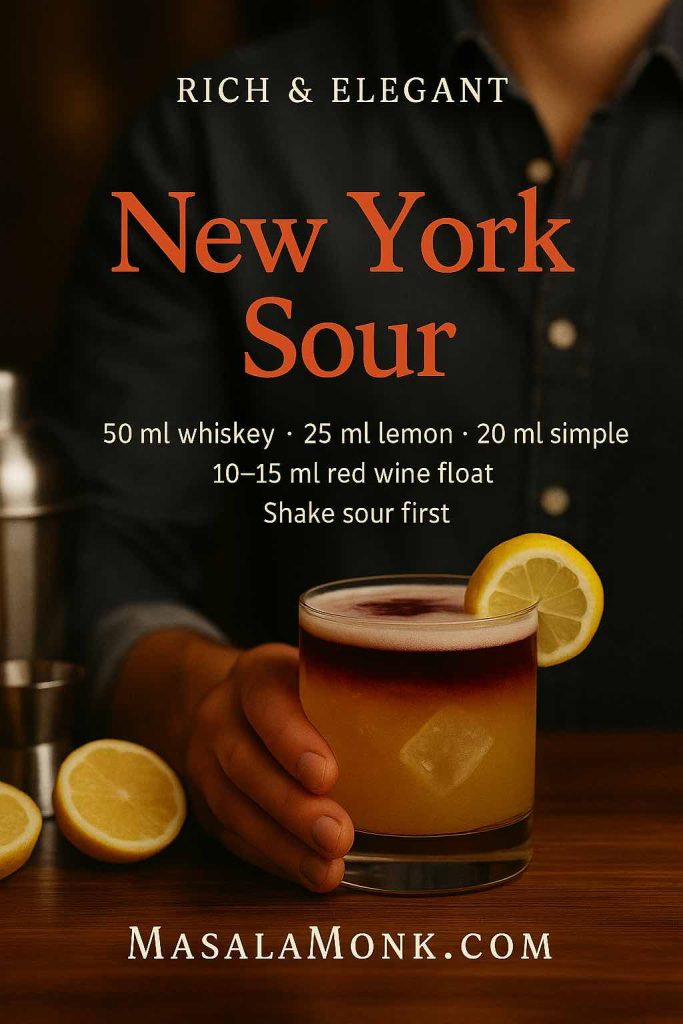
New York Sour cocktail recipe card showing a layered whiskey sour with red wine float in a rocks glass, held by a person in a denim shirt, with text listing 50 ml whiskey, 25 ml lemon, 20 ml simple syrup and 10–15 ml red wine.
Rich & elegant New York Sour – a whiskey sour shaken first, then finished with a red wine float for bar-quality layers, as featured in the MasalaMonk.com whiskey sour guide.

To make one:

  1. Shake your usual sour—either with or without egg white.
  2. Strain into a rocks glass over ice.
  3. Gently pour 10–15 ml (½ oz) of dry red wine over the back of a spoon so it floats on the surface.

The result is a layered drink with a deep purple cap and a fruity, winey aroma. It’s the answer to anyone looking for a New York sour drink or a more dramatic whiskey sour cocktail for dinner parties.

If you’d like a step-by-step benchmark, you can peek at Liquor.com’s New York Sour cocktail recipe, then tweak it to taste at home.

Maple, Nutmeg & Dessert-Like Sours

For colder evenings, swapping simple syrup for maple syrup gives you an instant maple whiskey sour. Add a dusting of nutmeg and perhaps a splash of bitters, and you’re in dessert territory.

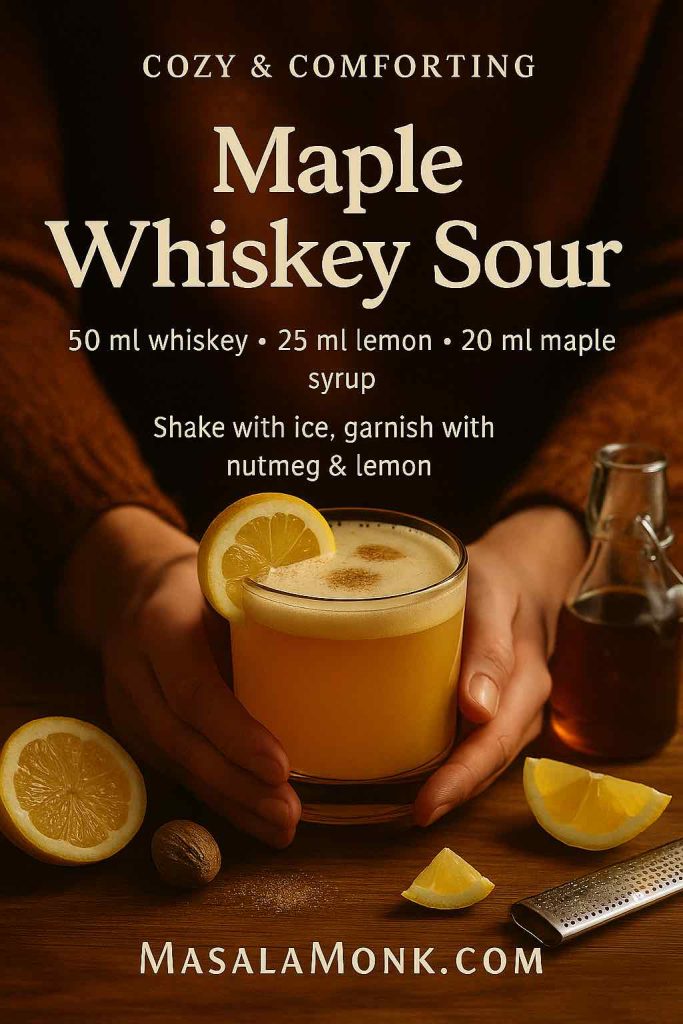
Cozy maple whiskey sour recipe card showing a golden whiskey sour in a rocks glass held by hands in a warm sweater, with lemon wedges, nutmeg, maple syrup bottle and text listing 50 ml whiskey, 25 ml lemon and 20 ml maple syrup.
Cozy & comforting Maple Whiskey Sour – 50 ml whiskey, 25 ml lemon and 20 ml maple syrup, shaken with ice and finished with lemon and freshly grated nutmeg for MasalaMonk.com.

Masala Monk goes even further in their Nutmeg Maple Whiskey Sour, combining whiskey, maple, lemon, and nutmeg into a spiced, wintery twist. That’s a perfect example of how a basic whiskey sour recipe becomes something special with just one or two smart adjustments.

Amaretto & Whiskey Sours

If you enjoy nutty flavours, amaretto is your friend. A few ways to play:

  • Amaretto whiskey sour – Split the base between whiskey and amaretto, then add lemon and a touch of syrup.
  • Amaretto sour with whiskey – Start from an amaretto sour and add a shot of whiskey for depth.
  • Amaretto bourbon sour or bourbon amaretto sour – Bourbon for richness, amaretto for almond sweetness.
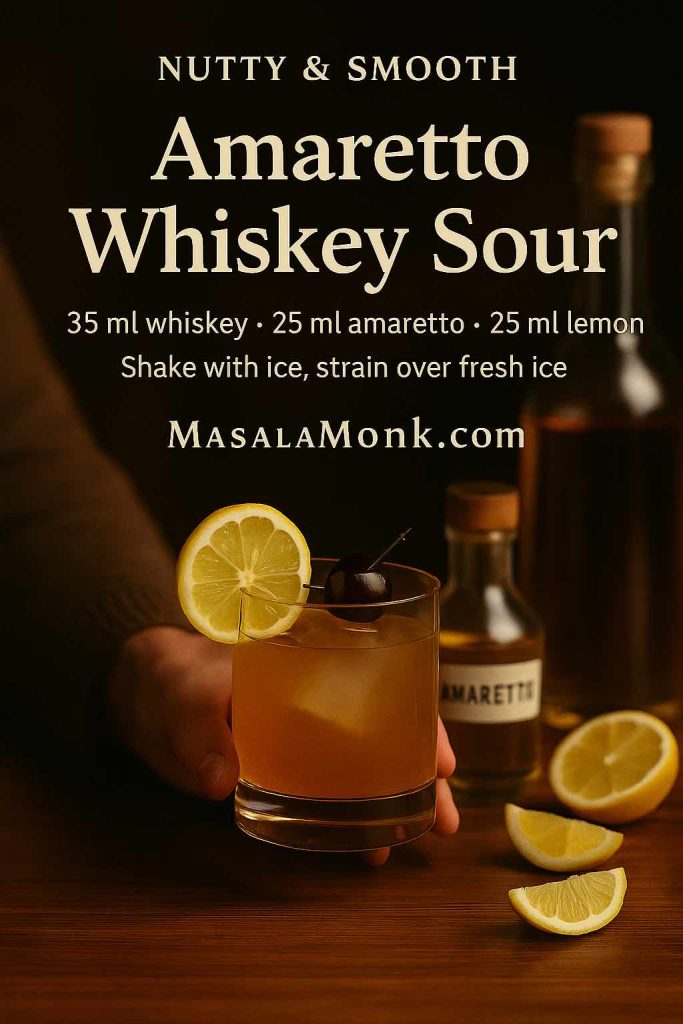
Amaretto Whiskey Sour recipe card showing an amber whiskey and amaretto cocktail in a rocks glass with lemon wheel and cherry garnish, a labeled amaretto bottle in the background and text listing 35 ml whiskey, 25 ml amaretto and 25 ml lemon.
Nutty & smooth Amaretto Whiskey Sour – 35 ml whiskey, 25 ml amaretto and 25 ml lemon, shaken with ice and strained over fresh ice for a dessert-like twist in the MasalaMonk.com whiskey sour guide.

You’ll find similar pairing ideas in Masala Monk’s piece on what mixes well with Baileys, where creamy liqueurs, nutty spirits, and whiskey frequently share the same glass. Once you see how well those flavours work together, folding amaretto into your whiskey sour feels very natural.

Fruity Whiskey Sours

Fruit-driven riffs are an easy way to soften the drink and make it more playful:

  • Cranberry whiskey sour or cranberry orange whiskey sour
  • Cranberry whiskey drink with lemon and a bit of sugar
  • Apple whiskey sour, peach whiskey sour, or pineapple whiskey sour
  • Cherry whiskey sour with muddled cherries plus juice

A simple approach is to replace part of the lemon or syrup with a fruit juice or puree, then rebalance to taste. If you already enjoy whiskey cranberry, cranberry and whiskey, or whiskey cranberry juice combos, you’re only a small step away from a full-blown whiskey sour variation.

Tropical-leaning recipes like Masala Monk’s coconut water cocktails show another path: lighter, longer drinks that keep whiskey as a base but weave in coconut, citrus, and sweetness. That approach also plays nicely with sour-style builds.

Tea & Spice Sours

Tea and spices open up a more sophisticated side of the sour template:

  • Brewed black tea or Earl Grey can replace some of the water in your simple syrup or even stand in for part of the lemon.
  • Spiced syrups (cinnamon, clove, star anise) can add warmth without overpowering.

For more inspiration, you can browse Masala Monk’s tea-driven cocktail collections, like their Earl Grey and bourbon iced tea cocktails or the saffron-infused iced tea recipes. Many of those drinks follow the same spirit–citrus–sweet blueprint as a sour, just stretched into a taller, more refreshing format.

Also Read: How to Make Churros (Authentic + Easy Recipe)


Glassware, Garnish, and Little Details

Although the whiskey sour cocktail feels relaxed and unfussy, a few small choices can change how it feels in the hand.

Glassware

Traditionally, a whiskey sour drink is served:

  • In an old fashioned (rocks) glass over ice, or
  • “Up” in a coupe or sour glass, without ice, especially when made with egg white

Serving on the rocks feels more casual and forgiving. Pouring it into stemware, on the other hand, makes it feel like a proper “cocktail-hour” moment, particularly when you’ve shaken in egg white and topped the foam with bitters.

Garnish

You don’t need a garnish for the drink to taste good, yet small touches do a lot:

  • A lemon wheel or twist emphasises the citrus
  • A cherry nods to old-school bar style
  • A few drops of bitters on egg-white foam add aroma and visual flair

From there, you can get playful—an orange twist with a whiskey old fashioned sour spin, a cinnamon stick for a winter variation, or even a sprig of herb for a lighter whiskey and lemon cocktails vibe.


When to Reach for a Whiskey Sour

One of the reasons the whiskey sour cocktail endures is its flexibility. It works in a surprising number of scenarios:

  • As an aperitif, when you want something bright but still spirit-forward
  • As a slow sipper with snacks or fried foods (the lemon cuts through richness)
  • As a bridge drink for people who don’t yet love neat whiskey but enjoy balanced cocktails
  • As a base for dessert-leaning twists alongside coffee, chocolate, or creamy liqueurs

If you’re already dabbling in richer whiskey drinks, like cinnamon-spiked Old Fashioneds or dessert-style combinations from Masala Monk’s cinnamon cocktail round-up or their espresso martini variations, the sour gives you a fresher counterpoint—something that feels lighter on the palate without being lightweight.

Meanwhile, if you’re just getting into cocktails, the whiskey sour recipe is a perfect teacher. It shows you how to balance sweet and sour, how to adjust ratios to your taste, and how a small tweak (maple instead of sugar, or rye instead of bourbon) can create a whole new personality in the glass.

Also Read: How to Cook Bacon in the Oven (Crispy, No-Mess, Crowd-Ready Recipe)


Bringing It All Together

By now, the whiskey sour shouldn’t feel mysterious. It’s just:

  • A spirit you like
  • Fresh lemon juice
  • Enough sweetness to balance
  • Ice and a good shake
  • Optional egg white if you love that silky foam

From that starting point, you can move in any direction you like. Pour in a red wine float and you’ve made a moody New York sour. Stir in maple syrup and nutmeg and suddenly you’re sipping a fireside treat. Reach for amaretto and you get a softer, dessert-like variation. Swap in cranberry juice, pineapple, or peach puree and you’re firmly in fruity-cocktail territory.

And if you ever feel stuck, you can always roam through the broader Masala Monk Cocktails recipe collection and see how often that simple sour logic—spirit, citrus, sweet—shows up in different clothes, from tea cocktails to shaken espresso drinks.

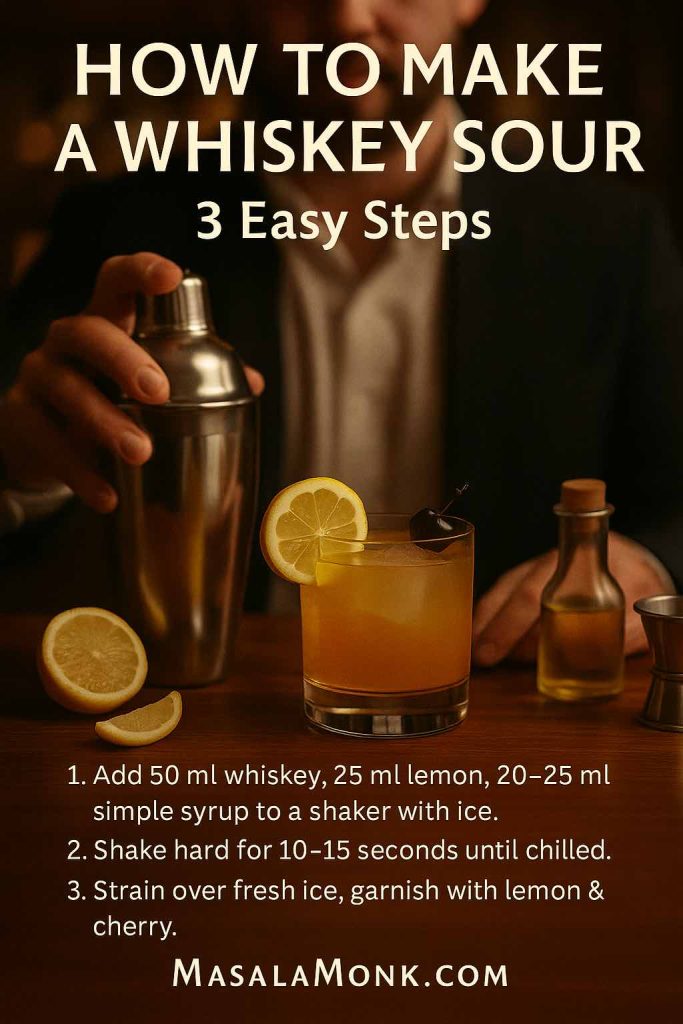
Step-by-step whiskey sour guide showing a bartender holding a cocktail shaker beside a finished whiskey sour with lemon and cherry garnish, with text explaining three easy steps to make the drink
How to make a Whiskey Sour in 3 easy steps – add whiskey, lemon and simple syrup to a shaker with ice, shake hard, then strain over fresh ice and garnish, as shown in this MasalaMonk.com guide image.

Ultimately, learning one reliable whiskey sour recipe does more than just give you a single drink. It hands you a template, a way of thinking about flavour and balance. Once you’ve felt that click—the moment when whiskey, lemon, and sugar line up just right—you’ll start to spot sour-shaped opportunities everywhere you look.

Also Read: 10 Best Chicken Sandwich Recipes (BBQ, Parm, Buffalo & More)

FAQs

1. What is the classic whiskey sour recipe?

The classic whiskey sour recipe follows a very simple pattern: 2 parts whiskey, 1 part fresh lemon juice, and 1 part sweetener. In practice, that usually means about 50 ml whiskey, 25 ml lemon juice, and 20–25 ml simple syrup shaken with ice and strained into a rocks glass. This basic build gives you a traditional whiskey sour that’s bright, balanced, and easy to tweak into your own version of the perfect whiskey sour.


2. What are the whiskey sour ingredients, with and without egg?

To start, the core whiskey sour ingredients are:

  • Whiskey (bourbon, rye, Irish, or Scotch)
  • Fresh lemon juice
  • Simple syrup (or another sweetener)

That’s all you need for a simple whiskey sour. For a whiskey sour with egg white—often called a Boston Sour—you simply add a small amount of egg white and shake twice (once without ice, once with). When you prefer a whiskey sour without egg instead, you just leave that egg white out and still get a clean, refreshing drink. So “whiskey sour ingredients no egg” and “whiskey sour ingredients without egg” are exactly the same as the classic recipe minus the egg white.


3. How do you make a whiskey sour from scratch at home?

To make a whiskey sour from scratch, follow these steps:

  1. Measure 50 ml whiskey, 25 ml fresh lemon juice, and 20–25 ml simple syrup into a shaker with ice.
  2. Shake hard for 10–15 seconds until chilled.
  3. Strain into a rocks glass over fresh ice.
  4. Garnish with a lemon wheel or twist and a cherry.

That simple technique answers most of the common questions—how do you make a whiskey sour, how do you make a whiskey sour drink, how do I make a whisky sour, and even make a whiskey sour for a guest. If you want the silky foam version, you just add egg white and use a dry shake first to turn it into a whiskey sour and egg white style cocktail.


4. What’s the difference between whiskey sour with egg white and whiskey sour no egg?

To begin with, both versions use the same whiskey sour measurements and whiskey sour ratio of spirit, lemon, and sweetener. The only difference is texture. A whiskey sour with egg white (or egg white whisky sour) gets a thick, creamy foam and a rounder mouthfeel. A whiskey sour no egg feels lighter and more sharply citrusy. When you see phrases like whisky sour recipe with egg white or whiskey sour cocktail recipe egg white, that’s pointing to the rich, foamy style; meanwhile, whiskey sour recipe no egg, whisky sour recipe no egg, and whisky sour without egg are all describing the same bright, egg-free drink.


5. Can I make a whiskey sour with sour mix instead of fresh lemon?

Absolutely. For convenience, many people use whiskey sour mix or whiskey sour drink mix. To do that, simply mix about 50 ml whiskey with 75–90 ml sour mix, shake with ice, and strain. That gives you a quick whiskey sour with sour mix which is great for parties. When you’re using pre-bottled mixers, you’ll often hear it called whiskey and sour mix, sour mix and whiskey, or whisky sour with sour mix. If you prefer more control, you can prepare a homemade sour mix for whiskey sours with fresh lemon, lime, and sugar, which tastes brighter than most store-bought options and can become your own best whiskey sour mix or best sour mix for whiskey sour.


6. How do I make a whiskey sour with sweet and sour mix?

Instead of separate lemon and syrup, you can reach for sweet and sour mix with whiskey for a streamlined approach. All you need to do is combine around 1 part whiskey to 2 parts sweet and sour mix, shake with ice, and strain. This is often called a whiskey sour with sweet and sour mix, and informally people might just say whiskey and sweet and sour. Although fresh citrus and simple syrup give more nuance, this method is handy when you want to mix several drinks quickly and still stay within the classic cocktail whiskey sour recipe family.


7. What is the best whiskey for a whiskey sour?

When choosing the best whiskey for whiskey sour, think more about flavour than price. Generally, bourbon makes a round, approachable bourbon sour or bourbon whiskey sour with vanilla and caramel notes, while rye creates a spicier, drier whiskey sour drink. Irish whiskey yields a soft, friendly Irish whiskey sour, and Scotch gives you a more adventurous scotch sour or scotch and sour. As a rule of thumb, the best whiskey to use for a whiskey sour is something you enjoy neat but don’t mind mixing—your personal good whiskey for whiskey sour. For many drinkers, that becomes “their” best whiskey sour recipe and the bottle they return to whenever they want a reliable good whiskey sour.


8. How strong is a whiskey sour, and what ratio should I use?

In terms of strength, a standard whiskey sour recipe ml (50 ml whiskey, 25 ml lemon, 20–25 ml syrup) ends up around the same alcohol level as many classic cocktails once diluted with ice. The typical whiskey sour ratio is roughly 2:1:1 (two parts whiskey, one part citrus, one part sweet). You can tweak that if you like it more tart or more sweet, yet this simple ratio is widely used for a classic whiskey sour recipe and keeps the balance predictable. So whenever you see “original whiskey sour recipe” or “traditional whiskey sour,” this kind of proportion is usually what sits behind it.


9. Can I make a whiskey sour without simple syrup or with other sweeteners?

Certainly. While simple syrup is the most common choice, a whiskey sour without simple syrup is still possible. You can dissolve sugar directly into the lemon juice before shaking or use alternatives like honey syrup or maple syrup. For instance, a maple whiskey sour swaps simple syrup for maple, while a whiskey sour with maple syrup leans into a richer, dessert-like profile. Likewise, honey syrup produces a honey lemon whiskey sour that feels soothing and aromatic. As long as you keep the sweet-and-sour balance in line, the cocktail remains recognisably a whiskey sour cocktail even with different sweeteners.


10. Are canned or premade whiskey sours worth trying?

Many brands now offer whiskey sour in a can or bottle so you can simply chill, pour, and enjoy. These premade whiskey sour options are convenient for picnics, travel, or times when you don’t want to measure anything. Although they can’t always match the freshness of a whiskey sour from scratch, they’re a practical alternative when shaking isn’t possible. If you enjoy the flavour, you can later reverse-engineer it at home by adjusting your own whiskey sour recipe—changing the sweetness or citrus level until your homemade version becomes “the best whiskey sour recipe” for your taste.


11. Can I add extra flavours like grenadine, lime, or lemonade to a whiskey sour?

Yes, absolutely; once you understand the base, adding flavours becomes very natural. A whiskey sour with grenadine gets a rosy colour and extra pomegranate sweetness. A whiskey sour with lime adds sharper, more zesty acidity—either alongside lemon or in place of it. For a longer, more casual drink, a whiskey sour with lemonade stretches the cocktail into a refreshing highball. All these variations still sit in the same family as the original whiskey sour, just dressed up to suit your mood or the season.


12. How do I turn a good whiskey sour into my “perfect” whiskey sour?

Ultimately, the perfect whiskey sour is personal. Start with the classic whiskey sour recipe—50 ml whiskey, 25 ml lemon, 20–25 ml simple syrup—then adjust one element at a time. Perhaps you nudge the syrup down for a sharper edge, or increase lemon if you like a very bright whiskey and lemon drink. Maybe you switch from bourbon to rye, or you decide that a foamy whiskey sour with egg is your forever favourite. Gradually, you’ll find your preferred combination of whiskey, ratio, and texture, and that’s when your own traditional whiskey sour recipe quietly becomes “the best whiskey sour recipe” in your house.Thinking