Posted on Leave a comment

Old Fashioned Recipe: Classic Bourbon Cocktail With Bitters and Orange

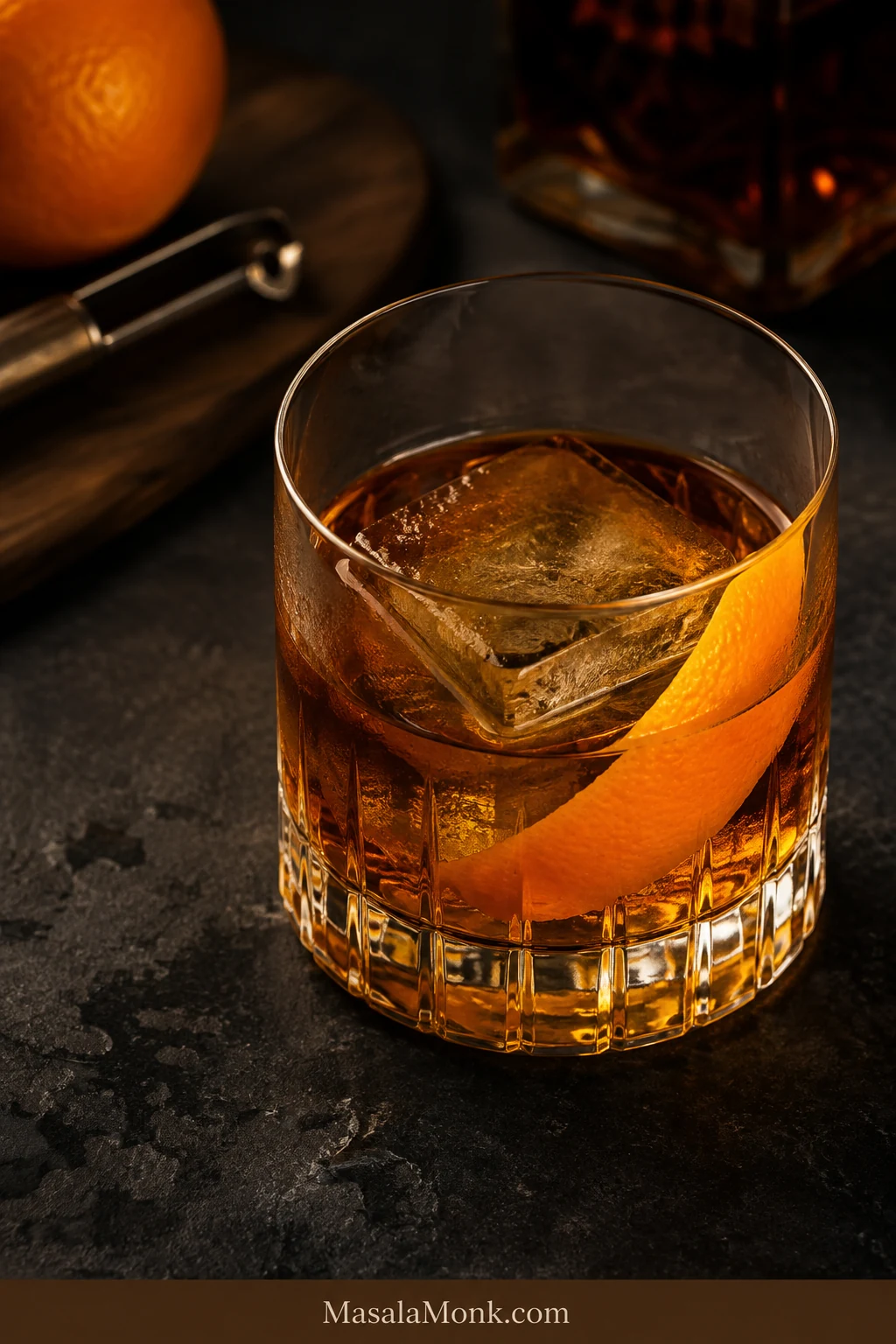
Classic bourbon Old Fashioned in a cut-glass rocks glass with one large ice cube and an orange peel on a dark stone surface.

An Old Fashioned is simple enough to make in minutes—and exposed enough that every decision shows. When the balance is right, bourbon leads with oak, vanilla, caramel, and spice; bitters pull those flavors into focus; orange oil reaches you before the first sip; and just enough water takes away the raw edge without thinning the whiskey.

When it goes wrong, the same short list becomes sweet whiskey over melting ice. Too much syrup buries the bottle; too little stirring leaves it sharp; muddled orange turns a clear, spirit-forward drink into something fruitier. The fix is not more ingredients—just better control of the few already there.

This version starts with bourbon, rich demerara syrup, Angostura bitters, and expressed orange peel. The sweetness stays low enough for the whiskey to lead, with clear routes to a spicier rye drink, a traditional sugar-cube build, or a brighter touch of orange bitters.

Quick Answer: How to Make a Balanced Old Fashioned

  • Whiskey: 2 oz / 60 ml bourbon
  • Sweetener: 1 teaspoon / 5 ml rich 2:1 demerara syrup
  • Bitters: 3 firm dashes Angostura
  • Method: stir with plenty of ice for 20–25 seconds, then strain over a large serving cube or several solid cubes
  • Finish: express a wide orange peel over the drink

Using standard simple syrup or a sugar cube? The exact substitute measurements are in the recipe immediately below.

Keep the balance simple: whiskey first, sweetness second, and orange on the nose rather than orange juice in the glass.

Classic bourbon cocktail

Old Fashioned Recipe

A whiskey-forward Old Fashioned with just enough demerara to round the bourbon, Angostura for spice, and orange oil over the surface. It should taste strong and full, never raw, syrupy, or watery.

Time
5 minutes

Yield
1 cocktail

Glass
8–10 oz / 240–300 ml rocks glass

Method
Stirred and served over fresh ice

Equipment

  • Jigger or small measuring cup
  • Mixing glass or another sturdy glass
  • Bar spoon or long-handled teaspoon
  • Julep, Hawthorne, or small kitchen strainer
  • Vegetable peeler or small sharp knife

Ingredients

  • 2 oz / 60 ml bourbon, preferably around 90–100 proof
  • 1 teaspoon / 5 ml rich 2:1 demerara syrup
  • 3 firm dashes Angostura aromatic bitters
  • Plenty of solid ice for stirring
  • Serving ice: 1 fresh large cube, about 1¾–2 inches / 4.5–5 cm
  • Orange peel: 1 wide strip, freshly cut
  • Cocktail cherry: 1 good cherry, optional

Sweetener Alternatives

Replace the rich demerara syrup with ¼ oz / 7.5 ml standard 1:1 simple syrup. For a traditional build, use 3.5–4 g granulated sugar or one standard sugar cube, plus 1 teaspoon / 5 ml water.

Why 5 ml works: this is deliberately a little drier than some modern builds. One teaspoon of properly made 2:1 syrup provides roughly the sweetness of a standard sugar cube; increase it by ¼ teaspoon at a time when your bourbon or preference calls for more.

Instructions

  1. Measure the drink. Combine the bourbon, rich demerara syrup, and Angostura bitters in a mixing glass.
  2. Add plenty of ice. Fill the mixing glass at least two-thirds full with solid cubes.
  3. Stir until cold and settled. Move the spoon smoothly for about 20–25 seconds. Sample a few drops with a clean teaspoon or straw: the alcohol should no longer feel separate, while the bourbon still leads.
  4. Strain over fresh ice. Place one large fresh cube in a rocks glass and strain the cocktail over it.
  5. Express the orange peel. Hold the peel over the drink with the colored side facing down. Pinch or bend it firmly to release the citrus oils over the surface.
  6. Finish and serve. Run the peel once around the rim, place it in the glass, and add an optional cocktail cherry.

Make this version once before changing it. On the next glass, adjust only one variable—syrup, whiskey, bitters, or stirring time—so you can tell what the change actually did.

Enjoy responsibly, and serve alcohol only to adults of legal drinking age in your location.

Choose Your Build

Start with bourbon, rich demerara syrup, Angostura, serving ice, and orange peel. Then use the options below when your ingredients—or your taste—point somewhere else.
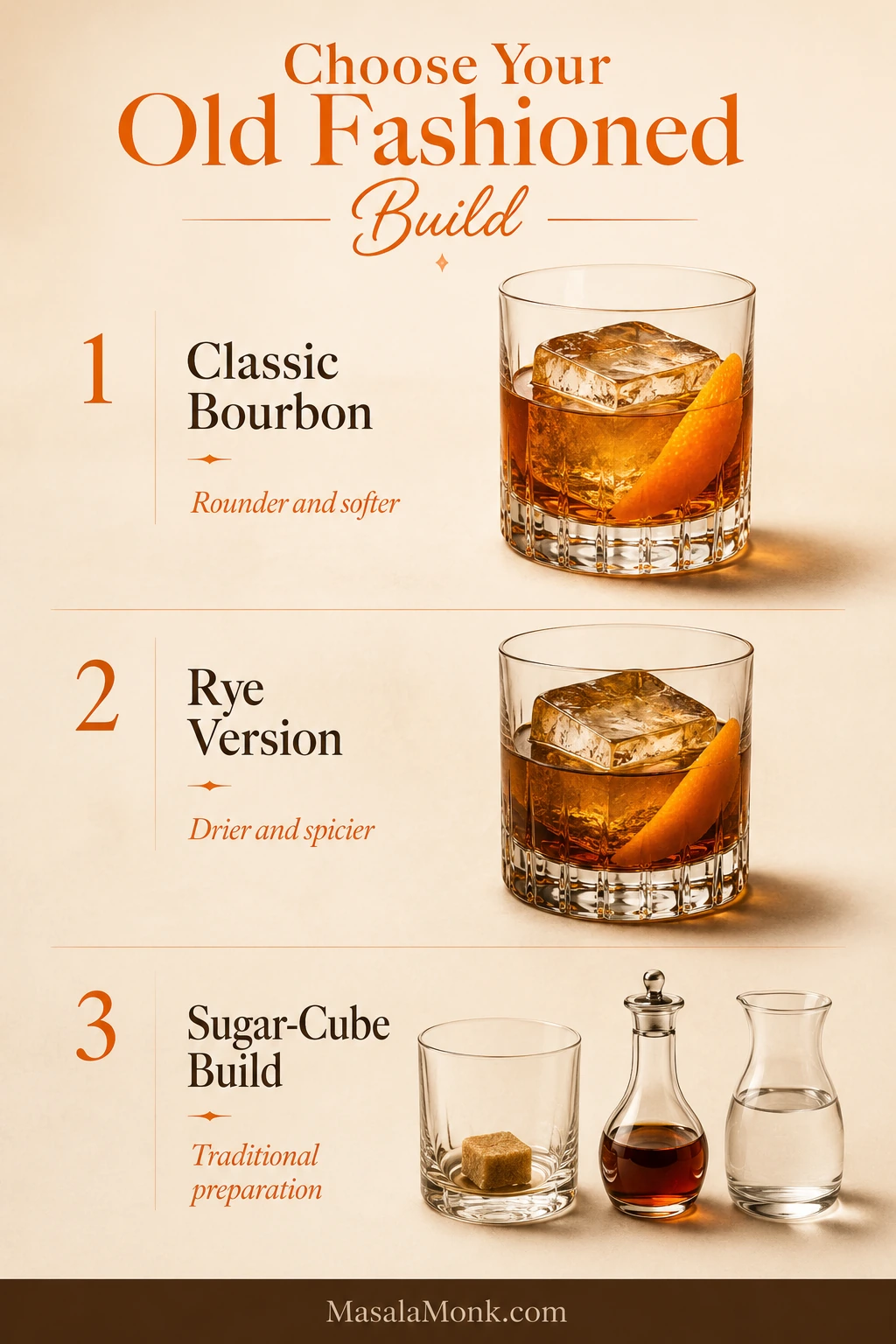
Guide comparing three Old Fashioned builds: classic bourbon, rye whiskey, and a traditional sugar-cube preparation.
To learn your preference, keep the bitters and sweetness steady while changing only the whiskey or build method. That makes bourbon, rye, and sugar-cube differences easier to recognize.
Your goalUse this build
Balanced first Old FashionedBourbon, rich demerara syrup, 3 dashes Angostura, and expressed orange peel.
Drier and spicierReplace bourbon with rye and begin with the same sweetener amount.
Traditional sugar-cube methodDissolve one 3.5–4 g cube with bitters and a teaspoon of water directly in the glass.
Softer and rounderUse an 80–90-proof bourbon, 2 dashes Angostura, and careful dilution.
No mixing glassBuild with syrup directly in the rocks glass and stir over the serving ice.

What Should an Old Fashioned Taste Like?

The finished drink should smell of orange before it tastes of orange. Bourbon should remain the clearest flavor, with bitters adding spice and depth behind it. Sweetness should round the whiskey rather than sit on top of it.

Water is part of the recipe even when it is not poured from a measuring cup. Stirring melts some ice, softening the alcohol and opening the aroma. Too little leaves the drink hot and disconnected; too much makes it thin and faint.

A useful memory cue: orange on the nose, whiskey through the sip, and spice in the finish.
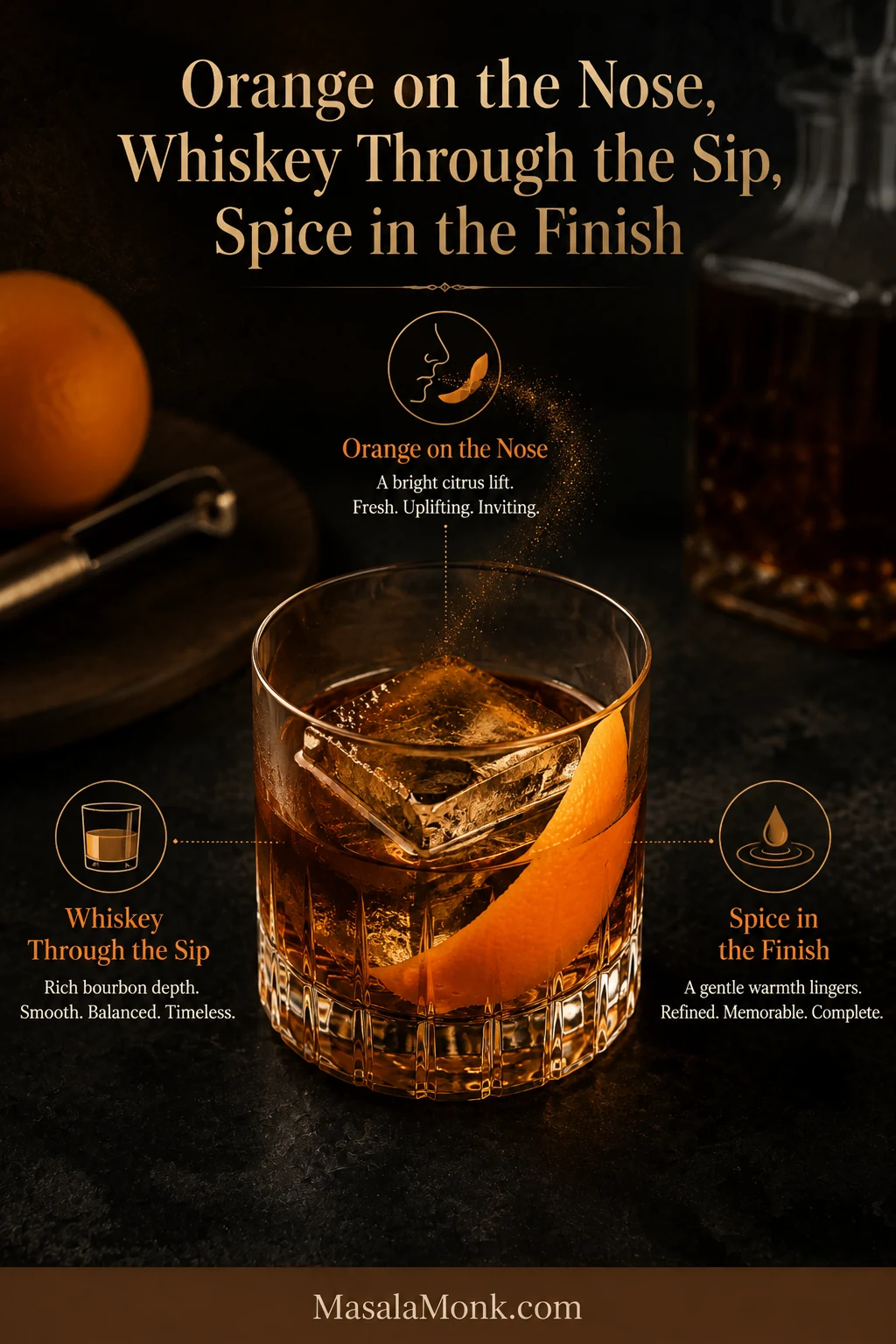
Old Fashioned sensory guide showing orange aroma, a whiskey-led sip, and bitters spice through the finish.
Use this sequence as the fast sensory check: orange on the nose, whiskey through the sip, and spice in the finish. The table below shows where that balance usually slips.
Balanced Old FashionedSomething needs adjusting
Whiskey remains clear from first sip to finishSyrup, fruit, or water takes over
Cold and smooth, but still full-bodiedRaw alcohol burn or watery thinness
Gently sweetSticky, syrupy, or dessert-like
Orange on the noseOrange juice and pulp in the drink
Bitters add spice and shapeMedicinal bitterness dominates

Old Fashioned Ingredients—and What Each One Does

Because there are so few ingredients, every one of them shows. Each controls a different part of the drink: flavor, sweetness, aroma, or dilution.
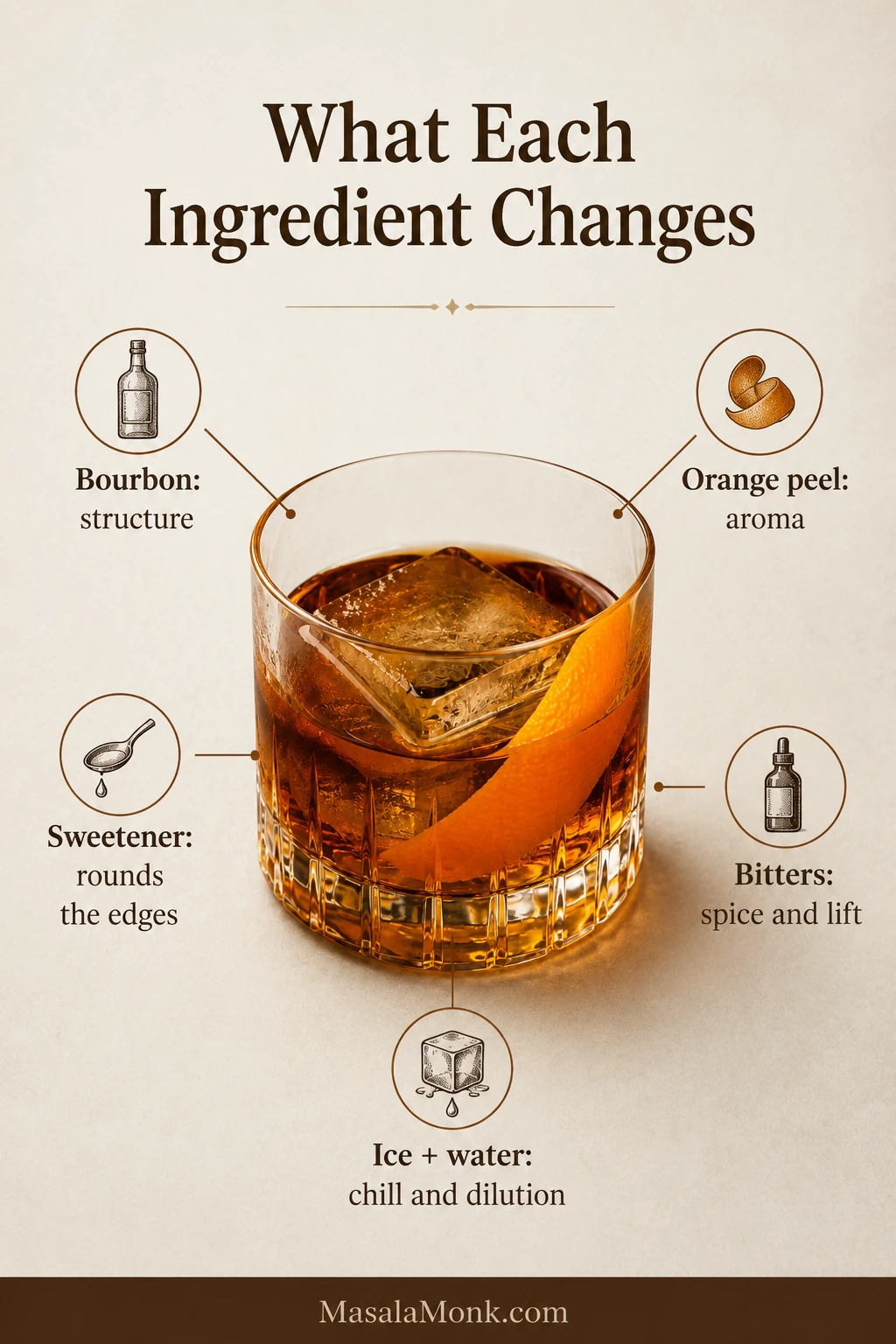
Guide surrounding an Old Fashioned with bourbon, sweetener, bitters, orange peel, and ice-and-water labels explaining each role.
Use this ingredient map as a troubleshooting key: syrup controls sweetness, melted ice controls softness, bitters restore definition, and fresh peel can revive a cocktail that smells dull.
IngredientWhat it controls
Bourbon or ryeThe dominant flavor, body, proof, oak, spice, and overall character.
Sugar or syrupSweetness, texture, and how sharply the alcohol is perceived.
Aromatic bittersSpice and aroma that keep the sweetness from feeling flat.
Water from stirringChilling and softening the alcohol so the whiskey no longer feels hot or separate.
Orange peelCitrus aroma without adding juice or pulp.
Cocktail cherryAn optional dark-fruit accent; it is not required for balance.

Equipment You Need—and What to Use Instead

You need a way to measure, enough clean ice, and a short glass with room for the serving cube.
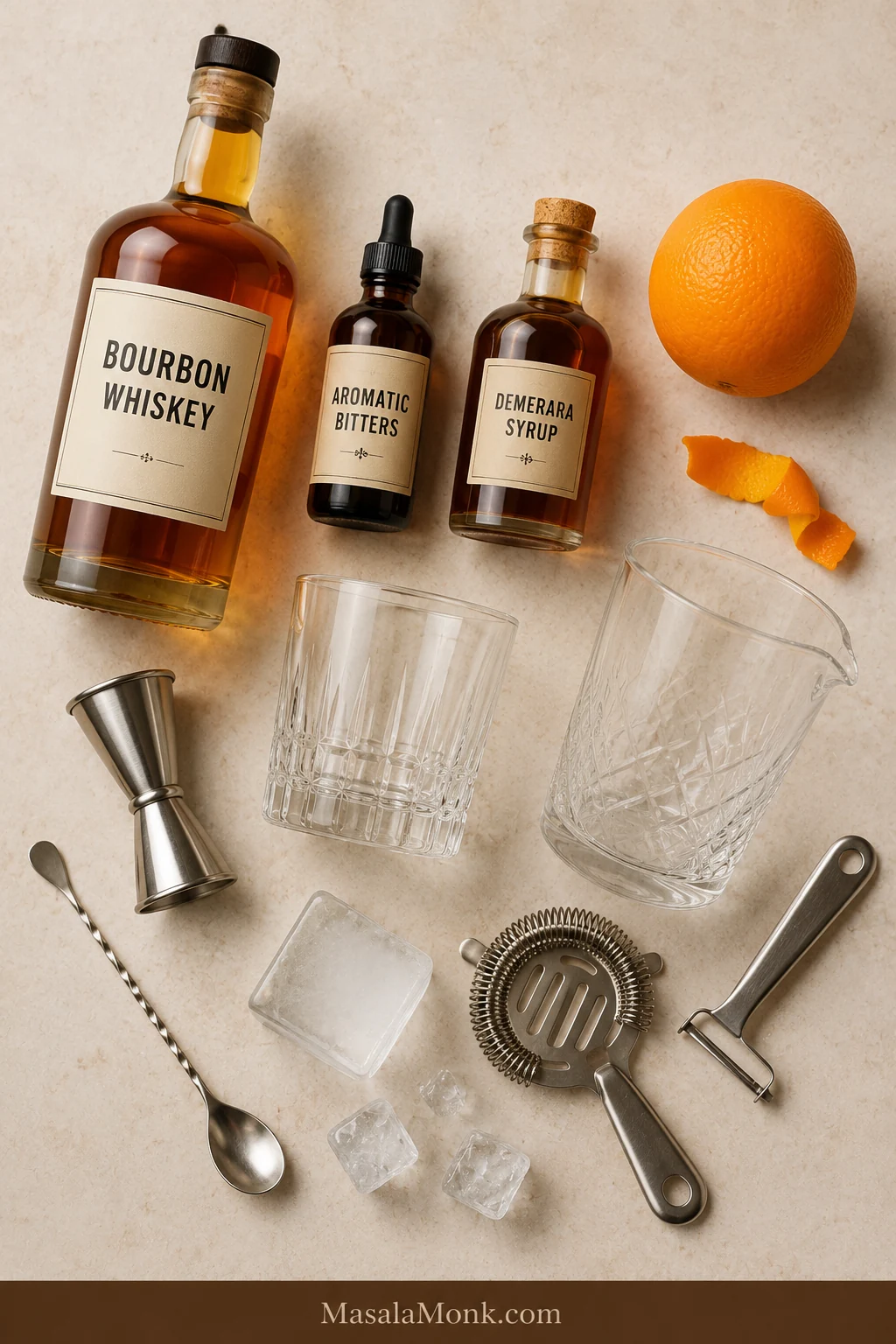
Overhead arrangement of bourbon, aromatic bitters, demerara syrup, orange, ice, rocks glass, mixing glass, jigger, spoon, strainer, and peeler.
The barware can flex, but the measurements should not. A sturdy glass and long spoon work well when bourbon, sweetener, bitters, and ice are handled deliberately.
  • No jigger? Use kitchen measures: 2 oz is about ¼ cup or 4 tablespoons; 1 teaspoon is 5 ml.
  • No mixing glass? Use a sturdy drinking glass, small jug, or the metal half of a cocktail shaker. Stir rather than shake.
  • No bar spoon? A long-handled teaspoon works. Smooth movement matters more than specialist equipment.
  • No large cube? Use two or three large solid cubes. Clean-tasting ice matters more than perfect shape.
  • No demerara sugar? Use white-sugar simple syrup or a properly dissolved sugar cube.

Know your syrup: by weight, rich syrup is two parts sugar to one part water; standard syrup uses equal weights. The same volume does not contain the same amount of sugar.

How to Judge Chilling, Dilution, and Garnish

The ratio gets you close; temperature, dilution, and aroma decide whether the finished drink feels complete.

Measure Carefully and Add Enough Ice

One extra teaspoon of syrup can shift the whole glass. Measure the bourbon and sweetener, use consistent dashes from the same bitters bottle, and fill the mixing glass at least two-thirds full with solid ice.

A sparse handful warms quickly, so the drink may pick up too much water before reaching a deep chill. Ordinary cubes are fine for mixing; save a large clear cube, when available, for serving.
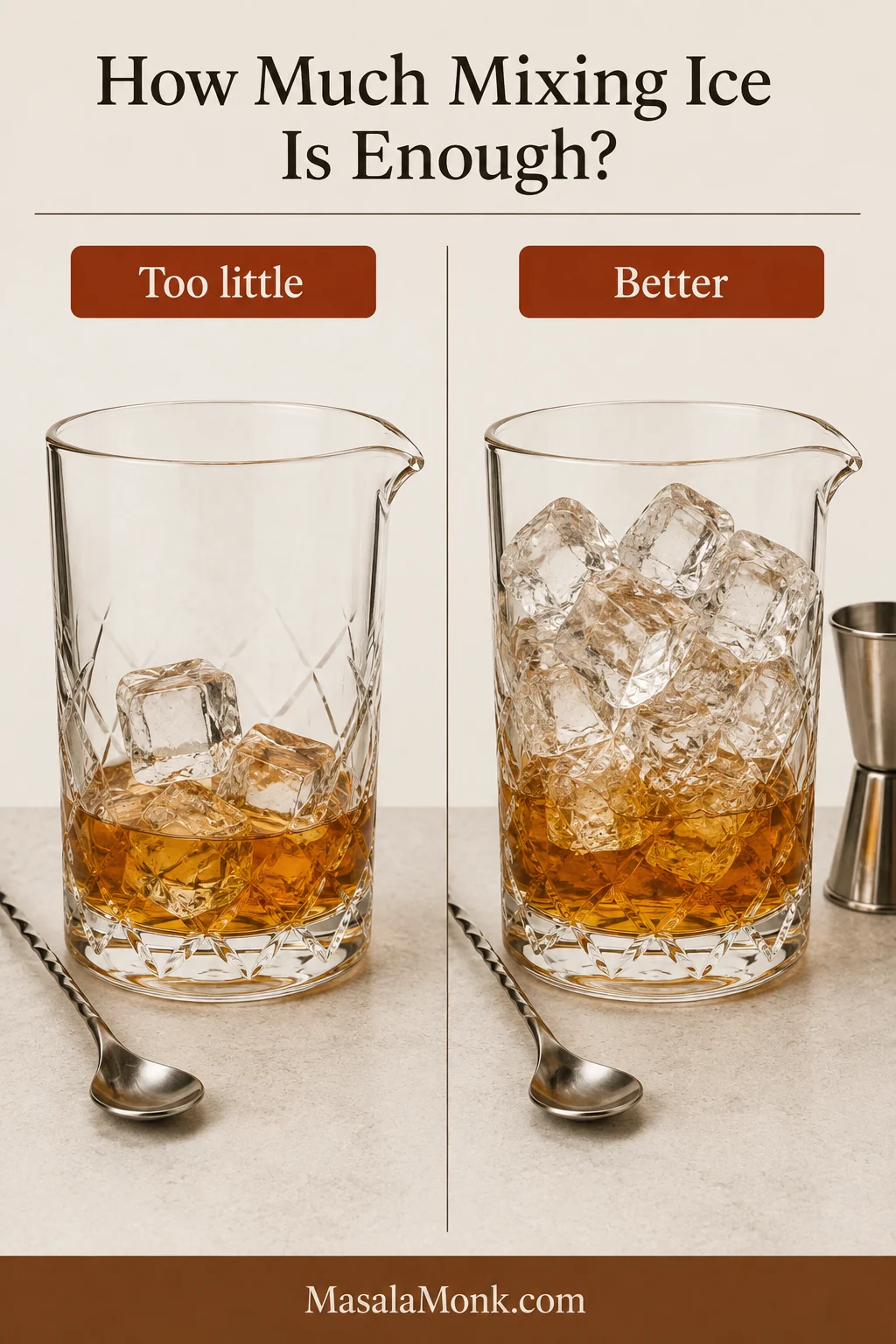
Side-by-side mixing glasses showing a sparse amount of ice and a glass filled generously with ordinary ice cubes.
A fuller mixing glass can produce more controlled dilution, not automatically more water. Plenty of cold, solid ice lowers the temperature before the cubes begin melting rapidly.

Stir for About 20–25 Seconds—Then Taste

Move the spoon smoothly so the ice and liquid rotate together. As the mixture chills, condensation will often begin gathering outside the glass. Stirring also adds water without the aeration or small ice chips created by shaking.
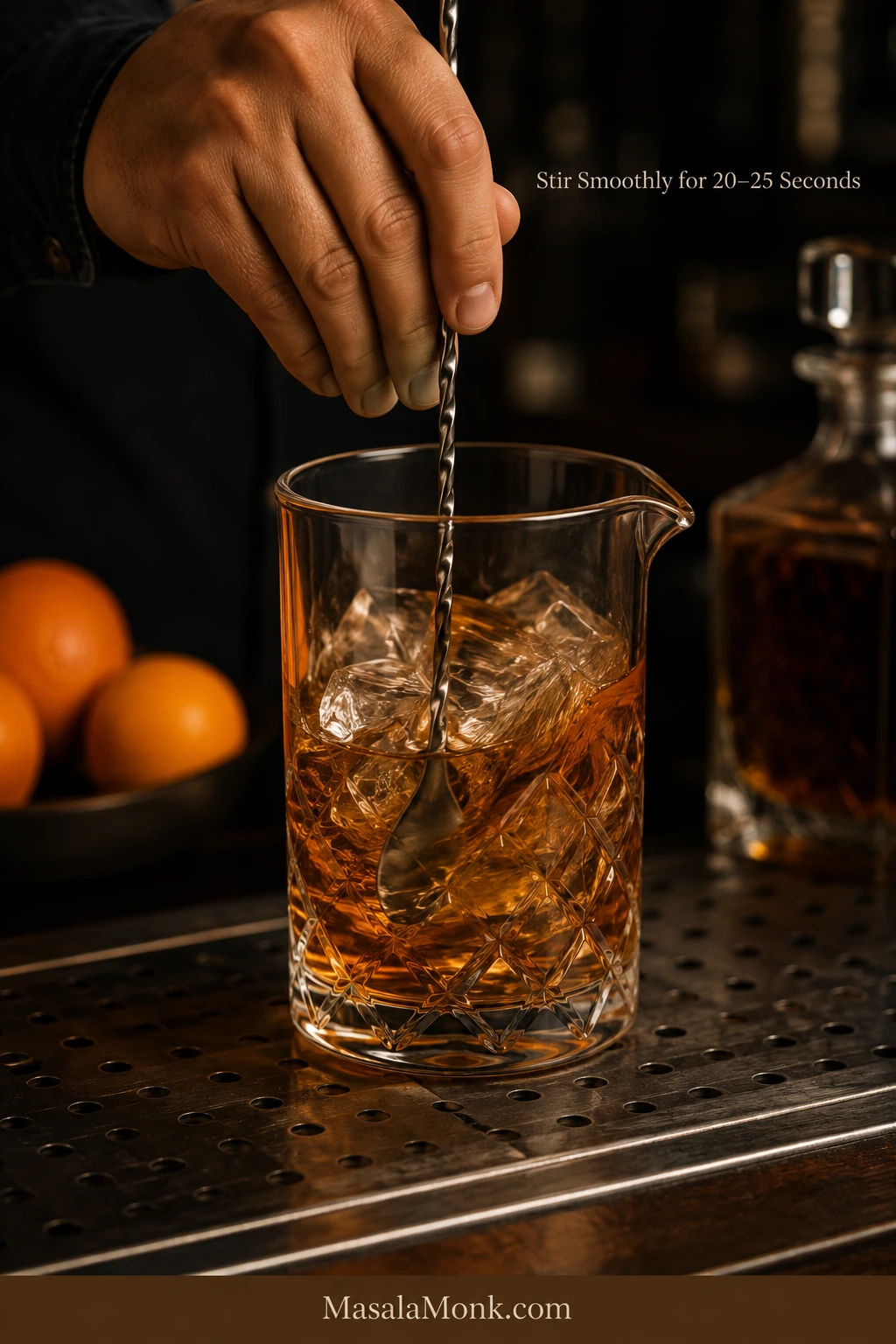
Hand stirring amber whiskey, sweetener, and bitters with ice in a clear mixing glass using a long bar spoon.
When the spoon follows the inside wall, the cubes rotate together instead of being churned. The movement should feel smooth and controlled, with tasting—not speed—deciding the endpoint.

Twenty to twenty-five seconds is a starting window, not a law. Ice size and temperature, room temperature, and whiskey proof all affect the result. Serious Eats explains the mechanics of stirring, chilling, and dilution in more detail.

  • Still hot and separate? Stir for another few seconds.
  • Cold, glossy, and clearly whiskey-led? It is ready.
  • Thin and fading? It has probably gone too far.
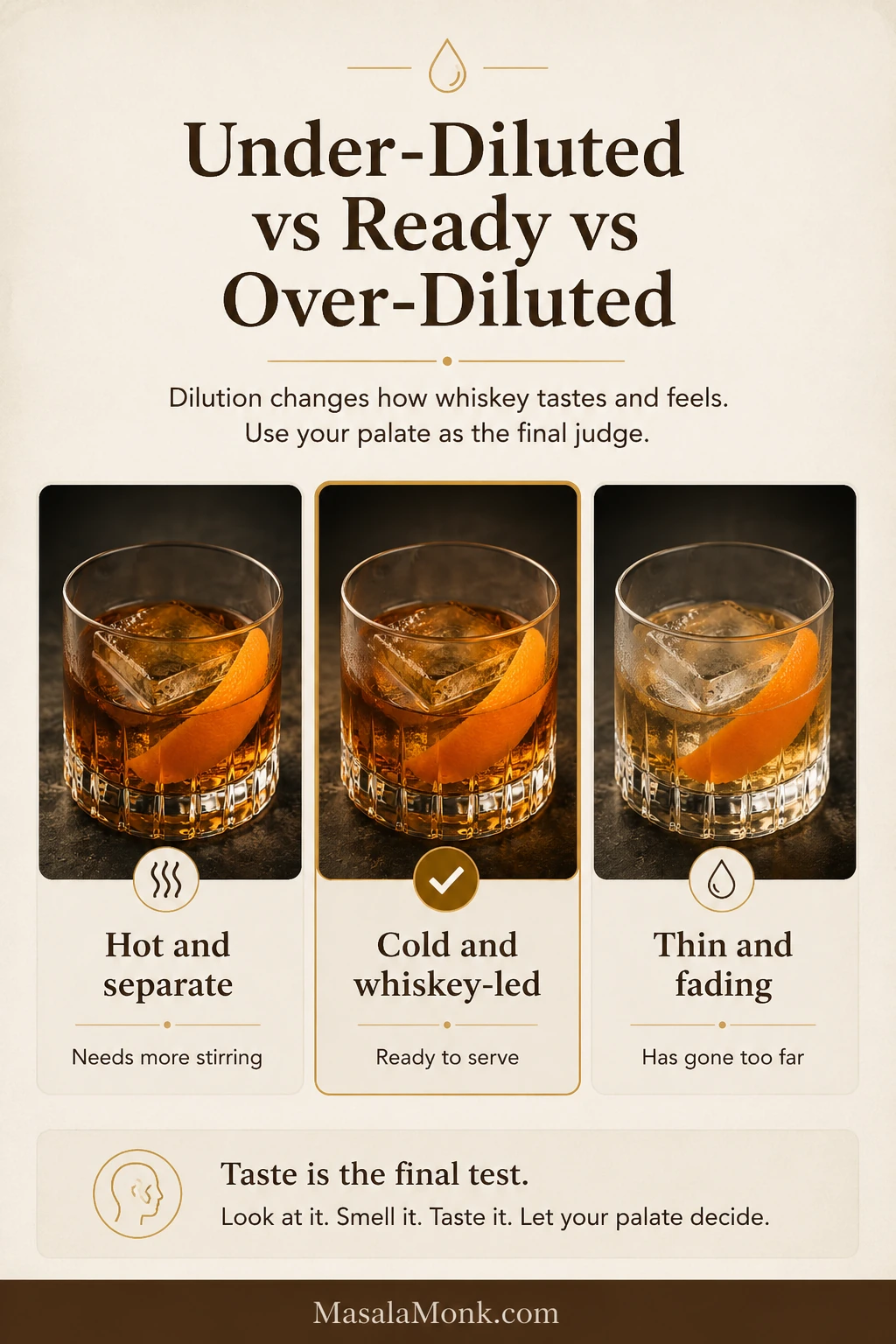
Three Old Fashioned glasses labeled under-diluted, ready, and over-diluted, with tasting cues beneath each state.
Do not judge Old Fashioned dilution by color alone. Taste a small sample before straining; stop when the alcohol feels integrated, the aroma has opened, and the whiskey still has definition.

Strain, Garnish, and Serve

Strain over one 1¾–2-inch cube or two or three large solid cubes. Well-frozen serving ice usually slows warming and further dilution, though temperature, quantity, and time all matter.
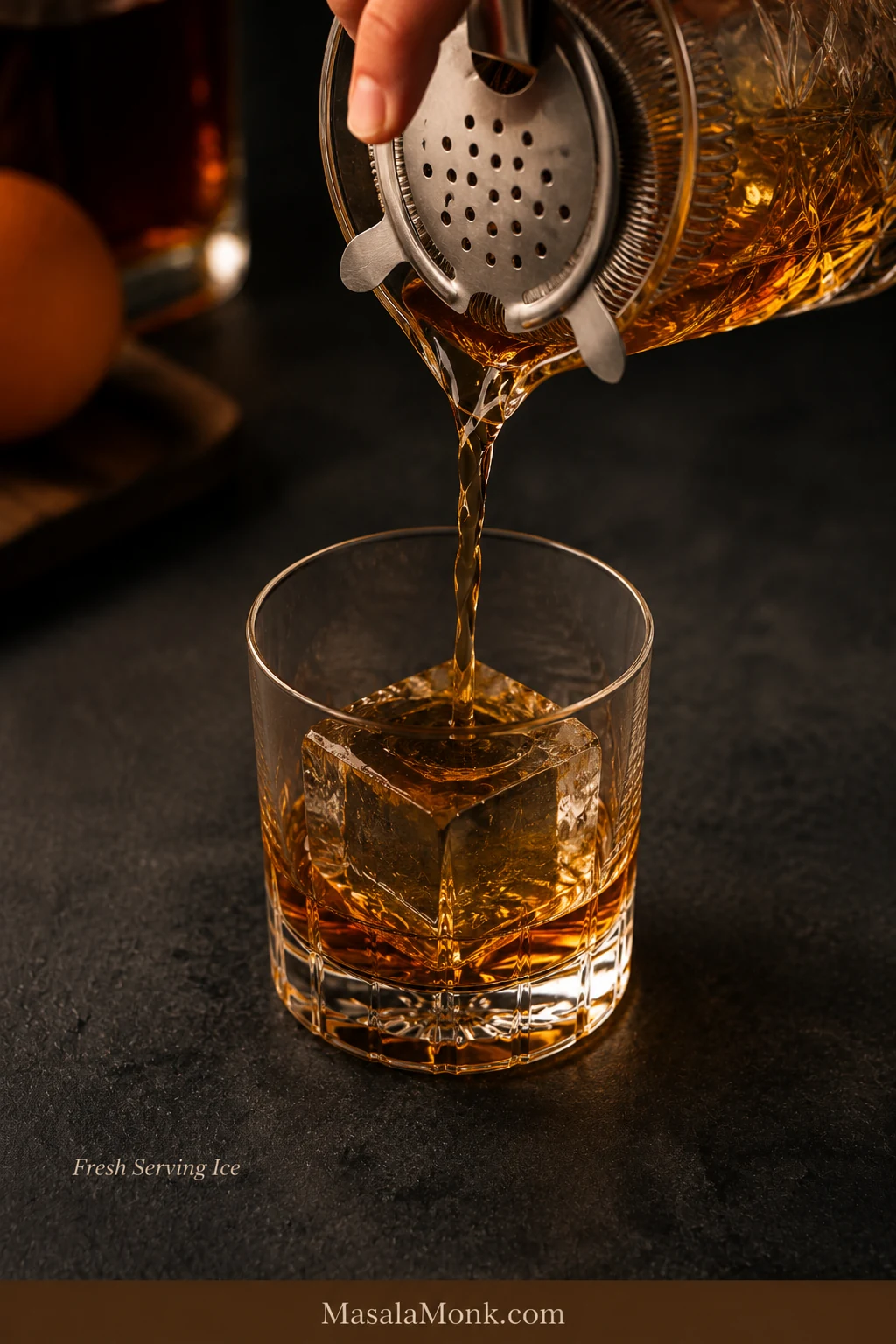
Old Fashioned being strained through a metal strainer into a rocks glass containing one large ice cube.
Fresh serving ice gives the stirred method a cleaner handoff from mixing to drinking. A direct-build Old Fashioned differs because the same ice intentionally handles both jobs.

Wash and dry a navel orange before cutting the peel. Its broad skin is fragrant and easy to handle. Cut a shallow 2–3-inch / 5–7.5 cm strip away from your fingers; a thin layer of white pith is fine, while a thick chunk is harder to bend.
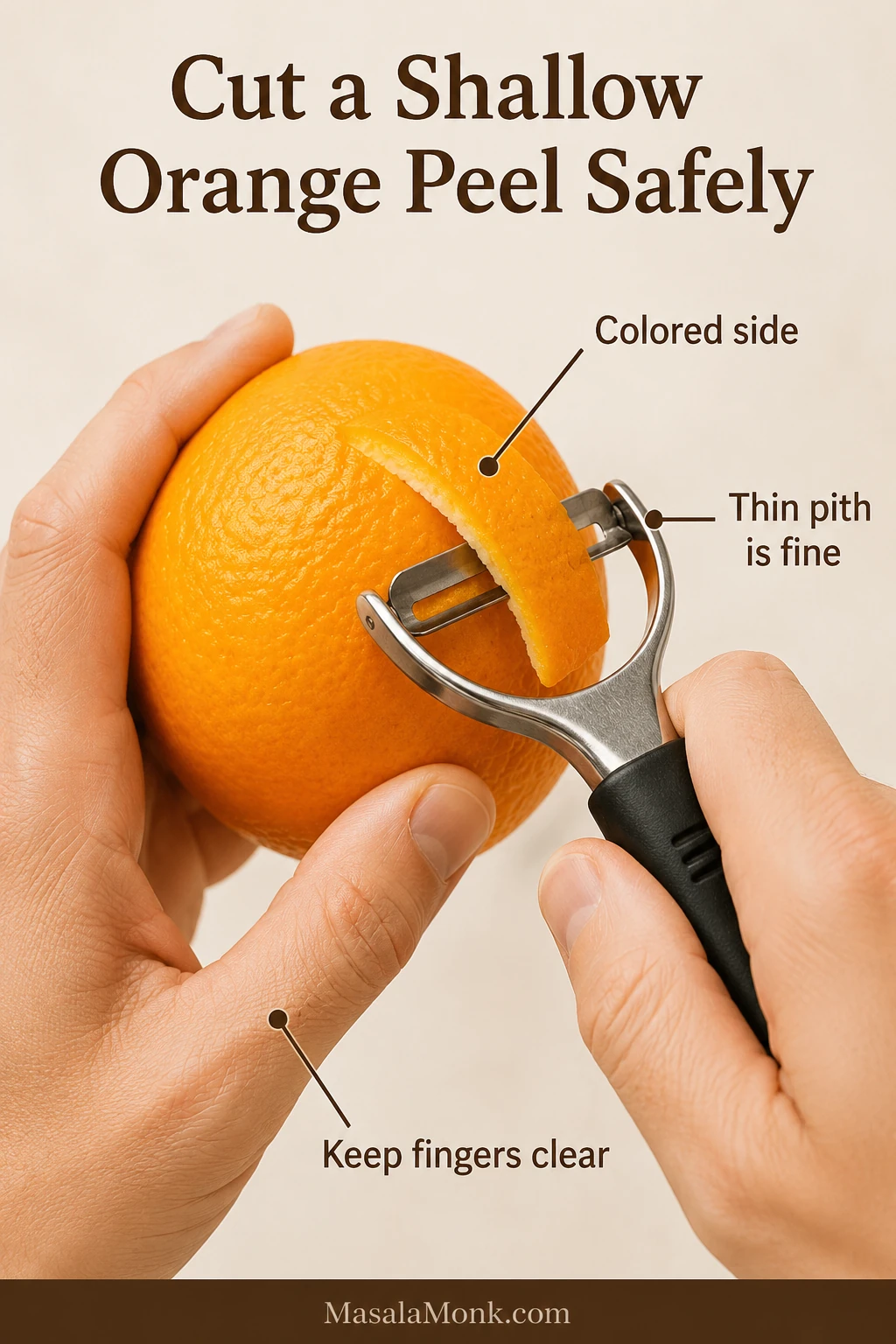
Hands using a Y-peeler to remove a shallow strip of orange peel while keeping the supporting fingers away from the blade.
The best orange peel bends without cracking and carries only a thin layer of pith. A flexible strip is easier to express and safer to handle above the finished cocktail.

Hold the colored side over the drink, pinch it sharply to release the oils, then run it once around the rim. The aroma should be bright, without adding juice or pulp.
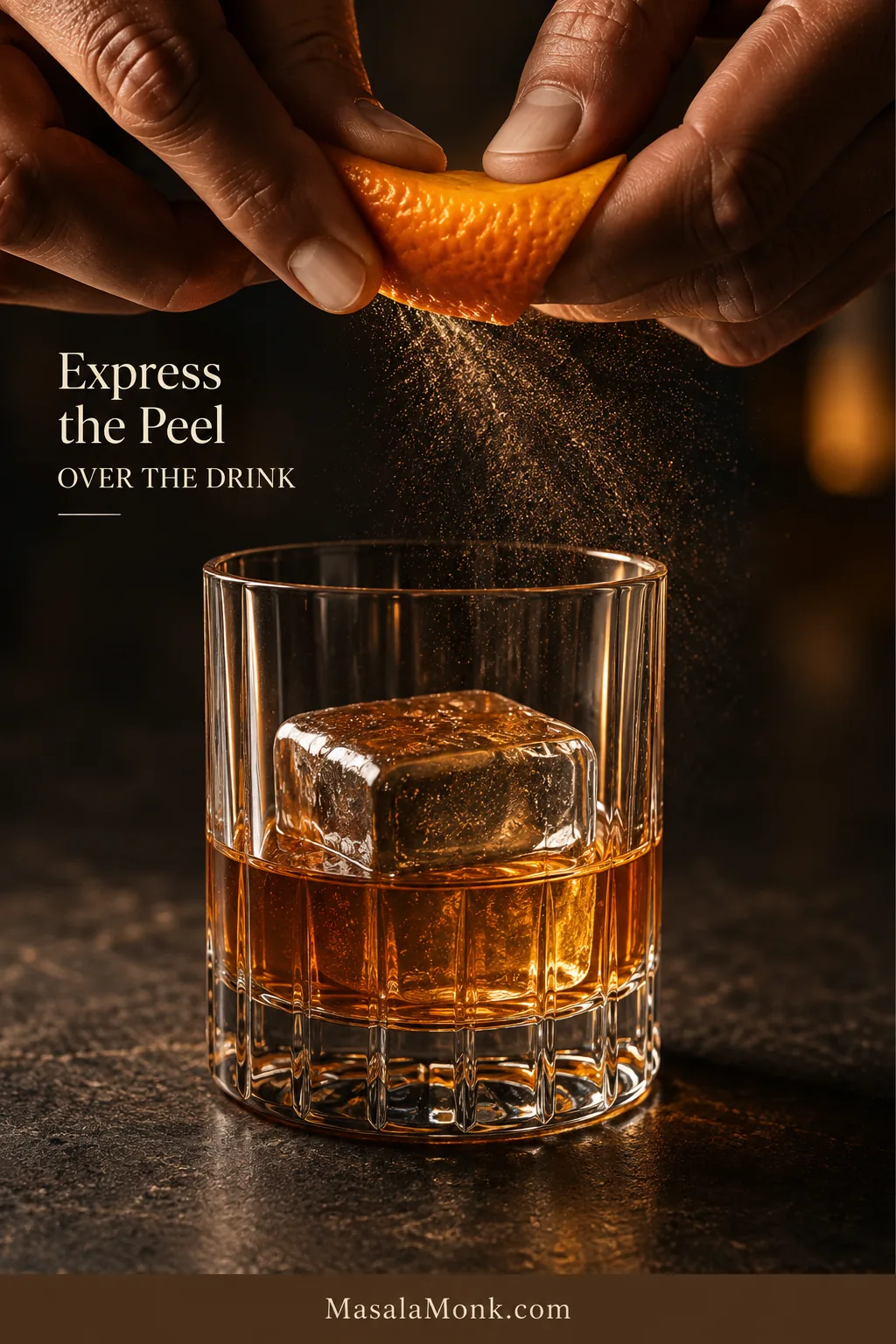
Hands pinching an orange peel over an Old Fashioned and releasing a fine mist of citrus oil above the glass.
One freshly cut strip performs both garnish jobs: express its oil over the surface first, then sweep it around the rim before placing it in the glass.

Stir this cocktail, even if a shaker is your only vessel. Shaking is useful when citrus juice, dairy, or egg white needs aeration. For that bright, aerated texture, make a Whiskey Sour; here, smooth stirring keeps the drink clear and silky.

No Mixing Glass? Build It Directly in the Serving Glass

The separate mixing-glass method gives you fresh serving ice and slightly easier control. The direct build is simpler, uses fewer tools, and still makes an excellent drink.
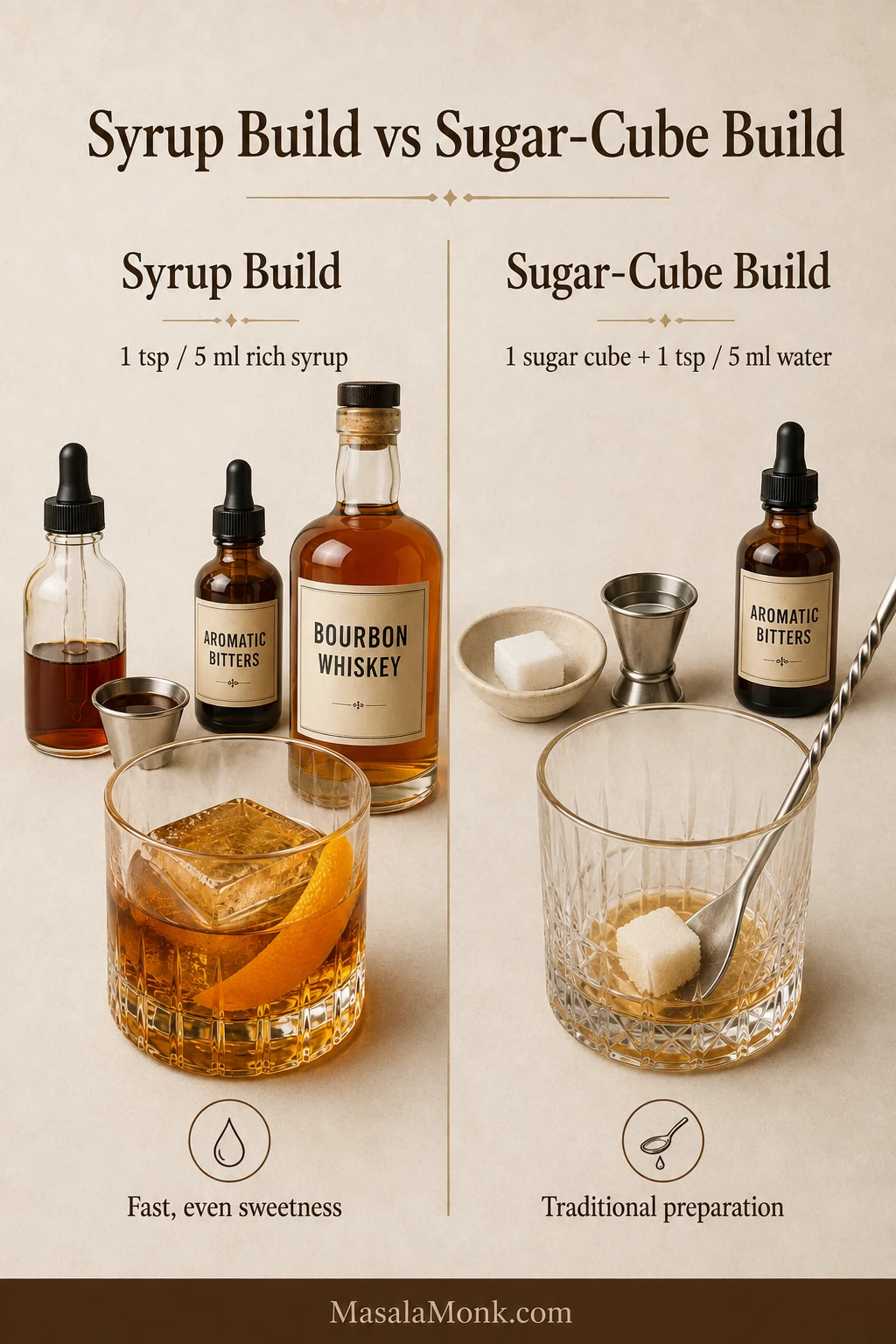
Split guide comparing a rich-syrup Old Fashioned with a sugar cube being dissolved with water in a second glass.
Choose rich syrup when speed, consistency, or batching matters. The sugar-cube Old Fashioned suits traditional ritual and slight texture, provided the sweetener is fully incorporated.

Direct Build With Syrup

  1. Measure the syrup and bitters into the rocks glass.
  2. Pour in the bourbon and stir briefly.
  3. Add one large cube or several solid cubes.
  4. Stir until the drink feels cold, smooth, and no longer sharply alcoholic.
  5. Express the orange peel over the surface.

Traditional Sugar-Cube Build

  1. Add one standard 3.5–4 g sugar cube, 3 dashes Angostura, and 1 teaspoon / 5 ml still water to the glass.
  2. Muddle and stir until no hard cube remains.
  3. Add the bourbon and ice.
  4. Stir thoroughly, taste, and finish with orange peel.

A soda-water top-up makes the drink longer, lighter, and less whiskey-forward. When bourbon and ginger fizz are what you want, a Kentucky Mule is designed for that job.

Recipe card ↑Sweetener choices →Fix the taste →

How to Choose Bourbon—or Rye—for an Old Fashioned

The best bourbon for an Old Fashioned does not need to be rare. It needs enough flavor and proof to remain recognizable after sugar, bitters, ice, and a few minutes in the glass. In the United States, proof is twice the alcohol-by-volume figure, so 90–100 proof means approximately 45–50% ABV.
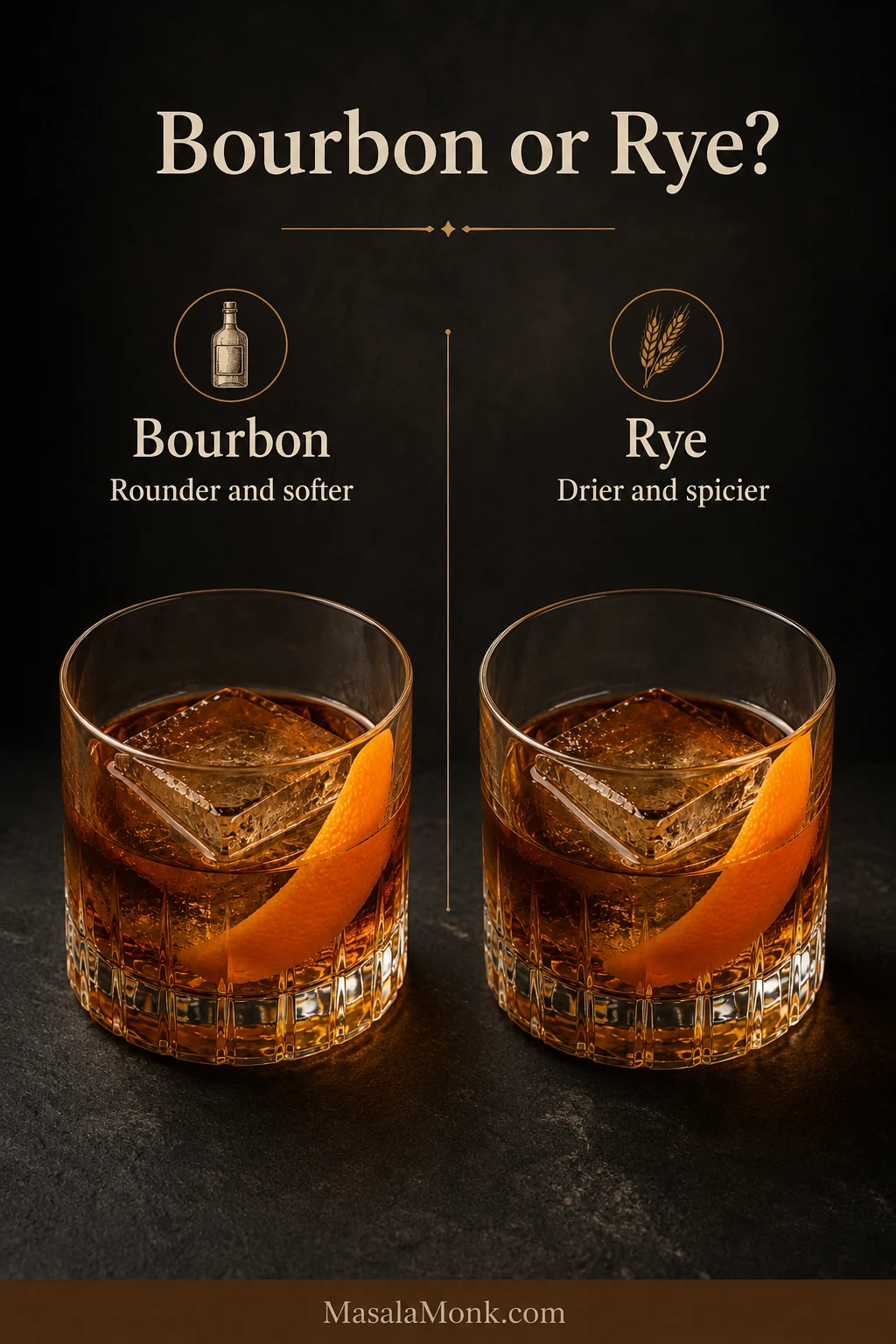
Two matching Old Fashioned cocktails labeled bourbon and rye, each served with one large ice cube and orange peel.
For a fair bourbon-versus-rye Old Fashioned comparison, hold the syrup, bitters, ice, and stirring steady. The whiskey then becomes the only variable shaping the finish.

Whiskey Styles and Proof

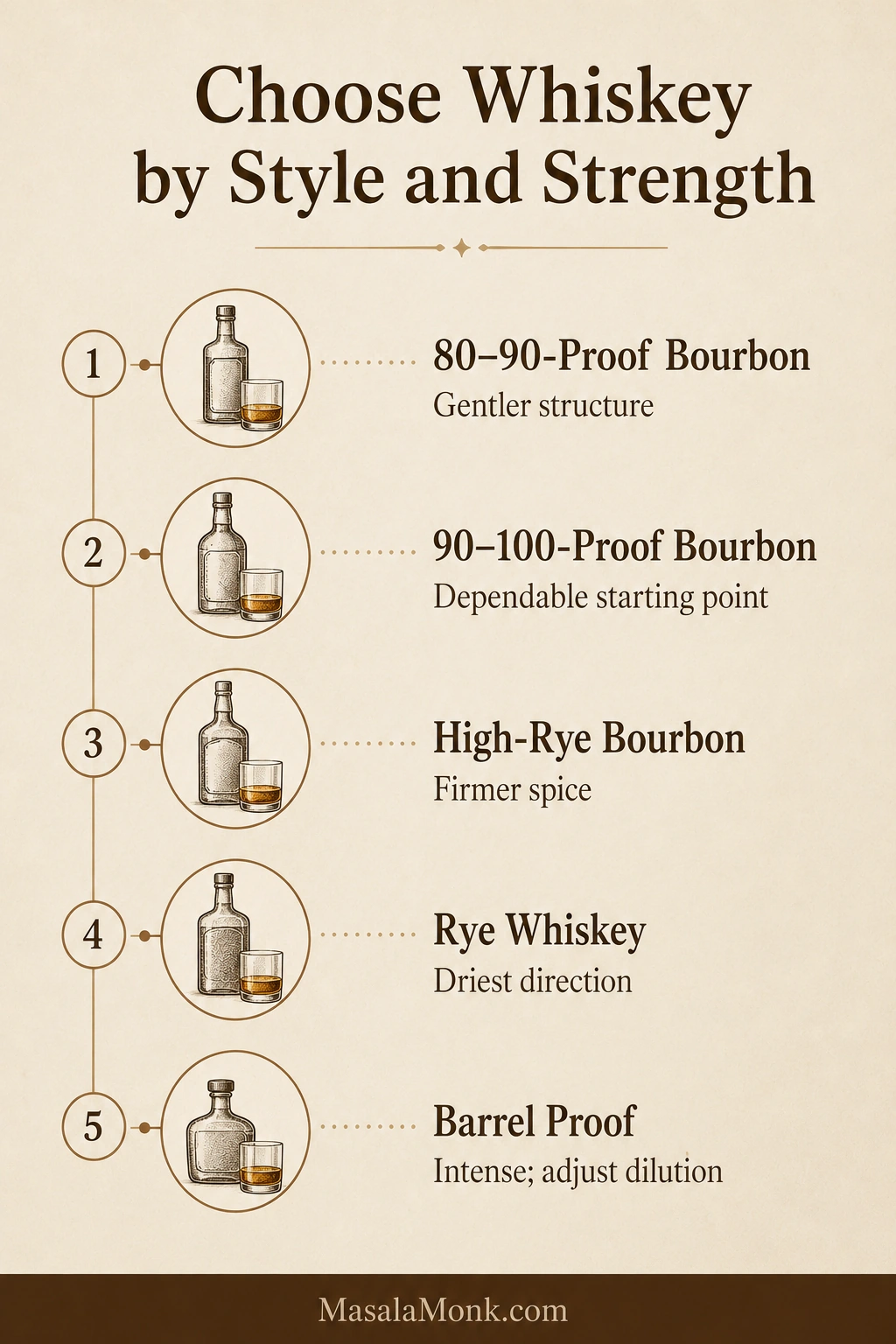
Vertical guide listing 80–90-proof bourbon, 90–100-proof bourbon, high-rye bourbon, rye whiskey, and barrel-proof whiskey.
Use this as the quick style map: 90–100 proof is the dependable home starting range, while rye and barrel-proof whiskey need closer control of sweetness and dilution. The table below adds the tradeoffs.
Whiskey styleWhat it bringsBest for
80–90-proof bourbonSofter alcohol and a gentler overall structureA gentler drink; keep the syrup modest
90–100-proof bourbonMore body and enough structure without excessive heatThe most dependable starting point
High-rye bourbonMore grain spice and a firmer finishA bolder drink that still feels rounded
Rye whiskeyPepper, herbs, grain, and less apparent sweetnessThe driest, spiciest direction
Barrel-proof whiskeyConcentrated flavor and alcoholA bold drink when you are comfortable adjusting sweetness and dilution

Maker’s Mark illustrates a softer wheated style; Buffalo Trace and Elijah Craig Small Batch sit in the balanced middle; Wild Turkey 101 and Old Forester 100 make a firmer drink; and Rittenhouse Rye or Bulleit Rye move it in a drier direction. These are style examples, not a ranking.

The same bourbon-versus-rye contrast appears in a Boulevardier. Here, begin with the same syrup amount whichever whiskey you choose, then adjust after tasting.

Sugar Cube, Simple Syrup, or Demerara Syrup?

Sugar is where many home Old Fashioneds quietly drift. A small amount rounds the whiskey; too much turns it into a sweet drink with whiskey in it. The form you choose also changes texture, added water, and repeatability.

Rich Demerara Syrup

Rich demerara syrup uses two parts sugar to one part water by weight. Use 1 teaspoon / 5 ml for darker caramel flavor and a fuller texture. To make a small batch, warm 100 g demerara sugar with 50 g water just until dissolved, then cool completely.

Standard Simple Syrup

Standard syrup uses equal weights of sugar and water and tastes more neutral. Use ¼ oz / 7.5 ml. For a small batch, warm 50 g white sugar with 50 g water just until dissolved, then cool.
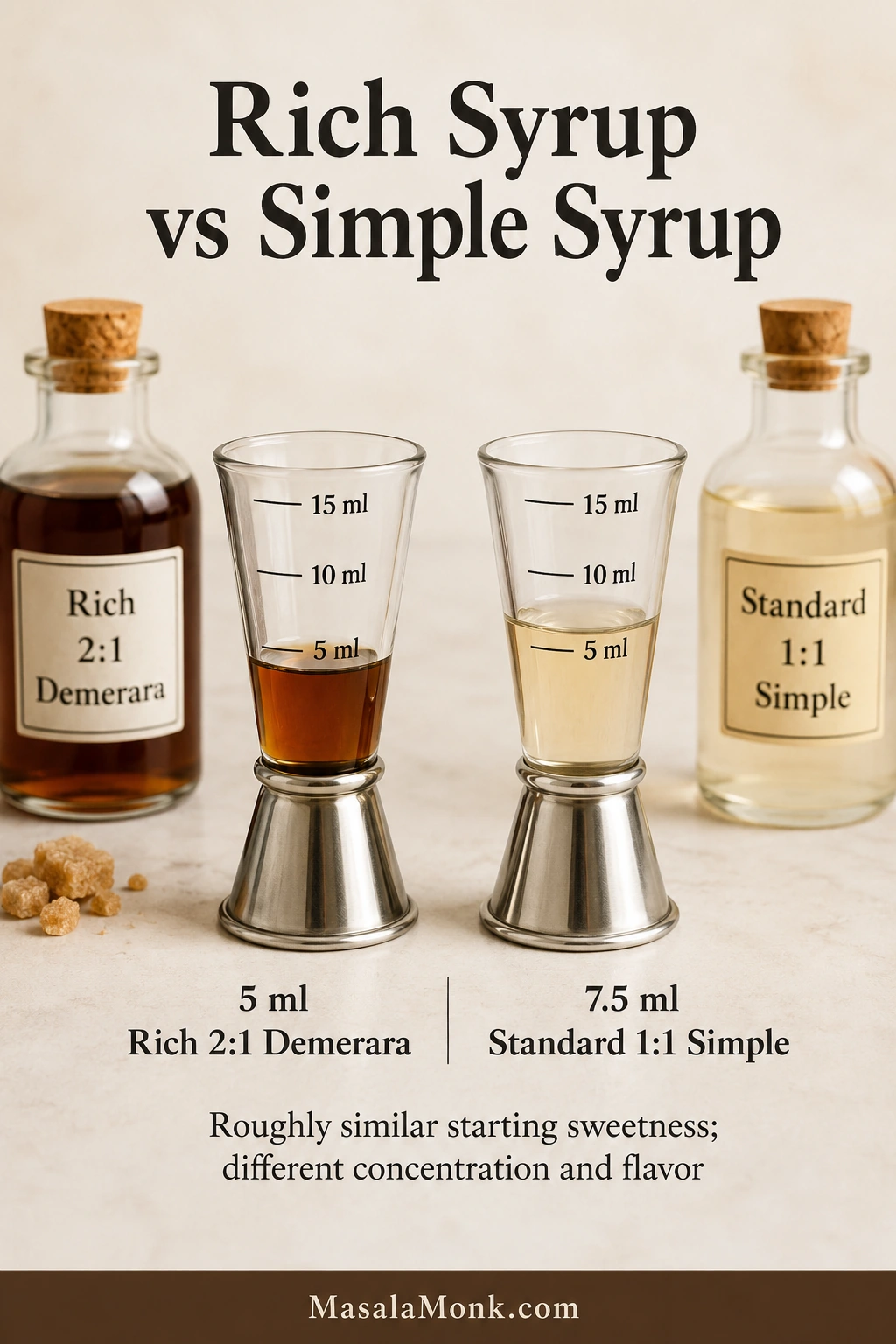
Two labeled measures showing 5 milliliters of dark rich demerara syrup and 7.5 milliliters of pale standard simple syrup.
Rich and standard simple syrup are not equal-volume substitutes. Start with 5 ml of rich 2:1 demerara or 7.5 ml of standard 1:1 syrup, then fine-tune the next glass.

Sugar Cube or Granulated Sugar

For a traditional build, use approximately 3.5–4 g sugar with 1 teaspoon / 5 ml water and the bitters. Muddle and stir until no hard cube remains. Fine sugar texture is acceptable; a dry lump is not.
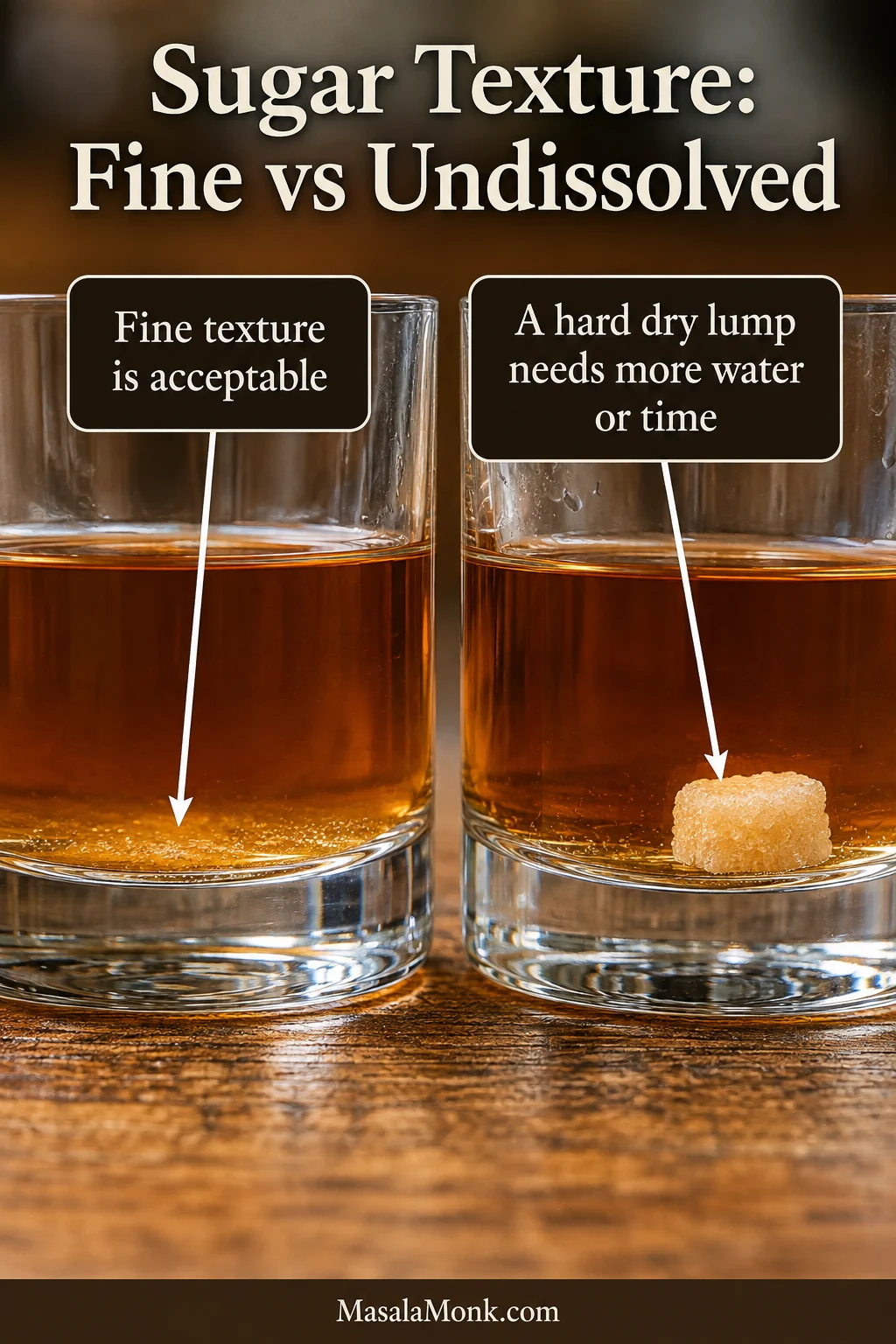
Close-up of two glasses showing fine sugar crystals at the bottom of one and a hard undissolved sugar lump in the other.
Look through the base of a sugar-cube Old Fashioned before serving. Fine crystals are part of the traditional texture; a compact dry lump shows that the cube never fully dissolved.
Choose thisWhen you wantWatch for
Rich demerara syrupConsistency, fuller body, and darker flavorIt can cover a very delicate whiskey
Standard 1:1 syrupNeutral sweetness and common ingredientsUse more volume than rich syrup
Sugar cubeTraditional preparation and gradual change in the glassA hard undissolved lump
Granulated sugarA practical pantry substituteDissolve it before adding cold whiskey

Sweetness guide

  • Exceptionally dry: ½ teaspoon / 2.5 ml rich syrup
  • Drier: about ¾ teaspoon / 4 ml
  • Balanced starting point: 1 teaspoon / 5 ml
  • Sweeter: increase in ¼-teaspoon increments

Without sweetener, the alcohol and bitters become much more prominent.

How Many Dashes of Bitters—and Which Kind?

Three dashes look almost insignificant, yet the drink feels flatter without them. Bitters behave more like seasoning than another full liquid ingredient, pulling whiskey and sugar together with concentrated spice, herbs, and aroma.

Start with 3 firm dashes of Angostura. Dash size varies with the bottle, insert, angle, and pouring force, so use the same bottle and motion each time.

  • 2 dashes: softer and more whiskey-forward.
  • 3 dashes: the balanced starting point.
  • 4 dashes: more aromatic and spice-led.
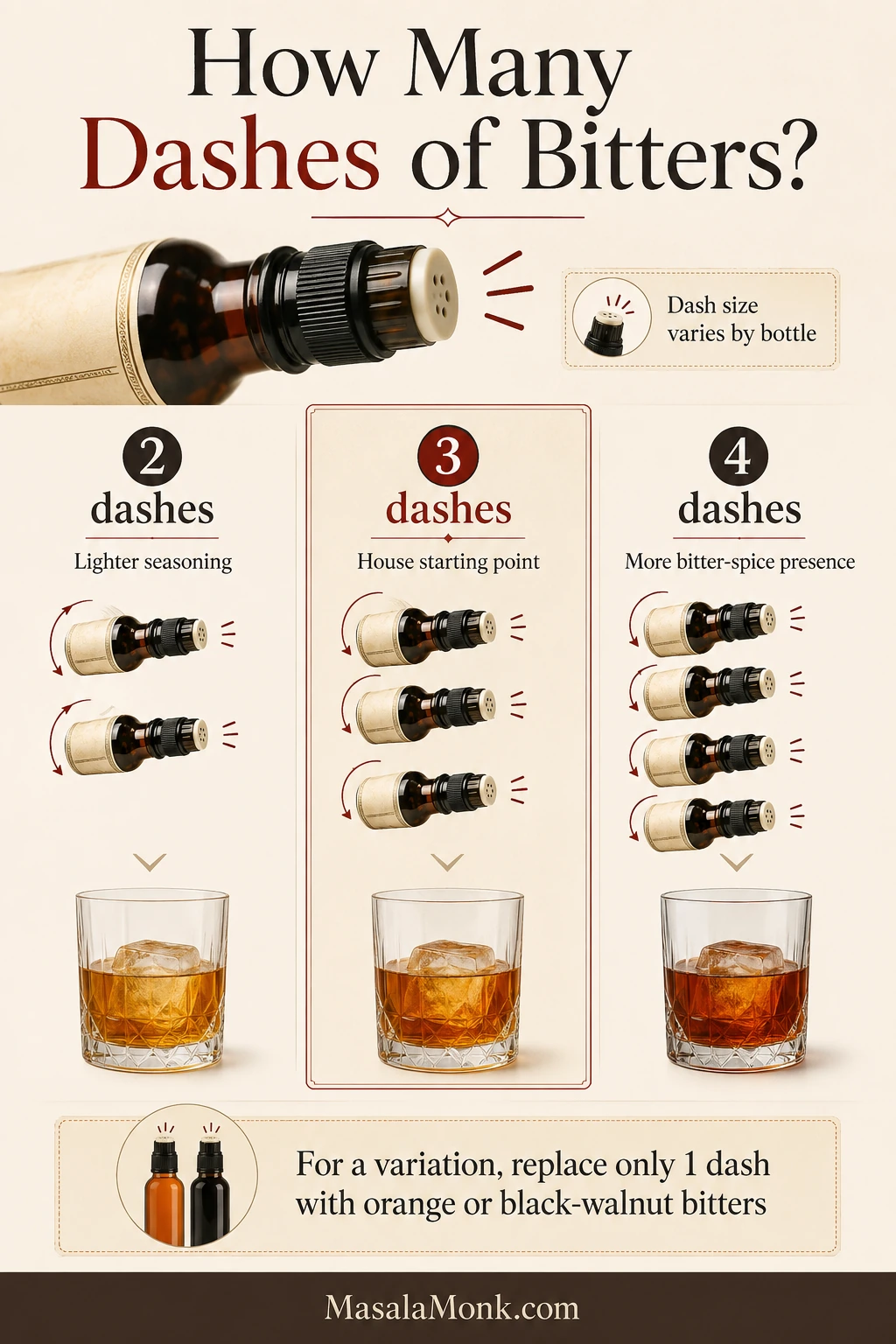
Guide showing two, three, and four tilting motions from a bitters dasher bottle, with three dashes highlighted as the starting point.
Treat three dashes as a reproducible starting point rather than an exact universal volume. Use the same bitters bottle, angle, and firm motion before deciding whether a fourth dash helps.

For a brighter, nuttier, or darker variation, change only part of the bitters:

  • Angostura aromatic: the classic choice, with baking spice, herbs, and warmth.
  • Orange bitters: brighter citrus; begin with one dash alongside Angostura.
  • Black walnut bitters: darker, nuttier, and especially good with rich bourbon.
  • Chocolate or mole bitters: cocoa and deeper spice for a deliberate variation.
  • Peychaud’s: a more floral profile with cherry and anise notes.

Can You Make It Without Bitters?

If Angostura is unavailable, another aromatic cocktail bitter is the closest substitute. Orange peel or muddled fruit can add aroma, but neither provides the same spice. Amaro changes the drink much more substantially; use it as a deliberate variation, as in a Black Manhattan, not as a one-for-one replacement.

Best Glass, Ice, and Garnish

Glass and Serving Ice

An 8–10 oz / 240–300 ml rocks, lowball, or Old Fashioned glass gives the drink and its ice enough room. Chill it in the freezer for five minutes, or fill it with ice while you mix the cocktail and discard that ice before serving.

  • Use one 1¾–2-inch cube, a large sphere, or two or three solid cubes for serving.
  • Clear ice is attractive but optional.
  • Clean, well-frozen ice matters more than perfect clarity.
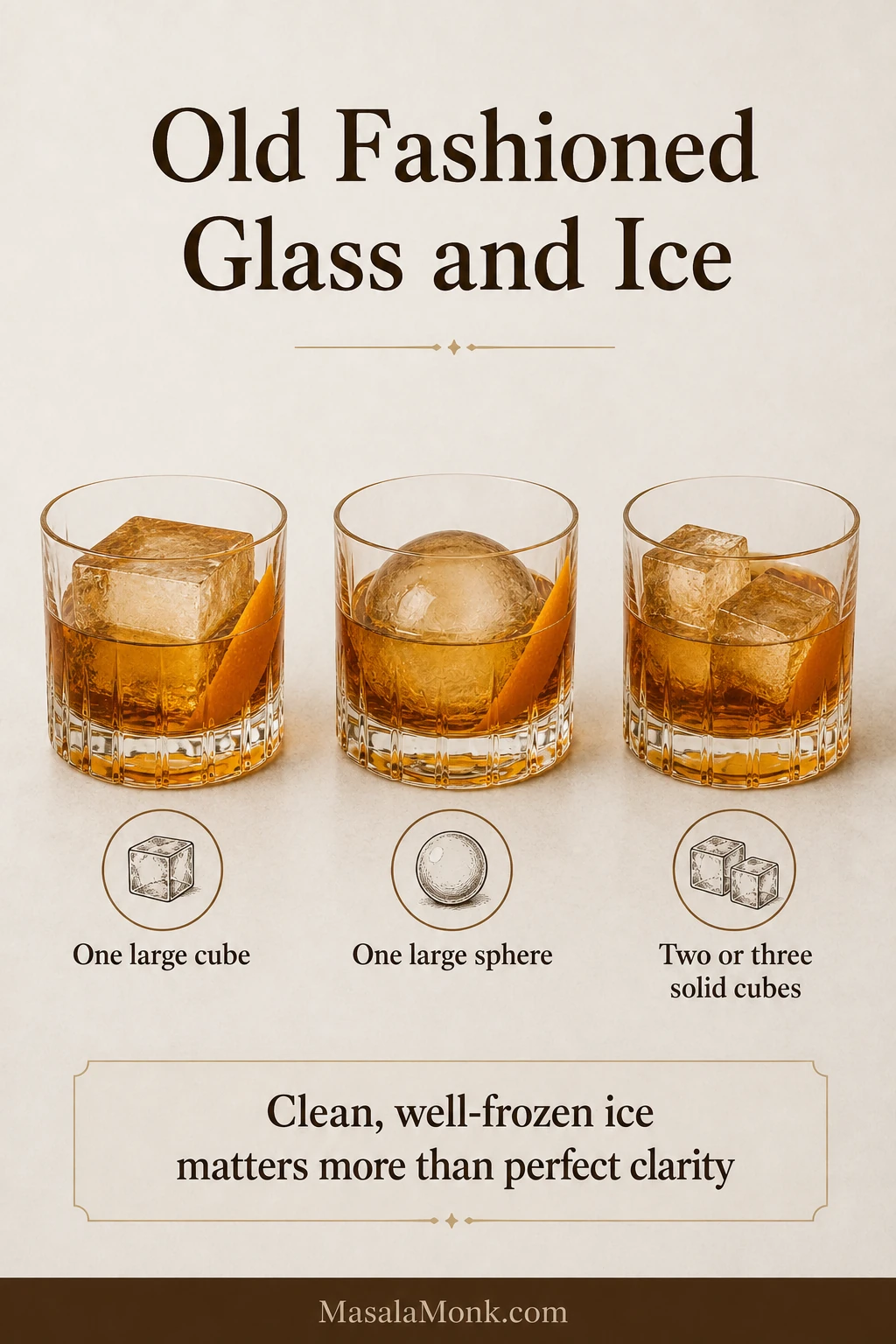
Three rocks glasses showing an Old Fashioned over one large cube, one ice sphere, and two or three solid cubes.
The best Old Fashioned ice fits the glass comfortably and begins deeply frozen. Cube size matters, but starting temperature, quantity, and time in the drink matter too.

Orange Peel, Cherry, and Muddled Fruit

The peel is the last ingredient you add but the first one the drinker encounters. Expressed peel gives aroma without juice. An orange slice—especially when muddled—adds juice, pulp, and a softer fruit-forward character.

Muddled orange and cherry are strongly associated with Wisconsin-style Old Fashioneds, which are often made with brandy and finished sweet, sour, or as a press—typically a combination of lemon-lime soda and soda water. It is a distinct regional branch, not an incorrect drink.

A cocktail cherry is optional. Add one for a dark-fruit accent, or leave it out for a drier finish. Avoid pouring cherry syrup into a drink that already tastes sweet enough.
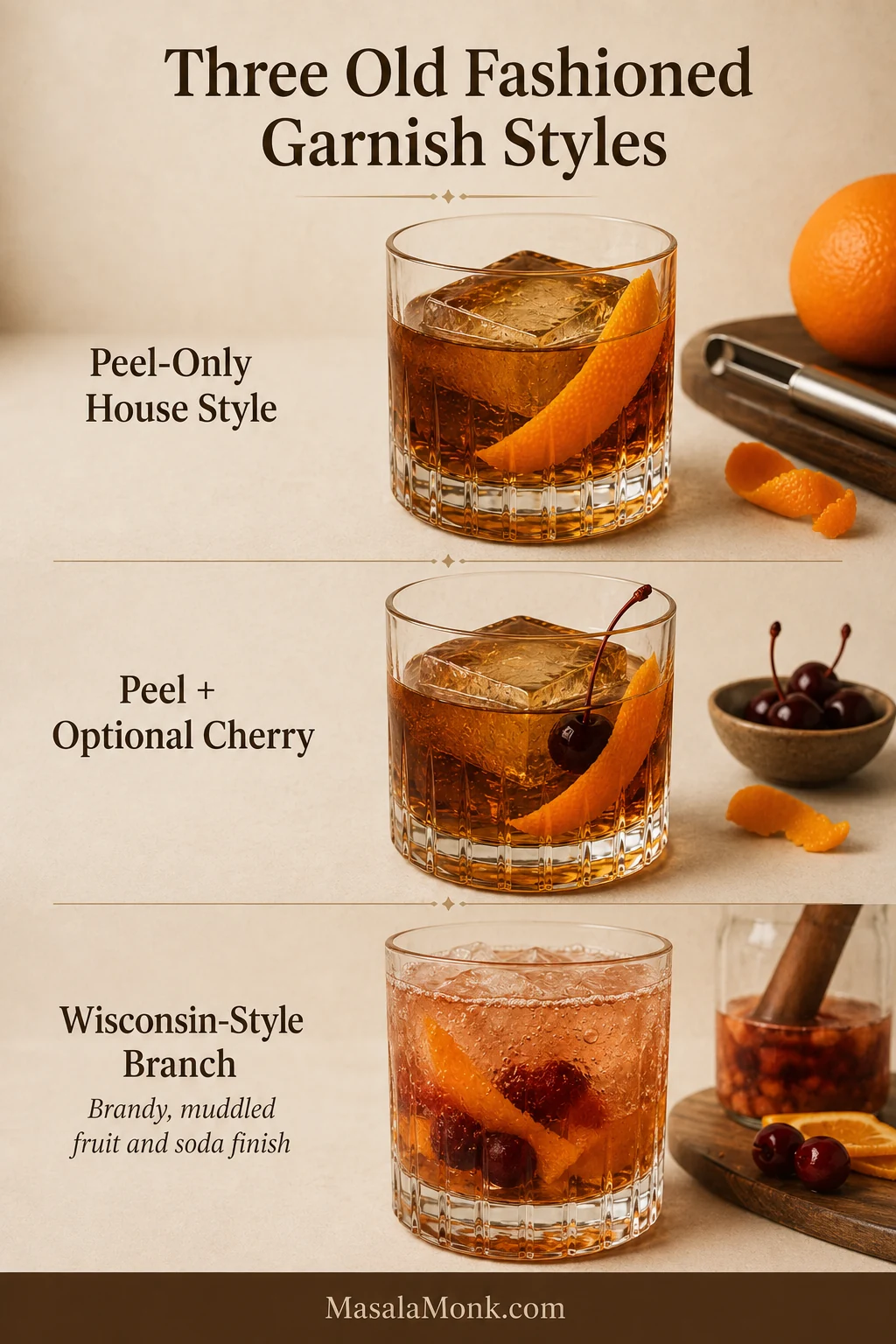
Three Old Fashioned styles showing peel only, peel with one cherry, and a lighter Wisconsin-style brandy drink with muddled fruit and soda.
Clear garnish language prevents ordering surprises: ask for expressed peel, peel with one cherry, or a Wisconsin Old Fashioned with brandy, muddled fruit, and a soda finish.

Ordering one at a bar: ask for bourbon or rye and say “less sweet” when that is what you mean. Specify “orange peel, no muddled fruit” when the garnish style matters.

Adjust It to Your Taste

This section is for a correctly made drink that is not yet your preferred style. Change one variable at a time so the next glass tells you what worked.
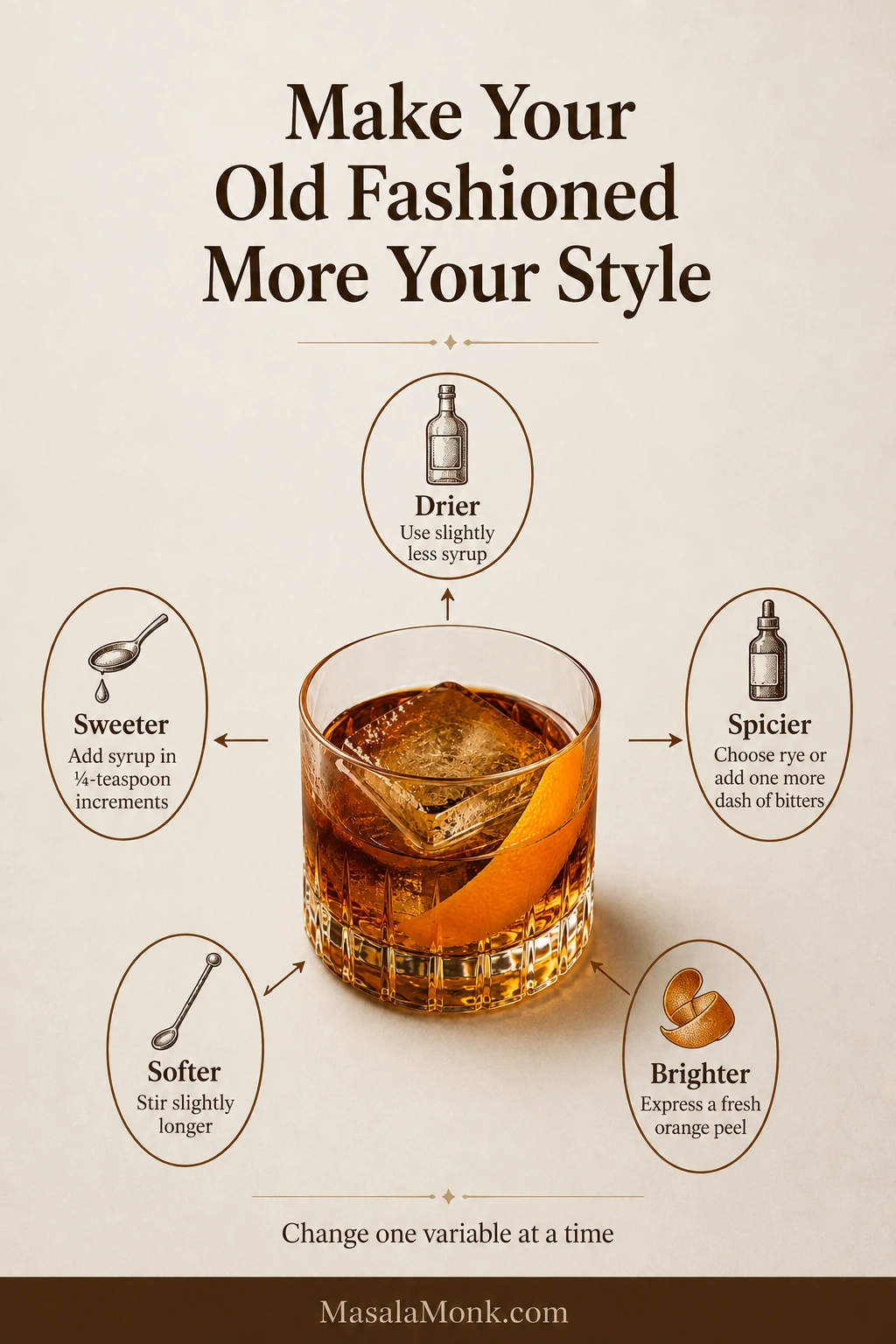
Radial guide around an Old Fashioned showing how to make it drier, sweeter, spicier, softer, or brighter.
Use the graphic to choose a direction, then use the table below for the measured next-glass adjustment. Change one variable and write it down so you know what actually worked.
You wantChange this first
DrierReduce rich syrup to about ¾ teaspoon / 4 ml, or use rye. Keep the expressed peel and skip the cherry.
SweeterIncrease syrup in ¼-teaspoon increments. Do not jump straight to a large pour.
SpicierUse rye or a high-rye bourbon with 3 dashes Angostura. Add a fourth dash only when you specifically want more bitters spice.
SofterIf the current glass still tastes hot, stir for a few more seconds and taste again. For the next one, use an 80–90-proof bourbon or reduce the bitters to 2 dashes.
BrighterExpress a freshly cut orange peel for brighter surface aroma. For more orange character within the drink, add one restrained dash of orange bitters beside the Angostura.
RicherChoose demerara syrup and a fuller 100-proof bourbon; extra sugar alone can make the drink cloying.

Common Old Fashioned Mistakes—and How to Fix Them

Small misses are normal in a drink with no juice or mixer to hide them. A slightly imperfect glass is still useful because it tells you what the next one needs.

Most disappointing Old Fashioneds come down to sweetness, dilution, bitters, or fruit. If the glass is only slightly off, use the quick fix below. When repairing it would require half another recipe, start again.

Any repair changes more than one ratio. Make one small correction, taste again, and stop before the drink turns into a second recipe.

Quick Fixes by Symptom
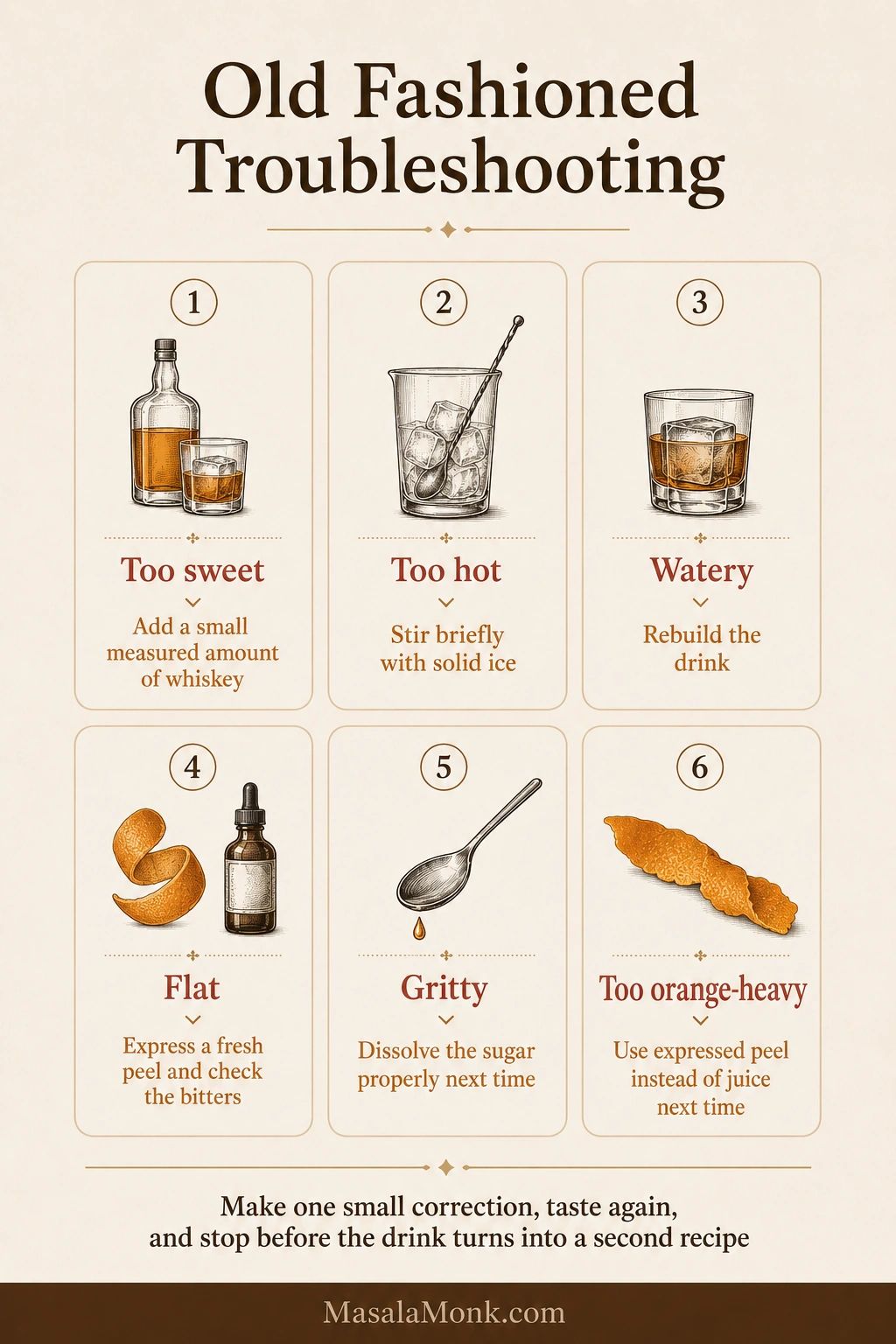
Six-part Old Fashioned troubleshooting guide for cocktails that taste too sweet, hot, watery, flat, gritty, or orange-heavy.
Match one correction to one symptom, then taste again. Once sweetness, dilution, fruit, and bitters all need repair, rebuilding the Old Fashioned is usually the cleaner decision.

Sweetness, Heat, and Dilution

ProblemWhy it happenedHow to fix it
Too sweetToo much syrup, cherry syrup, or a very soft bourbon.If it is only slightly off, add 1 teaspoon / 5 ml bourbon, stir briefly, and taste. Repeat once only if the drink is still close; otherwise, rebuild with less syrup.
Too strong or hotThe drink is under-chilled or under-diluted, or the whiskey is unusually high-proof.Stir briefly with solid ice and taste again. With barrel-proof whiskey, the next glass may also need slightly more dilution.
Thin or wateryToo much stirring, too little ice, or ice that was already wet and melting.Rebuilding is usually better than adding more whiskey and sugar. Stop stirring sooner on the next glass.
Too bitterToo many dashes or an unusually generous dasher bottle.Add 1 teaspoon / 5 ml bourbon and two or three drops of syrup, then taste. If it still feels medicinal, rebuilding is cleaner than chasing the balance.

Aroma, Sugar, Fruit, and Whiskey

ProblemWhy it happenedHow to fix it
Flat or dullToo little bitters, stale bitters, weak whiskey, or no citrus oil.Express a newly cut peel over the surface. Use livelier bitters or a stronger bourbon when you make it again.
GrittyA hard piece of sugar remains in the glass.Continue stirring only if the drink can take more dilution. Use syrup or dissolve the sugar first in a future build.
Too orange-heavyOrange juice or muddled fruit entered the drink.It cannot be fully reversed. Use expressed peel instead of a wedge on the next glass.
The whiskey disappearsToo much syrup, water, fruit, or a very low-proof bottle.Add a measured amount of whiskey only when the drink is still close. Use less syrup or a stronger bottle when making it again.

Recipe card ↑Adjust the balance ↑Back to top ↑

How to Batch Four Old Fashioneds

A small batch lets you pour four good drinks without spending the first part of the evening facing the bar instead of your guests. The important addition is water: a refrigerated batch does not receive the dilution that an individual drink picks up while stirring over ice.
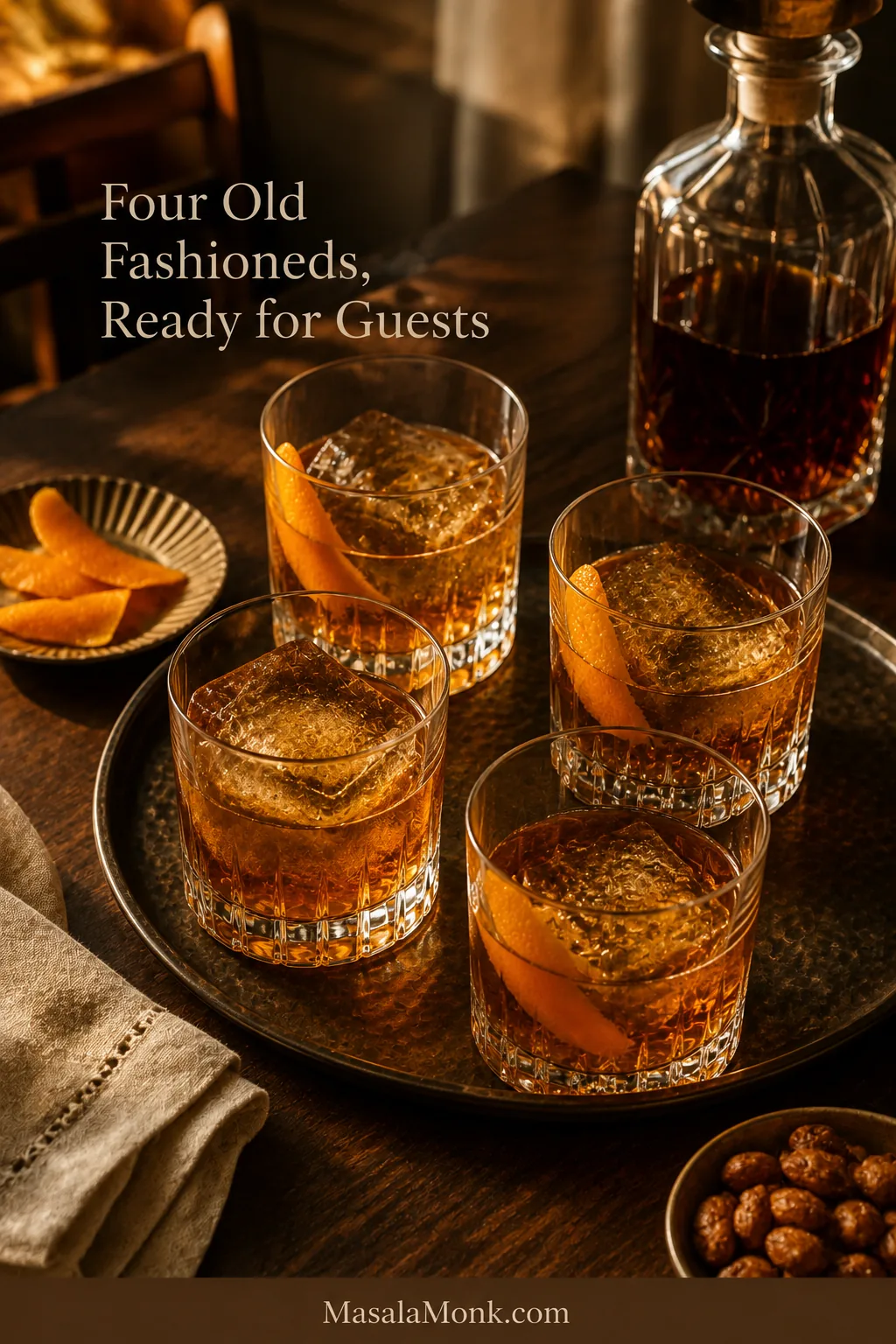
Four matching Old Fashioned cocktails on a serving tray beside a batch bottle, prepared orange peels, linen, and roasted nuts.
Test one complete batched Old Fashioned over the actual serving ice before guests arrive. The drink continues softening in the glass, so the first chilled taste is not the final one.

Four-Drink Batch Formula

  • 8 oz / 240 ml bourbon
  • 4 teaspoons / 20 ml rich 2:1 demerara syrup
  • 10–12 firm dashes Angostura bitters
  • 2 oz / 60 ml chilled water
  1. Combine the bourbon, syrup, 10 dashes bitters, and water in a clean bottle or covered jug.
  2. Seal and mix gently, then refrigerate until thoroughly cold.
  3. Taste the chilled batch. Add the final 1–2 dashes only if it still smells or tastes a little flat.
  4. Pour about 2⅔ oz / 80 ml into each rocks glass over one large cube or several solid cubes.
  5. Express an orange peel over every glass immediately before serving.

Divide the batch evenly among four glasses, roughly 80 ml each before any further dilution from serving ice. Add extra chilled water only in small measured amounts.
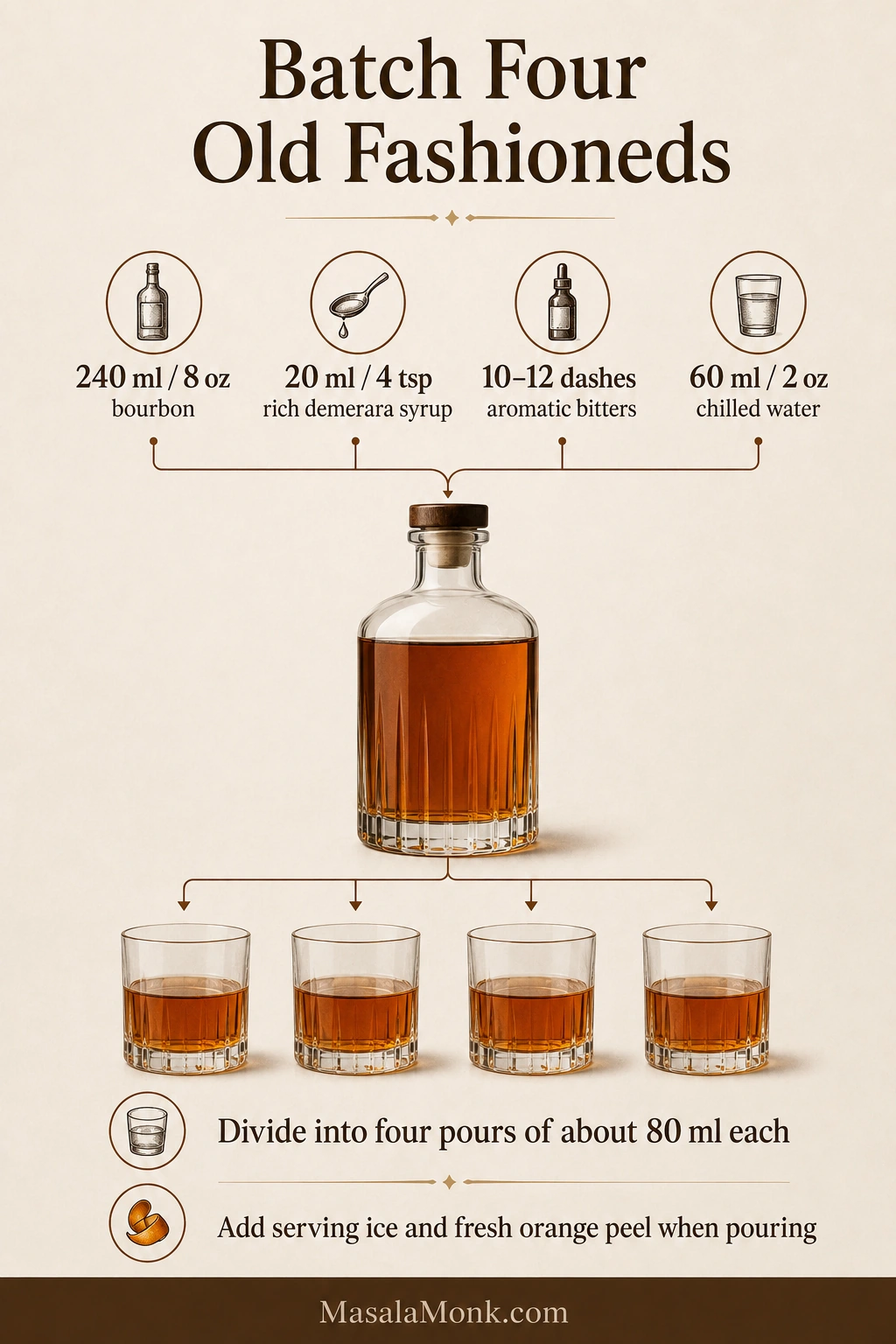
Four-drink Old Fashioned batch guide showing bourbon, rich demerara syrup, aromatic bitters, chilled water, a bottle, and four pours.
Judge a batch only after it is thoroughly chilled. Warm whiskey tastes sharper, so adjusting syrup or bitters too early can push four otherwise balanced Old Fashioneds in the wrong direction.

Before guests arrive, taste one complete 80 ml pour over its serving ice because the drink will soften further in the glass. Keep orange peels out of the batch; their aroma fades, and prolonged contact can add unwanted bitterness.

Make-Ahead and Storage

Syrup: cool it completely, transfer it to a clean sealed container, label it as 1:1 or 2:1, and refrigerate. Aim to use homemade syrup within about 2–4 weeks. Rich 2:1 syrup may keep longer, but cleanliness and refrigeration matter more than a precise calendar date.

Discard syrup sooner if you notice cloudiness, mold, fermentation, gas, or an unusual smell.

Pre-batched cocktail: for easy entertaining, prepare it up to 1 week ahead and keep it tightly sealed in the refrigerator. Add ice, peel, and cherries only when serving.

Finished drink: enjoy it immediately. The serving ice keeps diluting the cocktail while the orange aroma fades.

Recipe card ↑Five variations →Back to top ↑


Serving Ideas and Variations

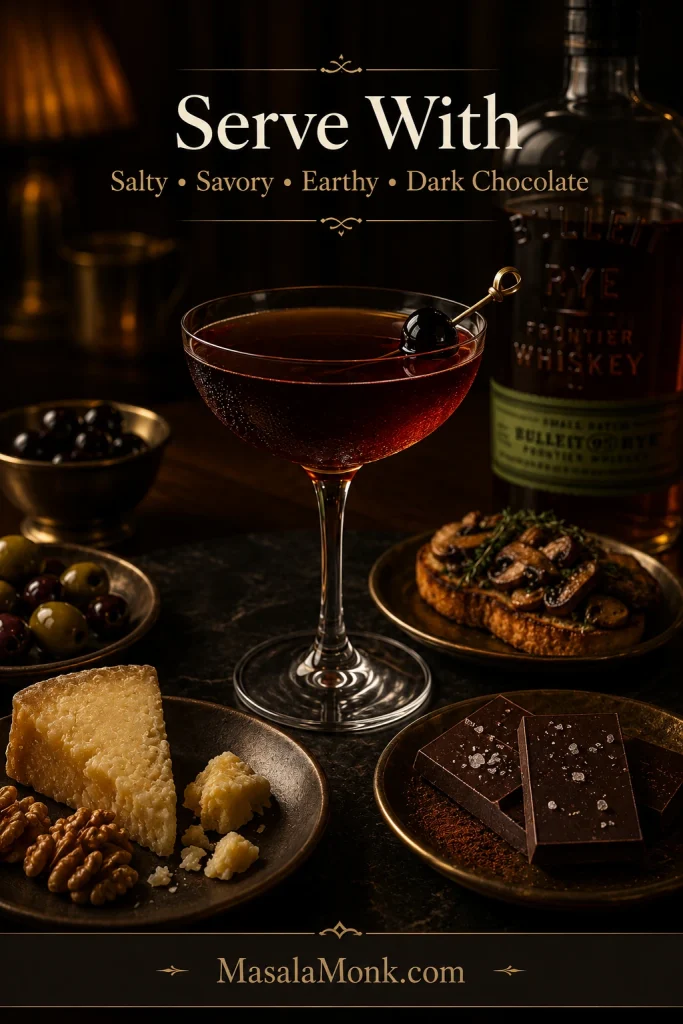
This is a slow-sipping drink rather than a bright thirst-quencher. Serve it before dinner with modest sweetness, or after dinner with richer whiskey, demerara, and an optional cherry. Salty roasted nuts, olives, aged cheese, crisp potato snacks, mushroom toast, and dark chocolate all sit comfortably beside it.

The setting does not need to be formal. Sometimes it is simply the first quiet drink after a long week—one measured glass made properly, then enjoyed slowly.
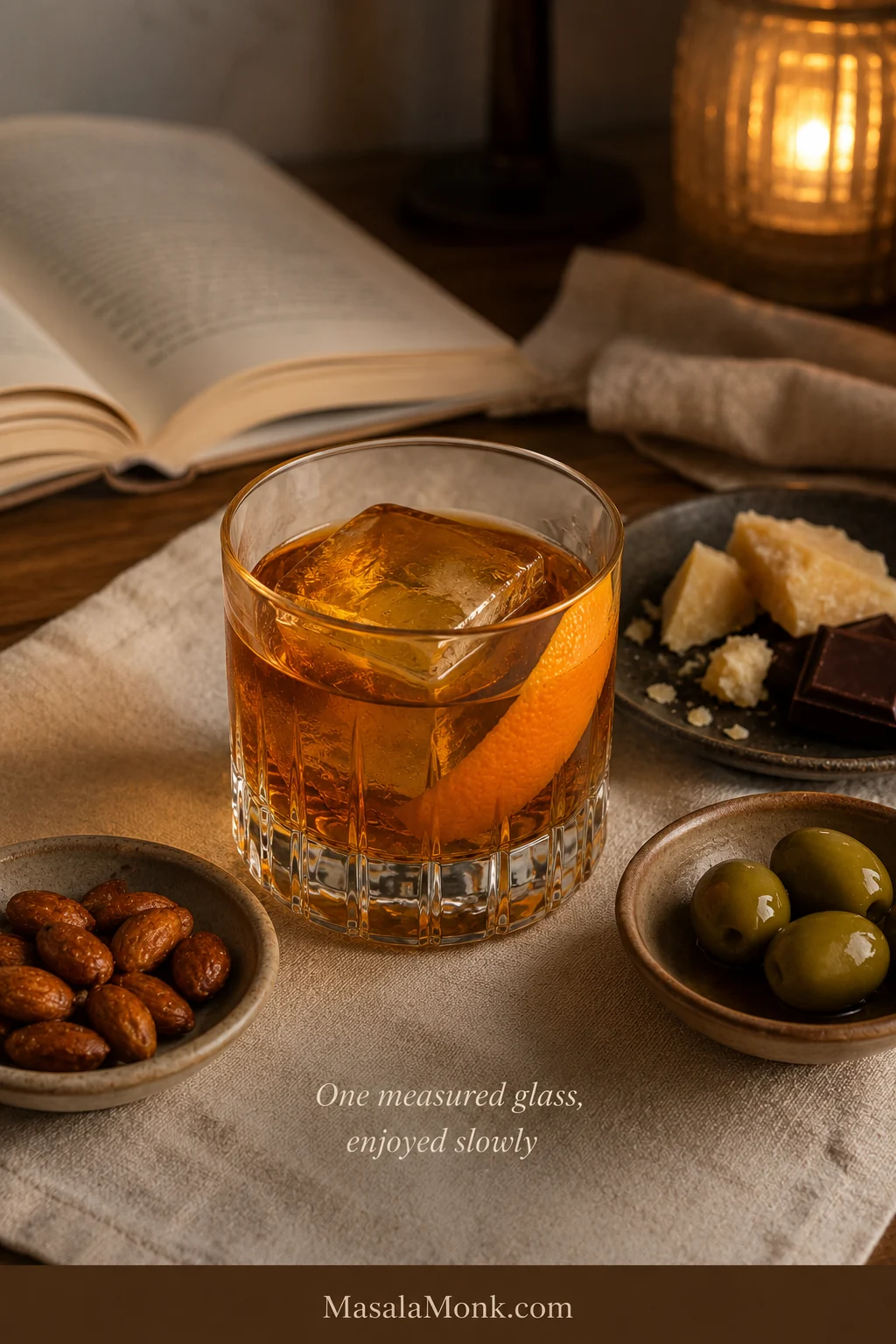
Old Fashioned beside roasted almonds, green olives, aged cheese, dark chocolate, an open book, linen, and a warm lamp.
Keep Old Fashioned food pairings small and contrasting. Salty nuts, olives, aged cheese, or dark chocolate frame the bourbon and bitters instead of turning the cocktail into background.

Five Variations to Try

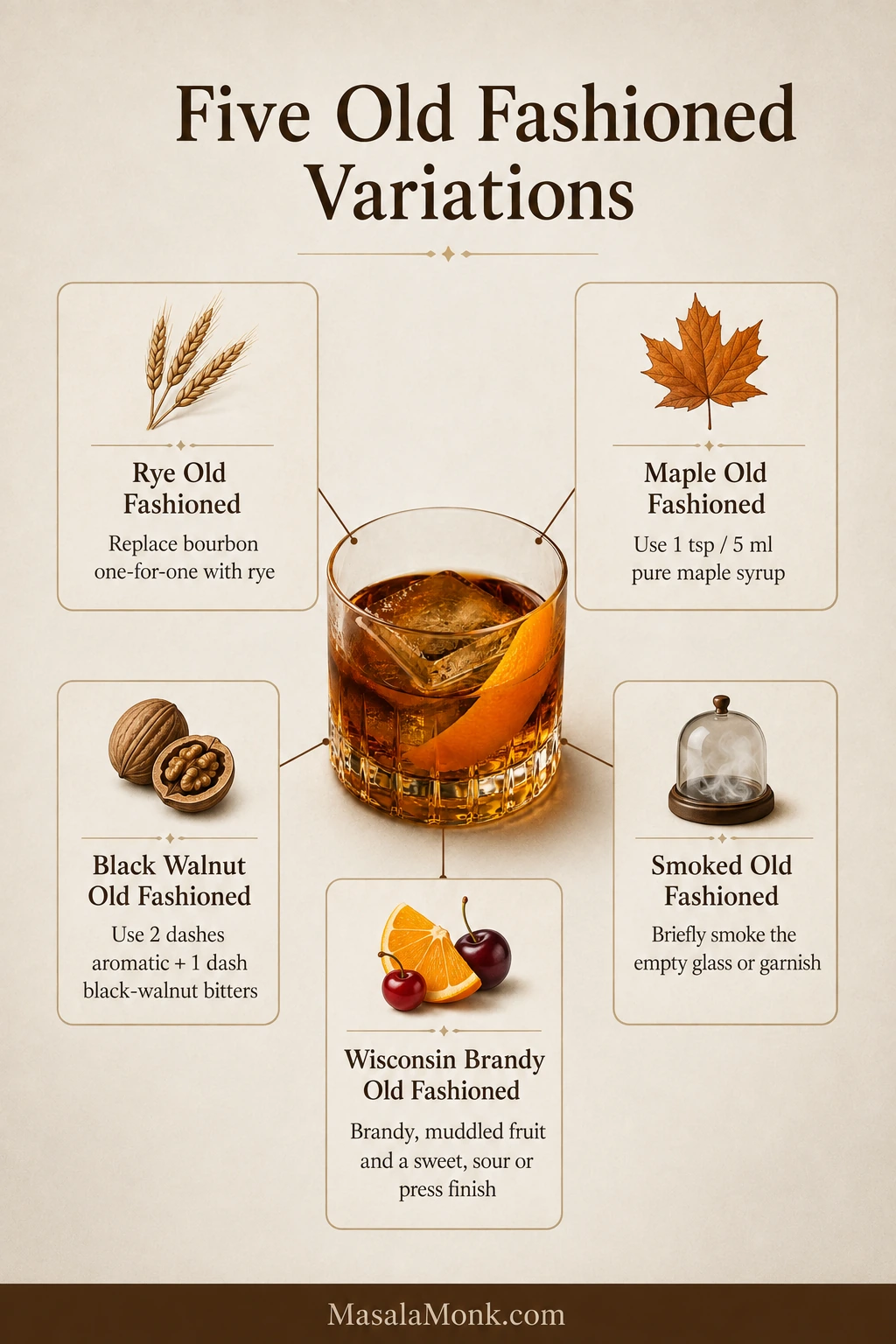
Guide showing rye, maple, black walnut, smoked, and Wisconsin brandy Old Fashioned variations around a central cocktail.
Use the board to choose a direction; the list below gives the exact swap or method. The strongest variations change one clear idea while keeping the spirit-sweetener-bitters structure recognizable.
  • Rye Old Fashioned: replace bourbon one-for-one with rye for a drier, spicier finish.
  • Maple Old Fashioned: replace the demerara with 1 teaspoon / 5 ml pure maple syrup, then adjust after tasting.
  • Black Walnut Old Fashioned: begin with 2 dashes Angostura and 1 dash black-walnut bitters.
  • Smoked Old Fashioned: briefly smoke the empty glass or garnish; avoid burning ingredients directly into the drink.
  • Wisconsin Brandy Old Fashioned: treat this as a separate regional branch with brandy, muddled fruit, and a sweet, sour, or press finish.

For Scotch, a Rob Roy keeps the stirred-whiskey character and replaces sugar with sweet vermouth.

Old Fashioned vs Manhattan

Both drinks are whiskey-forward and stirred, but they create different experiences. An Old Fashioned uses a small amount of sugar or syrup; a Manhattan uses sweet vermouth, adding wine, herbs, and greater richness.
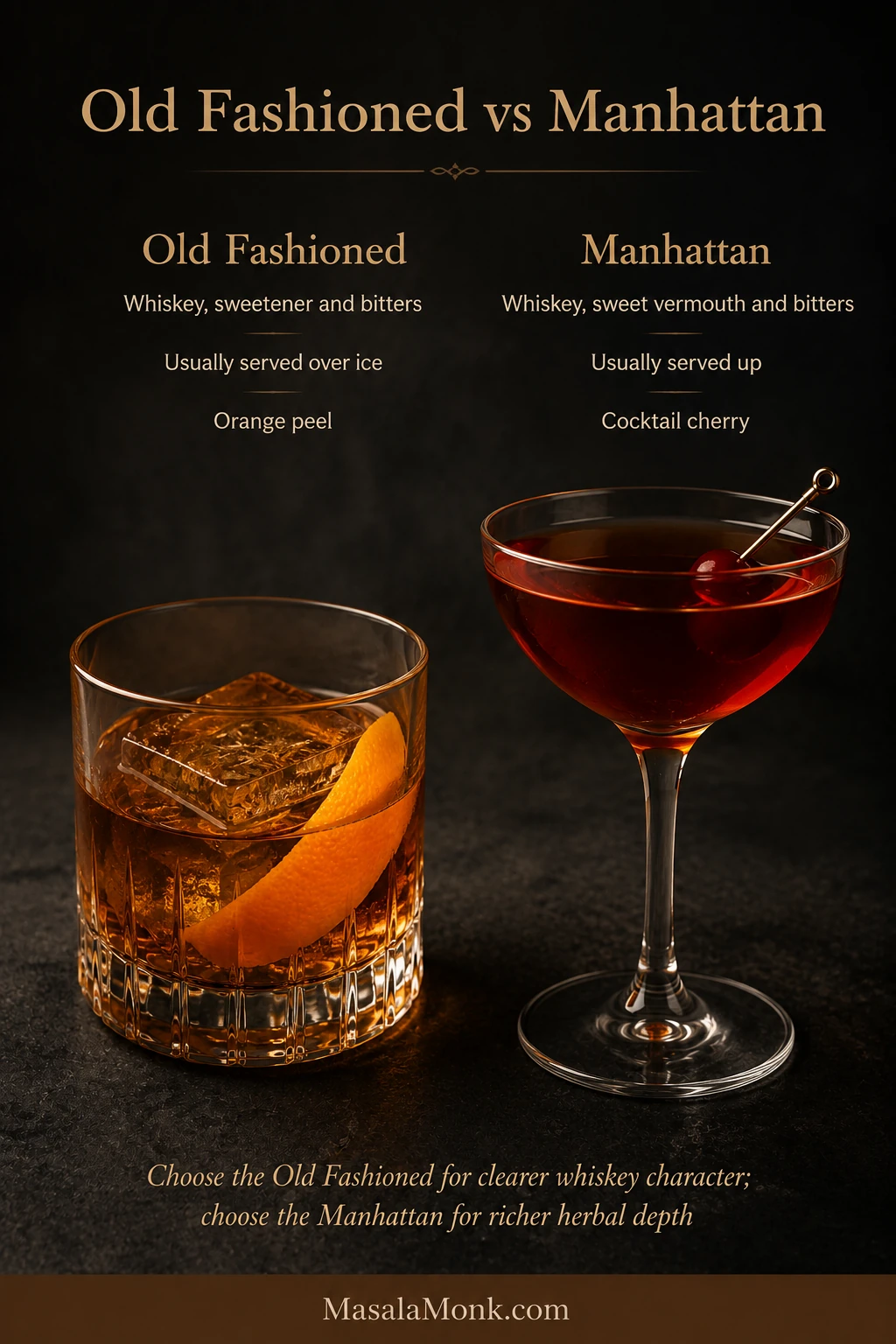
Old Fashioned in a rocks glass with orange peel beside a Manhattan in a stemmed glass with a cocktail cherry.
Reach for an Old Fashioned when you want the base whiskey most exposed. A Manhattan suits the moments when sweet vermouth’s wine, herbs, and richness are part of the flavor you seek.
Old FashionedManhattan
Whiskey, sweetener, bitters, and waterWhiskey, sweet vermouth, and bitters
Usually served over iceOften served up in a chilled stemmed glass
Orange peel is the usual aromatic finishA cocktail cherry is common
Keeps the base whiskey as the clearest flavorAdds a richer herbal and wine-like layer

Recipe card ↑FAQs →Back to top ↑

Why Is It Called an Old Fashioned?

The name points back to an older cocktail formula: spirit, sugar, bitters, and water. As newer drinks gained liqueurs and modifiers, drinkers could ask for whiskey in the “old-fashioned” way.

The International Bartenders Association still lists an official version made with bourbon or rye, sugar, Angostura bitters, and water. Modern recipes vary in whiskey volume, syrup, fruit, ice, and technique. A clear sensory target is more useful than treating one ritual as the only correct method.

Frequently Asked Questions

What whiskey is best for an Old Fashioned?

A 90–100-proof whiskey is the most dependable starting point. Bourbon is rounder and sweeter; rye is drier and spicier.

Should an Old Fashioned contain a cherry or muddled orange?

A cherry is optional. This version uses expressed peel, while muddled orange and cherry belong to Wisconsin-style and other regional preparations.

Can I make an Old Fashioned without orange?

The cocktail still works without orange. Lemon peel gives a sharper fragrance, or you can leave the garnish out entirely.

Why does my Old Fashioned taste too strong?

It is probably under-diluted. Stir briefly with ice and taste again; the alcohol should remain strong without feeling raw or separate.

Start With the Whiskey, Then Listen to the Glass

A memorable Old Fashioned is not defined by the most expensive bourbon, the clearest ice, or the longest history lecture. It is the one where every small addition makes the whiskey easier to notice.

Stir until the drink feels cold and settled. Express the orange peel, notice what reaches you before the first sip, and taste it slowly.

Then make the next one a little more yours—drier, spicier, softer, or brighter. The essential shape remains the same: whiskey, sweetness, bitters, and water, with orange arriving first on the nose.

Do you reach for bourbon or rye, and how dry do you like the finished drink? Share what tastes right to you.
Back to top ↑

Posted on Leave a comment

Black Manhattan Recipe

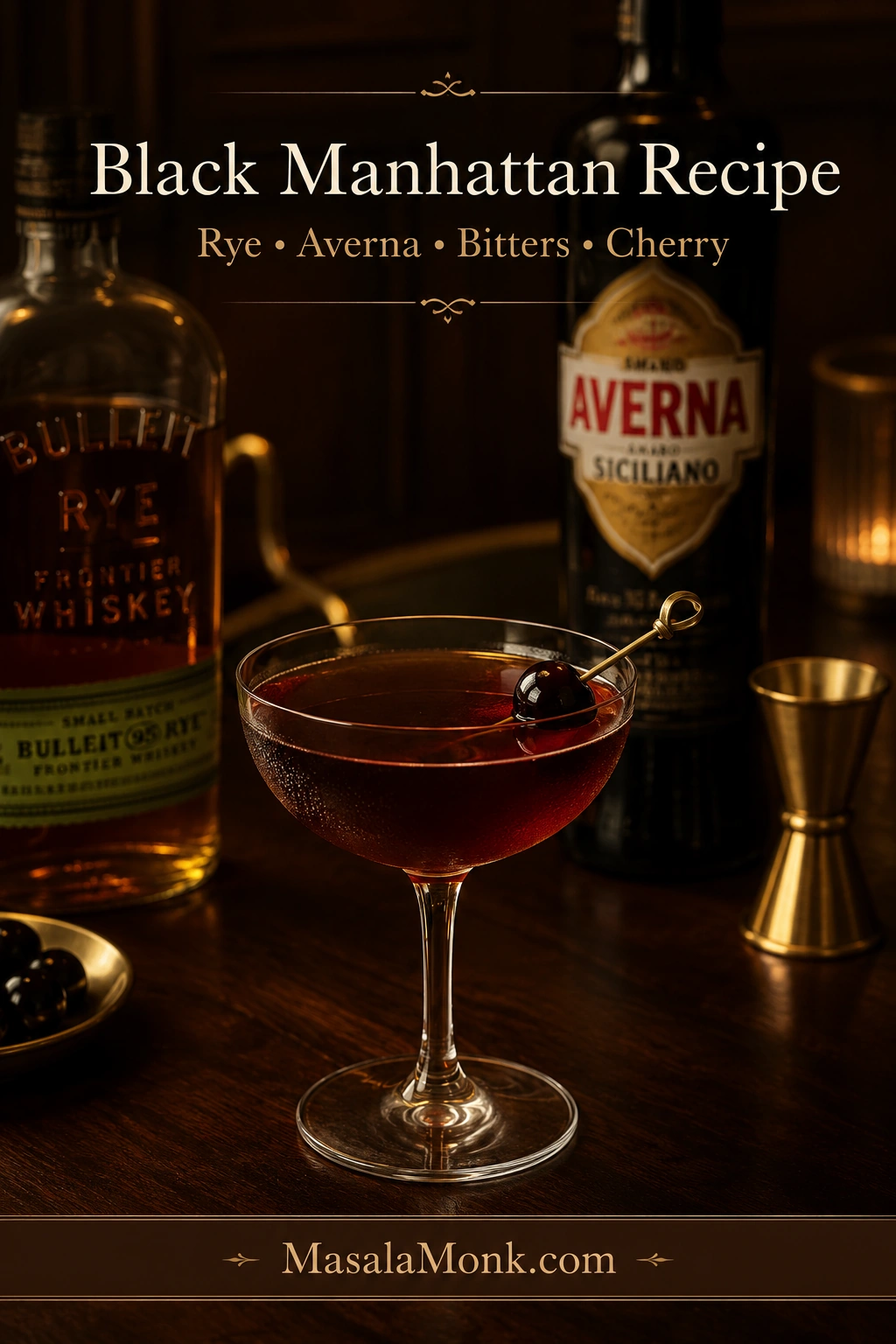
A Black Manhattan cocktail in a chilled coupe glass with a dark brandied cherry garnish, set on a dark bar with rye whiskey and Averna bottles in the background.

A Black Manhattan is what happens when a classic Manhattan turns moodier. Rye whiskey gives it spine, Averna brings bittersweet caramel and herbs, and a good cherry waits at the bottom like a small reward.

It is not a complicated cocktail, but it does ask for care. A cold glass, a proper stir, and the right amaro make the difference between a drink that tastes hot and heavy and one that feels dark, smooth, structured, and composed.

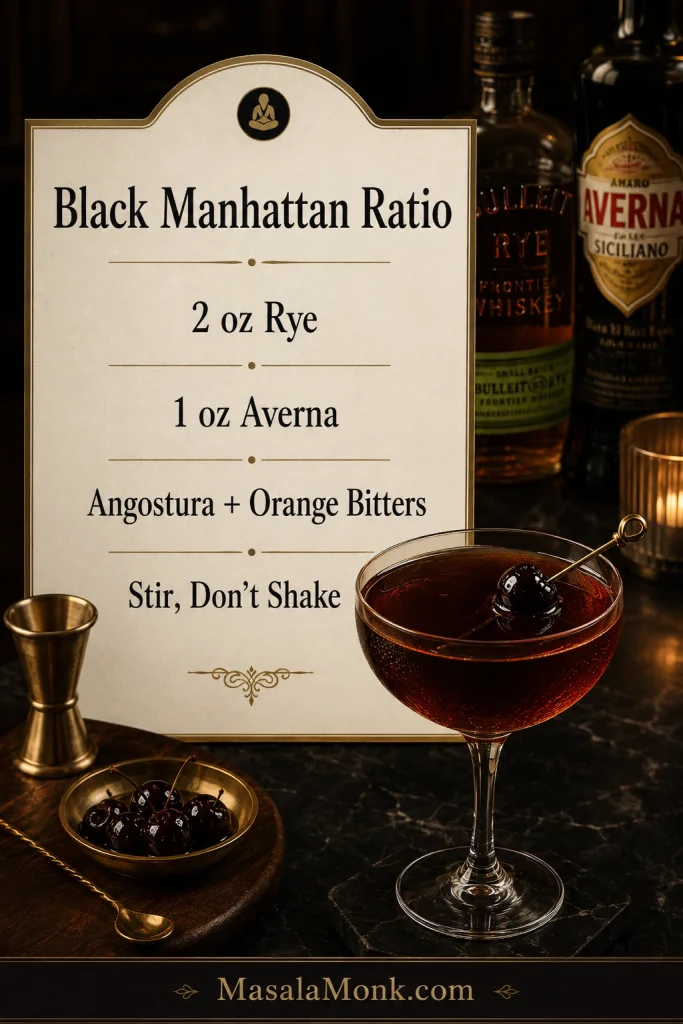
The core formula is easy to remember: 2 oz rye whiskey, 1 oz Averna amaro, bitters, ice, and a cherry. Make that rye-and-Averna build first. Once it tastes balanced, you can try bourbon, switch the amaro, add black walnut bitters, batch it for guests, or serve it over one large cube.

Black Manhattan Recipe Quick Answer

A Black Manhattan is a stirred whiskey cocktail made with 2 oz rye whiskey, 1 oz Averna amaro, Angostura bitters, orange bitters, and a brandied cherry. It is a Manhattan variation where amaro replaces sweet vermouth, giving the drink a darker, more herbal, bittersweet flavor.

Stir the whiskey, amaro, and bitters with plenty of ice for 25–30 seconds, then strain into a chilled coupe or Nick & Nora glass. Start with rye and Averna if this is your first round; use bourbon when you want a softer, sweeter drink.

  • Best first build: rye whiskey + Averna.
  • Main ratio: 2 parts whiskey to 1 part amaro.
  • Method: stir, never shake.
  • Garnish: brandied cherry or dark cocktail cherry.

Ratio cue: check this 2:1 guide before measuring the first drink, especially if you are new to stirred whiskey cocktails.

A Black Manhattan ratio guide showing 2 oz rye whiskey, 1 oz Averna amaro, Angostura bitters, orange bitters, and a cherry garnish.
First, lock in the ratio: 2 parts rye to 1 part Averna. From there, bitters and proper stirring turn the formula into a balanced cocktail.

Black Manhattan Recipe Card

Recipe cue: keep this rye-and-Averna card close while you make the reference version.

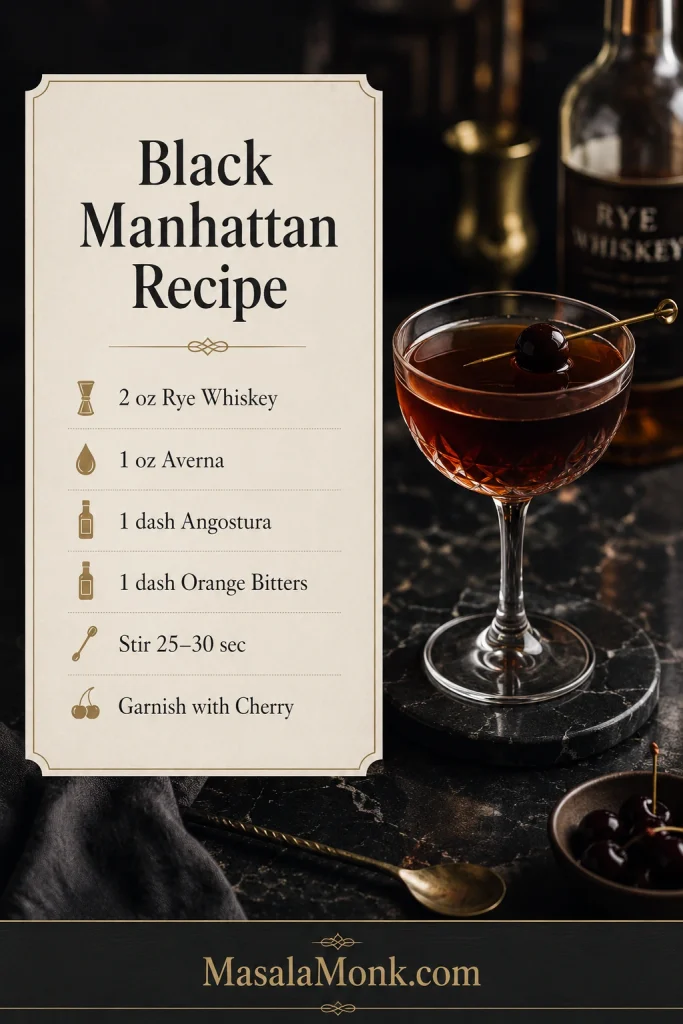
A Black Manhattan recipe card showing rye whiskey, Averna amaro, Angostura bitters, orange bitters, stirring time, and a cherry garnish.
Use this quick Black Manhattan recipe card when you want the classic rye-and-Averna build without recalculating the measurements.

Black Manhattan With Rye and Averna

Start here. This is the version that teaches the drink: rye whiskey, Averna, Angostura bitters, orange bitters, and a brandied cherry. Rye keeps the cocktail dry and upright, while the amaro gives it the caramel-herbal depth that separates it from a regular Manhattan.

Prep Time5 minutes
Total Time5 minutes
Servings1 cocktail
MethodStirred
GlassChilled coupe or Nick & Nora
EquipmentMixing glass, jigger, bar spoon, strainer

Ingredients

IngredientAmount
Rye whiskey2 oz / 60 ml
Averna amaro1 oz / 30 ml
Angostura bitters1 dash
Orange bitters1 dash
IceEnough to fill the mixing glass
Brandied cherry1, for garnish

Instructions

  1. Chill a coupe or Nick & Nora glass for at least 5 minutes.
  2. Add the rye whiskey, Averna, Angostura bitters, and orange bitters to a mixing glass.
  3. Fill the mixing glass with ice.
  4. Stir for 25–30 seconds, until the drink is very cold.
  5. Strain into the chilled glass.
  6. Garnish with a brandied cherry and serve right away.

Bar-Style Adjustments

For a more aromatic Black Manhattan, use 2 dashes each of Angostura and orange bitters. If your bitters bottle pours very lightly, 2 dashes of each may taste closer to a cocktail-bar pour.

Choose a rye with enough proof and spice to stand up to Averna. A bottle around 90–100 proof usually gives enough backbone without making the cocktail harsh. If your rye is very soft, the drink may need an extra dash of Angostura, a brighter orange twist, or a spicier rye next time.

House Rules Before You Experiment

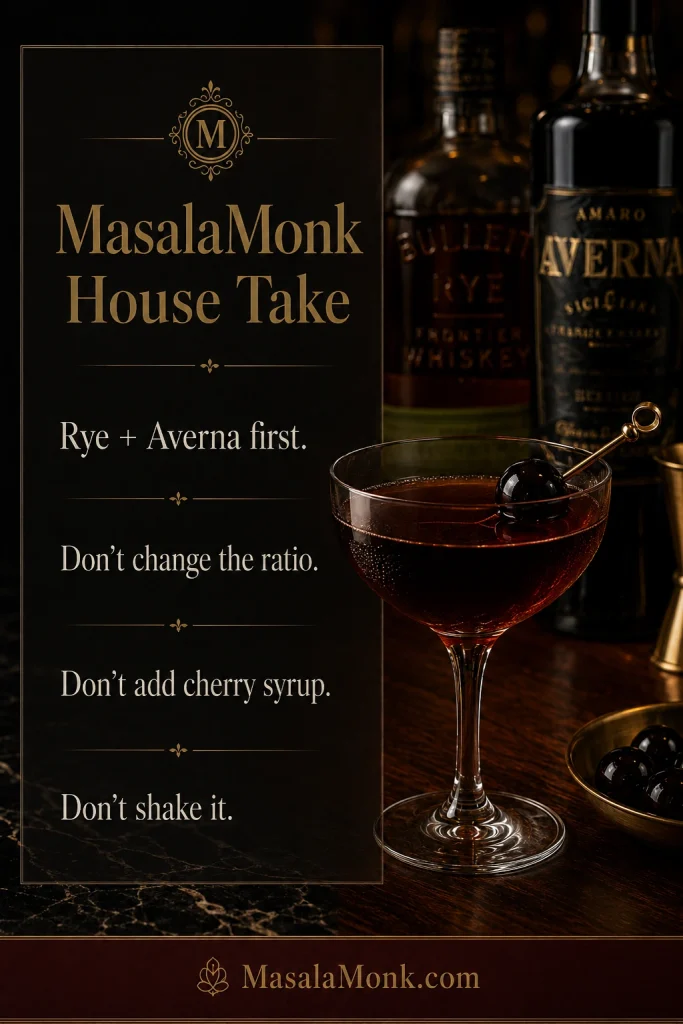
MasalaMonk house take: Make the first one with rye and Averna. Do not change the ratio, do not add cherry syrup, and do not shake it. Once that drink tastes right, make one controlled swap at a time: the whiskey, the amaro, or the bitters.

Strength note: A Black Manhattan is a spirit-forward cocktail. Serve it cold, small, and slow, and only to adults of legal drinking age. For a general reference, the NIAAA explains what counts as a standard drink.

House cue: get the disciplined version right first, then make only one bottle or bitters swap at a time.

A MasalaMonk house take card beside a Black Manhattan cocktail with a dark cherry garnish, showing rules for using rye, Averna, bitters, and no cherry syrup.
Next, make the first version disciplined: rye, Averna, bitters, no cherry syrup, and no shaking. After that, small changes become easier to taste.

From here: if you already have the bottles, continue to how to make it. If the drink tastes off later, use the troubleshooting guide before rebuilding the recipe.

When to Make a Black Manhattan

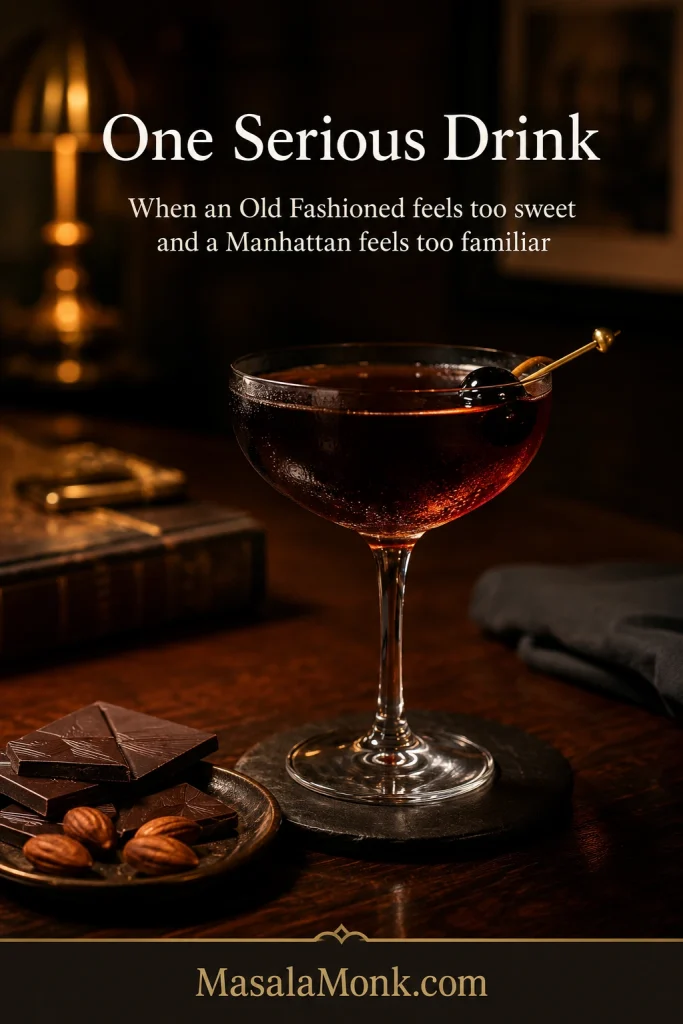
Make a Black Manhattan when you want one serious drink, not a round of light cocktails. It is ideal after dinner, with a small snack board, or on a quiet night when an Old Fashioned feels too sweet and a classic Manhattan feels too familiar.

Serving cue: this is the mood for the drink — serious, slow, and better after dinner than before a loud round.

A Black Manhattan cocktail served in a dim after-dinner setting with dark chocolate, nuts, and small snacks nearby.
Choose a Black Manhattan when you want a serious after-dinner whiskey cocktail: darker than a classic Manhattan and less sweet than an Old Fashioned.

Make it when you want whiskey, but not another Old Fashioned — the elegance of a Manhattan with more shadow, less winey sweetness, and a slower finish.

It is dark without being harsh, bitter without being punishing, and slow enough to make you pay attention. This is not the drink for a blender, a shaker tin, or a crowded glass of crushed ice. It is the drink for a chilled glass, a quiet stir, and one good cherry at the end.

Black Manhattan at a Glance

Main ratio2 parts whiskey to 1 part amaro
Sweet vermouth?No. Amaro replaces sweet vermouth.
Best whiskeyRye for the traditional build; bourbon for a softer pour
Best amaro to startAverna
Serve styleStirred, served up, without ice
FlavorCold, whiskey-led, herbal, bittersweet, polished

Why This Recipe Works

A good Black Manhattan works because nothing in the glass is wasted. Rye brings the dry, spicy backbone. Averna gives the cocktail its low light. Angostura adds spice, while orange bitters keeps the amaro from feeling too heavy.

Stirring is just as important as the ingredients. This is an all-spirit cocktail, so it needs controlled dilution, not shaking. A gentle 25–30 second stir chills the drink, softens the alcohol heat, and gives the final pour the clear, silky texture you want.

The cherry should feel like a finish, not the whole story. A bad cherry will not ruin the drink, but a good one makes the last sip feel intentional. Too much cherry syrup pushes the cocktail away from balance and into something sticky.

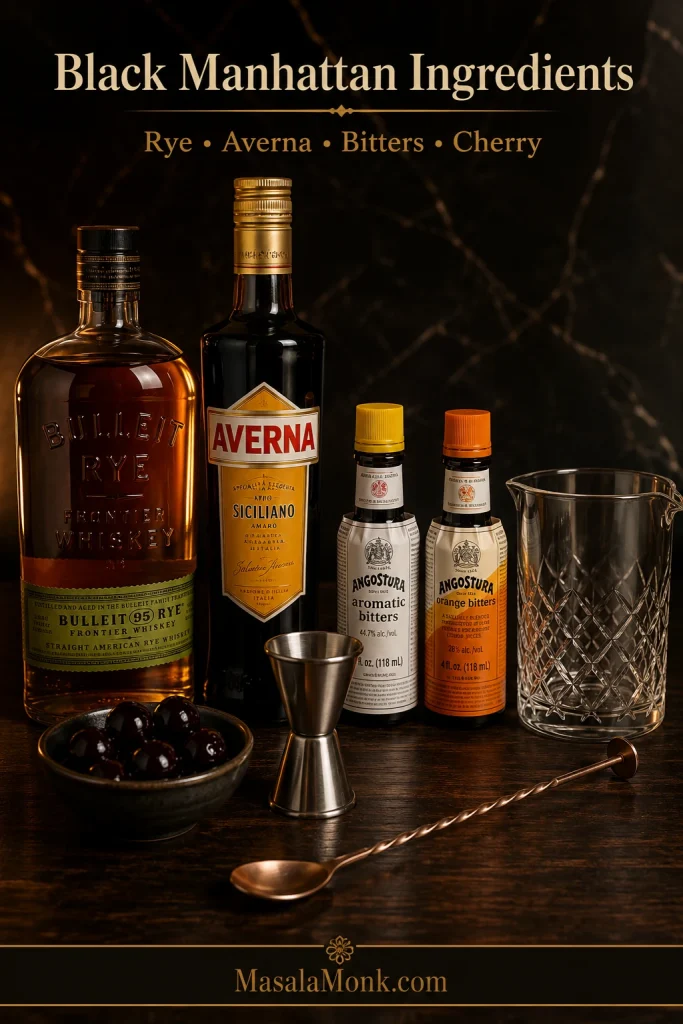
Black Manhattan Ingredients

With a drink this spare, every bottle shows. You do not need a huge home bar to make this well, but you do need a whiskey and amaro that work together instead of fighting each other.

Ingredient cue: the whiskey, amaro, bitters, and cherry each change the balance, so choose them with intention.

Ingredients for a Black Manhattan arranged on a dark bar surface, including rye whiskey, Averna amaro, Angostura bitters, orange bitters, cherries, a jigger, a mixing glass, and a bar spoon.
Because the ingredient list is short, every bottle has a job: rye keeps it dry, Averna makes it bittersweet, and bitters keep it from tasting heavy.

Rye Whiskey

Rye whiskey is the traditional choice because it brings spice, dryness, and structure. It is not here to shout; it is here to keep the drink upright while Averna brings the dark, sweet-herbal weight.

Choose a bottle you enjoy in stirred drinks. Something around 90–100 proof usually gives enough backbone without making the cocktail harsh. If the whiskey is very soft, the drink may need an extra dash of Angostura, a brighter orange twist, or a spicier bottle next time.

Averna or Another Amaro

Averna is the most reliable starting point for a Black Manhattan. It is bittersweet, rounded, and gently herbal, with caramel and orange-like notes that work beautifully with whiskey.

The amaro replaces sweet vermouth, and that one swap changes the whole cocktail. A classic Manhattan tastes winey, smooth, and lightly sweet; by contrast, a Black Manhattan tastes deeper, more herbal, and more bittersweet.

Do not worry about finding the “perfect” bottle on your first try. Averna gives you the reference point; the other amari make more sense after you know what the first version tastes like.

If you are choosing your first bottle, do not overthink it: Averna first, Cynar later, Montenegro if you want something gentler.

For a brighter bourbon-and-amaro drink, the Paper Plane cocktail uses amaro in a completely different way, with citrus and Aperol instead of a dark stirred build.

Angostura and Orange Bitters

Angostura bitters add spice and structure. Orange bitters add lift and brightness, which helps the drink feel polished instead of heavy. Start with 1 dash of each; go to 2 dashes each if you want a more aromatic bar-style version.

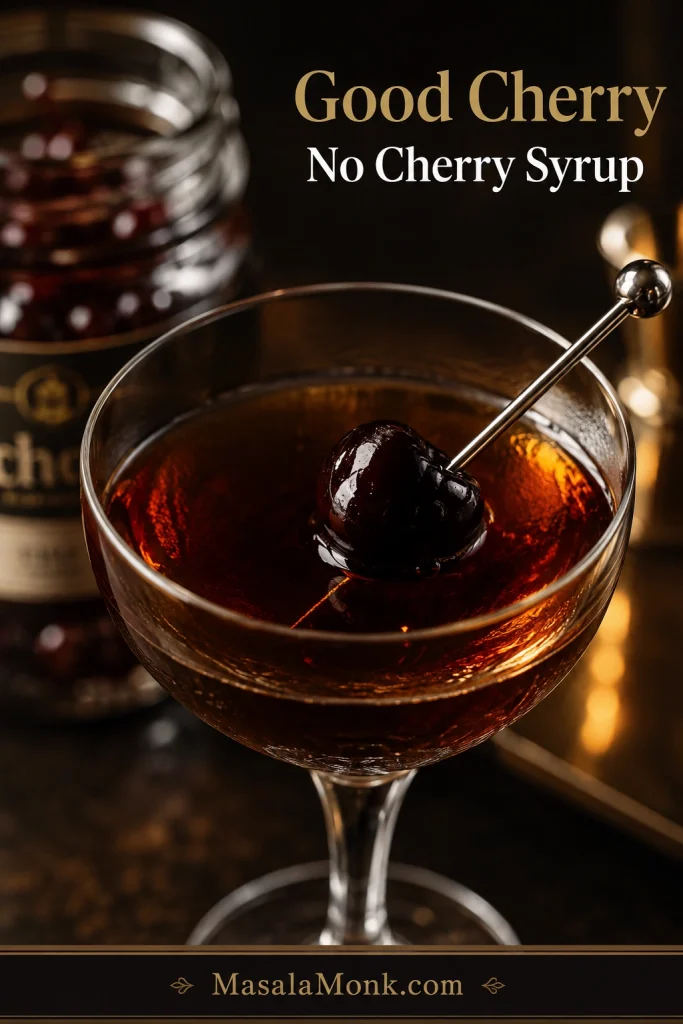
Brandied Cherry

Brandied cherries or Luxardo-style cocktail cherries work better than bright neon-red sundae cherries. The garnish should add a small, rich finish, not turn the drink into a cherry cocktail.

An orange twist can also work, especially if you are using a brighter amaro. For the classic build, start with a cherry.

Garnish cue: the cherry should finish the cocktail with richness, not turn it into a syrupy cherry drink.

A close-up of a dark brandied cherry garnish resting in or above a Black Manhattan cocktail.
Finally, finish with a good brandied cherry. It should add richness, not enough syrup to cover the whiskey and amaro.

How to Make a Black Manhattan

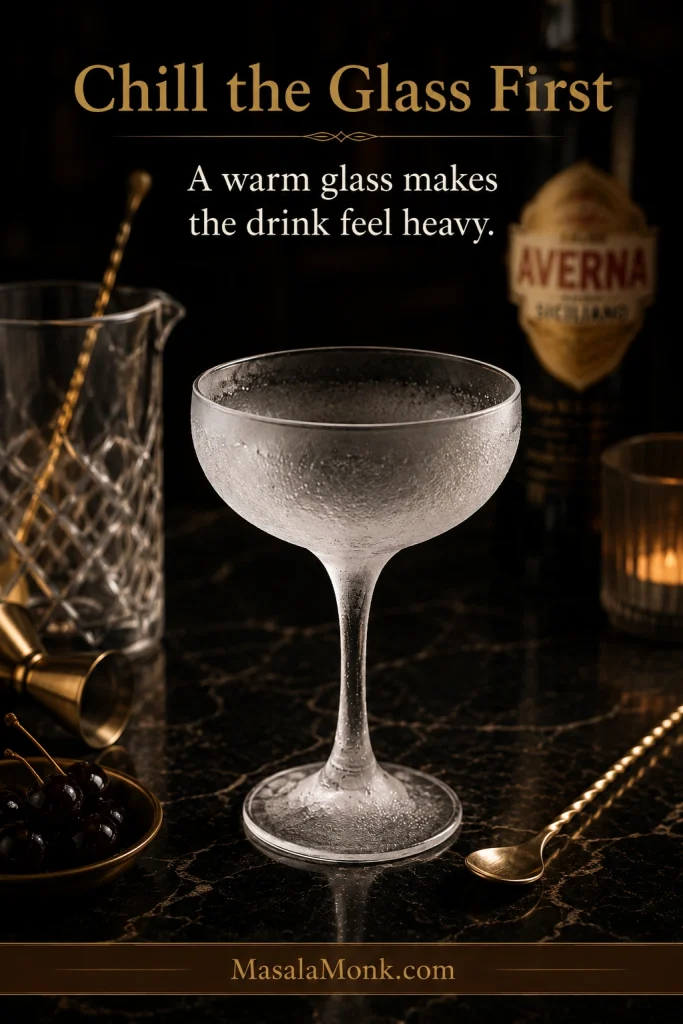
Chill the Glass First

Start by chilling your glass. This is a small detail, but it makes a real difference because the cocktail is served up, without ice. A cold glass keeps the first sip crisp and stops the last sip from feeling warm or heavy.

Temperature cue: chill the glass before mixing because the finished cocktail is served up, without ice.

An empty frosted coupe glass with condensation on a dark bar surface beside a mixing glass, bar spoon, cherries, and an Averna bottle.
Before mixing, chill the coupe. Since this cocktail is served up, a cold glass keeps the first sip crisp and the last sip from feeling warm.

Measure, Ice, and Stir

Add the rye, Averna, Angostura bitters, and orange bitters to a mixing glass. Fill it with plenty of ice, then stir for 25–30 seconds, until the glass feels frosty and the sharp edge of the whiskey has softened. Stir smoothly, not violently. You are chilling and diluting the drink, not trying to beat it into submission.

Amaro cue: measure Averna carefully because it controls the drink’s sweetness, weight, and herbal depth.

Averna amaro being measured for a Black Manhattan cocktail on a dark bar surface with cocktail tools nearby.
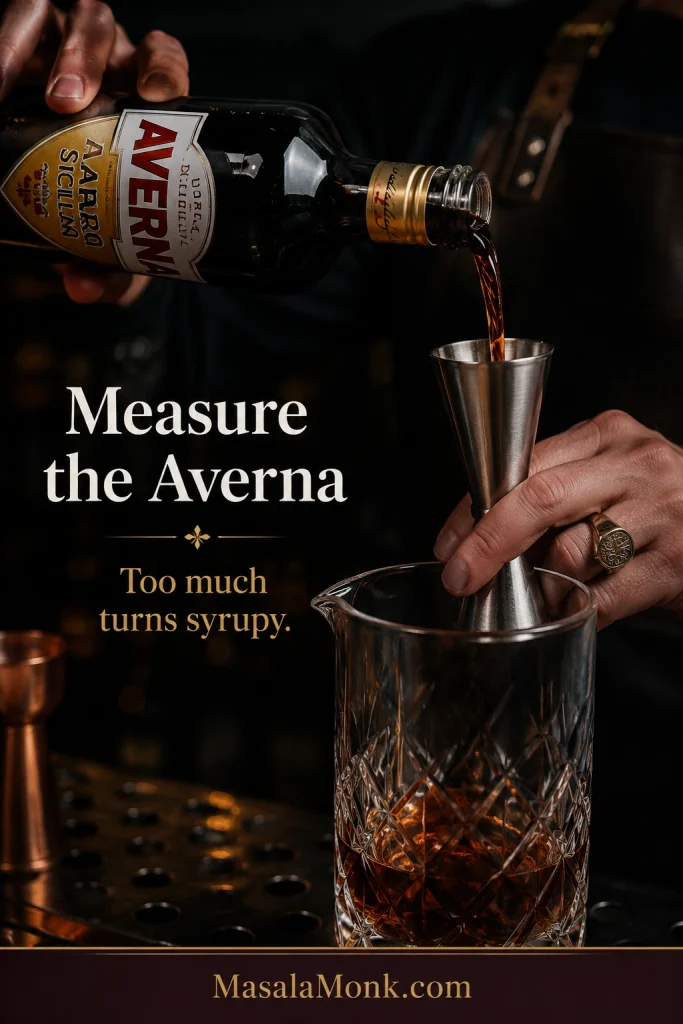
Then measure the Averna carefully. A little too much amaro can make the drink taste syrupy, medicinal, or sweeter than the recipe intends.

Do not shake a Black Manhattan. Shaking makes it cloudy and changes the texture. Stirring keeps it smooth, clear, and silky.

Technique cue: use plenty of ice and a calm stir to make the drink cold, diluted, clear, and silky.

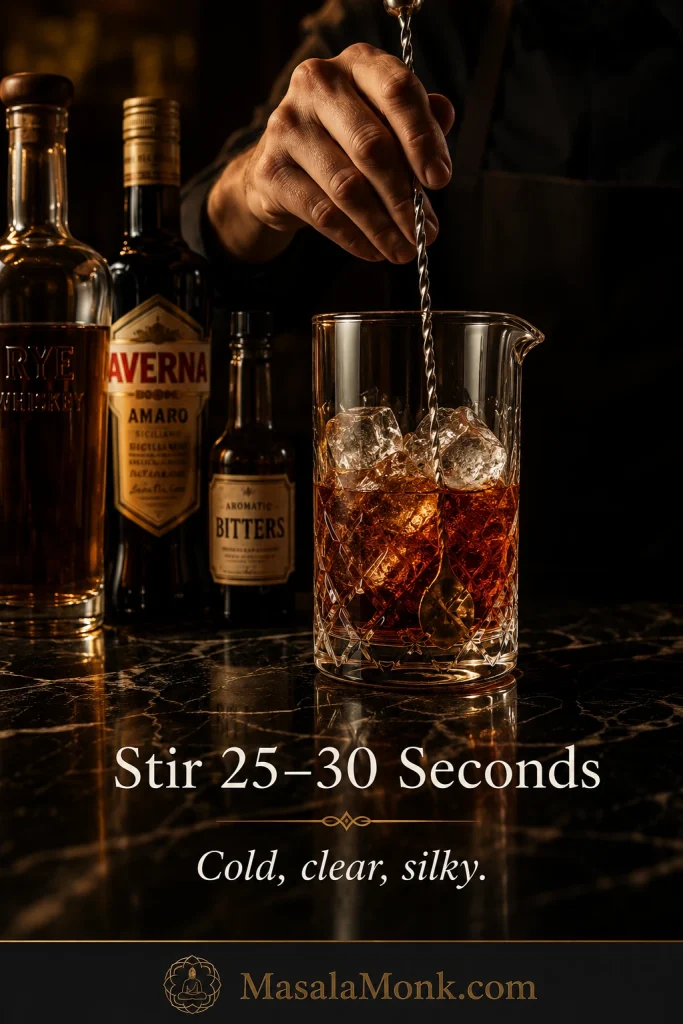
A Black Manhattan mixture being stirred with ice in a mixing glass using a bar spoon, with bar tools and bottles nearby.
After measuring, stir with plenty of ice for 25–30 seconds so the cocktail becomes cold, clear, diluted, and silky instead of harsh.

Strain and Garnish

Once the drink is very cold, strain it into the chilled glass and garnish with a brandied cherry. Serve it right away.

After the first stir: if the cocktail tastes hot, sweet, or flat, jump to how to fix it. If it tastes balanced, compare whiskey choices below. Back to recipe card.

Rye vs Bourbon: Which Works Better?

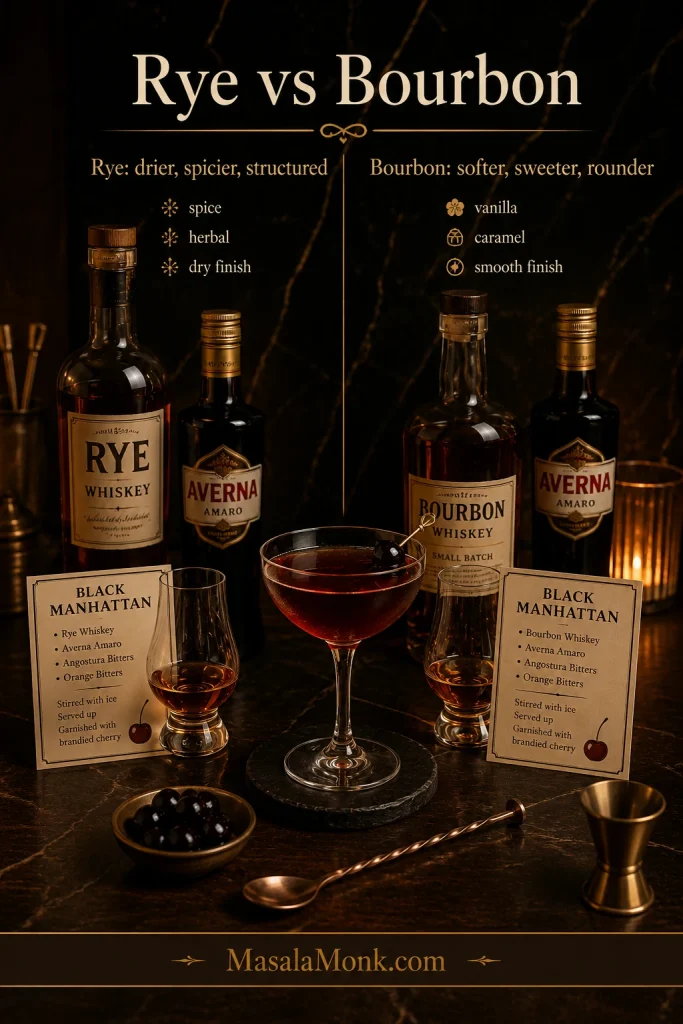
Whiskey cue: rye keeps the Black Manhattan dry and structured, while bourbon makes it softer and sweeter.

A rye versus bourbon comparison board for a Black Manhattan with bottles, tasting glasses, a finished cocktail, cherries, and flavor notes.
For a drier Black Manhattan, choose rye; for a softer and sweeter version, use bourbon. The whiskey changes the whole shape of the drink.

Rye is the best first choice for the traditional Black Manhattan. Bourbon works too, but it changes the mood of the drink. It makes the cocktail friendlier, while also making it easier to over-sweeten.

WhiskeyBest ForFlavor
Rye whiskeyThe traditional Black ManhattanDrier, spicier, sharper, more structured
BourbonA softer variationSweeter, rounder, warmer, gentler

A too-sweet drink usually needs rye, not more garnish. If the drink tastes too sharp or bitter, bourbon can soften the edges. When bourbon meets a sweeter amaro, an extra dash of Angostura or an orange twist helps keep the cocktail from feeling too round.

For the vermouth-based original, see the classic Manhattan cocktail recipe.

Next bottle decision: after choosing rye or bourbon, use the amaro section below to decide whether your next Black Manhattan should be classic, sweeter, lighter, smokier, or more bitter.

Best Amaro for a Black Manhattan

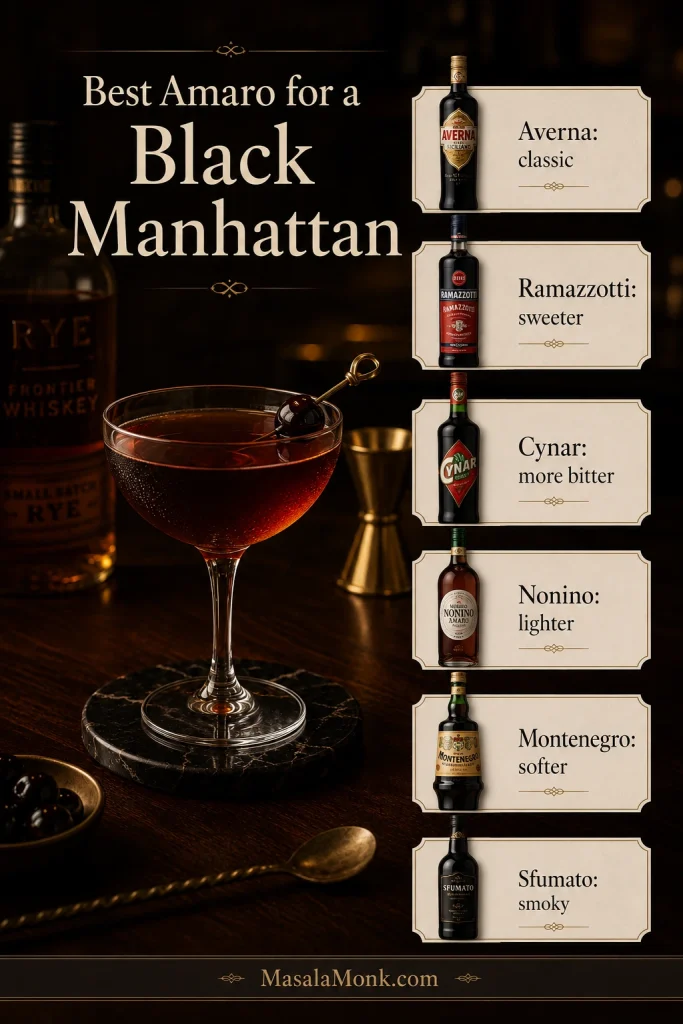
Amaro cue: once you know Averna, this guide helps you choose a sweeter, lighter, smokier, softer, or more bitter version.

An amaro comparison guide for a Black Manhattan showing Averna, Ramazzotti, Cynar, Nonino, Montenegro, and Sfumato with flavor notes.
Once the Averna version makes sense, use the amaro choice to steer the cocktail sweeter, lighter, smokier, softer, or more bitter.

How Each Amaro Changes the Drink

The whiskey gives the frame; the amaro paints the room. Averna keeps it familiar and balanced. Ramazzotti makes it rounder and sweeter. Cynar turns it earthier and more bitter. Nonino and Montenegro lighten the mood.

Averna is the classic choice for a reason. Other amari can make excellent whiskey-amaro Manhattans, but they may not taste as recognizably like a Black Manhattan at the same 2:1 ratio.

Choice TypeAmaroBest ForWatch Out For
Best first bottleAvernaThe classic shape: smooth, caramel-herbal, balancedReliable, but not the most bitter option
SweeterRamazzottiA rounder cocktail with orange-spice and cola-like notesCan feel too sweet with bourbon
Rich and warmMelettiBurnt sugar, bitter citrus, spice, and vanilla-like warmthCan move the drink toward dessert territory
LighterNoninoA brighter, more elegant pourLess dark and brooding than the Averna build
More bitterCynarEarthy, bitter, more assertive variationCan taste medicinal or vegetal to beginners
Soft beginner swapMontenegroFloral, gentle, approachable pourMay feel too light if you want a deeper profile
Smoky / adventurousSfumatoRhubarb-like, smoky, unusual cocktailCan dominate the whiskey if used without care

How to Test Amaro Swaps

When Averna leaves the drink, keep everything else steady. Leave the whiskey and bitters alone, then swap only the amaro. Very bitter bottles may also need a tiny ratio adjustment, such as a little less amaro or an extra touch of orange bitters.

If you see bottles like Amaro Lucano, Ciociaro, Bigallet China-China, or Foro, treat them as experimental swaps rather than the first bottle to buy. Start with the classic amaro choice, then branch out once you know how the first version should taste.

If you want another whiskey cocktail with a bittersweet edge, a Boulevardier moves the idea toward Campari and sweet vermouth.

What Changes the Drink Most

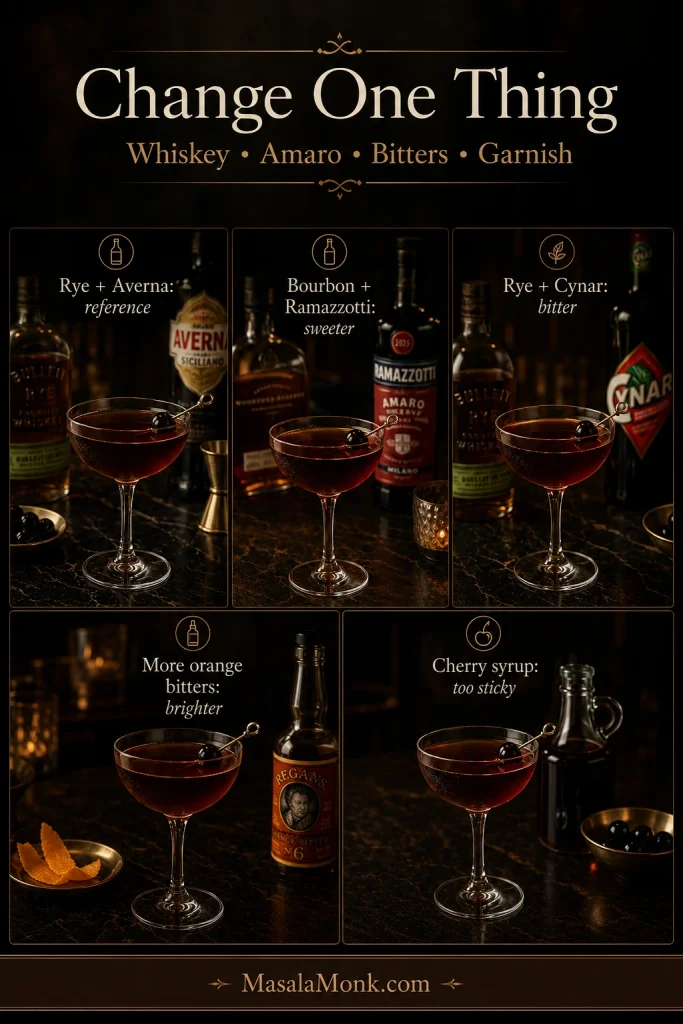
Variation cue: change one ingredient at a time so you can tell what actually improved the cocktail.

A Black Manhattan variation guide with five panels showing rye and Averna, bourbon and Ramazzotti, rye and Cynar, extra orange bitters, and cherry syrup.
Instead of rebuilding the whole cocktail, adjust one variable. That way, you can actually taste what the whiskey, amaro, bitters, or garnish changed.

Use the reference version as your baseline. Then adjust one variable at a time so you can learn what your whiskey, amaro, and bitters are actually doing.

ChangeWhat Usually Happens
Rye + Averna + 1 dash each bittersCleanest reference version for learning the drink
Bourbon + RamazzottiSofter, sweeter, rounder
Rye + CynarMore bitter, earthy, and intense
2 dashes orange bittersBetter aroma if the drink feels flat
Cherry syrup addedUsually makes the drink too sticky

Is a Dark Manhattan the Same as a Black Manhattan?

Most of the time, yes. If you heard someone say “dark Manhattan,” they were probably talking about a Black Manhattan-style cocktail: whiskey, dark amaro, bitters, and a cherry or orange garnish.

The cocktail is not actually black. It usually lands somewhere between deep amber, brown, and reddish-brown. The “black” or “dark” idea comes from the amaro replacing sweet vermouth and giving the drink a deeper, more herbal mood.

Some bars use “dark Manhattan” loosely for bourbon-and-amaro drinks or other darker Manhattan variations. If you want the recognizable rye-and-Averna build, start with rye whiskey, Averna, Angostura bitters, orange bitters, and a cherry.

Black Manhattan vs Classic Manhattan

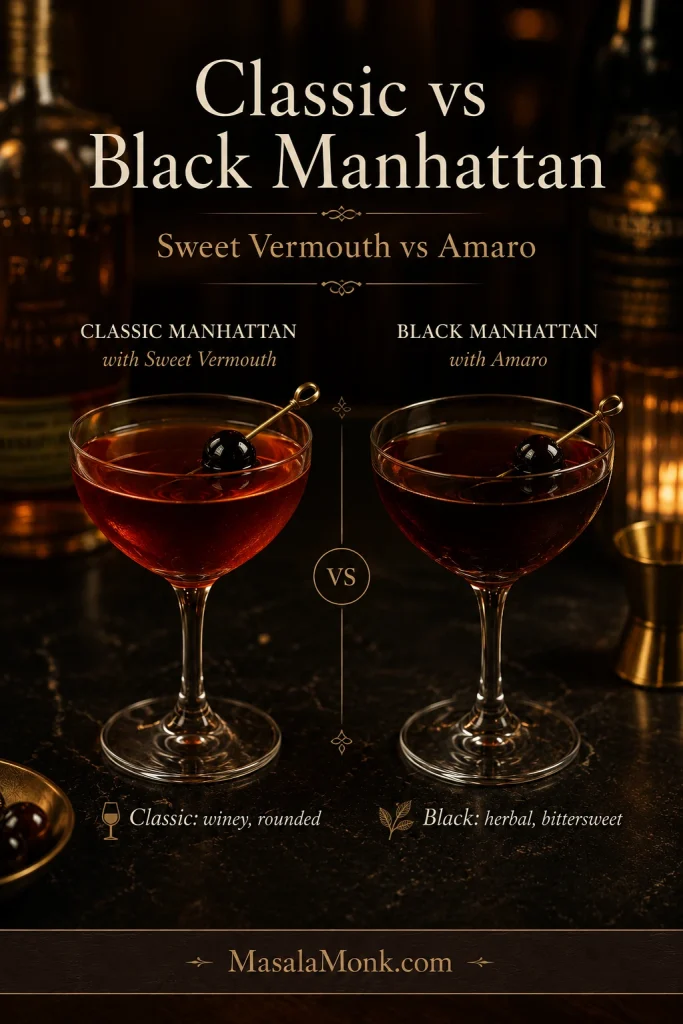
Comparison cue: the key difference is simple: sweet vermouth gives a classic Manhattan its winey roundness, while amaro makes the Black Manhattan deeper and bittersweet.

Two cocktails in coupe glasses comparing a classic Manhattan with sweet vermouth and a Black Manhattan with amaro.
Meanwhile, the classic Manhattan stays winey and rounded with sweet vermouth, while the Black Manhattan becomes darker and more bittersweet with amaro.

Sweet Vermouth vs Amaro

The Black Manhattan stays close to the classic Manhattan, but the flavor lands in a different place. Both drinks are stirred whiskey cocktails, and each one uses bitters. Usually, they are served up in a chilled glass. The big difference is what replaces the vermouth.

DrinkWhat balances the whiskeyFlavor
Classic ManhattanSweet vermouthWiney, smooth, lightly sweet, rounded
Black ManhattanAverna or amaroDeeper, herbal, bittersweet, richer

If you like Manhattans but want something less vermouth-forward, this is a natural next drink. For another smooth member of the stirred-whiskey family, the Rob Roy brings Scotch into the picture.

If you want to understand the vermouth side of bitter cocktails more deeply, this guide to sweet vermouth is a useful companion.

A Quick Note on the Original

The Black Manhattan is generally credited to bartender Todd Smith in San Francisco in 2005 and is closely associated with Bourbon & Branch. Most modern home-bar versions now use rye, Averna, aromatic bitters, and orange bitters, though like many modern classics, the drink has been adapted by bars and home bartenders over time. For another look at the core modern formula, see Liquor.com’s Black Manhattan recipe.

How to Make a Better Black Manhattan

Use this as your final pre-pour checklist. Most Black Manhattan problems come from warmth, weak dilution, too much amaro, or a garnish that tries too hard.

  • Chill the glass. A warm glass makes a spirit-forward drink feel heavy too quickly.
  • Measure the ingredients. The 2:1 ratio matters. Too much amaro can make the cocktail syrupy or medicinal.
  • Pack the mixing glass with ice. A full glass chills better than a glass with just a few cubes.
  • Do not shake it. Stirring keeps the drink clear, smooth, and elegant.
  • Begin with the reference version. Rye and Averna teach you what the drink should taste like before you start swapping bottles.
  • Finish with a good cherry. A rich cocktail cherry works better than a bright, candy-like cherry.

Small fix that works often: If the drink tastes good but a little flat, add an orange twist or use 2 dashes of orange bitters next time. If it tastes too sweet, use rye instead of bourbon or choose a more bitter amaro.

Black Manhattan Variations

After the rye-and-Averna version makes sense, the variations become easier to control. Keep the main idea the same: whiskey, amaro, bitters, cold dilution, and a clean garnish.

Bourbon Black Manhattan

Swap in bourbon for a softer, sweeter drink. This variation is warmer and rounder, especially with Averna or Ramazzotti. Add an extra dash of Angostura if you want more structure.

Black Walnut Manhattan

Choose black walnut bitters in place of, or alongside, the orange bitters. For a deeper walnut version, replace a small part of the amaro with nocino. This becomes a nuttier variation rather than the classic Black Manhattan, but it can be excellent in colder weather.

Black Cherry Manhattan

Reach for a rich cocktail cherry and a very small amount of cherry liqueur if you want a cherry-forward pour. Keep it restrained. Too much cherry liqueur can make the drink taste sticky.

Smoked Orange Black Manhattan

Try smoked orange bitters or express an orange twist over the finished drink. This works especially well with rye and Averna because the citrus oil lifts the heavier amaro notes.

Black Manhattan on the Rocks

The traditional serve is up, without ice. If you prefer a slower-sipping version, strain the drink over one large cube in a rocks glass. It will soften as the ice melts.

If you are making more than one, you do not need to build every glass from scratch. This cocktail batches beautifully because there is no juice or fizz to fade.

Batch Black Manhattan for a Party

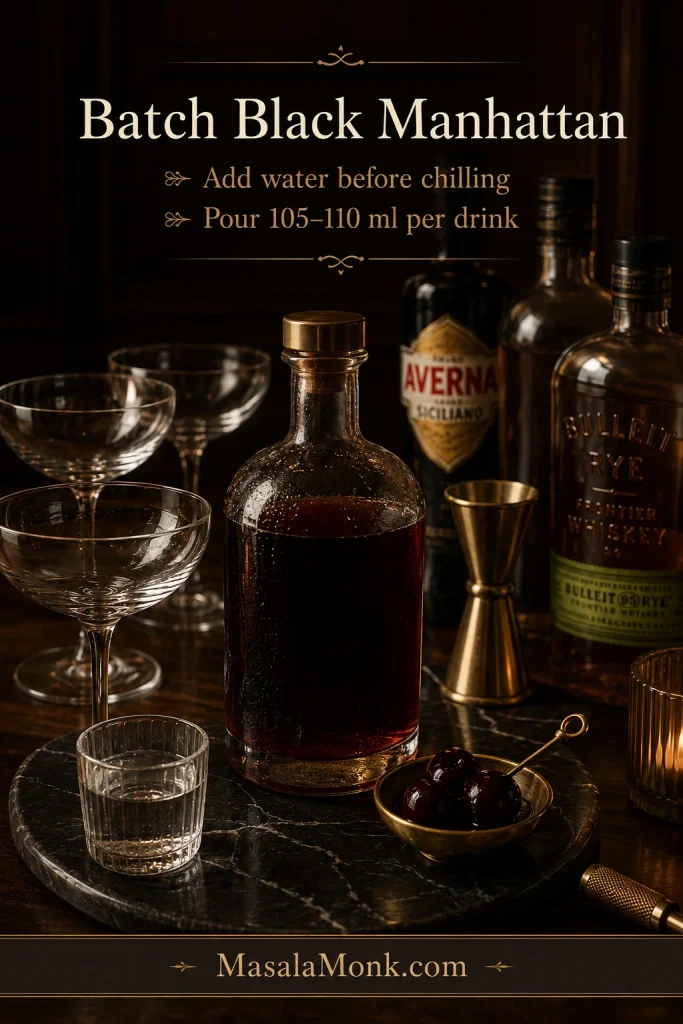
Batch cue: add water before chilling so each serving tastes like a stirred cocktail, not straight whiskey and amaro.

A bottle of batched Black Manhattan on a dark bar with empty coupe glasses, a water glass, cherries, a jigger, rye whiskey, and Averna.
When batching, add water before chilling. Otherwise, each pour can taste like straight whiskey and amaro instead of a properly stirred cocktail.

Why This Cocktail Batches Well

A Black Manhattan is a good cocktail to batch because it does not use citrus juice, soda, cream, egg, or fresh fruit. You can mix the whiskey, amaro, bitters, and water ahead of time, chill the batch, then pour and garnish when guests arrive.

A batched Black Manhattan should taste like a stirred cocktail, not a bottle of room-temperature whiskey with ideas. The water matters because stirring with ice normally adds dilution to a single drink. For a batched drink, adding water ahead of time keeps the cocktail balanced without needing to stir every serving.

Batch Dilution Chart

The table below uses about 20% water based on the undiluted cocktail volume, which gives the batch the dilution it would normally get from stirring with ice.

ServingsRye WhiskeyAvernaAngosturaOrange BittersWater
48 oz / 240 ml4 oz / 120 ml4 dashes4 dashes2.4 oz / 70 ml
816 oz / 475 ml8 oz / 240 ml8 dashes8 dashes4.8 oz / 140 ml
1224 oz / 710 ml12 oz / 355 ml12 dashes12 dashes7.2 oz / 215 ml

How to Serve the Batch

Do not worry if the water is not perfect to the last milliliter. The goal is a cold, balanced batch, not laboratory precision.

  1. Combine the rye, Averna, bitters, and water in a clean bottle or pitcher.
  2. Cover and chill for at least 2 hours.
  3. Pour about 105–110 ml per drink into a chilled coupe or Nick & Nora glass.
  4. Garnish each serving with a brandied cherry.

Taste the chilled batch before guests arrive. If it feels hot, add a teaspoon or two of cold water per serving. When it feels thin, serve it colder rather than adding more ice.

Label the bottle if you are chilling it ahead, especially if guests may mistake it for straight whiskey or liqueur.

If you do not add water to the batch, stir each serving with ice before straining. Otherwise, the drink will taste too hot and too concentrated.

Before serving guests: taste the chilled batch, then use this fix guide if it feels too sweet, bitter, hot, thin, or flat.

Troubleshooting: How to Fix a Black Manhattan

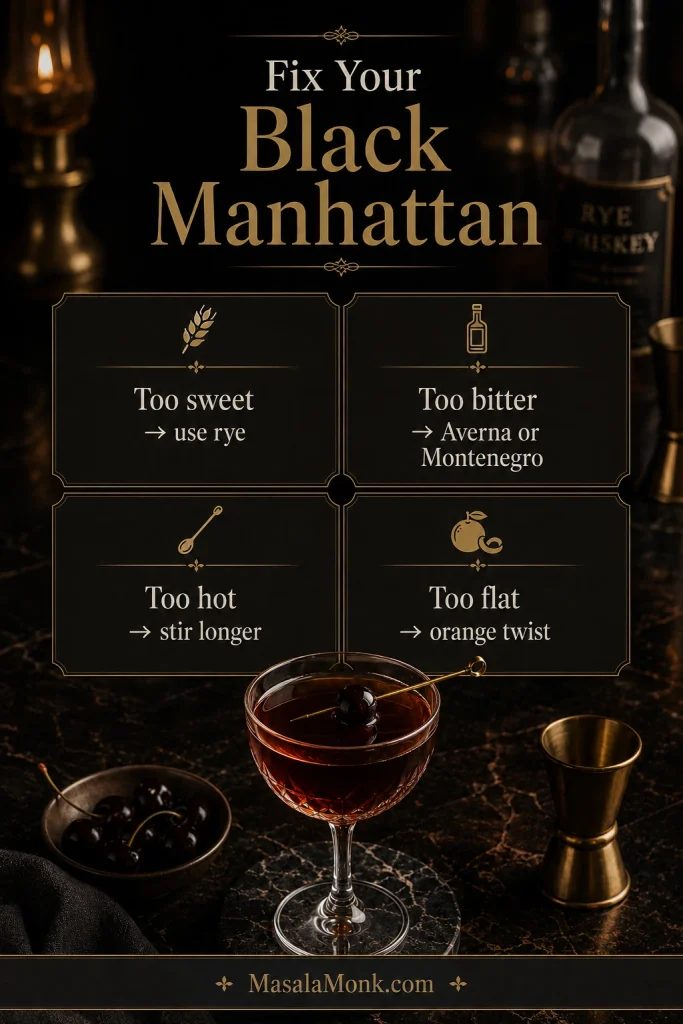
Fix cue: when the drink tastes too sweet, bitter, hot, or flat, correct one variable before changing the whole recipe.

A troubleshooting guide for a Black Manhattan with four fix panels for drinks that are too sweet, too bitter, too hot, or too flat.
If the drink tastes too sweet, bitter, hot, or flat, fix one variable first. Most problems come from whiskey choice, amaro choice, temperature, or dilution.

If your first Black Manhattan tastes a little off, do not blame the whole cocktail. Most bad Black Manhattans are not bad recipes. They are warm, under-diluted, over-sweetened, or built with bottles that do not quite fit together yet.

ProblemHow to Fix It
Overly bitterChoose Averna, Montenegro, or bourbon. Avoid very bitter amari like Cynar until you know the drink.
Overly sweetReach for rye instead of bourbon, add an extra dash of Angostura, and avoid adding cherry syrup.
Boozy or hotStir longer with plenty of ice, or add a tiny splash of cold water before straining.
Thin or wateryGo with a richer amaro like Averna or Ramazzotti and avoid over-diluting.
MedicinalSwitch from aggressive bitter amari to Averna, Ramazzotti, or Montenegro.
Not cold enoughChill the glass and stir for 25–30 seconds with plenty of ice.
Flat or dullAdd orange bitters, express an orange twist, or use a rye with more spice.

Make-Ahead and Storage

A single Black Manhattan is best made fresh because the texture is nicest right after stirring. For parties, batching works very well.

  • Single drink: Measure, stir with ice, strain, and serve right away.
  • Party batch: Mix the whiskey, amaro, bitters, and water ahead of time, then chill.
  • Do not garnish early: Add the cherry only when serving.
  • Keep it cold: Store the batch in the refrigerator until ready to pour.

If your batch has already been diluted with water, pour it straight into chilled glasses. Otherwise, stir each serving with ice first.

What to Serve With a Black Manhattan

A Black Manhattan is rich and spirit-forward, so it works best with small, savory bites that can stand up to whiskey and amaro. Think salty, roasted, smoky, earthy, or gently sweet — not delicate snacks that disappear next to the drink.

Pairing cue: choose salty, savory, earthy snacks that can meet the whiskey and amaro instead of disappearing beside them.

A Black Manhattan cocktail served with aged cheese, walnuts, olives, mushroom toast, dark chocolate, cherries, and a rye whiskey bottle in a warm low-light setting.
To serve it well, pair the cocktail with salty, savory, earthy bites like aged cheese, roasted nuts, olives, mushroom toast, and dark chocolate.

Best Small Bites to Pair With It

  • Salty roasted nuts, especially almonds, pecans, or walnuts
  • Aged cheddar, gouda, or parmesan for a sharp, savory bite
  • Mushroom toast or roasted mushrooms for an earthy pairing
  • Steak bites with pepper, butter, or a simple pan sauce
  • Charcuterie-style snacks with cured meats, olives, and pickles
  • Dark chocolate with sea salt if you want a small sweet finish

If you want an easy make-ahead snack board, a cream cheese ball with crackers fits the rich, savory mood of the drink. For something warm, creamy, salty, and shareable, a spinach dip also works well.

Keep the food simple. This is a slow-sipping cocktail, so the best pairings support it without stealing the room. The food should have enough salt or savoriness to meet the whiskey halfway.

Need a fast answer? The FAQ covers vermouth, ml measurements, bourbon, amaro choices, batching, and strength. You can also go back to top or return to the recipe card.

FAQ

What is a Black Manhattan made of?

A Black Manhattan is made with rye whiskey, Averna or another amaro, Angostura bitters, orange bitters, ice, and a brandied cherry. The common ratio is 2 oz whiskey to 1 oz amaro.

Does a Black Manhattan have vermouth?

No. A Black Manhattan usually replaces sweet vermouth with Averna or another amaro. That swap is what gives the cocktail its deeper, more herbal, bittersweet flavor.

What is the Black Manhattan recipe in ml?

Use 60 ml rye whiskey, 30 ml Averna amaro, 1 dash Angostura bitters, and 1 dash orange bitters. Stir with ice for 25–30 seconds, then strain into a chilled coupe or Nick & Nora glass and garnish with a cherry.

Is a Black Manhattan the same as a dark Manhattan?

In most cases, yes. A dark Manhattan usually means a Black Manhattan-style drink made with whiskey and dark amaro instead of sweet vermouth. Some bars use the name differently, but the flavor idea is usually the same: deeper, richer, and more bittersweet than a classic Manhattan.

Do you need Averna for a Black Manhattan?

No, but Averna is the easiest bottle to trust. It gives the drink its classic smooth, bittersweet shape. Once you know that version, Ramazzotti, Cynar, Nonino, Montenegro, and other amari become easier to judge.

Can you make a Black Manhattan with bourbon?

Yes. Bourbon works well if you want a softer, sweeter drink. Rye is more traditional because it is drier and spicier, but bourbon can be very good with Averna or Ramazzotti.

What is the best amaro for a Black Manhattan?

Averna is the best place to start because it gives you the classic shape of the drink: smooth, bittersweet, herbal, and balanced. After that, try Ramazzotti for a sweeter drink, Cynar for a more bitter one, or Nonino for a lighter, more elegant variation.

Do you shake or stir a Black Manhattan?

Stir it. Because the drink is all spirits and liqueur, stirring keeps it clear, smooth, and properly chilled. Shaking makes it cloudy and changes the texture.

Can you batch Black Manhattans ahead of time?

Yes. Mix the whiskey, Averna, bitters, and water ahead of time, chill the batch, then pour about 105–110 ml per serving into chilled glasses and garnish each drink when serving.

Is a Black Manhattan stronger than a regular Manhattan?

Not necessarily. A Black Manhattan and a classic Manhattan are both small, spirit-forward whiskey cocktails. The Black Manhattan can feel heavier or more intense because amaro is darker and more herbal than sweet vermouth, but the exact strength depends on the whiskey proof and dilution.

Final Sip

A good Black Manhattan should feel composed: a cold glass, measured whiskey, dark amaro, clean bitters, and one rich cherry waiting at the end. Start with rye and Averna, stir it properly, and let the drink stay simple. Once that glass tastes balanced, you can start playing with bourbon, black walnut bitters, different amari, or a chilled batch for guests.

It is not a loud cocktail. That quiet balance is the point: the drink works because everything is in the right place.

Try the rye-and-Averna version first, then test one controlled swap: the whiskey, the amaro, or the bitters. If you test a different amaro, leave a comment with what you used and whether it made the drink sweeter, more bitter, lighter, or deeper.

Back to top