
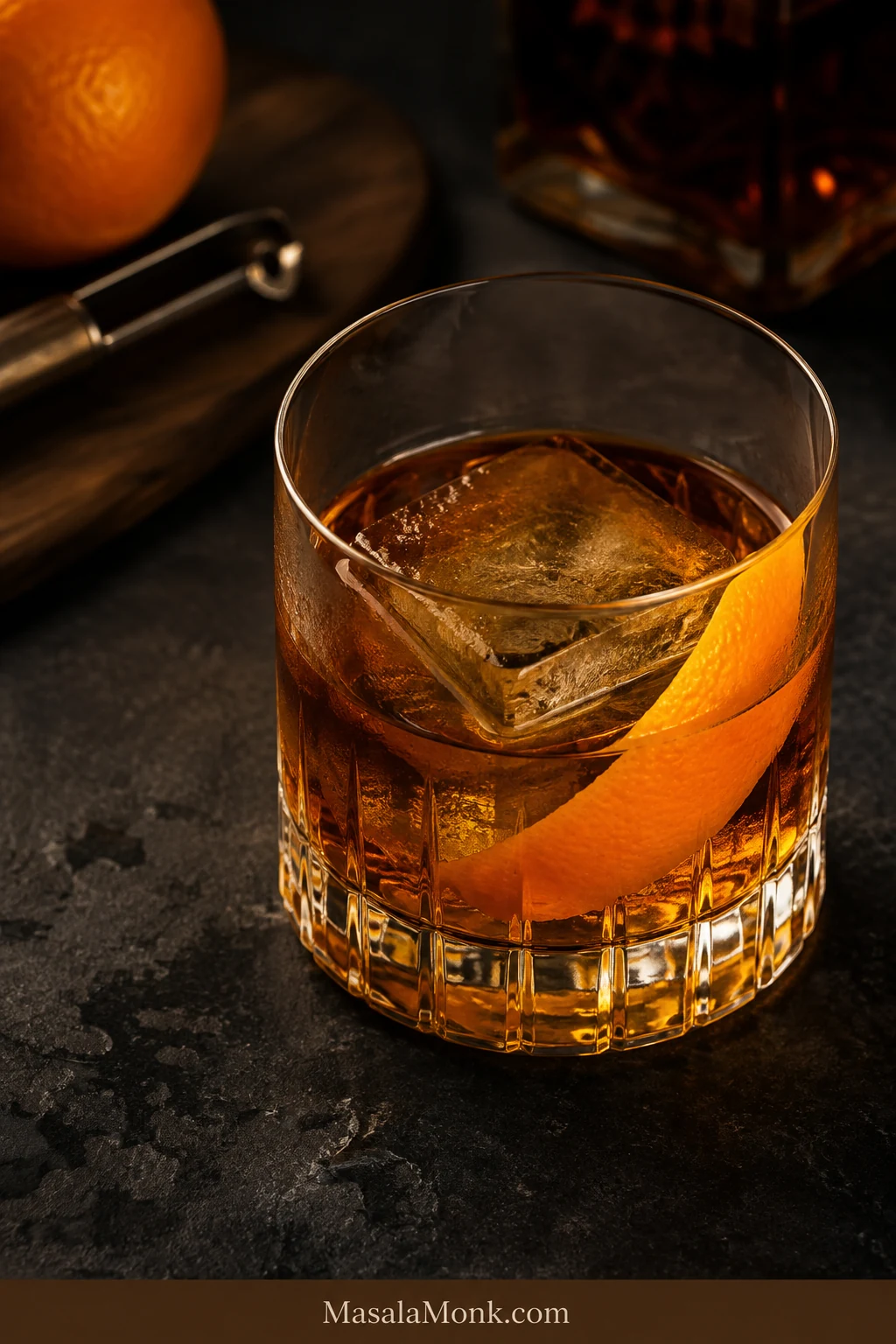
An Old Fashioned is simple enough to make in minutes—and exposed enough that every decision shows. When the balance is right, bourbon leads with oak, vanilla, caramel, and spice; bitters pull those flavors into focus; orange oil reaches you before the first sip; and just enough water takes away the raw edge without thinning the whiskey.
When it goes wrong, the same short list becomes sweet whiskey over melting ice. Too much syrup buries the bottle; too little stirring leaves it sharp; muddled orange turns a clear, spirit-forward drink into something fruitier. The fix is not more ingredients—just better control of the few already there.
This version starts with bourbon, rich demerara syrup, Angostura bitters, and expressed orange peel. The sweetness stays low enough for the whiskey to lead, with clear routes to a spicier rye drink, a traditional sugar-cube build, or a brighter touch of orange bitters.
Quick Answer: How to Make a Balanced Old Fashioned
- Whiskey: 2 oz / 60 ml bourbon
- Sweetener: 1 teaspoon / 5 ml rich 2:1 demerara syrup
- Bitters: 3 firm dashes Angostura
- Method: stir with plenty of ice for 20–25 seconds, then strain over a large serving cube or several solid cubes
- Finish: express a wide orange peel over the drink
Using standard simple syrup or a sugar cube? The exact substitute measurements are in the recipe immediately below.
Keep the balance simple: whiskey first, sweetness second, and orange on the nose rather than orange juice in the glass.
Classic bourbon cocktail
Old Fashioned Recipe
A whiskey-forward Old Fashioned with just enough demerara to round the bourbon, Angostura for spice, and orange oil over the surface. It should taste strong and full, never raw, syrupy, or watery.
Equipment
- Jigger or small measuring cup
- Mixing glass or another sturdy glass
- Bar spoon or long-handled teaspoon
- Julep, Hawthorne, or small kitchen strainer
- Vegetable peeler or small sharp knife
Ingredients
- 2 oz / 60 ml bourbon, preferably around 90–100 proof
- 1 teaspoon / 5 ml rich 2:1 demerara syrup
- 3 firm dashes Angostura aromatic bitters
- Plenty of solid ice for stirring
- Serving ice: 1 fresh large cube, about 1¾–2 inches / 4.5–5 cm
- Orange peel: 1 wide strip, freshly cut
- Cocktail cherry: 1 good cherry, optional
Sweetener Alternatives
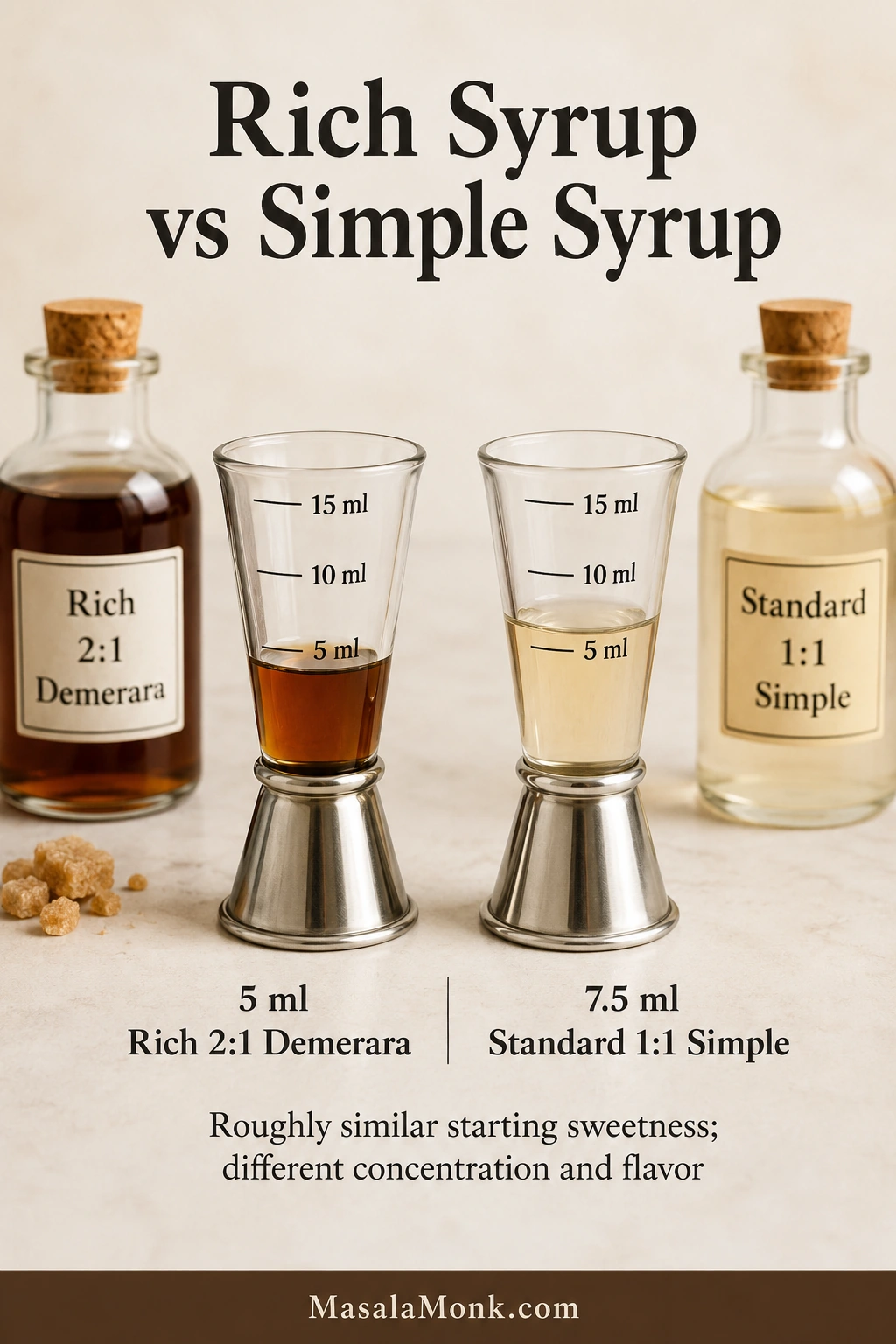
Replace the rich demerara syrup with ¼ oz / 7.5 ml standard 1:1 simple syrup. For a traditional build, use 3.5–4 g granulated sugar or one standard sugar cube, plus 1 teaspoon / 5 ml water.
Why 5 ml works: this is deliberately a little drier than some modern builds. One teaspoon of properly made 2:1 syrup provides roughly the sweetness of a standard sugar cube; increase it by ¼ teaspoon at a time when your bourbon or preference calls for more.
Instructions
- Measure the drink. Combine the bourbon, rich demerara syrup, and Angostura bitters in a mixing glass.
- Add plenty of ice. Fill the mixing glass at least two-thirds full with solid cubes.
- Stir until cold and settled. Move the spoon smoothly for about 20–25 seconds. Sample a few drops with a clean teaspoon or straw: the alcohol should no longer feel separate, while the bourbon still leads.
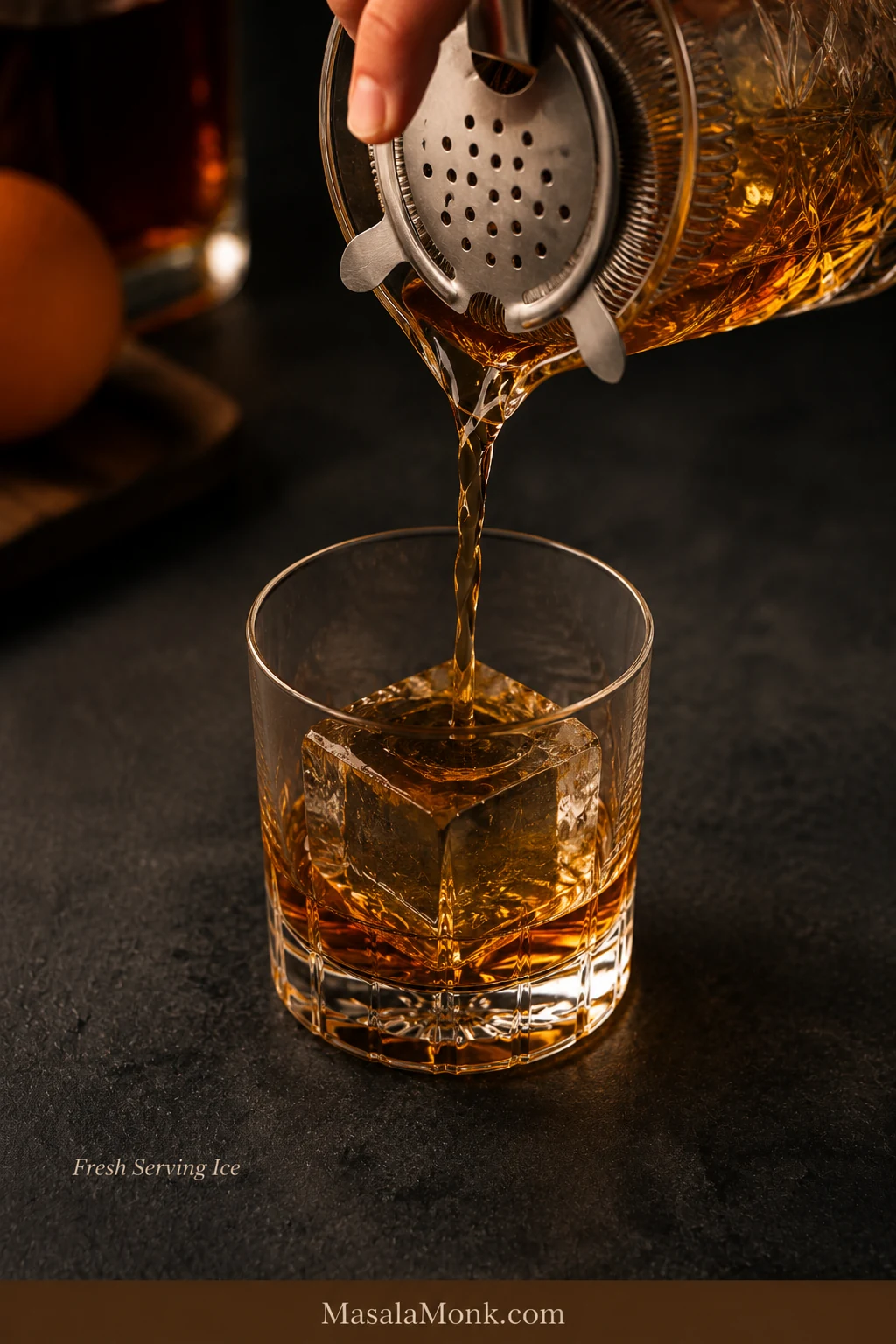
- Strain over fresh ice. Place one large fresh cube in a rocks glass and strain the cocktail over it.
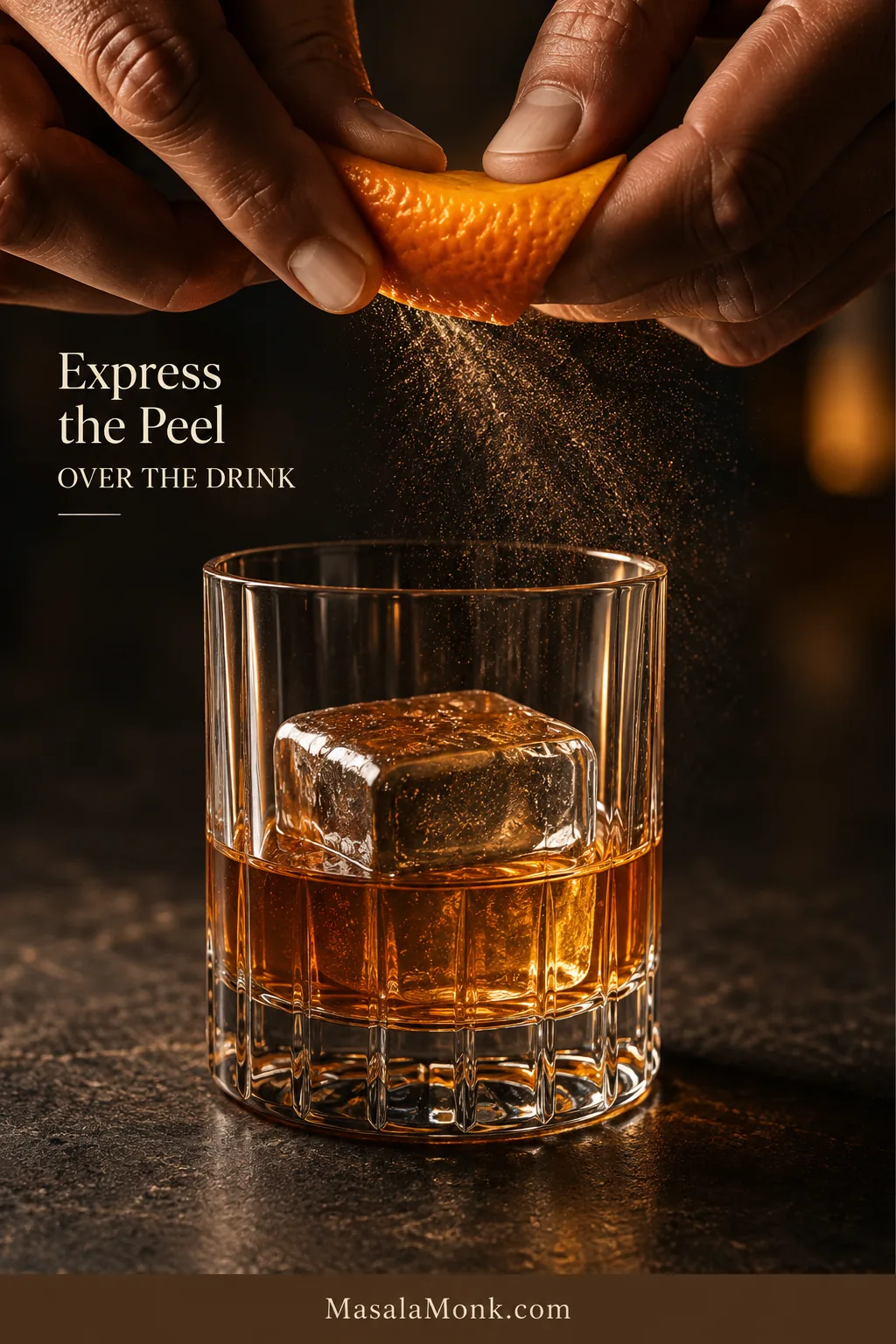
- Express the orange peel. Hold the peel over the drink with the colored side facing down. Pinch or bend it firmly to release the citrus oils over the surface.
- Finish and serve. Run the peel once around the rim, place it in the glass, and add an optional cocktail cherry.
Make this version once before changing it. On the next glass, adjust only one variable—syrup, whiskey, bitters, or stirring time—so you can tell what the change actually did.
Enjoy responsibly, and serve alcohol only to adults of legal drinking age in your location.
Choose Your Build
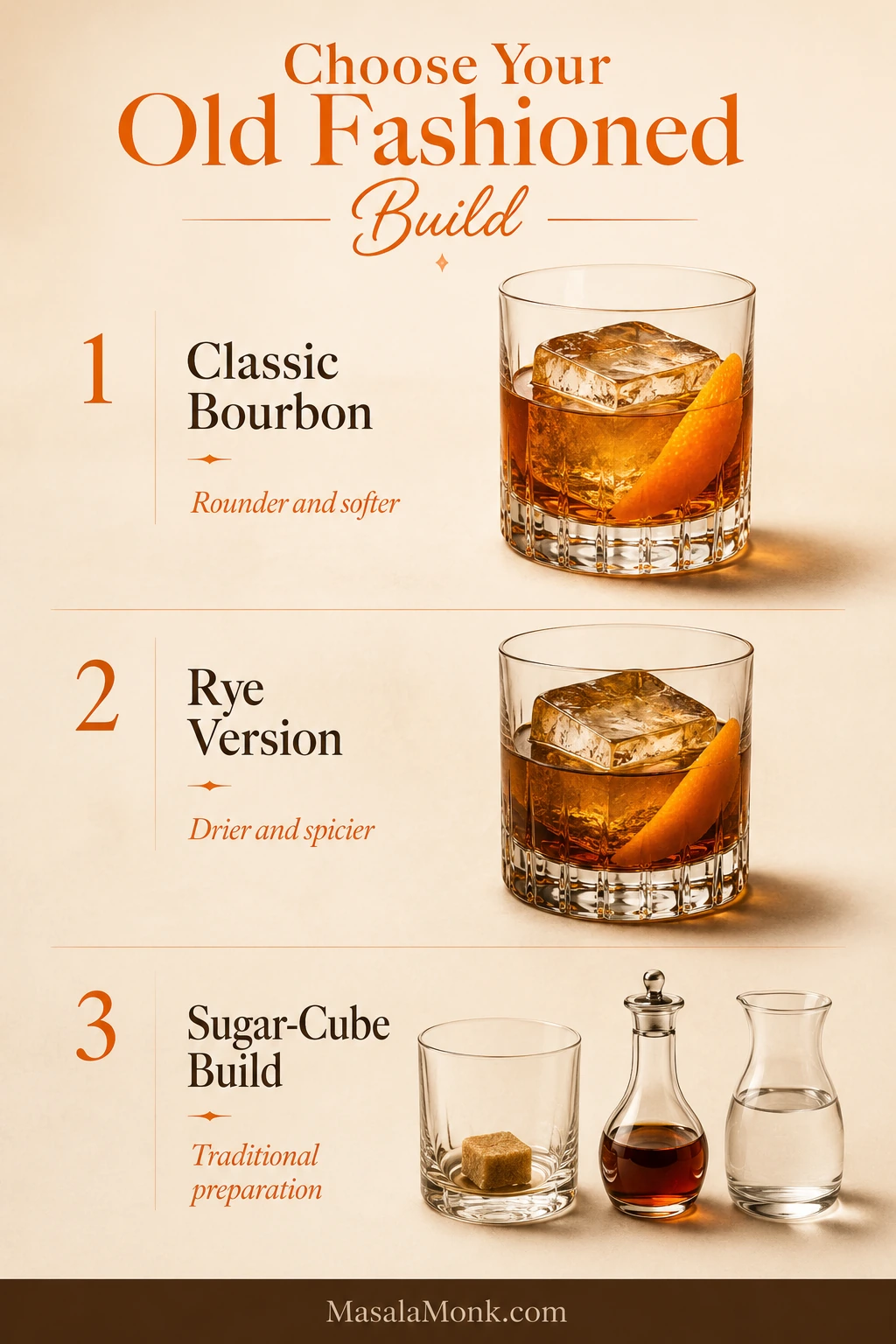
Start with bourbon, rich demerara syrup, Angostura, serving ice, and orange peel. Then use the options below when your ingredients—or your taste—point somewhere else.
| Your goal | Use this build |
|---|---|
| Balanced first Old Fashioned | Bourbon, rich demerara syrup, 3 dashes Angostura, and expressed orange peel. |
| Drier and spicier | Replace bourbon with rye and begin with the same sweetener amount. |
| Traditional sugar-cube method | Dissolve one 3.5–4 g cube with bitters and a teaspoon of water directly in the glass. |
| Softer and rounder | Use an 80–90-proof bourbon, 2 dashes Angostura, and careful dilution. |
| No mixing glass | Build with syrup directly in the rocks glass and stir over the serving ice. |
What Should an Old Fashioned Taste Like?
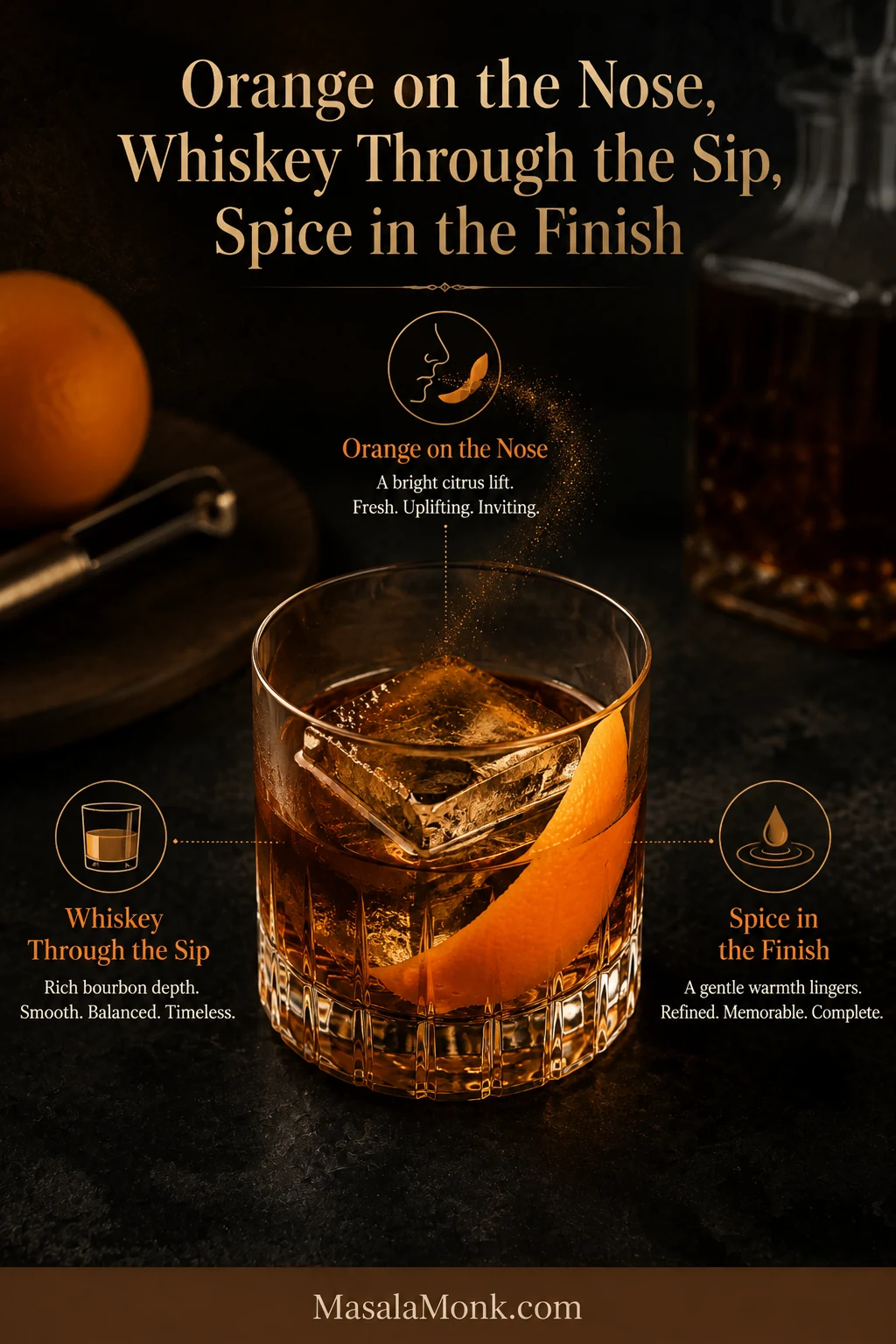
The finished drink should smell of orange before it tastes of orange. Bourbon should remain the clearest flavor, with bitters adding spice and depth behind it. Sweetness should round the whiskey rather than sit on top of it.
Water is part of the recipe even when it is not poured from a measuring cup. Stirring melts some ice, softening the alcohol and opening the aroma. Too little leaves the drink hot and disconnected; too much makes it thin and faint.
A useful memory cue: orange on the nose, whiskey through the sip, and spice in the finish.
| Balanced Old Fashioned | Something needs adjusting |
|---|---|
| Whiskey remains clear from first sip to finish | Syrup, fruit, or water takes over |
| Cold and smooth, but still full-bodied | Raw alcohol burn or watery thinness |
| Gently sweet | Sticky, syrupy, or dessert-like |
| Orange on the nose | Orange juice and pulp in the drink |
| Bitters add spice and shape | Medicinal bitterness dominates |
Old Fashioned Ingredients—and What Each One Does
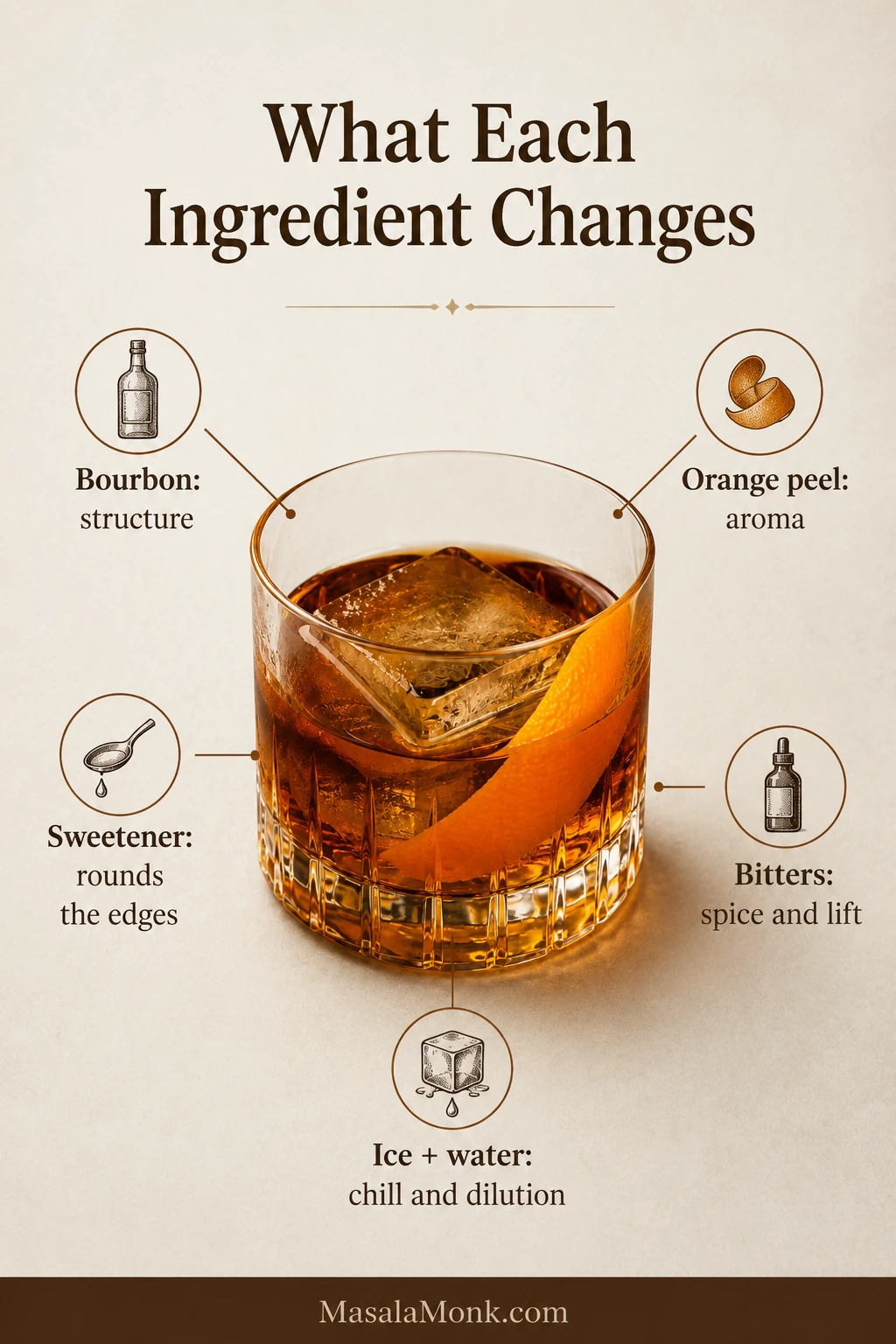
Because there are so few ingredients, every one of them shows. Each controls a different part of the drink: flavor, sweetness, aroma, or dilution.
| Ingredient | What it controls |
|---|---|
| Bourbon or rye | The dominant flavor, body, proof, oak, spice, and overall character. |
| Sugar or syrup | Sweetness, texture, and how sharply the alcohol is perceived. |
| Aromatic bitters | Spice and aroma that keep the sweetness from feeling flat. |
| Water from stirring | Chilling and softening the alcohol so the whiskey no longer feels hot or separate. |
| Orange peel | Citrus aroma without adding juice or pulp. |
| Cocktail cherry | An optional dark-fruit accent; it is not required for balance. |
Equipment You Need—and What to Use Instead
You need a way to measure, enough clean ice, and a short glass with room for the serving cube.
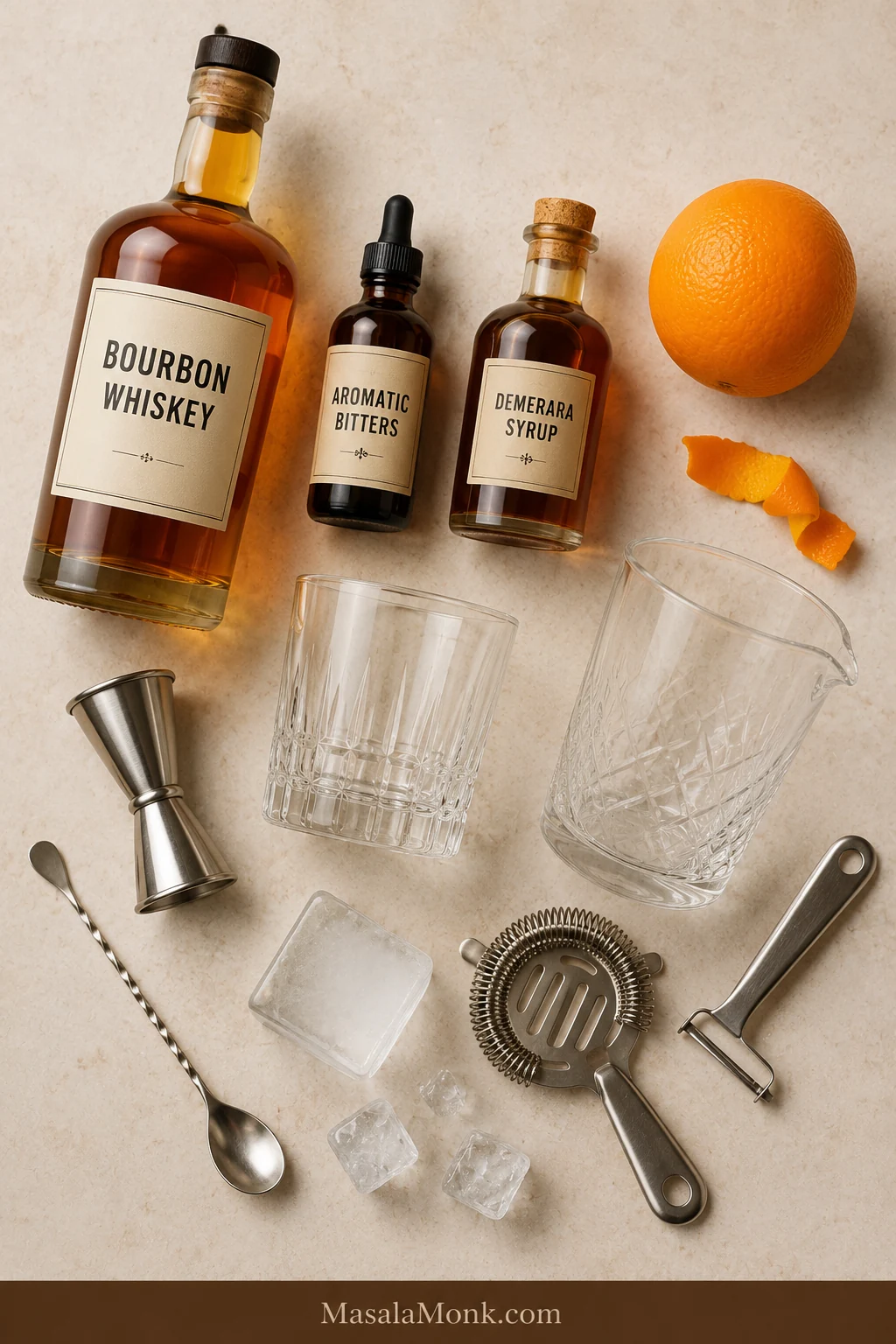
- No jigger? Use kitchen measures: 2 oz is about ¼ cup or 4 tablespoons; 1 teaspoon is 5 ml.
- No mixing glass? Use a sturdy drinking glass, small jug, or the metal half of a cocktail shaker. Stir rather than shake.
- No bar spoon? A long-handled teaspoon works. Smooth movement matters more than specialist equipment.
- No large cube? Use two or three large solid cubes. Clean-tasting ice matters more than perfect shape.
- No demerara sugar? Use white-sugar simple syrup or a properly dissolved sugar cube.
Know your syrup: by weight, rich syrup is two parts sugar to one part water; standard syrup uses equal weights. The same volume does not contain the same amount of sugar.
How to Judge Chilling, Dilution, and Garnish
The ratio gets you close; temperature, dilution, and aroma decide whether the finished drink feels complete.
Measure Carefully and Add Enough Ice
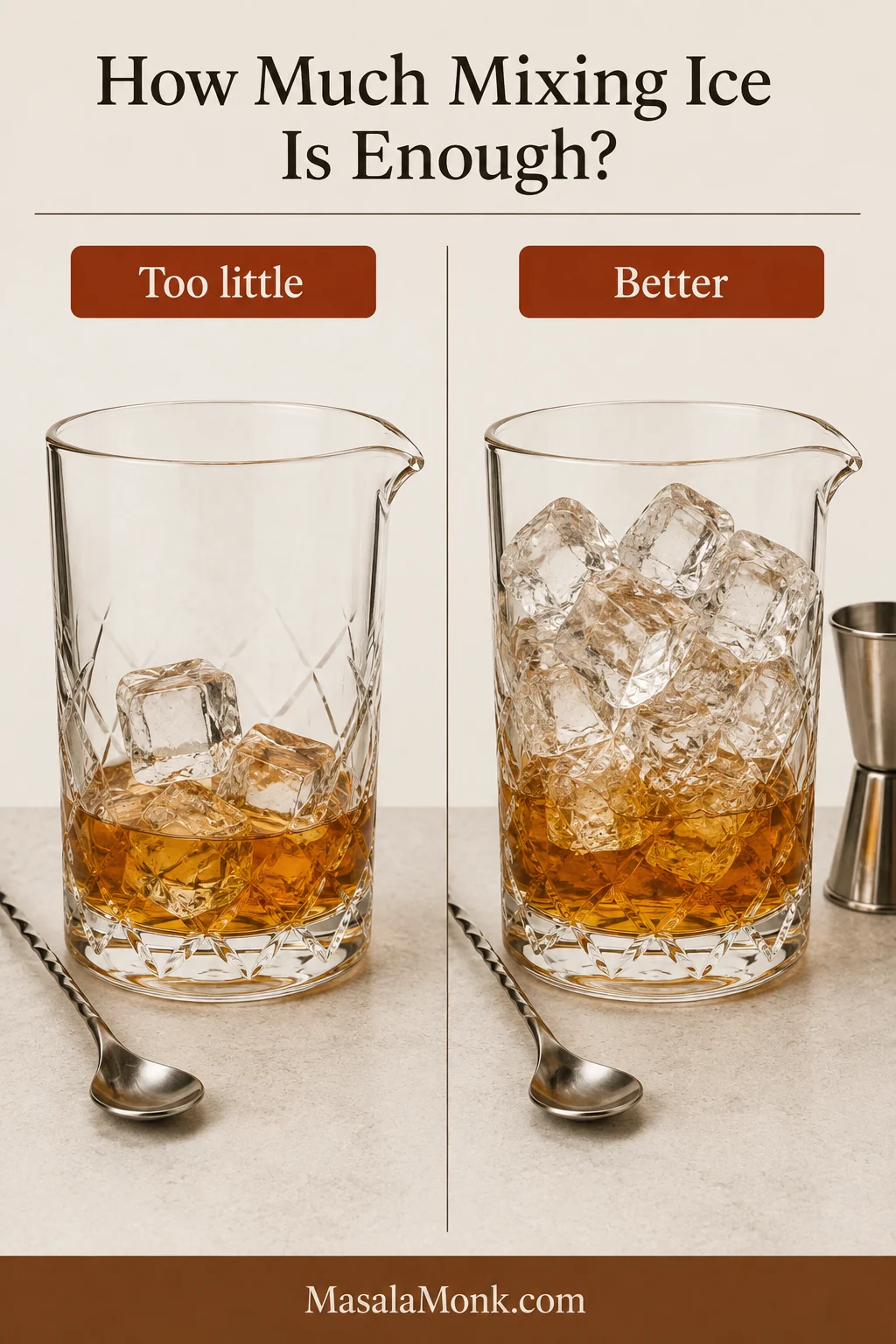
One extra teaspoon of syrup can shift the whole glass. Measure the bourbon and sweetener, use consistent dashes from the same bitters bottle, and fill the mixing glass at least two-thirds full with solid ice.
A sparse handful warms quickly, so the drink may pick up too much water before reaching a deep chill. Ordinary cubes are fine for mixing; save a large clear cube, when available, for serving.
Stir for About 20–25 Seconds—Then Taste
Move the spoon smoothly so the ice and liquid rotate together. As the mixture chills, condensation will often begin gathering outside the glass. Stirring also adds water without the aeration or small ice chips created by shaking.
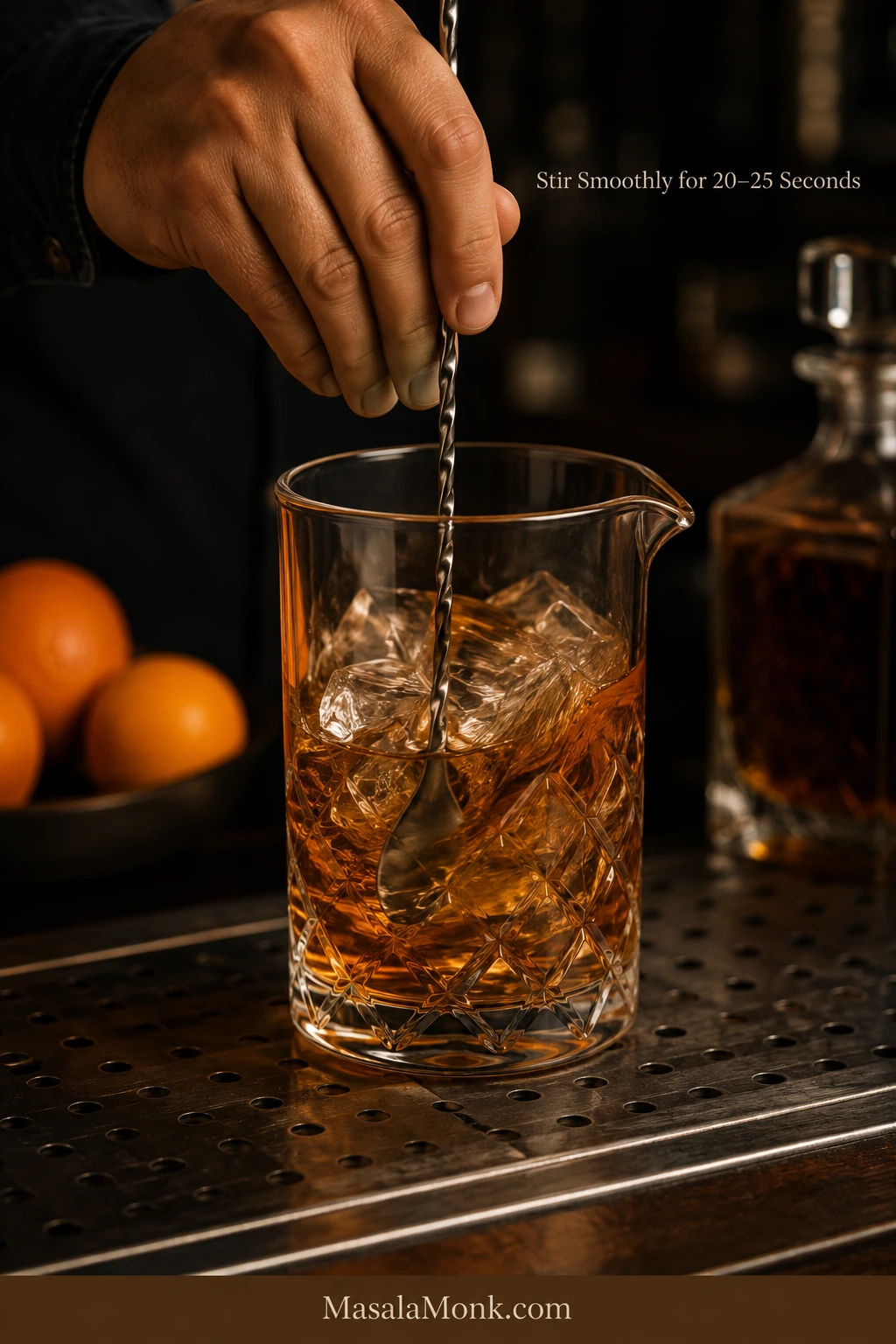
Twenty to twenty-five seconds is a starting window, not a law. Ice size and temperature, room temperature, and whiskey proof all affect the result. Serious Eats explains the mechanics of stirring, chilling, and dilution in more detail.
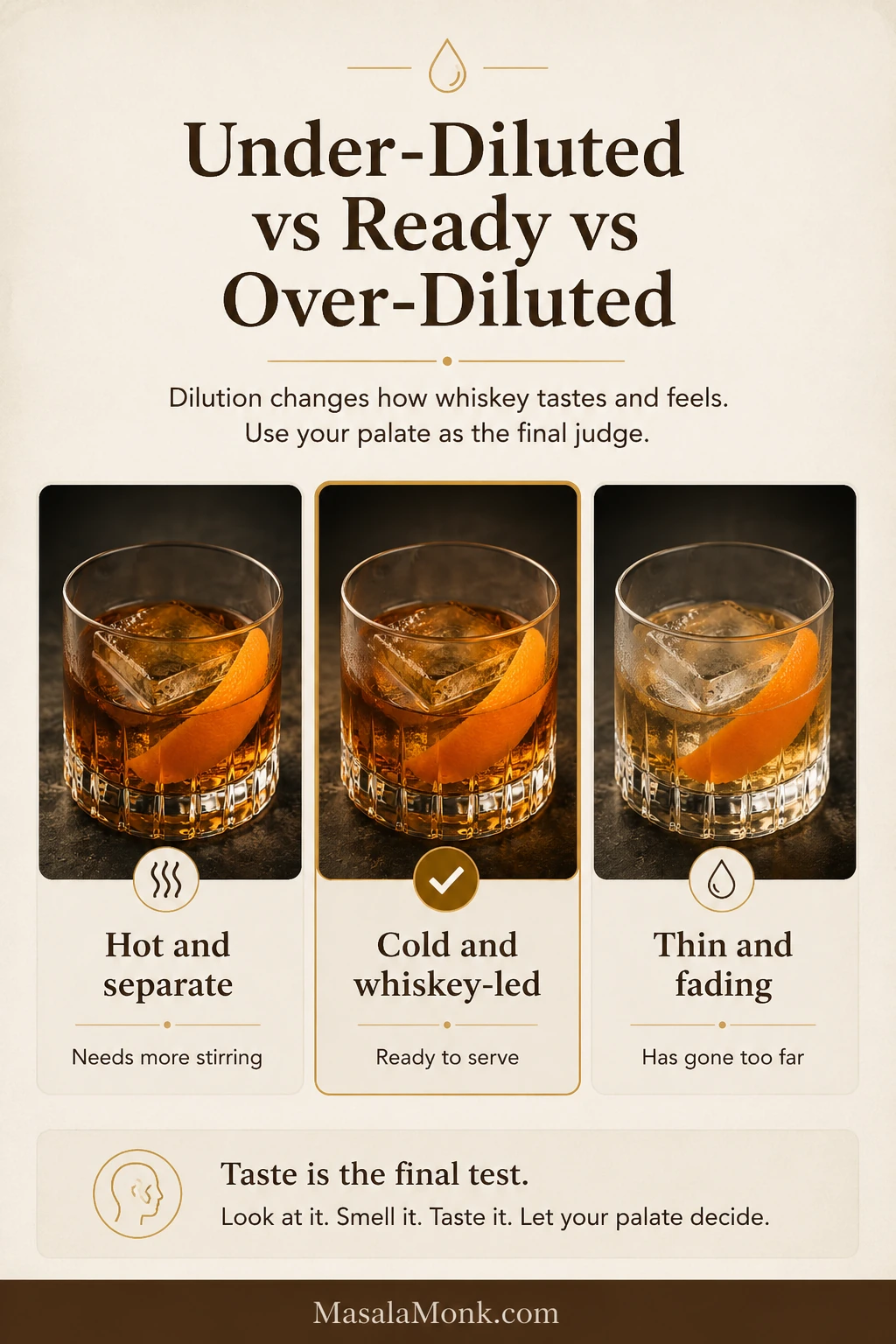
- Still hot and separate? Stir for another few seconds.
- Cold, glossy, and clearly whiskey-led? It is ready.
- Thin and fading? It has probably gone too far.
Strain, Garnish, and Serve
Strain over one 1¾–2-inch cube or two or three large solid cubes. Well-frozen serving ice usually slows warming and further dilution, though temperature, quantity, and time all matter.
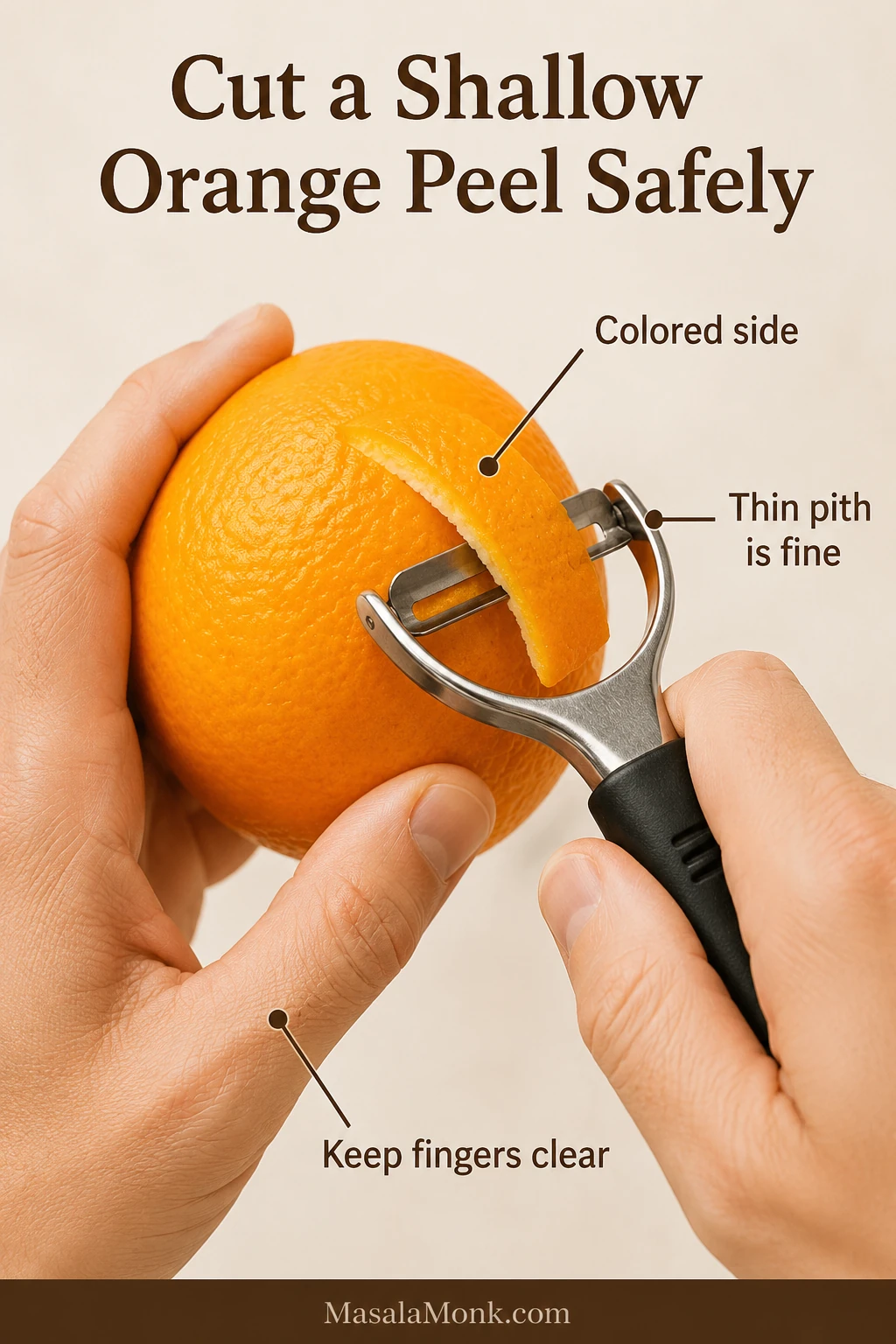
Wash and dry a navel orange before cutting the peel. Its broad skin is fragrant and easy to handle. Cut a shallow 2–3-inch / 5–7.5 cm strip away from your fingers; a thin layer of white pith is fine, while a thick chunk is harder to bend.
Hold the colored side over the drink, pinch it sharply to release the oils, then run it once around the rim. The aroma should be bright, without adding juice or pulp.
Stir this cocktail, even if a shaker is your only vessel. Shaking is useful when citrus juice, dairy, or egg white needs aeration. For that bright, aerated texture, make a Whiskey Sour; here, smooth stirring keeps the drink clear and silky.
No Mixing Glass? Build It Directly in the Serving Glass
The separate mixing-glass method gives you fresh serving ice and slightly easier control. The direct build is simpler, uses fewer tools, and still makes an excellent drink.
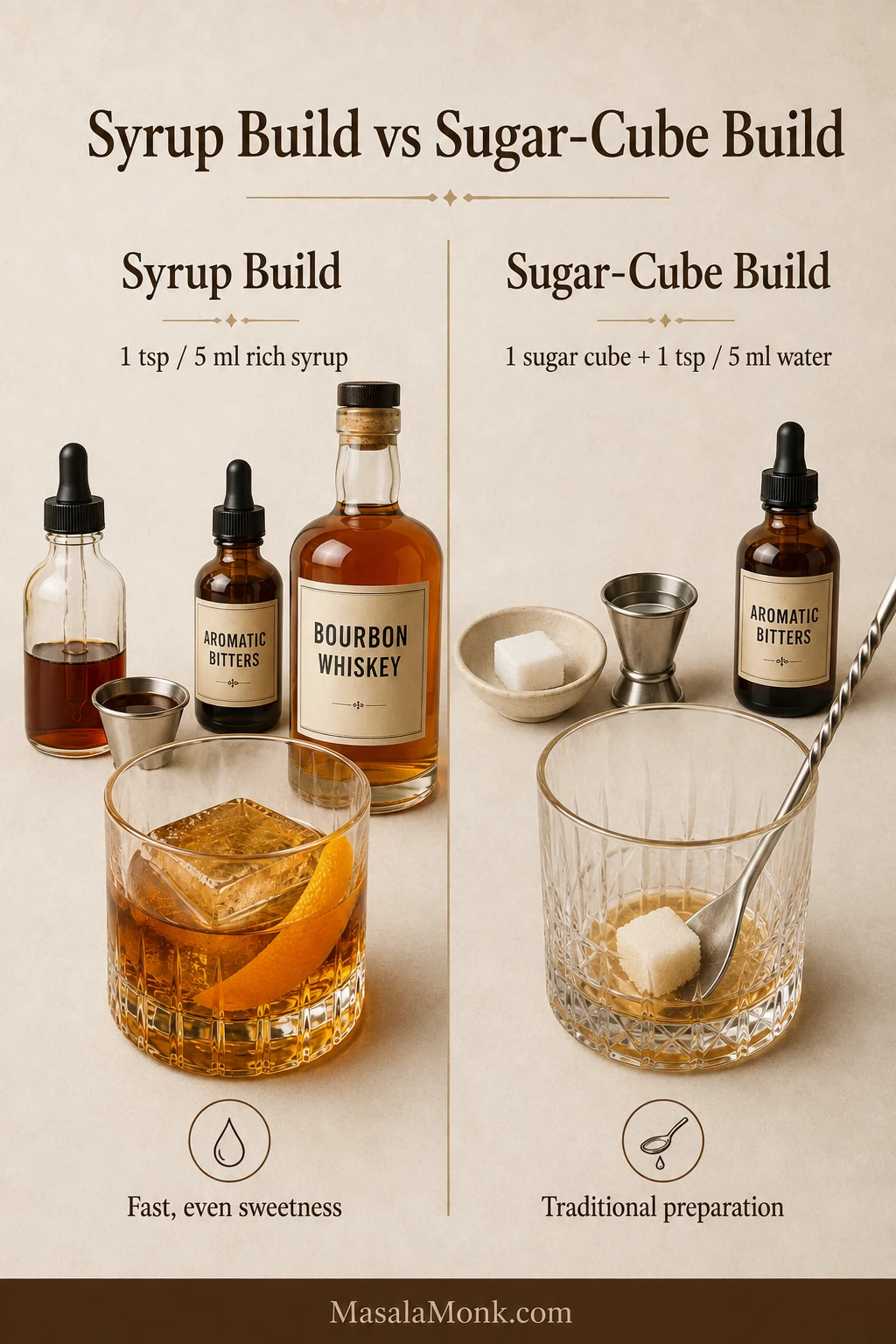
Direct Build With Syrup
- Measure the syrup and bitters into the rocks glass.
- Pour in the bourbon and stir briefly.
- Add one large cube or several solid cubes.
- Stir until the drink feels cold, smooth, and no longer sharply alcoholic.
- Express the orange peel over the surface.
Traditional Sugar-Cube Build
- Add one standard 3.5–4 g sugar cube, 3 dashes Angostura, and 1 teaspoon / 5 ml still water to the glass.
- Muddle and stir until no hard cube remains.
- Add the bourbon and ice.
- Stir thoroughly, taste, and finish with orange peel.
A soda-water top-up makes the drink longer, lighter, and less whiskey-forward. When bourbon and ginger fizz are what you want, a Kentucky Mule is designed for that job.
Recipe card ↑Sweetener choices →Fix the taste →
How to Choose Bourbon—or Rye—for an Old Fashioned
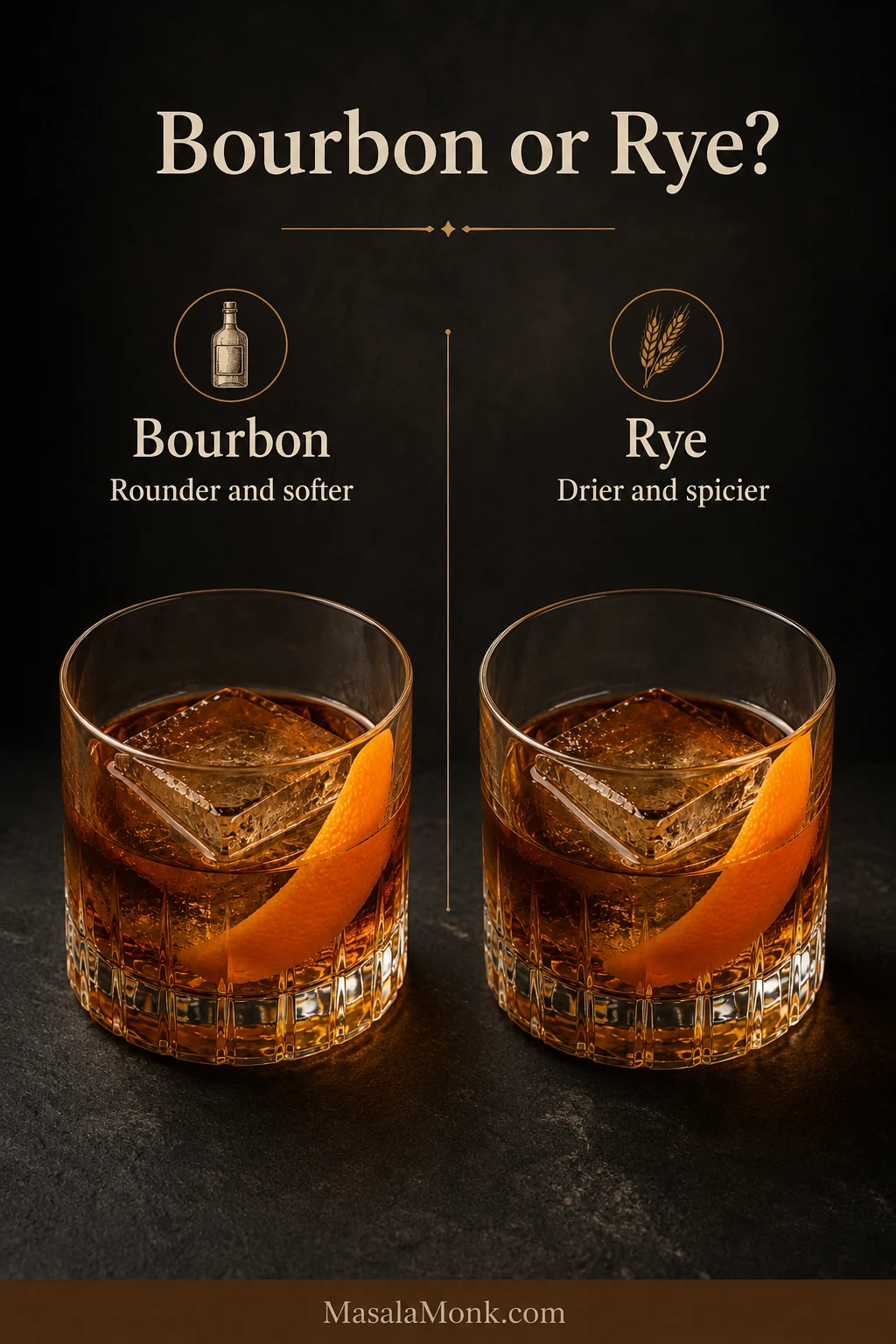
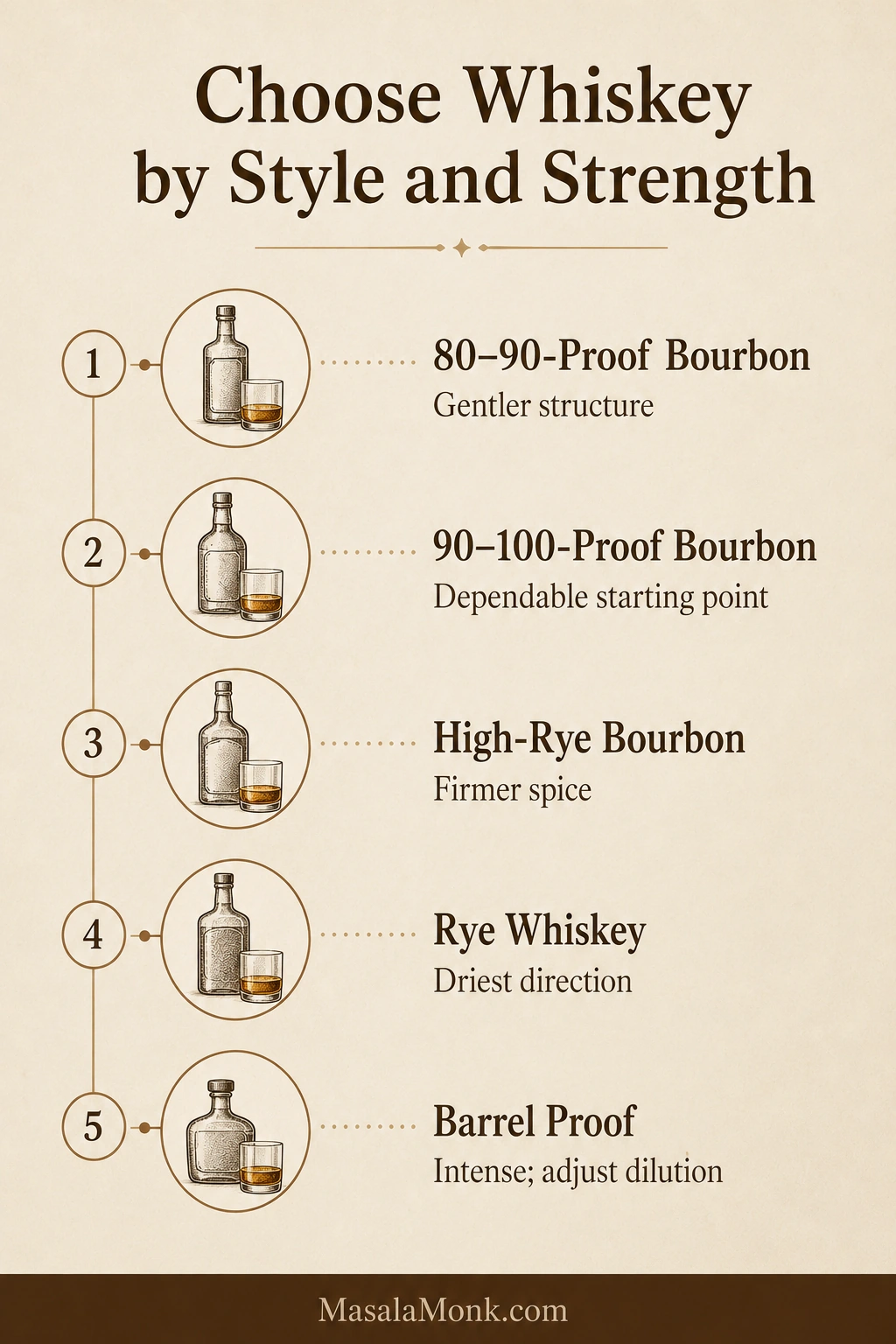
The best bourbon for an Old Fashioned does not need to be rare. It needs enough flavor and proof to remain recognizable after sugar, bitters, ice, and a few minutes in the glass. In the United States, proof is twice the alcohol-by-volume figure, so 90–100 proof means approximately 45–50% ABV.
Whiskey Styles and Proof
| Whiskey style | What it brings | Best for |
|---|---|---|
| 80–90-proof bourbon | Softer alcohol and a gentler overall structure | A gentler drink; keep the syrup modest |
| 90–100-proof bourbon | More body and enough structure without excessive heat | The most dependable starting point |
| High-rye bourbon | More grain spice and a firmer finish | A bolder drink that still feels rounded |
| Rye whiskey | Pepper, herbs, grain, and less apparent sweetness | The driest, spiciest direction |
| Barrel-proof whiskey | Concentrated flavor and alcohol | A bold drink when you are comfortable adjusting sweetness and dilution |
Maker’s Mark illustrates a softer wheated style; Buffalo Trace and Elijah Craig Small Batch sit in the balanced middle; Wild Turkey 101 and Old Forester 100 make a firmer drink; and Rittenhouse Rye or Bulleit Rye move it in a drier direction. These are style examples, not a ranking.
The same bourbon-versus-rye contrast appears in a Boulevardier. Here, begin with the same syrup amount whichever whiskey you choose, then adjust after tasting.
Sugar Cube, Simple Syrup, or Demerara Syrup?
Sugar is where many home Old Fashioneds quietly drift. A small amount rounds the whiskey; too much turns it into a sweet drink with whiskey in it. The form you choose also changes texture, added water, and repeatability.
Rich Demerara Syrup
Rich demerara syrup uses two parts sugar to one part water by weight. Use 1 teaspoon / 5 ml for darker caramel flavor and a fuller texture. To make a small batch, warm 100 g demerara sugar with 50 g water just until dissolved, then cool completely.
Standard Simple Syrup
Standard syrup uses equal weights of sugar and water and tastes more neutral. Use ¼ oz / 7.5 ml. For a small batch, warm 50 g white sugar with 50 g water just until dissolved, then cool.
Sugar Cube or Granulated Sugar
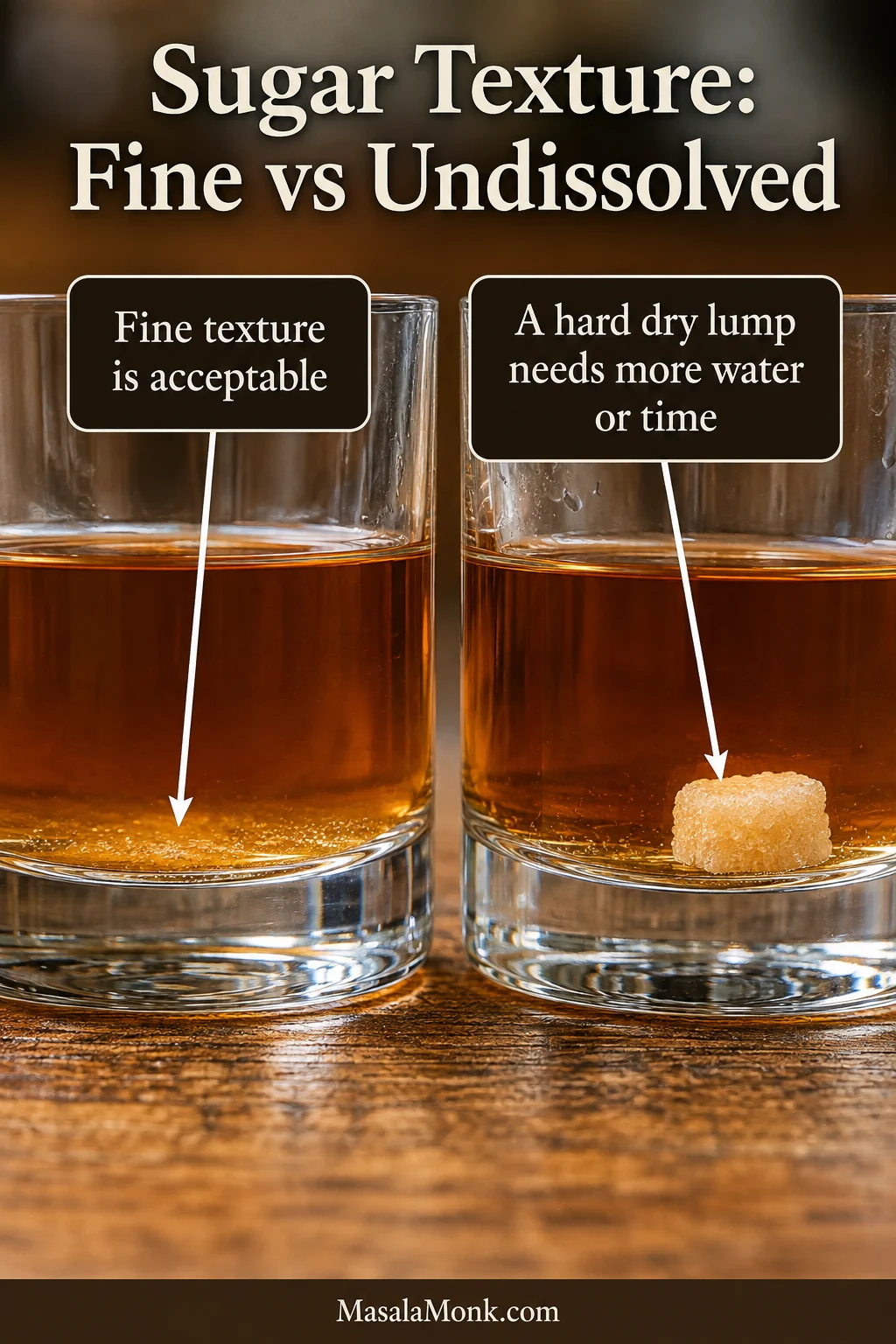
For a traditional build, use approximately 3.5–4 g sugar with 1 teaspoon / 5 ml water and the bitters. Muddle and stir until no hard cube remains. Fine sugar texture is acceptable; a dry lump is not.
| Choose this | When you want | Watch for |
|---|---|---|
| Rich demerara syrup | Consistency, fuller body, and darker flavor | It can cover a very delicate whiskey |
| Standard 1:1 syrup | Neutral sweetness and common ingredients | Use more volume than rich syrup |
| Sugar cube | Traditional preparation and gradual change in the glass | A hard undissolved lump |
| Granulated sugar | A practical pantry substitute | Dissolve it before adding cold whiskey |
Sweetness guide
- Exceptionally dry: ½ teaspoon / 2.5 ml rich syrup
- Drier: about ¾ teaspoon / 4 ml
- Balanced starting point: 1 teaspoon / 5 ml
- Sweeter: increase in ¼-teaspoon increments
Without sweetener, the alcohol and bitters become much more prominent.
How Many Dashes of Bitters—and Which Kind?
Three dashes look almost insignificant, yet the drink feels flatter without them. Bitters behave more like seasoning than another full liquid ingredient, pulling whiskey and sugar together with concentrated spice, herbs, and aroma.
Start with 3 firm dashes of Angostura. Dash size varies with the bottle, insert, angle, and pouring force, so use the same bottle and motion each time.
- 2 dashes: softer and more whiskey-forward.
- 3 dashes: the balanced starting point.
- 4 dashes: more aromatic and spice-led.
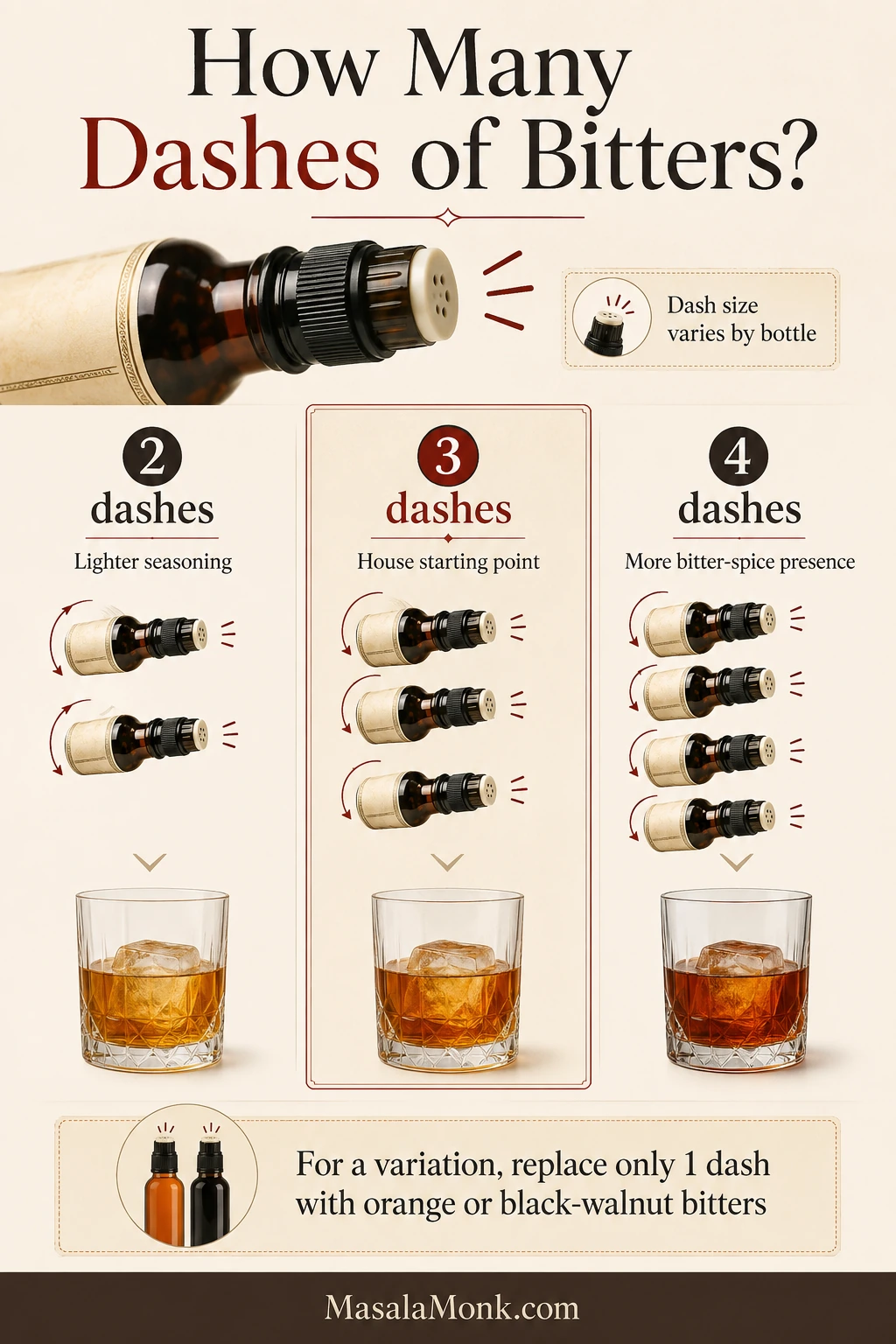
For a brighter, nuttier, or darker variation, change only part of the bitters:
- Angostura aromatic: the classic choice, with baking spice, herbs, and warmth.
- Orange bitters: brighter citrus; begin with one dash alongside Angostura.
- Black walnut bitters: darker, nuttier, and especially good with rich bourbon.
- Chocolate or mole bitters: cocoa and deeper spice for a deliberate variation.
- Peychaud’s: a more floral profile with cherry and anise notes.
Can You Make It Without Bitters?
If Angostura is unavailable, another aromatic cocktail bitter is the closest substitute. Orange peel or muddled fruit can add aroma, but neither provides the same spice. Amaro changes the drink much more substantially; use it as a deliberate variation, as in a Black Manhattan, not as a one-for-one replacement.
Best Glass, Ice, and Garnish
Glass and Serving Ice
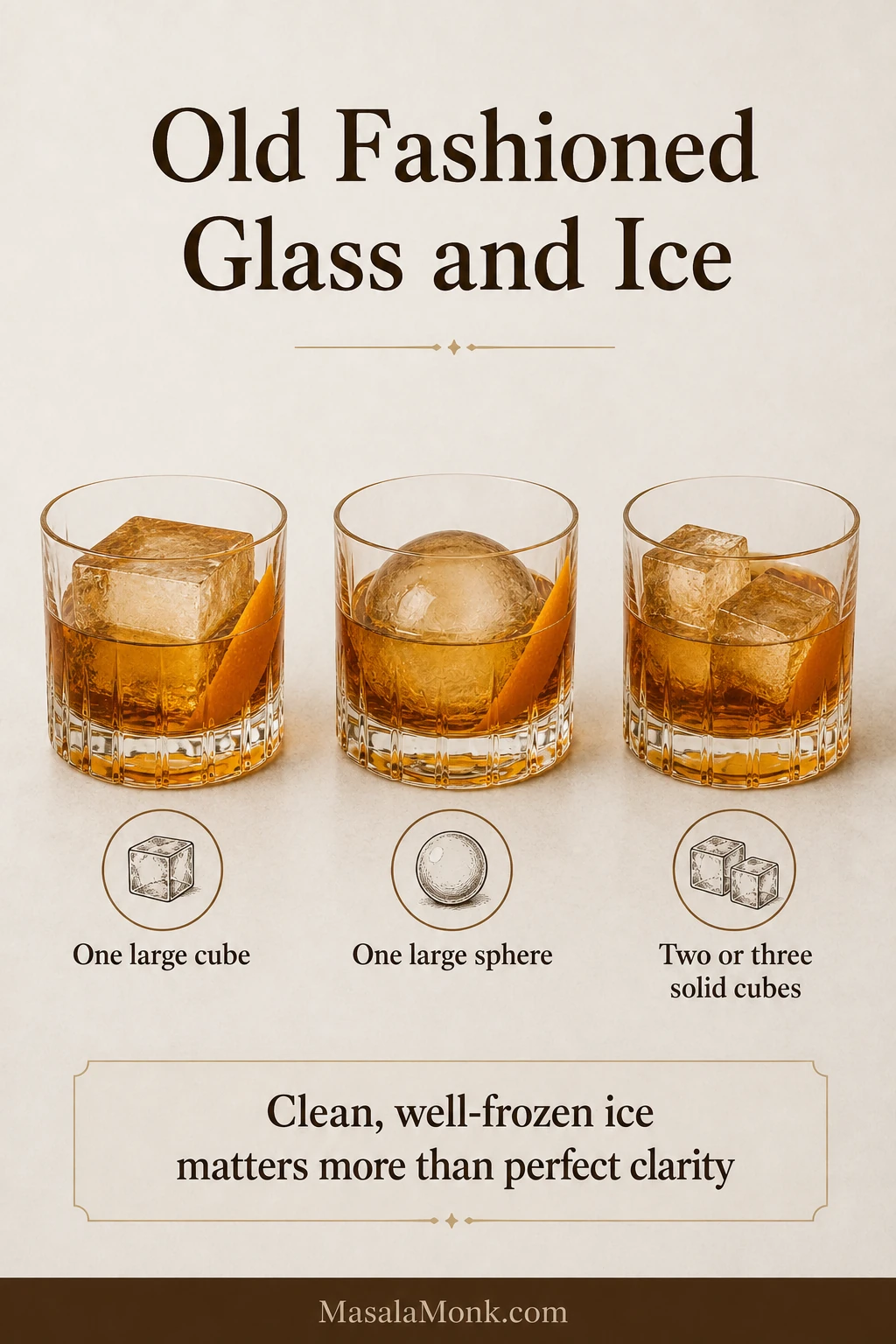
An 8–10 oz / 240–300 ml rocks, lowball, or Old Fashioned glass gives the drink and its ice enough room. Chill it in the freezer for five minutes, or fill it with ice while you mix the cocktail and discard that ice before serving.
- Use one 1¾–2-inch cube, a large sphere, or two or three solid cubes for serving.
- Clear ice is attractive but optional.
- Clean, well-frozen ice matters more than perfect clarity.
Orange Peel, Cherry, and Muddled Fruit
The peel is the last ingredient you add but the first one the drinker encounters. Expressed peel gives aroma without juice. An orange slice—especially when muddled—adds juice, pulp, and a softer fruit-forward character.
Muddled orange and cherry are strongly associated with Wisconsin-style Old Fashioneds, which are often made with brandy and finished sweet, sour, or as a press—typically a combination of lemon-lime soda and soda water. It is a distinct regional branch, not an incorrect drink.
A cocktail cherry is optional. Add one for a dark-fruit accent, or leave it out for a drier finish. Avoid pouring cherry syrup into a drink that already tastes sweet enough.
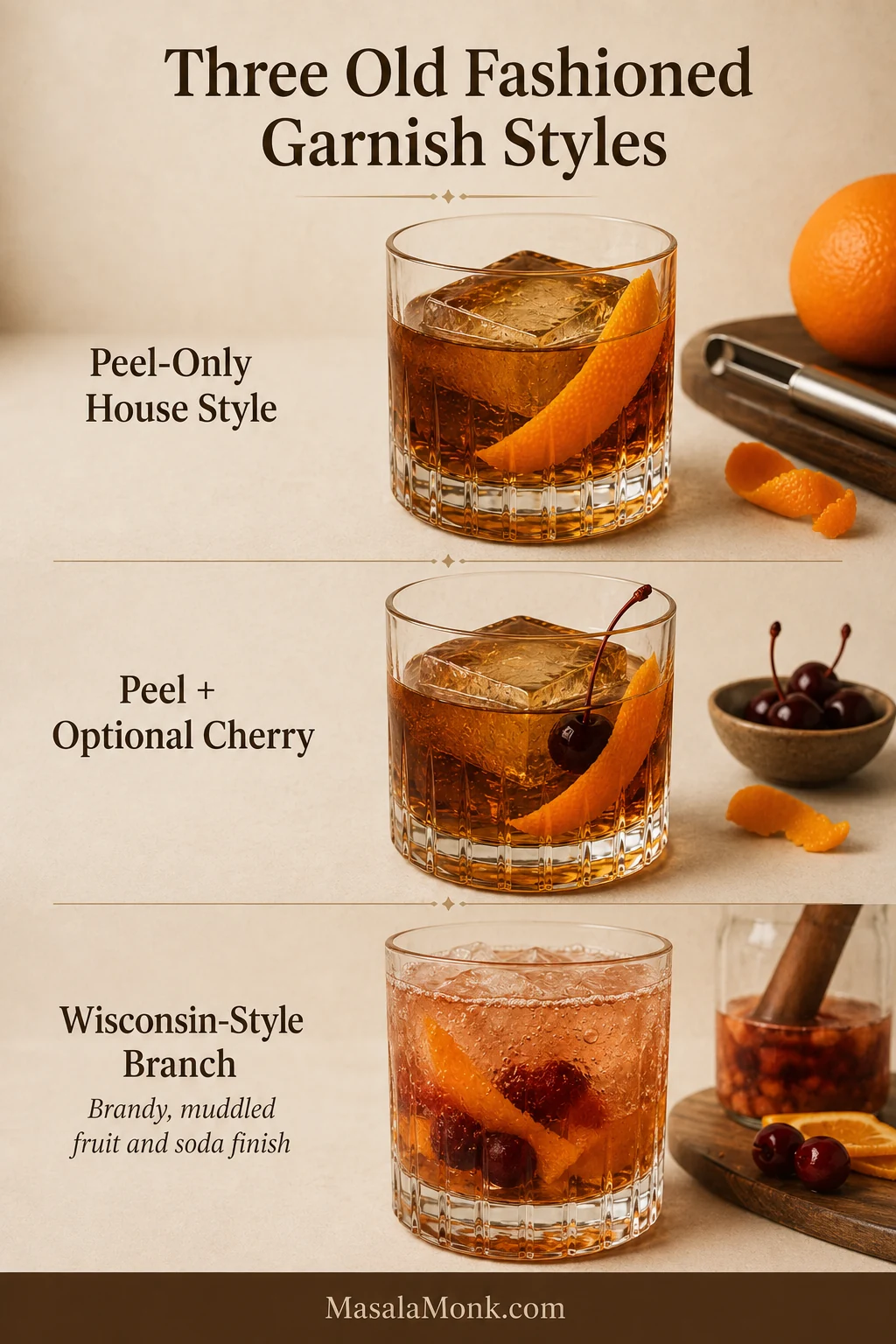
Ordering one at a bar: ask for bourbon or rye and say “less sweet” when that is what you mean. Specify “orange peel, no muddled fruit” when the garnish style matters.
Adjust It to Your Taste
This section is for a correctly made drink that is not yet your preferred style. Change one variable at a time so the next glass tells you what worked.
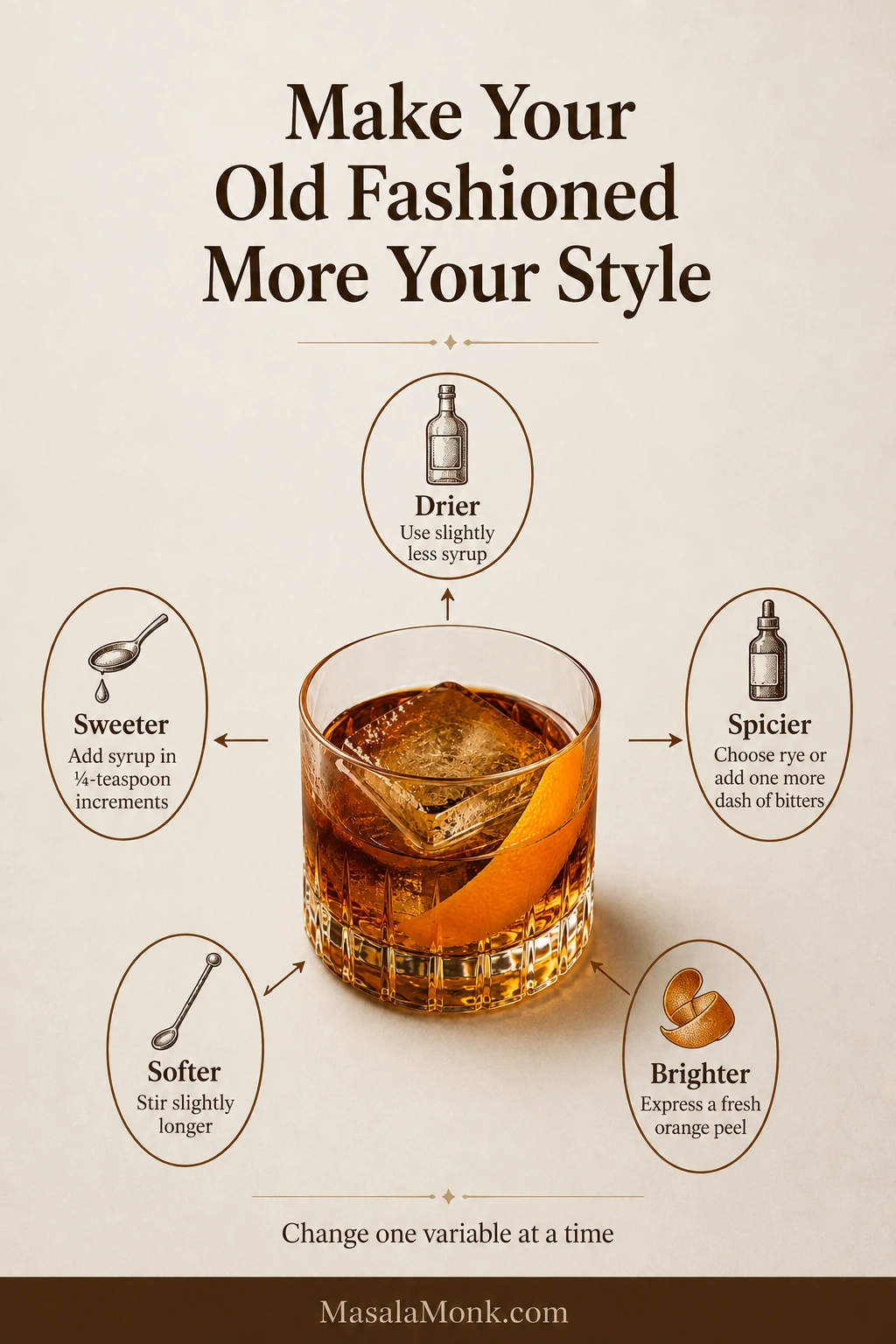
| You want | Change this first |
|---|---|
| Drier | Reduce rich syrup to about ¾ teaspoon / 4 ml, or use rye. Keep the expressed peel and skip the cherry. |
| Sweeter | Increase syrup in ¼-teaspoon increments. Do not jump straight to a large pour. |
| Spicier | Use rye or a high-rye bourbon with 3 dashes Angostura. Add a fourth dash only when you specifically want more bitters spice. |
| Softer | If the current glass still tastes hot, stir for a few more seconds and taste again. For the next one, use an 80–90-proof bourbon or reduce the bitters to 2 dashes. |
| Brighter | Express a freshly cut orange peel for brighter surface aroma. For more orange character within the drink, add one restrained dash of orange bitters beside the Angostura. |
| Richer | Choose demerara syrup and a fuller 100-proof bourbon; extra sugar alone can make the drink cloying. |
Common Old Fashioned Mistakes—and How to Fix Them
Small misses are normal in a drink with no juice or mixer to hide them. A slightly imperfect glass is still useful because it tells you what the next one needs.
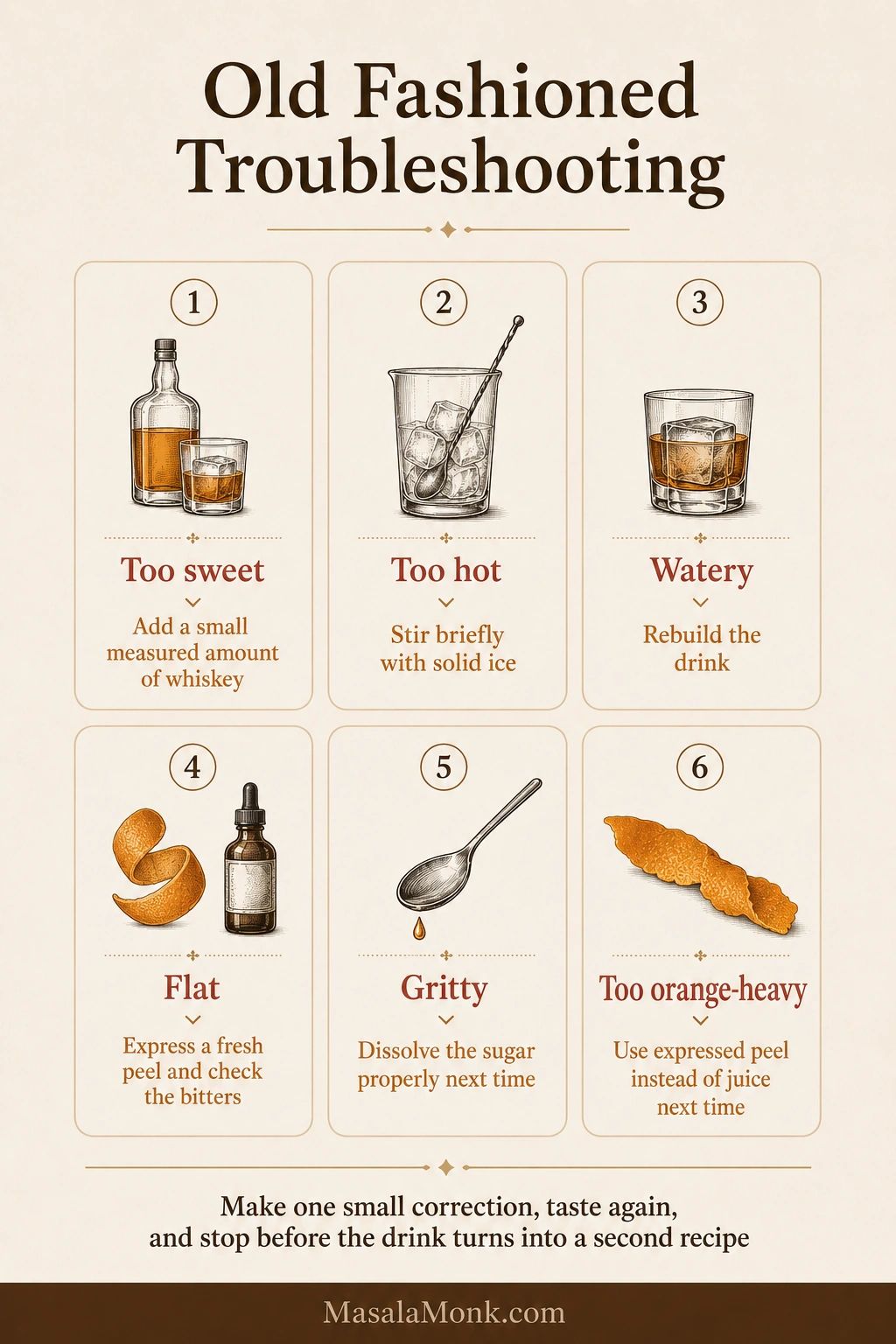
Most disappointing Old Fashioneds come down to sweetness, dilution, bitters, or fruit. If the glass is only slightly off, use the quick fix below. When repairing it would require half another recipe, start again.
Any repair changes more than one ratio. Make one small correction, taste again, and stop before the drink turns into a second recipe.
Quick Fixes by Symptom
Sweetness, Heat, and Dilution
| Problem | Why it happened | How to fix it |
|---|---|---|
| Too sweet | Too much syrup, cherry syrup, or a very soft bourbon. | If it is only slightly off, add 1 teaspoon / 5 ml bourbon, stir briefly, and taste. Repeat once only if the drink is still close; otherwise, rebuild with less syrup. |
| Too strong or hot | The drink is under-chilled or under-diluted, or the whiskey is unusually high-proof. | Stir briefly with solid ice and taste again. With barrel-proof whiskey, the next glass may also need slightly more dilution. |
| Thin or watery | Too much stirring, too little ice, or ice that was already wet and melting. | Rebuilding is usually better than adding more whiskey and sugar. Stop stirring sooner on the next glass. |
| Too bitter | Too many dashes or an unusually generous dasher bottle. | Add 1 teaspoon / 5 ml bourbon and two or three drops of syrup, then taste. If it still feels medicinal, rebuilding is cleaner than chasing the balance. |
Aroma, Sugar, Fruit, and Whiskey
| Problem | Why it happened | How to fix it |
|---|---|---|
| Flat or dull | Too little bitters, stale bitters, weak whiskey, or no citrus oil. | Express a newly cut peel over the surface. Use livelier bitters or a stronger bourbon when you make it again. |
| Gritty | A hard piece of sugar remains in the glass. | Continue stirring only if the drink can take more dilution. Use syrup or dissolve the sugar first in a future build. |
| Too orange-heavy | Orange juice or muddled fruit entered the drink. | It cannot be fully reversed. Use expressed peel instead of a wedge on the next glass. |
| The whiskey disappears | Too much syrup, water, fruit, or a very low-proof bottle. | Add a measured amount of whiskey only when the drink is still close. Use less syrup or a stronger bottle when making it again. |
Recipe card ↑Adjust the balance ↑Back to top ↑
How to Batch Four Old Fashioneds
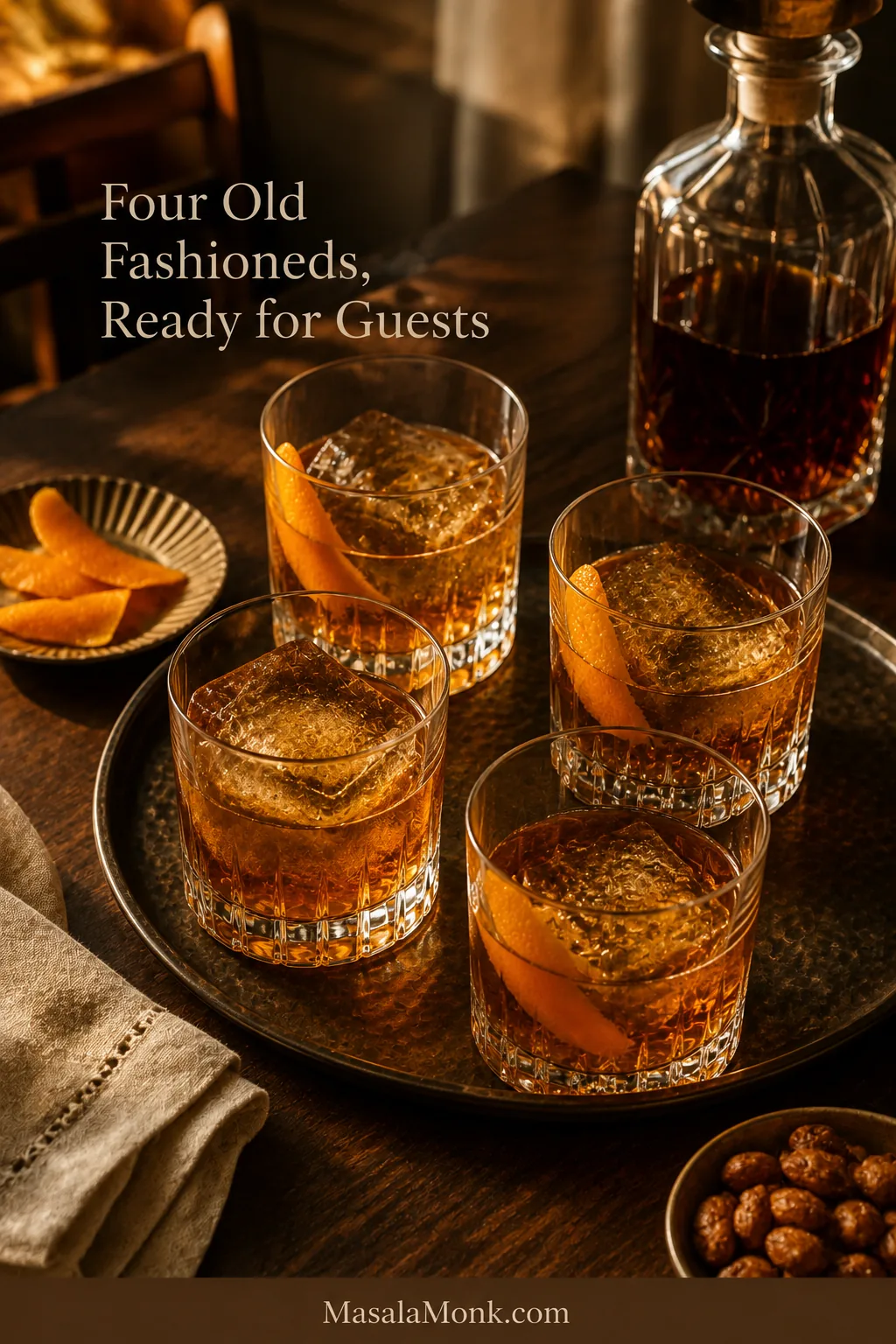
A small batch lets you pour four good drinks without spending the first part of the evening facing the bar instead of your guests. The important addition is water: a refrigerated batch does not receive the dilution that an individual drink picks up while stirring over ice.
Four-Drink Batch Formula
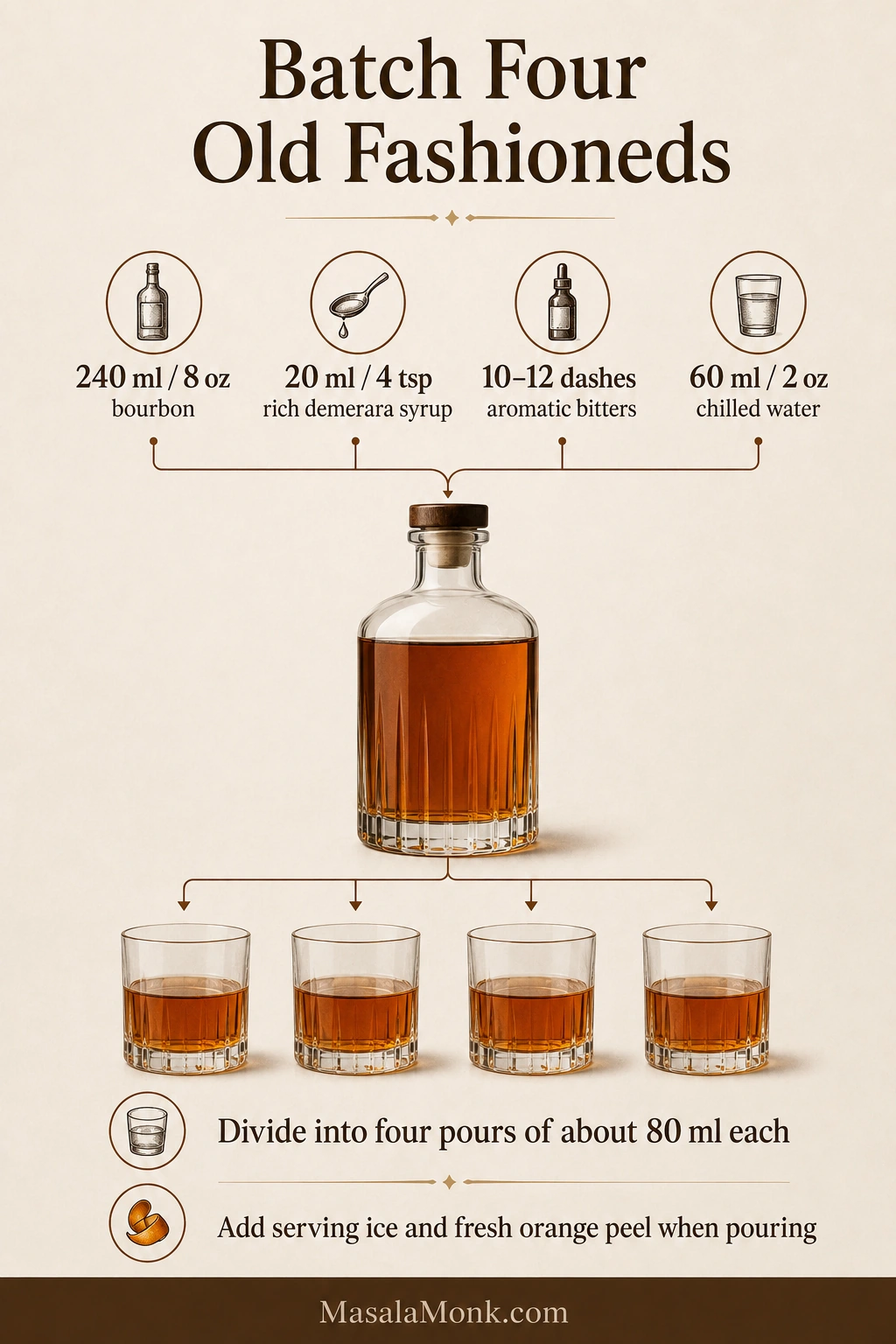
- 8 oz / 240 ml bourbon
- 4 teaspoons / 20 ml rich 2:1 demerara syrup
- 10–12 firm dashes Angostura bitters
- 2 oz / 60 ml chilled water
- Combine the bourbon, syrup, 10 dashes bitters, and water in a clean bottle or covered jug.
- Seal and mix gently, then refrigerate until thoroughly cold.
- Taste the chilled batch. Add the final 1–2 dashes only if it still smells or tastes a little flat.
- Pour about 2⅔ oz / 80 ml into each rocks glass over one large cube or several solid cubes.
- Express an orange peel over every glass immediately before serving.
Divide the batch evenly among four glasses, roughly 80 ml each before any further dilution from serving ice. Add extra chilled water only in small measured amounts.
Before guests arrive, taste one complete 80 ml pour over its serving ice because the drink will soften further in the glass. Keep orange peels out of the batch; their aroma fades, and prolonged contact can add unwanted bitterness.
Make-Ahead and Storage
Syrup: cool it completely, transfer it to a clean sealed container, label it as 1:1 or 2:1, and refrigerate. Aim to use homemade syrup within about 2–4 weeks. Rich 2:1 syrup may keep longer, but cleanliness and refrigeration matter more than a precise calendar date.
Discard syrup sooner if you notice cloudiness, mold, fermentation, gas, or an unusual smell.
Pre-batched cocktail: for easy entertaining, prepare it up to 1 week ahead and keep it tightly sealed in the refrigerator. Add ice, peel, and cherries only when serving.
Finished drink: enjoy it immediately. The serving ice keeps diluting the cocktail while the orange aroma fades.
Recipe card ↑Five variations →Back to top ↑
Serving Ideas and Variations
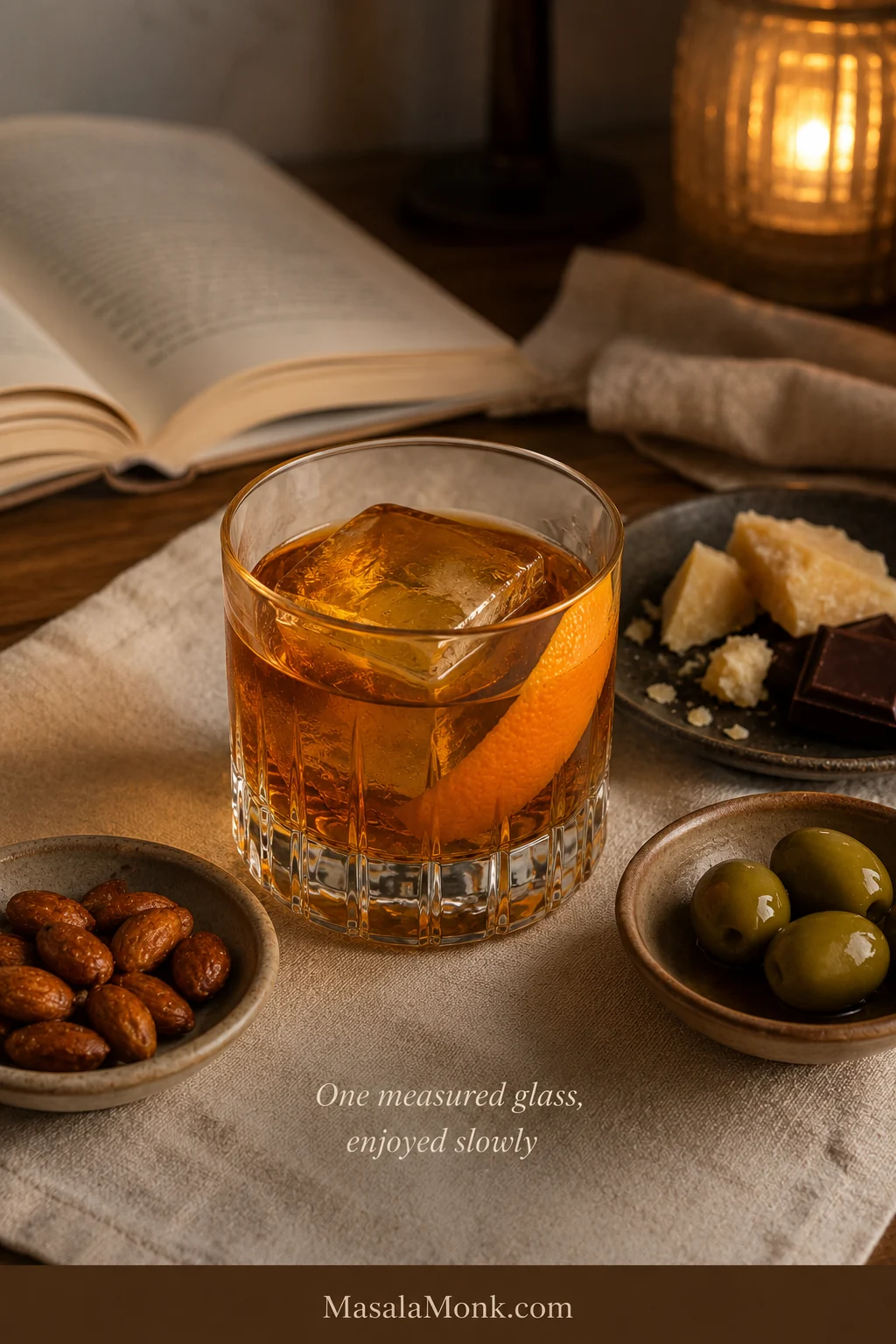
This is a slow-sipping drink rather than a bright thirst-quencher. Serve it before dinner with modest sweetness, or after dinner with richer whiskey, demerara, and an optional cherry. Salty roasted nuts, olives, aged cheese, crisp potato snacks, mushroom toast, and dark chocolate all sit comfortably beside it.
The setting does not need to be formal. Sometimes it is simply the first quiet drink after a long week—one measured glass made properly, then enjoyed slowly.
Five Variations to Try
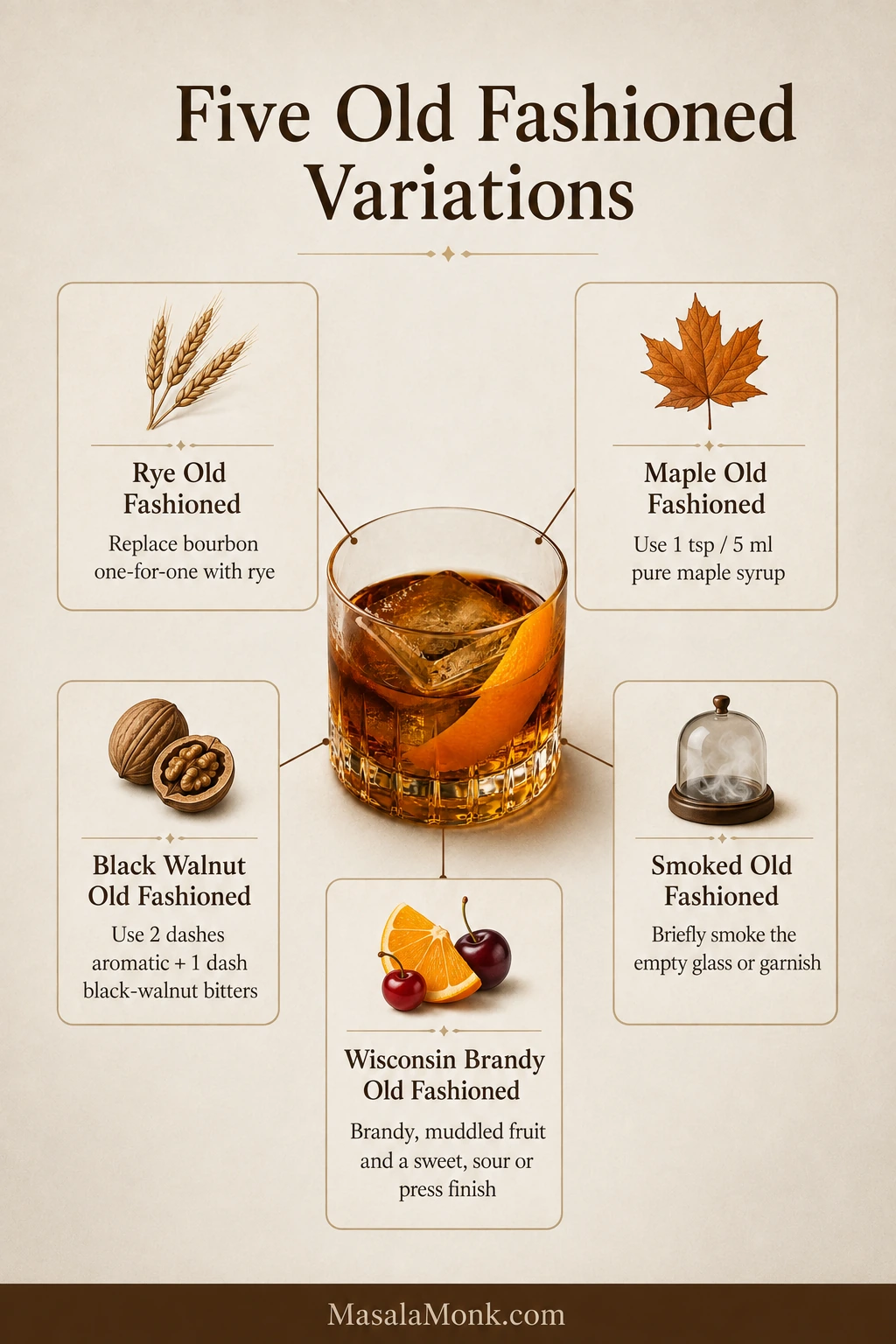
- Rye Old Fashioned: replace bourbon one-for-one with rye for a drier, spicier finish.
- Maple Old Fashioned: replace the demerara with 1 teaspoon / 5 ml pure maple syrup, then adjust after tasting.
- Black Walnut Old Fashioned: begin with 2 dashes Angostura and 1 dash black-walnut bitters.
- Smoked Old Fashioned: briefly smoke the empty glass or garnish; avoid burning ingredients directly into the drink.
- Wisconsin Brandy Old Fashioned: treat this as a separate regional branch with brandy, muddled fruit, and a sweet, sour, or press finish.
For Scotch, a Rob Roy keeps the stirred-whiskey character and replaces sugar with sweet vermouth.
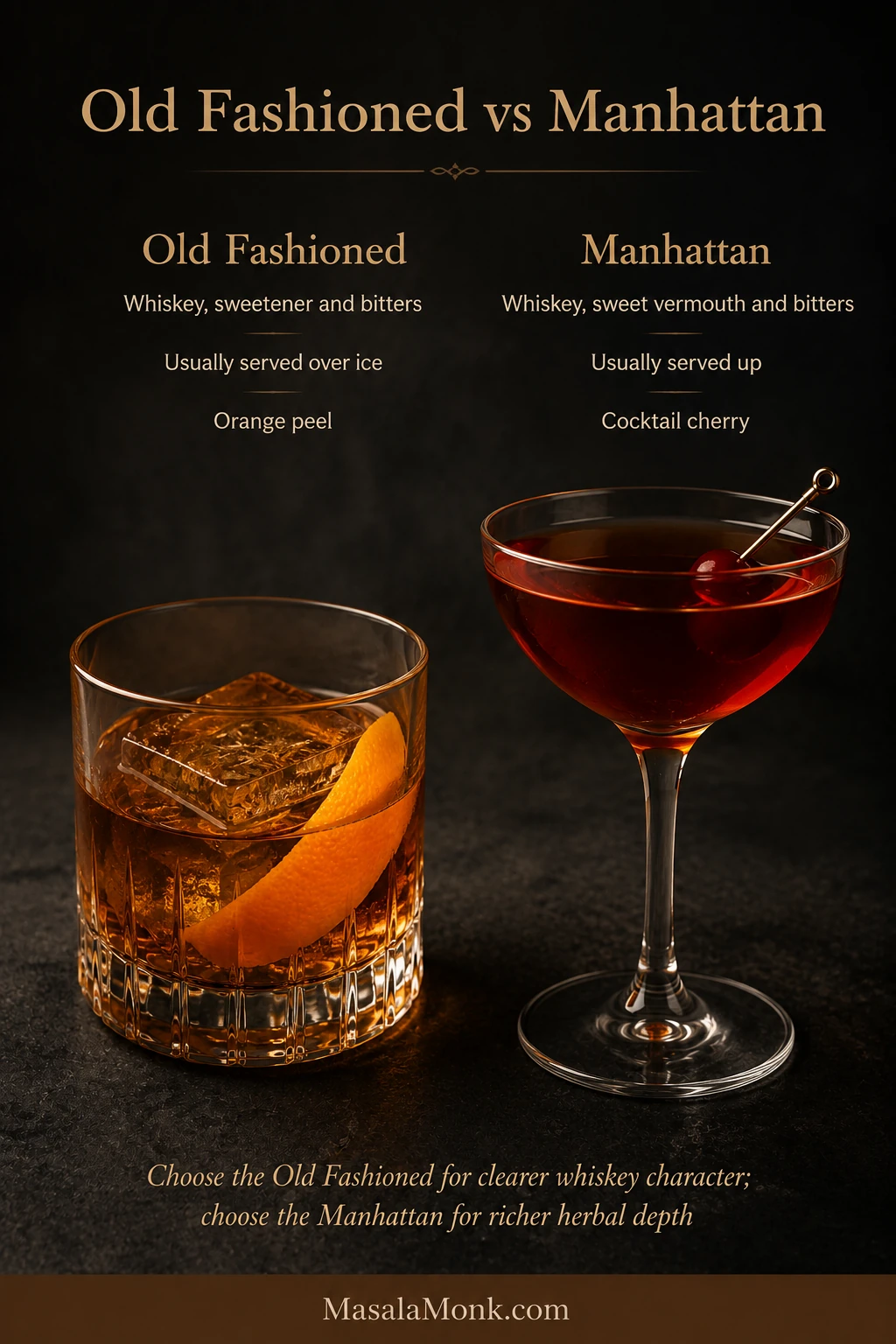
Old Fashioned vs Manhattan
Both drinks are whiskey-forward and stirred, but they create different experiences. An Old Fashioned uses a small amount of sugar or syrup; a Manhattan uses sweet vermouth, adding wine, herbs, and greater richness.
| Old Fashioned | Manhattan |
|---|---|
| Whiskey, sweetener, bitters, and water | Whiskey, sweet vermouth, and bitters |
| Usually served over ice | Often served up in a chilled stemmed glass |
| Orange peel is the usual aromatic finish | A cocktail cherry is common |
| Keeps the base whiskey as the clearest flavor | Adds a richer herbal and wine-like layer |
Recipe card ↑FAQs →Back to top ↑
Why Is It Called an Old Fashioned?
The name points back to an older cocktail formula: spirit, sugar, bitters, and water. As newer drinks gained liqueurs and modifiers, drinkers could ask for whiskey in the “old-fashioned” way.
The International Bartenders Association still lists an official version made with bourbon or rye, sugar, Angostura bitters, and water. Modern recipes vary in whiskey volume, syrup, fruit, ice, and technique. A clear sensory target is more useful than treating one ritual as the only correct method.
Frequently Asked Questions
What whiskey is best for an Old Fashioned?
A 90–100-proof whiskey is the most dependable starting point. Bourbon is rounder and sweeter; rye is drier and spicier.
Should an Old Fashioned contain a cherry or muddled orange?
A cherry is optional. This version uses expressed peel, while muddled orange and cherry belong to Wisconsin-style and other regional preparations.
Can I make an Old Fashioned without orange?
The cocktail still works without orange. Lemon peel gives a sharper fragrance, or you can leave the garnish out entirely.
Why does my Old Fashioned taste too strong?
It is probably under-diluted. Stir briefly with ice and taste again; the alcohol should remain strong without feeling raw or separate.
Start With the Whiskey, Then Listen to the Glass
A memorable Old Fashioned is not defined by the most expensive bourbon, the clearest ice, or the longest history lecture. It is the one where every small addition makes the whiskey easier to notice.
Stir until the drink feels cold and settled. Express the orange peel, notice what reaches you before the first sip, and taste it slowly.
Then make the next one a little more yours—drier, spicier, softer, or brighter. The essential shape remains the same: whiskey, sweetness, bitters, and water, with orange arriving first on the nose.
Do you reach for bourbon or rye, and how dry do you like the finished drink? Share what tastes right to you.








