Posted on 3 Comments

White Russian Recipe: 7 Variants to Try, From Classic to Frozen

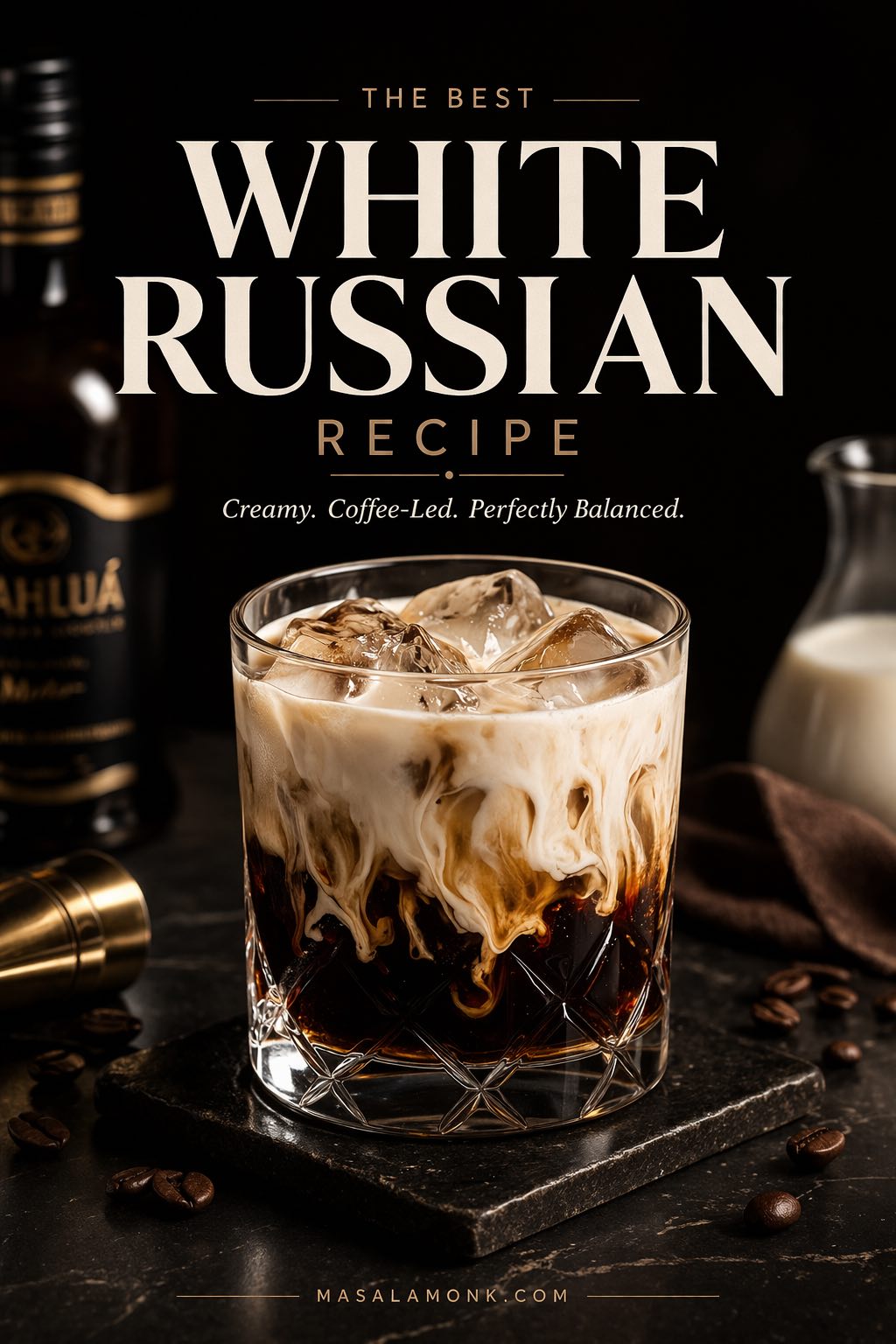
Premium White Russian recipe cover image showing a classic White Russian cocktail in a rocks glass over ice with rich cream swirl, dark coffee liqueur base, and elegant text overlay for a White Russian recipe blog post.

A White Russian recipe does not ask for much on paper, which is exactly why it goes wrong so easily in the glass. Vodka, coffee liqueur, dairy, and ice sound almost too straightforward to deserve careful treatment. Even so, the details matter more here than they do in many longer cocktails.

Cream can go in a little too heavily. Sometimes the liqueur turns the drink sweeter than expected. On other nights, the ice melts faster than it should and the whole thing loses shape before the glass is half finished. What should have felt smooth and rounded becomes flat, muddy, or oddly tired.

That is the difference between a White Russian that merely exists and one that is worth making again. Coffee should remain clear enough to matter. The vodka still needs to give the drink backbone. Meanwhile, the dairy should soften the finish without wiping out the darker flavors underneath it. When that balance holds, the White Russian feels rich without becoming heavy, sweet without becoming sticky, and creamy without becoming vague.

For most glasses, the strongest place to begin is 2 ounces vodka, 1 ounce coffee liqueur, and 1 ounce half-and-half or cream over ice. That build gives the drink enough body to feel indulgent while preserving enough structure for it to remain a cocktail rather than a melted dessert. Better still, it gives you room to move. If you want something richer, you can push it in that direction. If you want a firmer, more coffee-forward drink, you can tighten it.

Why a White Russian Goes Wrong So Easily

The classic comes first here, and it should. After that come the choices that actually change the drink in meaningful ways: the ratio, the dairy, the liqueur, the ice, and the small adjustments that keep the White Russian from drifting too sweet, too soft, or too thin.

Only then do the variations matter, because a Baileys White Russian, a Hot White Russian, a Chocolate White Russian, or a Frozen White Russian makes more sense once the classic version is doing its job properly.

Also Read: Mango Sorbet Recipe: Healthy & Plant Based Dessert

White Russian Recipe at a Glance

For a classic White Russian, use:

  • 2 ounces vodka
  • 1 ounce coffee liqueur
  • 1 ounce half-and-half or heavy cream
  • Ice

Fill a rocks glass with ice. Pour in the vodka, add the coffee liqueur, top with the dairy, stir gently, and serve immediately.
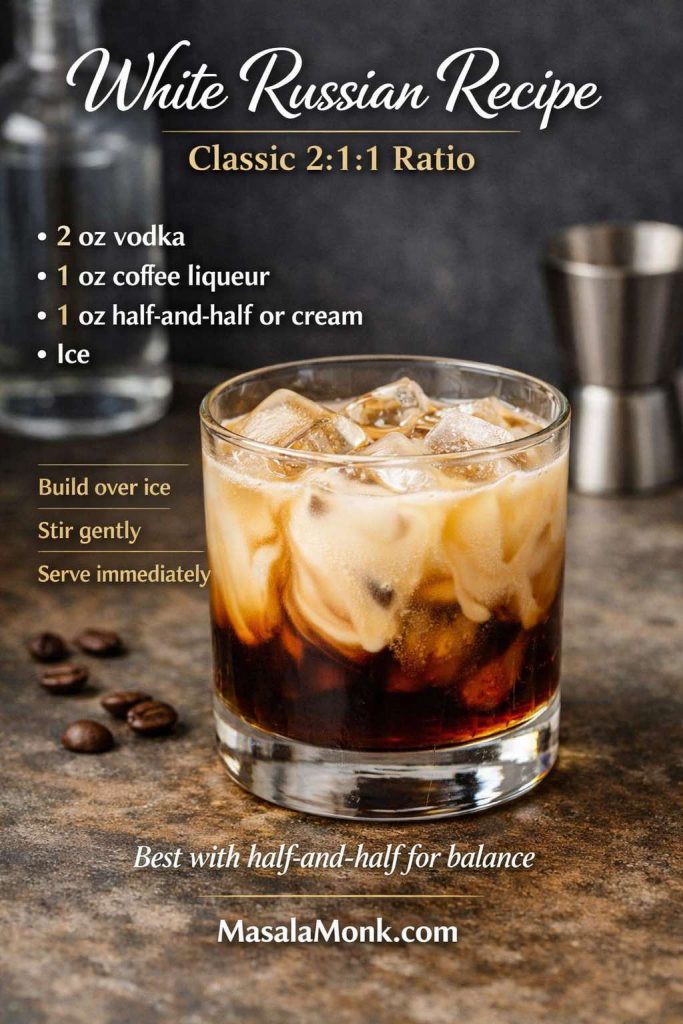
White Russian recipe card showing a classic White Russian cocktail in a rocks glass over ice with creamy swirl text overlay listing vodka, coffee liqueur, half-and-half or cream, and the classic 2:1:1 ratio.
A good White Russian is not just creamy. It is balanced. This ratio gives the drink enough coffee character and enough backbone to stay interesting from the first sip to the last, which is exactly why it is the strongest place to start before trying richer or sweeter variations.

That is the shortest useful answer. Each ingredient has a clear role. Vodka gives the drink shape. Coffee liqueur supplies sweetness, roast, and slight bitterness. Dairy smooths the finish and gives the White Russian its signature texture. As for the ice, it chills the drink and gradually opens it up, though never so much that it should be allowed to dominate it.

If you only want the quick answer to how to make a White Russian, that is enough to get you there. The sections below are what make the result better.

Also Read: Protein Ice Cream Recipe: 10 Creamy Homemade Recipes

Best White Russian Recipe

The best White Russian is not the sweetest version, the richest version, or the heaviest-handed version. It is the one that still tastes like coffee, spirit, and cream in proportion. That sounds obvious, yet a lot of quick recipes either go too soft with the dairy or treat the coffee liqueur like an afterthought rather than the structural flavor that gives the drink its identity.

A properly balanced White Russian should feel calm, creamy, and satisfying from the first sip, but it should still read clearly as a cocktail. The vodka should not disappear. Coffee liqueur should do more than merely sweeten. At the same time, the dairy should not behave like a blanket thrown over the whole thing. Once those roles stay distinct, the drink becomes much more memorable.

Classic Recipe Card

Yield: 1 cocktail
Prep time: 5 minutes
Glass: rocks glass or old fashioned glass
Serve: over ice

Ingredients

  • 2 ounces vodka
  • 1 ounce coffee liqueur
  • 1 ounce half-and-half or heavy cream
  • Ice

Method

Fill a rocks glass with fresh ice. Pour in the vodka, then the coffee liqueur. Add the half-and-half or cream and stir gently until the drink is lightly blended. Serve immediately.

Best Dairy Choice

Half-and-half is the best all-around choice for a classic White Russian. It gives the drink enough body to feel creamy and satisfying without flattening the coffee note underneath it.

Easy Substitutions

Heavy cream makes a richer, slower, more dessert-like White Russian. Milk makes a lighter drink, but it also makes the cocktail lose strength more quickly as the ice melts.

What This Drink Should Taste Like

The best White Russian tastes smooth, lightly sweet, gently coffee-led, and creamy without becoming thick, sticky, or vague.

One Small Tip That Improves the Drink Immediately

Use cold dairy and solid ice. Warm cream and weak cubes soften the drink faster than most people expect.
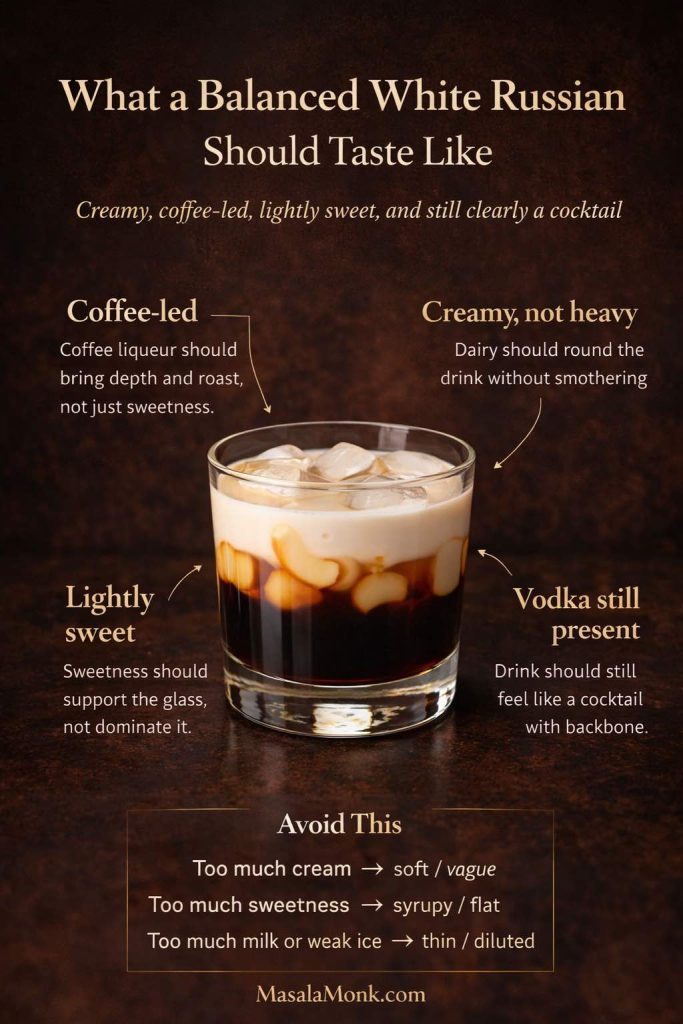
Flavor balance guide for the best White Russian recipe showing a properly balanced White Russian as creamy, coffee-led, lightly sweet, and still clearly spirit-forward, with notes on avoiding drinks that taste too creamy, too sweet, or too thin.
The best White Russian is not the richest or sweetest one. It is the one where coffee, vodka, and dairy still feel distinct enough to matter together. When the drink is balanced, it tastes creamy without becoming heavy, lightly sweet without turning syrupy, and smooth without losing the firm cocktail backbone that keeps it interesting from the first sip to the last.

What This White Russian Should Taste Like

A properly made White Russian should taste smooth, lightly sweet, gently coffee-led, and clearly creamy without turning thick or dull. The finish should feel rounded rather than sticky. Meanwhile, the dairy should soften the alcohol rather than bury it. Most importantly, the coffee liqueur should bring depth and sweetness without flattening the glass into syrupy sameness.

If your first sip tastes mostly like cream, the drink is too soft. When sweetness arrives before coffee, the liqueur has taken over. Likewise, a thin and milky texture usually means the dairy choice, ice, or ratio has drifted in the wrong direction.

Why This White Russian Recipe Works

This version works because it keeps the drink in proportion. Two ounces of vodka make sure the White Russian still tastes like a cocktail. One ounce of coffee liqueur gives it the darker flavor that defines it. Then one ounce of dairy rounds the finish and gives the drink its familiar texture without flattening the whole thing.

That balance matters more here than it would in a more crowded drink. A White Russian has nowhere to hide. Too much dairy makes the coffee disappear. Too much sweetness from the liqueur turns the glass soft and sticky. As for rough vodka, you notice it more than you should because the dairy and sweetness only soften the edges; they do not erase them.

Half-and-half is usually the best choice for the classic build. It gives enough body to make the White Russian feel creamy and satisfying, but it still leaves room for the coffee and vodka to show themselves. Heavy cream creates a richer, slower drink, which can be excellent after dinner or whenever a more openly indulgent finish is the point. Milk works if you want something lighter, though it nearly always weakens faster over ice and rarely feels as complete.

For classic context, Liquor.com’s White Russian keeps the structure traditional, while Inspired Taste’s White Russian recipe lands in a similarly balanced direction.

Also Read: Homemade Mango Ice Cream Recipe

What Is a White Russian?

A White Russian is a cocktail made with vodka, coffee liqueur, and dairy, usually served over ice. It belongs to a small group of drinks that are easy to like quickly but harder to make well than their short ingredient lists suggest. A lot of cocktails hide behind complexity. The White Russian does not. It puts a few ingredients in the glass, lets them show themselves, and leaves very little room for confusion once the balance slips.

The appeal is immediate: the drink feels familiar, smooth, and easy to like from the first sip. It is creamy, smooth, sweet, and just bitter enough around the edges to stay interesting. It also sits in a useful middle ground. Richer than a bright citrus cocktail and gentler than a more spirit-forward coffee drink, it can work as an after-dinner cocktail, a cold-weather comfort drink, or a slow evening pour that asks very little beyond basic restraint.

Its reputation for ease is deserved, but it can be misleading. Easy does not mean careless. Better ice, better dairy, a more sensible ratio, and a coffee liqueur that suits the result you actually want all make a noticeable difference. Those choices separate a White Russian that feels rounded and deliberate from one that feels like sweet cream thrown over a lazy pour.

White Russian vs Black Russian

A Black Russian contains vodka and coffee liqueur. A White Russian adds dairy. That sounds minor, but the difference in the glass is substantial.

The Black Russian feels darker, firmer, and more spirit-forward. It lets the vodka and coffee liqueur speak with much less softening. The White Russian takes those same bones and turns them smoother, rounder, and more indulgent. If the coffee note is what pulls you in but the drier edge of the Black Russian sounds too lean, the White Russian is usually the better choice.
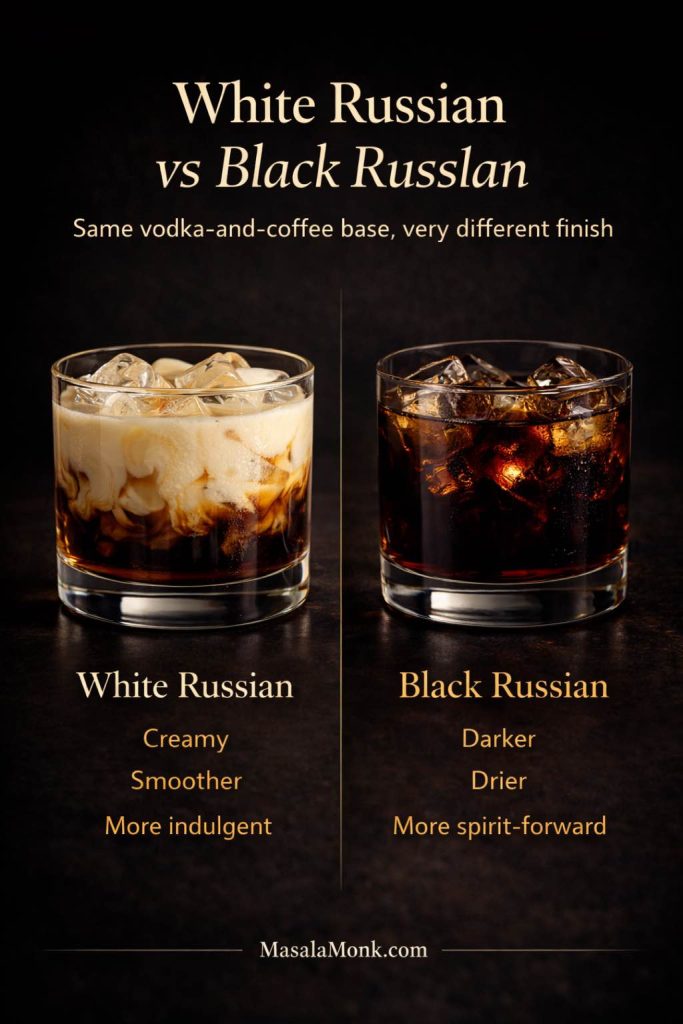
White Russian vs Black Russian comparison graphic showing a creamy White Russian and a darker Black Russian side by side, with text highlighting creamy, smoother, and more indulgent versus darker, drier, and more spirit-forward.
A White Russian and a Black Russian may start from the same vodka-and-coffee base, but they land very differently in the glass. Adding dairy turns the White Russian smoother, creamier, and more indulgent, while leaving it out keeps the Black Russian darker, drier, and more direct.

The practical difference becomes even clearer once both drinks are actually in front of you. A Black Russian is cleaner and sharper. It feels closer to a short, slightly sweet spirit drink. By contrast, a White Russian slows the whole experience down. Dairy changes not only the flavor but also the pace of the drink. The finish turns softer, the texture fuller, and the mood less severe.

That is why comparisons between the two matter more than they first appear to. The question is not simply whether dairy is present. Instead, it is what role you want the coffee liqueur to play. In a Black Russian, it sits much closer to the surface. In a White Russian, it becomes part of a richer, gentler structure. Black Russian for a darker, drier pour; White Russian for a creamier, more relaxed one.

Why Is It Called a White Russian?

The name is direct. “Russian” points to the vodka. “White” refers to the dairy that lightens the drink.

Is This the Drink From The Big Lebowski?

Yes. The White Russian is closely associated with The Big Lebowski, where it is also called a “Caucasian.” The film helped keep the drink visible in popular culture, but the cocktail survives because the combination works even without the movie attached to it. A good White Russian does not need nostalgia to justify itself.

Also Read: Cookie Pie Recipe: 10 Best Flavors, Fillings and Variations

The Ingredients That Make or Break a White Russian

A short ingredient list makes quality more obvious, not less. The White Russian does not require luxury bottles or elaborate tools, but it does benefit from sensible choices.
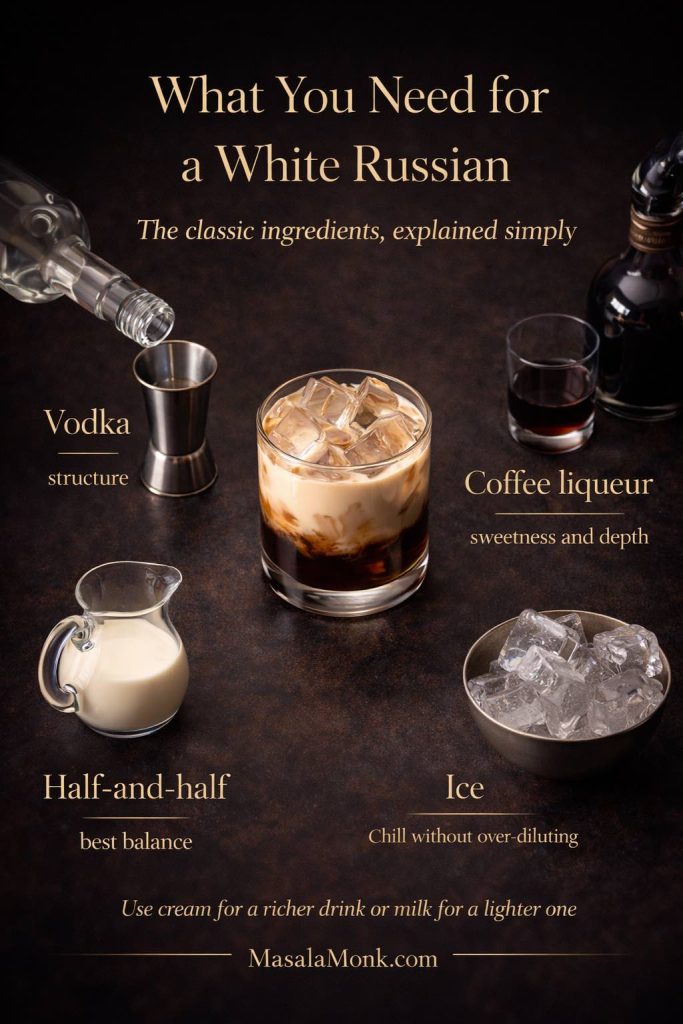
White Russian ingredients guide showing a finished White Russian cocktail with vodka, coffee liqueur, half-and-half, and ice, plus text explaining each ingredient’s role in the drink.
A White Russian is a short drink with very little to hide behind, which is why each ingredient matters more than the list suggests. Vodka gives the cocktail structure, coffee liqueur brings sweetness and depth, half-and-half keeps the texture creamy without going too heavy, and good ice helps the drink stay cold without thinning too quickly.

Vodka

Use a clean, neutral vodka that tastes smooth enough to support the drink without roughening it. This is not a cocktail where a harsh spirit disappears under layers of other flavors. The dairy softens, but it does not erase. If the vodka is aggressive, you will still feel it in the finish.

That does not mean expensive. A reliable mid-range vodka is usually perfect. The point is not prestige. The point is steadiness. In a drink as short and exposed as the White Russian, cheap burn matters more than people often expect.

Coffee Liqueur

Coffee liqueur gives the White Russian its identity. It brings sweetness, roasted depth, slight bitterness, and the darker flavor that makes the cocktail more than vodka softened with dairy. Without a proper coffee note, the White Russian loses the thing that makes it memorable.

Different bottles shift the drink more than many quick recipes admit. Some coffee liqueurs are soft, sweet, and vanilla-forward. Others taste darker, drier, and more coffee-led. A softer, sweeter bottle often needs a lighter hand with the dairy. A darker one can carry a richer pour without disappearing. That is why it helps to think of coffee liqueur not merely as the sweet element, but as the structural flavor of the drink.
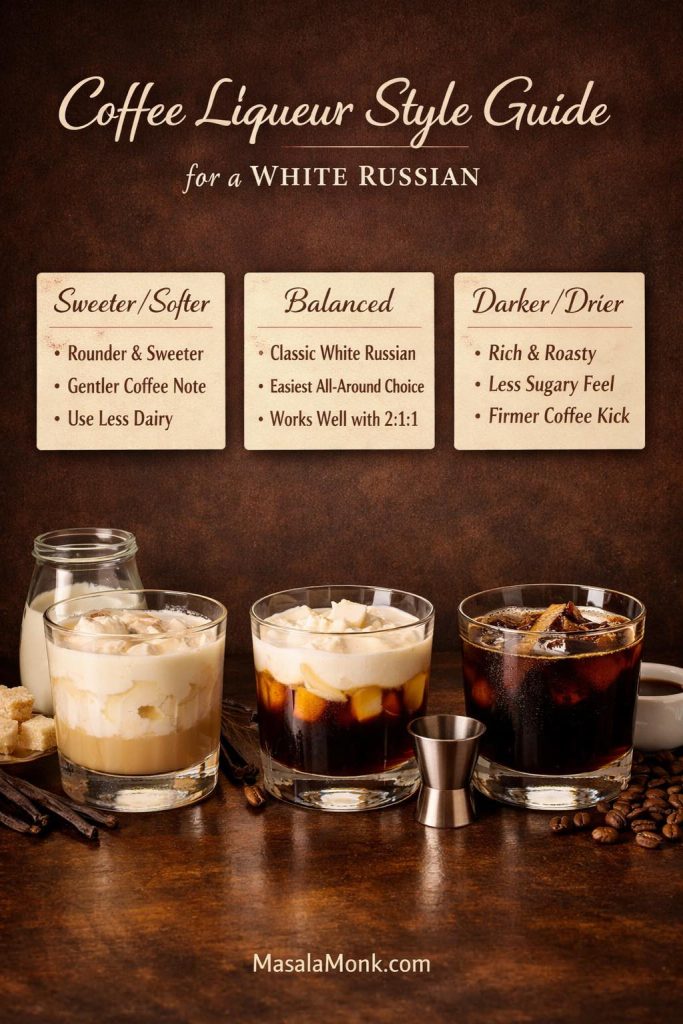
Coffee liqueur style guide for a White Russian showing sweeter and softer, balanced, and darker drier coffee-led styles, with visual examples of how each type changes the flavor, sweetness, roast character, and structure of a White Russian cocktail.
Coffee liqueur does far more in a White Russian than simply add sweetness. It decides whether the drink feels softer and rounder, balanced and classic, or darker and more coffee-led from the start. A sweeter bottle usually benefits from a lighter hand with the dairy, while a drier, roastier style can carry a firmer build without disappearing under the cream. Choosing the right coffee liqueur style makes it much easier to steer the drink toward the exact kind of White Russian you actually want in the glass.

If coffee flavor is part of what attracts you to the White Russian in the first place, Quick Espresso Guide – Know Your Coffee and Coffee Brewing Methods: A Fusion of Art, Science, and Flavor sit naturally beside a post like this.

Cream, Half-and-Half, or Milk

This choice changes the White Russian more than almost any tiny ratio adjustment.

Heavy cream makes the drink lush, full, and openly indulgent. It works best when richness is the point and you want the White Russian to lean further toward dessert.

Half-and-half is the sweet spot for most glasses. It gives the drink enough body to feel creamy and satisfying without burying the coffee and vodka underneath it.

Milk makes a lighter White Russian. That can be pleasant when you want something easier to sip, but it also makes the drink more fragile. Once the ice starts to melt, milk is usually the first reason the cocktail feels washed out.

Dairy changes the drink more dramatically than many people expect. A White Russian made with half-and-half is usually the best all-around answer. One made with milk can be pleasant, but it is rarely the most complete version of the drink. Meanwhile, a White Russian made with heavy cream can be excellent when indulgence is the goal, though it can also become shapeless if the rest of the drink is not firm enough to support it.

If you want a practical outside reference on dairy swaps, The Spruce Eats’ White Russian recipe handles that part more practically than most short cocktail pages.

Ice and Glassware

Serve the drink in a rocks glass or old fashioned glass over ice. Since the White Russian is short, rich, and usually sipped slowly, that format suits it naturally.
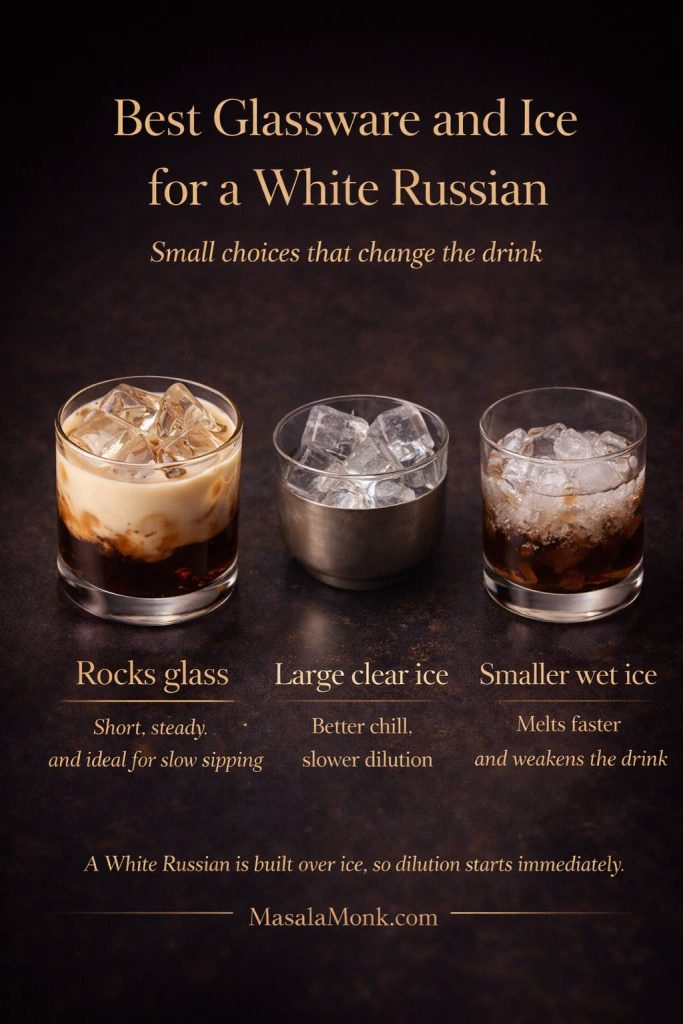
White Russian glassware and ice guide showing a classic White Russian in a rocks glass, large clear ice, and smaller wet ice, with text explaining how glass choice and ice affect dilution and sipping quality.
A White Russian starts changing the moment it hits the ice, which is why the right setup matters more than it first seems. A short rocks glass suits the drink’s slow pace, large clear cubes protect the balance longer, and weaker wet ice can flatten the cocktail before the creamy coffee notes have time to settle.

The ice matters too. Thin, wet cubes melt quickly and drag the drink down before it has a chance to settle. Firmer ice gives the coffee liqueur and dairy more time to stay in balance. Because the White Russian is built directly over ice rather than shaken and strained, dilution is not a background issue here. It is part of the drink from the beginning.

Also Read: Punjabi Mutton Bhuna – Amritsari Village-Style Gosht Recipe

The Best White Russian Ratio

A White Russian can move quickly from balanced to shapeless. The ratio is what decides where it lands.

The Classic 2:1:1 Ratio

For a balanced White Russian, use:

  • 2 ounces vodka
  • 1 ounce coffee liqueur
  • 1 ounce half-and-half or cream

This works because the drink still has shape. The coffee stays clear. The vodka still matters. The dairy smooths the finish instead of taking it over. If what you want is a classic White Russian that feels reliable, repeatable, and easy to adjust, this is the build to trust first.

The classic 2:1:1 ratio also gives you room to move. Want a slightly richer glass? Add a touch more dairy or switch from half-and-half to cream. Want something firmer? Use a darker coffee liqueur or pull the sweetness back a little. The base stays stable.

The Equal-Parts Build

Equal parts vodka, coffee liqueur, and dairy create a softer, sweeter, more indulgent White Russian. There is nothing wrong with that version. It can be very enjoyable after dinner or whenever a richer, more plush pour sounds right. It simply aims at a different result. The drink becomes rounder, gentler, and more dessert-like from the first sip.

That richer approach shows up clearly on Kahlúa’s White Russian page, which leans into the more indulgent side of the spectrum.
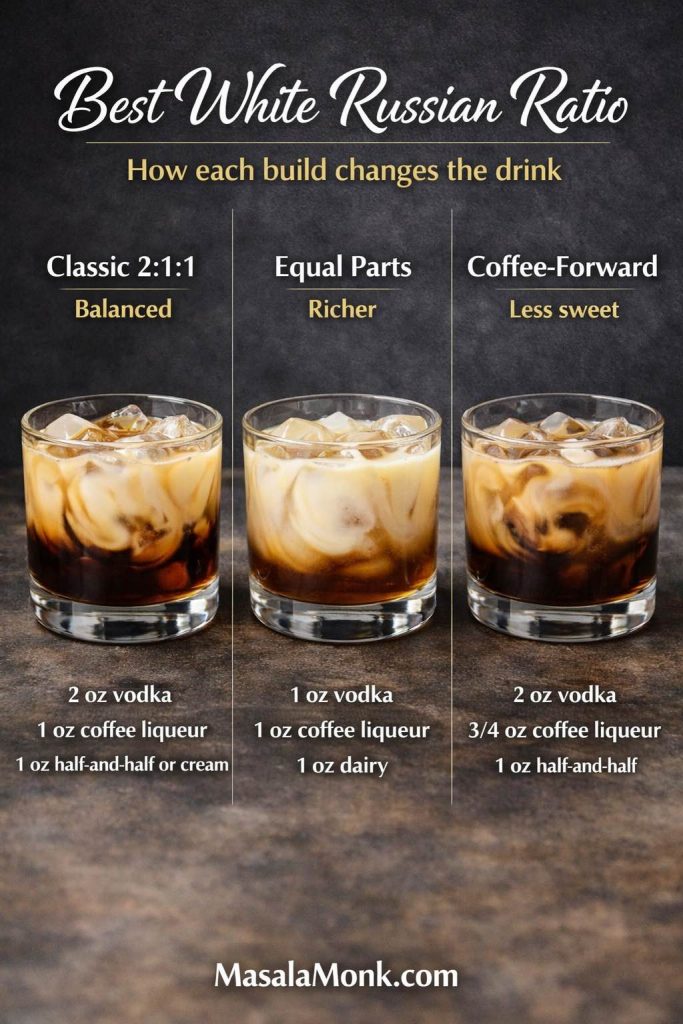
White Russian ratio guide comparing three White Russian builds in rocks glasses over ice: classic 2:1:1, equal parts, and a coffee-forward version with less coffee liqueur and half-and-half.
A White Russian changes more than most quick recipes admit. The classic 2:1:1 build stays balanced and cocktail-like, equal parts turns softer and richer, and a firmer coffee-forward version pulls the drink away from sweetness and back toward roast, structure, and a clearer vodka-and-coffee finish.

A Firmer Coffee-Forward White Russian

There is also a useful middle move for anyone who likes the White Russian idea but wants more edge: keep the vodka at 2 ounces, trim the coffee liqueur slightly, stay with half-and-half rather than heavy cream, and use a darker bottle if possible. That version is less sweet, more clearly coffee-led, and closer to an after-dinner cocktail than a cold dessert.

This version works better when you want the drink firmer, less sweet, and more clearly coffee-led. The trick is not inventing a new ingredient list. It is keeping the coffee note and the spirit visible inside the creamy texture.

How Ratio and Dairy Work Together

Ratio alone does not decide the result. Dairy choice changes how that ratio lands.

A 2:1:1 White Russian with half-and-half usually feels the most balanced. A 2:1:1 White Russian with heavy cream becomes slower and richer, even though the numbers have not changed. Equal parts with heavy cream can turn very plush very quickly. Equal parts with milk will be lighter, but it can also taste weak once dilution sets in.

That is why two White Russians made with the same spirit and the same liqueur can still feel very different. The ratio tells you the direction. The dairy tells you how heavy the result feels when it gets there.

Which Ratio Tastes Better?

For most situations, 2:1:1 tastes better because it keeps the White Russian from going vague. It stays creamy, but it still feels like a cocktail first. Equal parts makes more sense when the mood is sweeter and softer from the beginning. A firmer coffee-forward version works when the roasted note is what you want to emphasize.

The important thing is recognizing that these are not interchangeable builds with slightly different wording. They feel different in the glass. That is exactly why the ratio deserves more thought than it usually gets.

Also Read: Peach Cobbler with Canned Peaches (Dessert Recipe)

Cream vs Half-and-Half vs Milk in a White Russian

A White Russian made with cream is not the same drink as one made with milk. Even when the rest of the ingredient list stays the same, the texture, weight, and finish shift dramatically.

Cream gives the drink a velvety, heavier feel. The White Russian becomes richer and more obviously decadent. That can be exactly right after dinner or whenever comfort matters more than clarity. The tradeoff is that too much cream can turn the drink rich but indistinct.
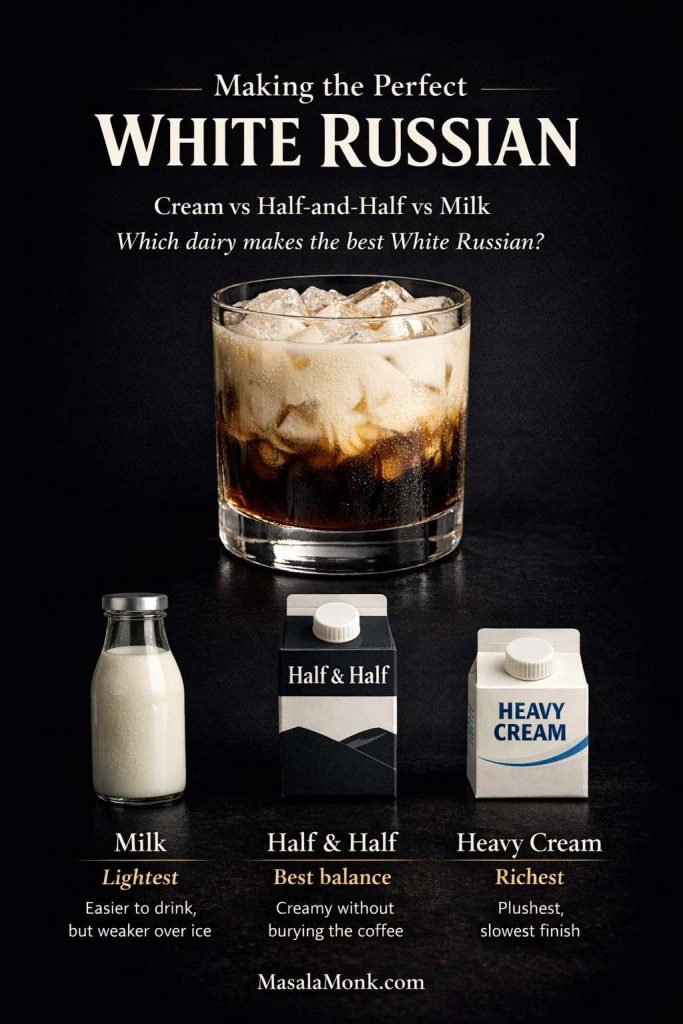
White Russian dairy guide graphic comparing milk, half-and-half, and heavy cream for a White Russian cocktail, with a creamy White Russian in a rocks glass and text showing lightest, best balance, and richest options.
Dairy changes a White Russian more dramatically than most quick recipes suggest. Milk keeps the drink lighter, heavy cream makes it richer and slower, and half-and-half lands in the middle as the most balanced choice when you want creaminess without burying the coffee and vodka underneath.

Half-and-half keeps more balance. The drink still feels creamy, but the coffee backbone remains present and the vodka still gives it a little shape. This is why half-and-half is such a reliable default. It gives enough without giving too much.

Milk creates the lightest White Russian of the three. That can sound appealing when you do not want a heavy drink, but it comes with a cost. Milk loses authority quickly over ice. Once dilution starts, the cocktail can move from pleasant to thin faster than expected, especially if the coffee liqueur already leans sweet.

The easiest way to think about it is simple. Use cream when indulgence matters most. Half-and-half is best when balance matters most. Use milk only when you knowingly want a lighter, less sturdy version of the drink.

A dairy-free White Russian can work too, though thin plant milks rarely help. The drink still needs body. If that version appeals, Cookie and Kate’s vegan White Russian is a thoughtful place to start because it treats texture seriously instead of treating “non-dairy” as a casual swap.

Also Read: Avocado Chocolate Mousse Recipe

Which White Russian Version Should You Make?

Not every White Russian variation gives you the same kind of drink, so choosing the right one makes a real difference. The classic White Russian recipe is still the best all-around choice when you want something creamy, coffee-led, easy to make, and clearly structured as a cocktail. If you like the same vodka-and-coffee foundation but want a darker, drier, more direct drink, a Black Russian makes more sense because it leaves out the dairy softness entirely. A Baileys White Russian, on the other hand, turns the drink gentler, sweeter, and more dessert-like from the first sip.
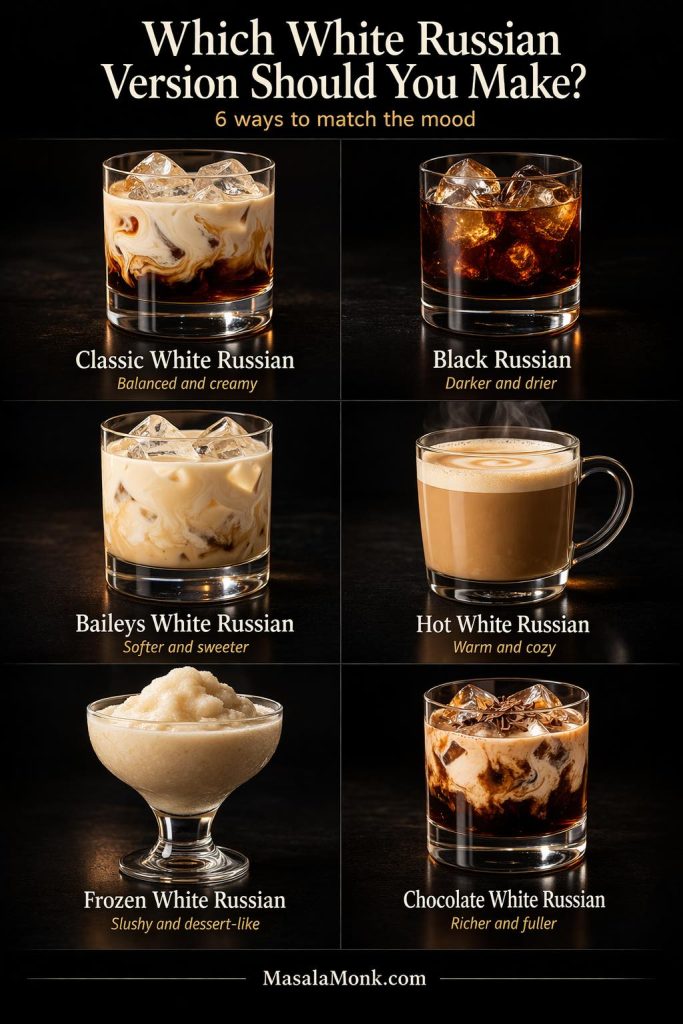
White Russian comparison guide showing six White Russian variations in a 2 by 3 grid: Classic White Russian, Black Russian, Baileys White Russian, Hot White Russian, Frozen White Russian, and Chocolate White Russian, with short descriptors for each style.
Not every White Russian solves the same craving. The classic stays balanced and creamy, the Black Russian goes darker and drier, Baileys turns softer and sweeter, the hot version feels cozy, the frozen one leans dessert-like, and chocolate makes the drink richer and fuller without losing its coffee-and-cream core.

Temperature changes the mood just as much as flavor. A Hot White Russian suits colder weather and a slower, cozier kind of drink, while a Frozen White Russian moves in the opposite direction, becoming slushier, more playful, and more openly dessert-like without fully losing the coffee-and-cream core that makes the drink recognizable in the first place. If richness is what you want, a Chocolate White Russian gives the classic a deeper, fuller edge, while a Salted Caramel White Russian pushes the drink sweeter and rounder, with just enough contrast to keep it from feeling flat.

Then there are the more seasonal or mood-specific versions. A Peppermint White Russian works best when the drink is meant to feel sharper, cooler, and more festive, especially in colder months. Taken together, these variations are less about novelty for its own sake and more about choosing the version that matches the moment. Sometimes that means something classic and balanced, sometimes something softer and sweeter, and sometimes something warmer, colder, richer, or more playful.

Also Read: Falafel Recipe: Crispy Homemade, Air Fryer and Baked Falafel

White Russian Comparisons That Actually Matter

Comparisons help because the White Russian sits near several other drinks that share part of its flavor world without delivering the same experience.
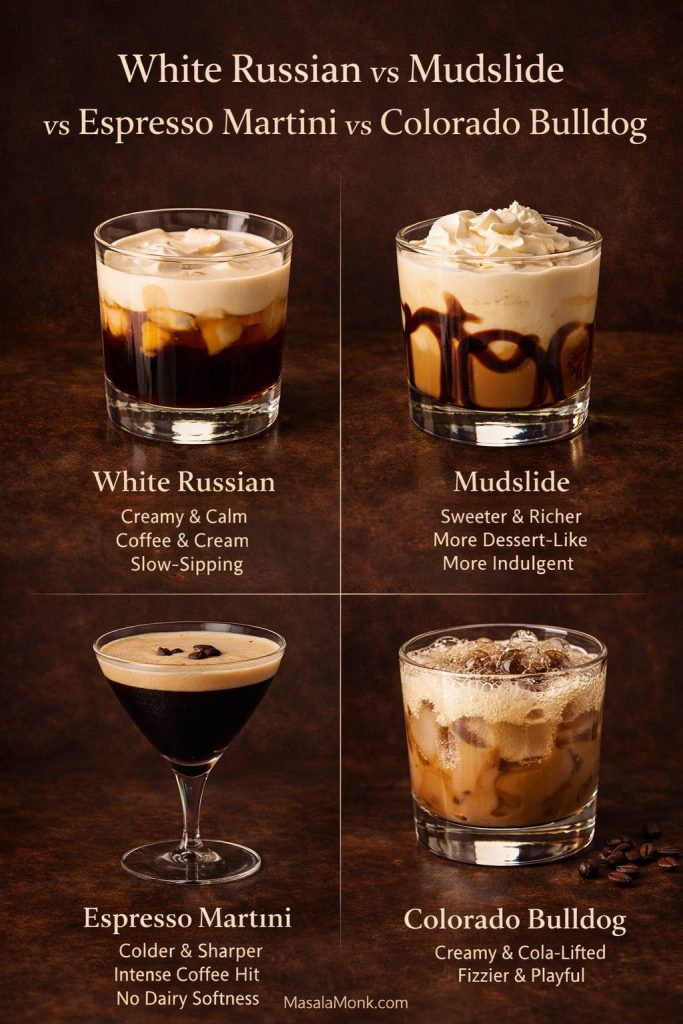
Cocktail comparison guide showing a White Russian, Mudslide, Espresso Martini, and Colorado Bulldog side by side, highlighting differences in texture, sweetness, dairy, coffee intensity, and overall drinking style between these four coffee-adjacent cocktails.
A White Russian sits near several familiar cocktails, but it does not drink the same way as any of them. Mudslide goes sweeter, richer, and more dessert-like, Espresso Martini turns colder, sharper, and more intensely coffee-led without dairy, and Colorado Bulldog takes the creamy coffee base in a livelier cola-lifted direction. Seeing them side by side makes the White Russian easier to understand for what it really is: calmer than an Espresso Martini, less confection-like than a Mudslide, and smoother and slower than a Colorado Bulldog.

White Russian vs Mudslide

A Mudslide is usually sweeter, richer, and more overtly dessert-like than a White Russian. Once Irish cream and chocolate enter the picture, the drink moves away from the cleaner structure of vodka, coffee liqueur, and dairy and toward a more confection-like profile. That does not make a Mudslide worse. It makes it a different kind of drink. A White Russian should still feel more restrained beside it.

Pick a White Russian when you want coffee, cream, and spirit in clearer proportion. Pick a Mudslide when you want something more openly indulgent and dessert-like from the start.

White Russian vs Espresso Martini

The Espresso Martini is sharper, colder, and more intense. It is about coffee aroma, chilled texture, and a cleaner, more focused edge. The White Russian is slower and softer. It leans on dairy instead of fresh espresso foam and occupies a more comfort-forward space.

Pick the White Russian when you want a creamy coffee cocktail that feels smooth and relaxed. Pick the Espresso Martini when you want a colder, tighter, more concentrated coffee hit with no dairy softness.

White Russian vs Colorado Bulldog

The Colorado Bulldog begins close to the White Russian, then adds cola. That changes the drink more than it first sounds. The White Russian is creamy and still. The Colorado Bulldog becomes fizzier, sweeter, and more playful. The coffee-and-cream core remains recognizable, but the mood shifts from slow and rich to livelier and more casual.

White Russian vs Baileys White Russian

A Baileys White Russian is softer and sweeter than the classic. It leans further into dessert territory. The classic White Russian keeps a cleaner line between vodka, coffee liqueur, and dairy. The Baileys version rounds everything off faster and needs more restraint to stay interesting.

Cold vs Hot vs Frozen

The classic cold version is the most balanced and versatile. A Hot White Russian becomes warmer, slower, and more comforting. The Frozen White Russian becomes more playful and more overtly dessert-like. The core flavors remain recognizable, but the drinking experience changes enough that each one earns its own place.
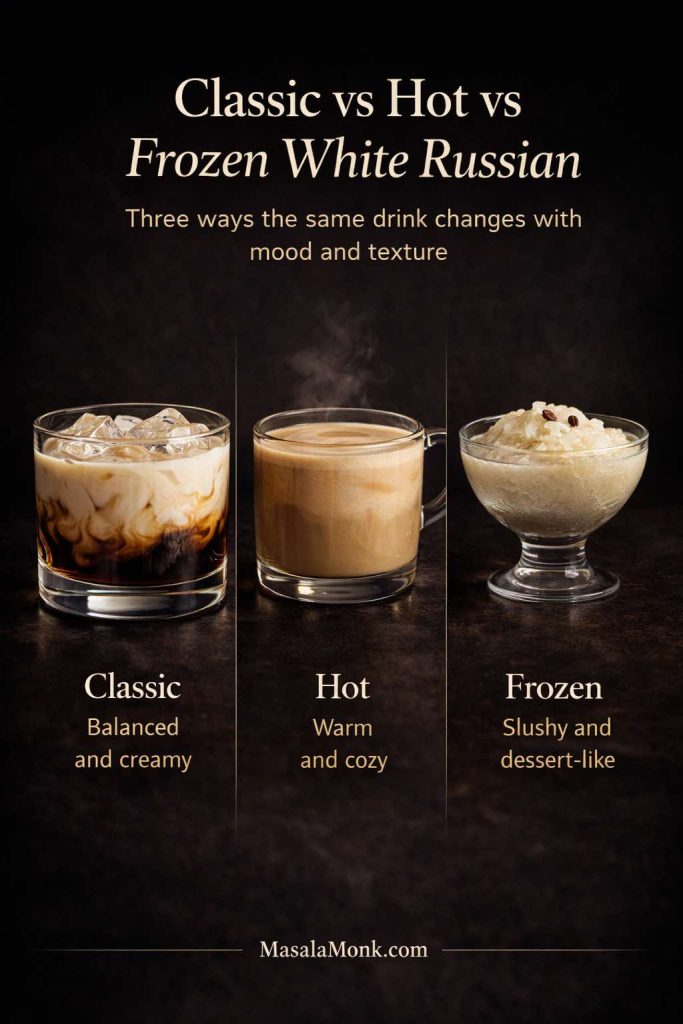
Comparison graphic showing three White Russian styles side by side: a classic White Russian over ice in a rocks glass, a hot White Russian in a glass mug with steam, and a frozen White Russian in a dessert-style glass, with text describing each as balanced and creamy, warm and cozy, or slushy and dessert-like.
Temperature changes a White Russian more than a quick variation note suggests. The classic version stays the most balanced, the hot one turns softer and cozier, and the frozen version pushes the drink toward a slushier, more dessert-like finish without completely losing its coffee-and-cream identity.

Also Read: Mango Margarita Recipe (Frozen or On the Rocks)

How to Make a White Russian Properly

The White Russian is a built drink, not a difficult one. Once the proportions are right, the method is almost effortless.

For the cleanest and most consistent glass, build it over ice and stir gently. That gives you a more even flavor from first sip to last. Some people prefer the layered look, where the dairy is floated on top over the back of a spoon. That presentation is attractive and part of the drink’s visual identity, but it is mostly a matter of appearance. Once the drink is stirred or partly sipped, it blends anyway.
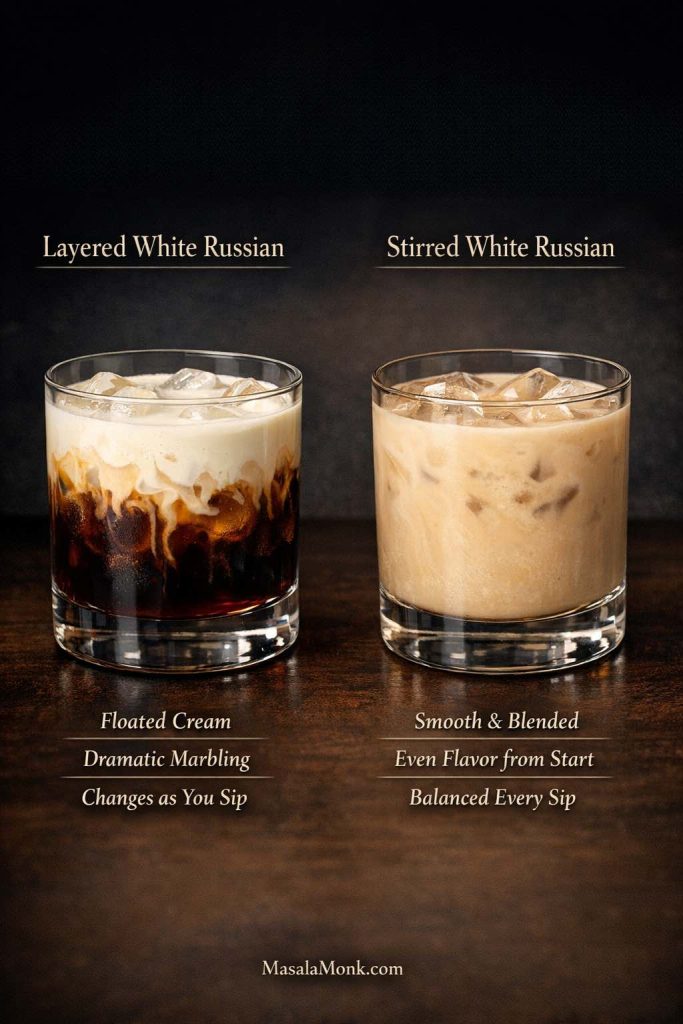
Side-by-side White Russian comparison showing a layered White Russian with cream floated over the dark coffee-and-vodka base and a stirred White Russian with a smooth blended creamy appearance, illustrating the visual and flavor difference between layered and stirred White Russian serving styles.
A White Russian can be finished two good ways, and each changes the drinking experience a little. Leaving the cream floated on top creates a more dramatic layered look and a glass that evolves as you sip, while a light stir gives you a more even balance of vodka, coffee liqueur, and dairy from the very first taste. If presentation matters most, the layered finish has more visual impact. If consistency matters most, the stirred version is usually the better choice.

The best practical method is simple. Fill the glass with ice, add vodka, add coffee liqueur, pour in the dairy, stir lightly, and serve immediately. The White Russian tastes best before melting ice has too much time to soften the coffee and thin the body.
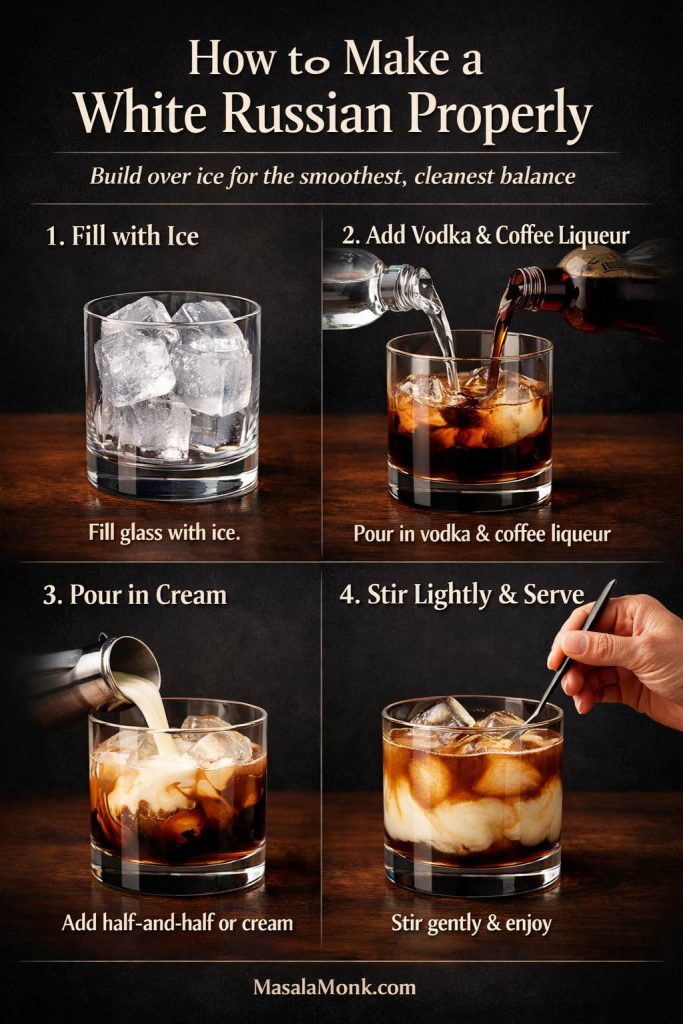
4-step White Russian method guide showing how to make a White Russian properly in a rocks glass over ice, from filling the glass with ice to adding vodka and coffee liqueur, pouring in half-and-half or cream, and stirring lightly before serving.
A White Russian tastes best when the build stays controlled from the beginning. Solid ice slows dilution, vodka and coffee liqueur create the drink’s backbone, and cold half-and-half or cream rounds the finish without smothering the darker coffee note underneath. When that order stays clean and the stir stays gentle, the cocktail lands the way it should: smooth, creamy, lightly sweet, and still clearly a proper White Russian rather than a watered-down dessert drink.

Its place in the evening matters too. This is not a bright, thirst-quenching highball and it is not meant to feel sharp or lively like a citrus-heavy cocktail. Instead, it is richer, rounder, and more comforting, which is exactly why it works so well after dinner. For a brighter contrast elsewhere on the site, the Paloma Recipe and the Mango Margarita Recipe pull in the opposite direction.

How to Fix a White Russian That Tastes Off

One of the best things about a White Russian is how easy it is to correct once you know what went wrong.
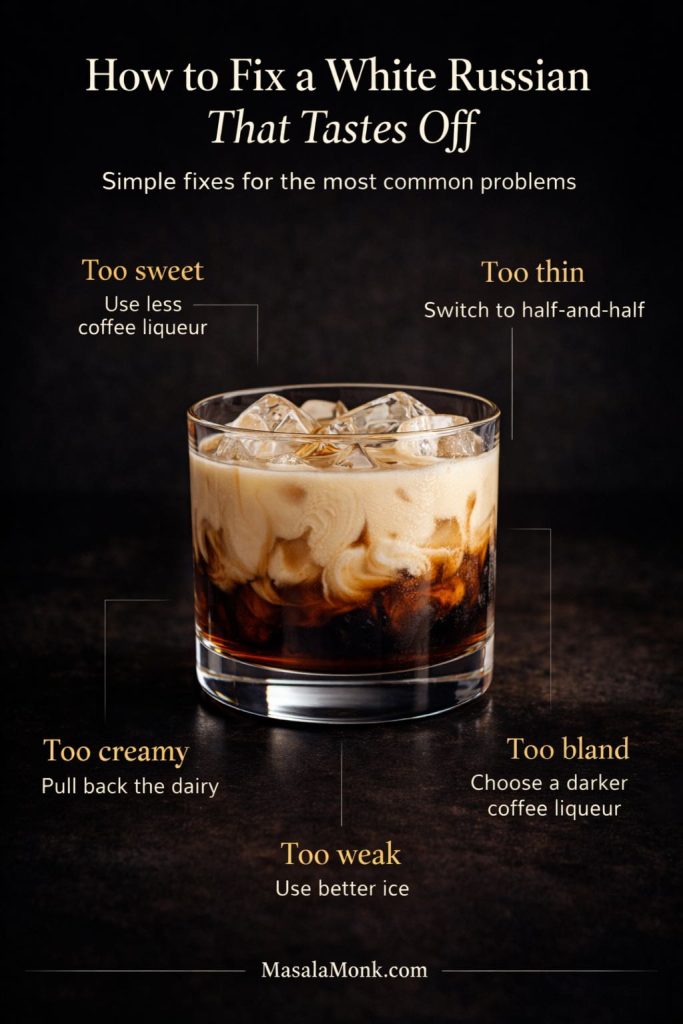
White Russian troubleshooting guide showing a classic White Russian cocktail with text overlay for common problems including too sweet, too thin, too creamy, too weak, and too bland, with simple fixes for each.
A White Russian usually goes wrong in predictable ways. Too much sweetness, too much dairy, weak ice, or a softer coffee liqueur can flatten the drink fast, which is why small adjustments often matter more than changing the whole recipe.

If Your White Russian Tastes Too Sweet

Usually, the answer is less coffee liqueur, not more vodka. Sweetness tends to feel louder as the glass warms slightly, so it often helps to start on the firmer side if your bottle already runs sugary.

If Your White Russian Tastes Too Thin

Milk is usually the problem. Switching to half-and-half helps more than changing the alcohol. Better ice helps too, especially if the cubes you are using melt quickly.

If Your White Russian Tastes Too Creamy

The dairy has probably buried the coffee note. Pull it back slightly next time or firm the drink up with a little more vodka. This happens most often with heavy cream or rich equal-parts builds.

If Your White Russian Feels Too Rich or Heavy

Do not try to fix that with more sweetness. Use half-and-half instead of cream, stick with the classic 2:1:1 build, and make sure the ice is not disappearing too quickly.

If It Is Not Coffee-Forward Enough

Your liqueur may be too soft or too sweet. A darker bottle or a slightly tighter hand with the dairy usually solves that. The goal is not bitterness for its own sake, but enough roasted depth to stop the White Russian from feeling bland.

If the Drink Turns Weak or Bland Too Quickly

Quick-melting ice, milk instead of half-and-half, or a base ratio that was already too soft can all cause that problem. In many cases, the dairy and the liqueur are the first things to check.

Cold ingredients help everywhere. So does matching the dairy to the mood. Cream suits indulgence. Half-and-half suits balance. Milk suits a lighter glass, though never the sturdiest one.
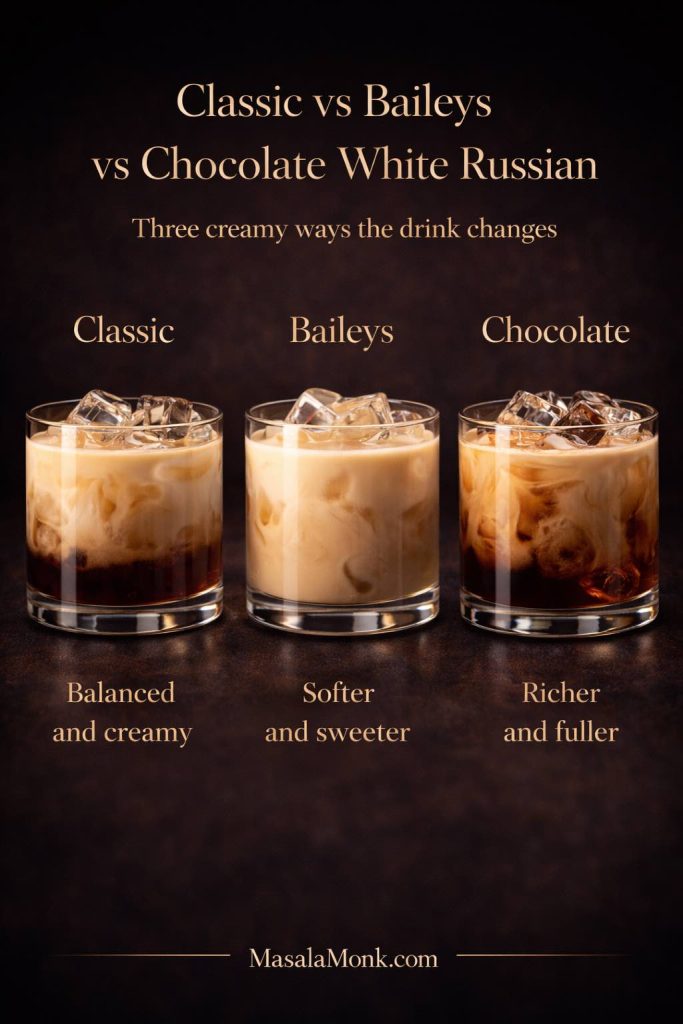
Comparison graphic showing three creamy White Russian styles side by side: Classic White Russian, Baileys White Russian, and Chocolate White Russian, with text describing them as balanced and creamy, softer and sweeter, and richer and fuller.
These three versions may look related, but they do not land the same way in the glass. The classic keeps the cleanest balance, Baileys softens and sweetens the drink more quickly, and chocolate pushes it further toward a richer mocha-style finish without fully leaving the White Russian family behind.

Also Read: Sourdough Pizza Dough Recipe (Crispy Crust & Easy Pizza Base)

The White Russian Variations Worth Making

Once the classic White Russian is secure, the variations become more rewarding because you can feel exactly what changes in the glass. Some push the drink further toward dessert. Others change the mood more dramatically by shifting the temperature or texture. The best riffs still taste recognizably tied to the original rather than using its name as an excuse for a different drink entirely.
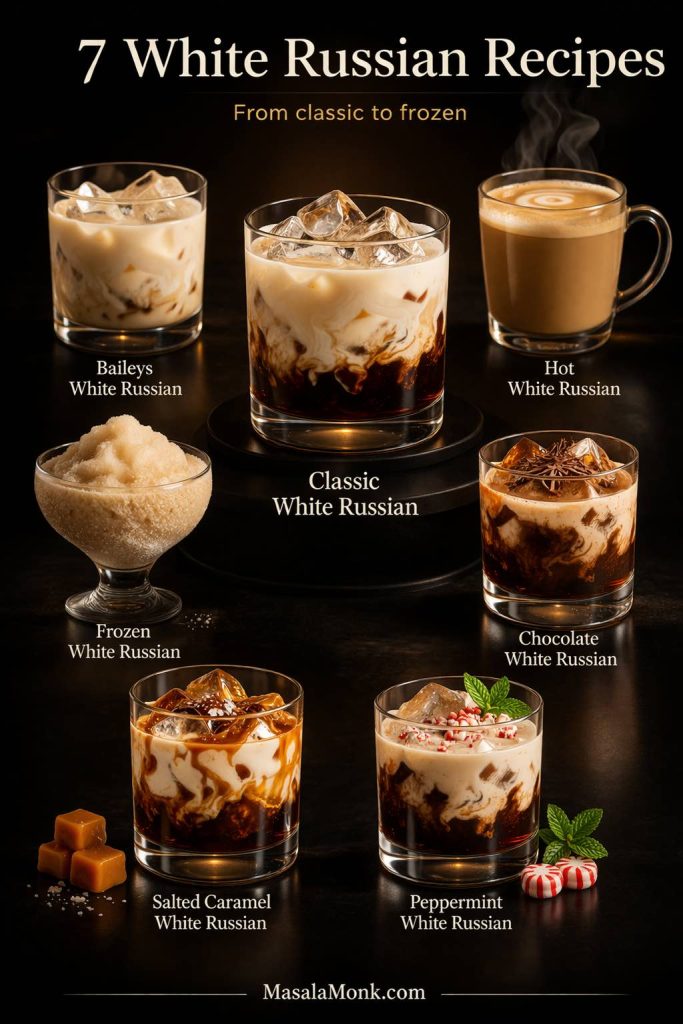
Editorial White Russian recipe roundup graphic showing seven White Russian variations: Classic White Russian, Baileys White Russian, Hot White Russian, Frozen White Russian, Chocolate White Russian, Salted Caramel White Russian, and Peppermint White Russian.
This guide makes the variation section easier to navigate because the seven recipes do not all deliver the same kind of drink. Some stay closer to the classic, some turn warmer or colder, and others push the White Russian further toward dessert without losing the coffee-and-cream identity that makes the cocktail worth returning to.

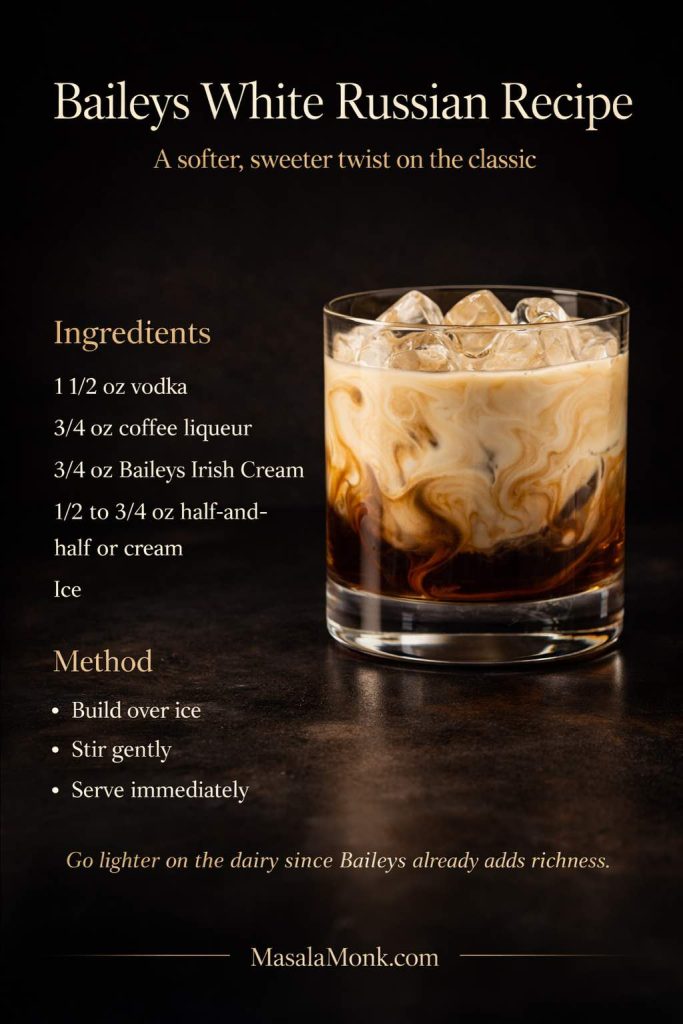
Baileys White Russian Recipe

A Baileys White Russian is one of the easiest variations to like because Irish cream fits naturally into the drink’s existing structure. It adds softness and sweetness immediately, which is both the attraction and the danger. Too much, and the cocktail loses its shape.

Recipe Card

Yield: 1 cocktail
Prep time: 5 minutes

Ingredients

  • 1 1/2 ounces vodka
  • 3/4 ounce coffee liqueur
  • 3/4 ounce Baileys Irish Cream
  • 1/2 to 3/4 ounce half-and-half or cream
  • Ice
Baileys White Russian recipe card showing a creamy Baileys White Russian cocktail in a rocks glass over ice with text overlay for ingredients, method, and a tip to use less dairy because Baileys already adds richness.
Baileys changes the White Russian faster than many sweet riffs do, which is why this version works best when the extra richness stays controlled. A lighter hand with the dairy keeps the drink softer and sweeter than the classic without letting it turn vague or overly heavy.

Method

Fill a rocks glass with ice. Add the vodka, coffee liqueur, and Baileys. Pour in the dairy, stir gently, and serve immediately.

Why This Version Works

Baileys already brings richness, so the dairy has to stay under control. That is why this version uses less of it than the classic. Done well, the drink tastes softer and sweeter than the original while still keeping enough coffee character to stay interesting. Done badly, it just tastes like sweet Irish cream over ice.

If you want to compare approaches, Baileys’ own White Russian-style recipe is useful context, though this version stays closer to the classic cocktail family.

Also Read: Masterclass in Chai: How to Make the Perfect Masala Chai (Recipe)

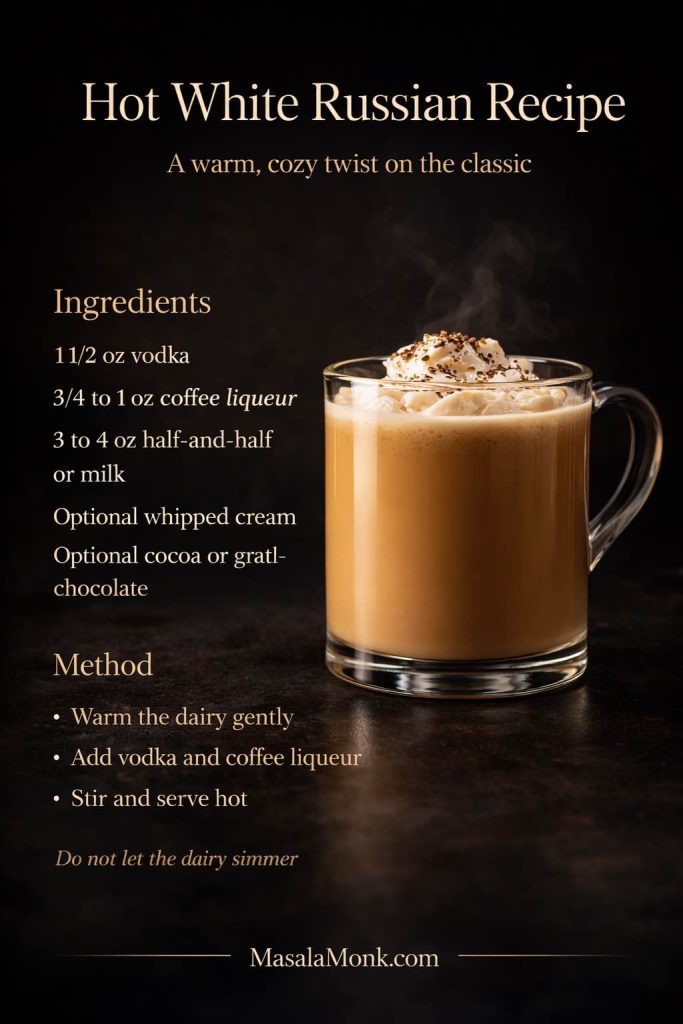
Hot White Russian Recipe

A Hot White Russian changes the feel of the drink more than a simple flavored riff does. Instead of an iced creamy cocktail, it becomes warm, slow, and openly cozy.

Recipe Card

Yield: 1 mug
Prep time: 7 minutes

Ingredients

  • 1 1/2 ounces vodka
  • 3/4 to 1 ounce coffee liqueur
  • 3 to 4 ounces half-and-half or milk
  • Optional whipped cream
  • Optional cocoa or grated chocolate
Hot White Russian recipe card showing a warm creamy White Russian cocktail in a glass mug with steam, whipped cream, and text overlay for ingredients, method, and a tip not to let the dairy simmer.
The hot version changes the White Russian more than a flavored riff does. Without ice to thin or chill the drink, the dairy feels fuller, the sweetness reads faster, and the whole cocktail becomes softer and cozier, which is exactly why gentle heat and a restrained hand matter here.

Method

Warm the half-and-half or milk until hot but not simmering. Pour the vodka into a heat-safe mug, add the coffee liqueur, then pour in the warmed dairy. Stir gently. Top with a little whipped cream or cocoa if you like, and serve immediately.

Why This Hot White Russian Recipe Works

Without ice in the equation, the drink needs more dairy volume than the classic cold version. Half-and-half gives the richer balanced result. Milk keeps it lighter. The key is not overheating the dairy. Once it starts tasting cooked, the whole drink loses its charm.

Warmth also changes the perception of sweetness. A hot White Russian can feel sweeter and richer faster than the cold version, which is why restraint matters even more here.

This variation sits naturally beside more overtly cozy drinks like Homemade Hot Chocolate with Cocoa Powder.

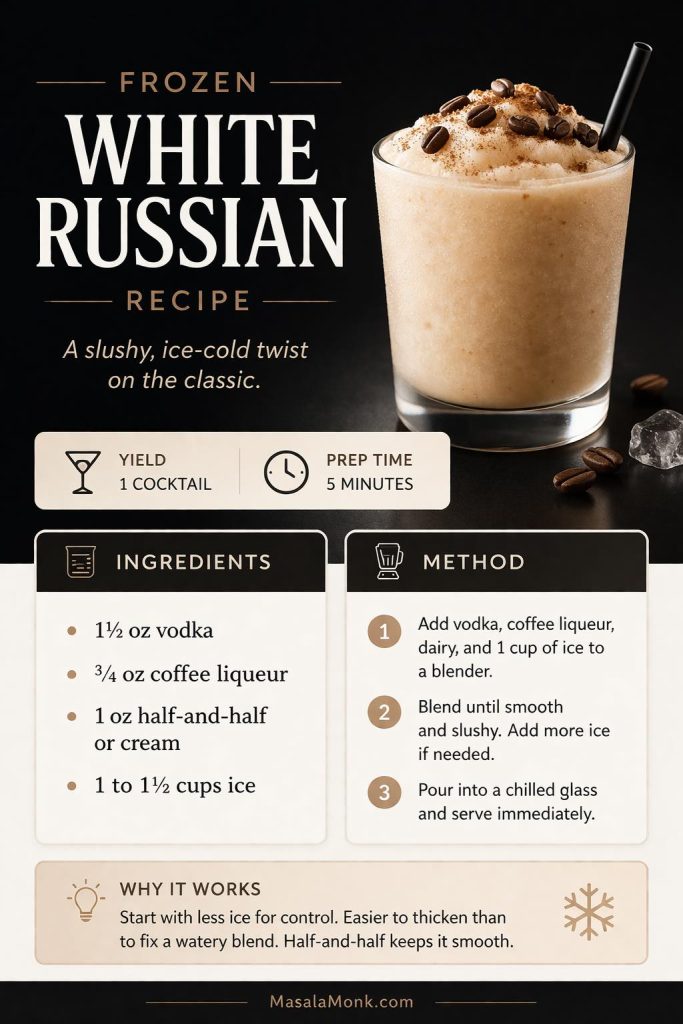
Frozen White Russian Recipe

A Frozen White Russian works when it stays slushy and drinkable rather than turning into either a watery blender drink or a heavy milkshake.

Recipe Card

Yield: 1 frozen cocktail
Prep time: 5 minutes

Ingredients

  • 1 1/2 ounces vodka
  • 3/4 ounce coffee liqueur
  • 1 ounce half-and-half or cream
  • 1 to 1 1/2 cups ice
Minimal Frozen White Russian recipe card showing a slushy frozen White Russian in a chilled glass with ingredients, quick method, yield, and prep time for an easy frozen White Russian cocktail.
A Frozen White Russian works best when it stays slushy, cold, and drinkable instead of turning watery or drifting into milkshake territory. Starting with less ice gives you more control over the texture, while half-and-half helps the drink stay smoother and more balanced than a heavier cream-led blend. The result should still taste like a White Russian at its core, just colder, softer, and more dessert-like in the best way.

Method

Add the vodka, coffee liqueur, dairy, and 1 cup of ice to a blender. Blend until smooth and slushy. Add more ice a little at a time if needed. Pour into a chilled glass and serve immediately.

Why This Version Works

Starting with less ice gives you more control. It is easier to thicken the drink than to rescue one that has turned watery and overblended. Half-and-half usually keeps the texture cleaner, while heavy cream can make the frozen version feel heavier than it needs to. The goal is still a White Russian, just colder and slushier, not a milkshake wearing cocktail clothes.

Also Read: Crock Pot Pork Chops and Sauerkraut (No Dry Chops Recipe)

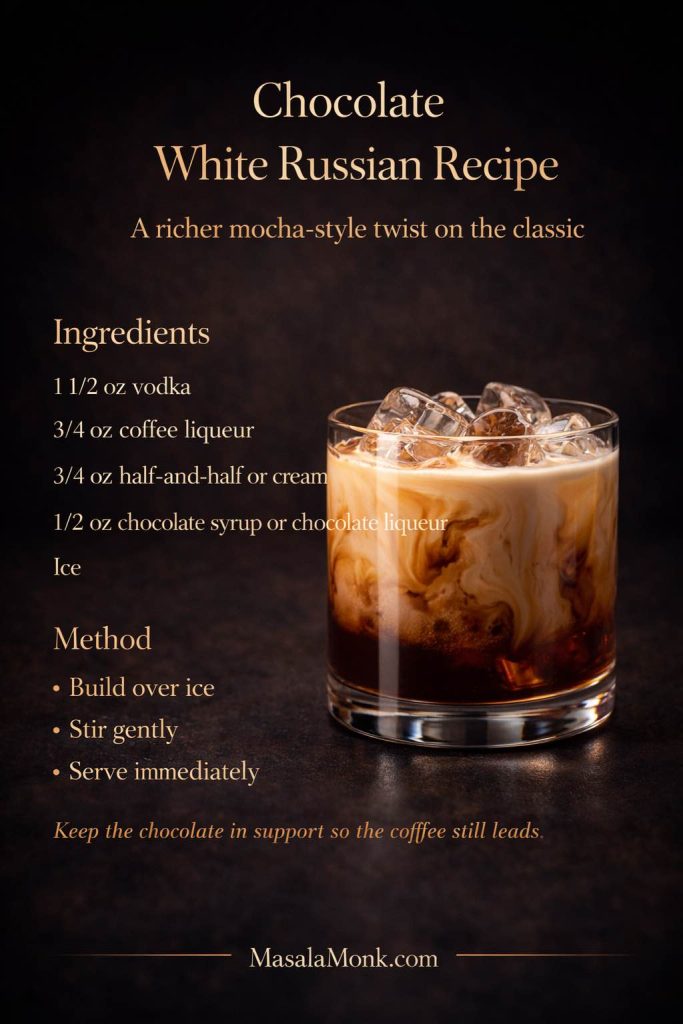
Chocolate White Russian Recipe

Chocolate is one of the most natural riffs because coffee and chocolate already fit together so well.

Recipe Card

Yield: 1 cocktail
Prep time: 5 minutes

Ingredients

  • 1 1/2 ounces vodka
  • 3/4 ounce coffee liqueur
  • 3/4 ounce half-and-half or cream
  • 1/2 ounce chocolate syrup or chocolate liqueur
  • Ice
Chocolate White Russian recipe card showing a mocha-toned White Russian cocktail in a rocks glass over ice with text overlay for ingredients, method, and a tip to keep the chocolate in support so the coffee still leads.
Chocolate works best in this drink when it deepens the White Russian instead of smothering it. Used with restraint, it turns the cocktail richer and more mocha-like while still leaving enough coffee character and vodka backbone for the drink to feel like a White Russian rather than a sweet chocolate pour.

Method

Fill a rocks glass with ice. Add the vodka and coffee liqueur, then the chocolate component and dairy. Stir gently until lightly blended. Serve immediately.

Why This Version Works

Chocolate deepens the dessert side of the White Russian, but it should still support the coffee rather than replace it. That is why a smaller amount works better than a heavy-handed one. The drink should read as a chocolate White Russian, not as a chocolate milk drink with vodka.

For more on how chocolate ingredients shift flavor, What Is Cacao: Cacao vs Chocolate vs Dark Chocolate fits naturally here.

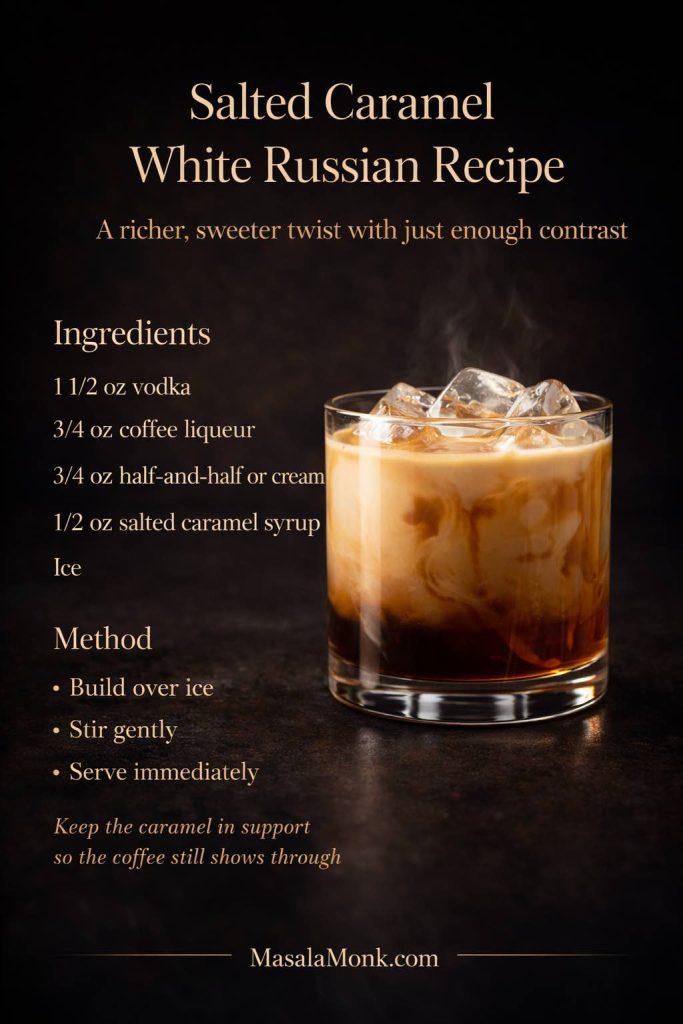
Salted Caramel White Russian Recipe

Caramel and coffee already make sense together. Salt helps stop the drink from sliding too far into sticky sweetness.

Recipe Card

Yield: 1 cocktail
Prep time: 5 minutes

Ingredients

  • 1 1/2 ounces vodka
  • 3/4 ounce coffee liqueur
  • 3/4 ounce half-and-half or cream
  • 1/2 ounce salted caramel syrup
  • Ice
Salted caramel White Russian recipe card showing a caramel-toned White Russian cocktail in a rocks glass over ice with text overlay for ingredients, method, and a tip to keep the caramel in support so the coffee still shows through.
Salted caramel works here only when it rounds the drink instead of taking it over. Used with restraint, it warms the White Russian, deepens the dessert side of the glass, and still leaves enough coffee character underneath to keep the cocktail from turning flat or cloying.

Method

Fill a rocks glass with ice. Add the vodka, coffee liqueur, caramel syrup, and dairy. Stir gently and serve immediately.

Why This Version Works

Salted caramel can make the White Russian richer and rounder without flattening it, but only when the caramel stays in support. The point is not to erase the coffee-and-cream structure. The point is to warm it.

Also Read: Keto Mocktails: 10 Low Carb, Sugar Free Recipes

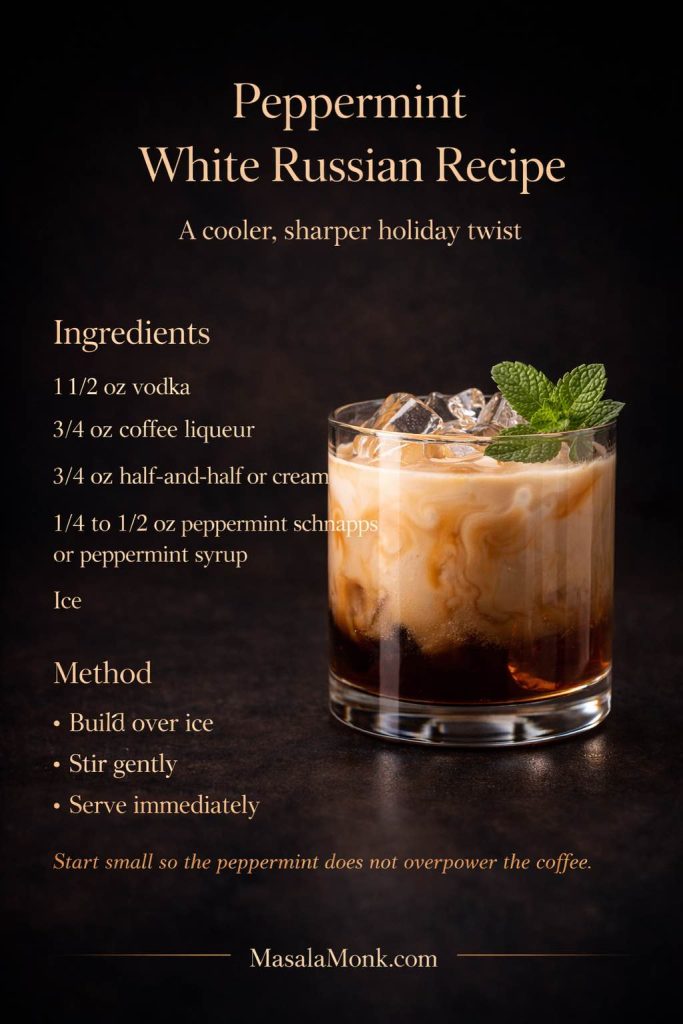
Peppermint White Russian

Peppermint belongs mostly to colder weather and holiday moods, and it needs a light touch.

Recipe Card

Yield: 1 cocktail
Prep time: 5 minutes

Ingredients

  • 1 1/2 ounces vodka
  • 3/4 ounce coffee liqueur
  • 3/4 ounce half-and-half or cream
  • 1/4 to 1/2 ounce peppermint schnapps or peppermint syrup
  • Ice
Peppermint White Russian recipe card showing a peppermint White Russian cocktail in a rocks glass over ice with a mint garnish and text overlay for ingredients, method, and a tip to keep the peppermint from overpowering the coffee.
Peppermint works best here when it sharpens the drink instead of taking it over. Used lightly, it cools the finish, brightens the creamy coffee base, and gives the White Russian a cleaner holiday edge without turning it into a mint dessert.

Method

Fill a rocks glass with ice. Add the vodka, coffee liqueur, dairy, and peppermint element. Stir gently and serve immediately.

Why This White Russian Recipe Works

Peppermint gives the drink a cleaner, cooler edge, but it can overwhelm the coffee-and-cream core very quickly. Starting small is the smartest move. It is far easier to add more peppermint than to rescue an overminted White Russian that no longer tastes like coffee and cream.

Also Read: Balti Paneer Gravy (Restaurant-Style, Creamy + Bold Recipe)

A Few Smaller White Russian Riffs

Some variations are still worth mentioning without needing the same amount of space.

A Vanilla White Russian works best with just enough vanilla to round the edges rather than perfume the whole drink. It is a useful variation, but the change is modest when handled well, so it does not need the same space as the classic or hot version.

A Rum White Russian swaps vodka for rum and warms the profile noticeably. A lighter hand with sweetness is usually better here, because rum already changes the drink’s tone more than people often expect.

A White Russian shot can be fun, though it loses the slow, creamy appeal that makes the full drink satisfying. It is better treated as an offshoot than as a serious rival to the classic drink.

A Peanut Butter White Russian belongs more firmly in novelty dessert-cocktail territory. It can work, but it is not a core version. The same is true of strongly nutty riffs more broadly. Those are playful extensions, not foundations.

An ice cream White Russian can also be enjoyable, but that version is really a dessert crossover more than a classic cocktail extension. It can be excellent when treated that way, yet it should not replace the actual drink in a guide like this.

Also Read: Mojito Recipe (Classic) + Ratios, Pitcher, Mocktail & Easy Variations

Final Thoughts on This White Russian Recipe

The White Russian earns its place by doing something simple well. Vodka, coffee liqueur, dairy, and ice do not look like much on paper, yet when the balance is right the drink feels complete. It is smooth without becoming shapeless, sweet without turning sticky, and rich without becoming exhausting.

Start with the classic 2:1:1 build and half-and-half for the most reliable all-around result. From there, the variations make more sense because the foundation stays clear. A Baileys White Russian turns softer and sweeter. A Hot White Russian becomes warming and cozy. A Frozen White Russian pushes the drink further toward dessert without losing its coffee backbone. A Chocolate White Russian gives the classic a richer edge without asking it to become something else entirely.
Editorial closing image of a classic White Russian cocktail in a rocks glass over ice, styled as a premium balanced White Russian with creamy swirl, dark coffee base, and elegant text emphasizing why the drink is worth returning to.
A White Russian Recipe earns its place not by doing more, but by doing a few things well. When vodka, coffee liqueur, dairy, and ice stay in balance, the drink feels smooth, rounded, and complete without losing the coffee backbone that keeps it interesting. That is why the classic version remains the one worth returning to: simple to make, easy to adjust, and far better when it is built with intention rather than treated like a throwaway creamy pour.

That is what makes the White Russian worth returning to. It is easy to make, quick to adjust, and far better when it is built with intention instead of treated like a lazy pour. If a reader comes here looking for the best White Russian recipe, an easy White Russian recipe, a simple White Russian recipe, or just the clearest answer to how to make a White Russian drink, the core lesson is the same: keep the drink balanced, keep the dairy under control, and let the coffee note stay visible enough to matter.

Also Read: Slow Cooker Pork Tenderloin (Crock Pot Recipe) — 3 Easy Ways

White Russian Recipe FAQs

1. What is in a White Russian?

A classic White Russian contains vodka, coffee liqueur, and dairy, usually half-and-half or cream, served over ice. That is the whole foundation of the drink. Some versions use milk for a lighter result, but the classic structure stays the same: spirit, coffee depth, creamy texture, and enough chill to keep it smooth and slow-sipping.

2. What is the best ratio for a White Russian Recipe?

For most readers, the best White Russian recipe ratio is 2 ounces vodka, 1 ounce coffee liqueur, and 1 ounce half-and-half or cream. That keeps the drink creamy without letting it turn vague or overly sweet. Equal parts can work, but they usually create a softer, more dessert-like glass. If balance matters more than indulgence, 2:1:1 is the better place to start.

3. Is half-and-half or heavy cream better in a White Russian?

Half-and-half is usually better for the classic version because it keeps the drink creamy while still letting the coffee and vodka show through. Heavy cream makes a richer and slower White Russian, which can be excellent when you want something more decadent. In other words, half-and-half is the better all-around choice, while heavy cream is the better indulgent choice.

4. Can you make a White Russian without Kahlúa?

Yes, you can make a White Russian without Kahlúa as long as you use another coffee liqueur. Kahlúa is the most familiar option, but it is not the only one. What matters is that the bottle brings enough coffee character to balance the dairy and vodka. A darker, less sugary coffee liqueur often makes the drink feel firmer and more coffee-led.

5. What is the difference between a White Russian and a Black Russian?

A Black Russian contains vodka and coffee liqueur. A White Russian adds dairy. That one change alters the drink far more than it sounds. The Black Russian feels darker, drier, and more spirit-forward, while the White Russian is smoother, rounder, and more indulgent. If you want the same core flavor family with a softer finish, the White Russian is the better choice.

6. How strong is a White Russian?

A White Russian is stronger than it tastes. The cream softens the edges, and the coffee liqueur adds sweetness, so the drink can feel gentler than it really is. In practice, it still contains a full pour of vodka, so it is best treated as a proper cocktail rather than a casual dessert drink. The exact strength depends on your proportions and the coffee liqueur you use.

7. Can you make a White Russian ahead of time?

You can prepare part of it ahead, but the full drink is best assembled just before serving. Vodka and coffee liqueur can be measured in advance, but the dairy and ice are better added at the last minute. That keeps the drink cold, smooth, and properly structured instead of watered down or tired by the time it reaches the glass.

8. What is the best coffee liqueur for a White Russian recipe?

The best coffee liqueur for a White Russian is the one that gives the drink enough roast and depth without making it cloying. Kahlúa is the classic starting point, but other coffee liqueurs can produce a darker or less sweet result. If you prefer a more dessert-like White Russian, a softer bottle works well. If you want a firmer coffee-forward drink, a drier bottle is often the better pick.
Posted on 8 Comments

Cold Brew Espresso Martini: How to Make It (Step-by-Step Recipe)

Rooftop cold brew espresso martini in a coupe glass with creamy foam and coffee beans, city skyline bokeh background, cocktail tools on the table.

A cold brew espresso martini is a little bit of magic in a coupe glass: coffee aroma first, then a chilled, silky sip that feels both dessert-adjacent and surprisingly clean. When it’s right, it tastes like roasted chocolate, toasted nuts, and a gentle bitter snap at the finish—never watery iced coffee, never syrupy candy, and definitely not a boozy blur.

What makes the cold brew approach so appealing is how calm it feels. You’re not scrambling to pull espresso at the last moment. You’re not waiting for hot coffee to cool while your ice melts. Instead, you’re working with coffee that’s already cold and already stable, which makes the whole process smoother from start to finish.

At the same time, cold brew shifts the texture game. Fresh espresso naturally helps build that classic foamy cap; cold brew doesn’t always behave the same way unless you guide it with strength, ratios, and technique. That’s exactly what this post is built for: a dependable cold brew espresso martini recipe you can repeat, plus variations that genuinely earn their place—whether you want an espresso martini with cold brew concentrate that tastes bold and bar-level, an espresso martini made with cold brew from a bottle that stays smooth and easy, or a creamy cold brew martini Baileys style twist that leans indulgent without turning sloppy.

If you enjoy experimenting once you’ve nailed the base, MasalaMonk’s espresso martini variations is a great companion. When you’re in the mood for aromatic riffs—cardamom, warm spice, cocoa—Masala Martinis: 5 spiced espresso martini ideas gives you plenty of inspiration that still fits the espresso martini template.


What you’re aiming for in the glass

Before you measure a single ounce, it helps to know what “good” looks and tastes like—because once you’ve got the target clear, the decisions become straightforward.

A proper Cold Brew Espresso Martini should feel like this

  • A glossy, coffee-colored body (not pale, not murky)
  • A soft foam cap that holds for at least a minute or two
  • A clear coffee aroma before you even sip
  • A finish that’s gently bitter and lightly sweet, never sticky

That “holds for a minute or two” point matters more than it sounds. When the foam collapses instantly, the drink often tastes thinner as well. Texture and flavor are linked—physically, not poetically. A well-shaken drink is better integrated, colder, and more consistent from first sip to last.

If you ever like comparing your home build to a benchmark, the IBA Espresso Martini is a clean reference point for the classic idea: vodka, coffee liqueur, espresso, sugar syrup, shaken and garnished with coffee beans. Meanwhile, for a technique-forward explanation of why espresso martinis behave the way they do, Difford’s Espresso Martini is one of the clearest deep-dives into foam and balance.

Also Read: How to Cook Bacon in the Oven (Crispy, No-Mess, Crowd-Ready Recipe)


Cold brew, cold brew concentrate, and “cold brew espresso” explained simply

The coffee base is the one choice that shapes everything else: how much sweetness you need, how much foam you can build, and how bold the drink tastes after shaking.

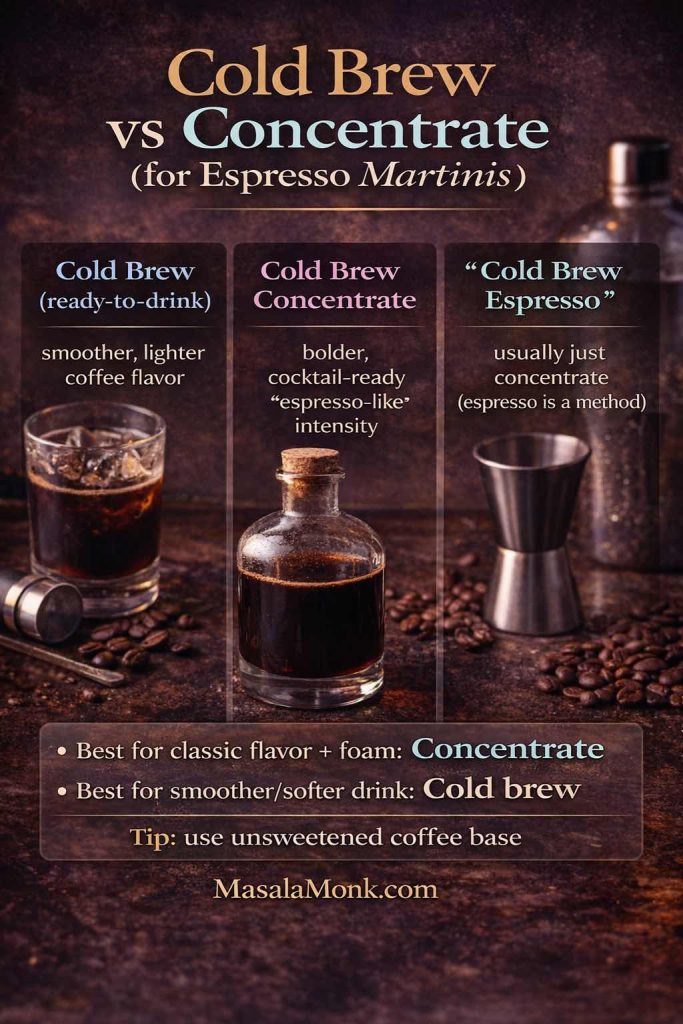
“Infographic comparing cold brew coffee vs cold brew concentrate for an espresso martini, explaining which makes better foam and stronger coffee flavor.
Cold brew vs concentrate for espresso martinis: Use cold brew concentrate for the boldest coffee flavor and the most reliable foam; use ready-to-drink cold brew when you want a smoother, softer sip. (Tip: choose an unsweetened coffee base so you can control sweetness with liqueur/syrup.)

Cold brew coffee

This is usually ready-to-drink strength: smooth, drinkable, often a bit gentle. It works beautifully for an espresso martini with cold brew if you adjust volume thoughtfully and keep sweetness under control. The result tends to be rounder and softer.

Cold brew concentrate

This is stronger and closer to “espresso-like” intensity in cocktails. It’s the easiest path to an espresso martini with cold brew concentrate that still tastes unmistakably coffee-forward after dilution from shaking.

“Cold brew espresso”

You’ll hear this phrase casually, and it usually means “extra-strong cold brew” or “concentrate.” Espresso is technically a brewing method (pressure), while cold brew is steeped over time; in a cocktail context, what matters is intensity and flavor, not the label.

If you want a quick refresher on how cold brew differs from other cold coffee styles—without getting lost in jargon—MasalaMonk’s cold brew vs iced latte vs frappe guide breaks it down in a practical, drink-first way.

Also Read: 10 High Calorie Protein Shakes & Smoothie Recipes for Healthy Weight Gain


Ingredients that matter (and why they matter)

A cold brew martini recipe can be “three things in a shaker,” or it can be genuinely excellent. The difference usually comes down to three decisions: coffee strength, liqueur style, and sweetness control.

Vodka

Pick a vodka you’d be happy to drink in a clean martini. Coffee doesn’t hide harsh alcohol; it amplifies it. Neutral works best, though a slightly rounder vodka can feel smoother in a colder drink.

Coffee liqueur

This is the sweetness dial and a chunk of your coffee flavor.

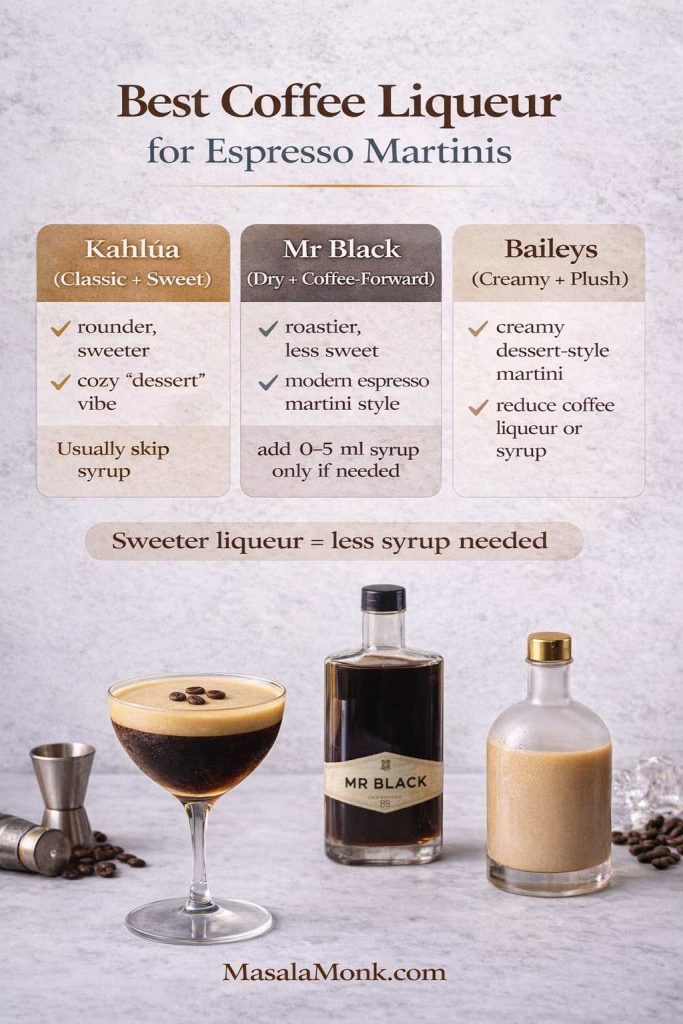
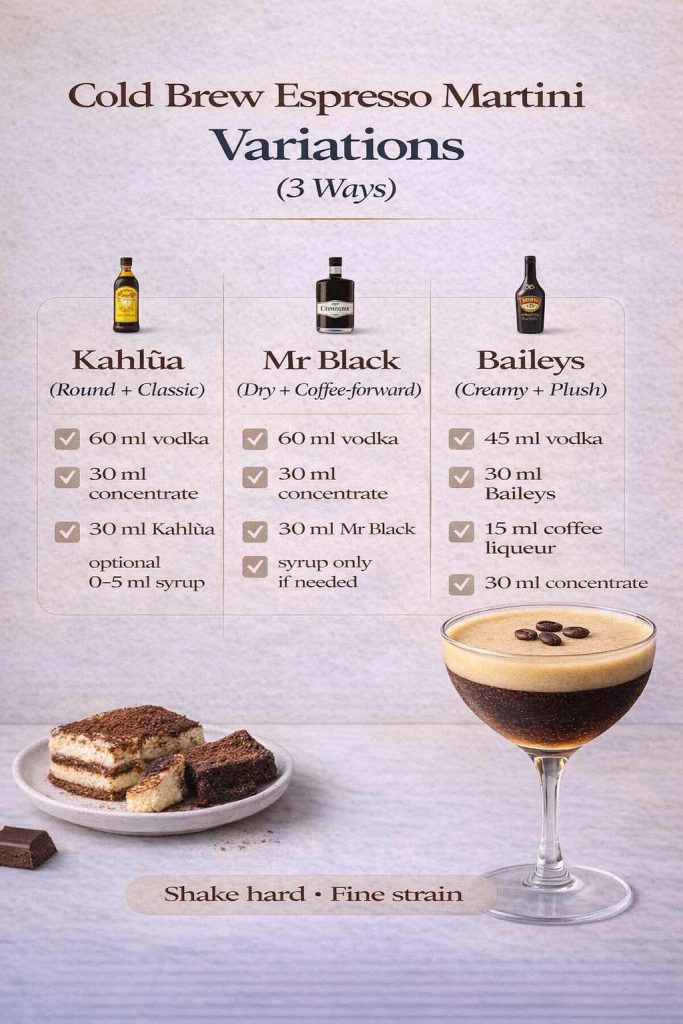
Infographic comparing coffee liqueurs for espresso martinis—Kahlúa vs Mr Black vs Baileys—showing which is sweeter, which is drier, and how much simple syrup to use.
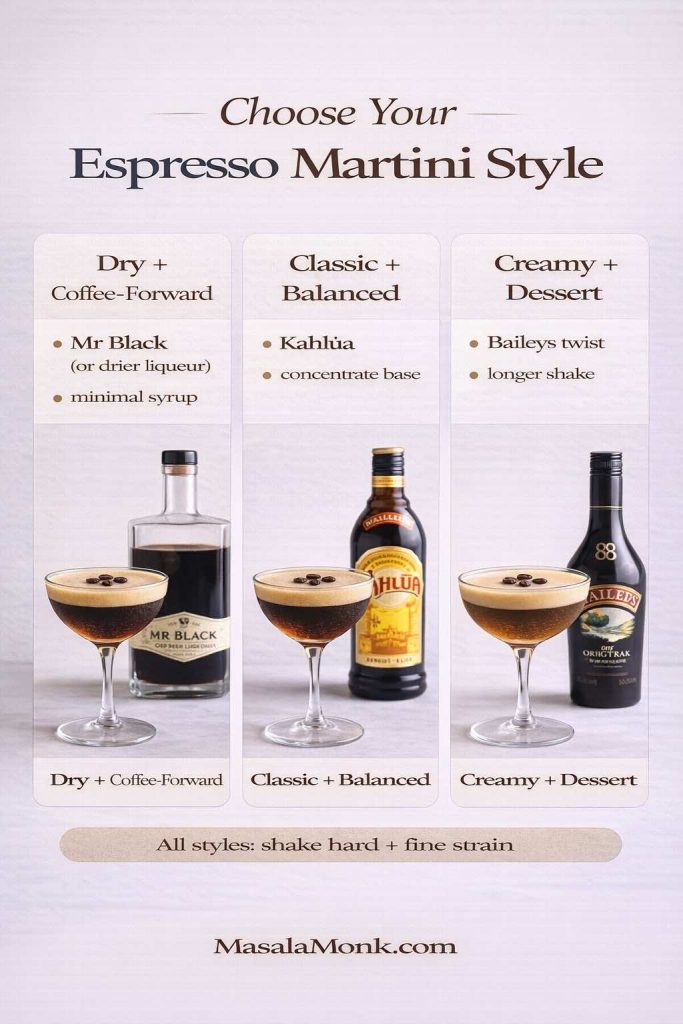
Best coffee liqueur for an espresso martini: Kahlúa gives a classic sweeter drink (often no syrup needed), Mr Black is drier and more coffee-forward (add a small splash of syrup only if needed), and Baileys makes a creamy dessert-style martini (reduce syrup or coffee liqueur to keep the finish clean).
  • Kahlúa tends to be rounder and sweeter, which makes a Kahlúa cold brew martini feel instantly familiar. If you like having a clear classic reference, Kahlúa’s own Espresso Martini is a simple baseline.
  • Mr Black is drier and more coffee-driven, which is why it shows up so often in modern espresso martinis. Their concentrate-friendly build is here: Mr Black Espresso Martini.
  • Baileys moves the drink into creamy territory. That’s perfect when you want a cold brew martini Baileys version that feels plush without getting sloppy. For pairing ideas that keep the flavors coherent, MasalaMonk’s What mixes well with Baileys? is a great guide.

If you’re curious about coffee liqueurs beyond the usual suspects, The Spruce Eats has a solid overview here: coffee liqueurs for sipping and mixing.

Coffee base (cold brew or concentrate)

This is the backbone. If the coffee is weak, you’ll end up compensating with more liqueur or syrup, and then the drink gets heavy and sweet instead of bold and balanced.

When someone talks about the best cold brew for espresso martini, what they usually mean is: unsweetened, strong, and chocolate-leaning, with enough intensity to survive the shake.

Sweetener (optional, but powerful)

A small amount of syrup can round harsh edges, especially with drier liqueurs or darker coffee. Still, it’s easy to go too far. Cold drinks mute sweetness at first, then sweetness blooms as they warm slightly—so starting lighter is almost always smarter.

Also Read: Chicken Salad Sandwich: Classic Base + 10 Global Variations


Equipment that makes the drink feel “proper”

You don’t need a home bar. You do need a few basics.

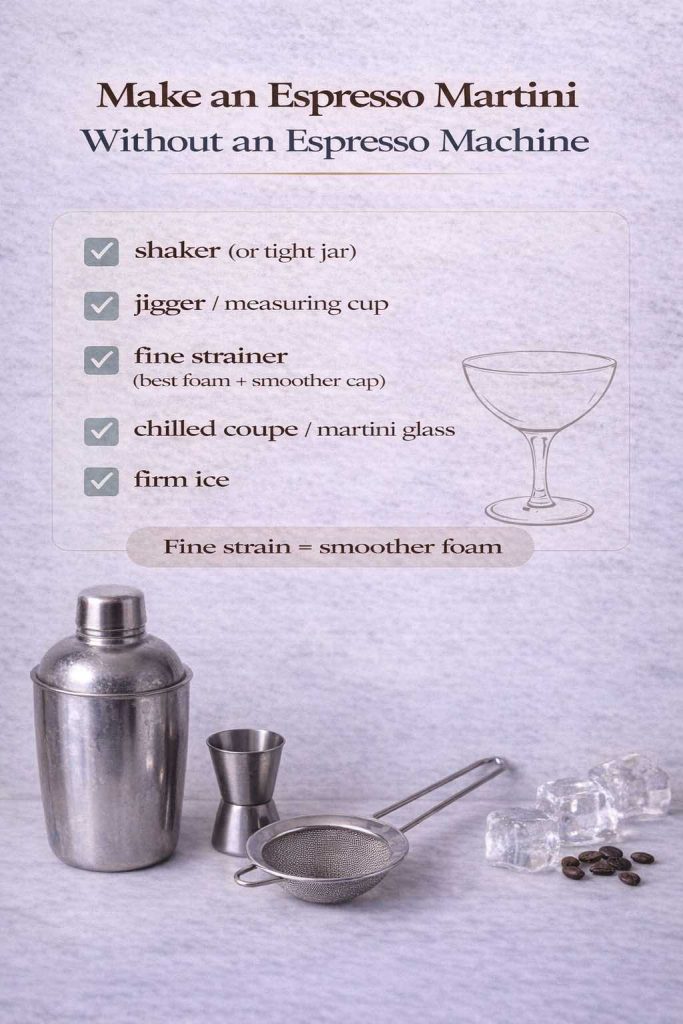
Essential tools

  • A cocktail shaker (or a tight-lidded jar)
  • A jigger or measuring cup
  • A fine strainer (strongly recommended)
  • A chilled coupe, martini glass, or Nick & Nora
Tools checklist for making an espresso martini without an espresso machine, showing a shaker, jigger, fine strainer, chilled glass, and firm ice, with a tip that fine straining improves foam.
No espresso machine? No problem. You only need a shaker (or tight jar), jigger, fine strainer, chilled coupe/martini glass, and firm ice. A fine strain is the simplest upgrade for a smoother foam cap and a cleaner finish.

The fine strainer is the quiet hero. It removes tiny ice shards that can break foam and make the surface look rough. It also gives you that smoother cap that makes the drink feel intentional.

Glass choice

A coupe is forgiving and elegant. A martini glass is classic. A Nick & Nora keeps the pour compact and the aromas focused. Any of them work as long as you chill the glass properly.

Also Read: Strawberry Smoothie Recipes (12 Easy Blends + Bowls & Protein Shakes)


Make your own cold brew (and cold brew concentrate) for espresso martinis

You can absolutely use bottled cold brew. Still, if you want your espresso martini cold brew recipe to taste consistent every time, making your own concentrate is a game-changer. It turns the cocktail into a “whenever” drink instead of a “only when I’ve planned ahead” drink.

Even better, once you’ve got concentrate in the fridge, you can seamlessly switch between styles: a bold espresso martini with coffee concentrate, a smoother espresso martini made with cold brew, or a lighter cold brew coffee martini served over a big cube when you feel like something more relaxed.

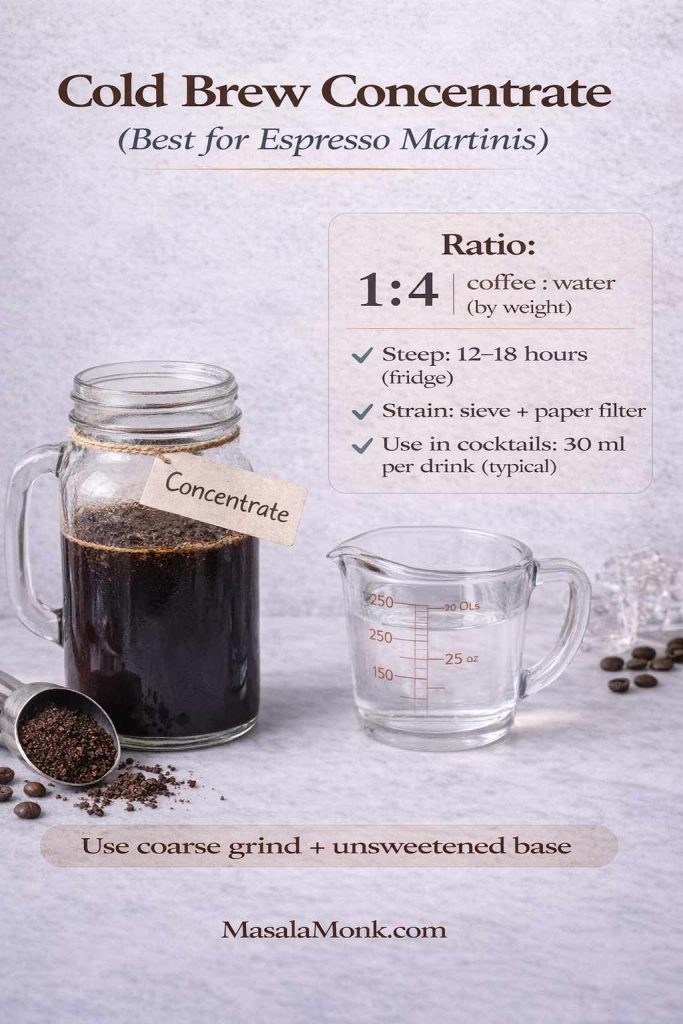
Cold brew concentrate recipe infographic showing a 1:4 coffee-to-water ratio, 12–18 hour steep time, straining instructions, and how much concentrate to use in an espresso martini.
Cold brew concentrate for espresso martinis: Use a 1:4 coffee-to-water ratio (by weight) and steep 12–18 hours, then strain well. Concentrate gives a bolder coffee flavor that holds up in shaking—most espresso martini builds use about 30 ml concentrate per drink.

Cold brew concentrate (best for cocktails)

This is the version that behaves most like espresso in a shaker—intense, aromatic, and resilient after dilution.

What you need

  • Coarsely ground coffee
  • Cold filtered water
  • A jar or pitcher
  • A strainer + paper filter (or coffee filter)

Ratio

Use 1 part coffee to 4 parts water (by weight if possible).

Method

  • Combine coffee and water in a jar and stir until fully saturated.
  • Cover and steep in the fridge for 12–18 hours.
  • Strain through a sieve, then filter again for clarity.
  • Store refrigerated.

This is the concentrate you’ll use in the base recipe below. If you’ve ever seen “espresso concentrate for martini” written in a recipe, this is the practical, make-at-home version of that idea.

Regular cold brew coffee (ready-to-drink strength)

If you prefer a smoother, lighter coffee base, standard cold brew is still excellent—especially if you enjoy a slightly softer drink.

Ratio

Use 1 part coffee to 8 parts water.

Method

Use the same steeping approach, typically 12–16 hours, then strain and chill.

This is great for an espresso martini with cold brew when you want a gentler profile. Because it’s less intense than concentrate, you’ll often use a larger volume in the cocktail so the coffee stays present after shaking.

For more cold coffee inspiration—especially if you like having multiple bases on rotation—MasalaMonk’s Iced Coffee Recipes is a handy internal hub.

Also Read: Classic Rum Punch + 9 Recipes (Pitcher & Party-Friendly)


The base recipe: Cold Brew Espresso Martini (concentrate version)

This is the version that most reliably gives you the classic espresso-martini feel with cold brew: bold coffee flavor, a velvety cap, and a clean, chilled finish. Because cold brew concentrate is already intense, it holds its own after shaking, so the drink stays coffee-forward rather than drifting into “sweet vodka with a hint of coffee.”

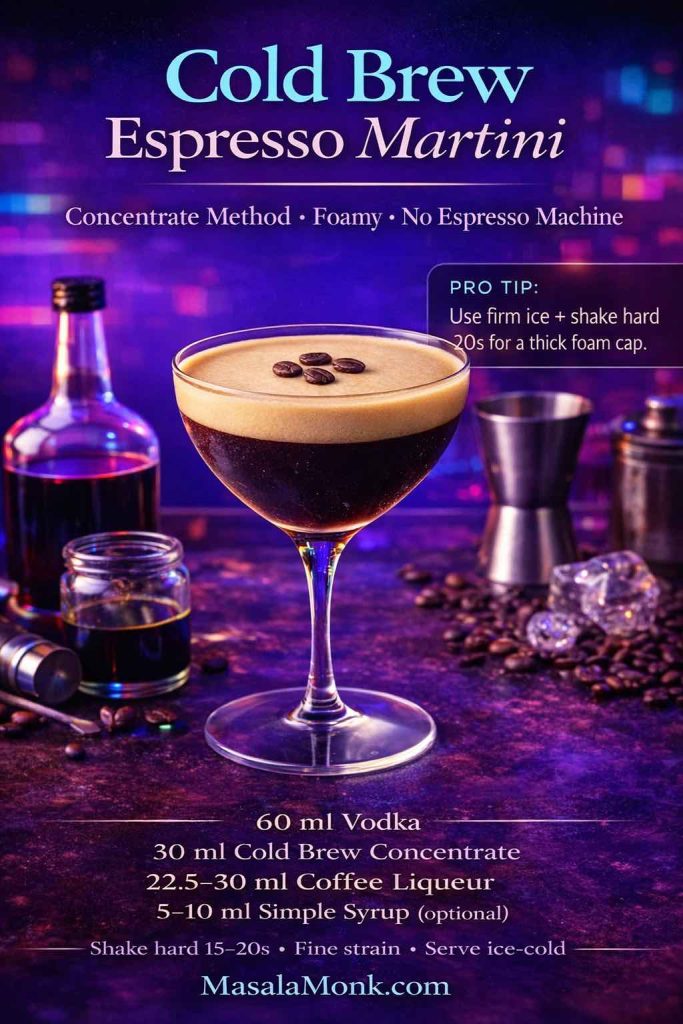
Photo-realistic recipe card for a cold brew espresso martini in a coupe glass with a creamy foam cap and coffee beans on top. Text overlay lists ingredients and ratios using cold brew concentrate (vodka, coffee liqueur, cold brew concentrate, optional simple syrup), plus a pro tip to use firm ice, shake hard 15–20 seconds, and fine strain for a thicker foam.
Cold Brew Espresso Martini (concentrate version) — a quick, saveable card with the exact ratios and a foam-building pro tip. Use it as your at-a-glance guide while you follow the full step-by-step method below.

Ingredients (1 drink)

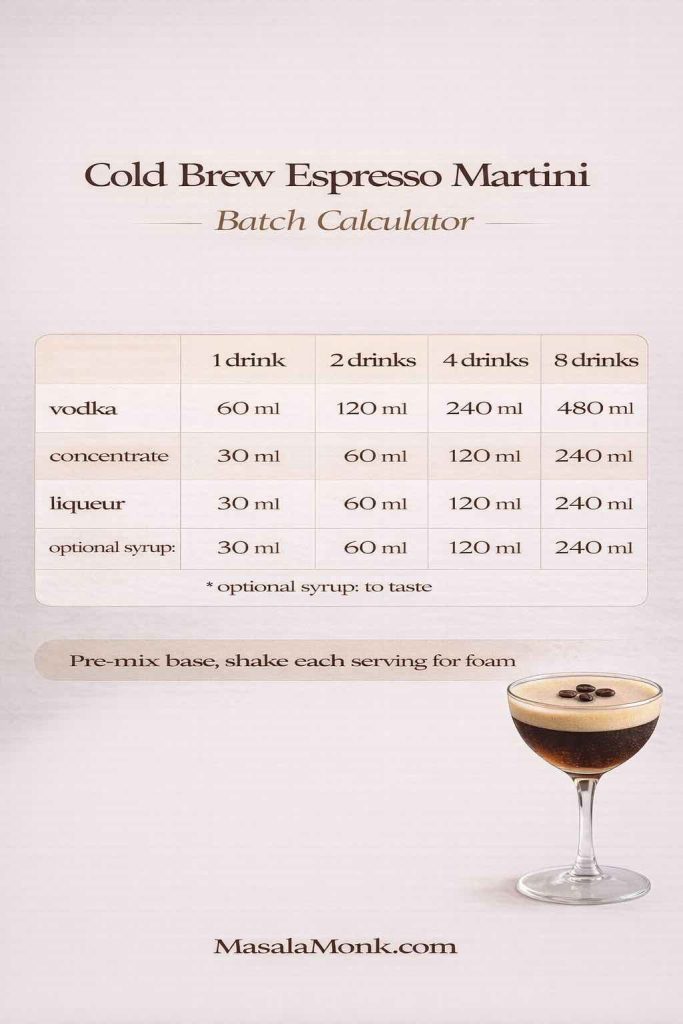
  • 60 ml vodka
  • 30 ml cold brew concentrate
  • 22.5–30 ml coffee liqueur
  • 5–10 ml simple syrup (optional)
  • Ice
  • Garnish: three coffee beans (optional)

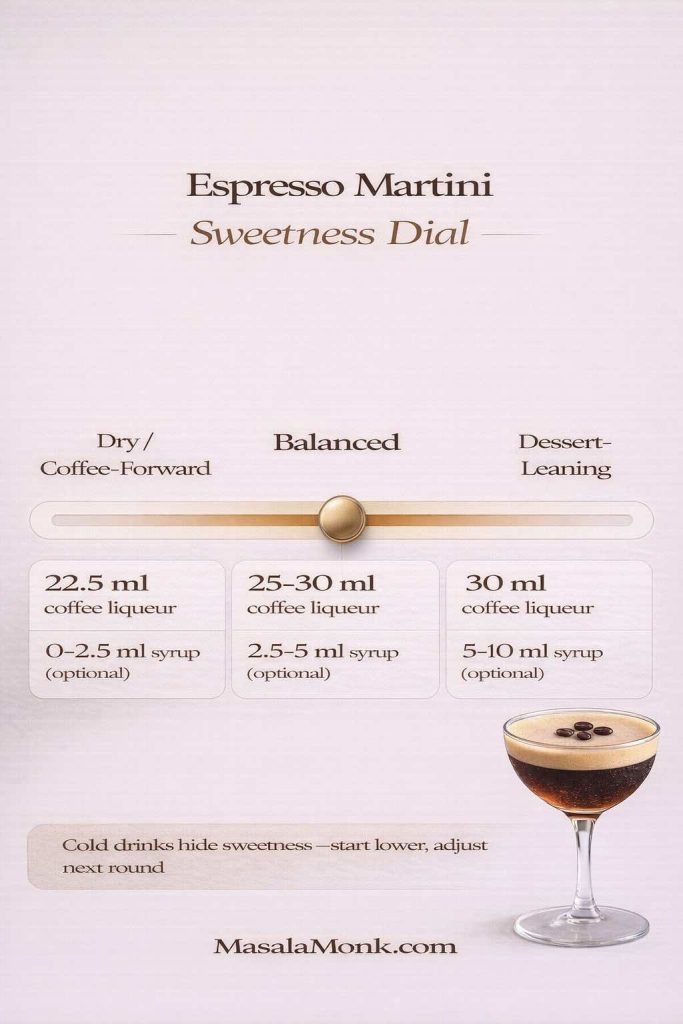
If you like a drier, sharper finish, stay closer to 22.5 ml coffee liqueur and keep syrup minimal. On the other hand, if you prefer a rounder, more dessert-leaning sip, slide toward 30 ml coffee liqueur and add a small splash of syrup.

Espresso martini sweetness dial infographic showing dry, balanced, and dessert-leaning options with suggested coffee liqueur amounts (22.5 ml, 25–30 ml, 30 ml) and optional simple syrup ranges.
Espresso martini sweetness dial: Prefer it dry and coffee-forward? Use 22.5 ml coffee liqueur and minimal syrup. For a balanced drink, aim for 25–30 ml liqueur with a small syrup splash if needed. For a dessert-leaning sip, use 30 ml liqueur plus 5–10 ml syrup. Tip: cold drinks hide sweetness—start lower and adjust next round.

Step-by-step method

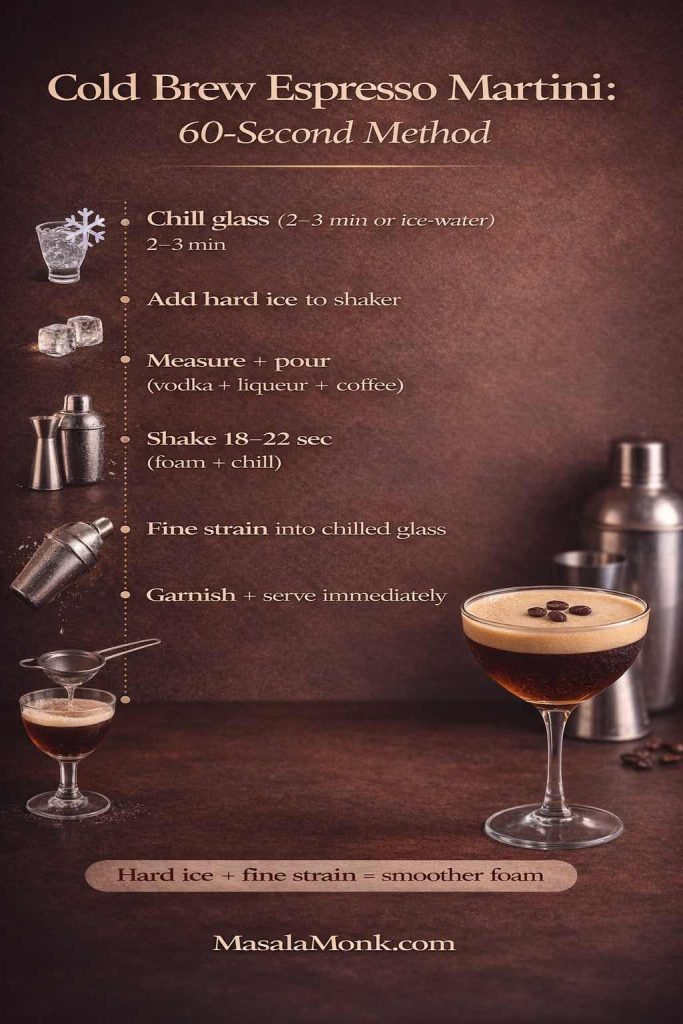
1) Chill the glass first

Start by chilling your glass because temperature affects everything that follows. Either place it in the freezer for a few minutes or fill it with ice and water while you build the drink. This small move pays off immediately: the cocktail stays crisper longer, and the foam sits more neatly instead of collapsing early.

2) Load the shaker with firm ice

Next, fill your shaker with solid, firm ice. Avoid half-melted, wet ice from a tray that’s been opened and closed all day—those pieces melt too quickly and can dilute the cocktail before it’s properly chilled. You’re aiming for cold and concentrated, not watery and muted.

3) Measure into the shaker in a steady order

Then measure everything into the shaker. Pour vodka first, followed by your coffee liqueur, and then add the cold brew concentrate. If you’re using simple syrup, add it last—starting with less than you think you need. You can always make the next drink slightly sweeter; it’s harder to rescue one that’s already cloying.

4) Shake hard for 15–20 seconds

Now comes the defining moment: shake vigorously for 15–20 seconds. Rather than shaking “until cold,” shake with purpose. This is where you build texture and that signature espresso-martini-style cap. In other words, you’re not simply chilling the drink; you’re integrating it, aerating it, and setting up the final mouthfeel.

5) Fine strain into the chilled glass

After that, dump any ice water from your glass (if you used it to chill), then strain the cocktail in. If you have a fine strainer, use it here. That extra strain removes tiny ice chips that can rough up the surface and shorten the foam’s life. As a result, the top looks smoother and the sip feels silkier.

6) Garnish and serve immediately

Finally, garnish with three coffee beans if you like the classic look, and serve right away. This drink is at its best when it’s ice-cold—aroma up top, creamy texture in the first sip, and a clean coffee finish that doesn’t get weighed down.

Guide to choosing the best cold brew for espresso martinis, highlighting unsweetened coffee, bold flavor that survives shaking, chocolatey/nutty notes, and a quick test for cold brew vs concentrate strength.
Cold brew espresso martini step-by-step (60-second method): Chill the glass, use hard ice, measure vodka + coffee liqueur + cold brew (or concentrate), then shake 18–22 seconds and fine strain for a smoother foam cap. Serve immediately for the best aroma and texture.

If you like cross-checking ratios against a widely used reference, Liquor.com’s Espresso Martini explicitly treats cold brew concentrate as a suitable substitute for espresso.

Also Read: Vodka Pasta (Penne alla Vodka) + Spicy Rigatoni, Chicken, and Gigi Recipes


The alternate base: Espresso Martini made with cold brew coffee (ready-to-drink)

If you’re using bottled cold brew or homemade regular-strength cold brew, you can still make a cold brew espresso martini that tastes polished. The only shift is that you protect intensity by using enough coffee—and by keeping sweetness adjustable.

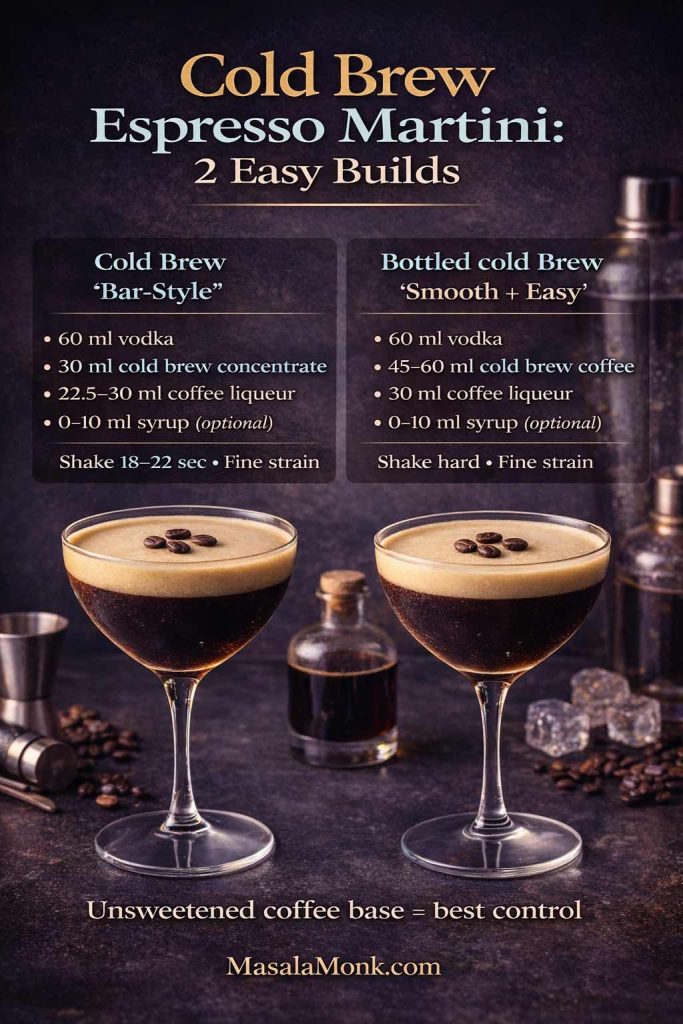
Cold brew espresso martini infographic showing two recipes: a bar-style version with cold brew concentrate and an easy version using bottled cold brew coffee, with measurements and shaking tips.
Cold brew espresso martini, two ways: Use cold brew concentrate for the boldest coffee flavor and the most reliable foam, or use bottled cold brew coffee for a smoother, easy version—just increase the coffee volume and keep sweetness adjustable.

Ingredients (1 drink)

  • 60 ml vodka
  • 30 ml coffee liqueur
  • 45–60 ml cold brew coffee
  • Optional: 0–10 ml syrup
  • Ice
  • Optional garnish: coffee beans

Method (same structure, slightly different mindset)

Follow the same shake-and-strain method as the concentrate version. The main difference is that ready-to-drink cold brew is often gentler, so the coffee portion becomes a more prominent ingredient in the build.

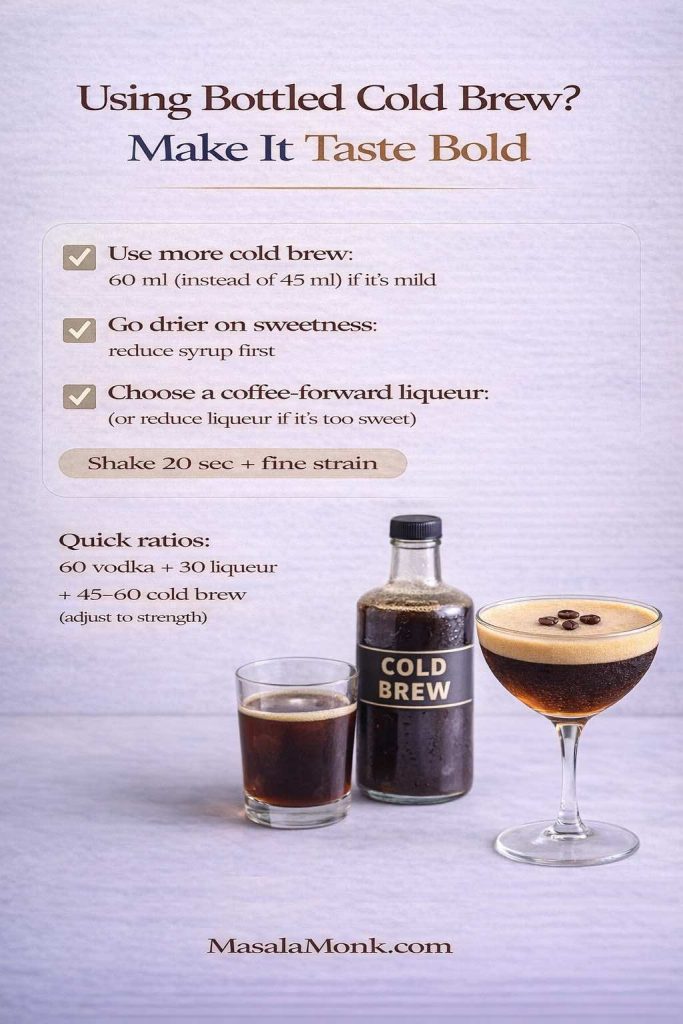
Infographic showing how to make an espresso martini with bottled cold brew taste bold, including using more cold brew if mild, reducing syrup, choosing a coffee-forward liqueur, and a quick ratio guide.
Espresso martini with bottled cold brew: If your ready-to-drink cold brew tastes mild, use a bigger pour (45–60 ml), keep sweetness drier (reduce syrup first), and choose a more coffee-forward liqueur. Shake about 20 seconds and fine strain for better texture and a smoother foam cap.

To keep it balanced, begin with less syrup than you think you need. Regular cold brew often tastes smooth and chocolatey, so sweetness can creep up quickly once liqueur enters the picture. After your first sip, you’ll know whether you want a touch more syrup next time—or whether the drink already feels round enough.

Also Read: How to Make Churros (Authentic + Easy Recipe)


Why cold brew sometimes “won’t foam” like espresso (and how to fix it)

This is the point where a lot of cold brew martinis fall apart—not in taste, but in presentation and mouthfeel.

Espresso has crema and suspended compounds that whip into foam readily, especially when it’s freshly brewed and still lively. Cold brew is smoother and often filtered more thoroughly, so it can be less eager to foam. Still, you can build a beautiful cap with cold brew if you focus on four levers.

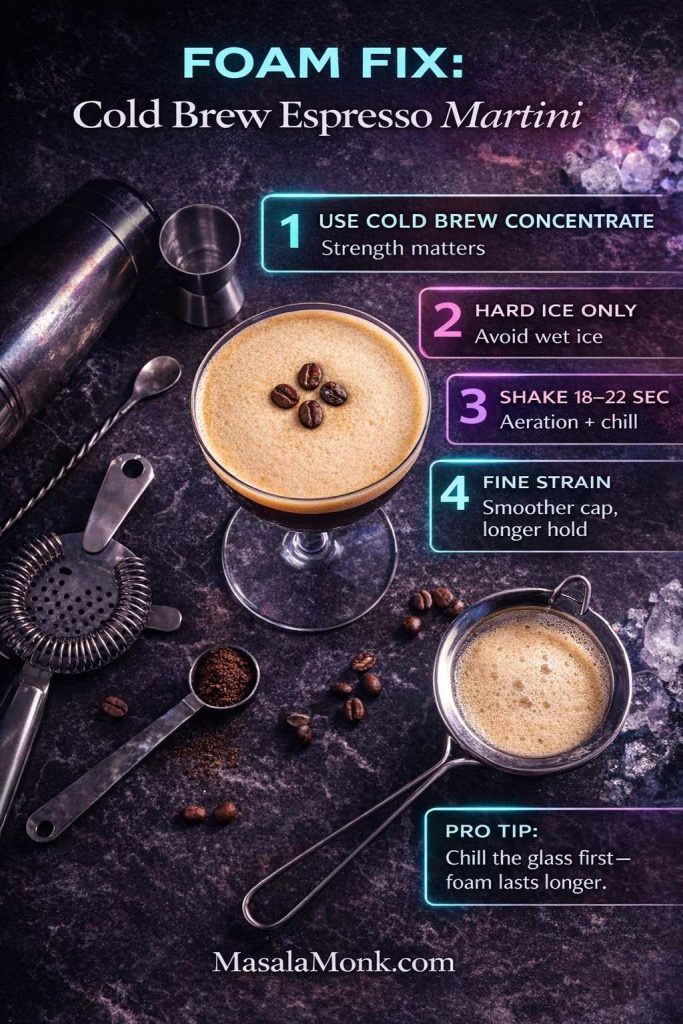
Top-down photo of a cold brew espresso martini with a thick crema-like foam cap and coffee bean garnish, surrounded by bar tools, plus an overlay “Foam Fix” checklist: use cold brew concentrate, hard ice, shake 18–22 seconds, and fine strain for longer-lasting foam.
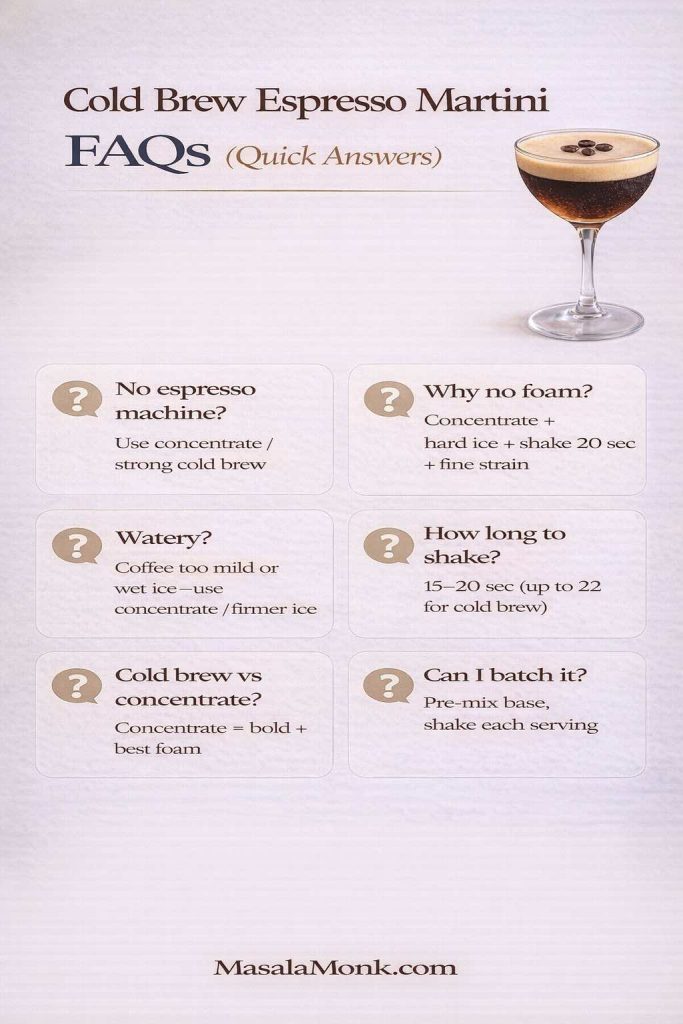
Foam Fix for Cold Brew Espresso Martinis: Cold brew doesn’t foam like fresh espresso unless you drive the technique. Use cold brew concentrate for intensity, shake with hard ice for clean chilling (not watery dilution), go 18–22 seconds for proper aeration, and fine strain to keep ice shards from breaking the cap. If your foam collapses fast, start here—these four tweaks usually solve it.

1) Coffee strength

If the drink looks flat and tastes thin, the coffee is usually too weak. Switching to cold brew concentrate is the fastest fix. Alternatively, tighten your ratios by reducing coffee volume slightly and using a more intense liqueur.

2) Ice quality

Soft, wet ice melts quickly and introduces too much water too fast. Dense cubes chill more efficiently while controlling dilution. In practice, this is one of the biggest differences between “pretty good” and “proper.”

3) Shake length and aggression

With cold brew, give yourself permission to shake longer. Fifteen seconds is a starting point. Twenty seconds is not excessive when you want a stable foam and a colder, more integrated drink.

4) Fine straining

It’s not only about aesthetics. Tiny ice shards can pop foam and make the surface look patchy. Fine straining gives you a cleaner, more even top that holds longer.

Also Read: Marinara Sauce Recipe: Classic Homemade Marinara


Choosing the best cold brew for espresso martini (in real terms)

Instead of chasing a brand name, chase characteristics. The best cold brew for espresso martini tends to be:

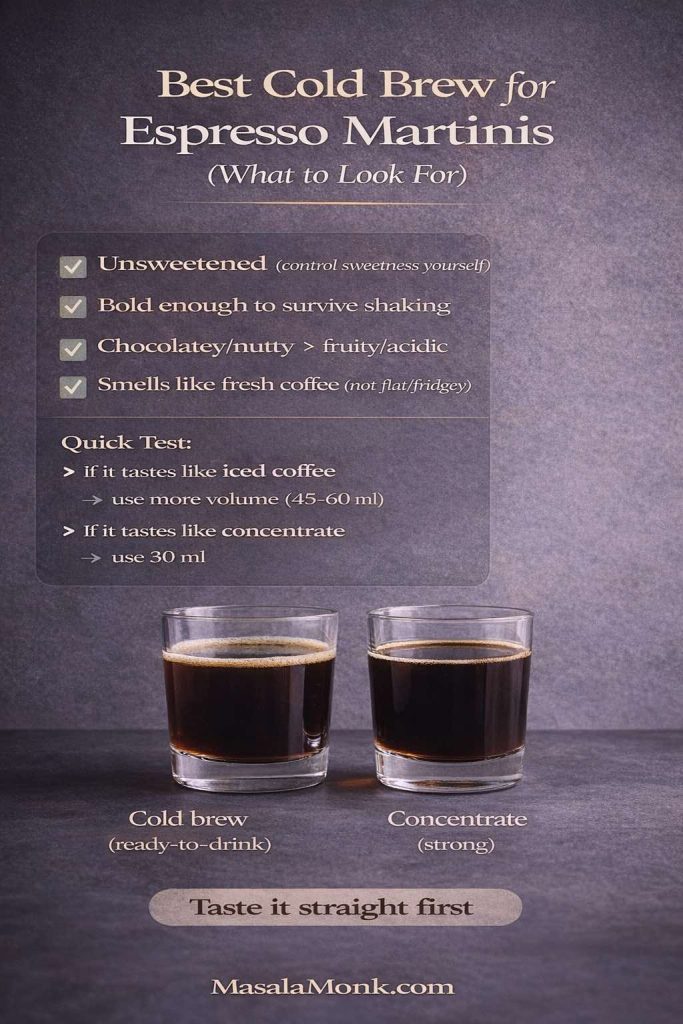
Guide to choosing the best cold brew for espresso martinis, highlighting unsweetened coffee, bold flavor that survives shaking, chocolatey/nutty notes, and a quick test for cold brew vs concentrate strength.
Best cold brew for espresso martinis: Choose an unsweetened, coffee-forward cold brew with a bold, chocolatey/nutty profile that won’t disappear after shaking. Quick test: if it tastes like iced coffee, use a larger pour (45–60 ml); if it tastes like concentrate, 30 ml is usually enough.
  • Unsweetened
  • Intense enough to hold up in a shaker
  • Chocolatey or nutty rather than fruity or acidic
  • Fresh enough that it still smells like coffee, not like a muted fridge drink

Taste it straight first. If it feels like a casual iced coffee, treat it as a lighter base: use a bigger coffee pour, keep syrup restrained, and choose a liqueur that adds aroma without making the drink sticky. If it tastes closer to concentrate—dense, bold, almost syrupy in flavor—use it in concentrate proportions.

Espresso martini with Starbucks cold brew

An espresso martini with Starbucks cold brew can work well if you treat Starbucks cold brew as a variable-strength ingredient. Some versions are smooth and mild; others are stronger. If it’s mild, use more coffee and keep syrup low. If it’s stronger, use it closer to concentrate proportions. Either way, the goal stays the same: coffee should remain present even after the shake.

Also Read: Almond Flour Pancakes (Easy Recipes) Fluffy, High-Protein, Keto & More


Dialing in balance: small changes that fix the whole drink

Once you’ve made your first round, the next one becomes dramatically better—not because you “learned bartending overnight,” but because you can adjust precisely.

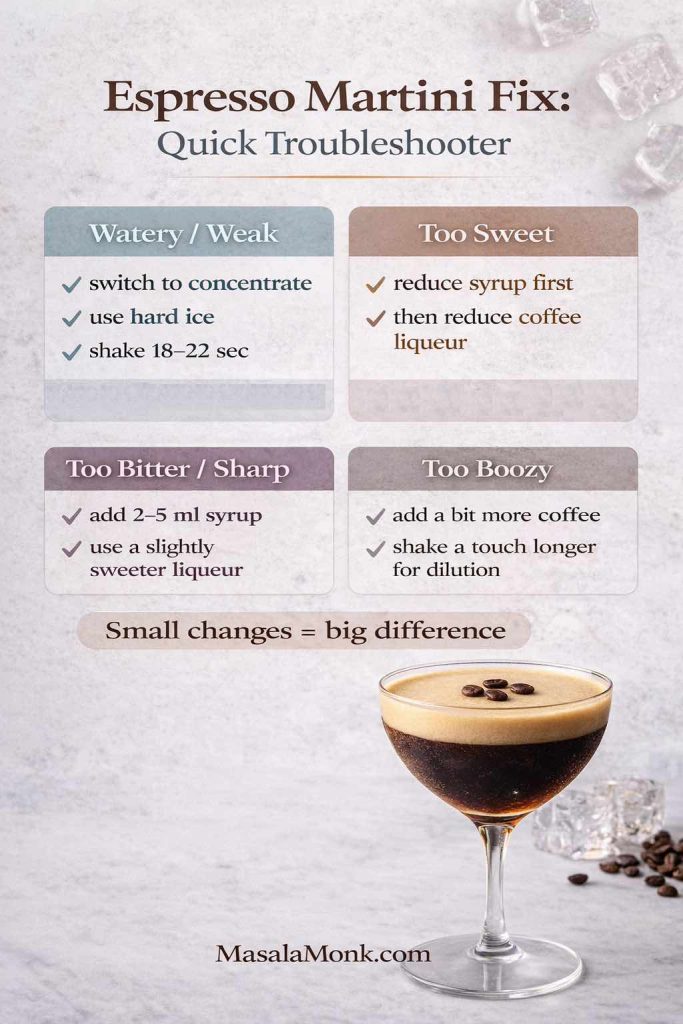
Espresso martini troubleshooting infographic showing how to fix a watery drink, overly sweet martini, bitter coffee flavor, or boozy balance, with quick adjustments to concentrate, syrup, liqueur, and shaking.
Espresso martini troubleshooting guide: If your cold brew espresso martini tastes watery, too sweet, too bitter, or too boozy, these quick fixes help you rebalance fast—often by adjusting coffee strength (concentrate vs cold brew), syrup, coffee liqueur, and shake time.

If it tastes watery

  • Switch from cold brew coffee to cold brew concentrate.
  • Use slightly less coffee volume if your ice is soft.
  • Make sure your ice is firm, not wet.

This is also where coffee concentrate shines. Concentrate keeps the coffee flavor intact as dilution happens, so the drink stays bold instead of drifting.

If it tastes too sweet

  • Reduce syrup first.
  • If you didn’t add syrup, reduce coffee liqueur slightly.
  • Alternatively, switch to a drier coffee liqueur.

This is often the difference between a cozy drink and a cloying one.

If it tastes too bitter or too sharp

  • Add 2–5 ml syrup.
  • Consider a slightly sweeter liqueur.
  • Make sure your cold brew isn’t over-extracted.

If it tastes too boozy

  • Increase coffee by a small amount (or reduce vodka by 10–15 ml).
  • Shake a touch longer to add controlled dilution.
  • Serve in a smaller glass so the drink feels tighter and more aromatic.

Also Read: How to Cook Perfect Rice Every Time (Recipe)


Espresso martini with brewed coffee, iced coffee, or cold drip

Sometimes the plan is simple: you want the drink, and you want it now. If you don’t have cold brew ready, you still have options.

Espresso martini with brewed coffee

This can work if you treat brewed coffee with respect.

  • Brew it stronger than normal.
  • Cool it completely before shaking.
  • Use a smaller amount than you would cold brew coffee.

Hot coffee dumped into a shaker melts ice aggressively and pushes the drink watery. Cooling first keeps your structure intact. In a pinch, this becomes a workable espresso martini with brewed coffee that still tastes like coffee rather than “vodka with vague warm notes.”

Espresso martini with iced coffee

An espresso martini with iced coffee works best when the iced coffee is unsweetened and strong. If it’s already sweetened or dairy-heavy, balance gets trickier—though a creamy direction can still be lovely if that’s your goal.

Cold drip espresso martini

Cold drip coffee can be clean and aromatic. If it’s strong, treat it like concentrate. If it’s lighter, treat it like cold brew coffee. Either way, a cold drip espresso martini can smell incredible, especially when you keep syrup minimal and let the coffee lead.

Also Read: Rob Roy Drink Recipe: Classic Scotch Cocktail (Perfect + Dry + Sweet Variations)


Variations that belong here (and why they’re worth making)

A good variation changes at least one of these: sweetness level, coffee intensity, texture, or aromatic profile. Otherwise, it’s just the same drink in a different outfit.

Infographic showing three cold brew espresso martini variations with ratios: Kahlúa version, Mr Black version, and Baileys creamy version, plus a tip to shake hard and fine strain.
Cold brew espresso martini variations (3 ways): Make a Kahlúa cold brew martini for a sweeter classic profile, a Mr Black espresso martini for a drier coffee-forward finish, or a Baileys cold brew martini for a creamy dessert-style twist. For best texture, shake hard and fine strain.

Kahlúa cold brew martini (round, classic, crowd-friendly)

Build

  • 60 ml vodka
  • 30 ml cold brew concentrate (or strong cold brew)
  • 30 ml Kahlúa
  • Optional: 0–5 ml syrup

Shake hard and fine strain. Often, Kahlúa provides enough sweetness on its own.

If you enjoy playing with Kahlúa’s flavor ladder—cream, cocoa, warm spice—MasalaMonk’s What can you mix with Kahlúa? is an easy internal link to keep nearby.

Cold brew martini Baileys (creamy, plush, dessert-leaning)

Build

  • 45 ml vodka
  • 30 ml Baileys
  • 15 ml coffee liqueur
  • 30 ml cold brew concentrate
  • Optional: 0–5 ml syrup

Shake longer than usual, then fine strain. That longer shake helps emulsify dairy and keep the texture velvety rather than split.

For flavor pairings that stay coherent, MasalaMonk’s What mixes well with Baileys? is a natural companion.

Mr Black cold brew espresso martini (drier, roastier, modern)

Mr Black’s own build is concentrate-friendly and clean: Mr Black Espresso Martini.

A reliable dry build

  • 60 ml vodka
  • 30 ml cold brew concentrate
  • 30 ml Mr Black
  • 0–10 ml syrup only if needed

This version is bold and coffee-forward without leaning sugary.

If you want extra context on why Mr Black is often singled out for espresso martinis, this feature is a useful read: Forbes on making an espresso martini with Mr Black.
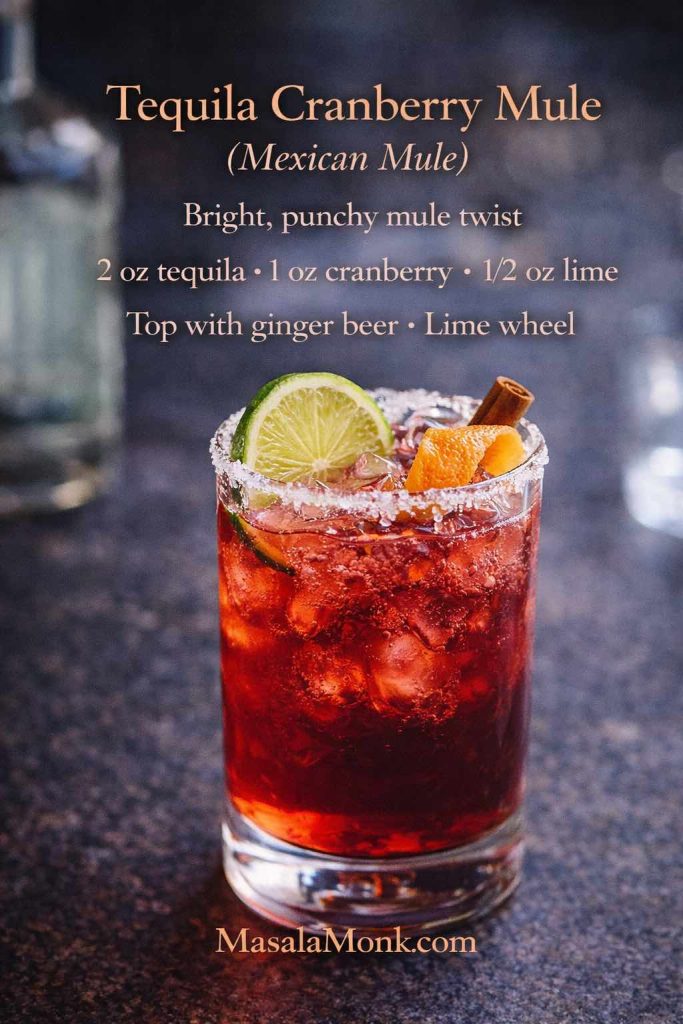
Cold brew vodka martini (lighter, sharper, less sweet)

This is the stripped-down cousin: more “coffee spirit drink” than classic espresso martini.

Build

  • 60 ml vodka
  • 45 ml cold brew coffee (or 30 ml concentrate + 15 ml water)
  • 10–15 ml coffee liqueur (optional)
  • No syrup unless needed

Shake and strain. It won’t have the same foam or sweetness, yet it can be wonderfully clean.

Nitro cold brew martini (silky feel, coffee-forward)

Nitro cold brew adds texture and a creamy mouthfeel. The key is not drowning it in sugar—let the softness do the work.
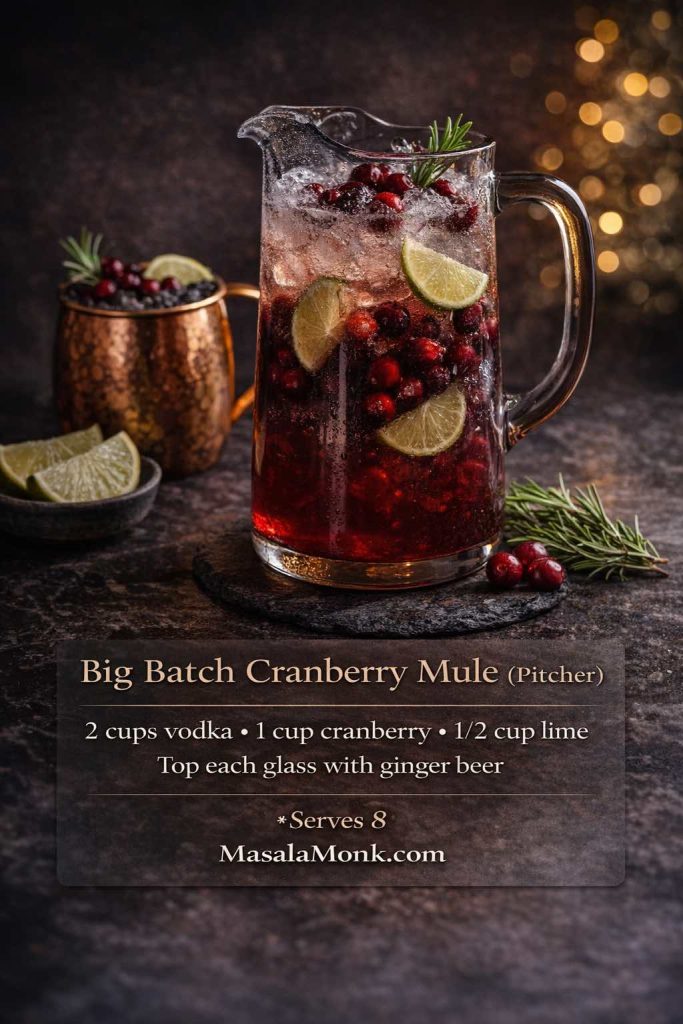
Build

  • 60 ml vodka
  • 20–25 ml coffee liqueur
  • 30–45 ml nitro cold brew (depending on strength)
  • Minimal syrup, if any

Shake with care: enough to integrate and chill, not so chaotic that you flatten everything into a dull drink.
Espresso martini with cold brew liqueur

Some liqueurs are specifically made with cold brew extraction, which can taste more like real coffee and less like candy sweetness. In that case, the best move is restraint: pull back syrup, keep the coffee base strong, and fine strain for a clean top.

Also Read: How to Make Eggless Mayo at Home (Egg Free Mayonnaise Recipe)


Flavor accents that elevate without clutter

Once your base recipe is solid, tiny aromatic moves make the drink feel custom.

Espresso martini garnish ideas infographic showing four simple options: three coffee beans, cocoa dust, orange peel expression, and a micro pinch of salt to enhance coffee flavor.
Espresso martini garnish ideas: Keep it simple—top with three coffee beans for the classic look, add a light cocoa dust for a dessert vibe, express an orange peel for brighter aroma, or use a micro pinch of salt to make the coffee taste rounder (without extra sweetness).

A citrus expression for lift

A quick orange peel expression over the foam can brighten the aroma without turning the drink fruity. It’s especially elegant when the drink leans chocolatey.

If you like the idea of building confidence with citrus technique in vodka drinks, MasalaMonk’s vodka with lemon guide keeps it practical.

Warm spice, used lightly

A pinch of cinnamon or cardamom can make the coffee aroma feel deeper. If you want a full spiced direction, MasalaMonk’s spiced espresso martini ideas translate beautifully to cold brew—especially if you’re using concentrate.

Salt, almost invisible

A micro pinch of salt (or a tiny dash of saline solution) can make coffee taste rounder without adding sweetness. It’s a quiet bar trick that makes the drink taste more finished.

Also Read: How to Cook Tortellini (Fresh, Frozen, Dried) + Easy Dinner Ideas


Making a few at once without losing the foam

If you’re serving friends, the annoyance with espresso martinis is usually the same: foam is built per shake. Cold brew helps because your coffee is already cold and stable, so you can pre-mix the base and keep things smooth.

Batch cold brew espresso martinis infographic showing how to pre-mix vodka, coffee liqueur, and cold brew concentrate, then shake each serving with hard ice and fine strain to keep the foam.
Batch cold brew espresso martinis for a party: Pre-mix vodka + coffee liqueur + cold brew concentrate (add syrup lightly), chill the bottle, then shake each serving 18–22 seconds with hard ice and fine strain to keep that classic espresso-martini foam.
Batch calculator table for cold brew espresso martinis showing ingredient amounts for 1, 2, 4, and 8 drinks (vodka, cold brew concentrate, coffee liqueur), with a tip to pre-mix the base and shake each serving for foam.
Cold brew espresso martini batch calculator: Scale the base for 1, 2, 4, or 8 drinks using vodka + cold brew concentrate + coffee liqueur, then pre-mix and chill. For the classic espresso-martini foam, shake each serving with hard ice and fine strain before serving.

Batch the base, shake each serving

In a bottle or jug, combine:

  • vodka
  • coffee liqueur
  • cold brew concentrate (or strong cold brew)
  • syrup (start low)

Chill it thoroughly. Then for each drink:

  • pour a single serving into a shaker with ice
  • shake hard
  • fine strain into a chilled glass

That way, every glass still feels like a proper espresso martini cold brew, not a poured compromise.

Also Read: Manhattan Cocktail Recipe (Classic + 6 Variations)


What to serve with a Cold Brew Espresso Martini

Coffee cocktails love contrast: sweetness balanced by salt, richness balanced by brightness.

Food pairing guide for a cold brew espresso martini showing sweet coffee-friendly desserts, salty snacks for contrast, and bright citrus options as a palate reset.
What to serve with a cold brew espresso martini: Pair it with coffee-friendly desserts (tiramisu, biscotti, dark chocolate), add salty contrast (salted nuts, pretzels) to balance sweetness, and use a bright citrus bite as a quick palate reset between sips.
  • dark chocolate, tiramisu-style desserts, biscotti
  • salted nuts or lightly salty snacks
  • creamy desserts (especially with Baileys versions)
  • citrus-forward bites if you’ve added orange peel aroma

If you want a bright palate reset between richer pours, MasalaMonk’s Lemon Drop Martini pairs nicely as a “second drink” direction—not because it’s similar, but because it’s the opposite.

Also Read: Baked Ziti Recipe Collection: 15 Easy Variations


Bringing it home: the version you’ll keep making

If you want the most repeatable “proper” result, keep cold brew concentrate in the fridge and build from there. It turns the drink into a simple ritual: chill the glass, load the shaker with good ice, measure vodka + coffee liqueur + concentrate, shake hard, fine strain, garnish if you want.

From that point, the drink becomes yours. Maybe you settle into an espresso martini with cold brew concentrate that’s drier and roastier. Perhaps your house style becomes a Kahlúa cold brew martini that’s round and cozy. Or you end up loving a Mr Black cold brew espresso martini because it stays coffee-forward without needing extra sugar. Either way, the logic stays stable: strong coffee base, controlled sweetness, a real shake, and a clean strain.

Espresso martini style guide showing three options—dry coffee-forward, classic balanced, and creamy dessert—plus a tip to shake hard and fine strain for best texture.
Choose your espresso martini style: Go dry + coffee-forward for a roastier, less-sweet finish, classic + balanced for the familiar espresso martini profile, or creamy + dessert for a Baileys-style twist. No matter the style, shake hard and fine strain for a smoother foam cap.

If you ever want to compare your build to a traditional benchmark again, the IBA Espresso Martini remains a clean reference point—and for deeper foam/technique reasoning, Difford’s Espresso Martini is still one of the best explainers around.

Also Read: Cranberry Moscow Mule Recipe: A Festive Holiday Cocktail With Easy Variations

Cold brew espresso martini FAQ infographic with quick answers covering no espresso machine, why there’s no foam, watery martinis, shake time, cold brew vs concentrate, and batching for a party.
Cold brew espresso martini FAQs (quick answers): No espresso machine needed—use cold brew concentrate or strong cold brew. For better foam, use hard ice, shake 15–22 seconds, and fine strain. If it’s watery, your cold brew is likely too mild or your ice is wet—switch to concentrate or firmer ice.

FAQs

1) Can I make a cold brew espresso martini without an espresso machine?

Absolutely. Instead of pulling espresso, use cold brew concentrate or strong cold brew coffee. As long as the coffee base is bold enough to stand up to vodka and coffee liqueur, the drink still tastes like a proper espresso martini—just smoother and easier to pull off at home.

2) What’s the difference between a cold brew espresso martini and a cold brew martini?

A cold brew espresso martini follows the classic espresso martini structure: vodka, coffee liqueur, and a concentrated coffee base shaken hard for texture. A “cold brew martini,” meanwhile, is sometimes used loosely for any vodka-and-cold-brew drink, even if it’s built on ice or skips the foamy shake.

3) Can I use cold brew coffee instead of cold brew concentrate?

Yes, although you’ll usually need a larger pour of cold brew coffee because it’s often less intense than concentrate. Consequently, the drink can dilute more during shaking, so keep an eye on balance and avoid adding too much extra syrup too soon.

4) What is the best cold brew for espresso martini recipes?

Choose an unsweetened cold brew with a bold, chocolatey profile and minimal acidity. In contrast, light, tea-like cold brew can disappear behind coffee liqueur. If you want the most consistent result, cold brew concentrate is typically the strongest option.

5) How do I make an espresso martini with Starbucks cold brew?

Use Starbucks cold brew the same way you’d use any ready-to-drink cold brew: start with a slightly larger coffee measure than concentrate builds, then adjust sweetness after tasting. If your Starbucks product is a stronger concentrate-style version, treat it like concentrate rather than regular cold brew.

6) Can I make an espresso martini with brewed coffee?

You can, provided the coffee is strong and fully chilled. Otherwise, hot brewed coffee melts ice too quickly and the cocktail turns thin. For best results, brew it stronger than usual, cool it completely, then shake as you would for a standard espresso martini.

7) Can I use coffee concentrate for an espresso martini?

Definitely. Coffee concentrate (including cold brew concentrate) is one of the easiest ways to keep the coffee flavor intense. Moreover, it helps the drink stay punchy even after dilution from shaking.

8) Why is my cold brew espresso martini watery?

Most often, the cold brew base is too mild or the ice is melting too fast. Switch to cold brew concentrate, use firmer ice, and shake just long enough to chill and aerate without over-diluting. If needed, slightly reduce coffee volume and rely on stronger concentrate instead.

9) Why isn’t my espresso martini with cold brew foamy?

Cold brew doesn’t naturally foam like fresh espresso, so technique matters more. Shake harder and a bit longer, use a very cold glass, and fine strain to remove ice shards. Also, consider using cold brew concentrate, since stronger coffee tends to build a better texture.

10) How long should I shake a cold brew espresso martini?

Typically, 15–20 seconds is ideal. That said, if your ice is very hard and your ingredients are cold, a slightly shorter shake can still work. Conversely, if you’re using regular cold brew instead of concentrate, an extra few seconds often improves the foam.

11) Should I add simple syrup to an espresso martini with cold brew?

Only if you want more roundness. Coffee liqueur already adds sweetness, so start small and adjust after tasting. If you’re using a drier coffee liqueur, a touch of syrup can smooth the edges without making the drink cloying.

12) What coffee liqueur works best for a cold brew espresso martini?

If you prefer classic sweetness, go with a sweeter coffee liqueur like Kahlúa. Alternatively, if you want a drier, more coffee-forward finish, choose a roastier, less sweet coffee liqueur. Either way, keep sweetness adjustable with minimal syrup.

13) How do I make a Kahlúa cold brew martini?

Use vodka, Kahlúa, and cold brew concentrate (or strong cold brew), then shake hard and strain into a chilled glass. Because Kahlúa is already sweet, you can often skip simple syrup unless your cold brew is particularly bitter.

14) How do I make a cold brew martini with Baileys?

Combine vodka, Baileys, a small amount of coffee liqueur (optional), and cold brew concentrate, then shake longer than usual for a creamy texture. Since Baileys adds sweetness and body, reduce or skip simple syrup to keep the finish clean.

15) Can I make a cold brew espresso martini without coffee liqueur?

Yes, although it will taste less “classic.” In that case, replace the liqueur’s sweetness and coffee notes with a little syrup and a stronger coffee base. Additionally, consider adding a tiny pinch of salt to round the coffee flavor.

16) Is a cold brew espresso martini stronger than a regular espresso martini?

It depends on your ratios. Cold brew concentrate can deliver a strong coffee punch, yet alcohol strength is mainly determined by how much vodka you use and how much dilution happens in the shake.

17) Can I batch cold brew espresso martinis for a party?

You can pre-mix vodka, coffee liqueur, cold brew (or concentrate), and syrup, then keep it chilled. However, shake each serving with ice right before pouring so you still get the foam and the proper texture.

18) What garnish works best on an espresso martini made with cold brew?

Three coffee beans are the classic choice. If you want variety, try a light dusting of cocoa, a few chocolate shavings, or a subtle orange zest expression for aroma—just keep it restrained so it doesn’t overpower the coffee.

Posted on 8 Comments

Cranberry Moscow Mule Recipe: A Festive Holiday Cocktail With Easy Variations

Cranberry Moscow Mule in a copper mug garnished with rosemary, cranberries, and lime, with text “Pitcher + Single Serve” and “Holiday party-ready.”

There are cocktails that feel like a project, and then there are cocktails that feel like a decision. The cranberry Moscow mule sits firmly in that second camp: you grab a bottle of ginger beer, you find a lime, you pour, you stir, and suddenly the glass looks like a holiday postcard.

That’s the quiet charm of this drink. It can be a cozy Christmas Moscow mule, a bright Thanksgiving cranberry mule, a casual cranberry mule cocktail after work, or the kind of holiday mule you make when friends “just happen” to stop by. Either way, you get the same three-note magic: ginger heat, citrus snap, and that tart-sweet cranberry glow that makes the whole thing taste like winter without tasting heavy.

Even better, it’s easy to steer. Want something sharper? You lean into lime. Prefer it rounder and sweeter? You choose cranberry cocktail instead of 100% juice or add a touch of syrup. Craving something more aromatic? Rosemary, thyme, or orange peel transforms the drink in seconds. And if you’re making cranberry moscow mules for a crowd, a pitcher base takes the stress out of hosting.

If you like having a dependable starting point before you riff, Masala Monk’s guide to the classic mule template is a great foundation: Moscow Mule Recipe: Master Ratio + 10 Easy Variations. From there, cranberry slides in naturally—like the drink was always meant to wear red.


Why Ginger Beer and Cranberry Juice Work So Well Together

At first glance, ginger beer and cranberry juice sounds almost too simple. Yet the pairing makes sense the moment you sip it.

Cranberry brings bright acidity and a clean fruit note. Ginger beer brings spicy fizz and a slight sweetness. Put them together, and you get a cranberry ginger beer cocktail that tastes lively instead of sugary—especially once lime shows up to keep everything crisp.

Infographic showing why ginger beer, cranberry juice, and lime create a balanced cranberry Moscow mule, highlighting tartness, spicy fizz, and crisp citrus balance.
Why ginger beer and cranberry juice work so well together: cranberry adds bright tartness, ginger beer brings spicy fizz, and lime keeps everything crisp—so the mule tastes lively, not sugary.

That balance is the real “secret” here. A mule is essentially a bright, gingery highball; cranberry gives it holiday color and a tart backbone, but ginger beer keeps it from turning into straight-up juice. Meanwhile, lime keeps the drink from getting flat or cloying, which is why moscow mule with cranberry juice almost always tastes better when you don’t skip the citrus.

If you’ve ever wondered why two “mule” drinks can taste wildly different, the answer is often hiding in the mixer. Ginger beer tends to be bolder and more ginger-forward, while ginger ale is usually softer and sweeter; Food & Wine’s breakdown of the difference explains why the swap changes the entire drink’s profile (Ginger Beer vs. Ginger Ale), and Epicurious dives into how production and flavor affect cocktails (Ginger Beer vs. Ginger Ale). In other words: both can work, but they won’t taste the same—and cranberry amplifies that difference.

So if you’re using ginger ale because that’s what you have, you can still make a cranberry mule drink you’ll love; you’ll just want a bit more lime to keep the drink sharp and mule-like.

Also Read: Baked Ziti Recipe Collection: 15 Easy Variations


Cranberry Moscow Mule Ingredients (And What Each One Does)

A good cranberry mule recipe doesn’t need many ingredients, but each one has a job. Once you know what those jobs are, you can tweak the drink confidently—whether you’re building a spiced cranberry mule, an apple cranberry moscow mule, or a big batch cranberry moscow mule.

Vodka (or your spirit of choice)

Vodka keeps the drink clean and neutral, which is why cranberry vodka mule recipes are the classic lane. If you want a specific bottle recommendation, you can absolutely make a cranberry mule recipe with Tito’s—its smooth profile works well with tart juice and spicy ginger.

That said, vodka isn’t your only option. Later on, you’ll see how easily this becomes a gin mule, a whiskey cranberry mule, or a tequila cranberry mule with one simple swap.

Cranberry juice (the fork in the road)

This is where people unknowingly choose their drink’s personality.

  • Cranberry juice cocktail (sweetened) gives you a crowd-pleasing holiday mule cocktail that’s easy to sip.
  • 100% cranberry juice makes the drink tarter, brighter, and more “grown-up,” but it often benefits from a touch of sweetener.

If you’re chasing the best cranberry mule recipe for a party, cranberry cocktail is typically the easiest win. On the other hand, if you love sharp drinks, 100% cranberry can be stunning—especially when you add a teaspoon or two of syrup to round the edges.

Ginger beer (the mule’s engine)

Ginger beer is what makes this drink a mule instead of a vodka cranberry with bubbles. It brings spice, fizz, sweetness, and a slightly fermented tang.

If you’re curious about classic proportions for a Moscow mule, Serious Eats lays out the familiar format—vodka, lime, and 4–6 ounces of ginger beer—clearly and simply (Moscow Mule). Liquor.com offers a similarly straightforward approach (Moscow Mule Cocktail Recipe). Those classics are useful here because cranberry is an add-on, not a replacement. You’re still building a mule; you’re just tinting and flavoring it.

Fresh lime juice (non-negotiable if you want the “mule” taste)

Bottled lime juice can work in a pinch, yet fresh lime gives the drink a brightness that plays beautifully with cranberry. More importantly, it keeps ginger beer and cranberry juice from tasting like a sweet soda.

Ice (more important than it looks)

A mule is at its best when it’s cold and crisp. Lots of ice keeps the ginger beer lively and slows dilution so the drink stays balanced.

Copper mugs (optional—and worth one safety note)

Copper mugs are fun and iconic, although a highball glass is perfectly fine. If you do use copper, it’s smart to choose a lined mug because acidic drinks (ginger, lime) can encourage copper to leach from unlined copper vessels. KFF Health News summarizes research and recommends lined mugs as a safer option (Don’t Nurse That Moscow Mule). You don’t need to panic; you just don’t want an unlined copper cup holding an acidic drink for a long time.

Also Read: Manhattan Cocktail Recipe (Classic + 6 Variations)


The Cranberry Moscow Mule Recipe (Single Drink)

This is the version you’ll come back to again and again—the one you can make by memory once you’ve done it twice.

Ingredients (1 drink)

  • 2 ounces vodka
  • 1 ounce cranberry juice (cocktail or 100%, your call)
  • 1/2 ounce fresh lime juice
  • 4–6 ounces cold ginger beer
  • Ice

Method

  1. Fill a copper mug or tall glass generously with ice.
  2. Add vodka, cranberry juice, and lime juice.
  3. Top with ginger beer.
  4. Stir gently, just enough to combine.
  5. Garnish and serve immediately.
Cranberry Moscow Mule recipe graphic showing a copper mug cocktail with rosemary, cranberries, and lime, plus measurements for single serve and an 8-drink pitcher.
Save this cranberry Moscow mule recipe: make one drink in minutes or mix a pitcher base for eight—then top each glass with ginger beer for the freshest fizz.

If you want the fastest possible route—almost a “dump and stir” approach—Food Network’s cranberry mule is famously minimal: vodka, cranberry juice, ginger beer, ice, garnish (Cranberry Mule Recipe). That style is great when you’re making drinks while chatting, because it’s nearly impossible to mess up. Still, adding lime makes the drink taste more like a true mule and less like a sweet highball, so consider it the small extra step that pays you back with every sip.

Also Read: Green Chutney Recipe (Coriander–Mint / Cilantro Chutney)


Garnishes That Make It Look Like a Holiday Moscow Mule

A cranberry mule already looks festive, but garnishes change the experience as much as they change the photo.

  • Fresh cranberries: classic, simple, and instantly “holiday.”
  • Rosemary sprig: the aroma hits before the sip, which makes it feel like a Christmas mule cocktail.
  • Thyme: softer than rosemary, more delicate, and quietly elegant.
  • Orange peel: warm citrus perfume that turns it into an orange cranberry moscow mule moment.
  • Lime wheel: keeps things bright and crisp.
Sugared cranberries on a cocktail pick with a cranberry mule drink in the background, featuring on-image instructions to dip in simple syrup, roll in sugar, and dry 10–15 minutes.
Sugared cranberries (5 minutes): dip fresh cranberries in simple syrup, roll in sugar, and let them dry—an instant “wow” garnish for cranberry Moscow mules and holiday drinks.

If you want to go all-in, sugared cranberries are the easiest “wow” garnish because they look fancy and take almost no effort. Alternatively, an orange peel and rosemary sprig together makes the drink smell like winter as soon as you lift the mug.

Also Read: Best Vermouth for a Negroni Cocktail Drink Recipe


Christmas Moscow Mule Recipe (The Holiday Mule Version)

The difference between an everyday cranberry mule and a Christmas moscow mule isn’t a new ingredient list—it’s the way you layer aroma and warmth.

Christmas cranberry Moscow mule in a copper mug with sugared cranberries, rosemary, and orange peel, featuring an on-image recipe with vodka, cranberry, lime, and ginger beer.
Christmas cranberry Moscow mule: rosemary and orange peel add instant holiday aroma—mix vodka, cranberry, and lime over ice, then top with ginger beer right before serving.

Start with the base cranberry Moscow mule recipe. Then:

  • Add a rosemary sprig and a handful of cranberries.
  • Express an orange peel over the mug (twist it to release the oils), then drop it in.
  • If you like a sweeter edge, add a small spoon of simple syrup before the ginger beer and stir lightly.

As the drink sits, rosemary perfumes the ginger, orange lifts the cranberry, and suddenly it tastes like a holiday mule without tasting like a candle. That’s the sweet spot.

Cranberry sauce Moscow mule in a tall glass with a spoonful of cranberry sauce, lime wheel, and rosemary, with an on-image recipe for a leftover cranberry sauce mule.
Cranberry sauce Moscow mule: stir a spoonful of leftover cranberry sauce into vodka and lime, then top with ginger beer for a smooth, bold mule with holiday flavor.

If your holiday table already includes cranberry-orange flavors, it’s also fun to pair this drink with something like Cranberry Sauce with Orange Juice, because the same flavor family shows up on both the plate and the glass. The result feels cohesive without feeling planned.

Also Read: Sandwich for Breakfast: Breakfast Sandwich Recipe + 10 Variations


Cranberry Lime Moscow Mule (For People Who Like It Crisp)

Sometimes you want the cranberry to be present but not sweet. In that case, pull the drink toward citrus.

Make the base recipe, then:

  • Use 100% cranberry juice, and
  • Increase lime slightly (a fuller half ounce, or even a touch more if your ginger beer is sweet).
Cranberry lime Moscow mule in a tall glass with lime wedge and wheel, with an on-image recipe highlighting extra lime for a crisp, tart mule.
Cranberry lime Moscow mule: the extra squeeze of lime keeps the drink sharp and mule-like—especially if your ginger beer or cranberry juice runs sweet.

What you get is a cranberry lime mule that drinks clean and bright. It’s the kind of mule that tastes refreshing even after a rich meal, which is exactly why it fits a holiday spread so well.

Also Read: Paper Plane Cocktail Recipe + Best Amaro Substitutes & Tips


Cranberry Orange Moscow Mule (Warm Citrus Without Heaviness)

Cranberry and orange is a classic duo, and it fits the mule format naturally. Instead of making the drink sweeter, orange adds perfume and warmth.

You can do it two easy ways:

  1. Orange peel garnish method: build the base drink, then add orange peel and stir.
  2. Orange juice method: replace a small portion of cranberry juice with orange juice (just enough to bring in the aroma without turning it into a brunch drink).
Cranberry orange Moscow mule in a tall glass with orange peel twist, cranberries, and ice, with an on-image recipe using vodka, cranberry, lime, and ginger beer.
Cranberry orange Moscow mule: add an orange peel twist for warm citrus aroma without making the drink heavy—then top with ginger beer for a crisp finish.

If you want inspiration from a more “designed” version, Bobby Flay’s cranberry-orange mule recipe leans into cranberry vodka and orange notes for a festive spin (Cranberry-Orange Mule). You don’t need to follow it exactly to enjoy the idea; even a simple orange peel garnish can shift your cranberry mule cocktail into a more holiday-forward direction.

Also Read: Strawberry Smoothie Recipes (12 Easy Blends + Bowls & Protein Shakes)


Apple Cranberry Moscow Mule (Cran-Apple, But Make It a Mule)

Apple and cranberry together taste like fall and winter in one sip. The trick is keeping the apple from making the drink taste like sparkling juice.

Here’s the approach that stays mule-like:

Apple Cranberry Mule (1 drink)

  • 2 ounces vodka
  • 1 ounce cranberry juice
  • 1 ounce apple cider (or cloudy apple juice)
  • 1/2 ounce lime juice
  • Ginger beer to top

Build it over ice, then garnish with apple slices and cranberries.

Apple cranberry Moscow mule in a copper mug with apple slice, cranberries, and cinnamon, with an on-image recipe using vodka, cranberry juice, apple cider, lime, and ginger beer.
Apple cranberry Moscow mule: a cozy cider twist on the classic—vodka, cranberry, apple cider, lime, then ginger beer for that signature mule sparkle.

Liquor.com’s apple cranberry moscow mule goes directly at the “cran-apple” idea using cran-apple juice and a smaller lime measure, then tops with ginger beer (Apple Cranberry Moscow Mule). It’s a great reference point if you want that specific flavor lane.

If you’re serving a mix of drinkers—some doing alcohol, some not—an apple-forward zero-proof option fits nicely alongside this version. Masala Monk’s apple juice mocktails are handy for that kind of table, since you can keep the same garnish style and make everything look intentional.

Also Read: Classic Rum Punch + 9 Recipes (Pitcher & Party-Friendly)


Spiced Cranberry Moscow Mule (Cinnamon, Thyme, and Winter Warmth)

A spiced cranberry mule should feel like winter, not like potpourri. The goal is warmth in the background, not a spice rack in the foreground.

Spiced Cranberry Mule, Cinnamon Style

Build the base drink, then add:

  • a tiny pinch of cinnamon, or
  • a cinnamon stick as garnish, or
  • a dash or two of aromatic bitters (if you keep them around)

Cinnamon plays especially well with cranberry and orange peel, so it’s also a natural fit for a Christmas mule cocktail.

Spiced cranberry mule in a crystal glass with cinnamon, thyme, and cranberries, with an on-image recipe using vodka, cranberry juice, lime, and ginger beer.
Spiced cranberry mule: cranberry, lime, and ginger beer with a cinnamon stick and thyme garnish for a warm holiday twist that still tastes crisp and bright.

Spiced Cranberry Thyme Moscow Mule

Thyme is subtler than rosemary, which means it’s easier to use without overpowering the drink.

Build the base drink, then:

  • clap a thyme sprig between your hands to wake up the aroma
  • garnish with the sprig and stir gently once

The result feels like a spiced cranberry thyme mule—fresh, herbal, slightly wintry—without losing that classic mule snap.

Also Read: 7 Pizza Sauce Recipes | Marinara, White Garlic, Alfredo, Buffalo, BBQ, Vodka & Ranch


Cranberry Rosemary Mule (That “Smells Like the Holidays” Version)

Rosemary is the garnish that does the most work with the least effort. It turns a cranberry moscow mule into a cranberry rosemary mule almost instantly.

Build the base drink, then:

  • garnish with rosemary and cranberries
  • stir lightly so the rosemary oils lightly perfume the top of the drink

Because rosemary is assertive, you don’t need to muddle it. In fact, muddling can make the herb taste woody. Instead, let it behave like a fragrant accent.

Cranberry rosemary mule in a dark glass with rosemary, cranberries, and lime, featuring an on-image recipe and a tip to clap rosemary before garnishing.
Cranberry rosemary mule: clap the rosemary sprig before garnishing so the drink smells like the holidays—then add ginger beer last for the brightest fizz.

If you enjoy herbal directions in drinks in general—especially for alcohol-free versions—Masala Monk’s guide to herbal infusions in mocktails is a fun rabbit hole to go down. Rosemary and thyme show up often for a reason: they’re instantly aromatic and pair well with citrus.

Also Read: Vodka Pasta (Penne alla Vodka) + Spicy Rigatoni, Chicken, and Gigi Recipes


Cranberry Pomegranate Moscow Mule (A Deeper, Brighter Fruit Twist)

Cranberry is tart. Pomegranate is tart in a different way—more jewel-toned, slightly floral, and a little rounder.

For a cranberry pomegranate mule:

  • Use half cranberry juice and half pomegranate juice in the base recipe
  • Keep lime and ginger beer the same
Cranberry pomegranate Moscow mule in a tall glass with lime and pomegranate arils, featuring an on-image recipe that uses half cranberry and half pomegranate juice.
Cranberry pomegranate Moscow mule: swap in a half-and-half cranberry–pomegranate juice blend for a deeper, jewel-toned mule that still finishes crisp with ginger beer and lime.

The drink stays crisp, yet the fruit layer feels more complex. It’s a great option when you want something that tastes a little more “special occasion” without adding steps.

Also Read: Mayo Recipe: 15+ Homemade Mayonnaise Variations


Cranberry Vanilla Moscow Mule (A Soft, Dessert-Leaning Option)

If your ginger beer is sharp and you want the drink to feel smoother, vanilla can give it a gentle “holiday dessert” vibe.

There are a few easy routes:

  • Use a small splash of vanilla syrup (the same kind you’d use in coffee), or
  • Use vanilla vodka, or
  • Add a tiny pinch of vanilla extract to a big batch base (very little goes a long way)
Cranberry vanilla Moscow mule in a stemless glass with cranberries and orange peel, with an on-image recipe including vodka, cranberry juice, lime, vanilla syrup, and ginger beer.
Cranberry vanilla Moscow mule: a softer, dessert-leaning twist—add just a teaspoon of vanilla syrup to round the cranberry and let ginger beer keep it crisp.

This turns the drink into a cranberry vanilla mule—still fizzy and gingery, just rounder at the edges. It’s especially nice with orange peel.

Also Read: Blueberry Pancakes (6 Recipes) + Homemade Pancake Mix


Choose Your Spirit: Vodka, Gin, Bourbon, Whiskey, or Tequila

One reason “mule” drinks are so popular is that the template welcomes substitutions. Once you’ve made a cranberry mule with vodka, you can spin it into several other crowd-pleasing directions.

Cranberry mule spirit swaps graphic showing four drinks labeled vodka, gin, bourbon, and tequila, with a base recipe ratio and flavor notes.
Cranberry mule spirit swaps: use the same mule base, then choose vodka (classic), gin (botanical), bourbon (warm), or tequila (bright) to match your mood and menu.

Cranberry Vodka Mule (Classic and Clean)

This is the standard cranberry mule recipe: vodka, cranberry, lime, ginger beer. It’s the most neutral, the most widely loved, and the easiest to batch.

If you like the idea of balancing citrus and sweetness in simple highballs, Masala Monk’s vodka with lemon guide explains the logic behind adding a little syrup to keep tartness bright rather than harsh—an idea that carries over beautifully when you use unsweetened cranberry.

Gin Mule (Cranberry Gin Mule)

Swap vodka for gin and you’ll get a cranberry gin mule that feels more aromatic and botanical. Rosemary garnish becomes even more compelling here, because gin and rosemary play beautifully together.

Cranberry gin mule in a tall glass with lime and rosemary, featuring an on-image recipe for a gin mule made with cranberry juice, lime, and ginger beer.
Cranberry gin mule (gin mule): a more botanical take on the mule—gin, cranberry, lime, then ginger beer, finished with rosemary for an aromatic holiday-ready sip.

This is a great “holiday mule” option when you want something that tastes a touch more complex without adding any extra ingredients.

Bourbon Cranberry Mule (Whiskey Cranberry Mule / Cranberry Kentucky Mule)

Swap vodka for bourbon (or whiskey) and the drink turns warmer and richer. That’s why bourbon cranberry mule and whiskey cranberry mule variations show up so often in colder months: the vanilla-caramel notes in bourbon make cranberry taste more like a winter fruit.

Bourbon cranberry mule (Kentucky mule) in a rocks glass with orange peel and cinnamon, with an on-image recipe using bourbon, cranberry juice, lime, and ginger beer.
Bourbon cranberry mule (Kentucky mule): swap vodka for bourbon to make cranberry taste warmer and richer—then finish with ginger beer and an orange peel twist.

If you want the drink to feel extra seasonal, add orange peel and a cinnamon stick and you’ve basically got a Christmas mule drink that tastes like it belongs next to a fire.

Tequila Cranberry Mule (Cranberry Mexican Mule)

Swap vodka for tequila blanco and you’ll get a brighter, punchier drink. The cranberry becomes sharper, the ginger feels louder, and orange peel suddenly makes a lot of sense.

Tequila cranberry mule (Mexican mule) in a tall glass with a salt-sugar rim, lime wheel, and orange peel, with an on-image recipe using tequila, cranberry, lime, and ginger beer.
Tequila cranberry mule (Mexican mule): tequila blanco makes the cranberry-and-ginger combo brighter and punchier—serve it icy cold with a lime wheel and ginger beer on top.

If you enjoy margarita-style flavors, this version is a natural bridge—especially with a salt-sugar rim or a chili-salt rim if you like heat.

Also Read: Whiskey Sour Recipe: Classic Cocktail, Best Whiskey & Easy Twists


Big Batch Cranberry Moscow Mule (Pitcher Recipe That Actually Works)

If you’re hosting, the best gift you can give yourself is a plan that doesn’t require you to play bartender all night. A cranberry moscow mule pitcher base does exactly that.

The most important rule: batch everything except the ginger beer.

Ginger beer is your fizz, so you want it fresh. Once it sits in a pitcher, it goes flat, and your big batch cranberry moscow mule turns into a sweet, diluted punch. Still tasty, but not the drink you meant to make.

Big Batch Cranberry Mule Base (About 8 Drinks)

  • 2 cups vodka
  • 1 cup cranberry juice
  • 1/2 cup fresh lime juice
  • Optional: 1/4 to 1/2 cup simple syrup (especially if using 100% cranberry juice)

Stir this base in a pitcher and chill it thoroughly.

To Serve

Fill each mug with ice, pour in the base, then top with ginger beer. Stir gently and garnish.

Big batch cranberry mule pitcher filled with cranberries and lime, with an on-image recipe for an 8-serving pitcher and a note to top each glass with ginger beer.
Big batch cranberry mule made for hosting: mix the vodka–cranberry–lime pitcher base, then top each glass with ginger beer so every serving stays cold and fizzy.

That’s it. Suddenly, cranberry moscow mule large batch service becomes effortless. You can chat, refill the snack table, and actually enjoy your own party.

If you want a reference point for a “no-fuss” cranberry mule direction, Food Network’s approach is as straightforward as it gets (Cranberry Mule Recipe), and it scales easily. Meanwhile, if you like a more styled holiday direction that leans orange and cranberry, Bobby Flay’s cranberry-orange mule is a fun idea to borrow elements from when you’re building your garnish bar (Cranberry-Orange Mule).

A Simple Hosting Rhythm (So You’re Not Stuck in the Kitchen)

Instead of pre-pouring full drinks, set up a “build your own” station:

  • a chilled pitcher of cranberry mule base
  • ginger beer bottles on ice
  • a bowl of cranberries
  • sliced limes
  • rosemary and thyme sprigs
  • orange peels or orange slices
Build-your-own cranberry mule bar setup with a pitcher of cranberry mule base, ginger beer on ice, sliced limes, orange peel, cranberries, and herbs, with on-image text.
Build-your-own cranberry mule bar: set out a chilled pitcher base, keep ginger beer cold, and let guests add lime, orange peel, and herb garnishes—easy hosting, fresher fizz.

That small setup makes holiday moscow mules feel abundant, even if you’re keeping things casual.

Also Read: Waffle Recipe Without Milk: Fluffy, Golden, and Crisp


Virgin Cranberry Moscow Mule (The Zero-Proof Version That Still Feels Festive)

A virgin cranberry moscow mule shouldn’t feel like a consolation prize. It should taste like a real drink—bright, fizzy, gingery, and finished with the same garnishes as the alcoholic version.

Virgin Cranberry Mule (1 drink)

  • 2–3 ounces cranberry juice
  • 1/2 ounce lime juice
  • Ginger beer to top
  • Ice

Build over ice, stir gently, and garnish with cranberries and rosemary.

Virgin cranberry Moscow mule mocktail in a crystal glass with cranberries, rosemary, and lime, plus an on-image recipe with cranberry juice, lime, and ginger beer.
Virgin cranberry Moscow mule (mocktail): all the ginger-lime sparkle with a ruby cranberry twist—perfect for kids, drivers, and anyone skipping alcohol.

If you want a clear, tested reference for the non-alcoholic format, Skinnytaste’s cranberry mule mocktail keeps it clean with cranberry juice, ginger beer, and lime (Cranberry Mule Mocktail). You can keep it that simple, or you can dress it up the same way you would a Christmas mule cocktail: rosemary, orange peel, sugared cranberries, the whole works.

For a more “grown-up” herbal direction—especially if you’re serving mocktails at a holiday gathering—Masala Monk’s piece on herbal mocktail infusions is a nice source of ideas. Even one sprig of rosemary can make a zero-proof drink feel intentional.

Also Read: Sheet Pan Chicken Fajitas Recipe (Easy One-Pan Oven Fajitas)


Ginger Ale, Ginger Beer, and Cranberry: Two Easy Routes

Sometimes the question isn’t “which cranberry mule recipe should I make?” It’s “what do I do with what’s already in my fridge?”

Portrait graphic comparing ginger beer vs ginger ale for a cranberry mule, showing how to adjust lime, plus a base recipe and quick tips for sweetness and scaling.
Ginger beer vs ginger ale for a cranberry mule: ginger beer gives sharper mule bite, while ginger ale is softer—so bump the lime and add bubbly last for the best fizz.

If you have ginger beer

You’re in classic mule territory. Build the drink normally. You’ll get more spice, more bite, and a more defined mule identity.

If you only have ginger ale

You can still make a moscow mule recipe with cranberry juice that tastes refreshing. It will be softer and sweeter, so lean into lime a little more. Those differences are exactly why guides like Food & Wine and Epicurious emphasize that ginger beer and ginger ale aren’t interchangeable without changing the result (Food & Wine’s comparison, Epicurious’ comparison).

Either way, cranberry and ginger is a winning pairing. You just steer the balance with lime and sweetness.

Also Read: Strawberry Mojito Mocktails – 10 Easy Variations


What to Serve With Cranberry Moscow Mules (So the Night Feels Complete)

A cranberry mule cocktail is fizzy, gingery, and slightly tart. That means it loves food that’s creamy, salty, crunchy, or gently spicy. In other words, it pairs beautifully with party snacks.

Instead of trying to cook ten things, aim for contrast:

  • one creamy dip
  • one crunchy bite
  • one “fresh” element
  • one cozy holiday side if you’re doing dinner

Here are combinations that work especially well.

Creamy dips and spreads

A creamy dip softens the ginger bite and makes the drink feel smoother.

  • A classic option is Easy Spinach Dip (Cold, Baked, Artichoke & 10 Variations). It’s rich enough to balance the drink, yet it still feels party-friendly rather than heavy.
  • If you want something bolder, Buffalo Chicken Dip is a natural match because spicy, tangy food and fizzy ginger drinks tend to make each other more exciting.
  • For something cool and bright, Greek tzatziki pairs beautifully with the lime and cranberry notes, especially alongside roasted or fried snacks.

One-bite, tidy appetizers

This is the category that makes a gathering feel effortless.

The “hot and crispy” anchor

Every snack table benefits from one warm, crisp tray that disappears quickly.

  • Air fryer chicken wings are ideal here: spicy wings plus a cranberry mule is the kind of pairing that keeps people hovering near the table.

Boards and grazing plates (the easiest party trick)

If you want the room to feel festive without cooking all day, a board does most of the work.

Masala Monk’s guide to charcuterie boards and the 3-3-3-3 rule makes it easy to build something abundant. Add crackers, cheese, something briny, something sweet, and a bowl of cranberries as a playful nod to the drink. With a holiday mule in hand, it feels like an event.

Holiday sides that make everything feel seasonal

If you’re serving these drinks with dinner—especially if you’re leaning into Christmas moscow mule vibes—cozy sides fit right in.

  • Green bean casserole is a classic companion to a holiday table, and it works surprisingly well with a crisp cranberry mule because the drink cuts through creamy, savory dishes.
  • If cranberry is already on your menu, cranberry sauce with orange juice ties the whole spread together, especially if you’re also making a cranberry orange mule variation.

And if you want something simple that helps dips disappear even faster, homemade garlic bread is a cozy, crowd-friendly move—particularly when the weather is cool and the drinks are icy.

Also Read: Katsu Curry Rice (Japanese Recipe, with Chicken Cutlet)


A Cranberry Mule You’ll Actually Make Again

The best thing about this drink is that it doesn’t ask you to commit. You can keep it simple—vodka, cranberry, lime, ginger beer—and it’s already delicious. Then, whenever you feel like it, you pivot:

  • rosemary and cranberries for a cranberry rosemary mule
  • orange peel for a cranberry orange moscow mule
  • apple cider for an apple cranberry mule
  • cinnamon and thyme for a spiced cranberry mule
  • bourbon for a whiskey cranberry mule
  • tequila for a cranberry mexican mule
  • a pitcher base when you’re making cranberry moscow mules for a crowd
  • zero-proof when you want a virgin cranberry moscow mule that still feels special

No matter which direction you choose, the drink keeps its personality: bright, fizzy, gingery, and unmistakably festive.

Also Read: Peanut Butter Cookies (Classic Recipe & 3 Variations)

FAQ

1) What is a cranberry Moscow mule?

A cranberry Moscow mule is a Moscow mule made with vodka, ginger beer, lime juice, and cranberry juice. Compared to a classic mule, it tastes fruitier, looks more festive, and often shows up as a holiday mule or Christmas mule cocktail.

2) What are the cranberry Moscow mule ingredients?

Typically you’ll need vodka, cranberry juice, fresh lime juice, ginger beer, and ice. Afterward, garnishes like cranberries, rosemary, lime, or orange peel make it feel more seasonal.

3) How do I make a cranberry mule cocktail taste less sweet?

If your cranberry mule tastes too sweet, first increase the lime juice slightly. Next, choose a less-sweet cranberry juice (or reduce the cranberry portion) and use a spicier ginger beer for more bite and balance.

4) Can I use 100% cranberry juice in a cranberry moscow mule recipe?

Yes—however, 100% cranberry juice is much tarter than cranberry juice cocktail. Because of that, many people add a small amount of simple syrup to soften the edges while keeping the drink bright.

5) What’s the best ginger beer for a cranberry ginger beer mule?

Since ginger beers vary a lot, pick based on your preference: a spicier ginger beer creates a sharper mule, while a sweeter ginger beer makes a smoother cranberry mule drink. Either way, fresh lime keeps it tasting like a mule.

6) Can I make a moscow mule recipe with cranberry juice and ginger ale?

You can. Even so, ginger ale is usually sweeter and less spicy than ginger beer, so the result will be softer and closer to a cranberry highball. To bring it back toward mule territory, add a bit more lime and use plenty of ice.

7) What vodka works best for a cranberry mule recipe?

Any smooth vodka works well. In particular, a cranberry mule recipe with Tito’s is popular because it’s clean and easy-drinking, letting ginger and cranberry stand out.

8) How do I make an easy cranberry moscow mule?

For an easy version, fill a mug with ice, add vodka and cranberry juice, then top with ginger beer and squeeze in lime. Finally, stir once and garnish—done.

9) How do I make a Christmas Moscow mule recipe?

To turn it into a Christmas mule drink, keep the base recipe and add holiday garnishes such as rosemary sprigs, fresh cranberries, and orange peel. Optionally, add a cinnamon stick for a cranberry cinnamon moscow mule feel.

10) What is an apple cranberry Moscow mule?

An apple cranberry Moscow mule is a cranberry mule variation that includes apple cider or apple juice along with cranberry, then finishes with ginger beer and lime. As a result, it tastes like a cran-apple mule with the classic mule fizz.

11) How do I make an apple cider cranberry Moscow mule?

Instead of using only cranberry juice, use a split—cranberry plus apple cider—then add vodka, lime, and ginger beer. In addition, cinnamon garnish pairs especially well with this version.

12) Can I make a spiced cranberry Moscow mule?

Absolutely. For instance, add aromatic bitters, a cinnamon stick, or a light dusting of cinnamon. Alternatively, use herbs like thyme for a spiced cranberry thyme Moscow mule that still tastes fresh.

13) What’s the difference between a cranberry rosemary mule and a cranberry thyme moscow mule?

Rosemary is more piney and bold, while thyme is gentler and more floral. Consequently, rosemary gives a stronger holiday aroma, whereas thyme keeps the drink lighter.

14) What is a cranberry pomegranate Moscow mule?

A cranberry pomegranate mule combines cranberry juice with pomegranate juice, then adds vodka, lime, and ginger beer. Because pomegranate is naturally tangy, it deepens the fruit flavor without making the drink heavy.

15) Can I make a cranberry mule with gin?

Yes—swap vodka for gin to make a gin mule or cranberry gin mule. Compared to vodka, gin adds botanical notes that taste especially good with rosemary or orange peel.

16) How do I make a bourbon cranberry mule or whiskey cranberry mule?

Replace vodka with bourbon or whiskey. Then build the drink the same way with cranberry, lime, and ginger beer. In turn, the flavor becomes warmer and richer, similar to a cranberry Kentucky mule style.

17) Can I make a tequila cranberry mule (Mexican mule)?

Definitely. Use tequila blanco instead of vodka, then add cranberry juice, lime, and ginger beer. For extra lift, garnish with orange peel or a lime wheel.

18) How do I make a big batch cranberry Moscow mule?

Make a pitcher base with vodka, cranberry juice, and lime juice, and chill it. Then, when serving, pour the base over ice and top each glass with ginger beer so the fizz stays lively.

19) What’s the best cranberry moscow mule pitcher recipe for a crowd?

A reliable approach is batching vodka + cranberry + lime in advance, then topping with ginger beer per glass. That method scales easily for a cranberry moscow mule for a crowd, a large batch cranberry mule, or a party pitcher.

20) How far ahead can I prep a cranberry moscow mule batch?

You can mix the vodka, cranberry juice, and lime juice several hours ahead and keep it refrigerated. Still, add ginger beer only at serving time to maintain carbonation.

21) Can I make a virgin cranberry Moscow mule?

Yes—a virgin cranberry mule uses cranberry juice, lime juice, and ginger beer over ice. For a more “holiday mule” feel, garnish with rosemary and cranberries just like the cocktail.

22) Can I use cranberry vodka in a moscow mule with cranberry vodka?

Yes. Cranberry vodka works well and reinforces the fruit notes. Even so, keep lime in the recipe so it doesn’t drift into overly sweet territory.

23) What can I use instead of lime in a cranberry mule recipe?

If you’re out of lime, lemon can work. Nevertheless, lime is the classic mule citrus and tends to pair best with ginger beer and cranberry.

24) Why does my cranberry mule taste flat?

Usually it’s because the ginger beer wasn’t cold, the drink sat too long, or it was stirred too aggressively. To fix it, use chilled ginger beer, add it last, and stir gently.

25) Can I serve cranberry mules for Thanksgiving and Christmas?

Yes—cranberry mules fit both. For Thanksgiving, apple cider and cinnamon variations feel especially fitting. For Christmas, rosemary, orange, and pomegranate versions look and smell extra festive.

Posted on 13 Comments

French 75 Cocktail Recipe: 7 Easy Variations

Woman in a green dress holding a French 75 cocktail in a champagne flute with a lemon twist, with text overlay reading ‘How to Make a French 75 Plus 7 Refreshing Variations’ above MasalaMonk.com.

There’s something wonderfully sneaky about a French 75. It looks delicate in the glass, but it drinks like a tiny, sparkling cannon. Gin, lemon, sugar, Champagne: that’s it. This French 75 cocktail recipe is your base. From there, we’ll walk through the most-loved variations people actually look for—vodka French 76, Mexican 75 with tequila, bourbon French 95, cognac, elderflower, lavender, Prosecco/Italian 75, batch versions and a mocktail—so you can pour exactly the kind of 75 you’re in the mood for.


What Is a French 75?

At its core, a French 75 is a classic sour (spirit + citrus + sugar) lengthened with Champagne. In most modern bars that means:

  • Gin
  • Fresh lemon juice
  • Simple syrup
  • Dry sparkling wine (usually Champagne or another Brut)

Served in a flute or coupe, garnished with a lemon twist, it’s bright, bubbly and deceptively easy to drink.

The drink’s name comes from the French 75mm field gun used during World War I. According to Wikipedia’s French 75 entry, the idea was that this pretty little cocktail hits with the power of artillery when you aren’t paying attention. Meanwhile, the International Bartenders Association recognises it as an official contemporary classic, listing a stripped-back recipe of gin, lemon, sugar and Champagne.

You’ll see slight differences in ratios from one book to the next, and some early recipes even used cognac instead of gin. That’s actually good news for home bartenders: once you understand the pattern, you can comfortably switch spirits, bubbles and flavours without losing the soul of this French 75 cocktail recipe.


Classic French 75 Cocktail Recipe (Gin, Lemon & Champagne)

Let’s start with the template every other riff builds on.

Ingredients

Makes one drink

  • 1½ oz (45 ml) gin
  • ¾ oz (22 ml) fresh lemon juice
  • ½–¾ oz (15–22 ml) simple syrup (1:1 sugar and water)
  • 3 oz (90 ml) Brut Champagne or other dry sparkling wine
  • Ice, for shaking
  • Lemon twist or thin lemon wheel, for garnish

A juniper-forward London Dry gin like Beefeater or Tanqueray gives the most classic profile, although softer, more aromatic gins absolutely work. If you enjoy exploring gin in general, you might also like the ideas in these creative gin cocktail recipes, which use similar sour-style ratios in very different ways.

Classic French 75 cocktail recipe card showing a coupe glass with a lemon-twist garnish on a wooden bar, surrounded by lemon, sugar and jigger, with text listing gin, lemon, simple syrup, Champagne and three simple preparation steps.
Classic French 75 at a glance – gin, lemon, simple syrup and Champagne with quick step-by-step instructions so you can mix this bubbly favourite in seconds.

Step-by-step French 75 Cocktail Recipe

  1. Chill your glass
    Slide a Champagne flute or coupe into the freezer for a few minutes. Cold glass, cold drink, happy you.
  2. Build the sour base
    In a cocktail shaker, combine the gin, fresh lemon juice and simple syrup.
  3. Shake with ice
    Fill the shaker with ice and shake for about 10–15 seconds. You want the metal to frost over and the contents to be very cold, with just enough dilution to soften the lemon’s sharpness.
  4. Strain into your chilled glass
    Fine-strain the mixture into the flute or coupe. A fine strainer catches ice shards and pulp so the drink stays silky and elegant.
  5. Add the bubbles
    Gently top with Champagne or another dry sparkling wine. Pour slowly, letting the foam settle as you go—you don’t want to lose half the drink in a fizzy overflow.
  6. Garnish and serve
    Express a strip of lemon peel over the surface to release the oils, rake it around the rim, then drop it in or curl it along the edge. Serve straight away, while the drink is icy and effervescent.

The Liquor.com French 75 recipe follows almost this exact pattern: gin and lemon balanced with sugar, brought to life by Champagne. It’s a simple combination, but when everything is fresh and cold it feels like you’ve stepped into a classic hotel bar.


Choosing Ingredients for the Best French 75 Cocktail Recipe

The French 75 is incredibly sensitive to ingredient quality. Small tweaks make a big difference, so this section walks through the main choices and how they change the drink.

Picking a gin

For a classic French 75 cocktail recipe, start with:

  • London Dry gin – crisp, juniper-led, slightly peppery. Tanqueray, Beefeater or similar will give you that familiar structure.
  • Softer, floral gins – brands like Hendrick’s can work beautifully if you like cucumber and rose notes playing with the lemon.

If this drink becomes a favourite, you’ll probably enjoy branching out into gin-forward recipes like the Negroni and its variations, which show how the same bottle behaves when stirred with vermouth and bitters instead of shaken with citrus.

Champagne vs Prosecco vs other bubbles

The IBA specifies Champagne for the official build, but in a home kitchen your options are broader:

  • Champagne (Brut) – toasty, bready, layered. Ideal when you want the drink to feel extra special.
  • Cava – usually very dry, clean and great value; perfect for parties and batch servings.
  • Prosecco – slightly fruitier and often a touch sweeter; we’ll lean into this in the Italian/Prosecco variations later.

Whichever you use, stay in the Brut or Extra Brut range. If the sparkling wine is sweeter (often labelled “Extra Dry” in Prosecco), you might want to reduce the simple syrup slightly so the French 75 doesn’t become cloying.

For inspiration on how sparkling wine behaves in bigger, party-ready bowls, have a look at the pineapple punch recipes that add prosecco or Champagne right at the end; the same timing works brilliantly when you batch French 75s, too.

Balancing lemon and sweetness in French 75 Cocktail Recipe

Lemon juice is non-negotiable here. Bottled lemon tends to taste flat and harsh; fresh juice brightens the drink without turning it sour for the wrong reasons.

As for sugar, think of the simple syrup range like this:

  • ½ oz (15 ml) – sharp, spritzy, more “adult”.
  • ¾ oz (22 ml) – rounder, more approachable, likely to please a mixed crowd.

You can use that same idea in other lemon-based cocktails. A good example is the lemon drop martini recipe: it leans a little sweeter because there’s no sparkling wine to help with balance, so the sugar has to do more work.


A Quick Look at the French 75’s History

The story behind the French 75 is messy in a charming way. Different books claim different origins, and arguments rage about whether the “real” drink uses gin or cognac.

Early printed recipes in the early 20th century show the drink appearing in Paris around World War I. The Wikipedia article on the French 75 mentions Harry’s New York Bar in Paris as an important early home, and notes that some of the earliest written versions were brandy-based, with champagne and lemon added. Later, gin versions became far more widespread, and today those are what most people recognise.

Writers at Difford’s Guide dig into old bar manuals and argue that cognac versions (sometimes called French 125s) have a strong claim to authenticity as well. Meanwhile, Jeffrey Morgenthaler’s essay on the French 75 walks through a tangle of recipes that includes gin, apple brandy, orgeat, grenadine and more. The takeaway? The drink has always been more like a family of Champagne cocktails than a single fixed formula.

Even Ultimate Mai Tai’s discussion of gin vs cognac in the French 75 concludes that while the IBA gives the modern gin-based template its stamp of approval, cognac versions are arguably more “French” and luxuriously dessert-friendly.

All of that means you have permission to treat this French 75 cocktail recipe as a flexible sketch. Gin is the starting point, not a prison.


French 75 Cocktail Recipe Variations

Once you’ve made a few classic French 75s, it becomes very natural to bend the recipe. Swap the spirit, change the sweetener, or alter the bubbles and you have something new that still feels like part of the family.

The pattern stays the same:

  • Around 1½ oz spirit
  • Around ¾ oz citrus
  • ½–¾ oz sweetener (syrup or liqueur)
  • 2½–3 oz sparkling wine

From here on, we’ll walk through seven prominent variations, plus a few bonus twists that are worth trying at least once.


1. Cognac French 75 (French 125) Cocktail Recipe

This variation sits closest to some of the earliest printed versions of the drink. Cognac brings warmth, dried-fruit notes and a plush mouthfeel that make the French 75 lean toward dessert.

Ingredients

  • 1½ oz cognac (VS or VSOP)
  • ¾ oz fresh lemon juice
  • ½–¾ oz simple syrup
  • 3 oz Brut Champagne or dry sparkling wine
Recipe card for a Cognac French 75, also called a French 125, showing a golden cocktail in a coupe glass with lemon twist on a dark wooden bar, plus text listing cognac, lemon, simple syrup, Champagne and three simple preparation steps.
Cognac French 75 (French 125): a richer take on the classic, made with cognac, fresh lemon, simple syrup and Champagne for a silky, dessert-worthy sparkle.

Method

Shake the cognac, lemon and syrup with ice. Fine-strain into a chilled flute or coupe, top with Champagne and garnish with a lemon twist or even a thin orange peel if you want a slightly richer aroma.

The cognac version works beautifully with after-dinner desserts. Pair it with something creamy like tres leches cake or even a plate of authentic churros dusted with cinnamon sugar for an indulgent end to the evening.


2. Vodka French 75 (French 76) Cocktail Recipe

Replace the gin with vodka and you have a French 76. The structure is identical, but the flavour shifts: cleaner, more neutral, less herbal. This is a great choice when you want the lemon and Champagne to shine without the botanical kick of gin.

Several mainstream recipes, such as the ones from Simple Joy or Southern Living, keep the ratios almost identical to the gin-based French 75. You can follow that same logic at home.

Ingredients

  • 1½ oz vodka
  • ¾ oz fresh lemon juice
  • ¾ oz simple syrup
  • 3 oz dry sparkling wine
Vodka French 76 cocktail recipe card showing a tall champagne flute with a pale yellow vodka French 76 garnished with a lemon twist, next to a frosted vodka bottle and jigger, with text listing vodka, lemon, simple syrup, Champagne and three simple preparation steps.
Vodka French 76: a clean, citrusy twist on the French 75 made with vodka, fresh lemon, simple syrup and a Champagne top-up for easy sparkle.

Method

Shake vodka, lemon juice and syrup with ice until well chilled. Strain into a cold flute, top with Champagne or another dry sparkling and garnish with a lemon twist.

If you like this direction, you’ll probably also enjoy other vodka–lemon combinations, such as the drinks in this guide to vodka with lemon cocktails and infusions, which stretches that pairing into everything from martinis to long, refreshing highballs.


3. Tequila French 75 (Mexican 75) Cocktail Recipe

When tequila joins the party, you get a Mexican 75—essentially a sparkling margarita. Tequila, lime or lemon, a touch of agave, and bubbly on top. Several recipes online, including those from tequila brands themselves, stick to that pattern.

Ingredients

  • 1½ oz tequila blanco (or a gentle reposado)
  • ¾ oz fresh lime or lemon juice
  • ½–¾ oz agave syrup (or simple syrup)
  • 3 oz sparkling wine
Recipe card for a Mexican 75 cocktail showing a pale yellow-green tequila French 75 in a coupe glass with a lime twist, set on a wooden bar with lime wedges and salt, plus text listing tequila, lime or lemon juice, agave or simple syrup, sparkling wine and three easy preparation steps.
Mexican 75: a lively tequila twist on the French 75, shaken with citrus and agave, then topped with sparkling wine for a bright, bubbly fiesta in a coupe.

Method

Add tequila, citrus and syrup to your shaker, fill with ice and shake until properly cold. Strain into a flute or coupe, then top with prosecco, cava or Champagne. Garnish with a lime wheel or a thin strip of lime peel.

For a summer party, you might serve Mexican 75s alongside something more relaxed and fruity such as these watermelon margarita variations. Together they give your guests a choice between sparkling and on-the-rocks tequila drinks.

And if some of those guests prefer to skip alcohol, it’s very easy to offer a zero-proof but equally zesty option using the margarita mocktail guide.


4. Bourbon or Whiskey French 75 (French 95) Cocktail Recipe

Swap in bourbon or rye and you’ll arrive at a French 95. Think of it as a whiskey sour in a party dress: lemon, sweetness and whiskey lengthened with sparkling wine.

Ingredients

  • 1½ oz bourbon or rye whiskey
  • ¾ oz fresh lemon juice
  • ½–¾ oz simple syrup or honey syrup
  • 3 oz sparkling wine
Bourbon French 95 cocktail recipe card showing a golden whiskey French 75 in a champagne flute with a lemon twist, set on a dark wooden bar with whiskey decanter, honey jar and lemon, plus text listing bourbon or rye, lemon juice, simple or honey syrup, sparkling wine and three simple preparation steps.
Bourbon French 95: a whiskey sour–style French 75 made with bourbon or rye, fresh lemon, a touch of simple or honey syrup and a sparkling wine top for rich, bubbly comfort.

Method

Combine the whiskey, lemon and syrup in your shaker with ice. Shake until chilled, strain into a flute and finish with Champagne or similar. A lemon twist is classic, though an orange twist can complement the caramel and vanilla notes in bourbon.

Honey syrup (one part honey to one part hot water) makes this feel cosy and comforting, almost like a festive, sparkling hot toddy—just cold. For a look at how those flavours play without bubbles, you can refer to the classic whiskey sour recipe, which uses a very similar balance of whiskey, lemon and sweetness.


5. Elderflower French 75 (St-Germain / “Saint 75”) Cocktail Recipe

Elderflower liqueur, such as St-Germain, slips easily into the French 75 template, adding floral, lychee-like sweetness. This riff is often nicknamed a “Saint 75”.

Ingredients

  • 1 oz gin
  • ½ oz elderflower liqueur (St-Germain or similar)
  • ¾ oz fresh lemon juice
  • ¼–½ oz simple syrup (optional, to taste)
  • 3 oz sparkling wine
Elderflower French 75 cocktail recipe card showing a pale golden drink in a slender champagne flute with lemon twist and white blossoms, plus text listing gin, elderflower liqueur, lemon juice, optional simple syrup, sparkling wine and three simple preparation steps.
Elderflower French 75: a soft, floral twist on the classic French 75 with gin, St-Germain, fresh lemon and sparkling wine for a brunch-ready sparkle.

Method

Shake the gin, elderflower liqueur, lemon and any additional syrup with ice. Strain into your glass and top with chilled sparkling wine. A thin lemon twist or even a few edible flowers make beautiful garnishes.

Because this variation is so brunch-friendly, it’s a smart one to batch. You can pre-mix the still ingredients in a jug, keep it chilled, then pour individual servings and top with bubbles as guests arrive—similar to how some of the coconut water cocktail recipes approach batching.


6. Lavender French 75 Cocktail Recipe

Lavender plays beautifully with gin’s botanicals, but it’s potent, so a little goes a long way. The safest way to bring it into a French 75 is via lavender simple syrup.

Lavender syrup

  • Combine equal parts sugar and water in a small saucepan.
  • Add a small spoonful of culinary lavender.
  • Warm gently until the sugar dissolves, then switch off the heat and let it steep.
  • Strain when it smells fragrant and cool before using.

Ingredients

  • 1½ oz gin
  • ¾ oz fresh lemon juice
  • ½–¾ oz lavender simple syrup
  • 3 oz sparkling wine
Lavender French 75 cocktail recipe card showing a pale golden drink in a coupe glass with a lavender sprig garnish on a wooden bar, soft purple background, and text listing gin, lemon juice, lavender simple syrup, sparkling wine and three simple preparation steps.
Lavender French 75: a soft, floral riff on the classic French 75, shaken with lavender syrup and lemon, then topped with sparkling wine for a romantic, spring-ready sip.

Method

Shake gin, lemon and lavender syrup with ice, strain, top with bubbles and garnish with a small lavender sprig or lemon twist.

If colour is your thing, you might enjoy going even further with vibrant drinks like the ones in this collection of purple cocktails and mocktails, many of which play the same visual tricks that Empress 1908 gin does.


7. Prosecco / Italian 75 (with Limoncello Option) Cocktail Recipe

The easiest Prosecco version simply substitutes Champagne for Prosecco in the classic French 75 cocktail recipe. That alone gives you a slightly more fruit-driven, often more affordable drink.

Simple Prosecco French 75

  • Classic French 75 specs
  • Swap Champagne for a dry Prosecco

If your Prosecco label reads “Extra Dry” (which paradoxically means a little sweeter than Brut), you may want to reduce the simple syrup to ½ oz so the drink still tastes bright.

To push things further into Italian territory, add limoncello.

Italian 75 cocktail recipe card showing a tall flute filled with a bright yellow Prosecco French 75 garnished with a lemon twist, set on a wooden board with Prosecco bottle, limoncello bottle and lemon slices, plus text listing gin, limoncello, lemon juice, Prosecco and simple preparation steps.
Italian 75 with Prosecco: a sunny limoncello twist on the French 75, shaken with gin and fresh lemon, then topped with chilled Prosecco for a zesty, sparkling aperitivo.

Italian 75 with limoncello

  • 1 oz gin (optional, for extra backbone)
  • ½–1 oz limoncello (taste yours and adjust)
  • ½ oz fresh lemon juice (or less, if the limoncello is very tart)
  • Top with Prosecco

Shake the still ingredients with ice, strain into a flute and complete with Prosecco. The result sits somewhere between a French 75 and a sparkling lemon dessert. It pairs nicely with creamy cakes and citrus sweets, especially if you already enjoy the flavours in a lemon drop martini.


Bonus Twists: Fruit, Colour & Seasonality

Beyond the core seven, there are a few other ways to personalise this French 75 cocktail recipe without much extra effort.

Strawberry French 75

Muddle one or two ripe strawberries in your shaker before adding the classic gin, lemon and syrup. Shake, fine-strain (to catch the seeds) and top with sparkling wine. The colour becomes a soft blush pink, and the flavour leans toward strawberry lemonade with bubbles.

Cranberry French 75

Replace part of the lemon juice and syrup with unsweetened cranberry juice:

  • 1¼ oz gin
  • ½ oz lemon juice
  • ½ oz cranberry juice
  • ½ oz simple syrup
  • 3 oz sparkling wine

Shake the still ingredients, strain, top and garnish with a few floating cranberries. For more ideas on colourful, fizzy non-alcoholic drinks in this style, you might like the mocktails in this overview of grenadine-based mocktails, which often use the same flute-and-bubbles presentation.

Fall spice and honey

In cooler months, a “fall 75” can be as simple as switching the gin to bourbon, the syrup to honey syrup, and adding a very small pinch of ground cinnamon or a dash of spiced bitters before you shake. It still feels like a French 75; it just leans into sweater weather.


Batch French 75 for a Crowd

When you’re making French 75s for more than a couple of people, shaking each one individually can turn you into a full-time bartender. Fortunately, this recipe scales neatly.

Here’s a starting point for about 8 drinks:

  • 1½ cups (360 ml) gin (or another base spirit)
  • ¾ cup (180 ml) fresh lemon juice
  • ¾ cup (180 ml) simple syrup
  • 1 bottle (750 ml) chilled Champagne, Cava or Prosecco
Batch French 75 cocktail recipe card showing a frosty pitcher of French 75 base on a wooden table with several champagne flutes being filled and garnished with lemon twists, along with text listing gin, lemon juice, simple syrup, a bottle of sparkling wine and three simple steps to serve eight cocktails.
Batch French 75: an easy pitcher recipe for about eight cocktails—mix gin, lemon and syrup in advance, then top each glass with chilled sparkling wine and a lemon twist when guests arrive.

How to batch

  1. In a large jug, combine gin, lemon juice and syrup. Stir and refrigerate until very cold.
  2. Just before serving, pour the base into flutes or coupes, filling each glass about one-third full.
  3. Top each serving with sparkling wine, then garnish with lemon twists.

The key is to add the bubbles at the last moment, just as you would with prosecco-based punches like the ones in these pineapple punch recipes. That way the carbonation doesn’t fade while the jug sits on the table.


Virgin French 75 Mocktail

Not everyone at the table will want alcohol, but it’s easy to make a French 75–style drink that looks and feels just as celebratory.

Option 1: With non-alcoholic gin

  • 1½ oz alcohol-free gin
  • ¾ oz fresh lemon juice
  • ½–¾ oz simple syrup
  • 3 oz alcohol-free sparkling wine or sparkling water

Shake the non-alcoholic gin, lemon and syrup with ice. Strain into a flute or coupe, then top with your chosen bubbles. Garnish with a lemon twist so it visually matches the alcoholic version.

Virgin French 75 mocktail recipe card showing a pale yellow non-alcoholic French 75 in a champagne flute with a lemon twist, alcohol-free sparkling bottle and lemon halves in the background, plus text listing alcohol-free gin, lemon juice, simple syrup, alcohol-free sparkling wine and simple preparation steps.
Virgin French 75 Mocktail: all the bubbles and citrusy sparkle of a French 75, made with alcohol-free gin, fresh lemon and fizzy zero-proof bubbles so everyone gets a celebratory glass.

Option 2: Simple citrus sparkle

If you don’t have non-alcoholic gin to hand:

  • 1 oz lemon juice
  • 1 oz simple syrup
  • Chilled sparkling water or alcohol-free prosecco

Add lemon and syrup to a flute, stir gently, then top with sparkling water. A twist of lemon peel on top keeps the same look and aroma.

From there, it’s easy to suggest other zero-proof options so guests don’t feel restricted to just one style. The margarita mocktail guide offers another citrus-forward, salt-friendly choice, while these keto mocktails show how to keep sugar lower without sacrificing flavour.


What to Serve with a French 75

A French 75 has three main traits that drive food pairing: acidity from the lemon, bubbles from the Champagne, and a hint of sweetness from the syrup. Together they make it incredibly forgiving with snacks and starters.

Savoury snacks

Anything salty and a bit fatty will sing next to this French 75 cocktail recipe:

Charcuterie and cheese

French 75s are naturals alongside a small cheese and charcuterie spread. The acidity cuts through creamy brie and cured meats, while the bubbles keep everything feeling light. If you’d like a simple rule for arranging the board, you can follow the “3-3-3-3” framework in this guide to building a charcuterie board.

To add a touch of sweetness, a good fig preserve or marmalade is lovely next to blue cheese and goat’s cheese. It works as a bridge between savoury bites and your French 75, echoing both the citrus and the softness.

Desserts

Because a French 75 cocktail recipe leans bright rather than heavy, it’s particularly good with:

  • Citrus desserts (lemon tarts, lemon drizzle cake, key lime bars)
  • Light sponge cakes soaked in milk or syrup, such as tres leches cake
  • Crisp fried sweets like homemade churros that like having their richness cut by acid and bubbles

Glassware and Presentation

Most recipes serve a French 75 in a Champagne flute, but coupes and even stemmed wine glasses are perfectly acceptable. Each option comes with trade-offs:

  • Flute – preserves bubbles longer, very classic look.
  • Coupe – feels more vintage, but the wider surface means the bubbles escape a bit faster.
  • Stemmed wine glass – ideal for bigger, more relaxed servings or when you’re pouring a batch for a crowd.

If you’re curious about how different glass shapes affect aroma and bubble retention, you might enjoy this broader guide to choosing the right wine glass. The same principles apply to sparkling cocktails: taller, narrower bowls keep carbonation around longer; wider bowls emphasise aroma and feel a touch more glamorous.

Regardless of the glass you pick, a well-cut lemon twist and icy cold temperature will do as much for the drink’s appeal as any fancy stemware.


After the French 75: Where to Go Next

Once you’re comfortable making this French 75 cocktail recipe and a few of its variations, you’ve essentially learned a reusable template:

  • Sour structure – spirit, citrus, sweetener
  • Sparkling lengthener – Champagne, Cava, Prosecco or alcohol-free bubbles
  • Aromatic garnish – usually a simple twist of lemon or lime

From there, you can branch into other families:

In the end, that’s the real charm of the French 75. It’s not just a single drink; it’s a doorway into a whole world of sparkling, citrusy cocktails. Master this French 75 cocktail recipe once, and you’ll have a reliable party starter, a flexible template for experimentation, and an easy way to make any gathering feel just a bit more celebratory.

FAQs

1. What is a French 75, and how is it different from other Champagne cocktails?

A French 75 is a classic Champagne cocktail made with gin, fresh lemon juice, simple syrup, and dry sparkling wine. Unlike a plain glass of Champagne, this drink starts with a sour-style base—spirit, citrus, and sugar—then is lengthened with bubbles. Compared with cocktails like a Bellini or Mimosa, a French 75 is stronger, more citrus-forward, and built around a clear spirit rather than fruit purée or juice alone. This is why a good French 75 cocktail recipe feels both refreshing and surprisingly potent.


2. What are the main ingredients in a French 75 cocktail recipe?

A traditional French 75 cocktail recipe uses four core ingredients: gin, lemon juice, simple syrup, and Champagne (or another dry sparkling wine). Typically, the drink is shaken with ice using the gin, lemon, and syrup, then strained into a chilled flute or coupe before topping with bubbles. A lemon twist finishes it off. Because there are so few elements, using fresh lemon juice and decent sparkling wine makes a noticeable difference.


3. What is the best gin for a French 75?

For a classic French 75 cocktail recipe, a London Dry gin is usually the best choice. Brands with a clear juniper backbone and crisp profile help the drink taste structured rather than vague. However, you can also choose a more floral gin if you’d like softer botanicals or cucumber and rose notes. As a rule, avoid heavily flavoured or very sweet gins, since they can clash with the lemon and Champagne.


4. Do I have to use Champagne, or can I make a French 75 with Prosecco or other sparkling wine?

You absolutely can use other sparkling wines. While Champagne is traditional, many home bartenders make a French 75 with Cava or Prosecco instead. Dry (Brut) styles keep the drink bright and balanced. If the sparkling wine is slightly sweeter, you might reduce the simple syrup a little so the cocktail doesn’t end up too sugary. Consequently, choosing a good but affordable bottle is often more important than insisting on Champagne every time.


5. Is gin or cognac the “original” spirit in a French 75 cocktail recipe?

The answer depends on which historical recipe you look at. Some early versions used cognac with lemon, sugar, and Champagne, while others called for gin. Over time, the gin-based build became dominant and is now the standard in most bars. Nevertheless, a cognac French 75 (often called a French 125) is still very much part of the same family. In practice, think of gin as the modern default and cognac as a richer, more luxurious variant rather than a completely different drink.


6. What is a French 76, and how does it differ from a French 75?

A French 76 swaps the gin for vodka. The rest of the structure is identical: lemon juice, simple syrup, and sparkling wine on top. As a result, a French 76 tastes cleaner and less botanical, with the citrus and bubbles standing out more clearly. If you have guests who aren’t fond of gin but still want a sparkling cocktail, offering the vodka-based version alongside your main French 75 cocktail recipe is a simple solution.


7. What is a Mexican 75, and how do I make it?

A Mexican 75 is essentially a French 75 made with tequila instead of gin. Usually, tequila blanco pairs with fresh lime or lemon, a touch of agave or simple syrup, and sparkling wine. The build is shaken and then topped with bubbles just like the original. Because of the agave and citrus, it feels a bit like a sparkling margarita, which makes it especially suited to summer parties or taco nights.


8. What is a French 95, and what other “French number” cocktails exist?

A French 95 substitutes bourbon or rye for gin and keeps the rest of the blueprint: lemon, sweetener, and sparkling wine. It tastes like a whiskey sour that has been extended with Champagne, making it rounder and more comforting. Beyond that, you may come across names like French 45, 55, 57, 65, 74, 76, and 85; these typically indicate different spirit bases or subtle ratio tweaks. Instead of memorising every number, it’s easier to remember the core French 75 cocktail recipe and view those cocktails as variations on the same sparkling sour theme.


9. Can I make a French 75 with bourbon, whiskey, or brandy?

Yes. Bourbon and rye are the base spirits in a French 95, which is a recognised variant and a favourite among whiskey drinkers. Similarly, using cognac or another brandy gives a French 125-style drink that feels richer and more dessert-friendly. In each case, the process remains the same: shake the spirit with lemon and sugar, then add sparkling wine. Therefore, you can adapt the drink to the bottles you already have without learning an entirely new method.


10. How do I make an elderflower or St-Germain French 75?

To make an elderflower French 75, you simply replace part of the simple syrup with elderflower liqueur such as St-Germain. For instance, you can use gin, lemon juice, a small amount of syrup, and a splash of elderflower liqueur, then finish with sparkling wine. The result is a French 75 cocktail recipe that tastes softer, more floral, and very brunch-friendly. Just be mindful of sweetness; elderflower liqueur is already sugary, so you may not need much extra syrup.


11. What about a lavender French 75 or other floral versions?

A lavender French 75 usually relies on lavender-infused simple syrup. You keep the typical gin and lemon base but swap plain syrup for one that has been gently steeped with culinary lavender. The key is moderation, since too much lavender can make the drink taste perfumed. Beyond lavender and elderflower, you can also experiment with rose, hibiscus, or other floral syrups, always starting with small amounts and adjusting gradually.


12. Can I use Prosecco instead of Champagne in my French 75 cocktail recipe?

Prosecco works very well in a French 75, especially in casual settings or when you’re making several cocktails at once. To keep everything balanced, look for a Brut style and consider reducing the simple syrup slightly if the wine tastes notably sweet. Interestingly, combining Prosecco with limoncello and a little gin creates an Italian-inspired twist that still follows the French 75 pattern but leans even more into lemon and fruitiness.


13. How strong is a French 75 compared with a glass of wine or a typical cocktail?

A French 75 is stronger than it looks. It contains a full measure of spirit plus sparkling wine, so its alcohol content sits somewhere between a standard cocktail and a large glass of wine. Because the lemon and bubbles make it taste very refreshing, people sometimes underestimate its strength. Consequently, it’s wise to treat a French 75 as you would any other mixed drink: enjoy slowly, sip water between rounds, and keep track of how many you’ve had.


14. Can I batch French 75s for a party?

You absolutely can batch them. To do so, mix the spirit, lemon juice, and simple syrup in a large jug and chill this base thoroughly. Then pour individual portions into glasses and top each one with sparkling wine just before serving. In this way, the carbonation stays lively, and you avoid shaking every single drink to order. As a bonus, batching lets you offer several versions—gin-based, vodka-based, or tequila-based—while keeping the workflow simple.


15. Is there a way to make a non-alcoholic or low-alcohol French 75?

A non-alcoholic French 75 is easy to create. You can shake alcohol-free gin (or simply lemon juice and syrup) with ice, then strain into a flute and top with alcohol-free sparkling wine or fizzy water. The look, aroma, and basic flavour profile stay similar, but the drink is safe for anyone avoiding alcohol. For a low-alcohol route, you can reduce the amount of base spirit and rely more on the sparkling wine, or choose a lower-ABV sparkling option and keep the rest of the French 75 cocktail recipe unchanged.


16. What glass should I use for a French 75?

Traditionally, a French 75 is served in a Champagne flute, which preserves bubbles and gives that tall, elegant silhouette. Nevertheless, many people prefer coupes for a more vintage feel, especially at home. Stemmed wine glasses work as well, particularly when you’re pouring batch cocktails or larger servings. Whatever glass you choose, chilling it beforehand and adding a neat lemon twist will make the drink feel polished.


17. Can I prepare a French 75 in advance?

You can prepare the still components in advance but not the finished cocktail. For best results, mix and chill the spirit, lemon juice and simple syrup together in the refrigerator. Then, when it’s time to serve, shake with ice if you want extra aeration, strain into glasses, and top with sparkling wine. If you were to add the bubbles too early, they would lose their fizz and the French 75 would taste flat by the time you pour it.


18. Why is this drink called a French 75 if I’m using gin instead of cognac?

The name references the French 75mm field gun rather than a specific spirit, so it doesn’t actually depend on cognac being the base. Early recipes used both brandy and gin at different times, and the drink shifted shape as it travelled and evolved. Now, the gin-based build is widely accepted as the standard French 75 cocktail recipe, while cognac versions sit alongside it as legitimate, closely related variations.

Posted on 20 Comments

10 Best Espresso Martini Recipe Variations (Bar-Tested)

Bartender pouring an espresso martini from a stainless shaker into a coupe—thick crema with three coffee beans—premium portrait cover for an espresso martini recipe.

Craving an espresso martini recipe that pours glossy, smells like roasted chocolate, and hits the sweet-bitter balance just right? You’re in the perfect place. Below you’ll find a bar-tested classic plus nine high-demand riffs—Baileys + Kahlúa, Nespresso, salted caramel, citrus with Cointreau, Mr Black/cold brew, Licor 43, peanut-butter whiskey, vegan, and low-cal. Along the way, we’ll use simple ratios you can memorize, practical shaker tips that actually improve foam, and smart substitutions so you can make a great drink with the coffee gear you already own. For festive ideas, circle back to MasalaMonk’s seasonal riffs like the fragrant lineup in 5 Spiced Espresso Martini Recipe Ideas.


Espresso Martini Recipe (Classic, 3-Ingredient)

Why begin here: every variation hangs on this structure. Nail the classic once, then riff with confidence.

Ingredients (one cocktail)

  • 60 ml (2 oz) vodka
  • 30 ml (1 oz) coffee liqueur (Kahlúa for round sweetness; Mr Black for roastier, drier; Galliano Ristretto for intensity)
  • 30 ml (1 oz) fresh hot espresso or 30 ml strong cold-brew concentrate
  • Optional: 5–10 ml (¼–⅓ oz) simple syrup (1:1) to taste
Recipe card: Classic Espresso Martini—vodka, coffee liqueur, hot espresso; shake 12–15s, fine-strain; glossy crema with three coffee beans.
Classic Espresso Martini (3 ingredients). 2:1:1—60 ml vodka, 30 ml coffee liqueur, 30 ml hot espresso. Shake hard 12–15 s, fine-strain, garnish with 3 beans. Pro tip: a fresh hot shot builds taller, longer-lasting foam. — MasalaMonk.com

Method, step-by-step

  1. Chill glassware. A coupe or Nick & Nora helps the foam dome stand tall.
  2. Pull espresso last. Add spirits to a shaker filled with firm, fresh ice; pull the shot now so it’s still lively.
  3. Shake like you mean it. 12–15 vigorous seconds. You want the tins frosty outside and roaring inside.
  4. Fine-strain into your chilled glass to catch ice shards that can pop the foam.
  5. Garnish with three beans for the traditional “health, wealth, happiness” nod.

Texture & balance, explained
Hot espresso carries emulsifiers and suspended oils that whip into foam more willingly; if the shot sits, crema collapses and you lose that café-style head. Meanwhile, the coffee liqueur sets sweetness; adjust syrup in 2–3 ml nudges until the finish reads silky rather than sticky.

Dial-ins (quick wins)

  • Drier profile: choose Mr Black; skip syrup.
  • Softer edges: stick with Kahlúa; keep 5 ml syrup for roundness.
  • Extra body: 1 barspoon demerara syrup (1:1) adds cocoa-molasses depth.
  • Salt, barely there: a micro dash of 4:1 saline solution heightens perceived sweetness without more sugar.

For a canonical checkpoint: compare your spec to the IBA espresso martini. If you prefer granular technique talk—hot shots, optional saline, and foam logic—skim Difford’s Guide and adopt what suits your palate.


Espresso Martini Recipe with Baileys & Kahlúa

Now, for something plush. Here, cream meets coffee in a way that reads dessert-adjacent yet still cocktail-clean if you manage dilution thoughtfully.

Ingredients

  • 45 ml (1½ oz) vodka
  • 30 ml (1 oz) Baileys
  • 15 ml (½ oz) Kahlúa
  • 30 ml (1 oz) espresso (fresh and hot)
Recipe card: Baileys & Kahlúa Espresso Martini—45 ml vodka, 30 ml Baileys, 15 ml Kahlúa, 30 ml espresso; shake, fine-strain, cocoa dust or 3 beans.
Baileys & Kahlúa Espresso Martini (creamy, balanced). Build is 45 ml vodka · 30 ml Baileys · 15 ml Kahlúa · 30 ml espresso. Shake hard, fine-strain, garnish with cocoa or three beans. Pro tip: for extra plush texture, add +15 ml Baileys and reduce vodka by 15 ml. — MasalaMonk.com

Method
Shake harder than you think—15 to 18 seconds—to emulsify dairy and espresso, then fine-strain. The head should sit thick, and the sip should feel like velvet rather than milkshake.

Why it works
Baileys contributes dairy sweetness and vanilla; Kahlúa fills the coffee mid-palate so you don’t need to drown the drink in syrup. For proportion benchmarks and shake cadence, cross-check the Baileys espresso martini and the Kahlúa method. Then, trim sugar until your finish is clean.

Variations you can pour immediately

  • Extra-creamy: +15 ml Baileys, −15 ml vodka.
  • Mocha dessert: +5–10 ml crème de cacao; dust cocoa through a fine sieve.
  • No-vodka comforter: +15 ml Baileys, +15 ml Kahlúa; shake colder to maintain structure.

While you’re plotting pairings, hop into MasalaMonk’s mix-match guides—What Can You Mix with Kahlúa? and What Mixes Well with Baileys?—for easy flavor ladders you can climb without a grocery run.


Nespresso Espresso Martini Recipe (No Machine, No Problem)

Not everyone has a portafilter at home; nevertheless, pod machines can be stellar. In fact, their crema and consistency are gifts to the shaker.

Ingredients

  • 60 ml (2 oz) vodka
  • 30 ml (1 oz) coffee liqueur
  • 40 ml (1⅓ oz) Nespresso lungo or double espresso, cooled 2–3 minutes (dark pods shine)
Recipe card: Nespresso Espresso Martini—60 ml vodka, 30 ml coffee liqueur, 40 ml pod lungo; shake hard, fine-strain; glossy crema in coupe.
Nespresso Espresso Martini (no machine). Build: 60 ml vodka · 30 ml coffee liqueur · 40 ml Nespresso lungo/double. Pull pod, cool 2–3 min, then shake aggressively and fine-strain to a chilled coupe. Pro tip: choose dark pods (ristretto/arpeggio style) for cacao-leaning flavor and a richer crema. — MasalaMonk.com

Method
Meanwhile, chill the glass. Pull your pod, give it a short cool, then shake vigorously with the other ingredients and dense ice. Fine-strain for that lacquered surface.

Pod talk, briefly
Darker capsules (Ristretto/Arpeggio-style) push chocolate, toasted nuts, and low fruit; consequently, they sit beautifully with a little sugar and ethanol. If you rely on moka pots or cold-brew concentrate some nights, you’re still golden—MasalaMonk’s coffee walkthroughs compare strengths, grinds, and extraction styles so your espresso martini recipe remains balanced even when your gear changes.


Salted Caramel Espresso Martini Recipe

Here’s the cozy showstopper: sweet-salty, aromatic, and richly textural without becoming cloying.

Ingredients

  • 45 ml (1½ oz) caramel or vanilla vodka
  • 20 ml (⅔ oz) coffee liqueur
  • 30 ml (1 oz) espresso
  • 10–15 ml (⅓–½ oz) salted-caramel syrup
Recipe card: Salted Caramel Espresso Martini—caramel/vanilla vodka, coffee liqueur, espresso, salted-caramel syrup; toffee rim, sea salt on foam.
Salted Caramel Espresso Martini. Build: 45 ml caramel/vanilla vodka · 20 ml coffee liqueur · 30 ml espresso · 10–15 ml salted-caramel syrup. Shake, fine-strain, finish with a whisper of flaky sea salt. Pro tip: sweetness blooms when cold—start light on syrup and adjust to taste. — MasalaMonk.com

Method
Shake briskly; fine-strain; crown with a faint pinch of flaky salt over the foam. Optionally, half-rim with crushed toffee for celebratory sparkle.

Keep it elegant, not sugary
Caramel leans sweet; accordingly, lean on espresso bitterness and a touch of salt to keep shape. For a brand-tested frame of reference, study proportions on the Kahlúa espresso martini page and then scale syrup down until your finish snaps.

Holiday spinoffs

  • Gingerbread: swap salted-caramel syrup for gingerbread syrup; grate nutmeg.
  • Maple-sea salt: 10 ml maple + micro-pinch salt; express orange over the cap.
  • Spiced warmth: infuse your vodka with a cinnamon stick for 2 hours; pull it out before it dominates, and then shake as usual.

Also Read: Mango Martini + 5 Variants of Classic Cocktail


Cointreau (Orange) Espresso Martini Recipe

Chocolate-orange fans, this one’s for you. With citrus oils dancing over a dark foam, the nose alone sells the first sip.

Ingredients

  • 45 ml (1½ oz) vodka
  • 20 ml (⅔ oz) coffee liqueur
  • 15 ml (½ oz) Cointreau (go Grand Marnier for oakier depth)
  • 30 ml (1 oz) espresso
Recipe card: Cointreau Orange Espresso Martini—45 ml vodka, 20 ml coffee liqueur, 15 ml Cointreau, 30 ml espresso; shake, express orange peel.
Cointreau (Orange) Espresso Martini. Build: 45 ml vodka · 20 ml coffee liqueur · 15 ml Cointreau · 30 ml espresso. Shake hard, fine-strain, then express an orange peel over the foam and discard. Pro tips: swap Grand Marnier for a richer, oak-tinged profile; add 5–10 ml crème de cacao for a “dark-chocolate orange” vibe. — MasalaMonk.com

Method
Shake assertively; fine-strain; express a wide swath of orange peel over the surface and discard. The aromatic mist lands on the foam and blooms throughout the sip.

Flavor geometry, quickly
Cointreau is drier; thus the drink stays snappy. Grand Marnier reads richer, so trim any added syrup by 5 ml. For a “jaffa cake” vibe, add 5–10 ml crème de cacao; for a slightly bitter chocolate edge, toss in 2 dashes mole bitters.

Variants to slot under this heading

  • Amaro lift: replace 10 ml of coffee liqueur with Averna; you’ll get cola-cocoa depth.
  • Tequila twist: swap vodka for reposado; the orange plays beautifully with oak and vanilla.
  • Burnt-orange finish: flame a peel (carefully) over the cap for caramelized aromatics.

Also Read: Vodka with Lemon: Easy Cocktails, Martini Twist & DIY Infusion


Mr Black Cold Brew Espresso Martini Recipe

When you want coffee to speak loudly and sugar to step back, Mr Black is the obvious lever. Their guidance also nails foam mechanics without fuss.

Ingredients (brand-style)

  • 30 ml (1 oz) Mr Black Coffee Liqueur
  • 30 ml (1 oz) vodka or reposado tequila for a drier, spicier frame
  • 30 ml (1 oz) espresso or cold-brew concentrate
  • 10–15 ml (⅓–½ oz) simple syrup, as needed
Recipe card: Mr Black Cold Brew Espresso Martini—30 ml Mr Black, 30 ml vodka or reposado tequila, 30 ml espresso/cold-brew; shake hard, fine-strain.
Mr Black / Cold Brew Espresso Martini (coffee-first). Build: 30 ml Mr Black · 30 ml vodka (or reposado tequila) · 30 ml espresso or cold-brew concentrate · 0–15 ml syrup to taste. Shake aggressively with dense ice and fine-strain. Pro tip: using cold-brew? Shake even harder to whip up crema; choose tequila for a drier, roasty finish. — MasalaMonk.com

Method
Shake decisively; fine-strain; garnish with three beans or a coffee dust heart if you’re feeling fancy.

Practical notes
Cold-brew concentrate softens bitterness; consequently, you may want to reduce syrup so the finish stays crisp. For visual and method cues, peek at Mr Black’s espresso martini—their “shake hard for crema” mantra is exactly what brings this pour to life at home.

Variants to file

  • Agave route: tequila base + orange express for a café de olla echo.
  • Cocoa edge: 2 dashes chocolate bitters; serves like a mocha that grew up.
  • Split base: 20 ml rye + 20 ml vodka; the spice peeks through gently.

Also Read: Daiquiri Recipe (Classic, Strawberry & Frozen Cocktails)


Licor 43 Espresso Martini Recipe (Spanish Vanilla)

Silky vanilla, bright citrus whispers, and a honeyed line through the middle—this riff drinks like a well-lit café at dusk.

Ingredients

  • 30 ml (1 oz) Licor 43
  • 30 ml (1 oz) vodka
  • 40 ml (1⅓ oz) hot espresso
  • Optional: 10–15 ml (⅓–½ oz) coffee liqueur for deeper roast
Recipe card: Licor 43 Espresso Martini—30 ml Licor 43, 30 ml vodka, 40 ml hot espresso; shake, double-strain; orange peel and micro-dash saline tip.
Licor 43 Espresso Martini—vanilla-citrus glow. Build: 30 ml Licor 43 · 30 ml vodka · 40 ml hot espresso. Shake with ice, double-strain to a chilled coupe. Pro tip: express an orange peel over the foam and add a micro-dash of 4:1 saline—it brightens vanilla, trims bitterness, and boosts perceived sweetness without extra sugar. — MasalaMonk.com

Method
Shake hard; double-strain into a chilled coupe; float a delicate orange twist and discard. The aroma cues vanilla, then the espresso anchors the sip.

Where to benchmark
Start with the structure and sweetness targets of Espresso 433; then decide whether you prefer “lean vanilla” (no added coffee liqueur) or “round café” (+15 ml).

Spin-offs

  • Golden rum swap: trade vodka for a light aged rum; the vanilla threads feel seamless.
  • Oat-vanilla cream: 10 ml unsweetened oat creamer in the shaker; shake longer for a silkier cap.
  • Cinnamon touch: a single small stick infused in vodka for 60–90 minutes, then removed; build the drink as usual.

Also Read: Coconut Water Cocktails: 10 Easy, Refreshing Drinks


Peanut Butter Whiskey Espresso Martini Recipe

Decadent without being heavy, this one reads like a peanut-butter truffle kissed by espresso. It’s playful, memorable, and wildly “one more round” friendly.

Ingredients

  • 45 ml (1½ oz) peanut-butter whiskey (Skrewball-style)
  • 20 ml (⅔ oz) vodka or bourbon for oak and spice
  • 20 ml (⅔ oz) coffee liqueur
  • 25–30 ml (¾–1 oz) espresso
  • Optional: 5 ml simple if your PB whiskey runs dry (rare)
Recipe card: Peanut-Butter Whiskey Espresso Martini—45 ml PB whiskey, 20 ml vodka/bourbon, 20 ml coffee liqueur, 25–30 ml espresso; shake; chocolate garnish.
Peanut-Butter Whiskey Espresso Martini. Build: 45 ml PB whiskey · 20 ml vodka/bourbon · 20 ml coffee liqueur · 25–30 ml espresso. Shake until tins sweat, fine-strain, garnish with shaved chocolate or crushed roasted peanuts. Pro tip: PB whiskey is sweet—let a dark roast espresso and a pinch of saline keep the finish clean, not cloying. — MasalaMonk.com

Method
Shake until your tins sweat; fine-strain; garnish with grated chocolate or a light ring of crushed roasted peanuts (keep it minimal so it doesn’t drink like a sundae).

Balance pointers
PB whiskey is typically sweet; therefore, hold back on syrup and let espresso’s bitterness draw a clean perimeter. If you need a starting line, scan PB-centric riffs on coffee-liqueur recipe hubs (Kahlúa’s is an easy one to browse), then subtract sugar until the finish behaves.

Variants

  • Cookie shop: +5 ml Frangelico (hazelnut); garnish with micro-zested nutmeg.
  • Salty-sweet: a tiny saline dash plus chocolate bitters = “sea-salt brownie” energy.
  • Bourbon bakery: swap vodka for a soft, vanilla-leaning bourbon; lower syrup to zero.

Also Read: Mango Vodka Cocktail: The Perfect Base + 7 Must-Try Variations


Vegan Espresso Martini Recipe (No Dairy, Big Foam)

You don’t need dairy to pour a towering cap. With the right technique, plant foams are terrific and—better yet—stable.

Ingredients

  • 50 ml (1⅔ oz) vodka
  • 25 ml (¾–1 oz) coffee liqueur (Mr Black if you want drier; Kahlúa if you prefer softer)
  • 30 ml (1 oz) espresso
  • 20 ml (⅔ oz) aquafaba or 15 ml vegan foamer
Recipe card: Vegan Espresso Martini—vodka, coffee liqueur, espresso, aquafaba; dry-shake, then ice-shake; tall glossy foam with three coffee beans.
Vegan Espresso Martini (no dairy, big foam). Build: 50 ml vodka · 25 ml coffee liqueur · 30 ml espresso · 20 ml aquafaba (or 15 ml vegan foamer). Dry-shake 10 s, then add ice and shake 12–15 s; fine-strain. Pro tip: a fresh, hot shot plus aquafaba’s proteins/saponins yields a taller, longer-holding head than the dairy classic. — MasalaMonk.com

Method

  1. Dry-shake (no ice) for 10 seconds to pre-whip proteins.
  2. Add ice and shake vigorously for 12–15 seconds.
  3. Fine-strain; let the foam set for 10–15 seconds before garnishing.

Why aquafaba excels
Chickpea water brings proteins and saponins that trap air and stabilize bubbles; as a result, your vegan espresso martini recipe keeps that bar-style crown without egg whites. If you miss creaminess, you can also reach for non-dairy liqueurs or creamers; still, aquafaba remains the simplest pantry hack with dramatic payoff.

Plant-based variants

  • Maple-cinnamon: 10 ml maple syrup + a dusting of Ceylon cinnamon.
  • Chocolate silk: 5 ml crème de cacao + 2 dashes chocolate bitters; keep sweetness restrained.
  • Orange blossom: a delicate spritz of orange blossom water over the foam—one pump is plenty.

Also Read: What to Mix with Jim Beam: Best Mixers & Easy Cocktails


Low-Cal Espresso Martini Recipe (Keto-Friendly)

Lean, aromatic, and still foamy, this build proves you can keep calories in check without sacrificing ceremony.

Ingredients

  • 60 ml (2 oz) vodka
  • 30 ml (1 oz) cooled espresso
  • 5–10 ml (¼–⅓ oz) 1:1 allulose or erythritol syrup or a tiny dash of liquid stevia
  • 2–3 dashes coffee or chocolate bitters (optional)
Recipe card: Low-Cal Espresso Martini—60 ml vodka, 30 ml cooled espresso, 5–10 ml allulose/erythritol or stevia; shake, lemon peel express; keto-friendly.
Low-Cal Espresso Martini (keto-friendly). Build: 60 ml vodka · 30 ml cooled espresso · 5–10 ml 1:1 allulose/erythritol syrup (or liquid stevia) · 2–3 dashes coffee/chocolate bitters (opt.). Shake hard, fine-strain to a chilled coupe; finish with an expressed lemon peel and discard. Pro tip: a pinch of saline boosts perceived sweetness without sugar; for extra body, shake in 15 ml unsweetened almond-coconut creamer. — MasalaMonk.com

Method
Shake very hard to aerate; fine-strain. Express a lemon peel across the surface and discard to lift the nose without adding sugar.

Taste management
If the sip reads hollow, add two things before you reach for more sweetener: a saline micro-dash (which increases perceived sweetness) and a stronger coffee shot (which adds structure). Conversely, if the drink feels sharp, introduce 5 ml demerara syrup or 10 ml unsweetened almond-coconut creamer and shake a beat longer.

Keto-friendly riffs

  • Vanilla-cocoa: ¼ tsp unsweetened cocoa, shaken in; 2 dashes vanilla extract.
  • Orange-bright: 2 dashes orange bitters + orange express; no change in macros.
  • Amaro-lite: 10 ml low-sugar amaro to add herbaceous depth; maintain sweetener as is.

Also Read: Whiskey and Warmth: 5 Cinnamon-Spiced Iced Tea Cocktails to Get You through Wednesday


How to Batch Any Espresso Martini Recipe (Entertaining Shortcut)

After the fifth order, shaking to order stops being charming. Batching preserves sanity while still delivering foam—if you mimic dilution strategically.

Scaling formula (serves ~8)

  • Multiply any spec ×8.
  • Add 200–240 ml cold water (this pre-dilution mimics the water your ice would add).
  • Chill at least 2 hours (overnight is better).
  • For service, shake each ~120 ml portion with fresh ice for 8–10 seconds; fine-strain.

Why this works
Most shaken cocktails dilute ~20–25%. Without compensating, a batched espresso martini recipe tastes hot and syrup-heavy. Pre-dilution lands you near your target texture before the finishing shake re-aerates for foam.

Flavor lanes for parties

  • Spiced holiday tray: split your coffee liqueur with crème de cacao; express orange over each pour.
  • Coffee-first crowd: go Mr Black as the sole liqueur; offer simple syrup on the side for guests to tailor.
  • Dessert finale: run the Baileys + Kahlúa spec; rim half the glass with micro-grated chocolate for drama.

Also Read: Punch with Pineapple Juice: Guide & 9 Party-Perfect Recipes


Ingredient & Technique Notes You’ll Actually Use

Because the build is simple, tiny choices have outsized impact. Therefore, consider the following your pocket checklist.

Espresso temperature
Shake with a fresh, hot shot whenever possible. Cooling collapses crema and steals foam. If you’re troubleshooting thin caps, this single change solves half the cases.

Ice quality
Use dense cubes—slushy, hollow ice under-aerates and over-dilutes. Moreover, don’t overshake to compensate; instead, shake with real intent for a shorter, more forceful window.

Sweetness control
Think in 5 ml moves. Each nudge is noticeable in a small, spirit-forward drink. If your palate leans dry, use a roastier liqueur like Mr Black and rely on espresso oils for mouthfeel.

Saline, respectfully
Keep a 4:1 water-to-salt dropper. One micro-dash can focus flavors like magic, yet two will taste like soup—so proceed judiciously.

Citrus oils
Express lemon for lift or orange for warmth, ideally over the foam so aromatic droplets ride the cap into each sip. It’s a tiny flourish that reads “bar-quality” instantly.

When you want sources to cross-check, quickly:


Flavor Map: Choosing the Right Espresso Martini Recipe Tonight

Because the differences are small but consequential, here’s how to steer without second-guessing:

  • Want timeless and taut? Pour the Classic; match your sweetness to your liqueur; crown with three beans; optionally check the IBA reference if you’re a spec purist.
  • Hosting dessert lovers? The Baileys + Kahlúa riff wins rapidly; if you need ideas for complementary garnishes or side sips, browse What Mixes Well with Baileys? and grab a chocolate-orange note or two.
  • No espresso machine today? Pod crema is your friend; shake like a drum solo and fine-strain.
  • Leaning cozy and festive? Salted caramel with a micro-pinch of salt and an orange express; for deeper winter vibes, tap 5 Spiced Espresso Martini Recipe Ideas and let cardamom or clove peek through.
  • Coffee-first minimalism? Mr Black + vodka + espresso; adjust syrup downward; serve brisk.
  • Vanilla-citrus glow? Licor 43 with a bright orange express; sanity-check sweetness against Espresso 433.
  • Playful dessert-bar energy? Peanut-butter whiskey with a whisper of chocolate bitters; keep the finish clean.
  • Plant-based crowd? Aquafaba dry-shake first; then ice; then fine-strain—towering cap, zero dairy.
  • Counting macros? The Low-Cal pathway with bitters and lemon oil keeps things lifted without sugar creep.

Troubleshooting, Rapid-Fire (Fix It Mid-Service)

  • Foam too thin: pull a fresh shot; shake with conviction; fine-strain.
  • Over-sweet: skip syrup; choose a drier liqueur; add a micro-dash saline.
  • Harsh finish: use a darker, chocolate-leaning coffee; add 5 ml demerara; shake 2 seconds longer.
  • Watery: your ice is soft or your shake is timid and long—swap cubes; shake shorter but harder.
  • No machine nights: moka, pods, or cold-brew concentrate are not compromises; they’re alternate routes.

One More Round (Interlinking for curious readers)

If you’re in the groove and want a different citrus-kissed classic for the next round, pop over to MasalaMonk’s Lemon Drop Martini for a bright palate reset between richer pours. And whenever you’re planning a holiday board, keep What Can You Mix with Kahlúa? and What Mixes Well with Baileys? open—those suggestions translate directly into simple, delicious espresso-martini garnishes and side sippers.


The Last Sip

Mastering the espresso martini recipe unlocks a flexible canvas. With a hot shot, a decisive shake, and sweetness in measured nudges, you can glide from taut and timeless to creamy and celebratory—or pivot into citrus-perfumed elegance, vanilla-glow warmth, plant-based lift, or low-cal clarity—without restocking half the bar. Consequently, you get repeatable results and room to play. And as your seasons change, your pantry will keep up: a different syrup here, a dash of bitters there, an orange express when you need polish. From intimate nightcaps to bustling parties, this family of recipes gives you structure first, then freedom—exactly what a modern classic should.

FAQs

1. What is in a classic espresso martini recipe?

A timeless build includes vodka, coffee liqueur, and fresh hot espresso; optionally, a touch of simple syrup balances bitterness. Consequently, shaking hard with dense ice creates the glossy foam cap people love.

2. How do I get a thick, long-lasting foam on my espresso martini recipe?

Use a fresh, hot espresso shot, shake vigorously for 12–15 seconds, and fine-strain into a chilled coupe. Moreover, dense ice and a decisive shake trap air, while a brief rest (10 seconds) lets the foam set before garnishing.

3. Can I make an espresso martini recipe without an espresso machine?

Absolutely. Alternatively, use a strong Nespresso double shot, moka pot concentrate, or robust cold-brew concentrate (1:1 to espresso volume). Nevertheless, shake with conviction to build comparable crema.

4. What’s the best coffee for an espresso martini recipe—light, medium, or dark?

Choose medium-dark to dark roasts for chocolate, caramel, and nut notes. Conversely, very light roasts can taste citrusy and thin once chilled and sweetened.

5. Do I need simple syrup, and how much should I add?

Not always. Start at 0–10 ml per drink; subsequently, adjust in 5 ml steps until the finish feels balanced rather than sugary. Importantly, sweeter liqueurs may require no added syrup at all.

6. Which vodka is best for an espresso martini recipe?

A clean, mid-to-high proof vodka with minimal burn is ideal. Furthermore, chill the bottle to improve texture and reduce perceived sharpness.

7. Can I swap vodka for gin, tequila, or rum in an espresso martini recipe?

Yes. Gin adds juniper lift; reposado tequila brings vanilla-oak warmth; aged rum contributes caramel depth. Likewise, reduce any added syrup by 5 ml if the base spirit tastes naturally sweet.

8. What’s the difference between Kahlúa, Mr Black, and Licor 43 here?

Kahlúa skews sweeter and rounder; Mr Black reads roastier and drier; Licor 43 layers vanilla-citrus. Consequently, the sweeter the liqueur, the less extra syrup you’ll need.

9. How do I make a Baileys and Kahlúa espresso martini recipe without it becoming heavy?

Keep Baileys at 30 ml, Kahlúa at 15 ml, and shake colder and harder. Additionally, fine-strain to remove ice chips that can collapse the foam and muddy the texture.

10. Can I make a vegan espresso martini recipe with real foam?

Definitely. Use 20 ml aquafaba and dry-shake first, then shake with ice. Notably, aquafaba’s proteins and saponins stabilize bubbles, yielding a tall, silky cap.

11. Is egg white okay in an espresso martini recipe?

It’s optional. Egg white increases foam density and softness; however, it slightly mutes aromatics. If used, dry-shake first to pre-whip, then ice-shake to finish.

12. How do I batch an espresso martini recipe for a party?

Multiply your spec, then add 20–25% cold water to mimic dilution. Subsequently, chill at least 2 hours. To serve, shake each portion briefly with ice for fresh foam.

13. How long will a batched espresso martini recipe keep in the fridge?

Up to 24 hours for best flavor. Meanwhile, keep coffee and spirits mixed but add dairy (if any) just before serving; otherwise, separation and dull flavors creep in.

14. What glass should I use—and does it affect foam?

A chilled coupe or Nick & Nora is perfect. Importantly, cold, clean glassware helps the foam dome hold shape and aroma longer.

15. Why does my espresso martini recipe taste bitter or hollow?

Bitter: your coffee is too light or over-extracted; add 5 ml demerara or a micro-dash saline. Hollow: your coffee is weak; strengthen the shot or reduce water in concentrate. Ultimately, balance emerges with small 5 ml tweaks.

16. Can I use instant coffee in an espresso martini recipe?

Yes, in a pinch. Mix 1 tsp quality instant coffee with 30 ml hot water for a quick “espresso.” Additionally, consider 5 ml extra syrup to tame potential harshness.

17. What are the best garnishes for an espresso martini recipe?

Three coffee beans are classic; alternatively, try an orange peel express, a cocoa dusting, or shaved dark chocolate. Likewise, keep garnishes light so they don’t sink the foam.

18. How do I keep the drink from tasting too sweet with flavored syrups (salted caramel, vanilla)?

Start with 10 ml syrup and taste; consequently, reduce or add salt (a tiny pinch) to sharpen definition. Conversely, increase espresso by 5 ml if flavors feel candy-like.

19. Can I make a low-calorie or keto espresso martini recipe?

Yes. Use vodka, espresso, and a zero-cal sweetener syrup (5–10 ml). Moreover, add 2–3 dashes chocolate or coffee bitters and a lemon-peel express to boost perceived sweetness without sugar.

20. What’s the ideal shake time and technique?

Aim for 12–15 seconds with dense ice; shake with big arcs and firm snaps to maximize aeration. Subsequently, fine-strain immediately while the foam is lively.

21. Should espresso be hot or cooled before shaking?

Prefer hot, freshly pulled espresso for superior foam; however, Nespresso or moka shots can cool 1–3 minutes to avoid over-dilution. Notably, don’t let crema collapse entirely.

22. Can I make an espresso martini recipe without coffee liqueur?

You can, though flavor changes. Use vodka, espresso, and demerara syrup; then add chocolate or coffee bitters for depth. Conversely, expect a leaner, less rounded profile.

23. What’s the best ratio for an espresso martini recipe if I like it drier?

Try 60 ml vodka, 20–25 ml coffee liqueur, 30 ml espresso, and 0–5 ml syrup. Additionally, a micro-dash saline can enhance perceived sweetness without sugar.

24. How do I avoid watery or thin results?

Use solid, large ice; shake decisively but not excessively long. Furthermore, pre-chill glassware and spirits, and fine-strain to keep tiny shards from melting on the surface.

25. Can I use decaf and still get great foam?

Yes—choose a full-bodied decaf espresso or concentrate. Likewise, keep the shake energetic; foam depends more on technique and freshness than caffeine content.

26. What’s the easiest way to switch flavors without changing the whole espresso martini recipe?

Swap liqueurs (e.g., Licor 43 for vanilla, Mr Black for roasty), trade bases (gin, tequila, rum), or change syrup (salted caramel, maple, gingerbread). Consequently, adjust sweetness and garnish to match the new direction.

27. How much salt is safe to add to an espresso martini recipe?

Use a 4:1 water-to-salt saline and add a single small drop. Importantly, salt should be invisible—enhancing sweetness and rounding bitterness without tasting salty.

28. Why fine-strain an espresso martini recipe?

Fine-straining removes micro-ice that can puncture the foam and over-dilute the drink. Additionally, it leaves a smooth, glossy surface for consistent presentation.

29. Can I serve an espresso martini recipe over ice (“on the rocks”)?

You can, though it changes the style. Subsequently, expect faster dilution and softer foam; therefore, reduce syrup slightly and consider a large clear cube to slow melt.

30. What calorie range should I expect?

Generally 130–220 kcal per serving depending on liqueur sweetness and cream additions. Conversely, low-cal versions with zero-cal sweeteners and no cream trend toward the lower end.

31. Any quick fixes if the foam collapses at the table?

Gently “wake” the glass by tapping the stem to re-settle bubbles; meanwhile, serve immediately after shaking, and avoid over-pouring—shallower fill heights keep the cap intact.

32. How do I choose between Kahlúa, Mr Black, and Licor 43 for my crowd?

For dessert-leaning palates, pick Kahlúa; for coffee purists, choose Mr Black; for vanilla-citrus lovers, pour Licor 43. Ultimately, align liqueur personality with your guests’ dessert preferences.

33. Can I add cream or oat creamer to an espresso martini recipe?

Yes, sparingly (10–15 ml). Additionally, shake longer to re-emulsify; otherwise, texture turns flabby. Oat versions remain lighter while still plush.

34. What’s the simplest “best espresso martini recipe” starting ratio?

As a baseline: 60 ml vodka, 30 ml coffee liqueur, 30 ml hot espresso, 0–10 ml syrup. Thereafter, tweak sweetness in tiny steps and lock your house spec.