Posted on Leave a comment

Cosmopolitan Recipe: Classic Cosmo Cocktail, Ingredients & Perfect Ratio

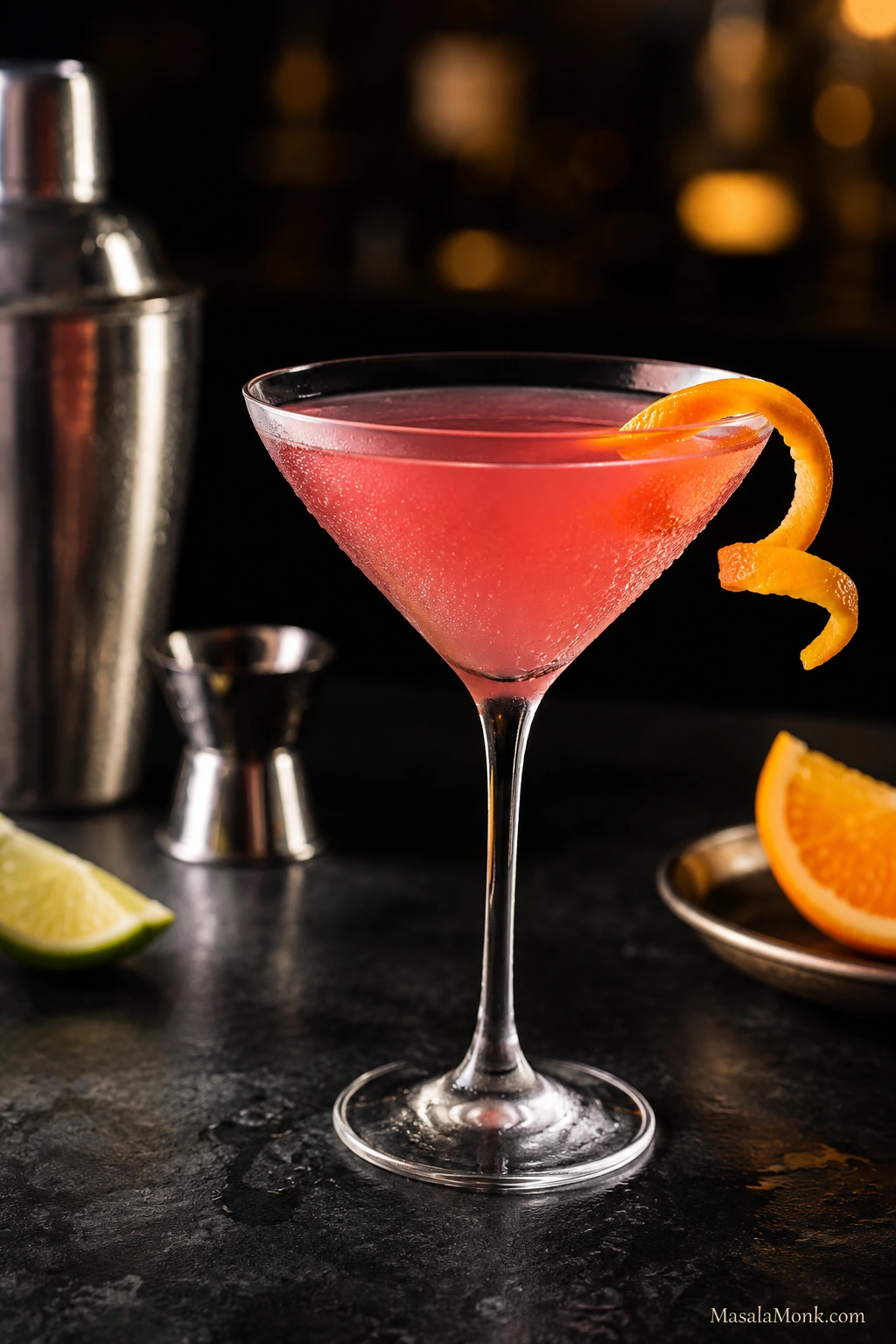
Classic Cosmopolitan cocktail in a chilled coupe glass with a curled orange twist on a dark bar surface.

A good Cosmopolitan has a little theatre to it: the chilled glass, the pink pour, the citrus oil on top, and that first cold sip that snaps awake without turning sour. It should feel like a real cocktail, not a giant vodka-cranberry — polished, cold, and easy to sip.

Make this first: Shake 1½ oz vodka, ¾ oz Cointreau, ¾ oz cranberry juice cocktail, and ½ oz fresh lime juice with plenty of ice. Strain into a chilled coupe or martini glass and finish with an orange twist.

The Cosmo has always carried a little party-glass glamour, but the reason it survives is simple: cranberry, lime, orange, and vodka can taste fantastic when the ratio is right. This version starts balanced, then shows you how to tune the next glass drier, softer, lighter, or party-ready.

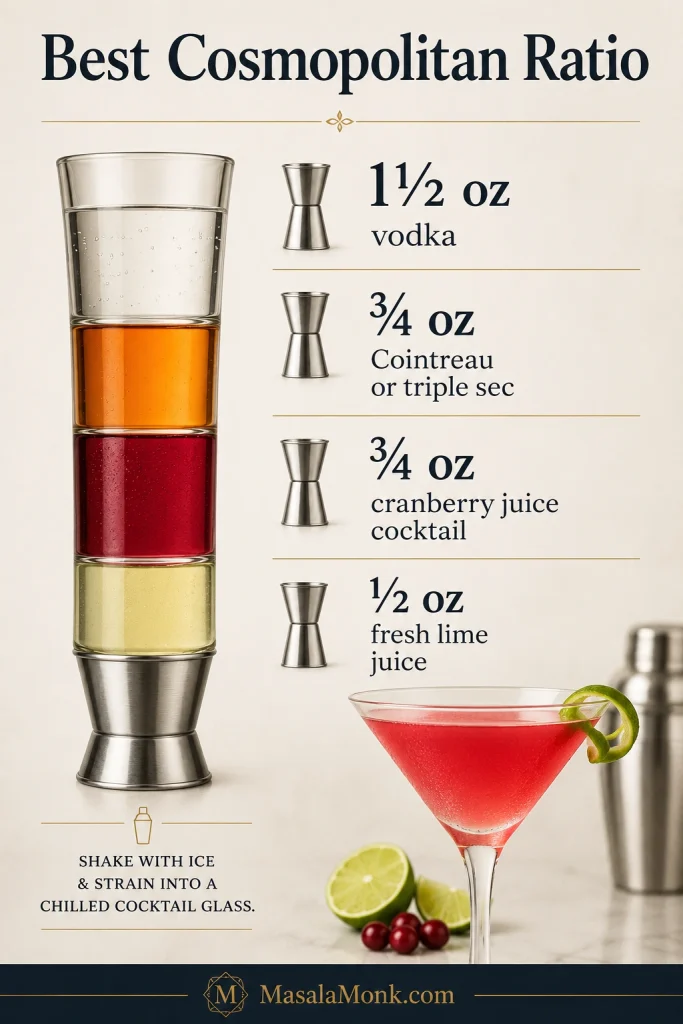
Cosmopolitan ratio guide showing vodka, orange liqueur, cranberry juice cocktail, and fresh lime juice measurements.
This is the balanced Cosmo ratio to make first: vodka for structure, orange liqueur for smoothness, cranberry for color, and lime for snap.

Cosmo at a Glance

DrinkClassic Cosmopolitan cocktail, also called a Cosmo
TasteIcy, pink, cranberry-lime, lightly sweet, citrus-bright
Starting ratio1½ oz vodka : ¾ oz orange liqueur : ¾ oz cranberry : ½ oz lime
Cranberry to useCranberry juice cocktail for familiar color and easy mixing
Orange liqueurCointreau, or a good-quality triple sec
VodkaCitrus vodka for a bar-style feel; plain vodka also works
MethodShake hard with ice and strain
GlassSmall coupe, martini glass, Nick & Nora, or cocktail glass
GarnishOrange twist first choice; lemon or lime twist also works
Time5 minutes

Jump to

Classic Cosmopolitan Recipe

Start with this version if you want the Cosmo most people are hoping for at home: a clean vodka base, bright cranberry color, fresh lime snap, and enough orange liqueur to round the edges.

Prep time5 minutes
Cook time0 minutes
Total time5 minutes
Servings1 cocktail
MethodShaken
GlassSmall coupe, martini glass, Nick & Nora, or cocktail glass

Ingredients

  • 1½ oz / 45 ml vodka or citrus vodka
  • ¾ oz / 22 ml Cointreau or good triple sec
  • ¾ oz / 22 ml cranberry juice cocktail
  • ½ oz / 15 ml fresh lime juice
  • Ice, for shaking
  • Orange twist, lemon twist, or lime twist, for garnish

Method

  1. Chill a small coupe, martini glass, Nick & Nora, or cocktail glass.
  2. Add vodka, Cointreau or triple sec, cranberry juice cocktail, and fresh lime juice to a cocktail shaker.
  3. Fill the shaker at least halfway with ice.
  4. Shake hard for 15–20 seconds, or until the outside of the shaker feels very cold.
  5. Strain into the chilled glass. Fine strain if you want a cleaner pour with fewer lime pulp bits or ice shards.
  6. Twist orange peel over the glass to release the oils, garnish, and serve immediately.

The first sip should be cold and citrusy, with cranberry in the background and orange on the nose. Lime hitting first means the glass needs softening; cranberry taking over means the next round should go drier.

A bar Cosmo usually tastes smoother because of accurate measuring, enough ice, hard shaking, and a properly chilled glass. The cocktail drinks easily, but it is still spirit-forward, so keep the pour modest and serve it properly cold.

Need to tune the glass? Go to Best Cosmopolitan Ratio if you want a drier or softer style, or jump to How to Fix the Taste if your Cosmo is too sour, sweet, strong, or red.

What Is a Cosmopolitan?

In simple terms, a Cosmopolitan is a shaken vodka cocktail made with orange liqueur, cranberry juice, and fresh lime juice. It is usually served straight up in a chilled coupe or martini glass with a citrus twist.

Whatever you call it — Cosmopolitan, Cosmo, or Cosmo martini — it should taste like a chilled cranberry-lime vodka cocktail, not a sweet red mixed drink.

Vodka cranberry usually means a taller, juicier drink served over ice; a Cosmopolitan is shorter, shaken, strained, citrusy, and balanced with orange liqueur and lime.

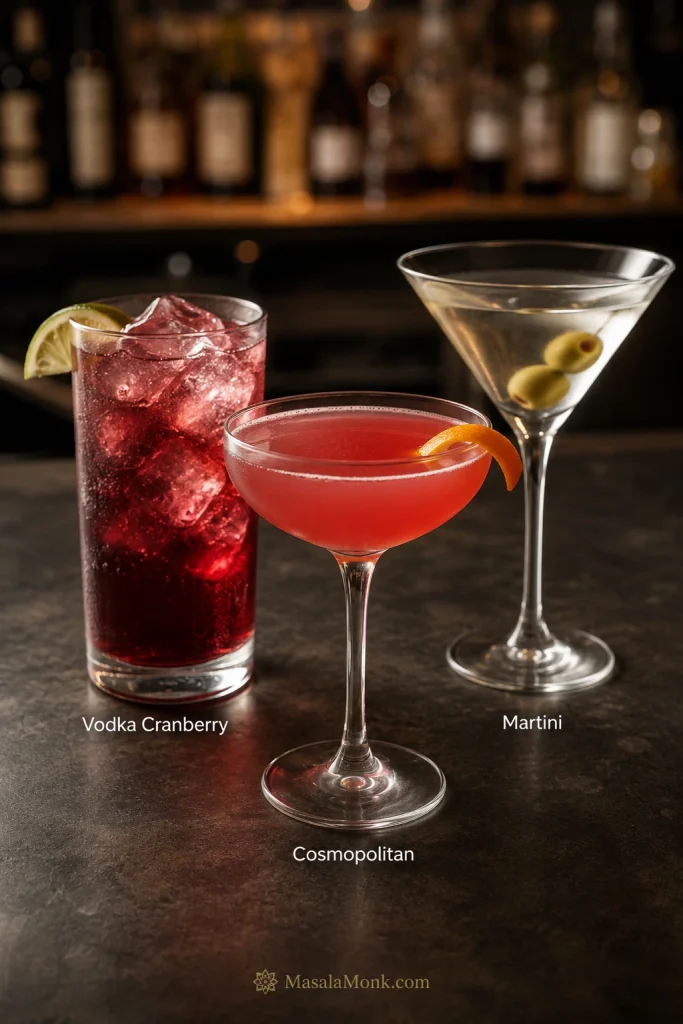
Cosmopolitan, vodka cranberry, and martini displayed side by side in different cocktail glasses.
The Cosmo sits between two familiar drinks: brighter than vodka cranberry, but softer and fruitier than a martini. That middle ground is why the ratio matters so much.

Unlike a classic martini, which is usually gin or vodka with vermouth, a Cosmo is built around cranberry, lime, orange liqueur, and vodka. If you want something closer to a true martini, MasalaMonk’s Dirty Martini Recipe goes briny and dry instead of cranberry-lime.

Best Cosmopolitan Ratio

If other Cosmo recipes have felt too sour, too juicy, or too strong, the issue was probably the ratio style — not you. Modern Cosmos range from dry bar-style versions with just a splash of cranberry to softer party glasses with more juice. This recipe starts in the balanced middle, then shows you how to move drier, brighter, softer, or lighter.

As a formal reference point, the International Bartenders Association lists a drier-style Cosmopolitan formula with Vodka Citron, Cointreau, cranberry juice, fresh lime, and a lemon twist. At home, the more useful question is not “Which ratio is the only correct one?” but “Which style tastes best in my glass?”

You do not need to study every table before shaking the first drink. Make the starting version, taste it, then come back here only if you want to tune the next pour.

IngredientOzMLWhat it does
Vodka1½ oz45 mlGives the drink its base and structure
Cointreau or triple sec¾ oz22 mlAdds orange flavor and softens the acidity
Cranberry juice cocktail¾ oz22 mlGives color, fruitiness, and a little sweetness
Fresh lime juice½ oz15 mlAdds brightness and tartness

Choose Your Cosmo Style

Once you understand the first ratio, the rest is simple. You are not locked into one “correct” pour; you are choosing the style you want to drink.

StyleVodkaOrange liqueurCranberryLimeUse when
Balanced home Cosmo1½ oz¾ oz¾ oz½ ozYou want the safest first version
Dry bar-style Cosmo1½ oz¾ oz½ oz¾ ozYou like tart, crisp cocktails
Juice-forward party Cosmo2 oz1 oz2–3 oz1–2 tspYou want a softer, fruitier party drink
Citrus-forward Cosmo2 oz1 oz1 oz1 ozYou want a sharper citrus edge
Lighter Cosmo1 oz½ oz1 oz½ ozYou want a lower-alcohol feel
Four Cosmopolitan ratio styles shown in glasses, including dry, balanced, juice-forward, and lighter versions.
Different Cosmopolitan ratios create different drinking styles, so choose the result first: dry, balanced, juice-forward, or lighter.

Start with the balanced home Cosmo if you are unsure. Prefer tart drinks? Move drier next time. Serving guests who like softer cocktails? Use the juice-forward party version.

Taste is the point. Once the first version is cold and measured, small changes are not mistakes — they are how you find your house Cosmo.

If you enjoy clean, shaken vodka cocktails, this sits near MasalaMonk’s Lemon Drop Martini Recipe, but the Cosmo is less sugary and more cranberry-citrus than lemon-candy.

Cosmopolitan Ingredients

A Cosmo only has four main ingredients — vodka, orange liqueur, cranberry juice, and lime — so every bottle and citrus choice shows up in the final sip. With a short drink like this, there is nowhere for tired citrus or rough vodka to hide.

Cosmopolitan ingredients with vodka, orange liqueur, cranberry juice, lime, orange peel, shaker, and coupe glass.
Because the ingredient list is short, there is nowhere for weak choices to hide. Use clean vodka, fresh lime, orange liqueur, and cranberry juice cocktail for a glass that tastes bright instead of rough.

Vodka or Citrus Vodka

Citrus vodka gives the most familiar bar-style flavor. Plain vodka keeps cranberry and lime cleaner. Orange vodka makes the drink rounder, while lemon vodka makes it sharper. Choose something you like in mixed drinks; it does not need to be expensive, but it should not taste rough.

Cointreau, Triple Sec, or Grand Marnier

Cointreau is the cleanest and most reliable orange liqueur for a Cosmo. Good triple sec works well for an everyday home version. Grand Marnier makes the glass richer because of its brandy base, so use it when you want a rounder, deeper orange note. Dry curaçao can also work if you like a warmer, cocktail-bar-style orange profile.

Orange liqueur guide showing Cointreau, triple sec, and Grand Marnier choices for a Cosmopolitan.
Cointreau makes the cleanest orange-forward Cosmo, triple sec keeps it simple, and Grand Marnier adds weight. Orange liqueur changes the finish, not just the sweetness.

Cranberry Juice Cocktail

For the familiar pink Cosmo, cranberry juice cocktail is the easiest bottle to use. It brings color, fruitiness, and enough sweetness to stand up to the fresh lime.

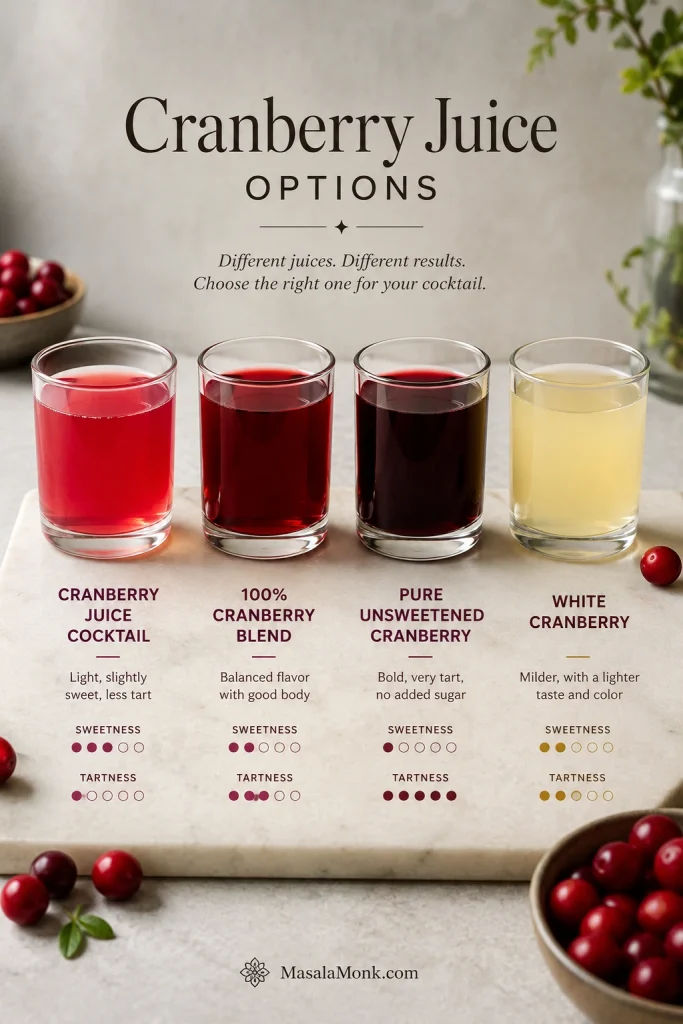
Pure unsweetened cranberry juice is much sharper. It can make a good version, but you usually need to reduce the lime or add a little more orange liqueur so the drink does not become aggressively tart. If your last Cosmo tasted too sour, the problem may not have been you; it may have been unsweetened cranberry plus too much lime.

Cranberry optionWhat happens in the cocktailAdjustment
Cranberry juice cocktailFamiliar pink color, lightly sweet, easiest to mixNo adjustment needed
100% cranberry blendLess sweet, more tartReduce lime slightly if needed
Pure unsweetened cranberryVery sharp and dryAdd sweetness or use less lime
White cranberry juicePale, softer, less traditionalUse for White Cosmo
Sparkling cranberryFizzy and lighterBetter for a spritz, not a shaken Cosmo
Cranberry juice options for a Cosmopolitan, including cranberry cocktail, unsweetened cranberry, and white cranberry.
Cranberry juice cocktail is the easiest route to a classic pink Cosmopolitan. Unsweetened cranberry is sharper, so reduce lime or add a touch more sweetness before judging the drink.

Fresh Lime Juice

Fresh lime juice gives the drink its snap. It is worth squeezing because bottled lime often tastes dull or metallic in short cocktails. If lemon is all you have, use a little less; it can work, but it shifts the flavor away from the usual cranberry-lime profile.

Orange Twist, Lemon Twist, or Lime Garnish

An orange twist is the best home garnish because it lifts the orange liqueur aroma. Twist the peel over the glass so the oils spray onto the surface. Lemon makes the drink sharper, while lime reinforces the cranberry-lime profile. Sugared cranberries look beautiful for holidays, but keep them optional so the glass still feels elegant.

Another elegant vodka cocktail where the ratio matters more than extra sweetness is MasalaMonk’s Lychee Martini Recipe.

Got the bottles ready? Jump to How to Shake a Better Cosmopolitan, or use Cosmopolitan Substitutions That Still Work if you are missing cranberry, lime, vodka, or orange liqueur.

How to Shake a Better Cosmopolitan

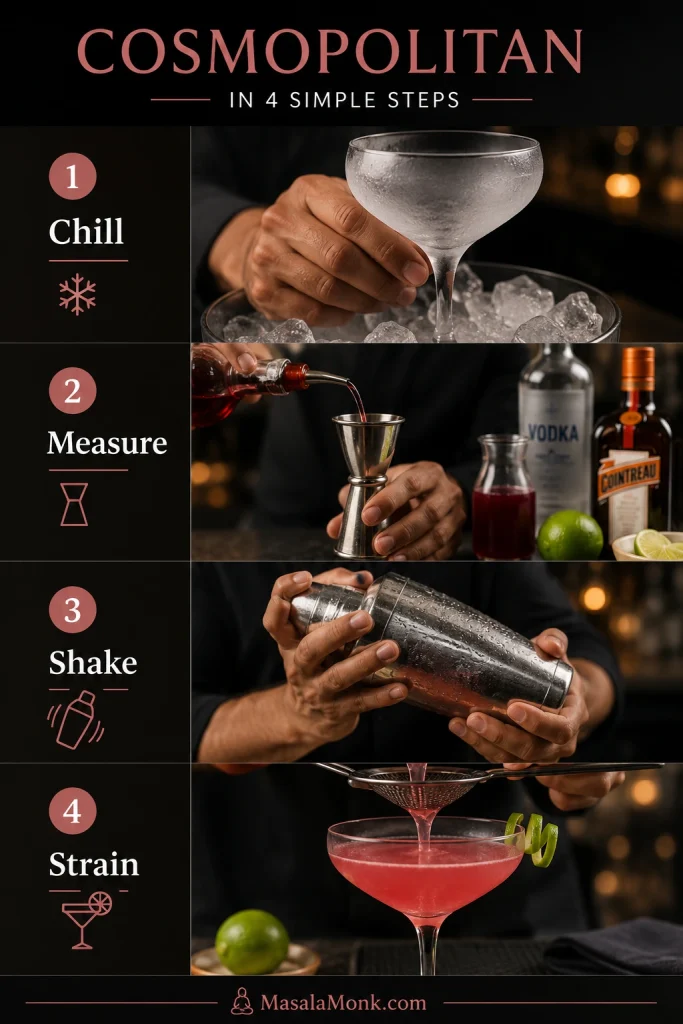
A Cosmopolitan should be shaken, not stirred. Shaking chills the drink, softens the alcohol, integrates the lime, and gives the glass a cleaner texture.

1. Chill the glass

Put the glass in the freezer for a few minutes or fill it with ice water while you measure the ingredients. A cold glass keeps the Cosmo crisp after straining.

2. Measure carefully

Add vodka, orange liqueur, cranberry juice cocktail, and fresh lime juice to the shaker. Measure the first one so you know what the balanced version tastes like before you adjust it.

3. Shake hard with ice

Fill the shaker at least halfway with ice and shake hard for 15–20 seconds. The outside of the shaker should feel very cold. That chill and dilution are what make the drink taste smooth instead of hot.

4. Strain and garnish

Strain into the chilled glass. Fine strain if you want a more polished pour. Express an orange twist over the surface, garnish, and serve right away.

A better Cosmo is mostly sequence: chill the glass, measure the pour, shake hard with ice, then strain while the drink is still icy.

Four-step Cosmopolitan process guide showing a chilled glass, measured ingredients, cocktail shaker, and strained pink drink.
The method is simple, but the order matters. Measuring, shaking hard, and straining right away give a homemade Cosmo its cold, smooth, bar-style texture.

You do not need a full bar cart. A shaker or clean jar, a jigger or measuring spoon, fresh lime, plenty of ice, and a chilled glass are enough.

No jigger? One tablespoon equals ½ oz. For the main recipe, use 3 tablespoons vodka, 1½ tablespoons Cointreau, 1½ tablespoons cranberry juice cocktail, and 1 tablespoon fresh lime juice.

A small coupe makes the drink look intentional. Cosmos look best a little restrained: icy, pink, and just full enough to feel elegant.

How to Fix the Taste

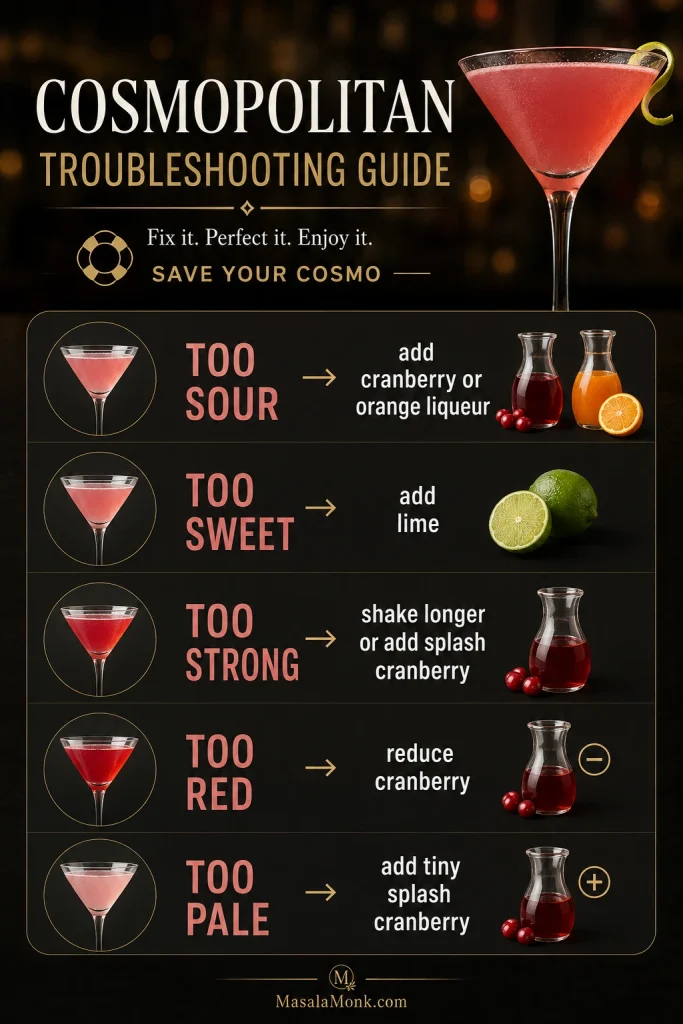
Most off-balance Cosmos are easy to rescue. Add a little, shake briefly again with ice, then taste. Work in small ¼ oz moves so the drink stays polished.

ProblemLikely causeFix
Too sourToo much lime or unsweetened cranberryAdd ¼ oz cranberry juice cocktail or ¼ oz orange liqueur.
Too sweetToo much cranberry cocktail or sweet triple secAdd ¼ oz fresh lime juice.
Too strongNot enough dilution or too much vodkaShake longer with plenty of ice or add a small splash of cranberry.
Too wateryIce sat in the glass too longShake fresh and serve immediately.
Too redToo much cranberry juiceReduce cranberry next time or use the starting ratio.
Too paleToo little cranberry juiceAdd a tiny splash of cranberry juice cocktail.
Harsh vodka smellWeak citrus aroma or rough vodkaShake well and express an orange twist over the drink.
Flat flavorBottled lime or old citrusUse fresh lime juice and a fresh citrus twist.
Cosmopolitan troubleshooting guide for a drink that is too sour, too sweet, too strong, too red, or too pale.
Most off-balance Cosmos need correction, not a restart. Instead, adjust in small ¼ oz moves, shake briefly again with ice, and taste before changing anything else.

How to Get the Right Pink Color

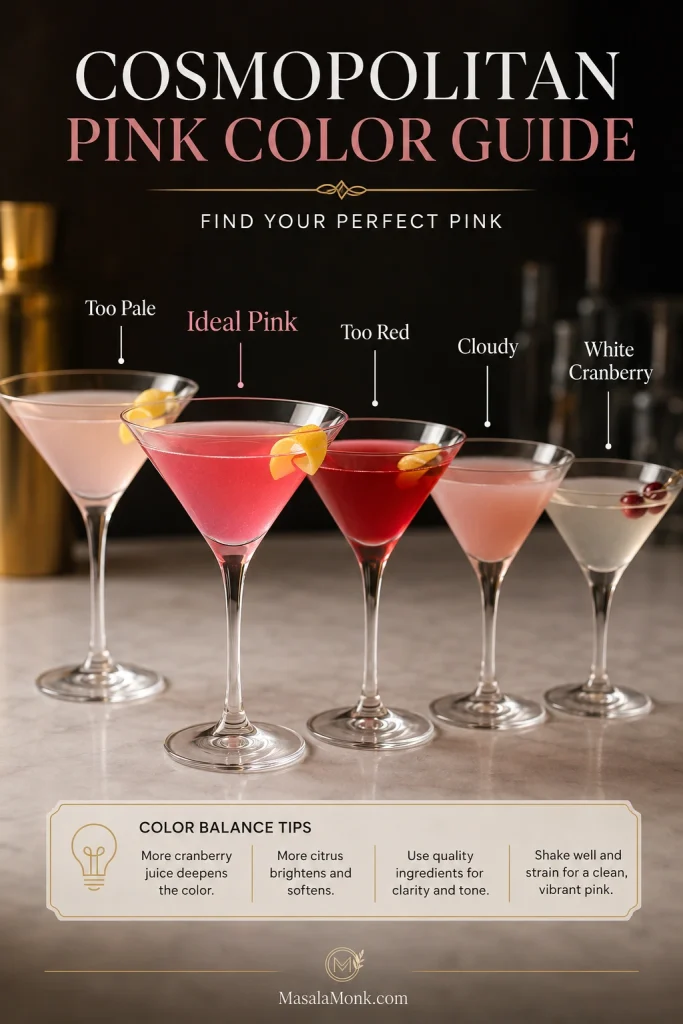
Aim for pink to light cranberry-red — bright enough to look like a Cosmo, not so dark that it tastes like straight juice. The color changes quickly depending on the cranberry and the ratio.

  • Deep red: too much cranberry. Use less cranberry next time or move back to the starting ratio.
  • Very pale: too little cranberry. Add a small splash of cranberry juice cocktail.
  • Cloudy: pulpy lime juice or rough straining. Use fresh strained lime juice and strain cleanly.
  • Dull or brownish: dark liqueur, old juice, or too much rich orange liqueur. Use fresh juice and a cleaner orange liqueur.
  • Almost clear: white cranberry juice. That is closer to a White Cosmo than the regular pink version.
Cosmopolitan color guide showing pale, ideal pink, deep red, cloudy, and white cranberry versions.
Color gives you an early clue about balance. If a Cosmopolitan looks too dark, it probably has too much cranberry; if it looks cloudy, the juice choice or shake may be the reason.

Making more than one? Go to Pitcher Cosmopolitan for Parties before scaling the recipe, because pitcher Cosmos need dilution handled differently from single shaken drinks.

Pitcher Cosmopolitan for Parties and Make-Ahead

Party Cosmos need one rule: keep ice out of the batch until serving. The pitcher should make you look relaxed, not trap you behind a shaker all night.
Pitcher of Cosmopolitans with chilled coupe glasses, citrus twists, and ice kept separately for serving.
Batch the Cosmopolitan mixture ahead for parties, but keep ice out of the pitcher. That way, guests still get a cold, balanced drink instead of a watered-down Cosmo.

This pitcher uses the balanced ratio. For a softer party batch, increase the cranberry slightly and reduce the lime to taste.

BatchVodkaCointreau/triple secCranberry juice cocktailFresh lime juice
4 drinks6 oz / 180 ml3 oz / 90 ml3 oz / 90 ml2 oz / 60 ml
8 drinks12 oz / 360 ml6 oz / 180 ml6 oz / 180 ml4 oz / 120 ml
12 drinks18 oz / 540 ml9 oz / 270 ml9 oz / 270 ml6 oz / 180 ml

How to Serve a Pitcher Cosmo

  • Mix vodka, orange liqueur, cranberry juice, and lime juice in a pitcher.
  • Refrigerate until very cold.
  • Keep ice out of the pitcher until serving so the batch does not turn watery.
  • Shake individual servings with ice and strain for the best texture.
  • For easier party service, stir the chilled pitcher with ice just before pouring.
  • Keep citrus twists and garnishes separate until serving.

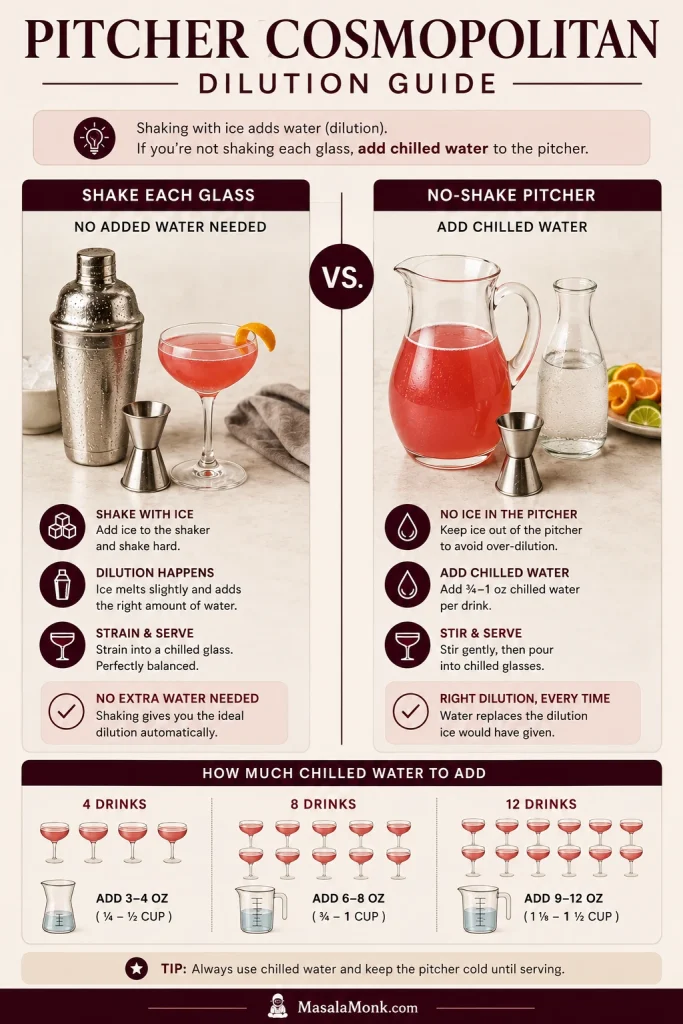
A pitcher Cosmo often fails for one boring reason: people forget that shaking with ice adds water. That dilution is part of the recipe.

If you want to serve the pitcher without shaking individual portions, add about ¾ to 1 oz chilled water per drink to the batch, or stir the pitcher well with ice just before serving. That means about 3–4 oz chilled water for 4 drinks, 6–8 oz for 8 drinks, or 9–12 oz for 12 drinks.

Pitcher Cosmopolitan dilution guide comparing shaking each glass with adding chilled water to a no-shake pitcher.
Ice chills a shaken Cosmo and also softens it with dilution. For a no-shake pitcher, measured chilled water keeps the batch smooth instead of sharp or syrupy.

If you shake each serving with ice, do not add the extra water to the pitcher. The shaker will handle the dilution for you.

Make-Ahead Notes

Shake one or two drinks fresh whenever possible. For a pitcher, mix the alcohol, cranberry juice, and lime juice a few hours ahead, then refrigerate the batch without ice. Fresh lime tastes best the day it is squeezed, and citrus twists stay most fragrant when cut close to serving time.

For another cranberry party drink with a colder, spicier feel, try the Cranberry Moscow Mule Recipe. It uses ginger beer instead of a martini-style shaken base.

Cosmopolitan Variations

After the first good Cosmo, variations are just small turns of the same dial. Keep the vodka-orange-citrus structure, then change the fruit, sweetness, or color.

Cosmopolitan variations board with classic, white, pomegranate, watermelon, frozen, and virgin mocktail versions.
Once the base Cosmo ratio is right, variations become easier to control. Keep the orange-citrus backbone, then adjust fruit, color, texture, or alcohol level for the occasion.

Elegant and Party Versions

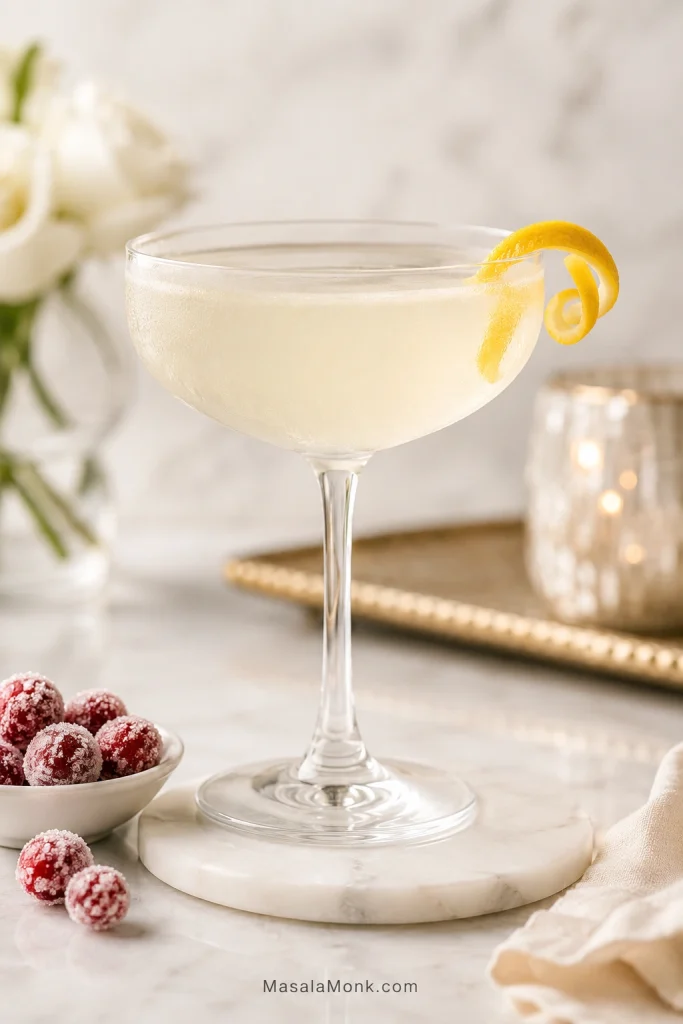
White Cosmopolitan: shake 1½ oz vodka, ¾ oz Cointreau or good triple sec, 1 oz white cranberry juice, and ½ oz fresh lime juice with ice. Strain into a chilled glass and garnish with a lemon twist, orange twist, or sugared cranberries.

Pale White Cosmopolitan cocktail in a coupe glass with a lemon twist and sugared cranberries beside it.
White cranberry juice makes a softer, paler Cosmopolitan without losing the drink’s shape, which is why it works well for brunch, holidays, and elegant party glasses.

Floral White Cosmo: use ½ oz elderflower liqueur and ¼ oz Cointreau instead of the full ¾ oz Cointreau. It turns softer, more floral, and very brunch-friendly.

If you are planning a brunch or party spread, MasalaMonk’s Mimosa Recipes guide gives you lighter sparkling options to serve beside a pitcher of Cosmos.

Fruitier Versions

Pomegranate Cosmo: replace ½ to ¾ oz of the cranberry juice with pomegranate juice for a deeper ruby color and a sharper tart-fruit finish. If the pomegranate tastes dry, add a tiny splash more orange liqueur.

Watermelon Cosmo: muddle a few cubes of ripe watermelon in the shaker, then add 1½ oz vodka, ¾ oz Cointreau or triple sec, ½ oz lime juice, and ½ oz cranberry juice. Shake with ice and fine strain. A tiny pinch of salt helps if the watermelon tastes flat.

Cranberry-Orange Cosmo: add ¼–½ oz fresh orange juice or use orange vodka. Keep the orange modest so it rounds the drink without turning it into brunch juice.

Frozen, Lighter, and Non-Alcoholic Versions

Frozen Cosmopolitan: blend vodka, orange liqueur, cranberry juice cocktail, lime juice, and ice until slushy. Very cold blended cocktails taste less sweet, so start with the juice-forward party ratio.

Lower-Sugar Cosmopolitan: use 100% cranberry juice or a lower-sugar cranberry blend, then reduce the lime slightly. For a lighter alcohol feel, use 1 oz vodka instead of 1½ oz.

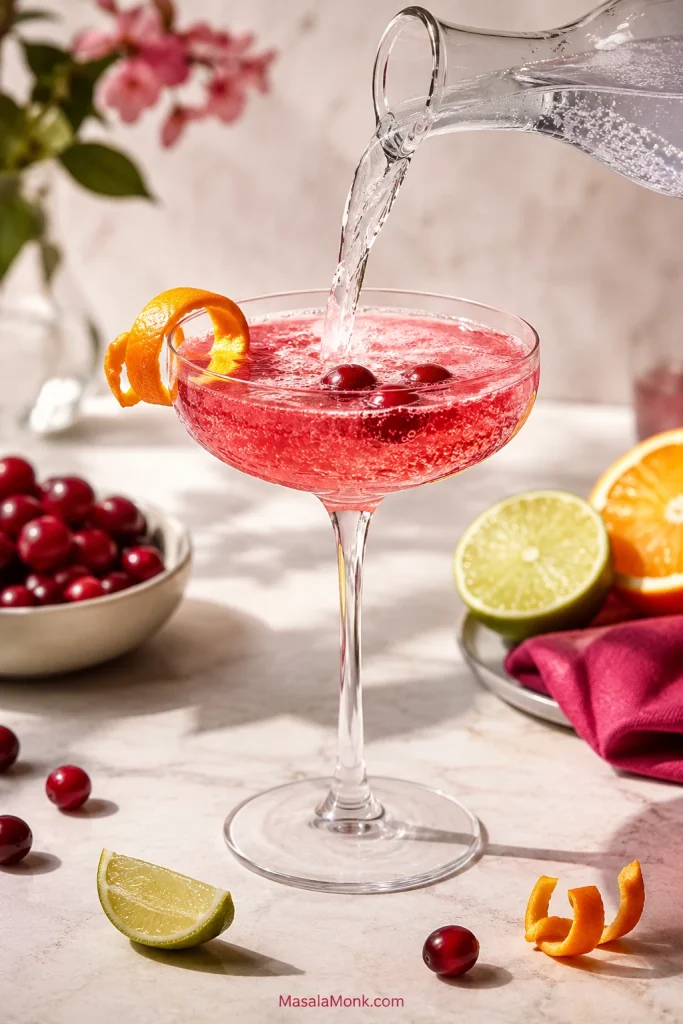
Virgin Cosmopolitan Mocktail: shake 2 oz cranberry juice, ½ oz orange juice or orange syrup, and ½ oz fresh lime juice with ice. Strain into a chilled glass and top with 1–2 oz sparkling water. Add sparkling water after shaking, not before; carbonation can build pressure inside a shaker.

Virgin Cosmopolitan mocktail with cranberry, citrus garnish, and sparkling water being poured into a coupe glass.
Shake the cranberry-citrus base first, then add sparkling water after straining. This keeps pressure out of the shaker and helps the mocktail stay bubbly.

Cosmopolitan Substitutions That Still Work

Missing something? These swaps keep the drink recognizably pink, citrusy, and clean instead of sending it in a completely different direction. The trick is to swap without losing the triangle: cranberry, lime, orange.

Missing ingredientBest substituteWhat to know
No CointreauGood triple secAdjust if it tastes very sweet.
No triple secCointreau, Grand Marnier, or dry curaçaoGrand Marnier makes the cocktail richer.
No cranberry juice cocktail100% cranberry blendReduce lime slightly or add a touch more orange liqueur.
No limeLemon juiceUse a little less; lemon changes the flavor.
No citrus vodkaPlain vodkaUse a good citrus twist for aroma.
No shakerClean jar with tight lidShake carefully with ice and strain.

What to Serve with a Cosmopolitan

Think salty, creamy, crisp, and bite-sized — food people can pick up while holding a chilled glass. The best Cosmo food is the kind people can nibble between sips without needing a knife and fork.

Cosmopolitan cocktail served with cheese, crostini, shrimp, olives, salted nuts, and crackers.
Salty, creamy, and crisp snacks pair best with a cold cranberry-lime Cosmopolitan. Bite-sized appetizers keep guests sipping, snacking, and mingling easily.
  • Cheese boards with brie, goat cheese, sharp cheddar, salted nuts, crackers, or a make-ahead cheese ball
  • Shrimp cocktail, lemon-garlic shrimp, or other light seafood appetizers
  • Crostini with whipped feta, goat cheese, smoked salmon, or cucumber
  • Olives, Marcona almonds, seasoned popcorn, chips, or crisp crackers
  • Cranberry-orange holiday bites or small brunch-friendly snacks

FAQs

What is in a Cosmopolitan cocktail?

A Cosmopolitan usually contains vodka or citrus vodka, Cointreau or triple sec, cranberry juice, fresh lime juice, ice, and a citrus twist. The flavor should be cranberry-lime with a smooth orange finish.

Is a Cosmopolitan a martini?

People often call it a Cosmo martini because it is served in a martini-style glass, but it is not a classic martini. Classic martinis usually rely on gin or vodka with vermouth. Cosmos are shaken with cranberry, orange liqueur, and lime.

Is a Cosmo the same as vodka cranberry?

No. Vodka cranberry is a taller mixed drink over ice; a Cosmo is shaken, strained, citrusy, and balanced with orange liqueur.

Which vodka is best for a Cosmo?

Citrus vodka gives the most recognizable bar-style flavor, but plain vodka works well too. Use a clean vodka you enjoy in mixed drinks and rely on fresh lime and a citrus twist for brightness.

Cointreau or triple sec: what should you use in a Cosmo?

Cointreau is the cleanest choice. Good triple sec works for an everyday Cosmo, while Grand Marnier makes the drink richer and rounder.

Should cranberry juice cocktail or 100% cranberry juice be used?

Cranberry juice cocktail is easiest for the familiar pink Cosmo. 100% cranberry tastes sharper, so use a little less lime or add a touch more orange liqueur.

Why is my Cosmopolitan too sour?

It probably has too much lime or very tart cranberry juice. Add a small splash of cranberry juice cocktail or orange liqueur, then shake briefly again with ice.

How do you make a pitcher of Cosmos?

Scale the vodka, orange liqueur, cranberry juice, and lime juice in a pitcher, then chill without ice. Shake individual servings when possible. For a no-shake pitcher, add ¾ to 1 oz chilled water per drink.

What is a White Cosmopolitan?

A White Cosmopolitan is a paler version made with white cranberry juice instead of regular cranberry juice. It can be simple with Cointreau or softer and floral with elderflower liqueur.

How do you make a lower-sugar Cosmopolitan?

Use 100% cranberry juice or a lower-sugar cranberry blend, then reduce the lime slightly. Expect it to taste sharper than the cranberry juice cocktail version.

Is there a non-alcoholic Cosmo mocktail?

Yes. Shake cranberry juice, orange juice or orange syrup, and fresh lime with ice, strain, then top with sparkling water. Add sparkling water after shaking so pressure does not build.

Once you know the balance, a Cosmo becomes easy: cold glass, measured pour, fresh lime, orange on the nose, and just enough cranberry to glow pink. Start with the balanced ratio, then tune the next round until it feels like your house drink.

Posted on 16 Comments

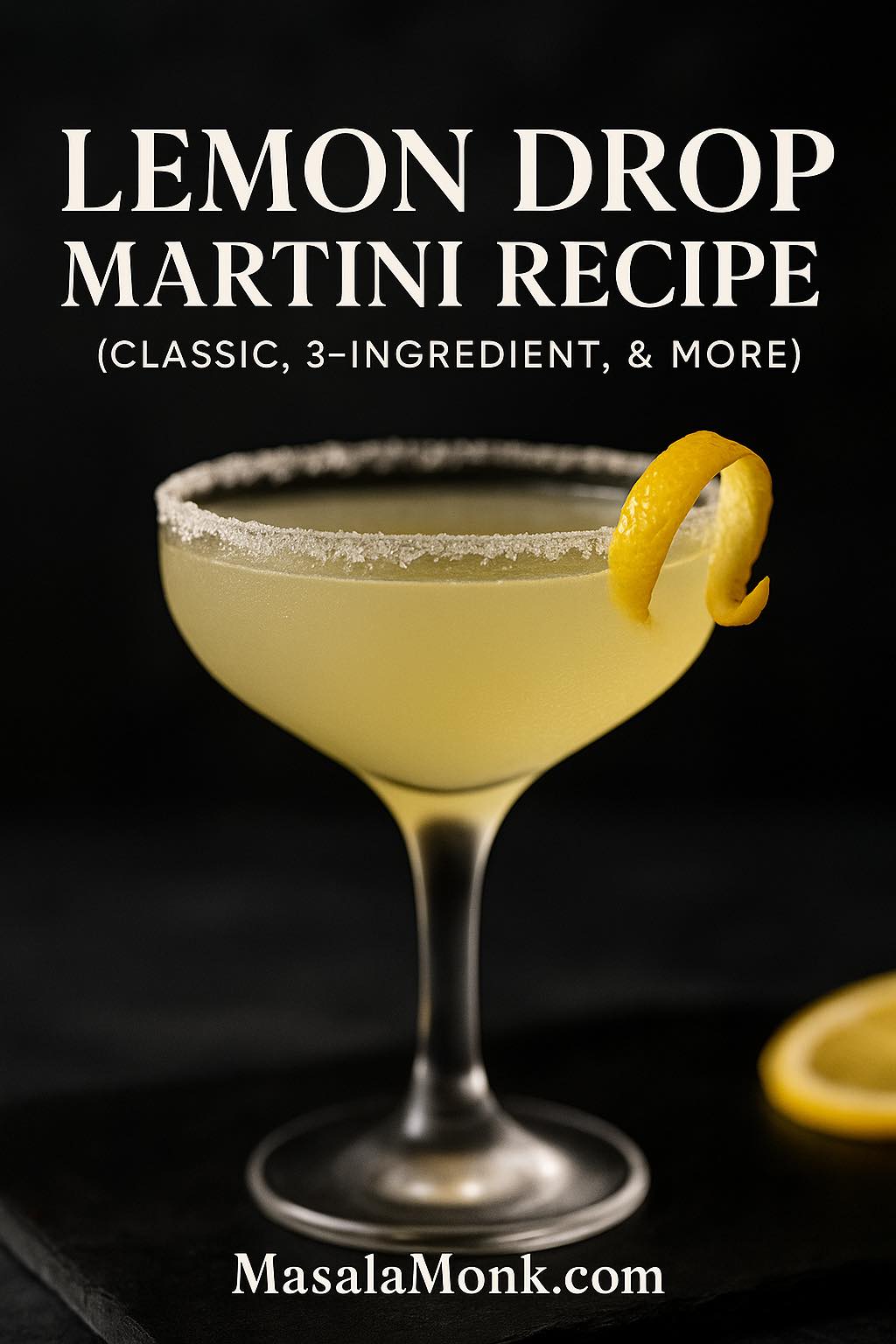
Lemon Drop Martini Recipe (Classic, 3-Ingredient & More)

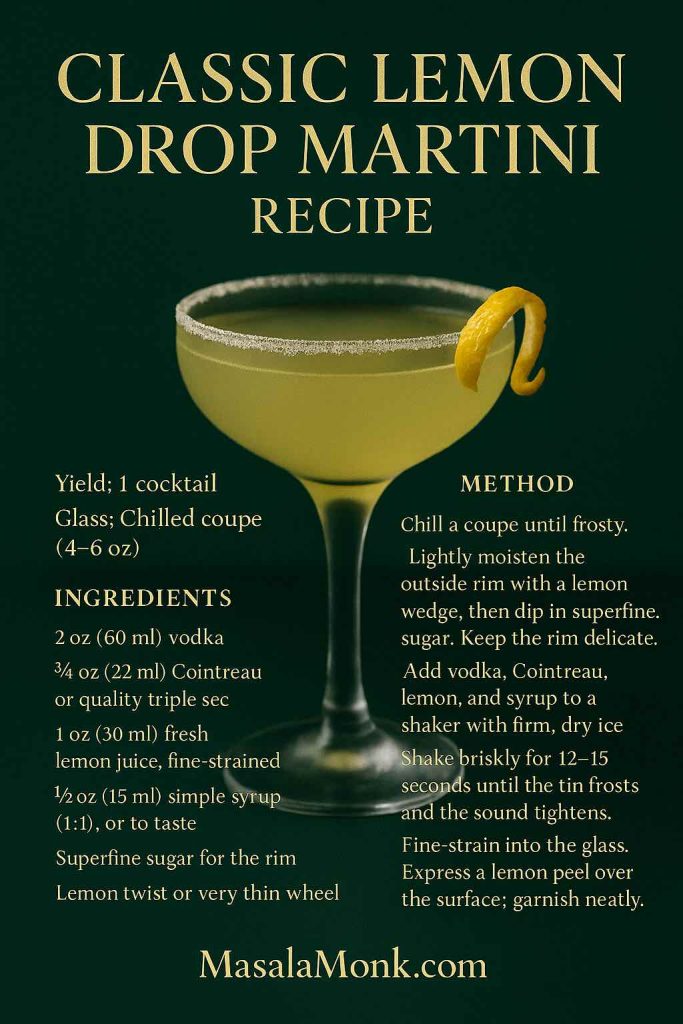
Chilled lemon drop martini in a sugar-rimmed glass with a lemon twist, fresh lemons, and cocktail tools on a styled bar surface.

A good lemon drop martini should taste lively before it tastes sweet. The glass is deeply chilled, the rim sparkles lightly, and the first sip lands with just-squeezed lemon, clean vodka, a soft orange note, and enough sweetness to smooth the sharp edge. It should feel polished, not syrupy; refreshing, not harsh; easy, but still pretty enough to make the glass feel special.

This easy lemon drop martini starts with a balanced classic ratio: vodka, Cointreau or triple sec, fresh lemon juice, and simple syrup, shaken hard and poured into a lightly sugared glass. Once that baseline tastes right, you can make it without triple sec, soften it with limoncello, turn it into shots, batch it for guests, or add fruit without losing the crisp citrus snap.

Quick Answer: How to Make a Lemon Drop Martini

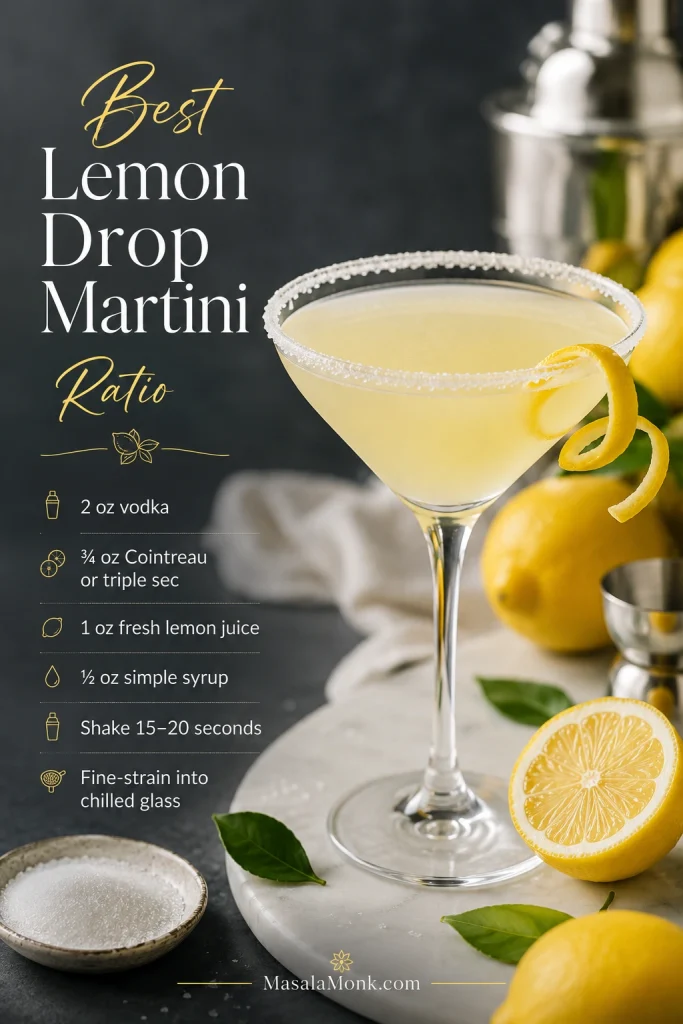
To make a classic lemon drop martini, shake 2 oz (60 ml) vodka, ¾ oz (22 ml) Cointreau or triple sec, 1 oz (30 ml) fresh lemon juice, and ½ oz (15 ml) simple syrup with firm ice for 15–20 seconds. Fine-strain into a chilled, lightly sugar-rimmed 5–6 oz coupe or martini glass, then garnish with a lemon twist.

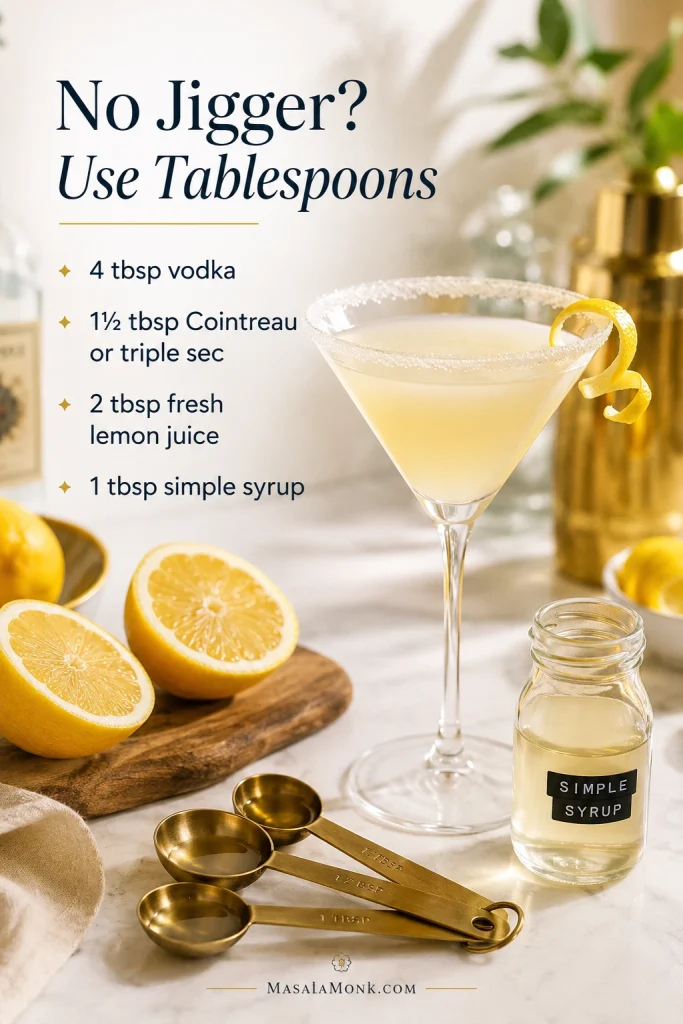
No jigger? Use 4 tablespoons vodka, 1½ tablespoons Cointreau or triple sec, 2 tablespoons fresh lemon juice, and 1 tablespoon simple syrup.

Before you shake, remember this: chill the glass, sugar only the outside rim, and adjust by teaspoons instead of guessing. Add syrup if the drink is too sour; add lemon if it tastes too sweet.

This is the drink to pour when you want something dressed up but not fussy: before dinner, for a small party, beside a dessert table, or as the first round when people want something bright and familiar.

Jump to What You Need

Classic Lemon Drop Martini Recipe

Make this version first. It is the classic baseline: lemon-forward, deeply chilled, gently sweet, and easy to adjust. A well-made Lemon Drop should hit in this order: cold lemon, smooth vodka, a soft orange note, then a small sparkle from the rim — not sour lemonade, melted candy, or a glass full of sugar.

Yield1 cocktail
Prep time5 minutes
Glass5–6 oz coupe or martini glass
FlavorLemon-forward, crisp, gently sweet
Shake time15–20 seconds
ServeImmediately

Ingredients

IngredientAmount
Vodka2 oz / 60 ml
Cointreau or quality triple sec¾ oz / 22 ml
Fresh lemon juice, fine-strained1 oz / 30 ml / 2 tbsp
Simple syrup, 1:1½ oz / 15 ml / 1 tbsp
Superfine sugar, for rim1–2 tbsp / about 12–25 g
Lemon twist or thin lemon wheel1

Method

  1. Chill a 5–6 oz coupe or martini glass for 5–10 minutes, or fill it with ice water while you work.
  2. Place superfine sugar on a shallow plate, moisten only the outside rim with lemon, and dip lightly.
  3. Add vodka, Cointreau or triple sec, fresh lemon juice, and simple syrup to a shaker.
  4. Fill the shaker with firm ice.
  5. Shake for 15–20 seconds, until the outside feels very cold.
  6. Fine-strain into the prepared glass.
  7. Express a lemon peel over the surface, then garnish with the twist or a thin lemon wheel.

You will know it is right when the drink feels cold and sharp at first, then softens almost immediately. The rim should add sparkle, not a mouthful of sugar.

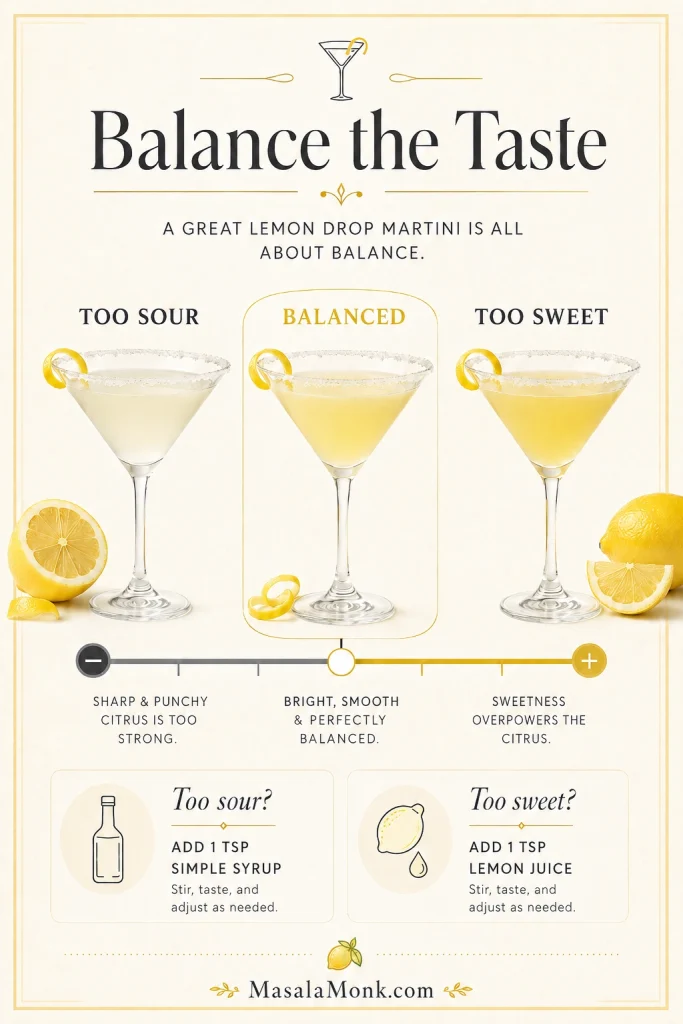
Taste before changing the recipe. Too sharp? Add 1 teaspoon simple syrup and shake briefly with fresh ice. Too sweet? Add 1 teaspoon lemon juice and re-shake. A Lemon Drop loses its edge as it warms, so pour it last-minute rather than letting filled glasses sit on a tray.

Classic lemon drop martini recipe card with a pale yellow cocktail, sugar rim, lemon garnish, and recipe measurements.
Use the classic recipe card as your baseline before changing the drink. Once the vodka, lemon, orange liqueur, and syrup work together, every variation becomes easier to adjust.

No-Jigger Lemon Drop Measurements

Use this quick conversion when measuring at home. Tablespoons keep the drink accurate, and teaspoon-sized adjustments keep the final sip from swinging too sour or too sweet.

Tablespoon measurement guide for a lemon drop martini with measuring spoons, lemons, simple syrup, and a finished cocktail.
Tablespoons are accurate enough for a home Lemon Drop when the ratio is clear. Measure first, then adjust in teaspoons so the drink stays lively without turning too sour or too sweet.

Before You Mix: 3 Details That Make It Taste Better

The recipe is simple, but the small details matter. Small technique choices make the drink feel bar-clean instead of last-minute.

1. Use fresh, strained lemon juice

A lemon drop is only as good as its lemon. Fresh juice tastes vivid and fragrant, while bottled juice often tastes flat or stale. Strain out pulp before shaking so the drink stays smooth.

2. Keep the sugar rim thin

The rim should frame the first sip, not turn the cocktail into dessert. Moisten only the outside edge of the glass so sugar does not fall into the drink.

3. Shake hard with firm ice

Shaking does more than chill the drink. It adds a small amount of water, softens the lemon, and gives the cocktail a smoother finish. If the shaker frosts or feels painfully cold, you are there.

Shake and Fine-Strain for a Cleaner Pour

Once the drink is measured, the shake controls texture as much as temperature. Cold ice, firm shaking, and fine-straining help the cocktail pour clean, bright, and smooth.

Cocktail shaker and fine strainer pouring a lemon drop martini into a prepared sugar-rimmed glass.
A firm shake chills, aerates, and lightly dilutes the drink. Fine-straining then gives the Lemon Drop Martini a cleaner texture with fewer ice shards or pulp flecks in the glass.

Need to rescue a drink that tastes off?

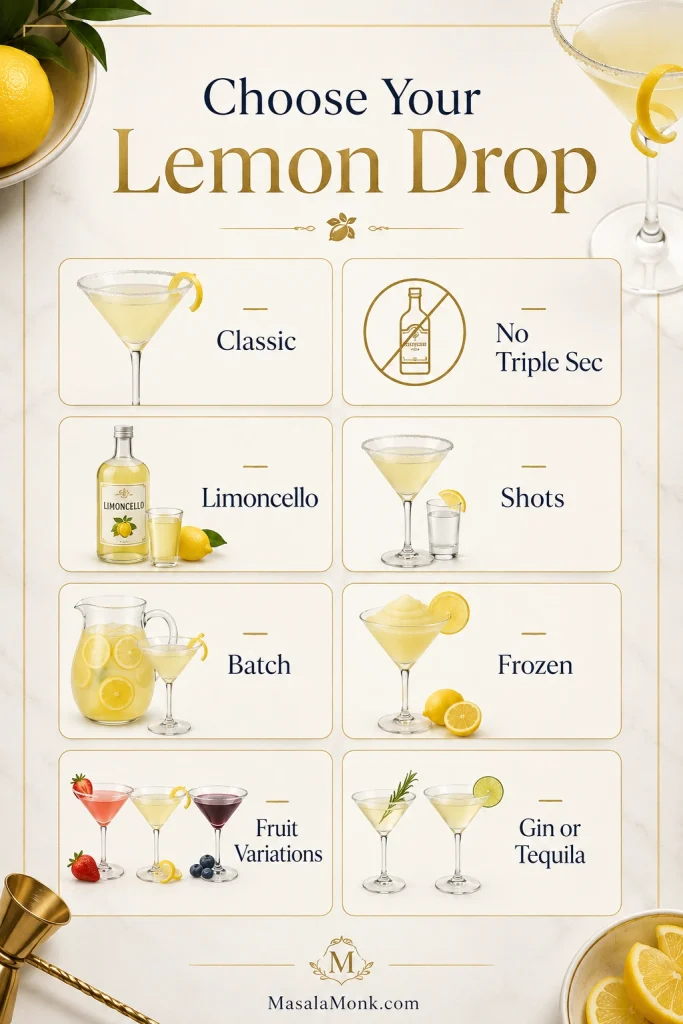
Choose Your Lemon Drop

Start with the classic, then change one thing at a time. That keeps the drink recognizable while letting you make it drier, sweeter, fruitier, stronger, softer, or easier to serve.

Decision guide showing lemon drop martini options including classic, no triple sec, limoncello, shots, batch, frozen, fruit variations, and gin or tequila.
Match the Lemon Drop to the moment: no triple sec for a simple pour, limoncello for softness, shots for a tray, and batch or frozen versions for guests.
Mood or needMake thisWhy it works
Clean and classicClassic Lemon Drop MartiniBest balance of vodka, orange, lemon, and syrup
No orange liqueur3-Ingredient Lemon DropVodka, lemon, syrup; rim optional
Softer and more lemonyLimoncello Lemon DropLimoncello adds round lemon perfume
Party trayLemon Drop ShotsSmaller, brighter, faster to serve
Hosting dinnerPitcher Lemon DropBatch ahead, then shake or dilute properly
Hot afternoonFrozen Lemon DropBlended, cold, citrusy
Pretty brunch drinkStrawberry or Lavender Lemon DropColor, aroma, and a softer mood
Drier twistGin Lemon DropMore botanical and less candy-like

Not sure where to start? Make the classic once, then decide whether you want it softer with limoncello, quicker as shots, or fruitier for a party glass.

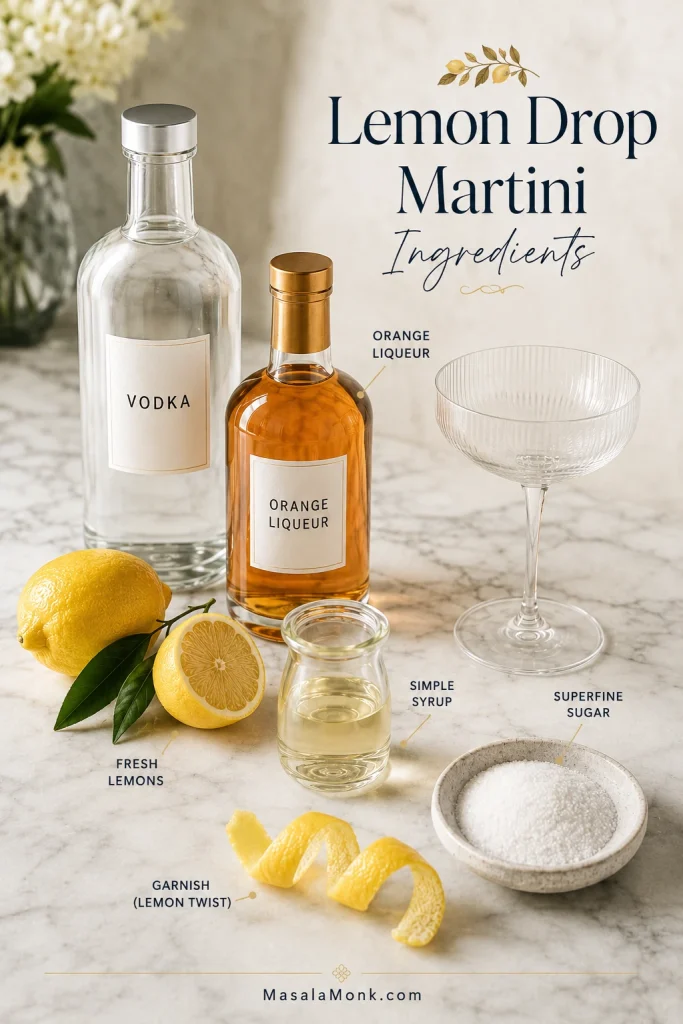
Lemon Drop Martini Ingredients

With only a few ingredients in the shaker, every choice shows up in the glass. Fresh lemon smells brighter, measured syrup keeps the drink crisp, and a neutral vodka lets the citrus lead.

Lemon drop martini ingredients on a marble surface, including vodka, orange liqueur, fresh lemons, simple syrup, superfine sugar, lemon twist, and glassware.
With so few ingredients, every shortcut shows quickly. Fresh lemon juice, measured syrup, orange liqueur, and neutral vodka create the polished Lemon Drop flavor.

Vodka

Plain vodka is the safest choice for the cleanest classic Lemon Drop. It does not need to be expensive; it just needs to stay out of the lemon’s way. Lemon vodka works if you want a louder citrus aroma, but reduce the syrup slightly so the drink does not turn candy-like.

Cointreau, Triple Sec, or Grand Marnier

Cointreau gives the clearest orange note. A good triple sec keeps the drink accessible and works well in the classic ratio. Grand Marnier tastes richer and rounder, so use a little less syrup if the cocktail feels too sweet.

Fresh Lemon Juice

Choose lemons that feel heavy for their size, then roll them before juicing. One medium lemon usually gives about 2 tablespoons juice, though dry lemons may give less. Plan on one lemon per cocktail, plus an extra lemon nearby.

Simple Syrup

For syrup, begin with a basic 1:1 mix made from equal parts sugar and water. Half an ounce is the best starting point for one drink. To make a small batch, stir ½ cup sugar with ½ cup hot water until clear, cool, then refrigerate in a clean jar and use within 2–3 weeks.

Superfine Sugar

Superfine sugar gives the smoothest rim because it dissolves quickly on the lips. Granulated sugar works, but it feels crunchier. Avoid powdered sugar; it can clump, turn pasty, and taste dusty.

No bar tools?

No shaker? A jar with a tight lid works. Use tablespoons instead of a jigger and a tea strainer instead of a cocktail strainer. One ounce equals 2 tablespoons. If using a jar, wrap it in a towel and make sure the lid seals tightly before shaking.

The Best Lemon Drop Ratio for a Balanced Drink

The Lemon Drop Ratio at a Glance

Use this ratio as the starting point before you change the syrup, rim, or liqueur. It keeps the lemon bright while giving the vodka sour enough softness to feel polished.

Lemon drop martini ratio card showing vodka, Cointreau or triple sec, fresh lemon juice, simple syrup, shake time, and a sugar-rimmed cocktail.
Use this Lemon Drop Martini ratio as the drink’s control panel: vodka gives structure, lemon brings sharpness, orange liqueur adds aroma, and syrup rounds the edge.

Think of the drink as a vodka sour served up: the vodka keeps it clear, the lemon gives it lift, the orange liqueur adds perfume, and the syrup softens the edge so the drink feels bright instead of sharp. Shaking supplies the cold dilution that makes it rounded instead of harsh. The sugar rim should stay outside the glass so the first taste sparkles while the cocktail underneath stays crisp. If you like this spirit-citrus-sugar balance, the Daiquiri recipe follows the same sour-cocktail logic with rum and lime.

If you want it…Adjust this way
Sharper and more citrus-forwardKeep syrup at ½ oz / 15 ml
Softer and sweeterIncrease syrup to ¾ oz / 22 ml
Drier and more bar-styleUse ½ oz / 15 ml orange liqueur and ½ oz / 15 ml syrup
More party-styleUse up to 1 oz / 30 ml syrup
Less sweet overallRim only half the glass
More aromaticExpress a fresh lemon peel over the drink

How to Balance a Lemon Drop That Tastes Off

Small corrections work better than big guesses. Taste once, adjust by the teaspoon, and shake briefly again so the fix blends into the drink.

Lemon drop martini balance guide showing too sour, balanced, and too sweet drinks with syrup and lemon juice adjustments.
Taste first, then fix the drink in teaspoons. Syrup softens a too-sharp Lemon Drop, while fresh lemon cuts a too-sweet one before a brief re-shake.

How to Make a Lemon Sugar Rim

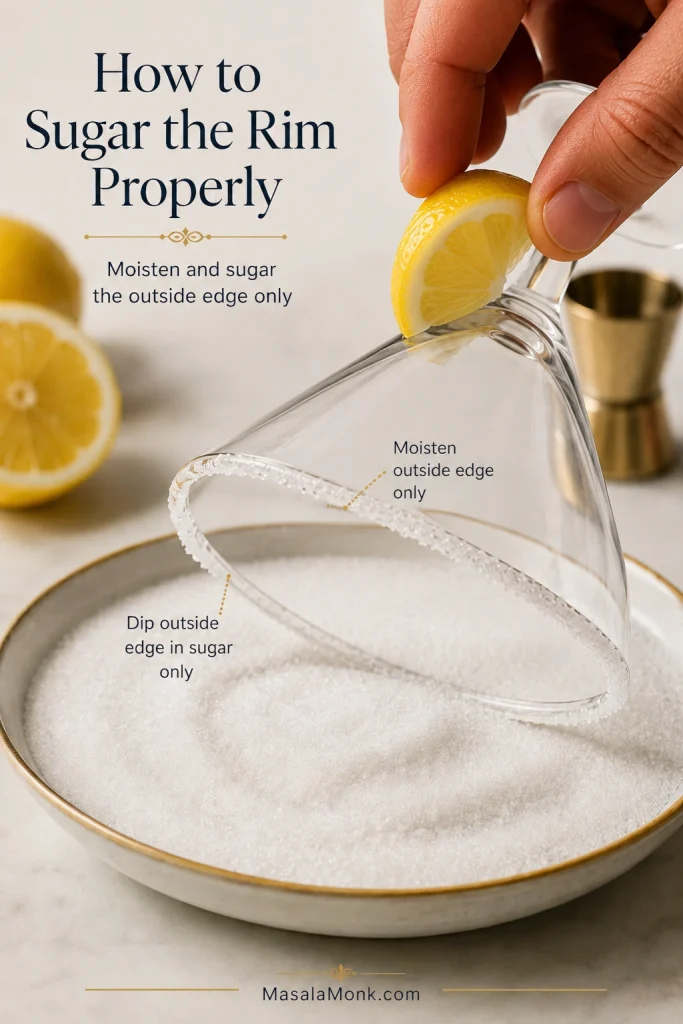
The rim should sparkle, not clump. A heavy sugar crust makes the first sip awkward and can drop sugar into the cocktail. The best lemon sugar rim is thin, even, and only on the outside edge of the glass.

  1. Add superfine sugar to a small shallow plate.
  2. Rub in 1 teaspoon finely grated lemon zest if you want a brighter rim.
  3. Run a lemon wedge around the outside edge of the glass only.
  4. Dip the moistened outside rim into the sugar.
  5. Let the glass sit for 2–3 minutes while you make the cocktail.
Close-up of a lemon drop martini glass being moistened and sugared only on the outside edge with superfine sugar.
Rim only the outside edge of the glass so sugar sweetens each sip, not the whole cocktail. The drink stays cleaner, brighter, and less likely to turn syrupy.

Prefer it less sweet? Rim only half the glass. Guests can choose the sugared side or the clean side, and the drink still looks polished without turning the first sip into candy.

That little sugared edge is part of the charm: the glass looks ready before the drink is even poured.

3-Ingredient Lemon Drop Martini, No Triple Sec or Cointreau

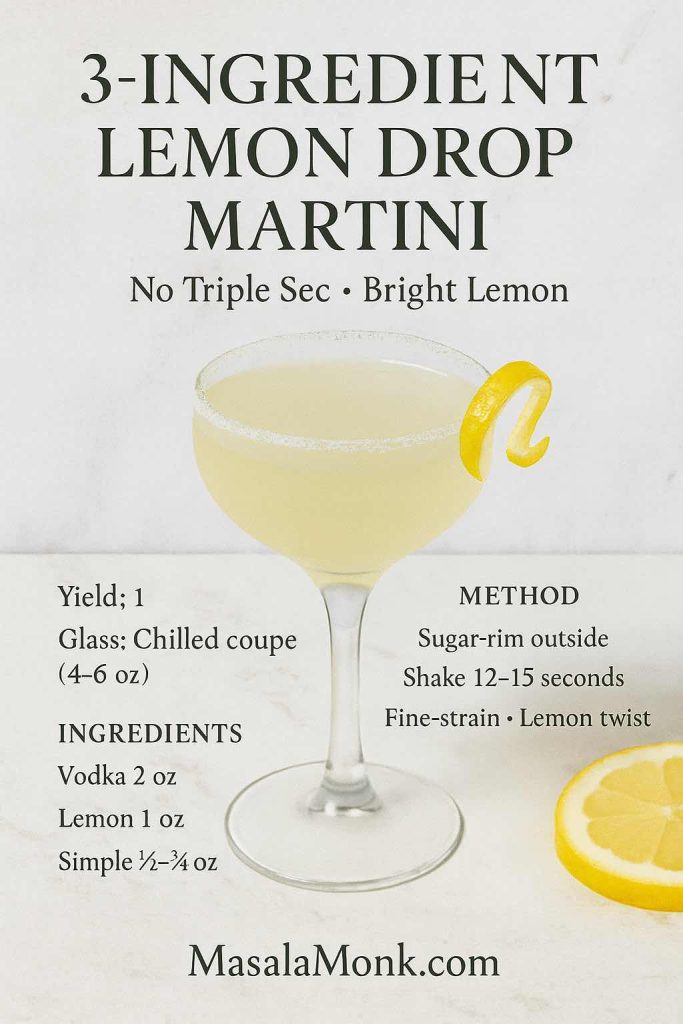
You can make a clean lemon drop martini without Cointreau or triple sec: vodka, lemon juice, and simple syrup. The sugar rim and lemon twist are optional, but they make even the simplest version feel complete.

IngredientAmount
Vodka2 oz / 60 ml
Fresh lemon juice1 oz / 30 ml
Simple syrup½–¾ oz / 15–22 ml
Optional superfine sugar for rim1–2 tbsp / about 12–25 g
Optional lemon twist1
Three-ingredient lemon drop martini card showing vodka, fresh lemon juice, simple syrup, and a sugar-rimmed cocktail.
Vodka, fresh lemon juice, and syrup keep this 3-ingredient Lemon Drop simple. A light sugar rim and lemon twist make the shortcut feel complete.

Shake the vodka, lemon juice, and syrup with firm ice for 15–20 seconds, then fine-strain into a chilled glass. Use ½ oz syrup for a sharper drink, or ¾ oz if you want it softer. Missing the orange aroma? Add 1–2 dashes of orange bitters.

Back to the classic recipe · Try the limoncello version

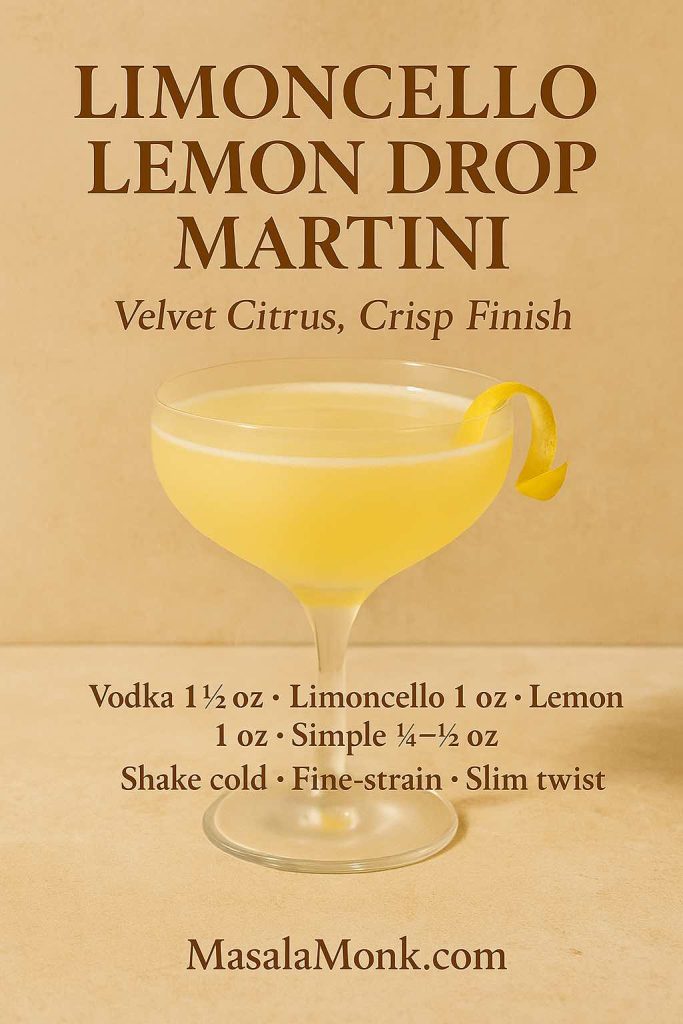
Limoncello Lemon Drop Martini

Limoncello makes a lemon drop softer, rounder, and more perfumed — the version to pour when you want the drink to feel sunnier and a little more generous. Since limoncello is already sweet, use less simple syrup than you would in the classic drink.

IngredientAmount
Vodka1½ oz / 45 ml
Limoncello1 oz / 30 ml
Fresh lemon juice1 oz / 30 ml
Simple syrup¼–½ oz / 7–15 ml, to taste
Superfine sugar for rimoptional, or half rim
Lemon twist1
Limoncello lemon drop martini card with a golden lemon cocktail, limoncello bottle, lemons, and a sugar-rimmed glass.
Since limoncello already brings sweetness, reduce the syrup before you shake. That keeps the variation sunny and lemony instead of drifting into dessert-drink territory.

Shake with ice until very cold, then fine-strain into a chilled glass. Start with ¼ oz syrup and increase only if the lemon feels too sharp.

  • Too sweet? Skip the simple syrup and use a half rim.
  • Too heavy? Add ¼ oz / 7 ml more lemon juice.
  • Too flat? Add the tiniest pinch of fine salt before shaking; it should not taste salty, just more awake.

More ways to fix the taste · Back to the classic recipe

Lemon Drop Shot Ratio

This is the version for the tray: quick to shake, easy to pass around, and brighter than a plain vodka shot. Lemon drop shots for a party should taste like smaller, punchier versions of the cocktail, not plain vodka chased with sugar.

VersionVodkaLemon juiceSimple syrup
Bright shot1 oz / 30 ml½ oz / 15 ml¼ oz / 7 ml
Sweeter party shot1 oz / 30 ml½ oz / 15 ml½ oz / 15 ml
6 shots6 oz / 180 ml3 oz / 90 ml1½–3 oz / 45–90 ml
Tray of sugar-rimmed lemon drop shots with lemon garnish and a small shot-ratio overlay.
Small, cold batches make better Lemon Drop shots. Pour right before serving so each glass tastes lively instead of warm, flat, or overly sweet.

Shake shots with ice for 8–10 seconds, then strain into lightly sugared shot glasses. Work in small batches so every round tastes lively instead of warm and syrupy.

Serving more than shots? Jump to pitcher and batch Lemon Drops.

Batch Lemon Drop Martini: Pitcher, Party Batch, and Freezer-Door Lemon Drops

Serving more than two people? The only trick is dilution. A shaken Lemon Drop gets a little water from the ice, and that water is part of the drink. For guests, the goal is simple: keep the first round cold and the second round just as good.

Pitcher Lemon Drops for a Party

A pitcher setup works best when the base is cold, the glasses are ready, and the dilution plan is settled before guests arrive.

Clear pitcher of pale yellow lemon drop martinis with lemon slices, sugar-rimmed coupe glasses, lemons, and cocktail tools.
Chill the base and prepare the glasses before guests arrive. For a pitcher Lemon Drop, the dilution plan matters more than the garnish pile.
Serving styleBest choiceAdd water?
Best qualityBatch ingredients, shake each drinkNo
Easiest pitcherAdd water and chillYes
Freezer-door bottleUse smaller batch, shake each servingNo
Ready-pour bottleAdd measured water before chillingYes

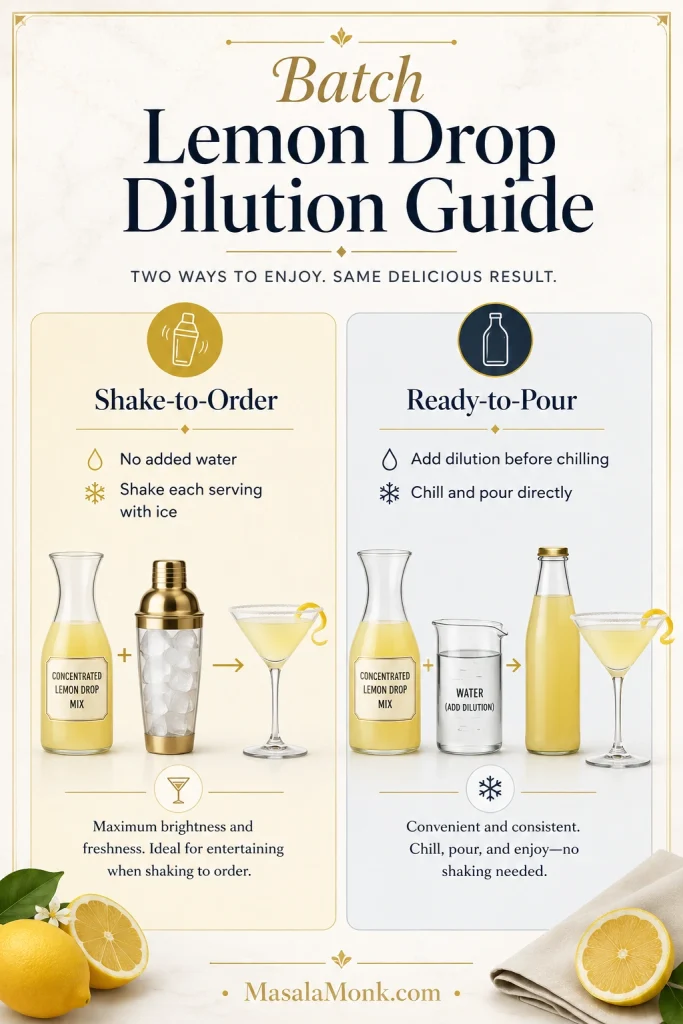
Batch Dilution: Shake-to-Order vs Ready-Pour

Use this choice before you bottle the drink. If the batch will not be shaken with ice later, it needs measured water now.

Infographic comparing shake-to-order lemon drop batches with ready-to-pour batches that include water for dilution.
Decide the serving style before batching. Shake-to-order Lemon Drops stay undiluted until the final shake, while ready-pour batches need measured water ahead of time.

If a batched Lemon Drop tastes strong, sharp, or oddly flat, it usually does not need more sugar first; it needs the water that shaking would have added.

After dilution, one shaken cocktail usually pours around 5 oz, sometimes closer to 5½ oz. Because Lemon Drops taste bright and smooth, they can feel lighter than they are. Serve them small, cold, and freshly poured.

Shake-to-order batches

BatchVodkaOrange liqueurLemon juiceSyrupWater
4 cocktails8 oz / 240 ml3 oz / 90 ml4 oz / 120 ml2–3 oz / 60–90 mlnone
8 cocktails16 oz / 480 ml6 oz / 180 ml8 oz / 240 ml4–6 oz / 120–180 mlnone

Ready-pour and freezer batches

BatchVodkaOrange liqueurLemon juiceSyrupWater / dilution
8 ready-pour cocktails16 oz / 480 ml6 oz / 180 ml8 oz / 240 ml4–6 oz / 120–180 ml8–10 oz / 240–300 ml
750 ml freezer bottle, shake-to-serve, about 5 cocktails10 oz / 300 ml3¾ oz / 110 ml5 oz / 150 ml2½ oz / 75 mlnone; shake each serving with ice
1 liter ready-pour bottle, about 6 cocktails12 oz / 360 ml4½ oz / 135 ml6 oz / 180 ml3–4 oz / 90–120 ml6–7 oz / 180–210 ml

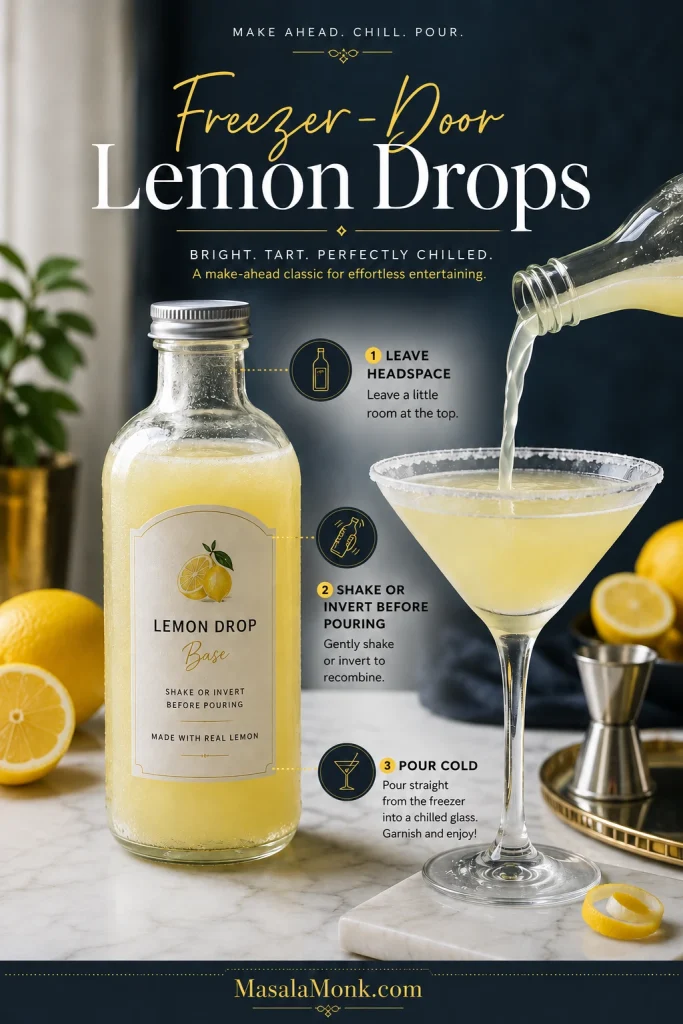
Use a large pitcher or a 1.5 liter bottle for the 8-drink ready-pour batch; it will not fit in a standard 750 ml bottle. Do not fill a freezer bottle to the top. Leave headspace, cap tightly, and shake or invert before pouring.

Freezer-Door Lemon Drop Bottle

A freezer-door bottle is convenient, but it still needs room at the top and a quick shake before serving so the citrus and syrup stay even.

Frosted freezer-door lemon drop bottle with headspace, pouring pale cocktail into a sugar-rimmed martini glass with lemon garnish.
A freezer-door Lemon Drop batch needs headspace and a quick shake or invert before pouring. That recombines citrus and syrup so every glass tastes consistent.

Batches with fresh lemon juice taste best the same day. To prep further ahead, mix the vodka, orange liqueur, and syrup first, then add fresh lemon juice closer to serving. For a built-over-ice vodka drink that is easy to serve by the round, the Moscow Mule recipe is another good party option.

Back to Jump Menu

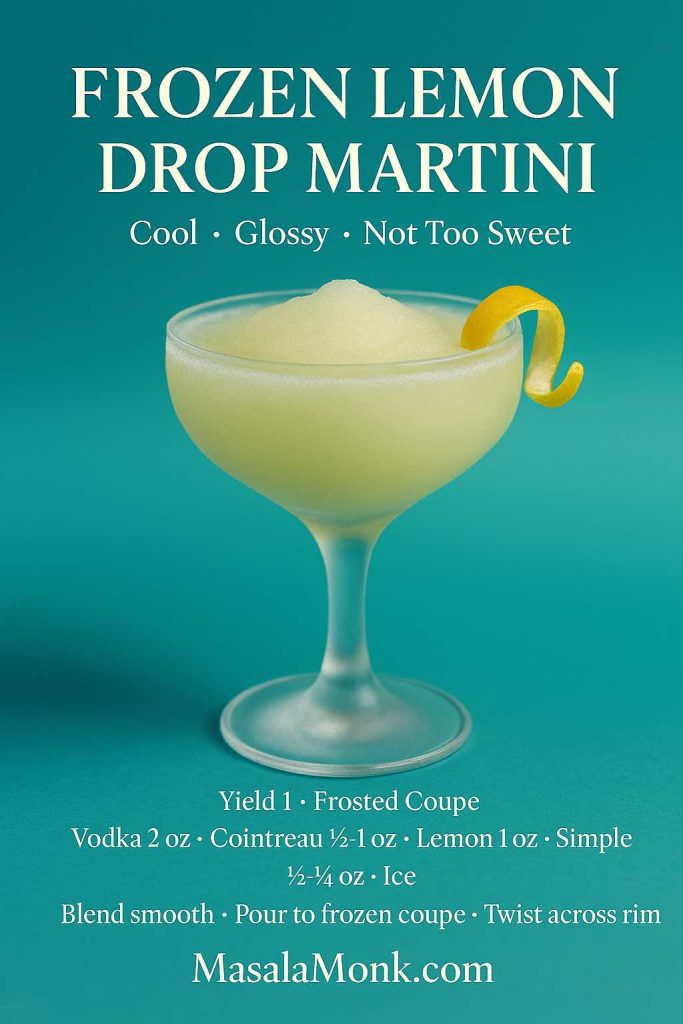
Frozen Lemon Drop Martini

A frozen lemon drop should still taste like a cocktail, not a syrupy lemon slush with vodka hiding underneath. Start with ½ oz syrup. Frozen drinks taste muted at first, then sweeter as they soften, so it is easier to add syrup than fix a slushy that turns cloying.

IngredientAmount
Vodka2 oz / 60 ml
Cointreau or triple sec½–1 oz / 15–30 ml
Fresh lemon juice1 oz / 30 ml
Simple syrup½–¾ oz / 15–22 ml
Iceabout 1 heaping cup
Frozen lemon drop martini recipe card showing an icy pale yellow cocktail with lemon garnish.
Frozen Lemon Drops should still taste like cocktails, not lemon slush. Start with restrained syrup because the drink can taste sweeter as it softens.

Blend until smooth, then pour into a chilled glass. If the drink feels too sharp, blend in a small spoonful of syrup. If it feels too sweet, add a squeeze of lemon and pulse once more. For another frozen party drink with a creamier tropical mood, try this Piña Colada recipe.

Fruit and Floral Lemon Drop Variations

Variations are where the drink gets playful, but the rule stays the same: let the lemon lead and use fruit as the accent, not the whole personality. Fruit should dress the lemon, not take over the whole glass.

Fruit and floral lemon drop martini guide with strawberry, blueberry, raspberry, blackberry, lavender, ginger, basil, and a lemon cocktail.
Let fruit and herbs frame the lemon instead of hiding it. Berries, lavender, ginger, or basil work best as accents, with fine-straining for a smoother finish.

For most fruit lemon drops, start with the classic recipe and replace the simple syrup with ½–¾ oz fruit syrup, or muddle fresh fruit before shaking. Fine-strain well and keep the total sweetness steady.

VariationUseBest cue
Strawberry Lemon Drop½–¾ oz strawberry syrup or 2 muddled berriesBest party color
Blueberry Lemon Drop½–¾ oz syrup or 8–10 berriesStrain well for a cleaner look
Raspberry Lemon Drop½ oz raspberry syrupTart and vivid; strain seeds
Blackberry Lemon Drop½–¾ oz syrup or 2–3 berriesDarker, silkier mood
Lavender Lemon Drop¼–½ oz lavender syrupKeep it subtle
Ginger Lemon Drop¼–½ oz ginger syrupSpicy-bright
Basil Lemon Drop3–4 leaves, gently muddledFresh and herbal

Use syrup when you want a clearer, prettier party drink. Muddled fruit tastes fresher but can add pulp, skins, or seeds.

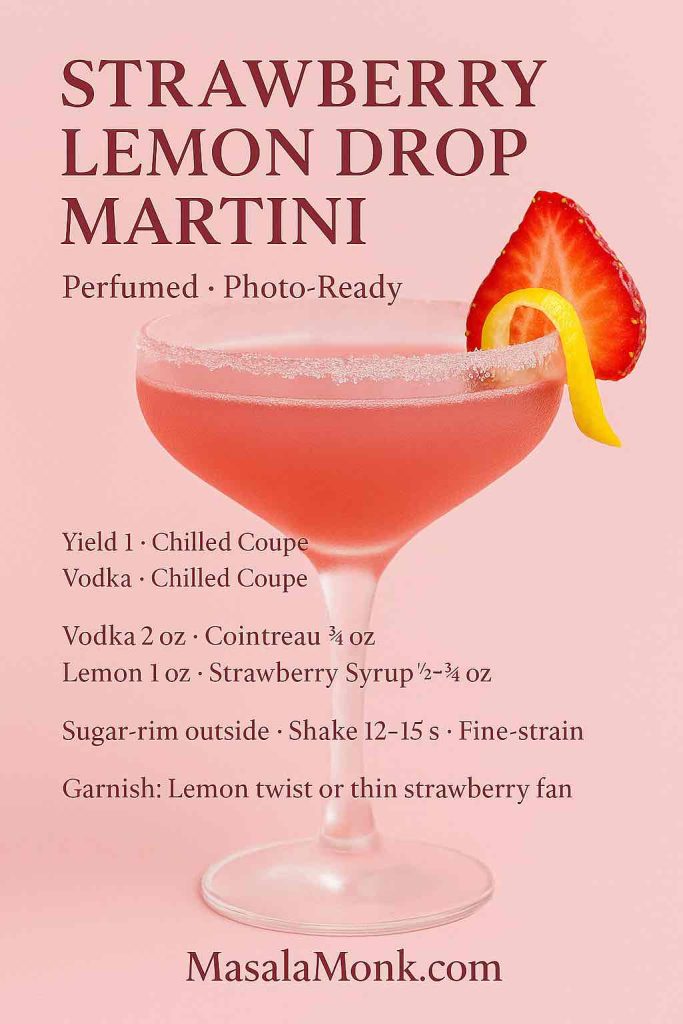
Strawberry Lemon Drop Martini

Strawberry is the easiest fruit variation to make feel party-ready. Keep the sweetness measured, then fine-strain so the pink color stays clean.

Strawberry lemon drop martini card with a pink cocktail, fresh strawberries, lemon garnish, and a sugar-rimmed glass.
A few strawberries add color and softness without turning the drink jammy. Use a small amount, then fine-strain so the cocktail stays clean.

Other spirit swaps: gin or tequila

A gin lemon drop tastes more botanical and a little drier. Try 2 oz London Dry gin, ¾ oz Cointreau, 1 oz lemon juice, and ¼–½ oz syrup. Keep the rim delicate so the botanicals do not feel heavy. For another gin-and-lemon classic, the French 75 cocktail recipe is also worth saving.

A tequila lemon drop leans toward a lemony margarita. Try 2 oz blanco tequila, ¾ oz Cointreau, 1 oz lemon juice, and ½ oz syrup. A half-sugar, half-salt rim works especially well here. If that version catches your eye, the Spicy Margarita recipe goes deeper into citrus, tequila, and a bold rim.

Back to the classic recipe · Fix the taste · Back to Jump Menu

Best Vodka for a Lemon Drop Martini

Vodka does not need to be expensive here, but it does need to disappear cleanly behind the lemon. A harsh bottle becomes more obvious once fresh citrus sharpens everything around it. Chilling helps, but it cannot turn a rough vodka smooth.

Vodka choiceUse it whenAdjustment
Plain neutral vodkaYou want the classicUse the main ratio
Smoother premium vodkaYou want a cleaner finishDo not over-sweeten
Budget vodkaCasual party drinksShake colder; use fresh lemon
Lemon vodkaYou want louder citrus aromaReduce syrup
Sweet citron vodkaOnly for party-style drinksHalf rim; less syrup
Vodka decision guide for a lemon drop martini comparing plain vodka, premium vodka, lemon vodka, and sweet citron vodka.
Plain vodka is the safest choice for a crisp Lemon Drop Martini. Lemon vodka or sweet citron vodka can also work, but start with less syrup.

For another chilled vodka drink with a sweet-tart edge, the Appletini is a natural next pour. It uses the same basic lesson: keep the fruit sharp, the glass cold, and the sweetness controlled.

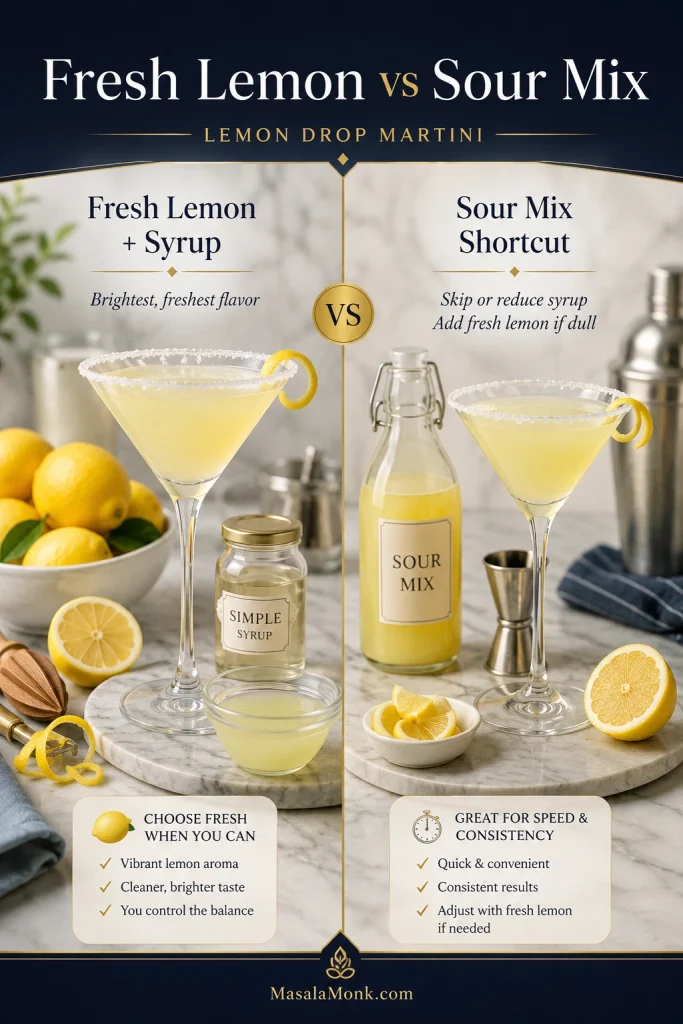
Fresh Lemon Juice vs Sour Mix or Lemon Drop Mix

Fresh lemon juice and simple syrup give the freshest, clearest lemon drop. Mixes and sour mix can work when convenience matters, but they usually taste sweeter, flatter, or less fresh.

Using a mix? Treat it as both citrus and sweetener. Do not add the full simple syrup from the classic recipe. Add vodka first, taste, then brighten with a small squeeze of fresh lemon if the drink feels dull.

Side-by-side comparison of fresh lemon with simple syrup and a generic sour mix shortcut for making a lemon drop martini.
Fresh lemon juice and simple syrup give you the most control. Sour mix is faster, but skip extra syrup at first and add fresh lemon if the drink tastes flat.
OptionResultAdjustment
Fresh lemon + syrupBrightest and bestUse the main recipe
Bottled lemon juiceFlatter and sharperAdd a fresh twist; reduce syrup slightly
Sour mixSweeter and less freshSkip or reduce simple syrup
Lemon drop mixEasiestAdd vodka and a squeeze of fresh lemon if possible
Premixed bottleLeast flexibleChill hard and garnish with fresh lemon

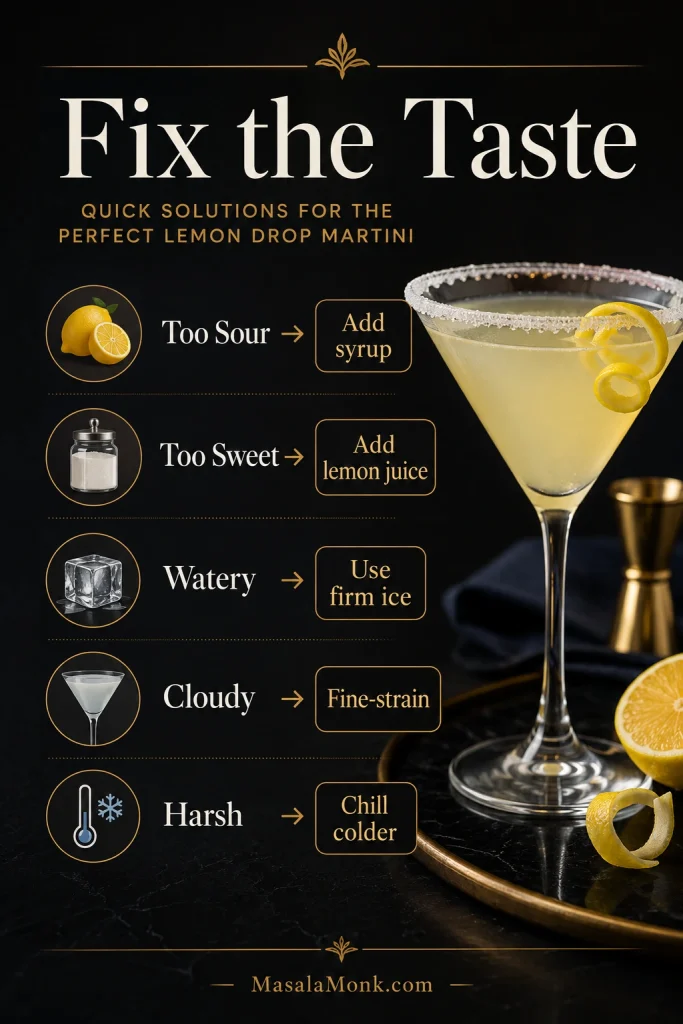
Fix the Taste

Do not dump the drink if the first sip is off. Lemon drops are forgiving when you adjust slowly. Taste, adjust by teaspoons, and shake briefly again with fresh ice.

Lemon drop martini troubleshooting guide showing fixes for too sour, too sweet, watery, cloudy, and harsh drinks.
Small adjustments fix most Lemon Drop Martini problems. Syrup softens sharp lemon, fresh juice cuts sweetness, firm ice controls dilution, and fine-straining clears the pour.
ProblemWhat probably happenedHow to fix it
Too sourThe lemons are sharp or syrup is too lowAdd 1 tsp simple syrup and shake briefly
Too sweetToo much syrup, sweet liqueur, or heavy rimAdd 1 tsp lemon juice and re-shake
WateryWet ice or too much shakingUse firm ice and shake 15–20 seconds
CloudyPulp, ice shards, or sugar fell inFine-strain and rim outside only
HarshDrink is warm or vodka is roughChill the glass and shake colder
Rim too crunchySugar is too coarse or too thickUse superfine sugar and a lighter dip
Limoncello version too sweetLimoncello plus syrup overloadReduce syrup or use a half rim
Fruit version tastes jammyToo much syrup or pureeAdd lemon juice and strain well

Back to the classic recipe · Back to Jump Menu

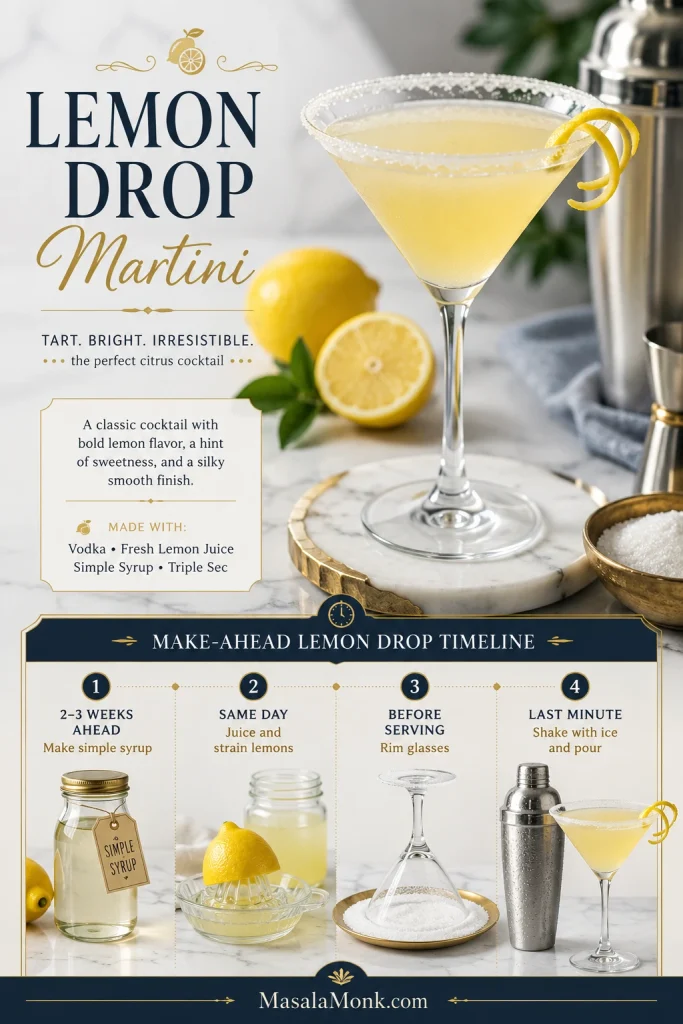
Make-Ahead and Storage Notes

You can prepare parts of a lemon drop ahead, but the best texture comes from shaking close to serving. A Lemon Drop feels most alive when the glass is cold, the rim is neat, and the citrus still smells fresh.

  • Lemon juice: Juice lemons the same day if possible. Strain and refrigerate until needed.
  • Simple syrup: Store in a clean jar in the fridge and use within 2–3 weeks.
  • Rimmed glasses: Rim glasses shortly before serving so the sugar stays neat.
  • Pitcher batch: Mix and chill up to a few hours ahead.
  • Best service: Shake each serving with ice and pour immediately.
Make-ahead lemon drop martini timeline showing simple syrup, juiced lemons, rimmed glasses, shaker, and finished cocktail.
Prepare the parts instead of the finished cocktail. Make syrup ahead, juice lemons the same day, rim glasses close to serving, and shake with ice at the last minute.

Serve alongside: mango lemonade for a non-alcoholic citrus option.

Bartender-Style Reference: Drier Classic vs Softer Home Version

Despite the martini glass, the Lemon Drop was born as a bright 1970s bar drink, closer in spirit to a vodka sour than a true martini.

The International Bartenders Association’s Lemon Drop Martini shows the drier classic skeleton of vodka, triple sec, and fresh lemon juice. Liquor.com’s Lemon Drop recipe also centers vodka, triple sec, fresh lemon juice, simple syrup, and a sugar rim.

This version sits between those worlds: it keeps the classic vodka-orange-lemon structure, then uses measured syrup and a delicate rim so the drink lands bright without turning harsh.

If you enjoy martini-style drinks with a different mood, try an Espresso Martini.

FAQs

These quick answers cover the swaps and shortcuts people usually ask about once the shaker is already out.

What is a Lemon Drop Martini?

A Lemon Drop Martini is a chilled vodka cocktail with fresh lemon juice, balanced sweetness, orange liqueur, and usually a sugar rim.

Is a Lemon Drop Martini the same as a Lemon Martini?

The names overlap, but a Lemon Drop Martini usually means vodka, lemon, sweetener, and a sugar rim. “Lemon Martini” can refer more broadly to lemon-flavored martini-style drinks, so recipes vary.

Which vodka works best?

A clean neutral vodka is the safest choice for the classic version. Lemon vodka works when you want stronger citrus aroma, but reduce the syrup slightly.

Fresh lemon juice or bottled?

Fresh lemon juice is best because the aroma is part of the drink. Bottled lemon juice works only as a shortcut and may taste flatter.

How sweet should a Lemon Drop be?

It should be balanced, not dessert-sweet. Start with ½ oz / 15 ml simple syrup for one cocktail, then add more only if the lemon tastes too sharp.

No triple sec — what should I use?

Use vodka, fresh lemon juice, and simple syrup for a three-ingredient lemon drop. Add 1–2 dashes of orange bitters if you want a little orange aroma without liqueur.

Cointreau, triple sec, or Grand Marnier?

Cointreau tastes crisp and clear. Triple sec is more budget-friendly and varies by brand. Grand Marnier tastes richer and rounder, so use a little less syrup if the drink feels too sweet.

How long should you shake a Lemon Drop Martini?

Shake for 15–20 seconds, or until the shaker feels very cold. For shots, 8–10 seconds is usually enough because the serving is smaller.

Lemon Drop Martini vs Lemon Drop Shot — what is the difference?

A Lemon Drop Martini is a full cocktail served up in a coupe or martini glass. A Lemon Drop Shot is smaller, stronger, and served in a shot glass with less dilution.

How do you make Lemon Drop shots?

For one bright shot, shake 1 oz / 30 ml vodka, ½ oz / 15 ml lemon juice, and ¼ oz / 7 ml simple syrup with ice for 8–10 seconds. Strain into a lightly sugared shot glass.

Can you make a Lemon Drop Martini with sour mix?

Yes. Use vodka and sour mix, then skip or reduce the simple syrup because most sour mixes already contain sugar. A squeeze of fresh lemon helps brighten the drink.

What is the best way to batch Lemon Drops for a party?

Mix the vodka, orange liqueur, lemon juice, and syrup ahead, then chill. For the best texture, shake each serving with ice. For ready-pour service, add cold water to replace shake dilution.

Does limoncello work in a Lemon Drop Martini?

Yes. Limoncello makes the cocktail softer and more lemon-perfumed. Since it is sweet, reduce the simple syrup and consider using only a half sugar rim.

Back to Jump Menu

Closing Pour

The Lemon Drop lasts because it gives a simple promise and delivers it quickly: cold vodka, just-squeezed lemon, a soft edge of sweetness, and a glass that looks festive before anyone takes the first sip. Make the classic first, keep the rim delicate, and shake until the tin feels icy.

After that, the variations are easy: limoncello for softness, shots for the party tray, frozen for hot afternoons, strawberry when the room needs color. The goal stays the same every time: citrus first, smooth second, sweet only enough.

If you make it, start with the classic first. Then come back and tell us what your table chose next: limoncello, frozen, strawberry, or shots.

Posted on 20 Comments

10 Best Espresso Martini Recipe Variations (Bar-Tested)

Bartender pouring an espresso martini from a stainless shaker into a coupe—thick crema with three coffee beans—premium portrait cover for an espresso martini recipe.

Craving an espresso martini recipe that pours glossy, smells like roasted chocolate, and hits the sweet-bitter balance just right? You’re in the perfect place. Below you’ll find a bar-tested classic plus nine high-demand riffs—Baileys + Kahlúa, Nespresso, salted caramel, citrus with Cointreau, Mr Black/cold brew, Licor 43, peanut-butter whiskey, vegan, and low-cal. Along the way, we’ll use simple ratios you can memorize, practical shaker tips that actually improve foam, and smart substitutions so you can make a great drink with the coffee gear you already own. For festive ideas, circle back to MasalaMonk’s seasonal riffs like the fragrant lineup in 5 Spiced Espresso Martini Recipe Ideas.


Espresso Martini Recipe (Classic, 3-Ingredient)

Why begin here: every variation hangs on this structure. Nail the classic once, then riff with confidence.

Ingredients (one cocktail)

  • 60 ml (2 oz) vodka
  • 30 ml (1 oz) coffee liqueur (Kahlúa for round sweetness; Mr Black for roastier, drier; Galliano Ristretto for intensity)
  • 30 ml (1 oz) fresh hot espresso or 30 ml strong cold-brew concentrate
  • Optional: 5–10 ml (¼–⅓ oz) simple syrup (1:1) to taste
Recipe card: Classic Espresso Martini—vodka, coffee liqueur, hot espresso; shake 12–15s, fine-strain; glossy crema with three coffee beans.
Classic Espresso Martini (3 ingredients). 2:1:1—60 ml vodka, 30 ml coffee liqueur, 30 ml hot espresso. Shake hard 12–15 s, fine-strain, garnish with 3 beans. Pro tip: a fresh hot shot builds taller, longer-lasting foam. — MasalaMonk.com

Method, step-by-step

  1. Chill glassware. A coupe or Nick & Nora helps the foam dome stand tall.
  2. Pull espresso last. Add spirits to a shaker filled with firm, fresh ice; pull the shot now so it’s still lively.
  3. Shake like you mean it. 12–15 vigorous seconds. You want the tins frosty outside and roaring inside.
  4. Fine-strain into your chilled glass to catch ice shards that can pop the foam.
  5. Garnish with three beans for the traditional “health, wealth, happiness” nod.

Texture & balance, explained
Hot espresso carries emulsifiers and suspended oils that whip into foam more willingly; if the shot sits, crema collapses and you lose that café-style head. Meanwhile, the coffee liqueur sets sweetness; adjust syrup in 2–3 ml nudges until the finish reads silky rather than sticky.

Dial-ins (quick wins)

  • Drier profile: choose Mr Black; skip syrup.
  • Softer edges: stick with Kahlúa; keep 5 ml syrup for roundness.
  • Extra body: 1 barspoon demerara syrup (1:1) adds cocoa-molasses depth.
  • Salt, barely there: a micro dash of 4:1 saline solution heightens perceived sweetness without more sugar.

For a canonical checkpoint: compare your spec to the IBA espresso martini. If you prefer granular technique talk—hot shots, optional saline, and foam logic—skim Difford’s Guide and adopt what suits your palate.


Espresso Martini Recipe with Baileys & Kahlúa

Now, for something plush. Here, cream meets coffee in a way that reads dessert-adjacent yet still cocktail-clean if you manage dilution thoughtfully.

Ingredients

  • 45 ml (1½ oz) vodka
  • 30 ml (1 oz) Baileys
  • 15 ml (½ oz) Kahlúa
  • 30 ml (1 oz) espresso (fresh and hot)
Recipe card: Baileys & Kahlúa Espresso Martini—45 ml vodka, 30 ml Baileys, 15 ml Kahlúa, 30 ml espresso; shake, fine-strain, cocoa dust or 3 beans.
Baileys & Kahlúa Espresso Martini (creamy, balanced). Build is 45 ml vodka · 30 ml Baileys · 15 ml Kahlúa · 30 ml espresso. Shake hard, fine-strain, garnish with cocoa or three beans. Pro tip: for extra plush texture, add +15 ml Baileys and reduce vodka by 15 ml. — MasalaMonk.com

Method
Shake harder than you think—15 to 18 seconds—to emulsify dairy and espresso, then fine-strain. The head should sit thick, and the sip should feel like velvet rather than milkshake.

Why it works
Baileys contributes dairy sweetness and vanilla; Kahlúa fills the coffee mid-palate so you don’t need to drown the drink in syrup. For proportion benchmarks and shake cadence, cross-check the Baileys espresso martini and the Kahlúa method. Then, trim sugar until your finish is clean.

Variations you can pour immediately

  • Extra-creamy: +15 ml Baileys, −15 ml vodka.
  • Mocha dessert: +5–10 ml crème de cacao; dust cocoa through a fine sieve.
  • No-vodka comforter: +15 ml Baileys, +15 ml Kahlúa; shake colder to maintain structure.

While you’re plotting pairings, hop into MasalaMonk’s mix-match guides—What Can You Mix with Kahlúa? and What Mixes Well with Baileys?—for easy flavor ladders you can climb without a grocery run.


Nespresso Espresso Martini Recipe (No Machine, No Problem)

Not everyone has a portafilter at home; nevertheless, pod machines can be stellar. In fact, their crema and consistency are gifts to the shaker.

Ingredients

  • 60 ml (2 oz) vodka
  • 30 ml (1 oz) coffee liqueur
  • 40 ml (1⅓ oz) Nespresso lungo or double espresso, cooled 2–3 minutes (dark pods shine)
Recipe card: Nespresso Espresso Martini—60 ml vodka, 30 ml coffee liqueur, 40 ml pod lungo; shake hard, fine-strain; glossy crema in coupe.
Nespresso Espresso Martini (no machine). Build: 60 ml vodka · 30 ml coffee liqueur · 40 ml Nespresso lungo/double. Pull pod, cool 2–3 min, then shake aggressively and fine-strain to a chilled coupe. Pro tip: choose dark pods (ristretto/arpeggio style) for cacao-leaning flavor and a richer crema. — MasalaMonk.com

Method
Meanwhile, chill the glass. Pull your pod, give it a short cool, then shake vigorously with the other ingredients and dense ice. Fine-strain for that lacquered surface.

Pod talk, briefly
Darker capsules (Ristretto/Arpeggio-style) push chocolate, toasted nuts, and low fruit; consequently, they sit beautifully with a little sugar and ethanol. If you rely on moka pots or cold-brew concentrate some nights, you’re still golden—MasalaMonk’s coffee walkthroughs compare strengths, grinds, and extraction styles so your espresso martini recipe remains balanced even when your gear changes.


Salted Caramel Espresso Martini Recipe

Here’s the cozy showstopper: sweet-salty, aromatic, and richly textural without becoming cloying.

Ingredients

  • 45 ml (1½ oz) caramel or vanilla vodka
  • 20 ml (⅔ oz) coffee liqueur
  • 30 ml (1 oz) espresso
  • 10–15 ml (⅓–½ oz) salted-caramel syrup
Recipe card: Salted Caramel Espresso Martini—caramel/vanilla vodka, coffee liqueur, espresso, salted-caramel syrup; toffee rim, sea salt on foam.
Salted Caramel Espresso Martini. Build: 45 ml caramel/vanilla vodka · 20 ml coffee liqueur · 30 ml espresso · 10–15 ml salted-caramel syrup. Shake, fine-strain, finish with a whisper of flaky sea salt. Pro tip: sweetness blooms when cold—start light on syrup and adjust to taste. — MasalaMonk.com

Method
Shake briskly; fine-strain; crown with a faint pinch of flaky salt over the foam. Optionally, half-rim with crushed toffee for celebratory sparkle.

Keep it elegant, not sugary
Caramel leans sweet; accordingly, lean on espresso bitterness and a touch of salt to keep shape. For a brand-tested frame of reference, study proportions on the Kahlúa espresso martini page and then scale syrup down until your finish snaps.

Holiday spinoffs

  • Gingerbread: swap salted-caramel syrup for gingerbread syrup; grate nutmeg.
  • Maple-sea salt: 10 ml maple + micro-pinch salt; express orange over the cap.
  • Spiced warmth: infuse your vodka with a cinnamon stick for 2 hours; pull it out before it dominates, and then shake as usual.

Also Read: Mango Martini + 5 Variants of Classic Cocktail


Cointreau (Orange) Espresso Martini Recipe

Chocolate-orange fans, this one’s for you. With citrus oils dancing over a dark foam, the nose alone sells the first sip.

Ingredients

  • 45 ml (1½ oz) vodka
  • 20 ml (⅔ oz) coffee liqueur
  • 15 ml (½ oz) Cointreau (go Grand Marnier for oakier depth)
  • 30 ml (1 oz) espresso
Recipe card: Cointreau Orange Espresso Martini—45 ml vodka, 20 ml coffee liqueur, 15 ml Cointreau, 30 ml espresso; shake, express orange peel.
Cointreau (Orange) Espresso Martini. Build: 45 ml vodka · 20 ml coffee liqueur · 15 ml Cointreau · 30 ml espresso. Shake hard, fine-strain, then express an orange peel over the foam and discard. Pro tips: swap Grand Marnier for a richer, oak-tinged profile; add 5–10 ml crème de cacao for a “dark-chocolate orange” vibe. — MasalaMonk.com

Method
Shake assertively; fine-strain; express a wide swath of orange peel over the surface and discard. The aromatic mist lands on the foam and blooms throughout the sip.

Flavor geometry, quickly
Cointreau is drier; thus the drink stays snappy. Grand Marnier reads richer, so trim any added syrup by 5 ml. For a “jaffa cake” vibe, add 5–10 ml crème de cacao; for a slightly bitter chocolate edge, toss in 2 dashes mole bitters.

Variants to slot under this heading

  • Amaro lift: replace 10 ml of coffee liqueur with Averna; you’ll get cola-cocoa depth.
  • Tequila twist: swap vodka for reposado; the orange plays beautifully with oak and vanilla.
  • Burnt-orange finish: flame a peel (carefully) over the cap for caramelized aromatics.

Also Read: Vodka with Lemon: Easy Cocktails, Martini Twist & DIY Infusion


Mr Black Cold Brew Espresso Martini Recipe

When you want coffee to speak loudly and sugar to step back, Mr Black is the obvious lever. Their guidance also nails foam mechanics without fuss.

Ingredients (brand-style)

  • 30 ml (1 oz) Mr Black Coffee Liqueur
  • 30 ml (1 oz) vodka or reposado tequila for a drier, spicier frame
  • 30 ml (1 oz) espresso or cold-brew concentrate
  • 10–15 ml (⅓–½ oz) simple syrup, as needed
Recipe card: Mr Black Cold Brew Espresso Martini—30 ml Mr Black, 30 ml vodka or reposado tequila, 30 ml espresso/cold-brew; shake hard, fine-strain.
Mr Black / Cold Brew Espresso Martini (coffee-first). Build: 30 ml Mr Black · 30 ml vodka (or reposado tequila) · 30 ml espresso or cold-brew concentrate · 0–15 ml syrup to taste. Shake aggressively with dense ice and fine-strain. Pro tip: using cold-brew? Shake even harder to whip up crema; choose tequila for a drier, roasty finish. — MasalaMonk.com

Method
Shake decisively; fine-strain; garnish with three beans or a coffee dust heart if you’re feeling fancy.

Practical notes
Cold-brew concentrate softens bitterness; consequently, you may want to reduce syrup so the finish stays crisp. For visual and method cues, peek at Mr Black’s espresso martini—their “shake hard for crema” mantra is exactly what brings this pour to life at home.

Variants to file

  • Agave route: tequila base + orange express for a café de olla echo.
  • Cocoa edge: 2 dashes chocolate bitters; serves like a mocha that grew up.
  • Split base: 20 ml rye + 20 ml vodka; the spice peeks through gently.

Also Read: Daiquiri Recipe (Classic, Strawberry & Frozen Cocktails)


Licor 43 Espresso Martini Recipe (Spanish Vanilla)

Silky vanilla, bright citrus whispers, and a honeyed line through the middle—this riff drinks like a well-lit café at dusk.

Ingredients

  • 30 ml (1 oz) Licor 43
  • 30 ml (1 oz) vodka
  • 40 ml (1⅓ oz) hot espresso
  • Optional: 10–15 ml (⅓–½ oz) coffee liqueur for deeper roast
Recipe card: Licor 43 Espresso Martini—30 ml Licor 43, 30 ml vodka, 40 ml hot espresso; shake, double-strain; orange peel and micro-dash saline tip.
Licor 43 Espresso Martini—vanilla-citrus glow. Build: 30 ml Licor 43 · 30 ml vodka · 40 ml hot espresso. Shake with ice, double-strain to a chilled coupe. Pro tip: express an orange peel over the foam and add a micro-dash of 4:1 saline—it brightens vanilla, trims bitterness, and boosts perceived sweetness without extra sugar. — MasalaMonk.com

Method
Shake hard; double-strain into a chilled coupe; float a delicate orange twist and discard. The aroma cues vanilla, then the espresso anchors the sip.

Where to benchmark
Start with the structure and sweetness targets of Espresso 433; then decide whether you prefer “lean vanilla” (no added coffee liqueur) or “round café” (+15 ml).

Spin-offs

  • Golden rum swap: trade vodka for a light aged rum; the vanilla threads feel seamless.
  • Oat-vanilla cream: 10 ml unsweetened oat creamer in the shaker; shake longer for a silkier cap.
  • Cinnamon touch: a single small stick infused in vodka for 60–90 minutes, then removed; build the drink as usual.

Also Read: Coconut Water Cocktails: 10 Easy, Refreshing Drinks


Peanut Butter Whiskey Espresso Martini Recipe

Decadent without being heavy, this one reads like a peanut-butter truffle kissed by espresso. It’s playful, memorable, and wildly “one more round” friendly.

Ingredients

  • 45 ml (1½ oz) peanut-butter whiskey (Skrewball-style)
  • 20 ml (⅔ oz) vodka or bourbon for oak and spice
  • 20 ml (⅔ oz) coffee liqueur
  • 25–30 ml (¾–1 oz) espresso
  • Optional: 5 ml simple if your PB whiskey runs dry (rare)
Recipe card: Peanut-Butter Whiskey Espresso Martini—45 ml PB whiskey, 20 ml vodka/bourbon, 20 ml coffee liqueur, 25–30 ml espresso; shake; chocolate garnish.
Peanut-Butter Whiskey Espresso Martini. Build: 45 ml PB whiskey · 20 ml vodka/bourbon · 20 ml coffee liqueur · 25–30 ml espresso. Shake until tins sweat, fine-strain, garnish with shaved chocolate or crushed roasted peanuts. Pro tip: PB whiskey is sweet—let a dark roast espresso and a pinch of saline keep the finish clean, not cloying. — MasalaMonk.com

Method
Shake until your tins sweat; fine-strain; garnish with grated chocolate or a light ring of crushed roasted peanuts (keep it minimal so it doesn’t drink like a sundae).

Balance pointers
PB whiskey is typically sweet; therefore, hold back on syrup and let espresso’s bitterness draw a clean perimeter. If you need a starting line, scan PB-centric riffs on coffee-liqueur recipe hubs (Kahlúa’s is an easy one to browse), then subtract sugar until the finish behaves.

Variants

  • Cookie shop: +5 ml Frangelico (hazelnut); garnish with micro-zested nutmeg.
  • Salty-sweet: a tiny saline dash plus chocolate bitters = “sea-salt brownie” energy.
  • Bourbon bakery: swap vodka for a soft, vanilla-leaning bourbon; lower syrup to zero.

Also Read: Mango Vodka Cocktail: The Perfect Base + 7 Must-Try Variations


Vegan Espresso Martini Recipe (No Dairy, Big Foam)

You don’t need dairy to pour a towering cap. With the right technique, plant foams are terrific and—better yet—stable.

Ingredients

  • 50 ml (1⅔ oz) vodka
  • 25 ml (¾–1 oz) coffee liqueur (Mr Black if you want drier; Kahlúa if you prefer softer)
  • 30 ml (1 oz) espresso
  • 20 ml (⅔ oz) aquafaba or 15 ml vegan foamer
Recipe card: Vegan Espresso Martini—vodka, coffee liqueur, espresso, aquafaba; dry-shake, then ice-shake; tall glossy foam with three coffee beans.
Vegan Espresso Martini (no dairy, big foam). Build: 50 ml vodka · 25 ml coffee liqueur · 30 ml espresso · 20 ml aquafaba (or 15 ml vegan foamer). Dry-shake 10 s, then add ice and shake 12–15 s; fine-strain. Pro tip: a fresh, hot shot plus aquafaba’s proteins/saponins yields a taller, longer-holding head than the dairy classic. — MasalaMonk.com

Method

  1. Dry-shake (no ice) for 10 seconds to pre-whip proteins.
  2. Add ice and shake vigorously for 12–15 seconds.
  3. Fine-strain; let the foam set for 10–15 seconds before garnishing.

Why aquafaba excels
Chickpea water brings proteins and saponins that trap air and stabilize bubbles; as a result, your vegan espresso martini recipe keeps that bar-style crown without egg whites. If you miss creaminess, you can also reach for non-dairy liqueurs or creamers; still, aquafaba remains the simplest pantry hack with dramatic payoff.

Plant-based variants

  • Maple-cinnamon: 10 ml maple syrup + a dusting of Ceylon cinnamon.
  • Chocolate silk: 5 ml crème de cacao + 2 dashes chocolate bitters; keep sweetness restrained.
  • Orange blossom: a delicate spritz of orange blossom water over the foam—one pump is plenty.

Also Read: What to Mix with Jim Beam: Best Mixers & Easy Cocktails


Low-Cal Espresso Martini Recipe (Keto-Friendly)

Lean, aromatic, and still foamy, this build proves you can keep calories in check without sacrificing ceremony.

Ingredients

  • 60 ml (2 oz) vodka
  • 30 ml (1 oz) cooled espresso
  • 5–10 ml (¼–⅓ oz) 1:1 allulose or erythritol syrup or a tiny dash of liquid stevia
  • 2–3 dashes coffee or chocolate bitters (optional)
Recipe card: Low-Cal Espresso Martini—60 ml vodka, 30 ml cooled espresso, 5–10 ml allulose/erythritol or stevia; shake, lemon peel express; keto-friendly.
Low-Cal Espresso Martini (keto-friendly). Build: 60 ml vodka · 30 ml cooled espresso · 5–10 ml 1:1 allulose/erythritol syrup (or liquid stevia) · 2–3 dashes coffee/chocolate bitters (opt.). Shake hard, fine-strain to a chilled coupe; finish with an expressed lemon peel and discard. Pro tip: a pinch of saline boosts perceived sweetness without sugar; for extra body, shake in 15 ml unsweetened almond-coconut creamer. — MasalaMonk.com

Method
Shake very hard to aerate; fine-strain. Express a lemon peel across the surface and discard to lift the nose without adding sugar.

Taste management
If the sip reads hollow, add two things before you reach for more sweetener: a saline micro-dash (which increases perceived sweetness) and a stronger coffee shot (which adds structure). Conversely, if the drink feels sharp, introduce 5 ml demerara syrup or 10 ml unsweetened almond-coconut creamer and shake a beat longer.

Keto-friendly riffs

  • Vanilla-cocoa: ¼ tsp unsweetened cocoa, shaken in; 2 dashes vanilla extract.
  • Orange-bright: 2 dashes orange bitters + orange express; no change in macros.
  • Amaro-lite: 10 ml low-sugar amaro to add herbaceous depth; maintain sweetener as is.

Also Read: Whiskey and Warmth: 5 Cinnamon-Spiced Iced Tea Cocktails to Get You through Wednesday


How to Batch Any Espresso Martini Recipe (Entertaining Shortcut)

After the fifth order, shaking to order stops being charming. Batching preserves sanity while still delivering foam—if you mimic dilution strategically.

Scaling formula (serves ~8)

  • Multiply any spec ×8.
  • Add 200–240 ml cold water (this pre-dilution mimics the water your ice would add).
  • Chill at least 2 hours (overnight is better).
  • For service, shake each ~120 ml portion with fresh ice for 8–10 seconds; fine-strain.

Why this works
Most shaken cocktails dilute ~20–25%. Without compensating, a batched espresso martini recipe tastes hot and syrup-heavy. Pre-dilution lands you near your target texture before the finishing shake re-aerates for foam.

Flavor lanes for parties

  • Spiced holiday tray: split your coffee liqueur with crème de cacao; express orange over each pour.
  • Coffee-first crowd: go Mr Black as the sole liqueur; offer simple syrup on the side for guests to tailor.
  • Dessert finale: run the Baileys + Kahlúa spec; rim half the glass with micro-grated chocolate for drama.

Also Read: Punch with Pineapple Juice: Guide & 9 Party-Perfect Recipes


Ingredient & Technique Notes You’ll Actually Use

Because the build is simple, tiny choices have outsized impact. Therefore, consider the following your pocket checklist.

Espresso temperature
Shake with a fresh, hot shot whenever possible. Cooling collapses crema and steals foam. If you’re troubleshooting thin caps, this single change solves half the cases.

Ice quality
Use dense cubes—slushy, hollow ice under-aerates and over-dilutes. Moreover, don’t overshake to compensate; instead, shake with real intent for a shorter, more forceful window.

Sweetness control
Think in 5 ml moves. Each nudge is noticeable in a small, spirit-forward drink. If your palate leans dry, use a roastier liqueur like Mr Black and rely on espresso oils for mouthfeel.

Saline, respectfully
Keep a 4:1 water-to-salt dropper. One micro-dash can focus flavors like magic, yet two will taste like soup—so proceed judiciously.

Citrus oils
Express lemon for lift or orange for warmth, ideally over the foam so aromatic droplets ride the cap into each sip. It’s a tiny flourish that reads “bar-quality” instantly.

When you want sources to cross-check, quickly:


Flavor Map: Choosing the Right Espresso Martini Recipe Tonight

Because the differences are small but consequential, here’s how to steer without second-guessing:

  • Want timeless and taut? Pour the Classic; match your sweetness to your liqueur; crown with three beans; optionally check the IBA reference if you’re a spec purist.
  • Hosting dessert lovers? The Baileys + Kahlúa riff wins rapidly; if you need ideas for complementary garnishes or side sips, browse What Mixes Well with Baileys? and grab a chocolate-orange note or two.
  • No espresso machine today? Pod crema is your friend; shake like a drum solo and fine-strain.
  • Leaning cozy and festive? Salted caramel with a micro-pinch of salt and an orange express; for deeper winter vibes, tap 5 Spiced Espresso Martini Recipe Ideas and let cardamom or clove peek through.
  • Coffee-first minimalism? Mr Black + vodka + espresso; adjust syrup downward; serve brisk.
  • Vanilla-citrus glow? Licor 43 with a bright orange express; sanity-check sweetness against Espresso 433.
  • Playful dessert-bar energy? Peanut-butter whiskey with a whisper of chocolate bitters; keep the finish clean.
  • Plant-based crowd? Aquafaba dry-shake first; then ice; then fine-strain—towering cap, zero dairy.
  • Counting macros? The Low-Cal pathway with bitters and lemon oil keeps things lifted without sugar creep.

Troubleshooting, Rapid-Fire (Fix It Mid-Service)

  • Foam too thin: pull a fresh shot; shake with conviction; fine-strain.
  • Over-sweet: skip syrup; choose a drier liqueur; add a micro-dash saline.
  • Harsh finish: use a darker, chocolate-leaning coffee; add 5 ml demerara; shake 2 seconds longer.
  • Watery: your ice is soft or your shake is timid and long—swap cubes; shake shorter but harder.
  • No machine nights: moka, pods, or cold-brew concentrate are not compromises; they’re alternate routes.

One More Round (Interlinking for curious readers)

If you’re in the groove and want a different citrus-kissed classic for the next round, pop over to MasalaMonk’s Lemon Drop Martini for a bright palate reset between richer pours. And whenever you’re planning a holiday board, keep What Can You Mix with Kahlúa? and What Mixes Well with Baileys? open—those suggestions translate directly into simple, delicious espresso-martini garnishes and side sippers.


The Last Sip

Mastering the espresso martini recipe unlocks a flexible canvas. With a hot shot, a decisive shake, and sweetness in measured nudges, you can glide from taut and timeless to creamy and celebratory—or pivot into citrus-perfumed elegance, vanilla-glow warmth, plant-based lift, or low-cal clarity—without restocking half the bar. Consequently, you get repeatable results and room to play. And as your seasons change, your pantry will keep up: a different syrup here, a dash of bitters there, an orange express when you need polish. From intimate nightcaps to bustling parties, this family of recipes gives you structure first, then freedom—exactly what a modern classic should.

FAQs

1. What is in a classic espresso martini recipe?

A timeless build includes vodka, coffee liqueur, and fresh hot espresso; optionally, a touch of simple syrup balances bitterness. Consequently, shaking hard with dense ice creates the glossy foam cap people love.

2. How do I get a thick, long-lasting foam on my espresso martini recipe?

Use a fresh, hot espresso shot, shake vigorously for 12–15 seconds, and fine-strain into a chilled coupe. Moreover, dense ice and a decisive shake trap air, while a brief rest (10 seconds) lets the foam set before garnishing.

3. Can I make an espresso martini recipe without an espresso machine?

Absolutely. Alternatively, use a strong Nespresso double shot, moka pot concentrate, or robust cold-brew concentrate (1:1 to espresso volume). Nevertheless, shake with conviction to build comparable crema.

4. What’s the best coffee for an espresso martini recipe—light, medium, or dark?

Choose medium-dark to dark roasts for chocolate, caramel, and nut notes. Conversely, very light roasts can taste citrusy and thin once chilled and sweetened.

5. Do I need simple syrup, and how much should I add?

Not always. Start at 0–10 ml per drink; subsequently, adjust in 5 ml steps until the finish feels balanced rather than sugary. Importantly, sweeter liqueurs may require no added syrup at all.

6. Which vodka is best for an espresso martini recipe?

A clean, mid-to-high proof vodka with minimal burn is ideal. Furthermore, chill the bottle to improve texture and reduce perceived sharpness.

7. Can I swap vodka for gin, tequila, or rum in an espresso martini recipe?

Yes. Gin adds juniper lift; reposado tequila brings vanilla-oak warmth; aged rum contributes caramel depth. Likewise, reduce any added syrup by 5 ml if the base spirit tastes naturally sweet.

8. What’s the difference between Kahlúa, Mr Black, and Licor 43 here?

Kahlúa skews sweeter and rounder; Mr Black reads roastier and drier; Licor 43 layers vanilla-citrus. Consequently, the sweeter the liqueur, the less extra syrup you’ll need.

9. How do I make a Baileys and Kahlúa espresso martini recipe without it becoming heavy?

Keep Baileys at 30 ml, Kahlúa at 15 ml, and shake colder and harder. Additionally, fine-strain to remove ice chips that can collapse the foam and muddy the texture.

10. Can I make a vegan espresso martini recipe with real foam?

Definitely. Use 20 ml aquafaba and dry-shake first, then shake with ice. Notably, aquafaba’s proteins and saponins stabilize bubbles, yielding a tall, silky cap.

11. Is egg white okay in an espresso martini recipe?

It’s optional. Egg white increases foam density and softness; however, it slightly mutes aromatics. If used, dry-shake first to pre-whip, then ice-shake to finish.

12. How do I batch an espresso martini recipe for a party?

Multiply your spec, then add 20–25% cold water to mimic dilution. Subsequently, chill at least 2 hours. To serve, shake each portion briefly with ice for fresh foam.

13. How long will a batched espresso martini recipe keep in the fridge?

Up to 24 hours for best flavor. Meanwhile, keep coffee and spirits mixed but add dairy (if any) just before serving; otherwise, separation and dull flavors creep in.

14. What glass should I use—and does it affect foam?

A chilled coupe or Nick & Nora is perfect. Importantly, cold, clean glassware helps the foam dome hold shape and aroma longer.

15. Why does my espresso martini recipe taste bitter or hollow?

Bitter: your coffee is too light or over-extracted; add 5 ml demerara or a micro-dash saline. Hollow: your coffee is weak; strengthen the shot or reduce water in concentrate. Ultimately, balance emerges with small 5 ml tweaks.

16. Can I use instant coffee in an espresso martini recipe?

Yes, in a pinch. Mix 1 tsp quality instant coffee with 30 ml hot water for a quick “espresso.” Additionally, consider 5 ml extra syrup to tame potential harshness.

17. What are the best garnishes for an espresso martini recipe?

Three coffee beans are classic; alternatively, try an orange peel express, a cocoa dusting, or shaved dark chocolate. Likewise, keep garnishes light so they don’t sink the foam.

18. How do I keep the drink from tasting too sweet with flavored syrups (salted caramel, vanilla)?

Start with 10 ml syrup and taste; consequently, reduce or add salt (a tiny pinch) to sharpen definition. Conversely, increase espresso by 5 ml if flavors feel candy-like.

19. Can I make a low-calorie or keto espresso martini recipe?

Yes. Use vodka, espresso, and a zero-cal sweetener syrup (5–10 ml). Moreover, add 2–3 dashes chocolate or coffee bitters and a lemon-peel express to boost perceived sweetness without sugar.

20. What’s the ideal shake time and technique?

Aim for 12–15 seconds with dense ice; shake with big arcs and firm snaps to maximize aeration. Subsequently, fine-strain immediately while the foam is lively.

21. Should espresso be hot or cooled before shaking?

Prefer hot, freshly pulled espresso for superior foam; however, Nespresso or moka shots can cool 1–3 minutes to avoid over-dilution. Notably, don’t let crema collapse entirely.

22. Can I make an espresso martini recipe without coffee liqueur?

You can, though flavor changes. Use vodka, espresso, and demerara syrup; then add chocolate or coffee bitters for depth. Conversely, expect a leaner, less rounded profile.

23. What’s the best ratio for an espresso martini recipe if I like it drier?

Try 60 ml vodka, 20–25 ml coffee liqueur, 30 ml espresso, and 0–5 ml syrup. Additionally, a micro-dash saline can enhance perceived sweetness without sugar.

24. How do I avoid watery or thin results?

Use solid, large ice; shake decisively but not excessively long. Furthermore, pre-chill glassware and spirits, and fine-strain to keep tiny shards from melting on the surface.

25. Can I use decaf and still get great foam?

Yes—choose a full-bodied decaf espresso or concentrate. Likewise, keep the shake energetic; foam depends more on technique and freshness than caffeine content.

26. What’s the easiest way to switch flavors without changing the whole espresso martini recipe?

Swap liqueurs (e.g., Licor 43 for vanilla, Mr Black for roasty), trade bases (gin, tequila, rum), or change syrup (salted caramel, maple, gingerbread). Consequently, adjust sweetness and garnish to match the new direction.

27. How much salt is safe to add to an espresso martini recipe?

Use a 4:1 water-to-salt saline and add a single small drop. Importantly, salt should be invisible—enhancing sweetness and rounding bitterness without tasting salty.

28. Why fine-strain an espresso martini recipe?

Fine-straining removes micro-ice that can puncture the foam and over-dilute the drink. Additionally, it leaves a smooth, glossy surface for consistent presentation.

29. Can I serve an espresso martini recipe over ice (“on the rocks”)?

You can, though it changes the style. Subsequently, expect faster dilution and softer foam; therefore, reduce syrup slightly and consider a large clear cube to slow melt.

30. What calorie range should I expect?

Generally 130–220 kcal per serving depending on liqueur sweetness and cream additions. Conversely, low-cal versions with zero-cal sweeteners and no cream trend toward the lower end.

31. Any quick fixes if the foam collapses at the table?

Gently “wake” the glass by tapping the stem to re-settle bubbles; meanwhile, serve immediately after shaking, and avoid over-pouring—shallower fill heights keep the cap intact.

32. How do I choose between Kahlúa, Mr Black, and Licor 43 for my crowd?

For dessert-leaning palates, pick Kahlúa; for coffee purists, choose Mr Black; for vanilla-citrus lovers, pour Licor 43. Ultimately, align liqueur personality with your guests’ dessert preferences.

33. Can I add cream or oat creamer to an espresso martini recipe?

Yes, sparingly (10–15 ml). Additionally, shake longer to re-emulsify; otherwise, texture turns flabby. Oat versions remain lighter while still plush.

34. What’s the simplest “best espresso martini recipe” starting ratio?

As a baseline: 60 ml vodka, 30 ml coffee liqueur, 30 ml hot espresso, 0–10 ml syrup. Thereafter, tweak sweetness in tiny steps and lock your house spec.