Posted on Leave a comment

Pecan Pie Bars Recipe with Easy Shortbread Crust

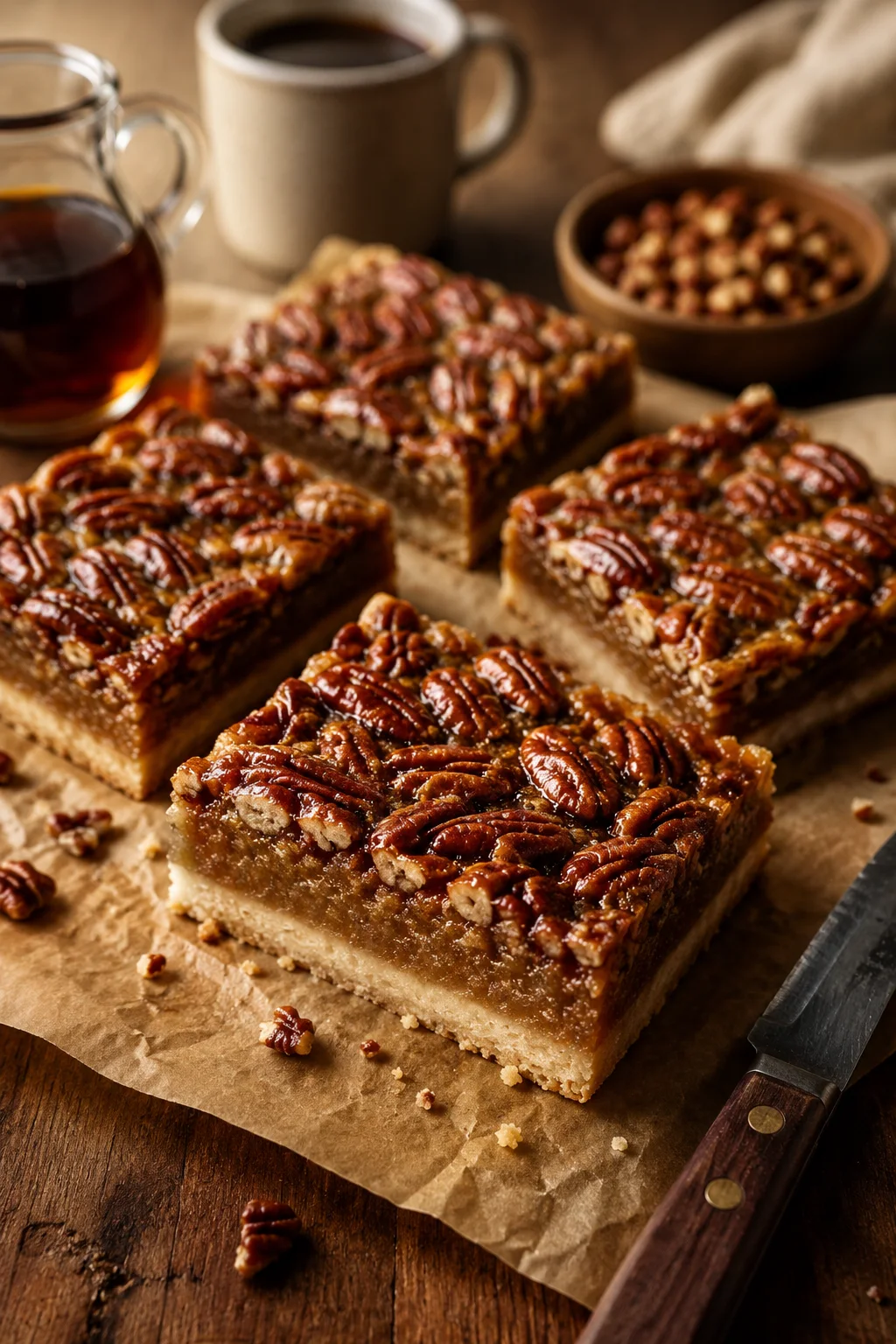
Clean-cut pecan pie bars with glossy pecan topping and pale shortbread crust arranged on parchment paper.

These pecan pie bars are for the moment when pecan pie sounds perfect, but rolling dough, lifting wedges, and hoping the center has set all feel like too much. You still get the glossy pecan top, the buttery base, and the soft caramel-like filling — just in a pan you can cool, lift, cut, and carry.

The promise here is simple: no rolling, no runny middle, no nervous first slice. A press-in shortbread crust makes the bars sturdy, while maple syrup and brown sugar bake into a warm, glossy pecan filling that stays gooey without turning into syrup on the plate.

This version uses maple syrup, so it works for pecan pie bars without corn syrup. Prefer the classic glossy filling? Use light corn syrup instead. Either way, the method stays simple: prebake the crust, bake until the edges bubble and the center softly wobbles, then cool completely before slicing.

Quick Answer: What Are Pecan Pie Bars?

Pecan pie bars are dessert bars with a buttery crust and a gooey pecan pie-style filling baked on top. They taste like pecan pie, but they are easier to make, easier to slice, and easier to serve to a crowd. Instead of baking one round pie, you bake the recipe in a rectangular pan and cut it into squares.

A good pan comes down to three things: a firm crust, a filling that sets without turning hard, and enough cooling time before cutting. Prebaking protects the crust, bubbling edges show the filling got hot enough, and cooling turns the gooey layer into bars you can lift.
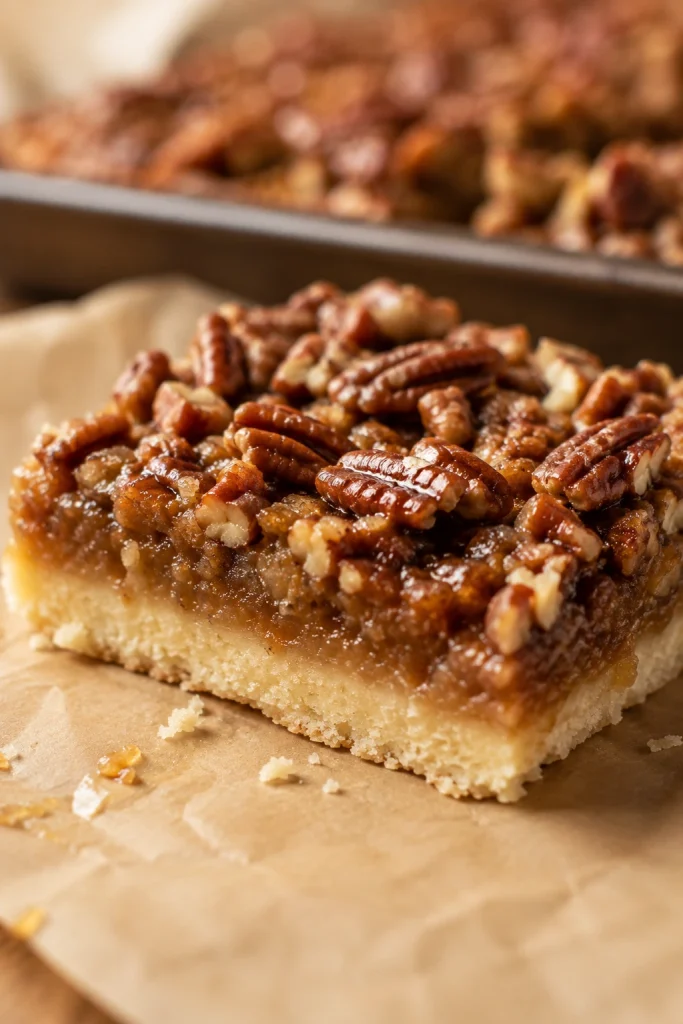
Close-up of a pecan pie bar showing glossy pecans, soft brown filling, and a pale shortbread base.
Look at the layer contrast: the pecan filling stays glossy and soft, while the shortbread crust holds firm enough for a clean bite.

Pecan Pie Bars Recipe

These pecan pie bars bake into a buttery shortbread base with a glossy maple-brown sugar pecan layer on top. One 9×13 pan gives you 24 rich bars or 36 smaller dessert-table squares.

What success looks like: the crust is pale golden at the edges, the pecan layer is glossy, the sides bubble before the pan comes out, and the center still has a soft wobble. After cooling, the bars should lift cleanly but bite like soft pecan pie filling, not syrup and not candy. One small square should feel satisfying, with a buttery bottom, sticky pecan top, and the best part of pecan pie in the middle.

Recipe Details

Prep Time20 minutes
Crust Bake Time18 to 20 minutes
Filling Bake Time25 to 30 minutes
Cooling TimeAt least 2 hours
Optional Chill Time30 to 60 minutes for sharper cuts
Total TimeAbout 3 hours 10 minutes, plus optional chilling
Oven Temperature350°F / 177°C
Pan Size9×13 inch / 23×33 cm
Yield24 rich bars or 36 small squares

Equipment

  • 9×13 inch / 23×33 cm baking pan
  • Parchment paper
  • Large mixing bowl
  • Whisk
  • Pastry cutter, fork, or food processor for the crust
  • Rubber spatula
  • Wire cooling rack
  • Sharp knife
  • Optional kitchen scale
  • Optional oven thermometer

A metal pan is best for even browning and tidy edges. Glass works too, but it holds heat longer, so start checking a few minutes early near the end.

Ingredients

For the Shortbread Crust

  • 2 cups all-purpose flour / 250 g
  • 1/2 cup powdered sugar / 60 g
  • 1 tablespoon cornstarch / 8 g, optional but helpful for tenderness
  • 1/2 teaspoon fine salt
  • 1 cup cold unsalted butter, cut into small cubes / 226 g / 8 oz

If measuring flour by cups, spoon it into the cup and level it instead of scooping directly from the bag. Too much flour can make the crust dry or crumbly.

For the Pecan Filling

  • 3 cups chopped pecans / about 300 to 330 g / 10.5 to 12 oz
  • 1 cup packed light brown sugar / 200 g
  • 3/4 cup pure maple syrup / 180 ml, or light corn syrup for a classic version
  • 1/2 cup unsalted butter, melted and slightly cooled / 113 g / 4 oz
  • 3 large eggs, at room temperature / about 150 g without shells
  • 2 tablespoons heavy cream / 30 ml
  • 2 teaspoons vanilla extract / 10 ml
  • 1/2 teaspoon fine salt
  • Flaky salt, optional, for finishing

Chopped pecans are better than pecan halves here because they spread evenly and slice more easily. Pecan halves look pretty, but they can drag the knife through the topping.

Instructions

Make and Prebake the Crust

  1. Prepare the pan. Preheat the oven to 350°F / 177°C. Line a 9×13 inch / 23×33 cm baking pan with parchment paper, leaving overhang on the long sides so you can lift the bars out later.
  2. Make the crust mixture. In a large bowl, whisk together the flour, powdered sugar, cornstarch if using, and salt. Add the cold cubed butter. Cut it into the flour mixture with a pastry cutter, fork, or your fingertips until it looks like damp crumbs and holds together when squeezed.
  3. Press the crust into the pan. Tip the crust mixture into the prepared pan. Press it firmly into an even layer, especially in the corners and along the edges.
  4. Prebake the crust. Bake for 18 to 20 minutes, until the surface looks set and the edges are just beginning to turn pale golden.

Add the Filling, Bake, and Slice

  1. Make the filling. While the crust bakes, whisk the brown sugar, maple syrup, melted butter, eggs, heavy cream, vanilla, and salt until smooth and glossy. Stir in the chopped pecans.
  2. Pour over the warm crust. Remove the crust from the oven and carefully pour the pecan filling over it. Spread the pecans evenly so every piece gets a good nutty layer.
  3. Bake the bars. Return the pan to the oven and bake for 25 to 30 minutes, until the edges bubble, the top looks glossy and set, and the center wobbles slightly like soft custard. It should not ripple like liquid.
  4. Cool completely. Place the pan on a wire rack and let the bars cool completely, at least 2 hours. Do not judge the final texture while the bars are hot; the filling will continue to set as it cools.
  5. Sharper cuts. Chill the cooled slab for 30 to 60 minutes before cutting if you want the neatest pieces.
  6. Slice and serve. Use the parchment overhang to lift the slab out of the pan. Cut into 24 rich bars or 36 smaller squares with a sharp knife, wiping the blade between cuts.

Recipe Notes

  • Classic pecan pie bars: replace the maple syrup with the same amount of light corn syrup. The filling will taste sweeter and look a little glossier.
  • Stronger maple flavor: use dark maple syrup and finish the baked bars with a little flaky salt.
  • Slightly firmer set: leave out the heavy cream. The cream gives the filling a softer, richer bite, but the bars still work without it.
  • Deeper pecan flavor: lightly toast the pecans before adding them, but watch the final bake closely so the nuts do not over-brown.
  • Sharper edges: cool completely, then chill before cutting.
  • Better sweetness balance: cut smaller squares and use flaky salt instead of reducing the sugar heavily.
  • Storage: cool uncovered first, then cover and refrigerate if you are not serving them the same day.

Need more visual help? See the step-by-step cues, doneness guide, or clean-cutting tips before you start.

The 5 Rules for Pecan Pie Bars That Slice Cleanly

These bars are simple, but they do ask for patience. Most problems come from skipping one of two things: giving the crust a head start, or giving the filling time to cool.

  1. Prebake the crust until it looks set, not brown. This gives the filling a dry, sturdy base to sit on.
  2. Look for bubbling edges. If the edges never bubble, the filling probably did not get hot enough to set.
  3. Trust a soft wobble, not a liquid ripple. A little movement is fine. Waves across the pan mean more oven time.
  4. Cool before judging. Hot pecan filling can fool you. The real texture shows after cooling.
  5. Chill before clean cuts. Room-temperature bars taste softer, but chilled bars slice better.
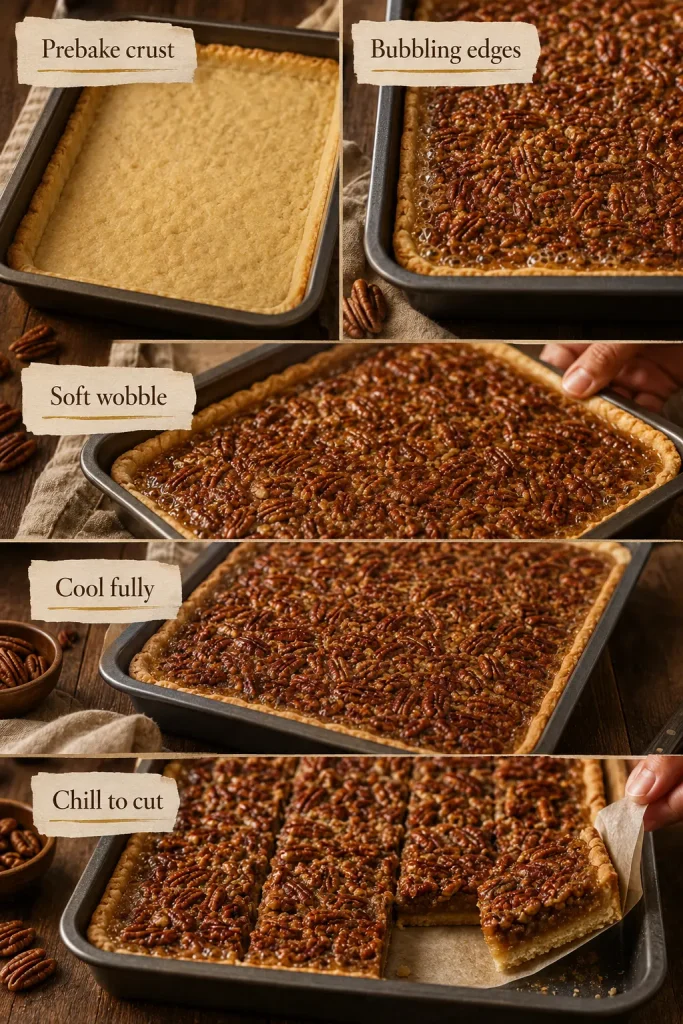
Five-panel guide for pecan pie bars labeled Prebake crust, Bubbling edges, Soft wobble, Cool fully, and Chill to cut.
This visual checklist keeps the recipe on track: prebake the crust, look for bubbling edges, accept a gentle wobble, cool fully, and chill before slicing.

If you remember only one thing, remember this: judge the bars after cooling, not straight from the oven.

Make These When

These are the bars to make when the dessert table is crowded, the pie server is missing, and nobody wants to be responsible for the first messy slice. They feel festive without needing last-minute attention.

  • Pecan pie flavor sounds good, but rolling pie crust does not.
  • A Thanksgiving or Christmas dessert needs to serve a crowd.
  • Make-ahead baking would make the meal feel calmer.
  • The dessert has to travel well to a potluck or office party.
  • Smaller squares would fit a cookie box or mixed dessert spread.
  • Sturdy bars sound better than soft pie wedges.
  • You have pecan pieces and want a dessert where they work better than perfect halves.

You can bake them the day before, chill them overnight, and stop worrying about dessert while the rest of the meal comes together. For a cozy fall table, they sit nicely beside soft bakes like apple cake. You can save the day-of baking energy for something fresh, like homemade cinnamon rolls.

More Help If You Need It

Why This Recipe Works

This recipe works because each part has a clear job. Prebaking helps the shortbread crust hold the sticky filling. Eggs and brown sugar give structure, not just sweetness. Chopped pecans spread through the pan so every square cuts cleanly.

Shortbread is sturdier than pie dough under a gooey pecan filling. It gives the bars a firm, buttery base without asking you to roll dough, chill dough, or worry about a fragile bottom crust. After cooling, the center should bite like soft caramel custard — not syrup, not candy.

Ingredient Notes

The ingredient list is simple, but the choices matter. Butter keeps the crust tender, while the filling needs enough structure to set after cooling.
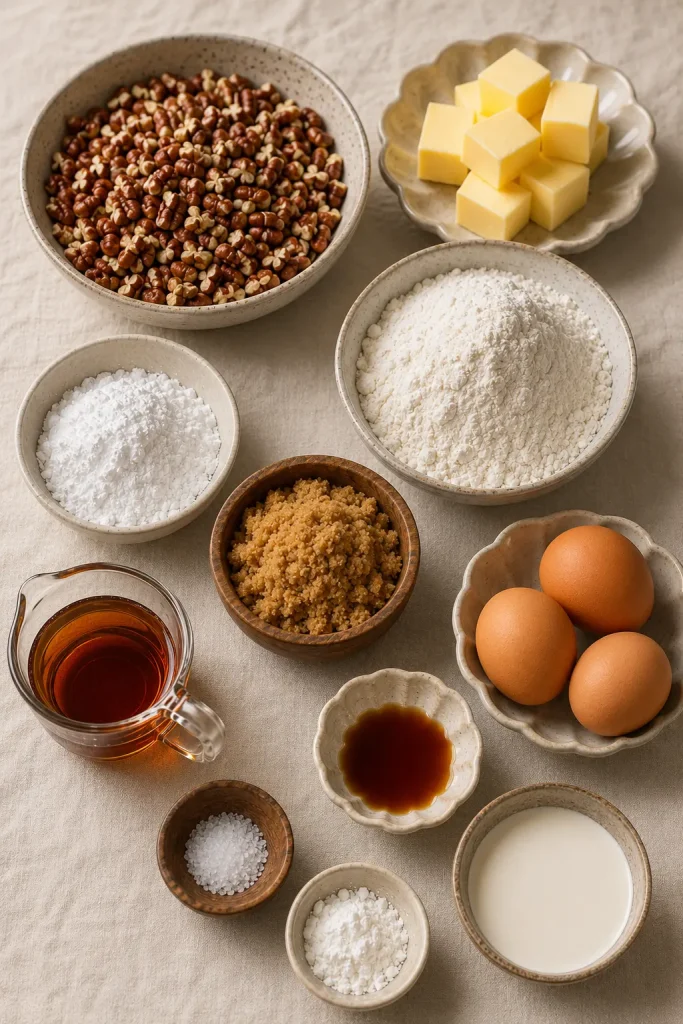
Ingredients for pecan pie bars arranged on linen, including chopped pecans, butter, flour, powdered sugar, brown sugar, eggs, maple syrup, vanilla, cream, salt, and cornstarch.
Gather the crust and filling ingredients before you start so the filling can be mixed while the crust prebakes.

Shortbread Crust

This shortbread crust is made with flour, powdered sugar, salt, cold butter, and a little cornstarch. When you squeeze a handful, the sandy mixture should clump like damp shortbread crumbs.

  • All-purpose flour gives the crust structure.
  • Powdered sugar keeps the crust tender and lightly sweet.
  • Cornstarch is optional, but it helps make the crust a little more delicate.
  • Cold butter creates a shortbread texture instead of a greasy base.
  • Salt balances the sweet pecan filling.

For bars, shortbread has one big advantage over pie crust: it holds its shape when you lift and cut it. If you are comparing this with a traditional pastry base, MasalaMonk’s apple pie crust guide explains cold butter, chilling, and rolling — but for these bars, shortbread is the sturdier choice.

Pecan Filling

Most of the pecan pie character comes from the filling. It should be glossy and pourable before baking, with the pecans suspended through the mixture instead of sitting in one dry pile.

  • Pecans: chopped pecans are easier to slice through than large halves.
  • Brown sugar: gives the filling a deeper caramel flavor.
  • Maple syrup: works as the main syrup for a no-corn-syrup-friendly version.
  • Butter: adds richness and helps the filling taste rounded.
  • Eggs: help the filling set as it bakes and cools.
  • Heavy cream: gives a softer, richer bite. Leave it out if you want a slightly firmer set.
  • Vanilla and salt: keep the flavor warm, balanced, and not flat.

You do not need perfect pecan halves for this recipe. Pecan pieces are often the smarter choice because the nuts need to be distributed through the filling rather than arranged on top of a pie.

Should You Toast the Pecans First?

You do not have to toast the pecans first because they will toast as the bars bake. Lightly toasting them before mixing can deepen the flavor, but keep an eye on the final bake so the nuts do not get too dark on top.

Step-by-Step Cues for Better Pecan Pie Bars

Use this section when the timer is not enough. These are the visual cues that tell you the crust, filling, and finished pan are on track.

1. Crust Mixture: Damp Crumbs, Not Smooth Dough

The crust mixture should look crumbly, not creamy. When you squeeze a small handful, it should hold together. If it stays powdery, the butter may not be worked in evenly.
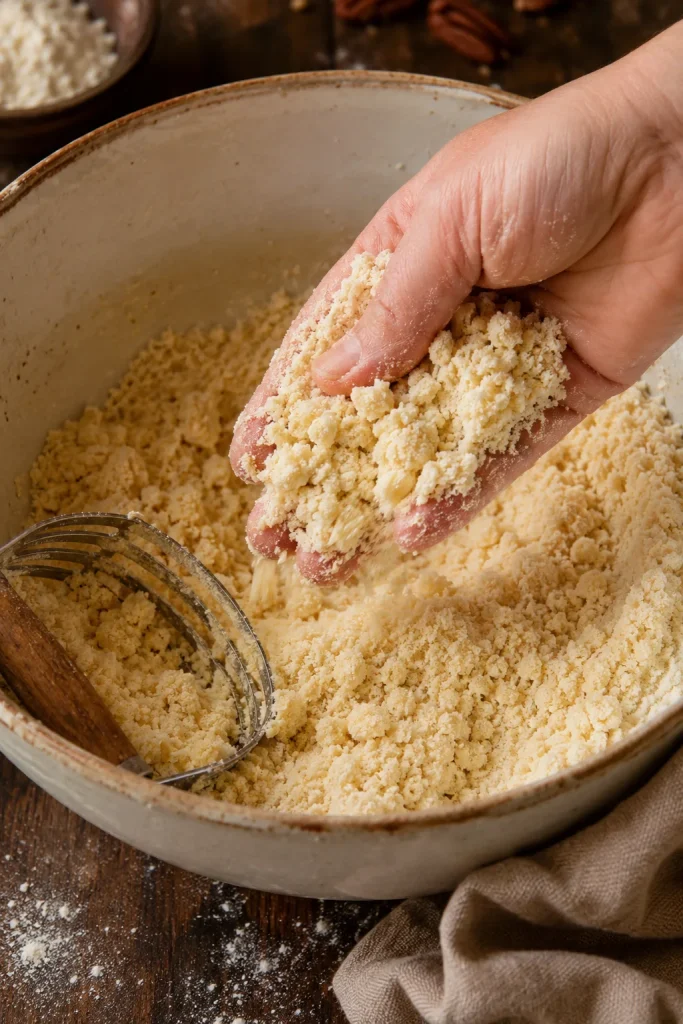
Hand squeezing crumbly shortbread crust mixture in a bowl to show damp crumbs holding together.
Instead of a smooth dough, aim for buttery crumbs that clump when squeezed; that texture presses evenly and bakes into a tender shortbread crust.

2. Pressed Crust: Compact and Even

Press the crust firmly into the pan, especially in the corners and along the edges. Thin corners can overbake, while thick patches can stay soft.
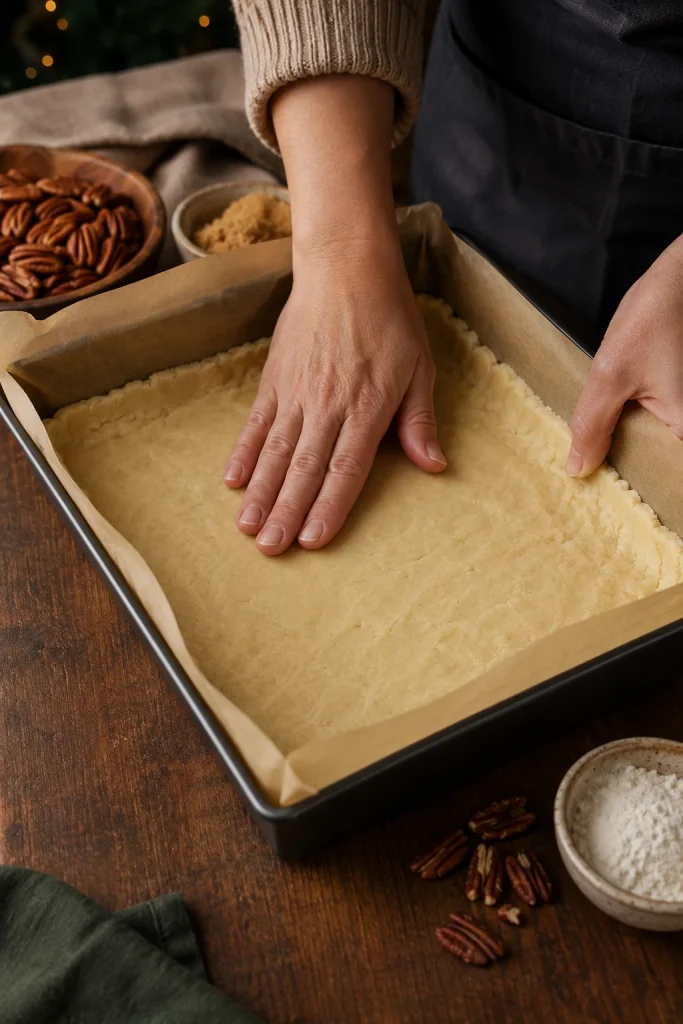
Hands pressing shortbread crust evenly into a parchment-lined rectangular baking pan.
Once the crumbs are ready, press them firmly into the parchment-lined pan, especially around the edges, so every bar has a steady base.

3. Prebaked Crust: Set and Pale Golden

The crust does not need to turn deeply brown. It only needs to look set with pale golden edges. That head start keeps the sticky filling from sinking into a soft base.
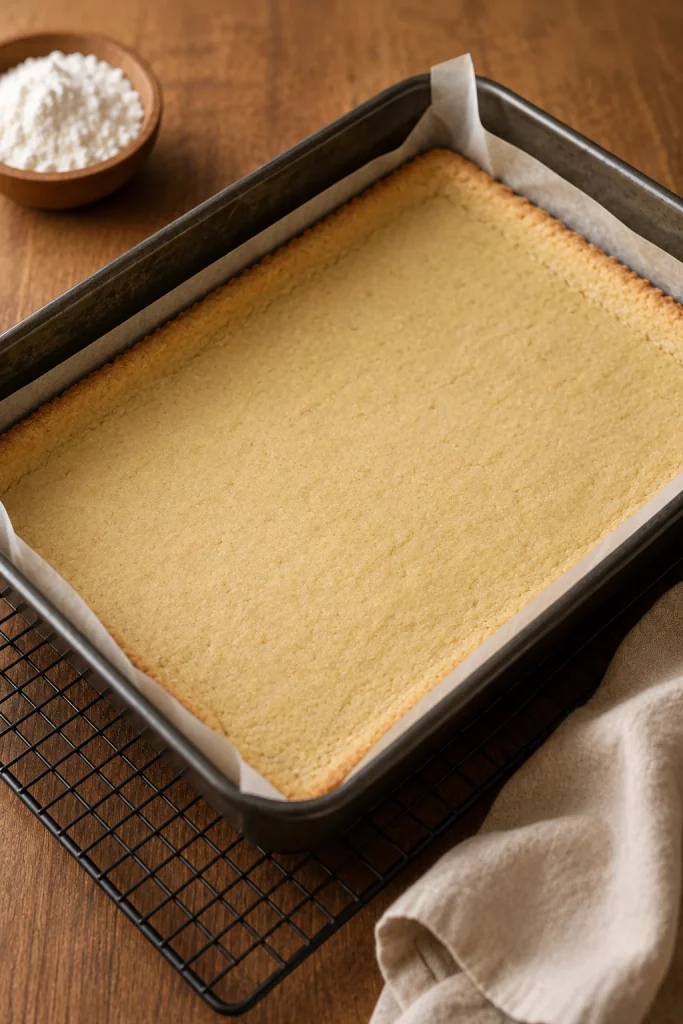
Prebaked shortbread crust in a parchment-lined metal pan with a set surface and lightly golden edges.
The prebaked crust should look set with pale golden edges; it still needs to bake again under the sticky pecan filling.

4. Filling Pour: Glossy, Even, and Ready to Bake

Whisk the sugar, syrup, butter, eggs, cream, vanilla, and salt until smooth before the pecans go in. Once the pecans are stirred through, pour the filling over the warm crust and guide the nuts toward the corners.
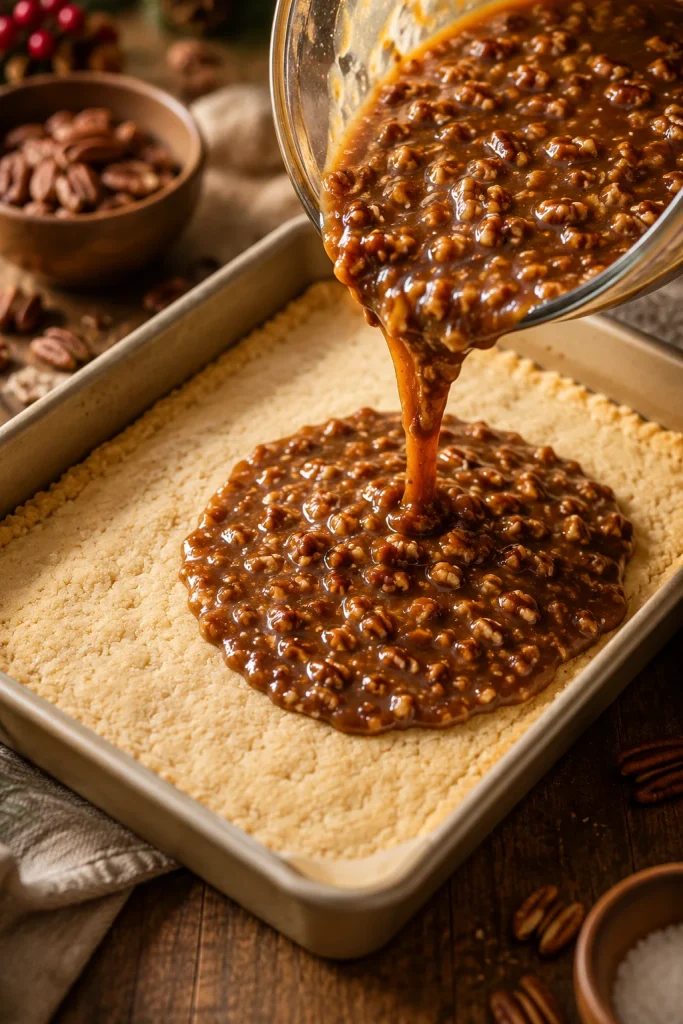
Glossy maple pecan filling being poured over a prebaked shortbread crust in a parchment-lined baking pan.
After the crust is prebaked, pour the glossy maple pecan filling over the warm base and guide the nuts toward the corners.

5. Before Baking: Even Pecan Coverage

Before the pan goes back into the oven, nudge the pecans into an even layer so the corners are not bare and the center does not bake as one thick nut pile.
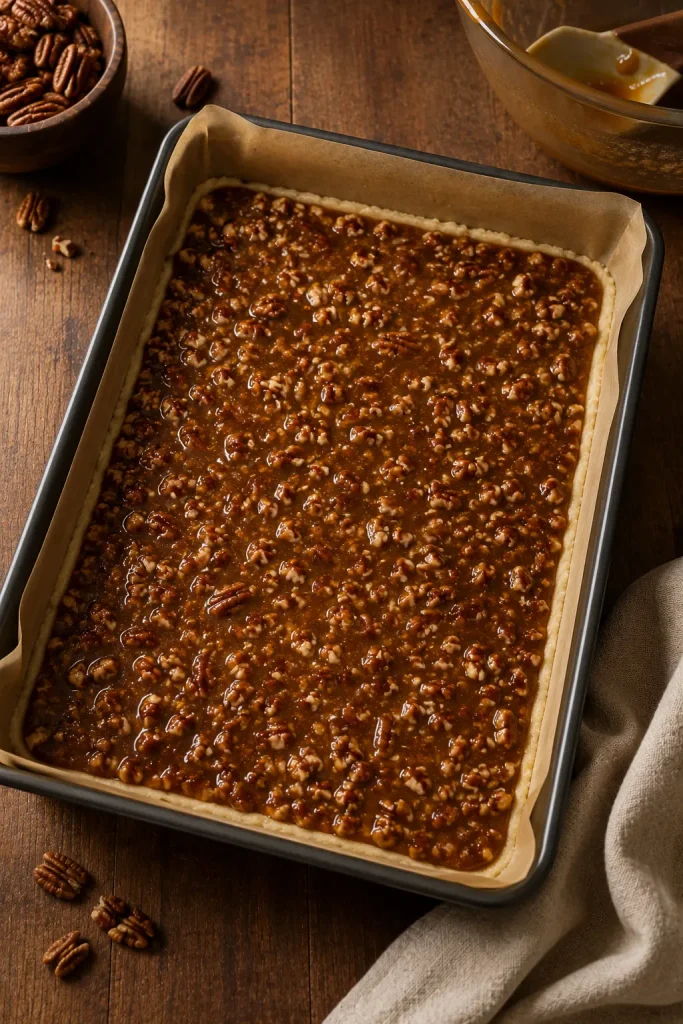
Unbaked pecan pie bars in a parchment-lined pan with glossy filling and evenly spread chopped pecans.
Before the pan returns to the oven, check for even pecan coverage; this helps the bars bake evenly and gives each square enough topping.

6. After Baking: Bubbling Edges and Soft Center Wobble

Edges should bubble before the pan comes out. A glossy, set-looking top is good, but the center should still move gently. Soft wobble is fine. Liquid ripple means more oven time.
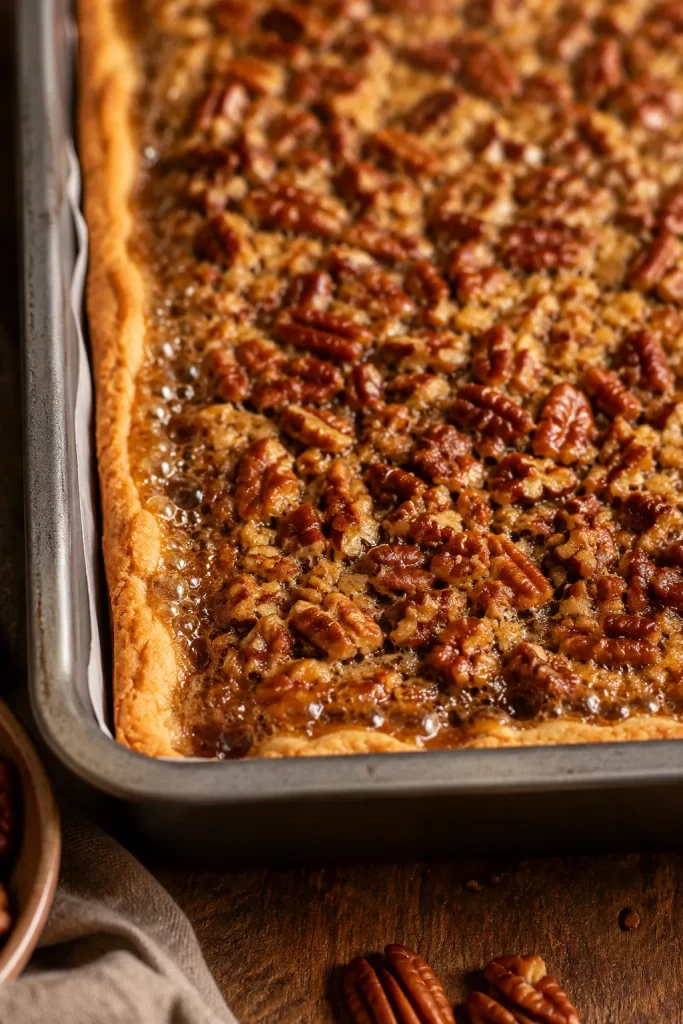
Baked pecan pie bars in a pan with bubbling edges, glossy pecan topping, and a golden crust.
As the filling bakes, watch the edges first: steady bubbling around the pan is a better doneness clue than waiting for a stiff center.

7. After Cooling: Liftable Slab, Soft Bite

Once cool, the bars should lift from the pan as one slab. The top may still be slightly tacky, but it should not look wet. Center texture should bite like soft pecan pie filling, not run like syrup.
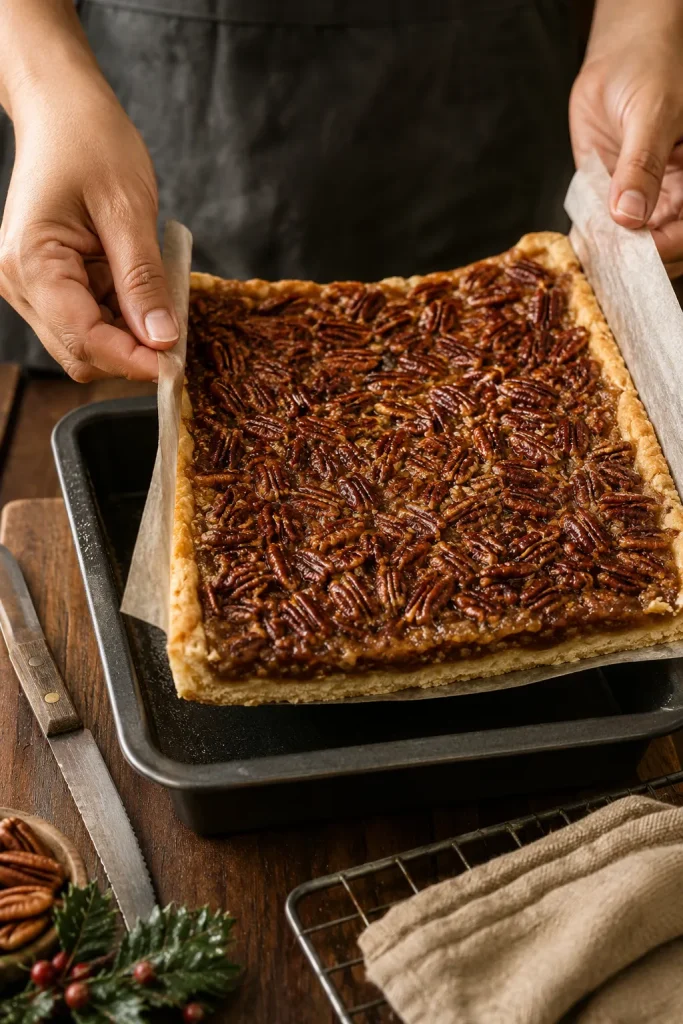
Cooled slab of pecan pie bars being lifted from a metal baking pan using parchment paper.
After cooling, use the parchment overhang to lift the slab out cleanly, then cut on a board instead of fighting the pan.

Still worried about the filling? Go straight to the doneness guide, or return to the recipe card.

How to Tell When Pecan Pie Bars Are Done, Not Runny

This is the part where pecan pie bars make people nervous, because done does not mean stiff. You want gooey, not raw; soft, not sloshy; rich, not hard like candy.

Soft Wobble vs Liquid Ripple
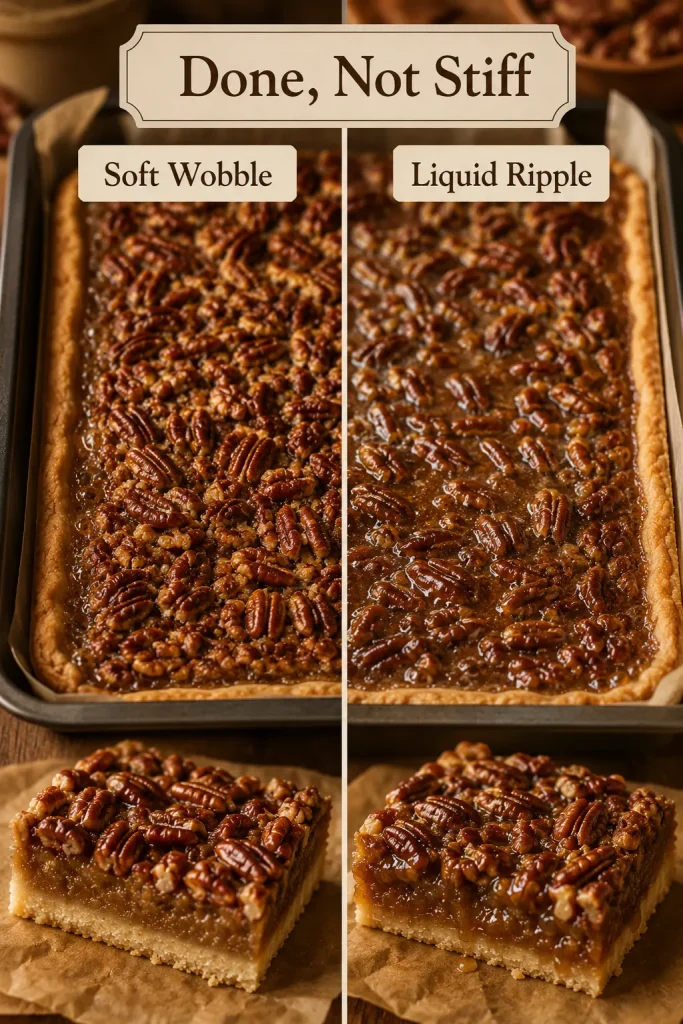
Split comparison guide showing pecan pie bars labeled Soft Wobble on one side and Liquid Ripple on the other, with the title Done, Not Stiff.
Gentle movement is fine, but a loose ripple means the filling still needs more time before it can set into clean pecan pie bars.

If you wait until the center looks completely firm in the oven, the filling can cool into something too hard or sticky-chewy. The edges matter more than the exact minute on the timer: look for bubbling sides, a glossy top, and a center that moves gently without sloshing.

Look for these signs before removing the pan from the oven:

  • Edges are bubbling around the pan.
  • A glossy, set-looking top covers the filling.
  • Pecans look toasted, not burnt.
  • Crust edges are lightly golden.
  • The center has a slight custard-like wobble.
  • Gentle pan movement does not create a liquid ripple or slosh.
  • No wet or raw-looking patch remains in the middle.

Slight movement in the center is fine because the filling keeps setting as it cools. A liquid wave means the bars need more time. Add 3 to 5 minutes, then check again.

If using a thermometer, these bars are usually set around 185°F / 85°C in the center, but do not chase the number alone. The better test is the full set of cues: bubbling edges, a glossy top, and a center that wobbles softly without rippling like liquid.

That visual cue makes the pan much less intimidating.

After baking, the next move is cooling and cutting cleanly. If the pan looks off, use troubleshooting.

How to Cool, Chill, and Cut Clean Squares

This is where the recipe stops being about skill and starts being about patience. Hot bars smear. Cold bars slice.

  • Cool the pan completely on a wire rack.
  • Chill the slab for 30 to 60 minutes if you want sharper edges.
  • Lift the bars out using the parchment overhang.
  • Use a long, sharp knife.
  • Wipe the knife between cuts.
  • Trim the outer edges if you want a polished party platter.
  • Cut 24 larger bars or 36 smaller squares.
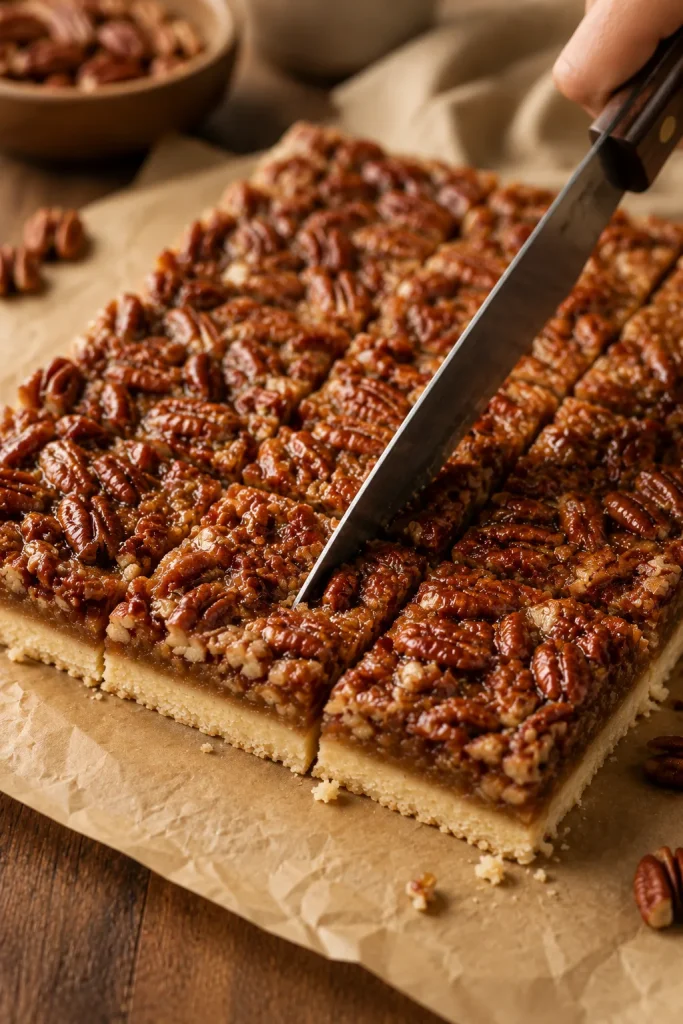
Sharp knife cutting chilled pecan pie bars into neat squares on parchment paper.
Slice the bars cold for sharp edges; chilled filling resists smearing and the shortbread base stays steadier under the knife.

For the neatest look, cut the bars cold and then let them sit at room temperature before serving. A chilled slab is easier to cut than a room-temperature one, even if you plan to serve the bars softer.

For serving, smaller pieces usually work better than large ones because the bars are rich. Coffee, unsweetened tea, lightly sweetened homemade whipped cream, or a little flaky salt all help balance the sweetness.

That is the difference between a delicious pan and a dessert tray that looks intentional.

How to Make Them Gooier, Firmer, or Cleaner-Cut

Once the base recipe is clear, you can steer the bars a little softer, a little firmer, or cleaner-cut without changing the whole formula.
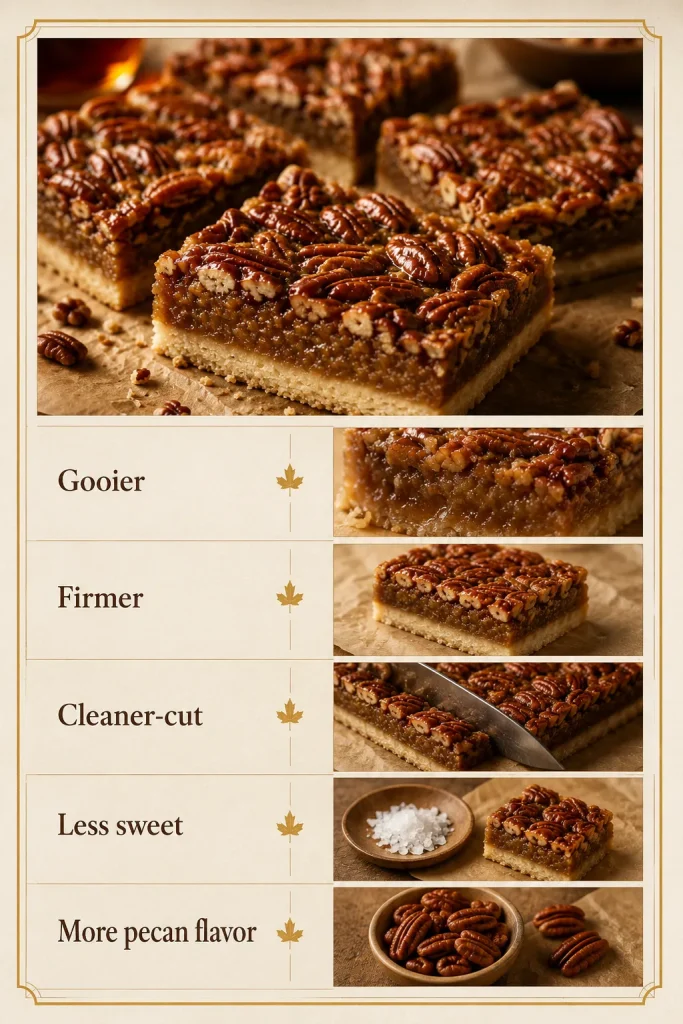
Texture control guide for pecan pie bars with sections labeled Gooier, Firmer, Cleaner-cut, Less sweet, and More pecan flavor.
Use this guide to choose a softer center, firmer set, cleaner cuts, less sweetness, or deeper pecan flavor.
Desired ResultWhat to Do
Gooier centerUse maple syrup as written, keep the cream, and do not overbake.
Firmer barsSkip the cream and chill before slicing.
Cleaner cutsChill the slab, use a sharp knife, and wipe between cuts.
Less sweet feelCut smaller squares and finish with flaky salt.
Stronger pecan flavorLightly toast the pecans before adding them to the filling.

You are not locked into one texture; you just need the right small adjustment. Do not reduce the sugar heavily to make the bars less sweet, because sugar helps the filling set. Better balance comes from smaller pieces, flaky salt, coffee, tea, or lightly sweetened cream.

Pan Size Guide

For holiday baking, a 9×13 inch pan is the calm choice. It gives you enough bars to share without making the filling so thick that the center struggles to set.
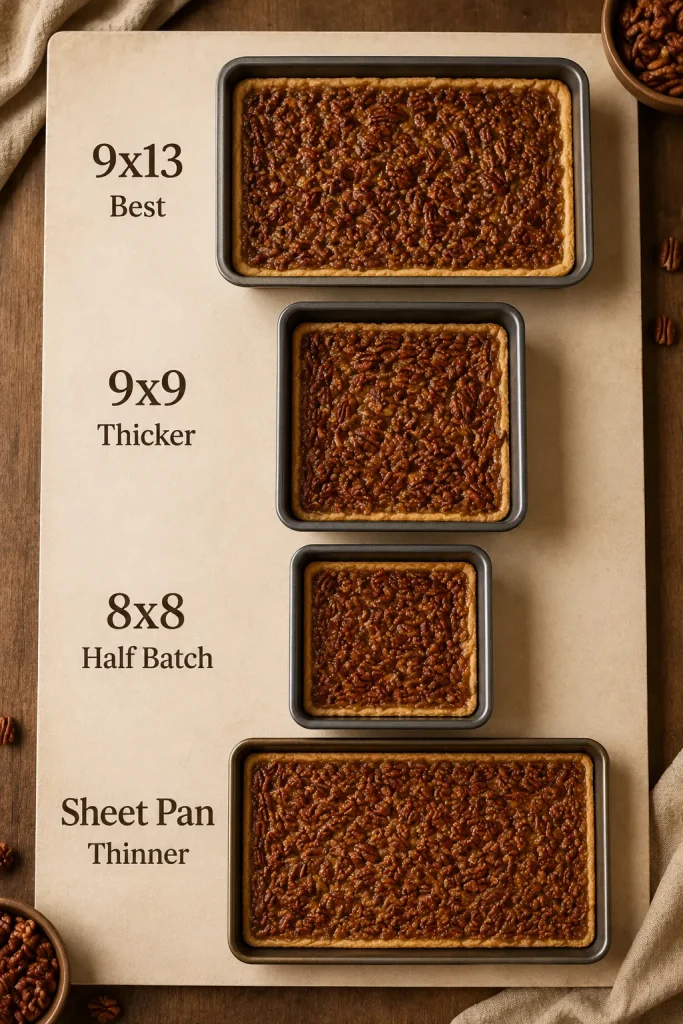
Pan size guide for pecan pie bars showing 9x13 best, 9x9 thicker, 8x8 half batch, and sheet pan thinner.
Changing pan size changes thickness, timing, and texture; the 9×13 pan is the safest fit, while smaller pans need scaling and sheet pans bake thinner.
Pan SizeBest ForWhat to Know
9×13 inch / 23×33 cmHoliday trays, potlucks, partiesBest default. Makes 24 rich bars or 36 smaller squares.
9×9 inchSmaller batchBars will be thicker. They may need a little more time to set.
8×8 inchSmall batchUse a scaled-down recipe rather than baking the full amount in this pan.
Jelly roll pan or sheet panLarge thin barsNot a direct swap. The bars will be thinner and may bake faster.
Metal baking panClean edges and even browningBest choice if available.
Glass baking dishHome bakingWorks, but glass holds heat longer. Check early near the end of baking.

Can I Make a Smaller Batch?

Yes, but use a true half batch for an 8×8 pan rather than pouring the full 9×13 mixture into a smaller dish. The bake time will usually be shorter for a scaled-down batch, but use the same doneness cues: bubbling edges, glossy top, and a soft wobble in the center.

Best Syrup for Pecan Pie Bars: Maple vs Corn Syrup

Syrup changes both flavor and texture. Corn syrup gives the classic glossy sweetness; maple brings a warmer flavor and a slightly softer bite.
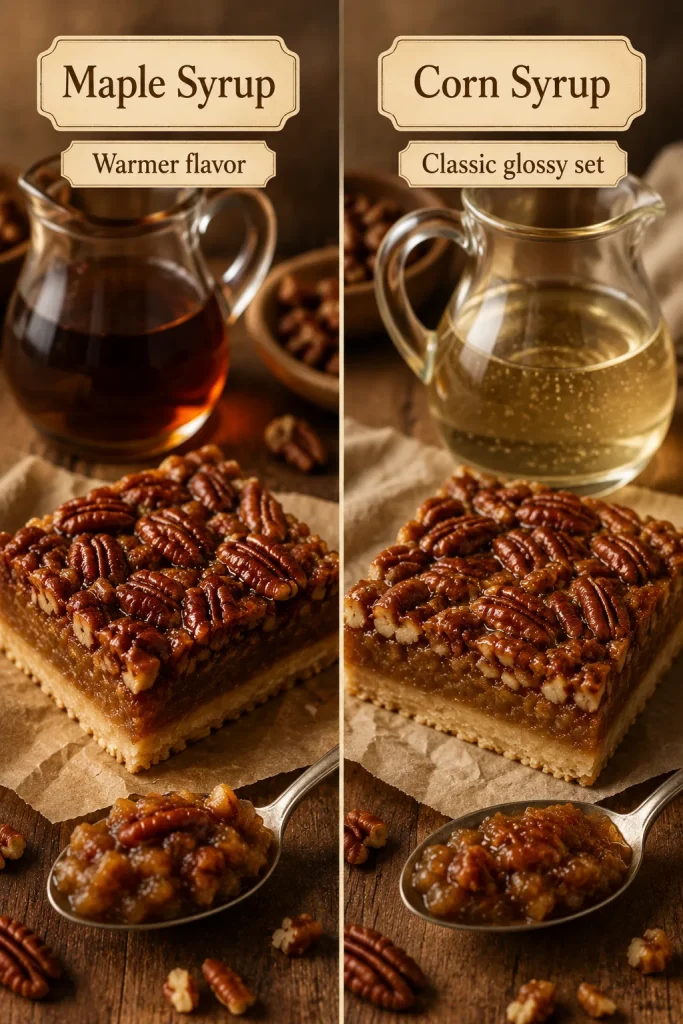
Split image comparing maple syrup and corn syrup with pecan pie bars and spoonfuls of pecan filling.
Maple syrup brings a warmer, deeper flavor, while corn syrup gives pecan pie bars the more traditional glossy set.
SweetenerBest ForTexture and Flavor
Maple syrupNo-corn-syrup pecan pie barsWarm, deep, slightly caramel-like flavor.
Light corn syrupClassic pecan pie barsGlossy, sweet, familiar, and reliable.
HoneyHoney-forward barsSticky and floral, with a stronger flavor.
Golden syrupCaramel-style sweetnessRich, buttery, and slightly toasty.
Brown sugar onlyDeeper caramel flavorNot always a direct syrup replacement because syrup helps texture.

Use the syrup listed in the recipe card for the most reliable result. Swapping sweeteners can change the sweetness, set, and sliceability.

Can You Make Pecan Pie Bars Without Corn Syrup?

Yes. These pecan pie bars can be made without corn syrup by using maple syrup. Maple brings more flavor and a slightly softer bite, so this recipe does not ask maple to do all the structural work alone. The eggs, brown sugar, bubbling edges, and full cooling time all help the filling set into bars instead of staying loose.

So yes, you can skip corn syrup here — just do not treat maple syrup like a magic swap. The bars still need the eggs, sugar, bake time, and cooling time to become sliceable.

For a more classic version, replace the maple syrup with the same amount of light corn syrup. Honey can work for a stronger natural-sweetener flavor, but it will taste noticeably like honey.

Make-Ahead Holiday Timeline

This is why these bars belong on a holiday table: they let you finish dessert before the kitchen gets chaotic. By the next day, the filling is settled, the cuts are cleaner, and one dessert is already off your list.

Best Plan for Thanksgiving or Christmas

  • One day before serving: bake the bars, cool completely, cover, and refrigerate.
  • Serving day: lift the slab from the pan and cut while chilled.
  • Before serving: let the bars sit at room temperature briefly for a softer, gooier bite.
  • Trays or boxes: place parchment between layers so the tops do not stick.

Thanksgiving plan: bake the bars on Wednesday, chill overnight, slice Thursday morning, and serve later in the day. On a busy holiday morning, already-cut bars feel much calmer than a pie that still needs a clean first slice.

  • Chill before packing so the pieces hold their shape.
  • Cut smaller squares for dessert trays and cookie boxes.
  • Use parchment between layers so the tops do not stick.
  • Keep the top layer flat instead of pressing bars together.
  • Do not pack warm bars; the filling needs to be fully cooled first.
  • Add flaky salt after cutting if the tops are no longer tacky.
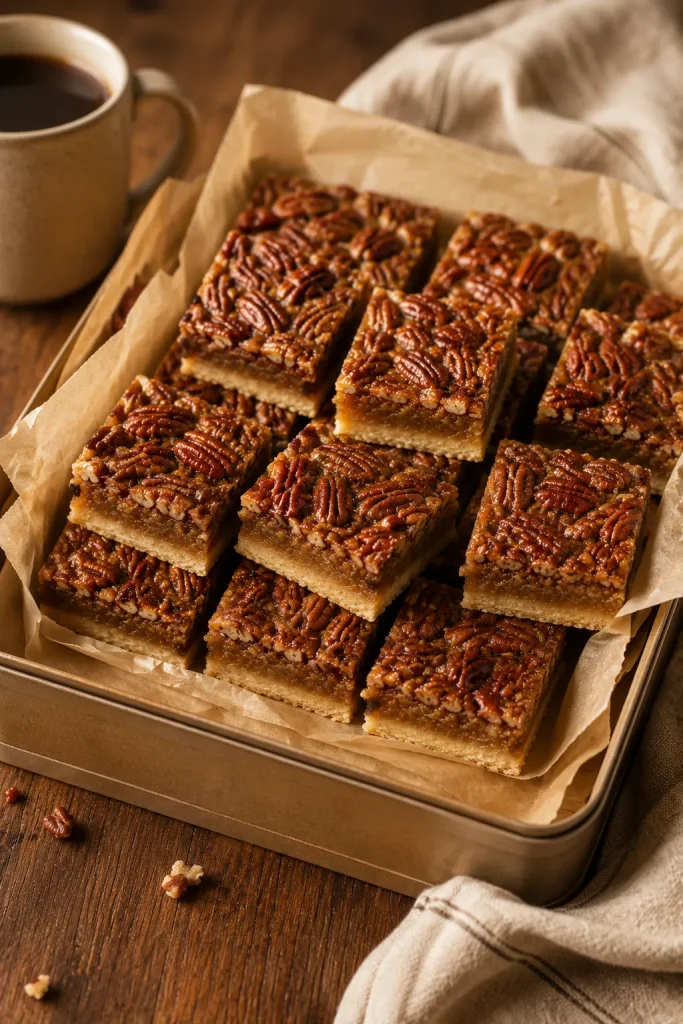
Pecan pie bars packed in a shallow box with parchment paper between layers and a coffee mug nearby.
Packing for potlucks, dessert trays, or cookie boxes works best when the bars are cold and the glossy tops are protected with parchment.

Picture the pan on a crowded Thanksgiving counter: bars already cut, parchment between layers, no pie server required. Small squares are often the smartest choice for a mixed dessert table because they feel generous without making the plate too heavy.

Storage and Freezing

Let the bars cool completely at room temperature so the filling can set. Leave them uncovered while they cool, then cover once they are no longer warm. The safest make-ahead approach is to treat them like pecan pie and refrigerate after cooling, especially because this version contains eggs and cream.

For a cautious storage approach, Iowa State University Extension and Outreach recommends refrigerating homemade pecan and pumpkin pies made with fresh ingredients after baking and cooling unless they are served within the safe room-temperature window.

They are also forgiving in the fridge, which is exactly what you want from a holiday dessert.

Storage MethodHow LongBest Practice
Cooling after bakingAbout 2 hours, or until fully cooledCool uncovered so the filling can set before chilling or slicing.
Room-temperature servingUp to 2 hours after coolingGood for dessert tables, especially in a cool room.
Refrigerator3 to 4 daysStore airtight, with parchment between layers if stacked.
FreezerUp to 3 months for best qualityFreeze sliced bars with parchment between layers.

To freeze, cool the bars completely, cut them into squares, and freeze in an airtight container. Place parchment between layers so the tops do not stick. Thaw overnight in the refrigerator, then let them sit at room temperature briefly before serving if you want a softer texture.

Variations

Some changes are easy because they only adjust flavor. Others change the structure of the filling, and that is where pecan pie bars stop being casual.

Easy Flavor Changes

  • Chocolate pecan pie bars: sprinkle 1/2 to 3/4 cup chocolate chips over the crust before adding the filling, or drizzle melted chocolate over the cooled bars. For a true chocolate-square dessert instead, try fudgy brownies.
  • Bourbon pecan pie bars: add 1 to 2 tablespoons bourbon to the filling. It works especially well with maple syrup and brown sugar.
  • Salted pecan pie bars: finish the baked bars with flaky salt while the top is still slightly tacky.
  • Brown butter pecan bars: brown the butter first, then cool it slightly before whisking it into the filling.
  • Maple spice pecan bars: use maple syrup as written and add a small pinch of cinnamon or a little apple pie spice. Keep it light so the pecans, brown sugar, and maple stay in front.

Bigger Changes

  • Pecan pie cheesecake bars: add a cheesecake layer only if you are using a version built for that extra layer.
  • Pumpkin pecan pie bars: use a purpose-built pumpkin version because pumpkin changes the moisture, filling thickness, and bake time.
  • Vegan pecan pie bars: use a recipe designed without eggs and butter rather than swapping them casually here.
  • Keto or sugar-free pecan pie bars: use a dedicated low-carb version because sugar and syrup help this filling set.

Can You Use Pie Crust, Cookie Dough, or Cake Mix?

The shortbread crust gives the best balance of buttery flavor, strength, and tidy slicing. Shortcuts can work, but they will change the final texture.

  • Store-bought pie crust: softer and more pie-like, but less sturdy than shortbread.
  • Sugar cookie dough: sweeter and softer, more like a cookie bar.
  • Cake mix crust: cakier and less classic.
  • Crescent roll dough: very soft and quick, but not traditional.
  • Graham cracker crust: sweeter and more crumbly unless packed firmly.

Dietary Notes

These bars depend on butter, eggs, sugar, and syrup for structure, so small swaps are safer than big ones. A 1:1 gluten-free flour blend is the easiest likely swap for the crust, though the base may be more delicate. Vegan, keto, and sugar-free versions need separate formulas because they change how the filling sets. When the bars need to feel less sweet, cut smaller pieces and add flaky salt instead of reducing the sugar heavily.

Troubleshooting Pecan Pie Bars

A pan that looks wrong is usually not a disaster. Most problems come from one of four places: bake time, cooling time, crust pressure, or filling changes.
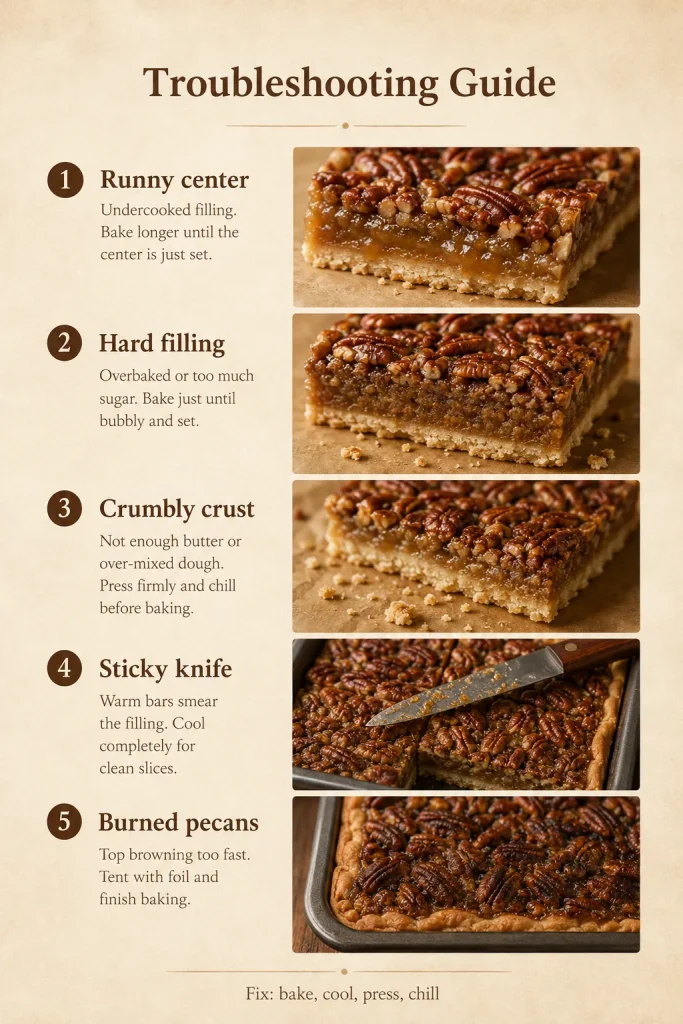
Troubleshooting guide for pecan pie bars with labeled sections for runny center, hard filling, crumbly crust, sticky knife, and burned pecans.
Use the cue first: runny centers need more baking, sticky cuts need more chilling, and dark tops need gentler heat protection.

Quick Fix Table

ProblemLikely CauseFix
Bars are runnyUnderbaked, cut too soon, or filling ratio changedBake until edges bubble and center is set with only a slight wobble. Cool completely before cutting.
Filling is too hardOverbaked or baked too long after the filling was already setCheck earlier next time. Remove when the center is just set, not dry.
Crumbly crustCrust was not pressed firmly enough or flour was overmeasuredPress the crust tightly into the pan and measure flour carefully.
Soggy crustCrust was not prebaked enoughPrebake until set and lightly golden at the edges before adding filling.
Filling leaked under the crustCrust had cracks or was pressed unevenlyPress the crust firmly and evenly, especially along the edges.
Pecans burnedBars baked too long or oven runs hotCheck earlier and use an oven thermometer if needed.
Too sweetPecan pie filling is naturally richCut smaller squares, add flaky salt, and serve with coffee or lightly sweetened whipped cream.
Sticky knifeBars are too warm or the knife is stickyChill before cutting and wipe the knife between slices.
Falling apart when cutNot cooled enough or crust too looseCool fully, chill briefly, and use a sharp knife.
Center still jigglesCould be normal or underbaked depending on movementA soft wobble is fine. A liquid ripple means it needs more time.

Problem solved? Return to the recipe card, or review the doneness cues before your next batch.

FAQ

What is the difference between pecan pie and pecan pie bars?

Pecan pie is usually baked in a round pie crust and cut into wedges. By contrast, pecan pie bars are baked in a rectangular pan with crust on the bottom and pecan filling on top, then cut into squares. The flavor is similar, but bars are easier to serve, pack, and share.

Are pecan pie bars easier than pecan pie?

Yes. The crust is pressed instead of rolled, and the slab cuts into squares instead of fragile wedges.

Why did my pecan pie bars turn out runny?

Runny bars are usually underbaked, cut too early, or made with changed filling ratios. If the edges did not bubble before you removed the pan, the filling probably did not get hot enough to set.

How long should pecan pie bars cool before cutting?

Give them at least 2 hours, or until the pan is completely cool. For sharper cuts, chill the cooled slab for 30 to 60 minutes before slicing.

Do pecan pie bars need to be refrigerated?

Refrigeration is the safest choice after they cool, especially if you are making them ahead. Cool them uncovered first, then cover and store leftovers in an airtight container in the fridge.

Can pecan pie bars be frozen?

They freeze well once the filling has cooled and set. Slice before freezing, place parchment between layers, seal tightly, and freeze for up to 3 months. Thaw in the refrigerator before serving.

Can maple syrup replace corn syrup in pecan pie bars?

Maple syrup can replace corn syrup in this recipe. The flavor becomes deeper and slightly more caramel-like. Maple bars may be a little softer than classic corn syrup bars, so let them cool fully before cutting.

Should I use pecan halves or chopped pecans?

Chopped pecans work better because they spread evenly and do not drag the knife through the topping. Pecan halves look attractive, but they can make the top harder to slice neatly.

Can I make pecan pie bars ahead for Thanksgiving?

Yes. Bake them a day ahead, cool completely, chill overnight, slice cold, and bring them closer to room temperature before serving.

Final Thoughts

Pecan pie bars are the dessert to make when you want all the glossy, nutty comfort of pecan pie without the pressure of carving out the first fragile wedge. Give the crust its head start, let the filling bubble, and cool the pan completely. The reward is a quiet holiday win: buttery bars that cut cleanly, travel easily, and still taste like the center of a pecan pie.
Back to quick answer · Back to recipe card

Posted on 9 Comments

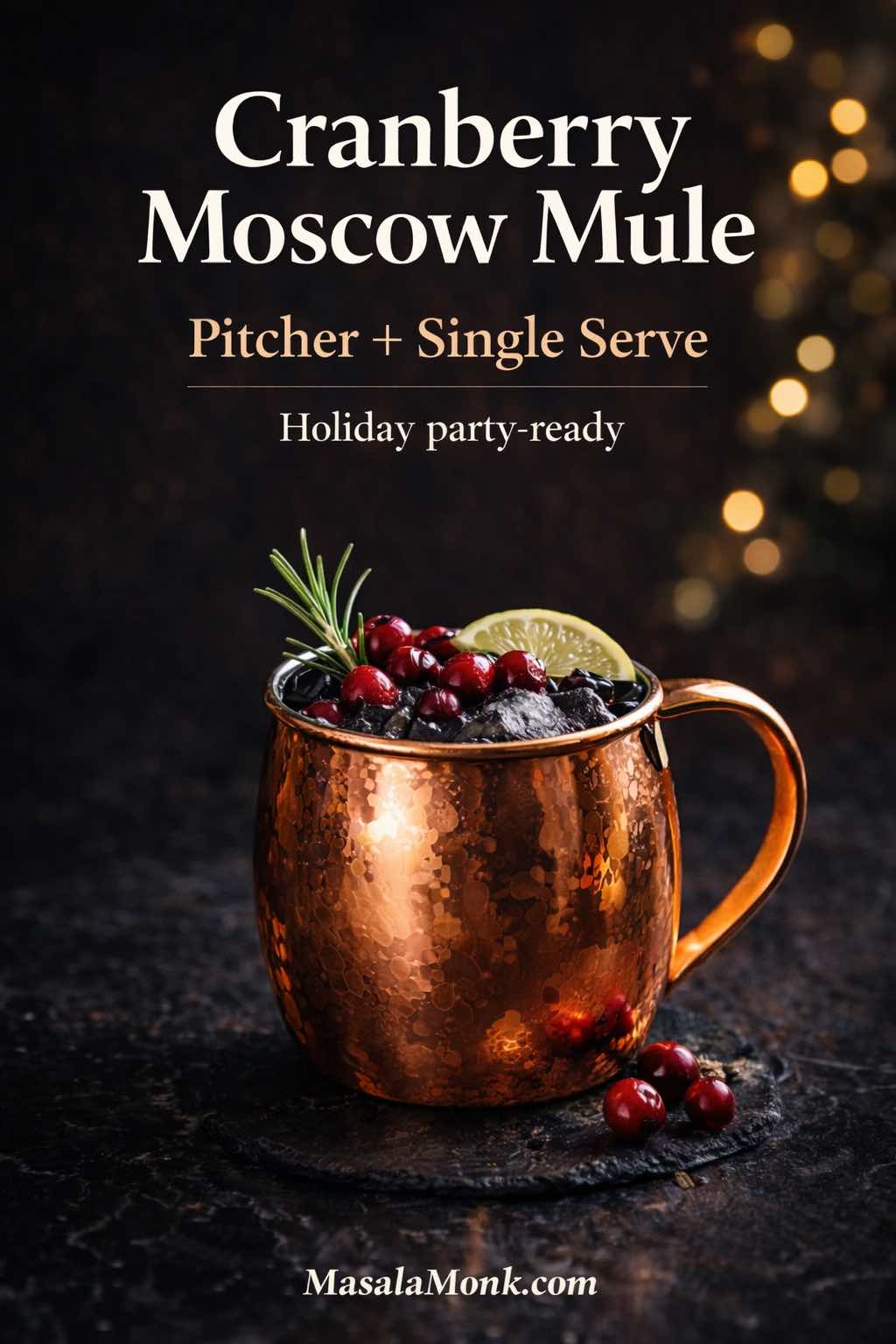
Cranberry Moscow Mule Recipe: A Festive Holiday Cocktail With Easy Variations

Cranberry Moscow Mule in a copper mug garnished with rosemary, cranberries, and lime, with text “Pitcher + Single Serve” and “Holiday party-ready.”

There are cocktails that feel like a project, and then there are cocktails that feel like a decision. The cranberry Moscow mule sits firmly in that second camp: you grab a bottle of ginger beer, you find a lime, you pour, you stir, and suddenly the glass looks like a holiday postcard.

That’s the quiet charm of this drink. It can be a cozy Christmas Moscow mule, a bright Thanksgiving cranberry mule, a casual cranberry mule cocktail after work, or the kind of holiday mule you make when friends “just happen” to stop by. Either way, you get the same three-note magic: ginger heat, citrus snap, and that tart-sweet cranberry glow that makes the whole thing taste like winter without tasting heavy.

Even better, it’s easy to steer. Want something sharper? You lean into lime. Prefer it rounder and sweeter? You choose cranberry cocktail instead of 100% juice or add a touch of syrup. Craving something more aromatic? Rosemary, thyme, or orange peel transforms the drink in seconds. And if you’re making cranberry moscow mules for a crowd, a pitcher base takes the stress out of hosting.
If you like having a dependable starting point before you riff, Masala Monk’s guide to the classic mule template is a great foundation: Moscow Mule Recipe: Master Ratio + 10 Easy Variations. From there, cranberry slides in naturally—like the drink was always meant to wear red.


Why Ginger Beer and Cranberry Juice Work So Well Together

At first glance, ginger beer and cranberry juice sounds almost too simple. Yet the pairing makes sense the moment you sip it.

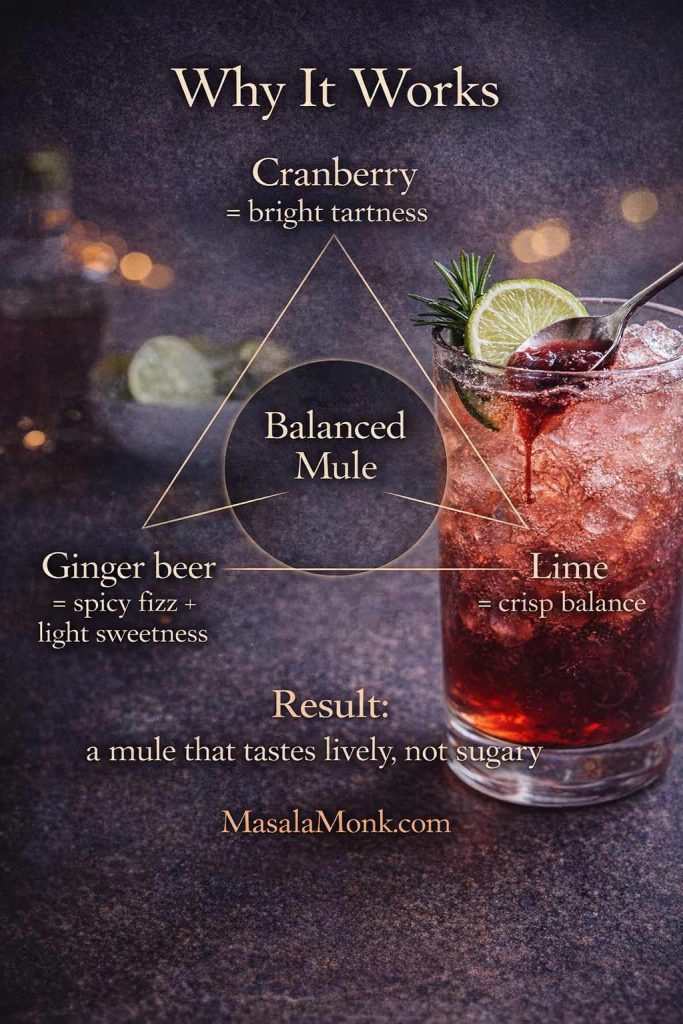
Cranberry brings bright acidity and a clean fruit note. Ginger beer brings spicy fizz and a slight sweetness. Put them together, and you get a cranberry ginger beer cocktail that tastes lively instead of sugary—especially once lime shows up to keep everything crisp.

Infographic showing why ginger beer, cranberry juice, and lime create a balanced cranberry Moscow mule, highlighting tartness, spicy fizz, and crisp citrus balance.
Why ginger beer and cranberry juice work so well together: cranberry adds bright tartness, ginger beer brings spicy fizz, and lime keeps everything crisp—so the mule tastes lively, not sugary.

That balance is the real “secret” here. A mule is essentially a bright, gingery highball; cranberry gives it holiday color and a tart backbone, but ginger beer keeps it from turning into straight-up juice. Meanwhile, lime keeps the drink from getting flat or cloying, which is why moscow mule with cranberry juice almost always tastes better when you don’t skip the citrus.

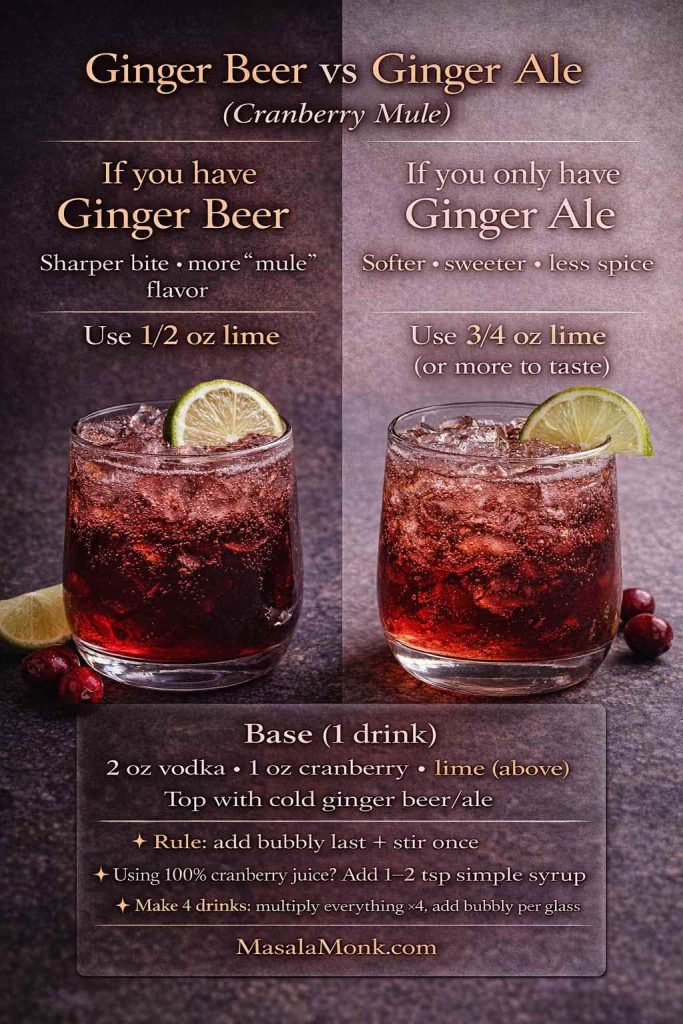
If you’ve ever wondered why two “mule” drinks can taste wildly different, the answer is often hiding in the mixer. Ginger beer tends to be bolder and more ginger-forward, while ginger ale is usually softer and sweeter; Food & Wine’s breakdown of the difference explains why the swap changes the entire drink’s profile (Ginger Beer vs. Ginger Ale), and Epicurious dives into how production and flavor affect cocktails (Ginger Beer vs. Ginger Ale). In other words: both can work, but they won’t taste the same—and cranberry amplifies that difference.

So if you’re using ginger ale because that’s what you have, you can still make a cranberry mule drink you’ll love; you’ll just want a bit more lime to keep the drink sharp and mule-like.

Also Read: Baked Ziti Recipe Collection: 15 Easy Variations


Cranberry Moscow Mule Ingredients (And What Each One Does)

A good cranberry mule recipe doesn’t need many ingredients, but each one has a job. Once you know what those jobs are, you can tweak the drink confidently—whether you’re building a spiced cranberry mule, an apple cranberry moscow mule, or a big batch cranberry moscow mule.

Vodka (or your spirit of choice)

Vodka keeps the drink clean and neutral, which is why cranberry vodka mule recipes are the classic lane. If you want a specific bottle recommendation, you can absolutely make a cranberry mule recipe with Tito’s—its smooth profile works well with tart juice and spicy ginger.

That said, vodka isn’t your only option. Later on, you’ll see how easily this becomes a gin mule, a whiskey cranberry mule, or a tequila cranberry mule with one simple swap.

Cranberry juice (the fork in the road)

This is where people unknowingly choose their drink’s personality.

  • Cranberry juice cocktail (sweetened) gives you a crowd-pleasing holiday mule cocktail that’s easy to sip.
  • 100% cranberry juice makes the drink tarter, brighter, and more “grown-up,” but it often benefits from a touch of sweetener.

If you’re chasing the best cranberry mule recipe for a party, cranberry cocktail is typically the easiest win. On the other hand, if you love sharp drinks, 100% cranberry can be stunning—especially when you add a teaspoon or two of syrup to round the edges.

Ginger beer (the mule’s engine)

Ginger beer is what makes this drink a mule instead of a vodka cranberry with bubbles. It brings spice, fizz, sweetness, and a slightly fermented tang.

If you’re curious about classic proportions for a Moscow mule, Serious Eats lays out the familiar format—vodka, lime, and 4–6 ounces of ginger beer—clearly and simply (Moscow Mule). Liquor.com offers a similarly straightforward approach (Moscow Mule Cocktail Recipe). Those classics are useful here because cranberry is an add-on, not a replacement. You’re still building a mule; you’re just tinting and flavoring it.

Fresh lime juice (non-negotiable if you want the “mule” taste)

Bottled lime juice can work in a pinch, yet fresh lime gives the drink a brightness that plays beautifully with cranberry. More importantly, it keeps ginger beer and cranberry juice from tasting like a sweet soda.

Ice (more important than it looks)

A mule is at its best when it’s cold and crisp. Lots of ice keeps the ginger beer lively and slows dilution so the drink stays balanced.

Copper mugs (optional—and worth one safety note)

Copper mugs are fun and iconic, although a highball glass is perfectly fine. If you do use copper, it’s smart to choose a lined mug because acidic drinks (ginger, lime) can encourage copper to leach from unlined copper vessels. KFF Health News summarizes research and recommends lined mugs as a safer option (Don’t Nurse That Moscow Mule). You don’t need to panic; you just don’t want an unlined copper cup holding an acidic drink for a long time.

Also Read: Manhattan Cocktail Recipe (Classic + 6 Variations)


The Cranberry Moscow Mule Recipe (Single Drink)

This is the version you’ll come back to again and again—the one you can make by memory once you’ve done it twice.

Ingredients (1 drink)

  • 2 ounces vodka
  • 1 ounce cranberry juice (cocktail or 100%, your call)
  • 1/2 ounce fresh lime juice
  • 4–6 ounces cold ginger beer
  • Ice

Method

  1. Fill a copper mug or tall glass generously with ice.
  2. Add vodka, cranberry juice, and lime juice.
  3. Top with ginger beer.
  4. Stir gently, just enough to combine.
  5. Garnish and serve immediately.
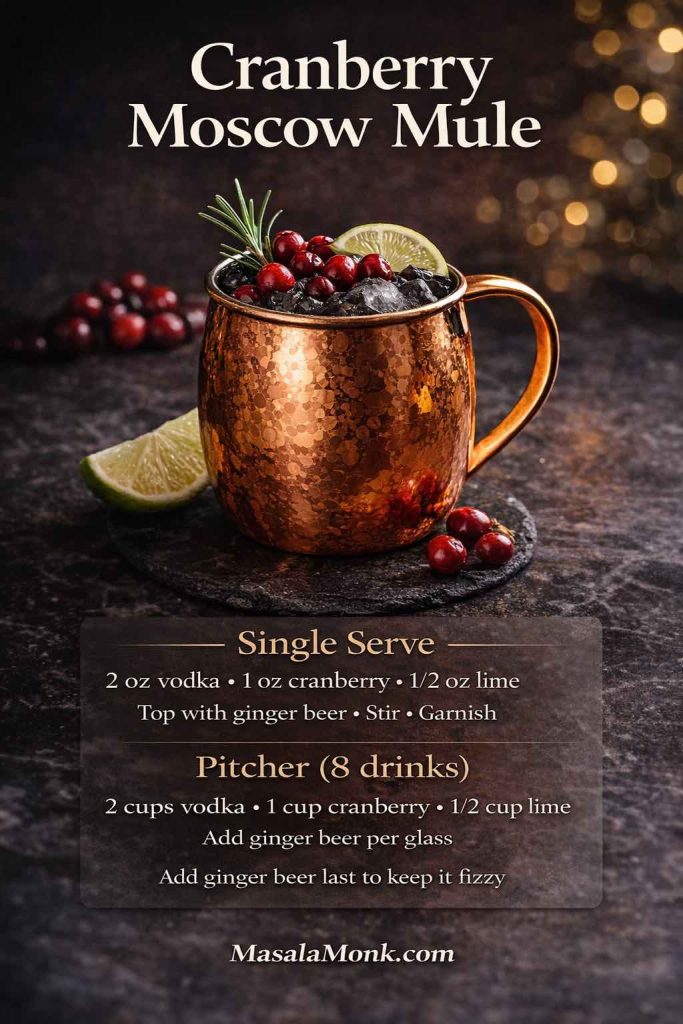
Cranberry Moscow Mule recipe graphic showing a copper mug cocktail with rosemary, cranberries, and lime, plus measurements for single serve and an 8-drink pitcher.
Save this cranberry Moscow mule recipe: make one drink in minutes or mix a pitcher base for eight—then top each glass with ginger beer for the freshest fizz.

If you want the fastest possible route—almost a “dump and stir” approach—Food Network’s cranberry mule is famously minimal: vodka, cranberry juice, ginger beer, ice, garnish (Cranberry Mule Recipe). That style is great when you’re making drinks while chatting, because it’s nearly impossible to mess up. Still, adding lime makes the drink taste more like a true mule and less like a sweet highball, so consider it the small extra step that pays you back with every sip.

Also Read: Green Chutney Recipe (Coriander–Mint / Cilantro Chutney)


Garnishes That Make It Look Like a Holiday Moscow Mule

A cranberry mule already looks festive, but garnishes change the experience as much as they change the photo.

  • Fresh cranberries: classic, simple, and instantly “holiday.”
  • Rosemary sprig: the aroma hits before the sip, which makes it feel like a Christmas mule cocktail.
  • Thyme: softer than rosemary, more delicate, and quietly elegant.
  • Orange peel: warm citrus perfume that turns it into an orange cranberry moscow mule moment.
  • Lime wheel: keeps things bright and crisp.
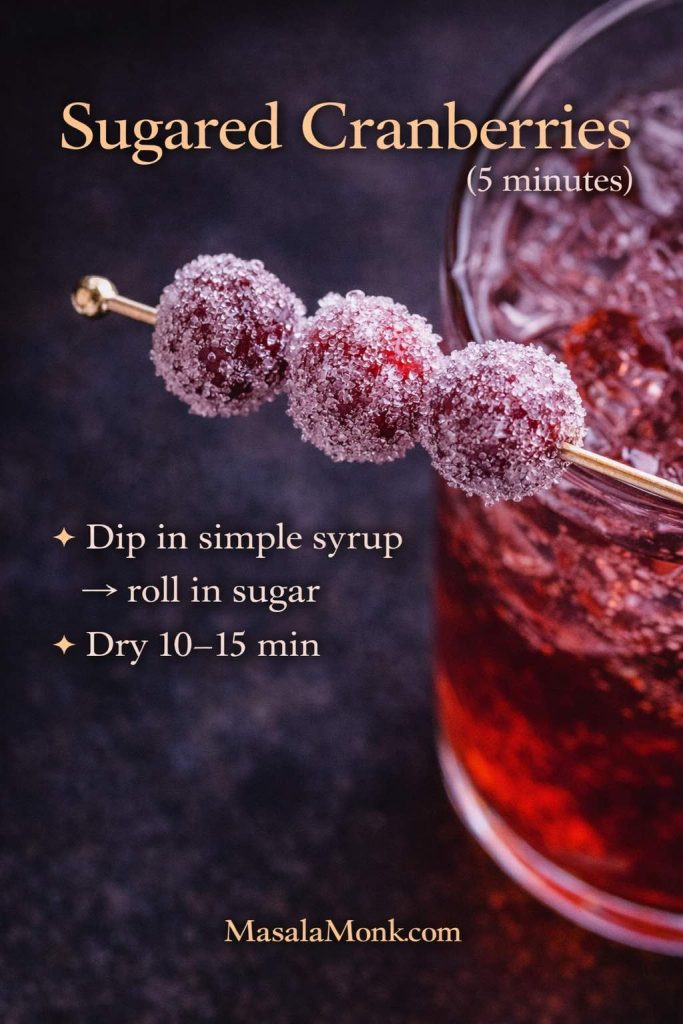
Sugared cranberries on a cocktail pick with a cranberry mule drink in the background, featuring on-image instructions to dip in simple syrup, roll in sugar, and dry 10–15 minutes.
Sugared cranberries (5 minutes): dip fresh cranberries in simple syrup, roll in sugar, and let them dry—an instant “wow” garnish for cranberry Moscow mules and holiday drinks.

If you want to go all-in, sugared cranberries are the easiest “wow” garnish because they look fancy and take almost no effort. Alternatively, an orange peel and rosemary sprig together makes the drink smell like winter as soon as you lift the mug.

Also Read: Best Vermouth for a Negroni Cocktail Drink Recipe


Christmas Moscow Mule Recipe (The Holiday Mule Version)

The difference between an everyday cranberry mule and a Christmas moscow mule isn’t a new ingredient list—it’s the way you layer aroma and warmth.

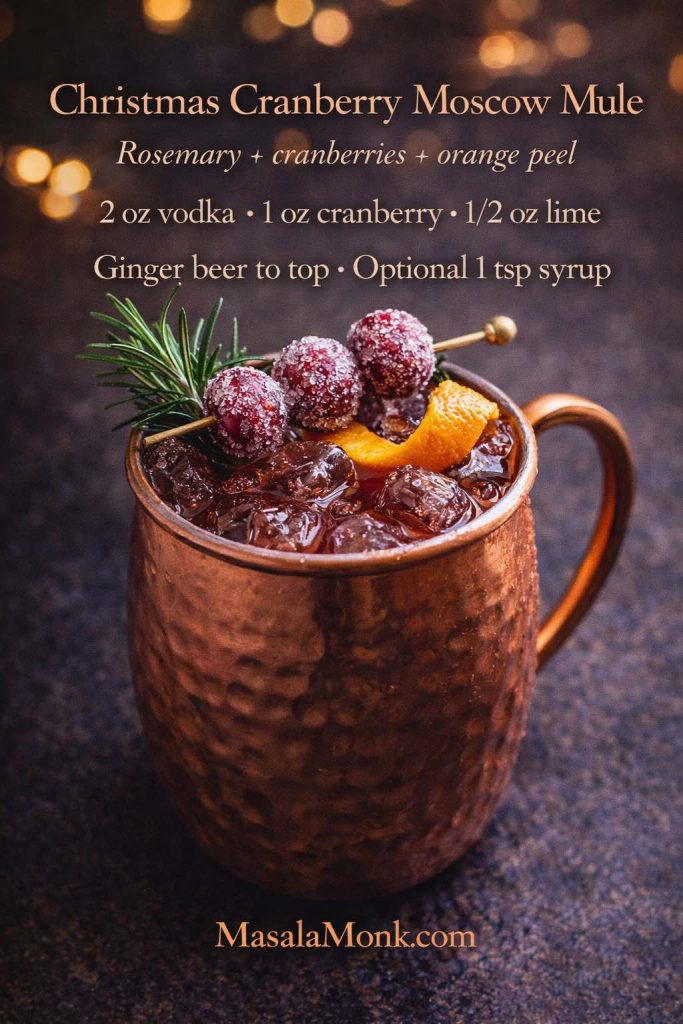
Christmas cranberry Moscow mule in a copper mug with sugared cranberries, rosemary, and orange peel, featuring an on-image recipe with vodka, cranberry, lime, and ginger beer.
Christmas cranberry Moscow mule: rosemary and orange peel add instant holiday aroma—mix vodka, cranberry, and lime over ice, then top with ginger beer right before serving.

Start with the base cranberry Moscow mule recipe. Then:

  • Add a rosemary sprig and a handful of cranberries.
  • Express an orange peel over the mug (twist it to release the oils), then drop it in.
  • If you like a sweeter edge, add a small spoon of simple syrup before the ginger beer and stir lightly.

As the drink sits, rosemary perfumes the ginger, orange lifts the cranberry, and suddenly it tastes like a holiday mule without tasting like a candle. That’s the sweet spot.

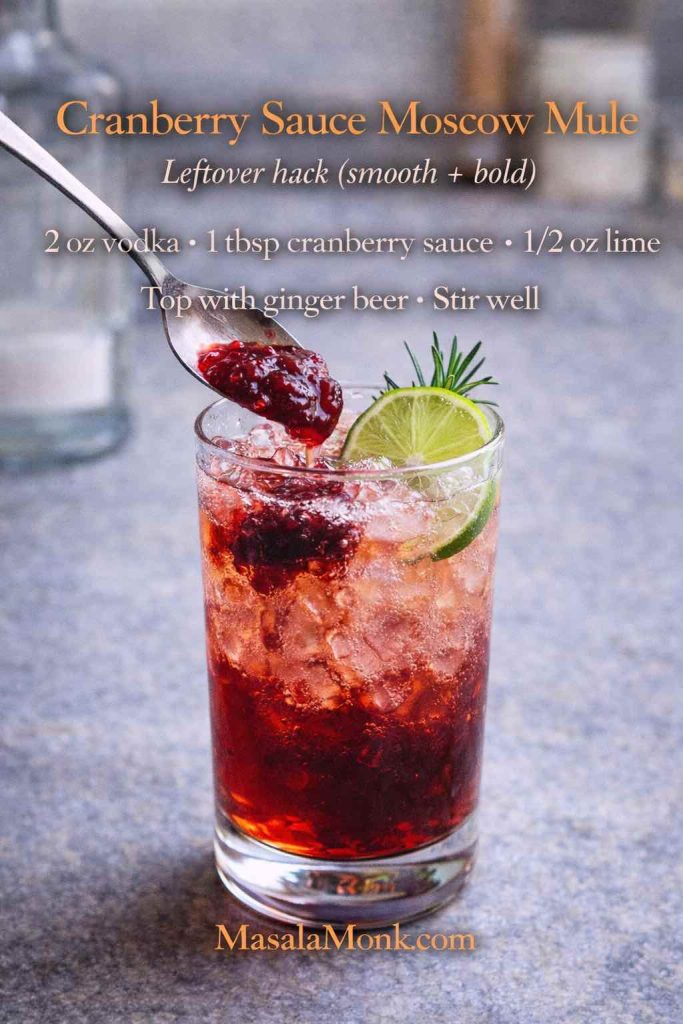
Cranberry sauce Moscow mule in a tall glass with a spoonful of cranberry sauce, lime wheel, and rosemary, with an on-image recipe for a leftover cranberry sauce mule.
Cranberry sauce Moscow mule: stir a spoonful of leftover cranberry sauce into vodka and lime, then top with ginger beer for a smooth, bold mule with holiday flavor.

If your holiday table already includes cranberry-orange flavors, it’s also fun to pair this drink with something like Cranberry Sauce with Orange Juice, because the same flavor family shows up on both the plate and the glass. The result feels cohesive without feeling planned.

Also Read: Sandwich for Breakfast: Breakfast Sandwich Recipe + 10 Variations


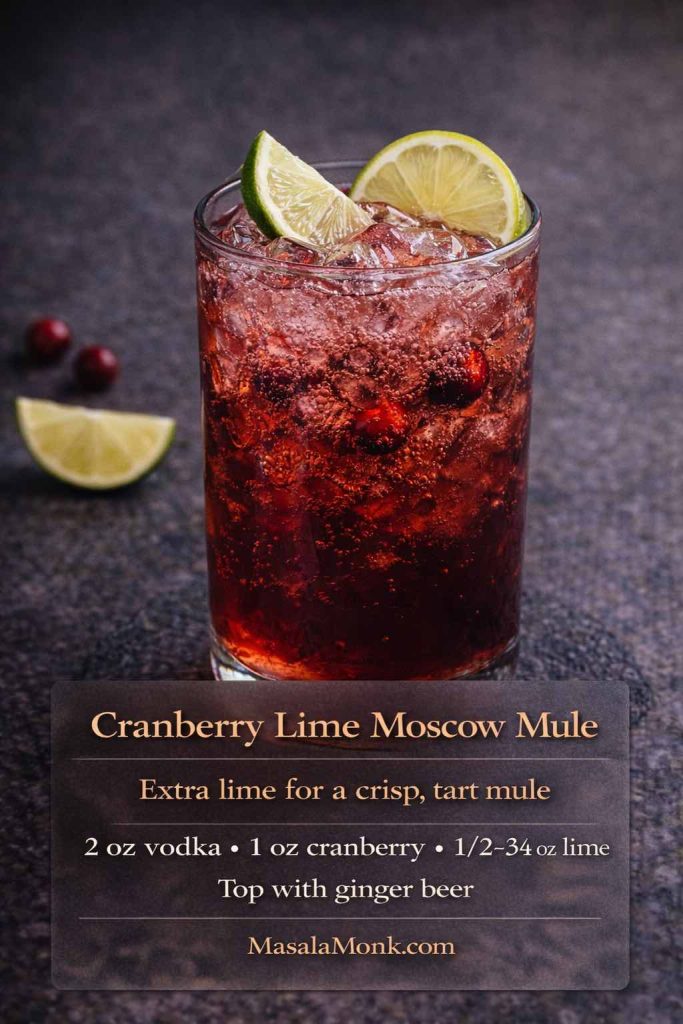
Cranberry Lime Moscow Mule (For People Who Like It Crisp)

Sometimes you want the cranberry to be present but not sweet. In that case, pull the drink toward citrus.

Make the base recipe, then:

  • Use 100% cranberry juice, and
  • Increase lime slightly (a fuller half ounce, or even a touch more if your ginger beer is sweet).
Cranberry lime Moscow mule in a tall glass with lime wedge and wheel, with an on-image recipe highlighting extra lime for a crisp, tart mule.
Cranberry lime Moscow mule: the extra squeeze of lime keeps the drink sharp and mule-like—especially if your ginger beer or cranberry juice runs sweet.

What you get is a cranberry lime mule that drinks clean and bright. It’s the kind of mule that tastes refreshing even after a rich meal, which is exactly why it fits a holiday spread so well.

Also Read: Paper Plane Cocktail Recipe + Best Amaro Substitutes & Tips


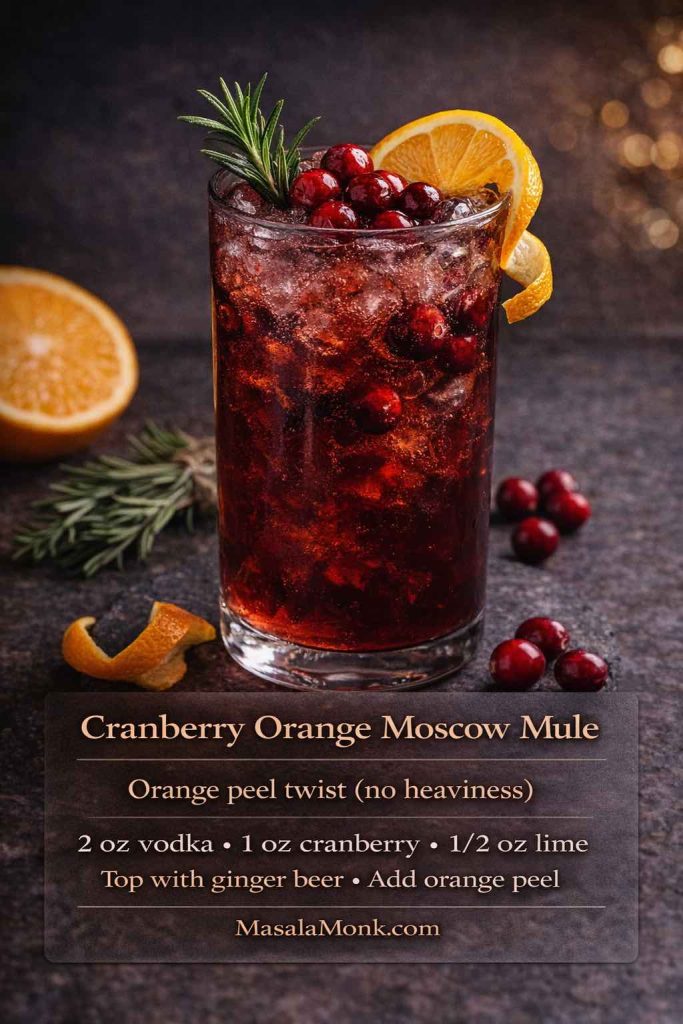
Cranberry Orange Moscow Mule (Warm Citrus Without Heaviness)

Cranberry and orange is a classic duo, and it fits the mule format naturally. Instead of making the drink sweeter, orange adds perfume and warmth.

You can do it two easy ways:

  1. Orange peel garnish method: build the base drink, then add orange peel and stir.
  2. Orange juice method: replace a small portion of cranberry juice with orange juice (just enough to bring in the aroma without turning it into a brunch drink).
Cranberry orange Moscow mule in a tall glass with orange peel twist, cranberries, and ice, with an on-image recipe using vodka, cranberry, lime, and ginger beer.
Cranberry orange Moscow mule: add an orange peel twist for warm citrus aroma without making the drink heavy—then top with ginger beer for a crisp finish.

If you want inspiration from a more “designed” version, Bobby Flay’s cranberry-orange mule recipe leans into cranberry vodka and orange notes for a festive spin (Cranberry-Orange Mule). You don’t need to follow it exactly to enjoy the idea; even a simple orange peel garnish can shift your cranberry mule cocktail into a more holiday-forward direction.

Also Read: Strawberry Smoothie Recipes (12 Easy Blends + Bowls & Protein Shakes)


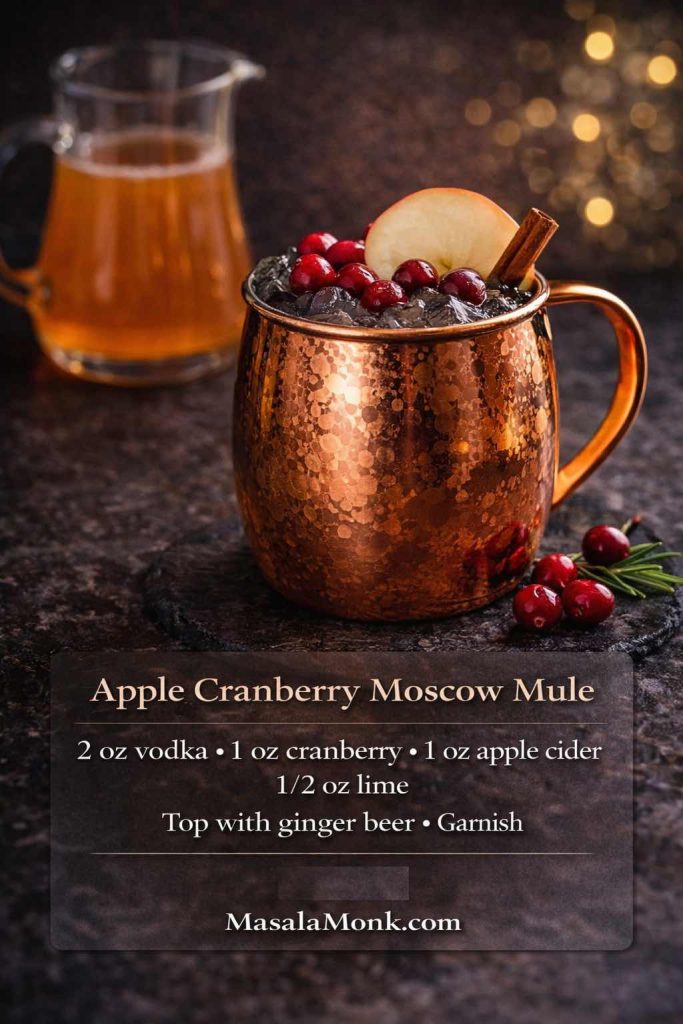
Apple Cranberry Moscow Mule (Cran-Apple, But Make It a Mule)

Apple and cranberry together taste like fall and winter in one sip. The trick is keeping the apple from making the drink taste like sparkling juice.

Here’s the approach that stays mule-like:

Apple Cranberry Mule (1 drink)

  • 2 ounces vodka
  • 1 ounce cranberry juice
  • 1 ounce apple cider (or cloudy apple juice)
  • 1/2 ounce lime juice
  • Ginger beer to top

Build it over ice, then garnish with apple slices and cranberries.

Apple cranberry Moscow mule in a copper mug with apple slice, cranberries, and cinnamon, with an on-image recipe using vodka, cranberry juice, apple cider, lime, and ginger beer.
Apple cranberry Moscow mule: a cozy cider twist on the classic—vodka, cranberry, apple cider, lime, then ginger beer for that signature mule sparkle.

Liquor.com’s apple cranberry moscow mule goes directly at the “cran-apple” idea using cran-apple juice and a smaller lime measure, then tops with ginger beer (Apple Cranberry Moscow Mule). It’s a great reference point if you want that specific flavor lane.

If you’re serving a mix of drinkers—some doing alcohol, some not—an apple-forward zero-proof option fits nicely alongside this version. Masala Monk’s apple juice mocktails are handy for that kind of table, since you can keep the same garnish style and make everything look intentional.

Also Read: Classic Rum Punch + 9 Recipes (Pitcher & Party-Friendly)


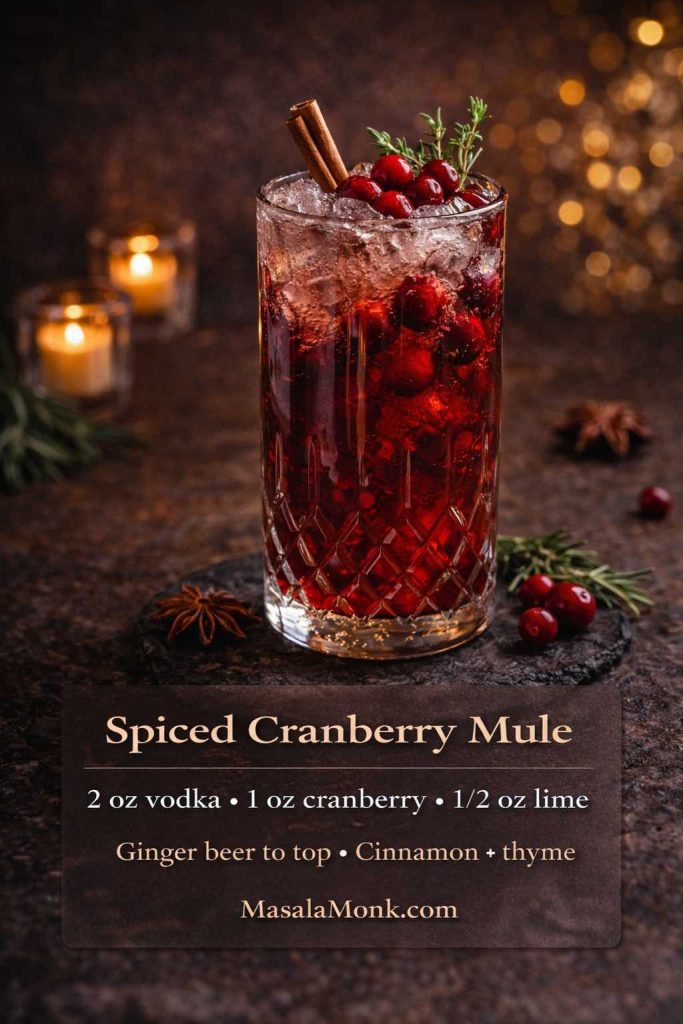
Spiced Cranberry Moscow Mule (Cinnamon, Thyme, and Winter Warmth)

A spiced cranberry mule should feel like winter, not like potpourri. The goal is warmth in the background, not a spice rack in the foreground.

Spiced Cranberry Mule, Cinnamon Style

Build the base drink, then add:

  • a tiny pinch of cinnamon, or
  • a cinnamon stick as garnish, or
  • a dash or two of aromatic bitters (if you keep them around)

Cinnamon plays especially well with cranberry and orange peel, so it’s also a natural fit for a Christmas mule cocktail.

Spiced cranberry mule in a crystal glass with cinnamon, thyme, and cranberries, with an on-image recipe using vodka, cranberry juice, lime, and ginger beer.
Spiced cranberry mule: cranberry, lime, and ginger beer with a cinnamon stick and thyme garnish for a warm holiday twist that still tastes crisp and bright.

Spiced Cranberry Thyme Moscow Mule

Thyme is subtler than rosemary, which means it’s easier to use without overpowering the drink.

Build the base drink, then:

  • clap a thyme sprig between your hands to wake up the aroma
  • garnish with the sprig and stir gently once

The result feels like a spiced cranberry thyme mule—fresh, herbal, slightly wintry—without losing that classic mule snap.

Also Read: 7 Pizza Sauce Recipes | Marinara, White Garlic, Alfredo, Buffalo, BBQ, Vodka & Ranch


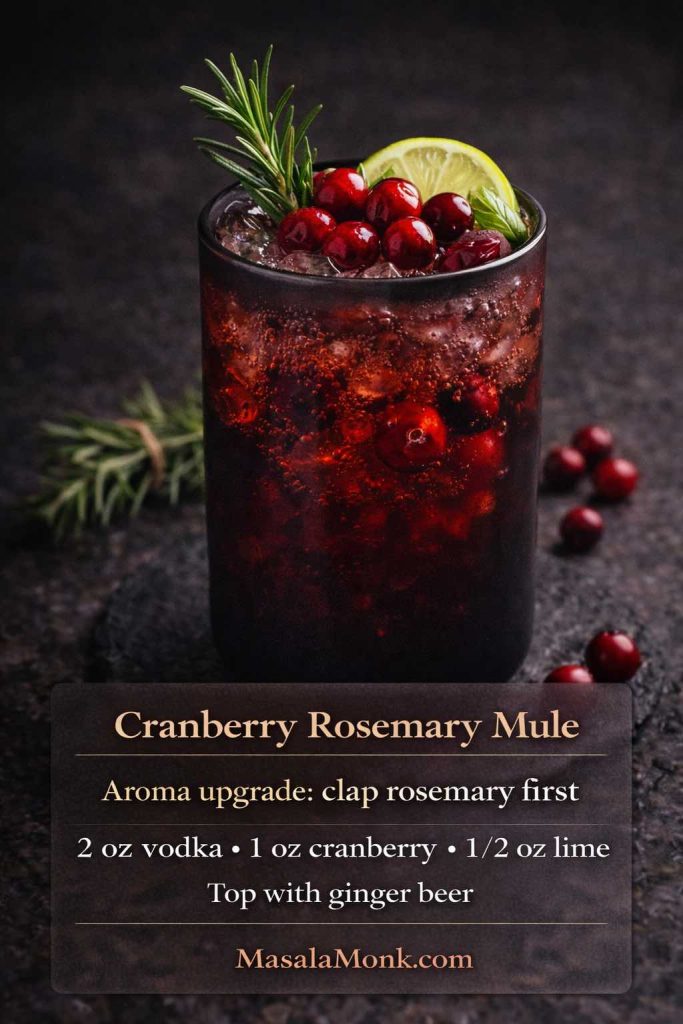
Cranberry Rosemary Mule (That “Smells Like the Holidays” Version)

Rosemary is the garnish that does the most work with the least effort. It turns a cranberry moscow mule into a cranberry rosemary mule almost instantly.

Build the base drink, then:

  • garnish with rosemary and cranberries
  • stir lightly so the rosemary oils lightly perfume the top of the drink

Because rosemary is assertive, you don’t need to muddle it. In fact, muddling can make the herb taste woody. Instead, let it behave like a fragrant accent.

Cranberry rosemary mule in a dark glass with rosemary, cranberries, and lime, featuring an on-image recipe and a tip to clap rosemary before garnishing.
Cranberry rosemary mule: clap the rosemary sprig before garnishing so the drink smells like the holidays—then add ginger beer last for the brightest fizz.

If you enjoy herbal directions in drinks in general—especially for alcohol-free versions—Masala Monk’s guide to herbal infusions in mocktails is a fun rabbit hole to go down. Rosemary and thyme show up often for a reason: they’re instantly aromatic and pair well with citrus.

Also Read: Vodka Pasta (Penne alla Vodka) + Spicy Rigatoni, Chicken, and Gigi Recipes


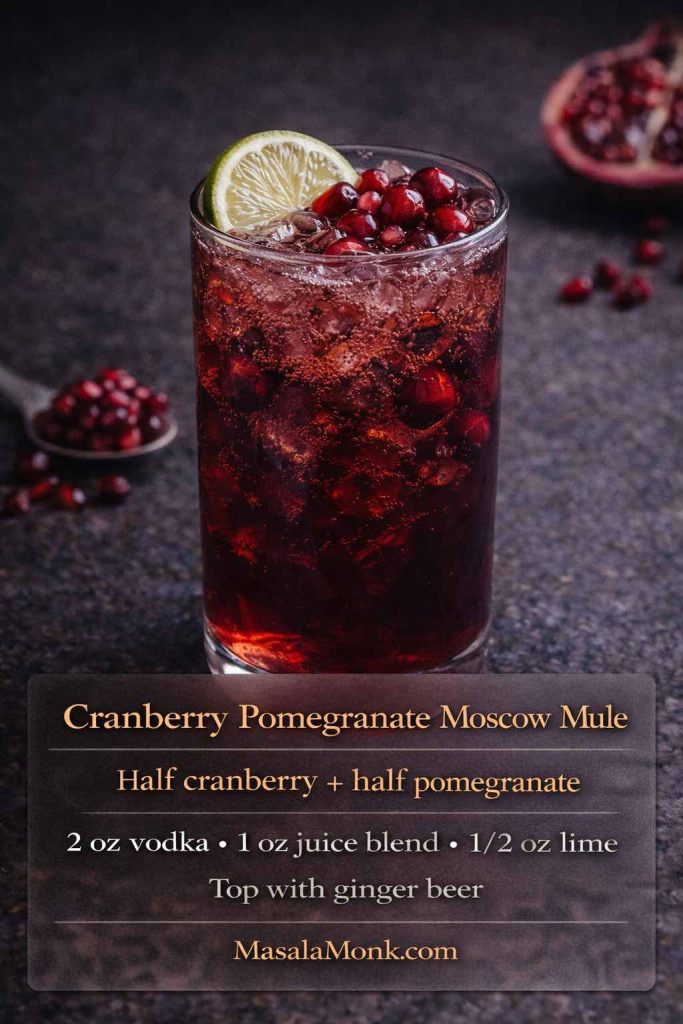
Cranberry Pomegranate Moscow Mule (A Deeper, Brighter Fruit Twist)

Cranberry is tart. Pomegranate is tart in a different way—more jewel-toned, slightly floral, and a little rounder.

For a cranberry pomegranate mule:

  • Use half cranberry juice and half pomegranate juice in the base recipe
  • Keep lime and ginger beer the same
Cranberry pomegranate Moscow mule in a tall glass with lime and pomegranate arils, featuring an on-image recipe that uses half cranberry and half pomegranate juice.
Cranberry pomegranate Moscow mule: swap in a half-and-half cranberry–pomegranate juice blend for a deeper, jewel-toned mule that still finishes crisp with ginger beer and lime.

The drink stays crisp, yet the fruit layer feels more complex. It’s a great option when you want something that tastes a little more “special occasion” without adding steps.

Also Read: Mayo Recipe: 15+ Homemade Mayonnaise Variations


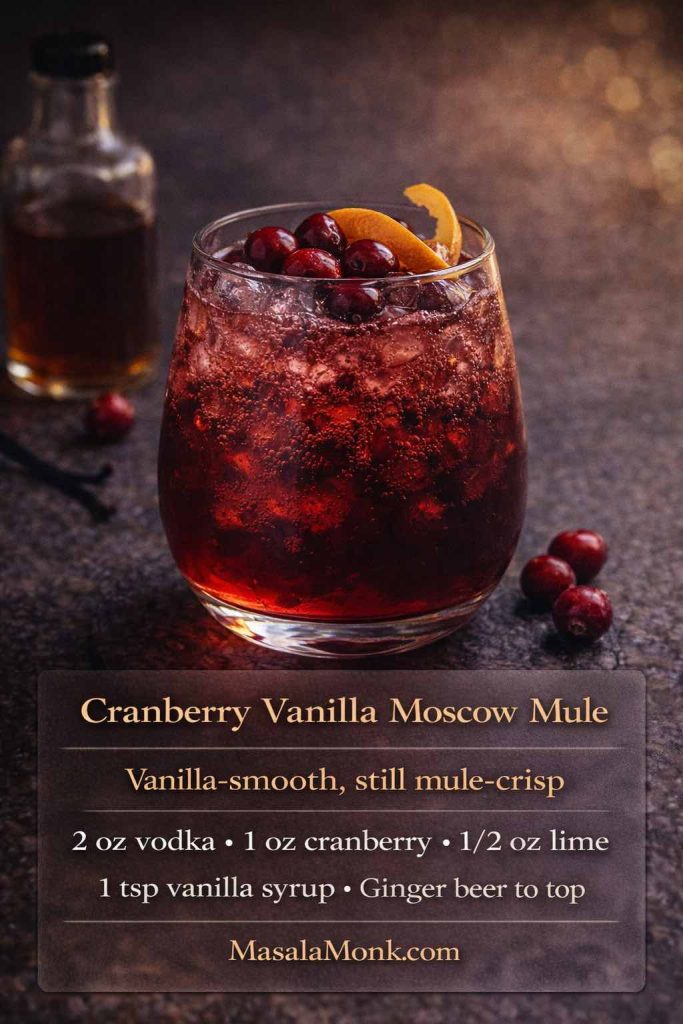
Cranberry Vanilla Moscow Mule (A Soft, Dessert-Leaning Option)

If your ginger beer is sharp and you want the drink to feel smoother, vanilla can give it a gentle “holiday dessert” vibe.

There are a few easy routes:

  • Use a small splash of vanilla syrup (the same kind you’d use in coffee), or
  • Use vanilla vodka, or
  • Add a tiny pinch of vanilla extract to a big batch base (very little goes a long way)
Cranberry vanilla Moscow mule in a stemless glass with cranberries and orange peel, with an on-image recipe including vodka, cranberry juice, lime, vanilla syrup, and ginger beer.
Cranberry vanilla Moscow mule: a softer, dessert-leaning twist—add just a teaspoon of vanilla syrup to round the cranberry and let ginger beer keep it crisp.

This turns the drink into a cranberry vanilla mule—still fizzy and gingery, just rounder at the edges. It’s especially nice with orange peel.

Also Read: Blueberry Pancakes (6 Recipes) + Homemade Pancake Mix


Choose Your Spirit: Vodka, Gin, Bourbon, Whiskey, or Tequila

One reason “mule” drinks are so popular is that the template welcomes substitutions. Once you’ve made a cranberry mule with vodka, you can spin it into several other crowd-pleasing directions.

Cranberry mule spirit swaps graphic showing four drinks labeled vodka, gin, bourbon, and tequila, with a base recipe ratio and flavor notes.
Cranberry mule spirit swaps: use the same mule base, then choose vodka (classic), gin (botanical), bourbon (warm), or tequila (bright) to match your mood and menu.

Cranberry Vodka Mule (Classic and Clean)

This is the standard cranberry mule recipe: vodka, cranberry, lime, ginger beer. It’s the most neutral, the most widely loved, and the easiest to batch.

If you like the idea of balancing citrus and sweetness in simple highballs, Masala Monk’s vodka with lemon guide explains the logic behind adding a little syrup to keep tartness bright rather than harsh—an idea that carries over beautifully when you use unsweetened cranberry.

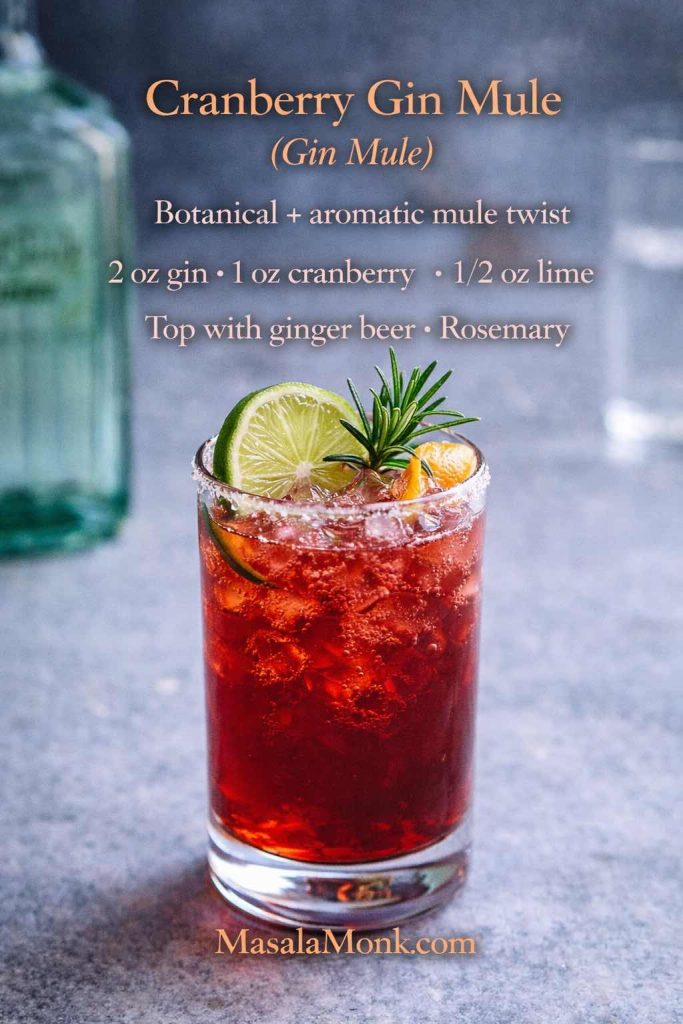
Gin Mule (Cranberry Gin Mule)

Swap vodka for gin and you’ll get a cranberry gin mule that feels more aromatic and botanical. Rosemary garnish becomes even more compelling here, because gin and rosemary play beautifully together.

Cranberry gin mule in a tall glass with lime and rosemary, featuring an on-image recipe for a gin mule made with cranberry juice, lime, and ginger beer.
Cranberry gin mule (gin mule): a more botanical take on the mule—gin, cranberry, lime, then ginger beer, finished with rosemary for an aromatic holiday-ready sip.

This is a great “holiday mule” option when you want something that tastes a touch more complex without adding any extra ingredients.

Bourbon Cranberry Mule (Whiskey Cranberry Mule / Cranberry Kentucky Mule)

Swap vodka for bourbon (or whiskey) and the drink turns warmer and richer. That’s why bourbon cranberry mule and whiskey cranberry mule variations show up so often in colder months: the vanilla-caramel notes in bourbon make cranberry taste more like a winter fruit.

Bourbon cranberry mule (Kentucky mule) in a rocks glass with orange peel and cinnamon, with an on-image recipe using bourbon, cranberry juice, lime, and ginger beer.
Bourbon cranberry mule (Kentucky mule): swap vodka for bourbon to make cranberry taste warmer and richer—then finish with ginger beer and an orange peel twist.

If you want the drink to feel extra seasonal, add orange peel and a cinnamon stick and you’ve basically got a Christmas mule drink that tastes like it belongs next to a fire.

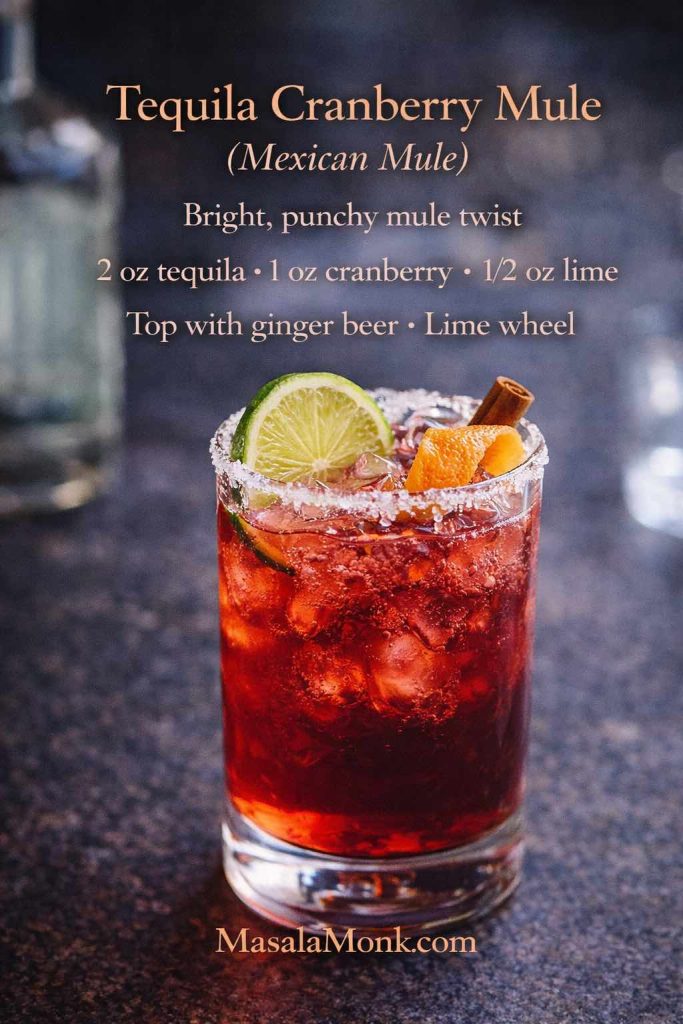
Tequila Cranberry Mule (Cranberry Mexican Mule)

Swap vodka for tequila blanco and you’ll get a brighter, punchier drink. The cranberry becomes sharper, the ginger feels louder, and orange peel suddenly makes a lot of sense.

Tequila cranberry mule (Mexican mule) in a tall glass with a salt-sugar rim, lime wheel, and orange peel, with an on-image recipe using tequila, cranberry, lime, and ginger beer.
Tequila cranberry mule (Mexican mule): tequila blanco makes the cranberry-and-ginger combo brighter and punchier—serve it icy cold with a lime wheel and ginger beer on top.

If you enjoy margarita-style flavors, this version is a natural bridge—especially with a salt-sugar rim or a chili-salt rim if you like heat.

Also Read: Whiskey Sour Recipe: Classic Cocktail, Best Whiskey & Easy Twists


Big Batch Cranberry Moscow Mule (Pitcher Recipe That Actually Works)

If you’re hosting, the best gift you can give yourself is a plan that doesn’t require you to play bartender all night. A cranberry moscow mule pitcher base does exactly that.

The most important rule: batch everything except the ginger beer.

Ginger beer is your fizz, so you want it fresh. Once it sits in a pitcher, it goes flat, and your big batch cranberry moscow mule turns into a sweet, diluted punch. Still tasty, but not the drink you meant to make.

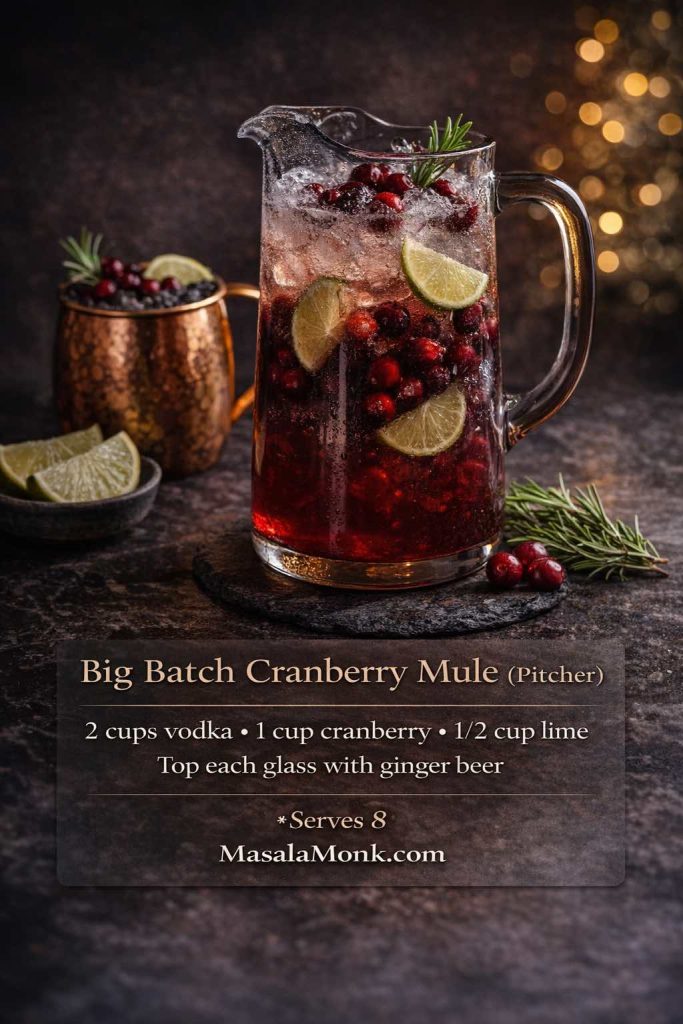
Big Batch Cranberry Mule Base (About 8 Drinks)

  • 2 cups vodka
  • 1 cup cranberry juice
  • 1/2 cup fresh lime juice
  • Optional: 1/4 to 1/2 cup simple syrup (especially if using 100% cranberry juice)

Stir this base in a pitcher and chill it thoroughly.

To Serve

Fill each mug with ice, pour in the base, then top with ginger beer. Stir gently and garnish.

Big batch cranberry mule pitcher filled with cranberries and lime, with an on-image recipe for an 8-serving pitcher and a note to top each glass with ginger beer.
Big batch cranberry mule made for hosting: mix the vodka–cranberry–lime pitcher base, then top each glass with ginger beer so every serving stays cold and fizzy.

That’s it. Suddenly, cranberry moscow mule large batch service becomes effortless. You can chat, refill the snack table, and actually enjoy your own party.

If you want a reference point for a “no-fuss” cranberry mule direction, Food Network’s approach is as straightforward as it gets (Cranberry Mule Recipe), and it scales easily. Meanwhile, if you like a more styled holiday direction that leans orange and cranberry, Bobby Flay’s cranberry-orange mule is a fun idea to borrow elements from when you’re building your garnish bar (Cranberry-Orange Mule).

A Simple Hosting Rhythm (So You’re Not Stuck in the Kitchen)

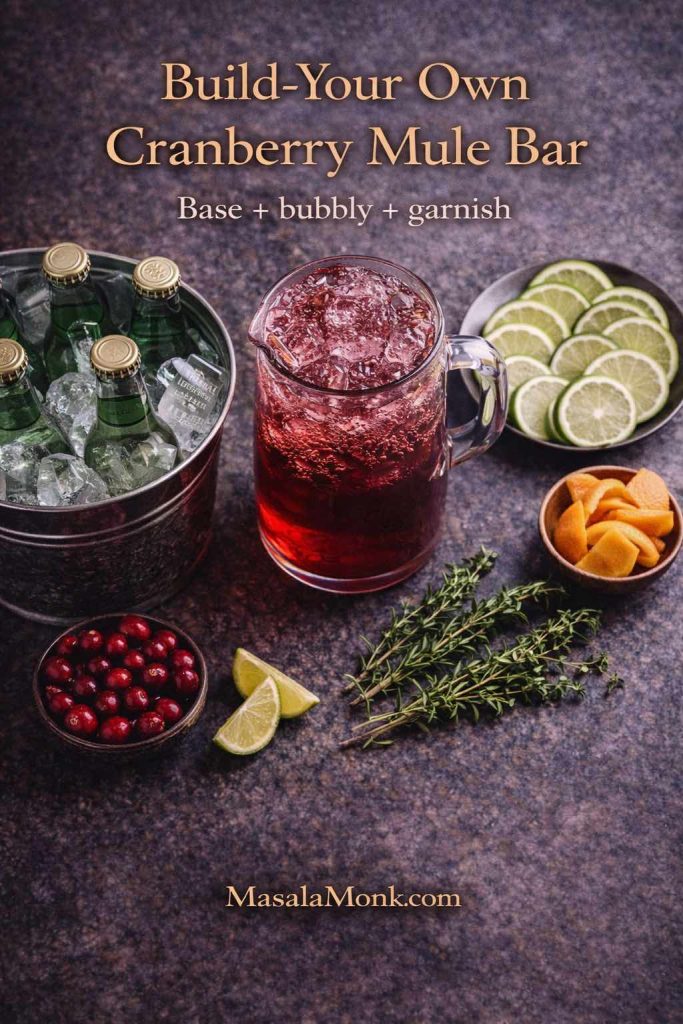
Instead of pre-pouring full drinks, set up a “build your own” station:

  • a chilled pitcher of cranberry mule base
  • ginger beer bottles on ice
  • a bowl of cranberries
  • sliced limes
  • rosemary and thyme sprigs
  • orange peels or orange slices
Build-your-own cranberry mule bar setup with a pitcher of cranberry mule base, ginger beer on ice, sliced limes, orange peel, cranberries, and herbs, with on-image text.
Build-your-own cranberry mule bar: set out a chilled pitcher base, keep ginger beer cold, and let guests add lime, orange peel, and herb garnishes—easy hosting, fresher fizz.

That small setup makes holiday moscow mules feel abundant, even if you’re keeping things casual.

Also Read: Waffle Recipe Without Milk: Fluffy, Golden, and Crisp


Virgin Cranberry Moscow Mule (The Zero-Proof Version That Still Feels Festive)

A virgin cranberry moscow mule shouldn’t feel like a consolation prize. It should taste like a real drink—bright, fizzy, gingery, and finished with the same garnishes as the alcoholic version.

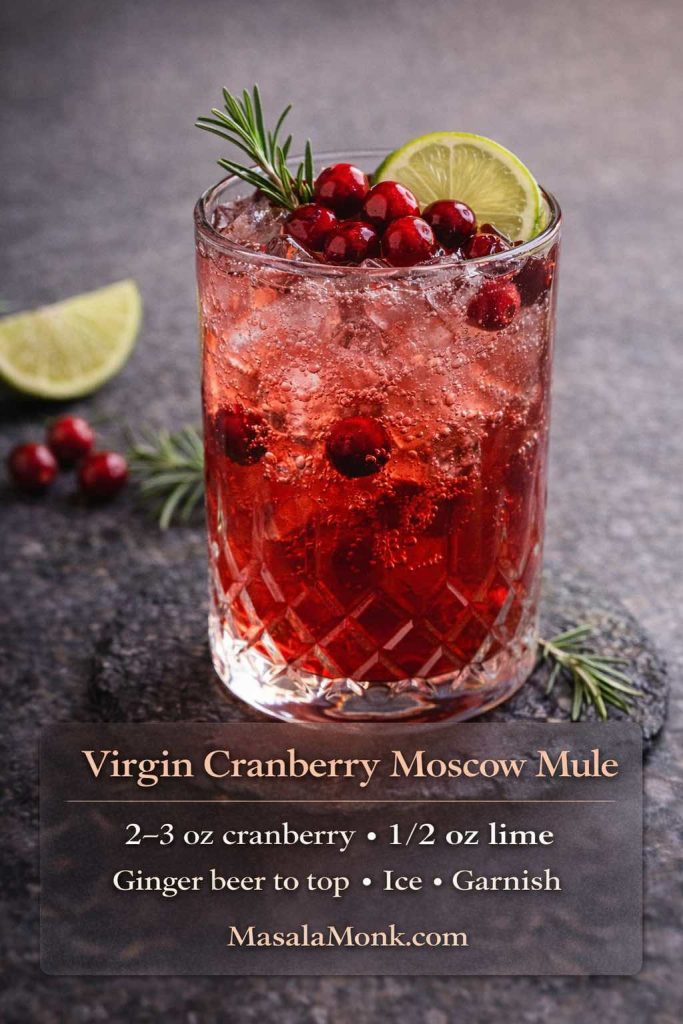
Virgin Cranberry Mule (1 drink)

  • 2–3 ounces cranberry juice
  • 1/2 ounce lime juice
  • Ginger beer to top
  • Ice

Build over ice, stir gently, and garnish with cranberries and rosemary.

Virgin cranberry Moscow mule mocktail in a crystal glass with cranberries, rosemary, and lime, plus an on-image recipe with cranberry juice, lime, and ginger beer.
Virgin cranberry Moscow mule (mocktail): all the ginger-lime sparkle with a ruby cranberry twist—perfect for kids, drivers, and anyone skipping alcohol.

If you want a clear, tested reference for the non-alcoholic format, Skinnytaste’s cranberry mule mocktail keeps it clean with cranberry juice, ginger beer, and lime (Cranberry Mule Mocktail). You can keep it that simple, or you can dress it up the same way you would a Christmas mule cocktail: rosemary, orange peel, sugared cranberries, the whole works.

For a more “grown-up” herbal direction—especially if you’re serving mocktails at a holiday gathering—Masala Monk’s piece on herbal mocktail infusions is a nice source of ideas. Even one sprig of rosemary can make a zero-proof drink feel intentional.

Also Read: Sheet Pan Chicken Fajitas Recipe (Easy One-Pan Oven Fajitas)


Ginger Ale, Ginger Beer, and Cranberry: Two Easy Routes

Sometimes the question isn’t “which cranberry mule recipe should I make?” It’s “what do I do with what’s already in my fridge?”

Portrait graphic comparing ginger beer vs ginger ale for a cranberry mule, showing how to adjust lime, plus a base recipe and quick tips for sweetness and scaling.
Ginger beer vs ginger ale for a cranberry mule: ginger beer gives sharper mule bite, while ginger ale is softer—so bump the lime and add bubbly last for the best fizz.

If you have ginger beer

You’re in classic mule territory. Build the drink normally. You’ll get more spice, more bite, and a more defined mule identity.

If you only have ginger ale

You can still make a moscow mule recipe with cranberry juice that tastes refreshing. It will be softer and sweeter, so lean into lime a little more. Those differences are exactly why guides like Food & Wine and Epicurious emphasize that ginger beer and ginger ale aren’t interchangeable without changing the result (Food & Wine’s comparison, Epicurious’ comparison).

Either way, cranberry and ginger is a winning pairing. You just steer the balance with lime and sweetness.

Also Read: Strawberry Mojito Mocktails – 10 Easy Variations


What to Serve With Cranberry Moscow Mules (So the Night Feels Complete)

A cranberry mule cocktail is fizzy, gingery, and slightly tart. That means it loves food that’s creamy, salty, crunchy, or gently spicy. In other words, it pairs beautifully with party snacks.

Instead of trying to cook ten things, aim for contrast:

  • one creamy dip
  • one crunchy bite
  • one “fresh” element
  • one cozy holiday side if you’re doing dinner

Here are combinations that work especially well.

Creamy dips and spreads

A creamy dip softens the ginger bite and makes the drink feel smoother.

  • A classic option is Easy Spinach Dip (Cold, Baked, Artichoke & 10 Variations). It’s rich enough to balance the drink, yet it still feels party-friendly rather than heavy.
  • If you want something bolder, Buffalo Chicken Dip is a natural match because spicy, tangy food and fizzy ginger drinks tend to make each other more exciting.
  • For something cool and bright, Greek tzatziki pairs beautifully with the lime and cranberry notes, especially alongside roasted or fried snacks.

One-bite, tidy appetizers

This is the category that makes a gathering feel effortless.

The “hot and crispy” anchor

Every snack table benefits from one warm, crisp tray that disappears quickly.

  • Air fryer chicken wings are ideal here: spicy wings plus a cranberry mule is the kind of pairing that keeps people hovering near the table.

Boards and grazing plates (the easiest party trick)

If you want the room to feel festive without cooking all day, a board does most of the work.

Masala Monk’s guide to charcuterie boards and the 3-3-3-3 rule makes it easy to build something abundant. Add crackers, cheese, something briny, something sweet, and a bowl of cranberries as a playful nod to the drink. With a holiday mule in hand, it feels like an event.

Holiday sides that make everything feel seasonal

If you’re serving these drinks with dinner—especially if you’re leaning into Christmas moscow mule vibes—cozy sides fit right in.

  • Green bean casserole is a classic companion to a holiday table, and it works surprisingly well with a crisp cranberry mule because the drink cuts through creamy, savory dishes.
  • If cranberry is already on your menu, cranberry sauce with orange juice ties the whole spread together, especially if you’re also making a cranberry orange mule variation.

And if you want something simple that helps dips disappear even faster, homemade garlic bread is a cozy, crowd-friendly move—particularly when the weather is cool and the drinks are icy.

Also Read: Katsu Curry Rice (Japanese Recipe, with Chicken Cutlet)


A Cranberry Mule You’ll Actually Make Again

The best thing about this drink is that it doesn’t ask you to commit. You can keep it simple—vodka, cranberry, lime, ginger beer—and it’s already delicious. Then, whenever you feel like it, you pivot:

  • rosemary and cranberries for a cranberry rosemary mule
  • orange peel for a cranberry orange moscow mule
  • apple cider for an apple cranberry mule
  • cinnamon and thyme for a spiced cranberry mule
  • bourbon for a whiskey cranberry mule
  • tequila for a cranberry mexican mule
  • a pitcher base when you’re making cranberry moscow mules for a crowd
  • zero-proof when you want a virgin cranberry moscow mule that still feels special

No matter which direction you choose, the drink keeps its personality: bright, fizzy, gingery, and unmistakably festive.

Also Read: Peanut Butter Cookies (Classic Recipe & 3 Variations)

FAQ

1) What is a cranberry Moscow mule?

A cranberry Moscow mule is a Moscow mule made with vodka, ginger beer, lime juice, and cranberry juice. Compared to a classic mule, it tastes fruitier, looks more festive, and often shows up as a holiday mule or Christmas mule cocktail.

2) What are the cranberry Moscow mule ingredients?

Typically you’ll need vodka, cranberry juice, fresh lime juice, ginger beer, and ice. Afterward, garnishes like cranberries, rosemary, lime, or orange peel make it feel more seasonal.

3) How do I make a cranberry mule cocktail taste less sweet?

If your cranberry mule tastes too sweet, first increase the lime juice slightly. Next, choose a less-sweet cranberry juice (or reduce the cranberry portion) and use a spicier ginger beer for more bite and balance.

4) Can I use 100% cranberry juice in a cranberry moscow mule recipe?

Yes—however, 100% cranberry juice is much tarter than cranberry juice cocktail. Because of that, many people add a small amount of simple syrup to soften the edges while keeping the drink bright.

5) What’s the best ginger beer for a cranberry ginger beer mule?

Since ginger beers vary a lot, pick based on your preference: a spicier ginger beer creates a sharper mule, while a sweeter ginger beer makes a smoother cranberry mule drink. Either way, fresh lime keeps it tasting like a mule.

6) Can I make a moscow mule recipe with cranberry juice and ginger ale?

You can. Even so, ginger ale is usually sweeter and less spicy than ginger beer, so the result will be softer and closer to a cranberry highball. To bring it back toward mule territory, add a bit more lime and use plenty of ice.

7) What vodka works best for a cranberry mule recipe?

Any smooth vodka works well. In particular, a cranberry mule recipe with Tito’s is popular because it’s clean and easy-drinking, letting ginger and cranberry stand out.

8) How do I make an easy cranberry moscow mule?

For an easy version, fill a mug with ice, add vodka and cranberry juice, then top with ginger beer and squeeze in lime. Finally, stir once and garnish—done.

9) How do I make a Christmas Moscow mule recipe?

To turn it into a Christmas mule drink, keep the base recipe and add holiday garnishes such as rosemary sprigs, fresh cranberries, and orange peel. Optionally, add a cinnamon stick for a cranberry cinnamon moscow mule feel.

10) What is an apple cranberry Moscow mule?

An apple cranberry Moscow mule is a cranberry mule variation that includes apple cider or apple juice along with cranberry, then finishes with ginger beer and lime. As a result, it tastes like a cran-apple mule with the classic mule fizz.

11) How do I make an apple cider cranberry Moscow mule?

Instead of using only cranberry juice, use a split—cranberry plus apple cider—then add vodka, lime, and ginger beer. In addition, cinnamon garnish pairs especially well with this version.

12) Can I make a spiced cranberry Moscow mule?

Absolutely. For instance, add aromatic bitters, a cinnamon stick, or a light dusting of cinnamon. Alternatively, use herbs like thyme for a spiced cranberry thyme Moscow mule that still tastes fresh.

13) What’s the difference between a cranberry rosemary mule and a cranberry thyme moscow mule?

Rosemary is more piney and bold, while thyme is gentler and more floral. Consequently, rosemary gives a stronger holiday aroma, whereas thyme keeps the drink lighter.

14) What is a cranberry pomegranate Moscow mule?

A cranberry pomegranate mule combines cranberry juice with pomegranate juice, then adds vodka, lime, and ginger beer. Because pomegranate is naturally tangy, it deepens the fruit flavor without making the drink heavy.

15) Can I make a cranberry mule with gin?

Yes—swap vodka for gin to make a gin mule or cranberry gin mule. Compared to vodka, gin adds botanical notes that taste especially good with rosemary or orange peel.

16) How do I make a bourbon cranberry mule or whiskey cranberry mule?

Replace vodka with bourbon or whiskey. Then build the drink the same way with cranberry, lime, and ginger beer. In turn, the flavor becomes warmer and richer, similar to a cranberry Kentucky mule style.

17) Can I make a tequila cranberry mule (Mexican mule)?

Definitely. Use tequila blanco instead of vodka, then add cranberry juice, lime, and ginger beer. For extra lift, garnish with orange peel or a lime wheel.

18) How do I make a big batch cranberry Moscow mule?

Make a pitcher base with vodka, cranberry juice, and lime juice, and chill it. Then, when serving, pour the base over ice and top each glass with ginger beer so the fizz stays lively.

19) What’s the best cranberry moscow mule pitcher recipe for a crowd?

A reliable approach is batching vodka + cranberry + lime in advance, then topping with ginger beer per glass. That method scales easily for a cranberry moscow mule for a crowd, a large batch cranberry mule, or a party pitcher.

20) How far ahead can I prep a cranberry moscow mule batch?

You can mix the vodka, cranberry juice, and lime juice several hours ahead and keep it refrigerated. Still, add ginger beer only at serving time to maintain carbonation.

21) Can I make a virgin cranberry Moscow mule?

Yes—a virgin cranberry mule uses cranberry juice, lime juice, and ginger beer over ice. For a more “holiday mule” feel, garnish with rosemary and cranberries just like the cocktail.

22) Can I use cranberry vodka in a moscow mule with cranberry vodka?

Yes. Cranberry vodka works well and reinforces the fruit notes. Even so, keep lime in the recipe so it doesn’t drift into overly sweet territory.

23) What can I use instead of lime in a cranberry mule recipe?

If you’re out of lime, lemon can work. Nevertheless, lime is the classic mule citrus and tends to pair best with ginger beer and cranberry.

24) Why does my cranberry mule taste flat?

Usually it’s because the ginger beer wasn’t cold, the drink sat too long, or it was stirred too aggressively. To fix it, use chilled ginger beer, add it last, and stir gently.

25) Can I serve cranberry mules for Thanksgiving and Christmas?

Yes—cranberry mules fit both. For Thanksgiving, apple cider and cinnamon variations feel especially fitting. For Christmas, rosemary, orange, and pomegranate versions look and smell extra festive.

Posted on 6 Comments

Cranberry Sauce with Orange Juice (7 Easy Recipes & Variations)

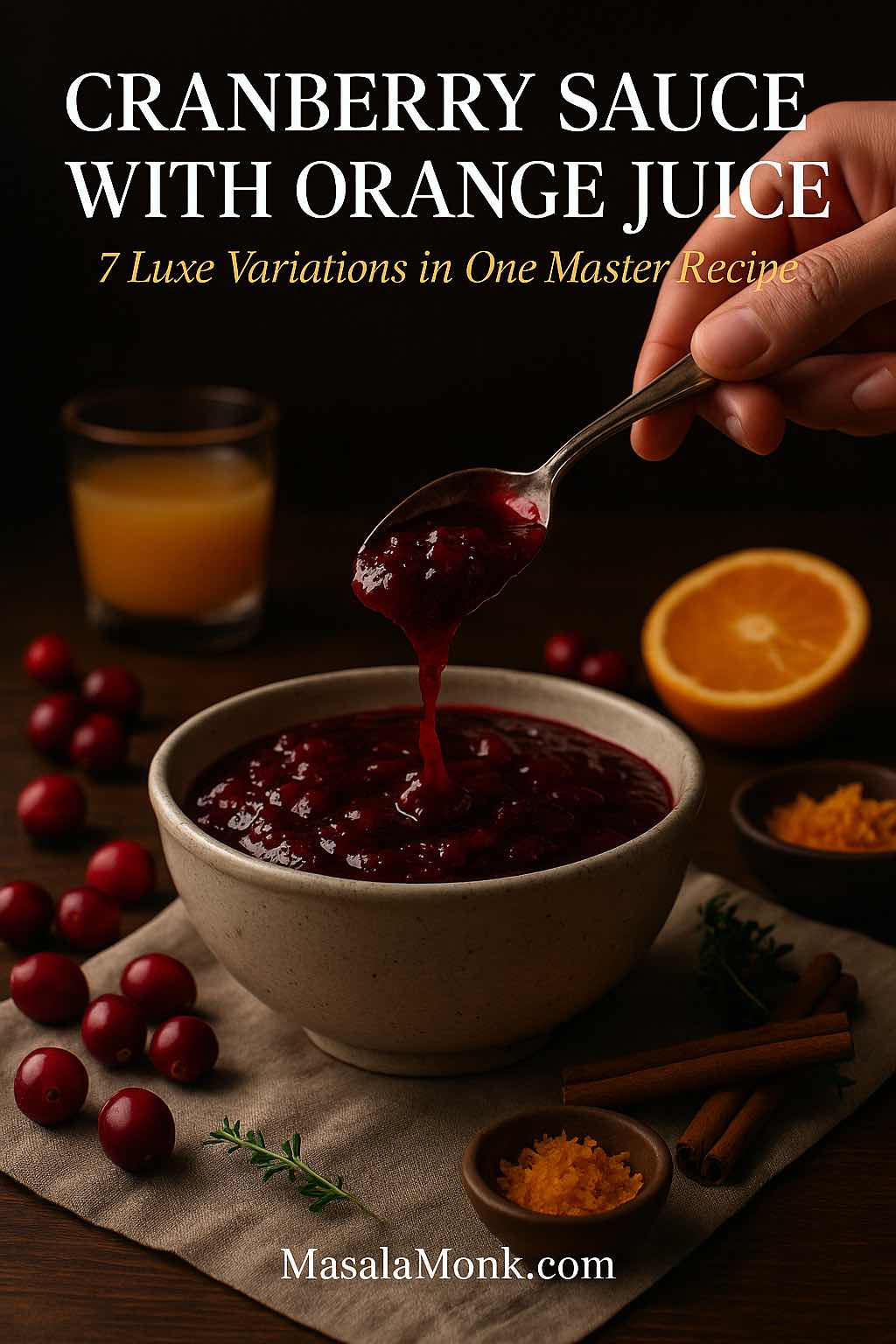
Luxe magazine-style portrait image of a hand spooning homemade cranberry sauce with orange juice into a ceramic bowl, surrounded by fresh cranberries, orange halves, orange zest and cinnamon sticks on a dark wooden table, MasalaMonk food photography.

Cranberry sauce is one of those dishes that looks fancy, but once you strip it down, it’s just cranberries, sugar, and liquid. Swap in orange juice for plain water and you suddenly have a bright, zesty homemade cranberry sauce with orange juice that tastes like pure holiday cheer.

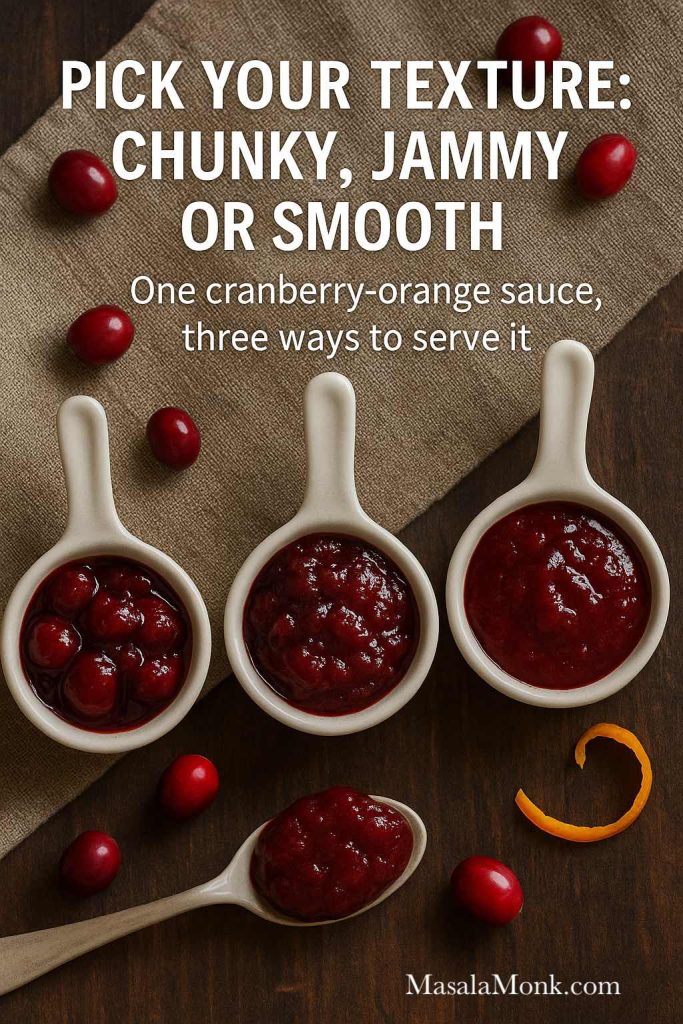
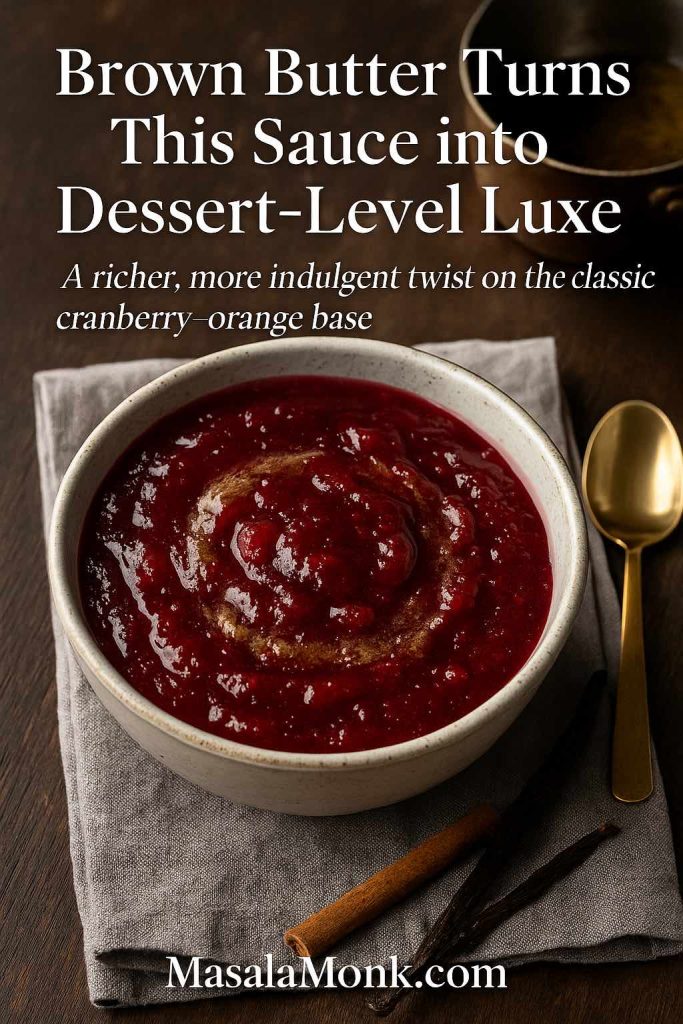
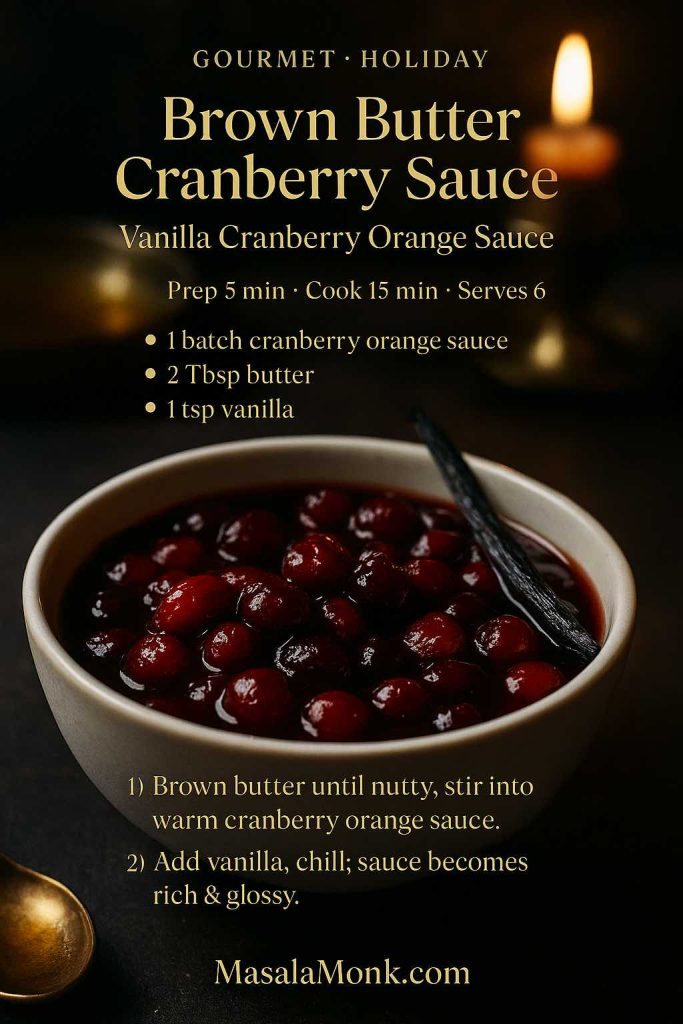
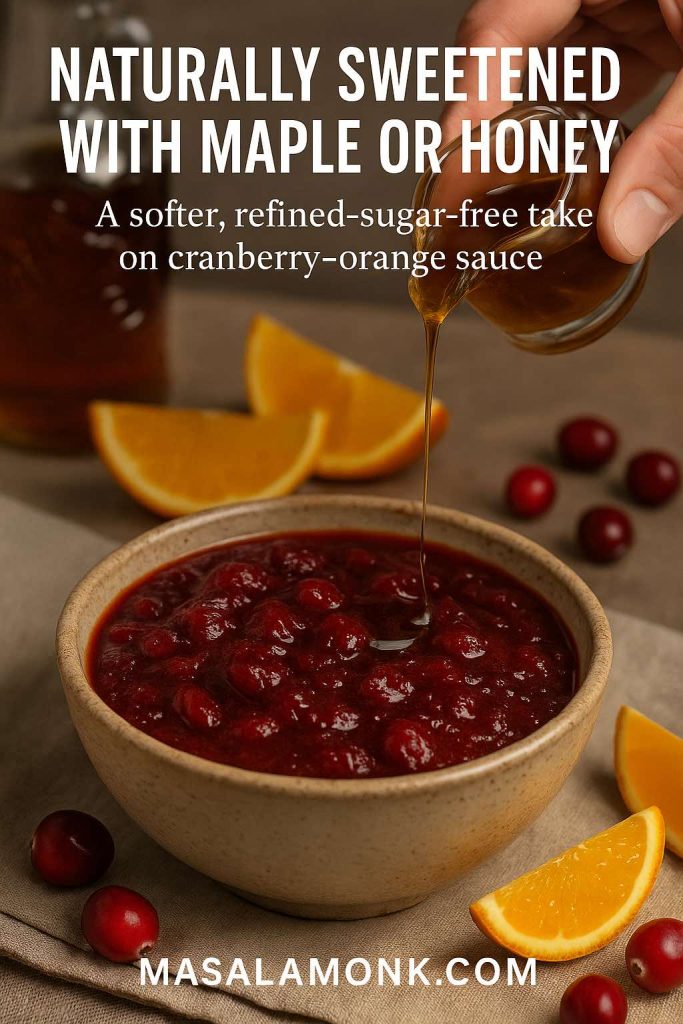
This post is built around that idea: one reliable recipe for cranberry sauce with orange juice, plus a whole family of twists you can spin from the same pot. You’ll find:

  • A classic, easy cranberry sauce with orange juice that feels familiar and comforting
  • A brown-butter and vanilla twist that turns into a cosy gourmet cranberry sauce recipe
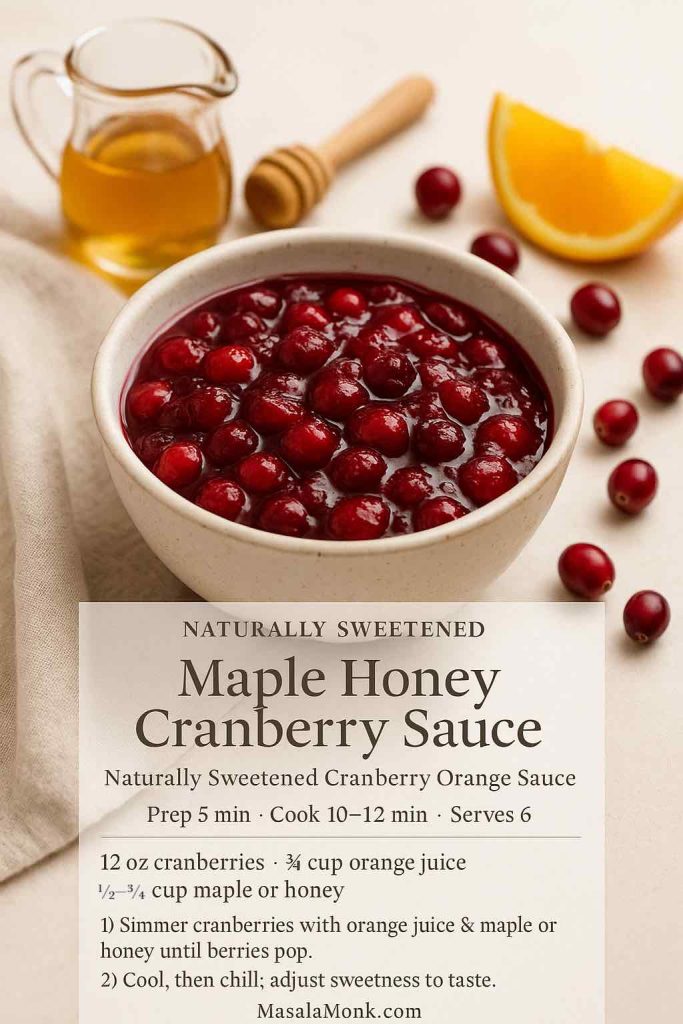
  • Naturally sweetened maple or honey versions
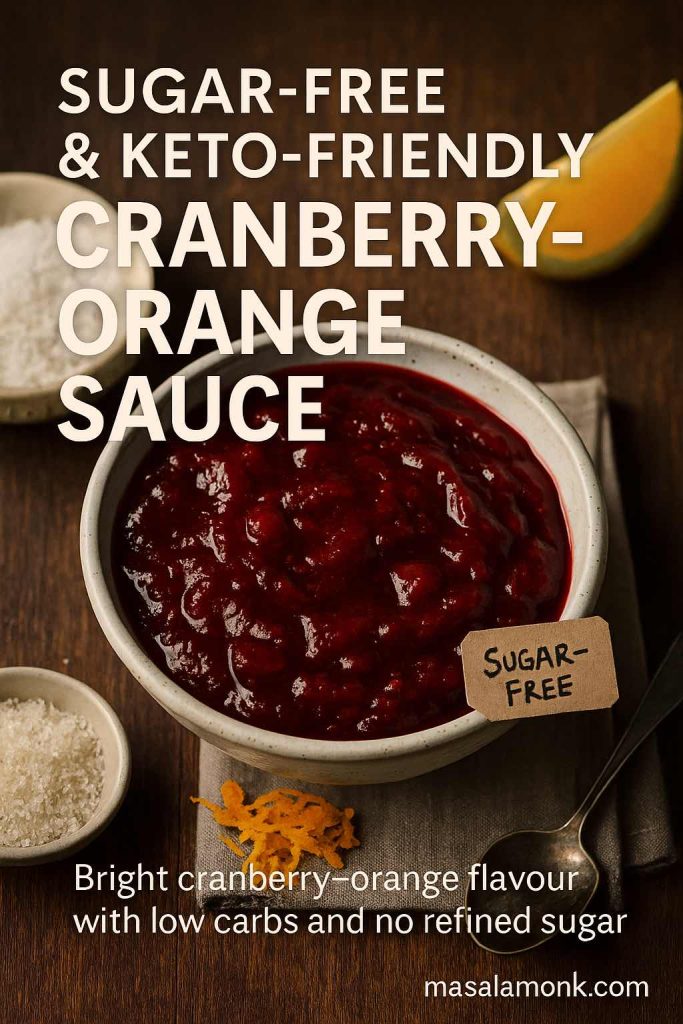
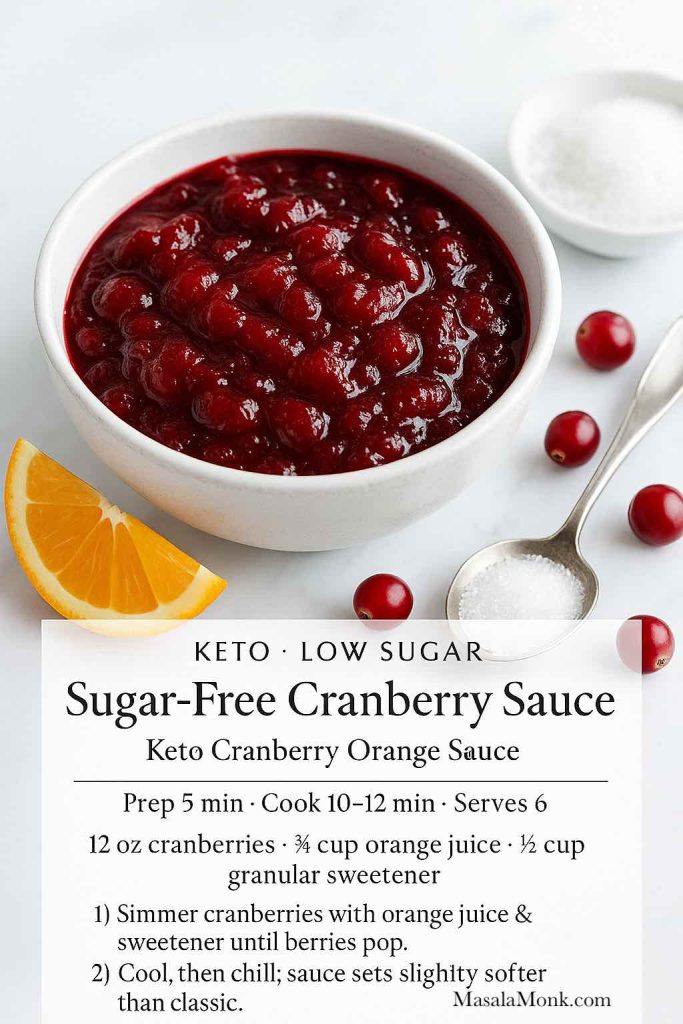
  • Low sugar, sugar-free and keto-style options
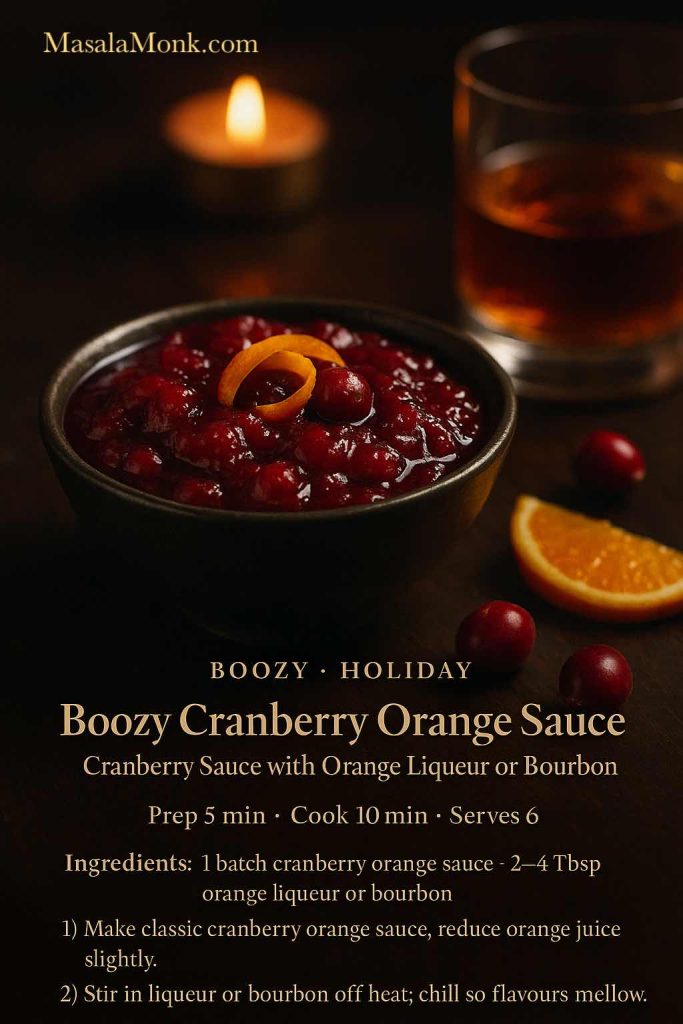
  • A boozy orange liqueur or whiskey version
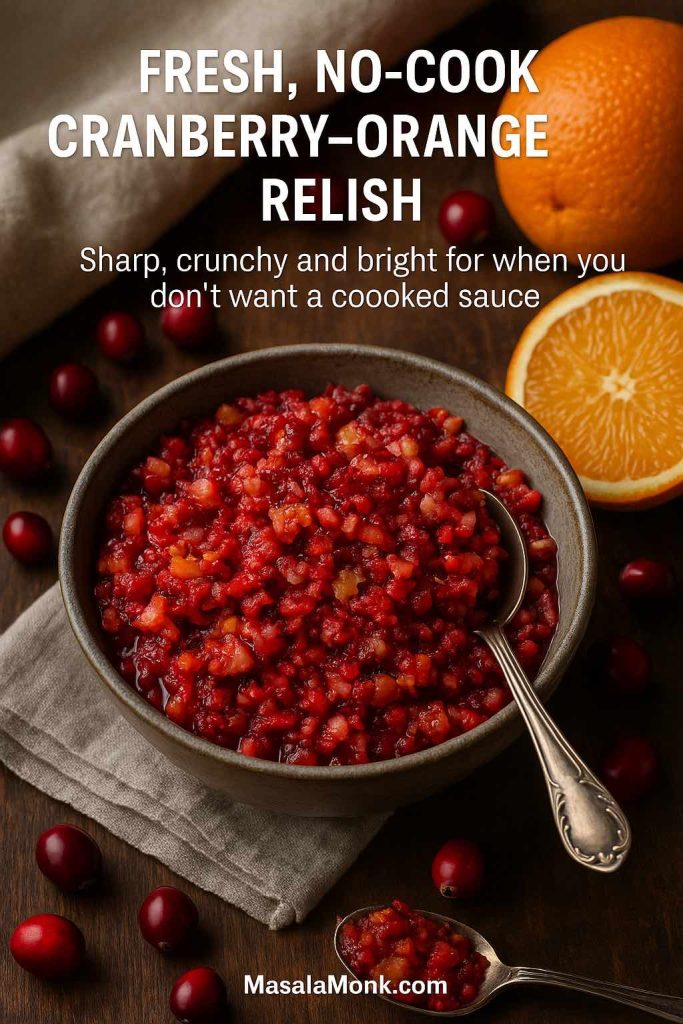
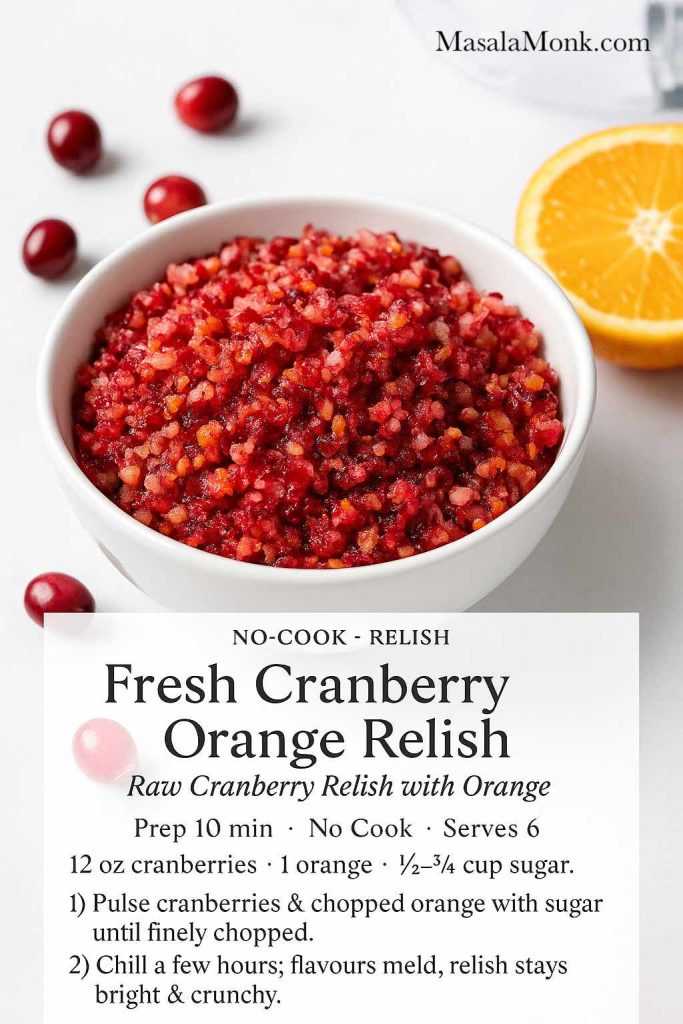
  • A fresh, no-cook cranberry orange relish
  • A tangy apple cranberry chutney that leans savoury

Along the way, we’ll talk about texture and cooking science, how to make your cranberry and orange juice sauce in the slow cooker, how far ahead you can prep for cranberry sauce Thanksgiving dinners, and plenty of ideas for using leftovers so nothing quietly dies in the back of the fridge.

If you’d like to get deeper into what cranberries do for your body—antioxidants, vitamin C, and more—you can follow up later with this cranberry nutrition and benefits breakdown.


Easy Homemade Cranberry Sauce with Orange Juice

Let’s start with the base. This is a simple cranberry sauce recipe with orange juice that you can make on autopilot once you’ve done it once or twice. It works whether you’re cooking for a small dinner or a full Thanksgiving crowd.

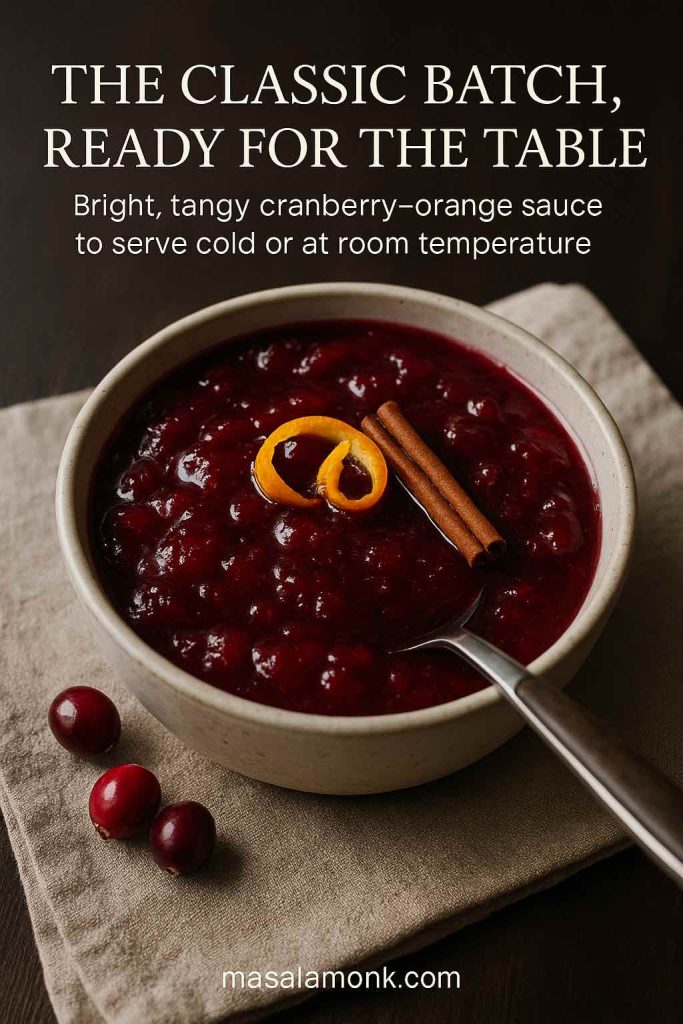
Classic homemade cranberry orange sauce in a ceramic bowl, garnished with a curl of orange zest and a cinnamon stick, ready to serve as a side dish.
The classic batch of cranberry–orange sauce: glossy, tangy and just sweet enough to serve straight from the bowl beside turkey, chicken or a nut roast.

Ingredients for the Classic Version

  • 12 oz (340 g) fresh or frozen cranberries, rinsed and picked over
  • 1 cup (200 g) granulated sugar
  • 1 cup (240 ml) orange juice (freshly squeezed if possible)
  • 1–2 teaspoons finely grated orange zest
  • Pinch of fine salt
  • 2–3 tablespoons water, if needed
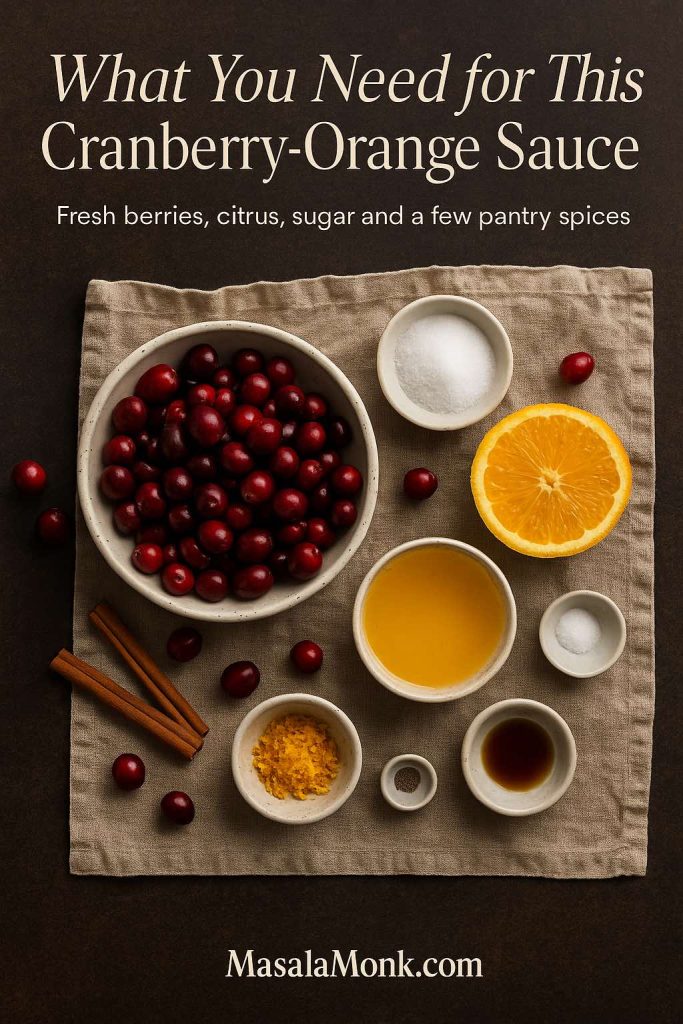
Overhead photo of ingredients for cranberry orange sauce on a linen cloth, with fresh cranberries, orange juice, sugar, orange zest, cinnamon sticks, vanilla, salt and pepper arranged in small bowls.
What you need for this cranberry–orange sauce at a glance: fresh cranberries, citrus, sugar and a few warm pantry spices, measured and ready to cook.

Optional flavour boosters:

  • 1 teaspoon vanilla extract
  • 1 small cinnamon stick or ¼ teaspoon ground cinnamon

This is a fairly classic recipe cranberry sauce formula; the twist is that orange juice replaces water, bringing sweetness and citrusy perfume. It’s in the same family as well-loved minimalist recipes such as Bon Appétit’s easiest cranberry sauce, but the orange plays a bigger role here.

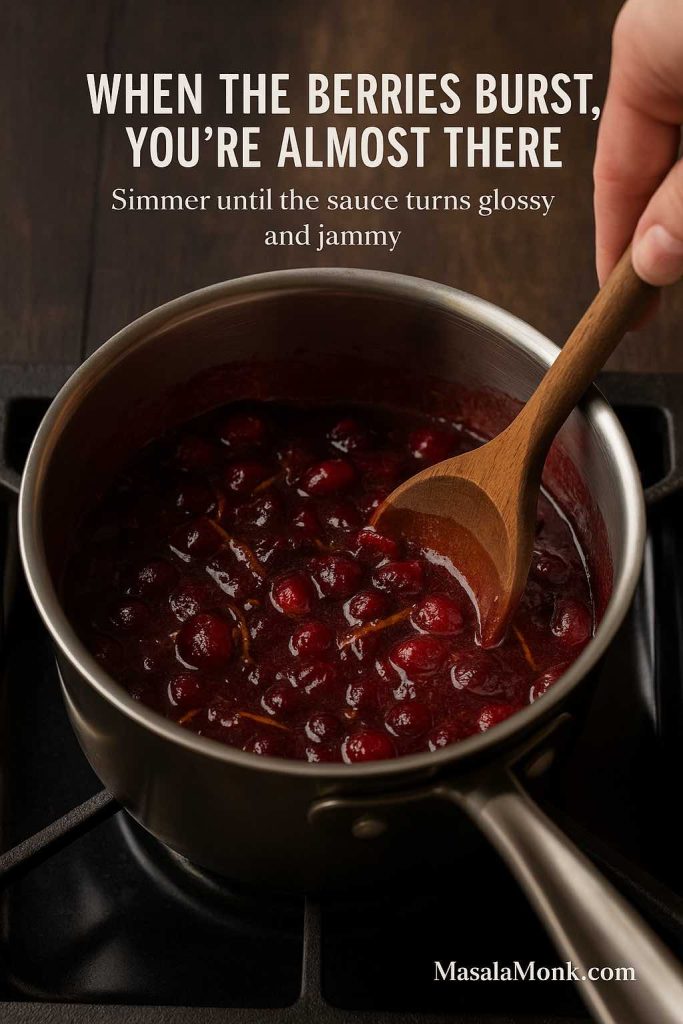
Cranberry orange sauce simmering in a saucepan, with cranberries bursting and a hand stirring the glossy, jammy mixture with a wooden spoon.
When the cranberries burst and the orange-spiked syrup turns glossy and jammy, your homemade cranberry sauce is just a minute away from perfect.

How to Cook Cranberry Sauce with Orange Juice (Step-by-Step)

  1. Set up the base.
    Tip the cranberries into a medium saucepan. Add sugar, orange juice, orange zest, salt, and the cinnamon stick if you’re using one. Give everything a stir so the cranberries are coated.
  2. Dissolve the sugar gently.
    Place the pan over medium heat. Stir every minute or so until the sugar dissolves and the liquid turns glossy. This usually takes 3–5 minutes. If things look very thick and the berries aren’t relaxing into the liquid, add a couple of tablespoons of water.
  3. Bring it to a gentle boil.
    Increase the heat slightly until the surface starts to bubble. You don’t want a wild, splattering boil—just a steady simmer that lets the cranberries soften.
  4. Simmer until the berries burst.
    Cook for 8–10 minutes, stirring occasionally. You’ll hear and see the cranberries pop. The sauce will start to thicken and look jammy. When you’re making cranberry sauce, the most important thing to remember is that it continues to thicken as it cools, so don’t wait for it to look like jelly in the pan.
  5. Finish with flavour.
    Take the pan off the heat. Pull out the cinnamon stick, if you added it. Stir in the vanilla extract. Taste carefully (it will be very hot) and decide whether you want more sugar for sweetness or a squeeze of extra orange juice for a sharper finish.
  6. Cool and chill.
    Let the homemade cranberry sauce cool to room temperature in the pan. It will look looser at this stage. Once it’s no longer steaming, transfer it to a glass or ceramic container and refrigerate for at least 2 hours, preferably overnight. Cold time is when the texture settles into that glossy, spoonable consistency everyone expects.

If you just want a basic cranberry sauce, you can skip the vanilla and cinnamon and stick to cranberries, sugar, and orange juice.

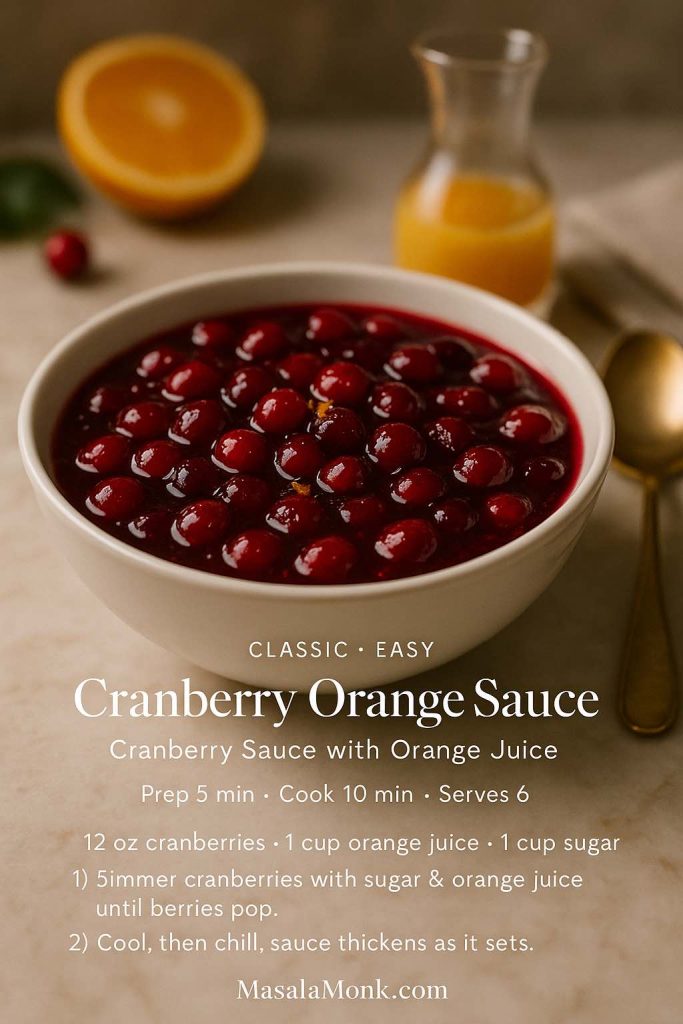
Glossy cranberry orange sauce in a white bowl, styled with orange juice and gold spoon on a marble surface, with an elegant text overlay mini recipe card for classic cranberry sauce with orange juice from MasalaMonk.com.
Save this mini recipe card for later: a classic cranberry orange sauce made with fresh cranberries, orange juice and sugar, ready in about 15 minutes and perfect to prepare ahead for Thanksgiving.

What This Classic Cranberry Sauce Tastes Like

This base cranberry sauce made with orange juice is bright and tangy, but not painfully sharp. The sugar balances the natural acidity of cranberries, while orange juice and zest add sweet citrus flavour and a gentle bitterness from the peel. Cinnamon and vanilla stay in the background; they shouldn’t make it taste like a full-on dessert, just a little warmer and more rounded.

Serve it straight from the fridge as a cranberry side dish next to turkey, chicken, duck, nut roasts, or even a rich main like macaroni and cheese. A spoonful on the plate does a lot of work cutting through fat and salt.


Understanding Cranberries: Fresh, Frozen & Dried

Before we layer on variations, it helps to know what’s happening in the pot.

Fresh vs Frozen Cranberries

For this cranberry sauce recipe fresh cranberries are ideal when they’re in season (usually October through December). They’re firm, shiny, and snap when you bite one. If you’re using frozen cranberries, there’s no need to thaw. Add them straight to the pan; you may need an extra minute or two of simmering.

Frozen berries are picked at peak ripeness and frozen quickly, so they behave very similarly to fresh. If anything, they sometimes release water more readily, which can help the sauce set nicely.

Three small bowls showing fresh cranberries, frozen cranberries and dried cranberries side by side on a linen cloth with a halved orange, illustrating which type works best for cranberry sauce.
For classic cranberry sauce, fresh or frozen berries give the best set and flavour; dried cranberries need soaking and are better for a softer, chutney-style mix.

What About Dried Cranberries?

Dried cranberries are great for salads and baking, but they’re not a straight swap in a standard cranberry sauce recipe using orange juice. They’ve already been sweetened and dehydrated, so they won’t burst and gel in the same way.

If you really want to use dried cranberries:

  • Soak them first in warm orange juice and water for at least 30 minutes
  • Use more liquid than the fresh recipe calls for
  • Expect a softer, chutney-like texture rather than a classic sauce

That kind of approach can work in a cranberry sauce recipe from dried cranberries, but for a traditional Thanksgiving-style sauce, fresh or frozen is the way to go.

Why Cranberry Sauce Thickens on Its Own

Cranberries are naturally high in pectin, a type of soluble fibre that gels when combined with acid and sugar. Orange juice adds acidity and sugar, so when you simmer everything together, you’re quietly making a soft, homemade jelly.

Close-up of a spoon lifting thick, gelled cranberry orange sauce from a bowl, with text reading “Natural Pectin = Soft Cranberry Jelly,” showing how the sauce sets without added gelatin.
Cranberries are naturally rich in pectin, so a simple cranberry sauce with orange juice thickens into a soft jelly as it cools—no gelatin or cornstarch needed.

This is why:

  • A basic cranberry sauce recipe doesn’t need gelatin or cornstarch
  • The sauce looks runnier in the pan than it does once chilled
  • High-sugar versions often set more firmly than low-sugar or sugar-free ones

Once you understand that, it’s easier to trust the process. When in doubt, err on the side of stopping the simmer a little early. You can always thicken slightly later, but rescuing an over-thick, sticky sauce is more tricky.

Also Read: Pesto Recipe: Classic Basil Pesto Sauce & 10 Variations


Texture, Taste, and Tweaks for the Classic Sauce

A simple easy cranberry sauce can feel completely different depending on how long you cook it and how much you mash it.

Choosing Your Texture

Think about your crowd:

  • For people who like whole berries and a bit of bite, aim for a chunky cranberry and orange juice sauce. Simmer just until most berries pop and stop there.
  • If you prefer a jammy, spreadable texture that sits neatly on turkey or bread, cook it a couple of minutes longer until the liquid coats the back of a spoon. This makes a rich cranberry orange juice sauce that doubles as a spread.
  • For kids or anyone who dislikes “bits”, use a potato masher to break everything down once it’s off the heat. For an extra-smooth finish, give it a brief whizz with an immersion blender.
Overhead photo of three ceramic spoons filled with chunky, jammy and smooth cranberry orange sauce on a wooden table with fresh cranberries and orange zest.
One master cranberry–orange sauce, three textures: leave the berries whole and chunky, cook it down until jammy, or blend it silky smooth depending on how you like it on the plate.

You can even split a batch: half left chunky, half blended, so your homemade cranberry sauce recipe covers both preferences without extra effort.

Adjusting Sweetness and Tartness of Cranberry Sauce with Orange Juice

Taste before chilling, but keep in mind flavours soften in the fridge. If you know your family likes sweeter sauces (maybe they’re used to canned), add a touch more sugar while it’s still warm. If you prefer a sharper profile, hold back on the sugar and add extra orange zest instead of more juice.

You can also:

  • Add a spoonful of brown sugar for a caramel note
  • Stir in a little maple syrup at the end for a healthy cranberry sauce feel with more nuanced sweet notes
  • Balance too much sweetness with a splash of extra orange juice or a squeeze of lemon

Balancing Spices in Cranberry Sauce with Orange Juice

Cranberries can handle quite a bit of spice, but for a classic cranberry sauce Thanksgiving vibe, it’s best not to go too wild in the base recipe. A cinnamon stick or pinch of ground cinnamon is usually enough. Save bolder flavours like cloves, star anise, or cardamom for one of the twists below, so your main pot stays broadly appealing.

Also Read: Katsu Curry Rice (Japanese Recipe, with Chicken Cutlet)


Flavor Variations on Cranberry Sauce with Orange Juice

Once your base is sorted, you can treat it like a master sauce and spin it several ways. Think of the following as mini recipes that sit on top of the same core idea: a cranberry sauce with orange juice that you understand and trust.

Brown Butter & Vanilla Cranberry Sauce (Gourmet Twist)

When you want something that feels restaurant-level without extra stress, this brown butter version is your best friend. It’s still recognisably cranberry sauce, just with deeper, nutty notes.

Bowl of brown butter and vanilla cranberry orange sauce on a linen cloth, with a gold spoon, cinnamon stick and vanilla bean, styled as a rich gourmet version of classic cranberry sauce.
Brown butter and vanilla swirl through this cranberry–orange sauce, turning the same simple base into a dessert-level, gourmet side dish for holiday dinners.

You’ll need:

  • Classic batch of cranberry sauce with orange juice
  • 2 tablespoons unsalted butter
  • Extra ½ teaspoon vanilla extract

How to make it:

  1. In a small light-coloured pan, melt the butter over medium heat.
  2. Continue cooking, swirling the pan, until the butter foams and the milk solids at the bottom turn golden and smell nutty. Take off the heat; this is brown butter.
  3. Prepare the base cranberry sauce recipe using orange juice as usual.
  4. Once the sauce is off the heat, fish out the cinnamon stick if you used one, then stir in the brown butter and extra vanilla.
  5. Taste and adjust; brown butter adds richness but not sweetness, so you may want a teaspoon of extra sugar or maple if you like a softer edge.
  6. Cool and chill.
Brown butter cranberry sauce in a cream bowl with a split vanilla bean on top, styled on a dark table with candlelight, featuring an elegant text overlay recipe card for vanilla cranberry orange sauce from MasalaMonk.com.
Brown butter and real vanilla turn classic cranberry orange sauce into a rich, restaurant-style side. Save this gourmet cranberry sauce recipe card for holiday dinners when you want something a little extra.

The result is a cosy gourmet cranberry sauce recipe that works for Thanksgiving, Christmas dinners, or even alongside duck breast, pork fillet, or a rich vegetarian main. If you like building “one master sauce + many ways to use it”, this approach is very similar in spirit to how we handle yogurt sauces in our Greek tzatziki guide.


Naturally Sweetened Cranberry Sauce with Orange Juice (Maple or Honey)

For guests who like slightly “cleaner” flavours, a naturally sweetened version hits the spot. This variation keeps the orange but swaps white sugar for maple syrup or honey, so it fits neatly into the healthy cranberry sauce and low sugar cranberry sauce camp.

Close-up of a rustic bowl filled with cranberry orange sauce while a hand pours maple or honey syrup over the top, with orange wedges and fresh cranberries in the background.
Naturally sweetened cranberry–orange sauce, finished with maple or honey for a gentler, refined-sugar-free twist on the classic recipe.

Ingredients (Maple Version):

  • 12 oz (340 g) cranberries
  • ½–¾ cup (120–180 ml) pure maple syrup
  • ¾ cup (180 ml) orange juice
  • ¼ cup (60 ml) water
  • 1–2 teaspoons orange zest
  • Pinch of salt
  • Optional: cinnamon stick, 1 teaspoon vanilla

Method:

  1. Combine cranberries, maple syrup, orange juice, water, zest, salt and optional cinnamon in a saucepan.
  2. Bring to a gentle boil over medium heat.
  3. Simmer 10–12 minutes until most berries burst and the sauce thickens.
  4. Remove from the heat, stir in vanilla if using, and taste. Add more maple syrup if you’d like a sweeter cranberry sauce less sugar style.
  5. Cool and chill.
Naturally sweetened maple honey cranberry sauce in a rustic ceramic bowl, surrounded by a honey dipper, maple syrup jug, orange slice and fresh cranberries, with a text overlay mini recipe card for naturally sweetened cranberry orange sauce from MasalaMonk.com.
This naturally sweetened cranberry orange sauce swaps refined sugar for maple syrup or honey. Save this recipe card if you’re after a brighter, “healthier” cranberry sauce that still feels cosy and festive.

Honey works similarly, though it tastes sweeter than sugar or maple. Start with ½ cup, taste towards the end of cooking, and add more gradually if needed.

For more inspiration, Ambitious Kitchen has a lovely naturally sweetened orange cranberry sauce using orange juice, maple or honey, and vanilla. Cookie and Kate’s naturally sweetened cranberry sauce is another strong example of a cranberry sauce recipe healthy that skips refined sugar.


Low Sugar, Sugar-Free & Keto Cranberry Sauce with Orange Juice

Sometimes you need a sugar free cranberry sauce that still feels festive: maybe you’re cooking for someone watching their blood sugar, or for guests who prefer low-carb options. This variation stays tart and bright, with orange notes, but uses sugar-free sweetener instead of sugar.

Bowl of sugar-free, keto-friendly cranberry orange sauce on a wooden table with citrus zest, lemon wedge and a small dish of granular sweetener, styled with “Sugar-Free” label text on the image.
A sugar-free, keto-friendly cranberry–orange sauce made with low-carb sweetener instead of sugar, keeping the bright flavour while cutting the carbs for guests who prefer a lighter option.

Ingredients:

  • 12 oz (340 g) cranberries
  • ¾ cup (180 ml) orange juice
  • ½ cup (120 ml) water
  • ½–⅔ cup granular sugar-free sweetener (such as a monkfruit–erythritol blend)
  • 1–2 teaspoons orange zest
  • Pinch of salt
  • Optional: cinnamon stick, vanilla extract

Steps:

  1. Combine cranberries, orange juice, water, sweetener, zest, and salt in a saucepan.
  2. Bring to a gentle boil over medium heat.
  3. Simmer for 10–12 minutes, stirring often, until the sauce thickens and most berries have popped.
  4. Remove from heat and stir in vanilla if you like.
  5. Taste while still warm. Sugar-free sweeteners can taste slightly less sweet once chilled, so make it just a touch sweeter than you think you want.
  6. Cool, then refrigerate to let it set.
Sugar-free cranberry sauce in a white bowl on a marble surface, styled with fresh cranberries, an orange wedge and a spoonful of granular sweetener, with a clean text overlay mini recipe card for keto cranberry orange sauce from MasalaMonk.com.
This keto-friendly cranberry orange sauce skips regular sugar and uses a granular low-carb sweetener instead. Save this sugar-free cranberry sauce recipe card if you need a lighter option that still looks and tastes festive.

This style fits well with requirements of keto cranberry sauce, no sugar added cranberry sauce, and low carb cranberry sauce. For a different take, Wholesome Yum’s low-carb cranberry sauce leans on allulose and orange zest for a very low net-carb result.

Quick note: if anyone at your table has diabetes or other health concerns, remind them to chat with their doctor before relying on “diabetic cranberry sauce” or juice drinks as part of treatment. For a broader look at how cranberry juice fits into weight management, there’s a helpful summary here on cranberry juice and weight loss.


Boozy Holiday Cranberry and Orange Juice Sauce

For adults-only dinners, adding a splash of alcohol turns your basic cranberry and orange juice sauce into something that tastes like it fell off a restaurant dessert menu.

Bowl of boozy cranberry orange sauce on a wooden table with a glass of whiskey in the background and fresh cranberries scattered around, styled as a grown-up holiday version of classic cranberry sauce.
Boozy cranberry–orange sauce finished with whiskey or orange liqueur for grown-up holiday plates, perfect with roast duck, glazed ham or rich beef roasts.

You’ll need:

  • One batch of classic cranberry sauce with orange juice
  • 2–4 tablespoons orange liqueur (like Cointreau or Grand Marnier) or whiskey/bourbon

How to build it:

  1. Make the base easy cranberry sauce recipe as usual, but reduce the orange juice by 2–4 tablespoons to make room for the alcohol.
  2. Once you’ve turned off the heat, stir in the liqueur or whiskey.
  3. Taste and adjust. Alcohol can slightly amplify bitterness, so an extra teaspoon of sugar or maple can round things out if desired.
  4. Cool and chill; the boozy edge softens overnight.
Boozy cranberry orange sauce in a dark bowl on a wooden table, garnished with an orange twist and fresh cranberries, with a glass of bourbon and a text overlay mini recipe card for cranberry sauce with orange liqueur or bourbon from MasalaMonk.com.
When you stir in a splash of bourbon or orange liqueur, classic cranberry orange sauce turns into this moody, grown-up side. Save this boozy cranberry sauce recipe card for dinner parties where you want the cranberry to feel a little bit cocktail-bar chic.

This twist is wonderful with roast duck, glazed ham, and beef roasts. Leftover boozy cranberry sauce can double as a quick pan sauce: deglaze a roasting pan with a splash of stock, whisk in a spoonful of cranberry sauce, and simmer briefly.

If you like playing with citrusy cocktails, a spoonful of this sauce blends beautifully into a whiskey sour or adds flavour and colour to the sugar rim on a lemon drop martini.


Fresh Cranberry Orange Relish (No Cook)

For some people, the ultimate cranberry orange relish isn’t cooked at all. Instead of simmering, you blitz everything raw in a food processor and let time in the fridge meld the flavours.

This no-cook cranberry relish recipe with orange juice is bright, crunchy, and a little sharp.

Bowl of fresh no-cook cranberry orange relish with a spoon, surrounded by whole cranberries and orange halves on a wooden table.
Fresh, no-cook cranberry–orange relish: finely chopped cranberries and whole orange peel for a crunchy, zippy alternative to classic cooked cranberry sauce.

Ingredients:

  • 12 oz (340 g) fresh cranberries
  • 1 thin-skinned orange, scrubbed (remove seeds, keep peel)
  • ½–¾ cup (100–150 g) sugar, or more to taste
  • Splash of orange juice if needed
  • Pinch of salt

Method:

  1. Roughly chop the orange, removing any seeds.
  2. Add the cranberries and orange pieces to a food processor.
  3. Pulse until everything is finely chopped but not pureed; scrape down the sides as needed.
  4. Sprinkle over ½ cup sugar and the salt. Pulse again to combine.
  5. Taste and add more sugar if you’d like a sweeter fresh cranberry orange relish. If the mixture seems very dry, add a spoonful of orange juice.
  6. Transfer to a container and chill for at least 2 hours, preferably overnight.
Fresh cranberry orange relish in a white bowl on a bright white surface, with chopped cranberries and orange peel visible, surrounded by fresh cranberries and half an orange, plus a text overlay mini recipe card for raw cranberry relish with orange from MasalaMonk.com.
This no-cook cranberry orange relish stays bright, crunchy and a little bit sharp. Save this recipe card if you like a raw cranberry relish for Thanksgiving, cheese boards and leftover turkey sandwiches.

The texture is closer to a chutney than to a smooth sauce, which makes it fantastic with cold turkey sandwiches, cheese boards, and rich mains. It’s also lovely spooned on top of savoury breakfast dishes like upma and other wholesome brunch bowls.

Because it’s raw, this variation particularly benefits from good-quality fruit. It’s a great way to use cranberries for Thanksgiving dinner when you want something sharper and fresher than cooked sauce.


Apple Cranberry Chutney with Orange

Finally, if you want something that bridges the gap between jammy sauce and savoury chutney, this apple-forward variation is a keeper. It leans into vinegar, onion and ginger, making it a brilliant cranberry side dish for roasted meats, charcuterie, and cheese.

Rustic bowl of chunky apple cranberry chutney with orange, showing visible pieces of apple and cranberries, styled with apple slices, cranberries and a small bottle of vinegar on a wooden table.
Apple cranberry chutney with orange: chunky, tangy and lightly spiced, perfect alongside roast meats, nut roasts or a holiday cheese and cracker board.

Ingredients:

  • 8 oz (225 g) cranberries
  • 1 medium apple, peeled and finely diced
  • ½ cup (100 g) sugar (or ¼ cup white, ¼ cup brown)
  • ½ cup (120 ml) orange juice
  • ¼ cup (60 ml) apple cider vinegar
  • ¼ cup (40 g) finely chopped onion
  • ¼ teaspoon ground ginger or 1 teaspoon freshly grated ginger
  • Pinch of salt
  • Pinch of ground cinnamon

How to make it:

  1. Add cranberries, apple, sugar, orange juice, vinegar, onion, ginger, salt, and cinnamon to a saucepan.
  2. Bring to a gentle simmer over medium heat.
  3. Cook 15–20 minutes, stirring from time to time, until the cranberries burst, the apples soften, and the chutney is thick and glossy.
  4. Taste and adjust balance: more sugar for sweetness, more vinegar for tang, or a little extra salt for savouriness.
  5. Cool and chill.
Rustic apple cranberry chutney with orange in a brown ceramic bowl on a wooden board, with cheese, crackers and apple slices around it, plus a text overlay mini recipe card for savoury cranberry, apple and orange chutney from MasalaMonk.com.
This apple cranberry chutney leans savoury thanks to onion, ginger and cider vinegar, so it works as well with cheese boards and ham as it does with roast turkey. Save this recipe card if you like something chunkier and more chutney-style than classic cranberry sauce.

This apple cranberry chutney sits nicely next to roast pork, ham, or a vegetarian roast, and it pairs beautifully with a platter of cheeses and crackers. It also doesn’t feel limited to November; you can happily serve it any time you’re craving something fruity and savoury.

Also Read: Peanut Butter Cookies (Classic Recipe & 3 Variations)


Slow Cooker, Make-Ahead & Freezer Tips

Cranberry sauce is one of the easiest dishes to prepare ahead for a big holiday meal. Whether you’re going traditional stove-top or want a cranberry sauce crock pot method, it’s extremely forgiving.

Slow Cooker Cranberry Sauce

The slow cooker version is ideal if all your burners are busy or if you want a cranberry sauce in slow cooker approach that gently simmers away in the background.

Basic method:

  1. Add all the ingredients for any of the cooked variations (classic, maple, sugar-free, or boozy) into a small slow cooker.
  2. Stir to combine.
  3. Cook on LOW for 3–4 hours or HIGH for about 2 hours, stirring once or twice if convenient.
  4. Once the cranberries have burst and the sauce looks thick around the edges, switch the slow cooker off.
  5. Let it cool slightly, then transfer to a container and refrigerate.

Because the slow cooker retains moisture, sauces from this method sometimes look a tiny bit looser. If needed, you can move the sauce to a saucepan and simmer for a couple of minutes to tighten it up.

How Far in Advance Can You Make Cranberry Sauce with Orange Juice?

For stress-free cranberry recipes for Thanksgiving, aim to make your sauce at least one day ahead; three days is even better. The flavours deepen, and it’s one less thing on your day-of list.

Rough guidelines:

  • Fridge life: about 7 days, tightly covered
  • Freezer life: up to 2 months in an airtight container, leaving a little headroom for expansion

To serve from frozen, thaw overnight in the fridge, stir well, and warm gently in a saucepan or let it come to room temperature.

A smooth, properly set cranberry sauce recipe homemade will thicken slightly in the cold. If it’s too stiff, stir in a splash of water or orange juice over low heat until you like the consistency.

Also Read: Tres Leches – Mexican 3 Milk Cake Recipe


Serving Suggestions & Menu Pairings

Once you have a reliable best cranberry sauce for Thanksgiving in your back pocket, it’s fun to think beyond the turkey.

Classic Holiday Plates

Your sauce is an obvious match for:

  • Roast turkey (whole or breast)
  • Roast chicken or Cornish hens
  • Baked ham
  • Nut roasts or lentil loaves

On the side, consider a mix of creamy, crunchy, and green elements. A spoonful of cranberry sauce with orange juice feels right at home with:

All together, they build the kind of plate people dream about when they search for the best cranberry sauce recipe for Thanksgiving.

Holiday dinner plate with roast turkey, mashed potatoes, green beans and a generous spoonful of cranberry orange sauce, with extra sauce in a small bowl on a wooden table.
Serve cranberry–orange sauce alongside roast turkey, creamy potatoes and green vegetables for a balanced holiday plate that feels rich yet bright.

Casual Comfort Dinners

Cranberry sauce isn’t limited to one Thursday in November. The same bright-tart spoonful can cut through:

You don’t have to serve it in a huge mound; even a small dish on the table lets everyone add that burst of colour and acidity where they like.

Brunch & Grazing Boards

On more relaxed days, your cranberry orange sauce also belongs on brunch spreads:

  • Dolloped next to cheeses, nuts, and crackers
  • Served with buttery scones or biscuits
  • Paired with savoury egg dishes and fresh fruit

It sits nicely next to a jug of mimosa variations or a tray of strawberry mojito mocktails that you can also adapt with cranberry and orange.


Using Leftover Cranberry Sauce with Orange Juice

One of the hidden strengths of a good cranberry sauce with orange juice is how flexible the leftovers are. A cup or two in the fridge can quietly upgrade meals all week. All of these recipes with cranberry sauce turn leftovers into easy meals and snacks.

Cranberry Meatball Sauce

Turn your sauce into a sticky, tangy glaze for meatballs:

  1. Mix equal parts cranberry sauce and your favourite BBQ or chili sauce.
  2. Add a splash of soy sauce or Worcestershire for savouriness.
  3. Warm in a pan until smooth.
  4. Add cooked meatballs and simmer a few minutes so they’re coated and hot.

This simple trick gives you a cranberry meatball sauce that works as a party appetizer or a quick dinner over rice or mashed potatoes.

Skillet of meatballs glazed in glossy cranberry sauce, garnished with parsley and surrounded by fresh cranberries, with text reading “Cranberry Meatball Sauce for Easy Party Appetizers.”
Mix leftover cranberry sauce with BBQ or chili sauce to make this glossy cranberry meatball sauce—an easy, crowd-pleasing party appetizer or weeknight dinner.

Cranberry Mayo for Sandwiches

A spoonful of cranberry sauce goes a long way in sandwich spreads:

  1. Stir 1 tablespoon cranberry sauce into 2 tablespoons mayonnaise.
  2. Taste and add more mayo if you want it milder.
  3. Spread on bread for turkey or chicken sandwiches.

The result is a tangy, creamy cranberry sauce for sandwiches that plays nicely with roasted poultry, cheese, and salad leaves. For more ideas, you can look at flavour combos from this collection of chicken sandwich recipes.

Turkey sandwich on rustic toasted bread with cranberry mayo and lettuce, served beside a small bowl of pink cranberry mayonnaise and fresh cranberries on a wooden board.
Leftover cranberry sauce whipped into mayo makes a tangy cranberry spread that instantly upgrades next-day turkey or chicken sandwiches.

Baked Brie with Cranberry Topping

If you love grazing boards, baked brie topped with cranberry orange relish is a near-perfect snack:

  1. Place a small wheel of brie in an oven-safe dish.
  2. Spoon cranberry sauce on top—classic, brown butter, or even apple cranberry chutney all work.
  3. Bake at 180°C / 350°F for 10–15 minutes until the cheese is soft and oozing.
  4. Serve with crackers or sliced baguette.

If you’re pregnant or feeding pregnant guests, it’s worth checking which soft cheeses are safe before you plan the board; this guide to soft cheese and pregnancy is a handy starting point.

Baked Brie wheel topped with glossy cranberry orange sauce, oozing onto a ceramic dish and surrounded by crackers, baguette slices and fresh cranberries on a wooden board.
Warm baked Brie crowned with leftover cranberry–orange sauce makes an instant grazing-board centrepiece that looks fancy but takes only minutes in the oven.

Breakfast Bowls and Oats

Cranberry sauce can also brighten breakfast:

  • Swirl into Greek yogurt with granola
  • Spoon over overnight oats
  • Stir into warm porridge

A solid base like this protein oatmeal formula turns leftover sauce into a colourful topping that adds both flavour and a bit of natural sweetness, especially if you’ve made a low sugar cranberry sauce or naturally sweetened cranberry sauce.

Breakfast bowl of creamy yogurt or oatmeal topped with a swirl of cranberry sauce, orange slices and granola, with a second bowl of cranberry sauce in the background.
Swirl leftover cranberry sauce into oats or yogurt for a colourful breakfast bowl that’s tangy, slightly sweet and far more exciting than plain porridge.

Dessert Ideas

Cranberry’s tartness pairs beautifully with chocolate and cream:

  • Warm lightly and drizzle over vanilla ice cream or cheesecake
  • Use as a filling for thumbprint cookies or sandwich cookies
  • Layer into parfaits with whipped cream and crushed biscuits

A plate of cranberry thumbprints goes especially well alongside something rich like these double chocolate chip cookies. For cosy nights in, stir a spoonful of cranberry orange sauce into a mug of homemade hot chocolate for a wintery twist.

Bowl of vanilla ice cream drizzled with cranberry sauce and a plate of thumbprint cookies filled with cranberry jam, styled together on a wooden table as easy desserts made from leftover cranberry sauce.
Leftover cranberry sauce turns into dessert in minutes—drizzle it over vanilla ice cream or spoon it into thumbprint cookies for an easy sweet finish after a holiday meal.

Drinks & Mocktails

Leftover sauce also loves a glass:

  • Shake a spoonful with lemon juice, simple syrup, and whiskey for a cranberry take on a sour
  • Stir into sparkling water with extra orange juice for a quick mocktail
  • Use as a flavour base in mocktails similar to those in our ACV & cranberry mocktail ideas
Two cranberry drinks on a wooden table, one a whiskey sour–style cocktail with foam and orange slice and one a sparkling mocktail with cranberries and citrus, with a small bowl of cranberry sauce in front and text about turning leftover cranberry sauce into drinks and mocktails.
A spoonful of leftover cranberry sauce can be shaken into a cranberry sour or stirred into sparkling water with citrus for easy cocktails and mocktails that use up every last bit.

All of these are small, low-effort ways to make sure your recipes using cranberry sauce don’t stop at the main meal.


A Little More on Cranberries & Health

Even though most versions of cranberry sauce with orange juice are treats rather than health foods, it’s still nice to know what’s inside those jewel-coloured berries.

Cranberries offer:

  • Vitamin C
  • Manganese
  • Dietary fibre
  • Various polyphenol antioxidants

Healthline’s overview of cranberry nutrition and health benefits explains how cranberries may help support urinary tract health, reduce oxidative stress, and influence some heart-health markers. The Cranberry Institute collects research summaries on cranberry bioactives, particularly around proanthocyanidins (PACs), the compounds thought to help prevent certain bacteria from sticking to urinary tract walls.

On the flip side, most holiday sauces also contain a decent amount of sugar, so they’re still in the “enjoy in moderation” category. If you’re looking for something lighter, lean on your naturally sweetened cranberry sauce or no sugar added cranberry sauce variation, and perhaps save the biggest spoonfuls for big meals rather than everyday snacks.

For those balancing rich holiday food with lighter days, homemade hydration and detox-style drinks featuring cranberry and apple cider vinegar can feel like a reset; you’ll find several precise formulas in this guide to cranberry-ACV detox drinks and these homemade electrolyte recipes for fasting.


Conclusion

With this one post, you’ve got:

  • A reliable, classic cranberry sauce with orange juice
  • A set of seven easy recipes and variations (from cranberry orange relish to apple cranberry chutney)
  • Options that cover classic, gourmet, low-sugar, sugar-free, and boozy moods
  • Plenty of ideas for recipes using cranberry sauce the next day and beyond

From here, you can keep things as simple as a single pot of sauce—or build a whole cranberry “universe” across your Thanksgiving, Christmas and everyday menus.

FAQs about Cranberry Sauce with Orange Juice

1. Can I make cranberry sauce with orange juice instead of water?

Yes, absolutely. A cranberry sauce with orange juice is simply a classic cranberry sauce recipe where orange juice replaces some or all of the water. This gives you a brighter flavour, gentle sweetness, and a more “holiday” feel. Any basic cranberry sauce recipe using orange juice can follow the same ratios as a water-based sauce; just watch the simmer time so it doesn’t reduce too much and turn too thick.


2. What’s the difference between cranberry sauce and cranberry orange relish?

Cranberry sauce is cooked: the berries burst over heat and the mixture thickens into a glossy, jammy side dish. A cranberry orange relish is usually raw, often made in a food processor with whole orange, sugar, and fresh cranberries. So, a cranberry relish recipe with orange juice or whole orange has more crunch, brighter acidity, and a slightly bitter edge from the peel. In short, sauce is smooth and spoonable; relish is chopped and zippy.


3. How do I fix cranberry sauce that’s too runny or too thick?

If your cranberry sauce made with orange juice is too runny after chilling, return it to the pan and simmer for a few minutes until it reduces and coats the back of a spoon. Conversely, if it ends up too thick, stir in extra orange juice or a little water, a tablespoon at a time, over low heat until it loosens. Always remember: a cranberry orange juice sauce thickens as it cools, so judge consistency after it’s chilled, not just while it’s hot.


4. Can I make cranberry sauce ahead of time or freeze it?

Yes, homemade cranberry sauce is perfect for making in advance. It keeps in the fridge for about a week, so you can prepare your cranberry sauce with orange juice several days before Thanksgiving or Christmas. It also freezes well for up to a couple of months; just thaw in the fridge and stir before serving. This make-ahead option frees up time and stove space on busy days.


5. Can I use frozen cranberries instead of fresh?

Frozen cranberries work just as well in a cranberry sauce recipe using orange juice. There’s no need to thaw them; simply add straight from the freezer and extend the simmer time by a minute or two. The texture and flavour will be very close to fresh, and your homemade cranberry sauce recipe will still set thanks to the natural pectin in the berries.


6. How can I make a low sugar or sugar free cranberry sauce?

To create a low sugar cranberry sauce, reduce the sugar and balance with more orange zest rather than extra juice, keeping the flavour bright without over-sweetening. For a sugar free cranberry sauce, swap sugar for a granular sweetener such as a monkfruit–erythritol blend and follow the same method. This style fits low-carb, keto and “diabetic-friendly” needs, although individual health conditions may still require personal adjustments. Expect the set to be slightly softer than a traditional full-sugar sauce.


7. Is cranberry sauce vegan and gluten free?

Most homemade cranberry sauce recipes are naturally vegan and gluten free, especially a simple cranberry sauce with orange juice made from fruit, sugar, and spices. Just avoid butter-based variations if you’re cooking for vegans, or use plant-based butter in gourmet versions like brown-butter-style twists. Likewise, check labels on alternative sweeteners if you’re making keto cranberry sauce or sugar-free versions.


8. Can I make cranberry sauce without orange juice?

Certainly. If you don’t want citrus, you can make a basic cranberry sauce recipe with water and sugar, then add a little lemon zest, apple juice, or even pomegranate juice for complexity. On the other hand, if you enjoy fruitier flavours but have no oranges, apple juice gives a softer, sweeter profile than a sharp cranberry sauce with orange juice. Just keep the overall liquid-to-cranberry ratio similar so the sauce still sets properly.


9. How much cranberry sauce do I need per person?

As a general guide, plan about ¼ to ⅓ cup of cranberry sauce per person. If you know your crowd loves it—especially if you’re also serving cranberry orange relish or chutney—lean towards the higher end. Leftovers are incredibly versatile, so making a bit extra rarely goes to waste. They can be used in recipes with cranberry sauce like meatball glaze, sandwich spread, or dessert toppings.


10. What can I do with leftover cranberry sauce?

Leftovers are gold. You can turn them into cranberry sauce for sandwiches, whisk them into a quick pan sauce for pork or chicken, or use them as a glaze for meatballs. Additionally, leftover cranberry and orange juice sauce works in baking—think thumbprint cookies, bars, or swirled cheesecakes—and even in breakfast bowls with yogurt and oats. In other words, recipes using cranberry sauce don’t have to stop at the holiday table.


11. How do I make my cranberry sauce more “gourmet”?

To transform a simple easy cranberry sauce into something special, add brown butter, vanilla, warm spices, or a splash of orange liqueur or bourbon at the end of cooking. These small tweaks create a richer, more complex gourmet cranberry sauce recipe without complicating the method. You can also fold in toasted nuts or dried fruit for extra texture, keeping the core cranberry sauce with orange juice base as your foundation.


12. What’s the best way to serve cranberry sauce for Thanksgiving?

For cranberry recipes for Thanksgiving, serve the sauce chilled or at cool room temperature so it holds its shape on the plate. Place it in a small bowl or shallow dish so the colour is visible, and pair it with classic sides like stuffing, mashed potatoes, green bean casserole, and roasted vegetables. A well-balanced cranberry sauce Thanksgiving spread often includes a smooth sauce plus a chunky relish or chutney, giving guests a choice of textures and flavours.