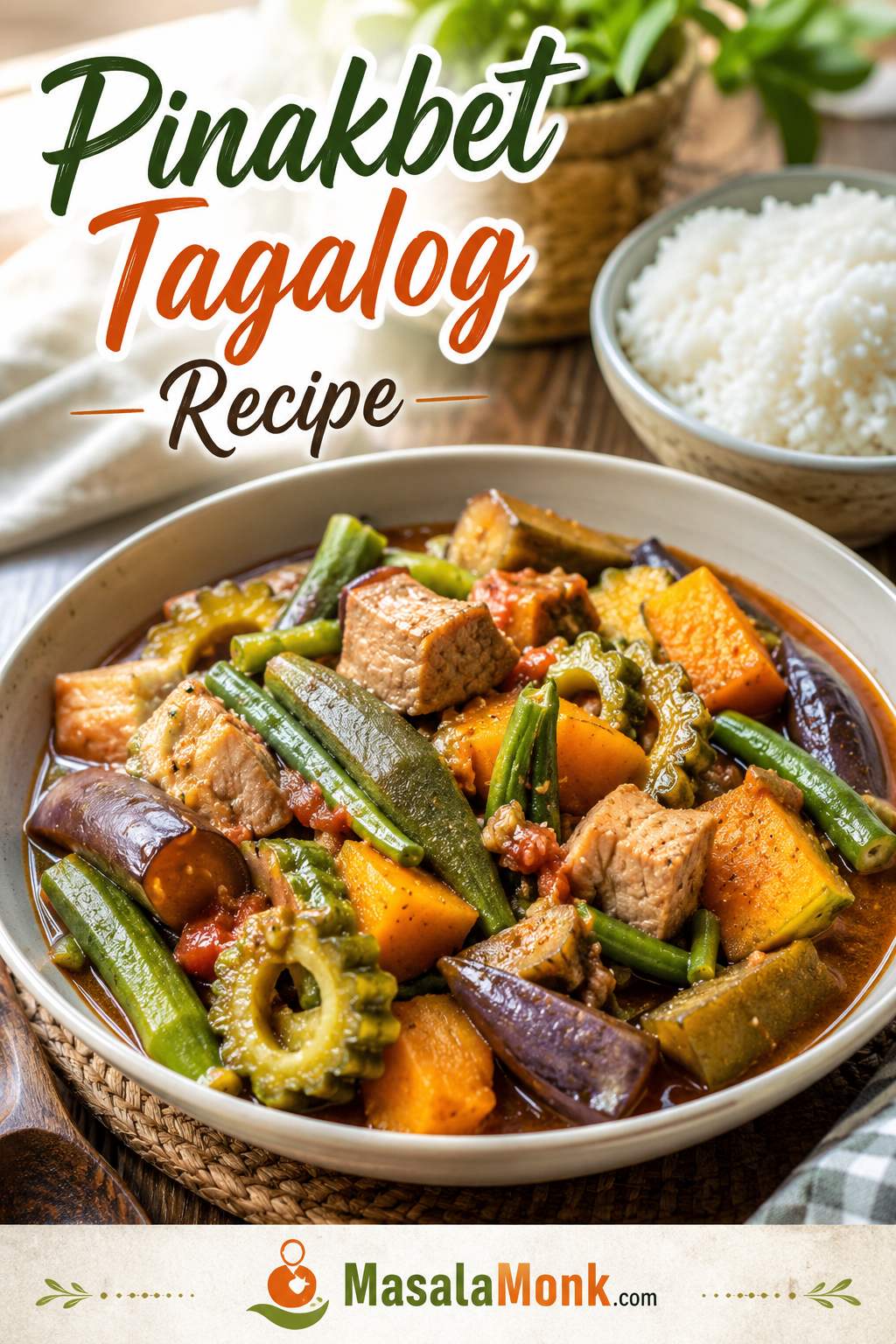
Pinakbet Tagalog is the kind of vegetable dish that makes rice feel necessary. The best spoonful has salty bagoong-rich juices, sweet squash, silky eggplant, tender okra, a little bitter ampalaya, and enough porky depth to make the vegetables feel like the meal.
It is generous, home-style Filipino cooking: vegetables cooked until they soften into each other, but not so far that everything turns muddy. The squash should become creamy at the edges, the eggplant should turn soft and shiny, and the bitter melon should balance the sweetness instead of taking over.
If your pinakbet has ever turned watery, too salty, too bitter, or too soft, the problem usually is not the ingredient list. It is the order. Squash needs a head start, okra needs restraint, and bagoong needs to be cooked with the tomatoes instead of dumped in heavily at the end.
This is a Pinakbet Tagalog-style home recipe: squash-forward, shrimp-paste seasoned, saucy enough for rice, and built to keep the vegetables tender but distinct. It also includes notes for a sharper Ilocano direction, no-bagoong substitutions, and the small timing cues that keep pakbet from becoming mushy.
Pinakbet is a Filipino vegetable stew made with bagoong, tomatoes, and vegetables such as squash, okra, eggplant, bitter melon, and long beans. This version is Pinakbet Tagalog, made with bagoong alamang, pork, squash, and mixed vegetables in a salty, savory sauce that is meant for rice.
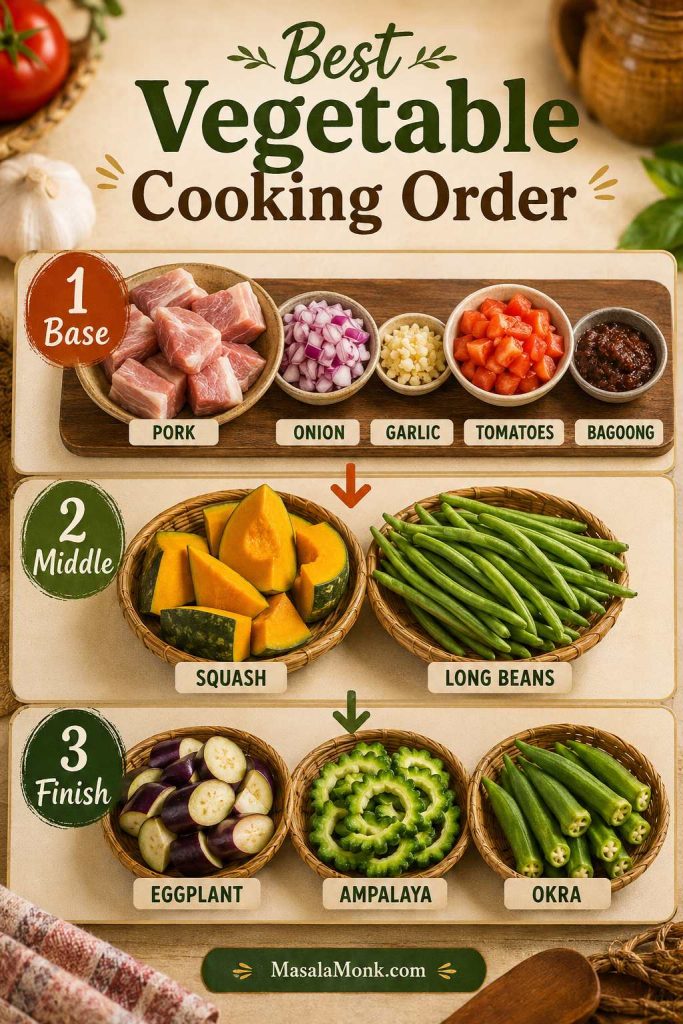
For the easiest balanced version, cook pork with onion, garlic, tomatoes, and shrimp paste. Add squash first, long beans next, and eggplant, ampalaya, and okra near the end. That order keeps the vegetables tender without turning everything into one soft mixed stew; the full vegetable cooking order is below.
Main seasoning: bagoong alamang, or shrimp paste
Protein: pork belly or pork shoulder, cut into 1-inch pieces
Vegetables: squash, long beans, okra, eggplant, and ampalaya
Liquid: 1 cup / 240 ml water or light stock, plus more only if needed
Texture goal: glossy and saucy, not soupy or mushy
Start here: Use 1 tablespoon bagoong first, then adjust with 1–3 teaspoons more near the end. Bagoong brands vary a lot, and starting low gives you room to correct the seasoning.
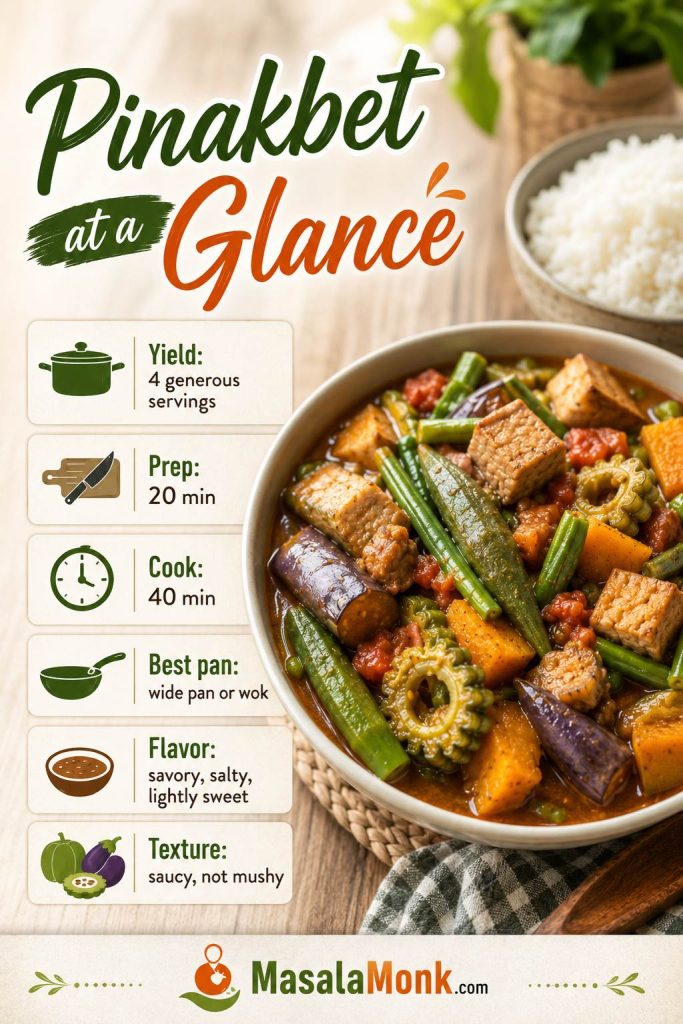
Pinakbet at a Glance
Yield
4 generous servings with rice, or 5–6 smaller side servings
Prep time
20 minutes
Cook time
About 40 minutes
Total time
About 1 hour
Best pan
12-inch wide pan, wok, deep skillet, or wide Dutch oven
Main flavor
Salty, savory, lightly sweet, earthy, and a little bitter
Main fix
Give squash a head start and add delicate vegetables near the end
Use this Pinakbet Tagalog snapshot to set the cooking target early: tender vegetables, modest sauce, and a spoonable finish that stays clear of watery or mushy.
Why these amounts work: This recipe starts with 1 tablespoon bagoong and 1 cup / 240 ml water because both salt and liquid build as the vegetables cook. Bagoong tastes sharper before it softens into the tomatoes and squash, and the vegetables release liquid as they simmer. If you are unsure how saucy the finished dish should look, use the texture guide below before adding more water.
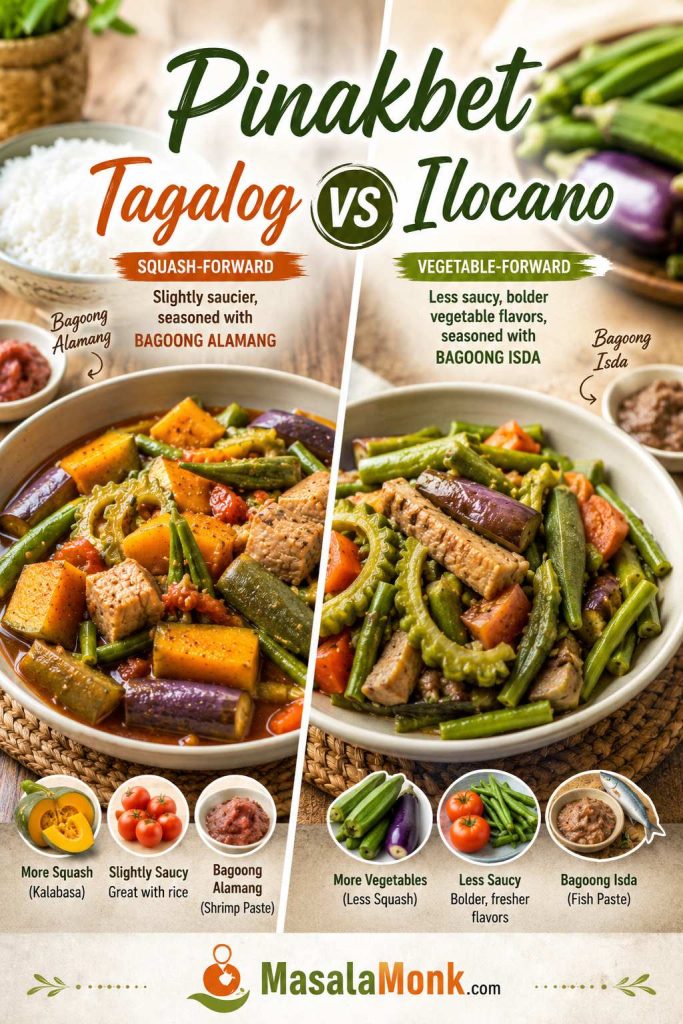
Pinakbet Tagalog vs Ilocano: What This Recipe Is
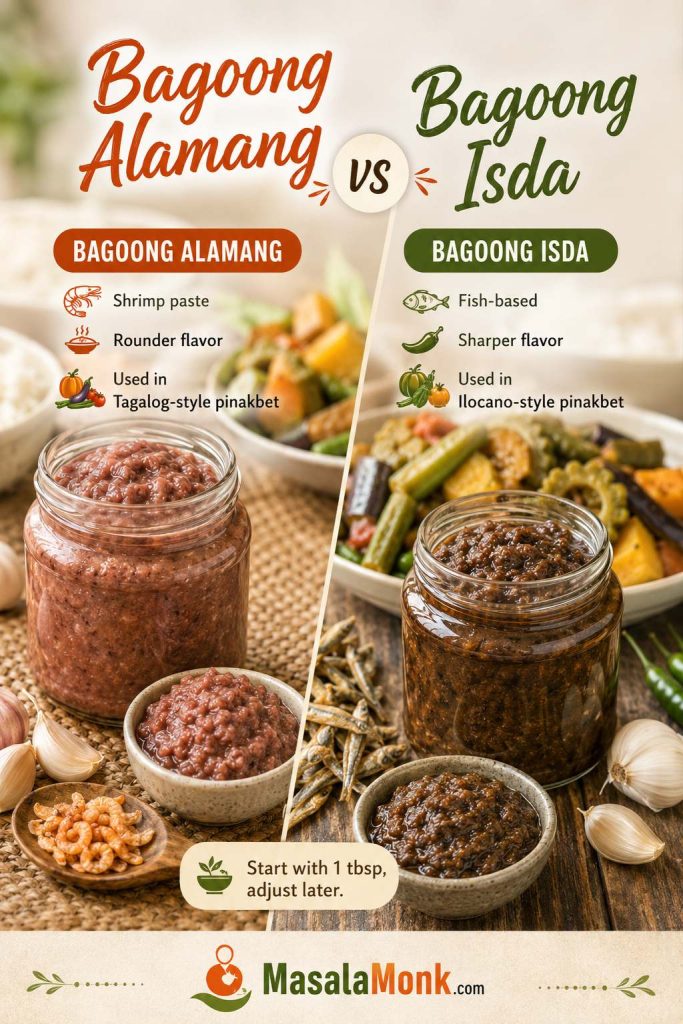
This is a Pinakbet Tagalog-style recipe: squash-forward, seasoned with bagoong alamang, and saucy enough to spoon over rice. It is the style many home cooks expect when they want pakbet with pork, shrimp paste, kalabasa, eggplant, okra, ampalaya, and long beans.
A stricter Ilocano-style pinakbet is often more closely tied to bagoong isda or fermented fish seasoning, and the finish can be drier and more vegetable-forward. To move this recipe in that direction, use bagoong isda, reduce the liquid slightly, stir less, and let the vegetables cook down more quietly.
Pinakbet Tagalog usually leans rounder, saucier, and squash-forward. By contrast, Ilocano-style pinakbet often tastes sharper and drier, so the bagoong choice changes the whole direction of the dish.
Cook’s clarity: Follow the recipe as written for a rounder, shrimp-paste Tagalog-style pakbet. Use the Ilocano notes if you want a sharper, drier, more fermented-fish direction. The bagoong guide below explains when to use bagoong alamang, bagoong isda, or a lighter substitute.
Why This Pinakbet Recipe Works
Good pinakbet is not about throwing every vegetable into the pan and hoping for the best. Squash, okra, eggplant, long beans, and bitter melon do not cook at the same speed, and shrimp paste is strong enough that small choices matter.
The goal is a pan of vegetables that has softened into itself without losing every shape and texture. Squash should yield but still stay visible. Eggplant should look silky and soft. Okra should be tender, not slippery across the whole dish. Ampalaya should bring enough bitterness to balance the squash and tomato, not dominate every bite.
Brown the pork first
Pork belly or pork shoulder gives the tomato and seasoning mixture more depth. Let a little fat render before the aromatics go in.
Bloom the bagoong with tomatoes
Cooking the shrimp paste with softened tomatoes rounds out the sharp saltiness and helps the flavor spread through the pan.
Stage the vegetables
Squash needs a head start. Eggplant, okra, and ampalaya go in later so they soften without collapsing.
Tested texture target: In a wide pan, 1 cup / 240 ml water is usually enough to soften the pork and start the vegetables. Add up to 1/2 cup / 120 ml more only if the pork or squash needs extra time. The finished dish should have shallow glossy juices that cling lightly to the vegetables, not a soup-like broth.
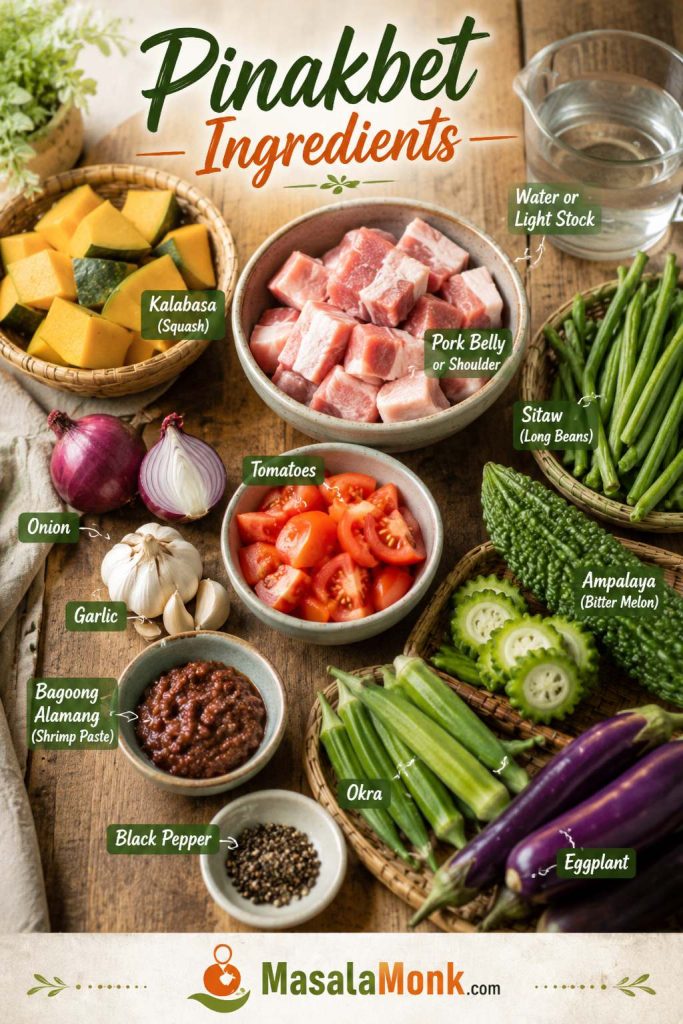
Pinakbet Ingredients
The amounts below make 4 generous servings with rice, or 5–6 smaller servings as part of a larger meal. You get enough pork for richness, enough fermented seasoning for depth, enough tomato for body, and enough vegetable contrast to make the dish feel generous.
If you are cooking outside the Philippines, check Filipino or broader Asian groceries for long beans, bitter melon, Filipino eggplant, kalabasa, and bagoong alamang. Green beans, kabocha, butternut squash, and slender eggplant can still make a good home version if you keep the same balance of sweet, bitter, tender, and firm. If your market does not carry every Filipino vegetable, the substitution guide shows which swaps keep the dish closest to the original balance.
If you cannot find every traditional ingredient, do not let that stop you. The dish still works when the pan has the same basic shape: something sweet, something bitter if possible, something tender, something green, and enough savory depth to make it feel complete.
These ingredients show why Pinakbet Tagalog works before the pan even heats up: pork adds richness, bagoong brings depth, tomatoes give body, and the vegetables create the sweet, bitter, tender, and crisp-tender contrast that defines the dish.
Ingredient Amounts and Why They Matter
Ingredient
US measure
Metric
Why it matters
Pork belly or pork shoulder
1/2 lb
225 g
Pork belly gives richness; shoulder is leaner and may need a little more time.
Cooking oil
1 tbsp
15 ml
Use less if the pork is very fatty.
Onion
1 medium
110–150 g
Builds sweetness in the savory foundation.
Garlic
3–4 cloves
12–16 g
Add after the onion so it does not burn.
Tomatoes
2 medium
About 225 g
Cook down into the savory juices.
Bagoong alamang
1 tbsp to start, plus 1–3 tsp more to taste
15 g to start, plus more to taste
Starting low helps prevent the dish from becoming too salty.
Water or light stock
1 cup, plus up to 1/2 cup more as needed
240 ml, plus up to 120 ml more as needed
Loosens the tomato-bagoong mixture without making the dish soupy.
Kalabasa / squash
2 cups cubed
250–300 g
Adds sweetness and body.
Sitaw / long beans
1–1 1/2 cups cut
100–150 g
Adds green bite and structure.
Okra
6–8 pieces
100–150 g
Add late so it keeps its shape.
Ampalaya / bitter melon
1/2 medium, or up to 1 medium if you enjoy bitterness
About 100–225 g
Gives the signature bitter edge.
Eggplant
1 large or 2 small
170–250 g
Add late so it softens without dissolving.
Black pepper
1/4 tsp
About 0.5 g
Optional, but rounds the flavor.
Best Vegetables for Pinakbet
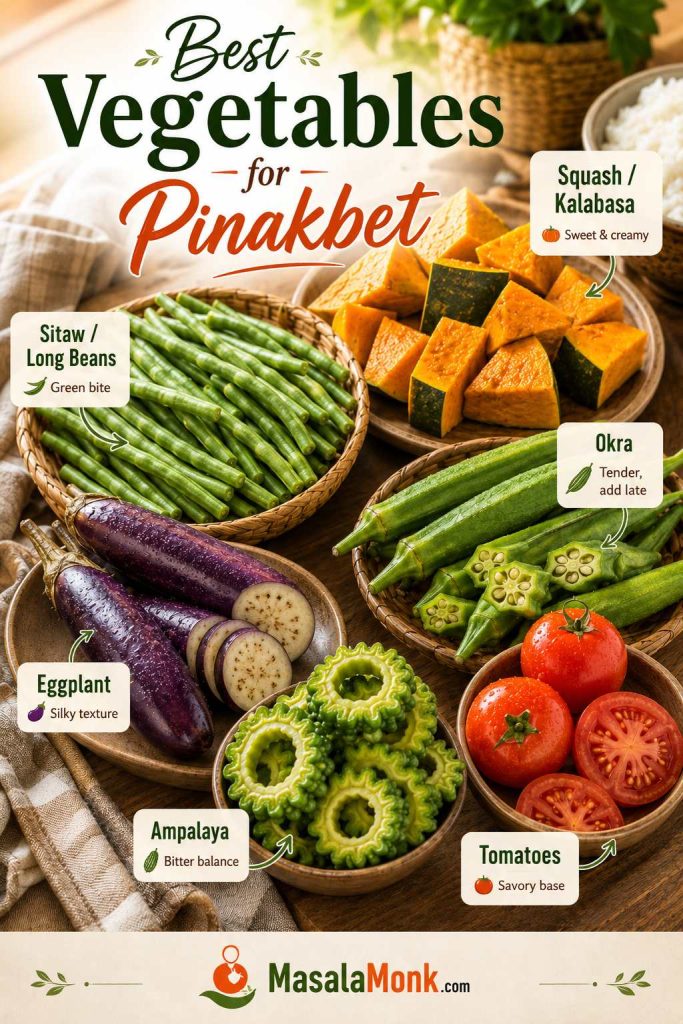
The best bites have contrast: sweet squash, bitter ampalaya, silky eggplant, tender okra, and salty tomato-bagoong juices that pull everything together.
Each vegetable does something different in pakbet, so the mix matters as much as the seasoning. Kalabasa brings sweetness, long beans keep the dish structured, eggplant turns silky, okra adds body, and ampalaya brings the bitter edge that keeps the dish from tasting flat.
Kalabasa / Squash
This sweet squash makes the salty seasoning feel round. Cut it into sturdy chunks so the edges turn creamy without the pieces disappearing.
Okra
Okra is there for softness and body, but it needs a light hand. Trim only the ends, add it late, and let it turn tender without stirring it into the whole pan.
Eggplant
Eggplant is at its best when it turns silky and soaks up the tomato-bagoong juices. Keep the pieces thick so they soften without vanishing.
Ampalaya
Ampalaya is the edge of the dish. Use less if you want a milder pan, but do not erase all the bitterness; that little bite is what keeps the squash and tomato from tasting too sweet.
Sitaw / Long Beans
Long beans keep the dish from feeling too soft, especially beside squash and eggplant. Cut them into 2- to 3-inch pieces so they cook evenly and keep a little bite.
Tomatoes
Once tomatoes soften into the pan, they make the fermented seasoning taste fuller and less sharp. Give them time to collapse before adding water.
Best Cut Sizes for Pinakbet
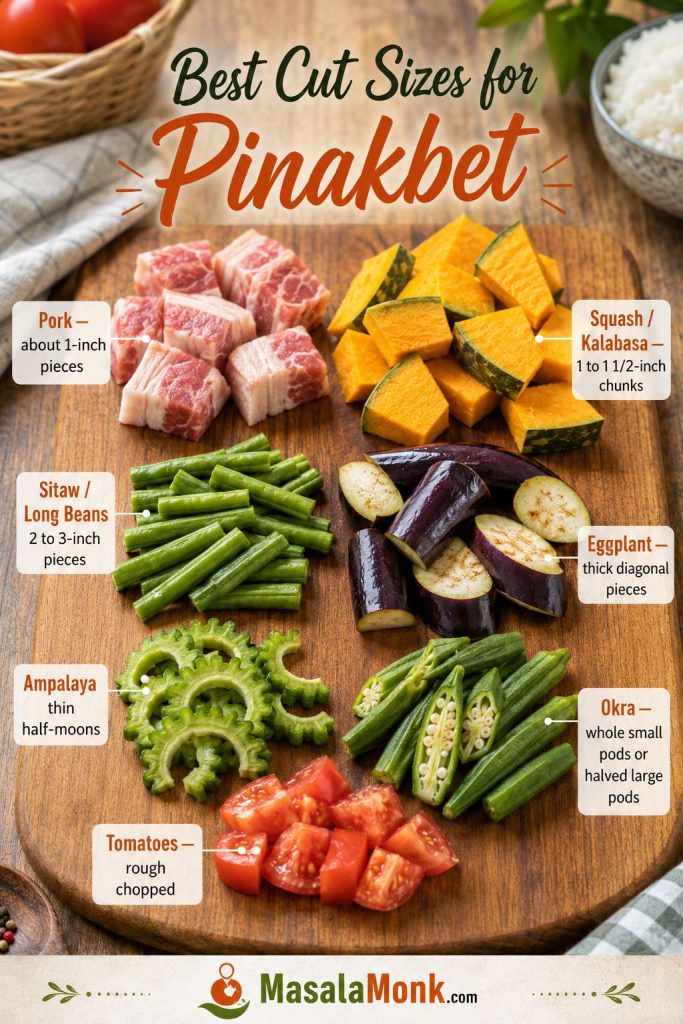
Pinakbet is forgiving, but the knife work quietly decides a lot. Small squash collapses too early, thin eggplant disappears, and overcut okra can make the texture slippery.
Good knife work quietly improves Pinakbet Tagalog. Larger squash chunks hold shape better, thick eggplant pieces soften without disappearing, and lightly trimmed okra stays cleaner in texture, so the finished dish feels tender rather than collapsed.
Ingredient
Best cut size
What to watch
Pork belly or shoulder
About 1-inch pieces
Small enough to tenderize, large enough to stay juicy.
Squash / kalabasa
1 to 1 1/2-inch chunks
Holds shape while becoming tender.
Long beans / sitaw
2 to 3-inch pieces
Cooks evenly and stays easy to serve.
Eggplant
Thick diagonal pieces or large chunks
Softens without dissolving into the dish.
Ampalaya
Thin half-moons
Distributes bitterness without taking over every bite.
Okra
Whole small pods or halved large pods
Less cutting means a cleaner texture.
Tomatoes
Rough chopped
Breaks down into the tomato-bagoong mixture without needing perfect dice.
How to Reduce Ampalaya Bitterness
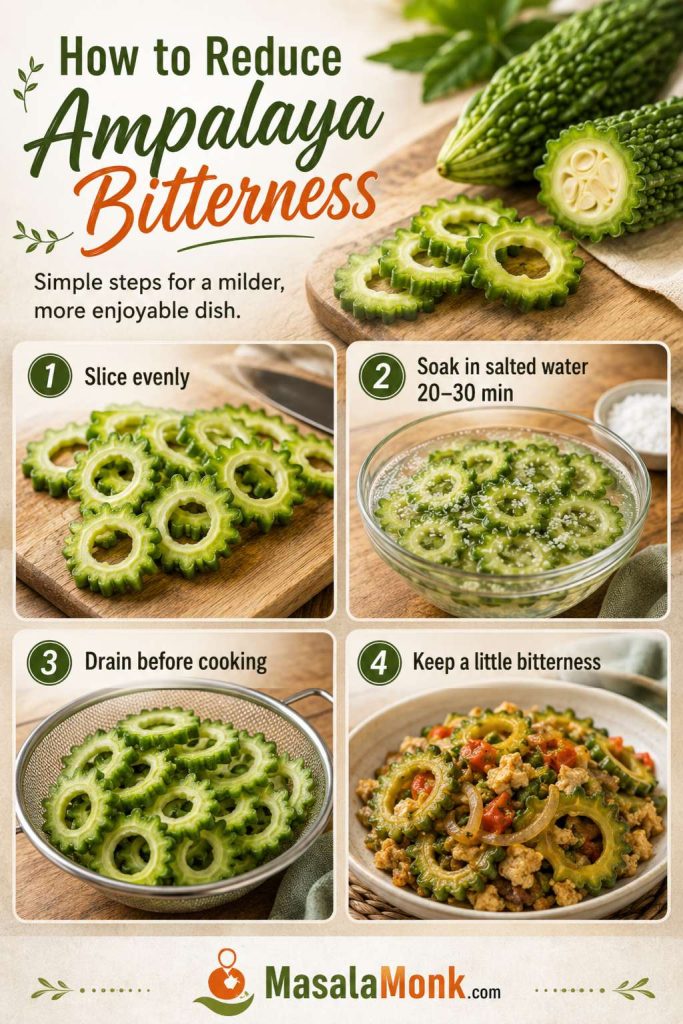
Optional ampalaya tip: For milder bitter melon, soak the sliced ampalaya in water with a big pinch of salt for 20–30 minutes, then drain before cooking. Skip this if you enjoy the stronger bitter edge.
Ampalaya should soften its bitterness, not lose it completely. A short salted-water soak helps mellow the sharpness; however, keeping a little bitterness in the final dish is exactly what makes Pinakbet Tagalog taste balanced instead of one-note.
Ingredient Substitutes If You Cannot Find Everything
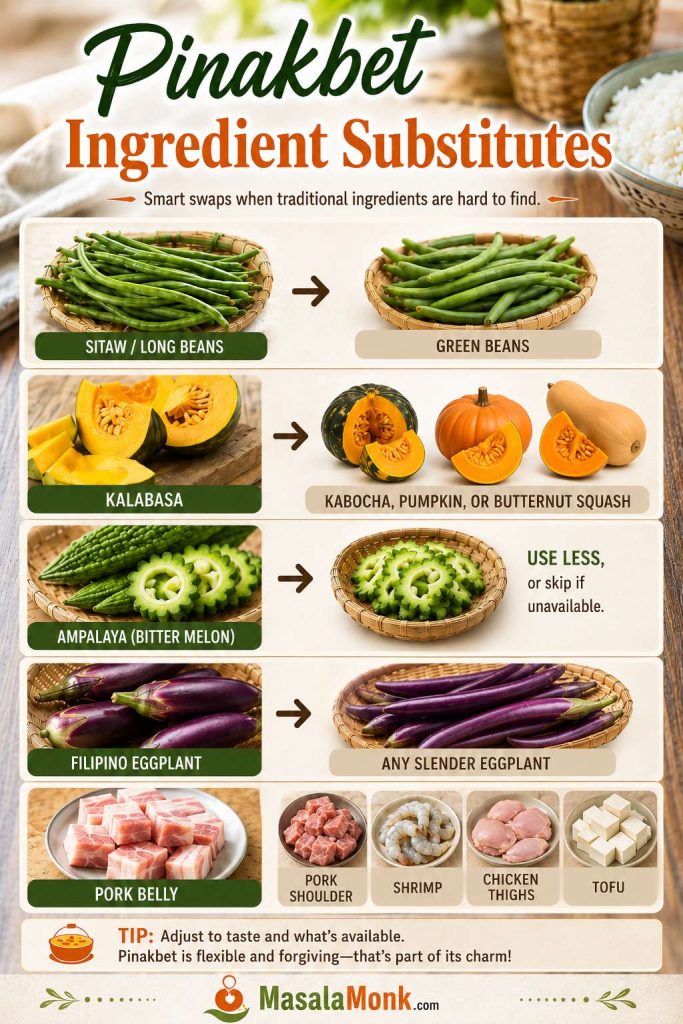
Pinakbet is best with traditional vegetables, but a home pot can still work when the market does not give you everything. Think about what each ingredient brings to the pan: sweetness from squash, bitterness from ampalaya, body from okra, and salty depth from the fermented seasoning.
Traditional ingredients are ideal, yet pinakbet can still work when the pot keeps the same shape: something sweet, something green, something tender, a little bitterness if possible, and enough savory depth to make the vegetables feel complete.
Traditional ingredient
Good substitute
What to watch
Sitaw / long beans
Green beans
Green beans cook faster, so add them a little later.
Kalabasa
Kabocha, pumpkin, or butternut squash
Sweetness and cooking time vary by squash type.
Ampalaya
Use less, or skip if unavailable
The dish becomes less bitter and milder.
Filipino eggplant
Any slender eggplant
Similar texture; avoid tiny pieces because they collapse.
Pork belly
Pork shoulder, shrimp, chicken thighs, or tofu
Changes richness and cooking time.
From here, the seasoning does the heavy lifting. This is where pinakbet can become deep and rounded, or too salty too quickly, so taste slowly and let the tomatoes do their work.
Bagoong Alamang vs Bagoong Isda
Bagoong is the ingredient that makes pinakbet taste like pinakbet. In this Tagalog-style version, bagoong alamang gives a round shrimp-paste flavor. To move the dish in a sharper Ilocano direction, use bagoong isda or bagoong monamon instead. For more background on Filipino pantry staples like bagoong and patis, this Filipino pantry guide is helpful.
Bagoong does more than add salt; it gives pinakbet its fermented depth and unmistakable savory backbone. For a rounder Tagalog-style flavor, bagoong alamang fits naturally, while bagoong isda pushes the dish toward a sharper Ilocano direction.
Raw vs Ginisang Bagoong
Raw bagoong alamang tends to taste sharper and saltier, so it benefits from being cooked briefly with tomatoes before the water goes in. Ginisang bagoong is already sautéed and often tastes rounder, but many jars are also sweeter. Taste before adding more, especially if the jar is meant to be eaten as a condiment.
If your ginisang bagoong tastes sweet straight from the jar, be slower with extra squash and do not add more seasoning until the vegetables are cooked. Sweet jarred shrimp paste can taste pleasantly round at first, then too sweet once the squash softens.
Taste Before Adding More
Bagoong is powerful, so use it with patience. Let it bloom with the tomatoes, then taste again later when the vegetables have softened around it. A spoonful of cooking liquid may taste strong by itself; taste with squash or rice before deciding whether the dish needs more. If you cannot use shrimp paste at all, skip ahead to the without-bagoong options.
Bagoong type
Start with
Add more when
Very salty bagoong alamang
1 tbsp
The vegetables are cooked but the dish tastes flat.
Sweeter ginisang bagoong
1 tbsp, then adjust
The dish needs more savory depth, not more sweetness.
Bagoong isda
1 tbsp
You want a sharper Ilocano-style flavor.
Fish sauce substitute
1 tbsp
Only after tasting near the end.
Bloom the bagoong: Cook it briefly with the tomatoes before adding water. Raw-stirred bagoong can taste sharp; cooked shrimp paste tastes rounder and spreads better through the dish.
Equipment You Need
A 12-inch wide pan, wok, deep skillet, or wide Dutch oven works best. Pinakbet has bulky vegetables, so a narrow pot forces you to stir more aggressively, which can break the squash and eggplant. Use a lid for gentle steaming and a wooden spoon or silicone spatula for turning.
How to Cook Pinakbet
Once everything is cut, the cooking is mostly patience. Brown the pork, soften the aromatics, let the tomatoes collapse, then cook the bagoong long enough for the smell to turn round and savory instead of sharply salty.
Do not rush the beginning. The tomato and shrimp paste mixture is what makes the vegetables taste complete, not like plain vegetables wearing salt. Once the squash and beans are in, give the pan enough time before you decide it needs more water. If your past batches turned watery, salty, bitter, or mushy, the troubleshooting table after the method will help you fix the problem.
A wide cooking surface helps everything cook in a shallow layer instead of being crushed. Do not stir just because the pan is quiet. You are looking for pieces that have softened into each other without losing themselves.
Best Vegetable Cooking Order
Slow-cooking vegetables and fast-cooking vegetables should not be treated the same way. This is the order that keeps pinakbet tender without making it mushy.
The cooking order keeps Pinakbet Tagalog from turning into one soft pile. Build the savory base first, let the sturdier vegetables get started, then finish with the delicate ones so every bite still has contrast.
Add first
Add in the middle
Add last
Pork, onion, garlic, tomatoes, bagoong
Squash, kamote if using, long beans
Eggplant, ampalaya, okra
Builds the savory foundation
Needs time but should hold shape
Overcooks faster and can turn too soft
Step-by-Step Method
Build the Pork, Tomato, and Bagoong Base
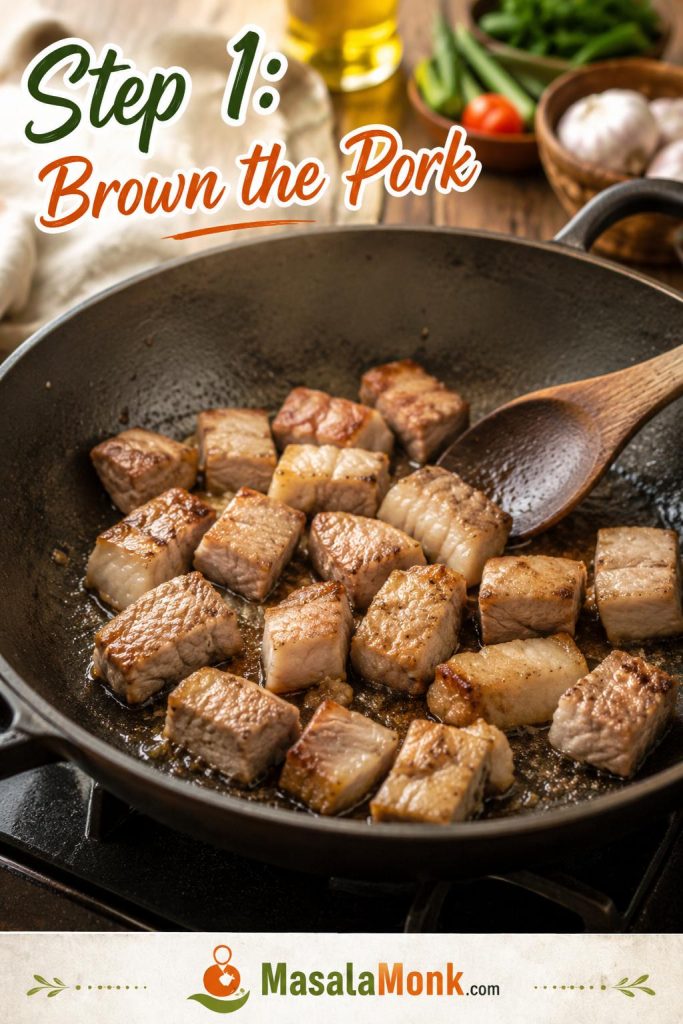
Brown the pork. Heat oil in a wide pan over medium heat. Add pork in one layer and cook for 5–8 minutes, until lightly browned and some fat has rendered. Spread the pork out so it browns instead of steaming.
Visual Cue: Brown the Pork
Browning the pork first builds flavor before the vegetables ever hit the pan. As the fat renders and the edges deepen in color, the base becomes richer, which means the later tomato-bagoong mixture tastes fuller without needing extra seasoning.
Cook the aromatics. Add onion and cook for about 2 minutes, until softened. Add garlic and cook for 30 seconds to 1 minute, just until fragrant.
Soften the tomatoes. Add tomatoes and cook for 3–5 minutes, pressing them gently with the spoon. They should lose their raw shape and look juicy around the edges.
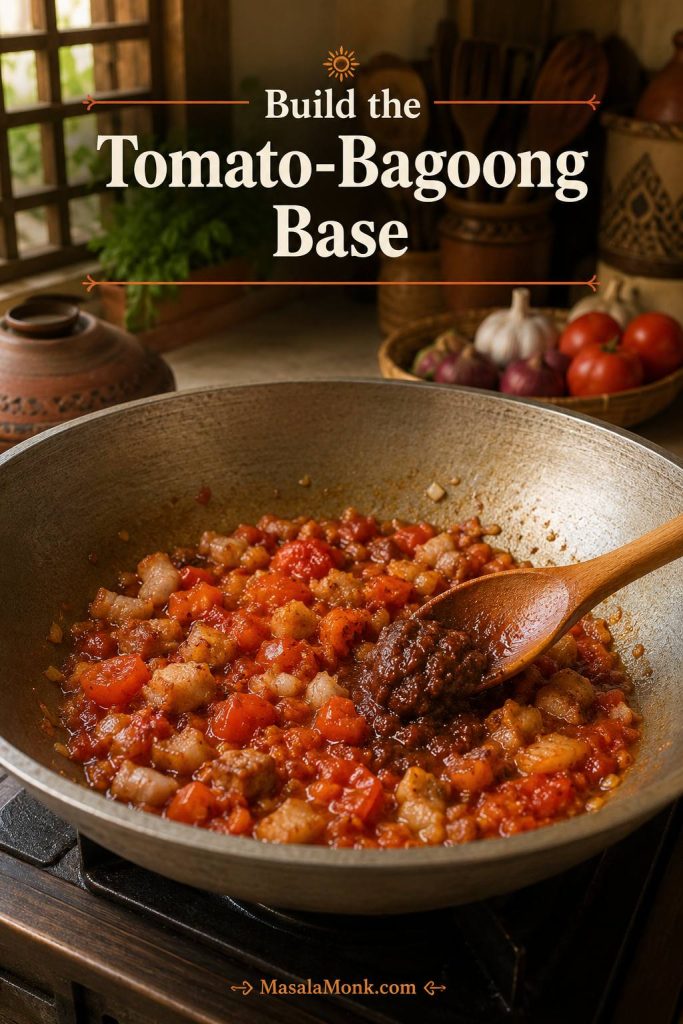
Bloom the bagoong. Stir in 1 tablespoon bagoong and cook for 1–2 minutes. The smell should become rounder and more savory.
Visual Cue: Build the Tomato-Bagoong Base
This step is where Pinakbet Tagalog starts tasting like itself. Once the tomatoes soften and the bagoong cooks into them, the flavor turns rounder and less harsh, so the vegetables later absorb something savory rather than just salty.
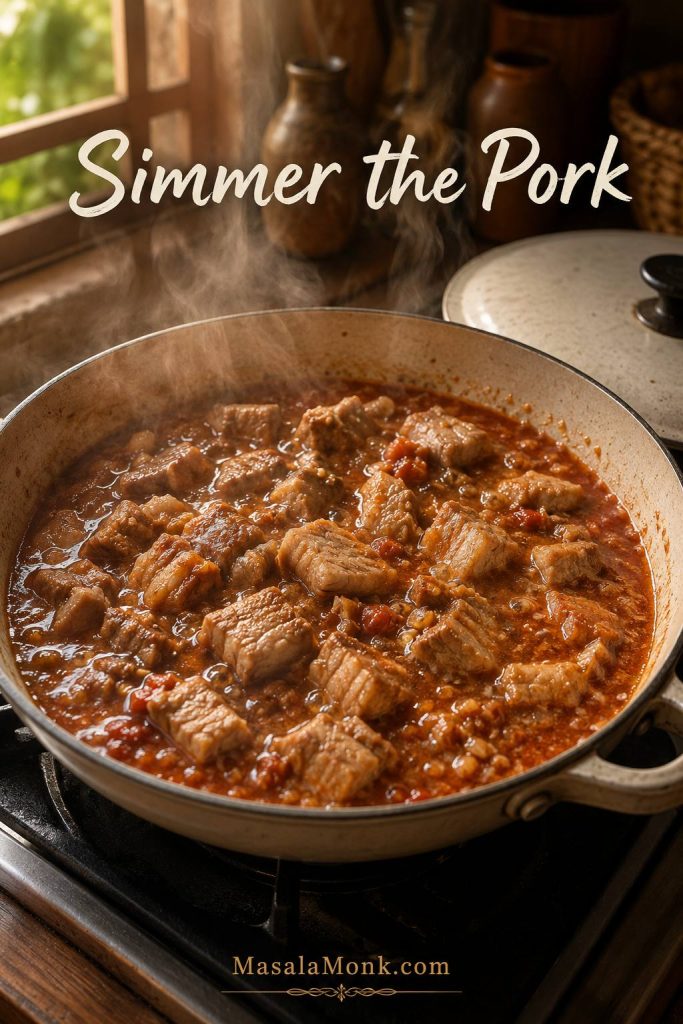
Simmer the pork. Add 1 cup water or light stock. Cover and simmer for 15–20 minutes, or until the pork starts to become tender. If using pork shoulder and it still feels firm, simmer 5–10 minutes longer before adding squash. If the liquid already looks high before the squash goes in, do not add more yet; the vegetables will release more as they cook.
Visual Cue: Simmer the Pork
Simmer the pork before adding the vegetables, especially if you are using pork shoulder instead of belly. That little bit of patience lets the meat start tenderizing early, while the squash and softer vegetables can still cook on their own schedule later.
Add the Vegetables and Finish the Dish
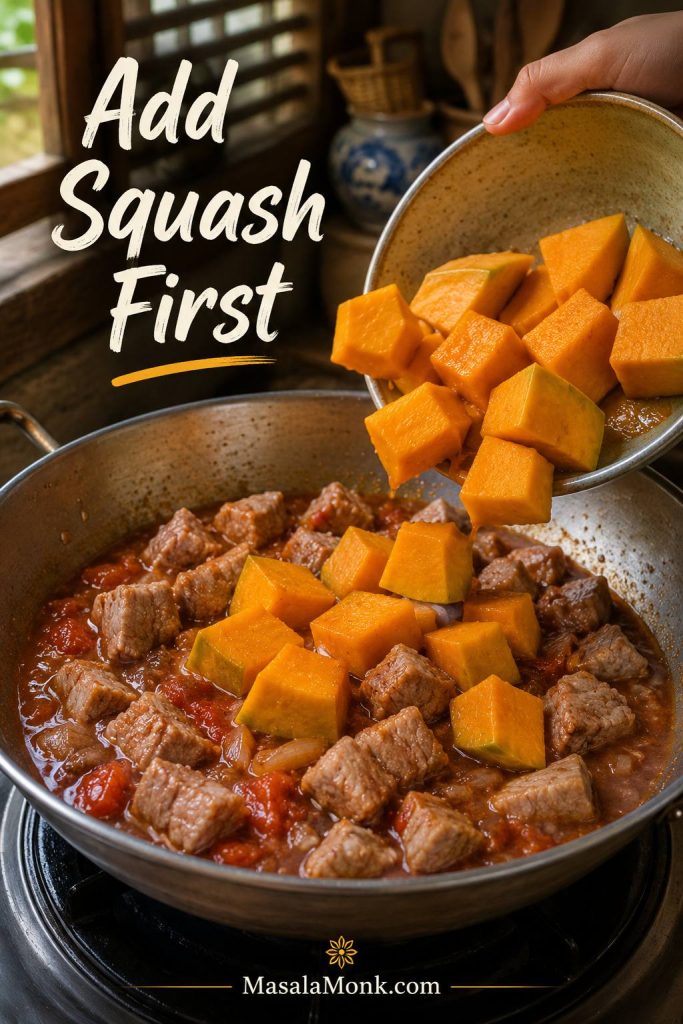
Add the squash. Add kalabasa and cook for 5–7 minutes. It should begin to soften, but it should not be falling apart. Add up to 1/2 cup / 120 ml more water only if the pan looks dry or the squash needs more time.
Visual Cue: Add Squash First
Squash goes in first because it is the vegetable that changes the dish’s body. As the edges soften, it thickens the pan slightly and rounds out the stronger bagoong flavor without making the pakbet taste sweet.
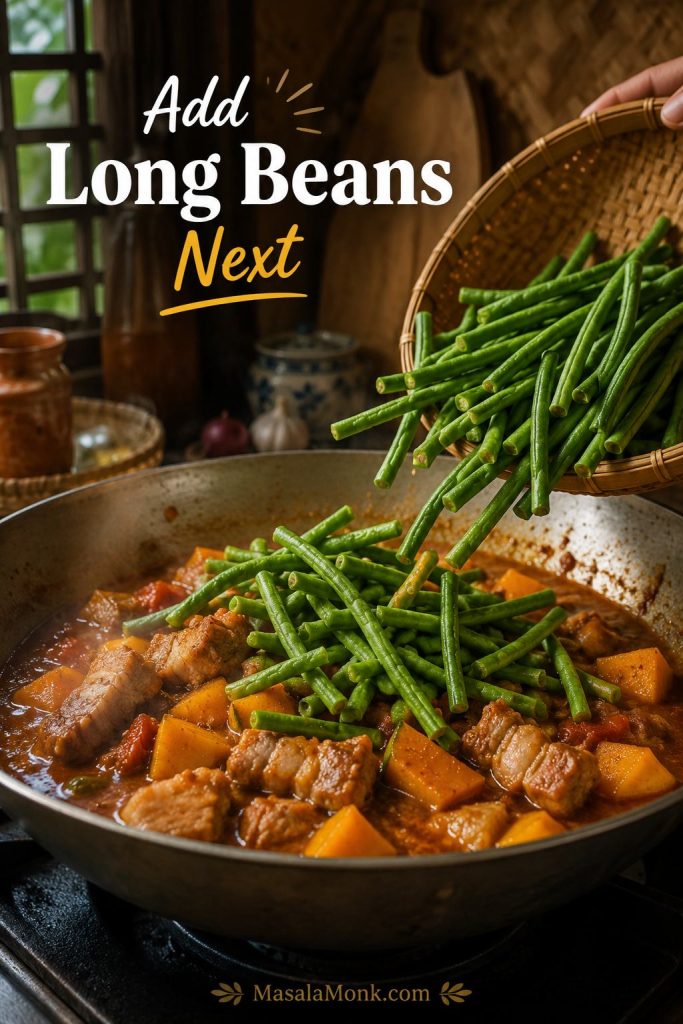
Add the long beans. Add sitaw and cook for 2–3 minutes. The beans should brighten and begin to soften while still keeping some bite.
Visual Cue: Add Long Beans Next
Long beans belong in the middle of the cooking process rather than at the beginning or the very end. This timing helps them stay green and tender, so the final pakbet still has a little structure instead of turning uniformly soft.
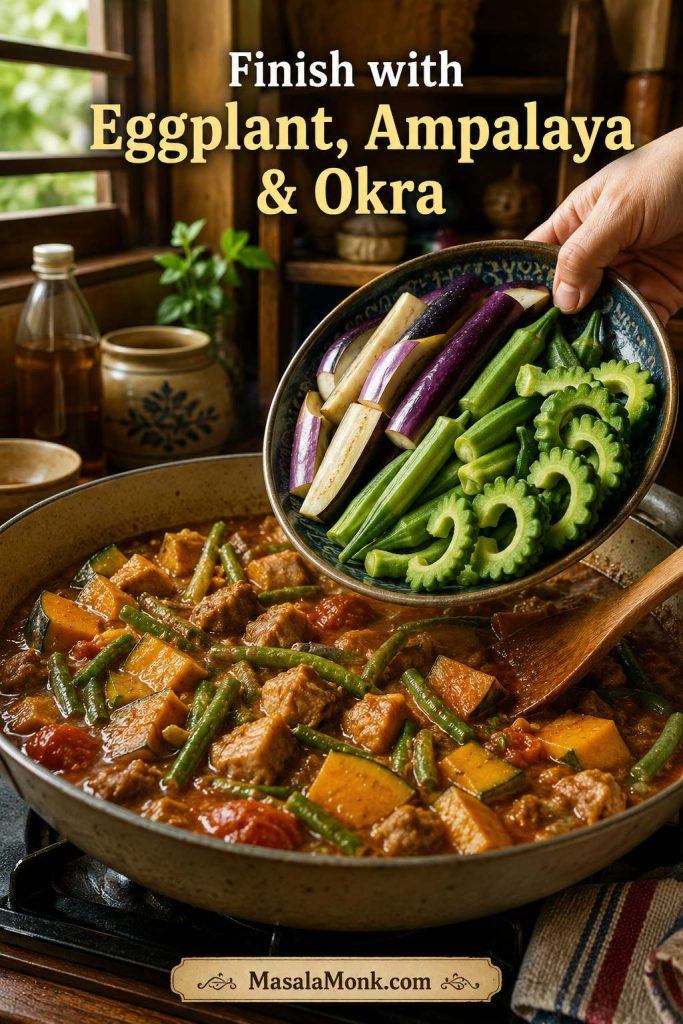
Finish with eggplant, ampalaya, and okra. Cover and cook for 4–6 minutes, turning gently once or twice. The eggplant should look silky, the okra should still hold shape, and the ampalaya should soften without taking over the whole pan.
Visual Cue: Finish with Eggplant, Ampalaya, and Okra
Eggplant, ampalaya, and okra cook quickly, so they should finish the dish instead of starting it. Added late, they keep their character: the eggplant turns silky, the okra stays tender, and the ampalaya gives bitterness without taking over the whole pot.
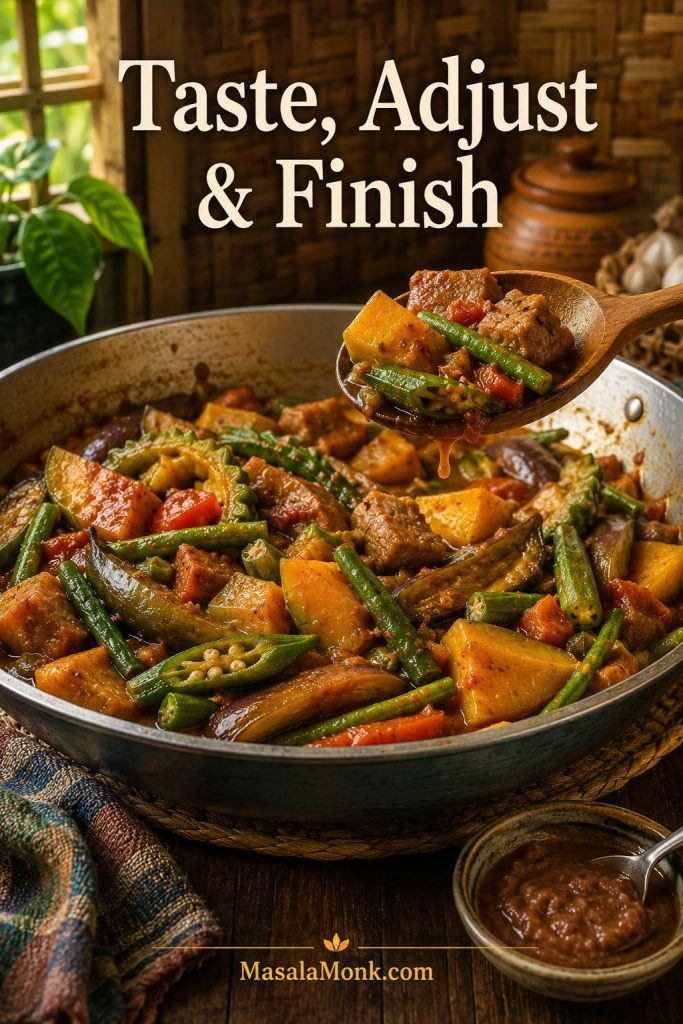
Taste and adjust. Add 1–3 teaspoons more bagoong, pepper, or a small splash of water only if needed. The cooking liquid should cling lightly to the vegetables, with no large pool of broth at the bottom. Serve hot with rice.
Visual Cue: Taste, Adjust, and Finish
The final texture should look moist and glossy, not brothy. Before adding more bagoong, taste with squash or rice, because the seasoning settles once the vegetables soften into the sauce.
How Long to Cook Pinakbet
Pinakbet is a stovetop dish, so the “temperature” is really about heat control. Medium heat is enough for most of the recipe. If the pan gets too hot, the juices can stick and the vegetables can break before they cook through.
Stage
Heat
Time
Visual cue
Brown pork
Medium to medium-high
5–8 minutes
Edges lightly browned, fat beginning to render
Aromatics
Medium
2–3 minutes
Onion softened, garlic fragrant
Tomato and bagoong
Medium
3–5 minutes
Tomatoes juicy, bagoong darker and aromatic
Pork simmer
Medium-low
15–20 minutes, longer if needed for pork shoulder
Pork starting to tenderize
Squash
Medium
5–7 minutes
Fork enters but squash holds shape
Long beans
Medium
2–3 minutes
Brighter, tender-crisp
Eggplant, ampalaya, okra
Medium
4–6 minutes
Tender, silky, and not collapsed
How Pinakbet Should Look When It Is Done
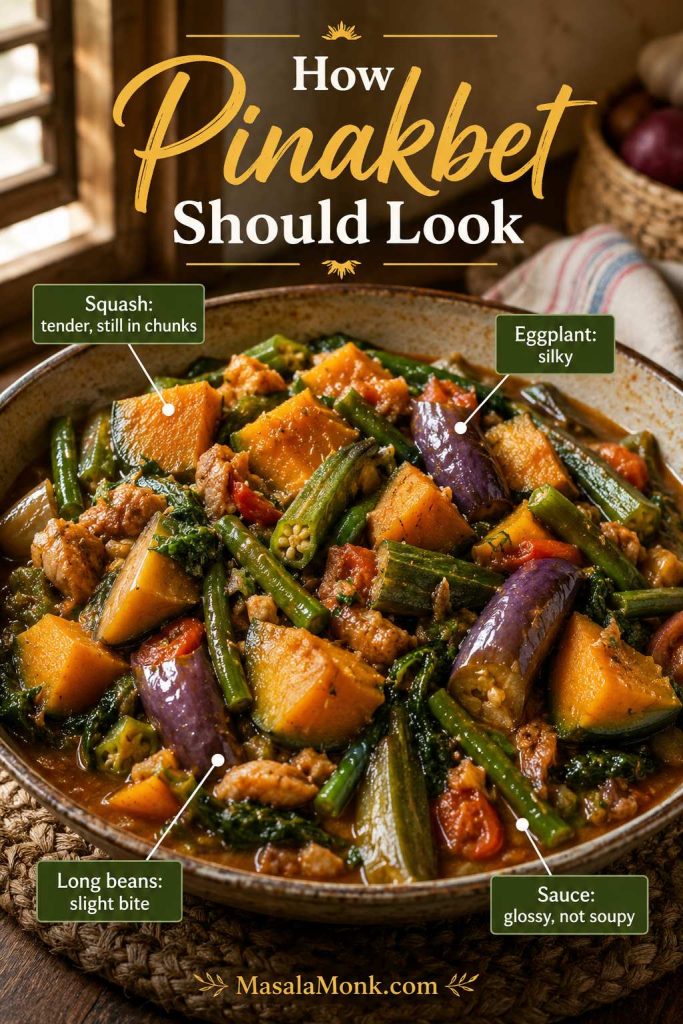
The best pinakbet does not look perfect. It looks generous, saucy, and ready for rice. The squash should be creamy at the edges but still in chunks. The long beans should keep a little bite. The eggplant should turn silky, not disappear. The okra should be tender without making the whole dish slippery.
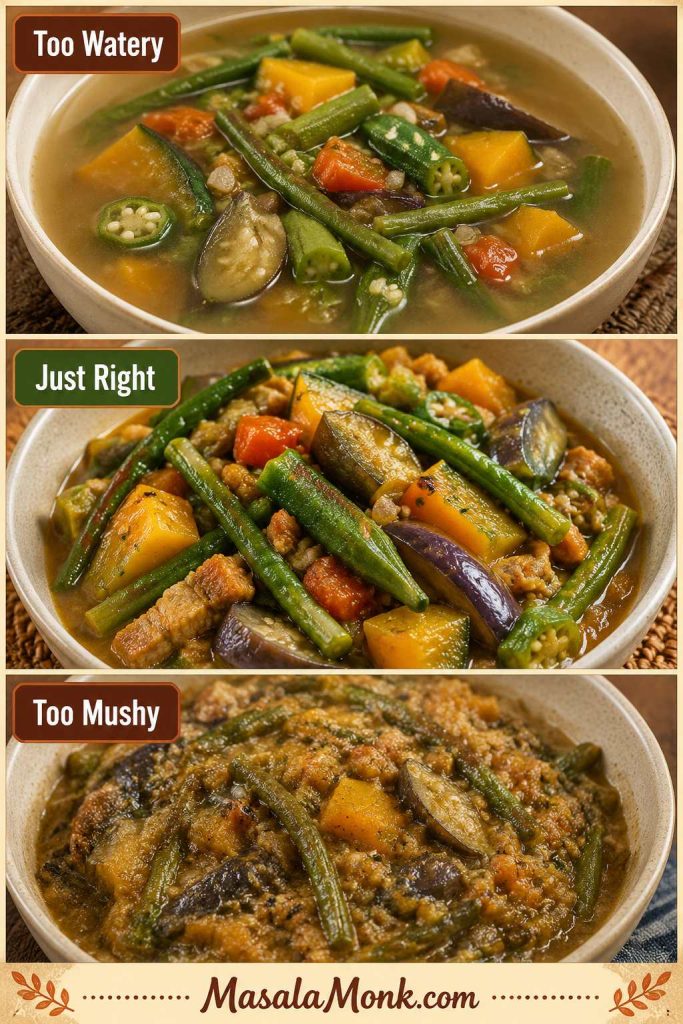
If there is a lot of loose liquid, simmer uncovered for a few minutes. If the pan is dry before everything is tender, add a small splash of water, cover again, and continue gently. The final texture should feel saucy and spoonable, with shallow coated juices rather than loose broth. For a quick visual check, compare your pan with the watery vs right vs mushy guide.
You are done when the squash is fork-tender, the eggplant is silky, the long beans still have bite, and the cooking liquid lightly clings to the vegetables.
Good pinakbet should look soft, but not sloppy. The vegetables ought to be tender and comfortable in the sauce, yet still easy to recognize, while the liquid should lightly coat them instead of drifting around like a separate broth.
Too Watery, Just Right, or Too Mushy
This is one of the easiest ways to judge your Pinakbet Tagalog at a glance. If it looks watery, simmer uncovered; if it looks mushy, the vegetables likely stayed in too long, while the ideal version holds shape and still looks glossy.
Pinakbet Recipe Card
Pinakbet Tagalog Recipe
This Filipino Pinakbet Tagalog recipe builds a savory pork, tomato, and bagoong mixture first, then adds the vegetables in stages. The squash softens, the eggplant turns silky, and the okra and long beans keep their shape.
Yield 4 generous servings
Prep Time 20 minutes
Cook Time 40 minutes
Total Time 1 hour
Ingredients
1/2 lb / 225 g pork belly or pork shoulder, cut into 1-inch pieces
1 tbsp / 15 ml cooking oil
1 medium onion, chopped
3–4 garlic cloves, minced
2 medium tomatoes, chopped
1 tbsp / 15 g bagoong alamang, plus 1–3 tsp more to taste
1 cup / 240 ml water or light stock, plus up to 1/2 cup / 120 ml more as needed
2 cups / 250–300 g kalabasa or squash, cut into 1 to 1 1/2-inch chunks
1 to 1 1/2 cups / 100–150 g sitaw or long beans, cut into 2- to 3-inch pieces
6–8 okra, trimmed
1/2 medium ampalaya, or up to 1 medium if you enjoy bitterness, seeded and sliced into thin half-moons
1 large eggplant or 2 small eggplants, cut into thick pieces
1/4 tsp black pepper, optional
Instructions
Heat oil in a wide pan over medium heat. Add pork in one layer and cook for 5–8 minutes, until lightly browned and some fat has rendered.
Add onion and cook for about 2 minutes, until softened. Add garlic and cook for 30 seconds to 1 minute, just until fragrant.
Add tomatoes and cook for 3–5 minutes, pressing them gently, until softened and juicy around the edges.
Stir in 1 tablespoon bagoong and cook for 1–2 minutes, until the smell becomes rounder and more savory.
Add 1 cup water or light stock. Cover and simmer for 15–20 minutes, until the pork starts to become tender. If using pork shoulder and it still feels firm, simmer 5–10 minutes longer before adding the squash. Add up to 1/2 cup more water only if needed.
Add squash and cook for 5–7 minutes, until a fork starts to enter but the pieces still hold shape.
Add long beans and cook for 2–3 minutes, until brighter and beginning to soften.
Finish with eggplant, ampalaya, and okra. Cover and cook for 4–6 minutes, turning gently once or twice, until the vegetables are tender but still distinct.
Taste and adjust with 1–3 teaspoons more bagoong or pepper if needed. The finished dish should be moist and spoonable, with no large pool of broth at the bottom of the pan. Serve hot with rice.
Notes
Use a wide 12-inch pan so the vegetables cook evenly without being crushed.
Start with 1 tablespoon bagoong, especially if your brand is very salty.
For milder ampalaya, soak the slices in salted water for 20–30 minutes, then drain.
Add extra water only if the pork or squash needs more time.
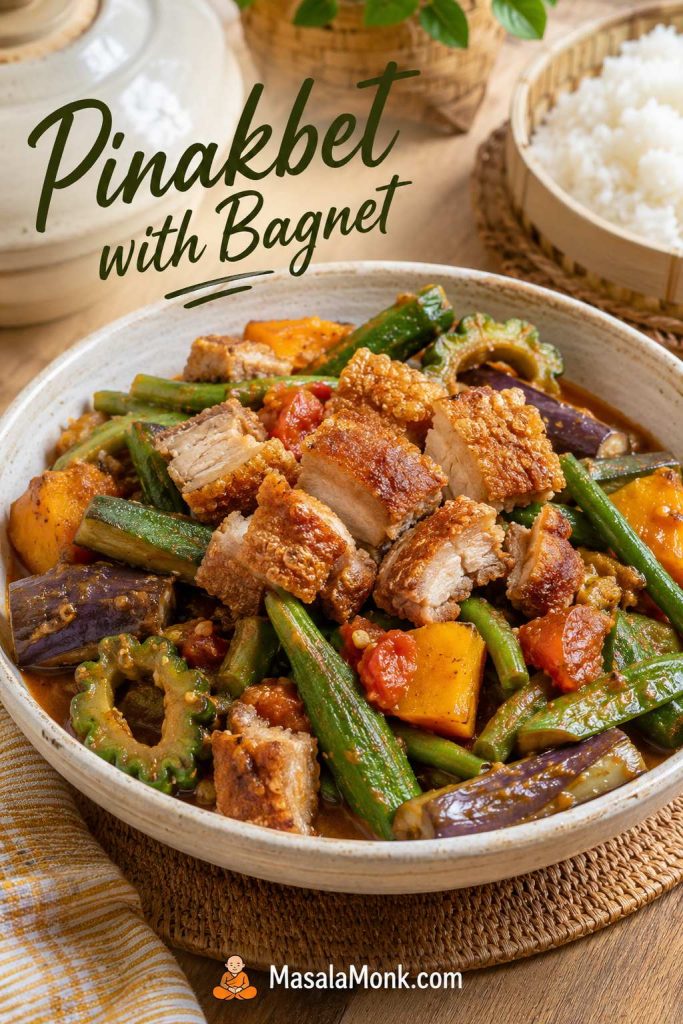
Add crispy pork, bagnet, or lechon kawali just before serving so it does not become soggy.
A good batch should make rice feel like part of the recipe, not just a side. The juices should be salty enough to carry the vegetables, but not so strong that the squash, eggplant, okra, and ampalaya disappear.
Cook’s confidence: Flexible: exact vegetable mix, protein, and bitterness level. Not flexible: cooking the seasoning with the tomatoes, keeping the liquid modest, and giving slower vegetables more time than delicate ones.
What Pinakbet Should Feel Like
Pinakbet is not meant to eat like a smooth stew. It is a dish of contrast: squash softening at the edges, bitter melon cutting through sweetness, eggplant soaking up salty juices, and rice pulling everything together.
Some homes make it drier and sharper; others prefer it saucier and sweeter from squash. This version stays in the Pinakbet Tagalog lane while giving you room to adjust the bitterness, protein, and finish toward your own table.
Pakbet is simply the everyday shorter name many people use for pinakbet. The more useful difference is style: Pinakbet Tagalog is often shrimp-paste and squash-forward, while Ilocano pinakbet often leans more toward fermented fish seasoning and a drier finish.
Can You Make Pinakbet Without Bagoong?
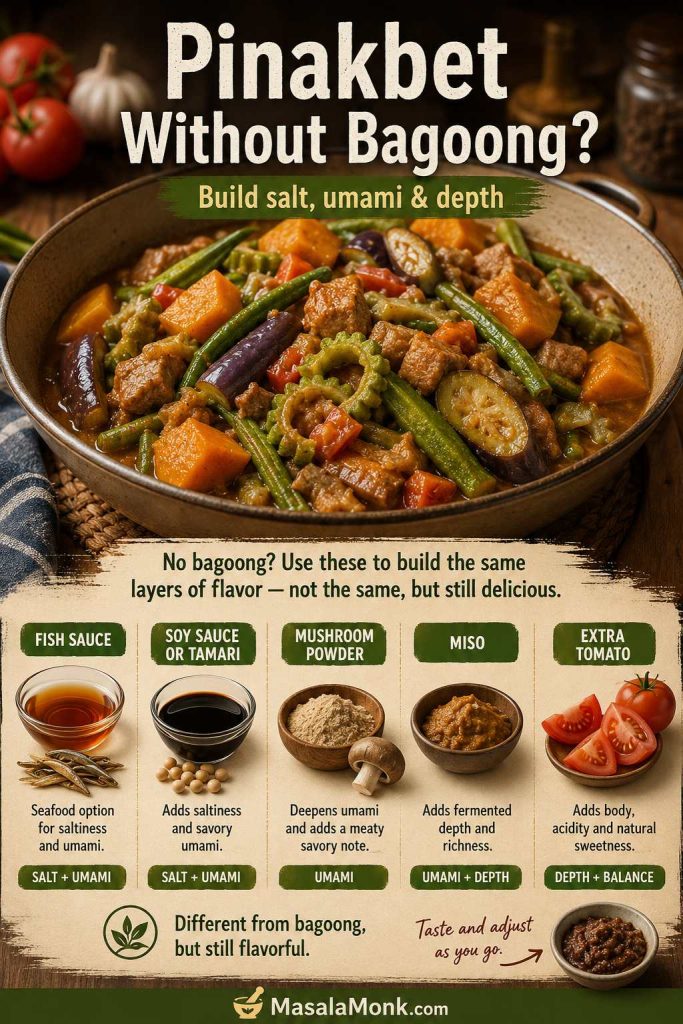
You can make pinakbet without bagoong, but it becomes a pinakbet-inspired vegetable stew. Bagoong does three jobs at once: it adds salt, fermentation, and deep umami. Replacing it means rebuilding all three, not just adding something salty.
If seafood is fine, fish sauce is the closest simple substitute. For seafood-free versions, use soy sauce or tamari for salt, mushroom powder for umami, and a little miso or extra cooked tomato for depth. Add these slowly and taste with a piece of squash or rice, because substitutes can become too salty fast.
No bagoong available: start with 1 tablespoon fish sauce, then adjust once the vegetables are tender.
Seafood-free version: use soy sauce or tamari plus mushroom powder and extra tomato.
Vegetarian or vegan direction: use miso, tamari, mushroom powder, and tomato to rebuild depth.
Lower-sodium attempt: use less bagoong rather than removing it completely, if possible.
Without bagoong, the dish changes, but it does not have to become bland. Instead of replacing only the salt, rebuild the missing layers with umami, depth, and a little extra tomato so the vegetables still taste grounded and complete.
Pinakbet Variations
You can change the protein, but do not rush the vegetables; they are still the heart of the dish.
Pinakbet with Pork Belly
This is the richest everyday version. Brown the pork first so the rendered fat flavors the tomatoes and shrimp paste.
Pinakbet with Bagnet
Stir some bagnet or lechon kawali in near the end, then reserve a few crisp pieces for topping. If all of it simmers too long, it will soften.
Bagnet gives pinakbet a completely different texture, especially when the crisp pieces are added close to serving time. That way, you get crunchy pork against soft vegetables and savory sauce instead of letting everything turn uniformly tender.
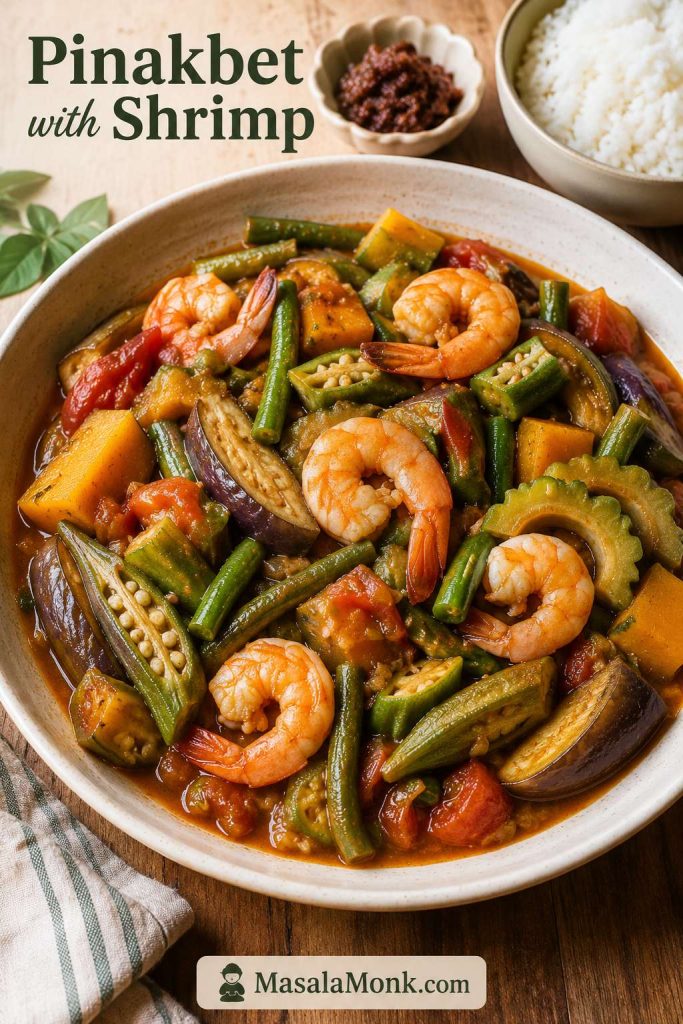
Pinakbet with Shrimp
Add shrimp in the final 2–3 minutes, after the vegetables are almost tender. Shrimp cooks quickly and turns rubbery if simmered too long.
Shrimp pinakbet needs a lighter hand than the pork version because shrimp cooks quickly and can toughen fast. Add it when the vegetables are almost done, and the dish stays sweet, seafood-forward, and still recognizably pakbet.
Chicken Pinakbet
Use boneless chicken thighs rather than chicken breast. Brown them first, then simmer until nearly tender before adding the squash.
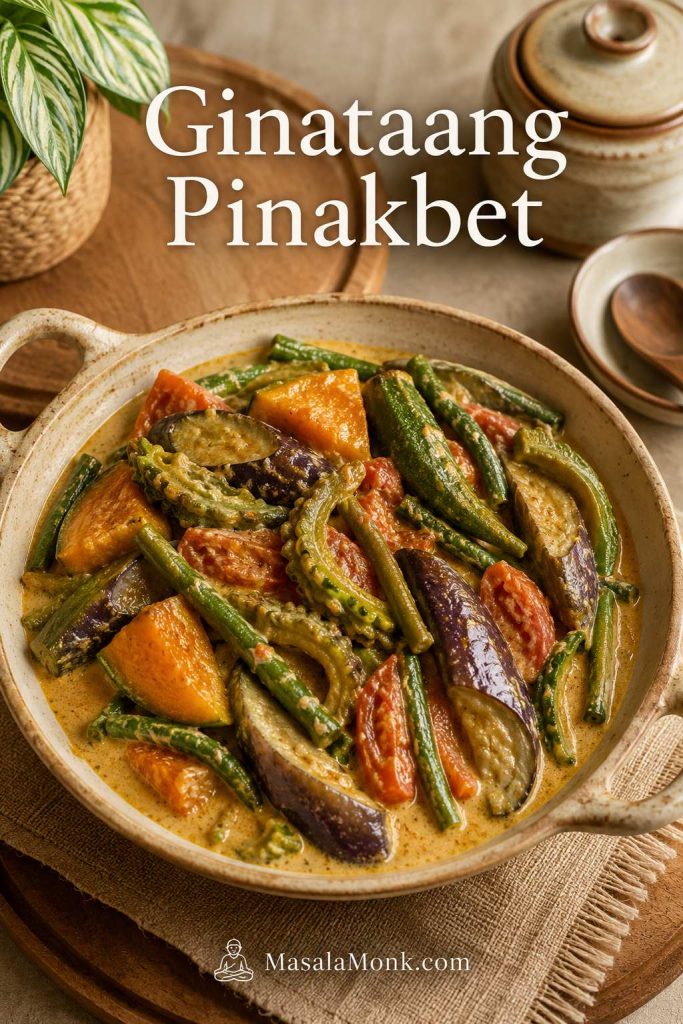
Ginataang Pinakbet
Add coconut milk after the pork has softened and the squash has started cooking. Simmer gently; hard boiling can make coconut milk split.
Ginataang pinakbet is richer, although it should still feel like a vegetable dish rather than a coconut stew. Simmer gently once the coconut milk goes in, because that softer cooking keeps the sauce smooth and the vegetables clear and distinct.
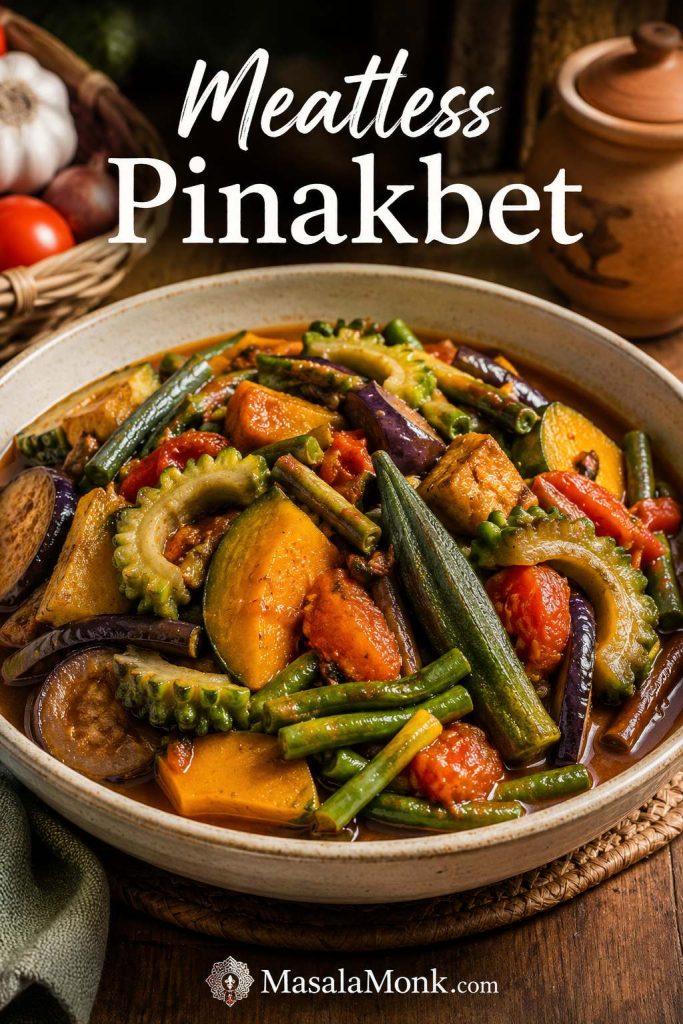
Meatless Pinakbet
Skip the pork but build depth with extra tomato, mushroom powder, and careful seasoning. If using tofu, add it near the end so it does not break apart.
A meatless pinakbet can still taste full when the vegetables are cooked carefully and the seasoning is layered thoughtfully. Mushrooms, miso, soy, or extra tomato can help, yet the real success still comes from keeping the vegetables varied in texture and flavor.
Timing is what keeps each vegetable from disappearing into the next. Pork and chicken need time early, shrimp goes in late, crispy pork is best partly reserved for the top, and coconut milk needs gentle heat.
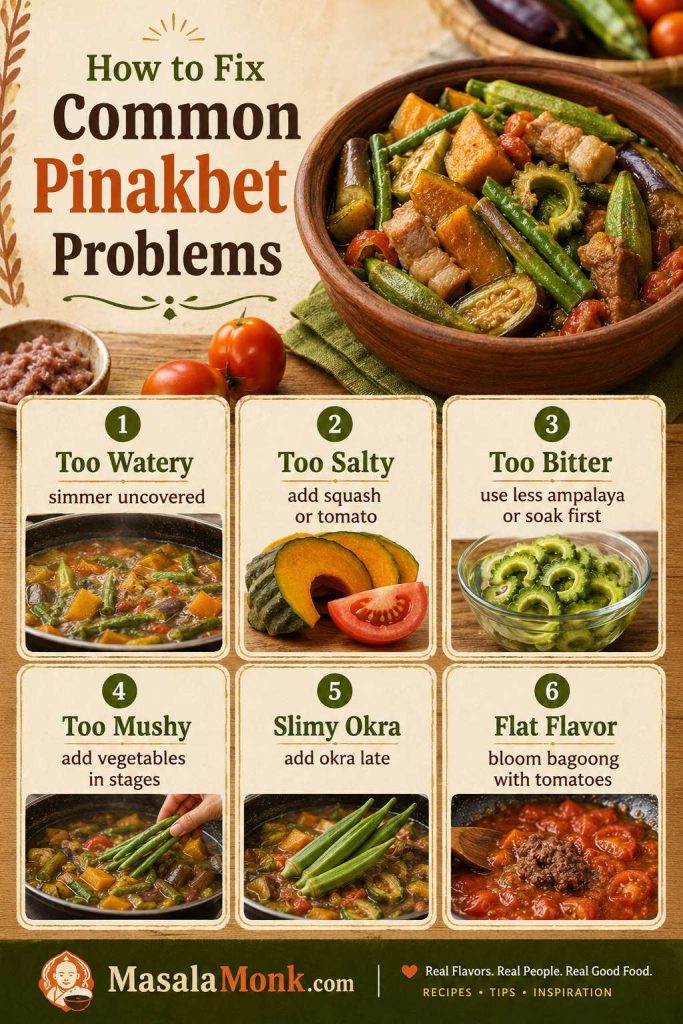
How to Fix Common Pinakbet Problems
Pinakbet is forgiving, but it tells on you quickly. Too much water pools under the vegetables, too much bagoong shows up in the first bite, and too much stirring shows up in the squash.
Start With the Problem You See
Most pinakbet problems come from the same few places: too much liquid, too much bagoong, bitter melon used too heavily, or vegetables added all at once. Fix what you can in the pan, then use the next batch to correct the timing.
Problem-by-Problem Fixes
Problem
Fix now
Next time
Too watery
Simmer uncovered for 3–5 minutes.
Use less water and add extra only if pork or squash needs more time. Remember that the vegetables release liquid too.
Too salty
Add more squash, eggplant, or tomato. Serve with plain rice.
Start with less bagoong and adjust after vegetables cook.
Too bitter
Add a little more squash or tomato.
Use less ampalaya, slice it thinner, or soak it briefly.
Vegetables are mushy
You cannot fully reverse this, but you can simmer uncovered if watery.
Add vegetables in stages and turn gently.
Squash collapsed
Let it thicken the dish and avoid more stirring.
Use larger chunks and do not add squash too early.
Okra made it slimy
Simmer uncovered briefly and avoid stirring hard.
Trim only the ends and add okra near the end.
Tastes flat
Add a little more bagoong, fish sauce, or tomato, then simmer briefly.
Bloom the seasoning with the tomatoes before adding water.
Bagoong tastes too strong
Add tomato or squash, simmer gently, and serve with plain rice.
Use less at the start and adjust later.
Dish tastes too sweet
Add a little fish sauce or bagoong.
Watch sweet ginisang bagoong and very sweet squash.
Too oily
Spoon off excess fat before serving.
Render pork first and remove extra fat before adding vegetables.
Pork is tough
Simmer the pork pieces longer before serving if vegetables can handle it.
Give pork more time before adding squash and delicate vegetables.
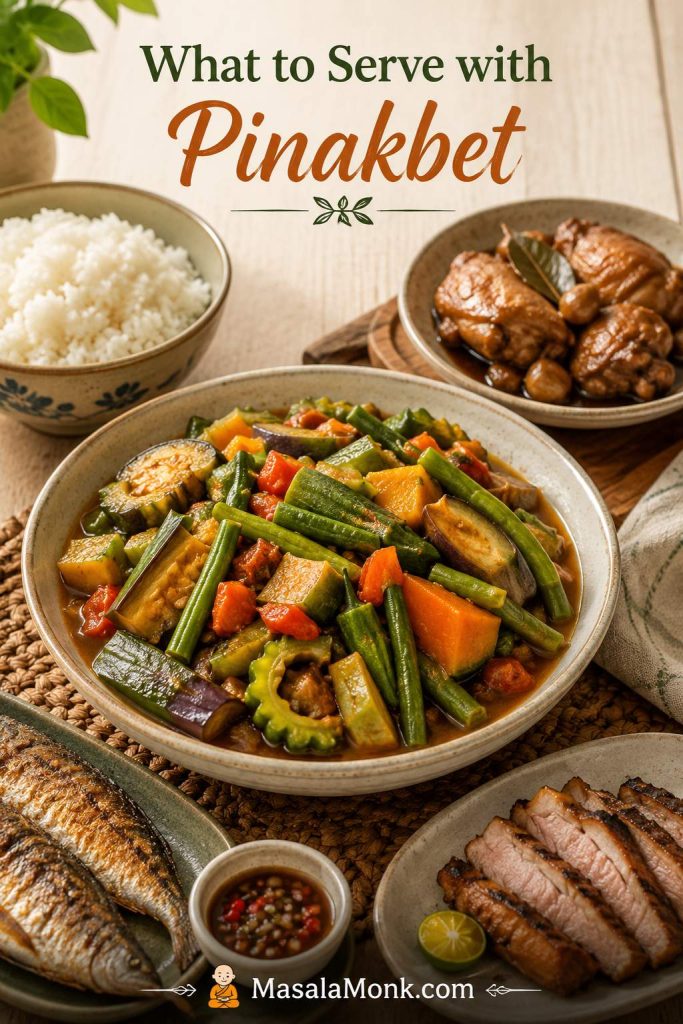
What to Serve With Pinakbet
Pinakbet shines beside plain steamed rice because the sauce is bold enough to carry the plate. For a fuller Filipino-style meal, add adobo, fried fish, or grilled pork while keeping pinakbet at the center.
Pinakbet is best with hot steamed rice. Because the tomato-bagoong mixture is bold, plain rice is not an afterthought here; it is part of how the dish works. If you want a dependable pot of rice, MasalaMonk’s guide on how to cook rice covers stovetop, cooker, and Instant Pot methods.
For a fuller Filipino-style meal, pinakbet sits naturally beside a savory protein dish like chicken adobo. Fried fish, grilled pork, simple chicken, or crispy pork also work well. If the pinakbet itself already has pork belly or bagnet, keep the rest of the meal simple.
Pinakbet is at its best when it tastes like more than the sum of its vegetables: salty enough for rice, sweet from squash, bitter enough to stay interesting, and saucy without becoming soup.
How to Store, Reheat, and Freeze Pinakbet
Cool leftovers quickly and store them in a shallow airtight container in the refrigerator. Pinakbet is best eaten within 3–4 days because it contains cooked vegetables and often pork or seafood-based seasoning. Store rice separately so the vegetables do not continue softening in the rice.
To reheat, warm it gently in a pan over low to medium-low heat. Add a splash of water only if the vegetables look dry. Avoid aggressive stirring because the squash and eggplant can break apart.
Microwaving is fine for a quick lunch, but the vegetables will soften more than they do in a pan. Freezing is possible, but not ideal; squash, eggplant, and okra soften further after thawing.
Some families prefer pinakbet drier and sharper; others like it saucier and sweeter from squash. Once you understand the timing, you can move the dish toward your table without losing its shape.
Most pinakbet starts with bagoong, tomatoes, and mixed vegetables such as squash, okra, eggplant, ampalaya, and long beans. Pork, shrimp, fish, bagnet, or crispy pork may be added depending on the household version.
Is pinakbet the same as pakbet?
Yes. Pakbet is the everyday shorter name many people use for pinakbet, though the exact style can change by region and household.
What does pinakbet taste like?
Pinakbet is savory, salty, earthy, lightly sweet, and a little bitter. The squash and tomatoes bring sweetness, while bagoong gives deep umami. A good version should taste balanced, not simply salty.
What is the difference between Pinakbet Tagalog and Ilocano pinakbet?
Pinakbet Tagalog usually uses bagoong alamang and squash, while Ilocano pinakbet is more closely tied to bagoong isda and a drier, more vegetable-forward finish. This recipe is Tagalog-style, with notes for adjusting it in a sharper Ilocano direction.
What is the best bagoong for pinakbet?
For Pinakbet Tagalog, bagoong alamang is the easiest fit because it gives a rounded shrimp-paste flavor. For a sharper Ilocano-style direction, use bagoong isda or bagoong monamon.
How do you keep pinakbet from getting mushy?
Add vegetables in stages and stir gently. Squash needs a head start, long beans need only a few minutes, and eggplant, ampalaya, and okra should go in near the end. A wide pan also helps because the vegetables steam and simmer instead of being crushed together.
Is pinakbet supposed to be soupy?
No. Pinakbet should be moist and saucy, not soupy. The vegetables should soften and shrink slightly, with cooking liquid clinging to them rather than floating in broth. If there is too much liquid, simmer uncovered for a few minutes.
Why is my pinakbet watery?
Pinakbet can turn watery if too much water was added or if the vegetables released more liquid than expected. Simmer uncovered until the liquid reduces and clings lightly to the vegetables. Next time, start with less water and add extra only if the pork or squash needs more time.
How do you reduce ampalaya bitterness in pinakbet?
Use less ampalaya, slice it evenly, and avoid overcooking it. For a milder flavor, soak the sliced bitter melon in lightly salted water for 20–30 minutes, then drain before cooking. A little bitterness should remain because it keeps the dish balanced.
What can I use instead of bagoong alamang?
Fish sauce is the easiest substitute if seafood is not a problem. For seafood-free versions, use soy sauce or tamari with mushroom powder and extra tomato. The flavor will not be the same, but it will have more depth than plain salt.
What is the difference between pinakbet and dinengdeng?
Both are Filipino vegetable dishes, but they eat differently. Pinakbet is usually a sautéed or simmered vegetable stew with bagoong, tomatoes, and often pork or seafood, while dinengdeng is generally lighter and more broth-like.
How long does pinakbet last in the fridge?
Pinakbet is best eaten within 3–4 days when stored in a shallow airtight container in the refrigerator. Reheat gently so the squash, eggplant, and okra do not break apart.
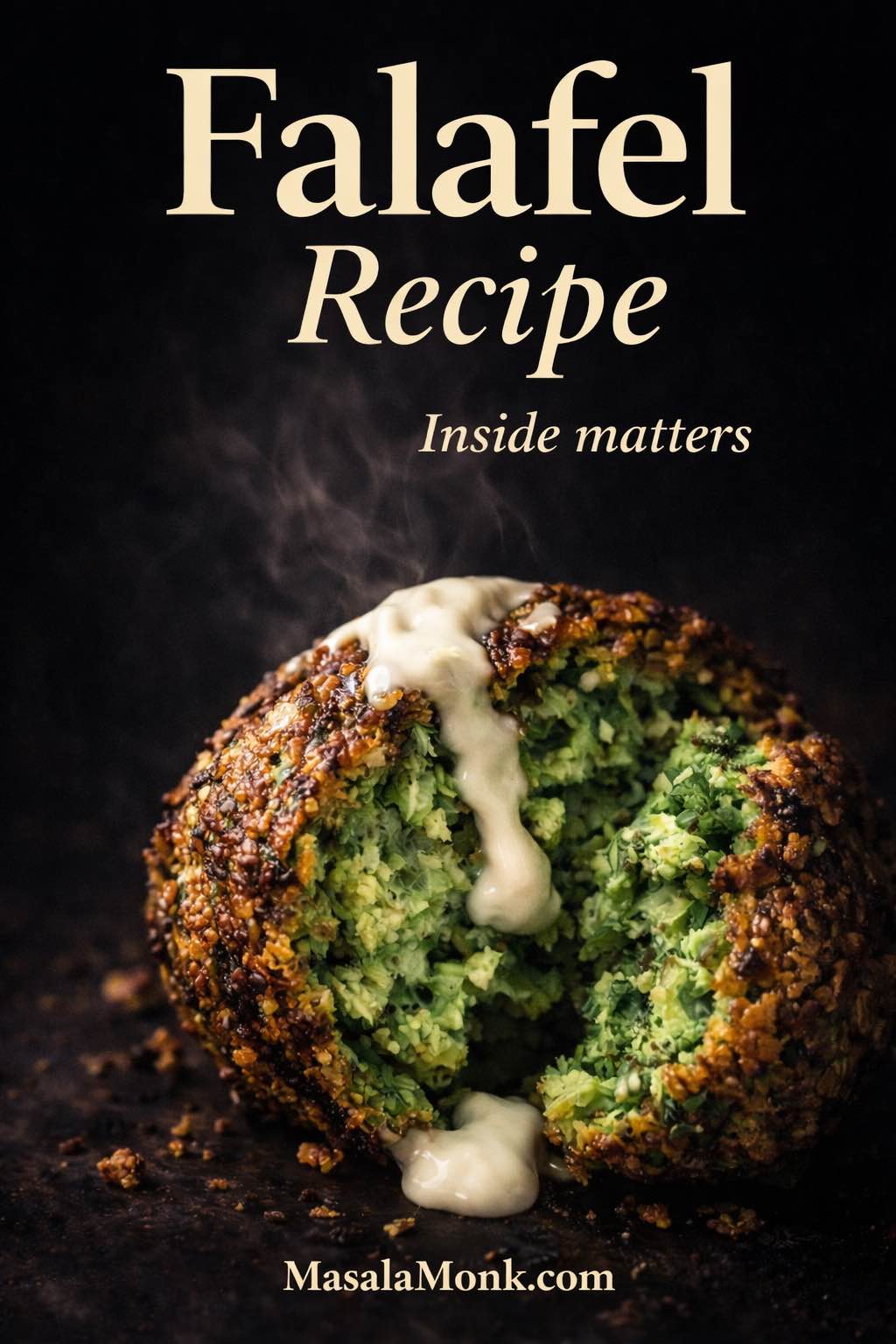
There are some foods that feel bigger than the sum of their ingredients. Falafel is one of them. At a glance, a falafel recipe seems humble enough: chickpeas, herbs, onion, garlic, spices, and a little patience. Yet when everything comes together properly, the result is far more memorable than that short ingredient list suggests. A really good falafel has a crisp, deeply golden shell, a tender green center, and the kind of savoury, herb-packed character that makes one bite lead to another before you have even reached for the sauce.
That contrast is exactly why a proper falafel recipe deserves more than a quick set of instructions. It helps to understand what falafel is, why some versions turn light while others become heavy, why soaked dried chickpeas behave differently from canned chickpeas, and how the cooking method changes the final texture. Once those pieces fall into place, making falafel at home becomes less mysterious and much more rewarding.
Why a homemade falafel recipe can feel intimidating at first
For many home cooks, falafel falls into that frustrating category of dishes they happily order but hesitate to make themselves. One person worries about dealing with hot oil, while another is put off by the fear of a dense or crumbly result. Quite often, the concern is that the mixture will turn bland, fall apart in the pan, or end up pasty rather than light. There is also the lingering question of method: does an authentic falafel recipe really need deep frying, or can air fryer falafel and baked falafel still be crisp, satisfying, and fully worth making?
Then again, the hesitation does not only come from technique. Plenty of people also wonder whether a chickpea falafel recipe made with canned chickpeas can ever be as good as one made with soaked dried chickpeas. Others are unsure about the herbs, the spices, or the right sauce to serve alongside the final plate. Once all those questions pile up, a dish that sounds simple in theory can start feeling strangely complicated in practice.
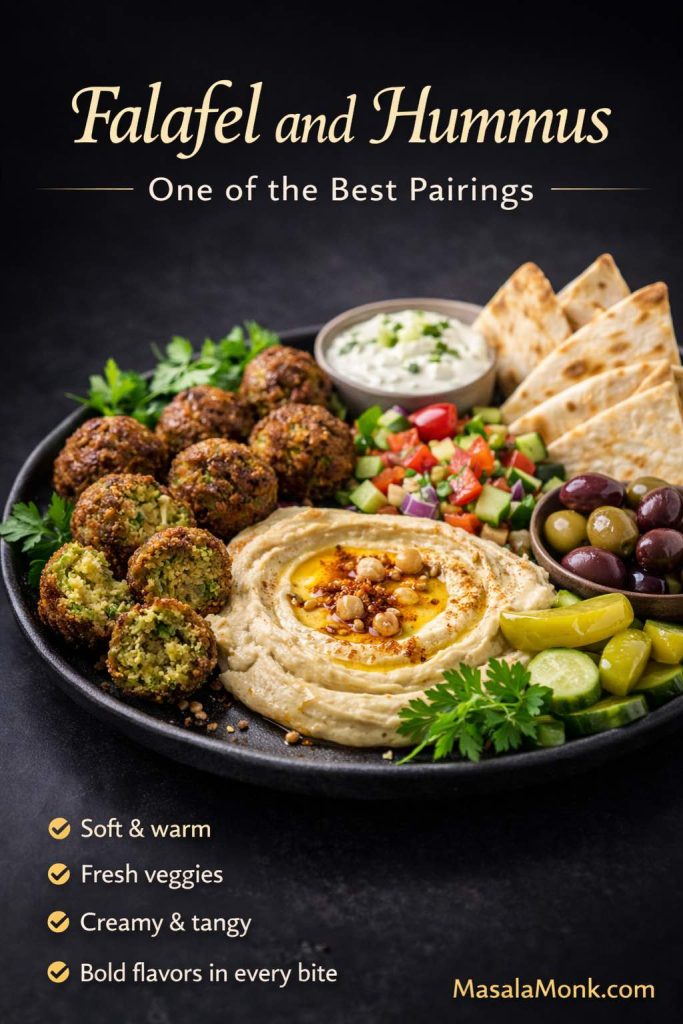
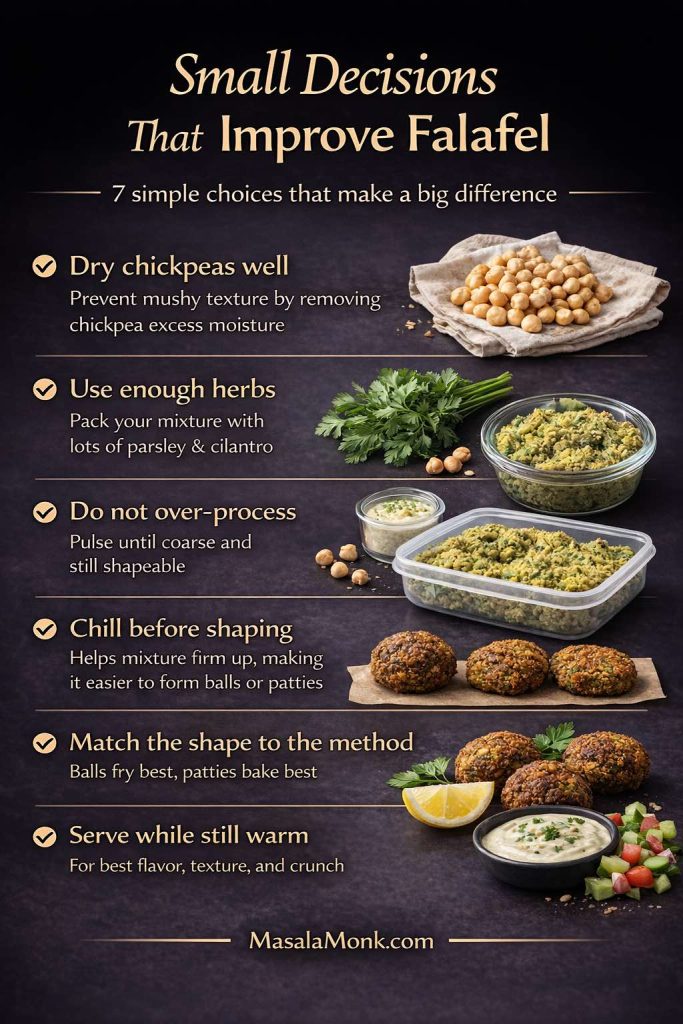
A great falafel recipe is easier to understand once the biggest choices are clear from the start. This opening guide highlights the best base for strong texture, the coarse mixture that keeps falafel light instead of dense, the three main cooking routes, and the simple plate elements that make the final meal feel complete. It works as a quick visual roadmap for the rest of the post while still showing the crisp shell, green center, and contrast that make homemade falafel worth getting right.
What this falafel recipe guide covers
This guide brings all of that together in one place. It begins with the classic foundations, moves through the ingredient choices that matter most, explains how to make falafel from scratch, and then walks through fried, air fryer, and baked options with the kind of detail that helps in a real kitchen. Along the way, it also makes room for serving ideas, falafel sauces, pita and wrap combinations, bowl variations, canned chickpea options, make-ahead advice, and the troubleshooting that turns a frustrating first attempt into a dependable homemade meal.
Falafel is widely understood as a Middle Eastern dish made from chickpeas, fava beans, or both, shaped and cooked until crisp, and often served with pita, salad, and tahini. It is also often linked to Egypt in origin discussions, although it now belongs to a much broader and richly shared regional story. If you enjoy food history, both Britannica’s overview of falafel and its notes on daily life and cuisine in Egypt give helpful background without getting in the way of dinner.
Why falafel becomes a repeat recipe
Still, what matters most here is what happens on the plate. Whether you want an easy falafel recipe for a weekday lunch, a more traditional homemade falafel for a weekend spread, a healthy falafel option for meal prep, or a crisp falafel wrap with sauce and salad, the fundamentals remain the same. Start with the right base. Build in enough herbs and seasoning. Respect the texture. Choose the cooking method that suits the meal in front of you.
Once you do that, falafel stops feeling like a specialty and starts feeling like one of the smartest things you can cook with chickpeas.
What Is Falafel and What Makes a Good Falafel Recipe
Falafel is often described in a sentence or two, but it becomes much easier to appreciate once you think of it not as a single rigid recipe but as a family of preparations built around legumes, herbs, aromatics, and spice. The basic idea is straightforward: chickpeas or fava beans are combined with onion, garlic, parsley, cilantro, cumin, coriander, salt, and sometimes other seasonings, then shaped into balls or patties and cooked until crisp outside and tender inside.
Great falafel is built on contrast. The shell should be crisp and deeply golden rather than oily, the center should stay tender and green instead of turning dense, and the seasoning should feel lively enough that the chickpeas, herbs, and spices all register clearly in each bite. A guide like this helps readers understand what they are aiming for before they move deeper into the ingredient, texture, and cooking-method sections of the post.
What makes a good falafel recipe so satisfying
Still, that basic definition does not fully explain why falafel has such lasting appeal. At its best, it is earthy without feeling heavy, fragrant without becoming overpowering, and substantial without tipping into stodgy territory. Just as importantly, it slips easily into different kinds of meals. One day it becomes lunch tucked into pita, while on another it lands in a grain bowl, joins a mezze-style spread, or turns into a quick snack with tahini sauce on the side. Depending on how you serve it, falafel can feel firmly traditional or pleasantly flexible.
A good falafel recipe is also built around contrast. The shell should be crisp rather than oily. The center should be tender and herb-flecked rather than pasty. The chickpeas should still feel like chickpeas, yet the mixture should be processed enough to hold together with confidence. In other words, the pleasure of falafel comes not from one single element but from the way texture, aroma, seasoning, and serving all work together.
Chickpeas, fava beans, and authentic falafel variation
Because falafel has spread so widely across kitchens, restaurants, and home tables, there is more than one accepted version. Some cooks build an authentic falafel recipe around chickpeas. Others lean toward fava beans. Some make small balls. Others prefer patties. Some stay very close to a classic seasoning profile, while others add chillies, sesame seeds, or regional twists. What ties these approaches together is the pursuit of that unmistakable texture: crisp shell, soft center, lively flavour.
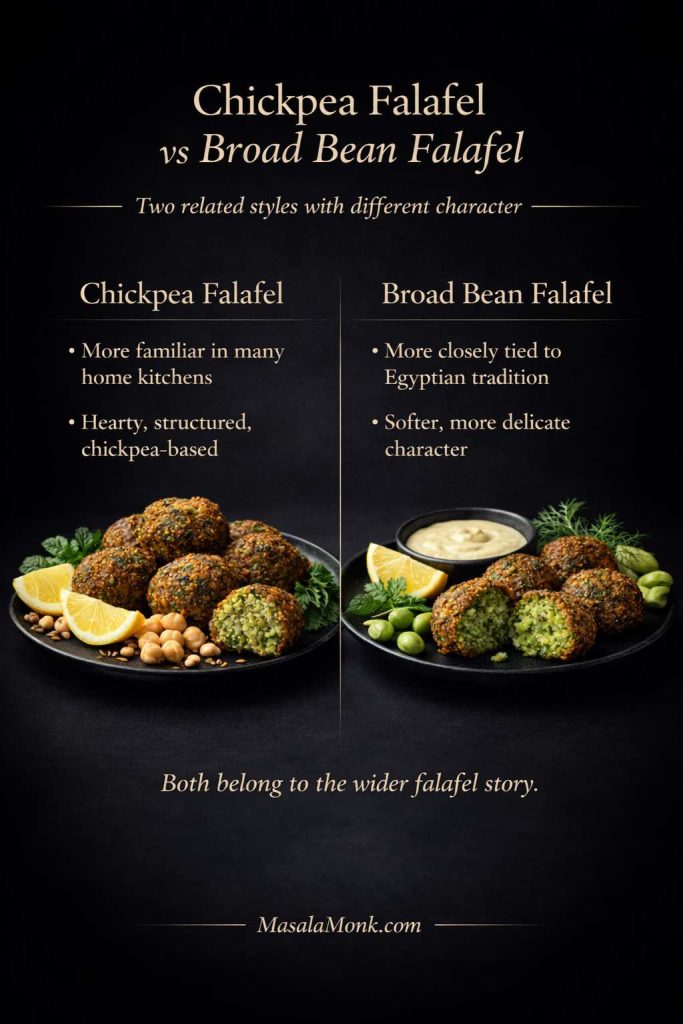
That broader view matters because people often search for falafel as though there is only one correct version. In reality, there is a core identity, but there is also room for regional nuance. A chickpea falafel recipe may be the most familiar style in many kitchens, whereas a broad bean falafel recipe may feel more connected to Egyptian tradition. Both belong to the wider falafel story.
Why homemade falafel can surprise you
That is also why homemade falafel can be such a surprise if your main reference point is dry takeaway falafel. When it is fresh and properly seasoned, it tastes greener, brighter, warmer, and more alive. The herbs are more pronounced. The crust is more delicate. The interior has more nuance. In other words, a good homemade falafel recipe does not simply recreate something familiar. It can completely change how you think about the dish.
Falafel Recipe Ingredients: What Falafel Is Made Of
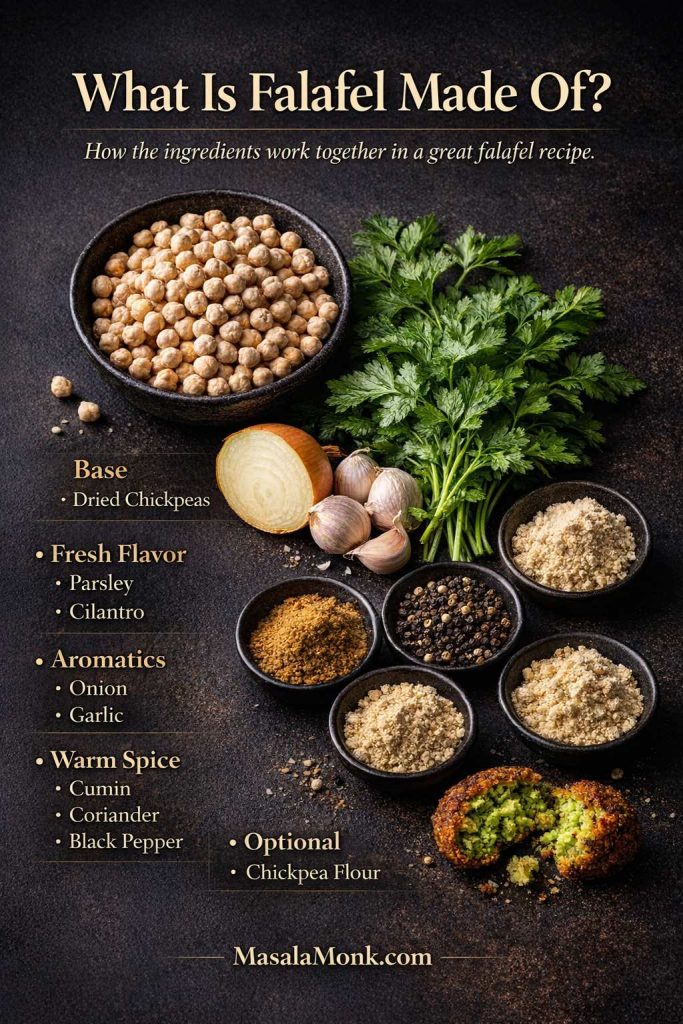
At its heart, falafel relies on a handful of ingredients that each play a distinct role. The list is not long, yet the balance is everything.
This falafel ingredient guide shows how a great falafel recipe is built: dried chickpeas for structure, parsley and cilantro for the fresh green center, onion and garlic for savoury depth, and cumin, coriander, and black pepper for warm spice. It also highlights chickpea flour as an optional helper when the mixture needs a little extra support. Use this card to quickly understand what gives homemade falafel its crisp exterior, flavorful interior, and distinctive texture before moving into the step-by-step method.
The best chickpeas for a falafel recipe
Chickpeas are the base most people have in mind when they picture falafel. They bring body, earthy flavour, and enough structure to create the right interior once processed properly. For a traditional falafel recipe, dried chickpeas are soaked and used raw rather than boiled first. That step matters more than it may seem, because their firmness affects both texture and how the mixture holds together.
A chickpea falafel recipe made this way usually has the most satisfying interior. The chickpeas stay structured, the mixture remains textured, and the final falafel cooks into something crisp outside and tender inside. By contrast, softer cooked chickpeas move much more quickly toward a paste.
The aromatics
Onion and garlic build the savoury backbone. Without them, the mixture can taste flat and timid. They also contribute a little moisture, which is helpful in moderation and troublesome in excess. That is one reason why the exact balance of onion, garlic, and herbs matters so much.
Too much onion can loosen the mixture more than you expect, especially if the onion is watery. Too little garlic, meanwhile, can leave the final falafel feeling mild rather than warmly savoury. The aim is not sharpness for its own sake, but depth.
The herbs that lift a homemade falafel recipe
Parsley and cilantro are not decorative extras. They are central to the flavour and appearance of falafel. They create that fresh, green interior that sets a truly good falafel apart from a beige, dense one. If you have ever bitten into a falafel that felt oddly dull, the herb ratio was often part of the problem.
Parsley brings clean freshness, while cilantro adds brightness and a slightly sharper herbal note. If you prefer less cilantro, it is usually better to replace it with more parsley than to reduce the herbs overall. Otherwise, the mixture can lose the lively quality that makes falafel feel fresh rather than heavy.
The spices behind an authentic falafel recipe
Cumin and coriander are the classic pair. Cumin adds warmth and depth, while coriander lifts the flavour and keeps the mixture from leaning too heavily into earthiness alone. Black pepper appears often. So does a little chilli in some kitchens. Beyond that, there is room for modest variation, though it is usually wiser to perfect the fundamentals before adding too many extra notes.
The salt
Salt is not a background player here. Since falafel contains chickpeas, herbs, onion, and garlic, it needs enough seasoning to prevent all that wholesome goodness from becoming merely worthy. One of the most common issues with a homemade falafel recipe is not texture but blandness, and that often begins with under-seasoning the raw mixture.
The optional helpers
Some recipes include chickpea flour, a little plain flour, or baking powder. These are not always necessary, especially when the mixture is well balanced and the chickpeas have been handled correctly. Still, they can be useful in specific contexts, particularly for baked falafel, air fryer falafel, or mixtures that feel slightly too loose after processing.
For a gluten free falafel recipe, chickpea flour is especially useful because it helps bind without changing the character of the mixture too much. Baking powder, on the other hand, is best seen as a small supporting detail rather than the secret to success.
What Makes This Homemade Falafel Recipe So Good for Texture and Flavor
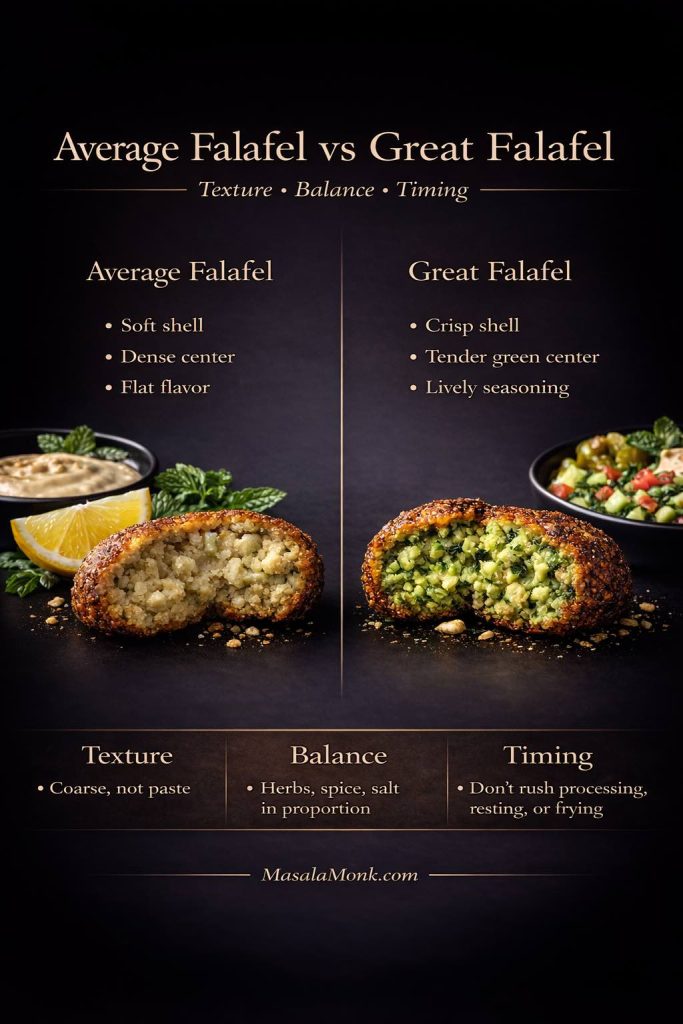
The difference between average falafel and memorable falafel is rarely about extravagance. More often, it comes down to texture, balance, and timing.
A strong falafel recipe should deliver contrast at every stage. The first bite should meet a crisp exterior rather than a soft, oily shell. The interior should feel tender and almost fluffy, yet still have enough texture to remind you it came from soaked chickpeas and herbs, not from a smooth purée. The seasoning should taste warm and rounded rather than harsh or flat. The herbs should be present enough to brighten each bite without turning the whole mixture grassy.
The difference between average falafel and memorable falafel usually comes down to a few details that are easy to overlook. A softer shell, denser center, and flatter flavor often come from rushed processing, weak herb balance, or timing that is just slightly off, while great falafel keeps its contrast: crisp outside, tender green center, and seasoning that feels lively instead of dull. Seeing those differences side by side makes it much easier to understand what you are actually aiming for before you cook the next batch.
This is exactly where rushed methods tend to disappoint. Over-process the chickpeas and the mixture quickly turns pasty instead of textured. Treat canned chickpeas the same way as soaked dried chickpeas and the finished falafel often comes out denser than you hoped. Skimp on the herbs and the center loses the freshness that makes falafel so distinctive. Meanwhile, if the oil temperature is off, the exterior may brown too fast or soak up more oil than it should.
Writers who focus closely on texture, such as Serious Eats, and cooks who emphasize practical home technique, such as The Mediterranean Dish, return to these same points again and again for good reason. They are not small details. They are the difference between falafel you politely finish and falafel you start planning to make again before the meal is over.
Here is a balanced ingredient list for a classic chickpea falafel that works beautifully as a base recipe.
Ingredients
1 1/2 cups dried chickpeas
1 small onion, roughly chopped
4 to 6 garlic cloves
1 packed cup parsley leaves and tender stems
1/2 to 1 cup cilantro leaves and tender stems
2 teaspoons ground cumin
1 teaspoon ground coriander
1/2 to 1 teaspoon black pepper
1 1/2 to 2 teaspoons salt
1 to 2 tablespoons chickpea flour, only if needed
1 teaspoon baking powder, optional
neutral oil for frying, or a little oil for brushing in air fryer and baked methods
A clear ingredient card makes homemade falafel easier to save, shop for, and cook without scrolling back and forth through the whole post. This classic base starts with dried chickpeas, onion, garlic, parsley, cilantro, cumin, coriander, black pepper, and salt, while chickpea flour and baking powder stay in the optional-helper category for batches that need a little support. Seeing the full list in one place is especially useful before soaking chickpeas or setting up your prep station.
A few ingredient notes
For a greener and fresher falafel, add a little more parsley to the mixture. Anyone who does not love cilantro can scale it back and replace that volume with extra parsley rather than leaving the herbs unbalanced. A touch of chilli can also be introduced for heat, although the classic flavour profile leans far more on cumin and coriander than on spice alone.
For a gluten free falafel recipe, chickpea flour is the simplest binder when needed. Since chickpeas themselves are naturally gluten free, the key is simply to avoid unnecessary additions that introduce gluten.
This is also naturally very close to a vegan falafel recipe. The mixture itself relies on chickpeas, herbs, aromatics, and spices, so the falafel can easily remain vegan as long as the sauces and sides you choose do the same.
Dried Chickpeas vs Canned Chickpeas for a Falafel Recipe
This question sits at the center of nearly every serious falafel conversation, and rightly so. The choice between dried chickpeas and canned chickpeas changes the texture, the handling, and often the final method.
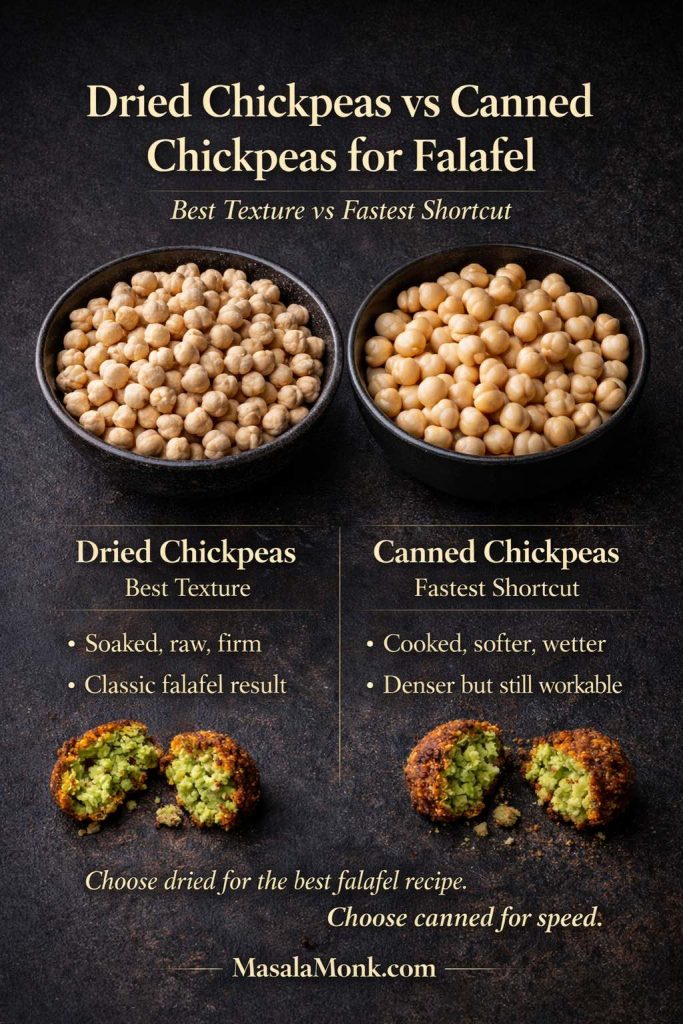
This falafel comparison card shows why dried chickpeas usually make the best falafel recipe, while canned chickpeas work as a faster shortcut. Soaked dried chickpeas give homemade falafel a firmer mixture, a lighter interior, and a more classic crisp result. Canned chickpeas, by contrast, are softer and wetter, so they tend to produce a denser falafel unless the mixture is handled carefully. Use this guide to choose the right base before moving into the method, especially if you are deciding between authentic falafel texture and weeknight convenience.
Why dried chickpeas make the best falafel recipe
For a traditional or authentic falafel recipe, dried chickpeas are soaked in water until they swell, then drained and processed raw. They have enough firmness to create a mixture that stays textured rather than turning creamy. They also behave better in hot oil because they are not already fully cooked and softened.
That is why many respected falafel recipes insist on dried chickpeas and warn against canned chickpeas for the classic version. Both The Mediterranean Dish and Serious Eats make this point clearly, and once you have seen the difference in the food processor, it becomes obvious.
Can canned chickpeas work in a falafel recipe?
Yes, canned chickpea falafel can work. It simply behaves differently. Canned chickpeas are already cooked and much softer, so they are more likely to become mushy when processed. That can make it harder to form balls that stay light inside. The resulting falafel may still taste good, but it usually has a denser, less open texture.
When to use canned chickpeas anyway
There are moments when convenience matters more than orthodoxy. If you need an easy falafel recipe on a weekday and did not soak dried chickpeas ahead of time, canned chickpeas can still get dinner on the table. In that case, it helps to pulse very carefully, dry the chickpeas thoroughly, use a modest amount of binder if needed, and lean toward flatter patties for baking or air frying.
The honest difference
If you are chasing the best falafel recipe you can make at home, dried chickpeas are worth it. If you are chasing speed and flexibility, canned chickpeas remain an option. The key is knowing that these are not interchangeable choices with identical results. They are two related but different paths.
How to Soak Dried Chickpeas for the Best Falafel Recipe
Soaking chickpeas is easy, though it does require a little foresight.
Place the dried chickpeas in a large bowl and cover them generously with cold water. They need far more room than you might expect because they expand as they absorb liquid. Leave them overnight, or for roughly 18 to 24 hours if your kitchen is cool and your timing allows. Then drain them well.
This soaked chickpea guide shows the texture you want before making falafel from scratch. Properly soaked chickpeas for a falafel recipe should look plump, hydrated, and larger than before, yet still feel firm rather than soft like cooked chickpeas. That difference matters because the right chickpea texture helps the falafel mixture stay structured, shape well, and cook into a crisp outside with a tender green center instead of turning mushy.
What you are looking for is this: the chickpeas should be larger and hydrated, but still firm. They should not resemble boiled chickpeas, and they definitely should not be soft enough to mash between your fingers with almost no effort. That firmer state is what helps create the right falafel texture later.
Once drained, it helps to let them sit in a colander for a few minutes so extra moisture can run off. Too much lingering water can loosen the mixture more than necessary.
Although chickpea falafel is the version many readers will be searching for, it is worth noting that falafel is not limited to chickpeas alone. In some traditions, especially those tied more closely to Egypt, falafel may be made with fava beans or broad beans instead. That version can taste slightly different and may have a softer, more delicate character depending on the recipe.
Falafel is not limited to one exact formula, which is why chickpea falafel and broad bean falafel are both worth understanding. Chickpea falafel is the version many home cooks recognize most easily, while broad bean falafel is often more closely tied to Egyptian tradition and can have a slightly softer, more delicate character. Seeing the legumes and the finished falafel side by side makes the distinction clearer and helps explain why falafel can feel familiar in one kitchen and slightly different in another.
For that reason, when people search for an Egyptian falafel recipe or a broad bean falafel recipe, they are often looking for a related but not identical dish. Chickpea falafel tends to be the most familiar version in many home kitchens, and it is also the easiest one to build a broad guide around. Even so, knowing that fava bean falafel exists adds useful context. It reminds us that falafel has regional breadth and a longer story than one single formula can capture.
How to Make Falafel from Scratch: Step-by-Step Falafel Recipe
Making falafel at home becomes much less intimidating once you see that the steps are logical and manageable.
This step-by-step falafel guide shows the full flow of a homemade falafel recipe, from soaked chickpeas and the freshly pulsed herb mixture to shaped falafel and the final crisp, golden result. Use it as a quick visual roadmap before diving into the full method, especially if you are making falafel from scratch for the first time and want to understand how the texture should look at each stage.
Step 1: Prepare the ingredients
Drain the soaked chickpeas. Roughly chop the onion if it is large. Peel the garlic. Wash and dry the herbs. Gather the spices and salt. This is not a fussy recipe, but having everything ready makes it easier to stop processing at the right moment rather than scrambling for ingredients while the food processor is running.
Getting everything ready before the food processor starts makes the rest of the falafel recipe much smoother. Drained chickpeas, chopped onion, peeled garlic, washed herbs, and measured spices let you stop at the right texture instead of scrambling for ingredients halfway through. It is a simple prep step, but it makes the mixture easier to control and the method far less messy.
Step 2: Process the mixture
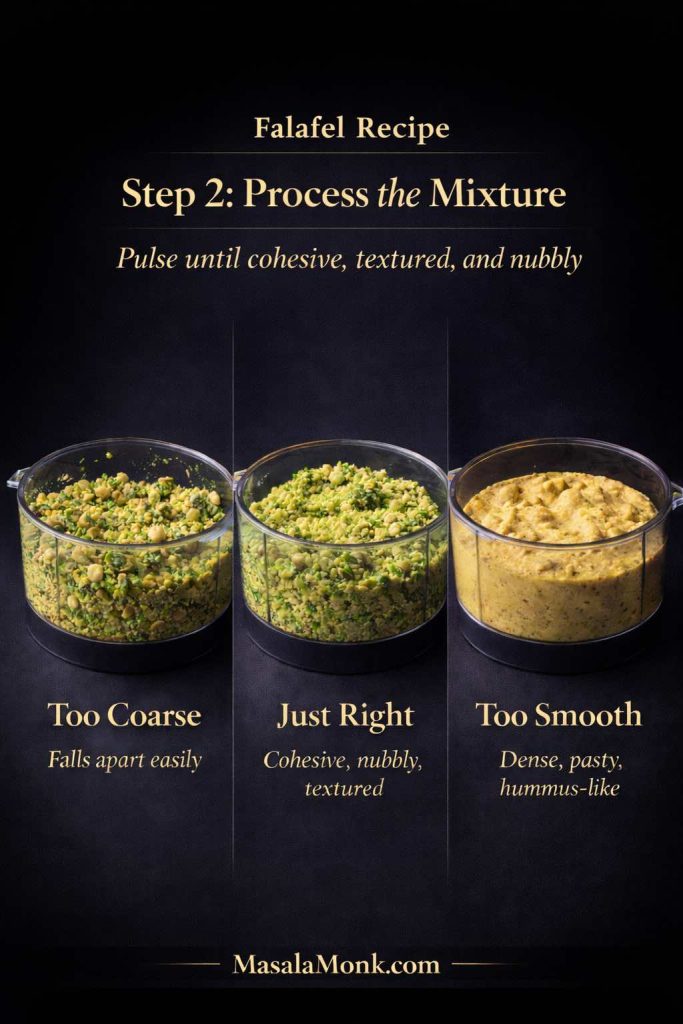
Add the chickpeas, onion, garlic, parsley, cilantro, cumin, coriander, salt, and pepper to a food processor. Pulse in short bursts. Scrape down the bowl as needed. The goal is a coarse, even mixture that holds together when pressed but still shows texture.
The texture of the falafel mixture matters more than most people expect. After pulsing, it should look evenly mixed and hold together when pressed, but still keep a nubbly chickpea-and-herb texture. Stay too coarse and the falafel can fall apart. Go too smooth and it starts turning dense and pasty instead of giving you the light, textured center that makes homemade falafel so satisfying.
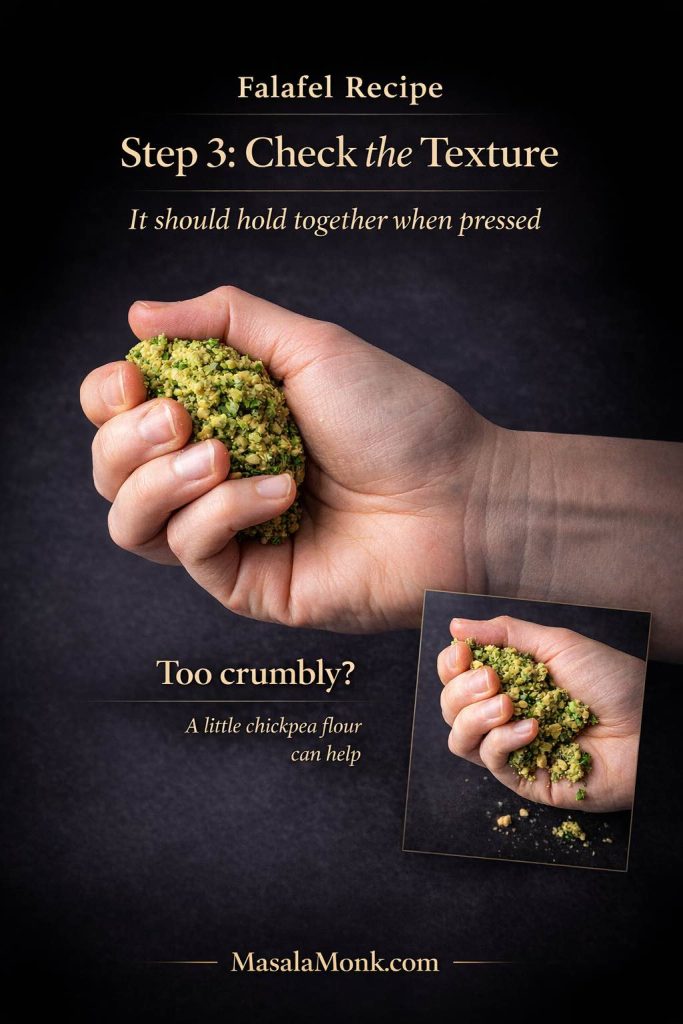
Step 3: Check the texture
Take a small amount of the mixture in your palm and press it gently. A mixture that holds together under light pressure is usually in good shape. On the other hand, if it crumbles straight away, it needs a little more pulsing. Should it feel wetter than expected, add a small spoonful of chickpea flour and pulse again briefly until the texture looks more cooperative.
Before shaping the falafel, press a small amount of the mixture in your hand. It should hold together without feeling wet or turning into paste. If it crumbles too easily, the mixture may need a little more pulsing or a small amount of chickpea flour to help it bind. This quick hand test makes the next steps far easier and helps prevent falafel that falls apart during cooking.
Step 4: Rest the mixture
Cover and chill the processed mixture for at least 30 minutes. This resting time helps in two ways. First, it firms the mixture and makes shaping easier. Second, it gives the flavors a moment to settle together.
A short rest in the fridge gives the falafel mixture time to firm up before shaping. That small pause makes the mixture easier to handle, helps it feel more cohesive in the hand, and reduces the chances of frustration in the next step. It is one of those quiet details that makes homemade falafel feel much more manageable.
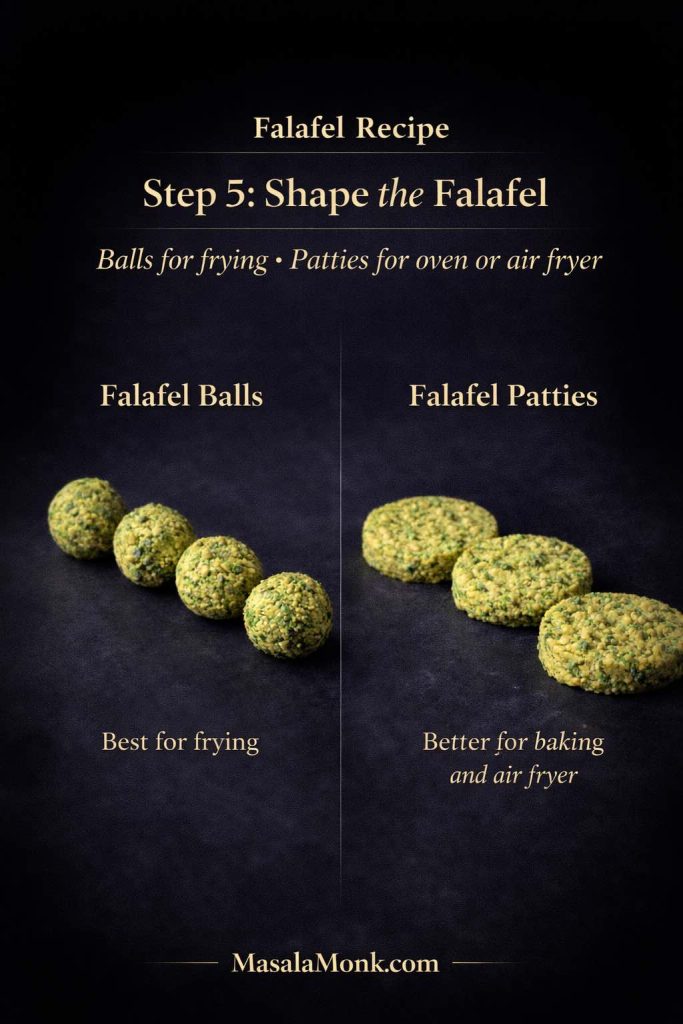
Step 5: Shape the falafel
Use your hands, a spoon, or a falafel scoop if you have one. Small balls are traditional and beautiful when fried. Slightly flattened patties are particularly useful for baked falafel and air fryer falafel, since they brown more evenly and are easier to turn.
Shape affects how falafel cooks. Balls are the more classic choice and work especially well for frying, while flatter patties brown more evenly in the oven or air fryer and are easier to turn without breaking. Picking the shape that matches your cooking method makes the recipe more predictable and helps you get better texture with less guesswork.
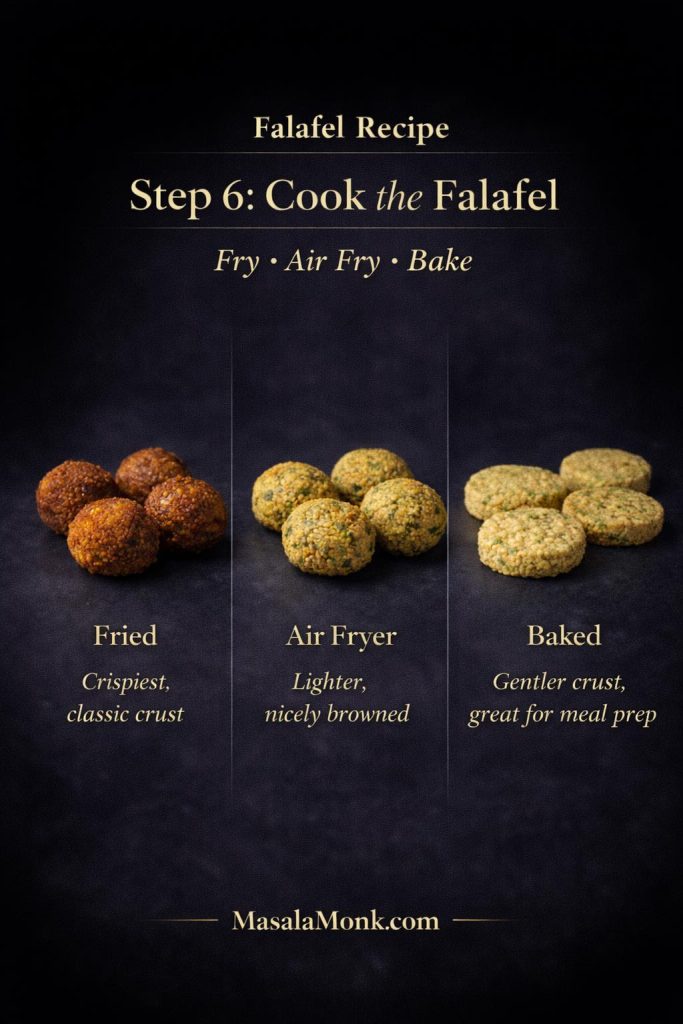
Step 6: Cook by your chosen method
From here, you can fry, air fry, or bake. Each route has its own appeal, and none of them are difficult once the mixture is right.
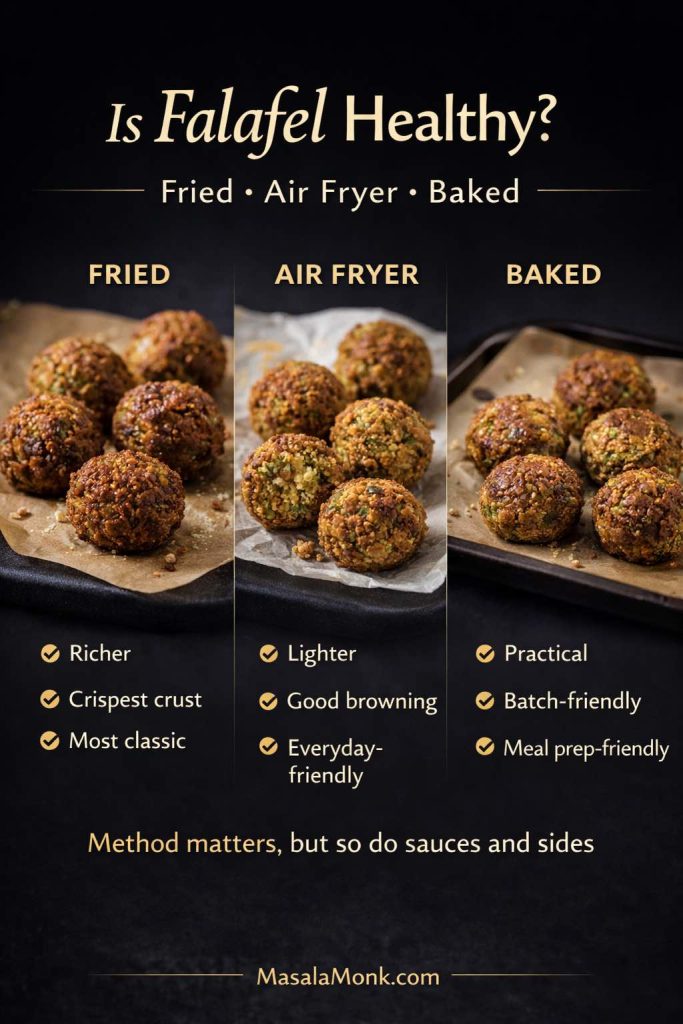
Cooking method changes the final character of falafel more than most people expect. Frying gives the deepest crust and the most classic result, air frying offers a lighter route with good browning, and baking is especially practical for batch cooking and meal prep. Choosing the method that matches the meal you want makes the whole recipe feel more intentional and helps set the right expectations before you move into the detailed method sections below.
For many cooks, fried falafel remains the benchmark. There is a reason for that. Hot oil creates a crust that is difficult for any other method to match. The shell becomes deeply crisp, the center stays tender, and the whole thing tastes unmistakably falafel in the way many people first fell in love with it.
How to fry falafel
Fill a deep pan or pot with enough neutral oil to allow the falafel to cook without touching the bottom too aggressively. Heat the oil until it is hot but not smoking. If the oil is too cool, the falafel may absorb excess oil and feel greasy. If it is too hot, the exterior will brown too quickly.
Lower a few pieces in at a time. Avoid crowding the pan, since that can drop the temperature and make the batch less crisp. Let them cook until evenly golden brown, then remove and drain on paper towels or a wire rack.
Fried falafel stays the benchmark because hot oil creates the strongest contrast between a crisp shell and a tender center. The most important cues are simple but easy to miss: heat the oil properly without letting it smoke, fry only a few pieces at a time so the temperature does not drop, and cook until the crust turns deeply golden rather than pale. A method card like this is useful because it shows both the process and the finish readers should be looking for when they want truly classic falafel.
What fried falafel should look like
The outside should be dark golden and crisp, not pale. The inside should be cooked through but still moist and green-flecked. If you split one open and it looks smooth or pasty, the mixture was likely processed too far or the chickpeas were not ideal for the method.
Why people keep coming back to fried falafel
Because it is hard to beat. Fried falafel offers the strongest crust and the clearest contrast between crisp exterior and tender middle. For a weekend lunch, a dinner spread, or any time you want the most classic version, it remains the method that most fully expresses what falafel can be.
Air fryer falafel occupies a very useful place in a modern kitchen. It gives you a lighter option, avoids a pot of oil, and still creates browning and texture when done well. It is not identical to fried falafel, but it can be genuinely satisfying rather than a compromise made with resignation.
Why air fryer falafel works
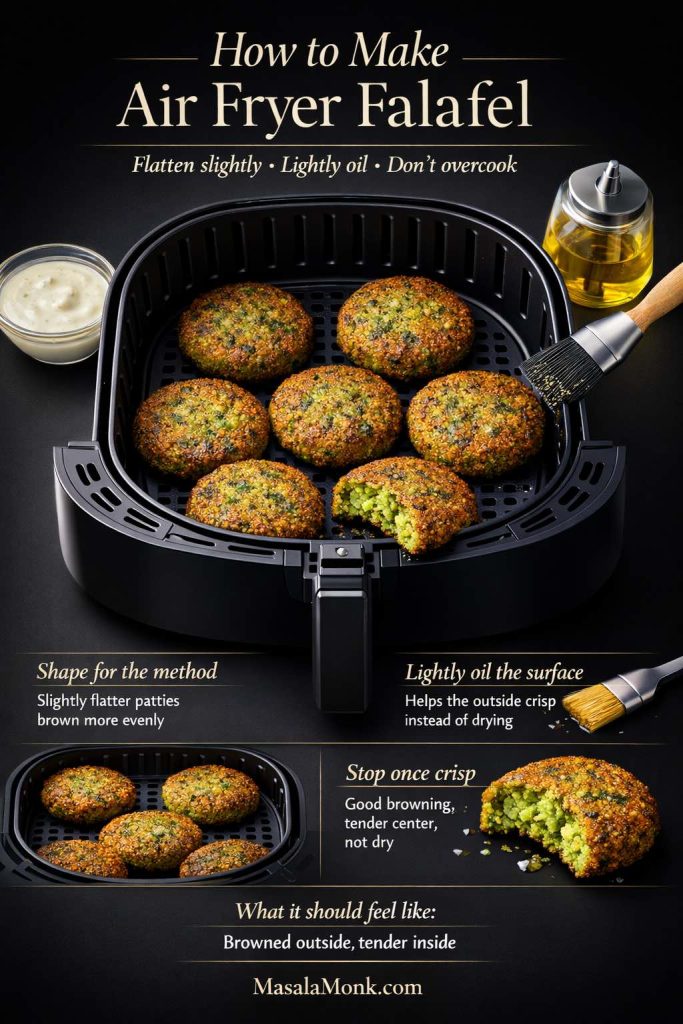
The circulating heat of the air fryer encourages the exterior to dry and color while keeping the inside relatively tender. A light brushing or spraying of oil helps enormously here. Without a little exterior fat, the surface can dry before it crisps.
Air fryer falafel works best when the shape and cooking style match the method. Slightly flatter patties brown more evenly than thick balls, a light coating of oil helps the surface crisp instead of drying out, and enough space in the basket keeps the hot air moving properly around each piece. A guide like this is useful because it shows the difference between merely cooked falafel and air fryer falafel that is browned outside, tender inside, and worth making again.
How to shape air fryer falafel
Slightly flattened patties often work best because they expose more surface area and cook more evenly. Small balls can also work, although they may need turning and a little more attention.
How to cook falafel in an air fryer without drying it out
Preheat the air fryer if your model allows it. Arrange the falafel in a single layer with space between each piece. Cook until the surface is browned and the falafel feels set, turning once if needed. Since every air fryer behaves a little differently, it helps to watch the first batch closely rather than trusting one exact minute count.
How to keep air fryer falafel from drying out
There are several ways. Use enough herbs so the interior stays lively. Do not over-process the mixture. Do not make the patties too small. Lightly oil the exterior. Most importantly, stop cooking as soon as they are crisp rather than pushing for a darker shade at the expense of tenderness.
Baked falafel is sometimes dismissed too quickly, usually because people expect it to behave exactly like fried falafel. It does not. Still, when approached on its own terms, it can be delicious, practical, and surprisingly satisfying.
What a baked falafel recipe does well
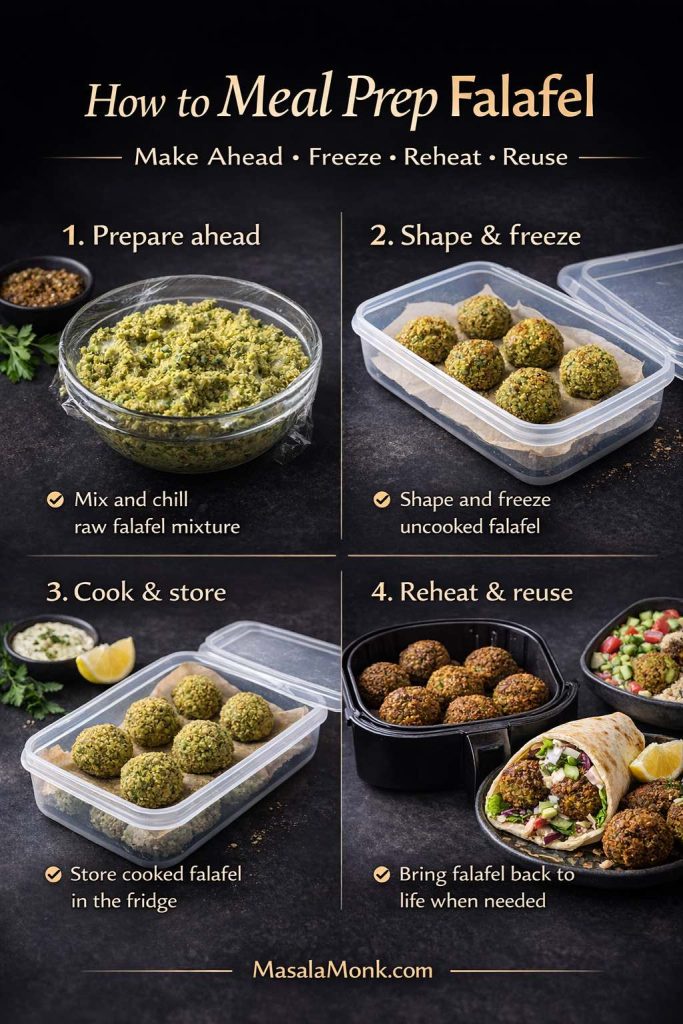
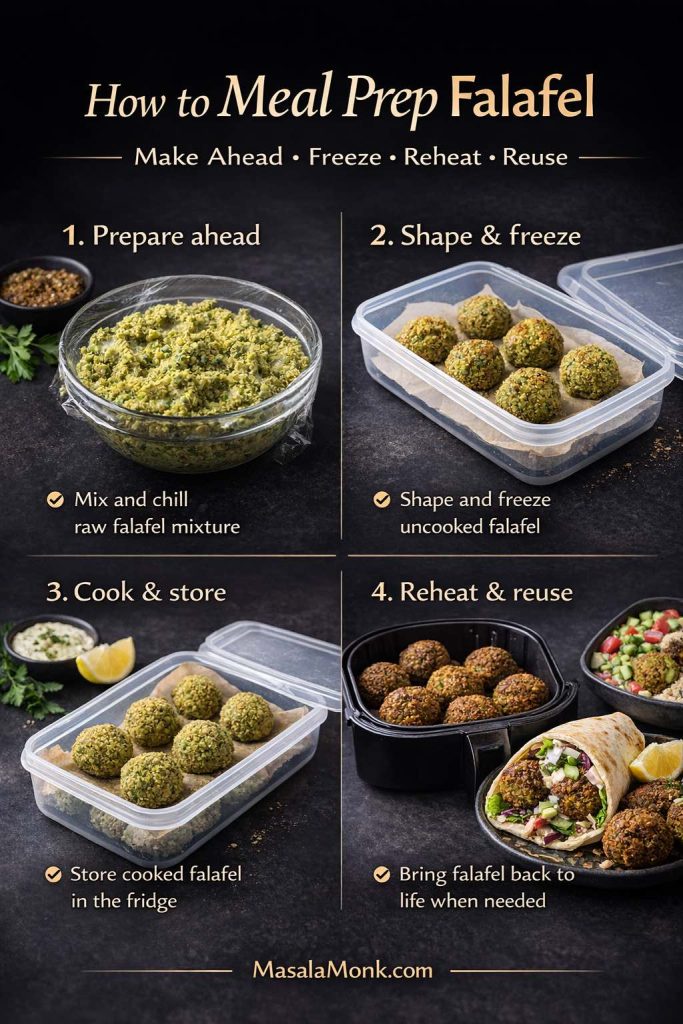
Baked falafel has several practical advantages. Larger batches are much easier to manage in the oven, and the process is notably less messy than frying. It also suits make-ahead cooking particularly well. Better still, baked falafel reheats nicely, which makes it a strong option for lunchboxes, grain bowls, and easy weeknight wraps.
Baked falafel works best when the shape, tray setup, and expectations all match the method. Flatter patties brown more evenly than thick balls, a lightly oiled tray and brushed tops help build better color, and turning partway through makes the finished falafel feel more balanced on both sides. A card like this is worth saving because it shows how baked falafel can stay practical, flavorful, and meal-prep-friendly without pretending to be the same as deep-fried falafel.
How to bake falafel so it stays crisp and tender
Use a hot oven. Place the falafel on a lightly oiled tray or parchment. Brush or spray the tops with a little oil. Patties rather than thick balls usually bake more evenly. Turn them partway through so both sides color well.
What baked falafel tastes like
The crust is gentler, and the overall result is slightly drier than deep-fried falafel, though not unpleasantly so when the mixture itself is well balanced. In fact, baked falafel often shines most when served with generous sauces, crunchy vegetables, and warm bread or grains.
When a baked falafel recipe is the smart choice
When you want a healthy falafel recipe, when you are feeding more people at once, or when you want leftovers that hold up well the next day. It may not be the purest expression of the dish, yet it is one of the most practical.
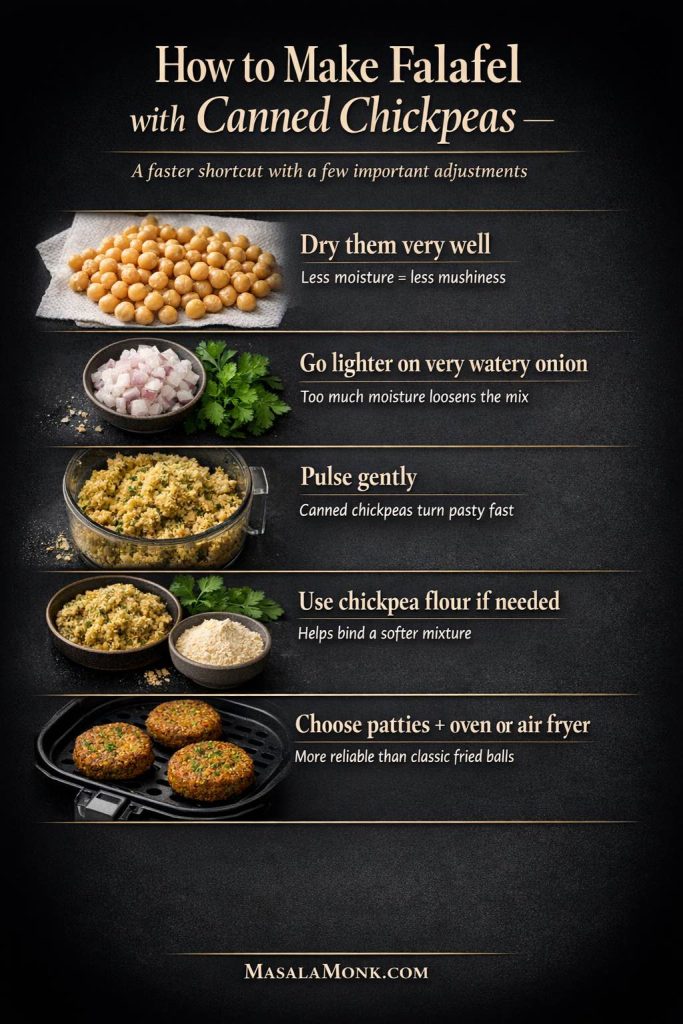
Since many cooks still want a canned chickpea falafel option, it is worth setting out a practical approach.
Use 2 cans of chickpeas, drained and dried very thoroughly. Reduce the onion slightly if you know yours is especially watery. Pulse carefully, because canned chickpeas go from chunky to mushy fast. Use chickpea flour a little more readily than you would in the dried-chickpea version. Prefer patties rather than balls. Then cook in the oven or air fryer rather than expecting the mixture to behave exactly like traditional fried falafel.
Canned chickpeas can still make a workable falafel, but they need gentler handling than soaked dried chickpeas. Drying them thoroughly, keeping watery onion in check, pulsing carefully, and using chickpea flour sooner all help prevent the mixture from turning soft and pasty. Leaning toward patties and choosing the oven or air fryer usually gives the most reliable shortcut version when you want falafel without the overnight soak.
Tips for canned chickpea falafel
Dry the chickpeas as thoroughly as you can. Pat them dry with a clean towel if needed. Do not over-process. Chill the mixture before shaping. Use a binder sooner rather than later if the mix seems soft. Keep expectations honest and shape for the method rather than for tradition.
Why canned chickpea falafel turns mushy
Because the chickpeas are already cooked. They are softer, more hydrated, and easier to turn into paste. Once that happens, the interior loses the airy, crumbly quality that makes falafel feel so good. The goal, therefore, is not to make canned chickpeas behave like dried ones. The goal is to get the best possible shortcut version from the ingredient you have.
Will it be identical to an authentic falafel recipe made with soaked dried chickpeas? No. Can it still be tasty, crisp in places, and absolutely worth eating in a pita with salad and sauce? Certainly.
This is one of the classic falafel frustrations, and it nearly always comes down to structure and moisture.
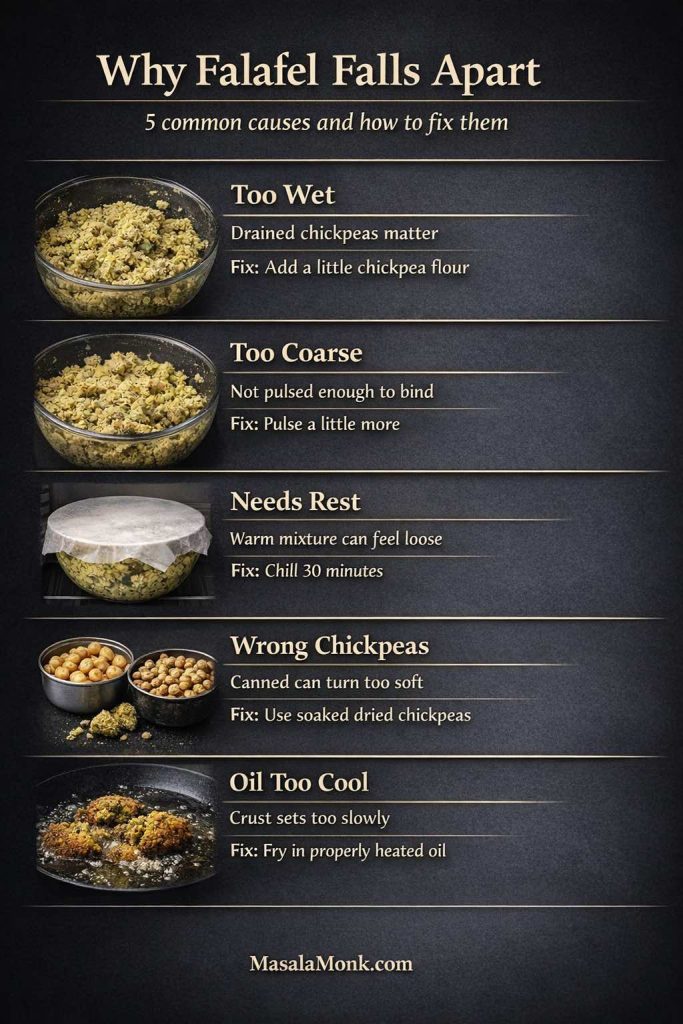
When falafel falls apart, the problem is usually not random. Most batches fail because the mixture is too wet, too coarse to bind, not rested long enough, made with chickpeas that are too soft, or fried before the oil is properly hot. Catching the real cause early makes the fix much easier, whether that means draining better, pulsing a little more, chilling the mixture, switching to soaked dried chickpeas, or waiting for the oil to come up to temperature.
The mixture may be too wet
Extra water from poorly drained chickpeas, very watery onion, or excessive herbs can all loosen the mixture. If the mix feels sticky and sloppy rather than cohesive, it needs help. A spoonful of chickpea flour can make a real difference.
The mixture may be too coarse
If the ingredients have not been pulsed enough, they may not bind. Falafel should not be puréed, but it does need enough processing for the particles to catch and hold together when pressed.
The mixture may need rest
Resting the mixture in the fridge gives it time to firm up. If shaping feels difficult, a half-hour of chilling often improves things.
The chickpeas may be the issue
Canned chickpeas are more prone to creating a softer mix that struggles in hot oil. That is one reason why so many cooks prefer dried chickpeas for a true homemade falafel recipe.
The oil may be part of the problem
If you are frying, oil that is not hot enough can weaken the structure before the exterior sets. Consequently, the falafel may seem as though it lacks binding when the real issue is that the crust never had a chance to form quickly enough.
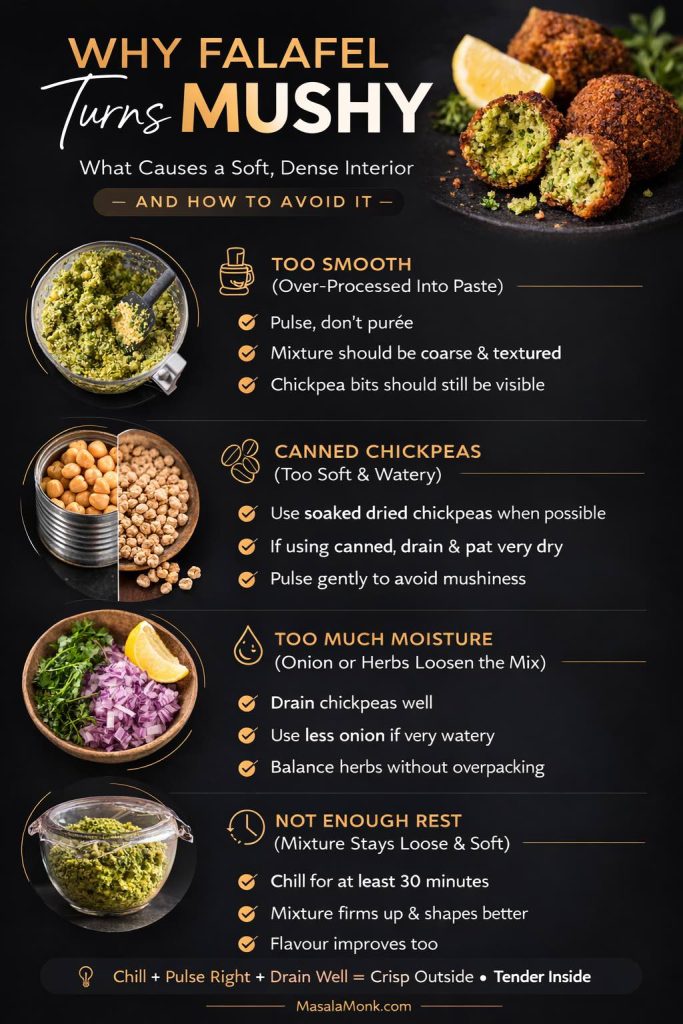
Mushy falafel is usually a sign that the mixture lost too much structure before it ever reached the pan or oven.
One common culprit is over-processing. Once chickpeas become a smooth paste, the interior tends to lose that delicate, crumbly quality. Another frequent cause is over-reliance on canned chickpeas. Since they are already cooked, they are easier to reduce to something dense and creamy.
Mushy falafel usually starts before the mixture ever reaches the pan, oven, or air fryer. The most common causes are processing the mixture too far, using chickpeas that are too soft, letting too much moisture from onion or herbs loosen the mix, or skipping the resting time that helps it firm up. Fixing those early texture problems is what gives falafel its crisp exterior and tender, structured center instead of a soft, dense interior.
Too much onion can also play a role, as can insufficient resting time. In some cases, falafel that looks mushy after cooking was not actually undercooked; it was simply too wet and too smooth going in.
The simplest prevention is this: start with soaked dried chickpeas, pulse rather than blend, drain everything well, and chill the mixture before shaping.
How to Build More Flavor into a Homemade Falafel Recipe
Even when the texture is right, falafel can disappoint if it tastes muted. Fortunately, that is one of the easiest problems to fix.
Falafel can be technically correct and still taste flat, which is why flavor-building matters as much as texture. More herbs give the center a fresher, livelier character, confident seasoning keeps chickpeas from tasting dull, and the raw mixture should already smell aromatic before it ever gets cooked. Once the falafel reaches the plate, sauce, salad, pickles, and bread are not extras so much as the final layer that makes the whole meal feel balanced, bright, and complete.
Use enough herbs
A pale falafel interior often points to not enough parsley and cilantro. The herbs do not merely add freshness. They shape the identity of the dish.
Season assertively
Chickpeas are mild. Onion and herbs mellow as they cook. Salt, cumin, coriander, and garlic all need to be generous enough to remain clear in the finished falafel.
Smell the raw mixture carefully
You cannot eat it in the same carefree way you might taste a dressing, but you can smell it and assess the seasoning in that sense. Does it smell aromatic and warm? Or does it smell mostly like wet chickpeas? Your nose gives a useful clue.
Think about the whole plate
Falafel often sits alongside tahini, yogurt sauce, salad, pickles, hummus, and bread. The main falafel mixture should therefore be flavourful in its own right, but it does not need to carry the entire meal alone. Balance across the plate matters.
Best Falafel Sauce Ideas for Wraps, Bowls, and Pita
Falafel without sauce can still be good. And then falafel with the right sauce becomes a complete meal.
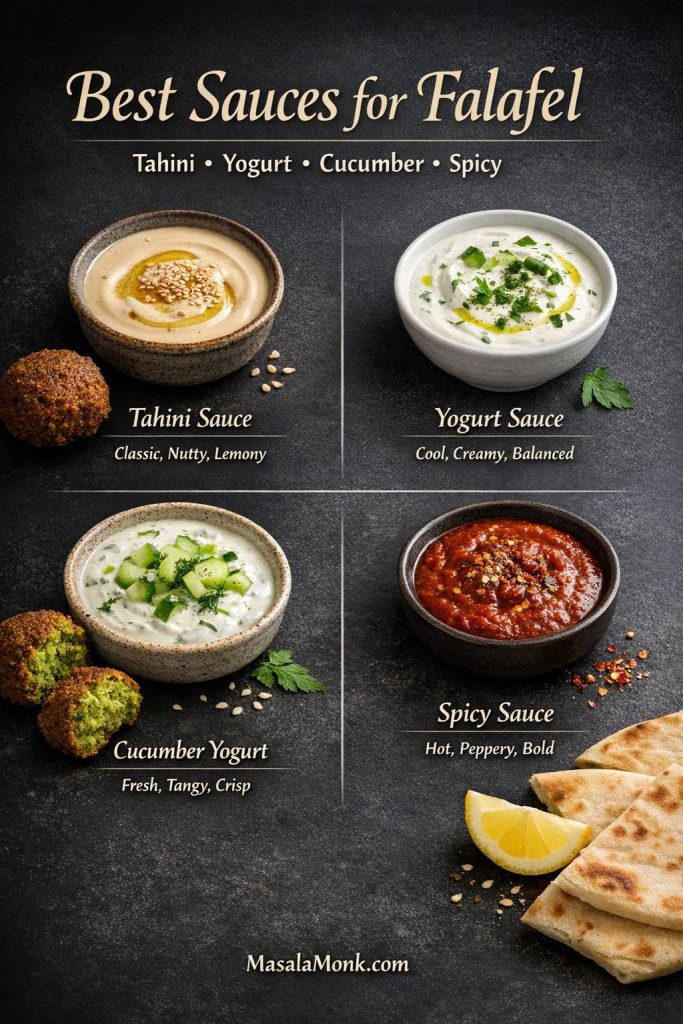
The right sauce changes falafel from good to complete. Tahini brings the classic nutty, lemony richness that most people expect, yogurt sauce adds cool creaminess, cucumber yogurt sauce feels especially fresh in wraps and summer plates, and a spicy sauce gives the whole meal more edge. Choosing the sauce that matches the kind of falafel plate you want is one of the easiest ways to make the recipe feel more personal and more satisfying.
Tahini sauce for falafel
This is the classic partner for falafel. Tahini mixed with lemon juice, garlic, water, and salt creates a sauce that is creamy yet bright. Its slight bitterness and richness work beautifully against the crisp shell and herb-forward center.
Yogurt sauce for falafel
A cool yogurt sauce offers a different kind of balance. It softens the warmth of cumin and coriander and pairs especially well with pita, salad, and crunchy vegetables. A cucumber-based version is even better on warm days. That is one reason why this Greek tzatziki sauce guide fits so naturally alongside falafel.
Cucumber yogurt sauce for falafel
If you want something especially fresh, a cucumber yogurt sauce is hard to beat. It brings coolness, moisture, and tang, all of which make it excellent for wraps and summer platters.
Creamy dairy-free options
If you want something richer without dairy, a tahini-forward mayo or a vegan herb sauce can be excellent. For readers who enjoy that style, the ideas in these vegan mayo variations can be adapted into very good sandwich and wrap sauces.
Spicy sauces
Falafel also welcomes heat. Harissa, chilli sauce, or a spicy yogurt dressing can shift the whole plate in a livelier direction. The warmth of the falafel base gives these sauces something solid to lean against.
How to Serve Falafel in Pita, Wraps, Bowls, and Platters
One of falafel’s greatest strengths is how easily it slides into different meals. A batch made in the afternoon can become lunch, dinner, and leftovers the next day without feeling repetitive.
Falafel becomes far more versatile once you stop thinking of it as only a pita filling. It works just as well tucked into a wrap, layered over grains or greens in a bowl, or spread across a platter with hummus, salad, bread, and dips for a more generous meal. Seeing the four main serving directions side by side makes it easier to choose the version that fits your mood, your meal, and how much time you want to spend assembling the plate.
Falafel in pita bread
This is the classic arrangement for good reason. Warm pita, falafel, chopped tomato, cucumber, onion, herbs, tahini sauce, and perhaps a few pickles create a balance of crisp, creamy, bright, and warm. It feels complete in a way that many simple sandwiches do not.
Falafel wrap ideas
Wraps offer a slightly more flexible version of the same idea. Flatbread, lavash, or even tortillas can work if you are using what you have. Layer in lettuce, crunchy vegetables, sauce, and perhaps a spoonful of hummus. If you enjoy this lunch-friendly direction, plant-based sandwich inspiration and chickpea meal prep ideas make useful companions.
Falafel bowls for lunch or meal prep
For a lighter or more meal-prep-friendly route, serve falafel over rice, bulgur, couscous, quinoa, or greens. Add chopped vegetables, pickles, hummus, and sauce. A bowl can feel hearty or fresh depending on what you add, and it is an excellent home for air fryer falafel or baked falafel. If you like this format, this vegan bowl idea shows how satisfying sauce-and-grain bowls can be even outside a Mediterranean flavour profile.
Falafel platter
There is also something especially inviting about serving falafel as part of a broader spread. Place it alongside hummus, chopped salad, pickled onions, olives, warm bread, yogurt sauce, and a few herbs. Suddenly a simple chickpea preparation becomes the center of a table. That broader serving style connects naturally with your own guide to what to eat with hummus, which includes pairings that can sit comfortably beside falafel as well.
Falafel with playful twists
Once the classic version is secure, it can also be fun to explore other directions. Your post on falafel with Indian twists opens up a more inventive path without losing the core appeal of the dish.
This pairing deserves special mention because it is one of the most satisfying ways to serve falafel. Falafel brings crispness, warmth, and structure. Hummus brings creaminess, earthiness, and a soft counterpoint. Add pickles, lemon, chopped salad, and bread, and suddenly the plate has everything it needs.
Falafel and hummus work so well together because each one brings what the other lacks. Falafel adds crispness, warmth, and structure, while hummus adds creaminess, richness, and a softer counterpoint that makes the whole plate feel more complete. Add bread, salad, olives, or something tangy on the side, and the pairing turns into one of the easiest ways to build a generous, deeply satisfying falafel meal.
What makes falafel and hummus work so well is contrast. One is crisp, the other smooth. One is herb-forward, the other mellow. And then one is hot, the other can be room temperature or cool. Together, they make each other better.
That is also why this pairing works across formats. It can be part of a platter, spread inside a wrap, spooned into a bowl, or layered into pita bread. It feels generous, complete, and deeply comforting without being complicated.
Falafel is rich enough to appreciate something fresh and cooling on the side. Since the plate often includes tahini, hummus, bread, salad, and spice, a drink with brightness and lift feels especially welcome.
Falafel feels best with drinks that refresh the plate instead of weighing it down. Jal jeera brings tang, mint, and spice that echo the meal beautifully, a mint lemon cooler adds brightness and lift, and a cucumber-herb drink keeps everything feeling crisp and cooling. Pairings like these work especially well with tahini, hummus, salad, and warm bread because they cut through richness without fighting the flavors on the plate.
A minty, tangy option like jal jeera works surprisingly well, particularly in hot weather. Its cumin, mint, and citrus notes echo some of the aromatic qualities in the meal without competing with them. For a more playful summer table, a chilled mint-forward mocktail can also fit, though falafel rarely needs anything too sweet beside it.
In general, the most natural drink pairings are refreshing rather than rich. Think lemon, herbs, mint, cucumber, and cooling acidity rather than cream-heavy beverages.
Is Falafel Healthy? Fried vs Air Fryer vs Baked Falafel
Falafel occupies an interesting space in the kitchen because it can feel both hearty and wholesome at the same time. Much of that comes from its base. Chickpeas are a legume, and legumes are valued for protein, fiber, folate, iron, and other useful nutrients. If you enjoy reading more about the nutritional side of ingredients, both USDA FoodData Central and the NIH Office of Dietary Supplements glossary offer broad, reliable context around foods like chickpeas and legumes.
Falafel can fit into very different kinds of meals depending on how it is cooked and what it is served with. Fried falafel gives the deepest crust and the most classic result, air fryer falafel feels lighter while still browning well, and baked falafel is especially practical for batch cooking and meal prep. The method changes the feel of the plate, but balance still depends on the sauces, vegetables, and sides that come with it.
That said, whether falafel feels especially light or more indulgent depends on the method and the company it keeps.
Fried falafel is richer. Air fryer falafel and baked falafel are lighter. A pita packed with sauce can feel very different from a bowl of greens, chopped vegetables, and tahini. A platter with hummus, pickles, salad, and warm bread can be both nourishing and abundant.
The better way to think about healthy falafel is not by trying to strip it of pleasure. Instead, think in terms of balance. Use plenty of herbs. Do not under-season the mixture. Choose the method that fits your needs. Pair it with vegetables and sauces that add freshness rather than heaviness alone.
Why this is naturally a vegan falafel recipe
The falafel itself is usually vegan, because it is built from chickpeas, herbs, spices, onion, and garlic. The main thing to watch is what you serve with it. Tahini sauce keeps the whole meal vegan. Yogurt sauce, naturally, does not. Accordingly, vegan falafel is often less about changing the falafel itself and more about choosing the right accompaniments.
Why falafel is often gluten free
Falafel can also be gluten free, provided the binder and accompaniments cooperate. Chickpeas, herbs, and spices are naturally gluten free. If a recipe needs help holding together, chickpea flour is usually the easiest gluten free option. The falafel itself may be gluten free even when the pita is not.
Falafel Recipe Variations: Green, Spicy, Mini, and Breakfast Falafel
Once the base technique feels familiar, falafel becomes an invitation to explore.
Once the base falafel recipe feels familiar, small changes can take it in very different directions. More parsley and cilantro create a greener, fresher version, chilli or harissa adds heat, smaller balls make falafel more platter-friendly, and serving it with eggs and yogurt turns it into a savory brunch plate. Seeing the variation, the tweak, and the payoff together makes it much easier to decide which version fits the mood of the meal.
Green falafel
Increase the herb ratio for a brighter, more vivid interior. This version feels particularly fresh in wraps and bowls.
Spicy falafel
Add green chilli, red chilli flakes, or a little harissa to the mixture or the accompanying sauce. The chickpeas soften the heat nicely.
Mini falafel
Shape smaller balls for platters, snack boards, or party spreads. These are especially useful if you want falafel as part of a larger mezze table.
Falafel pockets
Stuff pita pockets with chopped salad, tahini, and smaller falafel pieces. This works well for packed lunches because the filling stays more contained.
Breakfast falafel
While not a traditional breakfast dish everywhere, falafel can be excellent in the morning with eggs, chopped tomatoes, yogurt sauce, herbs, and warm bread. The savory, spiced character suits a relaxed brunch surprisingly well.
Falafel and hummus
This pairing deserves mention again because it is so satisfying. Falafel with hummus, pickles, vegetables, and bread offers creamy, crisp, tangy, and earthy elements all in one plate. If you want more ideas in that direction, the pairings in what to eat with hummus make an easy extension.
Falafel is one of the smartest foods to batch once you know the fundamentals.
Falafel becomes much more useful once you treat it as a meal prep base instead of a one-time recipe. The mixture can be made ahead and chilled, shaped falafel can be frozen for later, cooked falafel stores well in the fridge, and the oven or air fryer is the best way to bring back texture when it is time to eat. That flexibility is part of what makes homemade falafel such a smart repeat recipe for wraps, bowls, and quick lunches through the week.
Prepare the mixture ahead
The raw mixture can be made and chilled in advance, which makes shaping and cooking much easier the next day. This is especially helpful if you are using dried chickpeas and want to spread the work out.
Shape and freeze
You can shape falafel and freeze it on a tray before transferring it to a container. Later, you can fry, bake, or air fry smaller portions without starting from scratch.
Cook and store
Cooked falafel keeps well in the fridge for a few days. It is excellent for quick lunches when tucked into wraps or bowls with fresh vegetables and a sauce.
Reheat the right way
The oven or air fryer is the best route for reviving texture. The microwave softens the crust, which is not ideal unless speed matters more than crispness.
Build flexible meals around it
This is where falafel becomes especially useful. One batch can become pita sandwiches one day, bowls the next, and a snack plate later in the week. Because the base is so adaptable, meal prep rarely feels repetitive.
neutral oil for frying, or a little oil for brushing
This homemade falafel recipe card brings the core recipe into one saveable reference: yield, prep notes, ingredient list, and a compact method, all paired with the crisp shell and tender green center the post is aiming for. It is especially useful once you are ready to cook, because it turns a long guide into a quicker working version you can pin, screenshot, or revisit without hunting through every section again.
Step-by-Step Method for this Falafel Recipe
Soak the dried chickpeas in plenty of water overnight or up to 24 hours. Drain well.
Add the chickpeas, onion, garlic, parsley, cilantro, cumin, coriander, salt, and pepper to a food processor.
Pulse until the mixture is finely chopped and holds together when pressed, but do not purée it.
If needed, add chickpea flour to help bind. Pulse briefly again.
Chill the mixture for at least 30 minutes.
Shape into balls or patties.
Fry in hot oil until deeply golden, or cook in an air fryer or hot oven until crisp and cooked through.
Serve hot with tahini sauce, yogurt sauce, pita, salad, and pickles.
A Few Serving Menus Built Around the Falafel Recipe
Sometimes the easiest way to picture a recipe is to see how it can shape a full meal.
One of the best things about falafel is how easily one batch can turn into very different meals. It can stay simple for a quick weekday lunch, become a packed office bowl or box, expand into a generous dinner platter, or shift into a lighter summer spread with wraps and cooling sides. Seeing those menu directions together makes the recipe feel more flexible, more practical, and easier to use in real life.
A simple weekday lunch
Air fryer falafel, chopped cucumber and tomato, tahini sauce, and warm pita.
The Small Decisions That Improve a Falafel Recipe the Most
Once you have made falafel a few times, you begin to notice that the biggest improvements often come from surprisingly small adjustments.
The biggest improvements in falafel usually come from details that seem minor at first. Drying the chickpeas properly, using enough herbs, stopping the food processor at the right moment, chilling before shaping, and matching the shape to the cooking method all make a noticeable difference to texture and flavor. A guide like this is useful because it turns scattered tips into a short set of choices that can quietly improve every future batch.
Drying the chickpeas well matters. Using enough herbs matters. Stopping the food processor a little earlier matters. Chilling the mixture matters. Choosing patties for the oven and balls for frying matters. Serving the falafel while still warm matters. Adding enough sauce and crunch on the plate matters.
These are not glamorous insights, yet they are what turn a decent falafel recipe into one that becomes part of your regular cooking rhythm.
It is also worth saying that confidence changes the result. The first time, you may second-guess the texture, the seasoning, or the shape. The second time, you will already know more. The third time, you will make small decisions more naturally. Falafel rewards repetition in a very tangible way.
Some recipes are enjoyable once and then forgotten. Falafel rarely belongs to that category. It tends to become more useful the more often you make it. The first time, you are learning the texture. The second time, you are refining the seasoning. The third time, you are already deciding whether the batch should become pita sandwiches, bowls, or a platter for friends.
That repeatability is part of what makes falafel so lovable. It adapts easily without losing the qualities that make it recognisable in the first place. A batch can become a quick lunch, a casual dinner, or the centerpiece of a table meant for sharing. On some days it leans more traditional; on others it takes on a slightly more flexible role. You can fry it for maximum crispness, air fry it for convenience, or bake it for meal prep, yet the heart of the dish remains the same: chickpeas, herbs, aromatics, spice, and that irresistible contrast between crust and center.
A good falafel recipe, then, is not only about one successful meal. It is about opening the door to many meals that follow naturally from the same set of ingredients.
Falafel rewards care, though it does not demand fussiness. If you soak dried chickpeas, pulse the mixture to the right texture, season with confidence, and choose a cooking method that suits the meal you want, you are already most of the way there.
A good falafel recipe gets much easier once the biggest decisions are clear. Start with soaked dried chickpeas, aim for a coarse mixture instead of a paste, adjust quickly if the mix is crumbly or too wet, and match the shape to the cooking method for better results. Once the texture is right, the final meal becomes easy to build with the right sauce and serving format, which is why a guide like this works well as a quick reference before making falafel again.
From there, the process stops feeling like effort and starts feeling like pleasure. One meal might see the falafel tucked into pita with salad and tahini, while the next turns it into a bowl with grains and pickles. It can sit beside tzatziki, pair beautifully with hummus, or anchor a fuller spread of sauces, vegetables, and bread. Some batches are worth keeping classic, whereas others invite a spicier, greener, or more playful variation the next time around.
What matters most is that the falafel feels alive. Crisp outside. Tender inside. Fragrant with herbs. Warm with spice. Worth making again.
And once you have that, you do not simply have a homemade falafel recipe. You have one of the most versatile, satisfying, and generous chickpea dishes a home kitchen can offer.
Falafel is usually made from chickpeas or fava beans, along with onion, garlic, parsley, cilantro, cumin, coriander, salt, and pepper. In many homemade versions, chickpeas are the main base, especially in a classic chickpea falafel recipe. Some variations also use a little chickpea flour or baking powder to improve texture. Although the ingredient list is fairly simple, the balance of herbs, aromatics, and seasoning is what gives falafel its distinct flavor.
2. What is falafel, exactly?
Falafel is a savory Middle Eastern dish made by grinding soaked legumes with herbs, aromatics, and spices, then shaping the mixture into balls or patties and cooking it until crisp outside and tender inside. It is often served in pita, wraps, bowls, or on a platter with salad and sauce. As a result, falafel can work as a snack, lunch, or full meal depending on how it is served.
3. How do you make falafel from scratch?
To make falafel from scratch, start by soaking dried chickpeas until they are plump but still firm. After that, pulse them with onion, garlic, herbs, and spices until the mixture is finely chopped and holds together when pressed. Then chill the mixture, shape it, and fry, bake, or air fry it. The key is to pulse rather than puree, because that keeps the texture light instead of pasty.
4. Do you need dried chickpeas for an authentic falafel recipe?
Traditionally, yes. An authentic falafel recipe is usually made with dried chickpeas that have been soaked but not boiled. That method creates a mixture with better texture and structure, which helps the falafel stay crisp outside and tender inside. By contrast, canned chickpeas are much softer, so they tend to produce a denser result.
5. Can you make falafel with canned chickpeas?
Yes, you can make falafel with canned chickpeas, though the texture will be different. Since canned chickpeas are already cooked, they are softer and wetter than soaked dried chickpeas. Because of that, canned chickpea falafel can turn mushy or dense if the mixture is over-processed. Even so, it can still work well for a quicker homemade falafel, especially in baked or air fryer versions.
6. Why does falafel fall apart?
Falafel usually falls apart when the mixture is too wet, too coarse, or not rested long enough before cooking. Occasionally, canned chickpeas are the reason, since they create a softer mixture that may struggle to hold shape. In other cases, the issue is simply that the ingredients were not pulsed enough. Chilling the mixture and adding a small amount of chickpea flour, if needed, often helps.
7. Why is my falafel mushy instead of crisp?
Mushy falafel usually happens when the chickpeas are too soft, the mixture is too wet, or the food processor turns everything into a paste. Canned chickpeas can cause this more easily than soaked dried chickpeas. Likewise, overcrowding an air fryer or baking tray can prevent the exterior from crisping properly. For better results, keep the mixture textured, drain ingredients well, and give each piece enough space while cooking.
8. How do you make falafel crispy?
For crisp falafel, start with the right texture in the mixture. It should be finely chopped and cohesive, not smooth. Then chill it before shaping. Fried falafel usually gives the crispiest shell, although air fryer falafel can also turn out very well if lightly oiled and spaced properly. In the oven, shaping flatter patties instead of thick balls helps create more surface area for browning.
9. Is air fryer falafel good?
Yes, air fryer falafel can be very good when made carefully. While it does not have exactly the same crust as deep-fried falafel, it still develops a nicely browned exterior and keeps the inside tender. For many home cooks, air fryer falafel is the best balance between convenience, lighter cooking, and satisfying texture. It is especially useful for weeknight dinners and meal prep.
10. How do you cook falafel in an air fryer?
To cook falafel in an air fryer, shape the mixture into small patties or compact balls, lightly oil the outside, and arrange them in a single layer with space between each piece. Then cook until browned and crisp, turning if your air fryer needs it. Since machines vary, it is best to check the first batch closely. Generally, air fryer falafel works best when the basket is not crowded and the falafel is not too thick.
11. Is baked falafel worth making?
Absolutely. Baked falafel does not taste exactly like fried falafel, yet it can still be delicious. It is particularly useful for larger batches, meal prep, and lighter meals. Moreover, baked falafel reheats well and works beautifully in bowls, wraps, and lunchboxes. A hot oven, a lightly oiled surface, and flatter patties all help improve the final texture.
12. Is falafel healthy?
Falafel can be part of a healthy meal, especially when made with plenty of herbs and served with vegetables, hummus, yogurt sauce, or tahini. Chickpeas bring fiber and plant-based protein, which makes falafel filling and satisfying. Naturally, fried falafel is richer than baked or air fried falafel, so the cooking method changes the overall feel of the meal. Even then, falafel can still fit easily into balanced vegetarian eating.
13. Is falafel vegan?
Most classic falafel recipes are vegan because they are made from chickpeas or fava beans, herbs, spices, and aromatics. That said, it is always worth checking the binder or sauce being served alongside it. The falafel itself is often vegan, whereas yogurt sauce or certain accompaniments may not be.
14. Is falafel gluten free?
Falafel can be gluten free, though it depends on the recipe. Chickpeas, herbs, and spices are naturally gluten free, but some recipes use flour as a binder. If you want gluten free falafel, chickpea flour is one of the easiest alternatives. Accordingly, it is always a good idea to check the ingredients if you are cooking for someone who avoids gluten.
15. What sauce goes best with falafel?
Tahini sauce is the classic choice for falafel. Its creamy, nutty, lemony flavor pairs beautifully with the crisp shell and herb-filled center. Still, falafel also works very well with yogurt sauce, tzatziki, spicy sauces, or even a creamy garlic dressing. The best option depends on whether you want the meal to feel more classic, cooling, or bold.
16. What do you serve with falafel?
Falafel goes well with pita, wraps, chopped salad, hummus, tahini sauce, pickles, yogurt sauce, slaw, and grain bowls. It can be the centerpiece of a simple lunch or part of a larger mezze-style spread. Depending on the occasion, you can serve it in pita bread, over rice or couscous, or alongside fresh vegetables and dips.
17. Can falafel be made ahead of time?
Yes, falafel is excellent for make-ahead cooking. You can prepare the mixture in advance and chill it until you are ready to shape and cook it. Alternatively, you can shape the falafel and freeze it for later. Cooked falafel also stores well, which makes it useful for quick lunches and easy dinners throughout the week.
18. Can you freeze falafel?
Yes, falafel freezes very well. In fact, one of the best ways to do it is to freeze the shaped, uncooked falafel first on a tray, then transfer it to a container once firm. That way, you can cook only as much as you need later. Cooked falafel can also be frozen, though freshly cooked falafel usually gives the best texture.
19. How do you reheat falafel so it stays crisp?
The best way to reheat falafel is in the oven or air fryer. That helps the outside crisp up again instead of turning soft. A microwave will warm it quickly, but it usually softens the crust. Therefore, if texture matters, the oven or air fryer is the better choice.
20. What is the difference between falafel balls and falafel patties?
Falafel balls are more traditional and are especially popular for frying. Falafel patties, on the other hand, are often easier for baking and air frying because they cook more evenly and expose more surface area to heat. The flavor is essentially the same, but the shape can affect the texture and the method that works best.
21. Can you make easy falafel at home without deep frying?
Yes, easy falafel can absolutely be made at home without deep frying. Air fryer falafel and baked falafel are both practical options, especially for home cooks who want less mess and lighter cooking. The most important thing is getting the mixture right first. Once that is in place, the cooking method becomes much easier to adapt.
22. What makes the best falafel recipe?
The best falafel recipe starts with the right chickpeas, plenty of fresh herbs, enough seasoning, and the right texture in the mixture. It should hold together well, cook up crisp outside, and stay tender inside. Beyond that, the best falafel recipe is the one that suits how you want to eat it, whether that means a traditional fried version, a homemade baked falafel, or a lighter air fryer falafel for everyday meals.
23. What is the difference between falafel and hummus?
Falafel and hummus both often begin with chickpeas, yet they become very different foods. Hummus is a smooth dip or spread, whereas falafel is a shaped mixture that is cooked until crisp. They are often served together because their textures contrast so well.
24. Can I use falafel in a wrap instead of pita?
Absolutely. Falafel works beautifully in wraps. In fact, wraps can be easier to eat than stuffed pita pockets because the filling stays more contained. Add lettuce, chopped vegetables, sauce, and hummus if you like, then roll everything tightly.
25. What herbs are best in a falafel recipe?
Parsley and cilantro are the classic herb combination. Parsley keeps the mixture fresh and green, while cilantro adds brightness and a slightly sharper edge. If you dislike cilantro, extra parsley is usually the best substitute rather than skipping herbs altogether.
26. Why is my falafel bland?
Falafel usually tastes bland when the mixture is under-seasoned or under-herbed. Chickpeas are mild, so they need enough salt, garlic, cumin, coriander, and fresh herbs to feel alive once cooked. Bland falafel is often not a structural problem at all. It is simply a seasoning problem.
27. Can I make mini falafel for a party?
Yes, mini falafel is excellent for platters and party food. Smaller pieces work especially well on mezze boards with hummus, tahini, pickles, olives, chopped salad, and warm bread. They also make it easier for guests to sample more than one sauce.
28. What is the best oil for frying falafel?
A neutral oil with a suitable frying profile works best. You want an oil that lets the herbs, spices, and chickpeas speak for themselves rather than adding a strong flavor of its own.
29. Can falafel be part of a vegetarian meal prep plan?
Very easily. Falafel is one of the best vegetarian meal prep options because it holds well, reheats nicely in the oven or air fryer, and works in wraps, bowls, and platter-style lunches. It is filling, flexible, and easy to pair with vegetables, sauces, and grains.
30. Why does homemade falafel become a repeat recipe?
Because once you understand the texture and the method, it pays you back in many forms. One batch can become a quick lunch, a casual dinner, a platter for guests, or several meal-prep boxes across the week. It is deeply versatile, satisfying, and far more generous than its ingredient list first suggests.
At its most familiar, falafel starts with soaked chickpeas, herbs and spices, pulsed to a coarse crumb and cooked until the outside turns crisp while the middle stays tender. That basic idea fits surprisingly well into an Indian kitchen, where cumin, coriander, green chilli, ginger, amchur, chaat masala and chutneys already feel at home.
The recipes here take that starting point in six different directions. Masala Chana stays closest to classic falafel; Methi-Palak goes greener and softer; Aloo Tikki turns flat and chaat-ready; Paneer Bhurji becomes a filling rather than part of the shell; Curry Leaf brings mustard, ginger and coconut chutney into the picture; and Daal Bati deliberately leaves chickpea falafel furthest behind.
You do not need to cook them all the same way, either. Some want hot oil, one wants the broad crust of a frying pan, two sit happily in an appe/paniyaram pan, and the Daal Bati version belongs in the oven.
If you already know what sounds good, use the first column to jump straight to that recipe. If not, the texture and cooking method usually make the decision easier.
Earthy, firm and rustic with a cracked bati-like crust
Bake
Green chutney, onion, lemon, ghee
What Makes a Good Falafel Base?
For the Masala Chana, Methi-Palak, Paneer-Stuffed and Curry Leaf recipes, begin with dried chickpeas soaked in plenty of cold water for 8–12 hours or overnight in the refrigerator. Drain and rinse well before using. The Aloo Tikki version is different on purpose: cooked chickpeas suit the softer potato-based texture we want there.
Dry ingredients before adding more flour. Wet chickpeas or greens lead to more besan, and more besan can make falafel dense. This matters most with spinach: squeeze blanched palak until it feels almost surprisingly dry.
Pulse; do not purée. Falafel mixture should resemble coarse crumbs rather than hummus. A small handful may look loose in the bowl but should hold when firmly compressed.
Add besan cautiously. Start small and adjust only when the mixture genuinely needs help holding together.
For traditional falafel technique, classic serving ideas, baking and deeper air-fryer guidance, see our complete homemade falafel recipe.
1. Masala Chana Falafel
Masala Chana stays closest to familiar falafel: crisp outside, coarse within, but warmer with garam masala and cumin and a little sharper from amchur. Keep the garam masala measured so the chickpeas, coriander and garlic still come through.
Yield: about 14–16 falafel Soaking: 8–12 hours or overnight in the refrigerator Active prep: about 20 minutes Chilling: 30 minutes Cooking: about 15 minutes total, 4–5 minutes per fried batch
Ingredients
1 cup (about 200 g) dried chickpeas
½ medium onion, roughly chopped
3 garlic cloves
¾ cup loosely packed fresh coriander
1 green chilli
1 teaspoon ground cumin
1 teaspoon ground coriander
¾ teaspoon garam masala
½ teaspoon amchur
¼ teaspoon Kashmiri chilli powder, optional
1 teaspoon fine salt, or to taste
1 tablespoon besan, plus more only if needed
½ teaspoon baking powder
Neutral oil, for frying
Method
Soak the chickpeas as described above, then drain, rinse and pat away obvious surface moisture.
Add chickpeas, onion, garlic, coriander and green chilli to a food processor. Pulse in short bursts until the mixture resembles coarse crumbs.
Transfer to a bowl and mix in cumin, ground coriander, garam masala, amchur, chilli powder if using, salt and 1 tablespoon besan.
Squeeze a spoonful firmly in your palm. It should hold together. If it is genuinely wet or still breaks after compression, add a little more besan.
Cover and refrigerate for 30 minutes.
Stir in the baking powder, then shape into 14–16 compact balls.
Heat frying oil to about 170–175°C / 340–350°F. Fry one test falafel first. If it holds, cook the remaining falafel in small batches for about 4–5 minutes, until deeply golden and crisp.
Air-Fryer Option
Shape the falafel slightly flatter than perfect spheres, brush or spray the surfaces with oil and air-fry at 190°C / 375°F for about 12–15 minutes, turning halfway. Start checking early toward the end rather than relying only on the clock.
Spinach turns these falafel unmistakably green, but methi is what gives them character. Mint and coriander keep the flavour fresh, while sesame adds nuttiness and a light crust around the outside.
The important step is simple: squeeze the spinach properly dry. Not casually dry. Not “I shook the colander twice” dry. Properly dry.
Yield: about 14 small falafel Soaking: 8–12 hours or overnight in the refrigerator Active prep: about 25 minutes Chilling: 30 minutes Cooking: about 12 minutes
Ingredients
1 cup (about 200 g) dried chickpeas
60 g fresh spinach
½ cup loosely packed fresh methi leaves
½ cup fresh coriander
¼ cup mint leaves
¼ small onion
2 garlic cloves
1 green chilli
¾ teaspoon ground cumin
½ teaspoon ground coriander
½ teaspoon amchur
Tiny pinch of nutmeg, optional
1 teaspoon fine salt
1 tablespoon besan, plus more only if required
½ teaspoon baking powder
2 tablespoons white sesame seeds
Oil, for cooking
Method
Soak, drain and rinse the chickpeas as described above.
Blanch the spinach for about 30–60 seconds, just until wilted. Cool immediately, then squeeze firmly until very little liquid comes out.
Add chickpeas, squeezed spinach, methi, coriander, mint, onion, garlic and green chilli to a food processor. Pulse to a coarse green mixture rather than a paste.
Mix in cumin, ground coriander, amchur, nutmeg if using, salt and 1 tablespoon besan.
Chill for 30 minutes, then stir in the baking powder. Add a little more besan only if a firmly compressed portion will not hold.
Shape into small round falafel and lightly roll or press each one in sesame seeds.
Appe/Paniyaram Pan Method
Brush the cavities lightly with oil. Add one falafel per cavity and cook over medium to medium-low heat, rotating as each surface firms. Cook until the falafel feels firm through the centre and no longer looks wet or pasty when one is broken open, usually around 10–12 minutes for small falafel.
Air-Fryer Option
Brush or mist lightly with oil and air-fry at 190°C / 375°F for about 12–14 minutes, turning once. Check early toward the end: small green falafel can dry out quickly.
Serve with: a creamy yogurt or coconut-yogurt dip, shredded beetroot, shredded carrot, coriander and lemon. That presentation also stays true to the vivid green falafel already shown in the article.
3. Aloo Tikki Falafel Chaat
Aloo tikki pulls this variation away from classic falafel in exactly the right direction. Cooked chickpeas keep the connection, potato gives the centre its softness, and ajwain, cumin, amchur and chaat masala take it straight toward North Indian street food.
Yield: 8 medium tikkis Prep: about 25 minutes Optional chilling: 20–30 minutes Cooking: about 16 minutes total, around 8 minutes per batch
Ingredients for the Tikkis
300 g boiled potatoes, cooled completely
150 g cooked chickpeas, drained and dried well
1 green chilli, finely chopped
3 tablespoons chopped fresh coriander
¾ teaspoon roasted cumin powder
½ teaspoon ground coriander
¾ teaspoon chaat masala
½ teaspoon amchur
¼ teaspoon ajwain, lightly crushed
¼–½ teaspoon Kashmiri chilli powder, optional
¾ teaspoon salt, or to taste
2 tablespoons cornflour/cornstarch or rice flour
1–2 tablespoons besan only if additional binding is needed
Oil, for shallow-frying
Method
Use completely cooled potatoes. Coarsely crush the cooked chickpeas and mash the potatoes until mostly smooth but not gluey.
Combine potatoes and chickpeas with green chilli, coriander, cumin, ground coriander, chaat masala, amchur, ajwain, chilli powder if using, salt and cornflour.
Mix gently until the mixture holds together. Divide into eight portions and shape into broad patties about 1.5 cm thick.
If the tikkis feel very soft, refrigerate for 20–30 minutes. If they are still too fragile after chilling, work a small amount of besan into the mixture.
Heat a thin layer of oil in a heavy frying pan over medium heat.
Cook the tikkis for about 3–4 minutes on the first side without constantly moving them. Flip once a proper crust has formed, then brown the second side.
Turn Them into Falafel Chaat
For all eight hot tikkis, have ready:
1 cup plain yogurt, whisked smooth
6 tablespoons green coriander-mint chutney
4–6 tablespoons tamarind chutney
½ small red onion, finely chopped
4–6 tablespoons fine sev
4 tablespoons pomegranate arils
Chaat masala
Chopped coriander
Arrange the hot tikkis on a plate, spoon over yogurt, then add green chutney and tamarind chutney. Finish with onion, sev, pomegranate, chaat masala and coriander. Serve immediately, while the tikki is still hot and crisp underneath the cool, tangy toppings.
Air-fryer option: brush both sides with oil and air-fry at 190°C / 375°F, turning once, until browned and firm. Start checking around 12 minutes. Shallow-frying still gives the more characteristic tikki crust.
4. Paneer Bhurji-Stuffed Falafel
Paneer works better here as a surprise in the centre than blended through the chickpea mixture. Keep the shell coarse and chickpea-heavy, then tuck a dry, fragrant paneer bhurji inside so the contrast is obvious when you cut one open.
Yield: about 10–12 stuffed falafel Soaking: 8–12 hours or overnight in the refrigerator Active prep: about 30 minutes Chilling: 30 minutes Cooking: about 12 minutes total, 5–6 minutes per fried batch
For the Falafel Shell
1 cup (about 200 g) dried chickpeas
½ small onion
3 garlic cloves
½ cup fresh coriander
1 green chilli
¾ teaspoon ground cumin
½ teaspoon ground coriander
½ teaspoon garam masala
¾ teaspoon fine salt
1 tablespoon besan, plus more only if required
½ teaspoon baking powder
For the Paneer Bhurji Filling
100 g paneer, finely crumbled
1 teaspoon oil or ghee
1 teaspoon finely grated ginger
½ green chilli, finely chopped
¼ teaspoon turmeric
½ teaspoon garam masala
½ teaspoon kasuri methi, crushed
Small pinch of salt
1 teaspoon lemon juice
Method
Heat 1 teaspoon oil or ghee in a small pan. Add ginger and green chilli and cook briefly until aromatic.
Add paneer, turmeric, garam masala, kasuri methi and salt. Cook for a few minutes until fragrant and deliberately fairly dry. Remove from the heat, stir in lemon juice and cool completely.
Soak, drain and rinse the chickpeas as described above. Pulse them with onion, garlic, coriander and green chilli until coarse and crumbly.
Mix in cumin, ground coriander, garam masala, salt and 1 tablespoon besan. Refrigerate for 30 minutes.
Stir in the baking powder. If the shell mixture will not hold when firmly compressed, add a little more besan.
Take roughly 2 tablespoons of falafel mixture and flatten it in your palm. Put about 1½–2 teaspoons of cooled paneer filling in the middle.
Bring the chickpea mixture completely around the filling. Pinch any cracks closed and shape into a thick ball or slightly flattened oval. Keep the paneer completely enclosed.
Fry at about 170–175°C / 340–350°F for roughly 5–6 minutes, until the shell is deeply golden and crisp.
Serve with: soft whole-wheat roti, kachumber, pickled red onion, coriander and lemony yogurt. If you want to make the filling from scratch, our guide to making paneer at home is useful here.
5. Curry Leaf Falafel with Mustard, Ginger & Green Chilli
Curry leaves change the aroma immediately. Ginger and green chilli bring a very different sort of heat from garam masala, while cumin, coriander and a small mustard tempering push the flavour toward South Indian pulse snacks without turning the recipe into a renamed vada.
Yield: about 14 falafel Soaking: 8–12 hours or overnight in the refrigerator Active prep: about 20 minutes Chilling: 30 minutes Cooking: about 10 minutes total, 4–5 minutes per fried batch
Ingredients
1 cup (about 200 g) dried chickpeas
½ small onion
3 garlic cloves
2.5 cm / 1 inch fresh ginger
1–2 green chillies
15 fresh curry leaves
½ cup fresh coriander
½ teaspoon cumin seeds
½ teaspoon coriander seeds
¼ teaspoon black mustard seeds
1 teaspoon neutral oil, for tempering the mustard
¼ teaspoon freshly ground black pepper
Small pinch of hing, optional
1 teaspoon fine salt
1 tablespoon besan, plus more only if needed
½ teaspoon baking powder
2 tablespoons desiccated coconut, optional
Neutral oil, for cooking
Method
Soak, drain and rinse the chickpeas as described above.
Toast the cumin and coriander seeds briefly in a dry pan until aromatic. Cool, then crush roughly.
Heat 1 teaspoon neutral oil in the same small pan. Add the mustard seeds and let them crackle. Remove from the heat and cool.
Add chickpeas, onion, garlic, ginger, green chilli, curry leaves and coriander to a food processor. Pulse until coarse.
Mix through the toasted spices, cooled mustard tempering, black pepper, hing if using, salt, 1 tablespoon besan and desiccated coconut if using.
Chill for 30 minutes, then stir in baking powder. Add a little more besan only if a compressed portion will not hold.
Shape into about 14 compact falafel.
Fry at 170–175°C / 340–350°F for about 4–5 minutes, until golden and crisp.
Appe/paniyaram pan option: oil the cavities lightly and cook over medium to medium-low heat, rotating the falafel as each side firms and browns.
Serve with: coconut-coriander chutney, lemon and a few crisp fried curry leaves. The creamy coconut softens the chilli and mustard without hiding the curry-leaf aroma.
6. Daal Bati Falafel
Daal Bati is the outlier of the six, and it should be. Instead of copying the coarse chickpea interior of classic falafel, it leans into lentils, atta, ajwain and ghee. The result is firmer and more rustic, with the cracked golden surface of a tiny bati.
Yield: about 10–12 small bites Prep: about 25 minutes Resting: 15 minutes Baking: about 25 minutes
Ingredients
½ cup total dry dal, using roughly equal amounts moong dal, masoor dal and urad dal; cook and drain well, then measure 1 cup for the dough
1 cup (about 120 g) whole-wheat flour, plus more if required
2 tablespoons fine semolina/sooji
2 tablespoons melted ghee or mustard oil
½ teaspoon ajwain, lightly crushed
¼ teaspoon cumin
Small pinch of hing
1 green chilli, very finely chopped
½ teaspoon grated ginger
¼ teaspoon turmeric
¾ teaspoon salt, or to taste
Water only if required
A little additional ghee for brushing, optional
Method
Cook the ½ cup mixed dry dals until tender but not watery. Drain very thoroughly, then measure 1 cup of cooked dal for the dough. Reserve any extra.
Mash the drained dal coarsely.
Add whole-wheat flour, semolina, ghee or mustard oil, ajwain, cumin, hing, green chilli, ginger, turmeric and salt.
Bring everything together into a firm dough. If sticky, add whole-wheat flour 1 tablespoon at a time. If too dry to hold, add water 1 tablespoon at a time.
Rest for 15 minutes while the oven heats to 200°C / 400°F.
Divide into 10–12 small balls. Leave a slightly rugged surface rather than smoothing every crack away.
Arrange on a baking tray, brush lightly with ghee or oil and bake for 22–28 minutes, turning once, until browned and firm outside.
If desired, brush the hot bites very lightly with ghee as soon as they leave the oven.
Serve with: green chutney, sliced onion, carrot or cucumber and lemon wedges. Because this recipe contains atta, it is not gluten-free. If finished with ghee, it is not vegan either; mustard oil keeps the bites themselves plant-based.
Which Cooking Method Works Best?
The best cooking method changes with the mixture. A chickpea ball wants something different from a soft potato tikki or an atta-and-dal bite.
Method
Best for
What to expect
Deep-frying
Masala Chana, Paneer-Stuffed, Curry Leaf
Deepest colour and crispest falafel-style crust
Shallow-frying
Aloo Tikki
Broad golden crust with a soft potato-chickpea centre
Air fryer
Masala Chana, Methi-Palak, Aloo Tikki
Good browning with less oil; slightly drier than frying
Appe/paniyaram pan
Methi-Palak, Curry Leaf
Small rounded bites with low oil and good support while cooking
Oven
Daal Bati
Firm, rustic, bati-like crust rather than a fried falafel shell
For the chickpea-heavy versions, frying gives the clearest contrast between crisp exterior and coarse interior. For Aloo Tikki, broad contact with a hot pan is the point. Methi-Palak benefits from the support of an appe/paniyaram pan, while Daal Bati belongs in the oven. Use the method that suits the texture of each variation rather than forcing every recipe into every appliance.
More Indian Ways to Serve Falafel
Falafel Chaat
Put several hot Masala Chana or Methi-Palak falafel on a plate and lightly crack them open. Add whisked yogurt, green chutney, tamarind chutney, finely chopped red onion, chaat masala, sev, pomegranate and coriander. Assemble just before eating so the base keeps some crunch.
Falafel Pav
Split and toast pav with a little butter or oil. Spread one side with green chutney and the other with tamarind chutney. Add a slightly flattened Masala Chana Falafel, sliced onion and something crisp such as cucumber or cabbage. A little chaat masala over the filling ties it together.
Paneer-Stuffed Falafel Roti Roll
Warm a soft roti and add sliced Paneer Bhurji-Stuffed Falafel, kachumber, pickled onion, coriander and lemony yogurt. Because the paneer is already inside, the wrap does not need another heavy filling.
Indian-Style Mezze Plate
Try Masala Chana Falafel with hummus, cucumber, kachumber, pickled onions, green chutney, lemon and warm flatbread. If you are making the bread too, use our homemade pita bread recipe. For a sharper mango-pickle note, a spoonful of amba sauce fits naturally beside falafel and hummus.
Falafel Bowl
Start with rice, millet, couscous or chopped salad. Add falafel, cucumber, tomato, onion and something creamy such as hummus or yogurt. Then choose one strong Indian accent—green chutney, tamarind, achar, chaat masala or coconut chutney—rather than using every condiment at once.
Fixing These Indian Falafel Variations
Problem
Likely cause
Fix
Masala or Curry Leaf falafel breaks in oil
Mixture too wet, too loose or oil too cool
Drain thoroughly, compress firmly, fry one tester and add a little besan only if needed
Methi-Palak falafel is soggy
Spinach retained too much water
Squeeze blanched spinach much more thoroughly before processing
Paneer falafel cracks open
Wet filling, too much filling or paneer too close to the surface
Cook bhurji drier, cool completely and use a smaller amount
Aloo Tikki sticks or breaks when flipped
Turned before the crust formed
Leave it undisturbed longer and flip only when it releases more easily
Air-fried green falafel is dry
Too little surface oil or too much cooking time
Lightly oil and begin checking earlier
Daal Bati mixture is sticky
Cooked dal retained too much water
Drain longer and add atta gradually rather than dumping in a large amount
If the first chickpea falafel disintegrates, stop there. One tester is enough to tell you whether the mixture needs drying, firmer shaping or hotter oil.
Make Ahead, Store & Freeze
Masala Chana and Curry Leaf: the mixture can be prepared ahead and refrigerated, with baking powder stirred in shortly before shaping and cooking.
Methi-Palak: shorter holding is better because fresh greens continue releasing moisture as they sit.
Paneer-Stuffed: prepare the dry paneer bhurji and chickpea shell mixture separately, refrigerate them, then stuff closer to cooking.
Aloo Tikki: shape the patties, freeze in a single layer until firm, then transfer to a freezer-safe container with parchment between layers if stacking.
Daal Bati: bake, cool and refrigerate. Reheat in a hot oven or air fryer to restore the firmer exterior.
For broader freezing and reheating guidance for classic chickpea falafel, see the full falafel guide.
Indian Falafel FAQs
Can you put garam masala in falafel?
Yes. Classic falafel already uses spices such as cumin and coriander, so a restrained amount of garam masala fits naturally. In the Masala Chana version, it adds an Indian finish without masking the chickpeas and fresh herbs.
Which Indian chutney goes best with falafel?
Coriander-mint green chutney is the most versatile choice for Masala Chana, Methi-Palak and Paneer-Stuffed Falafel. Tamarind works particularly well with Aloo Tikki Falafel Chaat or falafel pav, while coconut chutney makes the most sense beside Curry Leaf Falafel.
Can I make falafel in an appe or paniyaram pan?
Yes. It is particularly useful for Methi-Palak and Curry Leaf Falafel because the cavities support the mixture while each surface cooks. Brush the cavities with a little oil and rotate the falafel as they firm and brown.
Why is my spinach falafel soggy?
Usually because the spinach contains too much water. After blanching, cool it and squeeze aggressively before adding it to the chickpeas. Removing moisture is preferable to compensating later with a large amount of besan.
Can falafel be made with moong dal?
Yes, but replacing chickpeas with another pulse changes both texture and technique. Whole or split moong can make excellent falafel-inspired fritters and patties, but it should be treated as its own formulation rather than a blind one-for-one substitution.
How do you make falafel chaat?
Put hot falafel or Aloo Tikki Falafel on a plate and add whisked yogurt, green chutney, tamarind chutney, onion, chaat masala, sev, pomegranate and coriander. Assemble just before serving so some of the crust stays crisp.
Can paneer be added to falafel?
Yes. Stuffing works particularly well because the paneer remains a distinct soft centre rather than changing the texture of the entire chickpea mixture. Keep the bhurji fairly dry and cool it completely before stuffing.
Which Indian falafel works best in an air fryer?
Masala Chana is the easiest starting point. Methi-Palak also works well, but check it early because small green falafel can dry out. Aloo Tikki can be air-fried, although shallow-frying gives the more characteristic crust. Daal Bati belongs in the oven, and frying remains the most reliable method for the stuffed paneer version.