Posted on Leave a comment

Zuppa Toscana Recipe: Creamy Olive Garden Copycat Soup

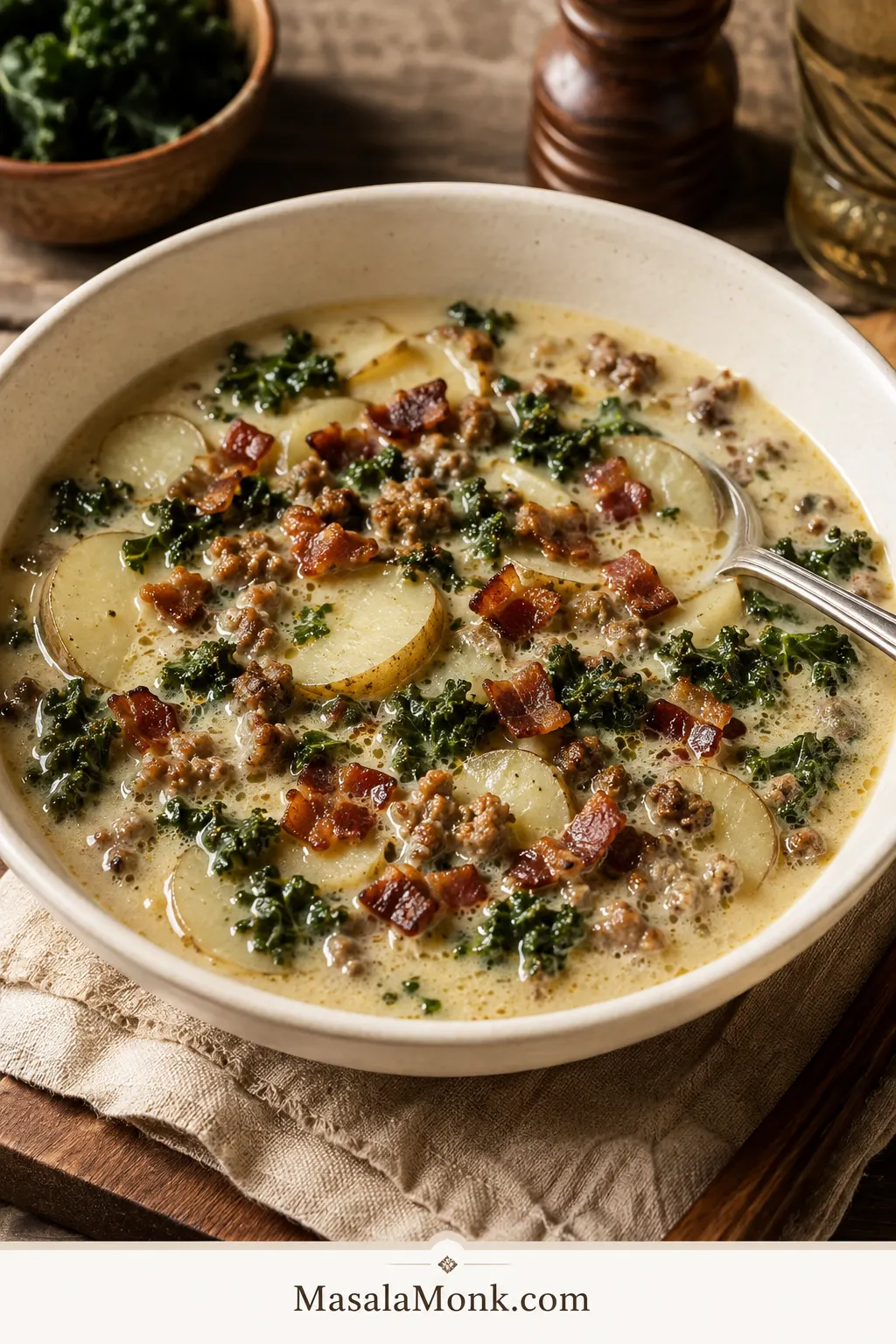
Wide ivory bowl of creamy Zuppa Toscana with thin potato slices, browned Italian sausage, curly kale and crisp bacon.

The best spoonful of Zuppa Toscana carries browned Italian sausage, a tender slice of potato, softened kale and enough creamy broth to bring everything together.

This is a one-pot, Olive Garden-style Zuppa Toscana with Italian sausage, russet potatoes, kale, bacon and creamy chicken broth. This version keeps the familiar richness without turning the broth heavy: savory first, creamy but still flowing, with tender potatoes that stay intact. You may remember the name, or simply remember it as that creamy sausage-and-kale soup from Olive Garden. Crisp bacon at the end brings a welcome crunch against the soft potatoes and creamy broth.

There is plenty of room to make it yours. Hot or mild sausage both work. Potato skins are optional. Spinach can stand in for kale. Those choices shift the flavor or texture without making the recipe fussy.

Quick Answer: How to Make Zuppa Toscana

Crisp the bacon, brown the Italian sausage and leave only a thin coating of rendered fat behind. Soften onion and garlic, then simmer evenly sliced russet potatoes in chicken broth until tender. Return the sausage, add kale, and finish with heavy cream once the greens have softened.

Remember three things: give the sausage time to brown, keep the potato pieces close to the same thickness, and add the cream near the end over gentle heat.
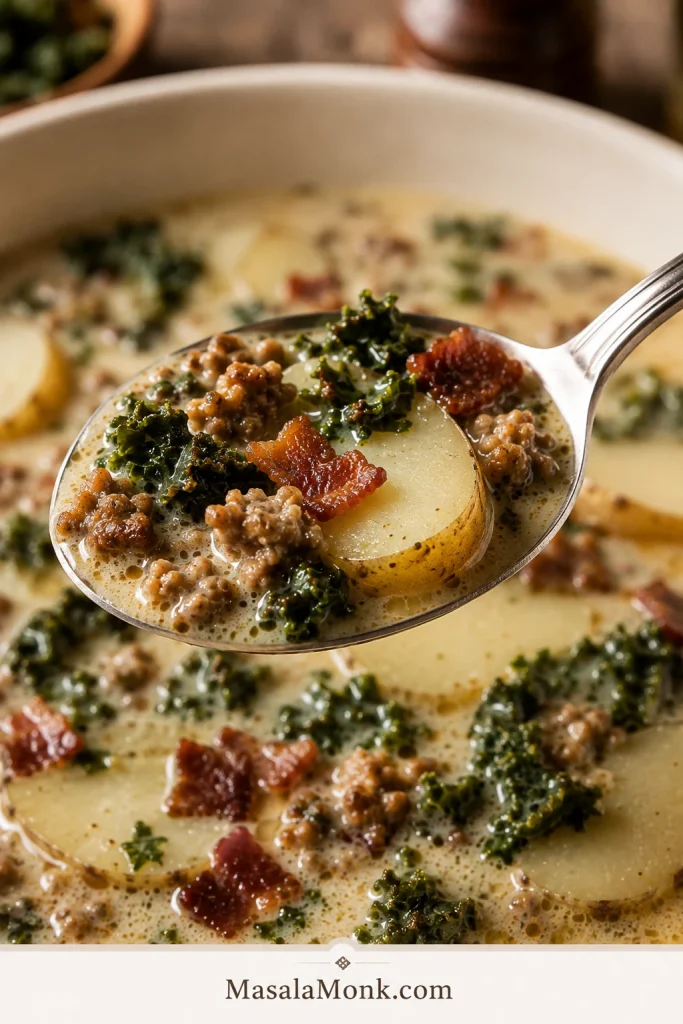
Close-up spoonful of Zuppa Toscana with sliced potato, browned sausage, curly kale, bacon and creamy broth.
A good spoonful keeps sausage, potato and kale distinct while the creamy broth ties everything together.

Zuppa Toscana Recipe

Tender russets, browned sausage and softened kale make this substantial enough for dinner, while cream rounds out the broth and crisp bacon is added at the finish.

Recipe at a Glance

Prep timeAbout 20 minutes
Cook time40–45 minutes
Total timeAbout 1 hour
MethodOne-pot stovetop
YieldRoughly 10 cups / 2.4 litres, depending on evaporation
Serves6–7 dinner portions or 10 starter portions
Pot5½–6 quart / 5.2–5.7 litre Dutch oven or heavy pot
Potato cutAbout ¼ inch / 6 mm thick
Texture targetCreamy, flowing broth; tender intact potatoes; softened kale; no oily slick

Ingredients

  • 4 oz / 113 g bacon, about 4 thick-cut slices, chopped
  • 1 lb / 454 g Italian pork sausage, hot or mild; use bulk sausage or remove the casings from links
  • 1 medium yellow onion, finely chopped, about 1 cup / 150 g
  • 4 medium garlic cloves, finely minced
  • ¼–½ teaspoon crushed red pepper flakes, optional; with hot sausage, start without them and add extra heat after tasting
  • 1½ lb / 680 g russet potatoes, scrubbed
  • 5 cups / 40 fl oz / 1.18 litres low-sodium chicken broth or stock
  • ½ teaspoon freshly ground black pepper, plus more to taste
  • ¼ teaspoon fine salt, plus more to taste
  • 4 oz / 115 g curly kale, tough stems removed and leaves chopped
  • 1 cup / 8 fl oz / 240 ml heavy cream
  • ½–1 teaspoon white-wine vinegar, optional, only if the soup still tastes heavy or flat after the salt is right
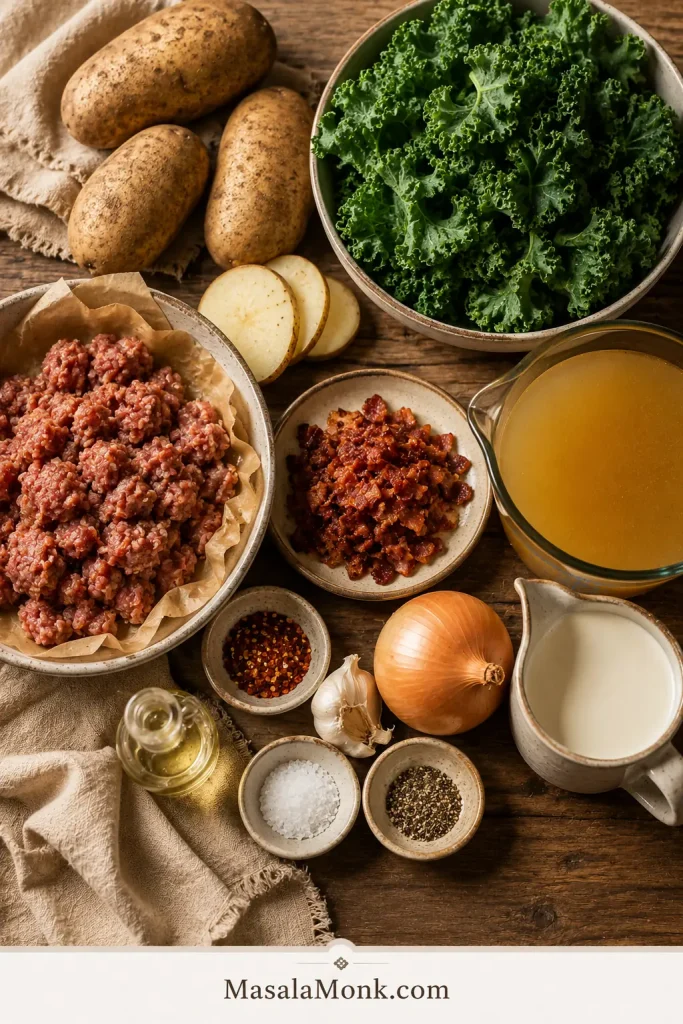
Zuppa Toscana ingredients arranged on a counter, including Italian sausage, bacon, russet potatoes, kale, onion, garlic, chicken broth, cream and seasonings.
Broth and potatoes make up most of the bowl; cream comes in at the end, so richness never has to mean heaviness.

Optional for serving: grated Parmesan and extra crushed red pepper.

Equipment

  • 5½–6 quart / 5.2–5.7 litre Dutch oven or heavy-bottomed pot
  • Slotted spoon
  • Ladle
  • Instant-read thermometer, optional

Instructions

Prep and Brown

  1. Prep the potatoes and kale. Leave the potato skins on or peel them if you prefer. Halve the potatoes lengthwise; quarter especially wide ones, then slice crosswise about ¼ inch / 6 mm thick. They do not need to be ruler-perfect—just reasonably even. Strip the tough stems from the kale and chop the leaves into spoon-friendly pieces. The pile looks generous at first, but it settles quickly in the soup.
  2. Crisp the bacon. Put the chopped bacon in the cold pot and set it over medium heat. Cook 6–8 minutes, stirring occasionally, until crisp and browned. Remove it with a slotted spoon. Leave a thin glossy coating of fat on the bottom and spoon away any obvious puddle.
  3. Brown the sausage. Increase the heat to medium-high. Add the sausage and let part of it sit against the hot surface before breaking it up. Cook 5–7 minutes, until browned and cooked through. A mix of medium and smaller crumbles works well; there is no need to make them perfectly uniform. A larger crumble should reach 160°F / 71°C if checked with an instant-read thermometer. Transfer the sausage to the plate with the bacon. If it has released a deep puddle of fat, spoon away the excess and leave only a thin coating in the pot.

Build the Broth

  1. Cook the onion and garlic. Reduce the heat to medium. Add the onion and cook 4–5 minutes, stirring and scraping up the browned bits, until softened. Add the garlic and optional red pepper flakes and cook another 30–45 seconds, just until fragrant.
  2. Simmer the potatoes. Pour in the chicken broth and scrape the bottom well so the browned bits dissolve into the liquid. Add the potatoes, black pepper and ¼ teaspoon salt. Bring to a boil, then reduce to a steady simmer. Cook 12–16 minutes, checking early. The potatoes are ready when a knife or fork passes through without meeting a chalky center and the slice holds together when lifted.
  3. Return the sausage and add the kale. Stir the sausage back in, then add the kale. Simmer 3–5 minutes, until the leaves bend easily onto a spoon. Mature kale may need another minute. Before the cream goes in, the soup will look fairly brothy—that is exactly where it should be.

Finish and Serve

  1. Finish with cream and season. Reduce the heat to low. Stir in the heavy cream and about half of the cooked bacon. Warm for 2–3 minutes. The broth will turn paler and more opaque while the sausage, potatoes and kale remain clearly visible. Taste and add more salt, black pepper or red pepper only as needed. If the salt is right but the soup tastes heavy or muted, stir in ½ teaspoon white-wine vinegar, taste, and add a little more only if the broth still needs brightness.
  2. Serve. Ladle into bowls and scatter over the remaining crisp bacon. Add Parmesan or extra red pepper at the table if you like.

Recipe Notes

  • Half-and-half: use the same starting volume. Stir a ladle of hot broth into refrigerator-cold half-and-half, then add the warmed mixture over low heat.
  • Spinach: replace the kale and add the spinach only during the final 1–2 minutes.
  • Crispier bacon: keep all of the cooked bacon out of the soup and add it only at serving.
  • Doubling: use at least an 8-quart pot and brown the sausage in batches. Double the ingredient quantities, but do not double the potato cooking time; check them by tenderness.

Before serving: give the finished pot one gentle bottom-to-top stir so the sausage and kale are evenly distributed from the first bowl to the last.
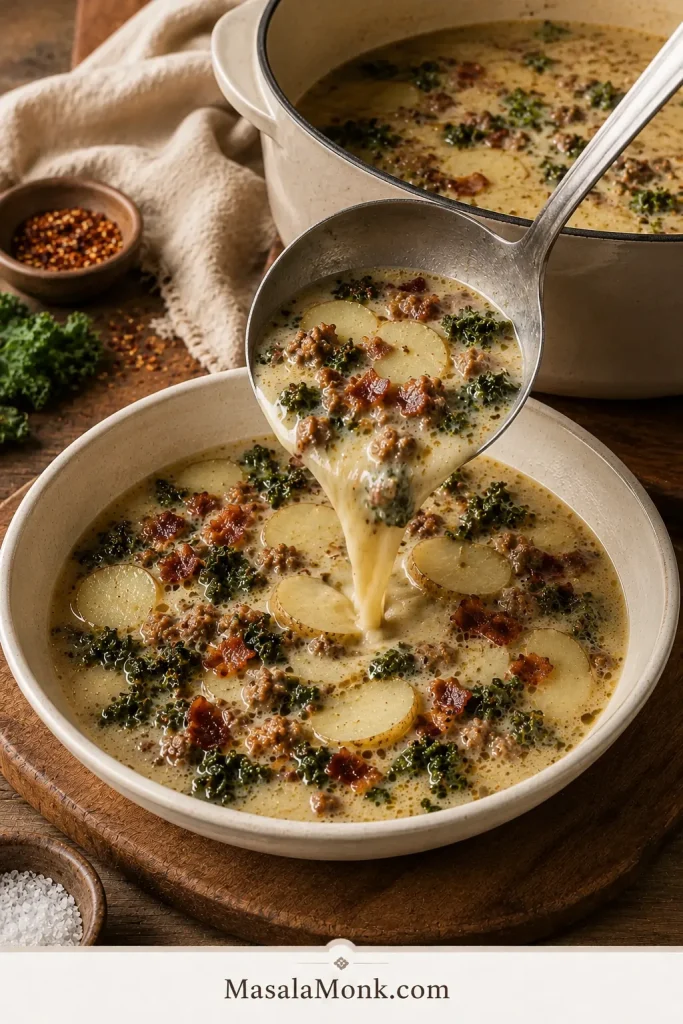
Finished Zuppa Toscana being ladled from an enameled Dutch oven into a shallow ivory bowl.

Sausage, Potatoes, Greens and Cream

Get these four ingredients right and most of the soup takes care of itself. Sausage brings much of the seasoning, potatoes add body, kale keeps some bite in the spoon, and cream rounds everything out at the end.
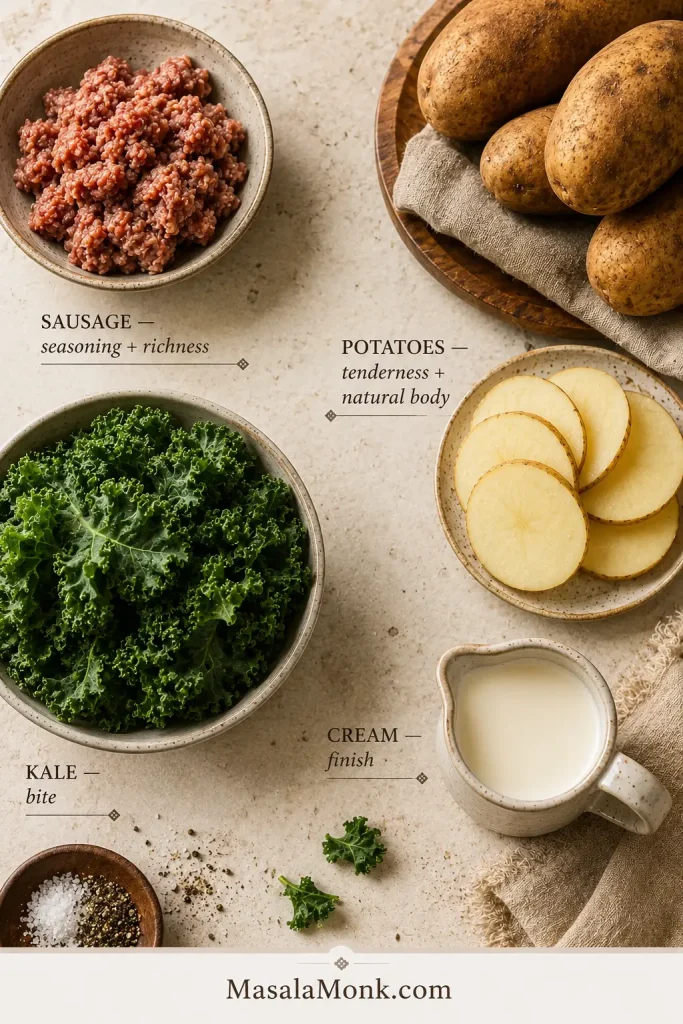
Ingredient roles guide showing Italian sausage, russet potatoes, curly kale and cream used in Zuppa Toscana.

Which Italian Sausage Is Best for Zuppa Toscana?

Most of the seasoning in this soup comes from the sausage, so hot versus mild changes more than just the heat. Hot Italian pork sausage brings more spice into the broth from the beginning; mild sausage gives you more control at the end.
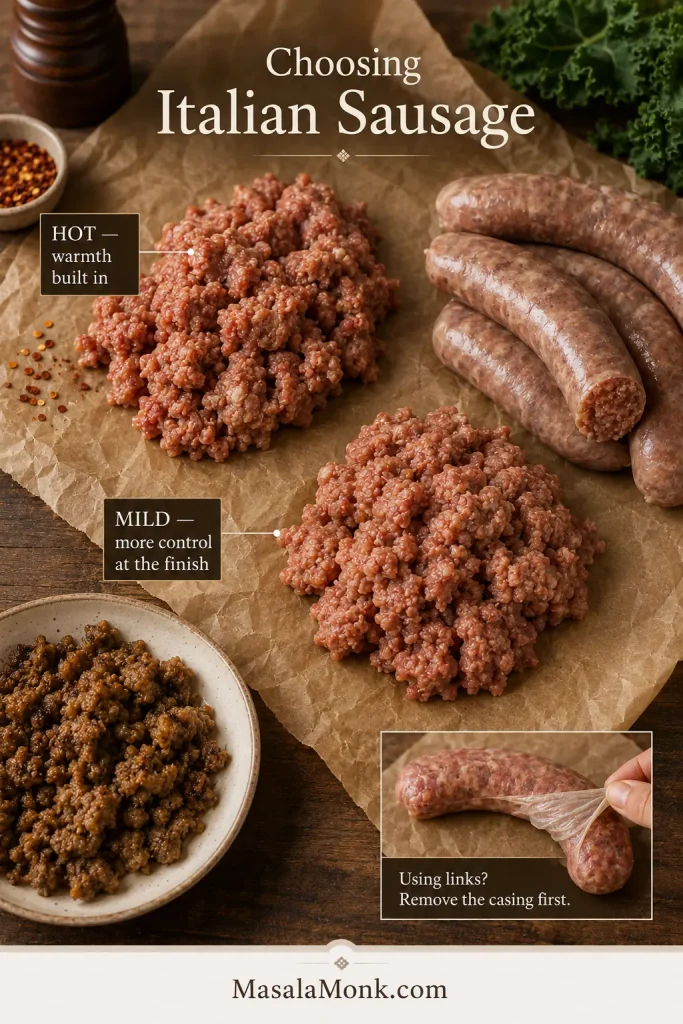
Italian sausage guide comparing hot and mild sausage and showing the casing being removed from a sausage link.

The sausage seasons the broth as it browns, so real color matters more than perfectly even crumbles. Bulk sausage is easiest, but links work just as well once the casings are removed.
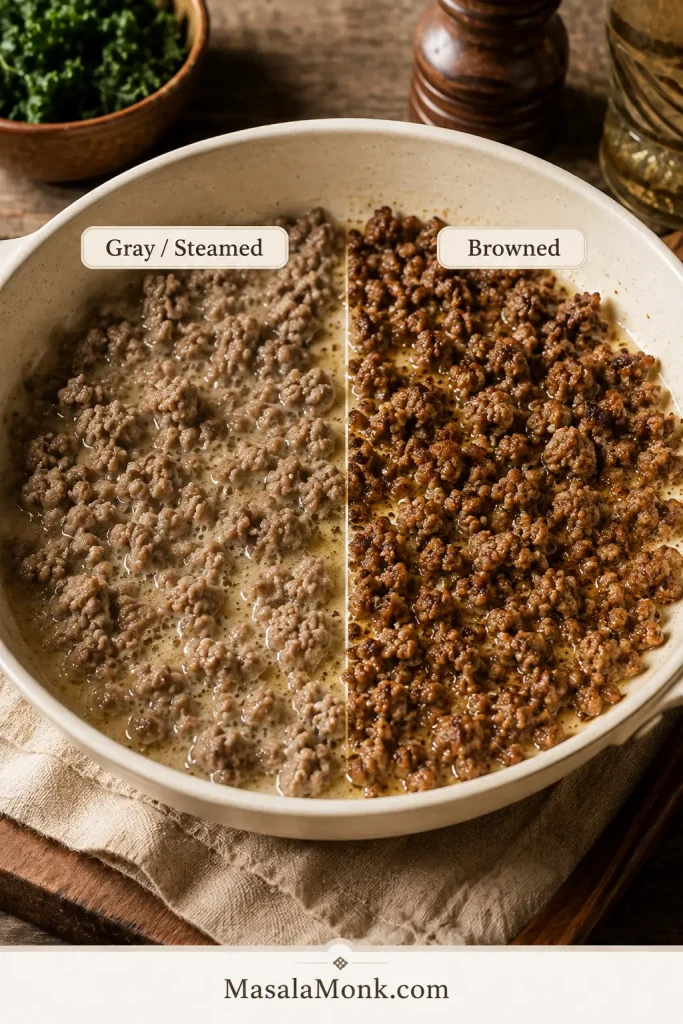
Comparison of gray steamed Italian sausage crumbles and properly browned sausage with caramelized edges.
Aim for medium and smaller crumbles with real browned edges—not uniformly gray, finely broken meat.

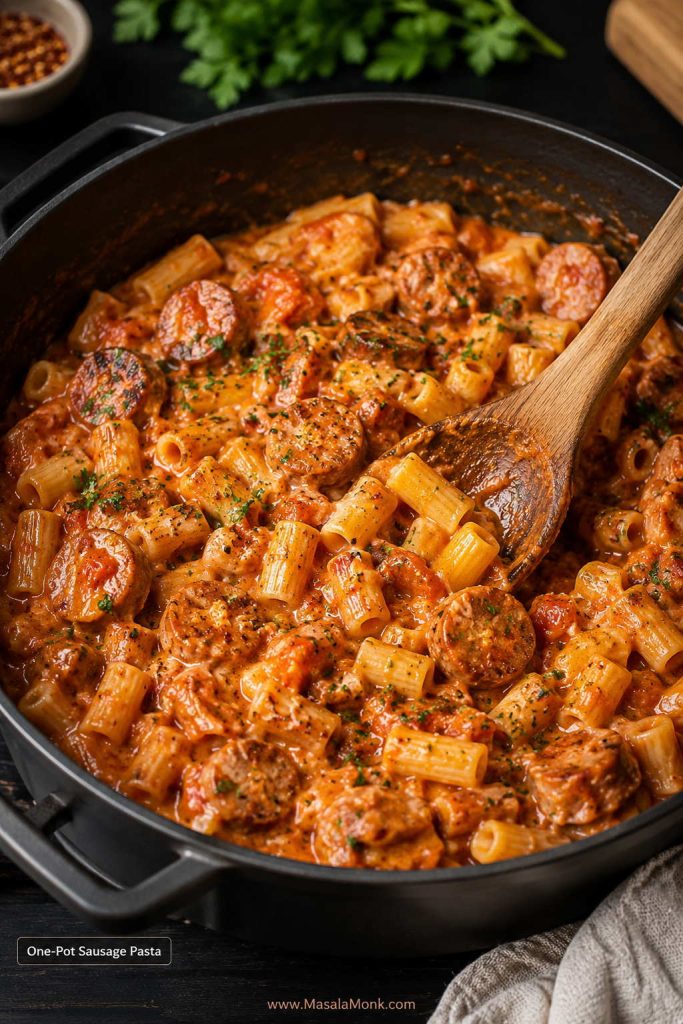
Giving sausage room to brown pays off in sausage pasta too, where those browned edges become part of the sauce rather than disappearing under it.

Best Potatoes for Zuppa Toscana—and Why the Cut Matters

Russets suit this version particularly well because their starchier edges give the broth some natural body.

Yukon Golds are a good alternative when you want firmer, tidier pieces. Russets soften more around the edges; Yukons hold their shape longer.
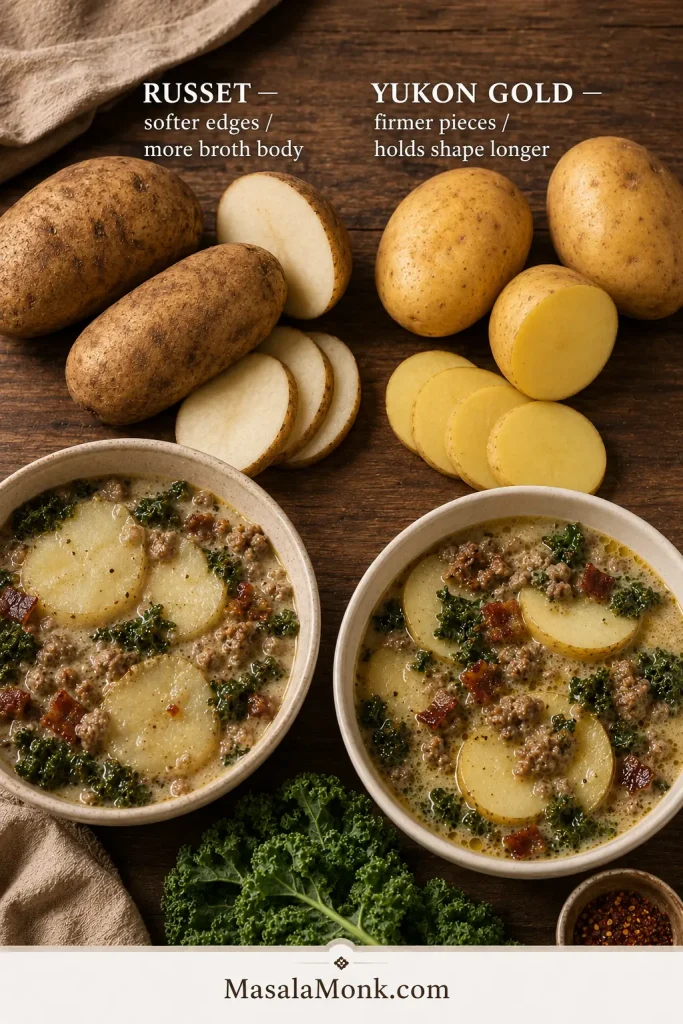
Comparison of russet and Yukon Gold potatoes with cooked slices showing softer russet edges and firmer Yukon Gold pieces.

That same difference is why russets make fluffier mashed potatoes, while Yukon Golds stay denser and naturally creamier.

The cut determines the clock. Pieces around ¼ inch / 6 mm thick cook quickly while keeping enough structure to survive the spoon.
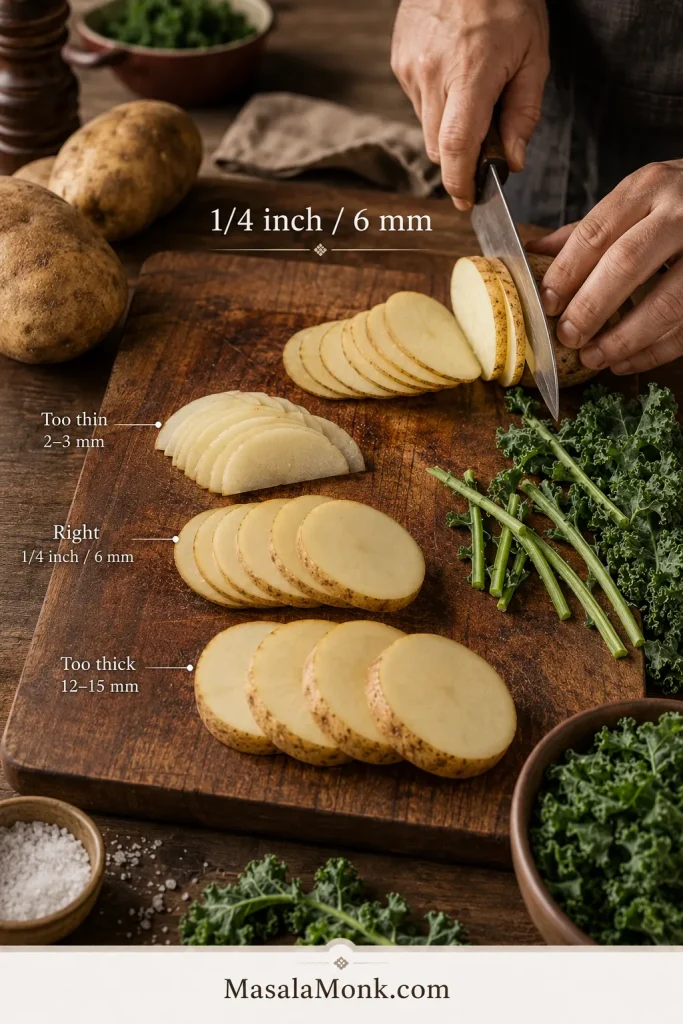
Russet potato cutting guide showing evenly sliced pieces about 6 millimetres thick beside prepared curly kale.
Keep the slices close to ¼ inch / 6 mm thick; matching thickness matters more than matching shape.

A knife should slip through without resistance while the slice stays intact when lifted.
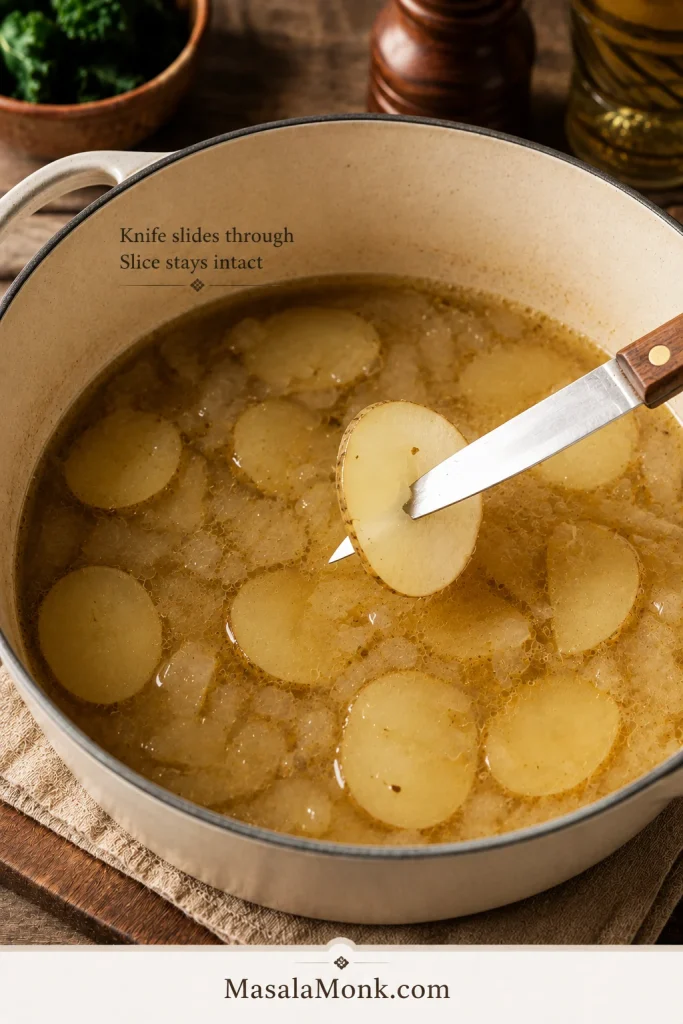
Thin russet potato slices simmering in golden broth while a knife tests one intact cooked slice.
Test one of the thickest slices. If it is tender and still intact, the smaller pieces are usually ready too.

Kale, Spinach and the Creamy Finish

Choosing Your Greens

For this soup, curly kale is the first choice. Spinach works too, but gives the bowl a much softer green.
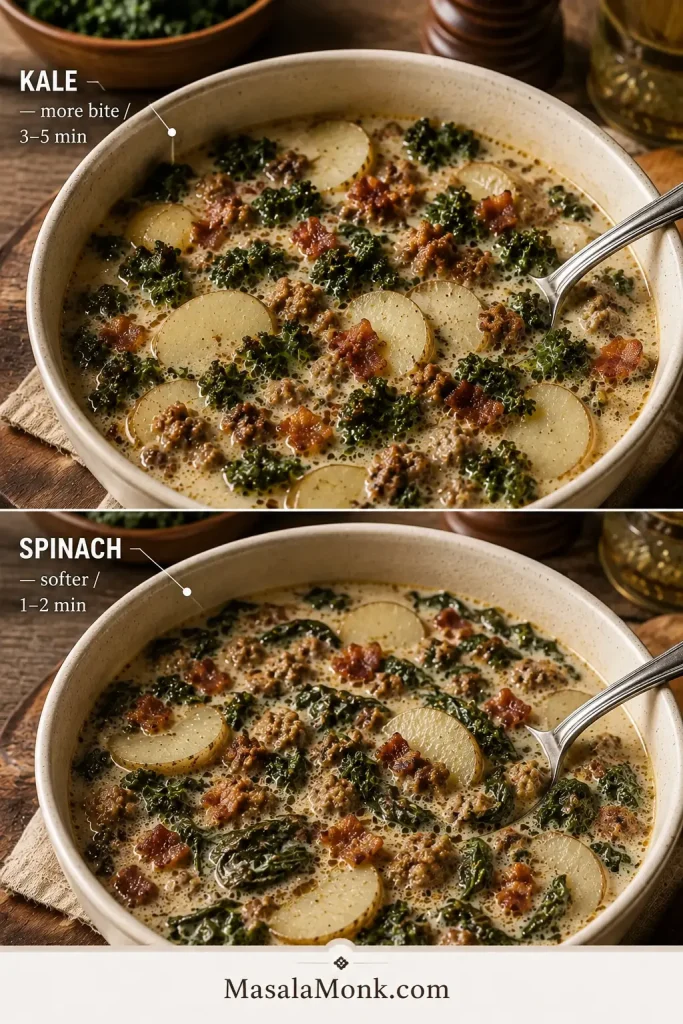
Two bowls of creamy Zuppa Toscana comparing curly kale with much softer wilted spinach.

If you prefer more bite in each spoonful, kale is the better choice. Remove the tough stems and chop the leaves small enough to sit comfortably on a spoon. Lacinato or Tuscan kale works as well and may soften faster.
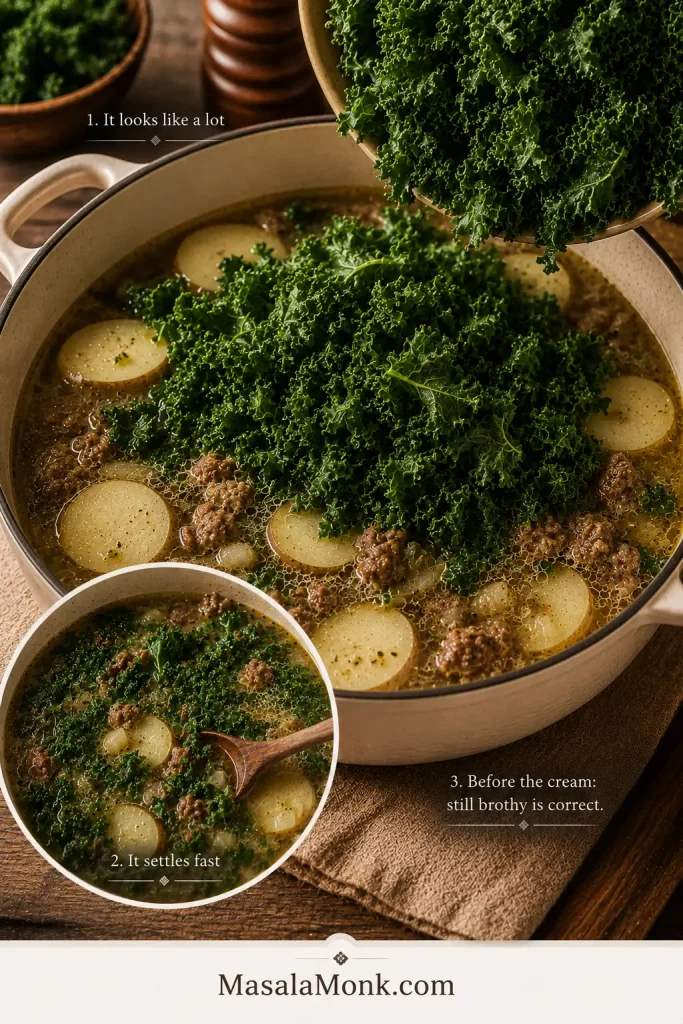
Curly kale being folded into brothy Zuppa Toscana with browned sausage and thin potato slices before cream is added.
Fold kale in by the handful so it wilts without rough stirring once the potatoes are tender.

Choosing the Cream

Heavy cream gives the richest, smoothest finish. Half-and-half is lighter, evaporated milk keeps some body with less richness, and whole milk makes the broth noticeably thinner.
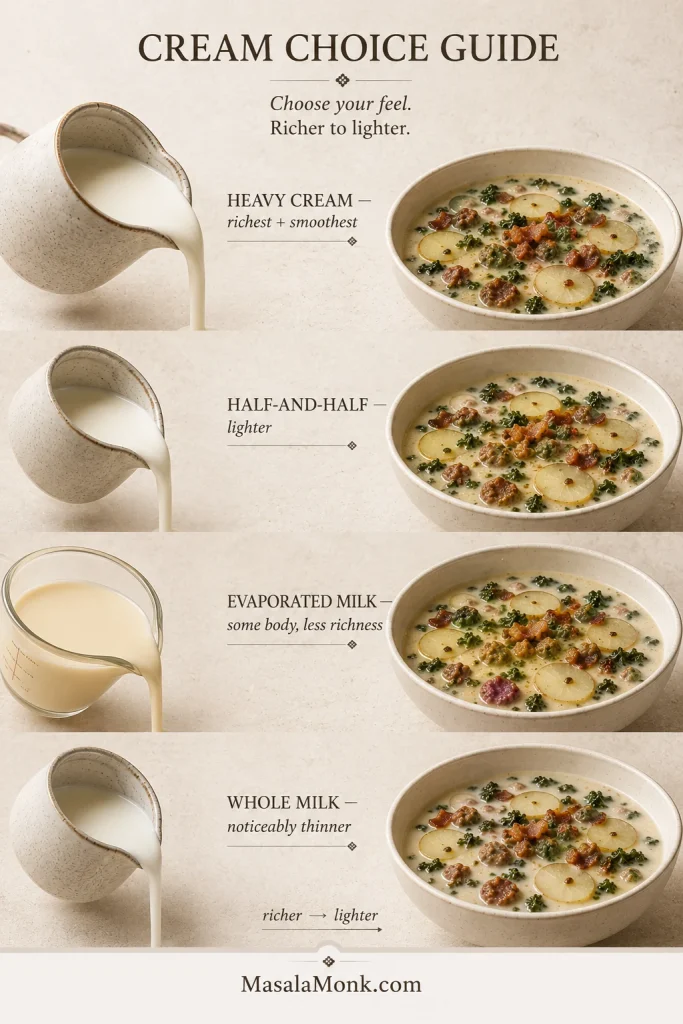
Dairy guide comparing heavy cream, half-and-half, evaporated milk and whole milk for finishing Zuppa Toscana.
Lighter dairy makes a thinner finish; let the potatoes provide more of the body rather than simply adding more dairy.

Add the dairy near the end and avoid prolonged hard boiling. Lower-fat choices benefit from gentler handling, but the goal stays simple: a creamy soup that still tastes clearly of sausage and savory broth.
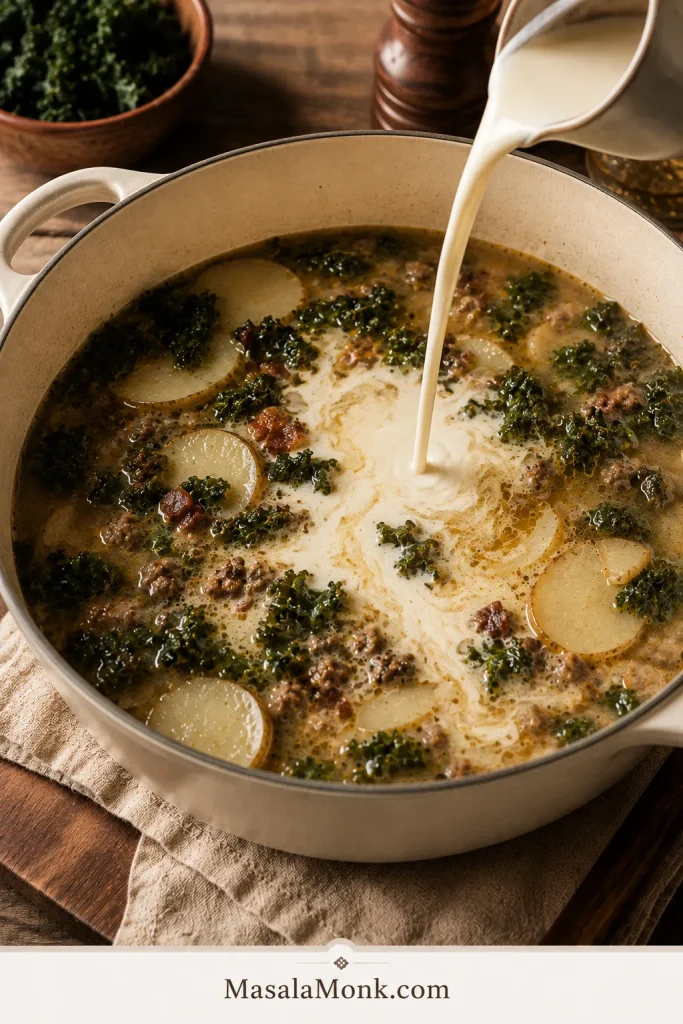
Heavy cream swirling through Zuppa Toscana and turning the broth pale around sausage, potato slices and kale.
Stir gently at the finish—the cream only needs to disperse, and tender russets can break if the pot is overworked.

Adding the cream near the end works in tomato basil soup too, keeping it smooth without muting the tomato base.

Once those choices are settled, the timer matters less than recognizing a handful of visual and tactile checkpoints.

Five Cooking Checkpoints

  • Rendered fat: a glossy bottom, no deep puddle.
  • Sausage: browned patches rather than uniformly gray crumbles.
  • Potatoes: the knife slips through and the slice stays intact.
  • Kale: the leaves bend into the spoon without leathery resistance.
  • Broth: creamy enough to coat lightly, loose enough to pour freely.
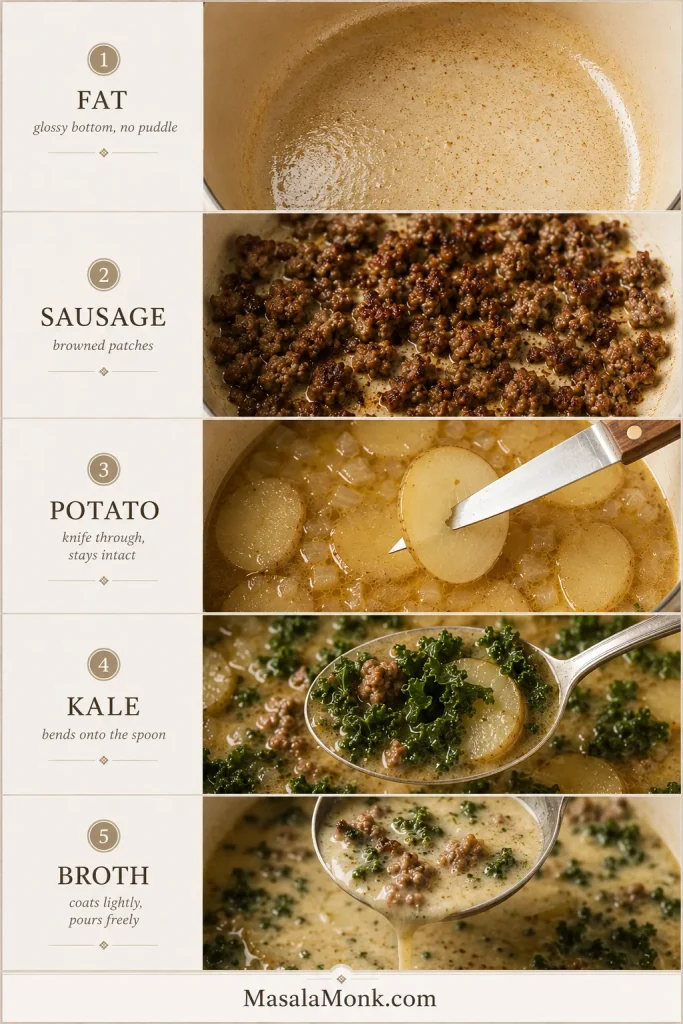
Five cooking checkpoints showing rendered fat, browned sausage, tender potato, softened kale and creamy broth flowing from a ladle.

Rendered bacon fat: after the bacon comes out, the pot should look evenly glossy rather than flooded. Tilt it briefly if you are unsure; a visible puddle means more should come out.
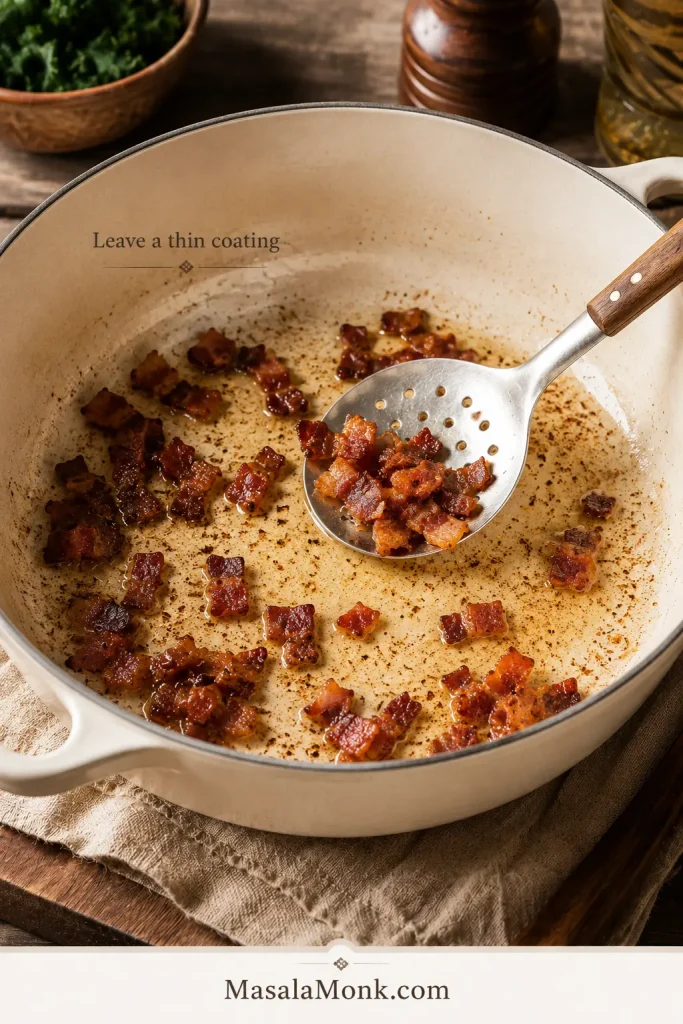
Crisp bacon removed from a pale Dutch oven with a thin glossy layer of rendered bacon fat across the bottom.

Onion, garlic and fond: soften the onion over the browned bits and scrape up what releases easily. The broth will lift the rest, so the pot does not need to look perfectly clean before you move on.
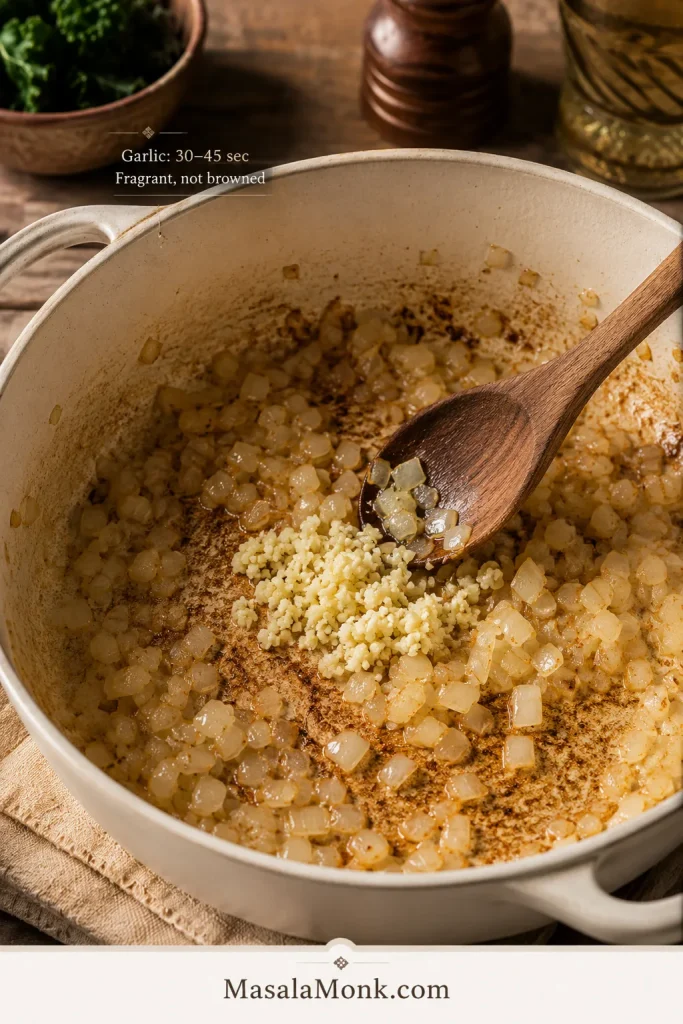
Softened chopped onion and minced garlic cooking over browned fond in the bottom of a pale Dutch oven.

Adjust the Creaminess and Seasoning

Creamy is a finish here, not a thickness category.
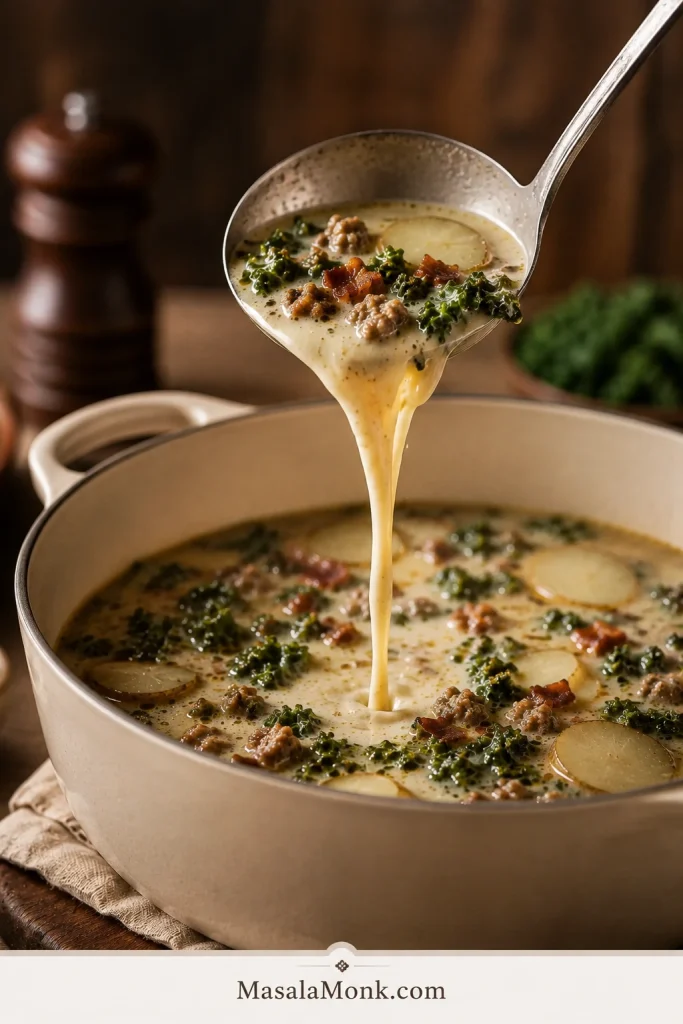
Creamy Zuppa Toscana flowing freely from a metal ladle back into the pot.
The right broth leaves a light film on the ladle and still pours freely.

If your soup looks thinner than expected after the cream goes in, give the potatoes a chance to help before reaching for a thickener. Mash two or three cooked pieces into the broth and let that starch disperse for a minute. If it is still thinner than you want, whisk together 1 tablespoon cornstarch and 1 tablespoon cold water, add half the slurry, simmer for a minute and reassess.

Too thick is easier: add warm broth in ¼-cup / 60 ml splashes until the ladle moves easily again.
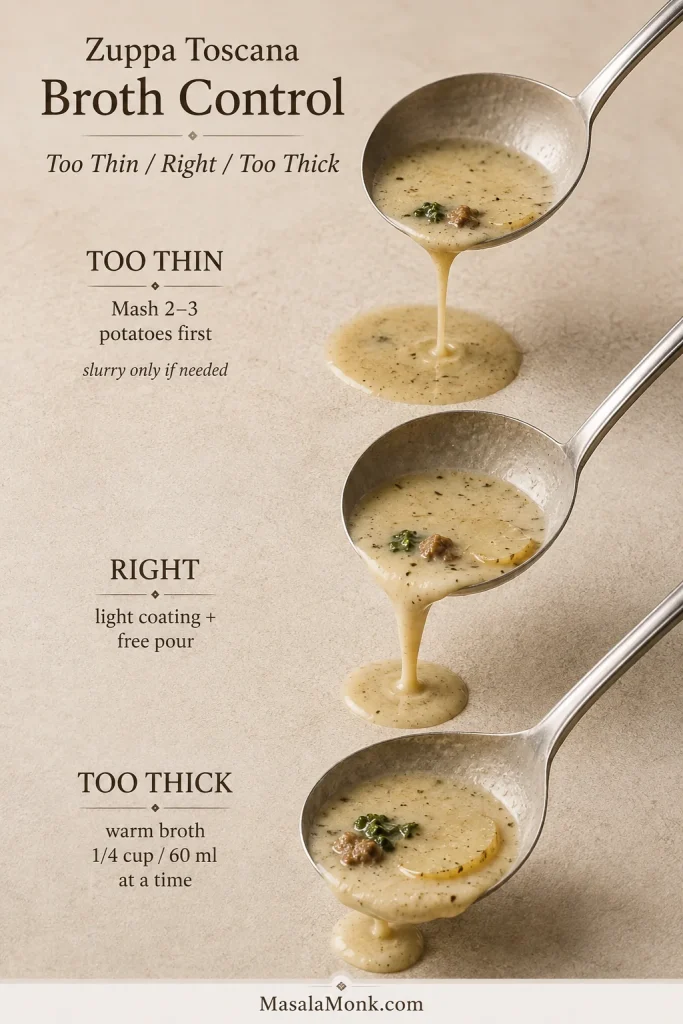
Broth consistency guide comparing thin, correct and overly thick Zuppa Toscana by how each version pours from a ladle.
Adjust in small steps, stir, then check another ladleful before changing anything else.

Then season in order: salt first, spice second, acidity last. Bacon, sausage and packaged broth vary enough that the soup itself is the best guide.

Troubleshooting: Fix the Soup You Have

This is a forgiving soup, and most problems are easier to correct than they first look. Match what you are seeing to the table before changing several things at once.
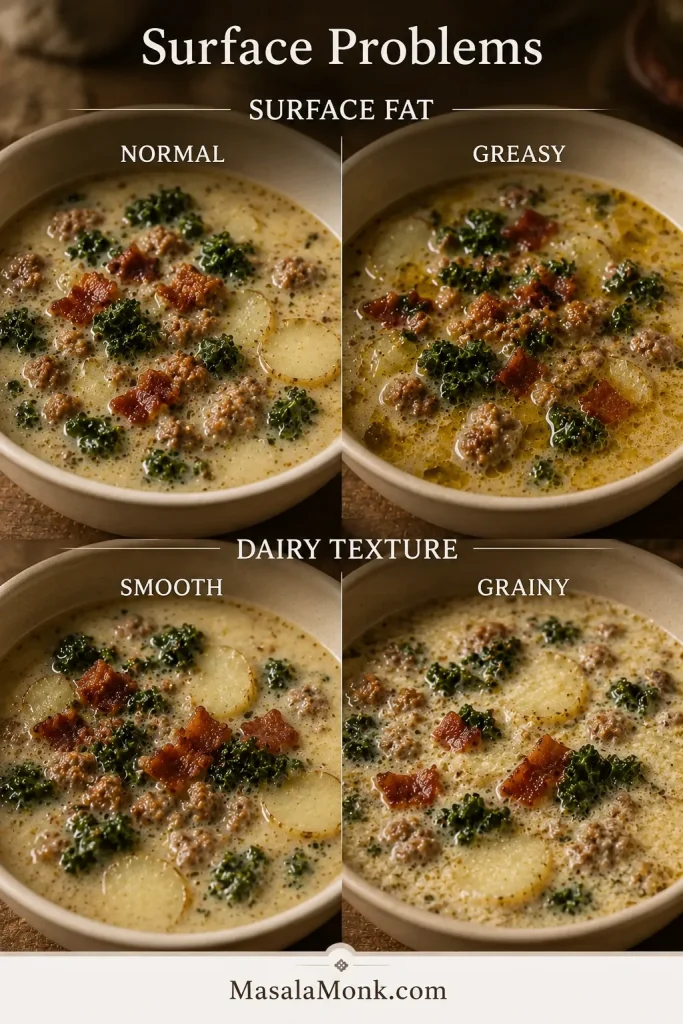
Troubleshooting guide comparing normal and greasy soup surfaces and smooth versus slightly grainy creamy broth.
Grease forms shiny pools; overheated dairy looks finely speckled through the broth.

Texture and Doneness Problems

ProblemWhat to do nowNext time
Greasy More cream will not fix the greasiness. Let the surface settle and skim the obvious pools instead. Spoon away more rendered fat before cooking the onion.
Too thin Mash 2–3 potato pieces into the broth. Use a small cornstarch slurry only if needed. Keep the broth-to-potato ratio as written, and wait until the cream is in before adding extra liquid.
Too thick Add warm low-sodium broth ¼ cup / 60 ml at a time. Keep the simmer gentle and avoid unnecessary reduction.
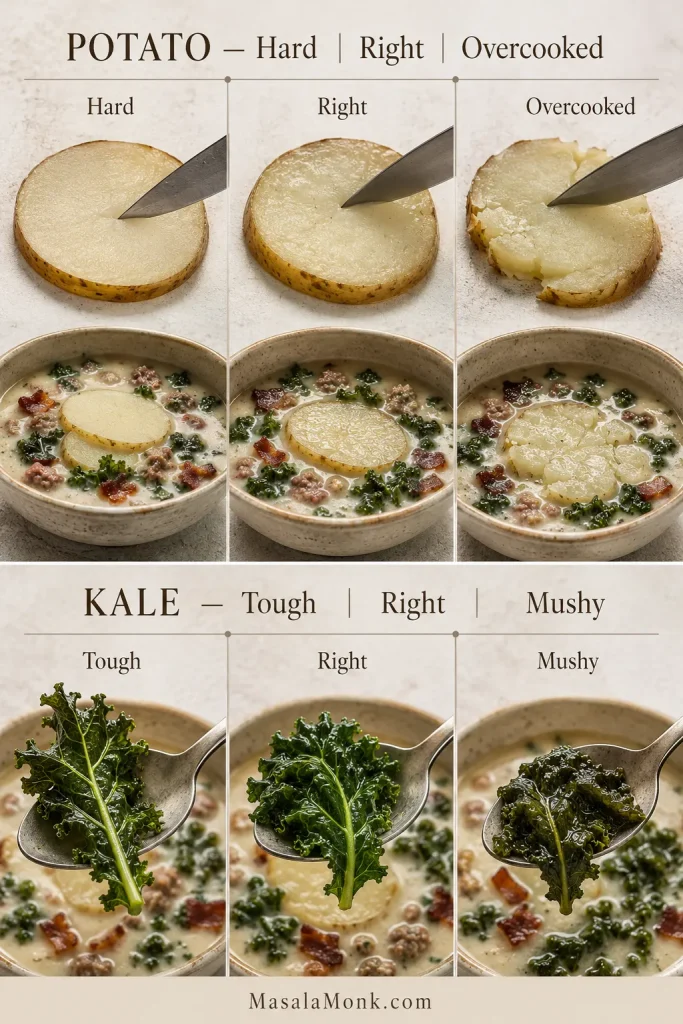
Hard potatoes Keep simmering. If the kale is already tender, lift it out and return it once the potatoes are ready. Keep the slices close to ¼ inch / 6 mm thick.
Potatoes falling apart You cannot firm them back up, but you can keep them from breaking down further. Stir as little as possible and serve once the rest of the soup is ready. Cut them slightly thicker or begin checking sooner.
Tough kale Simmer another 1–2 minutes. Remove thick stems and chop the leaves smaller.
Mushy kale Once kale has gone very soft, its bite will not come back. Stop cooking and serve rather than softening it further. Add the kale later.

Potato and Kale Doneness at a Glance

Doneness guide comparing hard, properly cooked and overcooked potato slices with tough, tender and mushy kale.
Potato and kale can finish at different times—judge each on its own.

Dairy and Seasoning Problems

ProblemWhat to do nowNext time
Grainy dairy Take the soup off high heat and stir gently. The texture may improve, although it may not become completely smooth again. Add dairy near the end and avoid prolonged hard boiling.
Bland Add salt gradually, then check black pepper or red pepper. Consider acidity only after the salt is right. Give the sausage time to brown and taste the whole soup before serving.
Too salty Add unsalted broth ¼ cup / 60 ml at a time, then reassess both the seasoning and thickness. Use low-sodium broth and keep early seasoning light.

Substitutions and Variations

The swaps above keep the soup fairly close to the main recipe. These next changes alter the flavor or texture more noticeably, but they can still work well.

  • No bacon: brown the sausage directly and add a small splash of olive oil only if the pot looks dry. The soup loses some smoke but keeps its basic character.
  • Chicken or turkey Italian sausage: use the same weight. Expect a leaner, slightly less rich soup. Ground poultry should reach 165°F / 74°C.
  • Cauliflower: replace some or all of the potato with bite-size florets and cook only until tender. The soup will have less natural starch and a lighter body.
  • Plant cream: choose a rich, unsweetened product rather than thin plant milk. Flavor and body vary considerably by brand.
  • Gluten-free: the base recipe uses no flour. Check the sausage, bacon and broth labels when the soup needs to be reliably gluten-free.

A fully vegan version needs more than a dairy swap. It tastes best when the plant-based sausage, vegetable broth and dairy-free cream are chosen to work together.

Can You Adapt Zuppa Toscana for a Slow Cooker or Instant Pot?

Yes, but the potatoes cook differently and the timing changes enough that these are better treated as separate methods rather than direct stovetop conversions. Whichever appliance you use, keep the same basic order: brown the sausage first, cook the potatoes in the broth, then add the greens and cream near the end.

Slow cooker: Brown the sausage before it goes into the slow cooker so the broth gets the benefit of that browning without carrying all of the rendered fat with it. Cook the potatoes in the broth until tender, then add the kale and cream near the end instead of letting either spend the whole cook in the slow cooker.

Finishing the richer ingredients later works well in slow cooker broccoli cheese soup too, after the vegetables have had their long cook.

Instant Pot: Use sauté to brown the sausage, then pressure-cook the potato-and-broth base without the cream. Add kale and dairy only after the lid is open. For consistent potatoes, use a pressure-cooker-specific recipe rather than guessing from the stovetop timing.

What Is Zuppa Toscana? Olive Garden Copycat vs Tuscan Soup

“Zuppa Toscana” simply means “Tuscan soup,” but the creamy sausage, potato and kale version familiar to many American diners is closely associated with Olive Garden.

This recipe is deliberately an Olive Garden-style Zuppa Toscana. Tuscany itself has a much broader soup tradition, so this is not presented as a definitive traditional Tuscan formula.

If you want an Italian-style soup built around vegetables, beans, pasta and tomato broth instead, Minestrone Soup heads in a completely different direction.

What to Serve With Zuppa Toscana

A generous bowl already gives you sausage, potatoes and greens, so dinner does not need much else. Something crisp, sharp or crusty alongside it is usually enough.

For dipping, go with warm breadsticks, focaccia or a crusty loaf. For contrast, choose something fresh and acidic—a crisp green salad, simple tomato salad or cucumber salad with vinegar, dill and onion.
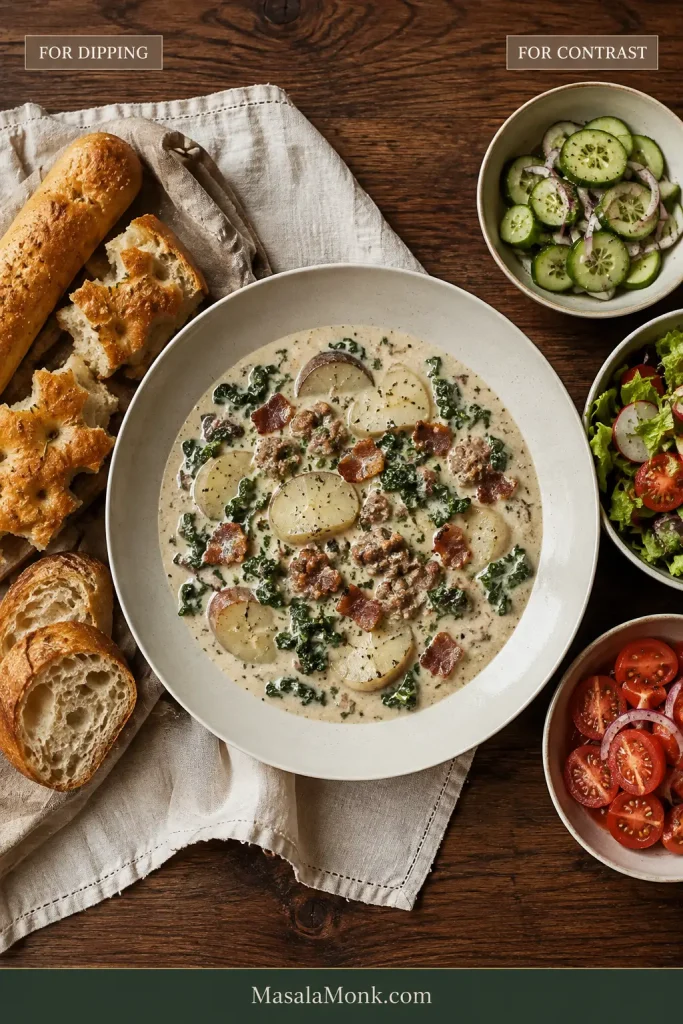
Overhead serving guide with Zuppa Toscana between breads for dipping and cucumber, green and tomato salads for contrast.
Bread handles the dipping; a crisp, acidic salad keeps the meal from feeling heavy.

If you want the bread to be part of the meal, sourdough focaccia gives you crisp olive-oil edges and a soft middle that soaks up the broth left at the bottom of the bowl.

A bowl, a piece of good bread and something fresh on the side—and dinner is essentially handled.
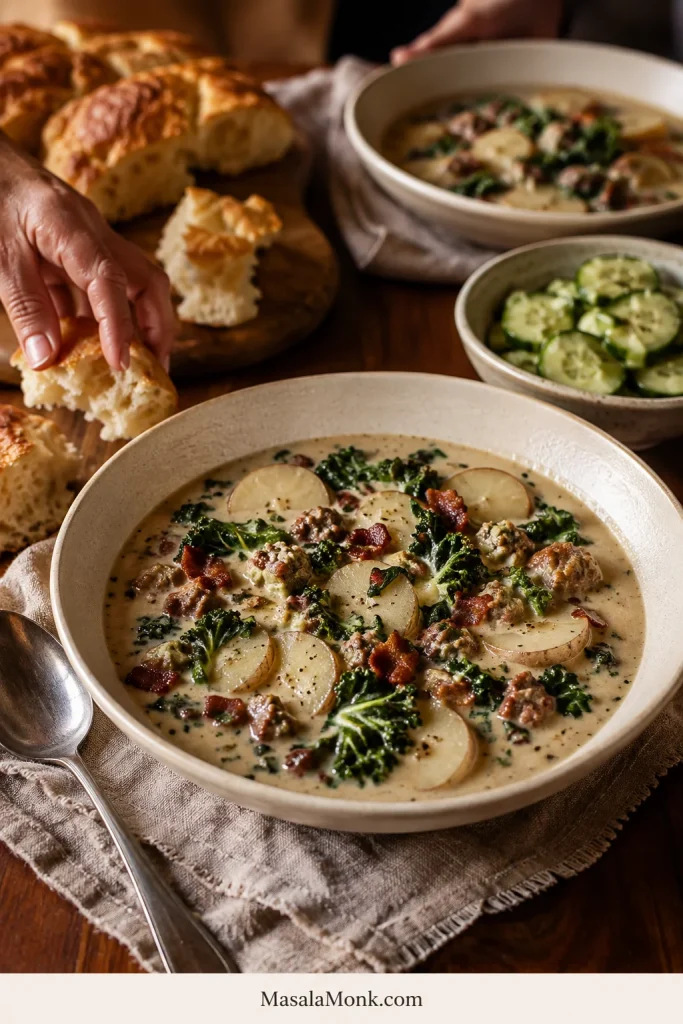
Dinner table with Zuppa Toscana, torn bread and cucumber salad as a hand reaches toward the bread, with another soup bowl behind.

How Much Soup Is One Serving?

Olive Garden’s nutrition information lists a restaurant soup serving as 8 fl oz, or about 1 cup / 240 ml. That works well as a starter at home too. For dinner, allow roughly 1½–1⅔ cups / 355–395 ml per person.
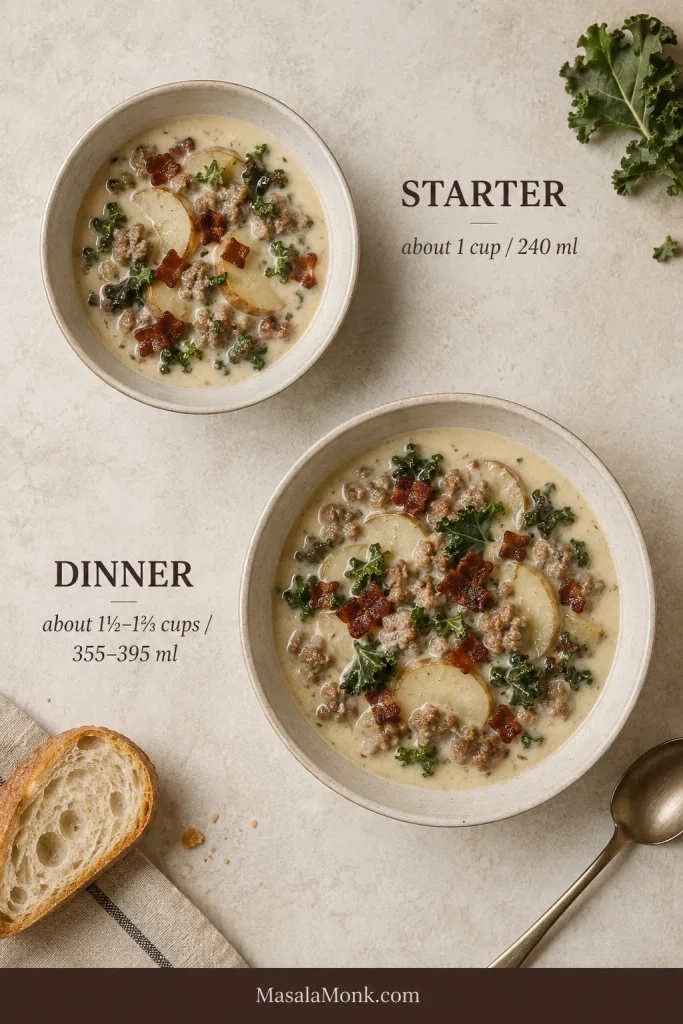
Two bowls of Zuppa Toscana comparing a smaller starter serving with a larger dinner serving.
Think starter versus dinner: about 1 cup for the first, roughly 1½–1⅔ cups for the second.

Make Ahead, Store, Freeze and Reheat

Make Ahead

You can make the soup earlier the same day or the night before. For the freshest greens and smoothest finish, stop once the potatoes are tender, then add the kale and cream while reheating.

That is a useful stopping point when you are cooking for guests: most of the work is finished, and the last few minutes happen just before serving.
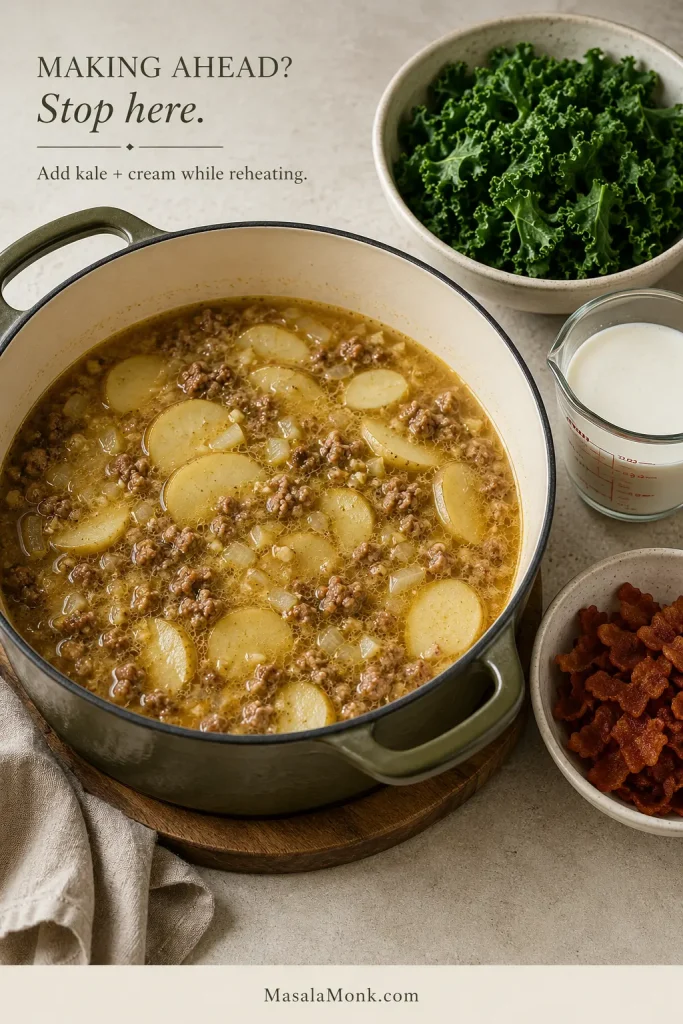
Dutch oven of golden sausage and potato soup base beside separate curly kale, liquid cream and crisp bacon for finishing later.
Keep the bacon separate until serving so it stays crisp.

Refrigerate

Divide a large batch among shallow covered containers so it cools quickly, and refrigerate within 2 hours rather than leaving the whole Dutch oven on the counter. Use refrigerated leftovers within about 3–4 days.

Freeze

The best texture comes from freezing the sausage-and-potato base before adding the cream. Potatoes may soften after thawing, while fresh cream gives the reheated soup a smoother finish.

Frozen soup is best within about 2–3 months. Thaw the base, reheat it thoroughly, then add fresh kale and cream.

Reheat

Do not be surprised if refrigerated Zuppa Toscana looks considerably thicker the next day. The potatoes keep absorbing broth as the soup rests. Add enough broth while reheating to bring back a flowing consistency.

Reheat while stirring so the dairy warms evenly, then bring the soup briefly to a full boil before removing it from the heat. Leftovers should reach 165°F / 74°C. Planned make-ahead batches keep the smoothest texture when the cream is added after the base is hot.

Storage at a glance: refrigerate finished soup promptly, freeze the cream-free base when possible, and judge whether reheated soup needs extra broth only after it is hot and stirred through.
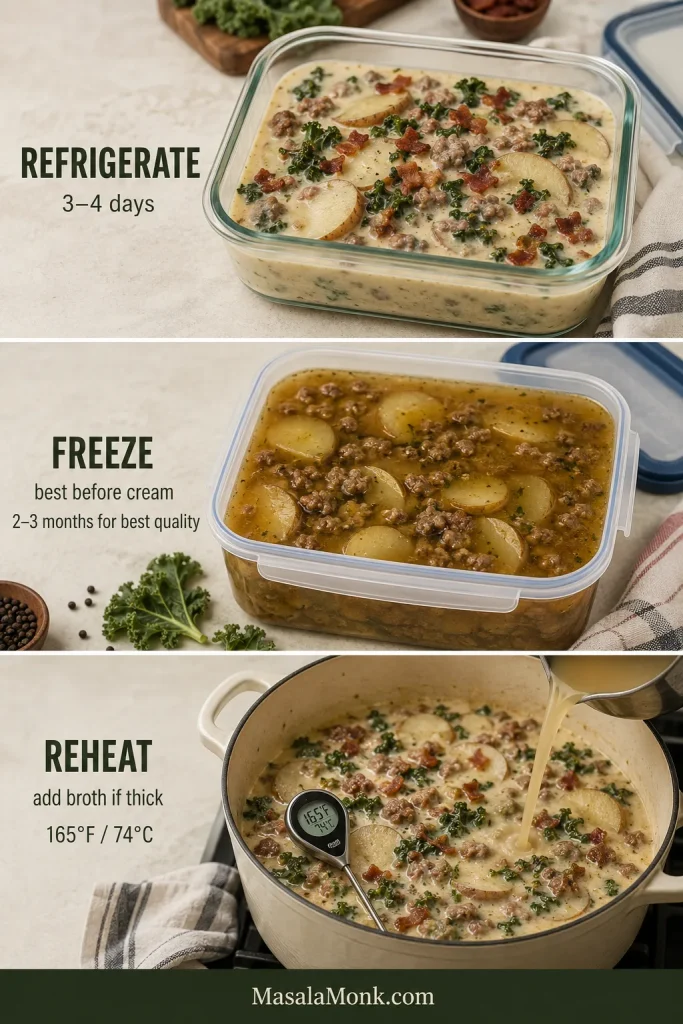
Storage guide showing creamy Zuppa Toscana refrigerated in glass, cream-free sausage and potato base for freezing, and soup reheating with added broth and a thermometer.

For current cooling, refrigerator and reheating recommendations, see the USDA leftovers guidance.

It is also the kind of leftover that makes tomorrow’s lunch feel already taken care of.


By the time the bowls hit the table, the potato should split easily with the spoon, the kale should curl into the creamy broth, and browned sausage should be tucked through nearly every spoonful. Scatter the crisp bacon over the top while it can still crackle against the softer soup.
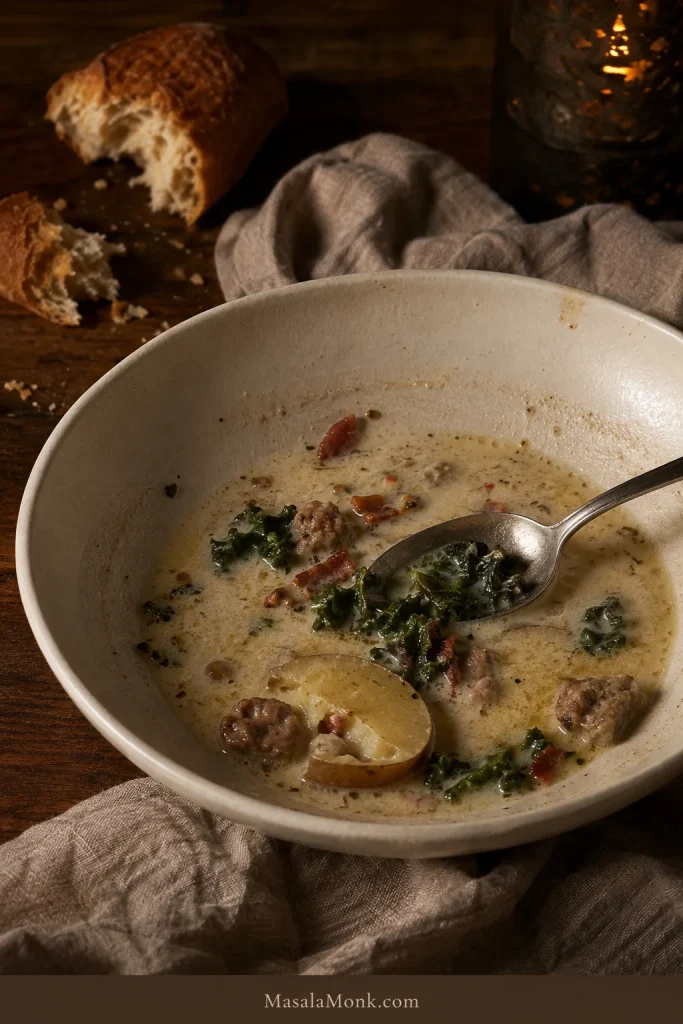
Partly eaten bowl of Zuppa Toscana with spoon, broken potato slice, kale, sausage and bacon crumbs beside torn bread on a wooden table.

If you make it, tell me which route you took: hot or mild sausage—and did you stay with kale or use spinach?
Posted on Leave a comment

Sausage Pasta Recipe

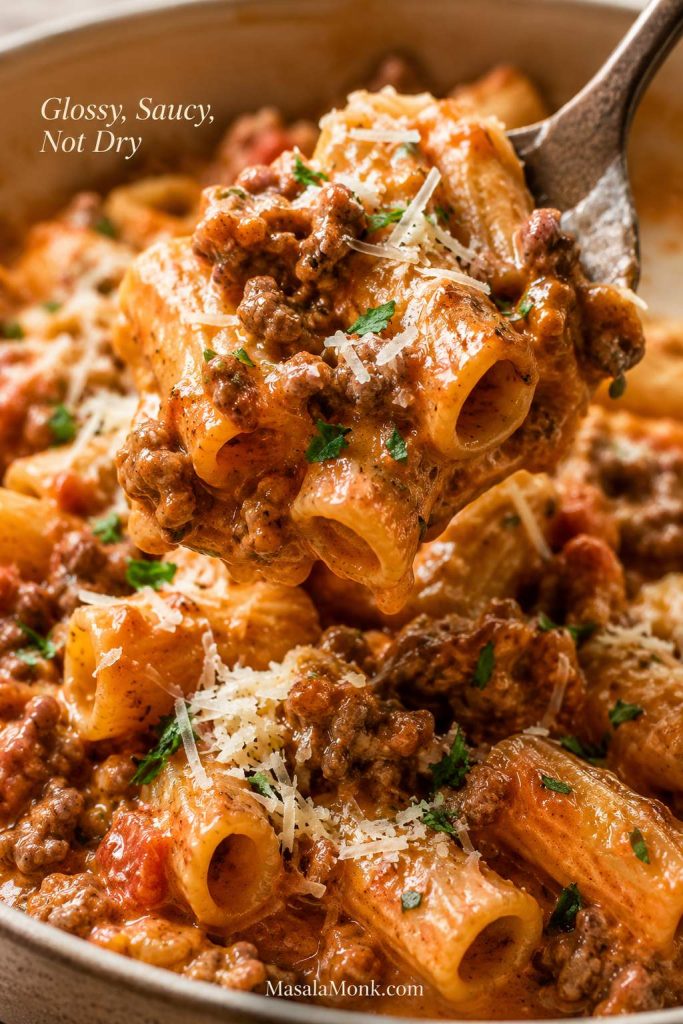
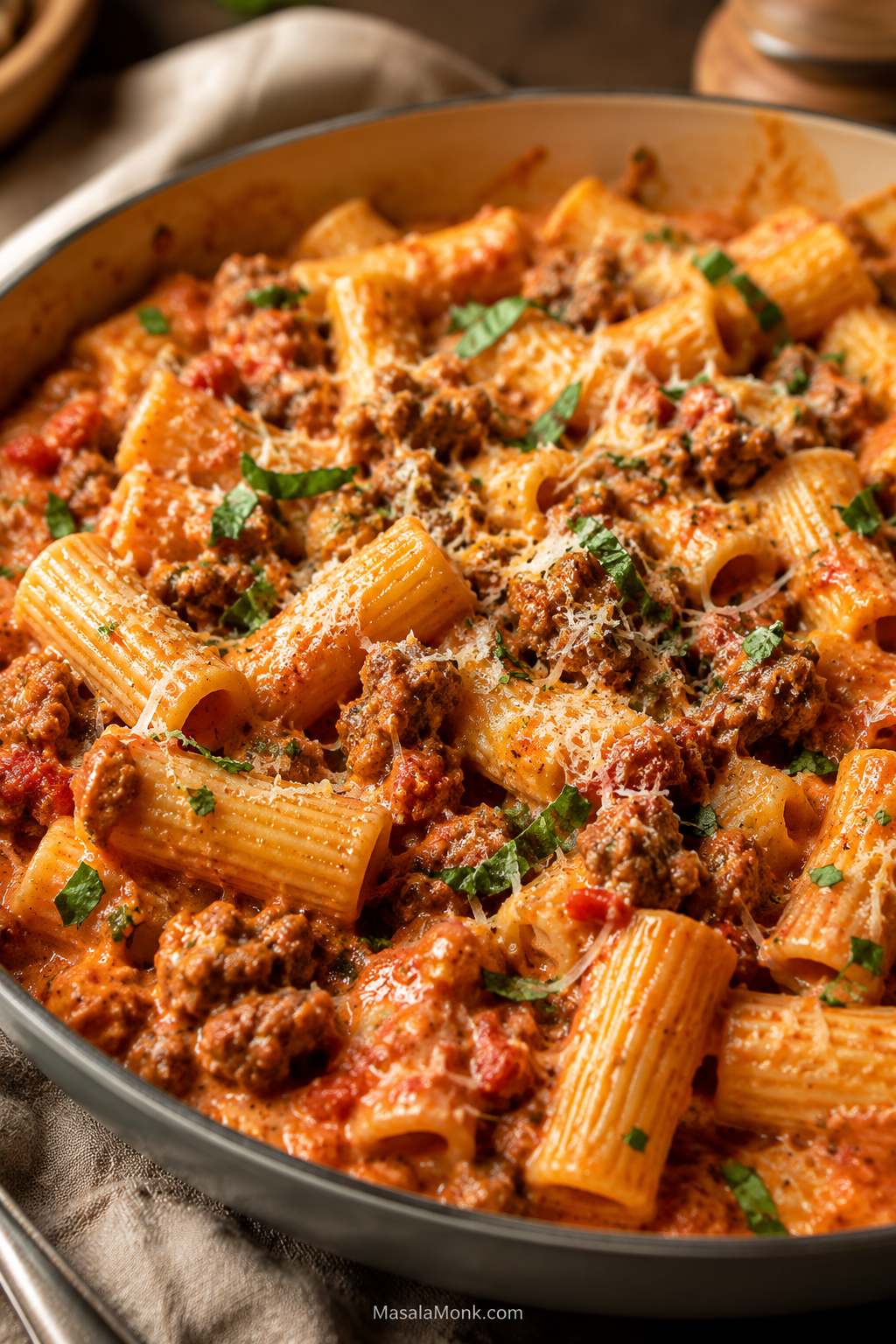
Creamy tomato sausage pasta with rigatoni, browned Italian sausage crumbles, parmesan, and parsley in a warm bowl.

This sausage pasta recipe is the skillet dinner you make when you want something comforting, saucy, and deeply satisfying without turning dinner into a project. Browned Italian sausage gives the pan its savory base, short pasta catches the little crumbles, and a tomato-parmesan cream sauce pulls everything together into a cozy bowl in about 30 minutes.

As the sausage browns, the pan starts doing the work for you: the fat turns flavorful, the browned bits cling to the bottom, and the tomato paste picks up all of that depth before the cream and parmesan smooth everything out.

The promise is simple: one base skillet, the pasta shape you have, and a creamy finish that does not turn dry. Make it mild, spicy, smoky, baked, one-pot, or packed with greens, but keep the same rule in mind — brown the sausage well and finish the pasta loose enough to toss.

It is the kind of pasta where the last few bites in the bowl are mostly sausage crumbles, parmesan, and creamy red sauce — which is exactly why it works.

Table of Contents

Start with the quick answer and recipe card, then use the sausage, pasta-shape, variation, storage, and troubleshooting sections as needed.

Quick Answer: The Best Way to Make Sausage Pasta

The best sausage pasta is made with browned Italian sausage, short pasta, and a tomato-parmesan cream sauce loosened with reserved pasta water. It should taste rich but not heavy, saucy but not soupy, and flexible enough to work with mild, hot, smoked, or chicken sausage.

Finish the pasta in the skillet instead of spooning the creamy tomato base over it at the end. Add the pasta to the pan with a splash of the water you saved before draining, then toss until everything looks coated, glossy, and still loose enough to move.

For a balanced skillet, use 1 pound / 450 g Italian sausage, 12 ounces / 340 g short pasta, 2 tablespoons tomato paste, 14 to 15 ounces / 400 to 425 g crushed tomatoes or passata, 3/4 cup / 180 ml cream, and 1/2 cup / 50 g parmesan.

Start here: mild Italian sausage, rigatoni, crushed tomatoes, heavy cream, parmesan, and a handful of spinach. It is creamy, flexible, and easy to adjust before serving.

Choosing ingredients now? Jump to Best Sausage or Best Pasta Shapes before you start cooking.

Sausage Pasta at a Glance

DetailRecommended
SausageMild or hot Italian sausage
PastaRigatoni if choosing one; penne, shells, fusilli, and cavatappi also work well
StyleTomato-parmesan cream sauce
Total timeAbout 30 minutes
Main panLarge 12-inch / 30 cm deep skillet or sauté pan
Add-insSpinach, mushrooms, peppers, broccoli, peas, kale, or sun-dried tomatoes
Texture cueCreamy, glossy, and loose enough to toss in the skillet
LeftoversReheat gently with a splash of milk, cream, broth, or water

If texture is your main worry, go straight to How to Keep Sausage Pasta Creamy, Not Dry. For leftovers, see Storage and Reheating.

Sausage Pasta Recipe Card

The full recipe is below with the amounts, timing, and texture cues in one place. Use it as the base skillet, then come back to the sausage, pasta shape, add-in, and troubleshooting sections when you want to change the mood of the bowl.

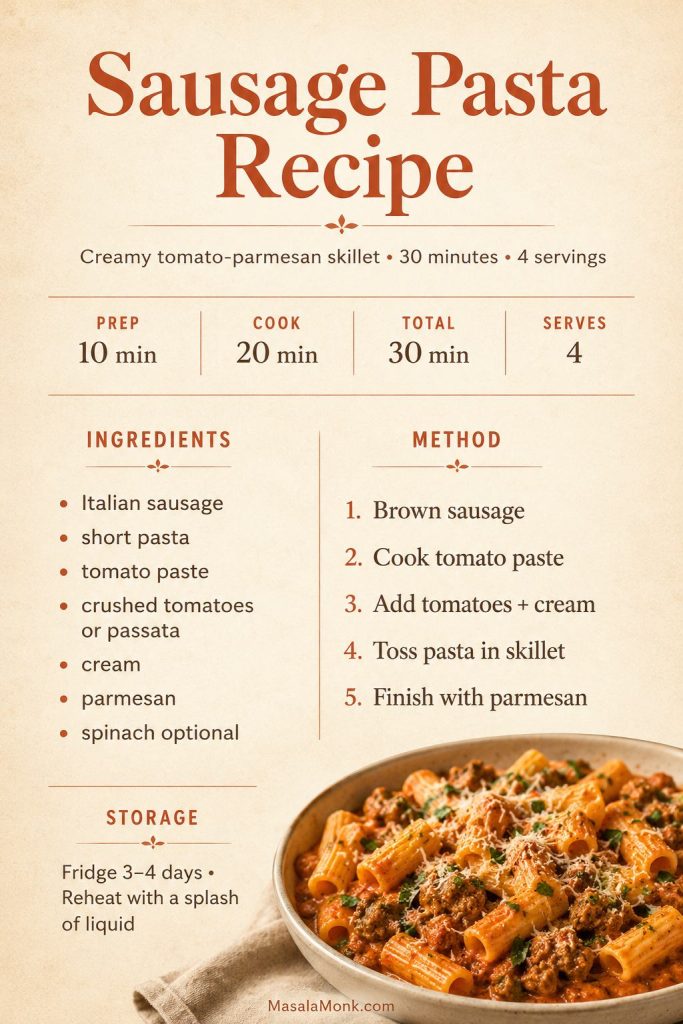
Recipe card for creamy tomato-parmesan sausage pasta with timing, servings, ingredients, method steps, and storage cue.
This visual card is the quick-save version; the written card below gives the full method, measurements, and texture cues.

Sausage Pasta Recipe with Creamy Tomato-Parmesan Sauce

This easy sausage pasta is made with browned Italian sausage, short pasta, garlic, tomato paste, crushed tomatoes, cream, parmesan, and pasta water for a glossy tomato-parmesan finish. It is rich, cozy, and ready in about 30 minutes.

Prep Time10 minutes

Cook Time20 minutes

Total Time30 minutes

Servings4 generous servings

Equipment

  • Large pot for pasta
  • Large 12-inch / 30 cm deep skillet or sauté pan
  • Wooden spoon or spatula
  • Measuring cup for pasta water
  • Grater for parmesan

Ingredients

  • 12 oz / 340 g rigatoni, penne, shells, fusilli, or another short pasta
  • 1 lb / 450 g Italian sausage, mild or hot, casings removed if using links
  • 1 tbsp / 15 ml olive oil, only if needed
  • 1 small yellow onion, finely chopped
  • 3 to 4 garlic cloves, minced
  • 2 tbsp / 30 g tomato paste
  • 1 tsp Italian seasoning
  • 1/4 to 1/2 tsp red pepper flakes, optional
  • 14 to 15 oz / 400 to 425 g crushed tomatoes or passata
  • 3/4 cup / 180 ml heavy cream
  • 1 cup / 240 ml reserved pasta water, divided and used as needed
  • 1/2 cup / 50 g freshly grated parmesan, plus more for serving
  • 2 packed cups / about 60 g baby spinach, optional
  • Salt and black pepper, to taste
  • Fresh basil or parsley, for serving

Instructions

Cook the Pasta and Brown the Sausage
  1. Cook the pasta. Bring a large pot of salted water to a boil. Add the pasta and cook 1 to 2 minutes shy of al dente. Reserve 1 cup / 240 ml pasta water, then drain.
  2. Brown the sausage. While the pasta cooks, heat a large deep skillet over medium-high heat. Add the sausage and break it into small crumbles. Cook for 6 to 8 minutes, stirring only as needed, until the sausage has browned edges and no longer looks gray. If the sausage is lean and the pan looks dry, add 1 tablespoon olive oil.
  3. Drain excess fat if needed. If there is more than about 1 tablespoon fat in the pan, spoon off the excess. Leave a little behind for flavor.
Build the Sauce and Finish the Pasta
  1. Add onion and garlic. Add the chopped onion and cook for 2 to 3 minutes, until softened. Stir in the garlic and cook for about 30 seconds, just until fragrant.
  2. Cook the tomato paste. Add tomato paste, Italian seasoning, and red pepper flakes. Stir for 1 to 2 minutes, until the tomato paste darkens slightly and coats the sausage. It should smell richer and less raw.
  3. Simmer the tomato base. Add crushed tomatoes or passata. Stir well, scraping up any browned bits from the pan. Simmer for 4 to 5 minutes, until slightly thickened.
  4. Add cream gently. Lower the heat to medium-low and stir in the heavy cream. Do not boil the pan hard after adding cream.
  5. Toss with pasta. Add the drained pasta and 1/4 cup / 60 ml reserved pasta water. Toss well until the pasta is coated and finishes cooking in the pan.
  6. Adjust the texture. The pasta should look coated and still move when tossed. If it starts tightening quickly, add more pasta water 1 to 2 tablespoons at a time and toss again.
  7. Finish with parmesan and spinach. Add parmesan on low heat or off heat and stir until melted. Add spinach, if using, and toss until just wilted.
  8. Taste and serve. Season with salt and black pepper to taste. Serve right away while the sauce is still glossy, with more parmesan and fresh basil or parsley.

Notes

  • Use mild Italian sausage for the most balanced version and hot Italian sausage for a spicier pasta.
  • Use 1/4 teaspoon red pepper flakes for gentle warmth and 1/2 teaspoon for a more noticeable kick.
  • Salt the pasta water well, but go easy on added salt until the sausage and parmesan are in the pan.
  • If using sausage links, remove the casings before browning so the sausage can crumble into the sauce.
  • For a smoother finish, use passata. For more texture, use crushed tomatoes.
  • When the skillet gets too thick, add pasta water 1 to 2 tablespoons at a time.
  • Chicken or turkey sausage usually needs a little olive oil because it is leaner than pork sausage.
  • Fully cooked smoked sausage or kielbasa should be sliced and browned instead of crumbled.
  • For a sausage pasta bake, keep the skillet mixture looser, top with mozzarella and parmesan, and bake until bubbling.

Storage

Store leftovers in an airtight container in the refrigerator for 3 to 4 days. Reheat gently with a splash of milk, cream, broth, or water to loosen the sauce.

Why This Sausage Pasta Recipe Works

A good sausage pasta should taste like the sausage, tomato, cream, and pasta were built together in the same pan. This recipe does that by browning the sausage first, cooking the tomato paste until it smells richer, and finishing the pasta directly in the skillet.

Browning creates the first layer of sauce

Italian sausage brings salt, fat, fennel, garlic, herbs, and sometimes chile. When it browns, those seasoned drippings flavor the whole pan. The browned bits are not leftovers from cooking the sausage; they are the first layer of the sauce.

Tomato paste makes it taste slow-cooked

Tomato paste gives the creamy red base a deeper, slightly sweeter tomato flavor without needing a long simmer. A minute or two in the hot pan takes away the raw edge and makes the whole skillet taste more rounded.

Cream and parmesan make it rich, not heavy

Cream softens the acidity of the tomatoes, while parmesan adds saltiness and body. Added gently, the cheese melts into the sauce instead of clumping in salty patches.

A loose skillet gives you a better bowl

The pasta should slide when you spoon it, not sit in one stiff mound. A little reserved pasta water keeps the skillet glossy, movable, and saucy enough to survive the trip from pan to plate.

Ingredients You Need

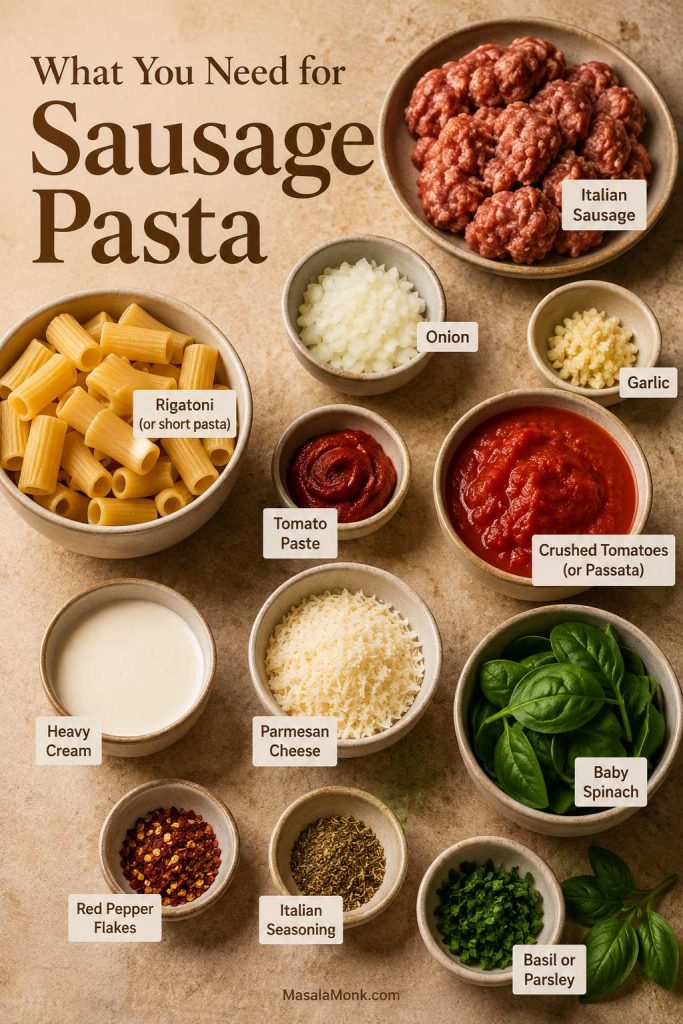
The ingredient list is short, which is why the little choices matter: sausage with enough seasoning, tomatoes that do not taste flat, and parmesan that melts into the sauce instead of sitting on top.

Ingredients for sausage pasta including Italian sausage, rigatoni, tomato paste, cream, parmesan, spinach, garlic, onion, and seasonings.
Build the flavor from simple ingredients: sausage for seasoning, tomato paste for depth, cream for roundness, and parmesan for a savory finish.

Pasta

Use 12 ounces / 340 g short pasta. Rigatoni is the easiest win, but penne, shells, fusilli, rotini, and cavatappi all work because they catch sausage crumbles and creamy tomato sauce. Long pasta can work in a pinch, but chunky sausage mixtures usually cling better to short shapes.

Salt the pasta water well, but go easy on added salt later until the sausage and parmesan are in the pan. Some sausage brands are much saltier than others, and parmesan brings its own salt too.

Italian sausage

Use 1 pound / 450 g Italian sausage, either mild or hot. Mild sausage gives you the cozy, family-friendly version; hot Italian sausage turns the same skillet into something deeper and spicier.

You do not need fancy sausage for this. You need sausage that browns well, tastes good on its own, and has enough seasoning to carry the dish.

Tomato paste and crushed tomatoes

Choose passata if you want a smoother finish and crushed tomatoes if you like a little texture. Tomato paste gives concentrated flavor, while the tomatoes give the skillet body. If the tomatoes taste sharp, soften the edge with a little extra cream, parmesan, or a tiny pinch of sugar.

Cream and parmesan

Heavy cream gives the tomato base a velvety finish without turning this into a cream-only pasta. Freshly grated parmesan melts more smoothly than pre-shredded cheese, seasons the bowl, and adds a savory finish without making the pasta feel heavy.

Half-and-half can work for a lighter finish, but it needs gentler heat. Milk is more likely to split in a tomato sauce, so use it only if you are comfortable with a thinner, less creamy result.

Spinach and other add-ins

Spinach is optional, but it earns its place: it wilts into the hot sauce in seconds and gives the bowl a fresh green break from all the sausage, cream, and parmesan. Mushrooms, peppers, peas, broccoli, kale, and sun-dried tomatoes also work well.

Best Sausage for Sausage Pasta

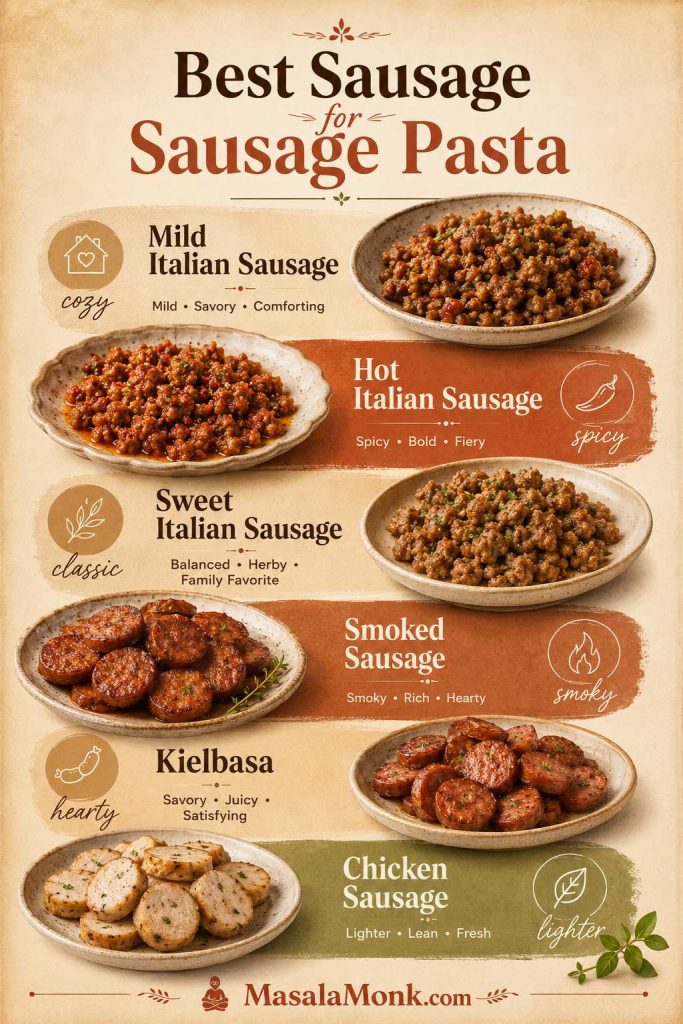
The sausage decides whether this becomes a cozy Italian-style skillet, a spicy red-sauce pasta, or a smoky weeknight shortcut. When you are staring at mild, hot, sweet, smoked, and chicken sausage, the choice is less about right or wrong and more about what kind of dinner you want.

Sausage chooser board showing mild Italian sausage, hot Italian sausage, sweet Italian sausage, smoked sausage, kielbasa, and chicken sausage.
Use this board as the buying shortcut: crumbled Italian sausage for the classic version, smoked coins for depth, and chicken sausage for a lighter skillet.

Still deciding at the store? Compare mild vs hot Italian sausage, or see how smoked sausage differs from Italian sausage.

SausageHow to Use It
Mild Italian sausageSafest first choice. Savory, balanced, and family-friendly.
Hot Italian sausageGreat for a spicier pasta with deeper flavor.
Sweet Italian sausageSofter, often fennel-forward, and good with tomato sauces.
Ground sausage meatEasiest to brown evenly and crumble into the sauce.
Sausage linksRemove the casings before browning so the meat can crumble into the pan.
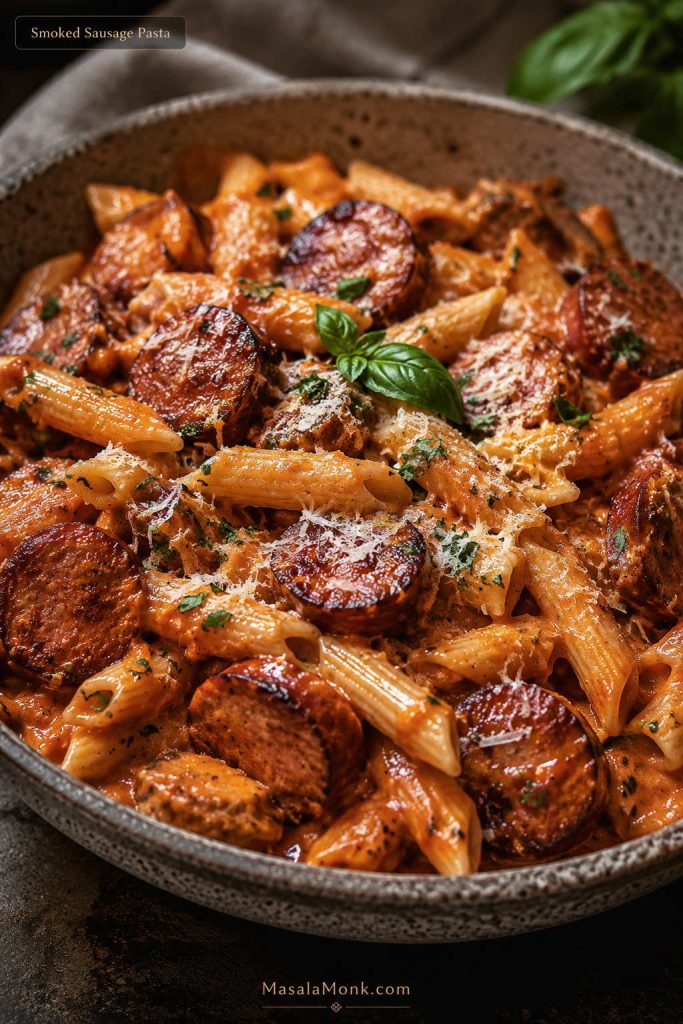
Smoked sausageSlice and sear it, especially for cheesy, Cajun, or one-pot variations.
KielbasaExcellent for a smoky variation. It behaves more like smoked sausage than raw Italian sausage.
Chicken or turkey sausageLeaner option. Add a little oil and extra seasoning if the pan seems dry.
Breakfast sausagePossible, but not ideal for a classic Italian-style pasta because it can taste sweeter and more sage-forward.

For this exact recipe, mild or hot Italian sausage is the best choice because it crumbles through the pan and seasons everything as it browns. Smoked sausage and kielbasa are delicious, but they make a different kind of pasta because they are sliced and seared instead of broken into the tomato-cream base.

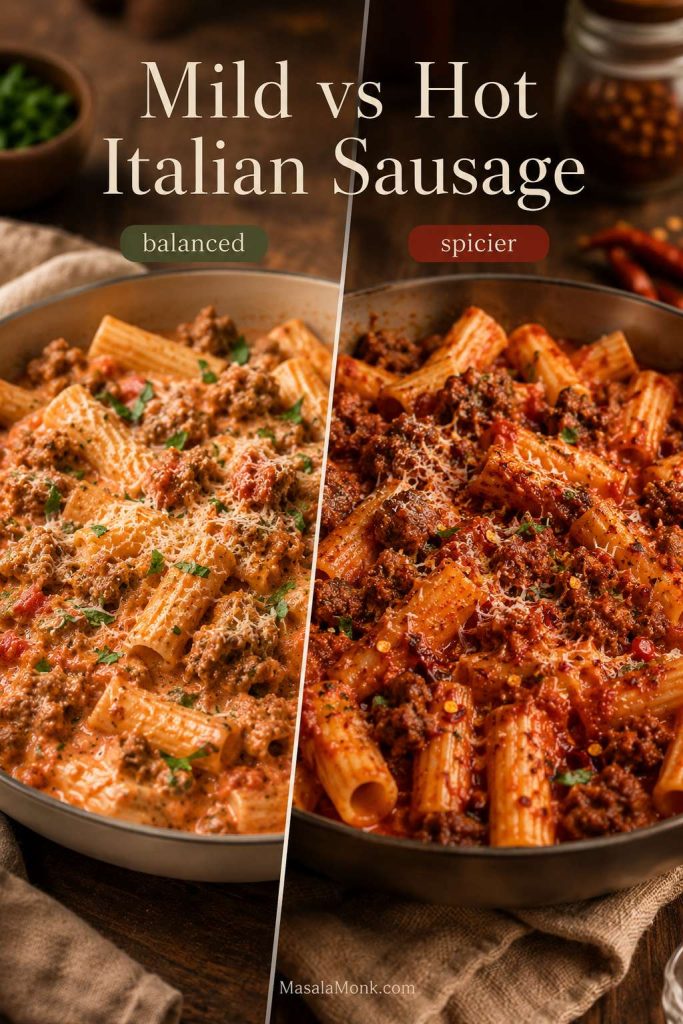
Mild vs Hot Italian Sausage

Use this comparison when you are choosing between a balanced family-style skillet and a spicier version with the same creamy tomato base.

Comparison of mild Italian sausage pasta and hot Italian sausage pasta with creamy tomato sauce and browned sausage.
Choose mild Italian sausage when you want a cozy, balanced dinner; choose hot Italian sausage when the same creamy tomato pasta needs a deeper kick.

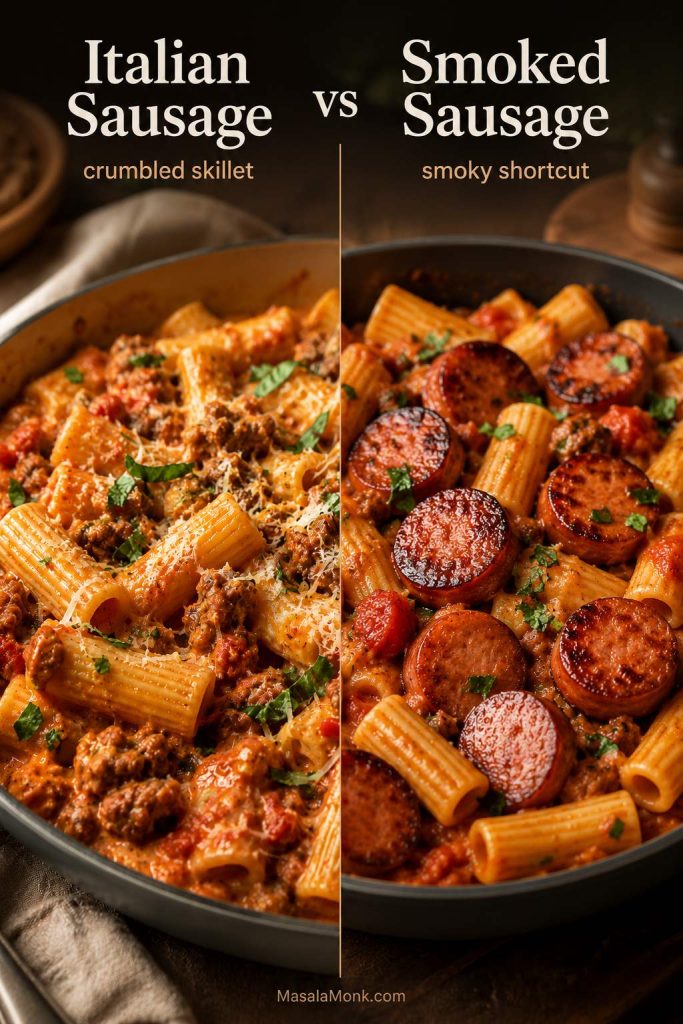
Crumbled Italian Sausage vs Sliced Smoked Sausage

These two sausage styles behave differently in the pan, so the image below shows why crumbles and coins lead to different pasta textures.

Comparison of crumbled Italian sausage and sliced smoked sausage coins for creamy tomato sausage pasta.
As Italian sausage browns, it crumbles into the pan and seasons the base; smoked sausage, meanwhile, works best when the sliced coins get a proper sear.
Food safety note: if you are cooking raw pork, beef, or mixed-meat sausage, cook it through before finishing the sauce. Ground meat and sausage should reach 160°F / 71°C, while poultry sausage should reach 165°F / 74°C according to FoodSafety.gov.

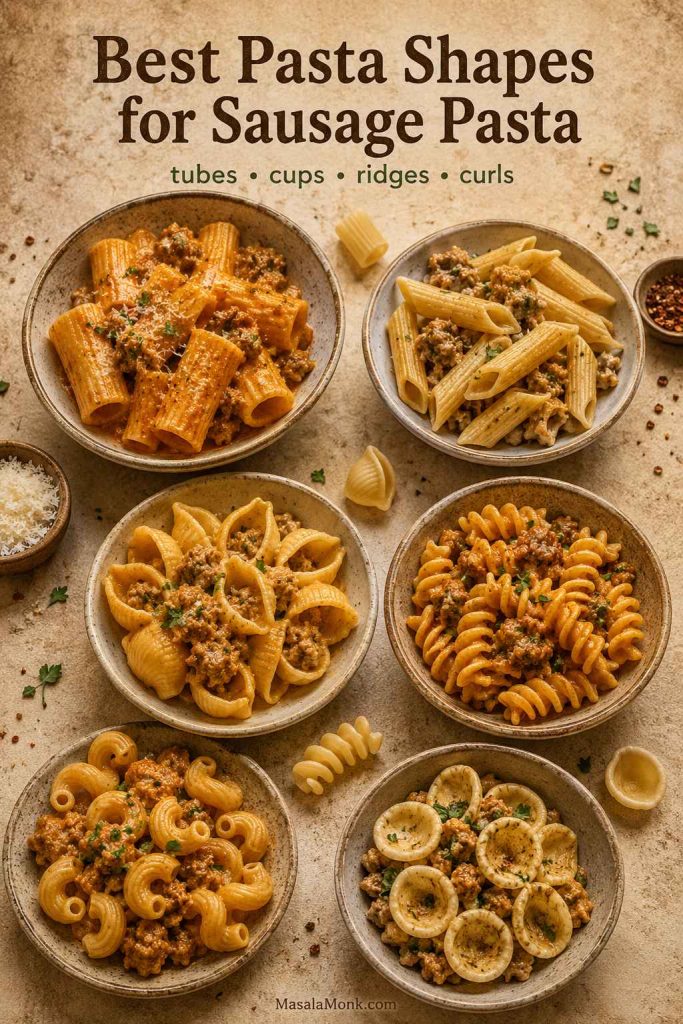
Best Pasta Shapes for Sausage Pasta

Short pasta shapes are best for this kind of sauce because they hold chunky bits better than long strands. Think tubes, cups, ridges, and curls — anything that gives the sausage and creamy tomato base somewhere to land.

Pasta shape guide for sausage pasta with rigatoni, penne, shells, fusilli, cavatappi, and orecchiette.
Look for shapes with pockets, ridges, or curves; they hold the sausage pieces better than smooth strands and make the bowl feel more generous.

If you only want one answer, choose rigatoni. It is big enough to feel generous, ridged enough to hold the creamy tomato base, and hollow enough to catch little pieces of sausage.

Pasta ShapeWhy It Works
RigatoniMost reliable all-rounder. The tubes and ridges catch sausage and sauce beautifully.
PenneEasy, reliable, and common. A safe weeknight choice for a tomato-parmesan finish.
ShellsLittle bowls for sausage crumbles, parmesan, and creamy red sauce.
Fusilli or rotiniThe twists catch thicker sauces well.
CavatappiGreat for cheesy, smoked sausage, or baked variations.
OrecchietteSmall cups that hold sausage crumbles and greens especially well.
Spaghetti or linguineWorks in a pinch, but chunky sausage crumbles are harder to distribute evenly.

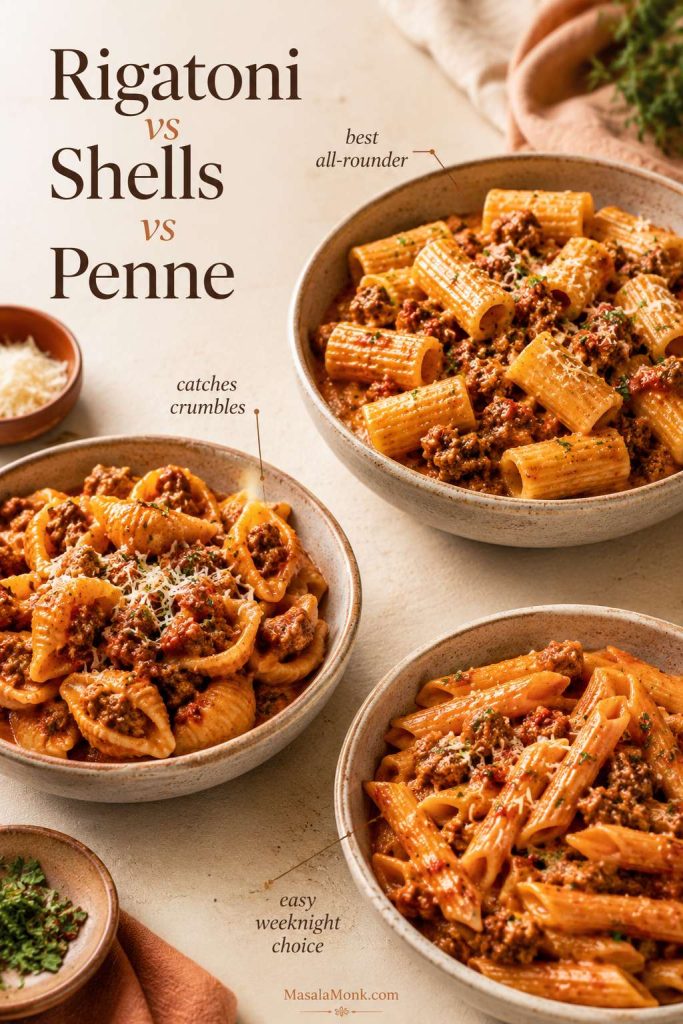
Rigatoni vs Shells vs Penne

These three shapes are the easiest choices for most home cooks: rigatoni for structure, shells for catching crumbles, and penne for a reliable pantry option.

Rigatoni, shells, and penne compared as pasta shapes for creamy sausage pasta with tomato-parmesan sauce.
Rigatoni is the safest all-rounder, shells catch crumbles beautifully, and penne is the pantry shape that still gives you a reliable weeknight bowl.

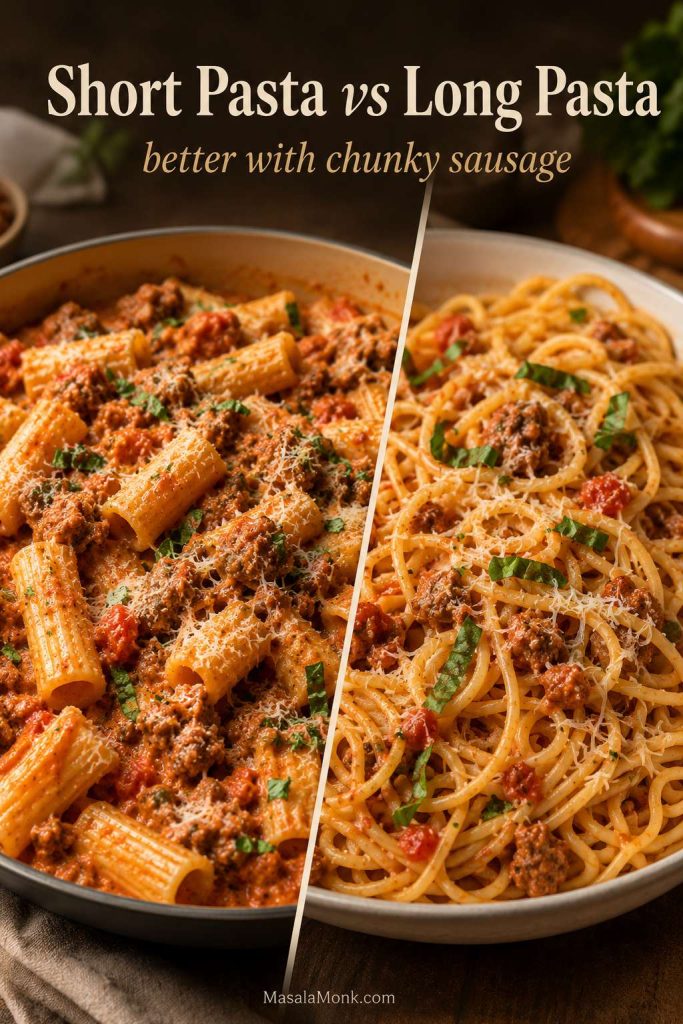
Short Pasta vs Long Pasta

Long pasta can still taste good, but short shapes distribute chunky sausage sauce more evenly from the first bite to the bottom of the bowl.

Short pasta and long pasta compared with chunky sausage sauce, showing short pasta holding sausage and sauce more evenly.
Chunky sausage sauce behaves better with short pasta because the crumbles stay in the bite instead of slipping away from long strands.

Whatever shape you choose, cook it slightly under al dente before it goes into the sauce. The pasta finishes in the skillet, absorbs flavor, and stays firmer on the plate.

You do not need a special pasta shape to make this work, but a ridged short shape makes the whole dish feel more generous because every bite carries sauce and sausage.

Step-by-Step Tips That Make Sausage Pasta Better

The recipe card gives you the full method, so this section focuses on the cues that make the difference between a decent pasta and a skillet you want to make again.

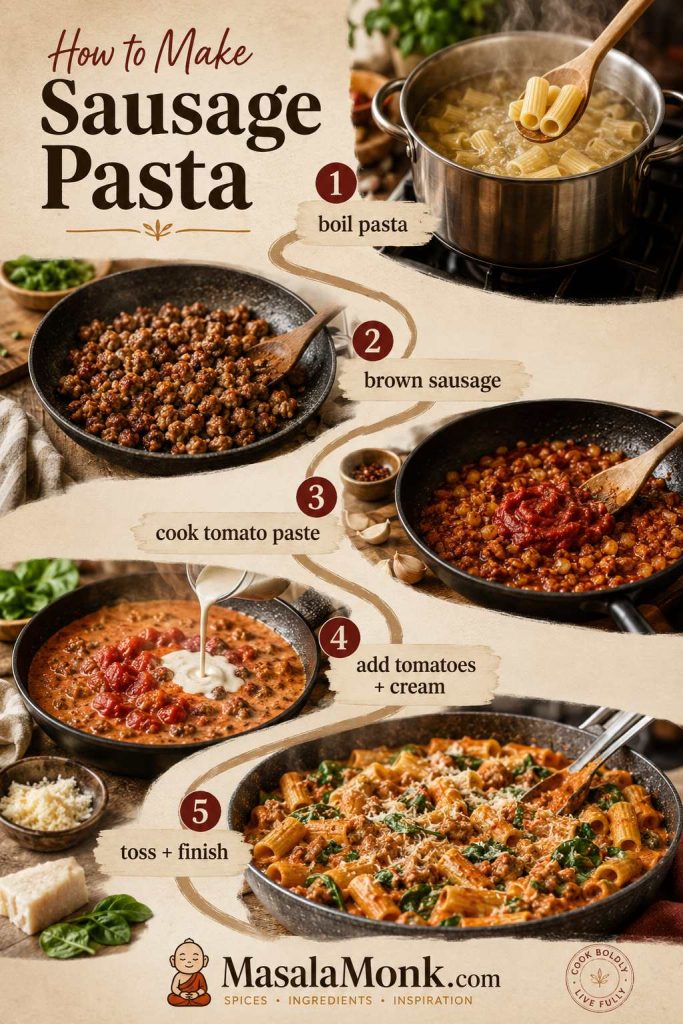
Step-by-step sausage pasta process showing boiling pasta, browning sausage, cooking tomato paste, adding tomatoes and cream, and tossing pasta.
The method works in layers: brown the sausage, cook the tomato paste, then finish the pasta in the skillet so everything tastes connected.

Pull the pasta before it is fully done

Cook the pasta 1 to 2 minutes shy of al dente so it can finish in the skillet. If it is already soft before it reaches the sauce, it can turn heavy by the time everything is tossed together.

Brown the sausage until it has edges

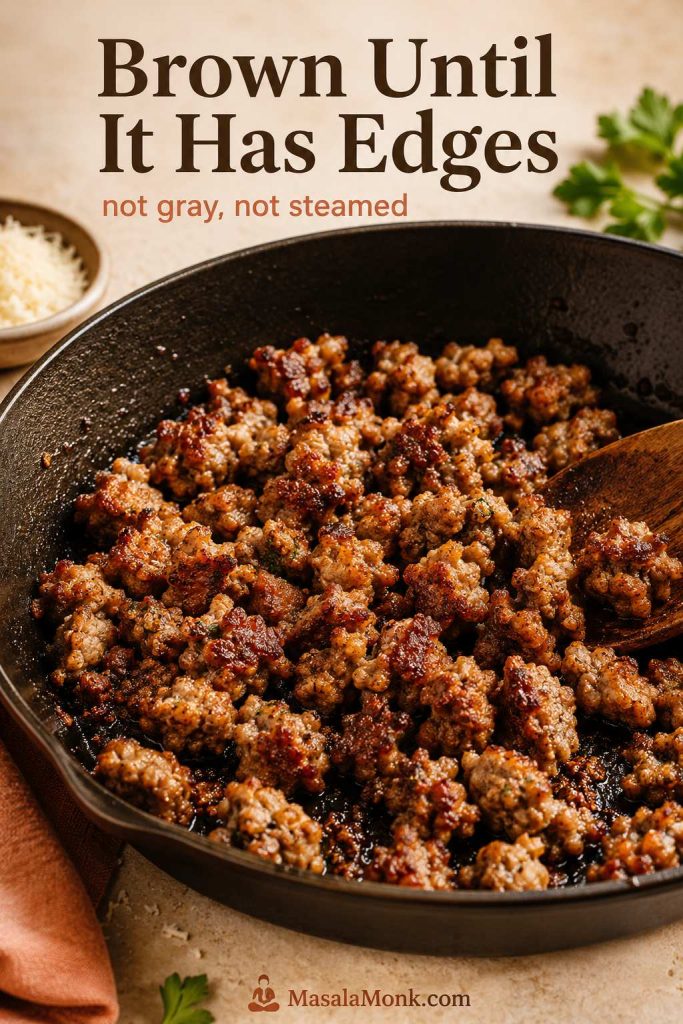
You want browned edges and little savory bits in the pan, not pale sausage that simply looks cooked. Brown, then sauce. If the sausage only turns gray, the pasta will taste flatter.

Close-up of browned Italian sausage crumbles in a dark skillet with golden edges and browned bits on the pan.
Browning is where the flavor starts. Once the sausage has golden edges and the pan has browned bits, the sauce already has a deeper base.

A little sausage fat is flavor; too much can make the finished pasta feel greasy. If there is more than about 1 tablespoon fat in the pan after browning, spoon off the excess before adding the onion.

Cook the tomato paste until it smells richer

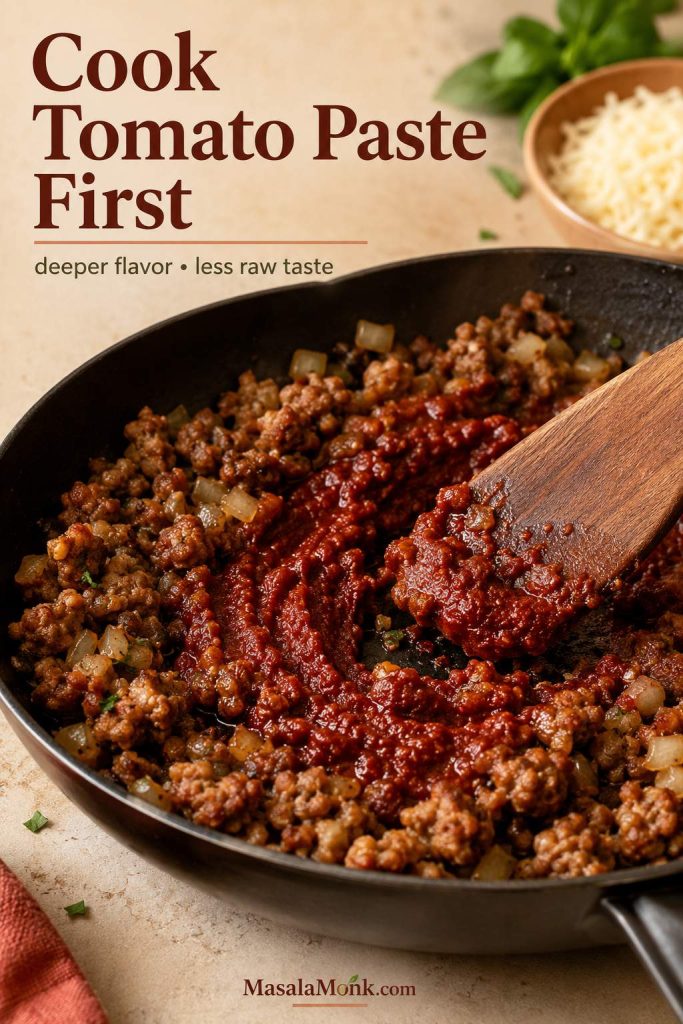
Tomato paste tastes better when it gets a minute in the hot pan with the sausage, onion, garlic, and seasoning. It should darken slightly and smell deeper before the crushed tomatoes or passata go in.

Tomato paste being stirred into browned sausage, onion, and garlic in a skillet until dark red and glossy.
Cooking tomato paste before adding liquid removes the raw edge and makes the tomato flavor taste richer without needing a long simmer.

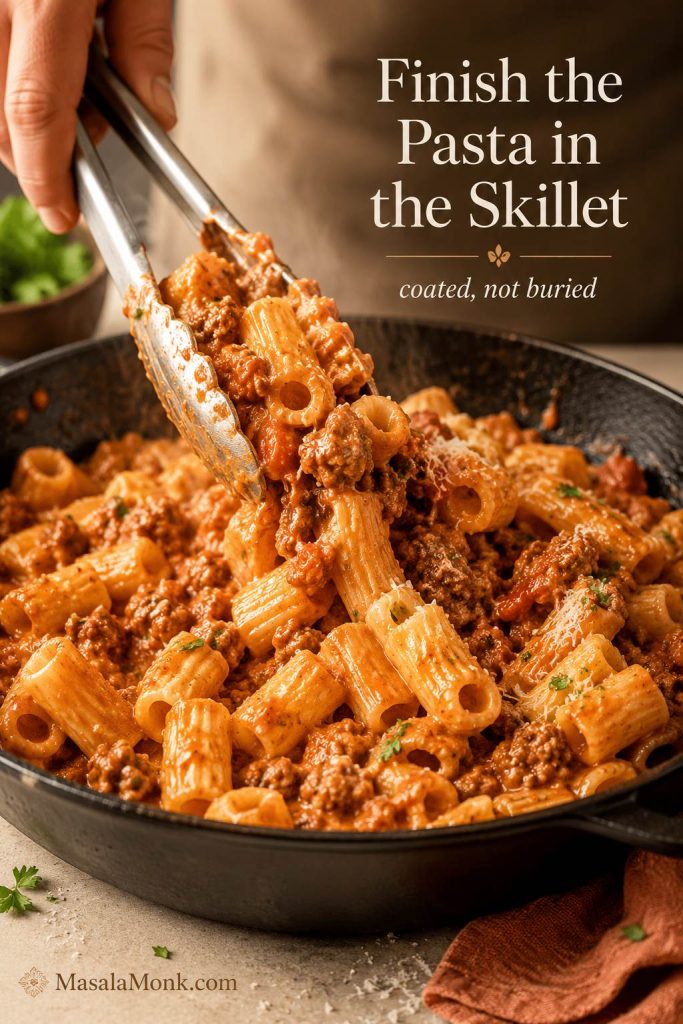
Toss until the pasta looks coated, not buried

Once the pasta goes into the skillet, the goal is coating, not drowning. Start with 1/4 cup / 60 ml reserved pasta water, toss, and add more only as needed. Different pasta shapes and brands absorb liquid differently.

Rigatoni being tossed in a skillet with creamy tomato sauce and crumbled Italian sausage until coated and glossy.
Finish the pasta in the skillet so the sauce can cling to the ridges and the sausage crumbles can settle into every bite.

Finish gently with parmesan and herbs

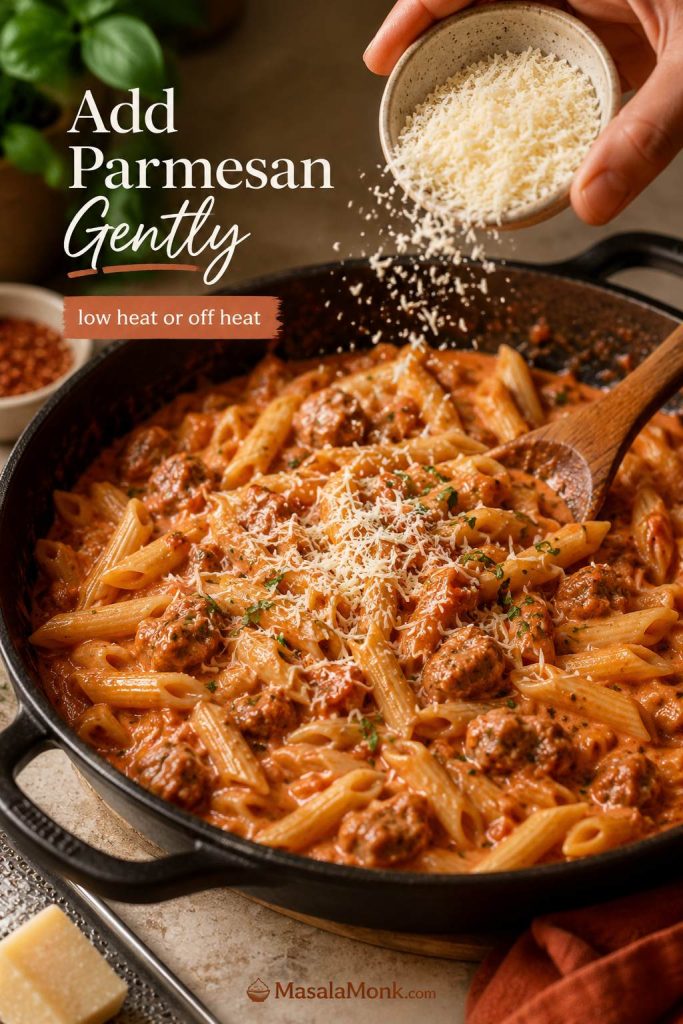
Parmesan melts best on low heat or off heat. Stir it in gently, then loosen the pan if needed. Creamy pasta is at its best right after tossing; if it tightens while everyone is getting to the table, add a small splash of warm water, milk, or cream and toss again.

Freshly grated parmesan being added gently to glossy creamy tomato sausage pasta in a skillet.
Add parmesan on low heat or off heat so it melts into the creamy tomato finish instead of clumping into salty patches.

How to Keep Sausage Pasta Creamy, Not Dry

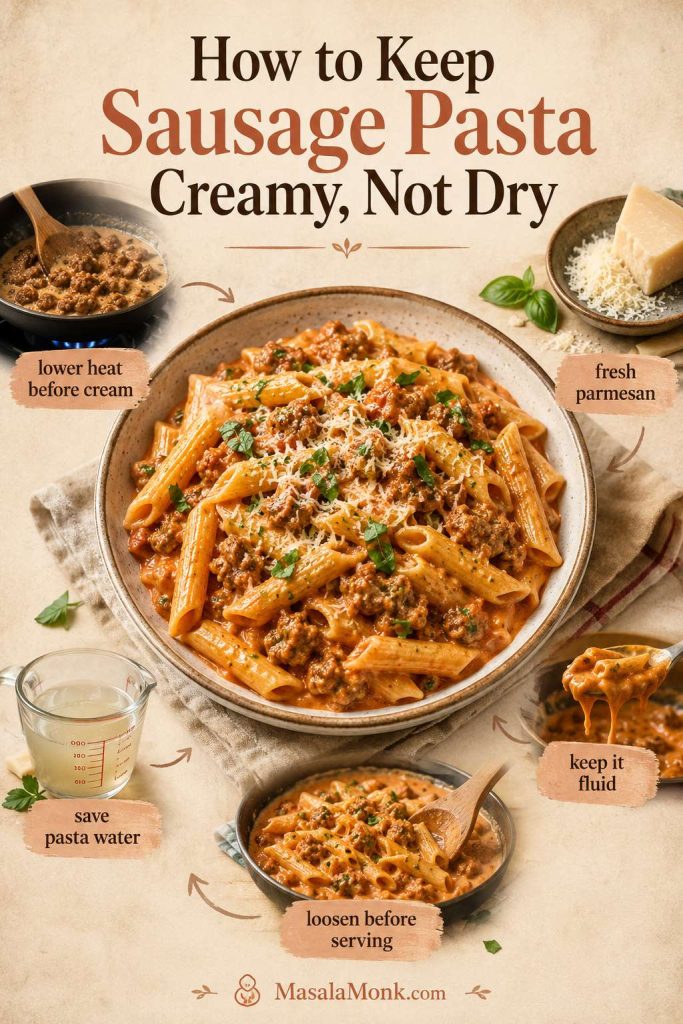
Creamy sausage pasta should not feel stiff or heavy. The pasta should look coated, not buried, and the pan should still move when you toss it.

Guide showing how to keep sausage pasta creamy with lower heat, fresh parmesan, pasta water, fluid sauce, and loosening before serving.
Creamy pasta stays smoother when the heat is gentle, the parmesan melts slowly, and the skillet stays slightly looser than the plated bowl needs.

Already fixing a problem? Jump to Troubleshooting. Working with leftovers? Go to Reheating Creamy Sausage Pasta.

  • Lower the heat before adding cream. Tomato is acidic, and high heat can make cream sauces split or look oily.
  • Use freshly grated parmesan. It melts more smoothly and tastes better than pre-shredded cheese.
  • Save pasta water. It loosens the pan without making the dish watery.
  • Keep the skillet a little fluid. Pasta keeps absorbing liquid after you turn off the heat.
  • Taste before serving. Sausage and parmesan are salty, so the final salt level depends on the brands you use.
  • Add liquid before the pasta looks dry. A small splash at the right moment keeps the sauce creamy instead of rescuing it after it has already tightened.

Save Pasta Water for a Glossy Finish

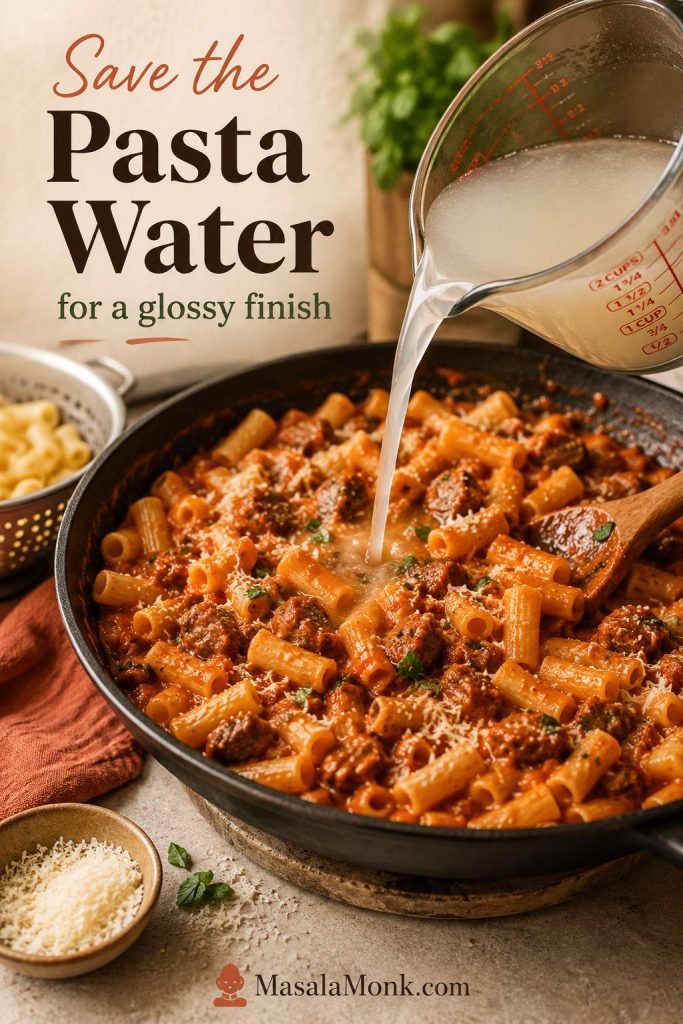
Keep a cup of cloudy pasta water nearby before draining. It helps the creamy tomato sauce loosen while keeping enough body to cling to the pasta.

Cloudy reserved pasta water being poured near a skillet of creamy tomato sausage pasta.
Reserved pasta water is the easiest way to loosen creamy sausage pasta without thinning the flavor or turning the pan watery.

Sausage Pasta Texture Guide

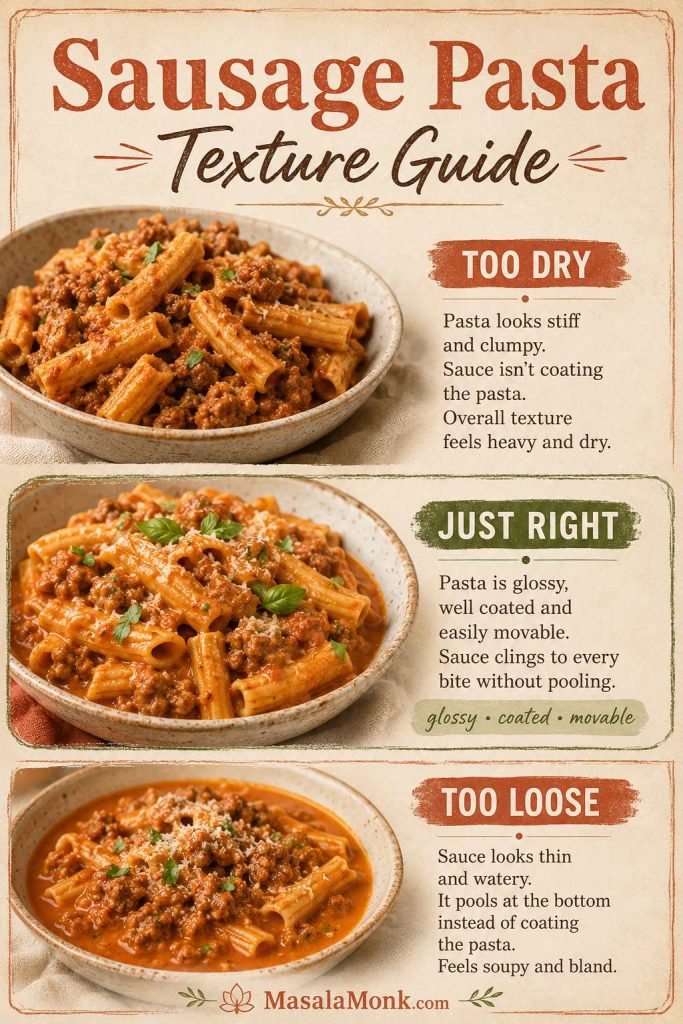
Use this texture guide when the skillet looks too tight or too loose. The goal is a glossy coating that moves when tossed, not a stiff mound or a watery pool.

Sausage pasta texture guide comparing too dry, just right, and too loose pasta with creamy tomato sauce.
Use texture, not just timing, as the final cue. The best sausage pasta looks glossy and coated, with enough movement to toss but no watery pooling.
Texture cue: the skillet should look a little saucier than you think. If it looks perfect in the pan, it may feel tight by the time it reaches the plate. Add reserved cooking water 1 to 2 tablespoons at a time and toss until the pasta looks silky.

If you like the tomato-cream balance here, this Vodka Pasta Recipe uses the same family of tomato paste, cream, parmesan, and pasta water in a smoother red sauce.

Easy Variations

Once you understand the base skillet, the variations stop feeling like separate recipes. You are just deciding what mood the pasta should have: creamier, smokier, spicier, baked, brighter, or lighter.

Want vegetables instead of a full variation? Jump to Add-Ins. Want the oven version? Go to Sausage Pasta Bake. Want fewer dishes? See One-Pot Sausage Pasta.

If You Want It…Do This
CreamierUse less crushed tomato and increase the cream to 1 cup / 240 ml.
More tomato-forwardUse a full 28-ounce / 800 g can of crushed tomatoes or passata and reduce or skip the cream.
SmokyUse browned smoked sausage or kielbasa coins instead of crumbled raw Italian sausage.
BakedKeep the sauce looser, transfer to a 9×13-inch / 23×33 cm dish, and top with cheese.
One-potUse controlled liquid, simmer gently, and add cream and parmesan near the end.
LighterUse chicken or turkey sausage, a little olive oil, and plenty of herbs.

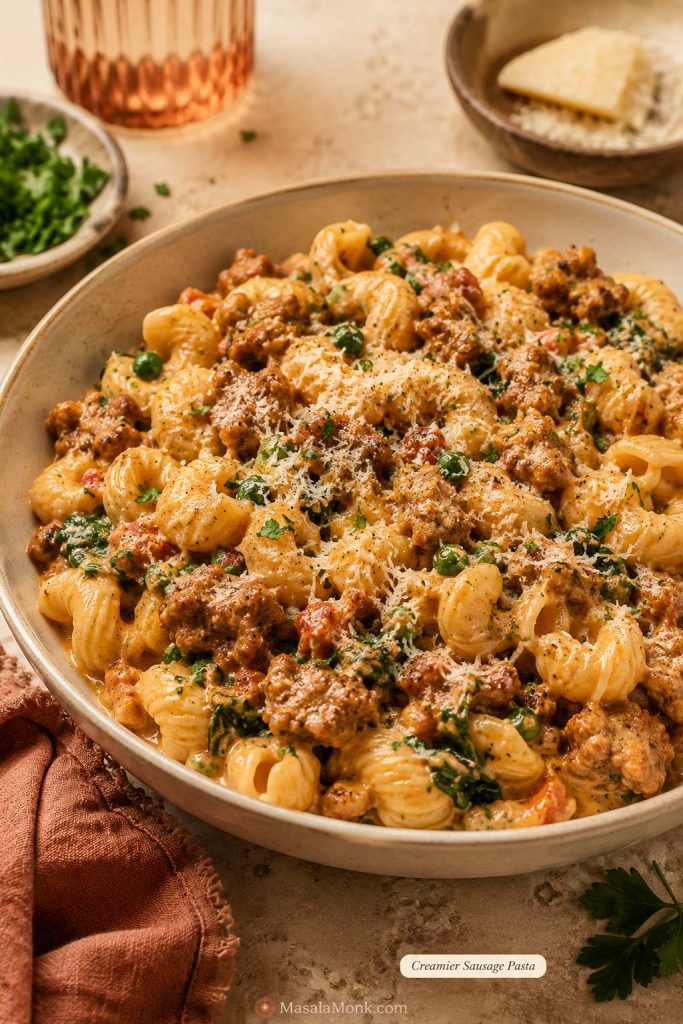
Creamier Sausage Pasta

For a richer, softer version, reduce the crushed tomatoes to about 1 cup / 240 ml and increase the cream to 1 cup / 240 ml. Add a little extra parmesan at the end. This version feels fuller, so spinach, peas, or broccoli help balance the bowl.

Creamier sausage pasta variation with short pasta, browned sausage, parmesan, herbs, and a pale tomato-cream sauce.
For a creamier sausage pasta, use enough cream to soften the tomato base while keeping browned sausage and parmesan in charge of the flavor.

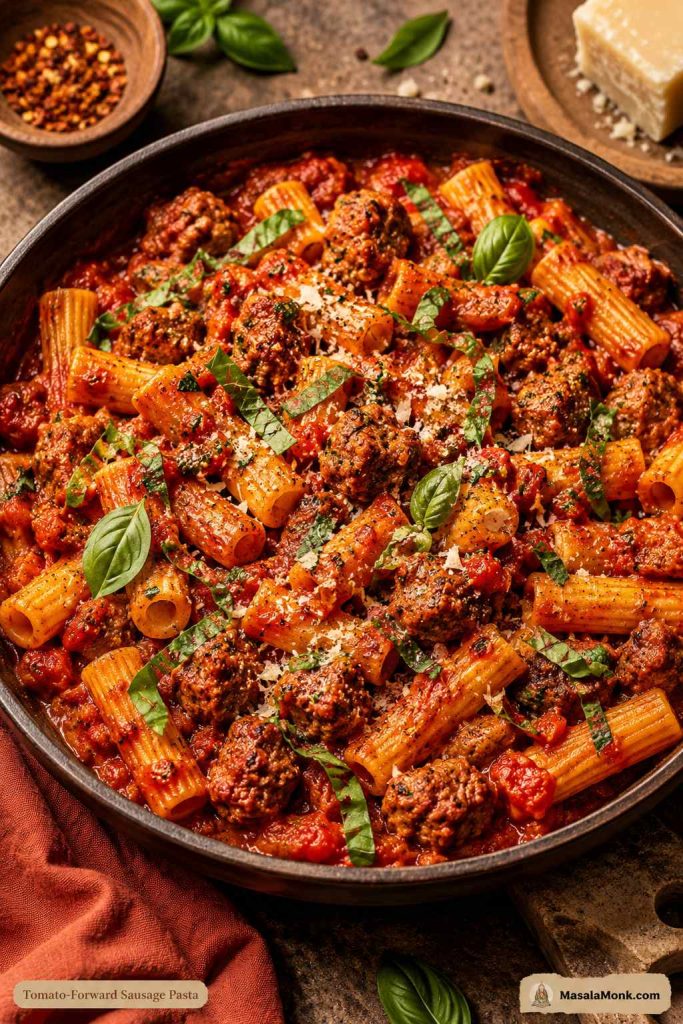
Tomato-Forward Sausage Pasta

For a brighter, redder pasta, use a full 28-ounce / 800 g can of crushed tomatoes or passata and reduce the cream to 1/4 cup / 60 ml, or skip it entirely. Add basil at the end for freshness.

Tomato-forward sausage pasta with browned sausage, short pasta, basil, parmesan, and a brighter red tomato sauce.
A tomato-forward sausage pasta tastes brighter and lighter, especially when basil, parmesan, and browned sausage keep the bowl balanced.

Fresh tomatoes can work here too, but they need more reduction than canned tomatoes or passata. This Tomato Sauce From Fresh Tomatoes guide shows how to cook them down until the flavor is concentrated enough for pasta.

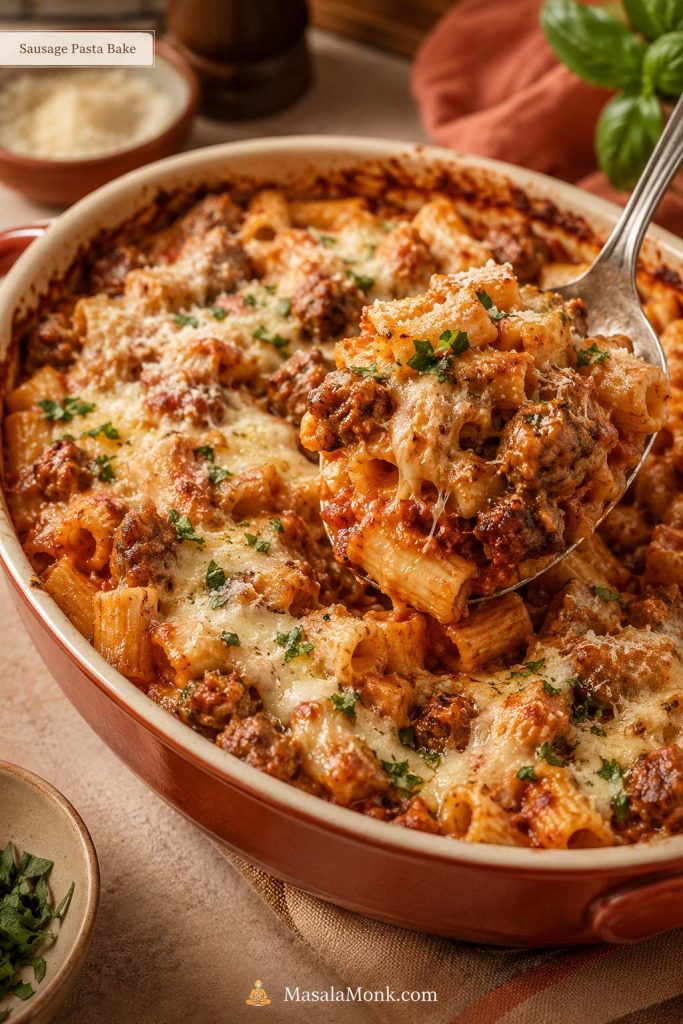
Sausage Pasta Bake

To turn this into a sausage pasta bake, cook the pasta 2 minutes under al dente and keep the sauce looser than usual. For the full recipe, use a 9×13-inch / 23×33 cm baking dish. Transfer everything to the dish, top with 1 to 1 1/2 cups shredded mozzarella and extra parmesan, then bake at 375°F / 190°C for 15 to 20 minutes, or until bubbling around the edges.

Baked sausage pasta in a ceramic dish with golden melted cheese, visible pasta, sausage pieces, and bubbling edges.
The baked version should go into the oven slightly wetter than skillet pasta, so the cheese can brown while the pasta stays scoopable.

For a golden top, broil for 1 to 3 minutes at the end, watching closely. Let the pasta bake rest for 5 to 10 minutes before serving so the sauce settles instead of running straight out of the dish.

The key with baked pasta is moisture. Loose sauce is not a mistake; it is insurance. If the pasta and sauce look perfect before baking, the final bake may turn dry.

This is the version to make when you want scoopable, cheesy comfort rather than a glossy skillet pasta.

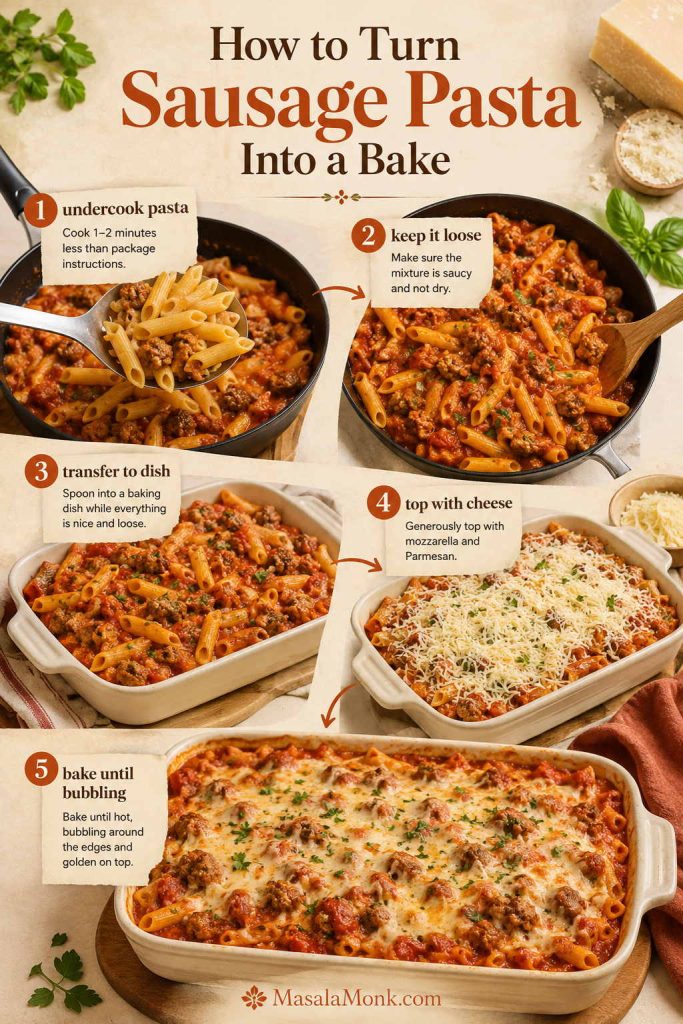
How to Turn Sausage Pasta Into a Bake

Use the visual steps below as a quick bake-conversion check before the dish goes into the oven.

Step-by-step guide for turning sausage pasta into a bake by undercooking pasta, keeping it loose, topping with cheese, and baking.
For the bake conversion, think insurance first: short-cooked pasta, a loose pan, and cheese on top before the oven does its work.

When baked pasta is the goal, this Baked Ziti Recipe goes deeper into cheese layers, make-ahead timing, and the saucier texture baked pasta needs.

Smoked Sausage or Kielbasa Pasta

Smoked sausage and kielbasa turn this into a shortcut smoky dinner. Slice them into coins, brown both sides, and then fold them into the creamy tomato base. They are especially good with cavatappi, penne, cheddar, parmesan, spinach, peppers, or Cajun seasoning.

Smoked sausage pasta with browned sausage coins, short pasta, creamy tomato-parmesan sauce, herbs, and a glossy finish.
Smoked sausage pasta is the shortcut version: the sausage is already seasoned, so browning the coins first gives the sauce a deeper, smokier edge.

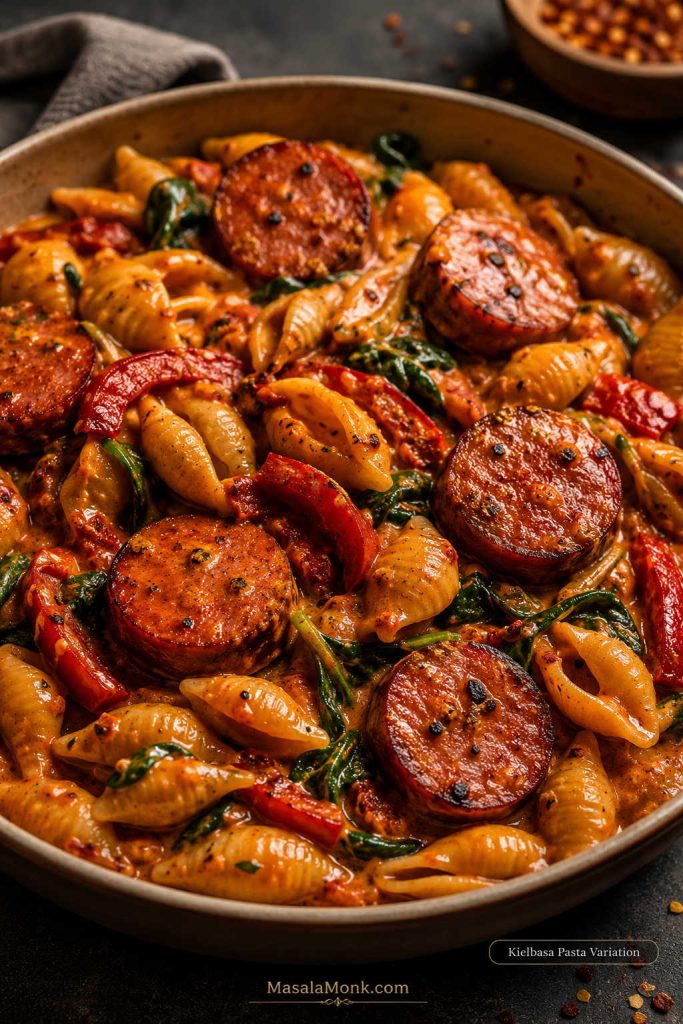
Smoky Kielbasa Pasta Variation

For this kielbasa pasta variation, thicker coins, cupped pasta shapes, and greens or peppers help it feel different from regular smoked sausage pasta.

Kielbasa pasta variation with thick browned kielbasa coins, pasta shells, creamy tomato sauce, spinach, peppers, and herbs.
Cupped shapes like shells work especially well with kielbasa because they catch the creamy sauce and balance its round smoky flavor.

For a full smoky version, use the method in this Kielbasa Pasta Recipe and treat this recipe as the Italian sausage version.

Cajun Sausage Pasta

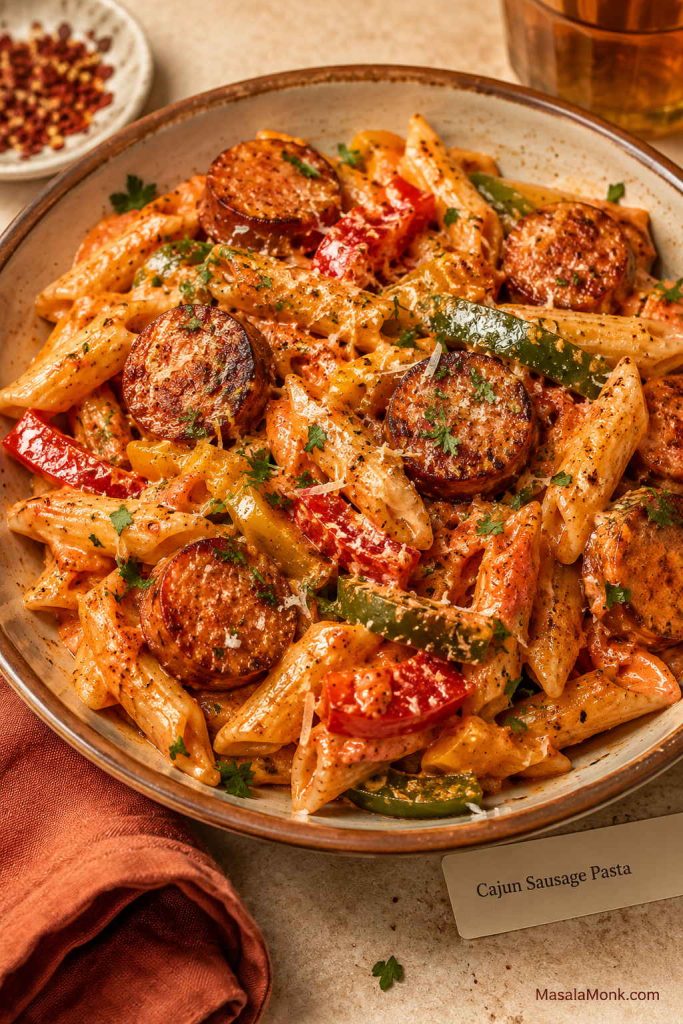
For a bolder, peppery version, use andouille or smoked sausage, add Cajun seasoning, and cook diced bell peppers and onions with the sausage. Keep the creamy red sauce, then finish with extra black pepper, parsley, and parmesan. If you like creamy Cajun-style dinners, this also pairs naturally with Cajun Chicken Pasta.

Cajun sausage pasta with sliced sausage coins, bell peppers, creamy red-orange sauce, parmesan, parsley, and seasoning flecks.
Cajun sausage pasta gets its personality from peppers, seasoning, and browned sausage coins, while the creamy red finish keeps the heat rounded.

Chicken Sausage Pasta

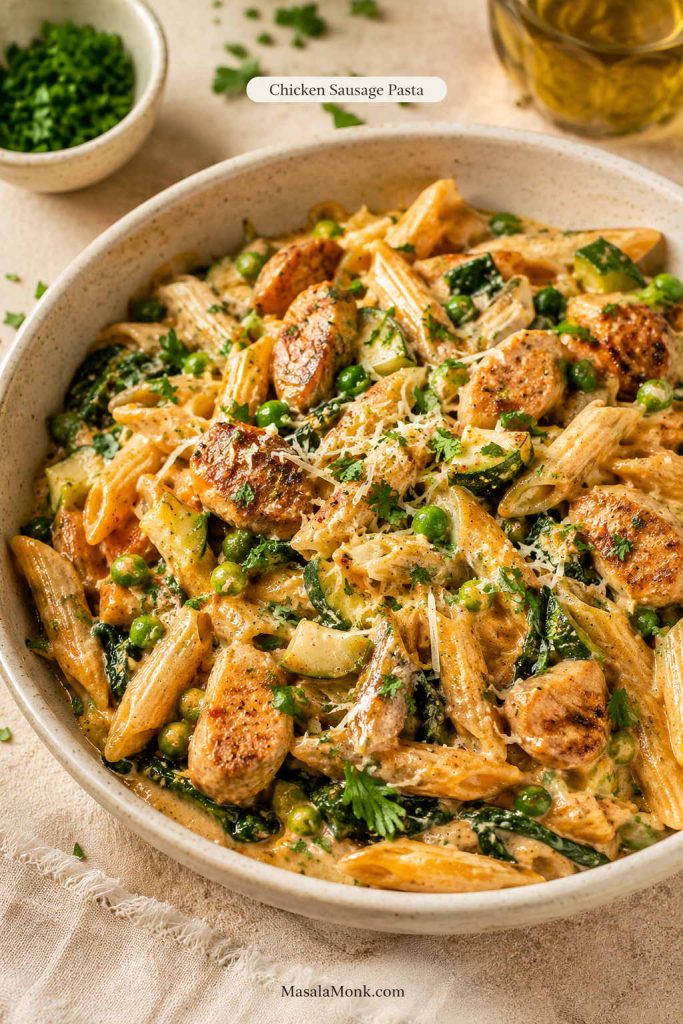
Chicken sausage works well when you want a lighter skillet, but it usually needs a little help. Fully cooked chicken sausage should be sliced and browned. Raw chicken sausage should be removed from the casings and cooked like Italian sausage. Because it is leaner, add a little olive oil and do not skip the tomato paste, parmesan, or herbs.

Chicken sausage pasta with penne, browned chicken sausage pieces, peas, zucchini, greens, parmesan, and a light creamy sauce.
Chicken sausage makes the dish feel lighter, but it still needs browning, parmesan, and a glossy finish to keep the pasta satisfying.

One-Pot Sausage Pasta

You can make a one-pot version, and the key is controlled liquid. For a smaller one-pot batch with 8 oz / 225 g short pasta, brown 8 to 12 oz / 225 to 340 g sausage, then add 2 cups / 480 ml broth or water and 14 to 15 oz / 400 to 425 g crushed tomatoes or passata. Keep it at a steady simmer, not a hard boil, and use a wide deep pan so the pasta cooks evenly.

One-pot sausage pasta cooked in a deep skillet with short pasta, sausage pieces, tomato sauce, herbs, and a wooden spoon.
For one-pot sausage pasta, watch the pan more than the timer; when the pasta drinks up liquid quickly, add small splashes and keep stirring.

When the pasta is still firm but the pan is drying out, add more broth or water in 1/4 cup / 60 ml splashes. Stir in 1/2 cup / 120 ml cream and 1/3 cup / about 35 g parmesan near the end, not at the beginning. Cream and cheese are easier to keep smooth once the pasta is almost cooked.

The separate-boil method in the recipe card is still more reliable, especially for a creamy sauce. One-pot pasta is convenient, but pasta shape, pan width, and heat level can change how much liquid you need.

For another creamy one-pot dinner, this One-Pot Chicken Bacon Ranch Pasta shows how much liquid no-drain pasta needs as it cooks.

Jarred Marinara Shortcut

For a shortcut, use about 1 1/2 cups / 360 ml jarred marinara instead of crushed tomatoes. Reduce the tomato paste to 1 tablespoon if the sauce is already intense. Still add cream, parmesan, and a little pasta water so the pasta tastes freshly finished instead of simply poured from a jar.

For a homemade version of that shortcut, use this Marinara Sauce Recipe in place of jarred marinara.

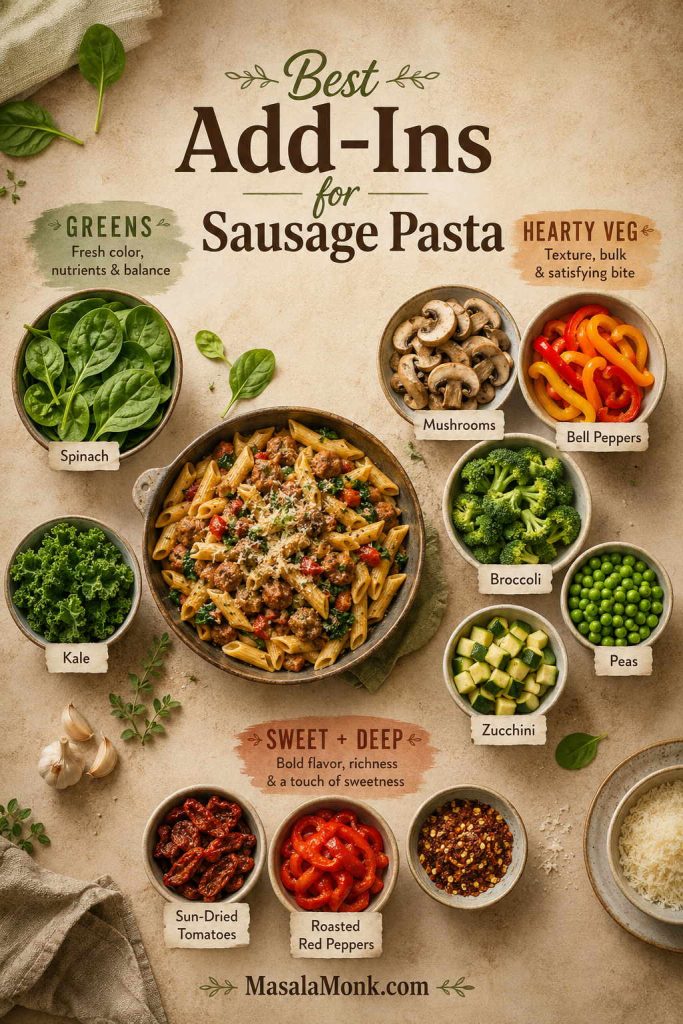
Add-Ins That Work Well

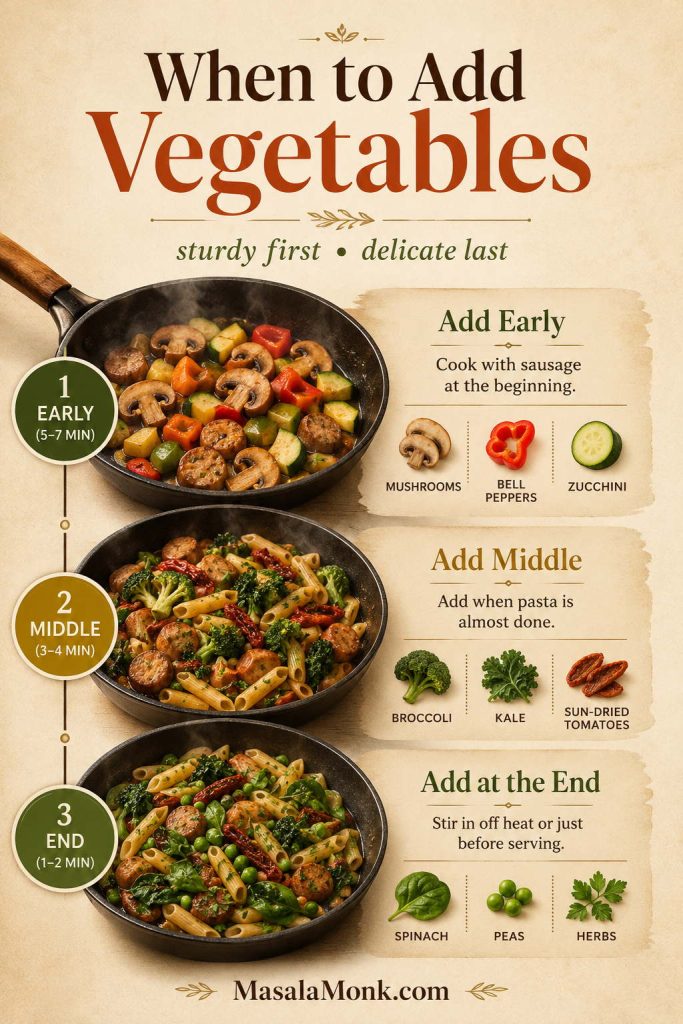
The recipe is flexible, but the timing matters. Add sturdy vegetables early so they soften, and delicate greens near the end so they stay fresh. You do not need to turn this into a vegetable drawer clean-out. One good add-in is usually better than five competing ones.

Add-in guide for sausage pasta with spinach, kale, mushrooms, bell peppers, broccoli, peas, zucchini, sun-dried tomatoes, and roasted red peppers.
The best add-ins bring a clear benefit: greens add freshness, mushrooms and peppers build depth, and broccoli or peas make the skillet feel like a fuller dinner.

Already know what you want to add? Use the vegetable timing guide so sturdy vegetables soften and delicate greens stay fresh.

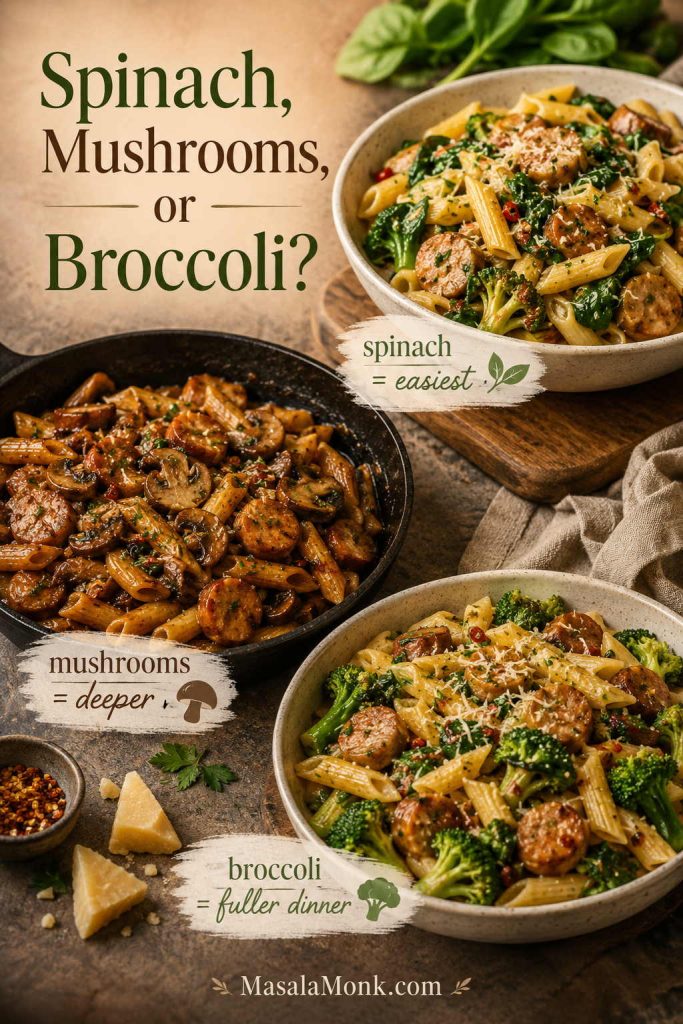
Best Everyday Add-Ins: Spinach, Mushrooms, or Broccoli

For the simplest choice, use spinach; for deeper flavor, use mushrooms; and for a fuller dinner, add broccoli without changing the basic sauce.

Three sausage pasta variations comparing spinach, mushrooms, and broccoli as add-ins with separate bowls and labels.
Choose one add-in with a clear job: spinach freshens the bowl, mushrooms deepen the sauce, and broccoli makes creamy sausage pasta feel more complete.
Add-InWhen to Add It
SpinachStir in at the end until just wilted.
MushroomsCook after browning the sausage, before adding tomato paste.
Bell peppersCook with the onion until softened.
BroccoliBlanch with the pasta for the last 2 minutes, or steam separately.
PeasAdd near the end; frozen peas only need a minute or two.
KaleAdd before spinach would go in; it needs a little more time to soften.
Sun-dried tomatoesStir in with the garlic and tomato paste for a deeper flavor.
Roasted red peppersAdd with the crushed tomatoes or at the end for a sweeter pepper flavor.
ZucchiniSauté after the sausage; avoid overcooking or it can turn watery.

When to Add Vegetables to Sausage Pasta

Use this timing guide when you are adding more than one vegetable. It keeps hearty pieces from staying raw and delicate greens from overcooking.

Vegetable timing guide showing early, middle, and end additions for sausage pasta, including mushrooms, peppers, zucchini, broccoli, kale, spinach, peas, and herbs.
Add sturdy vegetables early so they can soften and release moisture; add delicate greens at the end so they stay fresh and bright.

For a cozy sausage dinner with a different texture, this Slow Cooker Sausage Casserole Recipe is one to keep for colder evenings or hands-off cooking days.

What to Serve with Sausage Pasta

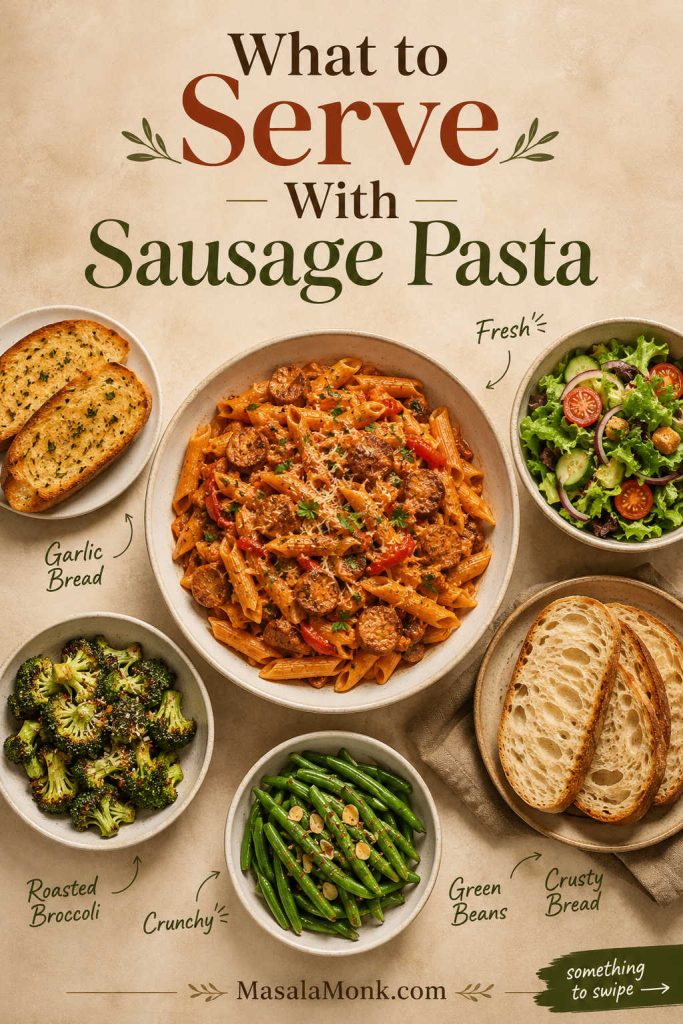
Because the pasta is already rich and saucy, the best sides either cut through it, scoop it up, or add something green. Keep the side simple so the sausage pasta still feels like the main event.

Serving guide for sausage pasta with garlic bread, green salad, roasted broccoli, green beans, and crusty bread around the main pasta bowl.
Pair sausage pasta with sides that cut, scoop, or freshen: salad for brightness, vegetables for balance, and bread for the tomato-parmesan finish.
If You Want…Serve This
A simple dinnerGarlic bread, crusty bread, or a green salad
More vegetablesRoasted broccoli, green beans, zucchini, or peppers
More comfortGarlic bread, Caesar-style salad, or a cheesy baked version
A lighter plateSimple salad, steamed greens, or roasted vegetables

For most nights, a green salad or garlic bread is enough. The pasta already brings the richness; the side just needs to bring crunch, freshness, or something to swipe through the sauce.

How to Store and Reheat Sausage Pasta

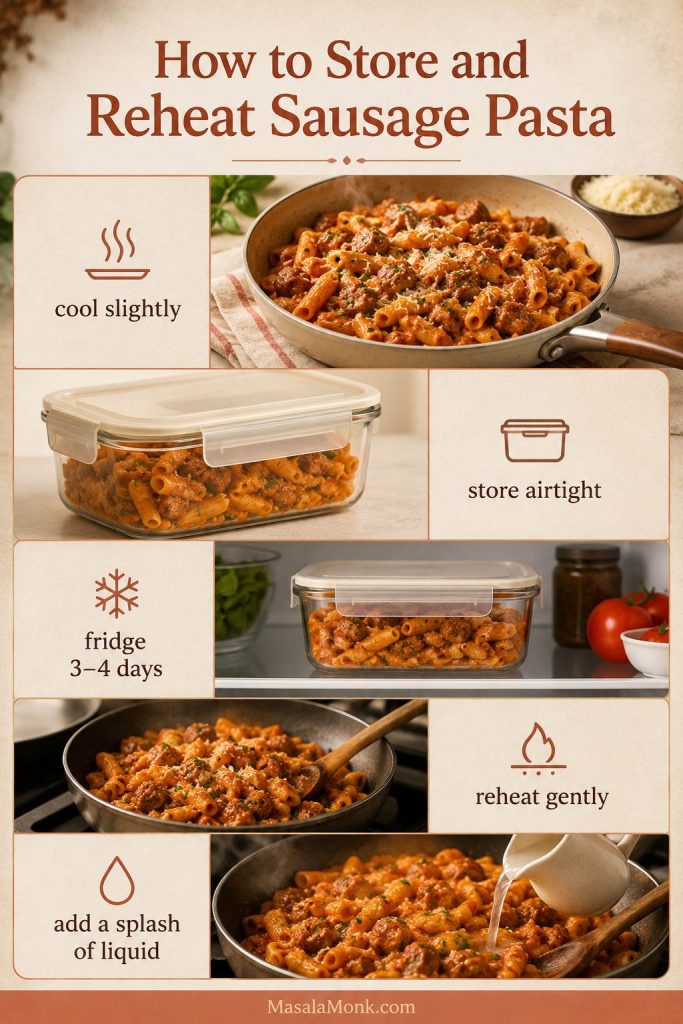
Sausage pasta is best when freshly tossed, but leftovers can still be very good. Creamy pasta often tightens in the fridge because the pasta keeps absorbing the sauce. That is normal. A splash of liquid and gentle heat bring it back.

Storage and reheating guide for sausage pasta with an airtight container, fridge cue, reheating skillet, and splash of liquid.
Store leftovers with reheating in mind: airtight container first, then gentle heat and a splash of liquid when it is time to serve again.
  • Refrigerate: store in an airtight container for 3 to 4 days.
  • Freeze: freeze only if needed. The flavor will hold, but the cream sauce may look slightly grainy or separated after thawing. Warm it gently with a splash of liquid and stir well.
  • Stovetop: add a splash of milk, cream, broth, or water and warm gently over low heat.
  • Microwave: add a small splash of liquid, cover loosely, and stir halfway through.
  • Avoid overheating: high heat can make the cream and cheese separate.

How to Reheat Creamy Sausage Pasta

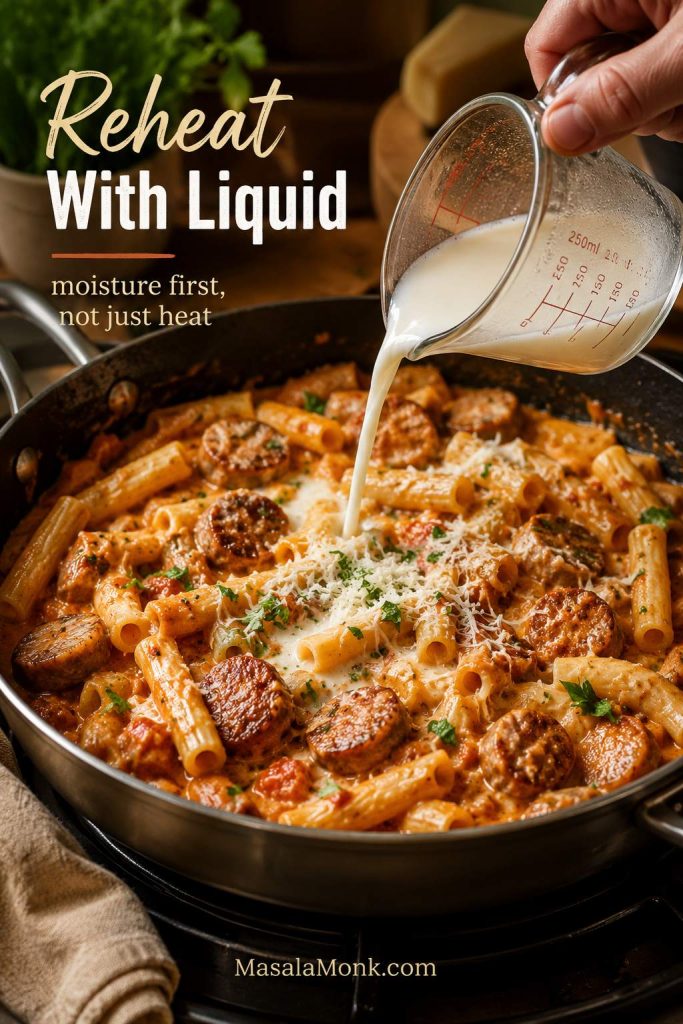
If the pasta looks tight after chilling, add moisture before more heat. A small splash loosens the sauce so it can coat the pasta again.

Creamy sausage pasta reheating in a skillet while milk or cream is poured in from a measuring cup.
A small splash of milk, cream, broth, or water brings leftovers back to a spoonable texture without pushing the sauce too hard.

If reheating does not fix the texture, jump to Troubleshooting for the quickest sauce adjustments.

Leftovers will not look as silky cold from the fridge, and that is completely normal. If the pasta still looks tight after reheating, add another small splash of liquid and stir again. Liquid is the fix; heat alone will only make creamy pasta tighter.

Troubleshooting Sausage Pasta

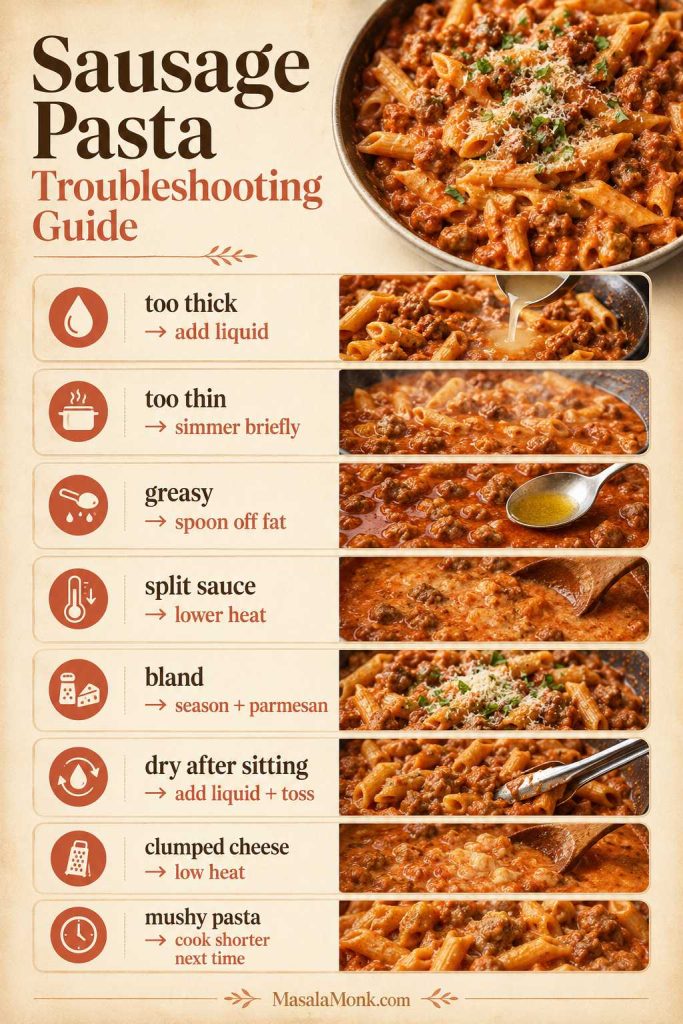
Most sausage pasta problems are easy to fix. If the sauce tightens, splits, looks greasy, or tastes a little flat, do not panic. Start with the smallest fix first. Creamy pasta usually needs adjustment, not rescue.

Troubleshooting guide for sausage pasta with fixes for thick, thin, greasy, split, bland, dry, clumped, and mushy pasta.
Most sausage pasta problems need a small adjustment: lower the heat, add liquid, season carefully, or toss a little longer until the sauce comes back together.
ProblemFix
Sauce is too thickAdd reserved pasta water 1 to 2 tablespoons at a time and toss until the sauce loosens.
Sauce is too thinSimmer briefly before adding the pasta, or toss the pasta in the sauce for another minute.
Sauce looks greasyLower the heat, add a splash of pasta water, and toss well. Drain excess sausage fat next time if needed.
Sauce splitTurn the heat down, add pasta water, and stir gently. Do not boil cream sauce hard.
Pasta tastes blandAdd salt, parmesan, black pepper, red pepper flakes, fresh herbs, or a little more browned sausage flavor.
Pasta is dry after sittingReheat with a splash of milk, cream, broth, or water.
Tomato tastes too sharpAdd a little more cream, parmesan, or a tiny pinch of sugar.
Pasta is mushyCook it 1 to 2 minutes under al dente next time, especially if baking or reheating.
Cheese clumpedUse freshly grated parmesan and add it off heat or on very low heat.
Sausage tastes flatBrown it longer next time. For the current batch, add red pepper flakes, parmesan, black pepper, or fresh herbs.

Most fixes are small. A splash of water, lower heat, or another minute of tossing usually does more than starting over.

Final Glossy Finish Cue

Before serving, look for the texture in this final cue: pasta that is coated, movable, and glossy, with sausage crumbles still visible in the ridges and folds.

Close-up spoon lift of glossy rigatoni with creamy tomato sauce, crumbled Italian sausage, parmesan, and herbs.
Before serving, the pasta should still slide from the spoon, with crumbles tucked into the ridges and no thin liquid collecting underneath.

FAQs

What kind of sausage is best for sausage pasta?

Mild or hot Italian sausage is the best choice for classic sausage pasta. Mild sausage keeps it cozy and balanced, while hot Italian sausage makes the same creamy tomato skillet deeper and spicier.

How does smoked sausage change the recipe?

Smoked sausage is usually already cooked, so slice it into coins and brown the cut sides before building the sauce. It gives the dish a smokier flavor and works especially well in cheesy, one-pot, Cajun, or kielbasa-style versions.

Is jarred marinara okay here?

Yes. Use about 1 1/2 cups / 360 ml jarred marinara instead of crushed tomatoes. Reduce the tomato paste to 1 tablespoon if the marinara is already intense, then finish with cream, parmesan, and a splash of pasta water.

What if I do not want to use cream?

For a no-cream version, lean on crushed tomatoes or passata, then finish with pasta water and parmesan so the pasta still has body. It will taste brighter and more tomato-forward, but still satisfying if the sausage is browned well.

Is milk a good substitute for cream?

Milk can work, but the sauce will be thinner and less stable. Half-and-half is a better substitute, and evaporated milk can work if you want creaminess without heavy cream.

Why is my sausage pasta sauce too thick?

It usually means the pasta kept drinking the sauce after it left the heat. Add reserved pasta water 1 to 2 tablespoons at a time and toss until the skillet loosens again.

How do I turn this into a sausage pasta bake?

Cook the pasta 2 minutes under al dente, keep the sauce looser than you would for skillet pasta, transfer everything to a 9×13-inch / 23×33 cm baking dish, top with mozzarella and parmesan, and bake at 375°F / 190°C for 15 to 20 minutes.

What pasta shape works best with sausage sauce?

Rigatoni is the easiest all-rounder because the ridges and hollow center catch sausage crumbles and sauce. Penne, shells, fusilli, cavatappi, and orecchiette also work well.

How do I reheat creamy sausage pasta without drying it out?

Add a splash of milk, cream, broth, or water before reheating. Warm gently and stir halfway through. The pasta needs moisture more than it needs more heat.

What changes if I double the recipe?

Use a very large skillet, sauté pan, or Dutch oven. Brown the sausage in batches so it sears instead of steaming, then add pasta water gradually at the end so the skillet stays glossy without becoming watery.

If you make this with hot Italian sausage, smoked sausage, kielbasa, spinach, rigatoni, shells, or another swap, leave a comment with what you used. Those small changes are often what make this recipe your own.

Back to top