Posted on 6 Comments

Paloma Recipe: 12 Paloma Cocktail Drinks

This Paloma recipe guide is built around one simple promise: learn the base ratios once, then make 12 Paloma cocktails with confidence. Inside you’ll find oz + ml measurements for the classic grapefruit soda Paloma, fresh grapefruit juice versions, spicy jalapeño twists, mezcal Palomas, and a party-ready pitcher method—so you can choose your style and get it right on the first try.

A paloma recipe can be as simple as tequila, grapefruit soda, and a squeeze of lime—yet it has that rare talent of tasting like you tried harder than you did. One minute it’s a breezy patio drink; the next it’s the easiest cocktail to scale for a party. Even better, it’s forgiving: you can build it with Squirt, go cleaner with Fresca, lean tart with fresh grapefruit juice, or take it smoky with mezcal. The shape stays familiar, but the personality changes fast.

That said, a Paloma also exposes little mistakes. Too much fizz added too soon and it goes flat. A heavy hand with lime and it gets aggressively sharp. Use a very sweet grapefruit soda and it can taste like adult candy. Meanwhile, fresh grapefruit juice can swing bitter if you squeeze too hard or lean on pith. The fix isn’t complicated—it’s mostly small decisions made on purpose.

So this guide is built around one idea: learn one reliable Paloma structure, then apply it to twelve versions that still feel like a Paloma (not a random tequila drink wearing grapefruit as a costume). You’ll get a classic Paloma cocktail recipe with grapefruit soda, options for Squirt, Fresca, and Jarritos, a Paloma recipe without grapefruit soda using fresh grapefruit juice, pitcher Palomas for a crowd, plus spicy and mezcal variations that stay balanced.
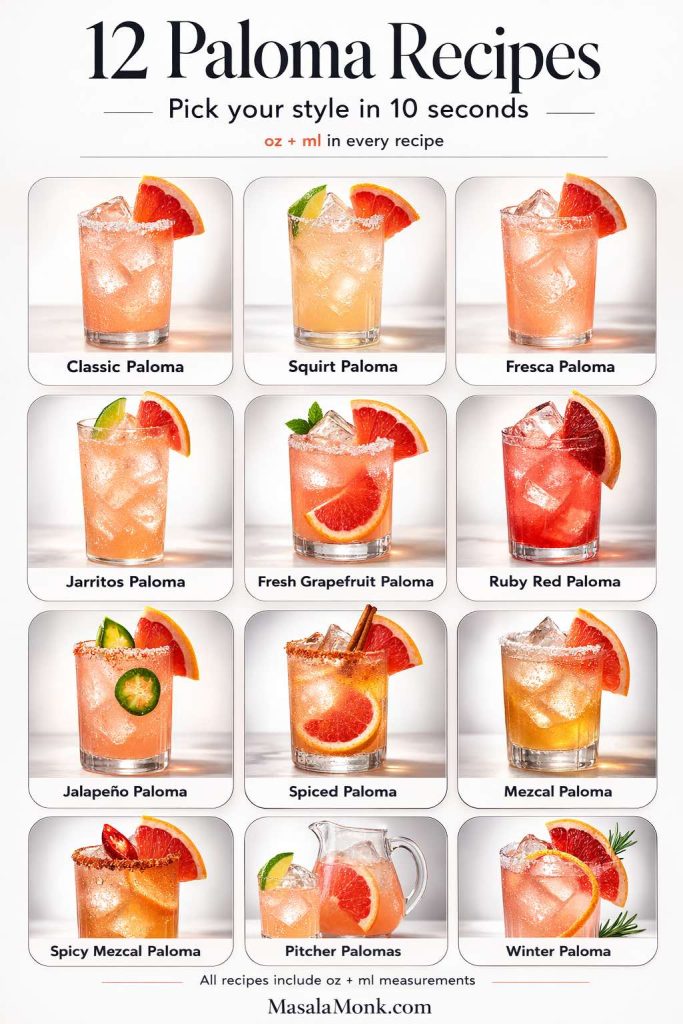
Use this as your quick-pick menu: choose your Paloma style in seconds (classic soda, fresh grapefruit, spicy, mezcal, or pitcher), then scroll to the matching recipe below—every version includes oz + ml measurements.

If you’re putting out snacks while you make drinks, the Paloma loves anything crunchy, salty, creamy, or spicy. A plate of golden, stretchy bites like these homemade mozzarella sticks keeps the vibe classic. A bowl of cool, crowd-friendly spinach dip brings balance when citrus is doing the most. And if you’re going spicy, you already know how well heat + grapefruit plays—these baked jalapeño poppers are basically made for a spicy Paloma night.


Paloma recipe basics: what makes a Paloma taste “right”

A Paloma is a tequila highball with grapefruit at the center. In its most familiar form, it’s tequila + lime + grapefruit soda over ice. It’s often served with a salt rim or a pinch of salt in the drink—because salt pulls grapefruit forward and makes the whole thing taste more complete.

A widely used classic ratio is 2 oz tequila + ½ oz lime juice + grapefruit soda to top, plus a pinch of salt. You’ll see that structure echoed across many bar-style references, including Liquor.com’s blog post on Paloma Cocktail.

From there, everything is tuning. Want something more grown-up and less sweet? Swap the grapefruit soda for fresh grapefruit juice and sparkling water. Want a smoky edge? Make it a mezcal paloma cocktail. Want the party version? Use a pitcher paloma recipe that keeps carbonation separate until the last second.
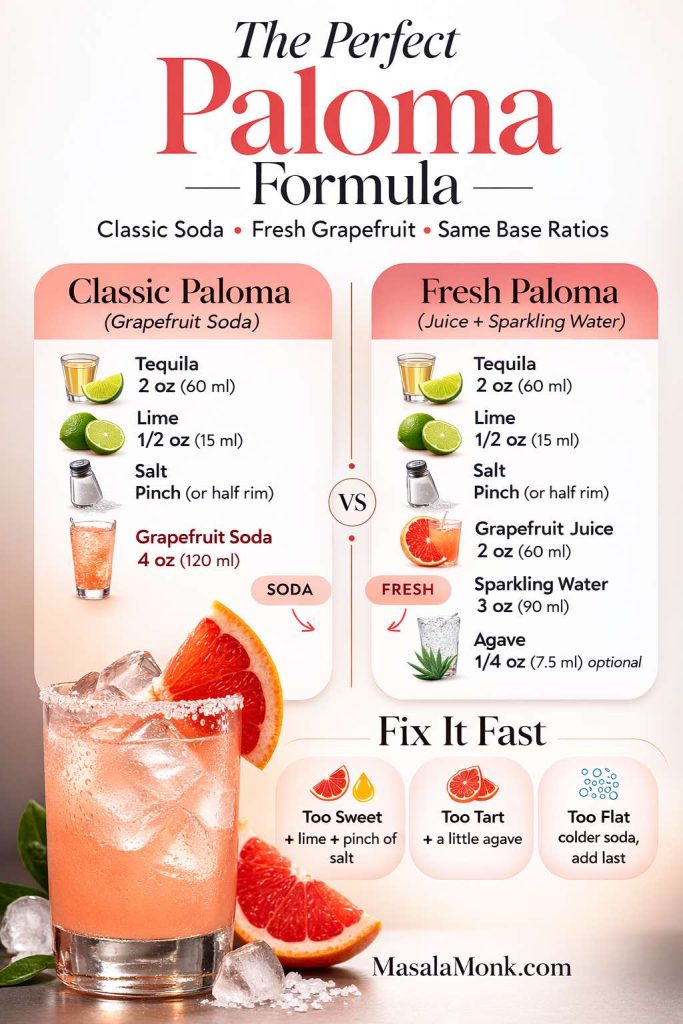
Infographic showing the perfect Paloma formula: Classic Paloma with grapefruit soda vs Fresh Paloma with grapefruit juice and sparkling water, with oz and ml measurements, plus “Fix It Fast” tips.
Save this Paloma formula: it shows the classic grapefruit soda Paloma and the fresh grapefruit juice Paloma side-by-side with oz + ml measurements, plus quick fixes if your drink tastes too sweet, too tart, or goes flat.

Paloma ingredients (and what each one actually does)

Tequila
Blanco keeps the drink crisp and bright; reposado adds a soft warmth that’s beautiful in winter paloma variations and spice-forward builds. If you want to nerd out later with a different tequila direction, a tequila-friendly ratio thinking shows up in drinks like a Moscow Mule too—same idea: structure first, personality second.

Grapefruit (soda or juice)
Grapefruit soda makes the drink effortless and bubbly. Fresh grapefruit juice makes it taste “crafted,” but you may need a touch of sweetener to keep it from getting too stern.

Lime juice
Lime gives the Paloma its snap. It also prevents sweetness (especially in Squirt mixed drinks) from feeling heavy. Still, more lime isn’t always better; past a certain point it flattens grapefruit and turns the drink into a sour.

Salt
Salt is the secret handshake of the Paloma. You can rim the glass, or add a pinch directly to the drink. Either way, it rounds edges and makes grapefruit taste brighter.
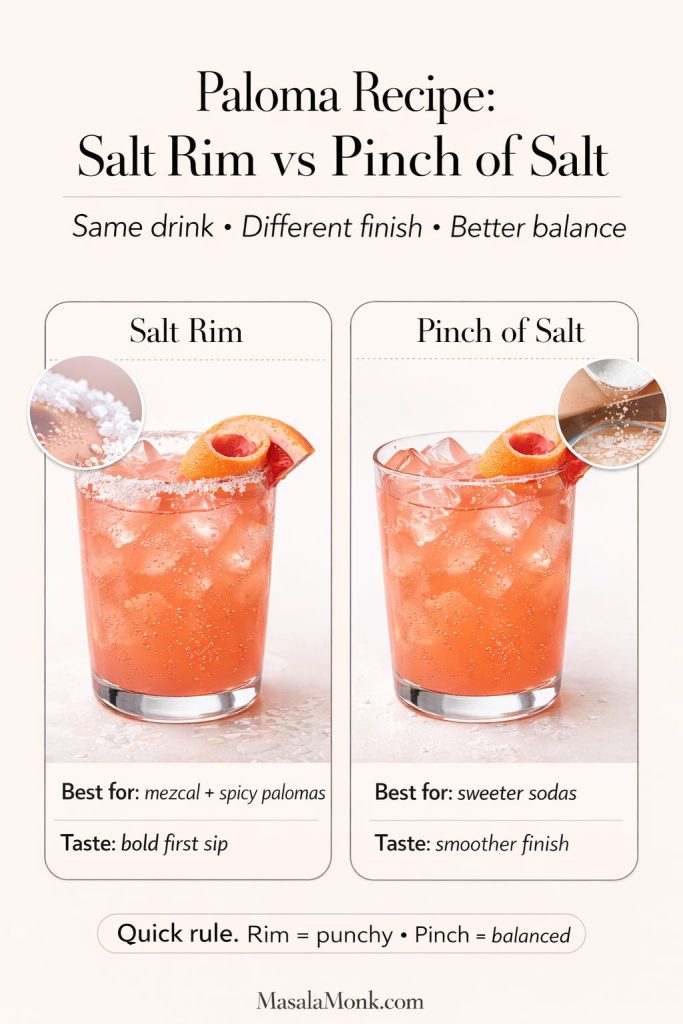
Salt is the quiet upgrade that makes a Paloma taste “right.” Use a salt rim when you want a bold first sip (especially for mezcal or spicy palomas). Use a pinch of salt in the drink when you’re working with sweeter grapefruit sodas, because it smooths the finish without making the rim taste salty.

Sweetener (optional)
Agave syrup or simple syrup belongs mainly in fresh grapefruit builds, or in cases where your grapefruit soda is very dry. When you’re using sweeter sodas, sweetener usually isn’t needed.

Best tequila for Paloma cocktail: blanco vs reposado

If you’re choosing quickly, here’s the simplest rule:

  • Blanco tequila is the default for a classic paloma recipe. It’s clean, peppery, and keeps grapefruit and lime vivid.
  • Reposado tequila is excellent when you’re adding spice, blood orange, or warm notes. It’s also nice in a “spiced paloma” where a salt rim and a little aromatic complexity are part of the point.
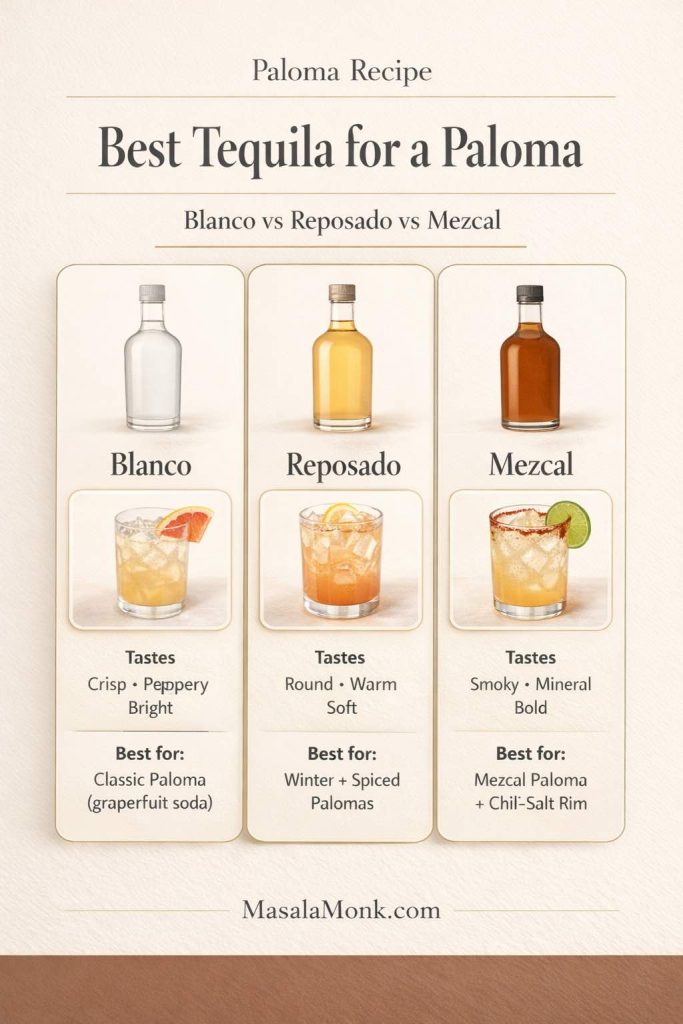
Infographic titled “Best Tequila for a Paloma: Blanco vs Reposado vs Mezcal” showing three options with taste notes and best uses: Blanco (crisp, peppery, bright) for a classic Paloma with grapefruit soda; Reposado (round, warm, soft) for winter and spiced Palomas; Mezcal (smoky, mineral, bold) for a mezcal Paloma with a chili-salt rim.
Not sure which bottle to grab for a Paloma? Use this quick chooser: blanco tequila keeps a classic Paloma cocktail crisp and bright, reposado adds warmth that shines in winter or spiced Paloma variations, and mezcal brings a smoky edge that pairs beautifully with grapefruit and a chili-salt rim. Pick your vibe, then use the recipes below for classic, fresh grapefruit, spicy, mezcal, and pitcher Palomas.

If you’re deciding between bottles for a party, go blanco. And if you’re doing a small round of winter palomas or a mezcal-adjacent smoky lineup, reposado can be surprisingly flattering.

Grapefruit soda for Paloma: why your drink tastes different every time

Grapefruit soda varies wildly. Some are sweet and punchy. Some are lighter and drier. That’s why tequila and squirt cocktail recipes can taste radically different from a paloma cocktail fresca build even with the same tequila and lime.

Instead of treating every grapefruit soda the same, use a tiny “adjustment” mindset:

  • If your Paloma tastes too sweet, add a little more lime and a pinch of salt, or dilute with more sparkling water.
  • If it tastes too tart, add a small amount of agave syrup and stir gently.
  • If it tastes flat, it usually wasn’t the recipe—it was the order of operations. Add bubbles last, and stir once.

Also Read: Tapas Recipe With a Twist: 5 Indian-Inspired Small Plates


Classic Paloma recipe (with grapefruit soda)

This section gives you the foundation: the classic Paloma ingredients, the simple build method, and the most common grapefruit soda route. From here, the Squirt tequila drink versions, Fresca tequila drink versions, and Jarritos paloma versions are easy variations rather than entirely new learning curves.

For a classic reference ratio, Liquor.com’s Paloma cocktail is a clean baseline. If you prefer a more measurement-forward, ml-friendly approach with grapefruit juice, agave, and soda, Difford’s Guide has a widely cited Paloma spec that’s useful for comparing styles.

The build method that keeps it crisp (and not flat)

  1. Start with the still ingredients first: tequila, lime, and salt.
  2. Add ice next: this chills and adds dilution gradually.
  3. Top with grapefruit soda last: cold soda, freshly opened.
  4. Stir once, gently: one slow turn is plenty.
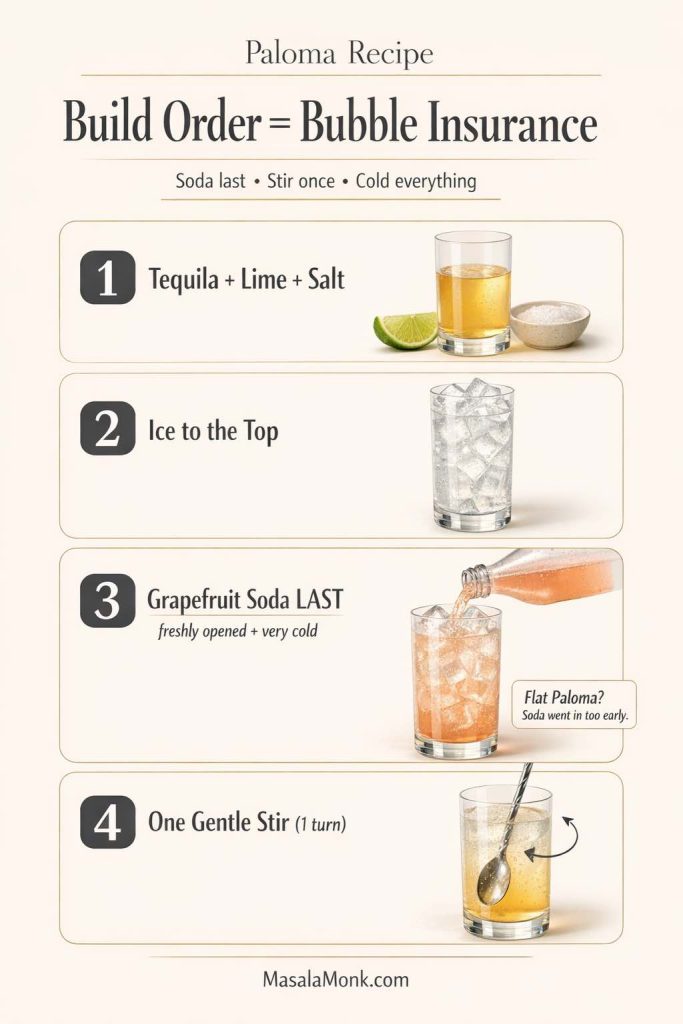
Infographic titled “Paloma Recipe: Build Order = Bubble Insurance” showing a 4-step method: add tequila, lime, and salt, fill the glass with ice to the top, pour grapefruit soda last (freshly opened and very cold), then stir gently once to keep a Paloma cocktail fizzy.
Flat Palomas usually aren’t the recipe — they’re the build order. Follow this quick sequence: tequila + lime + salt first, ice to the top, then grapefruit soda last, and one gentle stir. It works for a classic Paloma cocktail recipe and for Squirt, Fresca, or Jarritos Paloma swaps—keeping every glass crisp and bubbly.

That’s it. The Paloma isn’t complicated—it just wants restraint.

Also Read: Air Fryer Salmon Recipe (Time, Temp, and Tips for Perfect Fillets)


Classic Paloma cocktail recipe with grapefruit soda

A classic Paloma is the rare cocktail that feels both effortless and intentional. On one hand, it’s a “build it in the glass” drink—no shaking, no straining, no drama. On the other, the details matter: cold grapefruit soda, fresh lime (not bottled), and just enough salt to make the grapefruit taste brighter instead of sweeter.

1) Classic Paloma recipe (grapefruit soda)

Makes: 1 drink
Glass: Highball / Collins
Ice: Cubes (fresh, not “freezer-burnt”)

Ingredients (oz + ml):

  • 2 oz (60 ml) blanco tequila
  • ½ oz (15 ml) fresh lime juice
  • Pinch of fine salt or a half salt rim
  • 4 oz (120 ml) grapefruit soda, very well chilled
  • Garnish: lime wheel, grapefruit wedge, or a thin grapefruit peel
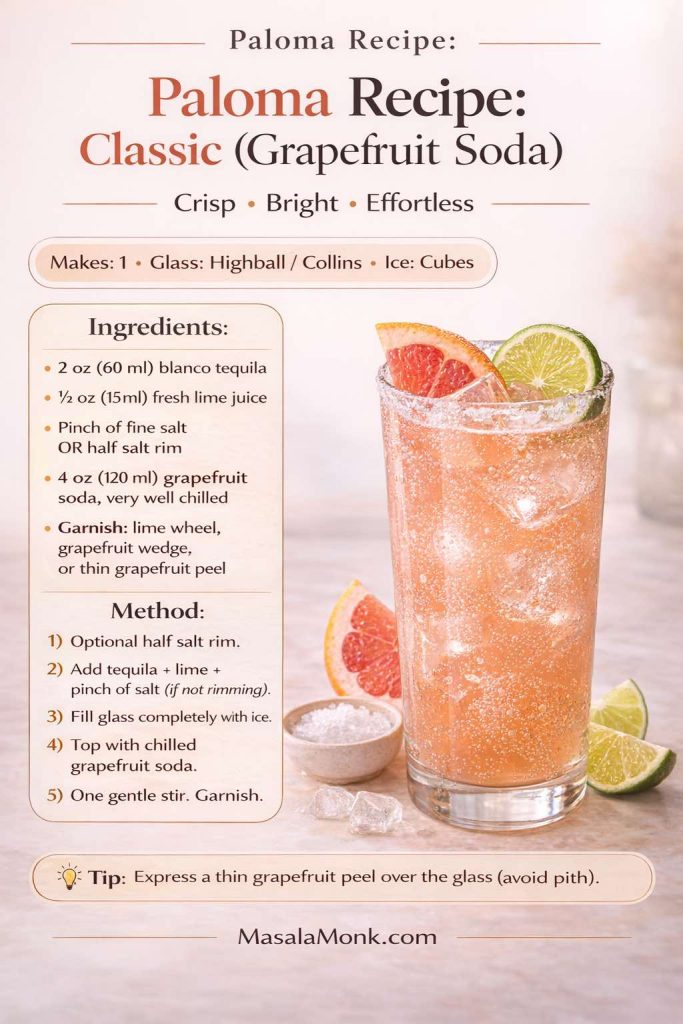
Recipe card for “Paloma Recipe: Classic (Grapefruit Soda)” showing ingredients and steps with oz and ml measurements: blanco tequila, fresh lime juice, pinch of salt or half salt rim, chilled grapefruit soda, and garnish options, plus a method to build over ice, top with soda, and stir once, with a tip to express grapefruit peel and avoid pith.
This is the classic Paloma cocktail recipe with grapefruit soda—fast, bright, and easy to get right. Build tequila + lime first, fill the glass with ice, then add grapefruit soda last so it stays fizzy. Finish with a pinch of salt (or a half salt rim) to make grapefruit taste cleaner and more “Paloma,” not candy-sweet.

Method (step-by-step):

  1. Optional rim: If you want a rim, run a lime wedge around half the glass, then dip that side into fine salt. A half rim lets you choose salty or unsalted sips.
  2. Build the base: Add tequila and lime juice to the glass. Sprinkle in a pinch of salt (if you’re not rimming).
  3. Ice it down: Fill the glass completely with ice cubes. More ice actually helps here—it melts slower and keeps the drink snappy.
  4. Top carefully: Pour in the chilled grapefruit soda.
  5. One gentle stir: Give the drink a single slow turn to combine, then stop. Over-stirring knocks out the bubbles you’re trying to keep.

Serving idea:
This is a natural match for salty, gooey snacks like mozzarella sticks or something creamy and scoopable like spinach dip.

Make it nicer without making it harder:
Use a thin strip of grapefruit peel and express it over the glass—twist it once so the oils mist the surface—then drop it in. Keep the peel thin and avoid pith; that’s where harsh bitterness sneaks in.

Also Read: Masterclass in Chai: How to Make the Perfect Masala Chai (Recipe)


Paloma soda swaps: Squirt, Fresca, and Jarritos

Grapefruit sodas don’t behave the same way. Some are sweeter and rounder, while others are drier and more citrus-forward. As a result, a tequila and Squirt drink can feel dessert-y, whereas a Paloma cocktail Fresca build can taste clean and sharply refreshing. Instead of fighting the soda, these recipes lean into what each one does well—then balance it with lime, salt, and ice.
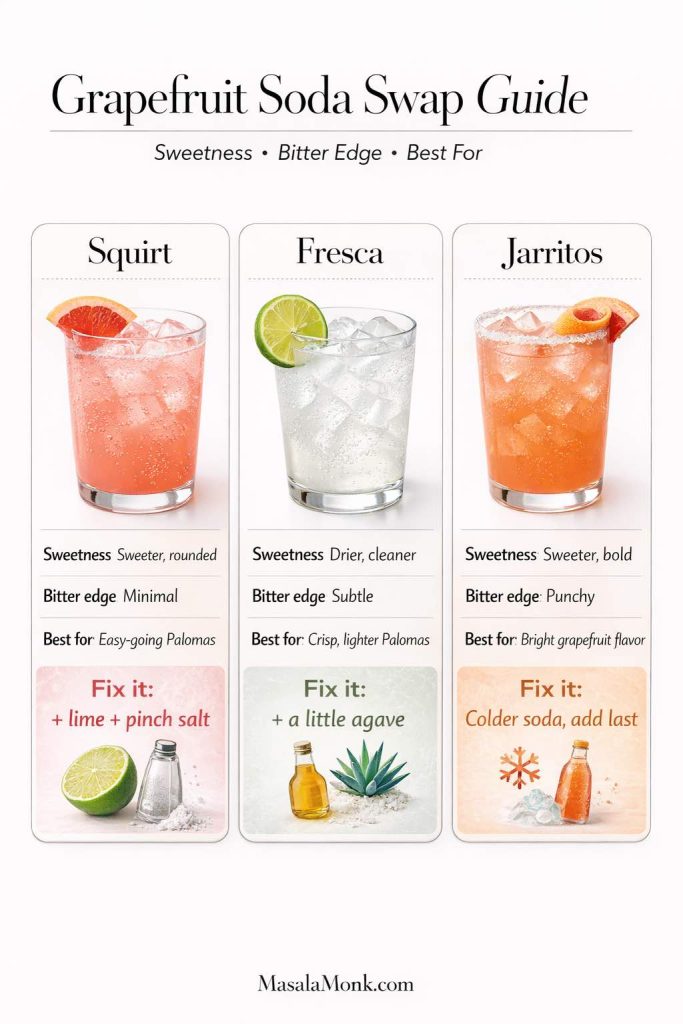
Infographic comparing grapefruit soda options for a Paloma cocktail—Squirt, Fresca, and Jarritos—with notes on sweetness, bitter edge, best use, and quick fixes like adding lime, agave, or colder soda.
Not all grapefruit soda tastes the same. Use this swap guide to pick the best soda for your Paloma recipe—Squirt for a sweeter, easy-going drink, Fresca for a cleaner, lighter finish, or Jarritos for bold grapefruit flavor—then use the quick “fix it” tip to balance sweetness, tartness, or fizz.

2) Paloma recipe with Squirt (tequila and Squirt Mexican drink)

This is the bright, familiar “squirt tequila cocktail” style—easygoing, crowd-friendly, and unapologetically fun. Still, because Squirt-style grapefruit sodas are often sweeter, this version benefits from a little extra precision so it doesn’t drift into syrupy territory.

Makes: 1 drink
Glass: Highball / Collins
Ice: Cubes

Ingredients (oz + ml):

  • 2 oz (60 ml) blanco tequila
  • ½ oz (15 ml) fresh lime juice
  • Pinch of salt
  • 4 oz (120 ml) grapefruit soda (Squirt-style), very cold
  • Garnish: lime wedge (or grapefruit wedge)
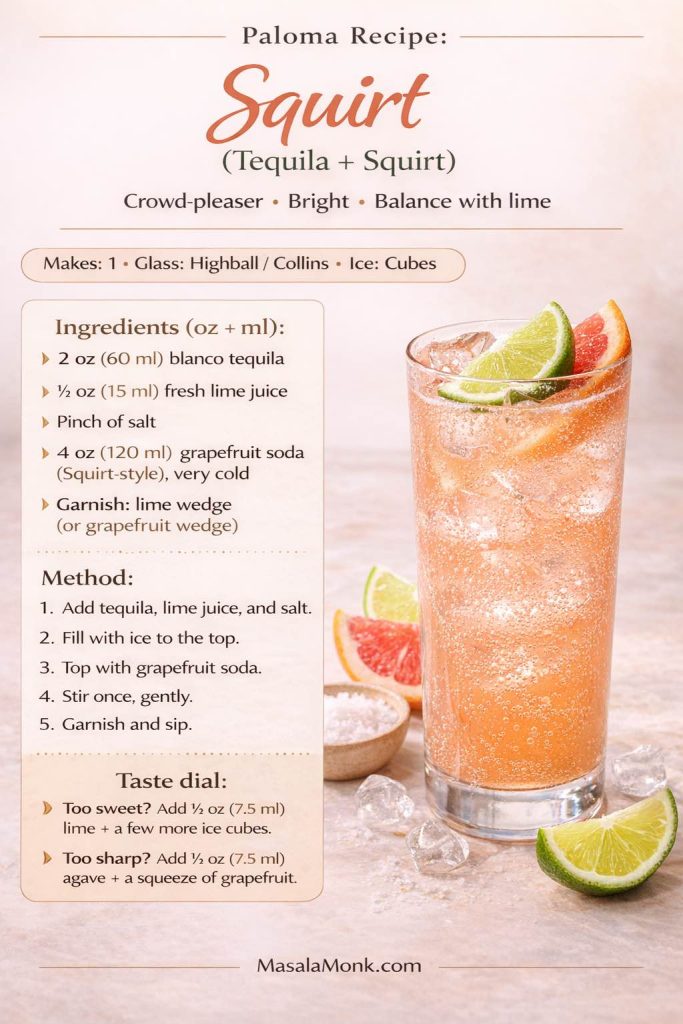
Recipe card titled “Paloma Recipe: Squirt (Tequila + Squirt)” showing ingredients and method with oz and ml amounts: blanco tequila, fresh lime juice, pinch of salt, very cold Squirt-style grapefruit soda, and lime or grapefruit garnish. It includes steps to build over ice, top with grapefruit soda, and stir once gently, plus a taste dial for fixing a drink that is too sweet or too sharp.
This tequila and Squirt Mexican drink is the easiest crowd-pleaser Paloma: tequila + lime over ice, then Squirt-style grapefruit soda (very cold) and one gentle stir. Because Squirt can lean sweeter, the little “taste dial” keeps it balanced—add a touch more lime if it drinks candy-sweet, or a splash of agave if it feels sharp.

Method:

  1. Add tequila, lime juice, and salt to the glass.
  2. Fill with ice all the way to the top.
  3. Top with grapefruit soda.
  4. Stir once, gently.
  5. Garnish and sip.

Taste dial (quick adjustments that keep it “Paloma”):

  • If it lands too sweet: add ¼ oz (7.5 ml) lime juice, then add a few more cubes of ice. Wait 30 seconds before deciding again.
  • If it feels sharp instead: add ¼ oz (7.5 ml) agave syrup, stir gently, and finish with a squeeze of grapefruit wedge.

Serving idea:
This is the “game night” Paloma—make two or three back-to-back and put out a dip situation with Crispy Homemade French Fries From Fresh Potatoes (Recipe Plus Variations) so people can keep snacking without thinking.

Also Read: Keto Mocktails: 10 Low Carb, Sugar Free Recipes


3) Paloma cocktail Fresca (Paloma recipe with Fresca)

Fresca-style grapefruit soda tends to taste lighter and cleaner, which makes this a great “simple paloma” option when you want something crisp rather than candy-bright. Moreover, it’s an easy way to keep the drink refreshing even when you’re pouring generous ice.

Makes: 1 drink
Glass: Collins
Ice: Cubes

Ingredients (oz + ml):

  • 2 oz (60 ml) tequila (blanco is ideal; reposado also works)
  • ½ oz (15 ml) lime juice
  • Pinch of salt or a half salt rim
  • 4–5 oz (120–150 ml) grapefruit soda (Fresca-style), chilled
  • Garnish: grapefruit wedge or lime wheel
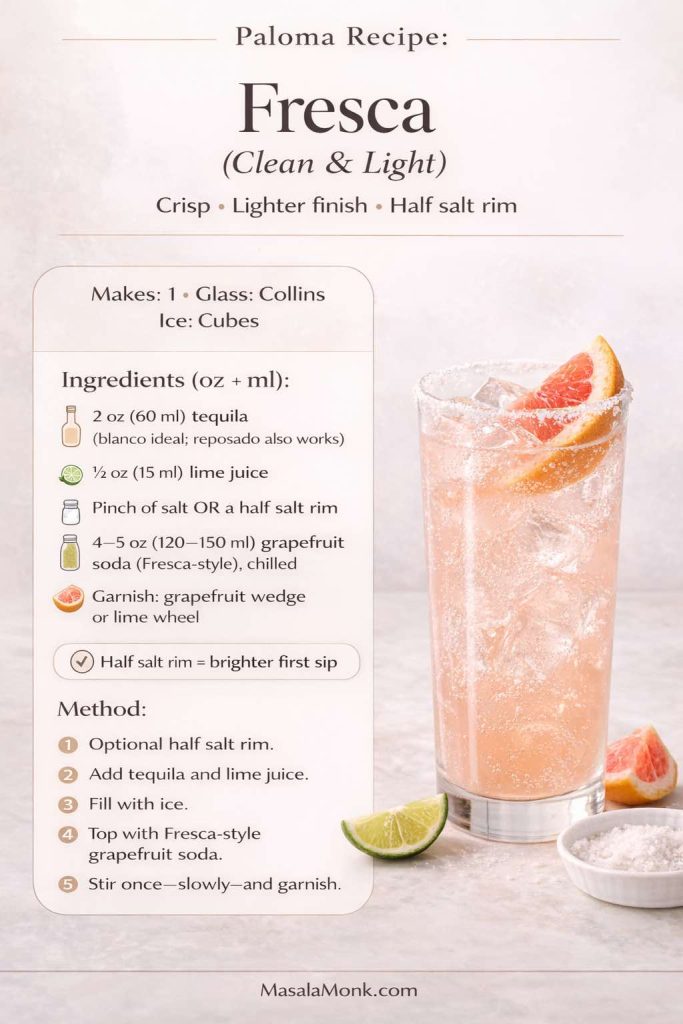
Recipe card titled “Paloma Recipe: Fresca (Clean & Light)” showing ingredients and steps with oz and ml measurements: tequila, lime juice, pinch of salt or a half salt rim, chilled Fresca-style grapefruit soda, and garnish. It includes a note that a half salt rim makes a brighter first sip, and the method builds the drink over ice, tops with grapefruit soda, and stirs once slowly.
This Paloma cocktail Fresca version is the clean, lighter finish option—perfect when you want a crisp Paloma that doesn’t drink candy-sweet. The best upgrade is a half salt rim: it gives you a brighter first sip without making the whole drink taste salty. Build over ice, add Fresca-style grapefruit soda last, then stir once—slowly.

Method:

  1. Optional half rim with salt.
  2. Add tequila and lime juice.
  3. Fill with ice.
  4. Top with Fresca-style grapefruit soda.
  5. Stir once—slowly—and garnish.

Small upgrade that changes the whole feel:
Swap “salt in the drink” for a half salt rim. With lighter sodas, the rim gives you a brighter first sip without making the whole drink taste salty.

Serving idea:
Because this version is extra crisp, it pairs beautifully with creamy dips like spinach dip or a cooling yogurt-based dip such as tzatziki.

Also Read: Slow Cooker Pork Tenderloin (Crock Pot Recipe) — 3 Easy Ways


4) Jarritos Paloma (Paloma recipe Jarritos grapefruit)

Jarritos-style grapefruit sodas often read more candy-bright and bold. Therefore, this version depends on lime and salt doing their job—keeping the drink vibrant without letting sweetness dominate.

Makes: 1 drink
Glass: Highball / Collins
Ice: Cubes

Ingredients (oz + ml):

  • 2 oz (60 ml) blanco tequila
  • ½ oz (15 ml) lime juice
  • Pinch of salt
  • 4 oz (120 ml) grapefruit soda (Jarritos-style), very cold
  • Garnish: grapefruit peel or lime wheel
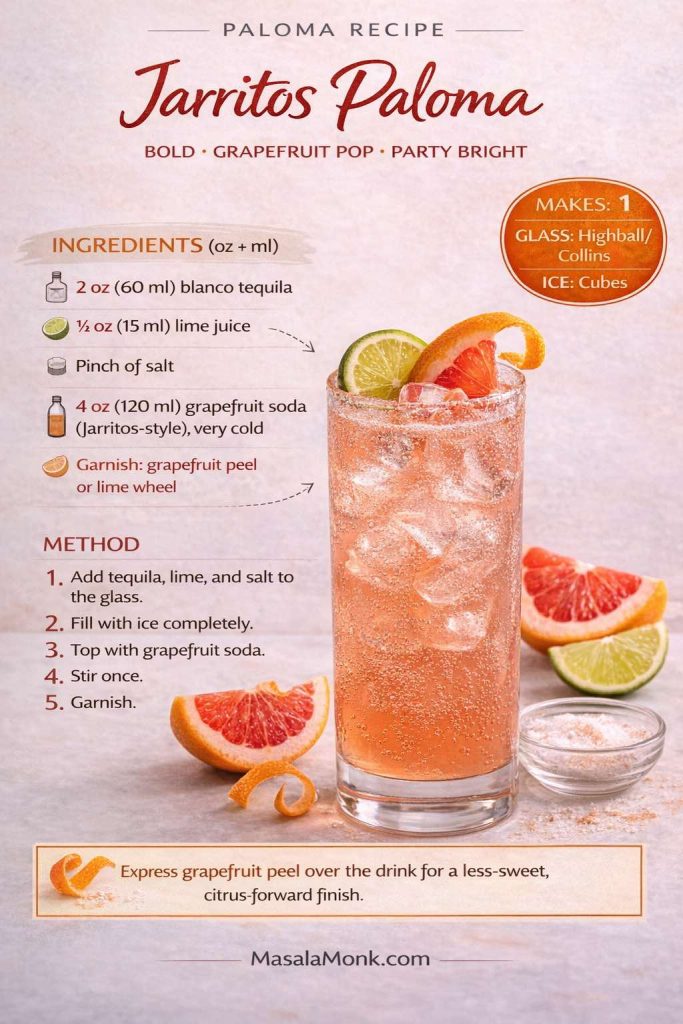
Recipe poster titled “Jarritos Paloma” describing a bold grapefruit soda Paloma with ingredients in oz and ml: blanco tequila, lime juice, pinch of salt, very cold Jarritos-style grapefruit soda, and garnish of grapefruit peel or lime wheel. It includes steps to add tequila, lime, and salt, fill the glass with ice, top with grapefruit soda, stir once, and garnish, with a tip to express grapefruit peel over the drink for a less-sweet, citrus-forward finish.
This Jarritos Paloma is the bold, party-bright version of a classic Paloma cocktail—bubbly, grapefruit-forward, and super easy to balance. Keep the grapefruit soda very cold, add it last, then stir once. The quickest “bar” upgrade is the peel: express grapefruit peel over the glass for a less-sweet, citrus-forward finish.

Method:

  1. Add tequila, lime, and salt to the glass.
  2. Fill with ice completely.
  3. Top with grapefruit soda.
  4. Stir once.
  5. Garnish.

Serving idea:
This version is perfect for a movie-night vibe. Pair it with a dip + snack set up built around Air Fryer Chicken Wings (Super Crispy, No Baking Powder) and a salsa you love.

Make it feel more “bar” without extra work:
Add a grapefruit peel expressed over the drink, then rub the peel briefly around the rim before dropping it in. That quick aromatic lift helps the drink taste less sweet and more citrus-forward.

Also Read: Chicken Pesto Pasta (Easy Base Recipe + Creamy, One-Pot, Baked & More)


Paloma recipe without grapefruit soda (fresh grapefruit juice)

Sometimes you want a Paloma that tastes more controlled—less like soda and more like a crafted cocktail. That’s where the fresh grapefruit version shines. It also answers the common “paloma recipe without grapefruit soda” situation: you still get bubbles, just from sparkling water (or club soda), not from a sweetened grapefruit soda.

If you enjoy comparing styles, Love and Lemons has a fresh-leaning Paloma method that aligns with the juice + bubbles approach, while Difford’s Guide offers a structured ml-based Paloma spec that includes grapefruit juice, sweetener, and grapefruit soda in a more “cocktail program” format.

Grapefruit juice for a Paloma: choosing the vibe

  • Ruby red / pink grapefruit: softer, often sweeter, and generally easier to balance.
  • White grapefruit: sharper, sometimes more bitter, and fantastic when you keep sweetness and salt in check.
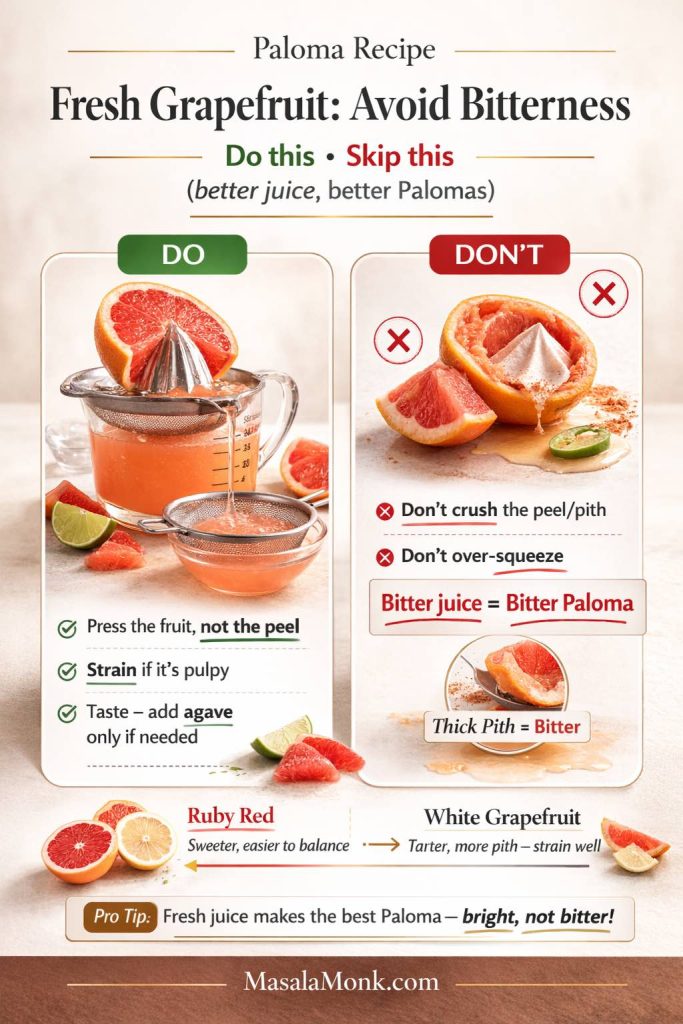
Do-and-don’t infographic titled “Fresh Grapefruit: Avoid Bitterness” for a Paloma recipe. The DO side says press the fruit not the peel, strain if it’s pulpy, and taste before adding agave. The DON’T side warns not to crush the peel or pith and not to over-squeeze, noting bitter juice makes a bitter Paloma. It also notes ruby red grapefruit is usually easier to balance than white grapefruit.
Fresh grapefruit makes an incredible Paloma—until pith bitterness sneaks in. Use this quick DO/DON’T guide for any fresh grapefruit Paloma recipe: press the fruit (not the peel), strain pulp if needed, and add agave only after tasting. Avoid crushing peel/pith or over-squeezing—because bitter grapefruit juice = bitter Paloma. Ruby red is usually the easiest to balance.

Either way, avoid pressing the peel. Once pith bitterness shows up, it’s hard to undo.

Also Read: Pork Tenderloin in Oven (Juicy, Easy, 350°F or 400°F) Recipe


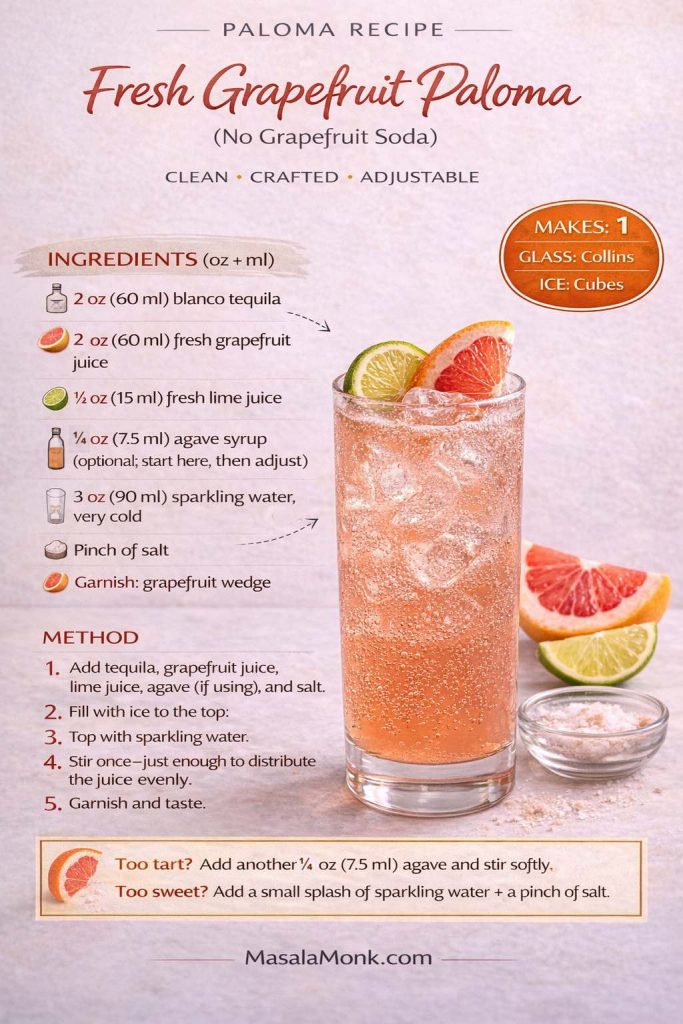
5) Fresh grapefruit Paloma (Paloma with grapefruit juice + sparkling water)

This is the “fresh paloma” version that tastes clean, bright, and adjustable. It’s also the best place to use agave syrup thoughtfully—tiny amounts make a bigger difference than you think.

Makes: 1 drink
Glass: Collins
Ice: Cubes

Ingredients (oz + ml):

  • 2 oz (60 ml) blanco tequila
  • 2 oz (60 ml) fresh grapefruit juice
  • ½ oz (15 ml) fresh lime juice
  • ¼ oz (7.5 ml) agave syrup (optional; start here, then adjust)
  • 3 oz (90 ml) sparkling water, very cold
  • Pinch of salt
  • Garnish: grapefruit wedge
Recipe poster titled “Fresh Grapefruit Paloma (No Grapefruit Soda)” listing ingredients in oz and ml: blanco tequila, fresh grapefruit juice, fresh lime juice, optional agave syrup, very cold sparkling water, pinch of salt, and grapefruit wedge garnish. It includes steps to combine the still ingredients, fill with ice, top with sparkling water, stir once gently, and garnish, plus a taste dial for adjusting a drink that is too tart or too sweet.
This fresh grapefruit Paloma recipe is the clean, crafted option when you want a Paloma without grapefruit soda. Fresh grapefruit juice + lime gives the snap, sparkling water keeps it bright and bubbly, and a small splash of agave (only if needed) smooths out extra-tart juice. Build it over ice, top with bubbles, then stir once—just enough to combine.

Method (more detailed):

  1. Add tequila, grapefruit juice, lime juice, agave (if using), and salt to the glass.
  2. Fill with ice to the top.
  3. Top with sparkling water.
  4. Stir once—just enough to distribute the juice evenly.
  5. Garnish and taste. If you want more brightness, squeeze the grapefruit wedge lightly over the top.

Taste dial (gentle corrections):

  • Too tart? Add another ¼ oz (7.5 ml) agave and stir softly.
  • Too sweet? Add a small splash of sparkling water and a pinch of salt.

Serving idea:
This version is especially good with creamy dips because it cuts richness without feeling sugary. Try it with spinach dip or a cooling yogurt dip like tzatziki.

Also Read: Sourdough Starter Recipe: Make, Feed, Store & Fix Your Starter (Beginner Guide)


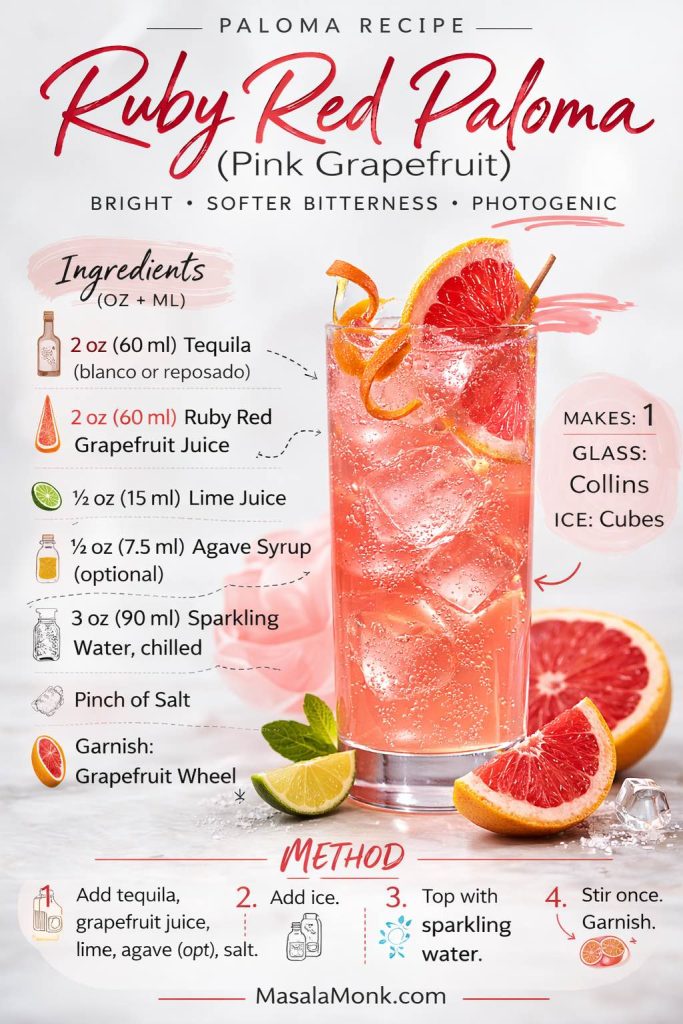
6) Ruby red Paloma (pink grapefruit Paloma)

This is the bright, photogenic lane: ruby red paloma, pink Paloma cocktail, pink grapefruit paloma recipe—same structure, softer bitterness, and a slightly rounder finish.

Makes: 1 drink
Glass: Collins
Ice: Cubes

Ingredients (oz + ml):

  • 2 oz (60 ml) tequila (blanco for crisp; reposado for a warmer finish)
  • 2 oz (60 ml) ruby red grapefruit juice
  • ½ oz (15 ml) lime juice
  • ¼ oz (7.5 ml) agave syrup (optional)
  • 3 oz (90 ml) sparkling water, chilled
  • Pinch of salt
  • Garnish: grapefruit wheel
This ruby red Paloma (aka pink grapefruit Paloma) is the photogenic, softer-bitter version of a fresh Paloma. Ruby red grapefruit juice is usually easier to balance than white grapefruit—so you get bright citrus flavor without that stern edge. Build tequila + juices first, add ice, top with sparkling water, then stir once and garnish with a grapefruit wheel.

Method:

  1. Add tequila, grapefruit juice, lime, agave (if using), and salt to the glass.
  2. Add ice.
  3. Top with sparkling water.
  4. Stir once and garnish.

Fun serving idea:
If you’re in a brunch mood, this profile pairs beautifully with citrus + bubbles. For a different kind of pour later, our grapefruit-friendly mimosa collection is a natural companion post.

Also Read: Mozzarella Sticks Recipe (Air Fryer, Oven, or Fried): String Cheese, Shredded Cheese, and Every Crunchy Variation


Spicy Paloma recipe variations (jalapeño, spice, and salted rims)

Spice changes the Paloma’s mood completely. Suddenly it’s less “poolside” and more “bar snack energy.” Even so, the goal isn’t punishment; it’s aroma and warmth that plays with grapefruit.

For food, the pairing almost chooses itself: baked jalapeño poppers make the whole thing feel planned, not random.
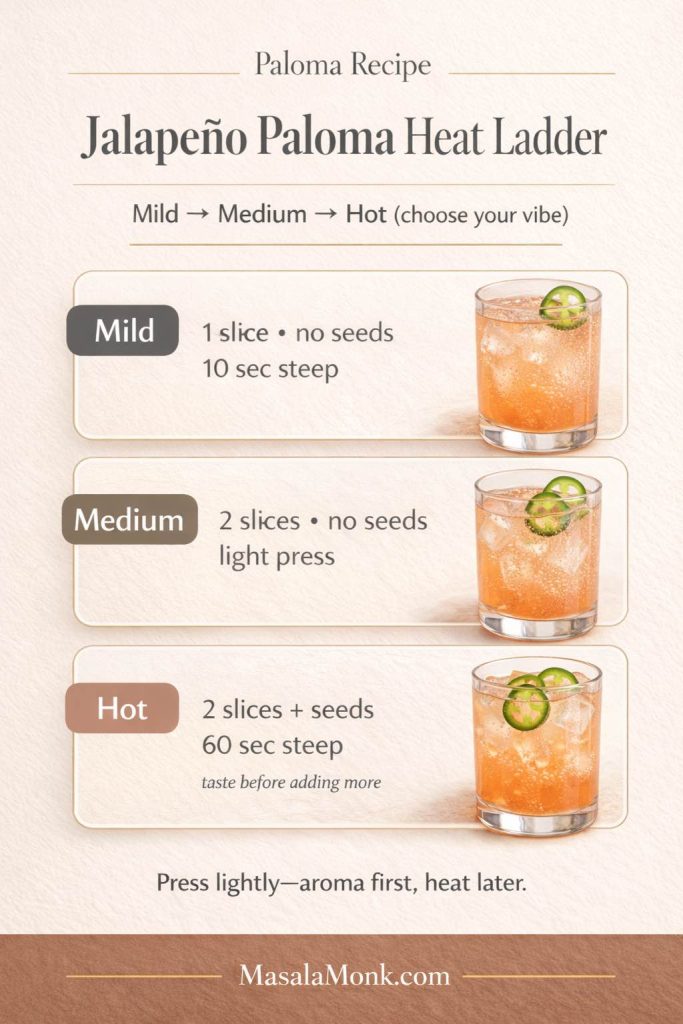
Infographic titled “Jalapeño Paloma Heat Ladder” showing three spice levels for a spicy Paloma: Mild (1 jalapeño slice, no seeds, 10 seconds steep), Medium (2 slices, no seeds, light press), and Hot (2 slices with seeds, 60 seconds steep, taste before adding more), with the tip “Press lightly—aroma first, heat later.”
Want a spicy Paloma without accidentally making it harsh? Use this jalapeño Paloma heat ladder to choose your level: mild for aroma, medium for a steady warmth, or hot for real heat. The key is pressing jalapeño lightly (aroma first, heat later), then pairing it with grapefruit and lime so the drink stays bright and balanced.

7) Jalapeño Paloma cocktail (spicy jalapeño Paloma recipe)

This one keeps the heat controlled and the grapefruit prominent. It’s spicy, yet still bright.

Makes: 1 drink
Glass: Collins
Ice: Cubes

Ingredients (oz + ml):

  • 2 oz (60 ml) blanco tequila
  • ½ oz (15 ml) lime juice
  • ¼ oz (7.5 ml) agave syrup (optional)
  • 2 thin jalapeño slices (seeds removed for gentler heat)
  • 4 oz (120 ml) grapefruit soda or 2 oz (60 ml) grapefruit juice + 3 oz (90 ml) sparkling water
  • Pinch of salt
  • Garnish: jalapeño slice + grapefruit wedge
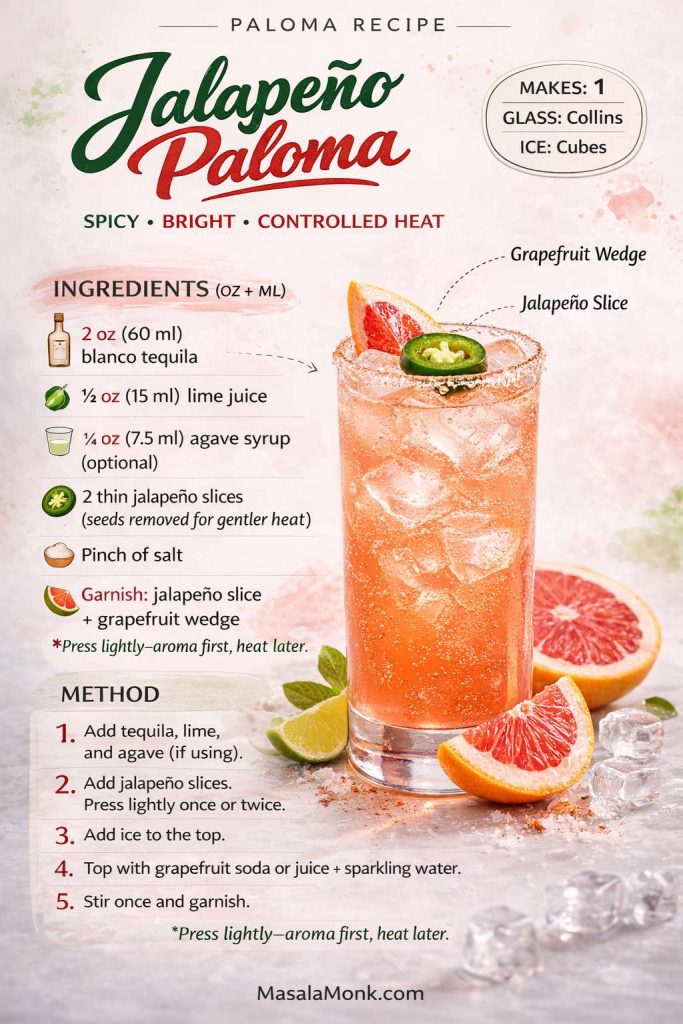
This jalapeño Paloma cocktail keeps the heat controlled and the grapefruit bright. The trick is simple: add jalapeño slices and press lightly once or twice—you want aroma first, heat later. Then top with grapefruit soda (or fresh grapefruit juice + sparkling water) and stir once. It’s the easiest way to make a spicy Paloma that tastes refreshing, not aggressive.

Method (more precise):

  1. Add tequila, lime, and agave (if using) to the glass.
  2. Add jalapeño slices. Press them lightly once or twice—think “wake them up,” not “mash them.”
  3. Add ice to the top.
  4. Top with grapefruit soda (or juice + sparkling water).
  5. Stir once and garnish.

Why this works:
The jalapeño gives aroma first, heat later. Meanwhile, grapefruit keeps the whole drink refreshing instead of heavy.

Serve with:
Make it a theme night with baked jalapeño poppers and a cooling side dip like tzatziki.

Also Read: Crock Pot Chicken Breast Recipes: 10 Easy Slow Cooker Dinners (Juicy Every Time)


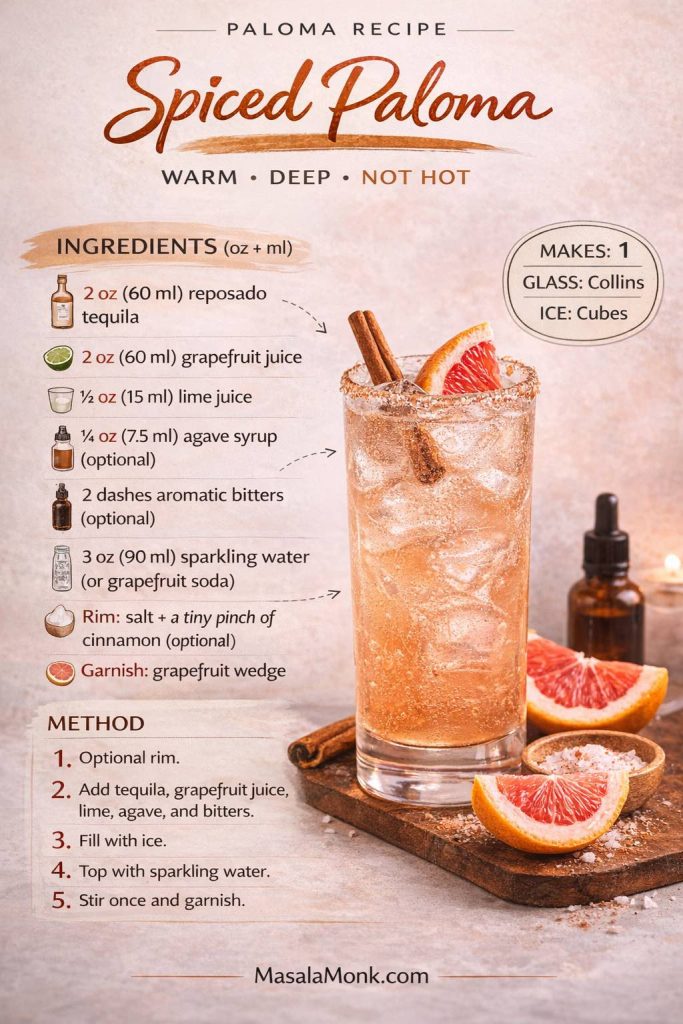
8) Spiced Paloma (warm spice, not “hot”)

This version is for anyone who wants depth without fire. It’s also a great place to use reposado, because warm spice and a slightly richer tequila tend to agree.

Makes: 1 drink
Glass: Collins
Ice: Cubes

Ingredients (oz + ml):

  • 2 oz (60 ml) reposado tequila
  • 2 oz (60 ml) grapefruit juice
  • ½ oz (15 ml) lime juice
  • ¼ oz (7.5 ml) agave syrup
  • 2 dashes aromatic bitters (optional)
  • 3 oz (90 ml) sparkling water (or grapefruit soda)
  • Rim: salt + a tiny pinch of cinnamon (optional)
  • Garnish: grapefruit wedge
This spiced Paloma is warm and aromatic without being “hot.” Reposado tequila adds soft richness, grapefruit keeps it bright, and a tiny pinch of cinnamon in the salt rim (optional) makes the whole drink feel deeper and more “winter bar.” Add bubbles last, stir once, and garnish with grapefruit for a cozy Paloma that still drinks crisp.

Method:

  1. Optional rim.
  2. Add tequila, grapefruit juice, lime, agave, and bitters.
  3. Fill with ice.
  4. Top with sparkling water.
  5. Stir once and garnish.

Serving idea:
Warm spice loves crunchy snacks. Keep it easy with keto chips and a creamy dip.

Also Read: Eggless Yorkshire Pudding (No Milk) Recipe


Mezcal Paloma drink variations (smoky and bright)

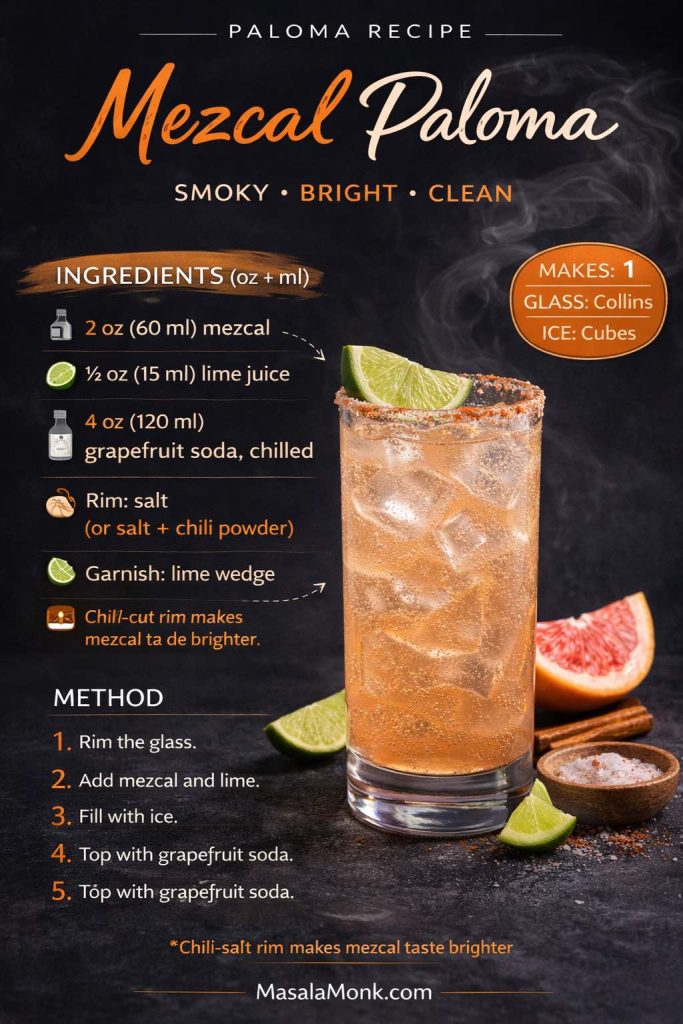
A mezcal paloma drink is smoky, citrusy, and quietly dramatic. Even so, it’s still a Paloma at heart—grapefruit and lime leading the sip, with smoke trailing behind.
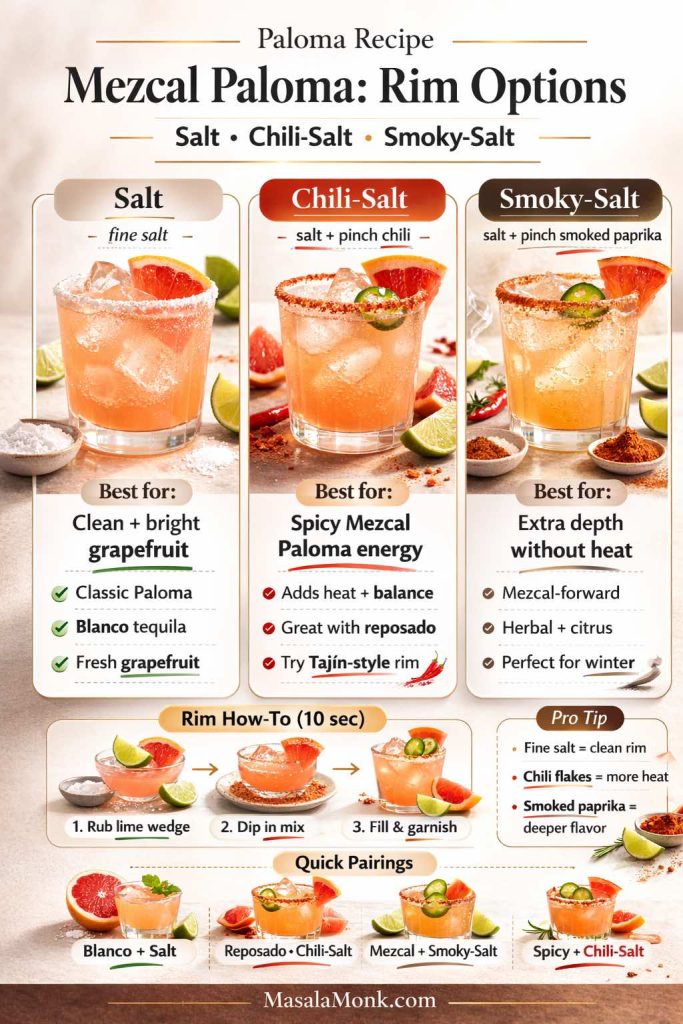
Infographic titled “Mezcal Paloma: Rim Options” showing three rim choices for a mezcal Paloma: Salt (fine salt) for clean, bright grapefruit; Chili-Salt (salt plus a pinch of chili) for spicy mezcal Paloma energy; and Smoky-Salt (salt plus a pinch of smoked paprika) for extra depth without heat, with quick rim tips and pairing suggestions.
A mezcal Paloma gets “cocktail bar” good with the right rim. Choose fine salt for a clean, bright grapefruit sip, chili-salt when you want spicy mezcal Paloma energy, or smoky-salt (salt + a pinch of smoked paprika) for depth without extra heat. Rim half the glass so every sip can be salty—or not—then build your mezcal Paloma below.

For a clean external reference on the style, Liquor.com’s mezcal Paloma uses the classic mezcal + lime + grapefruit soda approach, often paired with a chili-salt rim.

9) Mezcal Paloma cocktail (classic smoky build)

Makes: 1 drink
Glass: Collins
Ice: Cubes

Ingredients (oz + ml):

  • 2 oz (60 ml) mezcal
  • ½ oz (15 ml) lime juice
  • 4 oz (120 ml) grapefruit soda, chilled
  • Rim: salt (or salt + chili powder)
  • Garnish: lime wedge
A mezcal Paloma is smoky, citrusy, and ridiculously easy to make well. Rim the glass with salt (or a light chili-salt rim), add mezcal + lime over ice, then top with very cold grapefruit soda and stir once. The chili-salt option makes mezcal taste brighter and keeps the drink from feeling heavy.

Method:
Rim the glass. Add mezcal and lime. Fill with ice. Top with grapefruit soda. Stir once and garnish.

Serving idea:
This version loves salty foods. Put out a board of crunchy bites—our croquettes guide is perfect for building a few options without repeating yourself.

Also Read: Garlic & Paprika Cabbage Rolls (Keto-Friendly Recipes) – 5 Bold Savory Twists


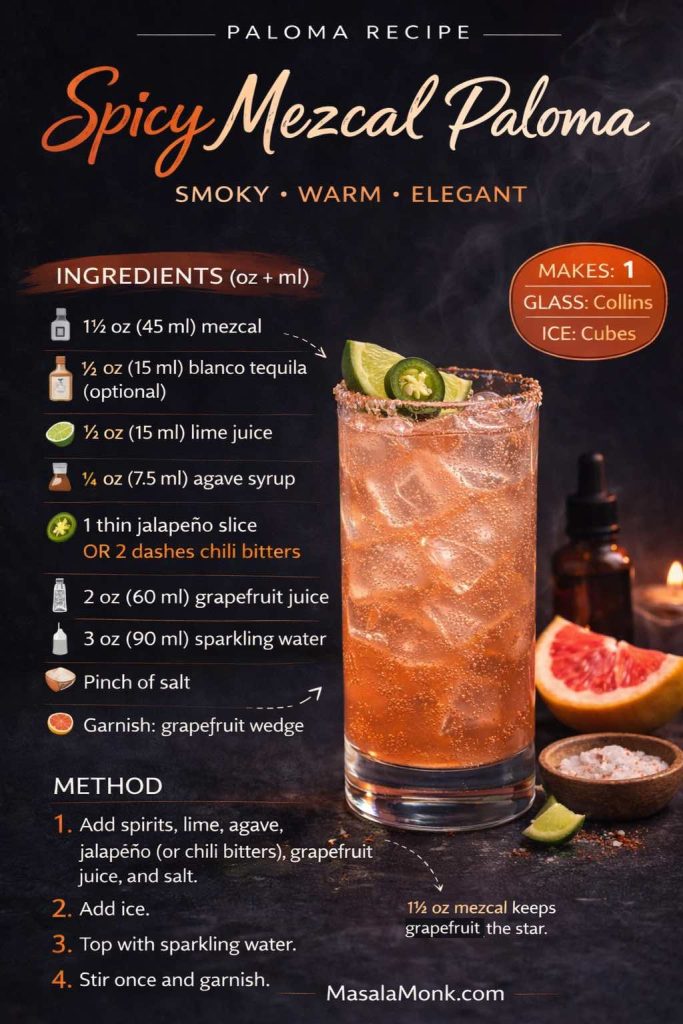
10) Spicy mezcal Paloma (smoke + heat, kept elegant)

This one is smoky, warm, and still refreshing. The trick is keeping mezcal slightly lower so grapefruit stays the star.

Makes: 1 drink
Glass: Collins
Ice: Cubes

Ingredients (oz + ml):

  • 1½ oz (45 ml) mezcal
  • ½ oz (15 ml) blanco tequila (optional)
  • ½ oz (15 ml) lime juice
  • ¼ oz (7.5 ml) agave syrup
  • 1 thin jalapeño slice or 2 dashes chili bitters
  • 2 oz (60 ml) grapefruit juice
  • 3 oz (90 ml) sparkling water
  • Pinch of salt
  • Garnish: grapefruit wedge
Dark recipe poster titled “Spicy Mezcal Paloma” with the descriptor “Smoky, Warm, Elegant.” It lists ingredients in oz and ml: mezcal, optional blanco tequila, lime juice, agave syrup, one thin jalapeño slice or chili bitters, grapefruit juice, sparkling water, pinch of salt, and grapefruit wedge garnish. The method shows adding spirits, citrus, agave, jalapeño or bitters, grapefruit juice, and salt, adding ice, topping with sparkling water, then stirring once and garnishing.
This spicy mezcal Paloma is smoke + heat done elegantly—refreshing, not aggressive. Keeping mezcal at 1½ oz lets grapefruit stay the star, while a thin jalapeño slice (or a couple dashes of chili bitters) adds warm aroma. Build everything first, add ice, top with sparkling water, then stir once and garnish with grapefruit.

Method:
Add spirits, lime, agave, jalapeño (if using), grapefruit juice, and salt to the glass. Add ice. Top with sparkling water. Stir once and garnish.

Why it stays balanced:
Keeping mezcal at 1½ oz prevents smoke from dominating. Meanwhile, a little tequila rounds the mid-palate, so the finish reads bright rather than aggressive.

Also Read: Keto Hot Chocolate Recipe (Sugar-Free Hot Cocoa) + Best Homemade Mix


Pitcher Paloma recipe (paloma batch recipe that stays bubbly)

Pitcher Palomas make hosting easier. Still, the drinks only stay good if you treat carbonation like a last-minute ingredient. Batch the base, chill it hard, and then top each glass. That way, every serving tastes lively, not tired.
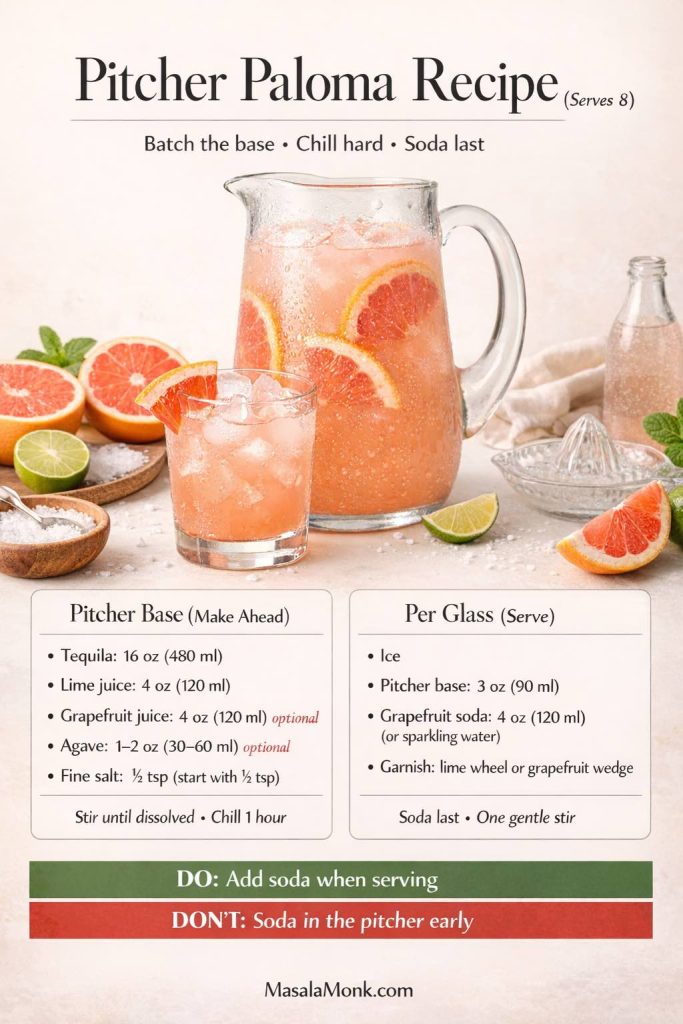
Hosting? This pitcher Paloma recipe serves 8 and stays fizzy: batch the base with tequila and citrus, chill it hard, then pour 3 oz per glass over ice and top with grapefruit soda at serving for the best bubbles.

If you like having other party drinks in your rotation, the same “chill and balance first” mindset plays nicely with a large-format drink like this rum punch.

11) Pitcher Palomas (big batch paloma recipe for 8)

Makes: 8 drinks
You’ll need: a pitcher + chilled grapefruit soda

Pitcher base ingredients (oz + ml):

  • 16 oz (480 ml) tequila
  • 4 oz (120 ml) fresh lime juice
  • 4 oz (120 ml) grapefruit juice (optional)
  • 1–2 oz (30–60 ml) agave syrup (optional)
  • ½ tsp fine salt (start with ¼ tsp if you prefer lighter seasoning)

To serve each drink:

  • Ice
  • 3 oz (90 ml) pitcher base
  • 4 oz (120 ml) grapefruit soda (or sparkling water)
  • Garnish: lime wheel or grapefruit wedge
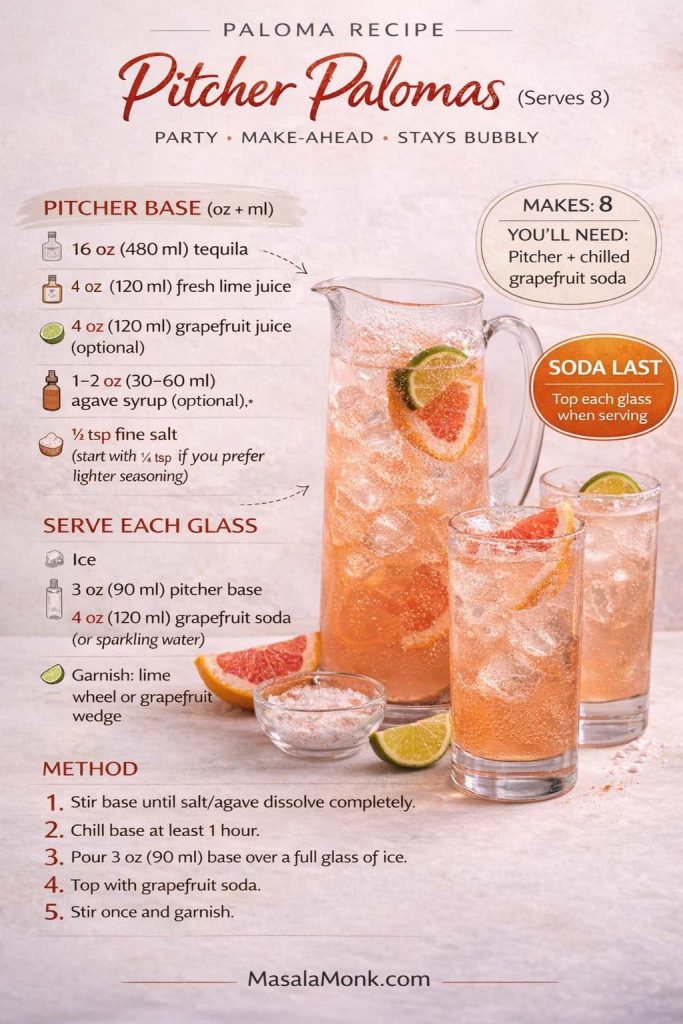
Recipe poster titled “Pitcher Palomas (Serves 8)” showing a pitcher of Paloma base and two finished glasses. It lists pitcher base ingredients in oz and ml: tequila, fresh lime juice, optional grapefruit juice, optional agave syrup, and fine salt, plus per-glass serving amounts (ice, 3 oz base, 4 oz grapefruit soda or sparkling water) and garnish options. A “Soda Last” badge notes to top each glass when serving, and the method includes chilling the base, pouring over ice, topping with soda, stirring once, and garnishing.
This pitcher Paloma recipe (serves 8) is the easiest way to host without flat drinks. Batch the tequila + citrus base, chill it hard, then pour 3 oz base per glass and add grapefruit soda last so every Paloma stays crisp and bubbly. It’s the foolproof big-batch Paloma method for parties—and it scales cleanly without losing fizz.

Method (clear and reliable):

  1. Stir the pitcher base until the salt and agave dissolve completely.
  2. Chill the base in the fridge for at least one hour.
  3. To serve, pour 3 oz (90 ml) base over a full glass of ice.
  4. Top with grapefruit soda.
  5. Stir once and garnish.

Make-ahead comfort:
The base holds well for a day, and it usually tastes better once thoroughly cold. The only thing you keep separate is the soda.

Serving idea:
This is where snack strategy pays off. Put out mozzarella sticks, a big bowl of spinach dip, and something crunchy like keto chips so guests can build their own bites between sips.

Also Read: 10 Low Carb Chia Pudding Recipes for Weight Loss (Keto, High-Protein, Dairy-Free)


Fruit-forward Palomas (still Paloma, just dressed differently)

Fruit versions can be incredible; however, they’re best when they stay disciplined. Grapefruit should still lead. Tequila should still anchor. The fruit should feel like a twist, not a takeover.

You asked for twelve, so here’s the clean seasonal choice that stays unmistakably Paloma.
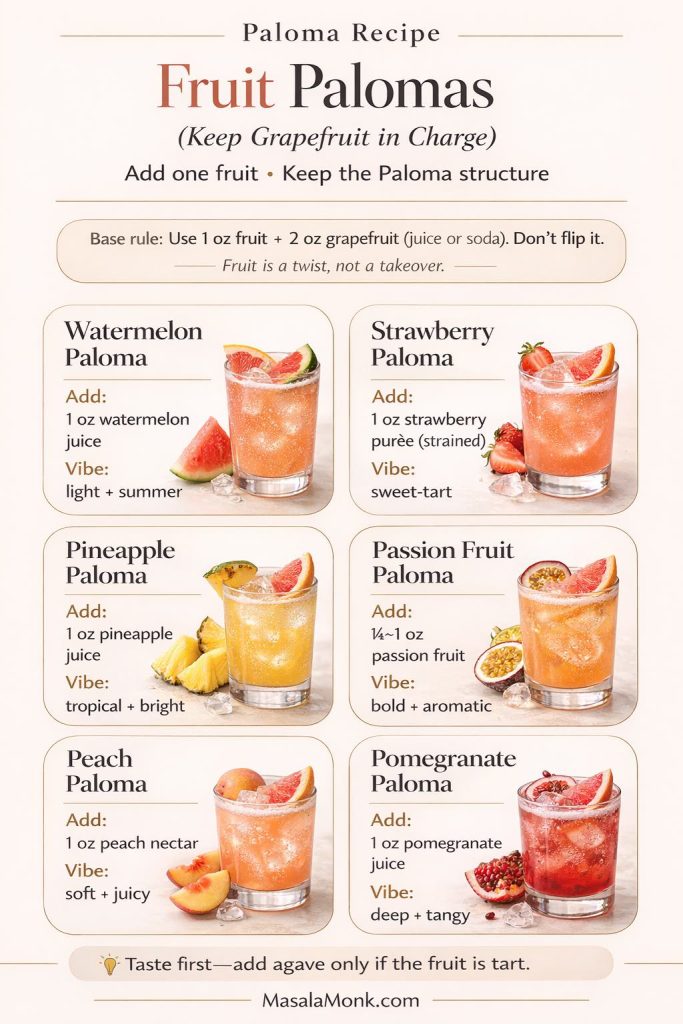
Infographic titled “Fruit Palomas (Keep Grapefruit in Charge)” showing a base rule for fruit Paloma recipes: use 1 oz fruit plus 2 oz grapefruit (juice or soda) and don’t flip the ratio. It includes six options—Watermelon Paloma (add 1 oz watermelon juice), Strawberry Paloma (add 1 oz strained strawberry purée), Pineapple Paloma (add 1 oz pineapple juice), Passion Fruit Paloma (add ½ to 1 oz passion fruit), Peach Paloma (add 1 oz peach nectar), and Pomegranate Paloma (add 1 oz pomegranate juice)—with a tip to taste first and add agave only if the fruit is tart.
Fruit Palomas work best when grapefruit still leads. Use this quick chooser to make a watermelon Paloma, strawberry Paloma, pineapple Paloma, passion fruit Paloma, peach Paloma, or pomegranate Paloma without turning it into a different drink: add 1 oz fruit and keep 2 oz grapefruit (juice or soda) as the backbone. Taste first, then add agave only if the fruit runs tart—this keeps every variation bright, balanced, and still unmistakably Paloma.

12) Winter Paloma (blood orange Paloma + grapefruit)

Makes: 1 drink
Glass: Collins
Ice: Cubes

Ingredients (oz + ml):

  • 2 oz (60 ml) reposado tequila
  • 1½ oz (45 ml) grapefruit juice
  • 1 oz (30 ml) blood orange juice
  • ½ oz (15 ml) lime juice
  • ¼ oz (7.5 ml) agave syrup (optional)
  • 3 oz (90 ml) sparkling water (or grapefruit soda)
  • Pinch of salt
  • Garnish: orange peel or blood orange wheel
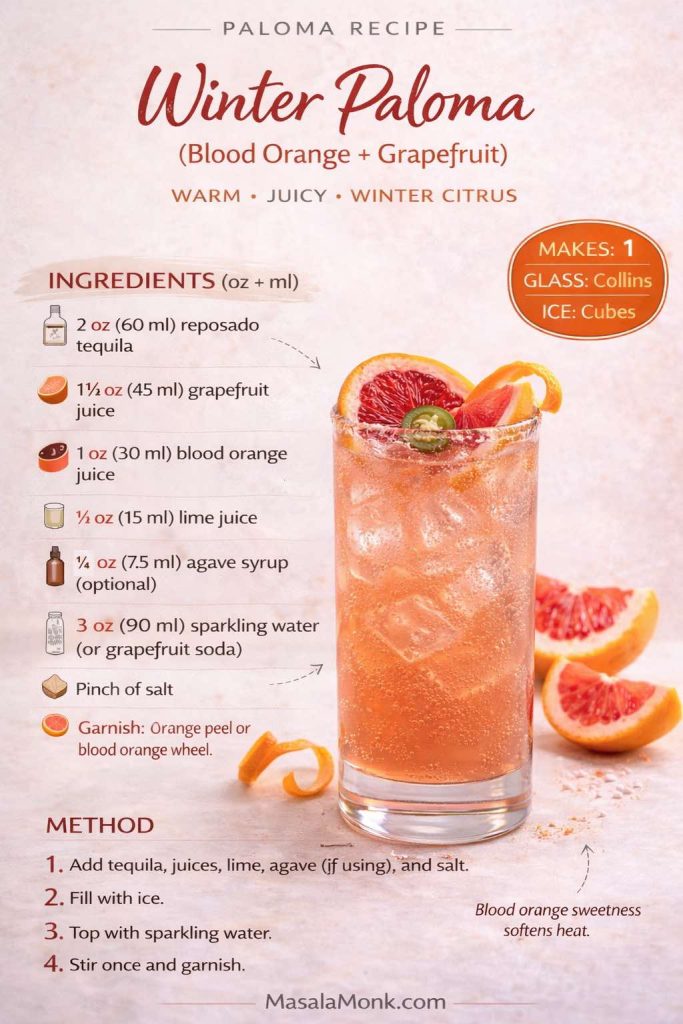
Recipe poster titled “Winter Paloma (Blood Orange + Grapefruit)” listing ingredients in oz and ml: reposado tequila, grapefruit juice, blood orange juice, lime juice, optional agave syrup, sparkling water or grapefruit soda, pinch of salt, and garnish of orange peel or blood orange wheel. It shows the method: add tequila and juices with optional agave and salt, fill with ice, top with sparkling water, then stir once and garnish, with a note that blood orange sweetness softens heat.
This winter Paloma (blood orange + grapefruit) is warm and juicy without feeling heavy. Reposado tequila adds a soft richness, grapefruit keeps the snap, and blood orange brings a sweeter citrus note that smooths the edges. Build the base first, add ice, top with sparkling water, then stir once and garnish with orange peel or a blood orange wheel.

Method:
Add tequila, juices, lime, agave (if using), and salt to the glass. Fill with ice. Top with sparkling water. Stir once and garnish.

Serving idea:
This drink is especially good with spicy snacks because blood orange sweetness softens heat. Put out baked jalapeño poppers and a cooling dip beside them.

Also Read: Dirty Martini Recipe (Classic, Extra Dirty, No Vermouth, Spicy, Blue Cheese, Tequila + Batched)


A few “Paloma fizz” moves (without turning it into a different cocktail)

The phrase “Paloma fizz” gets used loosely. Sometimes it just means “extra lively” and bright. Sometimes it implies a shaken, foamy style like a traditional fizz. You can do either, but if you want to keep things Paloma-simple, here’s a middle ground that feels special without adding complexity.

Side-by-side infographic titled “Paloma Fizz vs Classic” comparing two Paloma methods. The Classic build (no shake) is best for grapefruit soda Palomas and lists steps: tequila, lime, and salt; ice to the top; soda last (very cold, freshly opened); stir once. The Fizz build (gentle shake) is best for fresh grapefruit Palomas and lists steps: shake base 5–7 seconds; strain over fresh ice; top with sparkling water; stir once, with a tip that a short shake gives silkier texture.
Want a Paloma that stays bubbly but feels a little more “cocktail bar”? This comparison makes it easy: Classic Paloma is the no-shake build (ice to the top, soda last, stir once) and it’s perfect for grapefruit soda drinks like Squirt, Fresca, or Jarritos. Paloma Fizz uses a gentle 5–7 second shake for a silkier texture, then you top with sparkling water so it still drinks bright and fizzy—especially great for fresh grapefruit Palomas.

Gentle Paloma Fizz method (works with fresh grapefruit builds)

Use this for recipe #5 or #6 when you want a silkier texture:

  1. In a shaker (or jar), add: tequila + grapefruit juice + lime + agave (if using) + a pinch of salt.
  2. Add ice and shake briefly (5–7 seconds).
  3. Strain into a Collins glass filled with fresh ice.
  4. Top with sparkling water.
  5. Stir once.

You’ll get a slightly finer texture without turning it into a whole production.

Also Read: Fish and Chips Reimagined: 5 Indian Twists (Recipe + Method)


Serving ideas that make the Paloma feel like a full plan

A Paloma doesn’t need fancy pairings to feel right. It needs contrast: crisp drink against salty food, bright citrus against creamy dips, bubbles against rich bites. Once you think in contrasts, serving becomes easy.

  • Classic Paloma night: build the classic paloma cocktail recipe, serve mozzarella sticks and a dip.
  • Spicy Paloma night: make jalapeño palomas, bring out baked jalapeño poppers and a cooling dip like tzatziki.
  • Pitcher party: do pitcher palomas, plus crunchy chips and something creamy. These keto chips are a convenient anchor for a “set it out and forget it” spread.
  • Mezcal night: keep food salty and snackable; croquettes are a strong match, and this croquettes guide gives you endless directions.

Quick fixes when a Paloma tastes off

Even with a perfect paloma recipe on paper, real life has variables: grapefruit sweetness, soda intensity, ice melt, and lime size. Thankfully, Palomas are easy to correct in the glass.
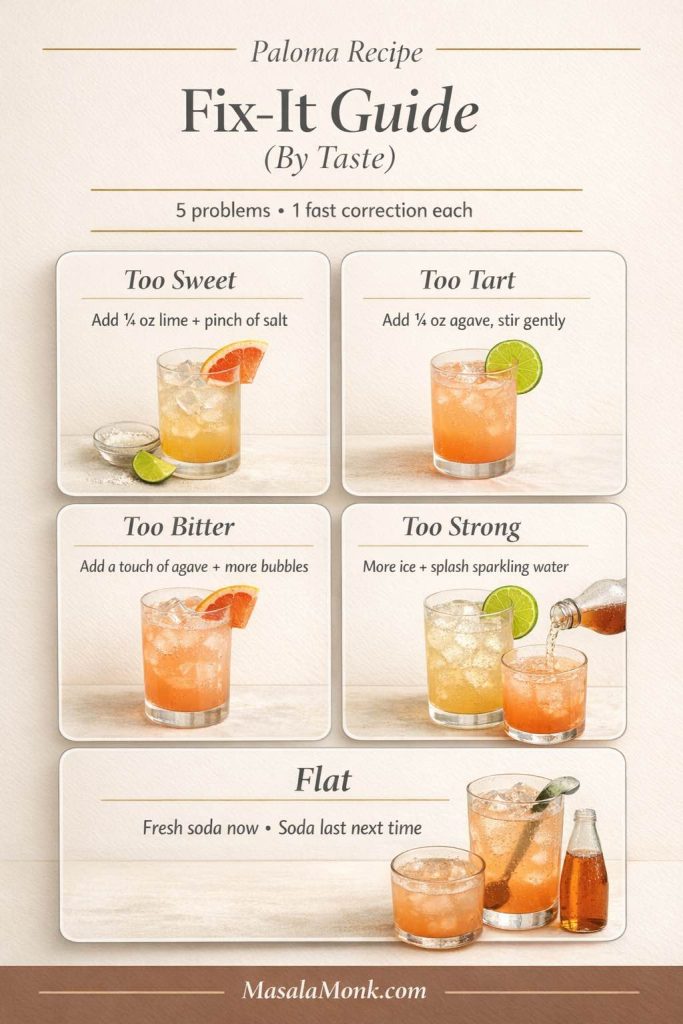
Infographic titled “Paloma Recipe Fix-It Guide (By Taste)” with five quick fixes: too sweet (add ¼ oz lime and a pinch of salt), too tart (add ¼ oz agave and stir gently), too bitter (add a touch of agave and more bubbles), too strong (add more ice and a splash of sparkling water), and flat (use fresh soda now and add soda last next time).
If your Paloma tastes “off,” you don’t need a new recipe — you need a fast correction. Use this Paloma fix-it guide to balance a classic Paloma cocktail (or Squirt, Fresca, Jarritos, fresh grapefruit, mezcal, or spicy Paloma versions): too sweet → more lime + salt, too tart → a splash of agave, too bitter → a touch of sweetener + extra bubbles, too strong → more ice + sparkling water, and flat → fresh soda now (and soda last next time).

If it’s too sweet
Add a small squeeze of lime (start with ¼ oz / 7.5 ml) and a pinch of salt. If needed, top with sparkling water.

If it’s too tart
Add ¼ oz (7.5 ml) agave syrup and stir gently. Alternatively, add more ice and give it a minute; dilution can soften sharpness.

If it’s too bitter
Avoid squeezing grapefruit peel and pith next time. For now, add a touch of sweetener and extra soda/sparkling water.

If it’s too strong
Add more ice plus a splash of sparkling water. A Paloma should feel bright and drinkable, not heavy.

If it’s flat
The immediate fix is fresh soda—opened right now. For next time, remember: soda last, stir once.

Also Read: Baked Ziti Recipe Collection: 15 Easy Variations


About vodka Palomas, Aperol Palomas, and spritz riffs

You’ll see variations like a paloma recipe vodka or a “paloma aperol spritz” floating around. They can be tasty, yet they’re essentially different drinks wearing Paloma styling. If you love them, they deserve their own spotlight rather than being squeezed into a Paloma guide that’s trying to stay true to the tequila-grapefruit structure.
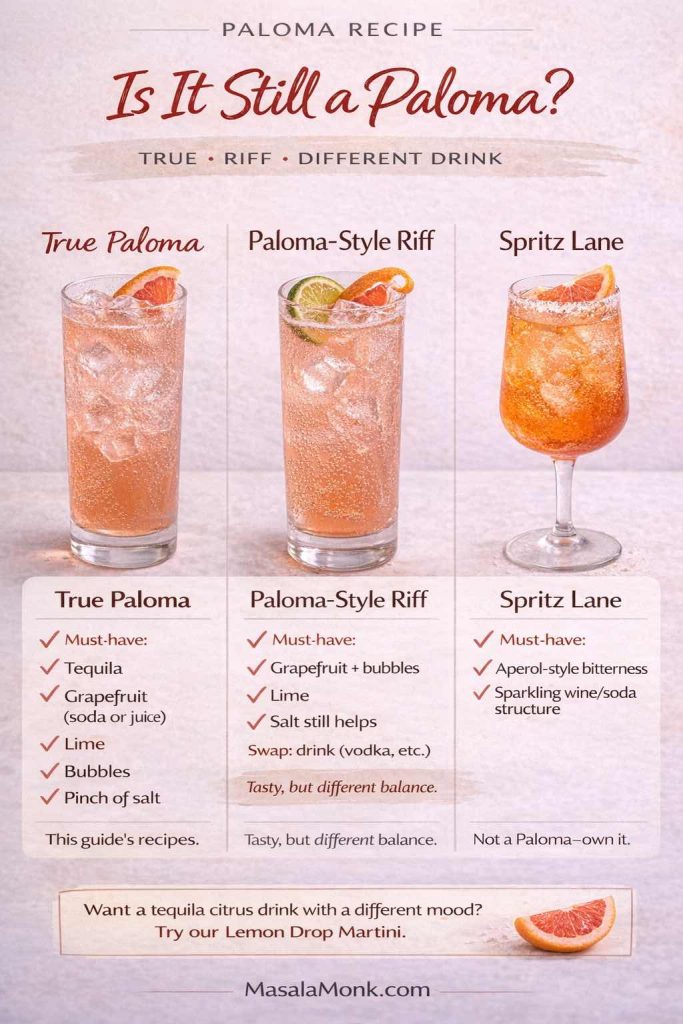
Infographic titled “Is It Still a Paloma?” comparing three categories: True Paloma, Paloma-Style Riff, and Spritz Lane. The True Paloma checklist includes tequila, grapefruit (soda or juice), lime, bubbles, and a pinch of salt. The Paloma-Style Riff keeps grapefruit plus bubbles, lime, and salt but swaps the spirit (vodka, etc.). The Spritz Lane highlights Aperol-style bitterness and a sparkling wine/soda structure. A note suggests trying a Lemon Drop Martini for a different tequila citrus mood.
You’ll see “vodka Palomas” and “Aperol Paloma spritz” ideas everywhere—this quick card shows what’s actually going on. A true Paloma keeps the tequila + grapefruit + lime + bubbles structure (plus a pinch of salt). A Paloma-style riff can be delicious, but swapping the spirit changes the balance. And a spritz lane drink is its own thing—great, just not a Paloma. If you want a tequila citrus drink with a different mood, jump to our lemon drop martini.

If you want a citrus tequila drink with a different mood, we already have tequila-citrus balance baked into other recipes, like our lemon drop martini blog (which also plays beautifully as a tequila lemon drop / lemon drop margarita style build).

Also Read: 19 Essential Kitchen Tools That Make Cooking Easier


A final note on “best Paloma tequila” and keeping it simple

It’s tempting to obsess over the best tequila to make palomas. However, the bigger difference is usually how cold your ingredients are, how you handle carbonation, and whether your lime and salt are in balance. A decent tequila made carefully tastes better than an expensive tequila treated casually.

Once you’ve made a few of these, you’ll notice something satisfying: the Paloma becomes a skill, not a single recipe. You’ll start to adjust automatically. You’ll know when grapefruit soda tequila cocktail builds need more lime. And you’ll recognize when a grapefruit juice tequila cocktail wants a whisper of agave. And you’ll get comfortable scaling up to a pitcher of palomas without losing fizz.
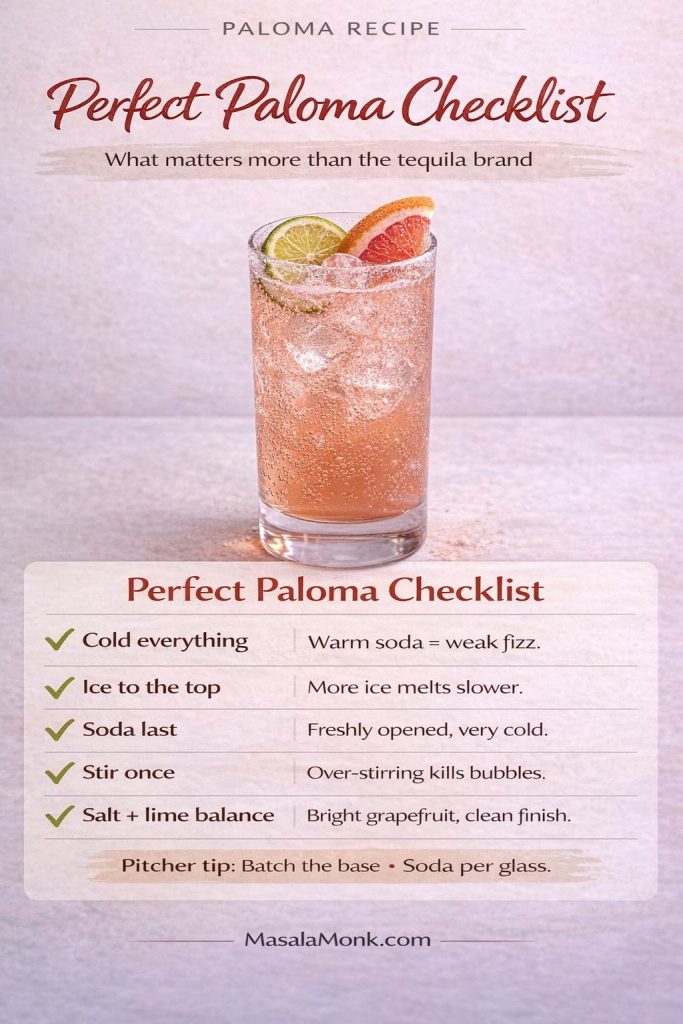
Checklist infographic titled “Perfect Paloma Checklist: What matters more than the tequila brand” showing five rules for a better Paloma: cold everything (warm soda equals weak fizz), ice to the top (more ice melts slower), soda last (freshly opened and very cold), stir once (over-stirring kills bubbles), and salt plus lime balance (bright grapefruit, clean finish). It also includes a pitcher tip to batch the base and add soda per glass.
Before you chase the “best Paloma tequila,” save this. A perfect Paloma is mostly technique: keep everything cold, fill the glass with ice, add soda last, stir once, and use salt + lime to make grapefruit taste bright and clean. Bonus: for pitcher Palomas, batch the base and add soda per glass—so every serving stays lively.

When you’re ready for round two, pick a theme: classic, spicy, mezcal, or party pitcher. Then add one great snack, put on music, and let grapefruit do what it does best—make tequila feel effortless.

Also Read: Ravioli Recipe Reinvented: 5 Indian-Inspired Twists on the Italian Classic

FAQs

1) What are the ingredients in a Paloma cocktail?

A classic Paloma uses tequila, grapefruit soda, and lime juice, usually finished with a pinch of salt or a salt rim. In addition, many versions include a small amount of agave or simple syrup—especially when using fresh grapefruit juice instead of grapefruit soda.

2) What is the best tequila for a Paloma cocktail?

Most people prefer blanco tequila for a crisp, clean Paloma, because it keeps grapefruit bright and snappy. However, reposado tequila works beautifully when you want a softer, warmer drink—particularly for spiced Palomas or winter Paloma variations.

3) What’s the best type of tequila for Palomas: blanco or reposado?

If you want a sharp, refreshing classic Paloma recipe, go with blanco. On the other hand, if you like a rounder finish and subtle vanilla-oak notes, choose reposado—especially when you’re adding spices, blood orange, or a richer salt rim.

4) What is the traditional Paloma recipe?

A traditional Paloma recipe is tequila plus lime, topped with grapefruit soda over ice. Frequently, it’s served in a highball glass with a salt rim or a pinch of salt in the drink to enhance the grapefruit flavor.

5) Can I make a Paloma with grapefruit juice instead of grapefruit soda?

Yes—this is often called a fresh Paloma or fresh grapefruit Paloma recipe. Typically, you’ll use grapefruit juice and lime with tequila, then top with sparkling water for fizz. Optionally, add a little agave syrup if the juice is extra tart or bitter.

6) How do you make a Paloma recipe without grapefruit soda?

Instead of grapefruit soda, combine tequila, fresh grapefruit juice, and lime juice, then finish with sparkling water or club soda. As a result, you’ll get a cleaner, less sweet drink with a more “cocktail bar” feel.

7) How do you make a Paloma with Squirt?

For a Squirt tequila drink, build tequila and lime over ice, then top with Squirt and stir gently once. Because Squirt-style sodas are often sweeter, a small extra squeeze of lime can help the drink taste more balanced.

8) How do you make a Paloma cocktail with Fresca?

A Paloma cocktail Fresca version is made the same way as a classic Paloma, simply swapping the grapefruit soda for Fresca. Consequently, it often tastes lighter and cleaner, especially with a salt rim rather than salt added to the drink.

9) What is the best grapefruit soda for a Paloma?

It depends on whether you want sweet, dry, or bitter-leaning grapefruit flavor. For instance, sweeter sodas make an easy crowd-pleaser, while drier options feel crisp and less candy-like. Regardless, keeping the soda very cold and adding it last helps the drink stay lively.

A jalapeño Paloma is a spicy Paloma cocktail flavored with fresh jalapeño. Usually, it’s built in the glass, then topped with grapefruit soda; alternatively, you can use grapefruit juice and sparkling water for a fresher finish.

10) How do you make a perfect Paloma cocktail that doesn’t go flat?

First, chill the soda and the glass if possible. Next, build tequila and lime over ice, then top with soda last and stir only once. In contrast, stirring repeatedly or adding soda too early knocks out carbonation quickly.

11) What’s a mezcal Paloma drink and how is it different?

A mezcal Paloma uses mezcal instead of tequila, so it tastes smoky and slightly earthy while still being bright and citrusy. Moreover, a chili-salt rim can complement mezcal’s savory notes without making the drink feel heavy.

12) How do you make a spicy Paloma recipe?

A spicy Paloma typically uses jalapeño slices (or a chili-salt rim) with tequila, lime, and grapefruit soda or grapefruit juice plus sparkling water. Importantly, lightly pressing the jalapeño releases aroma without turning the drink harsh or overly hot.

13) What is a jalapeño Paloma cocktail?

14) How do you make a pitcher Paloma recipe for a party?

To make a Paloma pitcher recipe, batch tequila, lime juice, and (optionally) grapefruit juice in a pitcher and chill thoroughly. Then, top each glass with grapefruit soda when serving. Otherwise, adding soda to the pitcher too early will make the batch go flat.

15) Can you make Palomas ahead of time?

Yes—batch the base (tequila + citrus + sweetener if using) and refrigerate it. Then, when you’re ready to serve, pour over ice and add grapefruit soda or sparkling water. This way, the drink stays bubbly and fresh.

16) What’s a ruby red or pink grapefruit Paloma?

A ruby red Paloma or pink Paloma usually uses ruby red grapefruit juice for a softer, slightly sweeter flavor and a brighter color. As a bonus, it often needs less sweetener than a white grapefruit version.

17) What is a Paloma fizz?

A Paloma fizz usually refers to a Paloma that feels extra lively or slightly “foamy,” often made by briefly shaking tequila, grapefruit juice, and lime before topping with sparkling water. That said, many people simply use the term to mean a very bubbly Paloma served ice-cold.

18) What’s the difference between a Paloma and a grapefruit margarita Paloma?

A Paloma is typically a tall, fizzy highball with grapefruit soda or sparkling water. By comparison, a grapefruit margarita style drink is usually shaken and served without soda, often with orange liqueur. In other words, Palomas lean light and bubbly, while margaritas lean richer and more structured.
Posted on 4 Comments

Air Fryer Donuts Recipe (2 Ways): Glazed Homemade Donuts + Biscuit Donuts

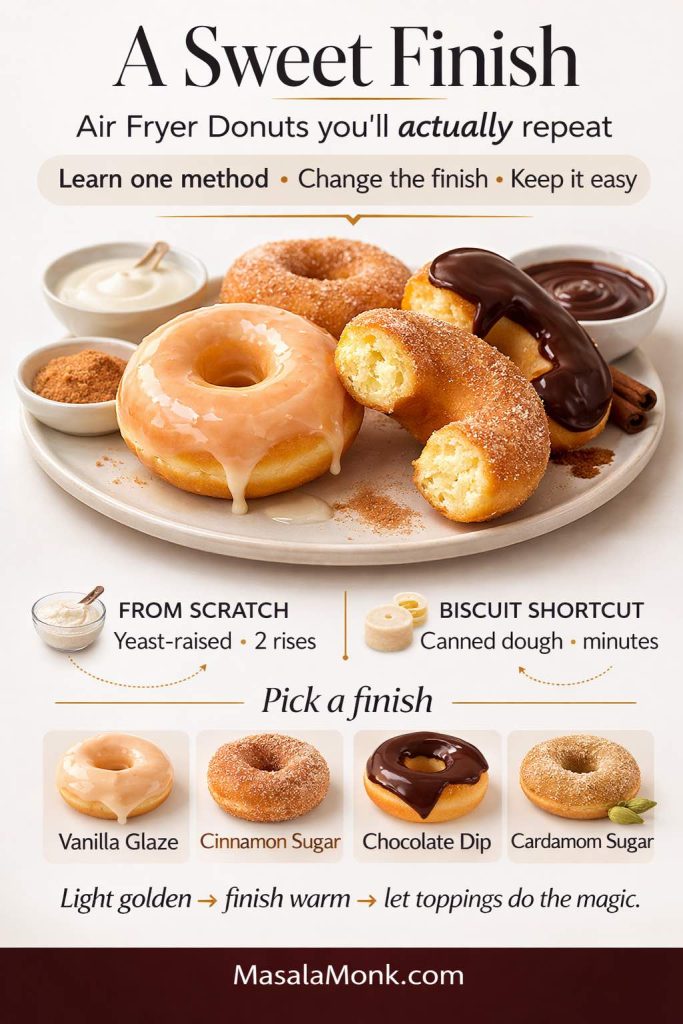
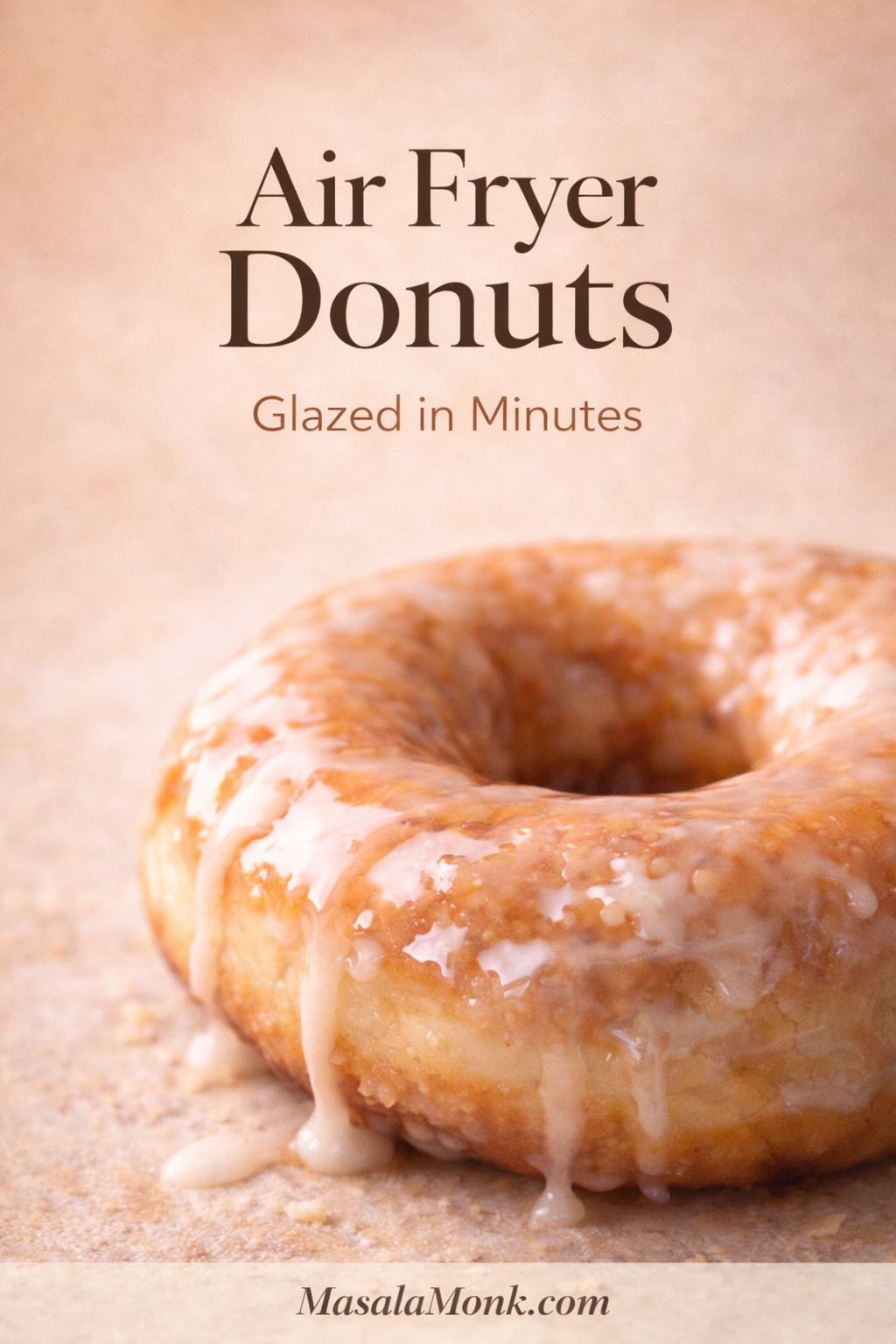
Portrait cover image of a glossy glazed air fryer donut close-up on a warm beige background with text “Air Fryer Donuts” and “Glazed in Minutes,” MasalaMonk.com in the footer.

Warm donuts have a way of making a normal day feel like a small celebration. The problem is that classic donuts frying at home can turn into a whole production—oil, thermometers, splatters, lingering smells, and that “now I have a pot of oil to deal with” moment. Air fryer donuts solve that in a surprisingly satisfying way.

Air Fried Donuts are not trying to be a deep-fryer stunt. Instead, they’re built for repeatability: soft, fluffy centers, a delicate outer set, and finishes that make them feel like a real treat. Even better, you can make air fried doughnuts in two very different styles depending on the time you have and the mood you’re in:

  • Homemade air fryer donuts made from scratch, risen until airy, then dipped in a simple glaze that sets into that classic thin shell.
  • Air fryer biscuit donuts made with biscuit dough, shaped in minutes, and finished with cinnamon sugar or glaze for instant gratification.

So whether you want an all-in weekend project or a shortcut dessert that still looks like you tried, donuts in the air fryer can fit the moment.

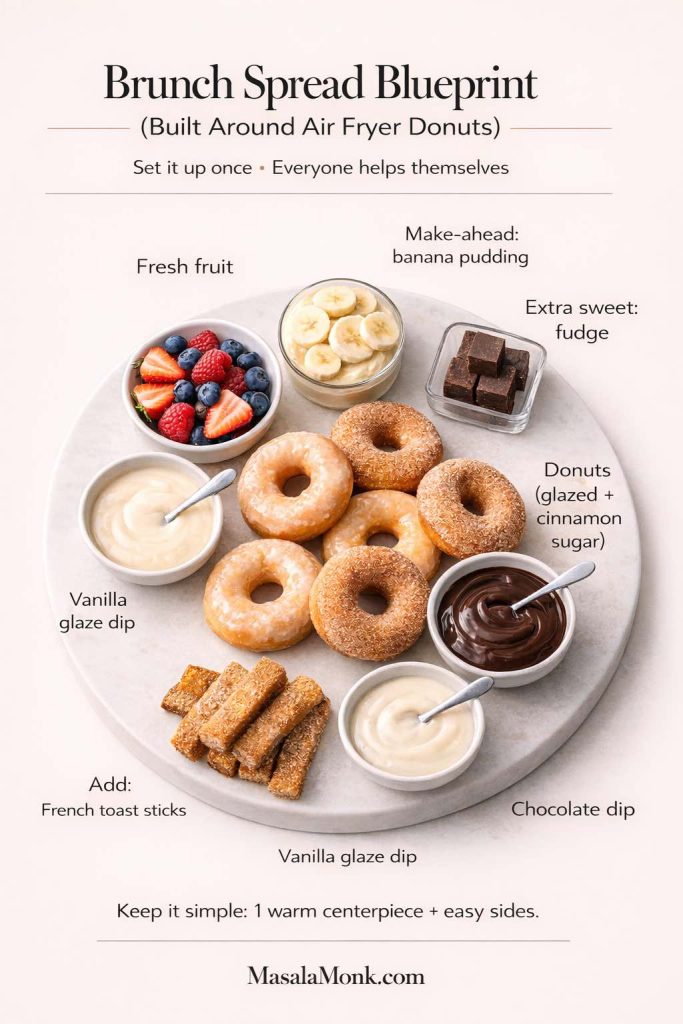
If you’re building a full breakfast spread, you can balance the sweetness with something crisp and dunkable like these French toast sticks. Meanwhile, if you’re serving a crowd and want a make-ahead option on the table, no-bake banana pudding keeps things generous without chaining you to the kitchen.

Also Read: Air Fryer Salmon Recipe (Time, Temp, and Tips for Perfect Fillets)


Air Fryer Donuts at a Glance (Time, Temp, Doneness)

Before you start mixing dough or cutting biscuit rings, it helps to understand what makes doughnuts in the air fryer behave differently from a pot of oil. The air fryer is basically a compact convection oven with attitude: powerful heat + fast airflow + a small cooking chamber. That combination can turn out beautifully tender donuts, as long as you cook for structure first and color second.

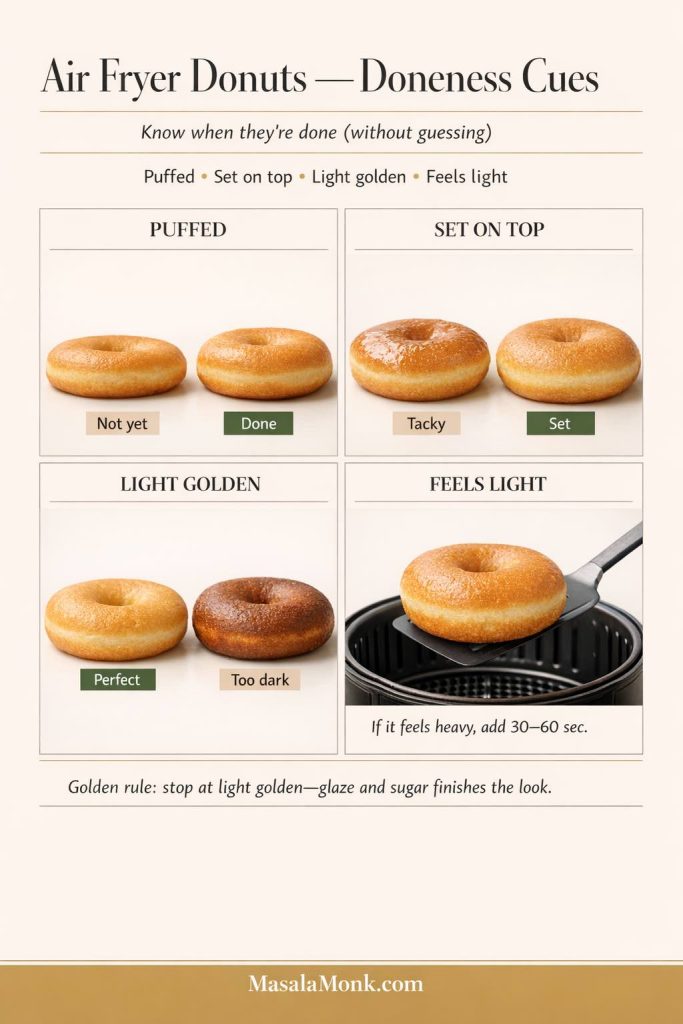
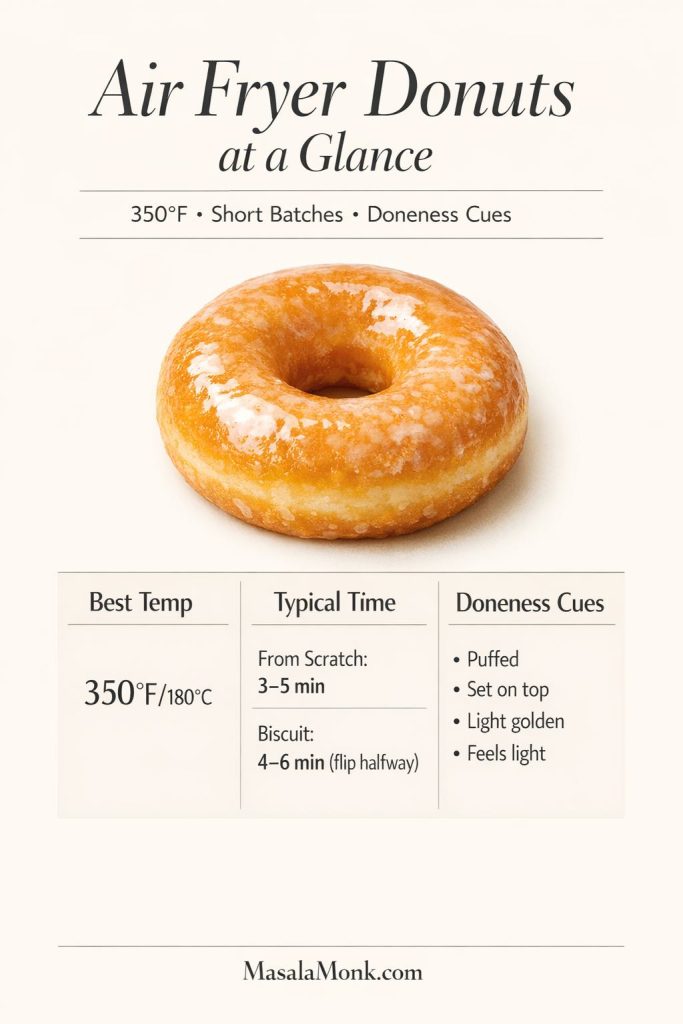
Infographic titled “Air Fryer Donuts at a Glance” showing a glazed donut and quick reference for donuts in the air fryer: best temp 350°F/180°C, typical time 3–5 minutes from scratch and 4–6 minutes for biscuit donuts, plus doneness cues like puffed, set on top, light golden, and feels light.
Air fryer donuts are easiest when you stop guessing. Use this quick guide for donuts in the air fryer—350°F, short batches, and simple doneness cues—so your homemade doughnuts in air fryer stay soft and your biscuit donuts don’t turn dry.

Best temperature for air fryer donuts

Most air fried doughnuts do best at 350°F / 180°C. That temperature gives the dough enough time to puff and set without turning the outside too dark too quickly.

If your air fryer runs hot, stay on the lower end of the range. Conversely, if your air fryer runs cool, a small bump can help. Still, it’s usually smarter to add time rather than crank the temperature, because pale donuts are fixable with glaze, while dry donuts are a little harder to rescue.

How long to cook donuts in the air fryer

Air fryer times vary more than people expect. Basket size, fan power, and even where the heating element sits can change the outcome. With that said, these ranges keep you grounded:

  • From-scratch donut dough: 3–5 minutes per batch
  • Biscuit donuts in air fryer: 4–6 minutes, flipping halfway

Even so, don’t let the numbers boss you around. Instead, treat the clock like a guide and use doneness cues to make the final call.

Don’t overcook air fryer donuts chasing color. Use these doneness cues: look for donuts that are puffed, dry and set on top, and light golden—not deep brown. If a donut feels heavy when lifted, add 30–60 seconds, then check again. Once you learn these signs, donuts in the air fryer become a reliable method, not guesswork.

Doneness cues for air fried doughnuts

Air fried doughnuts are done when they look set and feel light. In practice, that usually means:

  • The donut is visibly puffed, not flat.
  • The surface looks dry and set, not wet or tacky.
  • The color is light golden, not deep brown.
  • When you lift one, it feels airy for its size.

Once you get comfortable with those cues, “donut in air fryer recipe” stops being a rigid script and becomes a flexible method.

Also Read: Masterclass in Chai: How to Make the Perfect Masala Chai (Recipe)


Why Air Fryer Donuts Work (and when they don’t)

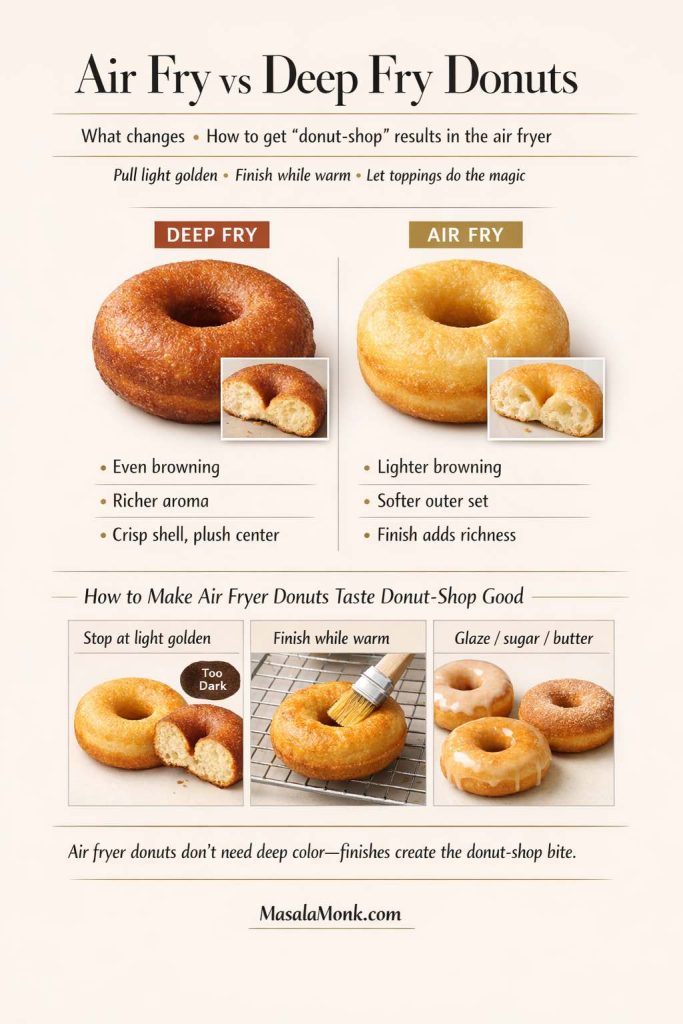
Deep fryer donuts and air fryer doughnuts don’t cook the same way, and that’s okay. Oil surrounds the dough and transfers heat aggressively, so the surface browns quickly and evenly. Air fryers cook with moving hot air, so browning is often gentler and more patchy unless you manage airflow and don’t overcrowd the basket.

Fortunately, donuts don’t need an intensely browned shell to taste amazing. They need softness, freshness, and a finish that makes the bite feel rich. That’s why glazes, cinnamon sugar, and butter-brushed coatings matter so much in air fryer doughnuts: the finish supplies the “donut shop” satisfaction even when the crust is lighter.

Air fryer donuts don’t cook like deep-fried donuts—and that’s the point. Use this comparison to set expectations (lighter browning, softer outer set) and get better results: pull donuts at light golden, finish while warm, and let glaze, cinnamon sugar, or butter create that donut-shop bite without overcooking.

Air fryer donuts vs deep fryer donuts

If you’ve ever done deep fryer donuts, you already know the magic: fast browning, plush interior, and that unmistakable fried aroma. Still, deep frying has its own learning curve. Oil temperature control is everything, and a few degrees can change the outcome.

For a classic overview of doughnuts frying at home—temperature cues, timing, and what to look for—Serious Eats’ guide is a solid reference: Sweet Technique: How to Make Doughnuts. Likewise, King Arthur Baking’s yeast-raised doughnut recipe is a clean baseline for the traditional method: Yeast-Raised Doughnuts.

Even so, if you’re using an air fryer for donuts, you’re usually choosing it for the opposite reasons: less mess, less fuss, and more repeatability. In that sense, air fryer doughnuts are more like a dependable weekly ritual than a once-in-a-while frying project.

The most common reason homemade air fryer donuts turn dry

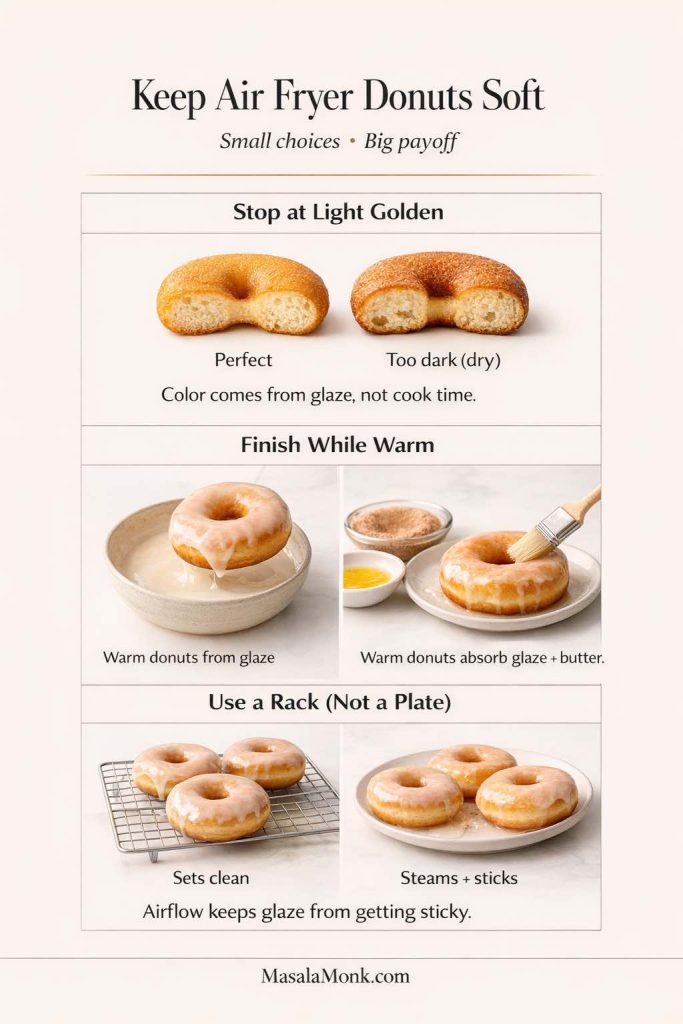
Overcooking happens fast in an air fryer. Sometimes it’s because you want more color. Other times it’s because you’re making a bigger batch and the later donuts sit longer “just to be safe.” Either way, the fix is simple: cook until set and lightly golden, then let glaze, butter, or cinnamon sugar finish the job.

Dry donuts are rarely under-flavored. Instead, they’re just overdone. Once you learn where “done” actually sits in your air fryer, everything gets easier.
Also Read: Crock Pot Pork Chops and Sauerkraut (No Dry Chops Recipe)


Air Fryer Donuts: Homemade Glazed Doughnuts From Scratch

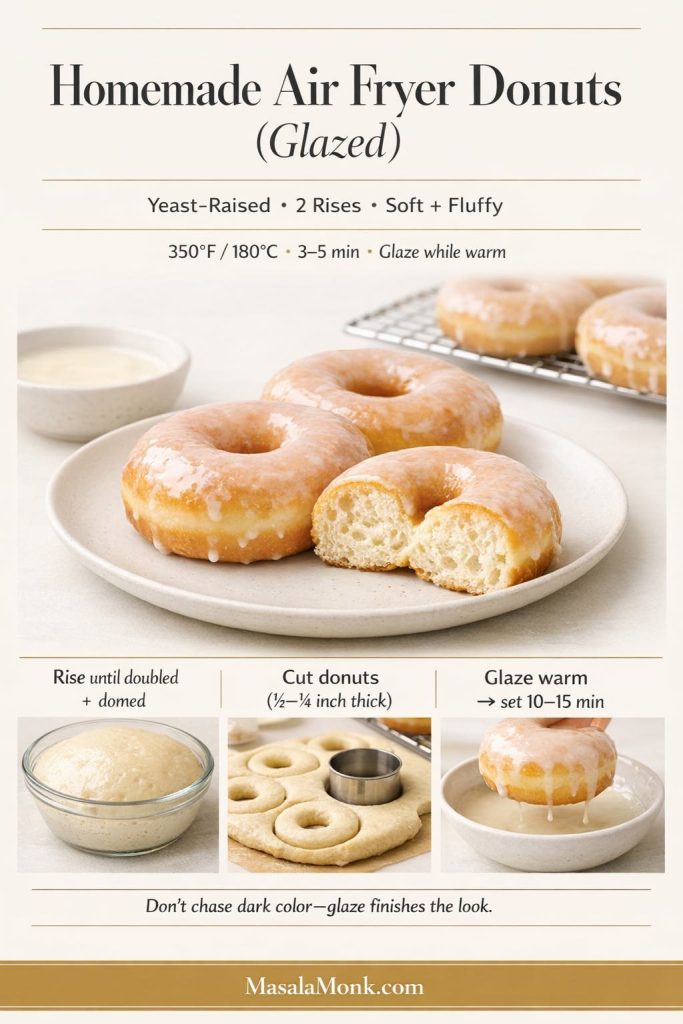
This homemade air fryer donuts method is the “real deal” version: yeasted dough, two rises, and that fluffy interior that makes a plain glazed donut feel almost elegant. It’s also the method that turns air fryer doughnuts into something you’ll be proud to serve.

If you like seeing a well-tested reference point for this style, Emma Fontanella’s air fryer glazed donuts are widely shared for a reason: the approach is straightforward and the result is genuinely donut-like. You can see that method here: Air Fryer Glazed Donuts. In the version below, you’ll get a full, reader-friendly recipe with the kind of details that make it repeatable in a real kitchen.

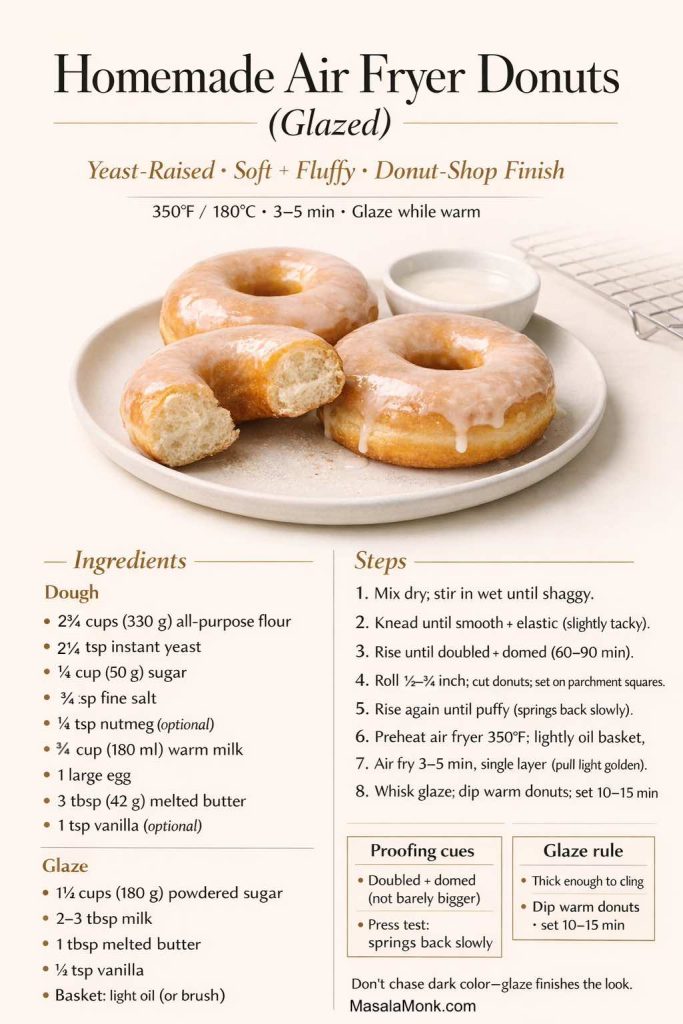
This is the “from scratch” path for homemade air fryer donuts: yeast-raised dough, two rises, and a smooth glazed finish. Let the dough rise until doubled and domed, cut donuts about 1/2–3/4 inch thick, air fry briefly, then glaze while warm and let it set 10–15 minutes for that classic donut-shop bite—without over-browning.

Ingredients for homemade air fryer donuts

For the donut dough

  • 2 ¾ cups (330 g) all-purpose flour, plus extra for dusting
  • 2 ¼ teaspoons instant yeast (1 packet)
  • ¼ cup (50 g) sugar
  • ¾ teaspoon fine salt
  • ¼ teaspoon nutmeg (optional, but classic)
  • ¾ cup (180 ml) warm milk (warm, not hot)
  • 1 large egg
  • 3 tablespoons (42 g) melted butter
  • 1 teaspoon vanilla extract (optional)

For the simple glaze

  • 1 ½ cups (180 g) powdered sugar
  • 2–3 tablespoons milk (as needed)
  • 1 tablespoon melted butter
  • ½ teaspoon vanilla extract
  • Pinch of salt

And for the basket

  • Neutral oil spray or a light brush of oil

A quick yeast note

Instant yeast can go straight into the flour. If you’re using active dry yeast, it’s still easy—just dissolve it in the warm milk with a pinch of sugar and wait until it looks foamy, then proceed.
Step-by-step recipe: homemade donuts in the air fryer

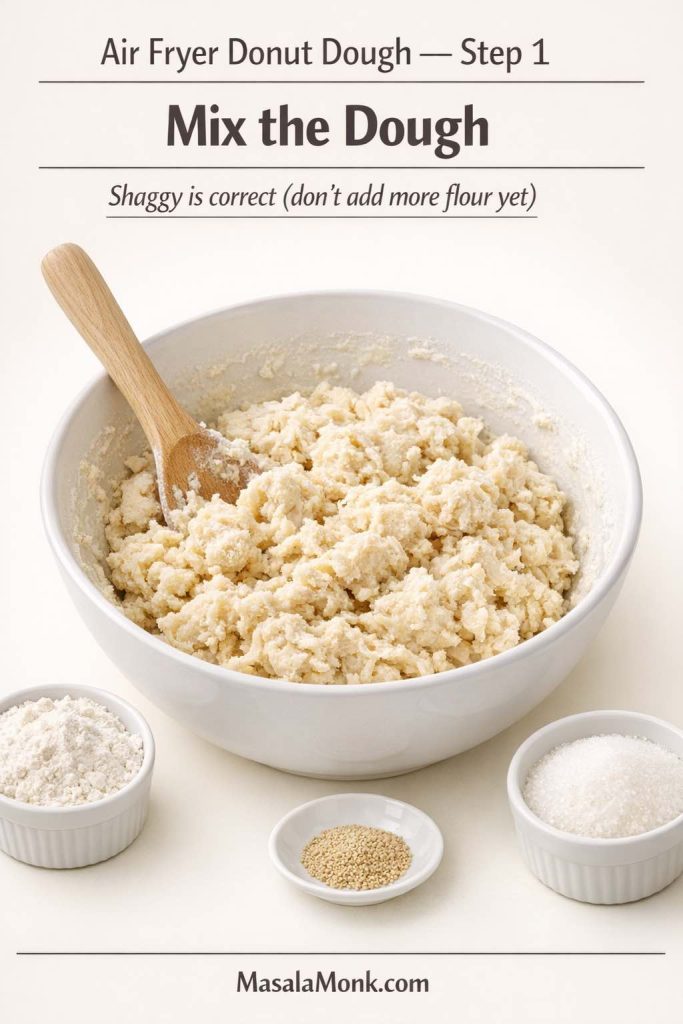
1) Mix the dough

Start by whisking the dry ingredients together in a large bowl: flour, yeast, sugar, salt, and nutmeg.

In another bowl, whisk the warm milk, egg, melted butter, and vanilla until smooth. Pour the wet mixture into the dry mixture and stir until a shaggy dough forms. It will look messy at first, but give it a minute—flour needs a moment to hydrate.

Air fryer donut dough Step 1 showing shaggy mixed dough in a bowl with text “Mix the Dough” and note that shaggy dough is correct before adding more flour.
Step 1 for homemade air fryer donuts: mix until the dough looks shaggy and rough—this is normal. Don’t add extra flour yet; kneading is what turns it smooth.

2) Knead until smooth and elastic

Now knead. You can do this by hand on a lightly floured surface, or use a stand mixer with a dough hook.
  • By hand: knead for about 8–10 minutes.
  • With a mixer: knead 5–6 minutes on medium-low.

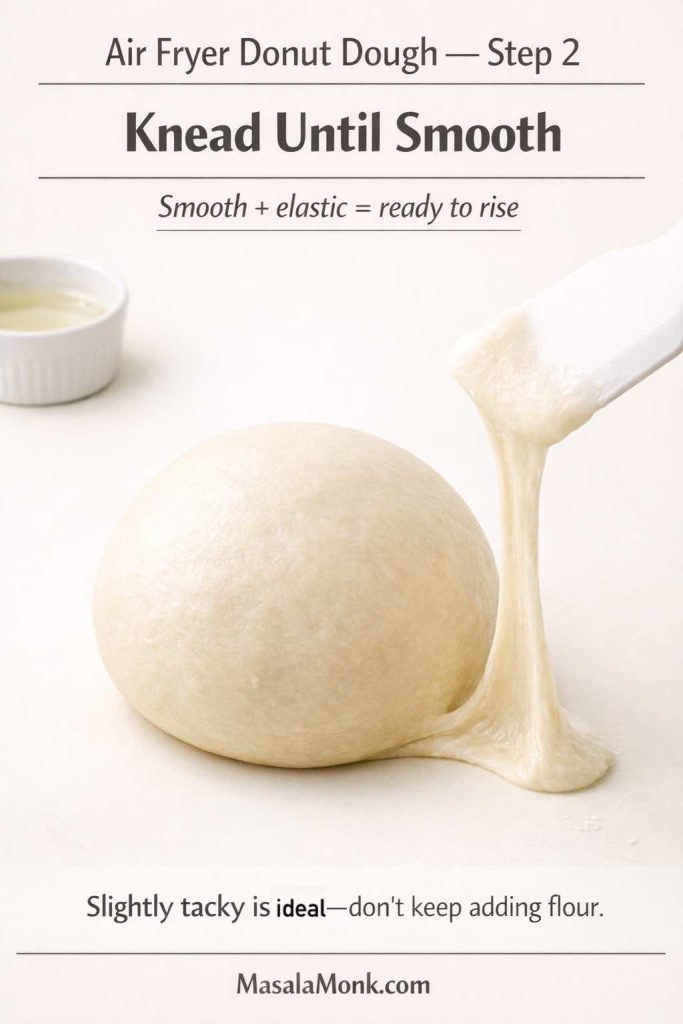
The dough should become smooth, supple, and slightly tacky. It should not be so sticky that it smears everywhere, but it also shouldn’t be stiff. If you keep adding flour because you want it “clean,” you’ll often trade softness for density.

What to look for: the dough should feel soft enough that it will rise into something airy, not tight and bread-like.

Air fryer donut dough Step 2 showing a smooth dough ball being stretched to show elasticity, with text “Knead Until Smooth” and note that smooth and elastic dough is ready to rise.
Step 2 for homemade air fryer donuts: knead until the dough is smooth and elastic. Slightly tacky is ideal—stop adding flour too early and you’ll get softer donuts.

3) First rise: let it get puffy

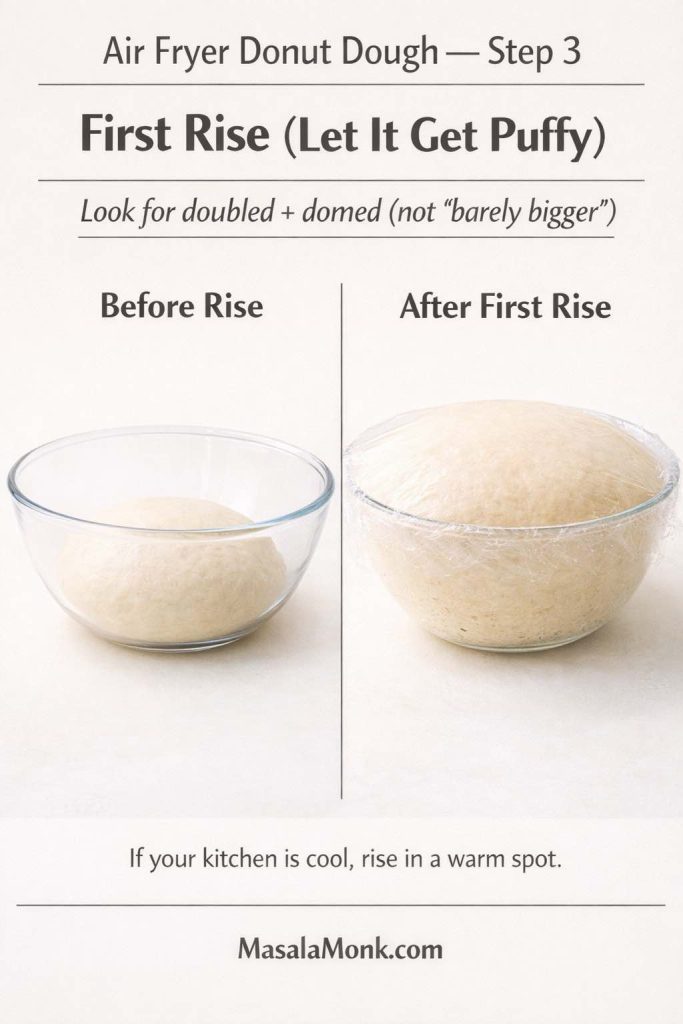
Place the dough in a lightly oiled bowl, cover it, and let it rise until doubled and noticeably puffy. Depending on your room, that could be 60 minutes or it could be 90.

If your kitchen is cool, you can create a warm spot by turning your oven on for 60 seconds, turning it off, then letting the covered bowl rise inside.

Air fryer donut dough Step 3 infographic showing before and after first rise in a bowl, highlighting dough that is doubled and domed after rising.
Step 3: first rise. Look for dough that’s clearly doubled and domed, not just “a little bigger.” This is what keeps air fryer donuts light instead of dense.

4) Roll and cut your donuts

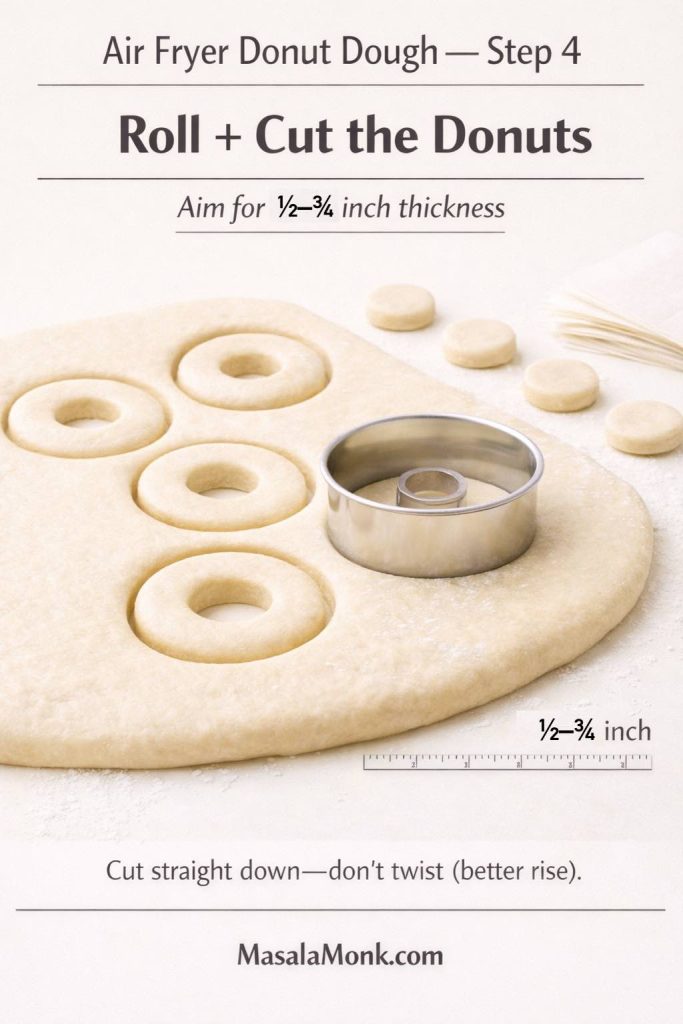
Lightly flour your surface. Roll the dough to about ½ to ¾ inch thick.

Cut donuts using a donut cutter, or use two cutters: one larger round cutter and one smaller cutter for the center. If you don’t have cutters, even a glass and a bottle cap can work in a pinch.

Set each donut on a small square of parchment paper. That little trick makes transferring delicate risen donuts into the air fryer much easier.

Air fryer donut dough Step 4 showing rolled dough being cut into donut rings with a cutter, with guidance to roll to 1/2 to 3/4 inch thickness and cut straight down.
Step 4: roll and cut your air fryer donuts. Aim for 1/2 to 3/4 inch thickness, then cut straight down without twisting so the donuts rise higher and cook evenly.

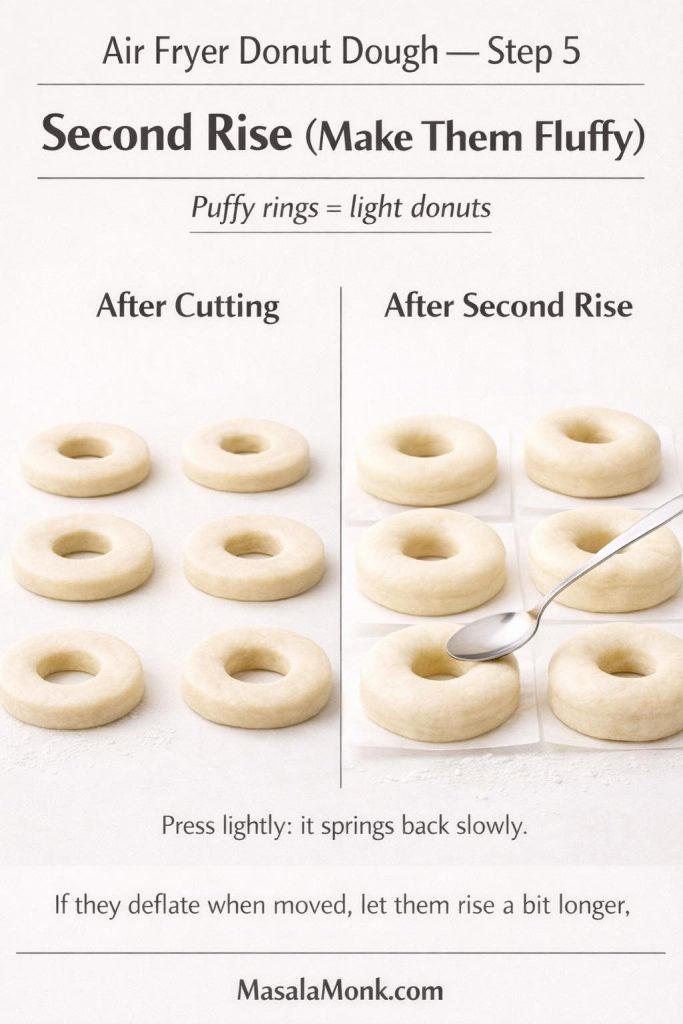
5) Second rise: the fluff-maker

Cover the donuts gently and let them rise again until they look airy and feel light. This rise is where a homemade air fryer donuts recipe shifts from “fine” to “wow.”

A good sign: if you lightly press the dough, it should spring back slowly, leaving a soft indentation for a moment.

Air fryer donut dough Step 5 showing donuts after cutting versus after the second rise, highlighting puffier rings that spring back slowly when pressed.
Step 5: second rise. Puffy donut rings mean lighter homemade air fryer donuts. Press lightly—if it springs back slowly, they’re ready to cook.

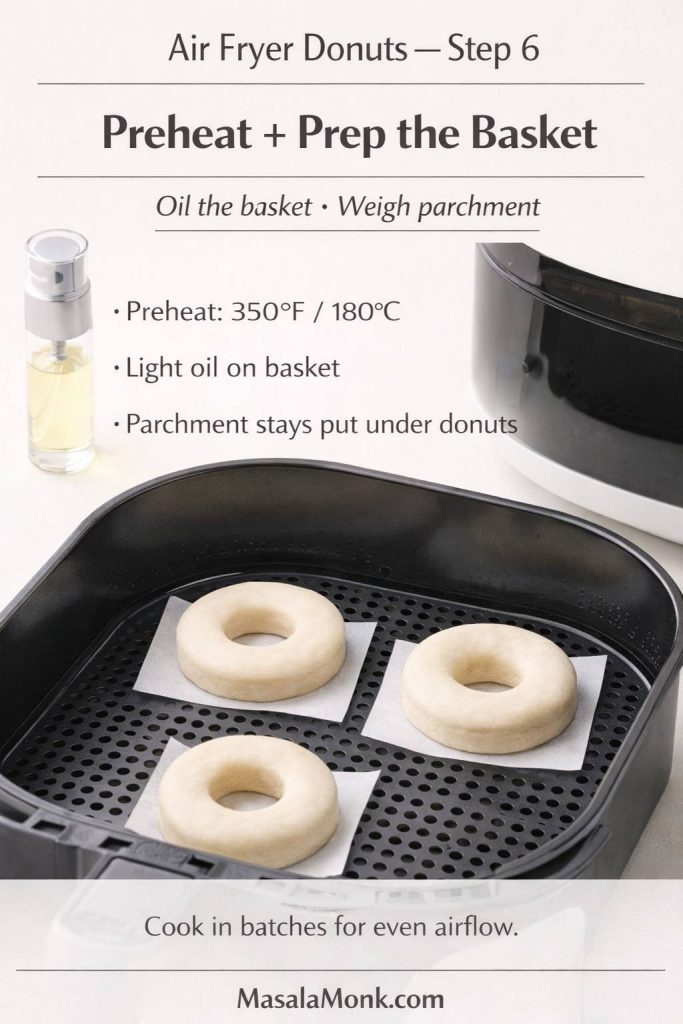
6) Preheat and prep

Preheat your air fryer to 350°F / 180°C for about 3–5 minutes.

Lightly oil the basket or tray. If you’re using parchment under the donuts, ensure the parchment is weighed down by the donut so it doesn’t get pulled into the heating element by airflow.

Air fryer donuts Step 6 showing donuts on parchment squares inside an air fryer basket, with instructions to preheat to 350°F/180°C, lightly oil the basket, and weigh parchment under donuts.
Step 6: preheat and prep the basket. Oil lightly, preheat to 350°F, and make sure parchment stays under the donuts so airflow stays even and nothing shifts while cooking.

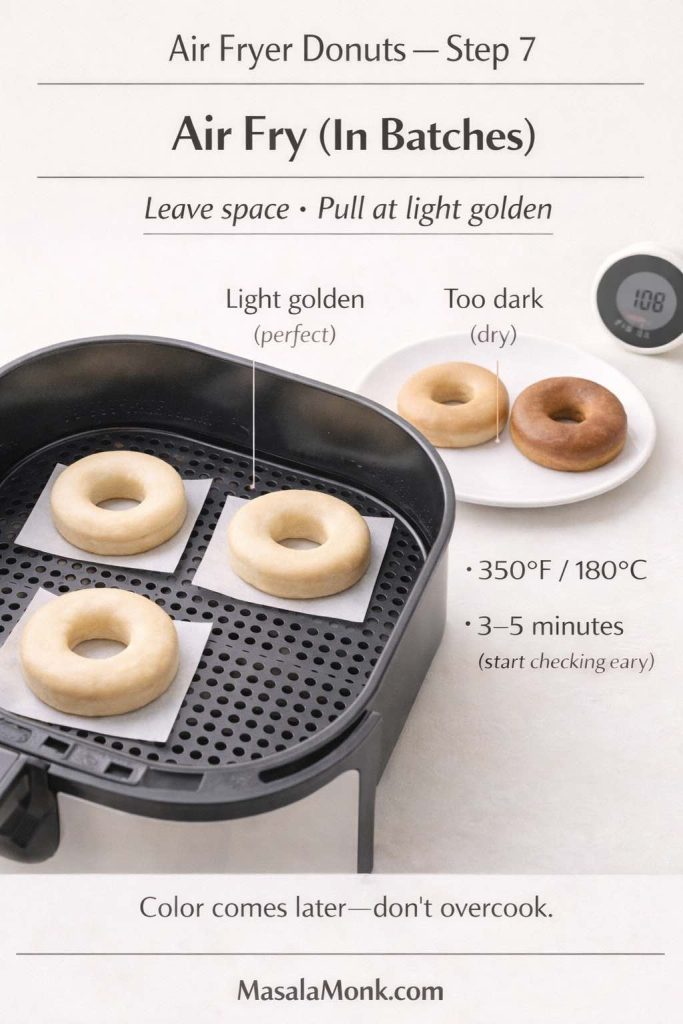
7) Air fry the donuts (in batches)

Place donuts in a single layer, leaving space between them so air can circulate.

Cook for 3–5 minutes. Start checking early, especially on the first batch. Air fryer models vary a lot, and the first batch teaches you the truth about your machine.

Don’t chase dark color. Aim for set + light golden. The glaze will make them look finished and glossy.

Air fryer donuts Step 7 showing donuts spaced in an air fryer basket with a comparison of light golden versus too dark donuts, plus 350°F and 3–5 minutes guidance.
Step 7: air fry in batches with space. Pull donuts when they’re set and light golden—going too dark is the fastest way to end up with dry air fryer donuts.

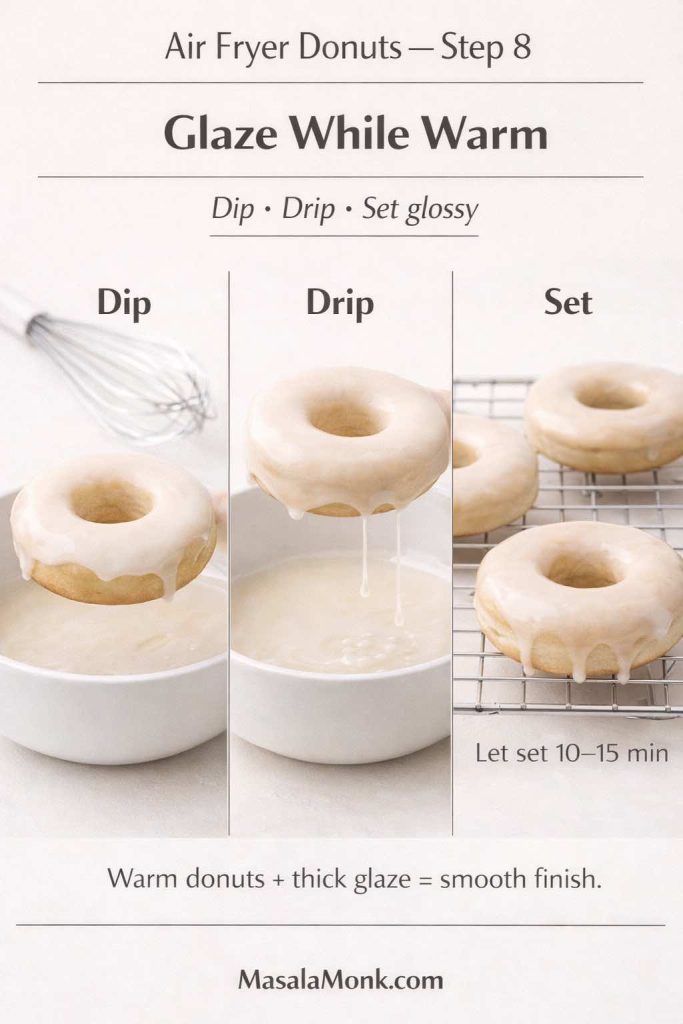
8) Glaze while warm

While the donuts cook, whisk together the glaze ingredients. Start with 2 tablespoons of milk and add more only if needed. You want the glaze to be thick enough to cling, yet fluid enough to settle into a smooth surface.

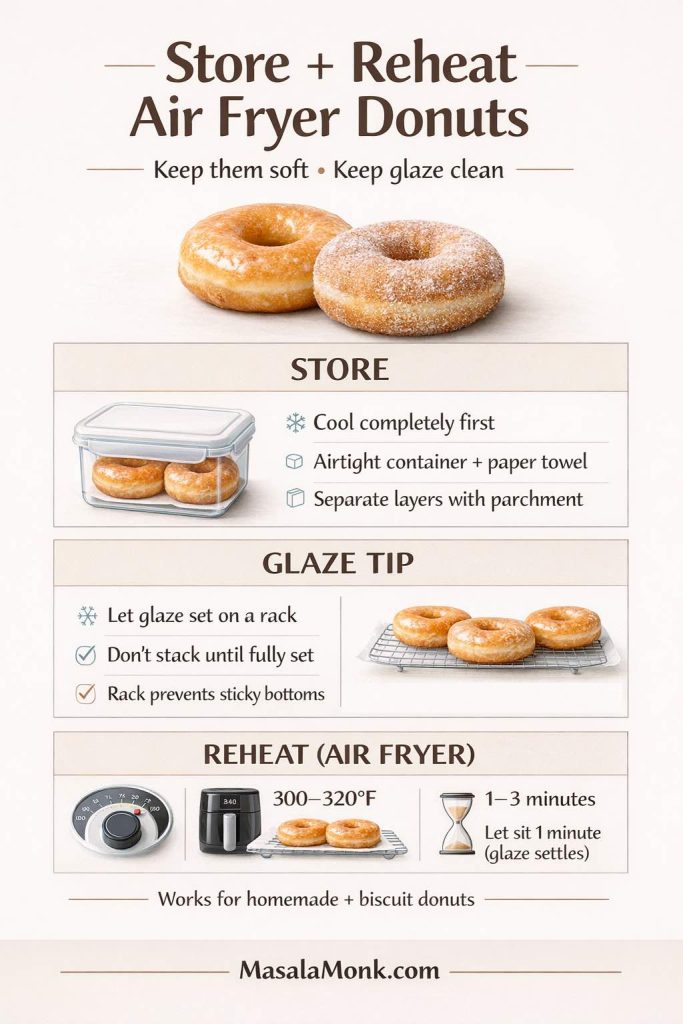
Dip each warm donut into the glaze, let excess drip off, and place on a rack to set. Give them 10–15 minutes and the glaze will form that thin, slightly crackly shell that makes a glazed donut feel “right.”

Air fryer donuts Step 8 showing a three-panel sequence—dip, drip, and set—demonstrating glazing warm donuts and letting the glaze set for 10 to 15 minutes.
Step 8: glaze while warm. Dip, let the excess drip, then set on a rack until glossy—this is how glazed air fryer donuts get that smooth donut-shop finish.

Making the glaze taste like it matters

Glaze can be flat if it’s just powdered sugar and water. That’s why a little melted butter and a pinch of salt are worth it—they add richness and balance without making the glaze heavy.

If you want to go one step further, you can add a tiny touch of nutmeg or cardamom. The flavor stays subtle, yet the donut suddenly tastes like it belongs in a good bakery case.

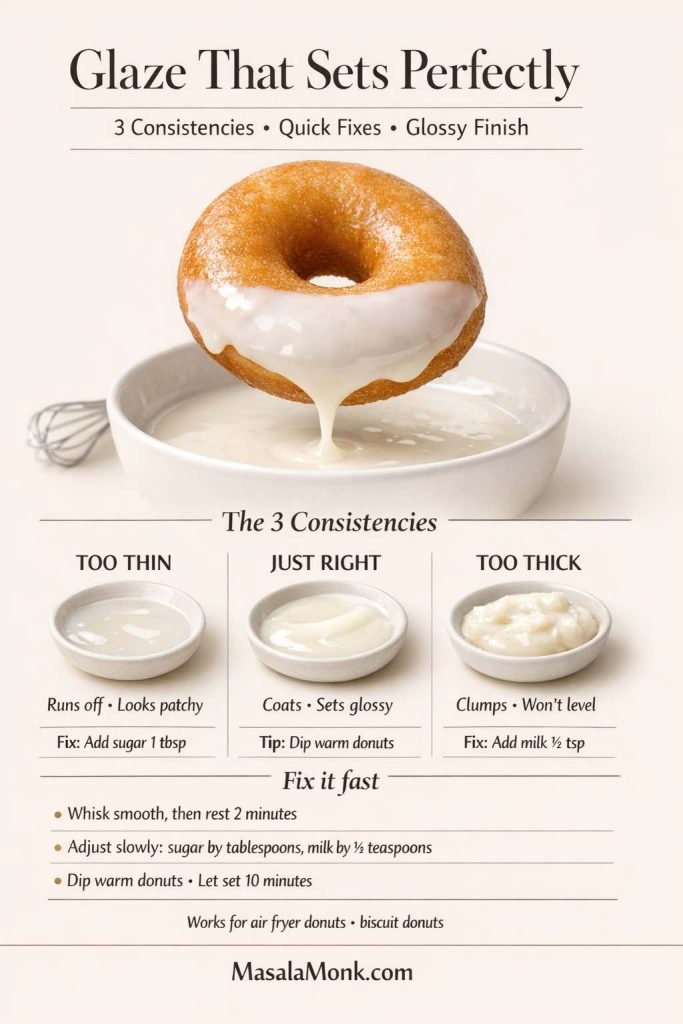
Infographic titled “Glaze That Sets Perfectly” showing a donut being dipped in glaze and a 3-column guide for donut glaze consistency: too thin, just right, and too thick, with quick fixes for air fryer donuts and biscuit donuts.
Glaze makes air fryer donuts taste “donut-shop” good. Use this quick donut glaze guide to hit the perfect consistency—too thin, just right, or too thick—then fix it fast so your glazed donuts set smooth and glossy instead of running off or clumping.

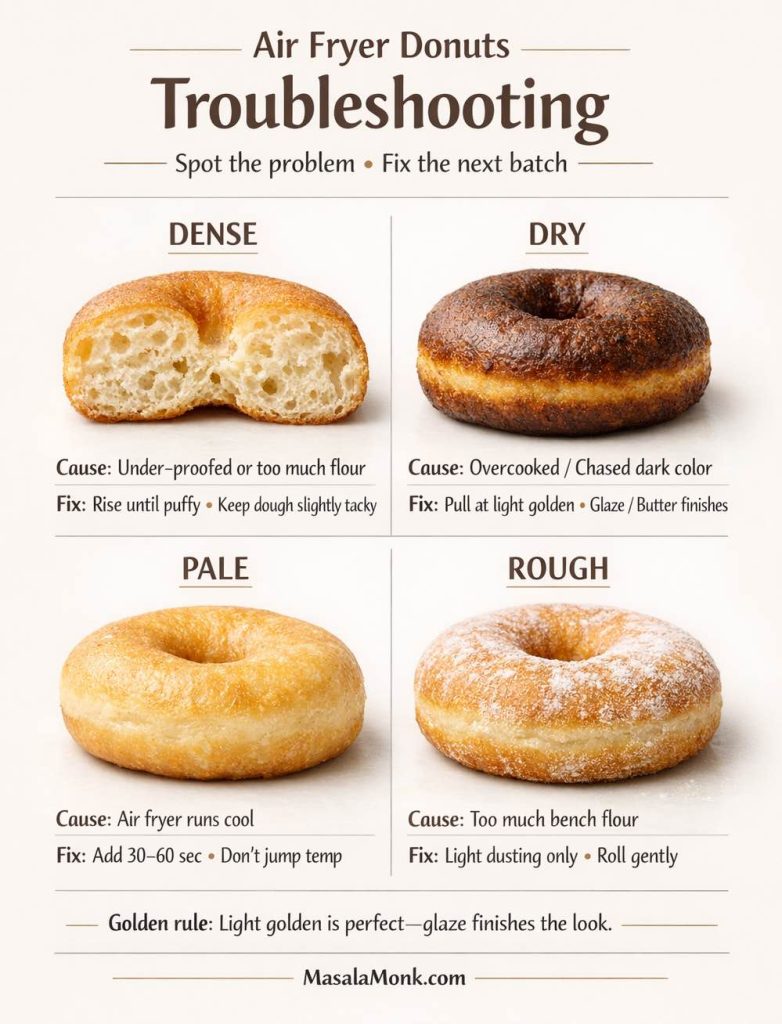
Troubleshooting homemade air fryer donuts

Donuts are forgiving, but a few problems show up again and again. Thankfully, each has a simple fix.

If they’re dense:
Usually the dough didn’t rise enough, or too much flour was added during kneading and rolling. Next time, keep the dough soft and give the second rise the time it needs.

If they’re dry:
Most often they cooked too long. Pull earlier and rely on glaze. Also, keep in mind that air fryer donuts continue to firm slightly as they cool, so stopping at “just done” matters.

If they’re pale:
Your air fryer might run cool. Add a minute, but don’t jump the temp too high. Pale donuts with glaze still look inviting. Dark donuts often taste overcooked.

If the surface looks rough:
Too much bench flour during rolling can leave the dough dry. Use a light dusting and roll gently.

Air fryer donuts get better fast once you know what to look for. Use this troubleshooting guide to spot the problem—dense, dry, pale, or rough—and fix the next batch with simple changes like proofing longer, cooking to light golden, adjusting time by 30–60 seconds, and keeping bench flour light.

At this point, you’ve got a complete air fryer doughnuts recipe you can keep repeating. However, sometimes you want donuts fast—without mixing, rising, or waiting. That’s where biscuit donuts come in.

Also Read: Hot Chocolate Coffee: 3 Easy Recipes (Cocoa, Mix, or Espresso)


Air Fryer Biscuit Donuts (Donuts From Biscuit Dough)

Biscuit donuts are the shortcut that feels almost unfair. They’re quick, they’re fun, and they’re exactly the kind of dessert you can make on a whim.

You’ll see this style described in dozens of ways: biscuit donuts recipe, homemade donuts from biscuits, donuts made from biscuits, donuts using canned biscuits, donuts from biscuits in air fryer, or canned biscuit donuts in air fryer. No matter the wording, the idea is the same: use biscuit dough, cut a hole, air fry, then finish immediately while hot.

If you want a straightforward reference for this approach, RecipeBoy has a clear step-by-step method using canned dough in the air fryer: Air Fryer Canned Biscuit Donuts. What matters most is the finish and the timing—cook just until set and golden, then coat while warm.

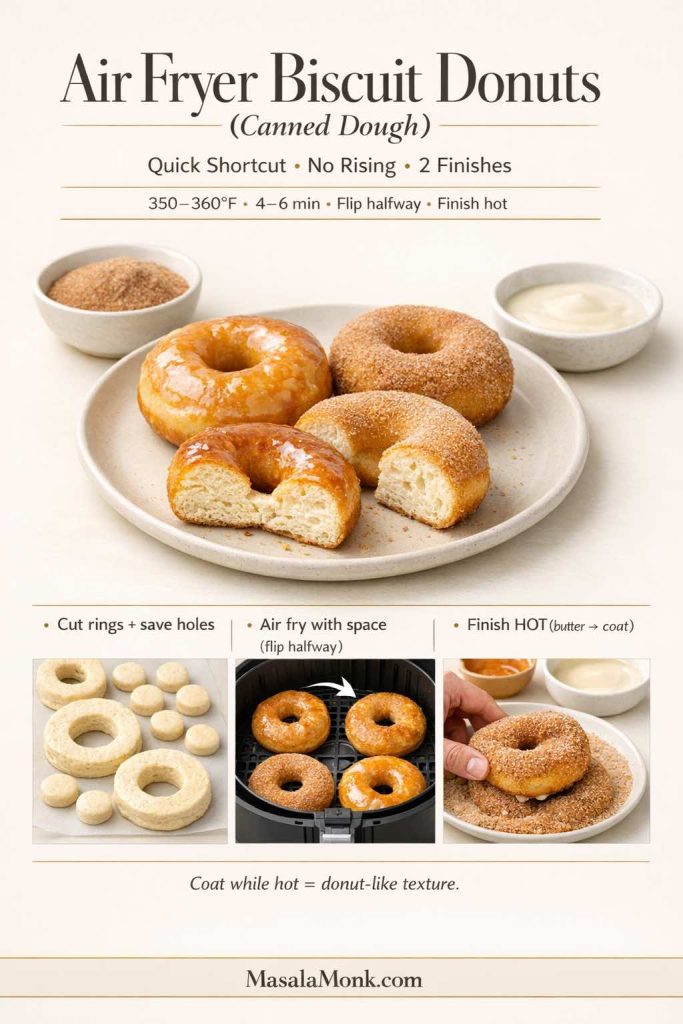
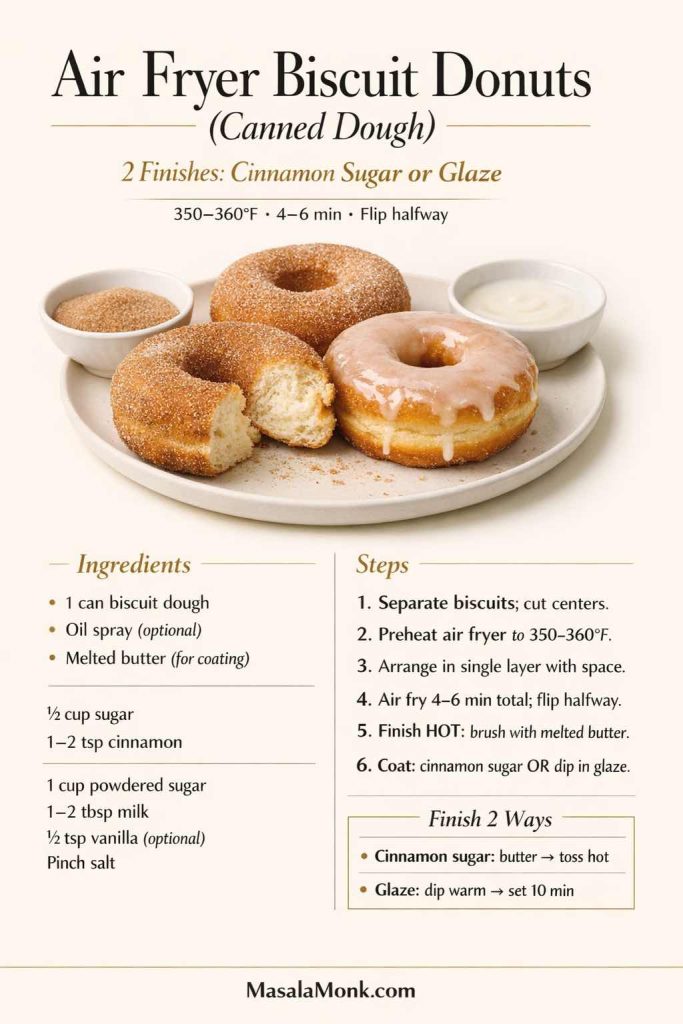
Section master infographic titled “Air Fryer Biscuit Donuts (Canned Dough)” showing glazed and cinnamon sugar donuts with a quick method strip: cut rings and save holes, air fry with space at 350–360°F for 4–6 minutes and flip halfway, then finish hot with butter and coating for donut-like texture.
These air fryer biscuit donuts are the fastest donuts from canned dough: no rising, short cook time, and two finishes. Cut rings and save the holes, air fry at 350–360°F for 4–6 minutes (flip halfway), then finish hot—butter first, then cinnamon sugar or glaze—for a tender, donut-like bite.

Ingredients for air fryer biscuit donuts

  • 1 can of biscuit dough (any standard biscuit-style dough works)
  • A small cutter for the donut hole (or the wide end of a piping tip)
  • Neutral oil spray (optional)
  • Melted butter (highly recommended for coating)

For cinnamon sugar

  • ½ cup sugar
  • 1–2 teaspoons cinnamon (to taste)

For glaze
Use the same simple glaze from the homemade recipe above.

How to make donuts from biscuits in air fryer (Step-by-step recipe)

1) Cut and shape

Separate the biscuits and place them on a board. Cut the center out of each biscuit to make a donut shape. Save the holes; they turn into donut bites that cook faster and coat beautifully.

If your biscuit dough is thick, stretch each ring slightly. That little adjustment helps them cook evenly.

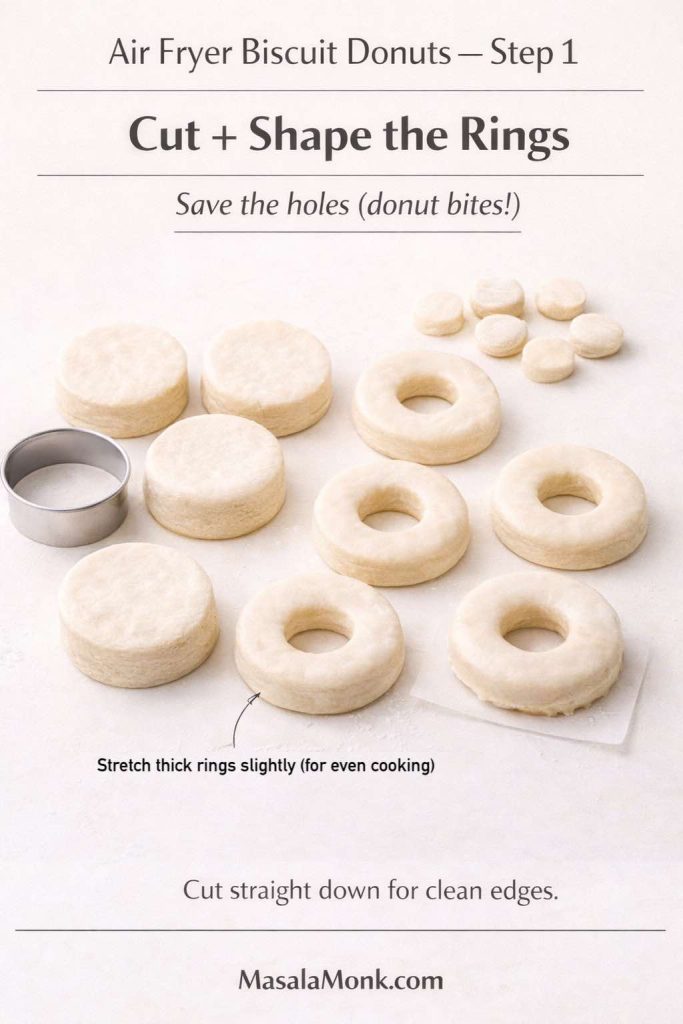
Air fryer biscuit donuts Step 1 showing biscuit dough rounds cut into donut rings with donut holes saved for bites, with tip to cut straight down for clean edges.
Step 1 for air fryer biscuit donuts: cut biscuit dough into rings and save the donut holes for quick bites. Cut straight down for clean edges, then stretch thick rings slightly so donuts from biscuits cook evenly.

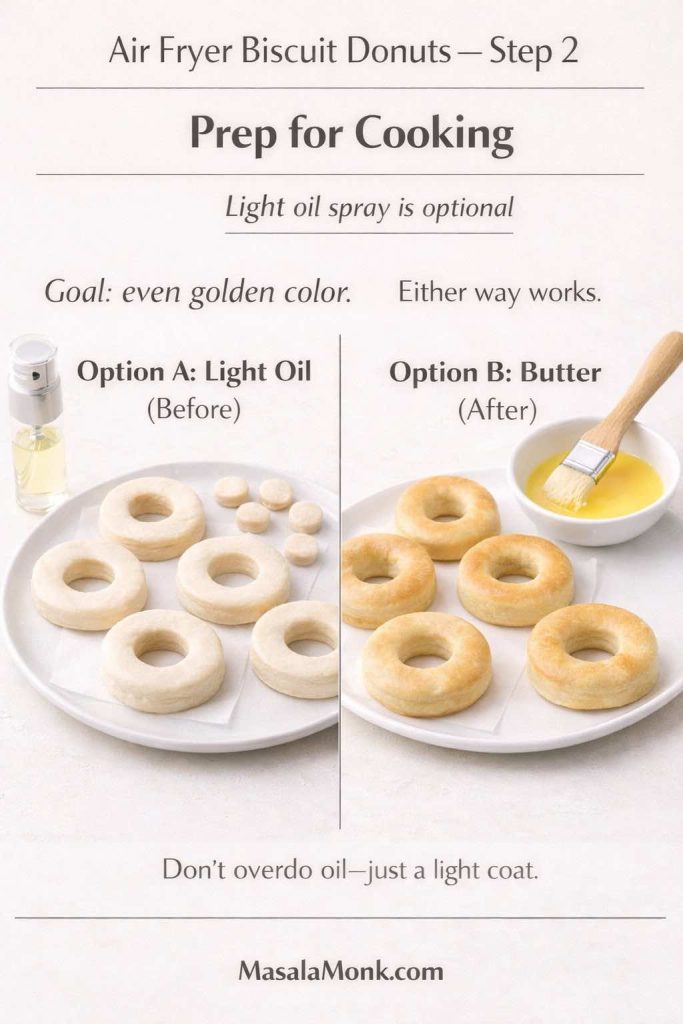
2) Prep for cooking

Lightly spray both sides with oil, or leave them plain and brush with melted butter after cooking. Either way works, although a light spray can encourage a more even golden surface.

Air fryer biscuit donuts Step 2 showing two prep options: light oil before cooking or brushing with butter after cooking for even golden color.
Step 2: prep your biscuit donuts for the air fryer. A light oil spray can help even browning, but butter after cooking works too—either way keeps canned biscuit donuts tender instead of dry.

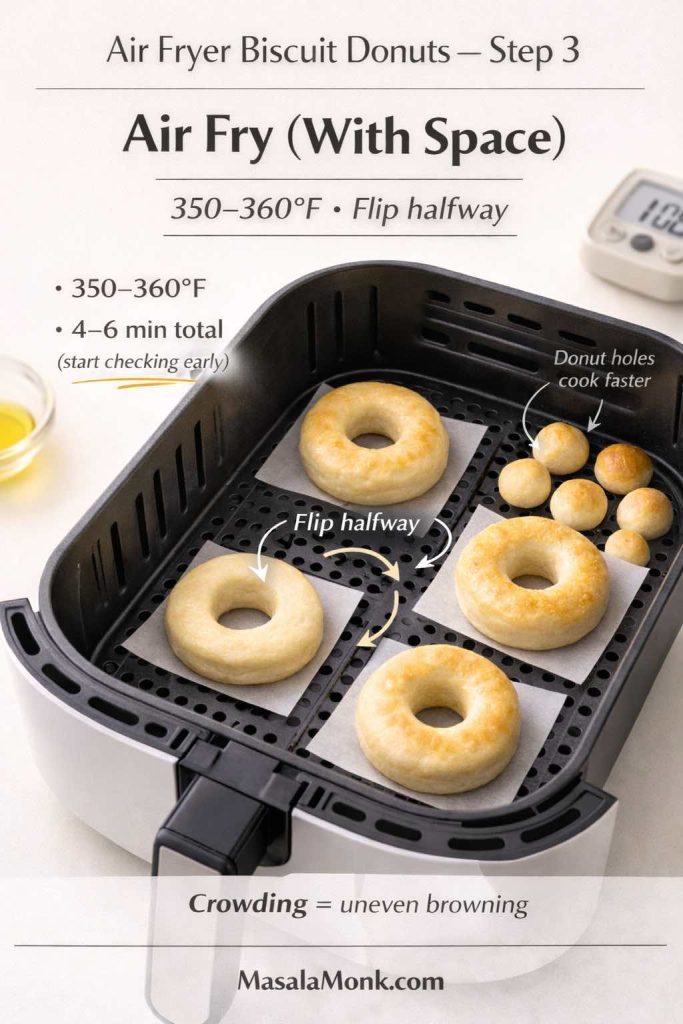
3) Air fry (with space)

Preheat your air fryer to 350–360°F.

Place the donuts in a single layer. Leave space between them. Air flow is your friend here, and crowding makes everything uneven.

Cook for 4–6 minutes total, flipping halfway. A useful starting point is:

  • 3 minutes on the first side
  • Flip
  • 2 minutes on the second side
  • Add 30–60 seconds if needed

Donut holes usually cook faster, so check them early.

Air fryer biscuit donuts Step 3 showing donut rings spaced in an air fryer basket at 350–360°F with instructions to flip halfway and note that donut holes cook faster.
Step 3: air fry biscuit donuts in a single layer with space. Cook at 350–360°F for 4–6 minutes total and flip halfway—crowding causes uneven browning, and donut holes usually cook faster.

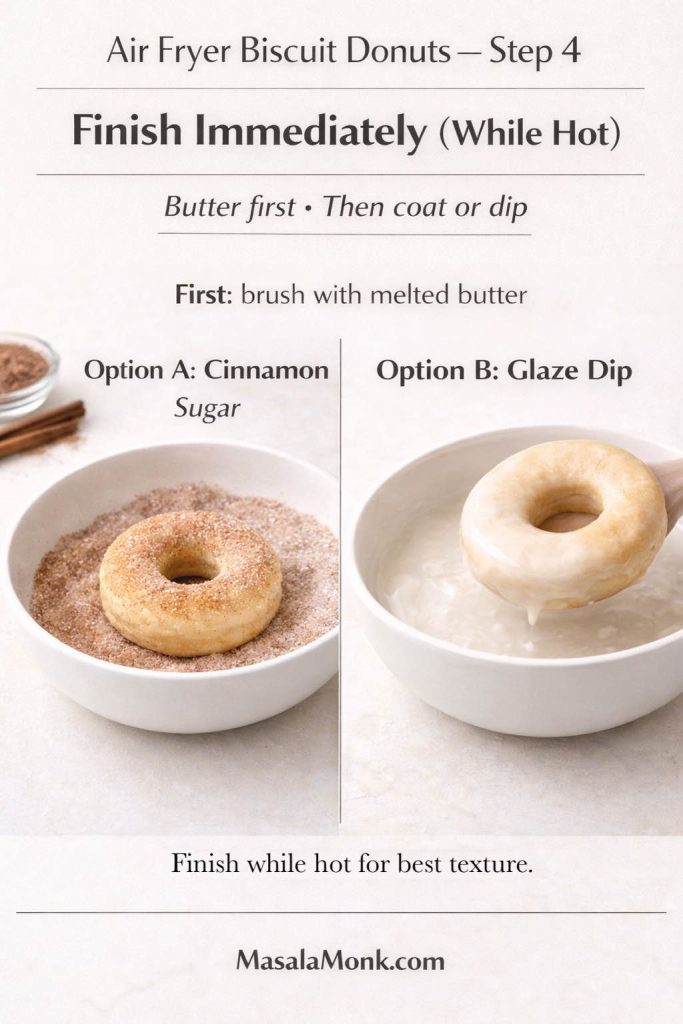
4) Finish immediately

This part is non-negotiable. Coating warm donuts is what makes them taste like a treat instead of a biscuit.

Air fryer biscuit donuts Step 4 showing finishing while hot: brush donuts with melted butter first, then coat in cinnamon sugar or dip in glaze for best texture.
Step 4 is the secret to donut-like texture: finish biscuit donuts while hot. Brush with melted butter first, then either coat in cinnamon sugar or dip in glaze—waiting too long makes donuts from canned biscuits taste more like biscuits.

Cinnamon sugar biscuit donuts in the air fryer

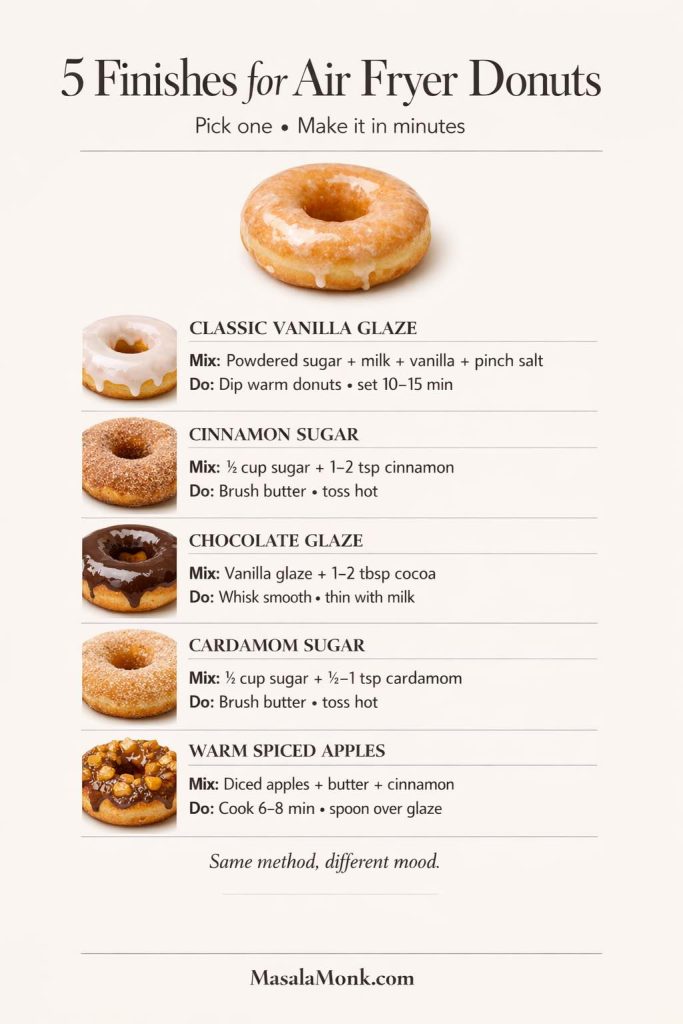
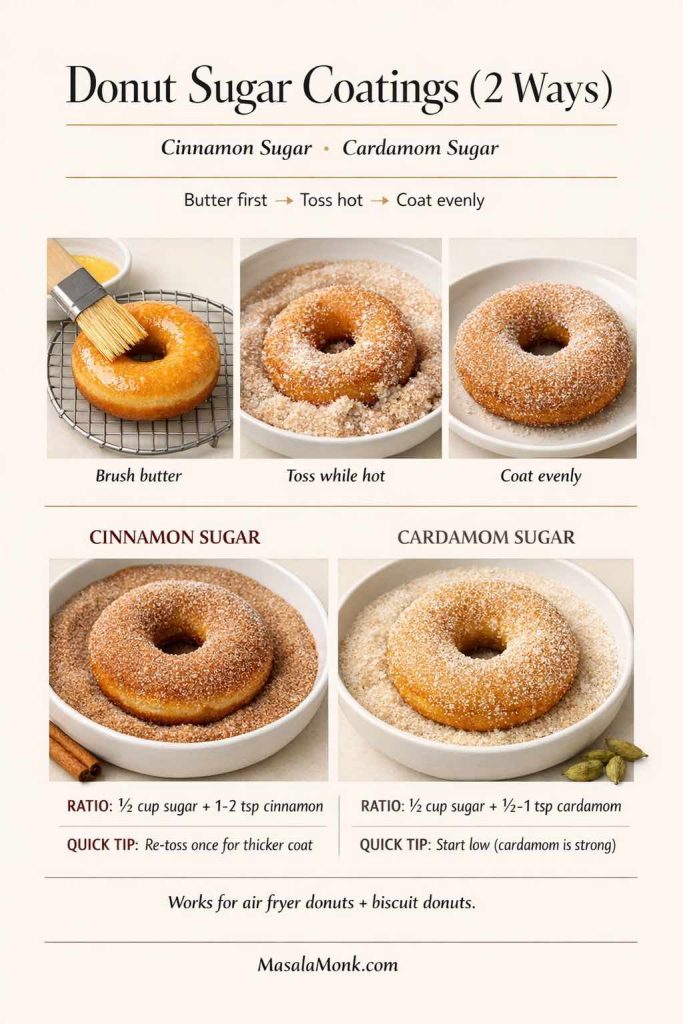
Brush the hot donuts with melted butter, then toss them in cinnamon sugar. The butter helps the cinnamon sugar cling and gives the finish that rich “just made” taste.

If you like cinnamon sugar desserts and want a natural pairing on the same sweet-coating theme, this churros guide fits beautifully at the table. Churros and biscuit donuts scratch a similar itch, yet they feel different enough to justify both.

Glazed canned biscuit donuts air fryer style

Dip the warm donuts in glaze, let them drip, then set them on a rack. If you want a thicker glaze that clings more heavily, hold back a little milk so the glaze stays plush.

Once you’ve done this once, you’ll understand why so many people keep this method in their back pocket. It’s the quickest route to donuts made from biscuits that actually feel like a real dessert.

Also Read: Iced Coffee: 15 Drink Recipes—Latte, Cold Brew, Frappe & More


Air Fryer Donut Pan vs Basket (Do You Need One?)

Some kitchens love specialty tools. Others prefer a clean counter and fewer things to wash. Either approach is valid, especially when it comes to an air fryer donut pan.

If you’re wondering about a donut pan for air fryer donuts, it helps to know what it changes—and what it doesn’t.

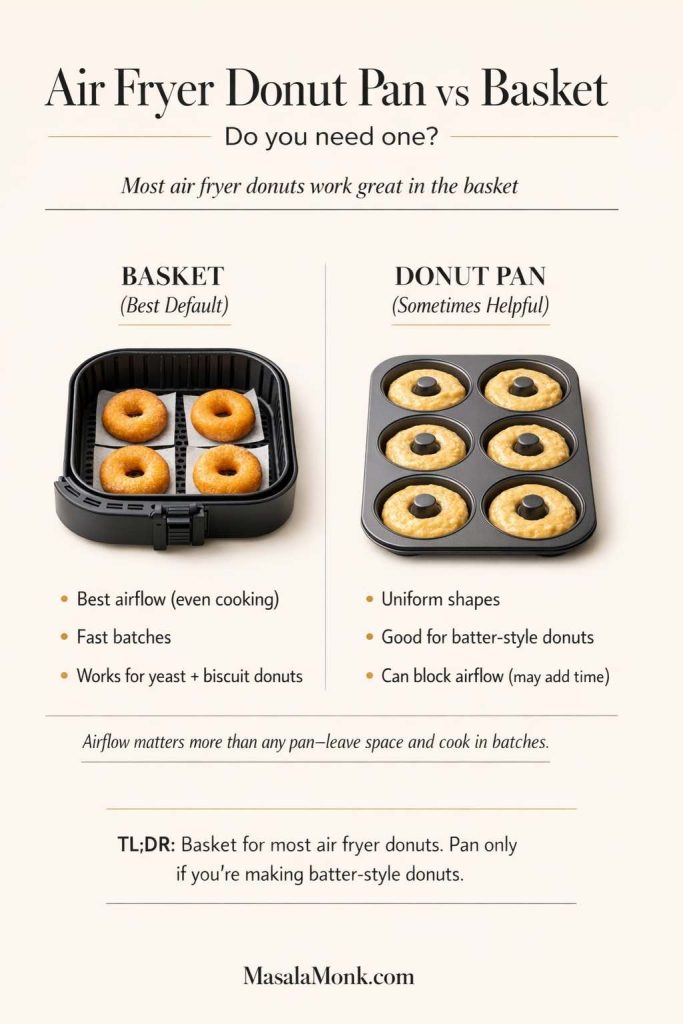
Infographic titled “Air Fryer Donut Pan vs Basket” comparing using an air fryer basket versus a donut pan, noting the basket works for most air fryer donuts (better airflow, fast batches, yeast and biscuit donuts) while a donut pan is mainly useful for batter-style donuts and may block airflow.
Wondering if you need an air fryer donut pan? Most air fryer donuts turn out better in the basket because airflow stays strong and batches cook evenly. Use a donut pan mainly for batter-style donuts or when you want uniform shapes—otherwise, leave space and cook in batches for the best results.

Air fryer donut pan: what it’s good for

A donut pan can be helpful if you’re making batter-style donuts (more like baked donuts) or if you want consistent shapes with minimal handling. In addition, if you’re aiming for uniformity—say, for a party platter—a pan can keep rings neat and predictable.

Donut pan for air fryer donuts: when to skip it

If you’re making yeasted donuts, you’ll still be shaping and moving risen dough. If you’re making biscuit donuts, you already have a shape. In both cases, the basket method is plenty.

Moreover, pans can block airflow. That’s not always a deal-breaker, but it can reduce browning and add cook time. If your goal is speed and simplicity, the basket wins.

Simple spacing rules that matter more than any pan

No matter what you use, spacing is the quiet hero of air fryer donuts. Give each donut room. Let the air do its job. Cook in batches. Then finish while warm.

That’s the habit that makes donuts in the air fryer feel consistent.

Also Read: Cappuccino Recipe: How to Make a Perfect Cappuccino at Home


Air Fryer Donuts vs Deep Fryer Donuts (A Real-World Comparison)

Sometimes you want a fair comparison, not a hype statement. Here’s the honest version.

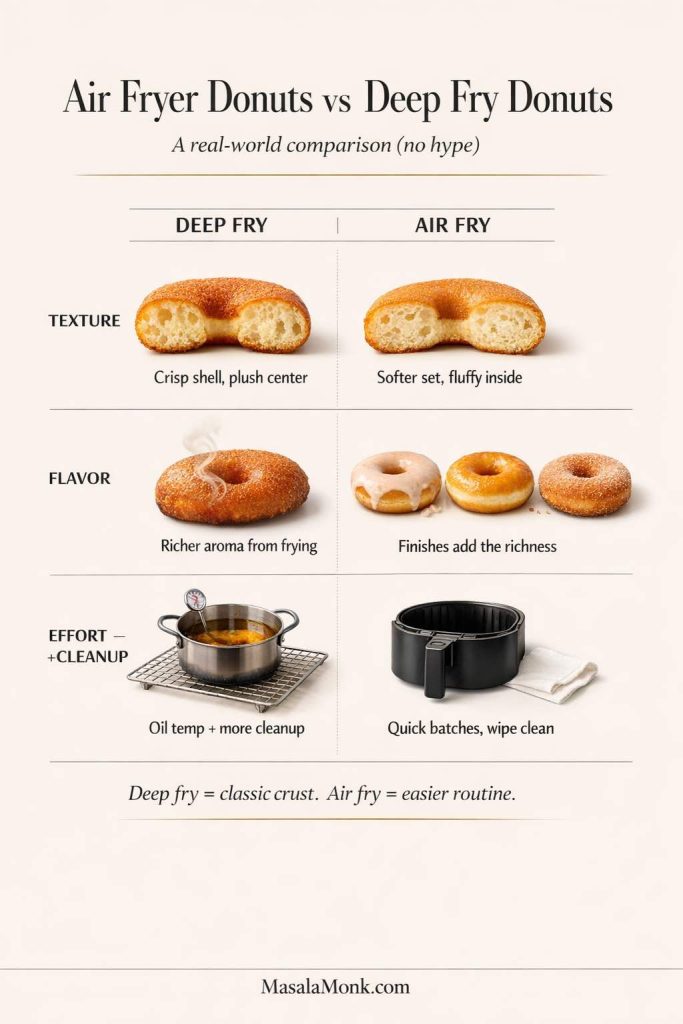
Infographic titled “Air Fryer Donuts vs Deep Fry Donuts” comparing deep fry and air fry across texture, flavor, and effort/cleanup: deep fry shows crisp shell and plush center with richer frying aroma but requires oil temperature control and more cleanup; air fry shows softer set and fluffy inside, finishes add richness, and quick batches with easy wipe-clean cleanup.
Air fryer donuts and deep fried donuts both work—just differently. Deep frying gives a crisper shell and richer frying aroma, but it comes with oil temperature management and cleanup. Air frying keeps things easy with quick batches and a softer outer set, and the “donut-shop” feel comes from finishes like glaze, butter, and cinnamon sugar.

Texture

Deep fryer donuts tend to have a more distinct fried crust with a plush interior. Air fryer donuts tend to have a softer outer set and a lighter crust. Still, the interior can be beautifully fluffy—especially with yeasted dough—so the overall experience is still donut-like.

Flavor

Deep frying adds a subtle richness that comes from oil browning. Air frying doesn’t. That’s why finishes matter more in the air fryer: glaze, butter, cinnamon sugar, and flavored coatings supply richness and aroma.

Effort and cleanup

Deep fryer donut recipes usually require managing oil temperature, careful timing, draining, and cleanup. Air fryer doughnuts reduce that entire workload to a few batches and a quick wipe-down.

If you’re curious about traditional frying technique, temperature cues, and what “done” looks like in a pot of oil, this Serious Eats piece is a strong explainer: Sweet Technique: How to Make Doughnuts. Likewise, King Arthur Baking’s yeast-raised doughnuts recipe is an excellent reference for the classic path: Yeast-Raised Doughnuts.

Even so, for everyday ease, the air fryer is hard to beat. That’s why so many people keep an airfryer donut method on rotation.

Also Read: Homemade Hot Chocolate with Cocoa Powder Recipe


How to Keep Air Fryer Donuts Soft (Small Choices, Big Payoff)

Donuts are at their best fresh. Still, you can keep them tender longer with a few practical habits.

Infographic titled “Keep Air Fryer Donuts Soft” showing three habits: stop at light golden (perfect vs too dark and dry), finish donuts while warm (dip in glaze or brush with butter), and use a cooling rack instead of a plate so glaze sets cleanly and doesn’t steam and stick.
Soft air fryer donuts come down to three small habits: stop at light golden (don’t chase color), finish while warm so glaze and butter absorb properly, and set donuts on a rack—not a plate—so airflow keeps the glaze from turning sticky. Do this and both homemade air fryer donuts and biscuit donuts stay tender.

Don’t over-brown them

This is worth repeating because it’s the most common mistake. Air fryer donuts don’t need deep color. A light golden set is the target, and glaze makes them look finished.

Finish while warm

Warm donuts absorb glaze better, and cinnamon sugar clings more evenly. Additionally, melted butter brushed onto hot donuts adds moisture and richness that carries into the final bite.

Use a rack, not a plate

Glazed donuts sitting on a flat plate can steam underneath and turn sticky. A rack lets air circulate and helps the glaze set cleanly.

Also Read: Double Chocolate Chip Cookies – Easy Recipe with 7 Variations


Storage and Reheat: Donuts in the Air Fryer (Again)

Air fryer donuts are best the day they’re made. Nevertheless, leftovers happen, and reheating in the air fryer is far better than the microwave.

Infographic titled “Store + Reheat Air Fryer Donuts” showing how to store donuts (cool completely, airtight container with paper towel, parchment between layers), a glaze tip (let glaze set on a rack, don’t stack until fully set), and how to reheat donuts in the air fryer at 300–320°F for 1–3 minutes.
Want air fryer donuts that stay soft the next day? Use this storage and reheat guide: cool completely, store in an airtight container with a paper towel, separate layers with parchment, and reheat donuts in the air fryer at 300–320°F for 1–3 minutes. For glazed donuts, let the glaze set on a rack first so it stays clean instead of sticky.

How to store air fryer donuts

  • Let donuts cool fully first.
  • Store in an airtight container with a paper towel underneath.
  • If your kitchen is humid, crack the lid slightly to prevent condensation.

Glazed donuts can get sticky if they’re stacked. If you need to stack them, separate layers with parchment.

How to reheat donuts in the air fryer

Reheating donuts in the air fryer works beautifully when you keep the temperature low:

  • 300–320°F for 1–3 minutes

That’s enough to warm the interior without drying it out. If the donuts are glazed, they may look slightly melty right away. Give them a minute and they’ll settle.

A simple safety note for parties

If you’re serving donuts with dairy-based toppings and they sit out during a long brunch, it’s smart to follow basic food safety guidance about time at room temperature. The USDA explains the “danger zone” concept and timing here: 40°F–140°F Danger Zone.

Also Read: Easy Lemon Pepper Chicken Wings (Air Fryer, Oven & Fried Recipe)


Air Fryer Donuts: Finishes That Make Them Feel New Every Time

Once you’ve got the base method down—whether it’s homemade air fryer donuts or biscuit donuts in air fryer form—you can keep things interesting by changing the finish.

Keep air fryer donuts exciting with quick finishes you can do in minutes. This guide gives five easy topping ideas—classic glaze, cinnamon sugar, chocolate glaze, cardamom sugar, and warm spiced apples—each with a simple mix + do method so your homemade air fryer donuts or biscuit donuts feel new every time.

Classic vanilla glaze (the everyday favorite)

Use the glaze recipe above. Keep it thick enough to cling, and dip while warm.

Cinnamon sugar (fast, cozy, impossible to hate)

Brush hot donuts with melted butter, then toss in cinnamon sugar. The butter matters—it gives the coating depth and keeps the bite tender.

Chocolate glaze (for the “dessert” version)

Turn your vanilla glaze into chocolate by whisking in cocoa powder. Thin with milk a little at a time until smooth.

If you’re also building a chocolate dessert theme on the table, a natural companion can be vegan chocolate cake recipes, especially if you want extra frosting ideas that can translate into donut drizzles or dips.

For cinnamon sugar air fryer donuts that taste donut-shop good, timing matters: brush with butter first, toss while hot, and coat evenly. Use this quick ratio guide for cinnamon sugar or cardamom sugar so homemade air fryer donuts and biscuit donuts get a perfect, fragrant coating every time.

Cardamom sugar (quietly luxe)

Swap cinnamon for ground cardamom in your sugar coating. It’s fragrant and a little unexpected, yet still comforting.

Warm spiced fruit topping (brunch energy)

If you want something that feels a little more “special occasion,” spoon warm spiced apples over glazed donuts. Our stewed cinnamon apples pancake recipe fits that flavor direction beautifully and makes a natural add-on without forcing anything.

Also Read: 19 Essential Kitchen Tools That Make Cooking Easier


A Simple Brunch Spread Built Around Air Fryer Donuts

Air fryer donuts can stand alone, yet they also shine as part of a spread. With a few thoughtful additions, you can turn one batch into a whole “help yourself” table.

Turning air fryer donuts into a full brunch spread is easier than it looks. Use this simple donut board blueprint—glazed and cinnamon sugar donuts in the center, vanilla glaze and chocolate dips, fresh fruit, and easy add-ons like French toast sticks, banana pudding, and fudge—so guests can snack and serve themselves.

That way, donuts become the warm centerpiece rather than the only thing you’re responsible for.


Air Fryer Donuts: A Calm First-Time Game Plan

If you’re making doughnuts in the air fryer for the first time, the most helpful approach is treating the first batch like a gentle calibration.

First time making air fryer donuts? Use this simple calibration method: start with just 2 donuts, check early for a light golden finish, then adjust by 30–60 seconds until you lock in the perfect cook time for your air fryer. Once you dial it in, every batch gets easier—and glaze finishes the look without overcooking.
Infographic titled “First Batch Calibration” for air fryer donuts showing a 3-step method: cook a test batch of 2 donuts at 350°F/180°C, check early for light golden color, then adjust cook time by 30–60 seconds and repeat to lock in the ideal timing.

Start with a small batch. Check early. Pull one donut and look at the inside. Adjust time by 30–60 seconds. Then repeat.

After that, everything becomes automatic. The recipe stops feeling like a “special event,” and it becomes the kind of thing you can do on a random afternoon—because you already know what your air fryer donut method looks like when it’s right.

Also Read: How to Cook Tortellini (Fresh, Frozen, Dried) + Easy Dinner Ideas


Full Recipe: Homemade Air Fryer Donuts (Glazed)

Makes: about 10–12 donuts
Air fryer temp: 350°F / 180°C
Cook time: 3–5 minutes per batch

Ingredients

Dough

  • 2 ¾ cups (330 g) all-purpose flour
  • 2 ¼ tsp instant yeast
  • ¼ cup (50 g) sugar
  • ¾ tsp fine salt
  • ¼ tsp nutmeg (optional)
  • ¾ cup (180 ml) warm milk
  • 1 egg
  • 3 tbsp melted butter
  • 1 tsp vanilla (optional)

Glaze

  • 1 ½ cups powdered sugar
  • 2–3 tbsp milk
  • 1 tbsp melted butter
  • ½ tsp vanilla
  • Pinch of salt
This homemade air fryer donuts recipe gives you the real glazed-donut feel without deep frying. Follow the yeast-raised method, cook at 350°F for 3–5 minutes, then glaze while warm so the coating sets smooth and glossy. Use the proofing cues and glaze rule on the card to keep donuts soft, fluffy, and donut-shop good.

Instructions

  1. Whisk flour, yeast, sugar, salt, and nutmeg in a bowl.
  2. Whisk warm milk, egg, butter, and vanilla in another bowl.
  3. Combine wet and dry until a shaggy dough forms.
  4. Knead until smooth and elastic.
  5. Cover and rise until doubled and puffy.
  6. Roll to ½–¾ inch thick and cut donuts.
  7. Rise again until airy.
  8. Preheat air fryer to 350°F / 180°C and lightly oil the basket.
  9. Air fry donuts in a single layer for 3–5 minutes, until set and lightly golden.
  10. Whisk glaze; dip warm donuts; set on a rack until glaze firms.

Also Read: Easy and Healthy Oat Cookies- No Sugar | No Butter | No Refined Flour


Full Recipe: Air Fryer Biscuit Doughnuts (Canned Dough)

Makes: depends on the can
Air fryer temp: 350–360°F
Cook time: 4–6 minutes total, flipping halfway

Ingredients

  • 1 can biscuit dough
  • Oil spray (optional)
  • Melted butter (for coating)

Cinnamon sugar

  • ½ cup sugar
  • 1–2 tsp cinnamon

Optional glaze
Use the glaze recipe above.

This is the fastest way to make donuts from canned biscuit dough in the air fryer. Follow the recipe card for air fryer biscuit donuts—cook at 350–360°F for 4–6 minutes and flip halfway—then finish hot with melted butter and either cinnamon sugar or a simple glaze for a donut-shop style bite.

Instructions

  1. Separate biscuits and cut centers to form rings. Save holes.
  2. Preheat air fryer to 350–360°F.
  3. Arrange donuts in a single layer with space.
  4. Air fry 4–6 minutes total, flipping halfway.
  5. While hot, brush with melted butter and toss in cinnamon sugar, or dip in glaze.

A Sweet Finish

Air fryer donuts are one of those rare recipes that feel both comforting and practical. On one day, you can make homemade donuts in the air fryer—yeasted, airy, and glazed. On another, you can throw together biscuit donuts in the air fryer in minutes and still get that warm, fresh treat experience.

Either way, once you’ve made them once, you’ll start seeing all the possibilities: glazed, cinnamon sugar, chocolate, spiced, topped, shared. Then, before you know it, air fryer donuts stop being a novelty and start becoming a simple habit—one you’ll be genuinely happy to repeat.
Also Read: Sourdough Recipe: 10 Easy Bread Bakes (Loaves, Rolls & Bagels)

Closing infographic titled “A Sweet Finish” for air fryer donuts, showing a plate of donuts with four finish options—vanilla glaze, cinnamon sugar, chocolate dip, and cardamom sugar—plus a two-path choice between from-scratch yeast-raised donuts (two rises) and biscuit shortcut donuts (canned dough, minutes), with the takeaway “Light golden → finish warm → let toppings do the magic.”
Air fryer donuts are the kind of treat you can actually repeat: go from scratch (yeast-raised, two rises) when you want the “real deal,” or take the biscuit shortcut when you want donuts in minutes. Either way, pull them light golden, finish while warm, and pick a mood—vanilla glaze, cinnamon sugar, chocolate dip, or cardamom sugar—for that donut-shop feeling without deep frying.

FAQs

1) What is the best temperature for air fryer donuts?

For most air fryers, air fryer donuts cook best at 350°F / 180°C. That temperature helps the dough puff and set without drying out. If your air fryer runs hot, drop slightly toward 340–345°F; if it runs cool, extend the cook time instead of cranking heat.

2) How long do donuts cook in the air fryer?

Timing depends on thickness and your machine, yet typical ranges are:

  • Homemade air fryer donuts (yeast dough): about 3–5 minutes
  • Air fryer biscuit donuts: about 4–6 minutes, flipping halfway
    Rather than relying only on time, stop when the donuts look set, feel light, and turn a soft golden color.

3) How do I know when air fried doughnuts are done?

Look for a donut that’s puffed, set on top, and light golden. In addition, it should feel lighter than it looks when you lift it. If the surface is getting dark but the center seems underdone, lower the temperature next batch and add a minute.

4) Can I make doughnuts in the air fryer without a donut pan?

Absolutely. In fact, most donut in air fryer recipe methods use a standard basket or tray. As long as you leave space for airflow and cook in batches, you can make air fryer doughnuts without any specialty tools.

5) Do I need an air fryer donut pan or donut pan for air fryer donuts?

Not necessarily. A donut pan for air fryer cooking can help with uniform shapes in batter-style donuts, but it isn’t required for yeast donuts or donuts from biscuit dough. For many kitchens, the basket method is simpler and just as effective.

6) Why are my homemade air fryer donuts dry?

Most often, homemade air fryer donuts turn dry when they cook too long or at too high a temperature. Instead, pull them when they’re just set and lightly golden, then finish with glaze, butter, or cinnamon sugar while warm.

7) Why did my air fryer donuts come out dense instead of fluffy?

Typically, density comes from under-proofing (not rising long enough) or adding too much flour during kneading/rolling. For fluffier air fryer donuts, keep the dough soft, allow a full second rise, and roll gently without pressing out the air.

8) Can I make air fryer doughnuts from canned biscuits?

Yes—air fryer donuts from canned biscuits are one of the quickest versions. Simply cut centers, air fry at about 350–360°F, flip halfway, then coat immediately. This approach covers canned biscuit donuts in air fryer style with minimal effort.

9) How do I make donuts from biscuits in air fryer without them turning tough?

First, avoid overcooking—biscuit donuts air fryer batches can go from tender to firm quickly. Next, coat while warm (butter + cinnamon sugar or glaze) so the outside stays soft. Finally, don’t overcrowd the basket, because uneven airflow can dry edges.

10) What’s the easiest biscuit donuts recipe for the air fryer?

The simplest biscuit donuts recipe is: cut rings from biscuit dough, air fry 4–6 minutes total (flip halfway), then brush with melted butter and toss in cinnamon sugar. As a result, you get donuts made from biscuits with a classic, cozy finish.

11) Can I make air fryer biscuit donuts with biscuit dough that has no layers?

Yes. Even non-layered biscuit dough works for air fryer biscuit donuts. However, layered dough tends to puff more dramatically. If your dough is thicker, stretch the ring slightly so it cooks evenly.

12) Why are my canned biscuit doughnut in air fryer unevenly browned?

Usually it’s spacing. If donuts touch, airflow can’t circulate, so browning becomes patchy. Additionally, some air fryers heat more strongly in certain zones, so rotating the basket once mid-cook can help.

13) Should I flip doughnut in the air fryer?

For biscuit donuts in the air fryer, flipping halfway usually improves even browning. For homemade yeast donuts, flipping may or may not be needed depending on your air fryer; if the tops color faster than the bottoms, flip gently near the end.

14) Can I cook doughnut holes in the air fryer too?

Definitely. Donut holes cook faster, so check them early. Because they’re small, they’re also perfect for glazing, cinnamon sugar, or quick chocolate dip—especially when you want variety without extra work.

15) Can I make air fried donuts ahead of time?

You can, although they’re best fresh. If you need to plan ahead, make the donuts, cool completely, and store airtight. For the best texture later, reheat briefly in the air fryer and glaze afterward.

16) How do I reheat donuts in the air fryer without drying them out?

Use a lower temperature—around 300–320°F—for 1–3 minutes. That warms the center without toughening the outside. If the donuts are glazed, let them sit a minute after reheating so the glaze settles.

17) How do I store air fried donuts so the glaze doesn’t get sticky?

Let glazed donuts set fully on a rack, then store in a container with a paper towel underneath. Also, avoid stacking unless you separate layers with parchment. If your kitchen is humid, cracking the lid slightly can reduce condensation.

18) What’s the difference between air fryer doughnut and air fryer donut?

They’re the same food—just two common spellings. You’ll see air fryer doughnuts recipe and air fryer donut recipe used interchangeably, and both refer to donuts made in an air fryer.

19) Can I use a deep fryer donut recipe dough in the air fryer?

Sometimes, but results vary. Deep fryer donuts are built for fast oil cooking, so they may brown differently in hot air. Even so, a yeast-raised dough can still work well as air fried doughnuts if you cook gently and finish with glaze.

20) Is an air fryer for donuts worth it if I also deep fry?

If you enjoy deep fried donuts, you’ll still love frying for that classic crust. On the other hand, an air fryer for donuts is great when you want fewer steps, less cleanup, and a repeatable treat you can make more often.

Posted on 7 Comments

Masterclass in Chai: How to Make the Perfect Masala Chai (Recipe)

Premium cover image for a masala chai recipe masterclass showing milk being poured into a steaming cup of masala chai with cardamom, cinnamon, cloves, black tea, and fresh ginger on a dark elegant background.

There’s a reason a good cup of masala chai feels so complete. It isn’t just tea. It isn’t only a spice drink. And it’s definitely not just “tea with milk.” When it’s made well, masala chai has structure: the tea gives it backbone, the spices create layers, the milk softens and rounds the edges, and the sweetener pulls everything into one smooth, deeply comforting sip.

Even so, plenty of homemade chai ends up disappointing. Sometimes it tastes watery. Other times it turns too bitter, too sharp, or strangely flat. In many cases, the ingredients are fine—the problem is the order, the ratio, or the simmering.

That’s exactly what this guide is designed to fix.

Instead of giving you one narrow recipe and leaving the rest to luck, this masala chai masterclass gives you a dependable base recipe, a practical chai masala blend, and ten fully explained variations you can actually use in everyday life. The goal is simple: once you make the base cup properly, you should be able to create a classic masala chai, a ginger masala chai, a tulsi masala chai, a vegan masala chai, or even an iced masala chai without having to “start over” each time.

Along the way, you’ll also get a better feel for what each ingredient is doing, which makes customization easier and far more satisfying. In other words, you won’t just have a recipe—you’ll know how to steer it.

If you enjoy exploring chai more broadly, MasalaMonk’s Chai Map of India is a wonderful companion for the cultural side of tea traditions, while Monsoons and Masala Chai makes a lovely follow-up once you’re in the mood for more cozy tea directions.


What a Great Masala Chai Recipe Actually Needs

People often talk about “authentic chai” as if there’s one fixed version, but the truth is more interesting. Traditional masala chai has many expressions, and households vary their chai blends all the time. Still, the best cups tend to share the same foundations:

  • a black tea strong enough to stand up to milk and spice
  • fresh, aromatic spices used with restraint
  • a simmered brew, not a rushed steep
  • enough sweetness to balance bitterness and spice
  • a texture that matches the style of chai you want

So although ingredients matter, technique matters just as much.

This masala chai foundations guide breaks down what actually makes a cup taste balanced: strong black tea, restrained spices, a proper simmer, the right milk choice, and just enough sweetness to bring everything together. Use it as a quick visual reference before the ingredient and base-method sections so your masala chai recipe starts with the right structure, not guesswork.

Tea gives the cup its shape

The tea is not a background ingredient. In a proper masala chai recipe, tea should still taste like tea after milk and spices are added. That’s why strong black tea works best, especially Assam or a bold CTC blend. Loose leaf can be beautiful, but it should be a tea with enough character to stay present.
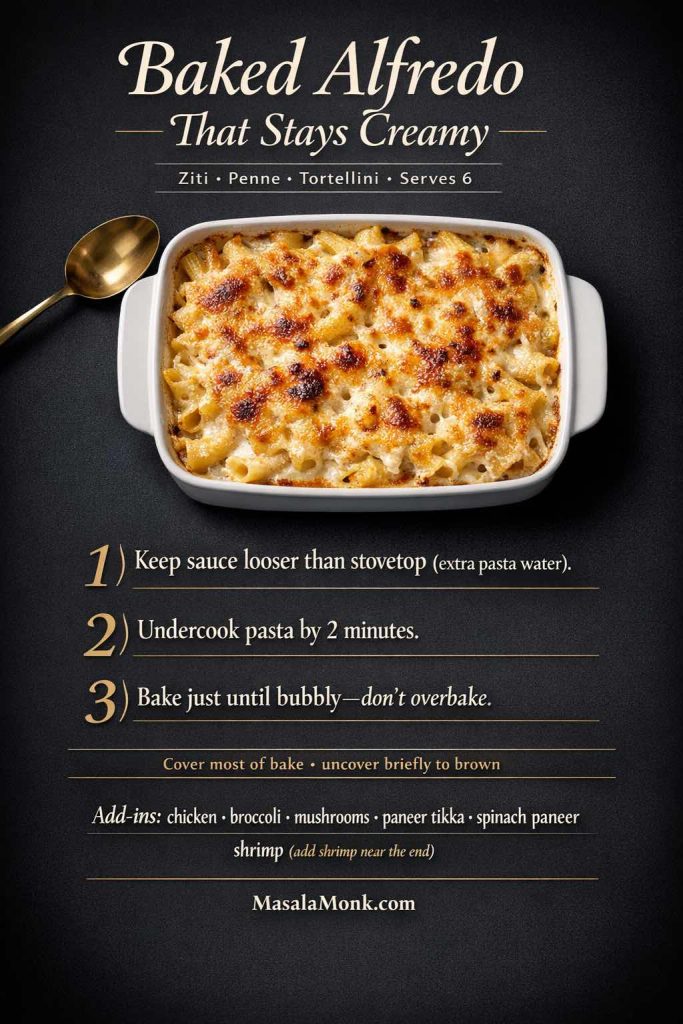
Serious Eats talks about this balance well in their chai coverage, especially when they discuss strong tea and focused spice choices instead of overloaded blends (their chai recipe is a useful reference).

Spice doesn’t mean “more spice”

A common mistake is assuming more spices equals better chai. Usually, the opposite happens. The cup turns muddy, clove-heavy, or medicinal. What you want instead is clarity: cardamom should smell bright, ginger should taste alive, cinnamon should feel warm, and clove should stay in the background unless you intentionally want a stronger clove note.

Simmering is where chai becomes chai

This matters more than almost anything else. A quick steep may produce a spiced tea, but simmering builds depth. It lets the ginger infuse, gives the cardamom time to open, and blends the milk and tea so the final cup tastes cohesive instead of layered in an unfinished way.

Milk changes flavor, not just texture

Milk doesn’t simply make chai creamy. It also softens spices and reduces perceived bitterness. As a result, the same tea-and-spice base can taste completely different depending on whether you use whole milk, oat milk, almond milk, coconut milk, or no milk at all.

Sweetness creates harmony

A little sweetness is what makes masala chai feel round. Without it, spices can taste sharp and tea can feel tannic. With too much, the drink loses definition. The sweetener should support the cup, not dominate it.

Also Read: Crock Pot Pork Chops and Sauerkraut (No Dry Chops Recipe)


Masala Chai Recipe Ingredients

Before we get into the base method, let’s build a clear ingredient foundation. This section is intentionally detailed because once you understand these choices, every variation later in the post becomes easier.

Masala chai recipe ingredients guide for a 2-cup base recipe, showing black tea, cardamom, fresh ginger, cinnamon, cloves, milk, and sugar or jaggery in a premium dark editorial layout with labeled text and MasalaMonk.com footer.
Masala chai base recipe ingredients for a balanced 2-cup brew: black tea, cardamom, fresh ginger, cinnamon, cloves, milk, and sugar or jaggery. Use this ingredient guide before the method section to build a flavorful masala chai with better tea, spice, and milk balance.

Tea for masala chai: what works best

If you’ve ever asked yourself what the best tea leaves for masala chai are, the short answer is: strong black tea.

Here are the best options for a home kitchen:

Dark luxe masala chai tea guide image comparing the best tea for masala chai: Assam CTC, Assam loose leaf, and strong black tea bags, with labeled tea visuals on a charcoal background and MasalaMonk.com footer.
Use a strong black tea that can hold its shape after milk and spices go in. This visual guide compares Assam CTC, Assam loose leaf, and brisk black tea bags so you can choose the right base for your masala chai recipe before you start simmering.

1) Assam CTC tea (great for everyday chai)

CTC tea (crush-tear-curl) is commonly used for chai because it brews quickly and strongly. It gives you deep color, a bold flavor, and the kind of sturdy tea backbone that holds up beautifully to milk and spice.

2) Assam loose leaf tea (more nuanced, still bold)

Loose leaf Assam often has a little more texture and complexity than CTC, yet it still gives you that malty body a masala chai recipe needs.

3) Strong black tea bags (very practical)

If tea bags are what you have, they can still make an excellent masala tea. The key is to use enough tea and avoid weak blends. A brisk breakfast-style black tea is better than a delicate one here.

Epicurious also points out that CTC tea is especially useful for chai-style brewing, particularly when ginger is involved and you want bold extraction without a long steep (their fresh ginger masala chai notes that clearly).

Masala chai spices: the core blend

The classic spice set is simple, and that simplicity is part of what makes it so adaptable.

Masala chai spices at a glance: Build your base with cardamom + ginger + cinnamon + clove + black pepper, then customize gently with fennel, tulsi, star anise, nutmeg, or saffron. This quick “core blend” map helps you keep the cup clear and balanced—tea-forward, aromatic, and never muddy—so you can tweak one spice at a time with confidence.

The essential spices

  • green cardamom
  • fresh ginger
  • cinnamon
  • cloves
  • black peppercorns

Each one plays a different role:

  • Cardamom creates the signature aromatic lift.
  • Ginger adds brightness and warmth.
  • Cinnamon softens and rounds the blend.
  • Clove adds depth and intensity.
  • Black pepper brings a low, steady heat.

If you’re especially interested in cardamom’s flavor behavior, MasalaMonk’s cardamom guide is a great read because it explains why cardamom has that unmistakable perfume in hot drinks.

Optional spices for variation

These are not required for a classic masala chai recipe, but they’re very useful once you start customizing:

  • fennel seeds (gentle sweetness, softer finish)
  • tulsi (herbal, fresh note)
  • star anise (licorice-like depth, use lightly)
  • nutmeg (tiny pinch only)
  • saffron (subtle, luxurious aroma)

The key is to add one optional element at a time so the cup stays balanced.

Milk options for masala chai, masala milk tea, and vegan masala chai

Milk shapes both flavor and body. Even a small change in milk can move the cup from traditional and hearty to lighter and more delicate.

Choosing the right milk can completely change your masala chai. This visual guide compares whole milk, toned/2%, low-fat, oat, almond, and coconut milk so you can quickly pick the body and finish you want—classic, lighter, creamy, or rich. Use it as a quick reference before brewing, then read the full MasalaMonk masala chai recipe for exact ratios, 10 variations, and troubleshooting tips. Save this guide for your next chai session and share it with someone who loves homemade chai.

Dairy milk options

  • Whole milk: richest, creamiest, most classic feel
  • 2% or toned milk: still balanced, slightly lighter
  • Low-fat milk: workable, but the chai may feel thinner unless tea strength is increased a little

Dairy-free options for vegan masala chai

  • Oat milk: creamy and neutral, excellent for chai latte style
  • Almond milk: lighter and nutty, better for cleaner spice expression
  • Coconut milk: rich, naturally sweet, beautiful in coconut masala chai

For a globally friendly chai routine, it’s useful to think of these as flavor choices rather than “replacements.” That shift makes vegan masala chai feel intentional, not compromised.

Sweeteners for masala tea and masala chai latte versions

Different sweeteners create different finishes.

Masala chai sweetener guide infographic showing a central cup of chai with four sweetener options around it—sugar, jaggery, honey, and maple syrup—plus notes on flavor finish and when to add each sweetener. The chart explains neutral, deep, floral, and warm finish styles for masala chai and includes a “When to Add” quick reference and MasalaMonk.com footer.
Masala chai sweeteners do more than add sweetness—they change the finish of the cup. Use this quick guide to compare sugar, jaggery, honey, and maple syrup, including when to add each one for the best result (especially jaggery on low heat and honey off heat). It’s an easy way to choose the right sweetener for classic masala chai, chai latte, or dairy-free versions without overpowering the tea and spice.
  • Sugar: neutral, classic, reliable
  • Jaggery: deep, caramel-like sweetness, earthy warmth
  • Honey: floral, but best added off heat
  • Maple syrup: especially nice with oat or coconut milk

If you like experimenting with sweetened hot drinks more broadly, MasalaMonk’s keto hot chocolate recipe is another cozy reference point for how sweetness and body work together in a cup.

Also Read: Keto Mocktails: 10 Low Carb, Sugar Free Recipes


The Base Masala Chai Recipe (Your Everyday Foundation)

This base recipe is the center of the entire post. Once you’re comfortable with it, the variations will feel natural instead of complicated.

Step-by-step masala chai recipe method card showing a 2-cup brewing process: simmer spices, add black tea, add milk and sweetener, then strain into a cup, in a premium dark editorial layout with MasalaMonk.com footer.
How to make masala chai at home in four simple steps: simmer spices, add black tea, add milk and sweetener, then strain and serve. This visual method card makes the base 2-cup masala chai recipe easier to follow before trying the flavor variations.

Base Masala Chai Recipe (makes 2 generous cups)

Ingredients

  • 1 1/2 cups water
  • 1 cup milk (whole milk, 2%, oat milk, almond milk, or a mix)
  • 2 to 2 1/2 teaspoons black tea (Assam loose leaf or CTC), or 2 strong black tea bags
  • 1 inch fresh ginger, lightly crushed or sliced
  • 3 green cardamom pods, lightly crushed
  • 1 small cinnamon stick (or 1-inch piece)
  • 2 cloves
  • 2 black peppercorns
  • 2 to 4 teaspoons sugar (or to taste)

Method

Step 1: Start with the spices in water
Pour the water into a saucepan and add ginger, cardamom, cinnamon, cloves, and peppercorns. Bring it to a boil over medium heat, then lower the heat and let it simmer for 3 to 5 minutes.

At this stage, don’t rush. The simmer is doing the important work: it extracts aroma from the spices and starts building the flavor structure of the chai.

Step 2: Add the tea and let it deepen
Add the black tea (or tea bags). Simmer gently for 1 to 2 minutes.

You’re looking for a rich amber-brown color. If the tea is already very strong (especially with CTC), stay closer to 1 minute. If it’s loose leaf and a little gentler, 2 minutes may be better.

Step 3: Add milk and sweetener
Add the milk and sugar. Raise the heat until the chai reaches a gentle boil, then lower it again and simmer for another 2 to 4 minutes.

This is where the cup becomes smooth and rounded. The milk softens the tannins, the sweetness supports the spices, and the aromas start to feel unified.

Step 4: Strain and serve hot
Strain the chai into cups and serve right away.

The first sip should feel balanced: tea first, spice second, creaminess last. If it tastes sharply spicy but weak on tea, use more tea next time. If it tastes milky but flat, simmer spices a little longer.

Also Read: Slow Cooker Pork Tenderloin (Crock Pot Recipe) — 3 Easy Ways


Chai Masala Mix for Daily Use

If you make chai regularly, a small chai masala mix saves time and improves consistency. Instead of crushing spices every day, you can use a measured spoon and still get a fragrant cup.

Chai masala mix guide card comparing whole spice chai masala and ground chai masala, with ingredient lists, how-to-use notes, and a reminder to add fresh ginger separately, shown in a dark premium editorial layout with MasalaMonk.com footer.
Chai masala mix guide for daily masala chai: compare a whole spice chai masala blend vs a ground chai masala mix, including ingredient ideas, usage amounts, and a simple rule that improves flavor every time—add fresh ginger separately for a brighter, cleaner cup.

Whole Spice Chai Masala Mix (small batch)

Ingredients

  • 2 tablespoons green cardamom pods
  • 1 tablespoon black peppercorns
  • 8 to 10 cloves
  • 3 small cinnamon sticks
  • 1 teaspoon fennel seeds (optional)

Method

Lightly crush the spices using a mortar and pestle or pulse them briefly in a grinder. You want them cracked open, not powdered.

Store in an airtight jar away from light and heat.

Whole spice chai masala mix small-batch recipe card in a dark luxe layout showing a mortar and pestle, cardamom, black peppercorns, cloves, cinnamon, fennel seeds, and a storage jar, with instructions to crack spices (not powder) and use 1/2 to 3/4 teaspoon per 2 cups chai.
Whole spice chai masala mix (small batch) prep card with exact spice amounts, the right crushing method (cracked open, not powdered), storage guidance, and how much to use per 2 cups masala chai. This is a great batch-prep reference if you make chai often, and the fresh ginger reminder helps keep the final cup brighter and cleaner.

How to use

Use 1/2 to 3/4 teaspoon of this chai masala mix per 2 cups of masala chai, plus fresh ginger in the pot.

Fresh ginger is still worth adding separately because it gives brightness that pre-mixed spice blends usually can’t match.

Also Read: Chicken Pesto Pasta (Easy Base Recipe + Creamy, One-Pot, Baked & More)


Ground Chai Masala Mix (for quick cups)

If you prefer a fine tea masala mix, grind the whole spices into a powder.

Use a lighter hand

Ground spices are more intense by volume, so start small:

  • 1/4 teaspoon for 2 cups = balanced
  • slightly less for a lighter cup
  • slightly more if you want a stronger masala tea
Ground chai masala mix recipe and usage card in a dark luxe layout showing a jar of ground chai spice blend, measuring spoon, and whole spice props, with small-batch ingredients, grinding and storage method, how-to-use guidance for 2 cups chai (1/4 tsp balanced), and tips to avoid gritty or muddy masala chai.
Ground chai masala mix (small batch + quick cups) recipe and usage guide: this card shows the spice blend ingredients, how to grind and store it, and how much to use for 2 cups of chai. It’s especially helpful if you want faster everyday masala chai without losing balance—start with about 1/4 teaspoon, then adjust in small steps to keep the cup fragrant, not gritty or muddy.

Too much powder can make chai gritty and muddy. If that happens, it doesn’t mean the spices are wrong—it usually means the quantity was too high for the liquid.

MasalaMonk’s homemade pumpkin pie spice is a nice accompanying read here because it shows the same principle: spice blends work best when they’re balanced, not overloaded.

Also Read: How to Make a Flax Egg (Recipe & Ratio for Vegan Baking)


10 Masala Chai Variations With Full Recipe Details

Now that the base is set, here are the ten variations. Each one includes ingredient tweaks, ratio guidance, and a more detailed method so it feels like a proper recipe card—not just a quick note.

Masala chai variations guide card in a premium dark editorial layout listing 10 versions: classic masala chai, ginger masala chai, cardamom masala chai, tulsi masala chai, jaggery masala tea, masala chai without milk, vegan masala chai, coconut masala chai, iced masala chai, and masala chai latte, with MasalaMonk.com footer.
A quick visual guide to 10 masala chai variations, from classic masala chai and ginger chai to vegan, coconut, iced, and chai latte versions. Use this card to choose your flavor direction, then scroll down for the full recipe details, ratios, and step-by-step method for each cup.

1) Classic Masala Chai Recipe (Balanced Everyday Version)

This is the baseline cup: bold, aromatic, and creamy without being too heavy. It’s the version you can make on repeat and still look forward to.

Ingredients (2 cups)

  • 1 1/2 cups water
  • 1 cup whole milk (or 2%)
  • 2 1/4 teaspoons Assam tea or CTC tea
  • 1 inch fresh ginger, lightly crushed
  • 3 green cardamom pods, crushed
  • 1 small cinnamon stick
  • 2 cloves
  • 2 black peppercorns
  • 2 to 3 teaspoons sugar
Classic masala chai recipe card in a dark luxe editorial style showing a steaming cup of chai with spices, a 2-cup base formula (water, milk, black tea, ginger, cardamom, cinnamon, clove, pepper, and sugar), four easy steps, and a MasalaMonk.com footer.
Classic masala chai recipe card for the balanced everyday version (2 cups), with a quick base formula, 4-step stovetop method, and a flavor note to help you make a tea-forward, aromatic, creamy cup before trying the ginger, tulsi, vegan, iced, and latte variations below.

Method

Add water and all spices to a saucepan and bring to a boil. Lower the heat and simmer for 4 minutes. Then add the tea and simmer 1 to 1 1/2 minutes, just until the color turns deep amber.

Next, add milk and sugar. Bring it back up gently, then reduce heat and simmer for 3 minutes. Strain into two cups.

How it tastes

The aroma is led by cardamom, ginger sits right behind it, and the finish is warm rather than sharp. Cinnamon softens the middle of the sip, while clove and pepper stay in the background.

If you want to adjust it

  • More tea-forward: increase tea to 2 1/2 teaspoons
  • More creamy: increase milk to 1 1/4 cups and reduce water slightly
  • More aromatic: add 1 extra cardamom pod, not extra cloves

If you want another comforting spin afterward, MasalaMonk’s Monsoons and Masala Chai is a natural next stop.

Also Read: Pork Tenderloin in Oven (Juicy, Easy, 350°F or 400°F) Recipe


2) Ginger Masala Chai Recipe (Bolder, Sharper, Warming)

Ginger masala chai is for days when you want the cup to feel more awake. It’s still balanced, but the ginger comes forward and gives the chai extra brightness.

Ingredients (2 cups)

  • 1 1/2 cups water
  • 1 cup milk
  • 2 1/4 teaspoons strong black tea
  • 1 1/2 to 2 inches fresh ginger, crushed
  • 3 green cardamom pods, crushed
  • 1 small cinnamon piece
  • 1 clove (instead of 2)
  • 2 black peppercorns
  • 2 to 3 teaspoons sugar
Ginger masala chai recipe card in a dark luxe editorial style showing a steaming cup of chai with fresh ginger and whole spices, a 2-cup ingredient formula, and 4 easy stovetop steps including simmering ginger first for a brighter, warming chai.
Ginger masala chai recipe card (2 cups) with a ginger-first simmer method, quick ingredient formula, and 4-step stovetop guide. Use this visual before the full recipe below to make a brighter, warming, ginger-forward cup without overloading clove or losing tea strength.

Method

Start with the water and ginger only. Bring to a boil, then simmer for 2 minutes before adding the remaining spices. This extra time pulls out more ginger flavor without making the cup rough.

Add cardamom, cinnamon, clove, and peppercorns, and simmer another 2 minutes. Then add tea and simmer 1 to 1 1/2 minutes.

Pour in milk and sugar, bring it to a gentle boil, and simmer 2 to 3 minutes. Strain and serve hot.

How it tastes

The first impression is bright ginger warmth, followed by strong tea and a clean cardamom finish. Because clove is reduced, the cup feels livelier and less “dark.”

Better balance tip

If the ginger tastes too sharp, add a touch more milk or simmer the ginger base one minute longer before adding tea. Longer ginger simmering often tastes rounder than simply adding more ginger.

Serious Eats’ broader chai writing is also a nice read if you enjoy the history and texture of everyday chai drinking (their chai history piece is here).

Also Read: Ravioli Recipe Reinvented: 5 Indian-Inspired Twists on the Italian Classic


3) Cardamom Masala Chai Recipe (Aroma-Forward, Fragrant, Elegant)

This variation is less about heat and more about aroma. If you love opening the cup and getting that unmistakable cardamom fragrance before the first sip, this is your version.

Ingredients (2 cups)

  • 1 1/2 cups water
  • 1 cup milk
  • 2 1/4 teaspoons black tea
  • 3/4 to 1 inch ginger (less than the classic version)
  • 5 to 6 green cardamom pods, crushed
  • 1 small cinnamon piece
  • 1 clove
  • 1 black peppercorn (optional)
  • 2 to 3 teaspoons sugar
Cardamom masala chai recipe card in a dark luxe editorial style showing a steaming cup of chai with green cardamom pods and whole spices, a 2-cup ingredient formula, and 4 easy stovetop steps, designed as an aroma-forward chai guide with MasalaMonk.com branding.
Cardamom masala chai recipe card (2 cups) with a quick ingredient formula, 4-step stovetop method, and an aroma-forward flavor profile. Use this visual guide before the full recipe below to make a fragrant, floral, creamy chai where crushed cardamom leads the cup without overpowering it with ginger.

Method

Simmer water, ginger, cardamom, cinnamon, clove, and pepper for 4 minutes. Since cardamom is the star, make sure the pods are well crushed so the seeds are exposed.

Add tea and simmer gently for 1 minute. Then add milk and sugar, bring to a soft boil, and simmer 2 to 3 minutes before straining.

How it tastes

This chai smells floral and almost sweet before you even drink it. The body is still rich, but the spice profile is lighter and more aromatic than ginger-heavy or clove-heavy chai blends.

Ratio option for a lighter cardamom cup

If you want a more delicate version:

  • use 4 cardamom pods instead of 6
  • reduce tea slightly to 2 teaspoons
  • keep milk at 1 cup

MasalaMonk’s cardamom in coffee article pairs nicely with this cup because it highlights how cardamom transforms hot drinks without overpowering them.

Also Read: Croquettes Recipe: One Master Method + 10 Popular Variations


4) Tulsi Masala Chai Recipe (Herbal and Fresh)

Tulsi masala chai keeps the familiar base of black tea, ginger, and cardamom, then adds an herbal note that lifts the whole cup.

Ingredients (2 cups)

  • 1 1/2 cups water
  • 1 cup milk
  • 2 1/4 teaspoons black tea
  • 1 inch ginger
  • 3 green cardamom pods
  • 1 small cinnamon piece
  • 1 clove
  • 4 to 6 fresh tulsi leaves (or 1/2 teaspoon dried tulsi)
  • 2 to 3 teaspoons sugar
Tulsi masala chai recipe card in a dark luxe editorial style showing a steaming cup of chai with fresh tulsi leaves, ginger, cardamom, and whole spices, plus a 2-cup ingredient formula and 4-step stovetop method with a tip to add tulsi near the end.
Tulsi masala chai recipe card (2 cups) with a quick ingredient formula, 4-step stovetop method, and a key timing tip: add tulsi near the end for a fresher herbal lift. Use this visual guide before the full recipe below to make a creamy, balanced chai with a clean tulsi finish.

Method

Simmer water, ginger, cardamom, cinnamon, and clove for 4 minutes. Add tea and simmer 1 minute.

Then add milk and sugar. Once the chai comes to a gentle boil, lower the heat and add tulsi leaves. Simmer another 1 to 2 minutes—just enough for the tulsi to perfume the chai without turning dull.

Strain and serve.

How it tastes

The herbal note comes in at the end of the sip. It doesn’t replace the chai flavor; instead, it gives the cup a fresher edge and a slightly green lift.

Small tweak if tulsi tastes too strong

Use fewer leaves and add them for only the last minute of simmering. Tulsi can become intense quickly, especially in smaller pots.

Also Read: Fish and Chips Reimagined: 5 Indian Twists (Recipe + Method)


5) Jaggery Masala Tea (Deep Sweetness, Rich Finish)

Jaggery masala tea has a different personality from sugar-sweetened chai. The sweetness feels fuller, and the spices sit inside that sweetness differently—especially ginger and cinnamon.

Ingredients (2 cups)

  • 1 1/2 cups water
  • 1 cup milk
  • 2 1/4 teaspoons black tea
  • 1 inch ginger
  • 3 cardamom pods
  • 1 small cinnamon piece
  • 1 clove
  • 1 to 2 tablespoons grated jaggery (start smaller and adjust)
Jaggery masala tea recipe card in a dark luxe editorial style showing a steaming cup of chai with jaggery, ginger, cardamom, and spices, plus a 2-cup ingredient formula and 4-step stovetop method with a key tip to add jaggery on low heat.
Jaggery masala tea recipe card (2 cups) with a quick ingredient formula, 4-step stovetop method, and the key technique that keeps the cup smooth: add jaggery on low heat after the milk comes in. Use this visual guide before the full recipe below for a deeper, caramel-like chai with a warm, rich finish.

Method

Simmer the water and spices for 4 minutes. Add tea and simmer 1 minute. Then add milk and bring the chai to a gentle boil.

Now reduce the heat to low. Add jaggery slowly, stirring until fully dissolved. Let the chai simmer very gently for another minute, then strain.

How it tastes

Compared with sugar, jaggery gives this masala tea a more rounded, almost caramel-like sweetness. The cup feels deeper and a little more rustic, especially with ginger-forward spice blends.

Important balance note

Jaggery sweetness can easily dominate if the tea is weak. If the cup tastes sweet but not tea-forward, increase the tea slightly next time.

Also Read: Dirty Martini Recipe (Classic, Extra Dirty, No Vermouth, Spicy, Blue Cheese, Tequila + Batched)


6) Masala Chai Without Milk (Light, Clean, Tea-Led)

Masala chai without milk is one of the most overlooked versions, yet it can be excellent—especially when you want a lighter drink that still feels warming and aromatic.

Ingredients (2 cups)

  • 2 to 2 1/4 cups water
  • 2 to 2 1/4 teaspoons black tea
  • 1 inch ginger
  • 3 cardamom pods
  • small cinnamon piece
  • 1 clove
  • 1 black peppercorn (optional)
  • 1 to 2 teaspoons sugar or jaggery (optional)
Masala chai without milk recipe card in a dark luxe editorial style showing a clear glass cup of spiced black tea with ginger, cardamom, and whole spices, plus a 2-cup ingredient formula and 4-step stovetop method for a light, tea-led chai.
Masala chai without milk recipe card (2 cups) with a quick ingredient formula, 4-step stovetop method, and a key balancing tip: keep clove and pepper light for a cleaner, tea-forward cup. Use this visual guide before the full recipe below for a lighter masala tea that still feels warm, aromatic, and satisfying.

Method

Add water and spices to the saucepan and simmer for 4 to 5 minutes. Add tea and simmer 1 minute, then strain.

Taste before sweetening. Since there’s no milk, the spices are more direct and the tea tannins are more noticeable, so even a small amount of sugar can make a big difference.

How it tastes

This version is brighter, sharper, and more tea-forward than masala milk tea. The spices are clearer, and the finish is cleaner.

Better results tip

Keep clove and pepper light. Without milk, they show up more strongly. Cardamom and ginger usually make a cleaner flavor pair here.

Also Read: Keto Hot Chocolate Recipe (Sugar-Free Hot Cocoa) + Best Homemade Mix


7) Vegan Masala Chai Recipe (Creamy and Balanced Without Dairy)

Vegan masala chai works beautifully when the plant milk is chosen with intention. Oat milk gives the most classic creamy feel, while almond milk creates a lighter cup.

Ingredients (2 cups)

  • 1 1/2 cups water
  • 1 cup oat milk (or almond milk)
  • 2 1/4 teaspoons black tea
  • 1 inch ginger
  • 3 cardamom pods
  • 1 small cinnamon piece
  • 1 clove
  • 2 teaspoons sugar, maple syrup, or to taste
Vegan masala chai recipe card in a dark luxe editorial style showing a smooth dark ceramic cup of chai with a small plant milk creamer, almonds, tea leaves, and whole spices, plus a 2-cup ingredient formula and 4-step stovetop method for a creamy dairy-free masala chai.
Vegan masala chai recipe card (2 cups) with a quick ingredient formula, 4-step stovetop method, and an easy balancing tip for oat milk vs almond milk. Use this visual guide before the full recipe below to make a creamy, dairy-free chai that stays spiced, smooth, and tea-forward without a hard boil.

Method

Simmer water and spices for 4 minutes. Add tea and simmer 1 minute.

Add the oat milk (or almond milk) and sweetener. Heat gently until the chai is steaming and just reaches a soft boil, then lower the heat immediately. Simmer 1 to 2 minutes and strain.

How it tastes

With oat milk, this vegan masala chai is creamy and rounded, very close in texture to a dairy version. With almond milk, the chai feels lighter and slightly nutty, and the spices taste more defined.

Ratio option for a richer vegan cup

Try:

  • 3/4 cup oat milk + 1/4 cup light coconut milk
    This gives extra body without tipping into heavy coconut flavor.

Minimalist Baker’s blog post on Masala Chai is another good reference for approachable dairy-free chai directions.

Also Read: 10 Low Carb Chia Pudding Recipes for Weight Loss (Keto, High-Protein, Dairy-Free)


8) Coconut Masala Chai Recipe (Silky, Fragrant, Slightly Indulgent)

Coconut masala chai deserves a proper slot because it behaves differently from a standard vegan chai. The coconut adds body and gentle sweetness, so the spice balance needs a small adjustment.

Ingredients (2 cups)

  • 1 1/2 cups water
  • 3/4 cup light coconut milk + 1/4 cup oat milk (or 1 cup light coconut milk for a richer version)
  • 2 1/4 teaspoons black tea
  • 1 inch ginger
  • 4 cardamom pods
  • small cinnamon piece
  • 1 clove (or none, if you want a cleaner coconut profile)
  • 1 to 2 teaspoons sugar or maple syrup (optional, coconut milk is often naturally sweet)
Coconut masala chai recipe card in a dark luxe editorial style showing a steaming chai cup with coconut slices, ginger, cardamom, cinnamon, and black tea, plus a 2-cup ingredient formula and 4-step stovetop method for a silky, fragrant coconut-forward chai.
Coconut masala chai recipe card (2 cups) with a quick ingredient formula, 4-step stovetop method, and the key technique for this version: keep the heat gentle after adding coconut milk. Use this visual guide before the full recipe below to make a silky, fragrant, coconut-forward chai with balanced spice and a smooth finish.

Method

Simmer water and spices for 4 minutes. Add tea and simmer 1 minute.

Pour in the coconut milk (and oat milk, if using) and bring to a gentle simmer. Keep the heat moderate; avoid a hard boil. Let it simmer 2 minutes, then taste. Sweeten lightly if needed and strain.

How it tastes

This cup is creamy, aromatic, and very smooth. Cardamom and coconut are especially lovely together, and the ginger keeps the chai from feeling too rich.

If it feels too heavy

Use half coconut milk and half regular milk (or oat milk), and reduce cinnamon slightly.

Also Read: Garlic & Paprika Cabbage Rolls (Keto-Friendly Recipes) – 5 Bold Savory Twists


9) Iced Masala Chai Recipe (Strong-Brewed, Chilled, Refreshing)

A good iced masala chai starts with a stronger hot brew. Cold temperatures mute both sweetness and spice, so the concentrate needs more intensity than a hot cup.

Ingredients (2 servings over ice)

  • 1 3/4 cups water
  • 3/4 cup milk (or plant milk), plus more to adjust after chilling
  • 2 1/2 to 3 teaspoons black tea
  • 1 1/2 inches ginger
  • 4 cardamom pods
  • 1 small cinnamon piece
  • 1 clove
  • 2 black peppercorns (optional)
  • 3 to 4 teaspoons sugar
  • ice, for serving
Iced masala chai recipe card in a dark luxe editorial style showing a tall glass of chilled chai over ice with ginger, cardamom, cinnamon, tea leaves, and coconut pieces, plus a 2-serving ingredient formula and 4-step method for strong-brewed iced chai.
Iced masala chai recipe card (2 servings over ice) with a quick ingredient formula, 4-step method, and the key tip that makes iced chai taste better: brew it stronger and sweeten slightly more before chilling. Use this visual guide before the full recipe below for a bold, spiced, refreshing iced chai that doesn’t taste flat over ice.

Method

Simmer water and spices for 5 minutes to build a stronger base. Add tea and simmer 1 1/2 minutes.

Add milk and sugar, bring to a gentle boil, then simmer 2 minutes. Strain and let the chai cool. Once cooled, chill it in the refrigerator.

Serve over a tall glass of ice. Taste and add a splash more milk if needed.

How it tastes

Iced masala chai feels brighter than hot chai, especially if ginger and cardamom are slightly increased. The sweetness needs to be just a bit higher than usual so the flavors stay rounded over ice.

Epicurious’ notes on iced chai are especially helpful on brew strength and chill method (their iced chai article is here).

For a broader cold-drink detour, MasalaMonk’s iced coffee recipe collection is a fun post because it includes café-style drink ideas that pair naturally with a chilled chai routine.

Also Read: Sweetened Condensed Milk Fudge: 10 Easy Recipes


10) Masala Chai Latte (Café-Style, Soft and Creamy)

Masala chai latte is the milkier cousin of traditional stovetop chai. The spices are still present, but the texture is softer and the overall feel is more café-like.

Ingredients (2 cups)

For the chai concentrate

  • 1 cup water
  • 2 1/2 teaspoons black tea
  • 1 inch ginger
  • 3 cardamom pods
  • small cinnamon piece
  • 1 clove
  • 2 to 3 teaspoons sugar

For finishing

  • 1 1/2 cups hot milk (or oat milk), steamed or frothed if possible
Masala chai latte recipe card in a dark luxe editorial style showing a frothy chai latte in a cup with chai concentrate and spices, plus ingredient sections for chai concentrate and finishing milk, and a 4-step method for a café-style masala chai latte.
Masala chai latte recipe card (2 cups) with the exact café-style method: make a chai concentrate first, then top with hot or frothed milk. Use this quick visual guide before the full recipe below for a soft, creamy masala chai latte that stays flavorful, balanced, and properly tea-forward.

Method

Make the concentrate first. Simmer water and spices for 4 minutes. Add tea and simmer 1 minute. Add sugar and stir until dissolved, then strain.

Separately, heat the milk until hot and lightly frothy. Divide the chai concentrate between two cups, then top with hot milk.

Stir gently and serve immediately.

How it tastes

This version is softer, creamier, and more café-style than traditional masala chai. The spice profile feels smoother because the milk ratio is higher.

For a stronger latte

Increase the tea in the concentrate slightly rather than adding more clove or pepper. Tea strength gives structure; extra clove just makes the cup darker and harsher.

If you like the idea of making spice-forward drink mixes for quick café-style drinks, Minimalist Baker’s instant chai latte mix is a fun format reference.

Also Read: Chicken Adobo — Step-by-Step Recipe — Classic Filipino Adobong Manok


A More Precise Way to Adjust Ratios (Without Overthinking It)

Now that you’ve seen the variants, here’s a practical way to tune your cup with better precision. Instead of changing everything at once, use these ratio patterns.

Masala chai ratio guide infographic showing how to adjust tea, milk, spice, and sweetness for stronger tea-forward chai, creamier masala milk tea, lighter masala tea without milk, and iced chai concentrate, in a dark editorial layout with MasalaMonk.com footer.
Masala chai ratio guide for better balance in every cup. Use this quick-reference card to adjust tea, milk, spice, and sweetness for a stronger chai, creamier masala milk tea, lighter no-milk masala tea, or iced chai concentrate before using the detailed method below.

For a stronger tea-forward masala chai

Use:

  • 1 1/2 cups water
  • 3/4 to 1 cup milk
  • 2 1/2 teaspoons tea
  • normal spice level

This keeps the tea backbone strong while the spice remains balanced.

Stronger tea-forward masala chai ratio guide card in a dark luxe style showing a steaming cup of chai with tea leaves and spices, plus a simple ratio panel with 1½ cups water, ¾ to 1 cup milk, 2½ tsp black tea, and normal spice level for a bolder tea-led cup.
Stronger tea-forward masala chai ratio guide with the exact adjustment that fixes weak chai: reduce milk slightly, keep spices normal, and hold the tea at 2½ teaspoons. Use this quick visual before the ratio notes below to make a bolder, tea-led cup without turning the spice blend harsh.

For a creamier masala milk tea

Use:

  • 1 1/4 cups water
  • 1 1/4 cups milk
  • 2 1/2 teaspoons tea
  • slightly more cardamom

Because the milk is higher, the tea needs a small bump to stay present.

Creamier masala milk tea ratio guide card in a dark luxe style showing a steaming cup of chai with cardamom, cinnamon, and tea leaves, plus a ratio panel and “why it works” note for making a richer, cardamom-led masala chai.
Creamier masala milk tea ratio guide with the key fix for bland milky chai: increase milk, keep tea strong, and let cardamom lead the aroma. Use this quick visual before the ratio notes below to make a richer masala chai that stays creamy, balanced, and tea-forward instead of flat.

For a lighter masala tea (without milk)

Use:

  • 2 cups water
  • 2 teaspoons tea
  • gentle spice blend (reduce clove/pepper)

This gives a cleaner cup with less risk of bitterness.

Lighter masala tea without milk ratio guide card in a dark luxe style showing a clear glass cup of amber masala tea with ginger, cardamom, and spices, plus a ratio panel for 2 cups water, 2 teaspoons tea, and a gentle spice blend with reduced clove and pepper.
Lighter masala tea (without milk) ratio guide with the exact adjustment for a cleaner, tea-led cup: use 2 cups water, 2 teaspoons tea, and a gentler spice blend with less clove and pepper. Use this quick visual before the ratio notes below to make a brighter masala tea with better balance and less bitterness.

For iced masala chai concentrate

Use:

  • slightly less total liquid
  • slightly more tea
  • slightly more sweetener
  • longer spice simmer

Cold drinks mute flavor. The concentrate must compensate.

Iced masala chai concentrate ratio guide card in a dark luxe style showing a tall glass of iced chai with ice, a small glass of milk, ginger, cardamom, cinnamon, and tea leaves, plus a ratio panel explaining stronger brew adjustments for iced masala chai.
Iced masala chai concentrate ratio guide with the key fix for flat iced chai: use slightly less liquid, more tea, more sweetener, and a longer spice simmer before chilling. Use this quick visual before the ratio notes below to make a bold, balanced iced masala chai that still tastes rich over ice.

Also Read: How to make No-Bake Banana Pudding: No Oven Required Recipe


Common Chai Problems, Fixed Properly

A masala chai recipe becomes dependable when you know how to recover from mistakes. Here’s a more detailed troubleshooting section so your next cup improves immediately.

Masala chai troubleshooting guide infographic showing common chai problems and fixes for bitter chai, flat chai, over-spiced chai, watery chai, and curdled milk, with likely causes and quick fixes in a premium dark editorial layout with MasalaMonk.com footer.
Masala chai troubleshooting guide with practical fixes for bitter, flat, watery, over-spiced, or curdled chai. Use this quick-reference card to diagnose what went wrong and adjust tea simmer time, spice balance, milk timing, and heat for a smoother, better cup.

Problem: The chai tastes bitter

Why it happens:
Tea simmered too long, or the heat stayed too high after adding tea.

How to fix it next time:

  • Add tea later in the process, after the spices have already simmered.
  • Keep the tea simmer to 1 minute if using strong CTC.
  • Increase milk slightly if you want a softer finish.

Quick rescue if it’s already made:
Add a small splash of milk and a little sweetener. It won’t erase bitterness, but it can rebalance the cup.

Problem: The chai tastes flat

Why it happens:
Spices weren’t simmered long enough, or the spices were stale. Sometimes the tea is simply too weak.

How to fix it next time:

  • Simmer spices 4 to 5 minutes before adding tea.
  • Crush cardamom pods properly.
  • Increase tea slightly if milk is high.

MasalaMonk’s spice-forward electrolyte infusions also illustrate how whole spices extract more clearly than ground spice-heavy blends.

Problem: The chai tastes too spicy

Why it happens:
Usually too much clove or pepper. Sometimes too much ground chai masala.

How to fix it next time:

  • Reduce clove first (this fixes most “too spicy” chai)
  • Use whole spices instead of powder
  • Let cardamom lead the aroma instead of clove

Quick rescue:
Add a little more milk and a small pinch of sugar. That often softens the sharpness.

Problem: The chai tastes watery

Why it happens:
Too much water relative to tea and milk, or too short a simmer.

How to fix it next time:

  • Increase tea slightly
  • Simmer spices longer before tea goes in
  • Simmer 2 to 3 minutes after milk is added

A watery chai rarely needs more spice first; it usually needs more tea strength or more simmer time.

Problem: Milk curdled in the pot

Why it happens:
Ginger and milk interacted at the wrong stage or the milk was boiled too hard.

Epicurious explains this well in their fresh ginger masala chai notes, especially around ginger’s effect on milk under certain heat conditions (their recipe notes are useful here).

How to avoid it:

  • Simmer ginger and spices in water first
  • Add milk later
  • Use gentle heat after milk is added
  • Add jaggery on low heat, not a hard boil

Also Read: Sourdough Starter Recipe: Make, Feed, Store & Fix Your Starter (Beginner Guide)


How to Build Your Own House Chai (Without Losing the Plot)

Once you’ve made a few versions, you’ll notice you naturally prefer a certain style. Maybe you like a strong ginger masala chai in the morning and a softer cardamom masala chai in the evening. Maybe you want a vegan masala chai on weekdays and a richer masala chai latte on weekends.

That’s exactly how a home chai routine should evolve.

Dark-luxe editorial infographic titled “Build Your House Chai” with a large steaming cup of masala chai, a base profile selector (Balanced Classic, Ginger-Forward, Cardamom Forward, Milkier Latte-Style, and No-Milk Masala Tea), and a customization guide for tea strength, milk body, spice direction, and sweetener finish. Includes a “House Rules” strip and MasalaMonk.com footer branding.
Use this Build Your House Chai guide to customize your masala chai recipe with confidence. Start by choosing a base profile—classic, ginger-forward, cardamom-forward, latte-style, or no-milk masala tea—then adjust just one element at a time: tea for strength, milk for body, spices for flavor direction, and sweetener for finish. This visual companion makes it easier to build your own everyday masala chai style without overcomplicating the recipe.

Pick your default profile

Start by choosing your “base personality”:

  • Balanced classic (best all-around)
  • Ginger-forward (warmer, brighter)
  • Cardamom-forward (aromatic, lighter-feeling)
  • Milkier latte-style (café comfort)
  • No-milk masala tea (clean and light)

Once you know your default, tweaks become easier.

Change one major thing at a time

If you want a richer chai, change the milk ratio first. If you want a stronger chai, change tea quantity first. And if you want a more aromatic chai, change cardamom first.

Changing tea, milk, sugar, and spice all at once usually creates confusion because you can’t tell what improved the cup.

Keep your spice blend small and fresh

A small jar of chai masala that gets used quickly will always taste better than a huge jar that sits for months. The same principle shows up in spice blend cooking more broadly, and MasalaMonk’s garam masala recipe captures that balance-first mindset beautifully.

Also Read: Mozzarella Sticks Recipe (Air Fryer, Oven, or Fried): String Cheese, Shredded Cheese, and Every Crunchy Variation


Masala Chai and Chai Latte: Both Belong in the Same Kitchen

A lot of people treat masala chai and chai latte as completely separate drinks, but they’re closely related. The difference is mostly in texture and ratio.

Masala Chai vs Chai Latte comparison infographic showing the difference in method, texture, flavor, and tea-to-milk ratio. The left side explains traditional masala chai as a one-pot simmered brew with tea, milk, and spices, while the right side shows a chai latte made with chai concentrate and more milk for a creamier, frothier texture. Includes a quick comparison guide and MasalaMonk.com footer.
Masala chai and chai latte use the same spice family, yet they drink very differently. This visual guide compares the brewing method, texture, flavor profile, and tea-to-milk ratio so you can choose between a bold one-pot masala chai or a creamier chai latte based on the kind of cup you want.
  • Traditional masala chai is brewed together in one pot, with tea, spices, milk, and sweetener simmered into one drink.
  • Masala chai latte starts with a stronger chai base or concentrate and adds more milk (often frothed) for a softer, café-style cup.

Both are valid. Both are delicious. And once you know the base masala chai recipe, you can move between them easily without buying anything special.

Also Read: Crock Pot Chicken Breast Recipes: 10 Easy Slow Cooker Dinners (Juicy Every Time)


A Final Word Before the Kettle Goes On

The best masala chai recipe is not the one with the most ingredients or the most dramatic method. It’s the one that gives you a cup you can repeat, trust, and adjust with confidence.

Dark-luxe editorial infographic titled “Masala Chai Masterclass Quick-Start” showing a 5-step masala chai recipe flow: simmer spices in water, add black tea briefly, add milk and sweetener, strain and taste, and choose a variation direction (classic, ginger, tulsi, iced, or latte). Includes photo-style chai visuals, step numbers, and MasalaMonk.com footer branding.
This Masala Chai Masterclass Quick-Start card turns the full post into an easy visual workflow: simmer spices, add tea, finish with milk and sweetener, then adjust your cup based on the flavor direction you want. It’s a practical recap for making masala chai at home and a quick reference for classic chai, ginger chai, iced chai, or chai latte variations.

Start with the classic. Then try the ginger masala chai on a cooler day, the tulsi masala chai when you want something more herbal, or the jaggery masala tea when you want a deeper sweetness. On warmer afternoons, brew a stronger pot and pour it over ice for an iced masala chai. When you want a softer, café-like finish, turn the same base into a masala chai latte.

That flexibility is the beauty of chai. One foundation. Many moods.

And when you feel like exploring beyond the cup in front of you, MasalaMonk’s Chai Map of India and Monsoons and Masala Chai are there to keep the journey going.

Frequently Asked Questions

1. What is the difference between masala chai and masala tea?

In most everyday usage, masala chai and masala tea usually refer to the same drink: black tea brewed with spices, and often finished with milk and sweetener. That said, some people use “masala tea” more loosely for a spiced tea made without milk, while “masala chai” often implies the fuller, milk-based version. Either way, the heart of the drink is the same: tea plus a chai masala-style spice blend.

2. What is the best tea for a masala chai recipe?

For a strong, balanced masala chai recipe, bold black tea works best. Assam tea is a favorite because it stays rich and malty even after milk and spices are added. Likewise, CTC black tea is excellent for a stronger cup, especially if you want a more classic chai-shop style result. If needed, a sturdy breakfast-style black tea bag also works well.

3. What spices are used in a traditional masala chai recipe?

A traditional masala chai recipe usually includes cardamom, ginger, cinnamon, cloves, and black pepper. From there, many versions also add tulsi, fennel, or other warming spices. Even so, the best masala chai spices are not about quantity—they’re about balance. Cardamom gives aroma, ginger adds brightness, cinnamon adds warmth, while clove and pepper should be used with a lighter hand.

4. Can I make masala chai without milk?

Yes, absolutely. Masala chai without milk is a great option if you prefer a lighter, cleaner cup. In that case, the tea and spices taste more direct, so it helps to reduce cloves and black pepper slightly. Meanwhile, keeping cardamom and ginger as the main flavor notes often produces a more balanced masala tea without milk.

5. How do I make a vegan masala chai recipe taste creamy?

To make a vegan masala chai recipe taste creamy, use oat milk for the best texture. Almond milk works too, though it gives a lighter, nuttier cup. Coconut milk can also be used for a richer version, especially in a coconut masala chai variation. In addition, brew the tea and spices in water first, then add the plant milk later for a smoother finish.

6. Can I use a chai masala mix instead of whole spices?

Yes, a chai masala mix is a very practical way to make masala chai at home, especially if you drink it often. However, powdered tea masala mix is stronger by volume than whole spices, so start with a smaller amount and adjust gradually. Otherwise, the chai can turn muddy or overly intense. Fresh ginger is still worth adding separately, since it brings a brighter flavor than most dry mixes.

7. How much chai masala should I use per cup?

A good starting point for ground chai masala is about 1/8 teaspoon per cup for a mild chai, or 1/4 teaspoon per cup for a stronger masala chai recipe. If you’re using a whole spice blend, you can use a little more because the flavor extracts more gently. Instead of adding too much clove or pepper, it’s often better to simmer the chai slightly longer for a stronger result.

8. Why does my masala chai taste bitter?

Usually, bitterness comes from boiling the tea too long or too hard. Once black tea is overcooked, it can become harsh, especially in a smaller pot. To fix this, simmer the spices first, then add the tea later and keep the tea simmer short. Also, adding milk at the right stage helps soften the tannins and keep the cup smooth.

9. Why did my milk curdle in masala chai?

Milk can curdle if it’s added too early, especially when fresh ginger is boiling strongly in the pot. Because of that, it’s best to simmer the spices in water first and add milk afterward. Another common cause is adding jaggery during a hard boil. Instead, lower the heat before adding jaggery so the chai stays silky.

10. What is the difference between masala chai and chai latte?

Masala chai is traditionally brewed in one pot with tea, spices, milk, and sweetener simmered together. By contrast, a chai latte is usually made with a stronger chai concentrate and topped with more milk, often frothed or steamed. As a result, masala chai tastes more integrated and spice-forward, while a masala chai latte feels creamier and more café-style.

11. Can I make iced masala chai from the same masala chai recipe?

Yes, and it works very well if you brew it stronger. Since cold temperatures soften both sweetness and spice, iced masala chai needs a more concentrated base than hot chai. For that reason, use a little more tea, simmer the spices a bit longer, and sweeten slightly more than usual before chilling and pouring over ice.

12. Is masala chai caffeinated?

Yes, masala chai is usually caffeinated because it is made with black tea. The caffeine level depends on the tea used and how long it is simmered. If you want a lighter option, use less tea or brew it for a shorter time. Alternatively, you can use a decaf black tea and still make a flavorful masala chai recipe with the same spices.

13. Can I make masala chai with tea bags instead of loose leaf tea?

Definitely. Tea bags are a convenient way to make masala chai at home, especially for quick cups. The main thing is to use a strong black tea bag so the flavor holds up to the milk and spices. If the chai tastes weak, increase the tea slightly or reduce the milk a little next time.

14. What sweetener is best for masala chai?

Sugar is the most classic choice because it sweetens the cup without changing the flavor profile too much. Jaggery, on the other hand, gives a deeper, caramel-like sweetness and works beautifully in jaggery masala tea. Honey and maple syrup can also work, though they’re best added after the chai is taken off the heat so their flavor stays clear.

15. How do I make my masala chai stronger without making it too spicy?

To make masala chai stronger, increase the tea first—not the cloves or pepper. That keeps the drink bold and tea-forward instead of overly sharp. You can also simmer the spices a little longer before adding tea, which builds depth without making the chai taste aggressive. For extra aroma, add one more cardamom pod rather than more clove.

16. Can I make masala chai in advance?

Yes, you can make masala chai in advance, especially if you plan to serve it iced or reheat it later. For the best flavor, brew the chai slightly stronger, strain it well, and store it in the refrigerator. When reheating, warm it gently rather than boiling it again, so the tea doesn’t turn bitter.

17. What is the best milk ratio for a masala chai recipe?

A balanced starting point is about 1 1/2 cups water to 1 cup milk for a 2-cup masala chai recipe. If you prefer a creamier masala milk tea, increase the milk slightly and bump the tea up a little too. Conversely, for a lighter cup, reduce the milk and let the tea stay more prominent.

18. Can I add tulsi to masala chai?

Yes, tulsi masala chai is a popular variation and tastes wonderful when added at the right time. Instead of boiling tulsi for too long, add it near the end of the simmer so the herbal note stays fresh. Tulsi pairs especially well with cardamom and ginger, and it adds a lovely lift to the overall cup.

19. What is a good beginner masala chai recipe if I don’t like very strong spices?

A beginner-friendly masala chai recipe should focus on cardamom, ginger, and a small amount of cinnamon, with very little clove and pepper. This keeps the chai aromatic and warm without making it feel intense. After a few cups, you can slowly adjust the spices and build your own preferred chai blends.

20. Can I make masala chai without sugar?

Yes, masala chai without sugar is possible, though the cup may taste sharper because sweetness helps round out the tea and spices. If you prefer no sugar, try using a little more milk for softness or choose a naturally sweeter milk like oat milk. Another approach is to make a spiced black masala tea without milk and keep the spice blend lighter for a cleaner finish.

Posted on 14 Comments

Keto Mocktails: 10 Low Carb, Sugar Free Recipes

A dark luxe magazine-style cover featuring a coupe glass keto mocktail with ice and a lemon peel garnish on a black surface, with text overlay reading “Keto Mocktails” and “Low-Carb • No-Sugar • Full Flavor,” plus “10 recipes • 0g sugar • big taste” and MasalaMonk.com.

Happy hour isn’t only about alcohol. It’s about the pause—the glass that feels special, the first cold sip, the tiny ritual that tells your brain the day is shifting gears. That’s exactly why keto mocktails hit differently than “just water.” They have a point of view. They’re bright without being sharp, sweet without tasting fake, and fizzy in a way that makes you reach for another sip before you even realize you’re doing it.

Better still, once you know how to build keto mocktails the right way, you stop feeling like you’re missing out. Instead, you end up with a lineup of low carb, no sugar drinks you genuinely crave—whether you’re cooking dinner, hosting friends, or simply wanting something cold and satisfying around 4 pm.

This guide is built around simple, repeatable formulas. You’ll get ten keto mocktails that taste like real cocktails, plus the foundations that let you remix them endlessly: a lemonade base that becomes five different drinks, fizz tricks that mimic soda, tea and coffee options that feel cozy yet grown-up, and a hydration lane that’s surprisingly useful if you’ve ever felt a little “flat” on low carb.

Dark luxury “Keto Mocktails Menu” graphic showing four drinks on a black tray and a list of 10 low carb, sugar free keto mocktails for happy hour, including lemonade spritz, cucumber mint cooler, ginger lime fizz, mock G&T, berry sparkler, jal jeera, iced chai, matcha spritz, keto bubble tea, and cream soda float.
Save this “Keto Mocktails Menu” as your quick pick list: 10 low carb, sugar free drinks—fizzy, fresh, spicy, creamy, and party-ready—so you can choose a mocktail in seconds and jump to the recipe below.

Throughout, we’ll keep it practical. No weird gear. No fussy syrups you’ll use once and forget. Just smart ingredients and a few small techniques that add up fast.


What makes keto mocktails taste like the real thing

The difference between a forgettable sugar free drink and a memorable keto mocktail is rarely the sweetener. Most of the time, it’s structure. Cocktails taste good because they’re balanced—acid, aroma, bitterness, sweetness, and texture all working together. Once you borrow that logic, non alcoholic keto drinks stop feeling like substitutes and start feeling like choices.

Dark luxe infographic titled “Keto Mocktail Formula (Always Works)” showing a 4-step blueprint for keto mocktails: acid (lemon/lime), aroma (mint/rosemary/zest), fizz + ice (sparkling water), and balance (salt + sweetener), plus three quick low carb, sugar free mocktail combos like spritz, spicy fizz, and cooler.
Save this keto mocktail formula: build low carb, sugar free drinks that taste like cocktails by layering acid + aroma + fizz + balance—then remix the quick combos (spritz, spicy fizz, cooler) anytime happy hour cravings hit.

Start with a base that’s naturally low carb & suits keto mocktails

Your base decides whether the drink feels crisp, creamy, punchy, or soothing. Fortunately, most of the best options are already friendly to a low carb lifestyle.

For bright drinks, sparkling water, soda water, and club soda do most of the work. For softer drinks, chilled tea, iced coffee, or diluted lemonade concentrate gives you body without relying on sugar. Meanwhile, a creamy base—unsweetened almond milk, coconut cream used lightly, or a small splash of cream—creates dessert-style mocktails that feel like treats without a sugar crash.

If you’re building a tea or coffee lane, it helps to understand how these drinks fit into your day, especially if you fast. This guide to coffee timing and fasting is a useful companion when you’re deciding whether a chilled latte-style mocktail belongs in your afternoon or evening routine: coffee and fasting basics.

Dark luxe infographic titled “The Keto Mocktail Build Formula” showing a coupe glass fizzy mocktail with lemon peel and a salt-rim vibe, plus a step-by-step formula for keto mocktails: base (sparkling/soda water, chilled tea), acid (lemon or lime, optional ACV), sweetener (monk fruit, erythritol, stevia), salt (pinch of mineral salt), and aroma (mint/rosemary, ginger/cucumber/spices), with a starter ratio and MasalaMonk.com footer.
Want keto mocktails that feel like cocktails instead of “diet drinks”? Save this keto mocktail build formula and you can make low carb, no sugar drinks on repeat—without hunting for fancy mixers. Start with 8 oz fizz + 1–2 tbsp lemon base + a pinch of salt, then choose your lane: citrusy, herbal, spicy, or creamy. It’s the simplest way to nail that crisp, bar-style finish while keeping it keto-friendly.

Then add acid and aroma, not just sweetness to mocktails that are keto

A good keto drink doesn’t need to be sweet to be delicious. Acid creates lift and clarity. Aroma makes the drink feel complex even when the ingredient list is short.

Think beyond “lemon and sweetener.” Lime zest makes a drink smell like a cocktail bar. A bruised mint sprig adds freshness before the first sip. Ginger brings heat and depth. A pinch of salt makes citrus taste rounder and less harsh. Bitters—used carefully, and chosen thoughtfully—can bring that adult, cocktail-like edge.

This is why certain flavors translate so beautifully. A mojito works because of mint and lime. A spritz works because of bitterness and bubbles. A margarita works because of salt, citrus, and a clean finish. Once you build with those ideas, you don’t need sugar to fake flavor.

Finally, choose a sweetener strategy that stays clean in keto mocktails

Sweeteners matter, but they’re not the headline. They’re the balancing tool. Used well, they disappear into the drink and make everything else taste better.

Allulose often tastes the most “sugar-like” in cold drinks. Monk fruit blends are convenient, but quality varies. Stevia is powerful and works best with citrus and salt. Erythritol can be fine, yet it sometimes feels “cooling” and may not dissolve well unless you make a simple syrup first.

If you ever feel uncertain about what “added sugar” actually means on labels—especially when you’re buying mixers—this FDA explainer is one of the clearest references: how added sugars are defined on the Nutrition Facts label. It’s not glamorous reading, yet it makes choosing bottles dramatically easier.

Also Read: Slow Cooker Pork Tenderloin (Crock Pot Recipe) — 3 Easy Ways


Sweeteners for keto mocktails that don’t taste like “diet”

Let’s make this easy: the goal isn’t to build a drink that tastes like candy. The goal is to build a drink that tastes balanced—like a cocktail, not a soda.

That’s why “less sweet, more aromatic” is usually the best starting point. Instead of chasing a sweet hit, you create satisfaction through freshness, bite, and finish. Then you add just enough sweetener to soften the sharp edges.

Dark luxury keto mocktail sweetener guide showing four drink styles and matching sweeteners—Allulose for spritz, Stevia for citrus, Monk Fruit for botanical drinks, and Erythritol for creamy drinks—with taste notes, common issues, and quick fixes for sugar free low carb drinks.
Save this sweetener guide for keto mocktails: match your drink style (spritz, citrus, botanical, or creamy) with the best sweetener—plus quick fixes for aftertaste, “cooling” feel, and balance so your low carb drinks taste smooth and cocktail-like.

Allulose: the smoothest in cold drinks

Allulose tends to dissolve well and tastes natural in lemonade, citrus spritzers, and berry drinks. It’s especially helpful when you’re aiming for “zero sugar zero carb drinks” vibes without tasting artificial. In practice, your exact carb impact depends on serving size and your chosen sweetener, so treat it as a flexible tool rather than a promise.

Monk fruit blends: convenient for keto mocktails, but choose carefully

Monk fruit can be great. However, many blends include extra ingredients that change the flavor or the way it behaves in drinks. If the aftertaste bothers you, reduce the amount and increase aroma instead—more zest, more mint, more ginger, or a pinch of salt.

Stevia: small doses, big payoff

Stevia can be brilliant when used lightly. If your drink suddenly tastes “sharp” or “thin,” it often means the stevia is too intense relative to the acid. Pull back, then add a tiny pinch of salt and a bit more citrus zest. Surprisingly, that fixes the problem more often than adding more sweetener.

Erythritol: best as a syrup in keto friendly mocktails

Erythritol can crystalize in cold drinks. If you like it, dissolve it into a syrup first. A small jar of syrup in the fridge makes your low carb mocktails far more consistent.

Also Read: Chicken Pesto Pasta (Easy Base Recipe + Creamy, One-Pot, Baked & More)


Keto mocktail mixers that stay low carb and still feel festive

Mixers are where most drinks either shine or quietly fail. Fortunately, the rules are simple.

Dark luxury infographic titled “Keto Mocktail Mixers: The Mixer Trap” showing 5 avoid-vs-swap comparisons for keto mocktails, including tonic water vs soda water, fruit juice vs lemon-lime with sweetener, sweetened soda vs sugar-free electrolyte water, sweetened tea/coffee vs unsweetened tea or cold brew, and store-bought syrups vs homemade keto simple syrup.
Save this keto mocktail mixer guide before your next grocery run: these 5 avoid-vs-swap fixes help you skip hidden sugar and build low carb, sugar free drinks that still taste crisp, flavorful, and cocktail-worthy.

Choose fizz wisely

Sparkling water and soda water are the cleanest foundation for keto fizzy drinks. They deliver the party feeling—bubbles, lift, cold refreshment—without turning your drink into a sugar trap.

If you want a more “soda” experience, a low carb soda or zero carb soda can work well. Just keep the rest of the drink simple so it doesn’t become overly sweet or chemically tasting. When in doubt, treat flavored soda like a garnish, not the entire personality of the drink.

Build flavor with real ingredients, not sugary syrups

Instead of syrups, build with:

  • citrus juice and zest
  • herbs (mint, basil, rosemary)
  • spices (cinnamon, cardamom, roasted cumin)
  • ginger in a homemade concentrate
  • salt and chili for contrast
  • extracts used sparingly (vanilla, coconut, almond)

If you want an Indian-inspired direction, jal jeera is an underrated flavor blueprint. It’s tangy, savory, and intensely refreshing—exactly the kind of profile that makes sugar feel unnecessary. Traditional recipes may include sweetener, yet the spice architecture is the real star: jal jeera (Indian lemonade) flavor inspiration.

Keep a hydration lane in your rotation

Sometimes you don’t want a “dessert drink.” You want something that makes you feel better after a long day—especially if you’re eating lower carb and notice cramps, headaches, or that heavy tired feeling.

That’s where electrolyte-style mocktails come in. A salted citrus spritz, a cucumber mint cooler, or a lightly spiced lemonade can feel like a reset. If you want more ideas in that lane, these DIY recipes are handy to keep around: keto electrolyte drinks you can make at home.

For label literacy in general, this FDA guide is also useful when you’re comparing bottled mixers: how to understand and use the Nutrition Facts label.

Also Read: Pork Tenderloin in Oven (Juicy, Easy, 350°F or 400°F) Recipe


Keto lemonade: the “zero carb lemonade” vibe base that unlocks dozens of mocktails

If you make one thing from this post, make a lemonade base. It turns keto mocktails from “special occasion effort” into “I can do this anytime.”

Instead of mixing lemonade from scratch every time, you make a concentrate. That way you can build drinks quickly, keep the taste consistent, and adjust sweetness per glass. Moreover, you’ll avoid the classic mistake of over-sweetening early, then trying to fix it with more lemon, then ending up with something harsh and watery.

Dark luxe recipe-card graphic for Keto Lemonade Concentrate showing ingredients, method, and per-glass ratios for a sugar free, low carb lemonade base used to make keto mocktails like lemonade spritz, cucumber mint cooler, and berry lemon sparkler.
This keto lemonade concentrate is the “make once, pour all week” base: use it for a zero-carb-style lemonade spritz, quick citrus coolers, and party sparklers—just mix the per-glass ratios below and build any keto mocktail in minutes.

Keto lemonade concentrate (fridge base for mocktails)

This is the “make once, pour all week” foundation that turns your fridge into a mocktail bar. Because it’s a concentrate, you can keep it punchy and bright, then dilute per glass—so every drink stays crisp instead of watery.

Makes: about 1¼ cups / ~300 ml (enough for ~6–10 drinks, depending on how strong you like it)
Fridge life: 5–7 days, best flavor in the first 4–5 days

You’ll use it for: spritzers, coolers, mockaritas, and spiced lemonades
Texture goal: bright, clean, slightly rounded

  • Fresh lemon juice (start with enough for a small jar)
  • Cold water (a little, to soften the sharpness)
  • Your sweetener of choice (allulose is often the smoothest here)
  • A pinch of salt

Stir until dissolved and chill. Once it’s cold, taste again. The flavor shifts after chilling; it usually tastes sharper at first, then smoother later. Below is a precise recipe, tips, & upgrades to help you along the way.

Ingredients

  • Fresh lemon juice: ¾ cup / 180 ml (from about 4–6 lemons)
  • Cold water: ½ cup / 120 ml
  • Allulose (recommended): 3–4 tbsp / 36–48 g
    • or monk fruit blend / stevia blend: use the equivalent sweetness for 3–4 tbsp sugar (start low, then adjust)
  • Fine salt: ⅛ tsp / ~0.7 g
  • Optional (for extra “cocktail” depth): lemon zest ½ tsp, or 2 strips of zest (no white pith)

Method

  1. Juice the lemons into a bowl or measuring jug. If you’re adding zest, do it now so the oils perfume the base.
  2. Add sweetener + salt, then whisk until fully dissolved.
  3. Stir in the cold water and taste. At this stage it should be bold—slightly too intense to drink straight—because it will be diluted in the glass.
  4. Chill completely (at least 30 minutes). Then taste again. Cold changes the balance; you may want a touch more sweetener or a pinch more salt.

How to use it in Keto Mocktails (per drink)

  • Classic “lemonade spritz” strength: 2 tbsp / 30 ml concentrate + 6–8 fl oz / 180–240 ml sparkling water
  • More lemonade-forward: 3–4 tbsp / 45–60 ml concentrate + 6 fl oz / 180 ml sparkling water
  • Still lemonade (no bubbles): 3 tbsp / 45 ml concentrate + 6–8 fl oz / 180–240 ml cold water

Easy flavor upgrades (add to the jar)

These upgrades let you create “variants” without re-making the base:

  • Ginger-lime lane: add 1–2 tbsp / 15–30 ml ginger concentrate (recipe in the Ginger Lime Fizz)
  • Mint lane: add 8–10 mint leaves, bruise lightly, steep 15 minutes, then strain
  • Cucumber lane: add 6–8 cucumber slices, steep 20 minutes, then strain
  • Spiced jal jeera lane: don’t add spices to the jar—add them per glass so they don’t settle and intensify too much

Quick balance fixes (so it never tastes “off”)

  • Too sharp / too sour: add ½–1 tbsp / 6–12 g allulose (or sweetener equivalent), stir, chill 10 minutes, re-taste.
  • Too sweet: add 1 tbsp / 15 ml lemon juice + a pinch more salt.
  • Tastes flat or “thin”: add a tiny pinch of salt (yes, again). It’s the easiest way to make citrus taste rounded.

At this point, you’ve basically created a keto-friendly lemonade base. It can feel like “no carb lemonade” in practice, depending on how you portion it and which sweetener you use. Either way, it’s the backbone for many low carb, sugar free drinks.

If you’re the kind of person who likes a simpler morning ritual—less sweet, more gentle—warm lemon water is a separate lane that pairs nicely with the citrus theme. This piece covers that habit in a calm, practical way: the warm lemon water morning ritual.

A quick label note when you buy mixers

If you’re using bottled lemon juice or “lemonade flavor” products, it helps to understand how labels handle sugars and serving sizes. The FDA guides here are genuinely useful when you want clarity:

Now you can plug this concentrate directly into every drink in the mocktails section—especially the spritz, cucumber cooler, berry sparkler, and jal jeera lemonade—without re-measuring lemons every time.

Also Read: How to Make a Flax Egg (Recipe & Ratio for Vegan Baking)


10 keto mocktails that feel like cocktails (low carb, no sugar drinks you’ll repeat)

Each recipe below is built to be practical, not precious. In other words, you won’t need obscure ingredients, and you won’t need a blender unless you genuinely want one. Even so, every drink still has a clear “job”: crisp refreshment, spicy bite, creamy comfort, or party-ready fizz.

Meanwhile, you’ll notice the same foundations coming back—citrus + salt, herb + bubbles, tea + spice, ginger + lime, creamy + vanilla. Rather than feeling repetitive, that’s exactly what makes the set useful: once you master a few bases, you can improvise confidently.


1) Zero-carb lemonade spritz (a bright keto mocktail staple)

This is the fastest path to a satisfying fizzy drink that still feels intentional. Even better, it tastes like lemonade soda—only cleaner, sharper, and less cloying—so it works as a weeknight “reset” as well as a party pour.

Makes: 1 drink
Glass: tall glass (highball)

Ingredients

  • Ice: 1 cup / ~140 g
  • Keto lemonade concentrate: 2–4 tbsp / 30–60 ml
  • Sparkling water (plain): 6–8 fl oz / 180–240 ml
  • Lemon wheel or lemon zest: 1 wheel or a few strips

Optional upgrades (choose 1–2)

  • Fine salt: tiny pinch (about 1/16 tsp)
  • Fresh ginger: 2–3 thin slices (or ginger juice 1 tsp / 5 ml)
  • Fresh mint: 6–8 leaves
Dark luxury recipe-card infographic for a Zero-Carb Lemonade Spritz keto mocktail, showing a sparkling lemon drink with ice, lemon wheel garnish, and lemonade concentrate bottle, plus ingredients, method steps, and tips for making a low carb sugar free mocktail taste more cocktail-like.
Save this Zero-Carb Lemonade Spritz recipe card for the easiest keto mocktail: fizzy, bright, and sugar free, with a simple lemonade concentrate + sparkling water formula and quick flavor tips to make it taste crisp and cocktail-like.

Method

  1. First, fill a tall glass with ice so everything stays aggressively cold.
  2. Next, pour in the lemonade concentrate. If you’re unsure where to start, use 2 tbsp (30 ml) for a crisp drink or 4 tbsp (60 ml) for a more lemonade-forward sip.
  3. Then top with sparkling water slowly; this keeps the carbonation lively instead of foamy.
  4. After that, stir once—just one gentle turn is enough.
  5. Finally, garnish with lemon wheel or zest. If you’re using mint, clap it once between your palms before adding; that quick move releases aroma immediately.

Make it taste more “cocktail-ish”

  • Add the tiny pinch of salt. Surprisingly, it doesn’t make the drink salty; instead, it makes the lemon taste rounder and more “complete.”
  • Alternatively, add ginger slices and keep the sweetener minimal—ginger brings a natural sense of richness without extra sweetness.

Also Read: Croquettes Recipe: One Master Method + 10 Popular Variations


2) Cucumber mint cooler (cool, crisp keto mocktail energy)

When your brain wants “fresh and hydrating” rather than “sweet,” this is the one to reach for. Moreover, it’s almost impossible to mess up, which makes it ideal for busy evenings. The cucumber brings clean, watery crunch; the mint brings lift; the lemon ties it all together.

Makes: 1 drink
Glass: tall glass

Ingredients

  • Cucumber: 6–8 thin slices / 40–60 g
  • Fresh mint: 8–10 leaves
  • Keto lemonade concentrate: 1–2 tbsp / 15–30 ml
  • Sparkling water: 6–8 fl oz / 180–240 ml
  • Ice: 1 cup / ~140 g
  • Fine salt: tiny pinch (about 1/16 tsp)
Dark luxury recipe-card infographic for a Cucumber Mint Cooler keto mocktail, showing a sparkling cucumber mint drink with ice, lime wedge, and mint garnish, plus ingredients, method steps, and quick balance tips for a low carb sugar free mocktail.
Save this Cucumber Mint Cooler recipe card for a fresh, fizzy keto mocktail that actually feels satisfying. It’s a low carb, sugar free drink made with cucumber, mint, sparkling water, and keto lemonade concentrate—plus quick balance tips so it tastes crisp, refreshing, and not overly sweet.

Method

  1. Start by adding cucumber and mint to the bottom of the glass.
  2. Then muddle gently—6 to 8 presses is plenty. You’re aiming to bruise the mint and lightly crush the cucumber, not turn everything into pulp.
  3. Add ice, pour in the lemonade concentrate, and top with sparkling water.
  4. Stir once, and only once.
  5. Lastly, add the tiny pinch of salt and taste. If the drink feels too sharp, add another teaspoon (5 ml) of lemonade concentrate; if it feels too soft, add an extra squeeze of lemon or more mint.

If you like this “hydration lane”
You’ll probably enjoy keeping electrolyte-style sips in rotation, especially on hot days or after workouts. For more DIY ideas you can adapt, see homemade electrolytes for fasting with zero-cal DIY options.


3) Ginger lime fizz (keto mocktail that scratches the ginger beer itch)

This is spicy, sharp, and unmistakably bar-like. Instead of relying on bottled “ginger beer” (often a sugar trap), you make a quick ginger concentrate that lasts several drinks. As a result, this becomes one of those recipes you repeat constantly because it tastes far more impressive than the effort involved.

Makes: 1 drink
Glass: tall glass

Quick ginger concentrate (makes 6–8 drinks)

Ingredients

  • Fresh ginger, grated: 2 oz / 60 g
  • Hot water: 1 cup / 240 ml
Dark luxury recipe-card infographic for a Ginger Lime Fizz keto mocktail, showing a sparkling lime and ginger drink with ice, mint, and lime garnish, plus a quick ginger concentrate prep, ingredients, method steps, and bar-style flavor tips for a low carb sugar free mocktail.
Save this Ginger Lime Fizz recipe card for a spicy, sharp keto mocktail that gives ginger beer vibes without the sugar. It includes a quick ginger concentrate, lime, sparkling water, and easy bar-style tips (like lime zest and chili salt) so your low carb drink tastes bright, fizzy, and cocktail-like.

Method

  1. Pour hot water over the grated ginger and steep 10–15 minutes.
  2. Strain well, then chill. The flavor intensifies once cold, so it’s worth tasting again after refrigeration.

Drink ingredients

  • Lime juice: 1–1½ tbsp / 15–22 ml
  • Ginger concentrate: 1–2 tbsp / 15–30 ml
  • Sweetener: to taste (start small)
  • Sparkling water: 6–8 fl oz / 180–240 ml
  • Ice: 1 cup / ~140 g
  • Lime zest: pinch or 1 strip

Optional

  • Chili salt: tiny pinch
  • Fresh ginger slice: 1 for garnish

Method

  1. Fill the glass with ice.
  2. Add lime juice, ginger concentrate, and sweetener; then stir until the sweetener dissolves.
  3. Top with sparkling water and give a single gentle stir.
  4. Finish with lime zest. That aroma is what makes the drink feel like a cocktail instead of “lime water.”
  5. If you want extra heat, add a tiny pinch of chili salt and let the drink sit 30 seconds before your first sip.

Also Read: Ravioli Recipe Reinvented: 5 Indian-Inspired Twists on the Italian Classic


4) “Mock G&T” without the tonic trap (a crisp botanical keto mocktail)

Tonic water is the classic troublemaker—sweet, sneaky, and rarely as “light” as it tastes. Instead, this version recreates the crisp botanical vibe with aromatics and clean fizz. Even better, it’s adaptable: cucumber for spa freshness, rosemary for piney elegance, or citrus zest for pure lift.

Makes: 1 drink
Glass: rocks glass or tall glass

Ingredients

  • Soda water: 6–8 fl oz / 180–240 ml
  • Lime or lemon juice: 1 tbsp / 15 ml
  • Cucumber slices: 4–6 slices / 30–40 g or rosemary: 1 small sprig
  • Ice: 1 cup / ~140 g

Optional (for bite)

  • Apple cider vinegar: ½ tsp / 2.5 ml
  • Lemon zest: 1 strip
  • Fine salt: tiny pinch
Dark luxury recipe-card infographic for a Mock G&T (No Tonic) keto mocktail, showing a clear sparkling drink with cucumber, rosemary, lemon zest, and ice, plus ingredients, method, and tips for a botanical low carb sugar free mocktail without tonic water.
Save this Mock G&T (No Tonic) recipe card for a crisp, botanical keto mocktail that skips the sugar-heavy tonic water. This low carb, sugar free drink uses soda water, citrus, cucumber or rosemary, and optional apple cider vinegar for that grown-up bitter bite—clean, elegant, and perfect for keto happy hour.

Method

  1. Add ice to the glass.
  2. Pour in citrus juice (and vinegar, if using).
  3. Add cucumber or rosemary.
  4. Top with soda water and stir once.
  5. Finish with zest so it smells “grown-up” before it tastes “grown-up.”

When you want it extra “cocktail-like”
Use rosemary + lemon zest + that tiny pinch of salt. The combination reads herbal, sharp, and sophisticated rather than sweet.

Also Read: Fish and Chips Reimagined: 5 Indian Twists (Recipe + Method)


5) Berry-lemon sparkler (a bright keto mocktail that stays light, not juicy)

This is a party-friendly “pink drink” that doesn’t become fruit juice. The secret is using berries for fragrance and color, then letting bubbles do the heavy lifting. Consequently, you get something festive and pretty without the sugar baggage.

Makes: 1 drink
Glass: tall glass

Ingredients

  • Keto lemonade concentrate: 2 tbsp / 30 ml
  • Berries (raspberries or strawberries): 3–5 berries / 25–40 g
  • Ice: 1 cup / ~140 g
  • Sparkling water: 6–8 fl oz / 180–240 ml
  • Lemon zest: pinch or strip
Dark luxe recipe-card infographic for a Berry Lemon Sparkler keto mocktail, showing a pink sparkling drink in a stemmed glass with berries, lemon zest, and ice, plus ingredients, method, and tips for a light low carb sugar free party mocktail.
Save this Berry Lemon Sparkler recipe card for a pretty, party-ready keto mocktail that stays light—not juice-heavy. This low carb, sugar free drink uses keto lemonade concentrate, a few berries for color and aroma, sparkling water for fizz, and lemon zest for a clean cocktail-style finish. Perfect for keto happy hour, guests, or summer gatherings.

Method

  1. Add berries and lemonade concentrate to a jar or shaker.
  2. Add ice and shake hard for 10 seconds. This step matters because it pulls aroma and color quickly without needing a blender.
  3. Strain into a fresh glass filled with ice.
  4. Top with sparkling water and stir gently.
  5. Finish with lemon zest. If you want it more “cocktail bar,” rub the zest around the rim first, then drop it in.

If you ever want to sanity-check carbs for a specific berry portion, USDA FoodData Central is the most straightforward nutrition lookup.

Also Read: Dirty Martini Recipe (Classic, Extra Dirty, No Vermouth, Spicy, Blue Cheese, Tequila + Batched)


6) Salted jal jeera lemonade (Indian-spiced keto mocktail with serious personality)

This is where things get genuinely memorable: savory, tangy, and shockingly refreshing. It’s not trying to taste like soda; instead, it tastes like a crafted bar drink—sharp, aromatic, and layered. If you’ve never tried jal jeera flavors, this is a wildly satisfying place to start.

Makes: 1 drink
Glass: tall glass

Ingredients

  • Keto lemonade concentrate: 2 tbsp / 30 ml
  • Sparkling water: 6–8 fl oz / 180–240 ml
  • Roasted cumin powder: ¼ tsp / ~0.5 g
  • Black salt: tiny pinch (start with less than 1/16 tsp)
  • Fresh mint: 8–10 leaves
  • Ice: 1 cup / ~140 g

Optional

  • Fresh ginger, grated: ¼ tsp / ~1 g
  • Chili powder: tiny dusting
Dark luxe recipe-card infographic for Salted Jal Jeera Lemonade, an Indian-spiced keto mocktail with sparkling lemonade, mint, roasted cumin, and black salt, shown in a tall iced glass with ingredients, method, and flavor tips for a low carb sugar free drink.
Save this Salted Jal Jeera Lemonade recipe card for a bold Indian-style keto mocktail that’s savory, tangy, fizzy, and seriously refreshing. This low carb, sugar free drink uses keto lemonade concentrate, sparkling water, mint, roasted cumin, and black salt for a cocktail-like finish without syrupy mixers. A great keto happy-hour drink when you want something more interesting than sweet.

Method

  1. Bruise the mint first (clap it once or press gently in the glass). That step changes the aroma immediately.
  2. Add ice, then pour in the lemonade concentrate.
  3. Sprinkle cumin and black salt, then stir well so the spices don’t float on top.
  4. Top with sparkling water and stir once more.
  5. Taste and adjust: if it’s too sharp, add a touch more sweetener; if it’s too flat, add a hair more black salt or cumin.

For the classic flavor inspiration, see jal jeera as Indian lemonade.


7) Iced chai latte (spiced, creamy keto mocktail comfort)

This one feels cozy without being heavy, which makes it perfect for evenings when you want something “dessert-adjacent” but still clean. Furthermore, it’s flexible: keep it still for calm comfort, or add a little soda water for a surprisingly elegant lift.

Makes: 1 drink
Glass: tall glass

Chai concentrate (makes 2–3 drinks)

Ingredients

  • Water: 1 cup / 240 ml
  • Black tea: 2 tea bags (or 2 tsp / ~4 g loose leaf)
  • Cardamom pods: 4, lightly crushed
  • Cinnamon stick: 1 small
  • Fresh ginger: 4–5 thin slices (or ½ tsp / ~2 g grated)
  • Cloves: 2–3
  • Sweetener: to taste
Dark luxe recipe-card infographic for an Iced Chai Latte keto mocktail, showing a creamy iced chai drink in a tall glass with mint and lemon garnish, plus chai concentrate ingredients, almond milk, method steps, and flavor notes for a low carb sugar free mocktail.
Save this Iced Chai Latte keto mocktail recipe card for a creamy, spiced, low carb drink that feels cozy but still refreshing. This sugar free mocktail uses chai concentrate, unsweetened almond milk, ice, and a tiny cinnamon finish for a clean keto happy-hour option. Great when you want a rich, café-style keto drink without syrupy mixers. Pin it now and visit MasalaMonk.com for the full keto mocktails guide, sweetener tips, and more easy drink ideas.

Method

  1. Simmer the water and spices for 5 minutes so the flavors actually bloom.
  2. Remove from heat, add tea, and steep 3–4 minutes.
  3. Strain, sweeten lightly, then chill completely.

Drink ingredients

  • Chai concentrate: 4–5 fl oz / 120–150 ml
  • Unsweetened almond milk (or a small splash of cream): 2–3 fl oz / 60–90 ml
  • Ice: 1 cup / ~140 g

Optional

  • Soda water: 2–3 fl oz / 60–90 ml (for lift)
  • Ground cinnamon: tiny pinch

Method

  1. Fill a tall glass with ice.
  2. Pour in chai concentrate and almond milk; stir.
  3. If using soda water, add it last and stir very gently.
  4. Finish with a tiny pinch of cinnamon on top.

If you want to level up your chai base—spice balance, brewing technique, and depth—this guide is excellent: how to make the perfect masala chai.


8) Matcha latte spritz (bright, clean keto mocktail energy)

This drink scratches the “energy drink” itch in a calmer way. It’s bright, earthy, and refreshing; meanwhile, the bubbles make it feel celebratory rather than functional. If you want it creamy, add a small splash of milk; if you want it sharper, add lemon zest. Either way, it feels deliberate.

Makes: 1 drink
Glass: tall glass

Ingredients

  • Matcha: ½ tsp / 1–1.5 g
  • Cold water: 2 fl oz / 60 ml
  • Sweetener: to taste (start tiny)
  • Ice: 1 cup / ~140 g
  • Sparkling water: 6 fl oz / 180 ml
  • Optional unsweetened milk: 1–2 fl oz / 30–60 ml
  • Optional lemon zest: pinch
Dark luxe recipe-card infographic for a Matcha Latte Spritz keto mocktail, featuring a pale green iced matcha drink with lime garnish, plus ingredients, method steps, and flavor tips for a low carb sugar free mocktail made with matcha, almond milk, and sparkling water.
Save this Matcha Latte Spritz keto mocktail recipe card for a clean, bright, low carb drink with a fresh matcha twist. This sugar free mocktail combines matcha, unsweetened almond milk, sparkling water, and ice for a lighter “happy hour” sip that feels energizing without sugary mixers. Great for warm days when you want something refreshing but not overly sweet. Pin it now and visit MasalaMonk.com for the full keto mocktails guide, sweetener tips, and more easy low carb drink recipes.

Method

  1. Shake matcha + cold water + sweetener in a jar for 10–15 seconds (or whisk until smooth).
  2. Fill a tall glass with ice.
  3. Pour in the matcha mixture.
  4. Top with sparkling water and stir once—very gently.
  5. Add milk if desired, then finish with lemon zest for a brighter aroma.

If tea-based rituals are your thing, you may enjoy this deeper read: tea and cortisol.


9) Bubble tea vibes (boba-style keto mocktail workaround)

This doesn’t pretend to be tapioca boba. Instead, it gives you the creamy tea satisfaction plus a fun texture—without the sugar-heavy bubble tea base. The result feels playful and comforting, especially when you want something different from endless fizz.

Makes: 1 drink
Glass: tall glass

Ingredients

  • Strong black tea, chilled: 6 fl oz / 180 ml
  • Unsweetened milk alternative: 2–3 fl oz / 60–90 ml
  • Sweetener: to taste
  • Ice: ½–1 cup / 70–140 g

“Boba-style” texture

  • Chia seeds: 1 tbsp / 12 g
  • Water (to soak): 3 tbsp / 45 ml
Dark luxe recipe-card infographic for a Keto Bubble Tea Vibes mocktail with chia “boba,” showing a creamy iced low carb drink in a tall glass with visible chia pearls, plus chia prep, ingredients, method steps, and texture tips for a sugar free keto bubble tea-inspired mocktail.
Save this Keto Bubble Tea Vibes recipe card for a fun, creamy, sugar free mocktail with chia “boba” texture. This low carb keto mocktail uses tea or chai concentrate, unsweetened almond milk, ice, and hydrated chia seeds for a bubble tea-inspired drink without sugary syrups. The card also includes quick chia prep, mixing steps, and texture tips so it turns out smooth and balanced. Pin it now and visit MasalaMonk.com for the full keto mocktails guide, sweetener swaps, and more easy low carb drink recipes.

Method

  1. Soak chia seeds in water for 10–15 minutes until gel-like; stir once halfway so it doesn’t clump.
  2. Spoon the chia gel into the bottom of a tall glass.
  3. Add ice, then pour in chilled tea and milk alternative.
  4. Sweeten, then stir well so the sweetness distributes evenly.
  5. Sip with a wide straw if you have one; otherwise, use a spoon-sip approach and enjoy the texture.

Variations that actually work

  • For dessert vibes, add 2 drops vanilla extract.
  • For a sharper finish, add a tiny pinch of salt and keep the sweetness lighter.

Also Read: 10 Low Carb Chia Pudding Recipes for Weight Loss (Keto, High-Protein, Dairy-Free)


10) Cream soda float (dessert-style keto mocktail fun)

This is the “I want something fun” drink—nostalgic, creamy, and oddly satisfying. It’s not an everyday sip for most people; nevertheless, it’s perfect when you want a treat without turning the evening into a sugar spiral.

Makes: 1 drink
Glass: tall glass

Ingredients

  • Ice: 1 cup / ~140 g
  • Soda water: 6–8 fl oz / 180–240 ml
  • Vanilla extract: ¼ tsp / 1.25 ml (start with less if you prefer subtle vanilla)
  • Sweetener: to taste
  • Optional cream (or coconut cream): 1–2 tbsp / 15–30 ml
  • Optional lemon zest: tiny pinch (adds brightness)
Dark luxe recipe-card infographic for a Cream Soda Float keto mocktail, showing a creamy fizzy low carb drink in a short glass with foam on top, ice, and recipe sections for ingredients, method, and tips to make it taste more float-like without sugar.
Save this Cream Soda Float keto mocktail recipe card for a fun weekend treat that tastes creamy and fizzy without the sugar. This low carb mocktail uses sparkling water, keto vanilla simple syrup, and a little almond milk or cream for a smooth “float” vibe, plus quick tips to balance sweetness, boost bubbles, and get better foam. It’s a great dessert-style drink when you want something indulgent but still keto-friendly. Pin it now and visit MasalaMonk.com for the full keto mocktails guide, sweetener swaps, and more sugar free drink recipes.

Method

  1. Fill a tall glass with ice.
  2. Add vanilla extract and sweetener, then pour in soda water slowly.
  3. Stir gently to dissolve the sweetener without killing the fizz.
  4. Add cream last and give it one slow swirl so it stays “floaty” instead of fully mixing.

If you like dessert drinks as a category, there’s a warm companion for colder nights: keto hot chocolate with a sugar-free homemade mix.


How to keep keto mocktails from becoming “hidden carb drinks”

Here’s the frustrating truth: most people do everything right at home, then one “healthy” bottle ruins it. The label looks innocent. The marketing sounds clean. Then you pour it into your drink and wonder why it tastes like candy.

The problem is usually one of these:

  • juice concentrates hiding in “mocktail mixers”
  • sweetened tonic water
  • syrups dressed up as wellness
  • serving sizes that quietly double the carbs
  • “no sugar added” that still contains plenty of sugar naturally
Pinterest-style infographic titled “Hidden Carb Traps in Keto Mocktails” showing a dark luxe label-reading guide for keto mocktail mixers. It highlights common hidden carb sources like juice concentrates, sweetened tonic water, wellness syrups, serving size tricks, and “no sugar added” confusion, plus a 30-second Nutrition Facts label checklist for serving size, servings per container, total carbs, added sugars, and ingredients. MasalaMonk branding at the bottom.
Trying to keep your keto mocktails truly low carb? This quick visual guide helps you spot the hidden carb traps that sneak into “healthy-looking” mixers—like juice concentrates, sweetened tonic water, wellness syrups, and misleading serving sizes. It also gives you a 30-second label check so you can read Nutrition Facts fast before you pour. Save this for your next grocery run, and use it every time you shop for mocktail mixers, tonic, syrups, and flavored drink bases. For the full keto mocktail system, recipes, and flavor-building tips, visit MasalaMonk.com. Save, pin, and share if you want more practical low-carb drink guides like this.

If you want to keep your low carb, no sugar drinks truly low carb, use the label like a tool. The FDA’s guide makes the basics clear without drama: how to use the Nutrition Facts label. It’s especially useful for catching serving-size tricks and spotting added sugars fast.

For anything that still feels ambiguous—fruit portions, juices, or even some “natural” drinks—checking the nutrition data directly can save you time: USDA FoodData Central.

Also Read: Garlic & Paprika Cabbage Rolls (Keto-Friendly Recipes) – 5 Bold Savory Twists


Turning keto mocktails into a weekly ritual

A mocktail becomes a habit when it’s easy. That’s why the smartest setup isn’t a long ingredient list. It’s a small “bar” of repeatable building blocks.

Dark luxe infographic titled “Keto Mocktail Weekly Ritual” showing a low-carb mocktail prep system with bottles of keto lemonade concentrate, ginger concentrate, keto simple syrup, sparkling water, mint, citrus, and salt on a bar tray. The graphic explains a weekly routine with “Prep Once,” “Keep Ready,” a 5-drink rotation, and quick ritual rules for easy keto mocktails.
Turn keto mocktails into a real habit with this simple weekly setup: prep 1–2 bases (like keto lemonade concentrate or ginger concentrate), keep sparkling water + mint + citrus ready, and rotate drink styles through the week so you never get bored. This “build once, pour all week” system makes low carb mocktails fast, repeatable, and way more realistic for busy days. Save this guide for your weekly drink routine, and visit MasalaMonk.com for the full keto mocktail recipes, concentrate cards, and flavor tips. Pin, save, and share with someone building a sugar-free happy-hour ritual.

Keep one concentrate in the fridge

Your keto lemonade base is the obvious choice, but you can also keep:

  • a ginger concentrate
  • a chai concentrate
  • a simple syrup made with your preferred sweetener

Then, when you want a drink, you’re assembling rather than cooking.

Keep garnishes simple, but intentional

A garnish isn’t decoration. It’s aroma. That’s why mint, citrus zest, and ginger matter more than complicated fruit carvings. Even a small twist of lemon peel changes how the drink smells, which changes how it tastes.

Rotate styles so you don’t get bored

A good weekly rhythm might look like this:

  • two fizzy citrus drinks
  • one tea-based mocktail
  • one hydration-style cooler
  • one dessert-style drink on the weekend

That rotation covers cravings without turning your kitchen into a beverage lab.

If you want an additional set of celebration-friendly options to keep your rotation fresh, here’s a fun companion read: more keto mocktail ideas for parties and gatherings.


A gentle note on “salty rims” and electrolyte-style drinks

Salt makes citrus taste better. It also makes certain low carb drinks feel oddly satisfying, especially if you’ve ever felt sluggish on keto or after a long day in the heat.

Dark luxe infographic titled “Salt, Citrus & Electrolyte-Style Mocktails.” It shows a sparkling citrus keto mocktail in a stemmed glass with a subtle half-salted rim, lemon slice, mint, and bubbles, plus a small salt bowl and citrus wedges. Text explains why a tiny pinch of salt helps flavor, how to start small with a pinch or half-rim, best drinks for the trick (lemonade spritz, ginger lime fizz, jal jeera-style lemonade, hydration coolers), and a quick rule to try salt before adding more sweetener.
A tiny pinch of salt can completely change a keto mocktail. This guide shows how to use salt as a flavor tool (not a rule) to make citrus drinks taste more balanced, crisp, and “finished” without adding extra sweetener. Save this for your next keto happy-hour drink, especially if your lemonade spritz or ginger lime fizz tastes flat. Full keto mocktail recipes, concentrates, and low-carb drink ideas on MasalaMonk.com — pin it, save it, and share it with someone building a better sugar-free drink routine.

Still, salt is personal. Some people feel amazing with a salted lemonade spritz. Others prefer to keep it minimal. If you’d like a general reference point for daily sodium considerations, the American Heart Association’s overview is straightforward: how much sodium per day. It’s a useful compass while you experiment with salty rims and hydration-style mocktails.

Similarly, when people talk about electrolytes, potassium is part of the conversation. If you’re curious about potassium as an electrolyte in general nutrition terms, the NIH Office of Dietary Supplements has a detailed fact sheet: potassium overview.

Also Read: Peanut Butter Fudge: Recipes & Guide (8 Methods + Easy Variations)


Beyond mocktails: when fizzy drinks, kombucha, and “gut-friendly” fizz fit in

Sometimes you want bubbles but don’t want sweetener at all. Other times, you want something that feels like a soda replacement without being just flavored water. That’s where kombucha enters the conversation.

Kombucha isn’t automatically keto-friendly, because sugar and fermentation vary wildly. Still, small portions of lower-sugar kombucha can work for some people, and it’s often used as a “bridge drink” away from soda habits.

A dark luxe infographic titled “Mocktails, Kombucha & Gut-Friendly Fizz” comparing keto mocktails, kombucha, and gut-friendly fizzy drinks. It shows three drinks side by side with a chart for best use, sweetness, carb risk, label checks, portion tips, and a quick keto rule: sparkling water plus citrus and herbs is the safest default.
Trying to choose between a keto mocktail, kombucha, or a simple gut-friendly fizzy drink? This quick comparison guide makes it easy. It breaks down sweetness control, carb risk, label-check priorities, and when each option fits best—so you can enjoy bubbles without accidentally turning your drink into a hidden carb trap. If you’re keeping drinks low carb, this is the kind of saveable reference you’ll actually reuse. Save this pin, share it with someone building better soda swaps, and bookmark this guide for recipes, keto mixer swaps, and label-check tips.

If you want a thoughtful breakdown, these reads help you understand the landscape and decide how it fits your routine:

Even if you decide kombucha isn’t for you, the idea is useful: you can build gut-friendly fizz vibes through herbs, ginger, citrus, and sparkling water without needing sugar at all.

Also Read: Sourdough Recipe: 10 Easy Bread Bakes (Loaves, Rolls & Bagels)


Making your keto mocktails feel like happy hour, not “health drinks”

If there’s one mindset shift that improves everything, it’s this: stop trying to make drinks “healthy.” Start trying to make them enjoyable.

Dark luxe infographic titled “Flavor, Not Sweetness — Make Keto Mocktails Feel Like Happy Hour” showing five keto mocktail flavor styles (bright, spicy, cool, creamy, botanical) with example drinks, a flavor framework (contrast, aroma, finish), and a guide for swapping sugar cravings with flavor-first keto mocktail ideas.
Keto mocktails taste better when you build for flavor, not sweetness. This saveable guide shows how to create a true happy-hour feel with contrast, aroma, and finish—using bright citrus, ginger spice, minty coolness, creamy chai/vanilla notes, and botanical herbs instead of chasing sugar. Use it as your flavor map for low carb, sugar-free mocktails that actually feel satisfying. Save this for your next keto drink night, and save this post for the full mocktail recipes, sweetener tips, and weekly ritual ideas.

Enjoyable drinks have contrast. They have aroma. They have a beginning and a finish.

That’s why a salted rim matters. That’s why ginger matters. And that’s why mint matters. Those are cocktail ideas, not diet ideas. You’re borrowing the logic of the bar and applying it to low carb non alcoholic drinks.

Once you do that, you’ll notice something else: your cravings change. You stop wanting a sugar hit and start wanting a flavor hit. Instead of chasing “sweet,” you chase “bright,” “spicy,” “cool,” “creamy,” or “bitter.” That’s a better place to be—not because it’s virtuous, but because it’s sustainable.

Also Read: Sweetened Condensed Milk Fudge: 10 Easy Recipes


A few more drink directions you can keep in your back pocket

Sometimes the best keto mocktails are the ones you can customize to your day.

Infographic titled “Keto Mocktail By Mood” showing three keto mocktail directions—Hydration, Dessert, and Coffeehouse—with example drink ideas, quick pick rules, and flavor-first tips for choosing low-carb, sugar-free mocktails.
Not sure what to make tonight? This Keto Mocktail By Mood guide helps you choose fast: go Hydration (salted lemonade spritz / cucumber mint cooler), Dessert (cream soda float / iced chai latte), or Coffeehouse (iced coffee + cream / cold brew style). It’s a simple way to keep your keto mocktails fun, flavorful, and low sugar without overthinking ingredients. Save this guide for your weekly drink rotation, and use it anytime you want a happy-hour vibe without hidden carbs. Explore the full post on MasalaMonk.com for recipes, concentrates, flavor tips, and more keto mocktail ideas.

When you want a post-work vibe without the sugar

A lot of “sports drinks” and powdered mixes rely on sweeteners and flavors that feel heavy. Instead, try:

  • salted lemonade spritz
  • cucumber mint cooler
  • ginger lime fizz with extra salt (lightly)

If you want more hydration drink ideas that fit fasting and low carb days, this DIY collection is an easy reference: zero-cal electrolyte drink recipes.

When you want a dessert drink without turning it into a meal replacement

If you’re craving a creamy drink, keep it simple:

  • cream soda float mocktail
  • iced chai latte mocktail
  • a small mug of sugar-free hot cocoa on colder nights

That last one deserves its own moment—because it’s not just a recipe, it’s a comfort ritual: keto hot chocolate that stays rich and glossy.

When you want a coffeehouse vibe without the sugar trap

Cold coffee mocktails can be incredible. A simple iced coffee with a splash of cream and a touch of sweetener is often enough. If fasting is part of your routine, it’s useful to understand how coffee fits into that pattern: coffee and fasting guidance.


Closing thought: keep the ritual, lose the sugar

Keto mocktails work because they respect the moment. They don’t ask you to give up the “special drink” habit. Instead, they upgrade it.

With a lemonade base in your fridge, a jar of ginger concentrate ready to go, and a small set of garnishes, you can make low carb mocktails that feel like happy hour—bright citrus spritzers, savory jal jeera lemonade, spicy ginger fizz, creamy dessert sips, and tea-based drinks that feel like a treat.

Dark luxe infographic titled “Keep the Ritual, Lose the Sugar” showing five keto mocktail styles in a row—bright citrus spritz, spicy ginger-lime fizz, savory jal jeera style drink, creamy chai/float-style mocktail, and a coffeehouse-style iced drink. The graphic explains what makes keto mocktails feel like happy hour (contrast, aroma, finish, bubbles), what to keep ready (lemonade concentrate, sparkling water, mint, citrus, ginger or chai concentrate, keto sweetener), and the habit trick for building flavor-first sugar-free drinks.
Keep the ritual, lose the sugar 🍋✨ This closing keto mocktail guide brings the whole idea together: build drinks around flavor, aroma, bubbles, and finish instead of chasing sweetness. It maps out 5 easy directions—bright citrus, spicy ginger, savory jal jeera, creamy dessert-style, and coffeehouse vibes—plus the simple “keep-ready” staples that make low-carb mocktails feel effortless all week. Perfect if you want keto mocktails that feel like happy hour, not health drinks. Save this for your weekly drink rotation, and click through for the full MasalaMonk guide with recipes, concentrates, and flavor tricks. Pin, save, and share if you’re building a sugar-free mocktail ritual. 🍸💛

Then, over time, you’ll notice your default changes. You won’t reach for sugary mixers because your drinks already taste good. You won’t miss the syrup because aroma does the heavy lifting. And you won’t feel stuck, because you’ll have more options than you did before—options that keep your day on track while still feeling indulgent.

If you’re in the mood to keep experimenting, try building a “two-lane” rotation: one lane for fizzy citrus and party drinks, another lane for warm or creamy comfort drinks. Between those two, you can cover almost any craving without leaving the world of keto-friendly, sugar free mocktails behind.

Also Read: Keto Chips: Best Low-Carb Snacks (For Salsa, Dips & Nachos)

FAQ: Keto Mocktails (Low Carb, Sugar Free Drinks)

1) What are keto mocktails?

Keto mocktails are non-alcoholic drinks made to stay low in carbs and sugar while still tasting like a “real” cocktail. Instead of juice-heavy mixers and syrups, they lean on sparkling water, citrus, herbs, spices, and keto-friendly sweeteners to create balance and flavor.

2) Are keto mocktails really sugar free?

They can be. Many keto mocktails are built as sugar free mocktails by using zero-sugar sweeteners and avoiding juice concentrates, tonic water, and premade mixers. However, “sugar free” depends on what you pour in—so the ingredients matter more than the name.

3) Are there truly zero carb keto mocktails?

Sometimes, yes—especially when you use plain sparkling water, citrus zest, herbs, and very small amounts of lemon or lime juice. That said, many “zero carb” style drinks are best thought of as near-zero, because even citrus juice can add trace carbs depending on portion size.

4) What are the best low carb non alcoholic drinks for a party?

If you want crowd-friendly options, choose keto fizzy drinks that are easy to batch: lemonade spritzers, cucumber-mint coolers, ginger-lime fizz, or berry-lemon sparklers with a light fruit touch. In addition, tea-based mocktails (like iced chai) can be made ahead and served over ice.

5) What’s the easiest keto mocktail to start with?

A keto lemonade spritz is usually the simplest: lemonade concentrate plus sparkling water over ice. From there, you can branch into mint, ginger, cucumber, or spice variations without changing the base.

6) How do I make keto friendly lemonade without it tasting “diet”?

Instead of pushing sweetness, aim for balance. A small pinch of salt smooths sharp lemon. Zest adds aroma. Ginger adds depth. Also, sweeten lightly, then chill and re-taste—cold temperatures change how sweetness reads.

7) Which sweeteners work best in sugar free keto drinks?

Allulose tends to taste the most “clean” in cold lemonade-style drinks. Monk fruit blends are convenient, although different brands vary in aftertaste. Stevia works well in tiny amounts, particularly with citrus. Erythritol can be fine too, yet it often dissolves best when used as a syrup.

8) What should I avoid if I’m trying to keep drinks low carb and no sugar?

Avoid tonic water, regular soda, cocktail syrups, juice blends, and “mocktail mixers” that rely on fruit concentrates. Likewise, watch for sweetened flavored waters that appear light but still contain sugars or high-carb ingredients.

9) Can keto mocktails help with cravings for soda?

Often, yes. Because keto mocktails can mimic the fizz, the cold bite, and the flavor complexity of soda, they can be a smoother replacement than plain sparkling water. Additionally, citrus zest and ginger can add that “satisfying hit” soda drinkers miss.

10) What are the best keto fizzy drinks when I want something bubbly?

Sparkling water with lemon or lime is the simplest. Beyond that, lemonade spritzers, ginger-lime fizz, mint coolers, and “mock G&T” style drinks are strong go-to choices. If you like a sweeter profile, a light cream-soda style mocktail can work as well.

11) Is kombucha keto friendly?

It depends. Some kombuchas are lower sugar than others, and portion size changes everything. Therefore, if you include kombucha, treat it as an occasional small pour rather than a default base for keto mocktails—unless you’ve checked its sugar content and it fits your carb limits.

12) Can I drink keto mocktails while fasting?

It depends on what you mean by fasting. Plain sparkling water, herbs, and citrus zest are more likely to fit a “clean” approach. In contrast, sweeteners, cream, and juice—even if low carb—may not fit stricter fasts. Consequently, if fasting is a priority, keep mocktails simpler and more mineral-forward.

13) What are keto hydration drinks, and how are they different from keto mocktails?

Keto hydration drinks focus on fluids plus minerals like sodium and potassium, rather than “cocktail-style” flavor. Nevertheless, many keto mocktails can double as hydration drinks when you use citrus, salt, and plenty of water or sparkling water—especially in hot weather or after a workout.

14) What’s a good keto post workout drink if I don’t want a shake?

A salted lemonade spritz, cucumber-mint cooler with a pinch of salt, or a ginger-lime fizz with extra water can be a refreshing alternative. Also, keeping sweetness light may feel better after training, particularly if you’re aiming for low carb, low sugar recovery.

15) Can I make low carb mocktails creamy without making them heavy?

Yes. Use small amounts of cream or unsweetened milk alternatives, then balance with vanilla, spice, or tea. Moreover, keeping the base cold and the sweetener minimal helps it taste like a “treat” rather than a thick dessert drink.

16) How do I make keto bubble tea or keto boba tea at home?

Use chilled black tea (or jasmine tea), a low-carb milk option, and sweetener to taste. For a boba-style texture, chia seeds soaked into a gel can mimic that fun chew. Then adjust sweetness gradually so it stays balanced rather than overly sweet.

17) What’s the best way to batch keto mocktails for guests?

Make concentrates ahead—lemonade, chai, ginger—and chill them. When serving, build each drink over ice, then top with sparkling water at the last moment. That way, every glass stays fizzy and fresh instead of flat.

18) Can I turn these into low carb drinks that feel like cocktails without alcohol?

Absolutely. Focus on cocktail cues: aroma (zest, herbs), bite (ginger, acid), contrast (salt, spice), and texture (bubbles, a small creamy swirl). As a result, your keto mocktails will taste intentional—like happy hour—rather than like a substitute.

KETO MOCKTAILS 2025
KETO MOCKTAILS Infographic

Posted on 5 Comments

Indian Inspired Alfredo Pasta: 5 Indian Twists on Creamy Alfredo

Magazine-style cover featuring a bowl of creamy Indian-inspired Alfredo pasta topped with charred paneer tikka. Text overlay reads “Indian-Inspired Alfredo Pasta” and “5 Indian Twists on Creamy Alfredo,” listing masala, paneer tikka, korma, spinach paneer, and coconut curry, plus “one-pot + baked options included,” with MasalaMonk.com in the footer.

Creamy Alfredo has a certain pull—soft, glossy, and comforting in a way that makes a normal weeknight feel oddly luxurious. At the same time, the classic bowl can start to feel predictable once you’ve made it a few times. That’s exactly why Indian inspired Alfredo pasta works so well: it keeps everything you love about Alfredo—the cling, the richness, the peppery warmth—while letting you steer the flavor somewhere exciting.

Sometimes that means a masala bloom in ghee that perfumes the whole pan. Other times, it’s smoky paneer tikka folded into cream so the char and the sauce play off each other. On quieter evenings, a korma-style nuttiness turns Alfredo mellow and restaurant-like. And when you want something that tastes rich yet feels balanced, spinach paneer Alfredo delivers a green, velvety comfort that’s hard to stop eating. Finally, coconut curry Alfredo brings coastal warmth that’s ridiculously good with shrimp.

Even better, these aren’t “one-off” novelty ideas. Each twist below reads as a complete, standalone recipe you can cook tonight—yet everything is built on a shared base so you’re not learning five totally different methods. Along the way, you’ll also get an easy jar-sauce upgrade, a one pot Alfredo approach, and a baked Alfredo pasta approach (ziti, penne, tortellini) so you can match the mood of the day.

If you want the deeper technique story behind classic Alfredo, you can also read Classic vs. Authentic Alfredo: 5 Essential Recipes—it’s a great companion when you’re in the “I want the why, not just the what” mood.


Indian Inspired Alfredo Pasta Base: A Creamy Alfredo Sauce That Stays Silky

Alfredo is at its best when it behaves like a sauce rather than a thick dairy blanket. The ideal version is glossy and cohesive—fat, cheese, and starch held together in a smooth emulsion so every strand of pasta looks lacquered. That’s why gentle heat and starchy pasta water matter so much. When you build the sauce in the pan and finish the pasta in it, the results feel restaurant-level without requiring restaurant tools. The mechanics are beautifully explained in Serious Eats’ fettuccine Alfredo method, and once you understand the approach, the Indian twists become easy choices instead of stressful experiments.

Dark luxe recipe card for Indian inspired Alfredo pasta base showing creamy Alfredo pasta, ingredients, step-by-step method, and “Silky Rules” tips to prevent splitting and keep the sauce glossy.
Indian inspired Alfredo pasta starts here: a silky, glossy Alfredo base that won’t split (plus the “Silky Rules” that make it foolproof). Save this recipe card, then scroll for 5 Indian twists—masala, paneer tikka, korma, spinach paneer, and coconut curry.

Alfredo base (serves 4)

  • 300–350 g pasta (fettuccine, penne, fusilli, ziti; or tortellini if you want a faster “wow” bowl)
  • 2 tbsp butter (or ghee if you like a warmer, rounder finish)
  • 3–5 garlic cloves, finely grated (optional, but very good)
  • 1 to 1¼ cups cream (or cooking cream)
  • ¾ cup finely grated parmesan (or a parmesan-style hard cheese)
  • ½ to 1 cup reserved pasta water (you’ll add it gradually)
  • ½ tsp freshly ground black pepper (plus more to finish)
  • Salt, to taste (go light until cheese is in)

The method (steady, reliable, forgiving)

  1. Bring a big pot of water to a boil. Salt it generously. Cook pasta until just al dente. Before draining, reserve at least ½ cup pasta water (a full cup is safer).
  2. Meanwhile, melt butter (or ghee) in a wide pan over medium-low heat. If using garlic, add it and warm gently until fragrant—soften it, don’t scorch it.
  3. Lower the heat. Add cream and warm until steaming. Avoid a rolling boil; high heat encourages separation.
  4. Add grated cheese in small handfuls, whisking constantly so it melts smoothly.
  5. Now, adjust with pasta water: add a splash, whisk, and watch the sauce loosen into a glossy, clingy texture. Repeat until it coats the back of a spoon.
  6. Add pasta to the pan and toss well so the sauce grips every strand.

That final step—tossing pasta in the sauce instead of pouring sauce over pasta—makes a real difference. If you enjoy the technique, Serious Eats’ guidance on saucing pasta the right way is worth reading.

Dark luxe infographic explaining why Alfredo sauce splits, turns grainy, or gets too thick, with quick fixes: lower heat, whisk in warm pasta water, and add finely grated cheese slowly.
Why does Alfredo split or turn grainy? This quick rescue guide fixes 3 common problems—split/oily, grainy, and too thick—using low heat, warm pasta water, and slow-added fine cheese for a glossy emulsion. Save this, then use it with any Indian inspired Alfredo pasta twist in the post.

Best cheese for fettuccine Alfredo (and practical substitutes)

A finely grated hard cheese melts more evenly and emulsifies more easily. The shape of the cheese matters too; fine, snowy shreds melt into the cream without clumping, especially when the heat is low, as described in Serious Eats’ Alfredo guide.

If parmesan is expensive or hard to find, use what’s available: a parmesan-style hard cheese for flavor plus a small amount of melt-friendly cheese if you need a smoother texture. Still, keep the melt cheese in check so it doesn’t overwhelm the sauce. Alfredo should taste creamy and peppery, not like generic cheese sauce.

Also Read: Chicken Pesto Pasta (Easy Base Recipe + Creamy, One-Pot, Baked & More)


Alfredo Pasta With an Indian Twist: Choosing the Right Pasta Shape

Different shapes change the entire experience.

  • Fettuccine Alfredo pasta feels classic and indulgent because broad noodles wear the sauce like satin.
  • Penne Alfredo and alfredo penne pasta feel “bitey” and complete because sauce hides inside the tubes.
  • Ziti with Alfredo sauce (alfredo ziti) is tailor-made for baking—saucy inside, bubbly on top.
  • Tortellini in Alfredo sauce feels restaurant-level fast because stuffed pasta adds richness without extra work.
  • Fusilli Alfredo catches sauce in the spirals, which is especially satisfying for thicker versions like spinach paneer Alfredo.
Dark luxe infographic showing the best pasta shapes for Alfredo sauce—fettuccine, penne, ziti, tortellini, and fusilli—with quick notes on which shapes coat best, hold sauce inside, work for baked Alfredo, or suit thicker sauces like spinach paneer Alfredo.
Choosing the right pasta shape makes Alfredo instantly better. Use this quick guide for Indian inspired Alfredo pasta: fettuccine for silky coating, penne for sauce-in-every-bite, ziti for baked Alfredo, tortellini for fast “restaurant wow,” and fusilli for thicker sauces like spinach paneer Alfredo. Save this, then pick your twist below.

If you’re using tortellini and want timing confidence, How to cook tortellini (fresh, frozen, dried) is a helpful companion.

Also Read: Pork Tenderloin in Oven (Juicy, Easy, 350°F or 400°F) Recipe


How to Make Easy Alfredo Pasta With Jar Sauce Taste Homemade (Without Overdoing It)

Some nights you want the comfort without the extra steps. Easy Alfredo pasta with jar sauce can absolutely work—as long as you treat jar Alfredo like a base rather than the final answer.

Dark luxe infographic showing how to upgrade jar Alfredo sauce to taste homemade in 5 minutes using reserved pasta water, black pepper, a small squeeze of lemon or lime, and optional butter, with a “twist it into” list for masala, spinach paneer, coconut curry, or tikka-style versions.
Easy Alfredo pasta with jar sauce can taste homemade—fast. This 5-minute jar Alfredo upgrade uses pasta water for silkiness, pepper for warmth, and a squeeze of lemon/lime for lift (plus optional butter for gloss). Save this shortcut, then turn it into Indian inspired Alfredo pasta: masala, spinach paneer, coconut curry, or tikka-style protein.

The fastest jar Alfredo upgrade (serves 4)

  • 1 jar Alfredo sauce (about 400–500 g)
  • ¼–½ cup reserved pasta water
  • 1 tbsp butter (optional, for gloss)
  • Black pepper
  • 1 small squeeze of lemon or lime

Warm the jar sauce on low heat. Whisk in pasta water until it loosens and turns silky. Add butter if you want extra shine. Finish with black pepper and a squeeze of citrus.

From here, you can steer it toward any twist in this post by adding the spice bloom, spinach puree, coconut milk, or tikka-style protein.

If you like shortcut-friendly creamy pasta nights, Chicken Alfredo Pasta, 5 Ways is a natural companion—plenty of weeknight structure and add-in ideas without losing the comfort.

Also Read: How to Make a Flax Egg (Recipe & Ratio for Vegan Baking)


Indian Inspired Alfredo Pasta: 5 Indian Twists You’ll Keep Coming Back To

Each recipe below is written as a complete “recipe card” section—ingredients, method, timing, and the small sensory details that make the bowl feel special. Even so, the flow stays simple: cook pasta, build sauce, add twist, toss, finish.


1) Masala Alfredo Pasta (Warm, Spicy, Comforting)

Masala Alfredo pasta tastes like a familiar cream sauce took a confident step toward Indian flavors. The aroma hits first: cumin and coriander blooming in ghee, then a warm red chili note that feels inviting rather than aggressive. Finally, a little kasuri methi and lemon add a restaurant-style lift that keeps the sauce from tasting heavy.

Pasta choice: fettuccine for classic comfort, penne for a heartier bite, or fusilli for maximum sauce-catching.

Dark luxe recipe card for Masala Alfredo Pasta (Indian inspired Alfredo) showing creamy pasta with lemon and kasuri methi, plus an ingredients list and step-by-step method including blooming cumin and coriander, adding cream and parmesan, and loosening with pasta water for a glossy sauce.
Masala Alfredo pasta = creamy comfort with warm Indian spice. This recipe card walks you through blooming cumin + coriander in ghee, building a silky parmesan sauce, then finishing with kasuri methi and lemon for that restaurant-style lift. Save this pin, then try the other Indian inspired Alfredo pasta twists in the post.

Ingredients (serves 4)

For the pasta

  • 300–350 g pasta
  • Salt for boiling water

For the masala Alfredo sauce

  • 2 tbsp butter or ghee (ghee is excellent here)
  • 4 garlic cloves, finely grated (optional but highly recommended)
  • 1 to 1¼ cups cream
  • ¾ cup finely grated parmesan (or hard cheese)
  • ½ to 1 cup reserved pasta water
  • 1 tsp cumin
  • 1 tsp coriander
  • ½ to 1 tsp Kashmiri chili powder (adjust to your heat preference)
  • ¼ to ½ tsp garam masala (optional)
  • ½ tsp black pepper (plus more to finish)
  • ½ tsp crushed kasuri methi (optional, but magic)
  • Lemon wedge to finish
  • Salt, to taste

Method

  1. Boil pasta in salted water until just al dente. Reserve 1 cup pasta water, then drain.
  2. In a wide pan, warm ghee (or butter) over medium-low heat. Add garlic and let it soften until fragrant.
  3. Add cumin and coriander. Let them bloom for about 10–15 seconds—just enough to smell nutty and warm.
  4. Add Kashmiri chili powder and stir quickly; don’t let it burn.
  5. Lower heat. Add cream and warm gently.
  6. Whisk in cheese in small handfuls until smooth.
  7. Add pasta water a splash at a time until the sauce turns glossy and coats a spoon.
  8. Toss pasta in the sauce until every piece looks lacquered.
  9. Finish with black pepper, crushed kasuri methi, and a squeeze of lemon.

Kasuri methi is one of those small additions that changes the impression of the entire dish. If you want to understand why it works so well, NDTV’s guide on using kasuri methi explains its flavor boost clearly.

Variations (choose one)

  • Chicken broccoli Alfredo: sauté 300 g chicken until golden; blanch 2 cups broccoli florets for 60–90 seconds; fold both in at the end. This gives you the comfort of chicken alfredo pasta with broccoli while keeping the spice profile interesting.
  • Alfredo mushroom pasta: brown 250 g mushrooms deeply first (don’t rush this). Fold into sauce for savory depth.
  • Sausage Alfredo pasta: brown sliced sausage or spiced mince; fold in for a hearty bowl that feels weeknight-friendly and indulgent.

If you enjoy Italian classics reimagined with Indian flavors, you’ll likely also love Ravioli reinvented with Indian-inspired twists—same spirit, different pasta format.

Also Read: Croquettes Recipe: One Master Method + 10 Popular Variations


2) Paneer Tikka Alfredo (Smoky, Charred, Crowd-Pleasing)

Paneer tikka Alfredo is what you make when you want creamy pasta that still has drama. The charred edges of paneer are essential here: smoky, slightly crisp, and bold enough to stand up to the richness of Alfredo. In every bite, you get creamy sauce followed by a pop of spice and a whisper of tandoor-like flavor.

Pasta choice: penne or fusilli—both catch sauce and hold paneer pieces beautifully.

Dark luxe recipe card for Paneer Tikka Alfredo pasta showing creamy penne Alfredo topped with smoky, charred paneer tikka cubes, plus a paneer tikka marinade list, Alfredo sauce ingredients, and step-by-step method including searing paneer in batches and loosening sauce with pasta water.
Paneer Tikka Alfredo is creamy pasta with real smoky drama—charred paneer cubes folded into a silky Alfredo sauce. This recipe card includes the quick tikka marinade, the “sear in batches (don’t steam)” tip, and the easy method for glossy sauce using pasta water. Save it, then try the other Indian inspired Alfredo pasta twists in the post.

Ingredients (serves 4)

For the pasta

  • 300–350 g penne or fusilli
  • Salt for boiling water

What you need for paneer tikka

  • 300 g paneer, cut into bite-size cubes
  • ⅓ cup thick yogurt (hung curd works brilliantly)
  • 1 tbsp ginger-garlic paste
  • 1 tsp Kashmiri chili powder (or mild red chili powder)
  • ½ tsp turmeric
  • 1 tsp garam masala (or tikka masala blend)
  • ½ tsp cumin
  • 1 tbsp lemon juice
  • 1 tbsp oil (for searing)
  • Salt, to taste

For Alfredo sauce

  • 2 tbsp butter
  • 1 to 1¼ cups cream
  • ¾ cup finely grated parmesan (or hard cheese)
  • ½ to 1 cup reserved pasta water
  • Black pepper

To finish

  • Chopped coriander
  • Lime wedge

If you want a reliable reference for the paneer tikka method and marinade structure, Hebbar’s paneer tikka recipe is a solid baseline.

Method

  1. Boil pasta until al dente. Reserve 1 cup pasta water, then drain.
  2. Marinate paneer in yogurt, spices, lemon, and salt for at least 15–20 minutes (longer is great, but not required).
  3. Heat a pan until hot. Add oil and sear paneer cubes in batches so they char instead of steaming. Turn gently until multiple sides develop dark, smoky spots.
  4. In a separate wide pan, melt butter over low heat. Add cream and warm.
  5. Whisk in cheese gradually until smooth.
  6. Add pasta water to loosen into a silky sauce.
  7. Toss pasta in the sauce, then fold in paneer tikka.
  8. Finish with black pepper, coriander, and a squeeze of lime.

Variations (choose your mood)

  • Easy spinach Alfredo pasta: wilt a couple of handfuls of spinach and fold in right before serving. The green bitterness balances cream.
  • Chicken tikka Alfredo: swap paneer for cooked chicken tikka pieces.
  • Baked paneer tikka Alfredo: pour into a baking dish, top with mozzarella, and bake until bubbly—crispy edges, creamy center.

When you want more baked pasta inspiration in the same comfort lane, Baked ziti variations is a natural next click.

Also Read: Fish and Chips Reimagined: 5 Indian Twists (Recipe + Method)


3) Chicken Korma Alfredo (Mellow, Nutty, Restaurant-Style)

Chicken korma Alfredo is creamy comfort turned elegant. Instead of heat-forward spice, you get warm aromatics, gentle sweetness from onion, and that unmistakable nutty richness that makes the sauce taste “finished.” It’s the kind of bowl that feels special without being loud.

Pasta choice: fettuccine for a classic luxurious feel, or penne for a family-friendly, scoopable version.

Dark luxe recipe card for Chicken Korma Alfredo pasta showing creamy pale-gold Alfredo with juicy chicken, plus ingredients for a korma-style base (onion, ginger-garlic, cashew paste, warm spices) and a step-by-step method to keep the sauce silky using low heat and pasta water, finished with lemon and optional saffron.
Chicken Korma Alfredo is creamy comfort with a mellow, nutty, restaurant-style finish. This recipe card shows the korma-style base (onion + cashew paste + warm spices), then the silky Alfredo method with pasta water for a glossy sauce—finished with lemon (and optional saffron). Save this, then try the other Indian inspired Alfredo pasta twists in the post.

Ingredients (serves 4)

For the pasta

  • 300–350 g pasta
  • Salt for boiling water

What you need for the chicken korma component

  • 350–400 g boneless chicken (thighs stay juicy; breast works too)
  • 1 medium onion, finely grated or minced
  • 1 tbsp ginger-garlic paste
  • 2 tbsp butter or ghee
  • 2 tbsp cashew paste (blend ¼ cup cashews with a few tbsp water)
  • ½ tsp ground cardamom (or 3 green cardamoms, crushed)
  • Pinch of cinnamon
  • ½ tsp cumin
  • ½ tsp coriander
  • ¼ tsp turmeric
  • Salt, to taste

For Alfredo sauce

  • 1 to 1¼ cups cream
  • ¾ cup finely grated parmesan (or hard cheese)
  • ½ to 1 cup reserved pasta water
  • Black pepper

To finish

  • Lemon wedge
  • Optional: a few saffron strands soaked in warm milk

For a reference point on korma-style flavor structure, Sanjeev Kapoor’s chicken korma recipe is a helpful baseline.

Method

  1. Boil pasta to al dente. Reserve 1 cup pasta water and drain.
  2. In a wide pan, warm butter or ghee. Add onion and cook on low heat until soft and lightly golden. This step creates the mellow sweetness that makes korma taste luxurious.
  3. Add ginger-garlic paste and cook until fragrant.
  4. Add chicken and cook until nearly done.
  5. Stir in spices and cashew paste. Add a small splash of water if it looks too thick, then simmer briefly so everything becomes cohesive.
  6. Lower heat. Add cream and warm gently.
  7. Whisk in cheese gradually until smooth.
  8. Add pasta water to loosen into a silky sauce.
  9. Toss pasta in the sauce, finish with black pepper and lemon.

Variations and add-ins

  • Chicken and broccoli penne Alfredo: add blanched broccoli at the end; it brightens the bowl and balances richness.
  • Chicken and mushroom Alfredo pasta: fold in browned mushrooms for deeper savoriness.
  • Crock pot direction: if you love creamy comfort meals in slower formats, it’s easy to stay in the same mood with Crock pot lasagna soup—different format, similar coziness.

Also Read: Dirty Martini Recipe (Classic, Extra Dirty, No Vermouth, Spicy, Blue Cheese, Tequila + Batched)


4) Spinach Paneer Alfredo (Green, Creamy, Balanced)

Spinach paneer Alfredo is for people who want creamy pasta that doesn’t feel heavy. The spinach brings freshness and a gentle earthiness; paneer adds soft richness without overwhelming the sauce. The result feels comforting yet surprisingly lively, especially with lemon and black pepper to finish.

Pasta choice: fusilli or penne for sauce-catching, or fettuccine for a smooth, green-sauce luxury.

Dark luxe recipe card for Spinach Paneer Alfredo pasta showing creamy green spinach Alfredo with paneer cubes and lemon, plus ingredients and step-by-step method for blending spinach puree, keeping heat low, adding parmesan slowly, and loosening with pasta water for a silky sauce.
Spinach Paneer Alfredo is the “creamy but balanced” bowl—vibrant green sauce, soft paneer, black pepper warmth, and a lemon finish that keeps it lively. This recipe card shows the spinach-puree trick and the low-heat method for a smooth, glossy Alfredo. Save it, then try the other Indian inspired Alfredo pasta twists in the post.

Ingredients (serves 4)

Needed for the pasta

  • 300–350 g pasta
  • Salt for boiling water

For spinach paneer

  • 200–250 g paneer, cubed (or lightly crumbled)
  • 200 g spinach (roughly 5–6 packed cups)
  • 2 tbsp butter
  • 1 tbsp garlic, grated or minced (optional)
  • 1 to 1¼ cups cream
  • ¾ cup finely grated parmesan (or hard cheese)
  • ½ to 1 cup reserved pasta water
  • ½ tsp black pepper
  • 1 small green chili (optional)
  • Salt, to taste
  • Lemon wedge to finish

Method

  1. Boil pasta until al dente. Reserve 1 cup pasta water and drain.
  2. Wilt spinach in a pan with a splash of water. Once it collapses, blend into a smooth puree. Add green chili if you want a gentle kick.
  3. In a wide pan, melt butter over low heat. Add garlic if using and warm gently.
  4. Add cream and warm. Whisk in cheese gradually until smooth.
  5. Whisk in spinach puree. Keep heat low so the sauce stays smooth and vibrant.
  6. Add pasta water to adjust consistency.
  7. Toss pasta in sauce and fold in paneer.
  8. Finish with black pepper and lemon.

Herb-forward “basil Alfredo” option

If you want alfredo with basil vibes without turning the dish into a different pasta category, fold in chopped basil off heat or swirl in a spoon of pesto at the end. For pesto ideas that work well in Indian kitchens, Pesto recipe variations is a reliable companion. If you want to stay within the “Indian twist pasta” universe, Pesto pasta with Indian twists fits naturally.

Also Read: Keto Hot Chocolate Recipe (Sugar-Free Hot Cocoa) + Best Homemade Mix


5) Coconut Curry Alfredo (Coastal, Fragrant, Perfect With Shrimp)

Coconut curry Alfredo is the twist that surprises people, then immediately converts them. Coconut milk brings silk; curry spices bring warmth; Alfredo keeps the creamy comfort intact. With shrimp, the bowl feels special. With spinach, it feels balanced. And with tortellini, it feels like restaurant food in sweatpants.

Pasta choice: fettuccine for a luxurious coating, or tortellini for a fast “wow.”

Dark luxe recipe card for Coconut Curry Alfredo pasta with shrimp, showing creamy coconut-cream Alfredo with curry spices, lime, and coriander, plus ingredients and step-by-step method for keeping the sauce silky using low heat and pasta water and adding shrimp at the end to prevent overcooking.
Coconut Curry Alfredo is coastal comfort in a creamy bowl—silky coconut-cream sauce, warm spices, and shrimp finished with lime and coriander. This recipe card keeps it foolproof (low heat + pasta water = glossy sauce, shrimp added at the end). Save it, then explore the other Indian inspired Alfredo pasta twists in the post.

Ingredients (serves 4)

What you need for the Pasta

  • 300–350 g pasta (or 500 g tortellini)
  • Salt for boiling water

For coconut curry Alfredo

  • 2 tbsp butter
  • 1 tbsp ginger-garlic paste (optional)
  • ¾ cup coconut milk (adjust for richness)
  • 1 cup cream (you can reduce a bit if using more coconut milk)
  • ¾ cup finely grated parmesan (or hard cheese; keep slightly lighter if you want coconut-forward flavor)
  • ½ to 1 cup reserved pasta water
  • ½ tsp turmeric
  • 1 tsp cumin
  • 1 tsp coriander
  • Curry leaves (optional, but exceptional)
  • Black pepper
  • Salt, to taste

Shrimp option

  • 250–300 g shrimp, peeled and deveined
  • 1 tbsp butter or oil
  • Salt and pepper
  • Optional: a pinch of chili

To finish

  • Lime juice
  • Chopped coriander

Method

  1. Boil pasta until al dente. Reserve 1 cup pasta water. Drain.
  2. If using shrimp, sauté quickly in butter or oil until just pink and curled. Remove and set aside.
  3. In a wide pan, melt butter. Add curry leaves (if using) and ginger-garlic paste. Warm until fragrant.
  4. Add turmeric, cumin, coriander, and stir briefly.
  5. Pour in coconut milk and cream. Warm gently.
  6. Whisk in cheese gradually until smooth.
  7. Add pasta water to reach a glossy, clingy consistency.
  8. Toss pasta in sauce and fold in shrimp.
  9. Finish with lime and coriander.

Variations

  • Shrimp fettuccine Alfredo with spinach: wilt spinach and fold in right at the end for a bright, balanced bowl.
  • Shrimp Alfredo tortellini: use tortellini as the base; it becomes rich and special very quickly.
  • Plant-based alternative: tofu works beautifully, and if you want a seafood-like swap, this guide to vegan shrimp substitutes keeps the idea accessible without pulling you out of the comfort-food mood.

Also Read: 10 Low Carb Chia Pudding Recipes for Weight Loss (Keto, High-Protein, Dairy-Free)


One Pot Indian Inspired Alfredo Pasta (Creamy, Fast, Minimal Dishes)

One pot Alfredo pasta is the weeknight hero when you want fewer dishes and still want sauce that coats properly. The key is concentrated starch: cook pasta in less water so the starchy liquid left in the pot becomes a tool for emulsifying the sauce. Serious Eats’ lighter Alfredo approach explains how that concentrated pasta water changes everything.

Dark luxe infographic showing a one pot Indian inspired Alfredo pasta method with three steps: cook pasta in minimal water, lower heat and add butter/cream/cheese without boiling, then finish with a twist like masala, tikka, korma, spinach, or coconut; includes a tip to keep starchy liquid for a glossy sauce and a warning to avoid boiling after cheese.
One pot Indian inspired Alfredo pasta = creamy comfort with minimal dishes. This no-split method keeps sauce silky by using concentrated starchy pasta water, then adding butter, cream, and cheese on low heat (no boiling). Save this cheat sheet, then choose your twist—masala, tikka, korma, spinach paneer, or coconut curry.

One pot method (serves 4)

  • 300–350 g pasta
  • Water or broth, just enough to barely cover pasta
  • 2 tbsp butter
  • 1 to 1¼ cups cream (or jar Alfredo + cream)
  • ¾ cup grated cheese
  • Black pepper
  • Your chosen twist add-ins (masala bloom, spinach puree, paneer tikka, korma chicken, coconut curry)

Cook pasta with minimal water, stirring often. When pasta is nearly done and there’s starchy liquid left, lower heat and add butter, cream, and cheese. Stir until glossy. Then add your twist components and finish with citrus or herbs.

If you like creamy one-pot dinners beyond Alfredo, One pot chicken bacon ranch pasta sits close to this vibe—comforty, saucy, weeknight-friendly.

Also Read: Garlic & Paprika Cabbage Rolls (Keto-Friendly Recipes) – 5 Bold Savory Twists


Baked Alfredo Pasta (Ziti, Penne, Tortellini) That Doesn’t Turn Dry

Baked Alfredo pasta is its own category of comfort: bubbling cheese, crisp edges, creamy center. However, it can also turn dry if you bake it too long or start with a sauce that’s too thick. The solution is simple: keep the sauce a touch looser than stovetop Alfredo and bake just until hot and bubbly.

Dark luxe infographic showing how to make baked Alfredo pasta that stays creamy (not dry) for ziti, penne, or tortellini: keep sauce looser with extra pasta water, undercook pasta by 2 minutes, and bake only until bubbly; includes notes to cover most of the bake and uncover briefly to brown.
Baked Alfredo pasta doesn’t have to turn dry. This bake-plan card shows the 3 rules that keep it creamy: loosen the sauce with extra pasta water, undercook pasta by 2 minutes, and bake only until bubbly (cover most of the bake, uncover briefly to brown). Save this for ziti, penne, or tortellini nights—then use any Indian inspired Alfredo twist from the post.

Baked ziti Alfredo sauce pasta plan (serves 6)

  • 450–500 g ziti or penne
  • Your chosen Alfredo twist sauce (make it slightly looser with extra pasta water)
  • 1½ cups mozzarella (or a melt-friendly cheese)
  • Add-ins: chicken, broccoli, mushrooms, paneer tikka, spinach paneer, or shrimp (shrimp is best added near the end)

Cook pasta slightly under al dente. Mix with sauce. Pour into a baking dish. Top with cheese. Bake until bubbly and lightly golden.

For more baked pasta inspiration in the same comfort lane, Baked ziti variations is an easy next step.

Baked tortellini with Alfredo sauce (fastest bake)

Tortellini cooks quickly, so it’s ideal for a weeknight baked dish. Warm sauce, fold in tortellini, top with cheese, bake until bubbling—then stop. If you’re unsure about timing differences between fresh and frozen tortellini, How to cook tortellini keeps it simple.

Also Read: Eggless Yorkshire Pudding (No Milk) Recipe


Flavor Directions That Work With Any Twist: Lemon, Basil, Cajun-Style Heat, and Truffle-Style Umami

Even within these five recipes, small changes keep dinner from feeling repetitive.

Want Indian inspired Alfredo pasta to taste “restaurant-level” fast? Use one finishing move: black pepper bloom, lemon at the end for brightness, basil/pesto off heat, paprika + chili for a smoky Cajun-ish lane, or browned mushrooms for truffle-style umami. Save this guide and use it with any twist in the post—masala, paneer tikka, korma, spinach paneer, or coconut curry.

Lemon Alfredo

Lemon Alfredo is the quickest way to brighten a rich sauce. Add zest and juice at the end with black pepper. It’s especially good with chicken, shrimp, broccoli, and mushrooms because it keeps everything tasting alive.

Alfredo with basil

Fold in chopped basil off heat, or swirl pesto into the bowl right before serving. For pesto ideas that fit Indian kitchens, Pesto recipe variations helps you keep it fresh.

Cajun chicken Alfredo (Indian-friendly)

You don’t need a strict Cajun mix. Black pepper, paprika, garlic, and chili create a similar direction, while a tandoori-style rub can hit the same smoky lane. If you’re using jar Alfredo, this becomes a particularly easy weeknight version.

Truffle Alfredo (truffle-style mood without chasing ingredients)

Deeply browned mushrooms, extra black pepper, and gentle garlic create that “truffle-style” feeling—earthy, aromatic, luxurious—without relying on specialty products.

Also Read: Crock Pot Chicken Breast Recipes: 10 Easy Slow Cooker Dinners (Juicy Every Time)


Dairy-Free, Lactose-Free, Low Carb, and Keto Directions (Without Losing the Comfort)

Creamy pasta can still work for different needs; the foundation simply shifts.

Dark infographic titled “Creamy Alfredo for Every Diet” showing four Alfredo options: lactose-free Alfredo (lactose-free cream, low heat, pasta water), dairy-free Alfredo (cashew or oat cooking cream with nutritional yeast), low carb Alfredo (zucchini noodles or cabbage ribbons with salt-and-drain tip), and keto Alfredo (shirataki noodles rinsed and dry-panned or roasted spaghetti squash), with a golden rule about low heat and gradual liquid for a glossy sauce.
Creamy Alfredo can still work for different needs—lactose-free, dairy-free, low carb, or keto—without losing that glossy comfort. This chart shows the best base swaps (zoodles, cabbage ribbons, shirataki, spaghetti squash) plus the key sauce rule: keep heat low and add liquid gradually for a silky emulsion. Save this, then use it with any Indian inspired Alfredo pasta twist in the full post.

Lactose-free Alfredo

Use lactose-free cream and keep heat low. Add pasta water gradually to maintain a smooth emulsion.

Dairy-free Alfredo / non dairy fettuccine Alfredo

Cashew cream or oat cooking cream can create a satisfying sauce. Nutritional yeast adds savory depth. The result won’t be identical to parmesan Alfredo, yet it can still be glossy, rich, and comforting.

Dark luxe infographic titled “Dairy-Free Alfredo (Still Glossy)” showing a creamy dairy-free Alfredo pasta bowl and a side-by-side comparison of cashew cream versus oat cooking cream, plus an umami boost strip with nutritional yeast, garlic and black pepper, lemon added at the end, and pasta water for emulsifying; includes a low-heat rule and MasalaMonk.com footer.
Making dairy-free Alfredo that still feels rich is all about the base + umami. Choose cashew cream for the closest “classic” vibe or oat cooking cream for an easy weeknight version, then level it up with nutritional yeast, garlic + black pepper, lemon at the end, and pasta water for a glossy sauce. Save this guide and use it with any Indian inspired Alfredo twist in the full post.

Low carb Alfredo Pasta and keto-friendly options

The sauce can stay creamy while the base changes:

  • zucchini noodles
  • spaghetti squash
  • sautéed cabbage ribbons
  • shirataki noodles (well rinsed and dried)
Dark luxe infographic titled “Low-Carb Alfredo Bases (No Watery Sauce)” with a 2×2 grid showing zucchini noodles (salt 10 min then squeeze dry), spaghetti squash (roast cut-side down then fluff), cabbage ribbons (quick sauté 2–3 min to wilt), and shirataki noodles (rinse then dry-pan 5–7 min), plus a note to finish with Alfredo on low heat and a MasalaMonk.com footer.
Doing low carb or keto Alfredo? The base matters as much as the sauce. This cheat sheet shows the prep step that prevents watery pasta: salt + squeeze zoodles, roast spaghetti squash, quick-sauté cabbage ribbons, and dry-pan shirataki after rinsing. Save this for weeknights, then use your favorite Indian inspired Alfredo twist from the full post.

If you like the smart-carb pasta angle, Lentil pasta for weight loss (nutrition + recipes) is a helpful post that would allow you to move through a cohesive pasta ecosystem.

Also Read: Mozzarella Sticks Recipe (Air Fryer, Oven, or Fried): String Cheese, Shredded Cheese, and Every Crunchy Variation


A White Sauce Detour That Makes Sense in Indian Kitchens

Many Indian home cooks already know white sauce from baked pasta nights. Alfredo and béchamel aren’t identical, yet they share a creamy logic that makes the comparison useful. If you want an Indian-friendly explanation of white sauce for baking, Tarla Dalal’s white sauce guide is a helpful reference. For a strong internal companion, Béchamel sauce for lasagna fits naturally if you’re building a small collection of creamy, bake-ready sauces.


What to Serve With Indian Inspired Alfredo Pasta

Because Alfredo is rich, the best sides bring contrast—crunch, brightness, or both.

  • A lemony salad
  • Roasted vegetables
  • Sautéed greens
  • Garlic bread that makes everyone suspiciously cheerful

For a side that pairs with any Alfredo variation, Homemade garlic bread loaf is a perfect companion.

If you want another creamy pasta “cousin” that keeps you in the comfort lane without repeating Alfredo, try Vodka pasta recipe—it’s the same glossy, restaurant-style comfort, but with a totally different flavor direction.

Also Read: Sourdough Starter Recipe: Make, Feed, Store & Fix Your Starter (Beginner Guide)


Bringing It All Together: A Simple Way to Choose Your Next Bowl

If you want bold and warming, go Masala Alfredo pasta. If you want smoky and festive, paneer tikka Alfredo is the answer. Then if you want mellow and luxurious, chicken korma Alfredo hits perfectly. For those who want green and balanced, spinach paneer Alfredo stays creamy while feeling fresh. And if you want coastal comfort, coconut curry Alfredo belongs on your table—especially with shrimp.

Dark luxe decision-map infographic titled “Choose Your Alfredo Twist” with a central Alfredo Base badge and five connected cards: Masala Alfredo (bold), Paneer Tikka Alfredo (smoky), Chicken Korma Alfredo (mellow), Spinach Paneer Alfredo (green), and Coconut Curry Alfredo with shrimp (coastal), each listing the best pasta shapes; includes a bottom line suggesting formats like one pot, baked, tortellini, or classic fettuccine.
Not sure which Indian inspired Alfredo pasta to make tonight? Use this quick “pick by mood” map: Masala for bold comfort, Paneer Tikka for smoky drama, Korma for mellow nuttiness, Spinach Paneer for a green balanced bowl, or Coconut Curry (shrimp) for coastal warmth. Save this pin, then jump into the full post for the exact recipe cards + one-pot and baked options.

From there, pick the format: classic fettuccine Alfredo pasta when you want silky comfort, one pot Alfredo when you want fewer dishes, baked Alfredo pasta when you want bubbling edges, tortellini Alfredo when you want fast restaurant energy, or ziti with Alfredo sauce when you want a casserole you can share.

Once you’ve made one or two of these, you’ll start noticing something satisfying: you’re not repeating the same dinner—you’re rotating a creamy pasta universe. The base stays familiar, while the flavor moves. And that’s exactly what makes Indian inspired Alfredo pasta such a keeper.

Also Read: Peanut Butter Fudge: Recipes & Guide (8 Methods + Easy Variations)

FAQs: Indian Inspired Alfredo Pasta

1) What is Indian inspired Alfredo pasta?

Indian inspired Alfredo pasta is a creamy Alfredo-style pasta that’s finished with Indian flavors such as cumin, coriander, garam masala, kasuri methi, paneer tikka-style spice, spinach-paneer notes, or coconut curry warmth. In other words, the sauce stays rich and silky, yet the flavor shifts into an Indian-leaning comfort zone.

2) Can I make Alfredo pasta with an Indian twist using jar Alfredo sauce?

Yes. Start by warming the Alfredo pasta sauce jar on low heat, then loosen it with a splash of reserved pasta water (or warm milk) until it turns smooth and glossy. After that, fold in your Indian twist—masala bloom, tikka seasoning, spinach puree, or coconut curry base—so it tastes layered rather than flat.

3) What’s the best cheese for fettuccine Alfredo pasta?

Traditionally, a finely grated hard cheese gives the cleanest melt and the smoothest texture. Because Alfredo is simple, the cheese choice matters: it should taste nutty and savory without turning the sauce heavy or grainy. If you’re experimenting, combine a hard cheese for flavor with a small amount of melt-friendly cheese for extra creaminess.

4) Why does my Alfredo sauce turn grainy or split?

Most often, Alfredo splits because the heat is too high or the cheese is added too quickly. Similarly, graininess can happen when the sauce boils or when pre-shredded cheese doesn’t melt smoothly. To fix it, reduce the heat, whisk steadily, and add small splashes of pasta water until the sauce comes back together.

5) How do I fix Alfredo sauce that’s too thick?

Add warm pasta water a tablespoon at a time while stirring until the sauce loosens and coats the pasta evenly. If you don’t have pasta water, warm milk or cream can help; however, pasta water usually creates the most “clingy” texture.

6) How do I make one pot Alfredo pasta without it turning gummy?

Use just enough water to barely cover the pasta and stir frequently so it doesn’t stick. When the pasta is nearly done, you should still have a little starchy liquid left—this helps the sauce bind. Then lower the heat before adding dairy and cheese so the sauce stays smooth rather than gluey.

7) Is one pot Alfredo pasta with jar sauce a good idea?

It can be, especially on busy nights. The key is gentle heat and enough liquid to keep the sauce silky. If the jar sauce seems overly thick, thin it gradually with pasta water. Afterward, add your chosen twist—masala, basil-aligned herbs, lemon, spinach, or coconut curry—so it tastes intentional.

8) Which pasta shape is best for Alfredo: fettuccine, penne, or ziti?

Fettuccine Alfredo pasta feels classic because wide noodles carry sauce beautifully. Meanwhile, penne Alfredo holds sauce inside the tubes, so each bite tastes richer. Ziti with Alfredo sauce is ideal when you’re planning a bake because it stays sturdy and doesn’t collapse.

9) Can I make Alfredo ziti or baked Alfredo pasta ahead of time?

Yes. For baked Alfredo pasta, slightly undercook the pasta, keep the sauce a little looser than usual, and assemble everything in a dish. Then bake just until hot and bubbly. If it sits too long in the oven, it can dry out, so aim for “bubbly and done,” not “baked forever.”

10) How do I make baked fettuccine Alfredo with jar sauce without drying it out?

First, loosen the jar sauce with pasta water or milk so it’s silky before mixing it with pasta. Next, cover the dish for most of the bake, then uncover briefly at the end for a golden top. Finally, avoid overbaking—Alfredo stays best when it’s heated through rather than aggressively reduced.

11) How do I make chicken broccoli and ziti Alfredo taste better?

Season each part. Brown the chicken well for flavor, blanch the broccoli briefly so it stays bright, and keep the sauce smooth with pasta water. Then combine everything and bake only until bubbly. As a result, you get a creamy chicken broccoli ziti Alfredo that tastes layered instead of bland.

12) What’s the easiest way to make chicken Alfredo penne with jar sauce?

Cook penne until al dente. Warm jar Alfredo on low heat, thin it with pasta water, and add black pepper. Then stir in cooked chicken and toss everything together. If you want an Alfredo pasta with an Indian twist, finish with a quick masala bloom or tikka-style seasoning.

13) How do I keep shrimp from turning rubbery in shrimp Alfredo pasta?

Cook shrimp separately and briefly—just until pink and curled. Then add it to the sauce at the end so it warms through without overcooking. This approach works especially well for shrimp fettuccine Alfredo with spinach or shrimp Alfredo tortellini.

14) Can I make shrimp and tortellini Alfredo?

Absolutely. Tortellini cooks quickly and feels extra hearty in Alfredo. Keep the sauce smooth, add shrimp at the end, and finish with lemon or black pepper. If you like, add spinach for a shrimp spinach Alfredo variation that tastes brighter.

15) How do I make Alfredo mushroom pasta taste richer?

Brown mushrooms deeply first so they develop a roasted, savory flavor. Then fold them into the sauce. In particular, mushroom Alfredo becomes even more satisfying with extra black pepper and a small squeeze of lemon to lift the richness.

16) How do I make basil Alfredo or Alfredo with basil without it tasting flat?

Add basil at the end, off the heat, so it stays fragrant. Also, balance it with black pepper and a little citrus. If you want more depth, a small spoon of herb paste or pesto-style basil mixture can intensify the flavor without overpowering the sauce.

17) What is lemon Alfredo, and when should I add the lemon?

Lemon Alfredo is Alfredo finished with lemon zest and juice for brightness. Add lemon at the very end so it stays fresh and doesn’t curdle the dairy. It’s especially good with chicken, shrimp, broccoli, and spinach.

18) Can I make Cajun chicken Alfredo using this Indian-inspired approach?

Yes. You can build a Cajun-style direction with black pepper, paprika, garlic, and a bit of chili. Then, if you want it to feel more Indian-leaning, add a pinch of cumin or garam masala and finish with lime. That way, the flavor stays bold while still fitting the Indian inspired Alfredo pasta theme.

19) How do I make Alfredo pasta with Italian sausage (or sausage Alfredo pasta) without making it too heavy?

Use browned sausage for flavor, then keep the sauce slightly looser with pasta water. Additionally, finish with black pepper and lemon so the bowl tastes lively instead of heavy. You can also add broccoli or spinach for balance.

20) Can I make Alfredo pasta with tuna or ham?

Yes—both tuna Alfredo pasta and ham Alfredo pasta are common quick options. Add the tuna or ham toward the end so it warms through gently. Then finish with lemon and pepper to brighten the sauce.

21) Is there a lactose-free fettuccine Alfredo option?

Yes. Use lactose-free cream (or lactose-free milk with a thickener), then choose a hard cheese that melts smoothly. Keep the heat low and rely on pasta water to help the sauce bind so it stays silky.

22) How do I make dairy free fettuccine Alfredo or non dairy Alfredo sauce?

Use cashew cream, oat cooking cream, or another creamy plant base. Then add savory depth with nutritional yeast, garlic, and black pepper. After that, use pasta water to create a cohesive, glossy texture so it still feels like Alfredo.

23) What’s a good low carb fettuccine sauce or keto Alfredo sauce option?

For keto fettuccine Alfredo sauce, keep the sauce creamy and swap the base: zucchini noodles, spaghetti squash, sautéed cabbage ribbons, or well-prepped shirataki. That way, you keep the comfort while cutting the carbs.

24) How long does Alfredo pasta last in the fridge, and what’s the best way to reheat it?

Typically, Alfredo pasta keeps well for a few days when stored properly in the fridge. When reheating, do it gently on low heat with a splash of milk, cream, or water to loosen the sauce. If you microwave it, stir halfway through so it warms evenly and doesn’t separate.

25) Why does my Alfredo sauce taste bland, and how do I fix it quickly?

Usually it needs salt, black pepper, and a bright finish. Add pepper, a tiny pinch of salt, and a squeeze of lemon. For an Alfredo pasta with Indian twist, add crushed kasuri methi or a quick masala bloom—those small touches often transform the flavor immediately.

Alfredo Pasta Reinvented: 5 Indian-Inspired Twists