Posted on — 15 Comments

Whiskey Sour Recipe: Classic Cocktail, Best Whiskey & Easy Twists

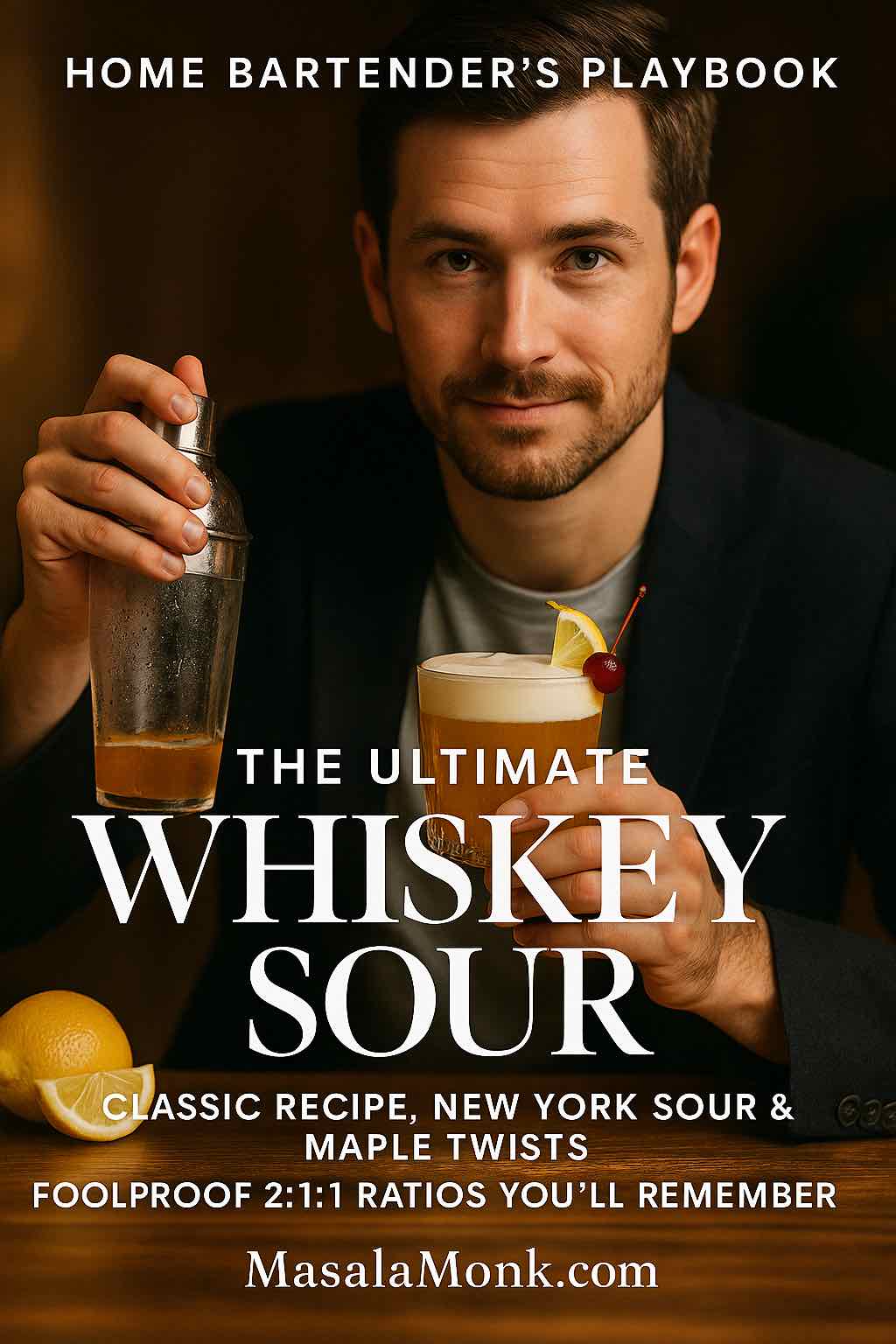
Bartender holding a whiskey sour cocktail and shaker on a wooden bar, cover image for MasalaMonk whiskey sour recipe guide

There’s something wonderfully honest about a whiskey sour. No smoke and mirrors, no mile-long ingredient list—just whiskey, citrus, and sweetness, shaken together until they become more than the sum of their parts. Whether you like yours sharp and bracing, frothy with egg white, or dressed up with a red wine float as a New York sour drink, mastering a great whiskey sour recipe gives you a whole family of cocktails to play with.

Let’s walk through it slowly, glass in hand.


What Exactly Is a Whiskey Sour?

At its core, a whiskey sour cocktail is a “sour”: one spirit, one citrus, one sweetener. That template shows up everywhere in cocktail culture—margaritas, daiquiris, sidecars—but the whiskey sour drink might be the most comforting of the lot.

In its simplest form, you’re working with:

  • Whiskey
  • Fresh lemon juice
  • Sugar (usually as simple syrup)

Shake it with ice, strain it into a glass, garnish if you like, and you’re done. That’s your basic answer when someone asks, “What’s in a whiskey and sour?” or “What’s the whiskey sour cocktail recipe?”

Over the years, bartenders have added little twists:

  • A splash of egg white to create the creamy Boston Sour
  • A float of dry red wine to turn it into a dramatic New York whiskey sour
  • Swapping in different sweeteners (honey, maple, ginger syrup)
  • Experimenting with different styles of whiskey—bourbon, rye, Irish, Scotch

Yet the structure stays the same. Spirit, sour, sweet. Once you understand that, you can see how every sour whisky drink you encounter is just a variation on this backbone.

Also Read: Negroni Recipe: Classic Cocktail & Its Variation Drinks


A Short, Spirited History

Like many great drinks, the traditional whiskey sour grew out of necessity. Long before cocktail bars and Instagram, sailors mixed spirits with lemon or lime juice and sugar to ward off scurvy and make rough spirits more palatable on long voyages. Over time, that practical mixture migrated onto dry land and into early American bars.

By the mid-19th century, manuals like Jerry Thomas’s Bartender’s Guide were formalizing the idea of “sours”—brandy sour, gin sour, whiskey sour. The original whiskey sour recipe would have been pretty rustic by modern standards: spirit, citrus, and powdered sugar, maybe with a bit of water to help it dissolve.

Fast forward to today, and the drink still follows the same logic, though we’ve traded powdered sugar for simple syrup, added the option of egg white, and fine-tuned the whiskey sour ratio so it suits modern palates. Meanwhile, new variations keep spinning off—from the red-wine-topped New York sour cocktail recipe to maple- and spice-laced twists like the Nutmeg Maple Whiskey Sour you’ll find in Masala Monk’s nutmeg-inspired cocktails for Saturday nights.

The drink has evolved, but its spirit hasn’t changed much: a simple, reliable way to turn whiskey and lemon into something you want to linger over.

Also Read: How to Cook Perfect Rice Every Time (Recipe)


Whiskey Sour Ingredients: The Building Blocks

Before shaking, it helps to get familiar with the core whiskey sour ingredients and why they matter.

1. Whiskey

The whiskey is your base, so choose wisely. Almost any style can work:

  • Bourbon – The default for a bourbon whiskey sour and bourbon sour. It’s naturally sweet, with notes of vanilla and caramel that play beautifully with lemon.
  • Rye – Spicier and drier, great for a rye whiskey sour if you like more bite.
  • Irish whiskey – Light, smooth, and friendly. Ideal for an easy-drinking Irish whiskey sour or Jameson whiskey sour.
  • Scotch – Malty and sometimes smoky. That’s your scotch sour, scotch whiskey sour, or sour scotch, and it can be delicious in the right hands.

Later on, when you’re ready to get very specific about the best whiskey for whiskey sour, you can dip into more brand-focused guides like Masala Monk’s deep dive on what to mix with Jim Beam or bottle lists from cocktail sites that compare bourbon and rye for mixed drinks.

2. Fresh Lemon Juice

Lemon is the “sour in whiskey sour.” It’s what turns a glass of straight spirit into a refreshing lemon whiskey drink and gives the cocktail its signature brightness.

Fresh makes a big difference. Bottled juice tends to taste flat or sharp in the wrong way, while fresh lemons give you aroma and zest along with acidity. If someone asks about whiskey and lemon juice or drinks with whiskey and lemon, this is the heart of the answer: fresh citrus, not shelf-stable juice.

3. Sweetener

Traditional recipes used sugar and water; today, most bartenders reach for:

  • Simple syrup – Equal parts sugar and water, dissolved. This is the most common simple syrup for whiskey sour and makes it easy to adjust sweetness.
  • Maple syrup – For a maple whiskey sour, especially in colder weather.
  • Honey syrup – For a honey lemon whiskey sour, floral and cozy.
  • Ginger syrup – For a ginger whiskey sour with a warming kick.

Even if you’re using a flavoured syrup, the logic is the same: balance the lemon with enough sweetness that the cocktail tastes harmonious rather than punishingly sour.

4. Egg White (Optional)

Egg white is technically optional, but if you’ve ever admired a cocktail with a thick, silky foam on top, you’ve seen what it can do. Adding a small amount and shaking properly turns your drink into a luscious whiskey sour with egg white—what many people call a Boston Sour.

You’ll also see recipes labelled:

  • Whiskey sour cocktail recipe egg white
  • Whiskey sour cocktail with egg white
  • Whiskey drink with egg white

All of them are describing this creamy variation. We’ll get into the technique in a moment.

Also Read: Homemade Hot Chocolate with Cocoa Powder Recipe


Classic Whiskey Sour Recipe (No Egg)

Let’s start with the most straightforward whiskey sour recipe: clean, bright, and easy to remember.

Simple Whiskey Sour

This is your go-to simple whiskey sour, perfect for a weeknight drink or a first experiment at home.

Ingredients (1 drink)

  • 50 ml (1¾ oz) whiskey
  • 25 ml (¾–1 oz) fresh lemon juice
  • 20–25 ml (⅔–¾ oz) simple syrup
  • Ice
  • Lemon wheel or twist, plus a cherry

Think of this as the standard whiskey sour recipe ml and whiskey sour measurements you can rely on. It’s essentially a 2:1:1 whiskey sour ratio, which is easy to scale up.
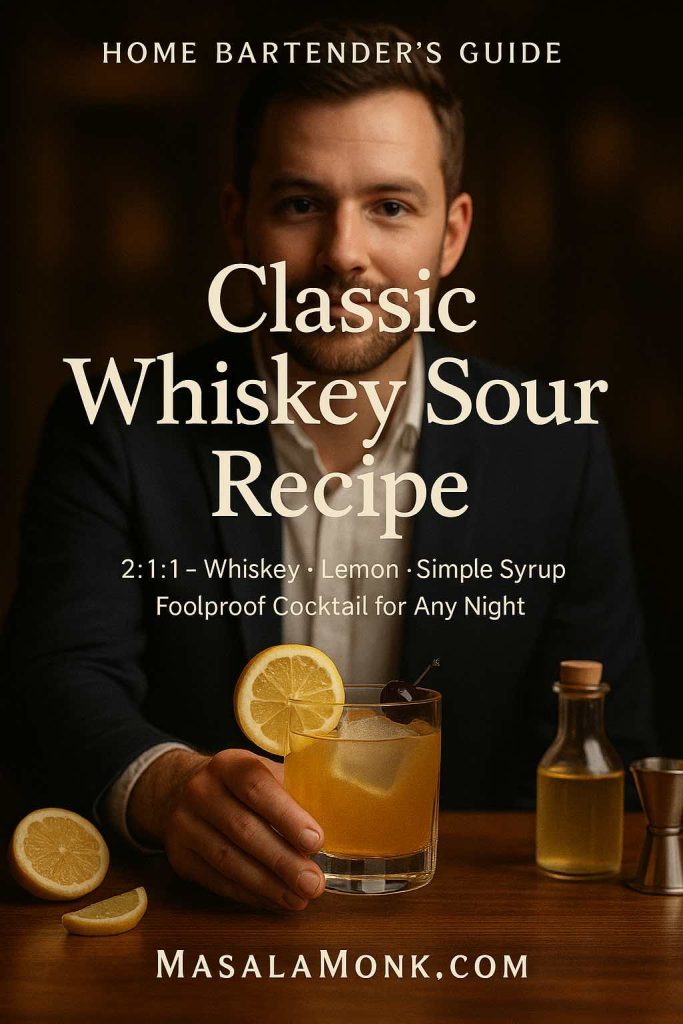
Home bartender in a navy blazer holding a classic whiskey sour cocktail on a wooden bar, with text overlay describing a 2-1-1 whiskey lemon simple syrup recipe for MasalaMonk
Classic Whiskey Sour Recipe – a 2:1:1 mix of whiskey, fresh lemon, and simple syrup, styled as a home bartender’s guide cover for MasalaMonk.com.

Method

  1. Add the whiskey, lemon juice, and simple syrup to a cocktail shaker filled with ice.
  2. Shake briskly for 10–15 seconds, until the outside of the shaker is frosty.
  3. Strain into a rocks glass filled with fresh ice.
  4. Garnish with a lemon wheel or twist and a cherry.

That’s it. In just a few steps, you’ve made an easy whiskey sour from scratch. You can call this your basic whiskey sour, classic whiskey sour, traditional whiskey sour recipe, or just “my house whiskey sour.”

If a friend asks, “How do you make a whiskey sour?” or “How do I make a whisky sour at home?”—this is the version to teach them.

Also Read: Peanut Butter Cookies (Classic Recipe & 3 Variations)


Whiskey Sour Recipe with Egg White (Boston Sour)

Once you’re comfortable with the basic build, you might want to explore the creamy, velvety side of the style: the whiskey sour with an egg white, often referred to as a Boston Sour.

Why Add Egg White?

Egg white doesn’t change the flavour dramatically; instead, it transforms texture. It gives the drink:

  • A thick, luxurious foam cap
  • A softer, rounder mouthfeel
  • A canvas for a few drops of aromatic bitters

That’s why you’ll sometimes see recipes titled egg white whisky sour or boston sour cocktail. They’re all talking about the same technique.

Egg-White Whiskey Sour Recipe

Ingredients (1 drink)

  • 50 ml (1¾ oz) whiskey
  • 25 ml (¾–1 oz) fresh lemon juice
  • 20–25 ml (⅔–¾ oz) simple syrup
  • 10–15 ml (⅓–½ oz) egg white (about half the white of a large egg)
  • Ice
  • Bitters + lemon twist, to garnish
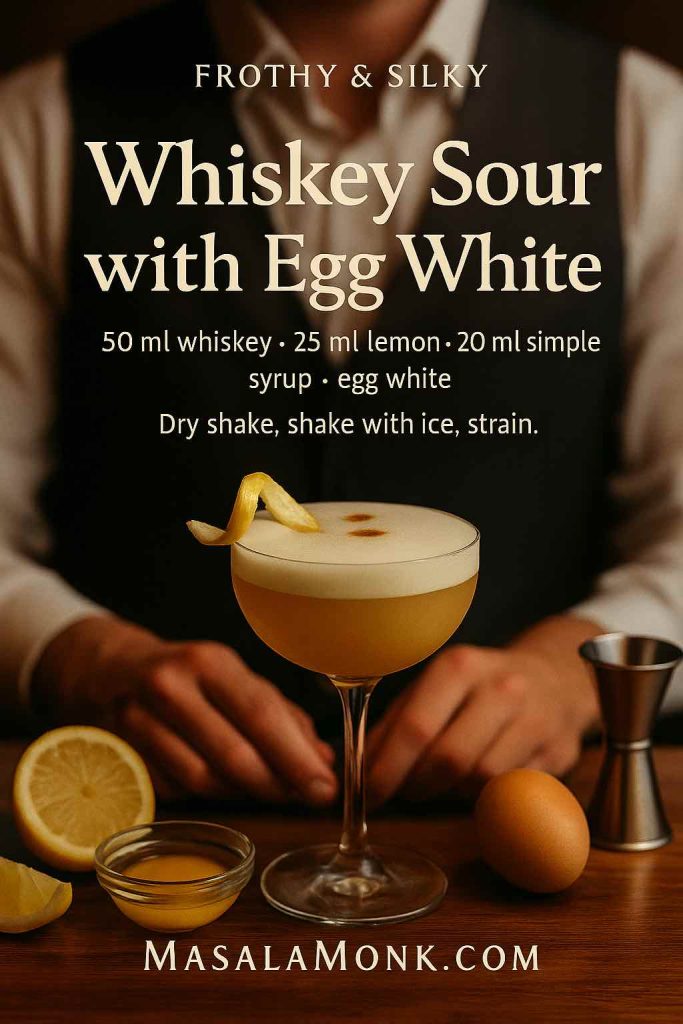
Recipe card style image showing a frothy whiskey sour with egg white in a coupe glass, with text listing 50 ml whiskey, 25 ml lemon, 20 ml simple syrup and egg white plus dry shake instructions from MasalaMonk
Frothy & silky Whiskey Sour with Egg White – a Boston Sour recipe in one glance: 50 ml whiskey, 25 ml lemon, 20 ml simple syrup and egg white, dry shaken then shaken with ice for MasalaMonk.com.

Method

  1. Add whiskey, lemon, simple syrup, and egg white to a shaker without ice.
  2. Seal and dry shake for about 10–20 seconds. This whips air into the egg white.
  3. Open the shaker, add ice, and shake again until chilled.
  4. Strain into a rocks glass over ice or into a chilled coupe.
  5. Dot the foam with a few drops of bitters and garnish with a twist.

You now have a lush, restaurant-worthy whiskey sour cocktail. If you want more context about this style and why bartenders swear by the dry-shake method, you can always look to classic recipe resources like Liquor.com’s take on the whiskey sour or similar guides that spell out both the egg and no-egg versions in detail.

Anyone looking for a whisky sour recipe with egg white or a whiskey sour cocktail recipe that looks truly pro will be delighted with this version.

Also Read: Green Tea Shot with Jameson | Recipe & 10 Variations


Whiskey Sour Recipe Without Egg (No-Fuss & Vegan Friendly)

Not everyone is comfortable with egg in a drink, and that’s completely fine. A whiskey sour without egg white is:

  • Easier to batch for parties
  • Faster to shake on a busy night
  • Naturally lighter and more zippy

The good news is you don’t need to change much. The whiskey sour recipe no egg is simply the simple recipe from above: whiskey, lemon, syrup, ice, shake.
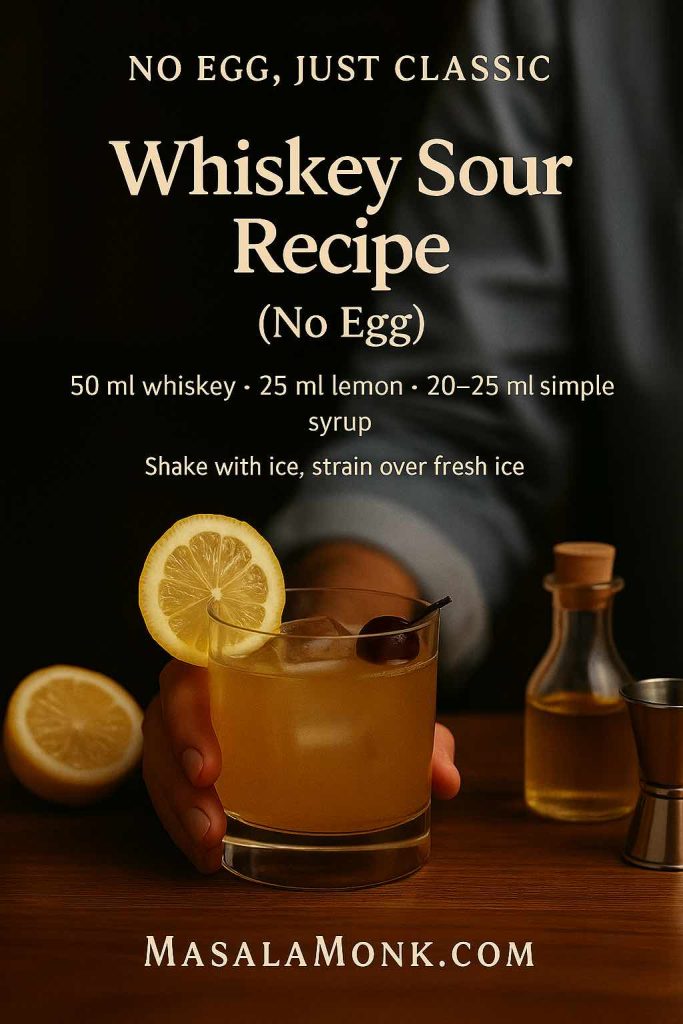
Recipe card image for a classic whiskey sour without egg, showing a rocks glass with lemon and cherry garnish held by a bartender, with text listing 50 ml whiskey, 25 ml lemon and 20–25 ml simple syrup.
No egg, just classic – this Whiskey Sour Recipe (No Egg) keeps it simple with 50 ml whiskey, 25 ml lemon and 20–25 ml simple syrup, shaken with ice and strained over fresh ice for MasalaMonk.com.

You’ll see plenty of variations on the phrase—whiskey sour ingredients no egg, whiskey sour ingredients without egg, whisky sour no egg, whisky sour recipe no egg, whisky sour without egg—but they all boil down to the same thing: a classic, foam-free sour that puts the citrus and whiskey front and centre.

If you still want that foamy look but don’t want to use egg, some bartenders use aquafaba (the liquid from a can of chickpeas) as a vegan substitute. The technique is the same: dry shake first, then shake with ice.

Also read: Béchamel Sauce for Lasagna: Classic, Vegan & Ricotta Sauce Recipe


Whiskey Sour with Sour Mix: Shortcuts That Still Taste Great

Sometimes you’re making one perfect drink for yourself. Other times you’re in full host mode and squeezing lemons for ten people feels like too much. That’s where whiskey sour mix comes in handy.
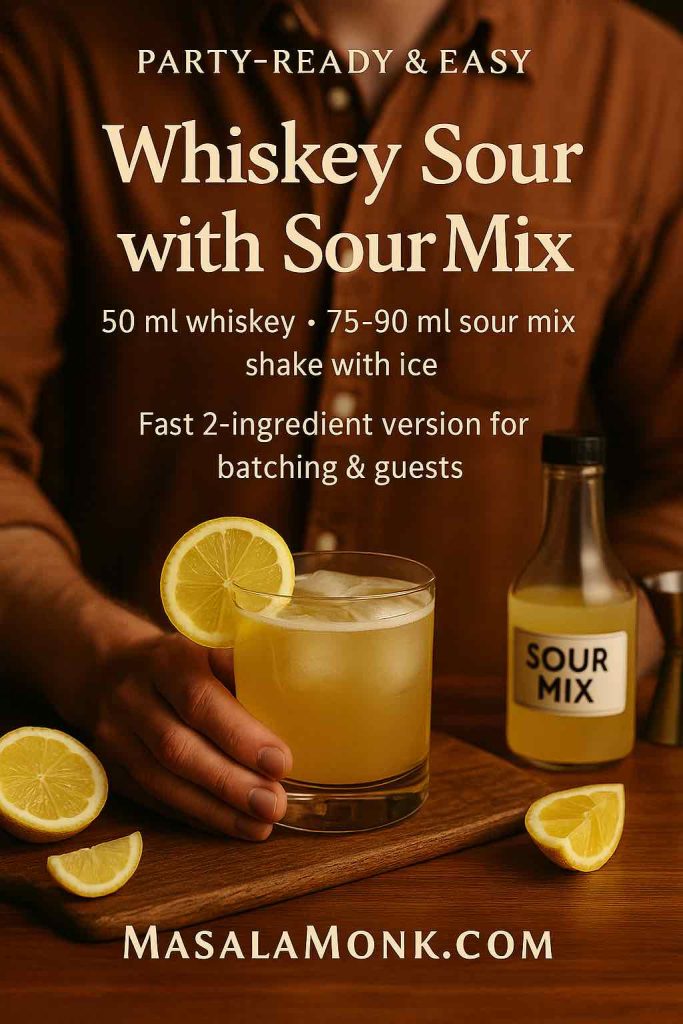
Recipe card image showing a whiskey sour with sour mix in a rocks glass garnished with lemon, held by a person in a casual shirt with a labeled sour mix bottle beside it and text listing 50 ml whiskey and 75–90 ml sour mix.
Party-ready Whiskey Sour with Sour Mix – a fast 2-ingredient recipe card for batching: 50 ml whiskey, 75–90 ml sour mix, shake with ice and serve, created for MasalaMonk.com.

Using Bottled Mix

For a quick-and-easy whiskey sour with sour mix, try:

  • 50 ml (1¾ oz) whiskey
  • 75–90 ml (2½–3 oz) commercial sour mix

Shake with ice, strain over fresh ice, garnish. That’s your classic shortcut for a whiskey sour drink mix–based serve.

You might also see this loosely described as:

  • Whiskey and sour mix
  • Sour mix and whiskey
  • Whisky sour with sour mix
  • Whiskey sour with sweet and sour mix

If you’re already using sour mix for shots and party drinks, you can keep the same bottle on hand for sours. For instance, if you enjoy the Green Tea Shot with Jameson from Masala Monk—Jameson, peach schnapps, sour mix—that same mix gives you a fast route to a Jameson whiskey sour–style drink in a pinch.

Homemade Whiskey Sour Mix Recipe

For better flavour and more control, it’s worth making your own homemade whiskey sour mix. A simple version:

  • 1 part fresh lemon juice
  • 1 part fresh lime juice (optional but bright)
  • 1 part sugar (stirred into the juice or turned into syrup)

Combine, chill, and you’ve got a versatile lemon sour recipe drink base that works for:

  • Classic whiskey sweet and sour highballs
  • Batch whiskey sour recipe with sour mix pitchers
  • Other sour-style cocktails and even tea-based drinks

Masala Monk’s love affair with tea and whiskey shows up in posts like their cinnamon-spiced iced tea whiskey cocktails and saffron iced tea cocktails, and a homemade sour mix slots perfectly into that style of mixing.
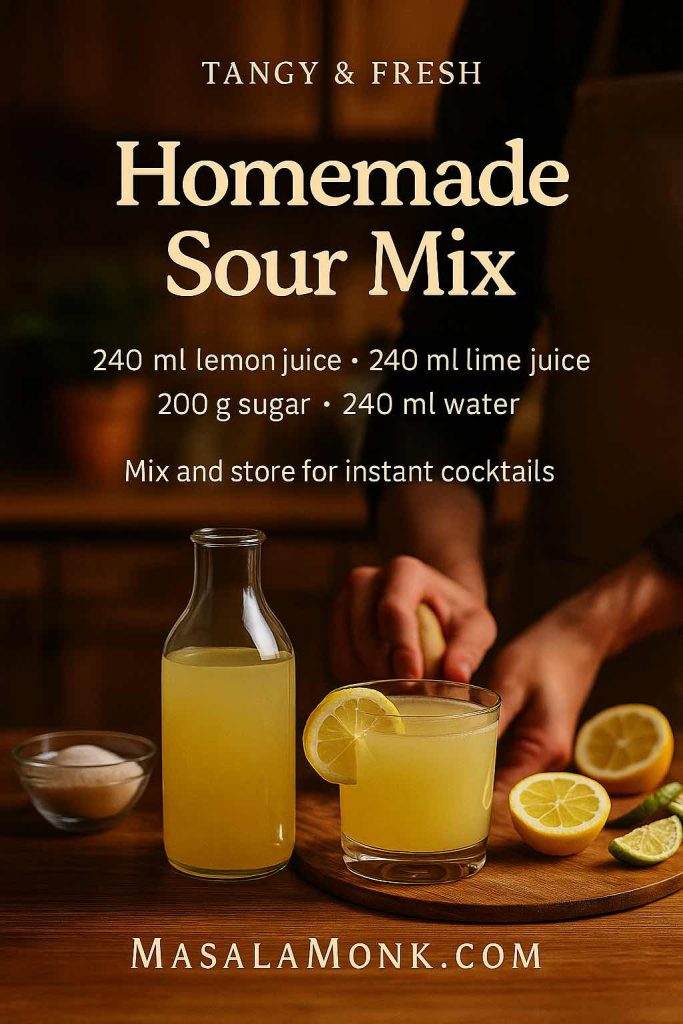
Homemade sour mix recipe card showing a glass bottle and glass of yellow citrus mix on a wooden counter with lemons and limes, plus text listing lemon juice, lime juice, sugar and water for MasalaMonk
Tangy & fresh Homemade Sour Mix – lemon juice, lime juice, sugar and water mixed and bottled so your next round of whiskey sours on MasalaMonk.com is always just a shake away.

Once your mix is ready, you can use roughly 50 ml whiskey to 75–90 ml of your sour blend for a fast, consistent drink. It may not be as precise as the single-serve whiskey sour from scratch, but it’s very party-friendly.

Also Read: Crock Pot Lasagna Soup (Easy Base + Cozy Slow-Cooker Recipes)


Best Whiskey for Whiskey Sour: Choosing the Right Bottle

Talk to ten bartenders about the best whiskey for whiskey sour recipe, and you’ll get at least twelve opinions. That said, a few patterns show up again and again.

Bourbon

Bourbon is the classic choice for a bourbon whiskey sour or bourbon sour:

  • Naturally sweeter, with vanilla, caramel, and baking-spice notes
  • Often feels rounder and softer with lemon juice
  • Plays nicely with a wide range of sweeteners, from simple syrup to maple

When you’re browsing the shelf, look for a bottle you’d happily sip neat but don’t mind mixing. If you’ve already been experimenting with ideas from “what to mix with Jim Beam” style articles—including highballs, long drinks, and sours—that same Jim Beam or similar bourbon will make a very solid good whiskey for whiskey sour.

Rye

Rye brings more spine to the party. A rye whiskey sour:

  • Tastes drier and spicier
  • Leans into pepper and baking spice notes
  • Works beautifully if you don’t like your cocktails overly sweet

If you already enjoy Manhattan-style drinks, a rye-based sour might feel like the perfect bridge between sharp and refreshing.

Irish Whiskey

For something lighter, Irish whiskey is tailor-made for a whiskey and lemon combination. A Jameson sour or Jameson whiskey sour tends to be:

  • Smooth and approachable
  • Slightly grassy or cereal-like in a pleasant way
  • Great for people who say they “don’t really like whiskey” but enjoy balanced cocktails

In fact, if you’ve made the Green Tea Shot mentioned earlier, you already know how friendly Jameson is with sour mix and citrus.

Scotch & Beyond

Scotch in a sour can be a little more polarizing, yet a good scotch sour drink or scotch sour cocktail can be lovely:

  • Blended scotch gives you malt, honey, and a gentle smokiness
  • Some peated whiskies add a smoky surprise to the lemon

The same logic applies when you’re playing with other recipes on Masala Monk that feature bourbon or rye—like the cinnamon Old Fashioned–style cocktails or cinnamon-spiced iced tea highballs. If a whiskey works there, it will probably work in a sour too.

Best whiskey for a whiskey sour recipe card showing a classic whiskey sour in front of four bottles labeled bourbon, rye, Irish and Scotch with a bartender’s hand choosing a bottle.
Choosing your bottle – bourbon for sweet and round, rye for spice, Irish for smooth and Scotch for smoky, all ready to turn into your perfect whiskey sour on MasalaMonk.com.

So What’s “Best”?

When people ask for:

  • Best whiskey for whiskey sour
  • Best whiskey for sour
  • Best whisky for a whisky sour
  • Whisky sour best whisky

…they’re usually looking for reassurance more than a single magical brand. As a guideline:

Choose a whiskey you’d drink on the rocks, with enough character to stand up to lemon and sugar, but not so precious that you feel guilty shaking it.

That’s your sweet spot.

Also Read: Cottage Cheese Lasagna Recipe | Chicken, Spinach, & Ricotta


Whiskey Sour Variations You’ll Want to Try

Once you’ve locked in your house whiskey sour recipe, you can start branching out. The sour template is incredibly flexible, so experimenting is half the fun.

New York Sour

The New York sour (sometimes called a Continental Sour) is a classic variation that adds a red wine float on top of a standard whiskey sour.
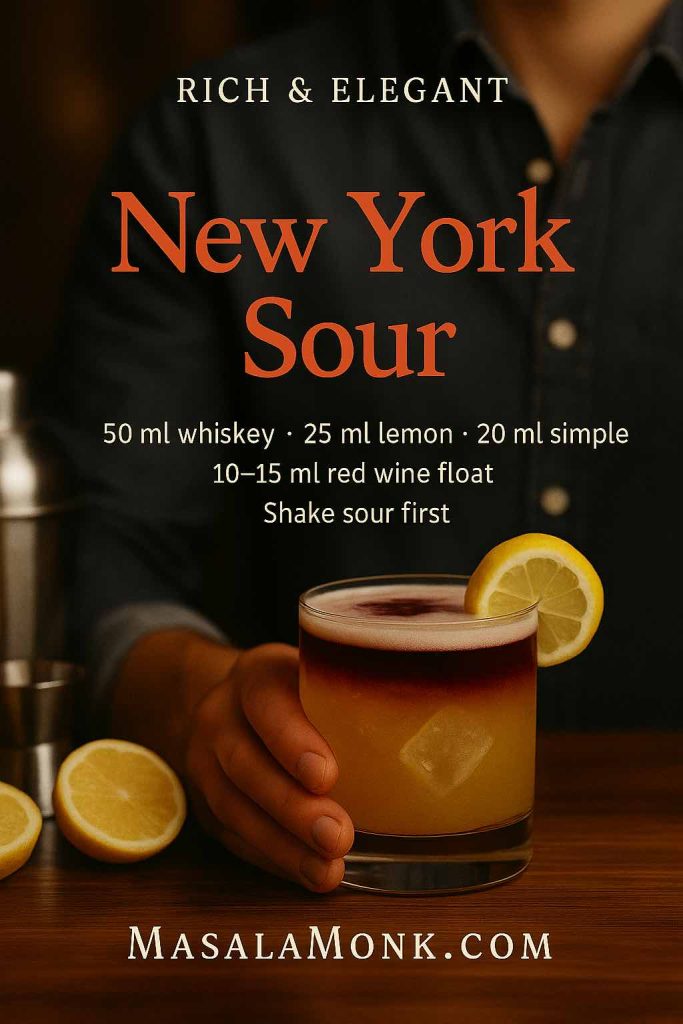
New York Sour cocktail recipe card showing a layered whiskey sour with red wine float in a rocks glass, held by a person in a denim shirt, with text listing 50 ml whiskey, 25 ml lemon, 20 ml simple syrup and 10–15 ml red wine.
Rich & elegant New York Sour – a whiskey sour shaken first, then finished with a red wine float for bar-quality layers, as featured in the MasalaMonk.com whiskey sour guide.

To make one:

  1. Shake your usual sour—either with or without egg white.
  2. Strain into a rocks glass over ice.
  3. Gently pour 10–15 ml (½ oz) of dry red wine over the back of a spoon so it floats on the surface.

The result is a layered drink with a deep purple cap and a fruity, winey aroma. It’s the answer to anyone looking for a New York sour drink or a more dramatic whiskey sour cocktail for dinner parties.

If you’d like a step-by-step benchmark, you can peek at Liquor.com’s New York Sour cocktail recipe, then tweak it to taste at home.

Maple, Nutmeg & Dessert-Like Sours

For colder evenings, swapping simple syrup for maple syrup gives you an instant maple whiskey sour. Add a dusting of nutmeg and perhaps a splash of bitters, and you’re in dessert territory.
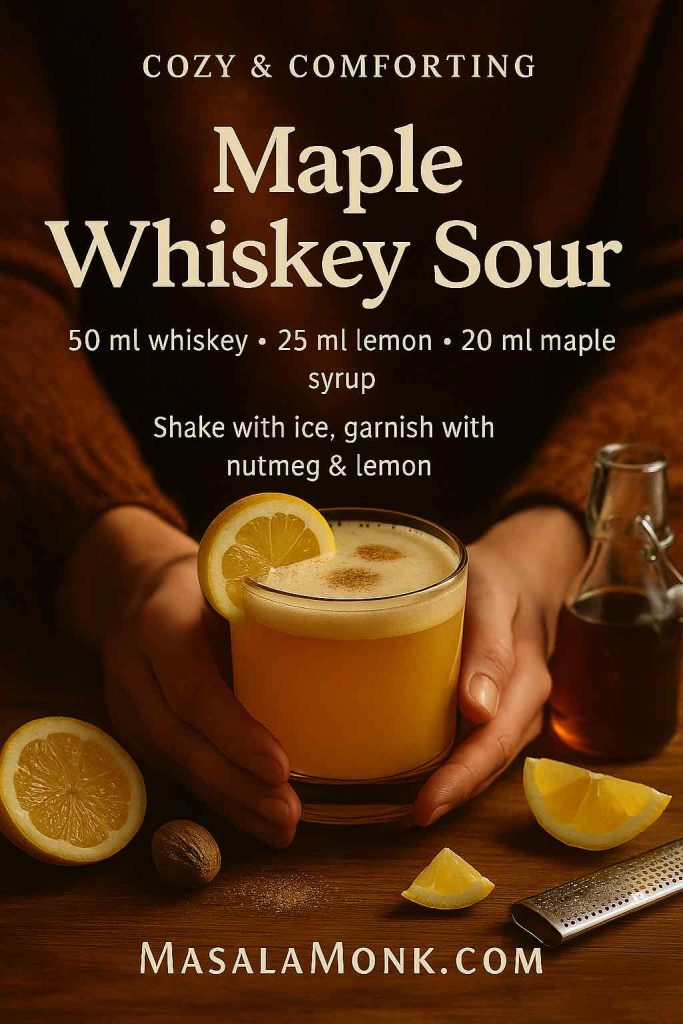
Cozy maple whiskey sour recipe card showing a golden whiskey sour in a rocks glass held by hands in a warm sweater, with lemon wedges, nutmeg, maple syrup bottle and text listing 50 ml whiskey, 25 ml lemon and 20 ml maple syrup.
Cozy & comforting Maple Whiskey Sour – 50 ml whiskey, 25 ml lemon and 20 ml maple syrup, shaken with ice and finished with lemon and freshly grated nutmeg for MasalaMonk.com.

Masala Monk goes even further in their Nutmeg Maple Whiskey Sour, combining whiskey, maple, lemon, and nutmeg into a spiced, wintery twist. That’s a perfect example of how a basic whiskey sour recipe becomes something special with just one or two smart adjustments.

Amaretto & Whiskey Sours

If you enjoy nutty flavours, amaretto is your friend. A few ways to play:

  • Amaretto whiskey sour – Split the base between whiskey and amaretto, then add lemon and a touch of syrup.
  • Amaretto sour with whiskey – Start from an amaretto sour and add a shot of whiskey for depth.
  • Amaretto bourbon sour or bourbon amaretto sour – Bourbon for richness, amaretto for almond sweetness.
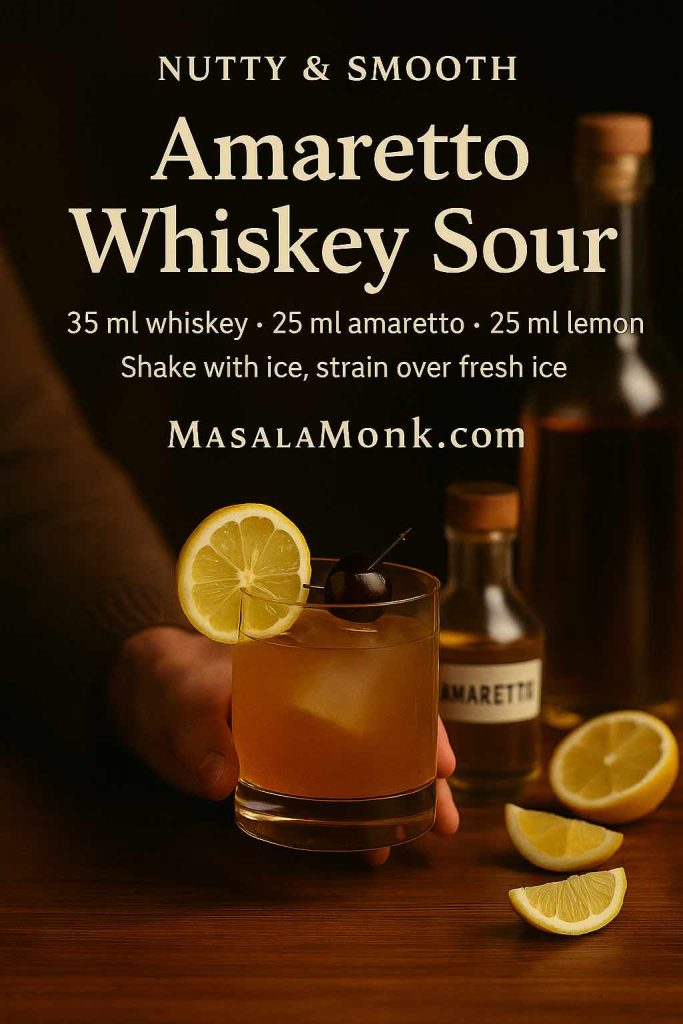
Amaretto Whiskey Sour recipe card showing an amber whiskey and amaretto cocktail in a rocks glass with lemon wheel and cherry garnish, a labeled amaretto bottle in the background and text listing 35 ml whiskey, 25 ml amaretto and 25 ml lemon.
Nutty & smooth Amaretto Whiskey Sour – 35 ml whiskey, 25 ml amaretto and 25 ml lemon, shaken with ice and strained over fresh ice for a dessert-like twist in the MasalaMonk.com whiskey sour guide.

You’ll find similar pairing ideas in Masala Monk’s piece on what mixes well with Baileys, where creamy liqueurs, nutty spirits, and whiskey frequently share the same glass. Once you see how well those flavours work together, folding amaretto into your whiskey sour feels very natural.

Fruity Whiskey Sours

Fruit-driven riffs are an easy way to soften the drink and make it more playful:

  • Cranberry whiskey sour or cranberry orange whiskey sour
  • Cranberry whiskey drink with lemon and a bit of sugar
  • Apple whiskey sour, peach whiskey sour, or pineapple whiskey sour
  • Cherry whiskey sour with muddled cherries plus juice

A simple approach is to replace part of the lemon or syrup with a fruit juice or puree, then rebalance to taste. If you already enjoy whiskey cranberry, cranberry and whiskey, or whiskey cranberry juice combos, you’re only a small step away from a full-blown whiskey sour variation.

Tropical-leaning recipes like Masala Monk’s coconut water cocktails show another path: lighter, longer drinks that keep whiskey as a base but weave in coconut, citrus, and sweetness. That approach also plays nicely with sour-style builds.

Tea & Spice Sours

Tea and spices open up a more sophisticated side of the sour template:

  • Brewed black tea or Earl Grey can replace some of the water in your simple syrup or even stand in for part of the lemon.
  • Spiced syrups (cinnamon, clove, star anise) can add warmth without overpowering.

For more inspiration, you can browse Masala Monk’s tea-driven cocktail collections, like their Earl Grey and bourbon iced tea cocktails or the saffron-infused iced tea recipes. Many of those drinks follow the same spirit–citrus–sweet blueprint as a sour, just stretched into a taller, more refreshing format.

Also Read: How to Make Churros (Authentic + Easy Recipe)


Glassware, Garnish, and Little Details

Although the whiskey sour cocktail feels relaxed and unfussy, a few small choices can change how it feels in the hand.

Glassware

Traditionally, a whiskey sour drink is served:

  • In an old fashioned (rocks) glass over ice, or
  • “Up” in a coupe or sour glass, without ice, especially when made with egg white

Serving on the rocks feels more casual and forgiving. Pouring it into stemware, on the other hand, makes it feel like a proper “cocktail-hour” moment, particularly when you’ve shaken in egg white and topped the foam with bitters.

Garnish

You don’t need a garnish for the drink to taste good, yet small touches do a lot:

  • A lemon wheel or twist emphasises the citrus
  • A cherry nods to old-school bar style
  • A few drops of bitters on egg-white foam add aroma and visual flair

From there, you can get playful—an orange twist with a whiskey old fashioned sour spin, a cinnamon stick for a winter variation, or even a sprig of herb for a lighter whiskey and lemon cocktails vibe.


When to Reach for a Whiskey Sour

One of the reasons the whiskey sour cocktail endures is its flexibility. It works in a surprising number of scenarios:

  • As an aperitif, when you want something bright but still spirit-forward
  • As a slow sipper with snacks or fried foods (the lemon cuts through richness)
  • As a bridge drink for people who don’t yet love neat whiskey but enjoy balanced cocktails
  • As a base for dessert-leaning twists alongside coffee, chocolate, or creamy liqueurs

If you’re already dabbling in richer whiskey drinks, like cinnamon-spiked Old Fashioneds or dessert-style combinations from Masala Monk’s cinnamon cocktail round-up or their espresso martini variations, the sour gives you a fresher counterpoint—something that feels lighter on the palate without being lightweight.

Meanwhile, if you’re just getting into cocktails, the whiskey sour recipe is a perfect teacher. It shows you how to balance sweet and sour, how to adjust ratios to your taste, and how a small tweak (maple instead of sugar, or rye instead of bourbon) can create a whole new personality in the glass.

Also Read: How to Cook Bacon in the Oven (Crispy, No-Mess, Crowd-Ready Recipe)


Bringing It All Together

By now, the whiskey sour shouldn’t feel mysterious. It’s just:

  • A spirit you like
  • Fresh lemon juice
  • Enough sweetness to balance
  • Ice and a good shake
  • Optional egg white if you love that silky foam

From that starting point, you can move in any direction you like. Pour in a red wine float and you’ve made a moody New York sour. Stir in maple syrup and nutmeg and suddenly you’re sipping a fireside treat. Reach for amaretto and you get a softer, dessert-like variation. Swap in cranberry juice, pineapple, or peach puree and you’re firmly in fruity-cocktail territory.

And if you ever feel stuck, you can always roam through the broader Masala Monk Cocktails recipe collection and see how often that simple sour logic—spirit, citrus, sweet—shows up in different clothes, from tea cocktails to shaken espresso drinks.
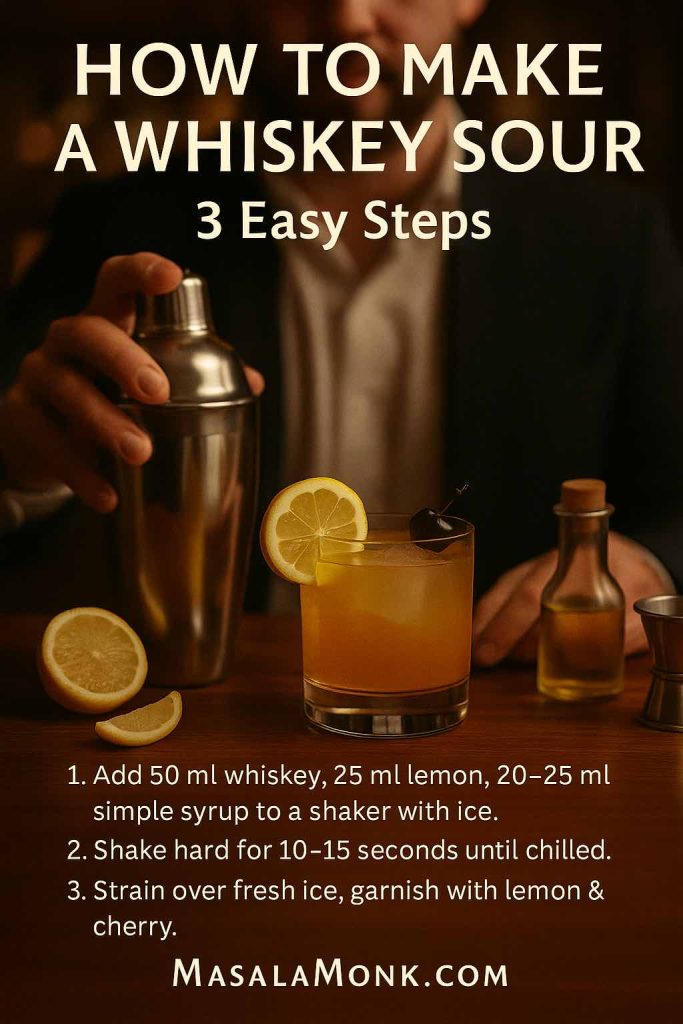
Step-by-step whiskey sour guide showing a bartender holding a cocktail shaker beside a finished whiskey sour with lemon and cherry garnish, with text explaining three easy steps to make the drink
How to make a Whiskey Sour in 3 easy steps – add whiskey, lemon and simple syrup to a shaker with ice, shake hard, then strain over fresh ice and garnish, as shown in this MasalaMonk.com guide image.

Ultimately, learning one reliable whiskey sour recipe does more than just give you a single drink. It hands you a template, a way of thinking about flavour and balance. Once you’ve felt that click—the moment when whiskey, lemon, and sugar line up just right—you’ll start to spot sour-shaped opportunities everywhere you look.

Also Read: 10 Best Chicken Sandwich Recipes (BBQ, Parm, Buffalo & More)

FAQs

1. What is the classic whiskey sour recipe?

The classic whiskey sour recipe follows a very simple pattern: 2 parts whiskey, 1 part fresh lemon juice, and 1 part sweetener. In practice, that usually means about 50 ml whiskey, 25 ml lemon juice, and 20–25 ml simple syrup shaken with ice and strained into a rocks glass. This basic build gives you a traditional whiskey sour that’s bright, balanced, and easy to tweak into your own version of the perfect whiskey sour.


2. What are the whiskey sour ingredients, with and without egg?

To start, the core whiskey sour ingredients are:

  • Whiskey (bourbon, rye, Irish, or Scotch)
  • Fresh lemon juice
  • Simple syrup (or another sweetener)

That’s all you need for a simple whiskey sour. For a whiskey sour with egg white—often called a Boston Sour—you simply add a small amount of egg white and shake twice (once without ice, once with). When you prefer a whiskey sour without egg instead, you just leave that egg white out and still get a clean, refreshing drink. So “whiskey sour ingredients no egg” and “whiskey sour ingredients without egg” are exactly the same as the classic recipe minus the egg white.


3. How do you make a whiskey sour from scratch at home?

To make a whiskey sour from scratch, follow these steps:

  1. Measure 50 ml whiskey, 25 ml fresh lemon juice, and 20–25 ml simple syrup into a shaker with ice.
  2. Shake hard for 10–15 seconds until chilled.
  3. Strain into a rocks glass over fresh ice.
  4. Garnish with a lemon wheel or twist and a cherry.

That simple technique answers most of the common questions—how do you make a whiskey sour, how do you make a whiskey sour drink, how do I make a whisky sour, and even make a whiskey sour for a guest. If you want the silky foam version, you just add egg white and use a dry shake first to turn it into a whiskey sour and egg white style cocktail.


4. What’s the difference between whiskey sour with egg white and whiskey sour no egg?

To begin with, both versions use the same whiskey sour measurements and whiskey sour ratio of spirit, lemon, and sweetener. The only difference is texture. A whiskey sour with egg white (or egg white whisky sour) gets a thick, creamy foam and a rounder mouthfeel. A whiskey sour no egg feels lighter and more sharply citrusy. When you see phrases like whisky sour recipe with egg white or whiskey sour cocktail recipe egg white, that’s pointing to the rich, foamy style; meanwhile, whiskey sour recipe no egg, whisky sour recipe no egg, and whisky sour without egg are all describing the same bright, egg-free drink.


5. Can I make a whiskey sour with sour mix instead of fresh lemon?

Absolutely. For convenience, many people use whiskey sour mix or whiskey sour drink mix. To do that, simply mix about 50 ml whiskey with 75–90 ml sour mix, shake with ice, and strain. That gives you a quick whiskey sour with sour mix which is great for parties. When you’re using pre-bottled mixers, you’ll often hear it called whiskey and sour mix, sour mix and whiskey, or whisky sour with sour mix. If you prefer more control, you can prepare a homemade sour mix for whiskey sours with fresh lemon, lime, and sugar, which tastes brighter than most store-bought options and can become your own best whiskey sour mix or best sour mix for whiskey sour.


6. How do I make a whiskey sour with sweet and sour mix?

Instead of separate lemon and syrup, you can reach for sweet and sour mix with whiskey for a streamlined approach. All you need to do is combine around 1 part whiskey to 2 parts sweet and sour mix, shake with ice, and strain. This is often called a whiskey sour with sweet and sour mix, and informally people might just say whiskey and sweet and sour. Although fresh citrus and simple syrup give more nuance, this method is handy when you want to mix several drinks quickly and still stay within the classic cocktail whiskey sour recipe family.


7. What is the best whiskey for a whiskey sour?

When choosing the best whiskey for whiskey sour, think more about flavour than price. Generally, bourbon makes a round, approachable bourbon sour or bourbon whiskey sour with vanilla and caramel notes, while rye creates a spicier, drier whiskey sour drink. Irish whiskey yields a soft, friendly Irish whiskey sour, and Scotch gives you a more adventurous scotch sour or scotch and sour. As a rule of thumb, the best whiskey to use for a whiskey sour is something you enjoy neat but don’t mind mixing—your personal good whiskey for whiskey sour. For many drinkers, that becomes “their” best whiskey sour recipe and the bottle they return to whenever they want a reliable good whiskey sour.


8. How strong is a whiskey sour, and what ratio should I use?

In terms of strength, a standard whiskey sour recipe ml (50 ml whiskey, 25 ml lemon, 20–25 ml syrup) ends up around the same alcohol level as many classic cocktails once diluted with ice. The typical whiskey sour ratio is roughly 2:1:1 (two parts whiskey, one part citrus, one part sweet). You can tweak that if you like it more tart or more sweet, yet this simple ratio is widely used for a classic whiskey sour recipe and keeps the balance predictable. So whenever you see “original whiskey sour recipe” or “traditional whiskey sour,” this kind of proportion is usually what sits behind it.


9. Can I make a whiskey sour without simple syrup or with other sweeteners?

Certainly. While simple syrup is the most common choice, a whiskey sour without simple syrup is still possible. You can dissolve sugar directly into the lemon juice before shaking or use alternatives like honey syrup or maple syrup. For instance, a maple whiskey sour swaps simple syrup for maple, while a whiskey sour with maple syrup leans into a richer, dessert-like profile. Likewise, honey syrup produces a honey lemon whiskey sour that feels soothing and aromatic. As long as you keep the sweet-and-sour balance in line, the cocktail remains recognisably a whiskey sour cocktail even with different sweeteners.


10. Are canned or premade whiskey sours worth trying?

Many brands now offer whiskey sour in a can or bottle so you can simply chill, pour, and enjoy. These premade whiskey sour options are convenient for picnics, travel, or times when you don’t want to measure anything. Although they can’t always match the freshness of a whiskey sour from scratch, they’re a practical alternative when shaking isn’t possible. If you enjoy the flavour, you can later reverse-engineer it at home by adjusting your own whiskey sour recipe—changing the sweetness or citrus level until your homemade version becomes “the best whiskey sour recipe” for your taste.


11. Can I add extra flavours like grenadine, lime, or lemonade to a whiskey sour?

Yes, absolutely; once you understand the base, adding flavours becomes very natural. A whiskey sour with grenadine gets a rosy colour and extra pomegranate sweetness. A whiskey sour with lime adds sharper, more zesty acidity—either alongside lemon or in place of it. For a longer, more casual drink, a whiskey sour with lemonade stretches the cocktail into a refreshing highball. All these variations still sit in the same family as the original whiskey sour, just dressed up to suit your mood or the season.


12. How do I turn a good whiskey sour into my “perfect” whiskey sour?

Ultimately, the perfect whiskey sour is personal. Start with the classic whiskey sour recipe—50 ml whiskey, 25 ml lemon, 20–25 ml simple syrup—then adjust one element at a time. Perhaps you nudge the syrup down for a sharper edge, or increase lemon if you like a very bright whiskey and lemon drink. Maybe you switch from bourbon to rye, or you decide that a foamy whiskey sour with egg is your forever favourite. Gradually, you’ll find your preferred combination of whiskey, ratio, and texture, and that’s when your own traditional whiskey sour recipe quietly becomes “the best whiskey sour recipe” in your house.Thinking

Posted on — 20 Comments

Espresso Martini Recipe: Classic, Foamy & Easy

Espresso Martini in a thin-stem coupe with a dark coffee body, smooth tan foam and three coffee beans on a glossy reflective bar.

This post was last updated on:

An espresso martini should arrive properly cold, with dark coffee underneath a smooth tan cap of fine bubbles. The first sip should taste unmistakably of espresso, followed by coffee liqueur and clean vodka. It should not taste burnt, syrupy or like half the glass is foam.

There is no single ratio used by every good espresso martini recipe. Coffee liqueurs vary in sweetness, espresso varies in bitterness and concentration, and some people simply like a stronger drink. This version gives you a balanced place to start, then shows you how to move it drier, softer, more coffee-forward or creamier without learning a completely different recipe.

Espresso Martini Recipe

Start here. The coffee stays in front, the vodka still has presence, and the coffee liqueur rounds the drink without making it heavy.

At its simplest, an espresso martini is a three-ingredient cocktail: vodka, concentrated coffee and coffee liqueur. Simple syrup is an adjustment, not a requirement.

Espresso Martini recipe graphic with a finished cocktail, espresso and bar tools; the surrounding recipe gives the exact vodka, espresso, coffee liqueur and syrup measurements.
Make the first drink as written, then change only one thing on the next round. That way, if you adjust sweetness or strength, you can actually tell what improved the espresso martini instead of chasing several moving targets.

Prep: about 5 minutes · Yield: 1 cocktail · Glass: 5–7 oz / 150–210 ml coupe or martini glass · Method: shaken

Ingredients

  • 1½ oz / 45 ml vodka
  • 1 oz / 30 ml fresh espresso
  • ¾ oz / 22.5 ml coffee liqueur
  • 0–¼ oz / 0–7.5 ml 1:1 simple syrup, to taste
  • Plenty of solid ice
  • 3 coffee beans, optional

Using a sweeter coffee liqueur? Make the first drink without syrup. With something drier, or with a particularly bitter espresso, start with about ¼ oz / 7.5 ml.

Method

  1. Chill the glass. Put a coupe or martini glass in the freezer. No freezer space? Fill it with ice and cold water while you make the drink.
  2. Pull the espresso first. Measure 1 oz / 30 ml and let it sit while you measure the other ingredients. It can still be fresh and warm.
  3. Build the drink. Add vodka, espresso, coffee liqueur and any syrup you are using to a cocktail shaker.
  4. Add plenty of ice. Fill the shaker roughly halfway to two-thirds, leaving some room for everything to move.
  5. Shake hard for 15–20 seconds. The shaker should become very cold.
  6. Strain and serve. Empty the chilled glass, pour in the cocktail and garnish with three coffee beans if you like.

A fine-mesh strainer removes tiny ice chips and leaves a very clean surface, although it is optional.

No cocktail shaker? A clean jar with a secure lid works. Measure with a jigger, a 1 oz / 30 ml shot glass or a small measuring cup. A fine kitchen sieve can stand in for a cocktail strainer.

Making two? Use 3 oz / 90 ml vodka + 2 oz / 60 ml espresso + 1½ oz / 45 ml coffee liqueur + up to ½ oz / 15 ml syrup. Shake them together only if your shaker has enough room for two drinks and plenty of ice.

Espresso Martini Guide

If the recipe is all you needed, you can stop there. Otherwise, use the guide below to tune the balance, work with the coffee equipment you have, rescue weak foam or prepare several drinks at once.

What Is the Best Espresso Martini Ratio?

Published recipes range from strong, vodka-forward versions to soft equal-parts builds. That range makes sense because different coffee liqueurs and different shots of espresso do not bring the same sweetness or intensity.

For most home drinkers, 1½ oz vodka + 1 oz espresso + ¾ oz coffee liqueur is a useful middle ground. Add syrup only after deciding whether the drink actually needs it.

StyleVodkaEspressoCoffee liqueurSyrupResult
Balanced1½ oz / 45 ml1 oz / 30 ml¾ oz / 22.5 ml0–¼ oz / 0–7.5 mlCoffee-forward, smooth and adjustable
Drier & stronger2 oz / 60 ml1 oz / 30 ml½ oz / 15 ml0–¼ oz / 0–7.5 mlMore vodka, sharper finish
Softer & sweeter1 oz / 30 ml1 oz / 30 ml1 oz / 30 mlUsually noneRounded, easy-drinking, liqueur-led
Comparison graphic showing three Espresso Martini ratios: drier and stronger, balanced, and softer and sweeter. Exact measurements are listed in the nearby ratio table.
To compare espresso martini ratios properly, keep the espresso constant and change the vodka and coffee liqueur around it. A side-by-side approach makes your preferred balance much easier to find than tweaking every ingredient at once.

Why the Recipes Look So Different

The Espresso Martini is generally credited to London bartender Dick Bradsell, who created the vodka-and-espresso cocktail in the 1980s. The modern International Bartenders Association recipe uses vodka, coffee liqueur, sugar syrup and one strong espresso. From there, modern recipes range from dry and vodka-heavy to sweet equal-parts versions.

A sweet coffee liqueur can provide nearly all the sugar a drink needs. Switch to a drier bottle and the same recipe changes noticeably. Likewise, espresso can move the balance just as much: a sharp, bitter shot behaves very differently from one that is rounder and naturally chocolatey.

For a Drier, Stronger Drink

Move toward 2 oz / 60 ml vodka, keep the espresso around 1 oz / 30 ml, and reduce the coffee liqueur to about ½ oz / 15 ml. The vodka becomes more obvious and the finish noticeably drier.

For a Softer, Sweeter Drink

Equal parts are the clearest reference point: 1 oz / 30 ml each vodka, espresso and coffee liqueur. Start without extra syrup. For something between that and the balanced recipe, use 1½ oz / 45 ml vodka while leaving the espresso and liqueur at 1 oz / 30 ml each.

For More Coffee Flavor

Make the coffee stronger before making the drink larger. Extra weak coffee adds volume and dilution faster than it adds flavor. Espresso, moka coffee and cold-brew concentrate all deliver plenty of coffee in a small pour.

Already sweet enough? Skip the syrup.

Espresso Martini Ingredients: Vodka, Coffee Liqueur & Espresso

A dependable mid-range vodka is plenty. Choose something clean enough that the alcohol does not fight the espresso. Vanilla and caramel vodkas can be delicious, but they move the drink away from the classic and can change how much added sweetness you want.

Coffee Liqueur: Kahlúa, Mr Black, Tia Maria & Swaps

Kahlúa, Mr Black and Tia Maria can all make a good drink, but the sweetness changes noticeably from one bottle to another.

Kahlúa tends to produce a rounder, sweeter espresso martini with familiar vanilla-caramel notes, so little or no extra syrup may be needed. Mr Black is drier and more aggressively coffee-led, which often makes a small amount of syrup useful. Tia Maria falls between those styles, with clear coffee and rum character underneath.

Coffee liqueur comparison graphic showing Kahlúa, Mr Black and Tia Maria with Espresso Martinis and differences in sweetness and coffee character.
Coffee liqueur brings body and coffee character as well as sugar. Therefore, if Kahlúa makes the drink sweeter than you want, reduce the simple syrup first rather than immediately cutting the liqueur and losing some of that depth too.

No Kahlúa? Start by swapping another coffee liqueur volume-for-volume and adjust only after tasting. Formulations can vary by market, so let the bottle in front of you settle the final balance. If Kahlúa is already in your cupboard, these Kahlúa drink combinations give you several other ways to use it.

Making It Without Coffee Liqueur

You can still make a good vodka-and-espresso cocktail, although the drink loses some sweetness, body and coffee depth when the liqueur disappears. Try 1½ oz / 45 ml vodka + 1 oz / 30 ml strong espresso + ¼–½ oz / 7.5–15 ml simple or demerara syrup. Shake it exactly like the classic. The result is leaner and more direct.

Espresso: Concentration Matters More Than Roast

Use coffee that tastes good before it reaches the shaker. Chocolate, caramel and nutty profiles are easy pairings, while brighter coffees can make a more aromatic drink. There is no mandatory roast level; a small, concentrated shot matters more.

Simple syrup: the recipe assumes ordinary 1:1 syrup. Combine equal weights of sugar and water, such as 50 g sugar + 50 g water, and stir or warm gently until dissolved. Demerara syrup gives a deeper caramel note. Rich 2:1 syrup is more concentrated, so start with less.

Optional bartender trick: if the espresso tastes pleasantly bitter but the finished drink still feels a little sharp, a tiny pinch of salt can soften the edges. Use very little; the cocktail should never taste salty.

Small Details That Change the Finished Drink

The method itself is simple. These are the details that explain why two drinks made from the same ingredient list can still come out differently.

Glass Size Changes the Pour

A 5–7 oz / 150–210 ml coupe or martini glass is a comfortable fit for this recipe. A normal pour can look oddly small in oversized martini glassware, and doubling the recipe just to reach the rim throws the balance off.

Warm Espresso Is Fine

Pull the shot first and measure everything else while it sits for a minute or two. Need it cooler quickly? Set the cup or a small metal container into an ice-water bath and stir. Pouring espresso directly over ice before it reaches the shaker adds water you cannot easily control.

Espresso that tastes sour, harsh or unexpectedly weak will still taste that way in the finished drink. These espresso grind and extraction adjustments can help when the shot itself is the problem.

Shaker Space Matters

Fill the shaker roughly halfway to two-thirds with solid ice and leave some empty space. The drink needs room to travel through the shaker. A short, vigorous 15–20 second shake chills and aerates it more effectively than a long weak one.

Fine-Straining Is About Texture

A normal cocktail strainer is enough. Add a fine-mesh strain if you want a particularly clean surface without tiny ice fragments. It does not create the foam.

Four-part Espresso Martini technique graphic showing a 5–7 ounce coupe, warm espresso, shaker headspace with ice, and fine-straining into a cocktail glass.
A small-looking pour does not always need a bigger recipe. First check the glass size; meanwhile, weak chilling or poor aeration usually points to ice, shaker space or technique rather than the espresso martini ratio itself.

Once temperature and dilution are under control, texture is usually the next thing you notice.

How to Get Smooth Espresso Martini Foam

A good espresso martini has a smooth tan layer of dense, fine bubbles across the surface. A towering cappuccino-like head is unnecessary. If the first pour comes out flat, do not assume the recipe is broken; the problem is usually easier to fix.

Macro view of an Espresso Martini showing a dense tan layer of tiny bubbles, three coffee beans and the dark coffee beneath the foam.
Look closely at the bubbles around the rim. Fine, tightly packed bubbles usually form a smoother espresso martini foam cap, whereas large coarse bubbles tend to look airy and disappear sooner.

Almost No Foam

Try stronger coffee and a more forceful shake. An overcrowded shaker is another common culprit.

Foam That Vanishes

Excess dilution and coarse bubbles can collapse quickly. Make one drink first and pour it as soon as it is ready.

Huge Bubbles or Too Much Foam

A smooth cap is enough. Half a glass of airy foam has not necessarily improved the drink.

Four matching Espresso Martinis comparing almost no foam, collapsing foam, large coarse bubbles and an ideal smooth fine-bubble cap. The surrounding section explains the fixes.
Fix the mechanics before adding anything extra. Make one drink at a time, leave room in the shaker, use concentrated coffee and pour promptly; only then is a reverse dry shake or foaming aid worth considering.

Fresh Espresso and Foam

Fresh espresso is generally the most predictable starting point for a dense cap. Crema is only part of the picture: fresh, strong coffee helps, but so do the amount of water in the drink and how vigorously it is shaken.

For readers who enjoy the chemistry, this review of coffee foam formation and stability goes much deeper than a cocktail recipe needs to.

Advanced fix: reverse dry shake

Shake the cocktail with ice for about 15 seconds, strain the ice away, return the cold drink to the empty shaker and shake again without ice for another 5–10 seconds. Then strain into the chilled glass.

This can help when an ordinary shake repeatedly gives you a weak cap. It is optional.

Aquafaba or cocktail foamer?

A classic espresso martini needs neither. For a more stable or exaggerated foam, about ½ oz / 15 ml aquafaba can be added. Commercial cocktail foamers are another option.

None of this requires a commercial espresso setup. A pod machine, moka pot or carefully brewed strong coffee can all get you there.

Espresso Martini Without an Espresso Machine

The drink cares far more about coffee concentration than equipment prestige.

CoffeeHow well it worksBest approachFoam
Fresh espressoExcellentAbout 1 oz / 30 mlMost predictable
Nespresso / podExcellentShort extraction around 30 mlUsually very good
Moka potVery goodAbout 1 oz / 30 mlCan vary
Cold-brew concentrateVery goodStart around 1 oz / 30 mlVariable
AeroPress / French press / strong filter coffeeGoodBrew deliberately short and strongVariable
Instant espressoGood convenience optionMake it much stronger than a normal cupVariable
Ready-to-drink cold brewUsually too weakUse only if unusually concentratedOften thin
Coffee-method guide showing fresh espresso, pod espresso, moka pot, cold-brew concentrate, strong brewed coffee, instant espresso and ready-to-drink cold brew around an Espresso Martini.
Taste your coffee before it reaches the shaker. If it drinks like an ordinary cup, it will probably disappear once vodka, ice and dilution join it, so aim for a small pour that tastes deliberately concentrated on its own.

Pod Espresso

A short extraction around 30 ml is a good target. A machine preset somewhere in the 25–40 ml range is close enough for one cocktail. A long lungo is much easier to lose once vodka and ice enter the picture.

Moka Pot and Other Brewed Coffee

Moka coffee is usually concentrated enough to work well. With an AeroPress, French press or filter setup, brew a small, deliberately strong serving instead of making a normal mug and taking one ounce from it. Harsh moka coffee is worth fixing before it reaches the shaker; these moka-pot brewing adjustments cover grind, heat and extraction in more detail.

Cold-Brew Concentrate

Cold-brew concentrate is not the same as ready-to-drink cold brew. Most bottled cold brew is already diluted for drinking straight. In a cocktail, that can leave the coffee surprisingly faint and make the vodka seem harsher than it really is.

A true concentrate carries much more coffee flavor in the same small pour. Start around 1 oz / 30 ml and adjust from there. Foam can vary from one concentrate to another. For a version designed around it from the start, see the Cold Brew Espresso Martini.

Instant or decaf: strong instant espresso is a perfectly workable convenience option; make it much more concentrated than a normal cup. Concentrated decaf works too and is an easy choice later in the evening.

Worth remembering: caffeine can make you feel more alert, but it does not reduce alcohol impairment. If you want the coffee flavor without the late-night caffeine, concentrated decaf works just as well here.

Batch Espresso Martinis Without Becoming the Bartender All Night

Batch the measuring, not the foam.

Mix the liquid ingredients ahead of time and chill them. At service, shake one or two drinks with fresh ice. Most of the repetitive measuring disappears, and the eighth drink should still taste like the first.

Batch Quantities

DrinksVodkaEspressoCoffee liqueur1:1 syrup
23 oz / 90 ml2 oz / 60 ml1½ oz / 45 ml0–½ oz / 0–15 ml
46 oz / 180 ml4 oz / 120 ml3 oz / 90 ml0–1 oz / 0–30 ml
69 oz / 270 ml6 oz / 180 ml4½ oz / 135 ml0–1½ oz / 0–45 ml
812 oz / 360 ml8 oz / 240 ml6 oz / 180 ml0–2 oz / 0–60 ml
1218 oz / 540 ml12 oz / 360 ml9 oz / 270 ml0–3 oz / 0–90 ml

Use the same syrup level you liked in the single drink. When in doubt, start low.

Two Ways to Prep the Batch

Fastest service: combine vodka, espresso, coffee liqueur and syrup ahead of time, then refrigerate until thoroughly cold. At service, measure 3¼–3½ oz / 97–105 ml per drink, depending on the syrup amount, add fresh ice and shake.

Fresh espresso at service: batch only the vodka, coffee liqueur and syrup. Measure 2¼–2½ oz / 67.5–75 ml of that base per drink, add 1 oz / 30 ml fresh espresso, then add ice and shake.

Espresso pulled earlier the same day and kept chilled is a perfectly reasonable party compromise. Cold-brew concentrate is even easier when speed matters more than reproducing the fresh-espresso version exactly.

Two-path Espresso Martini batching diagram comparing a full premix with a batch base plus fresh espresso before adding ice, shaking and pouring. Exact quantities are given in the nearby batch section.
Label the chilled bottle FULL PREMIX or BASE ONLY, then write the per-drink pour directly on it. That simple step makes batch espresso martinis much easier to hand off without forgotten espresso, double additions or inconsistent rounds.

Dilution and Shaker Capacity

A batch that will still be shaken with ice does not need a full serving of water added beforehand; the shake supplies that dilution. Fully pre-diluted freezer or draft cocktails use a different method because they are served without a conventional shake.

Two drinks can work in a sufficiently large shaker. Three or more becomes much less reliable in typical home equipment. When pouring two, alternate between the glasses instead of filling the first one completely so the liquid and foam divide more evenly.

Four Variations Worth Making

Four Espresso Martini variations in a jewel-lit bar setting: creamy Baileys, tequila, a frozen coffee cocktail and miniature Espresso Martini tasting shots.
When creating espresso martini variations, change one main dimension at a time: spirit, richness, temperature or serving size. Meanwhile, keep the coffee assertive and reconsider the syrup whenever the new ingredient brings sweetness of its own.

Creamy Espresso Martini With Baileys

For a creamy version that still tastes like coffee, use 1½ oz / 45 ml vodka + 1 oz / 30 ml espresso + ½ oz / 15 ml coffee liqueur + ½ oz / 15 ml Baileys. Start without simple syrup.

The classic should already feel silky from the shake; Baileys adds actual dairy richness and Irish-cream flavor. More coffee and chocolate combinations are covered in these Baileys drink ideas.

Tequila / Mexican Espresso Martini

Use 1½ oz / 45 ml tequila + 1 oz / 30 ml espresso + ¾ oz / 22.5 ml coffee liqueur, then add syrup only if the drink needs it. Blanco keeps the coffee sharper and brighter; reposado makes the drink rounder, with warmer oak and vanilla underneath.

Frozen Espresso Martini

Freeze 1 oz / 30 ml espresso into small cubes. Blend with 1 oz / 30 ml vodka + 1 oz / 30 ml coffee liqueur and a few plain ice cubes until slushy, then taste before adding syrup.

Using a full-size blender? Double the recipe so the blades have enough volume to catch and circulate everything properly. Coffee ice keeps the finished drink darker and more coffee-forward than a version built mostly on plain ice.

Espresso Martini Shots

Shake one normal cocktail and divide it among small shot or cordial glasses. Depending on their size and the final dilution, one drink usually gives about 3–4 tasting shots.

Chocolate, pumpkin spice, peppermint, vanilla, hazelnut and salted caramel all pair naturally with coffee. When the flavoring itself is sweet, cut back on the syrup. For chai, cinnamon and other warmer spice directions, see these Spiced Espresso Martini recipes.

Fixing a Watery, Bitter or Flat Espresso Martini

If the first drink is off, do not start changing everything at once. Find the symptom below and change one thing.

Foam & Texture Problems

ProblemLikely causeTry this
No foamWeak coffee, timid shake or crowded shakerUse stronger coffee and shake one drink firmly
Foam disappears quicklyCoarse bubbles or too much dilutionPour promptly and avoid an excessively long shake
Huge bubblesCoarse aerationUse the normal hard shake; try a reverse dry shake if needed
Far too much foamOver-aerationA smooth cap is enough; stop chasing maximum volume
WateryWeak coffee or unnecessary dilutionUse stronger coffee and avoid cooling espresso directly over ice
Feels thin rather than creamyWeak coffee or poor aerationFix the coffee and shake before adding dairy

Taste, Coffee & Batch Problems

Radial Espresso Martini troubleshooting graphic covering too sweet, too bitter, vodka dominates, coffee disappears, thin cold brew and a watery batch. Detailed fixes appear in the surrounding troubleshooting tables.
Separate texture problems from flavor problems before changing the drink. If it is watery or flat, investigate coffee strength, ice and shaking first; however, if the texture is good but the flavor is too sweet, bitter or vodka-heavy, rebalance the ingredients instead.
ProblemLikely causeTry this
Too sweetSweet liqueur plus extra syrupCut the syrup first
Too bitterHarsh espresso or too little sweetnessTaste the coffee first, then adjust syrup gradually
Vodka dominatesCoffee too weak or ratio too dryStrengthen the coffee or move back toward the balanced ratio
Coffee disappearsUnder-concentrated coffeeUse espresso, moka coffee or cold-brew concentrate
Cold brew tastes thinReady-to-drink cold brew instead of concentrateSwitch to a true concentrate
Batch tastes wateryPre-diluted and then fully shakenChoose one dilution method
Two glasses get unequal foamOne glass filled before the otherAlternate the pour
Glass looks half-emptyGlass is oversizedUse a smaller coupe or martini glass

Burnt or harsh espresso is difficult to hide gracefully. Fix the coffee first. When the espresso tastes good but the finished cocktail is still too bitter, increase 1:1 syrup by about 1 tsp / 5 ml at a time.

Common Questions

Does espresso need to cool first?

No. Pull it before measuring the other ingredients and let the strongest heat subside naturally.

Can I use instant coffee?

Yes, especially instant espresso. Make it much stronger than a normal cup and use about 1 oz / 30 ml.

Can I use decaf?

Yes. Concentrated decaf works perfectly well in place of regular espresso.

Can I make two in one shaker?

Yes, provided the shaker comfortably holds both drinks, plenty of ice and some empty headspace.

Why garnish with three coffee beans?

Three beans are the traditional garnish and are commonly associated with health, wealth and happiness. They are optional.

How far ahead can I prepare the drinks?

The liquid ingredients can be measured and chilled several hours ahead. Shake each serving with ice shortly before drinking if you want fresh foam.

Get the coffee strong enough and the balance close, and the drink becomes much less mysterious. From there, move the ratio a little drier, softer or sweeter, or leave it exactly where it is.

Posted on — 11 Comments

Vodka with Lemon: Easy Cocktails, Martini Twist & DIY Infusion

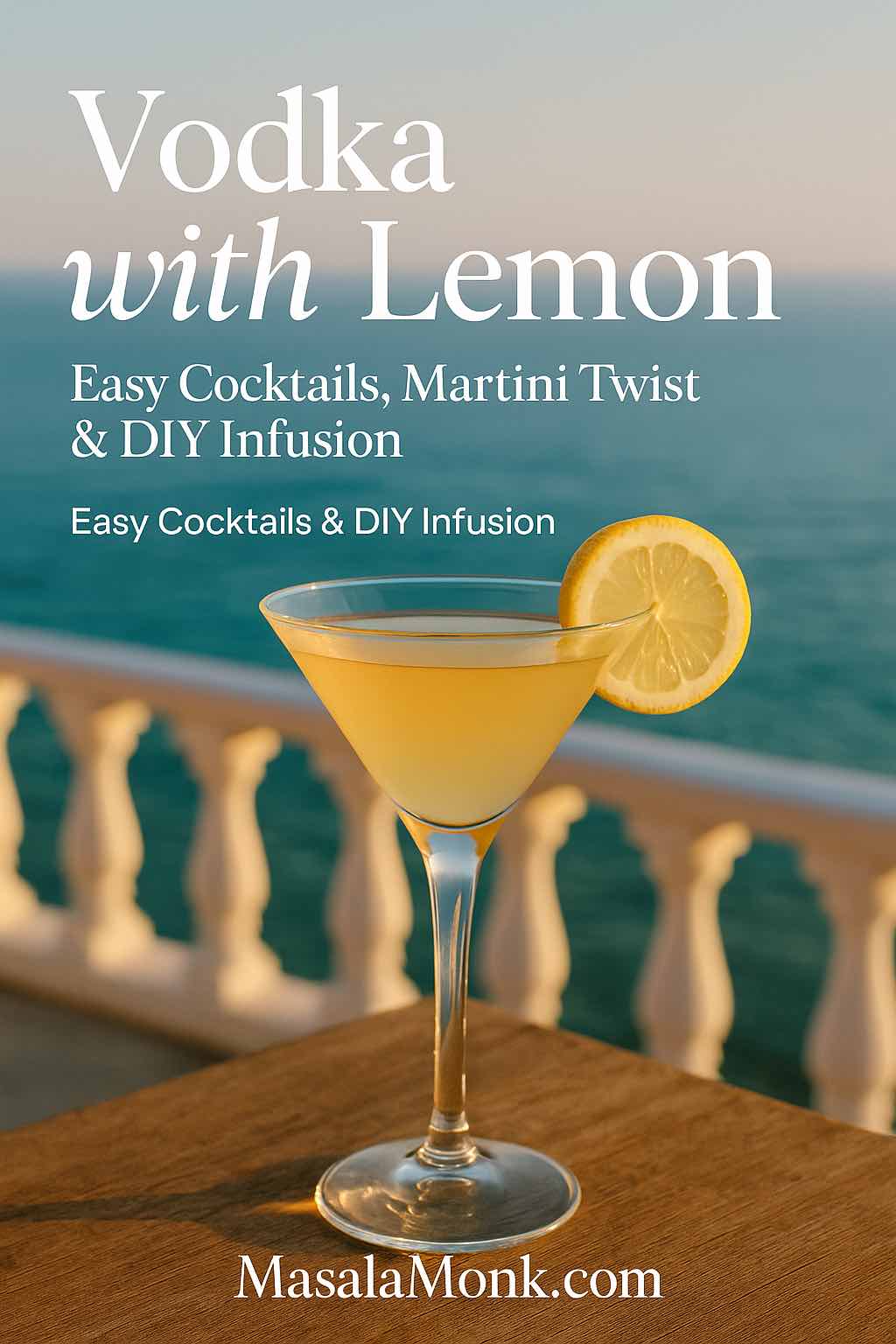
Vodka with Lemon — a chilled vodka martini with a lemon twist on a seaside balcony at golden hour; cover image for MasalaMonk’s guide to easy cocktails, French 76, limoncello martini, basil lemonade, lemon iced-tea highball, and DIY lemon-infused vodka.

Lemon brightens everything it touches. Vodka, by contrast, steps back and lets flavor lead. Put them together and you get drinks that are crisp, lively, and surprisingly adaptable. One moment it’s a tall, thirst-quenching vodka lemon highball; the next, it’s a flute of bubbles that tastes like celebration. Later, it might be a chilled vodka martini with a lemon twist—clean, perfumed, and impossibly simple. And because technique matters as much as recipes, you’ll also find batching math, ice strategy, saline tips, and a fast lemon-infused vodka you can keep on hand for instant brightness.

If someone at your table asks for a sugar-rim classic—whether it’s a lemon drop martini, a 3-ingredient lemon drop martini, a fruit spin like blueberry lemon drop martini, strawberry lemon drop martini, or raspberry lemon drop martini—send them straight to Lemon Drop Martini Recipe (Classic, 3-Ingredient & More) so this page can focus on everything else vodka + lemon does so well.


Why vodka with lemon works (and how to make it sing)

First, vodka’s neutrality is a feature, not a flaw. Because the base is clean, citrus can shine. Second, lemon offers three distinct tools you can mix and match: juice for tang and structure, peel (the twist) for perfume without extra acidity, and liqueur/infusions for roundness and length. Third, balance usually comes from small moves; therefore, start modestly sweet and nudge in 5 ml steps until flavor snaps into focus.

  • Fresh juice tastes brighter and finishes cleaner; squeeze to order whenever you can.
  • Twist = aroma delivery. Express oil from a broad strip over spirit-forward drinks—especially martinis—so citrus greets the nose first. If you like seeing it spelled out, skim the garnish note on the IBA Dry Martini page.
  • Liqueur/infusions such as limoncello or lemon/citron vodka add softness and length. Used thoughtfully, they deepen flavor without heaviness.

Meanwhile, a pinch of salt (or a few drops of saline) often fixes harshness faster than extra sugar. Likewise, chilled glassware slows dilution; large, solid ice keeps flavors vivid; and fresh soda preserves sparkle. Ultimately, a good lemon and vodka drink should taste bright, not sticky; refreshing, not thin.

Also Read: Daiquiri Recipe (Classic, Strawberry & Frozen Cocktails).


Pantry, tools, and two habits that change everything

You don’t need specialized gear. A jar with a tight lid (as a shaker), a long spoon, a strainer, and a measuring tool are plenty. Even so, two habits matter more than gadgets:

  1. Chill what you can. Cold ingredients make for cleaner, crisper drinks.
  2. Measure once, taste twice. Add syrup or lemon in 5 ml nudges; stop the instant balance appears. Consequently, you’ll repeat success effortlessly.

Keep a small bottle of 1:1 simple syrup in the fridge. Store lemons at room temperature to maximize juice; roll before squeezing; strain out pips. Have a few fresh herbs (basil, mint, thyme, rosemary) for aroma without weight.


The Vodka & Lemon Highball Template (fast, tall, and endlessly adjustable)

This is your weekday workhorse—sometimes called a vodka collins drink, sometimes just “vodka & lemon soda.” Either way, it’s the backbone of a thousand porch hours. For a fun structural rabbit hole later, peek at the Collins family overview.

One tall drink

  • 60 ml vodka
  • 30 ml fresh lemon juice
  • 10–15 ml simple syrup
  • Ice + cold soda water to top
  • Lemon wheel (garnish)
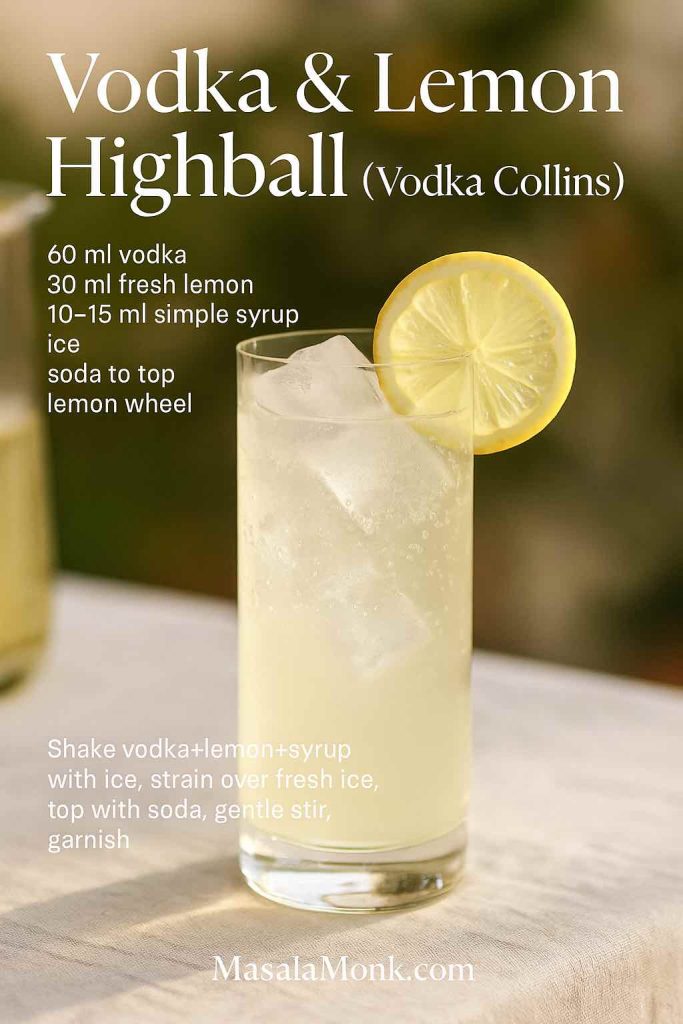
Vodka & Lemon Highball (Vodka Collins) in a tall glass with clear ice and a lemon wheel; concise ingredient list and method overlay; MasalaMonk recipe graphic.
For longer fizz, add soda last and stir just once. Start with 10 ml syrup if your lemons run sweet; if the sip feels harsh, 2–4 drops of saline smooth bitterness without extra sugar.

Method

  1. Chill a Collins or highball glass. Meanwhile, add vodka, lemon, and syrup to a shaker (or jar).
  2. Shake hard with ice for 8–10 seconds; strain into the cold glass packed with fresh ice.
  3. Top with soda; give one gentle turn with a barspoon.
  4. Garnish with a thin lemon wheel; optionally add a cherry for a classic look.

Taste checkpoints
Bright first sip, lively mid-palate, dry-ish finish.

Easy variations

  • Herbal: clap 4 basil leaves or 6 mint leaves; drop into the glass before topping.
  • Spicy: add 3 paper-thin ginger slices to the shaker.
  • Citrus-forward: swap half the vodka for limoncello for a softer edge.
  • Citron-style: use lemon-flavored/citron vodka in place of plain if that’s what you have.

Make-ahead
Combine vodka + lemon + syrup in a bottle; chill up to 6 hours. Subsequently, pour 90 ml base per glass and top with cold soda to serve. In short, you gain speed without losing fizz.

If you like a tidy reference spec for the baseline build, here’s Vodka Collins (Difford’s Guide).


French 76 (yes, the “French 75 with vodka”)

This sparkling classic—often looked up as vodka French 75—pairs lemon acidity with bubbles for a celebratory, buoyant sip. It’s the vodka sibling of the gin-based original; for a side-by-side read later, peek at French 76 and the classic French 75.

One flute

  • 45–60 ml vodka (use 45 ml for delicate bubbles, 60 ml for a bolder pour)
  • 22 ml fresh lemon juice
  • 10–15 ml simple syrup
  • Dry sparkling wine to top
  • Lemon twist or cherry
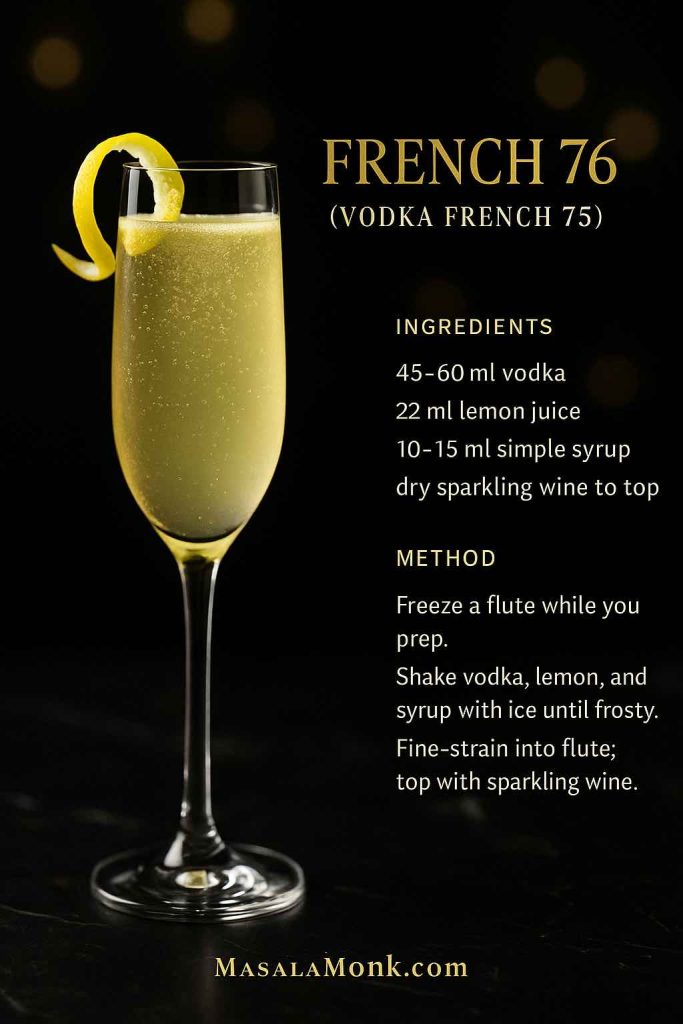
French 76—vodka French 75—in a chilled flute with a lemon twist and fine bubbles; ingredients and method shown on a black background; MasalaMonk cocktail graphic.
Pre-chill the still base (vodka + lemon + syrup) in a bottle and pour 60 ml per flute, then top with very cold sparkling wine at the table so the mousse stays lively.

Method

  1. Freeze a flute while you prep; also keep your bubbles very cold.
  2. Shake vodka, lemon, and syrup with hard ice until the shaker frosts.
  3. Fine-strain into the flute; top with sparkling wine gently so the mousse stays lively.
  4. Garnish with a tight twist; alternatively use a cherry for a vintage nod.

Dial-in guide

  • Sharper & drier: 10 ml syrup + extra-dry bubbles.
  • Softer & rounder: 15 ml syrup + a fraction more lemon.
  • Brunch pitcher: pre-mix the still base (vodka, lemon, syrup) in a swing-top, chill thoroughly, and pour 60 ml per glass before topping with bubbles at the table.

Also Read: Piña Colada: Classic Recipe + 10 Variations (Virgin & On the Rocks).


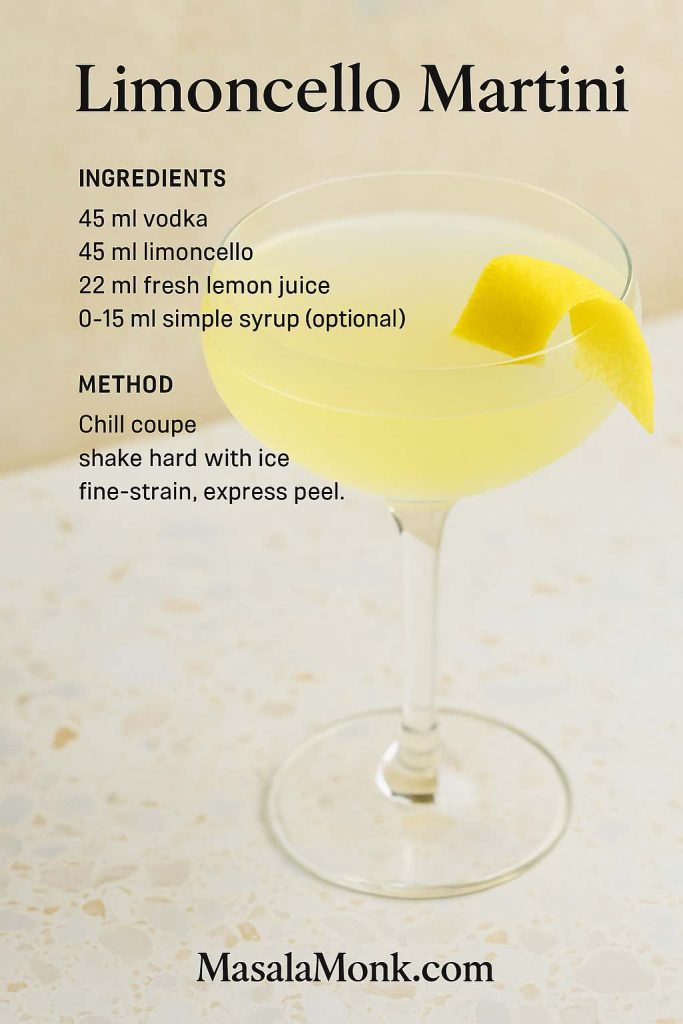
Limoncello Martini (silky, perfumed, balanced)

This isn’t a lemon drop; it’s a smoother, subtler cousin. Because limoncello brings softness while fresh lemon contributes lift, you get dessert-adjacent pleasure without a sugar rim. If you enjoy parallel home-kitchen guidance, skim Limoncello Martini (The Kitchn) afterward.

One coupe

  • 45 ml vodka
  • 45 ml limoncello
  • 22 ml fresh lemon juice
  • 0–15 ml simple syrup, to taste (often unnecessary)
  • Broad lemon peel
Limoncello Martini in a frosted coupe with a lemon peel; clear ingredient list and method overlay; MasalaMonk cocktail graphic.
If your limoncello is already sweet, skip extra syrup. For a silkier texture, shake hard with large ice and double-strain; in winter, try Meyer lemon for a softer, floral edge.

Method

  1. Chill a coupe until frosty.
  2. Shake vodka, limoncello, and lemon hard with plenty of ice; fine-strain.
  3. Express a broad peel over the surface; drop or discard.

Adjustments

  • If the limoncello is sweet, skip the syrup.
  • If the lemon is punchy, add 5 ml syrup and shake again.
  • If the drink feels sleepy, increase lemon by 5 ml or split the base (40 ml vodka / 50 ml limoncello) for extra perfume.

Also Read: Punch with Pineapple Juice: Guide & 9 Party-Perfect Recipes.


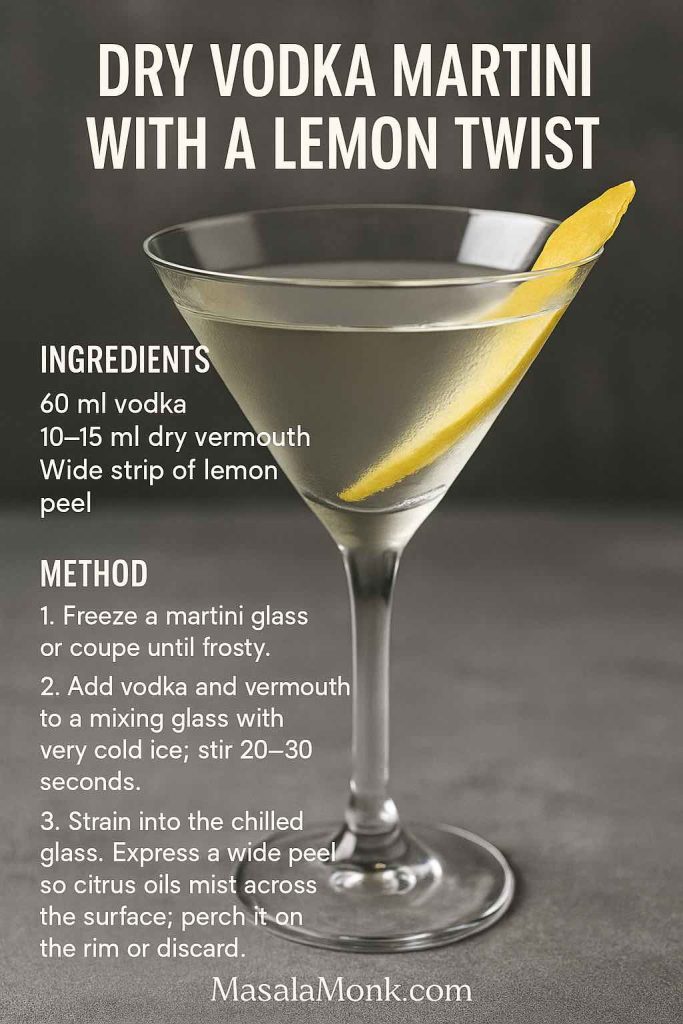
Dry Vodka Martini with a Lemon Twist (minimalism done right)

Sometimes all you want is purity: spirit, a measured hint of vermouth, and the aroma of fresh lemon oil. The classic garnish technique—expressing oil from the peel—is captured neatly on the IBA Dry Martini page.

One martini

  • 60 ml vodka
  • 10–15 ml dry vermouth
  • Wide strip of lemon peel
Dry vodka martini served in a chilled coupe with a wide lemon twist; minimal recipe text; MasalaMonk cocktail graphic.
For a cleaner, colder martini, chill the bottle of vermouth too. Aim for a 4:1 or 6:1 vodka-to-vermouth ratio, then express a fresh peel over the glass so the oils land on the surface rather than the rim.

Method

  1. Freeze a martini glass or coupe until frosty.
  2. Add vodka and vermouth to a mixing glass with very cold ice; stir 20–30 seconds.
  3. Strain into the chilled glass.
  4. Express a wide peel so citrus oils mist across the surface; perch it on the rim or discard.

Tuning

  • Extra-dry: 5 ml vermouth or a quick glass rinse.
  • Silkier: stir a few seconds longer for a colder, slightly wetter texture.
  • Sharper nose: twist a fresh piece of peel right before the first sip.

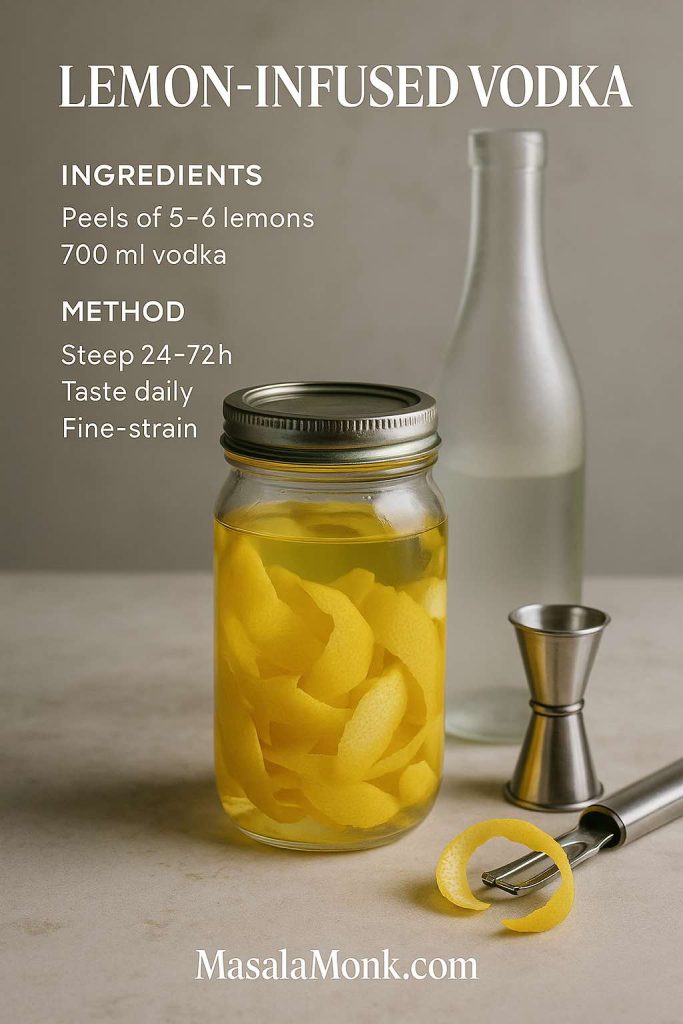
Lemon-Infused Vodka (24–72 hours, bright not bitter)

Ready-made lemon vodkas exist—lemon-flavored vodka, citrus vodka, citron vodka, and so on. Nevertheless, a quick homemade lemon infusion tastes fresher and lets you control intensity. Plus, it’s the easiest way to make a weeknight lemon vodka drink feel special. To avoid common pitfalls like bitterness or over-extraction, two useful reads later are Common infusion mistakes and How to infuse vodka.

Yields ~700 ml | Active time 10 minutes | Steep 24–72 hours

You’ll need

  • 5–6 wax-free lemons, well washed
  • 700 ml neutral vodka (40% ABV)
  • Peeler, clean jar, fine strainer (coffee filter optional)
Jar of lemon peels steeping in vodka to make lemon-infused vodka; bottle, jigger, and channel knife on a counter; text notes steep 24–72 hours and fine-strain.
Zest only the yellow skin to avoid bitterness, then taste at 24, 36, and 48 hours; stop as soon as the aroma turns vivid. Filter through a coffee filter for crystal clarity and store chilled—ideal for a quick lemon vodka & soda or a five-minute martini.

Method

  1. Zest only: peel just the yellow skin; avoid white pith or bitterness will creep in.
  2. Combine: put zest in the jar; cover fully with vodka; seal.
  3. Infuse: store cool and dark; taste at 24, 36, 48 hours; stop anywhere up to 72 hours when it’s vivid but not perfumey.
  4. Finish: fine-strain; optionally filter once through a coffee filter for clarity; bottle; chill.

Three instant serves

  • Lemon Vodka & Soda: 60 ml infused vodka over ice, top with soda, squeeze a lemon wedge.
  • Zesty Collins: 45 ml infused vodka + 20 ml lemon + 10 ml simple; shake; strain; top with soda.
  • Five-Minute Martini: 60 ml infused vodka stirred on ice; strain; finish with a tiny twist.

Cordial path
Stir in simple syrup to taste and label it “lemon vodka cordial.” Then pour over ice, top with soda, or fold into a quick lemon vodka martini whenever you like.

Fixes

  • Bitter: pith sneaked in or you steeped too long—dilute with plain vodka and filter again.
  • Perfumey: stop immediately; use smaller pours.
  • Cloudy: coffee-filter; store cold; haze usually settles.

Also Read: What to Mix with Jim Beam: Best Mixers & Easy Cocktails.


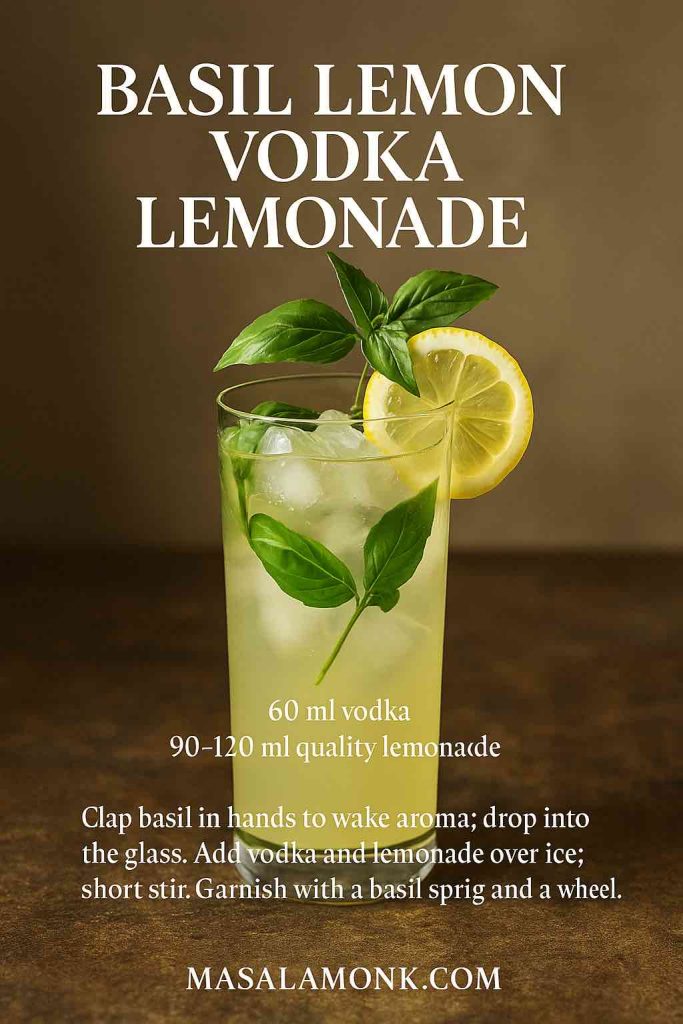
Basil Lemon Vodka Lemonade (single-serve & pitcher)

Easy, fragrant, and tailor-made for porch weather.

One tall glass

  • 60 ml vodka
  • 90–120 ml quality lemonade
  • 4–6 basil leaves (plus a sprig for garnish)
  • Ice, lemon wheel
Basil Lemon Vodka Lemonade in a tall glass with clear ice, basil sprig, and lemon wheel; recipe overlay; MasalaMonk graphic.
Use tender basil tops (not woody stems) for sweeter aroma. If your lemonade is store-bought, start with less syrup elsewhere in the menu—boxed varieties skew sweeter than fresh-squeezed.

Method

  1. Clap basil in your hands to wake aroma; drop into the glass.
  2. Add vodka and lemonade over ice; short stir.
  3. Garnish with a basil sprig and a wheel.

Pitcher (serves 8)

  • 480 ml vodka
  • 1 L lemonade
  • A generous handful of basil, lightly bruised
  • Ice or a large block

Combine in a jug, stir gently, and serve. If your lemonade leans bitter, let the basil sit only ten minutes; strain it out so the flavor stays clean rather than herbal-bitter.

Riffs
Cucumber slices for spa-day coolness; strawberries for color and perfume (reduce sweetness elsewhere); a soda top if the lemonade is heavy. If the crowd likes fruit-first spins, they’ll also enjoy Mango Vodka Cocktail Drinks (base + 7 variations) next.


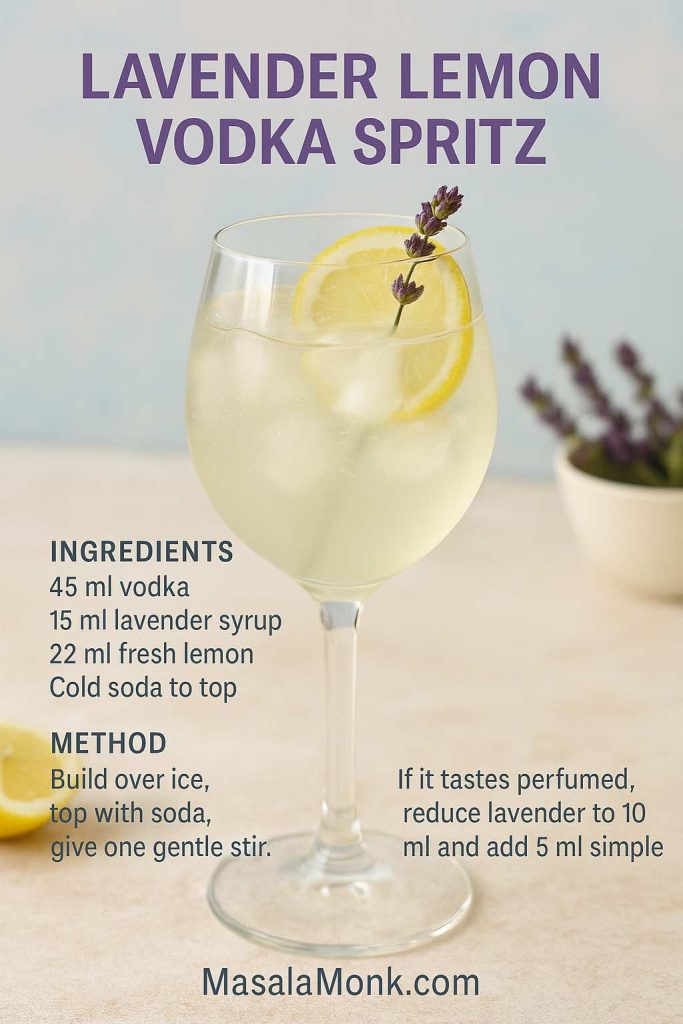
Lavender Lemon Vodka Spritz (light, floral, effortless)

Delicate and brunch-friendly, this reads like a citrusy breeze. Lavender is potent; go easy.

One wine glass

  • 45 ml vodka
  • 15 ml lavender syrup
  • 22 ml fresh lemon
  • Cold soda to top
  • Lemon wheel, tiny lavender sprig
Lavender Lemon Vodka Spritz in a stemmed wine glass with lemon wheel and lavender bud; ingredient and method text; MasalaMonk graphic.
Make a quick 1:1 lavender syrup: steep food-grade buds in hot simple for 10–12 minutes, strain, and cool. Keep the pour light—floral notes can dominate if the glass warms.

Method
Build over ice; top with soda; give one gentle stir. If it tastes perfumed, reduce lavender to 10 ml and add 5 ml simple to maintain balance. If it tastes sharp, increase lavender by 5 ml or simply top with a bigger soda splash.

Zero-proof lane
Omit vodka, double the soda, and keep the lemon + lavender. The glass still smells fantastic, and the sip stays bright.

Also Read: Whiskey and Warmth: 5 Cinnamon-Spiced Iced Tea Cocktails to Get You through Wednesday


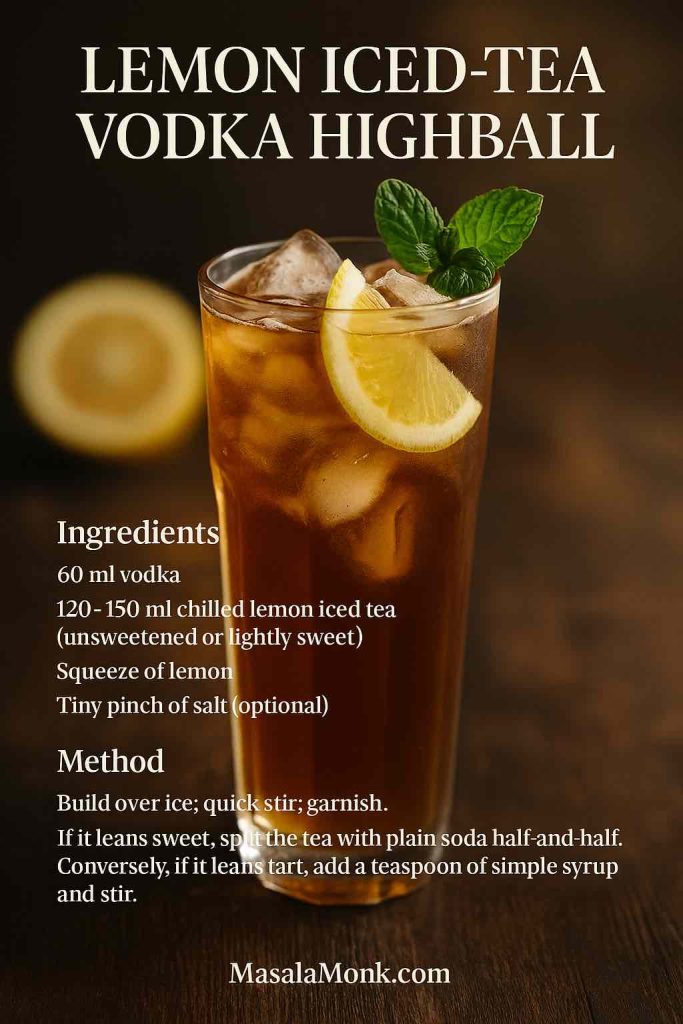
Lemon Iced-Tea Vodka Highball (cool, calm, porch-ready)

This is iced tea with manners. Because you choose the tea’s sweetness, you choose the drink’s vibe.

One tall glass

  • 60 ml vodka
  • 120–150 ml chilled lemon iced tea (unsweetened or lightly sweet)
  • Squeeze of lemon
  • Tiny pinch of salt (optional)
  • Lemon wedge, mint sprig
Lemon Iced-Tea Vodka Highball with mint sprig and lemon wedge over ice; detailed ingredient/method overlay; MasalaMonk graphic.
Cold-brew your tea (6–8 hours in the fridge) for cleaner tannins and less bitterness. A tiny pinch of salt tightens the finish; if sweetness builds, split the tea with soda for extra lift.

Method
Build over ice; quick stir; garnish. If it leans sweet, split the tea with plain soda half-and-half. Conversely, if it leans tart, add a teaspoon of simple syrup and stir. For similar “fresh and light” energy, browse Coconut Water Cocktails.

Pitcher

  • 480 ml vodka + 1 L iced tea in a large jug over plenty of ice; guests tune tartness with wedges at the table.

Also Read: Electrolyte Drinks for Hangovers: 5 Easy DIY Recipes to Rehydrate Fast.


Balance & Dilution (the quiet secrets behind great lemon drinks)

Because lemon pushes acidity, small moves matter. Think in 5 ml increments for syrup and lemon. Aim for cold at every step—spirits, glass, and soda—to manage dilution without losing liveliness.

  • Sugar vs. acid: if a sip stings, add 5 ml syrup; if it drags, add 5 ml lemon.
  • Salt vs. bitterness: a tiny pinch (or 2–4 drops of 10% saline) smooths harsh notes without making the drink taste salty.

  • Ice: large, clear cubes melt slower; crushed ice is ideal for smashes but expect faster dilution.
  • Glass choice: tall for highballs (keeps bubbles lively), stemmed for spritzes (captures aroma), chilled coupes for martinis (keeps texture silky).
  • Soda timing: pour carbonated things last, then stir once—no more.

Crowd-Pleasing Pitchers (because friends actually show up)

Batches should feel fresh, not flat. Mix the base early, keep it cold, and add bubbly things at the last second.

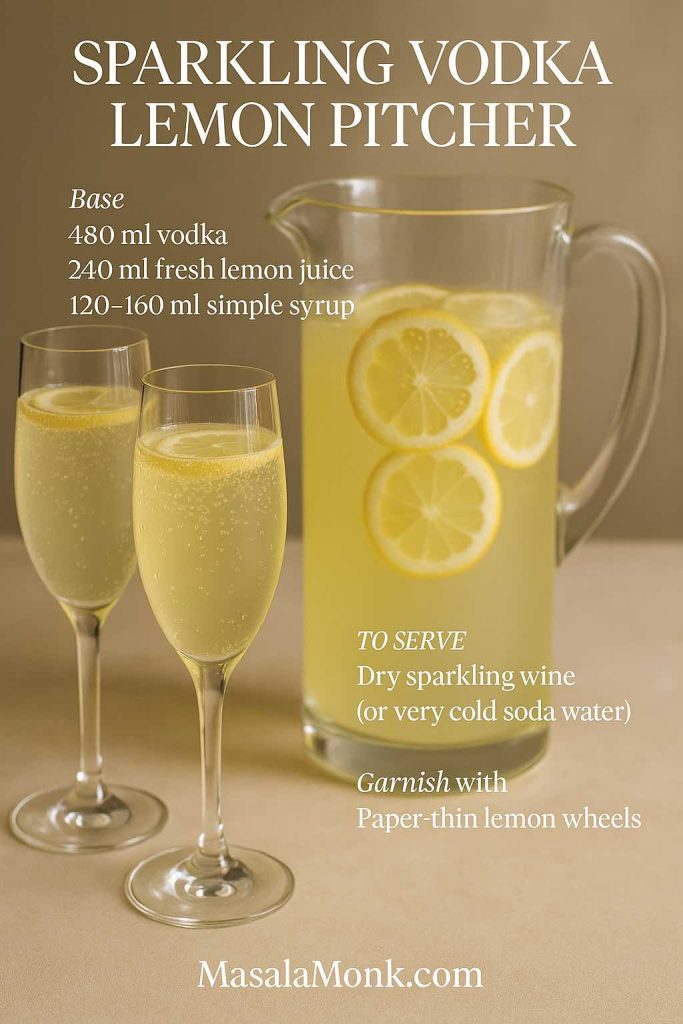
Sparkling Vodka Lemon Pitcher (serves 8)

Base

  • 480 ml vodka
  • 240 ml fresh lemon juice
  • 120–160 ml simple syrup (start at 120; adjust to taste)

To serve

  • Dry sparkling wine (or very cold soda water)

  • Paper-thin lemon wheels
Pitcher of vodka–lemon base with floating lemon wheels beside two champagne flutes; instructions indicate topping with dry sparkling wine or cold soda.
Keep the base in the fridge and pour 60 ml into each flute, then add bubbles at the table so the mousse stays lively. Use a large ice block in the jug to slow dilution; for a lighter crowd option, top with very cold soda instead of sparkling wine.

Method

  1. Chill a 1.5–2 L jug and your bubbles.
  2. Stir the base; refrigerate at least 1 hour.
  3. Add ice to flutes or wine glasses; measure 60 ml base per glass; top with bubbles.
  4. Garnish with lemon wheels.

Why it works
Bubbles carry aroma and emphasize brightness; therefore, you can sweeten modestly and still feel rounded. For serving style cues and historical notes, compare French 76 and French 75.


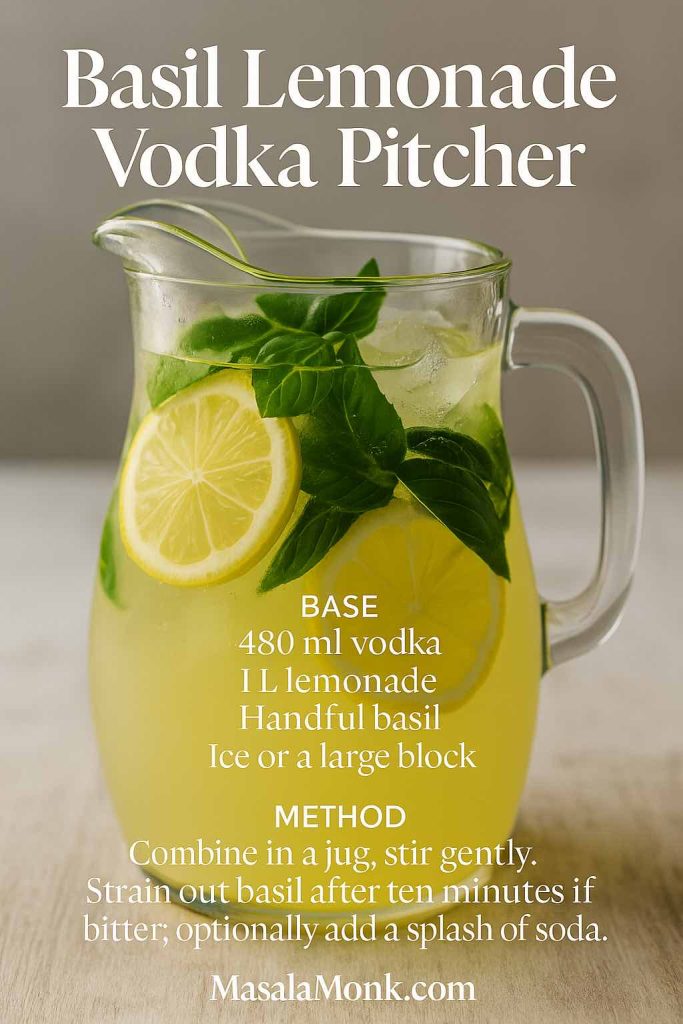
Basil Lemonade Vodka Pitcher (serves 8–10)

Base

  • 480 ml vodka
  • 1 L quality lemonade
  • 1 generous handful basil, lightly bruised
Basil Lemonade Vodka Pitcher filled with lemon wheels, fresh basil, ice, and a chilled yellow lemonade base; close-up glass jug on a light table; MasalaMonk recipe graphic.
For the freshest aroma, use tender basil tops and a large clear ice block. Scale at 60 ml vodka + 125 ml lemonade per serve; then fine-tune with 5 ml syrup or 2–4 drops saline. Make the base 2 hours ahead, chill, and add basil right before pouring so the color stays bright.

Method
Combine in a large jug over a big block of ice. Clap basil between your hands and drop it in. Stir gently. Serve tall; optionally top individual glasses with a splash of soda for extra lift.

Riffs

  • Cucumber slices for spa freshness.
  • Quartered strawberries for aroma and color (reduce sweetness elsewhere if your lemonade is sugary).
  • Mint instead of basil when you want a cooler finish.

Another bright detour
When you want a non-alcoholic base your guests can spike per glass, Mango Lemonade is a crowd favorite.


Small details that make lemon shine

  • Squeeze to order: lemon dulls as it rests; fresh wins.
  • Use large, clear ice when possible: slower melt, steadier flavor.
  • Lead with aroma: express lemon oil over spirit-forward drinks so your nose gets citrus first.
  • Season gently: a tiny pinch of salt often balances faster than extra sugar.
  • Garnish intentionally: slim wheels look neat in tall glasses; broad peels make martinis sing.

Also Read: Top 12 Hangover Remedies from Around the World.


Regional and dietary notes

  • If lemons are small or extra tart: start 5 ml lower on lemon, then nudge up.
  • If keeping soda cold is tricky: freeze glasses, use big cubes, and pour soda last—immediately before serving.
  • If you prefer fewer calories: favor soda-topped builds, lighten syrup, and rely on herbs for aroma.
  • If you avoid honey: in the honey-lemon variations, swap agave 1:1 and retaste.
  • If you want zero-proof options: replace vodka with soda, keep lemon and syrup, and garnish generously so the glass still feels special.

Troubleshooting without panic

  • Too sour? Add 5 ml syrup, stir, retaste.
  • Too sweet? Add 5–10 ml lemon and a small splash of soda.
  • Too watery? Your glass or ice was warm—chill glassware and use fresh, solid cubes next time.
  • Too bitter? Pith sneaked in or infusion went long; add a pinch of salt and a small soda top.
  • Too flat? Always use freshly opened, very cold soda or bubbles and pour them last.

Keep exploring

If this page becomes your weeknight playbook, bookmark it. When somebody asks for the sugar-rim icon (including fruit, pink, lavender, frozen, or “skinny” spins), jump to Lemon Drop Martini Recipe (Classic, 3-Ingredient & More). If the table wants more fruit-first long drinks afterward, wander through Mango Vodka Cocktail Drinks and Coconut Water Cocktails. And for garnish craft, skim the lemon-oil note inside the IBA Dry Martini entry; it’s tiny, yet it changes every martini you’ll ever make.

FAQs

1) What’s the simplest way to make vodka with lemon at home?

Start with the Collins template: 60 ml vodka, 30 ml fresh lemon juice, and 10–15 ml simple syrup; then top with cold soda. Consequently, you’ll get a bright, balanced lemon vodka drink without fuss. Moreover, you can swap plain vodka for a citrus vodka or lemon infused vodka if you want extra aroma.

2) How do I balance sourness and sweetness in a vodka & lemon cocktail?

Begin modestly sweet, taste, and adjust in 5 ml nudges. If it’s too sharp, add a little syrup; alternatively, if it feels dull, add a small squeeze of lemon. Furthermore, a tiny pinch of salt can soften bitterness—therefore, reach for salt before adding more sugar.

3) Which vodka style works best for a lemon-forward drink?

Neutral, clean vodkas let citrus shine; however, if you prefer a rounder profile, try citron vodka or other lemon flavored vodka. Additionally, for a perfumed, dessert-leaning direction, limoncello (see limoncello martini) adds silky citrus depth.

4) What exactly is a Vodka Collins drink?

It’s the vodka version of a Collins: spirit + lemon + sugar + soda. As a result, you’ll get a tall, refreshing vodka lemon highball that’s easy to tune. Meanwhile, herbs like basil or mint slip in beautifully without weighing the drink down.

5) How is a French 76 different from a French 75 with vodka?

Strictly speaking, the French 76 is the recognized “vodka French 75.” The original French 75 uses gin; the 76 swaps in vodka. Consequently, the lemon reads cleaner, while the bubbles stay central. For brunch, pre-mix the still base and, afterward, top with sparkling wine to keep the mousse lively.

6) Can I make a vodka martini with a lemon twist instead of olives?

Absolutely. In fact, a vodka martini with a twist (i.e., lemon) emphasizes aroma rather than brine. Stir 60 ml vodka with 10–15 ml dry vermouth until very cold; then strain and express lemon oil across the surface. Notably, that quick twist transforms the first sip.

7) What’s the difference between a lemon drop martini and a lemon vodka martini?

A lemon drop martini is sweet-tart and often sugar-rimmed; a lemon vodka martini (with or without limoncello) can be drier, silkier, and more spirit-forward. Moreover, while the lemon drop leans toward dessert, the drier martini reads elegant and aperitif-like.

8) Is a 3-ingredient lemon drop martini actually worth making?

Yes—vodka, lemon juice, and simple syrup are enough. However, many bartenders optionally add orange liqueur for complexity. Even so, the three-ingredient build ranks because it’s fast, consistent, and—most importantly—bright. If you want stronger lemon character, use lemon drop martini with vodka plus a lemon twist.

9) Can I use limoncello in a lemon drop or should I make a limoncello martini instead?

You can go either way. On one hand, lemon drop martini limoncello riffs add plushness to the classic. On the other, a dedicated limoncello martini (vodka + limoncello + lemon) feels round and elegant without needing a sugar rim. Ultimately, choose based on how sweet you want the finish.

10) What fruits pair best with vodka and lemon?

Berries love lemon. Consequently, blueberry lemon vodka drink, strawberry lemon vodka, and raspberry variations all sing. Additionally, cucumber offers spa-like freshness, while ginger adds zip. Therefore, experiment by muddling a few slices or berries; then adjust sweetness down by 5 ml if the fruit is already sweet.

11) How do I make lemon infused vodka without bitterness?

Peel only the yellow zest—avoid white pith—then steep 24–72 hours, tasting daily. Furthermore, store the jar in a cool, dark place and stop when the aroma turns vivid but not perfumey. Finally, fine-strain (and, if needed, coffee-filter) for a clear, bright lemon infused vodka ready for spritzes, Collins builds, or a five-minute martini.

12) Which is “better” for lemon drinks: plain vodka or citron vodka (e.g., Absolut Citron)?

It depends. Plain vodka gives you a blank canvas; citron vodka (including absolut citron–style profiles) offers built-in citrus perfume. Consequently, for a quick lemon drop vodka drink, citron provides extra pop; meanwhile, for a clean vodka martini with lemon twist, many prefer plain vodka so the fresh peel leads.

13) How do I keep a pitcher of vodka with lemon from going flat?

Mix only the still base—vodka, lemon juice, and sweetener—then chill hard. Subsequently, add soda or sparkling wine in each glass, not in the jug. As a result, you preserve fizz. Additionally, keep the pitcher on a large ice block so dilution stays controlled through the party.

14) What’s the easiest “skinny” path for vodka and lemon?

Go tall, go sparkling, and keep syrup minimal. For instance, build a Collins with 60 ml vodka, 30 ml lemon, 5–10 ml syrup, and lots of soda. Moreover, garnish with an aromatic twist so it feels generous even with fewer calories.

15) Can I swap lime for lemon in these recipes?

Certainly; nevertheless, expect a different personality. Lime reads sharper and slightly bitter-pithy; lemon feels sunnier and more linear. Therefore, if you swap, adjust syrup by 5 ml and taste again. Meanwhile, a lemon twist on a lime build is a fun mixed-citrus surprise.

16) What’s the trick to the perfect lemon twist for a martini?

Cut a broad strip with minimal pith; then, right over the glass, pinch the peel so oils spray the surface. Next, swipe the rim lightly with the peel; finally, drop it in or discard. Consequently, the first sip smells like fresh citrus—essential for a dry vodka martini with a twist.

17) How do I batch a French 75 with vodka (French 76) for a crowd?

Whisk together the still base (vodka + lemon + syrup) and chill for an hour. Afterward, pour 60 ml base into each flute; then top with very cold sparkling wine. Notably, adding bubbles glass-by-glass keeps the mousse lively, whereas sparkling in the jug goes flat quickly.

18) What’s the best ice strategy for vodka lemon cocktails?

Use fresh, solid cubes for shaking and serving. Additionally, chill glassware to slow melt; consequently, flavors stay bright. For smashes, crushed ice is welcome, although you’ll need slightly bolder seasoning since dilution rises quickly.

19) Do herb add-ins (basil, mint, rosemary, thyme) actually help?

Yes—subtly. Basil and mint make highballs feel garden-fresh; rosemary and thyme suit spirit-forward builds when used lightly. Nevertheless, over-muddling turns herbs grassy. Thus, clap or lightly press, don’t pulverize.

20) When should I choose a lemon vodka martini over a lemon drop martini?

If you want silky, clean, and aperitif-leaning, go lemon vodka martini (with or without limoncello). Conversely, if you want sweet-tart and playful, choose a lemon drop martini. Meanwhile, for quick service, a simple lemon drop martini—or even a 3 ingredient lemon drop martini—delivers that familiar flavor with minimal steps.

21) Any fast fixes if my cocktail tastes off?

Of course. Too sour—add 5 ml syrup, if its too sweet—add 5–10 ml lemon and a splash of soda. If you feel its too mcuh on bitter side—add a pinch of salt and retaste and if it is too flat—use freshly opened, very cold soda or bubbles and stir only once. Consequently, you’ll correct balance without rebuilding the drink.

22) What about flavored seltzers, canned mixers, or “vodka lemon can” shortcuts?

They’re convenient; nevertheless, sweetness levels vary widely. Therefore, build your first glass with less syrup (or none), taste, and only then adjust. Additionally, a fresh lemon squeeze and a real twist instantly upgrade any premade base.

23) Which cocktails here are best for beginners?

Start with the Vodka Collins (for precision and speed), the French 76 (for festive sparkle), the limoncello martini (for silky comfort), and the lemon infused vodka soda (for maximum aroma with minimal effort). Afterwards, branch into herb or berry riffs as you like.

24) Can “lemon vodka and sprite” work in a pinch?

Sure—though it’s sweeter and less nuanced. Consequently, add a squeeze of lemon and, optionally, a pinch of salt to sharpen the profile. Alternatively, split the Sprite with soda for a drier, more refreshing finish.

25) Any final tips to keep vodka with lemon tasting professional at home?

Yes: chill glassware, measure accurately, squeeze citrus fresh, use larger ice, add fizz last, and finish with a confident lemon twist. Moreover, keep a tiny bottle of saline (10%) for micro-seasoning; a couple of drops can quietly turn “good” into “wow.”

Posted on — 10 Comments

Daiquiri Recipe (Classic, Strawberry & Frozen Cocktails)

Daiquiri recipe cover — classic, strawberry and frozen variations shown as a golden daiquiri in a coupe with lime, black backdrop — MasalaMonk

Sometimes a cocktail feels like a small holiday. The Daiquiri is exactly that—bright, chilled, and direct. It began in Cuba as a simple mix of rum, lime, and sugar; yet, over time, it grew into a family of drinks that includes fruity crowd-pleasers and dry, elegant riffs. In this guide, you’ll first master the classic Daiquiri Recipe that bartenders rely on. Then, you’ll ease into a Strawberry Daiquiri Recipe—first on the rocks, then frozen for that beach-bar feel. After that, you’ll explore banana, mango, pineapple, and the grapefruit-and-maraschino-kissed Hemingway version. Throughout, you’ll learn how to balance sweetness and acidity, how to tune texture, and how to fix the most common mistakes—so your next round tastes exactly the way you imagined.

Because precision leads to confidence, we’ll work in milliliters and clear steps. Because context helps, you can also check the International Bartenders Association’s Daiquiri for a classic benchmark: International Bartenders Association’s Daiquiri. And because technique matters, this practical deep dive from Serious Eats is a smart companion: Serious Eats: Daiquiri.


Before You Mix: Ingredients, Tools, and Ratios

First, choose a clean, unflavored white rum at 40–45% ABV; column-still Caribbean styles are ideal because they’re crisp and let lime shine. Next, insist on fresh lime juice; bottled juice dulls the aroma and throws off acidity. Then, make simple syrup (1:1 sugar to water by volume) or a rich syrup (2:1) if you prefer extra body—Difford’s explains that richer syrup changes mouthfeel and dilution: Difford’s Guide: Daiquiri.

For tools, you’ll want a shaker, strainer (and ideally a fine strainer), jigger, and a chilled coupe or rocks glass. As for ratios, start with 4:2:1 (rum:lime:syrup) when you like it drier, 4:2:1.5 when you want a balanced home style, and 4:2:2 when you’re blending frozen where cold mutes sweetness.


Daiquiri Recipe (Classic, 2 Servings)

What you’ll taste: Clean rum character, bright lime, and a gentle, polished sweetness. Because there’s nowhere to hide, balance is everything.

Ingredients

  • 120 ml white rum (40–45% ABV)
  • 60 ml fresh lime juice (about 2 limes)
  • 30–45 ml simple syrup (1:1), to taste
  • Plenty of ice
  • Lime wheel, to garnish
Classic Daiquiri in a chilled coupe with lime wheel on a dark backdrop; recipe card overlay listing ingredients and shake–fine-strain method.
For a bar-quality finish, chill the coupe, shake 12–15 seconds, then fine-strain for that glossy top; start drier at 4:2:1 (rum:lime:syrup) and adjust ±7.5–15 ml to taste—use fresh lime only, and switch to rich (2:1) syrup if the texture feels thin.

Method, step by step

  1. First, chill two coupe glasses. Cold glassware keeps texture tight.
  2. Next, add rum, lime, and 30 ml syrup to a shaker; then fill with ice.
  3. Now shake hard for 12–15 seconds until the tin frosts; vigorous shaking aerates and integrates.
  4. After that, fine-strain into the chilled coupes; fine-straining removes shards and makes the surface glossy.
  5. Finally, garnish with a lime wheel. Taste; if you prefer softer acidity, increase the syrup to 45 ml next round.

Why it works (briefly): Rum brings warmth; lime delivers snap; syrup knits them together. If you want an alternative spec with a light caramel edge, try demerara syrup as shown here: Liquor.com: Classic Daiquiri.

Common fixes: If it’s too sour, add 7.5–15 ml syrup and shake again for 5 seconds. If it’s too sweet, add 7.5–15 ml lime and shake briefly. If it feels thin, use rich (2:1) syrup next time and ensure the glass is properly chilled.

Do read: What to Mix with Jim Beam: Best Mixers & Easy Cocktails.


Strawberry Daiquiri Recipe (On the Rocks)

What you’ll taste: Fresh strawberry aroma first, then lime brightness, then a clean rum finish. Because strawberries vary, you’ll tune sweetness gently.

Ingredients

  • 120 ml white rum
  • 60 ml fresh lime juice
  • 30–45 ml simple syrup (1:1)
  • 6–8 ripe strawberries, hulled
  • Ice
Strawberry Daiquiri on pebble ice with strawberry and lime; recipe card overlay with ingredients and muddle–shake–fine-strain steps.
Muddle berries with syrup, then fine-strain over pebble ice so you taste fruit—not seeds; keep lime bright, and tune sweetness in 5 ml steps based on ripeness (vodka swap 1:1 for a cleaner profile; with spiced rum, reduce syrup slightly; a pinch of salt makes strawberry pop).

Method, step by step

  1. First, in a shaker, muddle strawberries with the syrup until they’re juicy and fragrant.
  2. Next, add rum and lime; then pack the shaker with ice.
  3. Now shake briskly for 10–12 seconds.
  4. After that, fine-strain over fresh ice in a rocks glass; this keeps seeds and pulp out while preserving color.
  5. Finally, garnish with a strawberry and lime wedge.

Flavor notes & smart swaps:

  • If your berries are under-ripe, increase syrup slightly; if they’re super sweet, bump the lime.
  • For a Strawberry Daiquiri with vodka, swap rum 1:1 for a cleaner, more neutral base.
  • For a Spiced Rum Strawberry Daiquiri, keep syrup modest; spices add perceived sweetness.

If you’d rather blend than shake, this is a reliable baseline for blender structure: Liquor.com: Strawberry Daiquiri.


Frozen Strawberry Daiquiri (Thick, Slushy, Crowd-Pleaser)

What you’ll taste: Cold, lush strawberry with lively lime; thicker body; a touch more sweetness to counter the deep chill.

Ingredients

  • 120 ml white rum (or coconut rum for a Malibu-style vibe)
  • 60 ml fresh lime juice
  • 45–60 ml simple syrup (frozen fruit is less sweet)
  • 2 cups frozen strawberries
  • 1–1½ cups ice, as needed
Frozen Strawberry Daiquiri recipe card with red slush in a hurricane glass; overlay lists 120 ml white or coconut rum, 60 ml lime, 45–60 ml syrup, 2 cups frozen strawberries, 1–1½ cups ice, and blend-low-to-high method — MasalaMonk.
Frozen Strawberry Daiquiri: blend low → high for a thick, silky slush; since cold dulls flavor, add 10–15 ml syrup (and a squeeze of lime) if it tastes flat—use coconut rum for a Malibu vibe or a clean white rum to keep strawberry forward.

Method, step by step

  1. First, add everything to a blender.
  2. Next, start on low to break up the ice; then increase speed until thick but pourable.
  3. Now taste. If it’s too tart, add 10–15 ml syrup; if it’s too thick, add a splash of rum or cold water.
  4. Finally, pour into a chilled hurricane or stemmed glass and garnish.

Why frozen needs tweaking: Because cold suppresses sweetness and aroma, frozen builds need slightly more syrup and more lime. For an excellent explanation of this balancing act, see: Serious Eats: The Best Frozen Strawberry Daiquiri. Alternatively, this stylish approach keeps dilution in check by leaning on frozen berries over ice: Bon Appétit: Strawberry Daiquiri.

Brand-friendly variants:

  • Malibu Strawberry Daiquiri: coconut rum adds dessert-tropical notes; therefore, keep lime bright.
  • Bacardi Strawberry Daiquiri: a clean white rum keeps fruit forward; avoid oversweetening.
  • Best strawberry daiquiri mix (when using premix): taste first; then add lime and, if necessary, a splash of water to restore balance.

Banana Daiquiri Recipe (Creamy & Fragrant)

What you’ll taste: Ripe banana creaminess with lime lift; silky, almost dessert-like, yet still refreshing.

Ingredients

  • 120 ml white or lightly aged rum
  • 60 ml fresh lime juice
  • 30–45 ml simple syrup
  • 1 very ripe banana (120–140 g), sliced
  • Optional: 15 ml banana liqueur for extra depth
  • About 1 cup ice
Banana Daiquiri recipe card with creamy blended cocktail in a coupe; overlay shows 120 ml rum, 60 ml lime, 30–45 ml syrup, 1 ripe banana, optional 15 ml banana liqueur, and blend-until-smooth method with nutmeg garnish — MasalaMonk
Banana Daiquiri: ultra-smooth and dessert-light—ripe fruit adds body, while a fresh lime bump keeps it lively; a whisper of nutmeg finishes it.

Method
Blend until absolutely smooth; then pour into a chilled coupe or hurricane glass. A light grate of nutmeg adds warmth without heaviness. If it leans sweet, add an extra squeeze of lime and blend briefly.


Mango Daiquiri (Sunny & Lush Recipe)

What you’ll taste: Dense mango richness, lifted by lime; a tiny pinch of salt makes the fruit pop.

Ingredients

  • 120 ml white rum
  • 75–90 g mango flesh (fresh or frozen)
  • 60 ml fresh lime juice
  • 30–45 ml simple syrup
  • About 1 cup ice
  • Pinch of salt (optional but recommended)
Mango Daiquiri recipe card in a chilled coupe; sunny yellow drink with lime, overlay lists rum, mango, lime, simple syrup, ice, and a pinch-of-salt tip — MasalaMonk
Mango Daiquiri: lush and sunny—blend until thick, then brighten with a squeeze of lime; a tiny pinch of salt makes mango pop without extra sugar.

Method
Blend to a thick, spoon-coating texture. Taste; if mango is very sweet, increase lime 5–10 ml. Because mango is dense, a pinch of salt sharpens definition.

Also Explore: Mango Vodka Cocktail: The Perfect Base + 7 Must-Try Variations.


Recipe for Pineapple Daiquiri (Tart-Sweet Snap)

What you’ll taste: Pineapple foam and perfume, anchored by lime; zippy and easy-drinking.

Ingredients

  • 120 ml white rum
  • 120 ml pineapple juice (or 120–150 g fresh pineapple)
  • 30 ml fresh lime juice
  • 15–30 ml simple syrup, to taste
  • Ice
Pineapple Daiquiri recipe card with bright yellow cocktail in a coupe; overlay lists rum, pineapple (juice or fresh), lime, syrup, ice, and shows shake-and-fine-strain or blend method with a pro tip about double-straining and a pinch of salt — MasalaMonk
Pineapple Daiquiri: when using juice, shake hard and double-strain for a silky foam; with fresh fruit, blend, then keep lime bright and syrup modest—add a pinch of salt to sharpen the snap.

Method
If using juice, shake hard with ice and fine-strain into a chilled glass. If using fresh pineapple, blend; then taste and tune with lime because fresh fruit can be sweeter.

Virgin note: For a virgin daiquiri, replace rum with cold water or a non-alcoholic spirit; keep lime bright and sweetness modest.

Do Read: Punch with Pineapple Juice: Guide & 9 Party-Perfect Recipes.


Hemingway Daiquiri Recipe (Grapefruit, Lime & Maraschino)

What you’ll taste: Lean, dry refreshment with grapefruit bitterness, lime zip, and a perfumed cherry-almond whisper from maraschino.

Ingredients

  • 120 ml white rum
  • 45 ml fresh grapefruit juice
  • 30 ml fresh lime juice
  • 7.5–15 ml maraschino liqueur
  • Optional: 7.5–15 ml simple syrup (traditionally on the drier side)
Hemingway Daiquiri recipe card with pale cocktail in a coupe; overlay shows rum, grapefruit, lime, maraschino, optional syrup, and shake–strain method with a drier-style tip — MasalaMonk
Hemingway Daiquiri: citrus-sharp and refreshingly dry—shake hard, serve in a chilled coupe, and add only a whisper of syrup if the grapefruit runs too bitter.

Method
Shake with ice; then strain into a chilled coupe. Express a grapefruit peel if you want extra lift.

For a formal reference, browse the IBA’s Hemingway Special (listed under a variant name): IBA: Hemingway Special. For a bar-tested version with great balance, try: PUNCH: St. John Frizell’s Hemingway Daiquiri.


Ingredient & Technique Notes for Daiquiri Recipe

Best white rum for daiquiri: Choose a clean, unflavored white rum around 40–45% ABV. Because heavy oak can mask citrus, avoid deeply aged styles in these recipes. For strawberry, neutrality helps fruit shine; consequently, straightforward white rum is perfect.

Simple syrup strength: Use 1:1 for shaken, lighter-bodied classics; switch to 2:1 in frozen builds when you want extra texture and less melt. For why syrup strength changes mouthfeel and dilution, see: Difford’s Guide: Daiquiri.

Fresh vs premade mix: Convenience matters, especially for parties. However, many mixes are very sweet. Therefore, always taste first; then add fresh lime and, if necessary, a splash of water. This one minute of tuning usually converts “meh” into “oh wow.”

Blenders & dilution: Start low, then increase speed; short pulses prevent foam. Because colder drinks read less sweet, frozen recipes typically need slightly more syrup and slightly more lime than their shaken counterparts.


Make-Ahead, Batching, and Slush Machines

Batch the classic (with alcohol): Combine rum, lime, and syrup in a bottle and chill for up to 2–3 days. When serving, shake individual portions with ice; shaking restores texture you lose in the fridge. If someone asks about “to-go,” this is the best at-home equivalent: cold, quick, and consistent.

Freezer fruit pouches: Pre-portion fruit purées with syrup in freezer bags. Later, blend a pouch with rum and lime for instant frozen daiquiri drinks. Because the fruit is already cold, texture turns out thicker and more stable.

Slush machine basics: Aim for 10–12% ABV and start near 4:2:2 (rum:lime:syrup). After the machine stabilizes, taste the result. If it’s watery, increase syrup slightly or reduce total water. If it’s too sweet, add measured lime and let the machine pull it back to equilibrium.


When Something’s Off: Quick, Real Fixes

  • Too sour → add 7.5–15 ml syrup, then shake or blend briefly.
  • Too sweet → add 7.5–15 ml lime; a tiny pinch of salt can also sharpen fruit.
  • Too thin → use less ice, chill glassware, or switch to rich (2:1) syrup.
  • Not enough strawberry → reduce ice, add more berries, or blend a small spoon of strawberry daiquiri mix as a booster and retune lime.

More Refreshing Drinks You Might Love

If strawberry hit the spot, try this sunny twist next: Watermelon Daiquiri. If coconut sounds perfect, head to this practical guide: Piña Colada (classic & virgin). And if you’re exploring lower-sugar or zero-alcohol options, these ideas keep flavor first: Keto/Low-Carb Mocktails.

FAQs

1. What is the classic Daiquiri Recipe ratio?

Start with 4:2:1 (rum:lime:simple syrup). Then, if you prefer a slightly rounder profile, move to 4:2:1.5. Finally, for frozen builds where cold mutes sweetness, 4:2:2 often tastes best.

2. Which white rum for Daiquiri gives the cleanest result?

Choose a clean, unflavored white rum (40–45% ABV). Consequently, column-still Caribbean styles shine in a classic Daiquiri and in a Strawberry Daiquiri Recipe, because they let lime and fruit lead.

3. Can I make a vodka Daiquiri or Strawberry Daiquiri with vodka?

Yes—swap rum 1:1 with vodka. However, the drink will taste cleaner and a bit less characterful, so consider a touch more lime to keep it vivid.

4. How do I balance a frozen strawberry daiquiri that tastes dull?

Because cold suppresses sweetness and aroma, add 10–15 ml syrup and a small squeeze of lime, then blend briefly. As a result, fruit pops and texture stays thick.

5. What’s the difference between a classic daiquiri and a rum daiquiri?

They’re the same family: rum, lime, and sugar. Nevertheless, “rum daiquiri” sometimes appears when people contrast it with fruit versions like banana daiquiri or mango daiquiri.

6. Which sweetener works best—simple syrup or rich syrup (2:1)?

For shaken classics, use 1:1 for clarity. Conversely, in frozen builds, 2:1 adds body and resists over-dilution, improving frozen daiquiri texture.

7. How do I make a Virgin Strawberry Daiquiri that still tastes exciting?

Blend frozen strawberries, fresh lime, and simple syrup with cold water or a zero-proof “rum”. Then, if it feels flat, add a pinch of salt and an extra squeeze of lime to lift it.

8. What’s inside a Hemingway Daiquiri (a.k.a. Hemingway cocktail)?

It mixes white rum, grapefruit juice, lime juice, and maraschino liqueur. Therefore, it’s drier and crisper than a sweet fruit daiquiri—perfect when you want refreshment without heaviness.

9. Can I use Malibu or other coconut rums for a Malibu Strawberry Daiquiri?

Absolutely. Because coconut rum reads sweeter, keep lime bright and, if needed, reduce syrup slightly. Consequently, you’ll get a dessert-tropical profile without cloying sweetness.

10. Is a Bacardi Strawberry Daiquiri different from other versions?

Functionally, no. Nevertheless, Bacardi Carta Blanca is a clean base many home bartenders know, which helps keep the strawberry daiquiri fruit-forward and balanced.

11. Should I buy a daiquiri mix or make it fresh?

Fresh tastes brighter. However, if you use daiquiri mix (even a daiquiri mix with alcohol), taste first; then rebalance with lime and, when needed, a splash of water. As a result, the sweetness levels out quickly.

12. How do I batch a Daiquiri Recipe for parties or “to-go”?

Combine rum, lime, and syrup in a bottle and chill 2–3 days max. Then, shake each serve with ice before pouring. Consequently, you restore the airy texture you can’t get from the fridge alone.

13. What are the best fruits for quick riffs—banana, mango, pineapple, peach?

All four work beautifully. Because banana adds body, keep lime bright. Meanwhile, mango benefits from a pinch of salt. Pineapple is sweet and foamy, so use modest syrup. Finally, peach varies; adjust lime and syrup in small steps.

14. Can I run a frozen daiquiri in a slush machine?

Yes. Start around 10–12% ABV and 4:2:2 (rum:lime:syrup). After it stabilizes, taste and, if watery, increase syrup slightly or reduce water. Consequently, the machine pours thicker and smoother.

15. What glass should I use for a classic daiquiri cocktail vs a daiquiri drink on the rocks?

Serve the classic up in a chilled coupe for a sleek, silky sip. Alternatively, serve fruit-heavy or strawberry daiquiri drink builds over ice in a rocks or hurricane glass.

16. How do I fix a strawberry daiquiri drink recipe that’s too icy or foamy?

First, reduce total ice and blend in short pulses. Next, increase fruit slightly or switch to rich syrup for more body. Finally, fine-strain if needed for a smoother finish.

17. Which white rum for strawberry daiquiri gives the brightest fruit?

Pick a neutral, unflavored white rum; consequently, strawberries and lime remain the stars. If using spiced rum strawberry daiquiri, keep syrup low, because spices add perceived sweetness.

18. What’s the simplest 4-ingredient Strawberry Daiquiri at home?

Use white rum, lime juice, simple syrup, and strawberries. Then, if you prefer frozen, substitute frozen strawberries and add a little more syrup and lime for balance.

19. Can I make a non-frozen Strawberry Daiquiri that still feels special?

Yes—muddle fresh strawberries with syrup, shake with rum and lime, and fine-strain into a chilled rocks glass over fresh ice. Therefore, you’ll keep vivid color and aroma without a blender.

20. Any quick rule for tuning sweetness and acidity across all Daiquiri Recipe variations?

Absolutely: adjust in 5–15 ml steps, taste, and adjust again. Because micro-changes stack up, this gentle approach keeps every daiquiri—classic, strawberry, frozen, or virgin—balanced and repeatable.