Posted on Leave a comment

Mango Daiquiri Recipe

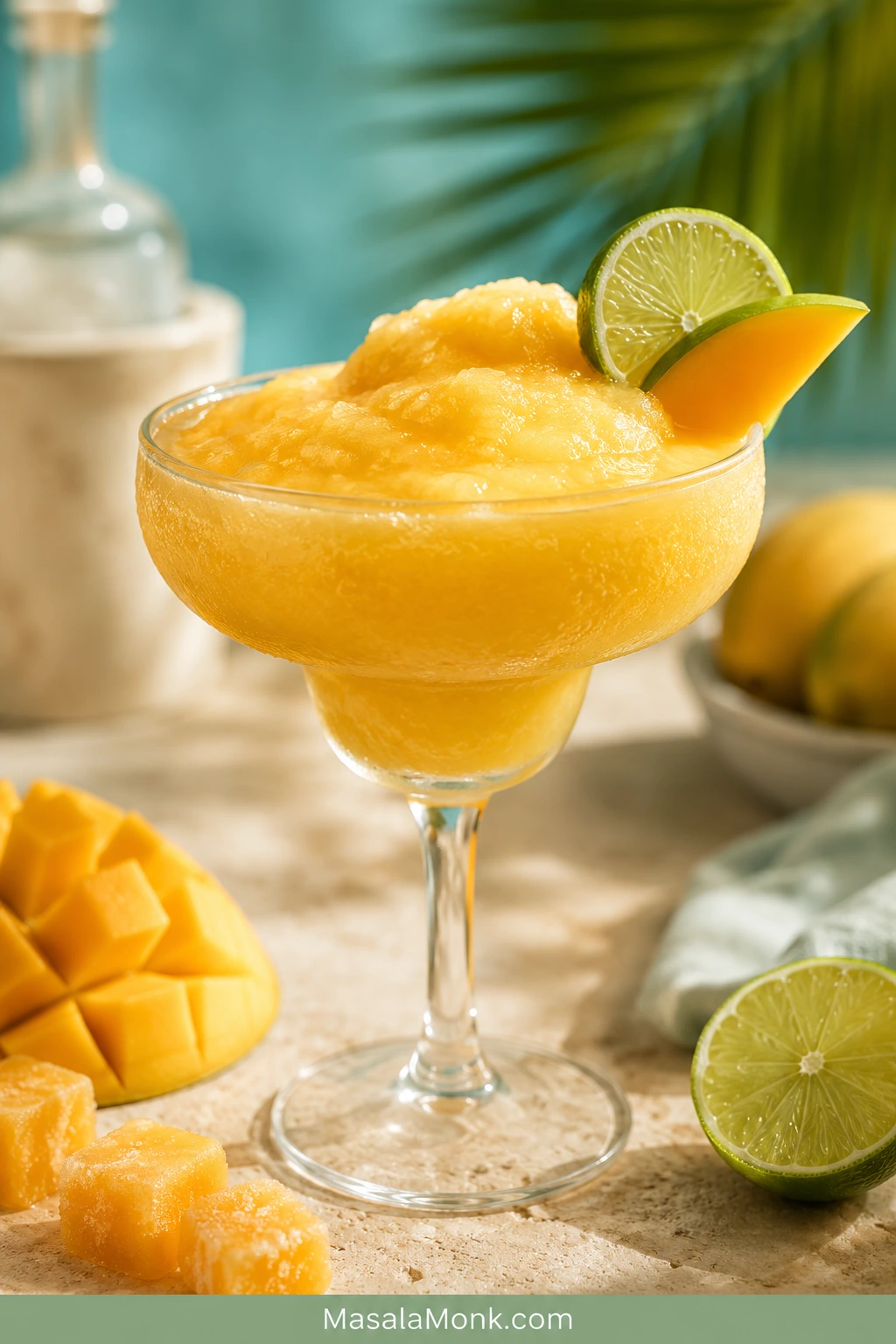
Frozen mango daiquiri in a chilled stemmed glass with a lime wheel, mango garnish, frozen mango chunks, lime halves, and crushed ice on a sunlit stone surface.

A mango daiquiri sounds easy until the blender turns it into a watery mango slush, a spoon-thick smoothie, or a drink that tastes sweet but flat. Mango, rum, lime, ice — the ingredient list is short, but the balance matters.

This recipe is built for the glass you actually want: cold, golden, lime-bright, mango-forward, and still cocktail-like. It is not a boozy smoothie, melted mango ice, or a bottled-mix drink hiding under too much sugar.

The best version should pour slowly, smell like ripe mango and fresh lime, and taste cold before it tastes sweet. Frozen fruit gives the drink body, lime keeps it awake, white rum keeps the finish crisp, and simple syrup lets you adjust for the mango you have.

Quick Answer

A mango daiquiri is made with mango, rum, fresh lime juice, sweetness, and ice. For the best frozen version, blend frozen mango chunks with white rum, lime juice, simple syrup, and crushed ice until smooth, frosty, and still loose enough to sip.

The easiest ratio for 2 drinks is 2 cups frozen mango, 4 oz white rum, 1½ oz fresh lime juice, 1 oz simple syrup, and 1 cup crushed ice. Frozen mango gives the thickest blender texture. For deeper aroma, use ripe fresh mango, but chill or freeze the cubes first so the drink does not melt too quickly.

When the balance is right, the first sip should taste like mango and lime before it tastes like alcohol. The rum should support the fruit, not bully it.

The core rule: ice makes a frozen daiquiri cold. Frozen fruit makes it taste like mango.
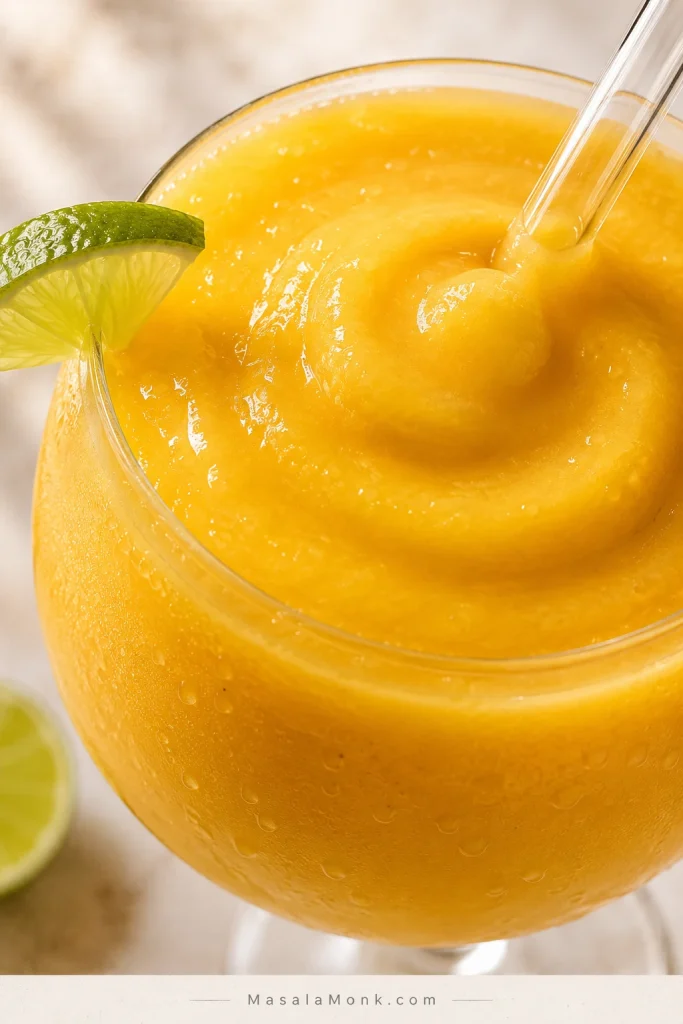
Close-up of a thick golden mango daiquiri with a lime garnish, condensation on the glass, and a clear straw touching the glossy frozen surface.
Look for a glossy texture that moves slowly but still drinks easily through a straw. If it looks scoopable, loosen it slightly; if it looks runny, blend in more frozen mango.

Make It Now

Already holding the blender jar? Liquids first, mango next, ice last. Blend only until it looks like a soft frozen cocktail, then taste before you pour.
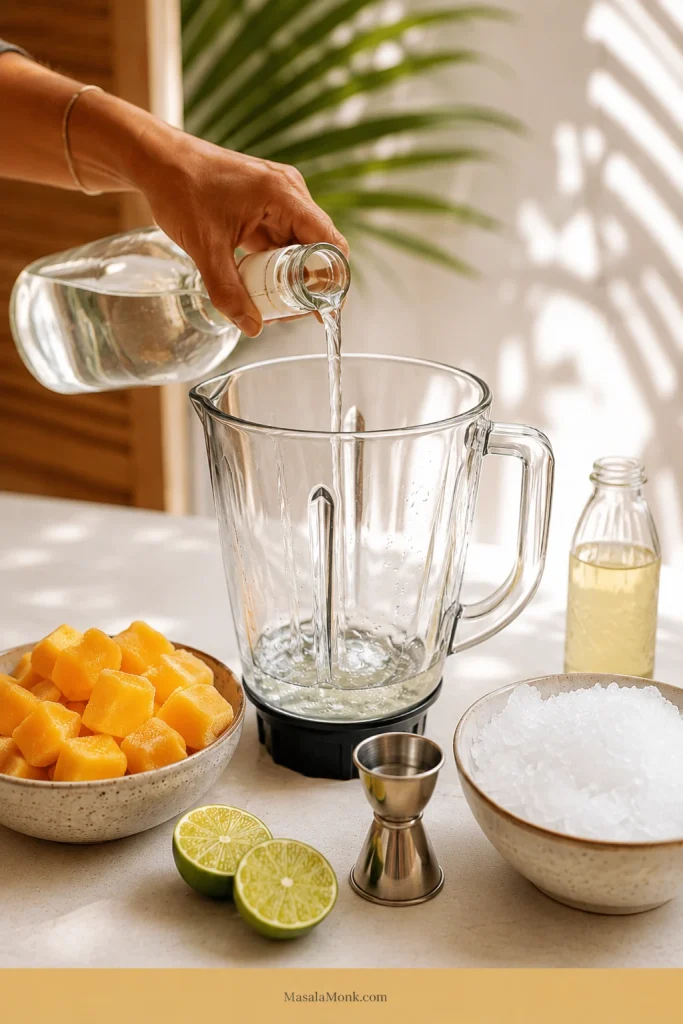
Clear liquid being poured into a blender jar with frozen mango chunks, crushed ice, lime halves, a jigger, and syrup nearby.
Start with the liquids so the blades have something to pull through the jar. After that, the frozen mango blends faster and the finished drink turns smoother.
  • Base ratio: 2 cups frozen mango, 4 oz white rum, 1½ oz lime juice, 1 oz simple syrup, 1 cup crushed ice.
  • Blend time: 20–30 seconds, just until frosty and slow-pouring.
  • Syrup range: ½ oz for very sweet mango or bottled mix; up to 1½ oz for tart or flat fruit.
  • Fast fix: lime sharpens, syrup softens, frozen fruit thickens, and 1 tablespoon liquid loosens the blender.
  • Serve: pour right away.

Recipe Card

Yield: 2 drinks · Prep time: 5 minutes · Total time: 5 minutes · Method: blender · Serve: immediately

This is the full frozen mango daiquiri recipe in one place. Start with frozen mango for the easiest texture, use fresh lime for the brightest flavor, and serve in a chilled coupe, margarita glass, martini glass, or rocks glass.

Ingredients

IngredientUS measureMetric measure
Frozen mango chunks2 cupsAbout 300 g
White rum or light rum4 oz120 ml
Fresh lime juice1½ oz / 3 tbsp45 ml
Simple syrup1 oz / 2 tbsp30 ml
Crushed ice1 cupAbout 150 g
Mango nectar, pineapple juice, coconut water, or cold water, optional1–2 tbsp, only if needed15–30 ml
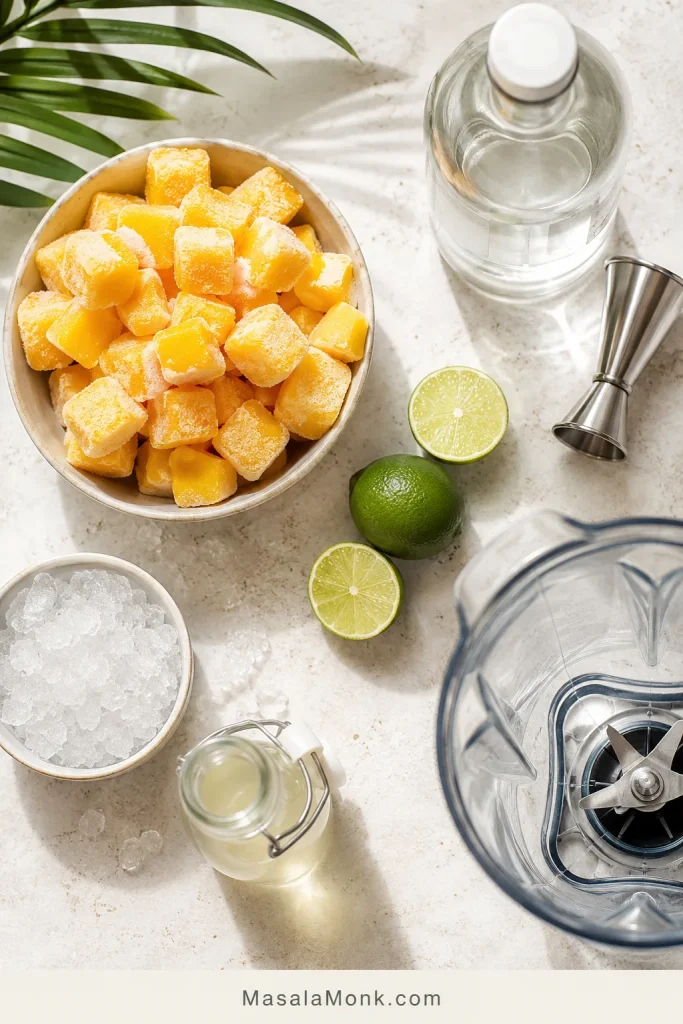
Overhead layout of frozen mango chunks, crushed ice, fresh limes, clear rum, simple syrup, a jigger, and a blender jar for a mango daiquiri.
This short ingredient list works because nothing is decorative. Frozen mango builds body, lime cuts sweetness, syrup rounds the edges, and rum keeps the drink in daiquiri territory.

Lighter drink: use 3 oz / 90 ml rum total for 2 drinks instead of 4 oz / 120 ml.

Sweeter mango or bottled mix: start with ½ oz / 15 ml simple syrup, then add more only if needed.

Instructions

  1. Chill 2 glasses in the freezer.
  2. Pour the rum, lime juice, and simple syrup into the blender.
  3. Add the frozen mango chunks.
  4. Top with crushed ice.
  5. Blend for 20–30 seconds, until smooth, slushy, and slow-pouring.
  6. Taste and adjust: lime for brightness, syrup for sweetness, frozen fruit for thickness, or 1 tbsp liquid if too thick.
  7. Pour into chilled glasses, garnish if you like, and serve immediately.

Notes

  • Fresh lime juice gives the brightest flavor.
  • Crushed ice blends better than large cubes.
  • Do not blend too long or the drink will warm and thin out.
  • Lime wheel, mango wedge, mint, or chili-lime rim all work as garnishes.
  • For the best texture, serve right away.

Need to adjust the drink? Fix the texture, choose fresh vs frozen mango, or pick a version.

Choose Your Mango Daiquiri

Once the base glass tastes right, the variations are easy. Use the same balance to make it lighter, stronger, fruitier, coconut-leaning, or alcohol-free.
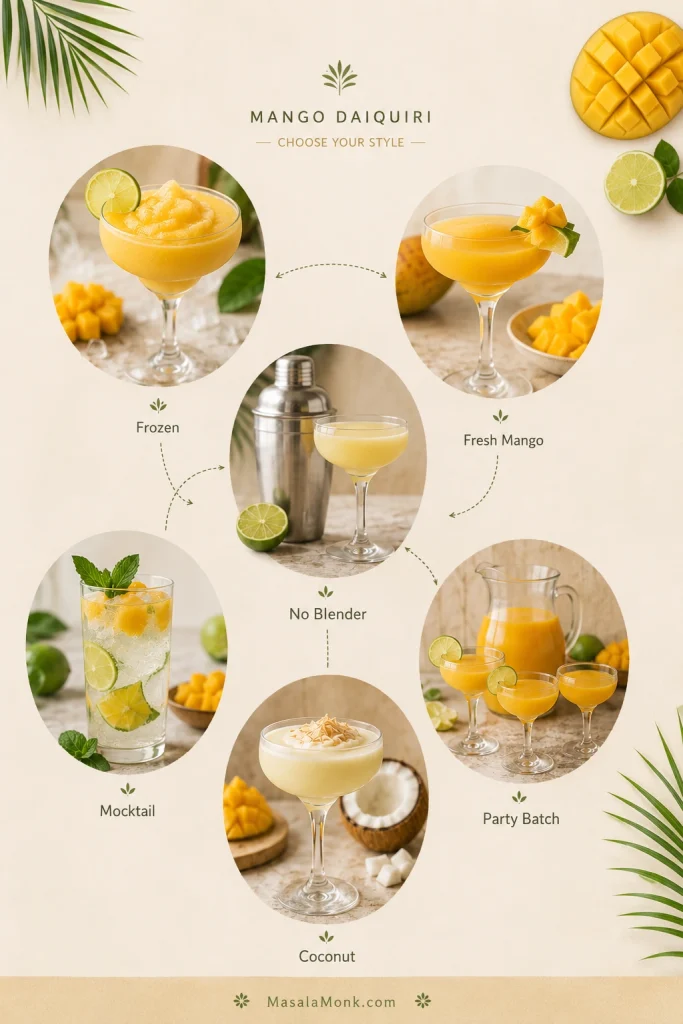
Guide board showing frozen, fresh mango, no-blender, mocktail, coconut, and party batch mango daiquiri versions with small drink and ingredient photos.
Once the mango-lime base tastes balanced, choose the version by need: frozen for texture, fresh for aroma, shaken for no blender, mocktail for a lighter glass, or coconut for a softer tropical finish.
What you wantBest version
Thick frozen cocktailUse the main frozen recipe
Fresh ripe mango flavorCube fresh mango and freeze 30–60 minutes before blending
No blenderShake mango puree or thick juice with rum, lime, and syrup
Sweeter tropical versionUse coconut rum or Malibu, then reduce syrup and add lime
Non-alcoholic drinkUse frozen mango, lime, pineapple juice or coconut water, and sparkling water
Party batchPrep liquids ahead and blend in batches right before serving

At its best, this is not a sugary frozen drink. It is mango with a lime edge, a crisp rum finish, and just enough sweetness to make the next sip feel easy.

What Is a Mango Daiquiri?

A mango daiquiri is a fruit version of the classic daiquiri, a rum cocktail built around rum, lime juice, and sweetness. At its core, the classic drink is just rum, fresh lime, and sugar; the International Bartenders Association’s daiquiri formula is a useful reference for that simple base.

The mango version can be frozen and blended, or shaken and strained when made with puree or juice. Either way, it should still taste like a cocktail: fruit first, lime brightness next, and a crisp rum finish.

For a broader look at the drink family, see our Daiquiri Recipe guide. This page stays focused on keeping the mango version balanced at home.

Why This Works

This drink works because frozen fruit does the heavy lifting, not the ice. It gives the daiquiri body, so you do not have to rely on flavor-diluting cubes to create texture.
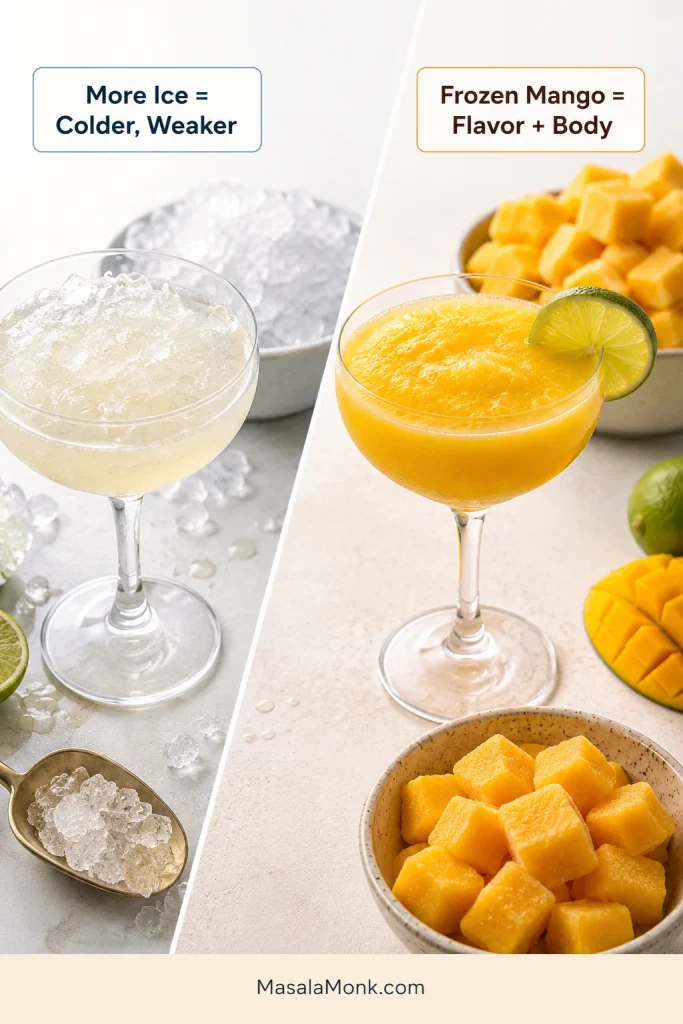
Comparison guide with a pale icy drink beside a thicker golden mango drink, showing how ice and frozen mango affect texture.
More ice can chill the drink, but it can also thin the flavor. Instead, let frozen fruit handle most of the body and use ice only for coldness and lift.

Fresh lime keeps the sweetness lively. White rum gives structure without hiding the mango. Simple syrup stays adjustable because mangoes are unpredictable — one batch may be candy-sweet, the next may be tart or flat.

The blender order matters more than it seems: liquids first, fruit second, ice last. That small step makes the mixture easier to blend and reduces the urge to pour in extra liquid too early.

Ingredients You Need

With a drink this simple, every ingredient shows up in the glass. The goal is not to bury the mango under sugar or ice. It is to let the fruit, lime, rum, cold, and sweetness show up in the right order, so every sip tastes bright instead of heavy.

Mango

Frozen chunks are the easiest win because they give the drink body without watering it down. They also make the texture more predictable from batch to batch.
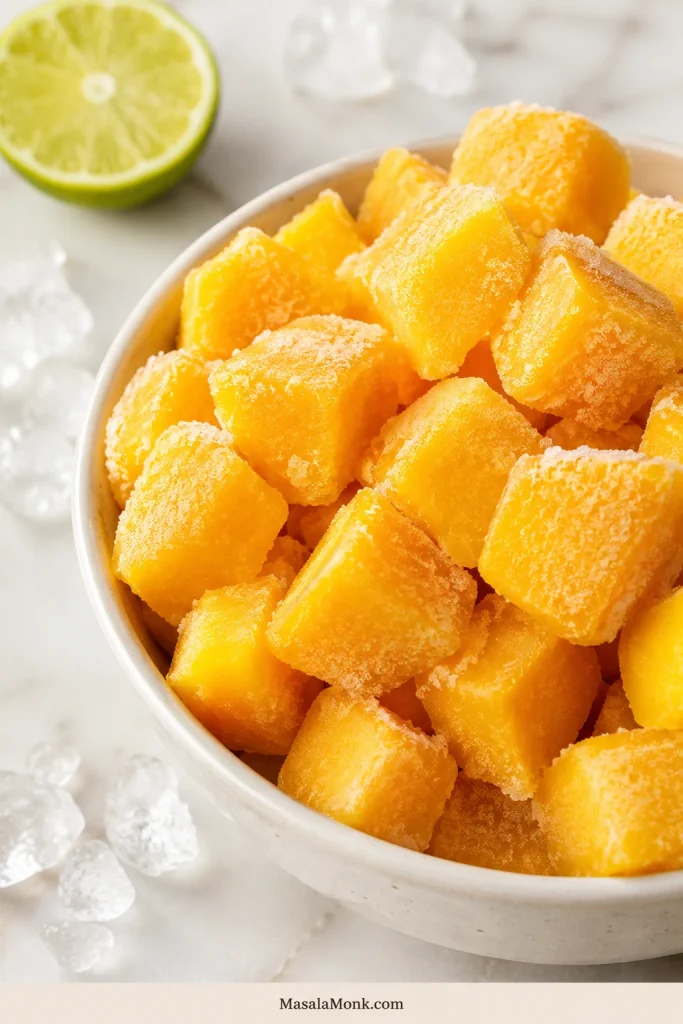
Frosty frozen mango chunks in a ceramic bowl with scattered ice pieces and a lime half on a light countertop.
Frozen mango gives the blender a head start: it chills, thickens, and flavors the drink before the crushed ice goes in.

Fresh mango is lovely when it is ripe, fragrant, and sweet. Taste a piece first. If it tastes bland, the drink will need more lime, a little more syrup, and possibly a tiny pinch of salt. For better texture, cube it and freeze for 30–60 minutes.

If your mango is fibrous, puree it first or use frozen chunks for a smoother blend. For another look at how mango changes texture in drinks, our Mango Lassi Recipe also works through fresh mango, frozen mango, and mango pulp.

Rum

Reach for white rum or light rum first. It keeps the mango and lime clear. Aged rum gives a warmer flavor. Dark rum can work in a richer tropical version, but it can cover the fruit. Coconut rum is sweeter, so pull the syrup back if you add it. Avoid overproof rum unless you deliberately want a stronger drink.

If you like crisp rum-and-lime drinks, our Mojito Recipe is another useful ratio to keep in rotation.

Fresh Lime Juice

Lime is what wakes the whole glass up. It gives the drink its proper daiquiri shape and keeps mango from tasting heavy. Lime is better than lemon here because it gives a sharper cocktail edge. Bottled lime works in a pinch, but fresh juice tastes brighter in a drink this simple.

Simple Syrup

Simple syrup smooths the lime and fruit. Start with 1 oz / 30 ml for 2 drinks, then taste. Very sweet mango may only need ½ oz / 15 ml. Tart or flat fruit may need up to 1½ oz / 45 ml.

To make a small batch, stir ¼ cup sugar with ¼ cup hot water until dissolved. Cool it before using. Store the rest in the fridge for more drinks.

Ice

Crushed ice gives the blender a head start, especially when the mango is rock-solid. Large cubes work in a strong blender, but they can leave chunks if the blender struggles. Add more only after tasting, because ice fixes texture for a moment but weakens flavor as it melts.

Fresh vs Frozen Mango for Daiquiris

The mango you start with decides the kind of drink you get. Choose based on whether you want thick frozen texture, fresh aroma, a shaken cocktail, or a shortcut.
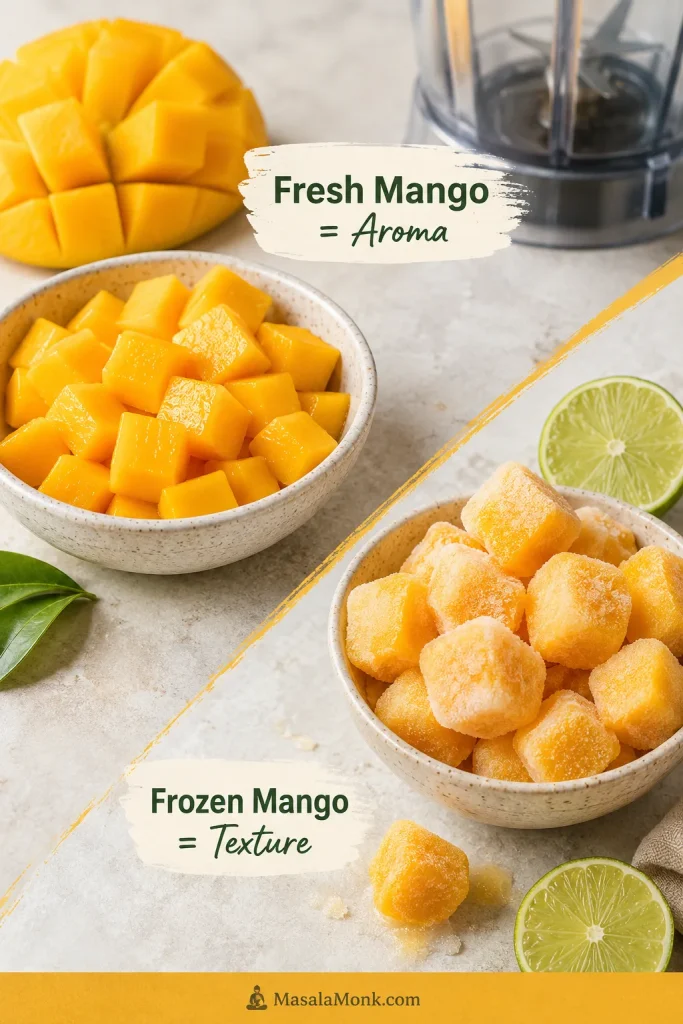
Fresh mango cubes and a scored mango cheek shown beside frosty frozen mango chunks with lime and a blender jar in the background.
Fresh mango gives perfume and ripe fruit flavor, while frozen mango gives dependable texture. For the best balance, cube fresh mango and freeze it briefly before blending.
Mango formBest forHow to adjust
Frozen mango chunksThick frozen drinksStart with less ice because the fruit already thickens the blend.
Fresh ripe mangoBest fresh flavorChill or freeze the cubes first; add ice gradually.
Mango pureeSmooth blender drinks or shaken versionsPull back the syrup because puree is often concentrated and sweet.
Mango nectarShortcut flavor or loosening a thick blendAdd lime and reduce syrup because nectar is usually sweet.
Bottled daiquiri mixConvenienceSkip or reduce syrup, then add fresh lime and frozen fruit.
Mango juiceLight shaken versionExpect a thinner drink; keep the lime strong.

Best default: frozen chunks for the main recipe. They give the easiest texture and the strongest flavor after blending.

If you actually want a creamy breakfast-style drink instead of a cocktail, this Mango Smoothie Recipe is the better direction.

Once you know what your mango is bringing, the fixes get simple: more lime to balance sweetness, less syrup for nectar, and more frozen fruit for body.

Using Mango Nectar, Puree, or Bottled Mix

Mango nectar can help when your blender needs liquid, but it should not take over the drink. Think of it as a mango boost, not the base.
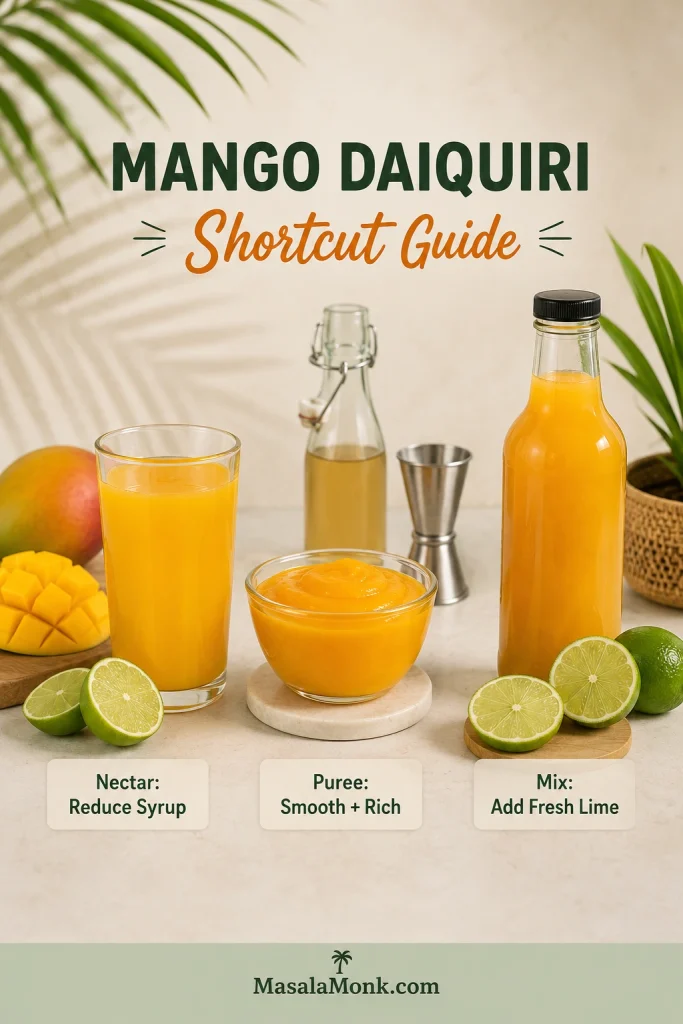
Mango daiquiri shortcut guide showing mango nectar, mango puree, bottled mix, lime halves, syrup, and a jigger on a cream background.
Mango nectar, puree, and bottled mix can all work, but they usually bring extra sweetness. Reduce the syrup first, then use fresh lime to bring the cocktail back into balance.

Puree gives a smooth texture and works especially well in the shaken version. Bottled mixes are usually sweet, so skip or reduce the syrup, add fresh lime, and blend in frozen fruit if the flavor tastes thin or artificial.

For another mango cocktail that handles fresh fruit, nectar, frozen texture, and pitcher options, see our Mango Margarita Recipe.

Back to top

How to Make a Mango Daiquiri Less Watery

You should be able to sip it, not scoop it. The ideal texture is thick enough to feel frozen, but loose enough to pour slowly from the blender. If it behaves like juice, it needs more frozen fruit. When it behaves like sorbet, it needs a small splash of liquid.
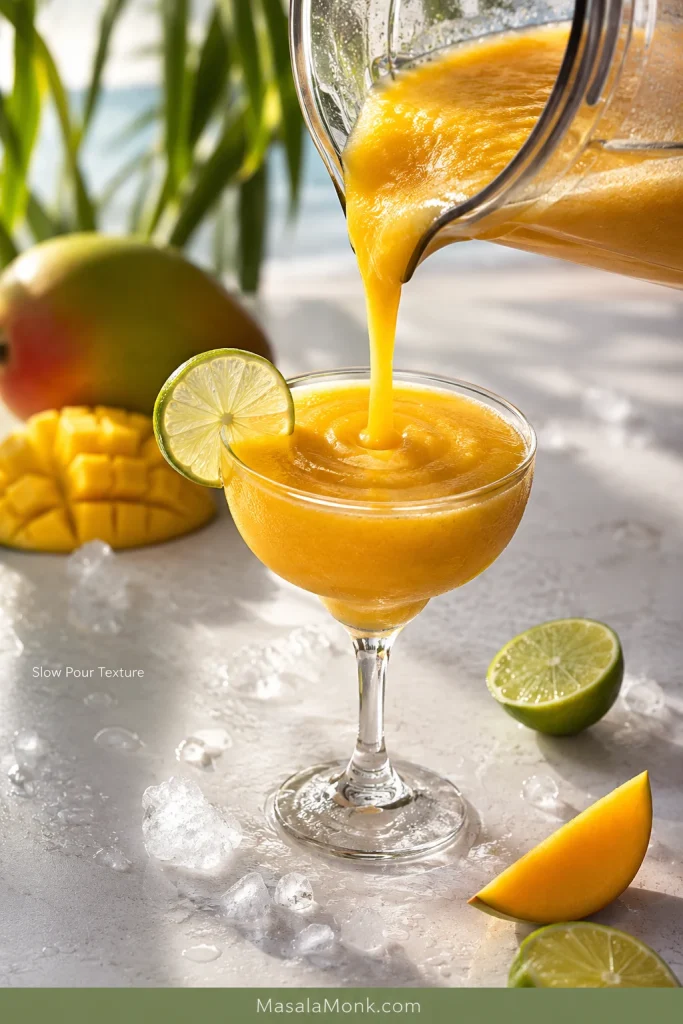
Thick golden mango daiquiri pouring slowly from a blender jar into a chilled stemmed glass with lime, mango, and ice nearby.
The best texture pours slowly, then settles into the glass without collapsing into juice. If it rushes out too quickly, add frozen mango before adding more ice.

Watery vs Perfect Mango Daiquiri Texture

Use this visual check before adding more ice. A watery daiquiri usually needs more frozen mango, while a scoop-thick one needs a small splash of liquid.
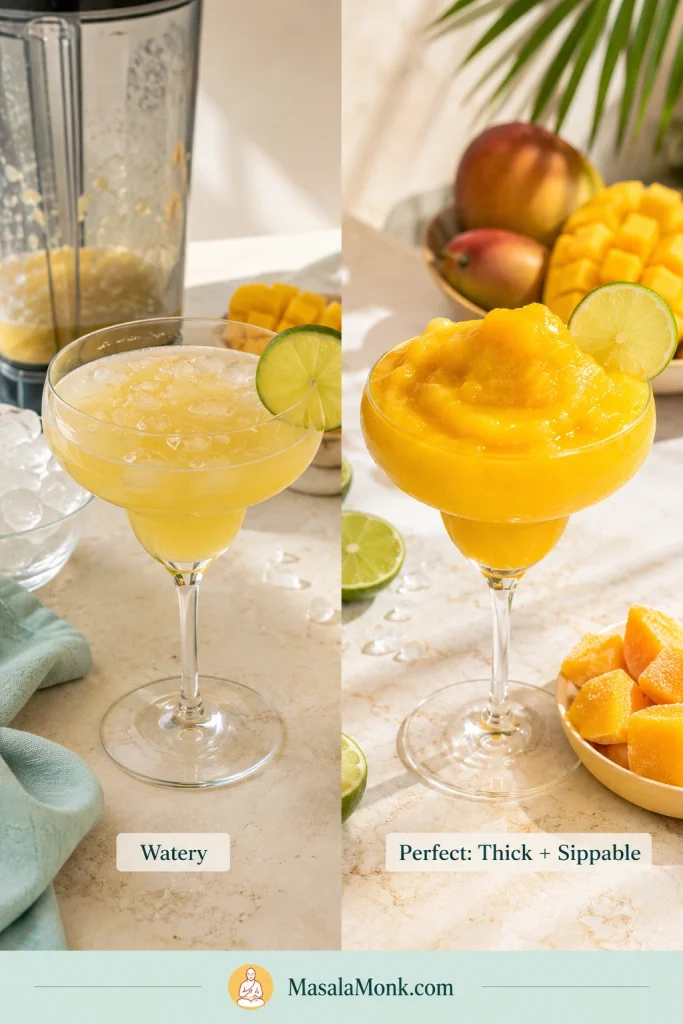
Side-by-side comparison of a watery pale mango daiquiri and a thick golden mango daiquiri with lime garnishes, ice, and mango nearby.
Watery texture usually comes from too much ice or too little frozen fruit. The better glass stays thick and bright because mango, not ice, does the heavy lifting.

The common mistake is trying to fix a thin daiquiri with more ice. That makes it colder for a minute, then more watery. Frozen fruit is the better fix because it adds body and flavor at the same time.

The same fruit-first idea is what keeps our Frozen Strawberry Daiquiri Recipe thick and bright without leaning too hard on ice.

Quick Texture Fixes

GoalWhat to do
ThickerAdd frozen fruit.
SlushierAdd crushed ice gradually.
SmootherBlend 5–10 seconds more, but avoid warming the drink.
LooserAdd 1 tbsp mango nectar, pineapple juice, coconut water, or cold water.
BrighterAdd lime juice.
SweeterAdd syrup.
More fruit-forwardReduce ice and add more mango.
Less flatAdd lime and a tiny pinch of salt.

That pinch of salt is optional, but useful when frozen fruit tastes dull. The drink should not taste salty; the salt simply makes the mango and lime feel more awake.

Once the texture is right, the pour should look slow, glossy, and still loose enough to drink through a straw.

Blender Help

A powerful blender makes this easier, but you do not need a bar machine to make a good frozen drink. The right order and small corrections matter more. For a Thermomix, use the same ingredients and blend only until slushy; if the machine struggles, let the fruit soften for a few minutes first.

  • Liquids first: rum, lime juice, and syrup help the blades start moving.
  • Fruit second: frozen chunks should be close to the blades, but not packed too tightly.
  • Crushed ice last: it blends faster than large cubes.
  • Pause before adding liquid: if the blender forms an air pocket, stop and stir first.
  • Small corrections: add liquid only 1 tablespoon at a time.
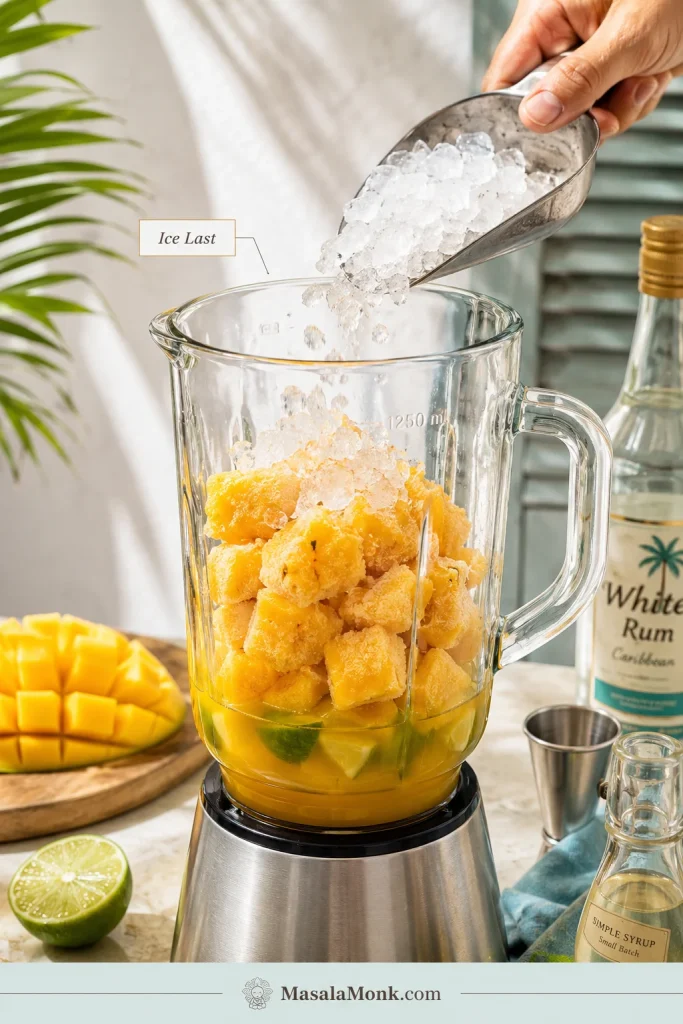
Crushed ice being poured from a metal scoop into a blender filled with frozen mango, lime, and liquid for a mango daiquiri.
Add crushed ice last so it chills the mixture without blocking the blades. This helps even weaker blenders make a smoother frozen daiquiri.

If the blender stalls, it is not a failure. Stop, stir, and only then add liquid. Extra liquid fixes movement, but it also thins the drink fast.

No crushed ice? Wrap cubes in a clean towel and tap them smaller, or pulse the ice briefly before adding the mango. For a weaker blender, let the frozen chunks sit at room temperature for 3–5 minutes.

No blender or still struggling? Try the shaken mango daiquiri, or return to the main recipe.

Back to top

Mango Daiquiri Without a Blender

For a lighter, cocktail-bar-style drink, use mango puree or thick juice and shake it instead of blending. This no-blender mango daiquiri is smooth and chilled, not frozen.

It will not have the plush frozen texture of the blender version, but it should feel cleaner, sharper, and more cocktail-bar-like.
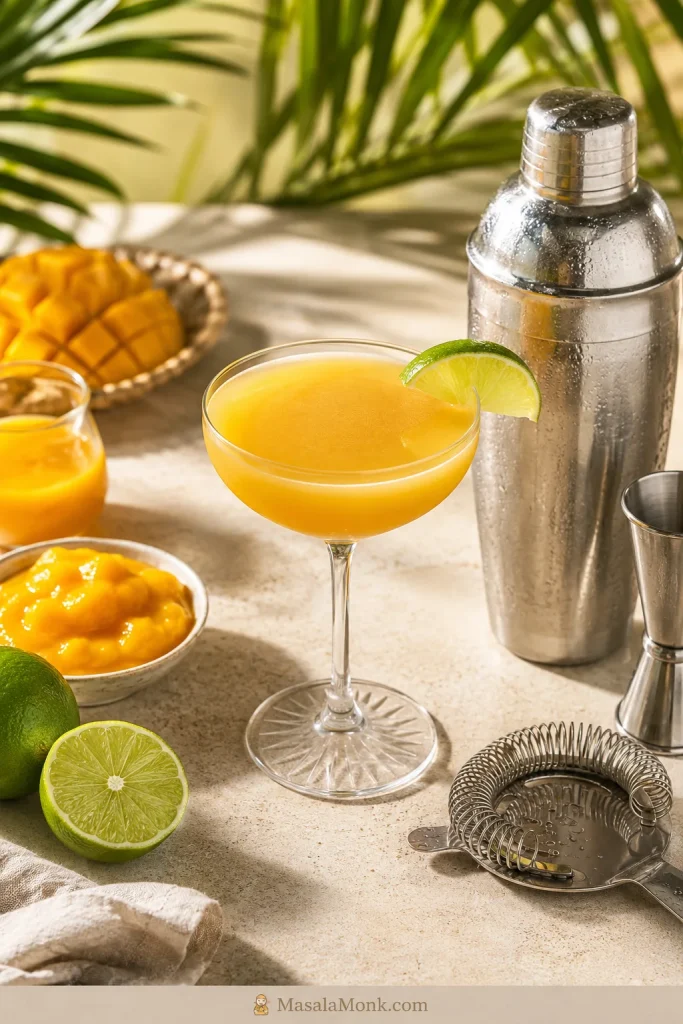
Smooth mango daiquiri in a coupe glass beside a cocktail shaker, strainer, jigger, lime, mango puree, and mango pieces.
A no-blender mango daiquiri is lighter and smoother than the frozen version. Use mango puree or nectar here, because frozen chunks need a blender to turn silky.
For 1 drinkAmount
White rum2 oz / 60 ml
Mango puree or thick mango juice1–1½ oz / 30–45 ml
Fresh lime juice¾ oz / 22 ml
Simple syrup½ oz / 15 ml
IceFor shaking

Add everything to a cocktail shaker with ice. Shake hard for 10–15 seconds, then strain into a chilled coupe or martini glass. Reduce the syrup if your puree is already sweet. Add a little more lime if the drink tastes flat.

Variations

Once the base tastes good, the fun part starts. Strawberries make it fruitier, pineapple makes it sharper, coconut makes it softer, passion fruit makes it tangier, and chili-lime makes it party-ready.

Looking for a specific version? Jump to the mocktail, mango strawberry, coconut rum, or spicy mango version.

Virgin Mango Daiquiri / Mocktail Version

For a non-alcoholic version, do not simply leave out the rum. Without the spirit, the drink still needs lift. Pineapple juice, coconut water, lime, and a splash of sparkling water keep it from becoming just a smoothie.

  • 2 cups / 300 g frozen mango
  • ⅓ cup / 80 ml pineapple juice, orange juice, or coconut water
  • 1½ oz / 45 ml fresh lime juice
  • 1–2 tbsp simple syrup, honey syrup, or maple syrup
  • ½–1 cup ice
  • Optional splash of sparkling water or lime seltzer after blending

Blend the fruit, juice or coconut water, lime, syrup, and ice until slushy. Add sparkling water after blending if you want it to feel more like a mocktail. Pineapple juice and orange juice are already sweet, so start with less syrup.
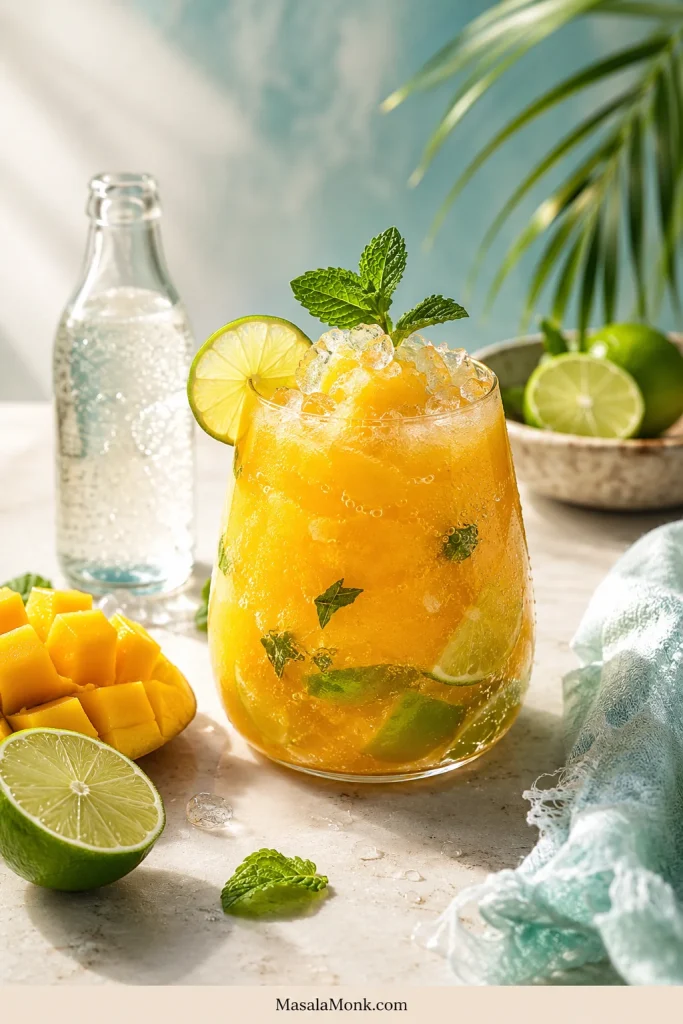
Non-alcoholic mango daiquiri mocktail in a stemless glass with crushed ice, lime, mint, mango pieces, and an unbranded sparkling water bottle.
In a virgin mango daiquiri, bubbles help replace the lift you normally get from rum. Add sparkling water gently so the mocktail stays bright, cold, and refreshing.

If coconut water is your favorite way to lighten tropical drinks, these Coconut Water Cocktails give you more rum, tequila, vodka, and mocktail-style directions.

Mango Strawberry

Replace half the mango with frozen strawberries. The drink turns brighter, pinker, and a little tarter, so taste before adding extra lime. Keep the same rum and syrup base, then add ice only as needed.
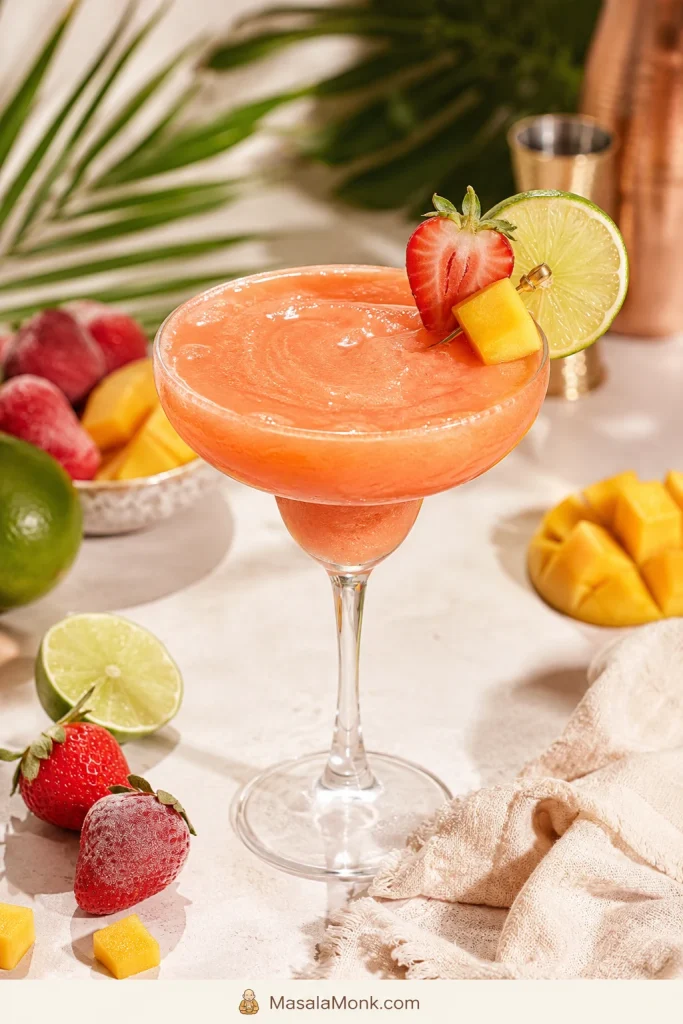
Pink-orange mango strawberry daiquiri in a stemmed glass with strawberry, lime, mango garnish, strawberries, mango chunks, and limes around it.
Strawberries make this mango daiquiri pinker, tarter, and more playful. However, the drink still needs lime for contrast, or it can drift toward smoothie territory.

Mango Pineapple

Replace 1 cup mango with 1 cup frozen pineapple. Pineapple is naturally sweet and acidic, so taste before adding extra syrup.

Mango Daiquiri with Malibu or Coconut Rum

Use coconut water as the optional thinning liquid, or replace part of the white rum with coconut rum or Malibu. Coconut rum is sweet, so reduce the syrup and add lime if the drink tastes heavy. If you want to move creamier and more pineapple-coconut, our Piña Colada Variations are the better next stop.
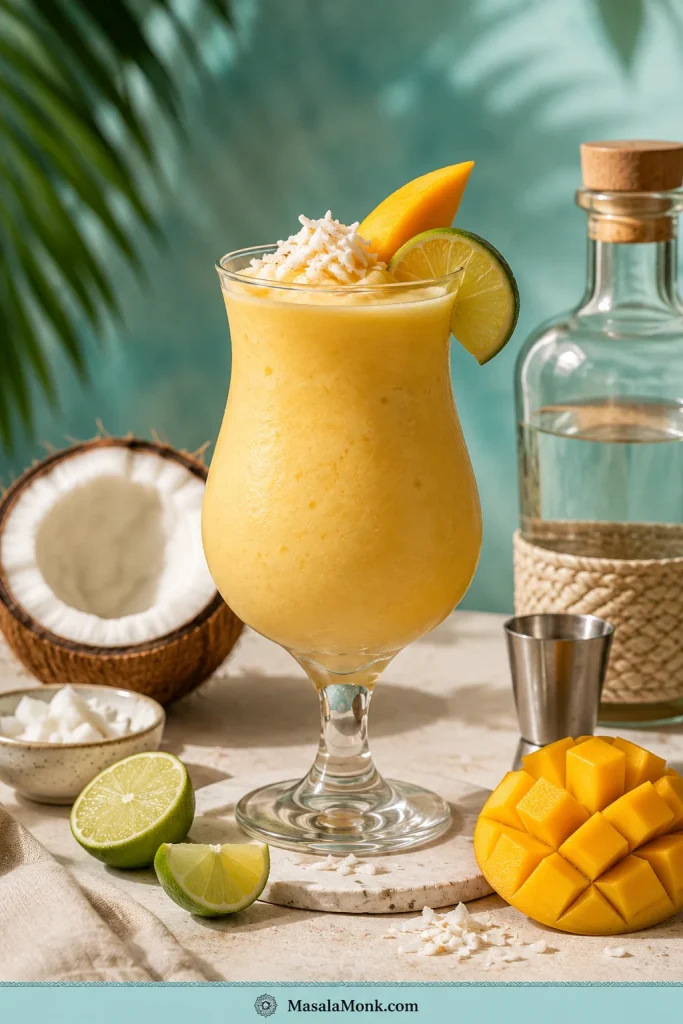
Creamy mango coconut daiquiri in a tall glass with shredded coconut, mango garnish, lime, coconut half, coconut pieces, jigger, and a clear bottle nearby.
Coconut rum or coconut water makes mango taste softer and rounder. Because coconut adds sweetness, use less syrup and let fresh lime keep the finish clean.

Mango Passion Fruit

Add 1–2 tablespoons passion fruit pulp or puree. Passion fruit is tart, so taste before adding extra lime. This version is sharp, fragrant, and very tropical.

Spicy Mango

Add a chili-lime rim, a pinch of Tajín, or one very thin slice of jalapeño to the blender. Start small. Mango takes spice well, but too much heat can overpower the lime and rum.
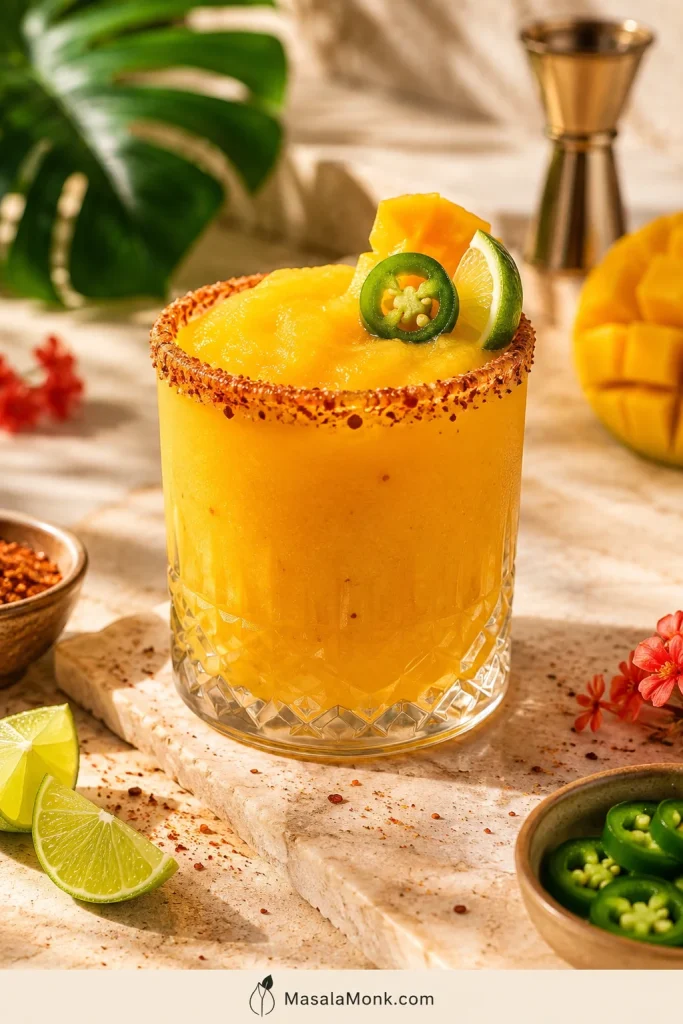
Spicy mango daiquiri in a rocks glass with a chili-lime rim, jalapeño slice, mango garnish, lime wedges, chili flakes, and sliced peppers.
A chili-lime rim turns sweet mango into a sharper party cocktail. The salt wakes up the fruit, while the chile keeps every sip from feeling too soft.

For a full chili-lime cocktail built around jalapeño and a Tajín-style rim, try the Spicy Margarita Recipe.

Vodka Mango

Vodka works as a 1:1 swap for rum, but the result is technically a mango vodka frozen cocktail rather than a daiquiri. The flavor will be cleaner and less rummy, so keep the lime strong.

Back to top

Pitcher Batch and Make-Ahead Tips

Scale the ingredients, but blend close to serving time. Frozen cocktails are best in the first few frosty minutes, before the ice melts and the fruit starts to separate.
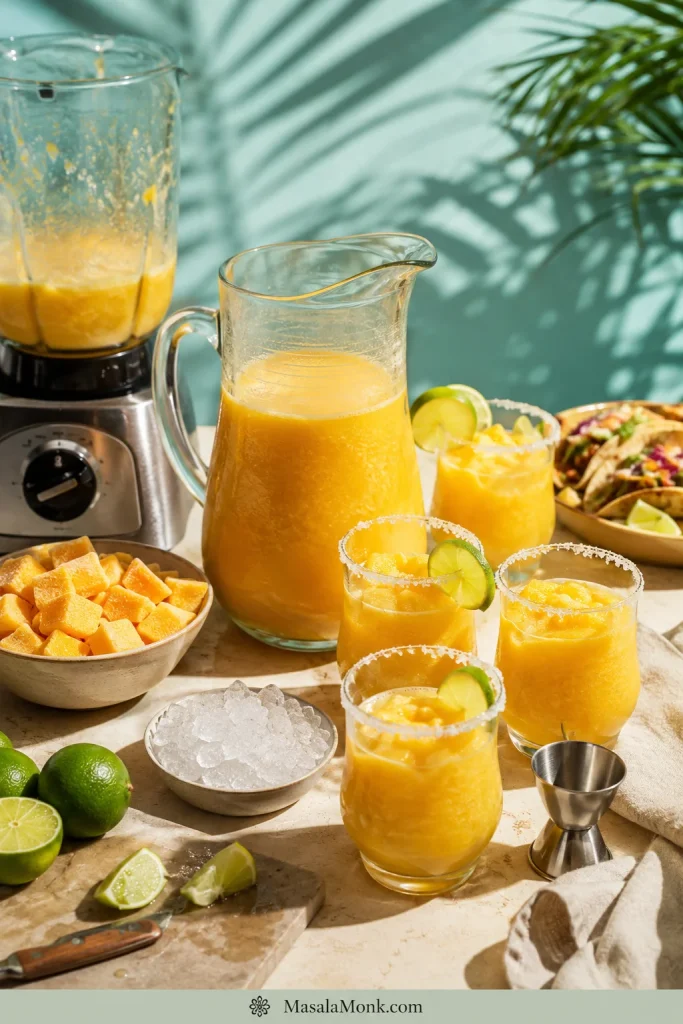
Mango daiquiri pitcher batch setup with a blender, glass pitcher, multiple glasses, frozen mango, crushed ice, limes, tacos, a jigger, and a linen napkin.
For a pitcher batch, prep the mango, lime, syrup, and rum mixture ahead, then blend close to serving. That way, the drinks stay cold, thick, and fresh for guests.

For 4 Drinks

Frozen mango4 cups / about 600 g
White rum8 oz / 240 ml
Fresh lime juice3 oz / 90 ml
Simple syrup2 oz / 60 ml
Crushed ice2 cups / about 300 g

For 8 Drinks

Frozen mango8 cups / about 1.2 kg
White rum16 oz / 480 ml
Fresh lime juice6 oz / 180 ml
Simple syrup4 oz / 120 ml
Crushed ice4 cups / about 600 g

Blend in batches if your blender jar is smaller than 64 oz / 1.9 L. Do not fill the blender to the top with frozen ingredients; leave room for movement or the blades will struggle. For parties, prep the fruit, juice the limes, make the syrup, and chill the rum mixture ahead of time. Blend only when guests are ready for drinks.

  • Best texture: serve immediately after blending.
  • Mango prep: peel, cube, and freeze fresh mango ahead.
  • Syrup prep: make simple syrup ahead and keep it chilled.
  • Avoid the fridge: a blended frozen drink will melt, separate, and lose texture.
  • Leftovers: freeze in a container, then re-blend briefly before serving.

If you want a rum drink that can sit chilled in a pitcher instead of being blended at the last minute, our Rum Punch Recipe is the easier party option.

Troubleshooting

Most mango daiquiri problems are easy to fix while the drink is still in the blender. A little lime, a little syrup, a little frozen fruit — that is usually enough to bring the glass back into balance.
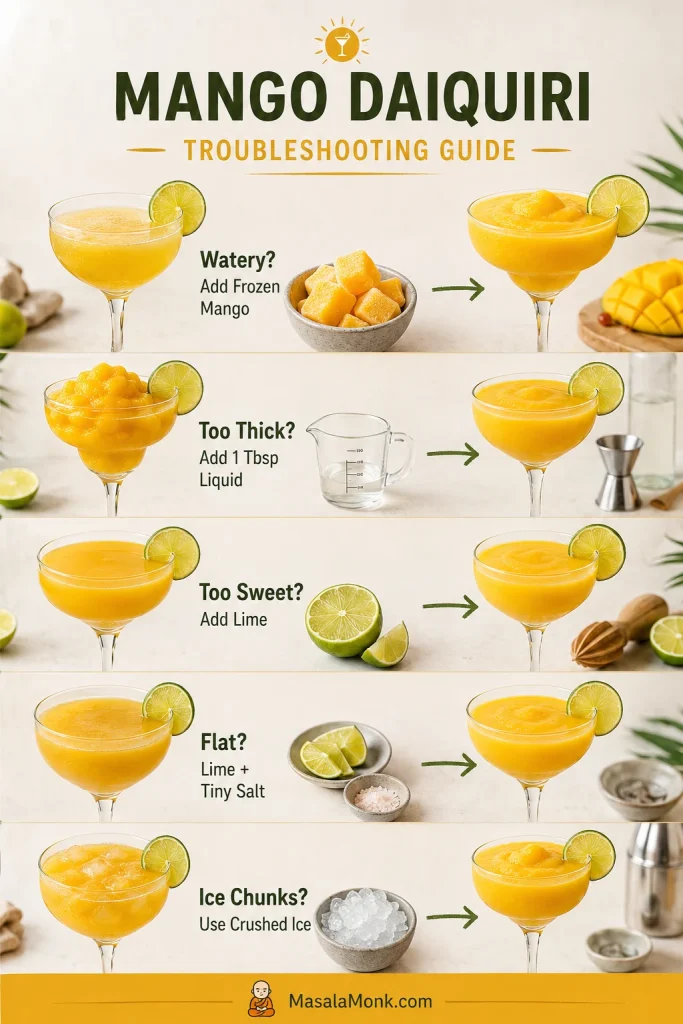
Mango daiquiri troubleshooting guide showing fixes for watery, too thick, too sweet, flat, and icy drinks using mango, lime, liquid, salt, and crushed ice.
Most texture and flavor problems can be fixed before the drink leaves the blender. Use frozen mango to fix watery texture, lime to balance sweetness, and crushed ice for smoother blending.
ProblemLikely causeFix
WateryToo much ice, melted ice, or blended too earlyAdd frozen fruit and serve immediately.
Overly thickToo much frozen fruit or not enough liquidAdd 1 tbsp liquid at a time and blend briefly.
Too sweetVery ripe mango, sweetened nectar, bottled mix, or too much syrupAdd lime juice.
Overly sharpTart mango or too much limeAdd syrup or a splash of mango nectar.
Weak fruit flavorToo much iceAdd more mango and reduce ice next time.
Smoothie-likeNot enough lime or rum structureAdd lime and check the sweetness balance.
Ice chunks remainLarge cubes or weak blenderUse crushed ice, pulse first, or soften frozen mango for a few minutes.
Too boozyRum is too high for your tasteAdd fruit, ice, or a splash of juice.
Flat flavorFruit is dull or lime is lowAdd lime and a tiny pinch of salt.
Separates quicklyThe drink sat too long after blendingRe-blend briefly with a little frozen fruit.

Back to top

What to Serve with It

This drink loves salty, spicy, grilled, and tropical food. Anything salty or chili-lime makes the mango taste even brighter.

Pairing styleServe with mango daiquiris
Salty snacksChips, guacamole, salted nuts, tortilla chips
Spicy foodShrimp Tacos, spicy chicken skewers, paneer tikka
Grilled seafoodGrilled shrimp, fish tacos, limey prawns
Fresh sidesMango Salsa, pineapple salsa, cucumber salad
Party spreadTacos, nachos, grilled corn, sliders
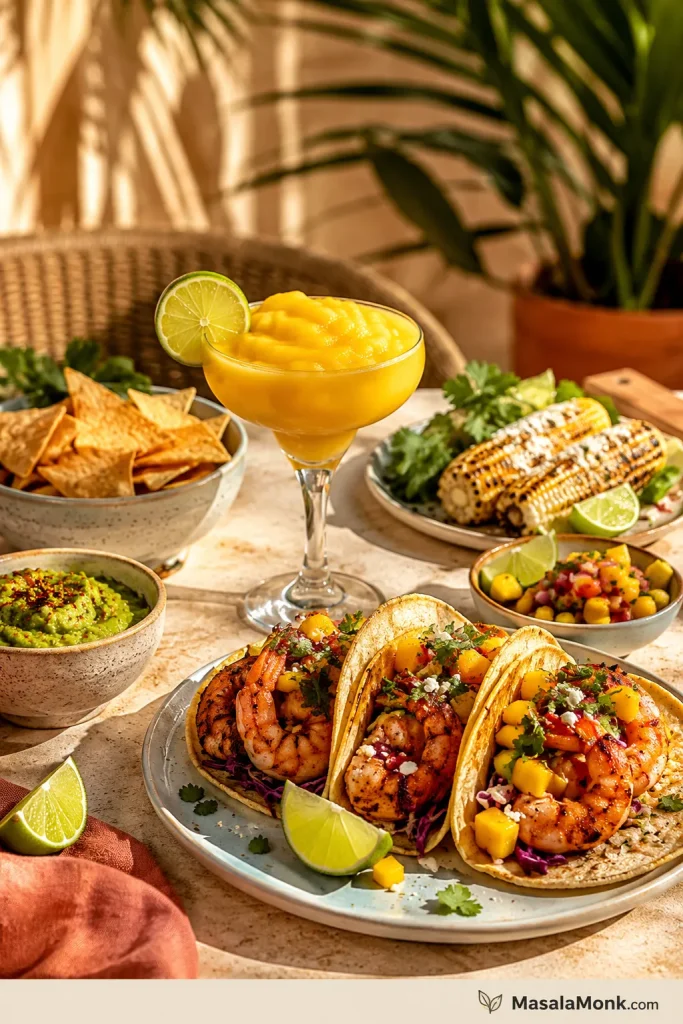
Mango daiquiri served with shrimp tacos, mango salsa, tortilla chips, guacamole, grilled corn, lime wedges, and cilantro on a sunlit table.
Mango daiquiris pair best with salty, spicy, and limey food. Shrimp tacos, mango salsa, chips, guacamole, and grilled corn all make the cocktail taste brighter.

This is where the drink becomes a poolside glass, a taco-night cocktail, or the cold thing people reach for between spicy bites.

FAQs

Is this always a frozen drink?

No. It can be frozen and blended or shaken and strained. The frozen version is more common at home because mango gives the drink a naturally thick texture.

Fresh or frozen mango: which is better?

Frozen mango is better for thick frozen drinks. Fresh mango has stronger ripe flavor, but it needs more ice or a short chill in the freezer before blending.

What rum works best?

White rum or light rum is the best default. It keeps the cocktail crisp and lets mango and lime stand out.

How do you keep it from getting watery?

Use frozen fruit, control the ice, blend briefly, and serve right away. If the blend gets thin, add more frozen mango instead of more ice.

Do you need simple syrup?

Usually, yes, but the amount depends on the fruit. Very sweet mango may need little or no syrup. Tart mango may need a little extra.

What if I only have mango puree?

Mango puree works well. Use it in the shaken version, or use it in the blender version with less syrup.

Is mango nectar okay?

Yes. Use it as a shortcut or thinning liquid, but reduce syrup and add fresh lime because nectar is usually sweet.

How do you make a virgin mango daiquiri?

Blend frozen mango with fresh lime juice, pineapple juice or coconut water, a little syrup, and ice. Add sparkling water after blending for a brighter mocktail feel.

Does vodka work instead of rum?

Yes, vodka works as a 1:1 swap, but the drink becomes a mango vodka frozen cocktail rather than a classic daiquiri.

How far ahead can you make it?

Prep the ingredients ahead, but blend right before serving. Once blended, the ice starts melting and the drink loses its thick texture.

Next Drinks to Try

Next, try the Lychee Martini Recipe for another tropical fruit cocktail, the Lemon Drop Martini Recipe for a sharper citrus-sweet balance, or the Appletini Recipe when you want something crisp, cold, and shaken instead of frozen.

Once you stop asking ice to do all the work, the drink becomes what it should be: golden, frosty, mango-bright, and sharp enough with lime to stay refreshing. That is the glass people finish quickly — and ask you to make again.
Posted on 2 Comments

Frozen Strawberry Daiquiri Recipe

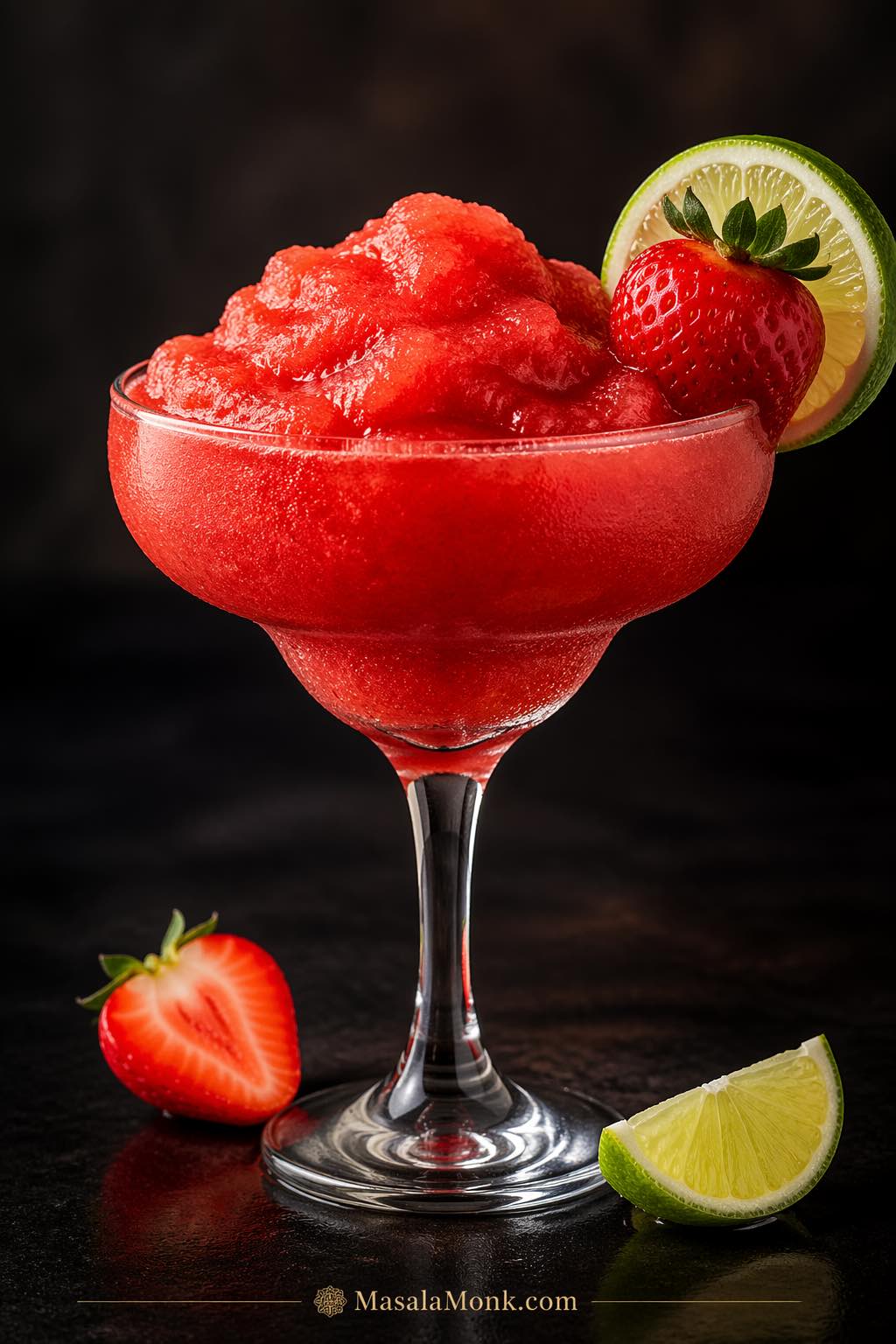
Frozen strawberry daiquiri recipe in a coupe glass with strawberry and lime garnish on a dark editorial background

A frozen strawberry daiquiri recipe should give you a drink that tastes cold, bright, and unmistakably strawberry-forward. The best version is thick enough to feel slushy, loose enough to sip easily, and sharp enough with lime that it never drifts into syrupy, watered-down territory. Even so, that is exactly where many homemade versions go wrong. They turn thin, icy, too sweet, or so stiff that they stop drinking like a cocktail.

This version is built to stay on the right side of that line. It uses mostly frozen strawberries for body, white rum for a clean backbone, fresh lime juice for brightness, and just enough simple syrup to round things out without muting the fruit. As a result, the drink stays fresher and more focused than versions that rely too heavily on ice or bottled mix.

If you want the classic version first, see this daiquiri recipe guide. Here, the focus is the frozen strawberry version.

Quick Answer

A frozen strawberry daiquiri recipe is a blended rum cocktail built with strawberries, fresh lime juice, and sweetener, then thickened into a cold slush with frozen fruit and, only if needed, a little ice. For 2 drinks, blend 3 cups frozen strawberries, 4 oz white rum, 1 1/2 oz fresh lime juice, and 1 to 1 1/2 oz simple syrup. If the drink seems too thin, add more frozen strawberries. If it is too thick to move, add a small splash of cold water and blend again.

  • Best first rum: white rum
  • Best fruit base: mostly frozen strawberries
  • Best acid: fresh lime juice
  • Best sweetener: simple syrup
  • Main fix if too watery: more frozen strawberries
  • Main fix if too tart: a little more simple syrup

At a Glance

  • Yield: 2 drinks
  • Total time: 10 minutes
  • Texture: thick, drinkable slush
  • Best glass: coupe, margarita glass, or small hurricane glass
  • Make-ahead: ingredients yes, full drink no
  • Good for a crowd: yes, but blend in batches
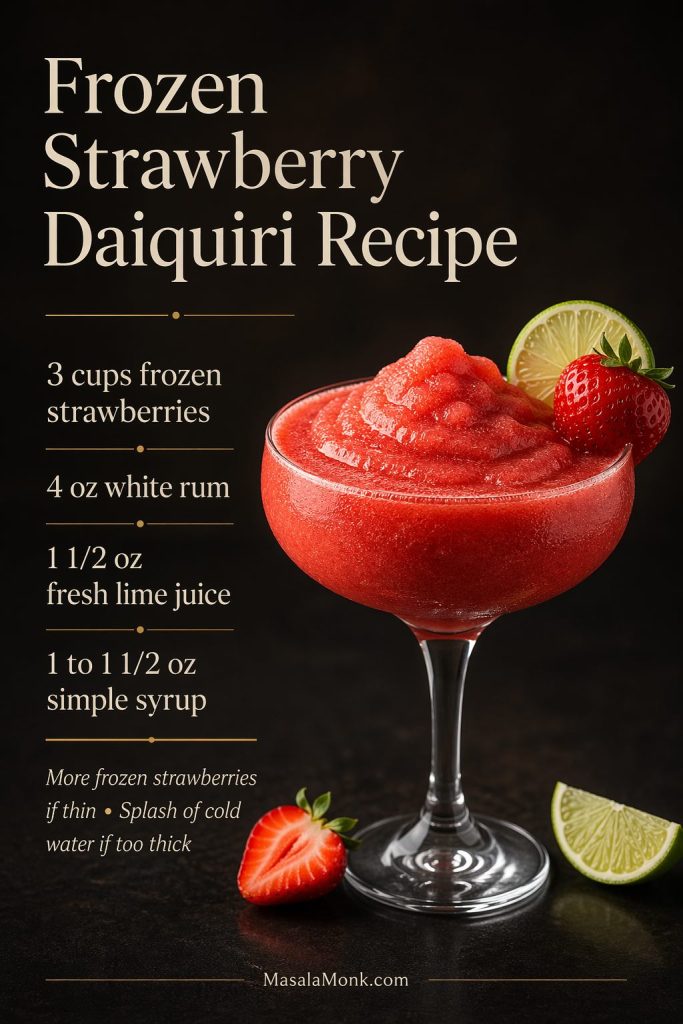
Frozen strawberry daiquiri recipe card image with a stemmed glass cocktail, ingredient amounts, and strawberry and lime garnish on a dark editorial background.
A good frozen strawberry daiquiri should taste bright, fresh, and properly slushy, and this visual recipe card shows the simple build that gets it there: frozen strawberries, white rum, fresh lime juice, and just enough simple syrup to keep the drink balanced.

After that, if you want another fruit-led rum drink, this watermelon daiquiri is a good next stop. If you want the cleaner shaken version instead, jump to Strawberry Daiquiri Recipe, Not Frozen.

What Is a Frozen Strawberry Daiquiri?

A daiquiri starts with a simple structure: rum, citrus, and sugar. A frozen strawberry daiquiri keeps that backbone, then adds strawberries and a slushy texture that makes the drink feel colder, fruitier, and more playful than the classic shaken version.

A good frozen strawberry daiquiri recipe should let the strawberries stay in front, keep the lime bright, and use rum as support rather than the dominant note. When any one part takes over, the drink starts to feel either flat, syrupy, or overly icy instead of refreshing.

Why This Frozen Strawberry Daiquiri Recipe Works

This frozen strawberry daiquiri recipe works because each part supports the flavor or the texture without getting in the way. Once the balance is right, this frozen strawberry daiquiri recipe becomes easy to repeat because the texture and flavor stay consistent from one batch to the next.

Frozen strawberries do most of the texture work

As a result, the drink stays cold and thick without making plain ice carry the whole structure. The strawberry flavor also stays fuller and less washed out.

White rum keeps the drink bright

Meanwhile, white rum gives the daiquiri a clean backbone without pulling the flavor toward caramel, oak, or spice. That matters because strawberries and lime already bring enough character on their own.

Fresh lime gives the drink shape

Because a frozen drink can go dull quickly if the acid is weak, fresh lime cuts through the sweetness and makes the fruit taste fresher.

Simple syrup is easier to control than dry sugar

Because this is such a cold drink, liquid sweetener blends more evenly and lets you adjust the final balance more precisely.

Frozen Strawberry Daiquiri Recipe Ingredients

The list is short, but the details matter more than they might seem at first glance.

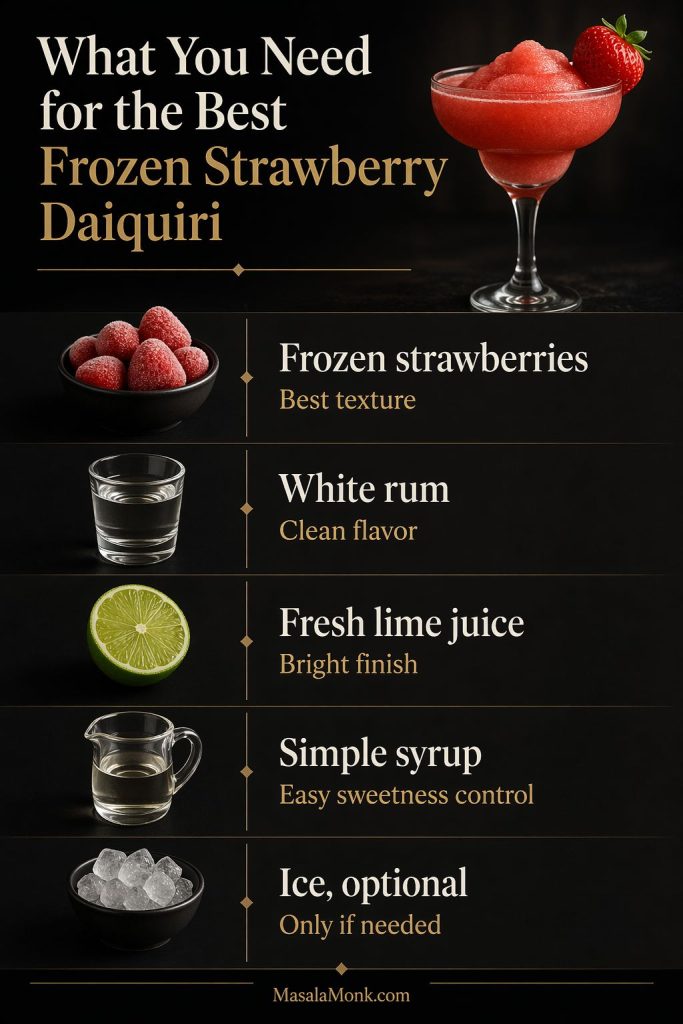
Frozen strawberry daiquiri ingredients guide showing frozen strawberries, white rum, fresh lime juice, simple syrup, and optional ice with short notes on what each one does.
The best frozen strawberry daiquiri starts with a short ingredient list and clear roles: frozen strawberries for body, white rum for a clean base, fresh lime for brightness, simple syrup for balance, and ice only if the blend needs a little extra help.

Strawberries

Frozen strawberries are the best starting point here. They give you body and coldness at the same time. If you have very ripe fresh strawberries, a few can be added for extra fragrance; however, the bulk should stay frozen.

White rum

Use a clean white rum for the easiest, brightest result. This is the bottle style that works best for a first version. For extra background, this guide to the best rums for daiquiris is a useful reference.

Fresh lime juice

This keeps the drink lively and prevents the fruit from tasting flat or jammy.

Simple syrup

Start with the lower end if your strawberries are sweet, then add more only if the drink needs it.

Cold water, only if needed

Instead, a small splash of cold water can loosen a stubborn blend without thinning it as quickly as a big scoop of extra ice.

Ice, optional

A little ice is fine if you want a frostier, slightly looser drink, but it should be a helper, not the main structure.

Pinch of salt, optional

A tiny pinch can sharpen the fruit and keep the sweetness from feeling blunt.

If you enjoy clean citrus-and-rum drinks in general, this mojito recipe is another easy one to keep in rotation.

Fresh vs Frozen Strawberries

Choosing the fruit style changes the drink more than most people expect.

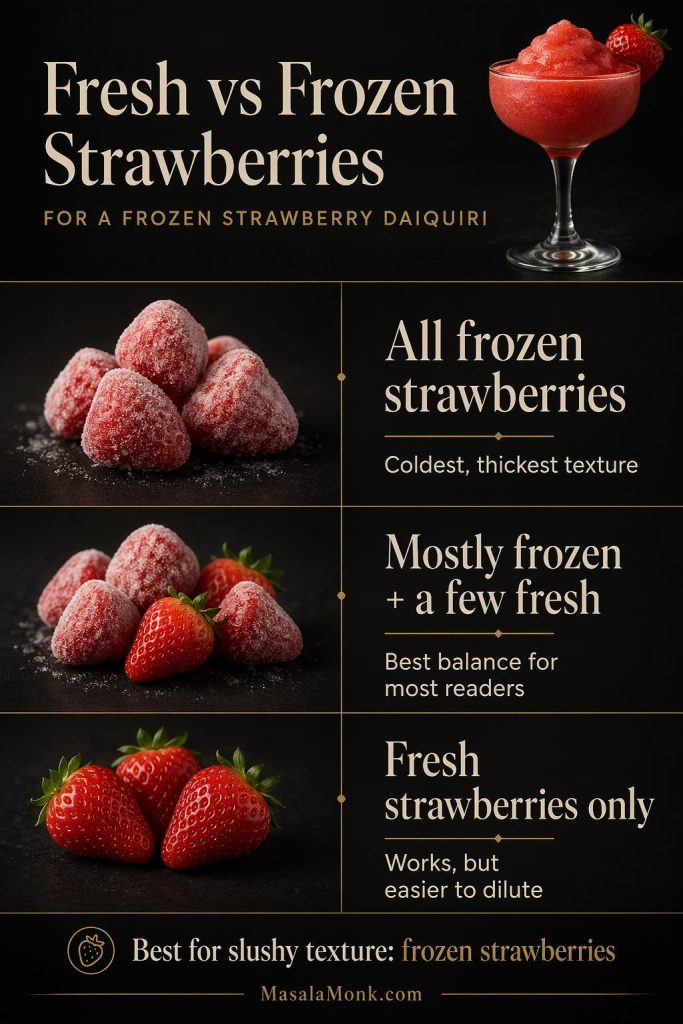
Fresh vs frozen strawberries guide for a frozen strawberry daiquiri, comparing all frozen strawberries, mostly frozen with a few fresh, and fresh strawberries only.
Choosing the right strawberries changes the drink more than most people expect: all frozen berries give the coldest, thickest slush, a mostly frozen mix with a few fresh berries gives the easiest balance for most readers, and fresh berries alone work but dilute more easily.

All frozen strawberries

This gives you the coldest, thickest result. It is great for a very slushy daiquiri, though it can edge toward too stiff if the liquid is too low.

Mostly frozen plus a few fresh strawberries

This is the most forgiving option for most home cooks. The drink stays thick and cold, but it also feels easier to sip.

Fresh strawberries only

Still, you can make it work. However, the ice then has to do more of the texture work, which makes dilution much harder to control.

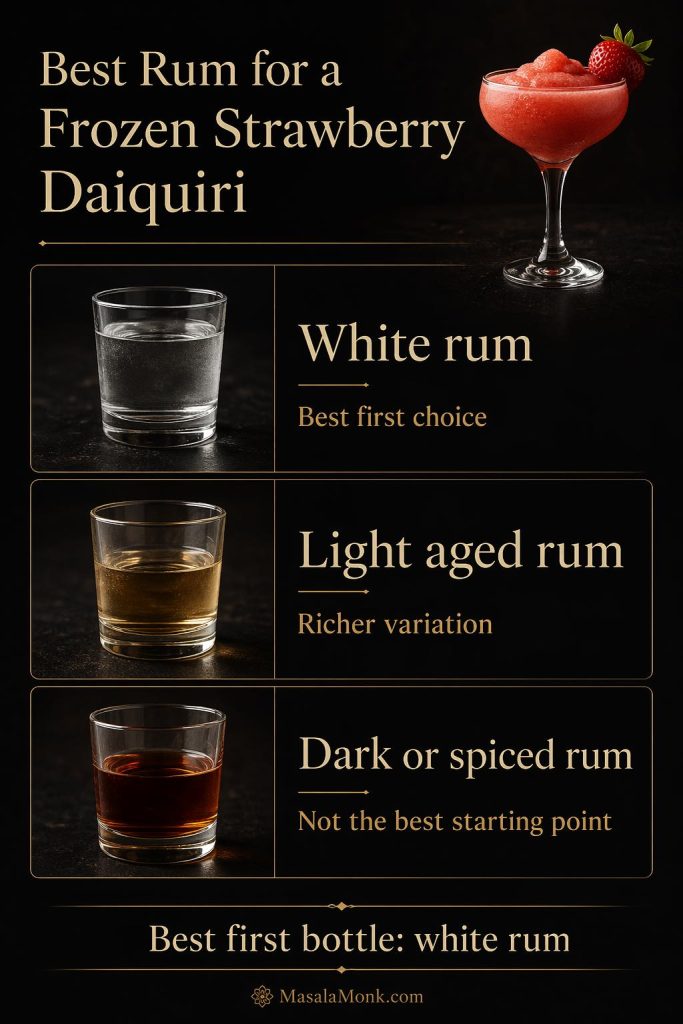
Best Rum for a Frozen Strawberry Daiquiri

For a first frozen strawberry daiquiri, white rum is the best place to start. It keeps the drink bright and lets the fruit lead.

Best rum for frozen strawberry daiquiri guide comparing white rum, light aged rum, and dark or spiced rum, with white rum recommended as the best first choice.
The best rum for a frozen strawberry daiquiri is usually the cleanest one: white rum keeps the drink bright and fruit-forward, light aged rum can add a slightly richer edge, and dark or spiced rum tends to pull the cocktail away from the fresh strawberry-and-lime profile most readers want first.

Best first bottle: white rum

A straightforward white rum keeps the drink clean and crisp without competing with the strawberries.

When aged rum can work

If you want a slightly rounder, richer finish, a light aged rum can work as a variation. Even so, it is better after you know the standard version first.

Why dark or strongly spiced rum is not the best starting point

Strawberries are fresh and delicate. For that reason, heavier rums can pull the drink into warmer, darker notes that make it feel less lively than a frozen daiquiri usually should.

You do not need a fancy bottle

Fresh lime and good texture matter more here than prestige rum. A solid mid-range white rum is usually enough.

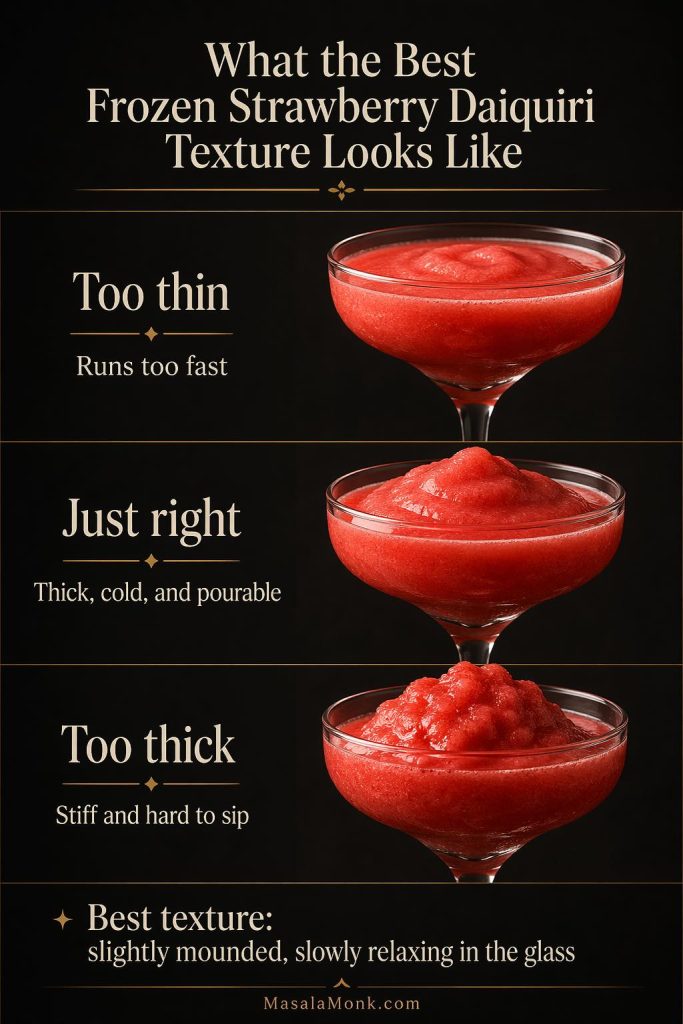
How to Get the Best Slushy Texture in a Frozen Strawberry Daiquiri

This is where the drink either comes together or falls apart. The goal is a texture that mounds slightly when poured, then slowly relaxes in the glass. It should feel thick and cold, but still like something you can sip rather than scoop.

Frozen strawberry daiquiri texture guide showing three consistency levels: too thin, just right, and too thick
Texture is what separates a good frozen strawberry daiquiri from one that feels watery or hard to drink: the ideal version should be thick enough to mound slightly, cold enough to stay slushy, and loose enough to relax slowly in the glass instead of sitting stiff or running flat.

Use frozen fruit before reaching for more ice

If the drink looks too thin, more frozen strawberries usually fix it better than more ice. They thicken the drink while keeping the flavor focused.

Too much alcohol can loosen the slush

Because alcohol does not freeze the way fruit does, a heavy pour can make the drink thinner than expected, even when it tastes balanced.

A small splash is enough when the blend is too stiff

When the blender struggles, add a tablespoon or two of cold water rather than a big pour. Small changes keep the structure under control.

Blend only until the drink is slushy

At the same time, overblending warms the mixture slightly and can flatten the texture. Once it looks thick and pourable, stop, taste, and adjust. For a more technique-driven take, Serious Eats has a useful frozen strawberry daiquiri method.

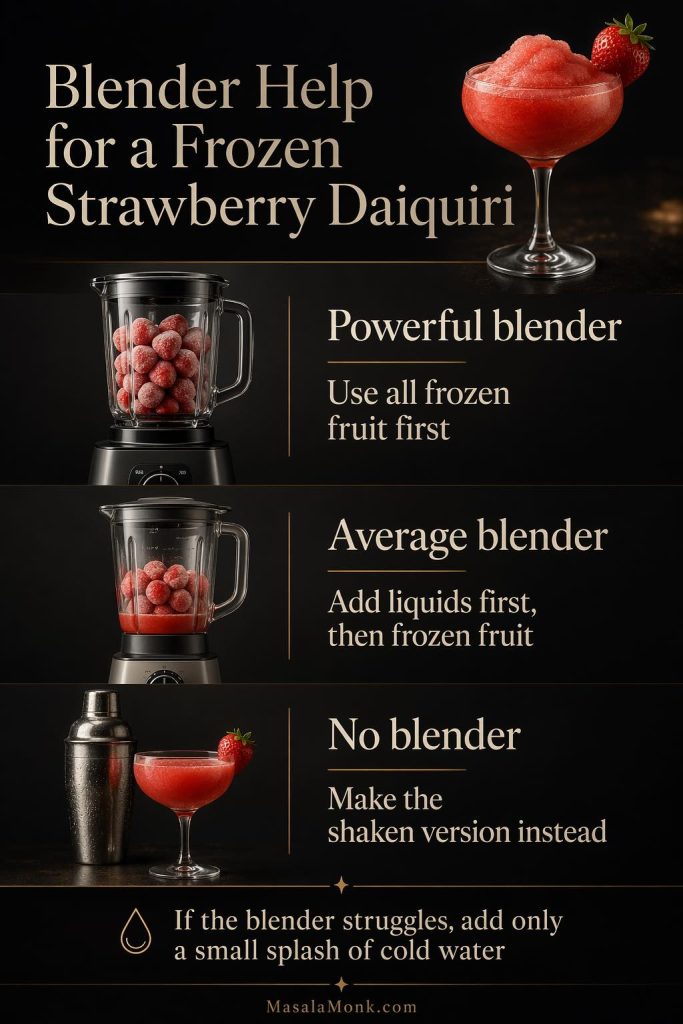
Blender Help

  • Powerful blender: use all frozen fruit first and blend straight to slush.
  • Average blender: add the liquids first, then the frozen fruit, and use only a small splash of cold water if needed.
  • No blender: make the shaken not frozen version below instead.
Frozen strawberry daiquiri blender help guide comparing what to do with a powerful blender, an average blender, or no blender.
A frozen strawberry daiquiri gets easier once the blender question is clear: powerful blenders can handle all frozen fruit first, average blenders work better with liquids added first, and if you do not want to blend at all, the shaken version is the cleaner backup plan.

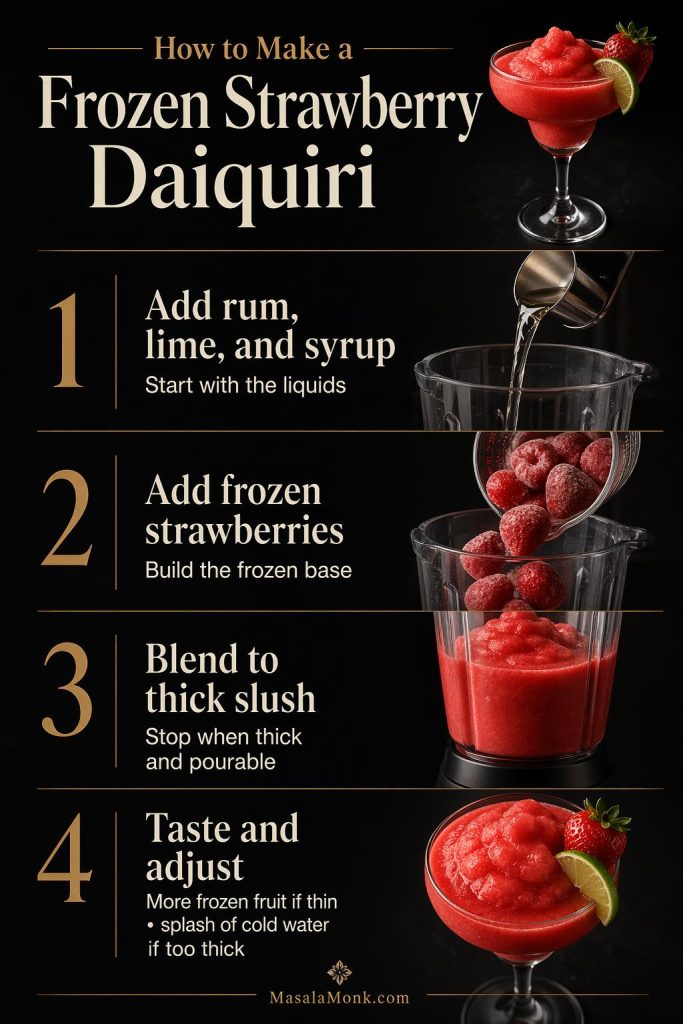
How to Make a Frozen Strawberry Daiquiri

The method is short, but the pause before serving matters. That is where you decide whether the drink just works or really tastes right.

Frozen strawberry daiquiri method guide showing how to add rum lime and syrup, add frozen strawberries, blend to thick slush, and adjust the texture before serving.
Making a frozen strawberry daiquiri works best when the order stays simple: start with the liquids, add frozen strawberries, blend until thick and pourable, then adjust the texture before serving.

Step 1: Add the liquids first

Add the rum, fresh lime juice, simple syrup, and optional pinch of salt to the blender first. This helps the blades catch more easily once the fruit goes in.

Step 2: Add the frozen strawberries

Tip the frozen strawberries in on top. Hold the cold water back unless the blender clearly needs help.

Step 3: Blend to thick slush

Blend until the drink looks thick, cold, and just pourable. It should not look like thin juice and it should not sit in hard frozen lumps either.

Step 4: Taste and adjust

Before serving, taste the daiquiri and make one small adjustment if needed. Add a little more simple syrup for a tart drink, a squeeze more lime for a sweet one, more frozen strawberries for a thin blend, or a small splash of cold water if the mixture is too thick to move. Then pour into chilled glasses and serve immediately.

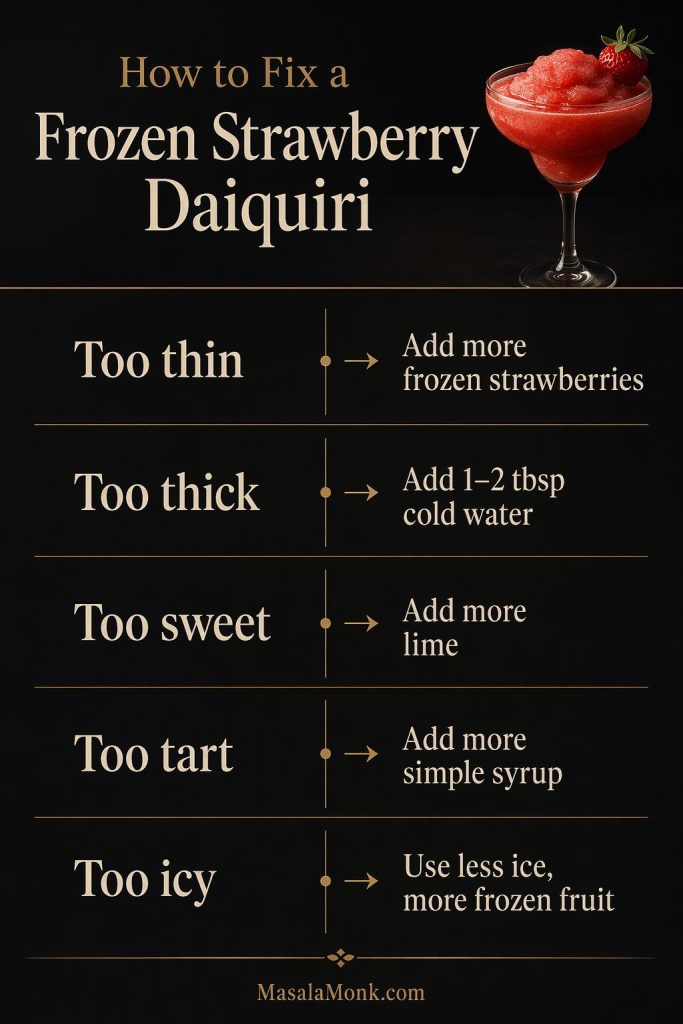
How to Fix a Frozen Strawberry Daiquiri Recipe That Is Watery, Icy, or Too Sweet

If the texture or flavor feels off, these fixes will pull it back quickly.

Frozen strawberry daiquiri troubleshooting guide showing how to fix a drink that is too thin, too thick, too sweet, too tart, or too icy.
When a frozen strawberry daiquiri misses the mark, the fix is usually small: more frozen fruit for a thin blend, a splash of cold water for one that is too thick, more lime if it tastes too sweet, more simple syrup if it tastes too tart, and less ice if the texture turns icy instead of properly slushy.

Too watery

  • Usually caused by: too much liquid, too much ice melt, or not enough frozen fruit.
  • Fix it now: blend in more frozen strawberries.
  • Avoid this: adding lots more syrup, which sweetens the drink without rebuilding the texture.
  • Next time: let the fruit do more of the thickening from the start.

Too icy

  • Usually caused by: too much plain ice carrying the drink.
  • Fix it now: blend in more frozen strawberries if you have them.
  • Avoid this: blending the same mixture longer and hoping it softens into something better.
  • Next time: start with a more fruit-led frozen base and use ice only as support.

Too thick to drink

  • Usually caused by: too much frozen fruit for the amount of liquid.
  • Fix it now: add 1 to 2 tablespoons cold water and blend again.
  • Avoid this: adding a large splash all at once.
  • Next time: slightly reduce the fruit or slightly increase the total liquid.

Too sweet

  • Usually caused by: sweet fruit plus too much syrup, or not enough lime to sharpen the drink.
  • Fix it now: add fresh lime juice.
  • Avoid this: adding more rum first, because that changes the strength more than the balance.
  • Next time: begin at the lower end of the syrup range and adjust after tasting.

Too tart

  • Usually caused by: tart strawberries, strong lime, or simply not enough sweetener.
  • Fix it now: add a little more simple syrup.
  • Avoid this: adding lots more fruit first and assuming that will fix it.
  • Next time: remember that tart berries almost always need a touch more sweetness than very ripe ones.

Too boozy

  • Usually caused by: too much rum crowding both the fruit flavor and the frozen texture.
  • Fix it now: add a little more frozen fruit and, if needed, a touch more lime.
  • Avoid this: fixing it with more syrup unless the drink is also too tart.
  • Next time: keep the rum at the default amount until you know how strong you want it in frozen form.

Not strawberry-forward enough

  • Usually caused by: weak berries, too much dilution, or too much rum relative to the fruit.
  • Fix it now: add more frozen strawberries.
  • Avoid this: reaching for extra ice to rebuild structure.
  • Next time: rely more on fruit than extra ice for the body.

Blender not moving

  • Usually caused by: a blend that is too stiff or fruit not settling into the blades.
  • Fix it now: stop, scrape down if needed, then add a very small splash of cold water and pulse again.
  • Avoid this: forcing the motor without enough movement.
  • Next time: add the liquids first and keep the frozen fruit on top.

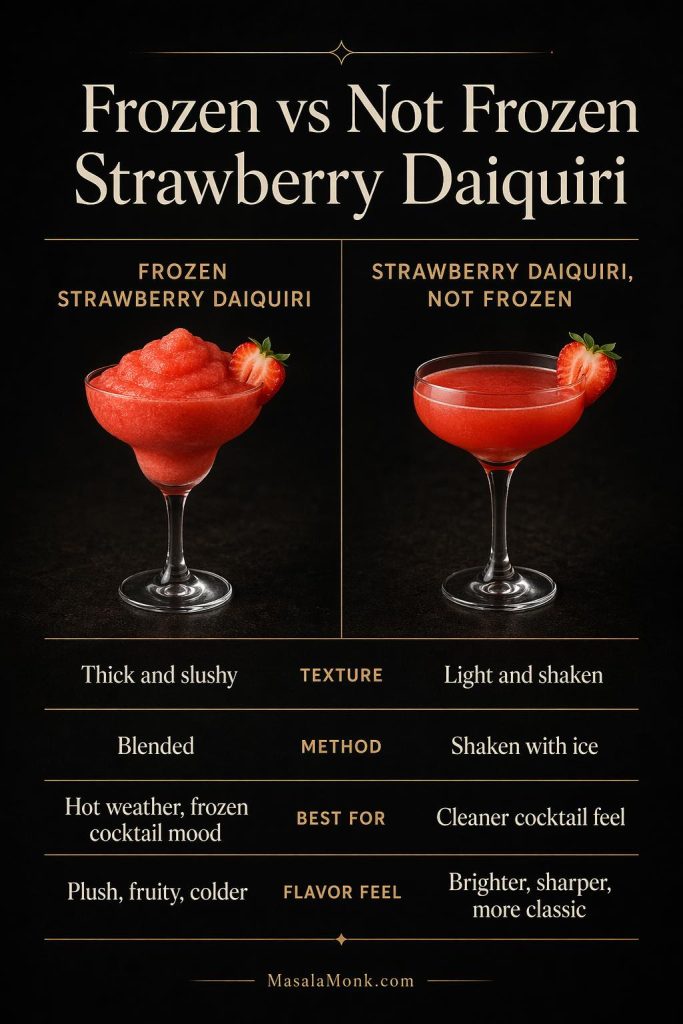
Strawberry Daiquiri Recipe, Not Frozen

If you want a cleaner, sharper strawberry daiquiri, the shaken version is the better choice. It keeps the same core flavor idea, but it drinks more like a classic cocktail and less like a frozen treat.

Comparison board showing frozen strawberry daiquiri versus strawberry daiquiri not frozen, including differences in texture, method, best use, and flavor feel.
Choosing between a frozen strawberry daiquiri and a not frozen one usually comes down to mood: the frozen version is thicker, colder, and more plush, while the shaken version feels lighter, brighter, and closer to a classic cocktail.

Shake 2 oz white rum, 1 oz fresh lime juice, 3/4 oz simple syrup, and a small handful of muddled or blended strawberries with ice, then strain into a chilled glass. As a result, it is lighter, brighter, and faster than the frozen version.

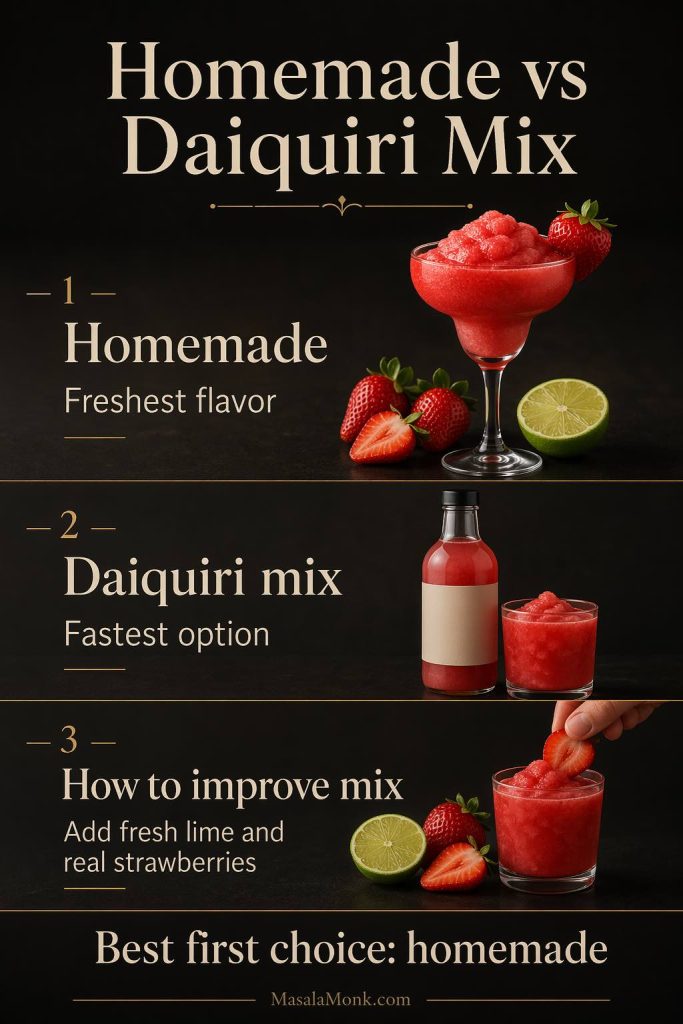
Can You Make It With Daiquiri Mix?

Yes, but homemade usually tastes fresher and gives you much better control over sweetness, lime, and fruit intensity.

Homemade vs daiquiri mix guide for a frozen strawberry daiquiri, showing homemade as the freshest option, bottled mix as the fastest option, and fresh lime plus real strawberries as the best way to improve mix.
Homemade gives a frozen strawberry daiquiri its freshest flavor, while bottled daiquiri mix is the faster shortcut. If you do use mix, fresh lime and real strawberries make the drink taste brighter, less flat, and much closer to the fresh version.

However, if you do use a strawberry daiquiri mix, add fresh lime juice and, if possible, some real frozen strawberries. That makes the drink taste less flat and more like an actual strawberry cocktail.

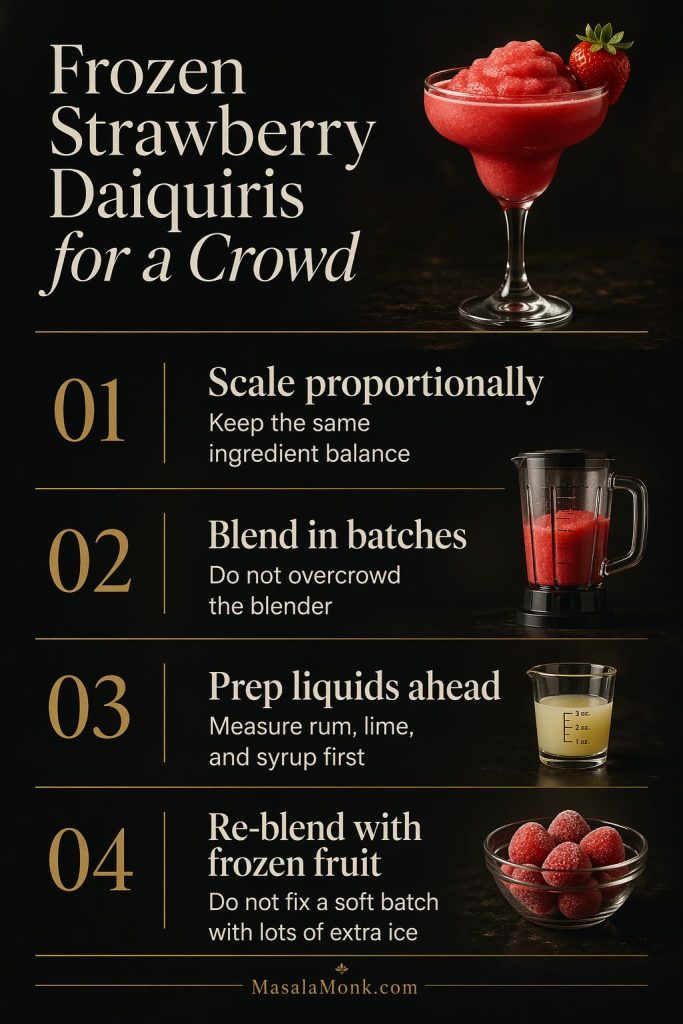
Frozen Strawberry Daiquiris for a Crowd

Although this drink scales well, it is still best blended close to serving time.

Frozen strawberry daiquiris for a crowd guide showing how to scale proportionally, blend in batches, prep liquids ahead, and re-blend with frozen fruit.
Making frozen strawberry daiquiris for a group works best when you keep the ratios steady, blend in batches, prep the liquids ahead, and fix a soft batch with more frozen fruit instead of piling in extra ice.
  • Scale the ingredients proportionally for 4 to 6 drinks.
  • Blend in batches if your blender is not large enough.
  • For the smoothest texture, keep each batch below the blender’s maximum fill line rather than forcing one oversized batch.
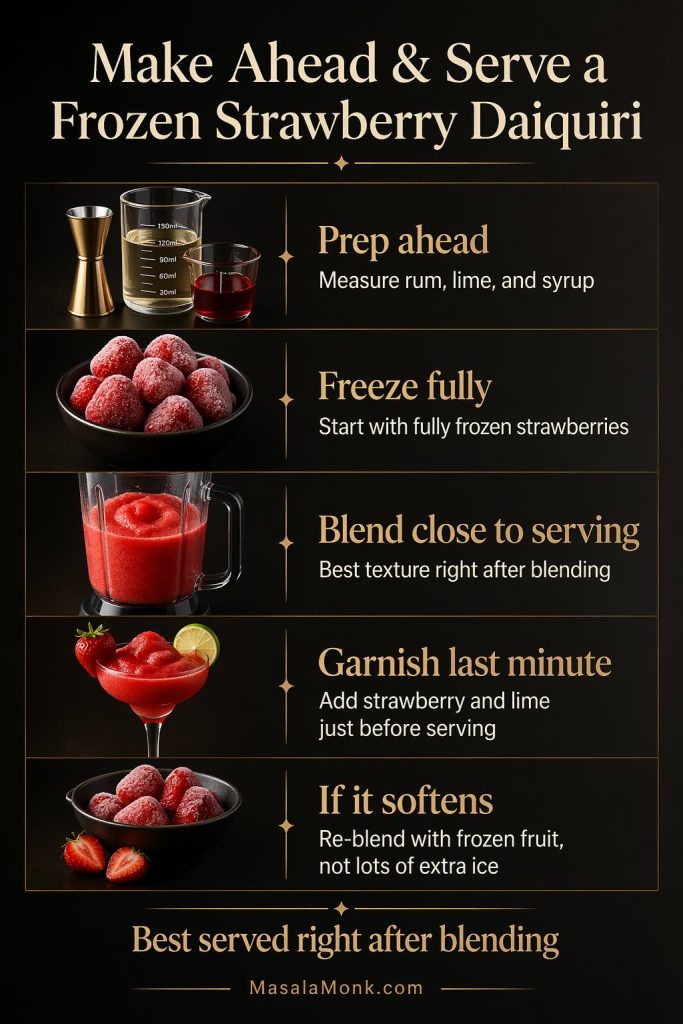
  • Pre-measure the rum, lime juice, and syrup ahead of time.
  • If the batch softens while sitting, re-blend briefly with a little more frozen fruit rather than a lot more ice.

If you need another rum drink that is naturally good for groups, this rum punch recipe is an easy one to keep nearby.

Make-ahead and serving guide for frozen strawberry daiquiris showing what to prep ahead, when to blend, when to garnish, and how to fix a softened batch.
Frozen strawberry daiquiris are easiest to serve well when the timing stays simple: prep the liquids ahead, start with fully frozen strawberries, blend close to serving, garnish at the last minute, and re-blend with more frozen fruit if the batch softens.

Frozen Strawberry Daiquiri Recipe FAQs

Can I use fresh strawberries?

Yes, but frozen strawberries usually give the best texture in a frozen daiquiri. Fresh berries make it easier to rely too heavily on ice.

Do I need simple syrup?

No, but it is the easiest sweetener to control in a very cold drink.

What rum is best?

White rum is the best first choice for a frozen strawberry daiquiri.

Can I make it ahead?

You can prep the ingredients ahead, but the full drink is best blended right before serving.

Can I make it without alcohol?

Yes. Replace the rum with cold water, coconut water, or a little extra lime and syrup to taste.

Can I use Bacardi?

Yes. A clean white rum like Bacardi works well here.

Can I use strawberry daiquiri mix instead?

Yes, but the drink usually tastes fresher from scratch. If using mix, brighten it with fresh lime and real strawberries if you can.

What is the difference between frozen and shaken strawberry daiquiri?

The frozen version is thicker, colder, and more texture-driven. The shaken version is lighter, brighter, and more classic-cocktail-like.

If you want one make-first version to keep on repeat all summer, this frozen strawberry daiquiri recipe is the one to start with.

Frozen Strawberry Daiquiri Recipe

A frozen strawberry daiquiri made from scratch with white rum, fresh lime juice, simple syrup, and frozen strawberries for a thick, drinkable slush that still tastes bright and fresh.

  • Yield: 2 drinks
  • Prep time: 10 minutes
  • Cook time: 0 minutes
  • Total time: 10 minutes
  • Best glass: coupe, margarita glass, or small hurricane glass

Equipment

  • Blender
  • Jigger or measuring cup
  • Citrus juicer

Ingredients

  • 3 cups frozen strawberries
  • 4 oz white rum
  • 1 1/2 oz fresh lime juice
  • 1 to 1 1/2 oz simple syrup, to taste
  • 2 to 4 tbsp cold water, only if needed to loosen the blend
  • 1/2 cup ice, optional, for a frostier, slightly looser texture
  • Tiny pinch of salt, optional
  • Lime wheel or strawberry, for garnish

Method

  1. Add the rum, lime juice, simple syrup, and optional pinch of salt to the blender first.
  2. Add the frozen strawberries on top.
  3. Blend until the mixture turns into a thick slush.
  4. Stop and taste. Add a little more syrup if too tart, a little more lime if too sweet, or a small splash of cold water if too thick to move.
  5. If the drink is too thin, add more frozen strawberries instead of leaning on more ice.
  6. Then pour into chilled glasses, garnish, and serve immediately.

Notes

  • Use mostly frozen strawberries for the best texture.
  • White rum is the best first choice.
  • Fresh lime matters more here than expensive rum.
  • Start with less syrup if your strawberries are very ripe.
  • Use frozen fruit before extra ice if the drink looks too thin.
  • The drink is best served immediately after blending.
  • For 4 to 6 drinks, scale the ingredients proportionally and blend in batches.

If You Want Another Frozen or Rum Cocktail Next

Once you have this frozen strawberry daiquiri down, try this watermelon daiquiri for another fruit-led daiquiri, this piña colada variations guide for creamy tropical territory, or this refreshing summer cocktails roundup for lighter warm-weather drinks.

↑ Back to top

Posted on 10 Comments

Daiquiri Recipe (Classic, Strawberry & Frozen Cocktails)

Daiquiri recipe cover — classic, strawberry and frozen variations shown as a golden daiquiri in a coupe with lime, black backdrop — MasalaMonk

Sometimes a cocktail feels like a small holiday. The Daiquiri is exactly that—bright, chilled, and direct. It began in Cuba as a simple mix of rum, lime, and sugar; yet, over time, it grew into a family of drinks that includes fruity crowd-pleasers and dry, elegant riffs. In this guide, you’ll first master the classic Daiquiri Recipe that bartenders rely on. Then, you’ll ease into a Strawberry Daiquiri Recipe—first on the rocks, then frozen for that beach-bar feel. After that, you’ll explore banana, mango, pineapple, and the grapefruit-and-maraschino-kissed Hemingway version. Throughout, you’ll learn how to balance sweetness and acidity, how to tune texture, and how to fix the most common mistakes—so your next round tastes exactly the way you imagined.

Because precision leads to confidence, we’ll work in milliliters and clear steps. Because context helps, you can also check the International Bartenders Association’s Daiquiri for a classic benchmark: International Bartenders Association’s Daiquiri. And because technique matters, this practical deep dive from Serious Eats is a smart companion: Serious Eats: Daiquiri.


Before You Mix: Ingredients, Tools, and Ratios

First, choose a clean, unflavored white rum at 40–45% ABV; column-still Caribbean styles are ideal because they’re crisp and let lime shine. Next, insist on fresh lime juice; bottled juice dulls the aroma and throws off acidity. Then, make simple syrup (1:1 sugar to water by volume) or a rich syrup (2:1) if you prefer extra body—Difford’s explains that richer syrup changes mouthfeel and dilution: Difford’s Guide: Daiquiri.

For tools, you’ll want a shaker, strainer (and ideally a fine strainer), jigger, and a chilled coupe or rocks glass. As for ratios, start with 4:2:1 (rum:lime:syrup) when you like it drier, 4:2:1.5 when you want a balanced home style, and 4:2:2 when you’re blending frozen where cold mutes sweetness.


Daiquiri Recipe (Classic, 2 Servings)

What you’ll taste: Clean rum character, bright lime, and a gentle, polished sweetness. Because there’s nowhere to hide, balance is everything.

Ingredients

  • 120 ml white rum (40–45% ABV)
  • 60 ml fresh lime juice (about 2 limes)
  • 30–45 ml simple syrup (1:1), to taste
  • Plenty of ice
  • Lime wheel, to garnish
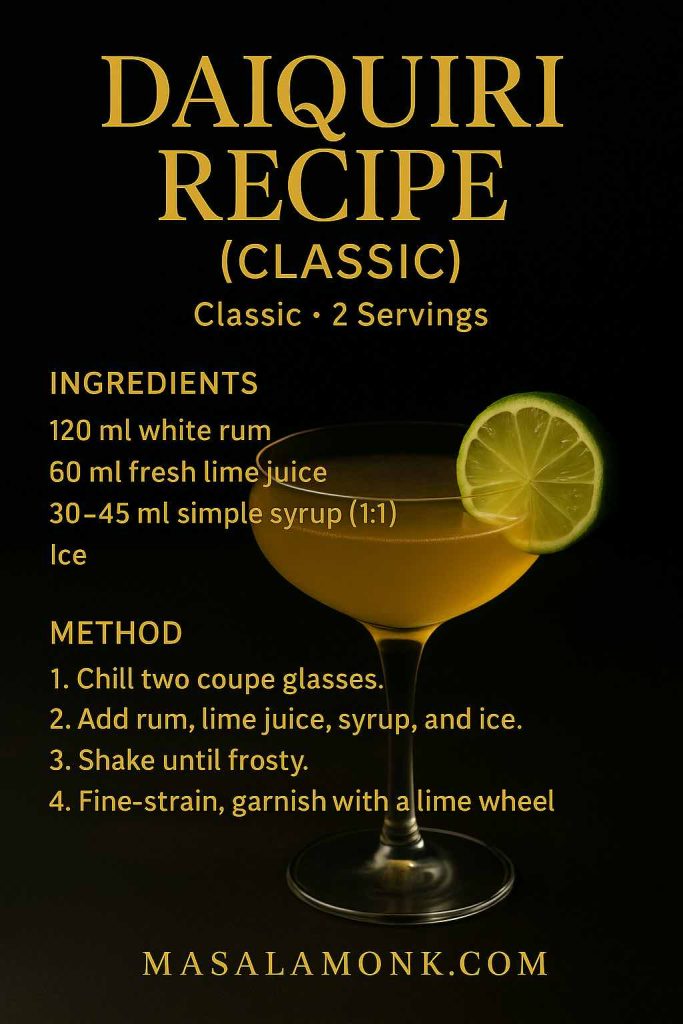
Classic Daiquiri in a chilled coupe with lime wheel on a dark backdrop; recipe card overlay listing ingredients and shake–fine-strain method.
For a bar-quality finish, chill the coupe, shake 12–15 seconds, then fine-strain for that glossy top; start drier at 4:2:1 (rum:lime:syrup) and adjust ±7.5–15 ml to taste—use fresh lime only, and switch to rich (2:1) syrup if the texture feels thin.

Method, step by step

  1. First, chill two coupe glasses. Cold glassware keeps texture tight.
  2. Next, add rum, lime, and 30 ml syrup to a shaker; then fill with ice.
  3. Now shake hard for 12–15 seconds until the tin frosts; vigorous shaking aerates and integrates.
  4. After that, fine-strain into the chilled coupes; fine-straining removes shards and makes the surface glossy.
  5. Finally, garnish with a lime wheel. Taste; if you prefer softer acidity, increase the syrup to 45 ml next round.

Why it works (briefly): Rum brings warmth; lime delivers snap; syrup knits them together. If you want an alternative spec with a light caramel edge, try demerara syrup as shown here: Liquor.com: Classic Daiquiri.

Common fixes: If it’s too sour, add 7.5–15 ml syrup and shake again for 5 seconds. If it’s too sweet, add 7.5–15 ml lime and shake briefly. If it feels thin, use rich (2:1) syrup next time and ensure the glass is properly chilled.

Do read: What to Mix with Jim Beam: Best Mixers & Easy Cocktails.


Strawberry Daiquiri Recipe (On the Rocks)

What you’ll taste: Fresh strawberry aroma first, then lime brightness, then a clean rum finish. Because strawberries vary, you’ll tune sweetness gently.

Ingredients

  • 120 ml white rum
  • 60 ml fresh lime juice
  • 30–45 ml simple syrup (1:1)
  • 6–8 ripe strawberries, hulled
  • Ice
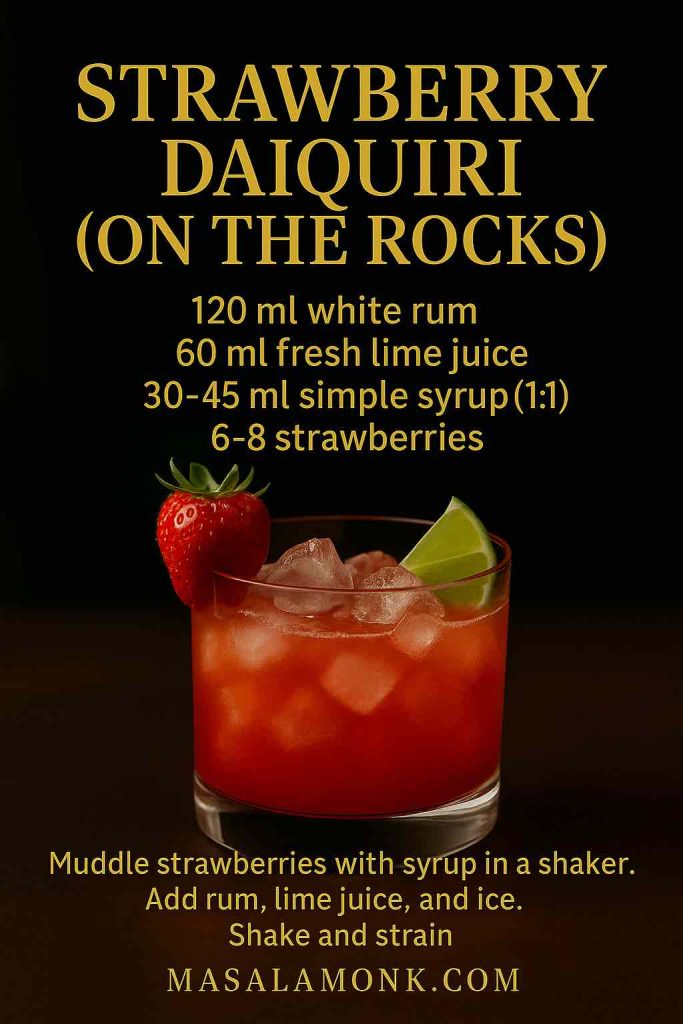
Strawberry Daiquiri on pebble ice with strawberry and lime; recipe card overlay with ingredients and muddle–shake–fine-strain steps.
Muddle berries with syrup, then fine-strain over pebble ice so you taste fruit—not seeds; keep lime bright, and tune sweetness in 5 ml steps based on ripeness (vodka swap 1:1 for a cleaner profile; with spiced rum, reduce syrup slightly; a pinch of salt makes strawberry pop).

Method, step by step

  1. First, in a shaker, muddle strawberries with the syrup until they’re juicy and fragrant.
  2. Next, add rum and lime; then pack the shaker with ice.
  3. Now shake briskly for 10–12 seconds.
  4. After that, fine-strain over fresh ice in a rocks glass; this keeps seeds and pulp out while preserving color.
  5. Finally, garnish with a strawberry and lime wedge.

Flavor notes & smart swaps:

  • If your berries are under-ripe, increase syrup slightly; if they’re super sweet, bump the lime.
  • For a Strawberry Daiquiri with vodka, swap rum 1:1 for a cleaner, more neutral base.
  • For a Spiced Rum Strawberry Daiquiri, keep syrup modest; spices add perceived sweetness.

If you’d rather blend than shake, this is a reliable baseline for blender structure: Liquor.com: Strawberry Daiquiri.


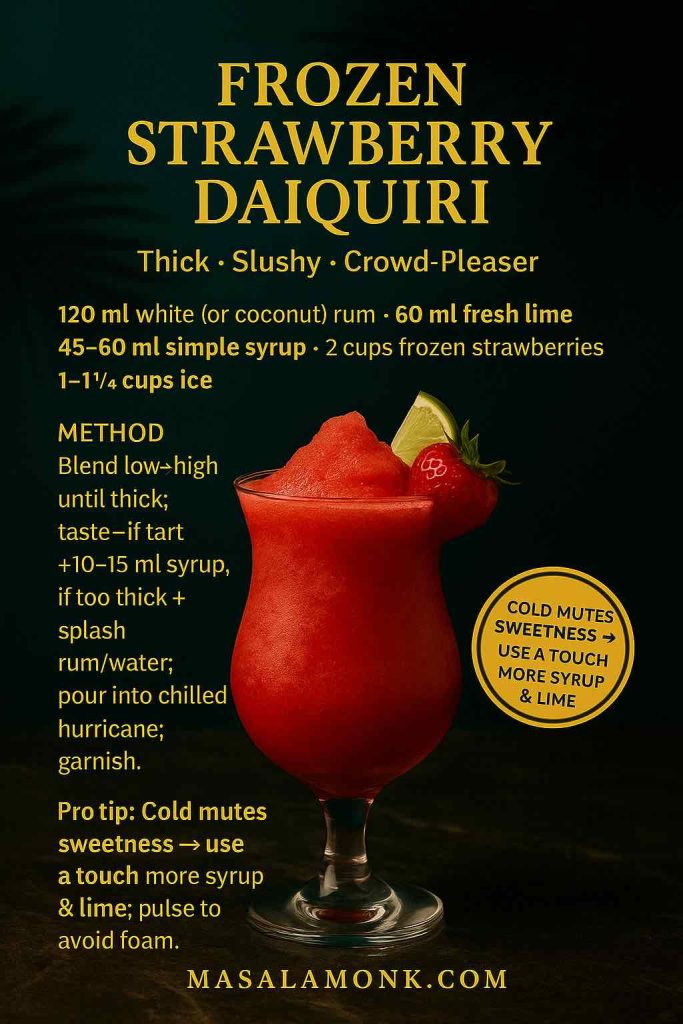
Frozen Strawberry Daiquiri (Thick, Slushy, Crowd-Pleaser)

What you’ll taste: Cold, lush strawberry with lively lime; thicker body; a touch more sweetness to counter the deep chill.

Ingredients

  • 120 ml white rum (or coconut rum for a Malibu-style vibe)
  • 60 ml fresh lime juice
  • 45–60 ml simple syrup (frozen fruit is less sweet)
  • 2 cups frozen strawberries
  • 1–1½ cups ice, as needed
Frozen Strawberry Daiquiri recipe card with red slush in a hurricane glass; overlay lists 120 ml white or coconut rum, 60 ml lime, 45–60 ml syrup, 2 cups frozen strawberries, 1–1½ cups ice, and blend-low-to-high method — MasalaMonk.
Frozen Strawberry Daiquiri: blend low → high for a thick, silky slush; since cold dulls flavor, add 10–15 ml syrup (and a squeeze of lime) if it tastes flat—use coconut rum for a Malibu vibe or a clean white rum to keep strawberry forward.

Method, step by step

  1. First, add everything to a blender.
  2. Next, start on low to break up the ice; then increase speed until thick but pourable.
  3. Now taste. If it’s too tart, add 10–15 ml syrup; if it’s too thick, add a splash of rum or cold water.
  4. Finally, pour into a chilled hurricane or stemmed glass and garnish.

Why frozen needs tweaking: Because cold suppresses sweetness and aroma, frozen builds need slightly more syrup and more lime. For an excellent explanation of this balancing act, see: Serious Eats: The Best Frozen Strawberry Daiquiri. Alternatively, this stylish approach keeps dilution in check by leaning on frozen berries over ice: Bon Appétit: Strawberry Daiquiri.

Brand-friendly variants:

  • Malibu Strawberry Daiquiri: coconut rum adds dessert-tropical notes; therefore, keep lime bright.
  • Bacardi Strawberry Daiquiri: a clean white rum keeps fruit forward; avoid oversweetening.
  • Best strawberry daiquiri mix (when using premix): taste first; then add lime and, if necessary, a splash of water to restore balance.

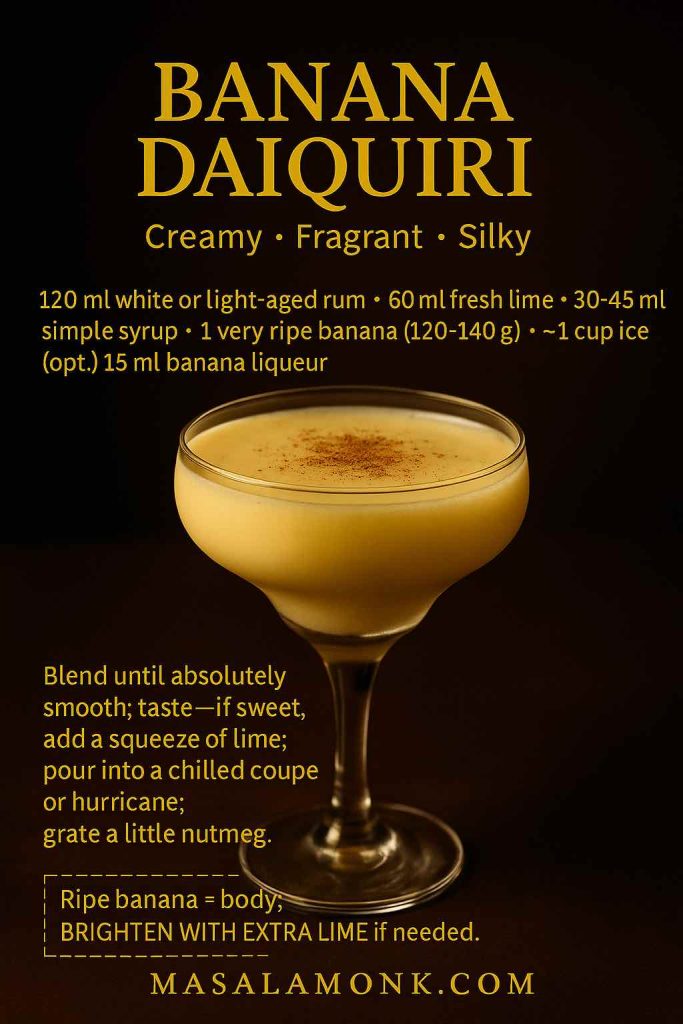
Banana Daiquiri Recipe (Creamy & Fragrant)

What you’ll taste: Ripe banana creaminess with lime lift; silky, almost dessert-like, yet still refreshing.

Ingredients

  • 120 ml white or lightly aged rum
  • 60 ml fresh lime juice
  • 30–45 ml simple syrup
  • 1 very ripe banana (120–140 g), sliced
  • Optional: 15 ml banana liqueur for extra depth
  • About 1 cup ice
Banana Daiquiri recipe card with creamy blended cocktail in a coupe; overlay shows 120 ml rum, 60 ml lime, 30–45 ml syrup, 1 ripe banana, optional 15 ml banana liqueur, and blend-until-smooth method with nutmeg garnish — MasalaMonk
Banana Daiquiri: ultra-smooth and dessert-light—ripe fruit adds body, while a fresh lime bump keeps it lively; a whisper of nutmeg finishes it.

Method
Blend until absolutely smooth; then pour into a chilled coupe or hurricane glass. A light grate of nutmeg adds warmth without heaviness. If it leans sweet, add an extra squeeze of lime and blend briefly.


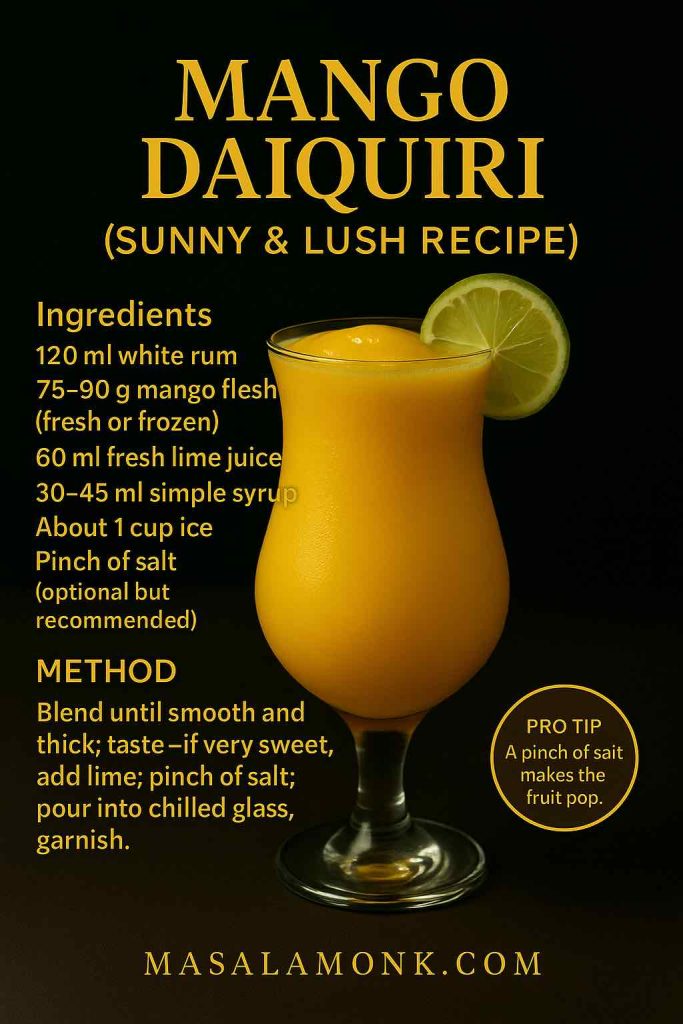
Mango Daiquiri (Sunny & Lush Recipe)

What you’ll taste: Dense mango richness, lifted by lime; a tiny pinch of salt makes the fruit pop.

Ingredients

  • 120 ml white rum
  • 75–90 g mango flesh (fresh or frozen)
  • 60 ml fresh lime juice
  • 30–45 ml simple syrup
  • About 1 cup ice
  • Pinch of salt (optional but recommended)
Mango Daiquiri recipe card in a chilled coupe; sunny yellow drink with lime, overlay lists rum, mango, lime, simple syrup, ice, and a pinch-of-salt tip — MasalaMonk
Mango Daiquiri: lush and sunny—blend until thick, then brighten with a squeeze of lime; a tiny pinch of salt makes mango pop without extra sugar.

Method
Blend to a thick, spoon-coating texture. Taste; if mango is very sweet, increase lime 5–10 ml. Because mango is dense, a pinch of salt sharpens definition.

Also Explore: Mango Vodka Cocktail: The Perfect Base + 7 Must-Try Variations.


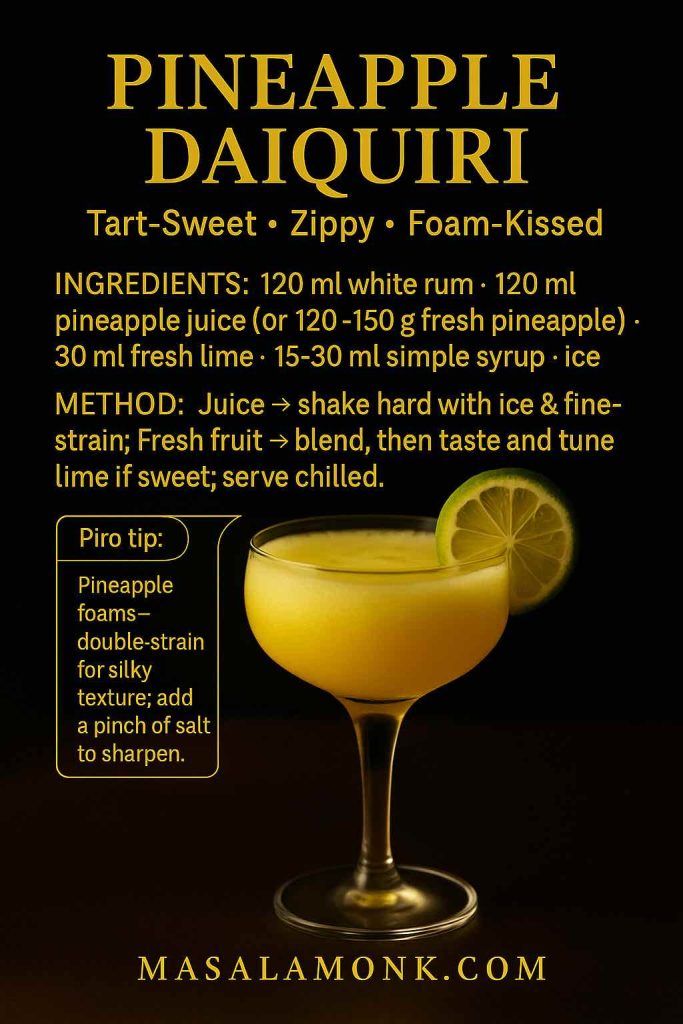
Recipe for Pineapple Daiquiri (Tart-Sweet Snap)

What you’ll taste: Pineapple foam and perfume, anchored by lime; zippy and easy-drinking.

Ingredients

  • 120 ml white rum
  • 120 ml pineapple juice (or 120–150 g fresh pineapple)
  • 30 ml fresh lime juice
  • 15–30 ml simple syrup, to taste
  • Ice
Pineapple Daiquiri recipe card with bright yellow cocktail in a coupe; overlay lists rum, pineapple (juice or fresh), lime, syrup, ice, and shows shake-and-fine-strain or blend method with a pro tip about double-straining and a pinch of salt — MasalaMonk
Pineapple Daiquiri: when using juice, shake hard and double-strain for a silky foam; with fresh fruit, blend, then keep lime bright and syrup modest—add a pinch of salt to sharpen the snap.

Method
If using juice, shake hard with ice and fine-strain into a chilled glass. If using fresh pineapple, blend; then taste and tune with lime because fresh fruit can be sweeter.

Virgin note: For a virgin daiquiri, replace rum with cold water or a non-alcoholic spirit; keep lime bright and sweetness modest.

Do Read: Punch with Pineapple Juice: Guide & 9 Party-Perfect Recipes.


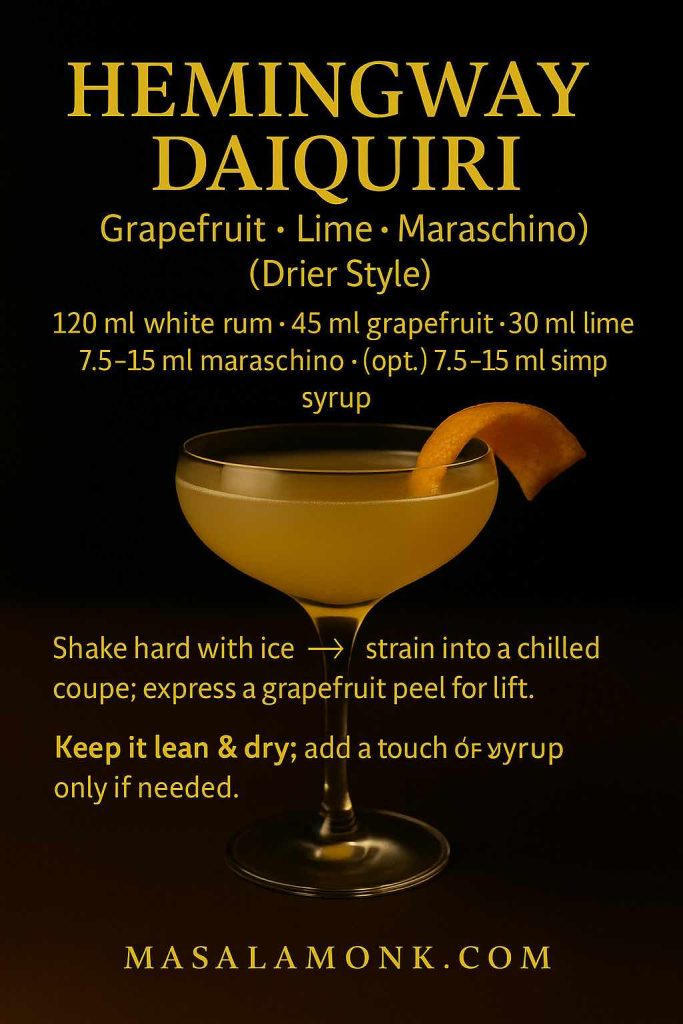
Hemingway Daiquiri Recipe (Grapefruit, Lime & Maraschino)

What you’ll taste: Lean, dry refreshment with grapefruit bitterness, lime zip, and a perfumed cherry-almond whisper from maraschino.

Ingredients

  • 120 ml white rum
  • 45 ml fresh grapefruit juice
  • 30 ml fresh lime juice
  • 7.5–15 ml maraschino liqueur
  • Optional: 7.5–15 ml simple syrup (traditionally on the drier side)
Hemingway Daiquiri recipe card with pale cocktail in a coupe; overlay shows rum, grapefruit, lime, maraschino, optional syrup, and shake–strain method with a drier-style tip — MasalaMonk
Hemingway Daiquiri: citrus-sharp and refreshingly dry—shake hard, serve in a chilled coupe, and add only a whisper of syrup if the grapefruit runs too bitter.

Method
Shake with ice; then strain into a chilled coupe. Express a grapefruit peel if you want extra lift.

For a formal reference, browse the IBA’s Hemingway Special (listed under a variant name): IBA: Hemingway Special. For a bar-tested version with great balance, try: PUNCH: St. John Frizell’s Hemingway Daiquiri.


Ingredient & Technique Notes for Daiquiri Recipe

Best white rum for daiquiri: Choose a clean, unflavored white rum around 40–45% ABV. Because heavy oak can mask citrus, avoid deeply aged styles in these recipes. For strawberry, neutrality helps fruit shine; consequently, straightforward white rum is perfect.

Simple syrup strength: Use 1:1 for shaken, lighter-bodied classics; switch to 2:1 in frozen builds when you want extra texture and less melt. For why syrup strength changes mouthfeel and dilution, see: Difford’s Guide: Daiquiri.

Fresh vs premade mix: Convenience matters, especially for parties. However, many mixes are very sweet. Therefore, always taste first; then add fresh lime and, if necessary, a splash of water. This one minute of tuning usually converts “meh” into “oh wow.”

Blenders & dilution: Start low, then increase speed; short pulses prevent foam. Because colder drinks read less sweet, frozen recipes typically need slightly more syrup and slightly more lime than their shaken counterparts.


Make-Ahead, Batching, and Slush Machines

Batch the classic (with alcohol): Combine rum, lime, and syrup in a bottle and chill for up to 2–3 days. When serving, shake individual portions with ice; shaking restores texture you lose in the fridge. If someone asks about “to-go,” this is the best at-home equivalent: cold, quick, and consistent.

Freezer fruit pouches: Pre-portion fruit purées with syrup in freezer bags. Later, blend a pouch with rum and lime for instant frozen daiquiri drinks. Because the fruit is already cold, texture turns out thicker and more stable.

Slush machine basics: Aim for 10–12% ABV and start near 4:2:2 (rum:lime:syrup). After the machine stabilizes, taste the result. If it’s watery, increase syrup slightly or reduce total water. If it’s too sweet, add measured lime and let the machine pull it back to equilibrium.


When Something’s Off: Quick, Real Fixes

  • Too sour → add 7.5–15 ml syrup, then shake or blend briefly.
  • Too sweet → add 7.5–15 ml lime; a tiny pinch of salt can also sharpen fruit.
  • Too thin → use less ice, chill glassware, or switch to rich (2:1) syrup.
  • Not enough strawberry → reduce ice, add more berries, or blend a small spoon of strawberry daiquiri mix as a booster and retune lime.

More Refreshing Drinks You Might Love

If strawberry hit the spot, try this sunny twist next: Watermelon Daiquiri. If coconut sounds perfect, head to this practical guide: Piña Colada (classic & virgin). And if you’re exploring lower-sugar or zero-alcohol options, these ideas keep flavor first: Keto/Low-Carb Mocktails.

FAQs

1. What is the classic Daiquiri Recipe ratio?

Start with 4:2:1 (rum:lime:simple syrup). Then, if you prefer a slightly rounder profile, move to 4:2:1.5. Finally, for frozen builds where cold mutes sweetness, 4:2:2 often tastes best.

2. Which white rum for Daiquiri gives the cleanest result?

Choose a clean, unflavored white rum (40–45% ABV). Consequently, column-still Caribbean styles shine in a classic Daiquiri and in a Strawberry Daiquiri Recipe, because they let lime and fruit lead.

3. Can I make a vodka Daiquiri or Strawberry Daiquiri with vodka?

Yes—swap rum 1:1 with vodka. However, the drink will taste cleaner and a bit less characterful, so consider a touch more lime to keep it vivid.

4. How do I balance a frozen strawberry daiquiri that tastes dull?

Because cold suppresses sweetness and aroma, add 10–15 ml syrup and a small squeeze of lime, then blend briefly. As a result, fruit pops and texture stays thick.

5. What’s the difference between a classic daiquiri and a rum daiquiri?

They’re the same family: rum, lime, and sugar. Nevertheless, “rum daiquiri” sometimes appears when people contrast it with fruit versions like banana daiquiri or mango daiquiri.

6. Which sweetener works best—simple syrup or rich syrup (2:1)?

For shaken classics, use 1:1 for clarity. Conversely, in frozen builds, 2:1 adds body and resists over-dilution, improving frozen daiquiri texture.

7. How do I make a Virgin Strawberry Daiquiri that still tastes exciting?

Blend frozen strawberries, fresh lime, and simple syrup with cold water or a zero-proof “rum”. Then, if it feels flat, add a pinch of salt and an extra squeeze of lime to lift it.

8. What’s inside a Hemingway Daiquiri (a.k.a. Hemingway cocktail)?

It mixes white rum, grapefruit juice, lime juice, and maraschino liqueur. Therefore, it’s drier and crisper than a sweet fruit daiquiri—perfect when you want refreshment without heaviness.

9. Can I use Malibu or other coconut rums for a Malibu Strawberry Daiquiri?

Absolutely. Because coconut rum reads sweeter, keep lime bright and, if needed, reduce syrup slightly. Consequently, you’ll get a dessert-tropical profile without cloying sweetness.

10. Is a Bacardi Strawberry Daiquiri different from other versions?

Functionally, no. Nevertheless, Bacardi Carta Blanca is a clean base many home bartenders know, which helps keep the strawberry daiquiri fruit-forward and balanced.

11. Should I buy a daiquiri mix or make it fresh?

Fresh tastes brighter. However, if you use daiquiri mix (even a daiquiri mix with alcohol), taste first; then rebalance with lime and, when needed, a splash of water. As a result, the sweetness levels out quickly.

12. How do I batch a Daiquiri Recipe for parties or “to-go”?

Combine rum, lime, and syrup in a bottle and chill 2–3 days max. Then, shake each serve with ice before pouring. Consequently, you restore the airy texture you can’t get from the fridge alone.

13. What are the best fruits for quick riffs—banana, mango, pineapple, peach?

All four work beautifully. Because banana adds body, keep lime bright. Meanwhile, mango benefits from a pinch of salt. Pineapple is sweet and foamy, so use modest syrup. Finally, peach varies; adjust lime and syrup in small steps.

14. Can I run a frozen daiquiri in a slush machine?

Yes. Start around 10–12% ABV and 4:2:2 (rum:lime:syrup). After it stabilizes, taste and, if watery, increase syrup slightly or reduce water. Consequently, the machine pours thicker and smoother.

15. What glass should I use for a classic daiquiri cocktail vs a daiquiri drink on the rocks?

Serve the classic up in a chilled coupe for a sleek, silky sip. Alternatively, serve fruit-heavy or strawberry daiquiri drink builds over ice in a rocks or hurricane glass.

16. How do I fix a strawberry daiquiri drink recipe that’s too icy or foamy?

First, reduce total ice and blend in short pulses. Next, increase fruit slightly or switch to rich syrup for more body. Finally, fine-strain if needed for a smoother finish.

17. Which white rum for strawberry daiquiri gives the brightest fruit?

Pick a neutral, unflavored white rum; consequently, strawberries and lime remain the stars. If using spiced rum strawberry daiquiri, keep syrup low, because spices add perceived sweetness.

18. What’s the simplest 4-ingredient Strawberry Daiquiri at home?

Use white rum, lime juice, simple syrup, and strawberries. Then, if you prefer frozen, substitute frozen strawberries and add a little more syrup and lime for balance.

19. Can I make a non-frozen Strawberry Daiquiri that still feels special?

Yes—muddle fresh strawberries with syrup, shake with rum and lime, and fine-strain into a chilled rocks glass over fresh ice. Therefore, you’ll keep vivid color and aroma without a blender.

20. Any quick rule for tuning sweetness and acidity across all Daiquiri Recipe variations?

Absolutely: adjust in 5–15 ml steps, taste, and adjust again. Because micro-changes stack up, this gentle approach keeps every daiquiri—classic, strawberry, frozen, or virgin—balanced and repeatable.