Posted on Leave a comment

Frozen Strawberry Daiquiri Recipe

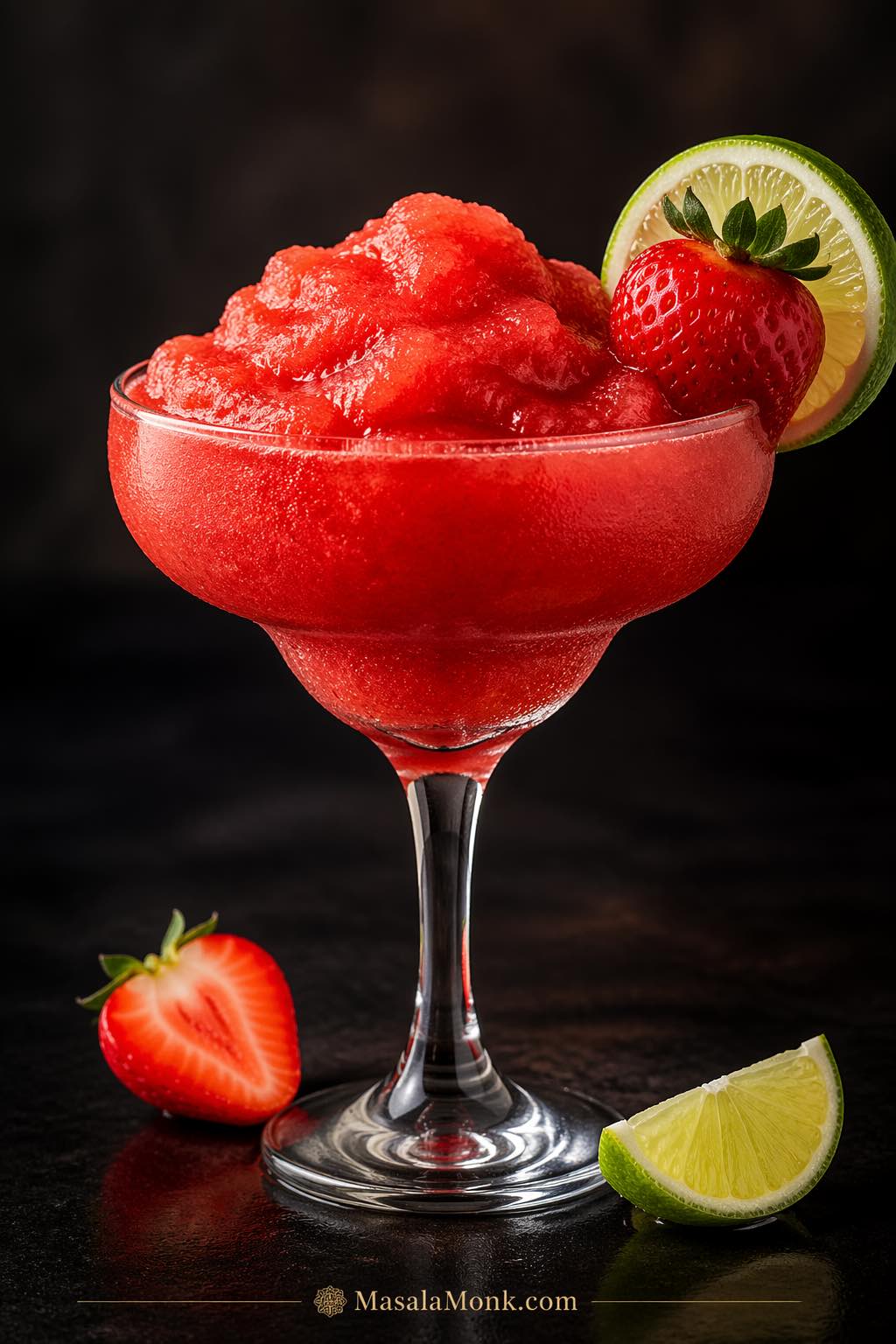
Frozen strawberry daiquiri recipe in a coupe glass with strawberry and lime garnish on a dark editorial background

A frozen strawberry daiquiri recipe should give you a drink that tastes cold, bright, and unmistakably strawberry-forward. The best version is thick enough to feel slushy, loose enough to sip easily, and sharp enough with lime that it never drifts into syrupy, watered-down territory. Even so, that is exactly where many homemade versions go wrong. They turn thin, icy, too sweet, or so stiff that they stop drinking like a cocktail.

This version is built to stay on the right side of that line. It uses mostly frozen strawberries for body, white rum for a clean backbone, fresh lime juice for brightness, and just enough simple syrup to round things out without muting the fruit. As a result, the drink stays fresher and more focused than versions that rely too heavily on ice or bottled mix.

If you want the classic version first, see this daiquiri recipe guide. Here, the focus is the frozen strawberry version.

Quick Answer

A frozen strawberry daiquiri recipe is a blended rum cocktail built with strawberries, fresh lime juice, and sweetener, then thickened into a cold slush with frozen fruit and, only if needed, a little ice. For 2 drinks, blend 3 cups frozen strawberries, 4 oz white rum, 1 1/2 oz fresh lime juice, and 1 to 1 1/2 oz simple syrup. If the drink seems too thin, add more frozen strawberries. If it is too thick to move, add a small splash of cold water and blend again.

  • Best first rum: white rum
  • Best fruit base: mostly frozen strawberries
  • Best acid: fresh lime juice
  • Best sweetener: simple syrup
  • Main fix if too watery: more frozen strawberries
  • Main fix if too tart: a little more simple syrup

At a Glance

  • Yield: 2 drinks
  • Total time: 10 minutes
  • Texture: thick, drinkable slush
  • Best glass: coupe, margarita glass, or small hurricane glass
  • Make-ahead: ingredients yes, full drink no
  • Good for a crowd: yes, but blend in batches
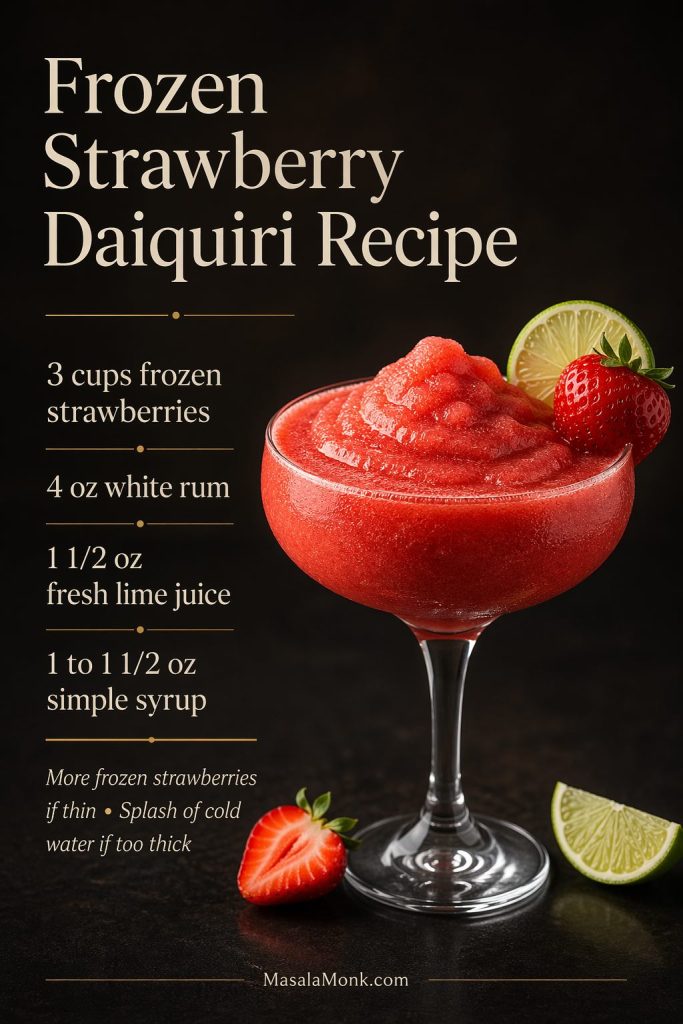
Frozen strawberry daiquiri recipe card image with a stemmed glass cocktail, ingredient amounts, and strawberry and lime garnish on a dark editorial background.
A good frozen strawberry daiquiri should taste bright, fresh, and properly slushy, and this visual recipe card shows the simple build that gets it there: frozen strawberries, white rum, fresh lime juice, and just enough simple syrup to keep the drink balanced.

After that, if you want another fruit-led rum drink, this watermelon daiquiri is a good next stop. If you want the cleaner shaken version instead, jump to Strawberry Daiquiri Recipe, Not Frozen.

What Is a Frozen Strawberry Daiquiri?

A daiquiri starts with a simple structure: rum, citrus, and sugar. A frozen strawberry daiquiri keeps that backbone, then adds strawberries and a slushy texture that makes the drink feel colder, fruitier, and more playful than the classic shaken version.

A good frozen strawberry daiquiri recipe should let the strawberries stay in front, keep the lime bright, and use rum as support rather than the dominant note. When any one part takes over, the drink starts to feel either flat, syrupy, or overly icy instead of refreshing.

Why This Frozen Strawberry Daiquiri Recipe Works

This frozen strawberry daiquiri recipe works because each part supports the flavor or the texture without getting in the way. Once the balance is right, this frozen strawberry daiquiri recipe becomes easy to repeat because the texture and flavor stay consistent from one batch to the next.

Frozen strawberries do most of the texture work

As a result, the drink stays cold and thick without making plain ice carry the whole structure. The strawberry flavor also stays fuller and less washed out.

White rum keeps the drink bright

Meanwhile, white rum gives the daiquiri a clean backbone without pulling the flavor toward caramel, oak, or spice. That matters because strawberries and lime already bring enough character on their own.

Fresh lime gives the drink shape

Because a frozen drink can go dull quickly if the acid is weak, fresh lime cuts through the sweetness and makes the fruit taste fresher.

Simple syrup is easier to control than dry sugar

Because this is such a cold drink, liquid sweetener blends more evenly and lets you adjust the final balance more precisely.

Frozen Strawberry Daiquiri Recipe Ingredients

The list is short, but the details matter more than they might seem at first glance.
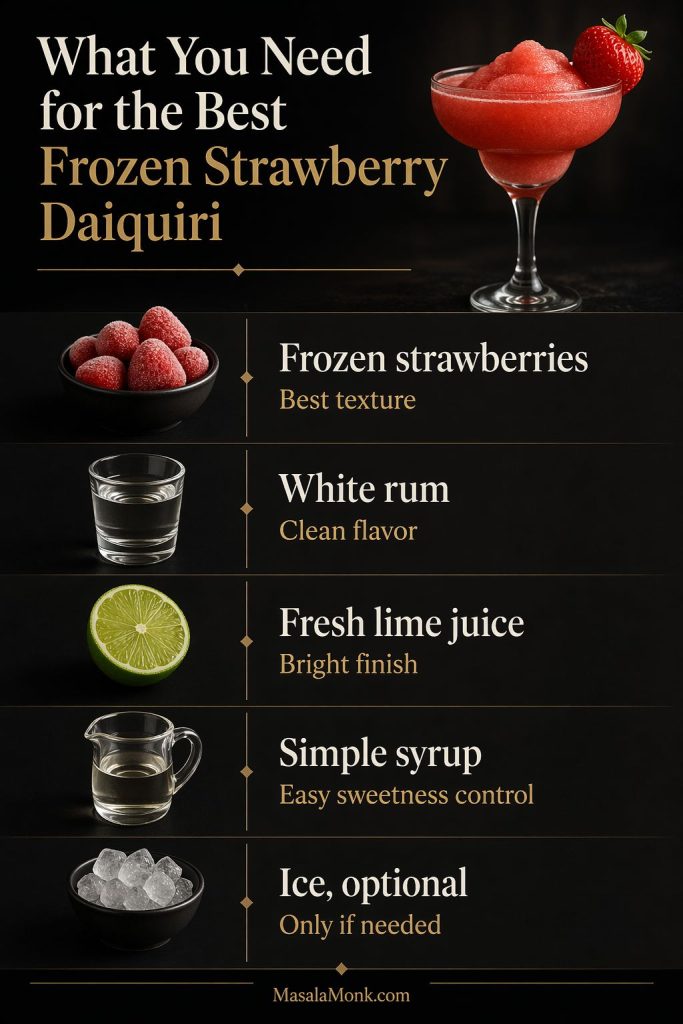
Frozen strawberry daiquiri ingredients guide showing frozen strawberries, white rum, fresh lime juice, simple syrup, and optional ice with short notes on what each one does.
The best frozen strawberry daiquiri starts with a short ingredient list and clear roles: frozen strawberries for body, white rum for a clean base, fresh lime for brightness, simple syrup for balance, and ice only if the blend needs a little extra help.

Strawberries

Frozen strawberries are the best starting point here. They give you body and coldness at the same time. If you have very ripe fresh strawberries, a few can be added for extra fragrance; however, the bulk should stay frozen.

White rum

Use a clean white rum for the easiest, brightest result. This is the bottle style that works best for a first version. For extra background, this guide to the best rums for daiquiris is a useful reference.

Fresh lime juice

This keeps the drink lively and prevents the fruit from tasting flat or jammy.

Simple syrup

Start with the lower end if your strawberries are sweet, then add more only if the drink needs it.

Cold water, only if needed

Instead, a small splash of cold water can loosen a stubborn blend without thinning it as quickly as a big scoop of extra ice.

Ice, optional

A little ice is fine if you want a frostier, slightly looser drink, but it should be a helper, not the main structure.

Pinch of salt, optional

A tiny pinch can sharpen the fruit and keep the sweetness from feeling blunt.

If you enjoy clean citrus-and-rum drinks in general, this mojito recipe is another easy one to keep in rotation.

Fresh vs Frozen Strawberries

Choosing the fruit style changes the drink more than most people expect.
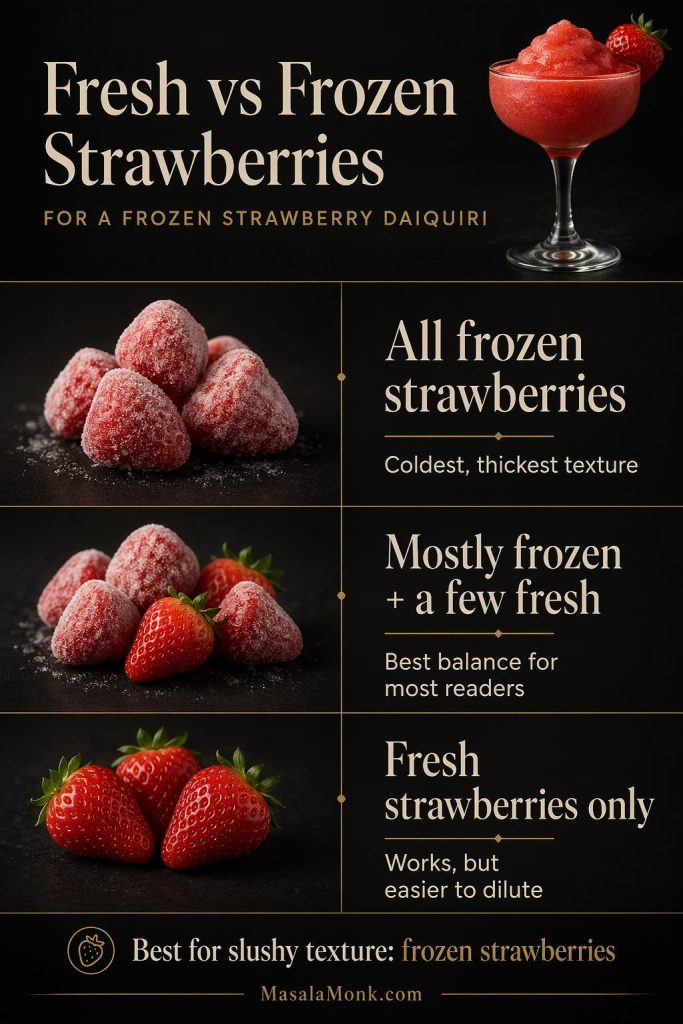
Fresh vs frozen strawberries guide for a frozen strawberry daiquiri, comparing all frozen strawberries, mostly frozen with a few fresh, and fresh strawberries only.
Choosing the right strawberries changes the drink more than most people expect: all frozen berries give the coldest, thickest slush, a mostly frozen mix with a few fresh berries gives the easiest balance for most readers, and fresh berries alone work but dilute more easily.

All frozen strawberries

This gives you the coldest, thickest result. It is great for a very slushy daiquiri, though it can edge toward too stiff if the liquid is too low.

Mostly frozen plus a few fresh strawberries

This is the most forgiving option for most home cooks. The drink stays thick and cold, but it also feels easier to sip.

Fresh strawberries only

Still, you can make it work. However, the ice then has to do more of the texture work, which makes dilution much harder to control.

Best Rum for a Frozen Strawberry Daiquiri

For a first frozen strawberry daiquiri, white rum is the best place to start. It keeps the drink bright and lets the fruit lead.
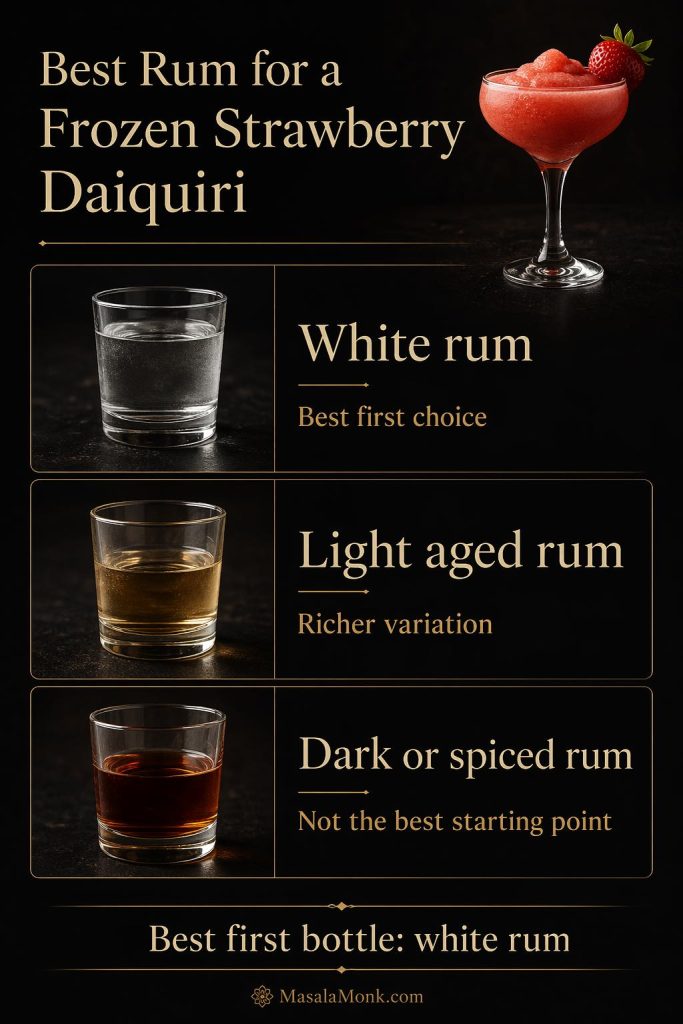
Best rum for frozen strawberry daiquiri guide comparing white rum, light aged rum, and dark or spiced rum, with white rum recommended as the best first choice.
The best rum for a frozen strawberry daiquiri is usually the cleanest one: white rum keeps the drink bright and fruit-forward, light aged rum can add a slightly richer edge, and dark or spiced rum tends to pull the cocktail away from the fresh strawberry-and-lime profile most readers want first.

Best first bottle: white rum

A straightforward white rum keeps the drink clean and crisp without competing with the strawberries.

When aged rum can work

If you want a slightly rounder, richer finish, a light aged rum can work as a variation. Even so, it is better after you know the standard version first.

Why dark or strongly spiced rum is not the best starting point

Strawberries are fresh and delicate. For that reason, heavier rums can pull the drink into warmer, darker notes that make it feel less lively than a frozen daiquiri usually should.

You do not need a fancy bottle

Fresh lime and good texture matter more here than prestige rum. A solid mid-range white rum is usually enough.

How to Get the Best Slushy Texture in a Frozen Strawberry Daiquiri

This is where the drink either comes together or falls apart. The goal is a texture that mounds slightly when poured, then slowly relaxes in the glass. It should feel thick and cold, but still like something you can sip rather than scoop.
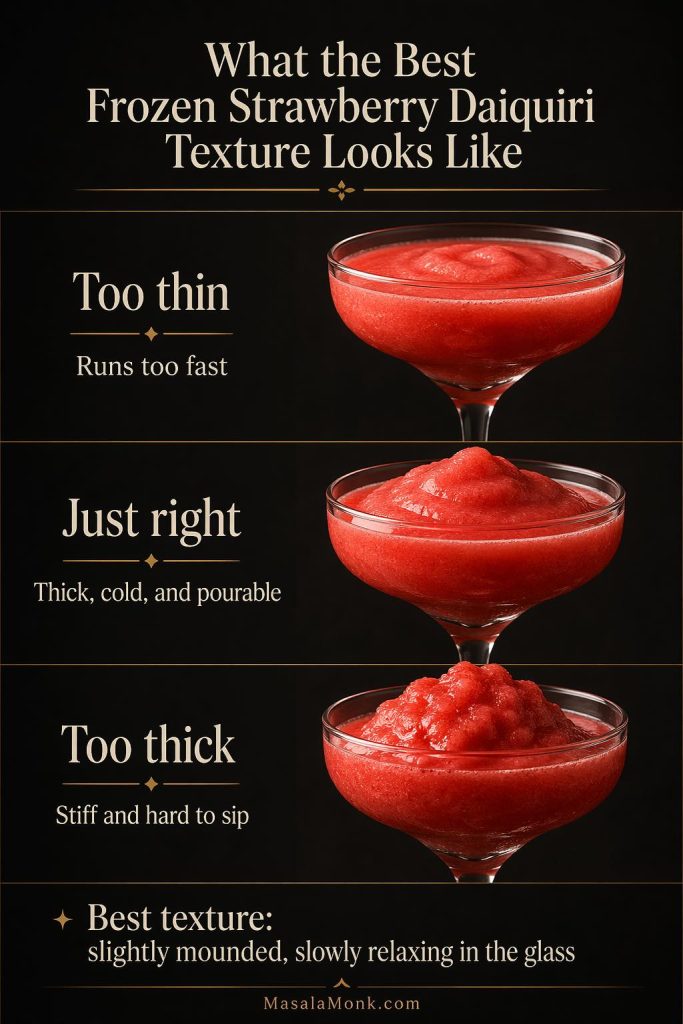
Frozen strawberry daiquiri texture guide showing three consistency levels: too thin, just right, and too thick
Texture is what separates a good frozen strawberry daiquiri from one that feels watery or hard to drink: the ideal version should be thick enough to mound slightly, cold enough to stay slushy, and loose enough to relax slowly in the glass instead of sitting stiff or running flat.

Use frozen fruit before reaching for more ice

If the drink looks too thin, more frozen strawberries usually fix it better than more ice. They thicken the drink while keeping the flavor focused.

Too much alcohol can loosen the slush

Because alcohol does not freeze the way fruit does, a heavy pour can make the drink thinner than expected, even when it tastes balanced.

A small splash is enough when the blend is too stiff

When the blender struggles, add a tablespoon or two of cold water rather than a big pour. Small changes keep the structure under control.

Blend only until the drink is slushy

At the same time, overblending warms the mixture slightly and can flatten the texture. Once it looks thick and pourable, stop, taste, and adjust. For a more technique-driven take, Serious Eats has a useful frozen strawberry daiquiri method.

Blender Help

  • Powerful blender: use all frozen fruit first and blend straight to slush.
  • Average blender: add the liquids first, then the frozen fruit, and use only a small splash of cold water if needed.
  • No blender: make the shaken not frozen version below instead.
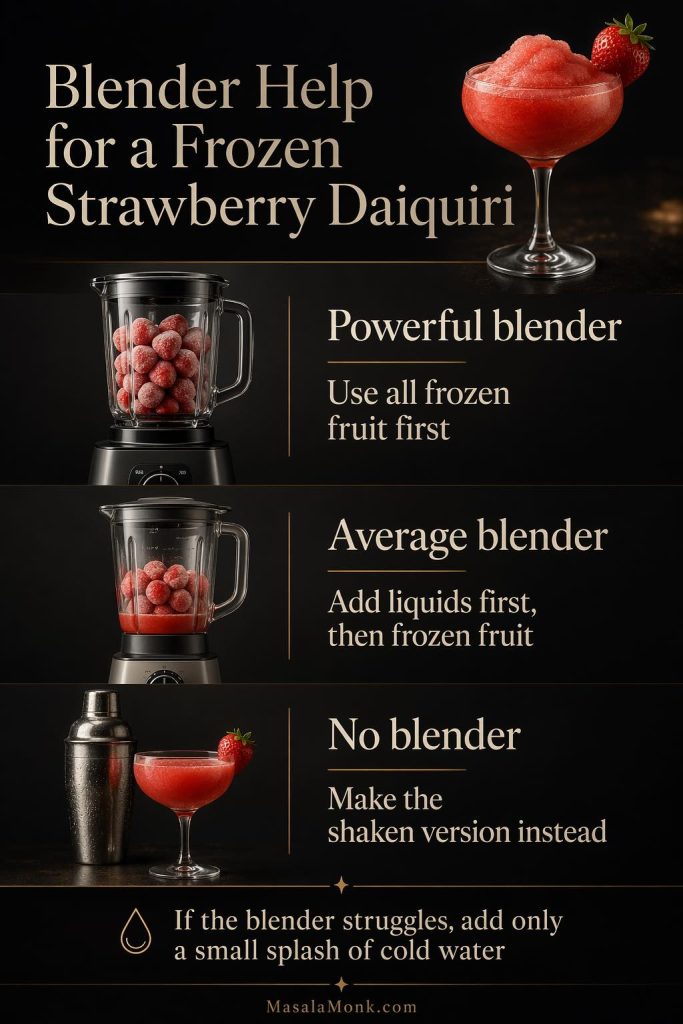
Frozen strawberry daiquiri blender help guide comparing what to do with a powerful blender, an average blender, or no blender.
A frozen strawberry daiquiri gets easier once the blender question is clear: powerful blenders can handle all frozen fruit first, average blenders work better with liquids added first, and if you do not want to blend at all, the shaken version is the cleaner backup plan.

How to Make a Frozen Strawberry Daiquiri

The method is short, but the pause before serving matters. That is where you decide whether the drink just works or really tastes right.
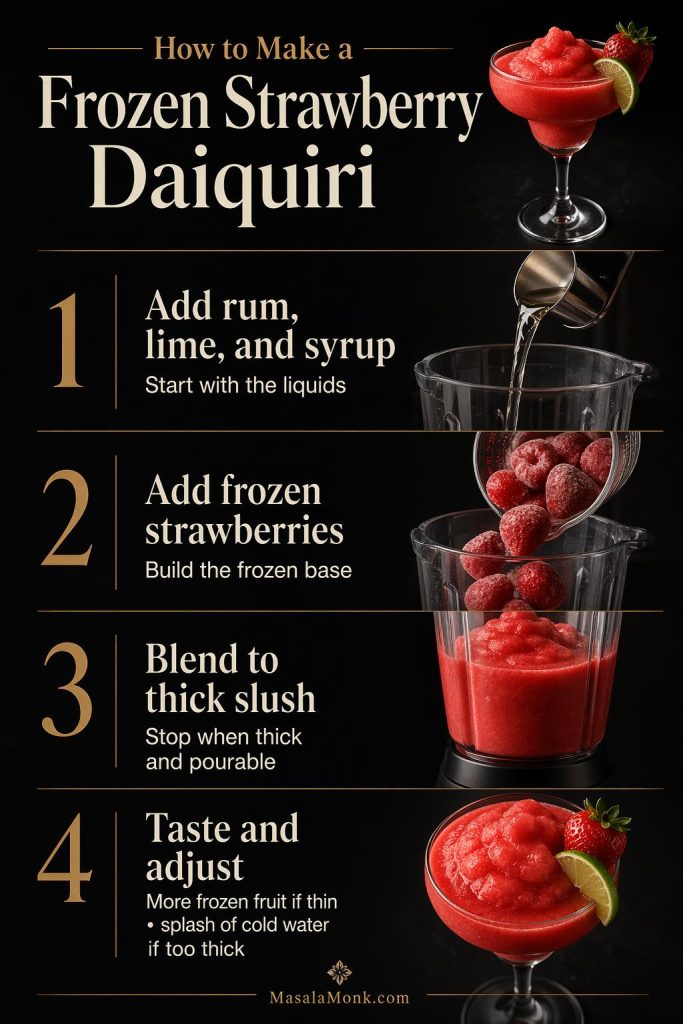
Frozen strawberry daiquiri method guide showing how to add rum lime and syrup, add frozen strawberries, blend to thick slush, and adjust the texture before serving.
Making a frozen strawberry daiquiri works best when the order stays simple: start with the liquids, add frozen strawberries, blend until thick and pourable, then adjust the texture before serving.

Step 1: Add the liquids first

Add the rum, fresh lime juice, simple syrup, and optional pinch of salt to the blender first. This helps the blades catch more easily once the fruit goes in.

Step 2: Add the frozen strawberries

Tip the frozen strawberries in on top. Hold the cold water back unless the blender clearly needs help.

Step 3: Blend to thick slush

Blend until the drink looks thick, cold, and just pourable. It should not look like thin juice and it should not sit in hard frozen lumps either.

Step 4: Taste and adjust

Before serving, taste the daiquiri and make one small adjustment if needed. Add a little more simple syrup for a tart drink, a squeeze more lime for a sweet one, more frozen strawberries for a thin blend, or a small splash of cold water if the mixture is too thick to move. Then pour into chilled glasses and serve immediately.

How to Fix a Frozen Strawberry Daiquiri Recipe That Is Watery, Icy, or Too Sweet

If the texture or flavor feels off, these fixes will pull it back quickly.
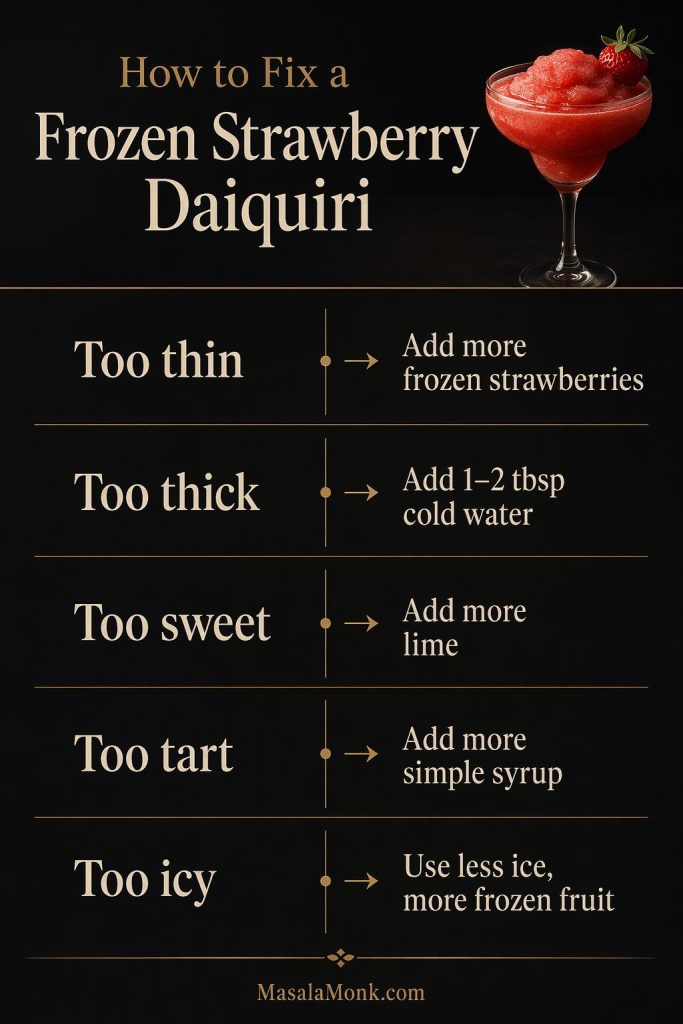
Frozen strawberry daiquiri troubleshooting guide showing how to fix a drink that is too thin, too thick, too sweet, too tart, or too icy.
When a frozen strawberry daiquiri misses the mark, the fix is usually small: more frozen fruit for a thin blend, a splash of cold water for one that is too thick, more lime if it tastes too sweet, more simple syrup if it tastes too tart, and less ice if the texture turns icy instead of properly slushy.

Too watery

  • Usually caused by: too much liquid, too much ice melt, or not enough frozen fruit.
  • Fix it now: blend in more frozen strawberries.
  • Avoid this: adding lots more syrup, which sweetens the drink without rebuilding the texture.
  • Next time: let the fruit do more of the thickening from the start.

Too icy

  • Usually caused by: too much plain ice carrying the drink.
  • Fix it now: blend in more frozen strawberries if you have them.
  • Avoid this: blending the same mixture longer and hoping it softens into something better.
  • Next time: start with a more fruit-led frozen base and use ice only as support.

Too thick to drink

  • Usually caused by: too much frozen fruit for the amount of liquid.
  • Fix it now: add 1 to 2 tablespoons cold water and blend again.
  • Avoid this: adding a large splash all at once.
  • Next time: slightly reduce the fruit or slightly increase the total liquid.

Too sweet

  • Usually caused by: sweet fruit plus too much syrup, or not enough lime to sharpen the drink.
  • Fix it now: add fresh lime juice.
  • Avoid this: adding more rum first, because that changes the strength more than the balance.
  • Next time: begin at the lower end of the syrup range and adjust after tasting.

Too tart

  • Usually caused by: tart strawberries, strong lime, or simply not enough sweetener.
  • Fix it now: add a little more simple syrup.
  • Avoid this: adding lots more fruit first and assuming that will fix it.
  • Next time: remember that tart berries almost always need a touch more sweetness than very ripe ones.

Too boozy

  • Usually caused by: too much rum crowding both the fruit flavor and the frozen texture.
  • Fix it now: add a little more frozen fruit and, if needed, a touch more lime.
  • Avoid this: fixing it with more syrup unless the drink is also too tart.
  • Next time: keep the rum at the default amount until you know how strong you want it in frozen form.

Not strawberry-forward enough

  • Usually caused by: weak berries, too much dilution, or too much rum relative to the fruit.
  • Fix it now: add more frozen strawberries.
  • Avoid this: reaching for extra ice to rebuild structure.
  • Next time: rely more on fruit than extra ice for the body.

Blender not moving

  • Usually caused by: a blend that is too stiff or fruit not settling into the blades.
  • Fix it now: stop, scrape down if needed, then add a very small splash of cold water and pulse again.
  • Avoid this: forcing the motor without enough movement.
  • Next time: add the liquids first and keep the frozen fruit on top.

Strawberry Daiquiri Recipe, Not Frozen

If you want a cleaner, sharper strawberry daiquiri, the shaken version is the better choice. It keeps the same core flavor idea, but it drinks more like a classic cocktail and less like a frozen treat.
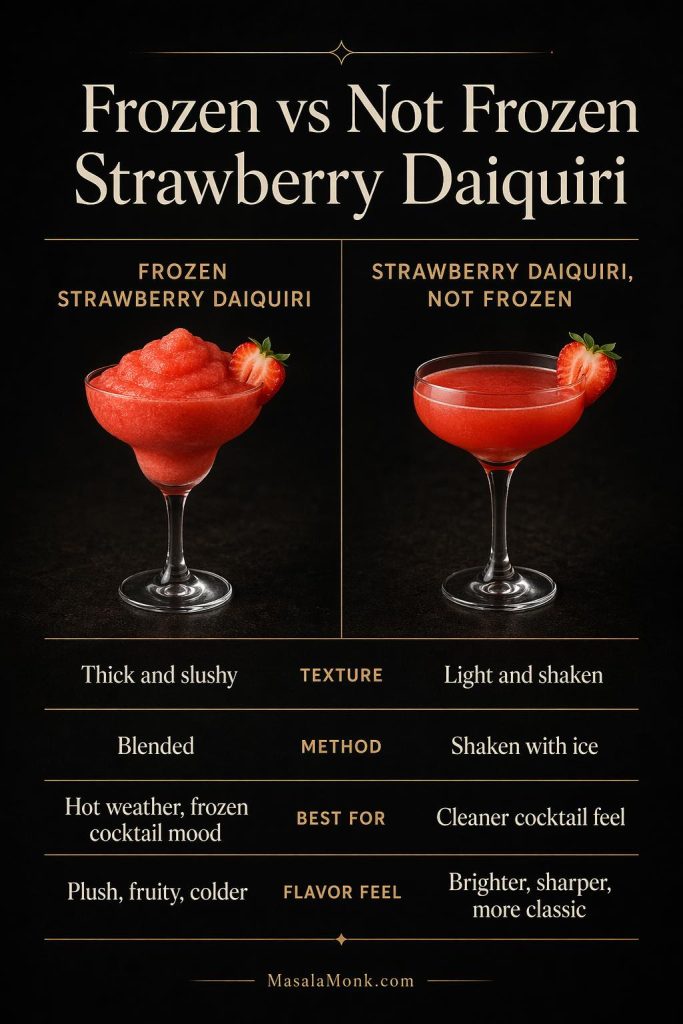
Comparison board showing frozen strawberry daiquiri versus strawberry daiquiri not frozen, including differences in texture, method, best use, and flavor feel.
Choosing between a frozen strawberry daiquiri and a not frozen one usually comes down to mood: the frozen version is thicker, colder, and more plush, while the shaken version feels lighter, brighter, and closer to a classic cocktail.

Shake 2 oz white rum, 1 oz fresh lime juice, 3/4 oz simple syrup, and a small handful of muddled or blended strawberries with ice, then strain into a chilled glass. As a result, it is lighter, brighter, and faster than the frozen version.

Can You Make It With Daiquiri Mix?

Yes, but homemade usually tastes fresher and gives you much better control over sweetness, lime, and fruit intensity.
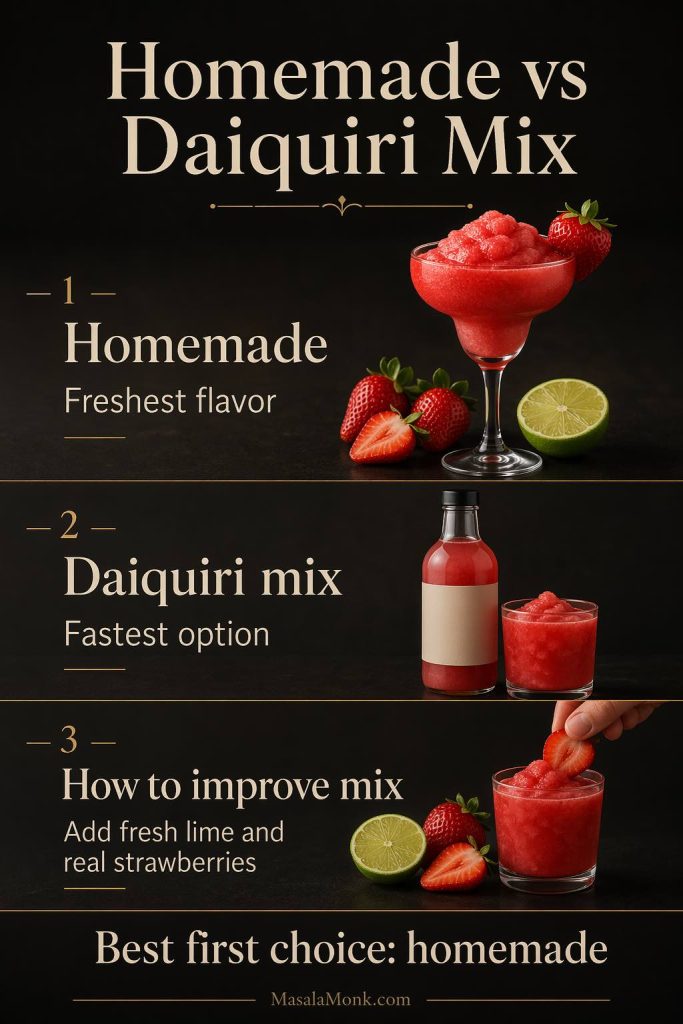
Homemade vs daiquiri mix guide for a frozen strawberry daiquiri, showing homemade as the freshest option, bottled mix as the fastest option, and fresh lime plus real strawberries as the best way to improve mix.
Homemade gives a frozen strawberry daiquiri its freshest flavor, while bottled daiquiri mix is the faster shortcut. If you do use mix, fresh lime and real strawberries make the drink taste brighter, less flat, and much closer to the fresh version.

However, if you do use a strawberry daiquiri mix, add fresh lime juice and, if possible, some real frozen strawberries. That makes the drink taste less flat and more like an actual strawberry cocktail.

Frozen Strawberry Daiquiris for a Crowd

Although this drink scales well, it is still best blended close to serving time.
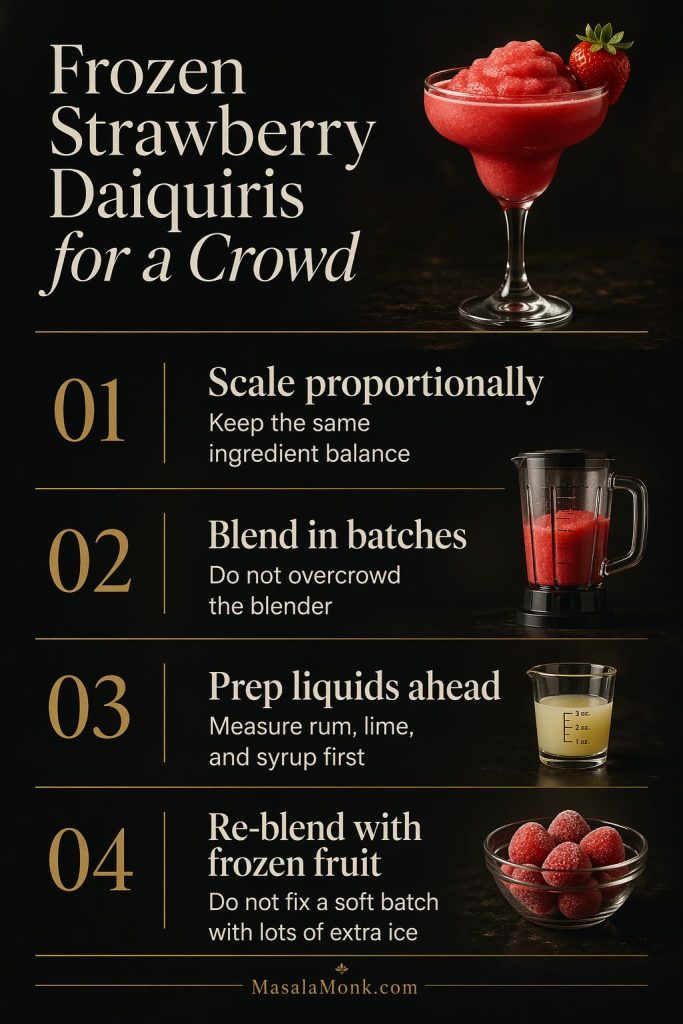
Frozen strawberry daiquiris for a crowd guide showing how to scale proportionally, blend in batches, prep liquids ahead, and re-blend with frozen fruit.
Making frozen strawberry daiquiris for a group works best when you keep the ratios steady, blend in batches, prep the liquids ahead, and fix a soft batch with more frozen fruit instead of piling in extra ice.
  • Scale the ingredients proportionally for 4 to 6 drinks.
  • Blend in batches if your blender is not large enough.
  • For the smoothest texture, keep each batch below the blender’s maximum fill line rather than forcing one oversized batch.
  • Pre-measure the rum, lime juice, and syrup ahead of time.
  • If the batch softens while sitting, re-blend briefly with a little more frozen fruit rather than a lot more ice.

If you need another rum drink that is naturally good for groups, this rum punch recipe is an easy one to keep nearby.
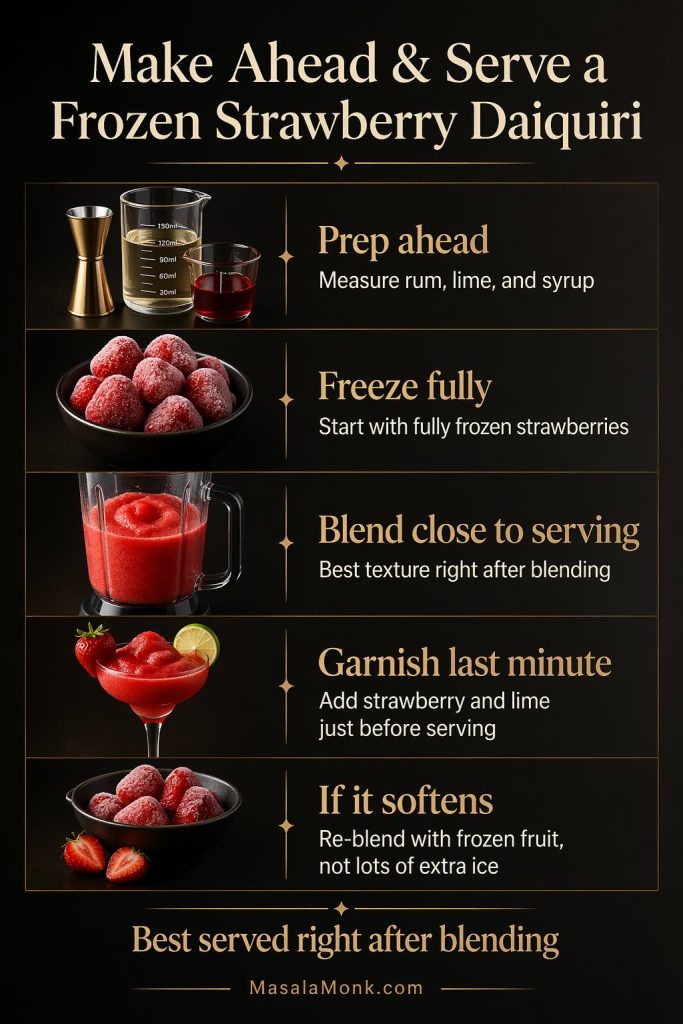
Make-ahead and serving guide for frozen strawberry daiquiris showing what to prep ahead, when to blend, when to garnish, and how to fix a softened batch.
Frozen strawberry daiquiris are easiest to serve well when the timing stays simple: prep the liquids ahead, start with fully frozen strawberries, blend close to serving, garnish at the last minute, and re-blend with more frozen fruit if the batch softens.

Frozen Strawberry Daiquiri Recipe FAQs

Can I use fresh strawberries?

Yes, but frozen strawberries usually give the best texture in a frozen daiquiri. Fresh berries make it easier to rely too heavily on ice.

Do I need simple syrup?

No, but it is the easiest sweetener to control in a very cold drink.

What rum is best?

White rum is the best first choice for a frozen strawberry daiquiri.

Can I make it ahead?

You can prep the ingredients ahead, but the full drink is best blended right before serving.

Can I make it without alcohol?

Yes. Replace the rum with cold water, coconut water, or a little extra lime and syrup to taste.

Can I use Bacardi?

Yes. A clean white rum like Bacardi works well here.

Can I use strawberry daiquiri mix instead?

Yes, but the drink usually tastes fresher from scratch. If using mix, brighten it with fresh lime and real strawberries if you can.

What is the difference between frozen and shaken strawberry daiquiri?

The frozen version is thicker, colder, and more texture-driven. The shaken version is lighter, brighter, and more classic-cocktail-like.

If you want one make-first version to keep on repeat all summer, this frozen strawberry daiquiri recipe is the one to start with.

Frozen Strawberry Daiquiri Recipe

A frozen strawberry daiquiri made from scratch with white rum, fresh lime juice, simple syrup, and frozen strawberries for a thick, drinkable slush that still tastes bright and fresh.

  • Yield: 2 drinks
  • Prep time: 10 minutes
  • Cook time: 0 minutes
  • Total time: 10 minutes
  • Best glass: coupe, margarita glass, or small hurricane glass

Equipment

  • Blender
  • Jigger or measuring cup
  • Citrus juicer

Ingredients

  • 3 cups frozen strawberries
  • 4 oz white rum
  • 1 1/2 oz fresh lime juice
  • 1 to 1 1/2 oz simple syrup, to taste
  • 2 to 4 tbsp cold water, only if needed to loosen the blend
  • 1/2 cup ice, optional, for a frostier, slightly looser texture
  • Tiny pinch of salt, optional
  • Lime wheel or strawberry, for garnish

Method

  1. Add the rum, lime juice, simple syrup, and optional pinch of salt to the blender first.
  2. Add the frozen strawberries on top.
  3. Blend until the mixture turns into a thick slush.
  4. Stop and taste. Add a little more syrup if too tart, a little more lime if too sweet, or a small splash of cold water if too thick to move.
  5. If the drink is too thin, add more frozen strawberries instead of leaning on more ice.
  6. Then pour into chilled glasses, garnish, and serve immediately.

Notes

  • Use mostly frozen strawberries for the best texture.
  • White rum is the best first choice.
  • Fresh lime matters more here than expensive rum.
  • Start with less syrup if your strawberries are very ripe.
  • Use frozen fruit before extra ice if the drink looks too thin.
  • The drink is best served immediately after blending.
  • For 4 to 6 drinks, scale the ingredients proportionally and blend in batches.

If You Want Another Frozen or Rum Cocktail Next

Once you have this frozen strawberry daiquiri down, try this watermelon daiquiri for another fruit-led daiquiri, this piña colada variations guide for creamy tropical territory, or this refreshing summer cocktails roundup for lighter warm-weather drinks.
↑ Back to top

Posted on 6 Comments

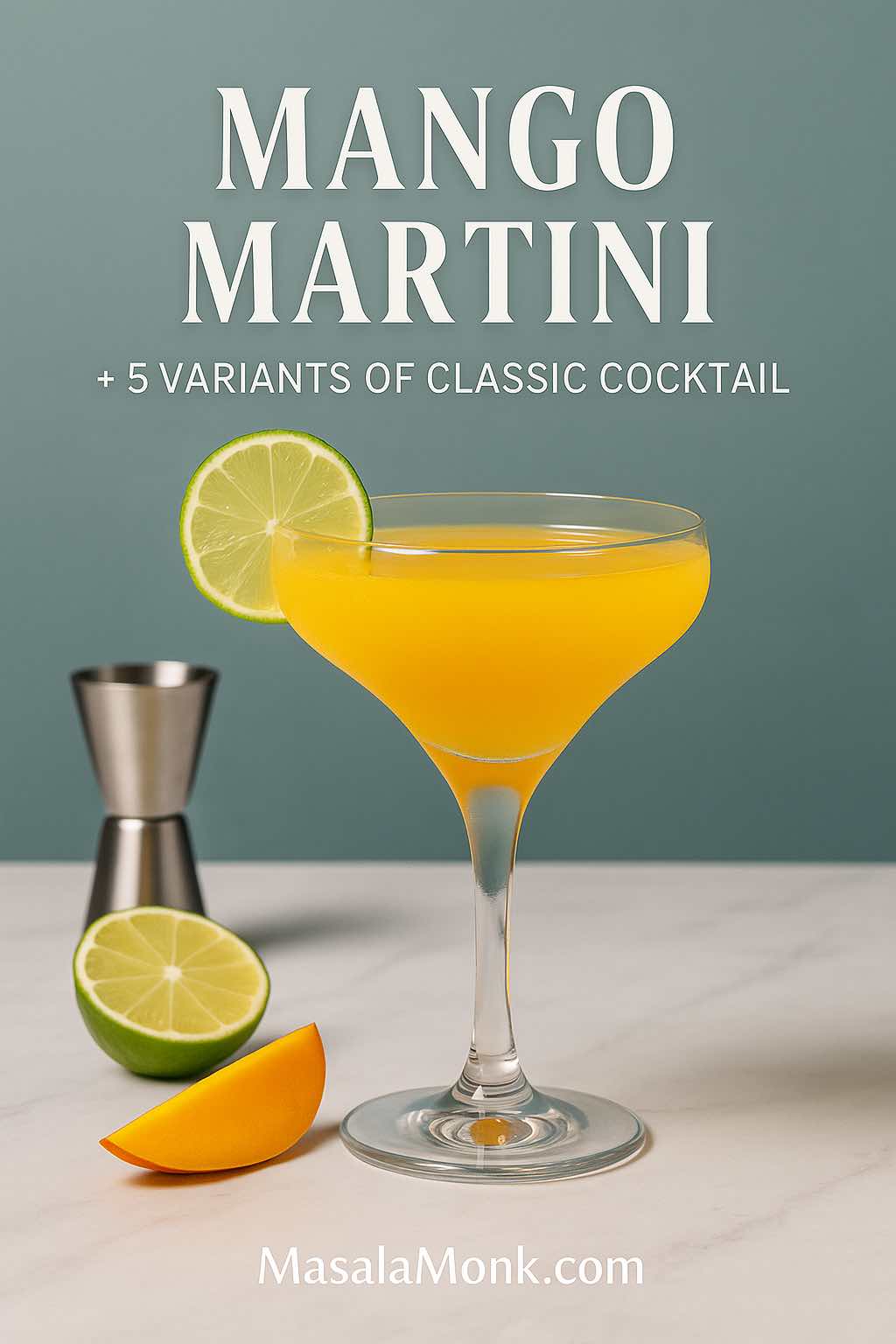
Mango Martini + 5 Variants of Classic Cocktail

Mango martini in a coupe on a marble surface with a lime wheel, jigger, and mango slice; text overlay reads “Mango Martini + 5 Variants of Classic Cocktail” — MasalaMonk.com

There’s a moment—right after the first shake—when mango and citrus perfume the air and the tin goes icy in your hands. That’s when a mango martini stops being just another summer drink recipe and becomes a small celebration. Because mango carries sunshine in its fibers and vodka carries clarity in its bones, they meet in the glass with effortless grace. However, the difference between a sweet, muddled fruit drink and a crisp, bar-quality cocktail is in the balance: just enough acid to lift, just enough orange liqueur to sparkle, and just enough dilution to glide.

Today, we’ll start with a classic Mango Martini recipe you can learn by heart. Then, we’ll move through five high-intent riffs people love making at home: Spicy, Passion Fruit (“Pornstar”-style), Frozen, Mango-Vodka, and Mango–Pineapple. Along the way, we’ll drop in helpful technique links, because sometimes you want a second opinion or a deeper dive. Moreover, you’ll find small upgrade notes inside each recipe so you can dial flavor exactly to your liking. And although these builds are quick, they’re not shortcuts; instead, they’re flexible frameworks that welcome your taste and your pantry.

If you’re picking fruit right now, choose mangoes you’d happily eat out of hand. For quick guidance on texture and sweetness, skim Best Mango for Aamras; it’s a handy companion when you’re puréeing for drinks. Similarly, if you prefer a published point of reference for the classic shape of this cocktail, both SAQ’s Mango Martini and this straightforward mango martini cocktail echo the same structure you’ll see below.

Also Read: Daiquiri Recipe (Classic, Strawberry & Frozen Cocktails).


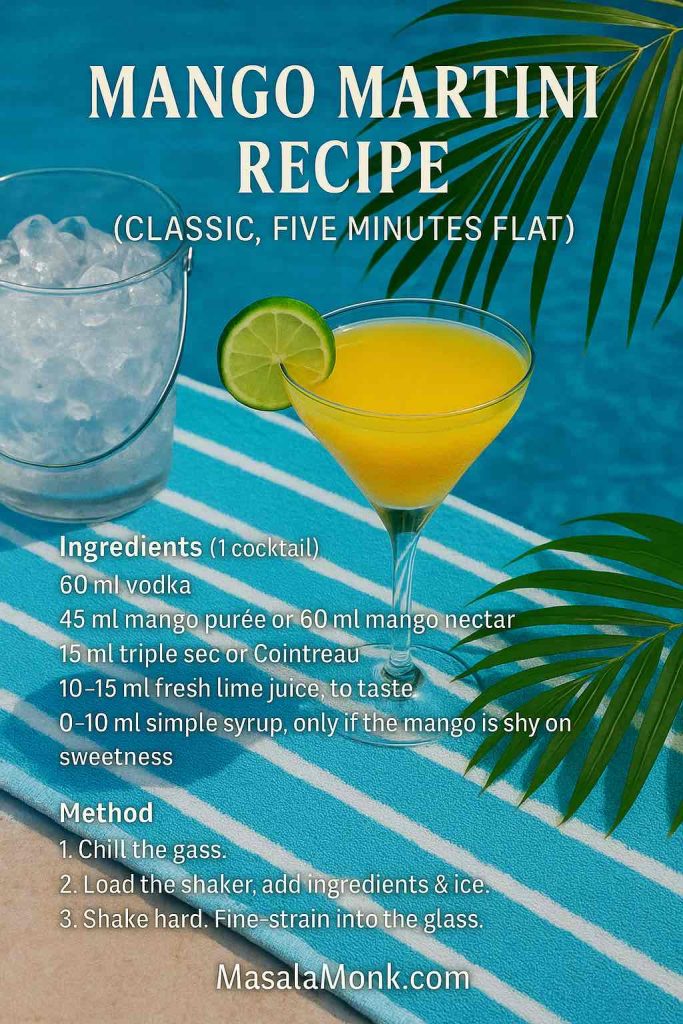
Mango Martini Recipe (Classic, Five Minutes Flat)

A good mango martini is a study in contrast. On one hand, mango brings velvety body; on the other, lime juice cuts a clean path through the sweetness. Furthermore, a measured pour of orange liqueur adds a bright, candied orange aroma that reads as “cocktail” rather than “smoothie.” Finally, a hard shake and a fine strain give you that hotel-bar polish at home.

Ingredients (1 cocktail)

  • 60 ml vodka
  • 45 ml mango purée or 60 ml mango nectar
  • 15 ml triple sec or Cointreau
  • 10–15 ml fresh lime juice, to taste
  • 0–10 ml simple syrup, only if the mango is shy on sweetness
Mango Martini recipe card by a pool: coupe on a striped towel beside a glass ice bucket and palm leaves; ingredients and method overlay; MasalaMonk.com footer.
Poolside serve: pre-chill the coupe in an ice bucket, shake to a tight frost, and strain fast so the towel setup stays crisp. For two drinks of Mango Martini, double the mix but keep shaking time the same to preserve texture.

Method

  1. Chill the glass. Place a coupe or martini glass in the freezer while you prep.
  2. Load the shaker. Add vodka, mango, orange liqueur, lime, and—if needed—simple syrup to a shaker with plenty of ice.
  3. Shake hard. Go for 12–15 seconds until the tin frosts. Consequently, you’ll build proper dilution and a satiny texture.
  4. Fine-strain. Double-strain into the chilled glass to catch fibers and ice chips.
  5. Garnish. Express an orange peel over the surface or perch a mango slice on the rim.

Notes & Tiny Upgrades

  • Purée vs nectar: Purée gives plush texture; nectar is lighter. Therefore, if you swap nectar in, reduce or skip simple syrup.
  • Citrus balance: Limes vary wildly. Start at 10 ml; then taste and adjust. Likewise, if your mango is overripe, lean into the lime for lift.
  • Technique reassurance: For another published baseline that mirrors this balance, check SAQ’s recipe and this home-kitchen mango martini cocktail.

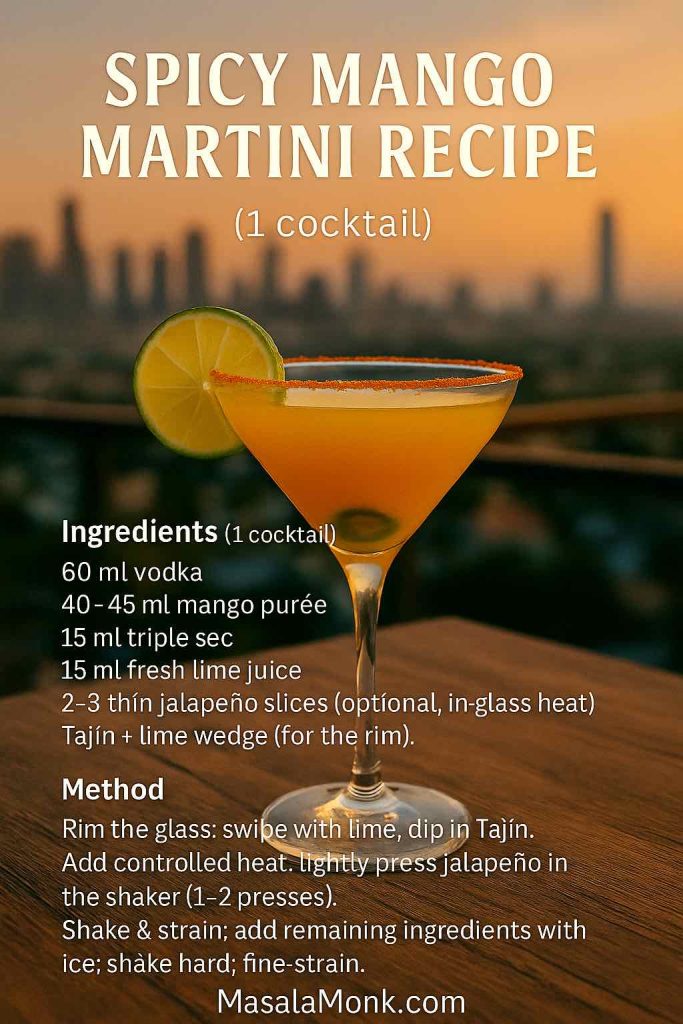
Spicy Mango Martini Recipe (Jalapeño or Tajín Rim)

Spice wakes mango up. Nevertheless, you don’t need to set your mouth on fire; you just need enough heat to add rhythm. Because jalapeño brings grassy warmth and Tajín brings chile-lime electricity, you can customize the style two ways: in the glass with a gentle muddle, or on the rim with a neat, photogenic halo. Importantly, the rim-only route delivers aroma and a balanced first sip without the risk of over-infusing the drink itself.

Ingredients (1 cocktail)

  • 60 ml vodka
  • 40–45 ml mango purée
  • 15 ml triple sec
  • 15 ml fresh lime juice
  • 2–3 thin jalapeño slices (optional, for in-glass heat)
  • Tajín + lime wedge (for the rim)
Spicy Mango Martini recipe card at rooftop sunset: coupe with Tajín rim and lime wheel, ingredients and method overlay, MasalaMonk.com footer
For clean heat, rim the glass first and keep jalapeño slices in the shaker for only one or two presses—then discard before straining. Fine-strain to catch seeds, and mix a small jar of chile-salt in advance (2:1 Tajín to fine salt) for faster service on busy nights.

Method

  1. Rim the glass. Swipe the rim with a lime wedge, then dip into Tajín—see this quick guide to making a Tajín salt rim; for technique nuance, here’s a pro rimming walkthrough.
  2. Add controlled heat. If you want spice in the drink, lightly muddle jalapeño in the shaker—just one or two presses.
  3. Shake & strain. Add remaining ingredients and ice; shake hard; fine-strain into the rimmed glass.
  4. Garnish. Use a jalapeño coin or a lime wheel.

Try This Too

  • Prefer fragrance without extra fire? Skip the muddle and rely solely on the rim. Conversely, if you love intensity, add a razor-thin sliver of habanero—then taste before you commit.
  • For more chile-rim technique (with photos), browse our watermelon margarita variations; the same steps apply, even though the base spirit changes.

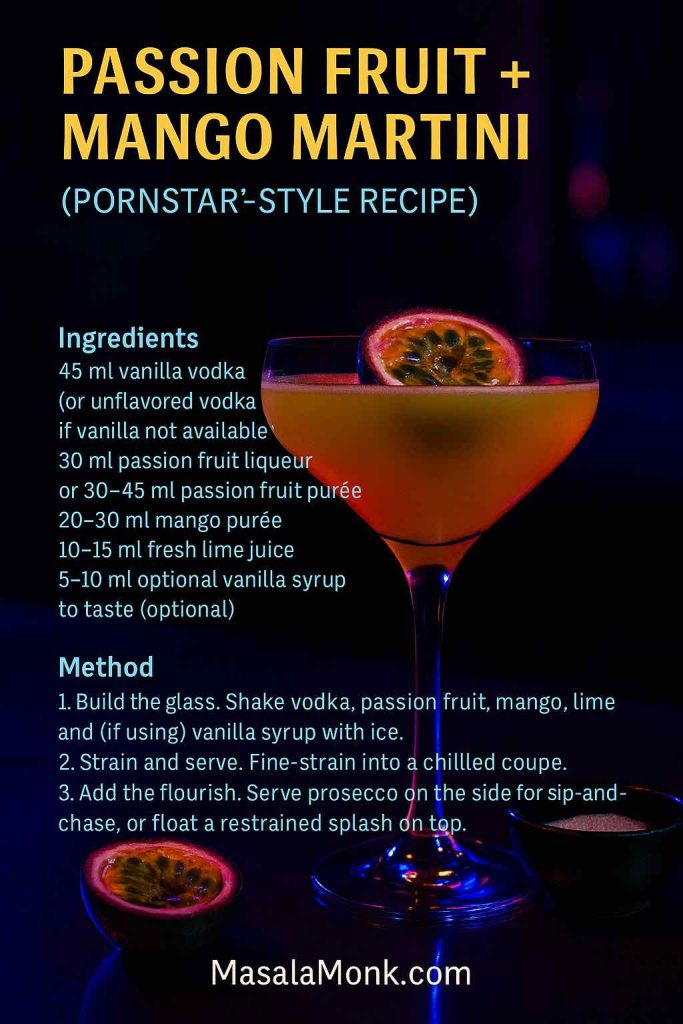
Passion Fruit + Mango Martini (“Pornstar”-Style Recipe)

This riff channels a modern classic: vanilla-tinted vodka, tangy passion fruit, and a side of bubbles for contrast. Because mango loves passion fruit, the pairing feels inevitable—lush meets zesty, tropical meets sparkling. For background and deeper technique notes, see Difford’s Porn Star Martini, Bon Appétit’s recent update, and BBC Good Food’s home version. Collectively, they confirm the essentials: passion fruit’s tartness, a hint of vanilla, and that playful prosecco companion.

Ingredients (1 cocktail)

  • 45 ml vodka (vanilla vodka if available)
  • 30 ml passion fruit liqueur or 30–45 ml passion fruit purée
  • 20–30 ml mango purée
  • 10–15 ml fresh lime juice
  • 5–10 ml vanilla syrup (optional, to taste)
  • Optional: 30–60 ml chilled prosecco on the side
Passion Fruit + Mango Martini recipe card in a moody bar setting: coupe with halved passion fruit garnish, vanilla sugar ramekin and prosecco side; readable ingredients and method overlay; MasalaMonk.com footer.
Chill a tiny prosecco glass alongside the coupe so every sip-and-chase stays sparkling. For a truer “Pornstar” profile, keep mango and passion fruit equal, then finish with a whisper of vanilla sugar on the rim instead of extra syrup.

Method

  1. Build the core. Shake vodka, passion fruit, mango, lime, and (if using) vanilla syrup with ice.
  2. Strain and serve. Fine-strain into a chilled coupe.
  3. Add the flourish. Serve prosecco on the side for sip-and-chase, or float a restrained splash on top.

Try This Too

  • Split the fruit evenly—mango = passion fruit—for a perfectly balanced tang. Alternatively, if you want a drier finish, drop the syrup and let the liqueur (or purée) speak.
  • Vanilla doesn’t need to shout. Consequently, if you don’t have vanilla syrup, a scant pinch of vanilla sugar stirred in before shaking does the job beautifully.

Also Read: Piña Colada: Classic Recipe + 10 Variations (Virgin & On the Rocks)


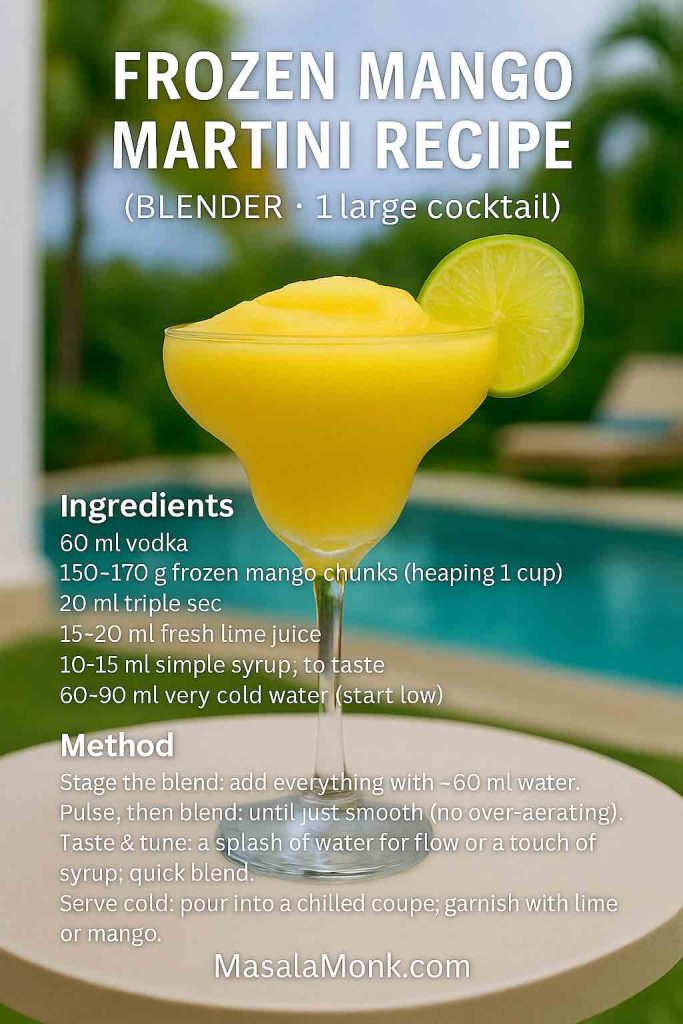
Frozen Mango Martini (Blender, Summer-Ready Recipe)

Sometimes the air itself begs for a blender. Even so, a great frozen cocktail is more technique than guesswork. Because ice can drown flavor if you’re not careful, measure your frozen fruit and liquid, blend in stages, and taste as you go. Notably, the frozen daiquiri method popularized in serious cocktail writing explains why measured dilution matters; for a quick primer on that logic, read The Best Frozen Daiquiri and adapt the principles to mango.

Ingredients (1 large cocktail)

  • 60 ml vodka
  • 1 heaping cup frozen mango chunks (about 150–170 g)
  • 20 ml triple sec
  • 15–20 ml fresh lime juice
  • 10–15 ml simple syrup (to taste)
  • 60–90 ml very cold water (start low; add as needed)
Frozen Mango Martini recipe card by a pool: slushy mango cocktail in a coupe with a lime wheel, ingredients and method overlaid, MasalaMonk.com footer.
Tip for silkier texture: freeze mango in small chunks and chill the blender jug for 10 minutes. Start with the lower end of water, blend briefly, then adjust with teaspoon splashes until the pour just ribbons—this prevents watery flavor and keeps the slush tight.

Method

  1. Stage the blend. Add everything to the blender with ~60 ml water.
  2. Pulse, then blend. Pulse a few times; then blend only until smooth. Therefore, you won’t over-aerate or over-dilute.
  3. Taste and tune. Add a splash more water for flow or a touch of syrup for ripeness; give it one short blend.
  4. Serve cold. Pour into a chilled coupe. Garnish with a lime wheel or a tiny mango slice.

Try This Too

  • A pinch of salt brightens fruit, just as it does in good cooking. Likewise, swapping water for coconut water adds a gentle tropical hum without heaviness. For additional tropical ideas, wander through Coconut Water Cocktails.

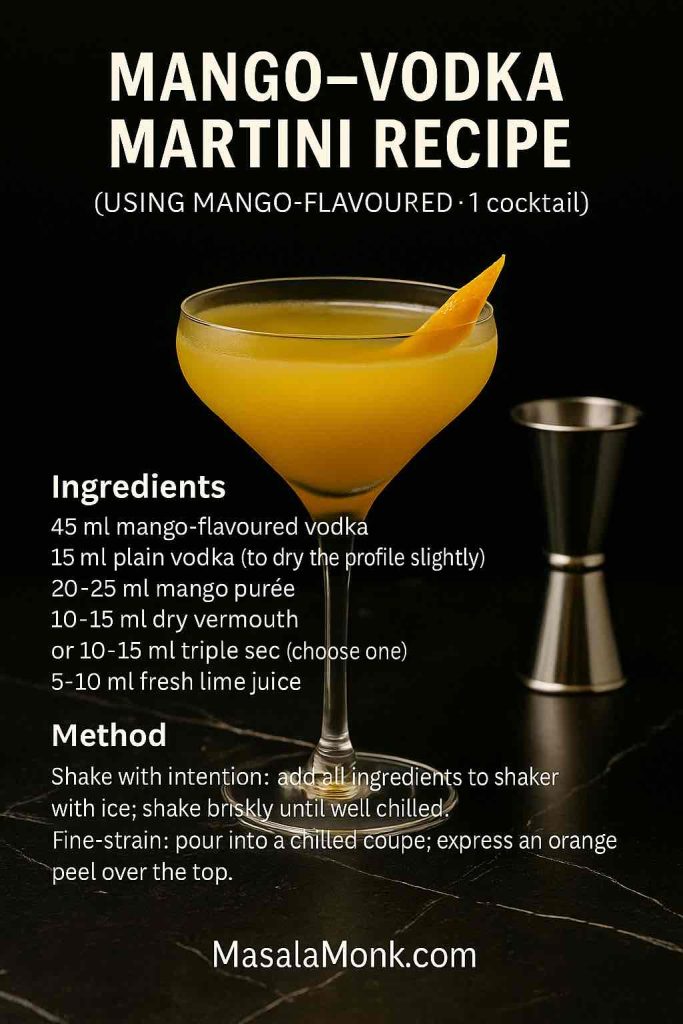
Mango-Vodka Martini (Using Mango-Flavoured Vodka)

Flavoured vodkas can be divisive; nevertheless, mango versions have a devoted following, especially Absolut Mango and Cîroc Mango. Because those spirits already contribute fruit and aroma, the key is restraint elsewhere. Instead of piling on purée and liqueur, keep the structure lean so the drink stays elegant. For a spirit-forward template—and a sense of how dry vermouth can shape the edges—take a look at Difford’s Mango Vodka Martini.

Ingredients (1 cocktail)

  • 45 ml mango-flavoured vodka
  • 15 ml plain vodka (to dry the profile slightly)
  • 20–25 ml mango purée (easy does it)
  • 10–15 ml dry vermouth or 10–15 ml triple sec (choose one)
  • 5–10 ml fresh lime juice
Mango–Vodka Martini recipe card on black marble: coupe with orange twist and nickel jigger, ingredients and method overlay, MasalaMonk.com footer.
Keep the bottle of dry vermouth refrigerated and dose sparingly—10 ml dries the drink without muting mango. If using Cîroc Mango (softer), add the plain vodka to sharpen the finish; with Absolut Mango (brighter), you can dial the purée to 20 ml and rely on a firm orange-peel express for aroma.

Method

  1. Shake with intention. Add everything to a shaker with ice; shake briskly until well chilled.
  2. Fine-strain. Pour into a chilled coupe; express an orange peel over the top.

Try This Too

  • To steer closer to a classic “martini” posture, choose dry vermouth and keep purée at the low end. Conversely, if you’d like a fruitier party vibe, pick triple sec and nudge mango up by 5 ml.
  • For readers who love this flavor lane, point them toward Mango Vodka Cocktail Drinks for additional ideas.

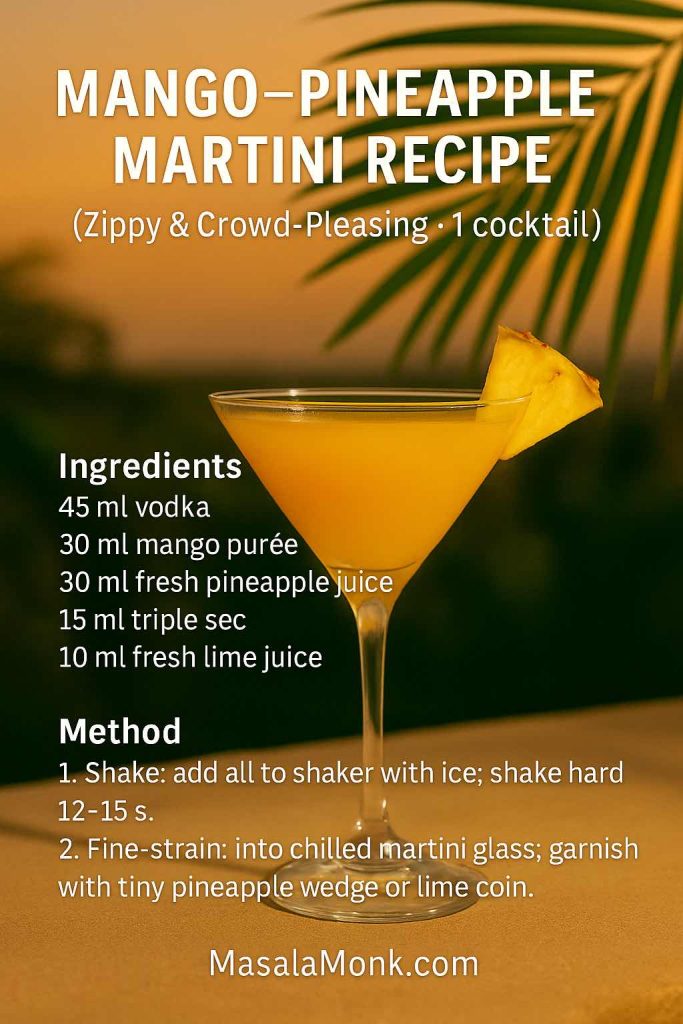
Mango–Pineapple Martini Recipe (Zippy & Crowd-Pleasing)

Pineapple is mango’s lively friend. Because it carries natural acidity and foam-friendly proteins, it both brightens the palate and gives a gentle froth when shaken hard. Moreover, the combo tastes like a beach afternoon while still behaving like a martini. Consequently, it’s the riff people keep making “just one more” of.

Ingredients (1 cocktail)

  • 45 ml vodka
  • 30 ml mango purée
  • 30 ml fresh pineapple juice
  • 15 ml triple sec
  • 10 ml fresh lime juice
Mango–Pineapple Martini in a coupe at sunset with a pineapple-wedge garnish and palm fronds; recipe card overlay with ingredients and quick method.
Shake with fresh pineapple juice for a light, natural foam; if using carton juice, add 5 ml aquafaba or pineapple gomme for the same silky head. Batch the vodka + mango purée + triple sec in advance, keep it cold, then add lime and juice when you shake to order.

Method

  1. Build and shake. Add everything to a shaker with ice; shake hard for 12–15 seconds.
  2. Fine-strain and garnish. Strain into a chilled martini glass; garnish with a tiny pineapple wedge or a lime coin.

Try This Too

  • Add a dash of coconut water for length and softness. Alternatively, micro-grate fresh nutmeg over the top for a quiet tiki nod.
  • If you want to compare builds for fruit-forward “martini” structure, revisit SAQ’s mango martini and adjust ratios to suit your pineapple.

Also Read: What to Mix with Jim Beam: Best Mixers & Easy Cocktails


Technique Cheat-Sheet (Short, Practical, Reassuring)

Although recipes matter, technique carries the day. Therefore, here’s a compact list you can actually use while you shake.

  • Chill everything. Cold glass, cold shaker, cold ingredients—everything tastes tighter and cleaner. Consequently, you’ll need less ice time to reach balance.
  • Shake like you mean it. Ten gentle shakes won’t cut it. Instead, shake hard for 12–15 seconds to knit acids, alcohol, and fruit.
  • Fine-strain always. Mango fibers and ice shards dull texture. Thus, double-straining gives that “why does this feel so smooth?” moment.
  • Taste, then nudge. After the first sip, decide: one dash more lime for brightness, or one teaspoon of simple for roundness. Likewise, a pinch of salt often wakes up fruit without obvious “saltiness.”
  • Rims: lime, not water. For chile-salt or Tajín rims, swipe with lime; then dip. Water turns rims drippy; citrus makes a tacky surface that stays put. For a quick visual, use this Tajín salt rim guide and this pro rimming guide.
  • Frozen logic. Measured liquid + measured frozen fruit = repeatable texture. Consequently, you avoid bland, watery slush. For the “why” behind it, see Serious Eats’ frozen daiquiri method and borrow the ratios.

Also Read: Punch with Pineapple Juice: Guide & 9 Party-Perfect Recipes


Pantry & Substitutions (Because Real Life Happens)

Even with the best intentions, sometimes you don’t have the exact bottle or the perfect fruit. Fortunately, mango is forgiving, and so are these builds.

  • Vodka: Any clean, mid-shelf vodka works. However, if you enjoy a little aromatic lift, a grain-based vodka often reads slightly sweeter, while a grape-based vodka reads softer.
  • Mango purée vs nectar: Purée equals body and ripe impact; nectar equals convenience and consistency. Accordingly, drop or dial back simple syrup when using nectar.
  • Orange liqueur: Triple sec is bright and linear; Cointreau is richer and a touch more bitter-orange. Either fits; therefore, pick the one that matches your mood.
  • Citrus swap: No lime? Use lemon, but reduce slightly; then taste and adjust. Meanwhile, a micro-splash of orange juice can round sharp edges if your citrus is too aggressive.
  • Heat source: Jalapeño is classic for approachable spice. Alternatively, serrano gives tighter heat, while habanero brings a floral blast—use a sliver, not a slice.
  • Sweeteners: Standard simple syrup (1:1) keeps things quick; rich syrup (2:1) sweetens with less water, which can be helpful in the shaken versions. If you’re blending, either works—just taste before you pour.

Service & Garnish (Small Things, Big Payoff)

Great drinks often come down to finishing touches. Therefore, give yourself an extra minute for presentation.

  • Glassware: A coupe feels classic and forgiving; a V-stem martini glass feels dramatic and photogenic. Nevertheless, use what you have; the liquid is the star.
  • Garnish choices: Mango slice, lime coin, or orange twist all make sense. Similarly, edible flowers skimmed across the surface look graceful on the Passion Fruit riff.
  • Ice management: Fast, vigorous shaking builds a tight texture quickly; conversely, lazy shaking melts more ice and blurs the flavors.
  • Batching for friends: Multiply the non-citrus ingredients in a bottle and chill. Then, when guests arrive, measure into the shaker, add fresh citrus, and shake to order. Consequently, every glass tastes first-round fresh.

When to Choose Which Mango Martini Riff/Recipe

Admittedly, choosing is half the fun. Even so, here’s a quick guide for mood-pairing.

  • Classic: Date night, starters, or when you want a clean read on the fruit you bought today.
  • Spicy: Grilled shrimp, chaat, or anything salty and crunchy; the chile-lime halo makes flavors ping.
  • Passion Fruit: Brunch, birthdays, or any moment that welcomes a side of sparkle; vanilla tucks the acidity into a plush pillow.
  • Frozen: Poolside, balcony evenings, or after a hot afternoon; measured dilution keeps it vibrant, not watery.
  • Mango-Vodka: Cocktail hour for the flavoured-vodka loyalists; dry vermouth makes it adult, not candy.
  • Mango–Pineapple: Happy chaos: game nights, family cookouts, and lazy weekends; it’s friendly without being simple.

Helpful Links to Learn More (If You Like Rabbit Holes)

While you can make everything above with confidence right now, you may occasionally want to dive deeper. In that case, use these as touchstones:


A Warm Closing

Cocktails often feel like tiny theater: a few props, a few gestures, and suddenly the room sparkles. Yet the real magic in a mango martini is simple attention—cold glass, fresh citrus, ripe fruit, and a confident shake. Because you now have a classic you can throw together from memory, you also have a launchpad for evenings that want a twist. Therefore, pick the riff that fits your mood, rim a glass if you’re feeling festive, and trust your palate as you taste and tune.

And if mangoes are already perfuming the kitchen, you’re halfway there. Consequently, tonight’s the night: ice in the tin, lime at the ready, music on. Cheers.

FAQs

1) What’s the simplest Mango Martini Recipe I can memorize?

Start with a 2–1.5–0.5–0.25 pattern: 2 oz vodka, 1.5 oz mango purée, 0.5 oz orange liqueur, and 0.25–0.5 oz fresh lime juice. Shake hard, fine-strain, and garnish. Moreover, if your mango is super ripe, you can skip any extra sugar.

2) Mango purée, nectar, or juice—which one works best?

Purée gives body and that luxurious mouthfeel; nectar is lighter and convenient; juice is the most delicate. Consequently, when using nectar or juice, taste first and—if needed—add a touch of simple syrup to keep the Mango Martini Recipe balanced.

3) Can I make a Mango Martini Recipe without a shaker?

Yes. Although a shaker gives better texture, you can add ingredients to a jar with ice, seal tightly, and shake for 20–25 seconds. Then, strain through a fine sieve. Ultimately, colder and more dilution-controlled equals better flavor.

4) How do I get that bar-quality silky finish?

Two steps: shake vigorously and fine-strain through a small mesh strainer. Additionally, chill the glass first; colder service keeps flavors sharp and, therefore, more elegant.

5) What kind of vodka should I choose?

Any clean, mid-shelf vodka works. However, for a fruit-forward style, neutral grain or grape-based vodkas keep the mango in the spotlight. If you’re using mango-flavored vodka, reduce the purée slightly so the Mango Martini Recipe stays crisp, not candy-sweet.

6) How do I make a spicy Mango Martini Recipe without overpowering heat?

Do a Tajín rim for aromatic spice, and then skip muddling chiles in the shaker. Alternatively, if you want a gentle kick, lightly press 2–3 jalapeño slices—no more—before shaking. Meanwhile, taste and adjust; you can always add heat, but you can’t remove it.

7) Can I swap the spirit—say, gin or rum—instead of vodka?

Absolutely. Gin adds botanical snap, while white rum leans tropical and round. Therefore, when swapping, keep mango at 1–1.5 oz and nudge the citrus up by a barspoon if it tastes too sweet.

8) My drink tastes flat—what should I tweak first?

First, add a small squeeze of lime; brightness snaps flavors into focus. Next, if it’s still dull, stir in a pinch of salt (yes, really). Finally, if the fruit was underripe, add ¼ oz simple syrup and shake again. Consequently, you’ll find the sweet-acid balance that defines a great Mango Martini Recipe.

9) How do I batch a Mango Martini Recipe for a party?

Combine vodka, mango purée, and orange liqueur in a bottle and chill well. Just before serving, measure a portion into a shaker, add fresh lime, and shake with ice. In addition, always fine-strain so the last glass tastes as polished as the first.

10) Can I make a Frozen Mango Martini without it turning watery?

Yes—use frozen mango as the “ice,” add measured cold water (start small), and blend in short bursts. Besides, taste and adjust with tiny additions of water or syrup; that way, the texture stays lush and the flavor remains concentrated.

11) What garnishes pair best with a Mango Martini?

A thin mango slice, a lime coin, or an expressed orange peel all work beautifully. Moreover, for the passion-fruit riff, a vanilla sugar rim or a half passion fruit looks stunning without complicating the Mango Martini Recipe itself.

12) Do I need simple syrup—and if so, how much?

Often you don’t. However, if the mango isn’t very sweet (or you used juice), add ¼ oz simple syrup, shake, and retaste. Therefore, you’ll sweeten just enough to smooth edges while keeping the drink bright.

13) What’s the best way to rim the glass without mess?

Use citrus, not water. Rub the rim with a lime wedge, dip into your salt/sugar/Tajín mix, and tap off excess. Consequently, the rim sticks cleanly and doesn’t slide down the glass.

14) Any quick food pairings for a Mango Martini Recipe?

Think salty, crunchy, and fresh: sev puri, grilled prawns, chili-lime nuts, or even a mango-and-paneer skewer. Meanwhile, for the spicy version, add cooling sides—cucumber slices or yogurt-mint dip—to balance the heat.

15) How do I keep flavors consistent if my mangoes vary?

Standardize the process: after shaking, taste a small sip before straining. If it reads too tart, add a teaspoon of syrup; if it’s too sweet, add a teaspoon of lime and shake again. Ultimately, that tiny checkpoint is how every Mango Martini Recipe becomes reliably great at home.

Posted on 6 Comments

Watermelon Daiquiri: A Refreshing Twist on a Classic Cocktail

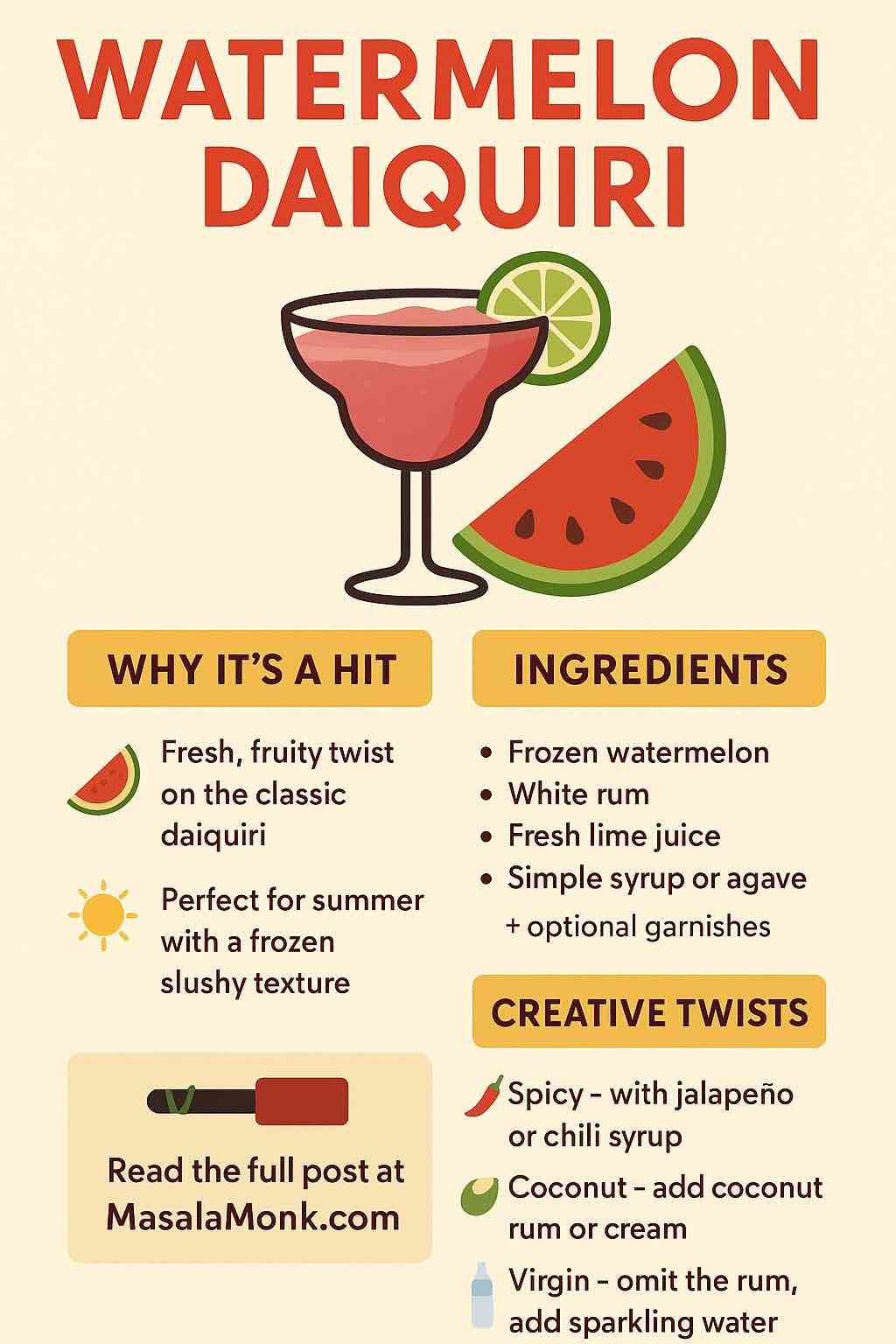
WATERMELON DAIQUIRI

If summer had a flavor, it would be watermelon. If summer had a spirit, it would be rum. Bring them together, and you get the Watermelon Daiquiri: a cocktail that’s both a throwback to Cuban classics and a bright, modern favorite. Whether you’re a cocktail geek, a party host, or just someone with a blender and a ripe watermelon, this is your go-to summer sip.


🍉 Why Watermelon? The Story Behind the Sip

Watermelon daiquiris aren’t just a fleeting TikTok trend—they’re a sign of how the cocktail world is embracing freshness, color, and creative twists on the classics. The original daiquiri—a simple blend of rum, lime, and sugar—traces its roots back to 1900s Cuba, a thirst-quencher for sweltering evenings and balmy breezes. The watermelon version keeps the same structure but adds juiciness, vibrant color, and a crowd-pleasing twist.

Did you know? According to the latest 2025 bar trends, watermelon is now the most popular summer cocktail ingredient, especially among 20-somethings. Even the biggest cocktail festivals and rooftop bars are showcasing watermelon daiquiris in frozen, spicy, and even savory formats.


🛒 The Ingredients: Choosing the Best for Flavor & Texture

The Watermelon Daiquiri is only as good as what goes into it. Here’s how to pick and prep:

1. Watermelon

  • Choose seedless for ease. Ripe, sweet watermelons yield the best flavor.
  • Cut into cubes and freeze in a single layer. This is the secret to a perfect frozen daiquiri texture—no watering down with excess ice.

2. Rum

  • Light/white rum is classic, allowing the watermelon to shine.
  • For a twist: Try coconut rum or even a splash of overproof for an extra kick.

3. Fresh Lime Juice

  • Don’t skip the fresh-squeezed! Bottled juice can’t compete in terms of brightness.

4. Simple Syrup or Agave

  • Use simple syrup (1:1 sugar:water) or agave nectar for easy mixing and balanced sweetness.
  • Adjust to taste—watermelon sweetness can vary.

5. Optional Upgrades

  • Herbs: Fresh mint or basil.
  • Spice: Muddle jalapeño or add a few dashes of chili syrup.
  • Liqueur: Try a splash of Cointreau or orange liqueur for complexity.
  • Coconut: Add coconut water or a spoon of coconut cream for tropical vibes.

🍹 The Practical Recipe: Classic Frozen Watermelon Daiquiri

Ingredients (serves 2)

  • 4 cups frozen watermelon cubes
  • ½ cup white rum
  • ¼ cup fresh lime juice
  • 1 tablespoon simple syrup or agave (more or less to taste)
  • Handful of ice (optional, for extra slush)
  • Garnish: lime wheel, fresh mint, watermelon wedge, or a fun sugar/salt rim

Instructions

  1. Prep the Watermelon: Cube and freeze watermelon at least 4 hours ahead. Overnight is best.
  2. Blend: In a blender, combine frozen watermelon, rum, lime juice, sweetener, and a little ice if you want extra thickness.
  3. Taste & Adjust: Blend until smooth. Taste, and adjust sweetness or lime as needed.
  4. Serve: Pour into chilled glasses. Garnish with your favorites—lime, mint, or a tiny watermelon triangle.
  5. Optional Rim: Run a lime wedge around the glass and dip in sugar, salt, or Tajín for an Instagram-ready touch.

🔥 Trending Variations for 2025

Why settle for the ordinary when you can make your Watermelon Daiquiri stand out? Here’s how bartenders are riffing on the classic:

Spicy Watermelon Daiquiri

  • Add muddled jalapeño or a dash of chili-lime syrup for an unexpected zing.
  • Garnish with a chili-salt rim for extra flair.

Coconut Watermelon Daiquiri

  • Substitute part of the rum with coconut rum or a splash of coconut milk.
  • The result: a creamy, almost Piña-Colada-like twist that’s still light and refreshing.

Herbaceous Infusion

  • Muddle basil or mint in the blender with the watermelon for a green, garden-fresh flavor.

On the Rocks Version

  • Skip the freezing step and use fresh watermelon juice, rum, lime, and simple syrup. Shake with ice and strain into a rocks glass.

Virgin (Non-Alcoholic) Watermelon Daiquiri

  • Omit the rum, use more watermelon, and splash in some sparkling water for fizz.

🎉 Hosting Tips: Make Watermelon Daiquiris the Life of the Party

  • Batch Ahead: Blend the daiquiri mix without ice and store in the fridge. Blend with ice or frozen watermelon just before serving.
  • DIY Garnish Bar: Set out lime wheels, mint sprigs, edible flowers, chili salt, and mini watermelon wedges so guests can personalize.
  • Keep It Cold: If serving outdoors, use insulated cups or serve in a pitcher placed in a bucket of ice.

🌈 Pro Presentation: Instagram-Ready Watermelon Daiquiri

  • Use geometric ice cubes or clear spheres for wow factor (especially for on-the-rocks versions).
  • Layer with edible glitter or a floral garnish—this trend is huge at summer events.
  • Create a two-tone effect: Blend part of the mix with strawberries or another fruit, then pour in layers for a sunset-in-a-glass look.

🧑‍🔬 Troubleshooting & Expert Tips

  • Too watery? Add more frozen watermelon or ice.
  • Not sweet enough? Watermelon ripeness can vary—don’t be afraid to add an extra splash of syrup.
  • No blender? Use fresh watermelon juice, shake with rum and lime, and serve over ice.
  • Want to lower ABV? Mix in coconut water or sparkling water for a lighter, “sessionable” drink.

🌟 The Final Sip: Why Watermelon Daiquiri Is Here to Stay

With its bright, juicy flavor and endless customization, the Watermelon Daiquiri is more than a trend—it’s the taste of summer in a glass. Whether you keep it classic, make it spicy, or invent your own signature riff, it’s the perfect cocktail for poolside afternoons, rooftop parties, or any moment that needs a splash of fun.

Ready to shake (or blend) things up? Tag your creations, share your twists, and let the watermelon daiquiri be your summer signature.


Thirsty for more? Drop a comment with your favorite variation or questions on technique—let’s make this summer the most delicious one yet!

Watermelon Daiquiri: Frequently Asked Questions

1. Can I make a watermelon daiquiri without a blender?
Yes! Use fresh watermelon juice instead of frozen cubes. Shake it with rum, lime juice, and sweetener, then strain over ice.

2. What’s the best type of rum for a watermelon daiquiri?
Light (white) rum is classic—it’s mild and lets the watermelon shine. Coconut rum or even spiced rum works for creative twists.

3. Can I use bottled lime juice instead of fresh?
Fresh lime juice is strongly recommended for the brightest, cleanest flavor, but bottled can work in a pinch.

4. My watermelon isn’t very sweet. How do I fix the flavor?
Add a little extra simple syrup or agave nectar. Always taste and adjust before serving.

5. Is there a way to make it non-alcoholic?
Absolutely! Skip the rum and add more watermelon, or use sparkling water for a fun, fizzy mocktail.

6. How can I make a spicy watermelon daiquiri?
Muddle a few slices of jalapeño in the blender, or add chili-lime syrup or a dash of hot sauce for heat.

7. What’s the secret to a thick, slushy texture?
Freeze your watermelon cubes solid before blending, and add only a little ice if needed. Don’t use too much liquid.

8. Can I make a big batch for a party?
Yes—multiply the recipe as needed. Blend and freeze in advance, then re-blend with a splash of rum or water before serving for the perfect texture.

9. How do I rim the glass for extra flair?
Run a lime wedge around the glass edge and dip into sugar, salt, or chili-lime seasoning (like Tajín).

10. What other fruits go well with watermelon in this daiquiri?
Strawberries, pineapple, or mango pair beautifully. Try blending in a handful for a fruity twist.

Posted on Leave a comment

10 Best Pina Colada Recipes from the Internet 🍹🥥🍍

a man holding a cocktail drink

The Pina Colada, a classic cocktail that hails from Puerto Rico, has been a symbol of relaxation and tropical luxury since its creation in the 1950s. Its delightful blend of rum, coconut cream, and pineapple juice is like a vacation in a glass, transporting you to a sunny beach with every sip. But the beauty of the Pina Colada is its versatility. With a few tweaks and additions, you can transform the classic Pina Colada into a whole new cocktail experience. From fruity twists to healthier options, we’ve scoured the internet to bring you the 10 best Pina Colada recipes. So, get your blender ready, it’s time to mix things up! 🎉

1. Mango Colada Recipe (Alcoholic or Non-Alcoholic) | The Kitchn 🥭

The Mango Colada is a tropical twist on the classic Pina Colada. This recipe uses unsweetened mango juice or nectar, ripe mango cubes (fresh or frozen), and crushed ice. The mango adds a unique tropical flavor that complements the coconut and pineapple perfectly. The result is a refreshing and fruity cocktail that’s perfect for those who love the tropical flavor of mango. It’s like a tropical vacation in a glass!

  • Unsweetened mango juice or nectar
  • Ripe mango cubes, fresh or frozen
  • Crushed ice

2. Vodka Piña Colada Recipe | Bevvy 🍸

Swap out the rum for vodka in this Vodka Piña Colada for a different kind of kick. This recipe uses vodka instead of rum, along with coconut cream, pineapple juice, and simple syrup. The vodka gives the cocktail a different kind of kick, making it a fun twist on the classic cocktail. It’s a great option for vodka lovers who want to try a tropical cocktail.

  • Vodka
  • Coconut cream
  • Pineapple juice
  • Simple syrup

3. Skinny Pina Colada Recipe | Wholesome Yum 🥥

Enjoy the flavors you love without the guilt with this Skinny Pina Colada. This recipe provides a healthier version of the classic Piña Colada, maintaining the blend of rum, coconut cream, and pineapple juice. It’s a lighter option that doesn’t compromise on taste. It’s perfect for those who are watching their calorie intake but still want to enjoy a delicious cocktail.

  • Rum
  • Coconut cream
  • Pineapple juice

4. Watermelon Pina Colada Recipe | Simple Joy 🍉

The Watermelon Pina Colada combines the flavors of watermelon and Piña Colada for a refreshing summer drink. This recipe uses rum, cream of coconut, and frozen fruit (including watermelon). The watermelon adds a refreshing and sweet flavor that complements the tropical flavors of the Pina Colada. It’s a unique and refreshing twist on the classic cocktail that’s perfect for hot summer days.

  • Rum
  • Cream of coconut
  • Frozen fruit (including watermelon)

5. Blueberry Piña Colada (cocktail and mocktail) | Caroline’s Cooking 🫐

The Blueberry Piña Colada adds a burst of berry flavor to your Pina Colada. This recipe uses coconut milk, frozen blueberries, pineapple (fresh or frozen), ice, and a little honey. The blueberries add a sweet and tangy flavor that complements the tropical flavors of the Pina Colada. It can be made as a cocktail or a mocktail, making it a versatile option for any occasion.

  • Coconut milk
  • Frozen blueberries
  • Pineapple (fresh or frozen)
  • Ice
  • A little honey

6. Healthy Peach Pina Colada | Brewing Happiness 🍑

The Healthy Peach Pina Colada is a lighter, but still delicious, cocktail. This recipe uses coconut water, coconut cream, light rum (optional), coconut nectar (or agave nectar or maple syrup), and garnishes with pineapple slices, peach slices, and cherries. The peach adds a sweet and fruity flavor that complements the tropical flavors of the Pina Colada. It’s a healthier twist on the classic cocktail that doesn’t compromise on taste.

  • Coconut water
  • Coconut cream
  • Light rum (optional)
  • Coconut nectar (or agave nectar or maple syrup)
  • Pineapple slices, peach slices, and cherries for garnish

7. Strawberry Colada | Shake Drink Repeat 🍓

The Strawberry Colada is a fruity twist on the classic Pina Colada. This simple blend of rum, frozen strawberries, and cream of coconut is a refreshing and fruity cocktail that’s perfect for strawberry lovers. The strawberries add a sweet and tangy flavor that complements the tropical flavors of the Pina Colada. It’s a delicious and refreshing cocktail that’s perfect for any occasion.

  • Rum
  • Frozen strawberries
  • Cream of coconut

8. Frozen Piña Colada Recipe | The Chunky Chef ❄️

The Frozen Piña Colada is a refreshing treat perfect for hot summer days. This recipe offers variations including adding lime juice or different types of rum for a twist on the classic Piña Colada. The frozen texture makes it a frosty and refreshing version of the classic cocktail that’s perfect for cooling down on a hot day.

  • Lime juice (optional)
  • Different types of rum (optional)

9. BA’s Best Piña Colada Recipe | Bon Appétit 🍹

Rated 4.6 out of 5, the BA’s Best Piña Colada sticks to the classic ingredients for a top-rated cocktail. This recipe is described as a departure from the typical sticky-sweet concoction of sugary mixers. It’s a classic take on the Pina Colada that’s been highly rated by users. It’s perfect for those who want to stick to the classic recipe but want a version that’s been tried and tested by many.

  • Rum
  • Coconut cream
  • Pineapple juice

10. How to Make the Best Piña Colada: Blended Piña Colada Recipe | MasterClass 🏆

This recipe provides a classic take on the Puerto Rican rum drink made with pineapple juice and cream of coconut. It’s a traditional Pina Colada recipe that’s perfect for those who love the classic cocktail. It’s a great option for those who want to learn how to make the best Pina Colada from scratch.

  • Rum
  • Pineapple juice
  • Cream of coconut

So, whether you’re a fan of the classic or looking to try something new, these Pina Colada recipes are sure to transport you to a tropical paradise. Happy mixing! 🍹🏝️

More Cocktail and Mocktail Recipes from Masala Monk 🍹

If you’re looking for more inspiration for your next cocktail or mocktail, check out these fantastic posts from Masala Monk’s blog:

  1. Crown Peach Beach Drink: 5 Masala Twists to Cocktail with Recipes: This post gives a unique twist to the Crown Peach Beach Drink with five different masala variations. It’s a must-read if you’re looking to spice up your cocktail game.
  2. Top 5 Crown Royal Peach Beach Drink Recipes: This post lists the top five Crown Royal Peach Beach Drink recipes. It’s a great resource if you’re a fan of this particular cocktail and want to try different variations.
  3. 5 Best Purple Rain Cocktail Recipes from the Internet 🍹: This post compiles the five best Purple Rain cocktail recipes from the internet. If you’re a fan of this vibrant and delicious cocktail, you’ll definitely want to check this out.

Remember, the key to a great cocktail or mocktail is not just the recipe, but also the quality of the ingredients you use. So, make sure you’re using the best!

Also, if you’re a foodie and love discussing food, recipes, and more, consider joining the Eatlo community on Facebook. It’s a vibrant community where food lovers share their culinary adventures, recipes, food stories, and more. See you there! 🥂

Blog Tags: Pina Colada, Cocktail Recipes, Tropical Drinks, Rum Cocktails, Summer Drinks, Fruit Cocktails, Healthy Cocktails, Vodka Cocktails, Frozen Cocktails, Mocktails, Masala Monk, Eatlo