
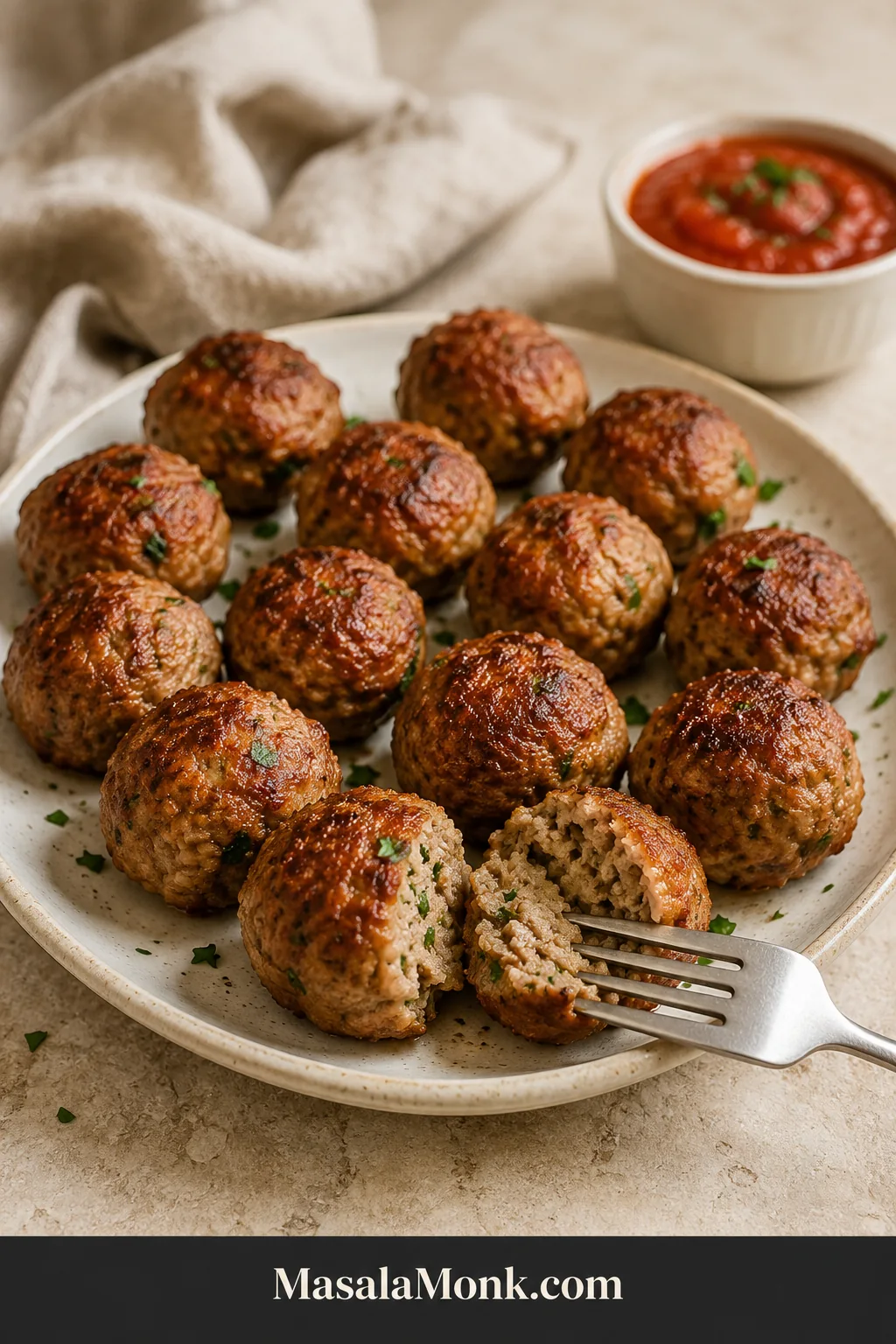
The first meatball is usually eaten beside the tray: browned at the edges, tender enough to split with a fork and still moist in the middle.
Ground pork is naturally suited to that balance. These meatballs have rich pork flavor, gentle garlic and onion, fresh parsley and a golden-brown exterior around a tender center.
They are especially useful on nights when the ground pork is ready but dinner is not. Make one simple mixture, then turn it into a marinara dinner, a gravy plate, a rice bowl or an appetizer with dipping sauce.
One pork mixture, three ways to cook it—and a tender center whichever you choose. Soften the breadcrumbs first, handle the pork gently, keep the portions even and stop cooking as soon as the centers are ready.
Start With the Baked Version
Baking is the easiest place to begin. It cooks all 16 meatballs at once, asks for the least attention and is the most forgiving method.
The process is only four moves: soften the panko, mix gently, shape 16 even meatballs and bake. From there, the oven does the hands-off cooking, and the baked version takes about 40 minutes from bowl to table.
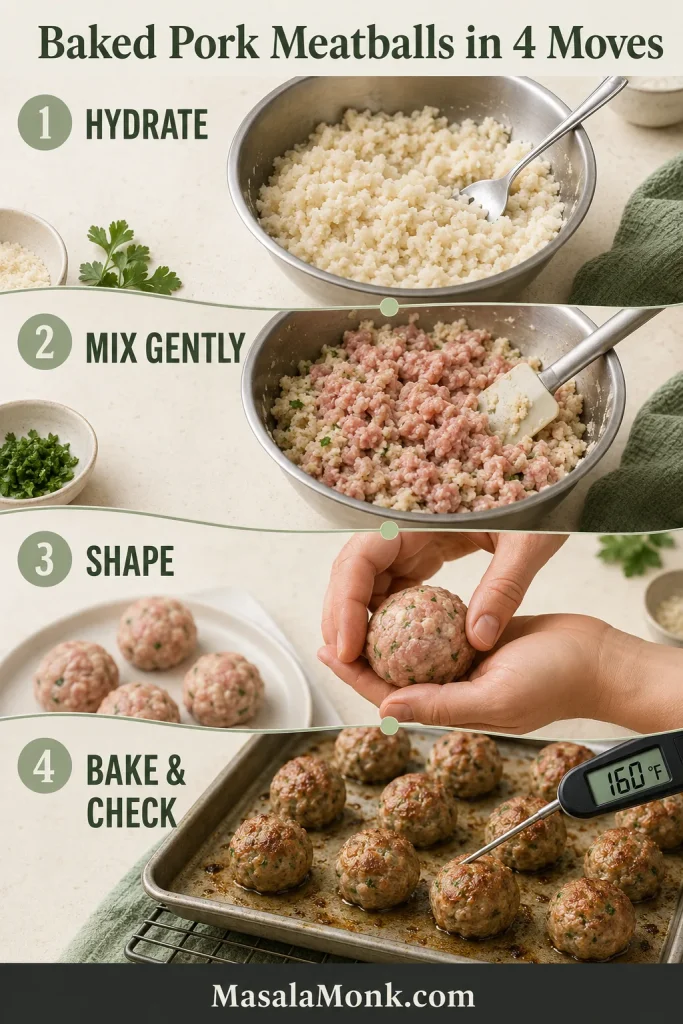
For the simplest dinner, bake them, warm four per person in marinara and serve with spaghetti or toasted bread. Choose the skillet when you want the deepest crust, or air-fry six to ten meatballs when speed matters. Whichever method you choose, a moist mixture needs gentle handling—not extra kneading.
The recipe
Ground Pork Meatballs: Baked, Pan-Fried or Air-Fried
A little milk-softened panko keeps these all-pork meatballs tender without making them too soft to shape or brown.
Recipe at a glance
- Yield: About 16 medium meatballs; serves 4
- Portion: 35–36 g / 1¼ oz each, about 1½ inches / 4 cm
- Preparation: About 20 minutes
- Total time, baked: About 40 minutes, including a 3-minute rest
- Oven: 15–18 minutes
- Skillet: 10–12 minutes per batch; up to 14 with the covered finish
- Air fryer: 10–13 minutes per batch
- Ground pork doneness: 160°F / 71°C
Ingredients
- 1 lb (454 g) plain ground pork or pork mince, preferably regular rather than extra-lean
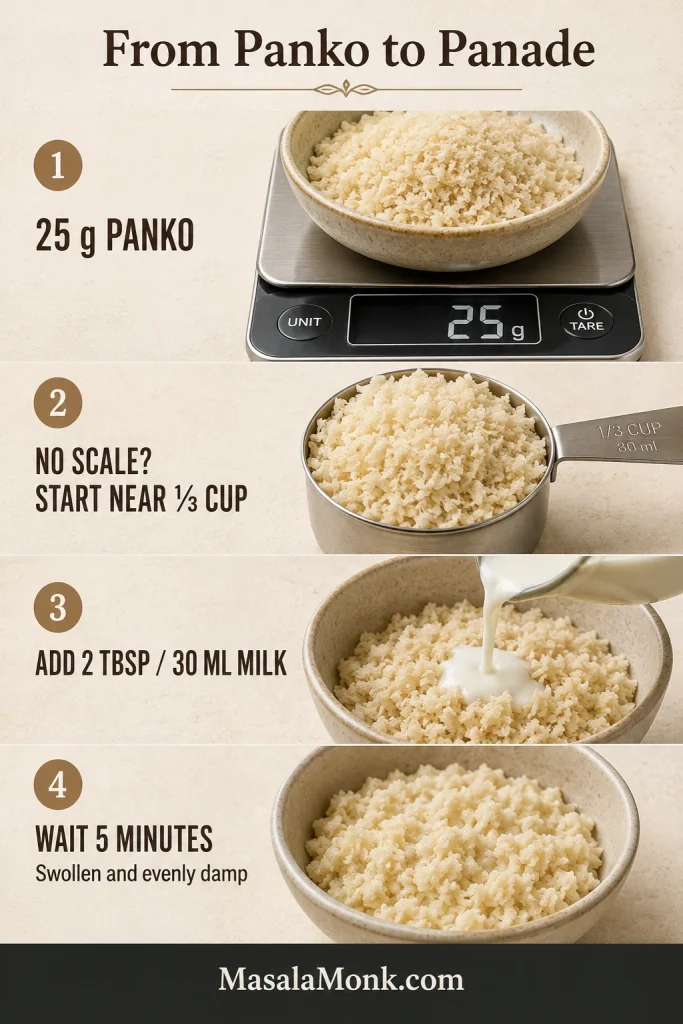
- 25 g panko breadcrumbs (begin with about ⅓ cup when measuring without a scale)
- 2 tablespoons (30 ml) milk
- 1 large egg (about 50 g) without the shell
- 2 tablespoons (about 8 g) finely chopped fresh parsley
- 1 teaspoon (about 3 g) onion powder
- 1 teaspoon (about 3 g) garlic powder
- 5 g fine sea salt (about ¾ teaspoon)
- ½ teaspoon (about 1 g) freshly ground black pepper
- 1 tablespoon (15 ml) neutral oil, for pan-frying
- Oil for greasing the tray, rack or air-fryer basket, as needed
Equipment: a large mixing bowl, fork or flexible spatula, instant-read thermometer and the pan or air fryer needed for your chosen method. A scale or 2-tablespoon scoop helps keep the portions even.
Mix and shape
- Make the panade. Stir the panko and milk together in the mixing bowl. Leave for 5 minutes, until the crumbs are evenly damp and no loose milk remains.
- Season the binder. Add the egg, parsley, onion powder, garlic powder, salt and black pepper. Mix until even.
- Add cold pork. Keep the pork refrigerated until the panade is ready, then fold it in with a fork, flexible spatula or your fingertips just until no large unmixed patches remain. Do not knead the mixture smooth.
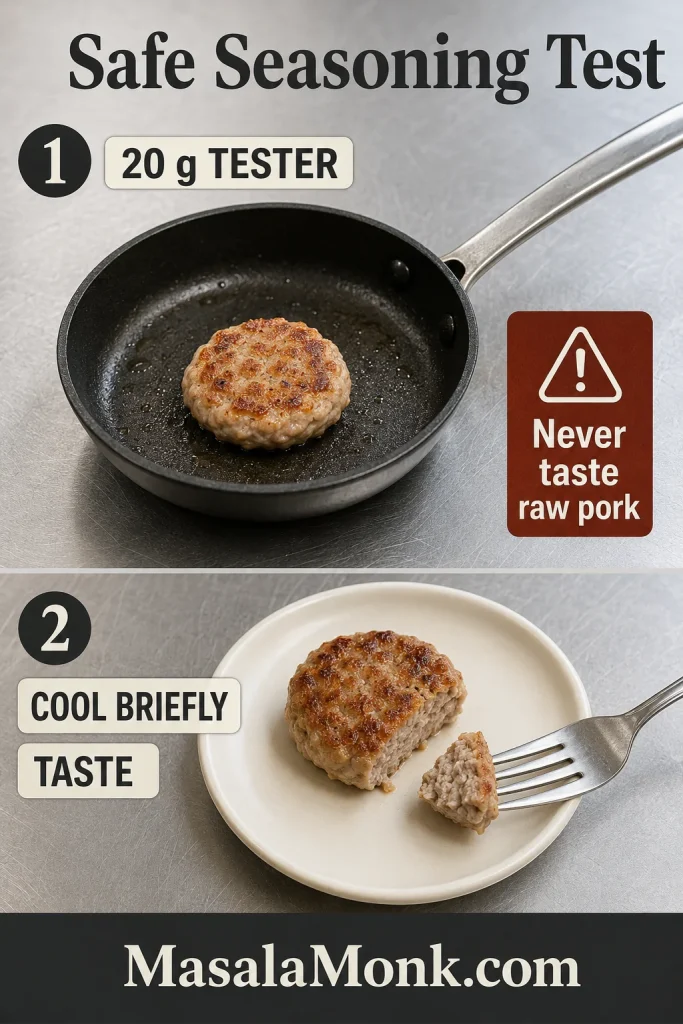
- Check the seasoning, if needed. Cook a 20 g tester patty completely, cool briefly and taste. Scatter any adjustment evenly over the bowl and fold once or twice. Never taste raw pork.
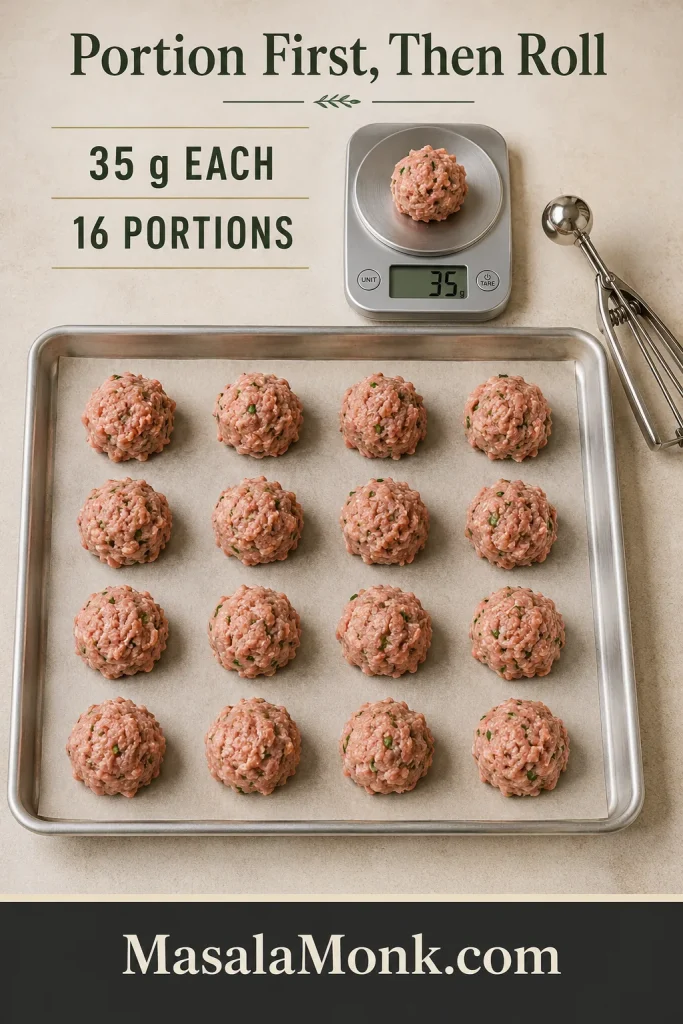
- Portion first. Divide into 16 portions weighing about 35–36 g / 1¼ oz each. A rounded 2-tablespoon scoop is a useful starting point. After removing a 20 g tester, divide the remaining mixture into 16 portions of about 35 g each.
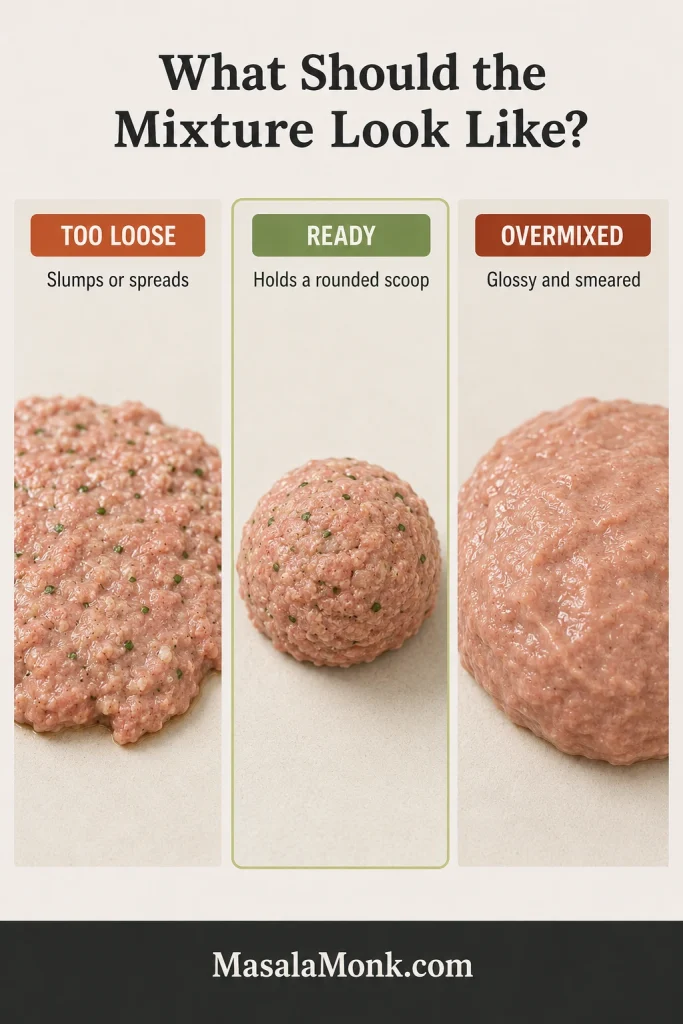
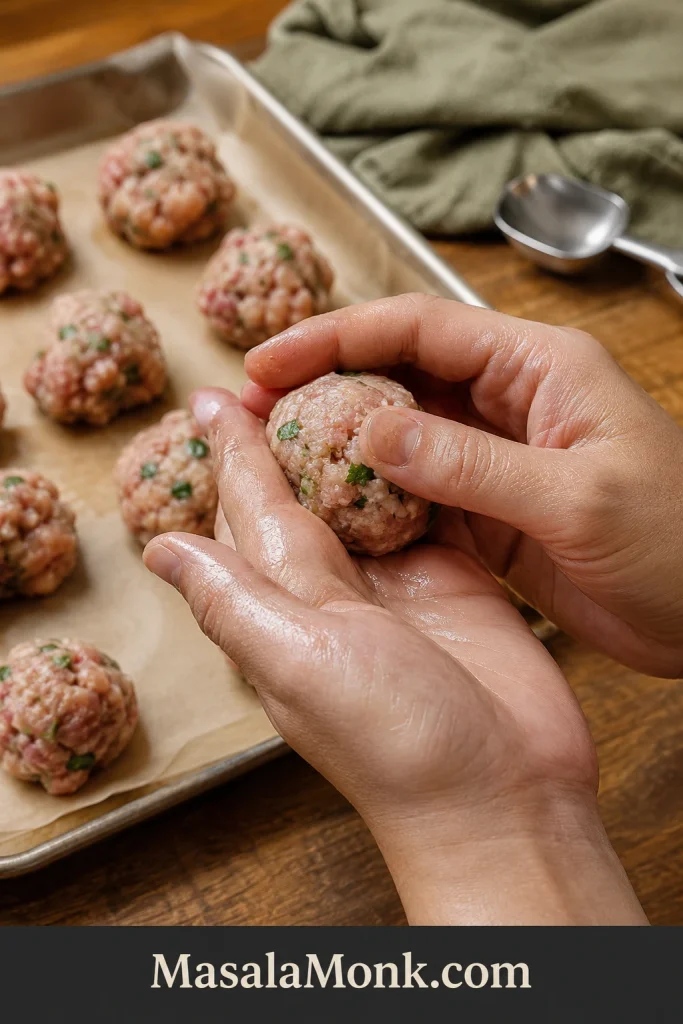
- Shape gently. Roll each portion only until it holds a ball about 1½ inches / 4 cm across. The surface should feel slightly sticky but still hold a rounded shape; it should not slump flat or feel liquid.
- Chill only if needed. If the mixture is warm or the balls begin to flatten, refrigerate them for 15–20 minutes before cooking.
After shaping, follow one cooking method below.
Choose one: Bake
- Heat the oven. Set the oven to 400°F / 200°C conventional / 180°C fan. Line a rimmed sheet pan with parchment or place a lightly greased wire rack over the pan.
- Space the meatballs. Arrange in one layer with about 1 inch / 2.5 cm between them.
- Bake and begin checking early. Start checking at 14 minutes. Most 35–36 g meatballs will need about 15–18 minutes.
- Check the center. Take them out when two of the largest meatballs reach 160°F / 71°C. Use color as a clue, but let the thermometer decide.
- Rest briefly. Leave for 3 minutes before serving or transferring to sauce so the juices settle and the surface firms slightly.
Choose one: Pan-Fry
- Heat the skillet. Warm 1 tablespoon (15 ml) neutral oil in a 12-inch / 30 cm heavy skillet over medium heat.
- Work in two batches. Add 8 meatballs, leaving room to turn them. Let the first side cook for about 2 minutes before moving.
- Brown several surfaces. Turn gradually. Once browned, reduce the heat to medium-low.
- Finish the centers. Continue cooking and turning until the meatballs reach 160°F / 71°C, about 10–12 minutes in total, or up to 14 minutes when the covered finish is needed.
- Rescue early darkening. Move the pan off the heat, add 2 tablespoons / 30 ml water down the side, cover and return to low heat for 1–2 minutes. Uncover for the final 30–60 seconds.
- Reset for the remaining eight. Wipe out burnt bits, leave a thin film of rendered fat and add 1 teaspoon oil only if the skillet looks dry. The second panful may finish slightly sooner because the skillet is already hot.
Choose one: Air-Fry
- Preheat when recommended. Set a basket-style air fryer to 375°F / 190°C and follow the manufacturer’s preheating guidance.
- Leave room for airflow. Lightly oil the basket and arrange the meatballs in one layer without touching. Cook in batches, and never preheat with loose parchment inside.
- Begin checking at 9 minutes. Turn after about 6 minutes if the appliance browns more strongly on one side.
- Cook to temperature. Most 35–36 g meatballs will need about 10–13 minutes. Remove at 160°F / 71°C.
- Pause between batches. Rest the cooked meatballs for 3 minutes while the next round cooks.
Recipe notes
- Panko volume varies by brand. Without a scale, begin with about ⅓ cup, hydrate it fully and add more only if the chilled mixture still slumps. For fine dry breadcrumbs, begin with 20 g, wait 5 minutes and add up to 5 g more only if needed.
- Use the 5 g salt weight for consistent seasoning; fine and coarse crystals fill a spoon differently.
- Unsweetened, unflavored non-dairy milk or water may replace the 2 tablespoons / 30 ml milk.
- Ground chicken or turkey substitutions must reach 165°F / 74°C.
- To double: double every ingredient by weight, mix in two bowls if needed and use spaced trays or separate cooking batches.
The recipe above is all you need to start cooking. Keep reading for why the mixture works, how the methods differ and what to do if something goes wrong.
Choose a Method, Fix Problems and Serve Them Well
Why Ground Pork Works So Well for Meatballs
Plain ground pork—or pork mince in the UK, Australia and several other markets—has enough fat and natural richness to make tender meatballs without beef, veal or sausage.
A light panko-and-milk panade protects the center without making it bready, while keeping the portions even makes every cooking time more useful. The raw mixture will feel softer than a lean beef mixture; if a scoop stays rounded on the tray, trust it before reaching for more crumbs.
Seasoning stays simple but not bland: garlic and onion sit quietly behind the pork, parsley adds freshness and enough salt makes the meatballs satisfying before any sauce is added. Simmer a few in marinara tonight, glaze a few for tomorrow’s rice bowl and freeze the rest for another dinner.
Think of this as an everyday savory base. Swedish gravy meatballs, sweet-and-sour versions and Vietnamese xíu mại each need their own balance of binder, seasoning and sauce. For other ways to use the package, browse MasalaMonk’s ground pork recipes.
Ingredients for Ground Pork Meatballs
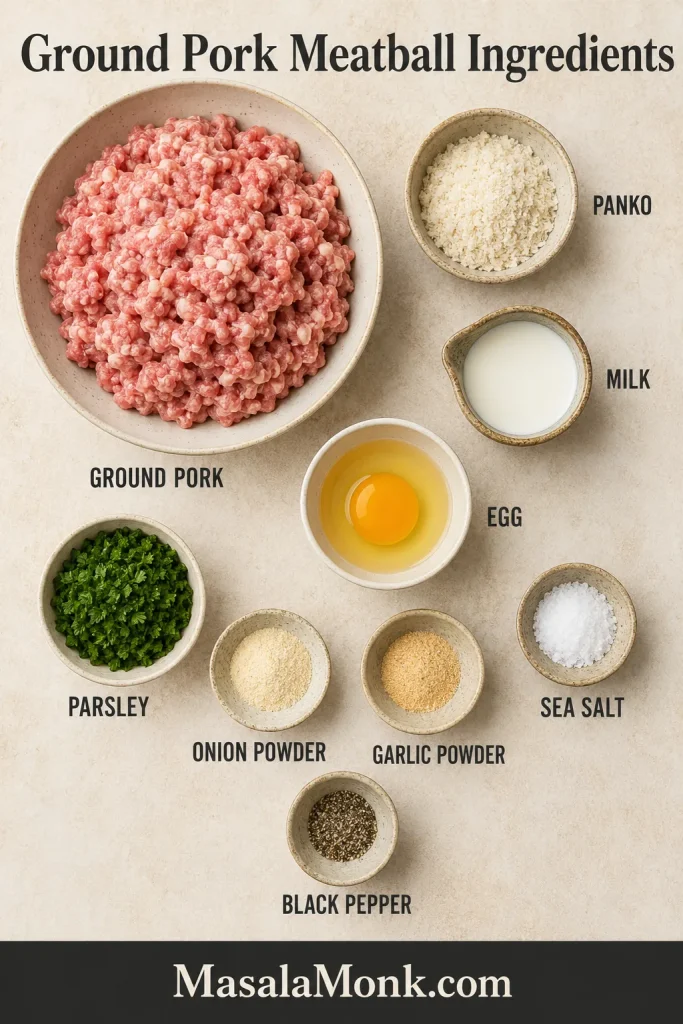
Ground Pork or Pork Mince
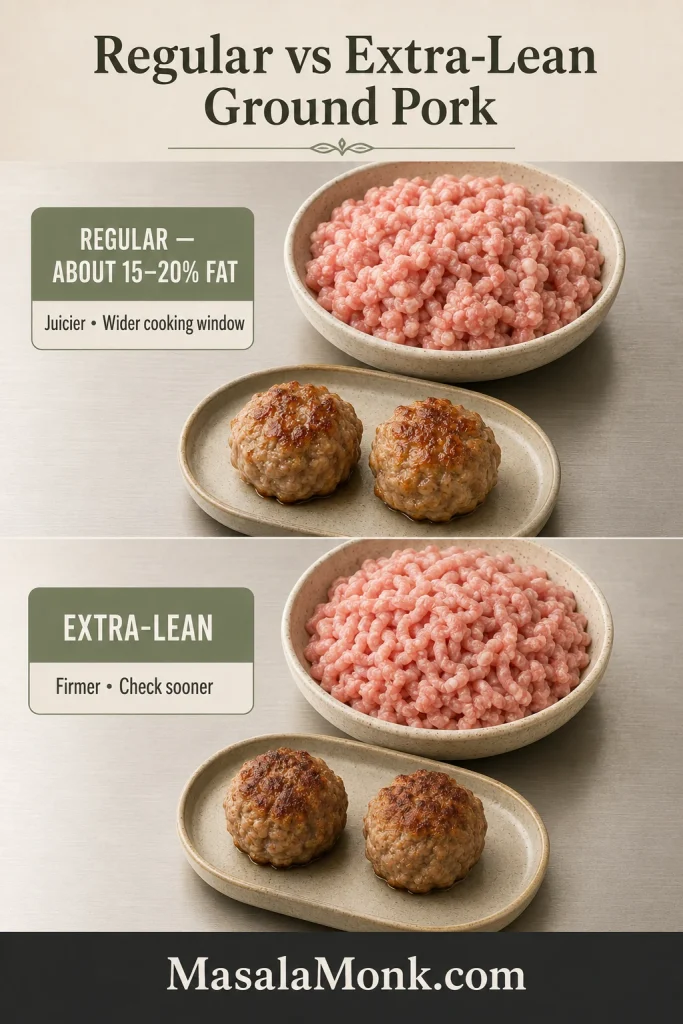
Use plain ground pork, not breakfast or Italian sausage, which already contains salt, spices and often extra fat. Regular pork is more forgiving than the leanest package; when the label gives a percentage, roughly 15–20% fat suits an everyday meatball.
The Panade: Panko, Milk and Egg
Soaking the panko in milk creates a light panade that holds moisture more effectively than dry crumbs mixed straight into the pork. Just 2 tablespoons / 30 ml milk tenderizes the center without making the mixture slump or flatten.
Fine dry breadcrumbs absorb faster than panko, so add them gradually. Unsweetened non-dairy milk or water can replace the milk in the same 2-tablespoon / 30 ml quantity.
The egg helps the pork and breadcrumbs hold together. It is not the ingredient that makes the meatball juicy, and adding more does not automatically make the center softer. Too much egg relative to the crumbs and meat can create a loose raw mixture and a springy cooked texture.
Aromatics and Seasoning
Powdered aromatics distribute evenly without adding the variable moisture of raw onion, which helps one mixture work across all three methods. Prefer fresh onion? A measured version appears below; large pieces can stay firm and create weak points.
Parsley adds freshness without tying the meatballs to one sauce or cuisine, while black pepper gives the pork gentle background warmth. Salt must reach the center, and crystal sizes vary, so use the 5 g weight when possible.
If you add salty Parmesan, soy sauce or another assertive ingredient, cook a small tester before shaping. It is the safest way to correct the bowl without gambling on the whole tray.
Choose Your Meatball Binder
The main recipe uses a light panade. Because the alternatives below change the finished texture, treat them as separate versions rather than direct swaps. Pork meatballs can be made with or without breadcrumbs, but the results will not be identical.
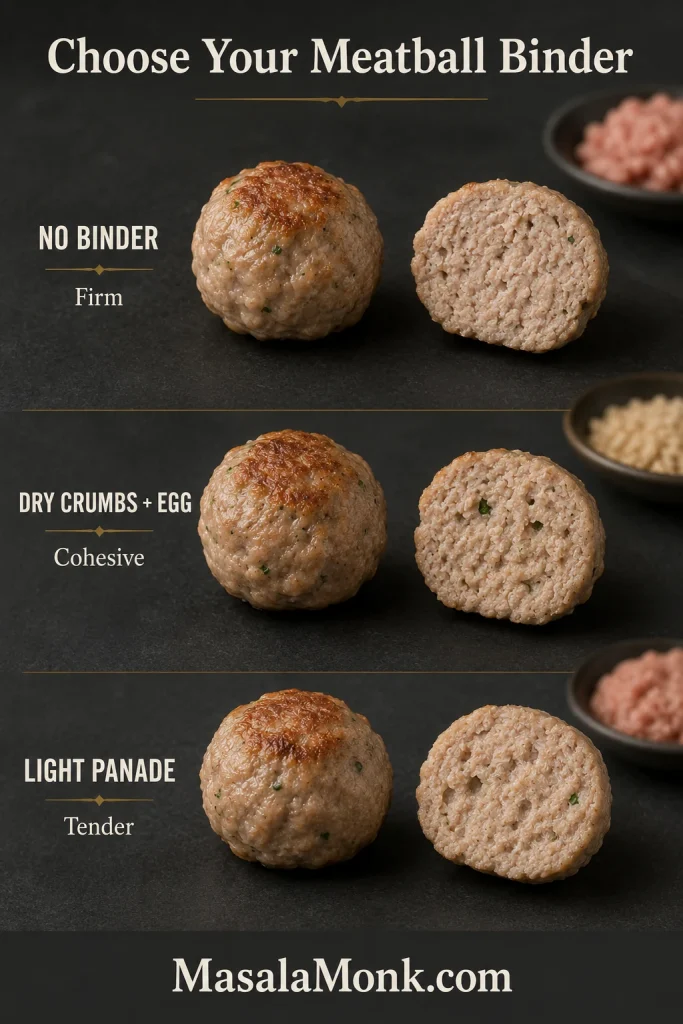
No binder
Texture: Firm and pork-forward
Forgiveness: Lowest
Best for: Regular-fat pork and cooks who prefer a firmer bite
Dry breadcrumbs and egg
Texture: Cohesive and slightly firmer
Forgiveness: Moderate
Best for: Quick everyday meatballs
Light panade
Texture: Tender without becoming very soft
Forgiveness: Highest
Best for: Baking, pan-frying, air frying, spaghetti and freezing
The light panade keeps the center tender across the oven, skillet and air fryer without making the meatballs difficult to shape, brown or reheat.
Binder-Free Pork Meatballs: No Breadcrumbs or Egg
For a firmer binder-free meatball, use regular ground pork—preferably near 20% fat when labeled—and omit the panko, milk and egg together. Mix only until the pork feels slightly tacky and cohesive, then portion the same 35–36 g size, shape without compressing and chill for about 20 minutes.
Baking gives this variation the widest cooking window. Use the same 160°F / 71°C endpoint; if pan-frying, let the first surface set fully before turning. Expect a firmer, more pork-forward center and a narrower margin between ready and dry.
Gluten-Free Pork Meatballs
Use gluten-free panko in the same gram weight. That preserves a texture much closer to the original than replacing the breadcrumbs with a large amount of almond flour.
Before adding more crumbs: give the panko its full hydration time. If the quantities are correct and the mixture is merely warm, chill it for 15–20 minutes first. When the chilled mixture still slumps rather than merely feeling sticky, fold in 1 teaspoon panko, wait 3 minutes and reassess. Repeat only as needed, up to 1 tablespoon.
Need the next step? Mix and shape the meatballs · Fix a soft mixture · Troubleshoot texture problems
How to Mix and Shape Pork Meatballs
1. Make and Season the Panade
Stir the panko and milk together and wait about 5 minutes. The crumbs should swell and look evenly damp, not float in a pool of milk.
Mix in the egg, parsley, onion powder, garlic powder, salt and pepper before the pork enters the bowl. The seasoning spreads more evenly, so the meat needs less handling later.
2. Fold in the Cold Pork
Keep the pork refrigerated while the panade hydrates, then fold it in only until no large plain patches remain. Stop while the mixture still looks loose and softly textured—not glossy, smeared or paste-like.
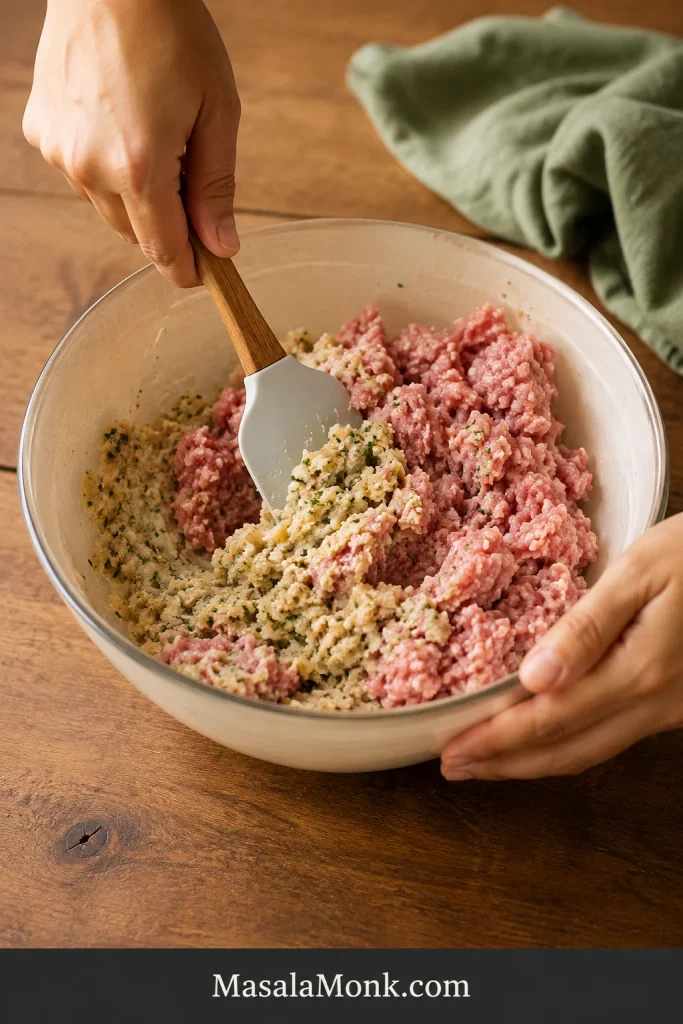
The mixture may feel softer than you expected. That is normal. Scoop one portion onto the tray: if it stays rounded rather than spreading, keep going instead of reaching for more crumbs.
3. Cook a Seasoning Tester
A small cooked tester is the safest way to correct the seasoning before shaping all 16 meatballs. If it needs adjustment, scatter the extra seasoning evenly over the bowl and fold only once or twice; never taste raw pork mixture.
4. Portion, Shape and Chill Only if Needed
Scoop or weigh all 16 portions before rolling. Without a tester, use 35–36 g / about 1¼ oz per meatball; after a 20 g tester, portion the remainder at about 35 g each. A rounded 2-tablespoon scoop and a diameter near 1½ inches / 4 cm are useful visual checks.
Roll each portion only until the surface closes and the ball holds together. Dampen your palms if the mixture clings. If the portions flatten on the tray or the kitchen is warm, chill them for 15–20 minutes; when they already hold their shape, cook them without adding an automatic delay.
Ready to cook? Bake the full tray · Pan-fry for crust · Air-fry a small batch · Check doneness
Choose Your Cooking Method
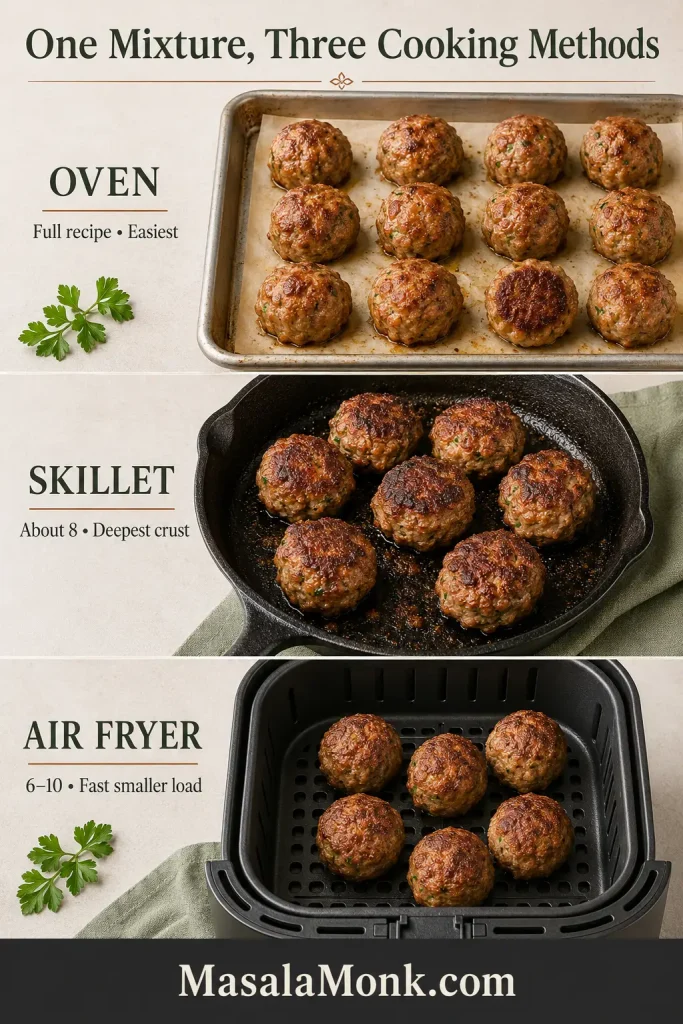
Choose the oven for calm, the skillet for crust or the air fryer for speed. The mixture stays the same; only the capacity, browning and attention change.
- Bake for ease. The full recipe cooks at once with moderate browning and very little hands-on work.
- Pan-fry for the deepest crust. Work in two batches when you want strong browning and flavorful skillet fond for gravy or sauce.
- Air-fry six to ten for speed. This works best when the basket has enough open space for hot air to move around every meatball.
Baked Ground Pork Meatballs
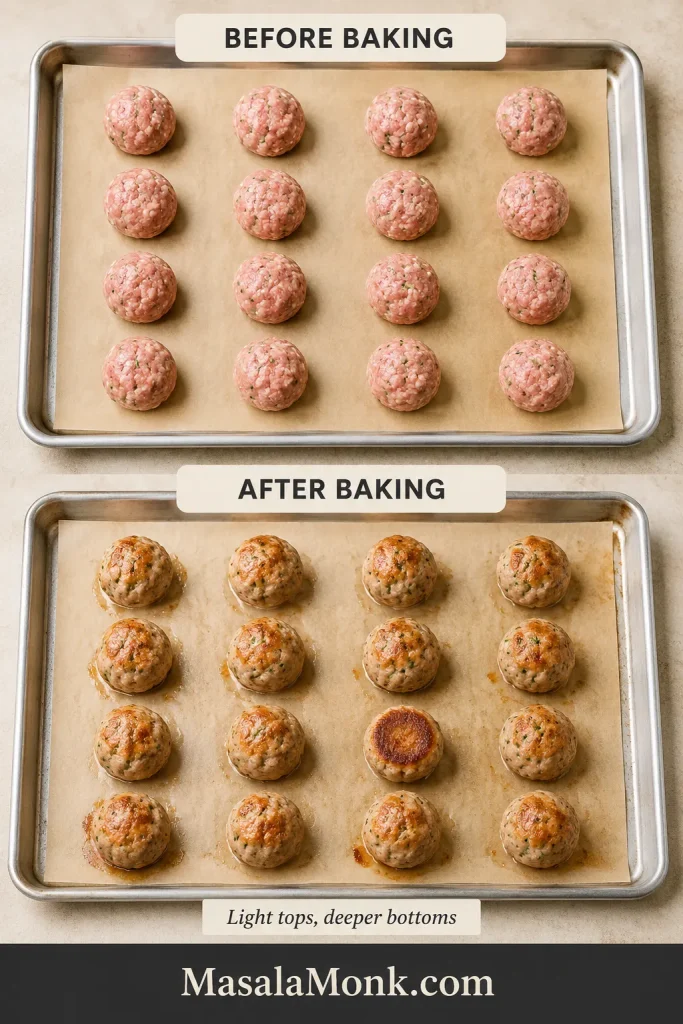
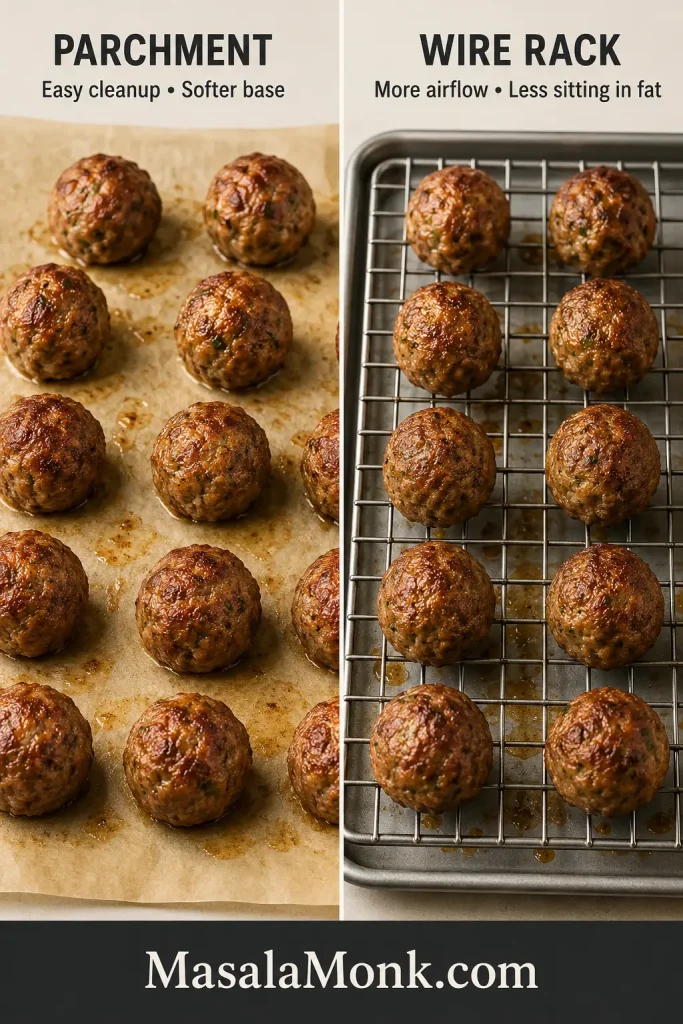
Baking is the calmest way to cook the whole tray. Bake 35–36 g meatballs at 400°F / 200°C conventional / 180°C fan. Begin checking at 14 minutes; most take 15–18 minutes. Take them out at 160°F / 71°C. Use parchment for easy cleanup and deeper browning underneath, or a greased rack when you want air to circulate around more of each meatball.
Parchment vs Wire Rack
- Parchment: easiest cleanup and minimal sticking, though the bottoms may sit in a little rendered fat.
- Wire rack: more even browning, but longer cleanup and a very soft mixture may settle into the wires.
Flipping is optional when the meatballs have room around them. Turn them once near the end only if the undersides color much faster than the tops. When they are close, the tops should look dry and lightly golden, with deeper browning underneath; rest the meatballs for 3 minutes before serving or adding them to sauce.
Pan-Fried Ground Pork Meatballs
Pan-frying gives the meatballs their deepest crust and leaves browned flavor in the skillet for gravy or sauce. For 35–36 g meatballs, begin checking at 9 minutes; most need 10–12 minutes per batch, or up to 14 minutes with the covered finish. Take them out at 160°F / 71°C. This method needs more attention than baking because the surface can color before the middle is ready.
Brown Them in Two Batches
A 12-inch / 30 cm heavy skillet holds about eight standard meatballs with room to turn. Heat a thin film of neutral oil over medium, add the first eight and leave the first side alone for about 2 minutes. If a meatball resists the turn, give it another 20–30 seconds; a firm golden-brown patch usually releases more cleanly than a pale surface.

Turn gradually so several sides develop color, then lower the heat to medium-low. Before the second eight, remove any burnt bits, leave a thin film of rendered fat and add only about 1 teaspoon oil if the skillet looks dry. They may finish slightly sooner because the pan is already hot.
When the Outside Browns Too Fast
A dark crust with an underdone middle does not mean the meatballs are lost. Reduce the heat, move the skillet briefly away from the burner and add about 2 tablespoons (30 ml) water carefully down the side. Cover immediately and return to low heat for 1–2 minutes.
Uncover for the final 30–60 seconds so the crust does not stay wet. The sizzling should settle as the water evaporates and the browned surface firms again.

Browned is not the same as done. A meatball can have a deep crust and still be undercooked in the middle. Browning tells you about flavor; the thermometer tells you when the ground pork is safely cooked.
Air Fryer Ground Pork Meatballs
A basket-style air fryer is useful for six to ten meatballs or a quick dinner for two. Cook 35–36 g meatballs at 375°F / 190°C. Begin checking at 9 minutes; most need 10–13 minutes per load. Take them out at 160°F / 71°C. Its concentrated heat creates good color quickly, but it also makes the center easier to overshoot.
Give the hot air room to move. Follow the manufacturer’s preheating guidance, never preheat with loose parchment inside and arrange six to ten oiled meatballs in one layer with visible space between them.
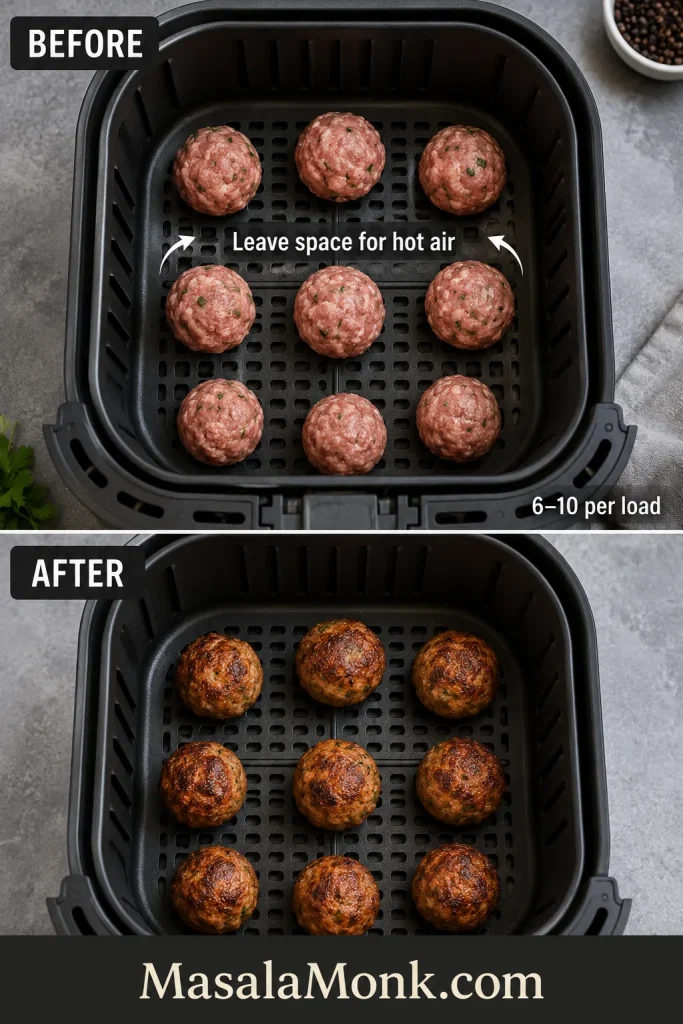
Turn after about 6 minutes only when the appliance browns more strongly from one direction. Look for a dry, browned exterior and rounded sides rather than waiting for every surface to become deeply dark; oven-style air fryers may need several additional minutes.
Ground Pork Meatball Cooking Times and Doneness
The following ranges apply to raw meatballs weighing about 35–36 g / 1¼ oz and measuring roughly 1½ inches / 4 cm across. Use 400°F / 200°C conventional / 180°C fan for the oven and 375°F / 190°C for the air fryer; every method finishes at 160°F / 71°C.
Here are all three methods side by side.
| Method | Setting / load | Check from | Time |
|---|---|---|---|
| Oven | 400°F; full recipe | 14 min | 15–18 min |
| Skillet | Medium, then medium-low; about 8 | 9 min | 10–12 min per batch, plus a brief pan reset |
| Air fryer | 375°F; 6–10 | 9 min | 10–13 min per load |
These are times to start checking, not promises that every appliance will finish at the same minute. Chilled meatballs, crowded pans and larger portions need longer; powerful air fryers and smaller portions may finish sooner.
Mini Pork Meatballs
Mini meatballs weighing around 18–20 g cook much faster. Begin checking baked meatballs around 9 minutes, skillet meatballs around 6 minutes and air-fried meatballs around 6–7 minutes.
They work well in soup, on appetizer platters and in meals where every spoonful should contain a meatball. Use the thermometer for the final decision.
For larger 50–60 g meatballs, keep the same cooking temperature and begin checking several minutes after the standard size. Their timing varies more by method, so use 160°F / 71°C as the endpoint.
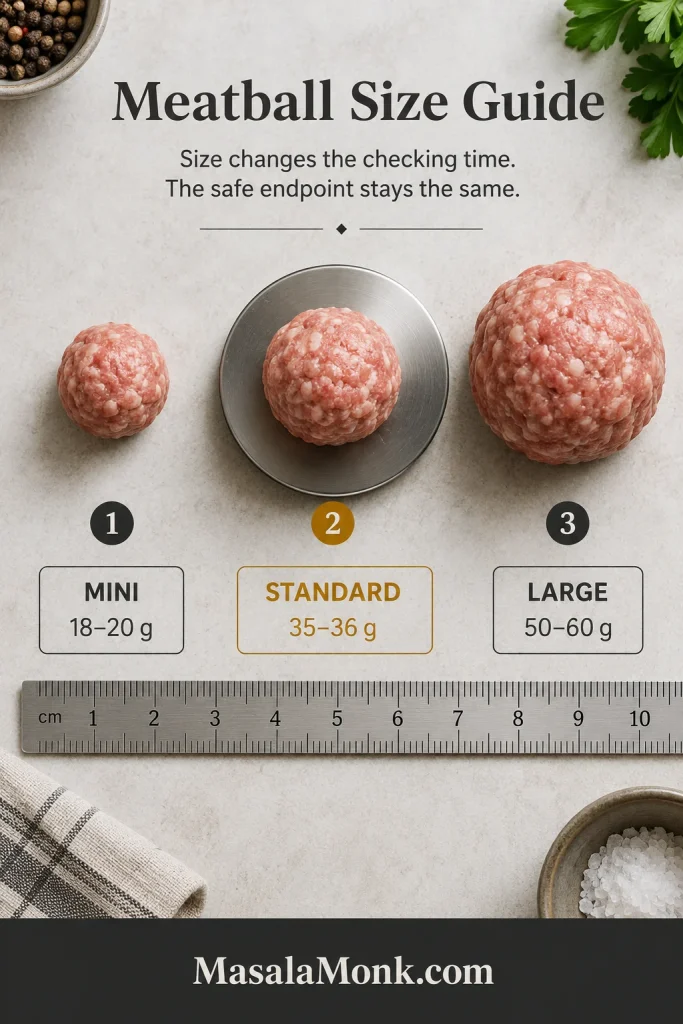
How to Check Pork Meatball Doneness
Ground pork meatballs are ready when their centers reach 160°F / 71°C. The familiar 145°F / 63°C guidance applies to intact pork chops, steaks and roasts—not ground pork. See the USDA safe minimum temperature chart.
- Choose two of the largest meatballs, preferably from different parts of the tray, skillet or basket.
- Insert an instant-read thermometer through the side rather than straight down from the top.
- Aim for the center without pushing the probe through into the hot cooking surface.
- Take them out when both meatballs have reached the safe temperature in the middle.

Color alone is not a reliable safety test. A faint pink tone does not mean you need to cook away all the moisture: pork can remain slightly pink after reaching a safe temperature, while a dry meatball can still look moist when sliced. Use a thermometer for a more useful answer than cutting several meatballs apart. The center should split easily with a fork and look moist rather than wet or springy.
Next move: finish meatballs in marinara · fix dry or falling-apart meatballs · store, freeze or reheat leftovers
Finishing Pork Meatballs in Marinara
These meatballs are mild enough for tomato sauce but savory enough to serve without it. Keep them near the standard size so they heat evenly and sit comfortably beside each forkful of pasta. Use MasalaMonk’s homemade marinara sauce or a well-seasoned jarred sauce.
For fully cooked meatballs: simmer gently in marinara for 5–10 minutes, stirring around them rather than repeatedly pushing them against the pan. Extra cooked meatballs can also become meatball baked ziti.
When meatballs are browned but undercooked: transfer them directly from the skillet into gently simmering marinara and continue cooking without interruption. Do not cool or refrigerate partially cooked ground pork to finish later.
Can raw meatballs cook directly in sauce? They can, but this soft panade mixture is easier to handle and develops better browned flavor when baked or seared first. The timings here are therefore written for fully cooked meatballs or for meatballs browned and moved straight into sauce while cooking continues.
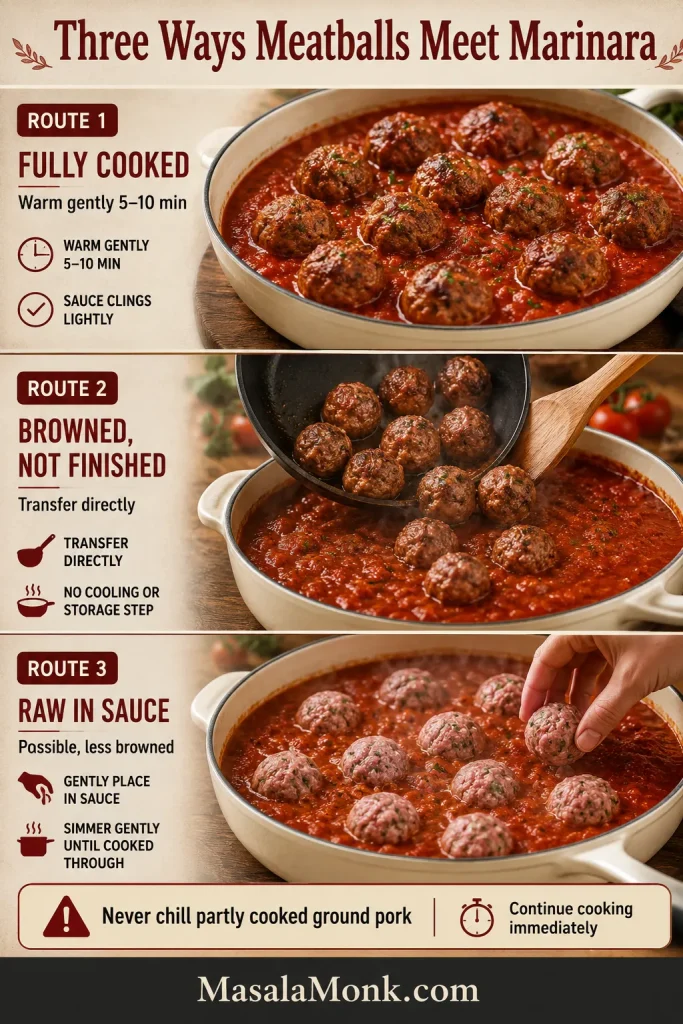
Check one of the largest meatballs from the side and keep simmering until the center reaches 160°F / 71°C. Meatball size and sauce temperature vary, so the thermometer matters more than a fixed number of minutes.
Ground Pork Meatball Troubleshooting
If something went wrong, start with what you saw. Dry, loose, pale and dark-on-the-outside meatballs have different causes; several can still be rescued tonight, and the rest are straightforward to prevent next time.
Texture and Structure
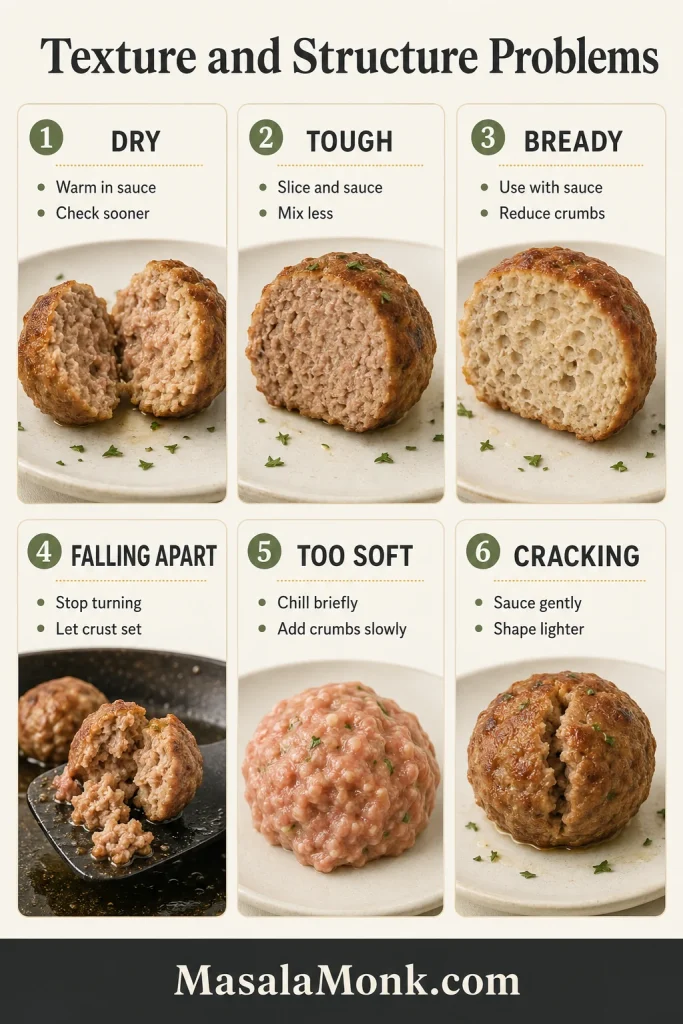
Match the Texture Symptom
Dry
Likely cause: Very lean pork or cooking past the safe center temperature
Rescue now: Warm briefly in marinara, gravy or a little broth.
Next time: Use regular ground pork and start checking earlier.
Tough or rubbery
Likely cause: Overmixing, tight shaping or cooking too long
Rescue now: Slice or crumble into sauce, soup or a baked pasta.
Next time: Fold only until combined, shape without compressing and stop cooking at temperature.
Bready or spongy
Likely cause: Too many breadcrumbs, too much egg or an overextended binder
Rescue now: Serve with a strongly seasoned sauce or break into a tomato-based dish.
Next time: Weigh the panko and keep the egg-and-milk quantities unchanged.
Falling apart
Likely cause: Excess liquid, unevenly mixed binder or a first surface that has not set
Rescue now: Stop turning and finish gently under a lid or directly in simmering sauce.
Next time: Measure the liquid, distribute the binder evenly and wait before the first turn.
Too soft or slumping
Likely cause: A warm mixture, excess liquid or panko that has not fully hydrated
Rescue now: Chill for 15–20 minutes. If it still slumps, add panko 1 teaspoon at a time as described above.
Next time: Keep the pork cold, hydrate the panko fully and measure every liquid.
When Meatballs Crack
Small surface lines usually mean the portions were shaped a little dry or loose. Dampen your hands and close the surface gently. Deep cracks with crumbling point to a mixture that is too dry or not evenly combined.
Browning and Pan Problems
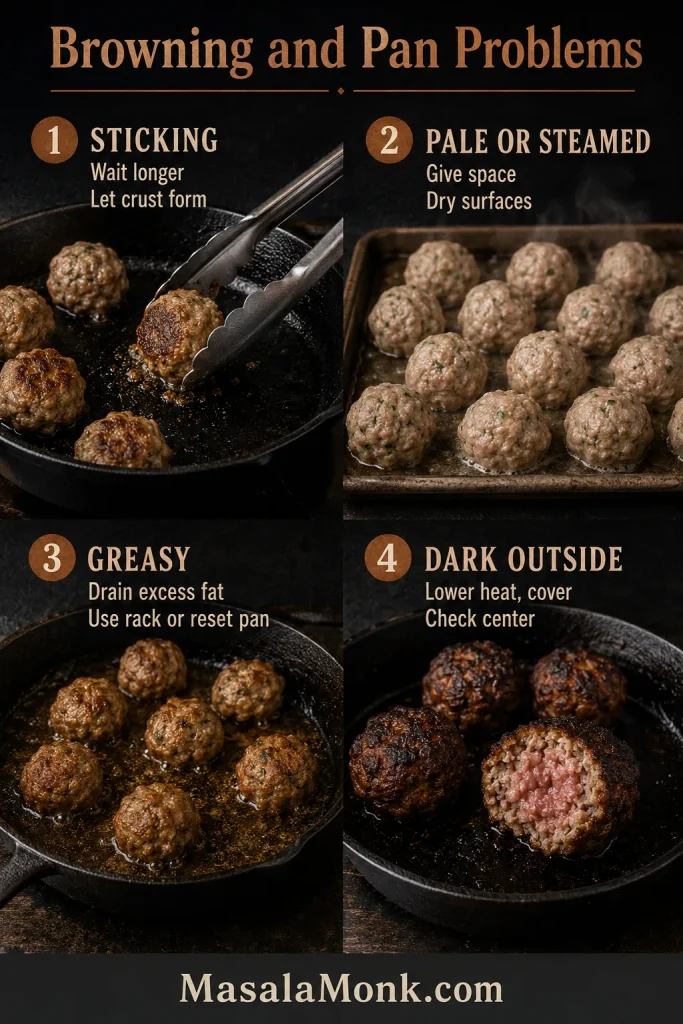
Fix the Browning Problem
Sticking to the pan
Likely cause: Too little oil, an unsuitable surface or turning before the crust releases
Rescue now: Leave the meatball another 20–30 seconds, then loosen it gently with a thin spatula.
Next time: Use a thin film of oil and let the first side brown before moving it.
Pale or steamed
Likely cause: Crowding, wet surfaces or insufficient heat and airflow
Rescue now: Create more space and, while the centers are still below temperature, give the meatballs brief higher heat.
Next time: Dry the cooking surface and leave visible room around every meatball.
Greasy
Likely cause: Particularly fatty pork or meatballs sitting in rendered fat
Rescue now: Drain or blot the excess fat, then move the meatballs to a clean pan or rack if they still need cooking.
Next time: Drain the skillet between batches or bake on a rack when the pork releases a lot of fat.
Dark outside, undercooked inside
Likely cause: Heat too high or meatballs larger than the recipe size
Rescue now: Lower the heat and finish under a lid or directly in simmering sauce.
Next time: Keep the portions even and reduce the heat once the crust forms.
Flavor and Fat Checks
If they taste bland: finish them with a well-seasoned sauce, glaze or a small pinch of finishing salt. Next time, weigh the salt and cook the optional tester before shaping.
A little rendered fat is normal. If a large amount collects, use a rack in the oven or drain the skillet between batches so the meatballs brown instead of sitting in it.
Back on track? choose a flavor direction · serve the meatballs · return to the recipe card
Ground Pork Meatball Variations
The gentle garlic, onion and parsley base leaves room for several different meals. Keep it as written when you want options later, or choose one flavor direction instead of combining every appealing seasoning in the same bowl.

Italian-Style Pork Meatballs
- Stir in 1 teaspoon dried oregano or Italian seasoning.
- Fold in ¼ cup (about 22 g) finely grated Parmesan.
- Keep the parsley and add an extra ¼ teaspoon black pepper.
- Reduce the fine salt to ½ teaspoon (about 3 g), then confirm with a cooked tester.
Oregano, Parmesan and extra pepper make these fuller and saltier, especially good with marinara or toasted subs.
Ginger-Soy Pork Meatballs
- Mix in 2 teaspoons (about 4 g) finely grated fresh ginger.
- Replace the parsley with 2 tablespoons (about 10 g) sliced scallions.
- Use 1 tablespoon (15 ml) soy sauce.
- Finish with ½ teaspoon toasted sesame oil.
- Reduce the fine salt to ¼ teaspoon (about 1.5 g), then confirm with a cooked tester.
Ginger and scallions make the pork brighter and more aromatic, especially with rice, peanut noodles or crisp vegetables. Sweet-and-sour and Vietnamese-style meatballs need their own binder, aromatics and sauce rather than one extra seasoning stirred into this base.
Smoky and Spicy Pork Meatballs
- Stir in 1 teaspoon smoked paprika.
- Use ¼–½ teaspoon chili flakes, depending on how much heat you want.
- For rice, flatbreads or yogurt sauce, include ⅛ teaspoon ground cumin.
Smoked paprika warms the browned edges before the chili arrives. For a sweet-hot finish, spoon or brush on mango habanero sauce after cooking so the glaze does not scorch.
Fresh Onion and Garlic
Replace the onion powder with 2 tablespoons (about 20 g) very finely grated onion and the garlic powder with 1 small finely grated garlic clove (about 3 g). Reduce the milk to 1 tablespoon (15 ml) to account for the onion’s moisture, then chill the mixture if it still feels soft.
Fresh onion gives the meatballs a softer, slightly sweeter aromatic flavor, although the extra moisture makes the mixture a little looser.
For a brighter herb-led plate, serve this version with fresh chimichurri. Its parsley, garlic and vinegar echo the meatball seasoning while cutting through the pork’s richness.
All-Pork Meatballs vs Beef-and-Pork Meatballs
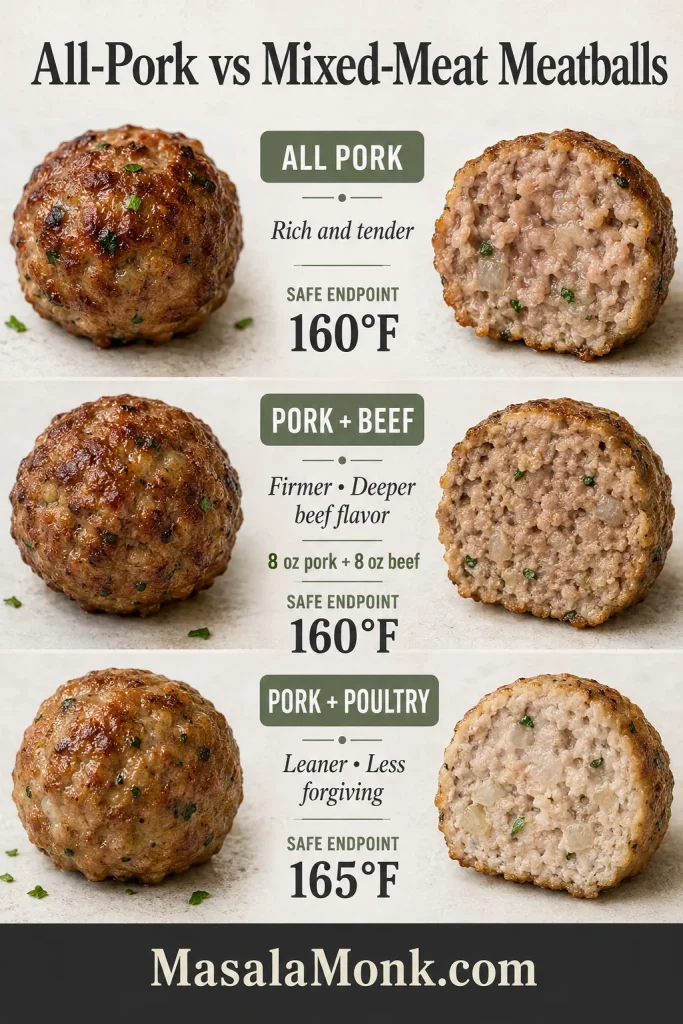
Pork only
Texture and flavor: Rich, tender and juicy
Best for: The main recipe, rice bowls, gravy and flexible meal prep
Pork and beef
Texture and flavor: Firmer with deeper beef flavor
Best for: Tomato sauces and meatball sandwiches
Pork and turkey or chicken
Texture and flavor: Lighter but less forgiving
Best for: Leaner meal prep; cook to 165°F / 74°C
For a straightforward beef-and-pork version, use 8 oz / 227 g ground pork plus 8 oz / 227 g ground beef and keep the base binder unchanged; expect a firmer bite and deeper beef flavor. Lean poultry may need more moisture, while seasoned sausage usually needs much less added salt. Pork and veal can produce a delicate mixed-meat result, but it belongs to recipes designed for that softer texture. Any mixture containing ground poultry requires the higher 165°F / 74°C endpoint.
The softer all-pork version is particularly good under a spoonful of creamy mushroom sauce, while the firmer beef-and-pork version stands up well to a thicker tomato sauce.
What to Serve With Ground Pork Meatballs
One recipe can become more than one dinner. Simmer four meatballs in marinara tonight, glaze four for tomorrow’s rice bowl and freeze the rest for another evening.
Pasta and Sandwiches
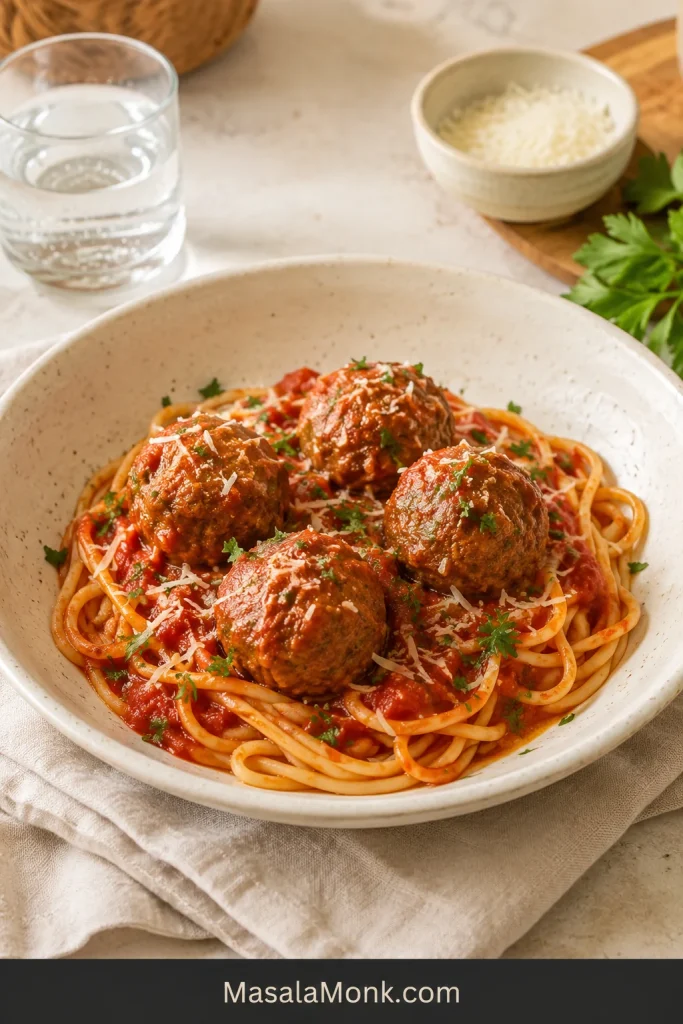
- Serve with marinara, spaghetti, Parmesan and a crisp salad.
- Tuck them into a toasted roll with marinara and melted mozzarella.
- Turn leftovers into a comforting meatball baked ziti.
Comfort-Food Plates
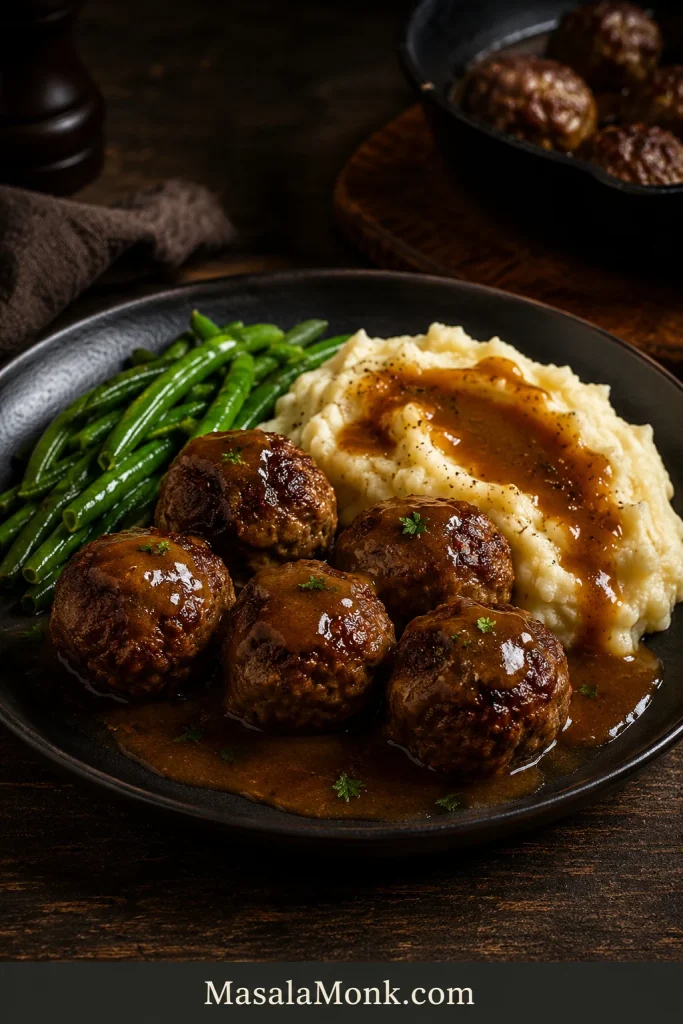
- Spoon the skillet meatballs and gravy over garlic mashed potatoes with green beans.
- Pair baked meatballs with ranch roasted potatoes and a simple green salad.
- Serve with creamy mashed potatoes and onion or mushroom gravy.
Rice Bowls and Lighter Meals
- Add ginger-soy meatballs to rice with roasted or steamed vegetables.
- Build a lower-carb plate with roasted vegetables, cauliflower mash or a cool tzatziki sauce.
- Balance the richness with cucumber salad or crisp homemade coleslaw.
Appetizers and Meal Prep
- Serve mini meatballs with mustard, tomato or yogurt sauce; for a sweet-savory party version, make grape jelly meatballs.
- Pack medium meatballs with a grain, roasted vegetables and the sauce in a separate container.

As a main dish, plan on about 4 medium meatballs per person; with spaghetti or a substantial grain bowl, 3 may be enough. For appetizers, allow 3–4 mini meatballs per person among several snacks, or 5–6 when the meatballs are the main party bite.
Make Ahead, Store, Freeze and Reheat
Make Ahead and Refrigerate
Shape the meatballs up to 24 hours ahead. Keep the total refrigerated time for the raw ground pork within 1–2 days of purchase or refrigerator thawing, and do not exceed the package date.
Cover and refrigerate at 40°F / 4°C or colder in one layer, or separate stacked layers with parchment. Begin checking the cold meatballs at the normal time.
Refrigerate cooked meatballs within 2 hours in a shallow, covered container and use them within 3–4 days. A small amount of sauce helps protect the surfaces from drying.
Freeze Raw or Cooked Meatballs
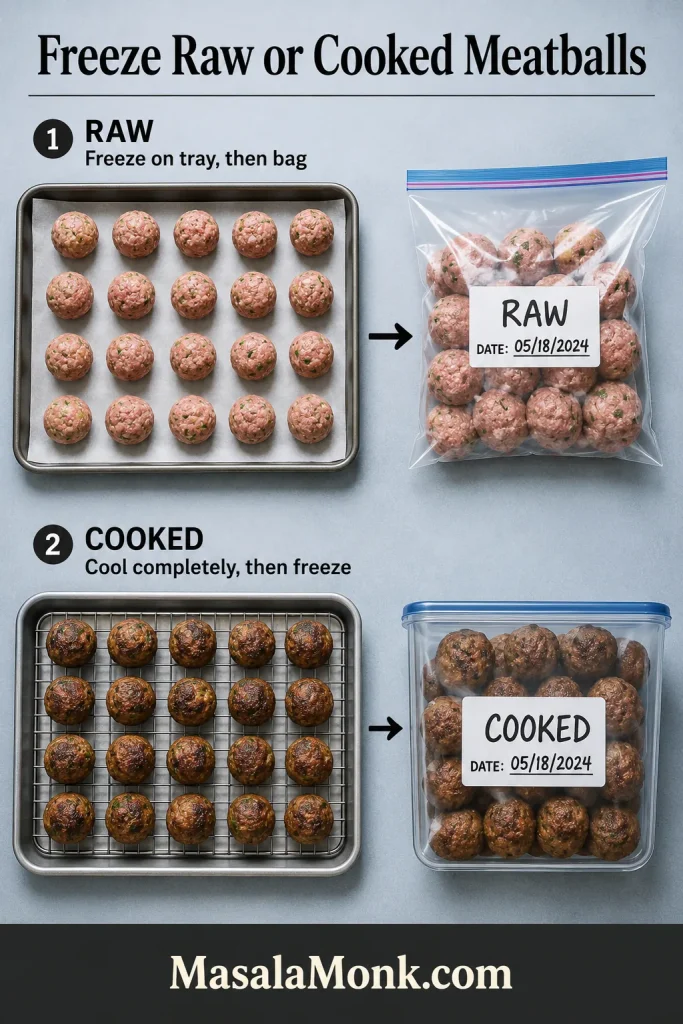
To freeze raw meatballs:
- Arrange the shaped raw meatballs on a parchment-lined tray without letting them touch.
- Leave them until firm.
- Transfer to a freezer-safe container or bag.
- Label clearly as raw and add the date.
- For the best texture, use within 3–4 months. Thaw overnight in the refrigerator before cooking because the oven, skillet and air fryer timings in this recipe are written for thawed meatballs.
If the pork thawed safely in the refrigerator, it may be refrozen raw, although the texture can lose quality. Pork thawed in cold water or the microwave should be cooked before refreezing. See the USDA freezing guidance.
To freeze cooked meatballs:
Cool promptly, tray-freeze in one layer and transfer to a sealed freezer container once firm. Use within about 3 months for the best texture. Stash a few now and one future bowl of pasta, rice or soup is already halfway solved.
Reheat Without Drying Them Out
- Sauce: warm gently in a covered pan.
- Oven: cover and reheat at 325°F / 160°C with a spoonful of water or sauce.
- Air fryer: reheat near 350°F / 175°C and start checking after 3 minutes.
- Microwave: cover loosely and use short intervals, turning between intervals.
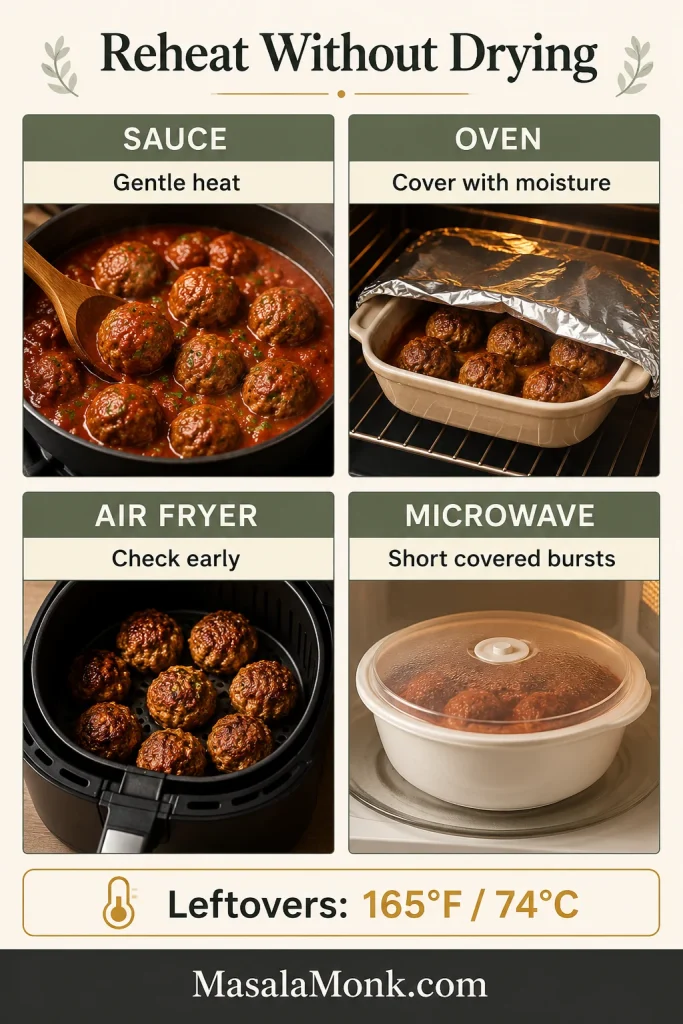
Reheated leftovers should reach 165°F / 74°C. Warm only what you need instead of repeatedly reheating all of them.
The Rule to Remember
Ground pork does not need another meat to make a good meatball. Let the panko absorb the milk, spread the seasoning through the binder and stop mixing as soon as the pork is evenly combined.
From there, keep the portions consistent and pull them from the heat as soon as the centers are safely cooked. The best method is the one that gets a tender meatball onto your plate without making dinner harder than it needs to be.
Which method did you choose—and did the meatballs go into spaghetti, gravy, a rice bowl or straight from the tray?








