

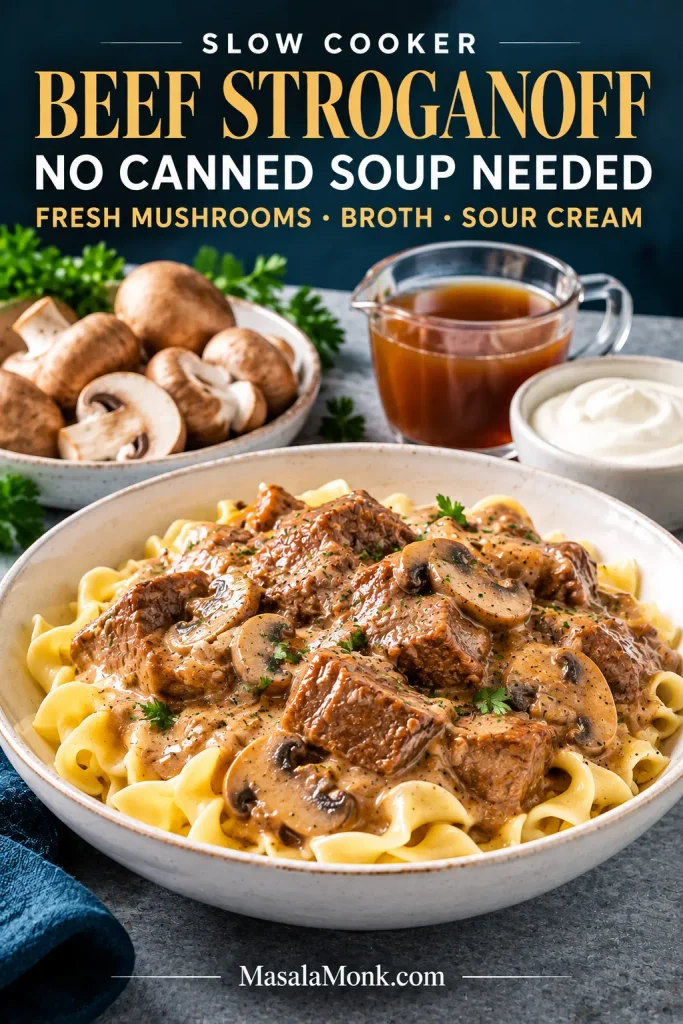
Tender pieces of beef, mushrooms, tangy sour cream and glossy sauce caught in the folds of hot egg noodles are what you’re heading toward here. In this slow cooker beef stroganoff recipe, chuck gets several hours to soften until it yields under a fork without disappearing into the sauce.
Aim for a sauce loose enough to move when you tip the spoon but creamy enough to cling to the noodles. Most of the long cooking belongs to the beef; the last few minutes are where the stroganoff itself comes together.
The useful rule here: slow-cook the beef; finish the stroganoff at the end.
That means starting with less liquid than may look natural, letting tenderness—not just the timer—decide when the chuck is ready, and saving sour cream for the finish. The sauce here starts with fresh mushrooms and beef broth instead of condensed soup, although a cream-of-mushroom shortcut is included later if that’s the style you want. Browning first gives you deeper beef flavor; skipping the skillet is completely reasonable when the point is getting dinner started early and getting on with your day.
The 30-Second Slow Cooker Plan
| Beef | 2 lb / 900 g chuck, cut 1¼–1½ inches / 3–4 cm |
|---|---|
| Slow cooker | 5½–6 qt / about 5.2–5.7 L |
| Broth | 1 cup / 240 ml to start; keep up to ¼ cup / 60 ml in reserve |
| Mushrooms | 12 oz / 340 g |
| Cook | LOW 7–8 hr (preferred for chuck); check around 6½ hr. HIGH 4–5 hr; check around 3½–4 hr. |
| Finish | ¾ cup / about 180 g full-fat sour cream, added after the long cook |
| Serve | 12 oz / 340 g wide egg noodles, cooked separately |
Some beef sitting above the liquid is exactly what you should expect at the beginning. The onion, mushrooms and chuck will contribute more moisture as they cook.
Using sirloin or another tender steak? This is not its recipe. Use our 30-minute Beef Stroganoff instead. Thin steak strips suit a hot skillet and short cooking time; this slow-cooker version is built for chuck, stew beef, blade and other braising cuts.
Choose Your Route: Best Flavor or Easiest
Decide this before you start: brown first when deeper roasted flavor matters, or skip the skillet when an easier hands-off dinner matters more. The measured starting liquid stays controlled either way.

Slow Cooker Beef Stroganoff Recipe
Chuck slowly cooked with onion, mushrooms, beef broth, Worcestershire and Dijon, then finished with tempered sour cream and served over wide egg noodles.
Best-result route: brown the beef, deglaze the skillet with broth or wine, and brown the mushrooms separately near the end.
Easiest route: put the thawed raw beef, onion, garlic and mushrooms straight into the slow cooker and use broth only.
Finish: about 15–25 minutes
Total: roughly 7½–9 hours on LOW or 4½–6 hours on HIGH, depending on whether you brown first, whether the sauce needs thickening and how quickly the beef becomes tender.
Equipment
- 5½- to 6-quart / approximately 5.2- to 5.7-L slow cooker
- 12-inch / 30 cm heavy skillet, optional for browning
- Large pot for the egg noodles
- Small bowl and whisk for tempering the sour cream
- Small bowl for cornstarch slurry, if needed
Ingredients
- 2 lb / 900 g boneless chuck roast, trimmed of very thick exterior fat and cut into 1¼–1½ inch / 3–4 cm chunks
- 1 tsp / about 6 g fine sea salt, plus more at the end if needed
- 1 tsp freshly ground black pepper
- 1½ tbsp / 22 ml neutral cooking oil, for browning; omit for dump-and-go
- 1 medium onion, about 6 oz / 170 g, diced
- 3 garlic cloves, finely minced
- 12 oz / 340 g cremini, baby bella or white button mushrooms, sliced about ¼ inch / 6 mm thick
- 1 cup / 240 ml low-sodium beef broth, plus up to ¼ cup / 60 ml more held back for finishing
- 1½ tbsp / 22 ml Worcestershire sauce
- 1 tbsp / 15 ml Dijon mustard
- 1 tsp sweet paprika, not smoked
- ¼ cup / 60 ml dry red wine, optional for the browned route; it replaces ¼ cup / 60 ml of the starting broth
- 1 tbsp / 14 g butter, optional for browning the mushrooms separately
- ¾ cup / about 180 g full-fat sour cream
- Up to 2 tbsp / about 16 g cornstarch, as needed
- Up to 2 tbsp / 30 ml cold water, matching the amount of cornstarch used
- 12 oz / 340 g wide egg noodles
- About 2 tbsp chopped parsley, optional
Instructions
Build the Slow Cooker Base
- Prep the beef. Cut the chuck into roughly 1¼–1½ inch / 3–4 cm chunks. If the surface is visibly wet from packaging, blot it dry before seasoning evenly with the salt and black pepper.
- Brown the beef, onion and garlic—or skip the skillet.
Browned route: Heat the oil in a 12-inch / 30 cm heavy skillet over medium-high until it shimmers and a piece of beef sizzles immediately when it hits the pan. Brown the beef in 2–3 batches, leaving the first surface mostly undisturbed for roughly 2–3 minutes before turning and browning another side for about 1–2 minutes. You are building color; the beef does not need to cook through. Transfer it to the slow cooker. Lower the heat slightly, cook the onion for 2–3 minutes, then add the garlic for about 30 seconds.
Dump-and-go: Put the seasoned raw beef, onion and garlic directly into the slow cooker. No skillet needed. - Add the liquid, seasonings and mushrooms.
Dump-and-go: Pour 1 cup / 240 ml broth directly into the slow cooker.
Browned, no wine: Deglaze the skillet with a splash of that measured broth, scrape up the browned bits, then add the skillet liquid plus enough remaining broth to total 1 cup / 240 ml.
Using wine: Deglaze the skillet with ¼ cup / 60 ml dry red wine, let it bubble for 1–2 minutes, then add ¾ cup / 180 ml broth.
Stir in the Worcestershire, Dijon and sweet paprika. For the easiest version, add the mushrooms now. For the best mushroom texture, keep them aside and brown them near the end. Keep the extra ¼ cup / 60 ml broth in reserve.
Slow-Cook and Build Texture
- Slow-cook until the beef gives easily. Cover and cook on LOW for about 7–8 hours or HIGH for about 4–5 hours. Start checking around 6½ hours on LOW or 3½–4 hours on HIGH. The beef may still need another hour. It is ready when a fork slides in easily and the fibers begin to separate with gentle pressure. Moist but chewy chuck usually needs more time, so continue in roughly 30-minute increments.
- Brown the reserved mushrooms, if using that route. Melt the butter in a wide skillet over medium-high heat. Add the mushrooms without piling them too deeply. At first they may look crowded and wet; keep cooking until that released moisture has mostly evaporated and the edges begin to brown, usually about 6–10 minutes depending on the pan and heat. Set them aside for the finish.
Finish the Sauce and Serve
- Finish the sauce. Skim away any obvious layer of fat, then taste the cooking liquid before adding anything else. The sauce can taste slightly stronger at this stage than you want at the table; once the sour cream goes in, those sharper edges settle down. If it tastes flat, try a little more Worcestershire, Dijon or black pepper before reaching for more salt.
When the sauce already lightly coats the back of a spoon, skip the starch. If it needs thickening, mix 1 tbsp / about 8 g cornstarch with 1 tbsp / 15 ml cold water. Switch or keep the slow cooker on HIGH, stir in the slurry, cover and give it about 10–15 minutes to thicken. If it is still clearly too loose, add the second tablespoon of cornstarch mixed with the remaining cold water and continue on HIGH just until the sauce thickens. - Temper the sour cream and add the mushrooms. Put the sour cream in a bowl and gradually whisk in about ½ cup / 120 ml hot cooking liquid. Turn the slow cooker OFF or down to WARM, then fold the tempered sour cream gently into the beef. Add the browned mushrooms now if you reserved them. Keep the heat gentle from here.
- Cook the noodles and serve. Boil the wide egg noodles in salted water until just tender according to their package timing, then drain well. Loosen the stroganoff with a tablespoon or two of reserved broth if necessary and taste once more for salt. Divide the noodles among bowls, spoon the beef and sauce over them and scatter with parsley if using.
What you’re looking for: beef that still holds together but yields easily to a fork, with a glossy, creamy sauce that moves when you tip the spoon but still leaves a coating on the noodles.
Recipe Notes
- LOW gives chuck a more forgiving cooking window. HIGH works when time is shorter.
- Cornstarch is optional. Use it only if the finished cooking liquid actually needs it.
- Doubling the recipe? Use a larger slow cooker instead of crowding a 5½- to 6-quart pot. Cooking time will not simply double, so start checking within the usual braising window and let tenderness decide the finish.
Is Browning Worth the Extra Skillet?
Yes—thawed raw beef can go straight into the slow cooker for this recipe. Browning isn’t required.
If you’re deciding whether washing one more pan is actually worth it: yes, you can taste the difference. Browning creates roasted beef flavor, and the dark bits left in the skillet become part of the sauce once you scrape them up.
Still, there are evenings when that extra skillet defeats the point. Put everything straight into the cooker, save the sour cream and noodles for later, and carry on with your day.

Best Beef for Slow Cooker Stroganoff
Chuck roast is the best all-around choice here. It has the marbling and connective tissue that actually benefit from several hours of moist heat, and it becomes tender without disappearing completely into the sauce.
Can I use stew meat?
Yes. Buying a whole chuck roast simply gives you more control over what goes into the pot and how large the pieces are. Packaged stew meat can contain more than one muscle, so some cubes may soften faster than others.
Look for visible marbling and reasonably chunky pieces. Small cubes lose their shape sooner.
Why cut the beef into 1¼–1½ inch / 3–4 cm pieces?
Tiny cubes can fall apart long before dinner. Huge chunks take longer to soften and are awkward over noodles. The middle ground gives the beef time to become tender while leaving something substantial to bite into.

| Cut | How it behaves | Use here? |
|---|---|---|
| Chuck roast | Marbled, collagen-rich and forgiving | Best choice |
| Stewing beef | Convenient but potentially inconsistent | Yes |
| Blade / braising steak | Well suited to long moist cooking | Yes |
| Bottom round | Leaner and less forgiving | Possible with careful timing |
| Sirloin | Naturally tender; better with quick cooking | Use the skillet recipe |
| Tenderloin | Very tender and expensive | Save it for a faster method |
Shoulder-area beef can carry several names—shoulder roast, chuck shoulder, arm roast or shoulder clod. If the package in front of you is not especially clear, our beef shoulder roast guide goes deeper into those labels.
The Broth Should Look a Little Too Low at First
If one cup of broth looks stingy when you put the lid on, that’s intentional. The beef, onion and mushrooms are about to contribute plenty of liquid themselves.
A slow cooker traps that moisture. Steam collects beneath the lid and falls back into the pot instead of evaporating from an open pan. Starting conservatively is much easier than trying to rescue a pot you accidentally turned into soup.
Seeing beef above the liquid is normal. It does not need to be submerged.

Adding Red Wine
If you’re using wine in this recipe, use it with the browned route so it can reduce briefly in the hot skillet while loosening the browned bits. Count it as part of the starting liquid instead of pouring it in on top.
If the finished pot looks more like soup than sauce, jump to how to fix thin stroganoff sauce.
Let the Beef Tell You When It Is Done
The first fork test can be disappointing. Chuck may already be fully cooked yet still feel stubborn because its connective tissue has not softened enough.
Still moist but chewy? Give it another 30 minutes.
Fork slides in easily and the fibers separate with gentle pressure? It is ready.
Chunks collapse as soon as you stir them? Stop the heat and handle them gently from here.
A thermometer helps answer the safety question. For the texture of a braise, your fork tells you much more.

Once the chuck passes the fork test, go straight to finishing the stroganoff sauce.
When to Add the Mushrooms
For the best texture, brown the mushrooms near the end. Their water cooks away in the skillet, their edges pick up color and they stay meaty enough to notice against the soft beef.

Add them with the beef when ease matters more. Cooked with the beef, they’ll become much softer and their flavor will blend into the sauce.
Making Stroganoff Without Mushrooms
Leave them out. Let the onion pick up some color if you’re browning first, then taste the Worcestershire and Dijon again near the end. The sauce will be less earthy but still very much stroganoff.
If browned mushrooms are the part you want more of, our Creamy Mushroom Sauce gives them the whole stage.
Finish the Sauce
Once the chuck is tender, skim any obvious surface fat and taste the cooking liquid before adding anything else. It can be slightly stronger than you want in the finished bowl because the dairy will round out some of those sharper edges and soften the seasoning. If the sauce tastes flat, Worcestershire, Dijon or black pepper may help more than another pinch of salt.
If the Sauce Is Too Thin
For a mildly loose sauce, start with 1 tbsp / about 8 g cornstarch mixed with 1 tbsp / 15 ml cold water. Stir it in with the slow cooker on HIGH, cover and give it about 10–15 minutes before deciding whether it needs more. Remember that the sour cream will add some body at the finish, so stop before the sauce starts behaving like gravy.
Very watery? Taste it first. Thin and weak cooking liquid can be reduced in a saucepan until the beef flavor concentrates. Thin but already salty is different: skip aggressive reduction and use a modest amount of slurry instead, because concentrating the liquid will concentrate the salt too.
Went too far with the starch? Loosen the sauce a tablespoon at a time with reserved broth, warm water or noodle water. Stop as soon as it starts moving naturally again.

Temper the Sour Cream
Warm the sour cream gradually with some hot cooking liquid before folding it into the beef. That gentler transition helps keep the sauce smooth. Add any separately browned mushrooms at the same time, then keep the heat gentle. A hard boil after the dairy goes in only makes separation more likely.

With the dairy smooth, continue to the egg noodles and serving setup.
Cook the Egg Noodles Separately
Once noodles hit the sauce, the clock starts ticking. They keep absorbing liquid during dinner and continue doing it in the refrigerator, which is how a beautifully saucy stroganoff becomes dry leftovers.
Cook them while the sauce finishes, drain them while they still have some structure, then portion them into bowls and spoon the beef over the top. Everyone can choose how saucy they want dinner, and whatever remains stores much better.

For an even softer, richer plate, serve the stroganoff over creamy mashed potatoes.
Cream Cheese, Condensed Soup, and Other Variations
If the stroganoff you’re after is the cream-cheese or condensed-soup kind, those versions work too. They change more than one ingredient, so broth, salt and thickening need to move with them.
| If you want… | Change | Result |
|---|---|---|
| Cream-cheese stroganoff | Add 4 oz / 113 g softened cream cheese and reduce sour cream to about ½ cup / 120 g | Richer, thicker and less tangy |
| Cream-of-mushroom shortcut | Use one 10.5 oz / about 298 g can condensed cream of mushroom soup and start with about ½ cup / 120 ml broth | Thicker and closer to classic American Crock Pot versions |
| Golden-mushroom version | Use one 10.5 oz / about 298 g can golden mushroom soup with about ½ cup / 120 ml broth | Darker and more savory |
| No mushrooms | Omit them and adjust the savory seasoning at the end | More purely beef-forward |
Cream Cheese Version
Soften the cream cheese first, then whisk it with a ladle of hot cooking liquid until smooth before folding it into the sauce. Dropping a cold block straight into the cooker is how you end up chasing white lumps around the pot.
Cream of Mushroom Soup Version
Condensed soup already brings liquid, salt and starch, so this version needs a lighter hand elsewhere. Hold back most or all of the initial added salt and wait until the end before deciding whether the sauce needs any cornstarch.
Fresh mushrooms are optional. Keep them when you want actual mushroom pieces; leave them out when the soup is doing that job for you. Golden mushroom soup follows the same liquid-and-salt logic but produces a darker, more savory sauce.
If you came here because the current batch needs fixing rather than changing the recipe, go to Rescue My Stroganoff.
Rescue My Stroganoff
Slow cookers vary, chuck varies, and dinner does not always look exactly like the photograph. Most problems become easier to fix once you name what actually went wrong.
| Problem | Likely reason | What to do |
|---|---|---|
| Beef is still tough | Chuck needs more time | Cook another 30 minutes and check again |
| Beef is dry and stringy | Lean cut or too much cooking | More time will not restore lost moisture |
| Beef is falling into shreds | Small pieces, hot cooker or too much time | Stop cooking and stir very gently |
| Sauce looks greasy | Chuck rendered more fat than expected | Skim the excess before adding sour cream |
| Sauce looks like soup | Too much starting liquid or extra moisture | Use slurry gradually; reduce only if the liquid is not already salty |
| Sauce is gluey | Too much starch | Loosen gradually with reserved broth, water or noodle water |
| Sauce is bland | Seasoning is muted or the cooking liquid is too dilute | Try Worcestershire, Dijon or pepper before more salt |
| Sauce is too salty | Several salty ingredients added up | Add a little unsalted liquid, then reassess thickness |
| Sour cream looks speckled or separated | Dairy was cold or overheated | Take it off the heat and whisk gently. Mild separation may smooth out; badly curdled dairy may not fully recover |
| Sauce tastes mostly of sour cream | Dairy is overpowering the beef-and-mushroom base | Stop adding dairy; taste the savory seasoning and loosen with a little beef cooking liquid if needed |
| Cream cheese stays lumpy | It went in cold | Whisk it separately with hot sauce and return it to the cooker |
| Mushrooms are very soft | They cooked with the beef the whole time | Brown and add them near the end next time |
| Leftovers are dry | Noodles absorbed the sauce | Loosen with broth and store noodles separately next time |
Ready to Continue?
Serving Ideas
Egg noodles keep the classic balance: enough structure to carry the beef, with folds and edges that catch the sauce. Mashed potatoes make the whole plate softer and richer.

Either way, this is a rich dinner, so something fresh or sharp beside it helps. Green beans with lemon or toasted almonds bring warmth and crunch. For a colder contrast, a cucumber salad with vinegar, dill and onion cuts cleanly through the sour cream and beef.
Make-Ahead, Storage, and Freezing
Make it a day ahead
Cook the beef until tender and skim excess surface fat if necessary. Before adding sour cream or doing the final cornstarch thickening, transfer the beef and cooking liquid to shallow containers and refrigerate promptly.
The next day, reheat the beef base and look at the sauce again. Refrigeration may have changed its thickness. Adjust only then, and fold in freshly tempered sour cream while the noodles cook.
Refrigerating Leftovers
Get leftovers into the refrigerator within about 2 hours and keep the noodles separate whenever practical. USDA guidance recommends using most cooked refrigerated leftovers within about 3–4 days. Its leftovers and food-safety guidance covers cooling, storage and reheating in more detail.
Reheating
Warm the stroganoff gently on the stovetop or in the microwave. A splash of broth or water is usually enough to loosen sauce that has tightened in the refrigerator. Reheated leftovers should reach 165°F / 74°C.

Freezing
For the best texture, freeze the cooked beef-and-mushroom base before sour cream and before the final cornstarch thickening. Leave the noodles out too. For best quality, use the frozen base within about 2–3 months.
After thawing, reheat the beef base, skim any separated surface fat if necessary, adjust the consistency and finish with fresh sour cream and freshly cooked noodles.
A Few Remaining Questions
1. Can I put frozen beef straight into the slow cooker?
Thaw it first. USDA guidance recommends thawing meat before slow cooking so it heats safely and predictably. Its slow-cooker food-safety guidance covers thawing, hot holding and reheating practices.
2. Can I use Greek yogurt instead of sour cream?
Full-fat Greek yogurt can work. Temper it with hot sauce and add it after the long cook. Its flavor is different from sour cream, and lower-fat versions are more likely to look grainy when heated.
3. Can I leave finished stroganoff on WARM?
WARM is for holding food that is already fully cooked. Hot-held food should stay at 140°F / 60°C or above. For the best sauce texture, add the sour cream reasonably close to serving instead of holding the finished dairy sauce for several hours.
Bring the bowls to the table while the sauce is still glossy and the noodles are hot. The best bites have soft chuck that still feels like a piece of beef, mushrooms you can actually notice, and enough sour-cream tang to keep the sauce from feeling heavy.








