Posted on — 15 Comments

Punch with Pineapple Juice: Guide & 9 Party-Perfect Recipes

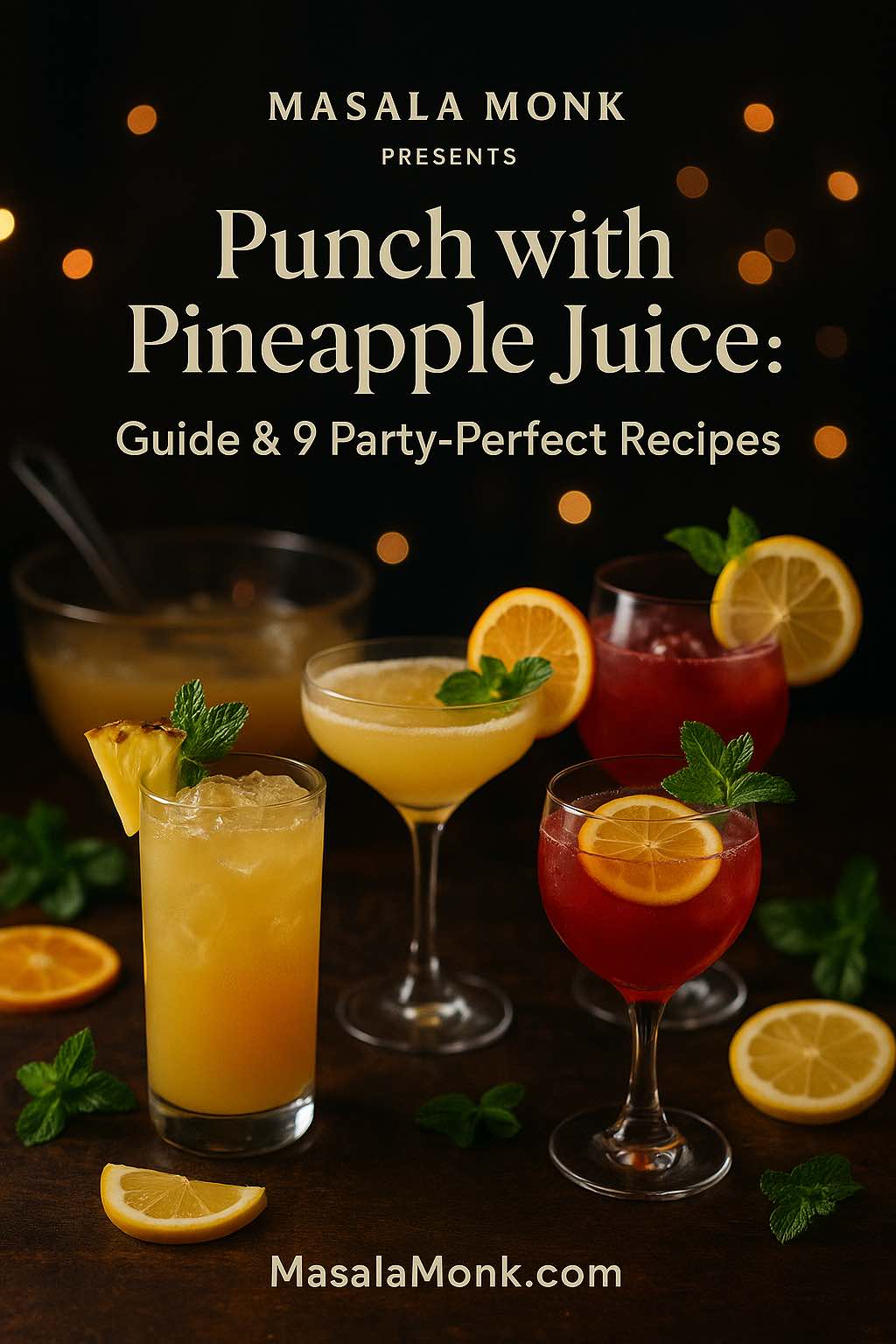
Moody party setting with multiple glasses of pineapple punch variations, styled with citrus and mint, featuring text overlay for Masala Monk’s guide to pineapple punch recipes.

There’s a reason punch with pineapple juice keeps showing up at weddings, showers, and backyard cookouts: it tastes like pure sunshine, it’s budget-friendly, and it can scale from a cozy ten-person brunch to a fifty-guest celebration without breaking a sweat. Pineapple juice also plays beautifully with bubbles (ginger ale or Sprite), brightens up tart fruits like cranberry, and makes a tropical base for grown-up versions with rum or vodka.

Craving more tropical blends? Try our pineapple mango juice guide.

In this guide, you’ll find everything you need to nail the balance—sweetness, acidity, fizz—and then nine crowd-tested recipes that line up with what guests actually request: ginger-ale wedding punch, cranberry holiday punch, Sprite lemon-lime fizz, sherbet floats, lemonade blends, Malibu rum, a classic Planter’s-style take, blue curaçao for pool parties, and a clean vodka version. Each recipe includes cups and metric, smart make-ahead steps, and scale-up tips.

As you read, keep this simple truth in mind: the secret to unforgettable punch isn’t a fancy ingredient. It’s temperature (everything cold), timing (add fizzy stuff right at the end), and a little balance (citrus and salt to keep sweetness in check).


The Pineapple Punch Playbook (Read This Before You Mix)

Before we dive into the recipes, let’s set you up to win. Understanding a few fundamentals will make any punch with pineapple juice taste intentional rather than improvised.

1) Start cold and stay cold
Chill all the non-carbonated ingredients for at least 4 hours (or overnight). Keep one batch in the bowl and a second pre-chilled batch in the fridge so refills don’t warm the party bowl. Use frozen fruit—pineapple rings, grapes, cranberries—as “ice” that doesn’t water things down.

2) Add bubbles at the last moment
Ginger ale, lemon-lime soda, club soda, and sparkling water lose fizz fast in a warm room. Stir them in gently right before serving.

3) Balance sweetness and acidity
Canned pineapple juice is fairly sweet. A squeeze of lemon or lime wakes everything up. If you over-sweeten, don’t panic—add citrus, a splash of club soda, and (this sounds odd, but works) a tiny pinch of salt. Salt suppresses bitterness and makes fruit pop. Cutting sugar? These low-carb mocktail tips show how to keep fizz without heaviness.

4) Choose your pineapple juice
Fresh-pressed is bright and variable; canned or shelf-stable is consistent and convenient. For large events, consistency wins. For small gatherings, fresh can be magical—just taste and adjust.

5) Ginger ale vs ginger beer
Ginger ale is sweeter and typically non-alcoholic; ginger beer is spicier and sometimes low-ABV—see ginger ale vs. ginger beer differences and a second take here. Use ale for classic wedding punch, beer when you want a peppery kick.

6) Garnish with intention
Citrus wheels, pineapple spears, mint sprigs, and cranberries do more than decorate—they infuse aroma and make the bowl photo-ready. If you want to go extra, freeze a ring mold with pineapple juice and citrus slices to create a slow-melt ice ring.

(If you serve alcohol, read the NIAAA standard drink guide; and for food-safe handling, see FoodSafety.gov basics.)


How Much Punch with Pineapple Juice Should I Make?

Because punch sits out and people refill, planning by the glass is safer than planning by the bottle. A practical rule:

  • When punch is one of several drinks: plan 3–4 liters per 10 guests.
  • When punch is the star: plan ~1 gallon (3.8 L) per 10 guests for a 2–3 hour event.
  • Kids + hot weather: add a 10–15% buffer.

Scaling is simple: most of the recipes below make ~2.6–3.2 L (10–14 servings). For 30 guests where punch is one of a few options, triple any base recipe and you’re set. For 50–60 guests, either 4× a recipe or run two different bowls (one zero-proof, one adult).

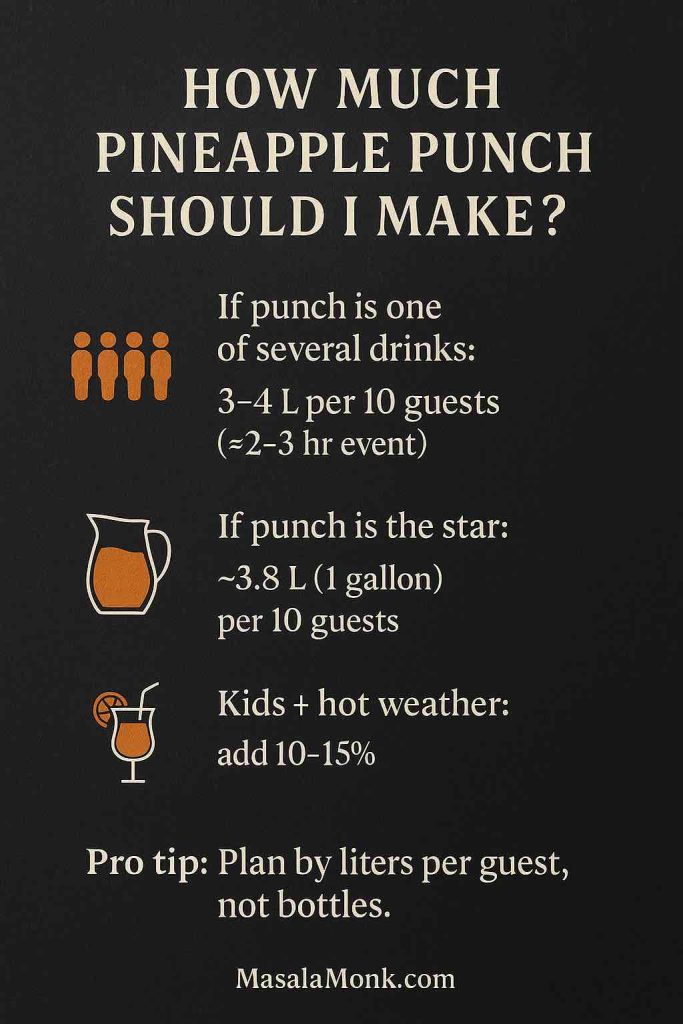
Plan by liters per guest, not bottles.

  • One of several drinks: 3–4 L per 10 guests (2–3 hr event)
  • Punch is the star: ~3.8 L per 10 guests
  • Kids or hot weather: add 10–15%
Infographic titled “How Much Pineapple Punch Should I Make?” on a dark background. It shows three sections: 3–4 L per 10 guests for multiple drinks (2–3 hr event), 3.8 L per 10 guests if punch is the main beverage, and a 10–15% increase for kids or hot weather. Includes a pro tip: plan by liters per guest, not bottles.
Wondering how much pineapple punch to prepare? This guide breaks it down: 3–4 L per 10 guests if punch is one of several drinks, about 3.8 L (1 gallon) if it’s the star, and add 10–15% more for kids or hot weather. Always plan by liters per guest, not bottles.

Fast Planner (assumes ~2.8 L per base batch)

GuestsIf punch is one of several: Total L (range)Batches (~2.8 L ea.)If punch is the star: Total LBatches
103–4 L23.8 L2
206–8 L37.6 L3
309–12 L4–511.4 L5
4012–16 L5–615.2 L6
5015–20 L6–819.0 L7
6018–24 L7–922.8 L9

For 30 guests with other drink options: triple any ~3 L base recipe. For 50–60 guests: 4× one recipe or run two bowls (zero-proof + spiked).


1) Pineapple Punch with Ginger Ale (Wedding Classic)

Light, effervescent, and universally loved—this is the punch with pineapple juice people expect at showers and weddings.

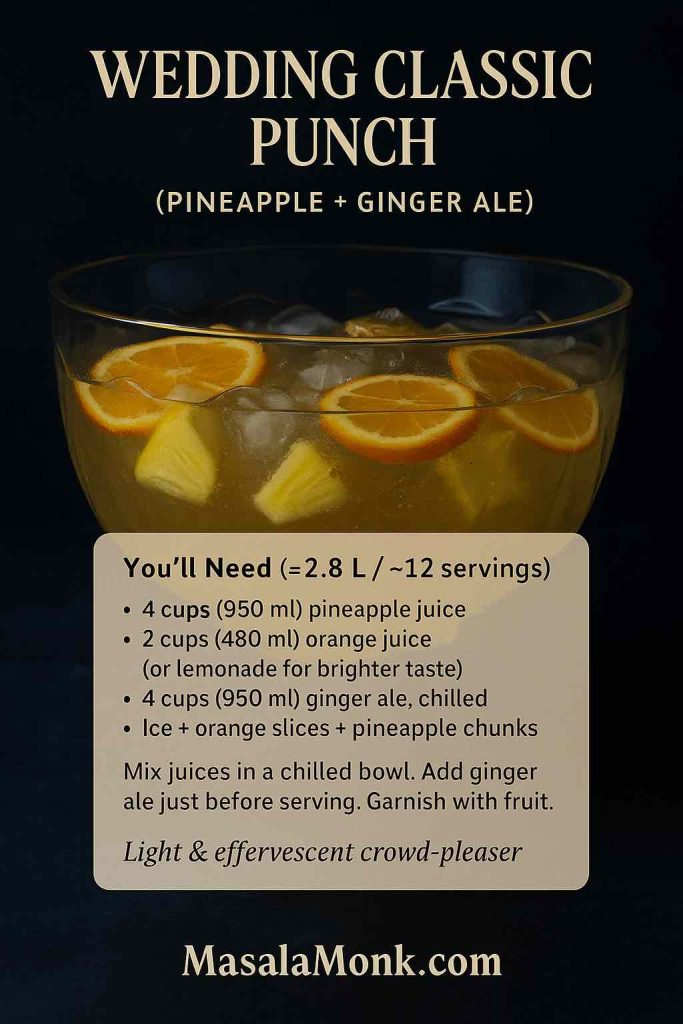
You’ll need (≈2.8 L / ~12 servings)

  • 4 cups (950 ml) pineapple juice
  • 2 cups (480 ml) orange juice (or 300 ml thawed OJ concentrate + 240 ml cold water)
  • 4 cups (950 ml) ginger ale, well chilled
  • Ice, orange slices, pineapple chunks
Recipe card for Wedding Classic Pineapple Punch featuring a glass punch bowl with orange slices and pineapple chunks. Includes quick ingredient list and method overlay on a dark, elegant background for Masala Monk.
This light and effervescent Wedding Classic Pineapple Punch is the go-to drink for showers, weddings, and brunches. With just three main ingredients—pineapple juice, orange juice, and ginger ale—it’s elegant, easy, and perfect for scaling up to serve a crowd.

Method
In a chilled bowl, stir pineapple and orange juices. Right before guests arrive, gently pour in ginger ale. Add ice and fruit.

Flavor notes & swaps

  • Brighter & less sweet: replace orange juice with lemonade.
  • Spicier: swap half the ginger ale for ginger beer.
  • Lower sugar: use diet ginger ale or plain club soda for half the bubbles.

Scale up
For ~36 servings, multiply everything by 3. Keep a second chilled batch ready in the fridge; add ginger ale on demand.

Serve it pretty
Rim some glasses with fine sugar and garnish with a thin orange wheel and a mint sprig.

Do not forget to explore Mango Vodka Cocktail: The Perfect Base + 7 Must-Try Variations.


2) Cranberry Pineapple Punch (with Ginger Ale)

Ruby-red and refreshing, this leans festive but works year-round—especially with lime.

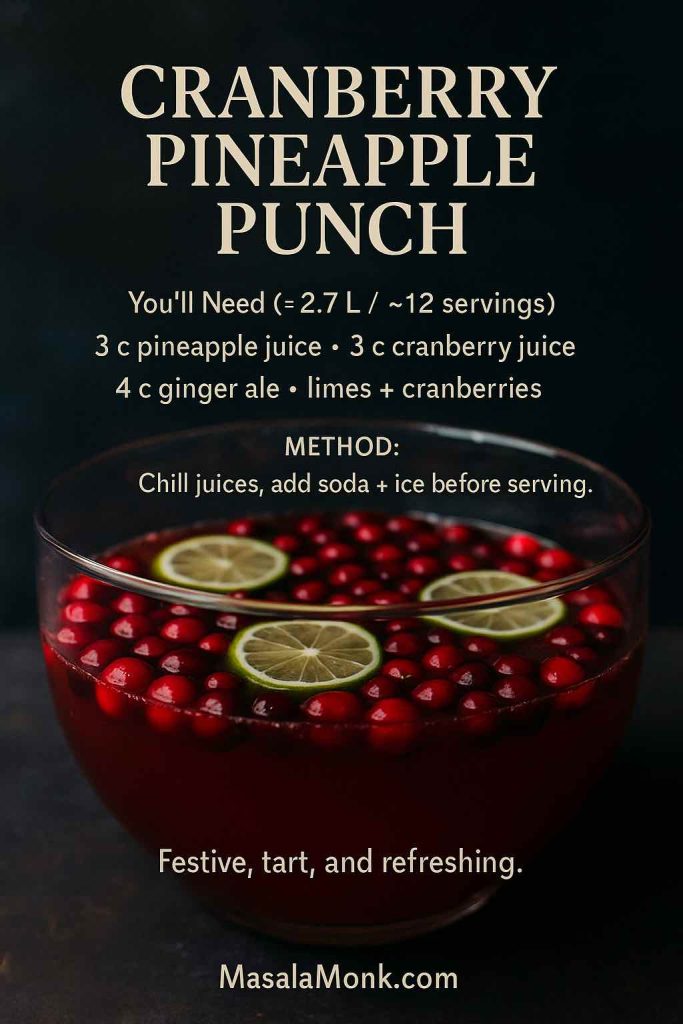
You’ll need (≈2.7 L / ~12 servings)

  • 3 cups (710 ml) pineapple juice
  • 3 cups (710 ml) cranberry juice (100% or cocktail)
  • 4 cups (950 ml) ginger ale, chilled
  • 2–3 limes, thinly sliced; 1 cup cranberries (fresh or frozen)
  • Ice
Recipe card for Cranberry Pineapple Punch featuring a ruby-red punch bowl with floating lime slices and cranberries. Includes quick ingredient list and method overlay in a festive, moody style for Masala Monk.
This Cranberry Pineapple Punch blends tart cranberry with sweet pineapple for a festive, ruby-red drink. Easy to scale for a crowd, it’s a holiday favorite with limes, cranberries, and ginger ale for sparkle.

Method
Combine pineapple and cranberry juices with lime slices and cranberries. Chill well. Add ginger ale at the last minute and then ice. For non-alcoholic riffs, that might be good for digestion as well – browse our cranberry mocktail ideas.

Flavor notes & swaps

  • Tart lovers: add ½ cup (120 ml) pomegranate juice.
  • Holiday spice: drop in cinnamon sticks and whole cloves; remove before serving.
  • Pink sparkle: replace half the ginger ale with sparkling rosé for an adults-only version.

Scale up
For ~50 servings, multiply by 4. Swap half the ice for frozen cranberries to prevent dilution.


3) Pineapple Punch with Sprite (Lemon-Lime Fizz)

Crisp, citrusy, and made for afternoon gatherings.

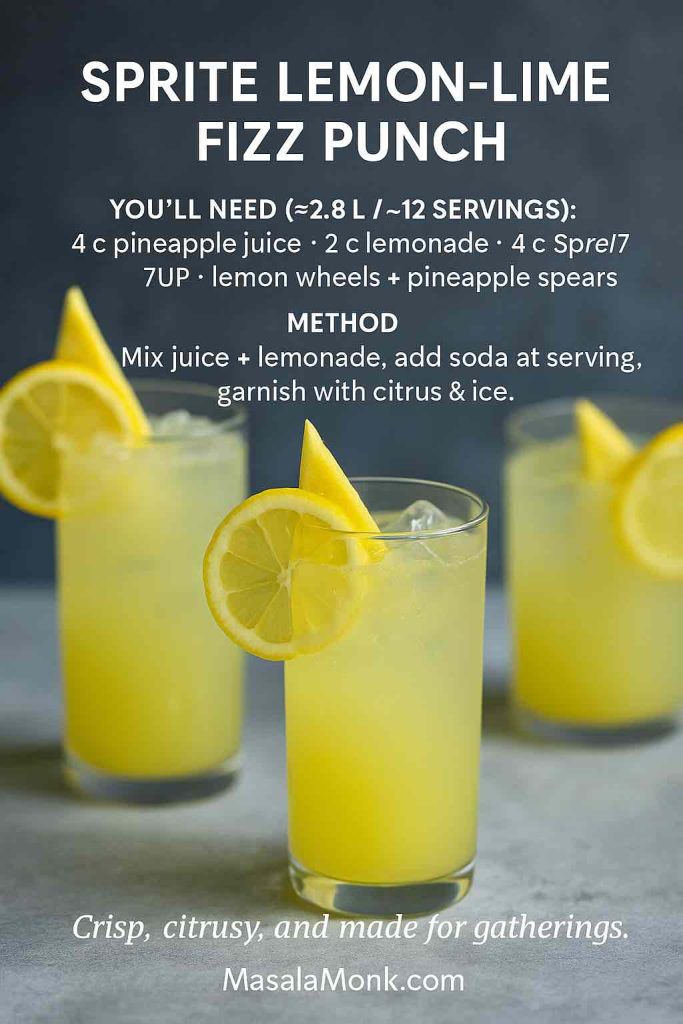
You’ll need (≈2.8 L / ~12 servings)

  • 4 cups (950 ml) pineapple juice
  • 2 cups (480 ml) lemonade (or 180 ml frozen lemonade concentrate + 480 ml cold water)
  • 4 cups (950 ml) lemon-lime soda (Sprite/7UP), very cold
  • Lemon wheels; pineapple spears; ice
Recipe card for Sprite Lemon-Lime Fizz Punch featuring tall glasses of fizzy yellow punch with lemon wheels and pineapple spears. Includes quick ingredient list and method overlay in a clean, modern design for Masala Monk.
This Sprite Lemon-Lime Fizz Punch is a bright, citrusy blend of pineapple juice, lemonade, and 7UP. Perfect for summer gatherings, it’s crisp, refreshing, and guaranteed to be a hit with kids and adults alike.

Method
Stir pineapple juice and lemonade in a chilled bowl. Right before serving, add lemon-lime soda and then ice and garnishes.

Flavor notes & swaps

  • Citrus burst: add 2 tbsp lemon zest to the base, then strain before adding soda.
  • Herbal twist: muddle a handful of fresh basil or mint with a little lemonade, then stir through the base and strain.
  • Not-too-sweet: replace 1–2 cups of soda with club soda.

Scale up
For a kid-heavy party, double it and serve with paper umbrellas—guaranteed smiles.

You might also enjoy reading What to Mix with Jim Beam: Best Mixers & Easy Cocktails


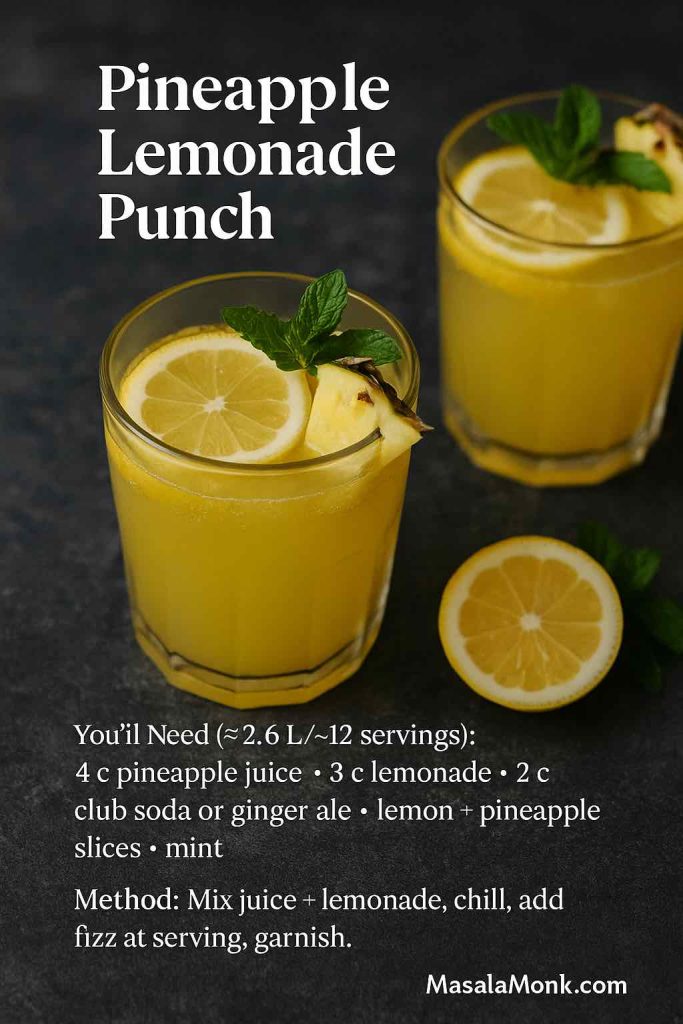
4) Pineapple Lemonade Punch

Bright and snappy with a choose-your-own-fizz ending.

You’ll need (≈2.6 L / ~12 servings)

  • 4 cups (950 ml) pineapple juice
  • 3 cups (710 ml) lemonade
  • 2 cups (480 ml) club soda (lighter) or ginger ale (sweeter)
  • Mint, lemon & pineapple slices; ice
Recipe card for Pineapple Lemonade Punch featuring golden yellow punch in glasses with lemon slices, pineapple wedges, and fresh mint. Includes ingredient list and method overlay on a dark textured background for Masala Monk.
This Pineapple Lemonade Punch is a bright, snappy blend of pineapple juice, lemonade, and a splash of fizz. Garnished with lemon wheels, pineapple slices, and mint, it’s a refreshing and versatile crowd-pleaser for any occasion.

Method
Mix pineapple juice and lemonade; chill thoroughly. Add club soda (or ginger ale) at serving. Toss in herbs and fruit.

Flavor notes & swaps

  • Sparkling lemonade vibe: use all club soda and add a teaspoon of vanilla extract to round the citrus.
  • Grown-up twist: a splash (¼ cup / 60 ml) of Aperol turns it sunset-orange (adults only).

Scale up
For ~36 servings, triple the base and keep the club soda unopened until showtime.

Also Read: Pineapple Juice for High Blood Pressure: 5 Important Insights 🌟


5) Pineapple Sherbet Punch

Retro in the best way—this is the one everyone photographs first.

You’ll need (≈3.2 L / ~14 servings)

  • 4 cups (950 ml) pineapple juice
  • 6 cups (1.4 L) ginger ale or lemon-lime soda, very cold
  • 1 quart (950 ml) pineapple sherbet
  • (Optional) 1 quart (950 ml) vanilla ice cream for a creamsicle vibe
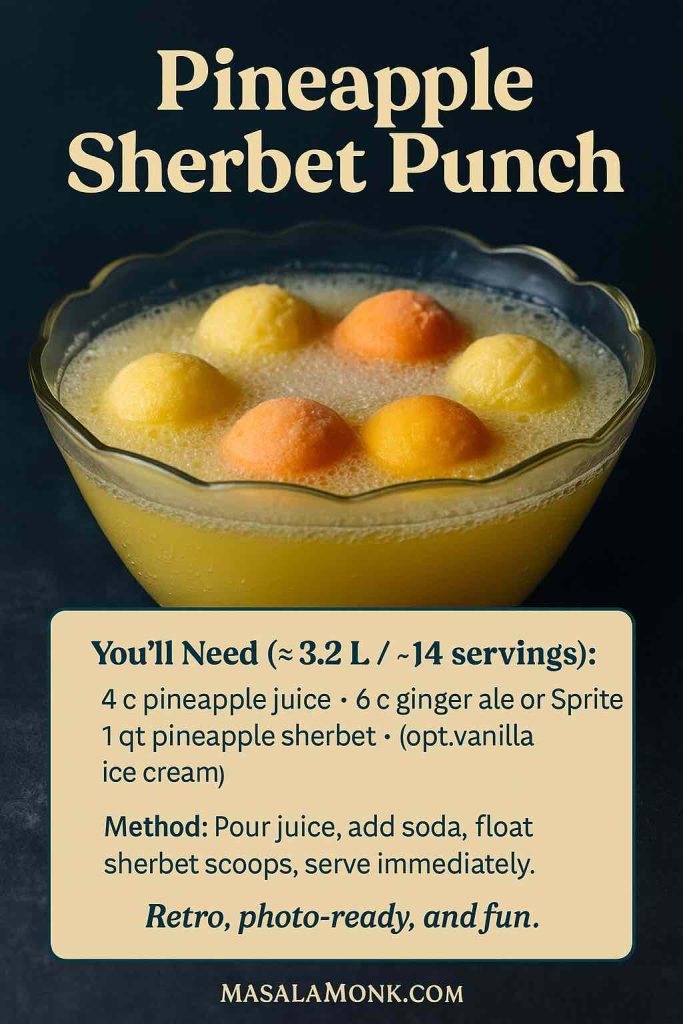
Recipe card for Pineapple Sherbet Punch featuring a retro-style punch bowl filled with yellow pineapple punch and floating scoops of orange and pineapple sherbet. Includes ingredient list and method overlay for Masala Monk.
This Pineapple Sherbet Punch is retro in the best way—fizzy pineapple soda topped with creamy sherbet scoops that float like colorful islands. A photo-ready party centerpiece that’s as fun to drink as it is to serve.

Method
Pour pineapple juice into the bowl. Add soda gently. Float scoops of sherbet (and vanilla ice cream if using). Serve immediately.

Flavor notes & swaps

  • Citrus rainbow: use orange sherbet or mix half orange, half pineapple.
  • Dessert punch: drizzle a little coconut cream across the top and garnish with toasted coconut flakes.

Pro tip
Pre-scoop sherbet onto a tray and freeze 30 minutes so scoops hold their shape.

While still on pineapples, do read: Pineapple: The Tropical Treasure for Your Skin – Benefits, Myths, and 5 Invigorating Recipes for a Smooth Complexion.


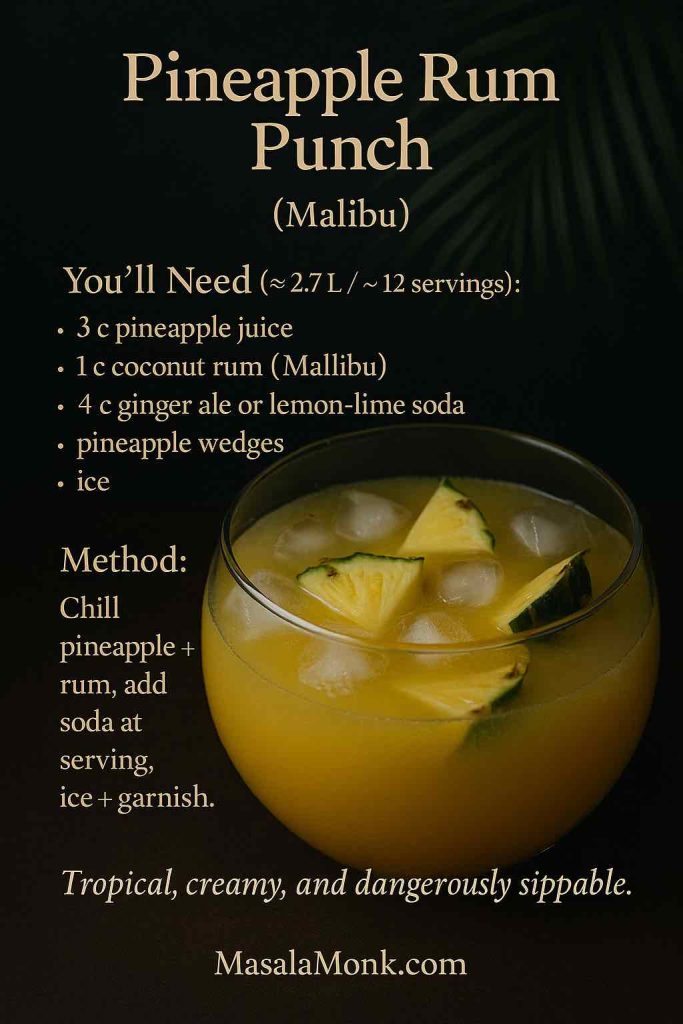
6) Pineapple Rum Punch (Malibu)

Tropical, creamy coconut notes, and dangerously sippable. Label clearly as adults only.

You’ll need (≈2.7 L / ~12 servings)

  • 3 cups (710 ml) pineapple juice
  • 1 cup (240 ml) coconut rum (Malibu)
  • 4 cups (950 ml) ginger ale or lemon-lime soda
  • Pineapple wedges; ice
Recipe card for Pineapple Rum Punch (Malibu) showing a moody punch bowl filled with yellow pineapple punch, ice, and pineapple wedges. Text overlay lists ingredients (pineapple juice, coconut rum, soda) and a simple method for Masala Monk.
Pineapple Rum Punch (Malibu) brings sunny coconut notes to a fizzy pineapple base—built to batch, served ice-cold, and finished with pineapple wedges for an instant tropical vibe.

Method
In a pitcher, combine pineapple juice and coconut rum. Chill very well. Just before serving, add soda, then ice and garnish.

Flavor notes & swaps

  • More depth: add ½ cup (120 ml) dark rum.
  • Creamy piña feel: stir in ¼ cup (60 ml) coconut cream (shake can first).
  • Spicy island: a few dashes of Angostura bitters on top.

Scale up
For ~48 servings, quadruple the base. Keep the rum/juice mix in the fridge; add soda in the bowl.

Suggested read: How to Make Pineapple Chia Pudding: A Refreshing Low-Carb Breakfast Option


7) Planter’s-Style Pineapple Rum Punch (Classic Vibes)

A nod to the old rum formula—sour, sweet, strong, weak—with pineapple taking the “weak” role.

You’ll need (≈2.4 L / ~10 servings)

  • 1 cup (240 ml) fresh lime juice (sour)
  • 2 cups (480 ml) simple syrup (sweet) (adjust to taste)
  • 3 cups (710 ml) dark or gold rum (strong)
  • 4 cups (950 ml) pineapple juice (weak)
  • 1–2 cups (240–480 ml) cold water or soda, to taste
  • 6 dashes Angostura bitters; fresh-grated nutmeg
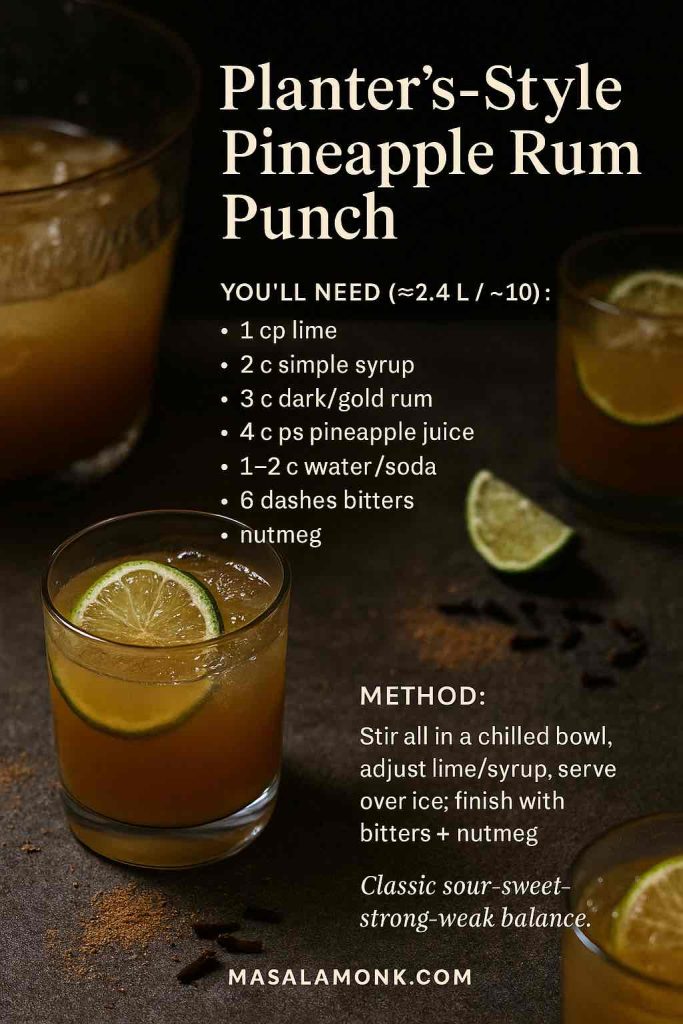
Recipe card for Planter’s-Style Pineapple Rum Punch featuring golden punch in lowball glasses with lime wheels, warm rustic background, scattered spices, and text overlay listing ingredients and method for Masala Monk.
Planter’s-Style Pineapple Rum Punch delivers old-school tiki balance: lime for sour, syrup for sweet, rum for strength, and pineapple juice for smoothness—finished with bitters and nutmeg for a timeless island touch.

Method
Stir lime juice, syrup, rum, pineapple juice, and water/soda in a chilled bowl. Add bitters. Taste for balance—tweak with syrup or lime as needed. Serve over ice and finish with a whisper of nutmeg.

Flavor notes & swaps

  • Tiki lean: add ½ cup (120 ml) orange juice and a bar-spoon of grenadine for color.
  • Citrus-forward: replace some water with club soda for lift.

You might also enjoy Natural Detoxification: Cranberry Juice and Apple Cider Vinegar for Weight Loss


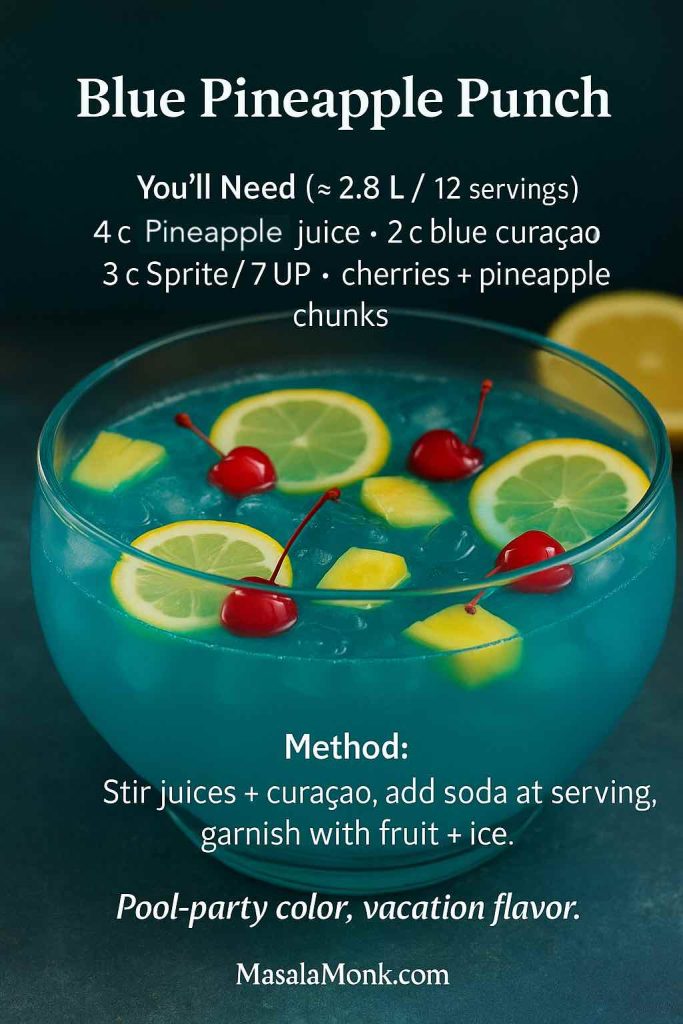
8) Blue Pineapple Punch

Pool-party color, grown-up flavor. It looks like vacation in a glass.

You’ll need (≈2.8 L / ~12 servings)

  • 4 cups (950 ml) pineapple juice
  • 2 cups (480 ml) lemonade
  • 1 cup (240 ml) blue curaçao
  • 3 cups (710 ml) lemon-lime soda, cold
  • Cherries + pineapple chunks; ice
Recipe card for Blue Pineapple Punch showing a glass bowl of bright turquoise punch with lemon wheels, pineapple chunks, and cherries. Overlay text includes ingredients, method, and tagline for Masala Monk.
This Blue Pineapple Punch is a vibrant showstopper—pineapple juice, lemonade, and blue curaçao topped with soda, cherries, and pineapple chunks. Perfect for pool parties or any celebration that needs a splash of color and vacation vibes.

Method
Stir pineapple juice, lemonade, and blue curaçao in a chilled pitcher. Add soda at serving. Ice and garnish.

Zero-proof look-alike
Swap curaçao for a blue sports drink and add a few dashes of orange extract.


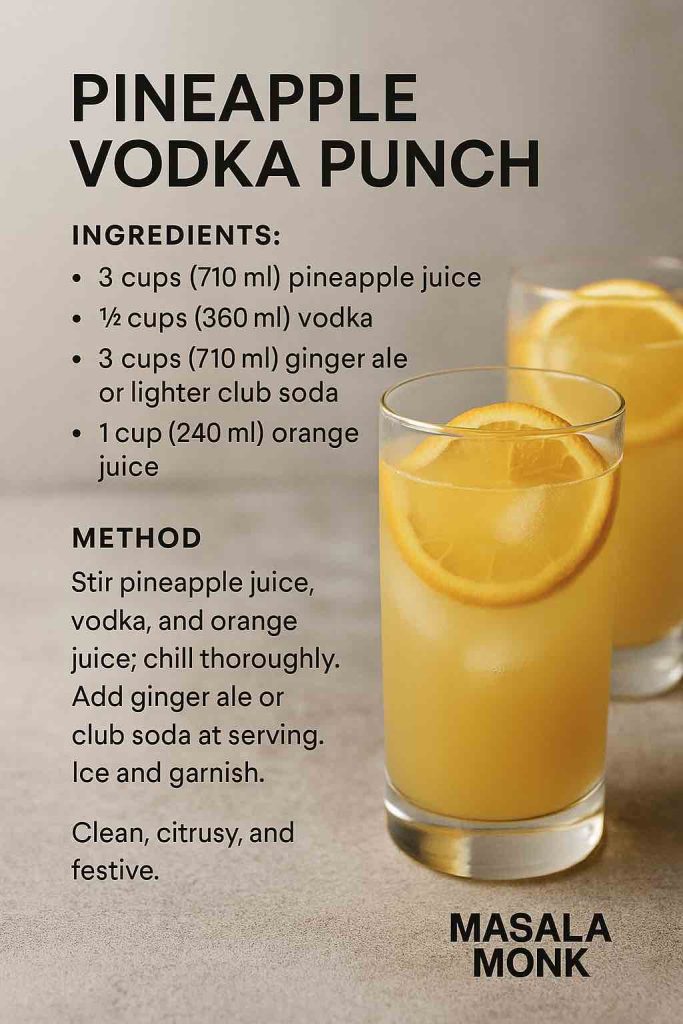
9) Pineapple Vodka Punch

Clean, citrusy backbone with just enough fizz to feel festive.

You’ll need (≈2.7 L / ~12 servings)

  • 3 cups (710 ml) pineapple juice
  • 1½ cups (360 ml) vodka
  • 3 cups (710 ml) ginger ale (sweeter) or club soda (lighter)
  • 1 cup (240 ml) orange juice
  • Ice + orange wheels
Recipe card for Pineapple Vodka Punch showing tall glasses of golden punch with orange wheels on ice. Overlay lists ingredients (pineapple juice, vodka, ginger ale/club soda, orange juice) and simple method in a modern Masala Monk layout.
Pineapple Vodka Punch keeps things clean and citrusy—pineapple + OJ base, a measured pour of vodka, then fizz with ginger ale or club soda right at serving. Bright, simple, and party-ready.

Method
Stir pineapple juice, vodka, and orange juice; chill thoroughly. Add ginger ale or club soda at serving. Ice and garnish.

Flavor notes & swaps

  • Herbal lift: a handful of mint lightly muddled with OJ (strain before mixing).
  • Citrus pop: 2 tbsp lime juice right before serving wakes up the vodka.

And for those mornings after party Top 12 Hangover Remedies from Around the World.


Make-Ahead, Storage & Safety—The Practical Stuff

  • Make-ahead window: Mix all non-carbonated ingredients up to 24 hours in advance. Store in the coldest part of your fridge in a sealed container.
  • When to add fizz: Always at serving. If your event runs long, keep the soda chilled and top up every 20–30 minutes.
  • Keeping it cold: Use frozen fruit, an ice ring, or small ice cubes added in stages. For outdoor service, keep a spare pitcher in a cooler and rotate refills.
  • If you over-dilute: Re-balance with a quarter-strength concentrate of the base (e.g., a mix of pineapple juice and citrus) and a pinch of salt.
  • Responsible enjoyment: If a punch includes spirits, label it clearly and keep water nearby. For alcohol guidelines, skim NIAAA’s standard drink explainer.
  • Food-safe handling: If you’re serving outdoors or for hours, review FoodSafety.gov’s four steps; in short, keep cold drinks cold and use clean ladles and cups.

Styling Your Bowl: Easy Wins That Wow

  • Build an ice ring: In a bundt pan, freeze pineapple juice with lemon wheels, mint, and cranberries in two layers so the fruit suspends. Unmold and float for slow-melt drama.
  • Create a garnish bar: Set out pineapple spears, cherries, citrus wheels, and edible flowers so guests can customize.
  • Use a clear dispenser: If you’re short on table space, a glass drink dispenser shows off the color and keeps refills discreet.
  • Give it a scent: Clap mint sprigs (literally slap them) before garnishing to release oils.

Troubleshooting: Because Real Parties Get Real

  • “It’s too sweet.” Add fresh lemon or lime juice, then taste. If it still leans sweet, swap 1–2 cups of the punch for club soda and add a tiny pinch of salt.
  • “It’s flat.” You added the soda too early or stirred too aggressively. Top up with fresh, chilled soda and add a handful of frozen fruit to re-cool fast.
  • “It’s watery.” Use frozen fruit instead of ice for the next top-up. Meanwhile, stir in a little concentrated pineapple juice or a splash of lemonade to bring back flavor.
  • “Guests want both alcoholic and non-alcoholic.” Run two bowls: one zero-proof, one spiked. Label both clearly and keep the same garnish set so the look matches.
  • “Kids are drinking it non-stop.” Offer small cups and keep water pitchers next to the punch so refills are mixed with a sip of water.
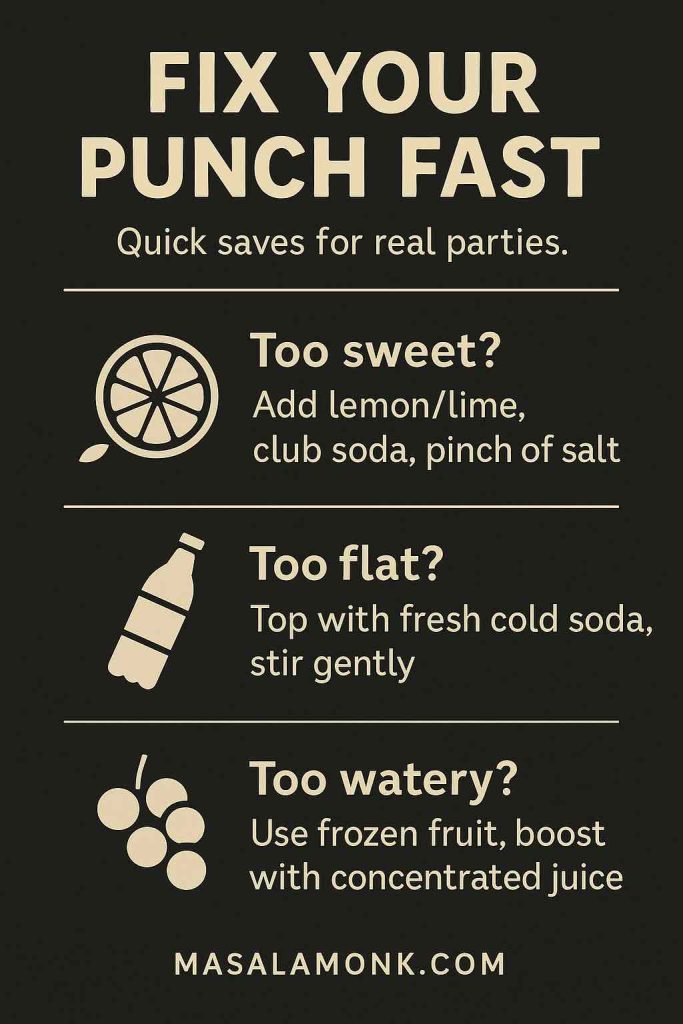
Troubleshooting infographic titled “Fix Your Punch Fast” on a dark background with icons and three remedies: add citrus/club soda/salt if too sweet; top with fresh cold soda and stir gently if flat; use frozen fruit and concentrated juice if watery. Branded MasalaMonk.com.
Fix your punch fast: whether it’s too sweet, too flat, or too watery, this quick-reference card gives you instant saves—citrus + club soda + pinch of salt, fresh cold soda with a gentle stir, and frozen fruit plus a boost of concentrated juice.

A Better Bowl, Every Time

Make it cold, add the bubbles last, and keep the flavors lively with citrus and just a pinch of salt. Whether you go classic with ginger ale or get a little wild with sherbet or blue curaçao, punch with pineapple juice is a guaranteed mood-setter—and now you’ve got nine ways to serve it like a pro. If you try one, tell us which combo your crowd loved most; we’re always up for testing reader riffs at the next gathering.

FAQs

1) What’s the simplest ratio for punch with pineapple juice?

Start here, then tweak: 4 : 2 : 4 + garnish

  • 4 parts pineapple juice
  • 2 parts citrus (orange juice or lemonade)
  • 4 parts fizz (ginger ale or lemon-lime soda)
    Then, add ice + citrus wheels + pineapple chunks. Finally, taste and adjust with a squeeze of lemon (for brightness) or a pinch of salt (to tame sweetness).

2) Ginger ale or Sprite—what’s better in punch with pineapple juice?

It depends on the vibe. Ginger ale is softer and vanilla-ginger sweet, which feels “classic wedding.” Meanwhile, Sprite/7UP is zestier and reads more citrus. If you’re unsure, split the difference: half ginger ale, half lemon-lime soda. For a lighter sip, replace 1–2 cups with club soda.

3) Can I make punch with pineapple juice ahead of time?

Absolutely. First, mix all non-carbonated liquids up to 24 hours ahead and chill them hard. Then, add anything fizzy right before serving. As a result, the bubbles last and the bowl stays bright.

4) How much punch with pineapple juice do I need for my guest count?

Use these quick numbers, then round up:

  • If punch is one of several drinks: 3–4 L per 10 guests for 2–3 hours.
  • If punch is the star: about 1 gallon (3.8 L) per 10 guests.
  • For kids or hot weather, add 10–15%.
    Pro tip: make two identical chilled batches; keep one in the fridge so refills stay icy.

5) What if my punch with pineapple juice tastes too sweet (or too tart)?

Firstly, add fresh lemon or lime and stir gently. Secondly, if it’s still too sweet, swap in 1–2 cups club soda for punch and add a tiny pinch of salt. Conversely, if it’s too tart, stir in simple syrup (1:1 sugar to water) a tablespoon at a time.

6) How do I keep punch cold without watering it down?

Go beyond ice cubes. Instead, freeze pineapple rings, grapes, or cranberries and use them as “ice.” For longer events, make a bundt-pan ice ring with pineapple juice and citrus slices; it melts slowly and looks gorgeous.

7) What’s the best “wedding punch with pineapple juice and ginger ale” recipe?

Keep it timeless: 4 cups pineapple juice + 2 cups orange juice + 4 cups ginger ale. Add ice, orange slices, and pineapple chunks. For brighter flavor, substitute lemonade for the OJ; for spicier zip, replace ½ the ginger ale with ginger beer.

8) Which alcohol pairs best with punch with pineapple juice—rum or vodka?

Both work, but they read differently. Rum (especially coconut rum/Malibu) leans tropical and dessert-like; a splash of dark rum adds depth. Vodka keeps things clean and citrusy. For a balanced bowl, start with 1 cup (240 ml) spirit per ~2.7 L base, taste, then decide if you want another ½ cup (120 ml).

9) Can I make a “Planter’s” style punch with pineapple juice?

Yes—think sour : sweet : strong : weak. Try: 1 cup lime (sour) + 2 cups simple syrup (sweet) + 3 cups rum (strong) + 4 cups pineapple juice (weak). Finally, add 1–2 cups water or soda, 6 dashes bitters, and a dusting of nutmeg.

10) How do I do a cranberry holiday punch with pineapple juice?

Go red and refreshing: 3 cups pineapple + 3 cups cranberry + 4 cups ginger ale, plus lime slices and cranberries. For even more color, add ½ cup pomegranate juice. During winter, tuck in cinnamon sticks (pull them before serving).

11) Any tips for sherbet punch with pineapple juice and 7UP?

Yes—work quickly. First, pour pineapple juice, then add 7UP, and finally float scoops of pineapple (or orange) sherbet. Pre-scoop and refreeze for 30 minutes so the “islands” hold. Serve immediately so the fizz doesn’t fade.

12) Can I make blue punch with pineapple juice without blue curaçao?

You can fake the look. Use a blue sports drink in place of curaçao and add a couple drops of orange extract for aroma. Alternatively, go half sports drink, half lemon-lime soda for lighter sweetness.

13) Is fresh pineapple juice better than canned for punch?

Sometimes—but not always. Fresh is zingy yet inconsistent; canned is steady and convenient for crowds. If you juice fresh, taste for sweetness and acidity, then adjust with lemon/lime or a spoon of simple syrup.

14) What’s a good “Sprite and Hawaiian Punch with pineapple juice” combo?

For kid-friendly color, try 2 parts Hawaiian Punch + 1 part pineapple juice + 2 parts lemon-lime soda. Add plenty of ice and orange slices. Then, if it’s too sweet, swap one part of soda for club soda.

15) Can I use lemonade mix (like Country Time) in punch with pineapple juice?

Of course. Whisk the mix with cold water per the label, chill thoroughly, and use it where the recipe calls for lemonade. Because mixes vary in sweetness, start with ¾ strength, taste, and add more if needed.

16) What about champagne or prosecco—can I make a pineapple “bubbly” punch?

Yes, but add the wine last minute. Build a base of pineapple + lemonade (chilled), then gently pour in prosecco right before guests arrive. For balance, keep the ratio near 2 parts juice base : 1 part bubbles.

17) How do I label and serve when some guests want alcohol and others don’t?

Run two bowls side by side—one zero-proof, one spiked—and label clearly. Meanwhile, offer water and a garnish bar (mint, citrus wheels, pineapple spears) so everyone’s glass looks equally festive.

18) Any fast fixes if my punch turns flat or watery mid-party?

If flat, top with fresh, very cold soda and stir minimally. If watery, stir in a small amount of concentrated base (pineapple + citrus) and switch to frozen fruit for chilling. Also, refresh in smaller batches so each top-up stays lively.

19) How far can I stretch punch with pineapple juice for a big crowd?

For a 50-guest event where punch is one of several drinks, plan roughly 12–16 L total. Practically speaking, make four batches of a ~3 L recipe, keep two chilling, and rotate them. If punch is the main drink, aim closer to 19 L (about 5 gallons).

20) What garnishes make punch with pineapple juice look premium—without extra work?

First, build a slow-melt ice ring with pineapple juice and citrus wheels. Next, set out an easy garnish bar: mint, lemon wheels, pineapple chunks, and cocktail cherries. Finally, clap mint leaves between your hands before adding—this releases aroma and feels surprisingly fancy.
Posted on — 6 Comments

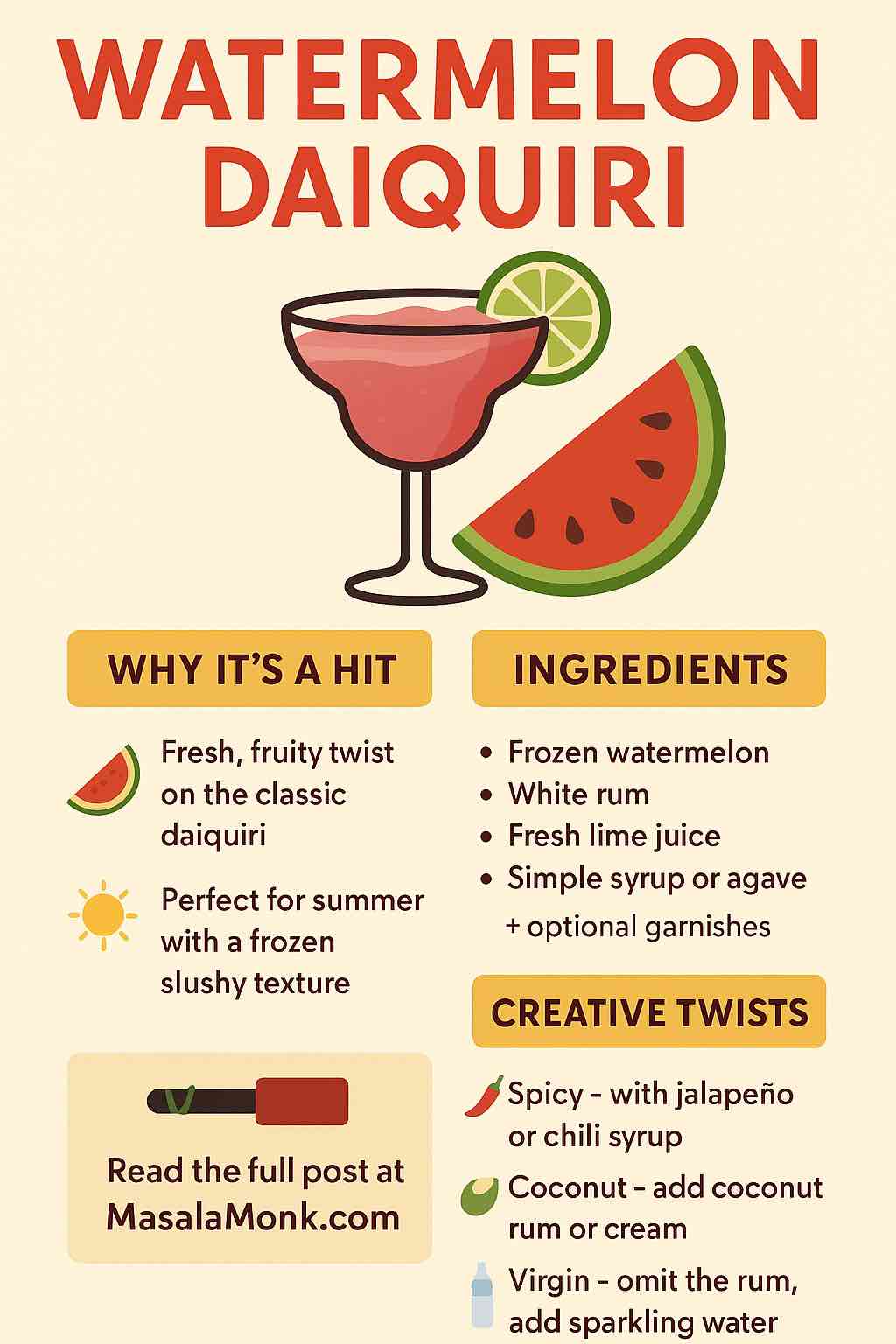
Watermelon Daiquiri: A Refreshing Twist on a Classic Cocktail

WATERMELON DAIQUIRI

If summer had a flavor, it would be watermelon. If summer had a spirit, it would be rum. Bring them together, and you get the Watermelon Daiquiri: a cocktail that’s both a throwback to Cuban classics and a bright, modern favorite. Whether you’re a cocktail geek, a party host, or just someone with a blender and a ripe watermelon, this is your go-to summer sip.


🍉 Why Watermelon? The Story Behind the Sip

Watermelon daiquiris aren’t just a fleeting TikTok trend—they’re a sign of how the cocktail world is embracing freshness, color, and creative twists on the classics. The original daiquiri—a simple blend of rum, lime, and sugar—traces its roots back to 1900s Cuba, a thirst-quencher for sweltering evenings and balmy breezes. The watermelon version keeps the same structure but adds juiciness, vibrant color, and a crowd-pleasing twist.

Did you know? According to the latest 2025 bar trends, watermelon is now the most popular summer cocktail ingredient, especially among 20-somethings. Even the biggest cocktail festivals and rooftop bars are showcasing watermelon daiquiris in frozen, spicy, and even savory formats.


🛒 The Ingredients: Choosing the Best for Flavor & Texture

The Watermelon Daiquiri is only as good as what goes into it. Here’s how to pick and prep:

1. Watermelon

  • Choose seedless for ease. Ripe, sweet watermelons yield the best flavor.
  • Cut into cubes and freeze in a single layer. This is the secret to a perfect frozen daiquiri texture—no watering down with excess ice.

2. Rum

  • Light/white rum is classic, allowing the watermelon to shine.
  • For a twist: Try coconut rum or even a splash of overproof for an extra kick.

3. Fresh Lime Juice

  • Don’t skip the fresh-squeezed! Bottled juice can’t compete in terms of brightness.

4. Simple Syrup or Agave

  • Use simple syrup (1:1 sugar:water) or agave nectar for easy mixing and balanced sweetness.
  • Adjust to taste—watermelon sweetness can vary.

5. Optional Upgrades

  • Herbs: Fresh mint or basil.
  • Spice: Muddle jalapeño or add a few dashes of chili syrup.
  • Liqueur: Try a splash of Cointreau or orange liqueur for complexity.
  • Coconut: Add coconut water or a spoon of coconut cream for tropical vibes.

🍹 The Practical Recipe: Classic Frozen Watermelon Daiquiri

Ingredients (serves 2)

  • 4 cups frozen watermelon cubes
  • ½ cup white rum
  • ¼ cup fresh lime juice
  • 1 tablespoon simple syrup or agave (more or less to taste)
  • Handful of ice (optional, for extra slush)
  • Garnish: lime wheel, fresh mint, watermelon wedge, or a fun sugar/salt rim

Instructions

  1. Prep the Watermelon: Cube and freeze watermelon at least 4 hours ahead. Overnight is best.
  2. Blend: In a blender, combine frozen watermelon, rum, lime juice, sweetener, and a little ice if you want extra thickness.
  3. Taste & Adjust: Blend until smooth. Taste, and adjust sweetness or lime as needed.
  4. Serve: Pour into chilled glasses. Garnish with your favorites—lime, mint, or a tiny watermelon triangle.
  5. Optional Rim: Run a lime wedge around the glass and dip in sugar, salt, or Tajín for an Instagram-ready touch.

🔥 Trending Variations for 2025

Why settle for the ordinary when you can make your Watermelon Daiquiri stand out? Here’s how bartenders are riffing on the classic:

Spicy Watermelon Daiquiri

  • Add muddled jalapeño or a dash of chili-lime syrup for an unexpected zing.
  • Garnish with a chili-salt rim for extra flair.

Coconut Watermelon Daiquiri

  • Substitute part of the rum with coconut rum or a splash of coconut milk.
  • The result: a creamy, almost Piña-Colada-like twist that’s still light and refreshing.

Herbaceous Infusion

  • Muddle basil or mint in the blender with the watermelon for a green, garden-fresh flavor.

On the Rocks Version

  • Skip the freezing step and use fresh watermelon juice, rum, lime, and simple syrup. Shake with ice and strain into a rocks glass.

Virgin (Non-Alcoholic) Watermelon Daiquiri

  • Omit the rum, use more watermelon, and splash in some sparkling water for fizz.

🎉 Hosting Tips: Make Watermelon Daiquiris the Life of the Party

  • Batch Ahead: Blend the daiquiri mix without ice and store in the fridge. Blend with ice or frozen watermelon just before serving.
  • DIY Garnish Bar: Set out lime wheels, mint sprigs, edible flowers, chili salt, and mini watermelon wedges so guests can personalize.
  • Keep It Cold: If serving outdoors, use insulated cups or serve in a pitcher placed in a bucket of ice.

🌈 Pro Presentation: Instagram-Ready Watermelon Daiquiri

  • Use geometric ice cubes or clear spheres for wow factor (especially for on-the-rocks versions).
  • Layer with edible glitter or a floral garnish—this trend is huge at summer events.
  • Create a two-tone effect: Blend part of the mix with strawberries or another fruit, then pour in layers for a sunset-in-a-glass look.

🧑‍🔬 Troubleshooting & Expert Tips

  • Too watery? Add more frozen watermelon or ice.
  • Not sweet enough? Watermelon ripeness can vary—don’t be afraid to add an extra splash of syrup.
  • No blender? Use fresh watermelon juice, shake with rum and lime, and serve over ice.
  • Want to lower ABV? Mix in coconut water or sparkling water for a lighter, “sessionable” drink.

🌟 The Final Sip: Why Watermelon Daiquiri Is Here to Stay

With its bright, juicy flavor and endless customization, the Watermelon Daiquiri is more than a trend—it’s the taste of summer in a glass. Whether you keep it classic, make it spicy, or invent your own signature riff, it’s the perfect cocktail for poolside afternoons, rooftop parties, or any moment that needs a splash of fun.

Ready to shake (or blend) things up? Tag your creations, share your twists, and let the watermelon daiquiri be your summer signature.


Thirsty for more? Drop a comment with your favorite variation or questions on technique—let’s make this summer the most delicious one yet!

Watermelon Daiquiri: Frequently Asked Questions

1. Can I make a watermelon daiquiri without a blender?
Yes! Use fresh watermelon juice instead of frozen cubes. Shake it with rum, lime juice, and sweetener, then strain over ice.

2. What’s the best type of rum for a watermelon daiquiri?
Light (white) rum is classic—it’s mild and lets the watermelon shine. Coconut rum or even spiced rum works for creative twists.

3. Can I use bottled lime juice instead of fresh?
Fresh lime juice is strongly recommended for the brightest, cleanest flavor, but bottled can work in a pinch.

4. My watermelon isn’t very sweet. How do I fix the flavor?
Add a little extra simple syrup or agave nectar. Always taste and adjust before serving.

5. Is there a way to make it non-alcoholic?
Absolutely! Skip the rum and add more watermelon, or use sparkling water for a fun, fizzy mocktail.

6. How can I make a spicy watermelon daiquiri?
Muddle a few slices of jalapeño in the blender, or add chili-lime syrup or a dash of hot sauce for heat.

7. What’s the secret to a thick, slushy texture?
Freeze your watermelon cubes solid before blending, and add only a little ice if needed. Don’t use too much liquid.

8. Can I make a big batch for a party?
Yes—multiply the recipe as needed. Blend and freeze in advance, then re-blend with a splash of rum or water before serving for the perfect texture.

9. How do I rim the glass for extra flair?
Run a lime wedge around the glass edge and dip into sugar, salt, or chili-lime seasoning (like Tajín).

10. What other fruits go well with watermelon in this daiquiri?
Strawberries, pineapple, or mango pair beautifully. Try blending in a handful for a fruity twist.

Posted on — 3 Comments

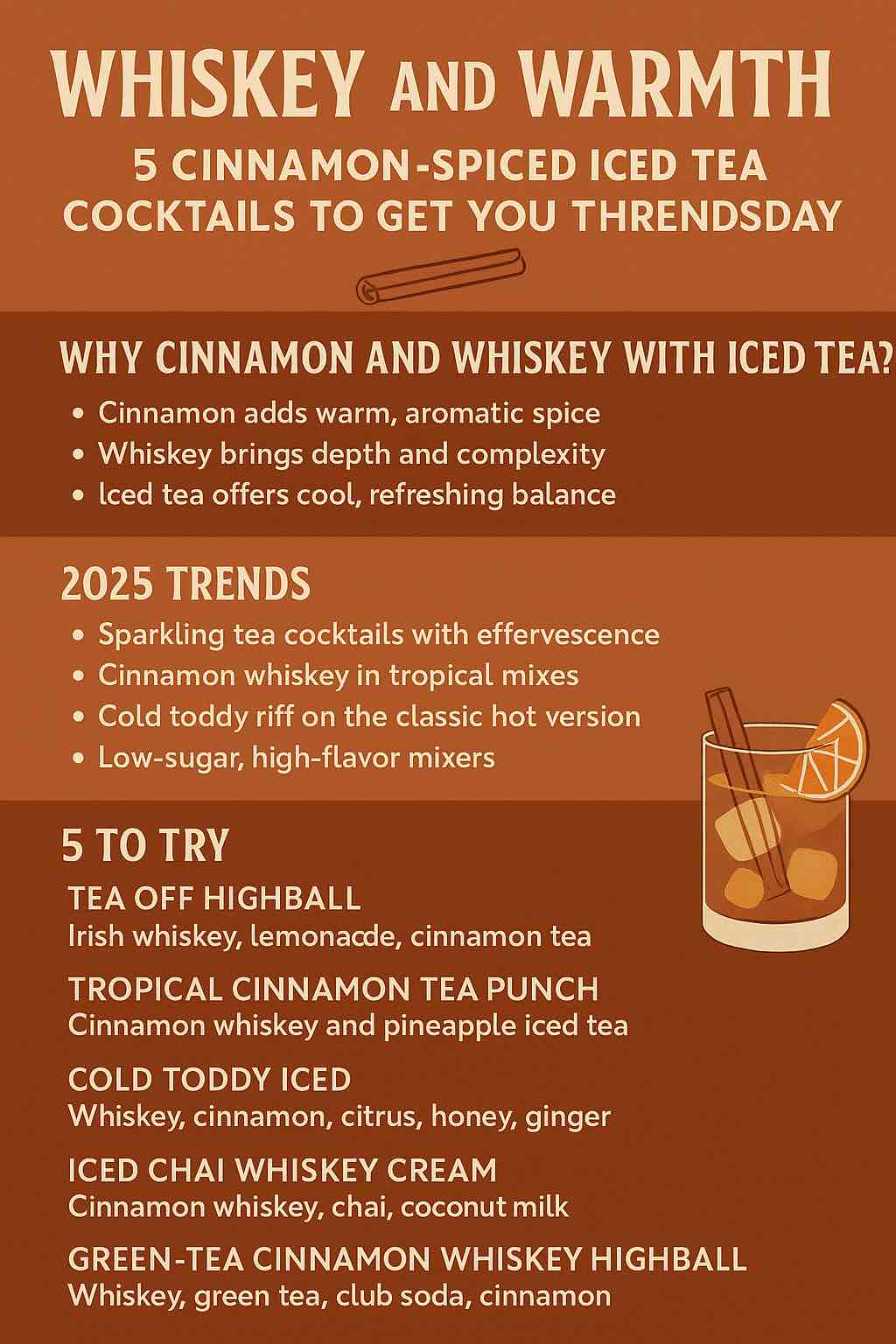
Whiskey and Warmth: 5 Cinnamon-Spiced Iced Tea Cocktails to Get You through Wednesday

Whiskey and Warmth

There’s something magical about the collision of heat and chill—a glass that cools your hand but warms your heart. When the midweek slump hits, and you crave both refreshment and comfort, cinnamon-spiced iced tea cocktails with whiskey are the answer. This isn’t your grandma’s sweet tea, nor is it just whiskey on the rocks. It’s an intentional fusion: cozy, aromatic spices meet the smooth bite of whiskey and the crisp snap of iced tea. Welcome to a world where Wednesday feels like the weekend.


Why Cinnamon and Whiskey with Iced Tea?

Let’s get nerdy for a second: cinnamon is packed with warm, sweet, and slightly woody notes. Whiskey, especially bourbon or rye, adds caramel, vanilla, and subtle spice. Black or green teas bring tannins and earthiness, while iced service keeps everything lively. When married together, you get a cocktail that’s cooling and refreshing, yet deeply satisfying—a drink for all seasons, but especially that awkward, restless middle of the week.


The 2025 Trends: What’s New?

Before we get to the recipes, here’s what’s trending right now:

  • Sparkling tea cocktails: Fizzy tea is huge this year, adding effervescence to classic pairings.
  • Cinnamon whiskey in tropical mixes: Cinnamon-spiked whiskey (think Fireball or Jack Daniel’s Tennessee Fire) isn’t just for winter—it’s getting play in summer punches and fruity teas.
  • The “Cold Toddy”: Inspired by the classic hot toddy, but adapted for iced service—perfect for those who want a little warmth without turning on the kettle.
  • Low-sugar, high-flavor: Natural sweeteners and bold spices take the place of syrupy mixes.

5 Cinnamon-Spiced Iced Tea Whiskey Cocktails

1. Tea Off Highball (New Classic)

Why it works: This is summer in a glass, but cinnamon-spiked for depth. The lemonade keeps it bright, while the whiskey and tea ground it with flavor.

What you need:

  • 2 oz Irish whiskey (Bushmills is great)
  • 3 oz strong black tea, chilled (infuse with 1 stick cinnamon per cup)
  • 1.5 oz fresh lemonade
  • ½ oz simple syrup (or honey syrup, optional)
  • Ice
  • Lemon wheel & cinnamon stick for garnish

How to make:

  1. Brew the tea hot with a cinnamon stick, cool and chill.
  2. Fill a tall glass with ice.
  3. Add whiskey, tea, lemonade, and syrup. Stir well.
  4. Garnish with lemon wheel and a cinnamon stick.

Pro tip: For a fizzy version, use sparkling lemonade!


2. Tropical Cinnamon Tea Punch

Why it works: Cinnamon whiskey and pineapple? Trust us—this one’s a party. Great for sharing.

What you need:

  • 1.5 oz cinnamon whiskey (Fireball, Jack Daniel’s Fire, or make your own)
  • 3 oz tropical fruit iced tea (pineapple, mango, or passionfruit blends)
  • 1 oz pineapple juice
  • ½ oz lime juice
  • Club soda (to top)
  • Pineapple wedge & mint for garnish

How to make:

  1. In a shaker, combine whiskey, tea, pineapple juice, and lime. Shake with ice.
  2. Strain into a tall glass filled with fresh ice.
  3. Top with club soda, garnish with pineapple wedge and mint.

Pro tip: Add fresh muddled ginger for extra zing!


3. Cold Toddy Iced

Why it works: All the comfort of a hot toddy, none of the sweat. Balanced and nuanced.

What you need:

  • 2 oz rye or bourbon whiskey
  • 3 oz Earl Grey or black tea (brewed strong)
  • ½ oz honey
  • 1 slice orange
  • 2 thin coins of fresh ginger
  • 2 dashes aromatic bitters
  • 1 cinnamon stick

How to make:

  1. Brew tea with cinnamon stick and ginger, then chill.
  2. In a glass, muddle orange with honey.
  3. Fill glass with ice, pour in whiskey, tea, bitters. Stir to combine.
  4. Garnish with fresh cinnamon stick and orange slice.

Pro tip: Try smoked cinnamon for extra drama!


4. Iced Chai Whiskey Cream

Why it works: Creamy, spicy, and sweet—like a dessert in a glass.

What you need:

  • 1.5 oz cinnamon whiskey
  • 2 oz strong chai tea (cooled)
  • 1 oz coconut milk or half & half
  • ½ oz maple syrup
  • Ice
  • Ground cinnamon, for dusting

How to make:

  1. Shake whiskey, chai, coconut milk, and maple syrup with ice.
  2. Strain into a glass of fresh ice.
  3. Dust lightly with cinnamon.

Pro tip: Rim the glass with cinnamon-sugar for extra flair.


5. Green-Tea Cinnamon Whiskey Highball

Why it works: Light, fresh, and just a bit spicy—the new wave of tea cocktails.

What you need:

  • 1.5 oz whiskey (Japanese or Scotch works beautifully)
  • 4 oz cold-brewed green or jasmine tea (infused with a pinch of cinnamon)
  • Club soda
  • Mint sprig & cinnamon stick for garnish

How to make:

  1. Build whiskey and tea over ice in a tall glass.
  2. Top with club soda.
  3. Garnish with mint and cinnamon.

Pro tip: Try with sparkling green tea for trendiness and refreshment.


Practical Tips for Home Mixologists

  • Make cinnamon tea ice cubes: Freeze brewed, spiced tea in ice cube trays—no more watered-down cocktails.
  • Prep ahead: Batch the tea and refrigerate for up to 3 days.
  • Garnish boldly: Cinnamon sticks, orange peel, fresh mint, or a sprinkle of ground spice bring your cocktails to the next level.
  • Adjust sweetness: Use honey, agave, or maple to suit your taste.

Wrapping Up: Wednesday Never Tasted So Good

Whether you need a solo pick-me-up or a pitcher for friends, these cinnamon-spiced iced tea whiskey cocktails are easy to master and endlessly customizable. Use what you have, tweak the ratios, and experiment with teas and whiskeys until you find your signature blend.

Wednesday is no longer just a hurdle—it’s a reason to mix up something special.


Did you try one of these recipes? Share your photos and twists in the comments!

Tag your creation with #WhiskeyAndWarmth on social media and let’s see your midweek magic.


Thirsty for more? Let me know if you want a deep-dive into homemade cinnamon syrups, nonalcoholic variations, or food pairings for these cocktails!

10 FAQs and Answers

1. Can I use any type of whiskey for these cocktails?
Yes! Bourbon, rye, Irish, Scotch, or even cinnamon-flavored whiskey all work. Bourbon brings sweetness, rye adds spice, Irish is smoother, and Scotch gives smoky or floral notes. Match the whiskey to your tea and personal taste.


2. What teas work best for cinnamon-spiced iced tea cocktails?
Strong black teas (like Assam, Ceylon, or Earl Grey) are classic, but green tea, chai, jasmine, or tropical tea blends all make delicious bases. Just avoid weak or overly delicate teas, as they can get lost with the whiskey and spices.


3. How do I make cinnamon-infused tea?
Add a cinnamon stick (or two) to your hot tea as it steeps, letting it infuse for 5–10 minutes. For a stronger flavor, simmer the cinnamon in water before adding your tea bags or leaves. Cool before mixing with whiskey.


4. Can I batch these cocktails for a party?
Absolutely! Mix the tea, whiskey, sweetener, and juice (if using) in a pitcher, then chill. Add ice, sparkling mixers, and garnishes just before serving to keep everything fresh and fizzy.


5. Is there a non-alcoholic version of these cocktails?
Yes. Simply leave out the whiskey and add extra spiced tea, a splash of apple juice or ginger beer, or use non-alcoholic whiskey alternatives for the same flavor profile.


6. What’s the best way to sweeten these cocktails?
Honey, simple syrup, agave, or maple syrup all work. Start with a small amount and adjust to taste. Maple or honey pair especially well with cinnamon and whiskey flavors.


7. Can I use ground cinnamon instead of cinnamon sticks?
It’s better to use sticks for infusing, as ground cinnamon can make the drink gritty. If you only have ground cinnamon, mix it into a syrup first or sprinkle lightly as a garnish.


8. How do I keep my iced tea cocktails from becoming diluted?
Use large ice cubes or freeze extra tea as ice cubes. This way, as the ice melts, it keeps the drink strong instead of watering it down.


9. Are these cocktails suitable for year-round drinking?
Yes! They’re cooling in summer but the spice and whiskey make them comforting in cooler weather too. You can also serve warm versions (without ice) in fall or winter.


10. What garnishes work best with cinnamon-spiced iced tea cocktails?
Cinnamon sticks, citrus slices (lemon, orange), apple wedges, mint sprigs, and even a dusting of ground cinnamon or nutmeg. Garnishes add aroma, flavor, and make the drink feel special.

Posted on — 4 Comments

Margarita Mocktail Recipe: Easy Virgin Margarita + Frozen, Spicy & Pitcher Variations

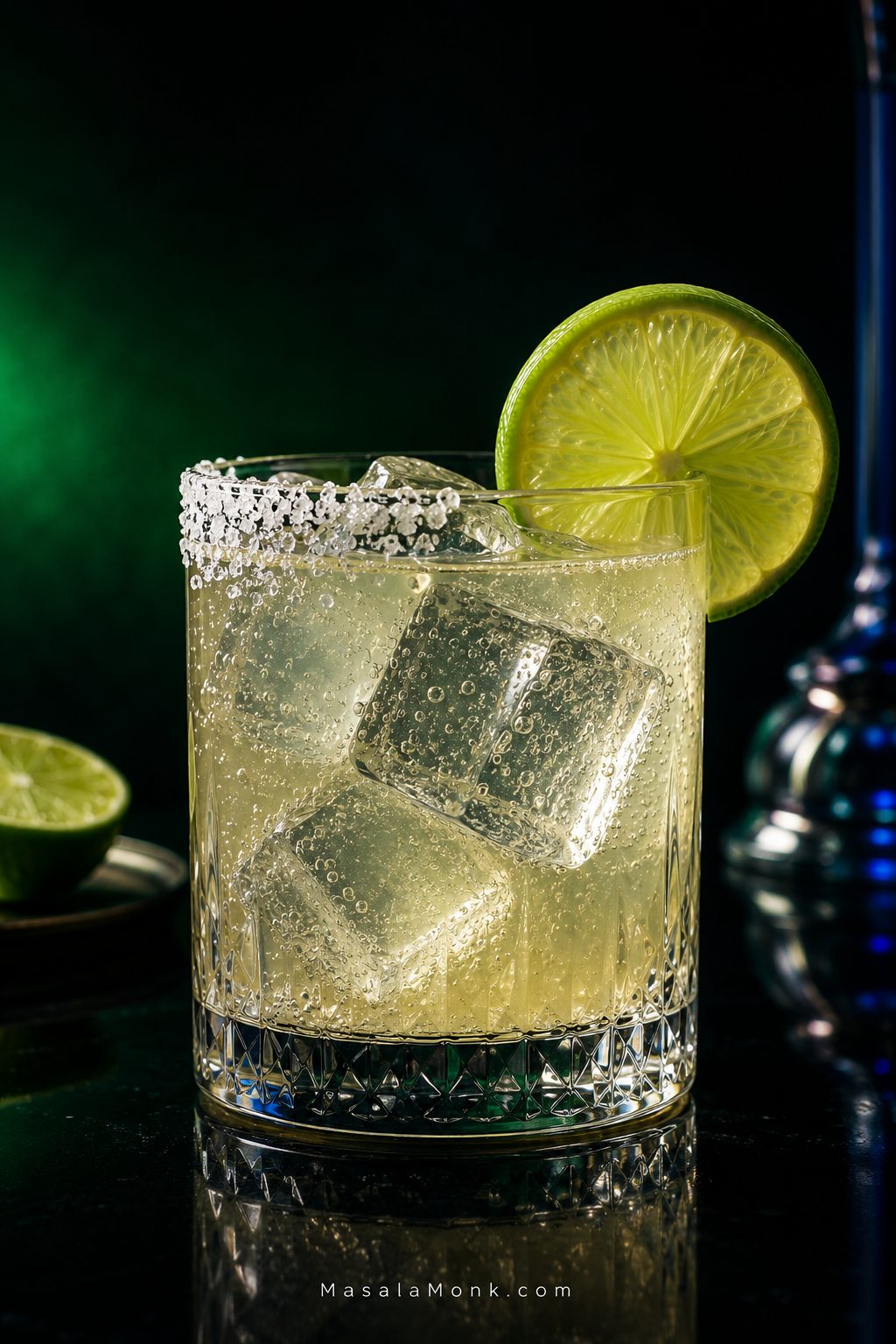
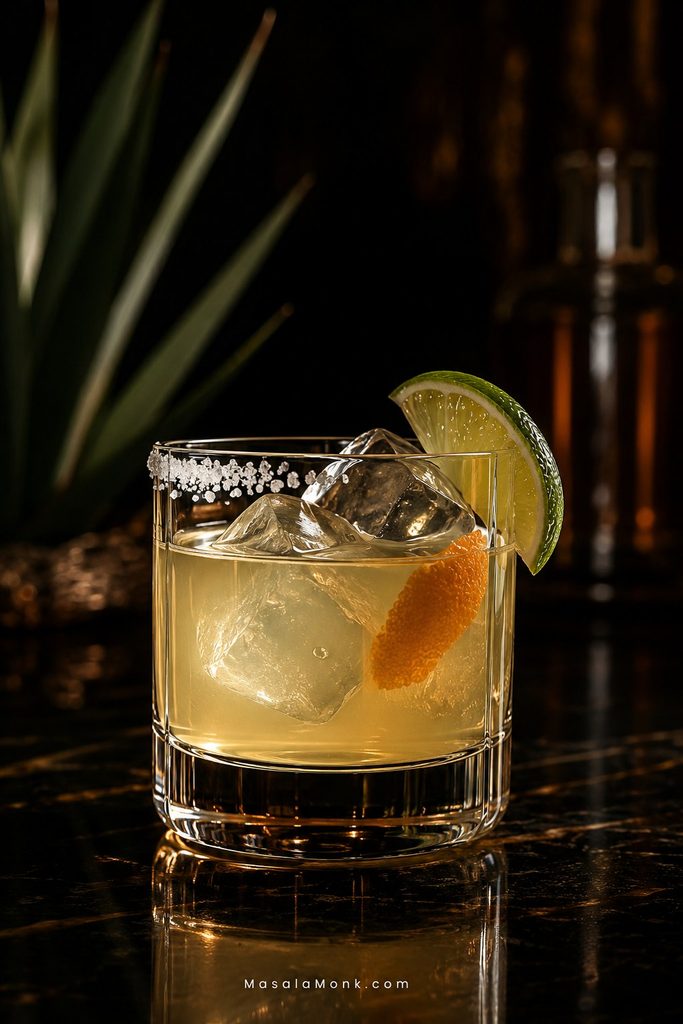
Pale lime-gold margarita mocktail in a rocks glass with large clear ice cubes, bubbles, a lime wheel and salt on half of the rim against a dark green background.

This post was last updated on:

A good margarita mocktail should taste like something you would choose to drink, not limeade wearing a salt rim.

Whatever the reason tequila is out of the glass, the margarita itself should not feel like an afterthought. You still want cold lime first, a salty edge, enough sweetness to soften the acidity, and enough character that the drink is worth lingering over.

That is where many virgin margaritas go wrong. Take tequila and orange liqueur out of a classic margarita and you lose more than alcohol: aroma, body, bitterness and some of the bite disappear with them.

You do not need a shelf full of zero-proof bottles to put those qualities back. Start with the five-minute margarita mocktail recipe below. If you like it exactly that way, you’re done. If you want it drier, spicier, frozen, fruitier or closer to a classic margarita, the rest of the guide shows you what to change and why.

The rule to remember: lime first, sweetness second, complexity third, bubbles last.

Quick Answer: How to Make a Margarita Mocktail

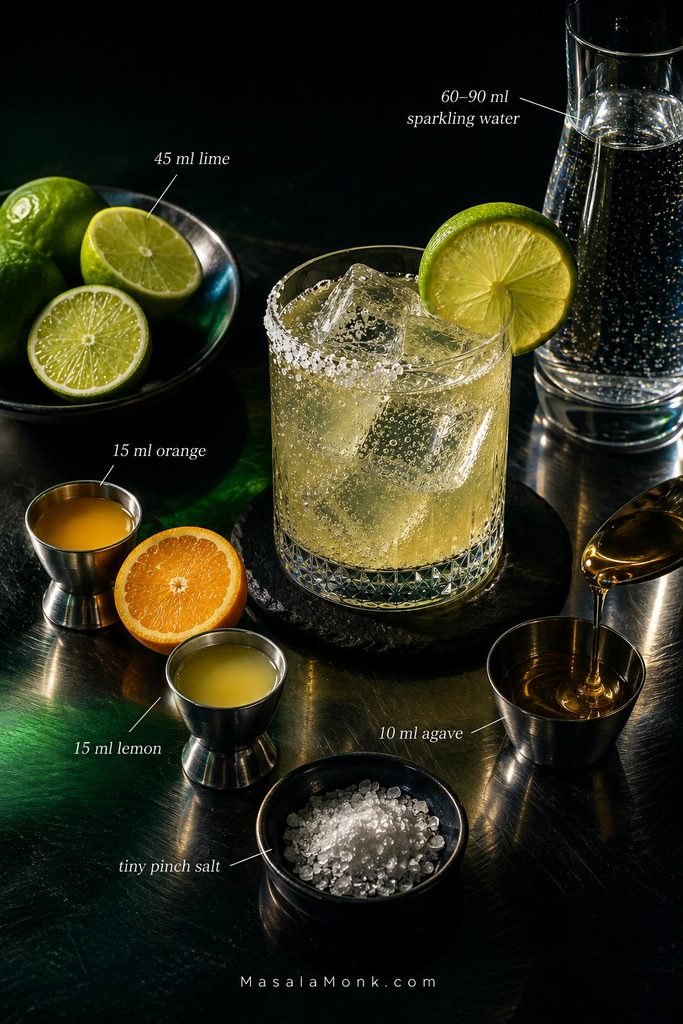
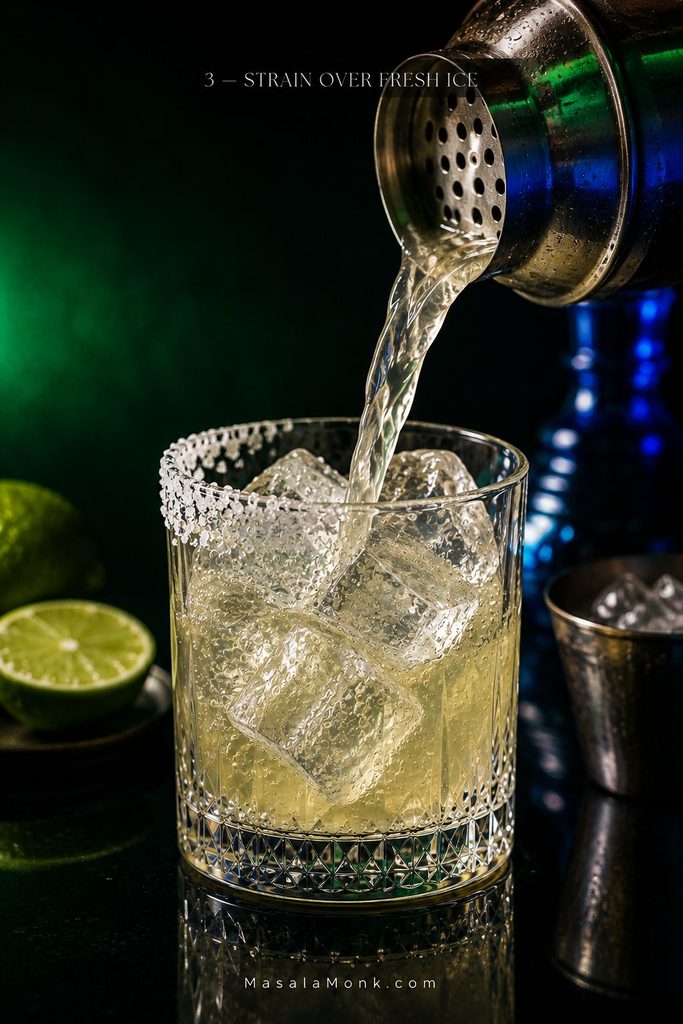
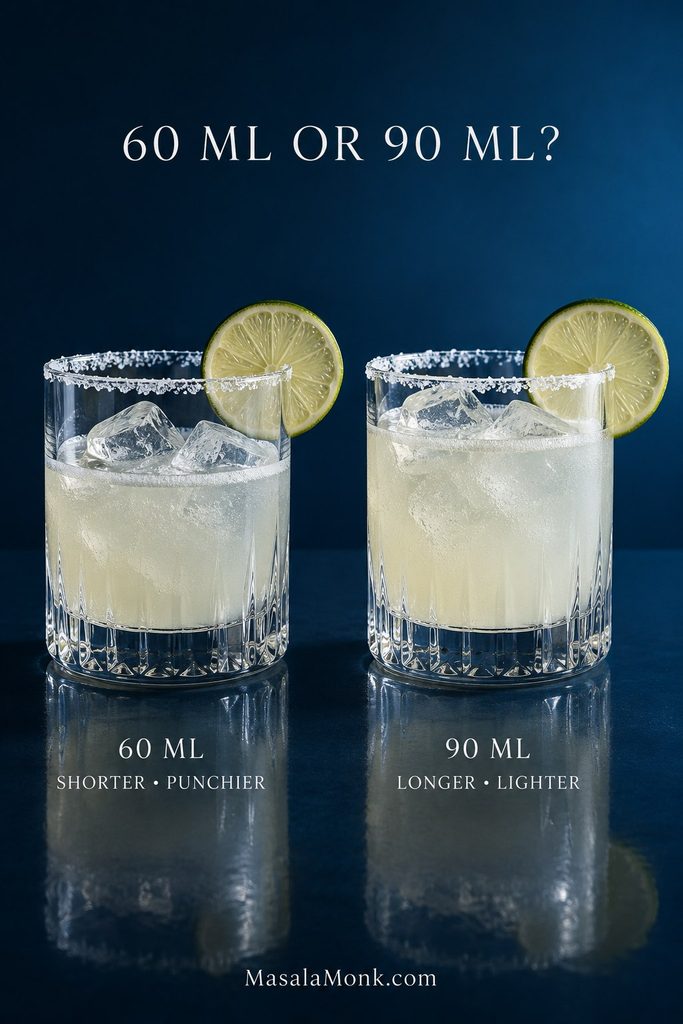
Shake 1½ oz (45 ml) fresh lime juice, ½ oz (15 ml) orange juice, ½ oz (15 ml) lemon juice, 2 teaspoons (10 ml) agave nectar and a tiny pinch of salt with ice for 10–15 seconds. Strain over fresh ice in a half salt-rimmed glass, then add 2 oz (60 ml) sparkling water for a punchier drink or 3 oz (90 ml) for a longer, lighter one. Fresh citrus varies from fruit to fruit, so make small adjustments only after the first sip.

Margarita Mocktail Recipe

Prep time: 5 minutes
Total time: 5 minutes
Yield: 1 drink
Method: Shaken
Best glass: 8–10 oz (240–300 ml) rocks glass; a margarita glass of similar capacity also works

Equipment

  • 8–10 oz (240–300 ml) rocks glass or similarly sized margarita glass
  • cocktail shaker or clean lidded jar
  • jigger or measuring spoons
  • small plate for the salt rim

Ingredients

  • 1½ oz (45 ml) fresh lime juice
  • ½ oz (15 ml) fresh orange juice
  • ½ oz (15 ml) fresh lemon juice
  • 2 teaspoons (10 ml) agave nectar, straight from the bottle
  • tiny pinch fine salt
  • 2–3 oz (60–90 ml) chilled sparkling water or club soda
  • plenty of ice
  • coarse salt, kosher salt or margarita salt, for the rim
  • lime wedge or wheel, for serving
Ingredients for a margarita mocktail arranged on a dark metal surface: lime juice, orange juice, lemon juice, agave nectar, salt, sparkling water, ice and a finished drink.
Keep the sparkling water refrigerator-cold. Starting with a cold mixer slows immediate ice melt once the margarita is built.

Method

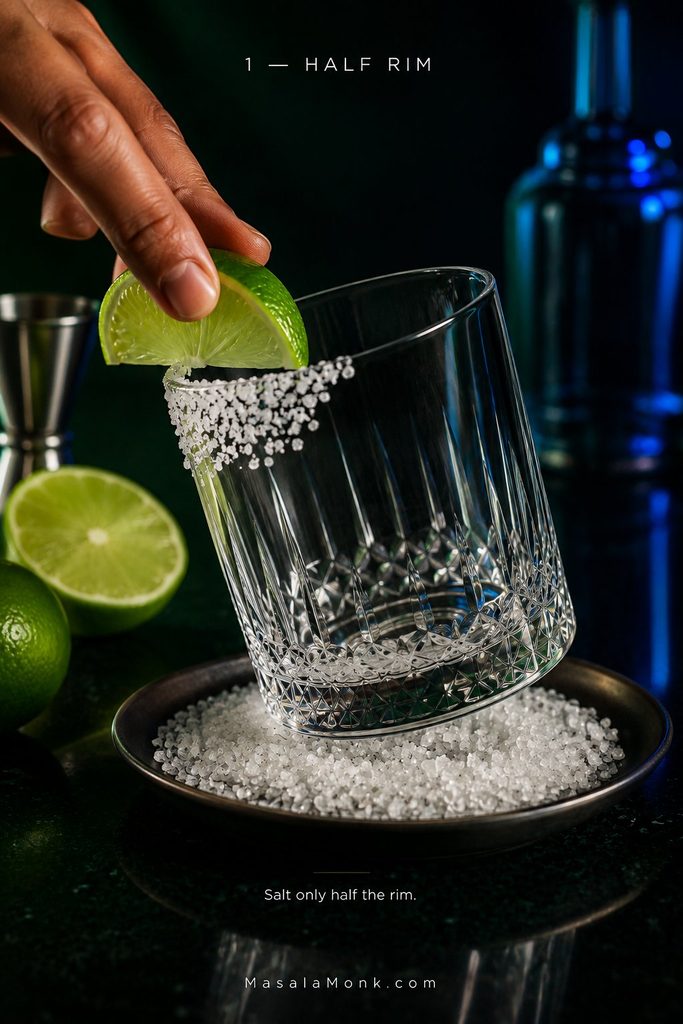
  1. Salt half the rim. Put salt on a small plate. Run a lime wedge around half of the outside edge of the glass and press that section into the salt. Fill the glass generously with fresh ice.
Hand rubbing a lime wedge along one half of the rim of a clear rocks glass above a dish of coarse salt.
Wet only the outside half of the rim. That keeps loose salt out of the drink while still letting you rotate between salted and unsalted sips.
  1. Shake the citrus base. Add the lime juice, orange juice, lemon juice, agave nectar and tiny pinch of salt to a shaker with ice.
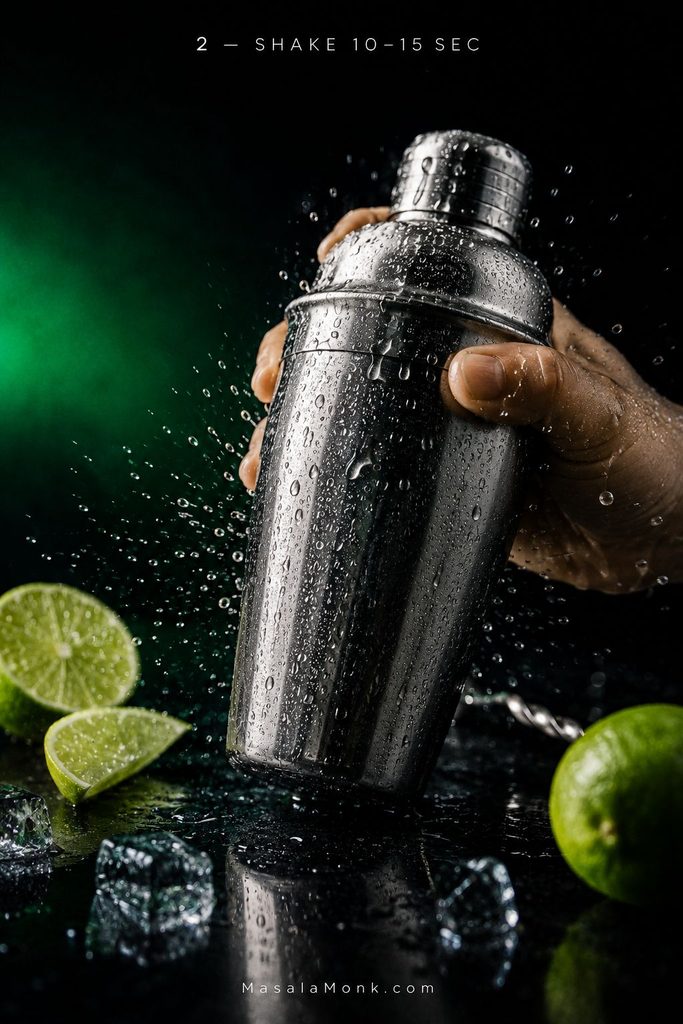
  2. Shake for 10–15 seconds. The shaker should feel thoroughly cold. Shaking chills the drink, works the thick agave into the citrus and adds enough dilution to soften the acidity.
Hands shaking a condensation-covered stainless steel cocktail shaker beside fresh limes and clear ice on a dark surface.
If cold agave clings to the jigger or spoon, rinse it into the shaker with a little citrus so the amount you measured actually reaches the drink.
  1. Strain over fresh ice. The shaker ice has already begun melting; fresh serving ice keeps the drink colder and slows further dilution.
Pale citrus margarita mixture being strained from a metal cocktail shaker into a half-salted rocks glass filled with large fresh ice cubes.
Large fresh serving cubes expose less surface area than small broken shaker ice, so they slow further dilution once the virgin margarita reaches the glass.
  1. Add the bubbles last. Pour in 2 oz (60 ml) sparkling water for a shorter, punchier drink or 3 oz (90 ml) for a lighter one. Stir gently once or twice.
  2. Take the first sip. If lime overwhelms everything else, add another teaspoon (5 ml) agave. Sweetness getting there first calls for a small squeeze of lime. When sweet and sour already feel right but the drink seems strangely empty, the answer is usually contrast rather than more syrup.

A Few Useful Notes

  • Add sparkling water only after shaking. Shaking a carbonated mixer makes a mess and wastes the bubbles you want in the finished drink.
  • Err slightly dry at first. Another teaspoon of agave is easy to add; excess sweetness is harder to undo.
  • A half rim gives you a choice. Some sips get the salty edge and some do not.
  • Keep the glass reasonably small. Filling an oversized tumbler with extra soda turns the drink into something much closer to a citrus spritz.

If you’re making one beside traditional margaritas, start with the 60 ml soda pour. It keeps the drink closer to their shorter, more concentrated feel instead of giving the alcohol-free glass twice the volume.

Two matching margarita mocktails side by side, one labeled 60 ml with a lower drink level and one labeled 90 ml with a higher drink level.
More sparkling water dilutes acidity and sweetness together, so it changes the margarita mocktail’s intensity and length more than its underlying sweet-sour ratio.

What a Good Margarita Mocktail Should Taste Like

The first sip should be properly cold and unmistakably lime-led. Orange and lemon sit underneath rather than announcing themselves as separate juices.

The agave should smooth the sharper edges without making sweetness the main event. A little salt makes the lime seem fuller, while the sparkling water lifts the finish without washing the flavor away.

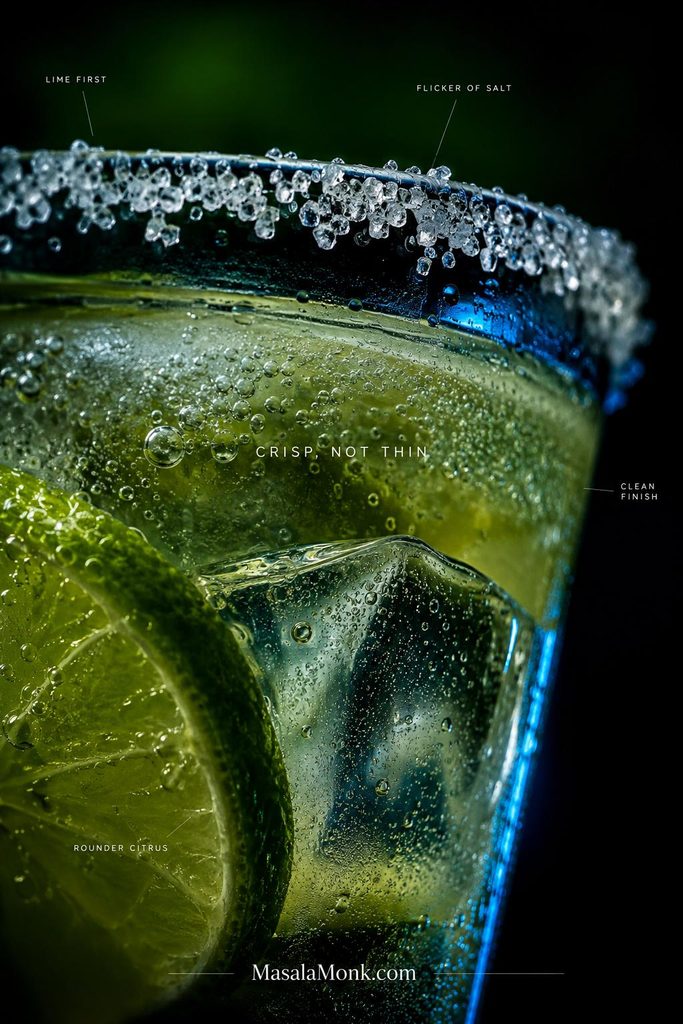
It should feel crisp rather than thin. The short shake and measured amount of soda matter to that texture just as much as they matter to the flavor.

When the balance lands, you get bright lime, a flicker of salt, rounder citrus through the middle and a clean finish that makes another sip sound good.

Extreme close-up of a margarita mocktail showing coarse salt crystals on the rim, lime, clear ice, condensation and tiny bubbles in pale citrus liquid.
Bring the fresh lime garnish close to the rim: its aroma reaches your nose with each sip and makes the citrus seem brighter before you taste it.

There is no single universal margarita target. Some people want a short, sharply lime-forward drink; others are trying to recreate the sweeter, longer margaritas they know from restaurants. Use the margarita you actually enjoy as the reference point. Once you know what each adjustment changes, you can steer the glass in that direction.

Making it right now? You can stop here. The recipe above is complete. If you’re curious about why it works—or why yours didn’t—the rest of the guide is here when you need it.

↑ Back to Recipe · Fix a drink that tastes off ↓

Margarita Mocktail Guide

Understand & Balance

Change the Drink

Batch, Shortcuts & Fixes

Why Margarita Mocktails Sometimes Taste Like Limeade

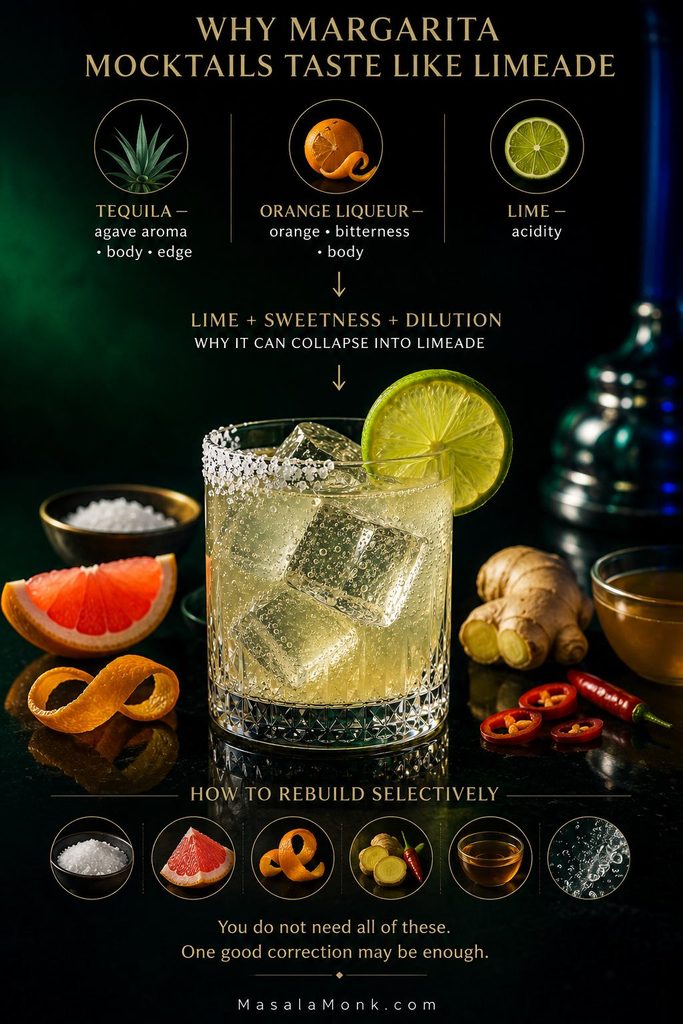
A classic margarita is doing more work than its short ingredient list suggests. Tequila supplies agave aroma, body and a peppery or vegetal edge. Orange liqueur brings concentrated orange aroma, sweetness and some bitterness.

You can see those roles clearly in a richer Cadillac Margarita, where tequila, lime and orange liqueur each have a distinct job.

Remove both alcoholic ingredients, keep the lime and sweetener, then stretch everything with water and the drink can collapse into lime + sugar + bubbles. More lime makes it sharper and more agave makes it sweeter, but neither necessarily makes it more interesting.

What is usually missing is some kind of contrast: a bitter edge, aromatic peel, a little heat, a faint dry grip, more concentration or simply the savory lift of salt. One well-chosen correction is usually enough.

Editorial guide showing tequila, orange liqueur and lime as parts of a classic margarita, then a margarita mocktail surrounded by salt, grapefruit, orange peel, ginger, chile, tea and carbonation cues.
A hollow drink can be both sweet and sour at once. Adding more of either will not create the aroma, bitterness or dry grip that is actually missing.

How to Balance a Margarita Mocktail

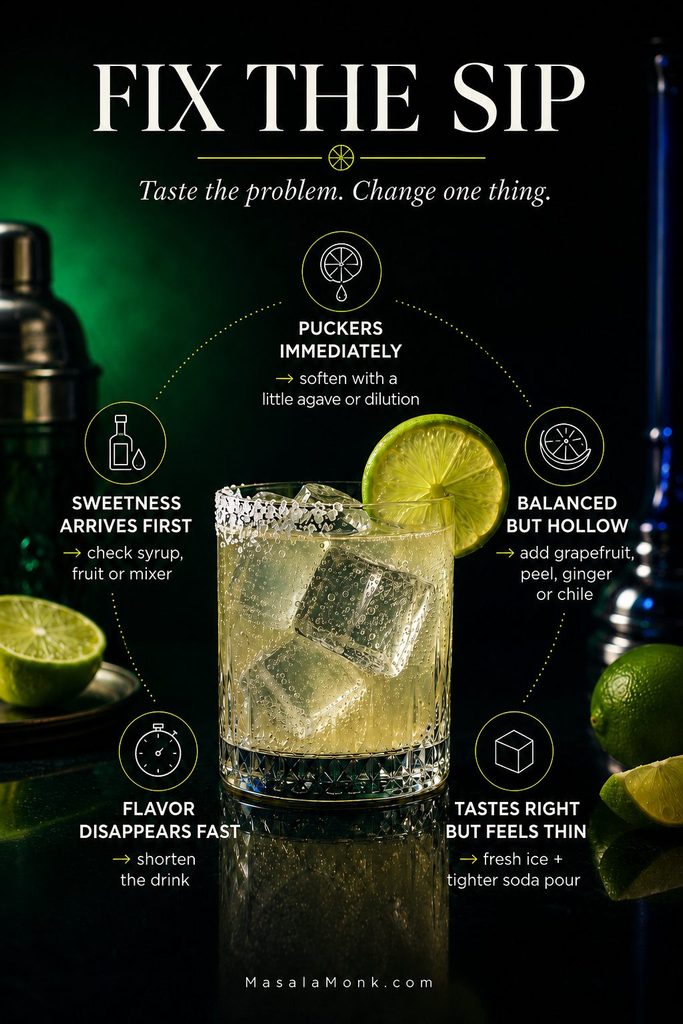
Forget the theory for a moment and pay attention to the sip in front of you.

If it makes you pucker immediately, the acidity is outrunning everything else. A little agave or controlled dilution will usually help more than another juice.

If sweetness arrives before lime, look first at the syrup, fruit or mixer. Tonic, Sprite, ginger beer and ripe fruit all bring sweetness of their own.

If sweet and sour seem balanced but the drink still feels hollow, give the finish something to hold onto. Grapefruit leaves bitterness after the lime; orange peel adds aroma before the sip; ginger or chile gives the finish a little bite.

If the flavor is good but disappears almost immediately, shorten the drink. Sometimes a perfectly good margarita base has simply been stretched too far.

If it tastes right but feels thin, fresh ice, a proper shake and a 60 ml rather than 90 ml soda top-up can make more difference than another ingredient.

Fix the sensation that is actually bothering you instead of changing three ingredients at once.

Margarita mocktail in the center of a troubleshooting guide with five taste problems and suggested adjustments arranged around the glass.
When diagnosing balance, taste from the unsalted side first; the rim changes how the lime registers and can make the baseline harder to judge.

What the Ingredients Actually Change

Lime Does Most of the Work

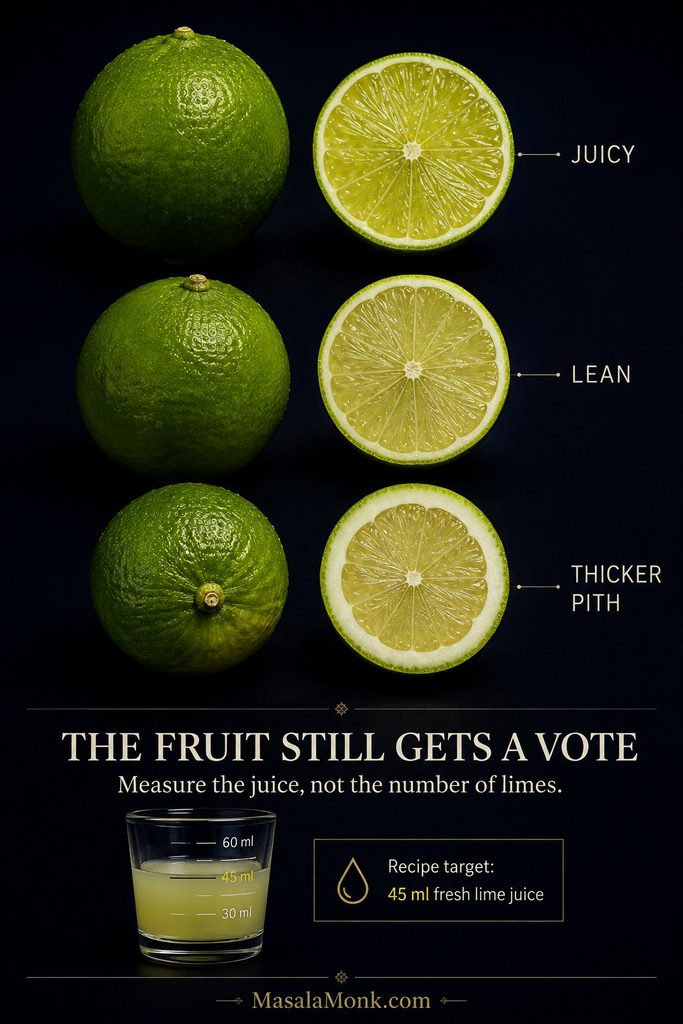
The base recipe uses 1½ oz (45 ml) fresh lime juice, enough to keep the drink unmistakably lime-led after ice and sparkling water are added.

Limes are unpredictable. One can be fragrant and juicy; the next can be lean, bitter or fiercely tart. Measuring gives you a useful starting point, but the fruit still gets a vote.

Three different limes shown whole and cut in half, including visibly juicier fruit and one with thicker white pith, beside a measure marked at 45 ml lime juice.
If one lime falls short of 45 ml, reach for another lime rather than replacing the missing volume with lemon or orange; those juices change the profile.

Fresh lime gives the cleanest flavor, though bottled lime juice can still make a useful drink when that is what you have. Bottled products vary considerably, so start with the recipe rather than trying to compensate in advance.

Orange and Lemon Stay in the Background

The small amount of orange rounds the lime and restores some of the citrus character lost with orange liqueur. Too much turns the drink orange-forward. Lemon broadens the acidity; if your limes are already especially sharp, use less lemon before reaching for more sweetener.

Agave Is Less Standard Than It Looks

The recipe uses 2 teaspoons (10 ml) agave nectar straight from the bottle. Bartender-style agave syrup is sometimes diluted with water, so the same volume may taste less sweet. That is one reason apparently identical margarita recipes can land differently.

Salt is doing something different again. The rim gives individual sips a salty edge; the tiny pinch inside the drink quietly makes the lime seem fuller. Sparkling water is mostly about length: 60 ml keeps the drink tight, 90 ml makes it lighter, and much more begins to move toward spritz territory.

Sparkling Water, Tonic, Sprite or Ginger Beer?

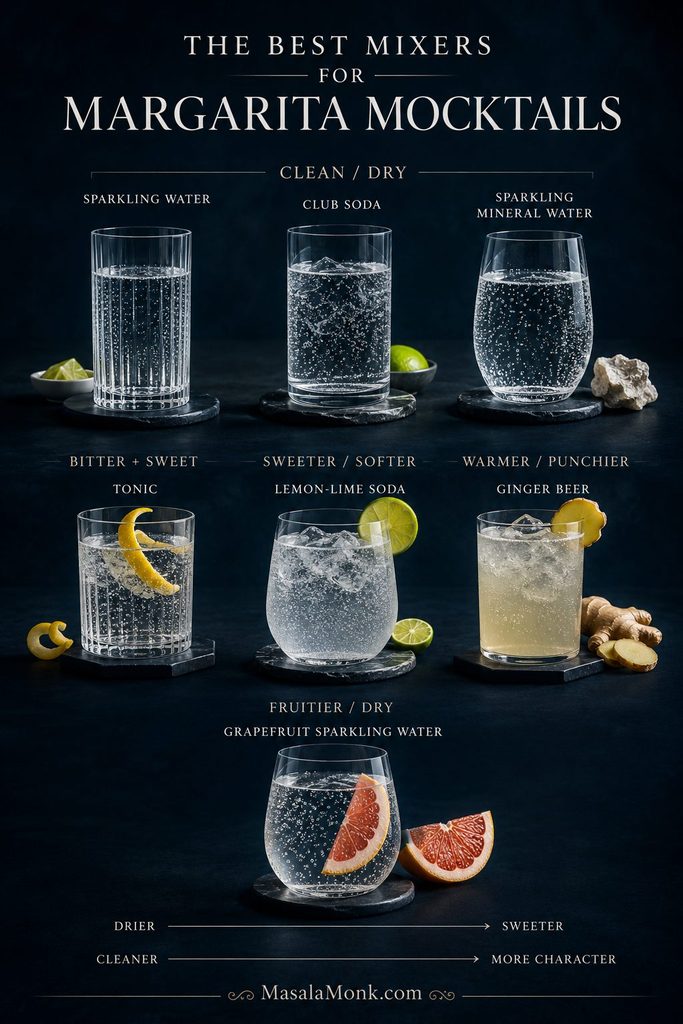
MixerWhat it addsBest when you want…
Sparkling waterClean fizz, no added sweetnessThe easiest all-purpose version
Club sodaFizz plus light mineral characterA similarly crisp drink
Sparkling mineral waterMineral character, often with lively bubblesA drier-feeling margarita
Tonic waterBitterness plus sweetnessA finish with more grip
Sprite or 7-UpFizz plus substantial sweetnessA softer, sweeter convenience version
Ginger beerSweetness plus ginger biteA warmer, punchier drink
Grapefruit sparkling waterCitrus aroma with little sweetnessA drier, fruitier direction

A classic margarita isn’t carbonated. The International Bartenders Association’s Margarita is built from tequila, triple sec and lime. Bubbles are useful in this pantry version because they replace some of the lost volume and add lift. A margarita built around a full pour of zero-proof agave spirit may need little or none.

Tonic is especially good when the lime already feels bright but the finish disappears too quickly. Its bitterness hangs around after the citrus. Because tonic is also sweet, reduce the agave rather than simply swapping it one-for-one with sparkling water.

Want Your Margarita Mocktail Drier or Less Sweet?

A drier drink is not automatically a better drink. Some margaritas are meant to be sharp and salty; others are softer and a little sweeter. The useful target is the amount of sweetness that still lets you notice lime, salt and the finish instead of tasting syrup first.

If you are using…Start here
Sparkling water or club soda2 tsp (10 ml) agave nectar
Tonic waterAbout 1 tsp (5 ml) agave or less
Sprite or 7-UpNo added agave initially
Sweet mango, pineapple or berriesAdd the fruit before deciding whether syrup is needed
Non-alcoholic tequilaAccount for any sweetness already in the spirit

Grapefruit, orange peel, chilled tea and unsweetened fizzy mixers are often more useful than piling in extra citrus. They can make the drink feel less sweet without simply making it more sour.

Seven clear mixer drinks arranged and labeled as sparkling water, club soda, mineral water, tonic, lemon-lime soda, ginger beer and grapefruit sparkling water.
Taste an unfamiliar mixer before adding it. Tonic, ginger beer and lemon-lime soda vary in sweetness and bitterness, which can change how much agave the glass needs.

Using Sprite? Jump to the sweeter version ↓

How to Add More Margarita Character Without Zero-Proof Tequila

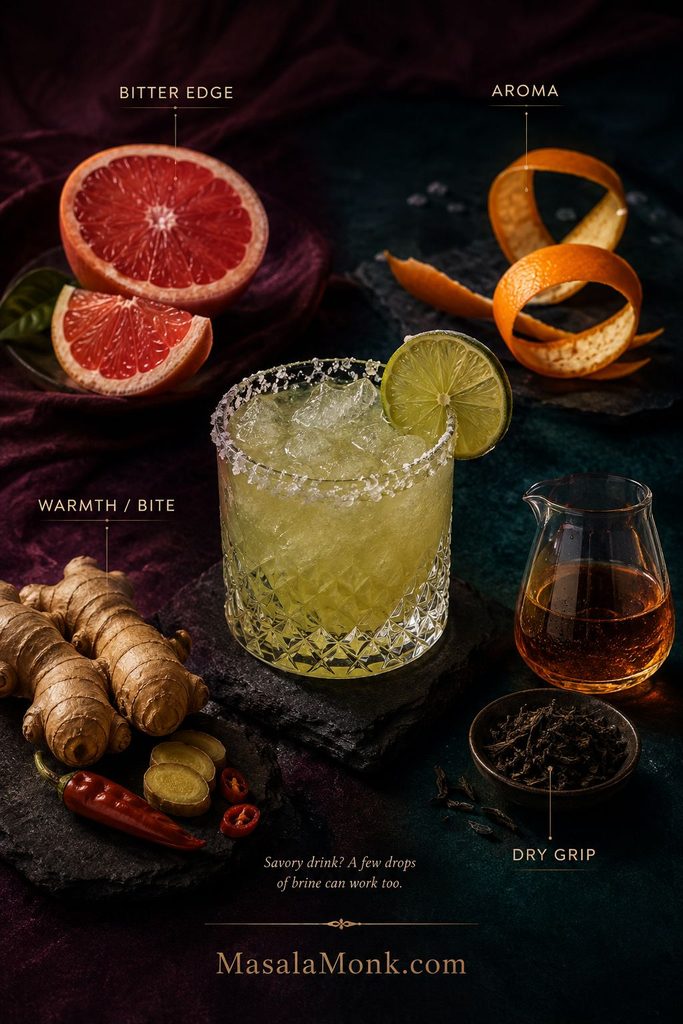
The pantry version is complete on its own. The ideas below change the personality of the drink rather than “improve” it. Pick the direction that actually sounds good to you.

Margarita mocktail surrounded by grapefruit, curled orange peel, ginger, chile and a small vessel of amber tea on a dark plum and teal set.
When you want more aroma without extra sugar or volume, expressed orange peel is a low-impact adjustment: it changes the nose more than the drink’s balance.

Grapefruit

Add about ½ oz (15 ml) fresh grapefruit juice and reduce the orange or lemon by roughly the same amount. The lime still arrives first, but grapefruit leaves a pleasantly bitter edge behind it.

If that bitter grapefruit finish is exactly what you wanted, a Paloma puts grapefruit, lime, salt and fizz at the center of the drink.

Orange Peel

Express a strip over the finished margarita. You smell orange before the first sip without adding another layer of juice or sugar. It is a small change, but it makes the glass feel noticeably more aromatic.

Ginger or Chile

A tiny amount of fresh ginger juice, ginger syrup or chile gives the finish some warmth. This is the direction to take when you want a margarita that lingers a little instead of finishing clean and disappearing.

Chilled Tea

Replace ½–1 oz (15–30 ml) of the mixer with strong chilled green tea or Earl Grey. At that amount it should not announce itself as a tea drink; it simply leaves a faint dry grip after the citrus.

If you already enjoy savory drinks, a few drops of unsweetened dill-pickle brine or olive brine can work too. Start around ⅛ teaspoon or less. This is a small adjustment, not a new main ingredient.

Margarita Mocktail With Non-Alcoholic Tequila

If what you miss is specifically the agave aroma, body and bite of tequila, a zero-proof agave spirit can be useful. This is also the version that sits most naturally beside traditional margaritas at the same table: same short-drink idea, just built around a different bottle.

Short pale-gold non-alcoholic tequila-style margarita in a heavy rocks glass with clear ice, a partial salt rim, lime and orange peel against a dark amber and green bar setting.
If you add soda to a zero-proof agave build, remember the spirit already contributes 60 ml of volume; start shorter and lengthen only after tasting.

For 1 drink

  • 2 oz (60 ml) non-alcoholic agave or tequila-style spirit
  • 1 oz (30 ml) fresh lime juice
  • ½ oz (15 ml) fresh orange juice or non-alcoholic orange liqueur
  • ¼ oz (7.5 ml) agave nectar, then adjust if needed
  • tiny pinch salt
  • ice
  • salt for the rim

Shake with ice for 10–15 seconds and strain over fresh ice. Hold back any extra agave or sparkling water until you know what the spirit has already contributed.

Taste the Bottle You Actually Bought

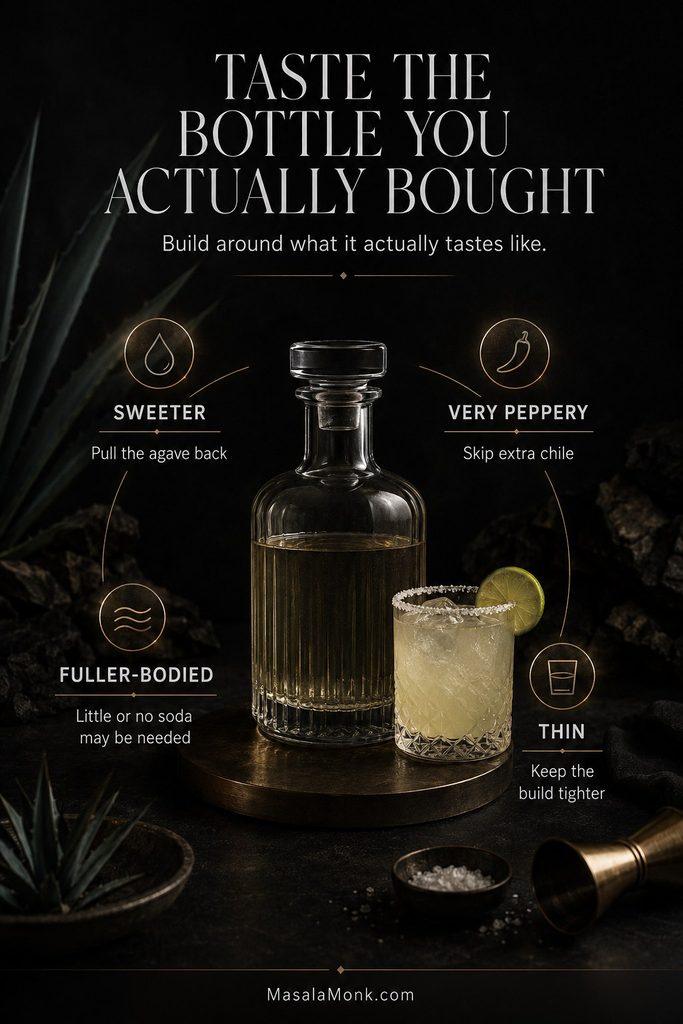
Zero-proof agave spirits vary enormously. Some are sweet, some thin, and some lean heavily on pepper or capsicum to imitate alcoholic burn. Others are grassy, smoky or aromatic.

Some bottles also taste stranger neat than they do in a margarita. Lime, salt and a little sweetness can pull those flavors together, so a spirit you would never sip by itself may still work surprisingly well once mixed.

A sweeter bottle needs less agave. Strong pepper or capsicum probably means you can skip extra chile. Fuller-bodied products may give you enough structure that soda becomes unnecessary. Work around the bottle in front of you rather than assuming every zero-proof tequila behaves the same way.

Unbranded bottle and pale margarita mocktail surrounded by four tasting adjustments labeled sweeter, very peppery, fuller-bodied and thin.
Opening an unfamiliar zero-proof bottle? Make a half-size trial drink before batching so you can learn whether it pushes sweet, peppery or thin without wasting ingredients.

What Can Replace Orange Liqueur?

The substitutes do not all do the same job. Orange juice brings flavor, sweetness and water. A strip of orange peel gives you mostly aroma. Orange blossom water is intensely floral, so think drops rather than splashes. A non-alcoholic orange liqueur is the closest single replacement, though its sweetness will depend on the bottle.

If you need the finished drink to be strictly 0.0% alcohol, check the stated alcohol content on every specialty spirit, bitters or bottled cocktail ingredient you use. The simple citrus-agave-sparkling-water recipe avoids those products entirely.

Spicy Margarita Mocktail

Jalapeño works especially well here because it brings fresh green-pepper flavor as well as heat. The best version gives you cold lime and salt first; the warmth catches up a moment later and lingers through the finish.

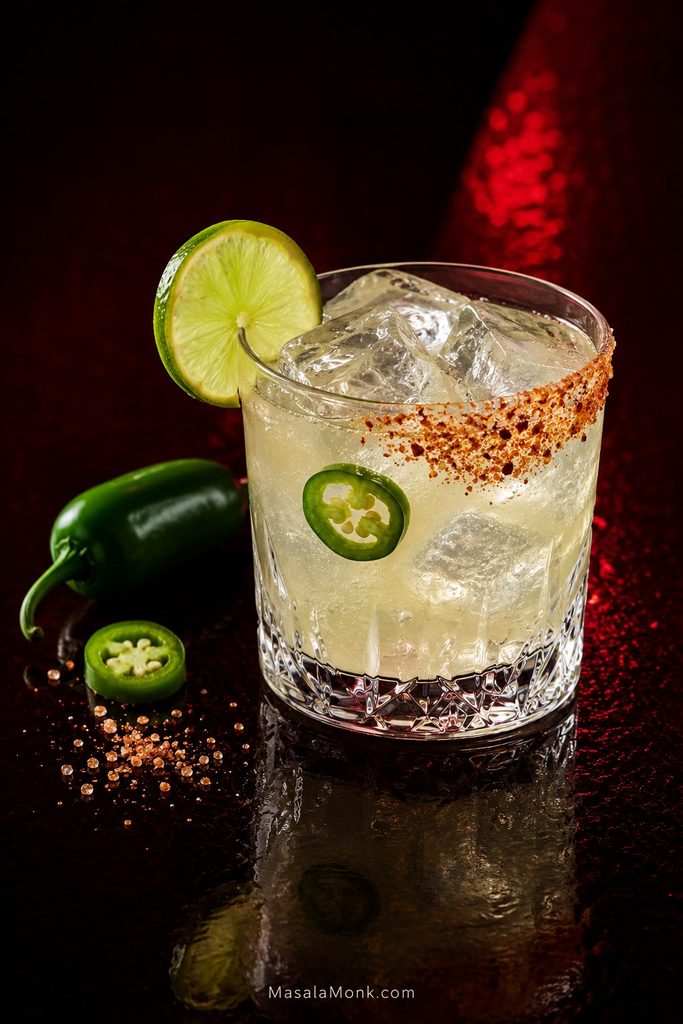
Pale spicy margarita mocktail with clear ice, lime, a jalapeño slice and a partial red chile-salt rim on a glossy dark red background.
A chile-salt rim makes heat optional from sip to sip, whereas jalapeño infused into a spicy margarita mocktail changes the character of the entire glass.

For 1 drink

  • 1½ oz (45 ml) fresh lime juice
  • ½ oz (15 ml) fresh orange juice
  • ½ oz (15 ml) fresh lemon juice
  • 2 tsp (10 ml) agave nectar
  • 1–3 thin jalapeño slices
  • tiny pinch salt
  • 2–3 oz (60–90 ml) sparkling water
  • Tajín or chile salt, for the rim

Add the citrus, agave, salt and jalapeño to the shaker.

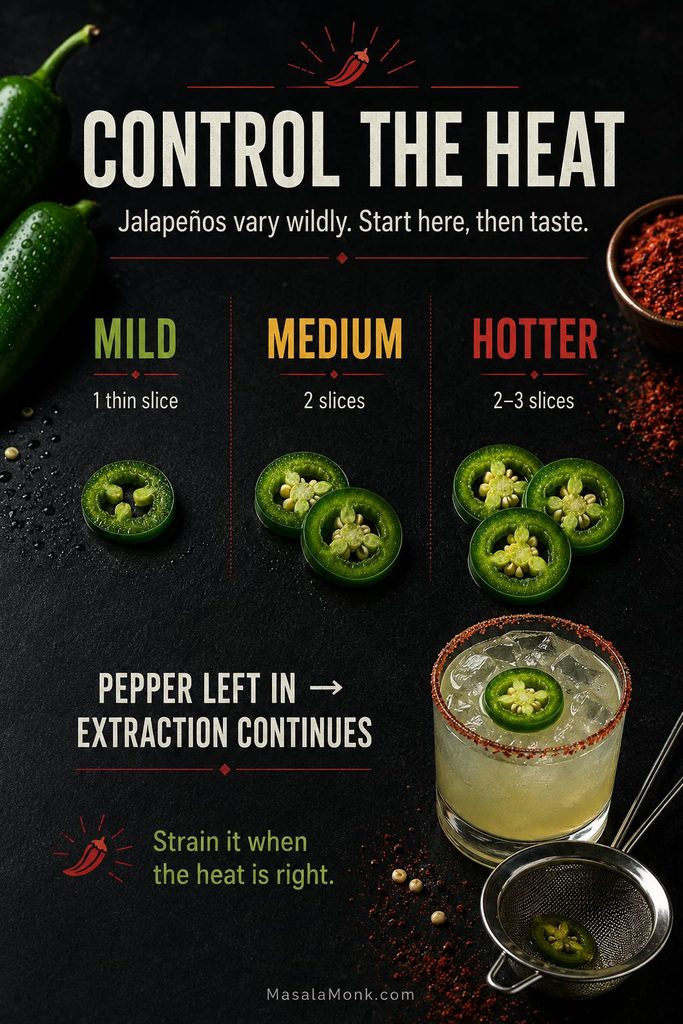
  • Mild: 1 thin slice, lightly muddled
  • Medium: 2 slices
  • Hotter: 2–3 slices with a firmer muddle

Jalapeños vary wildly in heat, so those counts are starting points rather than guarantees. Shake with ice, strain over fresh ice and add the sparkling water last.

Fine-straining also stops pepper pieces from sitting in the drink and continuing to release heat. Leave them in and the last sip can be considerably hotter than the first.

Jalapeño heat guide showing one slice for mild, two slices for medium and two to three slices for hotter, alongside a spicy margarita mocktail and fine strainer.
Keep the jalapeño slices similarly thin when comparing heat levels; otherwise, slice thickness becomes another variable alongside the number of pieces.

If chile is the part you want to emphasize, the Spicy Margarita gets much more specific about jalapeño intensity, Tajín and heat control.

Hot Honey Shortcut

Hot honey makes a rounder, warmer spicy margarita than plain agave. Thin it with a little warm water, let the syrup cool, then use it instead of agave. Straight honey is much harder to incorporate evenly into an ice-cold drink.

Making spicy margaritas for a crowd? Jump to the pitcher method ↓

Frozen Margarita Mocktail

A frozen margarita needs its own formula because blended ice is a major ingredient, not merely a way to chill the drink. As that ice breaks down, it adds water to every other flavor.

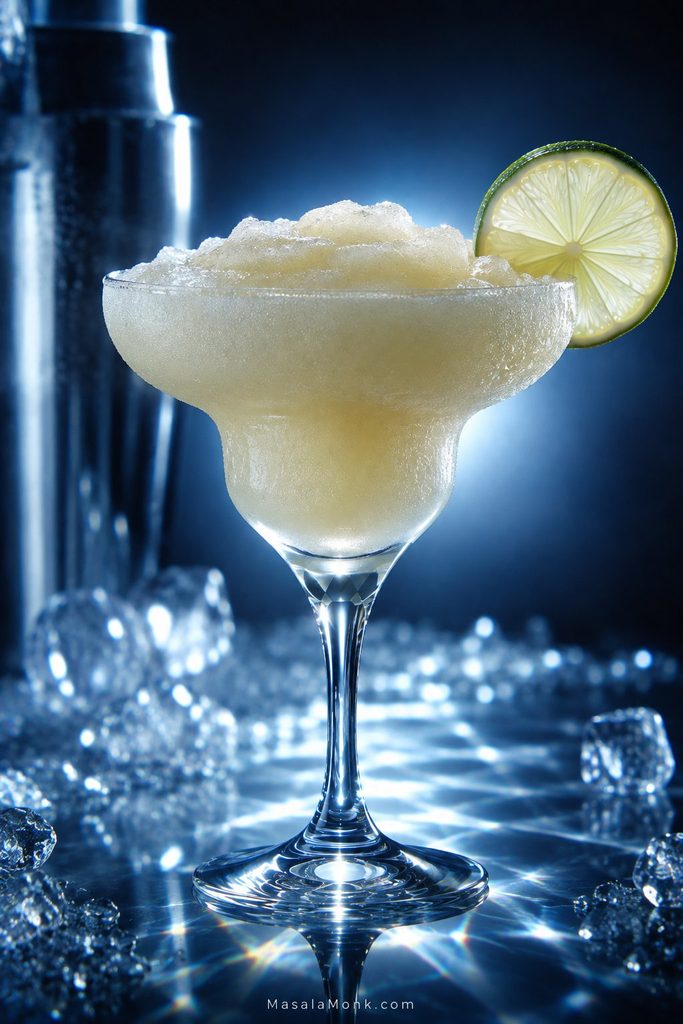
Pale frozen margarita mocktail with a softly mounded slushy texture in a stemmed margarita glass, garnished with lime against a blue and chrome background.
Judge a frozen margarita mocktail by how the slush moves, not by a fixed blender time: machine power and ice size can change how quickly the right texture appears.

For 1 generous frozen margarita

  • 1½ oz (45 ml) fresh lime juice
  • ¾ oz (22 ml) fresh orange juice
  • ½ oz (15 ml) fresh lemon juice
  • ½ oz (15 ml) agave nectar
  • tiny pinch salt
  • about 1½ cups standard ice cubes
  • up to 1 tbsp (15 ml) cold water, only if the blender needs it

Add the liquids and salt first, then the ice. Blend only until smooth and slushy, then stop. Once the texture is right, leaving the blender running only gives the mixture more time to warm and the ice more time to melt.

The right texture should look almost a little too thick when it first leaves the blender, then relax into a smooth slush as you drink it. It should move slowly in the glass without becoming spoonable.

Start Cold

Fridge-cold citrus, cold agave and a chilled glass give you a head start. Warm ingredients force more ice to melt before the margarita is properly cold, making a thin texture more likely.

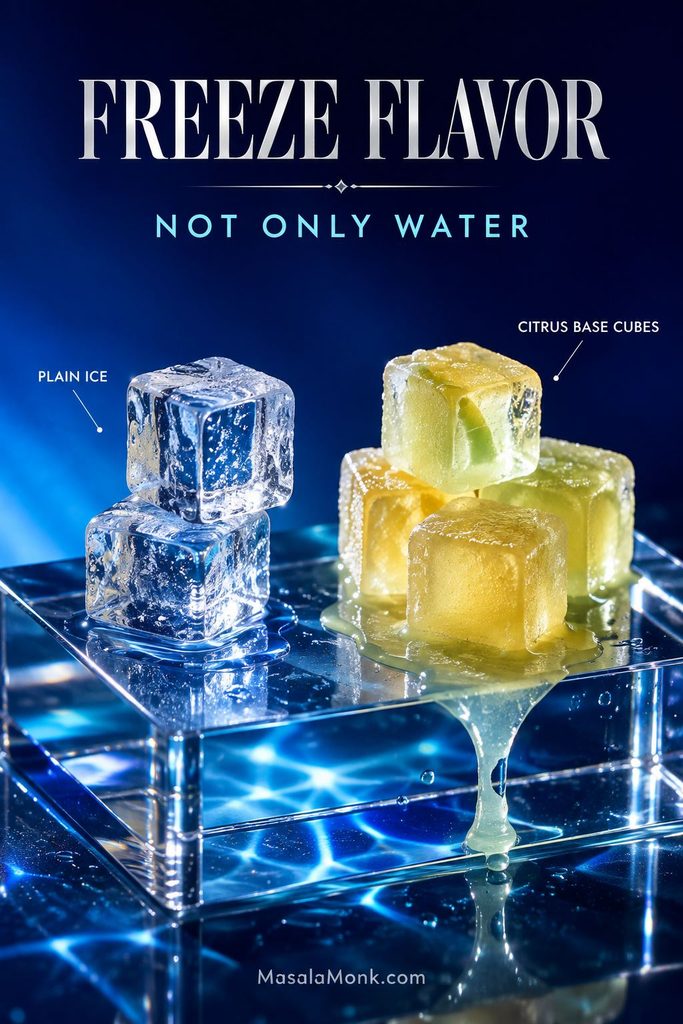
Freeze Flavor, Not Only Water

Freeze some of the citrus base into cubes and replace part of the plain ice with them. As those cubes melt, they add margarita rather than plain water.

Clear plain ice cubes beside pale yellow-green frozen citrus-base cubes melting on a transparent acrylic block under blue studio lighting.
Freeze the citrus base in small, repeatable portions; then you can replace plain ice consistently instead of guessing how much concentrated flavor went into the blender.

Frozen mango brings body as well as sweetness; in a Mango Margarita, enough lime keeps that richness lively rather than heavy.

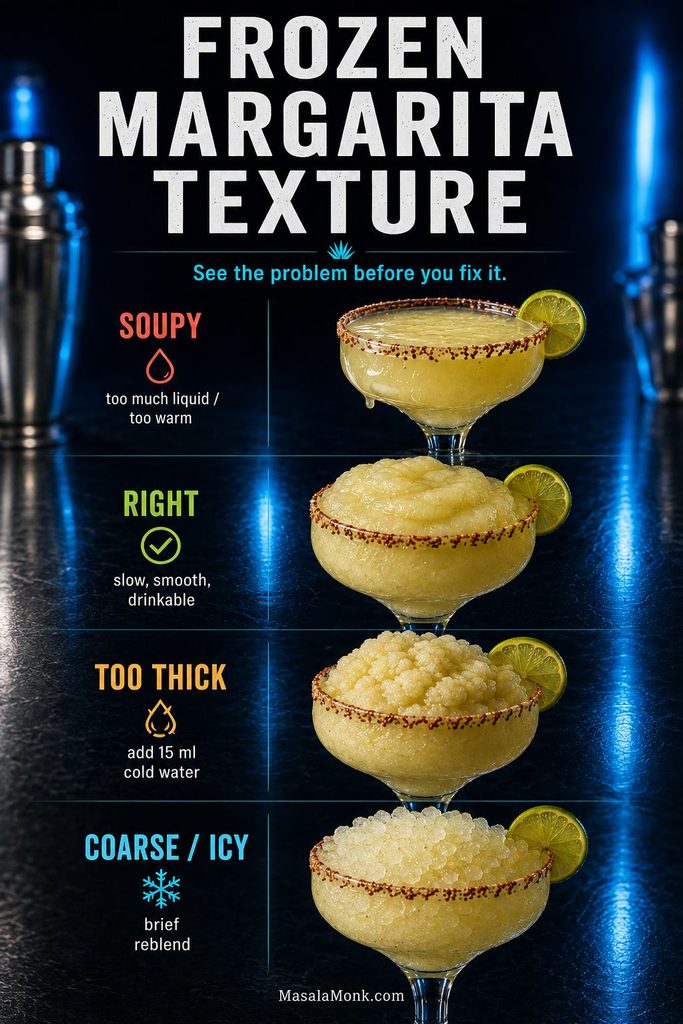
Frozen Margarita Troubleshooting

It is soupy

There is too much liquid for the amount of ice, or everything started too warm. Before blending, the ice should sit substantially above the liquid rather than floating freely in a large pool.

Add a modest amount of ice and pulse briefly. Getting close to the right ratio from the beginning works better than repeatedly feeding fresh ice into a mixture that has already warmed.

It is too thick or the blender will not move

Add 1 tablespoon (15 ml) cold water and blend briefly. Repeat only if the mixture still refuses to move.

It tastes watery

Try a squeeze of lime and a tiny pinch of salt before reaching for more syrup. Next time, make the base stronger or replace some plain ice with frozen citrus or fruit cubes.

It is coarse and icy

The ice may not be breaking down finely enough, or the mixture may need a little more liquid to settle into a smooth slush. Blend again briefly, adding liquid a tablespoon at a time if necessary.

The ice and liquid separate quickly

Frozen margaritas naturally begin separating as they warm. Start colder, use enough ice and serve promptly. Fruit purée can add useful body in fruit versions too.

Four frozen margaritas showing soupy, correct smooth slush, too-thick and coarse icy textures, with a short correction beneath each state.
Fix texture before sweetness. Extra juice or syrup adds more liquid, so adjusting flavor first can make an already loose frozen margarita even looser.

↑ Back to Frozen Margarita · Try a fruit variation ↓

Margarita Mocktail Pitcher for 8

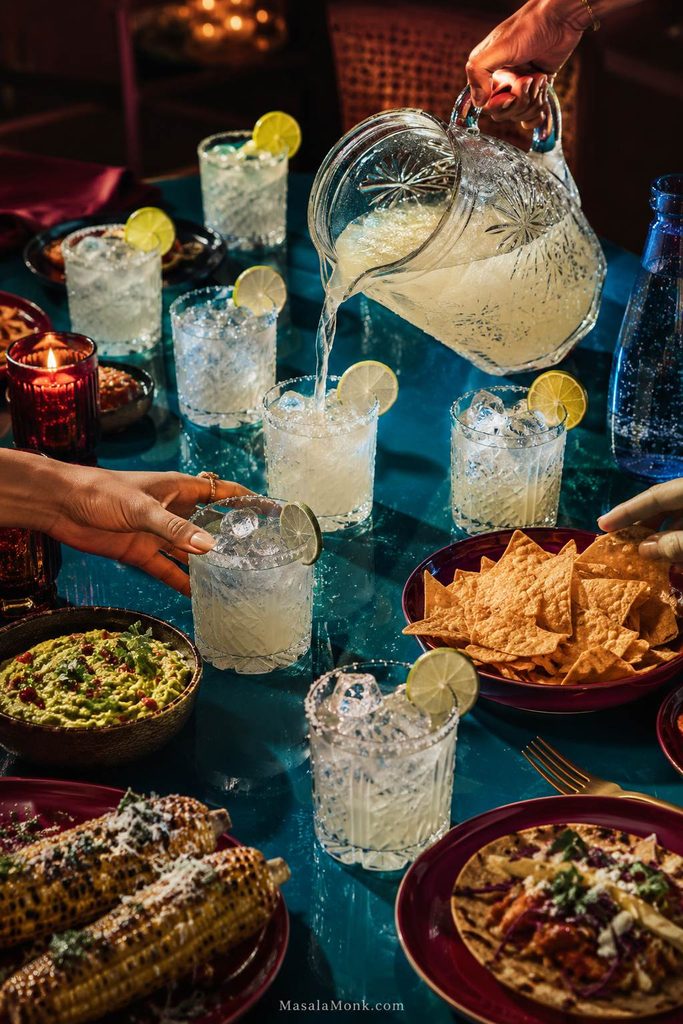
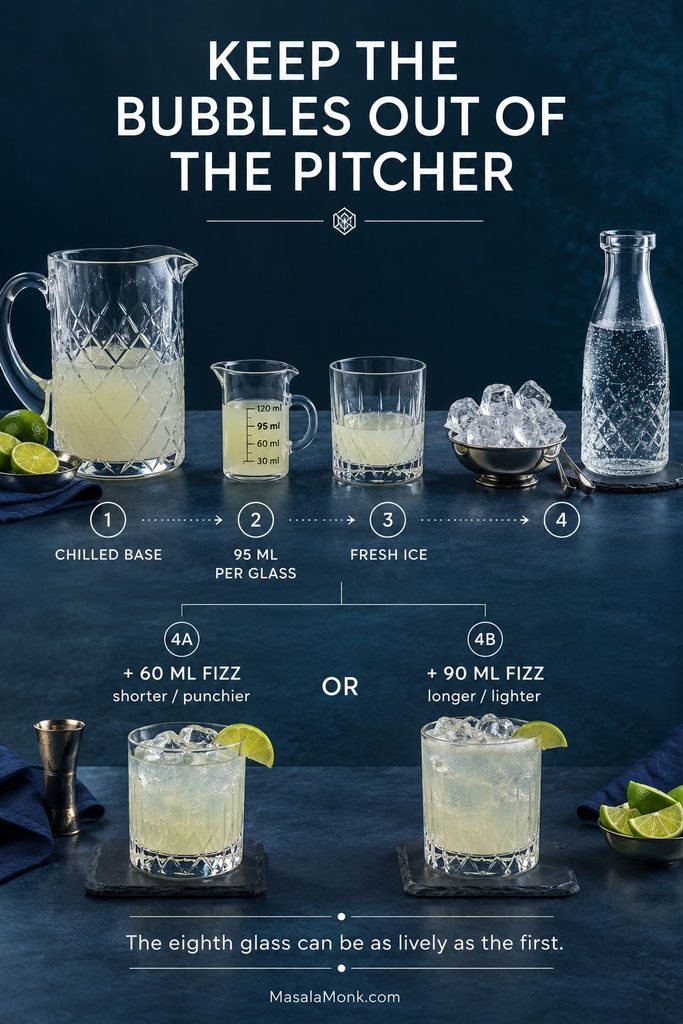
For a party, make the still base ahead with a little cold water to replace some of the dilution you would normally get from shaking eight individual drinks. Keep the sparkling water and serving ice separate until you’re actually pouring glasses.

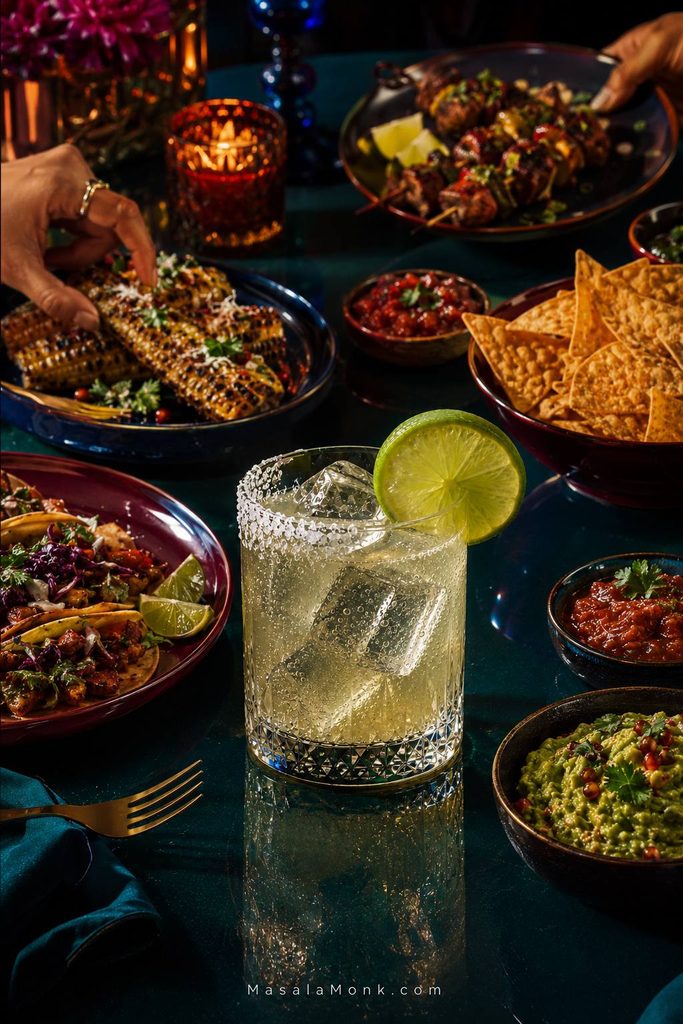
Hand pouring pale margarita mocktail base from a large crystal pitcher into glasses around a teal dinner table with chips, guacamole, grilled corn and other food.
Chill the empty pitcher before adding the margarita base. That protects serving temperature without quietly adding more water to the batch through extra ice.

Chilled Base for 8 Drinks

  • 12 oz (360 ml) fresh lime juice
  • 4 oz (120 ml) fresh orange juice
  • 4 oz (120 ml) fresh lemon juice
  • ⅓ cup (80 ml) agave nectar
  • ⅓ cup (80 ml) cold water
  • ⅛ teaspoon fine salt to start, with up to ¼ teaspoon total if needed

Whisk thoroughly, cover and refrigerate until very cold. You’ll have about 26 oz (760 ml) of base, enough for eight pours of roughly 3¼ oz (95 ml) each.

The chilled base should taste a little concentrated because every glass still has ice and sparkling water ahead of it. Lime can be assertive without feeling punishing, while the salt should stay in the background.

To Serve Each Glass

  1. Rim the glass close to serving time and fill it with fresh ice.
  2. Pour in about 3¼ oz (95 ml) chilled margarita base.
  3. Add 2–3 oz (60–90 ml) chilled sparkling water.
  4. Stir gently and garnish with lime.
Pitcher serving guide showing chilled margarita base, a 95 ml measure, fresh ice, a separate sparkling-water bottle and two finished glasses with 60 ml or 90 ml fizz.
Open the sparkling water near serving time and stir only gently; extra agitation spends carbonation before the margarita mocktail even reaches the table.

Keeping the carbonation separate means the eighth glass can be as lively as the first. That matters even more when some people want the short 60 ml top-up and others prefer the lighter 90 ml version—you do not have to commit the whole table to one margarita.

If getting ahead makes hosting easier, prepare the citrus base up to about 24 hours before serving. Keep it covered and refrigerated; save the ice and bubbles for the glasses.

For a spicy batch, add jalapeño to the still base and monitor the heat. Remove the pepper when it reaches the level you want because it will keep extracting while it sits.

Fruit Margarita Mocktails

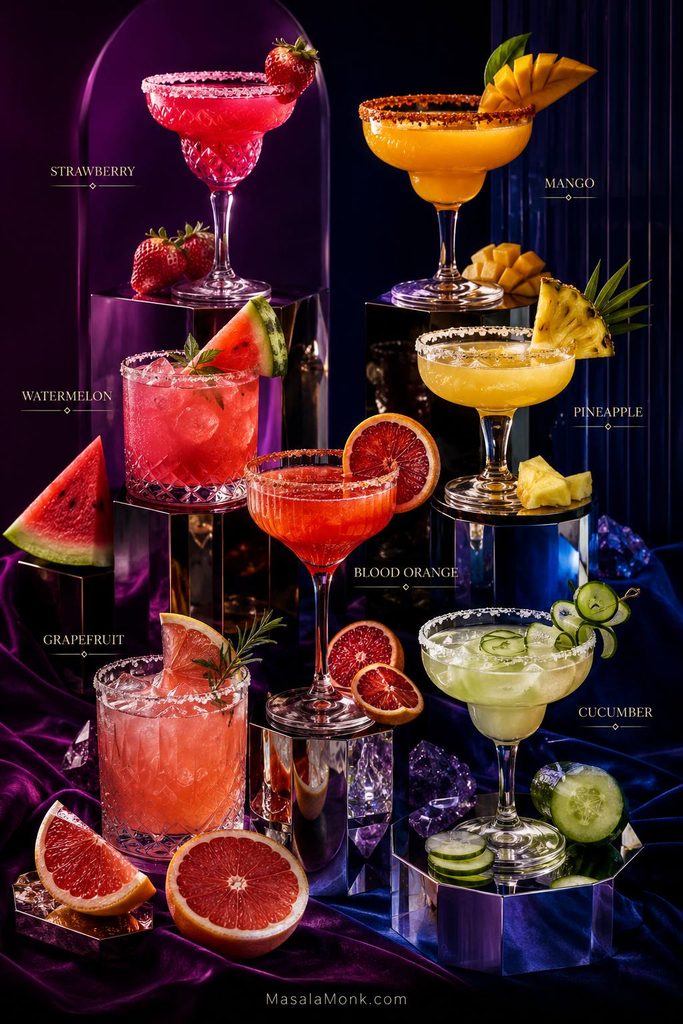
Fruit versions change the personality of the drink quickly: strawberry makes it softer, mango fuller, watermelon lighter and grapefruit drier. The method barely changes; the balance does.

VariationAddWatch for
Strawberry2–3 muddled ripe berriesVery ripe berries may make extra agave unnecessary
Mango1½–2 oz (45–60 ml) mango nectar or puréeKeep enough lime to stop mango overwhelming the citrus
Watermelon3–4 oz (90–120 ml) fresh watermelon juiceUse less soda because watermelon contributes plenty of water
Pineapple1–2 oz (30–60 ml) pineapple juiceExtra agave may not be necessary
Blood orangeReplace regular orange with blood orangeKeep lime clearly in front
Grapefruit½–1 oz (15–30 ml) fresh grapefruit juiceReduce another citrus component rather than simply adding more juice
Cucumber3–4 muddled slicesFine-strain if you want a cleaner texture
Seven fruit margarita mocktails displayed on jewel-toned pedestals and labeled strawberry, mango, watermelon, pineapple, blood orange, grapefruit and cucumber.
Fruit changes texture as well as flavor. Fine-strain fruit margarita mocktails for a cleaner sip, or keep some pulp when extra body is part of the appeal.

Watermelon is particularly easy to wash out because the fruit contributes so much liquid of its own. A Watermelon Margarita works best when the lime stays assertive and the final fizz stays under control.

Margarita Mocktail With Sprite

This is the easy, sweeter version. If that is the margarita you actually want, there is no need to apologize for it—just let the soda supply the sugar instead of adding agave on top.

  • 1½ oz (45 ml) fresh lime juice
  • ½ oz (15 ml) fresh orange juice
  • tiny pinch salt
  • 3–4 oz (90–120 ml) chilled lemon-lime soda
  • ice

Shake the lime, orange and salt with ice, strain over fresh ice and add the soda last. Fresh lime matters especially here because it stops the sweet mixer from becoming the whole drink.

Margarita Mocktail Without Orange Juice

If orange is the part you do not want, leave it out rather than trying to hide it under more lime. The result is leaner, sharper and more lime-forward.

  • 1½ oz (45 ml) fresh lime juice
  • 2 teaspoons (10 ml) agave nectar
  • ½ oz (15 ml) grapefruit juice, optional
  • tiny pinch salt
  • 2 oz (60 ml) sparkling water

Shake the still ingredients with ice, strain over fresh ice and add the sparkling water. A strip of orange peel expressed over the top gives you orange aroma without putting orange juice back into the drink; skip the peel too if you want the cleanest lime-only direction.

Practical Shortcuts & Ingredient Swaps

A margarita is not a test of how well stocked your kitchen is. Fresh citrus and a shaker help, but neither is worth abandoning the drink over.

Using Bottled Margarita Mix

First check the label and make sure you’re holding an alcohol-free margarita mixer rather than a premixed alcoholic margarita. Then see whether it is a concentrate that needs diluting or a ready-to-use mixer that is already quite sweet.

With a concentrate, follow the label’s dilution instructions first, then add fresh lime, ice and a salt rim before deciding it needs anything else.

For a sweet ready-to-use mix, replacing roughly one-third of the pour with unsweetened sparkling water is a useful first move. Fresh lime can sharpen it from there. Brands vary too much for that ratio to be a law.

No Cocktail Shaker?

A clean jar with a secure lid works well: shake the citrus, agave, salt and ice, strain into the glass, then add sparkling water.

You can also build the drink directly in the glass. Stir the citrus, agave and salt together first, add plenty of ice and stir until cold, then finish with sparkling water. You lose a little aeration, not the entire drink.

Swap by Function

  • Need sweetness? Simple syrup, honey syrup or cooled hot-honey syrup can replace agave.
  • Need orange aroma? Try orange peel, zest, a few drops of orange blossom water or non-alcoholic orange liqueur.
  • Need a drier finish? Tonic, grapefruit or strong chilled tea can help.
  • Need fizz? Club soda, mineral water, tonic, grapefruit sparkling water, ginger beer and lemon-lime soda all work, but they do not contribute the same sweetness.
  • Need bite? Use a little ginger, jalapeño, hot honey or a peppery zero-proof spirit.

Margarita Mocktail Troubleshooting

Come back here when the drink is close but not quite right. Fix the problem you can actually taste first rather than changing several things at once.

ProblemFirst fix
Too sourAdd 1 tsp (5 ml) agave
Too sweetAdd a small squeeze of fresh lime
Tastes like limeadeAdd contrast with tonic, grapefruit, ginger, a tiny salt adjustment or a zero-proof spirit
Orange dominatesReduce orange juice and use peel for aroma instead
Mostly tastes like sodaUse less carbonated mixer
WateryUse less mixer and fresh serving ice
FlatUse fresh carbonation; a tiny pinch of salt may also help the flavor
Too bitterWork out whether tonic, grapefruit, lime pith, brine or the zero-proof spirit is responsible before adding sugar
Too saltyDrink from the unsalted side or dilute/rebuild the glass
Non-alcoholic tequila tastes too pepperyUse less, rebalance around it or make the pantry version instead
Not enough biteAdd a very small amount of ginger or chile
Far too spicyRemove or strain the pepper and dilute the drink
Pitcher has gone flatKeep carbonation separate and add it per glass
Spicy pitcher keeps getting hotterStrain the jalapeño once the heat is right

Sour and Bitter Are Not the Same Problem

Sour is mostly acidity. When lime makes your mouth pucker before anything else gets a chance to register, a little sweetness or controlled dilution can bring the glass back into balance.

Bitter can come from tonic, grapefruit, lime pith, a strongly flavored zero-proof spirit or too much brine. Adding syrup to that problem can leave you with a drink that is both sweet and bitter, so find the source first.

↑ Back to Recipe · ↑ Quick Answer

Frequently Asked Questions

Is a virgin margarita the same as a margarita mocktail?

In everyday use, virgin margarita, non-alcoholic margarita and margarita mocktail usually describe the same broad idea: a margarita-style drink made without tequila or orange liqueur. Recipes range from simple citrus-and-soda drinks to versions built with zero-proof agave spirits.

Does this margarita mocktail contain alcohol?

The basic citrus-agave-sparkling-water recipe uses no alcoholic ingredient. Specialty products sold as non-alcoholic spirits, bitters or cocktail substitutes can vary, so check the stated alcohol content on the individual product whenever an exact 0.0% drink matters to you.

Can I leave out the lemon juice?

Yes. Lemon broadens the citrus, but the drink still works without it. Leave it out, make the lime-and-orange base, and change something only if the finished glass actually needs it.

How much juice is in one lime?

It varies considerably. A medium juicy lime may give roughly 1 oz (30 ml), while another may give much less. Measuring the juice is more reliable than building the recipe around a fixed number of limes.

What to Serve With a Margarita Mocktail

Part of the pleasure of a margarita is the table around it: something salty, something spicy, a cold glass that lasts long enough to eat with. Creamy guacamole with tortilla chips is one of the simplest pairings because lime and salt already connect the food and drink.

Quesadillas, grilled corn, nachos, grilled vegetables, spicy chicken, shrimp, bean dips and fruit salsas fit naturally too. A chile-and-Tajín rim is particularly good when the food brings a little sweetness.

For dinner, Fish Tacos are an easy match: flaky fish, cabbage, lime crema and jalapeño give the cold margarita plenty of richness and spice to cut through.

Margarita mocktail on a dark teal dinner table surrounded by tacos, grilled corn, tortilla chips, salsa, guacamole and skewered grilled food, with hands reaching toward the dishes.
At the table, use the half-salted rim strategically: sip from the unsalted side with salty chips, then rotate toward salt alongside sweeter or richer bites.

A margarita mocktail does not have to convince anyone that tequila is hiding in the glass. It needs to give you the part you came for: bright lime, a salty edge, enough character to slow down and enjoy it, and a second sip that sounds better than the first. Once you know which adjustment changes which part of that experience, you can make the glass your own.

Made it your own? Tell me what made the difference for you—less agave, tonic, extra grapefruit, jalapeño, a frozen version, or something completely different.

Back to Recipe ↑ · Back to Top ↑

Posted on — 2 Comments

Beat the Heat with These 7 Low-Sugar Summer Mocktails to Keep You Refreshed All Day

LOW-SUGAR SUMMER MOCKTAILS

As summer heats up, staying hydrated becomes a priority—but plain water can get boring fast. Instead of reaching for sugar-laden sodas or juices, why not explore the vibrant world of low-sugar mocktails? These refreshing drinks are packed with natural flavors, are easy to make, and are perfect for all-day sipping without the crash.

In this blog post, we dive deep into seven practical and delicious low-sugar summer mocktails that are guaranteed to cool you down and delight your taste buds. Plus, we’ll share tips on prepping in batches, customizing flavors, and adding that special twist for guests.


1. Ginger-Thyme Sparkling Lemonade

Flavor Profile: Herbaceous, citrusy, lightly sweet

Ingredients:

  • 2 cups water
  • 2/3 cup honey or stevia syrup (adjust to taste)
  • 12 sprigs fresh thyme
  • 3 tbsp chopped fresh ginger
  • 2 tbsp lemon zest
  • 3/4 cup fresh lemon juice
  • 2 liters sparkling water

Method:

  1. In a saucepan, combine water, honey, thyme, ginger, and lemon zest.
  2. Bring to a simmer for 5-7 minutes to infuse flavors. Cool and strain.
  3. Mix in the lemon juice.
  4. Pour over ice and top with sparkling water. Garnish with thyme.

Pro Tip: Prepare the ginger-thyme base in advance and refrigerate. Add fizz just before serving.


2. Sparkling Cranberry Kombucha Mocktail

Flavor Profile: Tart, effervescent, probiotic

Ingredients:

  • 3/4 cup cranberry kombucha
  • 1/2 cup 100% cranberry juice (no sugar added)
  • 1/4 cup ginger beer (low sugar)
  • Fresh rosemary and cranberries (optional)

Method:

  1. In a tall glass, mix kombucha and cranberry juice.
  2. Add ginger beer and ice.
  3. Garnish with a rosemary sprig and a few frozen cranberries.

Health Note: Kombucha adds gut-friendly probiotics, while cranberry offers antioxidants.


3. Sparkling Apple-Cider Citrus Cooler

Flavor Profile: Crisp, tangy, slightly sweet

Ingredients:

  • 1 cup chilled sparkling apple cider (unsweetened)
  • Orange, lime, and grapefruit slices
  • Fresh rosemary sprigs
  • Sparkling water

Method:

  1. Fill a pitcher with sliced citrus and rosemary.
  2. Add apple cider and top with sparkling water.
  3. Serve chilled in glasses with fruit slices.

Pro Tip: Freeze sliced citrus in ice cubes for a show-stopping presentation.


4. Sugar-Free Grapefruit & Ginger Refresher

Flavor Profile: Tart, peppery, clean

Ingredients:

  • 1 cup fresh grapefruit juice
  • 2 tbsp organic ginger juice or freshly grated ginger
  • 1 cup natural ginger ale or club soda
  • Lime wedge and mint leaves (optional)

Method:

  1. Combine grapefruit juice and ginger juice in a shaker with ice.
  2. Shake and pour into a glass.
  3. Top with ginger ale. Garnish with lime and mint.

Variations: Add a splash of cucumber juice for a cooling effect.


5. Watermelon-Mint Cooler

Flavor Profile: Sweet, refreshing, cooling

Ingredients:

  • 3 cups fresh watermelon chunks
  • 1/4 cup fresh lime juice
  • 1/2 cup fresh mint leaves
  • 1 tbsp agave or stevia (optional)
  • 2 cups club soda

Method:

  1. Blend watermelon, mint, lime juice, and sweetener until smooth.
  2. Strain if desired.
  3. Pour into glasses over ice, top with club soda.

Batch Tip: Store watermelon base in the fridge and mix with soda just before serving.


6. Mojito-Style Lime Mint Fizz

Flavor Profile: Zesty, bubbly, classic

Ingredients:

  • 1 lime (cut into wedges)
  • Fresh mint leaves (about 1/4 cup)
  • Stevia or monk fruit sweetener (to taste)
  • Sparkling water
  • Crushed ice

Method:

  1. Muddle lime and mint with sweetener in a glass.
  2. Add ice and top with sparkling water.
  3. Stir and garnish with mint sprig.

Serving Tip: Serve in tall glasses for the full mojito feel.


7. Blueberry Lemonade Sparkler

Flavor Profile: Fruity, tangy, elegant

Ingredients:

  • 1 cup fresh blueberries (mashed or blended)
  • 1/2 cup fresh lemon juice
  • 1/3 cup maple syrup or stevia
  • 4 cups sparkling water
  • Mint leaves for garnish

Method:

  1. Blend blueberries and strain to remove skins.
  2. Mix with lemon juice and sweetener.
  3. Pour into glasses with ice and top with sparkling water.
  4. Garnish with mint and whole blueberries.

Tips for Customizing Your Summer Mocktails

  • Sweeteners: Swap out honey or maple syrup for monk fruit, stevia, or erythritol to lower sugar.
  • Herbs: Mix and match herbs like basil, thyme, or lavender.
  • Ice Cubes: Freeze fruit pieces or herbs into ice cubes for added flavor.
  • Infusions: Steep herbs or fruits in hot water, then chill for enhanced flavor.

Batch Prep & Storage Ideas

  • Prepare syrup bases and juices ahead of time and store in airtight containers.
  • Keep garnishes prepped in the fridge: sliced fruits, washed herbs.
  • Only mix with sparkling water or soda right before serving to maintain fizz.

Final Thoughts

Low-sugar mocktails are more than just a healthier choice; they’re an invitation to get creative with flavors, textures, and presentation. Whether you’re lounging by the pool, hosting a barbecue, or just need something fun to sip on during a hot afternoon, these mocktails bring hydration, elegance, and joy to your glass—without the sugar spike.

Cheers to staying cool, refreshed, and sugar-smart this summer!

1. Can I make these mocktails completely sugar-free?
Yes, all the mocktails in the post can be made sugar-free by using natural sugar substitutes like stevia, monk fruit, or erythritol instead of honey or maple syrup.


2. Are these mocktails suitable for people with diabetes?
Most of these mocktails can be adapted for diabetic diets by using low-GI sweeteners and avoiding fruit juices high in sugar. Always consult with a healthcare provider if you’re unsure.


3. How long can I store the mocktail bases?
You can refrigerate the fruit or herb-infused syrups and purees for up to 3–5 days in airtight containers. Always add sparkling components just before serving to maintain fizz.


4. What’s the best way to batch prep for a party?
Prepare all the fruit purees, infused syrups, and garnishes ahead of time. Store them separately and mix with sparkling water or club soda just before serving.


5. Can I turn these mocktails into cocktails?
Absolutely! You can add a splash of vodka, gin, or rum to most of these mocktails to create light summer cocktails for adult gatherings.


6. Are these drinks kid-friendly?
Yes, all the mocktails are alcohol-free and use whole ingredients, making them perfect for kids. Just adjust tartness and sweetness to suit their taste.


7. Can I use frozen fruit instead of fresh?
Yes. Frozen fruit works well, especially for blending or as ice cubes in the drink. It can also add extra chill and minimize dilution.


8. What sparkling water should I use?
Any unflavored or naturally flavored sparkling water, club soda, or seltzer is ideal. Just watch for added sugars or artificial ingredients in flavored versions.


9. Do I need special tools to make these?
Basic kitchen tools like a blender, shaker, muddler, strainer, and a citrus juicer will cover everything. No bar kit required!


10. Can I substitute herbs like mint or thyme with others?
Yes. You can experiment with basil, rosemary, lavender, or even sage depending on the mocktail. Each adds a unique twist.