Posted on Leave a comment

Spicy Margarita Recipe

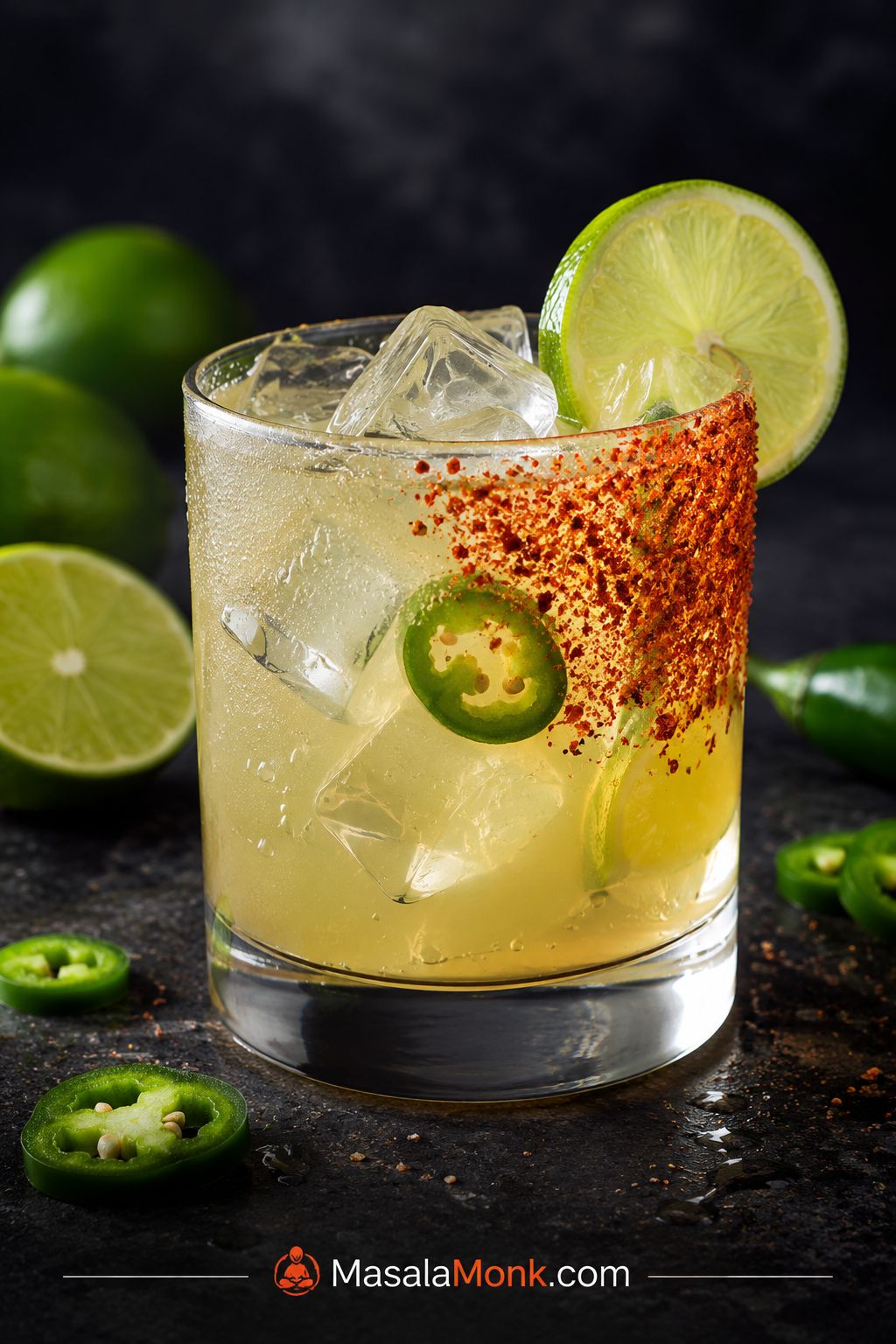
Spicy margarita on the rocks with a half Tajín rim, lime garnish, jalapeño slice, clear ice, and condensation on the glass.

A spicy margarita should hit cold first, then lime-bright, then finish with a clean jalapeño kick and a salty chili-lime edge from the rim. This version keeps the classic margarita balance — tequila, just-squeezed lime juice, orange liqueur, and just enough agave — while making the pepper easy to adjust.

The trick is not simply adding more jalapeño. A great spicy margarita recipe needs the right ratio, enough citrus, just enough sweetness to soften the pepper, and a rim that supports the cocktail instead of taking over every sip. That is why this recipe uses a half Tajín rim, 2–3 seedless jalapeño slices, and a clear heat ladder for mild, medium, hot, or restaurant-style heat.

The result is sharp, cold, lightly sweet, and spicy in the right place — not a cocktail that burns before you can taste the lime.

Start with the quick ratio when you want one drink now, then use the heat levels, half-rim tips, pitcher timing, frozen texture notes, and zero-proof or lower-sugar versions when you want to adjust the drink.

Spicy Margarita Guide

Use this guide to jump to the part you need, whether you are mixing one glass, choosing the right heat level, rimming the glass, or making a pitcher.

Quick Answer: Spicy Margarita Ratio

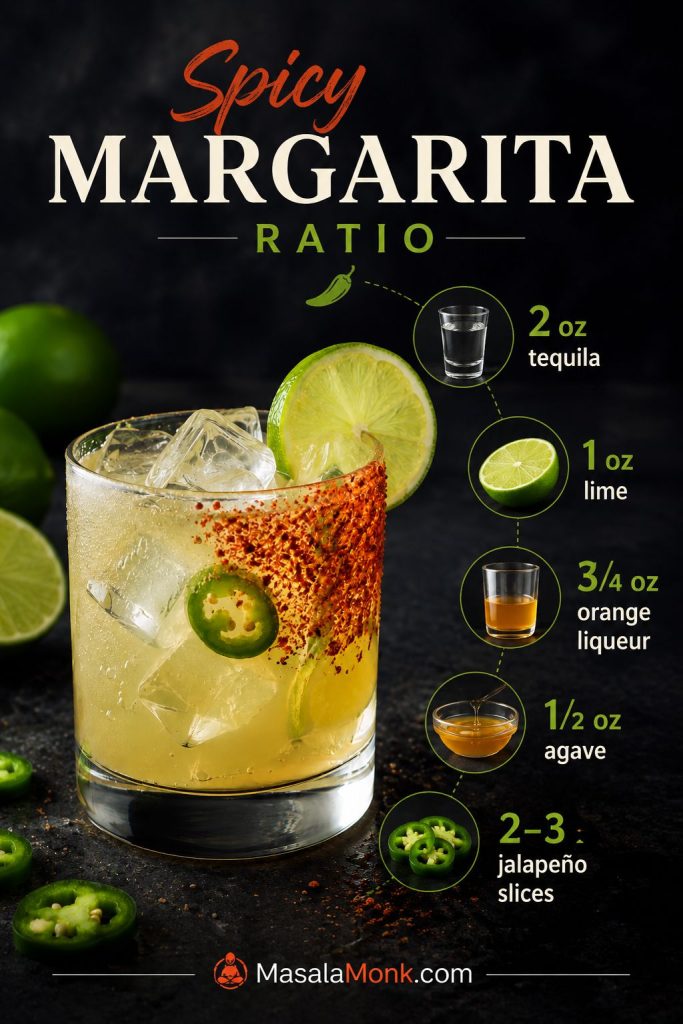
For one balanced spicy margarita, shake 2 oz blanco tequila, 1 oz fresh lime juice, ¾ oz orange liqueur, ½ oz agave syrup, and 2–3 thin jalapeño slices with ice. Strain over fresh ice into a rocks glass with a half Tajín rim.

This main version is a spicy margarita on the rocks, not a frozen margarita. Shaking and straining over fresh ice gives you a colder, cleaner, more classic margarita.

Start with 2 seedless jalapeño slices if you are unsure. Shake them without muddling for a gentler margarita, or muddle them lightly for more heat. The first sip should taste like a margarita; the pepper should arrive at the end.

For a milder or hotter version, adjust the jalapeño method before changing the recipe ratio.

Ingredient Amount Why it matters
Blanco tequila 2 oz / 60 ml Gives the cocktail its agave backbone.
Fresh lime juice 1 oz / 30 ml Brings the sharp citrus structure a margarita needs.
Orange liqueur ¾ oz / 22 ml Rounds the lime without making the pour too sweet.
Agave syrup or simple syrup ½ oz / 15 ml Softens the lime and jalapeño heat.
Jalapeño 2–3 thin slices Adds adjustable pepper heat.
Tajín or chili-lime salt About 1 tbsp / 8–10 g Creates the salty, spicy, limey rim.
Spicy margarita ratio board showing tequila, lime juice, orange liqueur, agave syrup, jalapeño slices, and Tajín.
Use this spicy margarita ratio as your baseline before adjusting heat, sweetness, or the rim; it keeps tequila, lime, and jalapeño in balance.

Spicy Margarita at a Glance

Start here if you want the safest first round: cold, citrusy, lightly sweet, and spicy without going overboard.

Best tequilaBlanco tequila
GlassRocks glass
RimHalf Tajín rim
Heat2–3 seedless jalapeño slices
Shake time15–20 seconds
ServeOver fresh ice
Make aheadMix base first; add jalapeño later
Best garnishLime wedge or jalapeño slice

What Is a Spicy Margarita?

A spicy margarita is a classic margarita with a heat source added. Most home versions use sliced jalapeño, so a spicy margarita and a jalapeño margarita often mean almost the same thing: tequila, lime juice, orange liqueur, a little sweetener, ice, and jalapeño shaken together.

The best versions do not taste like jalapeño juice. They taste like a classic margarita first, with a pepper finish that makes the next sip more tempting.

Some versions use serrano, chili syrup, hot sauce, or spicy infused tequila. However, jalapeño is the easiest place to start because you can adjust the cocktail by changing the number of slices, removing the seeds and membrane, or deciding whether to muddle the pepper or simply shake it with the liquid.

You may also see this style called a chili margarita or chilli margarita. The idea is the same: a lime-forward margarita with a spicy edge, usually finished with salt, Tajín, or a chili-lime rim.

If you like the tequila-and-citrus side of this cocktail but want something lighter and fizzier next time, MasalaMonk’s Paloma recipe is the natural next pour.

Why This Recipe Works

The reason this version works is that the heat is treated like seasoning, not the main event. You still get the snap of lime, the clean pull of tequila, the soft orange roundness, and that salty chili-lime edge from the rim.

The jalapeño shows up at the finish, where it should — enough to make the next sip tempting, not so much that the cocktail turns into a dare. Shake the slices without muddling for a gentle tingle, muddle them lightly for medium heat, or use a short tequila steep for a smoother restaurant-style spicy margarita.

Meanwhile, the half Tajín rim gives you a salty chili-lime sip when you want one, while leaving part of the glass clean. That is what keeps this margarita party-friendly: people get a pepper kick, not a mouthful of raw chile.

The best starting point

Begin with 2 seedless jalapeño slices, a half Tajín rim, and the base ratio in this recipe. Taste the margarita before making the next round hotter. Jalapeños can vary a lot from one pepper to the next.

Spicy Margarita Ingredients

You only need a few ingredients, but each one changes the cocktail. A spicy margarita should taste rounded and refreshing, not like tequila buried under heat and salt.
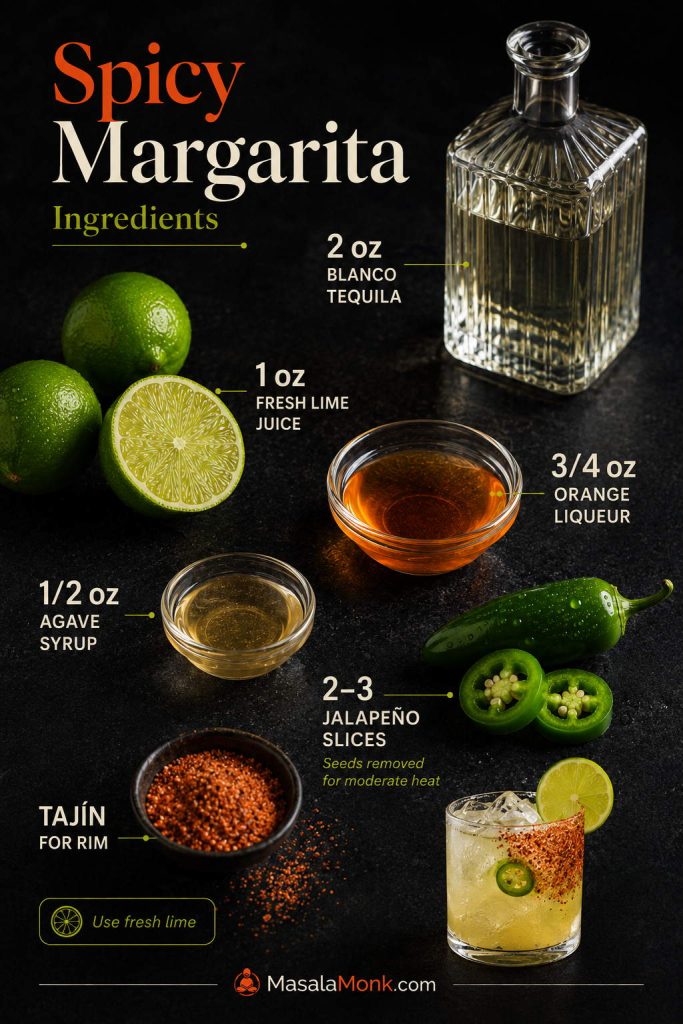
Ingredients for a spicy margarita including blanco tequila, fresh lime juice, orange liqueur, agave syrup, jalapeño slices, and Tajín.
Because the ingredient list is short, every choice has a job: lime brings brightness, agave rounds the heat, and jalapeño should season rather than overpower.

Blanco Tequila

Blanco tequila is the best first choice because it tastes crisp and agave-forward. It does not fight the lime, jalapeño, or Tajín rim. Look for 100% agave tequila when possible.

Fresh Lime Juice

Use just-squeezed lime juice here. Bottled lime can make the margarita taste flat, harsh, or metallic, especially when jalapeño and salt are involved. One juicy lime usually gives close to 1 oz / 30 ml, but measuring keeps the cocktail reliable.
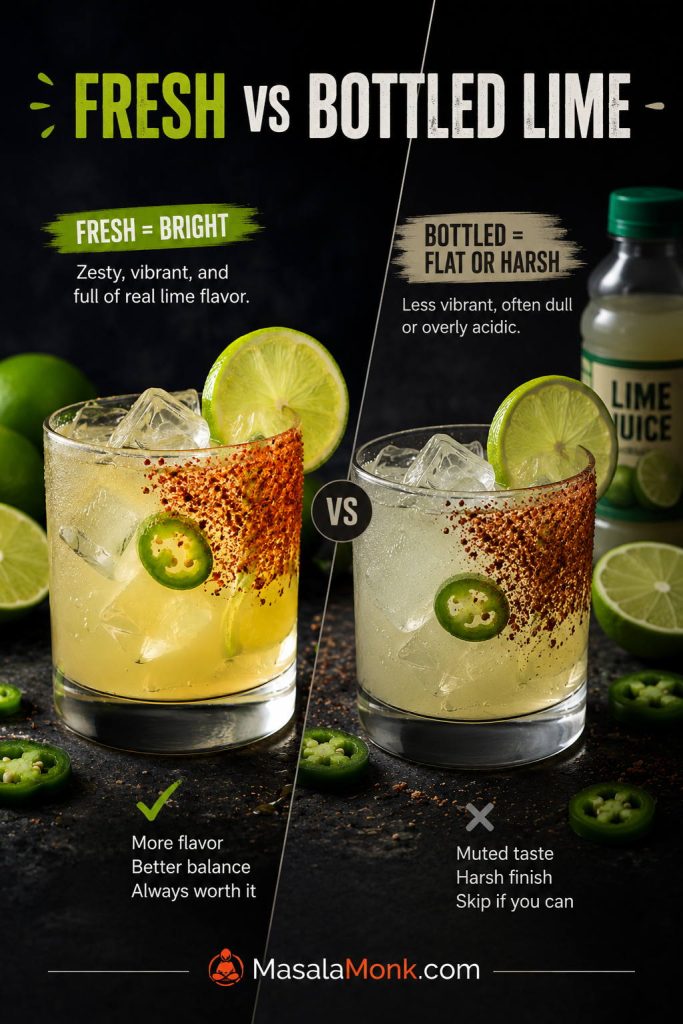
Fresh lime juice compared with bottled lime juice for making a spicy margarita.
Fresh lime juice keeps a spicy margarita sharp and clean; bottled lime can turn flat or metallic once tequila, salt, and jalapeño are in the mix.

Orange Liqueur

Orange liqueur gives the margarita its classic roundness. Triple sec, Cointreau-style orange liqueur, or another clear orange liqueur will work. This recipe uses ¾ oz / 22 ml, or roughly 20–25 ml, which keeps the finished cocktail rounded without making it too sweet.

Can You Make It Without Orange Liqueur?

Yes. Skipping orange liqueur makes the drink closer to a spicy Tommy’s-style margarita. Use 2 oz tequila, 1 oz fresh lime juice, ½–¾ oz agave syrup, and 2 jalapeño slices. It will taste cleaner, sharper, and more tequila-forward.

If you want the classic version first, use the main spicy margarita recipe card, then try this sharper variation next.
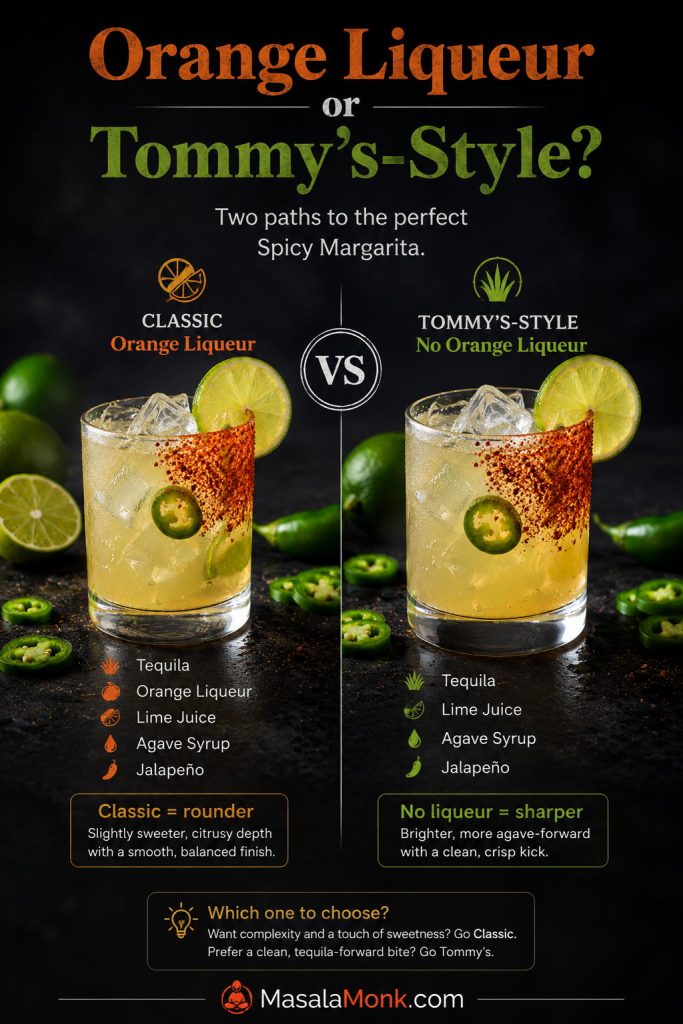
Classic spicy margarita with orange liqueur compared with a Tommy’s-style spicy margarita without orange liqueur.
Orange liqueur makes the drink rounder and more classic; however, skipping it gives a sharper Tommy’s-style spicy margarita with more tequila-lime focus.

Jalapeño

Use jalapeño cut into thin slices. For predictable heat, remove the seeds and white membrane before shaking or muddling. The membrane holds much of the heat, so leaving it in can make the margarita much hotter.

The seeds can taste hot because they touch the membrane, but the white membrane is the real part to watch. Remove both before slicing when you want a milder, more controlled first round.
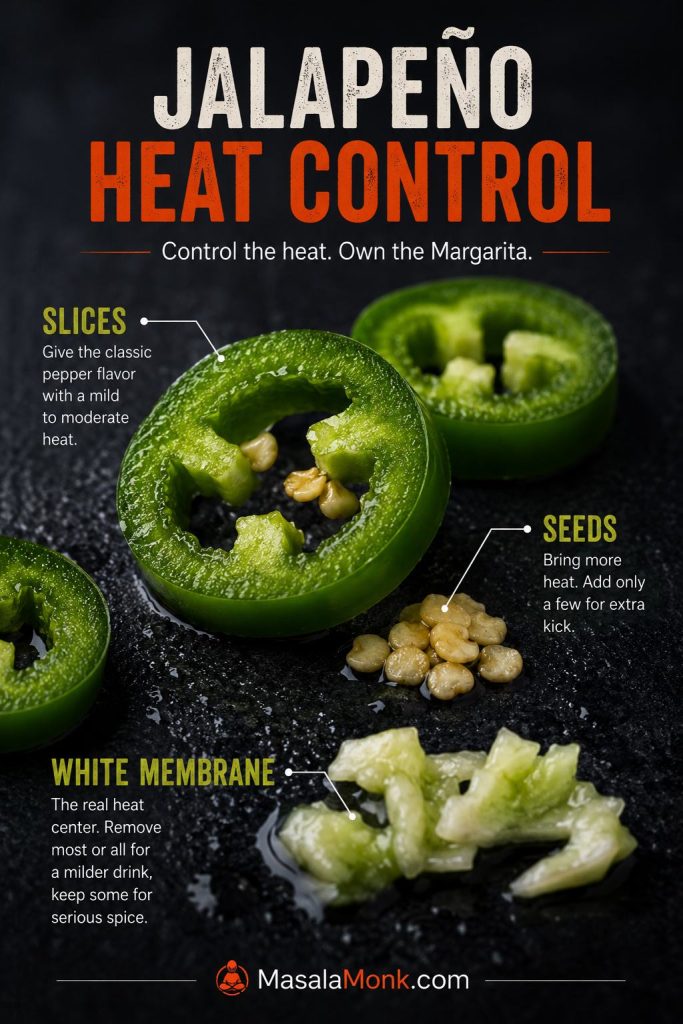
Jalapeño heat control guide showing sliced jalapeño, seeds, and white membrane for adjusting margarita spice level.
For better heat control, remove the white membrane before shaking or muddling; it is the part most likely to push the margarita from spicy to harsh.

Fresh jalapeño gives the cleanest green pepper heat. Pickled jalapeño works in a pinch, but it makes the margarita tangier, saltier, and more bar-snack flavored, so use it carefully.
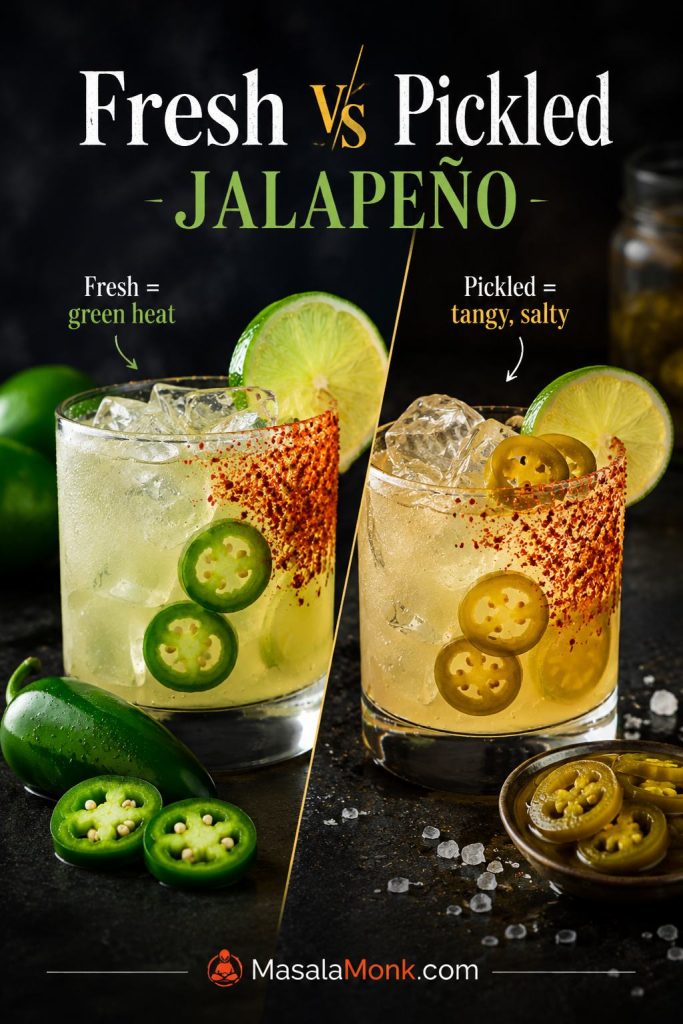
Fresh jalapeño slices and pickled jalapeño slices compared for use in a spicy margarita.
Fresh jalapeño gives clean green heat, whereas pickled jalapeño adds tang and salt, so use it only when that sharper flavor fits the drink.

For the full mild, medium, hot, and restaurant-style breakdown, jump to the spicy margarita heat levels.

Agave or Simple Syrup

Agave syrup pairs naturally with tequila, but simple syrup also works. The sweetener is not there to make the cocktail sugary. It softens the lime and pepper so the spicy margarita tastes rounded instead of sharp.

Tajín, Salt, or Chili-Lime Rim

Tajín gives the rim a chili-lime tang that works especially well with jalapeño and fruit variations. Kosher salt gives a cleaner classic margarita feel. A mix of Tajín and kosher salt is a good middle ground if you want less tang and more balance.
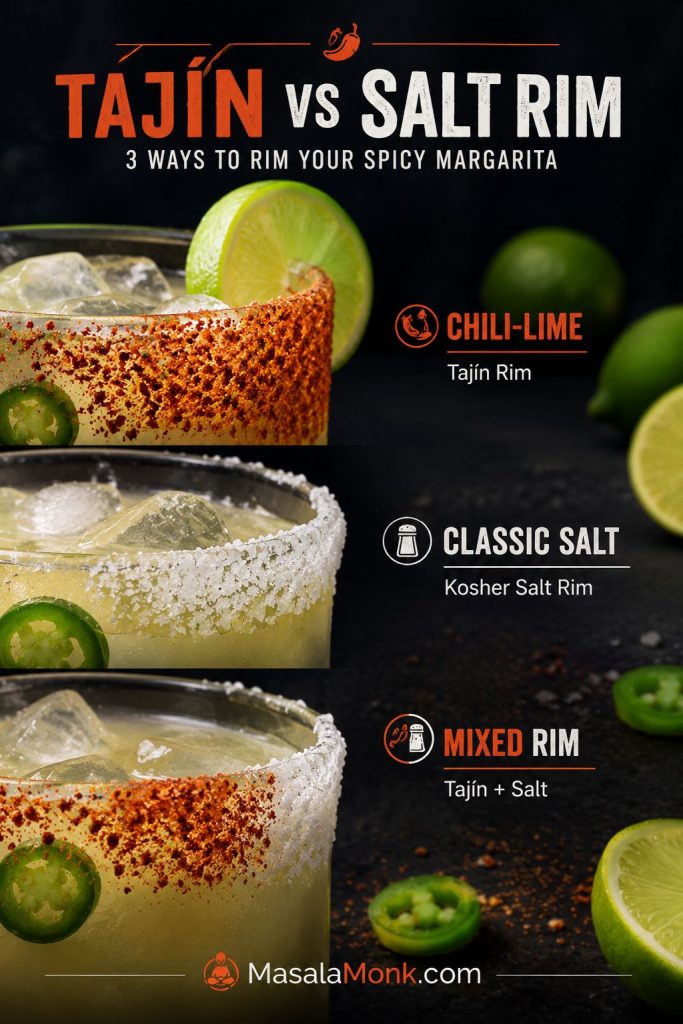
Tajín rim, kosher salt rim, and mixed chili-lime salt rim options for a spicy margarita.
Tajín adds chili-lime punch, kosher salt keeps the rim classic, and a mixed rim gives you spice without making every sip too intense.

Equipment You Need

You do not need a full bar setup. A shaker or sealed jar, a way to measure, a rocks glass, fresh ice, and something to strain with will get you most of the way there.

  • Shaker or sealed jar: chills and blends the cocktail.
  • Jigger or measuring spoon: keeps the tequila, lime, and sweetener in balance.
  • Rocks glass: best for a spicy margarita on the rocks.
  • Strainer: keeps jalapeño pieces and cracked shaker ice out of the glass.
  • Muddler or wooden spoon handle: helpful for medium or hotter pepper flavor.
  • Citrus juicer and small plate: useful for lime juice and rimming, but not dealbreakers.

How to Make a Spicy Margarita

The method is simple, but the little choices matter: rim before you shake, use enough ice, and keep the jalapeño in check so the cocktail tastes cold and bright instead of hot and muddy.
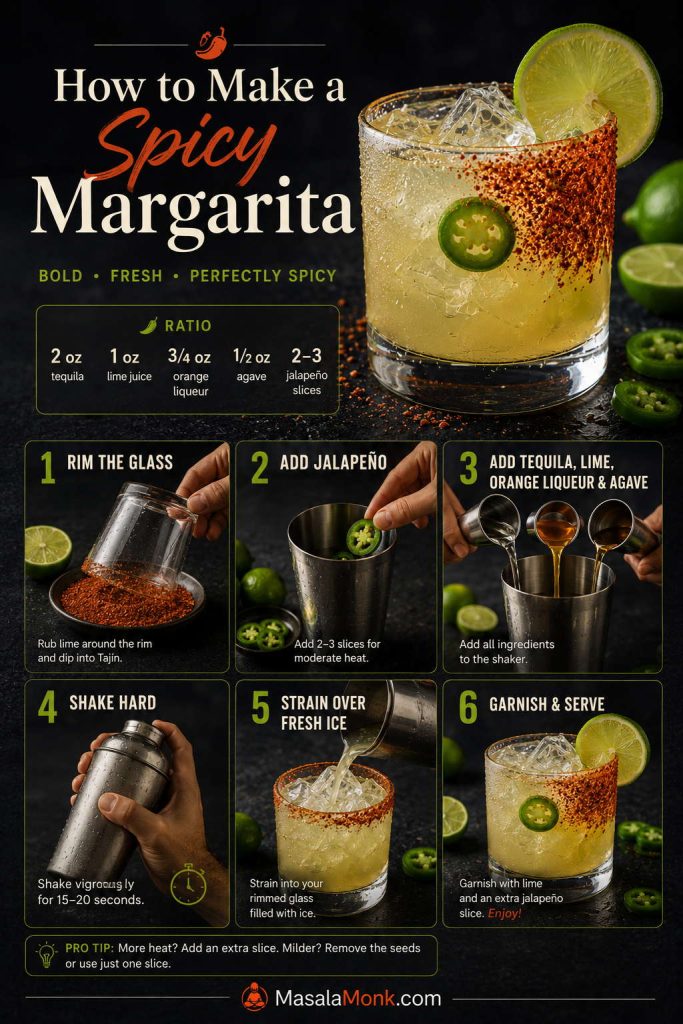
Step-by-step spicy margarita guide showing rimming the glass, adding jalapeño, adding liquids, shaking, straining over fresh ice, and garnishing.
Rimming first, shaking hard, and straining over fresh ice are the small steps that make a spicy margarita taste colder, cleaner, and more polished.

Rim the Glass

Run a lime wedge around the outside edge of a rocks glass. Dip or roll half the rim into Tajín, chili-lime salt, or kosher salt. Fill the glass with fresh ice and set it aside so it is ready the moment the cocktail is cold.
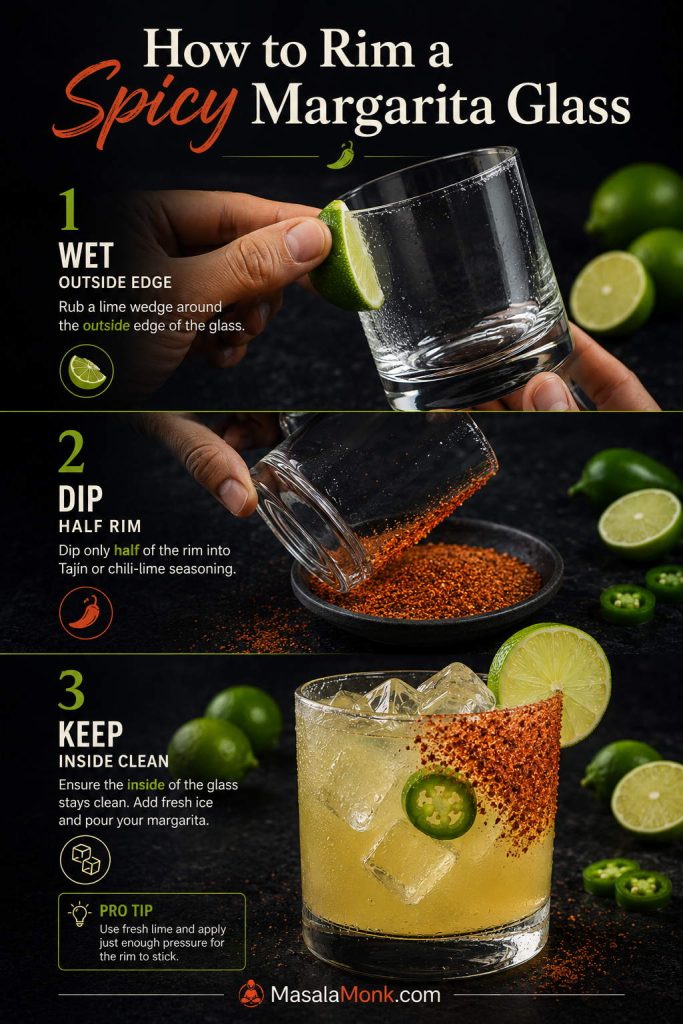
Step-by-step guide showing a rocks glass rimmed with lime and dipped halfway into Tajín for a spicy margarita.
Wet only the outside edge before dipping the rim; this keeps Tajín on the glass instead of letting it fall into the margarita.

Muddle or Shake the Jalapeño

Add 2–3 thin jalapeño slices to the shaker. For a mild margarita, leave them unmuddled and simply shake them with the liquid. For medium heat, press them gently 2–3 times with a muddler or the handle of a wooden spoon. Do not crush them aggressively unless you want a much hotter, greener pepper flavor.
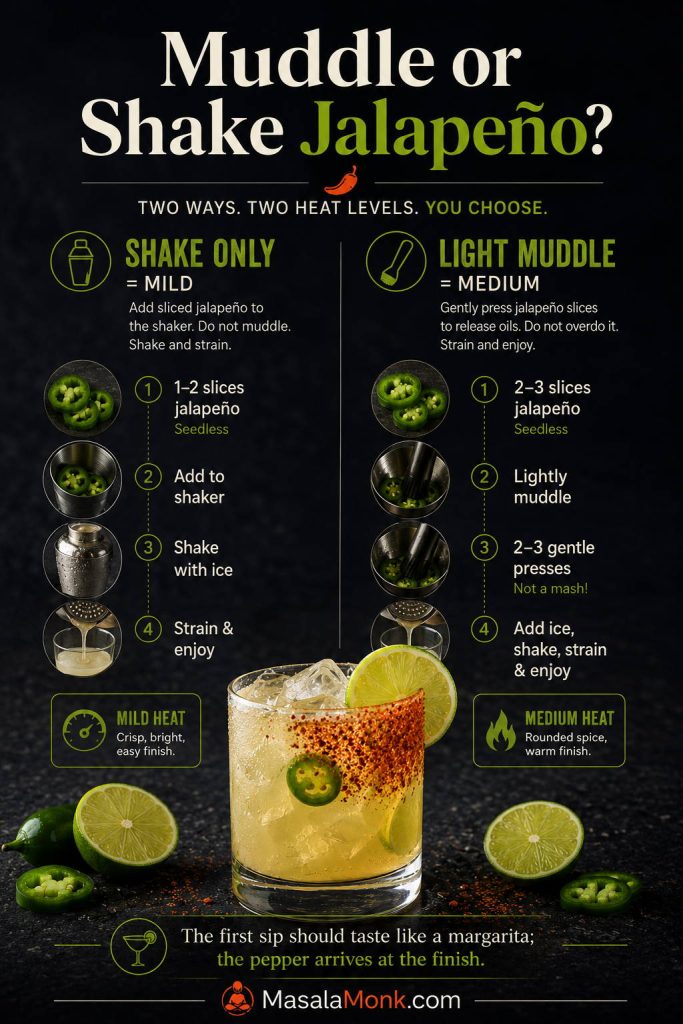
Comparison showing jalapeño slices shaken for mild heat and lightly muddled for medium spicy margarita heat.
Shake jalapeño slices for a mild pepper finish, or muddle gently for medium heat; either way, avoid crushing the pepper into a bitter mash.

Shake Until Cold

Add tequila, lime juice, orange liqueur, agave, and ice to the shaker. Shake hard for 15–20 seconds, until the shaker feels very cold. That chill and dilution are what keep the lime sharp but not harsh.

Strain Over Fresh Ice

Strain the margarita into the prepared glass over fresh ice. Do not pour the broken shaker ice into the glass; it is already cracked, diluted, and melting fast.
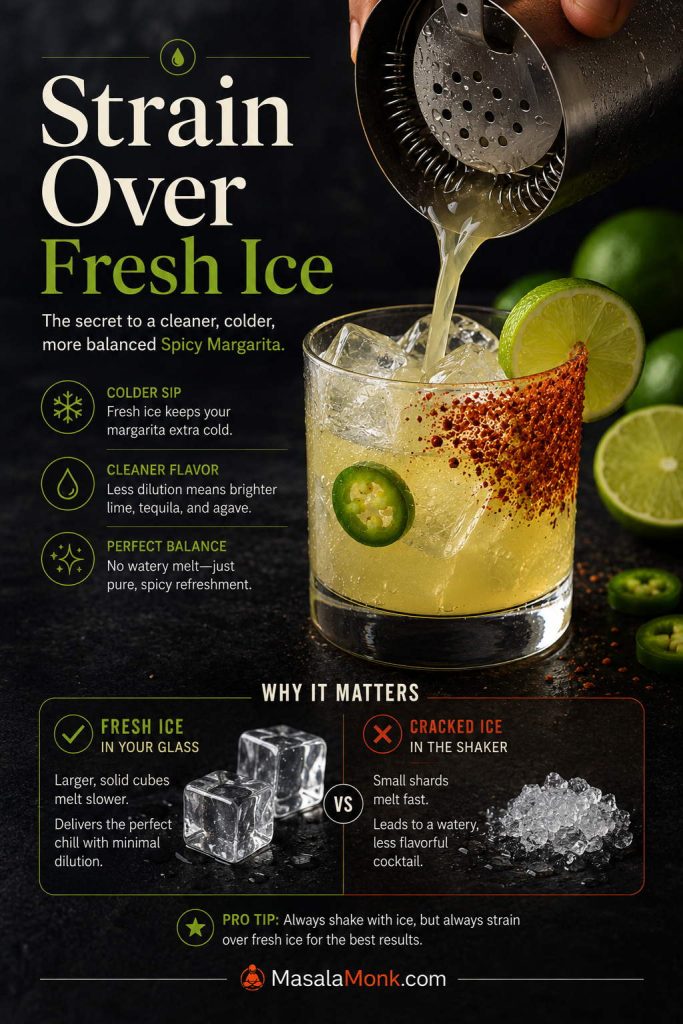
Spicy margarita being strained from a shaker over fresh ice with a comparison to cracked shaker ice.
Fresh ice melts more slowly than cracked shaker ice, so straining over solid cubes keeps the margarita colder, brighter, and less watery.

Taste and Adjust

Taste the first sip and adjust from there. A tart margarita needs a small splash of agave; a sweet one needs more lime. When the flavor feels muted, add a tiny pinch of salt or a squeeze of lime. When the heat goes too far, strain away the jalapeño and soften the pour with lime, orange liqueur, agave, or sparkling water.

For more specific fixes, use the troubleshooting guide before remaking the drink.

How Spicy Should It Be?

The best spicy margarita is not automatically the hottest one. You want a pepper finish, not a dare. Heat should make the next sip more tempting, not make people brace before they drink.

Start gentler than you think you need to, especially with a new jalapeño. Treat the pepper like seasoning, not the main ingredient.

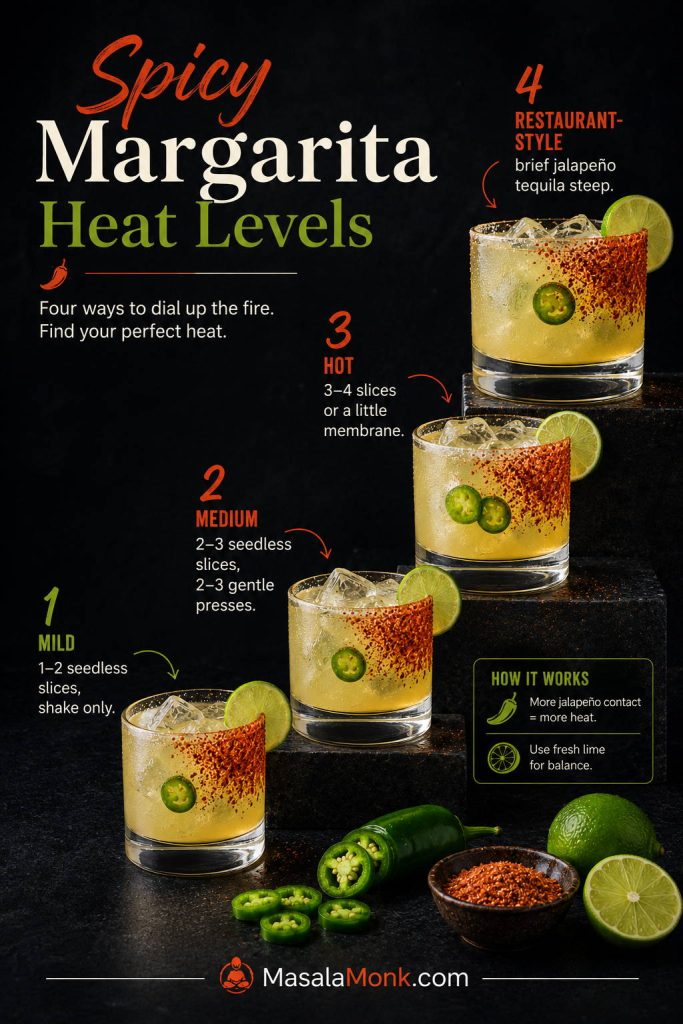
Heat level Jalapeño method Best for
Mild 1–2 seedless slices, shaken but not muddled First-time spicy margarita drinkers or anyone who wants only a light pepper tingle.
Medium 2–3 seedless slices, muddled with 2–3 gentle presses The best default version: clearly spicy, but still controlled.
Hot 3–4 slices or a tiny piece of membrane People who already know they like heat in cocktails.
Very hot Brief jalapeño tequila steep, tasted carefully Restaurant-style heat or pitchers, but only with careful timing.
Spicy margarita heat level guide showing mild, medium, hot, and restaurant-style jalapeño heat options.
Heat depends on pepper contact as much as pepper quantity, so start mild and move toward muddled or infused jalapeño only after tasting.

Mild Spicy Margarita

Start with 1–2 seedless jalapeño slices and do not muddle them. Shake the slices with the cocktail, then strain well. This gives a light pepper aroma and a gentle finish without much burn.

Medium Spicy Margarita

For the best default version, gently muddle 2–3 seedless jalapeño slices with only 2–3 presses before adding the liquids. The margarita should taste clearly spicy without overpowering the tequila and lime.

Hot Spicy Margarita

For more heat, add 3–4 slices or include a small amount of the white membrane. Avoid adding lots of seeds unless you already know the pepper is mild. Seeds and membrane can push the margarita from pleasantly hot to harsh very quickly.

Restaurant-Style Jalapeño-Infused Tequila Option

For a smoother restaurant-style spicy margarita, infuse the tequila briefly instead of muddling jalapeño into every glass. Add ½ sliced seedless jalapeño to 1 cup / 240 ml blanco tequila, steep for 15–30 minutes, then taste. Remove the pepper once the tequila has the heat you want.

Longer infusions can taste deeper, but they are easier to overdo because every jalapeño is different. For a party, a short controlled steep is safer than leaving pepper in the tequila for hours.
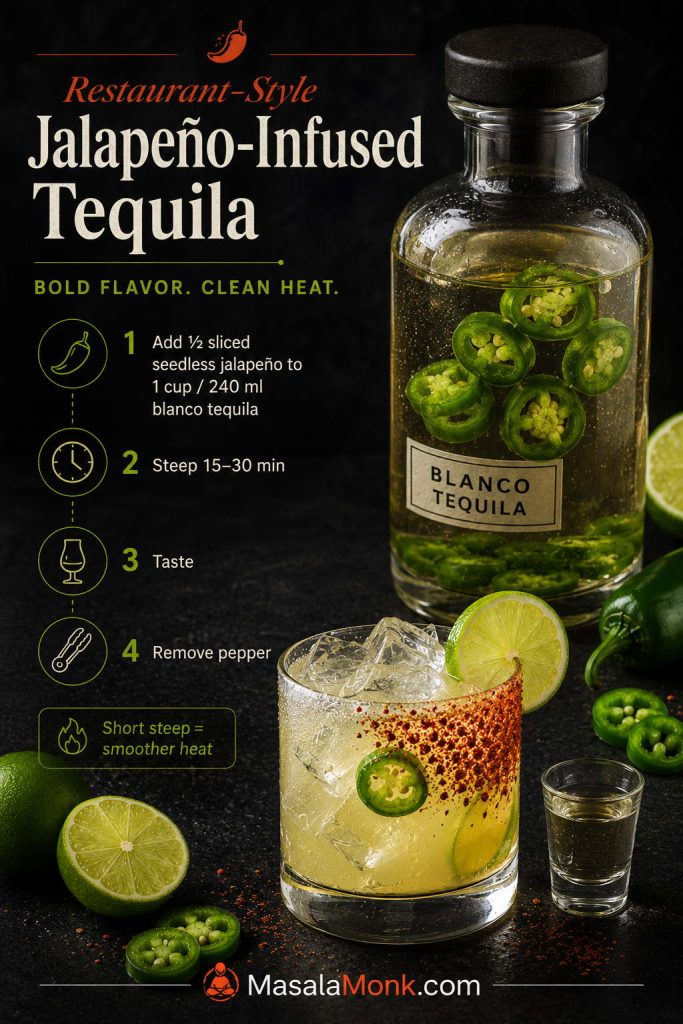
Jalapeño-infused tequila guide with sliced jalapeño steeping in blanco tequila for a restaurant-style spicy margarita.
A short jalapeño tequila steep gives smoother restaurant-style heat, but tasting early and removing the pepper keeps the infusion controlled.

How to Make It Less Spicy

Strain the cocktail away from the jalapeño immediately. Add more lime juice, orange liqueur, agave, or sparkling water to soften the heat. If the margarita is still too hot, pour it over extra ice and let it dilute slightly before serving.

Tajín Rim or Spicy Salt Rim

The rim should support the cocktail, not dominate it. A full Tajín rim looks dramatic, but a half rim usually drinks better.

Why a Half Tajín Rim Works Better

A good rim should feel like seasoning, not sand. The half rim lets you choose the sip: chili-lime edge on one side, clean tequila-lime brightness on the other.
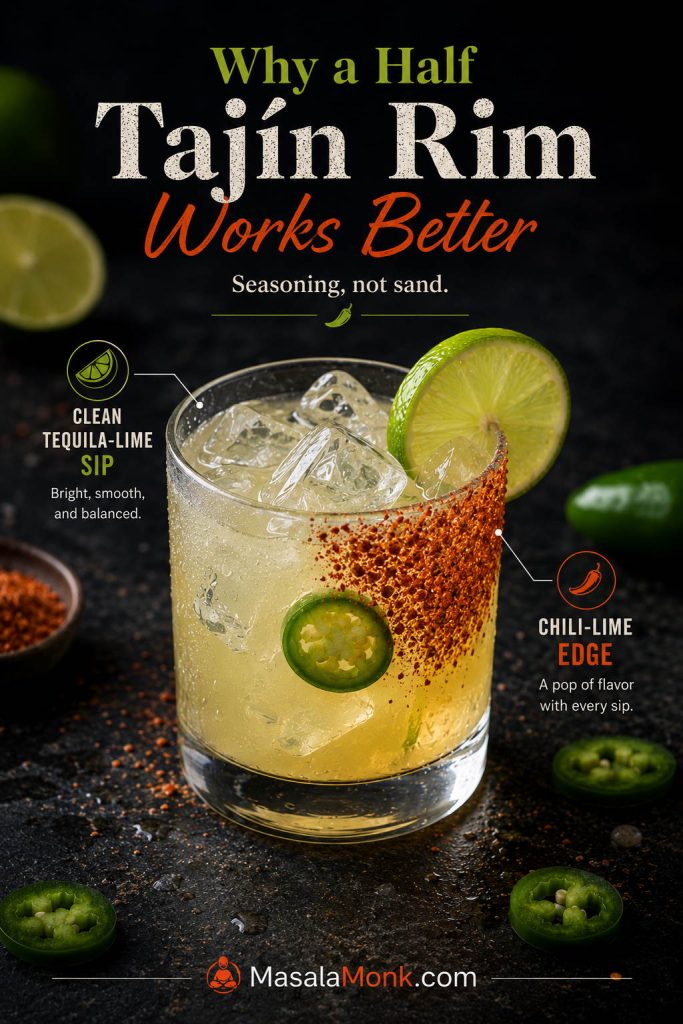
Close-up of a spicy margarita with a half Tajín rim showing one seasoned side and one clean sipping side.
A half Tajín rim gives you two sipping options: chili-lime seasoning on one side and clean tequila-lime brightness on the other.

Which Rim Style Works Best?

Rim style Best for How to use it
Half Tajín rim Best default Rim only one side of the glass so every sip does not have to taste salty and spicy.
Full Tajín rim Big chili-lime flavor Use when the margarita is very limey or fruit-based.
Kosher salt rim Classic margarita feel Cleaner and less tangy than Tajín.
Tajín + kosher salt Balanced spicy rim Mix equal parts for a softer, less sour rim.
Chamoy + Tajín Sweet, sticky, dramatic rim Best with mango, pineapple, or watermelon versions.
No rim Cleaner sip Choose this when you want less salt or the margarita already tastes bold enough.

How to Keep Tajín Out of the Margarita

For the neatest rim, wet only the outside edge of the glass. The seasoning stays where your lips touch it, instead of sliding into the margarita and turning the bottom of the glass gritty.

If your rim tastes too intense, mix Tajín with kosher salt or rim only one small section of the glass. The rim should season the cocktail, not make every sip taste dusty or salty.

The same half-rim idea works beautifully with fruit margaritas too. MasalaMonk’s watermelon margarita recipe uses salt, Tajín, chili-salt, and half-rim logic to keep sweet fruit tasting sharper and colder.

Tajín works beautifully on chili-lime rims, but for this homemade version, a simple half rim is usually cleaner, easier, and better balanced. The official Tajín spicy margarita also uses a coated section of the glass rather than a heavy full rim.

Need the cleanest technique? Go back to how to rim the glass before dipping into Tajín or salt.

Spicy Margarita Recipe Card

A cold, lime-forward spicy margarita with blanco tequila, fresh lime juice, orange liqueur, agave, jalapeño, and a half Tajín rim. Shake it mild, medium, or hot, then serve over fresh ice for a clean pepper finish.

Yield1 drink
Prep Time5 minutes
Cook Time0 minutes
Total Time5 minutes

Equipment

  • Rocks glass
  • Cocktail shaker or sealed jar
  • Jigger or measuring spoon
  • Strainer
  • Muddler or wooden spoon handle
  • Small plate for the rim

Ingredients

  • 2 oz / 60 ml blanco tequila
  • 1 oz / 30 ml fresh lime juice
  • ¾ oz / 22 ml orange liqueur
  • ½ oz / 15 ml agave syrup or simple syrup
  • 2–3 thin jalapeño slices, seeds and most white membrane removed for moderate heat
  • 1 tbsp Tajín, chili-lime salt, or kosher salt, for the rim
  • 1 lime wedge, for rimming and garnish
  • Ice

Instructions

  1. Rub a lime wedge around the outside edge of a rocks glass. Dip half the rim into Tajín, chili-lime salt, or kosher salt.
  2. Fill the glass with fresh ice and set it aside.
  3. Add jalapeño slices to a cocktail shaker. Muddle with 2–3 gentle presses for medium heat, or leave them unmuddled for a milder margarita.
  4. Add tequila, lime juice, orange liqueur, agave, and ice.
  5. Shake hard for 15–20 seconds, until the shaker feels very cold.
  6. Strain over fresh ice into the prepared glass.
  7. Garnish with lime or jalapeño. Taste and adjust the next round with more lime, agave, or jalapeño if needed.

Notes

  • For mild heat, use 1–2 seedless jalapeño slices and do not muddle.
  • For medium heat, gently press 2–3 seedless slices only 2–3 times.
  • Jalapeños vary, so start lower when using a new pepper.
  • A half Tajín rim gives better sip control than a full rim.
  • Wet only the outside edge of the glass so Tajín does not fall into the margarita.
  • For pitchers, steep jalapeño for 10–20 minutes, then remove it once the heat tastes right.
  • Serve right after shaking, over fresh ice rather than broken shaker ice.
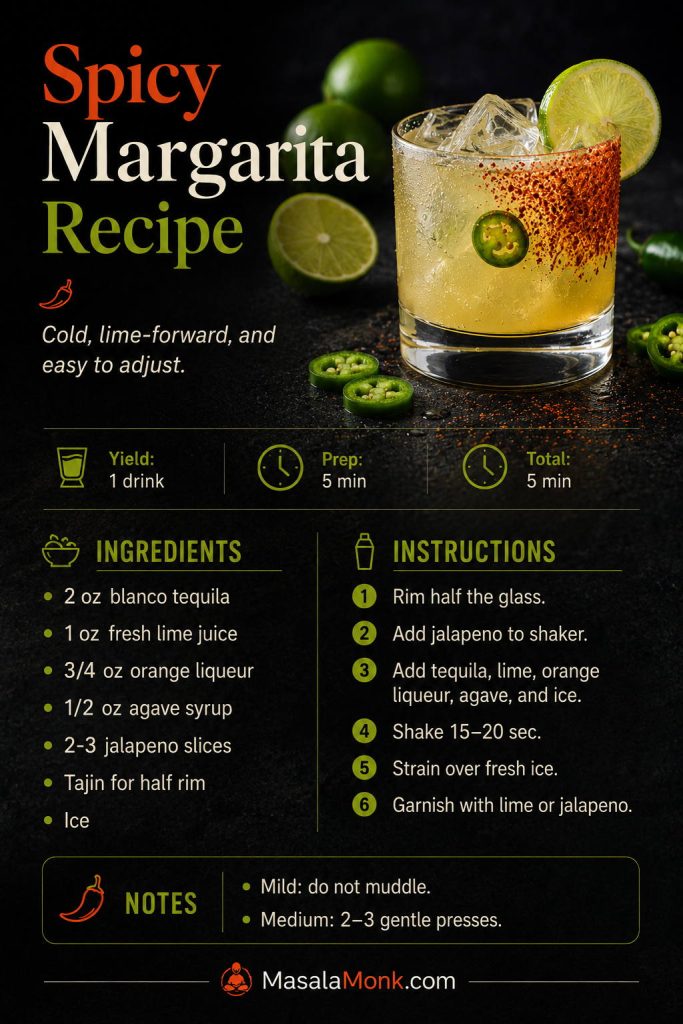
Saveable spicy margarita recipe card with tequila, lime juice, orange liqueur, agave syrup, jalapeño slices, Tajín, ice, and instructions.
Save this spicy margarita recipe card for the core ratio, then use the heat notes to decide whether to shake the jalapeño for mild heat or muddle it for medium heat.

Making drinks for a group? Use the spicy margarita pitcher instead of scaling glass by glass.

Best Tequila for a Spicy Margarita

Once the base ratio is set, tequila choice is mostly about the kind of finish you want: crisp, round, or smoky. For most people, 100% agave blanco tequila is the best first choice because it keeps the margarita sharp and lime-forward.

  • Best first choice: blanco tequila for a bright, clean, lime-friendly spicy margarita.
  • Softer option: reposado tequila if you want rounder oak and vanilla notes behind the citrus.
  • Smoky option: half blanco tequila and half mezcal for smoke without overwhelming the cocktail.
  • Usually skip: añejo tequila, because the oak and age can fight the lime, jalapeño, and Tajín.

If you want smoke without losing the lime, see the spicy mezcal margarita variation.
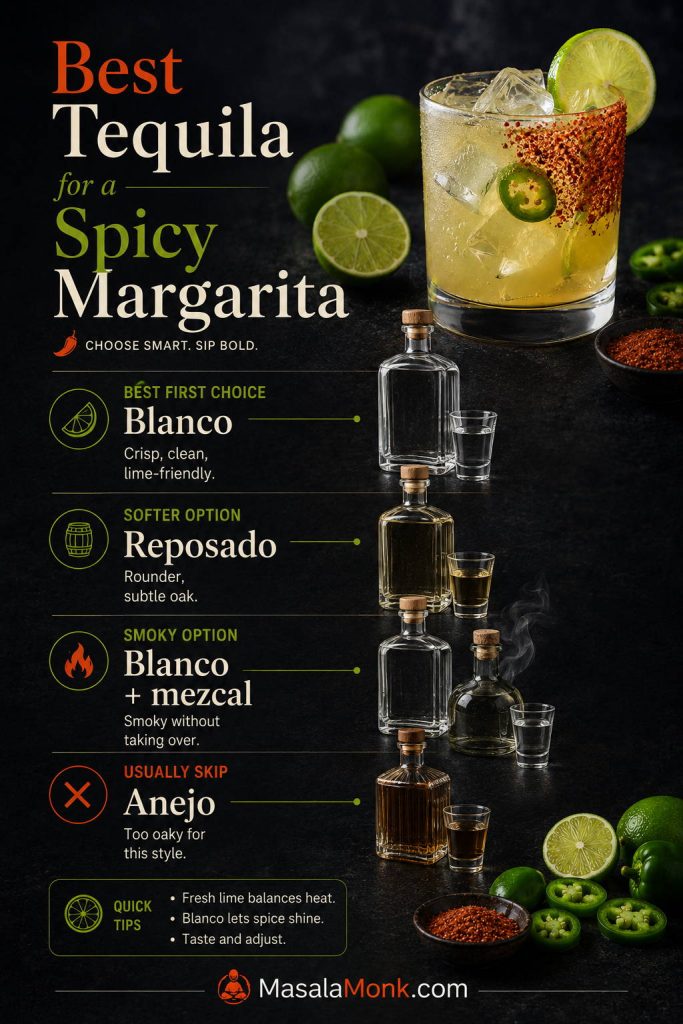
Tequila chooser board for spicy margaritas showing blanco tequila, reposado tequila, blanco with mezcal, and añejo as an option to skip.
Blanco tequila keeps the drink crisp, reposado makes it rounder, and a blanco-mezcal split adds smoke without overwhelming the lime and jalapeño.

For a classic benchmark, Liquor.com’s spicy margarita also uses blanco tequila, lime, orange liqueur, agave, and jalapeño as the core structure.

Skinny Spicy Margarita / Lower-Sugar Version

For a lighter margarita, reduce the sweetener before you reduce the flavor. The mistake with skinny margaritas is making them so lean that they taste like plain tequila and lime over ice.

The goal is not to strip the cocktail down until it tastes thin. Keep the lime, salt, and jalapeño bright while using less sweetener, reducing the orange liqueur, or adding a splash of sparkling water when the margarita tastes too sharp.
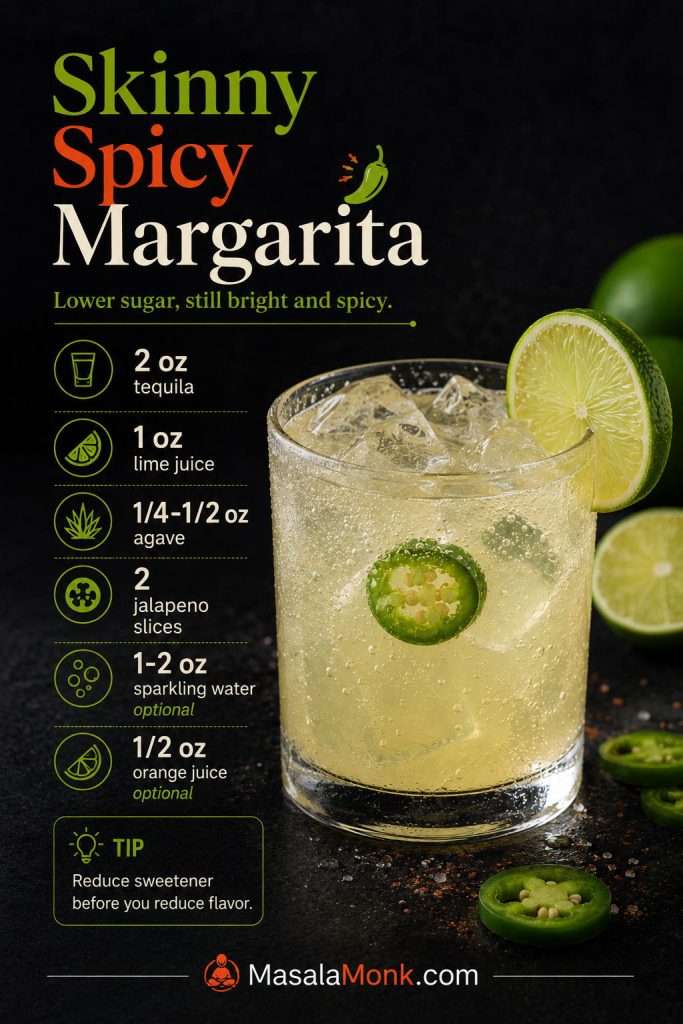
Skinny spicy margarita board with tequila, lime juice, reduced agave, jalapeño slices, optional sparkling water, and optional orange juice.
A skinny spicy margarita should reduce sugar without losing structure; keep the lime, salt, and jalapeño bright so the drink still feels complete.
Ingredient Amount
Blanco tequila 2 oz / 60 ml
Fresh lime juice 1 oz / 30 ml
Agave syrup ¼–½ oz / 7–15 ml
Jalapeño 2 thin slices
Orange juice ½ oz / 15 ml, optional
Sparkling water 1–2 oz / 30–60 ml, optional
Tajín or salt rim Optional

Shake the tequila, lime, agave, and jalapeño with ice. Strain over fresh ice, then top with sparkling water when you want a lighter, longer pour. Add orange juice only if you miss the roundness that orange liqueur normally gives.

For another lighter tequila-lime direction, MasalaMonk’s coconut water cocktails guide includes a coconut water margarita that lengthens the drink without turning it into a sugary mix.

For a no-alcohol version with the same lime-jalapeño idea, use the virgin spicy margarita.

Virgin Spicy Margarita / Non-Alcoholic Version

Without tequila, the mocktail needs something to replace that edge. Lime, orange, jalapeño, salt, and bubbles do the job better than simply topping juice with soda water.

This works best when it tastes like a zero-proof cocktail, not citrus soda with a jalapeño floating in it. The tiny pinch of salt matters because tequila normally brings body and bite; without alcohol, salt, orange, jalapeño, and sparkle help the mocktail taste complete.
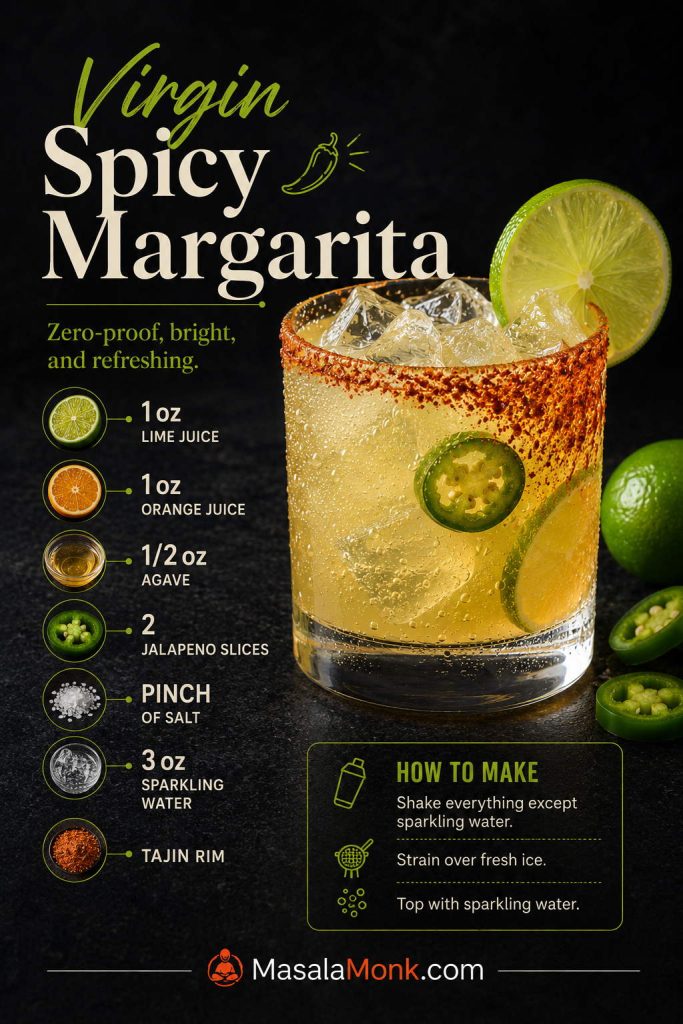
Virgin spicy margarita mocktail with lime juice, orange juice, agave, jalapeño slices, salt, sparkling water, and a Tajín rim.
Without tequila, the mocktail needs lime, orange, salt, jalapeño, and bubbles to create enough bite for a zero-proof spicy margarita.
  • 1 oz / 30 ml fresh lime juice
  • 1 oz / 30 ml orange juice
  • ½ oz / 15 ml agave syrup or simple syrup
  • 2 thin jalapeño slices
  • Tiny pinch of salt, optional but helpful
  • 3 oz / 90 ml sparkling water, added after shaking
  • Tajín rim, recommended

Shake the lime juice, orange juice, agave, jalapeño, salt, and ice first. Strain over fresh ice in a rimmed glass, then top with sparkling water. Do not shake the sparkling water or the mocktail will lose its fizz.

For a broader zero-proof path, MasalaMonk’s margarita mocktail guide is a useful next stop for building non-alcoholic margarita-style drinks.

Frozen Spicy Margarita

Blending changes the problem: now texture matters as much as balance. A frozen spicy margarita is fun, but plain ice can make the pour watery and sharp. Frozen fruit helps the texture more than simply adding extra ice.
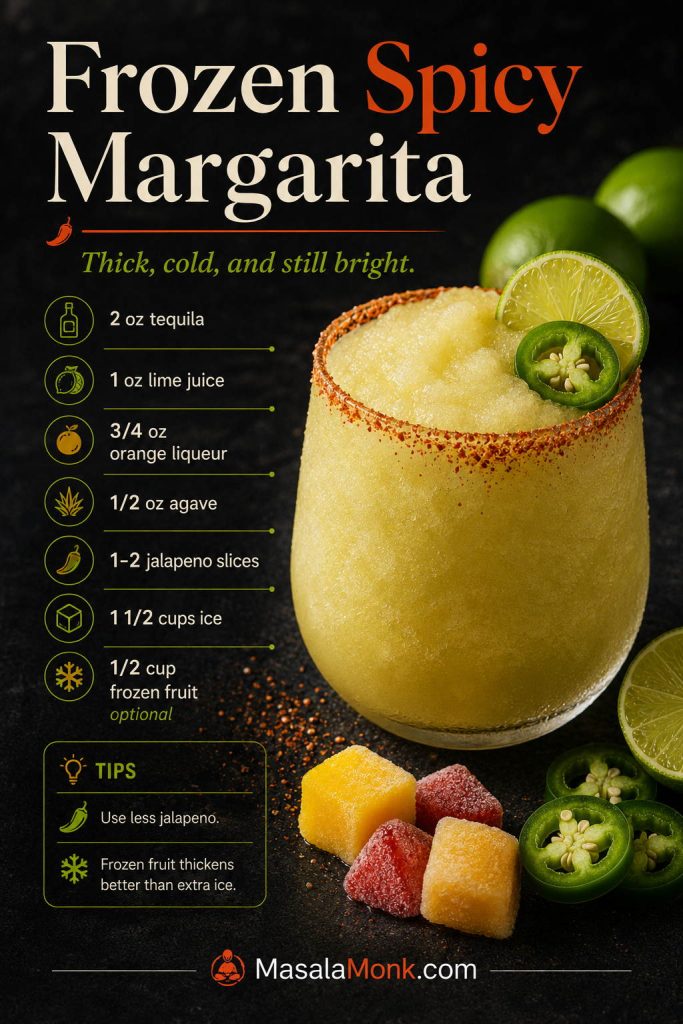
Frozen spicy margarita with tequila, lime juice, orange liqueur, agave, jalapeño, ice, optional frozen fruit, and Tajín rim.
Frozen fruit gives better texture than extra plain ice, while using less jalapeño keeps the pepper from tasting sharp as the frozen margarita melts.
  • 2 oz / 60 ml blanco tequila
  • 1 oz / 30 ml fresh lime juice
  • ¾ oz / 22 ml orange liqueur
  • ½ oz / 15 ml agave syrup
  • 1–2 thin jalapeño slices
  • 1½ cups ice, plus more as needed
  • ½ cup frozen mango, pineapple, or watermelon, optional but helpful for texture

Blend the liquid ingredients first, then add ice and frozen fruit. This helps the jalapeño and lime distribute before the margarita thickens. If the mixture is too thick, add 1–2 tablespoons of cold water or lime juice. If it is too thin, blend in more ice or frozen fruit.

Use slightly less jalapeño in frozen versions; cold dulls some flavors, but raw pepper can taste sharper as the margarita melts.

A plain frozen spicy margarita melts faster than a fruit-based one. For a thicker slush, frozen mango, pineapple, or watermelon will give better texture than adding more plain ice.

For fruit directions that also work on the rocks, see the spicy margarita variations.

Spicy Margarita Pitcher for a Crowd

A spicy margarita pitcher should taste like the first round of the party, not the dare people regret halfway through. The main mistake is letting jalapeño sit in the batch too long.

This is the version to make when people are hovering around the snack table and you do not want to shake drinks one at a time all night.
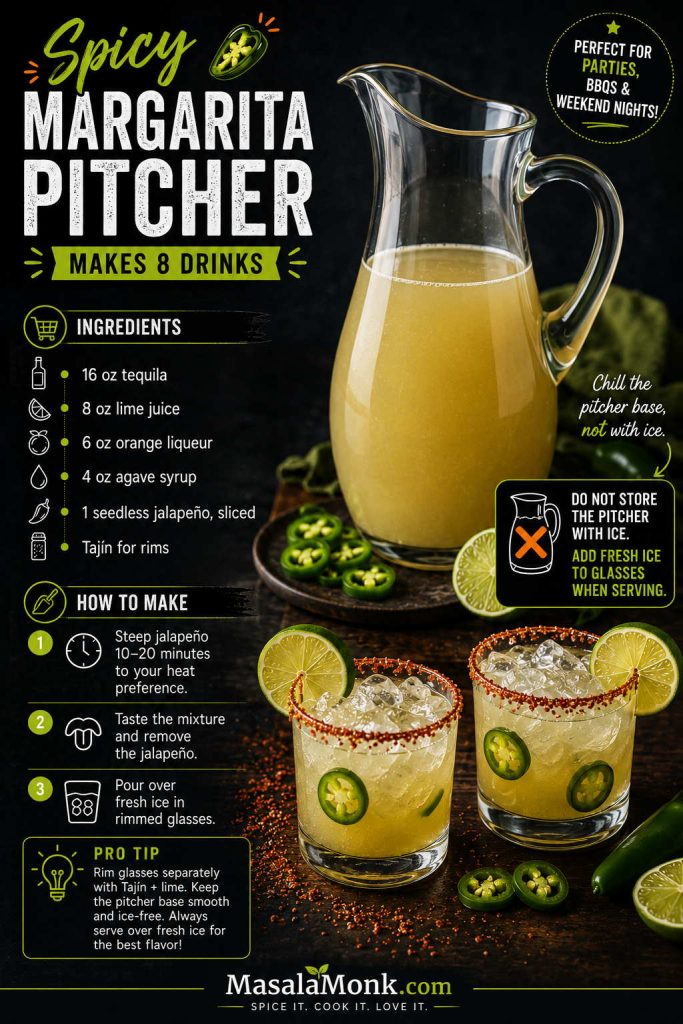
Spicy margarita pitcher recipe board with tequila, lime juice, orange liqueur, agave, jalapeño, Tajín, an ice-free pitcher, and rimmed glasses with fresh ice.
For a spicy margarita pitcher, chill the base without ice, steep jalapeño briefly, and pour over fresh ice so the batch stays controlled and undiluted.

What You Can Make Ahead

Mix the tequila, lime juice, orange liqueur, and agave a few hours ahead, then chill the base. Add jalapeño only 10–20 minutes before serving, then remove it once the heat tastes right. Rim glasses separately and pour over fresh ice.
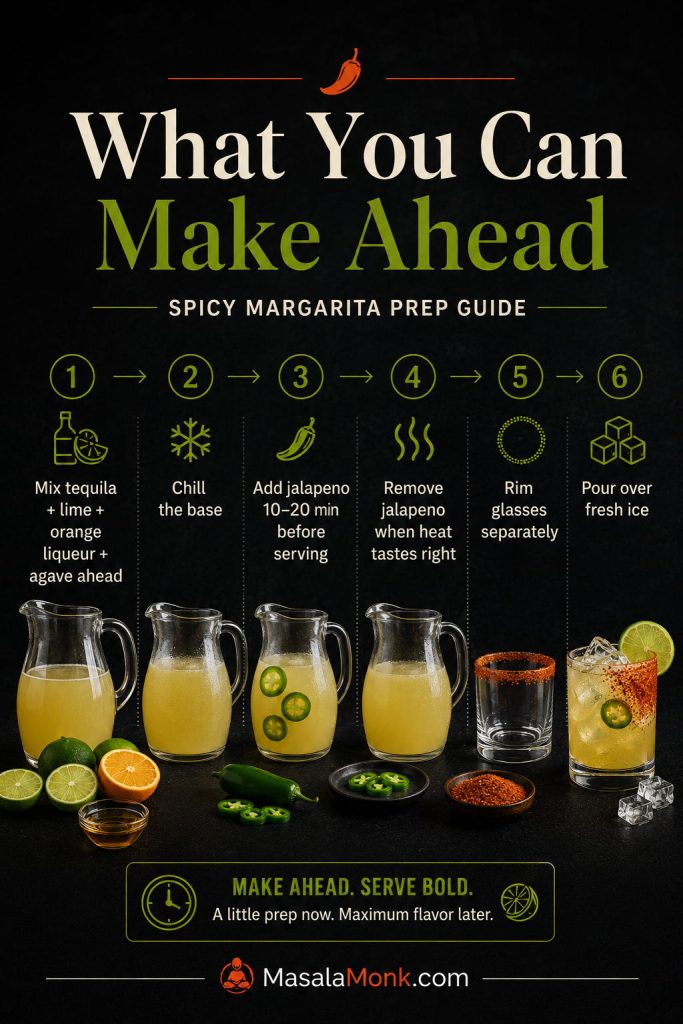
Make-ahead spicy margarita guide showing the tequila-lime base mixed ahead, chilled, jalapeño added later, jalapeño removed, glasses rimmed separately, and drinks poured over fresh ice.
Mix the tequila-lime base ahead, but add jalapeño close to serving so the pitcher stays fresh without letting the pepper take over.
Ingredient For 8 drinks
Blanco tequila 16 oz / 480 ml
Fresh lime juice 8 oz / 240 ml
Orange liqueur 6 oz / 180 ml
Agave syrup or simple syrup 4 oz / 120 ml
Jalapeño 1 seedless jalapeño, thinly sliced
Ice For serving, not for storing in the pitcher
Tajín or salt For rimming glasses separately

Stir the tequila, lime juice, orange liqueur, and agave in a pitcher. Add the jalapeño slices and let them steep for 10–20 minutes. Taste the batch, then remove the jalapeño once the heat is where you want it.

Chill the pitcher base until serving. Rim the glasses separately and pour the margaritas over fresh ice only when serving. Do not store the pitcher with ice in it, or the batch will dilute before guests pour their first glass.

Party tip

Keep the pitcher slightly less spicy than your personal glass. Guests can add a jalapeño slice to their own pour, but you cannot rescue the whole batch once the pepper takes over. A small bowl of extra jalapeño slices beside the glasses works better than leaving pepper in the pitcher.

If the batch gets hotter than planned, use the troubleshooting fixes instead of adding more ice to the pitcher.

Because pitcher drinks can taste easygoing even when they are strong, keep the pours modest and serve them with food.

Spicy Margarita Variations

Once the classic version is balanced, the variations become easy to control. Choose the mood before you change the ratio: mango for lush sweetness, pineapple for a louder tropical glass, watermelon for something lighter, cucumber for cooling green freshness, serrano for sharper heat, or mezcal for smoke.
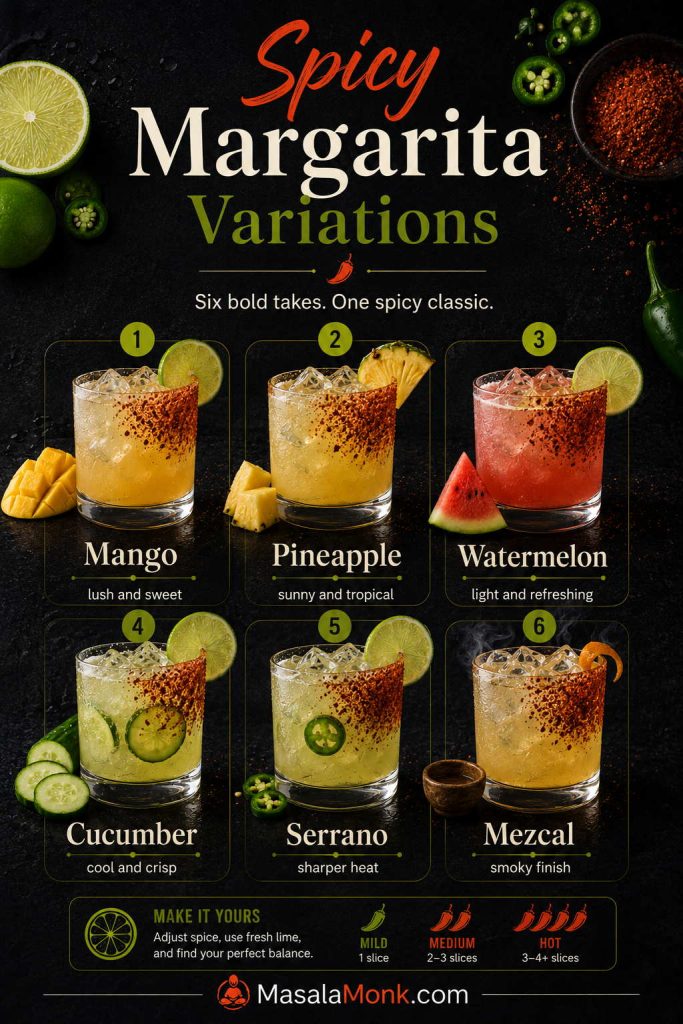
Spicy margarita variations board showing mango, pineapple, watermelon, cucumber, serrano, and mezcal versions.
Once the base ratio works, variations are easier: mango turns lush, pineapple goes tropical, cucumber cools the heat, serrano sharpens it, and mezcal adds smoke.

Spicy Mango Margarita

Add mango nectar, mango puree, or blended fresh mango to the base cocktail. Mango loves Tajín, chamoy, lime, and jalapeño, so this is one of the strongest spicy margarita variations. For a dedicated fruit version, use MasalaMonk’s mango margarita recipe and add the jalapeño heat level you prefer.

Pineapple Jalapeño Margarita

Pineapple makes the margarita sweeter, sunnier, and more tropical, so it usually needs less agave and loves a chili-lime rim. Use pineapple juice or muddled pineapple with the same tequila-lime-jalapeño base.

Spicy Watermelon Margarita

Use watermelon juice, lime, tequila, jalapeño, and a Tajín rim. Watermelon is softer than mango or pineapple, so keep the jalapeño moderate and avoid over-sweetening. A pinch of salt or a half rim makes the fruit taste colder, sharper, and more refreshing.

Cucumber Jalapeño Margarita

Muddle a few cucumber slices gently with the jalapeño, then double strain the cocktail so cucumber pulp does not cloud the glass. Cucumber cools the pepper heat, so the whole pour feels greener, cleaner, and more refreshing.

Serrano Margarita

Use serrano instead of jalapeño when you want a sharper, hotter pepper finish. Start with 1 thin slice, especially if you are muddling, because serrano can take over the margarita quickly.

Spicy Mezcal Margarita

Swap part or all of the tequila for mezcal. A half tequila, half mezcal split is the easiest first step because it gives smoke without overwhelming the lime and jalapeño.

If you want a citrus-forward margarita instead of a pepper-forward one, MasalaMonk’s blood orange margarita recipe is a good next drink to try.

Troubleshooting

Spicy margaritas are forgiving. Most problems come down to balance: heat, acid, sweetness, salt, dilution, or the way the jalapeño was handled.
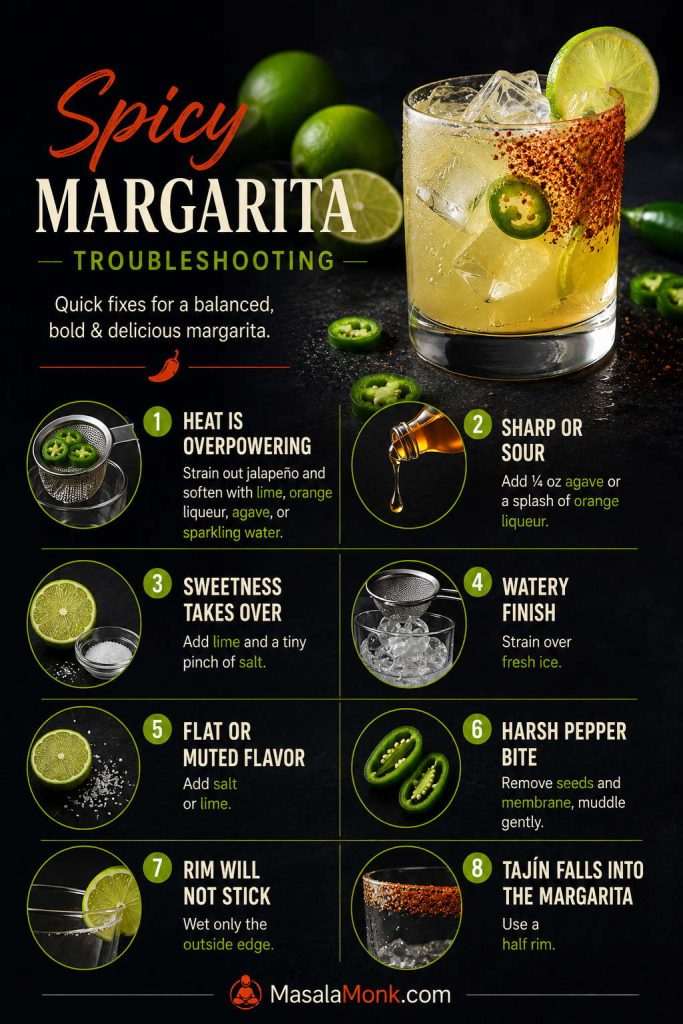
Spicy margarita troubleshooting board showing fixes for heat, sourness, sweetness, watery texture, muted flavor, harsh pepper, and rim problems.
Most spicy margarita problems are balance problems; lime, agave, salt, fresh ice, or shorter jalapeño contact can usually bring the cocktail back.
Problem Fix
Heat is overpowering Strain out the jalapeño. Add lime, orange liqueur, agave, or sparkling water to soften the heat.
Sharp or sour Add ¼ oz agave syrup or a small splash of orange liqueur.
Sweetness takes over Add fresh lime juice and a tiny pinch of salt.
Flavor feels weak Use a full 2 oz tequila next time, shake hard but not too long, and avoid serving with melted shaker ice.
Watery finish Strain over fresh ice, not broken shaker ice. Do not store pitcher margaritas with ice.
Flat or muted flavor Add a tiny pinch of salt, a squeeze of lime, or a little fresh ice. Make sure the lime juice is fresh.
Harsh pepper bite Remove seeds and membrane, muddle more gently, or use fewer jalapeño slices.
Metallic edge Use fresh lime juice instead of bottled lime, remove jalapeño membrane, and avoid over-muddling.
Green or vegetal taste Use fewer jalapeño slices, avoid aggressive muddling, and remove the membrane before shaking.
Rim will not stick Rub lime on the outside edge only, then dip or roll the rim while it is still wet.
Tajín falls into the margarita Rim only the outside edge of the glass or use a half rim.

What to Serve with Spicy Margaritas

Spicy margaritas love salty, creamy, crunchy food — chips, salsa, guacamole, grilled corn, shrimp, tacos, creamy dips, and anything with a little char. The lime and jalapeño cut through richness, while the Tajín rim makes snacky, chili-lime flavors feel even brighter.
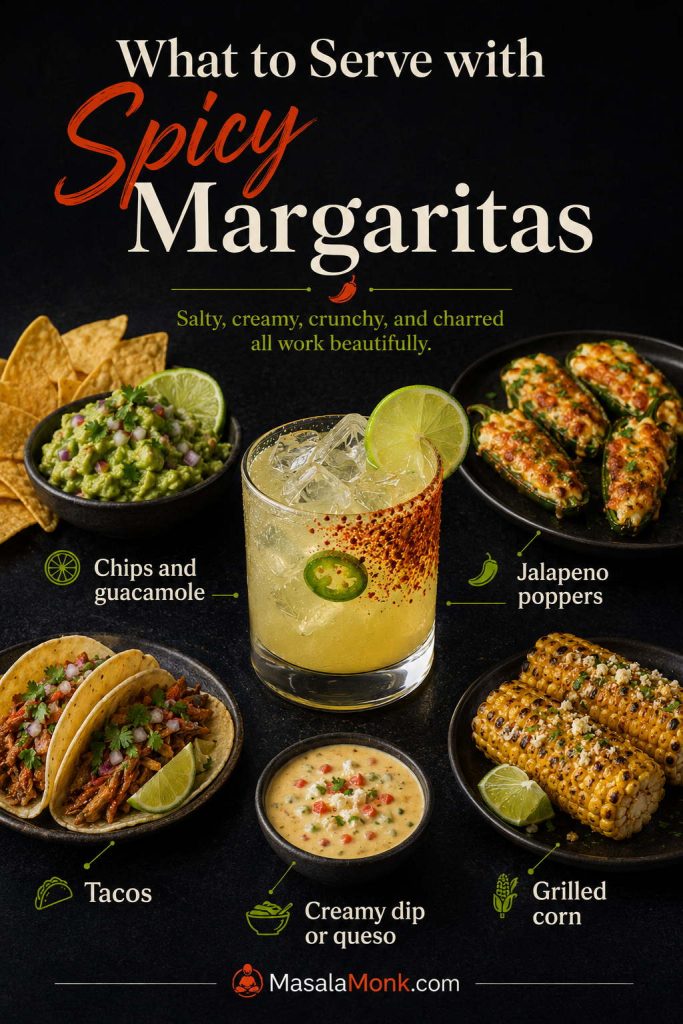
Food pairing board for spicy margaritas showing chips and guacamole, jalapeño poppers, tacos, creamy dip, grilled corn, and a spicy margarita.
Spicy margaritas work best with salty, creamy, crunchy food that can stand up to lime, jalapeño, and a chili-lime rim.

For a party tray, baked jalapeño poppers are the obvious match: creamy filling, pepper heat, and crisp edges beside a cold margarita. For something cooler and scoopable, a jalapeño-style cheese ball recipe gives guests a richer bite between citrusy sips.

Once the ratio is right, this is the kind of cocktail that disappears fast: cold glass, lime on the rim, a little pepper at the end, and just enough salt to make you want the next sip.

FAQs

These quick answers cover the decisions most people run into while mixing a spicy margarita at home.

Is a spicy margarita the same as a jalapeño margarita?

In most home recipes, yes. “Spicy margarita” is the broader name, while “jalapeño margarita” tells you the heat source. Some spicy margaritas use serrano, chili syrup, hot sauce, or infused tequila, but sliced jalapeño is the easiest and most reliable home method.

What is in a spicy margarita?

A classic spicy margarita usually has tequila, fresh lime juice, orange liqueur, agave or simple syrup, jalapeño, ice, and a salt or Tajín rim. This recipe uses blanco tequila, 1 oz fresh lime juice, ¾ oz orange liqueur, ½ oz agave, and 2–3 jalapeño slices.

Should I muddle the jalapeño?

Muddle it only when you want clear pepper heat. For a mild spicy margarita, shake the jalapeño slices without muddling. For medium heat, press the slices 2–3 times; do not crush them into a paste.

How do I make a spicy margarita less spicy?

Use fewer jalapeño slices, remove seeds and membrane, and shake the slices without muddling. If the margarita is already too spicy, strain it away from the jalapeño and soften it with lime, agave, orange liqueur, or sparkling water.

What makes a spicy margarita hotter?

More jalapeño, muddling, membrane, seeds, longer steeping, or infused tequila will make the cocktail hotter. For most people, 2–3 seedless slices gently muddled is enough.

Can I use serrano instead of jalapeño?

Serrano works, but it needs a lighter hand. It is usually sharper and hotter than jalapeño, so begin with 1 thin slice and muddle gently.

Should I use Tajín or salt on the rim?

Tajín gives the rim chili-lime flavor, especially with jalapeño or fruit margaritas. Kosher salt gives a cleaner classic margarita taste. A half Tajín rim is the best default because it gives you spicy-salty control without overwhelming every sip.

What tequila works best in a spicy margarita?

Blanco tequila is the best first choice because it is clean, bright, and lime-friendly. Reposado makes the cocktail rounder, while mezcal adds smoke. Añejo tequila is usually too oaky and expensive for this style of margarita.

Can I make a spicy margarita without orange liqueur?

Yes. Skip the orange liqueur and use 2 oz tequila, 1 oz fresh lime juice, ½–¾ oz agave syrup, and 2 jalapeño slices. The result is sharper, cleaner, and more tequila-forward.

How do I make a skinny spicy margarita?

For a lower-sugar version, keep the tequila and lime intact, reduce the agave to ¼–½ oz, and top with sparkling water if you want a longer pour. Keep the jalapeño and salt so it still tastes like a cocktail.

What is the best non-alcoholic spicy margarita method?

Shake fresh lime juice, orange juice, agave, jalapeño, a tiny pinch of salt, and ice. Strain over fresh ice in a Tajín-rimmed glass, then top with sparkling water. Add the sparkling water last so the drink stays fizzy.

Can margarita mix work in a spicy margarita?

It can, but fresh lime and orange liqueur taste better. If using margarita mix, shake it with 1–2 jalapeño slices and add a squeeze of lime to brighten the margarita. Use less sweetener because most mixes are already sweet.

A tiny splash of pickled jalapeño brine can add quick spicy-salty tang, but it changes the flavor from fresh pepper to pickled pepper.

How far ahead can I make a spicy margarita pitcher?

You can mix the tequila, lime juice, orange liqueur, and agave a few hours ahead and chill it. Add jalapeño only 10–20 minutes before serving, taste, then remove it once the heat is right. Rim glasses separately and serve over fresh ice.
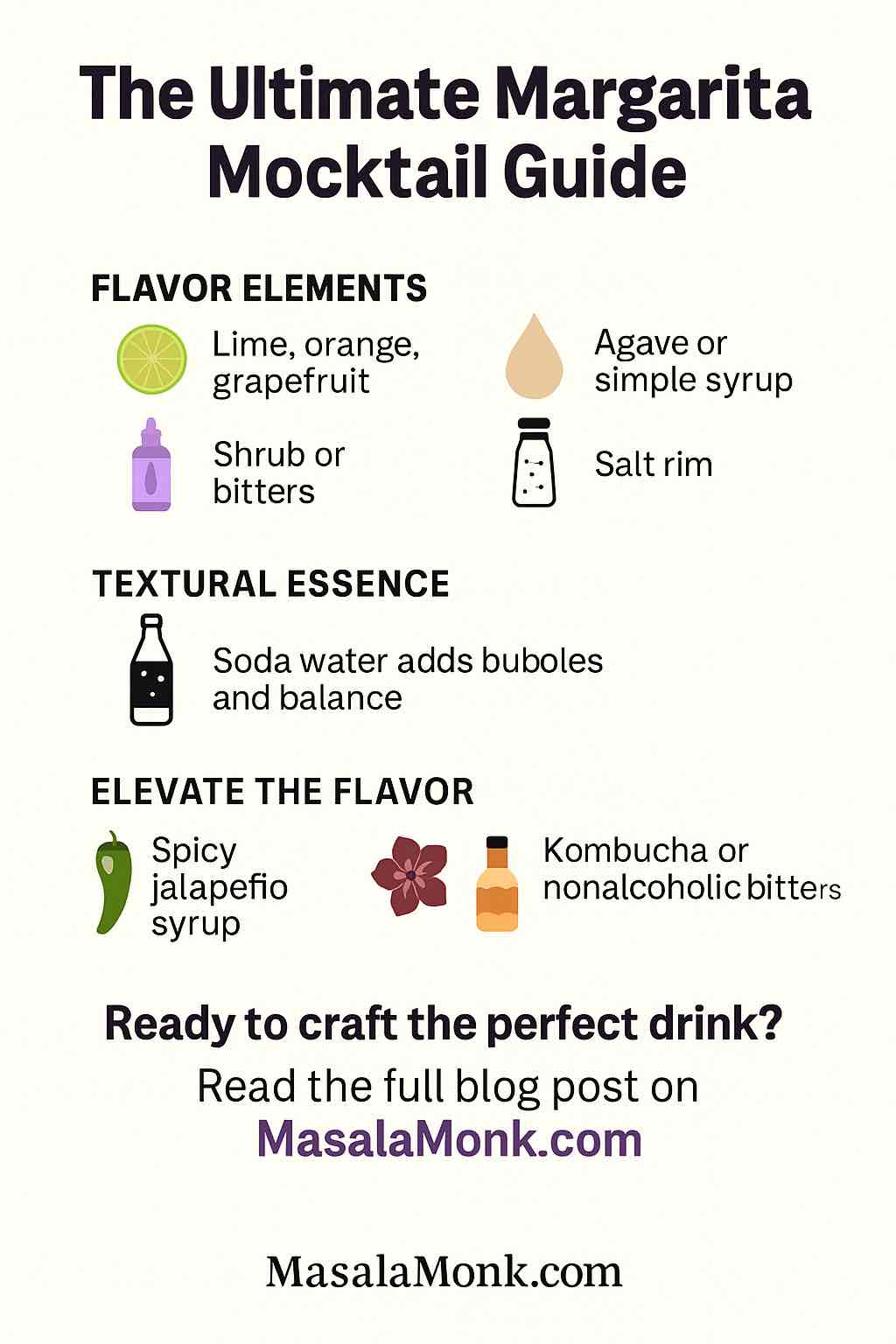

Posted on 4 Comments

Margarita Mocktail Recipe: Easy Virgin Margarita + Frozen, Spicy & Pitcher Variations

Pale lime-gold margarita mocktail in a rocks glass with large clear ice cubes, bubbles, a lime wheel and salt on half of the rim against a dark green background.

This post was last updated on:

A good margarita mocktail should taste like something you would choose to drink, not limeade wearing a salt rim.

Whatever the reason tequila is out of the glass, the margarita itself should not feel like an afterthought. You still want cold lime first, a salty edge, enough sweetness to soften the acidity, and enough character that the drink is worth lingering over.

That is where many virgin margaritas go wrong. Take tequila and orange liqueur out of a classic margarita and you lose more than alcohol: aroma, body, bitterness and some of the bite disappear with them.

You do not need a shelf full of zero-proof bottles to put those qualities back. Start with the five-minute margarita mocktail recipe below. If you like it exactly that way, you’re done. If you want it drier, spicier, frozen, fruitier or closer to a classic margarita, the rest of the guide shows you what to change and why.

The rule to remember: lime first, sweetness second, complexity third, bubbles last.

Quick Answer: How to Make a Margarita Mocktail

Shake 1½ oz (45 ml) fresh lime juice, ½ oz (15 ml) orange juice, ½ oz (15 ml) lemon juice, 2 teaspoons (10 ml) agave nectar and a tiny pinch of salt with ice for 10–15 seconds. Strain over fresh ice in a half salt-rimmed glass, then add 2 oz (60 ml) sparkling water for a punchier drink or 3 oz (90 ml) for a longer, lighter one. Fresh citrus varies from fruit to fruit, so make small adjustments only after the first sip.

Margarita Mocktail Recipe

Prep time: 5 minutes
Total time: 5 minutes
Yield: 1 drink
Method: Shaken
Best glass: 8–10 oz (240–300 ml) rocks glass; a margarita glass of similar capacity also works

Equipment

  • 8–10 oz (240–300 ml) rocks glass or similarly sized margarita glass
  • cocktail shaker or clean lidded jar
  • jigger or measuring spoons
  • small plate for the salt rim

Ingredients

  • 1½ oz (45 ml) fresh lime juice
  • ½ oz (15 ml) fresh orange juice
  • ½ oz (15 ml) fresh lemon juice
  • 2 teaspoons (10 ml) agave nectar, straight from the bottle
  • tiny pinch fine salt
  • 2–3 oz (60–90 ml) chilled sparkling water or club soda
  • plenty of ice
  • coarse salt, kosher salt or margarita salt, for the rim
  • lime wedge or wheel, for serving
Ingredients for a margarita mocktail arranged on a dark metal surface: lime juice, orange juice, lemon juice, agave nectar, salt, sparkling water, ice and a finished drink.
Keep the sparkling water refrigerator-cold. Starting with a cold mixer slows immediate ice melt once the margarita is built.

Method

  1. Salt half the rim. Put salt on a small plate. Run a lime wedge around half of the outside edge of the glass and press that section into the salt. Fill the glass generously with fresh ice.
Hand rubbing a lime wedge along one half of the rim of a clear rocks glass above a dish of coarse salt.
Wet only the outside half of the rim. That keeps loose salt out of the drink while still letting you rotate between salted and unsalted sips.
  1. Shake the citrus base. Add the lime juice, orange juice, lemon juice, agave nectar and tiny pinch of salt to a shaker with ice.
  2. Shake for 10–15 seconds. The shaker should feel thoroughly cold. Shaking chills the drink, works the thick agave into the citrus and adds enough dilution to soften the acidity.
Hands shaking a condensation-covered stainless steel cocktail shaker beside fresh limes and clear ice on a dark surface.
If cold agave clings to the jigger or spoon, rinse it into the shaker with a little citrus so the amount you measured actually reaches the drink.
  1. Strain over fresh ice. The shaker ice has already begun melting; fresh serving ice keeps the drink colder and slows further dilution.
Pale citrus margarita mixture being strained from a metal cocktail shaker into a half-salted rocks glass filled with large fresh ice cubes.
Large fresh serving cubes expose less surface area than small broken shaker ice, so they slow further dilution once the virgin margarita reaches the glass.
  1. Add the bubbles last. Pour in 2 oz (60 ml) sparkling water for a shorter, punchier drink or 3 oz (90 ml) for a lighter one. Stir gently once or twice.
  2. Take the first sip. If lime overwhelms everything else, add another teaspoon (5 ml) agave. Sweetness getting there first calls for a small squeeze of lime. When sweet and sour already feel right but the drink seems strangely empty, the answer is usually contrast rather than more syrup.

A Few Useful Notes

  • Add sparkling water only after shaking. Shaking a carbonated mixer makes a mess and wastes the bubbles you want in the finished drink.
  • Err slightly dry at first. Another teaspoon of agave is easy to add; excess sweetness is harder to undo.
  • A half rim gives you a choice. Some sips get the salty edge and some do not.
  • Keep the glass reasonably small. Filling an oversized tumbler with extra soda turns the drink into something much closer to a citrus spritz.

If you’re making one beside traditional margaritas, start with the 60 ml soda pour. It keeps the drink closer to their shorter, more concentrated feel instead of giving the alcohol-free glass twice the volume.

Two matching margarita mocktails side by side, one labeled 60 ml with a lower drink level and one labeled 90 ml with a higher drink level.
More sparkling water dilutes acidity and sweetness together, so it changes the margarita mocktail’s intensity and length more than its underlying sweet-sour ratio.

What a Good Margarita Mocktail Should Taste Like

The first sip should be properly cold and unmistakably lime-led. Orange and lemon sit underneath rather than announcing themselves as separate juices.

The agave should smooth the sharper edges without making sweetness the main event. A little salt makes the lime seem fuller, while the sparkling water lifts the finish without washing the flavor away.

It should feel crisp rather than thin. The short shake and measured amount of soda matter to that texture just as much as they matter to the flavor.

When the balance lands, you get bright lime, a flicker of salt, rounder citrus through the middle and a clean finish that makes another sip sound good.

Extreme close-up of a margarita mocktail showing coarse salt crystals on the rim, lime, clear ice, condensation and tiny bubbles in pale citrus liquid.
Bring the fresh lime garnish close to the rim: its aroma reaches your nose with each sip and makes the citrus seem brighter before you taste it.

There is no single universal margarita target. Some people want a short, sharply lime-forward drink; others are trying to recreate the sweeter, longer margaritas they know from restaurants. Use the margarita you actually enjoy as the reference point. Once you know what each adjustment changes, you can steer the glass in that direction.

Making it right now? You can stop here. The recipe above is complete. If you’re curious about why it works—or why yours didn’t—the rest of the guide is here when you need it.

↑ Back to Recipe · Fix a drink that tastes off ↓

Margarita Mocktail Guide

Understand & Balance

Change the Drink

Batch, Shortcuts & Fixes

Why Margarita Mocktails Sometimes Taste Like Limeade

A classic margarita is doing more work than its short ingredient list suggests. Tequila supplies agave aroma, body and a peppery or vegetal edge. Orange liqueur brings concentrated orange aroma, sweetness and some bitterness.

You can see those roles clearly in a richer Cadillac Margarita, where tequila, lime and orange liqueur each have a distinct job.

Remove both alcoholic ingredients, keep the lime and sweetener, then stretch everything with water and the drink can collapse into lime + sugar + bubbles. More lime makes it sharper and more agave makes it sweeter, but neither necessarily makes it more interesting.

What is usually missing is some kind of contrast: a bitter edge, aromatic peel, a little heat, a faint dry grip, more concentration or simply the savory lift of salt. One well-chosen correction is usually enough.

Editorial guide showing tequila, orange liqueur and lime as parts of a classic margarita, then a margarita mocktail surrounded by salt, grapefruit, orange peel, ginger, chile, tea and carbonation cues.
A hollow drink can be both sweet and sour at once. Adding more of either will not create the aroma, bitterness or dry grip that is actually missing.

How to Balance a Margarita Mocktail

Forget the theory for a moment and pay attention to the sip in front of you.

If it makes you pucker immediately, the acidity is outrunning everything else. A little agave or controlled dilution will usually help more than another juice.

If sweetness arrives before lime, look first at the syrup, fruit or mixer. Tonic, Sprite, ginger beer and ripe fruit all bring sweetness of their own.

If sweet and sour seem balanced but the drink still feels hollow, give the finish something to hold onto. Grapefruit leaves bitterness after the lime; orange peel adds aroma before the sip; ginger or chile gives the finish a little bite.

If the flavor is good but disappears almost immediately, shorten the drink. Sometimes a perfectly good margarita base has simply been stretched too far.

If it tastes right but feels thin, fresh ice, a proper shake and a 60 ml rather than 90 ml soda top-up can make more difference than another ingredient.

Fix the sensation that is actually bothering you instead of changing three ingredients at once.

Margarita mocktail in the center of a troubleshooting guide with five taste problems and suggested adjustments arranged around the glass.
When diagnosing balance, taste from the unsalted side first; the rim changes how the lime registers and can make the baseline harder to judge.

What the Ingredients Actually Change

Lime Does Most of the Work

The base recipe uses 1½ oz (45 ml) fresh lime juice, enough to keep the drink unmistakably lime-led after ice and sparkling water are added.

Limes are unpredictable. One can be fragrant and juicy; the next can be lean, bitter or fiercely tart. Measuring gives you a useful starting point, but the fruit still gets a vote.

Three different limes shown whole and cut in half, including visibly juicier fruit and one with thicker white pith, beside a measure marked at 45 ml lime juice.
If one lime falls short of 45 ml, reach for another lime rather than replacing the missing volume with lemon or orange; those juices change the profile.

Fresh lime gives the cleanest flavor, though bottled lime juice can still make a useful drink when that is what you have. Bottled products vary considerably, so start with the recipe rather than trying to compensate in advance.

Orange and Lemon Stay in the Background

The small amount of orange rounds the lime and restores some of the citrus character lost with orange liqueur. Too much turns the drink orange-forward. Lemon broadens the acidity; if your limes are already especially sharp, use less lemon before reaching for more sweetener.

Agave Is Less Standard Than It Looks

The recipe uses 2 teaspoons (10 ml) agave nectar straight from the bottle. Bartender-style agave syrup is sometimes diluted with water, so the same volume may taste less sweet. That is one reason apparently identical margarita recipes can land differently.

Salt is doing something different again. The rim gives individual sips a salty edge; the tiny pinch inside the drink quietly makes the lime seem fuller. Sparkling water is mostly about length: 60 ml keeps the drink tight, 90 ml makes it lighter, and much more begins to move toward spritz territory.

Sparkling Water, Tonic, Sprite or Ginger Beer?

MixerWhat it addsBest when you want…
Sparkling waterClean fizz, no added sweetnessThe easiest all-purpose version
Club sodaFizz plus light mineral characterA similarly crisp drink
Sparkling mineral waterMineral character, often with lively bubblesA drier-feeling margarita
Tonic waterBitterness plus sweetnessA finish with more grip
Sprite or 7-UpFizz plus substantial sweetnessA softer, sweeter convenience version
Ginger beerSweetness plus ginger biteA warmer, punchier drink
Grapefruit sparkling waterCitrus aroma with little sweetnessA drier, fruitier direction

A classic margarita isn’t carbonated. The International Bartenders Association’s Margarita is built from tequila, triple sec and lime. Bubbles are useful in this pantry version because they replace some of the lost volume and add lift. A margarita built around a full pour of zero-proof agave spirit may need little or none.

Tonic is especially good when the lime already feels bright but the finish disappears too quickly. Its bitterness hangs around after the citrus. Because tonic is also sweet, reduce the agave rather than simply swapping it one-for-one with sparkling water.

Want Your Margarita Mocktail Drier or Less Sweet?

A drier drink is not automatically a better drink. Some margaritas are meant to be sharp and salty; others are softer and a little sweeter. The useful target is the amount of sweetness that still lets you notice lime, salt and the finish instead of tasting syrup first.

If you are using…Start here
Sparkling water or club soda2 tsp (10 ml) agave nectar
Tonic waterAbout 1 tsp (5 ml) agave or less
Sprite or 7-UpNo added agave initially
Sweet mango, pineapple or berriesAdd the fruit before deciding whether syrup is needed
Non-alcoholic tequilaAccount for any sweetness already in the spirit

Grapefruit, orange peel, chilled tea and unsweetened fizzy mixers are often more useful than piling in extra citrus. They can make the drink feel less sweet without simply making it more sour.

Seven clear mixer drinks arranged and labeled as sparkling water, club soda, mineral water, tonic, lemon-lime soda, ginger beer and grapefruit sparkling water.
Taste an unfamiliar mixer before adding it. Tonic, ginger beer and lemon-lime soda vary in sweetness and bitterness, which can change how much agave the glass needs.

Using Sprite? Jump to the sweeter version ↓

How to Add More Margarita Character Without Zero-Proof Tequila

The pantry version is complete on its own. The ideas below change the personality of the drink rather than “improve” it. Pick the direction that actually sounds good to you.

Margarita mocktail surrounded by grapefruit, curled orange peel, ginger, chile and a small vessel of amber tea on a dark plum and teal set.
When you want more aroma without extra sugar or volume, expressed orange peel is a low-impact adjustment: it changes the nose more than the drink’s balance.

Grapefruit

Add about ½ oz (15 ml) fresh grapefruit juice and reduce the orange or lemon by roughly the same amount. The lime still arrives first, but grapefruit leaves a pleasantly bitter edge behind it.

If that bitter grapefruit finish is exactly what you wanted, a Paloma puts grapefruit, lime, salt and fizz at the center of the drink.

Orange Peel

Express a strip over the finished margarita. You smell orange before the first sip without adding another layer of juice or sugar. It is a small change, but it makes the glass feel noticeably more aromatic.

Ginger or Chile

A tiny amount of fresh ginger juice, ginger syrup or chile gives the finish some warmth. This is the direction to take when you want a margarita that lingers a little instead of finishing clean and disappearing.

Chilled Tea

Replace ½–1 oz (15–30 ml) of the mixer with strong chilled green tea or Earl Grey. At that amount it should not announce itself as a tea drink; it simply leaves a faint dry grip after the citrus.

If you already enjoy savory drinks, a few drops of unsweetened dill-pickle brine or olive brine can work too. Start around ⅛ teaspoon or less. This is a small adjustment, not a new main ingredient.

Margarita Mocktail With Non-Alcoholic Tequila

If what you miss is specifically the agave aroma, body and bite of tequila, a zero-proof agave spirit can be useful. This is also the version that sits most naturally beside traditional margaritas at the same table: same short-drink idea, just built around a different bottle.

Short pale-gold non-alcoholic tequila-style margarita in a heavy rocks glass with clear ice, a partial salt rim, lime and orange peel against a dark amber and green bar setting.
If you add soda to a zero-proof agave build, remember the spirit already contributes 60 ml of volume; start shorter and lengthen only after tasting.

For 1 drink

  • 2 oz (60 ml) non-alcoholic agave or tequila-style spirit
  • 1 oz (30 ml) fresh lime juice
  • ½ oz (15 ml) fresh orange juice or non-alcoholic orange liqueur
  • ¼ oz (7.5 ml) agave nectar, then adjust if needed
  • tiny pinch salt
  • ice
  • salt for the rim

Shake with ice for 10–15 seconds and strain over fresh ice. Hold back any extra agave or sparkling water until you know what the spirit has already contributed.

Taste the Bottle You Actually Bought

Zero-proof agave spirits vary enormously. Some are sweet, some thin, and some lean heavily on pepper or capsicum to imitate alcoholic burn. Others are grassy, smoky or aromatic.

Some bottles also taste stranger neat than they do in a margarita. Lime, salt and a little sweetness can pull those flavors together, so a spirit you would never sip by itself may still work surprisingly well once mixed.

A sweeter bottle needs less agave. Strong pepper or capsicum probably means you can skip extra chile. Fuller-bodied products may give you enough structure that soda becomes unnecessary. Work around the bottle in front of you rather than assuming every zero-proof tequila behaves the same way.

Unbranded bottle and pale margarita mocktail surrounded by four tasting adjustments labeled sweeter, very peppery, fuller-bodied and thin.
Opening an unfamiliar zero-proof bottle? Make a half-size trial drink before batching so you can learn whether it pushes sweet, peppery or thin without wasting ingredients.

What Can Replace Orange Liqueur?

The substitutes do not all do the same job. Orange juice brings flavor, sweetness and water. A strip of orange peel gives you mostly aroma. Orange blossom water is intensely floral, so think drops rather than splashes. A non-alcoholic orange liqueur is the closest single replacement, though its sweetness will depend on the bottle.

If you need the finished drink to be strictly 0.0% alcohol, check the stated alcohol content on every specialty spirit, bitters or bottled cocktail ingredient you use. The simple citrus-agave-sparkling-water recipe avoids those products entirely.

Spicy Margarita Mocktail

Jalapeño works especially well here because it brings fresh green-pepper flavor as well as heat. The best version gives you cold lime and salt first; the warmth catches up a moment later and lingers through the finish.

Pale spicy margarita mocktail with clear ice, lime, a jalapeño slice and a partial red chile-salt rim on a glossy dark red background.
A chile-salt rim makes heat optional from sip to sip, whereas jalapeño infused into a spicy margarita mocktail changes the character of the entire glass.

For 1 drink

  • 1½ oz (45 ml) fresh lime juice
  • ½ oz (15 ml) fresh orange juice
  • ½ oz (15 ml) fresh lemon juice
  • 2 tsp (10 ml) agave nectar
  • 1–3 thin jalapeño slices
  • tiny pinch salt
  • 2–3 oz (60–90 ml) sparkling water
  • Tajín or chile salt, for the rim

Add the citrus, agave, salt and jalapeño to the shaker.

  • Mild: 1 thin slice, lightly muddled
  • Medium: 2 slices
  • Hotter: 2–3 slices with a firmer muddle

Jalapeños vary wildly in heat, so those counts are starting points rather than guarantees. Shake with ice, strain over fresh ice and add the sparkling water last.

Fine-straining also stops pepper pieces from sitting in the drink and continuing to release heat. Leave them in and the last sip can be considerably hotter than the first.

Jalapeño heat guide showing one slice for mild, two slices for medium and two to three slices for hotter, alongside a spicy margarita mocktail and fine strainer.
Keep the jalapeño slices similarly thin when comparing heat levels; otherwise, slice thickness becomes another variable alongside the number of pieces.

If chile is the part you want to emphasize, the Spicy Margarita gets much more specific about jalapeño intensity, Tajín and heat control.

Hot Honey Shortcut

Hot honey makes a rounder, warmer spicy margarita than plain agave. Thin it with a little warm water, let the syrup cool, then use it instead of agave. Straight honey is much harder to incorporate evenly into an ice-cold drink.

Making spicy margaritas for a crowd? Jump to the pitcher method ↓

Frozen Margarita Mocktail

A frozen margarita needs its own formula because blended ice is a major ingredient, not merely a way to chill the drink. As that ice breaks down, it adds water to every other flavor.

Pale frozen margarita mocktail with a softly mounded slushy texture in a stemmed margarita glass, garnished with lime against a blue and chrome background.
Judge a frozen margarita mocktail by how the slush moves, not by a fixed blender time: machine power and ice size can change how quickly the right texture appears.

For 1 generous frozen margarita

  • 1½ oz (45 ml) fresh lime juice
  • ¾ oz (22 ml) fresh orange juice
  • ½ oz (15 ml) fresh lemon juice
  • ½ oz (15 ml) agave nectar
  • tiny pinch salt
  • about 1½ cups standard ice cubes
  • up to 1 tbsp (15 ml) cold water, only if the blender needs it

Add the liquids and salt first, then the ice. Blend only until smooth and slushy, then stop. Once the texture is right, leaving the blender running only gives the mixture more time to warm and the ice more time to melt.

The right texture should look almost a little too thick when it first leaves the blender, then relax into a smooth slush as you drink it. It should move slowly in the glass without becoming spoonable.

Start Cold

Fridge-cold citrus, cold agave and a chilled glass give you a head start. Warm ingredients force more ice to melt before the margarita is properly cold, making a thin texture more likely.

Freeze Flavor, Not Only Water

Freeze some of the citrus base into cubes and replace part of the plain ice with them. As those cubes melt, they add margarita rather than plain water.

Clear plain ice cubes beside pale yellow-green frozen citrus-base cubes melting on a transparent acrylic block under blue studio lighting.
Freeze the citrus base in small, repeatable portions; then you can replace plain ice consistently instead of guessing how much concentrated flavor went into the blender.

Frozen mango brings body as well as sweetness; in a Mango Margarita, enough lime keeps that richness lively rather than heavy.

Frozen Margarita Troubleshooting

It is soupy

There is too much liquid for the amount of ice, or everything started too warm. Before blending, the ice should sit substantially above the liquid rather than floating freely in a large pool.

Add a modest amount of ice and pulse briefly. Getting close to the right ratio from the beginning works better than repeatedly feeding fresh ice into a mixture that has already warmed.

It is too thick or the blender will not move

Add 1 tablespoon (15 ml) cold water and blend briefly. Repeat only if the mixture still refuses to move.

It tastes watery

Try a squeeze of lime and a tiny pinch of salt before reaching for more syrup. Next time, make the base stronger or replace some plain ice with frozen citrus or fruit cubes.

It is coarse and icy

The ice may not be breaking down finely enough, or the mixture may need a little more liquid to settle into a smooth slush. Blend again briefly, adding liquid a tablespoon at a time if necessary.

The ice and liquid separate quickly

Frozen margaritas naturally begin separating as they warm. Start colder, use enough ice and serve promptly. Fruit purée can add useful body in fruit versions too.

Four frozen margaritas showing soupy, correct smooth slush, too-thick and coarse icy textures, with a short correction beneath each state.
Fix texture before sweetness. Extra juice or syrup adds more liquid, so adjusting flavor first can make an already loose frozen margarita even looser.

↑ Back to Frozen Margarita · Try a fruit variation ↓

Margarita Mocktail Pitcher for 8

For a party, make the still base ahead with a little cold water to replace some of the dilution you would normally get from shaking eight individual drinks. Keep the sparkling water and serving ice separate until you’re actually pouring glasses.

Hand pouring pale margarita mocktail base from a large crystal pitcher into glasses around a teal dinner table with chips, guacamole, grilled corn and other food.
Chill the empty pitcher before adding the margarita base. That protects serving temperature without quietly adding more water to the batch through extra ice.

Chilled Base for 8 Drinks

  • 12 oz (360 ml) fresh lime juice
  • 4 oz (120 ml) fresh orange juice
  • 4 oz (120 ml) fresh lemon juice
  • ⅓ cup (80 ml) agave nectar
  • ⅓ cup (80 ml) cold water
  • ⅛ teaspoon fine salt to start, with up to ¼ teaspoon total if needed

Whisk thoroughly, cover and refrigerate until very cold. You’ll have about 26 oz (760 ml) of base, enough for eight pours of roughly 3¼ oz (95 ml) each.

The chilled base should taste a little concentrated because every glass still has ice and sparkling water ahead of it. Lime can be assertive without feeling punishing, while the salt should stay in the background.

To Serve Each Glass

  1. Rim the glass close to serving time and fill it with fresh ice.
  2. Pour in about 3¼ oz (95 ml) chilled margarita base.
  3. Add 2–3 oz (60–90 ml) chilled sparkling water.
  4. Stir gently and garnish with lime.
Pitcher serving guide showing chilled margarita base, a 95 ml measure, fresh ice, a separate sparkling-water bottle and two finished glasses with 60 ml or 90 ml fizz.
Open the sparkling water near serving time and stir only gently; extra agitation spends carbonation before the margarita mocktail even reaches the table.

Keeping the carbonation separate means the eighth glass can be as lively as the first. That matters even more when some people want the short 60 ml top-up and others prefer the lighter 90 ml version—you do not have to commit the whole table to one margarita.

If getting ahead makes hosting easier, prepare the citrus base up to about 24 hours before serving. Keep it covered and refrigerated; save the ice and bubbles for the glasses.

For a spicy batch, add jalapeño to the still base and monitor the heat. Remove the pepper when it reaches the level you want because it will keep extracting while it sits.

Fruit Margarita Mocktails

Fruit versions change the personality of the drink quickly: strawberry makes it softer, mango fuller, watermelon lighter and grapefruit drier. The method barely changes; the balance does.

VariationAddWatch for
Strawberry2–3 muddled ripe berriesVery ripe berries may make extra agave unnecessary
Mango1½–2 oz (45–60 ml) mango nectar or puréeKeep enough lime to stop mango overwhelming the citrus
Watermelon3–4 oz (90–120 ml) fresh watermelon juiceUse less soda because watermelon contributes plenty of water
Pineapple1–2 oz (30–60 ml) pineapple juiceExtra agave may not be necessary
Blood orangeReplace regular orange with blood orangeKeep lime clearly in front
Grapefruit½–1 oz (15–30 ml) fresh grapefruit juiceReduce another citrus component rather than simply adding more juice
Cucumber3–4 muddled slicesFine-strain if you want a cleaner texture
Seven fruit margarita mocktails displayed on jewel-toned pedestals and labeled strawberry, mango, watermelon, pineapple, blood orange, grapefruit and cucumber.
Fruit changes texture as well as flavor. Fine-strain fruit margarita mocktails for a cleaner sip, or keep some pulp when extra body is part of the appeal.

Watermelon is particularly easy to wash out because the fruit contributes so much liquid of its own. A Watermelon Margarita works best when the lime stays assertive and the final fizz stays under control.

Margarita Mocktail With Sprite

This is the easy, sweeter version. If that is the margarita you actually want, there is no need to apologize for it—just let the soda supply the sugar instead of adding agave on top.

  • 1½ oz (45 ml) fresh lime juice
  • ½ oz (15 ml) fresh orange juice
  • tiny pinch salt
  • 3–4 oz (90–120 ml) chilled lemon-lime soda
  • ice

Shake the lime, orange and salt with ice, strain over fresh ice and add the soda last. Fresh lime matters especially here because it stops the sweet mixer from becoming the whole drink.

Margarita Mocktail Without Orange Juice

If orange is the part you do not want, leave it out rather than trying to hide it under more lime. The result is leaner, sharper and more lime-forward.

  • 1½ oz (45 ml) fresh lime juice
  • 2 teaspoons (10 ml) agave nectar
  • ½ oz (15 ml) grapefruit juice, optional
  • tiny pinch salt
  • 2 oz (60 ml) sparkling water

Shake the still ingredients with ice, strain over fresh ice and add the sparkling water. A strip of orange peel expressed over the top gives you orange aroma without putting orange juice back into the drink; skip the peel too if you want the cleanest lime-only direction.

Practical Shortcuts & Ingredient Swaps

A margarita is not a test of how well stocked your kitchen is. Fresh citrus and a shaker help, but neither is worth abandoning the drink over.

Using Bottled Margarita Mix

First check the label and make sure you’re holding an alcohol-free margarita mixer rather than a premixed alcoholic margarita. Then see whether it is a concentrate that needs diluting or a ready-to-use mixer that is already quite sweet.

With a concentrate, follow the label’s dilution instructions first, then add fresh lime, ice and a salt rim before deciding it needs anything else.

For a sweet ready-to-use mix, replacing roughly one-third of the pour with unsweetened sparkling water is a useful first move. Fresh lime can sharpen it from there. Brands vary too much for that ratio to be a law.

No Cocktail Shaker?

A clean jar with a secure lid works well: shake the citrus, agave, salt and ice, strain into the glass, then add sparkling water.

You can also build the drink directly in the glass. Stir the citrus, agave and salt together first, add plenty of ice and stir until cold, then finish with sparkling water. You lose a little aeration, not the entire drink.

Swap by Function

  • Need sweetness? Simple syrup, honey syrup or cooled hot-honey syrup can replace agave.
  • Need orange aroma? Try orange peel, zest, a few drops of orange blossom water or non-alcoholic orange liqueur.
  • Need a drier finish? Tonic, grapefruit or strong chilled tea can help.
  • Need fizz? Club soda, mineral water, tonic, grapefruit sparkling water, ginger beer and lemon-lime soda all work, but they do not contribute the same sweetness.
  • Need bite? Use a little ginger, jalapeño, hot honey or a peppery zero-proof spirit.

Margarita Mocktail Troubleshooting

Come back here when the drink is close but not quite right. Fix the problem you can actually taste first rather than changing several things at once.

ProblemFirst fix
Too sourAdd 1 tsp (5 ml) agave
Too sweetAdd a small squeeze of fresh lime
Tastes like limeadeAdd contrast with tonic, grapefruit, ginger, a tiny salt adjustment or a zero-proof spirit
Orange dominatesReduce orange juice and use peel for aroma instead
Mostly tastes like sodaUse less carbonated mixer
WateryUse less mixer and fresh serving ice
FlatUse fresh carbonation; a tiny pinch of salt may also help the flavor
Too bitterWork out whether tonic, grapefruit, lime pith, brine or the zero-proof spirit is responsible before adding sugar
Too saltyDrink from the unsalted side or dilute/rebuild the glass
Non-alcoholic tequila tastes too pepperyUse less, rebalance around it or make the pantry version instead
Not enough biteAdd a very small amount of ginger or chile
Far too spicyRemove or strain the pepper and dilute the drink
Pitcher has gone flatKeep carbonation separate and add it per glass
Spicy pitcher keeps getting hotterStrain the jalapeño once the heat is right

Sour and Bitter Are Not the Same Problem

Sour is mostly acidity. When lime makes your mouth pucker before anything else gets a chance to register, a little sweetness or controlled dilution can bring the glass back into balance.

Bitter can come from tonic, grapefruit, lime pith, a strongly flavored zero-proof spirit or too much brine. Adding syrup to that problem can leave you with a drink that is both sweet and bitter, so find the source first.

↑ Back to Recipe · ↑ Quick Answer

Frequently Asked Questions

Is a virgin margarita the same as a margarita mocktail?

In everyday use, virgin margarita, non-alcoholic margarita and margarita mocktail usually describe the same broad idea: a margarita-style drink made without tequila or orange liqueur. Recipes range from simple citrus-and-soda drinks to versions built with zero-proof agave spirits.

Does this margarita mocktail contain alcohol?

The basic citrus-agave-sparkling-water recipe uses no alcoholic ingredient. Specialty products sold as non-alcoholic spirits, bitters or cocktail substitutes can vary, so check the stated alcohol content on the individual product whenever an exact 0.0% drink matters to you.

Can I leave out the lemon juice?

Yes. Lemon broadens the citrus, but the drink still works without it. Leave it out, make the lime-and-orange base, and change something only if the finished glass actually needs it.

How much juice is in one lime?

It varies considerably. A medium juicy lime may give roughly 1 oz (30 ml), while another may give much less. Measuring the juice is more reliable than building the recipe around a fixed number of limes.

What to Serve With a Margarita Mocktail

Part of the pleasure of a margarita is the table around it: something salty, something spicy, a cold glass that lasts long enough to eat with. Creamy guacamole with tortilla chips is one of the simplest pairings because lime and salt already connect the food and drink.

Quesadillas, grilled corn, nachos, grilled vegetables, spicy chicken, shrimp, bean dips and fruit salsas fit naturally too. A chile-and-Tajín rim is particularly good when the food brings a little sweetness.

For dinner, Fish Tacos are an easy match: flaky fish, cabbage, lime crema and jalapeño give the cold margarita plenty of richness and spice to cut through.

Margarita mocktail on a dark teal dinner table surrounded by tacos, grilled corn, tortilla chips, salsa, guacamole and skewered grilled food, with hands reaching toward the dishes.
At the table, use the half-salted rim strategically: sip from the unsalted side with salty chips, then rotate toward salt alongside sweeter or richer bites.

A margarita mocktail does not have to convince anyone that tequila is hiding in the glass. It needs to give you the part you came for: bright lime, a salty edge, enough character to slow down and enjoy it, and a second sip that sounds better than the first. Once you know which adjustment changes which part of that experience, you can make the glass your own.

Made it your own? Tell me what made the difference for you—less agave, tonic, extra grapefruit, jalapeño, a frozen version, or something completely different.

Back to Recipe ↑ · Back to Top ↑