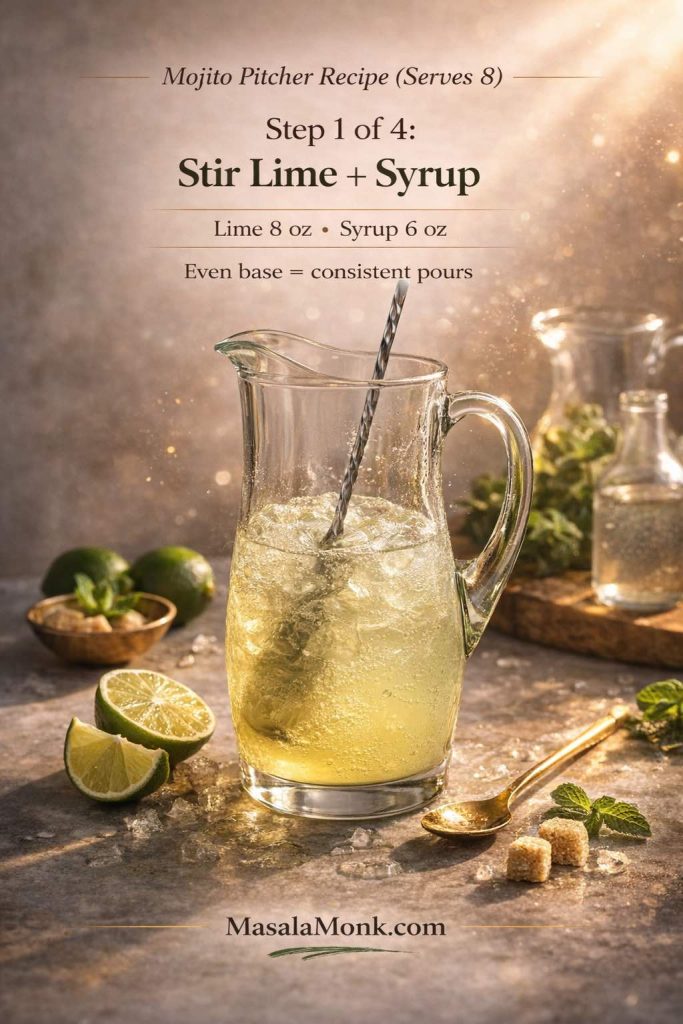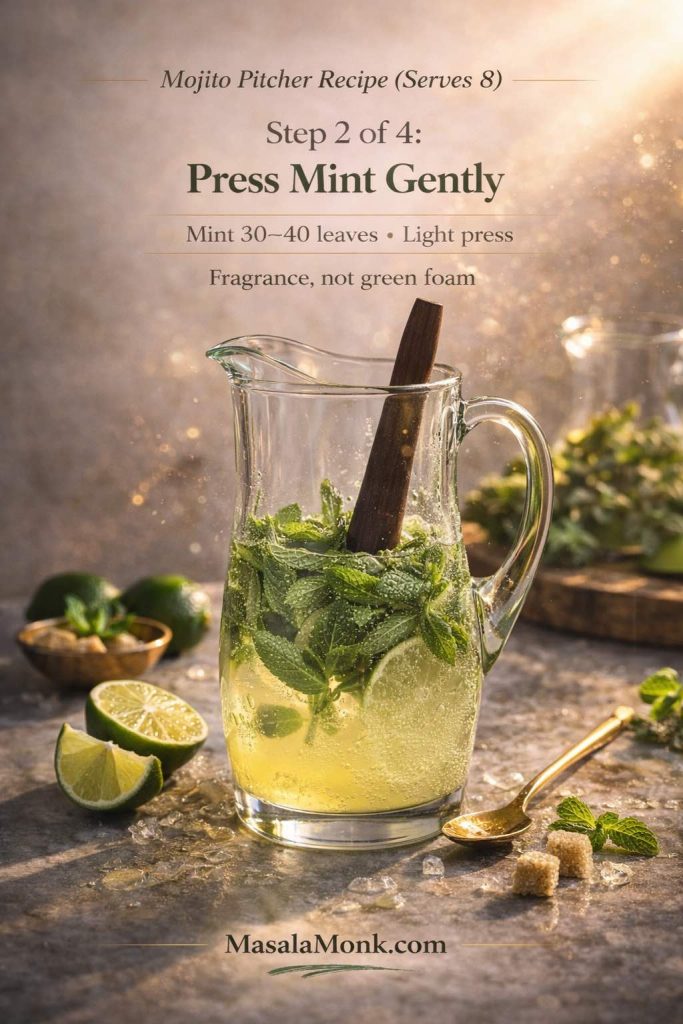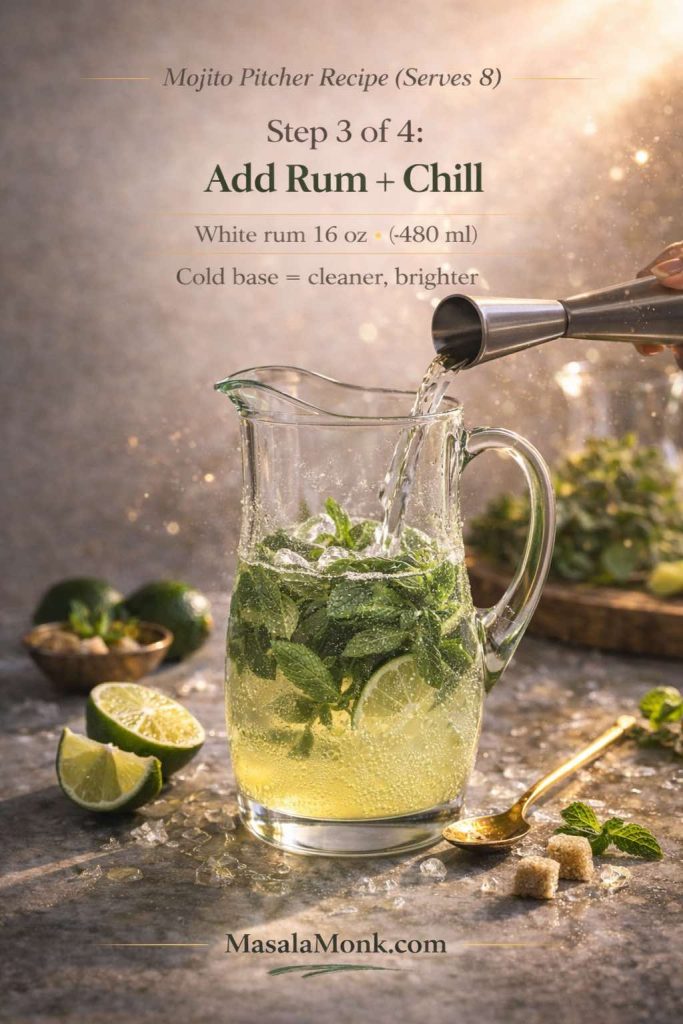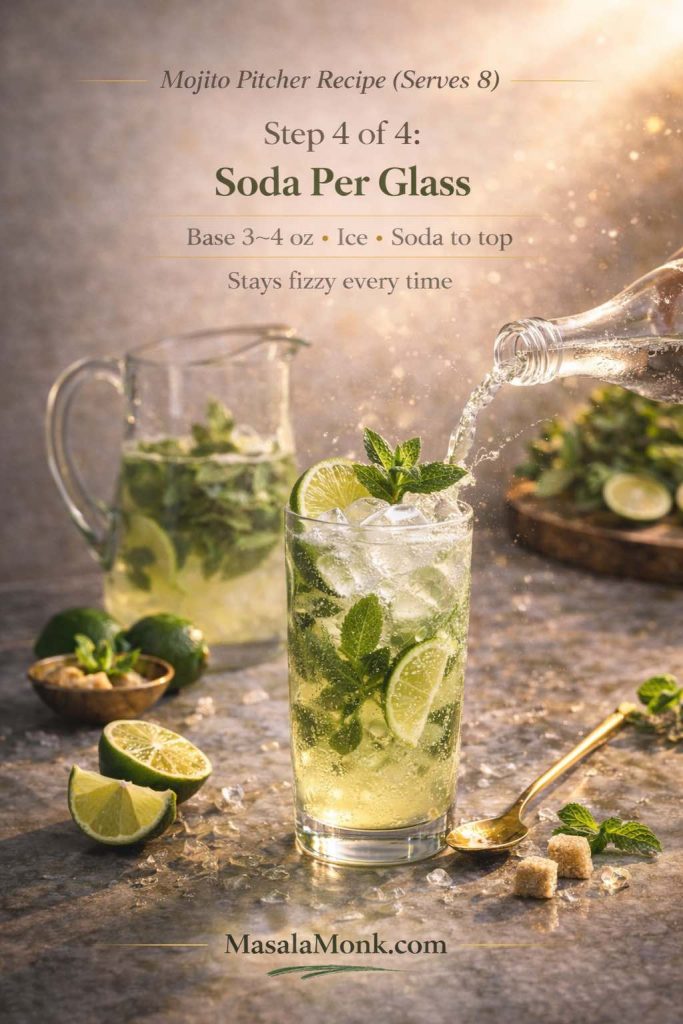
Posted on Leave a comment

Mango Margarita Recipe (Frozen or On the Rocks)

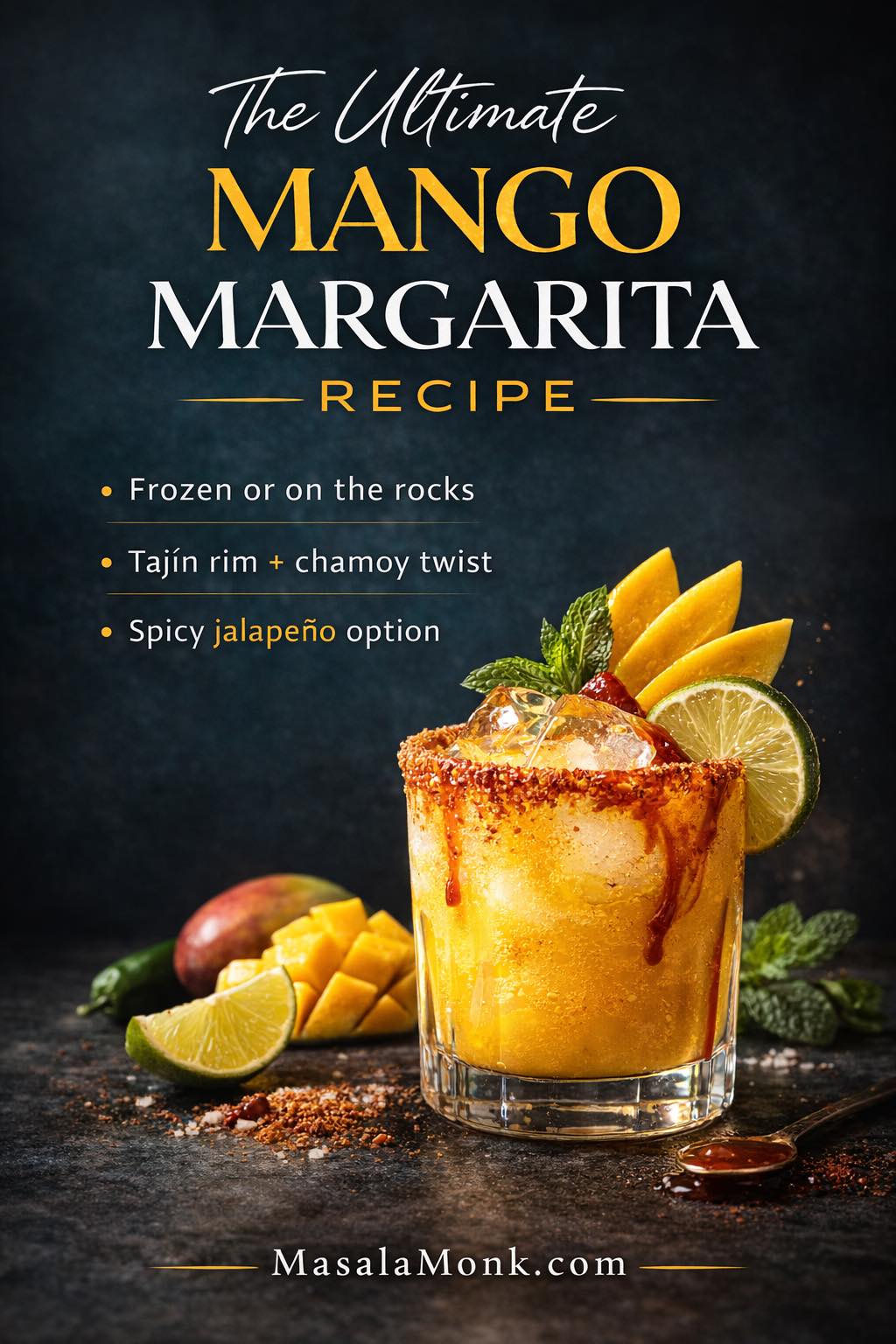
Premium magazine-style cover image of a mango margarita recipe: a chilled mango margarita with a Tajín rim and chamoy drizzle, garnished with mango slices, lime, and mint on a dark teal background, with text highlighting frozen or on the rocks and a spicy jalapeño option.

A mango margarita recipe has one job: taste like sunshine without turning syrupy. Mango does the easy part—lush, tropical, instantly cheerful—yet it can also overpower a drink if you don’t keep the margarita structure crisp. When it’s balanced, you get juicy mango up front, a bright lime snap on the finish, and tequila running cleanly through the middle. Suddenly, an ordinary evening feels like a small celebration.

That balance matters because mango isn’t a “set it and forget it” ingredient. It’s naturally sweet, often thick, sometimes fibrous, and it changes from fruit to fruit and bottle to bottle. Meanwhile, a margarita is precision disguised as simplicity: tequila needs lime, lime needs a touch of sweetness, orange liqueur gives the drink its classic shape, and a pinch of salt makes everything taste brighter. If you like having a simple mental model you can rely on, MasalaMonk’s margarita balance guide lays out that rhythm clearly—and it transfers perfectly here because the core of a margarita is balance, not booze.
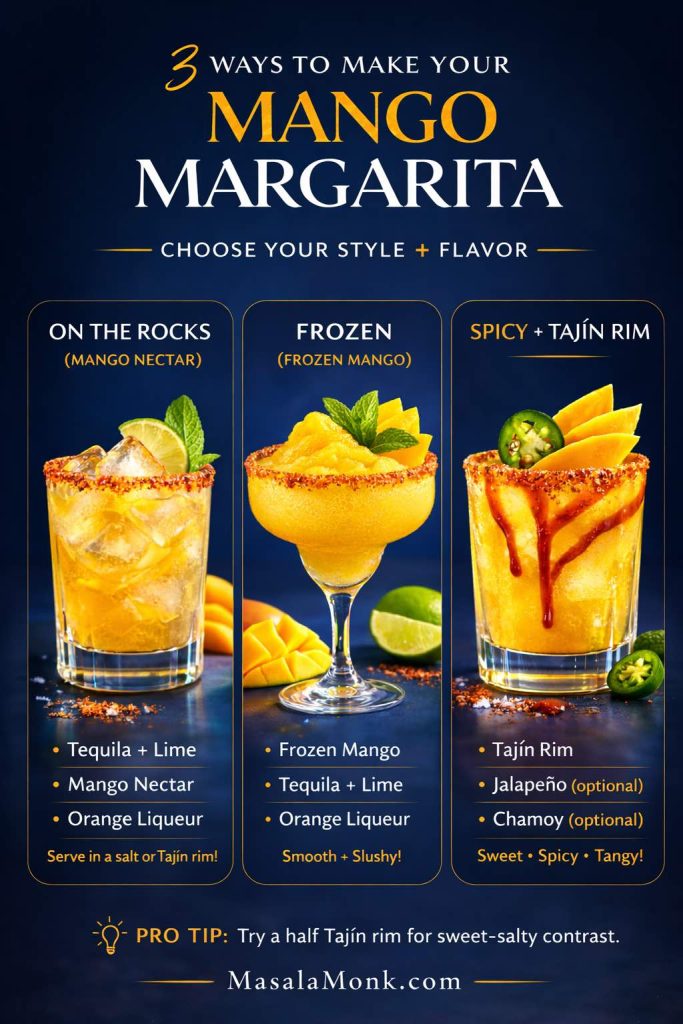
Infographic showing three ways to make a mango margarita recipe: on the rocks with mango nectar, a frozen mango margarita, and a spicy version with a Tajín rim plus optional chamoy and jalapeño, on a dark blue background.
Not sure which version to make? This “3 ways” guide helps you choose fast: a mango margarita on the rocks (mango nectar), a thick frozen mango margarita, or a spicy Tajín-rimmed option with chamoy and jalapeño.

From there, you’ll have two go-to versions—frozen and on the rocks—plus the variations you’ll actually want on repeat: a spicy mango margarita with jalapeño (or a careful habanero option), a Tajín rim that makes the fruit pop, a chamoy mangonada-style pour for candy-tang drama, a smoky mango mezcal margarita, and a pitcher mango margarita recipe for serving a crowd. You’ll also get clear swaps for fresh mango, frozen mango, mango nectar, mango purée, or mango juice, so you can make it confidently with what you have.

Also Read: Mojito Recipe (Classic) + Ratios, Pitcher, Mocktail & Easy Variations


Mango margarita ingredients that actually matter

Some mango margarita lists throw in everything—soda, grenadine, flavored syrups, pre-made mixes, and a dozen optional extras—until you can’t tell what the drink is supposed to taste like. Instead, we’ll keep the base focused. Then, once the base is right, add-ons like Tajín, chamoy, or jalapeño become exciting rather than chaotic.
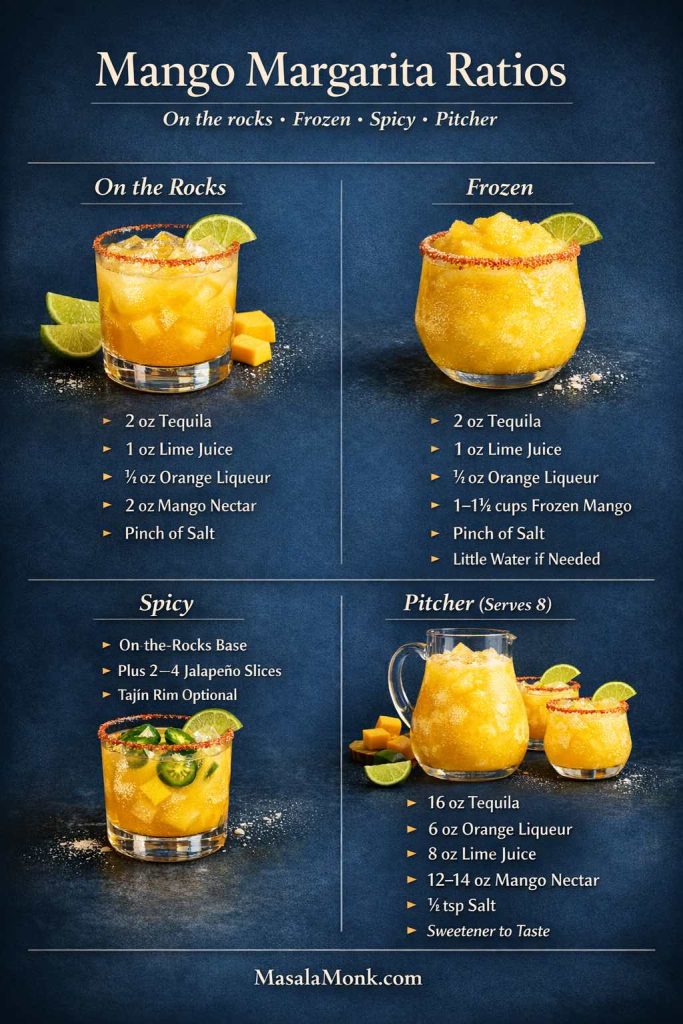
Premium mango margarita ratios infographic comparing four versions: on the rocks, frozen, spicy, and pitcher. The graphic shows photoreal mango margarita drinks with ingredient ratios for tequila, lime juice, orange liqueur, mango nectar or frozen mango, plus salt and optional jalapeño on a dark blue background.
This mango margarita ratios guide makes the whole post easier to use at a glance. It compares the four most useful builds—on the rocks, frozen mango margarita, spicy mango margarita, and a pitcher mango margarita recipe for a crowd—so you can pick your version fast and keep the balance right. Use it as a quick reference for tequila, lime, orange liqueur, mango, and salt before you dive into the step-by-step sections below. Save it now, then scroll for the detailed frozen method, Tajín rim ideas, chamoy finish, and jalapeño heat control.

The essentials for any mango margarita recipe

  • Tequila (blanco or reposado)
  • Fresh lime juice (this one is non-negotiable)
  • Orange liqueur (triple sec / Cointreau style)
  • Mango (fresh, frozen, nectar, purée, or juice)
  • Sweetener (agave or simple syrup, used sparingly)
  • Fine salt (a tiny pinch inside the drink is transformative)
  • Ice (for shaking and serving; optional for blending)

A classic margarita is typically tequila + orange liqueur + lime in a clean, citric balance. If you want to see that baseline clearly before mango enters the picture, the classic margarita method is a handy reference. You don’t need to copy it exactly, yet it’s useful to remember what mango is modifying: it’s adding body and sweetness, so your job is to protect brightness.
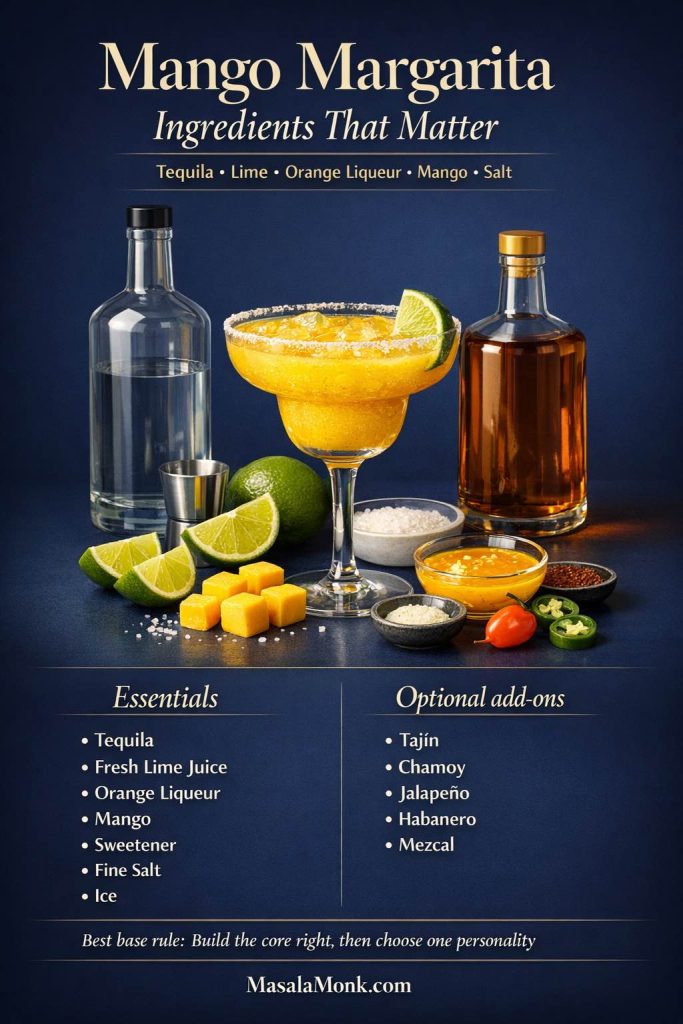
Premium mango margarita ingredients guide showing the core ingredients that matter for a mango margarita recipe: tequila, fresh lime juice, orange liqueur, mango, sweetener, fine salt, and ice, plus optional add-ons like Tajín, chamoy, jalapeño, habanero, and mezcal, arranged around a finished mango margarita on a smooth dark blue background.
This mango margarita ingredients guide shows the difference between the true base of the drink and the extras that change its personality. Start with tequila, fresh lime juice, orange liqueur, mango, sweetener, salt, and ice, then build in one direction with Tajín, chamoy, jalapeño, habanero, or mezcal if you want a spicy, tangy, or smoky twist. It’s a useful visual shortcut for understanding what actually matters in a mango margarita recipe before you move into the on-the-rocks, frozen, spicy, or pitcher versions. Save it, then keep reading for the exact ratios, recipe cards, and finishing guides.

Optional add-ons that change the drink fast

  • Tajín or chili-lime seasoning for a tangy-salty rim
  • Chamoy for sweet-sour-salty “mangonada” energy
  • Jalapeño for green, fresh heat
  • Habanero for fruity, intense heat (use carefully)
  • Mezcal for a smoky twist

It’s worth saying plainly: you don’t need all of these at once. In fact, the best mango margarita usually feels clean and intentional. So build the base first, then choose one “personality” direction—spicy, Tajín, chamoy, smoky, or pitcher.

Also Read: Air Fryer Donuts Recipe (2 Ways): Glazed Homemade Donuts + Biscuit Donuts


Tequila choices that make mango taste better

Tequila can either lift mango or blur it. A good match makes mango taste brighter and lime taste cleaner. A mismatched tequila can make the drink taste muddy or overly boozy.
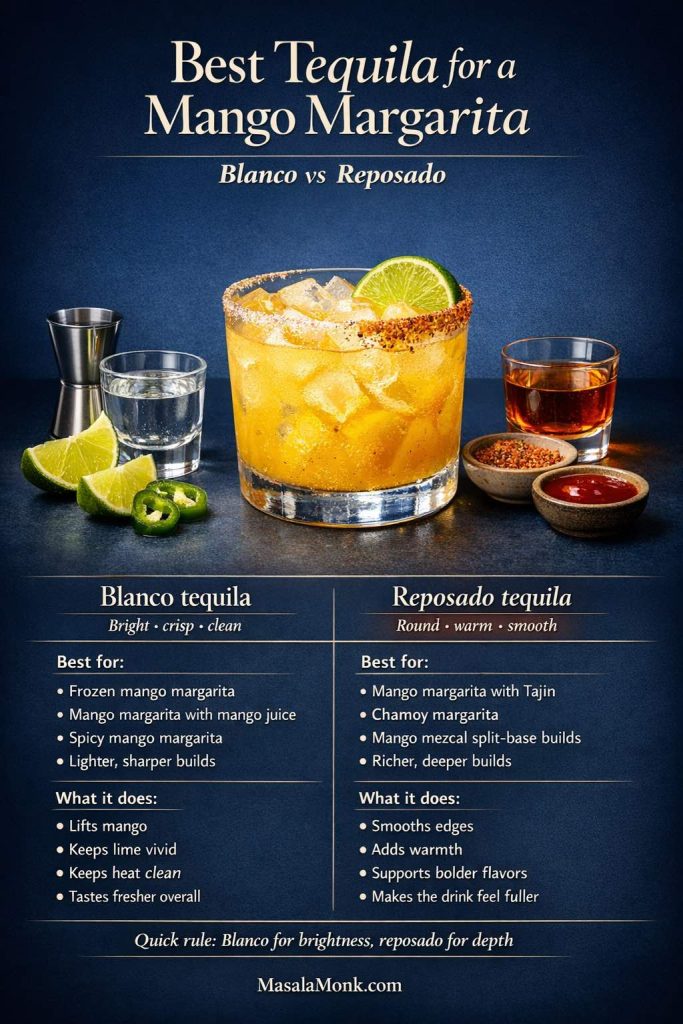
Choosing the right tequila can completely change a mango margarita recipe, and this guide makes the difference easy to see. Blanco tequila keeps the drink bright, crisp, and clean, which makes it great for frozen mango margaritas, mango juice builds, and spicy jalapeño versions. Reposado tequila brings a rounder, warmer feel that works beautifully with Tajín, chamoy, and richer mango margarita variations, including split-base mezcal builds. Save this card before mixing so you can match the tequila to the style of drink you actually want.

Blanco tequila (bright and clean)

Blanco is a natural fit when you want your mango margarita to taste crisp. It’s especially helpful for:

  • a frozen mango margarita recipe, where texture can make flavors feel heavier
  • mango margarita with mango juice, where the drink benefits from clarity
  • spicy mango margarita recipe builds, where you want heat to feel clean, not clumsy

Reposado tequila (round and warm)

Reposado smooths the edges. It’s lovely when you’re leaning into bolder accents like:

  • mango margarita with Tajín
  • chamoy margarita
  • mango mezcal margarita “split base” builds (reposado + mezcal can be gorgeous)

More for your tequila-citrus instincts

If you like tequila drinks that taste refreshing rather than sugary, MasalaMonk’s Paloma recipe is a great companion read. Paloma is grapefruit-based rather than mango-based, yet the same “acid + salt + tequila” relationship shows up, and it’s the exact relationship that makes a mango margarita taste like a margarita instead of a mango drink with tequila floating in it.

Also Read: Tapas Recipe With a Twist: 5 Indian-Inspired Small Plates


Fresh mango vs frozen mango vs mango nectar vs mango purée vs mango juice

This section is the difference between “pretty good” and “best mango margarita.” Mango can vary wildly. One mango tastes like perfume and sunshine; another tastes mild and starchy. Mango nectar brands differ, purées differ, juices differ. So instead of offering one rigid version, here’s a simple choose-your-path approach.
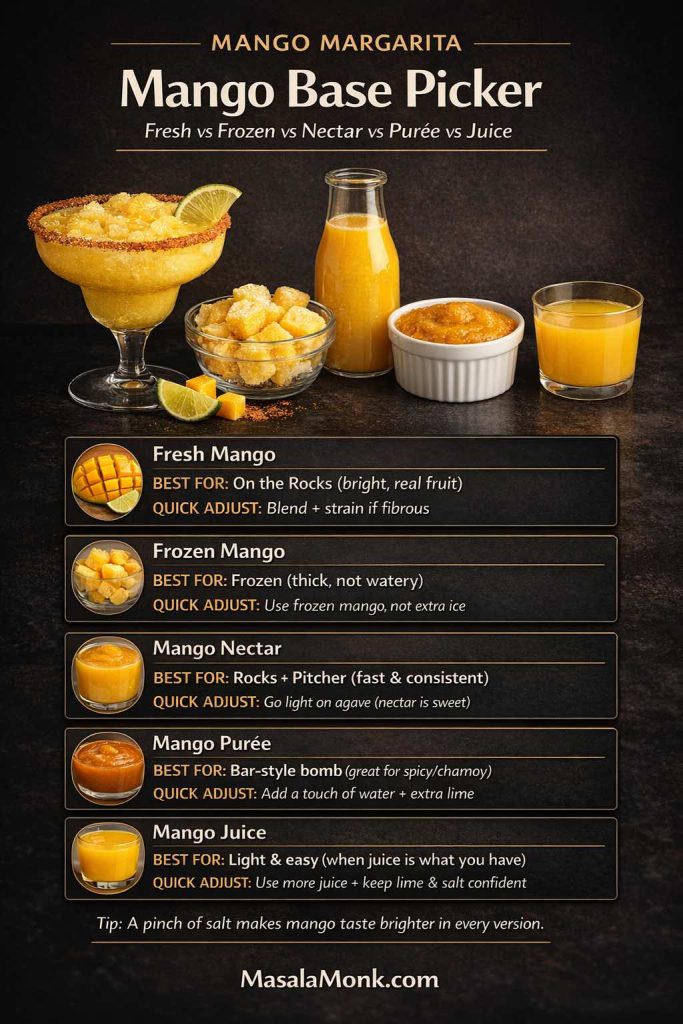
Mango Margarita “Mango Base Picker” infographic comparing five mango options—fresh mango, frozen mango, mango nectar, mango purée, and mango juice—with a photoreal drink scene and text overlay. Each option lists what it’s best for (on the rocks, frozen, pitcher, bar-style, light) and a quick adjustment tip (strain if fibrous, use frozen mango not ice, go light on agave, add a touch of water and extra lime, use more juice with confident lime and salt). Footer reads MasalaMonk.com.
Not sure what mango to use? This Mango Base Picker makes it easy: fresh mango for bright on-the-rocks flavor, frozen mango for a thick frozen margarita, mango nectar for the fastest pitcher-friendly option, mango purée for bar-style body (great with spicy/chamoy), and mango juice when you want a lighter drink. Follow the “quick adjust” line and you’ll get a balanced mango margarita recipe no matter what you have.

Fresh mango margarita recipe (when mangoes are actually fragrant)

Fresh mango can be magical when it’s ripe. It’s also the most variable. A fresh mango margarita recipe tastes incredible when the fruit is fragrant; it tastes flat when the mango is underripe.
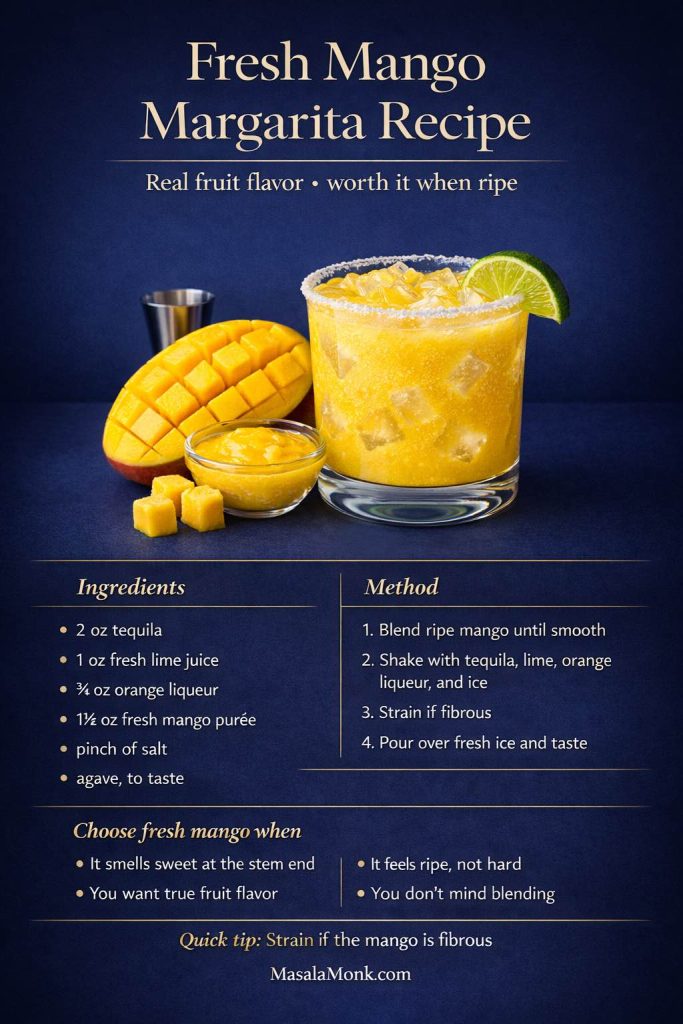
This fresh mango margarita recipe card is for the version that tastes most like real fruit when the mango is actually ripe. It shows the mini build with fresh mango purée, tequila, lime juice, orange liqueur, and a pinch of salt, plus the quick method and the key decision points for when fresh mango is worth blending. Use it when your mango smells sweet at the stem end, feels ripe, and promises true fruit flavor. Save this one for mango season, then keep reading for the frozen mango, mango nectar, mango purée, and mango juice versions to choose the best base for the drink you want.

Choose fresh mango when:

  • you have ripe mangoes that smell sweet at the stem end
  • you want a “real fruit” taste rather than a bottled consistency
  • you don’t mind blending a quick mango base

Avoid fresh mango when:

  • your mango is firm and mild (it will need extra sweetener and still taste thin)
  • your mango is very fibrous and you don’t want to strain

Frozen mango margarita recipe (when you want thick, cold, and reliable)

Frozen mango is the easiest way to make a best frozen mango margarita recipe. It gives body without dilution and builds a thick, glossy drink that holds its flavor longer.
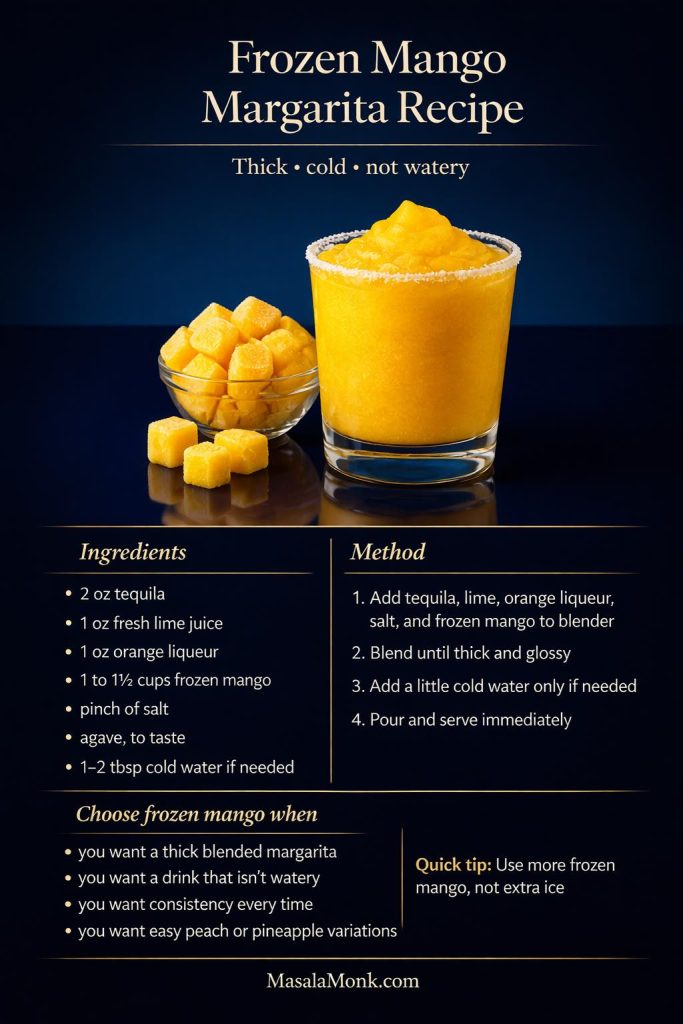
This frozen mango margarita recipe mini card shows the easiest way to make a thick, cold drink without watering it down. With tequila, fresh lime juice, orange liqueur, frozen mango, a pinch of salt, and just enough cold water if needed, it gives you the quick build plus the reason frozen mango works so well: better body, better texture, and more consistent results than piling in extra ice. Save it for hot days, then keep reading for the mango nectar, mango purée, and mango juice versions to choose the best base for the style of mango margarita you want.

Choose frozen mango when:

  • you want a blended mango margarita recipe that isn’t watery
  • you want consistency every time
  • you want a frozen peach mango margarita recipe or mango pineapple margarita variation

Mango margarita recipe with mango nectar (when you want fast and consistent)

Mango nectar is usually thick and sweet. It’s a shortcut that still tastes good, especially when balanced with lime and salt.
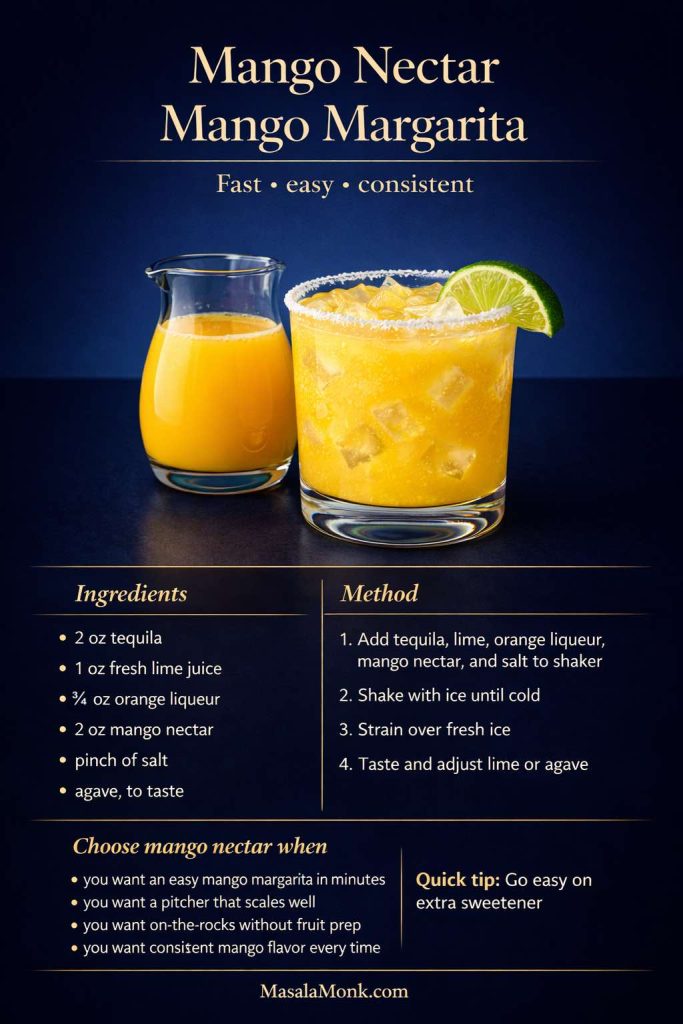
Premium mango nectar mango margarita recipe card showing an on-the-rocks mango margarita with lime garnish, a small carafe of mango nectar, ingredient list, mini method, and tips for when to choose mango nectar for a fast, consistent drink, on a smooth dark blue background.
This mango nectar mango margarita mini card is the easiest shortcut to a bright, balanced drink without fresh-fruit prep. With tequila, fresh lime juice, orange liqueur, mango nectar, and a pinch of salt, it gives you a fast on-the-rocks build plus the key reason nectar works so well: it’s thick, consistent, and easy to scale for a pitcher mango margarita recipe too. Save this card when you want an easy mango margarita recipe in minutes, then keep reading for the richer mango purée version and the lighter mango juice option.

Choose mango nectar when:

  • you want an easy mango margarita recipe in minutes
  • you want a pitcher mango margarita recipe that scales easily
  • you want the “mango margarita on the rocks” version without extra steps

Mango purée margarita recipe (restaurant-style control)

Mango purée has bold flavor and steady texture. It also lets you dial sweetness precisely, which helps when you’re making a spicy mango margarita recipe or a chamoy margarita where too much sugar can get heavy.

If you enjoy looking at a bar-style spec, this frozen mango margarita build shows a classic approach that uses purée and measured structure.
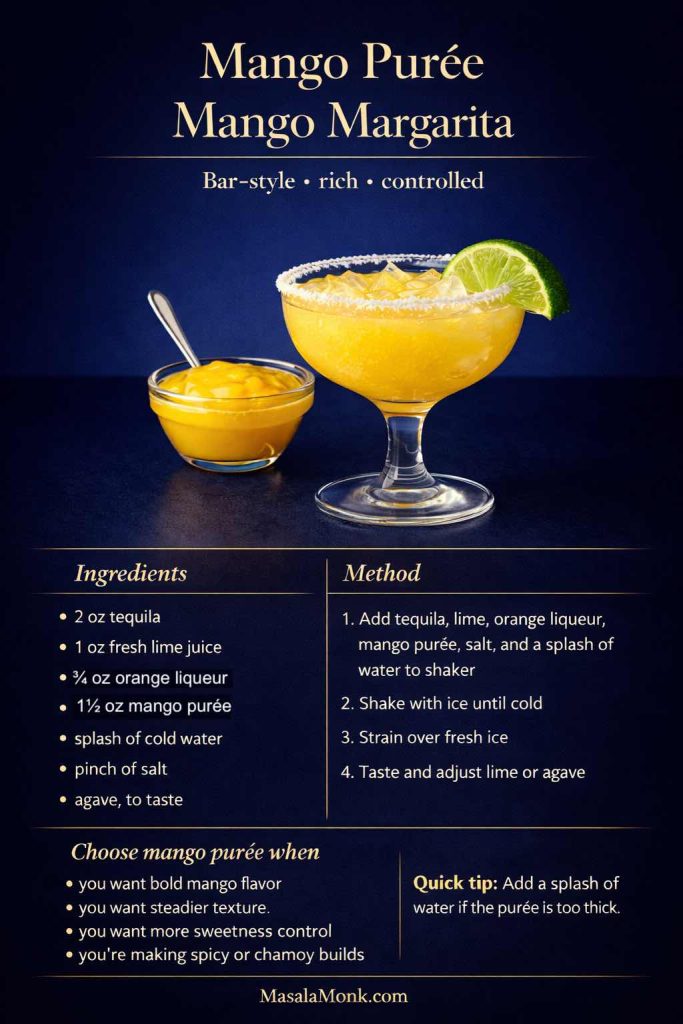
This mango purée mango margarita mini card is the richer, more controlled version for when you want a more bar-style drink. With tequila, fresh lime juice, orange liqueur, mango purée, a splash of water, and a pinch of salt, it gives you a fuller mango body plus better sweetness control than many shortcut builds. It’s especially useful when you’re making a spicy mango margarita, a chamoy margarita, or any version where too much sugar can make the drink feel heavy. Save this one when you want a more polished mango margarita recipe with stronger fruit presence and tighter balance.

Mango juice margarita recipe (when juice is what you have)

Mango juice can work, yet it’s thinner, so your drink may feel less “mango-forward” unless you compensate. Typically, you’ll use a bit more juice, reduce added sweetener, and keep lime assertive. If the juice is very sweet, the salt pinch becomes even more important.
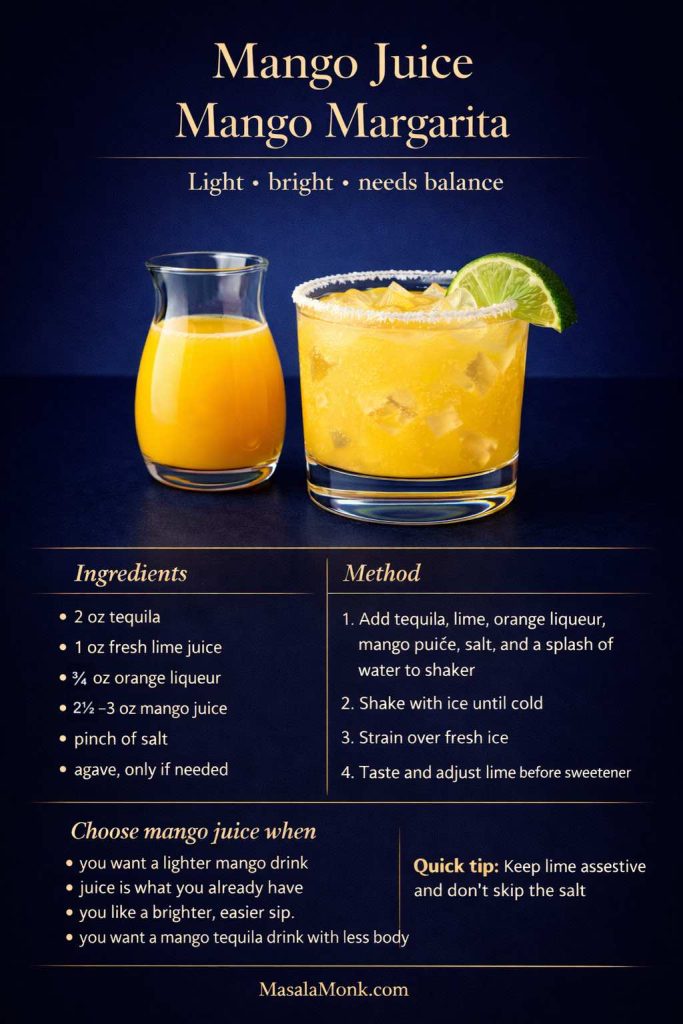
This mango juice mango margarita mini card is the lightest version in the mango-base series, built for days when you want a brighter, easier sip instead of a thicker fruit-forward drink. With tequila, fresh lime juice, orange liqueur, mango juice, and a pinch of salt, it shows how to make a mango margarita with mango juice that still tastes balanced. The key is to keep lime assertive, go easy on added sweetener, and let salt sharpen the fruit. Save this card when juice is what you have and you still want a clean, refreshing mango margarita recipe.

Juice works best for:

  • Mango tequila drink recipes when you want something light
  • Tequila and mango juice highball-style builds (margarita-adjacent)
  • Mango tequila cocktail ideas for warm afternoons

Still, a mango margarita recipe with mango juice can be bright and refreshing, especially if you like a lighter drink.

Also Read: Air Fryer Salmon Recipe (Time, Temp, and Tips for Perfect Fillets)


Mango Margarita on the Rocks (fast, crisp, nectar-friendly)

This is the version most people mean when they want a mango margarita drink recipe that feels classic. It’s also the best “gateway” recipe because it shows you what the drink is supposed to taste like: mango up front, lime on the finish, tequila holding everything together.
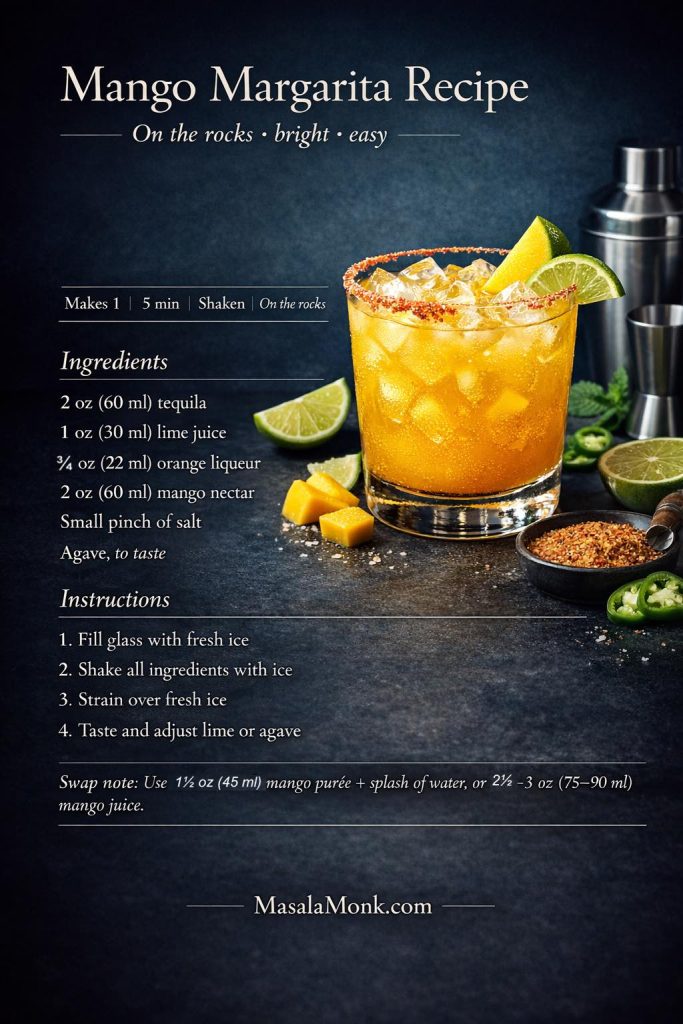
Premium recipe card for an easy homemade mango margarita on the rocks, showing a bright mango tequila cocktail with ice, lime, Tajín-style rim, ingredients, measurements, and step-by-step instructions on a dark blue background.
This easy mango margarita recipe card gives you the core on-the-rocks version in one quick visual: tequila, lime juice, orange liqueur, mango nectar, a pinch of salt, and a simple shake-and-strain method. It’s the best place to start if you want a homemade mango margarita that tastes bright, balanced, and actually mango-forward. Save it for later, then keep reading for the frozen version, spicy jalapeño twist, Tajín rim, chamoy finish, and pitcher variation.

Quick mango margarita on the rocks (1 drink): Shake 2 oz tequila, 1 oz fresh lime juice, ¾ oz orange liqueur, 2 oz mango nectar, and a pinch of salt with ice. Strain over fresh ice and taste once—more lime if it feels sweet, a tiny touch of agave if it feels sharp.

Now let’s get into details.

Mango margarita ingredients (1 drink)

  • 2 oz (60 ml) tequila
  • ¾ oz (22 ml) orange liqueur
  • 1 oz (30 ml) fresh lime juice
  • 2 oz (60 ml) mango nectar
  • 0 to ½ oz (0–15 ml) agave or simple syrup, to taste
  • a small pinch of fine salt
  • ice

If using mango purée: use 1½ oz (45 ml) purée + ½ oz (15 ml) cold water.

If using mango juice: start around 2½–3 oz (75–90 ml) mango juice; reduce sweetener; keep lime confident.

How to make a mango margarita on the rocks

  1. Fill a rocks glass with fresh ice.
  2. Add tequila, orange liqueur, lime juice, mango nectar, salt, and any sweetener to a shaker with ice.
  3. Shake until the shaker feels properly cold.
  4. Strain into the glass and taste.
  5. Adjust if needed: a tiny splash of lime if it feels sweet, or a touch of nectar if it feels too sharp.

At this point, it helps to know what you’re aiming for. The drink should taste bright, not syrupy. It should feel mango-forward, not tequila-forward. It should finish clean with lime and a hint of orange. If it tastes heavy, lime is the lever. If it tastes sharp, a touch of sweetener is the lever. And if it tastes “kind of flat,” salt is the lever.
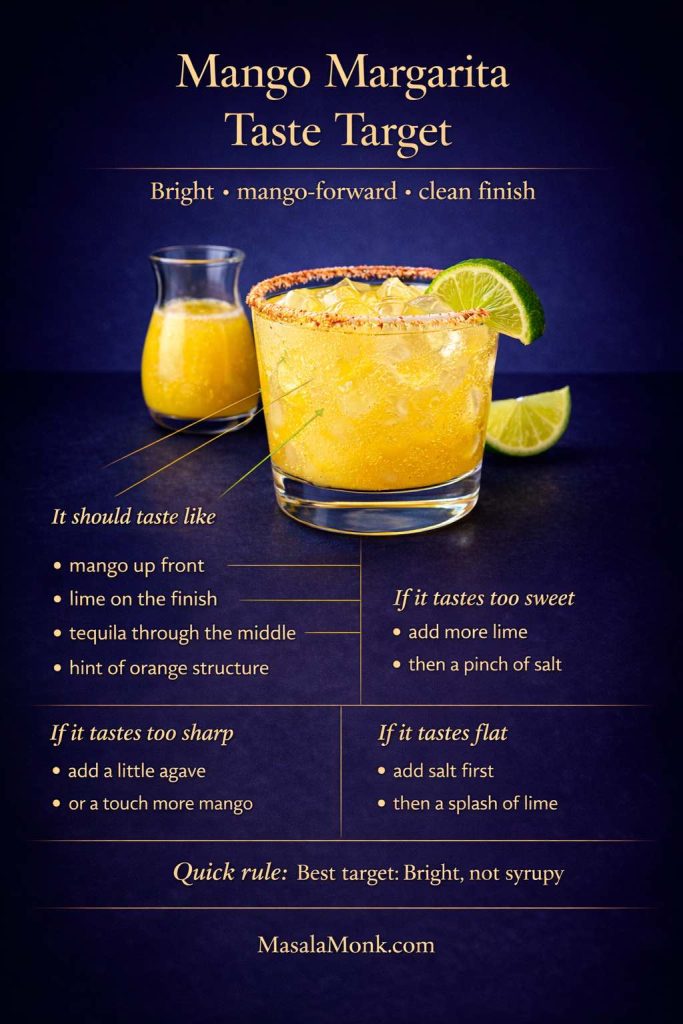
This mango margarita taste target guide shows what the drink should actually taste like once it’s balanced: mango up front, lime on the finish, tequila through the middle, and a hint of orange structure. It also gives the fastest fixes if your mango margarita turns out too sweet, too sharp, or too flat, so you can adjust it without guessing. Save this one as your quick calibration card before you move on to the frozen version, spicy jalapeño twist, Tajín finish, or pitcher build.

Mango nectar vs mango juice vs mango purée (what changes)

Because these come up constantly in real kitchens, here’s the simplest rule of thumb:

  • Nectar usually means you’ll add little to no extra sweetener.
  • Juice often needs more lime and salt to stay vivid, and sometimes a small boost of orange liqueur for structure.
  • Purée is rich; it can handle extra lime and tends to taste more “cocktail-bar” when balanced tightly.
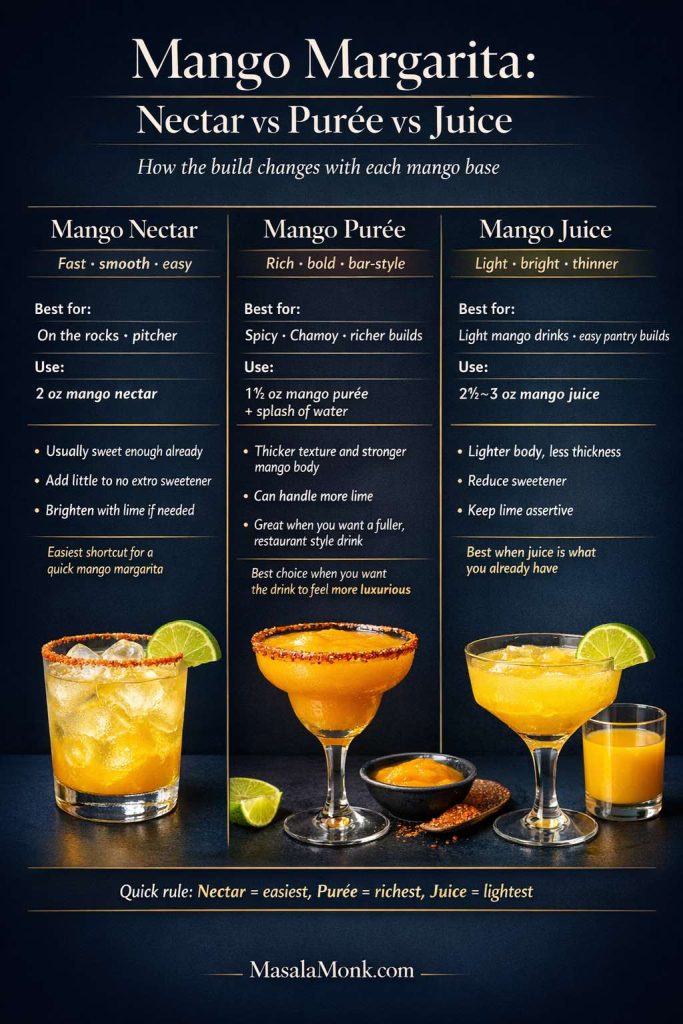
Premium mango margarita comparison guide showing how to build the drink with mango nectar, mango purée, or mango juice. The infographic compares best uses, ingredient amounts, and recipe adjustments for each mango base, with photoreal mango margarita visuals on a dark blue background.
Not all mango bases behave the same in a mango margarita recipe, and this guide makes the difference easy to see. Use mango nectar for the fastest smooth on-the-rocks or pitcher build, mango purée for a richer bar-style drink with more body, or mango juice for a lighter, brighter version when that’s what you have on hand. It’s a practical shortcut for choosing the right mango base without guessing. Save it, then keep reading for the exact on-the-rocks recipe, frozen version, spicy jalapeño variation, Tajín rim tips, and chamoy finish ideas.

Once you’ve made this version once, you can make a simple mango margarita recipe from memory. It’s also the foundation for spicy and Tajín versions.

Also Read: Masterclass in Chai: How to Make the Perfect Masala Chai (Recipe)


Frozen Mango Margarita Recipe (blended, thick, not watery)

Frozen margaritas are supposed to feel plush and cold, almost like a slushie that still tastes like a cocktail. The problem is that many frozen recipes rely on ice to make that slush. Ice melts. Mango can do the job more gracefully. That’s why frozen mango is your best friend here: it gives you body and flavor at the same time.

This version is what you make when you want a blended mango margarita recipe that stays bold from the first sip to the last.
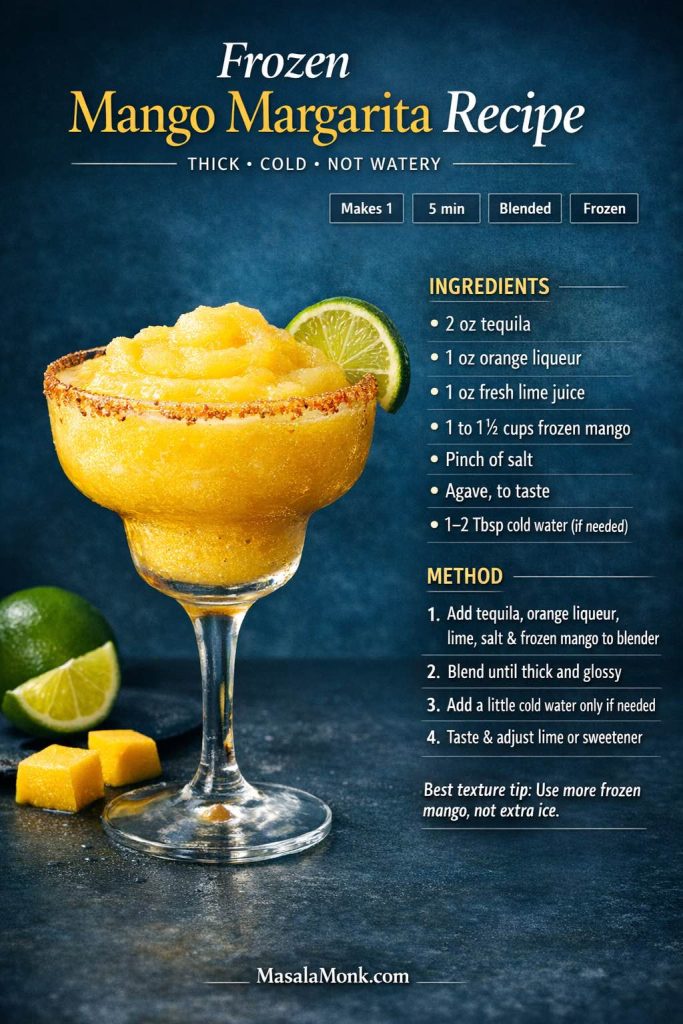
Premium frozen mango margarita recipe card showing a thick blended mango tequila cocktail with lime garnish, Tajín-style rim, ingredient list, measurements, and step-by-step method on a dark blue studio background.
This frozen mango margarita recipe card shows the easiest way to make a thick, glossy blended margarita without watering it down. With tequila, orange liqueur, fresh lime juice, frozen mango, a pinch of salt, and just enough liquid to help the blender move, it gives you the exact structure for a bold, balanced frozen drink. Save this one for hot days, then keep reading for the troubleshooting guide, spicy jalapeño version, Tajín rim ideas, chamoy finish, and pitcher option.

Quick frozen mango margarita (1 drink): Blend 2 oz tequila, 1 oz lime juice, 1 oz orange liqueur, a pinch of salt, and 1 to 1½ cups frozen mango until thick and glossy. Add only 1–2 tablespoons cold water if the blender stalls—skip extra ice to avoid watering it down.

Lets get into details now.

Ingredients (1 frozen mango margarita)

  • 2 oz (60 ml) tequila
  • 1 oz (30 ml) orange liqueur
  • 1 oz (30 ml) fresh lime juice
  • 1 to 1½ cups frozen mango chunks
  • 0 to ½ oz (0–15 ml) agave or simple syrup, to taste
  • a small pinch of fine salt
  • optional: 2–4 tablespoons cold water if the blender needs help

How to make a frozen mango margarita

  1. Add tequila, orange liqueur, lime juice, salt, and frozen mango to a blender.
  2. Blend until thick and glossy.
  3. If it won’t catch, add a tablespoon or two of cold water and blend again.
  4. Taste, then decide whether it needs a little sweetener or a touch more lime.
  5. Pour into a chilled glass and serve immediately.

If you enjoy comparing approaches, this spicy mango frozen build with chili-lime seasoning is a great example of how frozen fruit can carry the texture without leaning on ice.

Frozen mango margarita troubleshooting (save it without starting over)

Mango behaves differently depending on brand, ripeness, and freezer temperature. So rather than expecting perfection on the first blend, treat this like a tasting process.
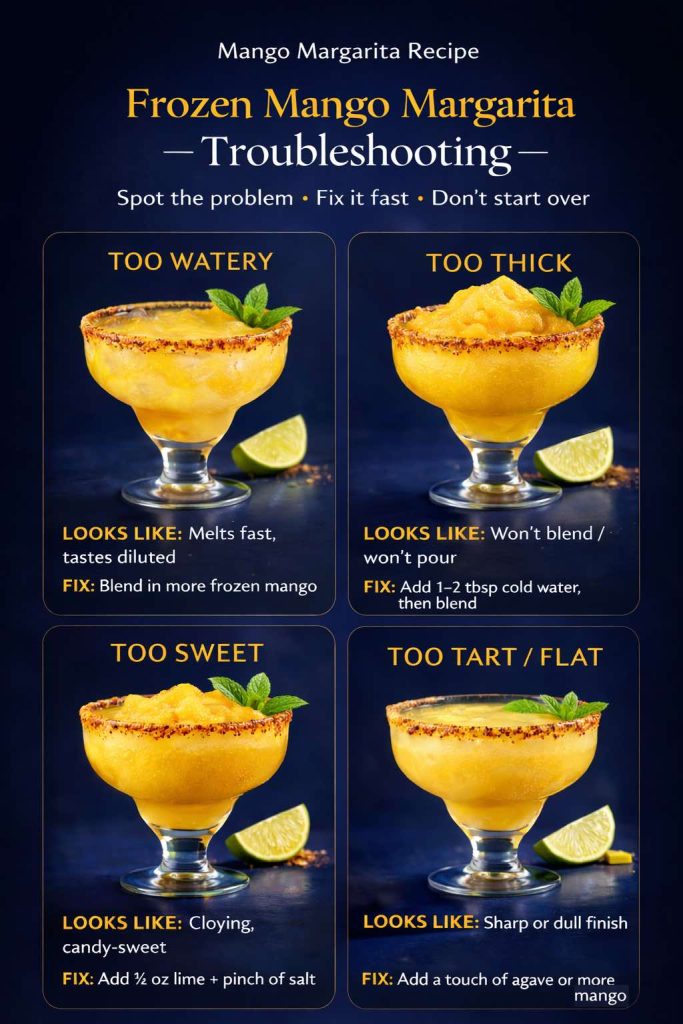
Troubleshooting infographic for a frozen mango margarita recipe showing four common problems—too watery, too thick, too sweet, and too tart/flat—with “looks like” cues and quick fixes.
Frozen mango margarita not turning out right? Use this quick troubleshooting guide to fix texture and balance fast—whether it’s watery, too thick to blend, overly sweet, or too tart and flat.

If it’s too thick to blend or pour:
Add 1–2 tablespoons cold water. Blend briefly. Repeat only if needed.

If it’s too thin:
Add more frozen mango, not more ice. Ice dilutes; mango reinforces.

If it’s too sweet:
Add ½ oz (15 ml) more lime. Taste again. Then add a tiny pinch more salt if it still reads sweet.

If it’s too tart:
Add 1–2 teaspoons sweetener. Blend. Taste again.

If it tastes too boozy:
Increase mango slightly and add a little lime. Booziness often shows up when fruit is too low and acid is too soft.

If it doesn’t taste mango-forward enough:
Add mango (frozen or purée) rather than extra sweetener. Sweet doesn’t equal mango.

If it tastes flat or muted:
Add salt first. Then add a splash more lime. Most “flat” fruit cocktails need structure, not sugar.

If you used fresh mango and it tastes grainy:
That’s usually fiber. Next time, blend your mango base with a splash of lime and strain. For now, blending longer can help slightly, though straining is the real fix.

Once you learn these tiny pivots, “best frozen mango margarita recipe” becomes less of a quest and more a predictable outcome.

Also Read: Crock Pot Pork Chops and Sauerkraut (No Dry Chops Recipe)


Mango Margarita with Tajín (the rim that makes mango pop)

Mango and chili-lime seasoning feel like they were invented for each other. And then mango brings sweetness and perfume; Tajín brings tartness, salt, and gentle heat. Together they make the drink taste more “awake.”

If you want the most straightforward source for what Tajín is, the wikipedia’s page on Tajín Clásico is simple and useful. In practice, you’re treating it as a rim seasoning and a flavor accent rather than an ingredient you dump into the drink.
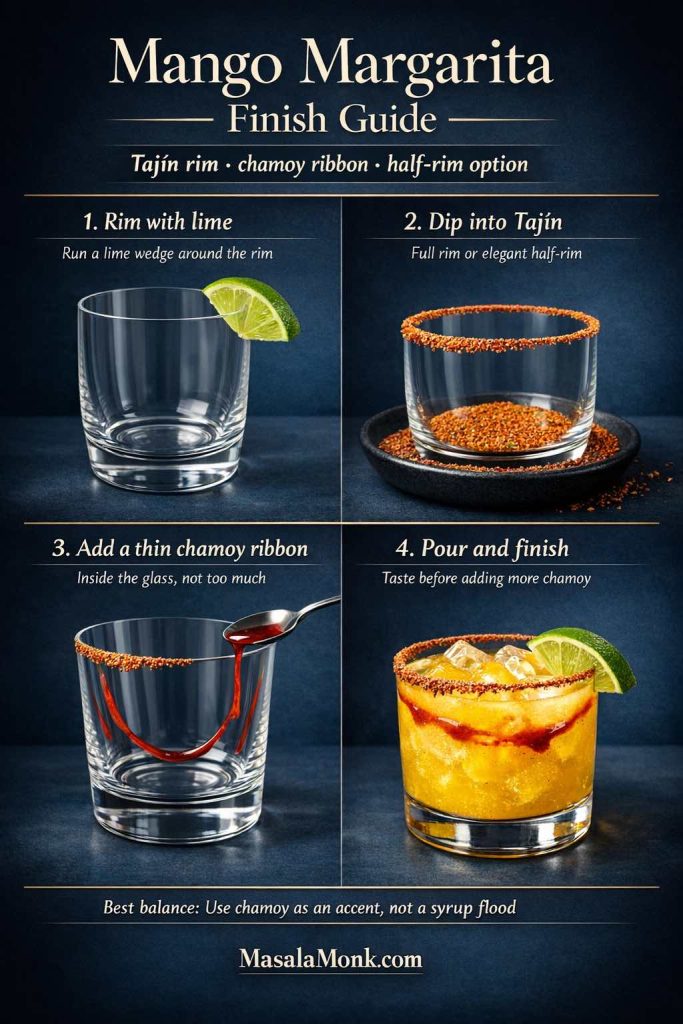
Premium mango margarita finish guide showing four steps for a Tajín and chamoy finish: rim the glass with lime, dip into Tajín, add a thin chamoy ribbon inside the glass, and pour the finished mango margarita over ice. The infographic uses photoreal cocktail visuals on a dark blue background.
This mango margarita finish guide shows the easiest way to give your drink a bar-style edge without making it messy or overly sweet. Start by rimming the glass with lime, dip into Tajín, add a thin chamoy ribbon inside the glass, then pour in the mango margarita and taste before adding more. It’s a simple visual shortcut for anyone making a mango margarita with Tajín, a chamoy margarita, or a mangonada-style mango margarita at home. Save it for later, then keep reading for the spicy jalapeño version, mango mezcal twist, and pitcher recipe.

How to rim a mango margarita with Tajín

  1. Run a lime wedge around the rim of your glass.
  2. Dip into Tajín.
  3. Build your mango margarita on the rocks or pour your frozen mango margarita recipe into the prepared glass.

When Tajín doesn’t stick well—especially with frozen drinks—use a thin smear of chamoy on the rim before dipping into Tajín. If you don’t have chamoy, a tiny dab of agave works too. It acts like edible “glue,” keeps the rim bold, and prevents that frustrating moment when the seasoning slides off after two sips.

For a cleaner drinking experience, consider a half-rim. That way you can choose how much seasoning you want sip by sip. Moreover, it looks elegant, not messy. If you enjoy fruit margarita variations that use this same “rim for contrast” idea, MasalaMonk’s watermelon margarita variations make a natural companion read.

Also Read: Keto Mocktails: 10 Low Carb, Sugar Free Recipes


Spicy Mango Margarita Recipe (jalapeño or habanero)

Spice is most satisfying when it’s controlled. The best spicy mango margarita still tastes like mango and lime first. Heat arrives later as a warm, flavorful echo rather than a punch to the mouth.
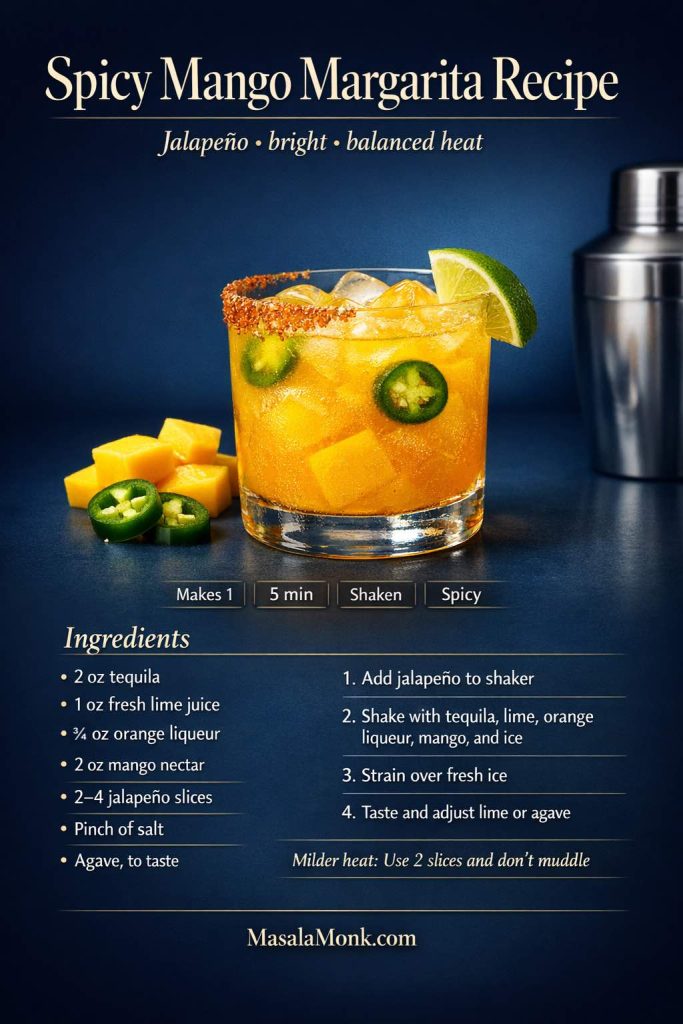
Premium spicy mango margarita recipe card showing a jalapeño mango margarita on the rocks with lime wedge, Tajín-style rim, fresh jalapeño slices, mango cubes, ingredient list, and step-by-step method on a dark blue studio background.
This spicy mango margarita recipe card gives you the jalapeño version in one quick visual: tequila, fresh lime juice, orange liqueur, mango nectar, jalapeño slices, and a pinch of salt, all shaken and strained over fresh ice. It’s the easiest way to make a mango jalapeño margarita that still tastes bright, balanced, and mango-forward instead of just hot. Save it for later, then keep reading for the heat ladder, Tajín and chamoy finish ideas, mango mezcal twist, and pitcher version.

For a clean technique reference on how spice is typically handled in a margarita, this spicy margarita method is a helpful read. That said, you can do excellent spicy versions at home with a simple “spice ladder.”

Choosing your heat: jalapeño vs habanero

Jalapeño is grassy and bright. It plays especially well with lime and makes a spicy mango jalapeño margarita taste fresh rather than aggressive.

Habanero is fruity but intense. It can taste amazing in a mango habanero margarita recipe, though it needs restraint—think micro-dose, not slices.

The spice ladder (repeatable, not guessy)

  • Mild: 1–2 jalapeño slices in the shaker, shake, strain
  • Medium: 3–4 jalapeño slices, shake; or muddle 2 slices lightly, then shake
  • Hot: a tiny piece of habanero (smaller than a pea), shake quickly, taste immediately
  • Very hot: generally not the goal for a mango margarita—mango is too lovely to bury
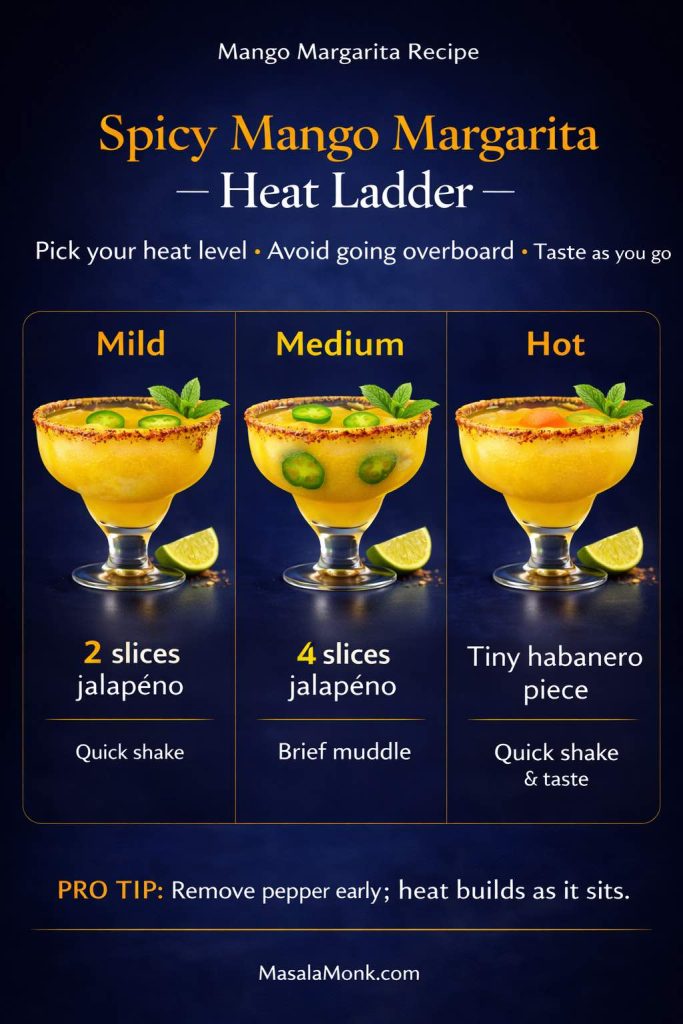
Infographic showing a spicy mango margarita heat ladder with three levels—mild, medium, and hot—using jalapeño slices or a tiny habanero piece, plus quick shake/muddle guidance.
Want a spicy mango margarita without overdoing it? Use this heat ladder to pick your level—mild jalapeño, medium jalapeño, or a tiny habanero boost—then taste as you go.

Timing matters just as much as amount. Longer contact increases heat. Muddling increases heat faster. That’s why “mild” is often best for guests: it tastes vibrant rather than aggressive.

Spicy mango jalapeño margarita (on the rocks)

Make the on-the-rocks mango margarita. Then:
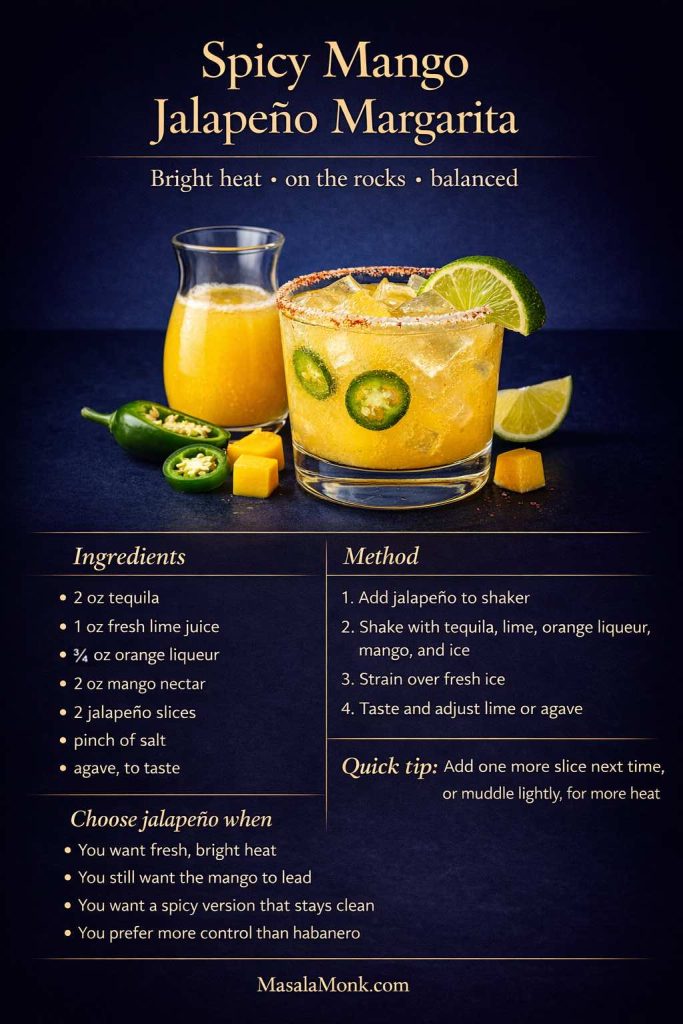
This spicy mango jalapeño margarita mini card gives you the clean on-the-rocks version in one quick visual: tequila, fresh lime juice, orange liqueur, mango nectar, jalapeño slices, and a pinch of salt, shaken hard and strained over fresh ice. It’s the best spicy version when you want a mango jalapeño margarita that still tastes bright, balanced, and mango-forward instead of overly hot or sticky. Save it for later, then keep reading for the heat ladder, the careful mango habanero margarita approach, and how to get a mango chili margarita feel without a bottled mix.
  1. Add 2 jalapeño slices to the shaker.
  2. Shake hard, strain, taste.
  3. If you want more heat next time, add one more slice or muddle lightly.

This covers spicy mango margarita recipe, mango jalapeno margarita, mango jalapeño margarita recipe, and “spicy mango tequila drink” vibes in a way that still tastes like an actual margarita.

Mango habanero margarita (the careful version)

Instead of adding slices, add a very small piece of habanero—smaller than you think you need—then shake and taste. If it’s already hot, stop there. Habanero heat builds quickly and can linger.

For a calmer heat profile, pair habanero with a Tajín rim rather than adding more pepper to the drink itself. That way the spice hits in controlled bursts.
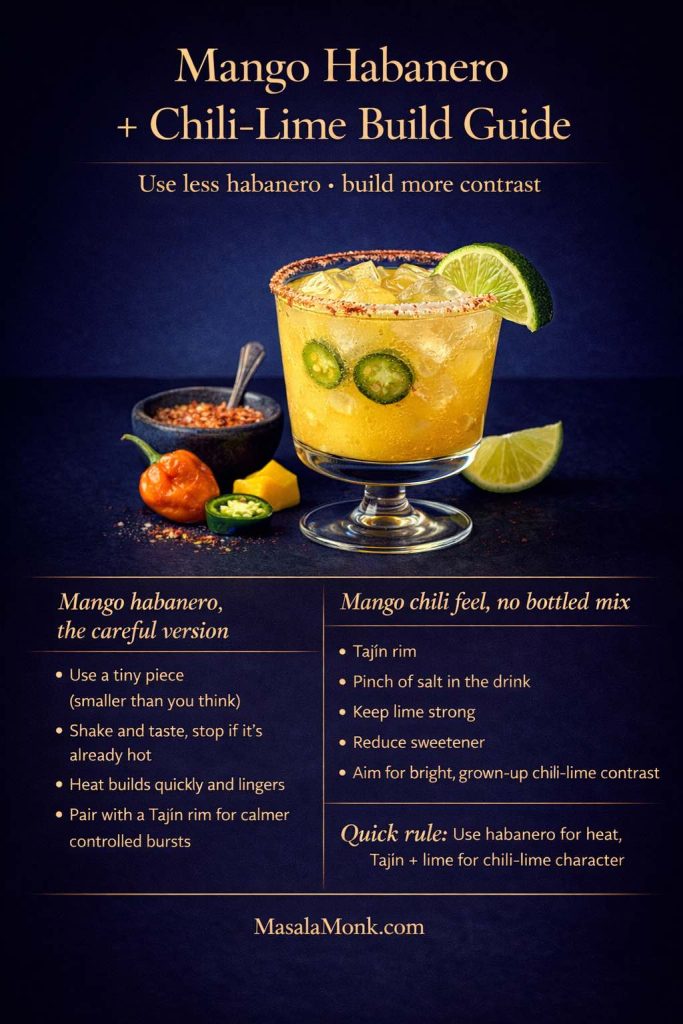
Premium mango habanero and chili-lime build guide showing a mango margarita with a Tajín-style rim, lime garnish, jalapeño and habanero cues, and side-by-side notes for using habanero carefully and building a chili-lime mango margarita without bottled mix, on a smooth dark blue background.
This mango habanero margarita and mango chili margarita build guide shows how to add heat without wrecking the drink. Use a tiny piece of habanero and taste early if you want deeper heat, or build chili-lime character more cleanly with a Tajín rim, a pinch of salt in the drink, strong lime, and less sweetener. The result is a spicy mango cocktail that still tastes bright, balanced, and grown-up instead of sticky or overdone. Save this card when you want controlled heat and cleaner flavor contrast in your mango margarita recipe.

Mango chili margarita feel without a bottled mix

If you like the impression of a mango chili margarita mix—sweet fruit plus chili-lime punch—build it cleanly:

  • Tajín rim
  • pinch of salt in the drink
  • lime kept strong
  • sweetener reduced

You end up with a spicy mango cocktail that feels bright and grown-up rather than sticky.

Also Read: Slow Cooker Pork Tenderloin (Crock Pot Recipe) — 3 Easy Ways


Chamoy margarita (mangonada-style mango margarita)

Chamoy is playful. It’s sweet, sour, salty, and a little fruity, and it instantly turns a mango margarita into something that tastes like a treat. When Tajín joins the party, the whole thing becomes a mangonada-style experience: mango sweetness, lime brightness, chamoy tang, chili-salt sparkle, tequila backbone.

If you want a direct reference for the mangonada margarita style, this mangonada margarita shows the signature elements clearly: mango, chamoy, Tajín, lime, and tequila.
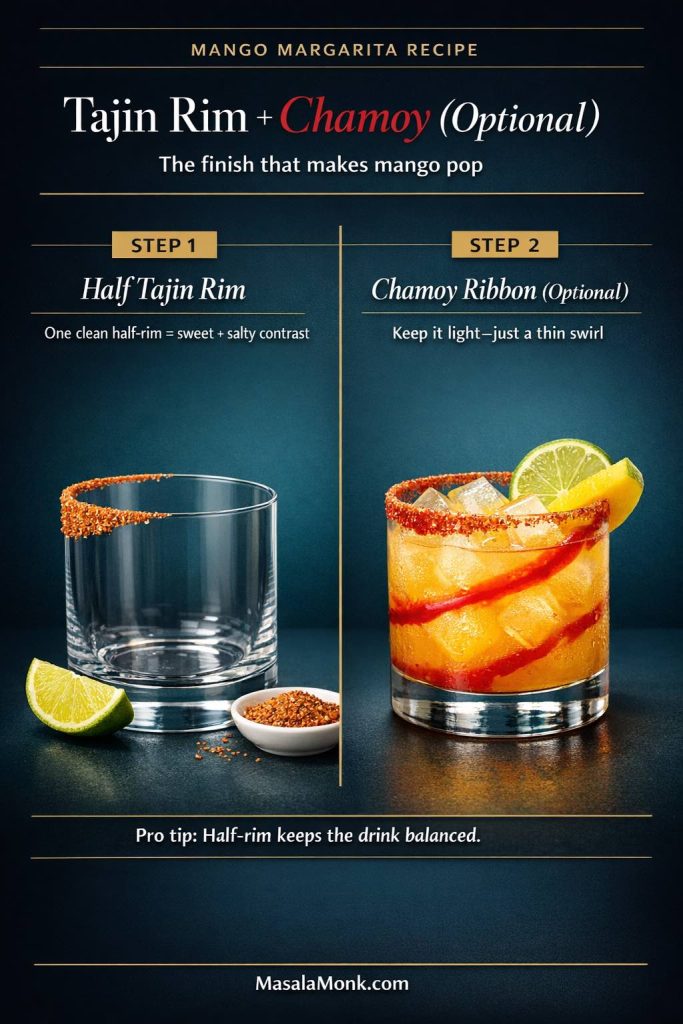
For a mango margarita that tastes instantly more “bar-style,” do a half Tajín rim for sweet-salty contrast, then add a thin chamoy ribbon (optional) for a bright, candy-tang finish.

How to build a chamoy mango margarita without making it syrupy

  1. Drizzle chamoy inside the glass in thin ribbons.
  2. Rim the glass with Tajín.
  3. Pour in your mango margarita on the rocks or your frozen mango margarita.
  4. Taste before adding extra chamoy—often the initial drizzle is enough.

The goal is contrast: mango sweetness, lime brightness, chamoy tang, Tajín salt, tequila backbone. When those stay distinct, the drink is addictive. When they blur into “sweet + sticky,” it feels heavy.

Here’s the guardrail that keeps it from going overboard: chamoy should feel like an accent you notice, not a syrup you chew. If the drink starts tasting heavy, add a splash of lime and a pinch of salt to bring it back into balance.

Also Read: Chicken Pesto Pasta (Easy Base Recipe + Creamy, One-Pot, Baked & More)


Mango mezcal margarita (smoky, tropical, and elegant)

If tequila is the classic route, mezcal is the detour that still feels like it belongs. A mango mezcal margarita is smoky, tropical, and a little mysterious. Mango softens mezcal’s smoke, while lime keeps the whole thing crisp.
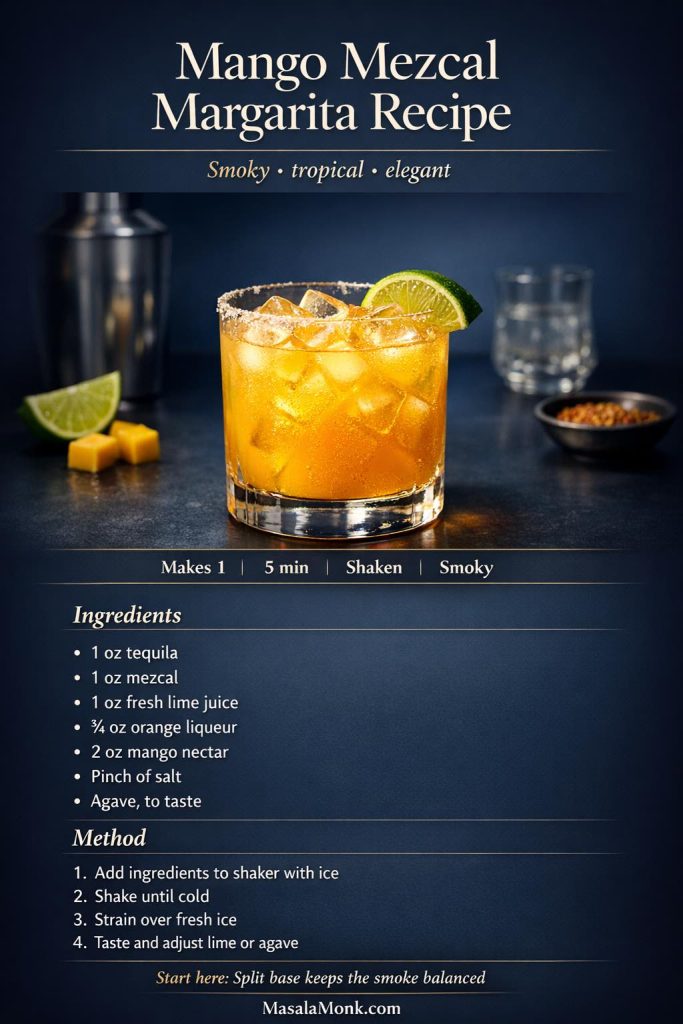
Premium mango mezcal margarita recipe card showing a smoky mango margarita on the rocks with lime wedge, salted rim, ingredient list, and step-by-step method on a dark blue studio background.
This mango mezcal margarita recipe card shows the easiest way to make a smoky, tropical, balanced variation at home. Using a split base of tequila and mezcal with fresh lime juice, orange liqueur, mango nectar, and a pinch of salt, it keeps the smoke present without burying the mango. It’s a great next-step drink if you already love a classic mango margarita but want something deeper and more elegant. Save it for later, then keep reading for the pitcher version, fruit variations, and finishing ideas with Tajín and chamoy.

To make a mango mezcal margarita:

  • replace half the tequila with mezcal in either the rocks or frozen recipe
  • keep lime bright
  • consider a Tajín rim for contrast

For first-timers, start with a split base: 1 oz tequila + 1 oz mezcal. That way smoke shows up clearly without taking over.

Also Read: Pork Tenderloin in Oven (Juicy, Easy, 350°F or 400°F) Recipe


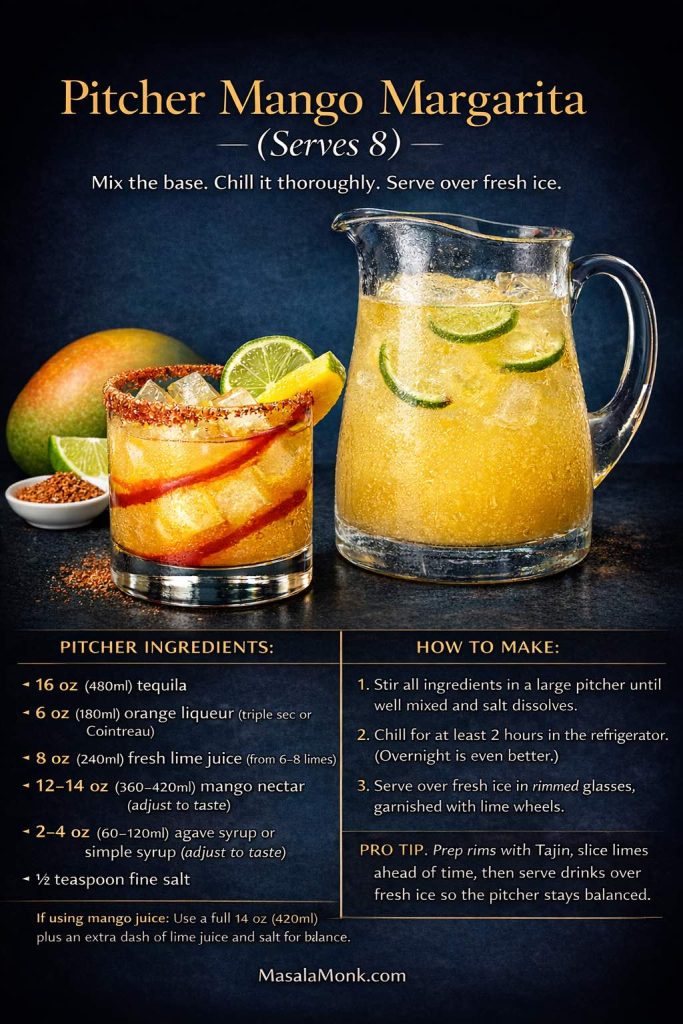
Pitcher Mango Margarita Recipe (Serves 8)

A pitcher margarita should taste just as good at the eighth pour as it did at the first. That’s not luck—it’s method. The trick is to mix a properly balanced base, chill it thoroughly, then serve over fresh ice.

Pitcher ingredients (8 drinks)

  • 16 oz (480 ml) tequila
  • 6 oz (180 ml) orange liqueur
  • 8 oz (240 ml) fresh lime juice
  • 12–14 oz (360–420 ml) mango nectar
  • 2–4 oz (60–120 ml) agave or simple syrup, to taste
  • ½ teaspoon fine salt
Hosting? This pitcher mango margarita recipe (serves 8) batches the base with mango nectar, lime, orange liqueur, and tequila—then you chill hard and pour over fresh ice so every glass stays bright.

How to make a pitcher mango margarita

  1. Stir tequila, orange liqueur, lime juice, mango nectar, sweetener, and salt in a large pitcher.
  2. Refrigerate at least 2 hours. Overnight is great if you have time.
  3. Serve over fresh ice. Garnish with lime wheels or mango slices.

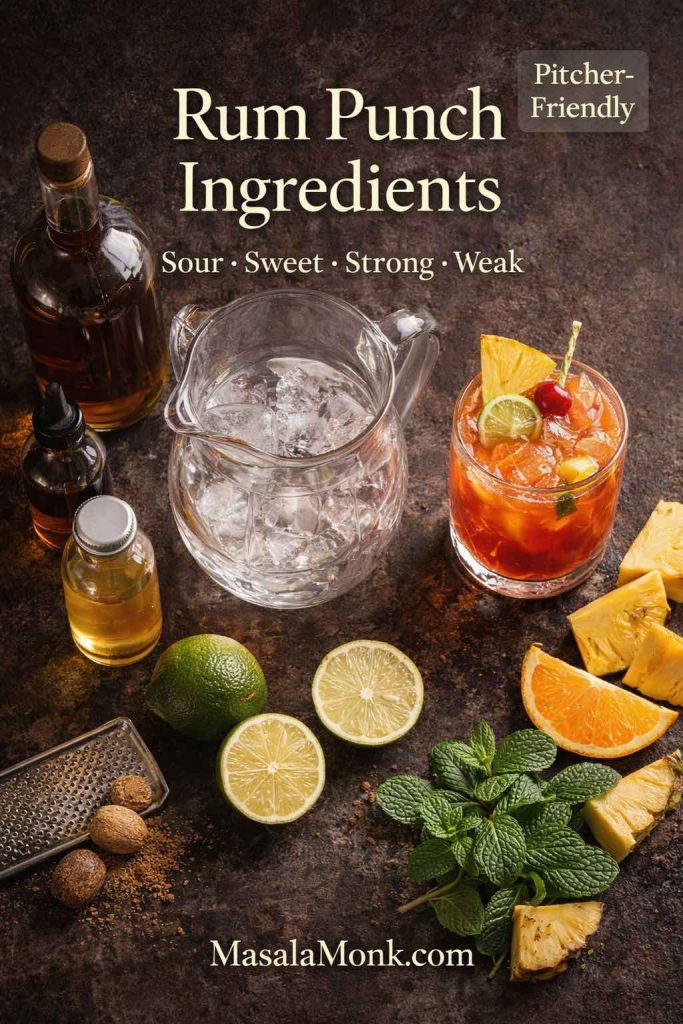
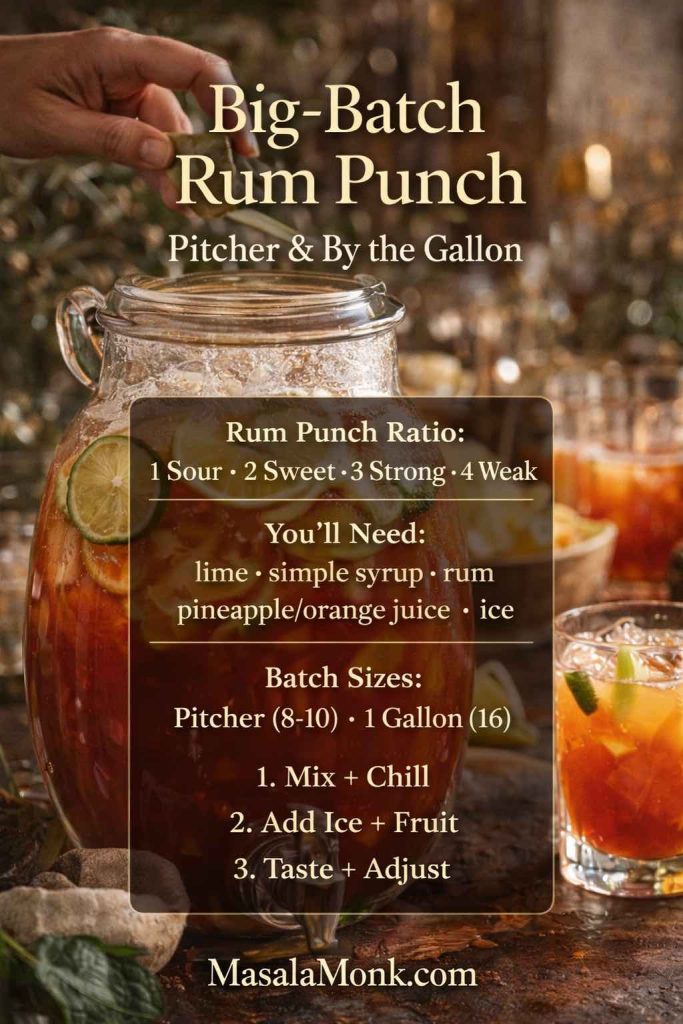
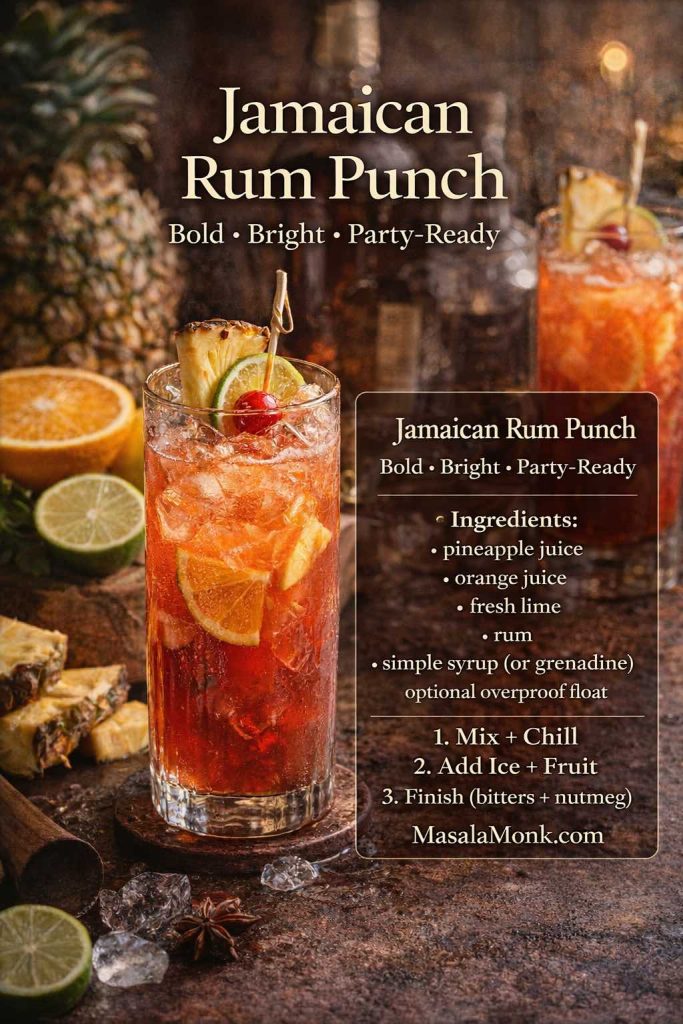
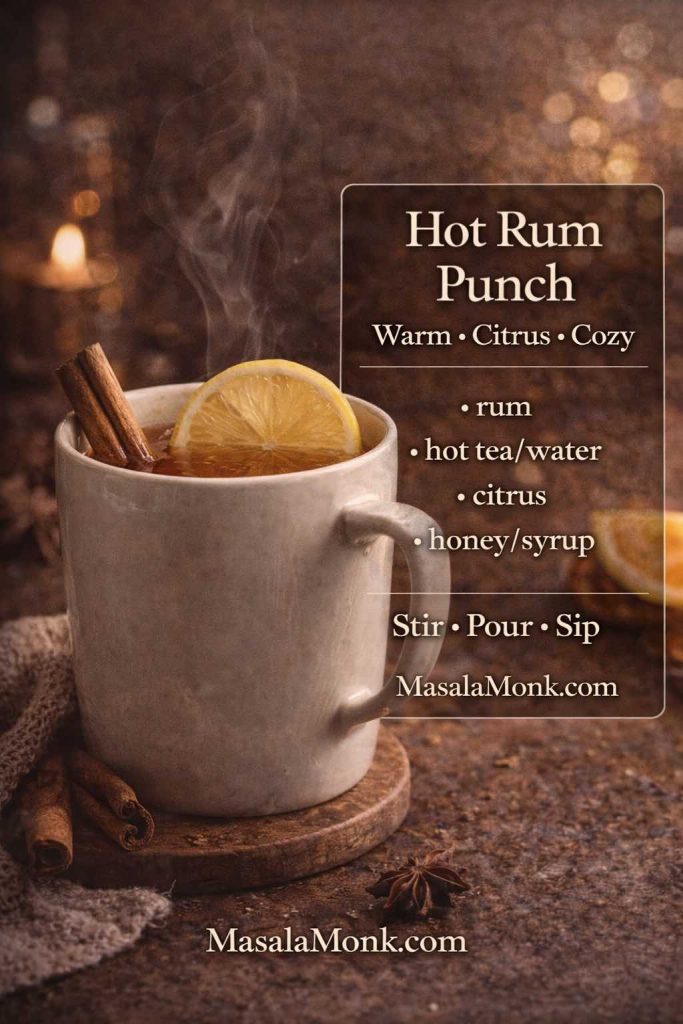
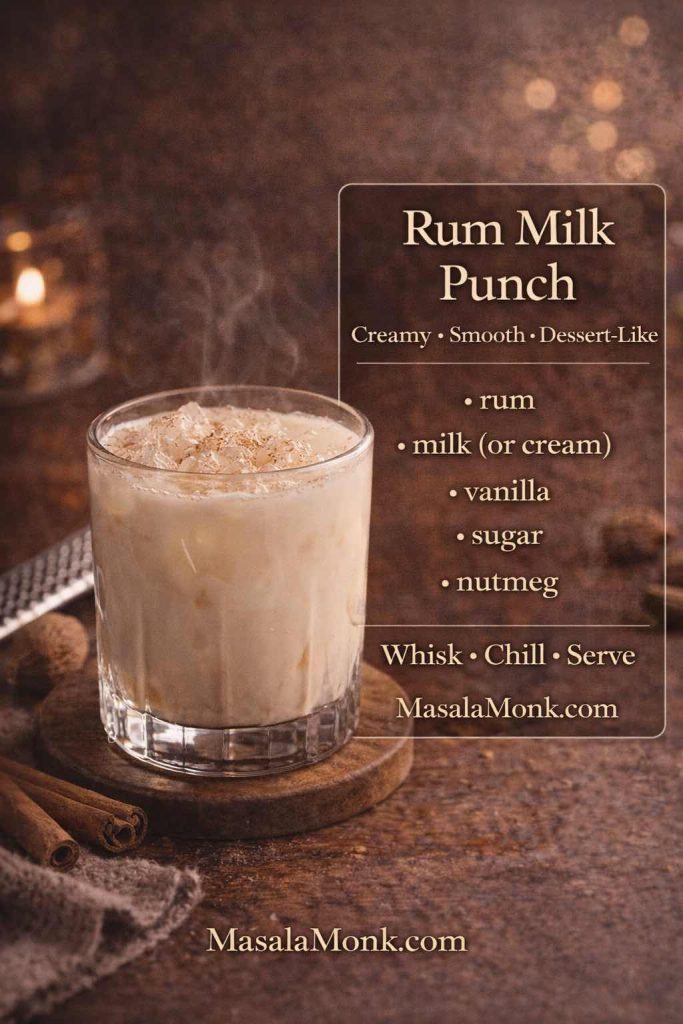
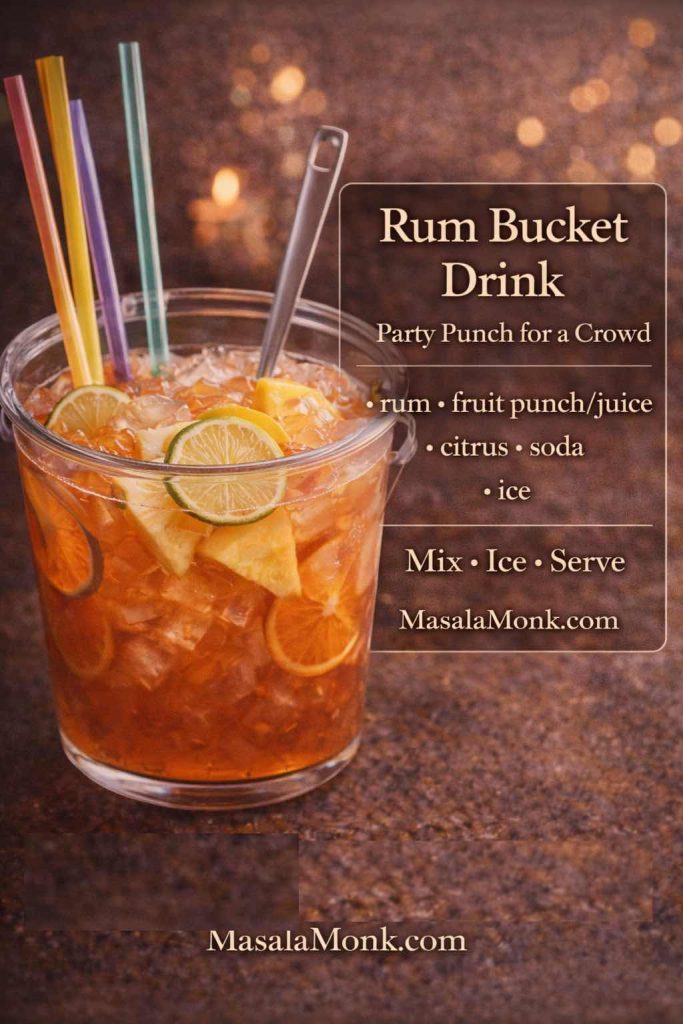
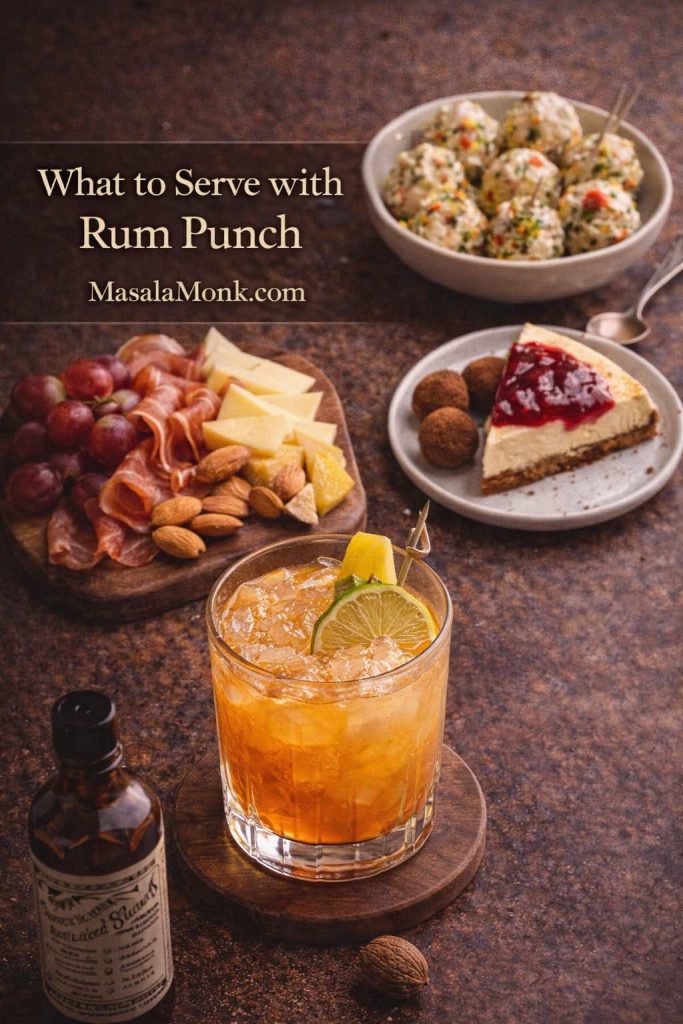
For hosting logic and batching confidence, our post with rum punch recipe is a useful companion read. Different flavors, same party problem: keep the base cold, keep the balance, then serve like you planned it.

Make-ahead flow that keeps it tasting fresh

If you’re setting up for friends, this order makes the night easier:

  • mix the base and chill it
  • prep rims (Tajín and salt)
  • slice limes and mango
  • keep extra lime juice nearby for last-minute balance fixes
  • pour over fresh ice rather than letting ice sit in the pitcher
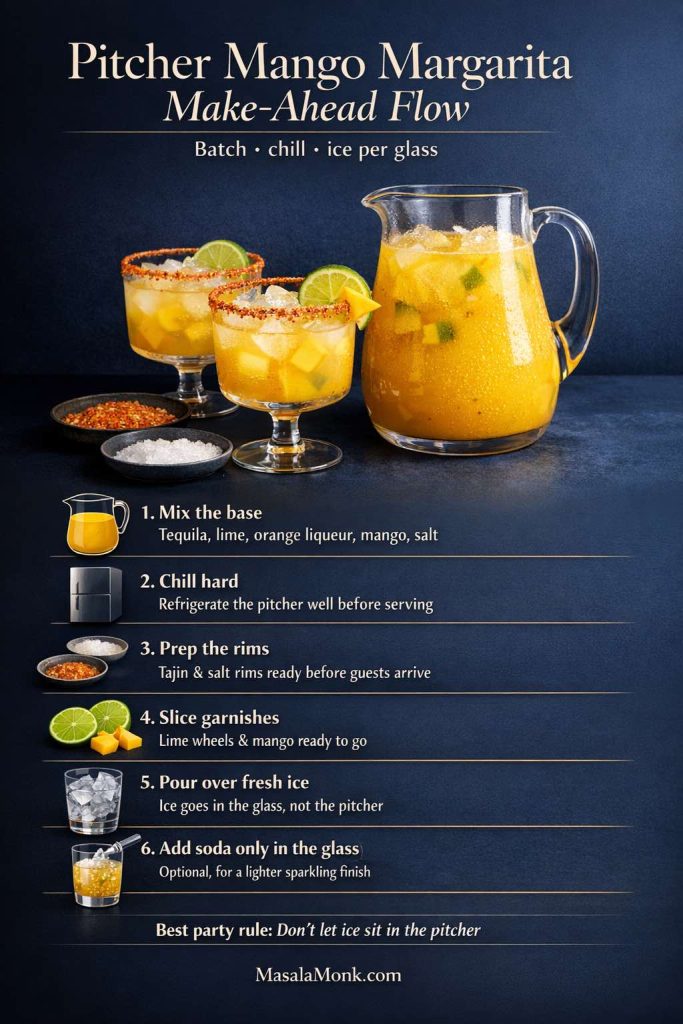
Premium pitcher mango margarita make-ahead flow guide showing a large batch mango margarita pitcher with two rimmed glasses and six hosting steps: mix the base, chill hard, prep the rims, slice garnishes, pour over fresh ice, and add soda only in the glass. Dark blue studio background with smooth clean finish.
This pitcher mango margarita make-ahead flow card turns the crowd-size version into an easy hosting plan. It shows the best order for batching the base, chilling it well, prepping Tajín or salt rims, slicing garnishes, pouring over fresh ice per glass, and adding soda only at the end if you want a lighter sparkling finish. It’s a practical visual for anyone making a pitcher mango margarita recipe for guests and wanting it to stay bright instead of diluted. Save it before your next gathering, then keep reading for the exact pitcher ratios, smoky mezcal variation, spicy jalapeño version, and fruit swaps.

It sounds simple, yet it’s the difference between a pitcher that stays bright and a pitcher that tastes diluted by the end.

A quick note on sparkling add-ons

If you like topping your margarita with soda for a lighter finish, add it in the glass, not the pitcher. That way it stays lively and doesn’t go flat while you’re still pouring round two.

Also Read: How to Make a Flax Egg (Recipe & Ratio for Vegan Baking)


Mango margarita variations (pineapple, strawberry, orange, peach)

Once your base is right, variations become easy because you’re swapping fruit accents rather than reinventing structure. These are the ones that show up most often in real kitchens and real party menus.
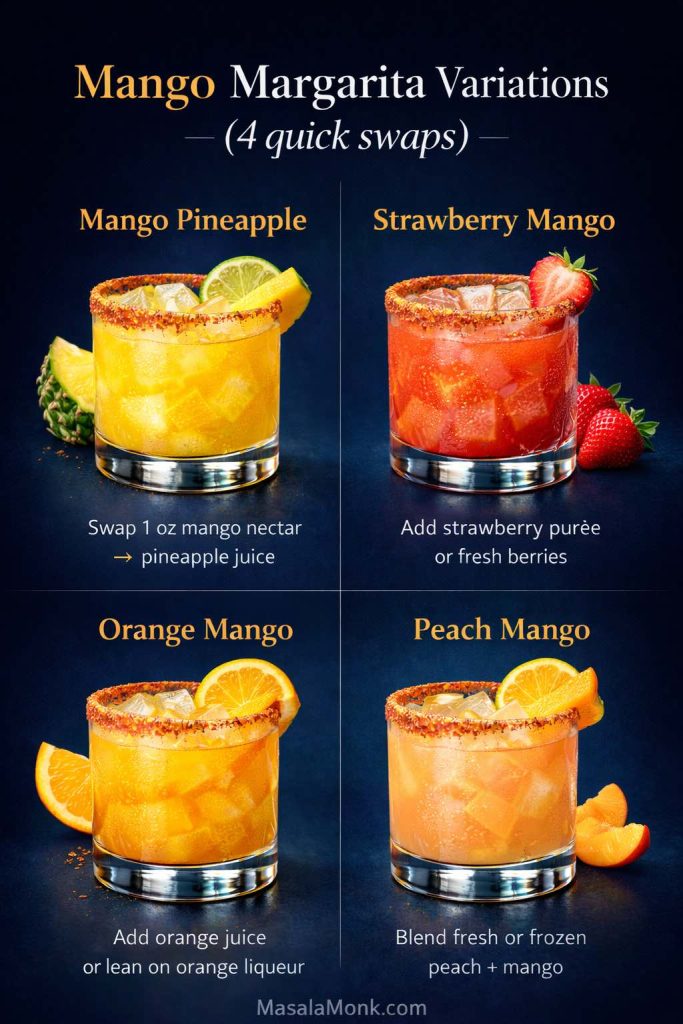
Infographic showing four mango margarita variations: mango pineapple, strawberry mango, orange mango, and peach mango, with photoreal drinks and simple swap instructions on a dark blue background.
Want to change up your mango margarita without rebuilding the whole recipe? Use these four quick swaps: pineapple for a brighter tropical edge, strawberry for a fruitier twist, orange for a warmer citrus note, and peach for a softer, rounder finish.

Mango pineapple margarita

Pineapple amplifies the tropical vibe and makes the drink taste more “vacation.” For on-the-rocks, swap part of the mango nectar for pineapple juice. For frozen, blend frozen pineapple and frozen mango together.

A good starting point:

  • On the rocks: replace 1 oz of mango nectar with pineapple juice
  • Frozen: use ¾ cup frozen mango + ¾ cup frozen pineapple
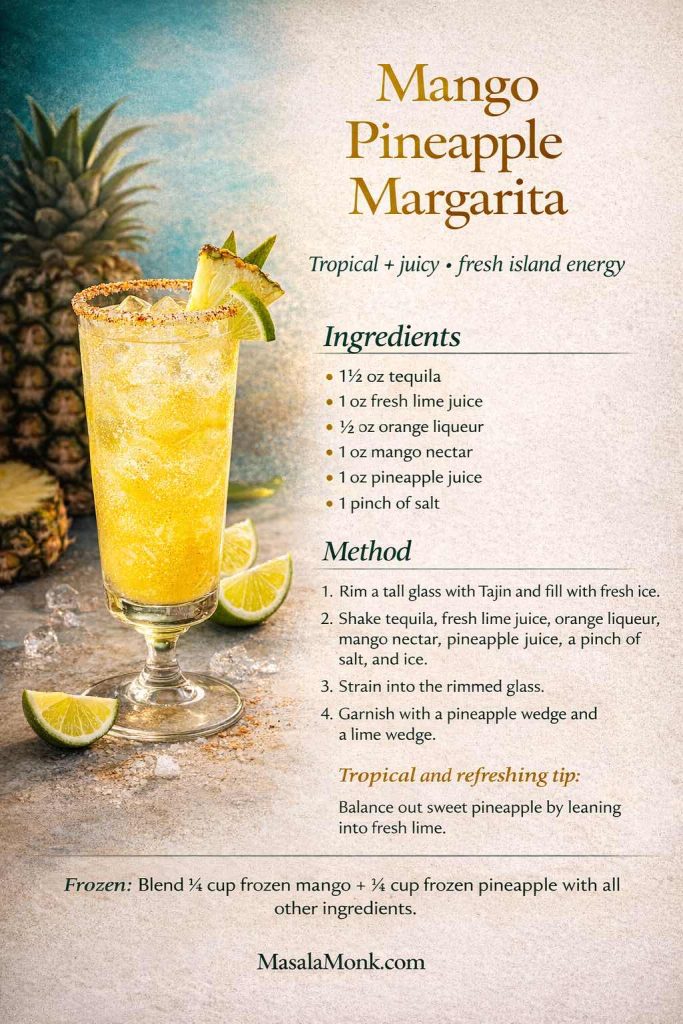
This mango pineapple margarita recipe card gives the variation a more tropical, vacation-style feel with a tall stemmed glass, pineapple juice, mango nectar, fresh lime, and a bright Tajín-style rim. It’s a useful visual for anyone wanting a pineapple mango margarita that tastes juicy and sunny without getting syrupy. The key is to keep lime slightly stronger than you think you need so the drink stays margarita-shaped instead of drifting into fruit punch territory. Save it for summer hosting, then keep reading for the strawberry mango margarita, orange mango margarita, peach mango margarita, and sleeker mango cocktail detours below.

Because pineapple reads sweet, keep lime slightly higher than you think you need.

Strawberry mango margarita

Strawberry and mango together taste like summer dessert, yet the lime makes it grown-up again.

For frozen:

  • Add 3–5 frozen strawberries to the blender.

For on the rocks:

  • Add a small strawberry purée splash to the shaker and shake well.
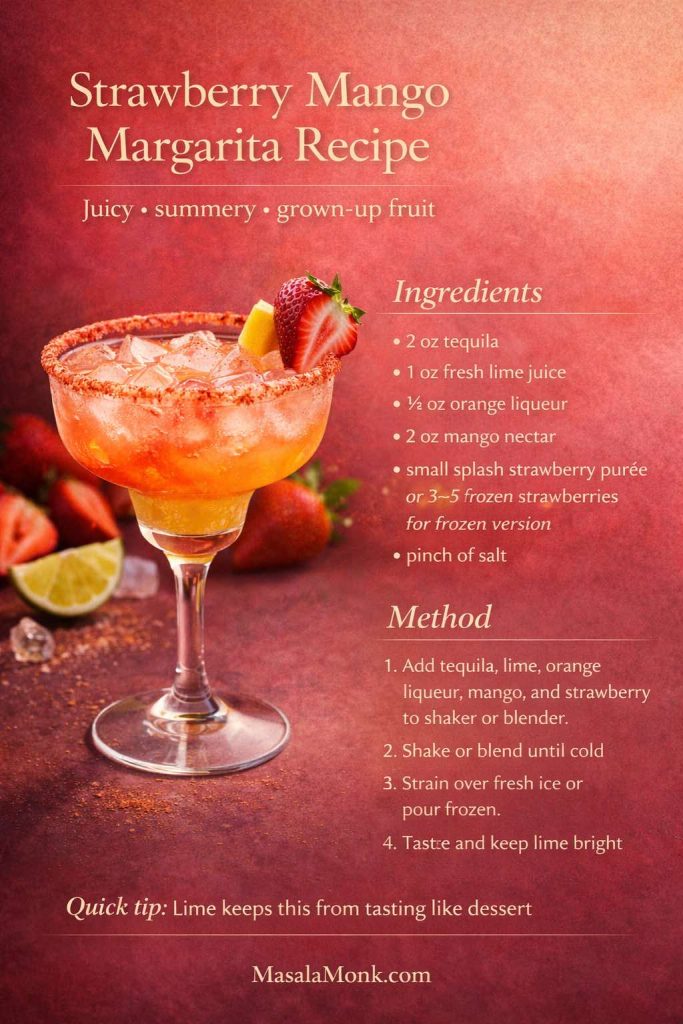
This strawberry mango margarita recipe card gives the variation a brighter, fruitier, more summery personality while still keeping it cocktail-shaped. With tequila, fresh lime juice, orange liqueur, mango nectar, and a small strawberry purée splash or frozen strawberries for the blended version, it shows how to make a strawberry and mango margarita that tastes juicy and playful without turning candy-sweet. The key move is simple: keep lime lively so the fruit stays fresh and grown-up. Save this card for warm-weather hosting, then keep reading for the cleaner orange mango margarita, softer peach mango margarita, and sleeker mango drink detours below.

This fits strawberry mango margarita, strawberry and mango margarita, and mango strawberry margarita recipe directions without forcing anything.

Orange mango margarita

Orange and mango love each other, especially when you keep things bright and not too sweet. You can do this in two ways:

  • add a small splash of fresh orange juice
  • or lean slightly more on orange liqueur and reduce sweetener
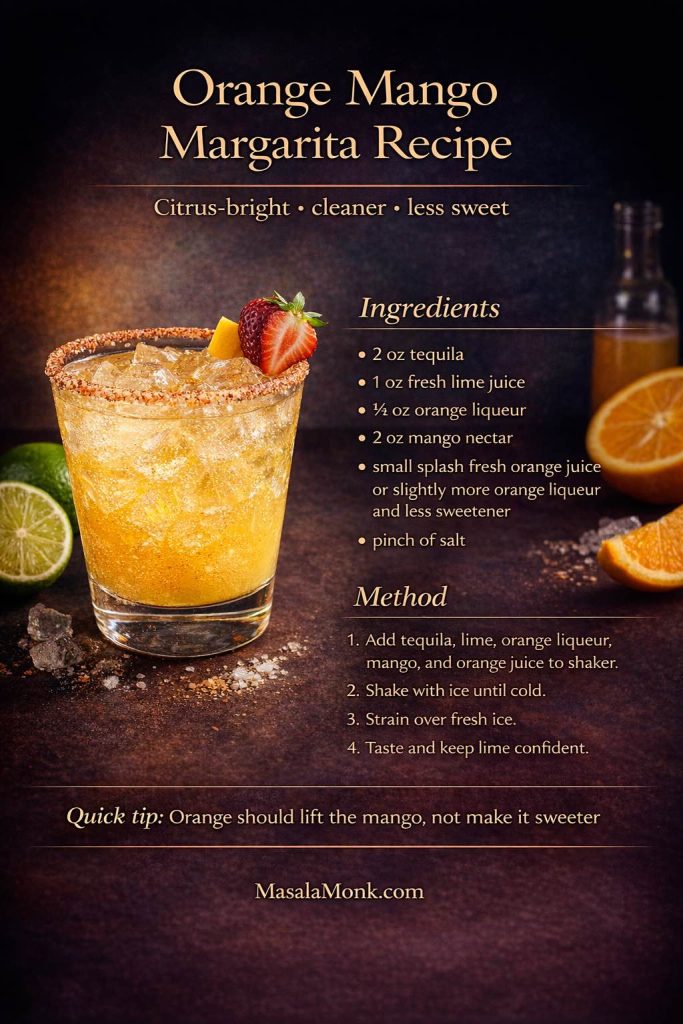
This orange mango margarita recipe card gives the variation a cleaner, more citrus-led personality than the sweeter fruit builds. With tequila, fresh lime juice, orange liqueur, mango nectar, and a small splash of fresh orange juice, it shows how to make an orange mango margarita that stays bright, fresh, and properly margarita-shaped instead of drifting into juice-bar sweetness. The key is simple: let orange lift the mango, but keep lime confident so the finish stays crisp. Save this card for a more grown-up fruit variation, then keep reading for the softer peach mango margarita and the sleeker mango martini detour.

Either way, keep lime confident so the drink stays margarita-shaped. This supports mango orange margarita and orange mango margarita versions naturally.

Peach mango margarita (and frozen peach mango margarita recipe)

Peach softens mango. It’s rounder, gentler, more perfumed. Frozen peach + frozen mango is especially good in a blender.
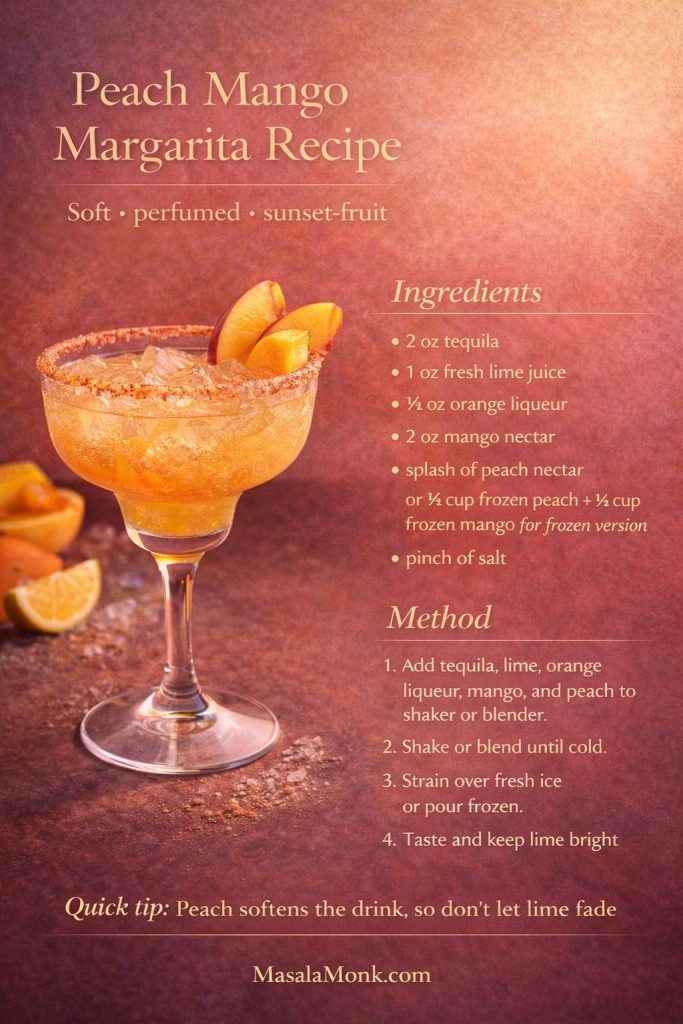
This peach mango margarita recipe card gives the variation a softer, rounder, more sunset-like feel than the sharper citrus or tropical versions. With tequila, fresh lime juice, orange liqueur, mango nectar, and a splash of peach nectar—or frozen peach and mango for the blended version—it shows how to make a peach mango margarita that tastes perfumed and smooth without losing its margarita shape. The key is simple: peach softens the drink, so lime has to stay lively. Save this one for a gentler fruit variation, then keep reading for the sleeker mango martini and the easy tequila and mango juice detour.
  • Frozen: blend frozen mango and frozen peach 50/50, then build as the frozen mango margarita recipe
  • On the rocks: use mango nectar plus a splash of peach nectar if you have it

Finish with a Tajín rim if you want that sweet-fruit-and-spice contrast. That comfortably covers peach mango margarita recipe and frozen peach mango margarita recipe variations.

Also Read: Croquettes Recipe: One Master Method + 10 Popular Variations


Mango martini recipe and mango cocktail detours (still in the mango mood)

Not every mango drink needs to be a margarita. Sometimes you want something sleeker: no rim, no rocks, just a cold, glossy, mango-forward drink.

Mango martini (bright, shaken, not creamy)

A mango martini cocktail can be made a few ways. Here’s the margarita-adjacent route that keeps it bright rather than creamy:

  • 2 oz vodka (or tequila if you want a mango tequila cocktail twist)
  • 1½ oz mango nectar or purée
  • ¾ oz lime juice
  • optional: ¼ oz orange liqueur for lift
    Shake hard with ice and strain into a chilled glass.
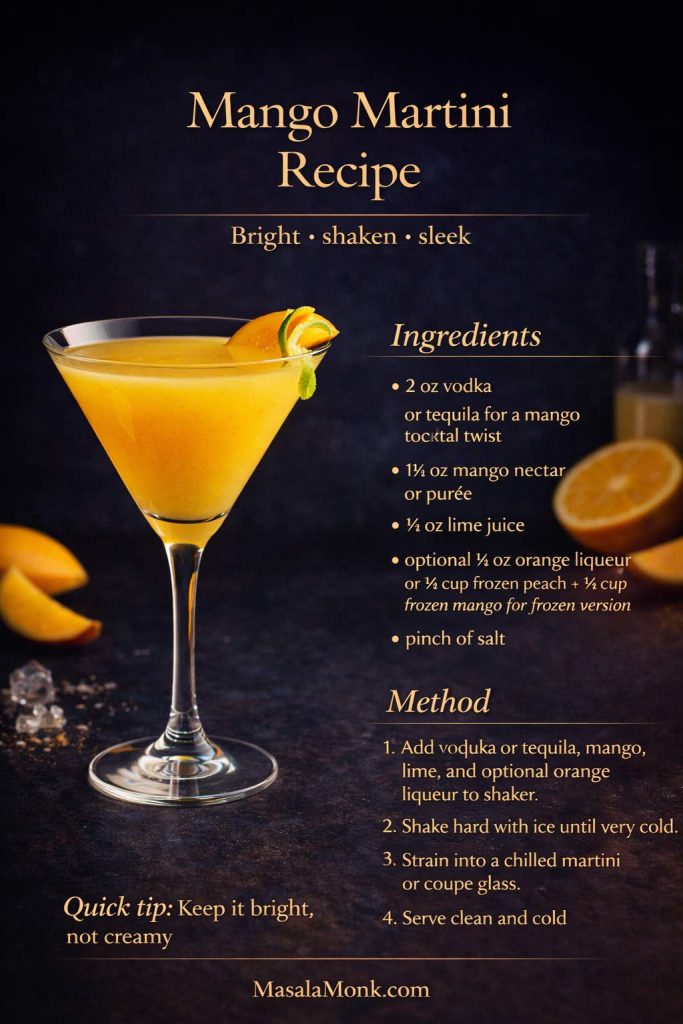
This mango martini recipe card gives the post a sleeker mango cocktail detour with a colder, cleaner, more polished feel than the margarita variations. Made with vodka or tequila, mango nectar or purée, fresh lime juice, and optional orange liqueur, it shows how to make a mango martini cocktail that stays bright, glossy, and fruit-forward without turning heavy or creamy. Save this card when you want a more elegant mango drink, then keep reading for the easy tequila and mango juice option if you want something lighter and more casual.

If you want more mango cocktail directions across spirits, MasalaMonk’s mango vodka cocktail variations is a natural blog post for readers who clearly want more mango drink ideas.

Tequila and mango juice (light and easy)

If you want something long and casual:

  • pour tequila over ice
  • add mango juice and a squeeze of lime
  • add a pinch of salt
  • taste, then decide whether it needs more lime
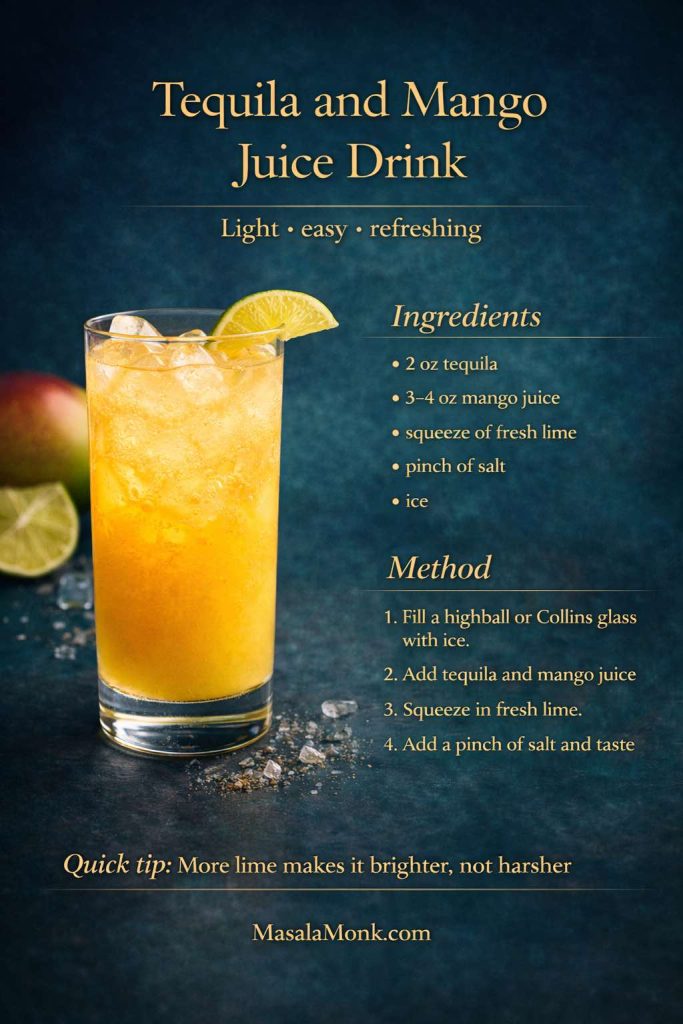
Premium tequila and mango juice drink recipe card showing a light mango tequila drink in a highball glass with lime garnish, ingredient list, method, and a tip to use more lime for brightness on a smooth blue background.
This tequila and mango juice drink card is the easiest mango cocktail detour in the post: light, refreshing, and built with almost no fuss. With tequila, mango juice, fresh lime, a pinch of salt, and ice, it shows how to make a simple mango tequila drink that still tastes bright and balanced instead of flat or overly sweet. The key is to let lime do the lifting and use salt to sharpen the fruit. Save this one for warm afternoons, easy hosting, or anytime you want a fast tequila and mango juice drink without pulling out a shaker full of extras.

It’s margarita-adjacent, refreshing, and it scratches that “tequila and mango drink” craving without needing a shaker.

Also Read: Ravioli Recipe Reinvented: 5 Indian-Inspired Twists on the Italian Classic


The small moves that make the drink taste like the best mango margarita

When someone says they want the best mango margarita recipe, they usually mean one of three things:

  1. it shouldn’t be cloying
  2. it shouldn’t be watery
  3. it should taste balanced and “finished”

That’s great news, because all three are fixable with simple technique.
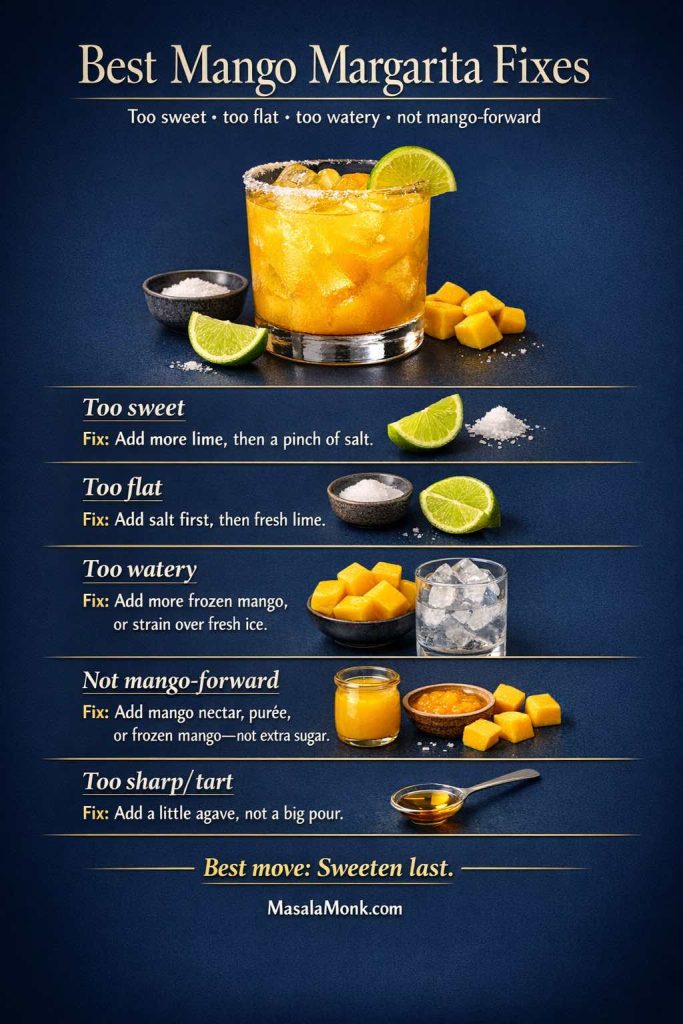
Premium mango margarita fixes infographic showing how to correct common problems like too sweet, too flat, too watery, not mango-forward, and too sharp or tart, with a mango margarita hero drink plus lime, salt, frozen mango, mango nectar or purée, ice, and agave cues on a dark blue background.
This best mango margarita fixes card is the fast-reference guide for getting your drink back into balance. If your mango margarita tastes too sweet, too flat, too watery, not mango-forward, or too sharp, these quick corrections show exactly what to do next—more lime, a pinch of salt, more frozen mango, real mango flavor, or just a little agave. It’s one of the most useful visuals in the post because it helps you improve the drink without starting over. Save it now, then keep reading for the core recipe, frozen version, spicy jalapeño twist, Tajín and chamoy finish, mezcal variation, and pitcher guide.

Keep lime fresh and assertive

Mango is sweet by nature. Lime is the counterweight. If your drink tastes heavy, lime is often the answer.

Use salt as a flavor amplifier

A small pinch of salt inside the drink won’t make it taste salty. Instead, it makes mango taste more mango and tequila taste smoother. It also sharpens lime in a way that reads “restaurant-quality.”

Sweeten last

Especially with mango nectar, sweetness can sneak up. Start with less sweetener than you think you need, then add a touch only after tasting. This alone can separate a good mango margarita recipe from one that tastes like mango candy.

Treat orange liqueur as structure, not perfume

Orange liqueur adds a bitter-sweet backbone that keeps mango from feeling one-note. If you reduce orange liqueur too much, the drink can taste flatter. If you add too much, the mango can fade. When in doubt, stay classic and tweak gently.

If you want a measured mango margarita reference from a major orange liqueur brand, the Cointreau mango margarita is a useful point of comparison for how they frame mango + lime + orange structure.

Also Read: Eggless Yorkshire Pudding (No Milk) Recipe


What to serve with mango margaritas (snacks that make everything taste brighter)

Mango margaritas love salty crunch and creamy bites, especially when you’re doing a Tajín rim, chamoy drizzle, or spicy jalapeño heat. These pairings might fit naturally and turn “one drink” into a real spread:

And if you’d like a tropical tequila cousin that keeps the vibe going after the first round, MasalaMonk’s guava margarita pairs perfectly as a “next drink” recipe blog: same margarita structure, a different fruit personality.


Mango margarita mixes, Cayman Jack, Cutwater, and other ready-to-drink shortcuts (plus how to upgrade them)

Sometimes we are not really looking for a homemade mango margarita recipe. Instead, it’s for a shortcut: a bottled mix, a canned mango margarita, or a ready-to-drink mango option you can pour over ice and call it a day. That’s completely fair—especially when you’re hosting, when you’re tired, or when you simply want something cold and tropical without pulling out a blender.

However, here’s the truth: most mixes and canned options are built to be broadly appealing, which usually means they lean sweet and slightly flat. The good news is that you can make almost any mango margarita mix taste significantly better with a few tiny upgrades. In other words, you don’t need to “fix” it with extra syrup or complicated add-ons. You just need to restore the parts a real margarita is built on: lime brightness, structure, and a bit of salt clarity.

The 30-second upgrade that makes almost any mango margarita mix taste fresher

If you remember one thing from this entire section, make it this: the fastest path to a better mango margarita is rarely more sugar. It’s almost always more structure.
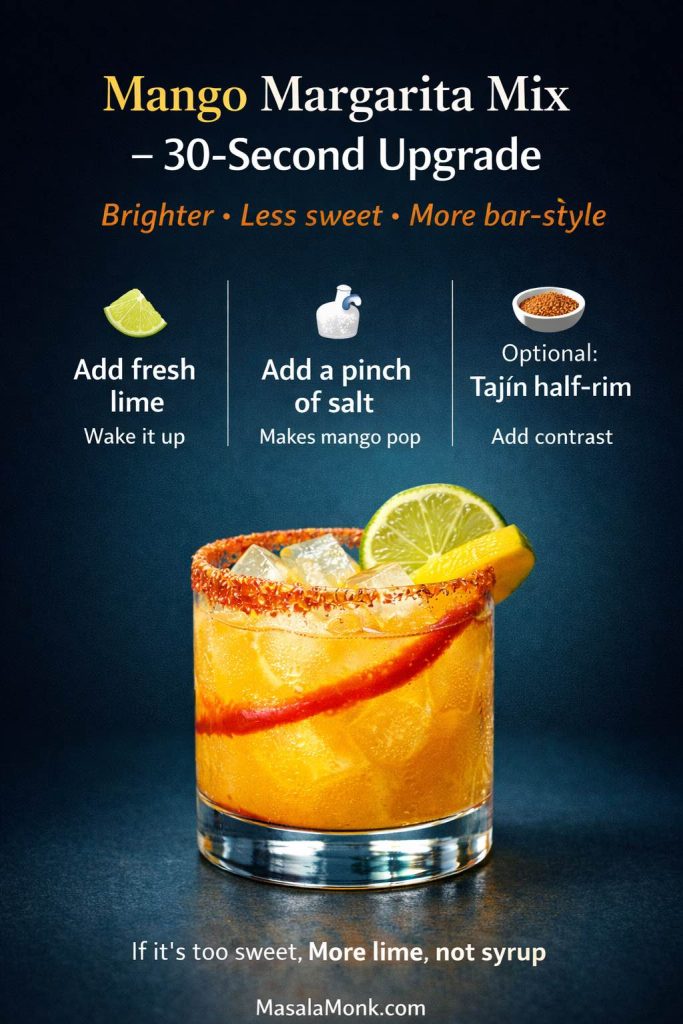
Using mango margarita mix or a ready-to-drink can? This quick upgrade makes it taste fresher: add fresh lime, add a pinch of salt, then finish with a Tajín half-rim for contrast—more lime, not syrup, if it’s too sweet.

Start with these small moves:

First, add a squeeze of fresh lime. Even a small amount wakes up bottled mango flavors and makes the drink taste more “alive.” Next, add a tiny pinch of salt. It won’t make the drink taste salty; rather, it makes mango taste more like mango and tequila taste smoother. After that, taste before adding anything sweet. Many mixes are already sweet enough, so extra syrup usually pushes them into candy territory.

Finally, if your mix tastes strangely “mango-light”—as in, sweet but not truly mango-forward—add a small splash of mango nectar or a spoonful of mango purée. That boosts real fruit flavor without turning the drink into syrup.

Once you do these four things, you’ll be shocked how often “average mix” turns into “this tastes like a decent bar pour.”

Cayman Jack Mango Margarita: what it is and how to make it taste brighter

Cayman Jack Mango Margarita is typically bought as a ready-to-drink mango margarita-style beverage. Think of it as a party-friendly shortcut that benefits from the same balancing tricks you’d use in your homemade recipes.

To make it taste brighter and less one-note, pour it over fresh ice, squeeze in lime, and add a small pinch of salt. Then stop. Taste it. At that point, you’ll usually find it tastes cleaner and more “margarita-shaped.”

If you want the Tajín mango margarita vibe, rim the glass with Tajín (or do a half-rim), but keep the drink itself clean. That way the rim supplies the contrast—tart, salty, chili-lime sparkle—while the drink stays refreshing and not heavy.

Cutwater Mango Margarita (canned): how to serve it well

Cutwater’s Mango Margarita is a canned cocktail option that people often look for when they want convenience with tequila character. Because people often look for this canned beverage, it helps to think like a shopper: the quickest path is usually the brand’s own store locator or large retailers that support inventory search and delivery in your area.

Once you actually have the can, serving it well matters more than anything else. Start by serving it very cold. Pour over fresh ice, add a squeeze of lime, and consider a Tajín rim (or a half-rim) if you want that spicy-fruity contrast. This small treatment makes canned mango margaritas taste less flat and far more “cocktail-like.”

Additionally, if the can tastes a little sweet, do not add sweetener. Instead, add lime. If it tastes muted, add salt. Those two are the levers that turn ready-to-drink mango into something that tastes intentional.

Uptown Mango Margarita and “Gloria” mango margarita (often Rancho La Gloria)

You’ll also see bottled, ready-to-pour mango margarita products on the shelves—Uptown Mango Margarita is one example. Another common pattern is people looking for “Gloria mango margarita,” which often points to a bottled mango margarita-style drink from Rancho La Gloria.

Even though the bottles differ, the strategy stays the same. Serve them very cold, pour over fresh ice, and add fresh lime. Then add a tiny pinch of salt if it tastes flat. If it tastes too sweet, keep pushing lime rather than adding anything sugary. In contrast, if it tastes too sharp, a small splash of mango nectar can soften it without changing the drink’s personality.

The overall goal is to keep it tasting bright and drinkable, not sticky.

Best mango margarita mix (Master of Mixes, Zing Zang, and “mango chili” mixes)

When someone looks for “best mango margarita mix,” what they usually want is simple: they want mango flavor that feels real, sweetness that doesn’t overwhelm, and enough citrus bite that it still tastes like a margarita rather than fruit punch.

If you’re using a mix like Master of Mixes or Zing Zang, treat it like a base—not a complete recipe. Start with tequila, add the mix, and then “finish” it with fresh lime and a pinch of salt. That’s the basic upgrade pattern.

If you want a spicy mango margarita mix feel—something like “mango chili margarita”—it’s better to build the spice cleanly rather than relying on a spicy syrup. Use a Tajín rim for chili-lime contrast, then add jalapeño slices in the shaker for controlled heat. This way the drink stays crisp and grown-up, and you don’t end up with a sticky, muddled sweetness that masks mango.

In short, the best mango margarita mix is the one you can upgrade into a balanced drink. Lime and salt do that job faster than anything else.

Also Read: Dirty Martini Recipe (Classic, Extra Dirty, No Vermouth, Spicy, Blue Cheese, Tequila + Batched)


A final pour

Once you’ve made this a couple of times, you stop thinking of it as a single recipe and start thinking of it as a set of confident choices: frozen mango or mango nectar, jalapeño slices or a gentle Tajín rim, chamoy ribbons or clean citrus brightness, tequila-only or a smoky mezcal split. That’s the real charm of a mango margarita—one base, many moods.
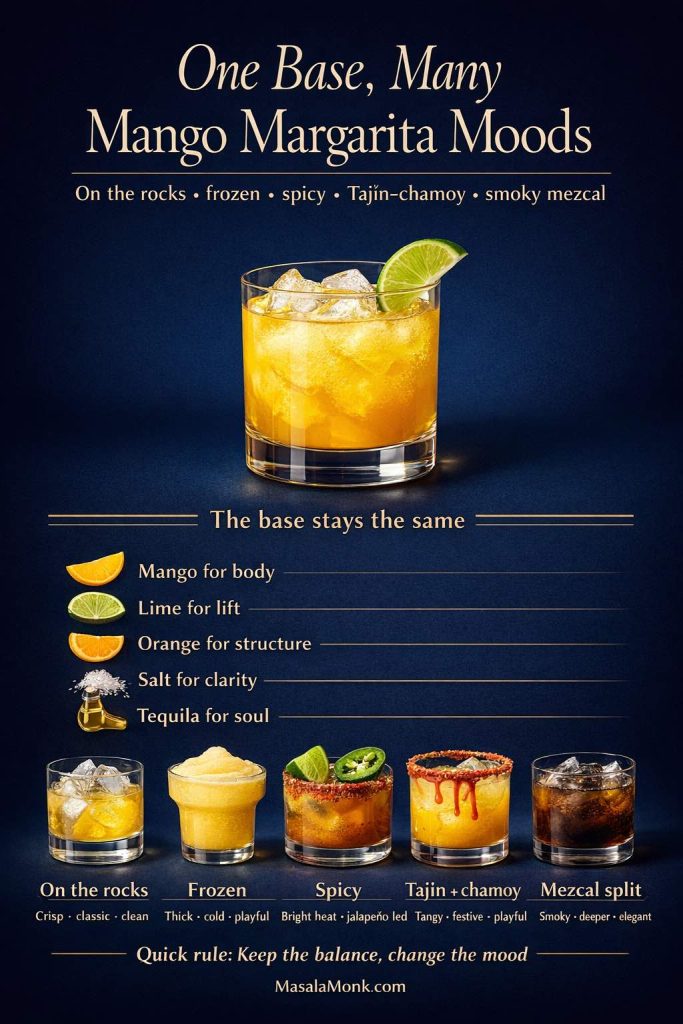
Premium editorial mango margarita closing guide showing one base formula with multiple style directions: on the rocks, frozen, spicy, Tajín and chamoy, and smoky mezcal, with labeled drink cues and a central reminder that mango gives body, lime gives lift, orange gives structure, salt gives clarity, and tequila gives soul.
This mango margarita guide closes the post by showing the big idea behind every variation: one balanced base, many different moods. Whether you want a mango margarita on the rocks, a frozen mango margarita, a spicy mango margarita, a Tajín and chamoy finish, or a mezcal split for smoky depth, the structure stays the same—mango for body, lime for lift, orange for structure, salt for clarity, tequila for soul. Save this as your quick chooser card so you can decide the mood first and build the drink with more confidence.

Some nights you’ll want the simplest mango margarita on the rocks. On other nights, you’ll want a frozen mango margarita recipe that tastes like a tropical slush with a tequila spine. Then, when you’re feeling playful, a chamoy margarita with a Tajín rim turns the drink into something that feels like a celebration in a glass. Either way, the balance stays the same: mango for body, lime for lift, orange for structure, salt for clarity, tequila for soul.

Also Read: Fish and Chips Reimagined: 5 Indian Twists (Recipe + Method)


FAQs

1) What is the best mango margarita recipe for beginners?

The best mango margarita recipe for beginners is the on-the-rocks version using mango nectar, tequila, fresh lime juice, and orange liqueur. Because mango nectar is consistent, you can focus on balance: shake until very cold, then adjust with a little more lime if it tastes sweet or a touch of agave if it tastes sharp.

2) How do you make a mango margarita on the rocks?

To make a mango margarita on the rocks, shake tequila, mango nectar (or mango juice), fresh lime juice, orange liqueur, a pinch of salt, and ice. Afterward, strain into a glass filled with fresh ice. Finally, taste once and tweak: extra lime for brightness, or a small splash of mango nectar if it’s too tart.

3) How to make a mango margarita frozen?

For a frozen mango margarita, blend tequila, lime juice, orange liqueur, a pinch of salt, and frozen mango until thick and smooth. If the blender stalls, add a tablespoon or two of cold water rather than extra ice to avoid watering it down.

4) What’s the difference between a blended mango margarita and a frozen mango margarita?

A blended mango margarita usually means the drink is made in a blender, while a frozen mango margarita specifically aims for a thick, slushy texture. In practice, both are similar; the real difference comes from how much frozen fruit you use and how much liquid you add.

5) Can I make a mango margarita recipe with mango nectar?

Yes—mango nectar is one of the easiest bases for a mango margarita recipe. Since nectar is often sweet, start with little to no added sweetener. Then, adjust with lime juice and salt to keep the drink crisp.

6) Can I make a mango margarita with mango juice instead of mango nectar?

Absolutely. However, mango juice is usually thinner than nectar, so the drink may taste less mango-forward unless you increase the mango amount or add a bit of mango purée. Meanwhile, keep lime slightly higher to maintain that margarita snap.

7) How do I make a mango nectar margarita recipe that isn’t too sweet?

First, reduce or skip added sweetener. Next, increase fresh lime juice in small steps. Finally, add a tiny pinch of salt; it sharpens citrus and keeps mango from tasting cloying.

8) Can I make a mango margarita recipe with mango purée?

Yes. A mango purée margarita recipe often tastes richer and more “bar-style.” Because purée adds body, it can handle a bit more lime. As a result, you can keep the drink bright without losing mango flavor.

9) How do I make a mango margarita recipe with fresh mango?

Blend ripe fresh mango with a splash of lime juice until smooth, then use that as your mango base in either the frozen or on-the-rocks method. If the mango is fibrous, strain the purée for a smoother texture.

10) What are the key mango margarita ingredients?

Most mango margarita ingredients include tequila, fresh lime juice, mango (nectar, purée, fresh, or frozen), orange liqueur, and ice. Additionally, a pinch of salt improves flavor and a Tajín rim is optional for contrast.

11) How do you make a spicy mango margarita?

To make a spicy mango margarita, add jalapeño slices to the shaker (or blend briefly for frozen). For more heat, muddle lightly; for less heat, remove the pepper sooner. Either way, keep mango and lime in the lead so the spice feels like a finish, not the main event.

12) How to make a spicy mango margarita with jalapeño?

Shake tequila, mango nectar (or purée), lime juice, orange liqueur, and 2–4 jalapeño slices with ice. Then strain and taste. If you want more heat next time, add one more slice or muddle gently.

13) How to make a mango jalapeño margarita without it getting too hot?

Use fewer slices, avoid muddling, and keep the contact time short. In addition, serving over fresh ice helps soften heat. If it still tastes spicy, add a splash more mango nectar and a squeeze of lime to rebalance.

14) How to make a mango habanero margarita recipe safely?

Use a tiny piece of habanero rather than slices, shake quickly, and taste immediately. Because habanero heat builds fast, start small, then increase gradually on the next round if needed.

15) What is a Tajín mango margarita?

A Tajín mango margarita is a mango margarita served with a Tajín rim (chili-lime seasoning). The salty-tart edge boosts mango flavor and makes the drink taste brighter, especially in frozen versions.

16) How do I make a mango margarita with Tajín?

Wet the rim with lime and dip it into Tajín. Then make your mango margarita on the rocks or frozen as usual. For a cleaner sip, try a half-rim so you can control how much seasoning you taste.

17) What is a chamoy margarita?

A chamoy margarita is a margarita accented with chamoy, a sweet-sour-salty condiment. When combined with mango and a Tajín rim, it takes on a mangonada-style profile that tastes like a tangy Mexican candy-inspired drink.

18) How do you make a mangonada margarita recipe at home?

Drizzle chamoy inside the glass, add a Tajín rim, then pour in a mango margarita (frozen or on the rocks). After that, taste before adding more chamoy—usually a little goes a long way.

19) What’s the best tequila for a mango margarita?

Blanco tequila keeps a mango margarita bright and crisp, while reposado adds warmth and smoothness. If you’re using Tajín or chamoy, reposado can feel especially balanced; conversely, for a fresh, zesty finish, blanco is a classic choice.

20) Can I make a mango mezcal margarita?

Yes. Replace part (or all) of the tequila with mezcal for a mango mezcal margarita. Since mezcal adds smoke, keep lime fresh and consider a Tajín rim to emphasize contrast.

21) How do I make a pitcher mango margarita recipe for a party?

Mix tequila, orange liqueur, lime juice, mango nectar, sweetener to taste, and a pinch of salt in a pitcher. Then chill the base thoroughly. When serving, pour over fresh ice so it stays bright instead of diluted.

22) How do I scale mango margaritas for a crowd without losing flavor?

Measure the base carefully, chill it well, and avoid leaving ice in the pitcher. Instead, add ice to each glass as you pour. That way the mango margarita stays consistent from the first serving to the last.

23) What is a mango pineapple margarita recipe?

A mango pineapple margarita recipe combines mango with pineapple juice or frozen pineapple. Because pineapple can taste sweeter, increase lime slightly so the drink still tastes like a margarita, not fruit punch.

24) How do I make a strawberry mango margarita?

Add strawberries to your mango margarita base—blend for frozen or shake with a small strawberry purée splash for on-the-rocks. Then re-taste and adjust lime so the finish stays crisp.

25) How do I make an orange mango margarita?

Add a splash of orange juice or lean slightly more on orange liqueur while keeping lime strong. This creates a softer citrus profile while preserving the classic margarita structure.

26) How do I make a peach mango margarita recipe?

Combine mango and peach (nectar, purée, or frozen fruit) in your base. For frozen peach mango margarita recipe versions, blend frozen peach and frozen mango together, then adjust lime so it stays bright.

27) Why does my mango margarita taste watery?

Usually the issue is too much ice or not enough mango body. For frozen drinks, use frozen mango as the main thickener and add only small splashes of water if needed. For on-the-rocks, shake, then strain over fresh ice rather than letting the drink sit in melting ice.

28) Why does my mango margarita taste too sweet?

First, add more lime juice in small increments. Next, add a pinch of salt. Finally, reduce sweetener next time, especially if you’re using mango nectar or a very ripe mango.

29) Why does my mango margarita taste too tart?

Add a small amount of agave or simple syrup, then re-taste. If you’re using mango juice rather than nectar, increasing mango volume can also soften the sharpness.

30) Can I make an easy mango margarita without orange liqueur?

You can, though the drink may taste less like a margarita and more like a mango tequila cocktail. If you skip orange liqueur, add a small amount of sweetener and keep lime assertive to maintain balance.

31) What’s the best mango margarita mix, and how do I make it taste less sweet?

The best mango margarita mix is the one that still tastes bright and citrusy once tequila is added. If it tastes too sweet, fix it with fresh lime first, then a pinch of salt. If it still tastes candy-like, reduce added sweetener next time. In contrast, if the mango flavor feels weak, add a small splash of mango nectar or a spoonful of mango purée—fruit intensity beats sugar every time.

32) How do I make a Cayman Jack mango margarita taste more like a fresh cocktail?

Pour it over fresh ice, add a squeeze of lime, and add a tiny pinch of salt. If you want extra contrast, do a Tajín half-rim rather than adding more sweetness. This keeps it bright and “margarita-shaped” instead of sticky.

33) What’s the best way to serve a Cutwater mango margarita?

Serve it very cold over ice, then add fresh lime. A Tajín rim (or half-rim) adds the chili-lime pop that makes mango taste sharper and more refreshing. If it tastes a little flat, salt is the fastest fix.

34) What is a “mangorita” recipe?

“Mangorita” is simply a nickname for a mango margarita. It still follows the classic margarita structure—tequila, lime, and orange liqueur—while mango comes in through nectar, juice, purée, fresh mango, or frozen mango.

35) How do I get a “mango chili margarita mix” vibe without using bottled spicy syrup?

Use a Tajín rim for chili-lime contrast, keep lime strong, add a pinch of salt, and add jalapeño slices to the shaker for controlled heat. This gives you the sweet-fruit-chili impression while keeping the drink crisp and clean.
Posted on 3 Comments

Mojito Recipe (Classic) + Ratios, Pitcher, Mocktail & Easy Variations

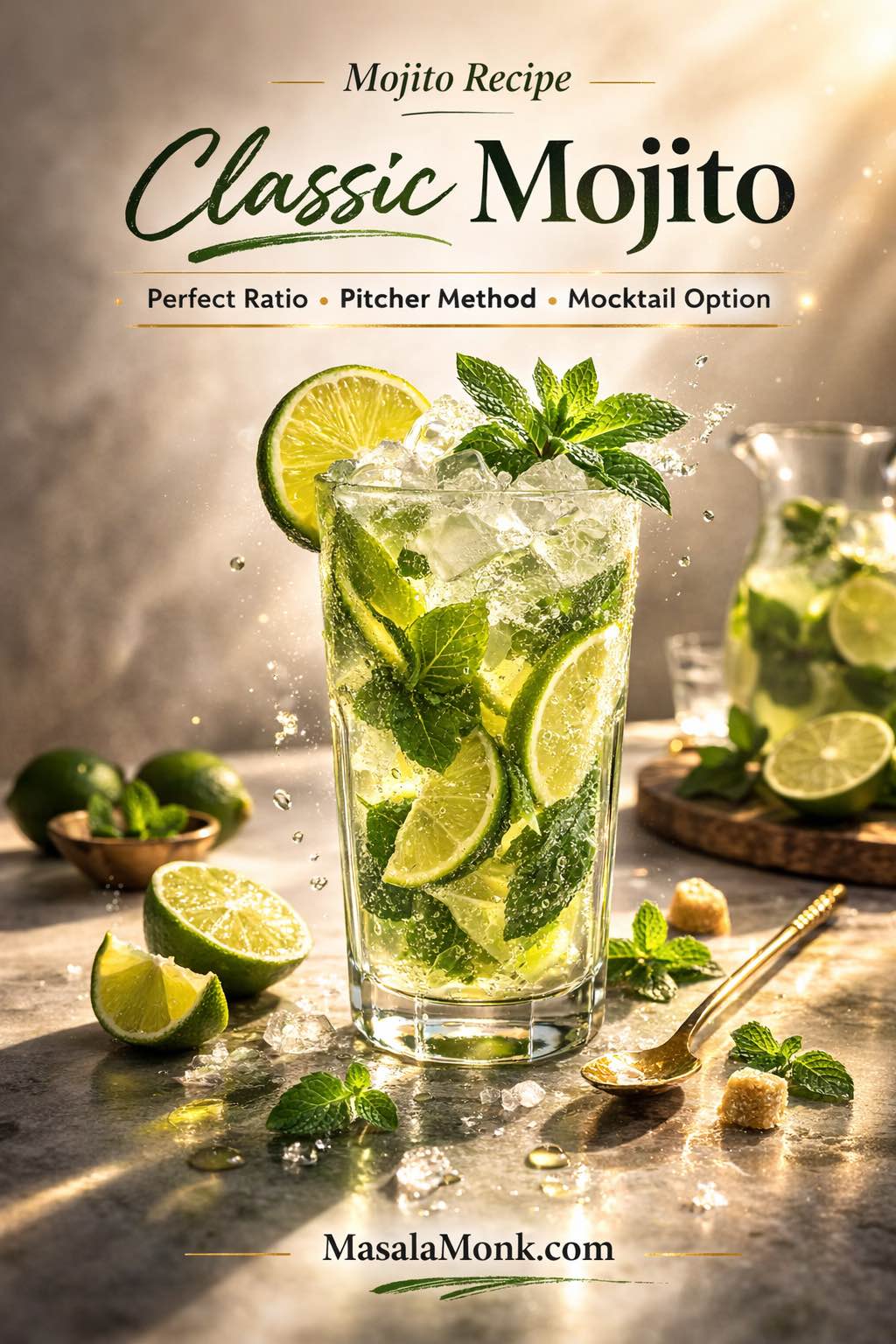
Magazine-style cover image of a classic mojito recipe in a tall highball glass with crushed ice, fresh mint, and lime slices on a warm ivory background, with text overlay “Mojito Recipe: Classic Mojito” and “Perfect Ratio • Pitcher Method • Mocktail Option” plus MasalaMonk.com in the footer.

A great mojito recipe has a particular kind of clarity. The lime feels bright rather than sharp, the mint smells fresh instead of tasting bitter, and the fizz lifts everything so the drink stays light on its feet. When a mojito is made well, it doesn’t just taste “refreshing.” It tastes clean, cold, and intentional—like you meant to make it that way all along.

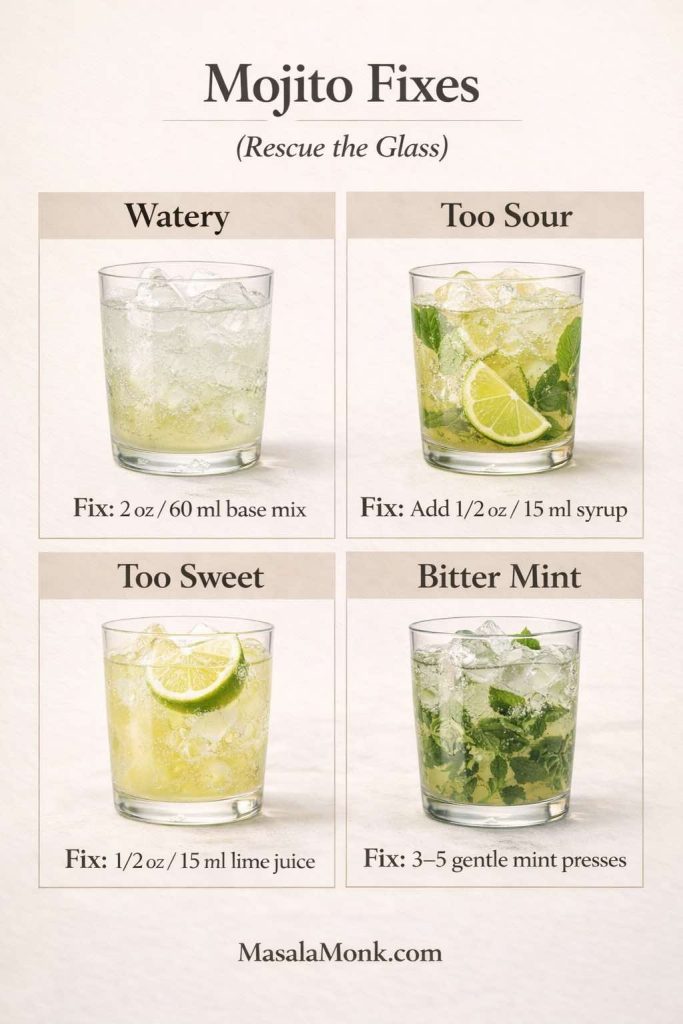
And yet, plenty of home mojitos miss the mark for reasons that have nothing to do with skill. Often, the sweetener wasn’t dissolved fully. Sometimes the mint was crushed like it was being punished. Other times, soda got stirred until the drink went flat. In contrast, once you understand how a classic mojito is built—order, pressure, and timing—you can make a mojito drink that tastes consistently good in any kitchen, with any glass, and with minimal tools.

Designed to be “learn it once, reuse it forever”, this guide will share:

  • A proper classic mojito recipe with exact measurements
  • A dependable mojito ratio you can memorize and scale
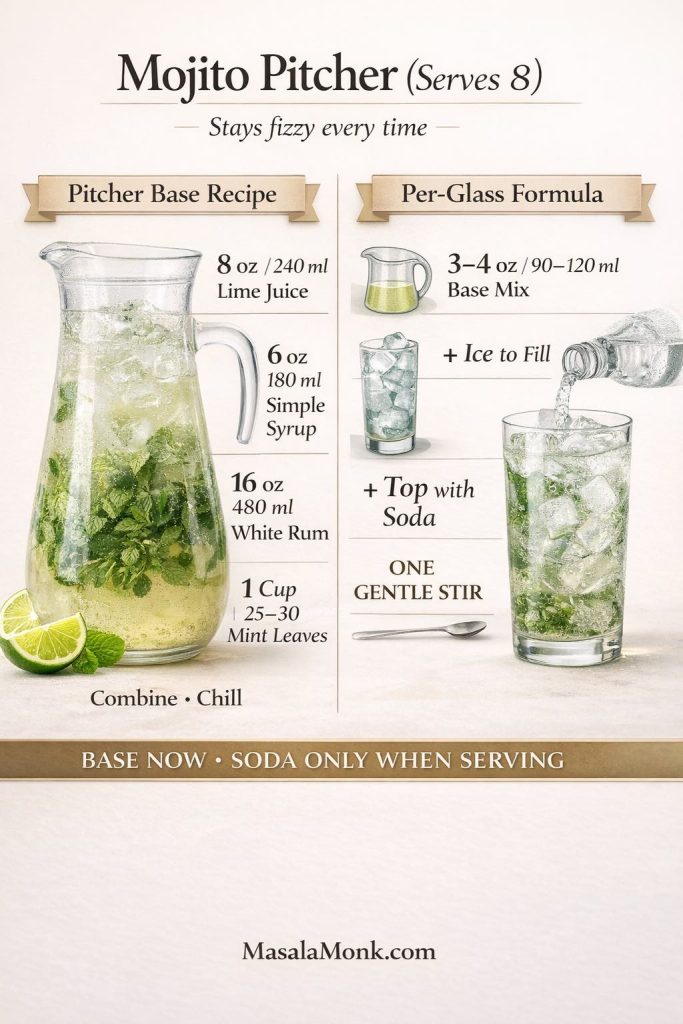
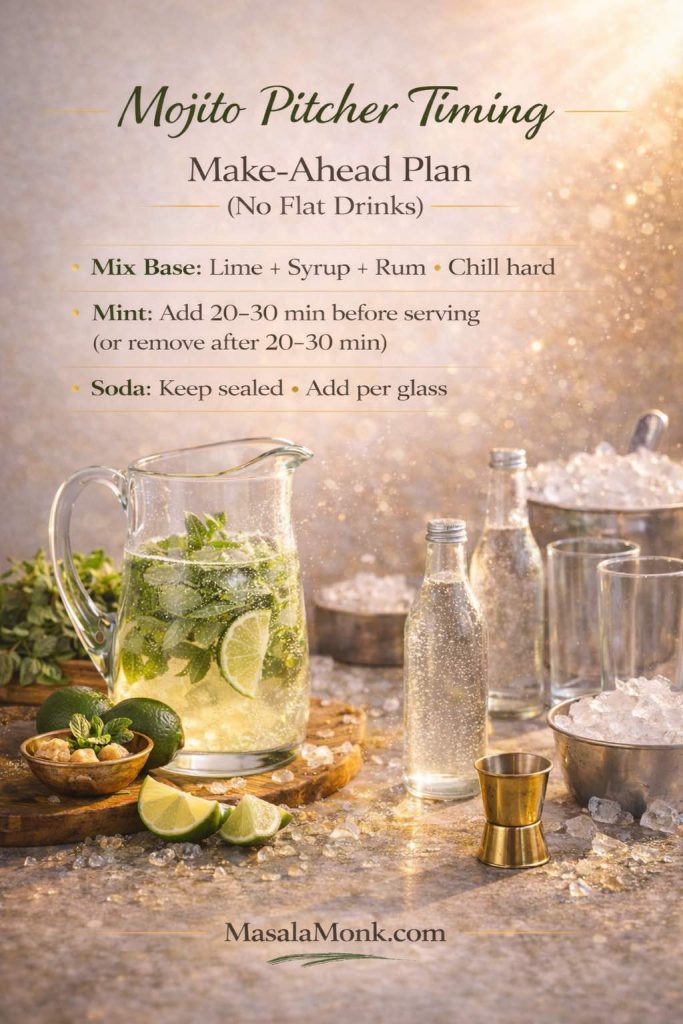
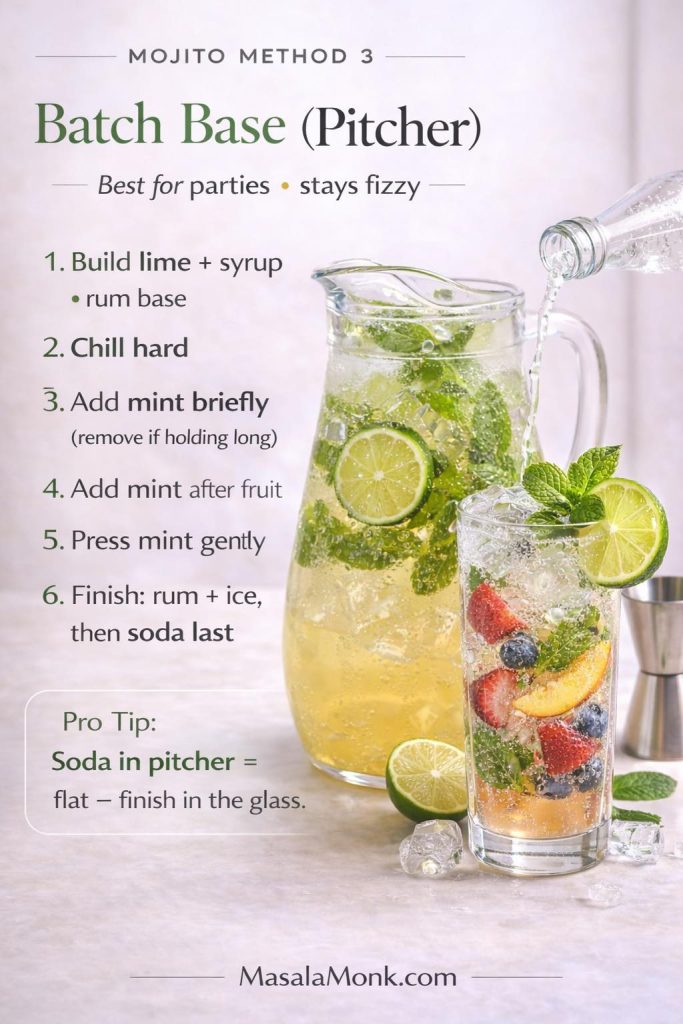
  • A party-ready mojito pitcher recipe that stays fizzy
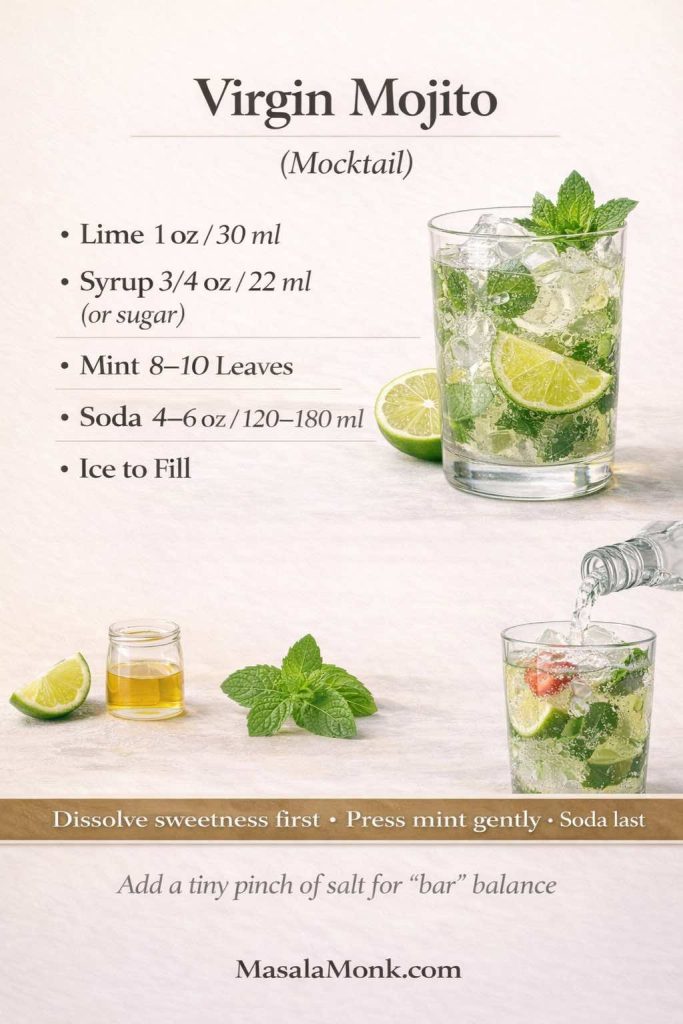
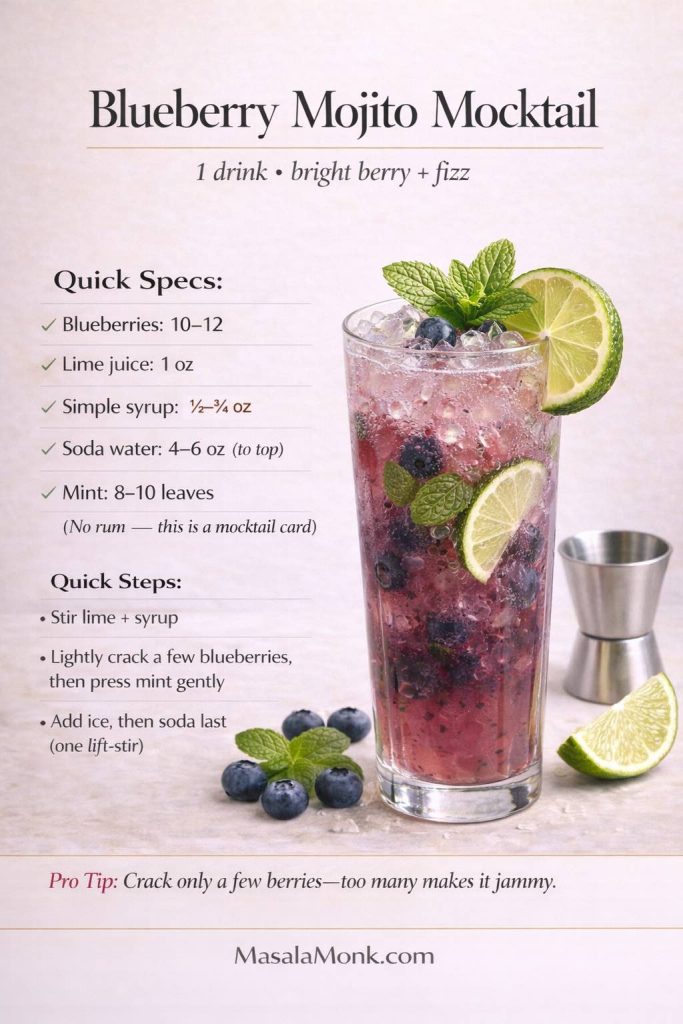
  • A satisfying mojito mocktail and virgin mojito recipe that still tastes like a mojito
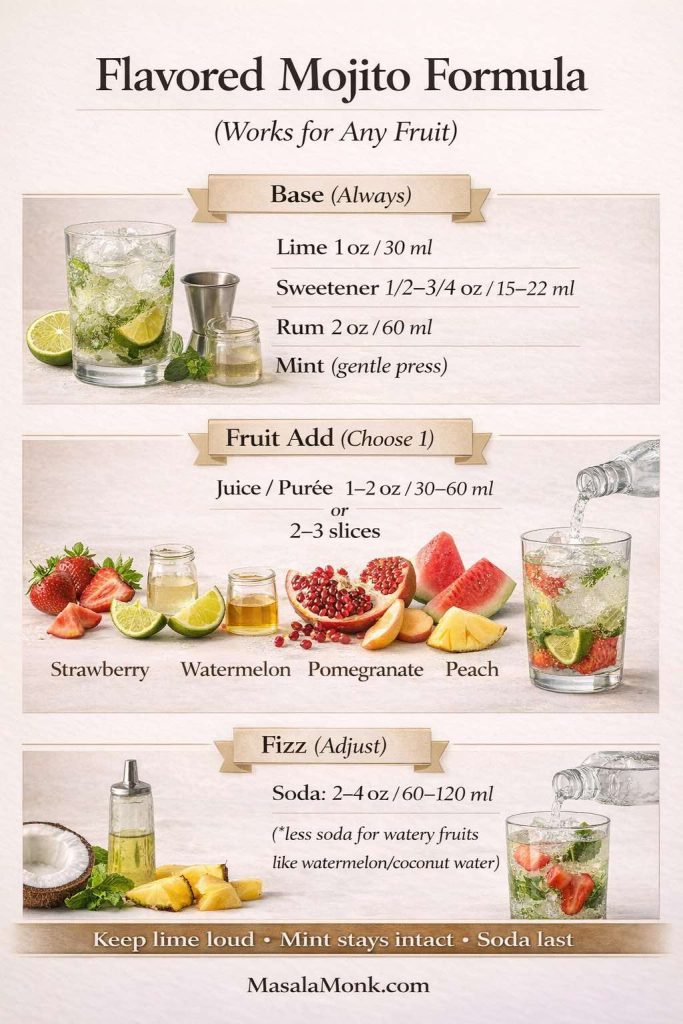
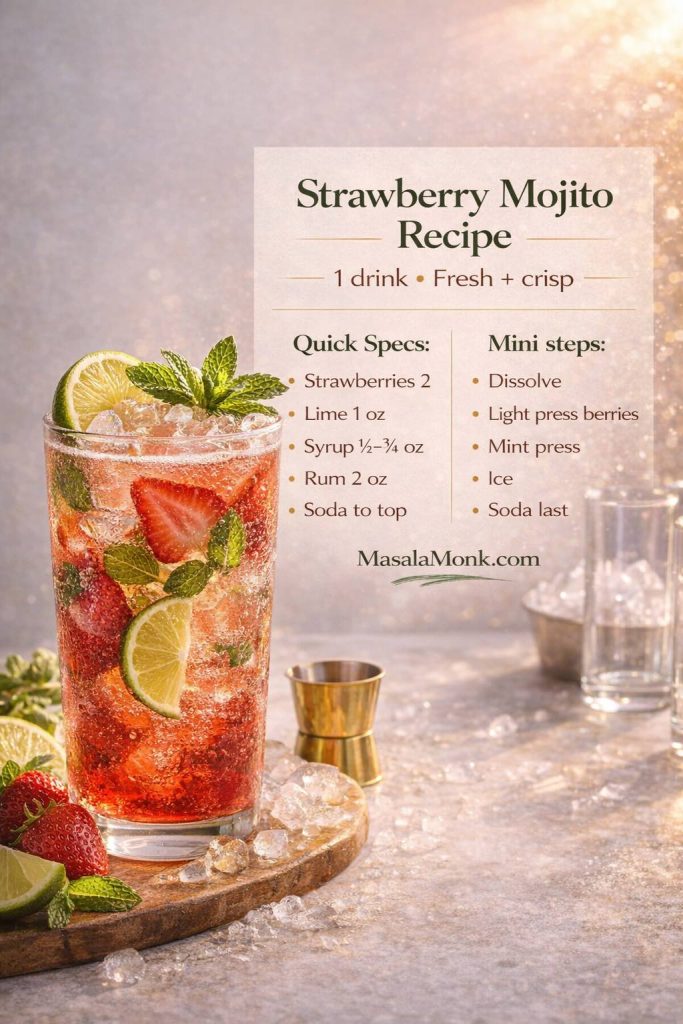
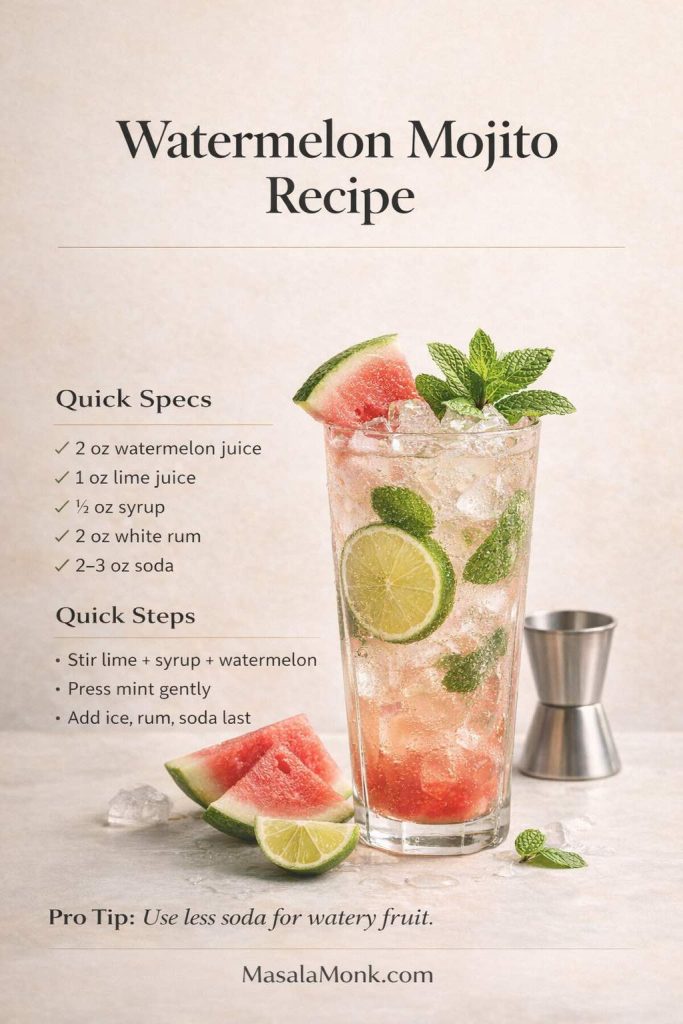
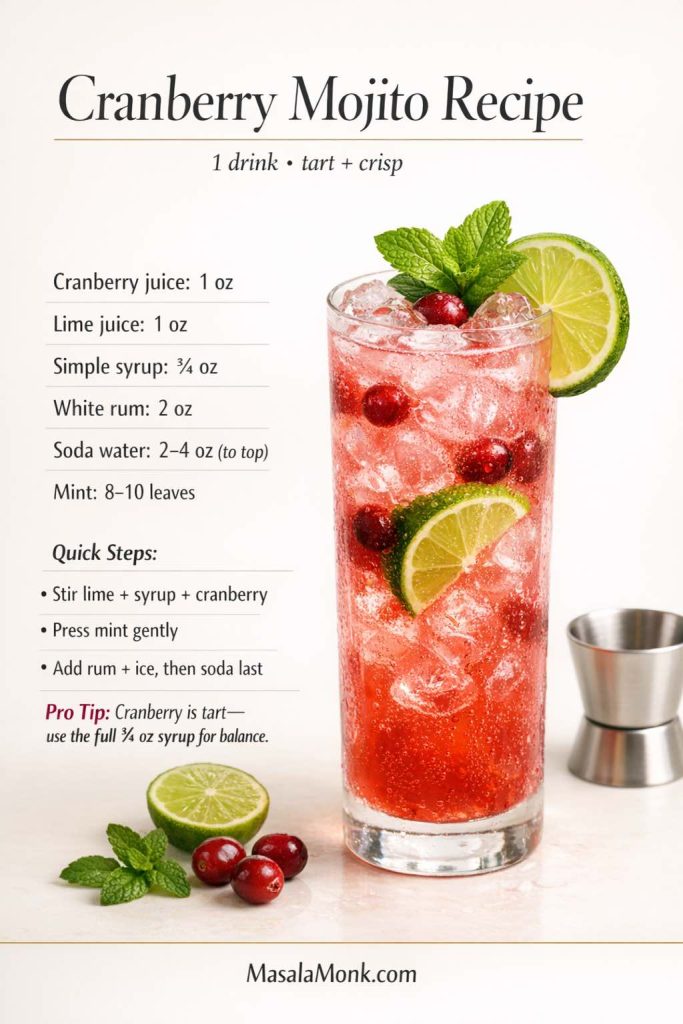
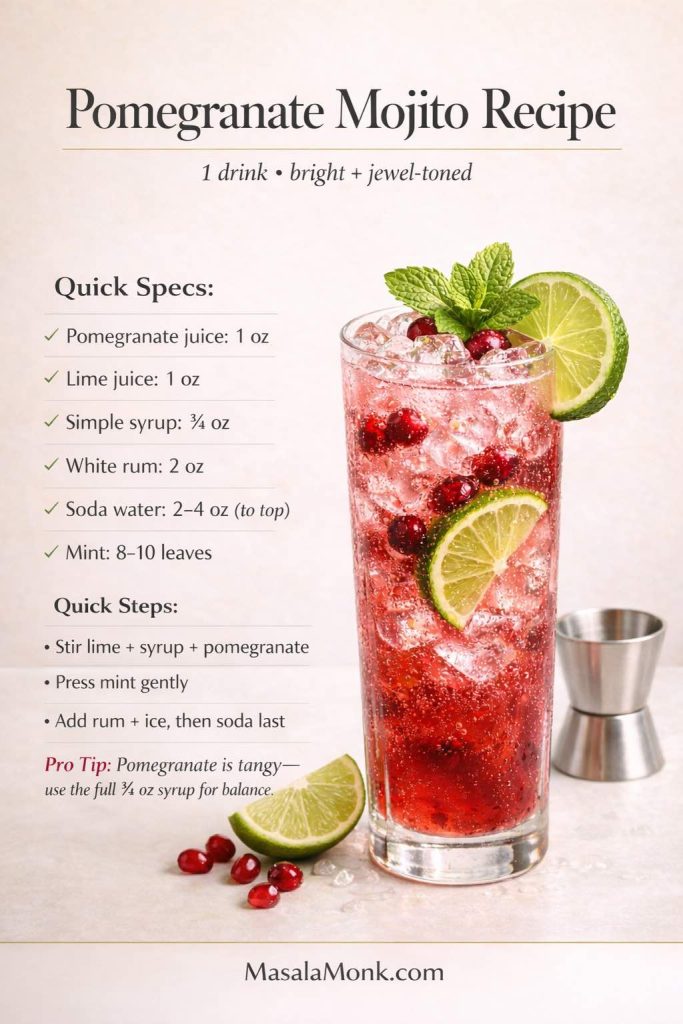
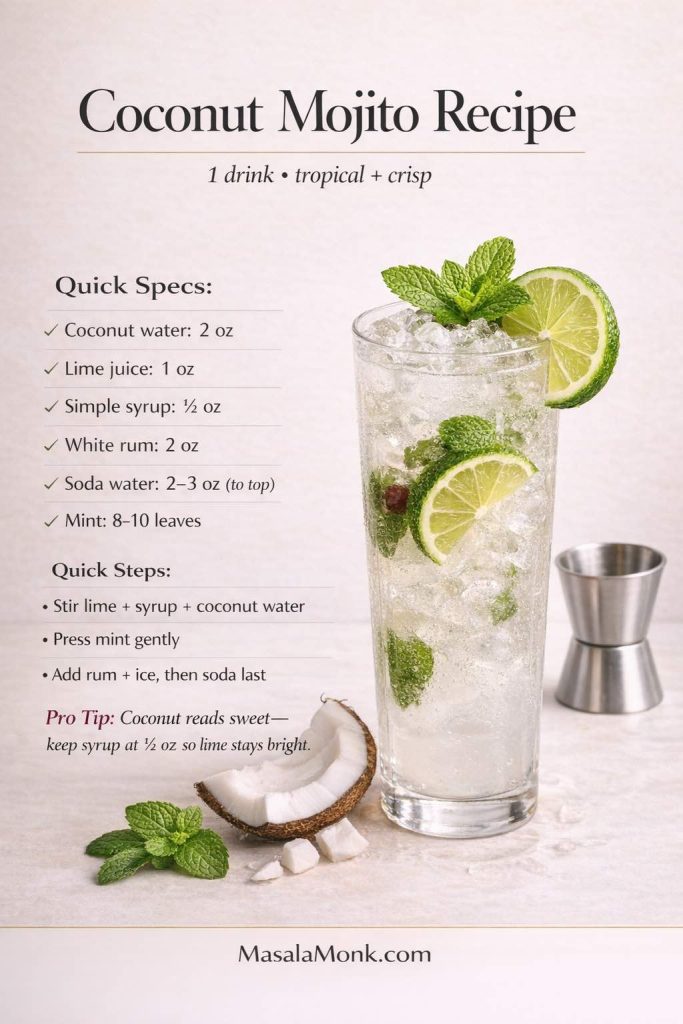
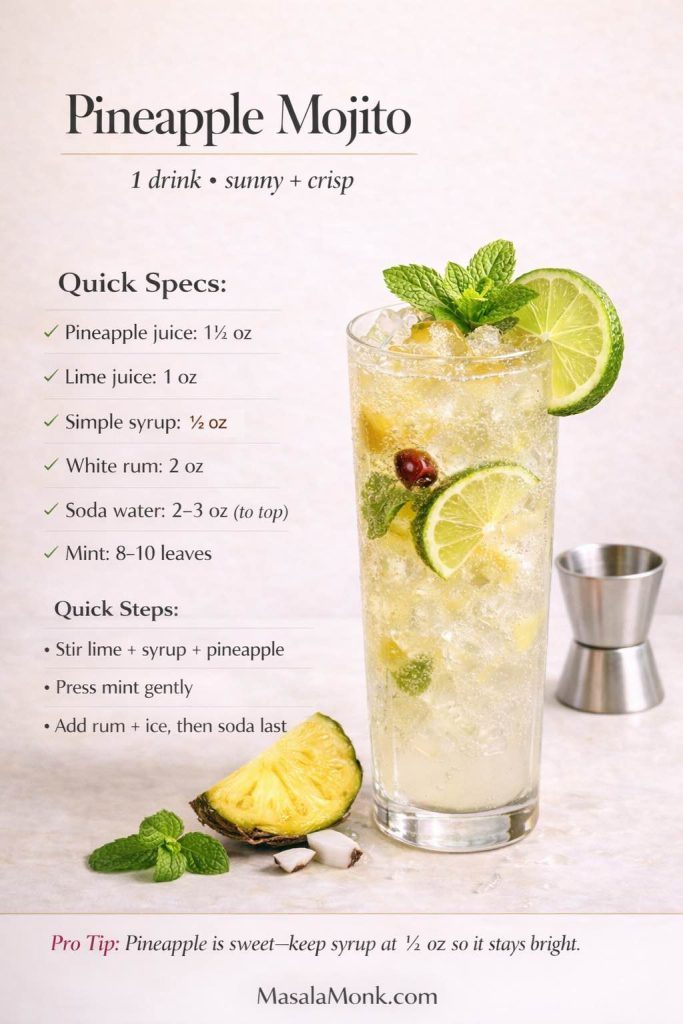
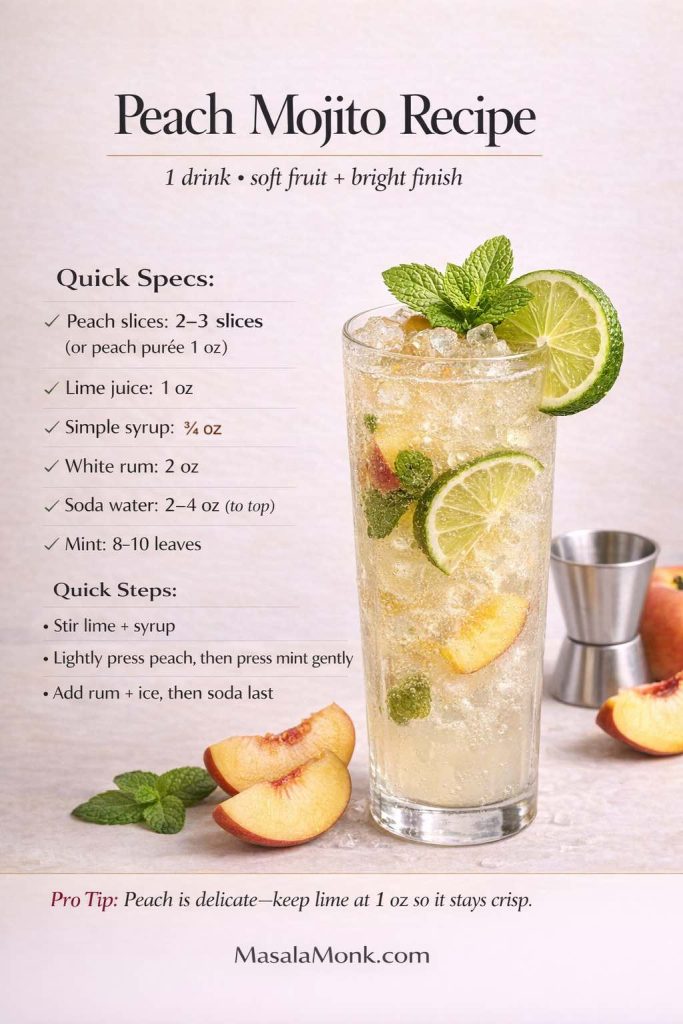
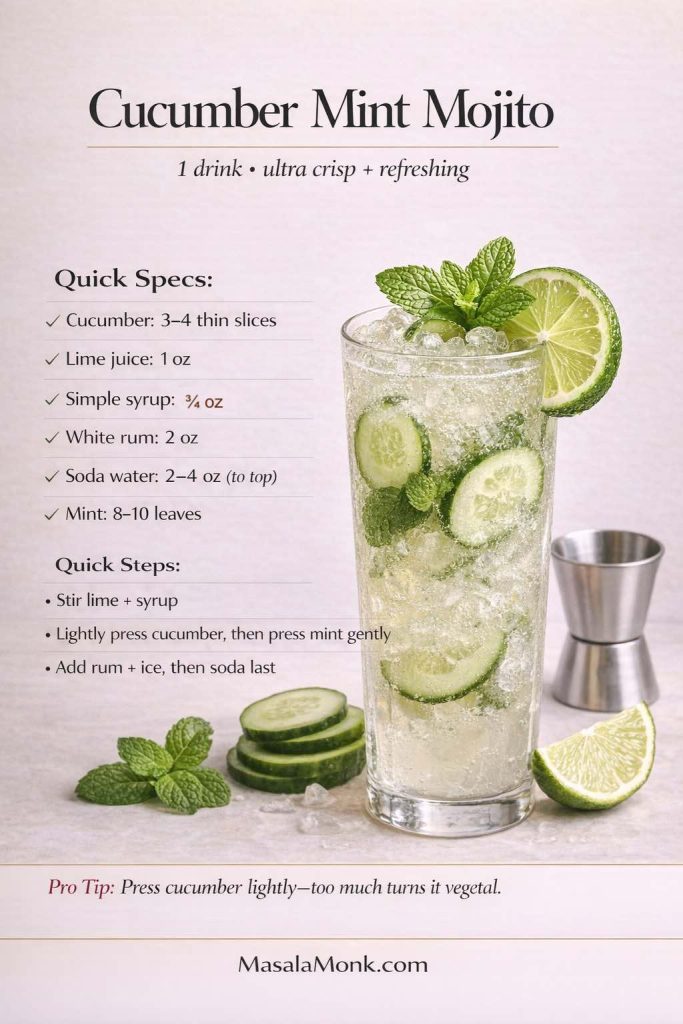
  • Fully measured variations: strawberry mojito recipe, watermelon mojito recipe, cranberry mojito, pomegranate mojito recipe, coconut mojito recipe, pineapple mojito, peach mojito recipe, plus a few more from the flavor universe that shows up again and again (cucumber mint, blueberry, passion fruit, orange, and a fun “blue” virgin option)

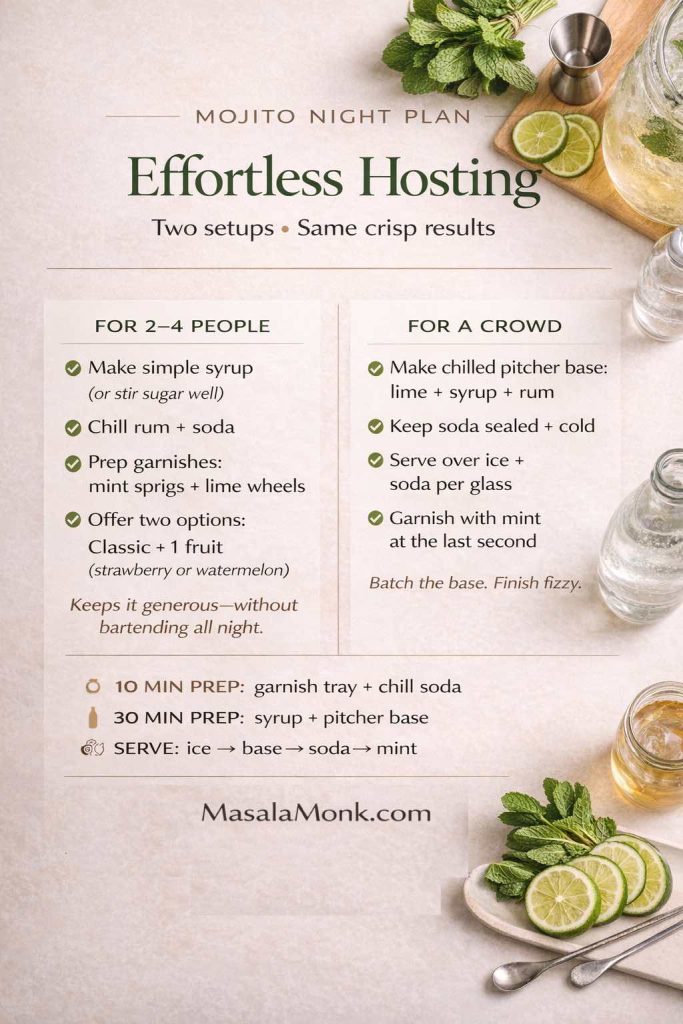
Along the way, you’ll also see how to troubleshoot watery drinks, harsh lime, and bitter mint without throwing the whole glass away. Finally, you’ll get easy food pairings and a simple hosting plan, because a mojito night feels better when the table feels complete.

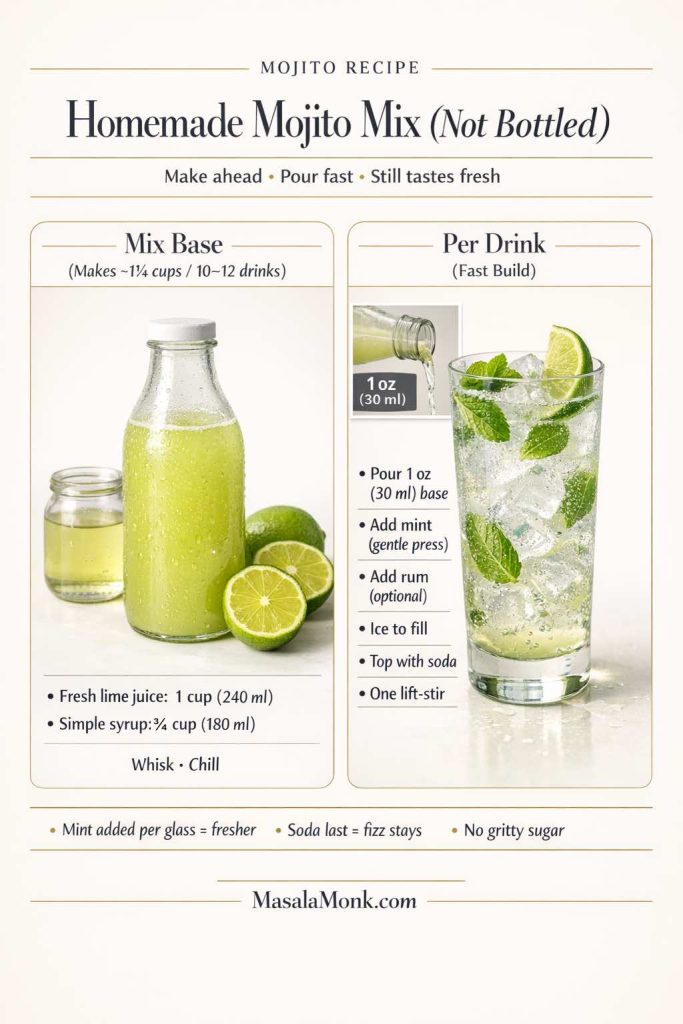
If you enjoy the idea of building one reliable base and then changing the finish, you’ll recognize the same logic in other crowd-friendly drinks—build the flavor core first, then finish fresh for the best texture. That’s exactly why a make-ahead drink like Rum Punch Recipe can be such a natural companion when you’re hosting: it’s a different profile, yet it rewards the same “core first, finish last” approach.


Mojito Recipe: Classic Mojito Drink (Exact Measurements, No Guessing)

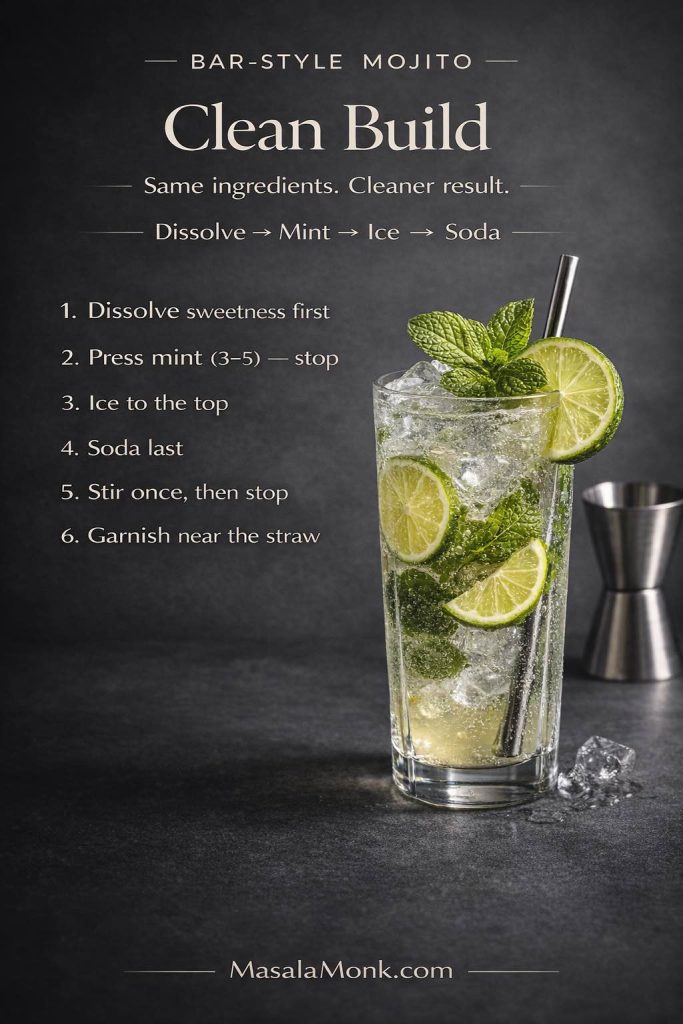
The best mojito cocktail recipe is mostly technique disguised as simplicity. To begin with, you dissolve sweetness before ice. Next, you treat mint gently so it stays fragrant instead of bitter. Then you add soda at the end to protect the fizz. Finally, you stir less than you think, because over-stirring turns sparkle into flatness. Taken together, those four habits solve almost everything.

As a helpful baseline, the International Bartenders Association lists the mojito as a Contemporary Classic with a core structure of mint, lime, sugar, white rum, and soda water. You can treat that as your “north star” for what classic means, and then adjust within that framework to match your taste and your glass size. (IBA Mojito)

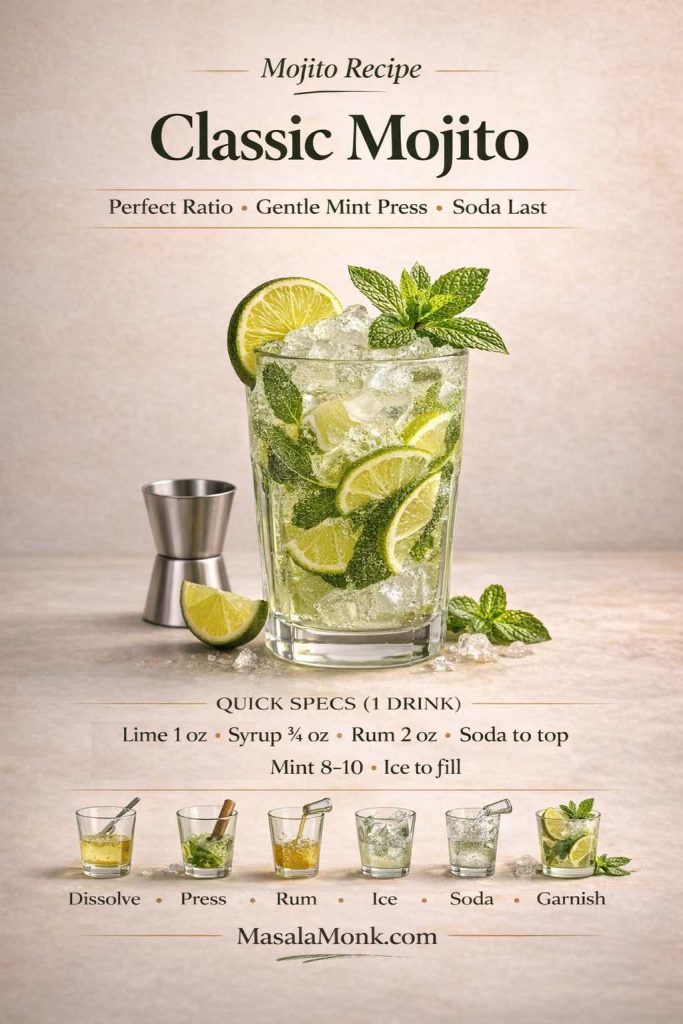
Premium recipe card image for a classic mojito recipe showing a photoreal mojito in a highball glass with mint and lime, plus quick specs (lime 1 oz, syrup ¾ oz, rum 2 oz, soda to top) and a 6-step method: dissolve, press, rum, ice, soda, garnish. MasalaMonk.com appears in the footer.
Classic Mojito Recipe at a glance: use the perfect ratio (1 oz lime, ¾ oz syrup, 2 oz rum), press mint gently, pack the glass with ice, and add soda last—then garnish. This quick card is the easiest way to make a crisp, not-watery mojito every time.

Classic Mojito Recipe Ingredients (1 Drink)

Makes: 1 mojito
Glass: Highball or Collins (12–14 oz / 350–415 ml is ideal)
Ice: Enough to fill the glass completely (this matters)

  • Mint leaves: 8–10 leaves, plus 1 large mint sprig for garnish
  • Fresh lime juice: 1 oz (30 ml)
  • Simple syrup (1:1): ¾ oz (22 ml)
    • or substitute 2 tsp granulated sugar (about 10 g)
  • White rum: 2 oz (60 ml)
  • Soda water / club soda: 2–4 oz (60–120 ml), to top
  • Garnish: lime wheel or wedge + mint sprig

Why these measurements work: the lime stays bright without turning harsh, sweetness rounds the edges without becoming syrupy, rum feels present without getting sharp, and soda provides lift without washing out flavor.

How to Make a Mojito (Classic Method)

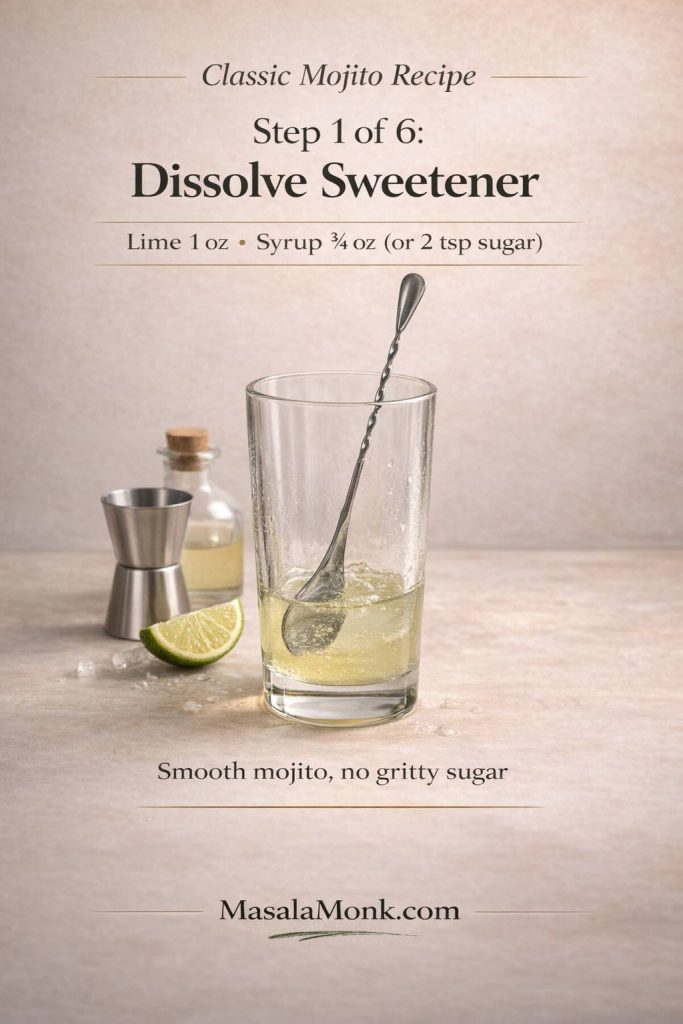
Step 1: Start by dissolving the sweetener

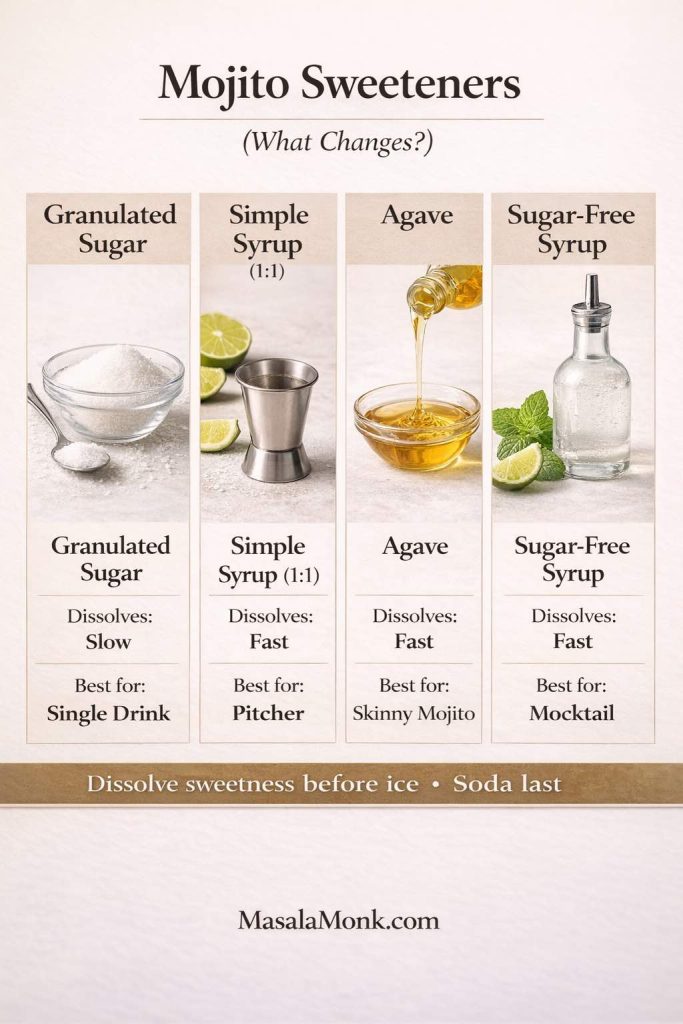
Add 1 oz (30 ml) lime juice and ¾ oz (22 ml) simple syrup to your glass. Stir for 10–15 seconds until the base looks uniform.
If you’re using granulated sugar instead, stir a little longer. You don’t need it to vanish completely; however, you do want most of it melted before ice goes in.

Classic Mojito Recipe — Step 1: dissolve lime and syrup (or sugar) first. This small step keeps your mojito smooth from the first sip and prevents gritty sugar later—so you can add ice and soda without over-stirring.

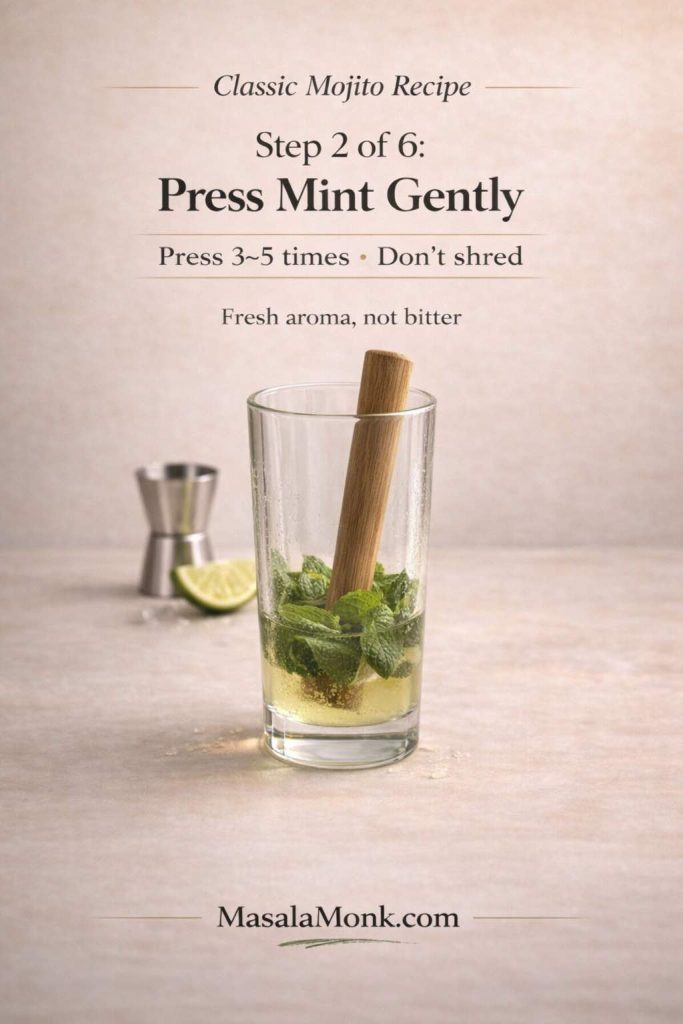
Step 2: Add mint gently—press, don’t pulverize

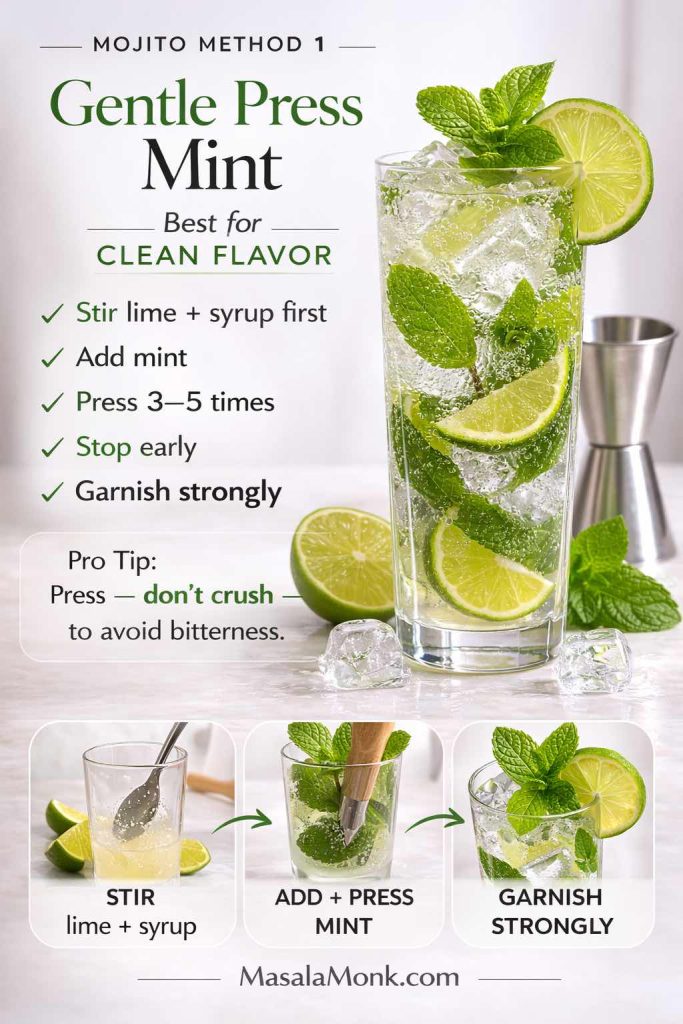
Add 8–10 mint leaves. Press them lightly 3–5 times with a muddler or the back of a wooden spoon. Then stop while the leaves still look intact. In other words, you’re releasing aroma—not making green debris.

Classic Mojito Recipe — Step 2: press mint gently (3–5 light presses) to release aroma without turning the drink bitter. This is the key difference between a clean, bar-style mojito and a grassy one.

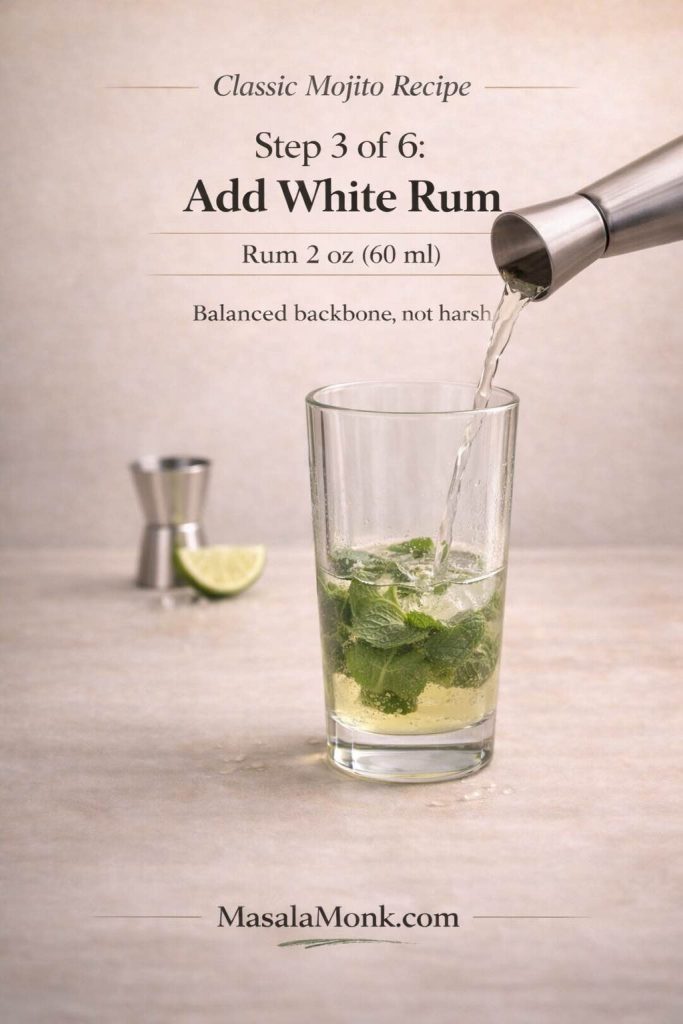
Step 3: Add the rum and blend quickly

Pour in 2 oz (60 ml) white rum, then stir once or twice so it merges with the lime-sweet base. At this point, the drink should smell bright and minty already.

Step 3 of the classic mojito recipe showing white rum being poured from a jigger into a glass with lime, syrup, and mint, with on-image measurement “Rum 2 oz (60 ml)” and the note “Balanced backbone, not harsh,” plus MasalaMonk.com in the footer.
Classic Mojito Recipe — Step 3: add 2 oz (60 ml) white rum for a clean, balanced backbone. This keeps the mojito bright and crisp while letting lime and mint stay in the spotlight.

Step 4: Pack the glass with ice

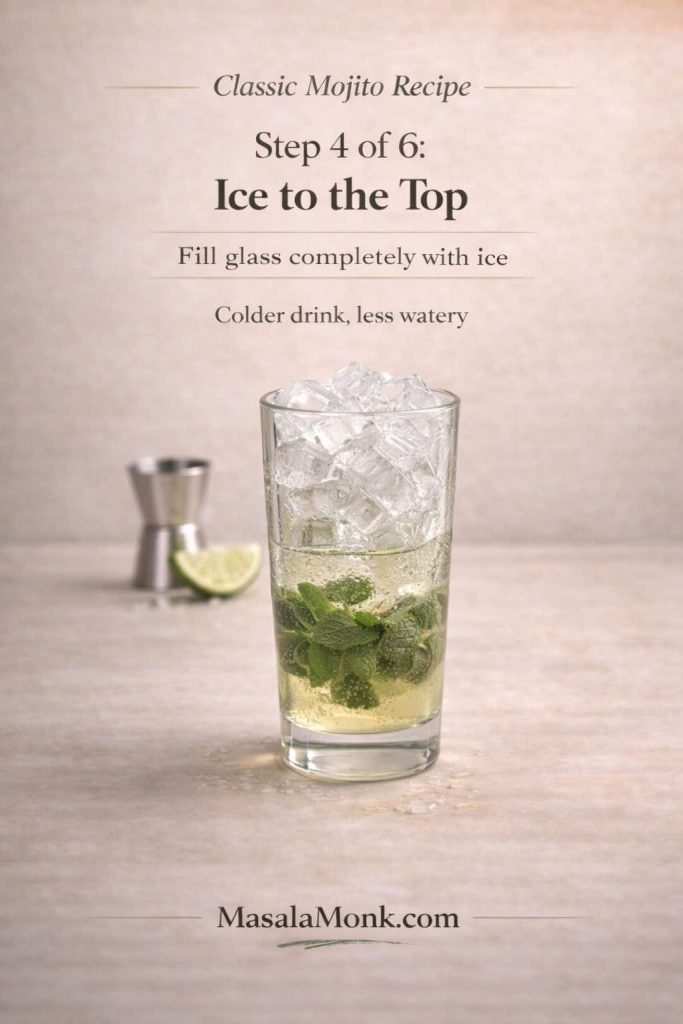
Fill the glass all the way to the top. It feels backwards, yet more ice usually keeps the drink colder longer, which means it dilutes more slowly over the time you’re drinking it.

Classic Mojito Recipe — Step 4: fill the glass completely with ice. A full ice column keeps your mojito colder for longer, slows dilution, and helps prevent that watery, flat finish.

Step 5: Top with soda water and barely stir

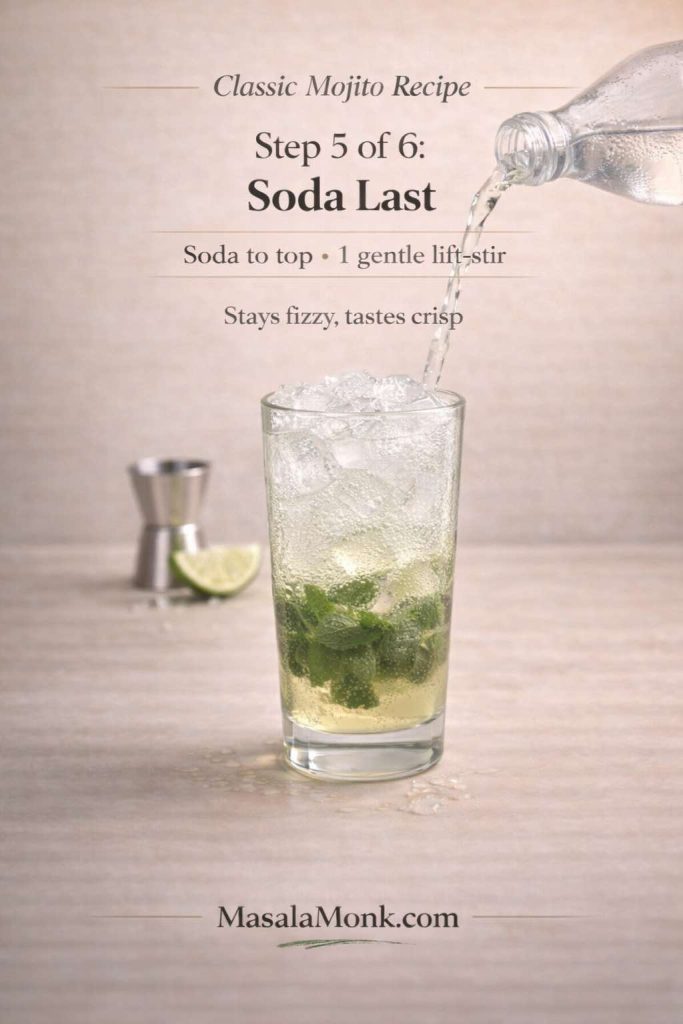
Add 2–4 oz (60–120 ml) soda water. Then do one gentle lift-stir from the bottom to the top—just enough to pull that lime base upward. After that, leave it alone so the fizz stays lively.

Classic Mojito Recipe — Step 5: add soda last and do just one gentle lift-stir. This keeps the mojito crisp and fizzy instead of flat and watery—especially when you’re making more than one drink.

Step 6: Garnish for aroma, not decoration

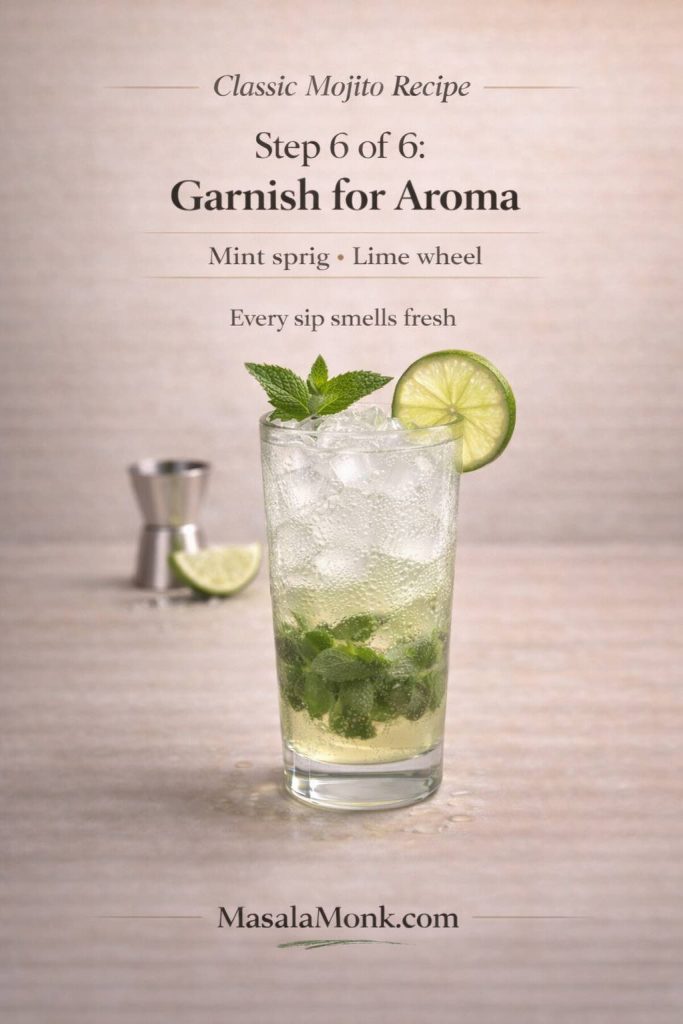
Clap your mint sprig between your palms (one firm clap is enough), then tuck it near the straw. Add a lime wheel or wedge. Now the drink smells like mint before it tastes like lime, which makes the whole thing feel fresher and more “complete.”

Classic Mojito Recipe — Step 6: garnish with a fresh mint sprig and a lime wheel. The mint aroma hits before the first sip, making the mojito taste brighter and more refreshing without needing to crush extra mint into the drink.

That’s the classic mojito drink. Make it once, then make it again. Before long, the method stops feeling like steps and starts feeling like a rhythm.

Also Read: Air Fryer Donuts Recipe (2 Ways): Glazed Homemade Donuts + Biscuit Donuts


Mojito Ratio: The Classic Mojito Formula You Can Remember

A lot of people know the ingredient list and still wonder how do you make a mojito that tastes balanced every time. The answer is a ratio you can trust.

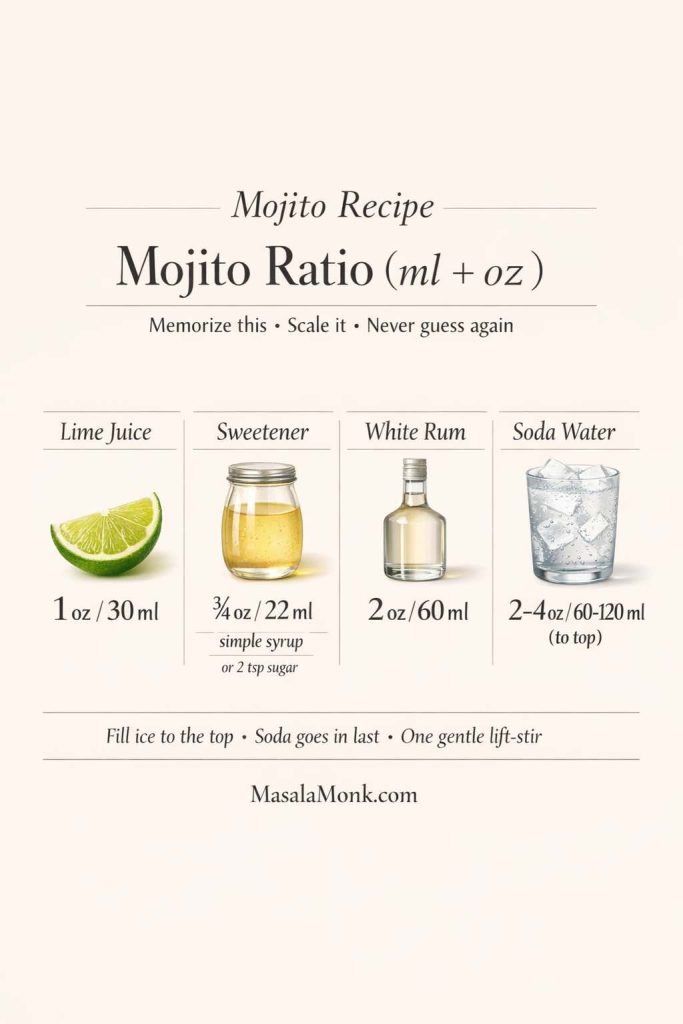
Elegant mojito ratio infographic showing classic mojito measurements: lime juice 1 oz/30 ml, sweetener 3/4 oz/22 ml simple syrup (or 2 tsp sugar), white rum 2 oz/60 ml, and soda water 2–4 oz/60–120 ml to top. Includes tips: fill ice to the top, add soda last, and do one gentle lift-stir. MasalaMonk.com in footer.
Classic Mojito Ratio (ml + oz): Use 30 ml lime, 22 ml syrup (or 2 tsp sugar), 60 ml white rum, then top with 60–120 ml soda. For the cleanest mojito, fill the glass with ice, add soda last, and do one gentle lift-stir.

A practical mojito ratio (lime : sweet : rum : soda)

  • Lime: 1 oz (30 ml)
  • Sweetener: ¾ oz (22 ml) simple syrup or 2 tsp sugar
  • Rum: 2 oz (60 ml)
  • Soda: top to taste (usually 2–4 oz / 60–120 ml)

In “parts,” you can think:

1 part lime : ¾ part sweet : 2 parts rum : top with soda

Once you internalize that relationship, you can make a home mojito in any glass and keep it balanced. Just as importantly, you can scale it into a mojito pitcher recipe without guessing, because you’re multiplying a pattern rather than reinventing the drink.

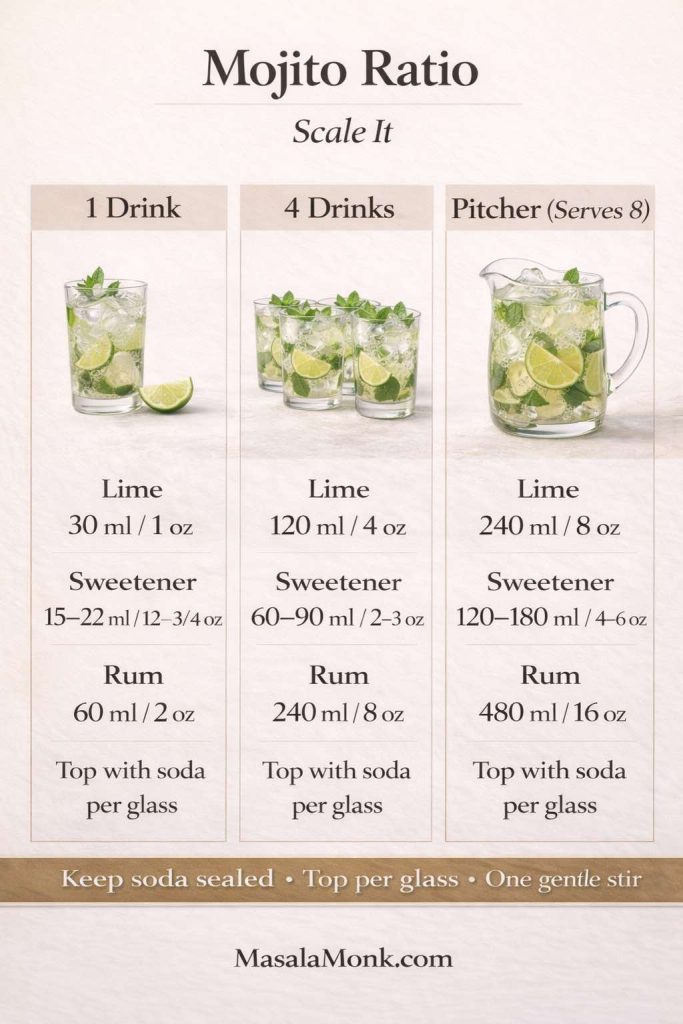
Infographic titled “Mojito Ratio — Scale It” showing mojito measurements for 1 drink, 4 drinks, and a pitcher serving 8. It lists lime, sweetener, and rum in ml and oz for each batch size, with a note to top with soda per glass. A tip strip says keep soda sealed, top per glass, and do one gentle stir. MasalaMonk.com appears in the footer.
Mojito ratio, scaled: Use this cheat sheet to make one mojito, a small round, or a full mojito pitcher (serves 8) with consistent balance. Mix lime + sweetener + rum ahead, then top with soda per glass so batched mojitos stay fizzy.

Why this formula works

Lime is the brightness. Sweetener is the smoothing force. Rum is the backbone. Soda is the lift. Mint, meanwhile, is the aroma that makes the drink feel like a mojito rather than a generic lime highball. If one element gets loud—too much soda, over-muddled mint, excessive syrup—the drink stops tasting crisp.

So even though the mojito is simple, it’s still a system. Treat it like a system and it becomes easy.

Also Read: Tapas Recipe With a Twist: 5 Indian-Inspired Small Plates


Mojito Ingredients (and Why Technique Matters More Than Fancy Tools)

Because mojitos use very few ingredients, each one carries more responsibility. Still, you don’t need a full bar setup. You need freshness, restraint, and timing.

Mint for mojito drink: keeping it fragrant, not bitter

Mint bitterness usually comes from over-muddling. When mint gets shredded, you extract more of the bitter, planty notes. On the other hand, gentle pressing releases aroma without turning the drink green.

Mint rule: Press lightly and stop early. Then let a strong mint sprig garnish provide aroma through every sip.

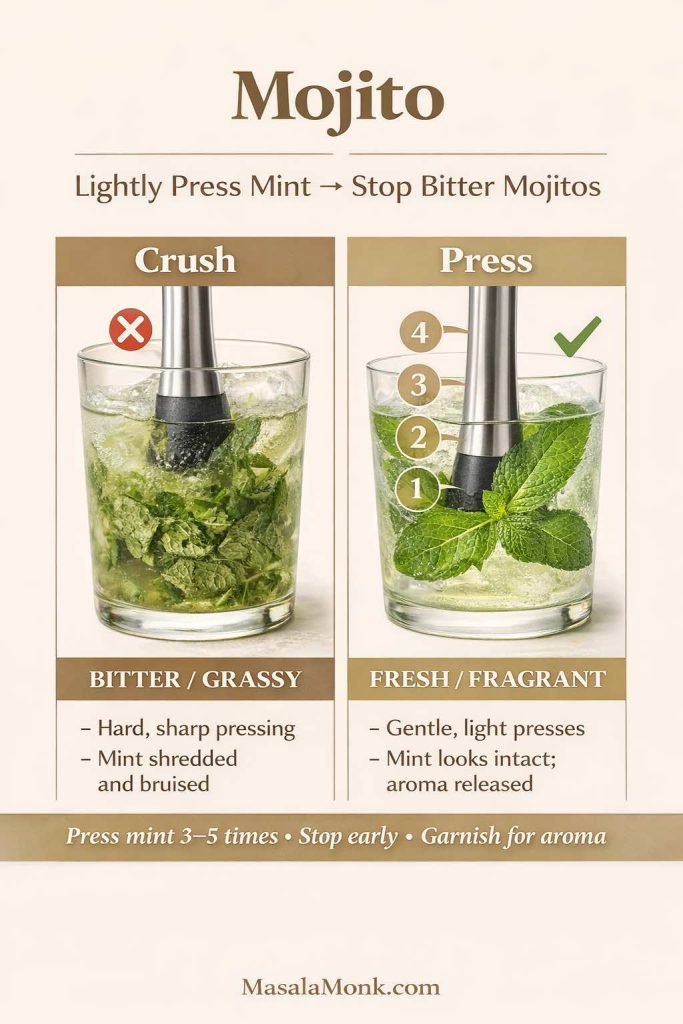
Comparison graphic for mojito mint technique showing two panels: “Crush” with shredded bruised mint in a cloudy drink labeled bitter/grassy, and “Press” with intact mint and gentle light presses labeled fresh/fragrant. Includes tip to press mint 3–5 times, stop early, and garnish for aroma. MasalaMonk.com appears in the footer.
Mojito mint tip: For a fresh mojito (not bitter), press mint gently 3–5 times—don’t crush or shred it. Intact mint releases aroma, keeps the drink clear, and makes your classic mojito taste clean and “bar-style.”

If you want the drink to smell more minty, don’t muddle harder—garnish smarter. Clap the sprig before adding it. That tiny move can make your mojito feel “bar-like” without increasing bitterness.

Lime juice: fresh vs bottled

Fresh lime juice is the cleanest way to get a bright mojito. Bottled lime can work in a pinch, especially for a party base, but it often tastes slightly muted. If you use bottled, compensate by keeping everything colder and leaning on fresh lime garnish and strong mint aroma.

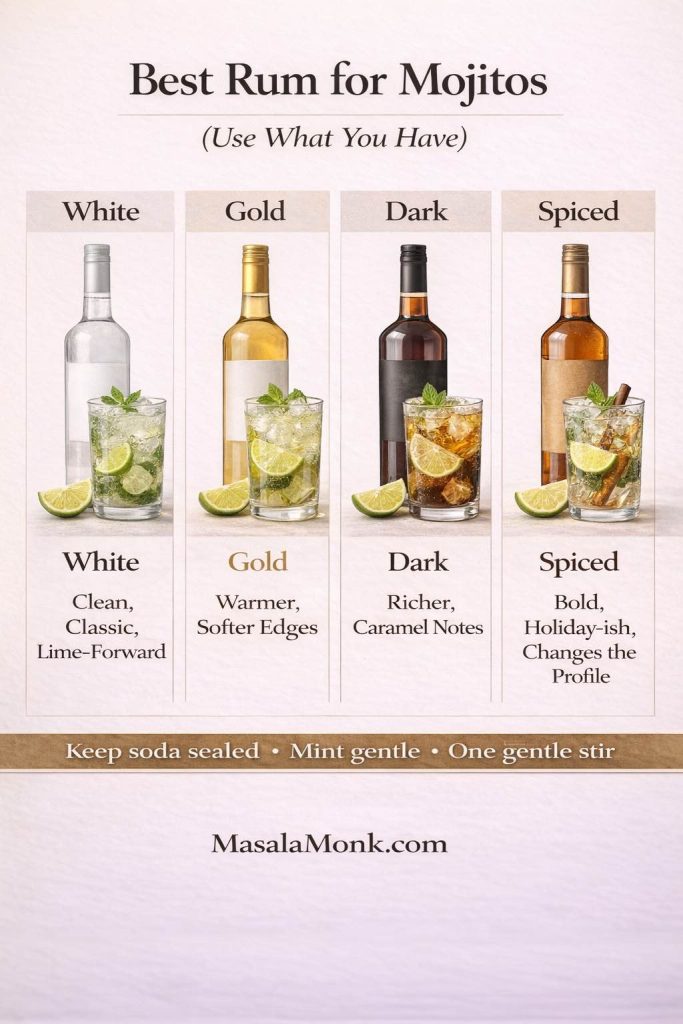
White rum for mojitos: what “white” really means

White rum isn’t one flavor. It’s a style. For a classic mojito recipe, you want rum that reads clean rather than oaky, so lime and mint stay in the spotlight. Lightly aged rum can be delicious too, but it shifts the drink warmer and richer.

Infographic titled “Best Rum for Mojitos (Use What You Have)” comparing four rum styles for a mojito: white, gold, dark, and spiced. Each column shows a bottle and mojito with lime and mint, plus a short flavor note: white is clean and classic, gold is warmer with softer edges, dark is richer with caramel notes, and spiced is bold and changes the profile. A tip strip reminds to keep soda sealed, keep mint gentle, and stir once. MasalaMonk.com appears in the footer.
Best rum for mojitos: White rum gives the clean, classic lime-forward mojito, while gold rum makes it warmer, dark rum makes it richer, and spiced rum turns it bold and more “holiday-ish.” Use what you have—just keep lime bright, mint gentle, and add soda at the end.

If you’ve ever thought, “white rum for mojitos—what should I use?” the most practical answer is: use a clean white rum you enjoy in simple drinks. The mojito doesn’t hide rum; it frames it.

Soda water: protecting the fizz

Soda is fragile. Warm soda goes flat faster. Aggressive stirring knocks out bubbles. Accordingly, keep soda cold, add it last, and stir gently once. That’s the fizz insurance policy.

Also Read: Air Fryer Salmon Recipe (Time, Temp, and Tips for Perfect Fillets)


How to Make a Mojito Cocktail That Stays Crisp (Not Watery)

Watery mojitos don’t happen because someone lacks talent. They happen because the drink warms quickly and melts quickly.

Infographic titled “How to Make a Mojito Cocktail (That Stays Crisp, Not Watery)” showing three technique sections with side-by-side “Not” vs “Right” examples: the ice strategy (half ice vs full ice), the soda strategy (adding soda early and stirring too much vs soda last with one lift-stir), and the mint strategy (crushed mint causing a green taste vs gentle mint pressing with a fragrant garnish). A bottom reminder reads full ice, soda last, gentle mint press, fragrant garnish. MasalaMonk.com is in the footer.
How to make a mojito that stays crisp: Fill the glass with ice (more ice melts slower), add soda last and stir only once, and keep mint gentle so the drink stays fresh instead of “green.” These three small moves prevent watery mojitos and keep the fizz lively.

The ice strategy (simple, but decisive)

A glass that’s half ice warms faster. A glass that’s full of ice stays cold. As a result, it melts more slowly over the time you’re drinking. Counterintuitively, more ice often means less dilution over time.

The soda strategy (timing is everything)

If you add soda and then stir a lot, you flatten the drink and accelerate dilution. Instead, add soda at the end and stir minimally. One lift-stir is usually enough.

The mint strategy (avoid the “green” taste)

Mint should smell like mint. It shouldn’t taste like bruised salad. Gentle pressing keeps the flavor clean. A fragrant garnish does the rest.
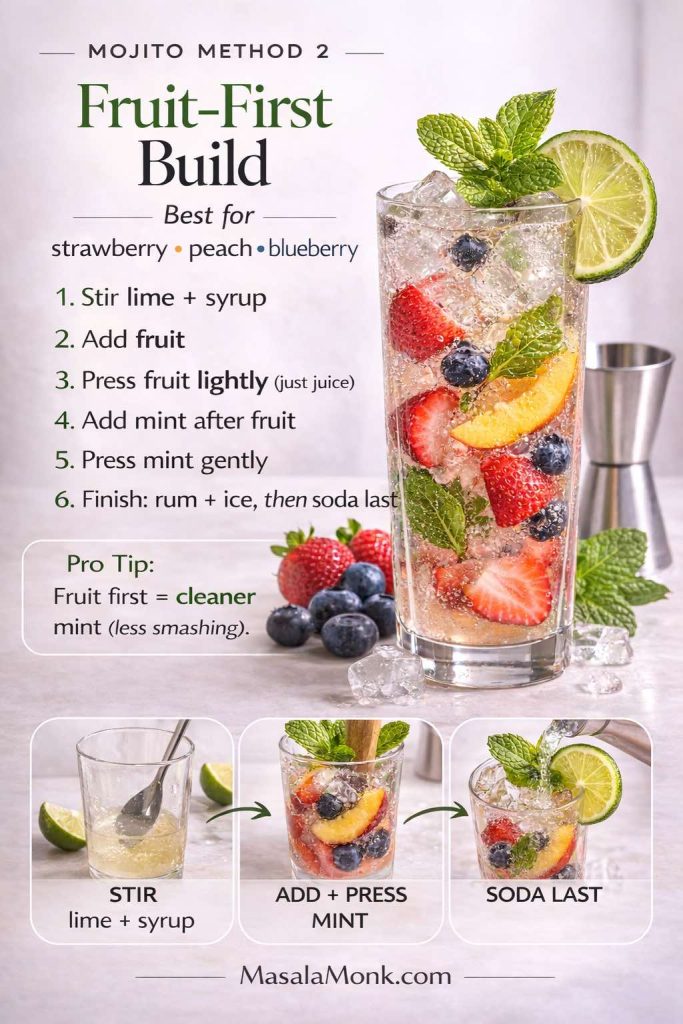
Also Read: Masterclass in Chai: How to Make the Perfect Masala Chai (Recipe)


Mojito Mistakes + Fixes (So You Can Rescue the Glass)

Even with a good mojito recipe, a drink can drift. Fortunately, mojitos are forgiving if you know which lever to pull.

Infographic titled “Mojito Fixes (Rescue the Glass)” with four panels showing common mojito problems and quick fixes: Watery (add more base mix), Too Sour (add 1/2 oz / 15 ml syrup), Too Sweet (add 1/2 oz / 15 ml lime juice), and Bitter Mint (use 3–5 gentle mint presses). Each panel shows a mojito in a rocks glass with ice. MasalaMonk.com appears in the footer.
Mojito mistakes + fixes: If your mojito tastes watery, too sour, too sweet, or bitter from mint, you can rebalance it fast—add a little base, syrup, or lime as needed, and keep mint gentle. This quick guide helps you rescue the glass without starting over.

Watery mojito: what happened and how to fix it

Common causes: not enough ice, too much soda, soda stirred too much, or the drink sat warm.

Fix in the glass:
Add more ice. Then add ½ oz (15 ml) rum and a small splash of soda. Stir once. If it still tastes thin, add a quick squeeze of lime (start with about ¼ oz / 7 ml).

Prevent next time:
Fill the glass with ice and keep soda as the final step.

Mojito too sour: how to rebalance

Some limes are sharper than others.

Fix: add ¼ oz (7 ml) simple syrup, stir gently, taste again. Repeat once if needed. Sweetness rounds acidity faster than adding more rum.

Mojito too sweet: how to rebalance

Too sweet often comes from heavy syrup or fruit additions.

Fix: add ½ oz (15 ml) lime juice (or a generous squeeze), then refresh fizz with soda water.

Bitter mint: how to prevent it completely

If mint tastes bitter, it’s usually overworked.

Fix now: stretch the drink with more ice and a small splash more soda to soften bitterness.
Fix next time: fewer muddle presses, gentler pressure, stronger garnish sprig.

Also Read: Crock Pot Pork Chops and Sauerkraut (No Dry Chops Recipe)


Simple Syrup for Mojitos (and Why It Makes Everything Easier)

If you make mojitos even semi-regularly, simple syrup is the upgrade that makes the whole process smoother. It dissolves instantly, which means you don’t have to over-stir and destroy fizz just to avoid gritty sugar.

Infographic titled “Mojito Sweeteners (What Changes?)” comparing four options for a mojito recipe: granulated sugar, simple syrup (1:1), agave, and sugar-free syrup. Each column shows a photo of the sweetener and notes how quickly it dissolves and what it’s best for (single drink, pitcher, skinny mojito, or mocktail). Bottom tip reads “Dissolve sweetness before ice • Soda last.” MasalaMonk.com in footer.
Mojito sweeteners, simplified: Sugar can stay gritty unless you stir longer, while simple syrup (1:1) dissolves fast and keeps mojitos crisp. Agave adds a slightly warmer sweetness, and sugar-free syrup helps make a lighter mojito mocktail or low-sugar mojito—just keep lime bright and add soda last.

1:1 simple syrup recipe (makes about 1 cup / 240 ml)

  • 1 cup (200 g) granulated sugar
  • 1 cup (240 ml) water

Stovetop method: Warm gently in a small saucepan, stirring until fully dissolved. Cool completely, then refrigerate.

No-stove method: Combine sugar and warm water in a jar and shake until dissolved.

Once you have syrup, a mojito recipe easy version becomes genuinely easy: lime + syrup, gentle mint press, rum, ice, soda, garnish.

Also Read: Keto Mocktails: 10 Low Carb, Sugar Free Recipes


Mojito Mix: A Shortcut That Still Tastes Fresh (Homemade, Not Bottled)

Mojito mix” often means a store-bought bottle that’s sweet-heavy and mint-light. It can be convenient, but it rarely tastes as crisp as fresh lime and mint. However, you can make a homemade mix-style base that’s actually useful for hosting.

Infographic titled “Homemade Mojito Mix (Not Bottled)” showing a make-ahead mojito mix base and a fast per-drink build. Mix base: fresh lime juice 1 cup (240 ml) plus simple syrup 3/4 cup (180 ml), whisk and chill (makes about 10–12 drinks). Per drink: pour 1 oz (30 ml) base, add mint (gentle press), add rum optional, fill with ice, top with soda, and do one lift-stir. Notes say mint added per glass tastes fresher, soda last keeps fizz, and no gritty sugar. MasalaMonk.com in footer.
Homemade mojito mix (lime + syrup base): Whisk 240 ml fresh lime juice with 180 ml simple syrup, chill, then pour 30 ml per drink and finish like a real mojito—mint gently, ice to the top, soda last. It’s the fastest way to serve mojitos that still taste bright and fresh (without bottled mix flavor).

Mojito mix recipe (homemade lime-syrup base)

Makes: about 1¾ cups (enough for 10–12 drinks)

  • Fresh lime juice: 1 cup (240 ml)
  • Simple syrup: ¾ cup (180 ml)

Whisk together and chill. Then, for each mojito:

  • Use 1 oz (30 ml) of this base
  • Add mint, rum (or omit for mocktail), ice, soda, garnish

This doesn’t replace the mojito method—it simply speeds up the measuring so you can pour drinks faster without sacrificing brightness.

Also Read: Slow Cooker Pork Tenderloin (Crock Pot Recipe) — 3 Easy Ways


Mojito Pitcher Recipe (Batch Mojitos Without Flat Drinks)

A pitcher of mojitos sounds like the ultimate party move—right up until you remember the fizz problem: soda in a pitcher goes flat quickly. Meanwhile, mint left to sit too long can drift from fresh and fragrant into grassy and dull. Because of that, the best pitcher plan comes down to one simple rule:

Make a chilled base. Top each glass with soda at serving time.

Photoreal mojito pitcher infographic for serving 8, showing a make-ahead pitcher base and per-glass formula. Pitcher base: 8 oz/240 ml lime juice, 6 oz/180 ml simple syrup, 16 oz/480 ml white rum, and 1 cup mint leaves. Per-glass: pour 3–4 oz/90–120 ml base mix over ice, top with soda, and do one gentle stir. Note: “Base now, soda only when serving.” MasalaMonk.com in footer.
Mojito pitcher recipe (serves 8): Make a chilled base with lime, simple syrup, white rum, and mint—then top each glass with soda only when serving. This keeps batched mojitos bright and fizzy instead of turning into flat mint lemonade.

In other words, you build flavor ahead, then you finish with sparkle at the last moment. That single switch is the difference between bright and lively and flat mint lemonade.

Best Mojito Pitcher Recipe (Serves 8)

Pitcher base (make ahead):

  • Fresh lime juice: 8 oz (240 ml)
  • Simple syrup (1:1): 6 oz (180 ml)
  • White rum: 16 oz (480 ml)
  • Mint leaves: 30–40 leaves (about 1 packed cup, loosely)

To serve (finish fresh):

  • Soda water: 24–32 oz (720–960 ml), kept cold and unopened
  • Ice: plenty
  • Garnish: mint sprigs + lime wheels

How to Make a Pitcher of Mojitos (Step-by-Step Recipe)

Step 1: Stir lime and syrup first

In a pitcher, combine 8 oz (240 ml) lime juice and 6 oz (180 ml) simple syrup. Then stir until the mixture looks completely blended. This matters because an evenly mixed base pours consistently into every glass—so your first mojito and your last mojito taste the same.

Mojito Pitcher Recipe — Step 1: stir 8 oz lime juice with 6 oz simple syrup until fully blended. A smooth, even base is what makes every glass taste the same—from the first pour to the last.

Step 2: Add mint and press gently

Next, add 30–40 mint leaves. Using a spoon (or muddler), press the leaves lightly a few times—just enough to release aroma. Then stop while the mint still looks intact. You’re aiming for fragrance, not green foam, and you want the base to stay bright rather than turning “leafy.”

Step 2 of 4 for a mojito pitcher recipe (serves 8) showing fresh mint leaves in a glass pitcher being gently pressed in the lime-syrup base, with text overlay “Press Mint Gently” and “Mint 30–40 leaves • Light press,” plus MasalaMonk.com in the footer.
Mojito Pitcher Recipe — Step 2: add 30–40 mint leaves and press lightly just to release aroma. Keeping mint intact prevents grassy “green foam” flavors and makes your batched mojitos taste fresh instead of muddled.

Step 3: Add rum and chill hard

Now pour in 16 oz (480 ml) white rum. Give the pitcher one quick stir, then refrigerate until very cold. The colder the base, the better it behaves at serving time—less melt, better balance, and a cleaner finish.

Step 3 of 4 for a mojito pitcher recipe (serves 8) showing white rum being poured from a jigger into a chilled pitcher with lime-syrup base and mint, with text overlay “Add Rum + Chill” and “White rum 16 oz (480 ml)” plus MasalaMonk.com in the footer.
Mojito Pitcher Recipe — Step 3: add 16 oz (480 ml) white rum, stir once, then chill hard. A cold mojito base pours cleaner, tastes brighter, and stays balanced when you serve it over ice.

Step 4: Serve over ice and top with soda per glass

When you’re ready to serve, fill each glass with ice. Pour 3–4 oz (90–120 ml) of the chilled mojito base into the glass. After that, top with cold soda water, then give it one gentle stir—just enough to combine without flattening the drink. Finally, garnish with a mint sprig and a lime wheel so each glass smells fresh as soon as it’s picked up.

Step 4 of 4 for a mojito pitcher recipe (serves 8) showing chilled mojito base poured over ice in a highball glass and topped with soda water, with text overlay “Soda Per Glass” and “Base 3–4 oz • Ice • Soda to top,” plus MasalaMonk.com in the footer.
Mojito Pitcher Recipe — Step 4: pour 3–4 oz of the chilled base over ice, then top with soda in each glass. This “base now, fizz later” method keeps batch mojitos sparkling and fresh instead of flat.

This “base now, fizz later” approach is the same logic that makes make-ahead party drinks work so well. If you’re building a bigger drink table and want a second crowd drink you can prep in advance, Rum Punch Recipe fits perfectly alongside pitcher mojitos because it follows that same “core first” philosophy.

Make-ahead timing (to keep it fresh)

  • Mix lime + syrup + rum earlier in the day and refrigerate.
  • Add mint closer to serving, or add it earlier but remove leaves after 20–30 minutes if you’re holding a long time.
  • Keep soda sealed until the last moment.
Mojito Pitcher Timing (Make-Ahead Plan): mix the lime–syrup–rum base and chill hard, add mint only 20–30 minutes before serving (or remove it after 20–30 minutes), and keep soda sealed until you top each glass. This is the easiest way to batch mojitos that stay fizzy.

That way, your pitcher tastes bright rather than dull, and each glass gets real fizz.

Also Read: Chicken Pesto Pasta (Easy Base Recipe + Creamy, One-Pot, Baked & More)


Mojito Mocktail and Virgin Mojito Recipe (Alcohol-Free, Still Satisfying)

A virgin mojito recipe works best when it doesn’t try to replace rum with extra sugar. Instead, it leans into what makes mojitos great in the first place: lime brightness, mint aroma, and sparkling lift.

Recipe infographic titled “Virgin Mojito (Mocktail)” showing alcohol-free mojito measurements: lime 1 oz/30 ml, syrup 3/4 oz/22 ml (or sugar), mint 8–10 leaves, soda 4–6 oz/120–180 ml, and ice to fill. Includes technique cues: dissolve sweetness first, press mint gently, and add soda last, plus a note to add a tiny pinch of salt for bar-style balance. MasalaMonk.com appears in the footer.
Virgin mojito recipe (mocktail): Build it like a real mojito—lime + sweetener first, gentle mint press, ice to the top, then soda last. A tiny pinch of salt can make a mojito mocktail taste more “bar-balanced” without making it salty.

Virgin mojito recipe (1 drink)

  • Mint leaves: 8–10 leaves + garnish sprig
  • Fresh lime juice: 1 oz (30 ml)
  • Simple syrup: ¾ oz (22 ml) or 2 tsp sugar
  • Soda water: 4–6 oz (120–180 ml)
  • Ice: fill the glass
  • Garnish: mint sprig + lime

Method: Stir lime + syrup, press mint gently, add ice, top with soda, stir once, garnish.

If you’re putting together a drinks table where not everyone wants alcohol, it’s useful to have more than one alcohol-free option so nobody feels stuck with “the one mocktail.” That’s why Keto Mocktails is such a natural companion for a mojito night: it gives you a whole set of alternatives while keeping the same “fresh and festive” feeling.

Virgin mojito pitcher (serves 8)

  • Fresh lime juice: 8 oz (240 ml)
  • Simple syrup: 6 oz (180 ml)
  • Mint leaves: 30–40 leaves
  • Soda water: 40–48 oz (1.2–1.4 L), topped per glass
  • Ice + garnish: plenty

Build and chill the base, then top each glass with soda right before serving.

A few mocktail-friendly flavor directions

If you want your mojito mocktail to feel more “crafted,” introduce one flavor note while keeping lime and mint obvious:

  • Cucumber mint mojito mocktail (cool and crisp)
  • Blueberry mojito mocktail (soft berry with bright lime)
  • Passion fruit mojito mocktail (tropical tang)
  • Elderflower mojito mocktail (floral lift)

You’ll find measured versions below, so you can make them without turning your drink into syrupy fruit soda.

Also Read: Mozzarella Sticks Recipe (Air Fryer, Oven, or Fried): String Cheese, Shredded Cheese, and Every Crunchy Variation


Mojito Variations (Measured, Balanced, Still a Mojito)

Fruit mojitos are where people get excited and where drinks sometimes become sugar bombs. The key is simple: fruit should complement the base, not replace it. Lime and mint should still read clearly. Soda should still provide lift. Rum should still feel present but not harsh.

Below are measured variations built on the classic framework. Each one starts with the same base logic: dissolve sweetness, treat mint gently, pack ice high, add soda last, stir minimally.

Infographic titled “Flavored Mojito Formula (Works for Any Fruit)” showing a three-part template for fruit mojitos: Base (lime 1 oz/30 ml, sweetener 1/2–3/4 oz/15–22 ml, rum 2 oz/60 ml, mint gentle press), Fruit Add (choose 1: juice/purée 1–2 oz/30–60 ml or 2–3 slices; examples shown: strawberry, watermelon, pomegranate, peach), and Fizz (adjust soda 2–4 oz/60–120 ml, use less soda for watery fruits like watermelon or coconut water). Tip strip says keep lime loud, mint intact, soda last. MasalaMonk.com in footer.
Flavored mojito formula: Keep the classic mojito base the same (lime + sweetener + rum + gentle mint), then add 1–2 oz fruit juice/purée or a few slices, and adjust soda to stay crisp. Use less soda for watery fruits like watermelon or coconut water so your fruit mojito still tastes like a mojito—not fruit soda.

Strawberry mojito recipe (1 drink)

  • Strawberries: 2 medium strawberries, sliced (or 1 oz / 30 ml puree)
  • Mint leaves: 8–10
  • Fresh lime juice: 1 oz (30 ml)
  • Simple syrup: ½–¾ oz (15–22 ml)
  • White rum: 2 oz (60 ml)
  • Soda water: 2–4 oz (60–120 ml)
  • Ice + garnish: mint sprig + strawberry slice (optional)
Strawberry Mojito Recipe (1 drink): a fresh, crisp twist on the classic mojito—lightly press the berries, keep mint gentle, and add soda last so the drink stays bright and fizzy instead of turning watery.

Method:
Stir lime + syrup first. Add strawberries and press lightly once or twice. Then add mint and press gently (3–4 light presses). Add rum, fill with ice, top with soda, stir once.

This approach keeps the strawberry flavor fresh rather than jammy, while the drink still tastes like a mojito first.

Watermelon mojito recipe (1 drink)

  • Watermelon juice/puree: 2 oz (60 ml)
  • Mint leaves: 8–10
  • Lime juice: 1 oz (30 ml)
  • Simple syrup: ½ oz (15 ml)
  • White rum: 2 oz (60 ml)
  • Soda water: 2–3 oz (60–90 ml)
  • Ice + garnish: mint sprig + lime wheel
Watermelon Mojito Recipe (1 drink): keep it crisp by stirring lime, syrup, and watermelon first, pressing mint gently, then adding rum, ice, and soda last—plus the key pro tip: use less soda for watery fruit so your mojito stays bright, not thin.

Method:
Stir lime + syrup + watermelon. Add mint gently. Add rum. Pack with ice. Top with soda. Stir once.

Watermelon is mostly water, so it dilutes easily. That’s why the soda range is slightly smaller here: you want sparkle without turning the drink thin.

If you’re offering a second summer drink that feels different without leaving the “bright and fun” lane, Watermelon Margarita Variations can be a natural addition to the table.

Cranberry mojito recipe (1 drink)

  • Cranberry juice: 1 oz (30 ml)
  • Mint leaves: 8–10
  • Lime juice: 1 oz (30 ml)
  • Simple syrup: ¾ oz (22 ml)
  • White rum: 2 oz (60 ml)
  • Soda water: 2–4 oz (60–120 ml)
  • Ice + garnish: mint sprig + lime wheel
Photoreal cranberry mojito recipe card showing a tall highball glass with a pale ruby cranberry mojito, ice, mint, lime wheel, and cranberries, with text overlay listing measurements (cranberry juice, lime juice, simple syrup, white rum, soda water, mint) plus quick steps and a pro tip to use the full ¾ oz syrup for balance, and MasalaMonk.com in the footer.
Cranberry Mojito Recipe (1 drink): tart, crisp, and bright—stir lime, syrup, and cranberry first, press mint gently, then add rum, ice, and soda last. The pro move is using the full ¾ oz syrup so cranberry stays refreshing instead of puckering.

Method:
Stir lime + syrup + cranberry first. Add mint gently. Add rum. Ice. Soda. Minimal stir.

Cranberry is tart, so it benefits from the full syrup amount. If you like that sharp, fizzy direction, Cranberry Moscow Mule Recipe is another internal drink that keeps the “cold and crisp” feel while switching flavor families.

Pomegranate mojito recipe (1 drink)

  • Pomegranate juice: 1 oz (30 ml)
  • Mint leaves: 8–10
  • Lime juice: 1 oz (30 ml)
  • Simple syrup: ¾ oz (22 ml)
  • White rum: 2 oz (60 ml)
  • Soda water: 2–4 oz (60–120 ml)
  • Ice + garnish: mint sprig + lime wheel
Pomegranate Mojito Recipe (1 drink): bright, jewel-toned, and crisp—stir lime, syrup, and pomegranate first, press mint gently, then add rum, ice, and soda last. Using the full ¾ oz syrup keeps the tang balanced so every sip stays refreshing.

Method:
Stir lime + syrup + pomegranate. Add mint gently. Add rum. Ice. Soda. One lift-stir.

Pomegranate adds a deeper fruit tang, so the drink feels a little more “evening” than “afternoon.” For a virgin pomegranate mojito, simply omit rum and top with extra soda.

Coconut mojito recipe (1 drink)

  • Coconut water: 2 oz (60 ml) (or coconut-flavored sparkling water)
  • Mint leaves: 8–10
  • Lime juice: 1 oz (30 ml)
  • Simple syrup: ½ oz (15 ml)
  • White rum: 2 oz (60 ml)
  • Soda water: 2–3 oz (60–90 ml)
  • Ice + garnish: mint sprig + lime wheel
Coconut Mojito Recipe (1 drink): tropical but still crisp—stir lime, syrup, and coconut water first, press mint gently, then add rum, ice, and soda last. Keeping syrup at ½ oz prevents coconut from tasting too sweet and keeps the mojito bright.

Method:
Stir lime + syrup + coconut water. Add mint gently. Add rum. Ice. Soda. Minimal stir.

Coconut can feel creamy or sweet quickly. Keeping lime loud and syrup restrained keeps the drink crisp rather than dessert-like. If you want more tropical hosting ideas beyond mojitos, Coconut Water Cocktails fits naturally as a “next read.”

Pineapple mojito (1 drink)

  • Pineapple juice: 1½ oz (45 ml)
  • Mint leaves: 8–10
  • Lime juice: 1 oz (30 ml)
  • Simple syrup: ½ oz (15 ml)
  • White rum: 2 oz (60 ml)
  • Soda water: 2–3 oz (60–90 ml)
  • Ice + garnish: mint sprig + pineapple wedge (optional)
Photoreal pineapple mojito recipe card showing a tall highball glass with pineapple juice mojito, lime wheel, mint garnish, and ice with visible bubbles on a smooth ivory background, with text overlay listing measurements (pineapple juice, lime juice, simple syrup, white rum, soda water, mint), quick steps including “soda last,” a pro tip to keep syrup at ½ oz, and MasalaMonk.com in the footer.
Pineapple Mojito (1 drink): sunny, crisp, and not too sweet—stir lime, syrup, and pineapple first, press mint gently, then add rum, ice, and soda last. Keeping syrup at ½ oz lets pineapple shine while the mojito stays bright and fizzy.

Method:
Stir lime + syrup + pineapple. Add mint gently. Add rum. Ice. Soda. One lift-stir.

Because pineapple is naturally sweet, the syrup is intentionally lighter. If you’re serving non-alcoholic guests too, Pineapple Mojito Mocktail Recipes makes a great internal companion.

Peach mojito recipe (1 drink)

  • Peach slices: 2–3 slices (or peach puree 1 oz / 30 ml)
  • Mint leaves: 8–10
  • Lime juice: 1 oz (30 ml)
  • Simple syrup: ¾ oz (22 ml)
  • White rum: 2 oz (60 ml)
  • Soda water: 2–4 oz (60–120 ml)
  • Ice + garnish: mint sprig + peach slice (optional)
Peach Mojito Recipe (1 drink): soft fruit, bright finish—stir lime and syrup first, lightly press peach, press mint gently, then add rum, ice, and soda last. Keeping lime at 1 oz makes the peach taste fresh and crisp instead of flat.

Method:
Stir lime + syrup first. Add peach and press lightly once or twice. Add mint gently. And then add rum. Ice. Soda. Minimal stir.

Peach is gentle, so lime brightness is what keeps it refreshing rather than perfumey. If you want a “frozen peach mojito,” blend peach slices with ice first, then build a lighter version with a small splash of soda at the end.

Also Read: Crock Pot Chicken Breast Recipes: 10 Easy Slow Cooker Dinners (Juicy Every Time)


More Mojito Methods (So Variations Stay Clean)

At this point, you have multiple recipes. Now let’s make sure they all taste sharp and fresh.

Method 1: The “gentle press” mint method (best for clean flavor)

  • Stir lime + syrup first
  • Add mint
  • Press lightly 3–5 times
  • Stop early
  • Garnish strongly

This method keeps the drink crisp and prevents bitterness.

Gentle Press Mint Method for a classic mojito: stir lime + syrup first, press mint lightly 3–5 times, then stop early and garnish strongly. This simple technique keeps your mojito recipe crisp, aromatic, and free of bitter, grassy mint.

Method 2: The “fruit-first” method (best for strawberry, peach, blueberry)

  • Stir lime + syrup
  • Add fruit
  • Press fruit lightly just to release juice
  • Add mint after fruit
  • Press mint gently (less than you think)
  • Continue with rum, ice, soda

Putting fruit before mint reduces the temptation to smash everything together, which keeps mint cleaner.

Mojito Method 2 (Fruit-First Build): the clean way to make strawberry, peach, or blueberry mojitos—stir lime + syrup, lightly press fruit for juice, add mint after fruit, then finish with rum + ice and soda last so the drink stays bright and the mint stays fresh.

Method 3: The “batch base” method (best for a pitcher of mojitos)

  • Build lime + syrup + rum base
  • Chill hard
  • Add mint briefly, then remove if holding long
  • Top with soda per glass
Photoreal instructional card titled “Mojito Method 3: Batch Base (Pitcher)” showing a chilled mojito pitcher with lime and mint and a finished mojito glass, with text overlay explaining the batch base method (build lime + syrup + rum, chill hard, add mint briefly, soda per glass) plus a pro tip that soda in the pitcher goes flat and MasalaMonk.com in the footer.

This protects fizz and keeps mint tasting fresh.

Also Read: Eggless Yorkshire Pudding (No Milk) Recipe


Cucumber Mint Mojito (and Cucumber Mojito Mocktail)

Cucumber is a quiet ingredient, which makes it perfect for drinks that should feel crisp rather than sweet. It also pairs beautifully with mint and lime.

Cucumber mint mojito recipe (1 drink)

  • Cucumber: 3–4 thin slices
  • Mint leaves: 8–10
  • Lime juice: 1 oz (30 ml)
  • Simple syrup: ¾ oz (22 ml)
  • White rum: 2 oz (60 ml)
  • Soda water: 2–4 oz (60–120 ml)
  • Ice + garnish (mint sprig + cucumber ribbon if you want)
Photoreal cucumber mint mojito recipe card showing a tall highball glass with cucumber slices, mint, lime wheel, crushed ice, and visible bubbles on a smooth ivory background, with text overlay listing quick specs (cucumber, lime juice, simple syrup, white rum, soda water, mint), quick steps including “soda last,” a pro tip to press cucumber lightly, and MasalaMonk.com in the footer.
Cucumber Mint Mojito (1 drink): ultra crisp and refreshing—stir lime + syrup first, lightly press cucumber, press mint gently, then add rum, ice, and soda last. The pro tip matters here: too much cucumber press can turn the drink vegetal, so keep it light.

Method:
Stir lime + syrup. Add cucumber and press lightly once or twice to release freshness. Add mint and press gently. And then add rum, ice, soda, giveit minimal stir.

Cucumber mojito mocktail (1 drink)

Use the same recipe, but omit rum and increase soda to 4–6 oz (120–180 ml). The result is a cucumber mint mojito mocktail that tastes clean and grown-up, especially when served very cold.

Also Read: Garlic & Paprika Cabbage Rolls (Keto-Friendly Recipes) – 5 Bold Savory Twists


Blueberry Mojito Mocktail (and a Light Blueberry Mojito)

Blueberries bring a soft fruit sweetness that can become heavy if you overdo it. For that reason, the best blueberry mojito direction is measured and bright, with lime leading.

Blueberry mojito mocktail recipe (1 drink)

  • Blueberries: 10–12 berries
  • Mint leaves: 8–10
  • Lime juice: 1 oz (30 ml)
  • Simple syrup: ½–¾ oz (15–22 ml)
  • Soda water: 4–6 oz (120–180 ml)
  • Ice + garnish
Blueberry Mojito Mocktail (1 drink): bright berry + fizz—stir lime and syrup first, crack only a few blueberries, press mint gently, then add ice and soda last for a clean, sparkling finish that doesn’t turn jammy.

Method:
Stir lime + syrup. Add blueberries and press lightly (just enough to crack a few berries). Add mint and press gently. Ice. Soda. Minimal stir.

Blueberry mojito (with rum)

Add 2 oz (60 ml) white rum and reduce soda to 2–4 oz (60–120 ml). Keep it bright, not jammy.

Also Read: 10 Low Carb Chia Pudding Recipes for Weight Loss (Keto, High-Protein, Dairy-Free)


Passion Fruit Virgin Mojito (and Passion Fruit Mojito Mocktail)

Passion fruit tastes bold and tangy, so it plays beautifully with lime. Nevertheless, it can overpower mint if you use too much. The fix is easy: keep passion fruit measured and let mint be the aroma rather than the main flavor.

Passion fruit virgin mojito recipe (1 drink)

  • Passion fruit puree: 1 oz (30 ml)
  • Mint leaves: 8–10
  • Lime juice: ¾–1 oz (22–30 ml)
  • Simple syrup: ½ oz (15 ml)
  • Soda water: 4–6 oz (120–180 ml)
  • Ice + garnish
Photoreal passion fruit virgin mojito recipe card showing a tall highball glass with golden passion fruit mocktail, mint, lime wheels, crushed ice, and visible bubbles, with text overlay listing quick specs (passion fruit purée 1 oz, lime juice ¾–1 oz, simple syrup ½ oz, soda 4–6 oz, mint 8–10) and quick steps including “soda last,” plus MasalaMonk.com in the footer.
Passion Fruit Virgin Mojito (1 drink): tropical tang + fizz—stir lime, syrup, and passion fruit first, press mint gently, then add ice and soda last for a bright, sparkling mocktail that tastes clean (not sugary).

Method:
Stir lime + syrup + passion fruit first. Then add mint gently. Ice. Soda. Minimal stir.

If you prefer it boozier, add 2 oz rum and reduce soda to 2–3 oz.

Also Read: Keto Hot Chocolate Recipe (Sugar-Free Hot Cocoa) + Best Homemade Mix


Orange Virgin Mojito (Bright, Simple, Crowd-Friendly)

Orange is softer than lime, so an orange virgin mojito should still include lime for structure. Otherwise, it tastes like orange soda with mint.

Orange virgin mojito (Recipe for 1 drink)

  • Fresh orange juice: 1½ oz (45 ml)
  • Lime juice: ¾ oz (22 ml)
  • Mint leaves: 8–10
  • Simple syrup: ½ oz (15 ml)
  • Soda water: 4–6 oz (120–180 ml)
  • Ice + garnish
Orange Virgin Mojito (1 drink): sunny + crisp—stir orange, lime, and syrup first, press mint gently, then add ice and soda last for a bright mocktail that tastes fresh (not flat). The lime is the secret: don’t skip it.

Method:
Stir juices + syrup. Then add mint gently. Ice. Soda. Minimal stir.

This one is especially good for daytime gatherings because it feels sunny without being sugary.

Also Read: Dirty Martini Recipe (Classic, Extra Dirty, No Vermouth, Spicy, Blue Cheese, Tequila + Batched)


Virgin Blue Mojito Recipe (Fun Color, Same Mojito Logic)

A “blue mojito” is usually about color, not tradition. Even so, it can still be built like a proper mojito so it tastes clean rather than artificial.

Virgin blue mojito (Recipe for 1 drink)

  • Blue syrup (non-alcoholic): ½ oz (15 ml)
  • Lime juice: 1 oz (30 ml)
  • Mint leaves: 8–10
  • Soda water: 4–6 oz (120–180 ml)
  • Ice + garnish
Photoreal Virgin Blue Mojito recipe card showing a tall highball glass with a bright blue sparkling mocktail, mint leaves, lime wheel, and ice on a smooth ivory background, with text overlay listing quick specs (blue syrup ½ oz, lime juice 1 oz, soda 4–6 oz, mint 8–10, ice to fill), quick steps including “soda last,” a pro tip to keep lime at 1 oz, and MasalaMonk.com in the footer.
Virgin Blue Mojito (1 drink): bright + fizzy—stir lime and blue syrup first, press mint gently, then add ice and soda last for a clean, sparkling finish. The key balance is lime: keeping it at 1 oz stops the drink from tasting overly sweet.

Method:
Stir lime + blue syrup first. Add mint gently. Ice. Soda. Minimal stir.

If the syrup is very sweet, reduce it slightly and keep lime full-strength. That keeps the drink crisp.

Also Read: Fish and Chips Reimagined: 5 Indian Twists (Recipe + Method)


Classic Mojito Cocktail, Bar-Style (Same Ingredients, Cleaner Recipe)

Sometimes you want a classic mojito cocktail that feels tighter—less casual, more “this tastes like it came from a bar.” The ingredients don’t change. The technique does.

Bar-Style Classic Mojito (Clean Build): same ingredients, cleaner result—dissolve sweetness first, press mint lightly (3–5) and stop, pack ice high, add soda last, then stir once and quit. Finish with mint near the straw so every sip tastes fresh and “bar-level.”

Here’s the bar-clean approach:

  • dissolve sweetness thoroughly before mint
  • press mint lightly and briefly
  • pack ice high
  • add soda last
  • stir once, then stop
  • garnish aggressively for aroma

It’s not complicated; it’s controlled. And once you do it this way a few times, it becomes your default method because it’s hard to go back to muddled chaos.

Also Read: Ravioli Recipe Reinvented: 5 Indian-Inspired Twists on the Italian Classic


Cuban Mojito Recipe Notes (Mojito Cubano, Traditional Cuban Mojito)

You’ll see terms like cuban mojito recipe, mojito cubano recipe, and authentic cuban mojito recipe. In practice, the “traditional” vibe is mostly about keeping things straightforward—mint, lime, sugar, rum, soda—with a simple build.

If you want a Cuban-leaning feel, the easiest change is using granulated sugar rather than syrup:

  • Swap ¾ oz (22 ml) syrup for 2 tsp sugar
  • Stir longer at the beginning to dissolve
  • Keep everything else the same

That yields a drink that feels classic without adding fuss.

Also Read: Croquettes Recipe: One Master Method + 10 Popular Variations


What to Serve With Mojitos (Food Pairings That Make the Drink Pop)

A mojito shines next to salty, crispy, spicy food because that lime-mint sip resets your palate between bites. Meanwhile, very heavy creamy dishes can sometimes make the drink feel sharper than you want. So, when in doubt, go for snacks and finger foods.

Crispy party pairings

If you want one pairing that almost always works, it’s wings—especially when you want a drink that cuts through salty, saucy bites.

Cheesy crowd-pleasers

Lime cuts richness. Mint keeps the finish light. That’s why cheesy finger foods pair surprisingly well with mojitos.

Bite-size appetizer spreads

Croquettes give you that “party platter” feeling with minimal fuss, and they pair beautifully with bright drinks.

Quick “pick one” appetizer ideas

If you want options rather than a plan, a roundup makes the snack table easy.


A Brief, Clear Note on Strength (Comfortable Pacing)

Servings can vary because pours vary. Still, it can be helpful to understand what a “standard drink” means when you’re measuring spirits. In the U.S., a standard drink contains 0.6 ounces (14 grams) of pure alcohol, and the actual serving size depends on ABV. (CDC)

That’s not here to interrupt the fun. Rather, it’s simply useful context when you’re hosting or when you want to keep servings consistent.

Also Read: How to Make a Flax Egg (Recipe & Ratio for Vegan Baking)


A Mojito Night Plan That Feels Effortless (Not Like You’re Bartending All Night)

If you’re making one drink, the classic method is quick. If you’re serving a group, a small setup makes everything smoother.

Mojito Night Plan (Effortless Hosting): a simple setup for 2–4 people or a crowd—prep syrup and garnishes, keep soda cold, and remember the big trick for parties: batch the base, then add soda per glass so every mojito stays crisp and fizzy.

For 2–4 people

  • Make simple syrup (or use sugar and stir well)
  • Chill rum and soda
  • Prep garnishes: mint sprigs + lime wheels
  • Offer two options: classic mojito + one fruit variation (strawberry or watermelon)

This keeps the vibe generous without turning you into a full-time bartender.

For a crowd

  • Make the chilled pitcher base (lime + syrup + rum)
  • Keep soda sealed and cold
  • Serve over ice and top with soda per glass
  • Garnish each glass with mint at the last second

If you want a second crowd drink that feels completely different yet still party-friendly, Rum Punch Recipe is a natural companion because it’s easy to prep ahead and serve smoothly.

Also Read: Pork Tenderloin in Oven (Juicy, Easy, 350°F or 400°F) Recipe


More Drinks to Keep the Table Interesting (Same Refreshing Energy)

Once someone likes mojitos, they often enjoy other bright, fizzy drinks too. So if you want a few natural “next drinks” on your site that fit the same hosting mood, these are easy internal hops:

They each bring a different personality—gingery, sparkling, citrusy, sharp—while still feeling like they belong at the same table as a mojito.

Also Read: 19 Essential Kitchen Tools That Make Cooking Easier


Bringing It All Together

A mojito doesn’t need to be complicated to be excellent. It just needs a few decisions made with care: dissolve sweetness early, treat mint gently, use plenty of ice, add soda last, and stir lightly. Once you do that, your mojito recipe becomes reliable—whether you’re making one classic mojito drink for yourself, scaling a mojito pitcher recipe for guests, building a virgin mojito recipe for an alcohol-free option, or rotating through variations like strawberry, watermelon, cranberry, pomegranate, coconut, pineapple, peach, cucumber mint, blueberry, passion fruit, orange, and a fun “blue” virgin version.

After a few rounds, the mojito stops being “a recipe you follow” and starts becoming something you can make on instinct. And when that happens, mojitos stop being occasional. They start becoming a favorite you can pull off anytime—quiet evening, hot afternoon, or crowded table.

Also Read: How to Cook Tortellini (Fresh, Frozen, Dried) + Easy Dinner Ideas


FAQs about Mojito Recipe

1) What is the best mojito recipe for beginners?

If you’re starting out, the best mojito recipe is the classic build: dissolve lime and sweetener first, press mint gently (don’t crush it), add rum, pack the glass with ice, then finish with soda water. That order keeps the drink crisp, prevents bitter mint, and protects the fizz.

2) How do you make a mojito that doesn’t taste watery?

Most watery mojitos come from too little ice or too much soda. Instead, fill the glass completely with ice, add soda last, and stir only once. If the drink still tastes thin, reduce soda slightly and keep the lime and rum at full strength.

3) What is the classic mojito ratio?

A reliable classic mojito ratio is: 1 oz lime juice, 3/4 oz simple syrup (or 2 tsp sugar), 2 oz white rum, then top with soda water. After that, adjust soda to taste rather than changing the core ratio.

4) How much mint should I use for a mojito drink?

Typically, 8–10 mint leaves are enough for a minty aroma without bitterness, especially when you garnish with a fresh mint sprig. If you want more mint impact, add more garnish rather than muddling harder.

5) Why does my mint mojito recipe taste bitter?

Usually, the mint was over-muddled or stirred too aggressively after bruising. To avoid that, press mint lightly a few times, then stop. Also, add soda at the end and stir minimally so the mint doesn’t get churned through the drink.

6) Can I make a mojito without a muddler?

Yes. You can use the back of a wooden spoon or the handle end of a rolling pin. The key is gentle pressure—think “press to release aroma,” not “smash to extract juice.”

7) Can I use bottled lime juice in a mojito recipe at home?

You can, particularly for batching a pitcher base, although fresh lime tastes brighter. If you use bottled lime juice, keep the drink extra cold and use a fresh lime garnish so the aroma stays lively.

8) What’s the best white rum for mojitos?

For a classic mojito drink, choose a clean, light white rum that doesn’t taste overly oaky or spiced. Since the mojito is a delicate cocktail, smoother rums tend to let the lime and mint shine.

9) How strong is a mojito cocktail?

A standard mojito is typically built with around 2 oz rum, then diluted with ice melt and topped with soda. As a result, the strength depends on how much soda you add and how long the drink sits, but it usually drinks lighter than straight spirits.

10) How do I make a mojito pitcher recipe that stays fizzy?

Instead of adding soda to the pitcher, make a chilled base (lime + syrup + rum + mint briefly), then top each glass with soda at serving time. That way, every mojito stays sparkling and doesn’t go flat in the pitcher.

11) Can I make mojitos ahead of time?

Yes—partially. You can prep the mojito base (lime juice, sweetener, rum) and chill it. However, for the best taste, add mint shortly before serving and add soda only when pouring each glass.

12) What is a mojito mocktail and how do you make it taste like the real thing?

A mojito mocktail (or virgin mojito) uses the same structure—lime, sweetener, mint, ice, soda—just without rum. To keep it “cocktail-like,” focus on balance and aroma: dissolve the sweetener fully, press mint gently, and garnish generously.

13) How do you make a virgin mojito recipe for a crowd?

Make a chilled pitcher base using lime juice and simple syrup, add mint briefly for aroma, then pour over ice and top each glass with soda water. This approach keeps the mocktail fresh and fizzy for guests.

14) What’s the difference between a Cuban mojito recipe and a regular mojito?

A Cuban mojito recipe is usually very close to the classic build, often using granulated sugar rather than syrup and keeping the method simple. Even so, the same principles apply: gentle mint, bright lime, and soda added at the end.

15) How do I make a strawberry mojito recipe without it tasting like fruit soda?

Use a small amount of fresh strawberry (or puree), keep lime prominent, and don’t over-sweeten. Then build the drink like a classic mojito—mint gently pressed, ice packed, soda added last—so it still tastes like a mojito first.

16) What’s the best method for a watermelon mojito recipe?

Because watermelon is mostly water, use measured watermelon juice/puree, keep lime at full strength, and use slightly less soda than usual. That prevents the drink from turning thin while still staying sparkling.

17) Can I make a cranberry mojito or pomegranate mojito that isn’t too tart?

Yes. Start with the classic mojito ratio, then add cranberry or pomegranate juice in a controlled amount. Afterward, adjust with a small splash of syrup if needed, and finish with soda to keep it light.

18) What should I serve with mojitos?

Mojitos pair well with salty, crispy, and spicy foods because lime and mint refresh your palate. For example, wings, fries, croquettes, or cheesy finger foods all work well alongside a classic mojito cocktail.

Posted on 8 Comments

Cranberry Moscow Mule Recipe: A Festive Holiday Cocktail With Easy Variations

Cranberry Moscow Mule in a copper mug garnished with rosemary, cranberries, and lime, with text “Pitcher + Single Serve” and “Holiday party-ready.”

There are cocktails that feel like a project, and then there are cocktails that feel like a decision. The cranberry Moscow mule sits firmly in that second camp: you grab a bottle of ginger beer, you find a lime, you pour, you stir, and suddenly the glass looks like a holiday postcard.

That’s the quiet charm of this drink. It can be a cozy Christmas Moscow mule, a bright Thanksgiving cranberry mule, a casual cranberry mule cocktail after work, or the kind of holiday mule you make when friends “just happen” to stop by. Either way, you get the same three-note magic: ginger heat, citrus snap, and that tart-sweet cranberry glow that makes the whole thing taste like winter without tasting heavy.

Even better, it’s easy to steer. Want something sharper? You lean into lime. Prefer it rounder and sweeter? You choose cranberry cocktail instead of 100% juice or add a touch of syrup. Craving something more aromatic? Rosemary, thyme, or orange peel transforms the drink in seconds. And if you’re making cranberry moscow mules for a crowd, a pitcher base takes the stress out of hosting.

If you like having a dependable starting point before you riff, Masala Monk’s guide to the classic mule template is a great foundation: Moscow Mule Recipe: Master Ratio + 10 Easy Variations. From there, cranberry slides in naturally—like the drink was always meant to wear red.


Why Ginger Beer and Cranberry Juice Work So Well Together

At first glance, ginger beer and cranberry juice sounds almost too simple. Yet the pairing makes sense the moment you sip it.

Cranberry brings bright acidity and a clean fruit note. Ginger beer brings spicy fizz and a slight sweetness. Put them together, and you get a cranberry ginger beer cocktail that tastes lively instead of sugary—especially once lime shows up to keep everything crisp.

Infographic showing why ginger beer, cranberry juice, and lime create a balanced cranberry Moscow mule, highlighting tartness, spicy fizz, and crisp citrus balance.
Why ginger beer and cranberry juice work so well together: cranberry adds bright tartness, ginger beer brings spicy fizz, and lime keeps everything crisp—so the mule tastes lively, not sugary.

That balance is the real “secret” here. A mule is essentially a bright, gingery highball; cranberry gives it holiday color and a tart backbone, but ginger beer keeps it from turning into straight-up juice. Meanwhile, lime keeps the drink from getting flat or cloying, which is why moscow mule with cranberry juice almost always tastes better when you don’t skip the citrus.

If you’ve ever wondered why two “mule” drinks can taste wildly different, the answer is often hiding in the mixer. Ginger beer tends to be bolder and more ginger-forward, while ginger ale is usually softer and sweeter; Food & Wine’s breakdown of the difference explains why the swap changes the entire drink’s profile (Ginger Beer vs. Ginger Ale), and Epicurious dives into how production and flavor affect cocktails (Ginger Beer vs. Ginger Ale). In other words: both can work, but they won’t taste the same—and cranberry amplifies that difference.

So if you’re using ginger ale because that’s what you have, you can still make a cranberry mule drink you’ll love; you’ll just want a bit more lime to keep the drink sharp and mule-like.

Also Read: Baked Ziti Recipe Collection: 15 Easy Variations


Cranberry Moscow Mule Ingredients (And What Each One Does)

A good cranberry mule recipe doesn’t need many ingredients, but each one has a job. Once you know what those jobs are, you can tweak the drink confidently—whether you’re building a spiced cranberry mule, an apple cranberry moscow mule, or a big batch cranberry moscow mule.

Vodka (or your spirit of choice)

Vodka keeps the drink clean and neutral, which is why cranberry vodka mule recipes are the classic lane. If you want a specific bottle recommendation, you can absolutely make a cranberry mule recipe with Tito’s—its smooth profile works well with tart juice and spicy ginger.

That said, vodka isn’t your only option. Later on, you’ll see how easily this becomes a gin mule, a whiskey cranberry mule, or a tequila cranberry mule with one simple swap.

Cranberry juice (the fork in the road)

This is where people unknowingly choose their drink’s personality.

  • Cranberry juice cocktail (sweetened) gives you a crowd-pleasing holiday mule cocktail that’s easy to sip.
  • 100% cranberry juice makes the drink tarter, brighter, and more “grown-up,” but it often benefits from a touch of sweetener.

If you’re chasing the best cranberry mule recipe for a party, cranberry cocktail is typically the easiest win. On the other hand, if you love sharp drinks, 100% cranberry can be stunning—especially when you add a teaspoon or two of syrup to round the edges.

Ginger beer (the mule’s engine)

Ginger beer is what makes this drink a mule instead of a vodka cranberry with bubbles. It brings spice, fizz, sweetness, and a slightly fermented tang.

If you’re curious about classic proportions for a Moscow mule, Serious Eats lays out the familiar format—vodka, lime, and 4–6 ounces of ginger beer—clearly and simply (Moscow Mule). Liquor.com offers a similarly straightforward approach (Moscow Mule Cocktail Recipe). Those classics are useful here because cranberry is an add-on, not a replacement. You’re still building a mule; you’re just tinting and flavoring it.

Fresh lime juice (non-negotiable if you want the “mule” taste)

Bottled lime juice can work in a pinch, yet fresh lime gives the drink a brightness that plays beautifully with cranberry. More importantly, it keeps ginger beer and cranberry juice from tasting like a sweet soda.

Ice (more important than it looks)

A mule is at its best when it’s cold and crisp. Lots of ice keeps the ginger beer lively and slows dilution so the drink stays balanced.

Copper mugs (optional—and worth one safety note)

Copper mugs are fun and iconic, although a highball glass is perfectly fine. If you do use copper, it’s smart to choose a lined mug because acidic drinks (ginger, lime) can encourage copper to leach from unlined copper vessels. KFF Health News summarizes research and recommends lined mugs as a safer option (Don’t Nurse That Moscow Mule). You don’t need to panic; you just don’t want an unlined copper cup holding an acidic drink for a long time.

Also Read: Manhattan Cocktail Recipe (Classic + 6 Variations)


The Cranberry Moscow Mule Recipe (Single Drink)

This is the version you’ll come back to again and again—the one you can make by memory once you’ve done it twice.

Ingredients (1 drink)

  • 2 ounces vodka
  • 1 ounce cranberry juice (cocktail or 100%, your call)
  • 1/2 ounce fresh lime juice
  • 4–6 ounces cold ginger beer
  • Ice

Method

  1. Fill a copper mug or tall glass generously with ice.
  2. Add vodka, cranberry juice, and lime juice.
  3. Top with ginger beer.
  4. Stir gently, just enough to combine.
  5. Garnish and serve immediately.
Cranberry Moscow Mule recipe graphic showing a copper mug cocktail with rosemary, cranberries, and lime, plus measurements for single serve and an 8-drink pitcher.
Save this cranberry Moscow mule recipe: make one drink in minutes or mix a pitcher base for eight—then top each glass with ginger beer for the freshest fizz.

If you want the fastest possible route—almost a “dump and stir” approach—Food Network’s cranberry mule is famously minimal: vodka, cranberry juice, ginger beer, ice, garnish (Cranberry Mule Recipe). That style is great when you’re making drinks while chatting, because it’s nearly impossible to mess up. Still, adding lime makes the drink taste more like a true mule and less like a sweet highball, so consider it the small extra step that pays you back with every sip.

Also Read: Green Chutney Recipe (Coriander–Mint / Cilantro Chutney)


Garnishes That Make It Look Like a Holiday Moscow Mule

A cranberry mule already looks festive, but garnishes change the experience as much as they change the photo.

  • Fresh cranberries: classic, simple, and instantly “holiday.”
  • Rosemary sprig: the aroma hits before the sip, which makes it feel like a Christmas mule cocktail.
  • Thyme: softer than rosemary, more delicate, and quietly elegant.
  • Orange peel: warm citrus perfume that turns it into an orange cranberry moscow mule moment.
  • Lime wheel: keeps things bright and crisp.
Sugared cranberries on a cocktail pick with a cranberry mule drink in the background, featuring on-image instructions to dip in simple syrup, roll in sugar, and dry 10–15 minutes.
Sugared cranberries (5 minutes): dip fresh cranberries in simple syrup, roll in sugar, and let them dry—an instant “wow” garnish for cranberry Moscow mules and holiday drinks.

If you want to go all-in, sugared cranberries are the easiest “wow” garnish because they look fancy and take almost no effort. Alternatively, an orange peel and rosemary sprig together makes the drink smell like winter as soon as you lift the mug.

Also Read: Best Vermouth for a Negroni Cocktail Drink Recipe


Christmas Moscow Mule Recipe (The Holiday Mule Version)

The difference between an everyday cranberry mule and a Christmas moscow mule isn’t a new ingredient list—it’s the way you layer aroma and warmth.

Christmas cranberry Moscow mule in a copper mug with sugared cranberries, rosemary, and orange peel, featuring an on-image recipe with vodka, cranberry, lime, and ginger beer.
Christmas cranberry Moscow mule: rosemary and orange peel add instant holiday aroma—mix vodka, cranberry, and lime over ice, then top with ginger beer right before serving.

Start with the base cranberry Moscow mule recipe. Then:

  • Add a rosemary sprig and a handful of cranberries.
  • Express an orange peel over the mug (twist it to release the oils), then drop it in.
  • If you like a sweeter edge, add a small spoon of simple syrup before the ginger beer and stir lightly.

As the drink sits, rosemary perfumes the ginger, orange lifts the cranberry, and suddenly it tastes like a holiday mule without tasting like a candle. That’s the sweet spot.

Cranberry sauce Moscow mule in a tall glass with a spoonful of cranberry sauce, lime wheel, and rosemary, with an on-image recipe for a leftover cranberry sauce mule.
Cranberry sauce Moscow mule: stir a spoonful of leftover cranberry sauce into vodka and lime, then top with ginger beer for a smooth, bold mule with holiday flavor.

If your holiday table already includes cranberry-orange flavors, it’s also fun to pair this drink with something like Cranberry Sauce with Orange Juice, because the same flavor family shows up on both the plate and the glass. The result feels cohesive without feeling planned.

Also Read: Sandwich for Breakfast: Breakfast Sandwich Recipe + 10 Variations


Cranberry Lime Moscow Mule (For People Who Like It Crisp)

Sometimes you want the cranberry to be present but not sweet. In that case, pull the drink toward citrus.

Make the base recipe, then:

  • Use 100% cranberry juice, and
  • Increase lime slightly (a fuller half ounce, or even a touch more if your ginger beer is sweet).
Cranberry lime Moscow mule in a tall glass with lime wedge and wheel, with an on-image recipe highlighting extra lime for a crisp, tart mule.
Cranberry lime Moscow mule: the extra squeeze of lime keeps the drink sharp and mule-like—especially if your ginger beer or cranberry juice runs sweet.

What you get is a cranberry lime mule that drinks clean and bright. It’s the kind of mule that tastes refreshing even after a rich meal, which is exactly why it fits a holiday spread so well.

Also Read: Paper Plane Cocktail Recipe + Best Amaro Substitutes & Tips


Cranberry Orange Moscow Mule (Warm Citrus Without Heaviness)

Cranberry and orange is a classic duo, and it fits the mule format naturally. Instead of making the drink sweeter, orange adds perfume and warmth.

You can do it two easy ways:

  1. Orange peel garnish method: build the base drink, then add orange peel and stir.
  2. Orange juice method: replace a small portion of cranberry juice with orange juice (just enough to bring in the aroma without turning it into a brunch drink).
Cranberry orange Moscow mule in a tall glass with orange peel twist, cranberries, and ice, with an on-image recipe using vodka, cranberry, lime, and ginger beer.
Cranberry orange Moscow mule: add an orange peel twist for warm citrus aroma without making the drink heavy—then top with ginger beer for a crisp finish.

If you want inspiration from a more “designed” version, Bobby Flay’s cranberry-orange mule recipe leans into cranberry vodka and orange notes for a festive spin (Cranberry-Orange Mule). You don’t need to follow it exactly to enjoy the idea; even a simple orange peel garnish can shift your cranberry mule cocktail into a more holiday-forward direction.

Also Read: Strawberry Smoothie Recipes (12 Easy Blends + Bowls & Protein Shakes)


Apple Cranberry Moscow Mule (Cran-Apple, But Make It a Mule)

Apple and cranberry together taste like fall and winter in one sip. The trick is keeping the apple from making the drink taste like sparkling juice.

Here’s the approach that stays mule-like:

Apple Cranberry Mule (1 drink)

  • 2 ounces vodka
  • 1 ounce cranberry juice
  • 1 ounce apple cider (or cloudy apple juice)
  • 1/2 ounce lime juice
  • Ginger beer to top

Build it over ice, then garnish with apple slices and cranberries.

Apple cranberry Moscow mule in a copper mug with apple slice, cranberries, and cinnamon, with an on-image recipe using vodka, cranberry juice, apple cider, lime, and ginger beer.
Apple cranberry Moscow mule: a cozy cider twist on the classic—vodka, cranberry, apple cider, lime, then ginger beer for that signature mule sparkle.

Liquor.com’s apple cranberry moscow mule goes directly at the “cran-apple” idea using cran-apple juice and a smaller lime measure, then tops with ginger beer (Apple Cranberry Moscow Mule). It’s a great reference point if you want that specific flavor lane.

If you’re serving a mix of drinkers—some doing alcohol, some not—an apple-forward zero-proof option fits nicely alongside this version. Masala Monk’s apple juice mocktails are handy for that kind of table, since you can keep the same garnish style and make everything look intentional.

Also Read: Classic Rum Punch + 9 Recipes (Pitcher & Party-Friendly)


Spiced Cranberry Moscow Mule (Cinnamon, Thyme, and Winter Warmth)

A spiced cranberry mule should feel like winter, not like potpourri. The goal is warmth in the background, not a spice rack in the foreground.

Spiced Cranberry Mule, Cinnamon Style

Build the base drink, then add:

  • a tiny pinch of cinnamon, or
  • a cinnamon stick as garnish, or
  • a dash or two of aromatic bitters (if you keep them around)

Cinnamon plays especially well with cranberry and orange peel, so it’s also a natural fit for a Christmas mule cocktail.

Spiced cranberry mule in a crystal glass with cinnamon, thyme, and cranberries, with an on-image recipe using vodka, cranberry juice, lime, and ginger beer.
Spiced cranberry mule: cranberry, lime, and ginger beer with a cinnamon stick and thyme garnish for a warm holiday twist that still tastes crisp and bright.

Spiced Cranberry Thyme Moscow Mule

Thyme is subtler than rosemary, which means it’s easier to use without overpowering the drink.

Build the base drink, then:

  • clap a thyme sprig between your hands to wake up the aroma
  • garnish with the sprig and stir gently once

The result feels like a spiced cranberry thyme mule—fresh, herbal, slightly wintry—without losing that classic mule snap.

Also Read: 7 Pizza Sauce Recipes | Marinara, White Garlic, Alfredo, Buffalo, BBQ, Vodka & Ranch


Cranberry Rosemary Mule (That “Smells Like the Holidays” Version)

Rosemary is the garnish that does the most work with the least effort. It turns a cranberry moscow mule into a cranberry rosemary mule almost instantly.

Build the base drink, then:

  • garnish with rosemary and cranberries
  • stir lightly so the rosemary oils lightly perfume the top of the drink

Because rosemary is assertive, you don’t need to muddle it. In fact, muddling can make the herb taste woody. Instead, let it behave like a fragrant accent.

Cranberry rosemary mule in a dark glass with rosemary, cranberries, and lime, featuring an on-image recipe and a tip to clap rosemary before garnishing.
Cranberry rosemary mule: clap the rosemary sprig before garnishing so the drink smells like the holidays—then add ginger beer last for the brightest fizz.

If you enjoy herbal directions in drinks in general—especially for alcohol-free versions—Masala Monk’s guide to herbal infusions in mocktails is a fun rabbit hole to go down. Rosemary and thyme show up often for a reason: they’re instantly aromatic and pair well with citrus.

Also Read: Vodka Pasta (Penne alla Vodka) + Spicy Rigatoni, Chicken, and Gigi Recipes


Cranberry Pomegranate Moscow Mule (A Deeper, Brighter Fruit Twist)

Cranberry is tart. Pomegranate is tart in a different way—more jewel-toned, slightly floral, and a little rounder.

For a cranberry pomegranate mule:

  • Use half cranberry juice and half pomegranate juice in the base recipe
  • Keep lime and ginger beer the same
Cranberry pomegranate Moscow mule in a tall glass with lime and pomegranate arils, featuring an on-image recipe that uses half cranberry and half pomegranate juice.
Cranberry pomegranate Moscow mule: swap in a half-and-half cranberry–pomegranate juice blend for a deeper, jewel-toned mule that still finishes crisp with ginger beer and lime.

The drink stays crisp, yet the fruit layer feels more complex. It’s a great option when you want something that tastes a little more “special occasion” without adding steps.

Also Read: Mayo Recipe: 15+ Homemade Mayonnaise Variations


Cranberry Vanilla Moscow Mule (A Soft, Dessert-Leaning Option)

If your ginger beer is sharp and you want the drink to feel smoother, vanilla can give it a gentle “holiday dessert” vibe.

There are a few easy routes:

  • Use a small splash of vanilla syrup (the same kind you’d use in coffee), or
  • Use vanilla vodka, or
  • Add a tiny pinch of vanilla extract to a big batch base (very little goes a long way)
Cranberry vanilla Moscow mule in a stemless glass with cranberries and orange peel, with an on-image recipe including vodka, cranberry juice, lime, vanilla syrup, and ginger beer.
Cranberry vanilla Moscow mule: a softer, dessert-leaning twist—add just a teaspoon of vanilla syrup to round the cranberry and let ginger beer keep it crisp.

This turns the drink into a cranberry vanilla mule—still fizzy and gingery, just rounder at the edges. It’s especially nice with orange peel.

Also Read: Blueberry Pancakes (6 Recipes) + Homemade Pancake Mix


Choose Your Spirit: Vodka, Gin, Bourbon, Whiskey, or Tequila

One reason “mule” drinks are so popular is that the template welcomes substitutions. Once you’ve made a cranberry mule with vodka, you can spin it into several other crowd-pleasing directions.

Cranberry mule spirit swaps graphic showing four drinks labeled vodka, gin, bourbon, and tequila, with a base recipe ratio and flavor notes.
Cranberry mule spirit swaps: use the same mule base, then choose vodka (classic), gin (botanical), bourbon (warm), or tequila (bright) to match your mood and menu.

Cranberry Vodka Mule (Classic and Clean)

This is the standard cranberry mule recipe: vodka, cranberry, lime, ginger beer. It’s the most neutral, the most widely loved, and the easiest to batch.

If you like the idea of balancing citrus and sweetness in simple highballs, Masala Monk’s vodka with lemon guide explains the logic behind adding a little syrup to keep tartness bright rather than harsh—an idea that carries over beautifully when you use unsweetened cranberry.

Gin Mule (Cranberry Gin Mule)

Swap vodka for gin and you’ll get a cranberry gin mule that feels more aromatic and botanical. Rosemary garnish becomes even more compelling here, because gin and rosemary play beautifully together.

Cranberry gin mule in a tall glass with lime and rosemary, featuring an on-image recipe for a gin mule made with cranberry juice, lime, and ginger beer.
Cranberry gin mule (gin mule): a more botanical take on the mule—gin, cranberry, lime, then ginger beer, finished with rosemary for an aromatic holiday-ready sip.

This is a great “holiday mule” option when you want something that tastes a touch more complex without adding any extra ingredients.

Bourbon Cranberry Mule (Whiskey Cranberry Mule / Cranberry Kentucky Mule)

Swap vodka for bourbon (or whiskey) and the drink turns warmer and richer. That’s why bourbon cranberry mule and whiskey cranberry mule variations show up so often in colder months: the vanilla-caramel notes in bourbon make cranberry taste more like a winter fruit.

Bourbon cranberry mule (Kentucky mule) in a rocks glass with orange peel and cinnamon, with an on-image recipe using bourbon, cranberry juice, lime, and ginger beer.
Bourbon cranberry mule (Kentucky mule): swap vodka for bourbon to make cranberry taste warmer and richer—then finish with ginger beer and an orange peel twist.

If you want the drink to feel extra seasonal, add orange peel and a cinnamon stick and you’ve basically got a Christmas mule drink that tastes like it belongs next to a fire.

Tequila Cranberry Mule (Cranberry Mexican Mule)

Swap vodka for tequila blanco and you’ll get a brighter, punchier drink. The cranberry becomes sharper, the ginger feels louder, and orange peel suddenly makes a lot of sense.

Tequila cranberry mule (Mexican mule) in a tall glass with a salt-sugar rim, lime wheel, and orange peel, with an on-image recipe using tequila, cranberry, lime, and ginger beer.
Tequila cranberry mule (Mexican mule): tequila blanco makes the cranberry-and-ginger combo brighter and punchier—serve it icy cold with a lime wheel and ginger beer on top.

If you enjoy margarita-style flavors, this version is a natural bridge—especially with a salt-sugar rim or a chili-salt rim if you like heat.

Also Read: Whiskey Sour Recipe: Classic Cocktail, Best Whiskey & Easy Twists


Big Batch Cranberry Moscow Mule (Pitcher Recipe That Actually Works)

If you’re hosting, the best gift you can give yourself is a plan that doesn’t require you to play bartender all night. A cranberry moscow mule pitcher base does exactly that.

The most important rule: batch everything except the ginger beer.

Ginger beer is your fizz, so you want it fresh. Once it sits in a pitcher, it goes flat, and your big batch cranberry moscow mule turns into a sweet, diluted punch. Still tasty, but not the drink you meant to make.

Big Batch Cranberry Mule Base (About 8 Drinks)

  • 2 cups vodka
  • 1 cup cranberry juice
  • 1/2 cup fresh lime juice
  • Optional: 1/4 to 1/2 cup simple syrup (especially if using 100% cranberry juice)

Stir this base in a pitcher and chill it thoroughly.

To Serve

Fill each mug with ice, pour in the base, then top with ginger beer. Stir gently and garnish.

Big batch cranberry mule pitcher filled with cranberries and lime, with an on-image recipe for an 8-serving pitcher and a note to top each glass with ginger beer.
Big batch cranberry mule made for hosting: mix the vodka–cranberry–lime pitcher base, then top each glass with ginger beer so every serving stays cold and fizzy.

That’s it. Suddenly, cranberry moscow mule large batch service becomes effortless. You can chat, refill the snack table, and actually enjoy your own party.

If you want a reference point for a “no-fuss” cranberry mule direction, Food Network’s approach is as straightforward as it gets (Cranberry Mule Recipe), and it scales easily. Meanwhile, if you like a more styled holiday direction that leans orange and cranberry, Bobby Flay’s cranberry-orange mule is a fun idea to borrow elements from when you’re building your garnish bar (Cranberry-Orange Mule).

A Simple Hosting Rhythm (So You’re Not Stuck in the Kitchen)

Instead of pre-pouring full drinks, set up a “build your own” station:

  • a chilled pitcher of cranberry mule base
  • ginger beer bottles on ice
  • a bowl of cranberries
  • sliced limes
  • rosemary and thyme sprigs
  • orange peels or orange slices
Build-your-own cranberry mule bar setup with a pitcher of cranberry mule base, ginger beer on ice, sliced limes, orange peel, cranberries, and herbs, with on-image text.
Build-your-own cranberry mule bar: set out a chilled pitcher base, keep ginger beer cold, and let guests add lime, orange peel, and herb garnishes—easy hosting, fresher fizz.

That small setup makes holiday moscow mules feel abundant, even if you’re keeping things casual.

Also Read: Waffle Recipe Without Milk: Fluffy, Golden, and Crisp


Virgin Cranberry Moscow Mule (The Zero-Proof Version That Still Feels Festive)

A virgin cranberry moscow mule shouldn’t feel like a consolation prize. It should taste like a real drink—bright, fizzy, gingery, and finished with the same garnishes as the alcoholic version.

Virgin Cranberry Mule (1 drink)

  • 2–3 ounces cranberry juice
  • 1/2 ounce lime juice
  • Ginger beer to top
  • Ice

Build over ice, stir gently, and garnish with cranberries and rosemary.

Virgin cranberry Moscow mule mocktail in a crystal glass with cranberries, rosemary, and lime, plus an on-image recipe with cranberry juice, lime, and ginger beer.
Virgin cranberry Moscow mule (mocktail): all the ginger-lime sparkle with a ruby cranberry twist—perfect for kids, drivers, and anyone skipping alcohol.

If you want a clear, tested reference for the non-alcoholic format, Skinnytaste’s cranberry mule mocktail keeps it clean with cranberry juice, ginger beer, and lime (Cranberry Mule Mocktail). You can keep it that simple, or you can dress it up the same way you would a Christmas mule cocktail: rosemary, orange peel, sugared cranberries, the whole works.

For a more “grown-up” herbal direction—especially if you’re serving mocktails at a holiday gathering—Masala Monk’s piece on herbal mocktail infusions is a nice source of ideas. Even one sprig of rosemary can make a zero-proof drink feel intentional.

Also Read: Sheet Pan Chicken Fajitas Recipe (Easy One-Pan Oven Fajitas)


Ginger Ale, Ginger Beer, and Cranberry: Two Easy Routes

Sometimes the question isn’t “which cranberry mule recipe should I make?” It’s “what do I do with what’s already in my fridge?”

Portrait graphic comparing ginger beer vs ginger ale for a cranberry mule, showing how to adjust lime, plus a base recipe and quick tips for sweetness and scaling.
Ginger beer vs ginger ale for a cranberry mule: ginger beer gives sharper mule bite, while ginger ale is softer—so bump the lime and add bubbly last for the best fizz.

If you have ginger beer

You’re in classic mule territory. Build the drink normally. You’ll get more spice, more bite, and a more defined mule identity.

If you only have ginger ale

You can still make a moscow mule recipe with cranberry juice that tastes refreshing. It will be softer and sweeter, so lean into lime a little more. Those differences are exactly why guides like Food & Wine and Epicurious emphasize that ginger beer and ginger ale aren’t interchangeable without changing the result (Food & Wine’s comparison, Epicurious’ comparison).

Either way, cranberry and ginger is a winning pairing. You just steer the balance with lime and sweetness.

Also Read: Strawberry Mojito Mocktails – 10 Easy Variations


What to Serve With Cranberry Moscow Mules (So the Night Feels Complete)

A cranberry mule cocktail is fizzy, gingery, and slightly tart. That means it loves food that’s creamy, salty, crunchy, or gently spicy. In other words, it pairs beautifully with party snacks.

Instead of trying to cook ten things, aim for contrast:

  • one creamy dip
  • one crunchy bite
  • one “fresh” element
  • one cozy holiday side if you’re doing dinner

Here are combinations that work especially well.

Creamy dips and spreads

A creamy dip softens the ginger bite and makes the drink feel smoother.

  • A classic option is Easy Spinach Dip (Cold, Baked, Artichoke & 10 Variations). It’s rich enough to balance the drink, yet it still feels party-friendly rather than heavy.
  • If you want something bolder, Buffalo Chicken Dip is a natural match because spicy, tangy food and fizzy ginger drinks tend to make each other more exciting.
  • For something cool and bright, Greek tzatziki pairs beautifully with the lime and cranberry notes, especially alongside roasted or fried snacks.

One-bite, tidy appetizers

This is the category that makes a gathering feel effortless.

The “hot and crispy” anchor

Every snack table benefits from one warm, crisp tray that disappears quickly.

  • Air fryer chicken wings are ideal here: spicy wings plus a cranberry mule is the kind of pairing that keeps people hovering near the table.

Boards and grazing plates (the easiest party trick)

If you want the room to feel festive without cooking all day, a board does most of the work.

Masala Monk’s guide to charcuterie boards and the 3-3-3-3 rule makes it easy to build something abundant. Add crackers, cheese, something briny, something sweet, and a bowl of cranberries as a playful nod to the drink. With a holiday mule in hand, it feels like an event.

Holiday sides that make everything feel seasonal

If you’re serving these drinks with dinner—especially if you’re leaning into Christmas moscow mule vibes—cozy sides fit right in.

  • Green bean casserole is a classic companion to a holiday table, and it works surprisingly well with a crisp cranberry mule because the drink cuts through creamy, savory dishes.
  • If cranberry is already on your menu, cranberry sauce with orange juice ties the whole spread together, especially if you’re also making a cranberry orange mule variation.

And if you want something simple that helps dips disappear even faster, homemade garlic bread is a cozy, crowd-friendly move—particularly when the weather is cool and the drinks are icy.

Also Read: Katsu Curry Rice (Japanese Recipe, with Chicken Cutlet)


A Cranberry Mule You’ll Actually Make Again

The best thing about this drink is that it doesn’t ask you to commit. You can keep it simple—vodka, cranberry, lime, ginger beer—and it’s already delicious. Then, whenever you feel like it, you pivot:

  • rosemary and cranberries for a cranberry rosemary mule
  • orange peel for a cranberry orange moscow mule
  • apple cider for an apple cranberry mule
  • cinnamon and thyme for a spiced cranberry mule
  • bourbon for a whiskey cranberry mule
  • tequila for a cranberry mexican mule
  • a pitcher base when you’re making cranberry moscow mules for a crowd
  • zero-proof when you want a virgin cranberry moscow mule that still feels special

No matter which direction you choose, the drink keeps its personality: bright, fizzy, gingery, and unmistakably festive.

Also Read: Peanut Butter Cookies (Classic Recipe & 3 Variations)

FAQ

1) What is a cranberry Moscow mule?

A cranberry Moscow mule is a Moscow mule made with vodka, ginger beer, lime juice, and cranberry juice. Compared to a classic mule, it tastes fruitier, looks more festive, and often shows up as a holiday mule or Christmas mule cocktail.

2) What are the cranberry Moscow mule ingredients?

Typically you’ll need vodka, cranberry juice, fresh lime juice, ginger beer, and ice. Afterward, garnishes like cranberries, rosemary, lime, or orange peel make it feel more seasonal.

3) How do I make a cranberry mule cocktail taste less sweet?

If your cranberry mule tastes too sweet, first increase the lime juice slightly. Next, choose a less-sweet cranberry juice (or reduce the cranberry portion) and use a spicier ginger beer for more bite and balance.

4) Can I use 100% cranberry juice in a cranberry moscow mule recipe?

Yes—however, 100% cranberry juice is much tarter than cranberry juice cocktail. Because of that, many people add a small amount of simple syrup to soften the edges while keeping the drink bright.

5) What’s the best ginger beer for a cranberry ginger beer mule?

Since ginger beers vary a lot, pick based on your preference: a spicier ginger beer creates a sharper mule, while a sweeter ginger beer makes a smoother cranberry mule drink. Either way, fresh lime keeps it tasting like a mule.

6) Can I make a moscow mule recipe with cranberry juice and ginger ale?

You can. Even so, ginger ale is usually sweeter and less spicy than ginger beer, so the result will be softer and closer to a cranberry highball. To bring it back toward mule territory, add a bit more lime and use plenty of ice.
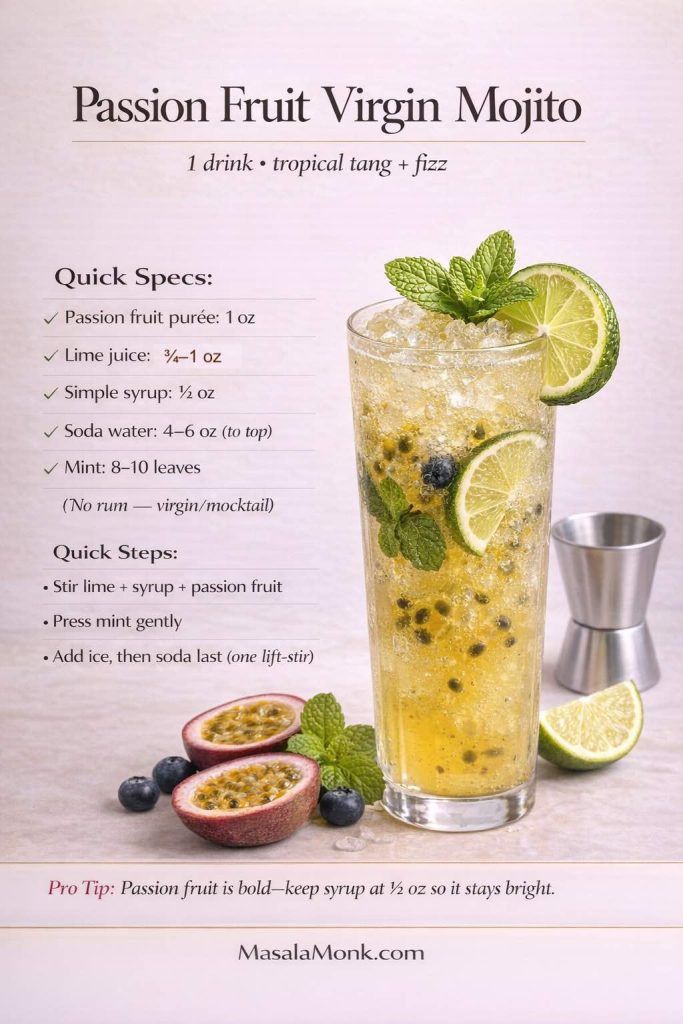
7) What vodka works best for a cranberry mule recipe?

Any smooth vodka works well. In particular, a cranberry mule recipe with Tito’s is popular because it’s clean and easy-drinking, letting ginger and cranberry stand out.

8) How do I make an easy cranberry moscow mule?

For an easy version, fill a mug with ice, add vodka and cranberry juice, then top with ginger beer and squeeze in lime. Finally, stir once and garnish—done.

9) How do I make a Christmas Moscow mule recipe?

To turn it into a Christmas mule drink, keep the base recipe and add holiday garnishes such as rosemary sprigs, fresh cranberries, and orange peel. Optionally, add a cinnamon stick for a cranberry cinnamon moscow mule feel.

10) What is an apple cranberry Moscow mule?

An apple cranberry Moscow mule is a cranberry mule variation that includes apple cider or apple juice along with cranberry, then finishes with ginger beer and lime. As a result, it tastes like a cran-apple mule with the classic mule fizz.

11) How do I make an apple cider cranberry Moscow mule?

Instead of using only cranberry juice, use a split—cranberry plus apple cider—then add vodka, lime, and ginger beer. In addition, cinnamon garnish pairs especially well with this version.
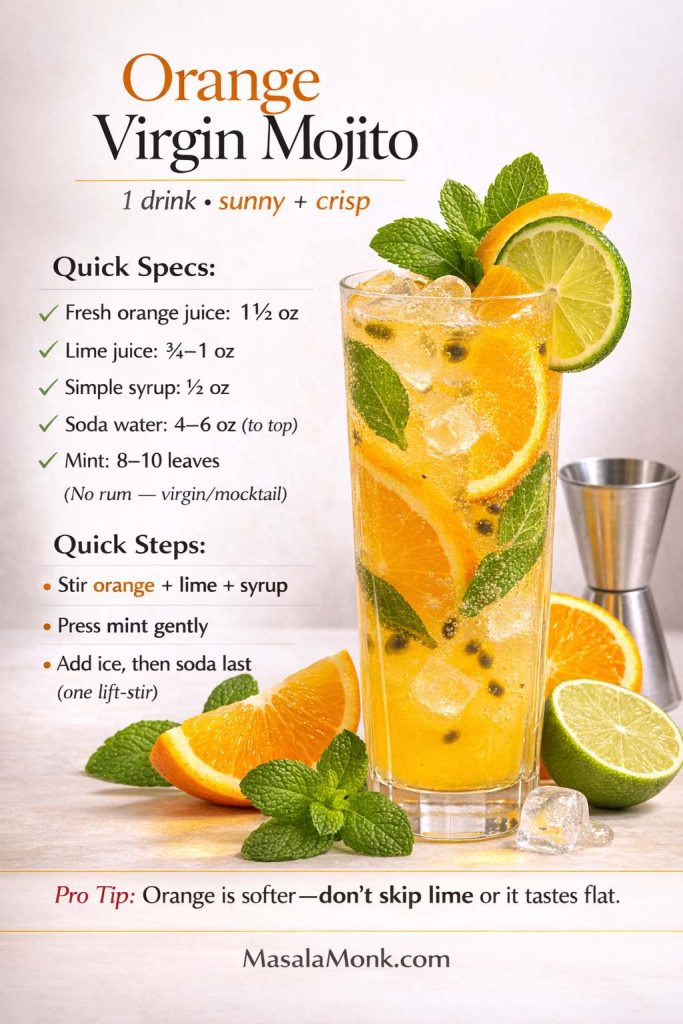
12) Can I make a spiced cranberry Moscow mule?

Absolutely. For instance, add aromatic bitters, a cinnamon stick, or a light dusting of cinnamon. Alternatively, use herbs like thyme for a spiced cranberry thyme Moscow mule that still tastes fresh.
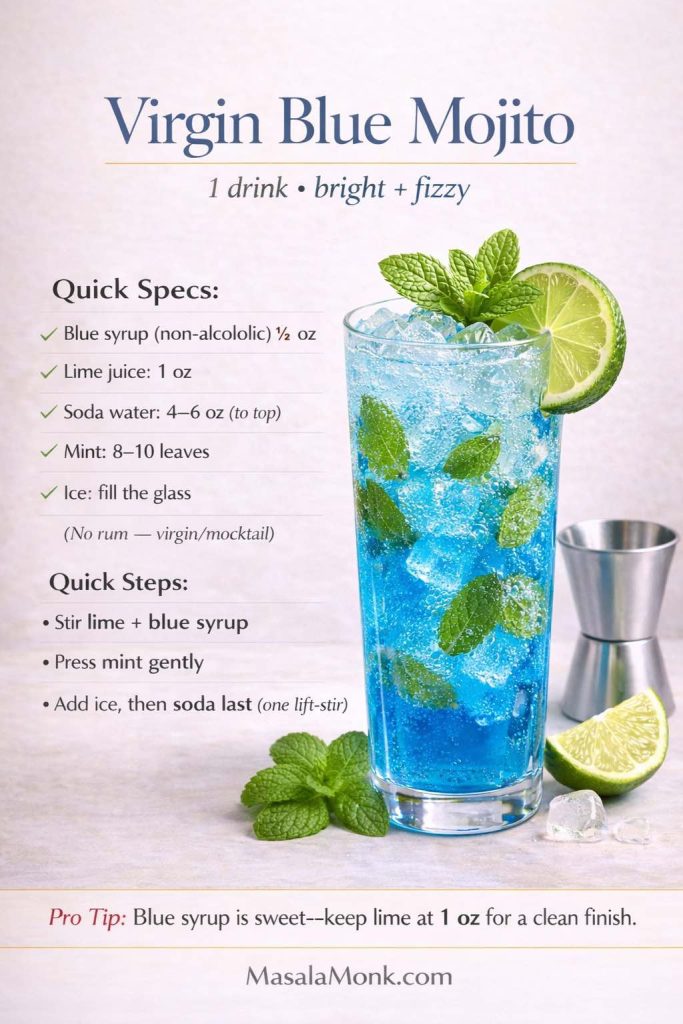
13) What’s the difference between a cranberry rosemary mule and a cranberry thyme moscow mule?

Rosemary is more piney and bold, while thyme is gentler and more floral. Consequently, rosemary gives a stronger holiday aroma, whereas thyme keeps the drink lighter.

14) What is a cranberry pomegranate Moscow mule?

A cranberry pomegranate mule combines cranberry juice with pomegranate juice, then adds vodka, lime, and ginger beer. Because pomegranate is naturally tangy, it deepens the fruit flavor without making the drink heavy.

15) Can I make a cranberry mule with gin?

Yes—swap vodka for gin to make a gin mule or cranberry gin mule. Compared to vodka, gin adds botanical notes that taste especially good with rosemary or orange peel.

16) How do I make a bourbon cranberry mule or whiskey cranberry mule?

Replace vodka with bourbon or whiskey. Then build the drink the same way with cranberry, lime, and ginger beer. In turn, the flavor becomes warmer and richer, similar to a cranberry Kentucky mule style.

17) Can I make a tequila cranberry mule (Mexican mule)?

Definitely. Use tequila blanco instead of vodka, then add cranberry juice, lime, and ginger beer. For extra lift, garnish with orange peel or a lime wheel.

18) How do I make a big batch cranberry Moscow mule?

Make a pitcher base with vodka, cranberry juice, and lime juice, and chill it. Then, when serving, pour the base over ice and top each glass with ginger beer so the fizz stays lively.

19) What’s the best cranberry moscow mule pitcher recipe for a crowd?

A reliable approach is batching vodka + cranberry + lime in advance, then topping with ginger beer per glass. That method scales easily for a cranberry moscow mule for a crowd, a large batch cranberry mule, or a party pitcher.

20) How far ahead can I prep a cranberry moscow mule batch?

You can mix the vodka, cranberry juice, and lime juice several hours ahead and keep it refrigerated. Still, add ginger beer only at serving time to maintain carbonation.

21) Can I make a virgin cranberry Moscow mule?

Yes—a virgin cranberry mule uses cranberry juice, lime juice, and ginger beer over ice. For a more “holiday mule” feel, garnish with rosemary and cranberries just like the cocktail.

22) Can I use cranberry vodka in a moscow mule with cranberry vodka?

Yes. Cranberry vodka works well and reinforces the fruit notes. Even so, keep lime in the recipe so it doesn’t drift into overly sweet territory.

23) What can I use instead of lime in a cranberry mule recipe?

If you’re out of lime, lemon can work. Nevertheless, lime is the classic mule citrus and tends to pair best with ginger beer and cranberry.

24) Why does my cranberry mule taste flat?

Usually it’s because the ginger beer wasn’t cold, the drink sat too long, or it was stirred too aggressively. To fix it, use chilled ginger beer, add it last, and stir gently.

25) Can I serve cranberry mules for Thanksgiving and Christmas?

Yes—cranberry mules fit both. For Thanksgiving, apple cider and cinnamon variations feel especially fitting. For Christmas, rosemary, orange, and pomegranate versions look and smell extra festive.

Posted on 13 Comments

Classic Rum Punch + 9 Recipes (Pitcher & Party-Friendly)

Classic Caribbean rum punch being poured from a crystal pitcher into an ice-filled glass with lime and pineapple, featuring “Rum Punch: Classic Caribbean + 9 Variations” cover text.

A good rum punch should feel sunny even when it’s poured in the middle of winter. It’s bright without being sour, sweet without being syrupy, and strong without tasting like straight liquor. Most of all, it’s the kind of drink that makes people wander back for a second glass, then ask, almost inevitably, “Wait—what’s in this?” That question is exactly why this post exists. You’ll start with a classic Caribbean-style rum punch recipe that’s built on a simple, time-tested balance: sour, sweet, strong, and weak. From there, you’ll get nine complete spin-offs—each one a full recipe card—so you can make anything from a breezy rum punch drink for a casual get-together to a dramatic, party-sized rum punch bowl for a celebration.

Along the way, you’ll naturally bump into the flavors and formats people look for the most: easy rum punch, traditional rum punch recipe, classic rum punch recipe, rum punch ingredients, rum punch pitcher recipe, rum punch recipe by the gallon, jamaican rum punch, planters punch recipe, spiced rum punch, coconut rum punch, pineapple mango rum punch, apple cider rum punch, hot rum punch, rum milk punch, and even a fun rum bucket drink recipe for peak party energy.

If you’ve ever heard the old Caribbean guide—“one of sour, two of sweet, three of strong, four of weak”—you’ve already met the philosophy behind the best rum and punch combinations. You can read more about that classic framework in this Epicurious piece on the rum punch rhyme: the Caribbean punch recipe rhyme.

And when you’re batching drinks for a crowd, a smart approach to timing and dilution makes all the difference—especially for citrus—so this Serious Eats guide is a handy companion: how to batch cocktails.

With those ideas in mind, let’s build your base.

Also Read: Daiquiri Recipe (Classic, Strawberry & Frozen Cocktails)


What Makes Rum Punch Taste “Right”

Before ingredients hit the pitcher, it helps to know what you’re aiming for—because rum punch is less about a rigid formula and more about a feel.

The balance you’re chasing

  • Sour keeps the drink lively (usually lime).
  • Sweet rounds out the edges (simple syrup, grenadine, or a fruit syrup).
  • Strong is your rum (sometimes one rum, often a blend).
  • Weak is everything that lengthens the drink (juice, water, tea, soda, or even coconut water).

That’s why rum punch is so forgiving. The same “sour/sweet/strong/weak” backbone can turn into a beachy tropical rum punch, a deeper dark rum punch, a fragrant holiday pitcher, or a warm mug of hot rum punch—without losing the punch “identity.”

Choosing rum for rum punch

If you are looking for “best rum for rum punch,” you already know this part can spiral. The good news: you don’t need a rare bottle. You need a rum that tastes good to you and plays nicely with fruit.

  • White rum brings lift and crispness. It’s a clean base for white rum punch and fruit-forward punches.
  • Dark rum adds caramel and spice. Even a small portion makes the drink taste more “grown-up,” which is why a classic dark rum punch can feel so satisfying.
  • Spiced rum is basically a shortcut to cozy. It’s perfect for spiced rum punch and fall-forward versions like cider punch.
  • Coconut rum leans sweet and tropical. It’s the heart of a creamy coconut rum punch and a natural fit for pineapple.
  • Overproof rum (optional) gives Jamaican-style punch a bold edge. Use it as a float or a small percentage, not the whole base.

You’ll see these options pop up throughout the variations—because the rum you pick is often the fastest way to change the mood of the drink.

Juice choices: the “weak” that matters

Pineapple juice is a rum punch superstar for a reason: it’s tropical, aromatic, and naturally smooths alcohol. Orange juice adds brightness. Mango brings body. Meanwhile, a splash of soda makes the punch feel lighter.

If you love pineapple-based punch, you’ll also enjoy this internal guide with multiple directions and flavors: punch recipes with pineapple juice.

Ice and dilution: the secret ingredient

There’s a reason batched cocktail guides talk about dilution so much. The first glass might taste perfect; the last glass might taste aggressively sweet or too strong if you ignore water and ice.

A reliable approach is to chill the punch base well, then let ice do the final shaping. If you’re serving for hours, a big block of ice melts slower than cubes, keeping the flavor steadier. That’s why party versions and “by the gallon” versions benefit from planning the ice.

Also Read: What to Mix with Jim Beam: Best Mixers & Easy Cocktails


The Main Recipe: Classic Caribbean Rum Punch

This is your foundation: a classic rum punch drink recipe that works in a pitcher, scales for a party, and tastes like the kind of traditional rum punch recipe people imagine when they picture a vacation.

Flat lay of rum punch ingredients with limes, pineapple, mint, simple syrup, bitters, rum, and an ice-filled pitcher plus a finished rum punch drink labeled “Sour • Sweet • Strong • Weak.”
Everything you need for a classic rum punch drink recipe—lime for the sour, syrup for the sweet, rum for the strong, and pineapple/orange for the weak—ready for an easy pitcher of rum punch.

Classic Rum Punch (Serves 6–8)

Ingredients

  • ¾ cup (180 ml) fresh lime juice
  • ½ cup (120 ml) simple syrup (adjust to taste)
  • 2 cups (480 ml) rum (see rum notes below)
  • 3 cups (720 ml) pineapple juice
  • 1 cup (240 ml) orange juice (optional but lovely)
  • 1 cup (240 ml) cold water or sparkling water (optional, to lighten)
  • 6–10 dashes aromatic bitters (optional)
  • Garnish: orange slices, pineapple wedges, lime wheels, mint, grated nutmeg
Classic Caribbean rum punch being poured into an ice-filled glass with lime and pineapple garnish, featuring a recipe-card overlay with the 1-2-3-4 rum punch ratio and ingredients.
This classic Caribbean rum punch recipe is built on the 1–2–3–4 ratio—lime, syrup, rum, and pineapple/orange—so you can mix an easy pitcher of rum punch and tweak it to taste.

Instructions

  1. In a large pitcher, stir lime juice and simple syrup until fully combined.
  2. Add rum, pineapple juice, and orange juice (if using). Stir again.
  3. Pour in cold water or sparkling water if you want a more refreshing, “easy-sipping” style.
  4. Add bitters if you like a more classic, aromatic finish.
  5. Chill for at least 1–2 hours.
  6. Serve over plenty of ice with fruit garnish. If you’re using nutmeg, grate it lightly over each glass.

Rum notes

  • For an effortless “classic” flavor, use a blend: mostly white rum with a smaller portion of dark rum.
  • If you only have one rum, use it. A basic rum punch recipe is still delicious with just white rum or just dark rum.

This is the core rum punch mixture. From this point on, each variation is a deliberate shift—sometimes in rum, sometimes in the “weak,” sometimes in the sweetener—yet every one still feels like punch.

Also Read: Bolognese Sauce Recipe: Real Ragù & Easy Spag Bol


Variation 1: Big Batch Rum Punch (Pitcher, Bowl, and By the Gallon)

When people look for rum punch recipe large batch or rum punch recipe by the gallon, what they really want is confidence: a recipe that won’t taste watered down, overly boozy, or strangely flat after an hour on the table.

This version is designed for that.

Big-batch rum punch in a glass dispenser with citrus and ice, featuring a recipe-card overlay for pitcher and by-the-gallon rum punch ratios and steps.
Big batch rum punch made easy: a pitcher-friendly rum punch recipe by the gallon, built on the classic 1–2–3–4 rum punch ratio for parties and punch bowls.

Big Batch Rum Punch (About 1 gallon, ~16 servings)

Ingredients

  • 2½ cups (600 ml) fresh lime juice
  • 2 cups (480 ml) simple syrup
  • 6 cups (1.4 L) rum (a mix of white + dark is ideal)
  • 8 cups (1.9 L) pineapple juice
  • 2 cups (480 ml) orange juice (optional but recommended)
  • 2–3 cups (480–720 ml) cold water (start smaller; adjust after chilling)
  • Optional: aromatic bitters, grated nutmeg
  • Garnish: citrus wheels, pineapple, mint
  • Ice: a large block if possible (or lots of cubes)

Instructions

  1. In a very large dispenser, clean bucket-style beverage tub, or two pitchers, combine lime juice and simple syrup.
  2. Add rum, juices, and 2 cups cold water. Stir thoroughly.
  3. Chill several hours (overnight is even better).
  4. Taste cold. If it feels intense, add more cold water in small additions until it tastes balanced.
  5. Add a large ice block right before serving, then garnish with fruit.

This is the heart of a true rum punch pitcher recipe—and it translates just as well into a rum punch bowl. For more punch formats and pineapple-forward directions, this internal post is a fun rabbit hole: punch with pineapple juice.

If you like to nerd out on batching, the timing advice in how to batch cocktails is genuinely useful for any big-batch drink, not just rum.

Also Read: Oat Pancakes Recipe (Healthy Oatmeal Pancakes)


Variation 2: Jamaican Rum Punch (Vivid, Fruity, and Bold)

A good jamaican rum punch often tastes louder than the classic base: more fruit, more citrus pop, and—if you choose—an optional overproof edge. It’s still rum punch, yet it feels like it has its own voice.

Jamaican rum punch in a tall glass with pineapple and lime garnish, featuring a recipe-card overlay with ingredients and steps for Jamaican rum punch.
Jamaican rum punch—bold, bright, and fruit-forward—made with pineapple juice, orange juice, fresh lime, rum, and syrup for an easy party-ready rum punch drink.

Jamaican Rum Punch Recipe (Serves 6–8)

Ingredients

  • 2 cups (480 ml) pineapple juice
  • 2 cups (480 ml) orange juice
  • ½ cup (120 ml) lime juice
  • ½ cup (120 ml) simple syrup (or strawberry syrup if you want a fruitier sweet note)
  • 2 cups (480 ml) rum (white rum recommended)
  • Optional: 2–4 oz (60–120 ml) overproof rum for a small float or boost
  • Optional: aromatic bitters
  • Garnish: orange slices, lime wheels, nutmeg

Instructions

  1. In a pitcher, stir pineapple juice, orange juice, lime juice, and syrup until blended.
  2. Add the rum and stir again.
  3. Chill, then serve over ice.
  4. If you’re using overproof rum, add a tiny float to each glass (or stir a small amount into the pitcher).
  5. Finish with citrus and a light nutmeg grate.

If you want a second reference for Jamaican-style proportions and ingredient choices, this external recipe is a useful comparison: Jamaican rum punch recipe.

Also Read: Vodka Pasta (Penne alla Vodka) + Spicy Rigatoni, Chicken, and Gigi Recipes


Variation 3: Planter’s Punch (Classic Cocktail Energy)

If rum punch is a vibe, Planter’s Punch is a character. It’s a more defined rum punch cocktail, typically deeper, often more aromatic, and built to taste like a “proper” cocktail rather than a purely fruity party punch.

Planter’s Punch in a rocks glass with lime, mint, and cherry garnish, featuring a recipe-card overlay listing dark rum, lime, syrup, and bitters.
Planter’s Punch—the classic rum punch cocktail—mixes dark rum, lime, syrup, and bitters for a deeper, more aromatic take on traditional rum punch.

Planter’s Punch Recipe (Serves 2–3, easy to scale)

Ingredients

  • 6 oz (180 ml) dark rum
  • 2 oz (60 ml) lime juice
  • 2 oz (60 ml) simple syrup
  • 1 oz (30 ml) grenadine (optional, for color + fruit sweetness)
  • 6–10 dashes aromatic bitters
  • Optional: splash of club soda
  • Garnish: mint, orange slice, grated nutmeg

Instructions

  1. In a small pitcher, stir rum, lime juice, syrup, bitters, and grenadine (if using).
  2. Add ice and stir well.
  3. Pour into glasses over fresh ice.
  4. Add a splash of soda if you want a longer drink.
  5. Garnish generously with mint and a dusting of nutmeg.

For a classic external reference on the style, this is a great one: Planter’s Punch.

Also Read: 7 Pizza Sauce Recipes | Marinara, White Garlic, Alfredo, Buffalo, BBQ, Vodka & Ranch


Variation 4: Spiced Rum Punch (Holiday and Christmas-Party Ready)

A spiced rum punch is what happens when rum punch grows a cozy sweater. It keeps the tropical base, then adds warmth through spice and citrus aroma. As a christmas rum punch, it’s especially good with orange and cinnamon.

Spiced rum punch in a rocks glass with cinnamon and citrus, featuring a recipe-card overlay for spiced rum punch ingredients and “Mix • Chill • Serve.”
Spiced rum punch brings holiday flavor to a classic rum punch recipe—spiced rum, pineapple, orange, lime, and cinnamon syrup for an easy festive pitcher.

Spiced Rum Punch Recipe (Serves 6–8)

Ingredients

  • 2 cups (480 ml) spiced rum
  • 1 cup (240 ml) dark rum
  • 2½ cups (600 ml) pineapple juice
  • 2½ cups (600 ml) orange juice
  • ½ cup (120 ml) lime juice
  • ½ cup (120 ml) cinnamon simple syrup (or regular simple syrup + cinnamon to taste)
  • Optional: aromatic bitters
  • Garnish: orange slices, cinnamon sticks

Instructions

  1. Stir pineapple juice, orange juice, lime juice, and syrup in a large pitcher.
  2. Add both rums and stir until fully combined.
  3. Chill well.
  4. Serve over ice with orange slices and cinnamon.

When you want a dessert pairing that echoes the rum without feeling heavy, these are a natural match: Irish rum truffles.


Variation 5: Coconut Rum Punch (Soft, Tropical, Crowd-Friendly)

Coconut rum has a way of turning “rum and fruit juice” into something instantly vacation-like. This coconut rum punch stays refreshing, not creamy, yet it still tastes lush.

Coconut rum punch in a chilled glass with pineapple, lime, and mint garnish, featuring a recipe-card overlay for coconut rum punch ingredients and steps.
Coconut rum punch is a tropical twist on a classic rum punch recipe—coconut rum with pineapple, lime, orange, and ice for a smooth, easy rum punch drink.

Coconut Rum Punch Recipe (Serves 6–8)

Ingredients

  • 2 cups (480 ml) coconut rum
  • 1 cup (240 ml) white rum
  • 3 cups (720 ml) pineapple juice
  • 1 cup (240 ml) orange juice
  • ½ cup (120 ml) lime juice
  • ⅓–½ cup (80–120 ml) simple syrup
  • Optional: ½–1 cup (120–240 ml) coconut water (for a lighter finish)
  • Garnish: pineapple wedges, lime wheels

Instructions

  1. In a pitcher, stir pineapple juice, orange juice, lime juice, and simple syrup.
  2. Add coconut rum and white rum, then stir again.
  3. Chill until very cold.
  4. Serve over ice with pineapple and lime.

If you like the idea of using coconut water to keep tropical drinks refreshing, this internal collection is worth browsing: coconut water cocktails.


Variation 6: Pineapple Mango Rum Punch (Tropical, Smooth, and Juicy)

If your goal is “summer in a glass,” this is it. A pineapple mango rum punch tends to taste rounder than citrus-forward versions because mango juice or nectar brings body.

Pineapple mango rum punch in a tall glass with crushed ice and fruit garnish, featuring a recipe-card overlay with white rum, dark rum, pineapple, mango, and lime.
Pineapple mango rum punch is a tropical rum drink with big fruit flavor—pineapple, mango, lime, and a mix of white and dark rum for an easy crowd-favorite punch.

Pineapple Mango Rum Punch (Serves 6–8)

Ingredients

  • 2 cups (480 ml) white rum
  • 1 cup (240 ml) dark rum
  • 2½ cups (600 ml) pineapple juice
  • 2 cups (480 ml) mango nectar or mango juice
  • ½ cup (120 ml) lime juice
  • ¼–⅓ cup (60–80 ml) simple syrup (to taste)
  • Garnish: mango slices, lime wheels

Instructions

  1. In a pitcher, combine pineapple juice, mango nectar, lime juice, and simple syrup.
  2. Add the rums and stir until smooth.
  3. Chill thoroughly.
  4. Serve over ice with mango and lime.

If you’re building a party menu around pineapple, you’ll find more directions here: punch with pineapple juice.


Variation 7: Apple Cider Rum Punch (Fall Party Punch)

As soon as apple cider shows up, rum punch can pivot from beach to bonfire. Rum punch with apple cider still tastes like punch, yet it carries that unmistakable fall aroma.

Apple cider rum punch in a rocks glass with apple and lime garnish, featuring a recipe-card overlay for apple cider rum punch ingredients and steps.
Apple cider rum punch is a fall party twist on rum punch—apple cider with rum, citrus, pineapple, and ice for a cozy, crowd-ready pitcher drink.

Apple Cider and Rum Punch (Serves 6–8)

Ingredients

  • 3 cups (720 ml) apple cider
  • 2 cups (480 ml) pineapple juice
  • ½ cup (120 ml) lemon juice (or lime juice for a sharper edge)
  • 2–3 cups (480–720 ml) rum (spiced rum is especially good here)
  • ¼ cup (60 ml) simple syrup (optional; depends on cider sweetness)
  • Garnish: apple slices, cinnamon sticks

Instructions

  1. In a pitcher, stir apple cider, pineapple juice, and lemon juice.
  2. Add rum and stir well.
  3. Taste. If it needs sweetness, add a small amount of syrup.
  4. Chill and serve over ice with apple slices.

Because cider versions can feel sweeter, it’s often nice to balance your menu with lighter fruit choices. This internal guide is helpful if you want ideas that don’t pile on sugar: fruits low in sugar.


Variation 8: Hot Rum Punch (A Warm Winter Mug)

Rum punch doesn’t have to be cold. A hot rum punch recipe leans cozy, citrusy, and gently spiced. In contrast to a holiday pitcher, this is intimate—perfect for a quiet evening or a small gathering.

Hot rum punch in a steaming mug with lemon and cinnamon, featuring a recipe-card overlay listing rum, hot tea or water, citrus, and honey with “Stir • Pour • Sip.”
Hot rum punch is the warm winter version of rum punch—rum with hot tea or water, citrus, and honey for a cozy mug you can sip slowly.

Hot Rum Punch Recipe (Serves 4)

Ingredients

  • 2 cups (480 ml) hot water or hot black tea
  • ½ cup (120 ml) rum
  • ¼ cup (60 ml) honey or simple syrup
  • ¼ cup (60 ml) lemon juice (or lime juice)
  • Optional: aromatic bitters
  • Optional: cinnamon, cloves, orange peel

Instructions

  1. In a heatproof jug, stir honey (or syrup) into the hot water or tea.
  2. Add citrus juice and stir again.
  3. Add rum last, so the aroma stays bright.
  4. Pour into mugs and garnish with a cinnamon stick or citrus peel.

Also Read: Moscow Mule Recipe (Vodka Mule): The Master Formula + 9 Variations


Variation 9: Rum Milk Punch (Velvety and Dessert-Like)

A rum milk punch is the softer, richer cousin of fruit punch. It’s smooth, faintly spiced, and perfect when you want a drink that feels like dessert without being overly heavy.

Rum milk punch in a rocks glass over ice with nutmeg, featuring a recipe-card overlay listing rum, milk or cream, vanilla, sugar, and nutmeg with “Whisk • Chill • Serve.”
Rum milk punch is the creamy, dessert-like side of rum punch—rum with milk (or cream), vanilla, sugar, and nutmeg for a smooth, chilled sip.

Rum Milk Punch Recipe (Serves 4)

Ingredients

  • 1½ cups (360 ml) milk
  • ½ cup (120 ml) rum
  • 3 tbsp sugar (or 2–3 tbsp simple syrup)
  • ½ tsp vanilla extract
  • Pinch of salt
  • Fresh nutmeg (or a small pinch of ground nutmeg)

Instructions

  1. In a jug, whisk milk, sugar (or syrup), vanilla, and salt until fully dissolved.
  2. Stir in rum.
  3. Chill, then serve over ice.
  4. Finish with nutmeg.

If you want to turn a rum-forward evening into a full dessert moment, these no-bake options are easy crowd-pleasers: no-bake blueberry cheesecake or this layered treat: savoiardi chocolate vanilla pudding.


Variation 10: Rum Bucket Drink (Party Format, Big Fun)

A rum bucket drink is exactly what it sounds like: a shareable, dramatic, party-friendly version of punch that’s made for long straws, loud laughter, and easy refills. While it’s playful, it still tastes best when you keep the classic rum punch balance in mind.

Rum bucket drink in a clear bucket with ice and citrus, featuring a recipe-card overlay for a rum bucket drink recipe with rum, fruit punch or juice, citrus, soda, and ice.
Rum bucket drink recipe: a fun party punch for a crowd—rum mixed with fruit punch or juice, citrus, soda, and plenty of ice for an easy big-batch rum punch vibe.

Rum Bucket Drink Recipe (Serves 6–8)

Ingredients

  • 2 cups (480 ml) rum (white, spiced, or a blend)
  • 3 cups (720 ml) pineapple juice
  • 2 cups (480 ml) orange juice
  • ½ cup (120 ml) lime juice
  • ½ cup (120 ml) simple syrup
  • 2 cups (480 ml) lemon-lime soda or ginger ale
  • Optional: a splash of grenadine for color
  • Ice + citrus wheels + pineapple

Instructions

  1. In a large vessel (bucket, beverage tub, or oversized pitcher), stir pineapple juice, orange juice, lime juice, and simple syrup.
  2. Add rum and stir well.
  3. Chill until very cold.
  4. Right before serving, add soda (so it stays lively), then add plenty of ice and fruit.

If you want to explore a few more “party punch” directions without losing the pineapple backbone, this internal guide has plenty of inspiration: punch with pineapple juice.


How to Serve Rum Punch Without Stress

Once you’ve chosen your version—classic, Jamaican, Planter’s, spiced, coconut, cider, hot, milk, or bucket—the final experience comes down to serving. A rum punch can taste extraordinary at the start and just okay later if the table setup fights the drink.

Keep it cold from the beginning

Chilling the punch before adding ice preserves flavor. Cold punch also means you can use less ice in each glass, which helps keep the balance of your rum punch cocktail consistent.

Build a garnish that people actually eat

Fruit garnish isn’t decoration; it’s part of the experience. Orange slices, pineapple wedges, and lime wheels are classic because they smell as good as they look. Mint adds freshness, while nutmeg adds warmth.

Party spread with rum punch, charcuterie-style snacks, cheese balls, rum truffles, and cheesecake, featuring a “What to Serve with Rum Punch” text overlay.
What to serve with rum punch: salty snacks, bite-size appetizers, and easy desserts that balance a classic rum punch drink—perfect for parties, punch bowls, and big-batch pitchers.

Pairings that make rum punch shine

Because rum punch is fruity and often a little sweet, it loves salty, crunchy bites. A snack board is the easiest route—especially if you follow a simple structure like this internal guide: charcuterie boards and the 3-3-3-3 rule.

Meanwhile, warm finger foods balance tropical drinks beautifully. Try these ideas for a party table: potato appetizers, Indian-inspired cheese balls, or a classic platter like deviled eggs with variations.

For dessert, you can lean tropical or creamy. On the tropical side, Dole Whip feels almost made for pineapple and coconut versions. On the creamy side, no-bake desserts keep the hosting vibe effortless, like no-bake blueberry cheesecake.


A Quick Word on “Lighter” Rum Punch Styles

Rum punch doesn’t need to be overly sweet to be fun. If you want something brighter and less sugary, start with a base that uses more citrus and more “weak” (water, sparkling water, or coconut water), then let fruit garnish do some of the sweetness work.

If you’re curious about fruit choices and how sweetness plays out in real life, this internal guide is a helpful read: 8 fruits low in sugar.

Likewise, if you like ginger-forward freshness with pineapple, this internal explainer is an interesting companion: pineapple, cucumber, and ginger: myth and facts.


Closing Sip

Whether you came here for a simple rum punch recipe, a traditional rum punch recipe, or a party-sized rum punch recipe by the gallon, the heart of it stays the same: balance the sour, sweet, strong, and weak until it tastes like something you’d want to pour again.

Start with the classic base, then let your occasion decide the rest. A casual hang? Make the classic pitcher. A holiday gathering? Go spiced. A fall party? Cider. A tropical theme night? Coconut or pineapple mango. Want the boldest fruit-forward version? Jamaican. Want something with old-school cocktail swagger? Planter’s Punch.
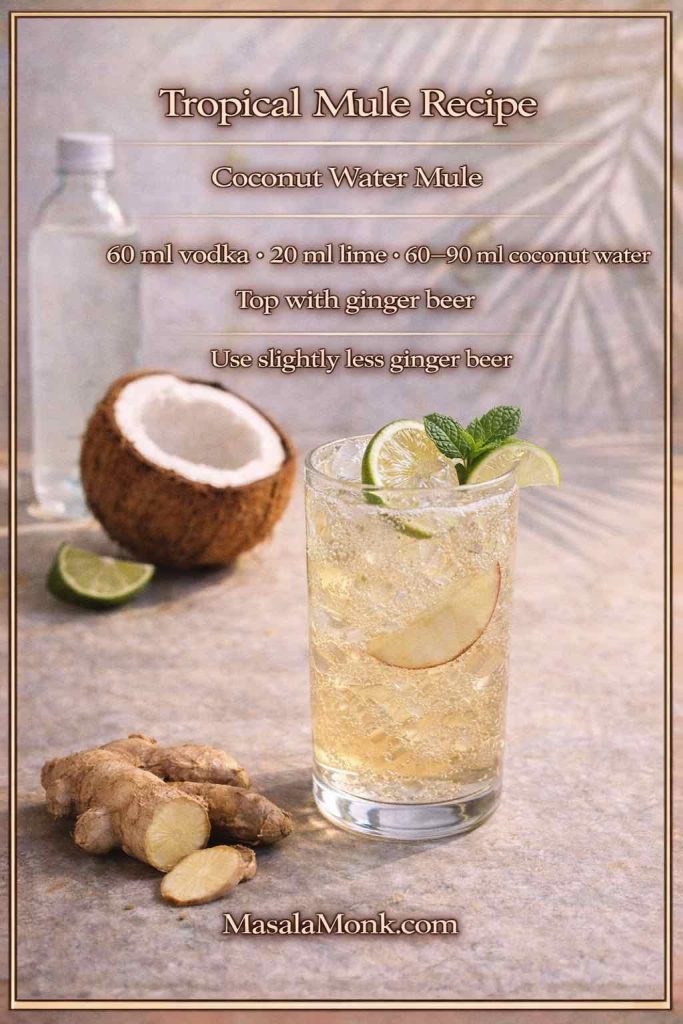
And if you want maximum party theatrics, well… the rum bucket is waiting.

Six rum punch variations in different glasses with fruit garnishes, featuring a “Rum Punch: 10 Ways” text overlay for classic and flavored rum punch recipes.
Rum punch, 10 ways—start with the classic Caribbean rum punch recipe, then mix it up with Jamaican rum punch, Planter’s Punch, spiced, coconut, and other party-ready variations.

FAQs

1) What is the best rum punch recipe for beginners?

If you’re new to making rum punch, start with a classic rum punch recipe that uses lime juice, simple syrup, rum, and pineapple juice. That combination is forgiving, quick to mix, and easy to adjust after tasting. Once you like the balance, you can branch into Jamaican rum punch, spiced rum punch, or coconut rum punch without relearning the basics.

2) What are the essential rum punch ingredients?

Most rum punch ingredients fall into four parts: a sour (usually lime), a sweet (simple syrup or grenadine), a strong (rum), and a weak (juice like pineapple or orange, sometimes topped with water or soda). From there, optional add-ins like bitters, nutmeg, and fresh fruit garnish help the rum punch drink taste more “finished.”

3) What is the rum punch ratio?

A traditional rum punch ratio is often described as “one of sour, two of sweet, three of strong, four of weak.” In practice, that means lime juice, sweetener, rum, and juice/water scaled in a consistent pattern. Since juices vary in sweetness, the best approach is to use the ratio as a starting point, then tweak to taste.
4) What is the difference between rum punch and Planter’s Punch?

Rum punch is a broad category and can be fruity, light, and easygoing. Planter’s Punch is a specific rum punch cocktail with a more defined profile, typically using darker rum, lime, sweetener, and bitters, sometimes with grenadine. In other words, Planter’s Punch tends to drink more like a structured cocktail, whereas rum and punch can range from simple to elaborate.

5) What is the best rum for rum punch?

The best rum for rum punch depends on the style you want. White rum creates a crisp white rum punch, while dark rum adds depth for a dark rum punch. Spiced rum works well in spiced rum punch recipes, and coconut rum is ideal for coconut rum punch. When in doubt, blending white and dark rum usually produces the most balanced classic rum punch recipe.

6) Can I use just one type of rum for rum punch?

Yes—using one rum is totally fine, especially for easy rum punch. The flavor will simply lean more toward that rum’s character. For example, using only dark rum can make a richer rum punch cocktail, while using only white rum keeps the drink brighter and more tropical.

7) How do I make an easy rum punch that still tastes “classic”?

To keep an easy rum punch tasting like a traditional rum punch recipe, focus on fresh lime juice and a measured sweetener. Then pick pineapple juice as your main “weak,” because it smooths the drink and brings the classic tropical vibe. Finally, chill it well before serving so you’re not relying on melting ice for dilution.

8) How do I make rum punch less sweet?

To reduce sweetness, add more lime juice in small amounts and lengthen the drink with cold water, sparkling water, or extra ice. Additionally, choose an unsweetened juice where possible and scale back the syrup. If the drink starts tasting too sharp, a small splash of orange juice often rounds it out without making it sugary.

9) How do I make rum punch stronger without ruining the flavor?

Increase the rum gradually and keep the balance by also increasing the “weak” component (juice or water) and the ice. Another option is to float a small amount of stronger rum on top of each glass. That approach is especially common in Jamaican rum punch variations.

10) How do I make rum punch for a party?

For a party, a rum punch pitcher recipe is the easiest format. Mix the base in advance, chill it, and add ice right before serving. If you’re serving for a long time, use a punch bowl with a large ice block so the flavor stays steady.

11) What is the best big batch rum punch recipe?

A big batch rum punch recipe uses the same base as classic rum punch, simply multiplied, with extra attention to dilution. Add a little cold water up front so it doesn’t taste harsh, then adjust after chilling. Big batch rum punch also benefits from bold juices like pineapple, which hold up well as the ice melts.

12) How do I make rum punch by the gallon?

To make rum punch recipe by the gallon, scale up the sour, sweet, strong, and weak proportions evenly. After chilling, taste and adjust with water or juice if it feels too intense. Because gallon batches sit longer, they’re also a great place to use fruit slices and bitters for extra aroma.

13) Can I make rum punch the night before?

Absolutely. Rum punch recipe large batch and rum punch recipe pitcher versions are often better after a few hours of chilling. Still, it’s best to do a final taste the next day before serving, since flavors can mellow overnight.

14) What juices go best in rum punch?

Pineapple juice is the classic choice for rum punch mix because it’s tropical and smooth. Orange juice adds brightness, mango creates a thicker tropical rum punch feel, and passion fruit brings a tangy edge. Meanwhile, cranberry juice is popular in holiday rum punch and spiced rum punch variations.

15) Can I make rum punch without pineapple juice?

Yes. If you want rum punch without pineapple juice, use orange juice as the base “weak,” then add something flavorful like mango, guava, or even a mix of citrus and water. The key is keeping lime juice present so the drink stays punchy rather than flat.

16) What is Jamaican rum punch made of?

Jamaican rum punch typically uses pineapple juice, orange juice, lime juice, sweetener, and rum—often white rum, sometimes with an overproof component. It’s usually fruit-forward and bold, and it can be served as a rum punch drink or a stronger rum punch cocktail depending on the rum choice.

17) What is the easiest Jamaican rum punch recipe to follow?

The easiest Jamaican rum punch recipe uses equal parts pineapple and orange juice, then adds lime juice, simple syrup, and rum. From there, you can tweak sweetness, tartness, and strength until it tastes right. If you like extra punchiness, bitters and nutmeg are common finishing touches.

18) What is coconut rum punch, and does it need cream?

Coconut rum punch is a tropical rum punch variation made with coconut rum and fruit juices like pineapple and lime. It does not require cream—many coconut rum punch recipes are clear, bright, and served over ice. If you want it richer, you can add coconut milk, but that shifts it toward a dessert-style drink.

19) What is spiced rum punch best for?

Spiced rum punch is ideal for cooler weather, holidays, and cozy gatherings. The warming notes from spiced rum pair well with orange, pineapple, cranberry, and apple cider. If you’re making christmas rum punch, spiced rum punch recipes are often the most crowd-pleasing.

20) What is apple cider rum punch?

Apple cider rum punch combines rum with cider, citrus, and often a tropical juice like pineapple to keep it “punch-like.” It’s a popular fall rum punch option and can be served in a pitcher, a punch bowl, or scaled up as a large batch rum punch recipe.

21) What is hot rum punch?

Hot rum punch is a warm version made with hot water or tea, rum, citrus, and a sweetener like honey or syrup. It’s sometimes seasoned with spices, which makes it a natural winter rum punch choice when cold drinks aren’t appealing.

22) What is rum milk punch?

Rum milk punch is a creamy drink made with rum, milk (or cream), sweetener, and spices like nutmeg. It tastes dessert-like and smooth, making it a popular alternative to fruit-based rum punch ideas when you want something richer.

23) What is a rum bucket drink?

A rum bucket drink is essentially rum fruit punch served in a large bucket-style vessel—often with soda and lots of ice. Because it’s built for sharing, it overlaps with rum punch for party formats and big batch rum punch. The key is balancing the sweetness and adding enough “weak” so it stays drinkable.

24) How long does rum punch last in the fridge?

Rum punch typically keeps well for 2–3 days in the fridge, though the freshest flavor is usually within the first 24 hours. Citrus can soften over time, so a quick stir and taste before serving helps restore balance.

25) How do I keep rum punch from getting watered down?

Use very cold ingredients, add ice at the last minute, and consider a large ice block for punch bowls. Another approach is to chill the punch thoroughly so you don’t need as much ice in each glass. For big batch rum punch, accounting for some dilution with water can also keep the taste consistent over time.

Posted on 10 Comments

Moscow Mule Recipe (Vodka Mule): The Master Formula + 9 Variations

Photo-realistic Moscow Mule recipe cover showing a copper mug with ice, lime and mint, featuring the text “Moscow Mule – A master recipe, refined – The Perfect Ratio + 9 Variations” and MasalaMonk.com.

A moscow mule recipe can look almost too easy to be memorable: vodka, lime, ginger fizz, ice. And yet, when it’s built well, it tastes like clarity—cold, bright, and sharply refreshing, with ginger heat that arrives just after the sip. Still, because it’s so simple, it can also fall apart fast. If the lime is dull, the ginger is warm, or the ice is stingy, the whole thing turns flat or sweet or watery. Fortunately, once you understand the structure behind a dependable moscow mule recipe, you can make it confidently, adjust it on the fly, and branch into variations without learning a new cocktail every time.

This guide gives you one master formula first. Then, step by step, it takes you through the versions people keep coming back to at home: Mexican Mule, Kentucky Mule, Irish Mule, Gin Mule, Italian Mule, Cranberry Moscow Mule, Apple Mule, a Ginger-forward Mule, and a Tropical Mule with coconut water that feels especially at home on MasalaMonk. Along the way, you’ll also learn what to do when you only have ginger ale, how to make a Moscow Mule without ginger beer, how to build a quick make-ahead base, and how to serve a crowd without losing fizz.

For classic reference points, the backbone of this drink shows up consistently across trusted cocktail sources such as Serious Eats’ Moscow Mule and Liquor.com’s Moscow Mule cocktail recipe. However, the most useful thing isn’t memorizing any single set of numbers. Instead, it’s learning the “why” behind the balance so the drink works with the ginger fizz you have, the bottle you have, and the mood you’re in.


Moscow mule recipe: the master ratio that makes everything easy

Before measurements, think in parts. A reliable moscow mule recipe is simply a long, fizzy highball built from four ideas:

  1. a clean spirit foundation
  2. a bright citrus snap
  3. a spicy ginger lift
  4. a cold temperature and controlled dilution
Moscow Mule recipe ratio card showing a copper mug with ice, lime and mint, with the text “Moscow Mule Recipe” and the ratio 1 vodka, ½ lime, 2–3 ginger beer.
Moscow Mule recipe made simple: follow the classic ratio—1 vodka : ½ lime : 2–3 ginger beer—then build it over plenty of ice for a crisp, gingery, lime-bright mule every time.

So, the master ratio is:

  • 1 part vodka
  • ½ part fresh lime
  • 2–3 parts ginger beer
  • a lot of ice

Because ginger beers vary wildly in sweetness and spice, that 2–3 parts range matters. Consequently, you’re not “failing the recipe” if you pour a little more or less—rather, you’re tailoring it to the fizz in your fridge.

Moscow mule recipe (single-serve master build)

Ingredients

  • 60 ml vodka
  • 20–25 ml fresh lime juice
  • 120–180 ml chilled ginger beer
  • plenty of ice
  • lime wheel or wedge (mint optional)
Moscow Mule recipe card showing a copper mug with ice, lime and mint, plus overlay text with measurements (60 ml vodka, 20–25 ml lime, top with ginger beer) and quick build steps.
Classic Moscow Mule recipe card: squeeze fresh lime, add 60 ml vodka, then top with ginger beer over plenty of ice—stir gently for a crisp, gingery, lime-bright Moscow Mule that stays fizzy.

Method

  1. Chill your mug or glass briefly if possible; even a few minutes helps.
  2. Fill it completely with ice.
  3. Add vodka and lime juice.
  4. Top with cold ginger beer.
  5. Stir gently once or twice—just enough to combine.
  6. Garnish and serve immediately.

That’s the core moscow mule recipe, and it’s the one you’ll return to. From here, everything is just a variation on the same theme.

Also Read: Vodka Pasta (Penne alla Vodka) + Spicy Rigatoni, Chicken, and Gigi Recipes


Moscow mule ingredients: the few details that change the whole drink

Because the ingredient list is short, each piece has an oversized role. Therefore, small upgrades matter more here than they do in a complicated cocktail.

Moscow Mule ingredients infographic showing vodka, fresh lime, ginger beer and ice tips, plus “fix it fast” adjustments and optional accents like bitters, mint, syrup and salt for a better Moscow Mule recipe.
Moscow Mule ingredients that change everything: choose a clean vodka, squeeze fresh lime, pick a ginger beer that matches your taste (spicy or sweet), and use a full glass of ice—then fix the balance fast with more ginger beer (too strong) or more lime (too sweet).

Vodka: keep it clean, keep it quiet

In a classic moscow mule recipe, vodka is the support beam, not the decoration. It should taste neutral enough that ginger and lime stay in front. That said, you don’t need a luxury bottle. Instead, choose a vodka you find reasonably smooth in a simple soda-and-lime.

If your vodka tastes sharp, you can still make a great Mule. However, you’ll likely prefer:

  • slightly more ginger beer to lengthen the drink
  • slightly more lime to brighten the finish
  • plenty of ice to keep the alcohol from feeling loud

Lime: freshness is everything

Fresh lime gives both acidity and aroma. Meanwhile, bottled lime can taste muted or “cooked,” which makes the drink feel less alive. If you only upgrade one thing in your moscow mule recipe, make it fresh lime.

Also, lime quantity isn’t fixed in stone. If your ginger beer is sweeter, you can use more lime. Conversely, if your ginger beer is very dry and spicy, you may prefer slightly less lime so the drink doesn’t feel sharp.

Ginger beer: the defining character

Ginger beer is the “spark” that makes this drink feel special. Moreover, different ginger beers produce noticeably different Mules:

  • spicy, peppery ginger beer → crisp, punchy Mule
  • sweet, mild ginger beer → softer, rounder Mule
  • very carbonated ginger beer → bright and lively, with more lift

If you’re curious about how ginger beer differs from ginger ale in practical terms, this quick explainer is useful: ginger beer vs. ginger ale. The short version is that ginger ale is often sweeter and gentler, while ginger beer tends to be bolder and more ginger-forward.

Ice: more ice usually means less dilution

It sounds backwards, yet it’s true: a glass packed with ice often dilutes more slowly than a glass with a few cubes. Consequently, a Mule built with “a mountain of ice” stays balanced longer. On the other hand, a Mule built with minimal ice warms fast and becomes watery.

Optional accents: only when they solve a specific problem

A Mule doesn’t need much else. Still, these small accents can help:

  • Simple syrup (tiny amount): only if your ginger beer is extremely dry and you want a rounder sip
  • Aromatic bitters: especially helpful in bourbon or whiskey versions for depth
  • Mint: adds aroma and freshness, especially in gin mules
  • A pinch of salt: surprisingly useful when your ginger fizz makes the drink taste too sweet

If you enjoy the ginger side of this drink beyond cocktails, you might also like MasalaMonk’s ingredient-focused read: Ginger And Its Stunning Health Benefits. It’s not a cocktail guide, but it does deepen appreciation for ginger’s role in drinks.

Also Read: French 75 Cocktail Recipe: 7 Easy Variations


How to make a Moscow mule recipe that stays crisp to the last sip

A Mule’s charm is how quickly it comes together. Nevertheless, a few habits separate a bright, snappy drink from a flat one.

Step 1: Chill what you can, because temperature matters

If the ginger beer is cold, carbonation feels sharper. If it’s warm, the drink tastes softer and flatter. So, chill your ginger beer and chill your glass when possible.

How to make a Moscow mule recipe (Step 1): pack the mug with plenty of ice—more ice melts slower, so your Moscow Mule stays colder, crisper, and less watery to the last sip.

Step 2: Pack the ice, then build quickly

A packed ice bed keeps everything cold. Moreover, it slows down dilution. Build the drink swiftly so the ice doesn’t melt while you’re hunting for garnish.

How to make a Moscow Mule step 2: measuring 60 ml vodka into a jigger and squeezing fresh lime into an iced copper mug, showing the classic Moscow mule recipe proportions.
How to make a Moscow mule recipe (Step 2): measure 60 ml vodka and add 20–25 ml fresh lime—this is where the drink gets its clean backbone and bright citrus snap before the ginger fizz goes in.

Step 3: Add ginger beer last, then stir gently

Because ginger beer is carbonated, it loses sparkle when it’s shaken or stirred aggressively. Therefore, stir just once or twice, gently.

How to make a Moscow Mule step 3: pouring chilled ginger beer into a copper mug with ice, lime and mint, with a gentle stir to keep the Moscow mule recipe fizzy.
How to make a Moscow mule recipe (Step 3): top with well-chilled ginger beer, stir gently once or twice, and serve immediately—this keeps the Mule crisp, bubbly, and ginger-bright instead of flat.

This is why the classic method in sources like Liquor.com’s Moscow Mule and Serious Eats’ Moscow Mule keeps things simple: build in the glass, top with ginger beer, and don’t overwork it.

Also Read: Negroni Recipe: Classic Cocktail & Its Variation Drinks


Moscow mule recipe with ginger beer vs ginger ale: how to balance either one

Sometimes you have ginger beer. Sometimes you have ginger ale. Either way, you can make a refreshing drink. Still, because the sweetness and spice differ, the balancing approach changes.

Ginger beer vs ginger ale comparison for a Moscow Mule recipe, showing a copper mule mug with lime and mint alongside bottles of ginger beer and ginger ale, plus a tip to add extra lime when using ginger ale.
Ginger beer vs ginger ale for a Moscow Mule recipe: ginger beer makes a spicier, sharper mule, while ginger ale creates a softer, sweeter drink—so add extra lime when you use ginger ale to keep your Moscow Mule crisp and balanced.

When ginger beer is spicy and dry

In that case, the moscow mule recipe can stay very clean:

  • vodka at 60 ml
  • lime around 20–25 ml
  • ginger beer to lengthen as you like

Because the ginger has bite, the drink tastes lively even without extra tricks.

When ginger beer is sweet and mild

Then you’ll often want:

  • slightly more lime
  • slightly less ginger beer at first
  • no additional sugar

Otherwise, the drink can drift into soda territory.

Moscow mule recipe with ginger ale (the version that still tastes “right”)

Ginger ale tends to be milder and sweeter. Consequently, the best approach is to push brightness and keep sugar out.

Try this structure:

  • 60 ml vodka
  • 25–30 ml lime juice
  • chilled ginger ale to top
  • plenty of ice

If it tastes too sweet, you have two easy levers:

  • increase lime slightly
  • add a tiny pinch of salt (it doesn’t taste salty; it tastes more balanced)

For a non-alcoholic detour with similar “fizz + fruit + citrus” logic, MasalaMonk’s Apple Juice Mocktails are a great companion. Even though those drinks aren’t Mules, the balancing instincts are surprisingly transferable.

Moscow mule recipe without ginger beer (still bright, still refreshing)

If you don’t have ginger beer and you don’t want to rely only on ginger ale, you can still build something close to the Mule experience.

Moscow Mule recipe without ginger beer substitution card showing a copper mule mug with lime and mint, plus ginger ale, soda water, ginger syrup and fresh ginger, with tips for making a mule when ginger beer isn’t available.
No ginger beer? You can still make a Moscow Mule: use ginger ale with extra lime for a quick fix, or combine soda water with ginger syrup for a cleaner, sharper mule-style fizz—always serve ice-cold and stir gently.

Approach A: Ginger ale + fresh ginger boost
Build vodka + lime over ice, top with ginger ale, then add:

  • a thin slice of fresh ginger, lightly muddled, or
  • a small splash of ginger syrup

Because fresh ginger adds bite, the drink feels more Mule-like.

Approach B: Soda water + lime + ginger syrup
This becomes a ginger-lime highball. It’s not identical to the classic moscow mule recipe, yet it delivers the same cold, zippy satisfaction.

Either way, chill everything and keep the stir gentle.

Also Read: 10 Best Espresso Martini Recipe Variations (Bar-Tested)


Moscow mule recipe adjustments: fix the drink in the glass

Even a good moscow mule recipe can taste “off” because ginger fizz varies, limes vary, and ice varies. Fortunately, you can fix most issues fast.

If it tastes too sweet

First, add more lime. Then, if it still feels candy-like, add a tiny pinch of salt. Next time, choose a spicier ginger beer or start with a smaller pour and top up slowly.

If it tastes too strong

Instead of adding more ice, add more ginger beer. That lengthens the drink while keeping it lively. Meanwhile, keep lime steady so it stays bright.

If it tastes flat

Usually, one of these happened:

  • the ginger fizz wasn’t cold
  • the bottle was opened long ago
  • the drink was stirred too hard
  • the drink sat too long before serving

Next time, chill harder and add ginger beer at the last second.

If it tastes watery

This is almost always an ice problem. Use more ice and build quickly. Also, don’t let the drink sit around before it’s served.

Also Read: Whiskey Sour Recipe: Classic Cocktail, Best Whiskey & Easy Twists


Moscow mule recipe variations: one template, many personalities

The Mule works because it’s a template: spirit + lime + ginger fizz. Consequently, swapping the spirit changes the character without requiring new technique. That “template” idea is reflected even in mainstream recipe sources like Epicurious’ Moscow Mule, which notes how naturally it spins into different versions.

Moscow Mule variations selector card showing four options—Mexican Mule (tequila), Kentucky Mule (bourbon), Cranberry Mule, and Tropical Mule (coconut water)—with copper mule mugs and ingredients like lime, mint, cranberries, and orange peel.
Moscow Mule variations made easy: start with the classic Moscow Mule recipe, then pick your mood—Mexican Mule with tequila for bright citrus, Kentucky Mule with bourbon for cozy warmth, Cranberry Mule for a festive twist, or Tropical Mule with coconut water for a lighter summer sip.

Below are the variations that truly earn their place. Each one starts from the same master build, then shifts one major element.


Mexican mule recipe: tequila mule with bright, bold energy

A Mexican Mule is often the first variation people fall for, because tequila and ginger are natural friends. Moreover, tequila’s agave character makes the drink feel sunny and lively.

For a classic reference, see Difford’s Mexican Mule.

Mexican mule recipe (classic build)

  • 60 ml tequila (blanco for crispness, reposado for warmth)
  • 20–25 ml lime
  • ginger beer to top (chilled)
  • optional: a small spoon of syrup if your ginger beer is very dry
Mexican Mule recipe card (tequila mule) showing a copper mug with ice, lime and mint, plus text with measurements (60 ml tequila, 20–25 ml lime, top with ginger beer) and an optional chaat and black salt rim.
Mexican Mule recipe (tequila mule): swap vodka for tequila, keep fresh lime bright, and top with chilled ginger beer—then, if you want a MasalaMonk-style kick, rim the mug with a little chaat masala and black salt for a bold, snack-friendly finish.

A MasalaMonk-style twist: a chaat rim that makes sense

Instead of treating garnish like decoration, use it like seasoning. Rim half the glass with:

  • a pinch of chaat masala
  • a pinch of black salt

Suddenly, the drink feels like it belongs next to street snacks. Consequently, the Mexican mule recipe becomes more than a cocktail; it becomes a pairing.

If you want an easy, satisfying snack partner, Homemade French Fries are an obvious win—especially with a chili-lime dust. Meanwhile, for something herby and tangy, Falafel with Indian twists fits beautifully.


Kentucky mule recipe: bourbon mule that’s warm, spicy, and comforting

A Kentucky Mule takes the moscow mule recipe structure and makes it richer. Bourbon brings vanilla and caramel notes; ginger keeps the finish snappy. Therefore, it feels cozy without becoming heavy.

For a whiskey-mixer perspective that aligns with this logic, MasalaMonk’s What to Mix with Jim Beam is a helpful companion.

Kentucky Mule recipe card (bourbon mule) showing a copper mug with crushed ice, mint and orange peel, plus text with measurements (60 ml bourbon, 20 ml lime, top with ginger beer) and optional bitters, with MasalaMonk.com branding.
Kentucky mule recipe (bourbon mule): build 60 ml bourbon and 20 ml fresh lime over plenty of ice, top with chilled ginger beer, then finish with orange peel and a dash or two of bitters for a warmer, deeper mule that still drinks crisp.

Kentucky mule recipe (easy build)

  • 60 ml bourbon
  • 20 ml lime
  • ginger beer to top
  • optional: 1–2 dashes aromatic bitters
  • garnish: lime or orange peel

A small shift that makes it feel “bar-quality”

Instead of changing ingredients, change emphasis:

  • choose a spicier ginger beer
  • keep lime slightly lower if your bourbon is delicate
  • add bitters if you want depth without sugar

As a result, the drink tastes layered rather than sweet.

Also Read: Daiquiri Recipe (Classic, Strawberry & Frozen Cocktails)


Irish mule recipe: smooth, bright, and quietly addictive

An Irish Mule often feels gentler than a bourbon version, because Irish whiskey can be lighter and less oaky. Consequently, ginger and lime remain front and center.

Irish mule recipe: pour 60 ml Irish whiskey over plenty of ice, add 20–25 ml fresh lime, then top with chilled ginger beer—finish with mint or extra lime for a smooth, bright mule that stays crisp and easy to sip.

Irish mule recipe (simple build)

  • 60 ml Irish whiskey
  • 20–25 ml lime
  • ginger beer to top
  • garnish: mint or lime

Because this version is so approachable, it works well as a “welcome drink” when friends arrive. Meanwhile, if you want it even fresher, mint adds aroma without changing the structure.

Also Read: Simple Bloody Mary Recipe – Classic, Bloody Maria, Virgin & More


Gin mule recipe: botanical freshness with ginger lift

Gin changes the Mule’s personality immediately. Instead of “clean and crisp,” the drink becomes aromatic and herbal. Moreover, cucumber and mint fit naturally.

A closely related drink, the Gin-Gin Mule, leans into mint; see The Spruce Eats’ Gin-Gin Mule for a reference build.

Gin mule recipe: build 45–60 ml gin and 20 ml fresh lime over plenty of ice, top with chilled ginger beer, then finish with mint and a cucumber ribbon for a mule that tastes extra bright, botanical, and refreshing.

Gin mule recipe (everyday build)

  • 45–60 ml gin
  • 20 ml lime
  • ginger beer to top
  • mint garnish
  • optional: cucumber slice

Because gin mules feel lighter, they pair especially well with tangy, herby foods. Therefore, Falafel with Indian twists makes a lot of sense here, particularly if you serve it with a bright sauce.

Also Read: Bolognese Sauce Recipe: Real Ragù & Easy Spag Bol


Italian mule recipe: aperitivo bitterness meets ginger fizz

An Italian Mule adds gentle bitterness—often through Aperol or a light amaro. As a result, the drink tastes more layered and “menu-worthy,” even though it’s just as easy to build.

Italian Mule recipe card (Aperol Mule) showing a tall cocktail with ice, orange slice and mint, with measurements (45 ml vodka, 15 ml Aperol, 20 ml lime) topped with ginger beer, on MasalaMonk.com.
Italian mule recipe (Aperol mule): add 45 ml vodka, 15 ml Aperol, and 20 ml fresh lime over ice, then top with chilled ginger beer—finish with an orange slice for a lightly bitter, citrusy mule that stays bright instead of sweet.

Italian mule recipe (aperitivo build)

  • 45 ml vodka
  • 15 ml Aperol (or a light amaro)
  • 20 ml lime
  • ginger beer to top
  • garnish: orange slice

This version is especially useful when your ginger beer runs sweet. Consequently, bitterness keeps the drink from feeling like orange soda.

Also Read: Blueberry Pancakes (6 Recipes) + Homemade Pancake Mix


Cranberry Moscow mule recipe: tart, festive, and easy to love

A cranberry Moscow mule feels celebratory without being heavy. Moreover, it’s a crowd-pleaser because it tastes fruity while staying sharp.

For a close external reference, see Liquor.com’s Apple Cranberry Moscow Mule. Even if you don’t add apple, the balancing logic is similar.

Cranberry Moscow Mule recipe: add 60 ml vodka and 20 ml fresh lime over plenty of ice, splash in 15–30 ml cranberry, then top with chilled ginger beer—garnish with cranberries and lime for a festive mule that stays tart, bright, and fizzy.

Cranberry Moscow mule recipe (balanced build)

  • 60 ml vodka
  • 15–30 ml cranberry juice (start small)
  • 20 ml lime
  • ginger beer to top

A tangy detour for readers who enjoy “bright” drinks

If you like cranberry’s sharpness, you might also enjoy a zero-proof cousin with similar flavors. MasalaMonk’s ACV and cranberry drink ideas fit naturally as a companion read because the taste family overlaps: tart, refreshing, and a little zippy.

Dessert pairing that fits the mood

Because cranberry loves spice, a warm, fragrant dessert works beautifully alongside it. For an indulgent but on-brand option, Churros with Indian-inspired variations can turn a simple drink night into something that feels planned.


Apple mule recipe and cinnamon-apple mule recipe: crisp, cozy, and surprisingly elegant

Apple and ginger are a natural pairing: apple brings sweetness and aroma, while ginger adds bite. Therefore, this variation works year-round—light in summer, cozy in cooler months.

Apple Mule recipe card showing a highball with ice, apple slices, lime and mint, with measurements (60 ml vodka, 30–60 ml apple juice/cider, 15–20 ml lime) topped with ginger beer and MasalaMonk.com branding.
Apple mule recipe: combine 60 ml vodka with 30–60 ml apple juice (or cider) and 15–20 ml fresh lime over plenty of ice, then top with chilled ginger beer—garnish with an apple slice for a crisp mule that turns cozy with a cinnamon stick.

Apple mule recipe (crisp build)

  • 60 ml vodka (or bourbon for a warmer version)
  • 30–60 ml apple juice or cider
  • 15–20 ml lime
  • ginger beer to top
  • garnish: apple slice
Cinnamon Apple Mule recipe card showing a highball with ice, apple slices, lime and mint, plus a cinnamon stick, with measurements (60 ml vodka, 30–60 ml apple, 15–20 ml lime) topped with ginger beer on MasalaMonk.com.
Cinnamon apple mule recipe: combine vodka, apple juice (or cider), and fresh lime over plenty of ice, then top with chilled ginger beer—finish with a cinnamon stick for a cozy, spiced mule that still tastes crisp and bright.

Cinnamon-apple mule recipe (cozy twist)

Use the Apple Mule build, then add:

  • a cinnamon stick garnish, or
  • a tiny pinch of cinnamon

Keep it subtle, because cinnamon can dominate if you’re heavy-handed.

For a non-alcoholic sibling that still captures the “apple + citrus + fizz” vibe, MasalaMonk’s Apple Juice Mocktails are a lovely companion link.


Ginger mule recipe: when you want more bite and less sweetness

Sometimes you don’t want a longer drink—you want the ginger to lead. In that case, choose a spicier ginger beer, keep lime bright, and avoid extra sugar.

Ginger Mule recipe card showing a tall mule-style cocktail with ice, lime and mint plus fresh ginger root, with text for an extra-ginger, less-sweet mule (60 ml vodka, 25 ml lime, top with spicy ginger beer) and MasalaMonk.com branding.
Ginger mule recipe (extra ginger, less sweet): build 60 ml vodka and 25 ml fresh lime over plenty of ice, top with a spicy ginger beer, and add a thin slice of fresh ginger for more bite—crisp, bright, and boldly ginger-forward.

Ginger mule recipe (extra-ginger build)

  • 60 ml vodka
  • 25 ml lime
  • ginger beer to top (start modest; add if needed)
  • optional: fresh ginger slice, lightly muddled
  • skip syrup unless your ginger beer is extremely dry

If you enjoy ginger beyond cocktails, MasalaMonk’s Ginger And Its Stunning Health Benefits is a natural internal link here because it keeps the reader in the same ingredient universe.

Also Read: One-Pot Chicken Bacon Ranch Pasta (Easy & Creamy Recipe)


Tropical mule recipe: coconut water, lime, and ginger fizz for hot evenings

A Tropical Mule feels like summer logic. Coconut water softens the edges, lime keeps it bright, and ginger adds the signature snap. Consequently, it’s an easy “conversion” drink for people who usually avoid cocktails.

MasalaMonk already plays in this space with Tropic Like It’s Hot: Coconut Water Cocktails, which includes Mule-style ideas that fit perfectly as a variation.

Tropical Mule recipe card showing a coconut water mule in a highball glass with ice, lime and mint, plus coconut water and coconut props, with measurements (60 ml vodka, 20 ml lime, 60–90 ml coconut water) topped with ginger beer.
Tropical mule recipe (coconut water mule): add vodka and fresh lime over plenty of ice, pour in chilled coconut water, then top with ginger beer—use slightly less ginger beer so the coconut stays light while the mule still finishes crisp and fizzy.

Tropical mule recipe (quick build)

  • 60 ml vodka
  • 20 ml lime
  • 60–90 ml chilled coconut water
  • ginger beer to top (slightly less than usual so ginger stays present)

Because coconut water adds volume, the slightly smaller ginger beer pour keeps the drink from becoming too diluted.

Also Read: French Toast Sticks (Air Fryer + Oven Recipe) — Crispy Outside, Custardy Inside


Moscow mule recipe with the bottle you already have: keeping balance without overthinking

Sometimes the only decision you’ve already made is the bottle sitting on your counter. Fortunately, the Mule is forgiving: you don’t need a brand-specific recipe; you just adjust balance.

  • If your vodka tastes very clean and neutral, the Mule will feel crisp and classic, so you can push lime slightly higher if you enjoy sharpness.
  • If your vodka tastes rounder or softer, a spicier ginger beer keeps the finish lively.
  • If your vodka is exceptionally smooth, adding a touch more ginger bite (or a ginger garnish) keeps the drink from feeling muted.

The same logic applies to whiskey versions. Irish whiskey tends to make a brighter, gentler drink; bourbon tends to make a warmer, richer one. Consequently, once you know the master moscow mule recipe structure, you can adapt it without stress.

Also Read: Whole Chicken in Crock Pot Recipe (Slow Cooker “Roast” Chicken with Veggies)


Moscow mule recipe as a make-ahead base: fast drinks without losing fizz

Sometimes you want a Mule to be effortless—something you can make in under a minute while still tasting fresh. That’s where a make-ahead base helps. However, the trick is to keep carbonation separate until the last moment.

Make-ahead Moscow Mule base: mix vodka + fresh lime (no bubbles), chill it hard, then pour over ice and add ginger beer only when serving—so every Moscow Mule stays bright, cold, and properly fizzy.

Make-ahead base (still ingredients only)

Combine:

  • vodka
  • lime juice
  • optional: a very small amount of syrup (only if needed)

Chill the base. Then, when serving, pour it over ice and top with ginger beer. As a result, you get the convenience of a “mix” without sacrificing sparkle.

What you don’t want to do is pre-mix ginger beer and let it sit. Carbonation fades, and the drink loses its lift.

Also Read: Authentic Louisiana Red Beans and Rice Recipe (Best Ever)


Batch Moscow mule recipe for a party: keep it bright, keep it fizzy

A pitcher Mule sounds perfect until the last glass is flat. Nevertheless, batching can work beautifully if you respect the order of operations: still ingredients first, carbonation last.

For a clear, practical guide to cocktail batching principles, see Serious Eats’ how to batch cocktails. The key idea is simple: chill the base hard, then add bubbly components right before serving.

If you enjoy entertaining, it’s also helpful to see how party-friendly prep works in other drink formats. MasalaMonk’s Punch recipes with pineapple juice offer a nice internal companion link because they live in the same hosting universe: big flavors, smart dilution, and last-minute fizz.

Batch Moscow Mules (stay fizzy) recipe card showing a vodka and lime base bottle, chilled ginger beer, ice bucket, limes, and tools, with steps to mix ahead, chill hard, and add ginger beer when serving.
Batch Moscow mules for a party without losing sparkle: mix the vodka + lime base ahead, chill it hard, then add ginger beer only when you’re ready to pour—ice first, pour fast, and stir gently for a crisp Moscow Mule every time.

A party setup that prevents flat drinks

Instead of one giant pitcher, set up a quick build station:

  • chilled base (vodka + lime, optional syrup)
  • plenty of ice
  • ginger beer on the side
  • lime wedges
  • optional garnishes (mint, orange slices, apple slices)

Then, guests can build classic Mules or variations. Meanwhile, you avoid the “sad final glass” problem entirely.

Also Read: Pepper Sauce Recipe Guide: Classic Vinegar Heat to Chipotle, Ají & Peppercorn


Moscow mule recipe and copper mugs: iconic style, plus one calm safety note

Copper mugs are part of the Mule’s identity: they look great, they stay cold, and they make the drink feel special. If you want the story in a quick read, why Moscow mules are served in copper mugs is a good explainer.

At the same time, lime juice is acidic, and unlined copper isn’t ideal for acidic drinks. For an official reference point, the FDA Food Code discusses copper use limitations for acidic foods and beverages here: FDA Food Code (Food Code 2022).

Copper mugs for Moscow mules guide card showing a lined copper mug with lime, explaining to choose lined mugs, avoid storing citrus in copper, and serve immediately.
Copper mugs make a Moscow Mule feel extra cold and special—just choose a lined mug, don’t store lime juice in copper, and serve the drink right after you build it for the freshest, fizziest mule.

In practical terms, it’s simple:

  • choose lined copper mugs if you’re buying
  • don’t store citrus drinks in copper
  • use a glass when you’re unsure

Either way, the moscow mule recipe still tastes fantastic.

Also Read: Baked Jalapeño Poppers (Oven) — Time, Temp & Bacon Tips


What to serve with a Moscow mule recipe: snacks, food, and desserts that match

A Mule tastes bright, gingery, and lime-forward. Therefore, it loves foods that are salty, crispy, tangy, or gently spiced. When you pair it thoughtfully, the drink seems even brighter.

What to serve with a Moscow mule: lean into snacks that echo the drink’s bright lime and ginger bite—crispy fries for salt and crunch, falafel for tangy-herby balance, and churros for a warm spiced finish that still plays nicely with a fizzy Moscow Mule.
What to serve with a Moscow Mule pairing card featuring fries, falafel and churros with lime and mint, suggesting crispy, tangy and spiced snacks that match a Moscow mule recipe.

Crispy, salty comfort (easy and satisfying)

Fries are a classic pairing for a reason: salt amplifies ginger, while lime keeps everything from feeling heavy. For a great home version, MasalaMonk’s Homemade French Fries are perfect—especially if you finish them with a spice dust.

This pairing works across variations. For example, it’s excellent with a Mexican Mule because tequila and chili-lime seasoning are natural friends. Similarly, it’s great with a Kentucky Mule because ginger cuts through bourbon warmth.

Tangy, herby bites (lighter, brighter)

Falafel is a surprisingly good companion for Mules: crisp outside, tender inside, and often served with sauces that echo the drink’s citrus. For an Indian-leaning take that fits MasalaMonk’s style, Falafel with Indian twists is an easy internal link that feels genuinely relevant.

This pairing shines with gin mules and Irish mules, because those drinks lean refreshing and aromatic. Consequently, the whole table feels light rather than heavy.

Desserts that don’t fight the drink

Because Mules are zippy, desserts that lean into spice and warmth match beautifully. A cinnamon-apple mule, for instance, practically begs for something fragrant. Meanwhile, a cranberry Moscow mule loves festive spice.

For a sweet companion that still feels on-brand, Churros with Indian-inspired variations can turn “just drinks” into a full evening.


The simple reason this Moscow mule recipe keeps working

The Mule lasts because it solves a craving: cold, bright, fizzy, and ginger-spiced. Moreover, it’s flexible without becoming complicated. Once you learn the master moscow mule recipe, you can keep the structure and shift the personality depending on season and mood.

On a warm evening, the Tropical Mule makes sense. On a festive night, the cranberry Moscow mule feels right. When you want comfort, the Kentucky mule recipe is the move. When you want something sharper and louder, the Mexican mule recipe delivers. Meanwhile, when you want fragrance and lift, a gin mule recipe changes the whole atmosphere of the drink.

So start with the master build, keep everything cold, let lime and ginger do their job, and adjust with confidence. After all, the best moscow mule recipe is the one you’ll actually make again—and this one is designed to earn that repeat.

Also Read: Vegan Mayo Recipe Guide: 5 Plant-Based Mayonnaise

FAQs

1) What is the best Moscow mule recipe for beginners?

If you’re just starting, the best Moscow mule recipe is the classic build: vodka, fresh lime juice, and chilled ginger beer over plenty of ice. To begin with, use 60 ml vodka, 20–25 ml lime, then top with ginger beer. After that, adjust the ginger beer amount based on how strong or light you want the drink.

2) What are the essential Moscow mule ingredients?

At minimum, Moscow mule ingredients include vodka, fresh lime juice, ginger beer, and ice. Additionally, a lime wedge is the most common garnish. Occasionally, mint or bitters are added, although the core Moscow mule recipe doesn’t require them.

3) How do I make a Moscow Mule that doesn’t taste watery?

Primarily, pack the glass completely with ice and use well-chilled ginger beer. Next, build the drink quickly so the ice doesn’t melt while you measure. Finally, stir only once or twice; otherwise, you’ll speed up dilution and flatten the fizz.

4) How to make a Moscow mule at home without a copper mug?

Simply make the Moscow mule recipe in a highball or any sturdy glass. Even so, the most important part is keeping everything cold. In fact, glassware matters far less than fresh lime, cold ginger fizz, and plenty of ice.

5) Why are Moscow mules served in copper mugs?

Traditionally, copper mugs became associated with the drink because they look distinctive and feel colder in the hand. Still, you can enjoy the same Moscow mule cocktail flavor from any glass, so it’s more about experience than necessity.

6) Can I make a Moscow mule with ginger ale instead of ginger beer?

Yes. Instead of ginger beer, use ginger ale and increase lime slightly so the drink stays bright. Also, skip extra sweeteners, since ginger ale is often sweeter. As a result, the Moscow mule with ginger ale stays balanced rather than tasting like soda.

7) How do I make a Moscow mule without ginger beer?

If you don’t have ginger beer, you can use ginger ale plus a small boost of fresh ginger or ginger syrup. Alternatively, you can combine soda water with lime and ginger syrup for a similar ginger-lime highball feel. Either way, keep everything cold so the drink remains crisp.

8) What’s the difference between a vodka Moscow mule and a vodka mule drink?

Practically speaking, they’re the same drink. In other words, “vodka mule drink” is simply another way of referring to the classic Moscow mule recipe built with vodka, lime, and ginger beer.

9) What is the best vodka for a Moscow mule?

Generally, the best vodka for a Moscow mule is clean and neutral, because the Moscow mule cocktail is meant to highlight ginger and lime. If your vodka tastes sharper, add a touch more ginger beer; conversely, if it’s very smooth, choose a spicier ginger beer to keep the finish lively.

10) How much alcohol is in a Moscow Mule?

Typically, a standard Moscow mule recipe uses a single 60 ml pour of vodka, then gets lengthened by ginger beer and ice. Consequently, it often drinks lighter than a straight spirit, even though it can still be strong. If you want a lower-alcohol mule drink, reduce the vodka slightly and top with more ginger beer.

11) How many calories are in a Moscow Mule?

Calories depend mostly on the vodka pour and the sweetness of the ginger beer. For example, a sweeter ginger beer raises calories noticeably, whereas a drier ginger beer keeps them lower. Therefore, if calories matter, pick a less-sweet ginger fizz and avoid added syrup.

12) What is a Mexican mule, and how is it different from a Moscow Mule?

A Mexican mule replaces vodka with tequila while keeping lime and ginger beer. As a result, it tastes brighter and more “agave-citrus” than the classic. If you like the Moscow mule recipe but want a bolder twist, the Mexican mule is usually the easiest upgrade.

13) What is a Kentucky mule recipe?

A Kentucky mule recipe swaps vodka for bourbon. Because bourbon is warmer and sweeter, the drink feels more comforting, while ginger keeps it snappy. Additionally, a dash of bitters can add depth without adding sugar.

14) What is an Irish mule?

An Irish mule uses Irish whiskey instead of vodka. Compared with a bourbon mule, it often tastes lighter and smoother. Consequently, it’s a great option when you want a whiskey mule that still feels bright and refreshing.

15) What is a gin mule recipe?

A gin mule recipe replaces vodka with gin, creating a more aromatic, botanical version. Furthermore, mint or cucumber can fit naturally here, although the core formula—spirit, lime, ginger beer—stays the same.

16) What is an Italian mule cocktail?

An Italian mule cocktail usually adds an aperitivo element (like a light bitter orange spirit) alongside vodka, lime, and ginger beer. Therefore, it often tastes slightly more complex and less sweet, especially when your ginger beer is mild.

17) How do I make a cranberry Moscow mule recipe?

A cranberry Moscow mule recipe adds a small amount of cranberry juice to the classic Moscow mule ingredients. Start with a modest splash so it stays tangy rather than sugary, then top with ginger beer. Similarly, keep lime present; otherwise, cranberry can take over.

18) How do I make an apple mule drink?

An apple mule drink adds apple juice or cider to the Mule template. Next, keep lime in the mix so it remains bright, then top with ginger beer. If you want a cozier version, add a cinnamon stick garnish for a cinnamon-apple mule feel.

19) What is a ginger mule, and how do I make it less sweet?

A ginger mule is simply a Mule where ginger leads. To achieve that, choose a spicier ginger beer, increase lime slightly, and avoid syrup. Additionally, a thin slice of fresh ginger can intensify bite without adding sweetness.

20) Can I make a Moscow mule mix ahead of time?

Yes, but only the still parts. First, combine vodka and lime juice (and optional syrup if needed), then chill. Right before serving, pour over ice and top with ginger beer. Otherwise, if you add ginger beer early, the bubbles fade and the mule drink loses its lift.

21) How do I batch Moscow mules for a party?

For batching, pre-mix vodka and lime, chill the mixture thoroughly, and set up ginger beer separately. Then, when guests are ready, build each Moscow mule recipe over ice and top with ginger beer. Consequently, every glass stays fizzy instead of going flat in a pitcher.

22) What’s the best garnish for a Moscow Mule?

Most commonly, a lime wedge or wheel is ideal, because it reinforces the citrus aroma. Alternatively, mint adds freshness, and orange peel pairs nicely with whiskey or Italian mule variations. Either way, keep garnish simple so it supports the Moscow mule cocktail instead of distracting from it.

23) How do I make a Moscow Mule less sweet without changing the whole recipe?

First, add a bit more lime. Next, reduce the ginger beer pour slightly and choose a drier ginger beer if available. In addition, a tiny pinch of salt can sharpen the drink’s profile, so sweetness feels calmer rather than loud.

24) How do I make a Moscow Mule stronger or lighter?

To make it stronger, reduce ginger beer slightly while keeping lime steady. On the other hand, to make it lighter, add more ginger beer and keep plenty of ice. As a result, you can shift strength without breaking the Moscow mule recipe balance.