Posted on Leave a comment

Watermelon Juice Recipe

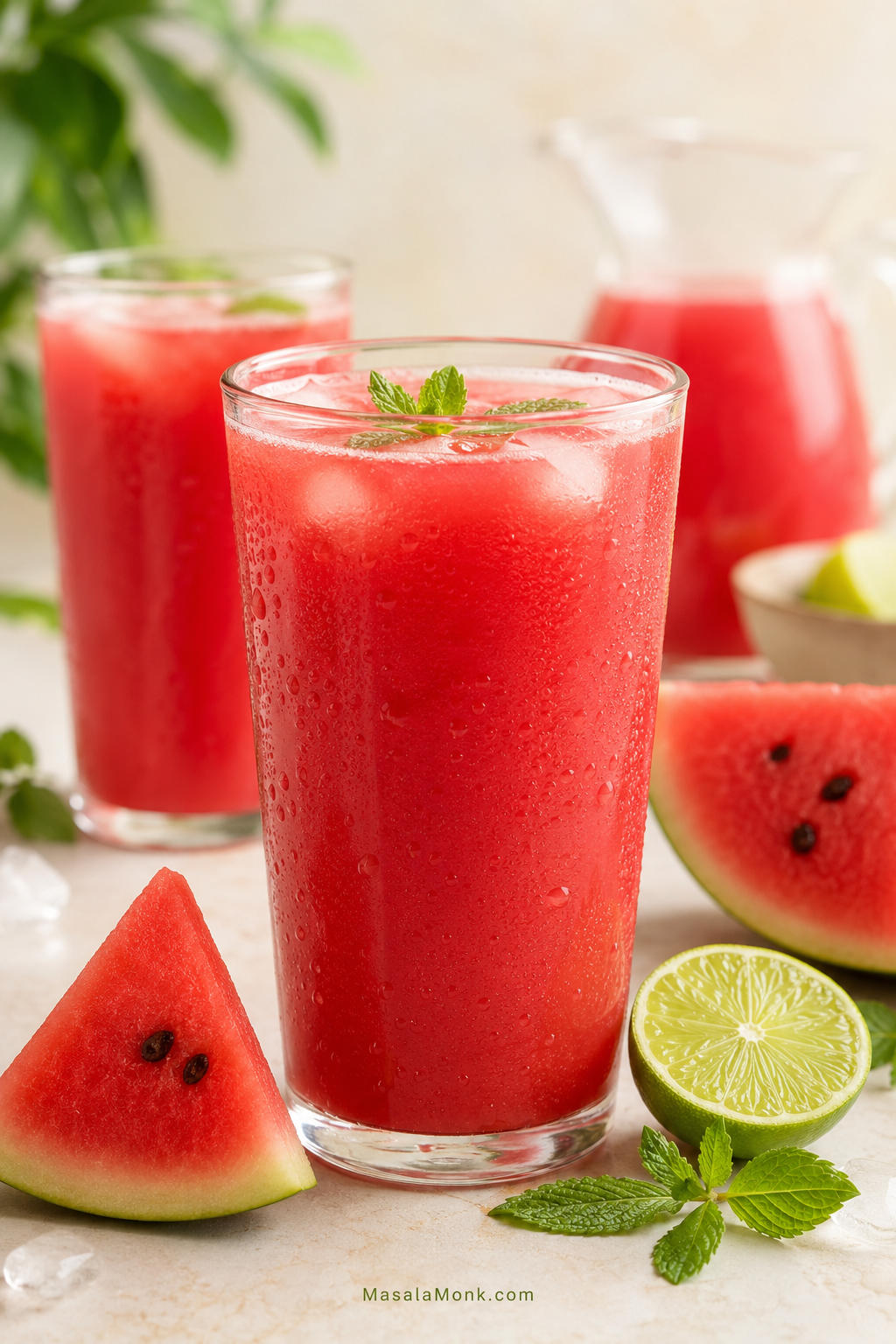
Cold watermelon juice served in clear glasses with ice, watermelon wedges, lime, and mint on a bright summer surface.

There are days when a cold glass of watermelon juice feels better than dessert: icy, ruby-red, naturally sweet, and bright enough to wake you up in a few sips. The only catch is that it can turn flat or watery if you blend it the wrong way.

This watermelon juice recipe keeps the flavor bold by blending cold watermelon without added water, then balancing it with lime or lemon and a small pinch of salt. You do not need a juicer, and you can leave it pulpy, strain it smooth, or turn the same base into watermelon cucumber juice, watermelon pineapple juice, mint watermelon juice, or Indian-style tarbooz juice with black salt.

The best glass should taste like biting into cold watermelon, not like watermelon-flavored water. That is why this method starts with chilled fruit, skips added water, and adjusts only after you taste: citrus for lift, a tiny pinch of salt for brightness, and more cold fruit for body.

Quick Answer: How to Make Watermelon Juice

Blend 4 cups cold seedless watermelon cubes with 1 tablespoon fresh lime or lemon juice and a small pinch of salt. Do not add water at first. Strain the juice if you want it smooth, or leave it unstrained for a thicker, pulpy, fresh-fruit texture. Serve it over ice right away, or chill it briefly and stir before pouring.

Sweet watermelon needs very little help. Bland fruit is where the lime-and-salt trick matters most. That small adjustment is what turns watery blended fruit into a bright, cold glass that actually tastes alive.
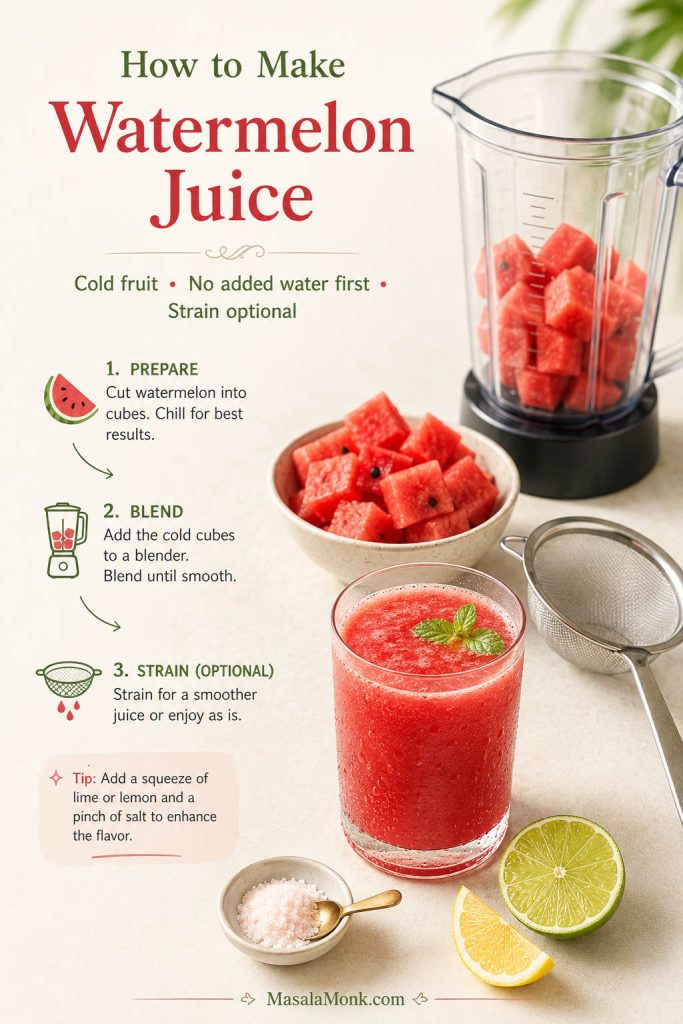
Quick guide showing watermelon cubes, lime, lemon, salt, a blender, and optional strainer for making watermelon juice.
Blend cold watermelon first, then taste before adding anything else. That small pause helps you fix the fruit you actually have instead of diluting the glass too early.

If your juice tastes flat, thin, or pulpy after blending, use the flavor fixes before adding more ice or sugar.

Why This Watermelon Juice Works

The best version should taste like cold, ripe watermelon first: clean, juicy, and bright. Everything else in this recipe is there to protect that flavor, not cover it up.

  • No juicer needed: Watermelon blends easily because it is naturally full of juice.
  • No added water: The drink stays sweet, fresh, and concentrated instead of diluted.
  • Lime or lemon wakes it up: A little acidity lifts even average watermelon.
  • A small pinch of salt helps: Regular salt sharpens the sweetness; black salt gives an Indian-style summer cooler flavor.
  • Straining is optional: Keep the pulp for body, or strain the juice for a cleaner pitcher-style drink.

Because the base is so clean, you can use it for everyday drinking, mocktails, brunch drinks, popsicles, or cocktails like a watermelon margarita.

Ingredients for Watermelon Juice

You only need watermelon for the simplest version, but lime or lemon and a little salt make the drink taste much more alive.

Watermelon juice ingredients arranged with watermelon cubes, lime, lemon, mint, salt, black salt, sweetener, and ice.
Watermelon does most of the work, while the small additions shape the flavor. Lime or lemon adds lift, salt sharpens sweetness, and mint or black salt changes the mood.
Ingredient US Measure Metric Why It Matters
Cold seedless watermelon cubes 4 cups About 600 g The main body, sweetness, and color of the drink.
Fresh lime or lemon juice 1 tablespoon 15 ml Lifts the flavor and fixes flat-tasting fruit.
Fine salt or black salt Small pinch, up to 1/8 teaspoon About 0.5 g Makes the fruit taste sweeter and more refreshing.
Fresh mint leaves 6–10 leaves Optional Adds a cooling summer flavor.
Honey, sugar, or agave 1–2 teaspoons Optional Use only if the watermelon is not sweet enough.
Ice As needed Optional Serve over ice, but avoid blending in too much ice because it waters down the flavor.

Seedless vs Seeded Watermelon

Seedless watermelon is easiest because you can cube and blend it quickly. If you have seeded watermelon, remove as many black seeds as possible before blending. A few small white seeds are usually fine in a blender, especially if you plan to strain the juice.

Lime or Lemon?

Lime gives the drink a sharper, more tropical edge. Lemon tastes softer and more familiar, especially if you are making watermelon lemonade or Indian-style tarbooz juice. Either works, so use what you have.

Split comparison showing lime and lemon options for watermelon juice, with lime shown as sharper and lemon as softer.
Lime gives the glass a sharper, cleaner edge, while lemon makes it softer and more lemonade-like. Choose lime for crispness and lemon for a gentler summer drink.

Do You Need Sugar?

Usually, no. A ripe watermelon should be sweet enough. However, if the fruit is pale, bland, or not fully ripe, add 1–2 teaspoons of honey, sugar, simple syrup, or agave. Start small because the drink should still taste fresh, not syrupy.

Decision board showing ripe watermelon needing no sugar and bland watermelon with optional sweetener or pineapple.
Ripe watermelon usually needs no sugar. When the fruit tastes pale or flat, pineapple or a tiny amount of sweetener can rescue the juice without making it syrupy.

If your watermelon needs help but you do not want to lean on sugar, pineapple is one of the easiest fruit fixes. For another naturally sweet tropical drink, this pineapple mango juice follows the same fruit-forward idea.

How to Pick a Sweet Watermelon

The best juice starts before the blender. If the melon is sweet and ripe, the recipe needs almost no help. If you only check two things, choose one that feels heavy for its size and has a creamy yellow field spot.

Whole watermelon with a creamy yellow field spot and ripe red cut fruit used as a guide for choosing watermelon for juice.
Better juice starts with better fruit. Choose a watermelon that feels heavy for its size and has a creamy yellow field spot for the best chance at sweetness.
  • Heavy for its size: A juicy watermelon should feel heavier than it looks.
  • Dull rind: A shiny rind can mean the fruit is underripe.
  • Creamy yellow field spot: This is where the melon rested on the ground. A deeper yellow spot usually suggests better ripeness.
  • Symmetrical shape: Avoid oddly dented or misshapen fruit when possible.
  • No soft spots or sour smell: Once cut, the flesh should smell fresh and sweet, not fermented.

How to Make Watermelon Juice in a Blender Without a Juicer

This is the easiest clean method because it is fast, low-effort, and does not require special equipment. You do not need a perfect watermelon for it to work. A great melon needs almost nothing; an average one can still become a good drink with citrus, salt, cold temperature, or a little pineapple.
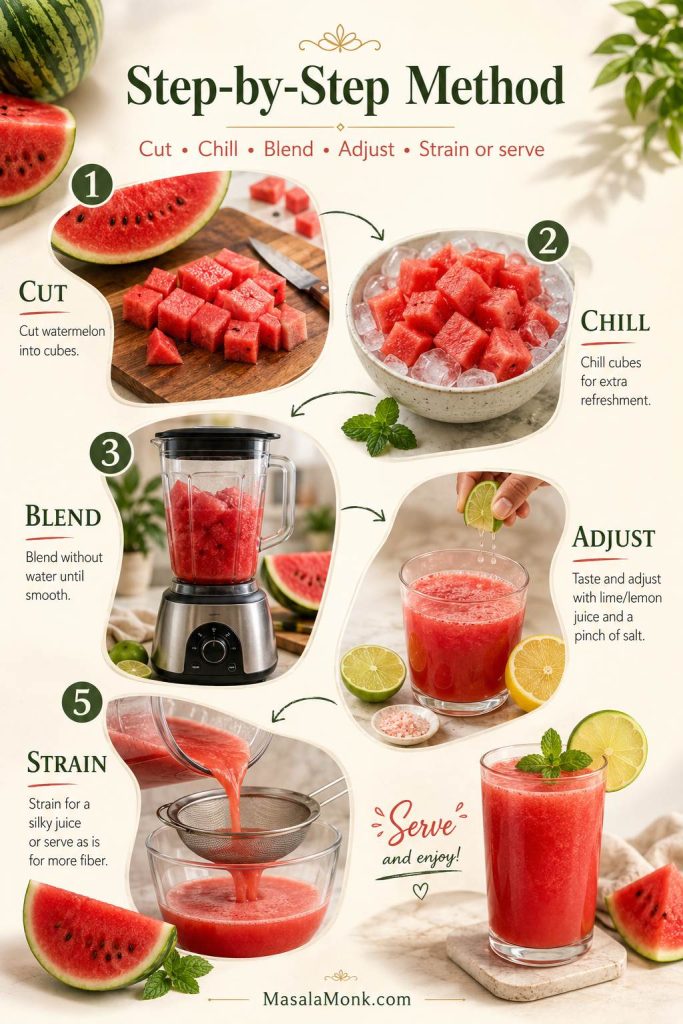
Step-by-step board showing watermelon being cut, chilled, blended, adjusted with citrus and salt, then strained or served.
The method is simple, but the order matters. Chill and blend the fruit first, then adjust the flavor before deciding whether to strain or serve.

Wash the Watermelon Before Cutting

Rinse the outside before cutting, and scrub the rind under running water if it feels dusty or dirty. You do not eat the rind, but the knife passes through it into the fruit, so a clean outside matters. Food-safety guidance also recommends washing produce before cutting, even when you do not eat the skin.

Whole watermelon being washed under running water before cutting for fresh juice.
Wash the rind before cutting, even though you will not eat it. As the knife passes through the outside into the flesh, a clean rind helps keep juice prep cleaner.

Chill the Watermelon

Cold fruit makes better juice. If the watermelon is already cold, you can serve the drink right away without blending in extra ice. If it is room temperature, cube it and chill the pieces for 30 minutes before blending, or chill the finished pitcher briefly before serving.

Cold watermelon cubes chilled in a glass bowl before blending into watermelon juice.
Cold fruit gives the drink better body and a cleaner first sip. It also reduces the need for blended ice, which can make the juice taste watery.

Cut Away the Rind

Slice off the green rind and the pale white part underneath it. A little pale edge will not ruin the drink, but too much white rind can make it taste grassy or thin.
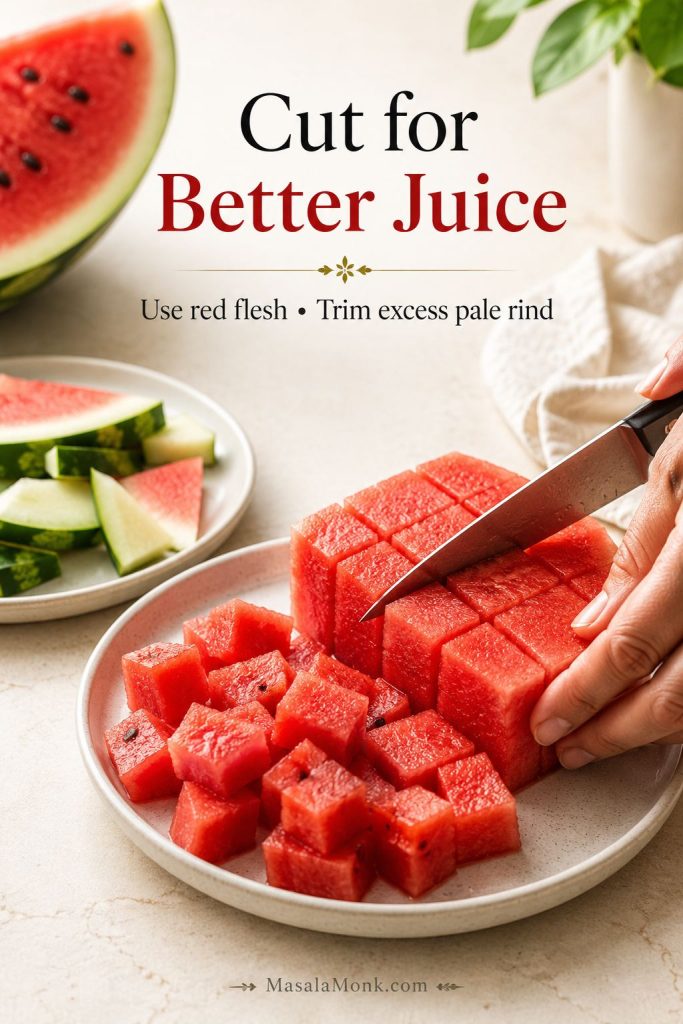
Watermelon being cut into red cubes with the pale rind trimmed away for making juice.
Use mostly the red flesh for the cleanest flavor. Too much pale rind can make fresh watermelon juice taste grassy, thin, or less naturally sweet.

Blend Without Water

Add the watermelon cubes to a blender and blend for 30–60 seconds, until smooth. Do not add water at first. The fruit releases plenty of liquid as it blends.

The No-Water Rule

Blend the watermelon by itself first. Extra water makes the drink thinner before you know whether it needs help. If the blender struggles, pulse a few times, press the fruit down with a tamper if your blender has one, or add only 1–2 tablespoons cold water to get the blades moving.
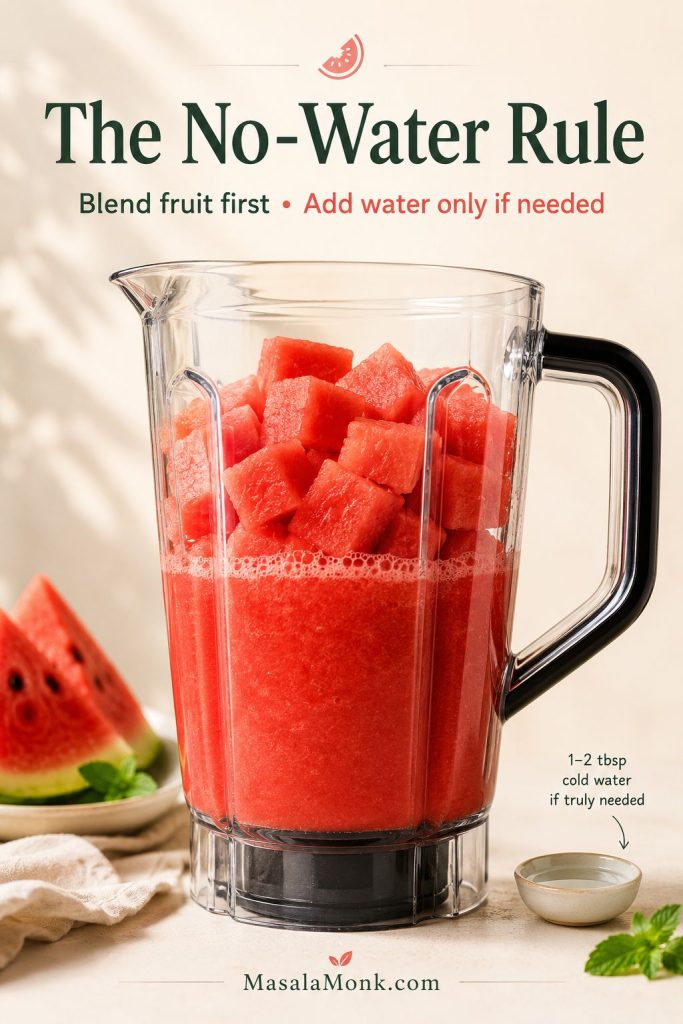
Blender filled with watermelon for the no-water method, with a small water cue only if needed.
Watermelon releases plenty of liquid once the blades catch. Start without water and use only the smallest splash of cold water if your blender refuses to move.

If the first blend tastes weak or watery, taste and adjust before adding ice or extra water.

Taste, Then Adjust

Taste before adding anything else. Sweet but flat? Add lime or lemon. Dull? Try a tiny pinch of salt or black salt. Not sweet enough? Add a teaspoon or two of honey, sugar, agave, or a little pineapple.

Taste-and-adjust guide showing citrus for flat juice, salt for dull juice, and pineapple for bland watermelon juice.
A quick taste tells you what the glass needs. Citrus brightens, salt sharpens, and pineapple adds sweetness plus acidity when the melon tastes weak.

Strain If You Want It Smooth

Pour the juice through a fine-mesh strainer for a clean, smooth glass. Leave it unstrained if you like a thicker, pulpy, fresh-fruit texture.

Serve Cold

Pour into glasses over ice and enjoy soon after blending. Garnish with mint, lime, lemon, or small watermelon wedges if you want it to look more polished.

Should You Strain Watermelon Juice?

Straining is optional. The right choice depends on the texture you want and how you plan to serve the drink.

If you want a juice-bar-style glass, strain it. If you want more body and less waste, leave it pulpy.

Comparison of strained watermelon juice and unstrained pulpy watermelon juice in clear glasses.
For a pitcher or mocktail, strained juice looks cleaner. When you are drinking it right away, the pulp adds body and keeps more of the fruit in the glass.
Style Texture Best For
Unstrained Thicker, pulpy, more body Everyday drinking, less waste, a fuller fruit texture
Fine-mesh strained Smooth but still fresh Pitchers, guests, cleaner glasses
Cheesecloth or nut milk bag Very smooth and polished Mocktails, cocktails, party drinks, or extra-smooth juice

For a quick glass at home, unstrained is perfectly fine. For a pitcher, mocktail, or cocktail, straining gives a cleaner finish.

Still not sure about texture? See the texture guide for thin, just-right, and pulpy juice.

How to Fix Bland, Watery, or Pulpy Watermelon Juice

This is where homemade watermelon juice either becomes excellent or stays forgettable. Watermelon changes from fruit to fruit, so taste the blended juice before adding anything. Then fix the exact problem instead of dumping in ice, sugar, or water.

If the first sip is not right, do not panic and do not add more ice. Flat juice needs citrus and salt, thin juice needs more cold fruit, and pulpy juice needs straining.

Troubleshooting board showing fixes for bland, watery, pulpy, thin, and flat watermelon juice.
Do not rescue a dull batch with more ice. Instead, fix the actual problem: brighten the flavor, rebuild the body, or strain the texture until the glass tastes balanced.
Problem Best Fix
Tastes flat Add 1 tablespoon lime or lemon juice and a small pinch of salt.
Not sweet enough Add 1–2 teaspoons honey, sugar, or agave. Pineapple also helps.
Too sweet Add lime, lemon, cucumber, or sparkling water.
Too watery Chill it, stir it, and serve over ice instead of blending ice into it. For more body, blend in extra cold watermelon.
Too pulpy Strain through a fine-mesh sieve, cheesecloth, or nut milk bag.
Too thin after straining Blend in more cold watermelon, not more ice.
Separated in the fridge Stir or shake before serving. Separation is normal.
Slightly grassy Use less of the pale white part near the rind next time.

What not to do: Do not fix thin, bland juice by blending in a lot of ice or water. That makes the flavor even weaker. Use lime or lemon for brightness, a small pinch of salt for lift, pineapple for sweetness, or more cold watermelon for body.

What the Right Texture Looks Like

The ideal texture is bright and full without becoming thick. Use this guide after blending or straining, especially if the juice tastes thin or feels too pulpy.

Three glasses comparing watermelon juice that is too thin, just right, and too pulpy.
The best texture is bright and full without feeling thick. If the juice is too thin, blend in more cold watermelon; if it is too pulpy, strain it.

Watermelon Juice Variations

Once the basic glass tastes bright, choose the variation by mood: cucumber for cooler and lighter, pineapple for sweeter and fuller, ginger for bite, sparkling water for a mocktail feel, and black salt for Indian-style tarbooz juice.

Variation guide showing cucumber, pineapple, ginger, sparkling, and tarbooz-style watermelon juice options.
Once the basic glass tastes balanced, choose the variation by mood. Cucumber cools it down, pineapple adds sweetness, ginger gives bite, and black salt makes it tarbooz-style.
What You Want Make This Version
Bright, crisp, and classic Watermelon lime juice
Cooler and less sweet Watermelon cucumber juice
Sweet-tart and tropical Watermelon pineapple juice
A little bite Watermelon ginger juice
Light, fizzy, and mocktail-like Sparkling watermelon juice
Tangy Indian summer-cooler flavor Tarbooz juice with black salt, mint, and lemon

If you are making a pitcher or party batch, check the yield guide before scaling any variation.

Watermelon Lime Juice

Choose this when you want the cleanest, brightest glass. Blend 4 cups watermelon with 1 tablespoon lime juice and a small pinch of salt. It tastes crisp, cold, and not too sweet.

Watermelon lime juice served cold with lime garnish, watermelon wedges, and condensation on the glass.
Choose watermelon lime juice when you want the crispest version. Lime cuts through the sweetness quickly, so the glass tastes clean, bright, and not too heavy.

Watermelon Lemon Juice

Lemon gives the base a softer, lemonade-like brightness. Use 1 tablespoon lemon juice instead of lime. This is the simplest version of watermelon and lemon juice, and it works especially well with mint or black salt.

Watermelon lemon juice served cold with lemon slices and a soft lemonade-style presentation.
Lemon gives the drink a softer kind of brightness. Because it tastes gentler than lime, this version works well when you want a watermelon lemonade feel.

Watermelon Mint Juice

Mint makes the drink taste colder and more refreshing, especially on very hot days. Blend 4 cups watermelon with 6–10 fresh mint leaves and 1 tablespoon lime juice. Start with fewer leaves if your mint is strong, because too much can turn the flavor herbal instead of fresh.

Watermelon mint juice served cold with fresh mint leaves and watermelon pieces.
Mint makes the drink feel cooler without adding sweetness. Start with a few leaves first, then add more only if you want a stronger herbal finish.

If mint and lime are your favorite part of the glass, you may also like this mojito recipe for the same cooling, citrusy direction.

Watermelon Cucumber Juice

When you want something cooler and less sweet, add cucumber. Blend 4 cups watermelon with 1/2 to 1 cup peeled cucumber, 1 tablespoon lime or lemon juice, and a small pinch of salt. This also covers the same idea people search for as watermelon and cucumber juice.

Watermelon cucumber juice served cold with cucumber slices, watermelon pieces, and mint.
Cucumber makes the juice lighter and less sweet, which helps when the watermelon is very ripe. It also gives the glass a cleaner, spa-water-style finish.

Watermelon Pineapple Juice

For bland watermelon, pineapple is the easiest rescue. It brings both sweetness and acidity, so the blend tastes fuller without needing much added sugar. Use 2 cups watermelon with 1 cup pineapple, then add lime if you want more sharpness. If you are looking for watermelon and pineapple juice, this 2:1 fruit ratio is the easiest place to start.

Watermelon pineapple juice served cold with pineapple pieces, watermelon, and mint.
Pineapple is the easiest fruit fix when watermelon tastes bland. It adds both sweetness and acidity, so the juice tastes fuller without needing much added sugar.

Watermelon Ginger Juice

For a sharper, more grown-up glass, add fresh ginger. It cuts through the sweetness and gives the juice a warm little kick. Blend 4 cups watermelon with 1 to 2 teaspoons fresh grated ginger and 1 tablespoon lemon or lime juice.

Watermelon ginger juice served cold with ginger root, citrus, mint, and watermelon.
Fresh ginger gives the drink a sharper, more grown-up finish. Start small because ginger can quickly overpower watermelon’s clean sweetness.

Watermelon Coconut Water

For a softer, slightly tropical version, blend 3 cups watermelon with 1/2 cup coconut water, lime, and mint. Use less coconut water at first because it thins the drink quickly.

Sparkling Watermelon Juice

For a mocktail-style glass, fill a cup about two-thirds full with cold watermelon juice, then top with chilled sparkling water. Add lime and mint for a cleaner finish.

Sparkling watermelon juice with visible bubbles, lime, mint, watermelon, and sparkling water.
Add sparkling water right before serving so the bubbles stay lively. This turns fresh watermelon juice into an easy mocktail-style summer drink.

For more non-alcoholic summer drink ideas, use this juice as a base for watermelon mocktails, especially versions with lime, mint, coconut water, or bubbles.

Indian-Style Tarbooz Juice

For an Indian summer-cooler flavor, blend watermelon with lemon or lime, mint, and a small pinch of black salt. Add only a tiny pinch of roasted cumin, black pepper, or chaat masala if you want that street-style edge. Keep the seasoning light so the fruit tastes cooler and brighter, not salty.
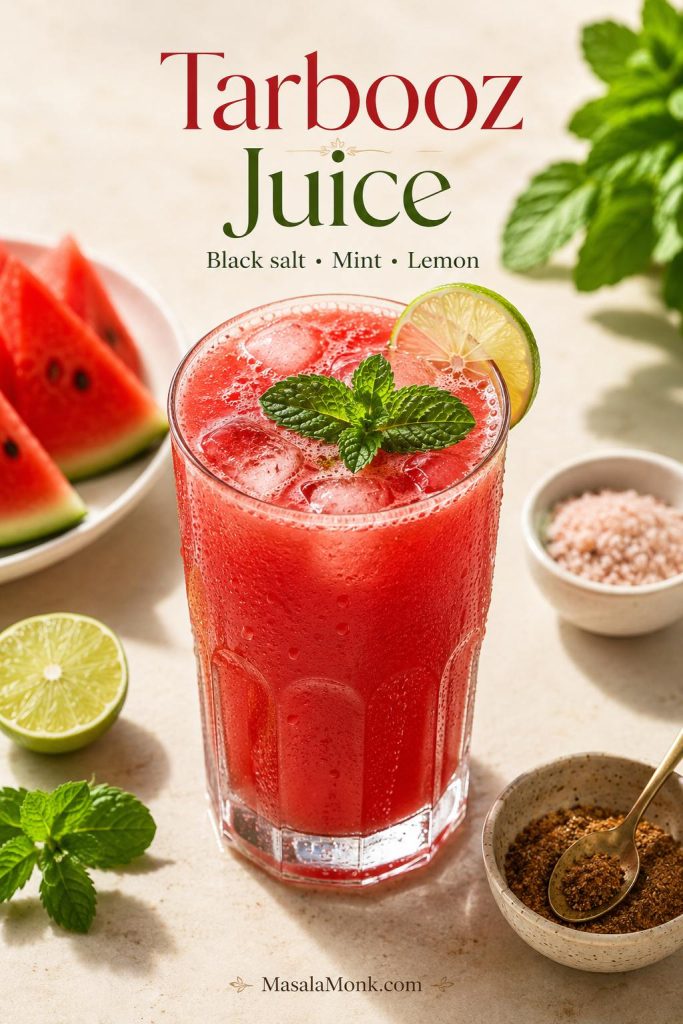
Indian-style tarbooz juice with watermelon juice, black salt, mint, lemon or lime, and small spice bowls.
Black salt gives tarbooz juice its tangy Indian summer-cooler edge. Keep the seasoning light, though, so the drink still tastes like cold watermelon first.

Juicing Watermelon: Blender vs Juicer Method

For watermelon, a blender is usually the better first choice because the fruit is already soft, juicy, and easy to break down. A juicer can work, but it often gives you a thinner, cleaner drink rather than the cold, full-bodied glass most people want at home.

Comparison of blender and juicer methods for watermelon juice, showing fuller blended juice and thinner juiced watermelon.
A blender gives watermelon juice more body, while a juicer makes it thinner and cleaner. For most home batches, blending first is easier and more satisfying.
Method Result Best For
Blender, unstrained Thicker juice with more body Everyday drinking and less waste
Blender, strained Smooth, clean juice Pitchers, guests, mocktails, cocktails
Juicer Thinner, clearer juice People who already own a juicer and prefer a lighter drink

If you use a juicer, remove the rind and feed the pieces through slowly. If you use a blender, you can decide after blending whether you want to strain the juice or keep the pulp.

For a more filling drink, unstrained blended juice has an advantage because it keeps more of the fruit’s body. Mayo Clinic notes that juicing is not healthier than eating whole fruits and vegetables, and that blending edible parts can retain more fiber and plant compounds than extracting juice alone. You can read their general juicing guidance for more context.

How Much Juice Does One Watermelon Make?

The exact yield depends on ripeness, juiciness, and whether you strain. These estimates will help you plan.

Watermelon juice yield guide showing juice amounts from 4 cups of cubes, 8 cups of cubes, and one small watermelon.
Watermelon yield changes with ripeness and juiciness, but 4 cups of cubes usually gives about 2 to 2½ cups of juice. Use this guide when scaling for a pitcher.
Watermelon Amount Approximate Juice Yield
4 cups cubed watermelon / about 600 g About 2–2½ cups / 480–600 ml
8 cups cubed watermelon / about 1.2 kg About 4–5 cups / 950 ml–1.2 L
1 small watermelon, about 6–6.5 lb About 5 cups, depending on juiciness

If you are making a pitcher for a group, start with 8 cups of cold cubed watermelon. That usually gives enough for about 4 glasses, especially if you serve it over ice or top some glasses with sparkling water.

How to Store Watermelon Juice

This drink tastes best right after blending. The flavor is brightest, the color is freshest, and the texture has not had time to settle.
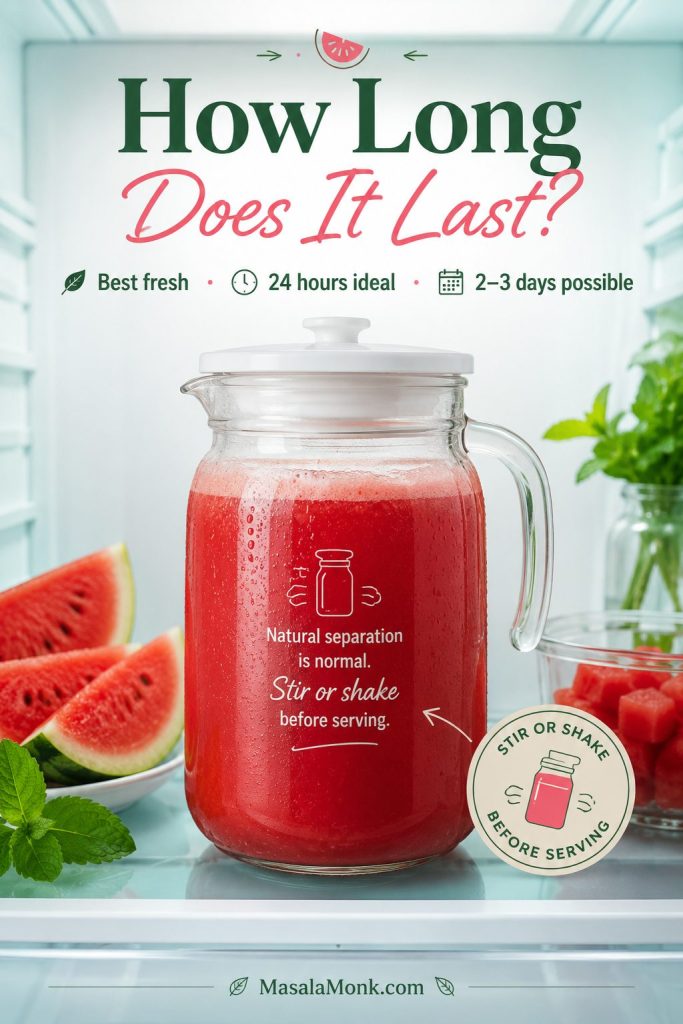
Storage guide for watermelon juice in a covered jar showing best fresh, 24 hours ideal, and 2 to 3 days possible.
Fresh is the peak, but a short fridge rest can still work. Keep the jar covered, serve it cold, and stir well before pouring because the pulp naturally settles.

Storage Rule

For the best make-ahead flavor, refrigerate watermelon juice in a clean covered jar for up to 24 hours. It can keep for 2–3 days if properly chilled, but the flavor fades and the juice naturally separates. Stir or shake before serving.

If you are serving guests, blend it the same day if possible. If you make it ahead, keep it covered and cold, then stir well and taste again before pouring.

  • Best: drink it right away.
  • Best make-ahead window: up to 24 hours in the fridge.
  • Possible: 2–3 days in a clean airtight jar, if kept cold.
  • Freeze: pour into ice cube trays for smoothies, mocktails, lemonade, or slushies.
  • Do not leave it out: fresh fruit juice should not sit at room temperature for long.

Separation is normal. It does not mean the juice has gone bad unless it smells sour, tastes fizzy, looks spoiled, or has been stored too long.

Freeze Extra Juice Into Cubes

Freezing is the best option when you have extra juice but do not want to drink it plain later. The cubes work better as a mixer than as thawed juice.

Frozen watermelon juice cubes in an ice cube tray with cubes added to a clear drink with lime and mint.
Freeze extra juice into cubes instead of wasting it. Later, use the cubes in lemonade, sparkling water, smoothies, slushies, or mocktails.

For more serving ideas, see the ways to use watermelon juice section.

Is Watermelon Juice Healthy?

Think of watermelon juice as a fresh summer drink, not a health shortcut. You do not have to turn it into a wellness claim for it to be worth making; a cold, unsweetened glass can simply taste like real fruit and feel better than soda.

Modest glass of watermelon juice beside whole watermelon pieces for a balanced health comparison.
Unsweetened watermelon juice can be a refreshing fruit drink, but whole watermelon is usually more filling. So, enjoy the juice, but keep portions in mind.

It is naturally sweet, colorful, and hydrating. However, it is still fruit juice, so whole watermelon is usually more filling because you chew it and keep more of the fruit’s natural structure. Unstrained blended juice keeps more body than fully strained juice, but it is still easier to drink quickly than eating watermelon pieces.

A modest glass of unsweetened watermelon juice is mostly blended fruit, so the calories and natural sugars depend on how much watermelon you drink. The main practical point is portion size: it is easier to drink several cups of juice than to slowly eat the same amount of fruit.

If you want a lighter drink, keep it unsweetened and add lime, mint, cucumber, or sparkling water instead of extra sugar. For a deeper nutrition-focused read, see our guide to watermelon juice benefits.

For a lighter glass, you can also try the watermelon cucumber juice or sparkling watermelon juice variations.

Is Watermelon Juice Good for Weight Loss?

It can fit into a balanced diet, especially if it replaces soda or heavily sweetened drinks. However, it does not cause weight loss by itself. For fullness, whole watermelon is usually better because it contains more intact fiber and takes longer to eat.

If weight management is your goal, keep the drink unsweetened, avoid oversized portions, and treat it as one refreshing glass within the rest of your day.

Ways to Use Watermelon Juice

Once there is a cold pitcher in the fridge, it disappears quickly. Drink it plain, stretch it with bubbles, freeze it into cubes, or use it as the base for summer drinks.

Ways to use watermelon juice, including an everyday glass, mocktail, lemonade, frozen cubes, and cocktail-style drink.
A pitcher can do more than fill one glass. Use it for everyday drinks, sparkling mocktails, watermelon lemonade, frozen cubes, or summer cocktails.
  • Everyday drink: serve cold over ice with lime.
  • Mocktail base: top with sparkling water, mint, cucumber, or coconut water.
  • Watermelon lemonade: mix with lemon juice and a little sweetener if needed.
  • Frozen cubes: use in lemonade, slushies, smoothies, and summer pitchers.
  • Cocktails: strain first for cleaner margaritas, mojitos, and daiquiris.

If you are making cocktails, strained juice usually works better because it gives a cleaner texture. For a frozen cocktail direction, strained watermelon juice also works well in a watermelon daiquiri.

Make the simple version once: cold watermelon, lime or lemon, and a pinch of salt. After that first bright, icy glass, you will know exactly how to adjust the cucumber, pineapple, mint, ginger, and black salt versions by taste.

Watermelon Juice Recipe Card

Here is the quick-reference version of the recipe, with the no-water rule and taste-before-adjusting step built in.
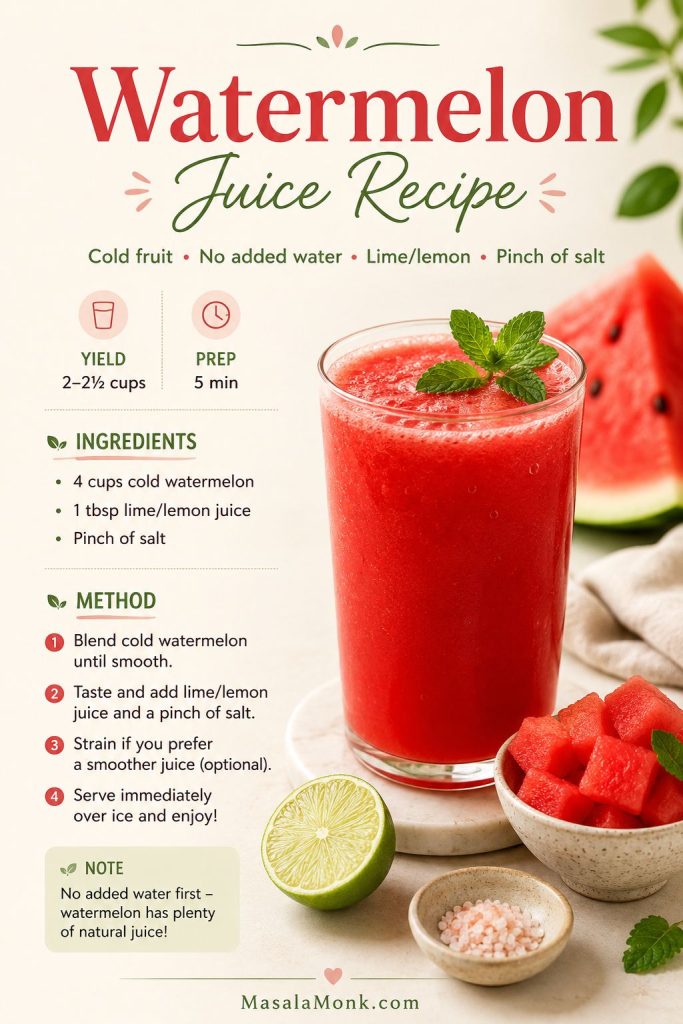
Saveable watermelon juice recipe card with yield, prep time, ingredients, and blender method beside a glass of juice.
This is the formula to remember: cold fruit first, no added water first, citrus for lift, and a tiny pinch of salt only after you taste the blended juice.

Watermelon Juice Recipe

Fresh watermelon juice made in a blender with cold fruit, no added water, lime or lemon, and a small pinch of salt for a bright, not-watery glass.

Prep Time5 minutes
Cook Time0 minutes
Total Time5 minutes
Yield2–2½ cups / 480–600 ml

Equipment

  • Blender
  • Knife and cutting board
  • Measuring cup
  • Fine-mesh strainer, optional
  • Pitcher or jar

Ingredients

  • 4 cups cold seedless watermelon cubes, about 600 g
  • 1 tablespoon fresh lime or lemon juice, 15 ml
  • Small pinch fine salt or black salt, up to 1/8 teaspoon
  • 6–10 fresh mint leaves, optional
  • 1–2 teaspoons honey, sugar, or agave, only if needed
  • Ice, for serving

Instructions

  1. Rinse the outside of the watermelon before cutting.
  2. Chill the watermelon if possible. Cold fruit makes better juice and reduces the need for extra ice.
  3. Cut away the rind and pale white part, then cube the red flesh.
  4. Add the cubes to a blender. Blend for 30–60 seconds, until smooth. Do not add water at first.
  5. Taste the juice. Add lime or lemon juice and a small pinch of salt or black salt. Add mint if using.
  6. Blend briefly again. If the fruit is not sweet enough, add 1–2 teaspoons honey, sugar, or agave.
  7. Strain through a fine-mesh sieve if you want smooth juice, or leave it unstrained for a thicker texture.
  8. Serve immediately over ice, or chill for 30 minutes and stir before serving.

Notes

  • Do not add water unless your blender truly cannot move. Add only 1–2 tablespoons if needed.
  • For watermelon cucumber juice, add 1/2 to 1 cup peeled cucumber.
  • For watermelon pineapple juice, use 2 cups watermelon and 1 cup pineapple.
  • For watermelon ginger juice, add 1–2 teaspoons fresh grated ginger.
  • For Indian-style tarbooz juice, use lemon or lime, mint, black salt, and a tiny pinch of roasted cumin or chaat masala.
  • The juice naturally separates. Stir or shake before serving.

Storage

Watermelon juice is best fresh. Refrigerate it in a clean covered jar for up to 24 hours for best flavor, or up to 2–3 days if properly chilled. Stir before serving.

For extra help beyond the card, see straining, storage, and watermelon juice variations.

FAQs

Do you need a juicer to make watermelon juice?

No. A blender is enough because watermelon is soft and naturally juicy. Blend the cubes until smooth, then strain only if you want a cleaner texture.

Should watermelon juice be strained?

Only if you want a smoother glass. Unstrained juice has more body; strained juice looks cleaner in pitchers, mocktails, and cocktails.

Can I make watermelon juice without sugar?

Usually, yes. Ripe watermelon is sweet enough on its own, especially when lime or lemon and a tiny pinch of salt brighten the flavor.

Why does watermelon juice separate?

Fresh blended fruit naturally separates as it sits because the pulp and liquid settle at different rates. Stir or shake before serving. Separation alone does not mean the juice has spoiled.

How long does fresh watermelon juice last?

It tastes best immediately. For the best make-ahead flavor, refrigerate it in a clean covered jar for up to 24 hours. It may keep for 2–3 days if properly chilled, but the flavor fades and separation increases.

Can I freeze watermelon juice?

Yes. Freeze it in ice cube trays, then use the cubes in lemonade, sparkling water, smoothies, mocktails, or slushies. The texture changes after thawing, so frozen cubes are better for mixing than drinking plain.

Can I use lemon instead of lime?

Yes. Lime tastes sharper and more tropical, while lemon gives a softer lemonade-style brightness. Use 1 tablespoon lemon or lime juice for every 4 cups of watermelon.

Can I make watermelon juice with seeds?

You can use seeded watermelon, but remove as many black seeds as possible before blending. A few small white seeds are usually fine, especially if you plan to strain.

What can I mix with watermelon juice?

The easiest mixers are lime, lemon, mint, cucumber, pineapple, ginger, coconut water, sparkling water, black salt, and a little roasted cumin. For mocktails and cocktails, strain it first so the drink tastes cleaner.

Is watermelon juice the same as watermelon agua fresca?

Not exactly. Watermelon juice is usually mostly blended watermelon, sometimes with citrus or salt. Watermelon agua fresca is usually lighter because it is diluted with water and often sweetened. For stronger fruit flavor, use this recipe without added water; for a lighter Mexican-style agua fresca, dilute and sweeten to taste.
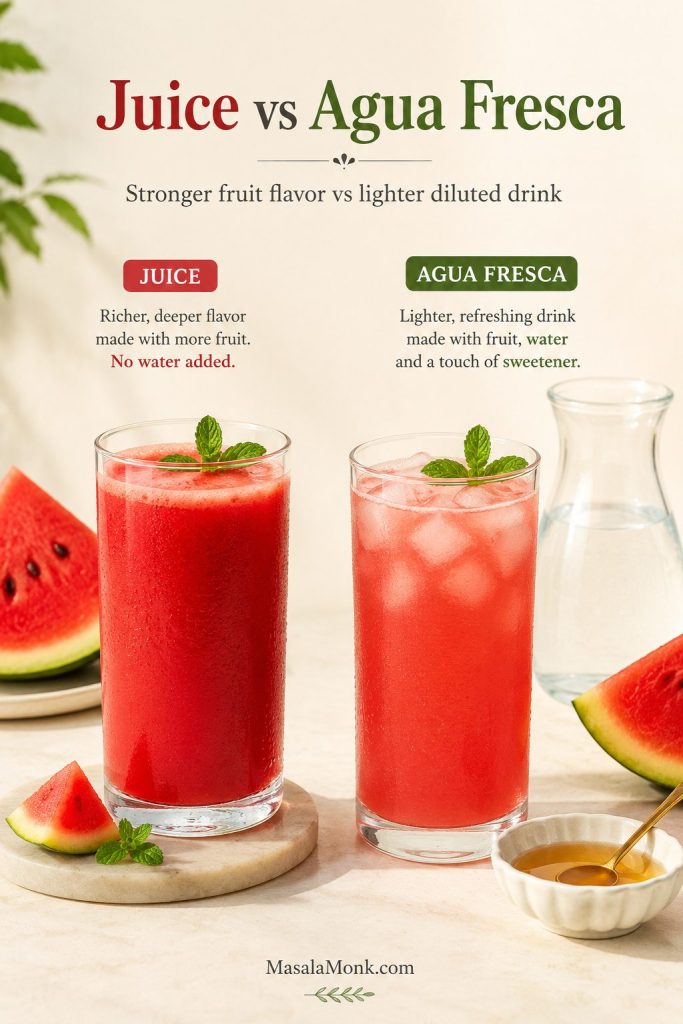

Comparison of watermelon juice and watermelon agua fresca, showing a richer undiluted drink and a lighter diluted drink.
Choose undiluted juice when you want stronger watermelon flavor. Choose agua fresca when you want a lighter, softer drink that is usually diluted and gently sweetened.

Back to top

Posted on 1 Comment

Metabolism Boosting Spices: 10 Best Options + Easy Mixes

Hands arranging small wooden bowls of metabolism boosting spices - turmeric, ground ginger, cayenne, cinnamon sticks, cumin seeds, fenugreek, saffron, and black peppercorns on a wooden table—ingredients for simple spice mixes that support satiety and steady energy.

Sometimes the smallest changes do the most. Metabolism boosting spices won’t remake a meal on their own; however, they can gently steady appetite, nudge post-meal thermogenesis, and smooth out energy across the day. When you season consistently—and when you pair flavor with simple routines—those quiet nudges begin to add up. Moreover, you’ll find they slot into foods you already enjoy, which means adherence feels natural rather than forced.


How metabolism boosting spices actually help

To begin with, think of spices as adjustable dials rather than switches. Some, like cayenne, appear to slightly increase energy expenditure after eating; others, like cinnamon, help blunt post-meal glucose bumps; still others, like fennel and saffron, tend to soften snack impulses. In other words, these aren’t fireworks; they’re guardrails. Furthermore, a pinch at breakfast, another at lunch, and something warm in the evening often leads to fewer crashes, fewer “is there anything sweet?” moments, and—eventually—more predictable days.


Cayenne (Capsaicin): a warm spark among metabolism boosting spices

There’s a particular magic to cayenne: a little warmth, a little color, and suddenly a simple plate feels vibrant. Within the world of metabolism boosting spices, cayenne earns its place because a tiny pinch can lift thermogenesis without requiring you to set your tongue on fire.

Use it today. Stir ⅛–¼ teaspoon into scrambled eggs; alternatively, whisk a pinch into lemon-ginger tea on cool mornings; or dust roasted carrots, sweet potato, or chickpeas right before they leave the oven. Additionally, finish dal tadka with a whisper of cayenne so the aroma stays lively. If you’re spice-sensitive, pair it with tomato or yogurt to soften the heat.

Keep it delicious. Cayenne loves citrus, garlic, and creamy textures. Consequently, olive oil + cayenne + lemon zest on grain bowls tastes intentional with almost no work.

Why it belongs here. A meta-analysis in the British Journal of Nutrition associated capsaicin with modest but significant reductions in body weight, BMI, and waist circumference in adults with overweight or obesity (Zhang et al., 2023). Moreover, mechanistic reviews describe capsaicin’s thermogenic pathways in detail (Zheng et al., 2017, Bioscience Reports).

Related MasalaMonk read: Cayenne Pepper for Weight Loss: Spicing Up Your Diet Plan! 🌶️ and then balance warmth and brightness with Cinnamon & Lemon for Belly Fat: Benefits, Evidence & Usage Tips.


Ginger: cozy, versatile, and quietly powerful for metabolism boosting spices

Ginger is the weekday friend that always shows up. Because it slips into tea, stir-fries, soups, chutneys, and smoothies, you can lean on it repeatedly without getting bored. Meanwhile, many people notice that ginger’s gentle heat calms “just a bite” impulses between meals.

Use it today. Grate ½–1 tsp fresh ginger into quick sautés; or simmer slices with water and lemon for a pre-lunch tea; or blend ¼ tsp ground ginger into a curd-and-berry smoothie; finally, stir a little into tomato curries or lentil soups right before serving.

Flavor pairings. Ginger brightens citrus; it mellows beautifully with honey; and, notably, it pairs seamlessly with soy-garlic-chili profiles. In Indian-style broths, ginger + black pepper + turmeric deliver warmth without heaviness.

What to expect. A synthesis in Nutrition Reviews pooling 27 randomized trials found ginger associated with reductions in body weight (~1.5 kg), BMI, waist circumference, and body-fat percentage compared with control (Rafieipour et al., 2024).

Keep going: build a comforting ritual with Turmeric, Ginger & Cinnamon Tea for Weight Loss and explore everyday uses in Ginger and Its Stunning Health Benefits.


Cinnamon (prefer Ceylon): breakfast’s best friend in metabolism boosting spices

Open a jar of cinnamon and the morning changes. Suddenly, oats, yogurt, and coffee feel like a plan rather than a scramble. In practice, cinnamon’s cozy sweetness helps many people steady the first half of the day; consequently, snacking tends to cool down.

Use it today. Stir ¼–½ tsp into oats or curd; additionally, dust it over coffee; or blend into a protein-and-fiber smoothie (banana + curd + ground flax); or simmer with stewed apples/pears and spoon over yogurt. In savory cooking, add a tiny pinch to tomato gravies or slow-cooked beans.

Smart notes. If you use cinnamon daily, prefer Ceylon (lower coumarin). Cassia, by contrast, works well in bolder dishes in smaller amounts.

What to expect. Controlled-trial syntheses report small but significant improvements in weight, BMI, and waist–hip ratio with cinnamon compared with control (Yazdanpanah et al., 2020, Clinical Obesity; Mousavi et al., 2020, Clinical Nutrition ESPEN).

Next steps: kitchen-level ideas live in Cinnamon for Weight Loss and Cinnamon Water to Reduce Belly Fat.


Turmeric + Black Pepper: the absorption duo of metabolism boosting spices

Turmeric has a reputation; yet, without pepper, much of it doesn’t land. Because piperine in black pepper dramatically improves curcumin absorption, this partnership is the rare “1 + 1 = 3” in seasoning.

Use it today. Stir ½ tsp turmeric into dals, soups, scrambled eggs, or golden milk; subsequently, finish with freshly cracked pepper and a little fat (ghee, olive oil, or coconut milk). Add pepper at the end so aromatics—and piperine—stay vivid.

Why the pairing matters. An umbrella review with updated analyses in the American Journal of Clinical Nutrition linked curcumin with reductions in BMI, weight, and waist circumference, with bioavailability-enhanced forms performing best (Unhapipatpong et al., 2023). Additionally, classic pharmacokinetic work showed 20 mg piperine increased curcumin bioavailability roughly twenty-fold in humans (Shoba et al., 1998, Planta Medica).

More ideas: practical pairing notes appear in Exploring the Science Behind Turmeric & Ginger for Effective Weight Loss.


Cumin (Jeera): a subtle cornerstone of metabolism boosting spices

Some flavors are so foundational that you miss them only when they’re absent. Cumin is that flavor. Freshly toasted and ground, it makes food taste “finished,” which—interestingly—often encourages smaller, more satisfying portions.

Use it today. Toast whole cumin seeds until fragrant; then cool, grind, and keep the jar beside your salt. Sprinkle ½ tsp on raita or chopped salads; fold into chickpea salads and lemony rice; or simmer jeera water in the morning and sip slowly.

Keep it bright. A squeeze of lime over cumin-forward dishes keeps them lively. Likewise, a handful of herbs (cilantro, mint) makes the same bowl feel new.

What to expect. In a three-month study within a reduced-calorie plan, 3 g/day cumin powder mixed into yogurt improved weight, BMI, waist, fat mass, and lipids versus control (Complementary Therapies in Clinical Practice: Zare et al., 2014). Related work in Annals of Nutrition & Metabolism reported benefits for weight-management markers in overweight adults (Taghizadeh et al., 2015).

Build a morning rhythm: sip ideas from Morning Metabolism Boost: 5 Green Tea & Spice Infusions.


Fenugreek (Methi): fullness first in metabolism boosting spices

Fenugreek is the quiet nudge toward “that’s enough.” Because its subtle bitterness gently raises satiety, it’s perfect for moments when second helpings usually appear out of nowhere.

Use it today. Soak a spoon of whole seeds overnight and chew before lunch; alternatively, whisk ½ tsp powdered methi into chapati flour; or temper a pinch in tadkas, sambars, and rustic tomato gravies. Additionally, a light fenugreek tea 20–30 minutes before your usual snack window can take the edge off.

Balance the taste. If bitterness feels new, add lemon or a touch of honey in drinks; in curries, rely on onion-tomato bases and a little fat to round it out.

What to expect. In a randomized, placebo-controlled, three-way crossover trial, fenugreek tea reduced short-term appetite ratings in overweight women versus control (Clinical Nutrition Research: Bae et al., 2015). Although the trial was brief, the satiety signal is practically useful.

Pair with brightness: a morning start using Lemon–Ginger–Turmeric Water complements methi beautifully. Also more about it in our post Fenugreek: An Appetite Suppressant for Weight Management.


Saffron: a graceful curb on grazing within metabolism boosting spices

Saffron doesn’t shout; it elevates. Because it turns simple sips into something special, it often softens the “I need a snack” itch without feeling punitive.

Use it today. Steep 3–4 strands in hot water; then add to milk with a hint of cardamom; or crumble into delicate broths; or fold into basmati rice with peas and toasted nuts. Notably, the luxury of saffron makes small portions feel complete.

What to expect. A double-blind trial linked a standardized saffron extract with less snacking and greater weight loss over eight weeks among mildly overweight women versus placebo (Nutrition Research: Gout et al., 2010). For broader context—and supplement-quality notes—see the overview by Mashmoul et al., 2013 (Journal of Nutrition & Food Sciences).

Also Read: Saffron: The Golden Spice for Weight Loss and Appetite Control


Ajwain (Carom): digestive support in the family of metabolism boosting spices

Ajwain is the friend you invite to keep things comfortable. Although it’s not a direct fat-loss driver in human trials yet, its digestive profile makes heavier meals feel lighter; therefore, it helps you stay consistent.

Use it today. Dry-roast and grind; add a tiny pinch to buttermilk, raita, or the jeera–ajwain–saunf mix below; sprinkle over roasted cauliflower with lemon and cilantro; or fold into paratha dough for a delicate, minty-herbal edge.

Evidence status. Weight-change trials in humans are limited. Nevertheless, a broad review describes thymol-rich seeds, digestive support, and antimicrobial notes (Boskabady et al., 2014, Iranian Journal of Basic Medical Sciences).

Also Read: Ajwain Benefits for Weight Loss: Unraveling the Secrets


Fennel (Saunf): a gentle evening finish among metabolism boosting spices

Fennel tastes like dessert’s cousin—sweetly herbal, soothing, and perfect for closing the kitchen. No wonder, many people find that a fennel ritual reduces night-time rummaging.

Use it today. Chew 1 tsp after dinner; or brew a light tea; or crush lightly and add to spice mixes; or bloom in oil for tomato-based sauces. Furthermore, fennel tea plus a slow 10-minute walk is a remarkably effective “day is done” signal.

What to expect. In the same crossover work that tested fenugreek tea, fennel tea lowered short-term hunger ratings in overweight women compared with control (Clinical Nutrition Research: Bae et al., 2015). Because the study was brief, consider fennel appetite support rather than a primary driver.

Also Read: Guide to Fennel Seeds and Weight Loss


Black Pepper (Piperine): the multiplier inside metabolism boosting spices

Freshly cracked pepper is habit-forming—in the best way. While it doesn’t appear to raise 24-hour energy expenditure on its own, it does multiply turmeric’s usefulness; therefore, it’s the “always add” move whenever curcumin is in the picture.

Use it today. Grind pepper over any turmeric dish—dal, soups, eggs, or golden milk—right at the end. Additionally, finish salads, eggs, and roasted veg with a quick crack to tie flavors together.

What to expect. Whole-room calorimetry found no change in 24-hour energy expenditure with black pepper alone (Functional Foods in Health & Disease: O’Connor et al., 2013). Conversely, piperine boosted curcumin bioavailability roughly twenty-fold in humans (Shoba et al., 1998, Planta Medica), which is why pepper belongs in every turmeric recipe.

Do Read: 8 Benefits of Black Pepper for Weight Loss


Two metabolism boosting spices blends you’ll actually use all week

Jeera–Ajwain–Saunf Powder (all-purpose, digestion-forward)

You’ll need: cumin (2 tbsp), ajwain (1 tbsp), fennel (1 tbsp)
Method: First, dry-roast each spice separately over medium heat until fragrant. Next, cool completely. Then grind to a fine powder and store airtight.
How to use: Stir ½ tsp into raita; sprinkle over cucumber–tomato salads; whisk ¼ tsp into warm water after meals 1–2×/day; add a pinch to paratha dough or khichdi.
Variations: Prefer a softer finish? Tilt the blend toward fennel. Want a minty nip? Nudge the ajwain slightly higher. If reflux flares, keep ajwain modest and pair with yogurt or buttermilk.

Turmeric–Ginger Tea (pepper-boosted)

You’ll need: water (250 ml), grated ginger (½ tsp or ¼ tsp powder), turmeric (½ tsp), a pinch of black pepper, optional cinnamon stick, lemon
Method: Simmer water with ginger and turmeric for 5 minutes. Then turn off heat, add pepper, steep 1 minute, strain, and finish with lemon.
How to use: One cup with breakfast or before a brisk walk works well. If evenings are your soft spot, let this be your “kitchen is closed” cue.
Why pepper matters: as noted earlier, piperine multiplies curcumin’s availability in humans, which is exactly why this pairing belongs in a plan built around metabolism boosting spices.


A 14-day, zero-overwhelm rotation (to make metabolism boosting spices stick)

Swap freely as life happens; nevertheless, this structure keeps momentum while steadily weaving metabolism boosting spices into everyday meals.

Day 1

Breakfast: Oats with curd, chia, and cinnamon; additionally, finish with a light crack of black pepper on top if you swirl in turmeric.
Lunch: Lemon-cumin cucumber salad alongside dal tempered with turmeric + pepper; moreover, add a squeeze of lime for lift.
Evening: Fennel tea; consequently, the gentle sweetness helps close the kitchen without cravings.

Day 2

Breakfast: Soft ginger scramble with a whisper of cayenne; alternatively, fold ginger into besan for a quick chilla.
Lunch: Chickpea salad dressed with toasted cumin, garlic, and lemon; furthermore, scatter herbs for freshness.
Dinner: Turmeric–ginger tea (pepper-boosted); meanwhile, keep portions calm with a small side of yogurt.

Day 3

Breakfast: Curd, banana, and cinnamon with ground flax; consequently, the combo rides steady till lunch.
Lunch: Tomato–ginger soup finished with ghee infused with turmeric + pepper; likewise, add a side of steamed veg.
Evening: Warm saffron milk with a hint of cardamom; afterward, lights low to signal “day is done.”

Day 4

Breakfast: Avocado toast with cayenne and cracked black pepper; additionally, a squeeze of lemon brightens the heat.
Lunch: Khichdi sprinkled with jeera–ajwain–saunf powder; meanwhile, a carrot salad adds crunch.
Dinner: Fennel tea and a slow 10-minute walk; consequently, late-night snacking fades.

Day 5

Breakfast: Smoothie (curd, berries, ginger, cinnamon); besides that, add chia for extra fiber.
Lunch: Grilled vegetables tossed with cumin and lemon; alternatively, serve over quinoa.
Evening: Turmeric–ginger tea (pepper-boosted); then, kitchen closed.

Day 6

Breakfast: Masala omelette (tomato, onion, ginger) finished with turmeric + pepper; likewise, a side of fruit.
Lunch: Lentil soup brightened with lime and toasted cumin; additionally, a cucumber salad cools things down.
Dinner: Light saffron broth; consequently, you end satisfied, not stuffed.

Day 7

Breakfast: Warm curd bowl with stewed apples and cinnamon; meanwhile, walnuts add crunch.
Lunch: Dal–rice with ghee infused with turmeric + pepper; furthermore, sprinkle fresh coriander.
Evening: Ginger–fennel tea; finally, an easy book instead of screens.

Day 8

Breakfast: Ginger-spiked besan chilla; subsequently, a spoon of mint raita.
Lunch: Raita seasoned with jeera–ajwain–saunf alongside a mixed-veg pulao; in the end, finish with lemon.
Dinner: Saffron tea; nonetheless, if hungry, add a few almonds.

Day 9

Breakfast: Overnight oats with cinnamon and orange zest; consequently, a bright, steady start.
Lunch: Tomato dal tempered with turmeric + pepper; likewise, a quick salad with toasted cumin.
Evening: Fennel tea; additionally, a short stretch helps digestion.

Day 10

Breakfast: Poha with grated ginger and a pinch of cayenne; alternatively, swap cayenne for extra lemon if sensitive.
Lunch: Quinoa salad with cumin–garlic–lemon dressing; moreover, toss in chickpeas.
Dinner: Turmeric–ginger tea (pepper-boosted); then, kitchen lights off.

Day 11

Breakfast: Curd with berries and cinnamon; meanwhile, pumpkin seeds add texture.
Lunch: Mixed beans with warm cumin vinaigrette; additionally, chopped onions and herbs for bite.
Evening: Saffron milk; consequently, dessert cravings soften.

Day 12

Breakfast: Savory masala oats with ginger; finally, a last-minute dusting of black pepper.
Lunch: Simple dal with a cucumber–onion salad dusted with jeera–ajwain–saunf; furthermore, add lemon.
Dinner: Fennel tea; alternatively, brew fenugreek tea if evenings are your snack window.

Day 13

Breakfast: Smoothie (curd, spinach, ginger, cinnamon); moreover, a teaspoon of flax keeps it satisfying.
Lunch: Roasted cauliflower with ajwain + cumin + lemon; likewise, a spoon of yogurt steadies spice.
Evening: Turmeric–ginger tea (pepper-boosted); consequently, appetite winds down naturally.

Day 14

Breakfast: Eggs with tomatoes and turmeric, finished at the table with black pepper; additionally, toast on the side.
Lunch: Chickpea curry rounded with cumin and coriander; meanwhile, a fresh salad for crunch.
Evening: Ginger–fennel tea to close the day; finally, a calm bedtime routine seals the habit.


How to keep it flexible: If a day runs long, simply swap the evening sip (fennel, saffron, or turmeric–ginger with pepper) for whichever you can make fastest; meanwhile, carry forward the skipped choice to tomorrow. Consequently, you maintain rhythm while continuing to layer metabolism boosting spices into meals you already cook.


Buying, storing, grinding: the unsexy wins behind metabolism boosting spices

First, buy whole (cumin, fennel, pepper) and grind weekly; aroma—and satisfaction—jump immediately. Second, toast before grinding: a minute in a dry pan releases oils and multiplies flavor; cool fully before grinding. Third, store smartly: dark jars, cool cupboards, tight lids; heat, light, and air steal flavor. Finally, finish smart: add pepper and delicate aromatics near the end so volatile compounds don’t vanish into steam.


Troubleshooting (and effortless swaps)

  • Too hot? Swap cayenne for cinnamon or cumin; keep ginger mostly in tea rather than dry rubs.
  • Too bitter? Temper fenugreek with lemon or a touch of honey; in curries, lean on onion-tomato bases and a little fat.
  • Bored already? Rotate regions: dal one night, cumin-lemon salad the next, ginger-miso broth later in the week.
  • No time? Keep toasted-ground cumin on the counter, fennel by the kettle, and a pepper mill next to the salt—one twist, one pinch, done.
  • No progress yet? Revisit sleep, protein, and steps; metabolism boosting spices make good habits easier, but they don’t replace fundamentals.

Safety and comfort come first

Because your kitchen should make life easier, adjust spices to your context. If you’re pregnant or breastfeeding, on anticoagulants or glucose-lowering medication, or managing reflux or gallbladder issues, tailor doses and check with your clinician as needed. Generally speaking:

  • With reflux, go lighter on cayenne and ginger; lean on cinnamon, fennel, and cumin.
  • On blood thinners, be cautious with turmeric + pepper and avoid concentrated curcumin supplements unless advised.
  • When adjusting glucose-lowering meds, introduce fenugreek carefully and watch for appetite or glycemic shifts.
  • For any spice, start tiny (⅛ tsp), then step up slowly.

Keep exploring (reader-friendly companions)

A closing nudge

None of these is a miracle on its own. Together—and, above all, repeatedly—they tilt your meals in the right direction. A little heat here, a calmer morning there, a cup that closes the kitchen at night: that’s how change actually looks. Pick two ideas that feel easy this week, make them yours, and keep going. The rest will follow.

FAQs

1) Do metabolism boosting spices actually work for fat loss?

Yes—just not like magic. Firstly, spices such as cayenne, ginger, cinnamon, turmeric (with black pepper), cumin, and saffron can nudge thermogenesis, tame appetite, and smooth post-meal energy. Secondly, these nudges are modest; however, they compound when you use them daily alongside balanced meals and movement. Consequently, think “steady assist,” not “instant fat burner.”

2) What spice boosts metabolism the most?

It depends on what you’ll use consistently. Cayenne (capsaicin) offers a gentle thermogenic lift; meanwhile, ginger and cinnamon help with appetite and post-meal comfort. Moreover, turmeric plus black pepper improves curcumin’s impact, while cumin and saffron support satiety and portions. In short, the “best” metabolism boosting spice is the one you’ll enjoy multiple times a week.

3) Which spices burn belly fat specifically?

No spice targets belly fat directly. Nevertheless, fat burning spices can help reduce overall body fat by supporting better adherence—fewer snack attacks, steadier energy, and more satisfying meals. Consequently, belly fat often decreases as part of overall loss when routines stay consistent.

4) What spices increase metabolism for beginners?

Start simple: cinnamon at breakfast, turmeric + black pepper at lunch, and ginger or fennel tea in the evening. Additionally, keep cumin nearby to finish salads and lentils. Importantly, begin with tiny amounts, then scale by taste; meanwhile, track how your appetite and energy respond.

5) Is there a single “spice that burns fat” fast?

Not really. However, a cayenne pinch can warm meals immediately; ginger can curb grazing; and saffron may lower snack urges. Moreover, cinnamon pairs well with protein and fiber for steadier mornings. Ultimately, sustainability beats speed—choose what you can repeat.

6) Do spicy foods boost metabolism more than mild ones?

Often, yes—capsaicin from chilies can increase thermogenesis a bit. Even so, intensely spicy food isn’t required. Instead, a modest sprinkle of cayenne or a mildly spiced curry can be enough. Furthermore, comfort matters: if heat bothers you, choose cinnamon, cumin, turmeric + pepper, ginger, fennel, or saffron for gentler support.

7) How should I use turmeric for weight loss?

Use turmeric with black pepper and a little fat. Firstly, stir ½ tsp turmeric into dal, soup, or eggs; secondly, finish with freshly cracked pepper; finally, include ghee/olive oil/coconut milk so curcumin absorbs better. Additionally, a small turmeric-ginger tea (pepper-boosted) works as an easy daily ritual.

8) Does turmeric speed up your metabolism on its own?

Turmeric helps more when paired with black pepper; otherwise, much of its curcumin isn’t absorbed well. Consequently, you’ll see better results from the duo. Meanwhile, if you’re sensitive to pepper, start with a very small pinch and build up gradually.

9) Is cinnamon good for losing weight?

Cinnamon pairs wonderfully with breakfast protein and fiber, which can reduce rebound hunger. Moreover, it makes oats, curd, and smoothies feel satisfying. Nevertheless, use modest doses and favor Ceylon cinnamon if you use it daily. In short, cinnamon supports the routine that supports the result.

10) What about cumin (jeera) for weight loss?

Cumin is the quiet over-achiever. Toast, grind, and sprinkle ½ tsp on raita, salads, chickpeas, or lentils. Additionally, jeera water in the morning can become a calming habit. While results are modest, the flavor makes portions feel complete; consequently, grazing often drops.

11) Can ginger help with metabolism and fat loss?

Ginger adds cozy warmth and, for many, reduces snack urges. For example, grate it into stir-fries or brew a quick tea 20–30 minutes before your “danger window.” Furthermore, pair ginger with a short walk; together, they often quiet that “just a bite” loop.

12) Are saffron and appetite suppressant spices useful?

Saffron can help some people snack less. A few strands in warm milk or tea feel luxurious; therefore, smaller portions still feel satisfying. Meanwhile, appetite-calming spices like fennel or fenugreek can also help you pause, reassess hunger, and stop earlier—especially at night.

13) Which spices boost metabolism without causing acidity?

Choose cinnamon, cumin, fennel, and saffron first. Additionally, turmeric + black pepper can work if you keep doses small and add fat. Conversely, go lightly with cayenne or strong ginger if you’re reflux-prone; nonetheless, tiny amounts folded into moist dishes are often tolerated.

14) What’s the simplest “weight loss spice mix” I can make at home?

Try a jeera–ajwain–saunf blend. To begin, dry-roast cumin (2 tbsp), ajwain (1 tbsp), and fennel (1 tbsp) separately, then grind and store airtight. Next, use ½ tsp in raita or ¼ tsp in warm water after meals. Moreover, adjust ajwain down if you prefer gentler digestion support.

15) Is black pepper itself a metabolism booster?

Alone, black pepper doesn’t seem to raise 24-hour energy expenditure meaningfully. However—and this is crucial—piperine enhances turmeric’s curcumin absorption, which makes the turmeric + pepper duo a practical everyday move. Consequently, keep a grinder beside your salt and finish dishes at the table.

16) Do “fat burning spices” help if my diet isn’t perfect?

They help most when the basics are steady. Even so, spices can reduce cravings, steady energy, and improve meal satisfaction, which, in turn, makes better choices easier. Additionally, they require almost no time: one pinch, one stir, done. Therefore, think of them as low-effort momentum.

17) How many times per day should I use metabolism boosting spices?

Twice is great; three times is excellent. For instance, cinnamon at breakfast, turmeric + pepper at lunch, and ginger or fennel in the evening. Moreover, keep cumin handy to finish salads or lentils. Importantly, small amounts used daily beat large doses used rarely.

18) Can I lose weight with spices but without exercise?

You can make progress with food habits alone; however, movement amplifies your effort. Meanwhile, even short walks—5 to 10 minutes after meals—improve how you feel and how your body handles food. Consequently, pair your spice routine with light activity whenever possible.

19) Are there side effects or people who should be cautious?

Yes, and it’s wise to personalize. For example, if you’re pregnant or breastfeeding, on blood thinners or glucose-lowering meds, or dealing with reflux/gallbladder issues, start small and check with your clinician. Additionally, listen to comfort: if something feels off, scale back and swap to gentler options.

20) What’s a realistic timeline to notice changes?

Give it 2–4 weeks of consistent seasoning to feel steadier energy and fewer snack impulses. Subsequently, look for small changes: slightly smaller portions, calmer afternoons, and easier evenings. Eventually, as meals feel “enough,” overall intake trends down—and results follow.

21) Which spices suppress appetite most naturally?

Different people respond to different cues. Nevertheless, saffron, fennel, and fenugreek stand out for many. Meanwhile, ginger helps when used before a walk or as a pre-meal tea. Additionally, cinnamon with protein/fiber at breakfast often reduces mid-morning grazing.

22) What’s the best bedtime spice routine for late-night cravings?

Go gentle and soothing. For instance, fennel tea after dinner is light and sweetly herbal; alternatively, saffron milk feels special without being heavy. Furthermore, a turmeric–ginger tea (pepper-boosted) can be calming if you tolerate it well. Consequently, late-night nibbling usually fades.

23) Which spices should I focus on for belly fat and metabolism if I only choose three?

Choose what fits your day:

  • Cinnamon for breakfast stability and fewer sugar crashes.
  • Turmeric + black pepper for a lunch or dinner anchor.
  • Ginger (or fennel at night) for snack control.
    Moreover, add a cumin sprinkle where you can—it’s an easy bonus.

24) What’s the easiest way to keep this going long-term?

Anchor habits to cues you already have. For example, crack pepper whenever you see turmeric; meanwhile, keep cinnamon by your coffee canister; additionally, place fennel near the kettle. Consequently, you’ll season on autopilot and stick with metabolism boosting spices without thinking.

Posted on 2 Comments

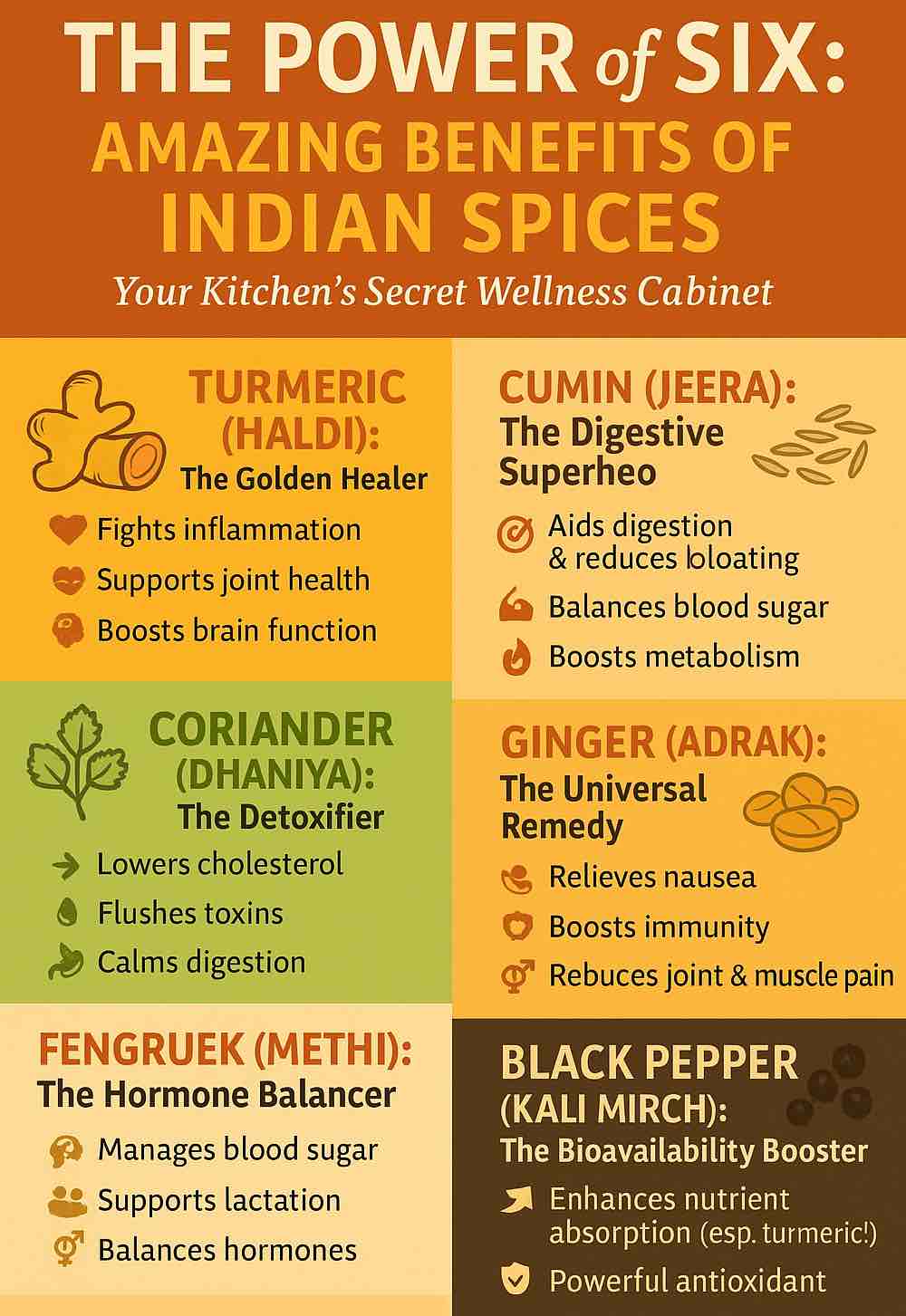
The Power of Six: Amazing Benefits of Common Indian Spices

BENEFITS OF INDIAN SPICES

When we think of Indian cuisine, the first thing that often comes to mind is its explosion of colors, aromas, and flavors. But behind these vibrant dishes lies a centuries-old tradition of using spices not just for taste but also for their powerful health benefits.

Indian spices have been a cornerstone of Ayurvedic medicine and holistic health practices for millennia. Today, modern science is validating many of these traditional uses, making Indian spices an essential part of global wellness conversations.

In this article, we explore the powerful health benefits of six common Indian spices, their uses, and why you should consider incorporating them into your daily routine.


Why Indian Spices Are Healthy

Before we dive into our list, let’s address a common question:
Are Indian spices healthy? Are Indian spices good for you?

Absolutely. Indian spices are rich in bioactive compounds, antioxidants, anti-inflammatory agents, and essential nutrients. They support digestion, boost immunity, fight chronic diseases, and promote overall well-being. What makes them even more special is that they are easily accessible and simple to incorporate into everyday meals.

Now, let’s take a deep dive into the six super spices you should know about.


1. Turmeric (Haldi) — The Golden Healer

Key Compound: Curcumin

Turmeric is often called the “golden spice” of India — and for good reason. It contains curcumin, a powerful antioxidant and anti-inflammatory compound that has been widely studied for its health benefits.

Health Benefits:

  • Anti-inflammatory powerhouse: Helps reduce chronic inflammation, which is linked to diseases like heart disease, cancer, and Alzheimer’s.
  • Antioxidant effects: Neutralizes free radicals, reducing oxidative stress.
  • Joint health: Alleviates symptoms of arthritis and joint pain.
  • Brain function: May enhance cognitive function and protect against neurodegenerative diseases.
  • Supports immune system: Strengthens the body’s natural defense mechanisms.
  • Heart health: Helps maintain healthy blood pressure and cholesterol levels.

Traditional Uses:

  • Curries, dals, rice dishes
  • Golden milk (turmeric latte)
  • Herbal teas and wellness shots
  • Skin care remedies (face masks)

Pro Tip: Pair turmeric with black pepper to enhance curcumin absorption significantly.


2. Cumin (Jeera) — The Digestive Aid

Key Compounds: Thymol, Cuminaldehyde

Cumin seeds have been used for centuries to aid digestion and improve gut health.

Health Benefits:

  • Digestive support: Stimulates the secretion of digestive enzymes, reducing bloating and indigestion.
  • Blood sugar regulation: May help lower blood sugar levels.
  • Weight management: Boosts metabolism and may aid in fat loss.
  • Rich in iron: Supports hemoglobin production and combats anemia.
  • Antimicrobial: Helps fight bacteria and parasites.

Traditional Uses:

  • Tadka (tempering) in dals and curries
  • Rice dishes like jeera rice
  • Roasted snacks
  • Herbal infusions (jeera water)

Pro Tip: Soak cumin seeds in water overnight and drink in the morning for digestive benefits.


3. Coriander (Dhaniya) — The Detoxifier

Key Compounds: Linalool, Quercetin

Both the seeds and leaves of coriander are widely used in Indian cooking, offering a fresh, citrusy flavor.

Health Benefits:

  • Heart health: Lowers bad cholesterol (LDL) and increases good cholesterol (HDL).
  • Antioxidant rich: Helps combat oxidative stress.
  • Anti-inflammatory: Reduces inflammation in the body.
  • Supports digestion: Relieves bloating and promotes gut health.
  • Detoxification: Helps the body eliminate heavy metals and toxins.
  • Antibacterial: Fights infections and supports oral health.

Traditional Uses:

  • Curries and gravies
  • Chutneys and sauces
  • Garnishing salads, soups, and snacks
  • Coriander seed tea for digestion

Pro Tip: Coriander seeds can be dry-roasted to enhance their flavor and medicinal properties.


4. Ginger (Adrak) — The Universal Remedy

Key Compounds: Gingerol, Shogaol

Ginger is a versatile spice known for its therapeutic effects across cultures.

Health Benefits:

  • Anti-nausea: Effective against motion sickness, morning sickness, and nausea.
  • Digestive aid: Stimulates digestion and relieves bloating.
  • Anti-inflammatory: Reduces joint pain and muscle soreness.
  • Boosts immunity: Helps ward off infections.
  • Cardiovascular support: Improves blood circulation and heart health.
  • May reduce cancer risk: Shown to inhibit the growth of certain cancer cells.

Traditional Uses:

  • Masala chai (spiced tea)
  • Curries and stir-fries
  • Soups and broths
  • Ginger shots and teas

Pro Tip: Fresh ginger juice with lemon and honey is an excellent natural remedy for colds.


5. Fenugreek (Methi) — The Hormone Balancer

Key Compounds: Saponins, Trigonelline

Fenugreek is a nutrient-dense spice often used for its hormone-balancing effects.

Health Benefits:

  • Blood sugar control: Lowers blood glucose levels, beneficial for diabetics.
  • Cholesterol reduction: Lowers LDL cholesterol and triglycerides.
  • Supports lactation: Increases milk production in breastfeeding mothers.
  • Digestive aid: Reduces constipation and bloating.
  • Anti-inflammatory: Alleviates arthritis symptoms.
  • Hormonal balance: May help manage symptoms of PCOS.

Traditional Uses:

  • Curries and dals
  • Methi paratha (flatbreads)
  • Pickles
  • Sprouted fenugreek salads

Pro Tip: Soak fenugreek seeds overnight and consume in the morning for metabolic benefits.


6. Black Pepper (Kali Mirch) — The Bioavailability Booster

Key Compound: Piperine

Black pepper, often called the “King of Spices,” not only adds heat to dishes but also enhances nutrient absorption.

Health Benefits:

  • Enhances bioavailability: Increases the absorption of nutrients like curcumin from turmeric.
  • Antioxidant effects: Fights oxidative stress.
  • Gut health: Stimulates digestive enzymes.
  • Respiratory support: Helps relieve congestion and respiratory issues.
  • Anti-inflammatory: Reduces inflammation and supports joint health.
  • Brain function: May help improve cognitive performance.

Traditional Uses:

  • Spice blends like garam masala
  • Soups, stews, and gravies
  • Marinades and salad dressings
  • Herbal teas with honey and ginger

Pro Tip: Add freshly ground black pepper at the end of cooking to preserve its health benefits.


How to Incorporate Indian Spices into Your Daily Routine

  • Start your day with warm water infused with turmeric and black pepper.
  • Use cumin and coriander in your everyday cooking.
  • Add ginger to your morning tea or smoothies.
  • Include fenugreek seeds in your salads or soak them overnight.
  • Finish your meals with freshly ground black pepper.

Moderation is key: While these spices offer many benefits, excessive consumption can cause side effects. Always consult with a healthcare professional if you have any underlying health conditions.


Conclusion: The Timeless Power of Indian Spices

Indian spices are far more than culinary ingredients — they are nature’s pharmacy, offering a wide array of health benefits that have been recognized for generations. By incorporating these six common spices — turmeric, cumin, coriander, ginger, fenugreek, and black pepper — into your diet, you can enjoy delicious flavors while supporting your overall health and well-being.

The power of six is simple, accessible, and profoundly effective.

Start small, explore new recipes, and let the ancient wisdom of Indian spices enhance your modern lifestyle.

10 FAQs with Answers

1️⃣ What are the most common Indian spices?

The most common Indian spices include turmeric (haldi), cumin (jeera), coriander (dhaniya), ginger (adrak), fenugreek (methi), and black pepper (kali mirch). These spices are staples in most Indian kitchens and offer a range of health benefits.

2️⃣ How do Indian spices improve digestion?

Many Indian spices like cumin, coriander, ginger, and fenugreek stimulate digestive enzymes, reduce bloating, prevent gas formation, and improve nutrient absorption, thereby promoting healthy digestion.

3️⃣ Can I consume turmeric daily?

Yes, consuming turmeric daily in moderate amounts is generally safe and beneficial due to its anti-inflammatory and antioxidant properties. However, high doses should be taken under medical supervision, especially if you are on blood thinners or have gallbladder issues.

4️⃣ Which Indian spices help with immunity?

Turmeric, ginger, black pepper, and cumin are particularly known to boost immunity by reducing inflammation, fighting infections, and enhancing the body’s natural defense mechanisms.

5️⃣ Do Indian spices have side effects?

In moderation, Indian spices are safe for most people. Overconsumption may cause side effects like heartburn, digestive upset, or interact with certain medications. Always consult your healthcare provider if unsure.

6️⃣ Can Indian spices help with weight loss?

Yes. Spices like cumin, turmeric, and fenugreek can support metabolism, blood sugar control, and appetite regulation, which may assist in healthy weight management when combined with a balanced diet and exercise.

7️⃣ Are Indian spices suitable for people with diabetes?

Many Indian spices such as fenugreek, cumin, and turmeric help regulate blood sugar levels, making them beneficial for people managing diabetes. Always consult your doctor for personalized guidance.

8️⃣ How can I start using Indian spices if I’m new to them?

Start by adding small amounts of turmeric, cumin, or coriander to soups, stews, and rice. Ginger and black pepper can be added to teas or salads. Gradually experiment with traditional Indian recipes to get familiar with flavors.

9️⃣ Do Indian spices lose their benefits when cooked?

Some heat-sensitive compounds may degrade with prolonged cooking. To retain maximum benefits, add spices like black pepper towards the end of cooking, while others like cumin and turmeric can handle heat better.

🔟 Are Indian spices the same as masala?

Masala refers to a blend of multiple spices, while individual spices like turmeric, cumin, and coriander are the building blocks. Masala mixes can offer a combination of health benefits depending on their ingredients.

Posted on Leave a comment

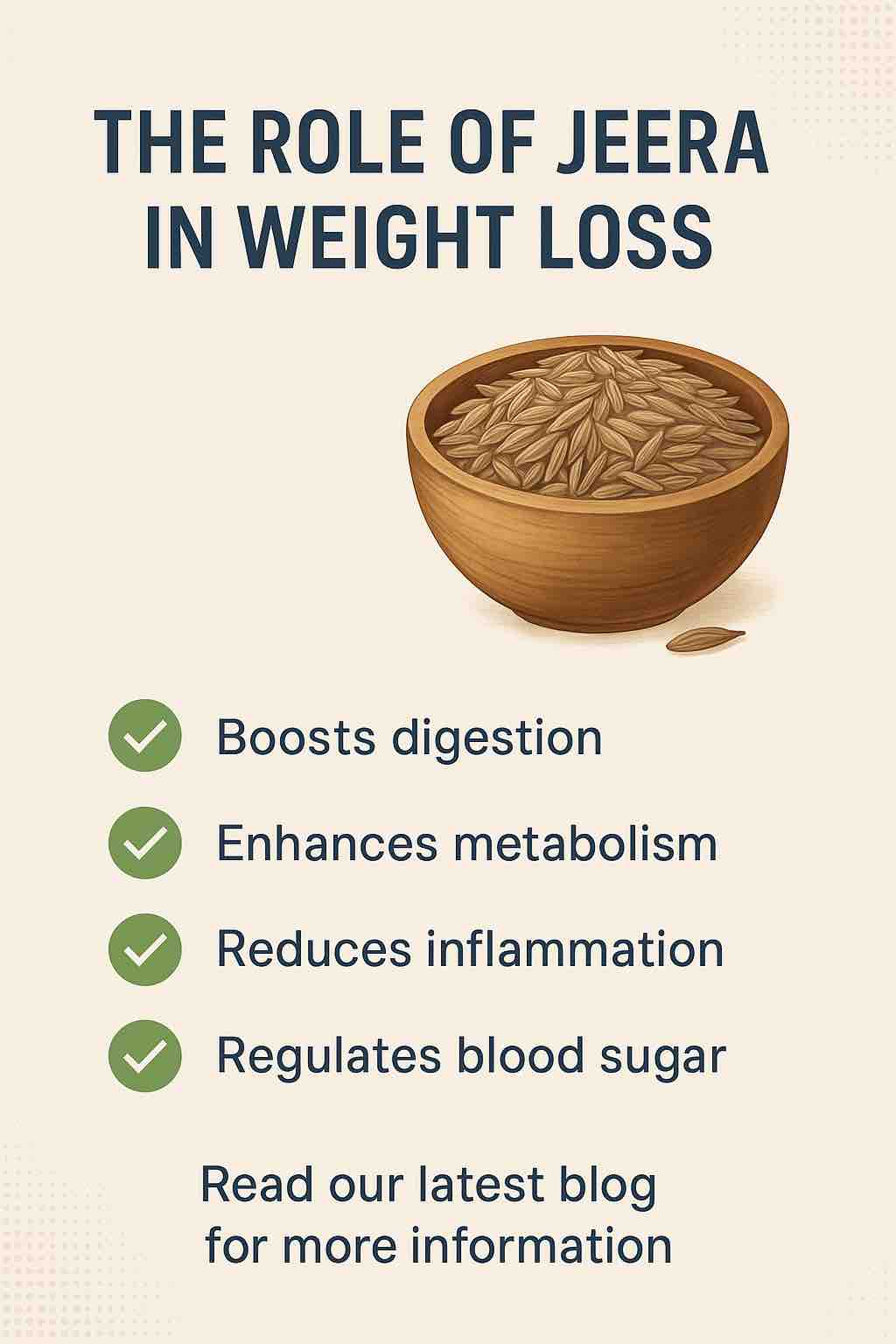
The Role of Jeera in Weight Loss: Separating Fact from Fiction

ROLE OF JEERA or CUMIN SEEDS IN WEIGHT LOSS

In the ever-evolving world of weight loss trends, traditional ingredients often find themselves under the spotlight. One such ingredient is jeera, or cumin—a staple spice in Indian and Middle Eastern kitchens. But does this tiny seed truly hold the power to influence body weight, or is its reputation a flavorful exaggeration? Let’s explore what the latest science and centuries of tradition tell us.


A Spice Steeped in Tradition

Jeera has been used in Ayurvedic and traditional medicine for thousands of years. Known for its distinctive aroma and earthy flavor, it is often toasted and added to dishes not only for taste but also for its medicinal properties. Traditional practitioners have long used it for digestion, detoxification, and overall wellness.

Its popularity as a potential weight loss aid is not new, but with modern scientific tools at our disposal, we can now evaluate these claims more critically.


What Modern Science Tells Us

Recent studies are shedding light on the mechanisms through which cumin might influence weight loss and metabolic health. Here’s what the research says:

1. Weight Reduction and Body Composition

A notable 2014 study published in the journal Complementary Therapies in Clinical Practice involved 88 overweight women. The study found that those who consumed 3 grams of cumin powder daily mixed with yogurt experienced significantly more weight loss and fat reduction than those who only consumed yogurt.

2. Improved Lipid Profiles

Cumin has been shown to reduce total cholesterol, LDL (bad) cholesterol, and triglycerides while increasing HDL (good) cholesterol. A 2022 review of randomized controlled trials found consistent improvements in lipid profiles, suggesting cumin may contribute to better cardiovascular health—a factor closely tied to metabolic and weight concerns.

3. Blood Sugar Regulation

Blood sugar spikes and crashes can sabotage weight loss by increasing hunger and cravings. Cumin may help regulate blood glucose levels, according to several studies. This can promote more stable energy levels and appetite control.

4. Enhanced Metabolism and Digestion

Jeera contains compounds like thymol and cuminaldehyde that stimulate the secretion of digestive enzymes, thereby improving digestion. A well-functioning digestive system aids in nutrient absorption and reduces bloating, often perceived as weight gain.

5. Appetite Suppression

Some evidence suggests that cumin might act as a mild appetite suppressant, helping to control calorie intake. However, these effects tend to be subtle and should not be overstated.


Separating the Facts from the Myths

Despite its benefits, cumin is often caught in the web of exaggerated claims. Let’s break down what it can and cannot do:

ClaimVerdict
Jeera melts belly fat❌ Myth
Jeera aids digestion✅ Supported
Jeera boosts metabolism✅ Plausible
Jeera causes rapid weight loss❌ Exaggerated
Jeera reduces bloating✅ Supported
Jeera alone can replace diet/exercise❌ False

In short, while jeera may support weight loss, it is not a magic bullet. Think of it as one component of a balanced strategy that includes a nutritious diet, regular exercise, and sufficient sleep.


How to Incorporate Jeera into Your Routine

If you’re looking to leverage jeera’s benefits, here are some practical and enjoyable ways to do it:

1. Jeera Water (Cumin Detox Drink)

  • Soak 1–2 teaspoons of cumin seeds in a glass of water overnight.
  • Boil the mixture in the morning and let it cool slightly.
  • Strain and drink it on an empty stomach.
  • This is believed to kickstart digestion and improve metabolism.

2. Cooking with Jeera

  • Use whole or ground cumin in curries, soups, and lentil dishes.
  • Toast cumin seeds in ghee or oil for tempering (tadka) to release their full flavor.

3. Cumin-Yogurt Mix

  • Mix roasted cumin powder with plain yogurt for a digestion-friendly snack.
  • Add a pinch of pink salt and mint for a refreshing twist.

4. Supplements (with Caution)

  • Cumin supplements are available but should be taken under medical supervision.
  • These often contain concentrated extracts and may not be suitable for everyone.

Final Thoughts: The Verdict on Jeera

Cumin is more than just a kitchen staple—it’s a spice with a compelling profile of health benefits, especially when it comes to digestion, metabolism, and possibly weight management. However, it’s important to temper expectations and approach jeera as a complementary aid rather than a cure-all.

When paired with healthy lifestyle choices, cumin can contribute meaningfully to your wellness journey. And at the very least, it’ll make your meals more flavorful and enjoyable.


Have you tried jeera for weight loss or health? Share your experience or questions in the comments below!

📌 FAQs

1. Can jeera (cumin) really help with weight loss?
Yes, jeera may support weight loss by improving digestion, slightly boosting metabolism, regulating blood sugar, and reducing bloating. However, it should complement—not replace—diet and exercise.

2. How much jeera should I consume daily for weight loss benefits?
Most studies use about 3 grams per day (roughly 1 teaspoon). You can consume it through jeera water, in meals, or as roasted powder mixed with yogurt.

3. When is the best time to drink jeera water?
Drinking jeera water on an empty stomach in the morning is believed to be most effective for stimulating digestion and metabolism.

4. How long does it take to see results from jeera for weight loss?
Visible results may take 4–8 weeks, especially when combined with a calorie-controlled diet and physical activity. Effects vary by individual.

5. Can I use jeera powder instead of soaking whole seeds?
Yes. Roasted jeera powder is effective and can be added to warm water, yogurt, or food. However, soaking whole seeds may release slightly different compounds into the water.

6. Is it safe to take jeera every day?
Yes, cumin is safe for most people when consumed in typical culinary amounts daily. For high-dose supplements, consult a healthcare provider.

7. Can jeera reduce belly fat specifically?
No, jeera cannot target belly fat directly. It may reduce overall bloating and body fat modestly as part of a holistic health routine.

8. Does jeera water have any side effects?
In general, jeera water is safe. Rarely, excessive consumption may cause acid reflux or lower blood sugar too much in sensitive individuals.

9. Can I take cumin supplements instead of using the spice?
You can, but supplements should be used cautiously and under medical advice. Whole or ground cumin in food is safer and usually sufficient.

10. Can I drink jeera water at night instead of in the morning?
Yes, while morning consumption is common, jeera water can also aid digestion if consumed after meals or before bedtime.

Posted on Leave a comment

Unlocking the Power of Cumin Tea: A Warm Beverage for Weight Loss

Cumin tea, a simple yet profound beverage, is steeped in centuries of culinary and medicinal tradition, offering more than just warmth and flavor. Known scientifically as Cuminum cyminum, cumin has been a staple in various global cuisines, cherished for its distinctive taste and a myriad of health benefits. This exploration into cumin tea reveals its potential role in supporting weight loss efforts, underpinned by both historical use and emerging scientific research.


The Potential Benefits of Cumin Tea for Weight Loss

Cumin tea, with its earthy, peppery flavor, is not just a delight for the palate but also a boon for the body, especially for those navigating the challenges of weight loss. Here’s how this ancient spice can be a modern ally in your health journey:

  1. Digestive Support: Cumin’s carminative properties help alleviate bloating, gas, and indigestion, fostering a healthy digestive environment conducive to weight management.
  2. Metabolism Boost: Preliminary studies suggest cumin’s positive impact on metabolic rate, hinting at its potential to aid in a more efficient calorie burn.
  3. Hydration and Satiety: As a flavorful beverage, cumin tea contributes to hydration, essential for overall well-being and weight management, while also providing a sense of fullness that may curb unnecessary snacking.

Brewing Your Cup of Cumin Tea

Crafting cumin tea is an exercise in simplicity, requiring minimal ingredients for a richly aromatic brew. Here’s a quick guide:

  • Crush a teaspoon of cumin seeds to release their oils.
  • Boil two cups of water and add the crushed seeds.
  • Simmer on low heat for 5-10 minutes, then strain.
  • Enhance with lemon or honey to taste.

Precautions and Considerations

While cumin tea is celebrated for its benefits, moderation is key. Be mindful of any allergies to cumin or related spices, and consult with healthcare providers if you have underlying medical conditions or are taking medications.


Sipping Towards Health

Cumin tea embodies the fusion of pleasure and wellness, making it more than just a beverage. Its potential to aid weight loss, alongside a balanced diet and regular exercise, positions it as a valuable addition to a holistic health regimen. Embrace the tradition and science behind cumin tea, and let it guide you on a flavorful journey towards achieving your weight loss goals.


In embracing cumin tea, you’re not just sipping on a warm beverage; you’re nurturing your body with centuries-old wisdom, blended with the potential for modern-day health benefits.