Posted on 4 Comments

Marinara Sauce Recipe: Classic Homemade Marinara

A couple stirring a pot of homemade marinara sauce in a warm, elegant kitchen with fresh tomatoes, garlic, and basil on the counter.

Some sauces demand a Sunday afternoon, a stocked pantry, and a willingness to hover over the stove. Marinara isn’t that kind of sauce. Instead, a good marinara is built for real life: dinner after a long day, a quick lunch you still want to enjoy, or a last-minute plan that somehow turns into friends at your table. That’s why a reliable marinara sauce recipe is one of the most useful things you can learn—it’s simple, adaptable, and endlessly repeatable.

At the same time, marinara is honest. Because the ingredient list is short, every choice matters. Consequently, a watery tomato can make the sauce taste thin. Likewise, a scorched garlic clove can tint the whole pot bitter. Yet, when you get the fundamentals right, the payoff is immediate: a classic homemade marinara sauce that tastes bright, rich, and clean all at once.

In this post, we’ll start with one sturdy marinara sauce recipe you can memorize. Then, we’ll branch into variations that still feel like marinara—just tuned for different needs. For instance, we’ll make a thicker version for pizza. Additionally, we’ll build a punchier marinara dipping sauce. Moreover, we’ll cover options like sugar free marinara sauce, tomato sauce keto and low carb tomato sauce, and low sodium marinara sauce without turning the sauce bland. Finally, we’ll talk storage and reheating, because having marinara ready in the fridge is basically a superpower.

Also Read: Tomato Sauce From Fresh Tomatoes (Food Mill Method & Recipe)


What marinara is, and why it works

Marinara is a quick tomato sauce that’s meant to taste fresh, not heavy. In other words, it’s not a long-simmered ragù built on meat and bones, and it’s not a creamy tomato sauce. Instead, marinara leans on the flavor of tomatoes and a few supporting ingredients: garlic, olive oil (optional), basil, and salt. As a result, it tastes direct and vibrant, while still feeling comforting.

Because marinara is uncomplicated, it’s also flexible. Once you have a base marinara sauce recipe, you can use it as a pasta sauce, a pizza sauce, a dipping sauce, or a component in baked dishes. Meanwhile, you can keep the same method and adjust only one or two “dials” to meet different preferences: less salt, no added sugar, no oil, more heat, or a different tomato choice.

Also Read: Double Chocolate Chip Cookies – Easy Recipe with 7 Variations


Marinara sauce ingredients

A classic marinara sauce ingredients list is short for a reason. Still, each ingredient has a job, so it helps to know what you’re aiming for.
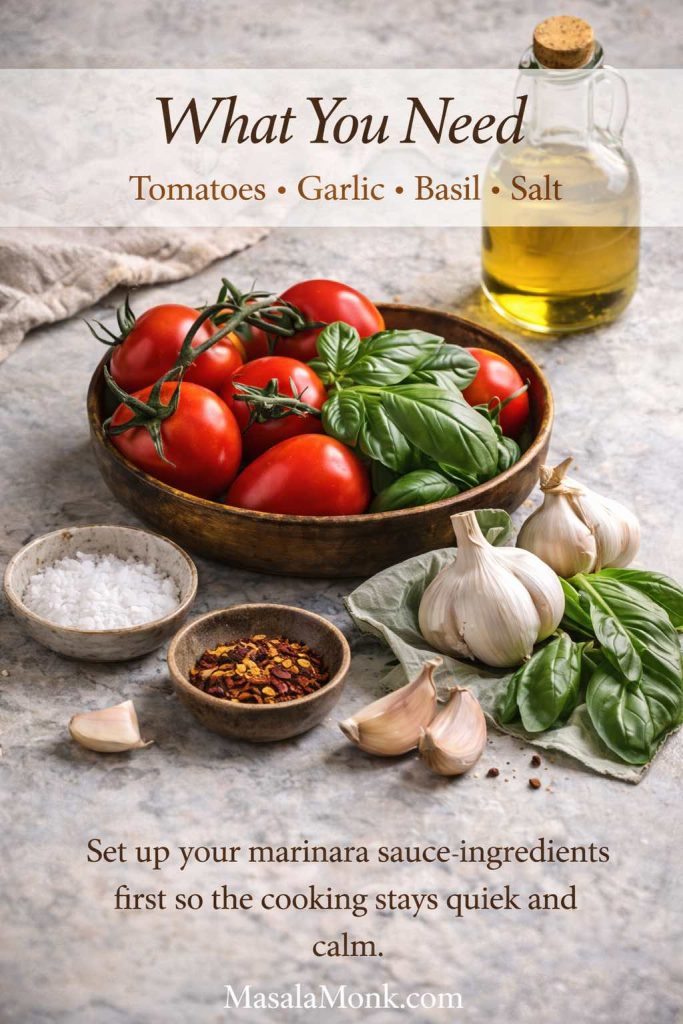
Flat lay of tomatoes, garlic, basil, olive oil, salt, and chili flakes on a marble counter for a homemade marinara sauce recipe.
Setting up the marinara sauce ingredients first keeps the cooking fast—so you can focus on aroma, simmer, and texture.

Tomatoes: the main character

  • Canned tomatoes are the most consistent option for most of the year. Therefore, they’re the default in this marinara sauce recipe.
  • Fresh tomatoes can be wonderful in season. However, they require a bit more simmering to concentrate flavor and reduce water.
  • San Marzano sauce / San Marzano tomatoes can be an upgrade when you want a smoother, more balanced tomato profile. If you’re curious about what PDO (Protected Designation of Origin) means and how it’s used, the European Commission’s explanation is a solid reference: PDO and quality schemes explained. Likewise, for San Marzano specifically, the official consortium offers background: San Marzano consortium site and about the consortium.

Aromatics: the backbone

  • Garlic is the signature. Nevertheless, you can make a garlic free marinara sauce with a few smart swaps (we’ll do that later).
  • Onion is optional. If you want a minimalist, authentic Italian marinara sauce feel, you can skip it. On the other hand, if you like a slightly rounder sweetness, onion is helpful.

Fat: optional, but useful

  • Olive oil adds richness and carries aroma. Even so, an oil free marinara sauce can still taste good if you rely on gentle reduction and careful seasoning.

Herbs and seasoning: the finishing touch

  • Basil is classic. Additionally, black pepper adds warmth.
  • Salt is essential for “completeness.” However, if you’re making low sodium marinara sauce, you can build flavor using other levers.

If you enjoy understanding ingredients beyond flavor—especially tomatoes—this MasalaMonk post on tomato nutrition and benefits is a useful deep dive that pairs naturally with marinara.

Also Read: Upma Recipe: 10+ Easy Variations (Rava, Millet, Oats, Semiya & More)


A classic marinara sauce recipe you can repeat anytime

This is the heart of the post: a dependable, classic homemade marinara sauce. It’s also intentionally adaptable, which is why it serves as the foundation for every variation later on.
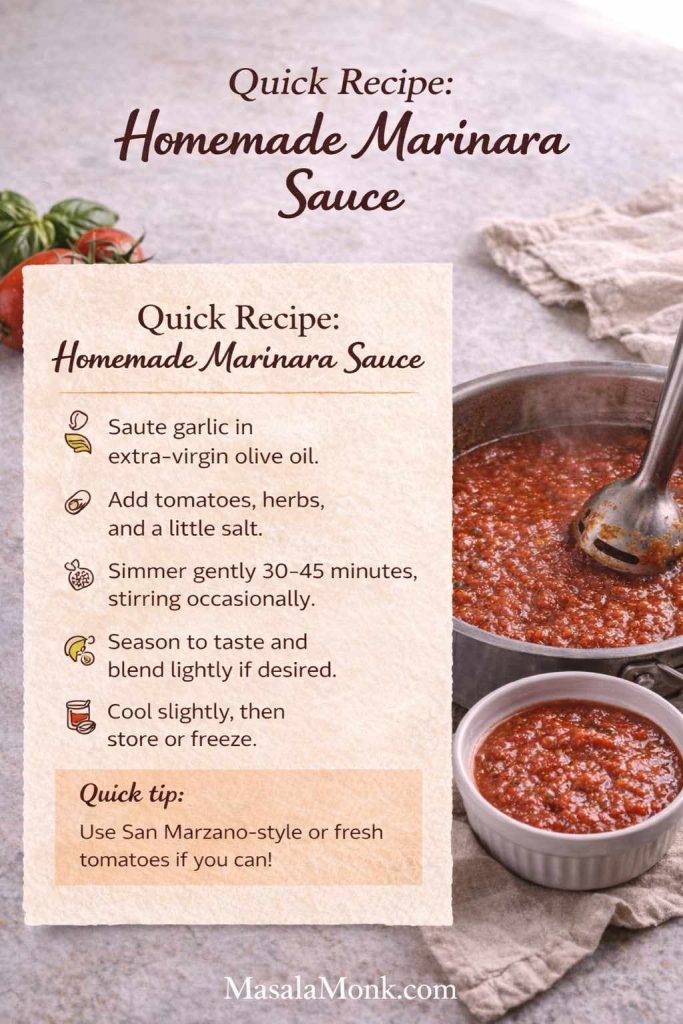
Quick recipe card for homemade marinara sauce on a photo of simmering marinara in a pan, with MasalaMonk.com in the footer.
Save this quick marinara sauce recipe for busy nights—once you know the base steps, you can tweak it for pasta, pizza, or dipping in minutes.

Classic homemade marinara sauce recipe (base)

Makes: ~3–4 cups
Time: ~25–35 minutes

Ingredients

  • 2 tbsp olive oil (or see the oil-free variation later)
  • 4–6 garlic cloves, thinly sliced or minced
  • 1 small onion, finely chopped (optional)
  • 800 g / 28 oz canned whole peeled tomatoes, crushed by hand (or crushed tomatoes)
  • 1 tsp salt to start, then adjust
  • Black pepper to taste
  • 8–12 basil leaves (fresh is best; dried works in a pinch)
  • Optional: pinch of red pepper flakes

How to make Marinara Sauce – Step by Step Method

1. Start gently. Place a saucepan over medium heat. Add olive oil. If you’re using onion, cook it slowly until soft and translucent. The goal is sweetness and aroma, not browning.
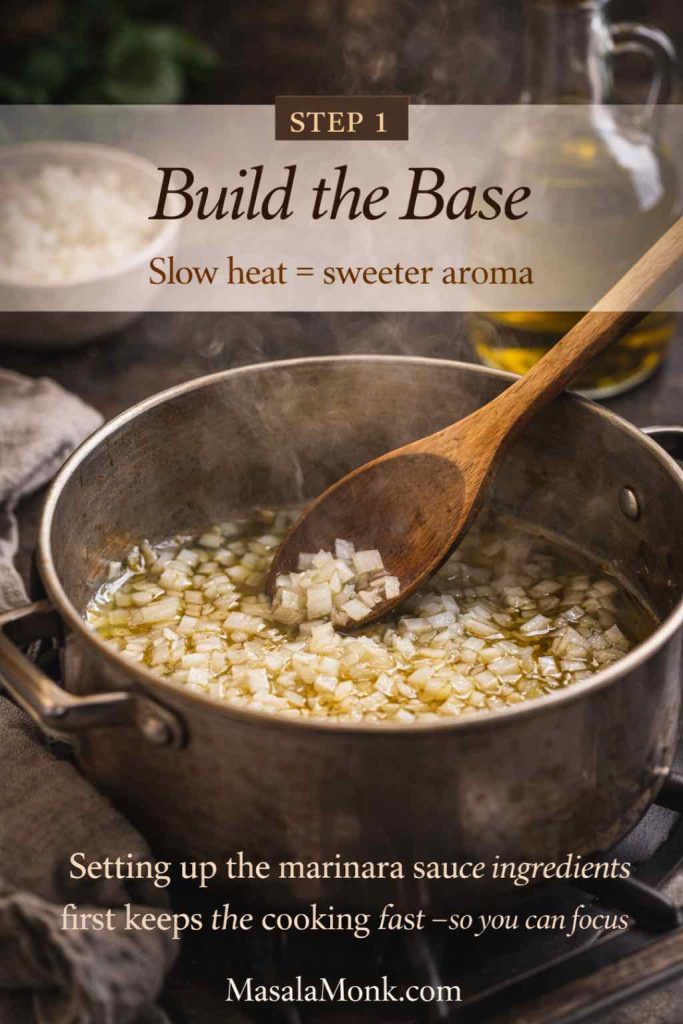
Chopped onion softening in olive oil in a saucepan with a wooden spoon, showing step 1 of a homemade marinara sauce recipe.
Keep the heat low while the onion turns glossy and sweet—this gentle start makes the final marinara taste fuller without extra ingredients.

2. Add garlic carefully. Stir in garlic and cook just until fragrant. If the garlic starts to brown aggressively, lower the heat. Otherwise, a bitter edge can show up later.
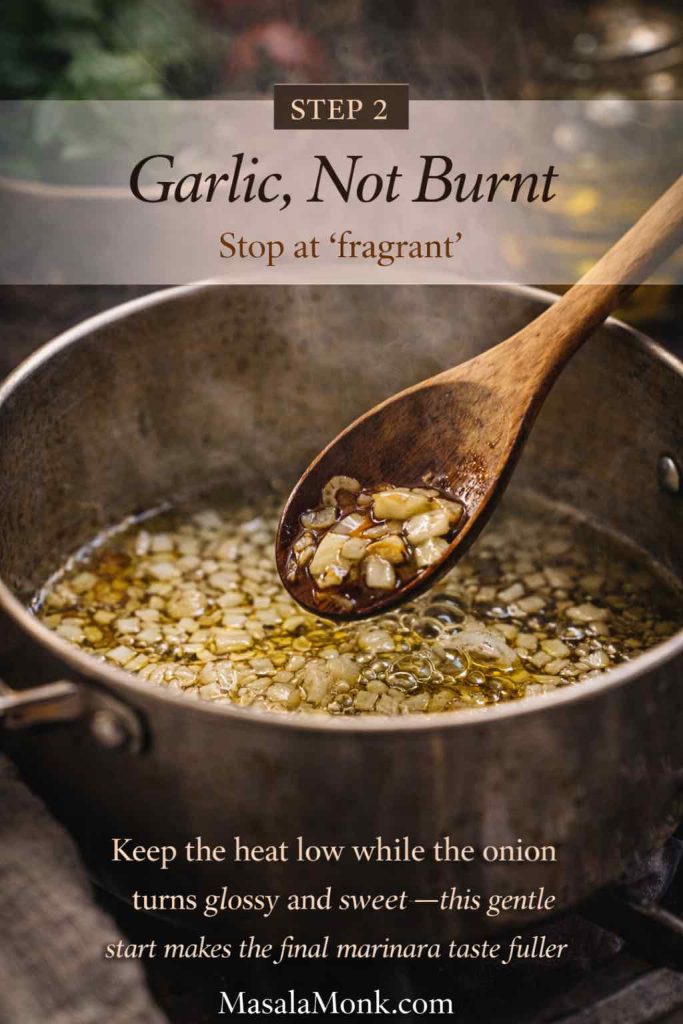
Garlic gently sizzling in olive oil with softened onion in a saucepan, showing step 2 of a homemade marinara sauce recipe before adding tomatoes.
The moment garlic smells nutty and warm, move on—another 20–30 seconds can shift it from fragrant to bitter.

3. Add tomatoes and season. Pour in tomatoes, then add salt, pepper, and optional chili flakes.
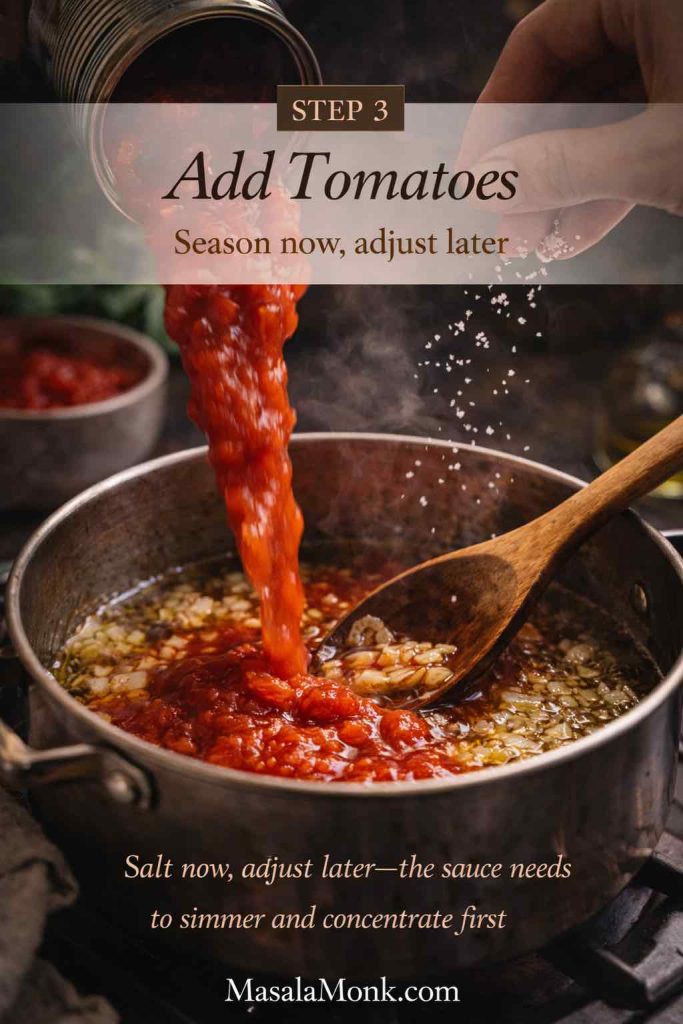
Crushed tomatoes being poured into a saucepan with softened onion and garlic, while salt is sprinkled in, showing step 3 of a homemade marinara sauce recipe.
Add tomatoes first, then season lightly—once the marinara reduces, you can fine-tune salt without overshooting.

4. Simmer steadily. Bring to a gentle bubble, then reduce heat to maintain a calm simmer. Stir occasionally. Over time, the sauce thickens and tastes more cohesive.
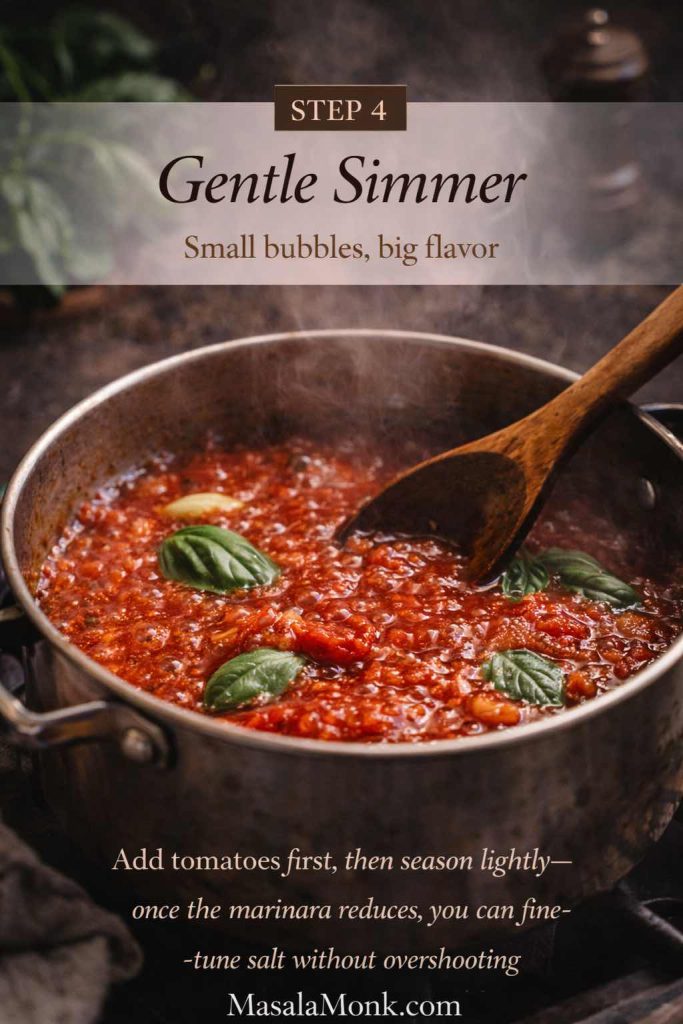
Marinara sauce gently simmering in a saucepan with small bubbles and basil leaves, showing step 4 of a homemade marinara sauce recipe.
Look for small, steady bubbles—this is the sweet spot where marinara thickens and deepens without tasting harsh or overcooked.

5. Finish bright. Stir in basil at the end, then taste and adjust salt. If you want it smoother, blend briefly. If you prefer rustic texture, leave it chunky.
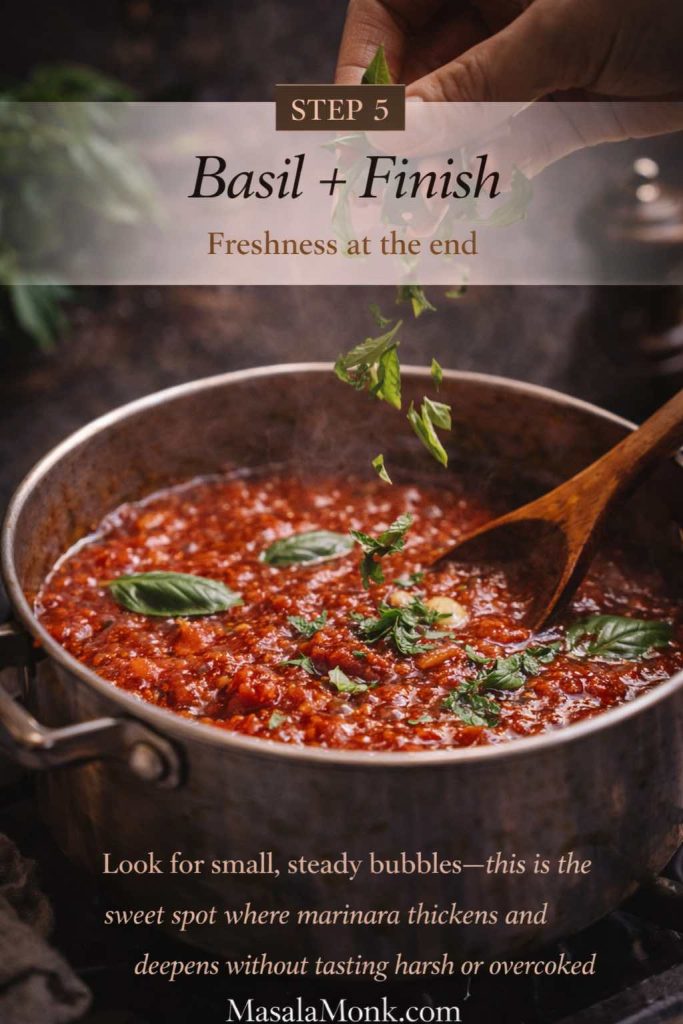
Fresh basil being torn and sprinkled into a pot of thickened marinara sauce, showing step 5 of a homemade marinara sauce recipe just before serving.
Add basil at the very end so the sauce keeps its bright, fresh aroma—then taste once more and adjust salt and texture.

This is the kind of marinara sauce you can cook without measuring once you’ve made it a few times. In fact, after you learn the rhythm—soften aromatics, add tomatoes, simmer, finish with basil—you’ll be able to steer it by taste.
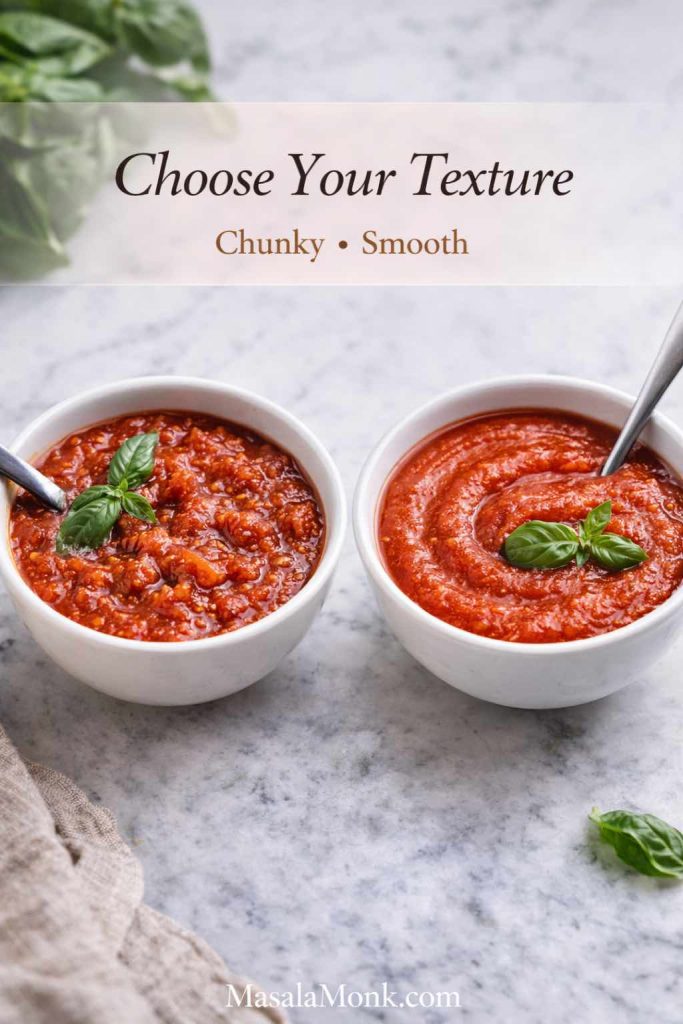
Two bowls of marinara sauce on a marble counter, one chunky and one smooth, showing texture options for homemade marinara sauce.
Chunky marinara is perfect for rustic pasta, while a smooth blend spreads beautifully for pizza or dipping—same sauce, different finish.

If you like reading technique explanations, Serious Eats offers a well-respected reference for a similar style of method: a marinara technique reference. Notice how the logic is the same: gentle aromatics, controlled simmer, and a clean tomato finish.

Also Read: Potato Salad Recipe: Classic, Russian, German, Vegan & More


Why some marinara tastes watery, sharp, or flat

If your marinara has ever felt “almost good,” it usually helps to identify what’s missing. Then, you can fix it quickly next time.

Watery sauce

Often, watery marinara is simply under-reduced. Therefore, simmer a little longer with the lid off. Alternatively, choose a more concentrated tomato product, like crushed tomatoes, when you want a faster cook.

Sharp, sour, or acidic sauce

Sometimes the tomatoes are naturally sharper. In that case, a longer simmer helps. Additionally, finishing with basil can soften the perception of acidity. If you’re specifically aiming for low acid marinara sauce, we’ll cover that variation in detail.

Flat sauce

Flat marinara usually needs one of three things:

  • more salt (or a smarter low-sodium strategy)
  • a little more reduction
  • fresher finishing aromatics (especially basil)

Consequently, a sauce that tastes “fine” can become genuinely satisfying with one small adjustment.

Also Read: Healthy Tuna Salad – 10 Easy Recipes (Avocado, Mediterranean, No Mayo & More)


Authentic Italian marinara sauce, in spirit

“Authentic” can mean many things, so it’s better to talk about intent. Traditional Italian-style marinara tends to be restrained. Instead of piling in herbs and sugar, it relies on tomatoes, garlic, olive oil, and basil, with a gentle simmer. As a result, the sauce feels clean and tomato-forward.

If you want a different classic pasta direction that’s still deeply Italian but completely tomato-free, MasalaMonk’s carbonara guide is a great companion for another night.


San Marzano marinara (San Marzano sauce upgrade)

If you’ve been curious about san marzano sauce or san marzano marinara sauce, the simplest approach is to swap the tomatoes and keep the rest minimal. That’s it.
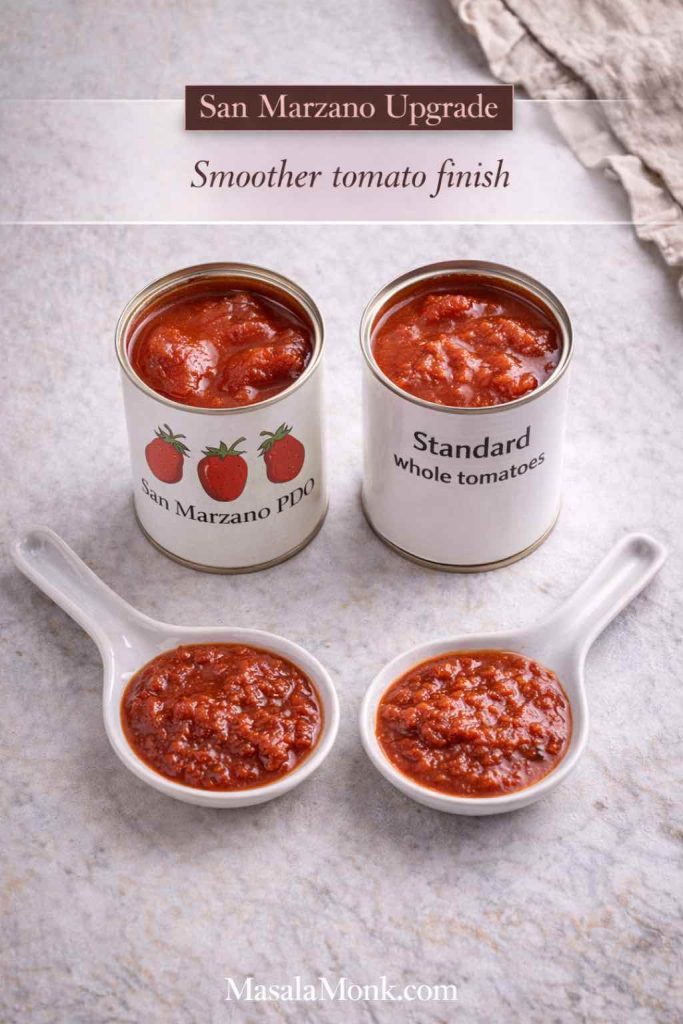
Comparison of San Marzano PDO tomatoes and standard whole tomatoes with two spoonfuls of marinara sauce, showing how tomato choice affects marinara texture and finish.
If you want a smoother, more polished marinara, start with better tomatoes—San Marzano-style tomatoes often give a cleaner finish with less effort.

How to do it

  • Use San Marzano tomatoes (ideally with clear PDO/DOP references if that matters to you).
  • Keep herbs restrained; basil is enough.
  • Simmer only until the sauce tastes cohesive and slightly thickened.

Because San Marzano tomatoes are prized for balance, you often don’t need extra sweetness tricks. Nevertheless, the technique still matters: gentle simmer, careful garlic, and basil at the end.

For context, PDO is a protected origin scheme; you can read the official overview here: PDO explained. Similarly, if you want the “source-of-truth” angle for San Marzano DOP/PDO, the consortium links are here: San Marzano consortium site and about the consortium.

Also Read: Whiskey Sour Recipe: Classic Cocktail, Best Whiskey & Easy Twists


Marinara sauce from fresh tomatoes

A marinara sauce from fresh tomatoes can taste brighter and more “garden-like,” especially when tomatoes are in peak season. However, fresh tomatoes also bring more water. Consequently, the key is patient reduction.
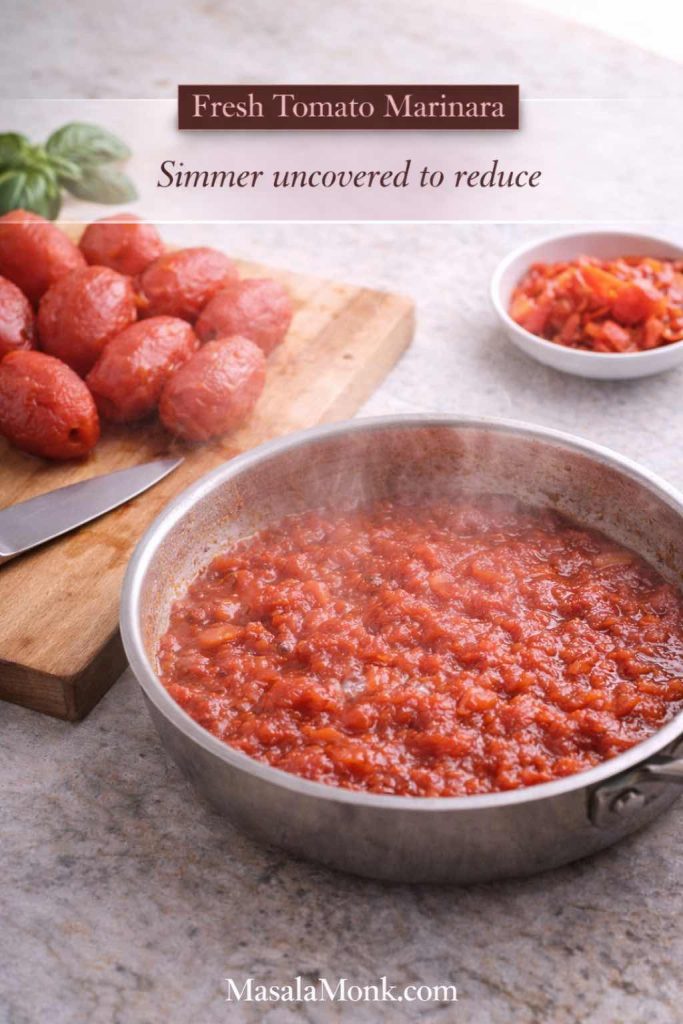
Fresh tomatoes simmering in a wide pan with peeled tomatoes on a cutting board, showing how to make marinara sauce from fresh tomatoes by reducing uncovered.
When you cook fresh tomatoes uncovered, excess water evaporates fast—so the sauce thickens naturally and tastes brighter than a long, covered simmer.

A simple fresh tomato method

  1. Score tomatoes with a small “X” at the bottom. Then, blanch them in boiling water for 30–45 seconds.
  2. Transfer to cool water, peel, and chop.
  3. Sauté garlic (and onion if using) gently, then add chopped tomatoes and salt.
  4. Simmer uncovered until thickened. Finally, finish with basil.

This variation naturally satisfies the idea of a marinara sauce made with fresh tomatoes, while still using the same overall structure as the base marinara sauce recipe. In other words, you’re not learning a new sauce—you’re simply changing the tomato input.

Also Read: High Protein Overnight Oats | 5 Recipes (Low Calorie, Vegan, Bulking & More)


Spicy marinara sauce

Spicy marinara sauce should feel warm and lively, not harsh. Therefore, the best method is to bloom chili flakes briefly in the oil before adding tomatoes. That way, the heat spreads evenly and tastes integrated.
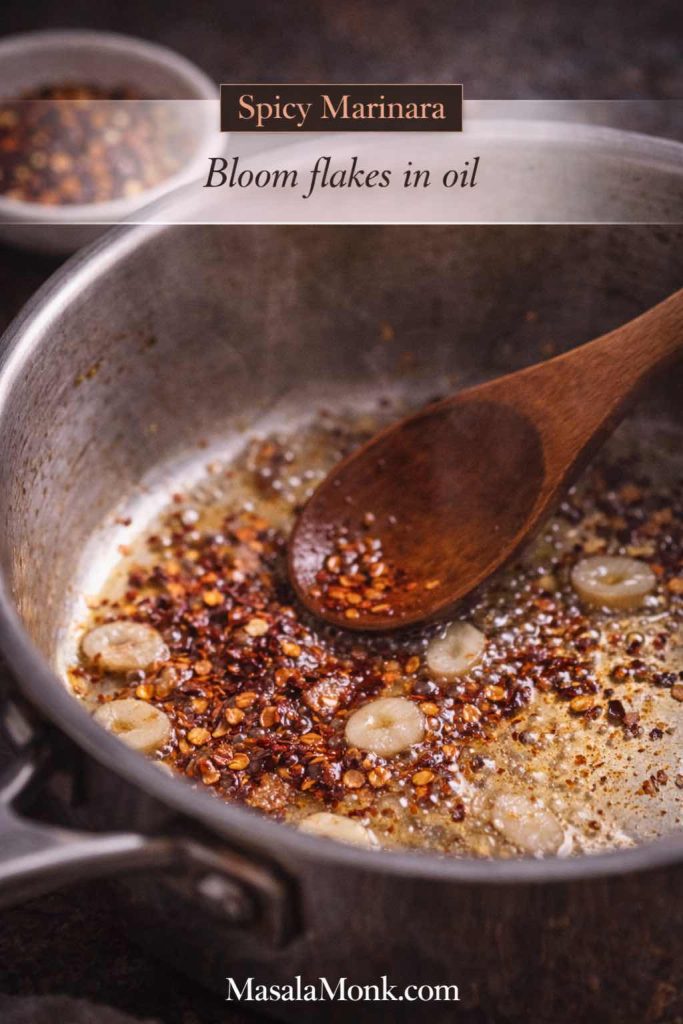
Chili flakes blooming in olive oil with sliced garlic in a saucepan, showing how to start a spicy marinara sauce before adding tomatoes.
Blooming chili flakes in oil perfumes the whole pot, so the heat tastes smooth and even instead of sharp or raw.

How to build balanced heat

  • Add a pinch of red pepper flakes right before garlic.
  • Simmer as usual.
  • Taste near the end, because heat perception changes as the sauce reduces.

If you like playing with different kinds of heat beyond chili flakes, MasalaMonk’s pepper sauce guide can inspire a range of spicy add-ins without forcing you into one flavor profile.


Marinara dipping sauce (including mozzarella sticks)

A marinara dipping sauce should be thicker and slightly more assertive than your everyday pasta marinara. Consequently, you don’t need new ingredients—you need a small shift in reduction and seasoning.
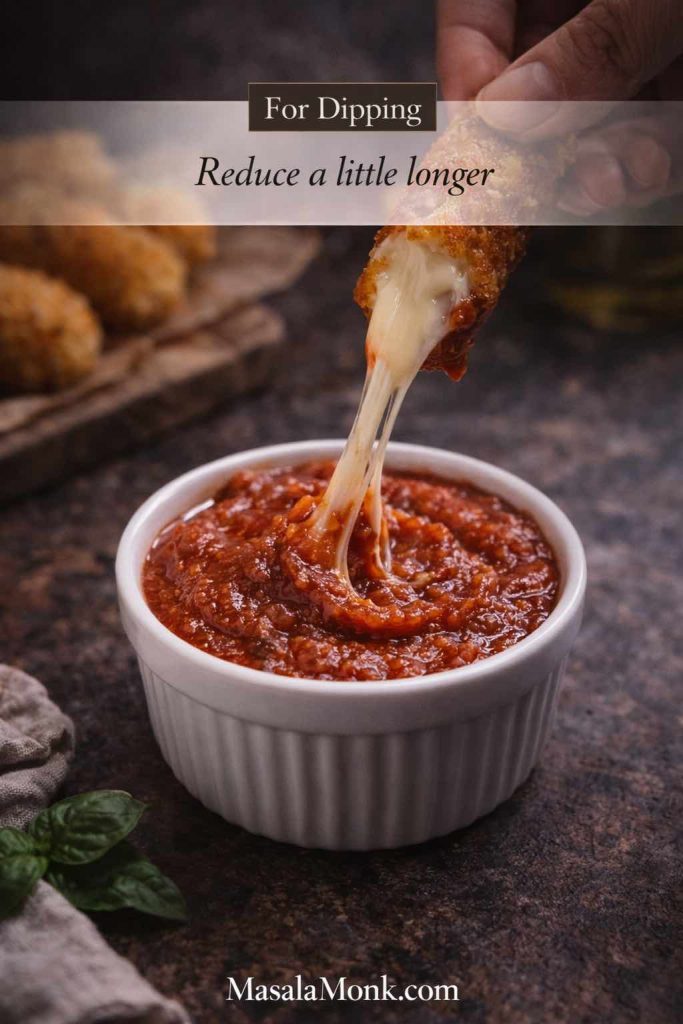
Mozzarella stick with a cheese pull dipping into a ramekin of thick marinara dipping sauce, showing a reduced marinara for dipping.
When marinara is reduced a little longer, it turns into a dip that clings—perfect for mozzarella sticks and any crispy snack.

How to adapt the base

  • Simmer 5–10 minutes longer so it thickens.
  • Add an extra clove of garlic, if you like.
  • Optionally add a pinch more chili flakes for “snack” energy.

This version works naturally as marinara sauce for mozzarella sticks, but it’s also great with toasted bread, roasted vegetables, or anything crispy.

If you want a natural pairing idea that fits beautifully, try it with arancini. MasalaMonk’s arancini balls post is an easy internal read for a snack that practically demands a tomato dip.

Also Read: Authentic Louisiana Red Beans and Rice Recipe (Best Ever)


Marinara sauce for pizza

Marinara sauce for pizza needs to be thick enough to spread without soaking the crust. Therefore, the “pizza shift” is mainly about texture.
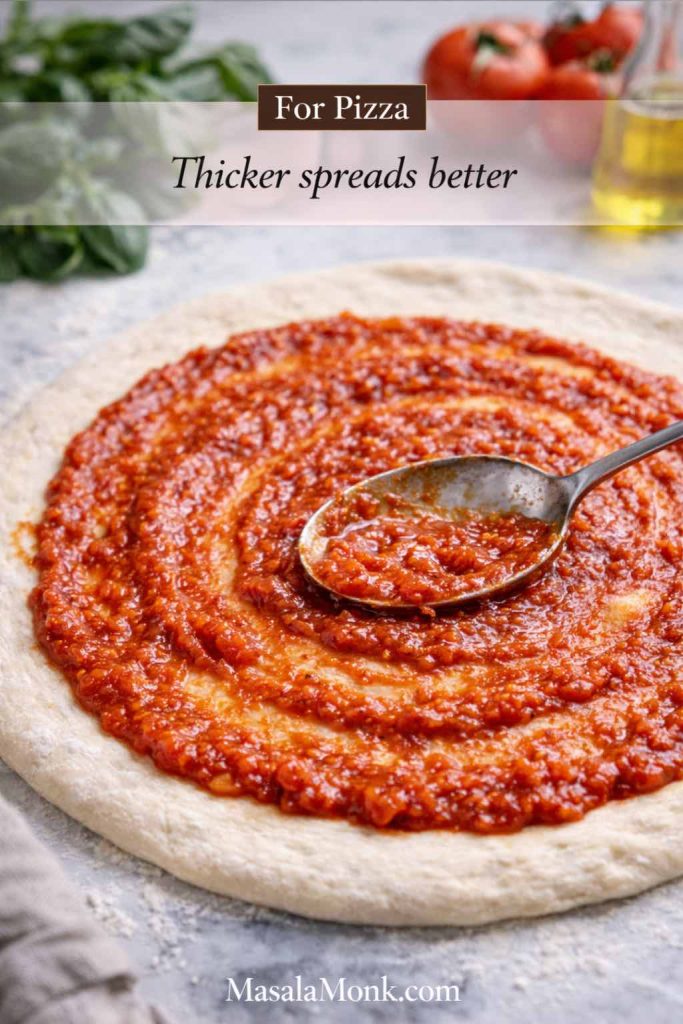
Thick marinara sauce being spread with a spoon on pizza dough, showing how to use marinara sauce for pizza without making the crust soggy.
A thicker marinara spreads in a thin, even layer—so the pizza stays crisp while still tasting boldly tomato-forward.

How to make it pizza-ready

  • Reduce the sauce slightly more than usual.
  • Blend for a smooth consistency, if you like.
  • Go easy on basil inside the sauce; instead, use fresh basil on top after baking.

If you enjoy a lighter homemade pizza approach, MasalaMonk’s Satvic pizza recipe is a good internal companion for dough and topping ideas.

Also Read: Air Fryer Hard-Boiled Eggs (No Water, Easy Peel Recipe)


Marinara sauce for pasta (and how to make it cling)

Marinara sauce for pasta is at its best when it coats, not pools. Consequently, the finishing technique matters as much as the sauce itself.
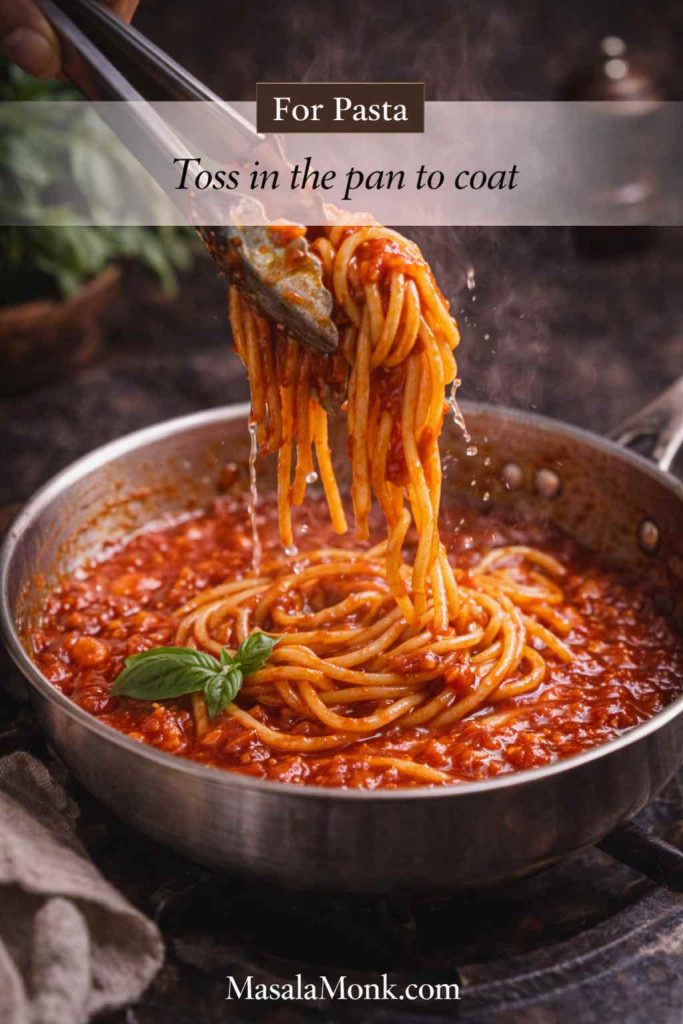
Spaghetti being lifted with tongs from a skillet of marinara sauce, showing how to toss pasta in the sauce for a glossy coating.
Tossing pasta directly in marinara helps the sauce cling to every strand, so each bite tastes evenly seasoned and rich.

The simplest upgrade

  • Reserve a splash of pasta water.
  • Toss pasta with marinara in a pan for 30–60 seconds.
  • Add a little pasta water as needed.

As a result, the sauce emulsifies slightly and clings more smoothly. If you want a technique-oriented reference for sauce behavior and pasta finishing, the Serious Eats approach to sauce method is a helpful baseline: a marinara technique reference.

Also, when you want a meatier cousin to marinara, bolognese is the logical next step. MasalaMonk’s bolognese recipe is a natural internal link for a different kind of red sauce night.


Diet-friendly marinara variations that still taste good

This is where many sauces fall apart: they chase “diet” first and flavor second. Instead, we’ll keep the core identity intact. Then, we’ll adjust only what’s necessary so each version still tastes like marinara.

Sugar free marinara sauce (and no-sugar variations)

A sugar free marinara sauce is mostly about avoiding the need for sugar in the first place. Therefore, focus on tomato quality and simmering, rather than adding sweeteners.
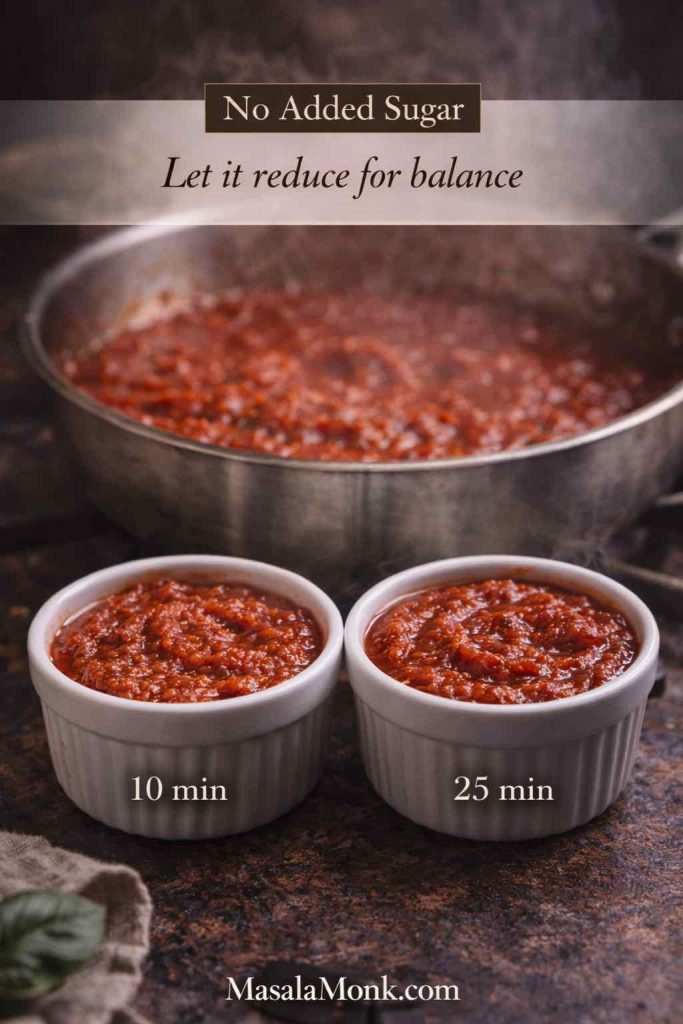
Two ramekins of marinara sauce labeled 10 min and 25 min in front of a simmering pot, showing how longer reduction naturally deepens flavor without added sugar.
Instead of adding sugar, let the sauce reduce—extra simmer time concentrates tomatoes, darkens the color, and makes marinara taste naturally balanced.

How to make it work

  • Use tomatoes with no added sugar.
  • Simmer long enough for the tomato edge to soften.
  • Finish with basil for sweetness-by-aroma.

If you still want more balance, add a small piece of carrot while simmering, then remove it at the end. Consequently, you get a gentle sweetness without making the sauce taste sugary.

This approach also aligns naturally with no sugar marinara sauce, no sugar added marinara sauce, and zero sugar marinara sauce expectations, while keeping the base marinara sauce recipe intact.

Tomato sauce keto and low carb tomato sauce

Tomato sauce keto and low carb tomato sauce usually depend more on serving context than the sauce itself. Nonetheless, the sauce should be clean: tomatoes, garlic, basil, and no added sugar.
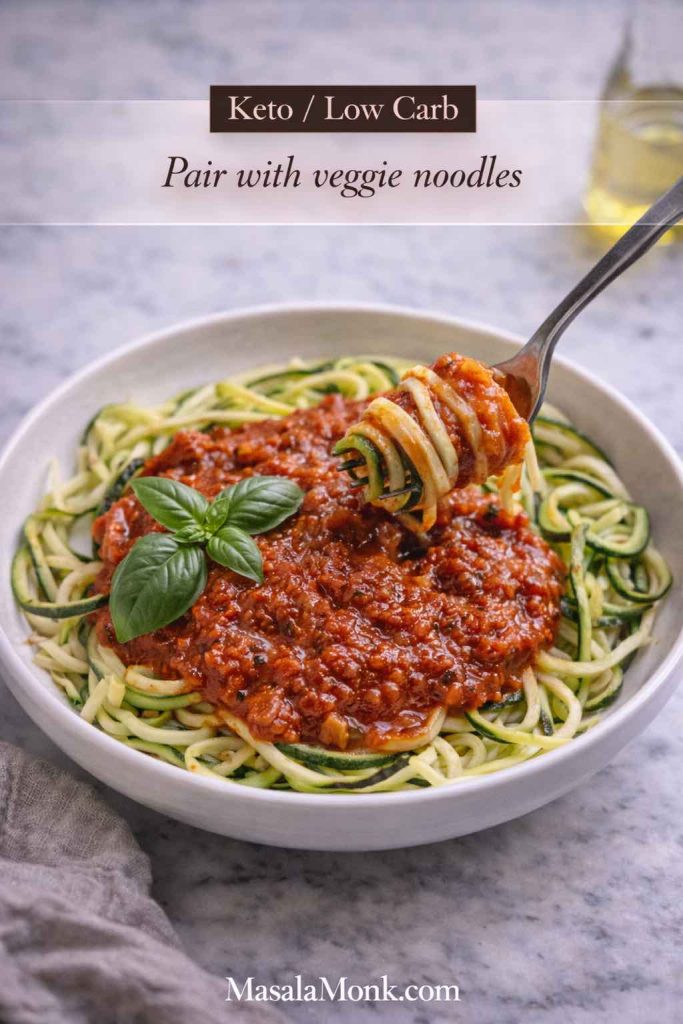
Zucchini noodles topped with marinara sauce and basil in a bowl, showing a keto and low carb way to serve tomato sauce.
For a keto or low carb plate, keep the marinara the same and swap the base—zucchini noodles (or spaghetti squash) carry the sauce without the extra carbs.

A practical keto-leaning approach

  • Keep onions minimal if you’re strict.
  • Avoid any sweetener additions.
  • Pair the sauce with low-carb “noodles” (zucchini, spaghetti squash) or roasted vegetables.

For serving ideas, MasalaMonk’s keto pasta alternatives fits naturally here, since it helps you build a satisfying plate around a low carb tomato sauce.

Low sodium marinara sauce (and salt-free options)

Low sodium marinara sauce isn’t just “less salt.” Instead, it’s a different strategy for building completeness. Therefore, you replace salt’s job with other kinds of intensity.
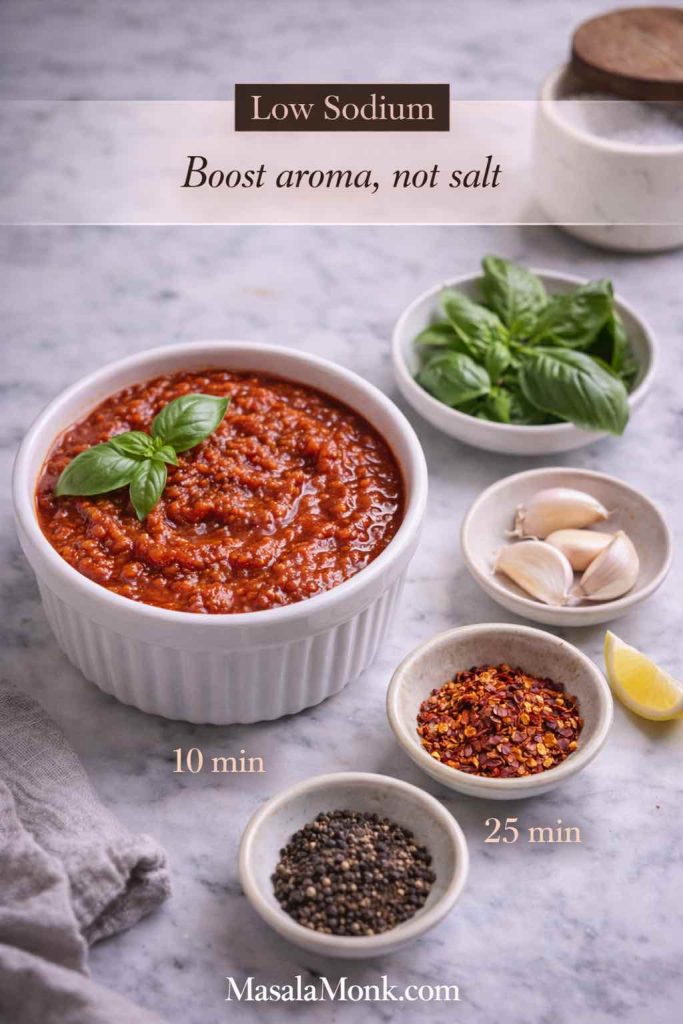
Bowl of low sodium marinara sauce with basil, garlic, chili flakes, black pepper, and lemon on a marble counter, showing flavor boosters used instead of extra salt.
When you cut back on salt, lean on aroma—garlic, basil, pepper, and a tiny squeeze of citrus can make low sodium marinara taste vivid and complete.

How to keep flavor strong with less salt

  • Sweat onion longer for more natural sweetness.
  • Use a little more garlic.
  • Add black pepper for warmth.
  • Finish with basil for lift.

If you’re going toward no salt marinara sauce or salt free marinara sauce, it helps to simmer a little longer so the sauce concentrates. Moreover, the carrot trick can be helpful here too, because perceived sweetness can reduce the “need” for salt.

Oil free marinara sauce and low fat marinara sauce

An oil free marinara sauce can still be delicious; it just tastes cleaner and slightly lighter. Consequently, reduction becomes even more important.
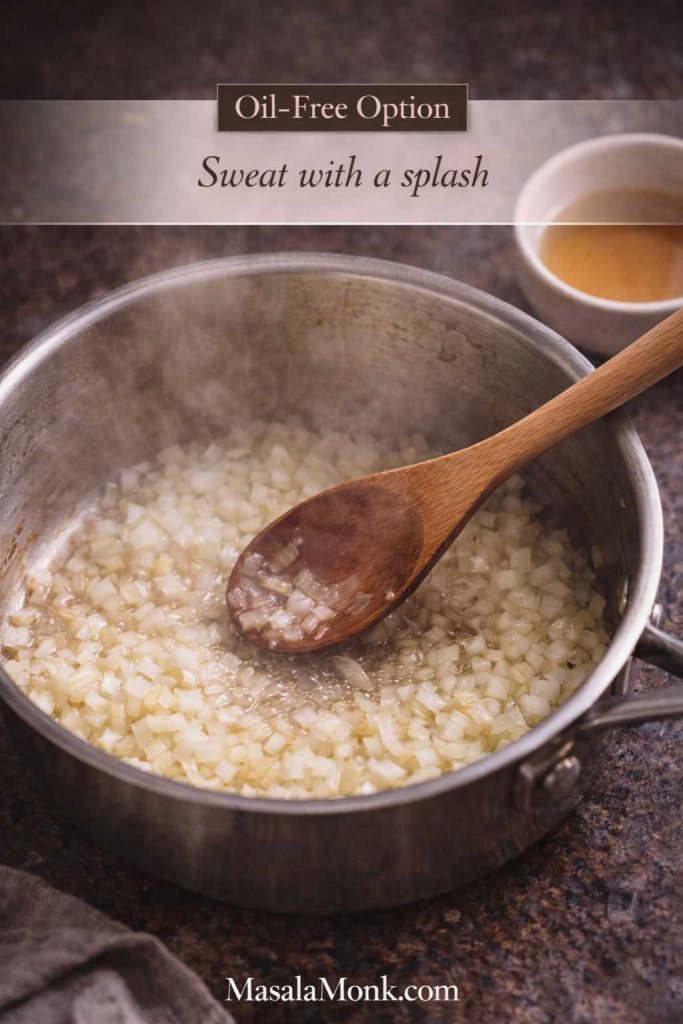
Chopped onions sweating in a saucepan with a splash of broth or water instead of oil, showing how to start an oil free marinara sauce.
For oil-free marinara, use a small splash of water or broth to soften onions—then let the sauce simmer a bit longer to build body.

Oil-free method

  • Start with a few tablespoons of water or unsalted broth.
  • Sweat onion gently, stirring often.
  • Add garlic briefly, then tomatoes.
  • Simmer a bit longer, then finish with basil.

This also supports low fat marinara sauce and light marinara sauce goals while keeping the sauce recognizable.

Garlic free marinara sauce

Garlic free marinara sauce is trickier because garlic is a signature note. However, you can still make a satisfying tomato sauce by leaning on onion, basil, and black pepper.
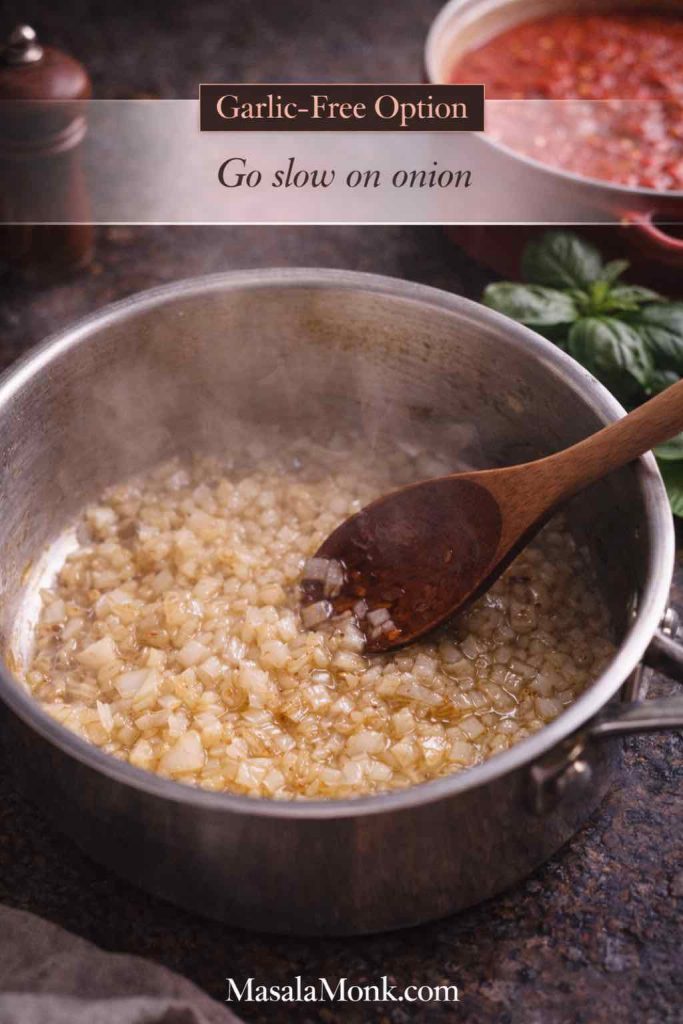
Onions slowly cooking in a saucepan with basil nearby and no garlic present, showing the base technique for a garlic free marinara sauce.
Without garlic, slow-cooked onion becomes the flavor engine—let it turn soft and sweet before tomatoes go in.

How to make it taste “complete”

  • Cook onion slowly until very soft.
  • Use basil generously at the end.
  • Add black pepper and optional chili flakes.

It won’t taste identical to the base marinara sauce recipe, yet it will still land as a classic tomato sauce you can use across meals.

Low acid marinara sauce

Low acid marinara sauce is mostly about perception. In other words, you’re reducing sharpness, not rewriting tomato chemistry.
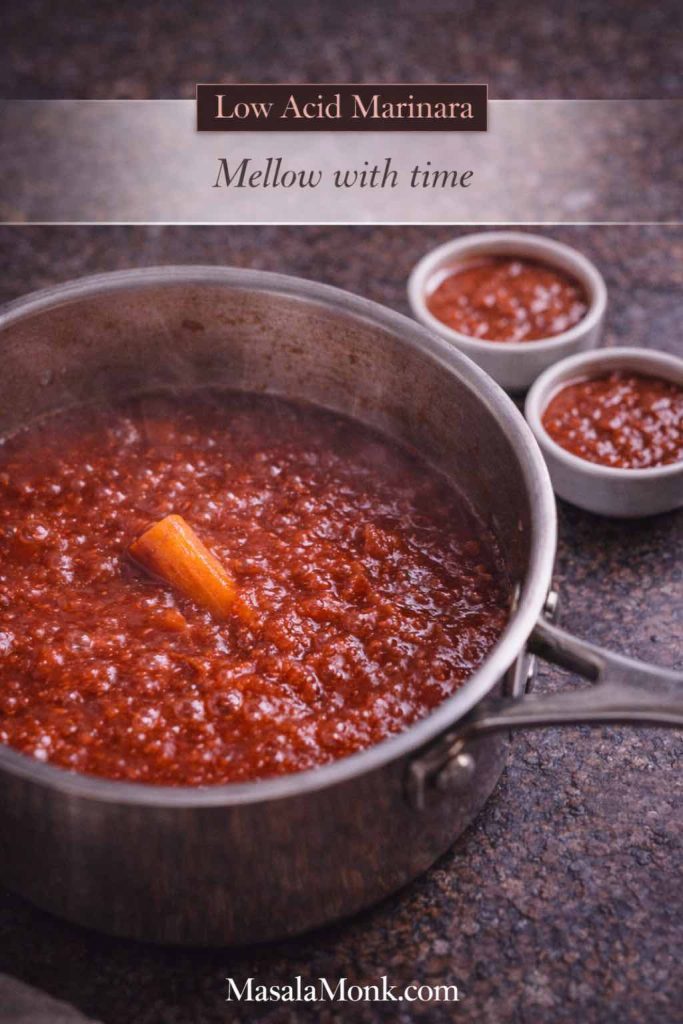
Marinara sauce gently simmering with a piece of carrot in the pot and two ramekins in the background, showing a low acid marinara method that softens sharp tomato flavor.
A gentle simmer is the real fix for sharp tomato sauce—time smooths the edges, and a small carrot can round the flavor without making it taste sweet.

The most reliable moves

  • Start with better tomatoes when possible.
  • Simmer gently and long enough to soften harshness.
  • Use the carrot balancing trick if needed.
  • Avoid adding extra acidic ingredients.

As a result, the sauce reads smoother and easier to eat, especially for people sensitive to sharp tomato flavors.

Also Read: Blueberry Pancakes (6 Recipes) + Homemade Pancake Mix


Taking marinara into full meals

Once you’ve built confidence with a marinara sauce recipe, it becomes a building block, not just a pasta topping. Therefore, it’s worth knowing a few natural ways to fold it into dinner without repeating the same plate.

Lasagna and baked pasta nights

Marinara is often one half of lasagna’s personality. The other half is the creamy layer that creates structure and comfort. If you want that classic route, MasalaMonk’s béchamel guide for lasagna is a natural internal link, especially because it includes options beyond the standard approach.

Alternatively, if you want the cozy flavor profile without assembling layers, MasalaMonk’s crock pot lasagna soup is a fun pivot that still uses marinara logic in a more relaxed form.

Two-sauce pasta nights

Sometimes you want tomato brightness plus something creamy or herbal. Consequently, pairing marinara with a second sauce can make dinner feel intentional without extra work.

  • For basil-forward variety, MasalaMonk’s pesto recipes fit beautifully alongside marinara.
  • For creamy comfort, MasalaMonk’s Alfredo recipes provide a different direction, while still keeping dinner in the “simple and satisfying” lane.

A snack table that actually feels complete

A thick marinara dipping sauce anchors a snack spread. Meanwhile, a cool sauce creates contrast. If you want that refreshing counterpoint, MasalaMonk’s tzatziki guide pairs nicely with warm tomato-based dips.

Likewise, if you want something herbal with bite, MasalaMonk’s chimichurri post offers a different kind of sauce energy that still makes sense on the same table.


Storage, freezing, and reheating

Marinara is one of the best batch-cook sauces because it freezes well and reheats with minimal quality loss. Therefore, it’s worth making a bigger pot when you can.
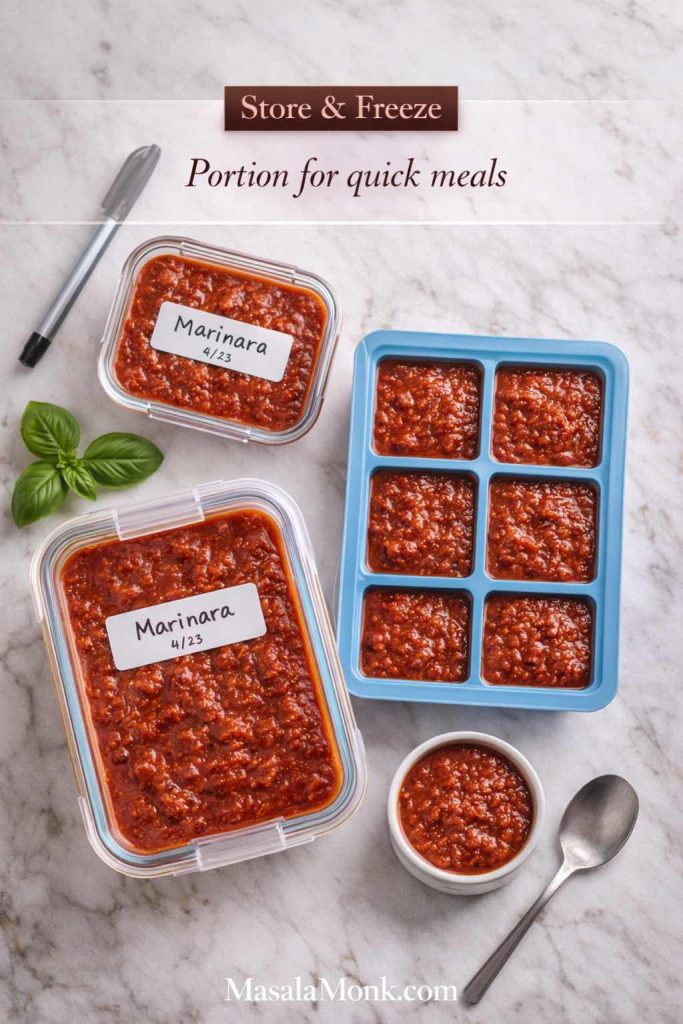
Homemade marinara sauce portioned into labeled glass containers and a silicone freezer tray on a marble counter, showing how to store and freeze marinara.
Freeze marinara in small portions so you can thaw exactly what you need—perfect for fast pasta, pizza, and dipping sauce nights.

Refrigeration

Let the sauce cool, then store it in a sealed container. For reliable guidance on how long leftovers keep, FoodSafety.gov’s cold storage charts are a strong reference: cold food storage charts.

Reheating

When reheating, bring the sauce up to a safe temperature. The USDA’s guidance on leftovers includes reheating to 165°F, and also notes that sauces, soups, and gravies should be brought to a boil when reheating: USDA leftovers and food safety.

Freezing

Freeze marinara in portions so you only thaw what you need. Consequently, you reduce waste while preserving texture.

Also Read: How to Cook Bacon in the Oven (Crispy, No-Mess, Crowd-Ready Recipe)


Bringing it all together

A good marinara sauce recipe is less like a single dish and more like a kitchen skill. Once you know the base, you can create a classic marinara sauce for pasta, a thicker marinara sauce for pizza, or a marinara dipping sauce for mozzarella sticks without starting over. Moreover, you can adjust the same core recipe into sugar free marinara sauce, tomato sauce keto or low carb tomato sauce, low sodium marinara sauce, oil free marinara sauce, or even garlic free marinara sauce—each one still recognizable as marinara.

So start with the base marinara sauce recipe and cook it once exactly as written. Then, cook the same marinara sauce again, but tweak one dial—maybe texture for pizza, maybe heat for a spicy marinara sauce, or maybe the salt strategy for a low sodium marinara sauce. After that, repeat with a fresh tomato version when tomatoes are at their best. Eventually, you’ll stop thinking of it as “a recipe” and start thinking of it as “your sauce.”

And that’s the point: a marinara sauce recipe should make dinner easier, not harder.

Also Read: Coconut Water Cocktails: 10 Easy, Refreshing Drinks

FAQs

1) What is the best marinara sauce recipe for beginners?

If you’re new to cooking, the best marinara sauce recipe is the one that stays simple: tomatoes, garlic, salt, basil, and a gentle simmer. More importantly, keep the heat moderate so the garlic doesn’t brown too fast. Afterward, taste near the end and adjust salt little by little, because that final tweak usually makes the biggest difference.

2) What are the essential marinara sauce ingredients?

At minimum, marinara sauce ingredients include tomatoes, garlic, salt, and basil. Additionally, olive oil is common for richness, while onion is optional for sweetness. Meanwhile, black pepper and a pinch of chili flakes are helpful if you want extra warmth without changing the sauce’s core character.

3) How do I make a marinara sauce recipe easy and quick on weeknights?

For a marinara sauce recipe easy enough for busy nights, start with canned tomatoes and keep the simmer short—about 15–25 minutes—so it thickens without turning heavy. Moreover, slice garlic thinly so it releases flavor fast. Then, finish with basil at the end for a fresher taste.

4) How do I make homemade marinara sauce taste less acidic?

To reduce sharpness, simmer the homemade marinara sauce a little longer at a steady, gentle bubble so the flavors mellow. Also, add basil near the end because it softens the perception of acidity. In some cases, a small piece of carrot simmered in the sauce can round out the flavor without making it sweet.

5) How do I make low acid marinara sauce without adding sugar?

For low acid marinara sauce, focus on tomato quality and time rather than sweeteners. Instead of sugar, use a longer simmer, finish with basil, and consider the carrot-balancing method if the tomatoes taste especially sharp. As a result, the sauce becomes smoother while still tasting like classic marinara.

6) Can I make marinara sauce from fresh tomatoes?

Yes—marinara sauce from fresh tomatoes works beautifully when tomatoes are ripe and flavorful. However, fresh tomatoes release more water, so you’ll typically need a longer uncovered simmer. Once it thickens, you can keep it rustic or blend it briefly for a smoother texture.

7) What’s the easiest marinara sauce recipe fresh tomatoes method?

For a marinara sauce recipe fresh tomatoes version that isn’t complicated, peel tomatoes quickly by blanching, then chop and simmer them with garlic and salt until reduced. Next, finish with basil and adjust seasoning. If the sauce stays watery, simply simmer longer rather than adding extra ingredients.

8) What’s the difference between marinara sauce and tomato sauce?

Marinara sauce is usually a quick, bright tomato-based sauce with garlic and basil, whereas tomato sauce can be broader and sometimes cooked longer or seasoned differently. In other words, marinara is typically lighter and faster, while tomato sauce may be more general-purpose depending on how it’s made.

9) How do I make classic marinara sauce thicker?

To thicken classic marinara sauce, simmer it uncovered so excess water evaporates. Alternatively, use crushed tomatoes for a naturally thicker starting point. If you prefer a smooth finish, blending can also create a thicker mouthfeel even without extra cooking.

10) How do I make marinara sauce for pizza so it doesn’t soak the crust?

Marinara sauce for pizza should be thicker and more concentrated than pasta marinara. Consequently, simmer it a bit longer and, if you want, blend it so it spreads evenly. Also, avoid making it too watery with extra liquid, since that’s what can soften the crust.

11) How do I make marinara sauce for pasta that clings to noodles?

For marinara sauce for pasta, toss the cooked pasta with the sauce in a pan for about a minute, adding a small splash of pasta water as needed. Then, keep stirring so the sauce coats evenly. This approach helps the marinara cling rather than slide off.

12) What is marinara dipping sauce and how is it different from pasta marinara?

Marinara dipping sauce is usually thicker and more boldly seasoned than a pasta version. For example, you might simmer it longer and add slightly more garlic or chili flakes. That way, it tastes punchy even when served in small amounts.

13) How do I make marinara sauce for mozzarella sticks?

For marinara sauce for mozzarella sticks, reduce the sauce until it’s thick enough to cling to the food. Additionally, a little extra garlic and a pinch of chili flakes can make it taste more “snack-friendly.” If you want it smoother, blend briefly so it becomes dip-like.

14) How do I make spicy marinara sauce without overpowering the tomatoes?

To make spicy marinara sauce, bloom chili flakes gently in oil before adding tomatoes, so heat spreads evenly. Still, start small—heat intensifies as the sauce reduces. Finally, taste near the end and add more only if needed.

15) How do I make sugar free marinara sauce that still tastes balanced?

Sugar free marinara sauce relies on tomato choice and simmering rather than sweeteners. In addition, finishing with basil can make the sauce taste rounder. If the tomatoes are sharp, simmering a small piece of carrot can soften the edge without adding refined sugar.

16) What’s the difference between no sugar marinara sauce and no sugar added marinara sauce?

No sugar marinara sauce generally means the recipe contains no added sugars, while no sugar added marinara sauce emphasizes that nothing was added beyond naturally occurring sugars in tomatoes. Practically speaking, both aim for the same goal: a sauce without sweeteners. Therefore, check ingredients and keep the method simple.

17) How do I make zero sugar marinara sauce at home?

To make zero sugar marinara sauce, use tomatoes with no added sugar and avoid sweeteners entirely. Then, rely on reduction, basil, and careful seasoning for balance. If it tastes too sharp, extend the simmer rather than adding sugar.

18) Is marinara sauce keto friendly?

Marinara can be keto friendly in moderation, although tomatoes contain natural carbs. Consequently, keep portions reasonable and avoid recipes that add sugar. Additionally, pairing it with low-carb noodles or vegetables makes it easier to fit into a tomato sauce keto style meal.

19) What’s the best low carb tomato sauce approach for everyday meals?

For low carb tomato sauce, keep the ingredient list clean and skip sweeteners. Next, build the meal around low-carb pairings like zucchini noodles or roasted vegetables. That way, the sauce stays familiar while the plate stays lighter.

20) How do I make low sodium marinara sauce without it tasting bland?

Low sodium marinara sauce tastes better when you boost flavor in other ways: more garlic, plenty of basil, black pepper, and a longer simmer for concentration. Also, adding salt gradually at the end helps you avoid oversalting. If you’re cutting sodium sharply, a slightly thicker sauce often tastes fuller.

21) How do I make no salt marinara sauce or salt free marinara sauce that still tastes good?

For no salt marinara sauce or salt free marinara sauce, focus on concentration and aromatics. In particular, simmer longer to intensify tomato flavor, and use garlic, basil, and pepper more generously. If the sauce tastes harsh, the carrot-balancing trick can help smooth it out.

22) How do I make oil free marinara sauce?

Oil free marinara sauce is made by sautéing onion and garlic gently with a little water or broth instead of oil. Then, add tomatoes and simmer a bit longer for body. As the sauce reduces, it becomes richer tasting even without oil.

23) How do I make garlic free marinara sauce?

Garlic free marinara sauce works best when you lean into onion, basil, and black pepper. Start by cooking onion until very soft, then add tomatoes and simmer until thickened. Finally, finish with basil so the sauce still tastes aromatic.

24) How long does homemade marinara sauce last in the fridge?

Homemade marinara sauce is best used within a few days for quality, although exact timing depends on storage temperature and handling. To stay safe, cool it promptly, store it sealed, and reheat thoroughly. If you won’t use it soon, freezing is a better option.

25) Can I freeze marinara sauce?

Yes—marinara freezes very well. For easier thawing, freeze it in smaller portions. Then, reheat gently on the stove, adding a splash of water if it thickened too much in the freezer.

26) Why does my marinara sauce taste bitter?

Bitterness often comes from garlic browning too much or herbs scorching early in cooking. Next time, keep the heat gentler at the start and add basil closer to the end. Also, choose tomatoes you like, because some cans can taste more harsh than others.

27) Why is my marinara sauce watery even after simmering?

Watery marinara usually needs more uncovered simmering or a tomato product with less liquid. Therefore, let it reduce longer and stir occasionally. If you want faster results, start with crushed tomatoes or blend and then reduce briefly to tighten texture.

28) How do I fix marinara sauce that tastes too salty?

If the marinara tastes too salty, add more tomatoes or a small splash of water and simmer briefly to rebalance. Additionally, a bit of basil at the end can soften the overall perception. For the future, start with less salt and adjust only after the sauce reduces.

29) What is the best marinara sauce to buy if I don’t have time to cook?

If you’re buying instead of cooking, look for a jarred marinara with a short ingredient list: tomatoes, olive oil, garlic, basil, and minimal additives. Furthermore, avoid added sugars if you want a cleaner taste. Then, improve it at home by simmering briefly with basil or garlic.

30) Can I use marinara as a simple tomato pasta sauce for meal prep?

Absolutely. Because marinara reheats well and pairs with many proteins and vegetables, it’s one of the easiest sauces for meal prep. Moreover, you can cook one big batch and split it into variations—spicy, low sodium, or sugar free—so your meals don’t feel repetitive.
Posted on 5 Comments

Tomato Sauce From Fresh Tomatoes (Food Mill Method & Recipe)

Homemade fresh tomato sauce from fresh tomatoes with basil, made using the food mill method.

A pot of tomatoes simmering on the stove has a way of making the whole day feel softer. The kitchen smells warm and familiar, the bubbling is gentle instead of loud, and dinner suddenly feels inevitable—in a good way. That’s the quiet power of making tomato sauce from fresh tomatoes: it turns something simple into something steady. You start with raw tomatoes and end with a sauce that tastes like actual tomatoes—bright, a little sweet, slightly tangy, and far more alive than anything that’s been sitting on a shelf.

This fresh tomato sauce recipe is built around one idea: keep the tomato flavor clean, then make the texture as smooth—or as rustic—as you like. The method I prefer most is the food mill approach, because food mill tomato sauce hits a sweet spot: it feels traditional, it tastes fresh, and it saves you from the most annoying parts of sauce-making (peeling, seeding, and picking at skins). Even so, if you don’t own a food mill yet, you’re still covered. You can make a beautiful tomato sauce recipe with fresh tomatoes without fancy tools; it’s simply a different route.

What you’ll get at the end is a sauce that works in multiple directions: spaghetti sauce from fresh tomatoes that clings to strands, pasta sauce using fresh tomatoes that coats penne, and a flexible tomato pasta sauce with fresh tomatoes you can spoon into other meals when you want variety. Most importantly, it’s a sauce you’ll want to make again—because it feels doable on a normal day, not just on an ambitious one.


Tomato sauce from fresh tomatoes: the style we’re making

Tomato sauce names get messy. People look for tomatoes sauce, sauce tomato sauce, recipe with spaghetti sauce, marinara sauces, red sauce, italian red sauce, pizza red sauce—often meaning slightly different things. Some sauces are cooked for hours, some are barely cooked at all, and some are thickened until they’re almost spreadable. Because of that, it helps to be clear about what this recipe is aiming for.

This is an Italian tomato sauce from fresh tomatoes style that stays tomato-forward. Closer to sauce pomodoro or a simple sugo recipe than a long-simmered spaghetti sauce bolognese, it keeps the spotlight on the tomatoes. Unlike tomato and cream sauce, it isn’t meant to be rich and silky. Rather than leaning into a tomato cream sauce for alla vodka pasta, it stays clean and bright. It also skips the built-in heat you’d expect from an arrabbiata sauce recipe. Ultimately, it’s a flexible base you can enjoy as-is or spin into those variations later.

In other words, you’re making the sauce you’ll want on hand—because it’s the one you can reshape depending on the night.

Also Read: Blueberry Pancakes (6 Recipes) + Homemade Pancake Mix


Ingredients for a fresh tomato sauce recipe that tastes like tomatoes

When the tomatoes are good, you don’t need much else. That’s why this homemade tomato sauce stays intentionally simple.

You’ll need:

  • Fresh ripe tomatoes
  • Olive oil
  • Salt
Fresh tomatoes, basil, garlic, olive oil, and salt arranged for making tomato sauce from fresh tomatoes.
Start with ripe tomatoes and a few pantry basics—this sauce gets its depth from the tomatoes, not a long ingredient list.

Optional, yet worth considering:

  • Onion (adds sweetness and body)
  • Garlic (adds aroma)
  • Fresh basil (for a fresh finish)
  • Black pepper
  • Chili flakes (if you want a gentle heat)

That’s enough to create a homemade tomato sauce that reads as “complete” without tasting heavy. It also keeps you far away from the sweetness people associate with some jarred sauces—helpful if you’ve ever looked up sugar free pasta sauce, low sugar pasta sauce, or healthy tomato sauce and felt like everything tasted oddly sweet. Here, the balance comes from tomatoes and technique, not from added sugar.

Also Read: How to Make Eggless Mayo at Home (Egg Free Mayonnaise Recipe)


Choosing tomatoes for tomato sauce from tomatoes (what matters and what doesn’t)

You can turn almost any tomato into sauce, yet the flavor ceiling depends on the tomato you start with. Consequently, choosing well pays off more than adding extra ingredients later.

Best tomatoes for pasta sauce from fresh tomatoes

  • Roma / plum tomatoes: Meaty, fewer seeds, less water—great for thickening into red pasta sauce.
  • Vine-ripened tomatoes: Fragrant and juicy—excellent, though they may need a longer reduction.
  • Cherry tomatoes: Small but intense—great for a bright, slightly sweeter sauce.

About San Marzano (and why people chase it)

San Marzano tomatoes—most often found canned—are prized for their balanced flavor, with a natural sweetness and a gentler bite. If you’re using fresh tomatoes instead, chase that same idea: choose tomatoes that smell deeply tomato-like and taste great straight from the cutting board.

Passata tomato as a seasonal backup (and why it’s related to this method)

Passata is essentially strained tomato puree—smooth, seedless, and skinless. It’s often made by cooking tomatoes briefly and running them through a milling process. That’s why, later, a tomato passata recipe or passata pasta sauce post can connect directly to what you’re learning here.

If you want the clearest explanation in plain language, Serious Eats has a practical guide to passata and why it’s useful: Italian passata gives you fresh tomato flavor all year long.


Why food mill tomato sauce is worth it (texture and taste, both)

A blender is fast, but it can also change the sauce in ways you might not want. It whips air into the tomatoes, which makes the sauce feel lighter and sometimes slightly frothy. Moreover, when seeds are pulverized, they can contribute bitterness and a gritty edge. A food mill avoids those problems. It presses soft tomato flesh through holes while holding back skins and seeds. As a result, you get a smoother sauce without turning it into foam.

If you want to see a reliable, tomato-forward version of this approach from an established cooking publication, Serious Eats lays out the logic clearly in their method for a fresh tomato pasta sauce: The best fresh tomato sauce for pasta.

Even so, don’t treat a food mill as a gatekeeping tool. You can absolutely make tomato sauce from fresh tomatoes without one. The food mill method is simply the easiest path to a clean texture.


Tomato sauce from fresh tomatoes (food mill method): step-by-step recipe

This is the core method. It’s straightforward; nonetheless, a few small choices make the finished sauce taste noticeably better.

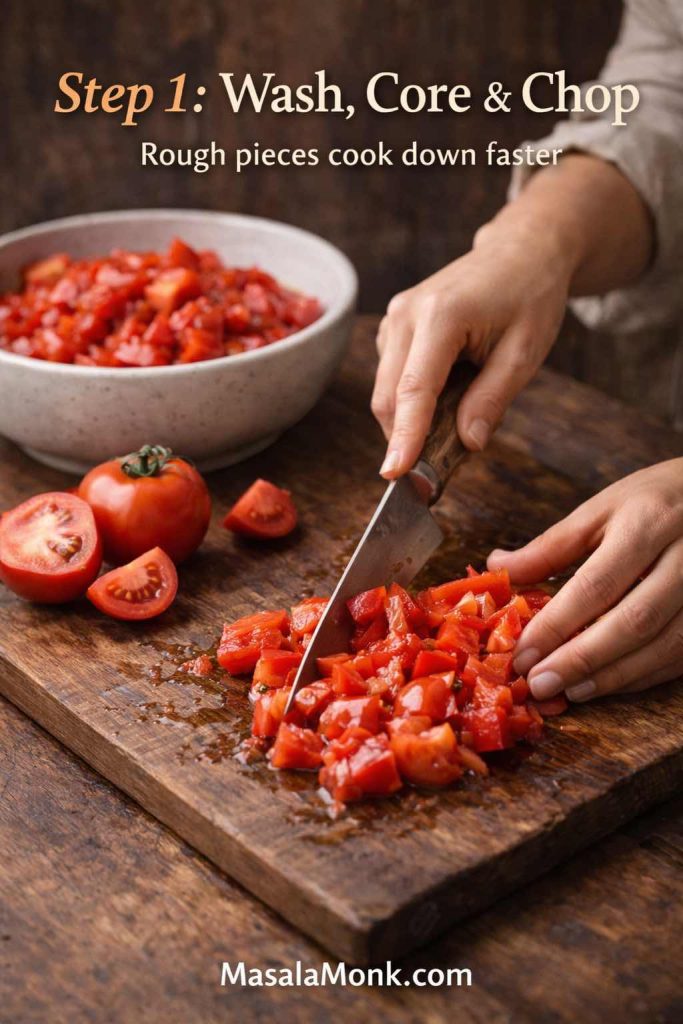
1) Wash, core, and rough-chop the tomatoes

Rinse the tomatoes well. Remove the stem area and any tough core. Chop into rough chunks. Uniformity doesn’t matter because everything will soften and collapse.

If the tomatoes are very juicy, you can chop them in a bowl so you keep the juices. Then, when those juices go into the pot too, the flavor stays with the sauce rather than disappearing into the sink.

Hands chopping fresh tomatoes into rough chunks for tomato sauce from fresh tomatoes, with chopped tomatoes in a bowl behind.
Keep the cuts rough and quick—the smaller pieces soften sooner, so your sauce gets moving fast.

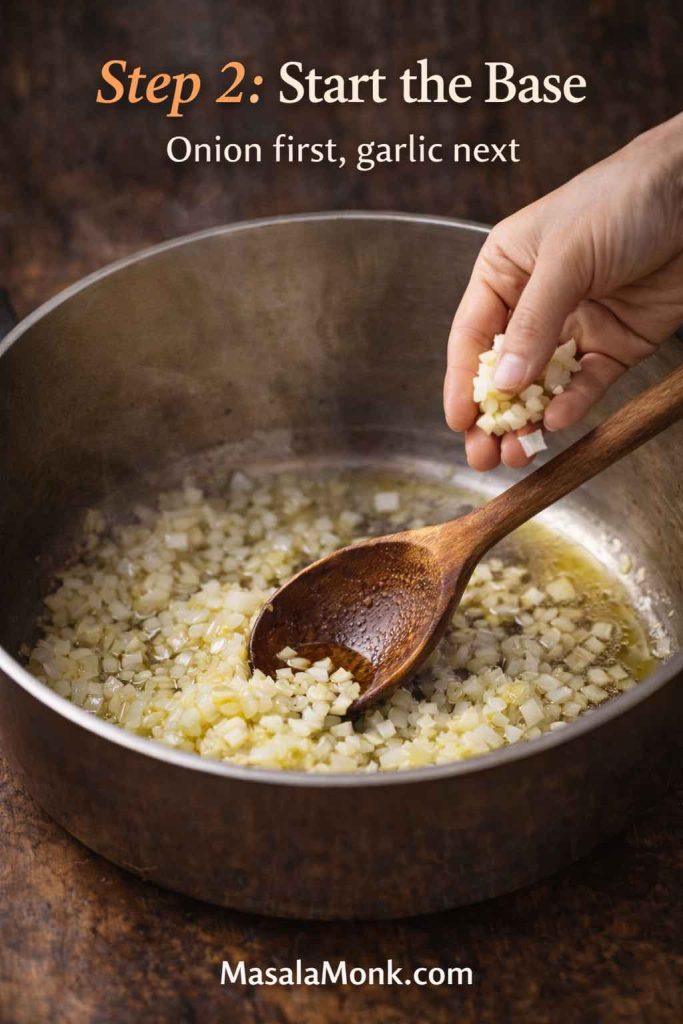
2) Start a gentle base (optional, but helpful)

Set a wide pot over medium heat. Add olive oil.

If using onion, add it first with a pinch of salt. Let it soften until translucent and sweet-smelling. Don’t rush browning here; instead, aim for gentle cooking that supports the tomatoes without overtaking them.

Add garlic next, if using, and cook briefly until fragrant. Then move on quickly—garlic can go from fragrant to bitter if it browns too hard.

If you like having a reference from a mainstream test kitchen, Bon Appétit’s approach to a simple base tomato sauce follows a similar rhythm: Basic tomato sauce.

Onion sautéing in olive oil with garlic being added in a pot to start tomato sauce from fresh tomatoes.
Let the onion turn soft and glossy before adding garlic—this gentle base gives the sauce depth without overpowering the tomatoes.

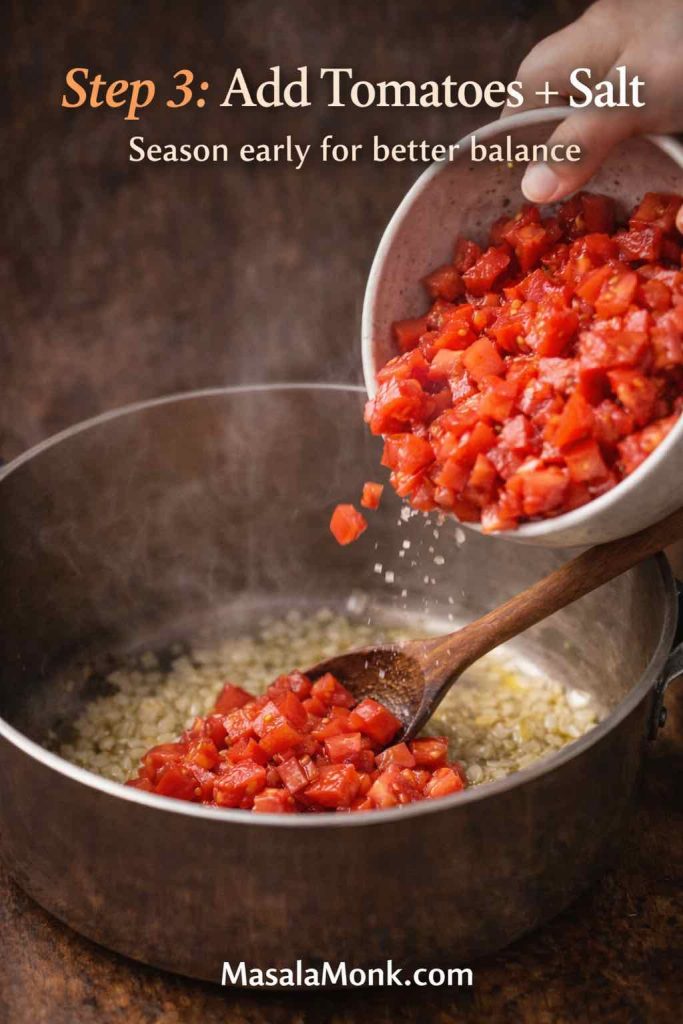
3) Add tomatoes and salt early

Add the chopped tomatoes to the pot. Salt them right away. Early salting helps pull out liquid and starts building flavor from the start. Stir well and let the tomatoes begin to heat through.

Chopped tomatoes being poured into a pot over sautéed onion and garlic while salt is sprinkled in to start tomato sauce from fresh tomatoes.
Salting at the beginning draws out tomato juices and helps the sauce taste balanced from the very first simmer.

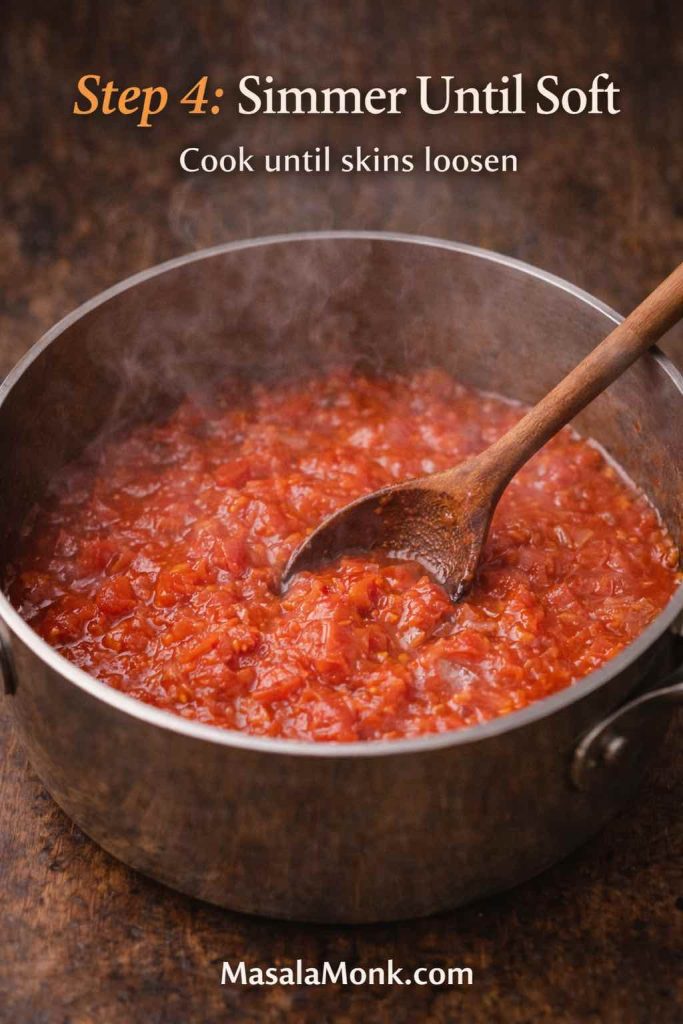
4) Simmer until the tomatoes break down completely

Lower the heat so the pot stays at a steady simmer. Stir occasionally.

You’re ready for milling when:

  • the tomatoes look collapsed and soft,
  • the mixture resembles a loose, chunky tomato stew,
  • and the skins have loosened.

Timing depends on the tomatoes. Cherry tomatoes break down quickly; larger tomatoes can take longer. Either way, let texture lead your decisions instead of the clock.

Pot of tomato sauce simmering until tomatoes break down and skins loosen, ready to be processed through a food mill.
Once the tomatoes look collapsed and jammy, you’re ready for the next step—milling for that smooth, classic texture.

5) Mill the tomatoes

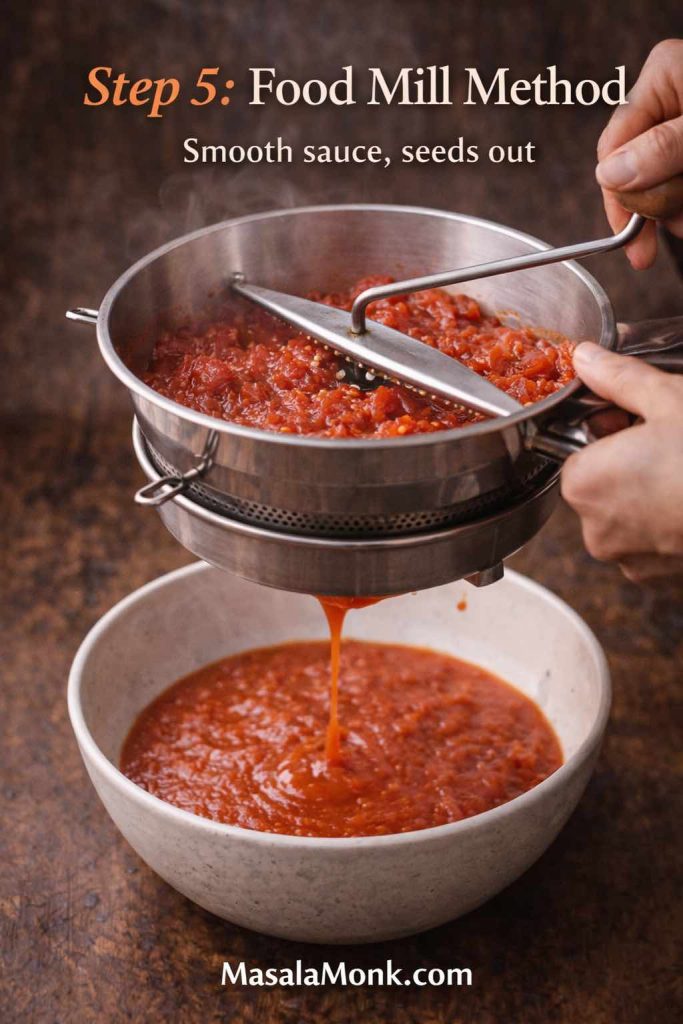
Set your food mill over a bowl or a clean pot. Ladle the softened tomatoes into the mill and crank.

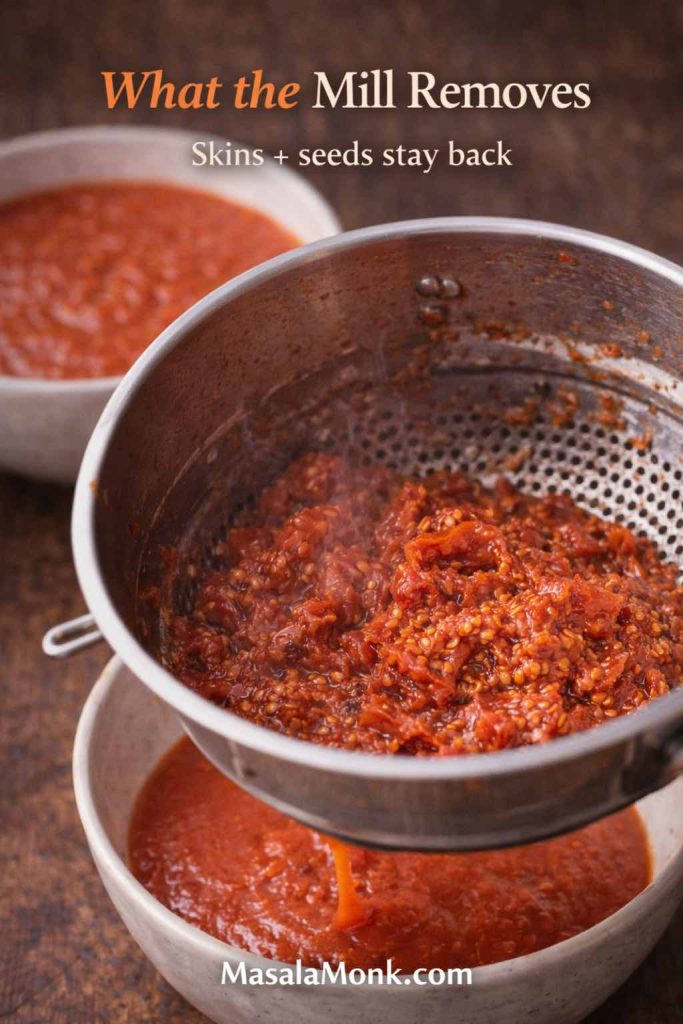
This step is satisfying for a reason: underneath, you get smooth tomato puree; above, you’re left with skins and seeds that would otherwise interrupt the texture. It’s one of the cleanest ways to get a smooth tomato sauce from fresh tomatoes without a blender.

The mill does the cleanup for you—skins and seeds stay behind while the sauce turns silky and spoonable.
Tomato skins and seeds left behind in a food mill after processing cooked tomatoes into smooth tomato sauce.
This is the texture upgrade: the mill holds back skins and seeds so the sauce underneath stays silky and clean.

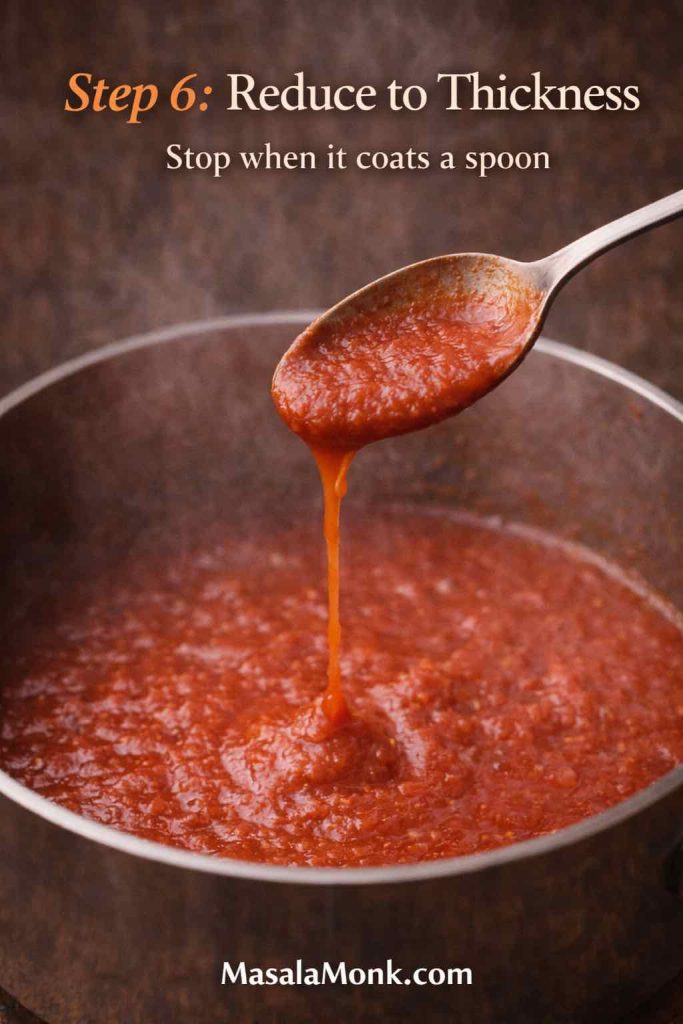
6) Reduce the sauce to your preferred thickness

Return the milled sauce to the pot and simmer uncovered. Now you choose what kind of sauce this becomes.

  • For a lighter, more “pomodoro” feel, reduce lightly.
  • For a thicker tomato pasta sauce with fresh tomatoes that clings to ridged pasta, reduce longer.
  • For a sauce that can hold up in a bake, reduce until it falls from a spoon in thicker ribbons.

Meanwhile, keep the heat gentle. A rolling boil can dull the fresh flavor and push the sauce into an overly cooked taste.

Spoon lifted over a pot of simmering tomato sauce, showing the sauce falling in ribbons to indicate the right thickness.
When the sauce drips in slow ribbons and coats the spoon, it’s thick enough to cling to pasta instead of sliding off.

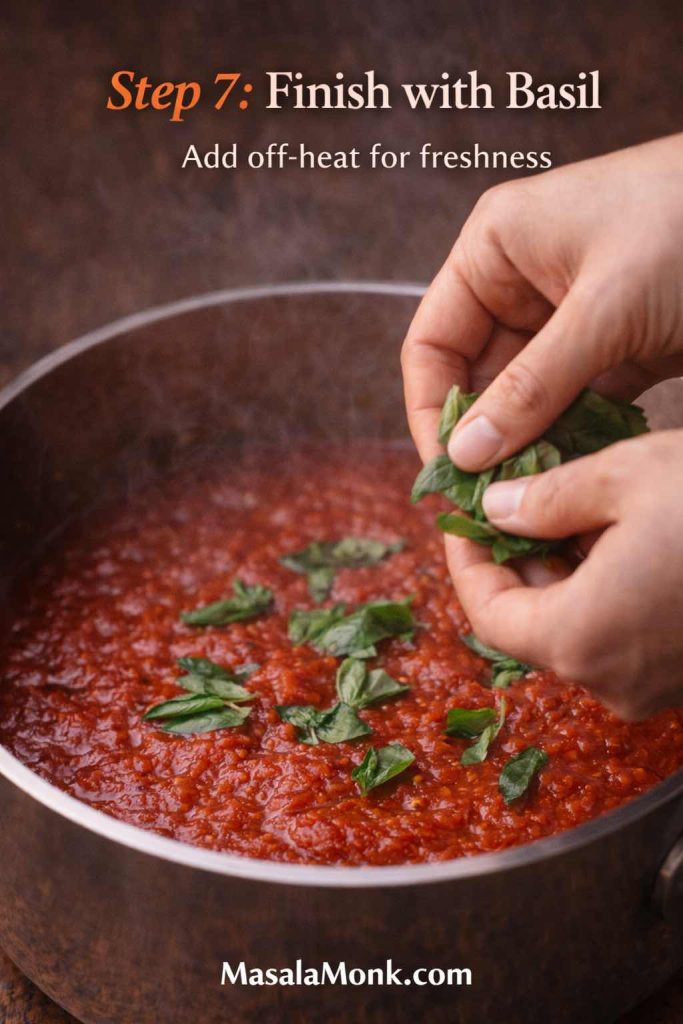
7) Finish with basil (and adjust seasoning)

Turn off the heat. Stir in torn basil. Taste and adjust salt. Add black pepper if you like.

Now you have a fresh tomato sauce recipe that stands on its own—yet it can also become tomato sauce for spaghetti, a base for lasagna, or the start of a bigger sauce later.

Hands tearing fresh basil over a pot of finished tomato sauce from fresh tomatoes to add freshness at the end.
Add basil off the heat so it stays fragrant—this final touch keeps the sauce tasting bright and tomato-forward.

Also Read: 10 Best Espresso Martini Recipe Variations (Bar-Tested)


Tomato sauce recipe with fresh tomatoes (no food mill): two good paths

If you don’t have a food mill, you can still make a great sauce. You’ll simply choose between a smoother route and a rustic route.

Option A: Peel tomatoes for a smoother fresh tomato sauce

Peeling helps a lot when you want a clean texture without milling. The classic blanch-and-slip method is straightforward: score an “X,” blanch briefly, shock in cold water, then peel.

If you want a clear, step-by-step explanation from a dependable cooking site, Serious Eats breaks it down neatly: How to peel tomatoes.

Hands peeling and seeding tomatoes over a bowl to make smooth tomato sauce from fresh tomatoes without a food mill.
Peeling first keeps the sauce silky even without a mill—most of the “rough texture” disappears before cooking begins.

After peeling:

  1. Cut tomatoes and remove seeds if you want a smoother sauce.
  2. Chop the flesh and simmer.
  3. Mash with a spoon or blend briefly.
  4. Reduce to thicken.

This is close to tomato concasse prep, where tomatoes are peeled, seeded, and chopped for refined sauces.

Option B: Keep it rustic (and still delicious)

If you don’t mind bits of tomato and occasional peel texture, skip peeling entirely. Simmer until the tomatoes are soft, then crush with a spoon and reduce. You’ll get a chunkier, homestyle sauce that’s excellent on short pasta.

Chunky crushed tomatoes simmering in a pot while being stirred with a wooden spoon for a rustic fresh tomato sauce.
Rustic sauce is a choice, not a compromise—crushing as it simmers keeps the texture hearty and the flavor bold.

In fact, for some kitchens, this becomes the default “home made spaghetti sauce” texture because it feels honest and hearty.

Also Read: Double Chocolate Chip Cookies – Easy Recipe with 7 Variations


Spaghetti sauce from fresh tomatoes vs pasta sauce from fresh tomatoes

The same sauce can behave differently depending on how you finish it. That’s why people seek spaghetti sauce from fresh tomatoes and pasta sauce using fresh tomatoes separately—they want a specific eating experience.

Spaghetti sauce from fresh tomatoes (for long noodles)

For spaghetti, you usually want a sauce that’s smooth enough to coat strands and loose enough to toss easily.

Spaghetti being tossed directly in tomato sauce from fresh tomatoes with tongs so the sauce clings to the noodles.
Tossing spaghetti in the sauce (with a splash of pasta water) helps it cling—so every bite tastes evenly coated, not just “topped.”

Cook spaghetti until just shy of done. Warm the sauce in a pan. Add spaghetti and a splash of pasta water, then toss vigorously. As the starch meets the sauce, it turns glossy and clings to noodles instead of sliding off.

This is the detail that turns “spaghetti and tomato sauce” into something that tastes cohesive.

Pasta sauce from fresh tomatoes (for short shapes)

For penne, rigatoni, fusilli, and other shapes designed to hold sauce, reduce the sauce a little more. The thicker consistency settles into ridges and pockets, so each bite tastes balanced without drowning in sauce.

If you’re ever building toward penne vodka pasta or penne alla vodka pasta later, this base is still useful—you’d simply add cream and finish differently. For now, keeping it clean highlights the tomato.

Also Read: Avocado, Basil, and Grilled Tomato Sandwich: A Perfect Breakfast Option


Italian tomato sauce from fresh tomatoes: keeping the flavor bright

Fresh tomato sauce is at its best when it tastes lively. Accordingly, the method matters more than a long list of seasonings.

Keep the simmer steady, not aggressive

A gentle simmer preserves brightness. A hard boil can flatten flavor.

Season gradually

Salt early, then adjust at the end. That way, you don’t over-salt before the sauce reduces.

Don’t bury the tomato

A sprinkle of herbs is fine, but a heavy hand can make the sauce taste like “herb sauce with tomatoes,” rather than tomato sauce from tomatoes.

Finish with basil at the end

Basil tastes fresher when added off heat. It brings a green perfume that makes the sauce feel instantly more Italian.

Also Read: Healthy Tuna Salad – 10 Easy Recipes (Avocado, Mediterranean, No Mayo & More)


Tomato sauce from fresh tomatoes: ways to use it beyond pasta

Once you have a pot of sauce, dinner options multiply. In other words, this is one of those recipes with tomato sauce that keeps paying you back.

Build a meat sauce night (without forcing it into this recipe)

If you want a heartier dinner, use this sauce as a base and build from there.

When you’re ready for a true ragù-style sauce, MasalaMonk’s bolognese sauce recipe is a natural next step, because it shows how a tomato base becomes a deep, satisfying meat sauce without losing balance.

Layer it into lasagna (tomato + white sauce = perfect balance)

Fresh tomato sauce pairs beautifully with a creamy white layer. For a classic approach, pair it with MasalaMonk’s béchamel sauce for lasagna. The contrast matters: the béchamel is rich, so the tomato layer stays bright and keeps the dish from feeling heavy.

If you want a different lasagna direction, MasalaMonk’s cottage cheese lasagna recipe is another excellent path—especially when you want a protein-forward bake that still feels comforting.

On colder days, when you want “lasagna flavor” with far less effort, MasalaMonk’s crock pot lasagna soup is a cozy alternative that fits beautifully with a tomato base.

Serve it with arancini (a restaurant-feeling snack at home)

Warm tomato sauce as a dip is an easy way to make something feel special. Crispy rice balls dipped into a bright sauce are hard to beat. If you want the method for rice balls, MasalaMonk’s arancini balls guide makes it approachable. Then you simply ladle your sauce into a bowl and dip generously.

Turn it into a chicken parm-style sandwich night

Tomato sauce plus crispy chicken and melted cheese is a reliable crowd-pleaser. If you want inspiration, MasalaMonk’s chicken sandwich recipes includes ideas that naturally pair with a homemade red sauce—either as the main component or as a dipping side.

Make it spicy without changing the whole pot

If you want to lean toward spicy tomato sauce, add chili flakes at the end. Alternatively, stir in a spoon of a bright pepper sauce to add heat and tang at once. MasalaMonk’s pepper sauce recipe is a great place to explore heat styles if you enjoy experimenting.


Tomato sauce from tomatoes: balancing flavor without making it sweet

Many store-bought sauces lean on added sugar to round out acidity and boost flavor. Homemade sauce doesn’t need that shortcut—you can create balance by gently reducing the tomatoes, seasoning thoughtfully, and finishing with the right touch of fat and herbs.

If the sauce tastes too sharp

First, simmer longer. Acidity often softens as the sauce reduces.

If it still tastes sharp, a small knob of butter can mellow the edges and add a smoother mouthfeel. If you want a clear explanation of why this works, Simply Recipes (a long-running home-cooking publication) talks through easy ways to improve tomato sauce flavor, including richness and balance: How to make store-bought tomato sauce taste better. The idea applies just as well to homemade sauce—especially when tomatoes are a little tart.

If the sauce tastes watery

Reduce uncovered in a wide pot. The wider the surface area, the faster water evaporates. Consequently, the sauce thickens without needing starches or tricks.

If the sauce tastes flat

It almost always needs salt. Add a small pinch, stir, and taste again. After that, finish with basil or a drizzle of olive oil to bring it to life.

Also Read: Peanut Butter Cookies (Classic Recipe & 3 Variations)


Tomato pasta sauce with fresh tomatoes: texture choices that change the meal

Two people can follow the same recipe and end up with two very different sauces—simply because they reduced to different thicknesses. That’s not a mistake; it’s a feature.

For a light sauce (best for tossing with pasta water)

Reduce just until the sauce coats a spoon. It should still flow easily.

For a clingy red sauce (best for short pasta and baked dishes)

Reduce longer until the sauce falls in thicker ribbons. This version sits on pasta instead of pooling underneath.

For a thicker base

If you reduce even further, the sauce can hold up for layering in casseroles. That’s one reason this is such a useful pasta sauce from fresh tomatoes: you can steer the texture to match the meal.

Also Read: Healthy Oat Protein Bars – 5 Easy No Sugar Recipes for Snacks


Homemade tomato sauce: scaling up without making it complicated

Tomato sauce from fresh tomatoes scales well, but the workflow stays smoother if you respect a few realities.

  • Use a wide pot so reduction doesn’t take forever.
  • Salt in stages: early, then adjust late.
  • Mill in batches if you’re making a large pot.

If you double the tomatoes, you don’t need to double your attention—just your pot size and your patience. Eventually, you’ll find your personal rhythm: simmer while you tidy the kitchen, mill while the pasta water heats, and finish while dinner plates come out.


Storage: fridge, freezer, and a careful word about canning tomato sauce

Fridge

Cool the sauce, then store in an airtight container. Reheat gently so the flavor stays bright.

Freezer

Freeze in small portions so you can thaw exactly what you need. This is the easiest way to keep tomato sauce for spaghetti nights effortless later.

If you plan to can it

Canning tomato products is absolutely doable, but it’s also an area where tested guidance matters. Tomato acidity varies, and safe canning depends on correct acidification and proven methods.

If you want reliable sources:

If you’re not canning, freezing is the simplest long-term option—less stress, less equipment, and still excellent results.


When you want a different sauce night (still pasta, just a new mood)

Fresh tomato sauce is a cornerstone. Still, variety keeps cooking exciting.

If you want to switch gears:

  • MasalaMonk’s pesto recipes are a great way to pivot into something herby and bright.
  • If you prefer a lighter pesto direction, MasalaMonk’s fresh basil pesto (vegan) is another easy next step.
  • For creamy comfort with no tomato at all, MasalaMonk’s carbonara recipe is a classic alternative.
  • Likewise, if you’re craving a rich bowl on another night, MasalaMonk’s chicken alfredo pasta is a strong companion read.

Meanwhile, your homemade tomato sauce can sit in the freezer, ready for the next time you want dinner to feel simple and excellent.


Tomato sauce from fresh tomatoes, made once—used again and again

Once you’ve made tomato sauce from fresh tomatoes using the food mill method, it stops feeling like a special project and starts feeling like a skill you own. On days when market tomatoes look especially good, you’ll reach for this fresh tomato sauce recipe without overthinking it. When you want something clean and reliable, it naturally becomes your go-to pasta sauce using fresh tomatoes. And when the craving hits on an ordinary weeknight, it turns into the spaghetti sauce from fresh tomatoes you’ll be glad you already know how to make.

And because it’s flexible, it fits different moods. Keep it simple and you get a bright sauce that tastes like summer. Reduce it more and you get a clingy tomato pasta sauce with fresh tomatoes that feels comforting and rich. Build on it and you get a base for bigger dishes—bakes, sandwiches, even hearty meat sauces—without needing a separate starting point.

So when you spot tomatoes that smell sweet and look truly ripe, don’t save them only for salads. Put a pot on the stove, let the kitchen smell incredible, and make a sauce you’ll be happy to have—tonight, and many meals from now.

Also Read: 10 Creative Chia Pudding Recipes for Every Taste

FAQs

1) How do I make tomato sauce from fresh tomatoes without a food mill?

Start by cooking chopped tomatoes with a little salt until they fully collapse. Afterward, peel and seed first (for a smoother result) or keep it rustic, then mash well and simmer until it reaches the thickness you want for pasta.

2) What’s the easiest tomato sauce from fresh tomatoes method for beginners?

A simple approach is to simmer chopped tomatoes with salt (plus onion or garlic if you like) until soft, then reduce uncovered until the flavor concentrates. Finally, finish with basil for a fresh, Italian-style taste.

3) Can I use this tomato sauce for spaghetti?

Absolutely. For tomato sauce for spaghetti, keep the sauce slightly looser, then toss it with cooked spaghetti and a splash of pasta water so it coats the noodles instead of pooling underneath.

4) How do I turn tomato sauce into spaghetti sauce?

To shift tomato sauce to spaghetti sauce, simmer a bit longer for deeper flavor, then adjust texture with pasta water at the end. Additionally, you can add sautéed onion/garlic or herbs for a more “spaghetti sauce” profile.

5) How do I make spaghetti sauce from fresh tomatoes that isn’t watery?

Choose meatier tomatoes when possible, then simmer uncovered to evaporate excess liquid. If needed, widen the pot surface area to speed up reduction while keeping the simmer gentle.

6) What tomatoes are best for tomato sauce from tomatoes?

Roma or plum tomatoes are ideal because they’re less watery and have more flesh. Still, vine-ripened tomatoes work well too, especially if you’re willing to reduce longer for a richer tomato taste.

7) Is fresh tomato sauce the same as marinara sauce?

Not always. Fresh tomato sauce is often lighter and more tomato-forward, whereas marinara sauces usually include a more defined seasoning profile and can be slightly thicker, depending on the style.

8) How do I make a marinara sauce recipe from this fresh tomato base?

Begin with your fresh tomato sauce, then add garlic, herbs, and a longer simmer for a more classic marinara feel. In many cases, a pinch of oregano plus basil moves it firmly into marinara territory.

9) What’s the difference between sauce pomodoro and regular tomato sauce?

Sauce pomodoro typically stays bright, simple, and basil-forward, with a clean tomato flavor. By comparison, “tomato sauce” can range from quick and fresh to longer-simmered and more robust.

10) What is sugo recipe style tomato sauce?

Sugo generally refers to an Italian-style sauce that’s often tomato-based and used broadly for pasta. Depending on the region, it can be simple like pomodoro or richer with longer cooking and added ingredients.

11) Can I make tomato pasta sauce with fresh tomatoes ahead of time?

Yes. Let the sauce cool completely, then refrigerate for a few days or freeze in portions. Later, reheat gently to keep the flavor lively and the texture smooth.

12) How long should I simmer homemade tomato sauce?

Simmer just until the tomatoes break down, then reduce until the sauce tastes concentrated and coats a spoon. The exact time varies by tomato type, batch size, and how thick you want your red pasta sauce.

13) How do I thicken pasta sauce from fresh tomatoes quickly?

Use a wide pot, keep it uncovered, and maintain a steady simmer to drive off moisture faster. Alternatively, start with less-watery tomatoes to reduce thickening time.

14) How do I fix fresh tomato sauce that tastes too acidic?

First, reduce a bit longer because acidity often softens with cooking. If it still tastes sharp, add a small knob of butter or a tiny pinch of sugar—just enough to round the edges, not sweeten the sauce.

15) Can I make low sugar pasta sauce with fresh tomatoes?

Yes—fresh tomato sauce is naturally low sugar when you skip sweeteners. Focus on good tomatoes, proper salt, and reduction for balanced flavor without added sugar.

16) How do I make sugar free marinara sauce?

Use tomatoes, olive oil, salt, and herbs—then avoid any added sweeteners. For extra depth, sauté onion gently; it boosts perceived sweetness naturally without adding sugar.

17) What’s the best way to season Italian tomato sauce from fresh tomatoes?

Salt early, then adjust at the end. Beyond that, basil is a classic finish, while onion and garlic provide depth; keep dried herbs modest so the tomato flavor stays front and center.

18) Can I use this as pizza tomato sauce?

You can, especially if you reduce it until it’s thick enough to spread. However, pizza tomato sauce is often uncooked or paste-based, so expect a slightly different flavor and texture.

19) How do I make pizza sauce using tomato paste instead?

Whisk tomato paste with water, olive oil, salt, and herbs until spreadable. Then adjust thickness and seasoning to taste; it’s a fast option when fresh tomatoes aren’t available.

20) Can I make roasted tomato sauce from fresh tomatoes?

Definitely. Roast tomatoes until caramelized, then simmer briefly and blend or mill for texture. Roasting adds sweetness and depth, creating a richer roasted tomato spaghetti sauce.

21) What’s the difference between fresh tomato sauce and red sauce?

“Red sauce” is a broad label that can include marinara, longer-simmered Italian-American sauces, and other tomato-based sauces. Fresh tomato sauce is typically lighter, quicker, and more tomato-forward.

22) Can I turn this into arrabbiata sauce pasta?

Yes. Add chili flakes (or fresh chilies) and simmer briefly so the heat infuses. Then toss with pasta for an easy arrabbiata sauce pasta style dinner.

23) How do I make arrabbiata sauce recipe style from scratch?

Start with olive oil and garlic, add chili flakes, then pour in tomato sauce and simmer. Finish with salt and basil or parsley, then serve immediately with pasta.

24) Can I make puttanesca sauce using this tomato base?

Yes. Add olives, capers, garlic, and chili, then simmer briefly to meld flavors. As a result, you get a bold puttanesca sauce without needing a separate tomato foundation.

25) How do I make tomato cream sauce from this base?

Warm the tomato sauce, then stir in heavy cream or a splash of milk and simmer gently. This creates a creamy tomato sauce that’s ideal for pasta.

26) Is this the same as penne alla vodka pasta sauce?

Not exactly. Penne alla vodka pasta uses a tomato base plus vodka and cream for a silky finish. Still, this sauce is the perfect starting point for a penne alla vodka recipe later.

27) Can I use passata tomato instead of fresh tomatoes?

Yes. Passata is strained tomato puree, so it behaves like a smooth base right away. Simmer it with aromatics and finish like you would a fresh tomato sauce recipe.

28) How do I make tomato sauce using tomato paste if I’m out of tomatoes?

Combine tomato paste with water (or broth), olive oil, and seasonings, then simmer briefly. After that, adjust salt and herbs until it tastes balanced and full.

29) What’s the best way to store homemade tomato sauce?

Cool it fully, store in airtight containers, and refrigerate for short-term use. For longer storage, freeze in smaller portions so you can thaw just what you need.

30) How do I use this for meatballs in tomato sauce?

Simmer meatballs directly in the sauce until cooked through, allowing the sauce to pick up their flavor. Then serve over spaghetti or with bread for a classic meatballs and tomato sauce meal.

Posted on 17 Comments

How to Cook Bacon in the Oven (Crispy, No-Mess, Crowd-Ready Recipe)

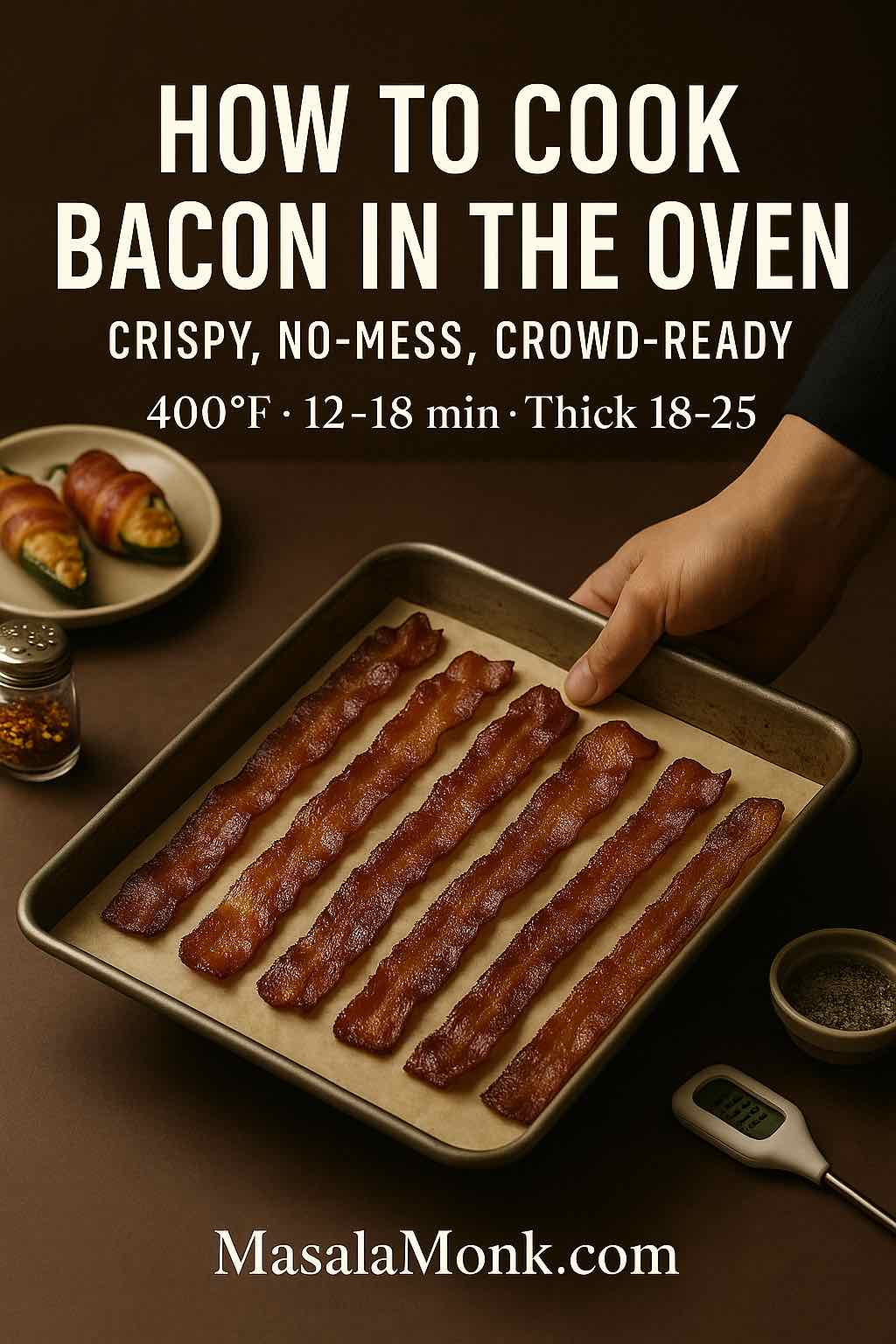
Hand holding a parchment-lined tray of crispy oven-baked bacon with warm, moody styling; headline ‘How to Cook Bacon in the Oven’ and timing 400°F 12–18 min (thick 18–25); jalapeño poppers and thermometer props.

There’s a reason so many pros and savvy home cooks quietly migrate from the skillet to the sheet pan: once you learn how to cook bacon in the oven, you get even browning, less fuss, almost no splatter, and—most importantly—perfectly crisp slices that finish at the same time. Instead of babysitting over popping fat, you slide a tray into a preheated oven, rotate once, and pour yourself coffee while the heat does the work. Independent tests routinely rank oven on parchment among the most reliable approaches for consistent texture and easy cleanup, and large-batch cooking becomes trivial. If you’re planning brunch, feeding a crowd, or just prefer your kitchen to smell like breakfast (and not like a grease fire), this is the method you’ll return to again and again. See the side-by-side from The Kitchn that named parchment-lined baking the winner in a multi-method showdown: baking on parchment paper is best and, for further mechanics, Serious Eats’ explanation of why bacon “fries in its own fat” on a flat, lined sheet helps lock in uniform browning: the best way to cook bacon.

Before we light the oven, let’s set the payoff: oven bacon frees your hands for everything else. With one tray working, you can mash yolks for a platter of classic deviled eggs or toss together a spread of potato appetizers—both pairings that vanish quickly when crisp bacon hits the table.

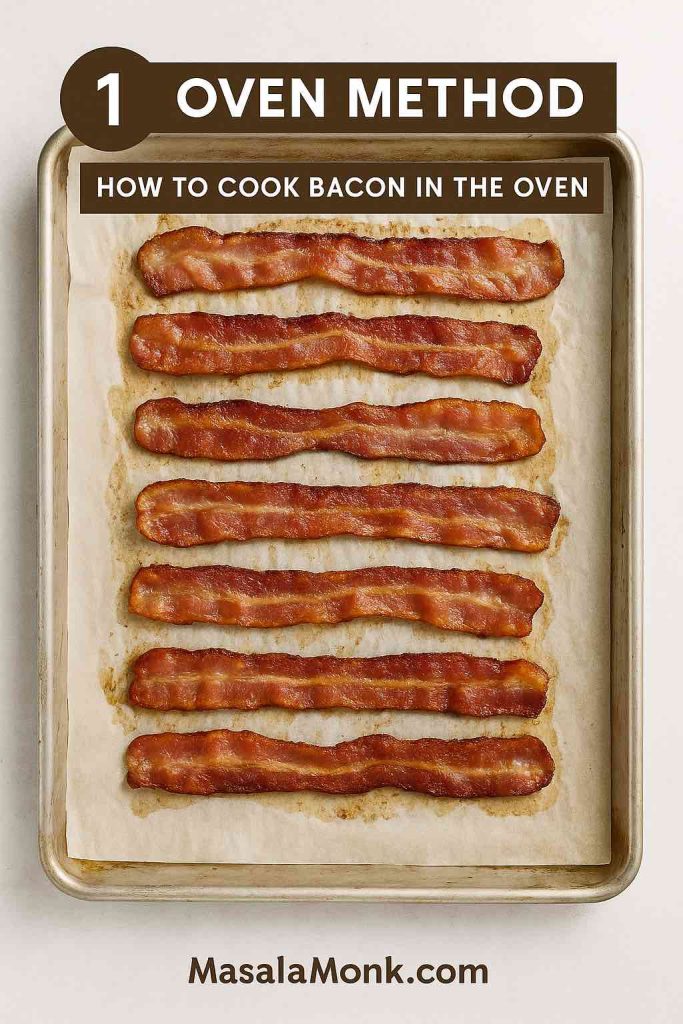
Parchment-lined sheet pan with evenly browned bacon strips—step 1 oven method for cooking bacon at 400°F
Even browning, minimal mess: line a rimmed sheet with parchment, bake on the middle rack, rotate once, then rest to crisp.

The Straightforward Way: How to Bake Bacon in the Oven

To master how to cook bacon in the oven, start simple. Preheat to 400°F (205°C). Line a rimmed sheet with parchment; fold the paper’s edges up slightly so they catch the drips. Arrange the strips in one layer with a sliver of space between each piece. Slide the tray onto the middle rack and bake until the edges are deeply rendered and the centers no longer look shiny: for regular slices, 12–18 minutes; for thick cut, 18–25 minutes. Rotate the pan once halfway to even out hot-spot differences. If you crave a touch more mahogany, finish under the broiler for 60–90 seconds, watching constantly. Transfer the bacon to a wire rack (or paper towels) and rest 1–2 minutes; it crisps further as it cools.

Although foil works, parchment typically releases better and wipes up faster—exactly what The Kitchn’s 8-method test concluded when it crowned the parchment-lined oven method the overall winner. If you enjoy method-nerd deep dives, bookmark that side-by-side here: We tried 8 methods; baking on parchment won.

And because brunch is a whole mood, tuck a few supporting bites alongside: creamy deviled eggs and a tray of crisp-tender potato bites build out the board with minimal extra effort.

Also Read: 10 Best Chicken Sandwich Recipes (BBQ, Parm, Buffalo & More)


Why Oven Bacon Beats the Skillet When It Matters

First, capacity. A full sheet pan fits far more slices than a skillet; everything finishes together instead of in waves. Second, predictability. With a steady 400°F and a lined pan, you aren’t fighting hot spots or flare-ups, and you can place the bacon exactly where you want it. Third, tranquility. No hovering with tongs, no fat popping onto your forearms, and no chaos near the stovetop when you’re scrambling eggs.

Moreover, this isn’t just opinion. Food & Wine tested seven methods and landed where many of us do: the oven delivers the most consistent, low-effort crisp while still accommodating big batches. Have a look at their summary here: We tested 7 ways; oven won. Serious Eats also lays out why convection and even heat promote browning more evenly than a crowded skillet can manage: how to cook bacon.

Meanwhile, if you’re outfitting your kitchen for long-term wins, give this a skim before you impulse-buy more heavy cookware: Buying a Cast Iron Skillet? 5 Warnings Before You Invest. Cast iron is brilliant for searing and oven finishes, but caring for it properly protects your sanity (and your bacon).

Also Read: 10 Best Espresso Martini Recipe Variations (Bar-Tested)


How to Make Bacon Extra Crispy in the Oven—Every Time

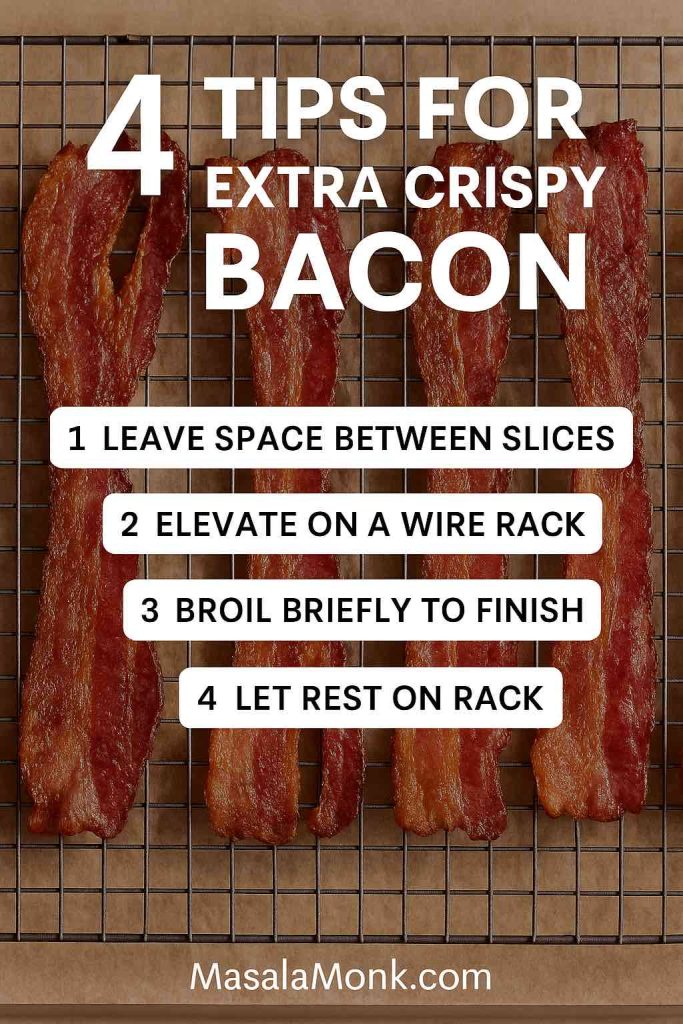
Now that you know how to cook bacon in the oven, let’s push for that shattery edge without overcooking.

Space matters. Overlap creates steam, and steam softens. Leave small gaps so fat can render cleanly and the edges can dry.

Airflow wins. For the crispiest possible texture, elevate the slices on a wire rack set over the sheet pan. Air moving under the bacon tightens the texture and flattens the wave. Add 1–3 minutes to the timing when using a rack.

Finish fast. The broiler is a torch, not a strategy. Use it briefly—no more than 60–90 seconds—to burnish color at the end, not as the primary heat source.

Rest to set. Two minutes on a rack is the difference between “hot and floppy” and “cooled and crisp.”

Four tips overlay on bacon on a cooling rack: space slices, elevate on rack, brief broil, rest to set
Space the strips, lift on a rack, finish with a brief broil, then rest 1–2 minutes—hello shattery edges.

Curious why a flat, lined surface equals uniform browning? Because bacon essentially fries in its own fat on the sheet; parchment lets it baste, release, and crisp without sticking, which is exactly what Serious Eats describes in its method comparison: the best way to cook bacon. If you need ultra-flat slices for BLTs or breakfast sandwiches, try the pro trick of gently pressing the bacon beneath a second pan (with parchment between) as it bakes; Kenji López-Alt uses this in his “bacon for a crowd” method: baked bacon for a crowd.

Also Read: Macaroni & Cheese Recipe: Creamy Stovetop, Baked & Southern


Thickness, Temperatures, and Timelines

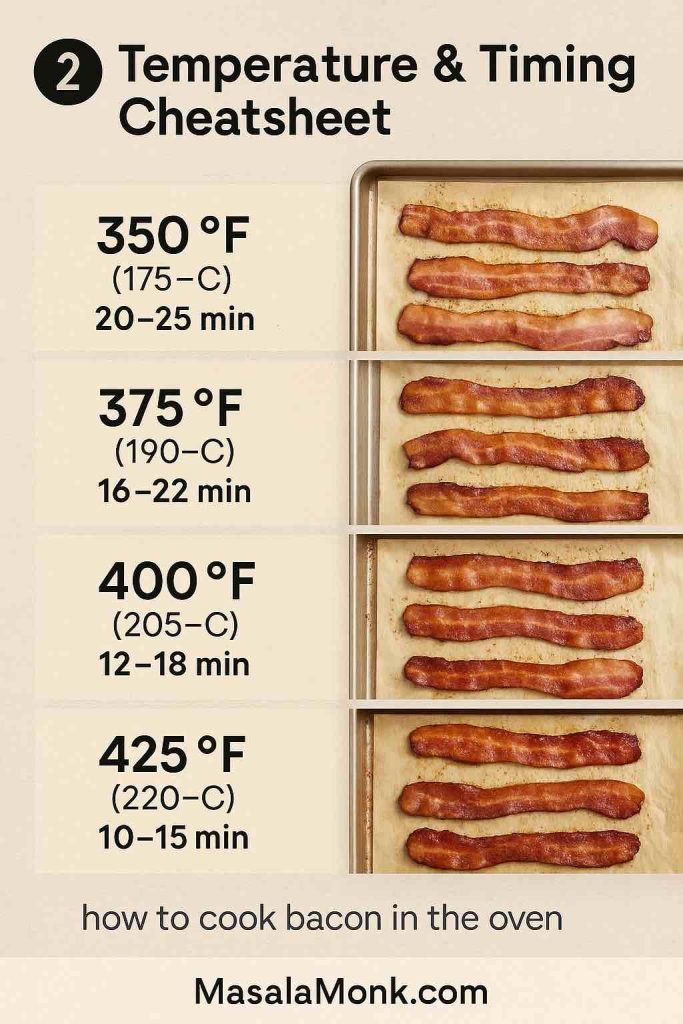
Because readers arrive with different ovens and cuts, it helps to position the timing windows clearly.

Oven bacon time and temperature chart for 350°F, 375°F, 400°F, and 425°F with doneness photos
Use this quick chart to hit your desired texture with bacon—400°F is the sweet spot for speed and crisp, while 350–375°F adds forgiveness.

How to Cook Bacon in the Oven at 400°F (the Sweet Spot)

Most kitchens get the best balance of speed and crisp at 400°F (205°C). Expect 12–18 minutes for standard slices and 18–25 for thick-cut, rotating the tray once. The Kitchn’s step-by-step lays out the same range with a straightforward setup: how to cook bacon in the oven at 400°F.

How to Cook Bacon in the Oven at 375°F (Even Browning)

Prefer a slightly gentler march toward crisp? At 375°F (190°C), you often see 16–22 minutes as the window. This is a sweet setting for big brunch trays where you’d rather have a touch more forgiveness.

How to Cook Bacon in the Oven at 350°F (Calmer, Fewer Pops)

At 350°F (175°C), you trade time for calm: 20–25 minutes for standard slices. If you’re new to your oven or worried about splatter, this conservative setting keeps things tidy.

How to Cook Bacon in the Oven at 425°F (Fast—Eyes on It)

When you’re sprinting, 425°F (220°C) can land 10–15 minutes, but it demands vigilance. The last three minutes determine whether you nail glossy, crisp mahogany or overshoot into brittle. Rotate, then watch like a hawk.

Also Read: French Toast Sticks (Air Fryer + Oven) — Crispy Outside, Custardy Inside


Thick-Cut Bacon: How to Cook Bacon in the Oven for Big Slices

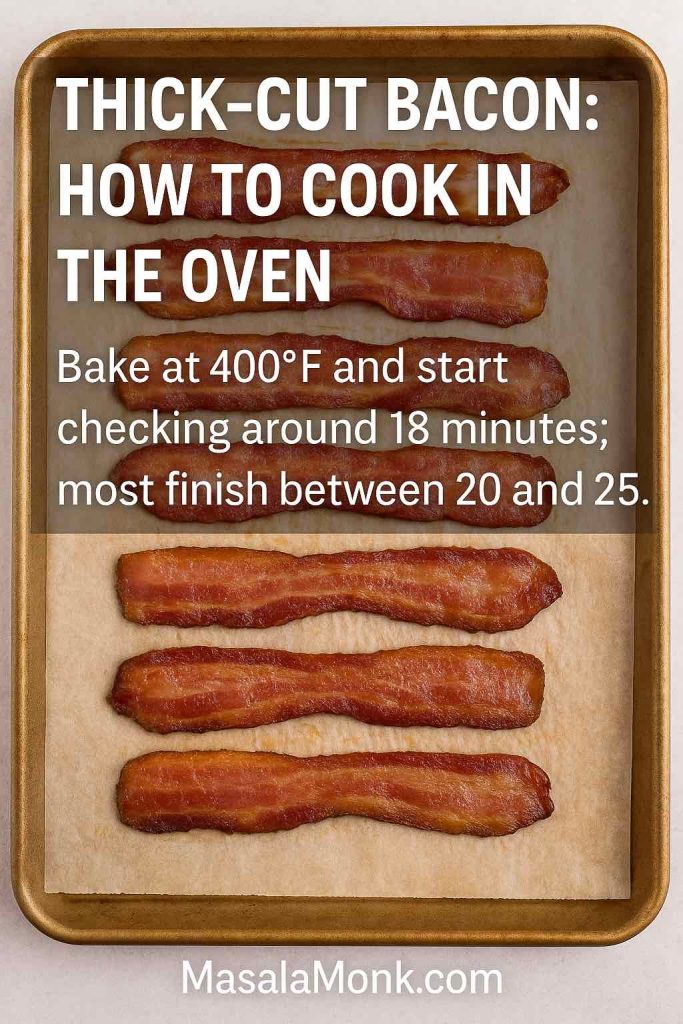
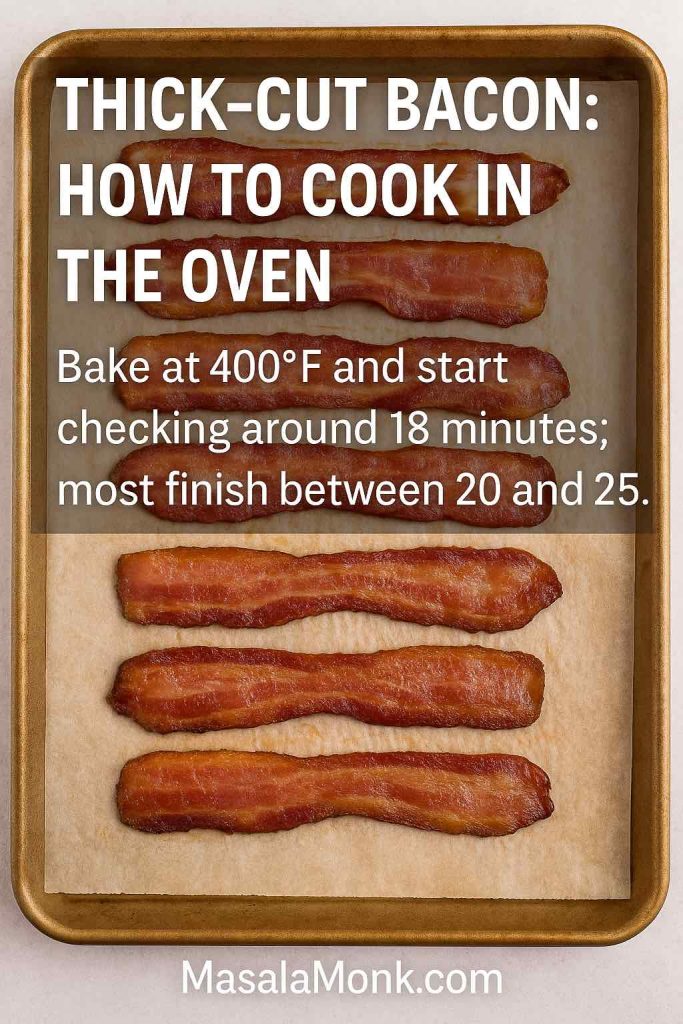
Thick-cut strips reward patience. They hold more fat and need a breath more time to render. Set 400°F, lift the slices on a rack if you have one, and start checking at 18 minutes. Most batches pull somewhere between 20–25 minutes. If the centers are right but the color wants another shade, broil briefly—truly, a minute can be plenty.

Thick-cut bacon baked on parchment with timing note to check at 18 minutes and finish by 25
Thick-cut needs patience—start checking at 18 minutes at 400°F; pull when centers lose shine and edges are deeply rendered.

If you like food gear insights while we’re here, this piece offers real-world cautions before you add more iron to your cabinet: cast-iron skillet warnings. Cast iron excels for many tasks, but it’s fine to keep oven bacon on parchment; you don’t need a heavy pan to nail it.

Also Read: Lemon Drop Martini Recipe (Classic, 3-Ingredient, & More)


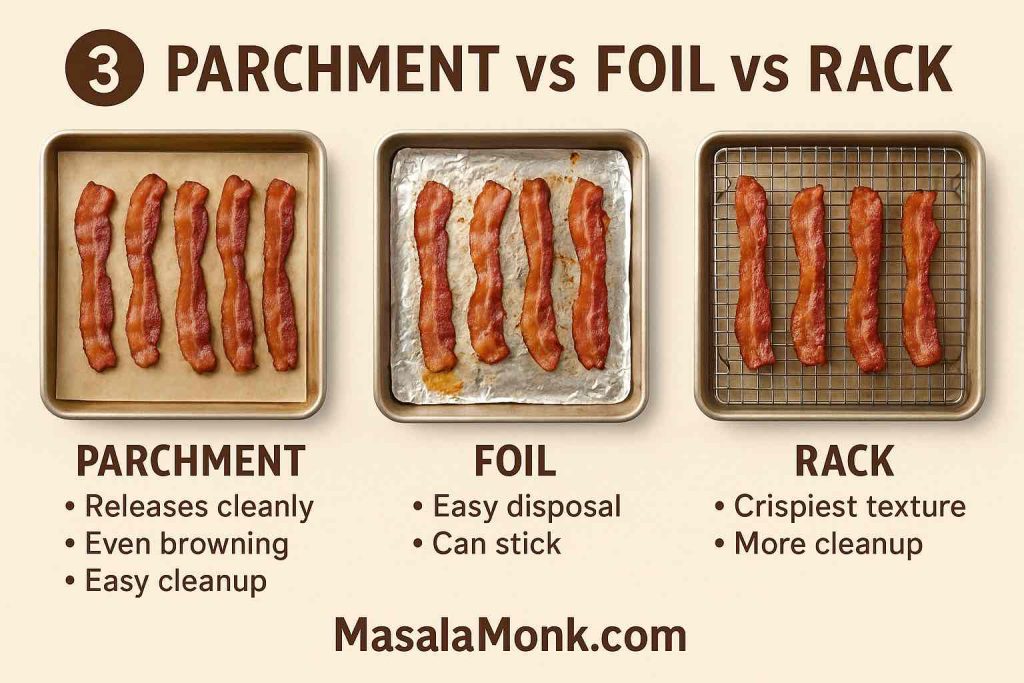
Parchment vs Foil vs Rack: Choosing the Best Setup

It’s tempting to chase hacks, yet the basics outperform gimmicks.

Side-by-side comparison of bacon baked on parchment, foil, and wire rack showing release and crispness differences
Parchment = easiest cleanup, Rack = crispiest (with more scrubbing), Foil = workable but can stick with sugary cures.

Parchment on a rimmed sheet is the dependable default: it releases cleanly, encourages even browning, and makes cleanup nearly effortless. The Kitchn’s comparison crowned this exact configuration: parchment-lined baking wins.

A rack over the sheet yields the crispiest texture with flatter slices and more airflow. Add a minute or two to timing and budget a moment to scrub the rack; the result is worth it for “glass-snappy” edges.

Foil-lined sheets also work and are easy to toss, though certain sugar-cured bacons can adhere slightly more to foil than to parchment. If you go foil, fold the edges up into a shallow tray to corral drips for mess-free disposal (Food & Wine even shows a DIY “ridge” rack with folded foil here: oven bacon trick).

For completeness, a few outlets promote cold-start tricks or twist techniques. If you enjoy experimenting, go for it. The fundamentals above, though, remain the most repeatable for week-to-week cooking.

Also Read: Classic vs. Authentic Alfredo: 5 Essential Recipes


Convection, Toaster Oven, and a Word on Microwaves

Because ovens vary, it’s smart to adapt. Convection fans accelerate browning by moving hot air constantly over the surface. As a rule, reduce by 25°F (≈15°C) and start checking 3–4 minutes earlier.

Bacon on a rack in a toaster oven with guidance to reduce temperature by ~25°F and check earlier
Convection speeds browning—drop temp by ~25°F and begin peeking 3–4 minutes early to avoid overshooting.

Toaster ovens are mini-ovens. The same guidance applies; just use a smaller tray and peek 2–3 minutes earlier because the elements sit closer to the food.

As for microwaves, they excel for 1–4 slices when you’re racing out the door: layer bacon between paper towels on a microwave-safe plate, cook about 1 minute per slice to start, then add 15–20 second bursts to finish. However, controlled tests still favor baked bacon for texture and consistency—especially with thick-cut. Food & Wine’s multi-method comparison places microwave near the bottom for taste and mouthfeel: 7 ways to make bacon—oven wins.

Also Read: Air Fryer Chicken Wings (Super Crispy, No Baking Powder)


How to Cook Bacon in the Oven—Without a Mess

If you’ve ever cleaned splatter from a stovetop, the oven already feels calmer; nevertheless, a few habits make it virtually mess-free.

  • Use a rimmed sheet so fat can’t cascade into the oven floor.
  • Middle rack positioning keeps hot coils above and below at safe distances.
  • Do not broil the entire time. Broiling drives popping; instead, broil only to finish for color.
  • Don’t crowd. Overlapping strips steam each other and spatter more.
  • Line with parchment and fold the edges up; this turns the paper into a drip tray you can lift and discard.
  • Start with a clean oven. Residual grease on the floor smokes before bacon does. A quick wipe pays dividends.

If you enjoy flavor-building extras across the rest of your brunch plan, take a peek at MasalaMonk’s seasoning ideas for eggs, which dovetail nicely with a bacon tray: egg-cellent seasoning options.


Turkey Bacon: How to Cook Bacon in the Oven When It Isn’t Pork

Turkey bacon behaves differently: less fat, quicker edges. Bake at 400°F (205°C) for 10–15 minutes. Flip at 8–10 minutes if the edges curl; pull once the surface looks uniformly crisp, because a minute too long dries it out.

Turkey bacon on a rack with steps: bake at 400°F 10–15 min, flip at 8–10 if edges curl, pull when surface looks crisp
Leaner strips cook faster—trust visual cues; flip if curling, then pull as soon as the surface crisps to prevent drying.

Because brand moisture and slice thickness vary, one must trust visual cues as much as the clock. If there’s ever a product advisory (they do happen), always check the official guidance—USDA FSIS maintains an updated recall hub and safety pages. For example, here’s the FSIS bacon safety backgrounder: Bacon and Food Safety.


Bacon Grease: Strain, Save, and Store

Once your tray cools a bit, pour the drippings through a fine sieve or a coffee filter into a clean jar. That liquid gold perfumes roasted potatoes, fried eggs, cornbread, even sautéed greens.

Jar of strained bacon grease with tips to refrigerate for about 3 months or freeze longer
Strain through a fine sieve or coffee filter; refrigerate up to ~3 months or freeze for longer—perfect for potatoes, eggs, and cornbread.

For storage, the simplest, most practical guidance is: refrigerate up to ~3 months and freeze for longer (6+ months), always discarding if the fat smells off or looks milky after warming. For broader food-safety context, tap FSIS’ comprehensive basics and temperature resources: Food safety basics and the safe internal temperature chart.


From Oven to Plate: What to Serve With Bacon (and How to Keep It Hot)

Because oven bacon scales so well, you can build the rest of the menu without anxiety. As mentioned earlier, classic pairings make you look like a catering pro with almost no extra labor: silky deviled eggs and crispy-creamy potato appetizers round out the plate. Or, pivot toward a slightly different vibe with sweet-potato starters—the salty-sweet play loves bacon.

Bacon slices on a wire rack with text: hold and reheat at 200°F (95°C) for 30–40 minutes
Keep bacon crisp for service: rest cooked strips on a rack in a 200°F oven for 30–40 minutes—airflow prevents soggy edges.

To hold bacon for the table, set your oven to 200°F (95°C) and rest the strips on a rack set over a sheet; this keeps them crisp for 30–40 minutes. Avoid covering tightly with foil, which traps steam and softens the edges you worked to get.

Also Read: Punch with Pineapple Juice: Guide & 9 Party-Perfect Recipes


A Note on Food Safety (Because You’re the Grown-Up in the Room)

While bacon itself is fully cooked when crisp to your liking, many brunch menus combine it with proteins that do require strict temperature targets—bacon-wrapped chicken breasts for instance.

Bacon on cooling rack with food safety notes: poultry 165°F, pork 145°F plus rest, refrigerate grease, check FSIS recalls
Pair bacon with safe temps: poultry to 165°F, pork to 145°F + rest. Strain and refrigerate grease, and scan FSIS recalls for advisories.

Whenever you include cross-links to recipes with poultry or seafood, keep your stance clear and cite the USDA’s numbers: poultry to 165°F / 74°C, pork whole cuts to 145°F / 63°C plus a short rest. For a one-page refresher, the FSIS chart is here: safe temperature chart. And as for bacon storage and handling, FSIS’ backgrounder is again the anchor: Bacon and Food Safety.


Variations Worth Knowing (Without Straying From the Core)

Once you’re have learned enough from above about how to cook bacon in the oven, you can go through a few optional flourishes.

Maple-pepper glazed bacon. In the final 5 minutes, brush a whisper of maple syrup on top and dust with black pepper. Return to the oven just long enough to set the glaze. Watch closely—sugar accelerates browning.

“Pressed” bacon for sandwiches. As mentioned earlier, slide a second tray gently over a parchment-covered layer of bacon so it bakes flat; Kenji showcases this for ultra-uniform slices: baked bacon for a crowd.

Convection for snappier edges. If your oven offers it, cut the temperature by 25°F (≈15°C) and begin checking 3–4 minutes early.

Toaster-oven micro-batches. For two people, a quarter sheet pan in a toaster oven works beautifully at the same temperatures, with a slightly earlier check. Food & Wine’s tip for a DIY foil “ridge” can keep slices out of pooled fat if you don’t own a rack: make bacon on foil ridges.

Also Read: What to Mix with Jim Beam: Best Mixers & Easy Cocktails


Troubleshooting Without Tears

Troubleshooting overlay on baked bacon: bake longer or brief broil, rotate pan halfway, use parchment and let rest
Chewy? Add 2–3 minutes or a quick broil. Uneven color? Rotate the pan. Sticking? Switch to parchment and lift after a brief rest.

Even with a method this forgiving, a few hiccups are common. Fortunately, each has a simple fix:

Chewy, not crisp. Either the oven ran a little cool or the slices were crowded. Add 2–3 minutes, or finish with a 1-minute broil to nudge color without overcooking the lean.

Uneven browning. Ovens have hot spots. Rotate the pan halfway, and consider a rack for better airflow if your bacon warps.

Stuck slices. Switch to parchment and let the bacon rest on the tray 30–60 seconds before lifting; rendered fat re-absorbs slightly and helps release.

Smoky oven. The usual culprit is old oil on the floor or walls, not the bacon itself. A quick wipe before you bake prevents most smoke. Keep the tray centered; upper racks sit closer to hot elements.

Also Read: 10 Creative Chia Pudding Recipes for Every Taste


The Case for Oven Bacon, Restated—For Anyone Still on the Fence

To recap with crisp clarity: how to cook bacon in the oven boils down to a preheated 400°F oven, a parchment-lined rimmed sheet, and a single layer of strips baked 12–18 minutes (or 18–25 for thick-cut), rotated once. The method scales to crowds, leaves your stovetop spotless, and delivers evenly rendered slices that finish together. It’s also the approach most publications reach for when they test multiple methods head-to-head: We tested 7 ways; oven was the clear winner, and The Kitchn’s parchment method remains a go-to reference for a reason.

Also Read: Coconut Water Cocktails: 10 Easy, Refreshing Drinks


FAQs

1) How long do I bake bacon at 400°F?

At 400°F (205°C), most regular slices turn perfectly crisp in about 12–18 minutes, while thick-cut usually needs 18–25. Moreover, rotate the pan once to even out hot spots, then let the strips rest briefly so they firm up.

2) How to cook bacon in the oven at 375°F?

Set the oven to 375°F (190°C) and plan for roughly 16–22 minutes. Additionally, this gentler temperature delivers very even browning, which helps when you’re baking multiple trays at once.

3) How to cook bacon in the oven at 350°F?

At 350°F (175°C), expect a calmer bake that typically takes 20–25 minutes for standard-cut slices. Consequently, if your oven runs hot or you prefer fewer pops, this setting keeps things tidy while still producing crisp edges.

4) How to cook bacon in the oven at 425°F?

With the dial at 425°F (220°C), bacon cooks fast—about 10–15 minutes—so watch closely near the end. Subsequently, pull the tray as soon as the color deepens; residual heat will finish the job.

5) What’s the best temperature to cook bacon in the oven?

Generally, 400°F strikes the ideal balance of speed and crispness. Likewise, it’s the sweet spot most readers land on once they learn how to cook bacon in the oven consistently.

6) Do I need to flip bacon while baking?

Not necessarily. Nevertheless, turning the pan once midway promotes uniform rendering without the mess of flipping each slice.

7) How do I make bacon extra crispy in the oven?

Space the slices so steam can escape, then consider a wire rack over the sheet for airflow. Finally, if you want deeper color, finish with a very brief broil—think 60 to 90 seconds—while watching constantly.

8) Should I use parchment, foil, or a rack?

Parchment is the easiest for release and cleanup, whereas foil is fine if that’s what you have. Alternatively, a rack yields the crispiest texture, though you may need an extra minute or two and a touch more cleanup.

9) How to cook thick-cut bacon in the oven without chewy centers?

Bake at 400°F and start checking around 18 minutes; most thick-cut slices finish between 20 and 25. Importantly, a rack helps render the middle while keeping the edges snappy.

10) Can I use convection for oven bacon?

Yes—reduce the temperature by about 25°F (≈15°C) and begin checking 3–4 minutes earlier. Subsequently, the moving air speeds browning, so rely on visual cues as much as the clock.

11) How do I keep the kitchen clean when baking bacon?

Use a rimmed sheet lined with parchment, place it on the middle rack, and avoid broiling for the entire cook. Moreover, a quick wipe of old grease from the oven floor before you start prevents smoky surprises.

12) What’s the timing for turkey bacon in the oven?

Turkey bacon generally finishes faster: estimate 10–15 minutes at 400°F. Ultimately, pull it when the surface looks crisp, because an extra minute can push it from perfect to dry.

13) How long will bacon grease last once saved?

After straining through a fine sieve or coffee filter, refrigerate for up to a few months or freeze for longer. Specifically, discard it if the aroma turns off or the texture looks milky after warming.

14) Is microwave bacon worth it if I’m in a rush?

For one to four slices, the microwave is speedy—about a minute per slice to start with brief bursts to finish. Still, if you’re chasing the best texture or serving a crowd, learning how to cook bacon in the oven remains the more consistent approach.

15) How do I reheat baked bacon so it stays crisp?

Warm it on a rack at 350°F for 3–5 minutes, just until the fat re-liquefies and edges revive. Likewise, avoid covering tightly, since trapped steam softens the crunch you worked for.

Posted on 6 Comments

6 Bestselling Air Fryers on Amazon India this Season

6 Bestselling Air Fryers on Amazon India this Season

An AI-Powered Research Guide with Amazon’s Official Bestsellers, Full Specs, Deep-Dive Reviews, and a Handy Comparison Table

Looking for a new air fryer and confused by dozens of choices? You’re not alone!
We’ve scoured Amazon’s bestseller lists, official specs, hundreds of user reviews, and expert sources using AI-powered research to bring you the definitive list of the 6 bestselling air fryers in India right now.

Disclaimer: This post is not based on hands-on kitchen testing, but on AI-aggregated research, verified customer feedback, and technical comparisons. All links are affiliate links—your purchase helps us keep sharing practical Indian kitchen advice at no extra cost to you!


Why Trust This List?

  • Ranked & Updated by Amazon’s current bestseller data.
  • Specs & features verified from Amazon, brand sites, and leading review platforms
  • Each product’s full, AI-powered deep-dive review linked
  • Internal links to our detailed, India-specific air fryer reviews on MasalaMonk.com
  • Affiliate links clearly marked for transparency

The Top 6 Bestselling Air Fryers on Amazon India

We’re counting down in reverse order—#6 (bulk batch king) to #1 (current #1 Amazon bestseller).


6. INALSA Sous Chef 6.5L Digital Air Fryer – King of Capacity

Full review: Inalsa Sous Chef 6.5L Digital Air Fryer
Check latest price and deals on Amazon

Why it’s a bestseller:
The largest air fryer in this lineup, the INALSA Sous Chef 6.5L Digital Air Fryer is a true batch-cooking beast. Its massive 6.5L pan (5.5L basket), 1650W heating, and digital controls make it perfect for large Indian families, home entertainers, and anyone who wants to cook everything in one go.

Key Features:

  • 6.5L pan / 5.5L basket (feeds 6–7 in one batch!)
  • 8 digital presets including fries, chicken, veggies, cake, fish, sausage, meat
  • Auto shake reminder for even results
  • Smoke vent, overheat protection, cool-touch handle
  • Non-stick basket, dishwasher-safe (but hand-wash is best for longevity)
  • 2-year Inalsa warranty

What users say:
Batch cooks fries, tikkis, and kebabs for big gatherings. The auto shake feature is great for Indian snacks. Easy cleaning. Needs a big countertop. Panel is sensitive to water/oil.

Best for:
Large families, batch cookers, party hosts, meal preppers

👉 Read our in-depth review, with Indian snack tips


5. INALSA 5.5L Digital Air Fryer – Large Family Value

Full review: Inalsa 5.5L Digital Air Fryer
Check latest price and deals on Amazon

Why it’s a bestseller:
The INALSA 5.5L Digital Air Fryer is a staple for big families who want value, size, and convenience. At 5.5L and 1700W, it’s powerful, roomy, and comes with user-friendly digital presets—making healthy snack and meal prep fast and simple.

Key Features:

  • 5.5L non-stick basket (serves 4–6)
  • 1700W rapid heating
  • Digital touchscreen, 8–10 presets
  • Grill rack/skewers in some bundles
  • 2-year warranty

What users say:
Batch cooks for the whole family, fries crisp, easy to clean, best for Indian tikkis, kebabs, and cakes. Takes up space. Non-stick basket needs gentle handling.

Best for:
Medium/large families, batch snackers, grill fans

👉 See our hands-on, AI-researched review


4. Kent 1300W Classic Fryer – Budget-Friendly & Simple

Full review: Kent 1300W Classic Fryer
Check latest price and deals on Amazon

Why it’s a bestseller:
For singles, couples, or those on a budget, the Kent 1300W Classic Fryer is an unbeatable entry-level option. Analog controls, compact build, easy to clean—just set and go!

Key Features:

  • 4.0L capacity (ideal for 2–3)
  • 1300W, analog dials (no touch panel)
  • Simple timer and temp controls
  • Light, portable, fits any kitchen
  • 1-year Kent warranty

What users say:
Affordable, reliable, makes great fries/pakoras, compact size. Not for big batches. Max 30-min timer, basic build. Non-stick needs care.

Best for:
Singles, couples, elders, students, budget seekers

👉 Read the complete review & user tips


3. Philips HD9252/90 Digital Air Fryer – Digital All-Rounder

Full review: Philips HD9252/90 Digital Air Fryer
Check latest price and deals on Amazon

Why it’s a bestseller:
Philips is a leader in air frying, and the HD9252/90 model combines a 4.1L basket, digital touchscreen, rapid air tech, and superb after-sales service for busy Indian kitchens.

Key Features:

  • 4.1L basket (serves 3–5)
  • 1400W, digital controls, 7+ presets
  • Rapid Air technology for even, fast crisping
  • Easy to clean, reliable build
  • 2-year Philips warranty

What users say:
Delivers on crispness, consistency, and reliability. Presets are easy but may need tweaks for Indian recipes. Premium for its size.

Best for:
Families of 3–5, Philips loyalists, digital convenience seekers

👉 Check out the full review & Indian use-cases


2. Philips HD9200/90 Air Fryer – Classic Analog & Trusted

Full review: Philips HD9200/90 Air Fryer
Check latest price and deals on Amazon

Why it’s a bestseller:
If you like it simple, the Philips HD9200/90 Air Fryer offers the same rapid air tech as its digital siblings, but with classic dials—no learning curve for elders or analog lovers.

Key Features:

  • 4.1L basket (serves 2–4)
  • Analog controls, easy timer/temp
  • Sturdy build, rapid air for fast, healthy snacks
  • 2-year warranty

What users say:
Easy, reliable, makes snacks and mains with little oil, trusted Philips quality. No digital presets. Smaller capacity for price.

Best for:
Couples, small families, elders, analog fans

👉 Read our AI-powered, practical review


1. Philips NA231/00 Air Fryer – Amazon’s No.1 Bestseller, 6.2L Basket

Full review: Philips NA231/00 Air Fryer
Check latest price and deals on Amazon

Why it’s a bestseller:
This is Philips’ biggest air fryer yet for India: a massive 6.2L pan (basket), 1700W heating, large window for viewing, digital controls, and rapid air tech. A perfect all-rounder for families that want both big capacity and brand reliability.

Key Features:

  • 6.2L pan, 1700W, digital touchscreen
  • 9 preset programs: fries, chicken, paneer, cake, etc.
  • Transparent window for cooking visibility
  • Easy cleaning, robust Philips build, 2-year warranty
  • Modern design, fits large batches in a relatively compact footprint

What users say:
Cooks for families (4–7) in one go, easy presets, top-notch Philips support. Transparent window is handy for checking food without opening. Premium price, but capacity and results impress.

Best for:
Medium/large families, anyone who wants the newest, most feature-rich Philips

👉 See the full review, tips & Indian recipe advice


Comparison Table: The 6 Bestselling Air Fryers in India (2024, AI-Verified)

RankModel & LinkCapacityWattageControlsPresetsBest ForProsConsLink
1Philips NA231/00 Air Fryer6.2L pan1700WDigitalYes (9)Families (4–7), latest tech loversHuge capacity, viewing window, Philips servicePremium price, takes up spaceCheck latest price and deals
2Philips HD9200/90 Air Fryer4.1L1400WAnalog dialsNoCouples/small families, eldersSimple, reliable, quick crispingNo presets, smaller sizeCheck latest price and deals
3Philips HD9252/90 Digital Air Fryer4.1L1400WDigitalYes3–5 people, digital fansTouchscreen, rapid air, brand valueSmaller batch, costlier per litreCheck latest price and deals
4Kent 1300W Classic Fryer4.0L1300WAnalogNoSingles/couples, small kitchensBudget, compact, easy to useSmall batch, manual timerCheck latest price and deals
5INALSA 5.5L Digital Air Fryer5.5L1700WDigitalYesLarge/batch cookingBig size, fast heating, presetsBulky, plastic buildCheck latest price and deals
6INALSA Sous Chef 6.5L Air Fryer6.5L pan (5.5L basket)1650WDigitalYesParties, huge batchesLargest capacity, auto shakeVery bulky, panel sensitiveCheck latest price and deals

How to Choose? Smart Tips for Indian Kitchens

Always check latest deals on Amazon, compare prices, and read full in-depth reviews linked above before you buy!


Affiliate Disclosure: All Amazon links above are affiliate links. We earn a small commission if you purchase, supporting honest AI-powered kitchen guides at no extra cost to you. This guide is based on deep online research, not hands-on testing.

10 Most Useful FAQs About Air Fryers in India (2024)

1. Which air fryer is best for large Indian families or parties?
The Philips NA231/00 (6.2L) and INALSA Sous Chef (6.5L) offer the largest capacities—perfect for families of 5–7 or entertaining guests. Both can batch-cook fries, samosas, kebabs, and more for everyone in one go.


2. Do all these air fryers work well for Indian snacks like samosas, pakoras, and tikkis?
Yes! All six models reviewed here are used by Indian buyers to make samosas, pakoras, aloo tikki, cutlets, kebabs, and even sweets like cakes. Preheating, shaking midway, and using a light oil spray ensure the best results.


3. What is the difference between digital and analog air fryers?
Digital air fryers (like Philips NA231/00, HD9252/90, INALSA models) offer touch panels, presets, and precise controls. Analog models (Kent Classic, Philips HD9200/90) use simple dials—great for elders or those who dislike touchscreens.


4. Are these air fryers easy to clean?
Yes. All featured models have removable, non-stick baskets that are easy to wash by hand. Most are technically dishwasher-safe, but hand-washing helps preserve the coating for longer.


5. Can I bake cakes, cupcakes, or bread in these air fryers?
Absolutely! Most air fryers in this list support basic baking. Use a cake tin or silicone mould that fits in the basket and follow temperature/time guidelines (lower temp, monitor for browning).


6. Which air fryer is best for small kitchens or single users?
The Kent 1300W Classic and Philips HD9200/90 (4.1L) are compact, easy to store, and ideal for singles, couples, or anyone with limited counter space.


7. Is it safe to cook daily in an air fryer?
Yes. Air fryers use rapid hot air to cook food, drastically reducing oil usage. Use wooden or silicone utensils, avoid metal scrubbers, and clean regularly for best safety and hygiene.


8. What are the most common complaints or drawbacks?
The main issues are: basket coating wearing off (if scrubbed with metal), digital panel sensitivity to wet hands, and bulky models needing extra counter space. Always use soft sponges and dry hands for digital controls.


9. Which air fryer brand has the best after-sales service in India?
Philips has a well-established service network and gets consistently good reviews for support. Inalsa and Kent also offer service, but responses can vary by city/town.


10. Can I use aluminium foil, parchment paper, or accessories inside these air fryers?
Yes, you can use parchment paper or aluminium foil to prevent sticking or catch crumbs—just don’t block air vents. Most models are compatible with cake tins, grill racks, and skewers designed for air fryer use.

Posted on 6 Comments

INALSA Sous Chef 6.5L Digital Air Fryer Review

INALSA Sous Chef 6.5L Digital Air Fryer

Are you tired of making fries and tikkis in two or three rounds just to feed your family? Dreaming of an air fryer that’s actually big enough for everyone at home, but still easy to use? The INALSA Sous Chef 6.5L Digital Air Fryer may be the solution you’ve been hunting for—now one of the most talked-about large-capacity air fryers in India.

Here’s your in-depth, no-fluff guide: real buyer reviews, all the features that matter, what works (and what doesn’t) for Indian kitchens, cleaning and maintenance, and every practical detail you’ll want to know before you buy.


Why Consider the INALSA Sous Chef 6.5L Digital Air Fryer?

Key Specs at a Glance

  • Capacity: 6.5L pan (5.5L basket) – largest in the segment, serves 4–7 in one batch
  • Power: 1650W for fast, even heating and crisping
  • Digital Controls: Touchscreen panel, 8 preset cooking programs, manual adjustment possible
  • Programs: Fries, potatoes, veggies, chicken, sausage, meat, fish, cake (plus manual mode)
  • Auto Shake Reminder: Midway prompt to shake food for even results (rare in this price range)
  • Safety: Smoke vent, cool-touch handle, auto shut-off, overheat protection
  • Basket: Removable, non-stick, “dishwasher safe” (hand washing preferred for long life)
  • Body: Black/silver, stainless-look (but actually robust plastic for light weight)
  • Extras: Recipe booklet, 2-year Inalsa India warranty
  • Approx. Size: 38 × 40.5 × 34.2 cm (be sure to check your counter space!)
  • Weight: About 5.7 kg

Unboxing, Design & Build: First Impressions

Opening up the INALSA Sous Chef 6.5L Digital Air Fryer, you’re struck by its sheer size and presence—this isn’t just a gadget, it’s a centerpiece for your kitchen. The basket is seriously deep and wide, perfect for large Indian families, and the panel feels modern and intuitive.

While it boasts a “stainless-steel” finish, the body is actually plastic (which is common for air fryers at this price and helps keep weight manageable). The handle stays cool even after a long cook, and the basket mechanism feels sturdy and secure.


What Real Indian Buyers Are Saying

The Good

  • Batch Cooking Without Compromise: “We have five at home and this is the first air fryer that lets us do all fries, nuggets, or cutlets in one round! Makes snacks for everyone together. Total time-saver.”
    Amazon Review
  • Digital Convenience + Safety: “Touch panel is clear, presets work well. The auto shake alert is surprisingly helpful—no more half-burnt samosas!”
    Flipkart User
  • Healthy Eating That Actually Feels Easy: “Tandoori chicken, kebabs, cakes, all with 80–90% less oil. My kids use it for fries and even reheating pizza. Cleaning is a breeze too.”
    Amazon Buyer, Mumbai
  • Deep Basket, Fast Heating: “French fries for six in one go, done in 16 minutes flat. And the basket fits easily in my normal sink.”
    YouTube User Review

What Users Warn About

  • It’s BIG—Plan Your Counter: “Definitely check your shelf or counter size, this is not for cramped kitchens. I had to rearrange my appliances!”
    Amazon User
  • Plastic, Not Real Steel: “Looks premium but it’s plastic. Still, it’s light and easy to move, but don’t scrub the outside hard.”
    Amazon Review
  • Panel Needs Dry Hands: “Touch screen sometimes won’t respond if hands are oily or wet, so keep it away from the sink.”
    Flipkart Review
  • Non-stick Basket Care: “Don’t use metal spatulas! Only soft sponges and wooden spoons, otherwise the coating peels after some months.”
    Amazon Review
  • Recipe Booklet Is Basic: “The included recipes are very generic—look up Indian air fryer recipes online for best results.”

Batch Cooking for Indian Families: What Can You Really Make?

Perfect For:

  • Samosa, Pakora, Tikki, Fries:
    Up to 1.2 kg (10–15 pieces) per batch, single-layer for best crispiness, shake when the fryer prompts.
  • Tandoori Chicken, Paneer Tikka, Seekh Kabab:
    Can cook multiple skewers or a whole tray at once. Baste with ghee/oil mid-way for restaurant color.
  • French Fries, Potato Wedges, Cutlets:
    Feeds everyone at once—no more cooking in shifts!
  • Fish Fry, Sausage, Nuggets, Chana, Roasted Peanuts:
    The deep basket makes it easy to toss and shake large batches.
  • Cakes, Cupcakes, Garlic Bread:
    Fits a 6–7 inch cake pan (round or square); great for birthday bakes and Sunday brunch.

Good For:

  • Reheating Roti, Pizza, Rolls:
    Restores crunch, unlike microwaves—no more soggy parathas!

Pro Cooking Tips:

  • Preheat for 2–3 minutes for perfect texture.
  • Toss or baste with a little oil/ghee for best color and authentic flavor.
  • Don’t overload: single layer always crisps better.
  • Flip or shake when prompted—the auto shake alert is genuinely useful for Indian snacks.

Cleaning & Maintenance: What to Expect

  • Basket and pan are removable: Fit most sinks and clean up quickly, especially if you soak them first after sticky snacks.
  • Hand washing is best: Dishwasher safe, but gentle hand washing extends life.
  • Non-stick lasts if you avoid metal utensils and harsh scrubbers.
  • Body can be wiped with a damp cloth—avoid harsh abrasives and never submerge the digital panel.
  • Let everything cool before cleaning.
  • Use parchment or silicone liners for cakes, cheese, or extra-messy foods.

“I just soak the basket 5–10 minutes, wipe with a sponge, and it’s like new. My last Inalsa air fryer lasted over a year this way.”
Amazon Review, Hyderabad


Pros & Cons: Real-World Snapshot

ProsCons
Massive 6.5L pan/5.5L basket—serves 4–7 in one goNeeds significant counter space
Powerful 1650W—quick and even cookingBody is robust plastic, not real steel
Digital panel, 8 presets, and auto shake reminderDigital panel sensitive to wet hands/steam
Healthier snacks & mains, less oil and messBasket coating can peel if handled roughly
Safe: cool handle, smoke vent, auto shut-offIncluded recipe booklet is basic
Quick, easy cleaning—basket fits in normal sinksService can be slower outside big cities
2-year warranty from Inalsa India
Good and Bad of INALSA Sous Chef 6.5L Digital Air Fryer

Who Is the INALSA Sous Chef 6.5L Digital Air Fryer Best For?

  • Large and medium families (4–7 people)
  • Hosts and entertainers who love serving up big platters of snacks
  • Health-conscious cooks who want real air frying for daily meals
  • Anyone tired of batch cooking or crowding small air fryers
  • People who want digital convenience (presets, timer, shake alert)
  • Home bakers who want to make cakes and bakes along with snacks

Not the best for:

  • Single users, couples with very little space
  • Those needing ultra-portable or tiny appliances
  • Kitchens where counter space is already maxed out

Unique Features That Matter

  • Auto Shake Reminder:
    The fryer beeps mid-cycle to remind you to shake or flip food—crucial for even browning of Indian snacks.
  • Large Capacity:
    One of the biggest in India for under ₹8,500—ideal for big families, meal prepping, or get-togethers.
  • Preset Programs:
    Easily choose the right mode for fries, meats, veggies, or cakes—manual override for custom Indian recipes.
  • Safety First:
    Cool handle, auto shut-off, smoke vent—all useful for Indian homes where appliances often run long and kitchens get crowded.

Honest Verdict: Should You Buy It?

The INALSA Sous Chef 6.5L Digital Air Fryer is a true batch-cooking powerhouse. It’s perfect for big Indian families who are tired of cooking in rounds and want to enjoy more healthy, oil-free snacks and meals. It’s also a strong value, often beating Philips and other big names on sheer capacity and digital features at this price point.

A few things to keep in mind:
You need to care for the non-stick basket, reserve enough counter space, and learn a few tricks for Indian recipes (YouTube is your friend). The panel is digital—keep it dry for best results. If you do these, you’ll have one of the best air fryer experiences for Indian kitchens!


Quick Comparison: Why Pick This Over Others?

  • Vs. Philips HD9252/90 (4.1L): Much larger, digital presets, cheaper per litre.
  • Vs. Inalsa 5.5L Digital: Even bigger basket, newer features like auto shake alert.
  • Vs. Kent 4L: Bigger, more modern, digital panel, better for baking and grilling.
  • Vs. Oven-Style Air Fryers: Easier to clean, less complex, heats up faster, but doesn’t fit huge roasts.

Tips to Get the Most Out of Your Air Fryer

  • Always preheat and don’t crowd your basket.
  • Shake or flip snacks at the halfway mark—don’t ignore the alert!
  • Oil spray makes a BIG difference for color and crispness, even with “no oil needed” claims.
  • Use parchment liners for baking or messy snacks—protects the non-stick.
  • Keep the panel dry and away from steam—prolongs life.
  • Explore Indian air fryer recipes online or on YouTube—get creative!

The Bottom Line

The INALSA Sous Chef 6.5L Digital Air Fryer is hands-down the best choice for Indian families who want to batch-cook, bake, grill, and snack without compromise. It’s not just an air fryer—it’s an upgrade for your kitchen and your lifestyle.


Ready to make healthy, crispy snacks for the whole family—in one go?

Buy the INALSA Sous Chef 6.5L Digital Air Fryer on Amazon India →


(Affiliate Disclosure: We may earn a small commission at no extra cost to you if you buy via our link. Your support helps us bring you the most honest, hands-on Indian kitchen reviews!)

Explore More Top Air Fryers for Your Home:


FAQs for INALSA Sous Chef 6.5L Digital Air Fryer

1. What is the actual usable capacity of the INALSA Sous Chef 6.5L Digital Air Fryer?
It features a 6.5-litre pan with a 5.5-litre basket, making it ideal for families of 4–7 or for preparing snacks and mains for parties.


2. What types of Indian dishes can I cook with this air fryer?
You can make samosas, pakoras, paneer tikka, seekh kabab, chicken wings, fries, cutlets, roasted chana, peanuts, cakes, garlic bread, and even reheat rotis and parathas.


3. Does it really save oil?
Yes! Most users report using up to 80–90% less oil than deep frying. A light oil spray is enough for crispy snacks.


4. How does the Auto Shake Reminder work?
The fryer beeps midway through the cooking process to remind you to shake or flip your food, ensuring even browning—especially useful for fries, tikkis, and pakoras.


5. Is the basket dishwasher safe?
Yes, the basket and pan are claimed to be dishwasher safe. However, hand washing with a soft sponge is recommended for longer non-stick life.


6. Does the digital panel work if my hands are wet or oily?
No, for best results use dry hands. The panel is sensitive and may not register wet/oily touches. Keep away from kitchen sinks and steam.


7. How much counter space does it need?
It’s larger than most air fryers—approx. 38 × 40.5 × 34.2 cm. Check your counter before purchase, especially if you have a compact kitchen.


8. Is it good for baking cakes and breads?
Absolutely! The deep basket fits a 6–7 inch cake tin or multiple cupcakes. Use parchment paper or silicone liners for easy removal.


9. What is the warranty and how is service support?
It comes with a 2-year warranty from Inalsa India. Most metro users report good service, but in smaller towns there can be a wait for spare parts.


10. Who is the INALSA Sous Chef 6.5L Digital Air Fryer best for?
It’s perfect for medium and large families, batch cookers, entertainers, and anyone who wants to prepare big portions of healthy, oil-free snacks and meals with digital ease. Not ideal for singles or very small kitchens.