
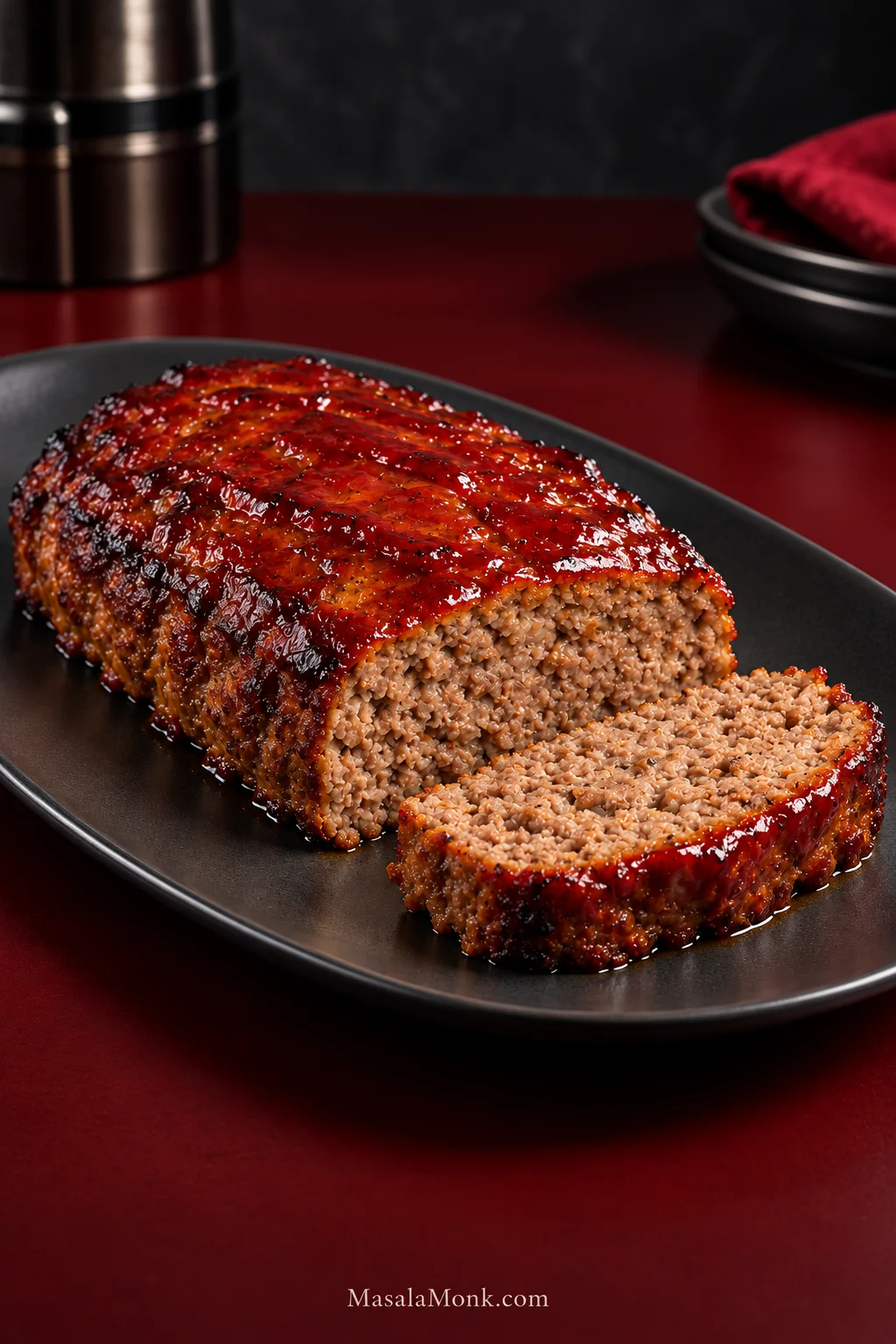
Cut through the sticky glaze and the meatloaf underneath should be juicy and tender. The edges should be browned, while the center holds together without feeling packed or rubbery. An air fryer can do that beautifully—but a tall loaf can still look finished outside while the middle is catching up.
This air fryer meatloaf recipe works around that problem with a 1 lb / 454 g loaf shaped low and fairly wide. It cooks at 350°F / 177°C, and the sweet-tangy glaze goes on near the end so its sugar does not darken too early.
The one-pound size is practical, too. It suits a smaller household, makes an easy weeknight dinner, and gives you classic meatloaf without running the full-size oven for a much larger loaf. The clock tells you when to start checking; the thermometer tells you when to stop. For beef meatloaf, that means 160°F / 71°C in the thickest part of the center.
Keep It Low. Glaze It Late. Cook to Temperature.
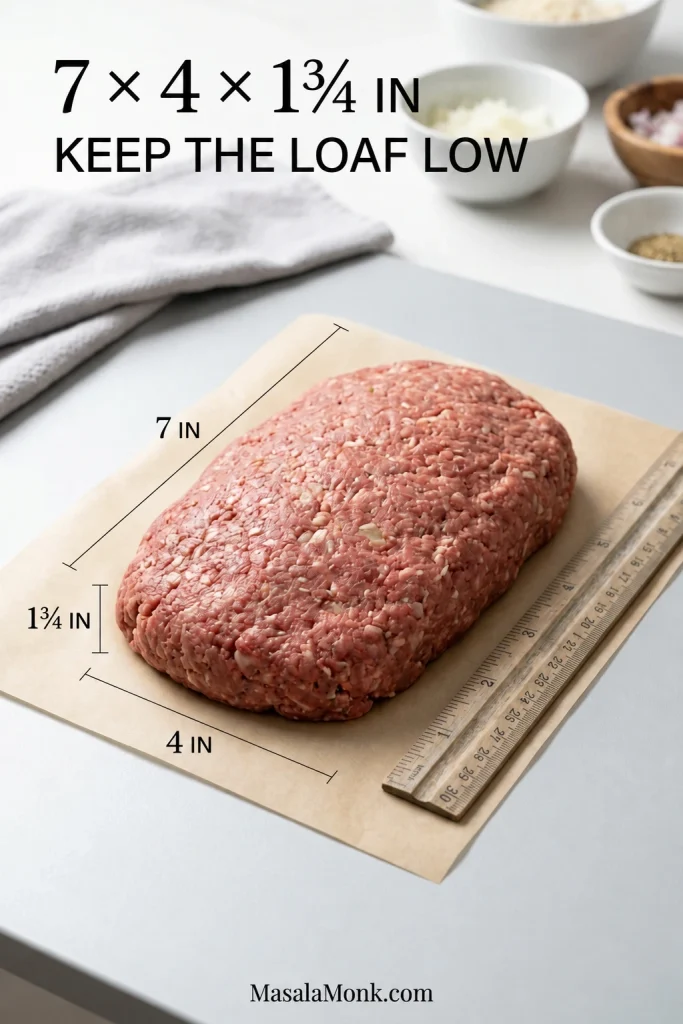
- Keep it low: aim for 1½–2 inches / 4–5 cm high so the center cooks through before the outside gets too dark.
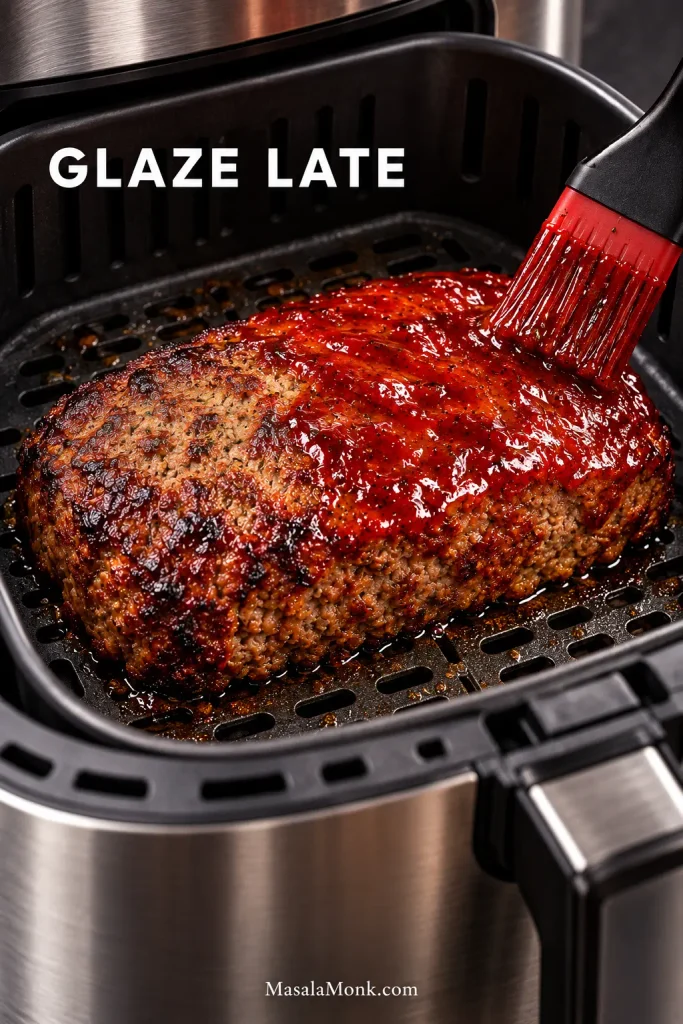
- Glaze it late: let the meatloaf cook and set first, then add the ketchup glaze for the finishing minutes.
- Cook to temperature: begin checking at 18 minutes and take the loaf out once the center is done.
Air Fryer Meatloaf
A juicy 1-pound beef meatloaf with a tender center and a ketchup-Dijon glaze sharpened with Worcestershire and cider vinegar. The shallow free-form shape helps the middle cook through while leaving plenty of surface exposed to circulating heat.
Timing: allow about 15 minutes to mix and shape the loaf, 23–30 minutes of cooking in many basket-style air fryers, and a 10-minute rest. It serves about four with substantial sides, or two to three if meatloaf is the main event.
Equipment
- Basket-style air fryer
- Large mixing bowl
- Two small bowls for the glaze
- Fine grater or box grater for the onion
- Instant-read meat thermometer
- Wide spatula
- Small piece of perforated air-fryer parchment or a narrow parchment sling, optional
Basket size: This loaf fits comfortably in many 5–6-quart basket air fryers. Still, the shape of the basket matters more than the number printed on the box. In a smaller basket, use more of the available length or width, or divide the mixture into two smaller loaves.
For the Meatloaf
- ½ cup panko breadcrumbs, about 30 g
- 3 tablespoons whole or 2% milk, 45 ml
- 1 large egg
- ⅓ cup finely grated yellow onion, about 50 g
- 2 garlic cloves, finely grated or minced, about 6 g
- 1 tablespoon Worcestershire sauce, 15 ml
- 1 tablespoon ketchup, 15 ml
- ¾ teaspoon fine sea salt, about 4 g
- ½ teaspoon freshly ground black pepper
- 1 lb / 16 oz / 454 g ground beef, preferably 85/15
For the Glaze — Enough for Cooking and Serving
- ⅓ cup ketchup, about 90 g
- 2 teaspoons packed brown sugar, about 8 g
- 1 teaspoon Dijon mustard, 5 ml
- 1 teaspoon Worcestershire sauce, 5 ml
- 1 teaspoon apple cider vinegar, 5 ml
Make the Mixture
- Make the panade and flavor base. Combine the panko and milk in a large bowl and leave them for 3–5 minutes, until the crumbs are evenly softened. Stir in the egg, grated onion, garlic, Worcestershire, ketchup, salt and black pepper.
- Add the beef last. Fold in the ground beef with clean hands or a fork. Stop once everything is evenly distributed. The mixture should still look coarse, not smooth and springy.
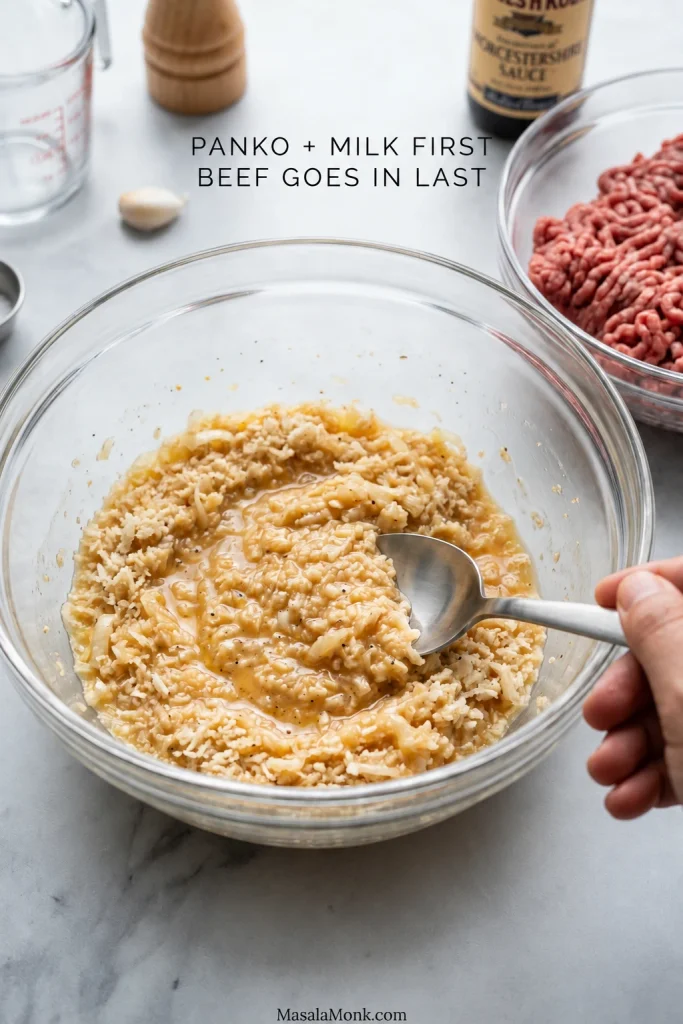
Texture cue: Squeeze a small handful gently. It should hold together, but it should not feel like kneaded dough or sausage filling. That light handling is what keeps the finished slice tender.
Shape It for the Air Fryer
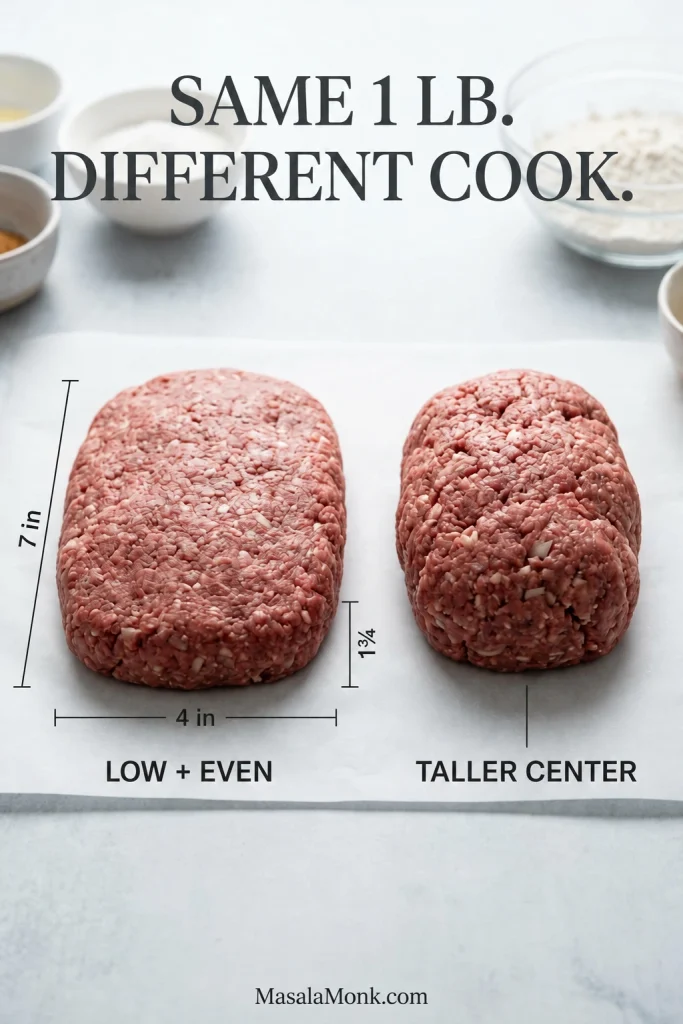
- Start preheating, then shape the loaf. Set the air fryer to 350°F / 177°C and use its normal preheat cycle, or give it about 3 minutes. While it heats, form the mixture into a free-form loaf about 7 × 4 × 1¾ inches (18 × 10 × 4.5 cm). Keep the height under about 2 inches / 5 cm and reasonably even from end to end. Press only enough to make the loaf hold together; packing it firmly gives you a denser slice.
- Fit it to the basket. Use the basket’s available length and width. In a square basket, setting the loaf slightly on the diagonal can buy you extra length. A narrow parchment sling makes lifting easier; direct-basket cooking gives the best drainage. Add parchment only when the meatloaf goes in, and leave open space around the sides.
Air Fry, Then Glaze
- Cook it unglazed first. Air fry at 350°F / 177°C for 18 minutes. Leave the loaf in place; flipping is not necessary, and handling it while hot makes it more likely to break.
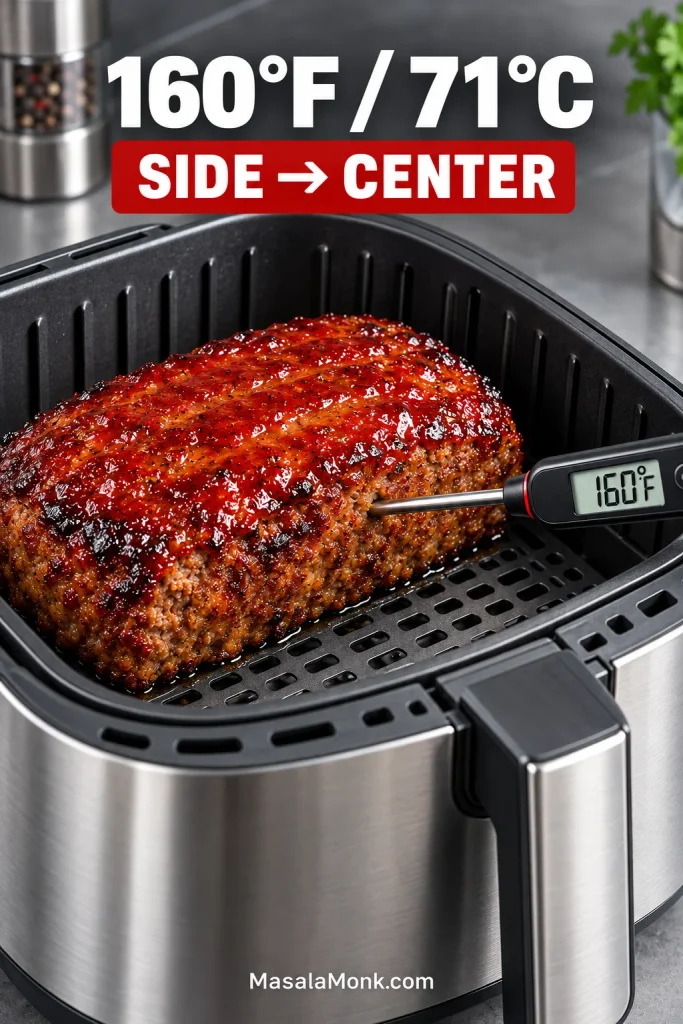
While it cooks, make the glaze. Stir together the ketchup, brown sugar, Dijon, Worcestershire and apple cider vinegar. Spoon about one-third into a separate clean bowl for serving. Keep the rest for brushing. - Check the center first. Slide the thermometer in from the side toward the middle when possible, so the tip reaches the center rather than the hotter top surface.
At 160°F / 71°C? Take it out. For a glazed top, spoon over a little clean reserved glaze and serve the rest at the table.
Close to done? Brush with the cooking glaze; it may need only another 1–2 minutes.
Still some cooking left? Glaze and continue, checking toward the early end of the 5–8 minute window.
Far behind? Cook another 2–4 minutes unglazed, then check again.
Top already dark? Loosely shield it with a small piece of foil if your air fryer’s instructions allow it. - Finish the loaf. Once glazed, continue only as long as the center needs. Remove the loaf when the thickest part reaches 160°F / 71°C. Check a second spot when one end is noticeably thicker.
Rest, Then Slice
- Rest and serve. Lift the meatloaf out with the parchment support or a wide spatula and give it 10 minutes before slicing. That short rest helps it cut cleanly while the center stays tender. Bring the clean reserved glaze to the table for anyone who wants a little extra.
Use temperature, not color, for doneness. Ground beef mixtures such as meatloaf should reach 160°F / 71°C. For ground poultry, use 165°F / 74°C. Color can mislead: ground beef may still look somewhat pink even when safely cooked, so use temperature rather than appearance. USDA safe-temperature guidance.
How Air Fryer Meatloaf Should Look and Feel
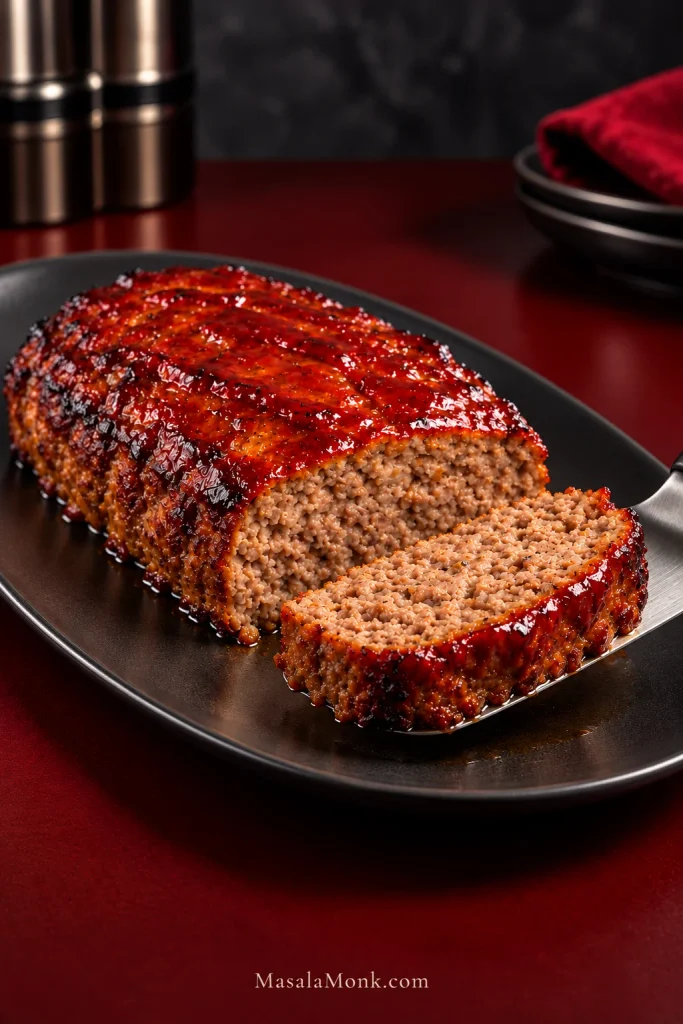
The glaze should be tacky and glossy, with a little darkening around the edges but no bitter blackened sugar. The exposed sides should be browned, and the bottom should look cooked rather than pale and soggy from trapped fat. A little grease underneath is normal—this is meatloaf, after all. What you do not want is the loaf sitting in a puddle of it.
Cut a thick slice and it should stand up without crumbling into loose pieces. Press it gently with a fork and the center should give rather than bounce back like tightly packed sausage. It should look moist enough to make you want the next bite, but not leak watery liquid onto the plate.
What to Serve with Air Fryer Meatloaf
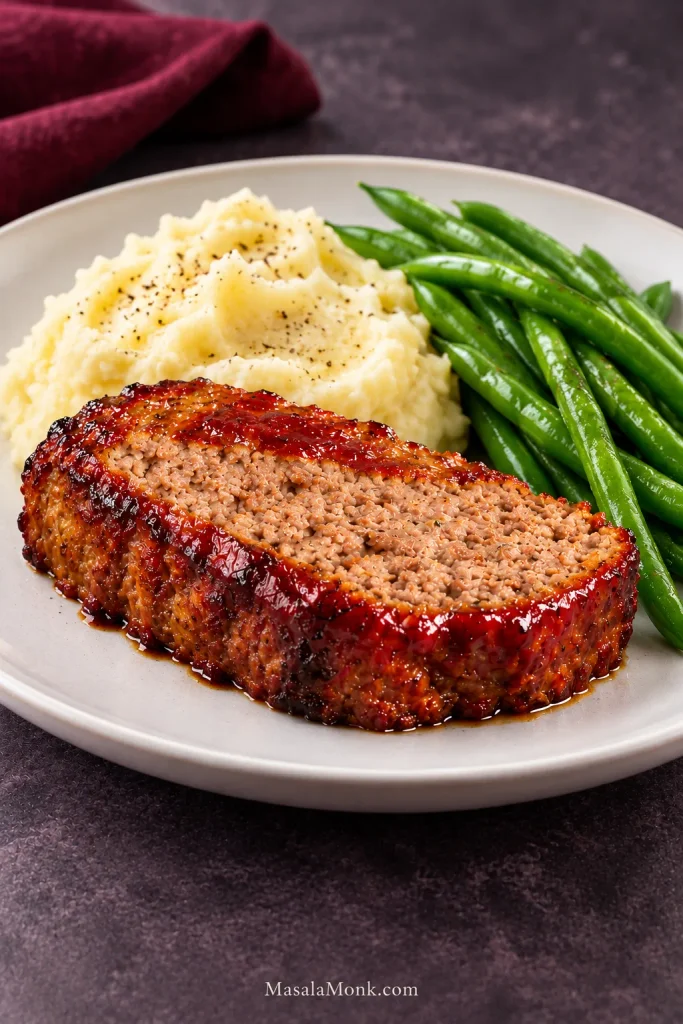
For dinner, use the 10-minute rest to finish the sides. Creamy mashed potatoes, green beans or roasted vegetables are all it really needs.
If your loaf fits the basket and cooks just as expected, the recipe above may be all you need. The guide below is for bigger loaves, smaller baskets, slower fryers and the days dinner decides not to follow the clock.
Air Fryer Meatloaf Guide
Why Loaf Height Changes Air Fryer Meatloaf Time
For air fryer meatloaf, shape matters at least as much as weight—and height is the dimension to watch. Keep a 1-pound loaf about 1½–2 inches / 4–5 cm high, then adjust the length and width to suit your basket.
Two meatloaves can weigh exactly the same and still cook very differently. Make one tall and the heat has farther to travel before it reaches the middle. Keep the other flatter and the center has a better chance of finishing while the edges brown and the glaze stays glossy rather than scorched.
| Loaf Shape | What Usually Happens |
|---|---|
| Low, even 1-lb loaf | Best balance of browned edges and a tender center. |
| Two smaller loaves | Shorter distance to the center, so they generally finish sooner. |
| Tall 1-lb loaf | The outside can race ahead even though the total meat weight is modest. |
| One large 2-lb loaf | Hardest shape to cook evenly in a typical basket air fryer. |
Air Fryer Meatloaf Time and Temperature: How Long Does It Take?
A 1-pound air fryer meatloaf at 350°F / 177°C usually takes 23–30 minutes. Start checking at 18 minutes and cook until the thickest part of the center reaches 160°F / 71°C.
A small powerful fryer may finish sooner; a larger oven-style machine can take longer.
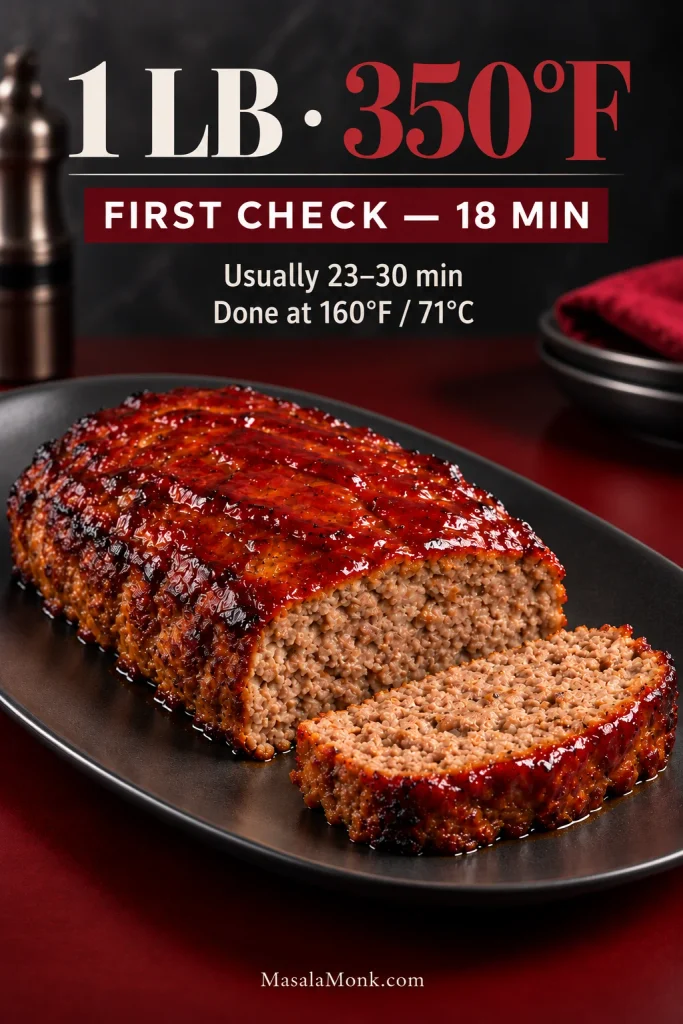
| Setup | Temperature | First Check | Done When / Guidance |
|---|---|---|---|
| 1 lb / 454 g loaf about 1¾ in / 4.5 cm high |
350°F / 177°C | 18 minutes | 160°F / 71°C in the thickest center |
| Two ½-lb mini loaves kept shallow and even |
350°F / 177°C | 13–15 minutes | 160°F / 71°C |
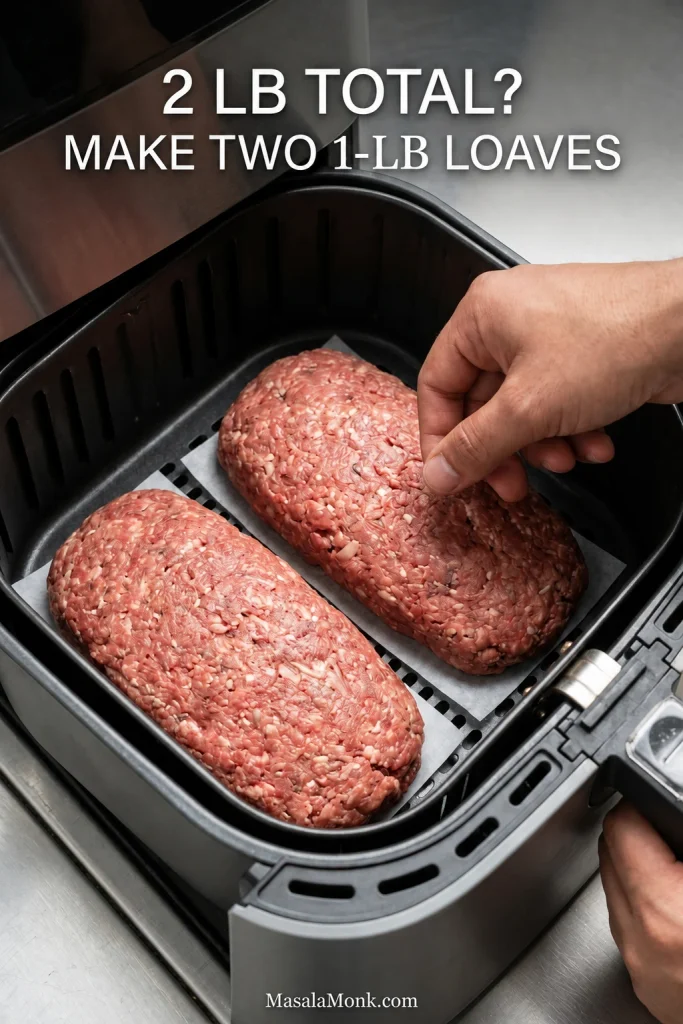
| 2 lb total split into two 1-lb loaves | 350°F / 177°C | 18 minutes if both have open space | 160°F / 71°C in each loaf; two loaves may still take longer than one |
| One tall 2-lb loaf | — | — | Not recommended; divide it into two 1-lb loaves |
Can You Cook a 2-Pound Meatloaf in an Air Fryer?
For 2 pounds of meatloaf mixture, split it into two 1-pound loaves. They cook more evenly and are easier to manage when a fryer runs hotter or slower than expected. Cook both together only when there is genuine open space around them; otherwise, cook them in batches.
If you would rather make one larger traditional loaf in the oven, our classic meatloaf recipe with sweet-tangy glaze is built for that.
↑ Back to recipe · ↑ Back to top
Free-Form or Loaf Pan?
Free-form is the better fit for this recipe. More of the meat is exposed to circulating heat, the sides brown more readily, and fat can drain away instead of collecting around the loaf. A pan will still cook the meatloaf, but the sides stay softer and the center may take longer.
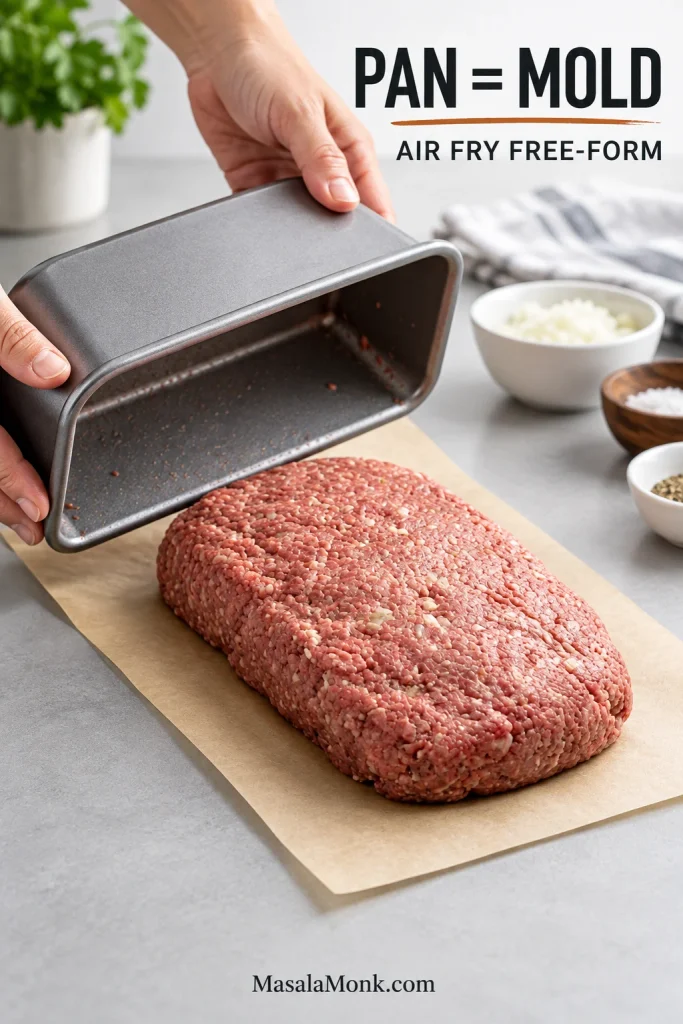
Like the tidy loaf-pan shape? Use the pan as a mold. Shape the mixture lightly inside it, then turn the loaf out onto the basket or parchment support before cooking. You get straighter sides without leaving the meat sitting in its drippings.
Air Fryer Setup: Parchment, Basket Space and Different Machines
Parchment is optional. Direct-basket cooking drains fat very well; a narrow parchment sling simply makes the hot loaf easier to lift. Support the meatloaf without covering the whole basket.
On Ninja, Foodi, Cosori and oven-style machines, use the regular Air Fry function for this free-form method unless your manufacturer’s instructions say otherwise.
Does your fryer regularly smoke, cook unevenly or struggle when the basket gets crowded? Our guide to common air fryer mistakes and fixes goes deeper into airflow, grease, crowding and preheating.
Dark on Top, Raw in the Middle—or Something Else Went Wrong?
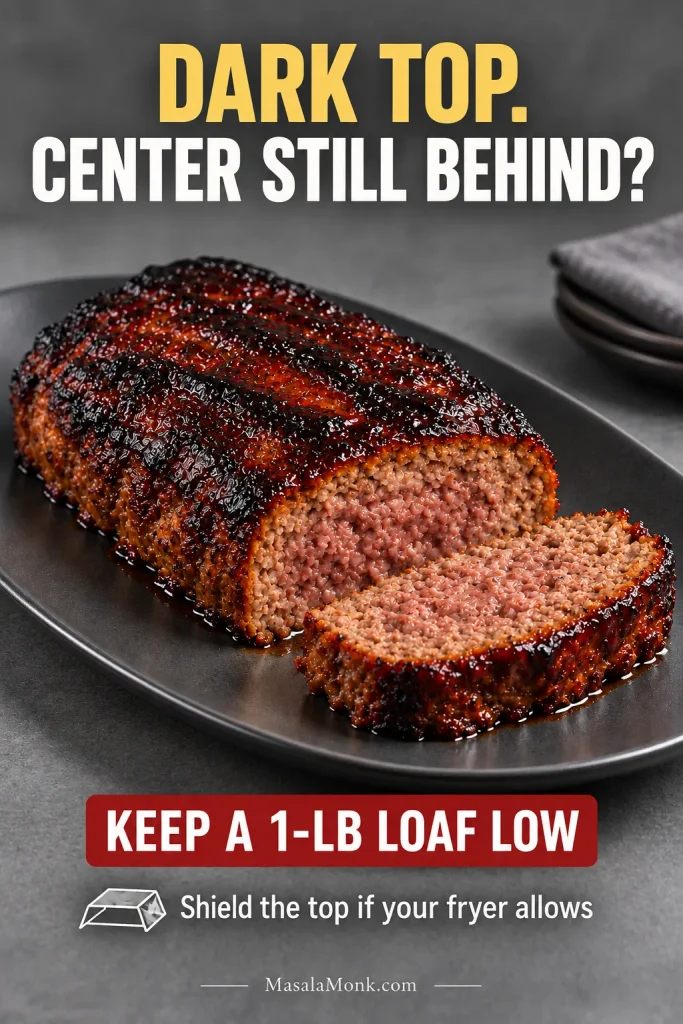
If the center is wrong, start with loaf height, mixing and doneness. If the center is fine but the surface or bottom is not, look instead at glaze timing, liners and airflow.
Doneness and Texture Problems
| What You See | What Probably Happened | What to Do |
|---|---|---|
| Dark top, underdone center | The loaf is too tall, parts were packed more tightly than others, the fryer runs aggressively, or the upper element sits very close to the food. | Keep cooking until the center is done. If your appliance permits it, securely shield the browned surface with a small piece of foil. Next time, shape the loaf flatter and more evenly. |
| Taking much longer than expected | Large oven-style fryer, thicker loaf, colder mixture or a gentler-running machine. | Keep the temperature steady and give the center the extra time it needs. |
| Finished earlier than expected | Compact hot-running fryer or slightly flatter loaf. | Take it out when the center is ready and begin checking earlier next time. |
| Dry meatloaf | Very lean beef or cooking beyond doneness. | Use a moderately fatty beef blend such as 85/15 and start checking the center early enough to stop at 160°F / 71°C. |
| Dense or rubbery | The beef was worked too much or packed too firmly during shaping. | Mix the beef last and stop once everything is combined. Shape without kneading or compressing. |
| Dry and crumbly | The panade or binder balance is too low, or the crumbs did not hydrate properly. | Measure the panko, milk and egg carefully, and let the breadcrumbs soften before adding the beef. |
Moisture, Glaze and Air Fryer Problems
| What You See | What Probably Happened | What to Do |
|---|---|---|
| Wet, soft and falling apart | Too much free liquid or very wet additions. | Let the panade absorb before mixing and avoid pouring in extra sauce or watery vegetables by eye. |
| Crunchy onion | The onion pieces were too large for the relatively short cook. | Grate the onion finely so it softens into the loaf instead of staying in little raw-tasting pieces. |
| Glaze burns | It went on too early or the upper element is especially aggressive. | Glaze later and watch closely near the finish. Keep extra sauce for the table rather than piling it onto the loaf. |
| Wet or greasy bottom | A solid liner or deep pan is trapping rendered fat underneath. | Use a smaller or perforated support, or cook more openly so the fat can drain. |
| Air fryer starts smoking | Rendered fat is reaching a very hot surface inside the machine. | Pause and follow your model’s grease-management instructions. |
| Loaf breaks while lifting | Hot meatloaf is still tender and fragile. | Support it underneath with a wide spatula or parchment sling, then let it rest before slicing. |
Dark top with a slow center? Go back to why loaf height changes air fryer meatloaf time. Fixing the shape is usually more useful than chasing the clock on the next batch.
Did your air fryer run faster or slower? If your loaf finished noticeably earlier or later, share your air fryer model or basket size, loaf size and total cook time in the comments. That detail may help the next person using a similar machine.
↑ Back to recipe · ↑ Back to top
Substitutions, Mini Loaves and Make-Ahead Tips
Using Fattier or Leaner Beef
80/20 beef is a good choice if you like a richer, very juicy loaf; just expect more rendered fat underneath. With 90/10, start checking the temperature early; lean beef has less room between safely cooked and noticeably dry. The same fat tradeoff applies to air fryer burgers, where fattier beef stays more forgiving but produces more drippings.
Swapping Breadcrumbs, Milk or Ketchup
Replacing panko with fine dry breadcrumbs? Start with about ⅓ cup because finer crumbs absorb liquid differently. Gluten-free breadcrumbs are fine too, though brands vary.
For dairy-free meatloaf, use an unsweetened neutral non-dairy milk. Low-sodium beef broth can also soften the crumbs, although it changes the richness and contributes extra salt.
Bottled ketchup is exactly what most people need for the glaze. If you already make your own, this homemade ketchup recipe is another option without changing the method.
Using ground turkey? Ground turkey needs its own formula. Our turkey meatloaf recipe is built around poultry’s different fat and moisture balance, and ground poultry needs to reach 165°F / 74°C.
Mini Air Fryer Meatloaves
Divide the mixture evenly into two smaller loaves and keep them shallow. A kitchen scale makes that easy. Start checking at 13–15 minutes at 350°F / 177°C and continue as needed until the center reaches 160°F / 71°C. For the one-pound and doubled-batch timings, compare the air fryer meatloaf time and temperature table.
Make It Ahead
You can shape the loaf up to a day ahead and refrigerate it promptly at 40°F / 4°C or below. Keep the total refrigerated time for the raw ground beef within the USDA’s 1–2 day window; shaping the meatloaf does not restart that clock. USDA refrigerator-storage guidance. A thoroughly chilled loaf may need a little more cooking time.
How to Store, Freeze and Reheat Air Fryer Meatloaf
A one-pound loaf is small enough that leftovers do not become a week-long commitment, but one or two extra slices are absolutely worth having. Once chilled, meatloaf firms up and cuts beautifully for sandwiches. Making a fresh loaf today instead? Jump back to the recipe.
Refrigerate cooked meatloaf within 2 hours and keep it covered for 3–4 days. For longer storage, freeze individual slices so you can thaw only what you need. For best quality, use frozen leftovers within 3–4 months. USDA leftover-storage guidance.
Reheat Slices, Not the Whole Loaf
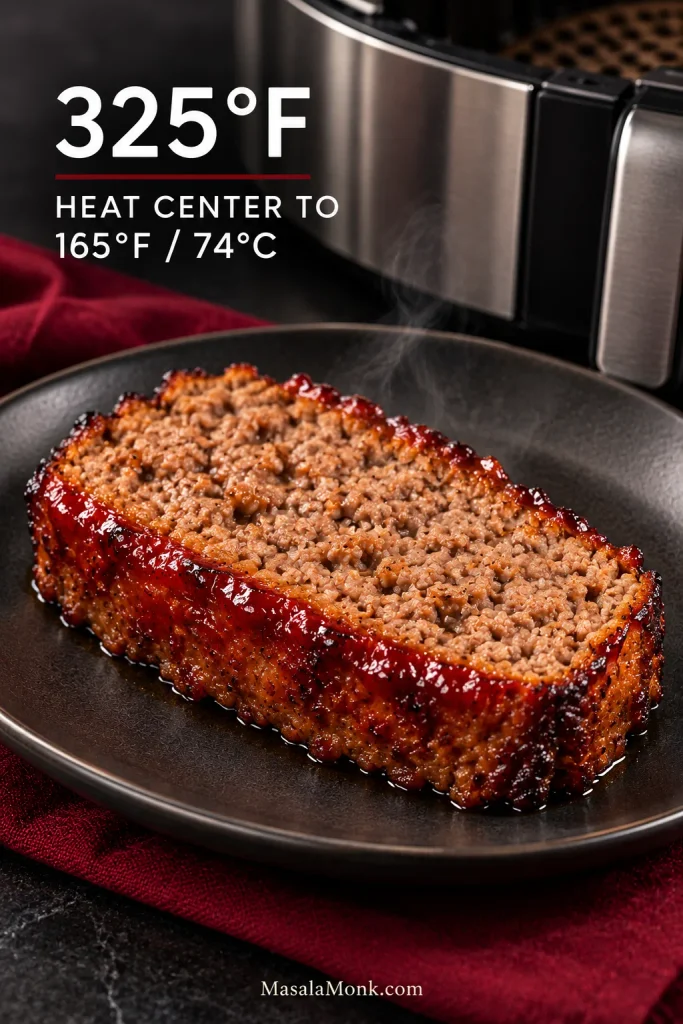
Individual slices warm more evenly and spend less time drying at the edges. Air fry them at 325°F / 163°C until the center reaches 165°F / 74°C. A thin smear of ketchup on the cut surface adds a little moisture, especially after a day or two in the refrigerator.
Want crisper edges? Once the slice is fully heated, give it a brief hotter finish while keeping an eye on the surface.
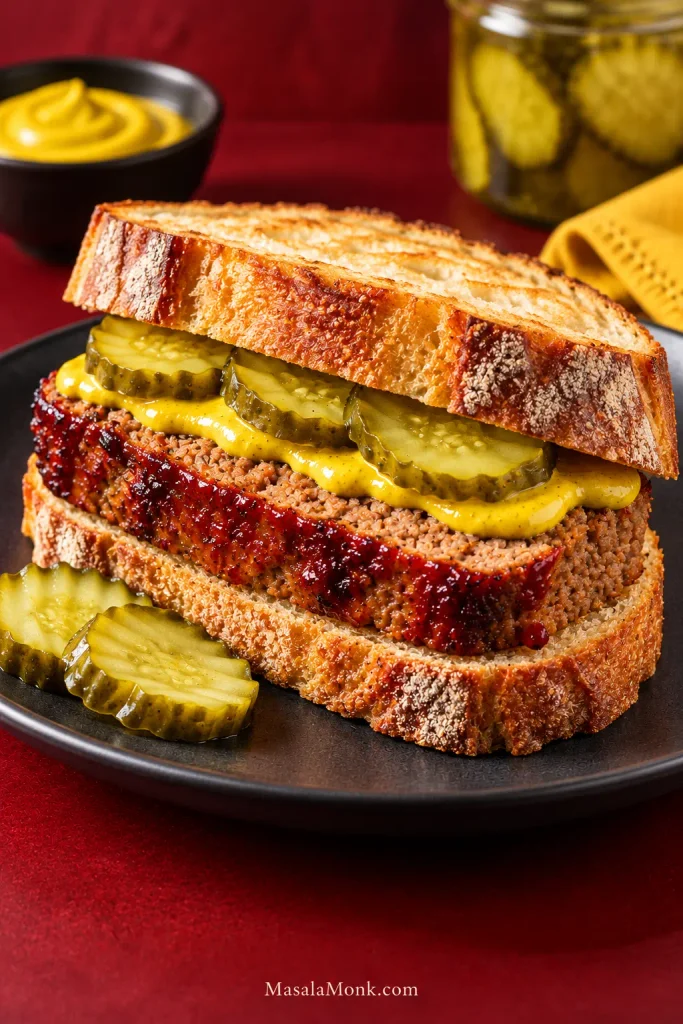
And Yes, Meatloaf Sandwiches
Cold slices on sturdy bread with mustard and pickles are one of the better reasons not to finish the whole loaf at dinner. The chilled meatloaf cuts cleanly, while mustard and something sharp or crunchy balance the beef and sweet-tangy glaze.
The air fryer is not here to reinvent meatloaf. It is here to give you that tender glazed slice without heating the full oven—or choosing between a browned outside and an undercooked middle.








