Posted on 8 Comments

10 High Calorie Protein Shakes & Smoothie Recipes for Healthy Weight Gain

Woman drinking a high calorie protein shake on a rooftop at sunset, promoting 10 high calorie protein shakes for healthy weight gain and bulking.

If you’ve ever tried to gain weight or bulk on “clean” food alone, you already know the struggle: the appetite just runs out before the calories do. Eating yet another bowl of rice or another handful of nuts feels like a chore. That’s where high calorie protein shakes come in. You drink them instead of chewing through another plate of food, you control exactly what goes in, and you can quietly add 400–900 calories in a single glass using real, nutrient-dense ingredients.

In this guide you’ll find:

  • A simple way to build high calorie protein shakes without junk
  • Ten shake and smoothie recipes for bulking & healthy gains
  • Ideas to tweak each recipe for your goals and taste

Along the way, you’ll also find a few helpful resources if you want to go deeper into healthy weight gain and smart use of protein.


Why High Calorie Protein Shakes Work So Well

To gain weight, your body needs one thing above all: a consistent calorie surplus. You have to take in more energy than you burn, not just once, but day after day. At the same time, if you’d like that gain to be mostly muscle instead of just belly fat, you also need enough protein and some form of resistance training.

Eating more sounds easy on paper, yet in real life it’s often the opposite. A lot of people who are naturally lean get full very quickly. Big, high-fibre meals can actually make it harder to squeeze in the extra calories you need.

High calorie protein shakes solve several of those problems at once:

  • They are easy to drink, even when you’re not very hungry
  • They can be packed with calories from milk, nut butters, oats, dried fruit and healthy fats
  • They deliver plenty of protein in a compact form
  • They are quick to make and easy to carry

While you can gain weight on anything – including soda and junk food – most dietitians still push people toward nutrient-dense, high-calorie foods such as nuts, seeds, dairy, whole grains and healthy oils. For a deeper overview of those kinds of foods, you can explore this guide to high calorie foods that support healthy weight gain.

If you happen to be the classic “hardgainer” with a fast metabolism and skinny frame, it also helps to understand your body type better. You may find it useful to read up on the ectomorph body type and weight gain strategies, especially if you’ve been under-eating without realising it.

Also Read: The Science of Protein: Maximizing Muscle Growth and Recovery


How to Build High Calorie Protein Shakes (The Simple Formula)

Instead of thinking in terms of “recipes you must follow perfectly”, it’s much more powerful to think in terms of a flexible formula. Once you understand the structure, you can create countless high calorie protein shakes from whatever you have in the kitchen.

A basic weight gain or bulking shake usually contains:

Protein (20–40 grams)

  • Whey protein, plant-based protein, Greek yogurt, milk, or a mix
  • For a bigger-picture view of how much protein you might need in a day, you can check this evidence-based overview of optimal protein intake.

Energy-dense carbohydrates

  • Banana, mango, dates, oats, cooked rice, granola, honey or jaggery
  • Fruits like mango both sweeten and thicken shakes, which is why they’re often recommended in discussions about using mango for healthy weight gain.

Healthy fats

  • Peanut, almond or cashew butter
  • Whole nuts and seeds (chia, flax, pumpkin, hemp, sunflower)
  • Coconut milk, avocado, ghee or a splash of good-quality oil
  • If you are curious about how powerful nuts and seeds can be for adding calories and protein, you might enjoy this breakdown of protein-packed nuts and seeds.

Liquids

  • Whole milk, full-fat yogurt plus water, coconut milk, or fortified plant milks
  • Water works too, but for high calorie protein shakes you usually want milky bases.

Flavour boosters

  • Cocoa powder, instant coffee, cinnamon, cardamom, vanilla extract, spices
  • A pinch of salt almost always makes chocolate and nut-based shakes taste better.

Many hospital and clinic dietitians use this same logic when they design high-calorie, high-protein smoothies for underweight patients. For instance, Mayo Clinic shares a simple high-calorie, high-protein smoothie recipe built around milk, nut butter and yogurt. When you look closely, it’s just the same formula with slightly different ingredients.

The recipes below follow this framework. You can copy them exactly or use them as templates to create personalised high calorie protein shakes that match your taste and dietary needs.

Also Read: How to Eat 100 Grams of Protein a Day


How Much Protein and Calories Should Your Shakes Have?

Before you get into ingredient lists, it helps to have rough targets.

Most active people trying to gain muscle while gaining weight land somewhere around 1.6 to 2.2 grams of protein per kilogram of body weight per day, according to several reviews summarised in guides like the one from Examine. That doesn’t have to come only from shakes; it includes everything you eat – eggs, dal, chicken, paneer, beans, tofu and so on.

As for calories, safe and sustainable weight gain is usually about 0.25–0.5 kg per week. To achieve that, you often need a surplus of 250–500 calories per day above maintenance. Healthy weight gain resources from organisations such as the Academy of Nutrition and Dietetics emphasise gradual increases and nutrient-dense choices, rather than stuffing yourself with junk.

That’s where high calorie protein shakes shine: one drink can contribute 400–900 calories and 25–40 grams of protein without making you feel uncomfortably full.

Also Read: ‘Tofu’ Instead of ‘Eggs’: 5 High Protein Plant-Based Breakfast Ideas

Now, let’s get into the delicious part.


10 High Calorie Protein Shakes & Smoothies for Healthy Weight Gain

Each recipe below makes one generous serving. You can always scale ingredients up or down depending on appetite and your daily calorie target.


1. Banana Oat High Calorie Protein Shake

This is the classic weight gain shake: simple ingredients, comforting flavour and plenty of calories.

Ingredients

  • 1 scoop vanilla or unflavoured protein powder
  • 1 large ripe banana (fresh or frozen)
  • ½ cup rolled oats
  • 1 tablespoon peanut butter or almond butter
  • 300 ml whole milk (or a rich plant milk like soy or oat)
  • 1–2 teaspoons honey or jaggery (optional)
  • A pinch of cinnamon (optional but lovely)
  • Ice cubes as needed
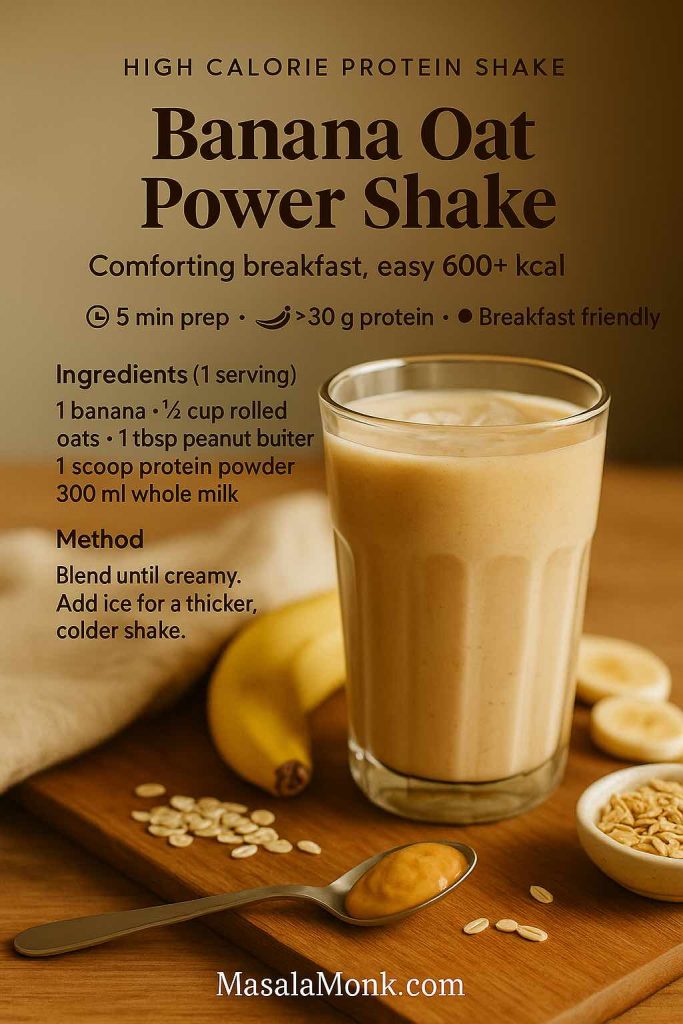
Banana Oat Power Shake high calorie protein shake recipe card showing a creamy breakfast smoothie in a glass with banana, oats and peanut butter, from MasalaMonk.com
Banana Oat Power Shake – a comforting 600+ kcal breakfast smoothie made with banana, oats, peanut butter and protein powder, ideal for hardgainers who need an easy high calorie start to the day.

Method

  1. Pour the milk into your blender first.
  2. Add banana, oats, peanut butter, protein powder and any sweetener.
  3. Blend until the oats disappear and everything turns creamy.
  4. Throw in some ice and blend again if you prefer it thicker and colder.

For even more calories, add an extra spoon of nut butter or a little cream. If you’d like ideas for what else you can eat alongside this shake, the list of high calorie foods that support healthy weight gain can give you easy add-ons like nuts, seeds and full-fat yogurt.

Also Read: How Much Potassium Is in a Banana? Nutrition Facts, Comparisons & Benefits


2. Chocolate Peanut Butter Mass Gainer Shake

This one tastes like a milkshake you’d order at a café, yet it can easily deliver 600–900 calories depending on how generous you are with the peanut butter.

Ingredients

  • 1 scoop chocolate protein powder
  • 300 ml whole milk
  • 1 medium banana
  • 2 tablespoons peanut butter
  • 1 tablespoon unsweetened cocoa powder
  • A small pinch of salt
  • Ice cubes
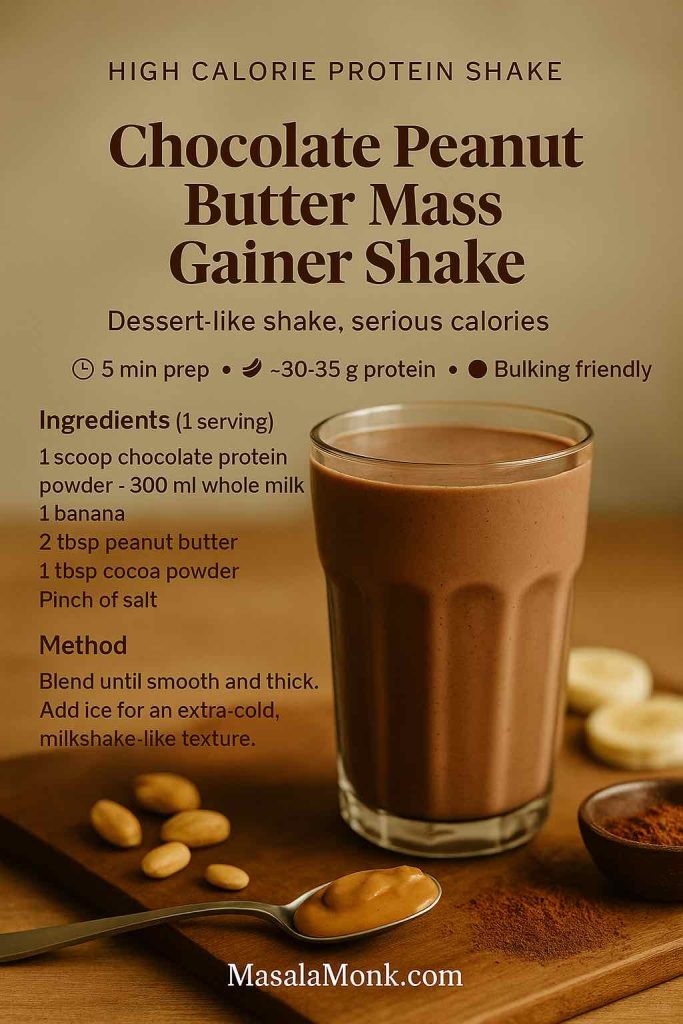
Chocolate Peanut Butter Mass Gainer Shake high calorie protein shake recipe card with a rich chocolate smoothie in a glass, peanuts, banana slices and cocoa powder on a wooden board, from MasalaMonk.com
Chocolate Peanut Butter Mass Gainer Shake – a dessert-like high calorie protein shake with chocolate protein, peanut butter, banana and milk, perfect for clean bulking and adding extra calories after training.

Method

  1. Add milk, banana, peanut butter and chocolate protein powder to your blender.
  2. Spoon in the cocoa powder and drop in the pinch of salt.
  3. Blend until velvety smooth; add ice and blend again for a thicker shake.

If you enjoy peanut butter, you might also want to understand how it fits into a full day of eating. This breakdown of peanut and peanut butter benefits for weight management explains how just two tablespoons can add over 180 calories, which is exactly what makes this kind of high calorie protein shake so effective.

Also Read: Homemade Hot Chocolate with Cocoa Powder Recipe


3. Mango Lassi High Calorie Protein Smoothie

Mango naturally turns smoothies into thick, dessert-like treats. Combined with yogurt and milk, it becomes a powerful tool for healthy weight gain.

Ingredients

  • 1 cup ripe mango chunks (fresh or frozen)
  • ½ cup thick yogurt (Greek yogurt or hung curd)
  • ½ cup whole milk (or water if you prefer it slightly lighter)
  • 1 scoop vanilla protein powder
  • 1–2 teaspoons honey or sugar (adjust to taste)
  • A pinch of cardamom powder
  • Ice cubes
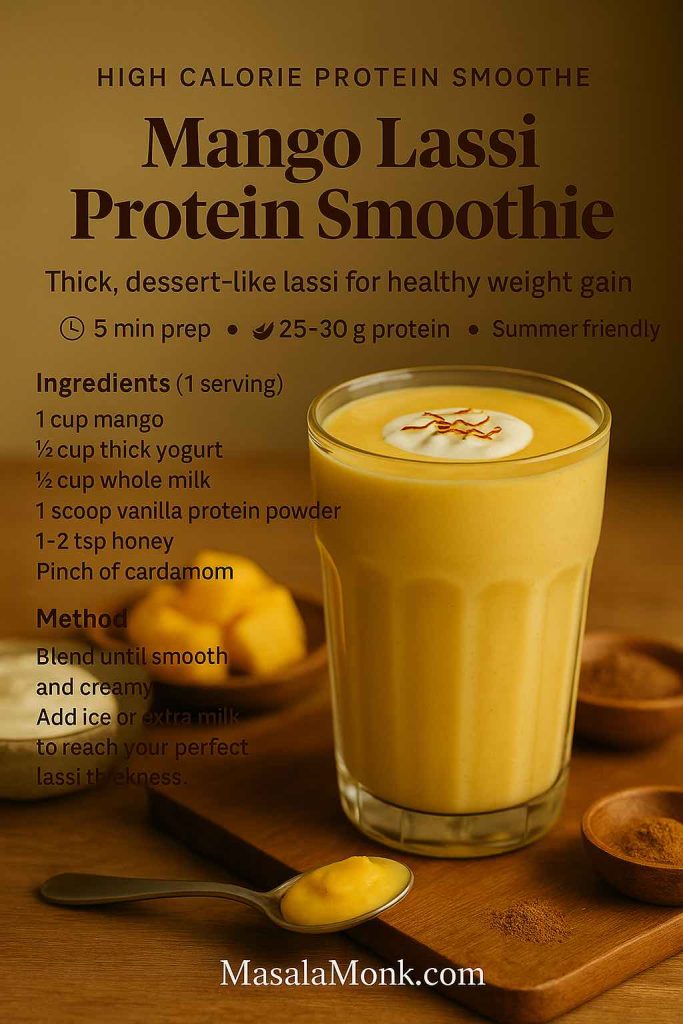
Mango Lassi Protein Smoothie high calorie protein shake recipe card showing a thick yellow mango lassi in a glass with yogurt, mango pieces and cardamom on a wooden board, from MasalaMonk.com
Mango Lassi Protein Smoothie – a thick, dessert-style mango lassi boosted with protein powder, yogurt and whole milk, perfect for anyone who wants a refreshing summer drink that also supports healthy weight gain.

Method

  1. Add mango, yogurt, milk and protein powder to the blender.
  2. Blend until smooth and creamy.
  3. Sprinkle in the cardamom, add ice and blend briefly again.
  4. Taste and tweak the sweetness if necessary.

If mango is one of your favourite fruits, you may want to explore more detailed guidance on using mango for weight gain in a healthy way. You can also experiment with mango shakes of different types – classic, vegan and sugar-free – using ideas from this collection of mango shake variations.


4. Date & Almond Dessert Smoothie for Bulking

Dates and almonds make this high calorie protein shake taste like a milk-based dessert you’d eat at a festival, yet it remains surprisingly easy to digest for most people.

Ingredients

  • 1 scoop vanilla or caramel-flavoured protein powder
  • 5–6 soft dates, pitted
  • 10–12 almonds (ideally soaked overnight and peeled)
  • 300 ml milk (dairy or fortified plant milk)
  • 1 tablespoon ghee or coconut oil (optional calorie booster)
  • A pinch of cinnamon or nutmeg
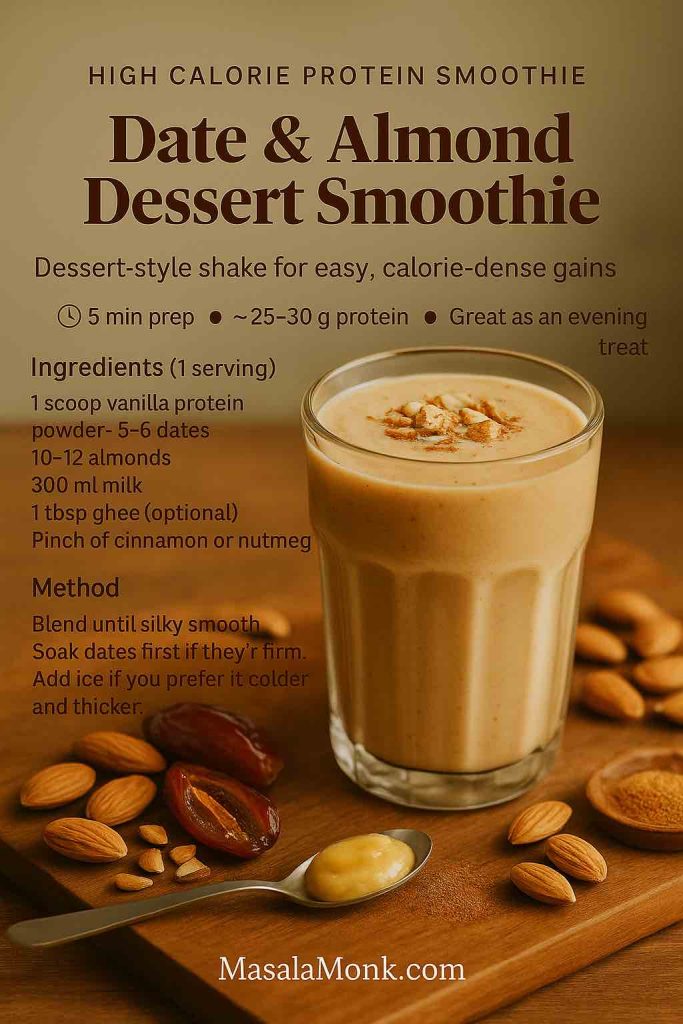
Date and Almond Dessert Smoothie high calorie protein smoothie recipe card with a creamy tan shake in a glass, surrounded by dates, almonds and a spoon of ghee on a wooden board, from MasalaMonk.com
Date & Almond Dessert Smoothie – a rich, kheer-like shake made with dates, almonds, milk, protein powder and optional ghee, giving you a dessert-style drink that’s perfect for adding gentle, calorie-dense nutrition in the evening.

Method

  1. If your blender is not very powerful, soak the dates in warm water for 10–15 minutes.
  2. Add milk, dates, almonds, protein powder and ghee/oil to the blender.
  3. Sprinkle in the cinnamon.
  4. Blend until the mixture turns silky, with no visible bits of dates or nuts.

Dates and almonds are not only energy-dense; they also provide minerals like iron, magnesium and calcium. If you’re interested in shakes that help with micronutrients as well as calories, you may like browsing a set of high-iron shakes and smoothie ideas that use similar ingredients such as dates, seeds and leafy greens.

Also Read: Almonds Nutrition Facts 100g & Glycemic Index Impact


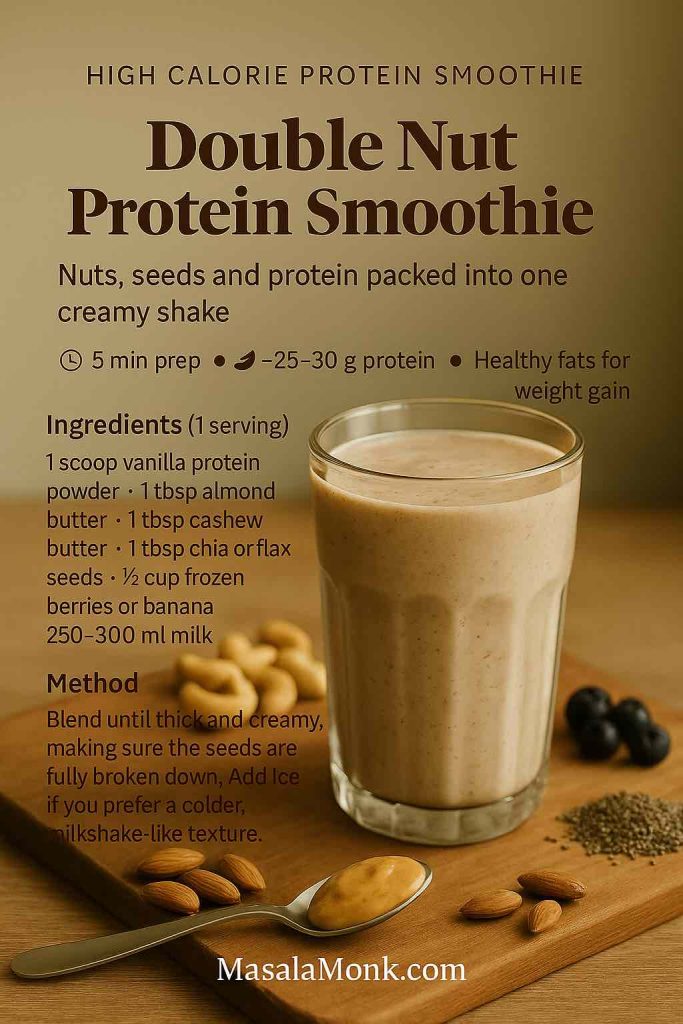
5. Double Nut High Calorie Protein Smoothie

If you want a balance of protein, carbs and healthy fats in a glass, nut-based high calorie protein shakes are the way to go. This one combines two nut butters plus seeds.

Ingredients

  • 1 scoop vanilla protein powder
  • 1 tablespoon almond butter
  • 1 tablespoon cashew butter (or extra almond/peanut butter)
  • 1 tablespoon chia seeds or ground flax seeds
  • ½ cup frozen berries or banana slices
  • 250–300 ml milk, soy milk or oat milk
  • Ice cubes
Double Nut Protein Smoothie high calorie protein smoothie recipe card showing a creamy nut-based shake in a glass with almonds, cashews, chia seeds and nut butter on a wooden board, from MasalaMonk.com
Double Nut Protein Smoothie – a thick, creamy blend of almond butter, cashew butter, seeds and protein powder, ideal for adding healthy fats and extra calories when you’re trying to gain weight in a more nutritious way.

Method

  1. Add your choice of milk to the blender.
  2. Scoop in the nut butters and protein powder.
  3. Add the chia or flax seeds and the fruit.
  4. Blend until the seeds disappear and everything is thick and creamy.

Nuts and seeds are such powerful tools for bulking and weight gain that it’s worth learning a few more ways to use them. If you enjoy this style of shake, take a look at these nut-infused smoothie recipes for more combinations using cashews, walnuts and other crunchy add-ins.

Also Read: 10 Creative Chia Pudding Recipes for Every Taste


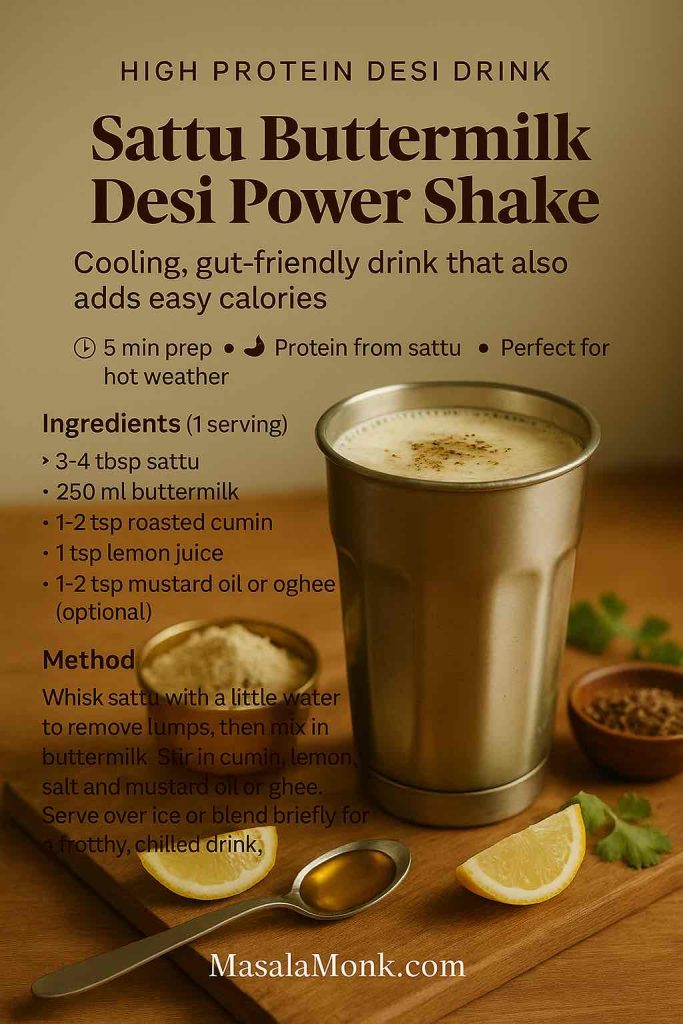
6. Sattu Buttermilk Desi Power Shake

Not all high calorie protein shakes need whey or imported ingredients. This sattu-based drink draws on traditional Indian wisdom and works especially well in hot weather.

Ingredients

  • 3–4 tablespoons sattu powder (roasted chana flour)
  • 250 ml thin buttermilk or chaas
  • 1–2 teaspoons roasted cumin powder
  • 1 teaspoon lemon juice
  • ½–1 teaspoon salt, to taste
  • 1–2 teaspoons mustard oil or ghee (optional but adds calories and flavour)
  • A few ice cubes
Sattu Buttermilk Desi Power Shake high protein drink recipe card showing a steel glass of sattu chaas topped with cumin, surrounded by sattu powder, lemon wedges, mustard oil and spices on a wooden board, from MasalaMonk.com
Sattu Buttermilk Desi Power Shake – a traditional sattu chaas upgraded with lemon, roasted cumin and a little mustard oil or ghee, giving you a cooling, gut-friendly summer drink that also adds extra protein and calories for healthy weight gain.

Method

  1. In a bowl or jug, mix sattu with a little water to form a smooth paste with no lumps.
  2. Slowly whisk in the buttermilk until fully combined.
  3. Stir in the cumin, lemon juice, salt and optional mustard oil or ghee.
  4. Pour over ice or blend briefly for a frothier texture.

For a deeper dive into this traditional ingredient, including benefits and variations, you can check out a dedicated write-up on buttermilk sattu as a protein-packed summer drink. It’s a great example of how local foods can be turned into effective weight gain drinks with just a few tweaks.

Also Read: Chickpeas’ Instead of ‘Sardines’: 5 High Protein Plant-Based Meal Prep Ideas


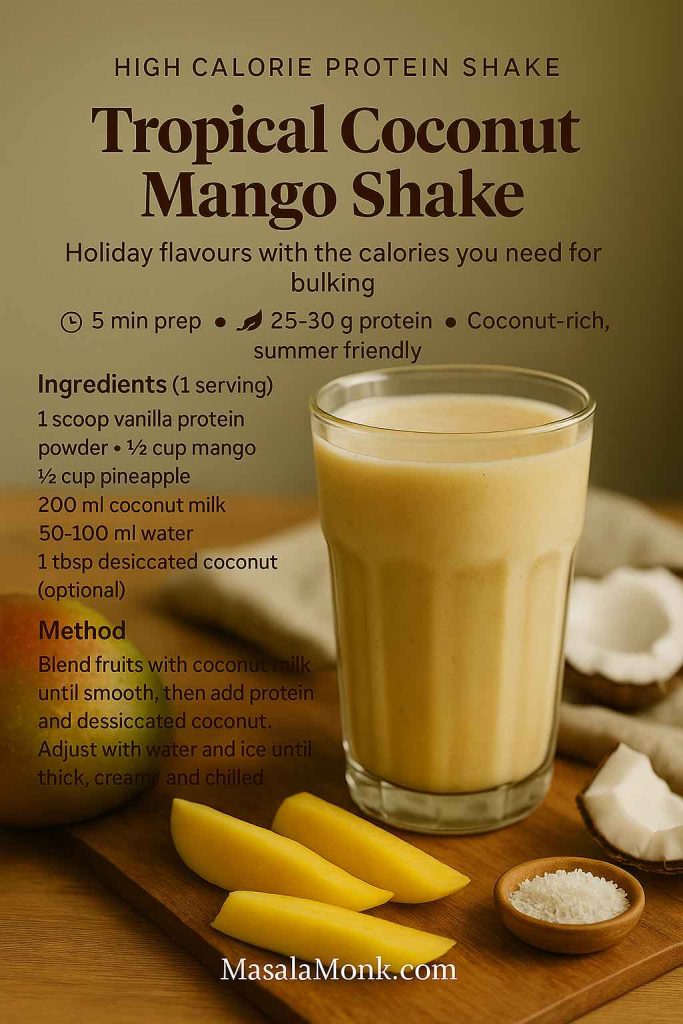
7. Tropical Coconut Mango High Calorie Protein Shake

If you want something that feels like a holiday in a glass while still doing the job of a weight gain & bulking shake, this tropical combination is hard to beat.

Ingredients

  • 1 scoop vanilla or unflavoured protein powder
  • ½ cup mango chunks
  • ½ cup pineapple pieces
  • 200 ml coconut milk (the thicker, the richer)
  • 50–100 ml water to adjust consistency
  • 1 tablespoon desiccated coconut (optional)
  • Ice cubes
Tropical Coconut Mango Shake high calorie protein shake recipe card with a creamy yellow smoothie in a glass, surrounded by mango slices, coconut pieces and desiccated coconut on a wooden board, from MasalaMonk.com
Tropical Coconut Mango Shake – a rich, island-style blend of mango, pineapple, coconut milk and protein powder that delivers 25–30 g protein plus plenty of calories, ideal when you want your bulking shake to taste like a holiday in a glass.

Method

  1. Blend mango, pineapple and coconut milk until smooth.
  2. Add the protein powder and desiccated coconut, then blend again briefly.
  3. Adjust with a little water and ice until you reach your ideal texture.

Fruits, nuts and seeds appear together in many high calorie protein smoothies because they provide both calories and a wide range of vitamins, minerals and phytonutrients. If you’re curious about how seeds like pumpkin or chia can be used creatively in smoothies, you may enjoy a set of pumpkin seed smoothie ideas – they’re written with weight management in mind, but the combinations work just as well when your goal is weight gain, as long as you increase portions.

Also Read: Coconut Milk Nutrition Facts & Glycemic Index Impact


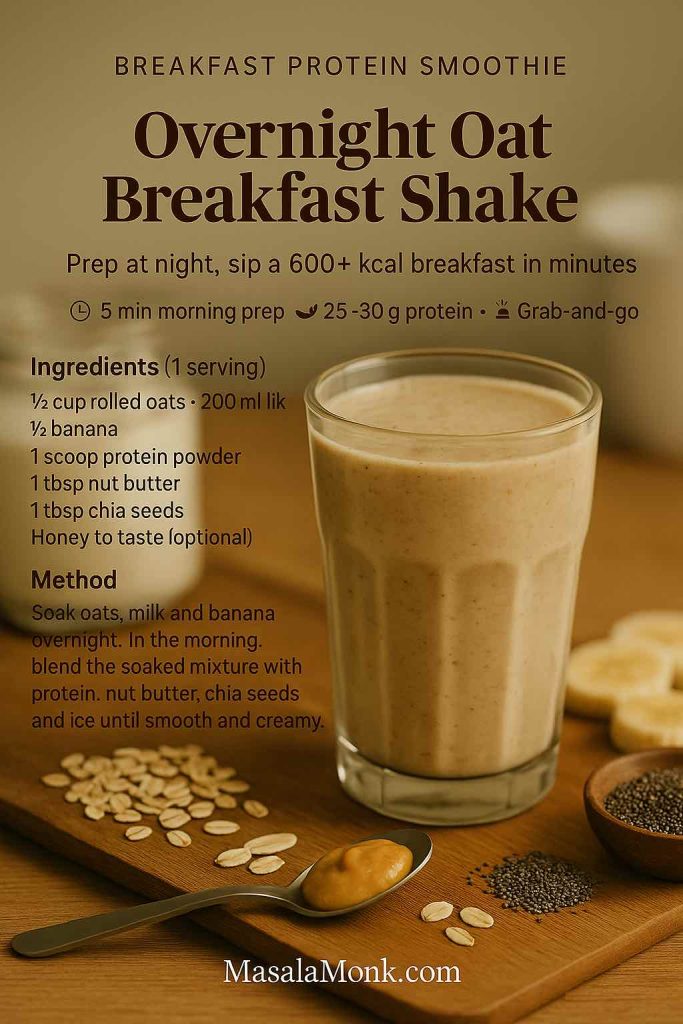
8. Overnight Oat Breakfast High Calorie Protein Smoothie

Some days, the easiest way to ensure you actually drink your calories is to prepare most of the work the night before. This breakfast smoothie does exactly that.

Ingredients (to soak overnight)

  • ½ cup rolled oats
  • 200 ml milk
  • ½ medium banana, sliced

Add in the morning

  • 1 scoop protein powder (vanilla, coffee or chocolate)
  • 1 tablespoon nut butter of choice
  • 1 tablespoon chia seeds
  • 1–2 teaspoons honey or other sweetener (optional)
  • A handful of ice cubes
Overnight Oat Breakfast Shake high calorie protein smoothie recipe card showing a thick oat and banana shake in a glass with oats, chia seeds and nut butter on a wooden board, from MasalaMonk.com
Overnight Oat Breakfast Shake – soak oats, milk and banana before bed, then blend with protein, nut butter and chia in the morning for a 600+ kcal, grab-and-go breakfast that supports healthy weight gain.

Method

  1. In a jar or container, combine oats, milk and banana. Cover and refrigerate overnight.
  2. In the morning, tip the mixture into your blender.
  3. Add the protein powder, nut butter, chia seeds and ice.
  4. Blend until completely smooth and enjoy straight away.

This type of smoothie works very well as a complete breakfast when you don’t have time to cook. If you’d like more variations that use breakfast-style ingredients like nuts, seeds and fruit, the nut-infused smoothie recipes mentioned earlier are worth revisiting with a breakfast lens.

Also Read: Guide to Oats: Types, Nutrition, and Differences Explained


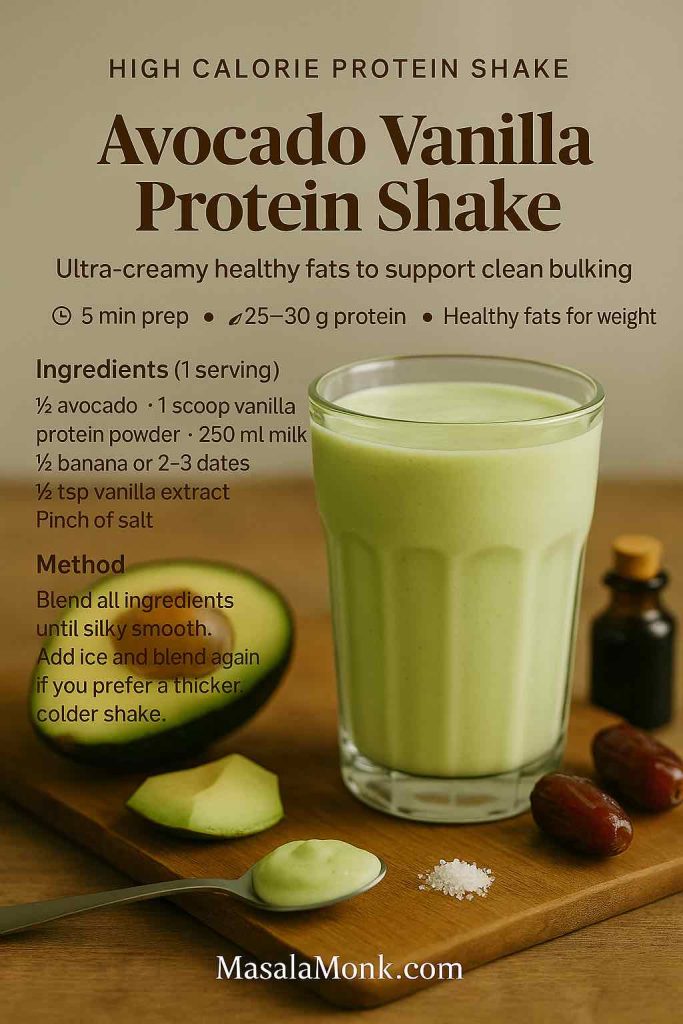
9. Avocado Vanilla High Calorie Protein Shake

Avocado turns high calorie protein shakes into thick, pudding-like drinks with a very mild flavour that pairs beautifully with vanilla and can help in bulking.

Ingredients

  • ½ ripe avocado
  • 1 scoop vanilla protein powder
  • 250 ml milk or enriched plant milk
  • ½ banana or 2–3 soft dates
  • ½ teaspoon vanilla extract
  • A pinch of salt
  • Ice cubes
Avocado Vanilla Protein Shake high calorie protein shake recipe card with a pale green smoothie in a glass, surrounded by avocado, dates, vanilla extract and a pinch of salt on a wooden board, from MasalaMonk.com
Avocado Vanilla Protein Shake – a silky, pale green blend of avocado, protein powder, milk and a hint of vanilla that delivers healthy fats and around 25–30 g protein, perfect when you want a clean, ultra-creamy bulking shake.

Method

  1. Scoop the avocado flesh into your blender.
  2. Add milk, banana or dates, protein powder, vanilla extract and salt.
  3. Blend on high until everything turns smooth and pale green.
  4. Add ice and blend again if you’d like a thicker, colder shake.

If you prefer to get more of your protein from whole foods instead of powders, you can easily replace part of the protein powder here with thick Greek yogurt or even silken tofu. For more ideas that use whole-food protein in smoothies, it’s useful to read roundups like this Healthline article on protein shakes for weight gain, which shows how common pantry ingredients can work just as well as supplements.

Also Read: Avocado: A Superfood for Your Skin


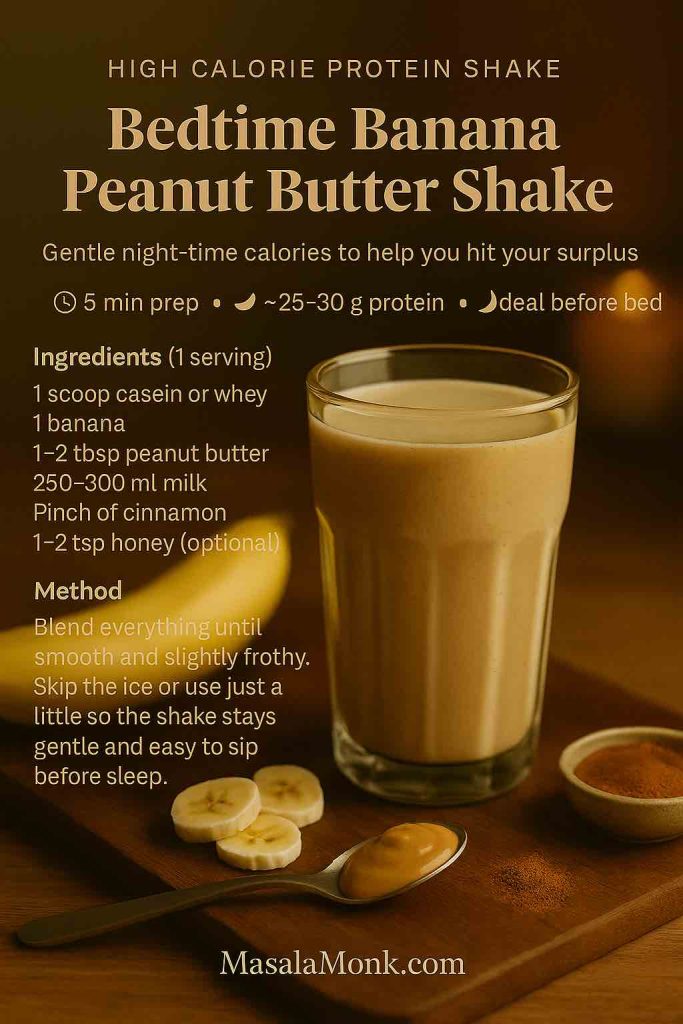
10. Bedtime Banana Peanut Butter High Calorie Protein Shake

Ending your day with one last high calorie protein shake can be the difference between hitting and missing your surplus, especially if you struggle with appetite earlier in the day.

Ingredients

  • 1 scoop casein protein (or regular whey if that’s what you have)
  • 1 medium banana
  • 1–2 tablespoons peanut butter
  • 250–300 ml milk
  • A pinch of cinnamon
  • 1–2 teaspoons honey (optional)
Bedtime Banana Peanut Butter Shake high calorie protein shake recipe card with a creamy shake in a glass, surrounded by banana slices, peanut butter and cinnamon on a wooden board against a warm evening background, from MasalaMonk.com
Bedtime Banana Peanut Butter Shake – a cozy, pre-sleep blend of banana, peanut butter, milk and casein or whey that delivers around 25–30 g protein and gentle extra calories to help you hit your surplus without feeling too full at night.

Method

  1. Add milk, banana, peanut butter and protein powder to your blender.
  2. Sprinkle over the cinnamon and add honey if using.
  3. Blend until completely smooth and slightly frothy.

Because this shake is meant for the evening, most people find it more comfortable slightly warm or at room temperature rather than ice-cold. You can simply skip the ice and use milk that isn’t straight from the fridge if your stomach prefers it.

Also Read: Ghee vs. Butter: How are they different?


Putting It All Together for Bulking & Healthy Weight Gain

High calorie protein shakes are tools, not magic. They make it easier to tip the calorie balance in your favour, yet they work best as part of a wider plan that also includes:

  • A general focus on calorie-dense whole foods such as nuts, seeds, full-fat dairy and healthy oils
  • A structured strength training routine to turn those extra calories into muscle
  • Adequate sleep and recovery, so your body can repair and grow

If you have been underweight for a while or you’re recovering from illness, pairing these shakes with guidance on healthy ways to gain weight is a smart move. For those who prefer a more fitness-focused angle, you can also explore overviews on how much protein per day you may need to build muscle and adjust your shake recipes accordingly.

From here, a simple way to start is to pick two or three favourite high calorie protein shakes from this list and rotate them through the week:

  • Use one as a breakfast smoothie on busy mornings.
  • Sip another as a mid-afternoon snack when appetite is low.
  • Keep a richer one, like the bedtime banana peanut butter shake, as a night-time top-up if you’re still short on calories.

As your body gets used to the increased intake, you can slowly increase portion sizes or add a third shake on heavy training days. Meanwhile, you can keep exploring more ingredient combinations – mangoes, nuts, seeds, dates, yogurt and local favourites like sattu – using resources such as the mango weight gain guide and the protein-packed nuts and seeds overview.

The key is consistency. With the right mix of high calorie protein shakes, solid meals and training, healthy weight gain becomes far more achievable – and a lot more enjoyable.

Also Read: Beginner’s Guide to the Gym

FAQs About High Calorie Protein Shakes for Healthy Weight Gain

1. What are high calorie protein shakes?

High calorie protein shakes are blended drinks that combine a concentrated source of protein with calorie-dense ingredients like milk, nut butters, oats, fruits, seeds and healthy fats. Instead of just supplying a scoop of protein powder and water, these shakes are deliberately designed to deliver extra energy along with protein so you can create the calorie surplus needed for healthy weight gain. In other words, they function as compact meals or substantial snacks rather than light post-workout drinks.

2. Are high calorie protein shakes good for weight gain?

High calorie protein shakes are one of the most effective tools for gaining weight in a controlled way. Because they are easy to drink, they allow you to take in more calories without feeling as stuffed as you might after another large plate of food. At the same time, they provide enough protein to support muscle growth when paired with strength training. When you base them on whole ingredients—such as milk, yogurt, oats, nuts, seeds, fruits and quality protein powder—they can be far healthier than relying on random fast food or sugar-heavy snacks.

3. How many high calorie protein shakes should I drink per day?

That depends on how big your calorie gap is. Some people only need one high calorie protein shake a day to move into a small surplus, while others might benefit from two shakes—perhaps one as a breakfast smoothie and another as an evening weight gain shake. As a general rule, it’s better to start with one shake and monitor your weight and digestion for a couple of weeks. If the scale is still not moving and you feel fine, you can gradually add a second high calorie protein shake or make your existing recipe more energy-dense by increasing nut butter, oats or healthy fats.

4. Can I use high calorie protein shakes as meal replacements?

High calorie protein shakes can replace a meal as long as they are built like a balanced plate. That means they should contain protein, carbohydrates, healthy fats and some micronutrients from fruits or vegetables. A weight gain shake with just protein powder and water is not a complete meal; however, a blend that includes milk or yogurt, oats or fruit, nut butter or seeds and perhaps a handful of greens can easily stand in for breakfast or lunch. Even so, keeping some solid meals in your day is still wise, both for digestion and for overall enjoyment of food.

5. What ingredients should I put in high calorie protein shakes for weight gain?

For weight gain, you want ingredients that are calorie-dense and nutritious. Great bases for high calorie protein shakes include whole milk, full-fat yogurt, coconut milk, nut milks and fruit juice in small amounts. To raise the calorie count further, you can add bananas, mangoes, dates, honey, cooked oats, granola, peanut butter, almond butter, cashews, walnuts, chia seeds, flax seeds, pumpkin seeds, avocado, ghee or a drizzle of healthy oil. Finally, combine these with a scoop of whey, casein or plant-based protein powder so your high calorie protein shake also hits a solid protein target.

6. When is the best time to drink a high calorie protein shake for healthy weight gain?

You can fit high calorie protein shakes anywhere in your day; the “best” time is when you are most likely to drink them consistently. Many people find a calorie-dense breakfast smoothie easier than a large morning meal, so that slot works well. Others prefer a high calorie protein shake right after training, when appetite is still decent and muscles are primed for recovery. Another useful window is late afternoon or before bed, especially if you realise you’re short on calories for the day and want a gentle way to top up without cooking a heavy meal.

7. Are high calorie protein shakes better than solid food for bulking & weight gain?

High calorie protein shakes are not automatically better than solid food; they are simply more convenient in some situations. Solid meals often provide more fibre and require chewing, which can help with satiety and digestive health. Nevertheless, if you struggle to eat enough to gain weight, liquid calories offer a practical workaround. A balanced approach works best: use high calorie protein shakes to fill the gap when appetite dips or time is short, and rely on whole-food meals the rest of the day to keep your diet varied and satisfying.

8. Do high calorie protein shakes make you gain fat or muscle?

High calorie protein shakes contribute to both muscle and fat gain; the ratio depends on your training, overall diet quality and total calorie surplus. If you simply add several very large weight gainer shakes to a sedentary lifestyle, more of the gain is likely to be stored as fat. On the other hand, if you combine moderate high calorie protein shakes with a progressive strength training programme, you encourage your body to channel those extra calories into muscle repair and growth. The goal is a modest surplus, not an extreme one, so that the weight you gain is as lean as possible.

9. Can high calorie protein shakes be healthy for women as well as men?

High calorie protein shakes can be beneficial for women and men alike, provided the recipes match individual needs. Women who are underweight, recovering from illness, dealing with poor appetite, training hard, breastfeeding or trying to build muscle may all find calorie-dense shakes helpful. The principles are the same: build your high calorie protein shakes with real foods, keep added sugars reasonable and adjust portion sizes according to your body size and goals. As always, anyone with medical conditions or specific hormonal concerns should check in with a health professional before making big dietary changes.

10. Is whey protein necessary for high calorie protein shakes, or can I use other options?

Whey protein is popular because it mixes easily and is rich in essential amino acids, yet it is not mandatory. High calorie protein shakes can be built with a wide variety of protein sources. You can use plant-based protein powders made from pea, rice, soy or blends if you are vegetarian or vegan. You may also rely on whole-food proteins such as Greek yogurt, paneer, tofu, milk powder or even sattu to raise the protein content. Ultimately, the best choice is the one you digest well, enjoy drinking and can afford to use regularly in your weight gain shakes.


Posted on 15 Comments

Whiskey Sour Recipe: Classic Cocktail, Best Whiskey & Easy Twists

Bartender holding a whiskey sour cocktail and shaker on a wooden bar, cover image for MasalaMonk whiskey sour recipe guide

There’s something wonderfully honest about a whiskey sour. No smoke and mirrors, no mile-long ingredient list—just whiskey, citrus, and sweetness, shaken together until they become more than the sum of their parts. Whether you like yours sharp and bracing, frothy with egg white, or dressed up with a red wine float as a New York sour drink, mastering a great whiskey sour recipe gives you a whole family of cocktails to play with.

Let’s walk through it slowly, glass in hand.


What Exactly Is a Whiskey Sour?

At its core, a whiskey sour cocktail is a “sour”: one spirit, one citrus, one sweetener. That template shows up everywhere in cocktail culture—margaritas, daiquiris, sidecars—but the whiskey sour drink might be the most comforting of the lot.

In its simplest form, you’re working with:

  • Whiskey
  • Fresh lemon juice
  • Sugar (usually as simple syrup)

Shake it with ice, strain it into a glass, garnish if you like, and you’re done. That’s your basic answer when someone asks, “What’s in a whiskey and sour?” or “What’s the whiskey sour cocktail recipe?”

Over the years, bartenders have added little twists:

  • A splash of egg white to create the creamy Boston Sour
  • A float of dry red wine to turn it into a dramatic New York whiskey sour
  • Swapping in different sweeteners (honey, maple, ginger syrup)
  • Experimenting with different styles of whiskey—bourbon, rye, Irish, Scotch

Yet the structure stays the same. Spirit, sour, sweet. Once you understand that, you can see how every sour whisky drink you encounter is just a variation on this backbone.

Also Read: Negroni Recipe: Classic Cocktail & Its Variation Drinks


A Short, Spirited History

Like many great drinks, the traditional whiskey sour grew out of necessity. Long before cocktail bars and Instagram, sailors mixed spirits with lemon or lime juice and sugar to ward off scurvy and make rough spirits more palatable on long voyages. Over time, that practical mixture migrated onto dry land and into early American bars.
By the mid-19th century, manuals like Jerry Thomas’s Bartender’s Guide were formalizing the idea of “sours”—brandy sour, gin sour, whiskey sour. The original whiskey sour recipe would have been pretty rustic by modern standards: spirit, citrus, and powdered sugar, maybe with a bit of water to help it dissolve.
Fast forward to today, and the drink still follows the same logic, though we’ve traded powdered sugar for simple syrup, added the option of egg white, and fine-tuned the whiskey sour ratio so it suits modern palates. Meanwhile, new variations keep spinning off—from the red-wine-topped New York sour cocktail recipe to maple- and spice-laced twists like the Nutmeg Maple Whiskey Sour you’ll find in Masala Monk’s nutmeg-inspired cocktails for Saturday nights.

The drink has evolved, but its spirit hasn’t changed much: a simple, reliable way to turn whiskey and lemon into something you want to linger over.

Also Read: How to Cook Perfect Rice Every Time (Recipe)


Whiskey Sour Ingredients: The Building Blocks

Before shaking, it helps to get familiar with the core whiskey sour ingredients and why they matter.

1. Whiskey

The whiskey is your base, so choose wisely. Almost any style can work:

  • Bourbon – The default for a bourbon whiskey sour and bourbon sour. It’s naturally sweet, with notes of vanilla and caramel that play beautifully with lemon.
  • Rye – Spicier and drier, great for a rye whiskey sour if you like more bite.
  • Irish whiskey – Light, smooth, and friendly. Ideal for an easy-drinking Irish whiskey sour or Jameson whiskey sour.
  • Scotch – Malty and sometimes smoky. That’s your scotch sour, scotch whiskey sour, or sour scotch, and it can be delicious in the right hands.

Later on, when you’re ready to get very specific about the best whiskey for whiskey sour, you can dip into more brand-focused guides like Masala Monk’s deep dive on what to mix with Jim Beam or bottle lists from cocktail sites that compare bourbon and rye for mixed drinks.

2. Fresh Lemon Juice

Lemon is the “sour in whiskey sour.” It’s what turns a glass of straight spirit into a refreshing lemon whiskey drink and gives the cocktail its signature brightness.

Fresh makes a big difference. Bottled juice tends to taste flat or sharp in the wrong way, while fresh lemons give you aroma and zest along with acidity. If someone asks about whiskey and lemon juice or drinks with whiskey and lemon, this is the heart of the answer: fresh citrus, not shelf-stable juice.

3. Sweetener

Traditional recipes used sugar and water; today, most bartenders reach for:

  • Simple syrup – Equal parts sugar and water, dissolved. This is the most common simple syrup for whiskey sour and makes it easy to adjust sweetness.
  • Maple syrup – For a maple whiskey sour, especially in colder weather.
  • Honey syrup – For a honey lemon whiskey sour, floral and cozy.
  • Ginger syrup – For a ginger whiskey sour with a warming kick.

Even if you’re using a flavoured syrup, the logic is the same: balance the lemon with enough sweetness that the cocktail tastes harmonious rather than punishingly sour.

4. Egg White (Optional)

Egg white is technically optional, but if you’ve ever admired a cocktail with a thick, silky foam on top, you’ve seen what it can do. Adding a small amount and shaking properly turns your drink into a luscious whiskey sour with egg white—what many people call a Boston Sour.

You’ll also see recipes labelled:

  • Whiskey sour cocktail recipe egg white
  • Whiskey sour cocktail with egg white
  • Whiskey drink with egg white

All of them are describing this creamy variation. We’ll get into the technique in a moment.

Also Read: Homemade Hot Chocolate with Cocoa Powder Recipe


Classic Whiskey Sour Recipe (No Egg)

Let’s start with the most straightforward whiskey sour recipe: clean, bright, and easy to remember.

Simple Whiskey Sour

This is your go-to simple whiskey sour, perfect for a weeknight drink or a first experiment at home.

Ingredients (1 drink)

  • 50 ml (1¾ oz) whiskey
  • 25 ml (¾–1 oz) fresh lemon juice
  • 20–25 ml (⅔–¾ oz) simple syrup
  • Ice
  • Lemon wheel or twist, plus a cherry

Think of this as the standard whiskey sour recipe ml and whiskey sour measurements you can rely on. It’s essentially a 2:1:1 whiskey sour ratio, which is easy to scale up.

Home bartender in a navy blazer holding a classic whiskey sour cocktail on a wooden bar, with text overlay describing a 2-1-1 whiskey lemon simple syrup recipe for MasalaMonk
Classic Whiskey Sour Recipe – a 2:1:1 mix of whiskey, fresh lemon, and simple syrup, styled as a home bartender’s guide cover for MasalaMonk.com.

Method

  1. Add the whiskey, lemon juice, and simple syrup to a cocktail shaker filled with ice.
  2. Shake briskly for 10–15 seconds, until the outside of the shaker is frosty.
  3. Strain into a rocks glass filled with fresh ice.
  4. Garnish with a lemon wheel or twist and a cherry.

That’s it. In just a few steps, you’ve made an easy whiskey sour from scratch. You can call this your basic whiskey sour, classic whiskey sour, traditional whiskey sour recipe, or just “my house whiskey sour.”

If a friend asks, “How do you make a whiskey sour?” or “How do I make a whisky sour at home?”—this is the version to teach them.

Also Read: Peanut Butter Cookies (Classic Recipe & 3 Variations)


Whiskey Sour Recipe with Egg White (Boston Sour)

Once you’re comfortable with the basic build, you might want to explore the creamy, velvety side of the style: the whiskey sour with an egg white, often referred to as a Boston Sour.

Why Add Egg White?

Egg white doesn’t change the flavour dramatically; instead, it transforms texture. It gives the drink:

  • A thick, luxurious foam cap
  • A softer, rounder mouthfeel
  • A canvas for a few drops of aromatic bitters

That’s why you’ll sometimes see recipes titled egg white whisky sour or boston sour cocktail. They’re all talking about the same technique.

Egg-White Whiskey Sour Recipe

Ingredients (1 drink)

  • 50 ml (1¾ oz) whiskey
  • 25 ml (¾–1 oz) fresh lemon juice
  • 20–25 ml (⅔–¾ oz) simple syrup
  • 10–15 ml (⅓–½ oz) egg white (about half the white of a large egg)
  • Ice
  • Bitters + lemon twist, to garnish
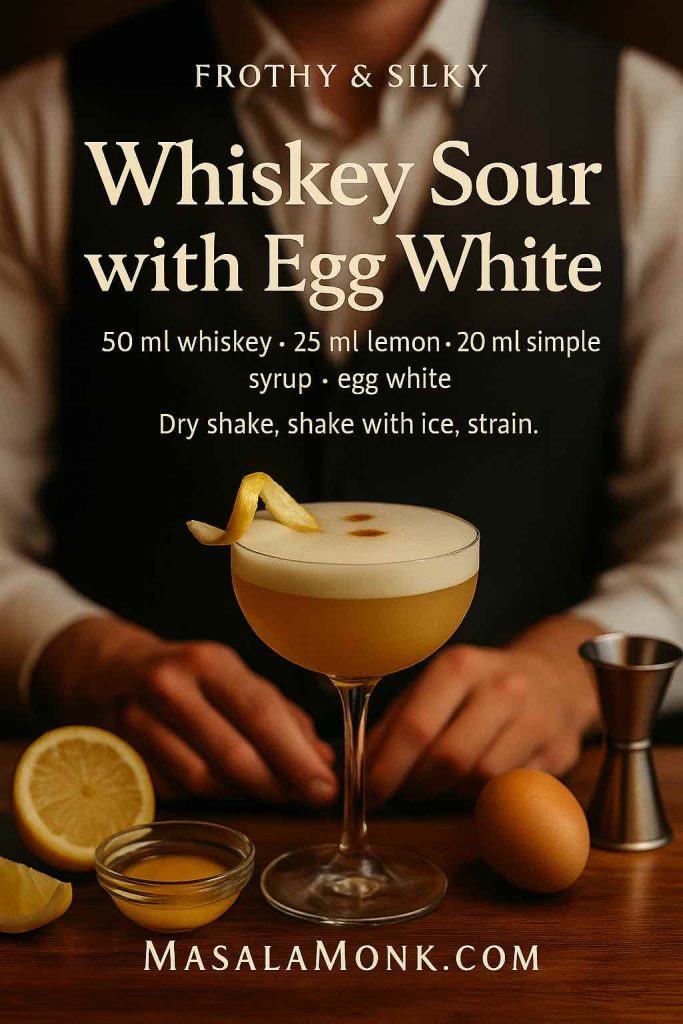
Recipe card style image showing a frothy whiskey sour with egg white in a coupe glass, with text listing 50 ml whiskey, 25 ml lemon, 20 ml simple syrup and egg white plus dry shake instructions from MasalaMonk
Frothy & silky Whiskey Sour with Egg White – a Boston Sour recipe in one glance: 50 ml whiskey, 25 ml lemon, 20 ml simple syrup and egg white, dry shaken then shaken with ice for MasalaMonk.com.

Method

  1. Add whiskey, lemon, simple syrup, and egg white to a shaker without ice.
  2. Seal and dry shake for about 10–20 seconds. This whips air into the egg white.
  3. Open the shaker, add ice, and shake again until chilled.
  4. Strain into a rocks glass over ice or into a chilled coupe.
  5. Dot the foam with a few drops of bitters and garnish with a twist.

You now have a lush, restaurant-worthy whiskey sour cocktail. If you want more context about this style and why bartenders swear by the dry-shake method, you can always look to classic recipe resources like Liquor.com’s take on the whiskey sour or similar guides that spell out both the egg and no-egg versions in detail.

Anyone looking for a whisky sour recipe with egg white or a whiskey sour cocktail recipe that looks truly pro will be delighted with this version.

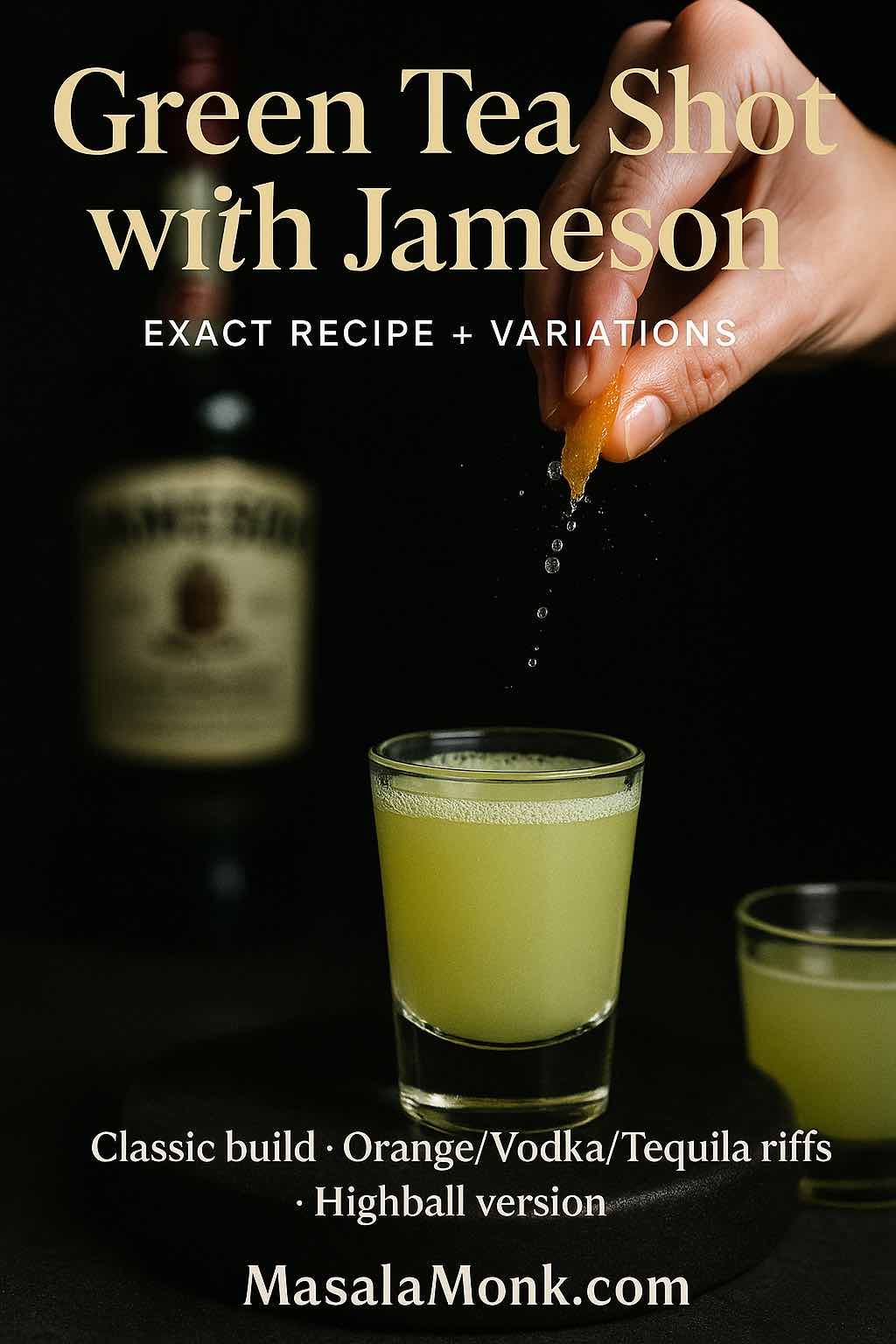
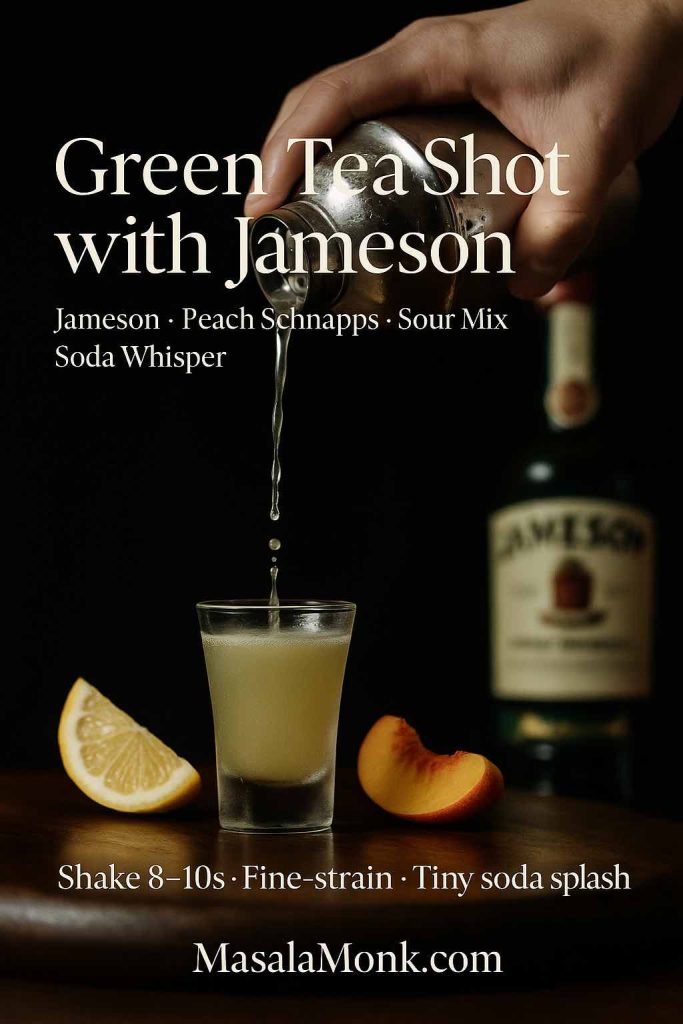
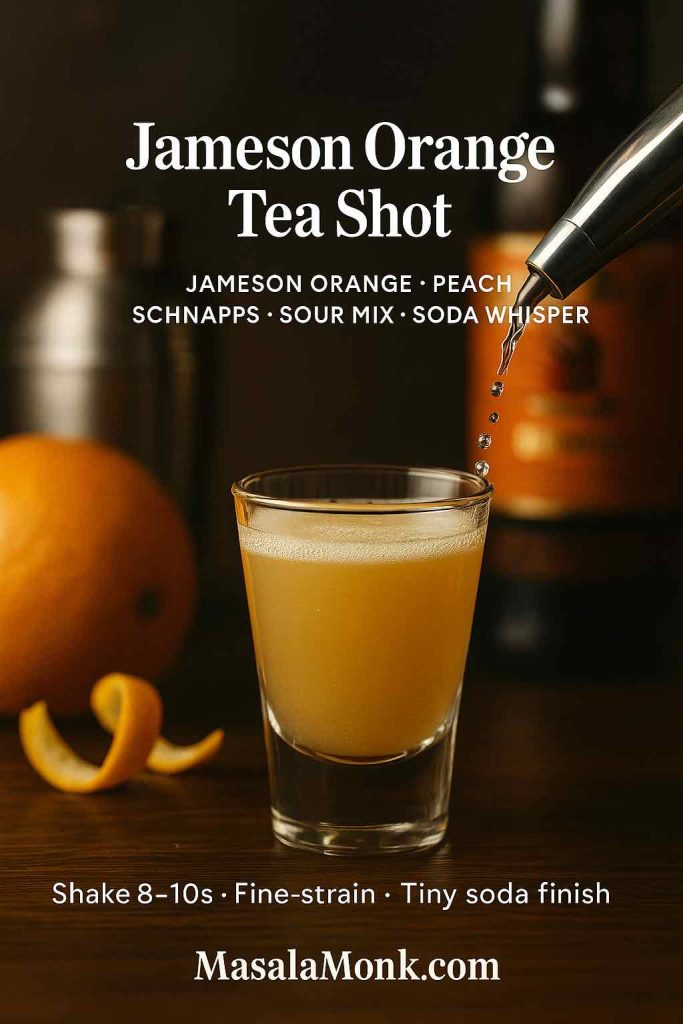
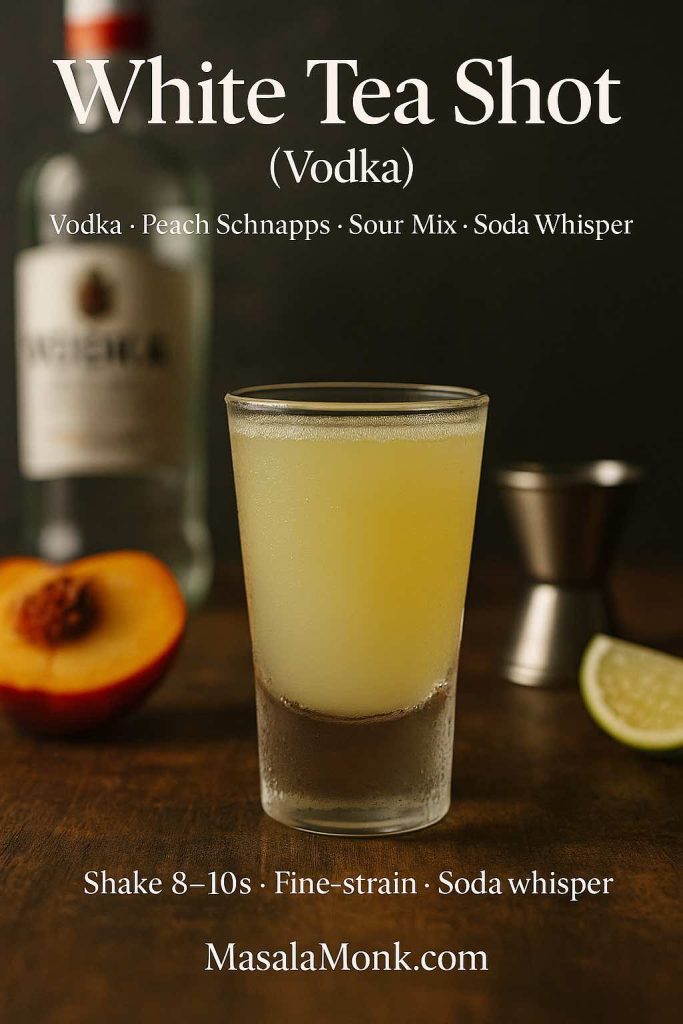
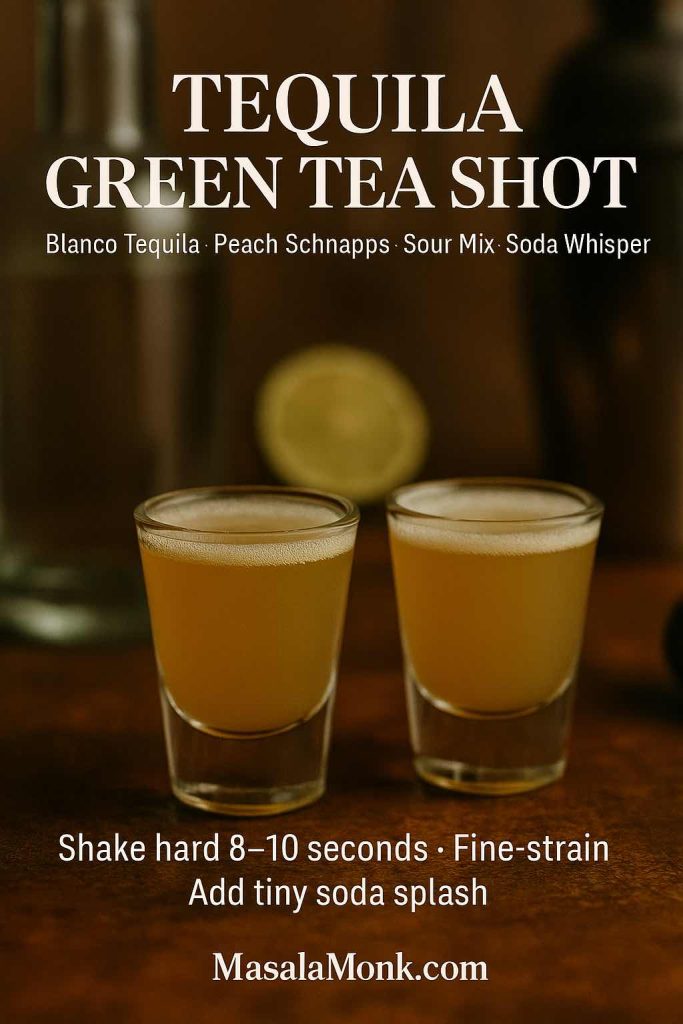
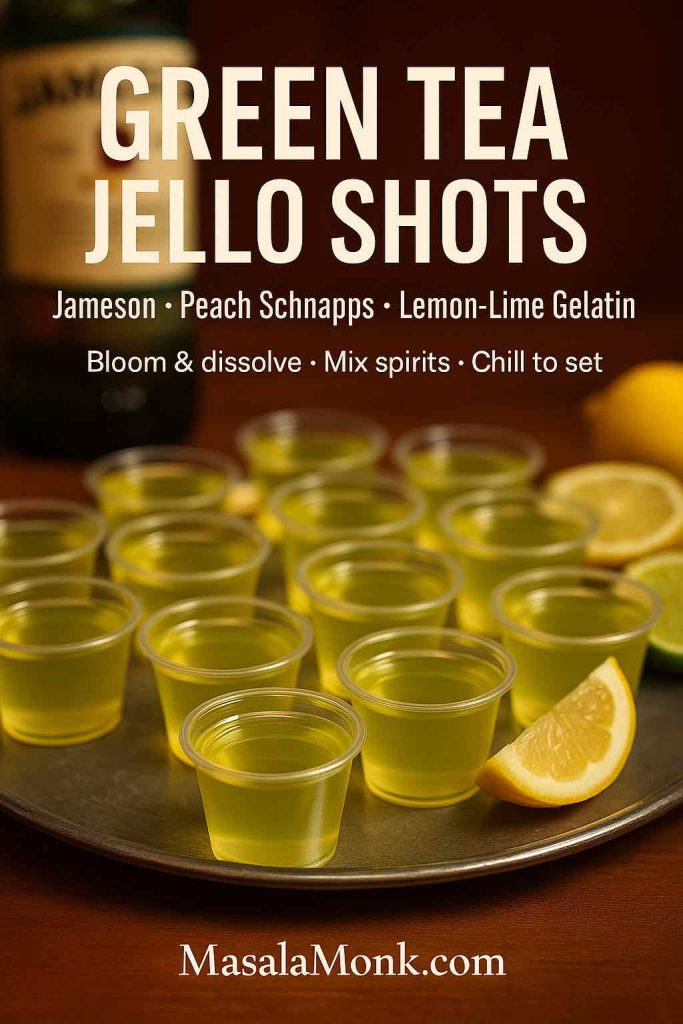
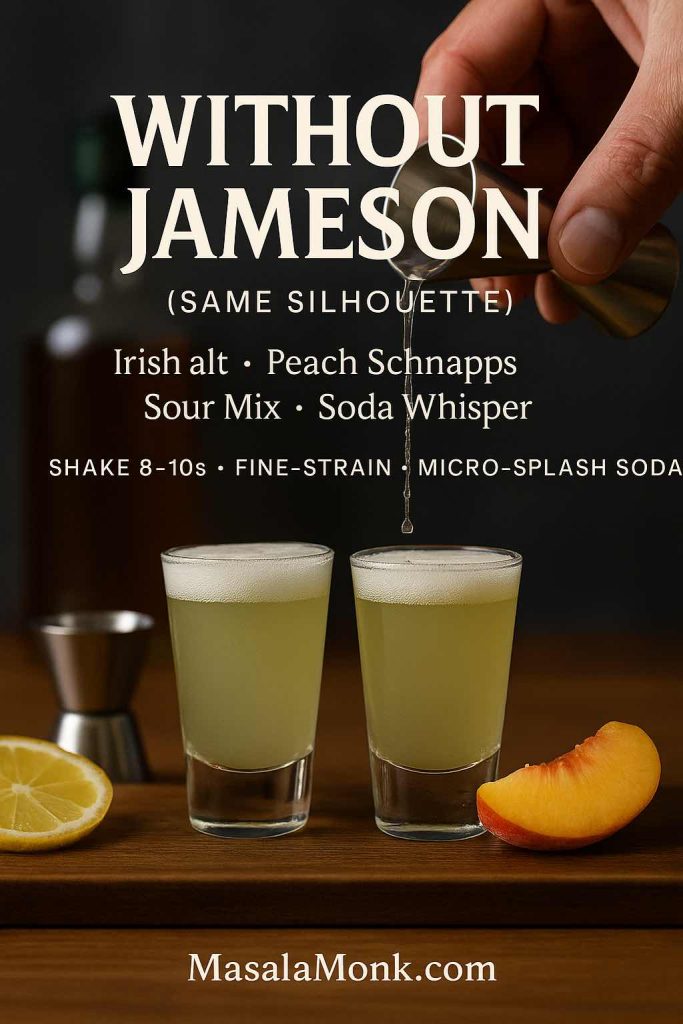
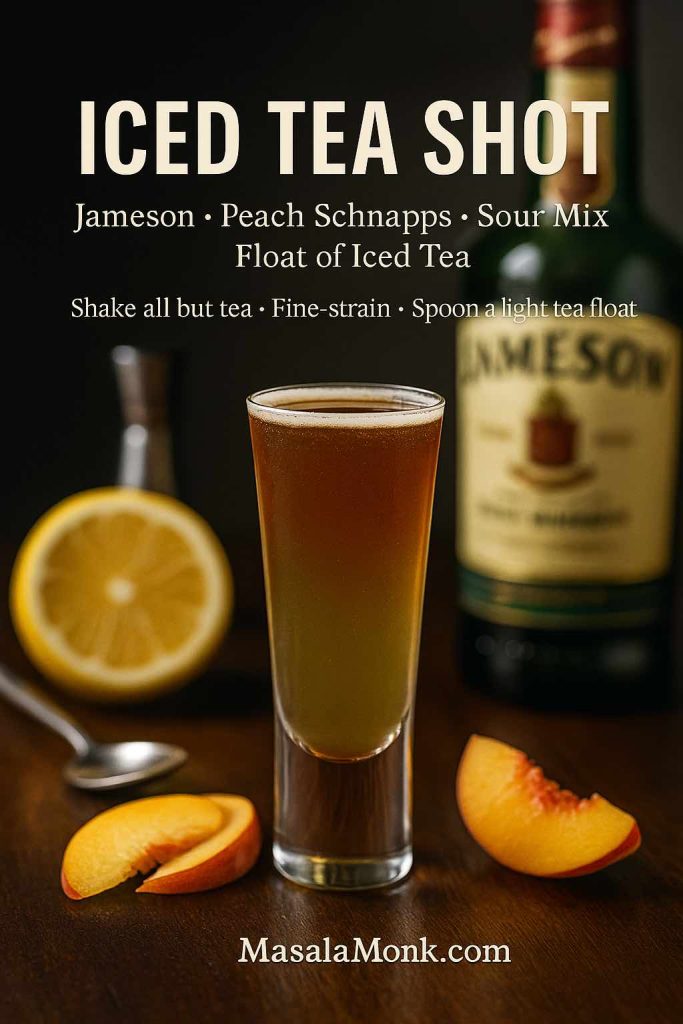
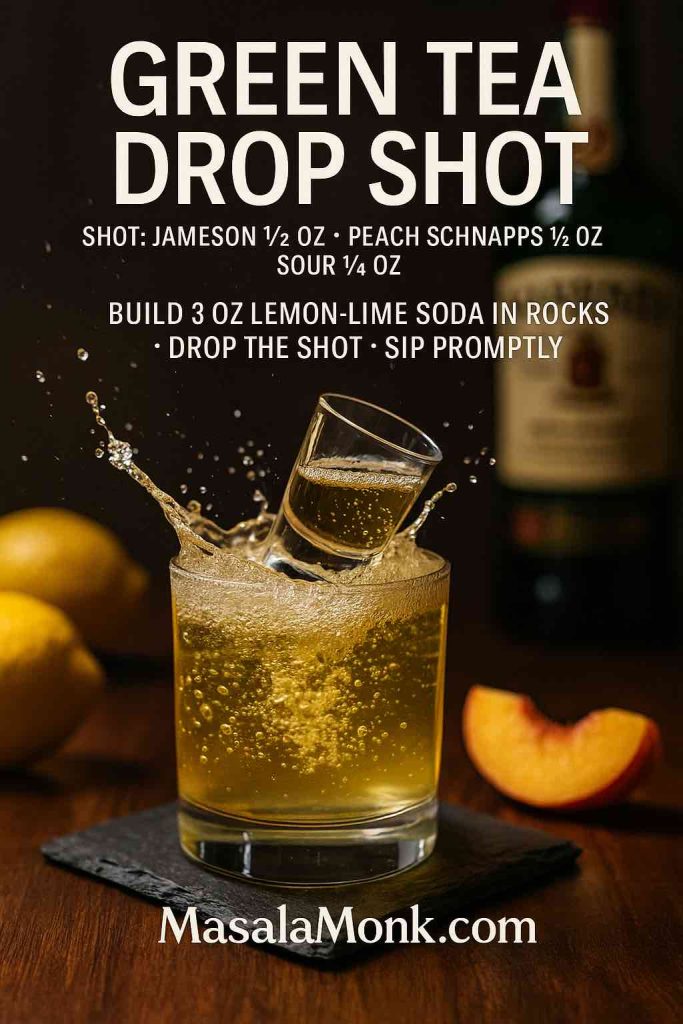
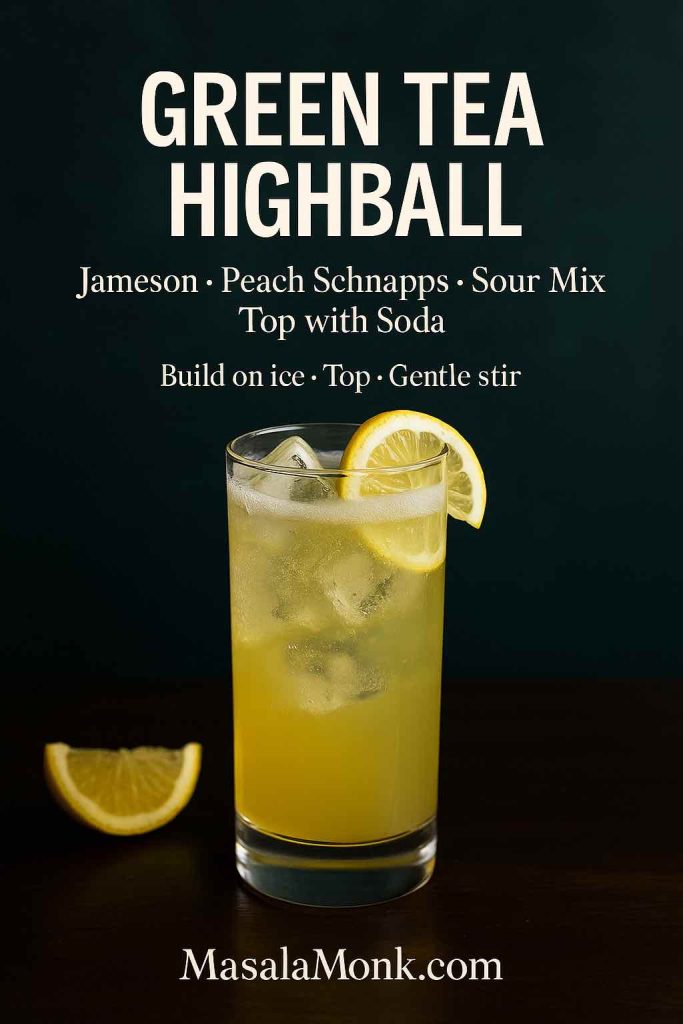
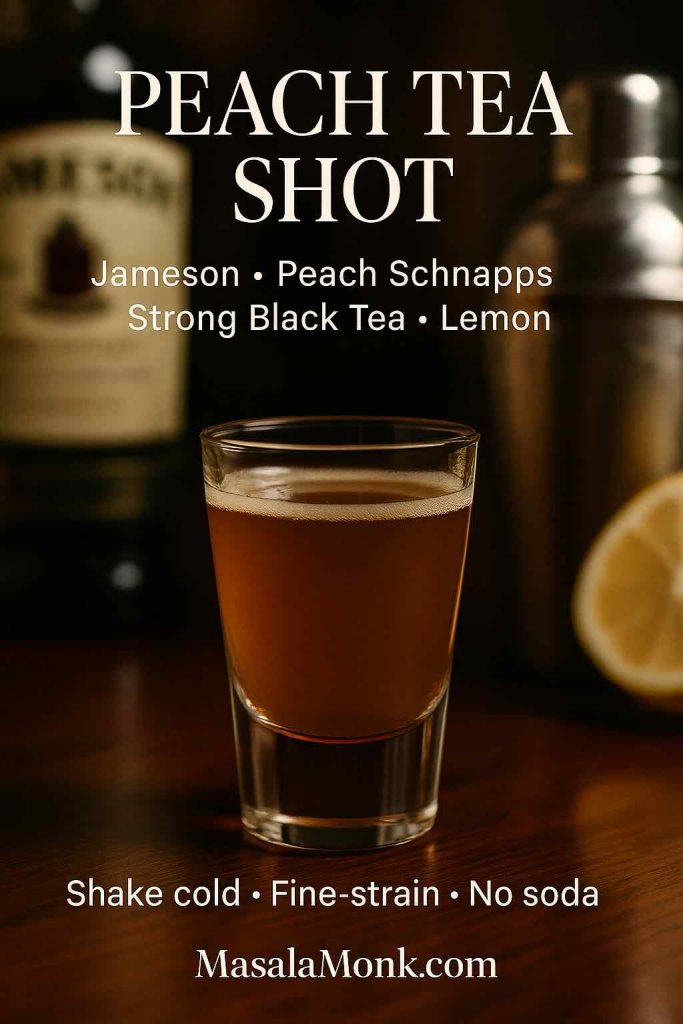
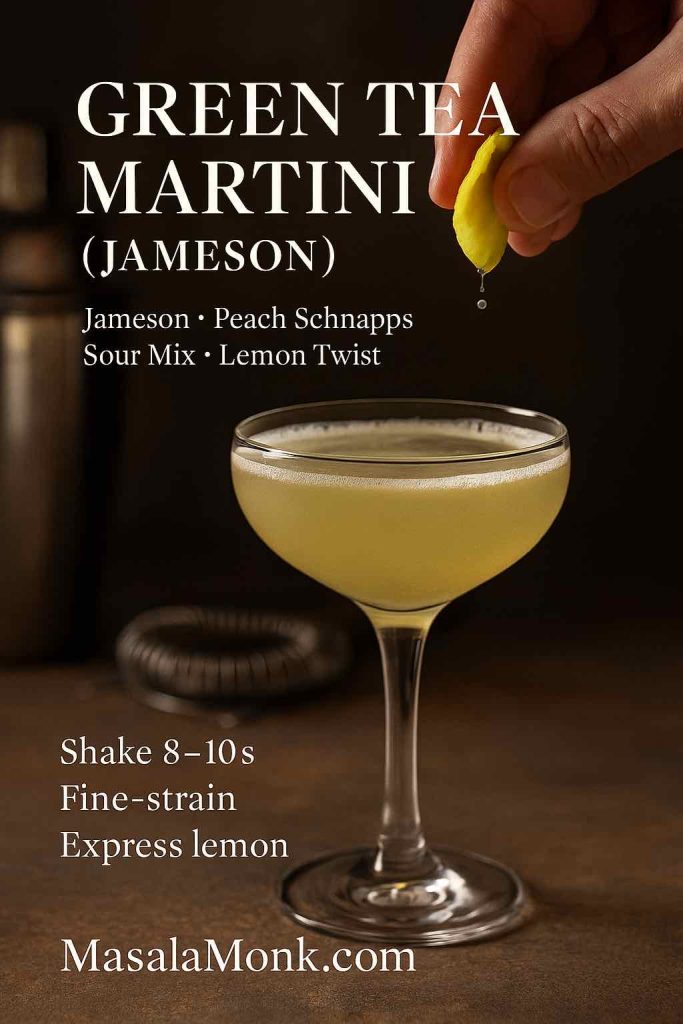
Also Read: Green Tea Shot with Jameson | Recipe & 10 Variations


Whiskey Sour Recipe Without Egg (No-Fuss & Vegan Friendly)

Not everyone is comfortable with egg in a drink, and that’s completely fine. A whiskey sour without egg white is:

  • Easier to batch for parties
  • Faster to shake on a busy night
  • Naturally lighter and more zippy

The good news is you don’t need to change much. The whiskey sour recipe no egg is simply the simple recipe from above: whiskey, lemon, syrup, ice, shake.

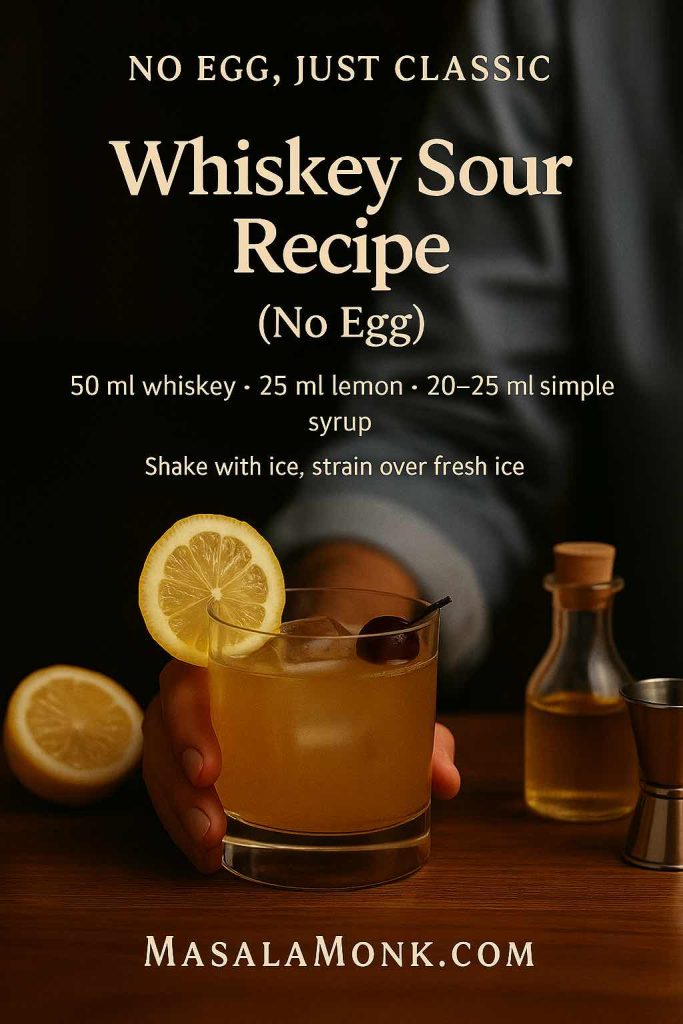
Recipe card image for a classic whiskey sour without egg, showing a rocks glass with lemon and cherry garnish held by a bartender, with text listing 50 ml whiskey, 25 ml lemon and 20–25 ml simple syrup.
No egg, just classic – this Whiskey Sour Recipe (No Egg) keeps it simple with 50 ml whiskey, 25 ml lemon and 20–25 ml simple syrup, shaken with ice and strained over fresh ice for MasalaMonk.com.

You’ll see plenty of variations on the phrase—whiskey sour ingredients no egg, whiskey sour ingredients without egg, whisky sour no egg, whisky sour recipe no egg, whisky sour without egg—but they all boil down to the same thing: a classic, foam-free sour that puts the citrus and whiskey front and centre.

If you still want that foamy look but don’t want to use egg, some bartenders use aquafaba (the liquid from a can of chickpeas) as a vegan substitute. The technique is the same: dry shake first, then shake with ice.

Also read: Béchamel Sauce for Lasagna: Classic, Vegan & Ricotta Sauce Recipe


Whiskey Sour with Sour Mix: Shortcuts That Still Taste Great

Sometimes you’re making one perfect drink for yourself. Other times you’re in full host mode and squeezing lemons for ten people feels like too much. That’s where whiskey sour mix comes in handy.

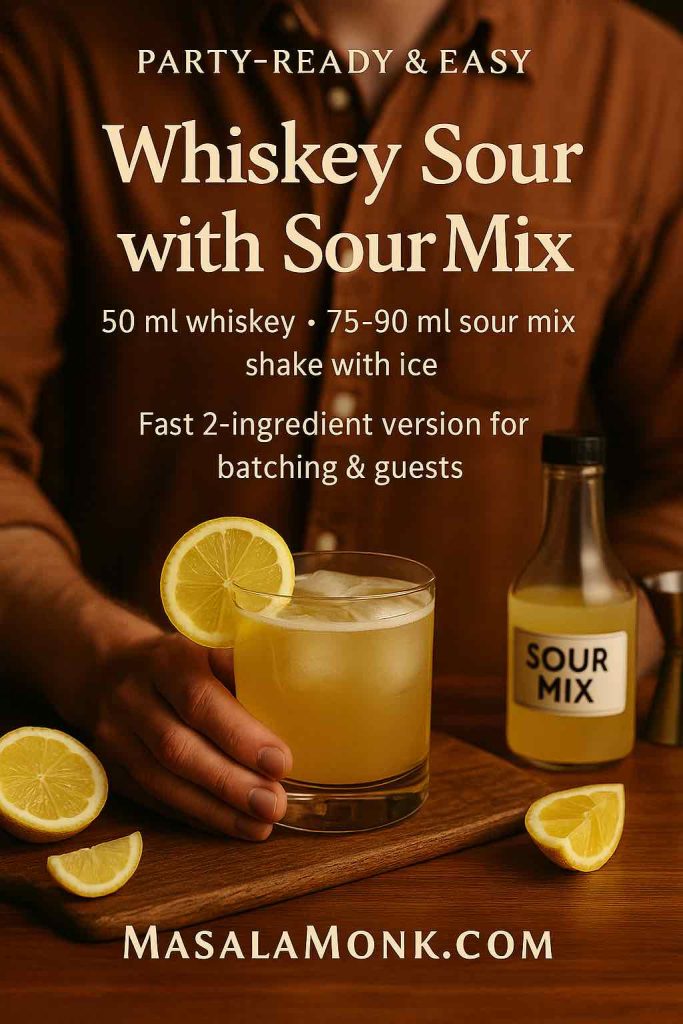
Recipe card image showing a whiskey sour with sour mix in a rocks glass garnished with lemon, held by a person in a casual shirt with a labeled sour mix bottle beside it and text listing 50 ml whiskey and 75–90 ml sour mix.
Party-ready Whiskey Sour with Sour Mix – a fast 2-ingredient recipe card for batching: 50 ml whiskey, 75–90 ml sour mix, shake with ice and serve, created for MasalaMonk.com.

Using Bottled Mix

For a quick-and-easy whiskey sour with sour mix, try:

  • 50 ml (1¾ oz) whiskey
  • 75–90 ml (2½–3 oz) commercial sour mix

Shake with ice, strain over fresh ice, garnish. That’s your classic shortcut for a whiskey sour drink mix–based serve.

You might also see this loosely described as:

  • Whiskey and sour mix
  • Sour mix and whiskey
  • Whisky sour with sour mix
  • Whiskey sour with sweet and sour mix

If you’re already using sour mix for shots and party drinks, you can keep the same bottle on hand for sours. For instance, if you enjoy the Green Tea Shot with Jameson from Masala Monk—Jameson, peach schnapps, sour mix—that same mix gives you a fast route to a Jameson whiskey sour–style drink in a pinch.

Homemade Whiskey Sour Mix Recipe

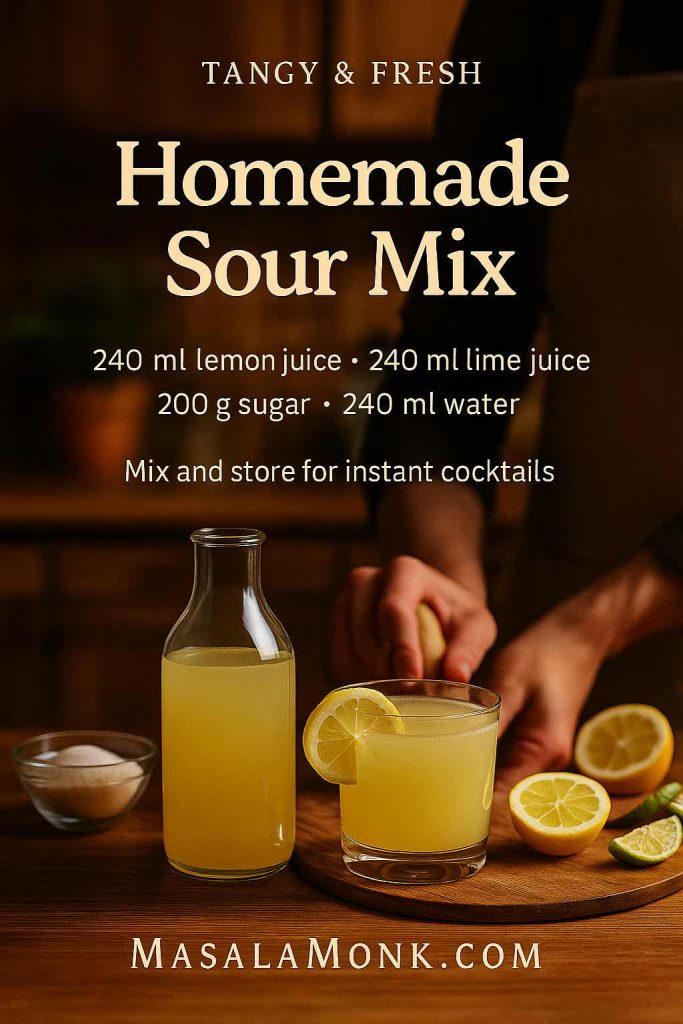
For better flavour and more control, it’s worth making your own homemade whiskey sour mix. A simple version:

  • 1 part fresh lemon juice
  • 1 part fresh lime juice (optional but bright)
  • 1 part sugar (stirred into the juice or turned into syrup)

Combine, chill, and you’ve got a versatile lemon sour recipe drink base that works for:

  • Classic whiskey sweet and sour highballs
  • Batch whiskey sour recipe with sour mix pitchers
  • Other sour-style cocktails and even tea-based drinks

Masala Monk’s love affair with tea and whiskey shows up in posts like their cinnamon-spiced iced tea whiskey cocktails and saffron iced tea cocktails, and a homemade sour mix slots perfectly into that style of mixing.

Homemade sour mix recipe card showing a glass bottle and glass of yellow citrus mix on a wooden counter with lemons and limes, plus text listing lemon juice, lime juice, sugar and water for MasalaMonk
Tangy & fresh Homemade Sour Mix – lemon juice, lime juice, sugar and water mixed and bottled so your next round of whiskey sours on MasalaMonk.com is always just a shake away.

Once your mix is ready, you can use roughly 50 ml whiskey to 75–90 ml of your sour blend for a fast, consistent drink. It may not be as precise as the single-serve whiskey sour from scratch, but it’s very party-friendly.

Also Read: Crock Pot Lasagna Soup (Easy Base + Cozy Slow-Cooker Recipes)


Best Whiskey for Whiskey Sour: Choosing the Right Bottle

Talk to ten bartenders about the best whiskey for whiskey sour recipe, and you’ll get at least twelve opinions. That said, a few patterns show up again and again.

Bourbon

Bourbon is the classic choice for a bourbon whiskey sour or bourbon sour:

  • Naturally sweeter, with vanilla, caramel, and baking-spice notes
  • Often feels rounder and softer with lemon juice
  • Plays nicely with a wide range of sweeteners, from simple syrup to maple

When you’re browsing the shelf, look for a bottle you’d happily sip neat but don’t mind mixing. If you’ve already been experimenting with ideas from “what to mix with Jim Beam” style articles—including highballs, long drinks, and sours—that same Jim Beam or similar bourbon will make a very solid good whiskey for whiskey sour.

Rye

Rye brings more spine to the party. A rye whiskey sour:

  • Tastes drier and spicier
  • Leans into pepper and baking spice notes
  • Works beautifully if you don’t like your cocktails overly sweet

If you already enjoy Manhattan-style drinks, a rye-based sour might feel like the perfect bridge between sharp and refreshing.

Irish Whiskey

For something lighter, Irish whiskey is tailor-made for a whiskey and lemon combination. A Jameson sour or Jameson whiskey sour tends to be:

  • Smooth and approachable
  • Slightly grassy or cereal-like in a pleasant way
  • Great for people who say they “don’t really like whiskey” but enjoy balanced cocktails

In fact, if you’ve made the Green Tea Shot mentioned earlier, you already know how friendly Jameson is with sour mix and citrus.

Scotch & Beyond

Scotch in a sour can be a little more polarizing, yet a good scotch sour drink or scotch sour cocktail can be lovely:

  • Blended scotch gives you malt, honey, and a gentle smokiness
  • Some peated whiskies add a smoky surprise to the lemon

The same logic applies when you’re playing with other recipes on Masala Monk that feature bourbon or rye—like the cinnamon Old Fashioned–style cocktails or cinnamon-spiced iced tea highballs. If a whiskey works there, it will probably work in a sour too.

Best whiskey for a whiskey sour recipe card showing a classic whiskey sour in front of four bottles labeled bourbon, rye, Irish and Scotch with a bartender’s hand choosing a bottle.
Choosing your bottle – bourbon for sweet and round, rye for spice, Irish for smooth and Scotch for smoky, all ready to turn into your perfect whiskey sour on MasalaMonk.com.

So What’s “Best”?

When people ask for:

  • Best whiskey for whiskey sour
  • Best whiskey for sour
  • Best whisky for a whisky sour
  • Whisky sour best whisky

…they’re usually looking for reassurance more than a single magical brand. As a guideline:

Choose a whiskey you’d drink on the rocks, with enough character to stand up to lemon and sugar, but not so precious that you feel guilty shaking it.

That’s your sweet spot.

Also Read: Cottage Cheese Lasagna Recipe | Chicken, Spinach, & Ricotta


Whiskey Sour Variations You’ll Want to Try

Once you’ve locked in your house whiskey sour recipe, you can start branching out. The sour template is incredibly flexible, so experimenting is half the fun.

New York Sour

The New York sour (sometimes called a Continental Sour) is a classic variation that adds a red wine float on top of a standard whiskey sour.

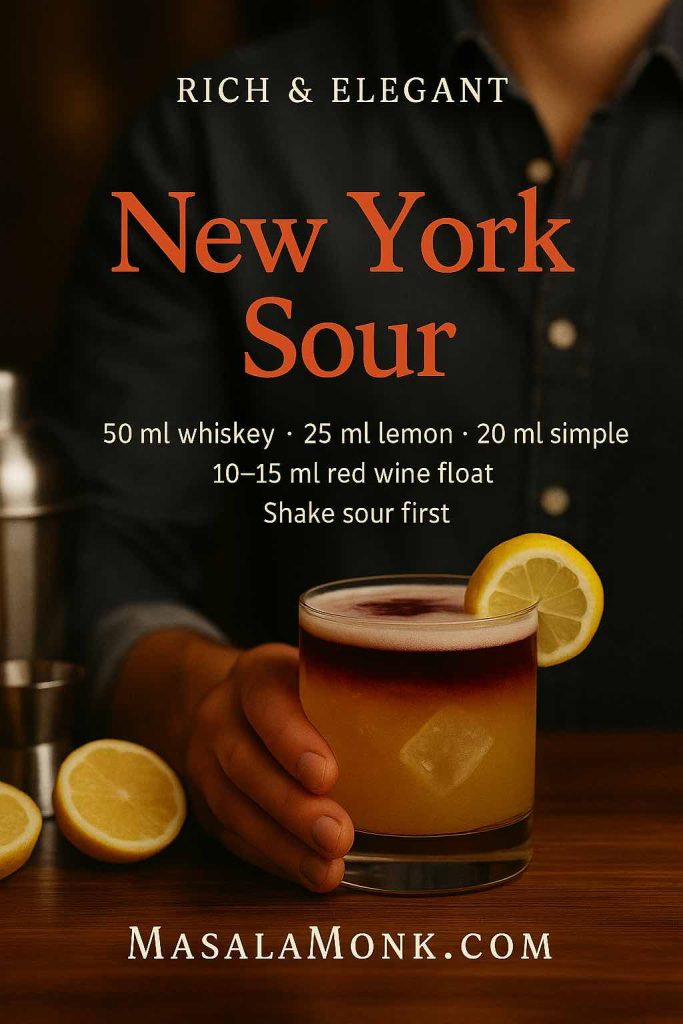
New York Sour cocktail recipe card showing a layered whiskey sour with red wine float in a rocks glass, held by a person in a denim shirt, with text listing 50 ml whiskey, 25 ml lemon, 20 ml simple syrup and 10–15 ml red wine.
Rich & elegant New York Sour – a whiskey sour shaken first, then finished with a red wine float for bar-quality layers, as featured in the MasalaMonk.com whiskey sour guide.

To make one:

  1. Shake your usual sour—either with or without egg white.
  2. Strain into a rocks glass over ice.
  3. Gently pour 10–15 ml (½ oz) of dry red wine over the back of a spoon so it floats on the surface.

The result is a layered drink with a deep purple cap and a fruity, winey aroma. It’s the answer to anyone looking for a New York sour drink or a more dramatic whiskey sour cocktail for dinner parties.

If you’d like a step-by-step benchmark, you can peek at Liquor.com’s New York Sour cocktail recipe, then tweak it to taste at home.

Maple, Nutmeg & Dessert-Like Sours

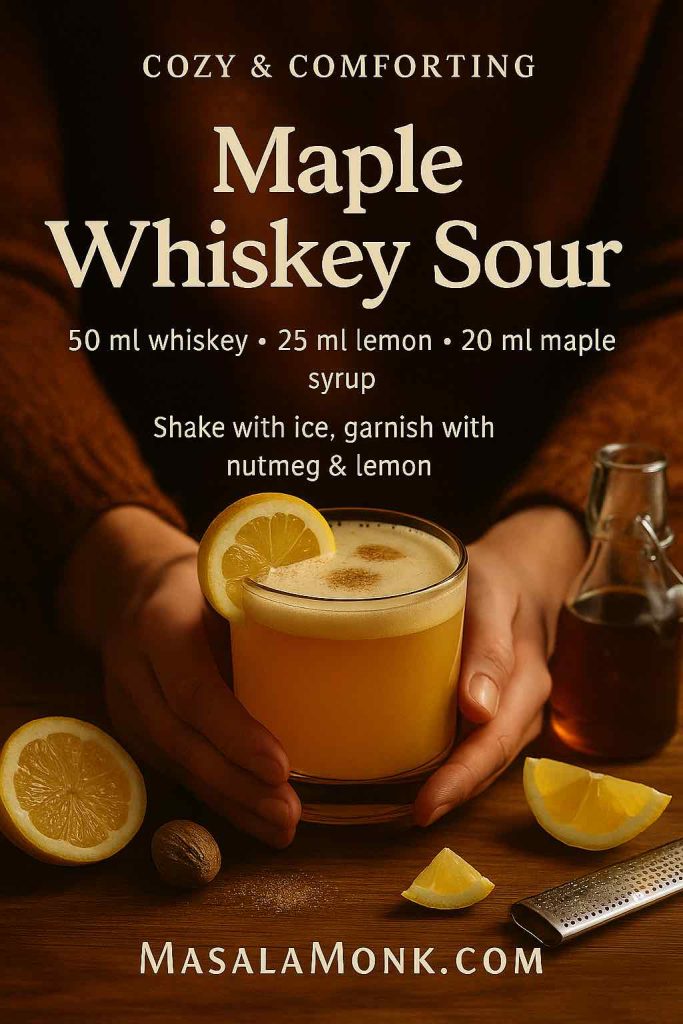
For colder evenings, swapping simple syrup for maple syrup gives you an instant maple whiskey sour. Add a dusting of nutmeg and perhaps a splash of bitters, and you’re in dessert territory.

Cozy maple whiskey sour recipe card showing a golden whiskey sour in a rocks glass held by hands in a warm sweater, with lemon wedges, nutmeg, maple syrup bottle and text listing 50 ml whiskey, 25 ml lemon and 20 ml maple syrup.
Cozy & comforting Maple Whiskey Sour – 50 ml whiskey, 25 ml lemon and 20 ml maple syrup, shaken with ice and finished with lemon and freshly grated nutmeg for MasalaMonk.com.

Masala Monk goes even further in their Nutmeg Maple Whiskey Sour, combining whiskey, maple, lemon, and nutmeg into a spiced, wintery twist. That’s a perfect example of how a basic whiskey sour recipe becomes something special with just one or two smart adjustments.

Amaretto & Whiskey Sours

If you enjoy nutty flavours, amaretto is your friend. A few ways to play:

  • Amaretto whiskey sour – Split the base between whiskey and amaretto, then add lemon and a touch of syrup.
  • Amaretto sour with whiskey – Start from an amaretto sour and add a shot of whiskey for depth.
  • Amaretto bourbon sour or bourbon amaretto sour – Bourbon for richness, amaretto for almond sweetness.
Amaretto Whiskey Sour recipe card showing an amber whiskey and amaretto cocktail in a rocks glass with lemon wheel and cherry garnish, a labeled amaretto bottle in the background and text listing 35 ml whiskey, 25 ml amaretto and 25 ml lemon.
Nutty & smooth Amaretto Whiskey Sour – 35 ml whiskey, 25 ml amaretto and 25 ml lemon, shaken with ice and strained over fresh ice for a dessert-like twist in the MasalaMonk.com whiskey sour guide.

You’ll find similar pairing ideas in Masala Monk’s piece on what mixes well with Baileys, where creamy liqueurs, nutty spirits, and whiskey frequently share the same glass. Once you see how well those flavours work together, folding amaretto into your whiskey sour feels very natural.

Fruity Whiskey Sours

Fruit-driven riffs are an easy way to soften the drink and make it more playful:

  • Cranberry whiskey sour or cranberry orange whiskey sour
  • Cranberry whiskey drink with lemon and a bit of sugar
  • Apple whiskey sour, peach whiskey sour, or pineapple whiskey sour
  • Cherry whiskey sour with muddled cherries plus juice

A simple approach is to replace part of the lemon or syrup with a fruit juice or puree, then rebalance to taste. If you already enjoy whiskey cranberry, cranberry and whiskey, or whiskey cranberry juice combos, you’re only a small step away from a full-blown whiskey sour variation.

Tropical-leaning recipes like Masala Monk’s coconut water cocktails show another path: lighter, longer drinks that keep whiskey as a base but weave in coconut, citrus, and sweetness. That approach also plays nicely with sour-style builds.

Tea & Spice Sours

Tea and spices open up a more sophisticated side of the sour template:

  • Brewed black tea or Earl Grey can replace some of the water in your simple syrup or even stand in for part of the lemon.
  • Spiced syrups (cinnamon, clove, star anise) can add warmth without overpowering.

For more inspiration, you can browse Masala Monk’s tea-driven cocktail collections, like their Earl Grey and bourbon iced tea cocktails or the saffron-infused iced tea recipes. Many of those drinks follow the same spirit–citrus–sweet blueprint as a sour, just stretched into a taller, more refreshing format.

Also Read: How to Make Churros (Authentic + Easy Recipe)


Glassware, Garnish, and Little Details

Although the whiskey sour cocktail feels relaxed and unfussy, a few small choices can change how it feels in the hand.

Glassware

Traditionally, a whiskey sour drink is served:

  • In an old fashioned (rocks) glass over ice, or
  • “Up” in a coupe or sour glass, without ice, especially when made with egg white

Serving on the rocks feels more casual and forgiving. Pouring it into stemware, on the other hand, makes it feel like a proper “cocktail-hour” moment, particularly when you’ve shaken in egg white and topped the foam with bitters.

Garnish

You don’t need a garnish for the drink to taste good, yet small touches do a lot:

  • A lemon wheel or twist emphasises the citrus
  • A cherry nods to old-school bar style
  • A few drops of bitters on egg-white foam add aroma and visual flair

From there, you can get playful—an orange twist with a whiskey old fashioned sour spin, a cinnamon stick for a winter variation, or even a sprig of herb for a lighter whiskey and lemon cocktails vibe.


When to Reach for a Whiskey Sour

One of the reasons the whiskey sour cocktail endures is its flexibility. It works in a surprising number of scenarios:

  • As an aperitif, when you want something bright but still spirit-forward
  • As a slow sipper with snacks or fried foods (the lemon cuts through richness)
  • As a bridge drink for people who don’t yet love neat whiskey but enjoy balanced cocktails
  • As a base for dessert-leaning twists alongside coffee, chocolate, or creamy liqueurs

If you’re already dabbling in richer whiskey drinks, like cinnamon-spiked Old Fashioneds or dessert-style combinations from Masala Monk’s cinnamon cocktail round-up or their espresso martini variations, the sour gives you a fresher counterpoint—something that feels lighter on the palate without being lightweight.

Meanwhile, if you’re just getting into cocktails, the whiskey sour recipe is a perfect teacher. It shows you how to balance sweet and sour, how to adjust ratios to your taste, and how a small tweak (maple instead of sugar, or rye instead of bourbon) can create a whole new personality in the glass.

Also Read: How to Cook Bacon in the Oven (Crispy, No-Mess, Crowd-Ready Recipe)


Bringing It All Together

By now, the whiskey sour shouldn’t feel mysterious. It’s just:

  • A spirit you like
  • Fresh lemon juice
  • Enough sweetness to balance
  • Ice and a good shake
  • Optional egg white if you love that silky foam

From that starting point, you can move in any direction you like. Pour in a red wine float and you’ve made a moody New York sour. Stir in maple syrup and nutmeg and suddenly you’re sipping a fireside treat. Reach for amaretto and you get a softer, dessert-like variation. Swap in cranberry juice, pineapple, or peach puree and you’re firmly in fruity-cocktail territory.

And if you ever feel stuck, you can always roam through the broader Masala Monk Cocktails recipe collection and see how often that simple sour logic—spirit, citrus, sweet—shows up in different clothes, from tea cocktails to shaken espresso drinks.

Step-by-step whiskey sour guide showing a bartender holding a cocktail shaker beside a finished whiskey sour with lemon and cherry garnish, with text explaining three easy steps to make the drink
How to make a Whiskey Sour in 3 easy steps – add whiskey, lemon and simple syrup to a shaker with ice, shake hard, then strain over fresh ice and garnish, as shown in this MasalaMonk.com guide image.

Ultimately, learning one reliable whiskey sour recipe does more than just give you a single drink. It hands you a template, a way of thinking about flavour and balance. Once you’ve felt that click—the moment when whiskey, lemon, and sugar line up just right—you’ll start to spot sour-shaped opportunities everywhere you look.

Also Read: 10 Best Chicken Sandwich Recipes (BBQ, Parm, Buffalo & More)

FAQs

1. What is the classic whiskey sour recipe?

The classic whiskey sour recipe follows a very simple pattern: 2 parts whiskey, 1 part fresh lemon juice, and 1 part sweetener. In practice, that usually means about 50 ml whiskey, 25 ml lemon juice, and 20–25 ml simple syrup shaken with ice and strained into a rocks glass. This basic build gives you a traditional whiskey sour that’s bright, balanced, and easy to tweak into your own version of the perfect whiskey sour.


2. What are the whiskey sour ingredients, with and without egg?

To start, the core whiskey sour ingredients are:

  • Whiskey (bourbon, rye, Irish, or Scotch)
  • Fresh lemon juice
  • Simple syrup (or another sweetener)

That’s all you need for a simple whiskey sour. For a whiskey sour with egg white—often called a Boston Sour—you simply add a small amount of egg white and shake twice (once without ice, once with). When you prefer a whiskey sour without egg instead, you just leave that egg white out and still get a clean, refreshing drink. So “whiskey sour ingredients no egg” and “whiskey sour ingredients without egg” are exactly the same as the classic recipe minus the egg white.


3. How do you make a whiskey sour from scratch at home?

To make a whiskey sour from scratch, follow these steps:

  1. Measure 50 ml whiskey, 25 ml fresh lemon juice, and 20–25 ml simple syrup into a shaker with ice.
  2. Shake hard for 10–15 seconds until chilled.
  3. Strain into a rocks glass over fresh ice.
  4. Garnish with a lemon wheel or twist and a cherry.

That simple technique answers most of the common questions—how do you make a whiskey sour, how do you make a whiskey sour drink, how do I make a whisky sour, and even make a whiskey sour for a guest. If you want the silky foam version, you just add egg white and use a dry shake first to turn it into a whiskey sour and egg white style cocktail.


4. What’s the difference between whiskey sour with egg white and whiskey sour no egg?

To begin with, both versions use the same whiskey sour measurements and whiskey sour ratio of spirit, lemon, and sweetener. The only difference is texture. A whiskey sour with egg white (or egg white whisky sour) gets a thick, creamy foam and a rounder mouthfeel. A whiskey sour no egg feels lighter and more sharply citrusy. When you see phrases like whisky sour recipe with egg white or whiskey sour cocktail recipe egg white, that’s pointing to the rich, foamy style; meanwhile, whiskey sour recipe no egg, whisky sour recipe no egg, and whisky sour without egg are all describing the same bright, egg-free drink.


5. Can I make a whiskey sour with sour mix instead of fresh lemon?

Absolutely. For convenience, many people use whiskey sour mix or whiskey sour drink mix. To do that, simply mix about 50 ml whiskey with 75–90 ml sour mix, shake with ice, and strain. That gives you a quick whiskey sour with sour mix which is great for parties. When you’re using pre-bottled mixers, you’ll often hear it called whiskey and sour mix, sour mix and whiskey, or whisky sour with sour mix. If you prefer more control, you can prepare a homemade sour mix for whiskey sours with fresh lemon, lime, and sugar, which tastes brighter than most store-bought options and can become your own best whiskey sour mix or best sour mix for whiskey sour.


6. How do I make a whiskey sour with sweet and sour mix?

Instead of separate lemon and syrup, you can reach for sweet and sour mix with whiskey for a streamlined approach. All you need to do is combine around 1 part whiskey to 2 parts sweet and sour mix, shake with ice, and strain. This is often called a whiskey sour with sweet and sour mix, and informally people might just say whiskey and sweet and sour. Although fresh citrus and simple syrup give more nuance, this method is handy when you want to mix several drinks quickly and still stay within the classic cocktail whiskey sour recipe family.


7. What is the best whiskey for a whiskey sour?

When choosing the best whiskey for whiskey sour, think more about flavour than price. Generally, bourbon makes a round, approachable bourbon sour or bourbon whiskey sour with vanilla and caramel notes, while rye creates a spicier, drier whiskey sour drink. Irish whiskey yields a soft, friendly Irish whiskey sour, and Scotch gives you a more adventurous scotch sour or scotch and sour. As a rule of thumb, the best whiskey to use for a whiskey sour is something you enjoy neat but don’t mind mixing—your personal good whiskey for whiskey sour. For many drinkers, that becomes “their” best whiskey sour recipe and the bottle they return to whenever they want a reliable good whiskey sour.


8. How strong is a whiskey sour, and what ratio should I use?

In terms of strength, a standard whiskey sour recipe ml (50 ml whiskey, 25 ml lemon, 20–25 ml syrup) ends up around the same alcohol level as many classic cocktails once diluted with ice. The typical whiskey sour ratio is roughly 2:1:1 (two parts whiskey, one part citrus, one part sweet). You can tweak that if you like it more tart or more sweet, yet this simple ratio is widely used for a classic whiskey sour recipe and keeps the balance predictable. So whenever you see “original whiskey sour recipe” or “traditional whiskey sour,” this kind of proportion is usually what sits behind it.


9. Can I make a whiskey sour without simple syrup or with other sweeteners?

Certainly. While simple syrup is the most common choice, a whiskey sour without simple syrup is still possible. You can dissolve sugar directly into the lemon juice before shaking or use alternatives like honey syrup or maple syrup. For instance, a maple whiskey sour swaps simple syrup for maple, while a whiskey sour with maple syrup leans into a richer, dessert-like profile. Likewise, honey syrup produces a honey lemon whiskey sour that feels soothing and aromatic. As long as you keep the sweet-and-sour balance in line, the cocktail remains recognisably a whiskey sour cocktail even with different sweeteners.


10. Are canned or premade whiskey sours worth trying?

Many brands now offer whiskey sour in a can or bottle so you can simply chill, pour, and enjoy. These premade whiskey sour options are convenient for picnics, travel, or times when you don’t want to measure anything. Although they can’t always match the freshness of a whiskey sour from scratch, they’re a practical alternative when shaking isn’t possible. If you enjoy the flavour, you can later reverse-engineer it at home by adjusting your own whiskey sour recipe—changing the sweetness or citrus level until your homemade version becomes “the best whiskey sour recipe” for your taste.


11. Can I add extra flavours like grenadine, lime, or lemonade to a whiskey sour?

Yes, absolutely; once you understand the base, adding flavours becomes very natural. A whiskey sour with grenadine gets a rosy colour and extra pomegranate sweetness. A whiskey sour with lime adds sharper, more zesty acidity—either alongside lemon or in place of it. For a longer, more casual drink, a whiskey sour with lemonade stretches the cocktail into a refreshing highball. All these variations still sit in the same family as the original whiskey sour, just dressed up to suit your mood or the season.


12. How do I turn a good whiskey sour into my “perfect” whiskey sour?

Ultimately, the perfect whiskey sour is personal. Start with the classic whiskey sour recipe—50 ml whiskey, 25 ml lemon, 20–25 ml simple syrup—then adjust one element at a time. Perhaps you nudge the syrup down for a sharper edge, or increase lemon if you like a very bright whiskey and lemon drink. Maybe you switch from bourbon to rye, or you decide that a foamy whiskey sour with egg is your forever favourite. Gradually, you’ll find your preferred combination of whiskey, ratio, and texture, and that’s when your own traditional whiskey sour recipe quietly becomes “the best whiskey sour recipe” in your house.Thinking

Posted on 13 Comments

Negroni Recipe: Classic Cocktail & Its Variation Drinks

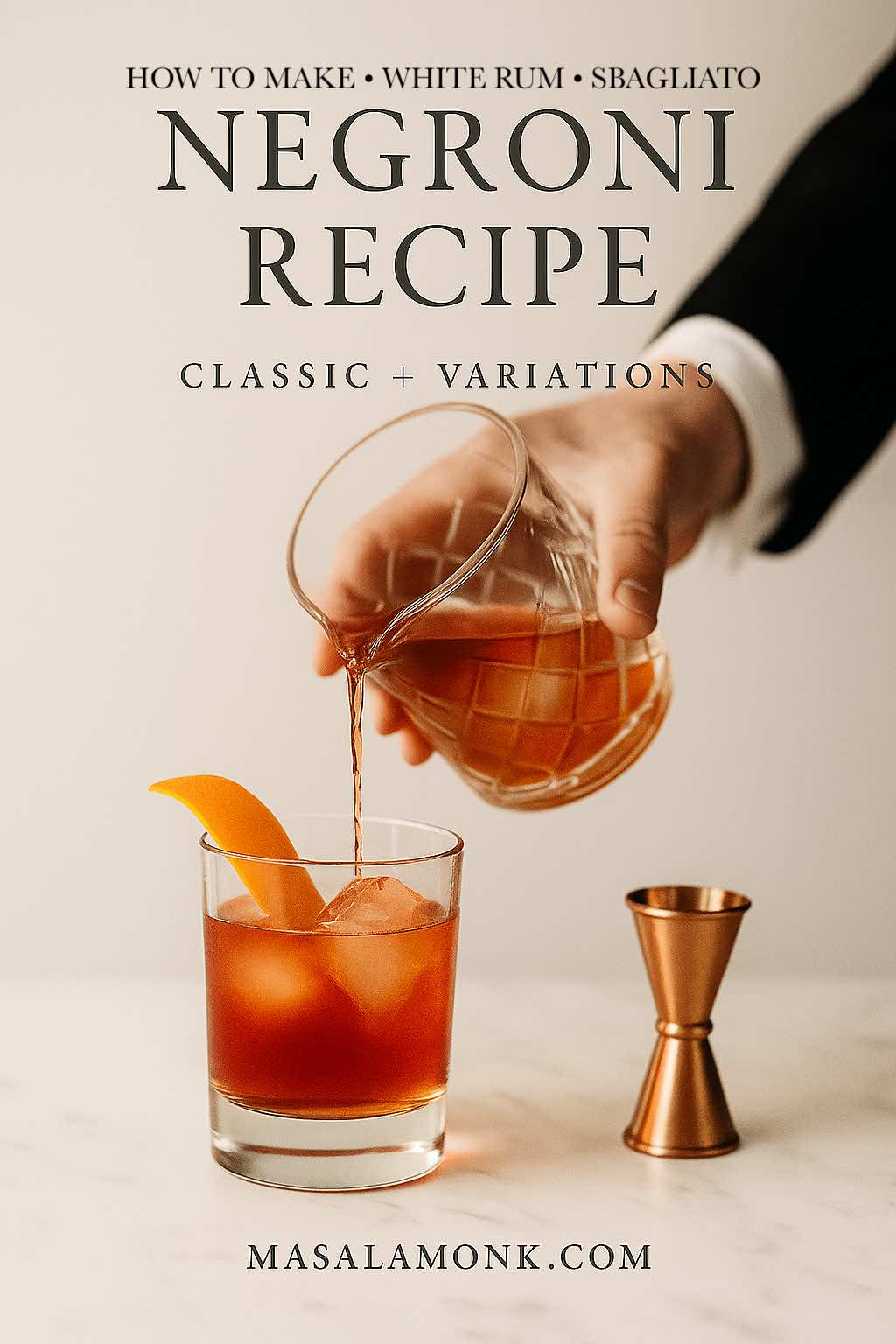
Negroni Recipe cover showing the classic 1:1:1 pour (gin, Campari, sweet vermouth) with orange twist and copper jigger—highlighting White, Rum and Sbagliato variations.

Some drinks are fashionable for a season; others become a ritual. The Negroni recipe belongs to the second camp—three equal parts, stirred until silk-smooth, brightened with orange oils, and served over clean, cold ice. Before we branch into the riffs everyone searches for, let’s calibrate to the standard so your palate has a reference point. The version codified by the International Bartenders Association matches what you’ll find on Campari’s own recipe page: 1 part gin, 1 part Campari, 1 part sweet red vermouth, stirred and garnished with orange. With that compass set, you can navigate anywhere.

Technique that makes a Negroni sing

Stirring is non-negotiable here. Shaking a Negroni will aerate and cloud it, muting those ruby facets and loosening structure more than you want. Building in a mixing glass full of dense, cold cubes gives you precise control over dilution, and that control translates directly into texture—the way the drink glides rather than tumbles. When you’re entertaining, large-format or clear cubes keep the drink crisp for longer; they also look beautiful in the glass and help you serve confidently through a long conversation. If you’d like a quick refresher on picking ice for different drinks, our primer on purpose-built cubes and crushed ice in long refreshers lays out the tradeoffs in plain terms—big cubes for slow melt, crushed for instant chill and a “vacation” vibe (see our note in Coconut Water Cocktails).

Because vermouth is wine, treat it like one. Once you crack a fresh bottle, keep it in the fridge and try to use it within about a month for peak flavor—this aligns with testing discussed by Serious Eats on vermouth storage—and while you can stretch to six or eight weeks without disaster, oxidation slowly flattens those herbs and spice notes (more on that from Liquor.com). A small mark on the label with the open date is a tiny habit that pays off in brighter cocktails: the case for refrigerating vermouth and a complementary reminder about the practical “use-by” window from Liquor.com.

Alright—glasses chilled, citrus ready, vermouth cold. Let’s make the drink you came for, then fan out into the variations people are actively searching for right now.

Also Read: How to Cook Perfect Rice Every Time (Recipe)


The classic Negroni recipe (your baseline)

Ratio: 1:1:1
Spec: 30 ml (1 oz) London Dry gin · 30 ml (1 oz) Campari · 30 ml (1 oz) sweet (rosso) vermouth
Method: Add to a mixing glass full of firm ice. Stir 20–25 seconds until the liquid looks glossy and the mixing glass is frosty. Strain over a single large cube in a rocks glass. Express a wide piece of orange peel over the top—aim the peel at the surface and squeeze to lay down aromatics—then drop it in.

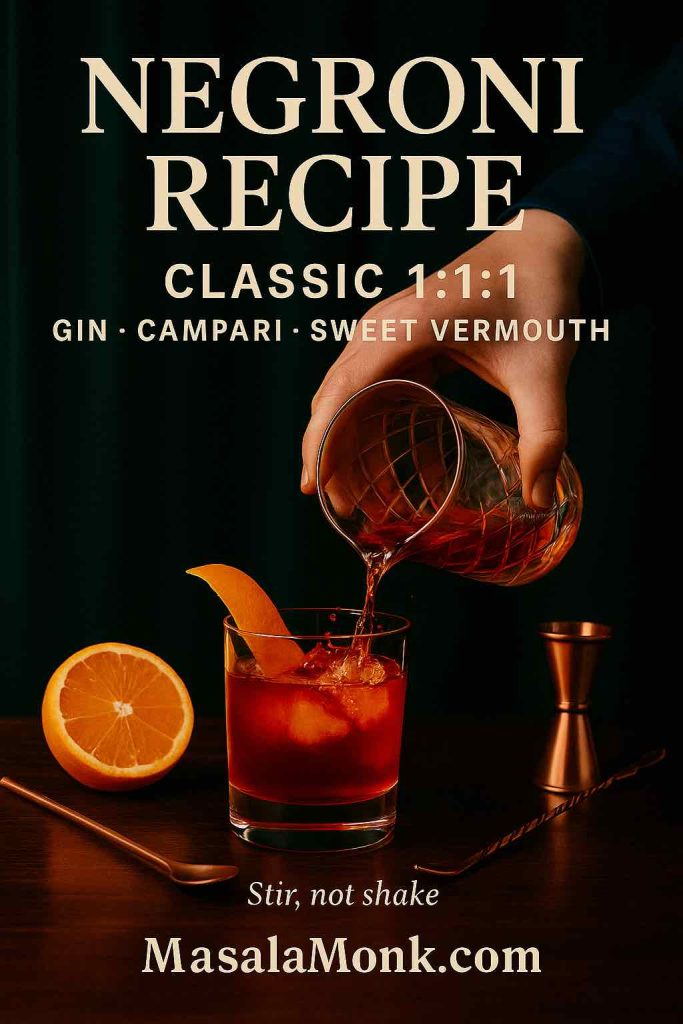
Classic Negroni recipe card with 1:1:1 ratio—gin, Campari, sweet vermouth—being poured over ice with orange peel, copper jigger, and bar spoon.
Classic Negroni recipe, built 1:1:1 and stirred over a large cube for clarity and balance; finished with expressed orange oils alongside copper bar tools for service-ready elegance.

Although the equal-parts recipe is deceptively simple, it’s also incredibly sensitive to temperature and melt. Consequently, colder starting ingredients behave better, and using a heavy-bottomed rocks glass keeps the drink cooler in hand. Moreover, up-front prep (pre-chilled glasses, cut peels, fresh big cubes) makes service smooth when you’re making more than one round. Similarly, if you enjoy tinkering, try the classic with contrasting gin styles: a juniper-forward London Dry for textbook snap, or a contemporary floral gin for a lifted, citrus-blossom top note. Express the orange peel cleanly either way—the oils knit the edges together and frame the bitterness.

Lastly, if you’re curious about the broader ecosystem of canonical specs, the IBA maintains a list of official classics worth exploring—your Negroni sits among them, and its whiskey cousin, the Boulevardier, is there as well: browse the IBA’s cocktail index.

Also Read: Homemade Hot Chocolate with Cocoa Powder Recipe


From the classic to the crowd’s favorites

Now that your baseline is calibrated, let’s walk the tree of variations. We’ll start with the ones readers look for most—White Negroni, Mezcal Negroni, Sbagliato & Spritz, Boulevardier (bourbon/rye/scotch), Rum & Kingston, Espresso Negroni, Dry/ Bianco—and then add a few seasonal or technique-driven paths. As we go, you’ll see a pattern: every riff pushes on one leg of the 1:1:1 triangle—base spirit, bitter, or sweet—then resolves the new shape with a compatible garnish or texture.

How to make White Negroni (equal parts; gentian brightness, citrus lift)

The White Negroni flips the color without losing the bitter-sweet tug-of-war. To do it, keep the equal-parts logic but swap components: gin stays; Campari becomes a pale gentian bitter (commonly Suze); sweet vermouth becomes a lighter, aromatic aperitif wine such as Lillet Blanc or Cocchi Americano.

Spec: 30 ml (1 oz) gin · 30 ml (1 oz) Suze · 30 ml (1 oz) Lillet Blanc or Cocchi Americano
Method: Stir and serve either up in a chilled coupe or down over a large cube; garnish with a grapefruit peel for a bright, floral lift.

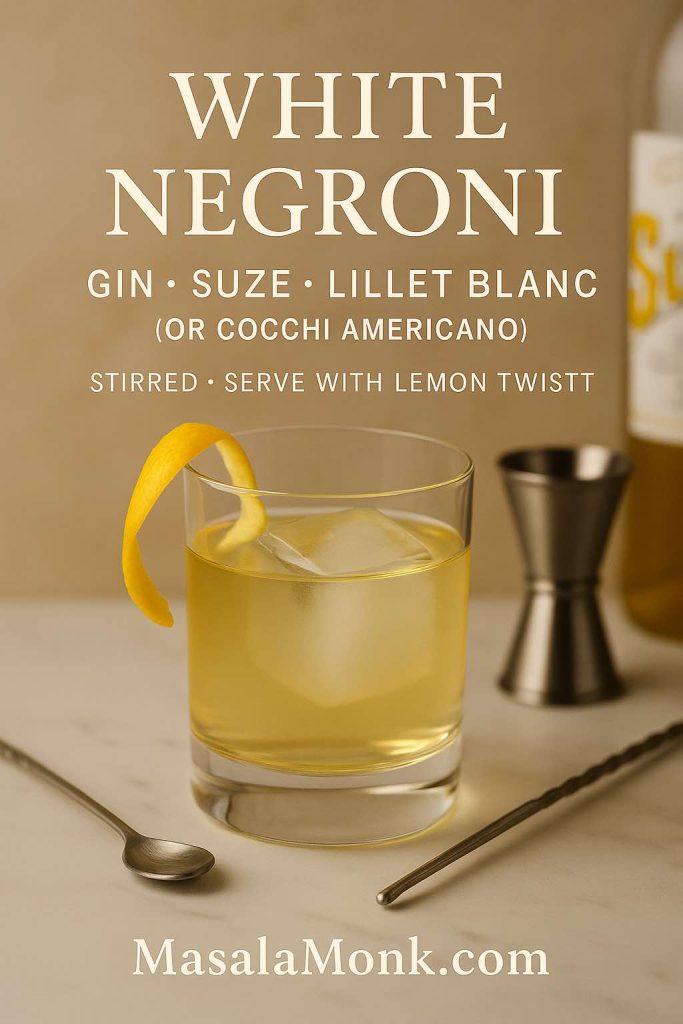
White Negroni recipe card—gin, Suze, Lillet Blanc (or Cocchi Americano)—stirred over a large cube with lemon twist; marble surface, bar spoon and jigger; MasalaMonk.com footer.
White Negroni — equal parts gin, Suze and Lillet Blanc (or Cocchi Americano). Stir until ice-cold and garnish with a lemon twist for bright gentian lift.

The drink’s modern origin is widely credited to Wayne Collins (early 2000s), and you’ll find both equal-parts and lightly adjusted versions in print. For a concise backgrounder and spec, have a look at WSET’s neat overview of contemporary Negroni twists, which also gives context to how bartenders keep reinventing this structure: three bold spins on a bitter classic.

Meanwhile, if bergamot is your love language, you may enjoy a tea-scented detour next: our iced-tea cocktail roundup includes an Earl Grey Negroni idea that blends refined citrus perfume with familiar bitterness—peek at the “Earl Grey Negroni” mention inside Earl Grey Elegance.

Also Read: Mango Martini + 5 Variants of Classic Cocktail

Mezcal Negroni Recipe (smoke threaded through ruby bitters)

Smoky, savory mezcal can be polarizing on its own; inside a Negroni, however, it becomes structure rather than spectacle. The bitterness of Campari and the sweetness of vermouth cradle the smoke and reveal cocoa and orange-peel edges.

Spec: 30 ml (1 oz) mezcal joven · 30 ml (1 oz) Campari · 30 ml (1 oz) sweet vermouth
Method: Stir firmly; strain over a large cube; express orange peel.
Option: If you’d like a gentler arc, split the base into 20 ml mezcal + 10 ml gin. The gin’s botanicals round the mezcal while preserving its backbone.

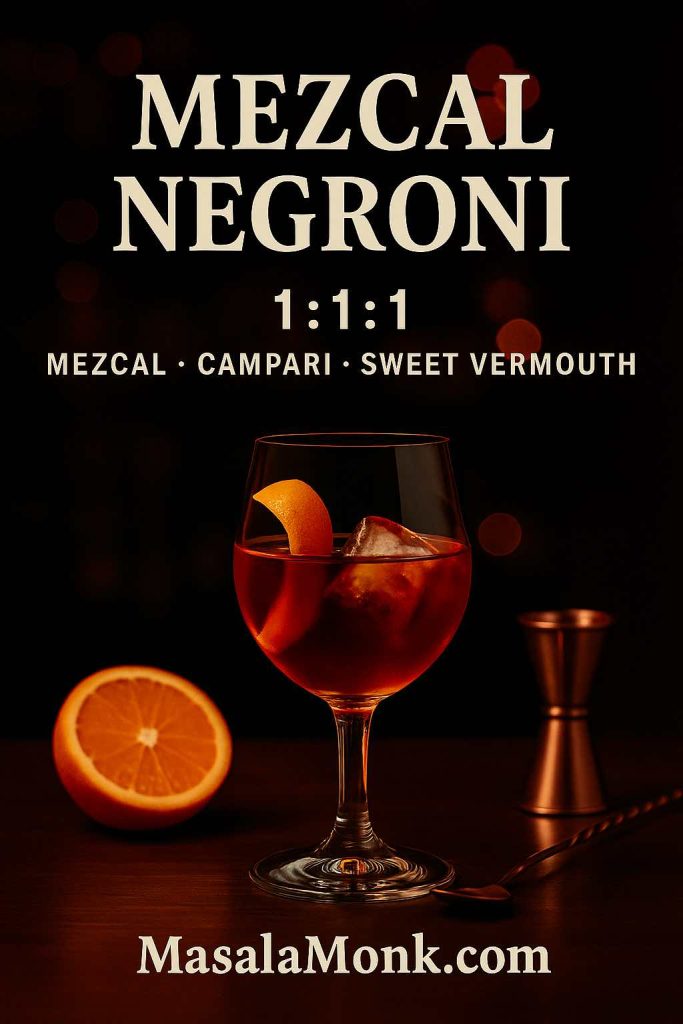
Mezcal Negroni recipe card with 1:1:1 proportions—mezcal, Campari, sweet vermouth—in a stemmed glass over ice, orange peel garnish, copper jigger and bar spoon.
Mezcal Negroni — equal parts mezcal, Campari and sweet vermouth. Stir until cold and serve over a large cube; the smoke threads through orange oils for a cocoa-citrus finish.

Because mezcal styles vary, try a few and note how fruit, smoke, and mineral tones shift your results. Additionally, reserve the heavily smoky bottles for slow sips; a medium-smoke mezcal usually integrates more gracefully here.

Also Read: Vodka with Lemon: Easy Cocktails, Martini Twist & DIY Infusion

Negroni Sbagliato (with prosecco) and the Negroni Spritz Recipe

Replace gin with sparkling wine and you get the most famous “happy accident” in aperitivo history. The story is irresistible: in 1972 at Bar Basso in Milan, Mirko Stocchetto reportedly grabbed sparkling wine instead of gin, and the Sbagliato (“mistaken”) was born. For an engaging origin sketch, La Cucina Italiana has a succinct explainer; you’ll also find a clear, modern build in Bon Appétit’s recipe. Read more here: Sbagliato’s Milanese origin and this approachable recipe with context.

Negroni Sbagliato recipe card with prosecco poured over ice into a wine glass of Campari and sweet vermouth, orange slice garnish, copper jigger and bar spoon.
Negroni Sbagliato — build Campari and sweet vermouth over ice, then top with well-chilled prosecco and give one gentle lift to keep the bubbles lively.

Sbagliato (built, not stirred): In a wine glass full of fresh ice, add 30 ml (1 oz) Campari and 30 ml (1 oz) sweet vermouth, then top with 60–90 ml (2–3 oz) well-chilled prosecco. Give a single gentle lift with the barspoon to marry, garnish with an orange slice, and serve immediately. Because bubbles are fragile, add sparkling last; shaking or stirring vigorously robs you of the lively texture you came for.

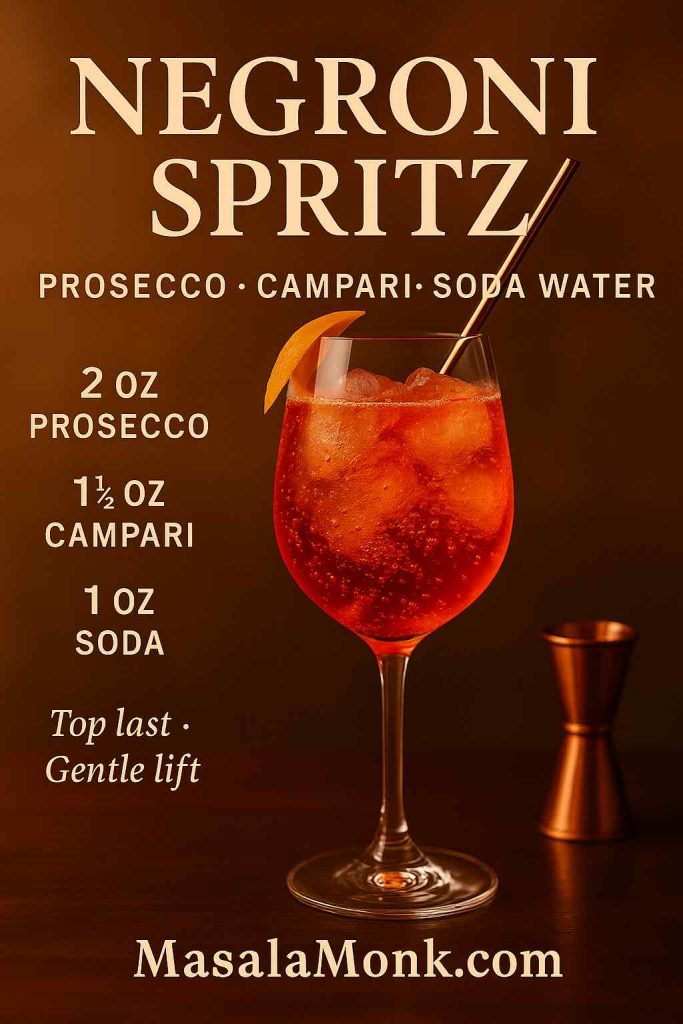
Negroni Spritz: If you want something loftier but closer to the classic, build the equal-parts Negroni over ice in a large wine glass, then top with ~60 ml prosecco and ~30 ml cold soda water. One soft lift is plenty. If you enjoy batched spritzes for a crowd—and you like the “sparkling last” principle shown in our party-friendly builds—take a peek at our prosecco-topped structure inside this playful spritz how-to (the principles translate cleanly): a mango-spritz template that stresses topping gently.

Negroni Spritz recipe card in a large wine glass with orange twist—2 oz prosecco, 1½ oz Campari, 1 oz soda—bubbles visible; copper straw and jigger; MasalaMonk.com footer.
Negroni Spritz — build the classic over ice, then top with prosecco and a splash of soda. One gentle lift keeps the sparkle alive.

While you’re exploring bubbly builds, another MasalaMonk post shows the same logic for highballs and batched drinks—add the carbonated element at the end to protect fizz—catch the pattern in this breezy guide: Apple Juice Mocktails that sparkle.

Boulevardier / Whiskey–Bourbon–Scotch Negroni (comforting and plush)

Think of the Boulevardier as the Negroni’s whiskey-warm cousin. The IBA standard tilts the ratio to give whiskey a touch more runway.

IBA Spec: 45 ml (1½ oz) bourbon or rye · 30 ml (1 oz) Campari · 30 ml (1 oz) sweet vermouth
Method: Stir over ice; strain up into a chilled stem or over a large cube in a rocks glass; orange zest. The official spec is listed on the IBA’s page: read the Boulevardier entry.

Boulevardier recipe card—1½ oz bourbon, 1 oz Campari, 1 oz sweet vermouth—stirred and served over a large cube with orange zest; crystal decanter, leather notebook and pen; MasalaMonk.com footer.
Boulevardier (Bourbon Negroni) — 1½:1:1 bourbon, Campari and sweet vermouth. Stir until ice-cold, strain over a single large cube, finish with orange zest for a warm, plush sip.

Alternatively, some bartenders push it to 2:1:1 for a richer, rounder sip, while older sources document equal-parts versions. If you like historiography and ratio nerdery, the Wikipedia page collects those threads succinctly: Boulevardier background and ratios.

Fans of whiskey who want other, longer formats to alternate with the Boulevardier often enjoy gently spiced, tea-based highballs or soda-brightened builds—taste that bridge in our cinnamon-spiced whiskey iced-tea guide: Whiskey and Warmth.

Rum Negroni & Kingston Negroni Recipe (island bassline, bitters singing on top)

Rum Negronis aren’t just “the same but sweeter.” Jamaican rum’s esters—ripe banana, molasses funk, overripe pineapple—recast Campari’s bitterness in technicolor. Equal parts will work beautifully with a moderately funky rum; with big-shouldered bottles, a heavier base can be satisfying.

Rum Negroni (balanced): 30 ml (1 oz) Jamaican rum · 30 ml (1 oz) Campari · 30 ml (1 oz) sweet vermouth
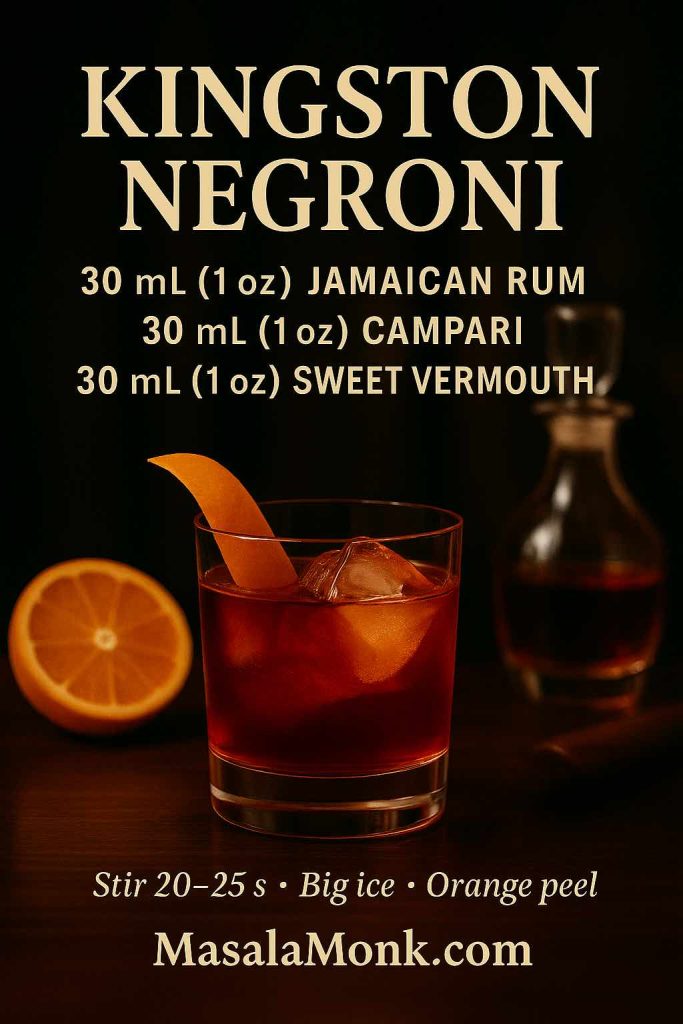
Kingston Negroni (cult favorite): 30 ml (1 oz) Smith & Cross (or similar) · 30 ml (1 oz) Campari · 30 ml (1 oz) sweet vermouth; long orange peel.

Kingston Negroni recipe card—30 ml Jamaican rum, 30 ml Campari, 30 ml sweet vermouth—stirred over a large ice cube with orange peel; halved orange and rum decanter; MasalaMonk.com footer.
Kingston (Rum) Negroni — equal parts Jamaican rum, Campari and sweet vermouth. Stir 20–25 seconds, strain over a big cube, and finish with orange oils for tropical depth.

For a lively deep-dive that blind-tastes Kingston variations—including a conversation with the drink’s creator—pour yourself a read at PUNCH: the ultimate Kingston Negroni test and, when you’re ready to mix, grab a clean spec from their recipe card: Kingston Negroni recipe.

If your home bar already leans into rum and citrus, detours like frozen daiquiris or tropical long drinks make a fun next stop; start here for a bright blender template that respects balance: Watermelon Daiquiri.

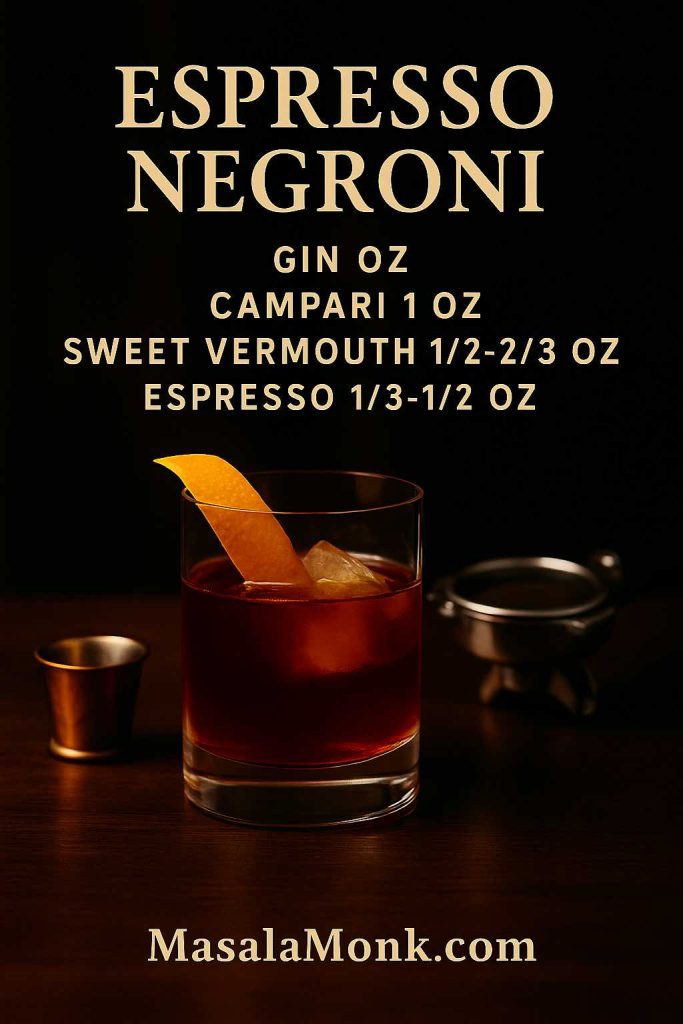
Espresso Negroni Recipe (coffee bitterness meets Campari snap)

Coffee’s roasted bitterness loves Campari, and a measured splash of espresso folds in seamlessly without swallowing the drink whole. Done right, the result tastes like dark chocolate and orange peel decided to collaborate.

Spec (stirred-friendly): 30 ml (1 oz) gin · 25–30 ml Campari · 15–20 ml sweet vermouth · 10–15 ml fresh, cooled espresso
Method: If using hot espresso, “whip-shake” briefly with a single cube purely to chill and texture, then strain over a large cube; or stir if your espresso is already cold. Express orange peel.

Espresso Negroni recipe card—30 ml gin, 25–30 ml Campari, 15–20 ml sweet vermouth, 10–15 ml cooled espresso—stirred over a large cube with orange peel; portafilter and copper cup.
Espresso Negroni — keep the Negroni’s balance, then weave in chilled espresso. Stir 20–25 seconds, strain over a single large cube, and finish with orange oils.

Because technique drives texture here, you’ll get better crema and balance if you borrow a few ideas from our espresso cocktail guides—fast ratio checks, squeeze-time on the shake, and ways to keep the coffee aromatic rather than harsh. Skim both our bar-tested roundups for practical, no-nonsense tips: 10 Best Espresso Martini Variations and these 5 Spiced Espresso Martini Ideas. For a short coffee fundamentals refresher, this quick overview gives you context on extraction and strength: Know Your Coffee.

If you prefer a lighter coffee touch on weeknights, try splitting the espresso with a measured dash of coffee liqueur. The liqueur’s sugar reins in bitterness and creates a silkier seam from sip to finish.

Also Read: What to Mix with Jim Beam: Best Mixers & Easy Cocktails

How to make Dry Negroni & its Recipe for crisper profile, leaner sweetness

Swapping dry vermouth for sweet brings the drink into aperitif-Martini territory—still vivid and bitter, just brighter and more linear. An extra dash or two of orange bitters restores a little mid-palate depth without changing the drink’s posture.

Spec: 30 ml (1 oz) gin · 30 ml (1 oz) Campari · 30 ml (1 oz) dry vermouth
Method: Stir cold, strain, express orange.
Optional: 1–2 dashes orange bitters.

Dry Negroni recipe card—30 ml gin, 30 ml Campari, 30 ml dry vermouth—with optional 1–2 dashes orange bitters; stirred over a large clear ice cube with orange peel, crystal decanter and nickel jigger.
Dry Negroni — equal parts gin, Campari and dry vermouth for a cleaner, crisper profile. Optionally add orange bitters, then stir 20–25 seconds and finish with an orange peel.

This is the version to pour when the afternoon sun is still warm and you want refreshment over richness. Incidentally, it’s also where gin choice is most obvious: London Dry frames Campari rigidly; softer contemporary gins give you a more perfumed glide.

Also Read: Homemade Hot Chocolate with Cocoa Powder Recipe

Bianco Negroni (clear and citrus-forward)

Think of this as a sibling to the White, but with a bianco vermouth plus a clear bitter (for example, Luxardo Bitter Bianco). The result is translucent, citrus-polished, and perfect when you want something crystalline rather than ruby.

Spec: 30 ml (1 oz) gin · 30 ml (1 oz) bianco vermouth · 30 ml (1 oz) bitter bianco
Method: Stir, serve up or down; garnish with a lemon twist for cleaner aromatics.

Bianco Negroni recipe card—equal parts gin, bianco vermouth and bitter bianco—stirred over a clear ice cube with a lemon twist; clean marble backdrop.
Bianco Negroni — a crystal-clear riff with gin, bianco vermouth and bitter bianco; stir until icy cold and garnish with a lemon twist for citrus brightness.

Also Read: Peanut Butter Cookies (Classic Recipe & 3 Variations)

Blood Orange Negroni Recipe (seasonal color, softer bitterness)

When blood oranges are in season, a tiny splash of fresh juice makes your Negroni glow and rounds the Campari edge without turning the drink into a sour.

Spec: 30 ml (1 oz) gin · 25 ml Campari · 25 ml sweet vermouth · 10 ml blood orange juice
Method: Stir and strain over a cube; garnish with a thin wheel or a neat peel.

Blood Orange Negroni recipe card—30 ml gin, 25 ml Campari, 25 ml sweet vermouth, 10 ml fresh blood orange juice—stirred over a large ice cube with blood orange garnish.
Blood Orange Negroni — a seasonal glow with a 10 ml splash of fresh blood orange to soften Campari’s edge without turning the drink into a sour.

Notably, this is one of the few moments when a squeeze of juice complements the formula without remaking it from scratch. It’s also a pretty pour for a party tray.

Also Read: Green Tea Shot with Jameson | Recipe & 10 Variations

Recipe of Smoked or Smoky Negroni (aroma as garnish, not a mask)

Smoke can be layered two ways: either lightly smoke the glass (a quick pass of smoldering wood chips before you pour) or introduce a trace of smokiness via a spirit split—say, a teaspoon or two of lightly peated Scotch in the base. Either route preserves the Negroni’s structure but adds a campfire whisper that plays beautifully with orange peel.

Smoked Negroni recipe card showing equal parts gin, Campari and sweet vermouth; stirred, strained and served in a lightly smoked glass with an expressed orange peel.
Smoked Negroni — keep the classic build, then lightly smoke the glass (or add a whisper of peated Scotch) for a campfire aroma that flatters the orange oils.

Sour Negroni Recipe (niche, but increasingly asked for)

Add lemon juice and a touch of simple syrup and you shift into sour territory. When you want that texture—especially with a fluffy egg-white cap—the result is closer to a bitter New York Sour than a strict Negroni, but it satisfies the same craving and turns Campari into the star of the foam.

Spec (shaken): 30 ml (1 oz) gin · 22.5 ml (¾ oz) Campari · 22.5 ml (¾ oz) sweet vermouth · 22.5 ml (¾ oz) lemon juice · 7.5 ml (¼ oz) simple syrup
Method: Shake hard; strain into a rocks or a chilled coupe; optional egg white for a glossy cap; orange zest on top.

Sour Negroni recipe card (ml only)—30 ml gin, 22.5 ml Campari, 22.5 ml sweet vermouth, 22.5 ml lemon juice, 7.5 ml simple syrup; egg white optional; orange zest garnish.
Sour Negroni — 100% ml measurements for quick batching: shake hard, strain into a coupe, and finish with orange zest. Egg white optional for a silky foam.

Also Read: Béchamel Sauce for Lasagna: Classic, Vegan & Ricotta Sauce Recipe


Negroni Recipe, built for a crowd (how to prep, mix, and keep it bright)

When you’re pouring for more than two, the Negroni becomes a gift: the equal-parts math scales elegantly, and the drink can be batched in advance. Here’s how to do it without sacrificing texture.

Mix in advance, chill deeply:

Combine gin, Campari, and vermouth in a sealable bottle or pitcher and refrigerate until very cold. If you’re serving up (no ice in the glass), you can add measured cold water to emulate the dilution you’d get from stirring—stirred drinks commonly benefit from about a fifth to a quarter of their volume as water. For a succinct overview of dilution and batching logic, Serious Eats’ guides on party cocktails are useful starting points; you’ll also see the same “sparkling last” principle echoed across spritz articles on our site (for example, the build notes inside this Lemon Drop Martini batching tip). For your bubbly riffs, add prosecco and soda right before serving—never earlier—so the texture is lively in the glass.

Freeze-door Negroni:

If freezer door space is available, pre-dilute the batch slightly with filtered water, then store the bottle in the freezer. The drink pours velvety and ice-cold straight from the bottle; one large cube in the glass will keep it on track without over-thinning. And yes, big, clear cubes help more than you’d think; revisit our practical note on intentional ice in Coconut Water Cocktails.

Party tray service:

Express your peels in advance and hold them wrapped to prevent drying. When guests arrive, all you’re doing is pour-and-garnish. If you’d like to offer a bubbly option side-by-side, pre-batch the Campari and vermouth in a separate bottle for Sbagliatos, then top each glass with prosecco to order. For an easy visual, see how we structure spritzes and highballs in our sparkling pieces—always top last and lift once (you’ll spot the same advice in our spritz-centric posts like Apple Juice Mocktails and that breezy Mango Spritz template).


How ingredients change the drink (and how to choose them)

Because “gin + Campari + vermouth” can be millions of combinations, a few guidelines keep you oriented.

Gin:

A classic London Dry (Beefeater, Tanqueray, etc.) slots in cleanly with Campari’s decisive bitterness, producing what most people expect when they order a Negroni. Contemporary gins—grapefruit-peel bright, cucumber-cool, or floral—shift the balance toward perfume and away from juniper’s structure. Consequently, they’re a joy in White/Bianco families and dry variants; with standard ruby Negronis, you may want to keep them in supporting or split-base roles.

Vermouth:

Freshness is everything. Even the best bottle tastes sleepy after a long, warm month on the shelf. To keep your drinks crisp, store rosso and bianco vermouths cold and pick a bottle size that matches your cadence. For a clear, evidence-based nudge, peek at that Serious Eats test again: refrigeration keeps vermouth tasting like itself. To triangulate the practical window you can work with, Liquor.com’s shelf-life guide suggests ~6–8 weeks as an upper, real-world bound: how long vermouth lasts once opened.

Campari and its cousins:

Campari is the reference point. That said, regional bitters or boutique red amaros will nudge the edges and can be wonderful; just expect the sweetness and bitterness to rebalance slightly and adjust your vermouth choice to harmonize.

Citrus:

Orange is canonical, but lemon can be elegant in White/Bianco builds. With blood orange riffs, you might even split the garnish—express an orange twist, then place a thin blood orange wheel as a visual cue.

Coffee:

If you’re already dialing in coffee for other cocktails, keep that wisdom in rotation. Our espresso pieces walk through real ratios, foam/crema physics, and the difference between moka, espresso, and cold brew—handy context before you tweak the Espresso Negroni: Bar-tested variations and spiced espresso ideas.

Tea & spice:

For aromatic spin without extra sugar, tea-infused elements are gentle tools. A touch of bergamot from Earl Grey feels tailor-made for the White Negroni; if that sounds like your lane, the iced-tea cocktail shortlist we mentioned earlier includes an Earl Grey Negroni idea.

Also Read: Crock Pot Lasagna Soup (Easy Base + Cozy Slow-Cooker Recipes)


Negroni Recipe variations you can learn in one sitting (quick cards)

Because the best way to remember is to make and taste, here’s a compact set you can practice in an afternoon. They’re concise by design; each will teach your palate something distinct about how bitterness, sweetness, and aroma negotiate with one another.

Classic (equal parts, stirred)

30 ml (1 oz) gin · 30 ml (1 oz) Campari · 30 ml (1 oz) sweet vermouth · orange peel

White Negroni (equal parts)

30 ml (1 oz) gin · 30 ml (1 oz) Suze · 30 ml (1 oz) Lillet Blanc or Cocchi Americano · grapefruit peel
Background and context: WSET’s Negroni reinventions

Mezcal Negroni

30 ml (1 oz) mezcal · 30 ml (1 oz) Campari · 30 ml (1 oz) sweet vermouth · orange peel

Sbagliato (built)

30 ml (1 oz) Campari · 30 ml (1 oz) sweet vermouth · top 60–90 ml prosecco · orange slice
Story and recipe: Milan’s Sbagliato origin and a clear, modern build

Negroni Spritz (built)

Classic equal-parts over ice · top prosecco (~60 ml) · splash soda (~30 ml) · gentle lift
For bubbly logic you can reuse in other spritzes: Apple Juice Mocktails and this party-friendly Mango Spritz template

Boulevardier (stirred)

45 ml (1½ oz) bourbon or rye · 30 ml (1 oz) Campari · 30 ml (1 oz) sweet vermouth · orange zest
Official spec: IBA Boulevardier and additional ratio notes: background & variations

Rum / Kingston Negroni (stirred)

30 ml (1 oz) Jamaican rum · 30 ml (1 oz) Campari · 30 ml (1 oz) sweet vermouth · long orange peel
Deep-dive + recipe: Ultimate Kingston test and recipe card

Espresso Negroni (stir or quick whip)

30 ml (1 oz) gin · 25–30 ml Campari · 15–20 ml sweet vermouth · 10–15 ml espresso · orange peel
Technique primers: Bar-tested espresso ratios and spiced riffs

Dry Negroni (stirred)

30 ml (1 oz) gin · 30 ml (1 oz) Campari · 30 ml (1 oz) dry vermouth · optional orange bitters

Bianco Negroni (stirred)

30 ml (1 oz) gin · 30 ml (1 oz) bianco vermouth · 30 ml (1 oz) bitter bianco · lemon twist

Blood Orange Negroni (stirred)

30 ml (1 oz) gin · 25 ml Campari · 25 ml sweet vermouth · 10 ml blood orange juice

Smoked Negroni (stirred, smoked glass or spirit split)

Classic spec; smoke the glass briefly or split the base with a teaspoon of lightly peated Scotch

Sour Negroni (shaken)

30 ml gin · 22.5 ml Campari · 22.5 ml sweet vermouth · 22.5 ml lemon juice · 7.5 ml simple · optional egg white

Also Read: How to Make Churros (Authentic + Easy Recipe)


Negroni Recipe troubleshooting (without losing the magic)

Even with three ingredients, small missteps can blur the drink. Here’s how to fix the most common issues while keeping the Negroni’s essential profile intact.

“It tastes too bitter.” Two easy adjustments: (1) increase vermouth slightly to 35 ml (1⅙ oz) while pulling Campari back to 25 ml (5⁄6 oz), or (2) express a larger piece of orange peel and drag it around the rim—a simple aroma trick that smooths the edges. On very hot days, serving down over a larger cube helps too, since slower melt equals steadier sweetness perception.

“It’s thin or watery.” Start with colder bottles. Then, shorten your stir by a few seconds and use denser ice. If you’re nursing the drink outdoors, consider a chilled double rocks glass.

“It’s too sweet.” Verify your vermouth freshness first; oxidized bottles can taste oddly fat and dull. If freshness checks out, try a slightly drier ratio—32 ml gin, 28 ml Campari, 28 ml vermouth—or move to the Dry Negroni template with a dash or two of orange bitters.

“The coffee note in my Espresso Negroni turned harsh.” Cool the espresso before it hits alcohol or add a measured dash of coffee liqueur to buffer any roughness. For texture, borrow espresso-martini tricks from our guides so your shake is purposeful, not violent: 10 Best Espresso Martini Variations and spiced espresso ideas.

“My Sbagliato/Spritz goes flat.” Top with prosecco last and give one gentle lift; this is the through-line in every sparkling build we publish, from zero-proof spritzes to party punches—notice the same sequencing in our Apple Mocktails and the Mango Spritz template. For origin and a modern, field-tested Sbagliato spec, revisit La Cucina Italiana and Bon Appétit.

Also Read: Classic vs. Authentic Alfredo: 5 Essential Recipes


Where your Negroni sits in the canon (and why that matters)

Part of the pleasure of mastering a Negroni recipe is discovering its cousins and context. Historically, this family arises from the Americano (bitter + sweet + soda), which the Negroni toughens by swapping soda for gin. Down the tree, the Boulevardier warms it with whiskey; sideways, the Sbagliato relaxes it with bubbles. It holds a proud spot on the IBA’s roster of classics: see the Negroni’s official entry and the Boulevardier’s page. As you taste across the set, you’ll feel how alcohol strength, sugar, and bitterness move as a triangle—nudge one point and the other two respond. That mental model makes you a faster, calmer host because you’ll instinctively know how to correct a drink mid-stream.

Moreover, when your bar cart evolves, your Negroni will evolve with it. If you have a contemporary gin that smells like lemon zest and flowers, it might shine in a Bianco lane; a juniper-spicy London Dry might feel exactly right in the classic ruby build; a bottle of Jamaican rum waiting for its moment is practically begging for a Kingston test flight. Should you be deep in a whiskey season, the Boulevardier keeps that glow going, and our gentle whiskey highballs are there when you want something longer: Whiskey and Warmth.

Finally, because tools and technique are part of the pleasure, keep one eye on the small details that compound: cold bottles, large clear ice, and confidently expressed citrus. Tiny changes, cumulative gains. For a quick pep talk on ice’s role across cocktail styles, revisit the practical notes we tucked into Coconut Water Cocktails.


One last round (and what to explore next)

At this point you can pour the Negroni recipe from muscle memory: equal parts, stirred, orange oils. You can also steer by instinct—toward gentian brightness in a White Negroni; toward smoke under a Mezcal Negroni; toward bubbles in a Sbagliato or Negroni Spritz; toward warmth in a Boulevardier; toward island aromatics with the Kingston; toward roast and chocolate in an Espresso Negroni; or toward crispness with a Dry or Bianco build. Along the way, you learned how to keep vermouth fresh (why the fridge matters, plus a practical window), how to protect bubbles (top last, lift once), and how ice behaves from the first stir to the last sip.

If you’re in the mood to keep exploring tonight, let your palate choose the fork: a tea-scented Earl Grey Negroni idea awaits in our iced-tea collection (Earl Grey Elegance); a coffee-obsessed detour is ready in our espresso pieces (bar-tested ratios and warming spice riffs); and if you’d like to set up a spritz station for friends, our prosecco-topped builds show you exactly how to do it without losing fizz (Apple Mocktails and the Mango Spritz template).

Whichever path you pick, you’re bringing the Negroni’s spirit with you: balance, clarity, and a little ceremony. Raise the glass, take in the orange oils, and sip slowly—the night will meet you there.

Also Read: 10 Best Chicken Sandwich Recipes (BBQ, Parm, Buffalo & More)

FAQs

1) What is the classic Negroni Recipe ratio?

The classic Negroni Recipe follows a simple 1:1:1 formula—equal parts gin, Campari, and sweet (rosso) vermouth—stirred over ice and finished with an expressed orange peel.

2) How do you make a Negroni Recipe step by step?

Measure 30 ml (1 oz) each of gin, Campari, and sweet vermouth into a mixing glass with plenty of cold ice. Stir 20–25 seconds until well-chilled, strain over a large cube in a rocks glass, then express and drop in an orange peel.

3) Should a Negroni be stirred or shaken?

Always stir a Negroni Recipe. Stirring chills and dilutes precisely while keeping the drink clear and silky; shaking aerates and can over-dilute.

4) Which gin is best for a Negroni Recipe?

Choose a juniper-forward London Dry for the most “classic” profile. Alternatively, contemporary gins (citrus-forward or floral) soften edges and shine in White/Bianco or Dry Negroni variations.

5) What vermouth works best in a Negroni Recipe?

Use a fresh, high-quality sweet (rosso) vermouth for the classic. Keep it refrigerated after opening and aim to finish the bottle within a few weeks for peak flavor.

6) Can I make a Negroni Recipe with dry vermouth?

Yes—swap sweet vermouth for dry to create a Dry Negroni. Optionally add 1–2 dashes of orange bitters to restore mid-palate depth.

7) What’s the difference between a White Negroni and a Bianco Negroni?

A White Negroni typically uses gin, Suze (gentian bitter), and Lillet Blanc or Cocchi Americano. A Bianco Negroni uses gin, bianco vermouth, and a clear bitter (e.g., Bitter Bianco); it’s crisper and more citrus-forward.

8) How do I make a Mezcal Negroni?

Combine equal parts mezcal, Campari, and sweet vermouth, then stir and serve over a large cube with orange peel. For gentler smoke, split the base: 20 ml mezcal + 10 ml gin.

9) What is a Negroni Sbagliato and how is it different?

A Sbagliato replaces gin with prosecco. Build Campari and sweet vermouth over ice, then top with chilled prosecco. It’s lighter, bubbly, and lower in ABV than the classic Negroni Recipe.

10) How is a Negroni Spritz built?

Start with the classic equal parts over ice in a large wine glass, then top with prosecco and a splash of soda water. Give one gentle lift to preserve bubbles.

11) Is a Boulevardier just a Negroni with whiskey?

Essentially, yes. A Boulevardier swaps gin for bourbon or rye (often in a 1½:1:1 ratio). Stir, strain, and garnish with orange zest.

12) Can I make a Rum Negroni or Kingston Negroni?

Absolutely. Use equal parts Jamaican rum, Campari, and sweet vermouth for a Rum Negroni; choose a high-ester rum for the Kingston style to highlight tropical aromatics.

13) How do I make an Espresso Negroni?

Add a small measure of fresh espresso (10–15 ml) to the classic, then stir—or briefly “whip-shake” to chill and create light crema. Express orange to link coffee and Campari.

14) What if I don’t have vermouth—can I still do a Negroni Recipe?

You can approximate by using amaro or aperitif wines, but the flavor balance will change. If vermouth is missing, consider a different cocktail or lean into a Dry Negroni style with dry vermouth if that’s on hand.

15) Can I make a Negroni Recipe without Campari?

You can substitute another red bitter or amaro, understanding sweetness and bitterness may shift. Start with equal parts and adjust vermouth to balance.

16) What garnish is proper for a Negroni Recipe?

A wide orange peel, expressed over the surface to release oils. For White/Bianco versions, a grapefruit or lemon twist suits the profile beautifully.

17) How strong is a Negroni?

Served over ice, the Negroni Recipe typically lands around the mid-20% ABV range after dilution. Strength varies with spirit proof, ice, and stir time.

18) Why does my Negroni taste too bitter?

First, check ratios. Then, try a slightly vermouth-forward balance (e.g., 35 ml vermouth, 25 ml Campari) or express a larger orange peel. Warmer drinks feel harsher, so keep everything very cold.

19) Why does my Negroni taste watery?

Either your ice is melting too fast or you’re over-stirring. Use dense, large cubes and shorten the stir by a few seconds. Pre-chill glassware when possible.

20) How do I batch a Negroni Recipe for parties?

Multiply equal parts gin, Campari, and vermouth, bottle, and chill deeply. If serving up, pre-dilute with cold filtered water (≈20–25% of total volume). Add any sparkling components (for Sbagliato/Spritz) right before serving.

21) Can I store a pre-mixed Negroni in the fridge or freezer?

Yes. A pre-diluted, bottled Negroni can live in the freezer for service “from the door.” If it’s undiluted, keep it in the fridge and stir to order with fresh ice.

22) What glass is best for a Negroni Recipe?

A heavy rocks glass with one large cube is standard. For the Sbagliato and Spritz, a large wine glass accommodates bubbles and garnish more comfortably.

23) Does the type of ice really matter?

Definitely. Large, clear cubes melt slower and keep flavors focused. Crushed or small cubes chill quickly but dilute faster, which can blur balance.

24) What’s the ideal stir time for a Negroni Recipe?

About 20–25 seconds with cold, dense ice. Look for a glossy texture and a frosty mixing glass rather than counting alone.

25) Is there a “perfect” Negroni Recipe beyond 1:1:1?

Equal parts is canonical, yet many bartenders enjoy tiny tweaks—more base spirit for a drier finish or a touch more vermouth to soften bitterness. Adjust in 5 ml (¼ oz) steps.

26) Which bitters can I add to a Negroni?

Orange bitters fold in nicely, particularly in a Dry Negroni. Chocolate or coffee bitters are delicious with espresso riffs; use sparingly.

27) Can I use Bianco vermouth in a classic Negroni Recipe?

Yes, though it pushes the drink toward the Bianco style—brighter, clearer, and a bit lighter in perceived sweetness. Consider a lemon twist instead of orange.

28) How do seasonal citrus swaps change a Negroni?

Blood orange juice (a small splash) softens bitterness and adds color; grapefruit peels add floral lift to White/Bianco versions. Keep juice additions modest to avoid turning the drink into a sour.

29) What’s the difference between a Negroni Spritz and a Sbagliato?

Both are bubbly, but the Spritz keeps the gin (then tops with prosecco and soda), while the Sbagliato replaces gin entirely with prosecco. The Spritz is brighter; the Sbagliato is softer and lower in ABV.

30) Can I make a non-alcoholic Negroni?

Yes. Combine equal parts non-alcoholic “gin,” NA red bitter, and NA aperitivo/rosso. Serve extra-cold; a few drops of saline solution can improve body.

31) Does glassware temperature affect the Negroni Recipe?

Chilled glassware helps maintain temperature and texture, especially for up-style service or hot-weather pours. It’s a small step with big payoff.

32) What’s the quickest way to upgrade my home Negroni?

Use fresh, refrigerated vermouth; cut a wide, juicy orange peel; and stir with dense ice over a single large cube. Those three changes deliver a bar-quality result.

33) How do I keep a Sbagliato or Spritz from going flat?

Add prosecco (and soda, if using) at the very end. Stir gently—one light lift is enough—to avoid knocking out carbonation.

34) Is a Negroni Recipe good for batching in a pitcher?

Absolutely. The equal-parts structure scales cleanly. Keep the pitcher ice-cold, stir portions over fresh ice for service, and garnish each glass individually.

35) Why is my Espresso Negroni harsh or muddy?

Hot espresso hitting alcohol can taste sharp. Cool it briefly, use a small measure, or split with a touch of coffee liqueur. Finally, express orange peel to link flavors.

36) Can I use flavored gins in a Negroni Recipe?

You can, though they may introduce sweetness or botanicals that clash with Campari. If you experiment, start with small test pours and consider the Dry or Bianco frameworks.

37) What peel size is best for expressing oils?

A wide strip (about 2–3 cm wide) expressed over the surface releases more aromatic oil. Avoid pith-heavy strips, which can add bitterness.

38) How long should a batched Negroni Recipe keep?

If kept cold and sealed, spirit-forward batches (without juice) hold well for weeks. However, quality is highest in the first week, especially when vermouth is freshest.

39) Can I turn a Negroni into a sour-style cocktail?

Yes—add lemon juice and a little syrup, then shake hard. Optionally include egg white for a velvety cap; garnish with orange zest to anchor Campari’s citrus.

40) What’s the simplest variation to try after the classic?

Try the White Negroni if you want brightness, the Boulevardier for warmth, the Kingston for tropical depth, or the Espresso Negroni for roast-and-orange harmony. Each teaches a distinct lesson while honoring the spirit of the original.

Posted on 17 Comments

Homemade Hot Chocolate with Cocoa Powder Recipe

Hot chocolate with cocoa powder being poured from a saucepan into a rustic mug, with whisk, cocoa and cinnamon on a dark table.

Sometimes you crave a mug that’s pure comfort—nothing fancy, nothing fussy—just deep chocolate flavor, gentle sweetness, and the kind of steam that fogs the window while you stir. This hot chocolate with cocoa powder takes you there in minutes. It’s pantry-friendly, it scales for a crowd, and it’s endlessly adaptable for darker, milkier, lighter, or dairy-free moods. Along the way, you’ll see exactly how to dial in the texture, choose between natural and Dutch-process cocoa, and even shake up a cold chocolate milk for warmer days—without losing the spirit of a classic stovetop cup.

Before we heat anything, here’s the single biggest secret to café-smooth results: start with a paste. Cocoa powder (especially unsweetened) doesn’t want to dissolve right away. Whisking it with a splash of milk and sugar first means every sip turns out silky, never gritty.

Also Read: Peanut Butter Cookies (Classic Recipe & 3 Variations)


Ingredients for the best hot chocolate with cocoa powder (2 mugs)

  • 2 tbsp unsweetened cocoa powder (natural or Dutch-process)
  • 2 tbsp sugar (or 1–2 tbsp maple or honey, to taste)
  • Pinch of fine salt
  • 1 cup (240 ml) milk of choice, plus ½ cup (120 ml) water
  • ½ tsp vanilla extract (optional, but lovely)

Want a quick refresher on cocoa styles and why one might taste smoother or darker than the other? King Arthur’s plain-English guide to Dutch-process vs natural cocoa is a great starting point. For an overview of other cocoa types in baking and drinks, their types of cocoa, explained expands the nuance even further.


Recipe: classic stovetop hot chocolate with cocoa powder

  1. Make the paste. Off the heat, whisk the cocoa, sugar, and salt with 2 tablespoons milk until the mixture is glossy and lump-free. This takes 15–30 seconds and makes all the difference.
  2. Heat gently. Whisk in the rest of the milk and the water. Set the pan over medium heat and warm until steaming and hot—but not at a rough boil. Gentle heat keeps the mouthfeel creamy and prevents “cooked” flavors.
  3. Finish with fragrance. Take the pan off the heat and stir in the vanilla. Froth briefly with a whisk or handheld frother for that café-style lightness. Pour into warm mugs.
Recipe card for hot chocolate with cocoa powder: milk pouring into a copper saucepan with a whisk and cinnamon; 8-minute stovetop steps shown on image.
How to make Hot chocolate with cocoa powder—per mug: 1 tbsp cocoa, 1 tbsp sugar, 3/4–1 cup milk or water, pinch of salt. Whisk a paste, heat to steaming (don’t boil), stir in 1/2 tsp vanilla. MasalaMonk.com

While that first sip is still hugging your hands, you might be wondering about cacao versus cocoa. They’re related, of course, yet not identical in processing or flavor. For a practical, balanced read on how cacao differs from cocoa (and why cacao can taste fruitier while cocoa blends more smoothly), see this explainer on MasalaMonk and the concise overview from Healthline on cacao vs cocoa.


Texture, temperature, and the power of a whisk

Even excellent cocoa powder needs a little help to bloom. The paste stage hydrates the particles so they disperse evenly when you add more liquid. Beyond that, moderate heat (think “steaming” rather than turbulent simmer) coaxes out chocolate aromas without pushing milk proteins too far. If you’ve ever had a cup that felt thin, chalky, or strangely “cooked,” it likely skipped one or both steps.

For extra lift, whisk in quick, tight circles right after you add vanilla. Just 10–15 seconds can transform the surface from flat to glossy with a delicate foam. If you own a small frother, this is its moment to shine. Otherwise, a sturdy balloon whisk is more than enough.

Also Read: Green Tea Shot with Jameson | Recipe & 10 Variations


Sweetness, salt, and balance

Sugar sweetens, yes, but it also rounds the cocoa’s bitter edges so the flavor reads chocolaty rather than merely “cocoa-y.” Start with the 2 tablespoons in the base recipe and adjust a teaspoon at a time next time you make it. Maple and honey add their own accents—maple gives a caramelly finish; honey feels floral—so you can tune the personality of your mug without changing the core ratio.

Don’t skip the pinch of salt. It’s not about making a “salty” drink; it’s about focus. That tiny amount tightens the flavor so the chocolate tastes bolder at the same sweetness.

Also Read: Béchamel Sauce for Lasagna: Classic, Vegan & Ricotta Sauce Recipe


Milk or water? Finding your comfort zone

A lot of classic hot cocoa recipes use a mix of milk and water. There’s a reason. Milk gives body and richness; water lightens the profile and lets the chocolate notes pop. This base splits the difference—1 cup milk plus ½ cup water per two mugs—so you get a creamy backbone without heaviness. Prefer extra body? Go all milk (1½ cups / 360 ml). Want something lighter after dinner? Use more water and finish with a splash of cream to restore a silky finish.

If you’re making this dairy-free, barista-style oat milk drinks especially well, as do cashew and soy. Almond milk stays thinner but tastes clean and toasty, which some people adore in a nighttime cup.

Also Read: Crock Pot Lasagna Soup (Easy Base + Cozy Slow-Cooker Recipes)


Natural vs Dutch: how it changes your mug

Let’s talk flavor and feel. Natural cocoa is lighter in color and usually tastes a touch brighter, sometimes with a hint of fruit or acidity. It makes a classic, snappy-tasting hot chocolate with cocoa powder—the kind you might remember from childhood, just elevated by technique.

Dutch-process cocoa has been alkalized to tame acidity. In the cup, it reads darker, smoother, and often creamier at the same ratio. Because the edges are softer, many people find it dissolves more easily and gives a rounded finish. If your top priority is silky texture and a deep color, Dutch is the move. If you love lively, punchy chocolate, natural sings.

Curious which to stock? For a quick reference beyond this recipe, King Arthur’s types of cocoa, explained lays out how different powders behave in both baking and drinking.

Also Read: Cottage Cheese Lasagna Recipe | Chicken, Spinach, & Ricotta


Make-it-yours: small tweaks that change the whole cup

  • Extra-dark hot chocolate with cocoa powder: Add 1–2 teaspoons more cocoa during the paste stage. You can nudge sweetness up by ½–1 teaspoon if needed, or keep it punchy.
  • Lower sugar: Swap in allulose or erythritol. Because these sweeteners taste slightly cooler and less rounded than sugar, add a drop of vanilla or a tiny extra pinch of salt to keep the flavor full.
  • Dairy-free richness: Barista oat, soy, and cashew milk foam beautifully. For even more body, whisk in 1–2 teaspoons coconut cream at the finish.
  • Mocha moment: Stir in 1–2 teaspoons strong coffee or a splash of espresso. The coffee doesn’t steal the show; it just deepens the chocolate.
  • Finishing swirl: A ribbon of homemade chocolate syrup turns a simple mug into something that feels café-made—perfect when you want a quick flourish without melting chocolate.

Also Read: How to Make Churros (Authentic + Easy Recipe)


Spiced variation (Mexican-style recipe)

Keep the base the same, but in the paste stage whisk in ¼ teaspoon ground cinnamon and the tiniest pinch of cayenne. As the mixture warms, the cinnamon blooms and the heat lingers, not as a burn but as a gentle hum under the chocolate. Finish with vanilla, then whisk vigorously or use a frother to aerate the surface. If you’re going for a cozy dessert board, dunking something crisp is half the fun—homemade churros are a nostalgic, wildly satisfying pairing.

Mexican-style hot chocolate recipe card: hand whisking with a molinillo in a rustic mug, with cinnamon sticks and cayenne; per-mug ratios and steps visible.
Mexican-style hot chocolate Recipe—per mug: 1 tbsp cocoa, 1 tbsp sugar, 3/4–1 cup milk or water, pinch of salt. Add 1/4 tsp cinnamon and a tiny pinch of cayenne to the paste, whisk vigorously, and finish with 1/4 tsp vanilla. MasalaMonk.com

Cold spin: chocolate milk with cocoa powder (no syrup, no sludge)

Not every craving arrives with a cold night. For summer afternoons or quick post-workout comfort, make a cold chocolate milk that dissolves fully and tastes balanced:

  1. In a tall glass or a lidded jar, combine 1 tablespoon cocoa, 1–1½ tablespoons sweetener, a pinch of salt, and 1–2 teaspoons milk. Stir or shake into a silky paste.
  2. Add 1 cup cold milk gradually, whisking (or shaking) until smooth. The paste method saves you from floating clumps and gives a glossy finish.

If you like make-ahead chocolate treats with a lighter footprint, chia pudding recipes can lean cocoa-rich, dessert-ish, or breakfast-bright—handy when you want chocolate without the stovetop.


Heat, hold, and reheat: the practical bits

Heating: Keep it to medium. You want steam, not aggressive bubbles. Harsh boiling can press the proteins too far and leave a grainy impression even if you made a great paste.

Holding: If you’re hosting, keep hot chocolate warm on the lowest heat with a lid slightly ajar and whisk briefly every 10 minutes to keep it silky.

Reheating: Gentle is again the rule. If you’ve made a larger batch, rewarm on low and whisk as you go. A splash of fresh milk can refresh the body after prolonged holding.

Also Read: How to Cook Bacon in the Oven (Crispy, No-Mess, Crowd-Ready Recipe)


Serving ideas, garnishes, and textures for Hot Chocolate with Cocoa Powder

  • Classic marshmallow cap: Homemade or store-bought, marshmallows soften into a creamy top layer that acts like a flavor filter—each sip pulls through vanilla sweetness.
  • Light whipped cream: Soft peaks add air without weight. Dust the top with a whisper of cocoa for a café finish.
  • Citrus twist: A tiny strip of orange zest rubbed over the cup perfumes the steam.
  • Spice dust: A little cinnamon or nutmeg on the foam moves the aroma forward as you lift the mug.
  • Cocoa-nib crunch: For a fun contrast, float a pinch of cocoa nibs; they’ll soften at the edges but keep a little bite.

Also Read: French Toast Sticks (Air Fryer + Oven Recipe) — Crispy Outside, Custardy Inside

White hot chocolate recipe card: milk pouring into a copper saucepan with whisk, vanilla pod, and white chocolate chips; do-not-boil method.
White hot chocolate—per mug: 3 tbsp white chocolate powder or 1/4 cup chips, 3/4–1 cup milk, pinch of salt. Heat to steaming, whisk in, finish with 1/4 tsp vanilla. MasalaMonk.com

Troubleshooting Hot Chocolate with Cocoa Powder

  • Gritty sip: The paste likely wasn’t fully smooth. Next time, whisk the cocoa and sugar with a larger splash of milk until glossy before adding the rest.
  • Too thin: Use all milk (1½ cups total) or whisk in ½–1 teaspoon cornstarch while cold, then heat gently until lightly thickened.
  • Too sweet or flat: Add a pinch of salt, then nudge sweetness down next round. Cocoa flavor wakes up when the sweet–salty balance clicks.
  • Dairy-free but watery: Try a barista-style oat or soy, or add 1–2 teaspoons coconut cream off heat.
  • Lacks depth: Fold in a teaspoon of instant espresso powder or a few drops of vanilla. Tiny adjustments go a long way.

Also Read: 10 Best Chicken Sandwich Recipes (BBQ, Parm, Buffalo & More)


Choosing cocoa: pantry strategy that pays off

If you drink hot chocolate with cocoa powder even a few times a month, keeping two cocoas on hand is a clever move:

  • Everyday natural cocoa for a bright, classic cup and baking.
  • A Dutch-process cocoa for company or nights when you want a deep, plush mug.

This way, you can lean one direction or blend them. Many home cooks discover a 50/50 mix hits their sweet spot: vibrant yet smooth, dark yet lively.

For flavor clarity, sift your cocoa into a jar when you first open it—this breaks early clumps and keeps it ready for paste-making. Store in a cool, dry cabinet away from the stove so heat and steam don’t encourage caking.

Also Read: 10 Best Espresso Martini Recipe Variations (Bar-Tested)


A quick note on cacao (and when to use it)

Cacao powder is less processed than typical cocoa and often tastes fruitier and more delicate. If you prefer a “healthy-leaning” cup with a lighter body, warm your milk gently (hot but not boiling), then whisk in cacao, sweetener, and salt.

Cacao hot chocolate recipe card on light marble: hand whisking in a small saucepan with cacao powder, maple syrup, oat milk, and cacao nibs; gentle-heat method shown.
Cacao hot chocolate—per mug: 1 tbsp cacao, 1–2 tsp maple, 3/4–1 cup milk, pinch of salt. Warm (don’t boil), whisk in cacao + maple + salt; finish with 1/2 tsp vanilla. MasalaMonk.com

Because cacao’s edges are softer, it can feel more transparent in milk—some people love that, especially with maple syrup. If you’d like context on how cacao relates to chocolate and dark chocolate more broadly, this MasalaMonk guide maps the landscape in everyday language, while Healthline’s overview covers processing differences without getting fussy.

Also Read: Pumpkin Spice, Your Way: Master Blend, Variations & Real-World Recipes


Nutrition whisper: perspective without the lecture

Cocoa powder brings a small amount of minerals to the party, including magnesium. That doesn’t turn a mug into a supplement, of course, but it’s a pleasant bonus. If you’re curious about broader wellness angles that include cocoa or dark chocolate in a wider diet, you might enjoy MasalaMonk’s look at magnesium-rich foods. For technical nutrition data per serving, the USDA’s FoodData Central is the neutral reference many dietitians use; search their database for “cocoa powder, unsweetened” to compare brands and serving sizes.


Scaling up: a crowd-pleasing pot of Hot Chocolate with Cocoa Powder

When you’re pouring for a game night or movie marathon, multiply everything and grab a heavier pot (4–5 liters for 8–10 servings). The method stays the same: paste first, gentle heat, vanilla off heat, quick whisk for foam. Here are a few patterns that work well:

  • 8 mugs: 8 tbsp cocoa, 8 tbsp sugar, big pinch salt, 6 cups milk + 2 cups water, 2 tsp vanilla.
  • 12 mugs: 12 tbsp cocoa, 12 tbsp sugar, generous pinch salt, 9 cups milk + 3 cups water, 1 tbsp vanilla.

Keep a small ladle nearby so guests can top themselves. Offer cinnamon, shaved chocolate, and a jar of homemade chocolate syrup for custom finishing.

Also Read: Healthy Pumpkin Spice Latte (Low Cal, Real Pumpkin)


Make-ahead components that speed up weeknights

If you want to cut prep to practically zero, you have two low-effort options:

  1. Dry base mix: In a small jar, combine cocoa, sugar, and salt for 4–6 servings. When you’re ready, scoop out what you need, add milk+water, and go straight to the heat step.
  2. Syrup shortcut: Keep a jar of 3-minute chocolate syrup in the fridge. Stir a spoonful into hot milk for an on-the-fly cup, or drizzle the finished mug for a café look without extra tools.

Either way, you retain control over quality and sweetness while shaving prep down to the whisking.

Also Read: Vegan French Toast: 6 Easy Recipes (Pan, Air Fryer, GF & High-Protein)

DIY hot cocoa mix recipe card on white marble: glass jar labeled “Hot Cocoa Mix” with wooden scoop, bowl of milk powder, black tablespoon of cocoa, and cinnamon sticks; instructions show 3 Tbsp mix per 3/4–1 cup hot milk or water.
DIY hot cocoa mix—combine 2 cups powdered sugar, 1 cup cocoa, 1 cup milk powder, and 1/2 tsp salt. To serve, whisk 3 Tbsp mix into 3/4–1 cup hot milk or water. Stores airtight up to 6 months. MasalaMonk.com

Seasonal riffs that keep Hot Chocolate with Cocoa Powder interesting

  • Peppermint steam: Add 1–2 drops peppermint extract at the finish.
  • Orange glow: Infuse the milk with a strip of orange peel while heating; remove before serving.
  • Ginger warmth: Simmer thin slices of fresh ginger with the milk and water, then strain.
  • Nutty whisper: A teaspoon of hazelnut or almond extract can evoke chocolate-hazelnut vibes without turning the cup into dessert.

Rotate these through the colder months and your “same” hot chocolate with cocoa powder never feels repetitive.

Also Read: Classic vs. Authentic Alfredo: 5 Essential Recipes


A note on quality: small upgrades, big rewards

  • Freshness matters: If your cocoa has been open for a year and lives near the stove, the aroma might have faded. Move it to a cool cabinet and refresh the supply every few months if you make cocoa often.
  • Sifted and ready: Pre-sifting into a jar means paste-making is quick and clump-free.
  • Vanilla restraint: Vanilla is beautiful here, but it’s a supporting actor. Go light so it frames the chocolate rather than masking it.

Chocolate-forward pairings

Hot chocolate practically begs for a snack to dunk. Crisp-edged churros are a classic. If you’d like something lighter, cocoa-leaning chia puddings deliver chocolate notes in an entirely different texture—cool, spoonable, and meal-prep-friendly. Meanwhile, if you’re curious about broader chocolate and cacao territory (bars, bakes, and the space between), this MasalaMonk cocoa/cacao explainer is a handy compass.


Why this ratio works (and when to break it)

Per mug, this recipe lands at roughly 1 tablespoon cocoa : 1 tablespoon sugar : ¾–1 cup liquid. That’s the sweet spot for most palates—enough cocoa to read as chocolate rather than faintly flavored milk; enough sugar to polish the edges; enough liquid to feel sippable, not heavy. Nevertheless, ratios are invitations, not rules. If you adore a darker profile, lift the cocoa and reduce the sugar slightly. If you’re serving kids, tipping the sweetness up a teaspoon can feel more familiar. You can shift the milk-to-water balance too: all milk for a plush nightcap; all water with a splash of cream for something featherlight yet still cozy.

Also Read: Lemon Drop Martini Recipe (Classic, 3-Ingredient, & More)


Beyond the mug: a chocolate-forward pantry

Once you dial in hot chocolate with cocoa powder, you’ve effectively cracked a handful of other winter comforts:

  • Mocha oatmeal: Stir a teaspoon of cocoa and a little sugar into hot oats; finish with a splash of milk and vanilla.
  • Quick chocolate sauce: Whisk cocoa, sugar, a pinch of salt, and hot water into a thick drizzle; enrich with a knob of butter or a splash of cream. Or, take the faster route with this three-minute chocolate syrup.
  • Hot cocoa base for bakes: The paste technique is the backbone of cocoa glazes and certain stovetop frostings; once you see how smoothly cocoa bloomed in milk behaves, you’ll start applying it elsewhere.

Cold weather ritual, warm weather habit

In winter, this recipe is ritual: steam curling, cinnamon nearby, a soft blanket waiting. In summer, the cold chocolate milk variation takes over—we shake, we pour over ice, we sip on the balcony. Either way, it’s still the same foundation: a quick paste, gentle heat (or no heat at all), and a minute of whisking to make it feel special.


If you’re exploring further

  • For clear, non-technical answers about cocoa styles, King Arthur’s guides on Dutch vs. natural cocoa and cocoa types are reader-friendly.
  • For a grounded look at cacao versus cocoa and where chocolate sits in that spectrum, try MasalaMonk’s explainer, and for broader processing context, Healthline’s cacao vs cocoa piece is a good supplement.
  • If nutrition tables help you calibrate your own serving, the USDA’s FoodData Central is a straightforward database—useful if you compare brands or track macros.

One last mug

The difference between a forgettable cup and a memorable one almost always comes down to the same simple moves: bloom the cocoa in a paste, warm gently, finish with something fragrant, and whisk for a breath of foam. From there, you can veer darker or lighter, dairy-rich or dairy-free, spiced or straight, hot or ice-cold. That’s the charm of hot chocolate with cocoa powder—it gives you a classic to return to and endless little detours to enjoy along the way.

Also Read: Daiquiri Recipe (Classic, Strawberry & Frozen Cocktails)

FAQs on Hot Chocolate with Cocoa Powder

1) Can I make hot chocolate with baking cocoa?

Absolutely. Baking cocoa is simply unsweetened cocoa powder, so it’s perfect for hot chocolate with cocoa powder. First, whisk it into a smooth paste with a little milk and sugar, then add the remaining liquid and heat gently.

2) What’s the best cocoa powder for drinking?

Generally, Dutch-process gives a darker color and smoother taste, while natural cocoa delivers a brighter, classic chocolate snap. For everyday hot chocolate with cocoa powder, either works; choose Dutch for silkiness or natural for lively flavor.

3) How do I make hot chocolate with cocoa powder extra creamy?

Use all milk instead of milk + water, keep the heat moderate, and finish with a quick whisk or frother. Optionally, add a teaspoon of cream or coconut cream at the end.

4) Can I make hot chocolate with cocoa powder without sugar?

Yes. Swap sugar for allulose, erythritol, or a liquid sweetener like maple. Because some alternatives taste less rounded, balance with a tiny pinch of salt and a drop of vanilla.

5) Does milk type matter for hot chocolate with cocoa powder?

Definitely. Whole dairy milk gives the richest body; barista-style oat, cashew, and soy foam well and taste silky. Almond reads lighter and toasty; coconut adds tropical richness.

6) How do I stop cocoa from clumping?

Begin with a paste: whisk cocoa, sugar, and a spoon or two of milk until glossy, then add the rest of the liquid. This quick step prevents gritty, floating specks.

7) What ratio should I use per mug?

A reliable baseline is 1 tbsp cocoa : 1 tbsp sugar : ¾–1 cup milk (or milk + water) with a pinch of salt. Adjust darker by adding ½–1 tsp extra cocoa, or sweeter by 1–2 tsp sugar.

8) Can I make low-carb hot chocolate with cocoa powder?

Certainly. Use unsweetened almond or cashew milk, choose a zero-calorie sweetener, and keep the classic ratio. For body, whisk a splash of cream or a bit of coconut cream after heating.

9) How do I make Mexican-style hot chocolate with cocoa powder?

Stir ¼ tsp ground cinnamon and a tiny pinch of cayenne into the paste. Warm gently, finish with vanilla, then whisk vigorously for a frothy top.

10) Is cacao powder good for hot chocolate?

Yes—cacao tastes fruitier and more delicate. Heat your milk just to hot (not boiling), then whisk in cacao and sweetener. Expect a lighter body than typical hot chocolate with cocoa powder.

11) Can I prepare hot chocolate ahead of time?

You can. Mix the dry base (cocoa, sugar, salt) in a jar and store airtight. When ready, add milk and heat. If holding a cooked batch, keep it warm on low and whisk occasionally.

12) How do I reheat leftover hot chocolate?

Warm on low heat until steaming, not boiling. If it thickened or sat for a while, whisk in a splash of fresh milk to restore creaminess.

13) What’s the difference between hot cocoa and drinking chocolate?

Hot cocoa uses cocoa powder and is lighter; drinking chocolate melts real chocolate, so it’s richer and thicker. Choose based on mood—weeknight comfort or decadent treat.

14) Can I make hot chocolate with cocoa powder using water only?

Yes. Water highlights the chocolate notes and keeps things lighter. For a silkier finish, add a small splash of milk or cream after heating.

15) How can I boost chocolate flavor without extra sugar?

Add a pinch more salt, a few drops of vanilla, or ½–1 tsp instant espresso powder. These amplify chocolate depth without increasing sweetness.

16) What’s the ideal temperature for hot chocolate with cocoa powder?

Aim for “steaming hot” rather than a rolling boil. Gentle heat preserves a smooth mouthfeel and prevents a cooked-milk aftertaste.

17) Can I scale this recipe for a crowd?

Definitely. Multiply the ratio, use a heavy pot, and still start with a paste. Keep warm on low and whisk every 10–15 minutes to maintain a silky texture.

18) Why does my hot chocolate taste thin?

Use all milk instead of part water, increase cocoa by ½–1 tsp per mug, or add ½–1 tsp cornstarch while the mixture is cold and then heat until lightly thickened.

19) How can I make hot chocolate with cocoa powder more “dark chocolate” forward?

Increase cocoa by 1–2 tsp per mug, reduce sugar slightly, and finish with a tiny pinch of salt. For extra depth, add a touch of espresso powder.

20) What toppings work best without overpowering the drink?

Softly whipped cream, a dusting of cocoa or cinnamon, micro-grated orange zest, or a few cocoa nibs. Keep the layer light so the chocolate remains the star.

Posted on 3 Comments

Green Tea Shot with Jameson | Recipe & 10 Variations

Premium magazine-style cover showing a bartender pouring a green tea shot with Jameson, peach schnapps, and lemon-lime soda, styled with elegant bar props

Some shots ride a wave of hype and vanish; others stick because they’re simple, consistent, and fun. The green tea shot with Jameson is very much the latter. It looks playful, smells like citrus and stone fruit, and goes down with a soft, tea-like whisper even though—surprise—it contains no tea at all. Instead, you get Irish whiskey’s gentle grain notes, peach schnapps’ sunny sweetness, and a crisp sweet-and-sour finish lifted by the smallest splash of lemon-lime soda. Made well, it’s cold, foamy at the rim, and perfectly balanced. Below, you’ll find the polished build, why these proportions work, how to make a fresher sour mix, and several variations (including Jameson Orange and a lighter vodka “white tea” version). To help you explore further, you’ll also see natural anchor links to internal technique pieces and external reference recipes from respected cocktail publishers and brands.

The classic green tea shot with Jameson (2 shots, 2 minutes)

You’ll need

  • ½ oz (15 ml) Jameson Irish Whiskey
  • ½ oz (15 ml) peach schnapps
  • ½ oz (15 ml) sour mix
  • A small splash of lemon-lime soda (≈¼ oz / 7–10 ml total after shaking)
  • Ice
Magazine-style recipe card of a bartender pouring a classic green tea shot with Jameson, peach schnapps, sour mix, and a tiny lemon-lime soda splash; elegant bar props and MasalaMonk.com footer
Green Tea Shot with Jameson—equal parts, quick shake, soda whisper. Save this recipe card for perfect peach-citrus balance every time. MasalaMonk.com

How to make it

  1. Add Jameson, peach schnapps, and sour mix to an ice-filled shaker.
  2. Shake hard for 8–10 seconds.
  3. Fine-strain into two chilled shot glasses.
  4. Finish with a tiny splash of lemon-lime soda. Serve immediately.

If you like confirming ratios and steps against trusted sources, compare the build with the clear, home-bar walkthrough on Liquor.com’s Green Tea Shot, the milliliter-forward instruction at Difford’s Guide, and the brand’s own parts-based spec on Jameson’s recipe page. For a bit of cultural context—why it spread and who orders it—dip into VinePair’s take.

Why these equal parts work

At heart, this is a three-way conversation between grainy, honey-tinged Irish whiskey; ripe, candy-peach schnapps; and bright, citric sour mix. Equal portions mean the sweetness from the schnapps never overwhelms the citrus, and the whiskey’s soft character still peeks through. The brief, decisive shake does two things at once: it chills and it aerates. That’s why, even before the soda, the surface shows a fragile foam—as if you’d just poured milky green tea. Then the soda splash amplifies aroma and adds the slightest sparkle, turning the texture silky.

If you’re dialling in your shake and strain, you’ll find practical, bar-tested guidance in MasalaMonk’s technique-forward posts like the Daiquiri recipe (classic, strawberry & frozen) and the citrus-balancing notes inside the Lemon Drop Martini guide. Different drinks, same fundamentals: fresh juice, clean measures, committed shake.

Fresher flavor without fuss: DIY sour mix recipe

Bottle mixes are consistent, yet fresh citrus always brings a livelier snap. Make a small batch and you’re set for a week.

  • 1 cup (240 ml) fresh lemon juice
  • 1 cup (240 ml) fresh lime juice
  • 1½ cups (300 g) simple syrup (1:1 by weight or volume)

Whisk, bottle, and refrigerate for up to 7 days. Because sour mix is the drink’s backbone, brighter mix means greener color, tighter foam, and cleaner finish. Want a little more citrus craft? The quick long-drink ideas in Vodka with Lemon show how to nudge sweet-sour toward your palate without losing balance.

Ingredient choices that actually matter

Irish whiskey: Jameson as an alcohol, is soft, slightly floral, and blends without fighting the peach. Any good Irish will do, but if you want to explore riffs from the same family, poke around Jameson’s cocktail hub—it’s a fast way to sense where their flavor works best.

Peach schnapps: This is the dessert-forward note. If you prefer a leaner profile, choose a schnapps that’s less confected or dial it back by a barspoon. Alternatively, offset sweetness by increasing the citrus slightly.

Sour mix: Fresh wins on aroma and color. If you’re pouring for a crowd and need consistency, bottled sour mix is fine—just consider sharpening it with a squeeze of lemon per shaker.

Soda: Use just a whisper. Too much turns the shot into a spritzer and mutes the tea-like illusion.

Also Read: What to Mix with Jim Beam: Best Mixers & Easy Cocktails

Variations for Different Moods (Exact Specs, Real Flavor Payoffs)

The base spec is robust, which means it tolerates swaps without collapsing. Below are deliberate riffs with measurements in both ounces and milliliters, clear flavor notes, and straightforward “when to pour” cues—so you can match the drink to the moment instead of forcing the moment to the drink.

Jameson Orange Tea Shot Recipe (zest-first, brighter nose)

Substitute Jameson Orange for classic Jameson, keep schnapps and sour mix the same, and land an even brighter nose with orange-peel vibes. The result is zestier, with the peach riding as a secondary note. If you enjoy oranges-on-oranges builds, peek at the brand’s citrusy long drink like Jameson Orange Burst to see how they frame sweetness and zest in longer formats; then return to the shot and keep the soda splash tiny so the orange oil doesn’t get lost.

Why make it: When you want everything you love about a green tea shot with Jameson—plus orange peel aromatics that jump out of the glass.

You’ll need (2 shots)

  • ½ oz (15 ml) Jameson Orange
  • ½ oz (15 ml) peach schnapps
  • ½ oz (15 ml) sour mix
  • Tiny splash lemon-lime soda
  • Ice
Recipe card of a Jameson Orange tea shot being poured with peach schnapps, sour mix, and a tiny soda splash; bright citrus zest and elegant bar props; MasalaMonk.com footer
Jameson Orange Tea Shot—zesty, aromatic, and perfectly balanced. Get the exact 1:1:1 build with a soda whisper for lift. MasalaMonk.com

Method

  1. Shake whiskey, schnapps, and sour mix hard with ice for 8–10 seconds.
  2. Fine-strain into two chilled shot glasses.
  3. Dot each with a restrained soda splash.

Flavor & feel: The orange infusion brightens the top notes, nudging peach to the mid-palate. Citrus reads clearer, sweetness feels round rather than sticky, and the finish stays tea-like.

When to pour it: First round for citrus lovers; last round when palates are a bit dulled and need aromatic lift.

Make it yours: If the bottle leans sweet for you, shave the schnapps to ⅓ oz (10 ml) and bump sour mix to ⅔ oz (20 ml). For longer, citrus-zesty drinks, skim how the brand frames orange in highballs on Jameson’s cocktail hub, then translate that brightness back into your shot spec with a lighter soda touch.

Also Read: Whiskey and Warmth: 5 Cinnamon-Spiced Iced Tea Cocktails to Get You through Wednesday

White Tea Shot Recipe (vodka version, feather-light and crisp)

Despite the name, no tea here either—just a lighter spirit in the same pattern: ½ oz vodka, ½ oz peach schnapps, ½ oz sour mix, and a soda whisper. Guests who usually avoid whiskey will appreciate this softer version. If you’re on a citrus kick, the lemony long-drink ideas in Vodka with Lemon cross-train your palate for dialing sweetness with precision.

Why make it: Guests want the vibe without whiskey; you want something ultra-approachable that still tastes like a cocktail.

You’ll need (2 shots)

  • ½ oz (15 ml) vodka for alcohol
  • ½ oz (15 ml) peach schnapps
  • ½ oz (15 ml) sour mix
  • Whisper of lemon-lime soda
  • Ice
Recipe card of a White Tea Shot made with vodka, peach schnapps, and sour mix, finished with a tiny lemon-lime soda splash; frosted shot glasses and elegant bar props; MasalaMonk.com footer
White Tea Shot (Vodka)—equal parts, quick 8–10s shake, fine-strain, soda whisper. A lighter take on the green tea shot, ready to save and pour. MasalaMonk.com

Method—same as the classic: shake, fine-strain, soda whisper.

Flavor & feel: Cleaner nose, softer mid-palate. Without grain notes, peach and citrus do the talking; the soda keeps it lively.

When to pour it: Big mixed-crowd parties; first taste for someone who insists they’re “not a whiskey person.”

Make it yours: Use a neutral, well-filtered vodka. If your sour mix is super fresh, the drink will taste drier and more polished. For more citrus nuance, the bright balancing ideas in MasalaMonk’s Vodka with Lemon transfer perfectly.

Tequila Green Tea Shot Recipe (herbal, slightly peppery)

Blanco tequila brings gently herbal, peppery energy. Keep your equal parts (tequila, peach schnapps, sour mix) and still finish with that light soda topper. The peach brightens the agave; the citrus keeps it honest.

Why make it: You love agave’s snap and want a slightly drier, greener energy without losing the peach-citrus handshake.

You’ll need (2 shots)

  • ½ oz (15 ml) blanco tequila
  • ½ oz (15 ml) peach schnapps
  • ½ oz (15 ml) sour mix
  • Tiny splash lemon-lime soda
  • Ice
Recipe card of a Tequila Green Tea Shot made with blanco tequila, peach schnapps, and sour mix, finished with a tiny lemon-lime soda splash; elegant bar props and MasalaMonk.com footer
Tequila Green Tea Shot—herbal, lightly peppery, and peach-citrus bright. Equal parts, 8–10s shake, fine-strain, soda whisper. MasalaMonk.com

Method

  1. Shake all but soda with ice; fine-strain.
  2. Add a micro-splash of soda; serve.

Flavor & feel: Citrus frames the tequila’s herbal top notes; peach smooths the edges. The finish is brisk, not hot.

When to pour it: Taco night; summer porch sessions; anytime your crowd is already in a margarita mindset.

Make it yours: If your schnapps is very sweet, cut it by a barspoon and give that space to tequila. Alternatively, keep equal parts but add three drops of saline to tighten the line between sweet and sour.

Also Read: 10 Best Espresso Martini Recipe Variations (Bar-Tested)

“Green Tea Shot with Jameson” as a Full Drink (Recipe of highball you’ll keep making)

Sometimes you want more than a sip. In a tall glass with ice, combine 1½ oz Jameson, 1 oz peach schnapps, and 1 oz sour mix. Top with 3–4 oz lemon-lime soda and give it a quick stir. It reads like a riff on a citrus-peach spritz with whiskey backbone—refreshing without feeling sticky. If you’d rather build long drinks with more nuance, skim MasalaMonk’s highball-friendly framework inside Coconut Water Cocktails; the sequencing—light muddle, shake, top—transfers neatly to soda-lifted whiskey coolers.

Why make it: Sometimes everyone wants a sipper, not a quick hit—but with the same peachy-citrus profile.

You’ll need (one tall drink)

  • 1½ oz (45 ml) Jameson
  • 1 oz (30 ml) peach schnapps
  • 1 oz (30 ml) sour mix
  • 3–4 oz (90–120 ml) lemon-lime soda
  • Ice + tall glass
Image of a Green Tea Highball made with Jameson, peach schnapps, sour mix, and soda; tall glass with ice and lemon wheel; MasalaMonk.com footer.
Same signature, longer sip—peach-citrus whiskey spritz with a refreshing soda lift. MasalaMonk.com

Method

  1. Build whiskey, schnapps, and sour mix over ice.
  2. Top with soda; gentle single turn with a barspoon.

Flavor & feel: Refreshing, softly sweet, zesty on the nose. Think “peachy whiskey spritz” more than “shot stretched with bubbles.”

When to pour it: Warm evenings; second round for folks who loved the shot but want to linger.

Make it yours: Swap the lemon-lime soda for chilled club soda if you prefer a drier profile; backfill with a ¼ oz (7 ml) of simple syrup if it goes too lean. For broader highball structure—how to stack, stir, and top without knocking out bubbles—MasalaMonk’s Coconut Water Cocktails gives a tidy roadmap that translates beautifully.

Also Read: Crock Pot Lasagna Soup (Easy Base + Cozy Slow-Cooker Recipes)

Peach tea shot (Recipe with actual brewed tea)

Your friends might eventually ask for real tea flavor. For a soft, porch-sipper profile, shake ½ oz Jameson, ½ oz peach schnapps, ½ oz strong black tea, and ¼ oz lemon juice; strain and skip the soda. The color leans amber, the texture dries out a touch, and the aroma feels more like summer iced tea. If that direction appeals, you’ll love the whiskey-plus-tea combinations in MasalaMonk’s cinnamon-spiced iced tea cocktails and the sparkling bergamot tones in Earl Grey Elegance.

Why make it: Someone inevitably asks for real tea. This one answers kindly and keeps the flavor honest.

You’ll need (2 shots)

  • ½ oz (15 ml) Jameson
  • ½ oz (15 ml) peach schnapps
  • ½ oz (15 ml) strong black tea, cooled
  • ¼ oz (7 ml) fresh lemon juice (optional, for snap)
  • Ice
Magazine-style recipe card of a Peach Tea Shot made with Jameson, peach schnapps, strong brewed black tea, and a touch of lemon; amber-gold hue with elegant bar props; MasalaMonk.com footer
Peach Tea Shot—real brewed tea, drier finish, and fragrant citrus lift. Shake cold, fine-strain, no soda. Save this card for crisp, tea-forward balance. MasalaMonk.com

Method

  1. Shake all four ingredients with ice; fine-strain into two shots.
  2. Skip the soda—tea supplies structure.

Flavor & feel: More iced-tea than candy. Color turns amber-gold; finish dries out nicely.

When to pour it: Afternoon gatherings; tea-loving crowds; anytime soda feels too bubbly.

Make it yours: Steep tea a touch stronger than you’d drink; sweetness will soften in the shaker. If that world appeals, MasalaMonk’s tea-first series—like cinnamon-spiced iced tea cocktails and Earl Grey Elegance—maps out plenty of variations for bigger batches.

Turn the party peach-forward

Leaning into peach as a theme? Fold your shot service into a sweet-stone-fruit menu. For easy bridges—spritzes, long drinks, and fun desserts—MasalaMonk’s Crown Royal Peach roundups show how to steer peach toward bubbles, spice, and summer fruit in a way that still feels grown-up.

Green Tea Martini Recipe with Jameson (From Shot to Coupe)

You’ll need (1 cocktail)

  • 1½ oz (45 ml) Jameson
  • ¾ oz (22 ml) peach schnapps
  • ¾ oz (22 ml) sour mix
  • Lemon twist (optional)
Recipe card of a Green Tea Martini made with Jameson, peach schnapps, and sour mix, served in a chilled coupe with a lemon twist; elegant bar props and MasalaMonk.com footer
Green Tea Martini (Jameson)—same peach-citrus profile, silkier in a coupe. Shake 8–10s, fine-strain, express lemon for a bright, polished finish. MasalaMonk.com

Method Shake hard with ice; fine-strain into a chilled coupe; express lemon over the top.
Flavor & feel Colder, silkier, a shade drier; stemware concentrates aroma and slows the sip.
When to pour Date nights and small groups who prefer cocktails to quick rounds.

Also Read: Cottage Cheese Lasagna Recipe | Chicken, Spinach, & Ricotta


How to make Green Tea Jello Shots (Make-Ahead, Party-Tray Friendly)

You’ll need (20–24 minis)

  • 1 cup boiling water
  • 1 packet (3 oz / 85 g) lemon-lime gelatin
  • ¾ cup (180 ml) Jameson
  • ¾ cup (180 ml) peach schnapps
  • ¼ cup (60 ml) sour mix
Tray of Green Tea Jello Shots made with Jameson, peach schnapps, and lemon-lime gelatin; glossy set cubes with citrus accents; MasalaMonk.com footer
Green Tea Jello Shots—make-ahead, peach-citrus flavor with a gentle whiskey warmth. Exact ratios and quick set method inside. MasalaMonk.com

Method Dissolve gelatin; stir in spirits and sour; portion; chill 3–4 hours.
Flavor & feel Soft citrus-peach with whiskey warmth; stays lively if your sour mix is fresh.
Serve with Peach-leaning trays from Crown Royal Peach twists for a playful, coherent spread.


“Without Jameson” (Keeping the Silhouette, Changing the Grain)

You’ll need (2 shots)

  • ½ oz (15 ml) smooth Irish whiskey alternative (or bourbon/blend)
  • ½ oz (15 ml) peach schnapps
  • ½ oz (15 ml) sour mix
  • Tiny splash soda
Photo-real magazine-style recipe card showing a green tea shot made without Jameson—using an Irish whiskey alternative—plus peach schnapps, sour mix, and a tiny soda splash; elegant bar props and MasalaMonk.com footer.
Without Jameson (Irish Alt)—keep the same green tea shot silhouette with equal parts, 8–10s shake, fine-strain, and a micro-splash of soda for balance. MasalaMonk.com

Method Classic shake; fine-strain; micro-splash.
Flavor & feel With other Irish whiskeys, nearly identical; bourbon adds vanilla-caramel; blended Scotch leans malty and drier.
Tweak If the alternate whiskey is sweeter, trim schnapps by a barspoon; if it’s drier, add a touch more sour. Thus you keep the silhouette intact.

Also Read: How to Make Churros (Authentic + Easy Recipe)


Iced Tea Shot (Arnold-Palmer-ish, Ultra-Sessionable)

You’ll need (2 shots)

  • ½ oz (15 ml) Jameson
  • ½ oz (15 ml) peach schnapps
  • ½ oz (15 ml) sour mix
  • ½–¾ oz (15–22 ml) chilled black tea (or unsweetened iced tea)
Photo-real magazine-style recipe card of an Iced Tea Shot made with Jameson, peach schnapps, and sour mix, finished with a chilled black-tea float; elegant bar props and MasalaMonk.com footer
Iced Tea Shot—near-still texture, real tea aroma, lightly tart finish. Shake all but tea, fine-strain, then spoon a delicate float. MasalaMonk.com

Method Shake everything except tea; fine-strain; spoon a light float of tea.
Flavor & feel Nearly still; true tea aroma; lightly tart finish.
Serve when Daytime hangs, BBQs, or whenever guests want less fizz.

Also Read: How to Cook Bacon in the Oven (Crispy, No-Mess, Crowd-Ready Recipe)


“Shot into a Drink” Template (Turn Any Riff into a Tall Pour)

You’ll need (1 tall drink)

  • Spirit: 1½ oz (45 ml) (match your shot base)
  • Peach schnapps: 1 oz (30 ml)
  • Sour mix: 1 oz (30 ml)
  • Top: 3–4 oz (90–120 ml) soda or iced tea
  • Ice
Magazine-style card showing a tall green-tea-style highball built from the shot template—spirit, peach schnapps, sour mix, and soda or iced tea—elegant bar props, MasalaMonk.com footer.
Turn any green-tea-style shot into a refreshing sipper—build on ice, top, and give a single gentle stir. MasalaMonk.com

Method Build spirit, schnapps, and sour over ice; top; give a single gentle stir.
Flavor & feel Your shot’s signature becomes an anytime highball. For carbonation-care and top-off tactics, borrow the light-handed approach from Coconut Water Cocktails and adapt it here.


“Green Tea Drop Shot” (Playful, Lightly Sparkling Recipe)

You’ll need (per person)

  • In a shot: ½ oz (15 ml) Jameson, ½ oz (15 ml) peach schnapps, ¼ oz (7 ml) sour mix
  • In a rocks glass: 3 oz (90 ml) chilled lemon-lime soda (or lightly sweetened green tea soda)
Image showing a green tea drop shot—mixed shot dropped into a rocks glass of lemon-lime soda; elegant bar props; MasalaMonk.com footer.
Green Tea Drop Shot—instant foam, bright aroma, same peach-citrus profile with a lively pop. MasalaMonk.com

Method Build soda in the rocks glass; drop the shot; sip promptly.
Flavor & feel Instant foam lift; sweetness integrates on the fly; aroma pops.
When to pour Casual nights where a little spectacle energizes the room.

Also Read: French Toast Sticks (Air Fryer + Oven Recipe) — Crispy Outside, Custardy Inside


Arizona-Style & Kamoti-Style (Brand-Guided Tea Riffs)

Arizona-style Keep equal parts whiskey/schnapps/sour, then float Arizona Green Tea (or a favorite canned green tea) instead of soda. If the tea is sweet, trim the schnapps by a barspoon.

Photo-real magazine-style card of an Arizona-style green tea shot—Jameson, peach schnapps, sour mix—with a delicate canned green-tea float; elegant bar props; MasalaMonk.com footer.
Arizona Green Tea Shot—peach-citrus core with a sweet tea lift. Shake the base, then float chilled canned green tea for aroma and sheen. MasalaMonk.com


Kamoti-style Split the schnapps: ¼ oz (7 ml) peach schnapps + ¼ oz (7 ml) green tea liqueur, with ½ oz whiskey and ½ oz sour. Expect a real tea nose and a rounder, softer finish. If you’re drifting tea-first, comparing brand structures on Jameson’s site and ml-precise approaches on Difford’s Guide is illuminating.

Recipe card of a Kamoti-style green tea shot made with Jameson, peach schnapps, green tea liqueur, and sour mix; elegant bar props; MasalaMonk.com footer.
Kamoti Green Tea Shot—true tea aroma meets peach-citrus balance. Split the schnapps with green tea liqueur, shake hard, fine-strain, soda whisper. MasalaMonk.com

Also Read: 10 Best Chicken Sandwich Recipes (BBQ, Parm, Buffalo & More)

Texture, temperature, and that tea-like color

A great pour starts well before you touch the shaker. Chill your glassware so the foam collar lingers. Use dense, fresh ice to encourage tiny bubbles instead of a watery slosh. Shake with intent—firm arcs, quick snap, short window. Then fine-strain to keep the surface smooth. The light green hue arrives from a little cocktail alchemy: bright sour mix and peach schnapps over pale whiskey produce a spring-tinted tone, and that small soda float scatters light across the top. If you want to see how professionals balance color and carbonation in tea-linked long drinks, compare your highball to Liquor.com’s Green Tea Highball; different composition, same idea—spirit, tea, sparkle, clarity.

Making more without losing quality of Green Tea Shot with Jameson

Batching streamlines service without sacrificing snap. Combine equal parts Jameson, peach schnapps, and sour mix in a chilled bottle or pitcher; omit soda. Keep the premix very cold. For each shot, measure 1½ oz (45 ml) premix into a shaker with fresh ice, shake fast, strain, and add the soda kiss right before serving. That last-second splash preserves the foam and the tea-like impression even when you’re working quickly.

If your guests pivot to tall drinks, pour 2½–3 oz (75–90 ml) premix over ice, top with soda or tea, and give a single gentle turn. Meanwhile, for a broader peach-centric spread—spritzes, long drinks, and tray items—MasalaMonk’s Crown Royal Peach twists slide in comfortably beside jello shots and highballs. Prefer tropical-light textures instead? The breezy structures in Coconut Water Cocktails demonstrate how to soften acidity without losing refreshment—useful when you want a slower sip that still feels bright.

For more party-friendly ideas that retain zip in big batches, MasalaMonk’s mango vodka long-drink ratios offer a clear template for lengthening sweetness without turning flabby.

Choosing bottles and dialing sweetness

Which Irish whiskey? For the classic green tea shot with Jameson, you already know the pick. If the bar is stocked with an alternate Irish, don’t stress—this is a forgiving build. The goal is smooth, cereal-forward, and moderately light oak.

Which peach schnapps? You’re usually choosing between exuberantly sweet, candy-like brands and slightly cleaner, less viscous options. If your schnapps is extra sugary, shave a barspoon off and replace it with whiskey, or give your sour mix a touch more lemon to tighten the edges.

When to sweeten or sharpen? If a guest says “too tart,” drizzle a quarter-teaspoon more schnapps into the shaker; if they say “too sweet,” tip in a squeeze of lemon or a barspoon of your sour mix without syrup (equal lemon-lime, no sugar). The balancing mindset from the Lemon Drop Martini tutorial translates directly here: small nudges beat big swings.

Glass & ice details. Chilled shot glasses extend foam; dense cubes reduce melt. Even chilling your jigger and tin before a party softens thermal shock and speeds your rhythm.

Also Read: Punch with Pineapple Juice: Guide & 9 Party-Perfect Recipes

Serve with intention

Shots don’t have to be chaotic. Arrange chilled shot glasses on a tray, line them up, and pour in sequence for a tidy presentation. If you’re switching back and forth between shots and highballs, keep a separate scoop and glass of fresh ice just for shaking. Meanwhile, consider a simple garnish for the tall version—a lemon wheel or a thin strip of orange zest—so guests can smell citrus before the first sip. If you want a more aromatic, spice-curious table theme, MasalaMonk’s tea-cocktail series—like star anise iced tea cocktails and paprika-kissed iced tea ideas—shows how minimal garnishes shift the whole vibe.

When you actually want green tea in the glass

At some point, someone will ask, “Where’s the tea?” If you’re in the mood to answer with a proper tea-forward cocktail, you have options. Whisky plus chilled green tea makes a poised, adult highball when you favor balance over sweetness—see Liquor.com’s Green Tea Highball for a clear blueprint. Or, if you want a Jameson-branded recipe that features brewed tea as an ingredient, the Jameson Green Tea & Ginger Sour is brisk, gingery, and genuinely tea-aromatic. In both cases, you’re leaving the “shot” universe and entering a calm, sippable frame.

Also Read: Macaroni & Cheese Recipe: Creamy Stovetop, Baked & Southern

A smoother path to consistency

Even uncomplicated drinks benefit from a touch of craft. Use a jigger. Choose fresh citrus. Shake decisively, then strain immediately. Keep your sour mix cold. Cycle your ice so it’s crisp and not half-melted. These aren’t fussy rules; they’re the small habits that make the second round taste exactly like the first.

If you want to drill technique in a forgiving context, practice with classic three-ingredient templates. The evergreen Daiquiri primer teaches compact shaking and lime-sugar balance, while the Lemon Drop Martini walkthrough reinforces how a bright sour frame can feel plush, not sharp. Bring those instincts back to your shaker, and the green tea shot with Jameson will pour clean without you thinking twice.

Flavor notes to expect, sip by sip

First comes a cheerful peach aroma that hints at candy but doesn’t clobber. Then a lemon-lime lift; not soda-pop sweet, just sparkling. On the palate, the whiskey keeps everything grounded—grainy warmth, a little vanilla, and a finish that reads like sweet tea without actual leaves. Served icy, the texture is soft and quick. As the shot warms, the peach becomes more perfumed, so either serve promptly or lean into the highball version for a lingering drink.

For a contrasting, true-tea experience with a similar flavor family, try a chilled peach-black-tea highball or an Earl Grey spritz; MasalaMonk’s Earl Grey & Gin fizz shows how a modest line of lemon and bubbles reframes familiar aromatics in a longer pour.

If you love Green Tea Shot with Jameson, you’ll love these too

Once your crew warms to peach-citrus energy, adjacent pours make natural next steps. A peach-forward spritz keeps fruit emphatic while lightening the body—Crown Royal Peach twists offer clever spice bridges like cardamom and ginger. Prefer cooler, breezier textures? The tall templates in Coconut Water Cocktails soften acidity but preserve zip. Meanwhile, if the room splits between shot folks and coupe folks, slide into a bright, citrus-forward classic like the Lemon Drop Martini and circle back to shots when the playlist climbs. If you want a forgiving arena to practice repeatable shaking, the Daiquiri primer remains a masterclass in balance—skills you’ll feel immediately when you shake your next round of green tea shots.

The bottom line

Lean builds are often the most resilient. The green tea shot with Jameson thrives because it gives you just enough sweetness to be friendly, just enough citrus to stay clean, and just enough whiskey to feel like a real drink. Shake it cold, top it with restraint, and let the peachy-citrus perfume do the rest. When you’re ready to branch out, you can pivot to a long, soda-topped highball, a brewed-tea peach shot, or a true tea cocktail—all without abandoning the easygoing charm that made this little green-gold pour famous in the first place.

For deeper recipe cross-checks and ideas to keep the momentum going, browse Liquor.com’s recipe, the tidy ml measures at Difford’s Guide, and the brand spec on Jameson’s site. Then circle back to MasalaMonk’s technique vault—Daiquiri, Lemon Drop Martini, Vodka with Lemon, and Coconut Water Cocktails—so your next round tastes even better than the first.

FAQs about Green Tea Shot with Jameson

1) What is a green tea shot with Jameson?

A green tea shot with Jameson is an equal-parts mini-cocktail made with Jameson Irish Whiskey, peach schnapps, and sour mix, finished with a tiny splash of lemon-lime soda. Crucially, it contains no actual tea; the name comes from the light green hue and sweet-tea vibe.

2) What are the ingredients in a green tea shot?

Standard ingredients: ½ oz (15 ml) Jameson, ½ oz (15 ml) peach schnapps, ½ oz (15 ml) sour mix, plus a restrained soda splash. Optionally, you can use fresh lemon-lime sour instead of bottled for brighter flavor.

3) How do you make a green tea shot with Jameson step-by-step?

Add Jameson, peach schnapps, and sour mix to an ice-filled shaker; shake hard for 8–10 seconds; fine-strain into two chilled shot glasses; finally, add a whisper of lemon-lime soda and serve immediately.

4) Does a green tea shot actually include tea?

Surprisingly, no. Despite the name, the classic recipe has zero tea. The “tea” impression comes from peach-citrus sweetness, pale color, and a delicate fizz.

5) What’s the best ratio for green tea shots?

As a rule, use equal parts (1:1:1): ½ oz Jameson + ½ oz peach schnapps + ½ oz sour mix per shot, then a micro-splash of soda for lift.

6) Can I make a green tea shot without Jameson?

Yes. Pragmatically, any smooth Irish whiskey works; comparatively, bourbon will taste sweeter/vanilla-leaning, while blended Scotch will land drier and malty. Keep the equal-parts formula and adjust sweetness by barspoons if needed.

7) What is a white tea shot vs. a green tea shot?

A white tea shot swaps the whiskey for vodka (½ oz vodka, ½ oz peach schnapps, ½ oz sour mix, soda whisper). It’s lighter and crisper, though the rest of the build is identical.

8) Can I make a green tea shot with tequila instead of whiskey?

Absolutely. Use ½ oz blanco tequila, ½ oz peach schnapps, ½ oz sour mix, and a tiny soda splash. Consequently, you’ll get herbal, lightly peppery notes with the same peach-citrus silhouette.

9) How do I make a Jameson Orange tea shot?

Substitute Jameson Orange for classic Jameson; otherwise, keep equal parts and the same method. Notably, you may trim schnapps slightly if sweetness blooms, or bump sour mix by a barspoon for extra snap.

10) What’s the “Arizona green tea shot” everyone mentions?

It’s a social riff where, instead of soda, you float a spoonful of canned Arizona Green Tea (or similar). Because many canned teas are sweet, you might reduce the schnapps a touch to maintain balance.

11) What is a Kamoti green tea shot?

That version uses a green-tea liqueur alongside (or in place of some) peach schnapps. For example: ½ oz Jameson, ¼ oz peach schnapps, ¼ oz green-tea liqueur, ½ oz sour; then a small soda topper for lift.

12) Can I turn the green tea shot into a full drink?

Yes—easily. Build in a tall glass: 1½ oz Jameson, 1 oz peach schnapps, 1 oz sour mix; top with 3–4 oz soda and give one gentle turn. Consequently, you get the same flavor in a refreshing highball.

13) What’s the best sour mix for green tea shots?

Ideally, fresh 1:1 simple syrup with equal parts lemon and lime juice (kept cold) tastes brightest. Nevertheless, bottled sour works for speed; if it seems flat, squeeze in a bit of fresh lemon at the shaker.

14) What does a green tea shot taste like?

Expect a peachy nose, bright lemon-lime mid-palate, soft grain from the whiskey, and a lightly sparkling finish that reads like sweet tea—albeit without any brewed leaves.

15) What’s the ABV and how strong is it?

Because it’s split three ways and lightly diluted in the shake (plus a soda kiss), one green tea shot with Jameson drinks softer than neat whiskey. Even so, it’s still alcohol—pace yourself accordingly.

16) How do I batch green tea shots for a party?

Subsequently, combine equal parts Jameson, peach schnapps, and sour mix in a chilled bottle; do not add soda. Shake each round with fresh ice to order, strain into shots, then add the soda whisper just before serving.

17) Can I make green tea jello shots with the same flavor?

Indeed. Dissolve lemon-lime gelatin in boiling water, then stir in measured Jameson, peach schnapps, and sour mix. Portion into mini cups and chill. The resulting set keeps the peach-citrus profile with a gentle whiskey warmth.

18) How long does homemade sour mix last in the fridge?

Typically, up to 7 days in a clean bottle, refrigerated. Moreover, shaking the bottle before service re-emulsifies citrus oils and restores brightness.

19) What’s the difference between “green tea shot drink,” “as a drink,” and “full drink”?

These phrases all refer to lengthening the shot into a highball (tall, over ice) using soda or iced tea. Conversely, the shot itself is a small, shaken, quickly served portion.

20) Can I use brewed tea in a green tea shot?

Yes—just choose the peach tea shot variation: replace the soda with strong, chilled black tea and optionally add a dash of fresh lemon. Consequently, the result turns more amber and finishes drier.

21) How do I order or describe it in Spanish?

Try: “Green Tea Shot con Jameson: 15 ml whiskey irlandés, 15 ml licor de durazno, 15 ml sour; un chorrito de gaseosa lima-limón. Agitar con hielo y colar.”

22) What’s in a green tea shot with Jameson Orange vs. classic Jameson?

Both share peach schnapps, sour mix, and soda; however, Jameson Orange adds zesty citrus aromatics and can taste slightly sweeter. Accordingly, you may reduce schnapps or raise the sour by a barspoon.

23) Can I make a green tea shot without peach schnapps?

You can, but flavor shifts. Likewise, consider splitting peach schnapps with green-tea liqueur or apricot liqueur; alternatively, add a barspoon of simple syrup and extra lemon to simulate peachy sweetness.

24) Is there a martini version of the green tea shot with Jameson?

Yes: shake 1½ oz Jameson, ¾ oz peach schnapps, ¾ oz sour mix; fine-strain into a chilled coupe. Consequently, you get a colder, silkier, slower-sipping profile with the same core flavors.

25) What if my green tea shot is too sweet—or too tart?

If too sweet, add a small squeeze of lemon or reduce schnapps by a barspoon. If too tart, increase schnapps slightly or add a tiny dash of simple syrup. Importantly, make micro-adjustments for repeatability.

26) Can I make a green tea shot with vodka and still call it “green tea shot”?

Commonly, yes (some menus do). Nevertheless, it’s more accurate to call it a white tea shot (vodka + peach schnapps + sour + soda whisper) to signal the lighter spirit.

27) What’s the “drop shot” version?

Place the mixed shot (Jameson + peach schnapps + sour) above a rocks glass of lemon-lime soda; drop the shot into the glass and drink promptly. Thus, you get instant foam and a lively aroma pop.

28) How do I keep the foam collar on top?

Use very cold glassware, dense ice, and a firm 8–10-second shake, then fine-strain and add only a micro-splash of soda. Consequently, the tiny bubbles linger instead of collapsing.

29) Can I make a “green tea shot with Jameson” gluten-free?

Jameson is commonly considered gluten-free by many due to distillation; however, sensitivities vary. Therefore, if in doubt, consult your dietary guidelines and choose certified products where necessary.

30) What’s the simplest two-ingredient whiskey and peach schnapps shot?

Stir or briefly shake ¾ oz Jameson with ¾ oz peach schnapps over ice and strain. Naturally, it’s sweeter and warmer than the classic (no citrus, no soda), but it’s fast and friendly.

31) What’s the ideal garnish?

For the tall “full drink,” a thin lemon wheel or a whisper of orange zest enhances aroma. By contrast, the shot itself generally needs none; restraint keeps the texture crisp and the look clean.

32) What’s the calorie range for a green tea shot with Jameson?

Estimates vary by brand, yet roughly 80–110 kcal per shot is typical once you account for schnapps, sour, and the small soda splash. Consequently, longer highballs add calories primarily via the top-off.

33) Should I use store-bought sour mix or fresh?

Fresh tastes brighter, smells cleaner, and foams better. That said, store-bought is convenient and consistent; accordingly, sharpen it with a quick squeeze of lemon if it seems dull.

34) Can I prep the shots ahead of time?

Mix the whiskey, schnapps, and sour in a chilled bottle; keep it cold. Subsequently, shake individual rounds with fresh ice and add the soda whisper right before serving to preserve texture.

35) Why does mine not look “green” enough?

Color depends on your sour and schnapps hue. For slightly greener tone, ensure the sour is fresh (lemon + lime) and don’t over-dilute with soda; the spring-green tint should appear after a vigorous shake.