Posted on 5 Comments

Punjabi Mutton Bhuna – Amritsari Village-Style Gosht Recipe

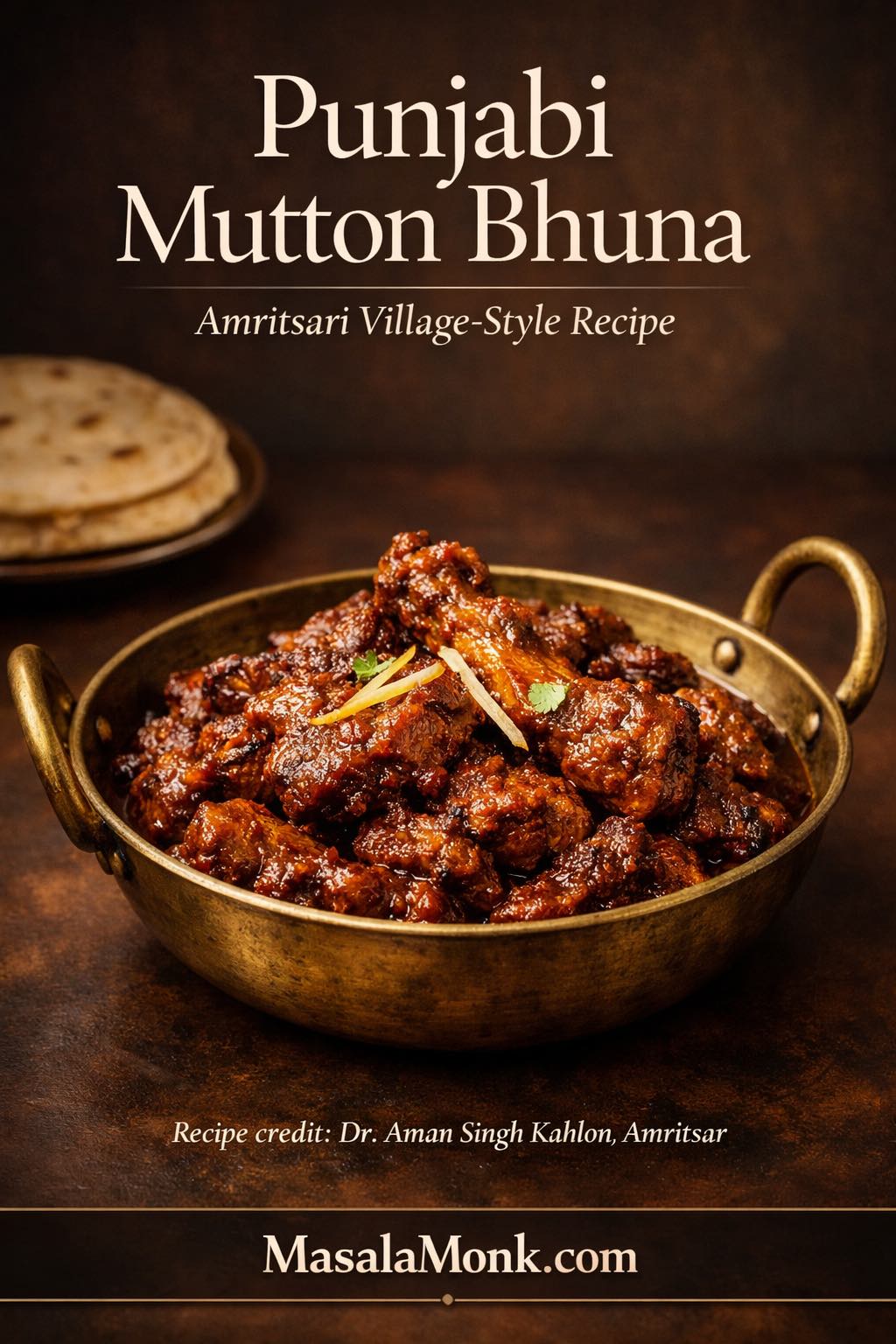
Punjabi mutton bhuna in a brass kadhai with thick reduced onion-tomato masala, styled as an Amritsari village-style recipe cover image with MasalaMonk branding

There are some dishes that belong to more than a kitchen. They belong to a season, a place, and a way of living. This Punjabi mutton bhuna is one of them. It brings to mind cold November days in the village, wheat sowing in the fields, smoke rising from open flame, and a meal coming together through many hands rather than one. Onions roast over the fire, tomatoes char and soften, garlic gets crushed fresh, and the mutton is watched patiently as it cooks. By the time everything is ready, the food tastes far richer than its short ingredient list suggests.

This recipe is shared with due credit to Dr. Aman Singh Kahlon, Amritsar, who remembers this style of mutton from childhood village visits during the winter sowing season. That memory explains the dish well. This is not a restaurant-style curry built on cream, curd, or a crowded masala base. It is a rustic bhuna shaped by mustard oil, charred onions, charred tomatoes, ginger, garlic, mutton fat, and patient reduction.

The result is thick, smoky, savory, and deeply comforting. The masala clings to the meat instead of floating around it. The spices support the flavor rather than overpower it. If you enjoy old-school Punjabi cooking that feels grounded and full of character, this is the kind of recipe that earns its place quickly.

Punjabi mutton bhuna recipe snapshot

Prep time: 25 to 30 minutes
Cook time: 1 hour 15 minutes to 1 hour 45 minutes
Serves: 4 to 6
Course: Main course
Cuisine: Punjabi / North Indian
Texture: Thick, reduced, masala-coated
Spice level: Mild to medium
Best for: Winter lunches, family dinners, slow weekend cooking
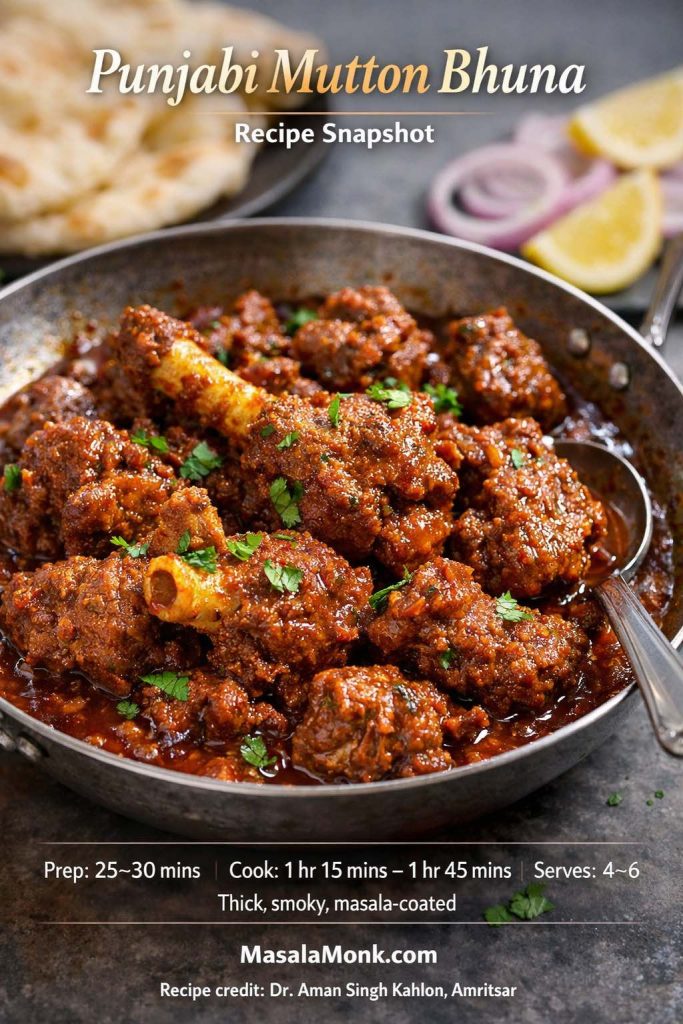
Punjabi mutton bhuna recipe snapshot showing a glossy, thick Punjabi-style mutton bhuna in a kadhai with bone-in pieces, deep reduced masala, and text overlay with prep time, cook time, serves, and texture notes.
This is the kind of mutton dish that should finish thick, smoky, and close-clinging rather than loose and gravy-heavy. Before you start, keep that texture target in mind, because the whole recipe is built around reduction, not excess sauce.

Also Read: Peach Cobbler with Canned Peaches (Dessert Recipe)

What makes this Punjabi mutton bhuna special

Charred onions and tomatoes change the base

Many mutton recipes begin with sliced onions fried in oil and tomatoes cooked down in the same pan. This one takes a more distinctive route. The onions are roasted directly over flame until soft and smoky, then pounded into a rough pulp. The tomatoes are charred until blistered and softened, then peeled and mashed the same way.

That one decision changes the flavor of the whole dish. The onions become sweeter and deeper. The tomatoes lose some of their raw sharpness and gain a fuller, fire-kissed savoriness. Once bhunoed together, they create a masala that tastes smokier, richer, and more elemental than a standard curry base.
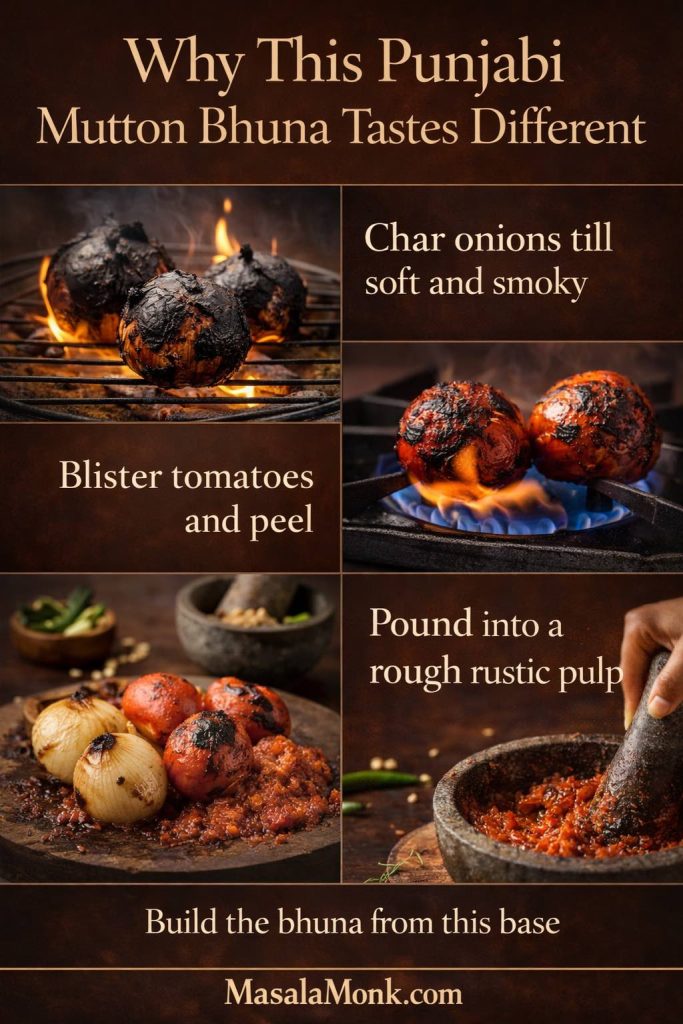
Charred onion and tomato base guide for Punjabi mutton bhuna showing fire-roasted onions and blistered tomatoes turned into a rustic pulp that gives the dish its smoky, deep, village-style masala base.
This fire-roasted onion-tomato base is what separates this bhuna from a more standard curry. The onions should soften under the char, the tomatoes should blister and sweeten, and both should stay slightly rustic so the final masala keeps its village-style character.

Bhuna mutton in Punjabi style is defined by technique

The word bhuna refers less to a fixed list of ingredients and more to a method built around frying, scraping, reducing, and concentrating flavor with very little free liquid. In South Asian cooking, bhuna-style dishes develop depth through repeated caramelization and minimal-moisture cooking rather than through a loose gravy. (Epicurious)

That is exactly why this recipe is finished as a thick, clingy preparation rather than a runny curry. The masala is meant to grip the meat.

Why mustard oil and mutton fat matter

Mustard oil gives this dish much of its backbone. Once heated properly, its raw edge mellows and leaves behind a bold, earthy depth that suits this style of Punjabi cooking beautifully.

The small amount of kidney fat matters too. It is not there to make the dish greasy. It is there to enrich the stock, deepen the masala, and give the finished bhuna a rounder, more savory body.

Why this Punjabi mutton bhuna recipe tastes different

This recipe does not depend on yogurt, cream, cashew paste, or a long list of spices. It trusts smoke, meat, mustard oil, and reduction to do most of the work. That simplicity is not a limitation. It is the reason the dish tastes so assured.

Also Read: Avocado Chocolate Mousse Recipe

Best ingredients for Punjabi mutton bhuna

  • 1 kg mutton, bone-in preferred
  • 50 grams mutton kidney fat, chopped
  • 3 large onions
  • 3 medium to large tomatoes
  • 2 to 4 green chillies
  • 10 to 12 garlic cloves, crushed
  • 1 tablespoon ginger paste
  • 3 tablespoons mustard oil
  • 1 teaspoon cumin powder
  • 1 tablespoon coriander powder
  • 1 to 1½ teaspoons Kashmiri red chilli powder
  • 1 to 1½ teaspoons salt, or to taste
  • 1 cup water, plus a little more only if needed
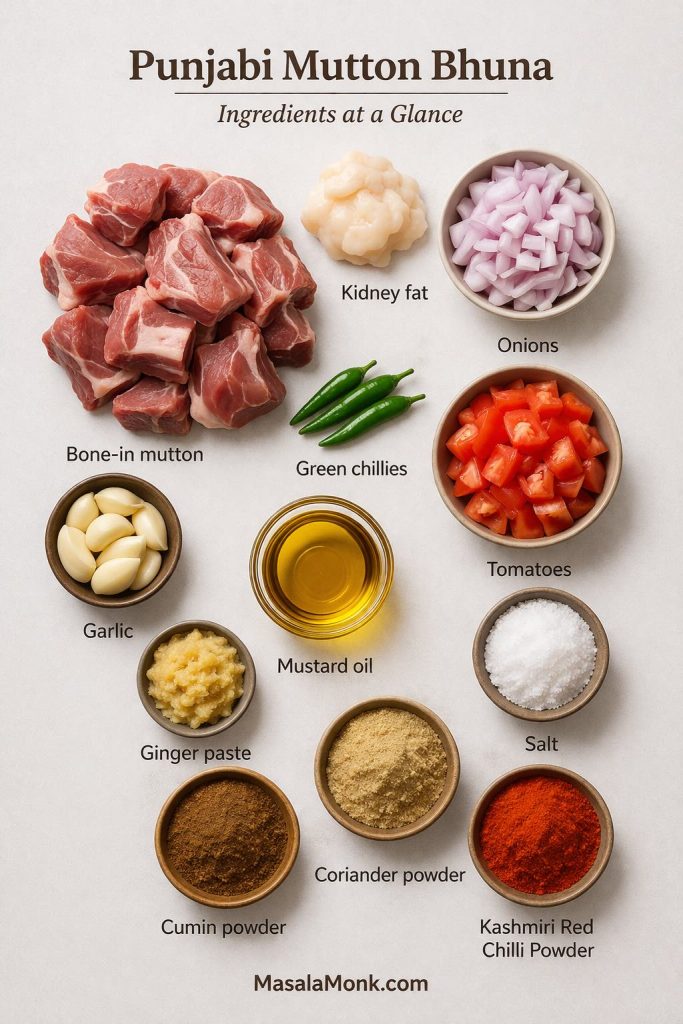
Punjabi mutton bhuna ingredients laid out and labeled, including bone-in mutton, kidney fat, onions, tomatoes, green chillies, garlic, ginger paste, mustard oil, salt, cumin powder, coriander powder, and Kashmiri red chilli powder.
The beauty of this Punjabi mutton bhuna lies in how focused the ingredient list is. Bone-in mutton gives the curry depth, kidney fat brings richness, mustard oil adds character, and the onion-tomato base carries the smoky rustic heart of the dish. Garlic, ginger, green chillies, cumin, coriander, and Kashmiri red chilli powder do not overcrowd the recipe; instead, they support the bhuna and help it cook down into a thick, glossy masala that clings to the meat instead of sitting loose around it.

Also Read: Falafel Recipe: Crispy Homemade, Air Fryer and Baked Falafel

Ingredient notes for the best Punjabi mutton bhuna

Best cut of mutton for this bhuna mutton recipe

Bone-in mutton works best here because it gives a fuller stock and holds up well through the two-stage cooking process. Medium pieces are better than very small ones, since tiny pieces can overcook by the time the bhuna is fully reduced.

Why kidney fat helps

The quantity is small, but it makes a real difference. As it cooks, the fat enriches both the early stock and the final masala. The result is more savory depth and better mouthfeel without making the dish heavy.
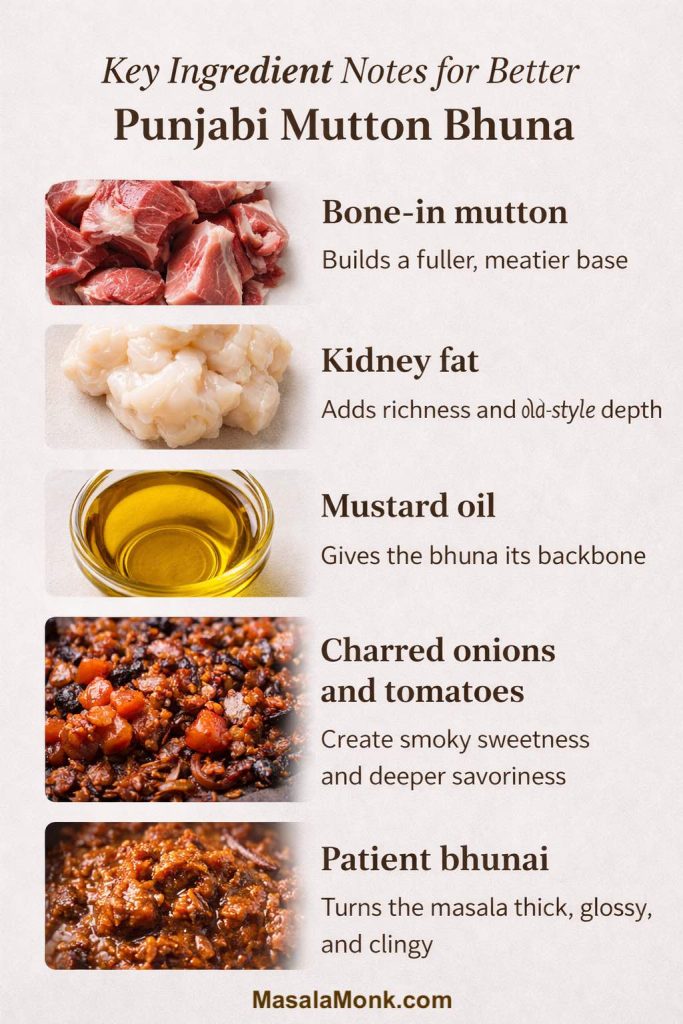
Key ingredient notes graphic for Punjabi mutton bhuna showing bone-in mutton, kidney fat, mustard oil, charred onions and tomatoes, and patient bhunai as the elements that build a thick, smoky, glossy Punjabi-style mutton bhuna.
What makes this Punjabi mutton bhuna memorable is not a long ingredient list but the way a few powerful choices shape the final dish. Bone-in mutton gives the curry a fuller, meatier base, kidney fat adds the kind of richness that makes the bhuna feel deep and old-school, and mustard oil brings the sharp backbone that keeps the masala from tasting flat. From there, the charred onions and tomatoes build the smoky sweetness that sets this recipe apart, while patient bhunai cooks everything down into the thick, glossy, clingy finish that should coat the meat rather than pool around it.

Mustard oil, chillies, and texture notes

Mustard oil is strongly recommended because it suits the flavor profile of this dish so well. Heat it properly before adding aromatics so the raw smell softens.

Kashmiri chilli powder brings color and gentle warmth rather than aggressive heat. The sharper heat comes from the green chillies, so adjust them to taste.

Keep the charred onion and tomato mixture slightly coarse. A completely smooth puree will push the dish toward generic restaurant-style gravy, while a rougher pulp keeps it true to its rustic identity.

Also Read: Mango Margarita Recipe (Frozen or On the Rocks)

How to make Punjabi mutton bhuna (step by step recipe)

This recipe becomes straightforward once you understand the sequence. First, the mutton is partially cooked. Then the onions and tomatoes are charred and pounded. After that, the masala is built in mustard oil, the spices are cooked into the base patiently, and the meat is finished in the reduced masala until everything turns thick, glossy, and deeply flavorful.

Quick method summary for Punjabi mutton bhuna

If you want the full flow at a glance before you begin, this is the sequence that matters most.

  1. Part-cook the bone-in mutton with kidney fat, salt, and a little water until it is about 80 percent done. Keep the stock.
  2. Char the onions until softened inside, then peel and pound them with green chillies into a rough pulp.
  3. Char the tomatoes until blistered and soft, peel them, and pound them into a coarse rustic pulp.
  4. Heat mustard oil and fry the garlic and ginger briefly to remove their raw edge.
  5. Add the onion mixture and bhuno it patiently until it tightens, deepens, and smells sweeter.
  6. Add cumin, coriander, and Kashmiri chilli powder, then stir in the tomato pulp.
  7. Cook the masala until it thickens, darkens slightly, and begins showing traces of oil around the edges.
  8. Return the mutton and stock to the pan, then reduce everything until the masala turns thick, glossy, and clingy around the meat.
  9. Rest briefly before serving so the bhuna settles and coats the mutton even better.

That is the full structure of the dish. The detailed step by step method below will help you judge each stage more confidently.

Step 1: Part-cook the mutton for Punjabi-style bhuna mutton

Place the mutton and chopped kidney fat in a pressure cooker or heavy-bottomed pan. Add 1 cup water and about 1 teaspoon of salt.

If using a pressure cooker, cook until the meat is about 80 percent done. In many home cookers, this may be around 4 to 6 whistles on medium heat, though the exact timing depends on the cut and age of the meat. Go by texture rather than whistle count alone. The meat should feel mostly cooked but still offer slight resistance.
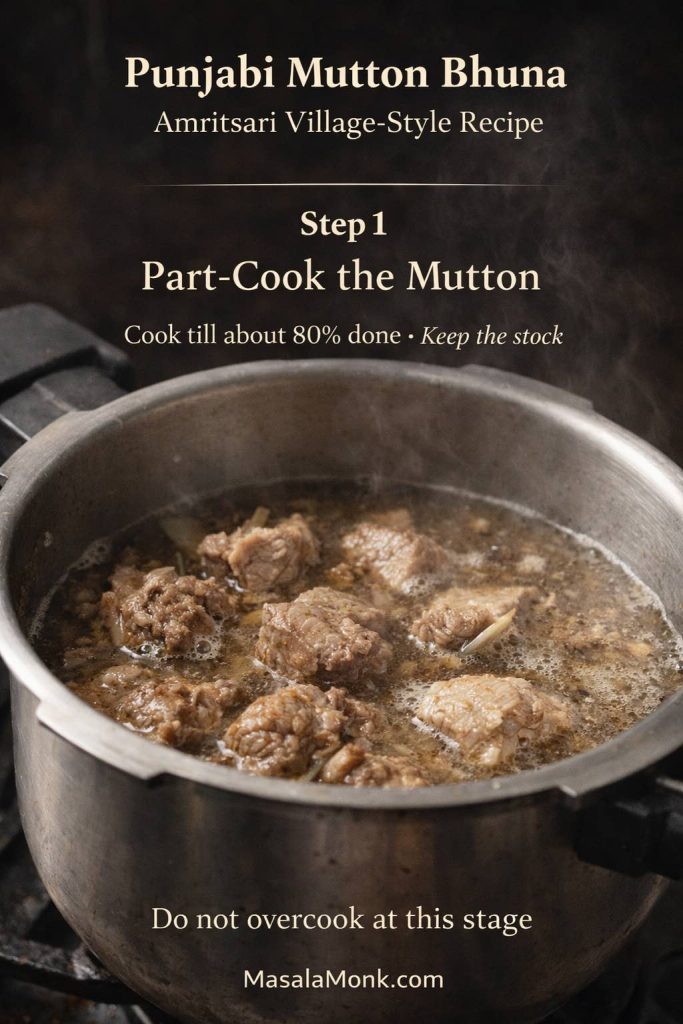
Step 1 image for Punjabi mutton bhuna showing bone-in mutton partially cooked in a pressure cooker with light stock before the final bhuna stage.
Step 1 in this Punjabi mutton bhuna recipe is to part-cook the bone-in mutton until it is about 80% done, then keep the stock for the final bhuna. This early stage builds the base of the dish without overcooking the meat, so the mutton can finish properly later in the thick onion-tomato masala.

If using a pan, cover and cook over medium to medium-low heat for about 35 to 50 minutes, checking occasionally. Add a small splash of water only if the pan begins to dry too much.

Once nearly done, set the meat and stock aside. Keep all the stock. It becomes part of the final bhuna.

Step 2: Char the onions and tomatoes

Roast the onions directly over open flame or hot coals until the outside blackens in patches and the insides soften well. You want smoke and sweetness, not a harsh burnt bitterness.

When cool enough to handle, peel away the burnt outer layer and keep the softened onion flesh. Pound it with the green chillies into a rough pulp. A mortar and pestle is ideal, but a blender on pulse mode works too.
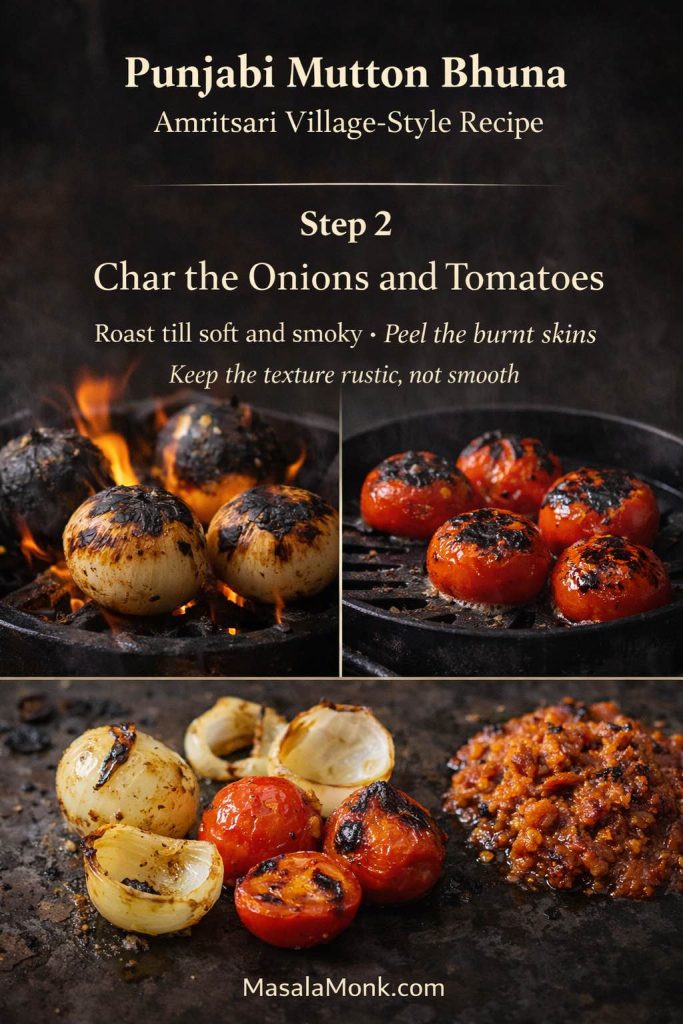
Step 2 image for Punjabi mutton bhuna showing onions and tomatoes charred over flame, peeled, and prepared into a rustic base for the bhuna.
Step 2 is where this Punjabi mutton bhuna starts building its signature flavor. The onions are charred till soft and smoky, the tomatoes are blistered and peeled, and both are kept rustic rather than pureed smooth. That fire-roasted base is what gives the final bhuna its deeper, smokier character.

Now char the tomatoes until their skins blister and loosen and the flesh softens visibly. Peel away the skins and pound the tomatoes into a coarse pulp.

Both mixtures should look rustic rather than polished. A little uneven texture is a good thing here.

Step 3: Build the bhuna mutton masala base

Heat the mustard oil in a heavy kadhai until it comes up to temperature and the raw smell mellows. Reduce the heat slightly and add the crushed garlic and ginger paste.

Fry for 1 to 2 minutes, stirring so the garlic does not catch. You want the rawness to leave without pushing the aromatics into bitterness.
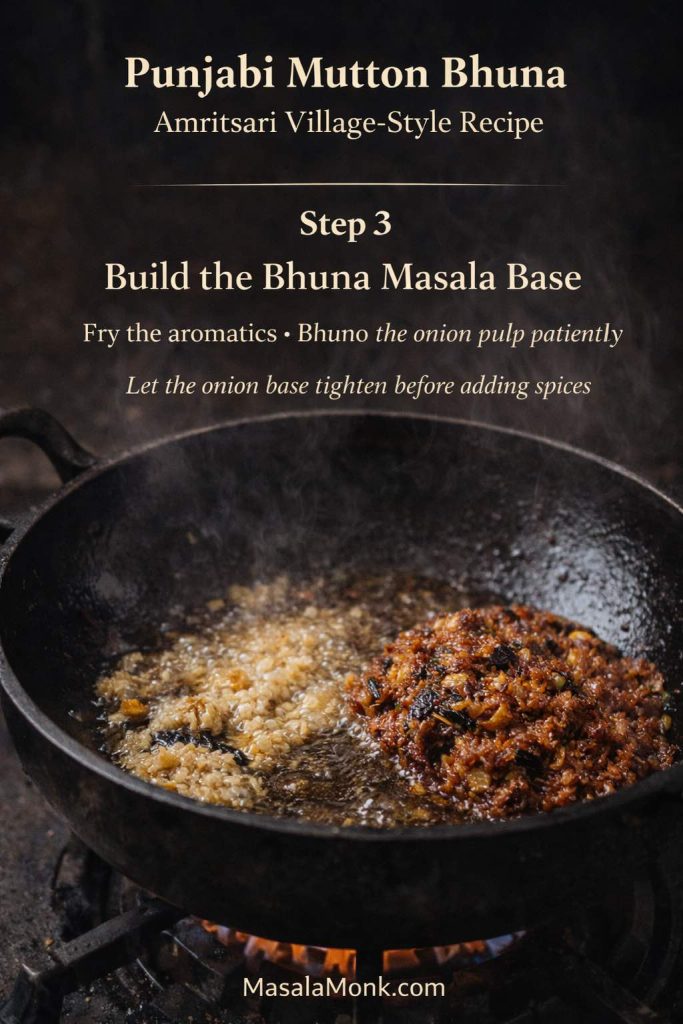
Step 3 is where Punjabi mutton bhuna starts taking on its real character. The mustard oil heats the pan, the ginger and garlic lose their raw edge, and the charred onion mixture begins to bhuno into a deeper, richer base. This stage should start loose and glossy, then slowly tighten as the flavors deepen before any powdered spices are added.

Add the charred onion and green chilli pulp. Also add any soft fatty bits or rendered fat from the partially cooked mutton. Start bhunoing this mixture over medium heat.

At first the onion mixture will look loose and wet. Keep stirring and scraping the pan. Over the next 8 to 12 minutes, it should darken slightly, tighten, and smell sweeter and deeper. Lower the heat a little if it begins sticking too fast. The onion base needs time to fry properly before the powdered spices go in.

Step 4: Add the spices and bhuno patiently

Add the cumin powder, coriander powder, and Kashmiri red chilli powder to the onion base. Stir right away so the spices bloom evenly in the fat.

Cook for about a minute, then add the charred tomato pulp. The mixture will loosen again. Keep cooking over medium heat, stirring often, and do not let the masala catch at the bottom.
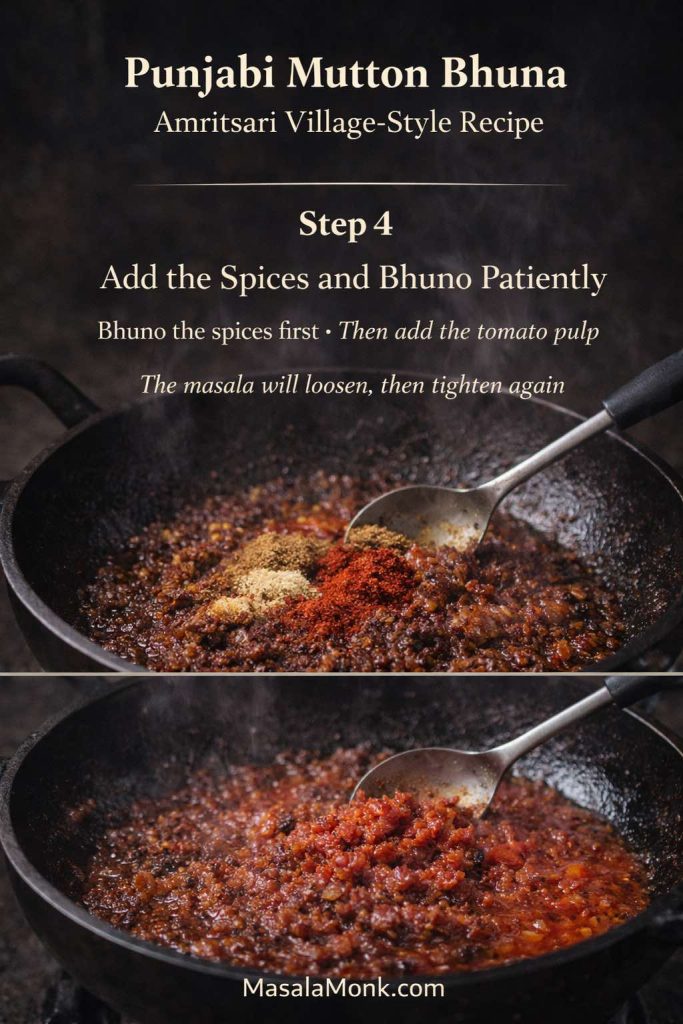
Step 4 image for Punjabi mutton bhuna showing powdered spices bhunoed in the onion base first, then charred tomato pulp added as the masala loosens before tightening again.
Step 4 is where the bhuna masala deepens and changes character. First the cumin, coriander, and Kashmiri chilli powders are bhunoed briefly in the fried onion base, then the charred tomato pulp is added. The mixture loosens at first, but as it cooks down, the masala tightens, darkens, and begins moving toward the rich, clingy finish that defines Punjabi mutton bhuna.

As the moisture cooks away, the masala will begin to tighten. The color will deepen, the aroma will round out, and traces of oil will start appearing around the edges. That is the sign that the bhunai is moving in the right direction.

This stage usually takes another 8 to 10 minutes. When you drag a spoon through the pan, the masala should briefly part and gather back more thickly rather than flow like a thin sauce.

Step 5: Finish the Punjabi mutton bhuna until thick and clingy

Add the partially cooked mutton and all the remaining stock. Mix thoroughly so the meat gets coated in the bhuna base.

Cook over medium heat, stirring often, until the stock reduces and the masala begins to cling closely to the meat. This stage is not only about reheating the meat. It is where the dish turns from cooked ingredients into a finished bhuna.
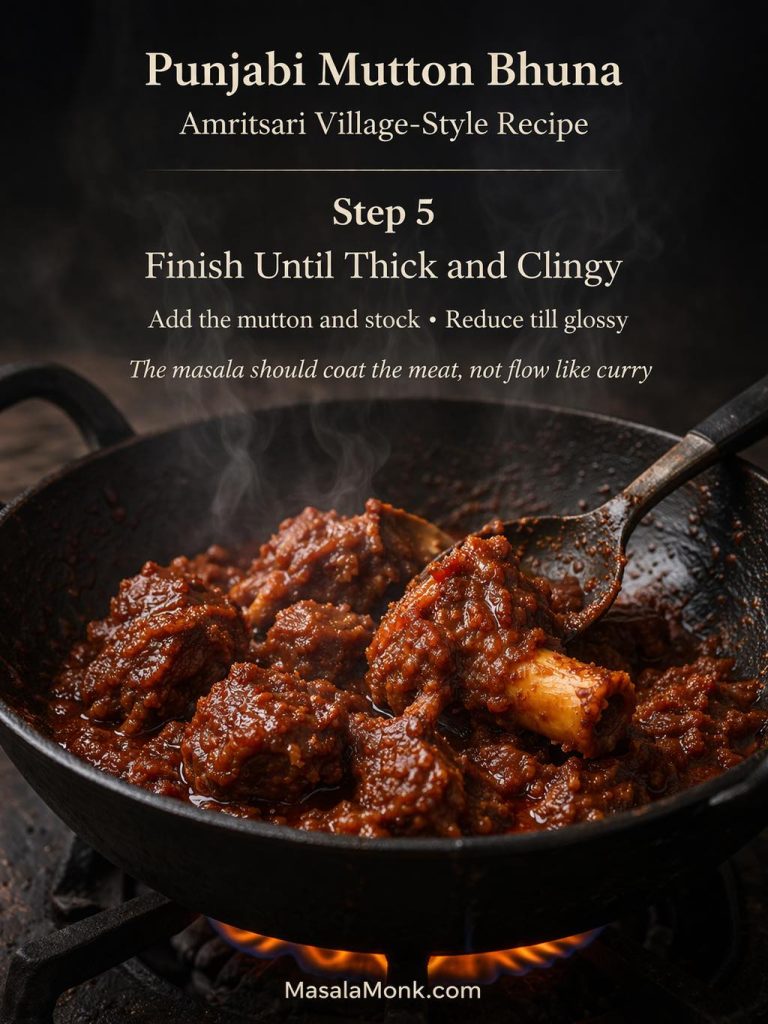
Step 5 image for Punjabi mutton bhuna showing the final bhuna stage, where bone-in mutton cooks in a thick glossy masala until the coating clings to the meat.
Step 5 is where Punjabi mutton bhuna becomes what it is meant to be: thick, glossy, and deeply reduced. The partially cooked mutton goes back into the masala with the stock, then cooks down until the sauce no longer runs like curry and instead clings closely to every piece. This is the stage that gives bhuna mutton its rich, concentrated finish.

Depending on how much stock remains, this may take 10 to 20 minutes. Taste for salt during the last few minutes, since reduction will intensify seasoning.

The finished dish should look glossy and deeply colored. The masala should coat the meat rather than drip off it. There should be enough moisture to keep every bite juicy, but not enough for the dish to feel like a loose curry.
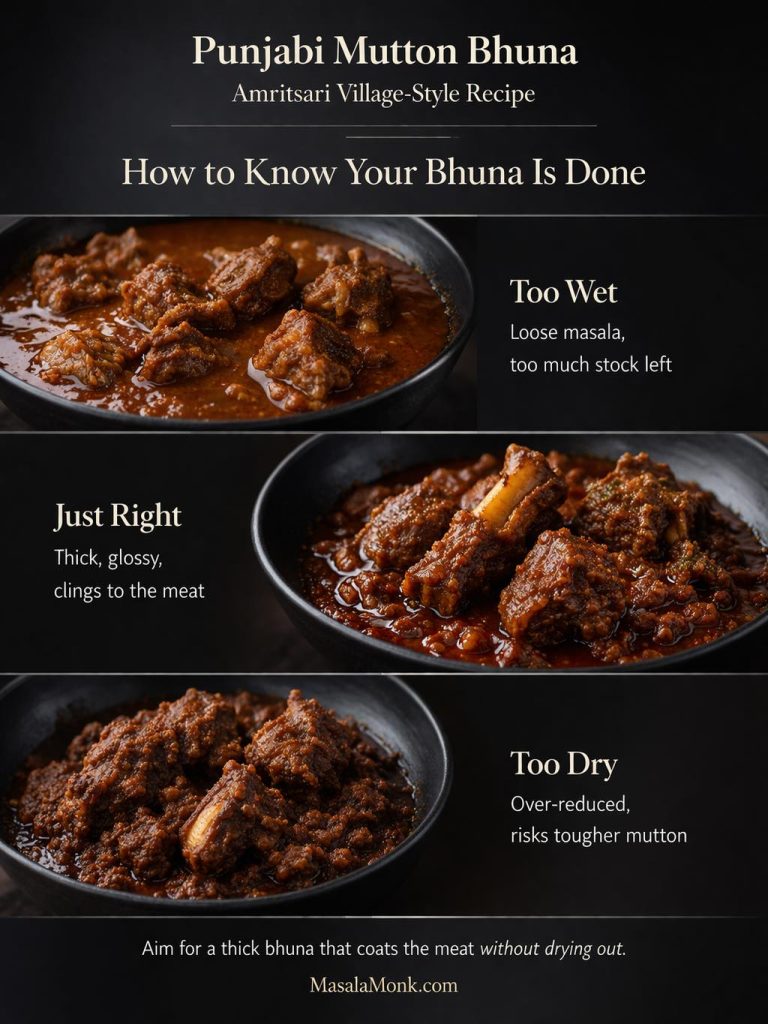
Texture guide for Punjabi mutton bhuna showing three stages of doneness: too wet, just right, and too dry, with the ideal thick glossy bhuna texture highlighted.
The sweet spot is a masala that holds to the meat without turning dry. Too much liquid and the dish feels diluted; too little and the richness turns heavy instead of balanced.

Also Read: Sourdough Pizza Dough Recipe (Crispy Crust & Easy Pizza Base)

Pressure cooker vs pan method for Punjabi mutton bhuna

Pressure cooker method for bhuna mutton in Punjabi style

A pressure cooker is the more practical route for most home kitchens. It tenderizes the mutton efficiently and shortens the first stage significantly. That fits this recipe well because pressure cookers are especially suited to foods that are naturally tough or require longer cooking times. (ISU Extension and Outreach Blogs)

The key is to stop before the meat is fully done. Once the mutton returns to the pan for the bhuna, it still needs time to absorb the masala and finish properly.
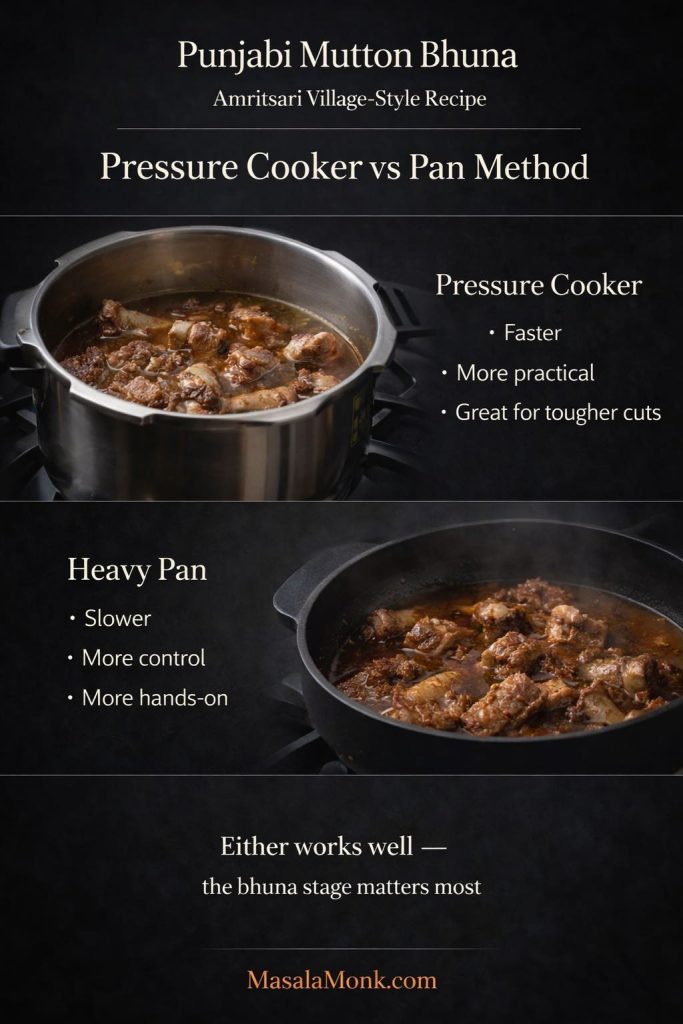
Comparison image for Punjabi mutton bhuna showing pressure cooker and heavy pan methods side by side, highlighting faster cooking versus slower more controlled cooking.
Choosing between a pressure cooker and a heavy pan changes the pace of the recipe more than the final flavor. The cooker gets the mutton close to tender faster, while the pan gives you a slower, steadier route with a little more control before the bhuna stage does its real work.

Pan method

A heavy pan gives you more gradual control and feels closer to the slower rhythm of the dish’s original setting. It suits cooks who do not mind spending a bit more time and paying closer attention to liquid levels.

This method can give excellent results, but it asks for more patience. You need to watch the meat, stir occasionally, and make sure the pan never dries out too far.

Which one should you choose for Punjabi-style bhuna mutton

Choose a pressure cooker when time matters. Choose a pan when you want slower control. In either case, the final flavor depends more on the quality of the bhuna than on the first cooking vessel. Save the stock, do not overcook the meat early, and let the reduction stage do its work.

Also Read: Balti Paneer Gravy (Restaurant-Style, Creamy + Bold Recipe)

Tips for the best Punjabi mutton bhuna

Roast for softness, not just blackening

The onions and tomatoes should not merely look charred. They must soften properly too. That softened interior is what gives the dish sweetness and body.
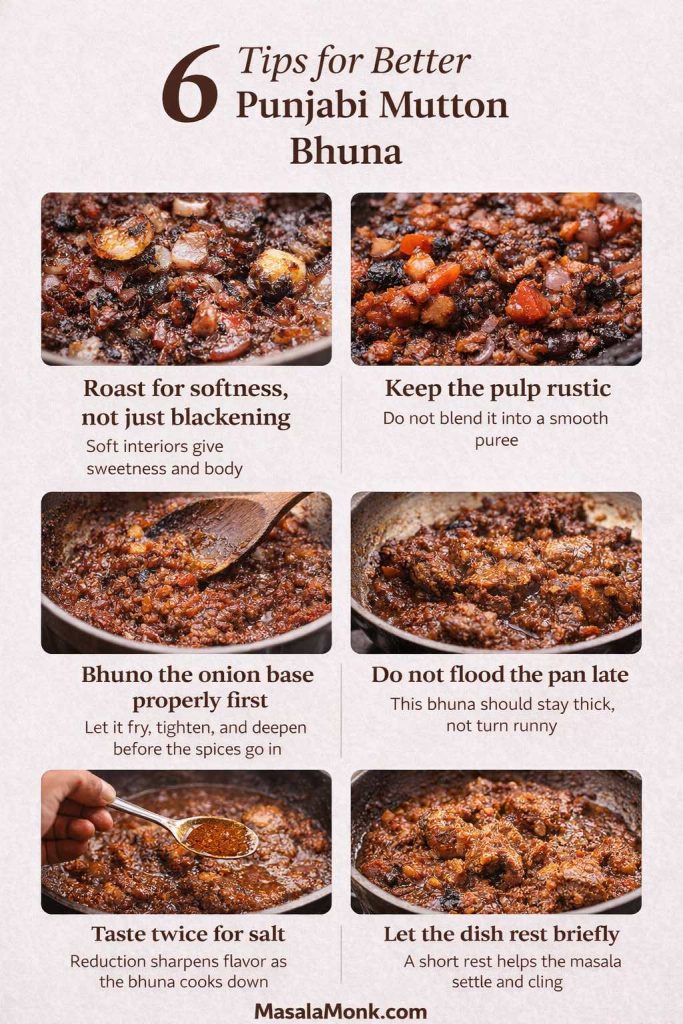
Tips graphic for Punjabi mutton bhuna showing six cooking tips: roast onions and tomatoes for softness, keep the pulp rustic, bhuno the onion base properly, avoid adding too much water late, check salt twice, and let the finished bhuna rest before serving.
The best Punjabi mutton bhuna comes from restraint as much as flavor. Roast the onions and tomatoes until they soften, not just blacken, keep the pulp rough instead of blending it smooth, and give the onion base enough time to bhuno before the spices go in. Just as importantly, do not loosen the pan late with extra water, taste again for salt after reduction sharpens everything, and let the finished bhuna rest briefly so the masala settles and clings more beautifully to the meat.

Keep the pulp rustic

A completely smooth puree makes the dish feel more generic. A rougher pulp gives the bhuna more character and a more grounded texture.

Bhuno the onion base properly first

Do not rush into the spice stage. The onion mixture needs time to fry, tighten, and deepen before the cumin, coriander, and chilli go in.

Do not flood the pan late

This is a bhuna, not a flowing curry. Too much extra water at the end will flatten the texture and dilute the concentration you worked to build.

Taste twice for salt

Salt lightly in the first stage, then check again near the end. Reduction sharpens everything.

Let the dish rest briefly

Even 10 minutes off the heat helps the masala settle and cling more beautifully before serving.

Also Read: Mojito Recipe (Classic) + Ratios, Pitcher, Mocktail & Easy Variations

What to serve with bhuna mutton in Punjabi style

Best breads and rice

This dish likes simple company. Hot rotis are an excellent match, especially if they are sturdy enough to scoop up the thick masala. Plain parathas work very well too.

If you prefer rice, keep it uncomplicated. Plain steamed rice or jeera rice lets the bhuna stay the focus of the plate.
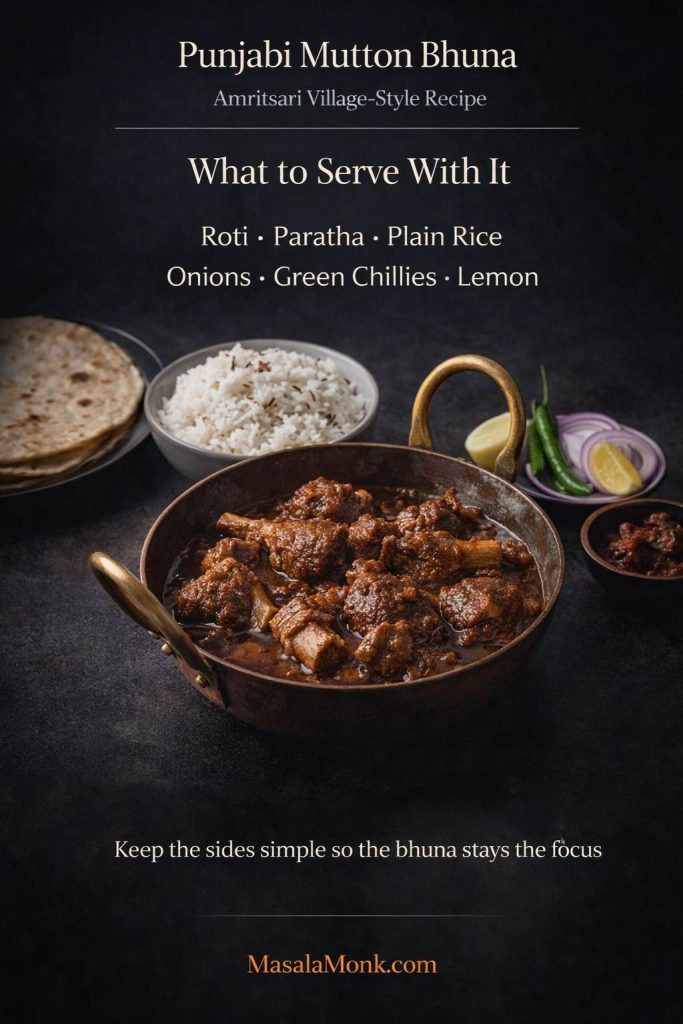
Serving suggestions for Punjabi mutton bhuna showing the dish with roti, plain rice, sliced onions, green chillies, lemon, and pickle.
Punjabi mutton bhuna pairs best with simple sides that let the rich masala stay at the center of the meal. Roti, paratha, or plain rice work beautifully, while sliced onions, green chillies, and a squeeze of lemon add the sharp contrast that this deep, smoky dish loves.

Sides and finishing touches

Sliced onions, green chillies, and a wedge of lemon fit the spirit of the dish especially well. They cut through the richness without distracting from it. A sharp pickle can also work, though use it lightly because the bhuna already carries plenty of depth.

Related Punjabi comfort dishes

If you enjoy this kind of hearty North Indian cooking, you may also want to explore Punjabi-style rajma curry on days when you want something comforting but meat-free. For another bold gravy-style main, Balti Paneer Gravy is a good next stop. And for a classic favorite in a richer, creamier lane, butter chicken offers a very different but equally satisfying dinner mood.

Also Read: Paloma Recipe: 12 Paloma Cocktail Drinks

How to store and reheat Punjabi mutton bhuna

This bhuna stores well, and like many reduced meat dishes, it often tastes even better after a little rest. The smoke, stock, fat, and spice settle into each other more fully, and the masala seems to grip the meat even better the next day.

Let the dish cool fully, then refrigerate it in an airtight container for up to 2 days.
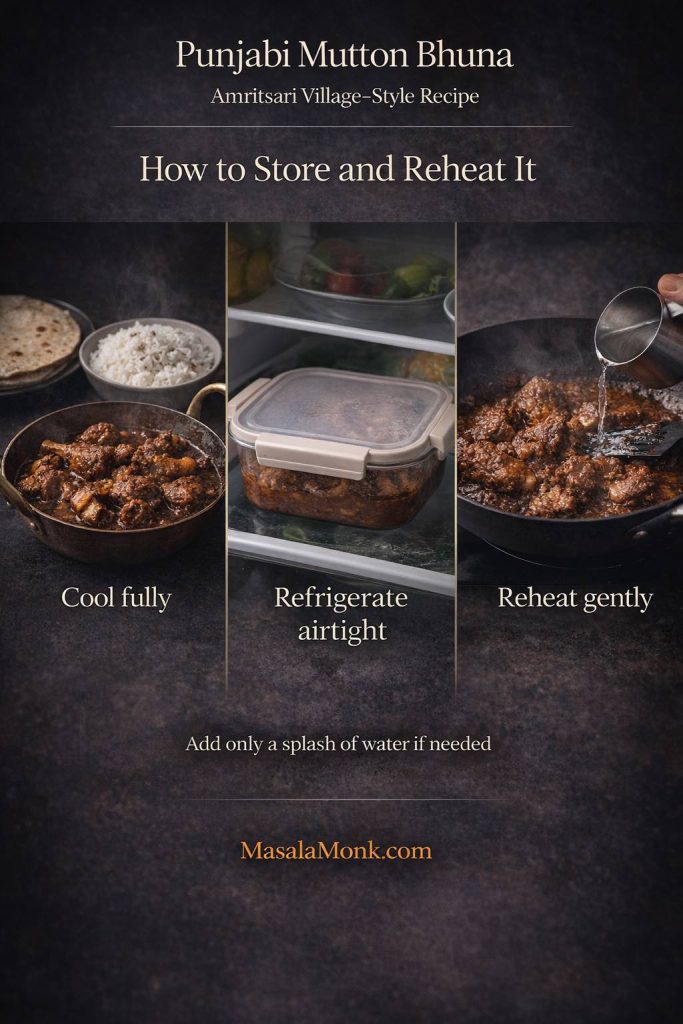
Storage and reheating guide for Punjabi mutton bhuna showing how to cool fully, refrigerate in an airtight container, and reheat gently with only a small splash of water if needed.
Punjabi mutton bhuna keeps well when the rich masala is handled gently after cooking. Let it cool fully before refrigerating, store it airtight, and reheat slowly so the thick bhuna texture loosens just enough without turning back into a thin curry.

To reheat, transfer it to a pan and warm gently over low heat. Add only a small splash of water if needed. The goal is to loosen the masala just enough, not turn it back into a thin curry.

If you know you want leftovers, you can stop the final reduction a touch earlier, since reheating will tighten the dish slightly more.

Also Read: Air Fryer Donuts Recipe (2 Ways): Glazed Homemade Donuts + Biscuit Donuts

Final thoughts on Punjabi mutton bhuna

Some dishes impress through abundance. This one impresses through confidence. It uses very little that feels unnecessary. There is no attempt to hide the mutton under excess spice or smooth everything into a polished restaurant gravy. Instead, it leans into smoke, mustard oil, fat, and reduction.

That is what gives the recipe its grounded appeal. The charred onions bring sweetness, the tomatoes bring depth, the mutton fat gives savoriness, and the bhuna ties everything together into one thick, flavorful coating.

With due credit to Dr. Aman Singh Kahlon, Amritsar, this recipe preserves a beautiful style of winter village cooking in a form that still makes perfect sense in a home kitchen today. Serve it hot, serve it slowly, and let the masala do what it is meant to do.
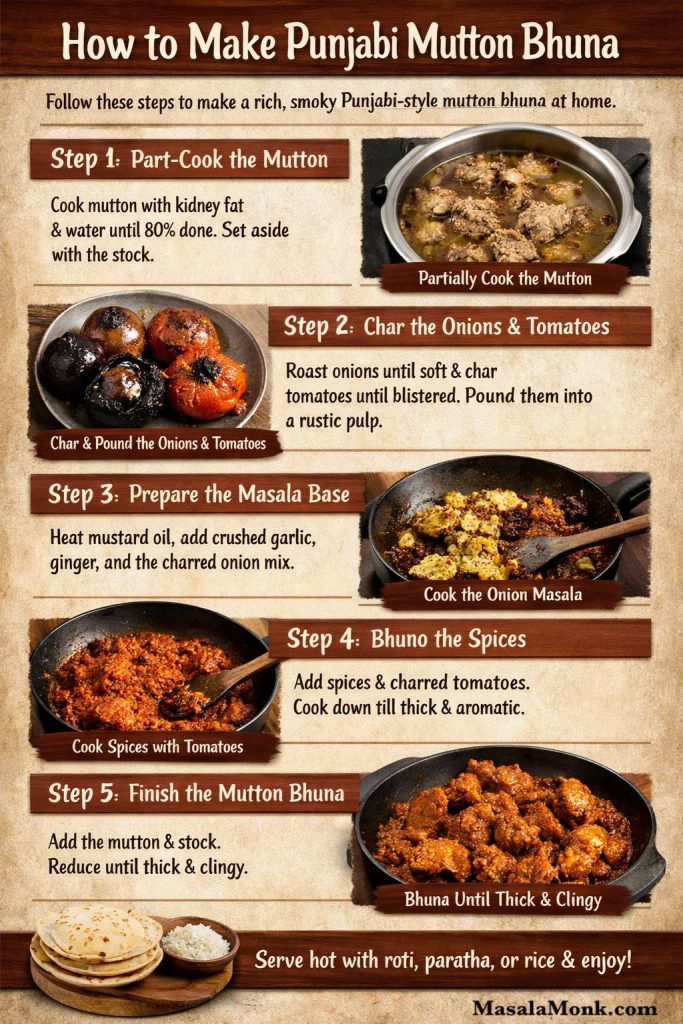
Step-by-step infographic showing how to make Punjabi mutton bhuna, including part-cooking the mutton, charring onions and tomatoes, building the masala base, bhunoing the spices, and finishing until thick and clingy.
Use this as a quick visual map of the recipe, but let the written method guide the details. The real success of this dish comes from texture cues: partly cooked meat, softened charred vegetables, a properly fried base, and a final reduction that turns clingy and glossy.

Also Read: Chicken Pesto Pasta (Easy Base Recipe + Creamy, One-Pot, Baked & More)

Punjabi mutton bhuna FAQs

1. Can I make punjabi mutton bhuna without a pressure cooker?

Yes. A heavy pan works well too. It simply takes longer and needs more attention.

2. Can I use lamb instead of goat meat in punjabi mutton bhuna?

Yes. The flavor will be slightly milder and fattier, but the method still works.

3. Can I make it without kidney fat?

Yes, though the finished punjabi mutton bhuna may taste a little less rich and rounded.

4. Why are the onions and tomatoes charred first?

Because that is one of the defining flavor moves in this recipe of punjabi bhuna mutton. Charring adds smoke, sweetness, and depth before the bhunai even begins.

5. Can I skip charring if I do not have open flame?

You can roast the onions and tomatoes on a very hot tawa, under a broiler, or in a hot oven until blistered and softened. That still gives you some roasted depth.

6. Can I make punjabi mutton bhuna without mustard oil?

Yes, but the character changes. A neutral oil will work, though the dish loses some of its Punjabi rustic edge.

7. How do I know when the bhuna stage is done?

The masala should look thick, glossy, and cohesive. It should cling to the meat, with small traces of oil visible around the edges.

8. Why does my bhuna taste watery?

Usually because the final reduction was not taken far enough or too much water was added late.

9. Is punjabi mutton bhuna very spicy?

Not necessarily. The Kashmiri chilli powder mainly adds color and mild warmth. The sharper heat comes from the green chillies.

10. Can I make it ahead?

Yes. Punjabi mutton bhuna often tastes even better after a few hours or the next day.

11. Is there a safe temperature reference for mutton or goat?

For whole cuts of goat or similar red meats, USDA guidance uses 145°F / 62.8°C with a rest period, while ground meat should reach 160°F / 71.1°C. In a dish like this, though, tenderness usually comes from cooking well past bare-minimum doneness until the meat softens properly in the bhuna. (Food Safety and Inspection Service)

Also Read: Tapas Recipe With a Twist: 5 Indian-Inspired Small Plates
Posted on 17 Comments

Homemade Hot Chocolate with Cocoa Powder Recipe

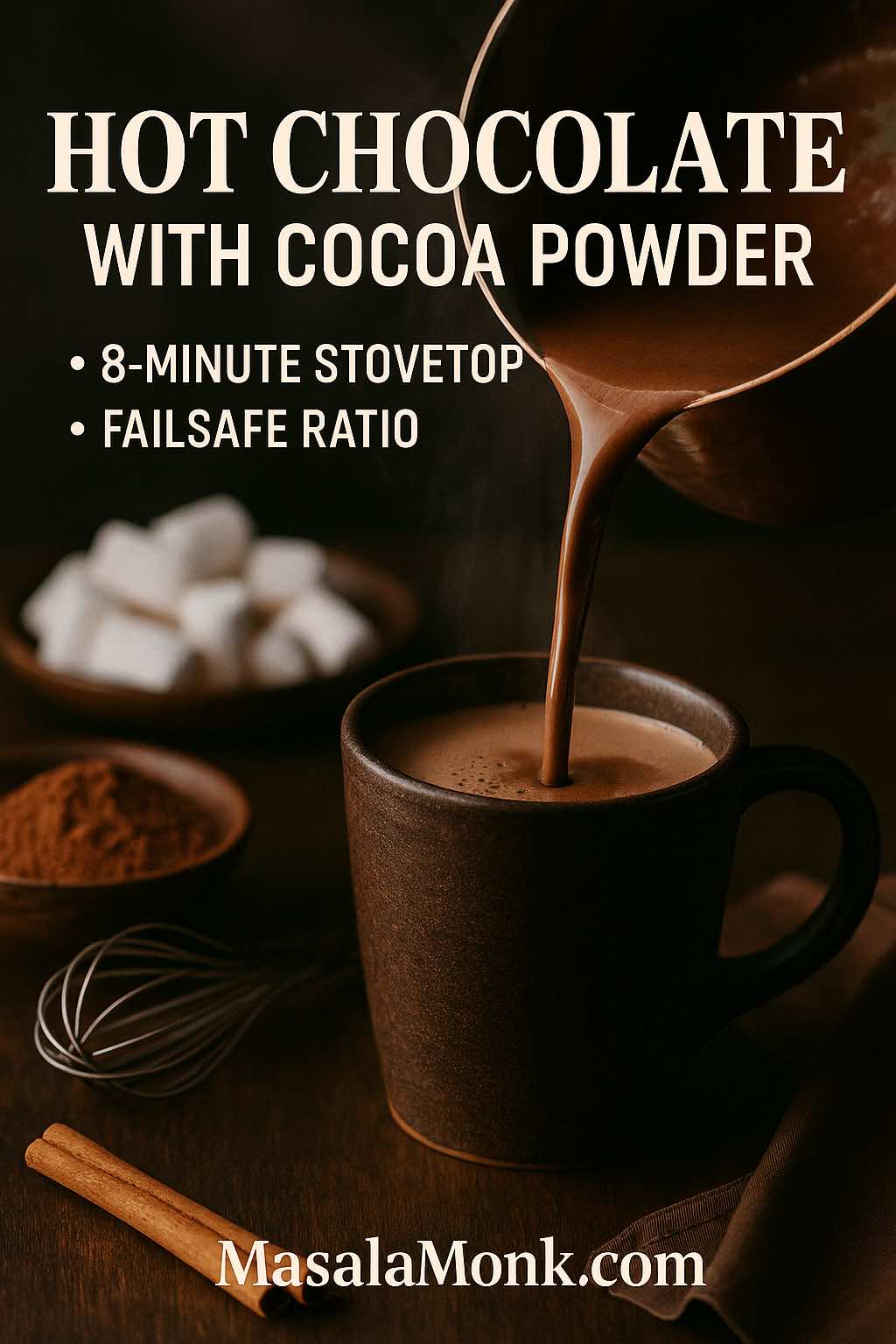
Hot chocolate with cocoa powder being poured from a saucepan into a rustic mug, with whisk, cocoa and cinnamon on a dark table.

Sometimes you crave a mug that’s pure comfort—nothing fancy, nothing fussy—just deep chocolate flavor, gentle sweetness, and the kind of steam that fogs the window while you stir. This hot chocolate with cocoa powder takes you there in minutes. It’s pantry-friendly, it scales for a crowd, and it’s endlessly adaptable for darker, milkier, lighter, or dairy-free moods. Along the way, you’ll see exactly how to dial in the texture, choose between natural and Dutch-process cocoa, and even shake up a cold chocolate milk for warmer days—without losing the spirit of a classic stovetop cup.

Before we heat anything, here’s the single biggest secret to café-smooth results: start with a paste. Cocoa powder (especially unsweetened) doesn’t want to dissolve right away. Whisking it with a splash of milk and sugar first means every sip turns out silky, never gritty.

Also Read: Peanut Butter Cookies (Classic Recipe & 3 Variations)


Ingredients for the best hot chocolate with cocoa powder (2 mugs)

  • 2 tbsp unsweetened cocoa powder (natural or Dutch-process)
  • 2 tbsp sugar (or 1–2 tbsp maple or honey, to taste)
  • Pinch of fine salt
  • 1 cup (240 ml) milk of choice, plus ½ cup (120 ml) water
  • ½ tsp vanilla extract (optional, but lovely)

Want a quick refresher on cocoa styles and why one might taste smoother or darker than the other? King Arthur’s plain-English guide to Dutch-process vs natural cocoa is a great starting point. For an overview of other cocoa types in baking and drinks, their types of cocoa, explained expands the nuance even further.


Recipe: classic stovetop hot chocolate with cocoa powder

  1. Make the paste. Off the heat, whisk the cocoa, sugar, and salt with 2 tablespoons milk until the mixture is glossy and lump-free. This takes 15–30 seconds and makes all the difference.
  2. Heat gently. Whisk in the rest of the milk and the water. Set the pan over medium heat and warm until steaming and hot—but not at a rough boil. Gentle heat keeps the mouthfeel creamy and prevents “cooked” flavors.
  3. Finish with fragrance. Take the pan off the heat and stir in the vanilla. Froth briefly with a whisk or handheld frother for that café-style lightness. Pour into warm mugs.
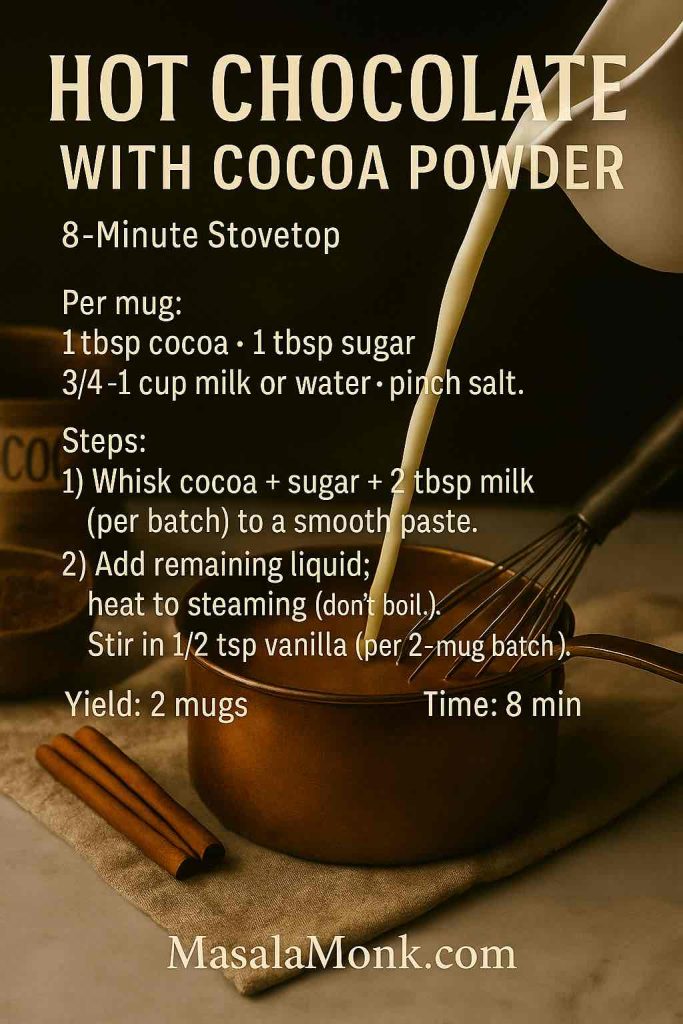
Recipe card for hot chocolate with cocoa powder: milk pouring into a copper saucepan with a whisk and cinnamon; 8-minute stovetop steps shown on image.
How to make Hot chocolate with cocoa powder—per mug: 1 tbsp cocoa, 1 tbsp sugar, 3/4–1 cup milk or water, pinch of salt. Whisk a paste, heat to steaming (don’t boil), stir in 1/2 tsp vanilla. MasalaMonk.com

While that first sip is still hugging your hands, you might be wondering about cacao versus cocoa. They’re related, of course, yet not identical in processing or flavor. For a practical, balanced read on how cacao differs from cocoa (and why cacao can taste fruitier while cocoa blends more smoothly), see this explainer on MasalaMonk and the concise overview from Healthline on cacao vs cocoa.


Texture, temperature, and the power of a whisk

Even excellent cocoa powder needs a little help to bloom. The paste stage hydrates the particles so they disperse evenly when you add more liquid. Beyond that, moderate heat (think “steaming” rather than turbulent simmer) coaxes out chocolate aromas without pushing milk proteins too far. If you’ve ever had a cup that felt thin, chalky, or strangely “cooked,” it likely skipped one or both steps.

For extra lift, whisk in quick, tight circles right after you add vanilla. Just 10–15 seconds can transform the surface from flat to glossy with a delicate foam. If you own a small frother, this is its moment to shine. Otherwise, a sturdy balloon whisk is more than enough.

Also Read: Green Tea Shot with Jameson | Recipe & 10 Variations


Sweetness, salt, and balance

Sugar sweetens, yes, but it also rounds the cocoa’s bitter edges so the flavor reads chocolaty rather than merely “cocoa-y.” Start with the 2 tablespoons in the base recipe and adjust a teaspoon at a time next time you make it. Maple and honey add their own accents—maple gives a caramelly finish; honey feels floral—so you can tune the personality of your mug without changing the core ratio.

Don’t skip the pinch of salt. It’s not about making a “salty” drink; it’s about focus. That tiny amount tightens the flavor so the chocolate tastes bolder at the same sweetness.

Also Read: Béchamel Sauce for Lasagna: Classic, Vegan & Ricotta Sauce Recipe


Milk or water? Finding your comfort zone

A lot of classic hot cocoa recipes use a mix of milk and water. There’s a reason. Milk gives body and richness; water lightens the profile and lets the chocolate notes pop. This base splits the difference—1 cup milk plus ½ cup water per two mugs—so you get a creamy backbone without heaviness. Prefer extra body? Go all milk (1½ cups / 360 ml). Want something lighter after dinner? Use more water and finish with a splash of cream to restore a silky finish.

If you’re making this dairy-free, barista-style oat milk drinks especially well, as do cashew and soy. Almond milk stays thinner but tastes clean and toasty, which some people adore in a nighttime cup.

Also Read: Crock Pot Lasagna Soup (Easy Base + Cozy Slow-Cooker Recipes)


Natural vs Dutch: how it changes your mug

Let’s talk flavor and feel. Natural cocoa is lighter in color and usually tastes a touch brighter, sometimes with a hint of fruit or acidity. It makes a classic, snappy-tasting hot chocolate with cocoa powder—the kind you might remember from childhood, just elevated by technique.

Dutch-process cocoa has been alkalized to tame acidity. In the cup, it reads darker, smoother, and often creamier at the same ratio. Because the edges are softer, many people find it dissolves more easily and gives a rounded finish. If your top priority is silky texture and a deep color, Dutch is the move. If you love lively, punchy chocolate, natural sings.

Curious which to stock? For a quick reference beyond this recipe, King Arthur’s types of cocoa, explained lays out how different powders behave in both baking and drinking.

Also Read: Cottage Cheese Lasagna Recipe | Chicken, Spinach, & Ricotta


Make-it-yours: small tweaks that change the whole cup

  • Extra-dark hot chocolate with cocoa powder: Add 1–2 teaspoons more cocoa during the paste stage. You can nudge sweetness up by ½–1 teaspoon if needed, or keep it punchy.
  • Lower sugar: Swap in allulose or erythritol. Because these sweeteners taste slightly cooler and less rounded than sugar, add a drop of vanilla or a tiny extra pinch of salt to keep the flavor full.
  • Dairy-free richness: Barista oat, soy, and cashew milk foam beautifully. For even more body, whisk in 1–2 teaspoons coconut cream at the finish.
  • Mocha moment: Stir in 1–2 teaspoons strong coffee or a splash of espresso. The coffee doesn’t steal the show; it just deepens the chocolate.
  • Finishing swirl: A ribbon of homemade chocolate syrup turns a simple mug into something that feels café-made—perfect when you want a quick flourish without melting chocolate.

Also Read: How to Make Churros (Authentic + Easy Recipe)


Spiced variation (Mexican-style recipe)

Keep the base the same, but in the paste stage whisk in ¼ teaspoon ground cinnamon and the tiniest pinch of cayenne. As the mixture warms, the cinnamon blooms and the heat lingers, not as a burn but as a gentle hum under the chocolate. Finish with vanilla, then whisk vigorously or use a frother to aerate the surface. If you’re going for a cozy dessert board, dunking something crisp is half the fun—homemade churros are a nostalgic, wildly satisfying pairing.

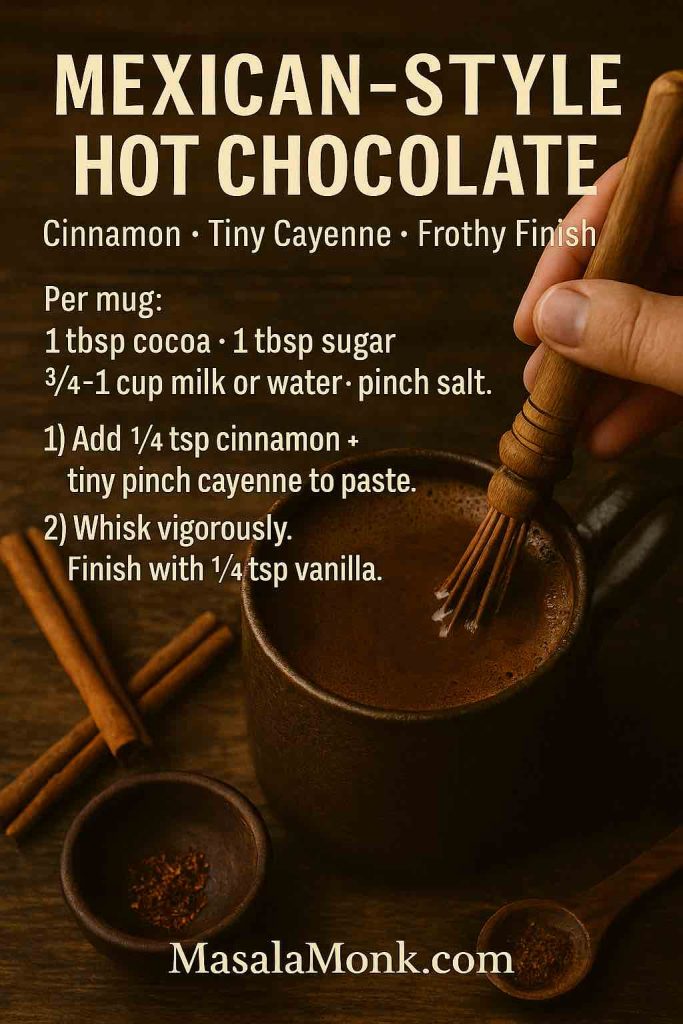
Mexican-style hot chocolate recipe card: hand whisking with a molinillo in a rustic mug, with cinnamon sticks and cayenne; per-mug ratios and steps visible.
Mexican-style hot chocolate Recipe—per mug: 1 tbsp cocoa, 1 tbsp sugar, 3/4–1 cup milk or water, pinch of salt. Add 1/4 tsp cinnamon and a tiny pinch of cayenne to the paste, whisk vigorously, and finish with 1/4 tsp vanilla. MasalaMonk.com

Cold spin: chocolate milk with cocoa powder (no syrup, no sludge)

Not every craving arrives with a cold night. For summer afternoons or quick post-workout comfort, make a cold chocolate milk that dissolves fully and tastes balanced:

  1. In a tall glass or a lidded jar, combine 1 tablespoon cocoa, 1–1½ tablespoons sweetener, a pinch of salt, and 1–2 teaspoons milk. Stir or shake into a silky paste.
  2. Add 1 cup cold milk gradually, whisking (or shaking) until smooth. The paste method saves you from floating clumps and gives a glossy finish.

If you like make-ahead chocolate treats with a lighter footprint, chia pudding recipes can lean cocoa-rich, dessert-ish, or breakfast-bright—handy when you want chocolate without the stovetop.


Heat, hold, and reheat: the practical bits

Heating: Keep it to medium. You want steam, not aggressive bubbles. Harsh boiling can press the proteins too far and leave a grainy impression even if you made a great paste.

Holding: If you’re hosting, keep hot chocolate warm on the lowest heat with a lid slightly ajar and whisk briefly every 10 minutes to keep it silky.

Reheating: Gentle is again the rule. If you’ve made a larger batch, rewarm on low and whisk as you go. A splash of fresh milk can refresh the body after prolonged holding.

Also Read: How to Cook Bacon in the Oven (Crispy, No-Mess, Crowd-Ready Recipe)


Serving ideas, garnishes, and textures for Hot Chocolate with Cocoa Powder

  • Classic marshmallow cap: Homemade or store-bought, marshmallows soften into a creamy top layer that acts like a flavor filter—each sip pulls through vanilla sweetness.
  • Light whipped cream: Soft peaks add air without weight. Dust the top with a whisper of cocoa for a café finish.
  • Citrus twist: A tiny strip of orange zest rubbed over the cup perfumes the steam.
  • Spice dust: A little cinnamon or nutmeg on the foam moves the aroma forward as you lift the mug.
  • Cocoa-nib crunch: For a fun contrast, float a pinch of cocoa nibs; they’ll soften at the edges but keep a little bite.

Also Read: French Toast Sticks (Air Fryer + Oven Recipe) — Crispy Outside, Custardy Inside

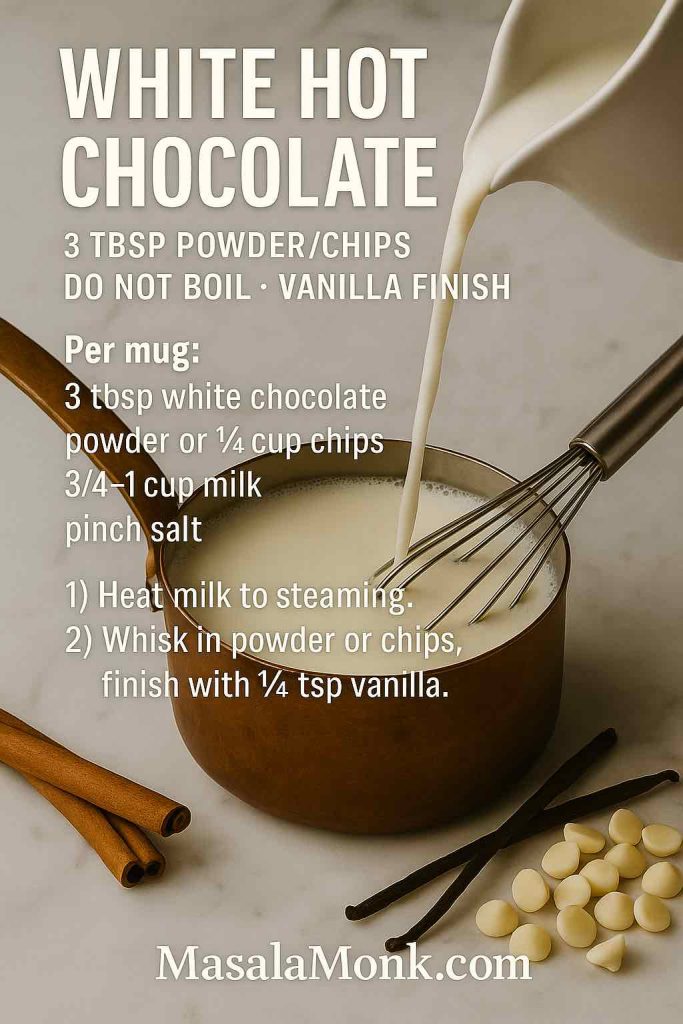
White hot chocolate recipe card: milk pouring into a copper saucepan with whisk, vanilla pod, and white chocolate chips; do-not-boil method.
White hot chocolate—per mug: 3 tbsp white chocolate powder or 1/4 cup chips, 3/4–1 cup milk, pinch of salt. Heat to steaming, whisk in, finish with 1/4 tsp vanilla. MasalaMonk.com

Troubleshooting Hot Chocolate with Cocoa Powder

  • Gritty sip: The paste likely wasn’t fully smooth. Next time, whisk the cocoa and sugar with a larger splash of milk until glossy before adding the rest.
  • Too thin: Use all milk (1½ cups total) or whisk in ½–1 teaspoon cornstarch while cold, then heat gently until lightly thickened.
  • Too sweet or flat: Add a pinch of salt, then nudge sweetness down next round. Cocoa flavor wakes up when the sweet–salty balance clicks.
  • Dairy-free but watery: Try a barista-style oat or soy, or add 1–2 teaspoons coconut cream off heat.
  • Lacks depth: Fold in a teaspoon of instant espresso powder or a few drops of vanilla. Tiny adjustments go a long way.

Also Read: 10 Best Chicken Sandwich Recipes (BBQ, Parm, Buffalo & More)


Choosing cocoa: pantry strategy that pays off

If you drink hot chocolate with cocoa powder even a few times a month, keeping two cocoas on hand is a clever move:

  • Everyday natural cocoa for a bright, classic cup and baking.
  • A Dutch-process cocoa for company or nights when you want a deep, plush mug.

This way, you can lean one direction or blend them. Many home cooks discover a 50/50 mix hits their sweet spot: vibrant yet smooth, dark yet lively.

For flavor clarity, sift your cocoa into a jar when you first open it—this breaks early clumps and keeps it ready for paste-making. Store in a cool, dry cabinet away from the stove so heat and steam don’t encourage caking.

Also Read: 10 Best Espresso Martini Recipe Variations (Bar-Tested)


A quick note on cacao (and when to use it)

Cacao powder is less processed than typical cocoa and often tastes fruitier and more delicate. If you prefer a “healthy-leaning” cup with a lighter body, warm your milk gently (hot but not boiling), then whisk in cacao, sweetener, and salt.

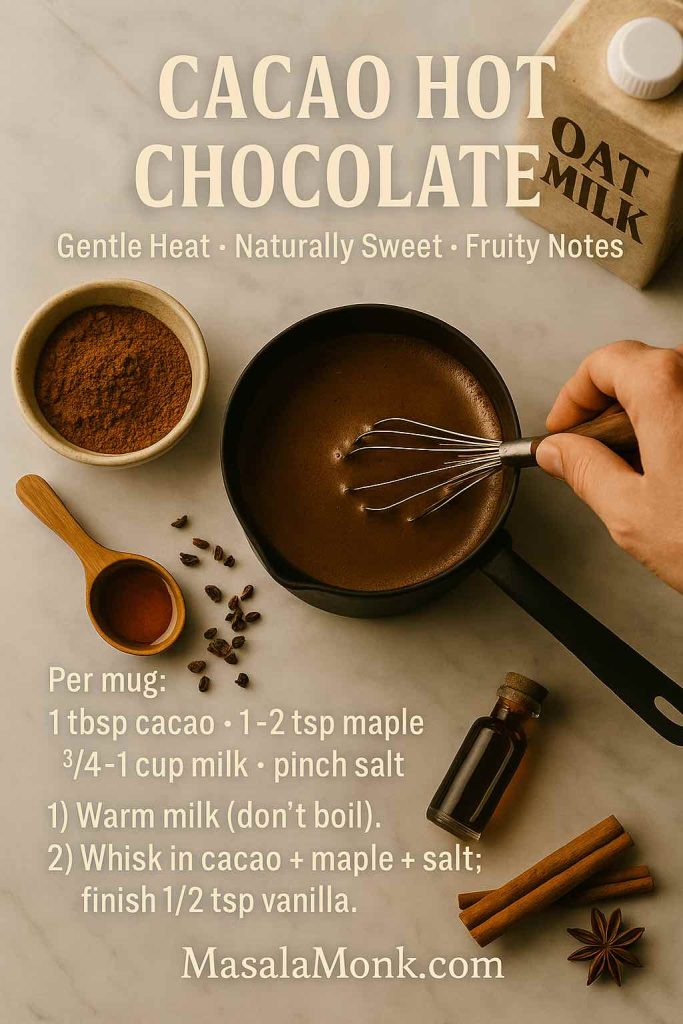
Cacao hot chocolate recipe card on light marble: hand whisking in a small saucepan with cacao powder, maple syrup, oat milk, and cacao nibs; gentle-heat method shown.
Cacao hot chocolate—per mug: 1 tbsp cacao, 1–2 tsp maple, 3/4–1 cup milk, pinch of salt. Warm (don’t boil), whisk in cacao + maple + salt; finish with 1/2 tsp vanilla. MasalaMonk.com

Because cacao’s edges are softer, it can feel more transparent in milk—some people love that, especially with maple syrup. If you’d like context on how cacao relates to chocolate and dark chocolate more broadly, this MasalaMonk guide maps the landscape in everyday language, while Healthline’s overview covers processing differences without getting fussy.

Also Read: Pumpkin Spice, Your Way: Master Blend, Variations & Real-World Recipes


Nutrition whisper: perspective without the lecture

Cocoa powder brings a small amount of minerals to the party, including magnesium. That doesn’t turn a mug into a supplement, of course, but it’s a pleasant bonus. If you’re curious about broader wellness angles that include cocoa or dark chocolate in a wider diet, you might enjoy MasalaMonk’s look at magnesium-rich foods. For technical nutrition data per serving, the USDA’s FoodData Central is the neutral reference many dietitians use; search their database for “cocoa powder, unsweetened” to compare brands and serving sizes.


Scaling up: a crowd-pleasing pot of Hot Chocolate with Cocoa Powder

When you’re pouring for a game night or movie marathon, multiply everything and grab a heavier pot (4–5 liters for 8–10 servings). The method stays the same: paste first, gentle heat, vanilla off heat, quick whisk for foam. Here are a few patterns that work well:

  • 8 mugs: 8 tbsp cocoa, 8 tbsp sugar, big pinch salt, 6 cups milk + 2 cups water, 2 tsp vanilla.
  • 12 mugs: 12 tbsp cocoa, 12 tbsp sugar, generous pinch salt, 9 cups milk + 3 cups water, 1 tbsp vanilla.

Keep a small ladle nearby so guests can top themselves. Offer cinnamon, shaved chocolate, and a jar of homemade chocolate syrup for custom finishing.

Also Read: Healthy Pumpkin Spice Latte (Low Cal, Real Pumpkin)


Make-ahead components that speed up weeknights

If you want to cut prep to practically zero, you have two low-effort options:

  1. Dry base mix: In a small jar, combine cocoa, sugar, and salt for 4–6 servings. When you’re ready, scoop out what you need, add milk+water, and go straight to the heat step.
  2. Syrup shortcut: Keep a jar of 3-minute chocolate syrup in the fridge. Stir a spoonful into hot milk for an on-the-fly cup, or drizzle the finished mug for a café look without extra tools.

Either way, you retain control over quality and sweetness while shaving prep down to the whisking.

Also Read: Vegan French Toast: 6 Easy Recipes (Pan, Air Fryer, GF & High-Protein)

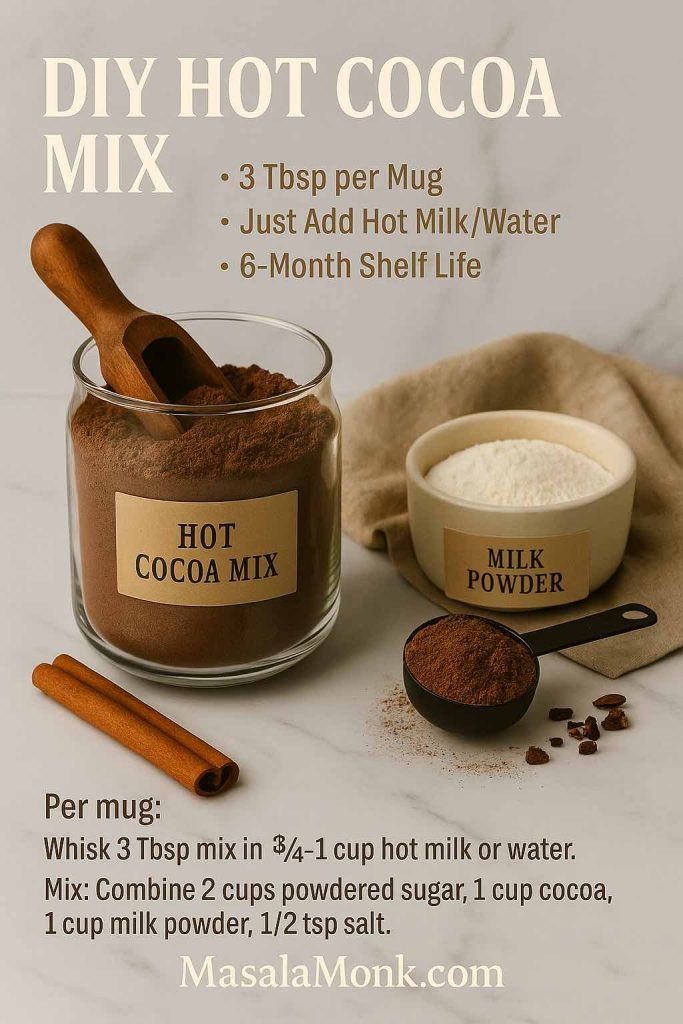
DIY hot cocoa mix recipe card on white marble: glass jar labeled “Hot Cocoa Mix” with wooden scoop, bowl of milk powder, black tablespoon of cocoa, and cinnamon sticks; instructions show 3 Tbsp mix per 3/4–1 cup hot milk or water.
DIY hot cocoa mix—combine 2 cups powdered sugar, 1 cup cocoa, 1 cup milk powder, and 1/2 tsp salt. To serve, whisk 3 Tbsp mix into 3/4–1 cup hot milk or water. Stores airtight up to 6 months. MasalaMonk.com

Seasonal riffs that keep Hot Chocolate with Cocoa Powder interesting

  • Peppermint steam: Add 1–2 drops peppermint extract at the finish.
  • Orange glow: Infuse the milk with a strip of orange peel while heating; remove before serving.
  • Ginger warmth: Simmer thin slices of fresh ginger with the milk and water, then strain.
  • Nutty whisper: A teaspoon of hazelnut or almond extract can evoke chocolate-hazelnut vibes without turning the cup into dessert.

Rotate these through the colder months and your “same” hot chocolate with cocoa powder never feels repetitive.

Also Read: Classic vs. Authentic Alfredo: 5 Essential Recipes


A note on quality: small upgrades, big rewards

  • Freshness matters: If your cocoa has been open for a year and lives near the stove, the aroma might have faded. Move it to a cool cabinet and refresh the supply every few months if you make cocoa often.
  • Sifted and ready: Pre-sifting into a jar means paste-making is quick and clump-free.
  • Vanilla restraint: Vanilla is beautiful here, but it’s a supporting actor. Go light so it frames the chocolate rather than masking it.

Chocolate-forward pairings

Hot chocolate practically begs for a snack to dunk. Crisp-edged churros are a classic. If you’d like something lighter, cocoa-leaning chia puddings deliver chocolate notes in an entirely different texture—cool, spoonable, and meal-prep-friendly. Meanwhile, if you’re curious about broader chocolate and cacao territory (bars, bakes, and the space between), this MasalaMonk cocoa/cacao explainer is a handy compass.


Why this ratio works (and when to break it)

Per mug, this recipe lands at roughly 1 tablespoon cocoa : 1 tablespoon sugar : ¾–1 cup liquid. That’s the sweet spot for most palates—enough cocoa to read as chocolate rather than faintly flavored milk; enough sugar to polish the edges; enough liquid to feel sippable, not heavy. Nevertheless, ratios are invitations, not rules. If you adore a darker profile, lift the cocoa and reduce the sugar slightly. If you’re serving kids, tipping the sweetness up a teaspoon can feel more familiar. You can shift the milk-to-water balance too: all milk for a plush nightcap; all water with a splash of cream for something featherlight yet still cozy.

Also Read: Lemon Drop Martini Recipe (Classic, 3-Ingredient, & More)


Beyond the mug: a chocolate-forward pantry

Once you dial in hot chocolate with cocoa powder, you’ve effectively cracked a handful of other winter comforts:

  • Mocha oatmeal: Stir a teaspoon of cocoa and a little sugar into hot oats; finish with a splash of milk and vanilla.
  • Quick chocolate sauce: Whisk cocoa, sugar, a pinch of salt, and hot water into a thick drizzle; enrich with a knob of butter or a splash of cream. Or, take the faster route with this three-minute chocolate syrup.
  • Hot cocoa base for bakes: The paste technique is the backbone of cocoa glazes and certain stovetop frostings; once you see how smoothly cocoa bloomed in milk behaves, you’ll start applying it elsewhere.

Cold weather ritual, warm weather habit

In winter, this recipe is ritual: steam curling, cinnamon nearby, a soft blanket waiting. In summer, the cold chocolate milk variation takes over—we shake, we pour over ice, we sip on the balcony. Either way, it’s still the same foundation: a quick paste, gentle heat (or no heat at all), and a minute of whisking to make it feel special.


If you’re exploring further

  • For clear, non-technical answers about cocoa styles, King Arthur’s guides on Dutch vs. natural cocoa and cocoa types are reader-friendly.
  • For a grounded look at cacao versus cocoa and where chocolate sits in that spectrum, try MasalaMonk’s explainer, and for broader processing context, Healthline’s cacao vs cocoa piece is a good supplement.
  • If nutrition tables help you calibrate your own serving, the USDA’s FoodData Central is a straightforward database—useful if you compare brands or track macros.

One last mug

The difference between a forgettable cup and a memorable one almost always comes down to the same simple moves: bloom the cocoa in a paste, warm gently, finish with something fragrant, and whisk for a breath of foam. From there, you can veer darker or lighter, dairy-rich or dairy-free, spiced or straight, hot or ice-cold. That’s the charm of hot chocolate with cocoa powder—it gives you a classic to return to and endless little detours to enjoy along the way.

Also Read: Daiquiri Recipe (Classic, Strawberry & Frozen Cocktails)

FAQs on Hot Chocolate with Cocoa Powder

1) Can I make hot chocolate with baking cocoa?

Absolutely. Baking cocoa is simply unsweetened cocoa powder, so it’s perfect for hot chocolate with cocoa powder. First, whisk it into a smooth paste with a little milk and sugar, then add the remaining liquid and heat gently.

2) What’s the best cocoa powder for drinking?

Generally, Dutch-process gives a darker color and smoother taste, while natural cocoa delivers a brighter, classic chocolate snap. For everyday hot chocolate with cocoa powder, either works; choose Dutch for silkiness or natural for lively flavor.

3) How do I make hot chocolate with cocoa powder extra creamy?

Use all milk instead of milk + water, keep the heat moderate, and finish with a quick whisk or frother. Optionally, add a teaspoon of cream or coconut cream at the end.

4) Can I make hot chocolate with cocoa powder without sugar?

Yes. Swap sugar for allulose, erythritol, or a liquid sweetener like maple. Because some alternatives taste less rounded, balance with a tiny pinch of salt and a drop of vanilla.

5) Does milk type matter for hot chocolate with cocoa powder?

Definitely. Whole dairy milk gives the richest body; barista-style oat, cashew, and soy foam well and taste silky. Almond reads lighter and toasty; coconut adds tropical richness.

6) How do I stop cocoa from clumping?

Begin with a paste: whisk cocoa, sugar, and a spoon or two of milk until glossy, then add the rest of the liquid. This quick step prevents gritty, floating specks.

7) What ratio should I use per mug?

A reliable baseline is 1 tbsp cocoa : 1 tbsp sugar : ¾–1 cup milk (or milk + water) with a pinch of salt. Adjust darker by adding ½–1 tsp extra cocoa, or sweeter by 1–2 tsp sugar.

8) Can I make low-carb hot chocolate with cocoa powder?

Certainly. Use unsweetened almond or cashew milk, choose a zero-calorie sweetener, and keep the classic ratio. For body, whisk a splash of cream or a bit of coconut cream after heating.

9) How do I make Mexican-style hot chocolate with cocoa powder?

Stir ¼ tsp ground cinnamon and a tiny pinch of cayenne into the paste. Warm gently, finish with vanilla, then whisk vigorously for a frothy top.

10) Is cacao powder good for hot chocolate?

Yes—cacao tastes fruitier and more delicate. Heat your milk just to hot (not boiling), then whisk in cacao and sweetener. Expect a lighter body than typical hot chocolate with cocoa powder.

11) Can I prepare hot chocolate ahead of time?

You can. Mix the dry base (cocoa, sugar, salt) in a jar and store airtight. When ready, add milk and heat. If holding a cooked batch, keep it warm on low and whisk occasionally.

12) How do I reheat leftover hot chocolate?

Warm on low heat until steaming, not boiling. If it thickened or sat for a while, whisk in a splash of fresh milk to restore creaminess.

13) What’s the difference between hot cocoa and drinking chocolate?

Hot cocoa uses cocoa powder and is lighter; drinking chocolate melts real chocolate, so it’s richer and thicker. Choose based on mood—weeknight comfort or decadent treat.

14) Can I make hot chocolate with cocoa powder using water only?

Yes. Water highlights the chocolate notes and keeps things lighter. For a silkier finish, add a small splash of milk or cream after heating.

15) How can I boost chocolate flavor without extra sugar?

Add a pinch more salt, a few drops of vanilla, or ½–1 tsp instant espresso powder. These amplify chocolate depth without increasing sweetness.

16) What’s the ideal temperature for hot chocolate with cocoa powder?

Aim for “steaming hot” rather than a rolling boil. Gentle heat preserves a smooth mouthfeel and prevents a cooked-milk aftertaste.

17) Can I scale this recipe for a crowd?

Definitely. Multiply the ratio, use a heavy pot, and still start with a paste. Keep warm on low and whisk every 10–15 minutes to maintain a silky texture.

18) Why does my hot chocolate taste thin?

Use all milk instead of part water, increase cocoa by ½–1 tsp per mug, or add ½–1 tsp cornstarch while the mixture is cold and then heat until lightly thickened.

19) How can I make hot chocolate with cocoa powder more “dark chocolate” forward?

Increase cocoa by 1–2 tsp per mug, reduce sugar slightly, and finish with a tiny pinch of salt. For extra depth, add a touch of espresso powder.

20) What toppings work best without overpowering the drink?

Softly whipped cream, a dusting of cocoa or cinnamon, micro-grated orange zest, or a few cocoa nibs. Keep the layer light so the chocolate remains the star.