Posted on 5 Comments

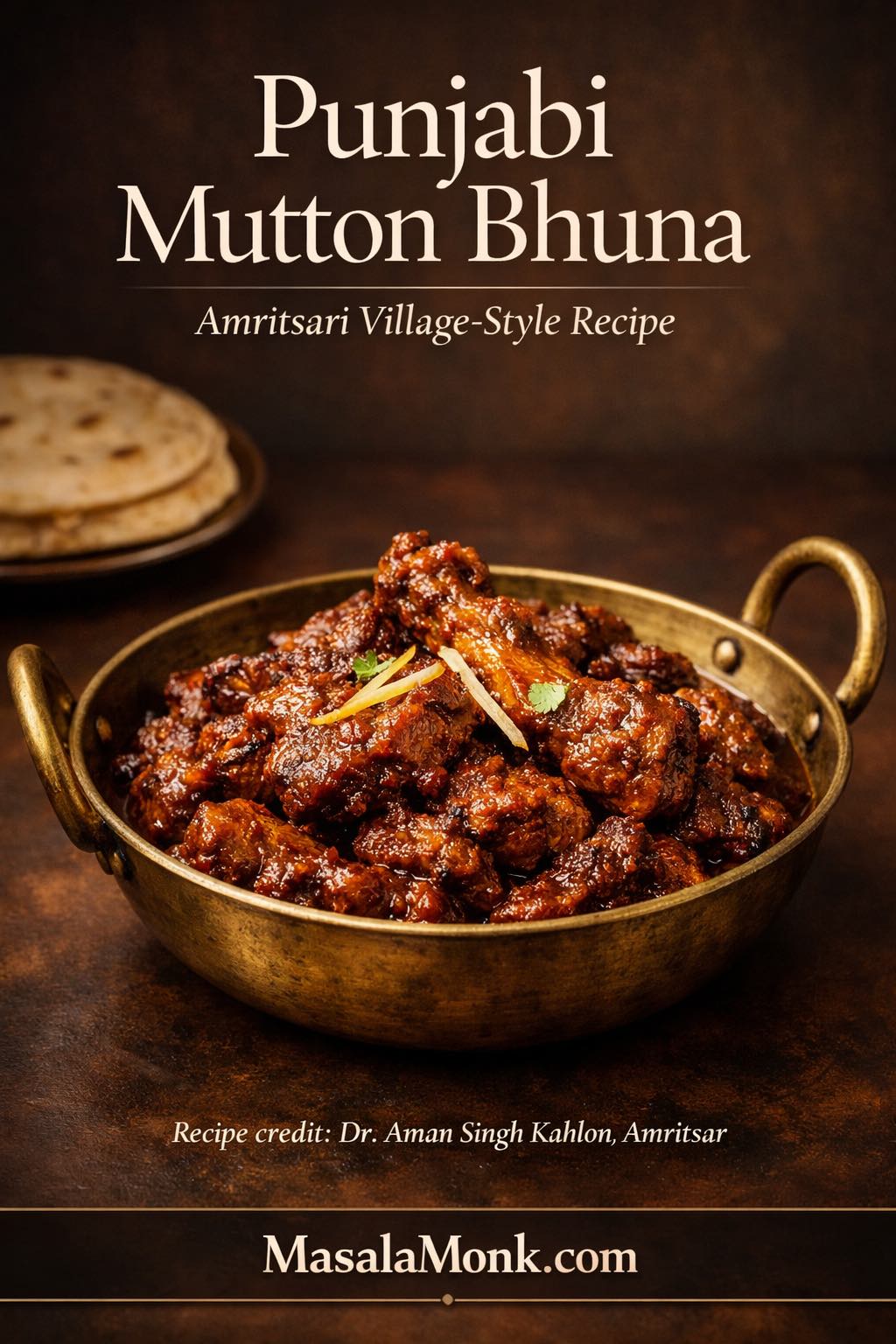
Punjabi Mutton Bhuna – Amritsari Village-Style Gosht Recipe

Punjabi mutton bhuna in a brass kadhai with thick reduced onion-tomato masala, styled as an Amritsari village-style recipe cover image with MasalaMonk branding

There are some dishes that belong to more than a kitchen. They belong to a season, a place, and a way of living. This Punjabi mutton bhuna is one of them. It brings to mind cold November days in the village, wheat sowing in the fields, smoke rising from open flame, and a meal coming together through many hands rather than one. Onions roast over the fire, tomatoes char and soften, garlic gets crushed fresh, and the mutton is watched patiently as it cooks. By the time everything is ready, the food tastes far richer than its short ingredient list suggests.

This recipe is shared with due credit to Dr. Aman Singh Kahlon, Amritsar, who remembers this style of mutton from childhood village visits during the winter sowing season. That memory explains the dish well. This is not a restaurant-style curry built on cream, curd, or a crowded masala base. It is a rustic bhuna shaped by mustard oil, charred onions, charred tomatoes, ginger, garlic, mutton fat, and patient reduction.

The result is thick, smoky, savory, and deeply comforting. The masala clings to the meat instead of floating around it. The spices support the flavor rather than overpower it. If you enjoy old-school Punjabi cooking that feels grounded and full of character, this is the kind of recipe that earns its place quickly.

Punjabi mutton bhuna recipe snapshot

Prep time: 25 to 30 minutes
Cook time: 1 hour 15 minutes to 1 hour 45 minutes
Serves: 4 to 6
Course: Main course
Cuisine: Punjabi / North Indian
Texture: Thick, reduced, masala-coated
Spice level: Mild to medium
Best for: Winter lunches, family dinners, slow weekend cooking
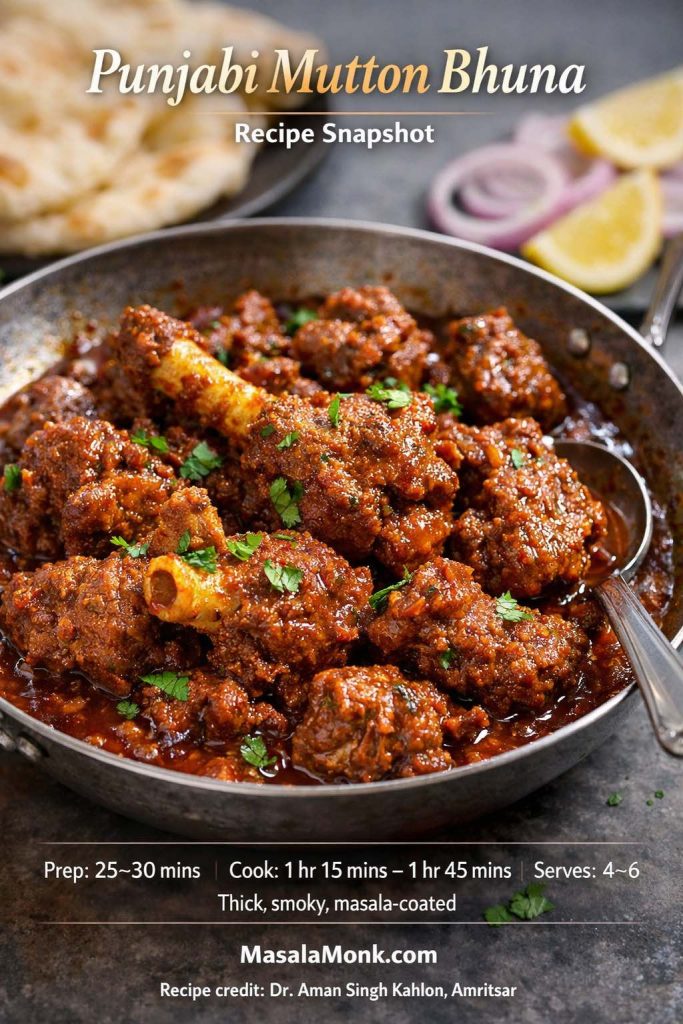
Punjabi mutton bhuna recipe snapshot showing a glossy, thick Punjabi-style mutton bhuna in a kadhai with bone-in pieces, deep reduced masala, and text overlay with prep time, cook time, serves, and texture notes.
This is the kind of mutton dish that should finish thick, smoky, and close-clinging rather than loose and gravy-heavy. Before you start, keep that texture target in mind, because the whole recipe is built around reduction, not excess sauce.

Also Read: Peach Cobbler with Canned Peaches (Dessert Recipe)

What makes this Punjabi mutton bhuna special

Charred onions and tomatoes change the base

Many mutton recipes begin with sliced onions fried in oil and tomatoes cooked down in the same pan. This one takes a more distinctive route. The onions are roasted directly over flame until soft and smoky, then pounded into a rough pulp. The tomatoes are charred until blistered and softened, then peeled and mashed the same way.

That one decision changes the flavor of the whole dish. The onions become sweeter and deeper. The tomatoes lose some of their raw sharpness and gain a fuller, fire-kissed savoriness. Once bhunoed together, they create a masala that tastes smokier, richer, and more elemental than a standard curry base.
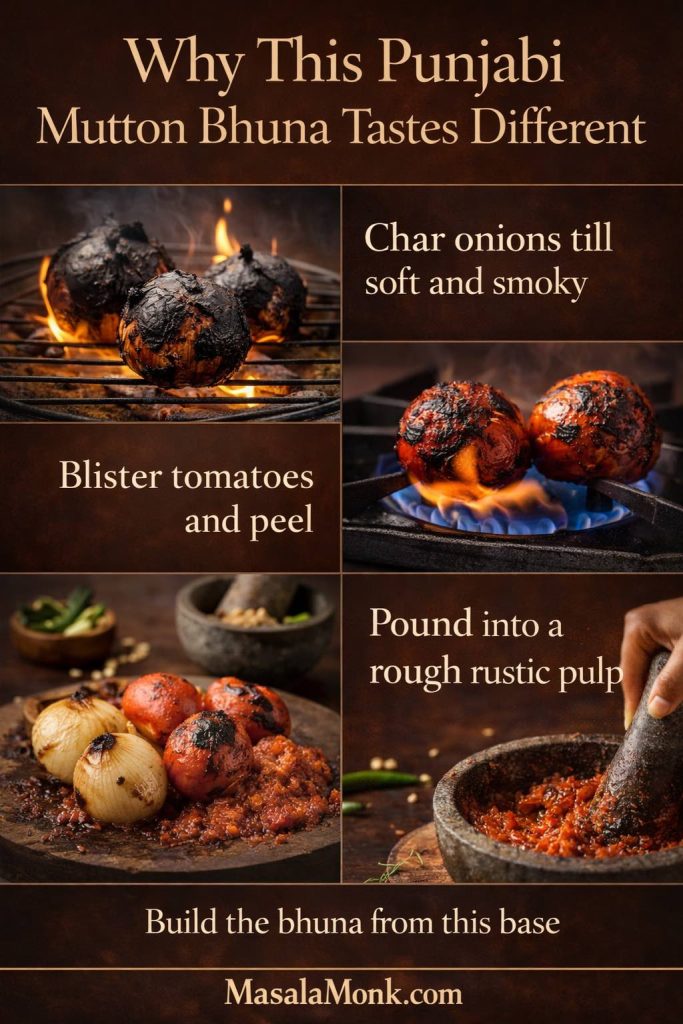
Charred onion and tomato base guide for Punjabi mutton bhuna showing fire-roasted onions and blistered tomatoes turned into a rustic pulp that gives the dish its smoky, deep, village-style masala base.
This fire-roasted onion-tomato base is what separates this bhuna from a more standard curry. The onions should soften under the char, the tomatoes should blister and sweeten, and both should stay slightly rustic so the final masala keeps its village-style character.

Bhuna mutton in Punjabi style is defined by technique

The word bhuna refers less to a fixed list of ingredients and more to a method built around frying, scraping, reducing, and concentrating flavor with very little free liquid. In South Asian cooking, bhuna-style dishes develop depth through repeated caramelization and minimal-moisture cooking rather than through a loose gravy. (Epicurious)

That is exactly why this recipe is finished as a thick, clingy preparation rather than a runny curry. The masala is meant to grip the meat.

Why mustard oil and mutton fat matter

Mustard oil gives this dish much of its backbone. Once heated properly, its raw edge mellows and leaves behind a bold, earthy depth that suits this style of Punjabi cooking beautifully.

The small amount of kidney fat matters too. It is not there to make the dish greasy. It is there to enrich the stock, deepen the masala, and give the finished bhuna a rounder, more savory body.

Why this Punjabi mutton bhuna recipe tastes different

This recipe does not depend on yogurt, cream, cashew paste, or a long list of spices. It trusts smoke, meat, mustard oil, and reduction to do most of the work. That simplicity is not a limitation. It is the reason the dish tastes so assured.

Also Read: Avocado Chocolate Mousse Recipe

Best ingredients for Punjabi mutton bhuna

  • 1 kg mutton, bone-in preferred
  • 50 grams mutton kidney fat, chopped
  • 3 large onions
  • 3 medium to large tomatoes
  • 2 to 4 green chillies
  • 10 to 12 garlic cloves, crushed
  • 1 tablespoon ginger paste
  • 3 tablespoons mustard oil
  • 1 teaspoon cumin powder
  • 1 tablespoon coriander powder
  • 1 to 1½ teaspoons Kashmiri red chilli powder
  • 1 to 1½ teaspoons salt, or to taste
  • 1 cup water, plus a little more only if needed
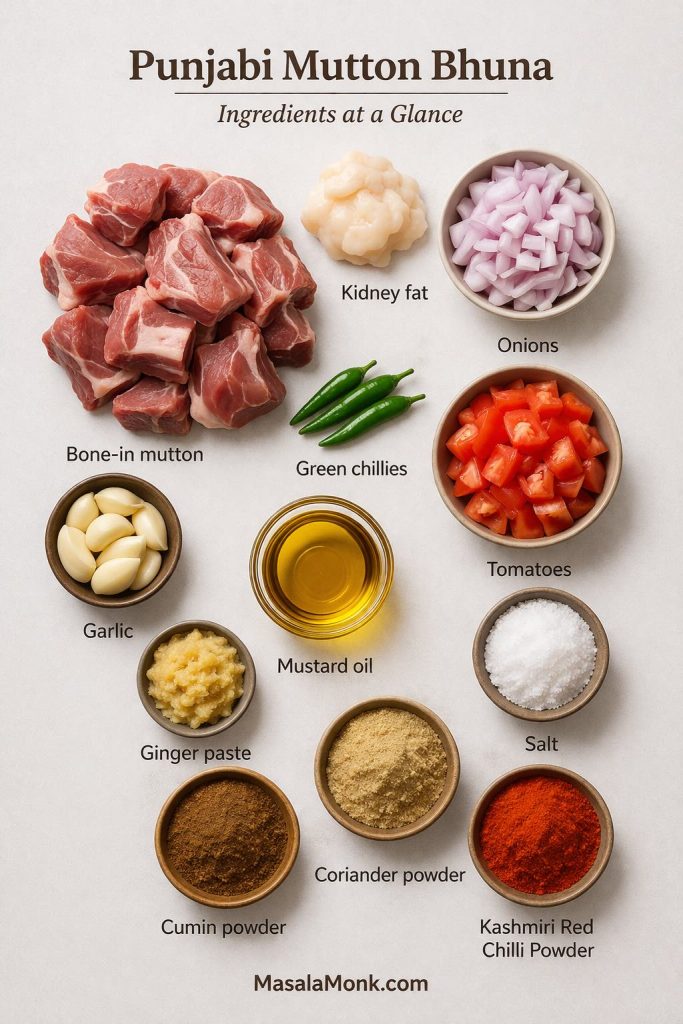
Punjabi mutton bhuna ingredients laid out and labeled, including bone-in mutton, kidney fat, onions, tomatoes, green chillies, garlic, ginger paste, mustard oil, salt, cumin powder, coriander powder, and Kashmiri red chilli powder.
The beauty of this Punjabi mutton bhuna lies in how focused the ingredient list is. Bone-in mutton gives the curry depth, kidney fat brings richness, mustard oil adds character, and the onion-tomato base carries the smoky rustic heart of the dish. Garlic, ginger, green chillies, cumin, coriander, and Kashmiri red chilli powder do not overcrowd the recipe; instead, they support the bhuna and help it cook down into a thick, glossy masala that clings to the meat instead of sitting loose around it.

Also Read: Falafel Recipe: Crispy Homemade, Air Fryer and Baked Falafel

Ingredient notes for the best Punjabi mutton bhuna

Best cut of mutton for this bhuna mutton recipe

Bone-in mutton works best here because it gives a fuller stock and holds up well through the two-stage cooking process. Medium pieces are better than very small ones, since tiny pieces can overcook by the time the bhuna is fully reduced.

Why kidney fat helps

The quantity is small, but it makes a real difference. As it cooks, the fat enriches both the early stock and the final masala. The result is more savory depth and better mouthfeel without making the dish heavy.
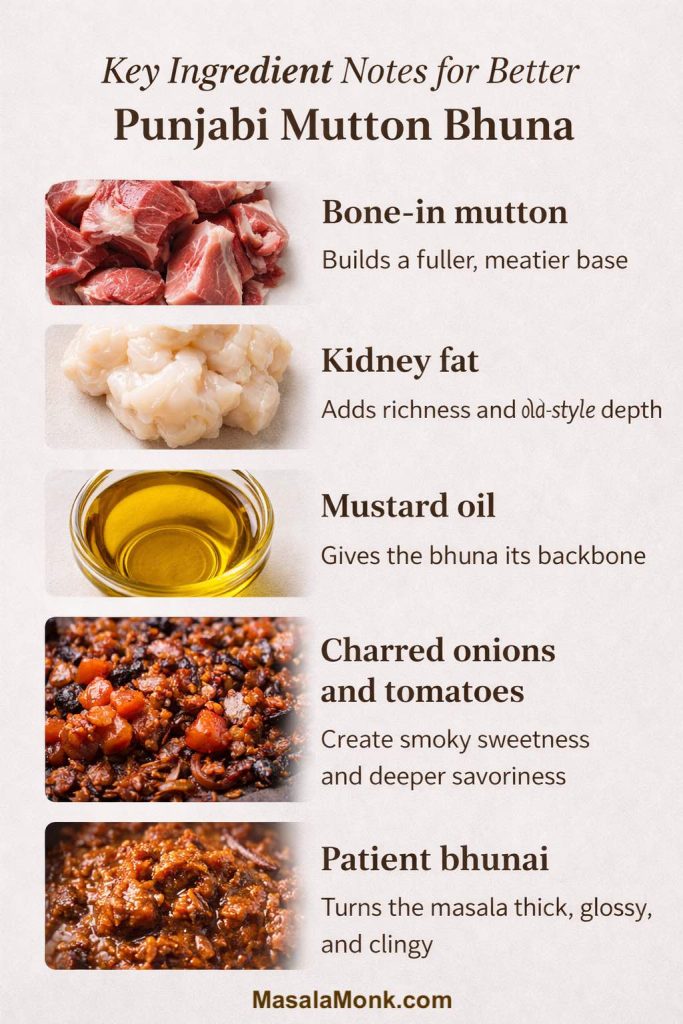
Key ingredient notes graphic for Punjabi mutton bhuna showing bone-in mutton, kidney fat, mustard oil, charred onions and tomatoes, and patient bhunai as the elements that build a thick, smoky, glossy Punjabi-style mutton bhuna.
What makes this Punjabi mutton bhuna memorable is not a long ingredient list but the way a few powerful choices shape the final dish. Bone-in mutton gives the curry a fuller, meatier base, kidney fat adds the kind of richness that makes the bhuna feel deep and old-school, and mustard oil brings the sharp backbone that keeps the masala from tasting flat. From there, the charred onions and tomatoes build the smoky sweetness that sets this recipe apart, while patient bhunai cooks everything down into the thick, glossy, clingy finish that should coat the meat rather than pool around it.

Mustard oil, chillies, and texture notes

Mustard oil is strongly recommended because it suits the flavor profile of this dish so well. Heat it properly before adding aromatics so the raw smell softens.

Kashmiri chilli powder brings color and gentle warmth rather than aggressive heat. The sharper heat comes from the green chillies, so adjust them to taste.

Keep the charred onion and tomato mixture slightly coarse. A completely smooth puree will push the dish toward generic restaurant-style gravy, while a rougher pulp keeps it true to its rustic identity.

Also Read: Mango Margarita Recipe (Frozen or On the Rocks)

How to make Punjabi mutton bhuna (step by step recipe)

This recipe becomes straightforward once you understand the sequence. First, the mutton is partially cooked. Then the onions and tomatoes are charred and pounded. After that, the masala is built in mustard oil, the spices are cooked into the base patiently, and the meat is finished in the reduced masala until everything turns thick, glossy, and deeply flavorful.

Quick method summary for Punjabi mutton bhuna

If you want the full flow at a glance before you begin, this is the sequence that matters most.

  1. Part-cook the bone-in mutton with kidney fat, salt, and a little water until it is about 80 percent done. Keep the stock.
  2. Char the onions until softened inside, then peel and pound them with green chillies into a rough pulp.
  3. Char the tomatoes until blistered and soft, peel them, and pound them into a coarse rustic pulp.
  4. Heat mustard oil and fry the garlic and ginger briefly to remove their raw edge.
  5. Add the onion mixture and bhuno it patiently until it tightens, deepens, and smells sweeter.
  6. Add cumin, coriander, and Kashmiri chilli powder, then stir in the tomato pulp.
  7. Cook the masala until it thickens, darkens slightly, and begins showing traces of oil around the edges.
  8. Return the mutton and stock to the pan, then reduce everything until the masala turns thick, glossy, and clingy around the meat.
  9. Rest briefly before serving so the bhuna settles and coats the mutton even better.

That is the full structure of the dish. The detailed step by step method below will help you judge each stage more confidently.

Step 1: Part-cook the mutton for Punjabi-style bhuna mutton

Place the mutton and chopped kidney fat in a pressure cooker or heavy-bottomed pan. Add 1 cup water and about 1 teaspoon of salt.

If using a pressure cooker, cook until the meat is about 80 percent done. In many home cookers, this may be around 4 to 6 whistles on medium heat, though the exact timing depends on the cut and age of the meat. Go by texture rather than whistle count alone. The meat should feel mostly cooked but still offer slight resistance.
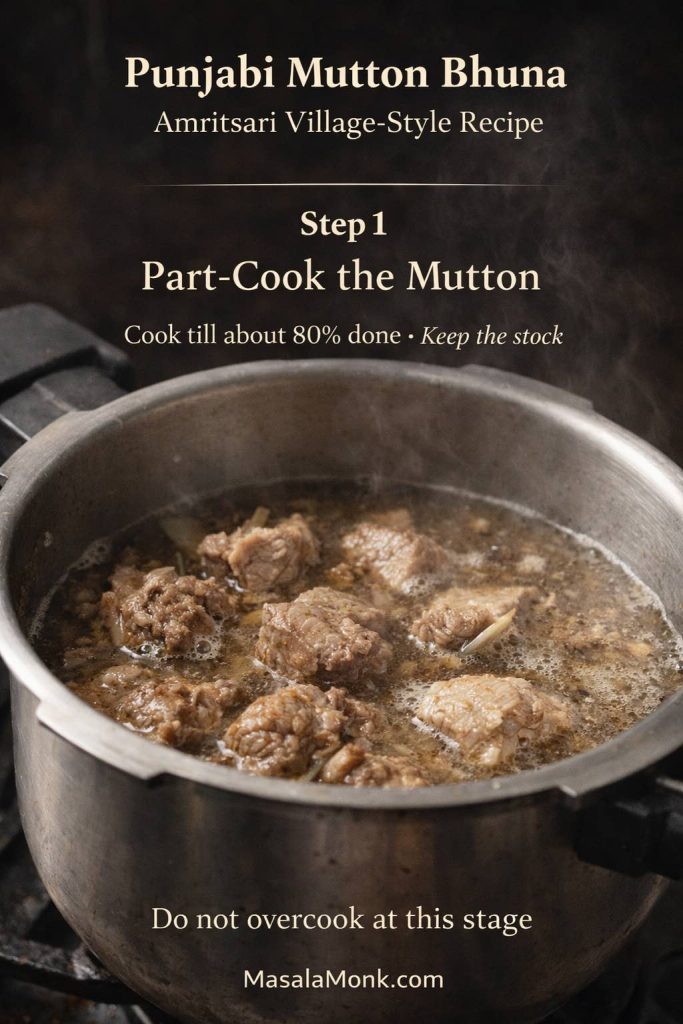
Step 1 image for Punjabi mutton bhuna showing bone-in mutton partially cooked in a pressure cooker with light stock before the final bhuna stage.
Step 1 in this Punjabi mutton bhuna recipe is to part-cook the bone-in mutton until it is about 80% done, then keep the stock for the final bhuna. This early stage builds the base of the dish without overcooking the meat, so the mutton can finish properly later in the thick onion-tomato masala.

If using a pan, cover and cook over medium to medium-low heat for about 35 to 50 minutes, checking occasionally. Add a small splash of water only if the pan begins to dry too much.

Once nearly done, set the meat and stock aside. Keep all the stock. It becomes part of the final bhuna.

Step 2: Char the onions and tomatoes

Roast the onions directly over open flame or hot coals until the outside blackens in patches and the insides soften well. You want smoke and sweetness, not a harsh burnt bitterness.

When cool enough to handle, peel away the burnt outer layer and keep the softened onion flesh. Pound it with the green chillies into a rough pulp. A mortar and pestle is ideal, but a blender on pulse mode works too.
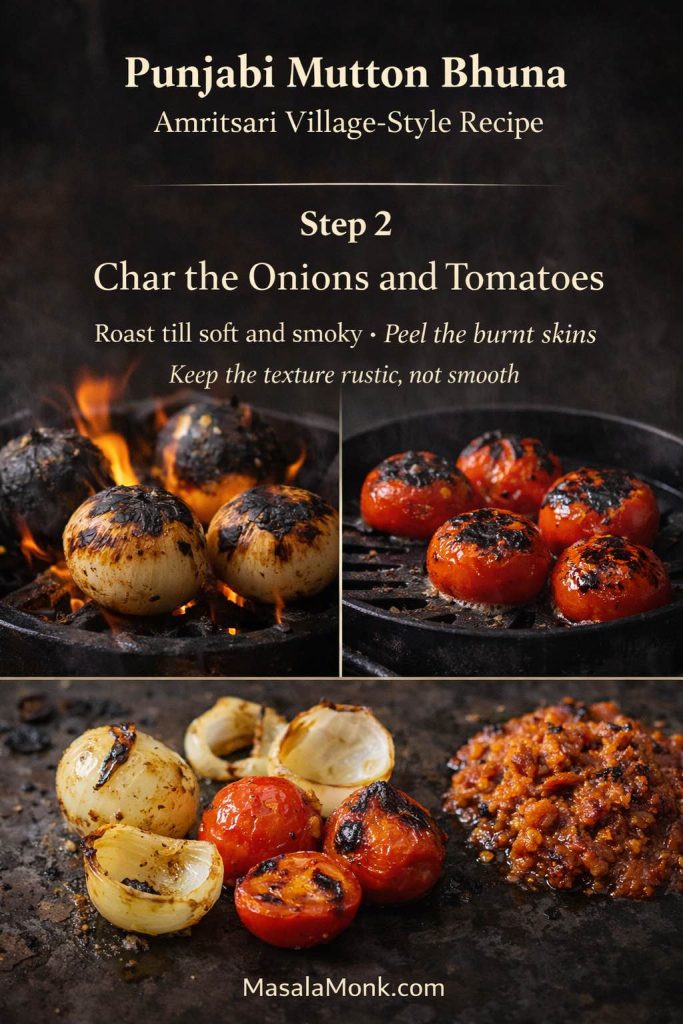
Step 2 image for Punjabi mutton bhuna showing onions and tomatoes charred over flame, peeled, and prepared into a rustic base for the bhuna.
Step 2 is where this Punjabi mutton bhuna starts building its signature flavor. The onions are charred till soft and smoky, the tomatoes are blistered and peeled, and both are kept rustic rather than pureed smooth. That fire-roasted base is what gives the final bhuna its deeper, smokier character.

Now char the tomatoes until their skins blister and loosen and the flesh softens visibly. Peel away the skins and pound the tomatoes into a coarse pulp.

Both mixtures should look rustic rather than polished. A little uneven texture is a good thing here.

Step 3: Build the bhuna mutton masala base

Heat the mustard oil in a heavy kadhai until it comes up to temperature and the raw smell mellows. Reduce the heat slightly and add the crushed garlic and ginger paste.

Fry for 1 to 2 minutes, stirring so the garlic does not catch. You want the rawness to leave without pushing the aromatics into bitterness.
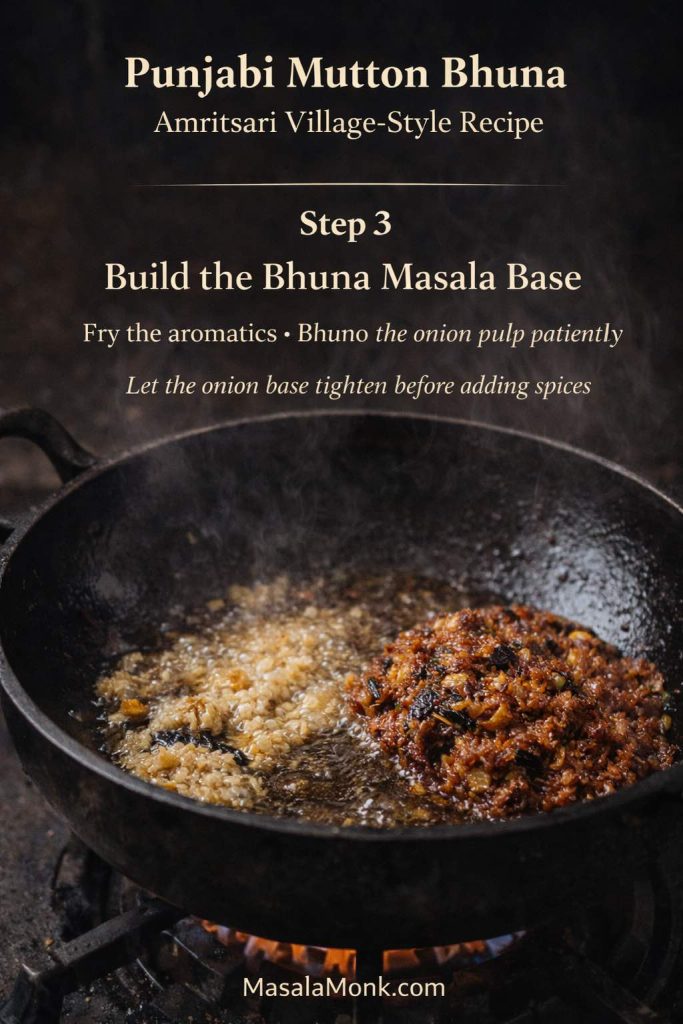
Step 3 is where Punjabi mutton bhuna starts taking on its real character. The mustard oil heats the pan, the ginger and garlic lose their raw edge, and the charred onion mixture begins to bhuno into a deeper, richer base. This stage should start loose and glossy, then slowly tighten as the flavors deepen before any powdered spices are added.

Add the charred onion and green chilli pulp. Also add any soft fatty bits or rendered fat from the partially cooked mutton. Start bhunoing this mixture over medium heat.

At first the onion mixture will look loose and wet. Keep stirring and scraping the pan. Over the next 8 to 12 minutes, it should darken slightly, tighten, and smell sweeter and deeper. Lower the heat a little if it begins sticking too fast. The onion base needs time to fry properly before the powdered spices go in.

Step 4: Add the spices and bhuno patiently

Add the cumin powder, coriander powder, and Kashmiri red chilli powder to the onion base. Stir right away so the spices bloom evenly in the fat.

Cook for about a minute, then add the charred tomato pulp. The mixture will loosen again. Keep cooking over medium heat, stirring often, and do not let the masala catch at the bottom.
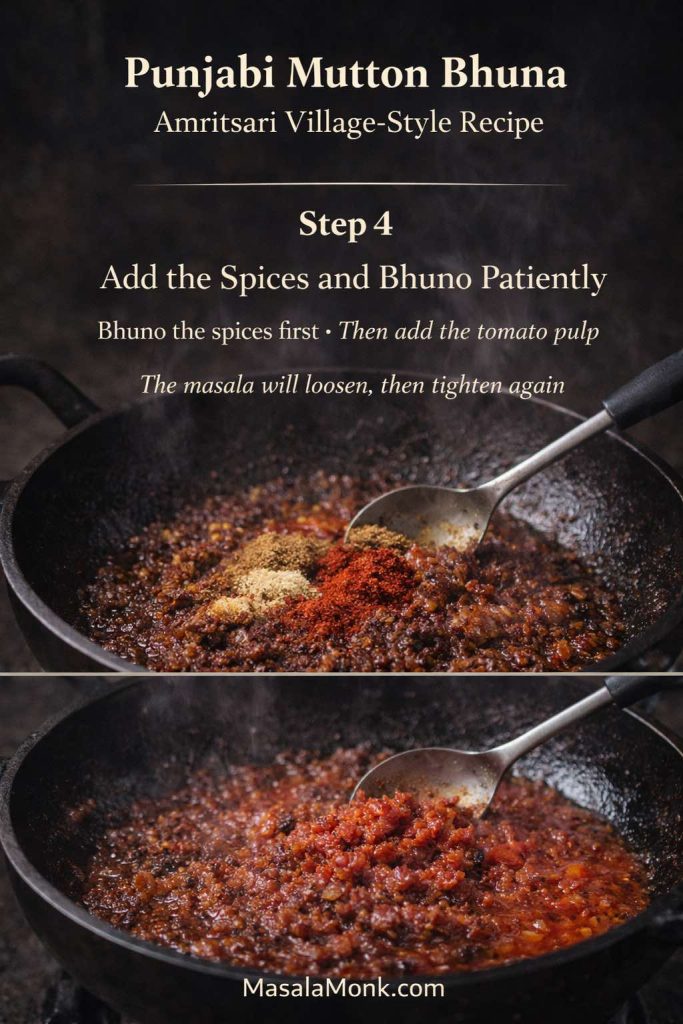
Step 4 image for Punjabi mutton bhuna showing powdered spices bhunoed in the onion base first, then charred tomato pulp added as the masala loosens before tightening again.
Step 4 is where the bhuna masala deepens and changes character. First the cumin, coriander, and Kashmiri chilli powders are bhunoed briefly in the fried onion base, then the charred tomato pulp is added. The mixture loosens at first, but as it cooks down, the masala tightens, darkens, and begins moving toward the rich, clingy finish that defines Punjabi mutton bhuna.

As the moisture cooks away, the masala will begin to tighten. The color will deepen, the aroma will round out, and traces of oil will start appearing around the edges. That is the sign that the bhunai is moving in the right direction.

This stage usually takes another 8 to 10 minutes. When you drag a spoon through the pan, the masala should briefly part and gather back more thickly rather than flow like a thin sauce.

Step 5: Finish the Punjabi mutton bhuna until thick and clingy

Add the partially cooked mutton and all the remaining stock. Mix thoroughly so the meat gets coated in the bhuna base.

Cook over medium heat, stirring often, until the stock reduces and the masala begins to cling closely to the meat. This stage is not only about reheating the meat. It is where the dish turns from cooked ingredients into a finished bhuna.
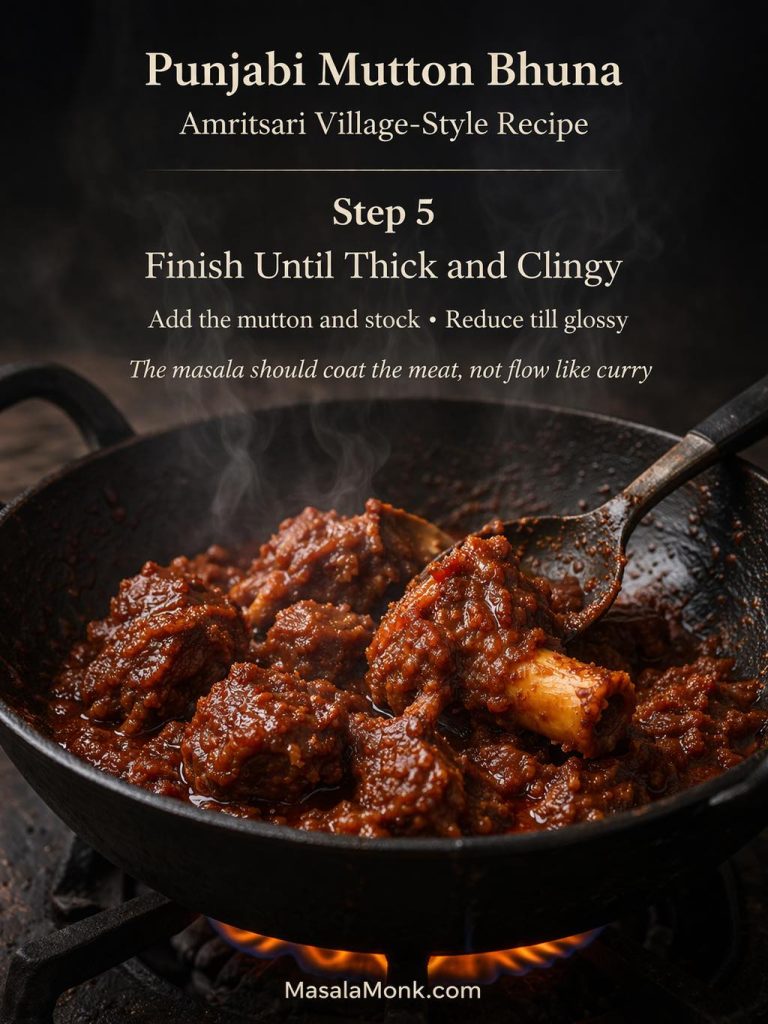
Step 5 image for Punjabi mutton bhuna showing the final bhuna stage, where bone-in mutton cooks in a thick glossy masala until the coating clings to the meat.
Step 5 is where Punjabi mutton bhuna becomes what it is meant to be: thick, glossy, and deeply reduced. The partially cooked mutton goes back into the masala with the stock, then cooks down until the sauce no longer runs like curry and instead clings closely to every piece. This is the stage that gives bhuna mutton its rich, concentrated finish.

Depending on how much stock remains, this may take 10 to 20 minutes. Taste for salt during the last few minutes, since reduction will intensify seasoning.

The finished dish should look glossy and deeply colored. The masala should coat the meat rather than drip off it. There should be enough moisture to keep every bite juicy, but not enough for the dish to feel like a loose curry.
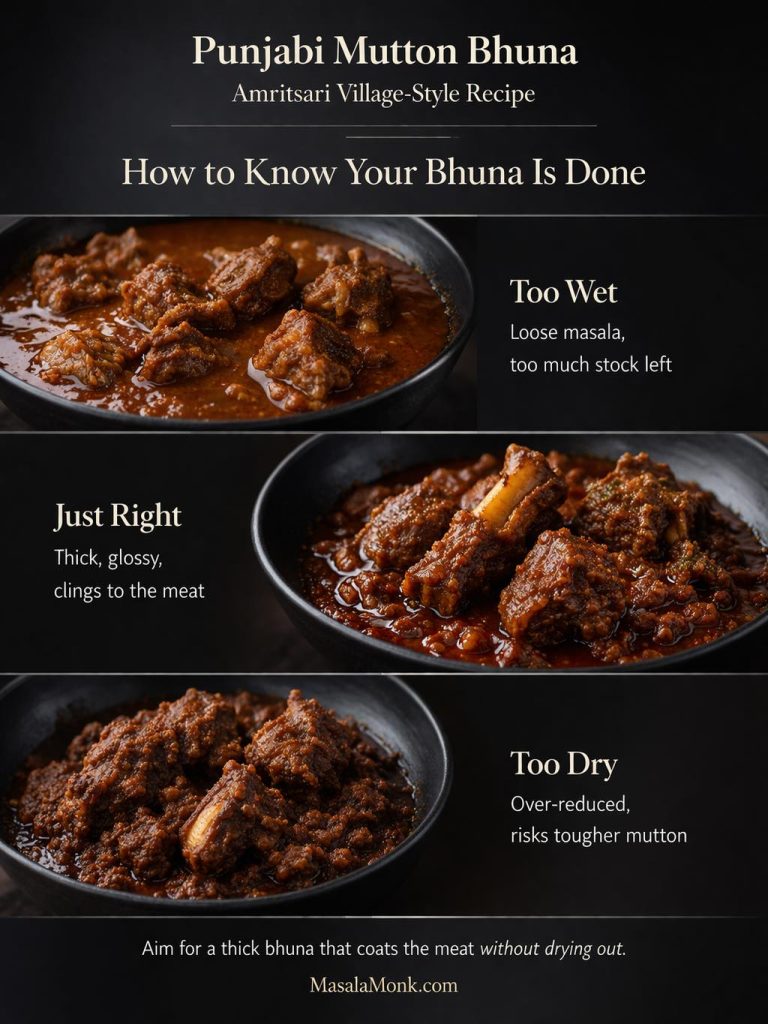
Texture guide for Punjabi mutton bhuna showing three stages of doneness: too wet, just right, and too dry, with the ideal thick glossy bhuna texture highlighted.
The sweet spot is a masala that holds to the meat without turning dry. Too much liquid and the dish feels diluted; too little and the richness turns heavy instead of balanced.

Also Read: Sourdough Pizza Dough Recipe (Crispy Crust & Easy Pizza Base)

Pressure cooker vs pan method for Punjabi mutton bhuna

Pressure cooker method for bhuna mutton in Punjabi style

A pressure cooker is the more practical route for most home kitchens. It tenderizes the mutton efficiently and shortens the first stage significantly. That fits this recipe well because pressure cookers are especially suited to foods that are naturally tough or require longer cooking times. (ISU Extension and Outreach Blogs)

The key is to stop before the meat is fully done. Once the mutton returns to the pan for the bhuna, it still needs time to absorb the masala and finish properly.
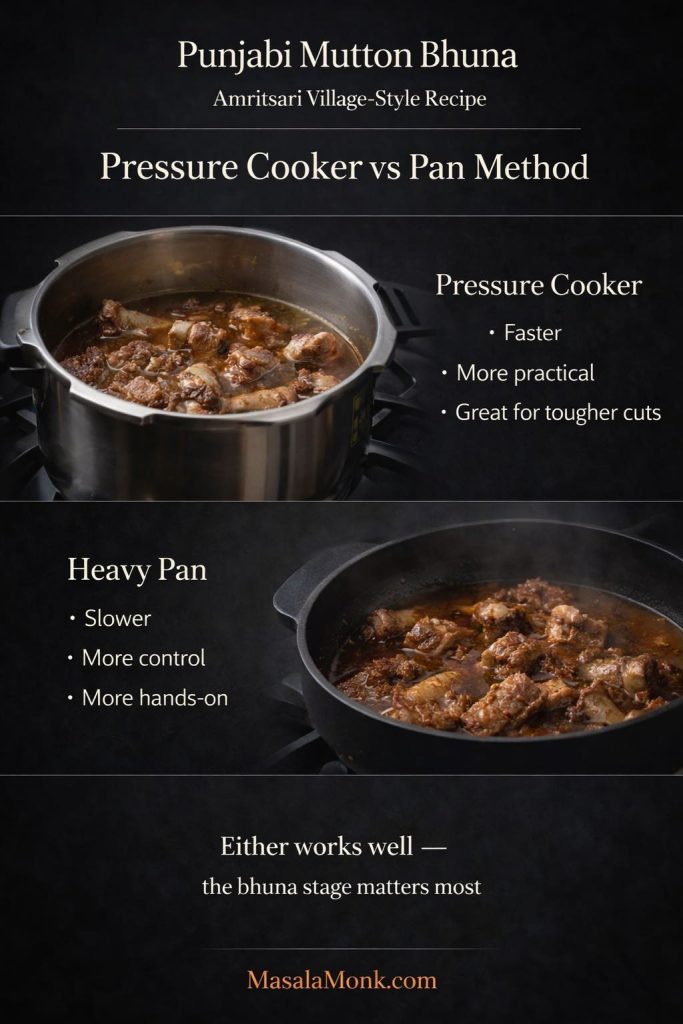
Comparison image for Punjabi mutton bhuna showing pressure cooker and heavy pan methods side by side, highlighting faster cooking versus slower more controlled cooking.
Choosing between a pressure cooker and a heavy pan changes the pace of the recipe more than the final flavor. The cooker gets the mutton close to tender faster, while the pan gives you a slower, steadier route with a little more control before the bhuna stage does its real work.

Pan method

A heavy pan gives you more gradual control and feels closer to the slower rhythm of the dish’s original setting. It suits cooks who do not mind spending a bit more time and paying closer attention to liquid levels.

This method can give excellent results, but it asks for more patience. You need to watch the meat, stir occasionally, and make sure the pan never dries out too far.

Which one should you choose for Punjabi-style bhuna mutton

Choose a pressure cooker when time matters. Choose a pan when you want slower control. In either case, the final flavor depends more on the quality of the bhuna than on the first cooking vessel. Save the stock, do not overcook the meat early, and let the reduction stage do its work.

Also Read: Balti Paneer Gravy (Restaurant-Style, Creamy + Bold Recipe)

Tips for the best Punjabi mutton bhuna

Roast for softness, not just blackening

The onions and tomatoes should not merely look charred. They must soften properly too. That softened interior is what gives the dish sweetness and body.
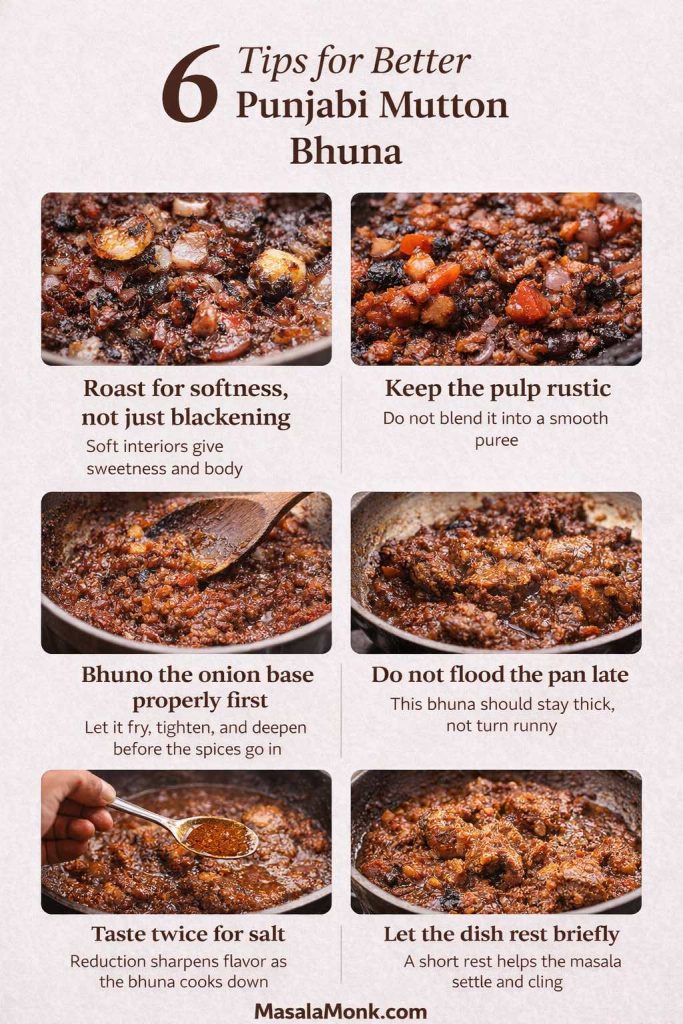
Tips graphic for Punjabi mutton bhuna showing six cooking tips: roast onions and tomatoes for softness, keep the pulp rustic, bhuno the onion base properly, avoid adding too much water late, check salt twice, and let the finished bhuna rest before serving.
The best Punjabi mutton bhuna comes from restraint as much as flavor. Roast the onions and tomatoes until they soften, not just blacken, keep the pulp rough instead of blending it smooth, and give the onion base enough time to bhuno before the spices go in. Just as importantly, do not loosen the pan late with extra water, taste again for salt after reduction sharpens everything, and let the finished bhuna rest briefly so the masala settles and clings more beautifully to the meat.

Keep the pulp rustic

A completely smooth puree makes the dish feel more generic. A rougher pulp gives the bhuna more character and a more grounded texture.

Bhuno the onion base properly first

Do not rush into the spice stage. The onion mixture needs time to fry, tighten, and deepen before the cumin, coriander, and chilli go in.

Do not flood the pan late

This is a bhuna, not a flowing curry. Too much extra water at the end will flatten the texture and dilute the concentration you worked to build.

Taste twice for salt

Salt lightly in the first stage, then check again near the end. Reduction sharpens everything.

Let the dish rest briefly

Even 10 minutes off the heat helps the masala settle and cling more beautifully before serving.

Also Read: Mojito Recipe (Classic) + Ratios, Pitcher, Mocktail & Easy Variations

What to serve with bhuna mutton in Punjabi style

Best breads and rice

This dish likes simple company. Hot rotis are an excellent match, especially if they are sturdy enough to scoop up the thick masala. Plain parathas work very well too.

If you prefer rice, keep it uncomplicated. Plain steamed rice or jeera rice lets the bhuna stay the focus of the plate.
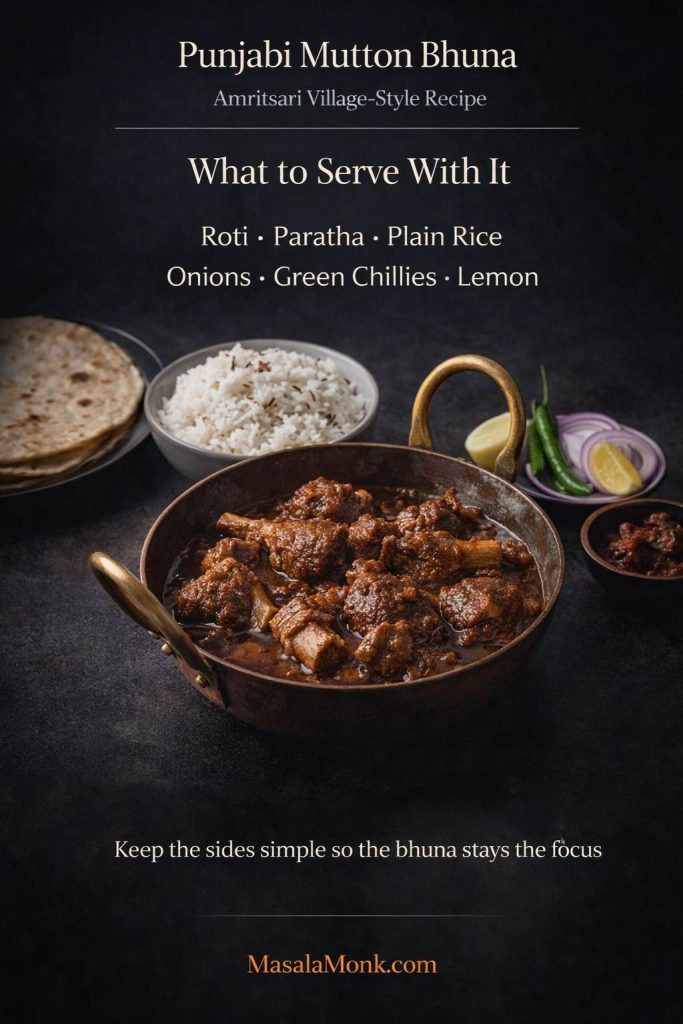
Serving suggestions for Punjabi mutton bhuna showing the dish with roti, plain rice, sliced onions, green chillies, lemon, and pickle.
Punjabi mutton bhuna pairs best with simple sides that let the rich masala stay at the center of the meal. Roti, paratha, or plain rice work beautifully, while sliced onions, green chillies, and a squeeze of lemon add the sharp contrast that this deep, smoky dish loves.

Sides and finishing touches

Sliced onions, green chillies, and a wedge of lemon fit the spirit of the dish especially well. They cut through the richness without distracting from it. A sharp pickle can also work, though use it lightly because the bhuna already carries plenty of depth.

Related Punjabi comfort dishes

If you enjoy this kind of hearty North Indian cooking, you may also want to explore Punjabi-style rajma curry on days when you want something comforting but meat-free. For another bold gravy-style main, Balti Paneer Gravy is a good next stop. And for a classic favorite in a richer, creamier lane, butter chicken offers a very different but equally satisfying dinner mood.

Also Read: Paloma Recipe: 12 Paloma Cocktail Drinks

How to store and reheat Punjabi mutton bhuna

This bhuna stores well, and like many reduced meat dishes, it often tastes even better after a little rest. The smoke, stock, fat, and spice settle into each other more fully, and the masala seems to grip the meat even better the next day.

Let the dish cool fully, then refrigerate it in an airtight container for up to 2 days.
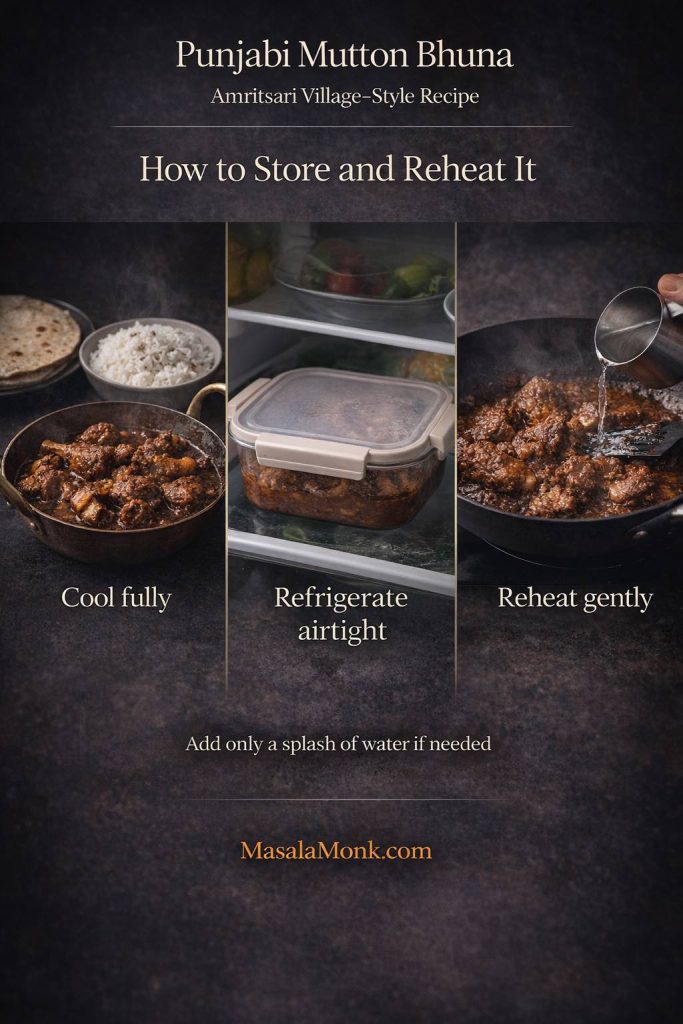
Storage and reheating guide for Punjabi mutton bhuna showing how to cool fully, refrigerate in an airtight container, and reheat gently with only a small splash of water if needed.
Punjabi mutton bhuna keeps well when the rich masala is handled gently after cooking. Let it cool fully before refrigerating, store it airtight, and reheat slowly so the thick bhuna texture loosens just enough without turning back into a thin curry.

To reheat, transfer it to a pan and warm gently over low heat. Add only a small splash of water if needed. The goal is to loosen the masala just enough, not turn it back into a thin curry.

If you know you want leftovers, you can stop the final reduction a touch earlier, since reheating will tighten the dish slightly more.

Also Read: Air Fryer Donuts Recipe (2 Ways): Glazed Homemade Donuts + Biscuit Donuts

Final thoughts on Punjabi mutton bhuna

Some dishes impress through abundance. This one impresses through confidence. It uses very little that feels unnecessary. There is no attempt to hide the mutton under excess spice or smooth everything into a polished restaurant gravy. Instead, it leans into smoke, mustard oil, fat, and reduction.

That is what gives the recipe its grounded appeal. The charred onions bring sweetness, the tomatoes bring depth, the mutton fat gives savoriness, and the bhuna ties everything together into one thick, flavorful coating.

With due credit to Dr. Aman Singh Kahlon, Amritsar, this recipe preserves a beautiful style of winter village cooking in a form that still makes perfect sense in a home kitchen today. Serve it hot, serve it slowly, and let the masala do what it is meant to do.
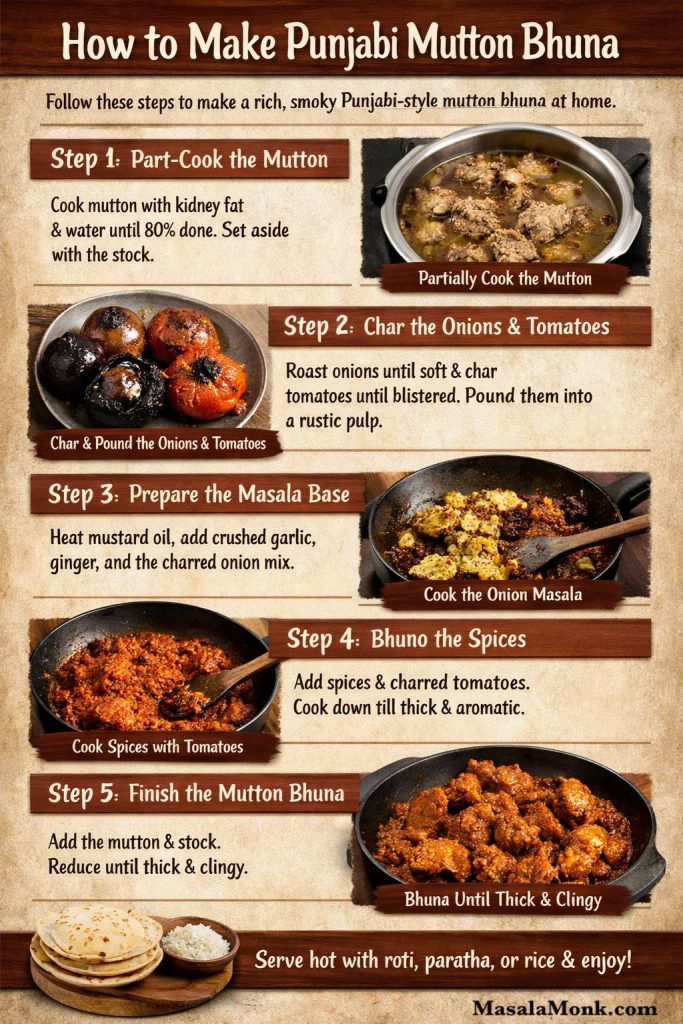
Step-by-step infographic showing how to make Punjabi mutton bhuna, including part-cooking the mutton, charring onions and tomatoes, building the masala base, bhunoing the spices, and finishing until thick and clingy.
Use this as a quick visual map of the recipe, but let the written method guide the details. The real success of this dish comes from texture cues: partly cooked meat, softened charred vegetables, a properly fried base, and a final reduction that turns clingy and glossy.

Also Read: Chicken Pesto Pasta (Easy Base Recipe + Creamy, One-Pot, Baked & More)

Punjabi mutton bhuna FAQs

1. Can I make punjabi mutton bhuna without a pressure cooker?

Yes. A heavy pan works well too. It simply takes longer and needs more attention.

2. Can I use lamb instead of goat meat in punjabi mutton bhuna?

Yes. The flavor will be slightly milder and fattier, but the method still works.

3. Can I make it without kidney fat?

Yes, though the finished punjabi mutton bhuna may taste a little less rich and rounded.

4. Why are the onions and tomatoes charred first?

Because that is one of the defining flavor moves in this recipe of punjabi bhuna mutton. Charring adds smoke, sweetness, and depth before the bhunai even begins.

5. Can I skip charring if I do not have open flame?

You can roast the onions and tomatoes on a very hot tawa, under a broiler, or in a hot oven until blistered and softened. That still gives you some roasted depth.

6. Can I make punjabi mutton bhuna without mustard oil?

Yes, but the character changes. A neutral oil will work, though the dish loses some of its Punjabi rustic edge.

7. How do I know when the bhuna stage is done?

The masala should look thick, glossy, and cohesive. It should cling to the meat, with small traces of oil visible around the edges.

8. Why does my bhuna taste watery?

Usually because the final reduction was not taken far enough or too much water was added late.

9. Is punjabi mutton bhuna very spicy?

Not necessarily. The Kashmiri chilli powder mainly adds color and mild warmth. The sharper heat comes from the green chillies.

10. Can I make it ahead?

Yes. Punjabi mutton bhuna often tastes even better after a few hours or the next day.

11. Is there a safe temperature reference for mutton or goat?

For whole cuts of goat or similar red meats, USDA guidance uses 145°F / 62.8°C with a rest period, while ground meat should reach 160°F / 71.1°C. In a dish like this, though, tenderness usually comes from cooking well past bare-minimum doneness until the meat softens properly in the bhuna. (Food Safety and Inspection Service)

Also Read: Tapas Recipe With a Twist: 5 Indian-Inspired Small Plates
Posted on 1 Comment

Basmati Rice: Nutritional Facts and Glycemic Analysis

Basmati Rice: Nutritional Facts and Glycemic Analysis

If you love rice but worry about blood sugar spikes, you’re not alone. Rice is a staple for billions, but most varieties have a high glycemic index (GI), sending glucose levels soaring. Enter Basmati rice—a flavorful, aromatic long-grain rice with a reputation for being gentler on blood sugar. But how true is that claim? What do nutrition experts—and real users—actually experience? Let’s dig in.


1. What Makes Basmati Rice Unique?

Basmati rice is known for its:

  • Long, slender grains
  • Distinct nutty aroma and fluffy texture
  • Higher amylose content (a starch that digests more slowly)
  • Origins in the Himalayan foothills of India and Pakistan

These features aren’t just for foodies—they also affect how your body digests and absorbs the rice, directly impacting blood sugar.


2. Basmati Rice Nutritional Facts (Latest Data)

Per 100g Cooked (White Basmati)

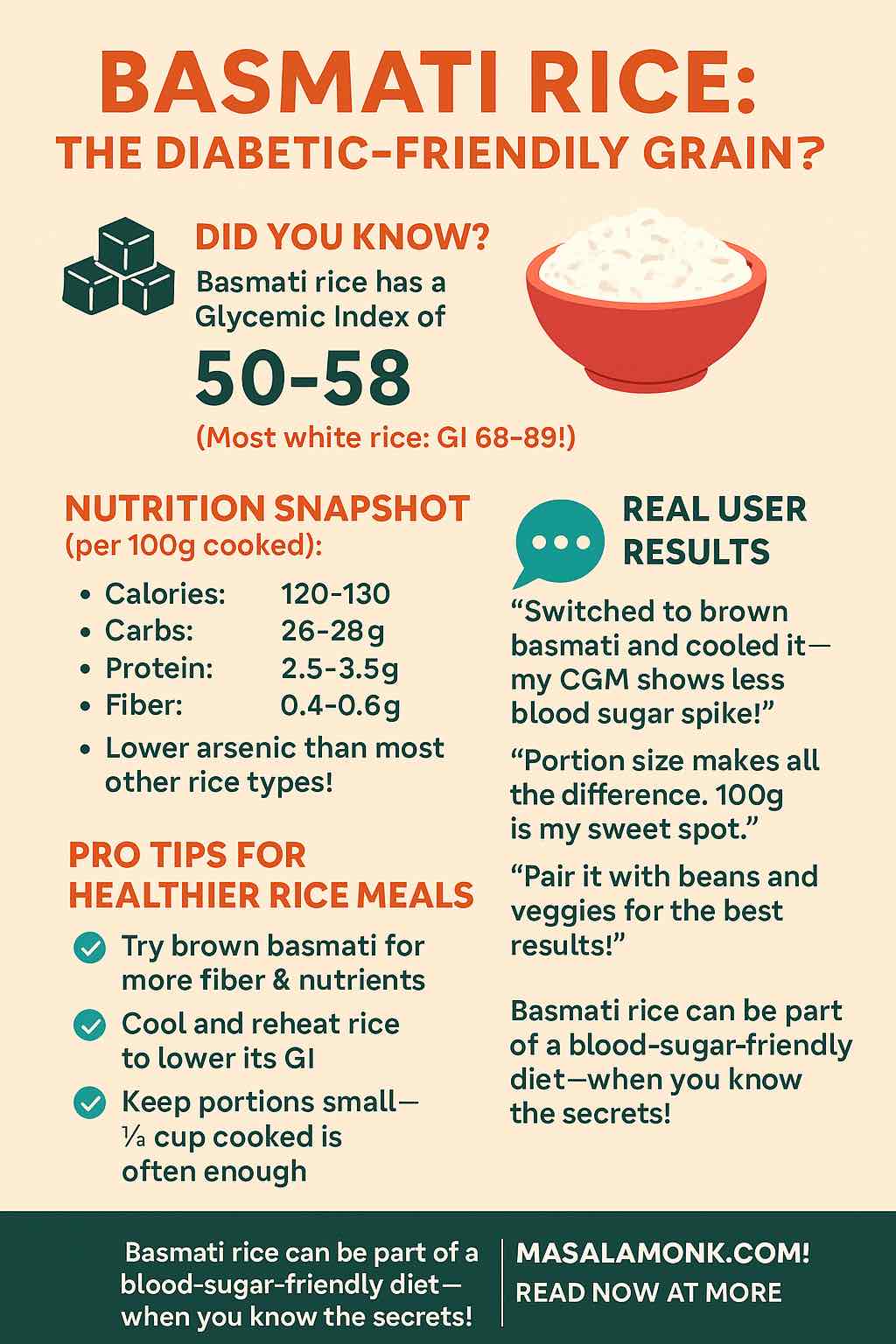
  • Calories: 120–130 kcal
  • Carbohydrates: 26–28 g
  • Protein: 2.5–3.5 g
  • Fat: 0.3–0.5 g
  • Fiber: 0.4–0.6 g
  • Sodium: 1–5 mg
  • Potassium: ~30 mg
  • Micronutrients: Small amounts of B vitamins, iron, magnesium, phosphorus, zinc
  • Arsenic: Basmati, especially from India/Pakistan/California, contains less arsenic than most rice varieties

Brown Basmati: More fiber (~1.5–2g/100g), more minerals, and slightly more protein than white.


3. Glycemic Index (GI) & Glycemic Load (GL): What the Science Says

Glycemic Index (GI)

  • White Basmati Rice: GI 50–58 (low to medium)
  • Brown Basmati Rice: GI 45–55 (low)
  • Typical White Rice (e.g., Jasmine): GI 68–80 (high)

Glycemic Load (GL)

  • White Basmati: GL ~12–15 per 100g serving (moderate)
  • Brown Basmati: Slightly lower GL

What Do These Numbers Mean?

  • Lower GI and GL = slower, steadier blood sugar rise
  • Basmati’s higher amylose content and firmer texture mean it’s digested more slowly than most white rice, leading to smaller glucose spikes.

4. User Experiences: Does Basmati Really Help Control Blood Sugar?

We scoured Reddit, diabetes forums, and health blogs for unfiltered user feedback. Here’s what real people say:

Positive Experiences

  • Low-GI basmati reduces glucose spikes:
    “I’ve been using low-GI basmati rice since December. It has substantially reduced post-meal sugar spikes that I observed repeatedly using Dexcom G7.” (Reddit/Diabetes)
  • Brown basmati even better:
    “Brown basmati rice causes a smaller spike than regular brown rice. That spike is almost eliminated by refrigerating the rice before heating it.”
  • Cool rice, better results:
    “I started making basmati, cooling it overnight, and reheating. I notice my blood sugar doesn’t rise as much—probably due to the resistant starch.”

Mixed or Cautious Experiences

  • Serving size is everything:
    “Portion size matters a LOT. 100g cooked rice is fine, but if I double that, my glucose still jumps.”
  • Not spike-free for everyone:
    “Even with basmati, my sugar can hit 150, but my doctor says that’s okay. Brown basmati helps more.”
  • Meal composition matters:
    “Rice alone spikes me. Pair it with beans or eggs and veggies, and I barely notice a rise.”

Takeaways from Users

TipWhy It Works?
Refrigerate before servingIncreases resistant starch, lowers GI
Small portionsLess carbs = less glucose spike
Mix with protein/fiberSlows absorption, gentler response
Try low-GI brandsLabeled “diabetic friendly” basmati

5. Practical Strategies: Cooking, Serving, and Pairing for Lower GI

Choose the Right Rice

  • Look for certified low-GI basmati (brands like Laxmi, Daawat, Crown Diet)
  • Brown basmati has more fiber, nutrients, and lower GI

Cook Smart

  • Do not overcook (keep grains firm for higher amylose)
  • Soak rice for 20–30 minutes before cooking—may slightly reduce arsenic
  • Cool and reheat: Cook rice, cool in the fridge for 8+ hours, then reheat—boosts resistant starch, which your body digests more slowly

Portion Control

  • Start with ½ cup cooked (about 100g)—see how your body responds before increasing

Pair Wisely

  • Always serve rice with lean protein (chicken, fish, tofu) and non-starchy veggies
  • Add a healthy fat (olive oil, nuts, seeds) to further slow glucose absorption

Track Your Response

  • If you use a CGM (continuous glucose monitor), test different methods and meal combos
  • If not, consider finger-prick testing 1 and 2 hours after meals

6. FAQs and Real-World Takeaways

1. Is basmati rice better than regular white rice for blood sugar control?
Answer:
Yes. Basmati rice has a lower glycemic index (GI) than most other white rice types, which means it causes a slower, smaller increase in blood sugar. This makes it a preferable option for people watching their glucose, including those with diabetes or insulin resistance.


2. How much basmati rice can I eat if I have diabetes?
Answer:
Portion control is key. Most dietitians recommend starting with about ½ cup cooked (100g) per meal, combined with lean protein and vegetables. Always monitor your blood sugar to see how your body reacts.


3. Is brown basmati rice healthier than white basmati?
Answer:
Yes. Brown basmati contains more fiber, vitamins, and minerals. It has a slightly lower GI and helps you feel fuller longer. However, white basmati is still a better choice than most white rices.


4. Does cooling and reheating basmati rice really lower its GI?
Answer:
Yes, somewhat. Cooling cooked rice and then reheating it increases its resistant starch, which can slightly lower its GI and reduce the blood sugar spike after eating.


5. Are there any special “low-GI” basmati rice brands?
Answer:
Yes. Brands like Laxmi “Diabetic Friendly,” Daawat, and Crown Diet market their rice as low-GI. Some users and clinical studies have confirmed these products lead to milder blood sugar responses, but it’s still important to monitor your own results.


6. Can I eat basmati rice every day?
Answer:
You can, but balance is important. Rotate with other whole grains and always pair rice with protein and non-starchy vegetables for best nutrition and blood sugar control.


7. What is the glycemic index of basmati rice compared to jasmine or sushi rice?
Answer:
White basmati rice: GI 50–58 (low-medium);
Jasmine rice: GI 68–80 (high);
Sushi/short-grain rice: GI 70–89 (high).
Basmati is clearly the better choice for a lower glycemic impact.


8. Does the way I cook basmati rice affect its GI?
Answer:
Yes. Firmer, less sticky rice (not overcooked) has a lower GI. Soaking, rinsing, and using minimal water helps. Avoid cooking it to mush, which can raise the GI.


9. Can I use basmati rice in meal prep or batch cooking?
Answer:
Absolutely! In fact, cooked basmati that is cooled and reheated as part of meal prep may have even lower GI. Store cooked rice in the fridge and reheat thoroughly before eating.


10. Are there risks to eating basmati rice, like arsenic content?
Answer:
Basmati rice from India, Pakistan, and California generally contains less arsenic than other rice types. Rinsing thoroughly and cooking in excess water (and draining) can reduce arsenic further. If you eat rice daily, variety and proper prep are key.


7. Conclusion: Is Basmati Rice Right for You?

Basmati rice isn’t magic, but it’s one of the best choices for rice lovers seeking blood sugar control—thanks to its unique starch structure and lower GI. Combine it with smart cooking, sensible portions, and balanced meals for the best results.

Remember:

  • Your body is unique. What works for one person might not work for you—test, adjust, and find your own balance.
  • Enjoy rice as part of a varied, whole-foods diet—not as the main event.

Practical Sample Meal

Simple, Blood-Sugar Friendly Basmati Plate:

  • ½ cup cooked brown basmati (cooled and reheated)
  • Grilled chicken or baked tofu
  • Steamed broccoli & bell peppers
  • Drizzle of olive oil or sprinkle of almonds

Want More?

Have a question about basmati, want detailed comparisons, or need help building a personalized meal plan? Drop your questions below or reach out—let’s make rice work for you, not against you!


Love this guide? Share it with a friend or bookmark for future reference!

Posted on 1 Comment

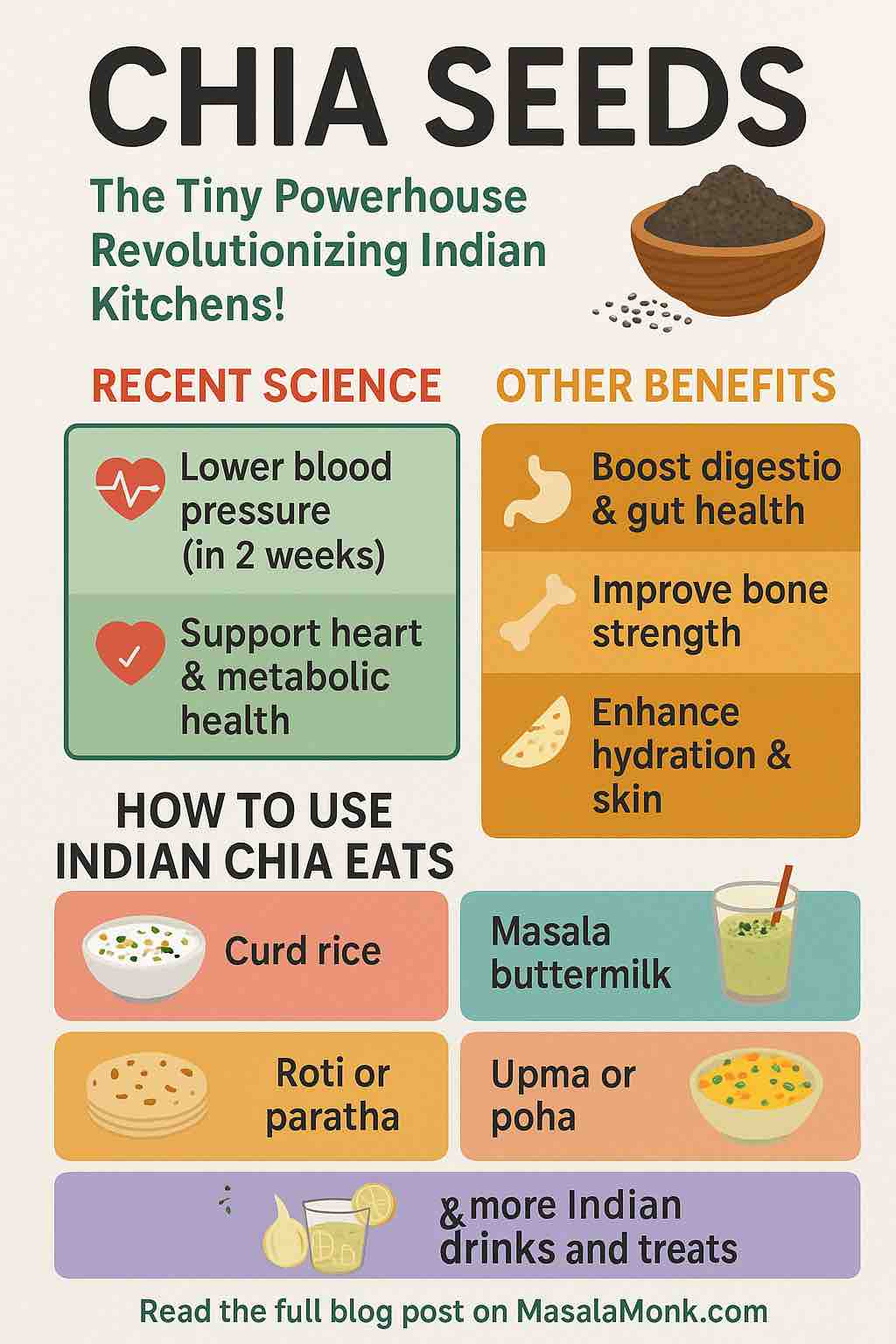
Benefits of Chia Seeds: 5 Ideas to Use Chia Seeds with Indian Food

CHIA SEEDS in Indian Kitchen

Chia seeds—once a humble staple of ancient Aztec and Mayan cultures—have rapidly gained superstar status in Indian kitchens. But is this “superfood” just a passing trend, or does modern research truly back its benefits? And most importantly, how can you actually use chia seeds in your daily Indian meals, in ways that are both easy and tasty?

Let’s explore the latest research, break down their real-life advantages, and share 5 fresh, practical Indian ways to enjoy chia seeds every day.


What Makes Chia Seeds Special? (And Why Should Indians Care?)

Chia seeds (Salvia hispanica L.) are tiny black or white seeds loaded with:

  • Omega-3 fatty acids (alpha-linolenic acid)
  • Protein (all essential amino acids)
  • Dietary fiber (both soluble and insoluble)
  • Minerals (calcium, magnesium, phosphorus, iron)
  • Antioxidants (quercetin, chlorogenic acid, kaempferol)

But what does the latest science say about their real health benefits, especially for Indian lifestyles?


Latest Science: What 2025 Research Shows

1. Lowers Blood Pressure (even in 2 weeks)

A meta-analysis of clinical trials published in early 2025 confirmed chia seeds help reduce systolic and diastolic blood pressure—especially in people with mild hypertension. The effect is attributed to their high fiber and plant omega-3 content. (Source: PubMed, 2025)

2. Supports Heart & Metabolic Health

Consuming chia seeds regularly has been shown to reduce triglycerides and LDL (bad) cholesterol, and may even help with modest weight loss. Indian nutritionists are especially interested, given rising rates of heart disease and diabetes in India.

3. Boosts Digestive and Gut Health

Their soluble fiber forms a gel in your gut, which feeds “good” gut bacteria, keeps you regular, and helps prevent blood sugar spikes after Indian carb-rich meals.

4. Improves Bone Strength

A single tablespoon of chia seeds provides about 18% of your daily calcium needs—making them a plant-based boon for vegetarians, vegans, and anyone avoiding dairy.

5. Enhances Hydration and Skin Health

Soaked chia seeds trap water, helping you stay hydrated. Doctors in India now recommend them to patients dealing with hot, dry climates and digestive issues. Early evidence also points to better skin hydration and even mood improvements!


How Much Chia Should You Eat?

  • Safe amount: 1–2 tablespoons (15–30 grams) a day is enough.
  • How to use: Always soak chia seeds for at least 20 minutes before use—dry seeds can expand in your throat and may be a choking risk.
  • Hydrate well: Since they absorb water, drink plenty of fluids.

5 Creative, Practical Ways to Add Chia Seeds to Indian Food

Here’s how you can effortlessly make chia seeds part of your Indian meals—with ideas for every taste and meal of the day!


1. Chia Curd Rice (Dahi-Chia Bowl)

Why: Adds protein, omega-3, and fiber to a classic comfort dish.
How:

  • Mix 1 tablespoon soaked chia seeds into 1 bowl of curd rice (or raita).
  • Add salt, roasted jeera powder, chopped cucumber, and a classic tadka (mustard, curry leaves, ginger, hing).
  • Garnish with pomegranate or coriander.

Pro Tip: Great for lunchboxes—keeps you full, cool, and energized.


2. Masala Chia Buttermilk (Chia-Chaas)

Why: Stay hydrated and support gut health, especially in hot Indian summers.
How:

  • Whisk 1 cup buttermilk/yogurt with roasted cumin, black salt, chopped mint, and green chili.
  • Stir in 1 teaspoon soaked chia seeds.
  • Serve chilled.

Pro Tip: For a tangy twist, add a pinch of chaat masala or grated ginger.


3. Chia Roti/Paratha

Why: Add fiber and healthy fats to everyday Indian breads—without changing the taste!
How:

  • Add 1 tablespoon whole or ground chia seeds to 2 cups atta (wheat flour) while kneading dough.
  • Proceed as usual to make soft rotis or parathas.

Pro Tip: Kids won’t even notice—perfect for picky eaters!


4. Savory Chia Upma or Poha

Why: Upgrade your breakfast or evening snack for better satiety and gut health.
How:

  • Sprinkle 1 tablespoon soaked chia seeds into your upma or poha just before serving.
  • Mix well and let stand 2–3 minutes so the chia gels into the mixture.

Pro Tip: Also works with dhokla or savory oats.


5. Chia-Infused Indian Drinks (Nimbu Pani, Jaljeera, Sattu, Sherbet)

Why: Traditional Indian coolers get a superfood upgrade—great for fasting or weight loss days.
How:

  • Stir 1 teaspoon soaked chia seeds into lemon water, coconut water, sattu, or any traditional Indian drink.
  • Add mint, a touch of black salt, and serve with ice.

Pro Tip: This is a hit during Ramadan, Navratri, or summer wedding season!


Bonus: Sweet Indian Chia Treats

  • Add soaked chia seeds to kheer, phirni, fruit custard, or shrikhand for texture, nutrition, and a touch of crunch.
  • You can even make a healthy “falooda” using chia seeds instead of sabja/tukmaria!

Smart Tips for the Indian Kitchen

  • Always soak first: Chia seeds need 20–30 minutes in water, milk, or curd to form their signature gel.
  • Start slow: If new to chia, begin with 1 teaspoon a day and build up to 1–2 tablespoons.
  • Buy smart: Look for whole seeds from a trusted brand. Black or white is fine—just avoid seeds that look brown (they’re immature).
  • Storage: Keep them in a cool, dry place. They last up to 2 years.
  • For kids and seniors: Ground chia or chia gel is easier to digest and blend into foods.

Final Word: Worth the Hype?

Modern science and centuries-old tradition agree: Chia seeds truly deliver a powerful, plant-based punch. They’re not just a “superfood”—they’re a practical, affordable, and delicious addition to the Indian diet.

Whether you’re aiming for better heart health, stronger bones, weight management, or simply want to boost your family’s nutrition with minimal effort, chia seeds are a tiny investment with huge returns.

Ready to give chia seeds a try? Start with one of the Indian ideas above and share your experiences!


10 FAQs About Chia Seeds in Indian Diets

1. What is the best way to consume chia seeds for maximum health benefits?
Soak chia seeds in water, milk, or yogurt for at least 20–30 minutes before consuming. This helps them form a gel, improving digestibility and nutrient absorption while preventing choking.


2. Can I eat chia seeds raw or dry?
It is not recommended to eat chia seeds dry, as they can expand and cause a choking risk. Always soak or mix them in a moist food or drink.


3. How much chia seed can I safely eat in a day?
Most experts recommend 1–2 tablespoons (15–30 grams) per day for adults. Start with a small amount to allow your digestive system to adjust, and drink plenty of water.


4. Are chia seeds suitable for people with diabetes?
Yes, chia seeds have a low glycemic index and help slow down the absorption of sugar, making them safe and even beneficial for diabetics. They can help control blood sugar spikes after meals.


5. Can children and elderly people eat chia seeds?
Yes, but for children and seniors, ground chia seeds or chia gel is easier to digest and safer. Always introduce slowly and monitor for any digestive discomfort.


6. What’s the difference between chia seeds and sabja (basil) seeds?
Chia and sabja seeds look similar but are from different plants. Chia seeds can be black or white, while sabja seeds are always black, more rounded, and swell faster. Both offer benefits, but chia seeds are richer in omega-3 fatty acids and protein.


7. Can I use chia seeds in hot Indian dishes?
Yes, but it’s best to add soaked chia seeds towards the end of cooking to preserve their nutrients. You can also use ground chia seeds to thicken curries and gravies without altering the flavor.


8. Do chia seeds help with weight loss?
Chia seeds can support weight management due to their high fiber and protein content, which promote fullness and reduce unnecessary snacking. However, they are not a magic solution—combine with balanced diet and exercise.


9. Are chia seeds safe during pregnancy and breastfeeding?
Generally, chia seeds are considered safe and nutritious during pregnancy and lactation, as they provide omega-3s, calcium, and iron. However, consult your doctor before adding any new foods to your diet.


10. How should I store chia seeds and how long do they last?
Store chia seeds in an airtight container in a cool, dry place—preferably away from sunlight. They can last up to 2 years without refrigeration if kept dry and sealed.

Posted on Leave a comment

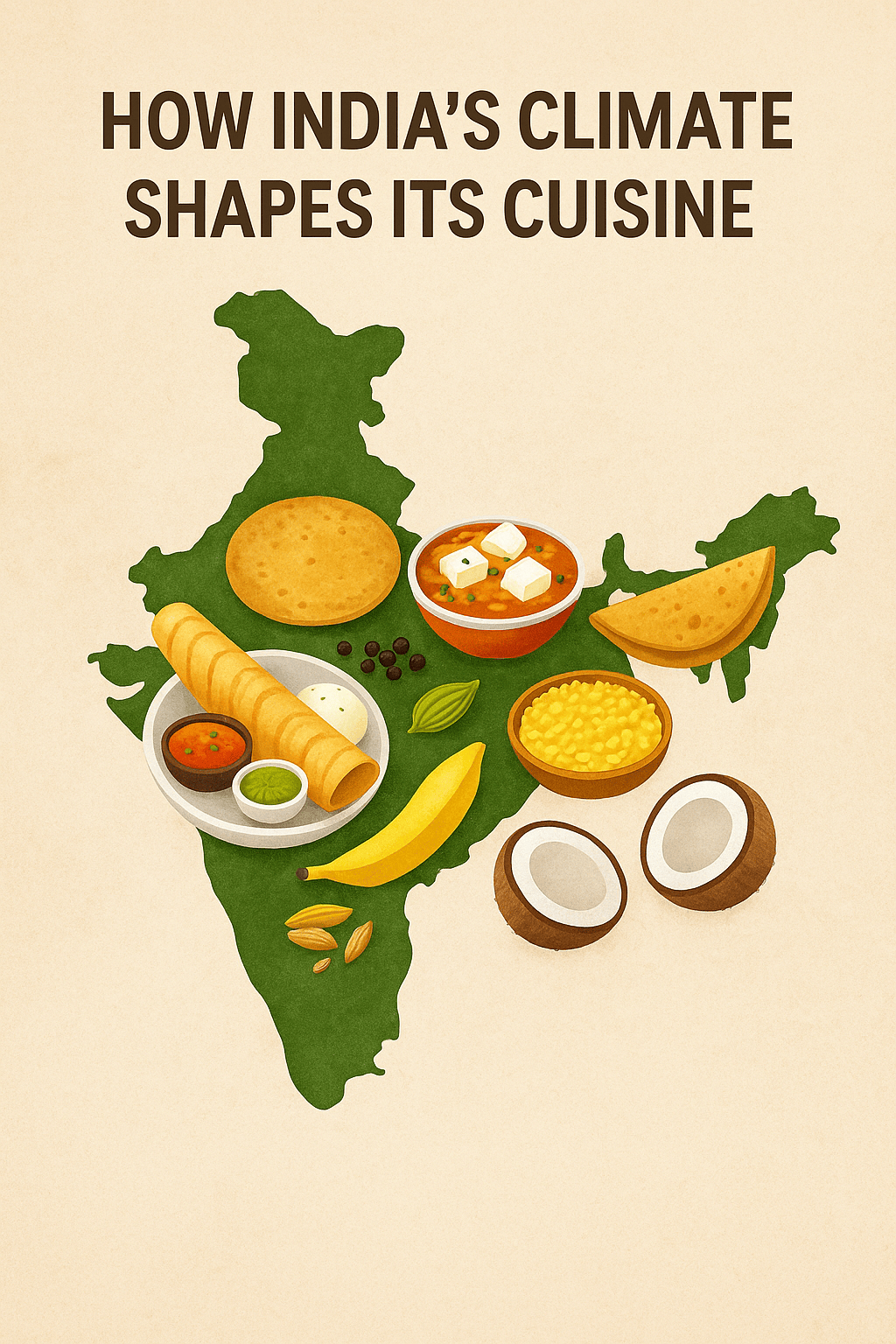
How India’s Climate Shapes Its Cuisine: A Flavorful Journey Across Regions

When we think of Indian food, our minds often wander to fragrant spices, colorful curries, and delicious diversity. But what truly lies at the heart of this incredible variety? One of the biggest influencers is India’s climate. From the lush tropics of the south to the snow-kissed valleys of the north, geography plays a central role in shaping what ends up on the Indian plate.

The South:

A Tropical Feast The southern states of India including Kerala, Tamil Nadu, Andhra Pradesh, and Karnataka are largely tropical, characterized by high humidity, heavy monsoon rainfall, and warm temperatures year round. These conditions are ideal for cultivating crops like rice, coconuts, bananas, jackfruit, and a variety of spices such as black pepper, cardamom, cloves, and turmeric. The consistent rainfall patterns, especially during the southwest monsoon (June to September), support multiple rice-growing cycles annually.

This abundance of rice and tropical produce is clearly reflected in the daily meals. South Indian cuisine is dominated by steamed rice dishes and fermented foods like idlis, dosas, and appams. Coconut is a key ingredient used in chutneys, stews (like Kerala’s ishtu), and gravies, both for flavor and to cool the body in the humid climate. Coastal proximity also brings in an array of seafood preparations, from fish curries cooked in tamarind and coconut milk to dry-fried prawns.

The North:

A Land of Wheat, Dairy, and Seasonal Variety Northern India features a diverse climate, ranging from temperate plains in Punjab, Haryana, and Uttar Pradesh to the alpine chill of Himachal Pradesh and Jammu & Kashmir. Summers can be scorching (up to 45°C), while winters bring cold waves and even snowfall in higher altitudes. These seasonal extremes influence crop selection wheat, barley, and maize dominate in cooler climates.

As a result, northern cuisine revolves around flatbreads (roti, paratha, naan), legumes, and dairy products. Winter menus include rich dishes like sarson da saag and makki di roti (mustard greens with corn flatbread) and warm drinks like masala chai. Yogurt, ghee, and paneer form culinary staples, not only because of dairy abundance but also because of their nourishing qualities in cold climates.

The North’s food culture has also been shaped by history particularly Mughal influence leading to aromatic gravies, use of dry fruits, and slow cooked preparations like biryanis and kebabs.

The East:

Fertile Lands and Sweet Celebrations Eastern India encompassing West Bengal, Odisha, Bihar, and Jharkhand is gifted with fertile alluvial soil and a humid subtropical climate. This region receives ample rainfall from the Bay of Bengal monsoon, which, combined with river systems like the Ganges and Brahmaputra, makes it ideal for rice cultivation.

Here, rice is king eaten steamed, puffed, or flattened. The Bengali diet is known for its delicate balance of sweet and savory, often featuring mustard oil, poppy seeds, and seasonal vegetables. Fish, especially hilsa, is a regional pride, often prepared with mustard seeds and green chilies.

Sweets have a deep cultural connection in the East. Rasgulla, sandesh, and chomchom are not just desserts they’re tied to festivals, rituals, and celebrations, particularly in Bengal’s Durga Puja or Odisha’s Rath Yatra.

The West:

Desert Cuisine and Arid Innovation Western India including Rajasthan, Gujarat, Maharashtra, and parts of Madhya Pradesh is marked by arid to semi-arid conditions. Rajasthan, for example, has low rainfall and high summer temperatures, which historically necessitated food preservation techniques.

As water and fresh produce are scarce in some parts, Rajasthani cuisine evolved to use dried lentils, gram flour, and shelf-stable vegetables. Dishes like dal baati churma and gatte ki sabzi are results of this adaptation. Pickles, chutneys, and papads also play a prominent role in stretching meals and enhancing flavor with minimal resources.

Gujarat’s cuisine, though also vegetarian, is influenced by its access to both drylands and coastlines. The food is balanced sweet, sour, spicy, and salty and includes delicacies like thepla, handvo, and undhiyu. Seasonal variations in vegetable availability drive innovations in dishes throughout the year.

Maharashtra, with its coastal Konkan belt, sees a different palette — coconut-based curries, kokum-infused drinks, and seafood specialties like bombil fry and fish thali.

The Northeast:

Earthy, Fermented, and Rooted in Nature The Northeastern states of India Assam, Nagaland, Meghalaya, Manipur, and others experience a mix of mountainous and subtropical climates, with heavy rainfall and cooler temperatures in hill regions. These conditions support lush greenery, bamboo forests, and terrace farming.

The food here reflects the local ecology: rice is a staple, often eaten with smoked or fermented meats, bamboo shoots, and foraged greens. Due to limited use of oil and spices, the cuisine is milder and focused on natural umami flavors. Techniques like fermenting, smoking, and sun-drying help preserve food during rainy or lean periods.

Nagaland’s smoked pork with bamboo shoot and Meghalaya’s jadoh (rice with meat) are prime examples of culinary practices aligned with climatic needs. The availability of wild herbs, medicinal plants, and forest produce deeply influence the diet.

Seasonal Eating and Cultural Festivities India’s six traditional seasons spring, summer, monsoon, autumn, pre-winter, and winter drive not just agriculture but also cuisine and cultural rhythms. In summer, cooling foods like cucumber, chaas (buttermilk), and watermelon are popular. The monsoon brings pakoras, tea, and immunity-boosting foods like turmeric and ginger.

In winter, heavier, calorie-rich meals are common to generate body heat: think gajar ka halwa, makki di roti, and til laddoos. Seasonal fasting and feasting rituals such as Navratri or Pongal are centered around locally available grains and produce.

Preservation techniques, like pickling (achar), sun-drying (papads), and fermenting (idli-dosa batter, gundruk), arose out of necessity due to seasonal shortages or excesses. These methods not only ensured food security but also added flavor diversity.

Historical and Trade Influences India’s geographic location and monsoon-supported coastal routes facilitated centuries of trade both overland and maritime. This brought new crops (like tomatoes, chilies, and potatoes from the New World), and allowed for regional cuisines to evolve and absorb foreign influences.

Spice trade not only boosted India’s economy but also placed Indian cuisine on the world map. Port cities like Kochi and Mumbai became melting pots of culinary crossovers evident in dishes like vindaloo and Bombay duck.

Conclusion: Climate as the Hidden Ingredient India’s food habits aren’t merely a matter of tradition or taste they are shaped by centuries of adaptation to the local climate. From high-altitude grains in Ladakh to the seafood of Kerala, the geographical diversity informs every meal.

Posted on 1 Comment

Authentic Indian Garam Masala Recipe

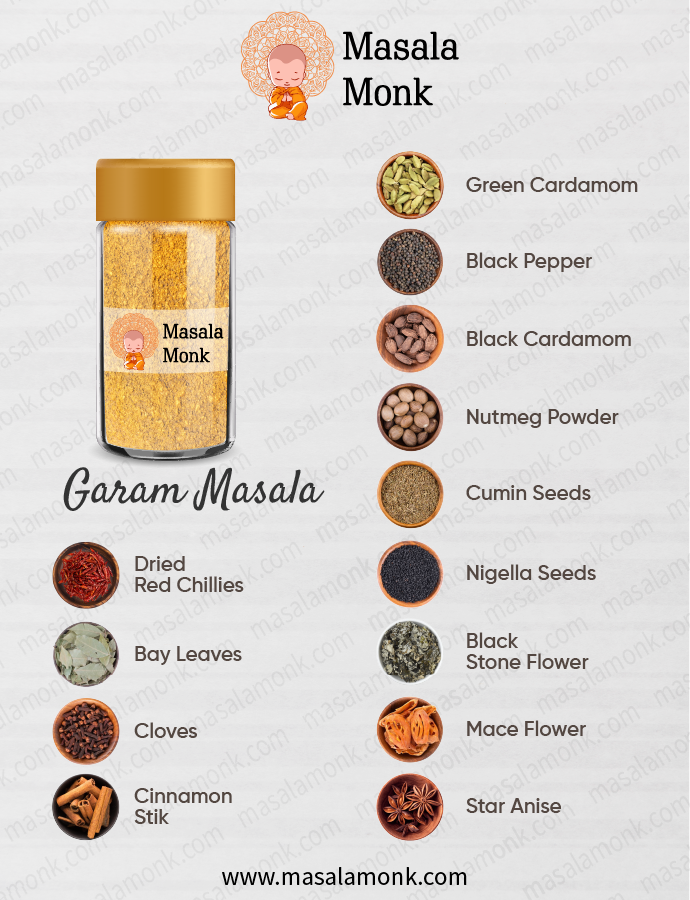
Using homemade masala can elevate your dishes to the next level. Garam masala powder adds an earthy flavor to your meals. Whether it’s curry, biryani, or even cookies and cakes, a pinch of garam masala can enhance the taste beautifully. You will find that every region and every family has their own traditional recipe for Garam Masala, which gets passed down from generation to generation

While packets of garam masala are easily available in every store, there is something special about homemade garam masala, Freshly ground homemade Garam Masala has an un-matched aroma and flavor. So let’s see homemade garam masala recipe.

Ingredients:

  1. Green Cardamom
  2. Black Pepper
  3. Black Cardamom
  4. Nutmeg Powder
  5. Cumin Seeds
  6. Nigella Seeds
  7. Dried Red Chillies
  8. Bay Leaves
  9. Cloves
  10. Cinnamon Sticks
  11. Black Stone Flower
  12. Mace Flower
  13. Star Anise

Method:

Collect all the spices listed above. Ensure they are fresh and of high quality for the best flavor. Measure out each spice according to your taste preference. A general guideline is to use equal parts of most spices, with a slightly lesser amount of potent ones like cloves and black cardamom.

Heat a large skillet or pan over medium heat. Add all the whole spices (green cardamom, black cardamom, black pepper, cumin seeds, nigella seeds, dried red chillies, bay leaves, cloves, cinnamon sticks, black stone flower, mace flower, and star anise).

Stir the spices continuously to prevent burning. Roast them until they become fragrant, usually about 3-5 minutes. Once roasted, transfer the spices to a plate and allow them to cool completely.

Once the spices are cooled, transfer them to a spice grinder or a high-speed blender. Grind them into a fine powder. You may need to do this in batches depending on the size of your grinder. Once ground, add the nutmeg powder to the mixture and give it a final blend to ensure everything is well combined.

Transfer the freshly ground garam masala to an airtight container. Store it in a cool, dark place to retain its flavor and aroma. It’s best to use the garam masala within a few months for the best taste.

Garam Masala can be used in a variety of dishes:

Curries: Add a teaspoon towards the end of cooking to enhance the flavor of your curry. If you like bharwa vegetables or love using bharwa masala you can try masala monk’s Bharwa Masala. A generous stuffing of bharwa masala will turn the oh so boring vegetables into surprisingly delicious For the best stuffed karele, baingan, bhindi, tori or tinde Bharwa Masala by Masala Monk Handpicked whole spices are roasted and ground at home to get the perfect consistency and extract the best flavours and textures.

Marinades: Mix it with yogurt and lemon juice for a delicious marinade for meats and vegetables.

Soups and Stews: Sprinkle a bit into your soups and stews for a warm, spicy kick.

Rice Dishes: Use it in biryanis and pulaos for that authentic taste.

Making garam masala at home is a simple yet rewarding process. The aroma and flavor of freshly ground spices can elevate your dishes to a new level. Try this homemade garam masala recipe and add a touch of authentic Indian flavor to your cooking. Don’t forget to share your experience and feedback in the comments below.

If you try this recipe, do give us a shout out. Just click a picture and tag us on @masala.monk or use the hashtag #MasalaMonkRecipe and share on Instagram and Facebook. We would love to hear from you. 🙂

Happy cooking!