Posted on Leave a comment

Garlic & Paprika Cabbage Rolls (Keto-Friendly Recipes) – 5 Bold Savory Twists

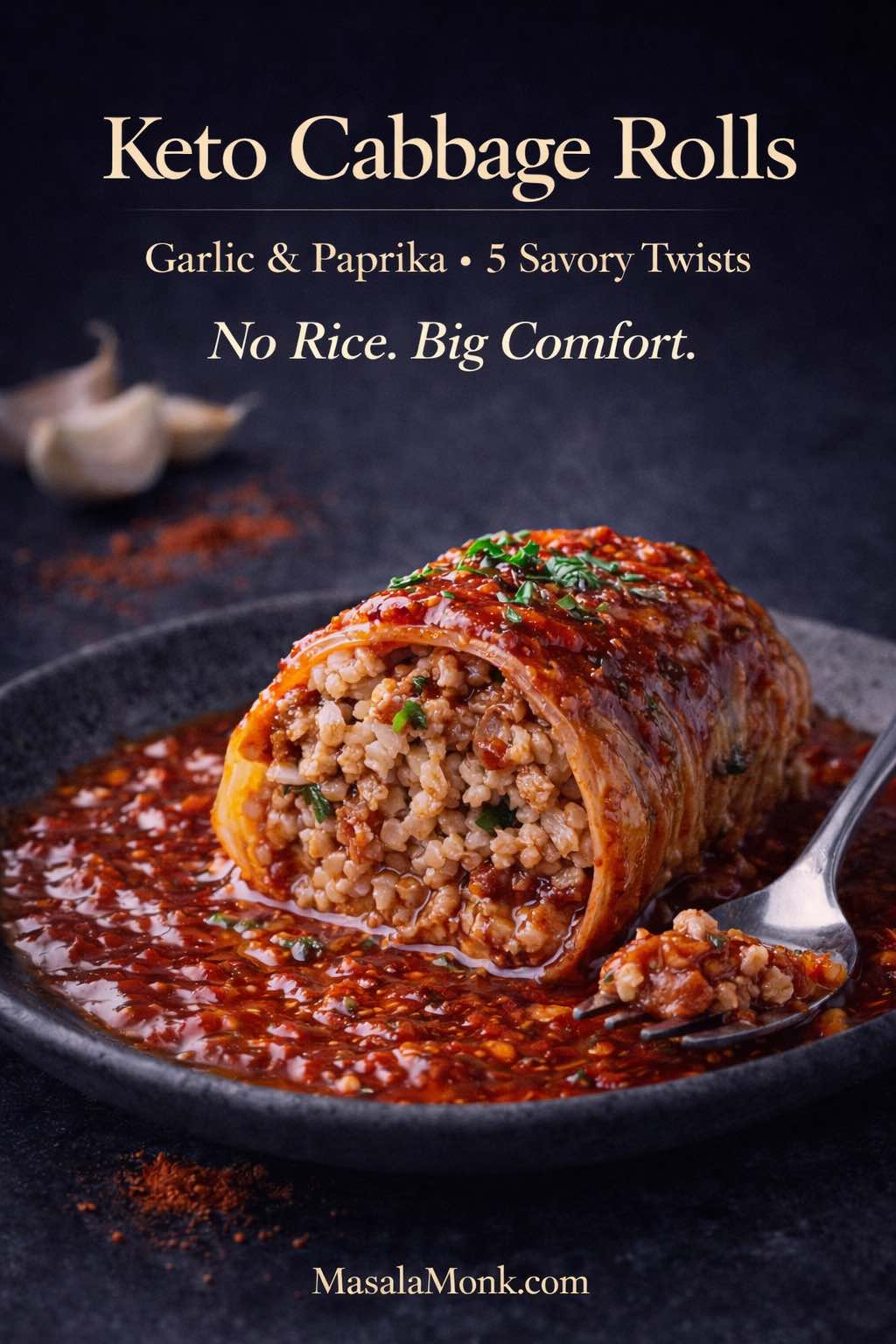
Moody close-up of a keto cabbage roll cut open to show a savory meat filling, sitting in a glossy garlic-paprika tomato sauce in a dark bowl, with a fork on the side and “Keto Cabbage Rolls” text overlay plus MasalaMonk.com at the bottom.

Stuffed cabbage rolls have a way of making a kitchen feel calm. Even before the oven is hot, the process itself—softening cabbage leaves, mixing a savory filling, rolling everything into neat parcels—turns dinner into something deliberate. Once the sauce bubbles and the cabbage goes silky at the edges, the whole dish tastes like it belongs on a table where people linger.

The classic version is famous for a reason. It’s hearty, tender, and deeply satisfying. It’s also often built around rice, which is exactly why cabbage rolls can feel tricky on a low carb diet. Still, the comfort isn’t coming from rice alone. It’s coming from the structure—cabbage wrapped around seasoned meat—plus a sauce that sinks into every fold and seam.

Keto Cabbage Rolls

That’s where these keto cabbage rolls shine. They keep everything that matters: the cozy, homey feel; the fork-tender cabbage; the rich tomato-forward sauce; the filling that tastes better the next day. The only difference is that instead of rice, the filling uses lower-carb “bulk” that still holds moisture and texture. More importantly, the flavor leans hard into garlic and paprika, so the rolls never feel like a compromise.

This is also not a one-note recipe. Cabbage rolls are a template, and once you have the core method, you can push them in completely different directions—smoky and deep, tangy with sauerkraut, bright and herb-forward, spicy, or Mediterranean-leaning. Each twist still tastes like cabbage rolls, yet each one feels like its own dinner.
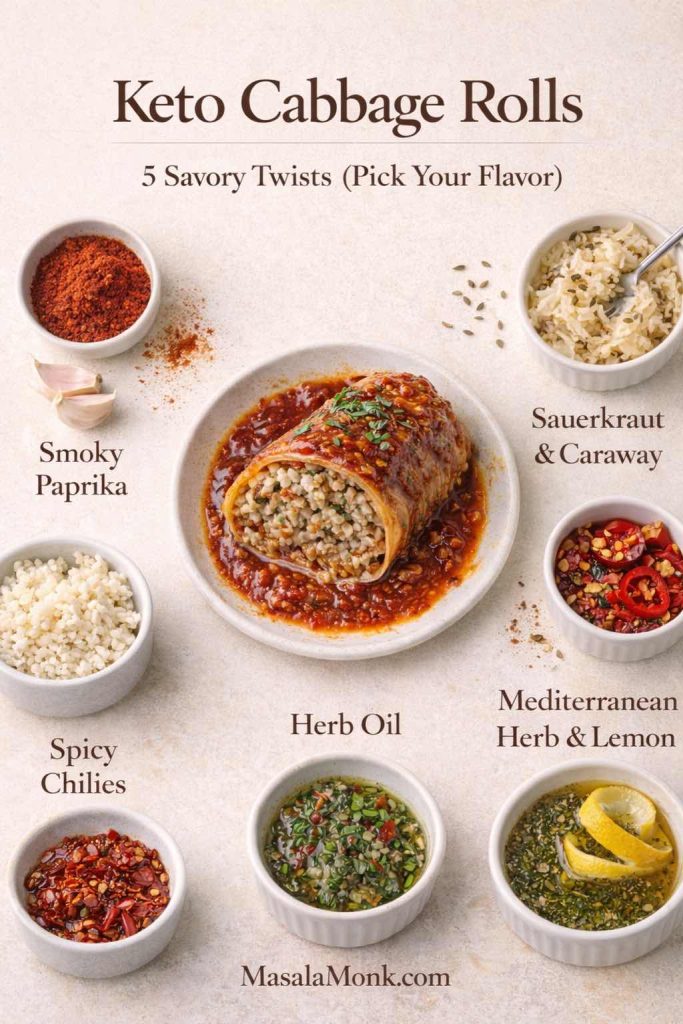
Keto cabbage rolls in garlic-paprika tomato sauce with “5 savory twists” flavor picker: smoky paprika, spicy chilies, sauerkraut & caraway, Mediterranean herb & lemon, and herb oil, arranged around one cabbage roll on a light background.
Not sure which version to make tonight? Use this “pick your flavor” guide for keto cabbage rolls—same easy roll-and-bake base, five garlic-paprika twists (smoky, spicy, sauerkraut + caraway, Mediterranean herb + lemon, and herb oil). It helps readers choose a direction fast, keeps the recipe flexible, and makes meal prep easier when you’re cooking for different taste buds.

If you’re easing into keto or simply trying to eat fewer carbs without feeling deprived, it can help to understand the bigger picture of how low-carb swaps work. MasalaMonk’s guide to keto for beginners lays out the basics in a simple way. Even if you’re already comfortable with low carb eating, it’s a useful reminder that sustainable dinners come from repeatable patterns—structure, flavor, and satisfaction—rather than strict perfection.


Why cabbage rolls work so well when you’re keeping it low carb

Cabbage is one of those ingredients that behaves like a built-in plan. It gives you volume without heaviness, structure without flour, and a gentle sweetness that plays well with savory seasonings. Because it’s naturally sturdy, it holds up to long cooking times, which is why old-fashioned cabbage rolls show up across cuisines—Polish gołąbki (often spelled golabki), Ukrainian-style cabbage rolls, Hungarian cabbage roll recipes, Jewish stuffed cabbage, German cabbage rolls (including kohlrouladen), and Balkan sarma rolls.
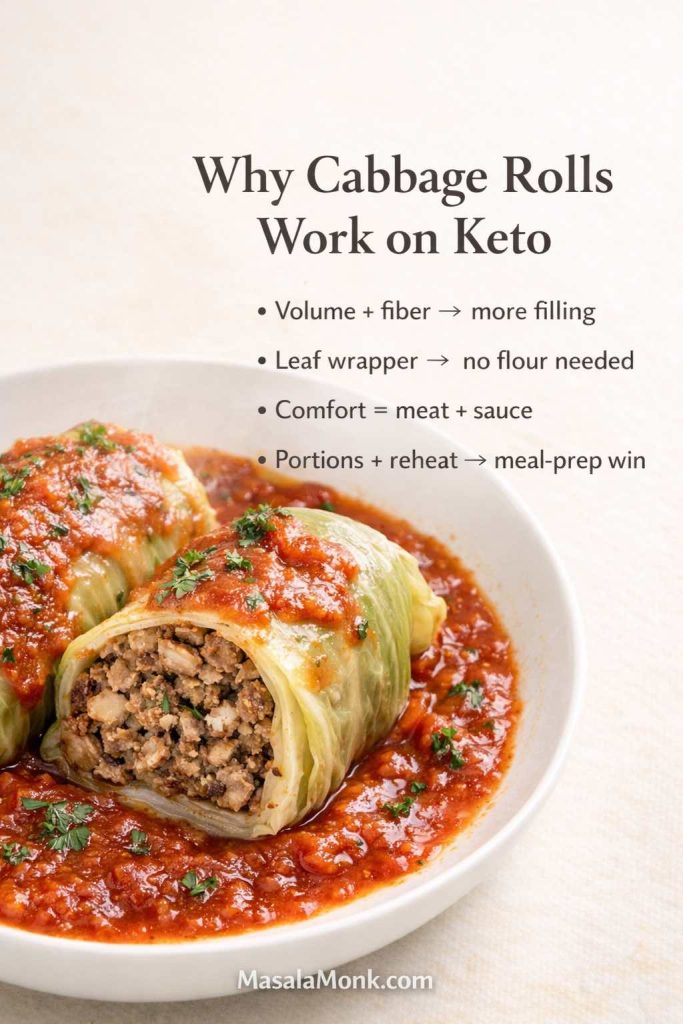
Keto cabbage rolls in a rich tomato garlic paprika sauce, one roll sliced open to show the meat filling. Text overlay reads “Why Cabbage Rolls Work on Keto” with bullets: volume + fiber = more filling, leaf wrapper = no flour needed, comfort = meat + sauce, portions + reheat = meal-prep win. MasalaMonk.com at bottom.
Why cabbage rolls work so well on keto: cabbage gives you volume + fiber without flour, and the “real comfort” still comes from meat + sauce. Use this quick cheat sheet when you’re deciding what to cook for the week—cabbage rolls portion cleanly, reheat beautifully, and stay satisfying even without rice.

Why the format stays satisfying even without rice

Even when spice blends change, the concept stays consistent: cabbage leaves stuffed with something rich, then cooked in a flavorful sauce until everything melds. That’s exactly the kind of dish that adapts beautifully to keto-friendly cooking, because the original structure doesn’t rely on breading or flour. Instead, you’re mostly adjusting the filling and the sauce while keeping the comfort intact.

From a nutrition standpoint, cabbage is also a practical base. It’s low calorie and fiber-rich, and it tends to make meals feel more filling—useful if you’re aiming for weight loss without feeling like you’re eating tiny portions. Cleveland Clinic’s overview of cabbage highlights its fiber and nutrient profile and explains why it can support a healthier eating pattern when used in satisfying meals: the health benefits of cabbage.

Meanwhile, cabbage rolls also make sense for meal prep. They portion cleanly, reheat well, and often taste even better after a rest. If you’re the kind of person who does better with a plan, they’re the sort of anchor dinner that makes the rest of the week easier.

Cabbage is one of the easiest low-carb staples to build meals around, and it does more than just “fill space.” If you want to go deeper on the nutrition side—fiber, nutrients, and why it works so well in everyday keto cooking—here’s a fuller guide on why cabbage is a staple in the keto kitchen.

Also Read: Eggless Yorkshire Pudding (No Milk) Recipe


Keto cabbage rolls versus cabbage rolls with rice: the swap that keeps the comfort

Traditional stuffed cabbage rolls with rice are built around a familiar equation: meat + rice + seasonings + cabbage + tomato sauce. Sometimes the rice goes in uncooked, sometimes it’s partially cooked first. Either way, rice is there for bulk and to absorb juices.

However, rice is not the heart of cabbage rolls. The heart is the combination of tender cabbage and savory filling, plus the sauce that soaks into everything. So the strategy here is simple: keep what matters, replace what doesn’t.

To be clear, there’s nothing wrong with classic stuffed cabbage rolls with ground beef and rice if that’s how you cook. They’re a classic stuffed cabbage recipe for a reason. Yet if you want cabbage rolls that are keto compatible, you’re looking for a filling that stays moist, holds together, and doesn’t taste “substitution-y.”
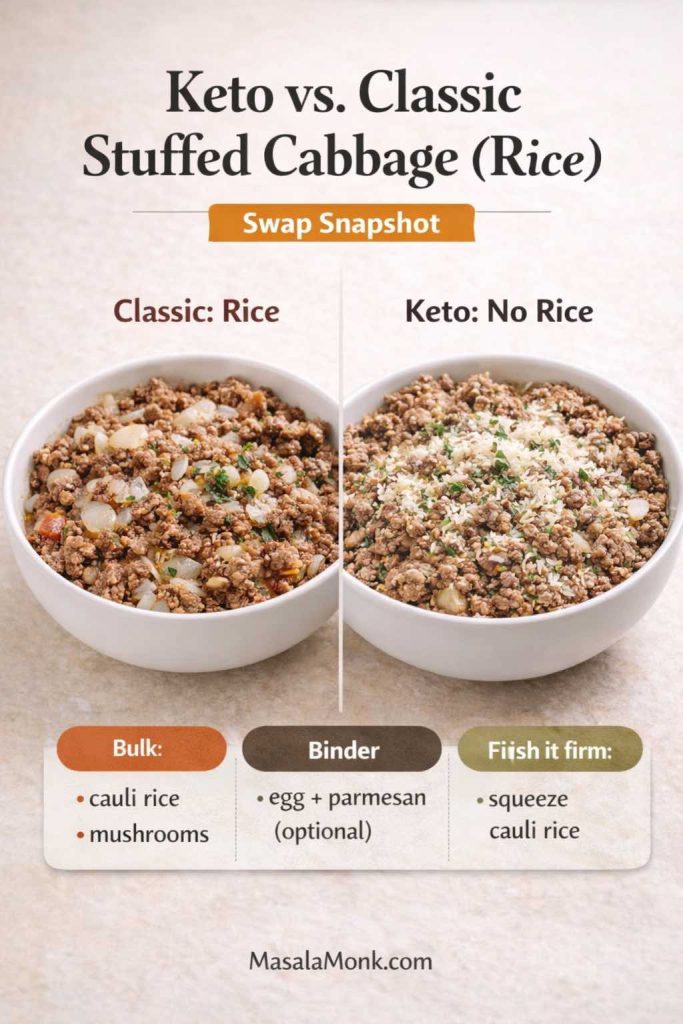
Side-by-side photo of two bowls of stuffed cabbage roll filling. Left bowl labeled “Classic: Rice” shows ground beef mixed with rice, onion, and herbs. Right bowl labeled “Keto: No Rice” shows ground beef with cauliflower rice, mushrooms, and parmesan. Text overlay says “Keto vs. Classic Stuffed Cabbage (Rice) — Swap Snapshot” with tips: bulk (cauli rice, mushrooms), binder (egg + parmesan optional), and keep it firm (squeeze cauliflower rice). MasalaMonk.com footer.
If you grew up on stuffed cabbage rolls with ground beef and rice, this is the exact swap that keeps the comfort: replace rice with squeezed cauliflower rice + finely chopped mushrooms for bulk and moisture, and use egg + parmesan (optional) when you want the filling extra tight. It tastes like the classic version—just lighter, lower carb, and less likely to turn watery in the pan.

What replaces rice in keto-friendly cabbage rolls?

You have a few excellent options, and you can mix them depending on what you like:

  • Cauliflower rice is the closest texture match. It bulks the filling without bringing carbs, and it disappears into the meat once baked.
  • Finely chopped mushrooms bring moisture and umami. They make the filling taste deeper, almost like it simmered longer.
  • Riced broccoli or finely shredded zucchini can work too, although zucchini needs to be squeezed well so it doesn’t water out the filling.
  • A small amount of grated parmesan or other hard cheese adds richness and helps bind.

Rice is mostly there for bulk and to soak up juices, not because it’s the “main flavor.” If you want a clearer sense of how rice compares to other options—and why swapping it out doesn’t change the comfort of the dish—this quick breakdown of quinoa vs rice and lower-carb alternatives

The point isn’t to mimic rice perfectly. Instead, it’s to build a filling that feels right: juicy, savory, substantial, and not crumbly. Once you do that, you’re no longer “making keto cabbage rolls.” You’re simply making cabbage rolls—ones that happen to be low carb.

Also Read: Crock Pot Chicken Breast Recipes: 10 Easy Slow Cooker Dinners (Juicy Every Time)


Ingredients for tender, flavorful keto-friendly cabbage rolls

Before the steps, it helps to understand what each ingredient is doing. That’s what makes these rolls reliable, even if you swap meats or choose a different twist.

The cabbage (and the best cabbage for cabbage rolls)

Most cabbage roll recipes start with green cabbage, and it’s still the most forgiving choice.
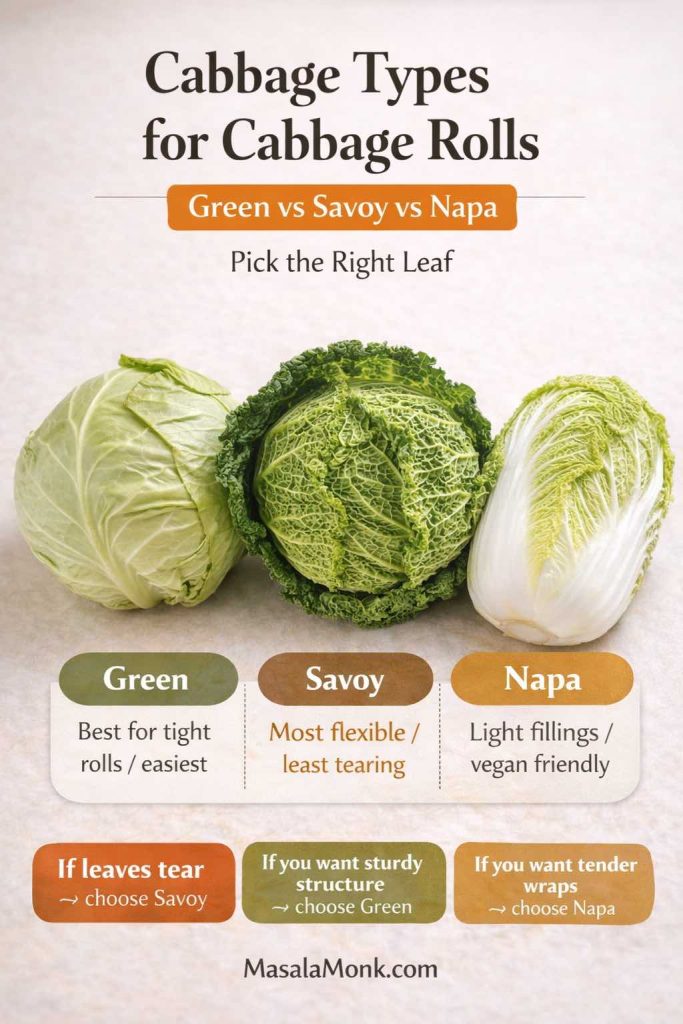
Infographic titled “Cabbage Types for Cabbage Rolls: Green vs Savoy vs Napa.” Three photos show green cabbage, savoy cabbage, and napa cabbage. Labels say: Green—best for tight rolls and easiest; Savoy—most flexible and least tearing; Napa—best for light fillings and vegan friendly. Bottom tips say: if leaves tear choose Savoy; for sturdy structure choose Green; for tender wraps choose Napa. MasalaMonk.com at bottom.
Choosing the right cabbage makes rolling feel easy. Use this quick picker: Green cabbage is the sturdy classic for tight rolls, Savoy is the most flexible (best if your leaves tear), and Napa is tender and great for lighter or vegan fillings. Pick the leaf first—then the rest of the recipe becomes simple.
  • Green cabbage: sturdy leaves, easy to roll, holds up well in oven or slow cooker.
  • Savoy cabbage: softer leaves that bend easily; it’s great if you want less wrestling while rolling.
  • Napa cabbage: thinner and more delicate; it’s especially good for vegan cabbage rolls or lighter fillings, though it can tear if overcooked.

If you’ve ever been frustrated by cabbage leaves splitting, savoy is often the answer. On the other hand, if you want maximum structure for a pan of stuffed cabbage in a thick sauce, green cabbage is the steady classic.

The filling (protein and flavor)

This recipe works with different meats, and each one gives a slightly different result:

  • Ground beef: richest flavor, most forgiving texture, classic “stuffed cabbage” taste.
  • Ground turkey: lighter but still satisfying; it benefits from extra fat and bold seasoning.
  • Ground pork: juicy and savory; paprika and garlic love pork.
  • Beef + pork blend: especially good for a more traditional European feel.
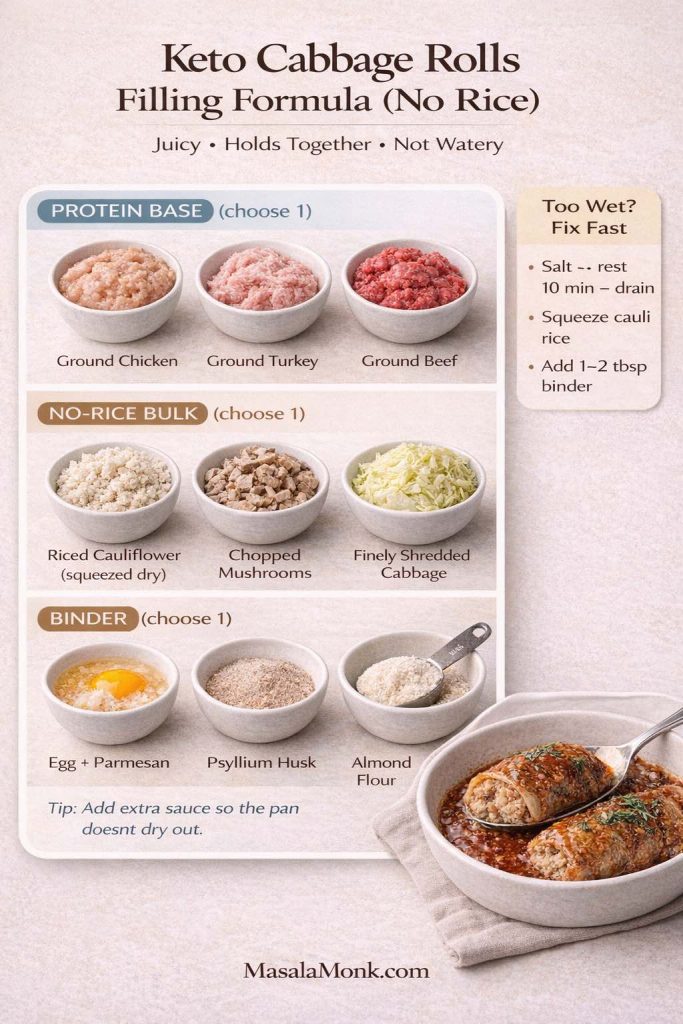
Infographic titled “Keto Cabbage Rolls Filling Formula (No Rice)” showing a mix-and-match chart: choose 1 protein (ground chicken, turkey, or beef), choose 1 no-rice bulk (riced cauliflower squeezed dry, chopped mushrooms, or finely shredded cabbage), and choose 1 binder (egg + parmesan, psyllium husk, or almond flour). Includes “Too wet? Fix fast” tips and a serving photo of cabbage rolls in tomato sauce.
This “no-rice” filling formula makes keto cabbage rolls that stay juicy without turning watery. Pick your protein, pick your bulk (cauli rice, mushrooms, or extra cabbage), then lock it together with the right binder (egg + parmesan, psyllium, or almond flour). Use the quick “too wet” fixes before you roll—so the cabbage wraps bake up neat, tender, and saucy every time.

To keep the filling cohesive without rice, you’ll use:

  • Egg as a binder (optional but helpful)
  • Cauliflower rice and/or chopped mushrooms for bulk
  • Garlic and paprika as the core flavor signature
  • Salt and pepper for structure (salt does more than people think here)

Meat choice changes the whole feel of cabbage rolls. Beef and pork tend to stay richer and more satisfying, while turkey usually needs a little extra fat and bold seasoning to keep the filling juicy. If you’ve noticed fattier meats keep you full longer, there’s a real reason for that—here’s a deeper look at beef and the keto diet.

The sauce (tomato comfort without the sugar reliance)

Many classic cabbage rolls rely on a sweet-leaning tomato sauce. On keto, you can still use tomatoes; the trick is building depth with garlic, paprika, broth, and fat rather than sugar. When done well, the sauce tastes like the cozy “cabbage rolls in tomato soup” style people love—round, mellow, and comforting.

Also Read: Sourdough Starter Recipe: Make, Feed, Store & Fix Your Starter (Beginner Guide)


How to soften cabbage leaves: three practical methods

This is where cabbage rolls either feel easy or feel impossible. The truth is that softening cabbage leaves is straightforward once you choose the method that fits your life.
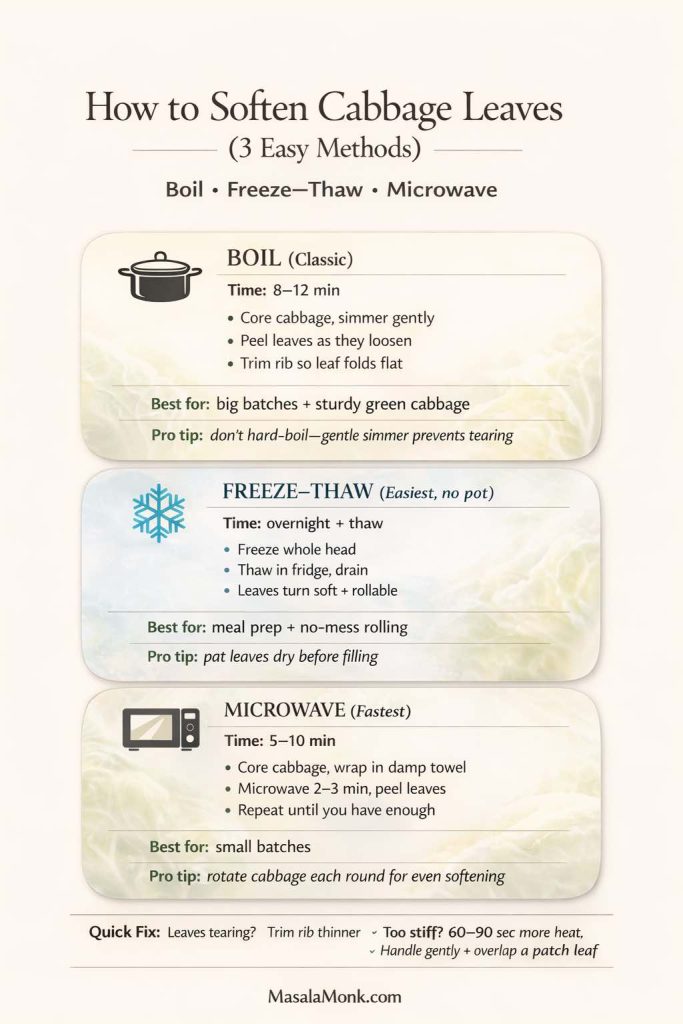
Infographic showing three ways to soften cabbage leaves for cabbage rolls: boiling (8–12 minutes), freeze–thaw method (freeze whole head, thaw to make leaves rollable), and microwave method (wrap in a damp towel and heat in short rounds). Includes quick fixes for torn leaves, stiff leaves, and overly soft leaves.
Soft cabbage leaves = rolls that don’t tear. Use this quick method picker to choose the best way to prep cabbage for cabbage rolls: boil (classic + reliable), freeze–thaw (quietly the easiest), or microwave (fastest for small batches). The “quick fix” line at the bottom saves you when leaves rip or feel stiff—so rolling stays calm and the pan bakes up neat.

Method 1: Boiling (the classic approach)

Bring a large pot of water to a gentle boil. Core the cabbage, then lower the whole head into the water. After a few minutes, the outer leaves will loosen. Use tongs to peel them off as they soften.

Once you have enough leaves, trim the thick rib at the base of each leaf. Rather than cutting it out completely (which can weaken the leaf), slice it down so the leaf lies flatter and rolls more easily.

Boiling is reliable, and it works with any cabbage variety. Still, it requires a big pot and a little patience.

Method 2: Freeze and thaw (quietly the easiest way to make cabbage rolls)

If you want the easiest way to make cabbage rolls without boiling water, freeze the whole head of cabbage overnight, then thaw it in the fridge. The freezing breaks down cell walls, which means the leaves become flexible and rollable once thawed.

This method is also excellent if you’re doing cabbage rolls for freezing later, because you’re already in a meal prep mindset. It feels like a small trick, yet it changes everything: the leaves soften without a pot of water, and you can prep when you have time rather than when you’re hungry.

Method 3: Microwave (the fastest shortcut)

Core the cabbage, wrap it in a damp towel, and microwave for a few minutes. Peel off softened leaves, then repeat until you have enough.

Microwave softening is quick and surprisingly effective. It’s also helpful if you’re making a small batch and don’t want to boil a huge pot of water.

If you’re newer to low carb cooking and want quick clarity on what counts as keto-friendly (and what doesn’t), these keto diet FAQs

Also Read: How to make No-Bake Banana Pudding: No Oven Required Recipe


The base keto cabbage rolls recipe (oven baked)

This is the core method. After you make it once, the twists become easy, because you’re no longer learning how to roll—you’re simply changing the flavor.
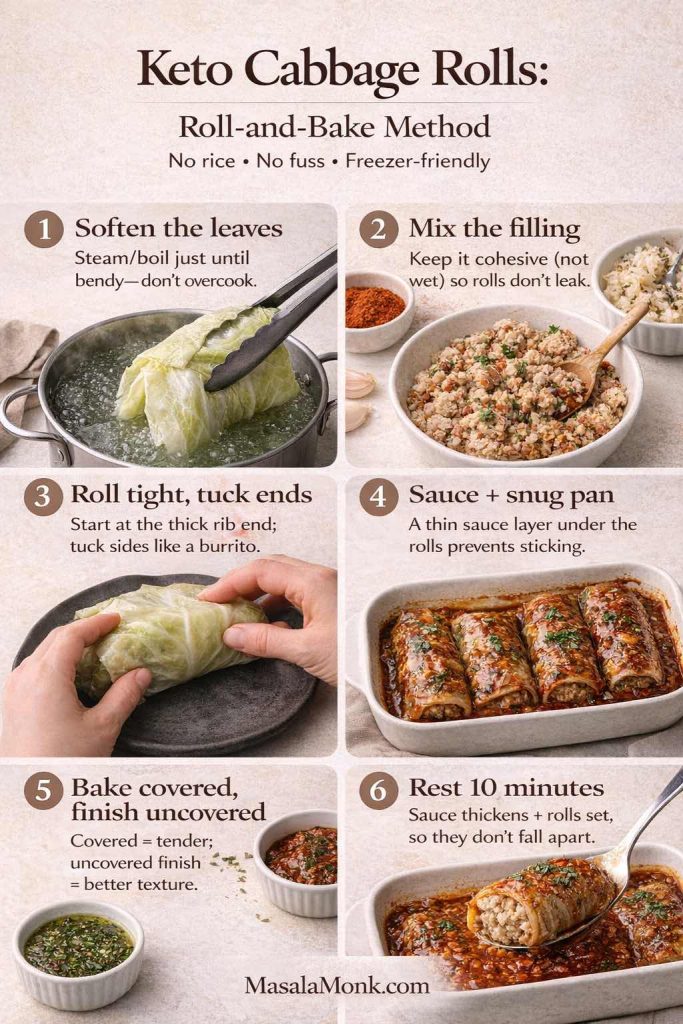
Roll-and-bake keto cabbage rolls, made simple: soften the leaves, mix a tight (not wet) filling, roll and tuck, then bake covered and finish uncovered for the best texture. This quick visual is the “don’t-mess-it-up” guide for sturdy rolls that hold together—especially if you’re meal-prepping or freezing a batch.

Ingredients (base)

For the cabbage rolls

  • 1 large green cabbage (or savoy)
  • 680 g / 1.5 lb ground beef (or turkey or pork)
  • 3–5 cloves garlic, finely minced or grated
  • 2 teaspoons paprika (sweet or smoked)
  • 1 teaspoon salt, plus more as needed
  • 1/2 teaspoon black pepper
  • 1 1/2 cups cauliflower rice (fresh, or thawed and squeezed dry)
  • 1/2 cup finely chopped mushrooms (optional but recommended for juiciness)
  • 1 egg (optional binder)
  • 1/3 cup grated parmesan (optional, helps bind and adds richness)
  • 2 tablespoons chopped parsley (optional)

For the sauce

  • 2 cups crushed tomatoes or tomato passata
  • 1 cup broth (beef or chicken)
  • 1 tablespoon tomato paste (optional, for deeper tomato flavor)
  • 1–2 tablespoons olive oil or butter
  • 1 teaspoon paprika
  • 1/2–1 teaspoon garlic powder (or another clove of garlic, minced)
  • Salt and pepper to taste
  • Optional: a splash of vinegar for balance

Step 1: Prep the cabbage leaves

Use one of the softening methods above. Once the leaves are pliable, trim the thick rib near the base so each leaf rolls without cracking.

Set leaves aside while you make the filling.

Step 2: Make the filling

In a large bowl, combine ground meat, garlic, paprika, salt, pepper, cauliflower rice, mushrooms (if using), egg (if using), and parmesan (if using). Mix gently until combined.

Mixing too aggressively can make the filling dense. Instead, fold everything together until it looks even, then stop.

Step 3: Roll

Lay a cabbage leaf flat. Place a portion of filling near the base. Fold the sides in, then roll up tightly. Place seam-side down in a baking dish.

Continue until you’ve used your leaves and filling. If you have extra small or torn leaves, tuck them around the rolls in the dish—those bits often become the best parts after baking.

Step 4: Make the sauce

In a bowl or measuring jug, whisk crushed tomatoes, broth, tomato paste, olive oil or butter, paprika, garlic, salt, and pepper. Taste it. You want it slightly stronger than you think you need, because it will mellow as it cooks.

Pour sauce over the rolls. Cover the dish tightly with foil.

Step 5: Bake

Bake at 190°C / 375°F until the cabbage is tender and the filling is cooked through. The time will vary based on roll size and meat choice, but 55–75 minutes is common for oven cabbage rolls.

For a thicker sauce, uncover the dish for the last 10–15 minutes to let it reduce slightly.

Food safety, written in a way that doesn’t interrupt dinner

Because these are rolls made with ground meat, safe internal temperature matters. USDA guidance for ground beef food safety recommends cooking ground beef to 160°F / 71°C. For ground turkey and other poultry, USDA’s turkey safe cooking guidance points to 165°F / 74°C. A thermometer makes this effortless, and it removes the guesswork.

If you’re cooking once and reheating during the week, USDA’s notes on leftovers and food safety reinforce reheating leftovers to 165°F / 74°C. That’s especially useful for soup and casserole versions, where it’s easy to assume the middle is hot when it isn’t.

Also Read: Chicken Adobo — Step-by-Step Recipe — Classic Filipino Adobong Manok


The sauce that tastes like “tomato soup” cabbage rolls—without leaning on sugar

Some cabbage roll casseroles and soups are famous for tasting like tomato soup, even when they’re not made with canned soup. That flavor comes from a few details working together: enough tomato concentration, a savory broth backbone, paprika’s gentle sweetness, and fat to round out acidity.

If your sauce tastes too sharp, a small splash of vinegar can actually help, because it adds a clean acidity that makes tomato taste more “complete.” Meanwhile, finishing with olive oil or a little butter can soften everything so the sauce tastes rich rather than harsh.
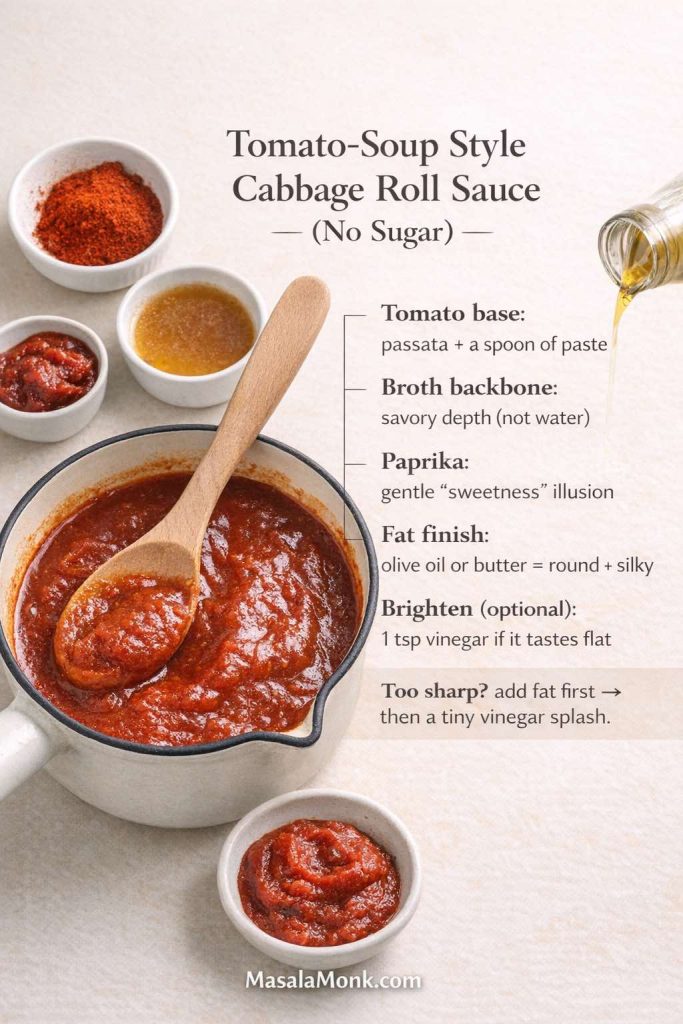
Tomato-soup style cabbage roll sauce in a small pot on a cream background with paprika, tomato paste, broth, and olive oil nearby. Text overlay lists the formula: passata + paste, broth for savory depth, paprika for “sweetness,” finish with olive oil or butter, and optional vinegar to brighten if the sauce tastes flat.
Want that cozy “tomato soup” cabbage-roll sauce without adding sugar? This visual nails the formula: concentrate the tomato base (passata + a spoon of paste), use broth for depth, lean on paprika for gentle warmth, then finish with olive oil or butter to round the acidity. If it tastes sharp or flat, add fat first—then a tiny vinegar splash to brighten.

If you want a credible external reference on why olive oil is often considered a strong everyday fat choice, Harvard Health’s article on extra-virgin olive oil offers a balanced take. For a broader “what fats matter most” reference, Harvard’s Nutrition Source overview of types of dietary fats is a solid citation that avoids fad language while still supporting a keto-friendly approach that focuses on quality.

When you’re serving cabbage rolls, something crunchy on the side is always welcome. A quick slaw is a natural pairing, and if you want a creamy base without fuss, MasalaMonk’s eggless mayonnaise makes a useful recipe – if you want want a simple dressing foundation and if you are not avoiding eggs, then have a look at Mayo Recipe: 15+ Homemade Mayonnaise Variations.


Five savory garlic and paprika twists (same method, different dinner)

Now for the fun part. Each of these twists starts from the base keto-friendly cabbage rolls recipe above. In other words, you’re not learning five different recipes. You’re choosing one flavor direction, then making small changes to the filling and sauce.

Because the base is already bold, the twists don’t need many extra ingredients. The goal is to keep the dish cohesive: cabbage, savory filling, tomato-based sauce, and one clear flavor identity.

Twist 1: Smoky garlic and paprika (deep, cozy, and bold)

If you like cabbage rolls that taste almost grilled—dark, savory, and rich—this is the direction.

Best meat choice: ground beef or ground pork
Add to the filling:

  • 1 teaspoon smoked paprika (in addition to the base paprika)
  • 1/2 teaspoon cumin
  • Optional: 1 teaspoon mustard (Dijon works well)
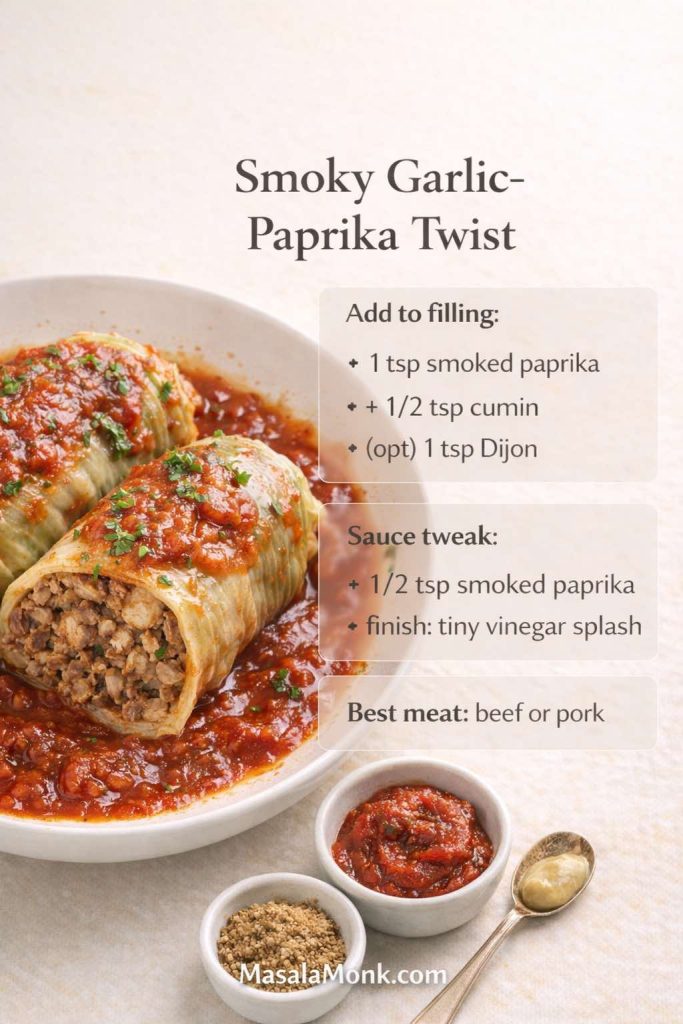
Smoky garlic–paprika keto cabbage rolls in rich tomato sauce, shown as two rolls on a plate (one cut open). Text overlay lists the twist: add 1 tsp smoked paprika, 1/2 tsp cumin, optional 1 tsp Dijon to the filling; sauce tweak adds 1/2 tsp smoked paprika and a small vinegar splash; best meat: beef or pork. MasalaMonk.com footer.
Twist #1 (Smoky): Want cabbage rolls that taste almost “grilled”? Add smoked paprika + a touch of cumin to the filling (optional Dijon for depth), then finish the sauce with an extra pinch of smoked paprika + a tiny vinegar splash. It keeps the rolls bold and cozy—and they taste even better on day two.

Adjust the sauce:

  • Add another 1/2 teaspoon smoked paprika
  • Finish with a small splash of vinegar

Smoked paprika adds a “slow-cooked” illusion. Meanwhile, vinegar keeps the sauce from feeling heavy. This twist is particularly good if you’re someone who likes robust flavors and wants a dish that still tastes exciting on day three.

If you’re in the mood for more hearty, high-protein keto dinners that reheat well, you’ll probably like these beef recipes for a weight loss keto plan.

Twist 2: Tangy sauerkraut garlic paprika rolls (a nod to Polish comfort)

Sauerkraut turns cabbage rolls into a different kind of comfort—bright, tangy, and deeply savory. This twist is inspired by the flavors people love in cabbage rolls with sauerkraut, stuffed cabbage and sauerkraut bakes, and many traditional Polish-style cabbage rolls, without trying to claim one strict “authentic” blueprint.

Best meat choice: beef + pork blend, or pork alone
Add to the baking dish:

  • 1 to 1 1/2 cups sauerkraut, rinsed and squeezed dry
  • Optional: a pinch of caraway seed
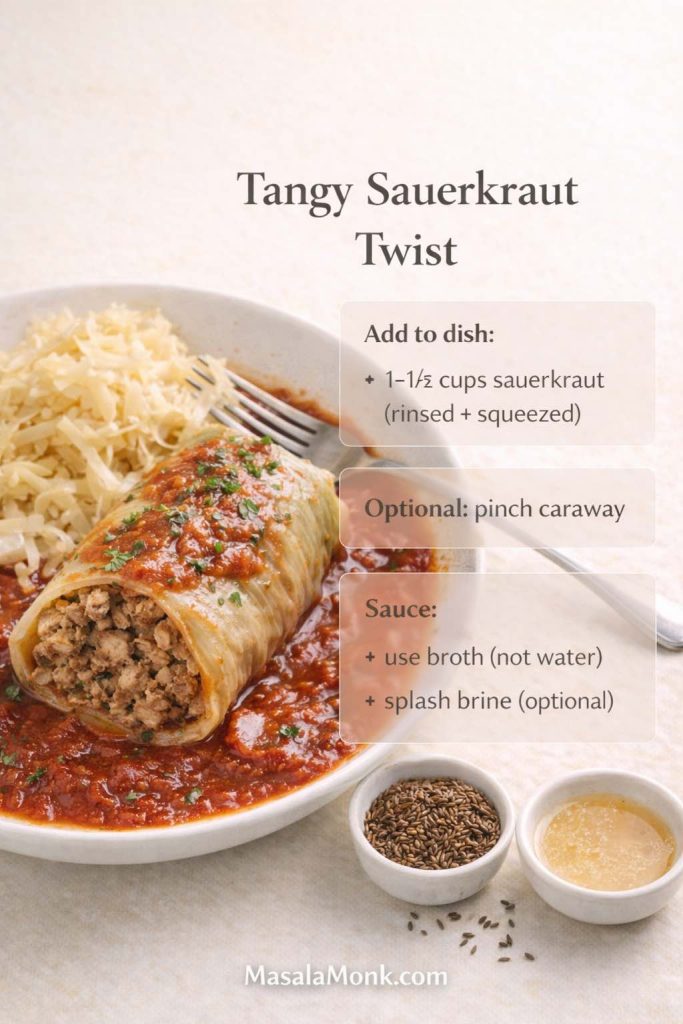
Tangy sauerkraut keto cabbage rolls in rich tomato sauce on a plate, shown with a side of sauerkraut plus small bowls of caraway seeds and sauerkraut brine. Text overlay reads “Tangy Sauerkraut Twist” with notes: add 1–1½ cups rinsed, squeezed sauerkraut; optional pinch of caraway; use broth (not water) and add a splash of brine.
Want the Polish-comfort vibe without changing the base method? This tangy sauerkraut twist shows exactly what to add: 1–1½ cups rinsed + squeezed sauerkraut, an optional pinch of caraway, and a broth-based sauce with a small brine splash for brighter, deeper flavor—without turning the pan watery.

Adjust the sauce:

  • Use broth rather than water so the tang stays balanced
  • Add a splash of sauerkraut brine for more bite, if you like

Sauerkraut makes the whole dish taste brighter. It’s also a smart trick if someone in your house thinks cabbage rolls can taste “one-note.” This version is anything but.

Twist 3: Sour cabbage leaves and “sarma-inspired” flavor (bright, savory, addictive)

Sarma rolls often use sour cabbage leaves, which brings a tang that feels uniquely satisfying with meat. If you can find sour cabbage leaves, use them. If not, you can mimic the effect by brushing softened cabbage leaves with a little vinegar and salt, then letting them rest briefly before filling.

Best meat choice: pork or turkey
Add to the filling:

  • Extra garlic (one more clove)
  • Optional: dried dill, mint, or parsley
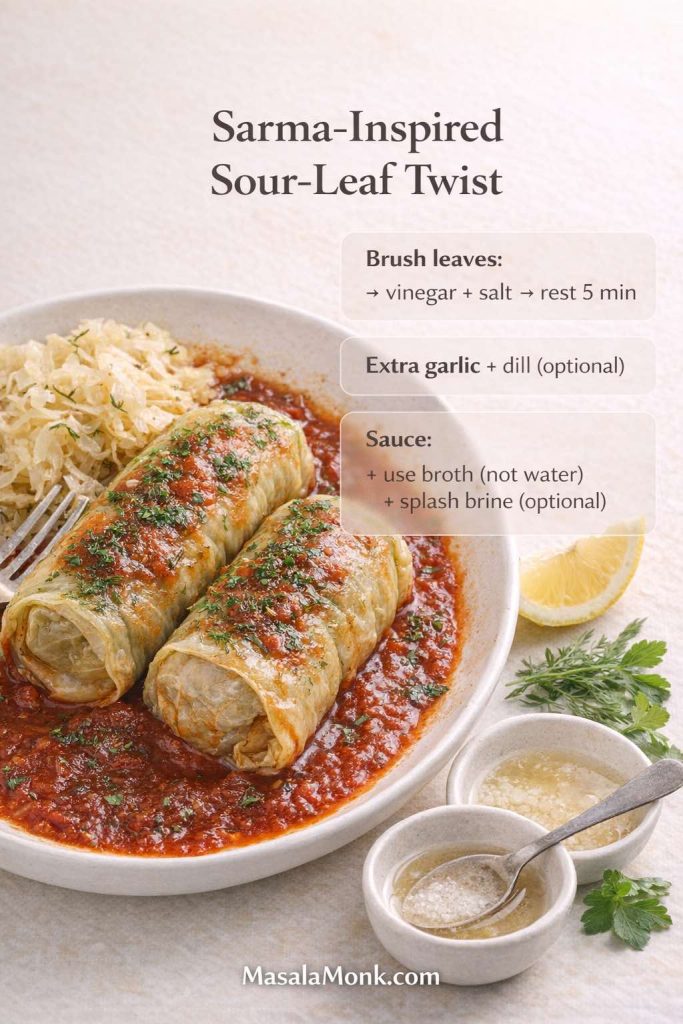
Sarma-inspired keto cabbage rolls on a light plate in rich tomato sauce, topped with herbs, with a lemon wedge and small bowls of vinegar and salt beside them. Text overlay highlights the “sour-leaf” trick: brush cabbage leaves with vinegar + salt and rest briefly, plus optional extra garlic and dill.
Sarma-inspired sour-leaf twist: If you can’t find sour cabbage leaves, this is the clean workaround—brush softened leaves with vinegar + salt, rest 5 minutes, then roll as usual. The result tastes brighter and more addictive, without changing the base method.

Adjust the sauce:

  • Keep the sauce slightly looser; it will reduce as it bakes
  • Finish with a small squeeze of lemon if you want a brighter edge

The result is tangy without being sharp. It also feels lighter than a pure beef version, which makes it a strong option if you want keto cabbage rolls that don’t sit too heavy.

Twist 4: Spicy garlic paprika rolls (for heat lovers)

If your goal is to make cabbage rolls that feel energizing rather than sleepy, add heat. Spicy cabbage rolls can still be comforting; they just also happen to be exciting.

Best meat choice: beef or turkey
Add to the filling:

  • 1/2 to 1 teaspoon cayenne (start small)
  • 1 teaspoon chili flakes
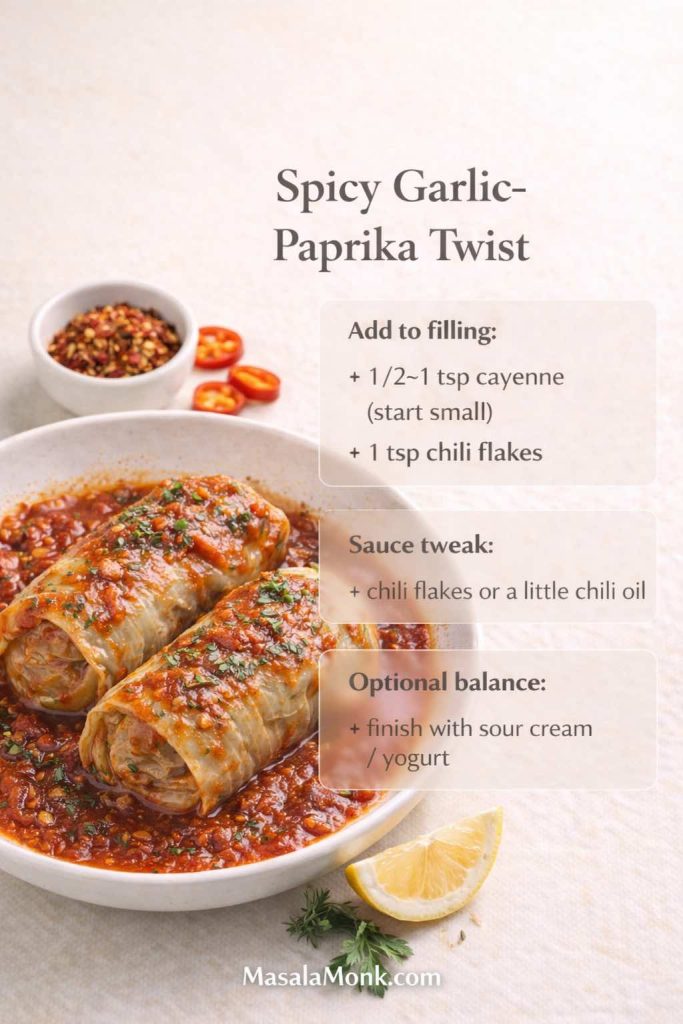
“Two keto cabbage rolls in rich tomato sauce on a light background with chili flakes and parsley; text overlay reads ‘Spicy Garlic–Paprika Twist’ with tips: add 1/2–1 tsp cayenne (start small) + 1 tsp chili flakes, sauce tweak with chili flakes or chili oil, and optional balance with sour cream/yogurt; MasalaMonk.com footer.”
Spicy Garlic–Paprika Twist: Turn the base keto cabbage rolls into a heat-lover’s version by adding cayenne + chili flakes to the filling, then finishing the sauce with a little chili oil if you want extra punch. The “optional balance” tip (a spoon of sour cream/yogurt) is the fastest way to keep the sauce tasting rich—not harsh—while the rolls stay bold and satisfying.

Adjust the sauce:

  • Add chili flakes or a little chili oil
  • Keep garlic forward

This variation is also useful when you’re eating low carb and you miss “snacky” flavors. Heat and spice create the kind of satisfaction that helps you forget you’re even thinking about carbs.

Twist 5: Mediterranean herb garlic paprika rolls (fresh, fragrant, still cozy)

This twist leans into herbs rather than tang or smoke. It’s still tomato-based and still boldly seasoned, but the finish feels brighter and more fragrant.

Best meat choice: ground turkey (or lean beef)
Add to the filling:

  • 2 teaspoons oregano
  • 1 teaspoon thyme
  • Optional: lemon zest
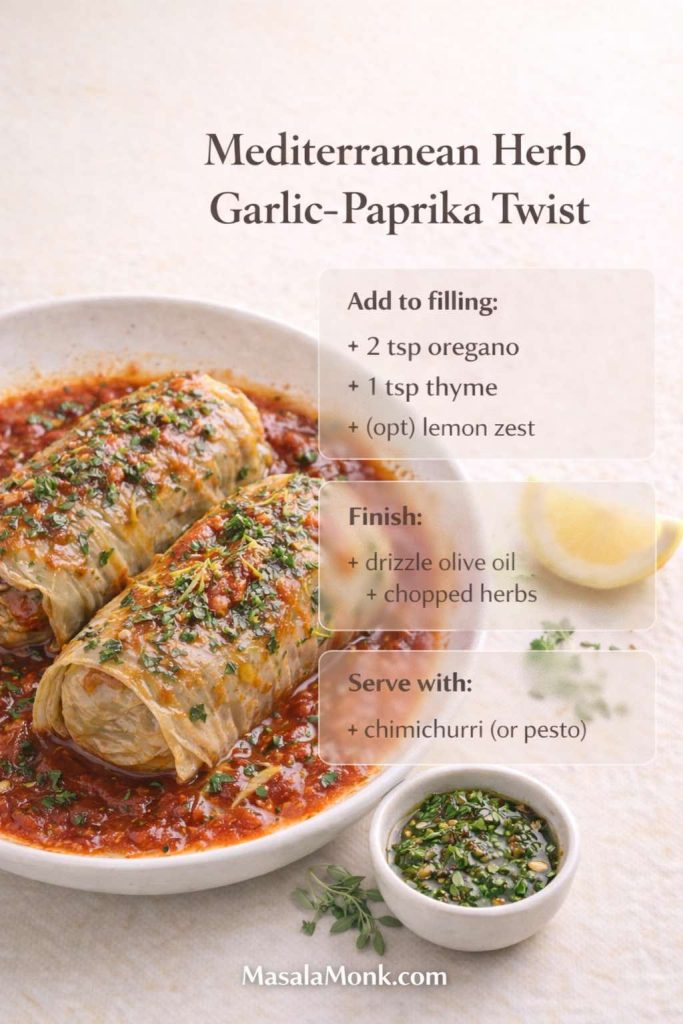
Mediterranean herb garlic-paprika keto cabbage rolls in rich tomato sauce, topped with chopped herbs and olive oil. Text overlay lists: add oregano, thyme, optional lemon zest; finish with olive oil and herbs; serve with chimichurri or pesto. MasalaMonk.com footer.
Mediterranean Herb Twist (fresh, fragrant, still cozy): Add oregano + thyme (and optional lemon zest) to the base garlic-paprika filling, then finish the baked rolls with a drizzle of olive oil + chopped herbs. The little bowl of chimichurri (or pesto) is the “dinner-party” shortcut—bright, garlicky, and perfect with tomato sauce. (Save/Pin this twist so you can swap flavors without relearning the recipe.)

Adjust the sauce:

  • Finish with a drizzle of olive oil and chopped herbs

For a punchy finishing sauce that fits perfectly here, a spoon of chimichurri on the side is almost unfairly good—garlic, herbs, acidity, and brightness, all in one. It’s especially helpful if you want the rolls to feel a bit more “dinner party” without changing the main recipe.

Herb-forward sauces are especially good with this version. If you like that kind of bright, garlicky finish, these pesto recipes are a great match alongside cabbage rolls.

Also Read: Sourdough Recipe: 10 Easy Bread Bakes (Loaves, Rolls & Bagels)


Cabbage roll soup and unstuffed cabbage roll soup (same flavors, easier weeknights)

Some nights, rolling feels like therapy. Other nights, it feels like too much. That’s where the soup version steps in.

Unstuffed cabbage roll soup—sometimes called unrolled cabbage soup, stuffed cabbage roll soup, or simply cabbage roll soup—is essentially the same recipe expressed differently. You still get garlic, paprika, tomato, tender cabbage, and savory meat. You’re just skipping the wrapping.
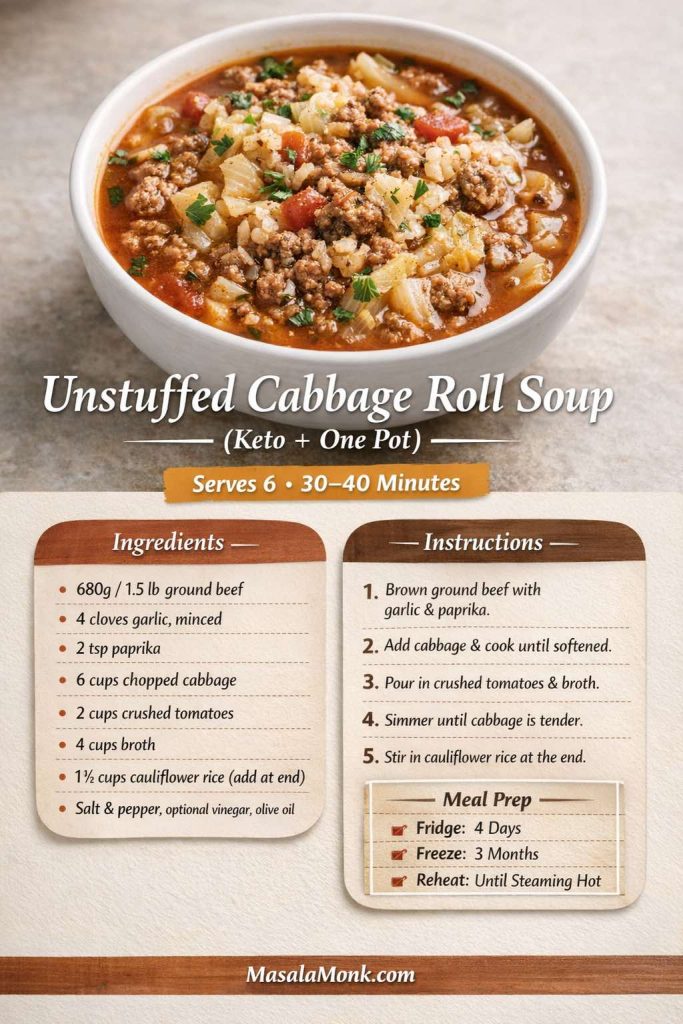
A bowl of unstuffed cabbage roll soup with ground beef, tender cabbage, tomatoes, and herbs in a tomato broth. Text overlay reads “Unstuffed Cabbage Roll Soup (Keto + One Pot)” plus a quick recipe card showing ingredients, 5 steps (brown beef with garlic and paprika, add cabbage, add tomatoes and broth, simmer, stir in cauliflower rice at end), and meal prep notes (fridge 4 days, freeze 3 months).
Want cabbage roll comfort without rolling? This unstuffed cabbage roll soup is the one-pot shortcut: ground beef + cabbage + tomato broth + garlic + paprika, finished with cauliflower rice at the end so it stays pleasantly textured. Save this card for busy nights—then scroll for baked rolls, casserole, skillet, and slow cooker versions in the same flavor family.

Unstuffed cabbage roll soup (keto-friendly method)

What you’ll do:

  1. Brown ground beef, turkey, or pork in a pot with garlic, paprika, salt, and pepper.
  2. Add chopped cabbage and stir until it begins to soften.
  3. Pour in crushed tomatoes and broth.
  4. Simmer until the cabbage is tender.
  5. Stir in cauliflower rice near the end, so it stays pleasantly textured rather than mushy.

Because this is a soup roll in spirit—cabbage roll flavors in a bowl—it works beautifully as a high-protein meal prep option. It also freezes well.

If you like cooking once and coasting for a few days, you might also enjoy these crock pot chicken breast recipes.

When you store soup for the week, safe reheating matters. FoodSafety.gov’s chart of safe minimum internal temperatures supports the common recommendation to reheat leftovers to 165°F / 74°C, which is especially relevant for meat-based soups.

Also Read: Peanut Butter Fudge: Recipes & Guide (8 Methods + Easy Variations)


Cabbage roll casserole: deconstructed, layered, and effortless

Cabbage roll casserole is the lazy cousin of stuffed cabbage rolls, and it’s a gift. It gives you the same taste profile without the rolling step. That’s why you’ll see it described as unrolled cabbage casserole, deconstructed cabbage roll casserole, or even “cabbage roll in a pan.”

This is also the format that best captures cravings for “easy cabbage casserole recipes” and “cabbage casserole with hamburger meat,” while staying firmly in keto-friendly territory.
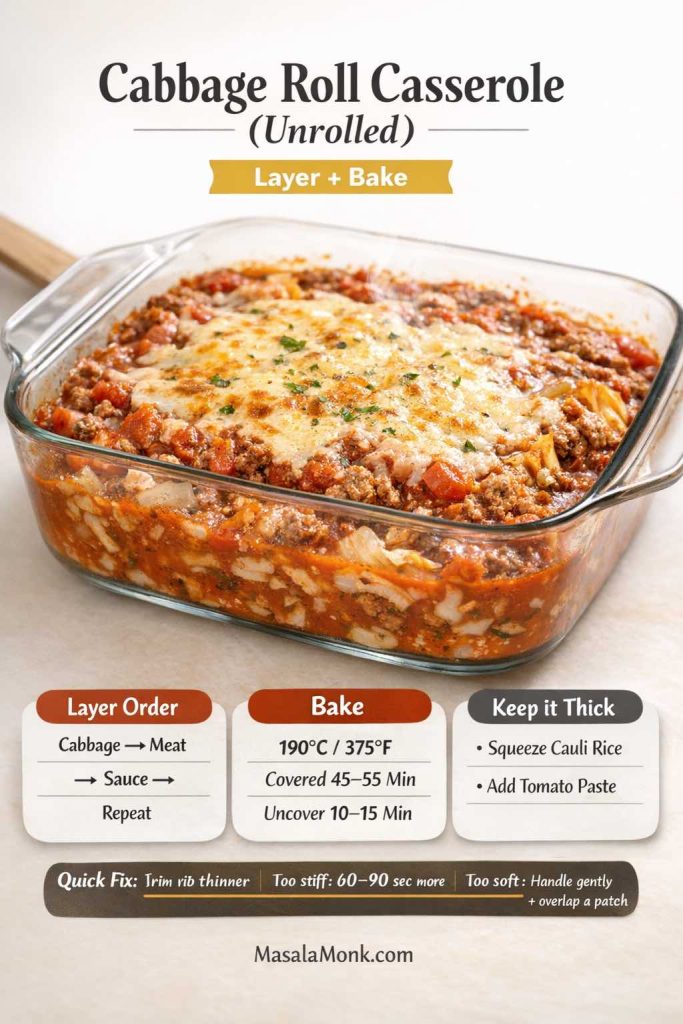
Photoreal cabbage roll casserole in a glass baking dish with saucy ground beef, tomatoes, and tender cabbage, topped with melted golden cheese. Text overlay reads “Cabbage Roll Casserole (Unrolled) — Layer + Bake” and shows quick cards: layer order (cabbage → meat → sauce → repeat), bake at 190°C/375°F covered 45–55 minutes then uncover 10–15 minutes, and “keep it thick” tips (squeeze cauliflower rice, add tomato paste). MasalaMonk.com footer.
If you want stuffed cabbage flavor without rolling, this cabbage roll casserole (unrolled) is the lazy-night win: layer cabbage + meat filling + sauce, bake covered until tender, then uncover briefly to thicken. The “keep it thick” tips prevent the #1 casserole problem (watery sauce), so you get a rich, spoonable result that reheats beautifully.

Keto cabbage roll casserole method (unrolled)

  1. Brown your ground meat with garlic, paprika, salt, and pepper.
  2. Stir in cauliflower rice and mushrooms (if using).
  3. In a baking dish, layer chopped cabbage and the meat mixture.
  4. Pour sauce over the top.
  5. Cover and bake until the cabbage is tender.
  6. Uncover near the end so the sauce thickens.

If you love a richer casserole, you can add cheese on top for a “cabbage rolls with cheese” feel—still very much in the spirit of cheese stuffed cabbage rolls, just without the fiddly wrapping.

Also Read: Best Vermouth for a Negroni Cocktail Drink Recipe


Skillet cabbage rolls and “cabbage roll in a bowl” (fast comfort)

Sometimes you want “stuffed cabbage” flavor in under 30 minutes. Skillet cabbage rolls—also described as cabbage roll in a skillet, cabbage roll skillet recipe, or cabbage roll in a bowl—deliver exactly that.
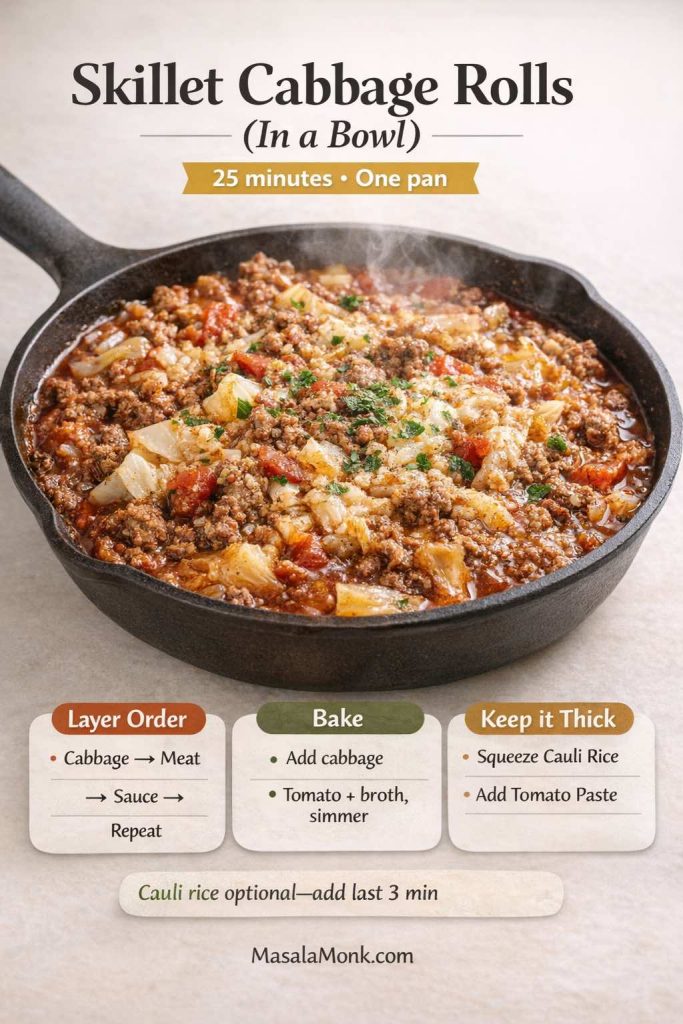
Skillet filled with “cabbage roll in a bowl” mixture: ground beef, tender cabbage, tomatoes, and herbs in a saucy garlic-paprika tomato base. Text overlay reads “Skillet Cabbage Rolls (In a Bowl) — 25 minutes • One pan” and includes quick steps: brown beef with garlic and paprika, add cabbage, add tomato + broth and simmer, finish with olive oil/sour cream/parmesan. Note says cauliflower rice is optional—add in the last 3 minutes. MasalaMonk.com footer.
When you want stuffed cabbage flavor fast, this skillet cabbage roll in a bowl hits the same comfort notes in one pan—garlic, paprika, tomato, tender cabbage, and savory beef—without rolling or baking. Keep this visual handy for weeknights, then use the rest of the post to choose your “format”: baked rolls, soup, casserole, slow cooker, and freezer-friendly prep.

The method is simple: brown meat with garlic and paprika, add shredded cabbage, pour in tomato and broth, then simmer until everything turns saucy and tender. You can finish with olive oil, sour cream, or parmesan, depending on your mood.

This is also one of the most forgiving versions if you’re using lean meat. Because the dish is saucy, you can adjust richness right at the end.

Also Read: Keto Flour: Guide to Low-Carb Flours That Bakes Like the Real Thing


Slow cooker cabbage rolls and crock pot cabbage roll casserole

Cabbage rolls in a slow cooker feel like a different kind of comfort. The cabbage becomes extra tender, the sauce sinks deeper into the filling, and the whole dish tastes like it spent the day becoming itself.

If you’re making cabbage roll crock pot style, the main difference is liquid management. Slow cookers trap moisture, so sauces tend to thin out unless they start thicker.
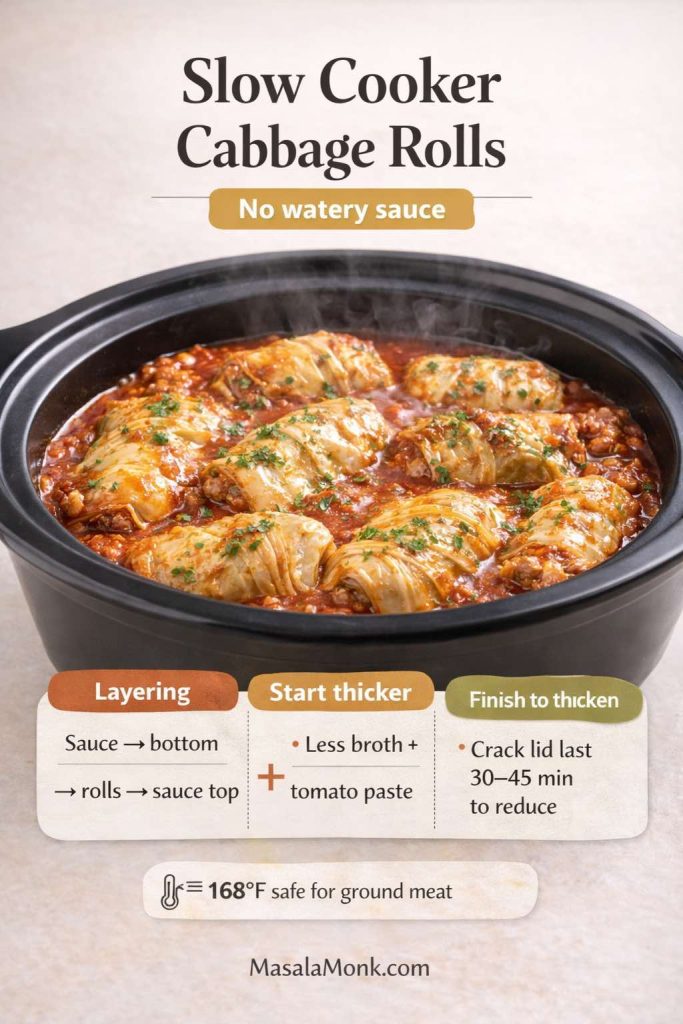
Photoreal slow cooker filled with cabbage rolls in rich tomato sauce, sprinkled with herbs, with steam rising. Text overlay reads “Slow Cooker Cabbage Rolls — No watery sauce” and shows three tip boxes: layering (sauce bottom → rolls → sauce top), start thicker (less broth + tomato paste), and finish to thicken (crack lid last 30–45 min to reduce). A thermometer icon notes safe internal temperature for ground meat. MasalaMonk.com footer.
Slow cooker cabbage rolls are effortless—until the sauce turns thin. Use this quick guide to keep crock pot stuffed cabbage rich and spoonable: layer sauce on the bottom and top, start with a thicker tomato base, and crack the lid near the end to reduce. It’s the easiest way to get slow-cooked tenderness without the “watery soup” problem.

Slow cooker stuffed cabbage rolls (keto-friendly)

  • Make and roll the cabbage rolls as usual.
  • Layer sauce on the bottom, then rolls, then more sauce.
  • Cook on low until the cabbage is very tender and the filling is safely cooked through.

Crock pot cabbage roll casserole (unstuffed)

  • Layer chopped cabbage, browned filling, and sauce in the slow cooker.
  • Cook on low until tender.
  • If the sauce is too thin, crack the lid for the final stretch or stir in a small amount of tomato paste near the end.

Again, safe internal temperature guidance matters, especially when cooking ground meat. USDA’s references for ground beef and poultry/ground turkey are good citations to keep the recipe grounded.

Also Read: Whole Chicken in Crock Pot Recipe (Slow Cooker “Roast” Chicken with Veggies)


Freezing cabbage rolls, freezing cabbage for cabbage rolls, and meal prep that actually works

Cabbage rolls are one of the best “cook once, eat twice” dinners. They’re also one of the best “cook once, eat six times” dinners if you freeze them.

That matters, because meal prep is often where a low carb diet either becomes easy or becomes exhausting. When you have a freezer-friendly high-protein option that you genuinely enjoy, it’s much easier to stay consistent.
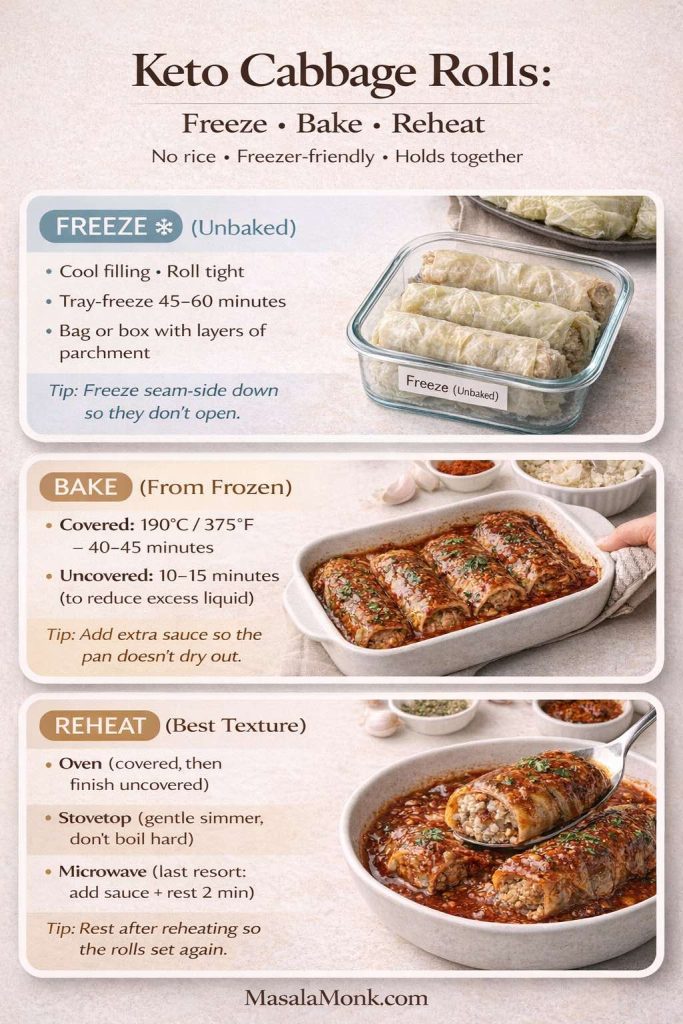
Infographic titled “Keto Cabbage Rolls: Freeze • Bake • Reheat” showing three steps: freeze unbaked rolls (cool filling, roll tight, tray-freeze 45–60 minutes, layer with parchment), bake from frozen (covered at 190°C/375°F for 40–45 minutes then uncover 10–15), and reheat options (oven, stovetop simmer, microwave last resort). Photos show unbaked rolls in a container and baked rolls in sauce.
Freezer-friendly keto cabbage rolls made easy: freeze unbaked, bake from frozen, then reheat without drying out. Use this quick chart to get the timing right, keep the rolls intact, and make meal-prep weeks feel effortless—no rice needed, just big comfort. (Perfect to save/print and great for batch cooking.)
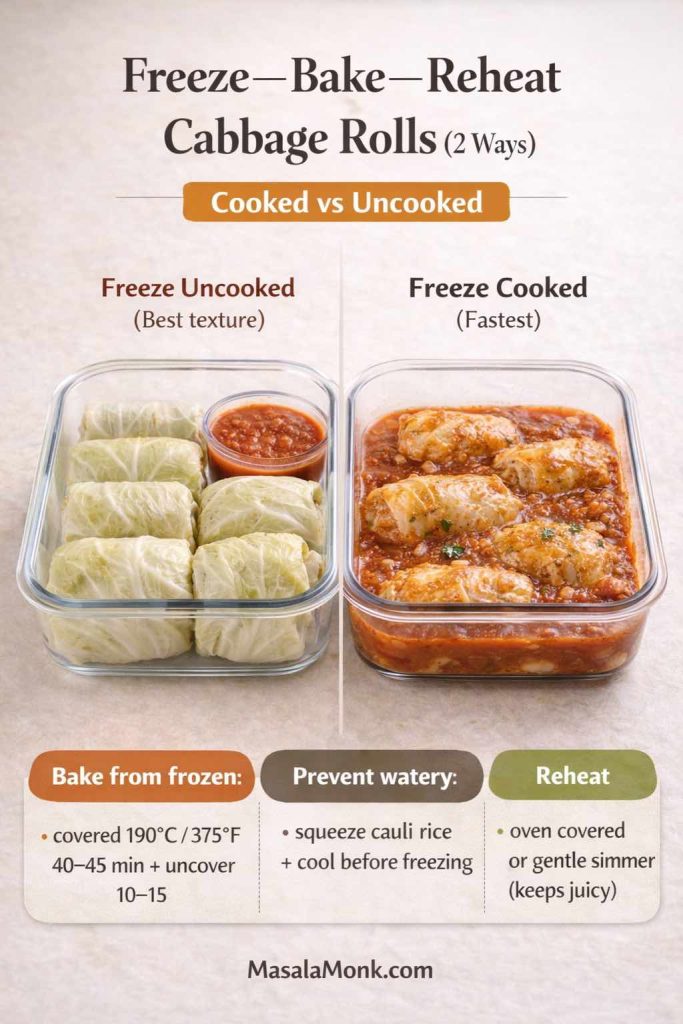
Infographic photo showing two glass meal-prep containers of cabbage rolls: left is “Freeze Uncooked (Best texture)” with raw cabbage rolls and a cup of sauce; right is “Freeze Cooked (Fastest)” with baked cabbage rolls in tomato sauce. Text overlay includes: “Bake from frozen: covered 190°C/375°F 40–45 min + uncover 10–15,” “Prevent watery: squeeze cauliflower rice + cool before freezing,” and “Reheat: oven covered or gentle simmer (keeps juicy).” MasalaMonk.com at bottom.
Freezing cabbage rolls is the difference between “I’ll cook later” and actually having dinner ready. This quick visual shows the two best options: freeze uncooked for the best texture or freeze cooked for the fastest reheat, plus the exact bake-from-frozen timing. The “prevent watery” note is the big one—squeeze cauliflower rice and cool before freezing so your rolls stay firm, saucy, and satisfying.

Freeze the cabbage (a simple prep trick)

If you haven’t tried it, freezing cabbage for cabbage rolls is one of the easiest prep hacks available. Freeze the whole head, thaw it, and the leaves become pliable. You can prep leaves on a calm day, then roll and cook later when you’re busy.

Freezing stuffed cabbage rolls (uncooked)

Freezing uncooked rolls often gives the best texture because everything cooks fresh later.

  • Assemble the rolls in a freezer-safe dish.
  • Pour sauce over.
  • Wrap tightly.
  • Freeze.

When you bake, you can cook from frozen, simply allowing extra time. Keep the dish covered so the sauce doesn’t evaporate too quickly before the center heats.

Freezing cabbage rolls (cooked)

Freezing cooked cabbage rolls is the convenience route:

  • Let rolls cool fully.
  • Portion with sauce.
  • Freeze in containers.

To reheat, warm gently so the filling stays juicy rather than drying out. USDA’s guidance on leftovers and food safety and FoodSafety.gov’s temperature chart both support reheating leftovers to 165°F / 74°C for safety.

Also Read: Frozen Chicken Wings in Air Fryer (No Thaw) — Crispy From Frozen + Time & Temp


Vegan cabbage rolls, vegetarian cabbage rolls, and meatless stuffed cabbage that still feels hearty

Even though this post is built around keto cabbage rolls, it’s useful to include an option for households that mix diets. Maybe you’re eating low carb, while someone else wants a meatless version. Maybe you want a “lighter day” dinner that still has cabbage-roll comfort.

Vegan cabbage rolls and vegetarian cabbage rolls work especially well with napa cabbage or savoy cabbage, because the leaves are tender and the filling can be softer.
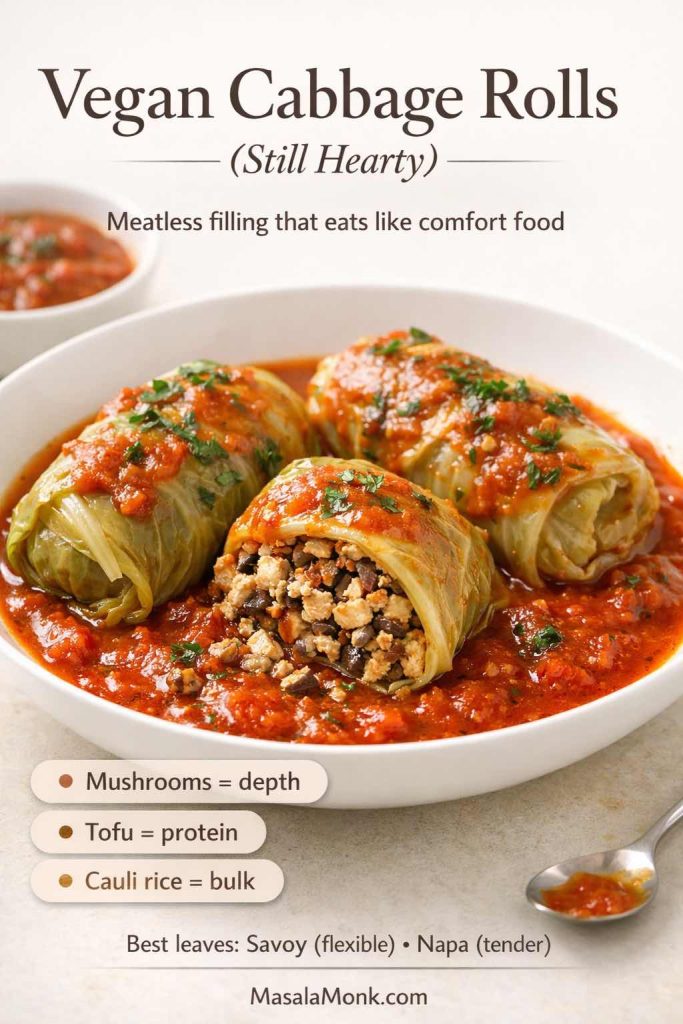
Vegan cabbage rolls in a rich tomato sauce on a white plate; one roll is cut open to show a hearty filling of crumbled tofu, mushrooms, and cauliflower rice. Text overlay reads “Vegan Cabbage Rolls (Still Hearty)” with notes: “Mushrooms = depth,” “Tofu = protein,” “Cauli rice = bulk,” and “Best leaves: Savoy (flexible) • Napa (tender).” MasalaMonk.com footer.
Vegan cabbage rolls that still eat like comfort food: tofu brings protein, mushrooms add deep savory flavor, and cauliflower rice gives that “bulk” without heaviness. If you’re cooking for a mixed table (keto + vegetarian/vegan), this is the easiest way to keep the cabbage-roll vibe consistent—same sauce, same cozy payoff, just a different filling.

A vegan, cabbage-roll-style filling that works

For a plant-forward approach, the goal is to create a filling that’s savory and satisfying:

  • Finely chopped mushrooms (for depth)
  • Crumbled tofu (for protein)
  • Cauliflower rice (for bulk)
  • Garlic and paprika (for continuity with the main recipe)
  • A binder such as ground flax mixed with water, if needed

You can bake these the same way, using the tomato sauce method above.

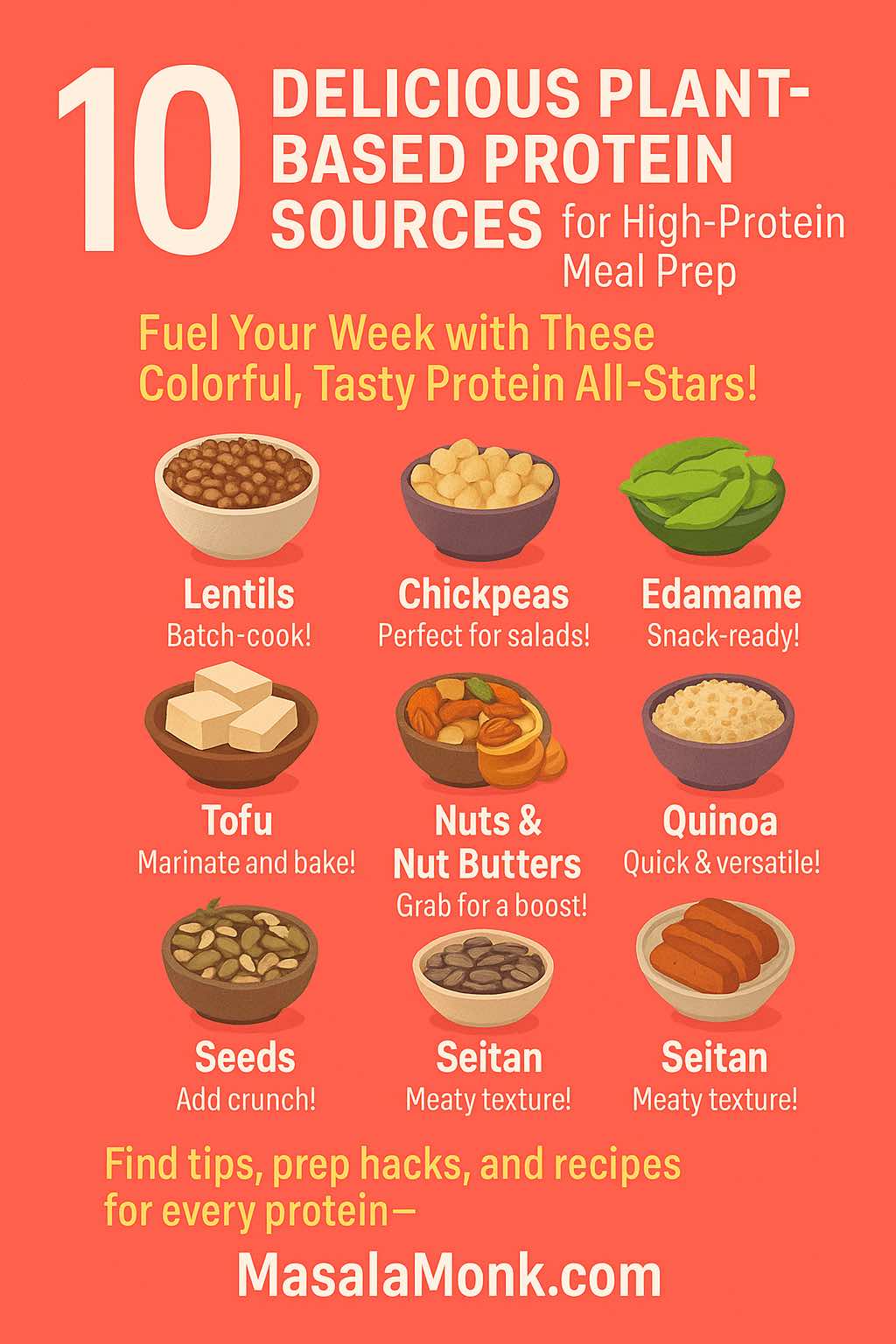
If you’re trying to keep a few plant-based, high-protein options in rotation, this list of plant-based protein sources for high-protein meal prep is full of practical ideas.

Also Read: Innovate Your Vegan Keto Breakfast: 5 Pistachio and Sunflower Seed Smoothie Recipes for Meal Replacement


Cabbage wraps, cabbage roll ups, and “cabbage wrap meat” shortcuts

Not everyone wants full baked cabbage rolls. Sometimes you want something quicker—something closer to a cabbage wrap recipe than a casserole. That’s where cabbage wraps come in.

You can think of cabbage wraps as a lighter, fresher cousin to baked cabbage rolls. Instead of cooking the rolls in sauce for an hour, you’re wrapping a cooked filling in softened leaves, then serving with a spoonable sauce.
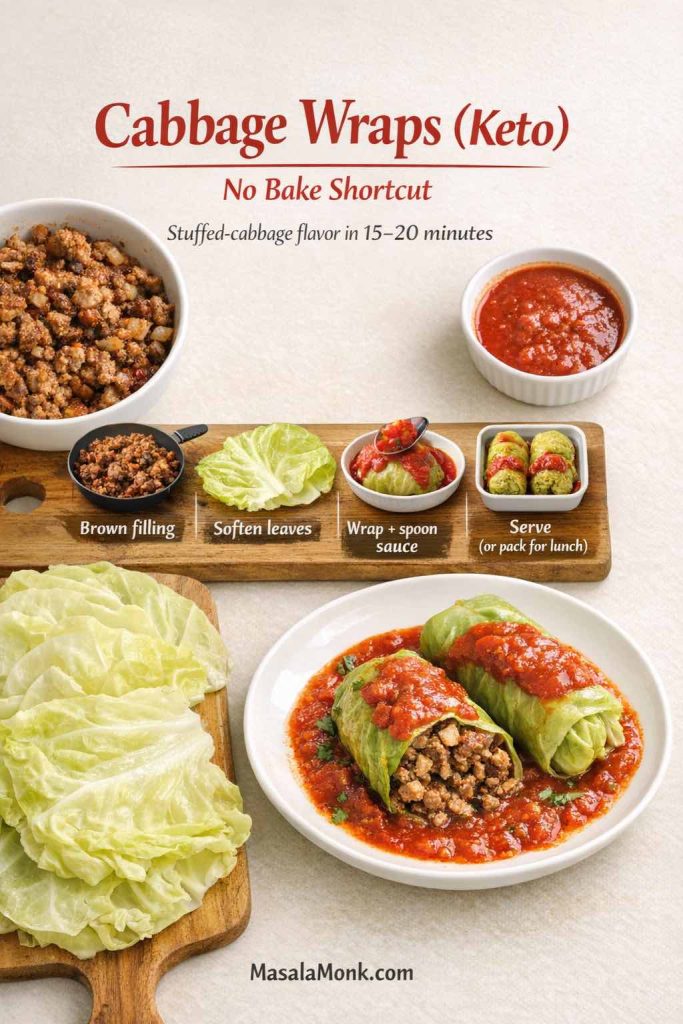
Top-down food graphic titled “Cabbage Wraps (Keto) — No Bake Shortcut.” It shows a plate with two cabbage wraps filled with seasoned ground meat and topped with tomato sauce. On the side are softened cabbage leaves on a board, plus step labels: “Brown filling,” “Soften leaves,” “Wrap + spoon sauce,” and “Serve (or pack for lunch).” MasalaMonk.com appears at the bottom.
When you want stuffed cabbage roll flavor without baking, these keto cabbage wraps are the fastest move: brown the garlic-paprika filling, soften a few leaves, wrap, and spoon sauce over top. The 4-step strip makes this a true weeknight shortcut—and it doubles as a lunch idea when you pack wraps with a little sauce cup on the side.

Quick cabbage wraps (keto-friendly)

  1. Brown ground beef with garlic and paprika.
  2. Make a quick sauce in the same pan (tomato + broth + paprika + olive oil).
  3. Spoon filling into softened cabbage leaves.
  4. Wrap and serve with sauce over top.

This gives you the comfort without committing to a baking dish. It’s also a great lunch format because the wraps hold together well in containers.

Also Read: Keto Fiesta: Spicing up Your Meals with Flavorful Taco Pie and Creative Toppings!


A note on “cabbage balls” and stuffed cabbage balls (when you want bite-sized comfort)

Cabbage balls show up in a few different traditions, and they’re essentially cabbage roll filling expressed as a small ball, sometimes wrapped partially in cabbage or simmered in sauce.

For a keto-friendly cabbage balls recipe approach, you can do this:

  • Make the same garlic paprika filling.
  • Roll it into small balls.
  • Brown them quickly, then simmer in the tomato sauce until cooked through.

It’s the same flavor story, just a different shape. The advantage is speed: no leaf-by-leaf rolling. The tradeoff is that you lose some of the classic cabbage roll structure. Still, if someone loves the filling more than the wrap, cabbage balls can be a satisfying variation.

Also Read: Air Fryer Hard-Boiled Eggs (No Water, Easy Peel Recipe)


Making cabbage rolls taste “traditional” without being stuck in one tradition

Cabbage rolls are one of those foods where families are fiercely loyal to what they grew up with. One home might swear by sweet-and-sour Jewish stuffed cabbage. Another might prefer a paprika-forward Hungarian stuffed cabbage rolls recipe. Someone else might love sauerkraut-heavy Polish cabbage rolls. Meanwhile, German cabbage rolls and kohlrouladen recipes often lean into deeper, darker savory notes.
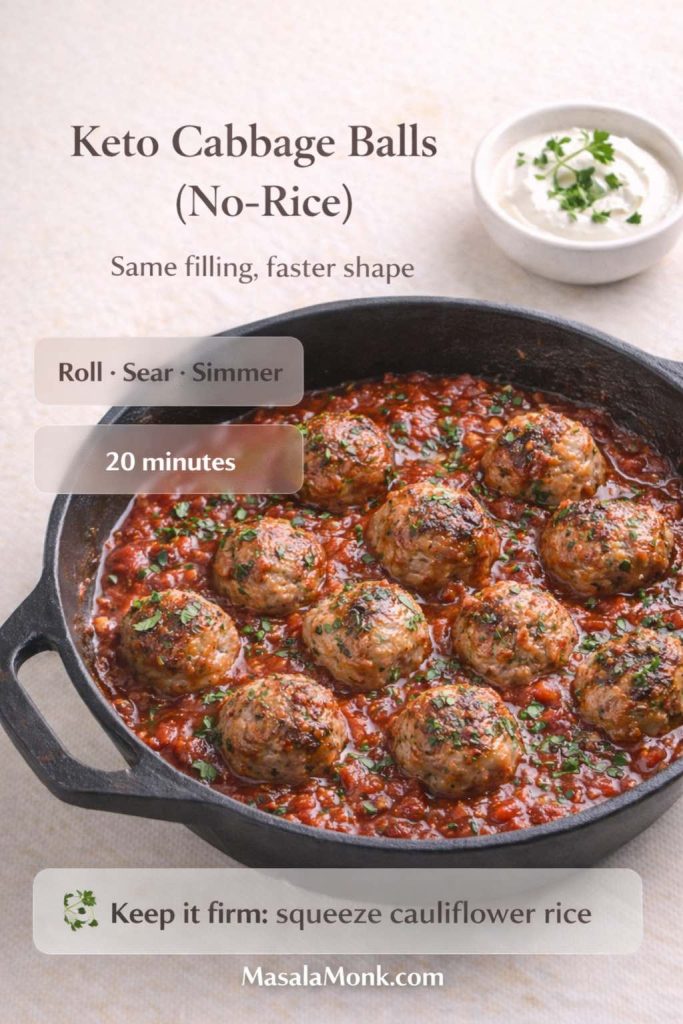
Keto cabbage balls (no-rice) simmering in chunky garlic-paprika tomato sauce in a cast-iron skillet, with a small bowl of sour cream on the side. Text overlay reads ‘Keto Cabbage Balls (No-Rice)’, ‘Same filling, faster shape’, ‘Roll • Sear • Simmer’, ‘20 minutes’, and ‘Keep it firm: squeeze cauliflower rice’. MasalaMonk.com at bottom.
Keto cabbage balls are the “same filling, faster shape” version of cabbage rolls: roll the no-rice mix into balls, sear for crust, then simmer in the tomato sauce until juicy. The one tip that prevents mushy meatballs is right here—squeeze cauliflower rice dry before mixing.

This garlic and paprika foundation sits comfortably in that broader family of flavors. Garlic shows up everywhere. Paprika bridges sweet and smoky. Tomato sauce ties the whole dish to the “stuffed cabbage” comfort zone.

So if you’ve been chasing a version that feels familiar—old fashioned cabbage rolls, traditional stuffed cabbage, classic cabbage roll recipe—this approach can scratch the same itch. It doesn’t claim to replace any one grandmother’s method. Instead, it gives you a dependable base with enough flexibility to feel personal.

Also Read: Baked Jalapeño Poppers (Oven) — Time, Temp & Bacon Tips


Serving ideas that keep cabbage rolls satisfying (and keto-friendly)

A pan of cabbage rolls is already a complete meal, yet the right side can elevate it:

  • A crunchy slaw with a creamy dressing (again, eggless mayonnaise is handy as a base)
  • A spoon of herb sauce like chimichurri for brightness
  • A drizzle of olive oil and fresh herbs for the Mediterranean twist
  • A sprinkle of parmesan or feta for richness

Keeping one good red sauce around makes weeknight dinners easier—cabbage rolls, skillet cabbage, meatballs, and more. If you like having options ready in the fridge, these pizza sauce recipes are worth saving.


Troubleshooting Cabbage Rolls that are Keto Friendly

Even with a solid recipe, cabbage rolls can go sideways if a few details are off. The fixes are straightforward, though, and once you know them, you rarely run into the same problem twice.
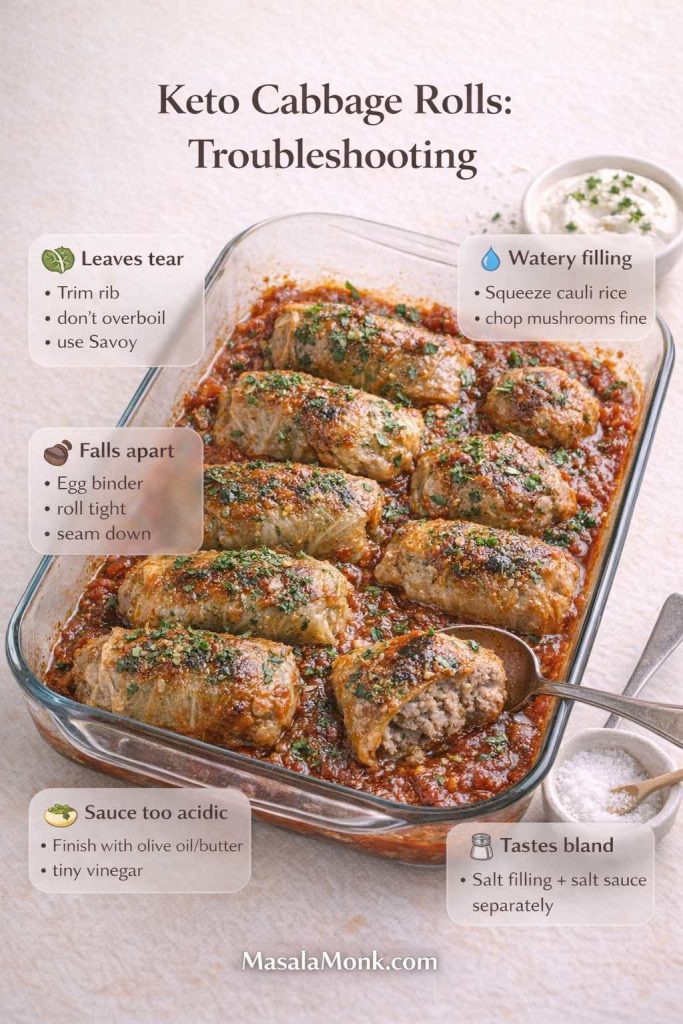
Troubleshooting infographic for keto cabbage rolls in a glass baking dish with tomato-garlic sauce and parsley. Callouts list fixes: leaves tear (trim rib, don’t overboil, use savoy), watery filling (squeeze cauliflower rice, chop mushrooms fine), rolls fall apart (egg binder, roll tight, seam down), sauce too acidic (finish with olive oil or butter, tiny vinegar), tastes bland (salt filling and sauce separately). MasalaMonk.com footer.
Keto cabbage rolls going sideways? Save this troubleshooting visual. It covers the most common problems—torn leaves, watery “no-rice” filling, rolls that fall apart, sharp tomato sauce, and bland flavor—plus quick fixes that work fast (like squeezing cauliflower rice dry, rolling seam-side down, and balancing acidity with a little fat). Keep it right above the troubleshooting section so readers can scan, fix, and keep cooking.

If your cabbage leaves tear

The rib is usually the culprit. Trim it thinner so the leaf lies flat. Also, don’t overboil; overcooked leaves tear easily. If tearing keeps happening, switch to savoy cabbage, which folds more gently.

If your filling turns watery

Frozen cauliflower rice often holds water. Thaw and squeeze it dry. Mushrooms can also release liquid, so chop them finely and mix them with the meat so they cook evenly inside the roll.

If your rolls fall apart

Use an egg binder, roll tightly, and always place seam-side down. If you’re making a casserole or soup version, this is less of a concern, which is one reason unstuffed cabbage roll casserole is so forgiving.

If the sauce tastes too acidic

Finish with olive oil or butter, and consider a small splash of vinegar to balance. It sounds counterintuitive, yet it often makes tomato taste smoother rather than sharper. If you want a citation that supports the choice of olive oil as a staple fat, Harvard Health’s piece on extra-virgin olive oil is a useful reference.

If the dish tastes bland

Salt is not optional here. Cabbage is mild, and meat needs seasoning to taste “finished.” Season the filling well, then season the sauce separately. Paprika also needs enough salt to taste like something rather than like colored dust.

Also Read: Keto Mocktails: 10 Low-Carb Recipes for Guilt-Free Happy Hour Indulgence


Bringing it all together: one template, many dinners

Once you’ve made the base recipe, you’ve effectively unlocked multiple meals:

  • Oven baked keto cabbage rolls with garlic and paprika
  • Unstuffed cabbage roll soup for weeknights
  • Deconstructed cabbage roll casserole when you want comfort without rolling
  • Skillet cabbage rolls when time is short
  • Slow cooker cabbage rolls when you want hands-off cooking
  • Freezer-friendly cabbage rolls for meal prep
  • A vegan or vegetarian cabbage roll variation for mixed-diet households
  • Sauerkraut and sour cabbage leaf styles when you want tang
  • Spicy cabbage rolls when you want heat
  • Mediterranean cabbage rolls when you want herbs and brightness

That’s the hidden power of this dish. It isn’t just a recipe for stuffed cabbage rolls; it’s a repeatable system. You’re learning how to cook cabbage leaves, how to build a filling that stays juicy without rice, and how to make a tomato sauce that tastes like comfort without relying on sweetness.

And because these rolls are so satisfying, they also make it easier to stick with low carb eating without feeling like you’re losing your favorite foods.

If you want to keep building a keto dinner rhythm after this, it can feel natural to explore other high-protein, low carb anchors—MasalaMonk’s beef recipes for a weight loss keto plan is a solid next stop, especially if you like dinners that reheat well and feel filling without being complicated.

Also Read: Keto pancakes that actually taste like pancakes


Full printable-style recipe (base + quick twist guide)

Garlic & Paprika Keto Cabbage Rolls (Base Recipe)

Serves: 6–8
Prep time: 30–45 minutes (depending on cabbage method)
Cook time: 55–75 minutes

Ingredients

  • 1 large green cabbage (or savoy)
  • 680 g / 1.5 lb ground beef (or turkey or pork)
  • 3–5 cloves garlic, minced or grated
  • 2 teaspoons paprika
  • 1 teaspoon salt
  • 1/2 teaspoon black pepper
  • 1 1/2 cups cauliflower rice (squeezed dry if previously frozen)
  • 1/2 cup finely chopped mushrooms (optional)
  • 1 egg (optional)
  • 1/3 cup grated parmesan (optional)

Sauce

  • 2 cups crushed tomatoes or passata
  • 1 cup broth
  • 1 tablespoon tomato paste (optional)
  • 1–2 tablespoons olive oil or butter
  • 1 teaspoon paprika
  • Garlic powder or an extra clove of garlic
  • Salt and pepper
  • Optional: splash of vinegar

Method

  1. Soften cabbage leaves using boiling, freeze-thaw, or microwave. Trim ribs so leaves fold easily.
  2. Mix filling ingredients gently until combined.
  3. Roll filling in leaves; place seam-side down in a baking dish.
  4. Whisk sauce and pour over rolls. Cover tightly.
  5. Bake at 190°C / 375°F until tender and cooked through. Uncover at the end for a thicker sauce, if desired.
  6. Rest briefly before serving so the rolls hold together better.

Safety note: USDA guidance recommends cooking ground beef to 160°F / 71°C and poultry/ground turkey to 165°F / 74°C—see USDA ground beef safety and USDA poultry safety. Leftovers should be reheated to 165°F / 74°C as referenced in USDA’s leftovers guidance and FoodSafety.gov’s temperature chart.

Quick twist guide (additions only)

  • Smoky: add smoked paprika + cumin; finish sauce with vinegar
  • Sauerkraut: layer rinsed, squeezed sauerkraut in the dish; optional caraway
  • Sour-leaf style: brush leaves lightly with vinegar + salt; add dill or mint
  • Spicy: add chili flakes + cayenne; finish with chili oil
  • Mediterranean: add oregano + thyme; finish with olive oil, herbs, and optionally chimichurri or pesto

Also Read: How to Make Churros (Authentic + Easy Recipe)


FAQs

1) What are keto cabbage rolls?

Keto cabbage rolls are stuffed cabbage rolls made without rice or other high-carb fillers. Instead, the filling relies on meat, seasonings, and low-carb “bulk” like cauliflower rice or mushrooms, then everything bakes or simmers in a savory sauce until the cabbage turns tender and the filling stays juicy.

2) Can cabbage rolls be keto friendly even with tomato sauce?

Yes. Tomato-based sauce can still work for cabbage rolls that are keto compatible, especially when the flavor comes from garlic, paprika, broth, and fat—not added sugar. In practice, the sauce tastes comforting and rich without needing sweetness to feel complete.

3) What replaces rice in keto-friendly cabbage rolls?

Cauliflower rice is the closest stand-in for the texture of rice stuffed cabbage rolls. Meanwhile, finely chopped mushrooms add moisture and depth, almost like the filling simmered longer. Additionally, riced broccoli can work, and shredded zucchini can too—just squeeze it well so it doesn’t water out the filling.

4) Can I make cabbage rolls with uncooked rice on keto?

Not really. Cabbage rolls with uncooked rice (or cooked rice) are typically not low carb. If you love the “classic stuffed cabbage rolls with ground beef and rice” style, the keto approach is to keep the same seasonings and sauce while swapping rice for cauliflower rice or mushrooms.

5) Which meat works best for keto cabbage rolls: ground beef, turkey, or pork?

Ground beef gives the richest, most classic stuffed cabbage flavor and stays forgiving when baked. Ground pork turns especially juicy and savory, and paprika loves it. And then ground turkey is lighter, yet it usually benefits from extra fat and bolder seasoning so the filling doesn’t taste dry.

6) How do I keep keto cabbage rolls from falling apart?

First, roll tightly and place the rolls seam-side down. Next, trim the thick cabbage rib so the leaf folds smoothly. Also, using an egg binder can help, particularly if your filling is very lean or you’re using extra vegetables like mushrooms or zucchini.

7) What’s the easiest way to soften cabbage leaves for cabbage rolls?

Freeze-and-thaw is quietly one of the easiest methods: freeze the whole cabbage head, thaw it, and the leaves become pliable. Otherwise, boiling works reliably, and the microwave method is fast for smaller batches. Either way, trimming the rib makes rolling far easier.

8) Can I make cabbage rolls with frozen cabbage?

Yes. Cabbage rolls with frozen cabbage work well if the cabbage is thawed fully and the leaves are handled gently. In fact, freezing cabbage for cabbage rolls is a common prep trick because it softens the leaves without a big pot of water.

9) Are cabbage rolls healthy?

They can be, especially when the filling is high-protein and the sauce is balanced. Cabbage rolls healthy versions often focus on leaner meat, more vegetables, and a sauce that isn’t sugar-heavy. Even so, richer versions can still fit well in a low carb or keto diet when portions are sensible.

10) How long do cabbage rolls cook in the oven?

Cabbage rolls in oven typically take around 55 to 75 minutes at 375°F / 190°C, depending on roll size, cabbage thickness, and the meat used. If you make smaller rolls or use thinner leaves, they may finish sooner.

11) Can I make stuffed cabbage rolls in the oven ahead of time?

Absolutely. Assemble the rolls, cover tightly, and refrigerate. Then bake when needed. Because the flavors deepen after resting, homemade stuffed cabbage rolls often taste even better the next day.

12) What is unstuffed cabbage roll soup?

Unstuffed cabbage roll soup is the same comfort flavor—cabbage, meat, garlic, paprika, and tomato—without rolling. It’s also called stuffed cabbage roll soup, cabbage roll soup recipe, unrolled cabbage soup, or simply cabbage roll soup, depending on how people describe it.

13) How do I make easy cabbage roll soup recipe style but keto-friendly?

Brown ground meat with garlic and paprika, add chopped cabbage, then pour in crushed tomatoes and broth. Simmer until tender. Finally, stir in cauliflower rice near the end so it keeps a pleasant bite instead of turning mushy.

14) What is a cabbage roll casserole?

Cabbage roll casserole is a deconstructed version of stuffed cabbage—everything layered or mixed in one dish. You’ll also see it called unrolled cabbage casserole, stuffed cabbage roll casserole recipe, cabbage rolls casserole layered, or deconstructed cabbage roll casserole.

15) Can I make cabbage roll casserole crock pot style?

Yes. Slow cooker stuffed cabbage casserole is a popular option because it’s hands-off. Brown the meat first for better flavor, then layer cabbage, filling, and sauce in the crock pot. Since slow cookers trap moisture, start with a slightly thicker sauce.

16) What’s the fastest “cabbage roll in a bowl” method?

Skillet cabbage rolls—often called cabbage roll in a skillet or cabbage roll in a bowl—are the quick route. Brown meat with garlic and paprika, add shredded cabbage, stir in tomato and broth, then simmer until everything becomes saucy and tender.

17) Can I freeze cabbage rolls for meal prep?

Yes, cabbage rolls for freezing are one of the best meal-prep moves. You can freeze them cooked or uncooked. Cooked rolls are convenient for quick reheating, whereas uncooked rolls often give the best texture after baking.

18) How do I freeze stuffed cabbage rolls without getting watery?

Squeeze moisture from cauliflower rice and any watery vegetables like zucchini. Cool cooked rolls fully before freezing. Also, freeze portions with sauce so the filling stays juicy instead of drying out.

19) Can I cook frozen cabbage rolls without thawing?

Yes. Frozen cabbage rolls can bake from frozen; they simply need extra time. Keep them covered so the sauce doesn’t reduce too quickly before the center heats through.

20) What are cabbage balls, and are they keto friendly?

Cabbage balls are basically stuffed cabbage filling shaped into bite-sized portions, then simmered or baked in sauce. For a keto-friendly cabbage balls recipe, keep the same garlic-paprika filling and skip rice, using cauliflower rice or mushrooms for bulk instead.

21) Are there vegetarian cabbage rolls or vegan cabbage rolls that still feel hearty?

Yes. Vegetarian cabbage rolls and cabbage rolls vegan versions often use mushrooms for depth, cauliflower rice for bulk, and a protein base like tofu or a mix of nuts and seeds. The sauce and seasonings do a lot of the “comfort” work, so the result can still feel satisfying.

22) What’s the difference between sarma rolls, gołąbki, and galumpkis?

They’re all cabbage roll traditions with regional differences. Sarma rolls often use sour cabbage leaves and can have a tangier profile. Gołąbki refers to Polish cabbage rolls, commonly with meat and rice. Galumpkis is another name used for Polish-style stuffed cabbage rolls, especially in North American kitchens.

23) What are German cabbage rolls and kohlrouladen?

German cabbage roll recipes often lean savory and rich, and the term kohlrouladen usually refers to cabbage leaves stuffed with meat, then braised until tender. Even when the seasoning style differs, the method overlaps closely with classic stuffed cabbage.

24) What makes “old fashioned cabbage rolls” taste like the classic version?

Classic cabbage roll recipes usually rely on well-seasoned meat, tender cabbage, and a sauce that simmers long enough to meld everything. Even when you remove rice for keto-friendly cabbage rolls, keeping the same garlic, paprika, onion, and tomato comfort notes preserves that traditional feel.

25) Why do some cabbage roll recipes taste like tomato soup?

That “cabbage rolls in tomato soup” flavor happens when tomato, broth, and fat balance each other. Tomato gives sweetness and acidity, broth adds savory backbone, and fat rounds off sharpness so the sauce tastes smooth and comforting.

26) How do I make cabbage wraps instead of baked cabbage rolls?

Cabbage wraps are a quicker approach: cook the filling first, soften leaves, then wrap and serve with sauce spooned over top. It’s a useful shortcut when you want cabbage wrap meat style comfort without a long bake.

27) What’s the best cabbage for stuffed cabbage rolls?

Green cabbage is the most forgiving and sturdy for rolling. Savoy cabbage is more flexible and easier to fold, which helps if tearing is a problem. Napa cabbage is tender and great for vegan cabbage rolls, although it can be more delicate.

28) Why are my cabbage rolls bland, even with paprika?

Cabbage is mild, so seasoning has to be strong enough to carry through. Salt matters more than most people expect, and paprika needs salt to taste like something rather than just color. Also, season both the filling and the sauce separately for the best result.

29) Can I make “best cabbage roll recipe ever” style flavor on keto?

Yes—because “best stuffed cabbage recipe ever” usually means juicy filling, tender cabbage, and a sauce that tastes deep and balanced. You can keep that same goal while swapping rice for low-carb bulk and leaning into garlic and paprika for bold flavor.

30) How do I make keto cabbage rolls feel more filling for weight loss?

Prioritize protein, include enough fat to keep the filling satisfying, and don’t skimp on sauce because it prevents dryness. Also, pairing cabbage rolls with a crunchy low-carb side (like slaw) can make the meal feel larger without adding many carbs.
Posted on 8 Comments

Healthy Tuna Salad – 10 Easy Recipes (Avocado, Mediterranean, No Mayo & More)

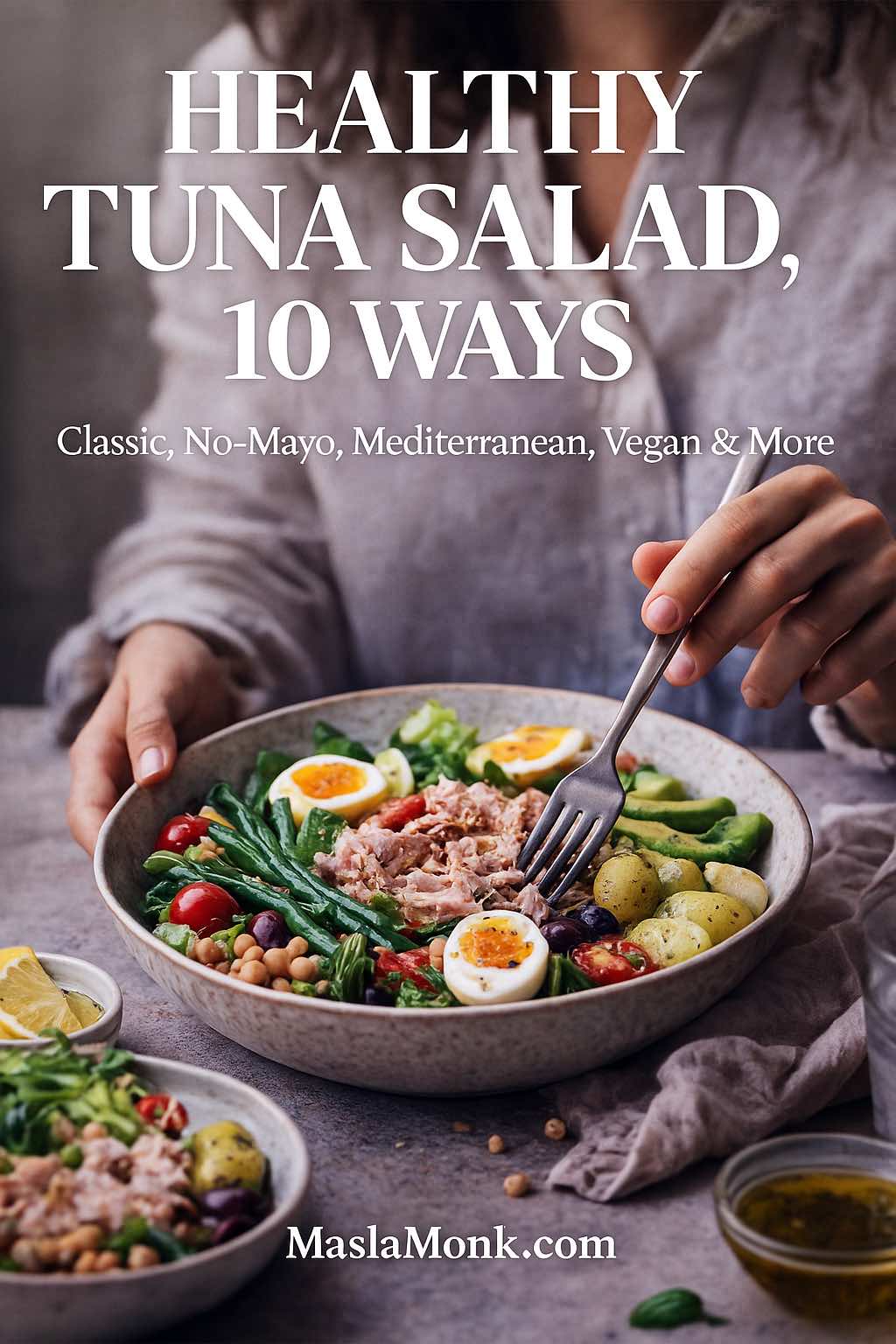
Person holding a fork over a large bowl of healthy tuna salad with eggs, avocado, potatoes, beans and greens, with the text Healthy Tuna Salad, 10 Ways and MasalaMonk.com

Healthy tuna salad is one of those quiet workhorse recipes that can shape-shift into almost anything you need. Some days it’s a classic deli tuna salad sandwich on soft bread; on others it becomes a bright Mediterranean tuna salad with beans and olives, or a quick avocado tuna salad piled onto toast. When you want comfort, there’s tuna macaroni salad. When you want light and fresh, there’s tuna salad on salad with crunchy cucumber and apple. And when you’re skipping fish entirely, a vegan “tuna” made from chickpeas steps in without anyone feeling short-changed.

At the same time, tuna brings a lot of nutrition to the table. It’s naturally rich in protein and provides omega-3 fats that support heart and brain health when eaten in reasonable amounts. The FDA’s own advice about eating fish puts canned light tuna in the “Best Choices” group and suggests that most adults, including many who are pregnant, can safely enjoy it two to three times per week as part of a mixed seafood pattern, as long as they keep overall portions within the limits they outline. When you combine tuna with vegetables, beans, whole grains and lighter dressings, you end up with meals that feel like comfort food but behave more like smart nutrition.

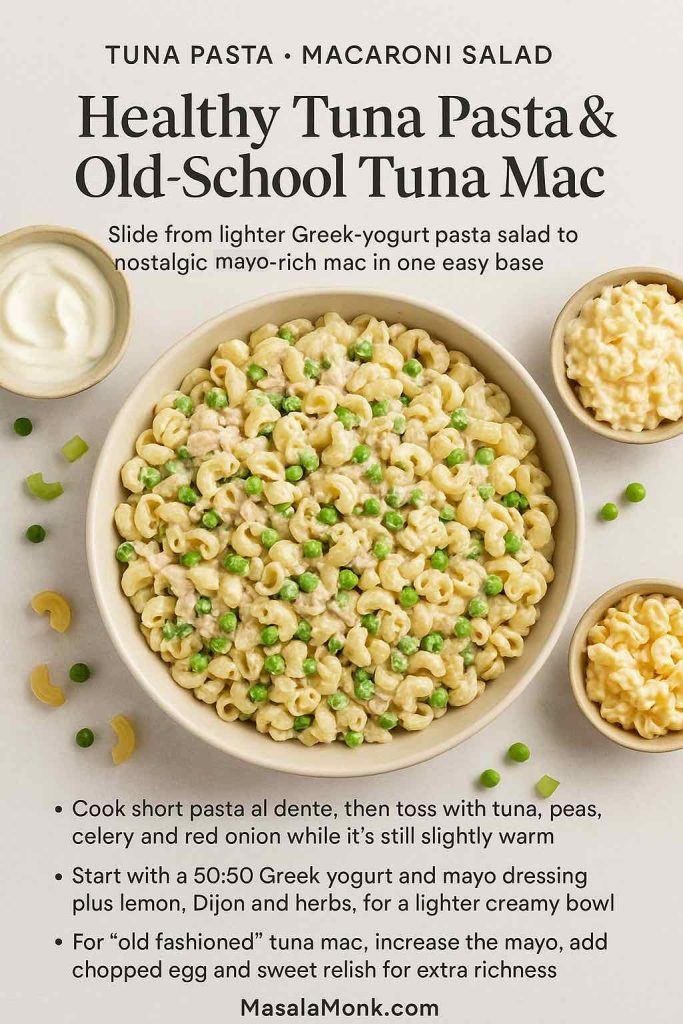
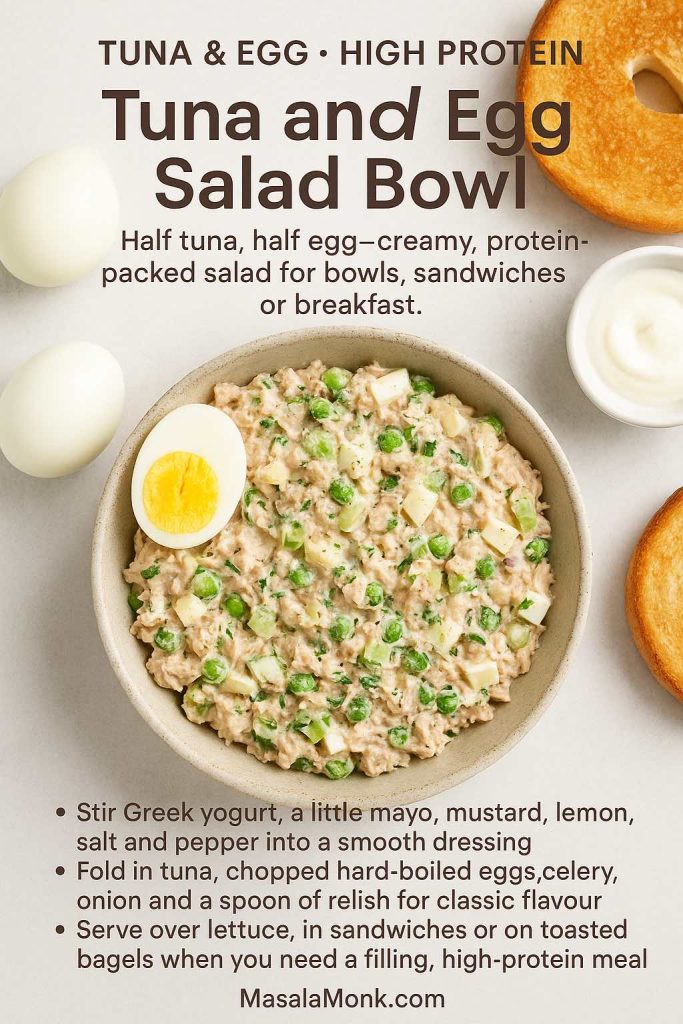
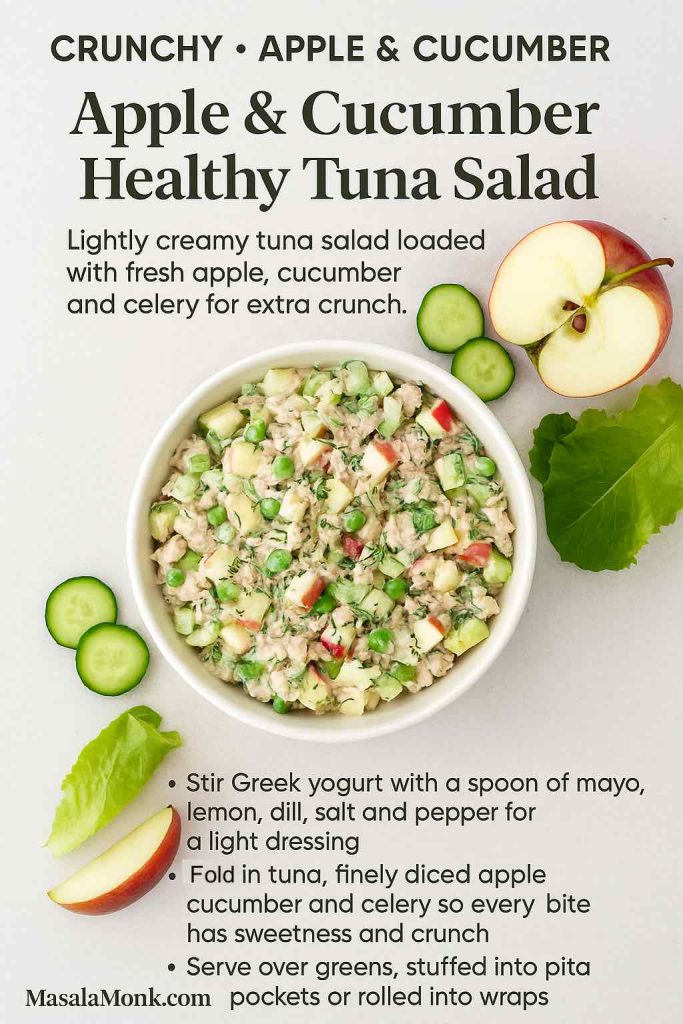
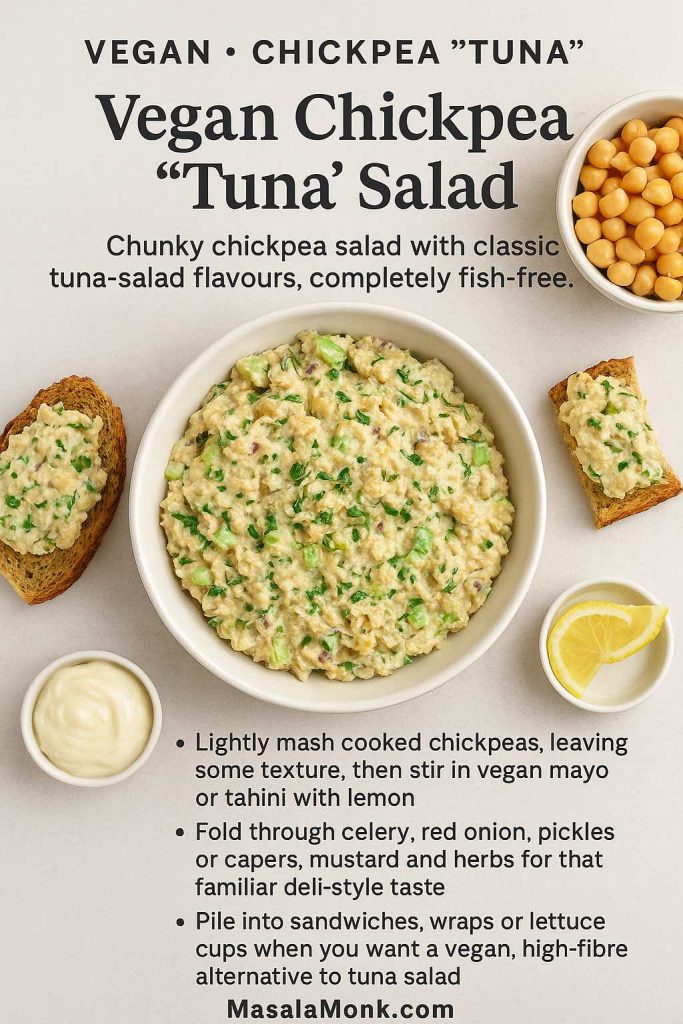
This guide pulls together ten different healthy tuna salad recipes and all their useful cousins: no-mayo Greek yogurt tuna salad, avocado tuna salad, Mediterranean tuna and bean salad, Italian tuna with chickpeas, tuna Niçoise salad, tuna pasta salad and tuna mac, tuna and egg salad, crunchy apple and cucumber tuna salad, and finally a vegan tuna salad built from chickpeas. You can treat these as ten discrete recipes or as ten patterns you customise with whatever you’ve got in your kitchen.


1. Light Deli-Style Healthy Tuna Salad (Your Everyday Base)

Most people’s mental picture of tuna salad is the classic deli tuna fish salad: creamy, a little tangy, speckled with celery and onion, sometimes a touch sweet from relish. Instead of banishing that flavour in the name of health, it’s much more satisfying to keep the same general profile and simply rebalance the dressing so it becomes a genuinely healthy tuna salad you can eat more often.

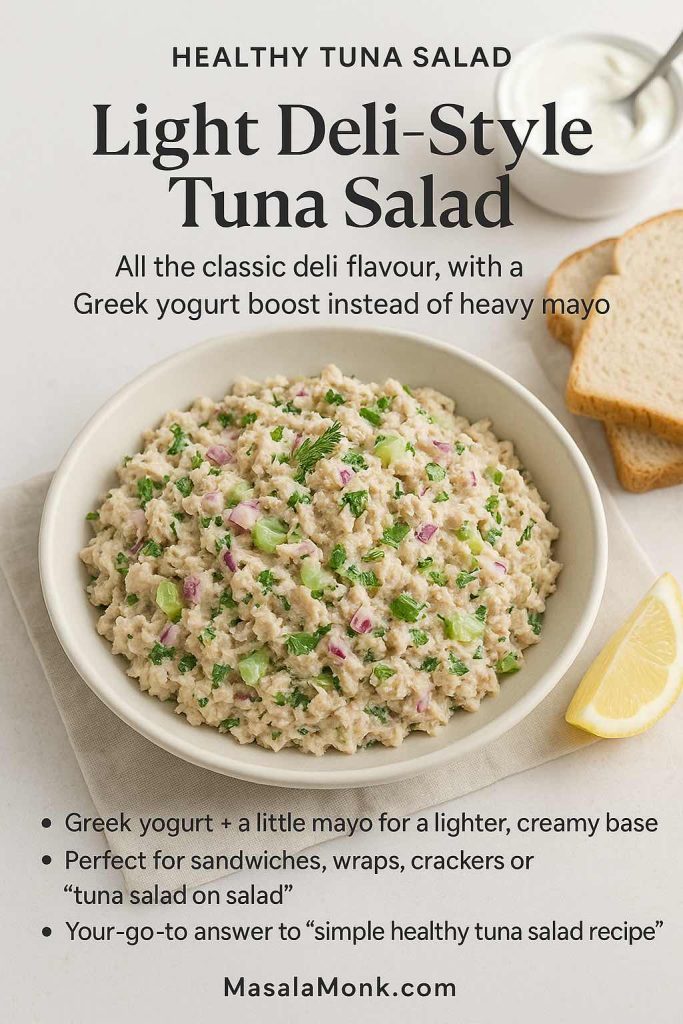
Light deli-style healthy tuna salad made with tuna, celery, red onion and a Greek yogurt dressing in a bowl with bread and lemon.
Light deli-style healthy tuna salad made lighter with Greek yogurt instead of loads of mayo – perfect for sandwiches, wraps or spooned over a crunchy green salad.

Ingredients (2–3 servings)

  • 2 cans light tuna in water, well drained
  • 3–4 tablespoons plain Greek yogurt
  • 2–3 tablespoons mayonnaise
  • 1–2 ribs celery, finely chopped
  • 2 tablespoons red onion, very finely minced
  • 1–2 tablespoons sweet relish or finely chopped pickles
  • 1 teaspoon Dijon mustard
  • Juice of half a lemon
  • 1–2 tablespoons chopped fresh dill or parsley
  • Salt and freshly ground black pepper

Greek yogurt stands in for a chunk of the mayonnaise here. Compared with mayo, Greek yogurt is naturally higher in protein and significantly lower in calories and saturated fat, yet it has enough body to keep the dressing thick and satisfying. That little swap moves this toward a low fat tuna salad without making it taste “diet”.

How to make it

  1. Tip the drained tuna into a medium bowl and flake it with a fork so there are no large clumps.
  2. In a separate bowl, whisk the Greek yogurt, mayonnaise, mustard, lemon juice, herbs, salt and pepper until smooth.
  3. Stir celery, onion and relish into the dressing so all the crunchy bits are lightly coated.
  4. Fold the dressing mixture into the tuna and stir until everything looks evenly combined.
  5. Taste and adjust; a splash more lemon brightens everything, while a spoon of relish sweetens and softens the edges.
  6. Let the bowl chill for at least 15–20 minutes if you have the patience. It’s even better the next day.

Once you’ve got this base healthy tuna salad, you can spin it in several directions:

  • Pile it onto toast with lettuce and tomato for a quick tuna salad sandwich.
  • Spoon it over mixed greens for an easy salad and tuna combo.
  • Stuff it into a croissant and suddenly you’ve got a croissant tuna sandwich that feels like café food.
  • Serve it with crackers and sliced veggies as a tuna lunch on the go.

If you’re curious how bowls like this fit into a more general “eat more plants” direction, you might enjoy MasalaMonk’s piece on the perks of eating salads everyday, which talks through fibre, micronutrients and why salad isn’t a throwaway side dish at all.

Treat this bowl as your basic tuna salad recipe, everything else is a tweak.

Also Read: Upma Recipe: 10+ Easy Variations (Rava, Millet, Oats, Semiya & More)


2. No-Mayo Greek Yogurt Healthy Tuna Salad Recipe

There are days when “lighter” still isn’t quite what you’re after; you want a tuna salad without mayo altogether. Maybe you’re chasing a low calorie tuna salad recipe, perhaps you simply prefer the clean tang of yogurt. In either case, a Greek yogurt tuna salad steps up nicely.

Why Greek yogurt works so well

Greek yogurt is strained, so it ends up thicker and creamier than regular yogurt while packing more protein per spoonful. At the same time, it typically has fewer calories and less fat, particularly if you choose a lower-fat version. Paired against mayonnaise, the difference is stark: Greek yogurt contains a fraction of the calories and dramatically less saturated fat, while bringing its own dose of protein and calcium. Used as the main base for tuna salad, it turns a standard tuna fish salad into a high protein tuna salad with far fewer calories than a traditional mayo-heavy version.

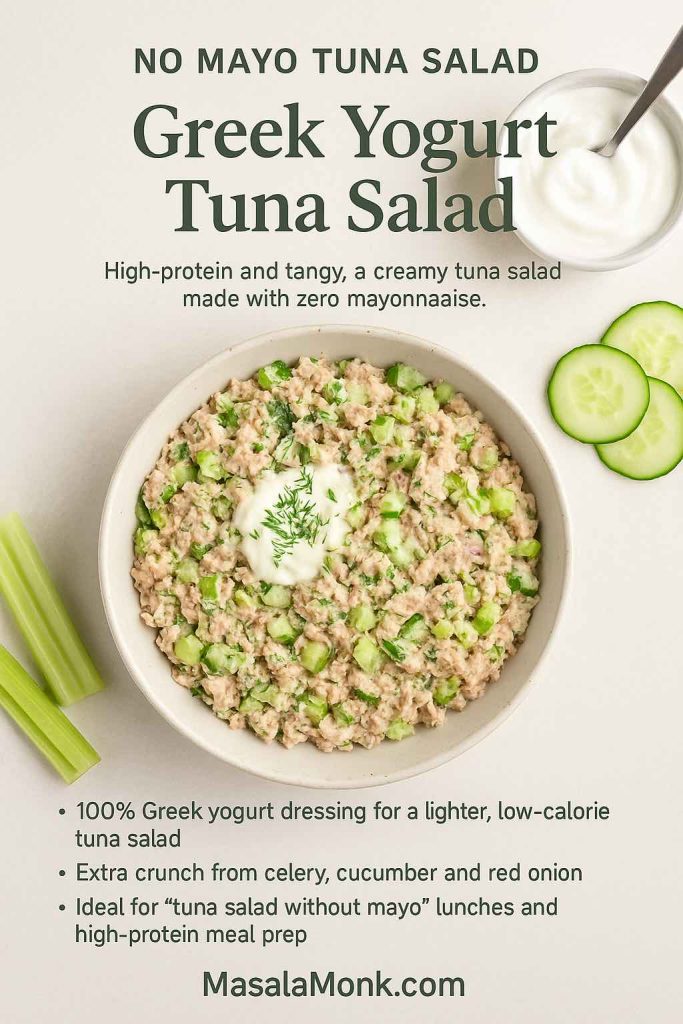
No-mayo Greek yogurt tuna salad with tuna, cucumber and celery in a white bowl, garnished with dill, with extra yogurt and cucumber slices on the side.
Creamy Greek yogurt tuna salad made with zero mayonnaise, extra crunch from cucumber and celery, and enough protein to work for light lunches or high-protein meal prep.

Ingredients

  • 2 cans light tuna, well drained
  • ½ cup plain Greek yogurt
  • 1 rib celery, finely diced
  • 2 tablespoons cucumber, seeded and chopped
  • 1–2 tablespoons red onion, minced
  • 1 teaspoon Dijon mustard
  • Juice of half a lemon
  • 1 tablespoon chopped fresh dill, chives or parsley
  • Salt and pepper

Method

  1. Whisk Greek yogurt, lemon juice, mustard, herbs, salt and pepper together in a bowl until smooth.
  2. Stir in celery, cucumber and onion so the vegetables are lightly coated.
  3. Fold in the tuna, breaking up any remaining chunks, and mix gently until everything comes together.
  4. Taste and adjust seasoning. A little extra lemon juice or a pinch more salt can make the flavours pop.
  5. Chill briefly before serving.

This is the bowl that naturally satisfies all the no mayo or tuna fish salad recipe without mayonnaise needs. Moreover, because the dressing is so light, it fits neatly into days when you’re focused on weight management without feeling like a punishment.

Cottage cheese tuna salad variation

If you’d like to push the protein even higher, you can replace a couple of tablespoons of the yogurt with cottage cheese. The result is a cottage cheese and tuna salad that still feels creamy but loads up the protein even more. On days when you’re aiming for big protein numbers, that sort of mix can easily become part of a 100-grams-of-protein plan. If you’re curious how to sketch an entire day’s meals around that target, MasalaMonk’s guide on how to eat 100 grams of protein a day lays out practical examples.

Also Read: Double Chocolate Chip Cookies – Easy Recipe with 7 Variations


3. Avocado Tuna Salad, From Three Ingredients to Fully Loaded

As soon as avocado walks into the room, the tuna salad world shifts. Bringing avocado into the mix and your healthy tuna salad suddenly starts feeling like café food. It’s creamy, naturally dairy-free and works whether you’re in a hurry or feeling like layering flavours.

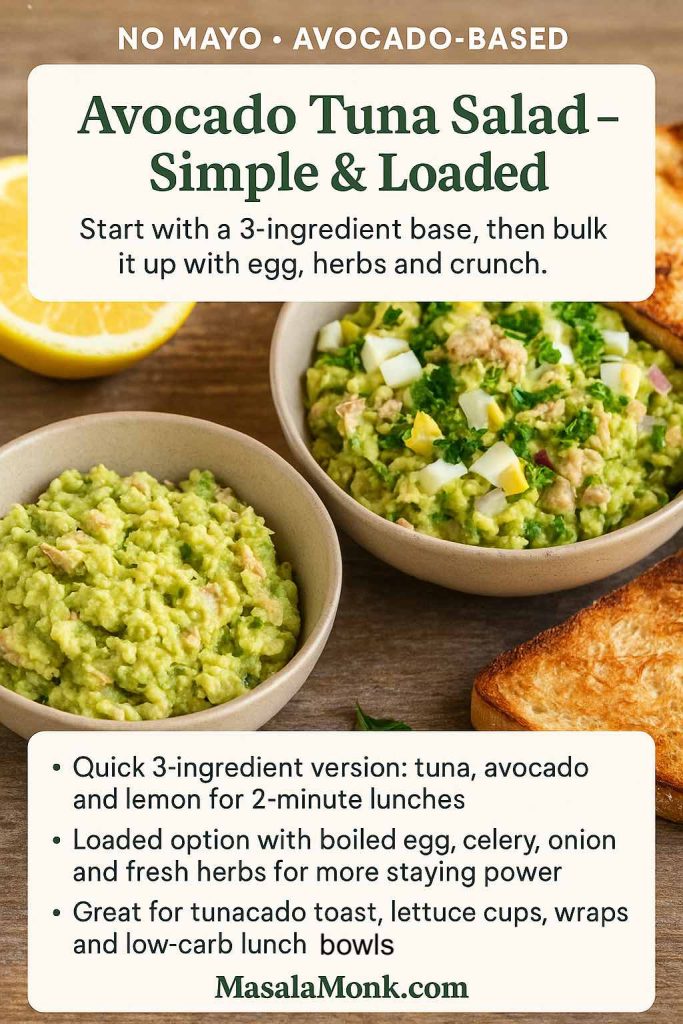
Two bowls of avocado tuna salad, one simple 3-ingredient version and one loaded with egg and herbs, served with toasted bread and lemon on a wooden table.
Avocado-based, no-mayo tuna salad shown two ways: a quick 3-ingredient base and a loaded version with egg, herbs and crunch, perfect for tunacado toast, wraps or low-carb lunch bowls.

Ultra-simple three-ingredient avocado tuna salad Recipe

When you want something you can stir together while the kettle boils, this is the one:

  • 1 ripe avocado
  • 1 can light tuna, drained
  • Juice of half a lemon (or lime)
  • Salt and pepper

Mash the avocado with the lemon, salt and pepper until it’s smooth but not totally pureed. Fold in the tuna, taste and tweak the seasoning. That’s really all there is to it.

You can:

  • Spoon it into lettuce cups for a low-carb tuna lunch.
  • Spread it over toast for a quick tunacado-style open sandwich.
  • Serve it with sliced cucumber and carrots as an easy tuna lunch idea when you don’t want bread.

Despite the tiny ingredient list, this still satisfies the search for a 3 ingredient tuna avocado salad and does it with zero mayo.

Loaded avocado and tuna salad recipe

On other days, you might want something closer to a full healthy tuna salad recipe built on avocado rather than yogurt or mayo.

Start with:

  • The three-ingredient base above

Then add:

  • 1–2 boiled eggs, chopped (for an avocado and tuna egg salad spin)
  • 1 rib celery, finely chopped
  • 2 tablespoons red onion
  • Optional: ¼ of a crisp apple, finely diced, for sweetness and crunch
  • A handful of chopped parsley, coriander or chives

Fold all of that through the avocado and tuna mix. The eggs make it especially satisfying, so this bowl covers everything from tuna and egg salad for weight loss days to avocado tuna salad wraps for hungrier ones.

Because both tuna and avocado show up regularly in pregnancy diets, this style of salad can sit happily in a pregnancy meal rotation as long as you pay attention to overall fish portions and choose lower-mercury tuna. For more context on that, MasalaMonk has a detailed guide on eating tuna while pregnant plus a recipe-focused piece, Motherhood and Meals: 5 Omega-3 Rich Seafood Recipes for Pregnancy, which includes a quick tuna–avocado idea.

Also Read: Carbonara Recipe: Italian Pasta (Creamy, Veggie, Chicken, Shrimp, Tuna & Keto)


4. Mediterranean Tuna and White Bean Salad Recipe

If your taste buds wander toward olives, beans, herbs and lemon, you’re firmly in Mediterranean tuna territory. Next up: a Mediterranean tuna salad recipe that combines tuna, white beans, vegetables, olive oil and herbs. This style of salad is filling, colourful and very meal-prep friendly. Fortunately, it’s one of the easiest and most nutritious patterns to build.

Why this style is such a win

Mediterranean-style eating, which emphasises fish, olive oil, vegetables, legumes and whole grains, has been repeatedly associated with better heart health and long-term disease prevention. Tuna and white beans together give you a double hit of protein plus plenty of fibre and complex carbohydrates from the beans, while olive oil supplies heart-friendly fats.

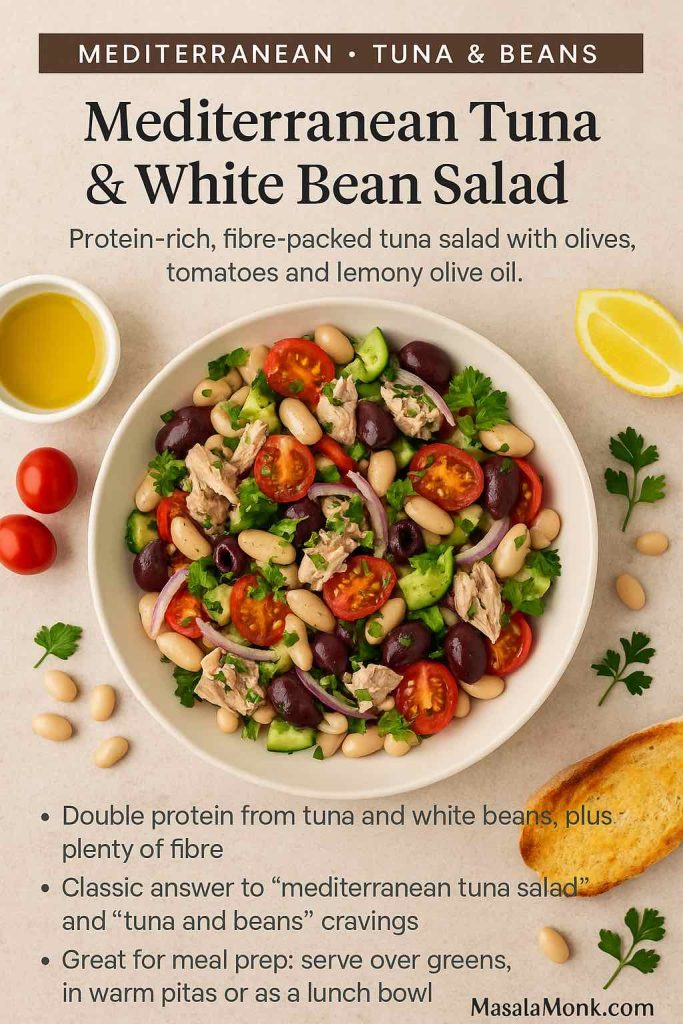
Mediterranean tuna and white bean salad with cherry tomatoes, olives, cucumber and herbs in a white bowl, served with olive oil and lemon on a stone background.
Mediterranean-style tuna and white bean salad with olives, tomatoes and lemony olive oil – a protein- and fibre-rich bowl that works for meal prep, warm pitas or simple lunch bowls.

Ingredients

  • 2 cans tuna (light tuna in water works, or tuna in olive oil for a richer version)
  • 1½–2 cups cooked white beans (cannellini, navy or a mix)
  • 1 cup cherry tomatoes, halved
  • 1 small cucumber, diced
  • ¼ red onion, very thinly sliced
  • A handful of olives
  • Fresh parsley and/or basil

For the dressing

  • 3–4 tablespoons extra-virgin olive oil
  • 1½–2 tablespoons lemon juice
  • 1 teaspoon Dijon mustard
  • 1 clove garlic, finely minced or grated
  • ½ teaspoon dried oregano
  • Salt and pepper

How to make this Mediterranean tuna salad recipe

  1. In a large bowl, whisk together olive oil, lemon juice, mustard, garlic, oregano, salt and pepper.
  2. Add the beans, tuna, tomatoes, cucumber, onion and olives.
  3. Toss gently, trying not to mash the tuna too much.
  4. Sprinkle over herbs and toss once more.
  5. Taste and adjust seasoning.

You can serve this Mediterranean tuna salad over mixed greens, spooned onto crunchy toast, or tucked into a warm pita with a bit of lettuce. It keeps well for several days in the fridge, which makes it perfect for meal prep if you like to batch healthy tuna salad lunches ahead of time.

Beans bring plenty of fibre and minerals along with their plant protein, so they help this salad feel more filling and support gut health and blood sugar control at the same time. If you’d like more ideas for gut-friendly meals that use the same logic, you can have a look at Top 10 Foods for Gut Health and Boosting Your Fiber Intake with Sandwiches. Both pieces show how salad-style ingredients can slip into everyday meals without a lot of fuss.

Also Read: Carbonara Recipe: Italian Pasta (Creamy, Veggie, Chicken, Shrimp, Tuna & Keto)


5. Italian Tuna Salad with Chickpeas Recipe

Slide a little further around the Mediterranean map and you arrive at Italian tuna salad territory. This Italian-leaning salad recipe shifts away from creaminess and toward bright, briny flavours: roasted red peppers, capers, herbs and chickpeas. It’s essentially a pantry-friendly tuna salad that just happens to be very high in fibre.

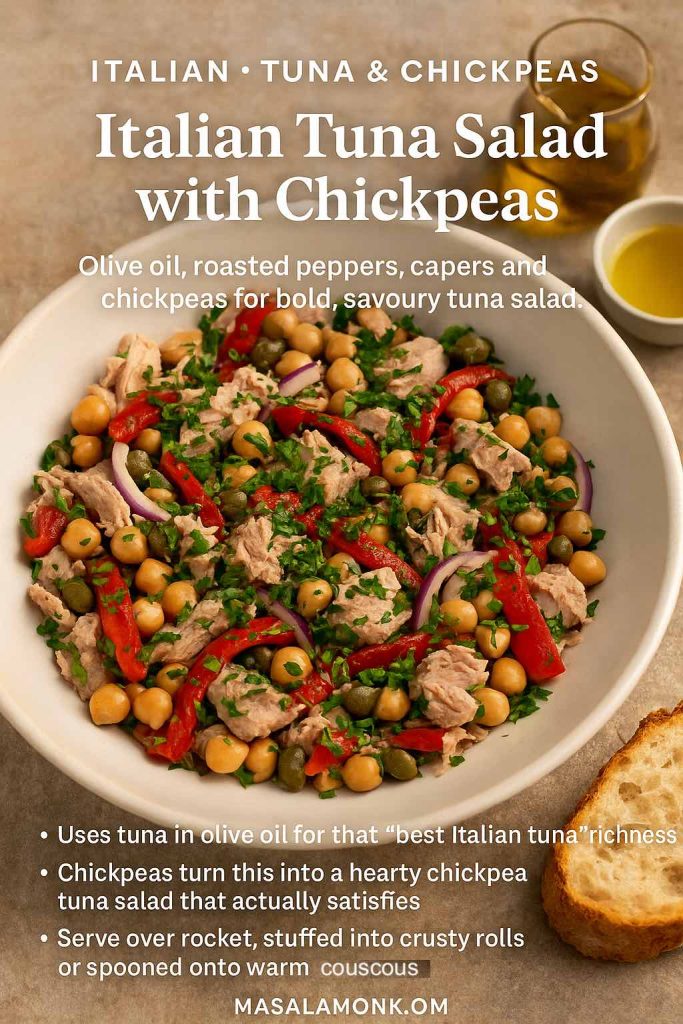
Italian tuna salad with chickpeas, roasted red peppers, capers and red onion in a white bowl, garnished with parsley, with olive oil and bread on a rustic surface.
Italian-style tuna salad made with tuna in olive oil, chickpeas, roasted peppers and capers – a hearty chickpea tuna salad that’s perfect over rocket, in crusty rolls or spooned onto warm couscous.

Ingredients

  • 2 cans tuna, ideally in olive oil
  • 1½ cups cooked chickpeas, rinsed and drained
  • ½ cup roasted red peppers, sliced into strips
  • ¼ cup red onion, thinly sliced
  • 2 tablespoons capers, rinsed and drained
  • A good handful of chopped fresh parsley

Dressing

  • 3 tablespoons olive oil (use some of the oil from the tuna cans if they’re packed in oil)
  • 1½ tablespoons red wine vinegar or lemon juice
  • 1 small clove garlic, very finely grated
  • ½ teaspoon dried oregano
  • Salt and pepper

Method

  1. Add tuna, chickpeas, roasted peppers, onion, capers and parsley to a large bowl.
  2. In a small jug or bowl, whisk together olive oil, vinegar or lemon, garlic, oregano, salt and pepper until slightly thickened.
  3. Pour the dressing over the salad ingredients.
  4. Toss gently, folding rather than stirring roughly, so the tuna stays in nice bite-sized pieces.

This version of tuna salad is lovely over rocket or baby spinach, and it’s equally happy spooned into a crusty roll for a more substantial lunch. If you like couscous, you can serve it over a bed of warm couscous to create a rio mare couscous-style dish using pantry ingredients.

Chickpeas deserve a bit of attention in their own right here. They’re high in fibre and plant protein and have been linked to better satiety, improved cholesterol and improved blood sugar control when they show up regularly in place of more refined starches. If you enjoy this way of cooking, MasalaMonk’s pieces on using chickpeas instead of sardines and using seitan instead of tuna are packed with similar high-protein, Mediterranean-leaning meal prep ideas.

Also Read: Authentic Louisiana Red Beans and Rice Recipe (Best Ever)


6. Tuna Niçoise Salad (Everyday and Occasion-Ready)

Every now and then, a simple bowl isn’t enough, and you want a full tuna Niçoise salad laid out on a big platter. The same tuna, eggs and vegetables, but laid out on a platter with potatoes, beans and olives so it looks like something you’d order in a bistro.

Tuna Niçoise salad platter with baby potatoes, green beans, cherry tomatoes, olives, hard-boiled eggs and tuna arranged on lettuce on a large plate.
Classic tuna Niçoise salad with baby potatoes, green beans, cherry tomatoes, olives, eggs and tuna arranged on greens, then finished with a 3:1 olive oil to lemon garlic vinaigrette for a full dinner salad.

What you’ll need

  • Mixed lettuce or baby greens
  • 8–10 small new potatoes, boiled until just tender and halved
  • A couple of handfuls of green beans, trimmed and blanched
  • 1 cup cherry tomatoes, halved
  • 3–4 hard-boiled eggs, cut into halves or quarters
  • A handful of olives
  • 2 cans tuna in olive oil, or seared fresh tuna steaks sliced thickly

For the Niçoise dressing

  • 3 tablespoons olive oil
  • 1½ tablespoons red wine vinegar or lemon juice
  • 1 teaspoon Dijon mustard
  • 1 clove garlic, finely grated
  • A pinch of dried thyme or oregano
  • Salt and pepper

Method

  1. Arrange the lettuce over a large serving platter.
  2. Nestle the potatoes, green beans, tomatoes, eggs, olives and tuna on top in little piles or rows so you get that classic composed look.
  3. Whisk together the olive oil, vinegar or lemon, mustard, garlic, herbs, salt and pepper until emulsified.
  4. Taste the dressing and adjust the acid and salt until it feels bright but balanced.
  5. Drizzle the dressing over everything just before you bring the platter to the table.

Because this salad leans so heavily on vegetables, olive oil, legumes and fish, it fits beautifully into the Mediterranean diet pattern that many large studies have associated with reduced risk of heart disease and other chronic illnesses. It’s also a neat answer for all the tuna nicoise salad, salade nicoise recipe and dressing for tuna nicoise searches that pop up whenever the weather warms up and people start craving big bowls.

Also Read: One-Pot Chicken Bacon Ranch Pasta (Easy & Creamy Recipe)


7. Healthy Tuna Pasta Salad and Old-School Tuna Macaroni Salad

Comfort food time. A tuna pasta salad recipe can easily turn into a calorie bomb, but a few tweaks give you the same creamy vibe in a more balanced way. Then, when nostalgia hits, you can slide back toward the classic tuna macaroni salad version by adjusting the dressing.

The trick is that you can make it as light or as old-school as you like just by sliding the dressing along the Greek yogurt ↔ mayo spectrum.

Large bowl of creamy tuna pasta salad with peas, with small bowls of Greek yogurt dressing and mayo-rich tuna mac on a light background.
Healthy tuna pasta salad made with al dente short pasta, tuna and peas plus a 50:50 Greek yogurt–mayo dressing, with a more nostalgic, mayo-rich tuna mac option shown on the side so you can slide between lighter and old-fashioned versions.

Lighter, creamy tuna pasta salad recipe

For a bowl that feels indulgent but still sits in the healthy tuna salad camp:

  • 3 cups cooked short pasta (elbow macaroni, shells or fusilli)
  • 2 cans tuna, drained
  • 1 cup peas or sweetcorn (frozen is fine; just thaw and drain)
  • ½ cup finely chopped celery
  • ¼ cup finely chopped red onion

Dressing

  • ½ cup Greek yogurt
  • 2–3 tablespoons mayonnaise
  • 1–2 teaspoons Dijon mustard
  • Juice of half a lemon
  • 2 tablespoons chopped fresh dill or parsley
  • Salt and pepper

How to make it

  1. Stir together yogurt, mayonnaise, mustard, lemon, herbs, salt and pepper until smooth.
  2. Combine pasta, tuna, peas, celery and onion in a large bowl.
  3. Pour the dressing over the top and toss until everything is well coated.
  4. Chill for at least 30 minutes before serving.

Old-fashioned recipe for macaroni salad with tuna

If your heart belongs to old fashioned macaroni salad with tuna, you can easily nudge the dressing in that direction:

  • Increase the mayonnaise and reduce or omit the yogurt.
  • Add 2–3 chopped hard-boiled eggs to the salad.
  • Stir in a generous amount of sweet relish.
  • Throw in diced bell peppers and grated carrot for colour.

Now you’ve got a tuna mac salad that mirrors the macaroni salad with tuna fish many of us grew up with, while still giving you the option to sneak in more vegetables. That’s the version that belongs next to barbecues and potluck tables, the “best tuna mac salad recipe” in your head.

How to cook the pasta for this recipe

For cold pasta salads, slightly undercooked pasta that still has some bite tends to hold up better. Cook the pasta just to al dente, rinse briefly under cold water to stop the cooking and remove excess starch, then drain very well before combining it with the tuna and dressing.

Potato and tuna salad spin-off

For days when potato salad tuna feels more appealing than pasta, it’s simple to swap some or all of the noodles for boiled baby potatoes or cubes of sweet potato. Both can be part of a healthy plate when paired with lean protein and vegetables. If you’re wondering how sweet potatoes compare with white potatoes in terms of calories, glycaemic index and suitability for weight-focused or diabetes-friendly eating, MasalaMonk breaks it down in Sweet Potato Nutrition Facts and The Potato Debate: White vs Sweet. For even more potato inspiration, their collection of potato salad recipes walks through classic, German, Russian and vegan potato salads you can easily adapt with tuna.


8. Tuna and Egg Salad (For Bowls, Sandwiches and Breakfast)

Another very popular direction involves eggs. Merging tuna salad and egg salad into one bowl gives you something that feels almost decadent despite being very straightforward. It’s rich, savoury and incredibly satisfying.

Bowl of creamy tuna and egg salad with peas and diced vegetables, topped with a halved hard-boiled egg, served beside whole eggs, toasted bagel slices and a small dish of dressing.
Creamy tuna and egg salad made with Greek yogurt, a little mayo, mustard and lemon, folded with chopped eggs, peas and crunchy veg – ideal for high-protein bowls, sandwiches or a savoury breakfast on toasted bagels.

How to make Basic tuna and egg salad

  • 2 cans tuna, well drained
  • 3 hard-boiled eggs, chopped
  • ¼ cup Greek yogurt
  • 2–3 tablespoons mayonnaise
  • 1 rib celery, finely chopped
  • 2 tablespoons onion, finely minced
  • 1–2 tablespoons relish or chopped pickles
  • 1 teaspoon mustard
  • Juice of half a lemon
  • Salt and pepper

Mix the yogurt, mayonnaise, mustard, lemon juice, salt and pepper into a smooth dressing. Stir in the celery, onion and relish, then fold in the tuna and chopped eggs.

How to serve this recipe

You can scoop this mixture:

  • Over lettuce for a boiled egg and tuna salad bowl
  • Into sandwiches as a tuna and egg salad sandwich filling
  • Onto toasted bagels or English muffins when you want something that covers tuna breakfast ideas as well as lunch

Because tuna and eggs are both rich in protein, this salad fits especially well into high-protein days. To keep the rest of your day balanced, you might pair it with something like Protein Oatmeal or a jar of High Protein Overnight Oats in the morning so that you hit your protein targets with real meals rather than relying entirely on supplements. For egg-cooking perfection, aim for 9–11 minutes in gently boiling water for hard-boiled eggs, followed by an ice bath. That timing usually gives firm whites and yolks without the grey ring.

Also Read: Sheet Pan Chicken Fajitas Recipe (Easy One-Pan Oven Fajitas)


9. Crunchy Apple and Cucumber Healthy Tuna Salad

Not all healthy tuna salad recipes revolve around what you swap into the dressing. Sometimes the biggest difference comes from loading the bowl with fruit and vegetables so each bite feels fresher and more textured. That’s exactly what’s happening in the apple and cucumber corner of tuna fish salad: you can make this with both apples and cucumber or you can just do apples or cucumbers – both rely on the same idea.

Apple and cucumber healthy tuna salad in a white bowl with diced apple, cucumber, peas and celery, surrounded by apple slices, cucumber rounds and lettuce on a light background.
Lightly creamy tuna salad packed with diced apple, cucumber, celery and peas for sweetness and crunch – a fibre-rich option you can spoon over greens, tuck into pita pockets or roll into wraps for fresh, portable lunches.

Ingredients

  • 2 cans tuna, drained
  • ½ a crisp apple (Granny Smith, Pink Lady or similar), finely diced
  • ½ cup diced cucumber
  • 1 rib celery, finely chopped
  • ¼ cup Greek yogurt
  • 1–2 tablespoons mayonnaise or sour cream (optional, for richness)
  • 1–2 teaspoons lemon juice
  • 1 teaspoon honey or maple syrup (optional, to balance the lemon)
  • 1 tablespoon chopped fresh dill
  • Salt and pepper

Method

  1. In a small bowl, whisk the Greek yogurt, mayonnaise or sour cream (if using), lemon juice, honey, dill, salt and pepper until smooth.
  2. Add the tuna, apple, cucumber and celery to a larger bowl.
  3. Pour the dressing over the top and fold gently until everything is lightly coated.
  4. Taste and adjust with extra lemon or a tiny bit more honey to find your perfect sweet-tart balance.

Where this recipe shines

  • As a salad topping over mixed leaves.
  • Stuffed into pita or wraps for a bit of crunch in every bite.
  • As a side dish next to grilled chicken or roasted vegetables.

Apples and cucumbers add not only texture but also hydration and fibre. Verywell Health’s list of high-fibre foods is a good reminder of how simple ingredients like apples can quietly support digestion and blood sugar balance when they show up regularly.

If you want to make your everyday sandwiches and salad recipes more fibre-rich in general, MasalaMonk’s blog post on boosting fibre with sandwiches has lots of real-world combinations.

Also Read: Negroni Recipe: Classic Cocktail & Its Variation Drinks


10. Vegan “Tuna” Chickpea Salad Recipe

Finally, even in a tuna-focused world, there’s a big audience for vegan tuna salad, tuna vegan, tuna vegetarian and vegetarian tuna salad. Many of them still want a tuna salad sandwich experience; they simply don’t want fish in it. Chickpeas are perfect for this because they mimic the slightly chunky, creamy texture and bring plenty of nutrition of their own.

Why chickpeas are such a strong base

Chickpeas provide a mix of complex carbohydrates, protein and fibre plus micronutrients like folate, iron and manganese. When they replace refined grains or processed meats in the diet, they’ve been linked with better blood sugar control, improved satiety and lower cholesterol. All of that makes them a natural fit for anyone who wants their vegan tuna salad to feel like more than a compromise.

Bowl of vegan chickpea ‘tuna’ salad with herbs and diced vegetables, surrounded by toast topped with the salad, a small bowl of chickpeas, vegan mayo and lemon wedges on a light background.
Chunky chickpea “tuna” salad made with lightly mashed chickpeas, vegan mayo or tahini, celery, red onion and herbs – an easy plant-based filling for sandwiches, wraps or lettuce cups when you want a high-fibre alternative to tuna.

Vegan tuna salad with chickpeas

  • 2 cups cooked chickpeas, drained and rinsed
  • ¼–⅓ cup vegan mayonnaise, or a mix of tahini and lemon juice
  • 1 rib celery, finely chopped
  • 2 tablespoons red onion, finely diced
  • 1–2 tablespoons chopped pickles or capers
  • 1 teaspoon mustard
  • Juice of half a lemon
  • A pinch of nori flakes or other dried seaweed (optional)
  • Salt, pepper, dill or parsley

Mash the chickpeas with a fork or potato masher until they’re mostly broken down but still have some texture. Stir in vegan mayo (or tahini and extra lemon), mustard, salt, pepper and herbs. Fold through celery, onion and pickles and taste.

Serve this vegan tuna salad in sandwiches with lettuce and tomato, spooned into lettuce cups, or over a bowl of mixed greens with chickpeas instead of tuna carrying the protein load.

If you’d like more ways to keep your week high in protein without leaning on animal foods, MasalaMonk has plenty of ideas, including Chickpeas Instead of Sardines and plant-based high-protein meal prep ideas using lentils instead of chicken. Between those and this chickpea tuna salad, you can cover a surprising number of “tuna-style” cravings with zero actual tuna.

Also Read: Whole Chicken in Crock Pot Recipe (Slow Cooker “Roast” Chicken with Veggies)


A Few Extra Ways to Play with Healthy Tuna Salad

By now you’ve got ten distinct healthy tuna salad recipes and at least as many ways to serve them. However, once you get comfortable with the basic patterns, it becomes easy to create your own riffs that still sit inside a healthy tuna salad framework.

A few ideas to keep exploring:

  • Use Greek yogurt, sour cream or hung curd in place of most mayo for a lighter sour cream tuna salad, or mix yogurt and mayo for a balanced, creamy sauce that doesn’t overload calories.
  • Swap part of the tuna for extra beans, chickpeas or lentils when you want a high-fibre, higher-bulk salad that stretches a single can further.
  • Lean into herbs like dill in tuna salad, parsley in Italian versions, or oregano in Mediterranean tuna recipes to change the flavour without adding heaviness.
  • Play with serving formats: croissant tuna sandwiches for brunch, bagel tuna melts, tuna with crackers on a snack board, or even a tunacado sandwich layered with avocado, tuna and greens.
  • When you’re eating tuna more than once a week, keep an eye on variety and portion size, and lean more often on canned light tuna rather than big predatory species to respect mercury guidance.

If you like the feeling of having a set of “templates” rather than memorising dozens of separate recipes, you can think of these ten as your master pattern library.

Also Read: Cheesy Chicken Broccoli Rice – 4 Ways Recipe (One Pot, Casserole, Crockpot & Instant Pot)


Putting It All Together

Taken as a whole, these ten recipes give you a full toolkit for turning a can of tuna—or a bowl of chickpeas—into exactly the sort of meal you’re in the mood for.

On a busy weekday, you might stick with the light deli-style healthy tuna salad recipe and turn it into simple tuna sandwiches for everyone. Later in the week, when you crave something more vibrant, the Mediterranean tuna and white bean salad or Italian tuna with chickpeas will happily take over. When comfort is the priority, the healthy tuna pasta salad and the more nostalgic tuna mac salad version step up. On hotter days, crunchy apple and cucumber tuna salad or a big tuna Niçoise platter feel right, while avocado tuna salad is there for every rushed lunch when the only things you can manage to mash together are tuna, avocado and lemon.

Alongside these fish-based bowls, you’ve got the option of skipping tuna completely and relying on a vegan tuna salad built on chickpeas instead. As long as you pay attention to overall fish intake and choose lower-mercury options such as canned light tuna most of the time, salads like these can sit comfortably in a week that’s trying to balance health, flavour and real-life constraints. Between the recipes here and the extra reading on salad benefits, gut-friendly foods, seafood and pregnancy and high-protein meal planning, you’ve got more than enough to keep your healthy tuna salad rotation interesting for a very long time.

And if all else fails, you can always fall back on that three-ingredient tuna avocado salad, because sometimes the best healthy tuna salad is simply the one you can make in the two minutes between meetings.

Also Read: Crispy Homemade French Fries From Fresh Potatoes (Recipe Plus Variations)

FAQs

1. Is tuna salad healthy?

Often yes, tuna salad can be very healthy, especially when you treat tuna as lean protein and not just a vehicle for mayonnaise. When you build a healthy tuna salad with light tuna, Greek yogurt or avocado, plenty of crunchy vegetables and sensible portions, you get a high protein, nutrient-dense meal. On the other hand, a tuna salad recipe loaded with only mayo and no veg will lean more heavy than wholesome.


2. What is a good basic healthy tuna salad recipe?

To put it simply, a solid healthy tuna salad recipe starts with drained light tuna, Greek yogurt, a spoon or two of mayo, lemon juice, mustard, salt and pepper. After that, you fold in celery, onion and maybe a little relish or pickles for deli-style flavour. This kind of bowl covers “tuna salad recipe healthy” and works just as well in a tuna salad sandwich as it does over a green salad.


3. How do I make tuna salad without mayo?

If you want a tuna salad without mayo, Greek yogurt is the easiest swap. You mix tuna with plain Greek yogurt, lemon, mustard, herbs, salt and pepper, then add celery, cucumber and onion for texture. Alternatively, you can make a no mayo tuna salad with mashed avocado or a simple olive oil and lemon dressing if you prefer a lighter, Mediterranean feel.


4. What can I use instead of mayonnaise in tuna salad?

There are several tasty options. Greek yogurt gives you a creamy, tangy base for Greek yogurt tuna salad, while avocado creates a rich avocado tuna salad without any dairy. In addition, cottage cheese, hummus or a vinaigrette made from olive oil and lemon all work as alternative dressings, especially in Mediterranean tuna salad or tuna and bean salad recipes.


5. Which type of tuna is best for a healthy tuna salad?

Generally, light canned tuna in water is the most practical choice for a healthy tuna salad recipe because it’s lean and mild in flavour. Nevertheless, tuna packed in olive oil is lovely when you’re making Italian tuna salad or tuna nicoise salad, since the oil adds richness. For everyday healthy tuna, most people stick to light tuna and then adjust the dressing to suit their goals.


6. Can tuna salad help with weight loss?

In many cases, yes, especially when you build a healthy tuna salad that’s high in protein and full of vegetables. Because tuna and Greek yogurt or egg keep you satisfied, you’re less likely to overeat later. However, if your tuna salad recipe is mostly mayonnaise with very little tuna or veg, it can quickly become too calorie-dense for weight-loss plans.


7. How much protein is usually in a serving of tuna salad?

As a rough guide, a small can of tuna alone often provides around 25–30 grams of protein. Once you stir in Greek yogurt, cottage cheese or egg, a generous serving of high protein tuna salad can easily deliver 20–30 grams of protein. Consequently, recipes like tuna and egg salad, cottage cheese tuna salad or avocado tuna salad fit very neatly into high-protein meal plans.


8. How often can I eat tuna salad each week?

Typically, having tuna salad a couple of times per week is reasonable for most people, especially when you choose light tuna and vary your other protein sources. In practice, lots of people rotate healthy tuna salad lunches with chickpea salads, lentil dishes, chicken or vegan tuna salad to keep variety high. If you have pregnancy or medical concerns, it’s wise to keep portions moderate and mix in more plant-based recipes.


9. How long does homemade tuna salad keep in the fridge?

As a rule of thumb, homemade tuna salad keeps well for about 2–3 days in the fridge in a sealed container. After that, the texture of the dressing and vegetables usually starts to deteriorate. To keep things fresher, you can store lettuce, cucumber and tomato separately and add them to your tuna salad sandwich or salad bowl just before eating.


10. Can I freeze tuna salad?

Technically you can, but it isn’t ideal. Once thawed, the dressing often separates, and crunchy ingredients like celery, cucumber or apple lose their texture. Instead, a better approach is to freeze plain canned tuna portions and then mix a fresh healthy tuna salad recipe with yogurt, avocado or mayo on the day you plan to eat it.


11. How do I make a healthy tuna pasta salad?

For a healthier tuna pasta salad, you start with short pasta cooked al dente, then add tuna, peas or sweetcorn, celery and onion. After that, make a dressing that’s mostly Greek yogurt with just a little mayonnaise, plus lemon juice, mustard, salt, pepper and dill. This way, your healthy tuna pasta salad recipe stays creamy but lighter than a traditional tuna macaroni salad.


12. How can I lighten an old fashioned macaroni salad with tuna?

If you love old fashioned macaroni salad with tuna but want it less heavy, there are several simple tweaks. Firstly, swap part of the mayo for Greek yogurt to cut calories and add more protein. Secondly, stir in extra vegetables like celery, bell pepper and grated carrot so your tuna mac salad has more bulk from low-calorie ingredients. Finally, serve sensible portions and pair it with a green salad to balance the plate.


13. What can I add for extra crunch in tuna salad?

There are plenty of choices. Celery and cucumber are classic, while finely chopped bell peppers, red onion and radishes also add bite. Moreover, diced apple or pickles give you both crunch and contrast, so an apple and tuna salad or cucumber tuna salad feels fresh even when the dressing is creamy.


14. How do I make a Mediterranean tuna salad?

To create a Mediterranean tuna salad, mix tuna with white beans or chickpeas, cherry tomatoes, cucumber, olives and red onion. Then, dress it all with olive oil, lemon juice, garlic, oregano, salt and pepper. This kind of tuna and beans salad is naturally high in fibre and fits beautifully into “tuna recipes healthy” searches.


15. What goes into an Italian tuna salad?

An Italian tuna salad usually leans on tuna in olive oil, roasted red peppers, capers, red onion and fresh herbs like parsley. You then toss everything with a sharp red wine vinegar or lemon dressing and sometimes add chickpeas or cannellini beans. As a result, you get an Italian tuna salad that’s bold, savoury and perfect over greens or in a hearty sandwich.


16. How is tuna nicoise salad different from regular tuna salad?

Tuna nicoise salad is more of a composed meal than a simple spread. It usually includes lettuce, boiled potatoes, green beans, tomatoes, olives, hard-boiled eggs and tuna, all dressed with a garlicky vinaigrette. By contrast, a basic tuna salad recipe tends to be a mixed bowl used for tuna salad sandwiches or wraps, rather than a full platter.


17. Can I use fresh tuna instead of canned tuna in salad?

Yes, absolutely. You can sear fresh tuna steaks quickly so they stay pink inside, then slice or flake them into a salad with your usual dressing. Fresh tuna works especially well in tuna nicoise salad, Italian tuna salad or a gourmet healthy tuna salad recipe, though canned tuna remains more convenient for everyday use.


18. How do I make avocado tuna salad?

To put it briefly, avocado tuna salad starts with mashing a ripe avocado with lemon, salt and pepper, then folding in flaked tuna. Afterward, you can add celery, red onion, herbs and even chopped egg or apple for extra interest. Whether you keep it as a 3 ingredient tuna avocado salad or turn it into a loaded avocado and tuna salad recipe, it’s a great no-mayo option.


19. What can I add to make a high protein tuna salad?

Beyond tuna itself, there are several high-protein add-ins. Greek yogurt, cottage cheese, boiled eggs and chickpeas all boost protein levels, so bowls like tuna and egg salad, cottage cheese tuna salad or chickpea tuna salad are naturally more filling. Additionally, serving your healthy tuna salad alongside a protein-rich soup or bean salad turns the whole meal into a serious protein hit.


20. Is tuna salad suitable for breakfast?

Surprisingly, yes. A small portion of tuna and egg salad on toast, a tuna breakfast wrap with avocado, or a lighter healthy tuna salad on rye bread can make a savoury, protein-rich breakfast. Granted, it’s not everyone’s first thought, yet on busy days it’s a quick way to get protein in early without resorting to sugary options.


21. How do I build a healthier tuna salad sandwich?

Start with wholegrain or seeded bread for more fibre. Next, use a healthy tuna salad recipe based on Greek yogurt or avocado instead of just mayo, and layer in lettuce, tomato and cucumber. In addition, keeping an eye on portion sizes and pairing the tuna sandwich with a simple side salad rather than fries keeps the whole meal in the “tuna sandwich recipe healthy” category.


22. How can I stop tuna salad sandwiches from going soggy?

One simple approach is to create a barrier between the bread and the filling. You can line the bread with lettuce, cheese slices or even a thin layer of hummus before adding your tuna salad sandwich filling. Alternatively, pack the bread and tuna fish salad separately for lunch and assemble the sandwich when you’re ready to eat.


23. What are some quick tuna lunch ideas besides sandwiches?

There are plenty of easy options. For instance, you can spoon healthy tuna salad onto a big bowl of greens, tuck it into lettuce wraps, mix it with warm rice or quinoa, or stir it through pasta for a quick tuna noodle salad. Likewise, a simple tuna and bean salad with olive oil and lemon makes a fast high-protein lunch that travels well.


24. How can I make vegan tuna salad?

For a vegan tuna salad, mash cooked chickpeas until partly broken down, then mix them with vegan mayo or a tahini-lemon dressing. After that, add celery, onion, pickles, mustard and herbs so it resembles classic tuna salad in flavour and texture. This kind of tuna vegan recipe works brilliantly in sandwiches, wraps and salad bowls when you want a vegetarian tuna salad stand-in.


25. Is tuna salad good for meal prep?

Yes, tuna salad can be a useful meal prep option, particularly for lunches. You can prepare a batch of healthy tuna salad, divide it into containers and store it in the fridge for two or three days. Even so, it’s better to add delicate ingredients like lettuce, tomato or cucumber just before serving, so they stay crisp.


26. How do I make tuna salad more kid-friendly?

Generally, kids prefer simpler flavours and softer textures. So, keep the seasonings gentle, use a smoother dressing, and chop vegetables very finely. You might also try adding sweetcorn or a little grated cheese and serving the tuna fish salad sandwich on soft bread or as small tuna mac salad portions to make it more familiar.


27. How can I turn tuna salad into a full dinner?

One straightforward way is to build a large salad bowl or platter. Place your healthy tuna salad on top of greens, roasted vegetables, potatoes, beans or pasta to create a more substantial tuna casserole salad or tuna nicoise-style meal. Alternatively, bake a tuna salad casserole with wholegrain pasta and vegetables for a warm dinner version.


28. Which herbs and spices go best in tuna salad?

Dill, parsley, chives and coriander are classic herbs for a healthy tuna salad recipe. Meanwhile, dried oregano and thyme work well in Mediterranean tuna salad, and paprika, black pepper or a pinch of chilli flakes add depth. Ultimately, a squeeze of lemon and a little mustard tie everything together without overpowering the tuna.


29. How can I cut calories in tuna pasta salad or tuna mac?

To start, use more Greek yogurt and less mayonnaise in the dressing. Then, add plenty of vegetables—peas, celery, peppers, cucumber—so your healthy tuna macaroni salad feels generous without relying on huge amounts of pasta. Finally, serving smaller portions alongside a green salad lets you enjoy tuna mac salad without overdoing calories.


30. What are some creative healthy tuna salad ideas beyond the basics?

Besides the usual deli-style bowl, you can experiment with tuna and avocado salad wraps, Mediterranean tuna and white bean salad jars, Italian tuna and chickpea salad over couscous, or crunchy apple and tuna salad pitas. You could also explore vegan tuna salad made from chickpeas on some days and high protein tuna salad with egg or cottage cheese on others. In the end, rotating these ideas keeps “healthy tuna salad” interesting instead of repetitive.

Posted on 6 Comments

10 Delicious Plant-Based Protein Sources for High-Protein Meal Prep

Plant-Based Protein Sources for High-Protein Meal Prep

Why Plant-Based Protein? Because Food Should Fuel and Delight You

Let’s be real: figuring out what to eat every week—especially when you want more protein and less animal stuff—can feel overwhelming. Most of us aren’t training for a bodybuilding competition, but we still want to feel energized, satisfied, and maybe even impress ourselves (or our friends!) with how good plant-based meals can taste.

The truth? Plant protein isn’t just “good enough”—it’s powerful, varied, and, honestly, pretty fun once you know your options. Whether you’re a meal prepper, a busy parent, a fitness buff, or just egged out from food sensitivities, this guide is here to spark new ideas and keep your meals hearty, high-protein, and stress-free.

If you’re new to all this, you’ll love our explainer: What Is Protein? (It’s not as intimidating as it sounds!)


The 10 Best Plant-Based Protein Sources for Meal Prep

These aren’t just “swap this for that” suggestions. We’re talking about whole foods that deliver on flavor, nutrition, and convenience—plus, ways to actually use them without getting bored.


1. Lentils: The Weeknight Wonder

  • Protein: About 18g per cooked cup
  • Why they rock: Lentils are affordable, easy to cook in big batches, and come in varieties (green, brown, red, black) for any recipe mood.
  • How to use: Whip up a comforting dal, a French-style lentil salad, or simply stir into soups for extra heft.
  • Meal Prep Magic: Cook a large pot and use it for salads, bowls, and wraps all week.
Lentils: The ultimate plant-based protein for meal prep! Batch-cook for hearty salads, curries, and nourishing bowls. High in protein and fiber, perfect for vegetarians and vegans. | Find more at MasalaMonk.com

Love lentils? Try: Plant-Based High-Protein Meal Prep Ideas Using Lentils Instead of Chicken


2. Chickpeas: The All-Rounder

  • Protein: About 15g per cooked cup
  • Why they rock: Nutty, filling, and versatile. Perfect for curries, hummus, or crispy roasted snacks.
  • How to use: Mash for “tuna” salad, blend into creamy dips, or add whole to grain bowls.
  • Meal Prep Magic: Batch-cook and freeze portions for quick meals or salads.
Chickpeas: A high-protein vegan staple you can roast, mash, or toss in salads. Versatile, satisfying, and a favorite for healthy meal prep. | See more plant-based meal ideas at MasalaMonk.com

Bonus pasta hack: High-Protein Pasta Dishes: 10 Plant-Based Meal Prep Ideas


3. Black Beans & Kidney Beans: The Pantry Heroes

  • Protein: Black beans ~15g/cup, Kidney beans ~13g/cup
  • Why they rock: Hearty, satisfying, packed with fiber and iron.
  • How to use: Chili, burritos, salads, even brownies (yes, really!).
  • Meal Prep Magic: Simmer a big batch and portion out for the freezer.
Black Beans & Kidney Beans: Batch-cook these plant-based proteins for protein-packed chili, salads, and burritos. Rich in fiber and flavor, ideal for vegetarian meal prep. | Get inspired at MasalaMonk.com

4. Tofu: The Chameleon

  • Protein: About 10g per half-cup (firm tofu)
  • Why it rocks: Takes on any flavor—think crispy baked, silken in smoothies, or scrambled like eggs.
  • How to use: Marinate and bake, stir-fry, or blend for creamy sauces.
  • Meal Prep Magic: Press, cube, and marinate tofu on Sunday for quick meals all week.
Tofu: The chameleon of vegan meal prep! Marinate, bake, or scramble tofu for any high-protein plant-based meal. | Discover delicious tofu recipes at MasalaMonk.com

Go deeper: The Power of Tempeh: 10 High-Protein Plant-Based Meal Prep Ideas as an Alternative to Pork


5. Tempeh: The Gut-Friendly Powerhouse

  • Protein: About 16g per 3 ounces
  • Why it rocks: Firm, nutty, and fermented for easy digestion and gut health.
  • How to use: Sauté, grill, crumble in tacos, or toss into stir-fries.
  • Meal Prep Magic: Slice and marinate for easy lunchbox sandwiches or quick Buddha bowls.
Tempeh: The gut-friendly, protein powerhouse. Slice, sauté, and toss into stir-fries or bowls for easy vegetarian meal prep. | Explore tempeh ideas at MasalaMonk.com

Need more inspiration? Tempeh Instead of Shrimp: 5 High-Protein Plant-Based Meal Prep Ideas


6. Edamame: The Snack You Didn’t Know You Needed

  • Protein: About 17g per cooked cup (shelled)
  • Why it rocks: Sweet, bright, and fun to eat. Perfect for salads, stir-fries, or solo snacking.
  • How to use: Toss on salads, blend into dips, or stir into grain bowls.
  • Meal Prep Magic: Keep bags of frozen edamame on hand—boil or microwave in minutes.
Edamame: Snack, toss in salads, or add to bowls for a fresh, high-protein, plant-based boost. Perfect for healthy, easy meal prep! | More protein inspiration at MasalaMonk.com

7. Quinoa: The Tiny-but-Mighty Grain

  • Protein: About 8g per cooked cup
  • Why it rocks: A rare complete plant protein, cooks fast, and works in sweet or savory meals.
  • How to use: Breakfast porridge, salads, veggie burgers, or as a side.
  • Meal Prep Magic: Make a double batch and use in everything from lunch bowls to morning oats.
Quinoa: The tiny-but-mighty grain and complete plant protein. Use as a base for bowls, salads, and breakfast meal prep. | Find quinoa recipes at MasalaMonk.com

More ways to use it: 10 Plant-Based Meal Prep Ideas Using Quinoa as a Protein Source
Or try: Quinoa Instead of Chicken: 5 High-Protein Plant-Based Meal Prep Ideas


8. Nuts & Nut Butters: The Satisfying Snackers

  • Protein: Almonds ~6g/oz, Peanut butter ~8g/2 Tbsp
  • Why they rock: Portable, craveable, and loaded with healthy fats.
  • How to use: Snack packs, breakfast toppers, or creamy sauces for noodles.
  • Meal Prep Magic: Portion nut butter in small jars for quick snacks, or sprinkle chopped nuts on meals for crunch and extra protein.
Nuts & Nut Butters: Satisfying, protein-rich snacks and breakfast toppers. Perfect for sauces and plant-based meal prep. | Healthy recipe ideas at MasalaMonk.com

Learn more: Benefits of Nuts and Seeds – Protein-Packed Superfoods


9. Seeds: Tiny Titans of Nutrition

  • Protein: Hemp ~10g/3 Tbsp, Chia ~5g/2 Tbsp, Flax ~3g/2 Tbsp
  • Why they rock: High in protein, fiber, and essential fats. Great for gut and brain.
  • How to use: Add to overnight oats, smoothies, or homemade energy bars.
  • Meal Prep Magic: Make a week’s worth of chia pudding, or keep a “super seed mix” in the fridge to add to any meal.
Seeds (Hemp, Chia, Flax): Stir into oats, smoothies, and energy bars for an easy, high-protein vegan boost. | More superfood meal prep tips at MasalaMonk.com

Deep dive: The Power of Chia Seeds: 5 Plant-Based High-Protein Meal Prep Ideas


10. Seitan: The Secret to Meatiness (for Gluten Lovers)

  • Protein: About 21g per 3 ounces
  • Why it rocks: Made from wheat gluten, seitan is unbelievably high in protein and has a chewy, meaty texture.
  • How to use: Stir-fry, grill, skewer, or add to hearty stews.
  • Meal Prep Magic: Sauté a big batch in your favorite marinade and use in wraps or power bowls.
Seitan: The secret to meatiness for plant-based protein lovers! Grill, stir-fry, or add to wraps for hearty vegan meals. | Explore high-protein recipes at MasalaMonk.com

Honorable Mentions & New Favorites


How to Meal Prep Like a Plant-Based Pro

  • Batch cooking is your best friend.
    Cook lentils, beans, quinoa, and tofu in large amounts and freeze or refrigerate in portioned containers.
  • Mix and match.
    Rotate protein sources each week to keep meals exciting and nutritionally balanced.
  • Invest in seasoning.
    Spices, herbs, citrus, and bold dressings keep things far from boring. Your taste buds deserve variety!
  • Snack smart.
    Make your own trail mixes, roasted chickpeas, or chia seed pudding for high-protein snacks you can grab anytime.
  • Be flexible.
    Forgot to cook beans? Tofu, tempeh, or edamame to the rescue—quick and easy!
  • Cultural inspiration.
    Explore protein-rich Indian dishes: 10 Vegetarian and High-Protein Meal Prep Ideas from Indian Cuisine

Let’s Talk Protein Quality and Variety

Don’t let the “complete/incomplete protein” myth stress you out. Most plant foods offer all essential amino acids in some amount, and variety ensures you get what you need. Want to geek out? The Science of Protein: Maximizing Muscle Growth and Recovery has you covered.

Goal tip: Spread your protein throughout the day (aim for 20–30g per meal if you’re active).


Real-Life Meal Prep Ideas (You’ll Actually Want to Eat!)

  • Chickpea salad wraps (chickpeas, crunchy veg, tahini)
  • Lentil & quinoa bowls (bulk cooked, add greens and roasted veggies)
  • Spicy tofu stir-fry (with edamame and brown rice)
  • Tempeh tacos (crumbled tempeh, spices, salsa, slaw)
  • Breakfast chia pudding (chia seeds, plant milk, berries, nuts)

Smoothie lover? Try: 5 Turmeric and Moringa Smoothies for Weight Loss


Why Plant-Based Protein Meal Prep is a Life-Changer

It’s not just about protein grams—it’s about feeling nourished, saving money, and genuinely enjoying your food. Plant-based meal prep can help you:

  • Save time during busy weeks
  • Reduce food waste
  • Hit your protein goals without animal products
  • Get creative in the kitchen and discover new favorites

For even more protein strategies: How to Eat 100 Grams of Protein a Day


Final Thoughts: Build Your Own Protein-Packed Plate

It doesn’t matter if you’re a lifelong vegan, an adventurous omnivore, or just protein-curious—these plant-based foods belong in every kitchen. High-protein meal prep isn’t about perfection. It’s about showing up for yourself, one delicious meal at a time.

What’s your favorite plant protein hack? Drop a comment, tag us in your meal prep creations, and let’s keep inspiring each other to eat well—together.


Hungry for more? Browse our meal prep and protein archives, and don’t be afraid to try something new next week. Your future self (and your taste buds) will thank you.

FAQs: Plant-Based Protein for High-Protein Meal Prep

1. Can I get enough protein on a plant-based diet?
Yes! With variety and a little planning, you can easily meet your protein needs using foods like beans, lentils, tofu, tempeh, nuts, seeds, quinoa, and more. Many athletes and active individuals thrive on plant-based protein sources.

2. Which plant foods are complete proteins?
Quinoa, soy products (tofu, tempeh, edamame), hemp seeds, chia seeds, and amaranth are all complete proteins, meaning they contain all nine essential amino acids.

3. How much protein do I need each day?
Most adults need 0.8–1.2 grams of protein per kilogram of body weight, but active people may require more. That’s about 50–80g for most. Spreading intake across meals helps with absorption and muscle maintenance.

4. What’s the best way to meal prep plant-based proteins?
Batch-cook staples like lentils, beans, and quinoa. Roast chickpeas or tofu, and make sauces or dressings ahead. Freeze portions for quick meals all week.

5. Do I need protein powder on a plant-based diet?
Not necessarily! Whole foods usually provide plenty, but protein powder is a convenient option if you struggle to meet your needs or have higher protein goals.

6. Can I combine different plant proteins for better nutrition?
Yes—combining foods like rice and beans, or hummus with whole-grain pita, can create a complete protein profile, but variety over the day is usually enough.

7. Are there plant-based protein options for people with soy or gluten allergies?
Absolutely. Lentils, beans, quinoa, nuts, seeds, and buckwheat are all soy- and gluten-free options rich in protein.

8. Will eating more plant protein help with weight loss?
Plant-based proteins are often lower in calories and higher in fiber, which can help you feel fuller for longer and support healthy weight loss.

9. What about iron and B12 on a plant-based diet?
Beans, lentils, seeds, and greens are great iron sources, but plant iron isn’t as easily absorbed. Pair with vitamin C-rich foods. B12 needs to come from fortified foods or supplements, since plants don’t provide it.

10. Are there quick plant-based high-protein snacks I can prep?
Yes! Try roasted chickpeas, nut butter with fruit, chia pudding, trail mix, or protein balls made from oats, seeds, and dried fruit.