Posted on 16 Comments

Peanut Butter Cookies (Classic Recipe & 3 Variations)

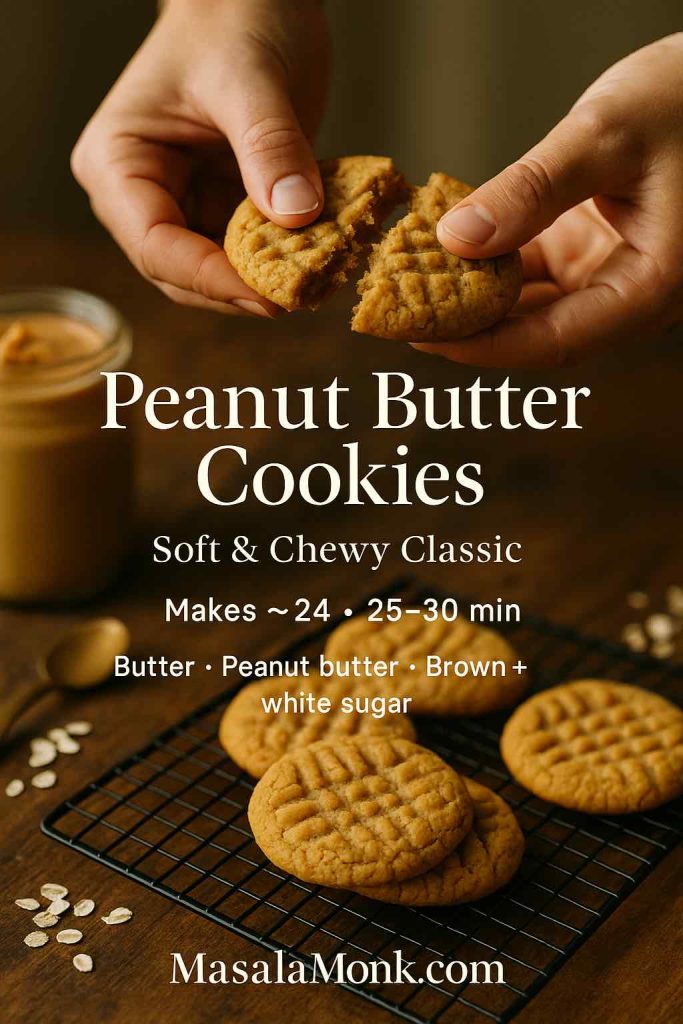
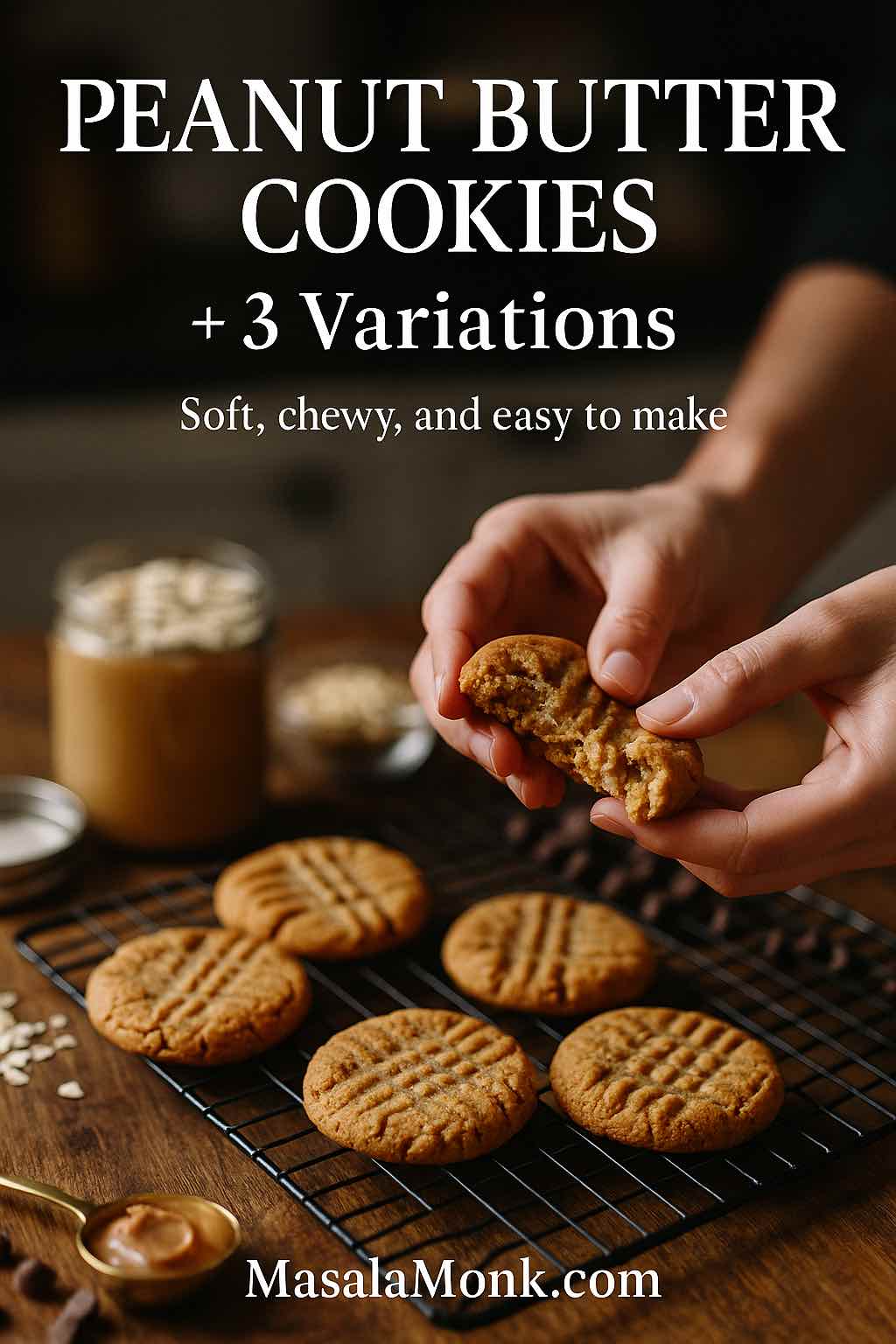
Hands breaking a soft, chewy peanut butter cookie over a cooling rack with classic crosshatch; jar of peanut butter and oats in the background—peanut butter cookies with 3 variations.

Some cookies are a craving; peanut butter cookies are a promise. A promise of soft centers, a hint of salt, and that crosshatch pattern that whispers, “You’ve come to the right kitchen.” If you’ve been hunting for a reliable peanut butter cookies recipe that you can memorize, customize, and bake on a weeknight without fuss, this is the one. We’ll start with the classic base, then—without complicating your life—branch into three popular riffs: 3-ingredient (flourless and naturally gluten-free), peanut butter chocolate chip (for the days you want pockets of melty sweetness), and peanut butter oatmeal (chewier, heartier, still quick).

Along the way, you’ll see natural, reader-friendly links if you want to go deeper on technique and ingredients—like making homemade peanut butter or choosing the right kind of oats with this guide to oats: types and differences. Use them as reference points; skip them if you’re already preheating the oven.


The Baseline Peanut Butter Cookies Recipe (Soft & Chewy)

At its heart, a dependable peanut butter cookies recipe does a few simple things really well:

  • Creams fat and sugar thoroughly (so the cookies lift rather than spread into puddles).
  • Balances white and brown sugar (for crisp edges and tender middles).
  • Uses just enough flour (to hold structure without becoming cakey).
  • Bakes quickly, then finishes on the sheet (carryover heat equals soft centers).

If you like a technical north star for ratios and method, the classic peanut butter cookies from King Arthur Baking mirror this approach—same gentle oven temp, same creaming logic, same quick bake.

Ingredients, at a glance

  • Creamy peanut butter (no-stir works most predictably; more on that below)
  • Butter, softened (unsalted lets you control salt)
  • Granulated sugar + light brown sugar (structure + moisture + caramel notes)
  • Egg + vanilla (binding + aroma)
  • All-purpose flour, baking soda, baking powder, salt (structure + lift + clarity of flavor)

Why “no-stir” peanut butter behaves so nicely

Natural peanut butter can absolutely work, and many bakers love its purer peanut flavor. Nevertheless, if consistency is your priority, stabilized (emulsified) peanut butter is a smart choice: it doesn’t separate, it creams smoothly with butter, and it yields less graininess in tender batters. If you’re curious about the “why,” this Serious Eats piece makes the case in practical, baker-friendly terms: best peanut butter for baking (emulsified vs natural).

Prefer to control every ingredient? You can skip added sugars and oils entirely and make homemade peanut butter in minutes; it’s just roasted peanuts and a pinch of salt blitzed until glossy.

How to Make Peanut Butter Cookies

  1. Cream the butter, peanut butter, and both sugars until light and fluffy. You’re dissolving some sugar and trapping air; it should look pale and seem a bit billowy.
  2. Beat in the egg and vanilla until the mixture looks silky.
  3. Fold in your whisked dry ingredients (flour, baking soda, baking powder, salt) until just combined—no streaks, no overmixing.
  4. Scoop 1 to 1½-tablespoon portions, roll in a little sugar if you like delicate crunch, then crosshatch each ball gently with a fork.
  5. Bake at 175°C / 350°F until the edges set and tops are faintly matte—usually 9–11 minutes.
  6. Rest on the sheet for 5 minutes before moving to a rack; they finish cooking to that soft-chewy sweet spot.

And yes—this single bowl of dough is your on-ramp to all three variations below.

Also Read: Baked Jalapeño Poppers (Oven) — Time, Temp & Bacon Tips


Ingredient Notes You’ll Actually Use

Because small choices make big differences, here are the handful that matter—nothing fussy, just reality-tested tweaks that improve your peanut butter cookies recipe immediately.

Peanut butter: natural, no-stir, or homemade?

  • No-stir (emulsified) peanut butter is drama-free: it mixes evenly and bakes dependably. If a batter tends to feel sandy or seize when you add chips or cocoa, emulsified PB helps. See this walkthrough on baking with emulsified PB for texture reasons and examples.
  • Natural PB (peanuts, maybe salt) brings bold peanut flavor. If the jar has separated, stir thoroughly. When using it in cookie dough, a 15–30 minute chill tightens the fat matrix and helps control spread. If you want to minimize separation in your everyday jar, this test-driven guide is handy: how to prevent nut butter separation.
  • DIY PB gives you total control. If you prefer a short, clean ingredient list, whip up homemade peanut butter and season it to taste.

Flour, mixing, and that just-right bake

The most common cause of crumbly PB cookies is too much flour or overbaking. Use the spoon-and-level method (or weigh flour), stop mixing once the last streak disappears, and remove the cookies when their edges set but centers still look soft. King Arthur’s classic method is an excellent cue card for timing and texture checks.

Storage and food-safety basics

Baked cookies keep well in an airtight tin at room temp. Dough is a little different: the USDA suggests 2–4 days in the fridge and about 2 months in the freezer for homemade cookie dough. If you love prep-ahead baking days, portion dough balls, freeze solid on a tray, then bag and label: cookie dough storage guidelines. If you’re wondering about peanut butter itself (pantry vs. fridge), here’s a practical explainer on storage differences between conventional and natural styles: does peanut go bad?

Also Read: How to Make Churros (Authentic + Easy Recipe)


Classic Peanut Butter Cookies Recipe (Primary Method)

Because clarity is kindness, here’s the base peanut butter cookies recipe laid out cleanly, ready to riff.

You’ll need

  • ½ cup (113g) unsalted butter, softened
  • ½ cup (120g) creamy peanut butter (no-stir recommended for most consistent texture)
  • ½ cup (100g) granulated sugar
  • ½ cup (110g) light brown sugar, packed
  • 1 large egg (room temperature)
  • 1 teaspoon vanilla extract
  • 1¼ cups (150g) all-purpose flour
  • ½ teaspoon baking soda
  • ¼ teaspoon baking powder
  • ¼ teaspoon fine salt
Soft and chewy peanut butter cookies recipe—hands breaking a crosshatched cookie over a cooling rack with a jar of peanut butter in the background.
Soft & Chewy Classic Peanut Butter Cookies — ready in 25–30 minutes and makes about 24; a dependable base for 3-ingredient, chocolate chip, and oatmeal variations.

Step-by-step

  1. Preheat oven to 175°C / 350°F. Line two baking sheets.
  2. Cream butter, peanut butter, and both sugars on medium speed for 2–3 minutes, until pale and slightly fluffy.
  3. Beat in egg and vanilla until glossy and smooth.
  4. Whisk flour, baking soda, baking powder, and salt; fold into the wet ingredients just until combined.
  5. Scoop 1 to 1½ tablespoons of dough per cookie. Optionally roll in granulated sugar. Place on trays with space to spread.
  6. Crosshatch each ball lightly with a fork (two perpendicular presses). Flatten to roughly 1 cm thickness.
  7. Bake 9–11 minutes until edges are set and tops look just dry.
  8. Cool on the tray for 5 minutes, then move to a rack. Enjoy when fully set (they’ll be extra soft while warm).

Make it yours, gently: For thicker cookies, chill 30–60 minutes before baking. For slightly crisp edges, extend the bake by 30–60 seconds. For heightened peanut flavor, use salted PB and reduce added salt a touch.

Also Read: Green Tea Shot with Jameson | Recipe & 10 Variations


3-Ingredient Peanut Butter Cookies (Flourless, Naturally GF)

Sometimes you want cookies now. Not in an hour—now. This minimalist peanut butter cookies recipe uses just three ingredients, and yet it nails the essential soft-chewy PB experience. Because there’s no flour, these stay naturally gluten-free with clean, bold peanut flavor.

What goes in

  • 1 cup (250g) creamy peanut butter (no-stir is the safest choice here)
  • ¾ cup (150g) granulated sugar (or ½ cup granulated + 2 Tbsp brown for deeper chew)
  • 1 large egg
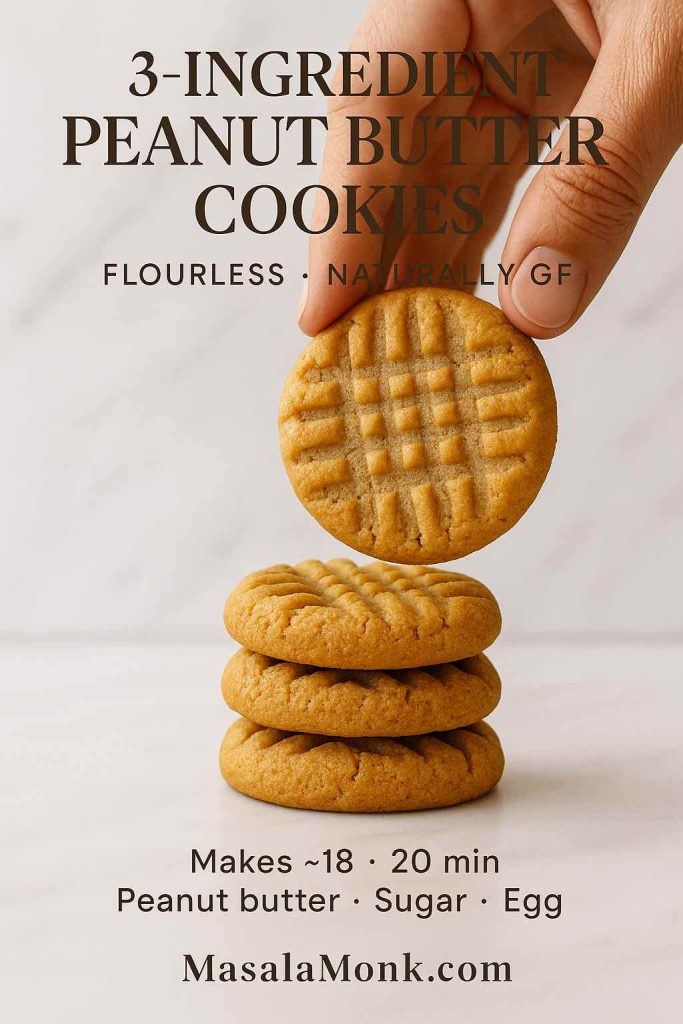
3-ingredient peanut butter cookies recipe, flourless and naturally gluten-free, hand placing a crosshatched cookie on a stack on marble.
3-Ingredient Peanut Butter Cookies — flourless, naturally gluten-free; ready in 20 minutes and makes about 18.

What to do

  1. Heat oven to 175°C / 350°F and line a tray.
  2. Stir peanut butter, sugar, and egg until glossy and cohesive; the dough will thicken as you stir.
  3. Scoop 1-tablespoon portions, crosshatch lightly, and bake 8–10 minutes until edges set.
  4. Cool fully before lifting—flourless cookies are delicate when hot but turn fudgy as they set.

If you prefer a flour-based gluten-free option that mimics the classic’s crumb more closely, you can adapt ratios from gluten-free peanut butter cookies, which use a GF blend or self-rising flour for lift and bite.

Also Read: Vegan French Toast: 6 Easy Recipes (Pan, Air Fryer, GF & High-Protein)


Peanut Butter Chocolate Chip Cookies (Simple Add-In, Big Payoff)

On some days, a little chocolate turns good into irresistible. Happily, you don’t need a separate peanut butter cookies recipe for this: the classic dough above is sturdy enough to carry chips without turning greasy or fragile—especially if you used a no-stir PB or thoroughly mixed natural PB.
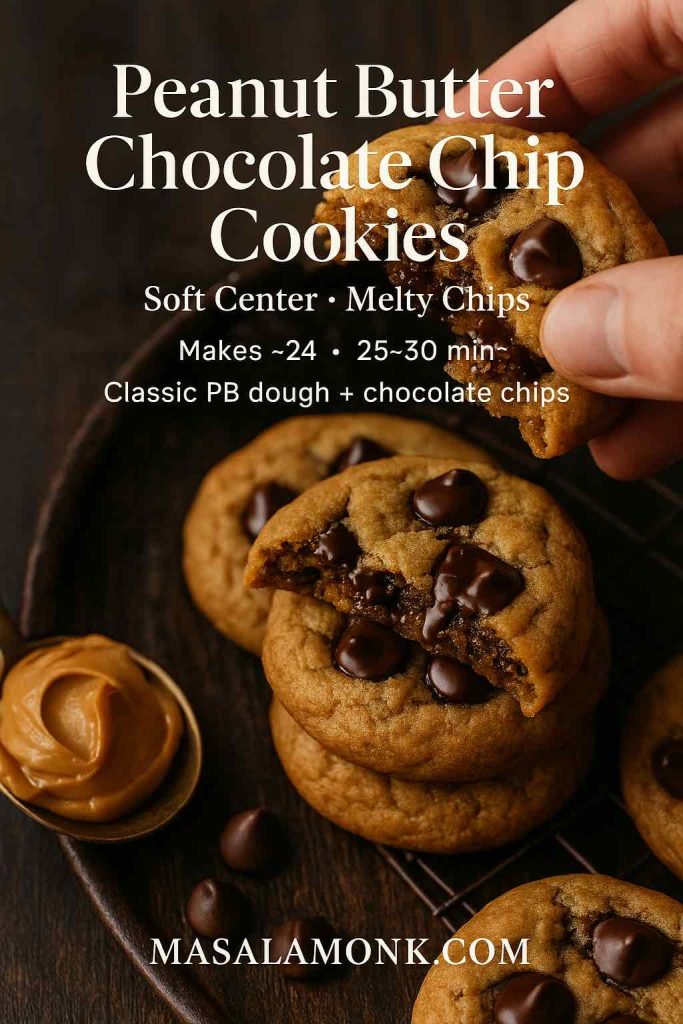
Peanut butter chocolate chip cookies with gooey melted chips—hand breaking a warm cookie on a rustic wood surface, soft center visible.
Peanut Butter Chocolate Chip Cookies — soft-centered with melty chips; makes about 24 in 25–30 minutes using the classic PB dough plus chocolate chips.

How to adapt the base

  • Mix-in: Fold 1 to 1½ cups chocolate chips into the finished classic dough.
  • Scoop & bake as usual—same crosshatch, same time frame.
  • Finish: If you like, dot a few extra chips on top right out of the oven for an artisanal look.

Because emulsified peanut butter blends seamlessly with butter, you’ll notice fewer sandy spots once chips are in the mix; if you’re curious about why that texture holds, this explainer is a good read: best PB for baking (why emulsifiers help).

Also Read: Béchamel Sauce for Lasagna: Classic, Vegan & Ricotta Sauce Recipe


Peanut Butter Oatmeal Cookies (Chewy, Hearty, Still Fast)

When you want a cookie that eats a bit like an afternoon snack, oats are your secret weapon. They add chew, fiber, and a warm cereal note that loves peanut butter. You can make this variation two ways—rolled oats for chew or quick oats for a softer, more uniform bite. If you’re deciding which bag to buy (or which jar to open), skim MasalaMonk’s practical explainer on oat types: guide to oats: types and differences and this compact refresher, oats vs oatmeal: what’s the difference?
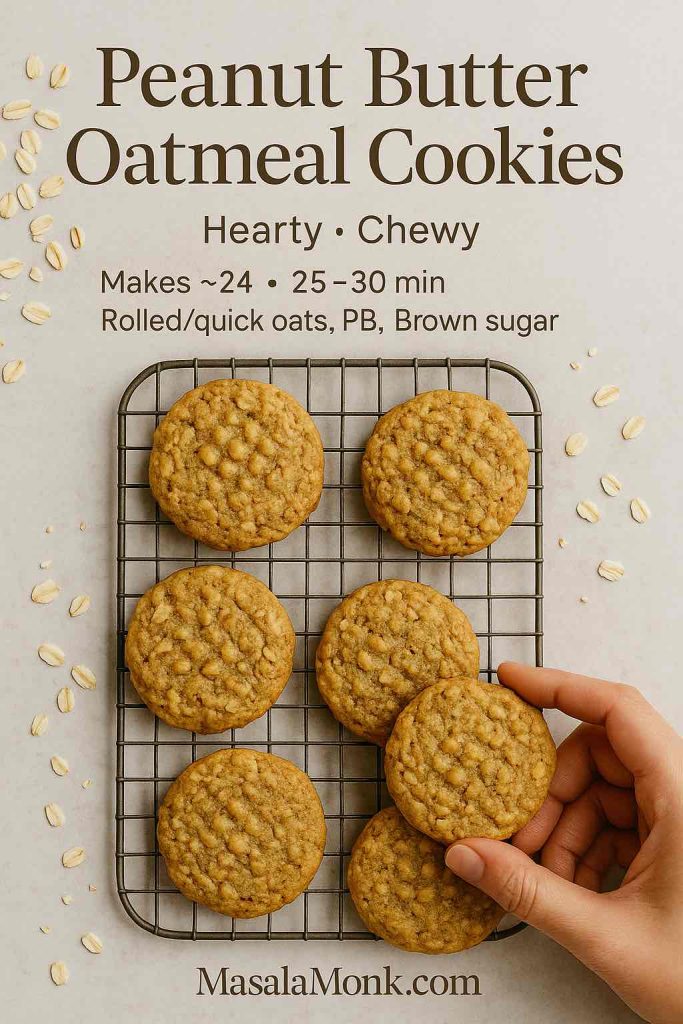
Chewy peanut butter oatmeal cookies on a cooling rack—hand lifting one cookie with scattered rolled oats; hearty texture, makes about 24 in 25–30 minutes.
Chewy Peanut Butter Oatmeal Cookies — hearty and satisfying with rolled or quick oats and brown sugar; ready in 25–30 minutes and yields roughly 24.

How to adapt the base

  • Add: Fold 1 cup oats into the finished classic dough.
  • Balance: If the dough seems stiff, splash in 1 tablespoon milk to keep the crumb tender.
  • Choose your texture:
    • Rolled (old-fashioned) oats → more chew and visible oat flakes.
    • Quick oats → softer, more uniform crumb.
    • Skip steel-cut for cookies; they stay too hard. See the why here: steel-cut vs rolled oats

Want to keep the oat momentum going during the week? Bake a tray of healthy oat cookies (no sugar, no butter) or tuck a pan of oat protein bars into the fridge for grab-and-go breakfasts.

Also Read: Crock Pot Lasagna Soup (Easy Base + Cozy Slow-Cooker Recipes)


Texture Tuning Peanut Butter Cookies: Softer, Chewier, Thicker

Because you’re the baker, you get to decide the cookie you want today. Here’s how to steer the same peanut butter cookies recipe toward different textures—without rewriting the ingredient list.

  • Extra soft: Pull them at the first hint of set edges and let them finish on the tray.
  • Chewier: Increase the brown sugar by 1–2 tablespoons and decrease white sugar by the same; brown sugar’s molasses boosts moisture retention.
  • Thicker: Chill the portioned dough 30–60 minutes, then bake. Cold fat slows spread.
  • Crispier edges: Bake 30–60 seconds longer and cool completely on a rack.
  • Stronger peanut impact: Use salted PB or add a tiny pinch of fine salt to the dough.

If you’re using natural PB and want to minimize separation over time (both in the jar and in your batter), experiment with the methods in this separation-prevention test. It’s a small upstream fix that yields smoother creaming and more even crumb.

Also Read: Cottage Cheese Lasagna Recipe | Chicken, Spinach, & Ricotta


Ingredient Swaps That Actually Work

Yes, you can tweak things. No, you don’t have to guess. Use these swaps when your pantry is half full—or when you’re leaning toward a dietary preference.

  • No brown sugar today? Use all white sugar and add 1 teaspoon honey or a drizzle of molasses for depth.
  • No butter handy? Use the same weight of neutral oil; chill the dough 30 minutes to re-firm the fat for better edges.
  • Egg-free mood? Make a flax egg (1 tablespoon ground flax + 3 tablespoons water; sit 5 minutes). Expect a touch more tenderness.
  • Gluten-free route: Choose the 3-ingredient variation (naturally GF) or adapt a 1:1 GF flour blend following ratios like these GF PB cookies.
  • Less sweet overall? Drop total sugar by 2 tablespoons in the classic; cookies will be slightly drier, so don’t overbake.

Also Read: How to Cook Bacon in the Oven (Crispy, No-Mess, Crowd-Ready Recipe)


The Pantry Question: Where to Store Peanut Butter and Dough

Because you’ll be baking this peanut butter cookies recipe more than once, it helps to know where everything should live between batches.

  • Peanut butter storage: Conventional (stabilized) PB is pantry-friendly; natural PB benefits from the fridge to prevent rancidity. For a practical, no-alarm-bells overview of why, read does peanut butter go bad?
  • Dough storage: Homemade cookie dough is happiest in an airtight container 2–4 days in the refrigerator or about 2 months in the freezer, per USDA guidance.
  • Bake straight from frozen: Add 1–3 minutes to the baking time and watch the edges; no other changes needed.

Also Read: French Toast Sticks (Air Fryer + Oven Recipe) — Crispy Outside, Custardy Inside


Troubleshooting Peanut Butter Cookies Recipe

You don’t need a helpline; you just need a short list.

  • Crumbly cookies: Usually too much flour or overbaking. Weigh flour if possible; pull the pan as soon as edges set.
  • Greasy look after cooling: Either over-measured fat or natural PB with separation. Stir natural PB thoroughly and consider a short chill for the dough.
  • Too thick, not spreading: Dough too cold or flour slightly high. Let portions warm a few minutes, or press the crosshatch a bit deeper.
  • Dry bite: Over-baked by a minute or two. Next round, check a minute earlier; aim for matte tops but tender centers.
  • Oat “hard bits”: Steel-cut oats will never soften fully in this bake; use rolled or quick oats instead. If you’re weighing options, skim rolled vs steel-cut before you scoop.

Also Read: 10 Best Chicken Sandwich Recipes (BBQ, Parm, Buffalo & More)


Variation Playbook: When and Why to Use Each One

Bake the classic when you’re feeding a mixed crowd and want predictable results with pantry ingredients.
Choose 3-ingredient when time is tight, gluten-free guests are coming, or you simply love the clean peanut punch.
Pick peanut butter chocolate chip if you’re sending a care package or want little bursts of chocolate in each bite.
Go peanut butter oatmeal when you’re after a sturdier afternoon snack that pairs well with tea or coffee.

If you wind up with extra oats, keep the baking train rolling with healthy oat cookies (no sugar, no butter) or stash oat protein bars for after-gym snacks. And if you’re feeling especially peanut-forward another day, King Arthur’s nostalgic peanut-butter-centered treats like Magic in the Middles pair beautifully with this dough’s flavor profile.


Your Baking Rhythm, Simplified

There’s an easy weekly cadence that turns this peanut butter cookies recipe into a stress-free habit:

  • Sunday: Make a double batch of the classic dough; bake one tray for now, then portion the rest into balls and freeze.
  • Midweek: On a busy evening, bake the 3-ingredient version while dinner rests—10 minutes of oven time and dessert is done.
  • Friday: Turn leftover classic dough into peanut butter chocolate chip cookies with a quick handful of chips; same bake, instant variety.
  • Weekend: Fold oats into the remaining dough to make peanut butter oatmeal cookies for a hike, a movie night, or a potluck.

Because the base is so forgiving—and because you now know exactly how to store dough and peanut butter safely (see cookie dough storage basics and PB storage pointers)—you can keep the rhythm without wasting a single scoop.

Also Read: 10 Best Espresso Martini Recipe Variations (Bar-Tested)


Classic + 3 Variations: Quick Reference for Peanut Butter Cookies

Classic Peanut Butter Cookies
Cream butter, PB, and sugars; beat in egg/vanilla; fold in dry; scoop, crosshatch, bake 9–11 minutes. Soft centers, lightly crisp edges. Use this classic method for timing and texture cues.

3-Ingredient (Flourless)
PB + sugar + egg. Stir, scoop, crosshatch, bake 8–10 minutes. Naturally GF, deeply peanutty. For a flour-based GF path, adapt this self-rising/GF framework.

Peanut Butter Chocolate Chip
Fold 1 to 1½ cups chips into the classic dough. Same scoop, same bake. For reliably smooth batters, see why emulsified PB helps.

Peanut Butter Oatmeal
Fold 1 cup oats into the classic dough (rolled for chew, quick for softness). If stiff, add 1 Tbsp milk. Skip steel-cut; they don’t soften enough—rolled vs steel-cut explained. Keep the oat theme going with healthy oat cookies or oat protein bars.


A Last Word Before You Preheat

Recipes are roadmaps, not handcuffs. Bake the classic once as written so you have a feel for texture and timing, then adjust—sweeter or less sweet, thicker or thinner, with or without oats, with chocolate or without. The goal is a peanut butter cookies recipe that feels like yours, not a script you’re afraid to edit.

And because a dependable source is a baker’s best friend, here are the few links you’ll probably return to most:

Now—scoop, crosshatch, bake. And if your first tray disappears while the second is still in the oven, well, that’s exactly how peanut butter cookie nights are supposed to go.

Also Read: 6 Wellness Shot Recipes to Boost Your Immune System

FAQs

1) What makes a peanut butter cookies recipe soft and chewy?

Soft, chewy results come from balanced fat and sugar, minimal mixing after flour goes in, and a brief bake. Moreover, pull the tray when edges just set; carryover heat finishes the centers without drying them out.

2) How do I keep peanut butter cookies from spreading too much?

First, chill portioned dough for 20–30 minutes if your kitchen is warm or you’re using natural peanut butter. Additionally, measure flour accurately and avoid over-creaming butter (too much air can cause excessive spread).

3) Can I use natural peanut butter in this peanut butter cookies recipe?

Yes. Nevertheless, stir it thoroughly to recombine oil and solids. For extra insurance, chill the dough briefly so the fat firms up, resulting in cleaner edges and better lift.

4) Why do we press the classic crosshatch on top?

The dough is dense; consequently, the crosshatch flattens it for even baking. It also signals the signature texture and helps achieve that crisp rim with a tender middle.

5) How do I make thicker peanut butter cookies without changing ingredients?

Simply chill scooped dough 30–60 minutes, then bake. Conversely, if you want thinner, slightly crisper cookies, skip chilling and press the crosshatch a bit deeper.

6) What’s the best sugar ratio for chew?

Light brown sugar adds moisture and chew; granulated provides structure. Furthermore, a small tilt toward brown sugar (by a tablespoon or two) deepens flavor without turning the cookie cakey.

7) Can I reduce the sweetness but keep texture?

Certainly. Reduce total sugar by 1–2 tablespoons; as a result, don’t extend bake time. Otherwise, they may lean dry. For balance, a tiny pinch of extra salt can sharpen the peanut flavor.

8) Do I need baking soda and baking powder, or just one?

Use both in small amounts. Soda encourages spread and browning; powder supports gentle lift. Similarly, combining them yields those classic crackles with soft interiors.

9) How do I prevent crumbly cookies?

Measure flour precisely and stop mixing once the flour disappears. Beyond that, avoid overbaking; even 30–60 seconds too long can make the texture sandy instead of fudgy.

10) Can I make a peanut butter cookies recipe without butter?

Absolutely. Substitute an equal weight of neutral oil. However, chill the dough afterwards so it doesn’t over-spread, and watch the final minute closely.

11) How do I adapt the recipe for gluten-free baking?

Two routes work well. First, the flourless 3-ingredient version is naturally gluten-free. Alternatively, a quality 1:1 gluten-free blend can replace all-purpose; nevertheless, mix gently to maintain tenderness.

12) What’s the simplest 3-ingredient version—and does it taste like the classic?

Peanut butter, sugar, and egg—stir, scoop, and bake. Notably, it’s peanut-forward and slightly denser. Even so, the chew is excellent when you avoid overbaking and let the cookies cool fully.

13) How can I make the flavor more peanut-forward?

Use salted peanut butter or add a small extra pinch of fine salt. Additionally, underbake by about 30 seconds for a creamier center that amplifies the peanut aroma.

14) What’s the ideal thickness before baking?

After scooping, press to about 1 cm with the crosshatch. Consequently, you’ll get even doneness: crisp rims, soft centers, and consistent texture across the batch.

15) Why did my cookies look greasy after cooling?

Oil separation in natural peanut butter or over-measured fat can cause sheen. Instead, stir natural peanut butter thoroughly and weigh ingredients; a short chill also helps stabilize the dough.

16) How do I keep edges crisp but centers soft?

Bake until edges turn just matte while centers still look slightly pale. Then, let the cookies rest on the sheet for 5 minutes. Ultimately, this sequence preserves the contrast you’re after.

17) Can I freeze the dough for later?

Yes—portion into balls, freeze on a tray, then bag. Additionally, bake straight from frozen and add 1–3 minutes, watching the edges rather than the clock.

18) What’s the best way to store baked cookies?

Airtight container at room temperature does the job. Conversely, if your climate is very humid, tuck a small piece of parchment between layers to discourage sticking.

19) How do I make egg-free peanut butter cookies?

Use a flax egg (1 tablespoon ground flax mixed with 3 tablespoons water, rested 5 minutes). Moreover, avoid overbaking, since egg-free doughs can firm up faster as they cool.

20) Can I add oats without drying the cookie?

Certainly. Fold in about 1 cup of oats per batch; if the dough feels stiff, add 1 tablespoon milk. Similarly, rolled oats give more chew, while quick oats create a softer, uniform crumb.

21) My cookies didn’t spread—what went wrong?

Likely the dough was too cold or flour ran high. Otherwise, the crosshatch press was too light. Let the scoops warm a few minutes or press slightly more before baking.

22) Does the peanut butter brand matter?

Not particularly; however, style does. Emulsified (no-stir) peanut butter is more predictable; natural works too, though it benefits from thorough stirring and a quick chill.

23) How can I boost aroma without extra sweetness?

Add ½ teaspoon vanilla and, if desired, a tiny pinch of espresso powder. Additionally, a light sprinkle of flaky salt after baking intensifies the peanut note without more sugar.

24) What oven rack and pan work best?

Middle rack with light-colored metal sheets promotes even browning. Meanwhile, line with parchment for consistent spread; dark trays brown faster, so shorten the bake slightly.

25) Can I double the peanut butter for stronger flavor?

Go cautiously. Increasing peanut butter too much can make cookies heavy and fragile. Instead, nudge flavor with a touch of salt, a hint more vanilla, and precise baking to keep centers plush.

26) How do I make small-batch peanut butter cookies?

Halve the ingredients. Furthermore, weigh everything for accuracy; smaller batches are less forgiving, and precise measurements keep texture identical to the full recipe.

27) What’s the best way to get uniform cookies?

Use a #40 or #50 scoop for even portions. Consequently, the batch bakes consistently, and every cookie finishes at the same moment.

28) Can I make a dairy-free peanut butter cookies recipe?

Yes—swap butter for equal weight of dairy-free baking sticks or neutral oil. Additionally, chill dough to maintain shape, and keep an eye on the edges to avoid overbaking.

29) How do I avoid a sandy or gritty texture?

Cream thoroughly at the start, but stop once flour is added. Beyond that, ensure sugars dissolve slightly during creaming, and don’t skip the brief rest on the tray after baking.

30) What’s the simplest way to refresh day-old cookies?

Warm a few on a tray at 150°C / 300°F for 3–4 minutes. As a result, the edges regain delicate crispness while the centers relax back to chewy.
Posted on 6 Comments

Benefits of Nuts and Seeds – Protein-Packed Superfoods

Steady energy matters on real days, not perfect ones. The highest protein nuts & seeds offer a tiny, portable fix that works at breakfast, at your desk, and after dinner. Moreover, they bring protein for fullness, fiber for appetite control, and unsaturated fats for smooth, even energy. Protein’s satiety edge is well documented—see Paddon-Jones et al.—and soluble fibre further prolongs fullness (Salleh et al.).

In practice, that means fewer spikes, fewer dips, and far fewer raids on the snack cupboard. Protein-forward, solid foods generally suppress appetite more than carb-dominant choices (Carreiro et al.). Additionally, these foods fit into what you already cook, so you won’t need new routines. Ultimately, consistency wins, and these ingredients make it easy to be consistent.

Also Read: How to Eat 100 Grams of Protein a Day.


Why the Highest Protein Nuts & Seeds Matter All Day

First, protein is the most reliable driver of satiety for many people. Consequently, even a modest serving can reduce between-meal grazing. Reviews consistently place protein above carbohydrate and fat for both satiation and satiety (Morell & Fiszman; Paddon-Jones et al.). Next, fiber and healthy fats slow digestion, which gently extends that fullness (Salleh et al.).

Meanwhile, convenience changes outcomes. Nuts and seeds sit happily in a jar, a locker, or a bag. Furthermore, they require no special prep, no gadgets, and almost no time. Finally, they taste good, which is why the habit sticks after the first week.

Importantly, the highest protein nuts & seeds carry helpful micronutrients. For example, iron supports vitality, magnesium steadies muscles and sleep, zinc backs immunity, vitamin E acts as an antioxidant, and plant omega-3 ALA supports heart and brain health. As a result, small servings do double duty. For plant omega-3 ALA basics and how it differs from EPA/DHA, see Harvard Nutrition Source.

Also Read: Almonds Nutrition Facts 100g & Glycemic Index Impact


Quick Answer: The Highest Protein Nuts & Seeds at a Glance

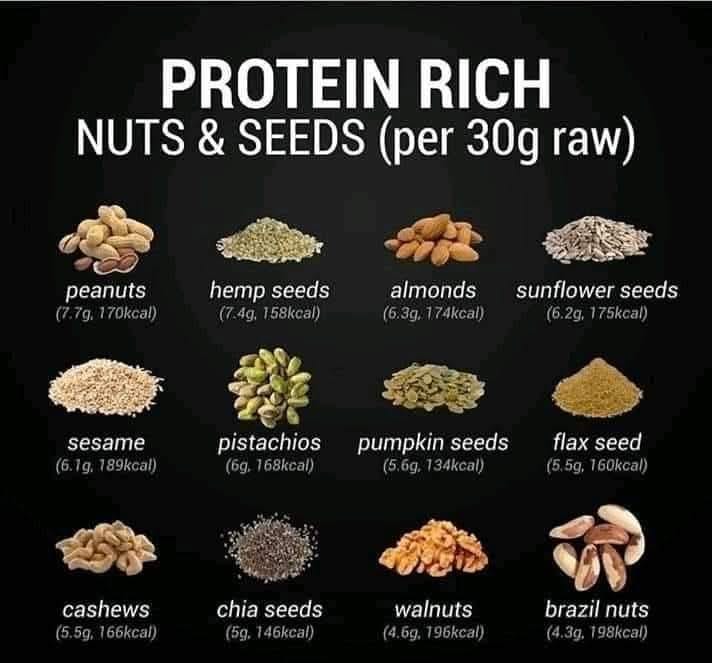
Peanuts are the highest-protein nut most people eat daily, while hemp seeds are the highest-protein seed. Per 100 g, peanuts typically deliver 24–26 g protein; meanwhile, hemp seeds reach 31–32 g. Scaled to a realistic serving—about 28–30 g for a small handful or seed sprinkle—that becomes ~7 g for peanuts and ~9–10 g for hemp. Additionally, pumpkin and sunflower seeds sit close behind; almonds, pistachios, and cashews hover near ~6 g per serving; walnuts contribute less protein yet bring valued omega-3 ALA. Therefore, once you know this orientation, every other choice becomes easier, calmer, and faster.

  • Top seed for density: Hemp hearts (~31–33 g protein per 100 g).
  • Top nut for density: Peanuts (~24–26 g per 100 g).
  • Elite runner-up seed: Pumpkin seeds (pepitas) (~30 g per 100 g).
  • Consistent six-gram players per serving: Sunflower kernels, almonds, pistachios.
  • Solid but slightly lower: Cashews, flax, chia.
  • Lower protein yet valuable omega-3 ALA: Walnuts.

In everyday servings of 28–30 g, expect hemp hearts ~9–10 g, pepitas ~8.5–9.5 g, peanuts ~7 g, almonds/pistachios/sunflower ~6 g, cashews/flax/chia ~5–6 g, and walnuts ~4–5 g. Notably, once you scale to real portions, the differences compress.

Data note: Macro values (protein, fat, carbs) come from USDA FoodData Central and USDA-derived tables via MyFoodData.

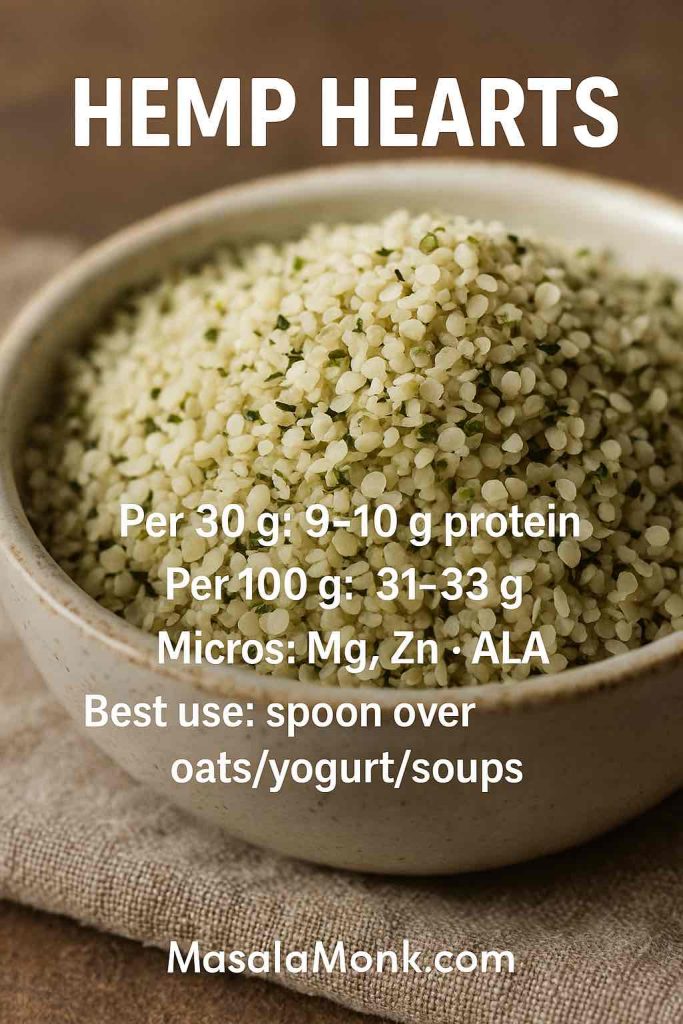
Bowl of hemp hearts with overlayed protein per 30 g and 100 g, plus micronutrients and usage tips, MasalaMonk.com.
Neutral ‘sprinkle’ that quietly adds ~3 g protein per Tbsp. Rich in magnesium, zinc, and plant omega-3 (ALA).

The Density View: Highest Protein Nuts & Seeds per 100 g

A per-100 g view reveals pure protein density—useful for recipe planning, bulk mixing, and comparing options fairly. Ranges reflect real-world variation in roasting, moisture, and variety; nevertheless, the ranking holds up and remember that most people eat ~30 g at a time.

  • Hemp hearts: ~31–33 g
  • Pumpkin seeds (pepitas, shelled): ~30 g
  • Peanuts (dry-roasted): ~24–26 g
  • Almonds: ~21–22 g
  • Pistachios: ~20–21 g
  • Sunflower kernels: ~20–21 g
  • Flax (alsi): ~18 g
  • Sesame (til): ~17–18 g
  • Chia: ~16–17 g
  • Walnuts (akhrot): ~14–15 g
  • Brazil nuts: ~14–15 g (modest protein; exceptional selenium)

Strictly by density, hemp leads the field, and peanuts lead the nuts. However, most people do not eat 100 g at once; consequently, the serving-level lens matters even more.

Also Read: Glycemic index of Chia Seeds and their effectiveness on Blood Sugar


Highest Protein Nuts & Seeds by Serving (28–30 g)

Once you shift from the lab bench to the palm of your hand, the field compresses in a reassuring way. In practice, a standard nut/seed serving is 28–30 g (roughly a small handful or 2–3 tablespoons, depending on the item).

  • Hemp seeds: ~9–10 g per 30 g
  • Pumpkin seeds: ~8 g
  • Peanuts: ~7 g
  • Almonds / Sunflower / Pistachios: ~6 g
  • Cashews / Flax / Chia: ~5–6 g
  • Walnuts: ~4–5 g

Accordingly, most servings of the highest protein nuts & seeds deliver ~5–10 g protein. Therefore, you can choose by taste, texture, budget, and purpose, then nudge the number upward with a tablespoon of hemp or an extra sprinkle of pumpkin or sunflower whenever you wish.

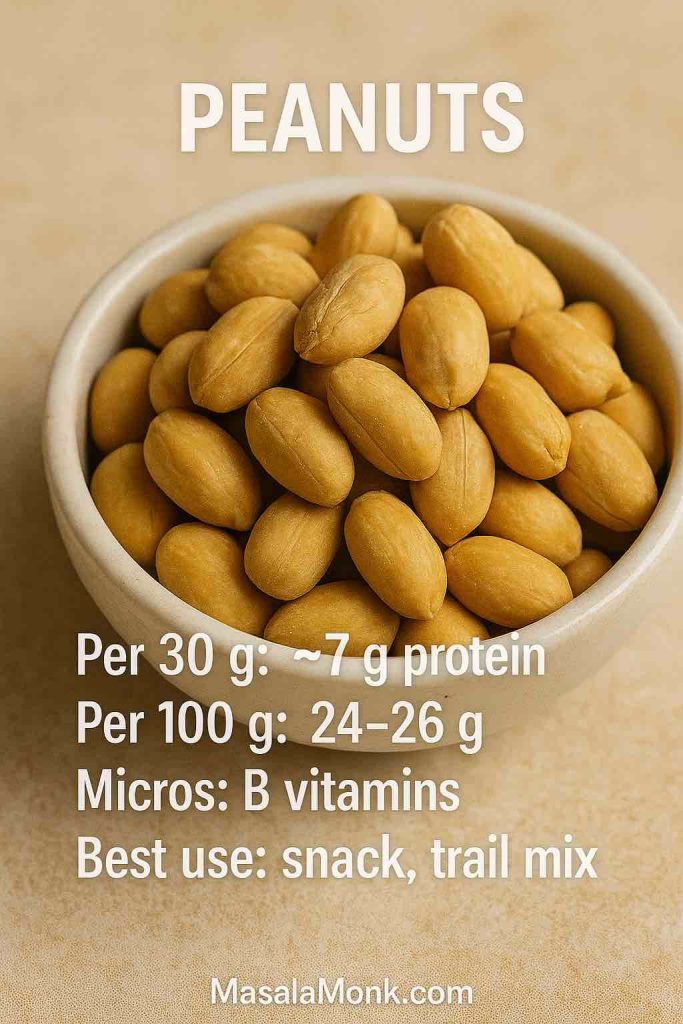
Close-up peanuts in a bowl with protein per serving and per 100 g, B-vitamins note, and best uses, MasalaMonk.com.
Best protein nut in value for money: ~7 g per handful. Season easily and use as the anchor for trail mixes.

The Spoon View: Nut Butters, Tahini, and Easy Boosters

Some days, a spoon is the strategy. Moreover, spoons are predictable, so the numbers stay honest.

  • Peanut butter: 1 Tbsp (~16 g) ≈ 4 g protein; 2 Tbsp (~32 g) ≈ 8 g (MyFoodData: Peanut butter).
  • Almond butter: slightly lower per spoon than peanut butter.
  • Tahini: ~5 g per 2 Tbsp (~30 g).
  • Hemp hearts: ~9–10 g per 3 Tbsp (~30 g) → ~3+ g per Tbsp.
  • Pepitas: ~3 g per Tbsp (~9–10 g by weight).

Almond butter typically trails slightly. Additionally, many “high-protein” nut butters add pea or whey; sometimes that helps, yet sometimes it merely raises the label claim. Alternatively, keep a nut butter you love and lift protein on demand with a tablespoon of hemp or a scatter of pumpkin seeds over yogurt, oats, or toast. Consequently, the flavor remains yours while the protein numbers climb without effort.

Also Read: Keto Chia Pudding Recipe with Almond Milk


The Tiny-Count Cheat Sheet: Quick Mental Math for Real Life

Life isn’t always measured in grams; consequently, these approximations of protein per nut or seed would help you decide quickly:

  • 1 almond (badam): ~0.25 g protein
  • 10 almonds: ~2.5 g
  • 1 peanut kernel: ~0.25 g
  • 10 peanuts: ~2.5 g
  • 1 walnut half: ~0.6 g (≈ 1.2 g per whole walnut)
  • 50 g peanuts: ~12–13 g
  • 100 g peanuts: ~24–26 g
  • 100 g almonds: ~21–22 g
  • 100 g pumpkin seeds: ~18–20 g
  • 100 g hemp seeds: ~31–32 g
  • 1 tbsp peanut butter (~16 g): ~4 g; 2 tbsp (~32 g): ~8 g

Yes, sizes and roasts vary slightly; nevertheless, these figures are reliable enough for daily planning and shopping.

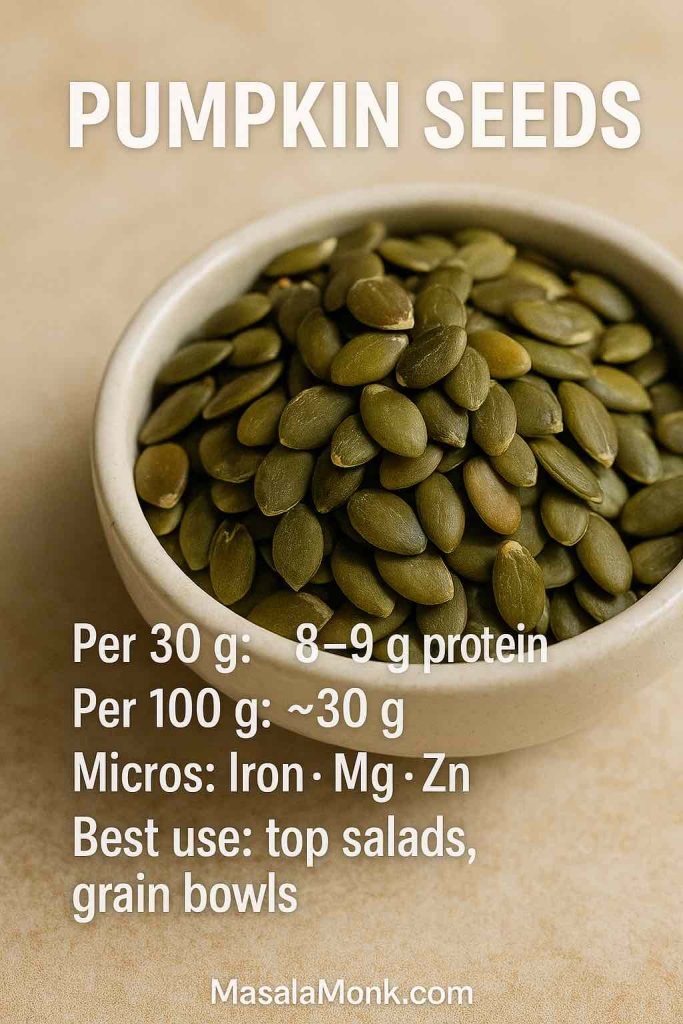
Pepitas in a ceramic bowl with protein per serving and per 100 g, iron/magnesium/zinc highlights, MasalaMonk.com.
Iron, magnesium, and zinc standouts. A 2-Tbsp finish gives crunch plus ~5–6 g protein.

Seeds or Nuts? Choosing the Highest Protein Nuts & Seeds With Intent

Decision-making gets easier when aim leads and appetite follows. Seeds often carry more protein per gram; nuts often deliver crunch, structure, and snack satisfaction. Thus, use this tidy lens:

  • Maximise protein per bite: hemp, pumpkin, sunflower
  • Best value with solid protein: peanuts
  • Vitamin E with clean, crisp bite: almonds
  • Plant omega-3 ALA: walnuts, ground flax, chia (ALA primer:Harvard Nutrition Source)
  • Iron + magnesium + zinc: pumpkin first; hemp and sunflower as strong support
  • Selenium (precise, potent): Brazil nuts1–2 are typically enough (AJCN RCT)

Pick the quality that fits today’s goal; then choose the texture you actually enjoy. As a result, consistency becomes easy.

Also Read: Pumpkin Seed Smoothie for Weight Loss | 5 Healthy Recipes & Benefits


Texture, Roasting, and Seasoning: The Satisfaction Multiplier

Numbers get you to the shelf; mouthfeel keeps you reaching into the jar. Consequently, small technique shifts create a big payoff:

  • Raw vs. roasted: light roasting (pan or oven) drives off a little moisture and unlocks aroma, so smaller portions feel complete. Keep heat moderate; oils should wake, not scorch. (Zhang et al., 2024).
  • Salted vs. unsalted: if lightly salted makes the habit stick, start there. Subsequently, mix half salted with half unsalted to bring sodium down without losing satisfaction.
  • Seasonings that earn their keep: chili-lime peanuts for brightness; cumin-salt pumpkin seeds for warmth; smoked-paprika almonds for evening snacking; lemon-sesame sunflower for lift. In turn, higher flavor density stabilises portion size naturally.

As satisfaction rises, portion anxiety falls. Therefore, you’ll find it easier to stop at enough.

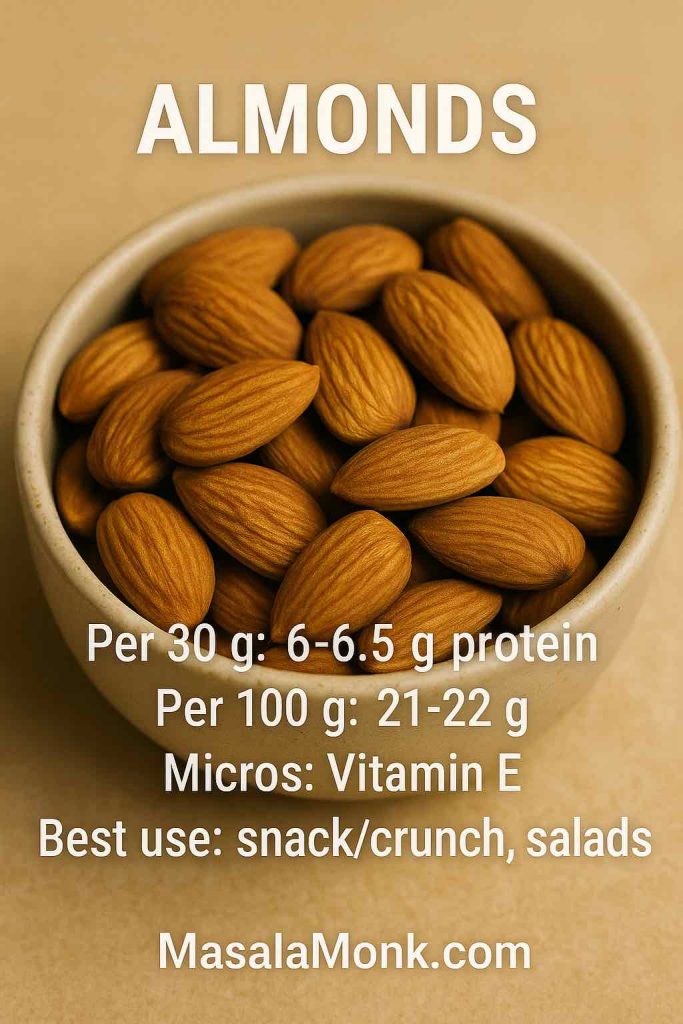
Almonds in a bowl with text showing protein per 30 g and 100 g and vitamin E note, MasalaMonk.com.
Almonds are Vitamin-E powerhouse with a clean crunch—~6–6.5 g protein per 30 g.

Micronutrient Tie-Breakers: When Protein Isn’t the Only Priority

Sometimes two choices tie on protein; consequently, minerals and vitamins decide the winner.

  • Iron: choose pumpkin seeds; sunflower assists. A tablespoon over salad, dal, soup, or roasted vegetables is a frictionless upgrade.
  • Vitamin E: choose almonds. A handful in the afternoon—or chopped over breakfast—keeps intake steady.
  • Selenium: choose Brazil nuts. One or two often meet daily needs; more isn’t necessary.
  • Omega-3 ALA: rotate walnuts, ground flax, and chia. Different textures; same benefit.
  • Magnesium & zinc: choose pumpkin and hemp for consistent support of muscle function, sleep quality, and immunity.
  • B-vitamins: choose peanuts and sunflower for reliable contributions to metabolism and nervous-system health.

Viewed this way, the highest protein nuts & seeds become a toolbox rather than a contest.

Also Read: Best Nuts and Seeds for Weight Loss (Chia, Flax, Almonds & More)


Buying and Storing the Highest Protein Nuts & Seeds

Nuts and seeds look sturdy; their oils do not. Accordingly, handle them thoughtfully and they’ll taste vivid to the last serving. Freshness multiplies flavor, and flavor multiplies follow-through. Furthermore, storage is simple.

  1. Buy what you’ll finish in a few weeks; a lively small stash beats a tired bulk bargain.
  2. Store airtight, cool, and dark. Glass jars in a cupboard are ideal; warm counters are not.
  3. Refrigerate or freeze omega-3-rich options (walnuts, flax, chia) if the kitchen runs warm.
  4. Smell before you snack. Fresh smells round and nutty; rancid smells waxy or flat. Toasting may revive a slightly dull seed; nothing saves a truly rancid nut—bin it and move on.

With storage handled, value rises and waste falls.

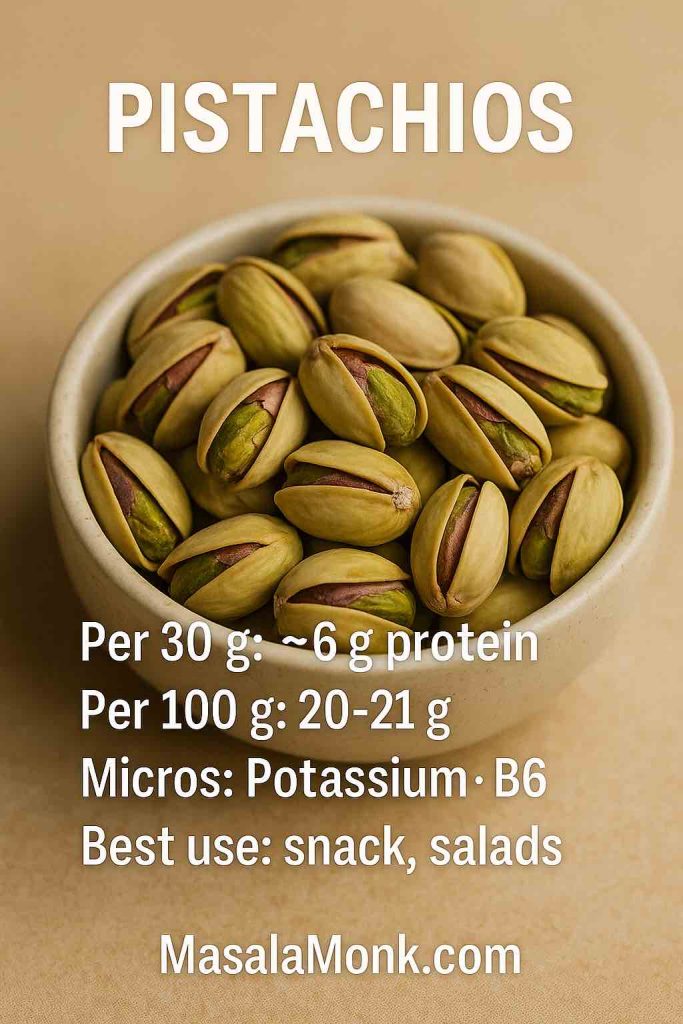
Pistachios in a bowl with overlayed protein per 30 g and 100 g and potassium/B6, MasalaMonk.com.
Pistachios have ~6 g protein per 30 g plus potassium & B6—great in salads and snacks.

Price & Value: Protein You’ll Actually Eat

Value is not only the sticker price; it is also protein per currency, minerals per bite, and the likelihood you’ll reach for it daily.

  • Peanuts: everyday champion—high protein, friendly price, universally seasonable.
  • Sunflower seeds: budget-friendly seed with solid minerals.
  • Pumpkin seeds: pricier, yet they repay with iron, magnesium, zinc, and deeply satisfying chew.
  • Almonds: premium, yet vitamin E and that “clean crunch” justify their role.
  • Hemp seeds: premium booster—one tablespoon strategically placed is often all you need.

Accordingly, a pragmatic pattern works best: build a base with peanuts or sunflower for affordability, then spike with pumpkin or hemp to raise protein and minerals without blowing the budget.

Also Read: The Power of Chia Seeds: 5 Plant-Based High-Protein Meal Prep Ideas


How to Use Nuts & Seeds All Day

Highest Protein Nuts & Seeds at Breakfast: Steady Mornings Without Effort

Oats with backbone
Stir a spoon of peanut or almond butter into hot oats; then finish with hemp and sliced banana. As a result, the bowl turns creamy, balanced, and genuinely sustaining.

Yogurt that eats like a meal
Thick yogurt or dahi, a handful of almonds for crunch, a spoon of chia or ground flax for fiber and omega-3s, berries for brightness, and a light drizzle of honey if you like. Consequently, protein rises and hunger drops.

A better smoothie
Milk or plant milk, frozen berries or banana, 1 tbsp nut butter, 1 tbsp hemp or pumpkin, a pinch of salt. Blend until silky. Typically, you’ll land in the 10–15 g range without using a powder.

Quick toast upgrades
Whole-grain toast with tahini and lemon; then sesame and a few chopped pistachios. Alternatively, peanut butter with sliced apple and a sprinkle of hemp. Small change, long runway.

Hot cereals beyond oats
Millet or ragi porridge finished with almond butter and sunflower seeds. Notably, the flavor is comforting while the macros are quietly stronger.

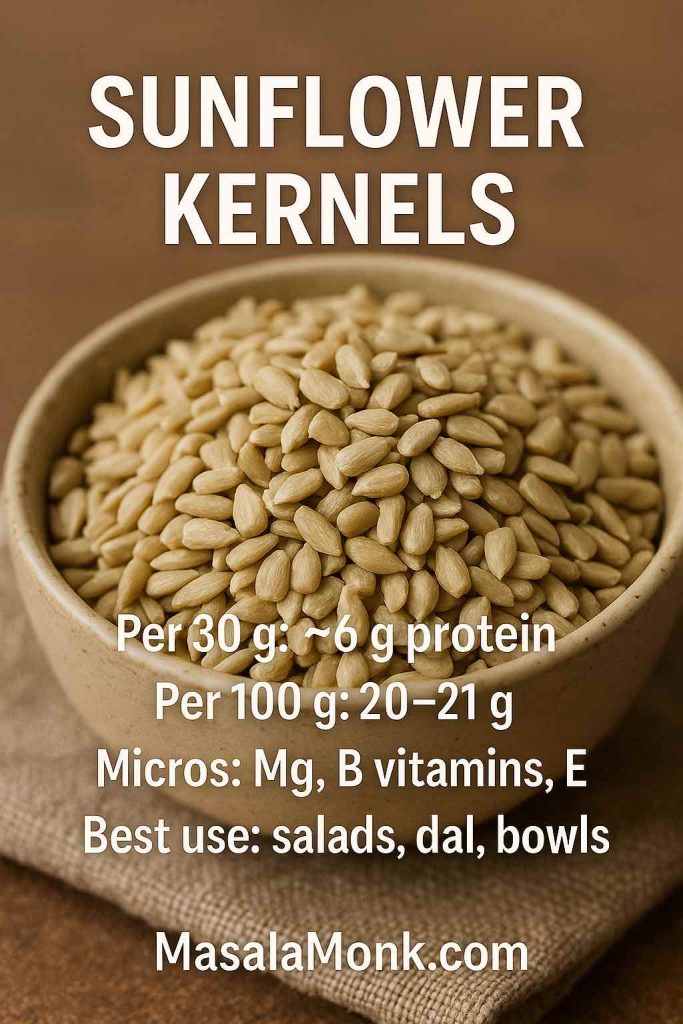
Sunflower kernels in a bowl with protein per 30 g and 100 g, magnesium and B vitamin note, MasalaMonk.com.
Sunflower seeds or kernels offer budget-friendly crunch with ~6 g protein per 30 g; steady minerals and B vitamins.

Highest Protein Nuts & Seeds at Lunch: Salads, Bowls, and Simple Structure

Leafy salad with substance
Leaves, chickpeas or boiled egg, chopped almonds or pistachios, tahini-lemon dressing; finally, sunflower seeds scattered at the end so they stay crisp. Consequently, the bowl moves from “nice” to “complete.”

Warm grain bowl
Rice or quinoa, roasted vegetables, a lemon-tahini drizzle, pumpkin and sunflower seeds to finish. Each bite has contrast—acid, fat, salt, crunch—and, importantly, steady protein.

Open-faced toast, grown up
Hummus or tahini-yogurt on a slice, cucumber ribbons, herbs, lemon zest, sesame. Satisfying yet light; easy to repeat throughout the week.

Dal and greens
Spinach dal or mixed-veg dal finished with cumin-garlic tempering and a handful of mixed seeds. Immediately, the texture improves and satiety rises without heaviness.

Also Read: Peanuts for Weight Loss: Best Ways to Eat Groundnuts, Chikki & Peanut Butter


Highest Protein Nuts & Seeds at Dinner: Generous Flavor Without Weight

Soups that finish strong
Tomato soup topped with pumpkin and sunflower; carrot-ginger with sesame; moong soup with roasted cumin and a final sprinkle of hemp. Thus, a simple bowl feels curated rather than plain.

Vegetables that eat like mains
Roasted cauliflower with tahini and pistachios; green beans finished with almonds and lemon; stuffed peppers with rice, cashews, and raisins. Consequently, vegetables carry the meal while nuts and seeds provide ballast and interest.

Stir-fries and quick sautés
Vegetables and tofu with a peanut-sesame crumble. Add the crunch during the last minute so it stays lively on the plate.

Grain-plus suppers
Couscous or broken wheat with roasted onions and peppers, then a warm dressing of olive oil, lemon, and tahini. Sunflower and pumpkin seeds go on at the end. Simple, clean flavors; dependable protein.

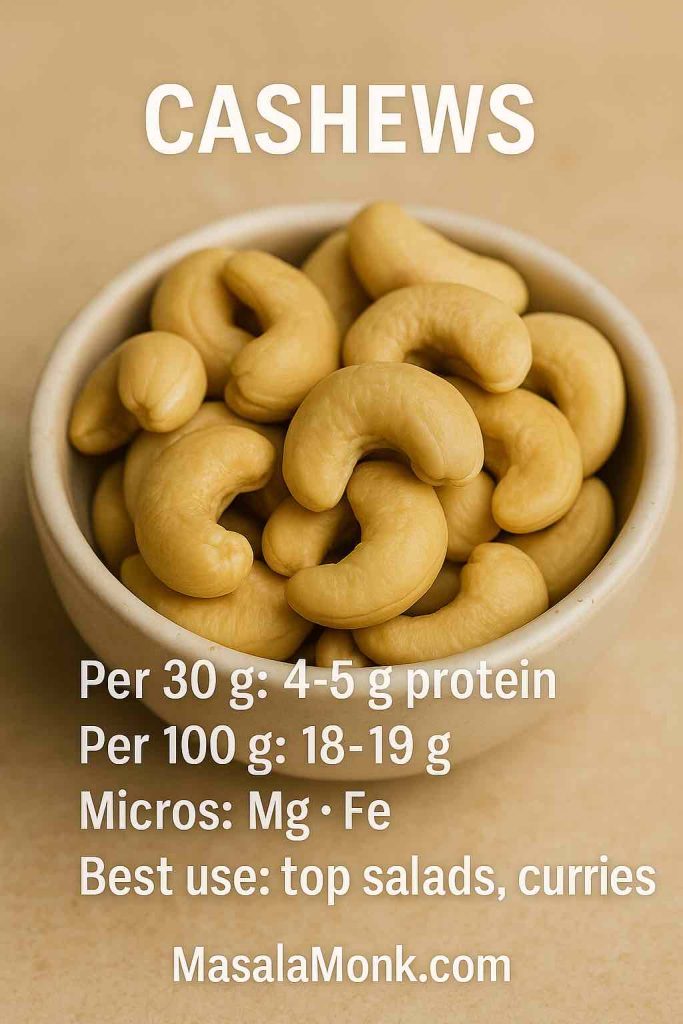
Cashews in a bowl with protein per 30 g and 100 g, magnesium and iron note, MasalaMonk.com.
Creamy all-rounder— Cashew Nuts with ~4–5 g protein per 30 g; great for sauces, curries, and salads.

Snacks That Don’t Backfire: Steady Energy in Small Moves

Trail mix with intent
Base of peanuts and almonds for value and crunch; pumpkin for minerals; hemp sprinkled just before eating as the protein “top-coat.” Keep dried fruit modest so you snack for nourishment, not momentum.

The desk spoon
Jar of nut butter plus a tiny jar of hemp within reach. Spoon, sprinkle, done. Not fancy—effective.

Roasted seed cups
Dry-toast pumpkin and sunflower with a pinch of salt and cumin. Cool, jar, and keep by the kettle. A tablespoon at tea-time replaces handfuls of empty calories.

Crisp apple + nut butter
Two or three slices, a thin smear of peanut or almond butter, a dusting of cinnamon, and a few sesame seeds. The ratio is everything: more apple than spread, more satisfaction than effort.

Adding nuts does not derail body weight in trials; systematic reviews show neutral or favorable effects on weight and adiposity (SR/MA of RCTs & cohorts)

Also Read: Nuts for Heart Health: Harnessing the Nutritional Powerhouse for a Healthy Cardiovascular System


Match-Ups That Settle Everyday Debates

Almonds vs. Pepitas

Per 100 g, almonds show ~21–22 g protein; pumpkin shows ~18–20 g. Per serving, however, pumpkin often edges almonds (~8 g vs. ~6 g) because a spoonful compacts differently. For vitamin E, choose almonds; for iron, magnesium, zinc—and a slightly higher serving-level protein—choose pumpkin.

Peanuts vs. Almonds

Peanuts lead on density (~24–26 g vs. ~21–22 g). Per serving, the gap is modest (~7 g vs. ~6 g). Accordingly, pick peanuts for value and easy seasoning; pick almonds for vitamin E and a slightly leaner profile. Meanwhile, keep hemp hearts nearby to boost either option.

Walnuts vs. “Higher-Protein” Nuts

Walnuts won’t top protein charts; however, they headline plant omega-3 ALA. Consequently, if heart-friendly fats lead your goals, keep a daily walnut habit and let peanuts or almonds carry the heavier protein elsewhere.

Chia vs. Flax

Protein is similar. Still, chia gels beautifully—great for puddings and thick smoothies. Ground flax disappears into batters, rotis, dals, and porridges. Therefore, use both and let format guide the choice.

Sesame vs. sunflower

Sesame excels as a flavor amplifier (tahini, temperings, finishing sprinkles). Sunflower wins when you want more minerals per handful at a modest price. Together, they make an excellent pantry pair.

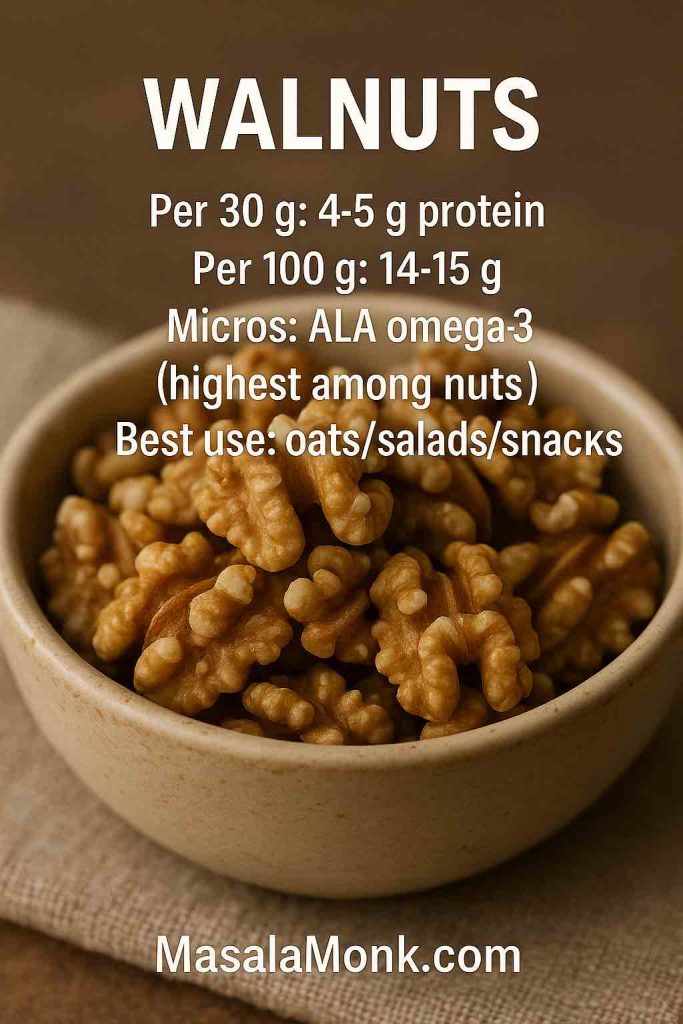
Walnut halves in a bowl with protein per 30 g and 100 g and ALA omega-3 benefit, MasalaMonk.com.
Walnuts are plant omega-3 leader among nuts; ~4–5 g protein per 30 g. Sprinkle on oats or salads.

Strategic Mixes: Building a High-Impact Jar of the Highest Protein Nuts & Seeds

A smart mix balances protein, minerals, cost, and mouthfeel. Here are three blends that work in real life; moreover, each one uses the highest protein nuts & seeds as anchors.

1) Everyday Value Mix

  • Peanuts (50%) + Sunflower (25%) + Pumpkin (20%) + Hemp (5%), lightly salted.
    Result: budget-friendly, ~6–7 g protein per 30 g, iron and magnesium uplift, gentle crunch plus soft hemp specks. Consequently, you’ll actually finish the jar.

2) Iron-Forward Green Mix

  • Pumpkin (40%) + Sunflower (30%) + Almonds (20%) + Sesame (10%), cumin-salt seasoned.
    Result: iron, zinc, and vitamin E in one jar; excellent over salads, soups, and veg bowls. Additionally, sesame boosts aroma without dominating.

3) Premium Protein Booster

  • Hemp (35%) + Pumpkin (30%) + Pistachio (20%) + Almond (15%), unsalted.
    Result: ~8–9 g protein per 30 g with a refined texture; perfect as a topping rather than a graze. Therefore, a little goes a long way.

Store each mix airtight; rotate weekly to keep flavors lively.

Also Read: Walnut Benefits for Brain Health: Memory, Cognitive Function, and Mental Well-Being


Portions, Goals, and a Calm Plan That Sticks

Portions matter because nuts and seeds are calorie-dense. Even so, strict rules aren’t necessary.

Start with 28–30 g as a standard sprinkle or snack. Then, if you’re calibrating intake, measure a few times until your eyes learn the volume. Next, on training days or hungrier evenings, add a second sprinkle of pepitas or a spoon of hemp hearts. Finally, let weekly goals steer micro-moves: more protein (add hemp/pepitas), more iron (prioritize pepitas), more omega-3 (rotate walnuts/chia/flax), or simpler mornings (keep nut butter visible).


Common Mistakes (and Simple Fixes) When Using the Highest Protein Nuts & Seeds

  1. Buying too much at once.
    Fix: purchase smaller amounts more often; freshness beats bulk every time.
  2. Under-seasoning.
    Fix: add light salt and a signature spice (cumin, chili-lime, smoked paprika). Consequently, small portions feel complete.
  3. Relying on a single type.
    Fix: keep two daily staples (e.g., peanuts + almonds) and one rotating seed booster (hemp or pumpkin). Variety improves nutrients and prevents boredom.
  4. Forgetting the “last-minute” sprinkle.
    Fix: store a seed jar near the stove. Meanwhile, add a teaspoon to anything that leaves the pan.
  5. Ignoring storage temperature.
    Fix: refrigerate or freeze walnuts, flax, and chia in warm kitchens. Ultimately, flavor and shelf life improve.
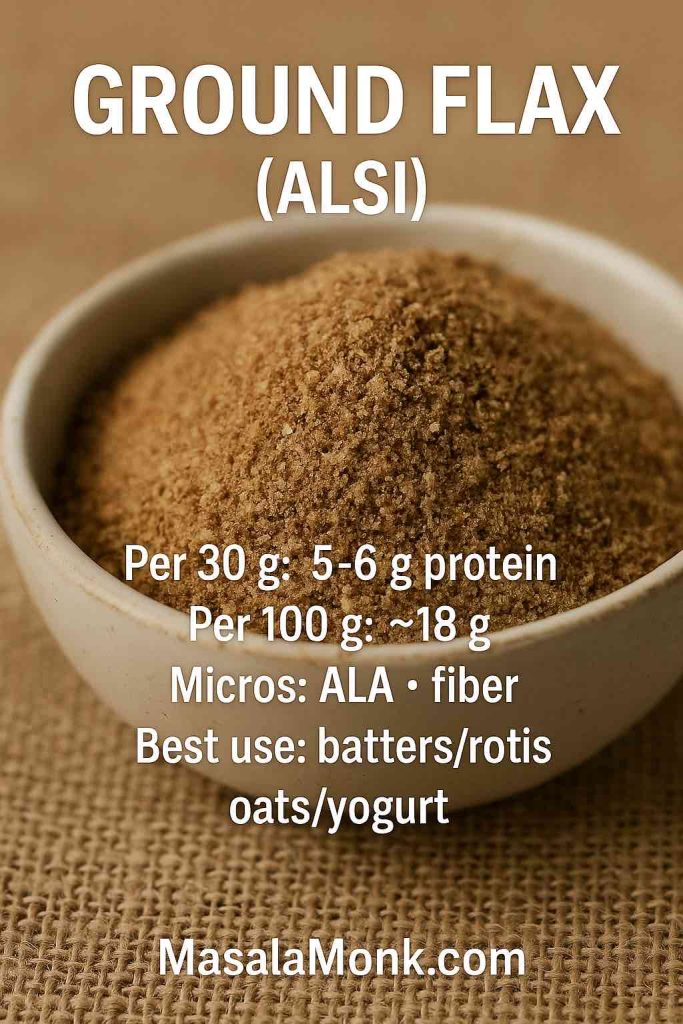
Ground flax (alsi) in bowl with protein per 30 g/100 g, fiber and ALA notes; best uses: batters, rotis, oats, MasalaMonk.com.
Neutral booster with ALA + fiber; ~5–6 g protein per 30 g. Stir into batters, rotis, or oats.

A Seven-Day Meal Plan with Highest Protein Nuts & Seeds

Monday

  • Breakfast: oats with peanut butter + hemp hearts.
  • Lunch: salad with chickpeas, almonds, sunflower; tahini-lemon dressing.
  • Dinner: dal finished with cumin-garlic and pepitas.

Tuesday

  • Breakfast: yogurt with chia, berries, and chopped almonds.
  • Lunch: quinoa-vegetable bowl with tahini and sunflower kernels.
  • Snack: a few walnuts for omega-3 ALA.
  • Dinner: tomato soup topped with pepitas and sunflower.

Wednesday

  • Breakfast: smoothie with almond butter, hemp hearts, berries, and a pinch of salt.
  • Lunch: open-faced hummus toast with cucumber, herbs, lemon zest, and sesame.
  • Dinner: green beans with toasted almonds and lemon; rice on the side.

Thursday

  • Breakfast: oats with a tahini swirl, dates, and sesame.
  • Lunch: roasted vegetables over warm grains with lemon-tahini; shower of pepitas.
  • Snack: peanuts with a few dark-chocolate nibs.
  • Dinner: carrot-ginger soup finished with sesame; small salad with sunflower.

Friday

  • Breakfast: yogurt with ground flax and crushed pistachios.
  • Lunch: quinoa bowl with pepitas and sunflower kernels.
  • Dinner: roasted cauliflower with tahini and pistachios; crisp cucumbers.

Saturday

  • Breakfast: omelet with chopped almonds and herbs.
  • Snack: popcorn tossed with toasted pepitas and a whisper of chili-salt.
  • Late snack: spoon of peanut butter with a dusting of hemp hearts.

Sunday

  • Lunch: pilaf with cashews and raisins; side salad scattered with hemp hearts.
  • Snack: walnuts and sliced fruit.
  • Dinner: quick stir-fry finished with a teaspoon of mixed seeds; yogurt with chia for dessert.

Also Read: Cashews in the Morning: 5 High Protein Smoothie Ideas for Weight Loss.


Smart Swaps and Add-Ons for Instant Wins

  • Upgrade any yogurt: add hemp hearts; if texture feels soft, toss in chopped almonds for contrast.
  • Fortify porridge: swirl in nut butter while cooking; finish with pepitas.
  • Boost salads: make tahini-lemon your house dressing; keep sunflower on the table.
  • Elevate toast: spread tahini-yogurt, add herbs and lemon zest, and finish with sesame.
  • Enrich soups: treat seed blends like croutons—crunch without heaviness.
  • Power-up batters and doughs: add ground flax to pancakes, dosa/cheela batter, quick breads, and roti dough.
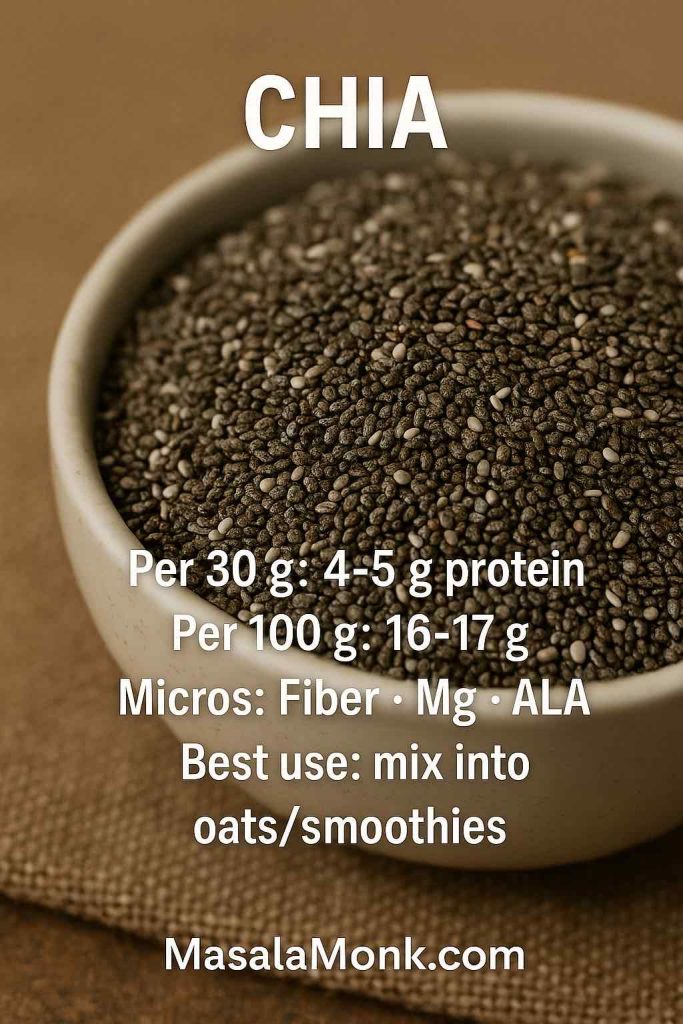
Chia seeds in bowl; text shows protein per 30 g/100 g, fiber and ALA; best for oats or smoothies, MasalaMonk.com.
Chia Seeds – gels for puddings; ~4–5 g protein per 30 g plus fiber and ALA. Mix into oats or smoothies.

Regional and Cultural Touchpoints (Practical, Not Precious)

  • Indian kitchens: stir ground flax into rotis; finish dal with pumpkin/sunflower; fold sesame into temperings; add peanuts to poha or chaat; spoon hemp onto curd rice or raita for a subtle boost.
  • Mediterranean plates: lean on almonds and pistachios for crunch; use tahini (sesame) in sauces and dressings; finish grain salads with sunflower and pumpkin.
  • East Asian flavours: highlight sesame oils and seeds; add peanuts to noodles and stir-fries; use chia for contemporary puddings.
  • Western breakfasts: keep peanut/almond butter on the counter; rotate hemp and pumpkin into granola, yogurt bowls, and hot cereals.

These aren’t rules; rather, they’re ways to let the highest protein nuts & seeds slip into meals you already enjoy.


The Highest Protein Nuts & Seeds: Handy Reference Table

Food (typical form)Protein per 100 gTypical serving (28–30 g)Protein per servingBonus strengths
Hemp hearts~31–33 g30 g~9–10 gMagnesium, zinc; neutral booster
Pumpkin seeds (pepitas)~30 g30 g~8.5–9.5 gIron, magnesium, zinc; great chew
Peanuts (dry-roasted)~24–26 g30 g~7 gValue; B-vitamins; easy seasoning
Almonds~21–22 g28–30 g~6–6.5 gVitamin E; clean, crisp crunch
Pistachios~20–21 g28–30 g~6 gColor, mild sweetness, snack appeal
Sunflower kernels~20–21 g30 g~6 gBudget-friendly; mineral-rich
Cashews~18–19 g28–30 g~4–5 gCreaminess; blends into sauces
Flax (ground preferred)~18 g28–30 g~5–6 gALA; disappears in doughs/batters
Chia~16–17 g28–30 g~5 gALA; gels for puddings/smoothies
Walnuts~14–15 g28–30 g~4–5 gHighest ALA among nuts
Sesame (til)~17–18 g30 g~5–5.5 gTahini powerhouse; calcium
Brazil nuts~14–15 g28–30 g~4 gSelenium standout (use 1–2)

Note: whole, in-shell pumpkin seeds include a fibrous hull that dilutes protein density. Therefore, pepitas (shelled) are the reference used throughout the highest protein nuts & seeds guide.

Source & method: Unless noted, macro numbers are taken from USDA FoodData Central and presented using USDA-derived comparisons from MyFoodData (per 100 g and typical servings).


Advanced, Ultra-Practical Ideas (For Extra Mileage)

Protein-first breakfast parfait: Start with thick yogurt; fold in 1 Tbsp peanut butter; add 1 Tbsp hemp hearts; top with chopped almonds and berries. Consequently, you get creaminess, crunch, and a near-instant protein bump.

Savory oatmeal switch-up: Cook oats in milk or fortified plant milk; whisk in tahini and a pinch of salt; finish with pepitas and chives. As a result, you turn a sweet habit into a savory, satisfying bowl.

Sheet-pan seed topper: Mix pepitas, sunflower, and sesame with a teaspoon of oil, chili, and lemon zest; toast briefly. Then store in a jar. Subsequently, every soup, salad, or sauté gets a finishing spoon.

Five-minute noodle lift: Toss hot noodles with tahini-soy-lemon; add edamame if available; finish with crushed peanuts and hemp hearts. Accordingly, weeknights gain structure without heaviness.

Roasted-veg “crouton” trick: Swap bread cubes for a shower of toasted seeds. Consequently, you keep crunch while adding protein and minerals.


Portions, Goals, and a Plan You Can Live With

Nuts and seeds are calorie-dense; portions therefore matter. Even so, precision can stay gentle.

  • Use 28–30 g as your default snack or sprinkle.
  • Weigh that amount a couple of times; thereafter, your eyes will know.
  • Training day or extra hunger? Add a spoon of hemp or an extra sprinkle of pumpkin and move on.

Let weekly themes steer micro-choices: more protein (add hemp most days), more iron (sprinkle pumpkin on what you already cook), healthier fats (rotate walnuts, flax, and chia), simpler breakfasts (keep nut butter visible instead of hidden). Consequently, you build consistency with minimal effort.


Final Take: The Highest Protein Nuts & Seeds Without Hype

Perfection isn’t the plan; repeatability is. Therefore, let hemp hearts and pepitas handle stealth protein boosts. Keep peanuts and sunflower as daily, budget-friendly anchors. Invite almonds for vitamin E and crisp satisfaction. Meanwhile, rotate walnuts, chia, and ground flax for omega-3 ALA. Additionally, use Brazil nuts thoughtfully for selenium.

For broader cardiometabolic reassurance, meta-analyses show favourable lipid effects with nut intake (61-trial analysis) and supportive links with cardiovascular risk (systematic review).

Above all, keep jars visible, place a scoop inside, and make topping a reflex. Then a handful between meetings, a spoon in a smoothie, or a teaspoon over soup becomes second nature. Ultimately, that’s how the highest protein nuts & seeds turn steady energy from a hope into a habit.

Also Read: Benefits of Flax Seeds and How to Incorporate Them into the Indian Diet

FAQs

1) Which nut has the most protein?

Peanuts come out on top among commonly eaten nuts at ~24–26 g protein per 100 g (that’s about ~7 g per 28–30 g serving). However, if you’re asking about tree-nuts only (i.e., excluding peanuts), then almonds and pistachios lead with ~21–22 g per 100 g (≈ ~6 g per serving).

2) Which seeds have the most protein?

For seeds, the champion is hemp hearts at ~31–33 g per 100 g (≈ ~9–10 g per 30 g). Meanwhile, pumpkin seeds (pepitas) follow closely at ~30 g per 100 g (≈ ~8–9 g per 30 g). Consequently, a single spoonful can quietly lift any meal.

3) Are nuts and seeds high in protein?

Yes—practically speaking, most deliver ~5–10 g protein per 28–30 g. As a result, they’re superb “easy add-ons” to keep you full and steady between meals.

4) Nuts vs. seeds: which have more protein?

Per 100 g, seeds generally edge out nuts (think hemp/pumpkin/sunflower > peanuts/almonds). Yet, per realistic servings, everything compresses to ~5–10 g, so you can choose by taste, texture, and budget—then simply boost with a tablespoon of hemp or a sprinkle of pepitas.

5) Highest-protein picks per serving (28–30 g)?

Hemp hearts ~9–10 g, pumpkin seeds ~8–9 g, peanuts ~7 g, almonds/pistachios/sunflower ~6 g, cashews/flax/chia ~5–6 g, and walnuts ~4–5 g. Therefore, the “per handful” gap is smaller than people expect.

6) Highest-protein picks per 100 g (density view)?

Hemp hearts (~31–33 g) > pumpkin seeds (~30 g) > peanuts (~24–26 g) > almonds (~21–22 g)pistachios/sunflower (~20–21 g) > flax (~18 g) > sesame (~17–18 g) > chia (~16–17 g) > walnuts/Brazil nuts (~14–15 g). Consequently, density helps for recipe planning and bulk mixes.

7) Which tree-nut has the most protein (excluding peanuts)?

Almonds and pistachios share the top spot at ~21–22 g per 100 g (≈ ~6 g per serving). In short, they’re your best tree-nut bets for protein.

8) Quick counts: how much protein per piece?

For fast mental math: 1 almond (badam) ≈ 0.25 g, 10 almonds ≈ 2.5 g; 1 peanut kernel ≈ 0.25 g, 10 peanuts ≈ 2.5 g; 1 walnut half (akhrot) ≈ 0.6 g (≈ 1.2 g per whole walnut). Handy for grazing and recipe tweaks.

9) Protein by the spoon: how much per tablespoon?

Peanut butter ≈ 4 g/Tbsp (16 g); almond butter ≈ 3–3.5 g/Tbsp; tahini (sesame) ≈ 2.5 g/Tbsp (≈ 5 g per 2 Tbsp); hemp hearts ≈ 3+ g/Tbsp; pepitas ≈ 3 g/Tbsp. Therefore, a spoon or two is a quick, honest lift.

10) Are peanuts really nuts?

Botanically, peanuts are legumes; nutritionally and in normal shopping, they behave like nuts. Consequently, most “highest-protein nuts” guides include them—because users (and labels) do.

11) Are nuts seeds?

Colloquially yes—nuts are hard-shelled seeds. However, in kitchens we separate nuts (almonds, cashews, walnuts) from edible seeds (hemp, pumpkin, sunflower, chia, flax) for clarity and recipe roles.

12) Best budget picks for protein?

Start with peanuts (value king) and sunflower seeds (budget minerals), then, importantly, spike with small amounts of pumpkin or hemp when you want extra protein and micronutrients.

13) Which are richest in iron, magnesium, and zinc?

Pumpkin seeds headline iron/magnesium/zinc; hemp and sunflower support closely. As a result, a tablespoon over salads, dal, soups, or roasted veg is a frictionless upgrade.

14) Which nuts are highest in vitamin E?

Almonds. Accordingly, keep a handful in the afternoon—or chop them over breakfast—for a clean, consistent vitamin E intake.

15) Where do plant omega-3s (ALA) come from?

Rotate walnuts, ground flax (alsi), and chia. Meanwhile, let peanuts/almonds/pepitas carry your heavier protein elsewhere.

16) What about selenium?

Brazil nuts are uniquely selenium-dense. Therefore, 1–2 nuts/day typically covers needs—no need to overdo it.

17) What’s a smart “everyday” high-protein mix?

Try Peanuts (50%) + Sunflower (25%) + Pumpkin (20%) + Hemp (5%), lightly salted. Result: ~6–7 g protein per 30 g, great crunch, serious minerals. Consequently, you’ll actually finish the jar.

18) How should I store nuts and seeds for freshness?

Store airtight, cool, and dark. Additionally, refrigerate or freeze walnuts, flax, and chia if your kitchen runs warm. Finally, smell before you snack—fresh is nutty and round; rancid smells waxy or flat.

19) Does roasting change protein?

Not meaningfully. Light roasting mostly reduces moisture and boosts aroma. However, keep the heat moderate—oils should wake, not scorch—so flavor and nutrients stay happy.

20) Salted or unsalted—what’s smarter?

Start where the habit sticks—lightly salted is perfectly fine. Then, for balance, mix half salted + half unsalted to bring sodium down while keeping satisfaction up.

21) Best breakfast upgrades for steady energy?

Stir nut butter into oats, top yogurt/dahi with hemp + almonds, or blend 1 Tbsp peanut butter + 1 Tbsp hemp into smoothies. Consequently, breakfasts land in the 10–15 g protein range without using powders.

22) Easy lunch and dinner add-ons?

Finish salads/grain bowls with sunflower + pumpkin; whisk a lemon-tahini dressing; sprinkle hemp on soups or dal at the end. As a result, meals feel complete—without heaviness.

23) What’s a realistic daily portion?

Use 28–30 g as your default handful/sprinkle. Next, on training days or hungrier evenings, add a second sprinkle or 1 Tbsp hemp—simple, predictable, sustainable.

24) Which nut butter is best for protein?

By the spoon, peanut butter wins (~4 g/Tbsp). Meanwhile, almond butter is slightly lower but brings vitamin E; tahini adds minerals; and hemp hearts are an effortless mix-in booster to any spread.

25) Almonds vs. pumpkin seeds—who wins?

Per 100 g, pepitas (~30 g) beat almonds (~21–22 g). However, per 30 g serving, pepitas are ~8–9 g vs almonds ~6 g. Therefore, pick almonds for vitamin E and crisp bite; pick pepitas for iron/magnesium and slightly more protein per serving.

26) Peanuts vs. almonds—where’s the edge?

Peanuts lead on pure density (~24–26 g/100 g vs ~21–22 g). Nevertheless, the per-serving gap is ~1 g, so let price and taste decide—and keep hemp nearby to boost either choice.

27) Walnuts vs. “higher-protein” nuts—how to decide?

Walnuts won’t win the protein chart (~4–5 g per 30 g), yet they headline omega-3 ALA. Consequently, keep a daily walnut habit for heart-friendly fats and let peanuts/almonds/pepitas carry more of the protein.

28) How do I add protein without changing recipes?

The simplest move: 1 Tbsp hemp hearts (~3+ g) or 1 Tbsp pepitas (~3 g) over whatever you already cook—oats, yogurt, dal, soups, salads, toast. Thus, flavor stays familiar while numbers climb.

29) How much protein in 1 Tbsp peanut butter?

Approximately ~4 g per 1 Tbsp (16 g). For a classic 2-Tbsp serving, you’ll get ~8 g. Therefore, PB is a tidy “spoon fix” when mornings are busy.

30) Which nuts are high in iron?

Nuts are modest; pumpkin seeds are the standout (yes, a seed). Next best: sunflower and hemp. Accordingly, if iron is a goal, use seeds as toppers daily.

31) Which nuts are highest in protein? (All variants)

Short list to remember: peanuts (top overall), then almonds and pistachios among tree-nuts; cashews are slightly lower; walnuts are lower still but bring omega-3 ALA.

32) What are the highest-protein seeds and nuts together?

If you just want winners, here they are: hemp and pumpkin (seeds) plus peanuts (nut). Therefore, keep these three in easy reach and rotate for taste.

33) Seeds vs. nuts: what about fiber, fats, and fullness?

Great question. Beyond protein, both bring fiber (appetite control) and unsaturated fats (even energy). Seeds often have a hair more fiber per gram; nuts tend to deliver more “crunch satisfaction.” Together, they’re steadier than carb-only snacks.

34) Do nuts and seeds have enough fiber to matter?

Absolutely. Even a tablespoon or two can round out a meal. Consequently, you’ll see fewer spikes, dips, and snack-cupboard raids.

35) Are cashews high in protein?

Medium: roughly ~4–5 g per 30 g. However, cashews excel at creaminess and making sauces; pair them with hemp or pepitas to lift protein.

36) Are pistachios high in protein?

Yes—about ~6 g per 28–30 g. Plus, they add color and gentle sweetness; they’re excellent in salads and grain bowls.

37) Are almonds high in protein?

Yes—~6–6.5 g per serving. Additionally, almonds are an easy vitamin E win and deliver that satisfying clean crunch.

38) How much protein in 100 g of the big four (for bulk recipes)?

Approximate per 100 g: hemp 31–33 g, pumpkin 30 g, peanuts 24–26 g, almonds 21–22 g. Therefore, for granola, bars, or laddoos, these numbers help you balance macros.

39) Are nuts “protein or fat”?

Both. Practically, they’re protein-and-fat foods with some fiber. And because their fats are mostly unsaturated, they tend to support smoother energy alongside satiety.

40) Won’t the calories add up?

They can—so portions matter. Even so, a calm plan works: start at 28–30 g, measure a few times so your eyes learn the volume, and, when needed, add one small booster (1 Tbsp hemp or pepitas) instead of another handful.

41) Can vegetarians (and kids) rely on nuts and seeds for protein?

They’re an excellent supporting source. Combine them with legumes, dairy/curd, soy/paneer/tofu, eggs (if used), and grains for full coverage across the day. Meanwhile, seeds help fill mineral gaps (iron, zinc, magnesium).

42) Whole seeds vs. “seed oils”—should I worry?

Whole seeds and nut butters are not the same as refined oils. You’re getting protein, fiber, and micronutrients with the fats intact. Consequently, whole-food forms fit beautifully in balanced meals.

43) Best choices for smoothies?

Use peanut or almond butter for body, then add hemp hearts (smooth boost), chia (thickens), or ground flax (disappears). Thus, you land in 10–15 g protein without powders.

44) Best toppers for salads and soups?

Go for sunflower + pumpkin for crunch/minerals, and finish with hemp for an invisible protein lift. Moreover, a lemon-tahini drizzle ties it all together.

45) Are seed-based protein powders (hemp/pumpkin/sunflower) worth it?

They can be, especially if you want dairy-free options. However, for many people, simply adding 2–3 Tbsp hemp/pepitas to meals achieves similar protein with better texture and minerals—no new routine required.

46) Do in-shell pumpkin seeds count the same?

Not quite. In-shell seeds include a fibrous hull that dilutes protein density. Therefore, for accurate comparisons, use pepitas (shelled) as the reference.

47) Should I soak or sprout nuts and seeds?

You can. Soaking/sprouting may reduce some phytates and change texture. Nevertheless, it’s optional—most benefits (protein, fiber, fats, minerals) remain strong without extra steps.

48) What if I have a peanut allergy—what should I swap?

Lean on almonds, pistachios, cashews, sunflower, pumpkin, and hemp. Then, for a PB-style experience, try sunflower seed butter or tahini + a touch of honey on toast.

49) Can I season them without ruining the “healthiness”?

Definitely. Light salt, chili-lime, cumin-salt, smoked paprika, or lemon-sesame keeps portions satisfying. In turn, bigger flavor often means smaller, happier servings.

50) Final, practical takeaway—what should I actually keep on the counter?

Keep four jars visible: peanuts, almonds, pumpkin seeds, and hemp hearts. Consequently, you can anchor snacks with peanuts/almonds (value + crunch) and top anything with pumpkin/hemp for protein and minerals—no new routine required.

Macros sourced from:USDA FoodData Central (primary database) and MyFoodData (USDA-derived comparison tables).

Posted on 6 Comments

Can You Substitute Old-Fashioned Oats for Rolled Oats?

Old-Fashioned Oats vs. Rolled Oats

If you love oats—whether for breakfast, baking, or healthy meal prep—you’ve probably encountered the terms “old-fashioned oats” and “rolled oats.” The good news? These names often cause confusion, but they actually refer to the same product! Here’s what every home cook, baker, and oat enthusiast should know about using these oats, when substitutions are seamless, and when it might matter.


What Are Old-Fashioned Oats?

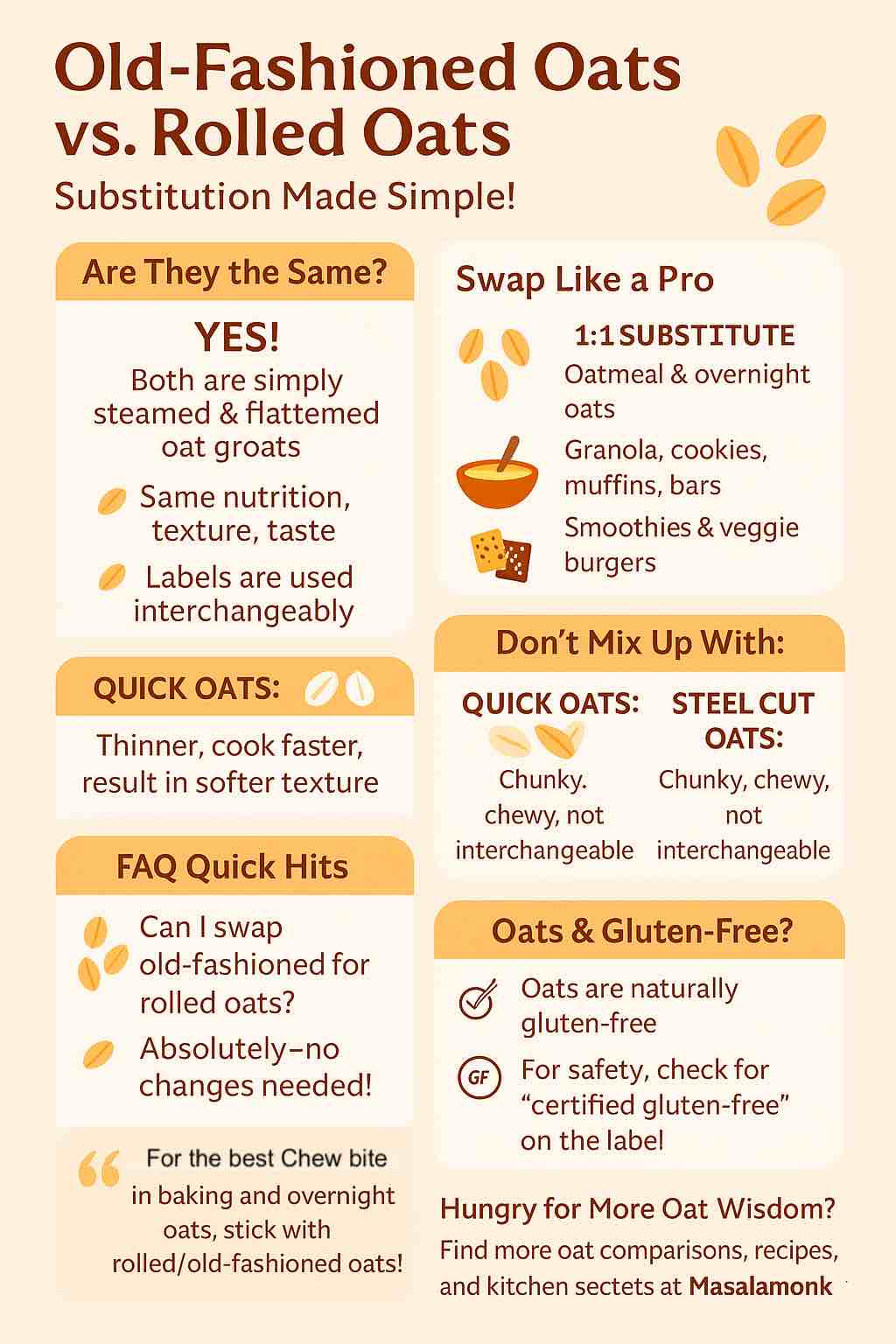
“Old-fashioned oats” is simply another name for “rolled oats.” Both terms describe oat groats that have been steamed and then pressed flat with large rollers, resulting in those classic, thin oat flakes you find in most kitchens and recipes. There is no real difference between the two—manufacturers just use the names interchangeably, and you might see either on a package label.

  • Texture: Flat, oval flakes that are soft yet hold their shape when cooked or baked.
  • Flavor: Mild and slightly nutty.
  • Uses: Perfect for oatmeal (porridge), overnight oats, granola, cookies, muffins, bars, smoothies, or as a binder in burgers and veggie patties.

What About “Rolled Oats”?

Rolled oats, like old-fashioned oats, are made by steaming whole oat groats and rolling them into flakes. This process helps them cook faster than steel cut oats but still gives you a heartier texture and more nutrition than quick or instant oats.

  • Look for: Rolled oats, old-fashioned oats, or even “traditional oats”—they’re all the same in most recipes.

Substituting Old-Fashioned Oats for Rolled Oats

Can you substitute old-fashioned oats for rolled oats?

  • YES! These two oat types are completely interchangeable in any recipe calling for either one.

How about the other way around?

  • Absolutely. There’s no difference—you can swap “old-fashioned oats” and “rolled oats” 1:1 by volume or weight.

This is true for:

  • Classic cooked oatmeal/porridge
  • Overnight oats
  • Baking (cookies, muffins, breads, bars)
  • Granola or muesli
  • Pancakes, smoothies, or savory uses

Where Substitutions Might Matter

While old-fashioned/rolled oats can replace each other, there’s sometimes confusion with other oat types. Here’s where you need to be careful:

  • Quick oats or instant oats: These are rolled even thinner and/or cut smaller, so they cook faster and lose texture. If you substitute quick oats for old-fashioned/rolled oats, your recipe will be softer, sometimes mushy (especially in cookies, granola, or bars).
  • Steel cut oats: These are not rolled or steamed, just chopped—completely different texture and much longer cooking time. Steel cut oats are not a direct substitute for rolled/old-fashioned oats in baking or most recipes.

Want to understand all oat types in more depth? Visit our Ultimate Guide to Oats: Types, Nutrition, and Differences Explained.


Practical Kitchen Tips

For best results in baking or granola:

  • Use rolled/old-fashioned oats for chewy cookies, sturdy granola, and hearty breakfast bars.
  • If you only have quick oats, you can use them in a pinch, but expect a softer, less textured result.
  • Never use instant oats in place of rolled oats for baking—they dissolve and change the final texture.

For overnight oats:

  • Rolled/old-fashioned oats give you the classic, creamy-yet-chewy bite everyone loves.

For classic oatmeal:

  • Both rolled and old-fashioned oats are ideal, cooking in just 5–10 minutes for a creamy, hearty bowl.

In smoothies or as a binder:

  • Either works perfectly—blend or stir directly in for extra fiber.

When Might Packaging Matter?

Some brands market “old-fashioned oats” for a rustic, traditional feel, while others label their oats as “rolled oats.” As long as the ingredient list says 100% rolled oats and they look like flat flakes, you’re good to go.

If you’re following a gluten-free diet, always look for certified gluten-free rolled/old-fashioned oats, as oats are often processed in facilities that handle wheat.


Related Oat Comparisons

If you’re curious about how rolled/old-fashioned oats compare to steel cut, quick, or instant oats, be sure to check out:


Conclusion

You never need to worry about substituting old-fashioned oats for rolled oats—or vice versa. In fact, they are two names for the same nutritious, versatile ingredient that can power up breakfasts, snacks, and baked treats with ease. Just keep an eye out for quick, instant, or steel cut oats, as those are different in texture, cook time, and use.

Ready to learn everything about oat types, nutrition, and kitchen secrets? Explore our Ultimate Guide to Oats!


10 FAQs – Old-Fashioned Oats vs Rolled Oats Substitution

1. Are old-fashioned oats and rolled oats the same?

Yes. Old-fashioned oats and rolled oats are just two names for the same product.


2. Can I substitute old-fashioned oats for rolled oats in recipes?

Yes, you can substitute them 1:1 in any recipe without adjustment.


3. Can I use quick oats instead of rolled oats?

You can, but the texture will be softer and the final result may be less chewy, especially in baked goods.


4. Can I use instant oats instead of rolled oats?

It’s not recommended. Instant oats tend to break down too much and make recipes mushy.


5. Is there a difference in nutrition between old-fashioned and rolled oats?

No, they have identical nutrition since they are the same product.


6. Which is better for overnight oats: rolled or old-fashioned oats?

They are the same—both are perfect for overnight oats and give the best creamy-yet-chewy texture.


7. Do I need to change the cooking time if I swap old-fashioned oats for rolled oats?

No, use the same cooking time for both.


8. What if my recipe calls for “traditional oats”?

“Traditional oats” is another name for rolled/old-fashioned oats. Use them interchangeably.


9. Can I use rolled oats in place of quick oats?

Yes, but your recipe will have more texture and may take slightly longer to cook or soften.


10. Are rolled oats or old-fashioned oats gluten-free?

Oats are naturally gluten-free, but always check for a gluten-free label if you are sensitive or celiac.

Posted on 4 Comments

Are Quick Oats the Same as Instant Oats?

QUICK OATS vS. INSTANT OATS

If you’re trying to eat healthier or just want a speedy breakfast, you’ve probably noticed two convenient oat choices in every store: quick oats and instant oats. But are they actually the same thing? Why are there so many options—and does it matter which you choose for your porridge, overnight oats, or baking? Here’s the full story, with practical tips, cooking advice, and nutrition facts so you can pick the best oats for your lifestyle.


What Exactly Are Quick Oats?

Quick oats (also called “quick-cooking oats”) start with the same whole oat groats used for all oat products. These groats are first steamed, then rolled thinner and sometimes cut into smaller pieces than traditional rolled (old-fashioned) oats. The extra processing makes them cook faster and break down more easily when prepared.

  • Texture: Soft and fluffy, but still has some bite.
  • Cooking time: Just 1–3 minutes on the stovetop or microwave.
  • Best uses: Hot porridge, overnight oats, soft cookies, pancakes, and quick breads.

Quick oats give you a hot breakfast or recipe base in almost no time—no need for long simmering.
If you’re curious about the differences between rolled oats, old-fashioned oats, and when you can swap them, check out our detailed guide on substituting old-fashioned oats for rolled oats.


Instant Oats: Even Faster, Even Softer

Instant oats (often found as “instant oatmeal”) take processing a step further. Oat groats are steamed, fully cooked, dried, rolled even thinner than quick oats, and then sometimes chopped so they cook immediately when you add hot water or microwave them. Most commonly, instant oats are sold in single-serve packets, often with flavorings and sugar already mixed in.

  • Texture: Creamy, smooth, and very soft—almost pudding-like when cooked.
  • Cooking time: Instantly ready with boiling water or in 1 minute in the microwave.
  • Best uses: Instant breakfast, office snacks, travel, camping, or for kids who prefer a smoother texture.

It’s important to note that instant oats in packets are often pre-flavored and sweetened. The added sugars, salt, and flavorings can make them less healthy than plain oats. For ultimate control, buy plain instant oats and add your own healthy toppings at home.


Quick Oats vs Instant Oats: What Really Matters?

Although both are designed for speed, quick oats and instant oats are not identical. The differences matter in real-life cooking, texture, and health:

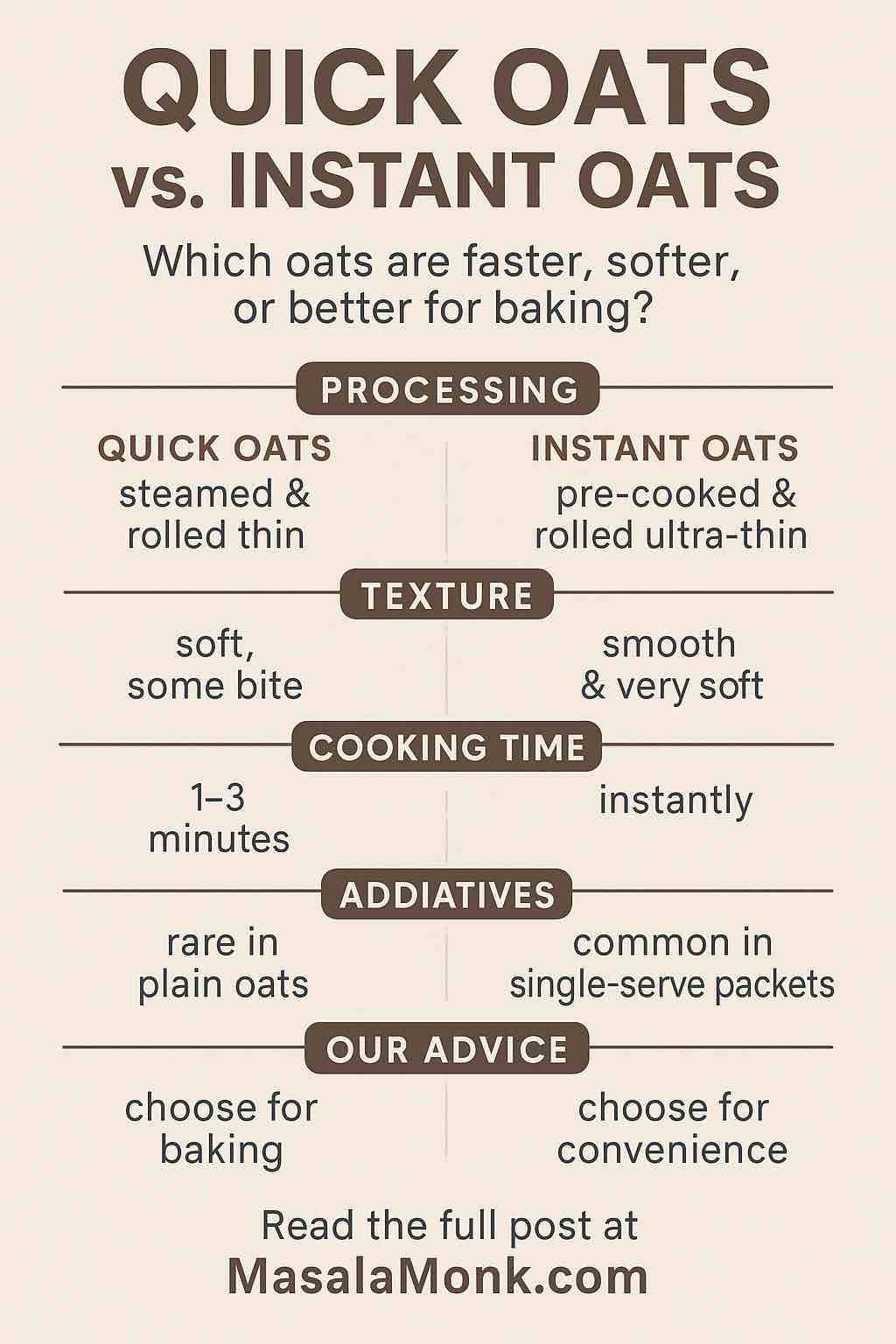
FeatureQuick OatsInstant Oats
ProcessingSteamed & rolled thinPre-cooked, rolled ultra-thin, often chopped
TextureSoft, still some biteSilky, very soft, can be mushy
Cook Time1–3 minutesInstant—just add hot water
PackagingSold in bulkOften single-serve flavored packets
AdditivesRare in plain quick oatsCommon in instant oat packets (sugar, salt)
Recipe useGreat for bakingNot ideal for baking (gets too mushy)

When it comes to taste and mouthfeel:

  • Quick oats make a thicker, heartier porridge or baked good with a little more chew.
  • Instant oats dissolve into a creamy, very smooth mixture—great if you like a super-soft texture.

If you want a breakdown of how all major oat types compare (including steel cut and rolled), don’t miss our Ultimate Guide to Oats: Types, Nutrition, and Differences Explained.


Practical Kitchen Advice: When to Use Each

Quick oats are your best friend for:

  • Hot oatmeal when you’re short on time but still want real oat texture.
  • Adding to muffin or pancake batters for extra fiber.
  • Thickening smoothies (just toss them in raw).
  • Making “overnight oats” with a softer texture, perfect for meal prep.

Instant oats shine when:

  • You need breakfast or a snack instantly—just pour boiling water and stir.
  • You’re traveling, camping, or need food on the go.
  • You’re serving kids, or anyone who prefers a creamy, pudding-like bowl.

If you love baking or making granola, quick oats will hold up much better than instant oats. Instant oats will break down and make recipes mushy—so stick to using them in porridge or as a speedy meal.


Nutrition: Is One Healthier?

Plain quick oats and plain instant oats are virtually identical in nutrition, with about 150 calories, 4 grams of fiber, and 5 grams of protein per serving. Both deliver the heart-healthy benefits of oats, including beta-glucan fiber.

BUT:
Instant oat packets are often loaded with sugar, salt, and flavorings—sometimes as much as a dessert! Always check the ingredients, and whenever possible, choose unsweetened varieties so you can control the flavors and sweetness.

If you’re interested in how glycemic index, satiety, and fiber stack up across all oat types (including steel cut and rolled), you’ll find a full comparison in our oat guide.


Can You Substitute Quick Oats for Instant Oats (and Vice Versa)?

  • For hot porridge, you can swap them—just expect a difference in texture: quick oats are thicker, instant oats are silkier.
  • In baking, quick oats are better; instant oats can turn recipes gooey or pasty.
  • For overnight oats, quick oats work best; instant oats will dissolve and become almost like pudding.

Whenever a recipe simply says “oats,” check the texture you want. If you’re unsure, read up on the difference between oats, oatmeal, and which oat type is best for every recipe.


The Real-World Bottom Line

Both quick oats and instant oats offer convenience, whole grain nutrition, and the versatility to fit your lifestyle.

  • Choose quick oats if you want speed, texture, and more flexibility for cooking and baking.
  • Choose instant oats if you value pure convenience (and be sure to read the label for added sugar and sodium).

Still unsure which oat is best for you? See how they all stack up in our comprehensive oats guide.

Explore more about using different oats in baking and porridge, and discover when to swap or stick with each in Can You Substitute Old-Fashioned Oats for Rolled Oats?

And if you’re comparing all oats head to head (steel cut, rolled, quick, instant), our “Steel Cut Oats vs Rolled Oats: Nutrition, Taste, Cooking & More” post breaks it down further:
Read the in-depth comparison


Conclusion

Quick oats and instant oats are both designed to help you get nutritious, hearty meals on the table—fast. Their key differences are in texture, use in recipes, and (with instant) the likelihood of extra additives. For the healthiest choice, stick to plain varieties and add your own flavors at home.

Want to learn even more about all things oats? Browse our Ultimate Guide to Oats for practical cooking tips, nutrition details, and the best ways to enjoy oats every day!

10 FAQs – Are Quick Oats the Same as Instant Oats?

1. Are quick oats and instant oats the same thing?

No. Quick oats are rolled thinner and cut smaller to cook faster, but instant oats are pre-cooked, dried, and rolled even thinner for truly instant preparation.


2. Can I substitute quick oats for instant oats in recipes?

In hot cereal, yes—the texture will just be thicker. In baking, quick oats are usually better; instant oats may make recipes too mushy.


3. Are instant oats less healthy than quick oats?

Plain instant oats have similar nutrition to quick oats. However, most instant oats packets have added sugar, salt, and flavors—check labels!


4. Why do instant oats cook faster than quick oats?

Instant oats are pre-cooked and rolled much thinner than quick oats, allowing them to absorb water and soften immediately.


5. Can I use instant oats for overnight oats?

You can, but they will dissolve and become very soft, almost pudding-like. Quick oats work better for classic overnight oats texture.


6. Do quick oats and instant oats taste the same?

They’re both mild, but instant oats have a smoother, softer texture and can taste sweeter if flavored.


7. Are quick oats and instant oats gluten-free?

Oats are naturally gluten-free, but always check for certified gluten-free labeling, as cross-contamination can occur during processing.


8. Which is better for baking: quick oats or instant oats?

Quick oats are better. Instant oats tend to break down and make baked goods mushy.


9. Do quick oats and instant oats have the same calories and nutrients?

Yes, if both are plain and unsweetened. Most differences come from flavorings and additives, not the oats themselves.


10. Which should I choose for the healthiest breakfast?

Choose plain quick oats or plain instant oats, and add your own fruit or nuts. Avoid flavored instant oat packets with added sugar.

Posted on 1 Comment

Ghee vs. Butter: How are they different?

GHEE vS. BUTTER

When you open your fridge or pantry, there’s a good chance you’ll spot a golden slab of butter or, if you love world cuisine, a jar of ghee glowing like liquid sunshine. Both are beloved fats, both are rooted in centuries of tradition, and both spark debate among health enthusiasts and home cooks. But when it comes to choosing between ghee and butter, which one actually deserves a spot in your kitchen?

Let’s peel back the layers—scientifically, nutritionally, and practically—so you can decide what’s best for your table.


What Are Ghee and Butter, Really?

Butter is a staple of European and American kitchens, made by churning cream until the fat separates from the buttermilk. The result: a spreadable, creamy block that makes croissants flaky, cookies rich, and vegetables irresistible.

Ghee, meanwhile, is the pride of South Asian cuisine. It starts as butter, but is simmered until the water evaporates and milk solids brown and are filtered out. The end product is a clear, fragrant fat with a nutty aroma—a pantry hero in Indian, Pakistani, Bangladeshi, and Middle Eastern kitchens.


How Are They Made? (And Why Does It Matter?)

  • Butter’s Journey:
    1. Cream is separated from milk.
    2. Cream is churned, causing fat globules to clump.
    3. The solid butter is washed, shaped, and (sometimes) salted.
    4. Contains about 80% fat, 16% water, and milk proteins/sugars.
  • Ghee’s Transformation:
    1. Unsalted butter is slowly simmered.
    2. Water evaporates; milk solids caramelize and sink.
    3. The clear, golden fat is poured off and strained.
    4. Nearly pure fat, almost no lactose or casein.

Why care? Because the absence of milk solids in ghee changes its shelf life, its behavior in the pan, and even how it might affect your body.


The Science: Nutrition at a Glance

Here’s a quick table (per tablespoon):

ButterGhee
Calories~102~123
Total Fat~11.5g~14g
Saturated Fat~7.2g~8.7g
Lactose/CaseinPresentAlmost none
Vitamins (A, E, K)PresentSlightly higher concentration (due to fat density)
Smoke Point~350°F (177°C)~485°F (250°C)
Shelf LifeRefrigerateRoom temp (months)

TL;DR: Ghee is richer, purer, and more stable at high temperatures, but also packs more calories and fat. Butter contains trace dairy sugars and proteins, which matter for some people.


Health: What Does the Research Say (as of 2025)?

The Latest Evidence

  • Heart Health:
    A recent meta-analysis (2024) found no compelling link between ghee consumption and increased cholesterol or heart disease in the general population. However, ghee (like butter) is still high in saturated fat, which is generally advised in moderation by major health agencies.
  • Gut Health & Nutrients:
    Ghee is a source of butyrate—a short-chain fatty acid linked to gut health and anti-inflammatory benefits. It’s also a good source of vitamins A, E, and K, as well as conjugated linoleic acid (CLA), which may have subtle metabolic benefits.
  • Allergies & Sensitivities:
    Butter contains trace amounts of lactose and casein—potential triggers for people with intolerance. Ghee’s clarification process removes nearly all of these, making it a safer bet for many with sensitivities (though not all with severe dairy allergies).
  • Cooking Safety:
    Ghee’s high smoke point means it won’t burn or develop harmful compounds as quickly as butter does when exposed to high heat.

Cooking Showdown: Butter vs. Ghee in the Real World

When to Use Butter

  • Baking:
    Butter’s water and milk solids create steam (for flakiness in pastries) and delicious browning in cookies and cakes.
  • Spreading:
    Perfect for slathering on toast, pancakes, and warm rolls.
  • Sauces:
    Butter’s emulsifying properties make for creamy hollandaise and velvety beurre blanc.

When to Use Ghee

  • High-Heat Sautéing & Frying:
    Ghee won’t burn until 485°F—so it’s excellent for searing, frying, roasting, and sautéing.
  • Flavor-Boosting:
    Adds a deep, nutty aroma to rice, dals, curries, roasted veggies, and even popcorn.
  • Dairy Sensitivities:
    Ghee is almost universally tolerated by those who can’t handle regular dairy fats.

Real-Life Tips: Making the Most of Each

  • Storage:
    • Butter: Keep refrigerated (especially unsalted), use within a month for best flavor.
    • Ghee: Store in a cool, dry place with a tight lid; lasts for months without refrigeration if moisture is kept out.
  • Homemade Ghee:
    You can make ghee at home in under 30 minutes. Simmer unsalted butter, skim off foam, filter out solids, and pour the liquid gold into a clean jar.
  • Blending Fats:
    Don’t be afraid to use both in your kitchen—each shines in different scenarios!

Practical Buying Advice

  • Quality Matters:
    Look for grass-fed sources (for higher nutrients and CLA), minimal processing, and no additives.
  • Read the Labels:
    Especially if you have allergies—some commercial ghees aren’t fully clarified and may contain traces of milk proteins.

Final Verdict: Which Should You Choose?

It’s not either/or—it’s about what you need.

  • Use butter for classic Western baking and when you want that creamy, milky flavor.
  • Reach for ghee for high-heat cooking, South Asian and Middle Eastern recipes, or if you need a lactose/casein-free option.

Both are delicious. Both are rich. Both should be used thoughtfully—especially if you’re watching your saturated fat intake.


Final Thoughts

Butter and ghee both have rich histories, loyal fans, and unique roles in the kitchen. By understanding their differences, you can use each to its best advantage—and enjoy your food all the more.

Have your own butter or ghee cooking hack? Share in the comments below!

10 Essential FAQs: Ghee vs. Butter

1. What is the main difference between ghee and butter?
Ghee is clarified butter—made by simmering butter to remove water and milk solids, resulting in a pure fat that’s lactose- and casein-free. Butter is churned cream, containing water and milk proteins.

2. Is ghee better for people with lactose intolerance?
Yes, most people with lactose intolerance tolerate ghee well because the lactose and casein are removed during clarification. However, those with a true milk allergy should still exercise caution.

3. Which is healthier: ghee or butter?
Both are calorie-dense and high in saturated fat. Ghee is slightly higher in vitamins A, E, and butyrate, but neither is considered “healthier” for everyone. Moderation is key.

4. Can you substitute ghee for butter in baking?
You can, but expect a change in texture and flavor. Ghee’s lack of water/milk solids makes baked goods denser and gives them a nuttier, richer taste.

5. Does ghee need to be refrigerated?
No, ghee is shelf-stable at room temperature for several months if kept in a cool, dry place with a tight lid. Butter, on the other hand, requires refrigeration.

6. What is the smoke point of ghee versus butter?
Ghee’s smoke point is around 485°F (250°C), making it ideal for high-heat cooking. Butter’s smoke point is lower, about 350°F (177°C), so it burns more easily.

7. Is ghee good for heart health?
Recent studies show ghee doesn’t significantly worsen cholesterol for most people, but due to high saturated fat, both ghee and butter should be consumed in moderation—especially for those with heart disease risk.

8. Can you make ghee at home?
Yes! Simply simmer unsalted butter until milk solids separate and brown, then strain out the solids for pure ghee.

9. Which tastes better—ghee or butter?
Taste is subjective: butter is creamy and slightly sweet; ghee is nutty and aromatic. Ghee adds a deep, rich flavor to many dishes, especially curries and roasted foods.

10. Are there any culinary uses where ghee is clearly superior to butter?
Yes, ghee excels in high-heat cooking (like sautéing, frying, roasting) and dishes needing a nutty, rich aroma. It’s a staple in South Asian, Middle Eastern, and some Paleo/Keto recipes.