
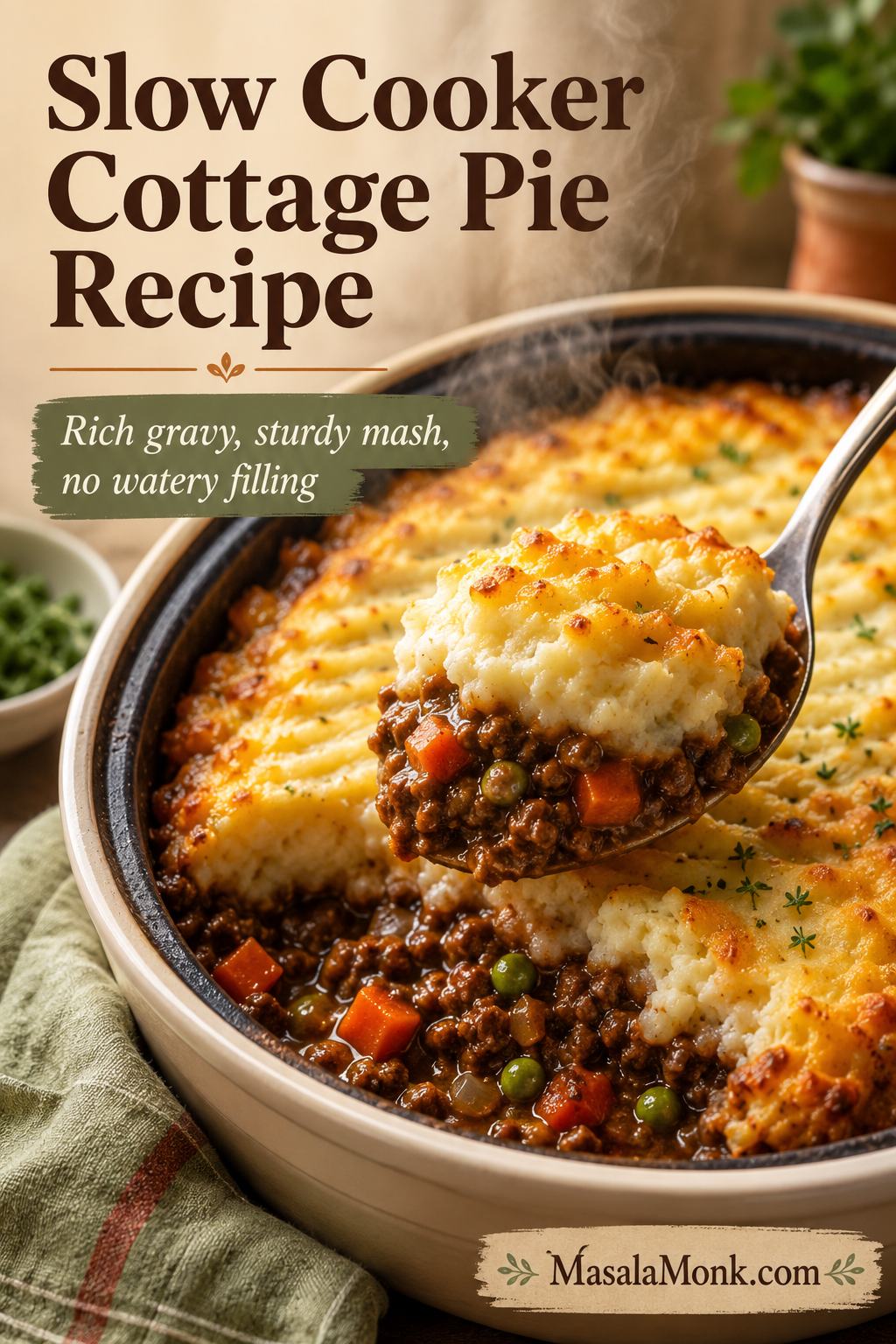
A slow cooker cottage pie should feel like the perfect low-effort comfort dinner: rich beef mince, sweet vegetables, savoury gravy, creamy mashed potatoes, and a meal that waits for you. But this is also one of those recipes where the slow cooker can quietly work against you.
The filling can turn watery because the lid traps steam. The mash can sink if the gravy is too loose. The top can stay pale because a slow cooker heats gently but does not brown like an oven. And if you skip browning the mince, the flavour and texture need a little extra help.
The method is still simple: cook the beef until the gravy is rich, add mash once the filling looks ready, then choose a soft slow-cooker top or a golden finish. The filling uses less liquid than an oven version, tightens before the mash goes on, and gets its peas near the end.
What you get is savoury beef gravy, buttery fork-ridged mash, sweet carrots and peas, and a cottage pie that still serves in generous spoonfuls. Keep it soft-topped and easy, or finish it under the grill, broiler, or in the oven for golden cheddar edges.
It is the kind of dinner that feels calm by the time you serve it: beef gravy underneath, soft potato on top, and no last-minute pan juggling. This is the slow cooker version built to stay rich and comforting instead of turning into beef stew under mashed potatoes.
In the UK, cottage pie usually means beef mince under mashed potato, while shepherd’s pie traditionally uses lamb. In US search terms, the same beef version is often called crockpot shepherd’s pie.
In This Slow Cooker Cottage Pie Guide
Make the Recipe
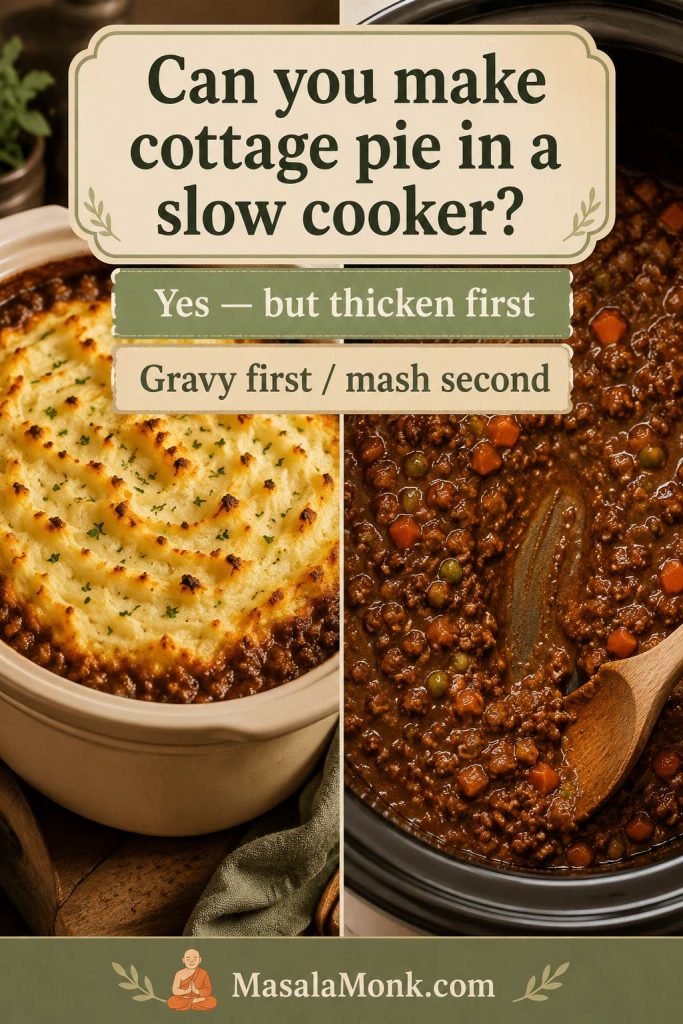
Can You Make Cottage Pie in a Slow Cooker?
Yes, you can make cottage pie in a slow cooker, but the filling needs to be thicker and more settled than a normal oven version before you add the mashed potato. A slow cooker traps moisture, so a cottage pie recipe that works beautifully in the oven can become loose and soupy if the same amount of stock or tomatoes is used under a slow-cooker lid.
The most reliable method is to cook the beef filling first, make sure the gravy is saucy but not loose, then add mashed potatoes only when the filling is ready for the topping. To get a browned top, finish the pie under the grill or broiler, or transfer the filling to an oven dish and bake it briefly.
In US search terms, this same method also works as a crockpot shepherd’s pie with ground beef; in UK terms, beef under mash is cottage pie.
Think of the recipe in this order: gravy first, mash second, golden top if you want it. That simple rule prevents most slow-cooker cottage pie problems.
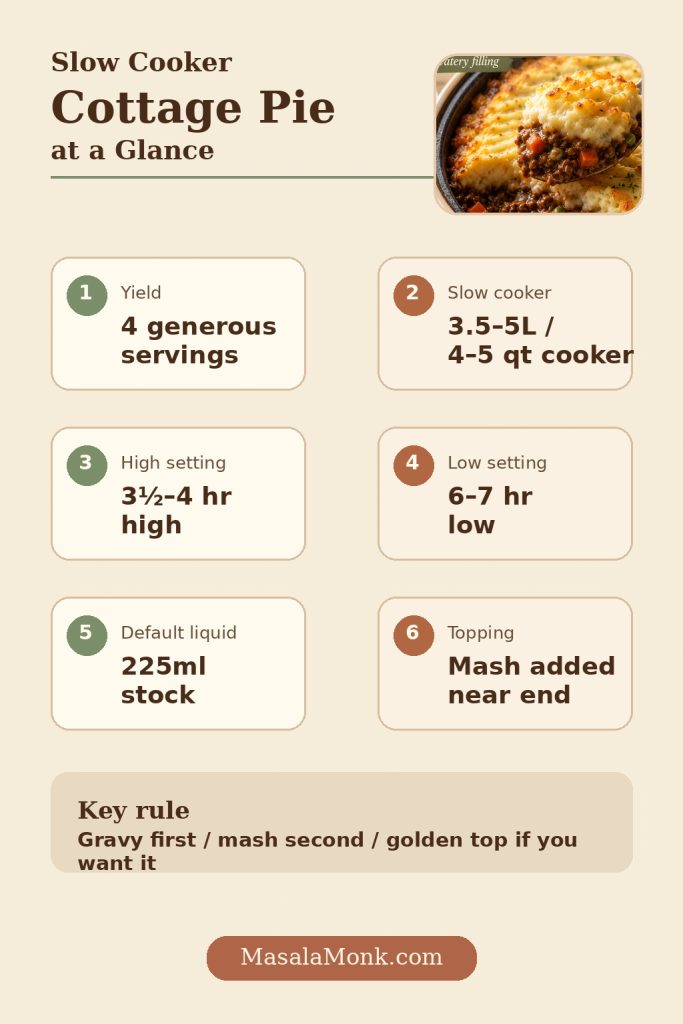
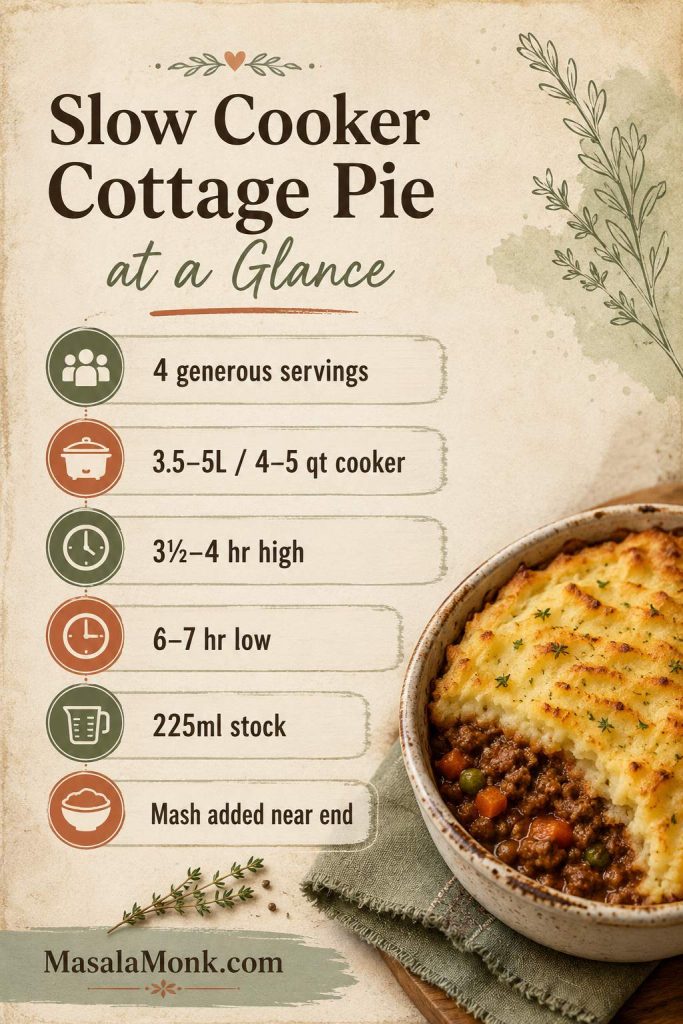
Slow Cooker Cottage Pie at a Glance
Main ingredient: 500g lean beef mince / about 1 lb 2 oz ground beef.
Default liquid: 225ml / scant 1 cup beef stock. Use about 200ml for mushrooms, frozen vegetables, or no-browning; use 100–150ml if adding chopped tomatoes.
Timing note: an oven or broiler finish is quicker; heating the mash through in the slow cooker takes longer.
Texture cue: the filling should be saucy but not loose, so the potato topping can rest neatly above the gravy.
Mash cue: the mashed potato should be creamy, steady, and easy to spread.
Flavour move: brown the mince first when you can, then drain excess fat before slow cooking.
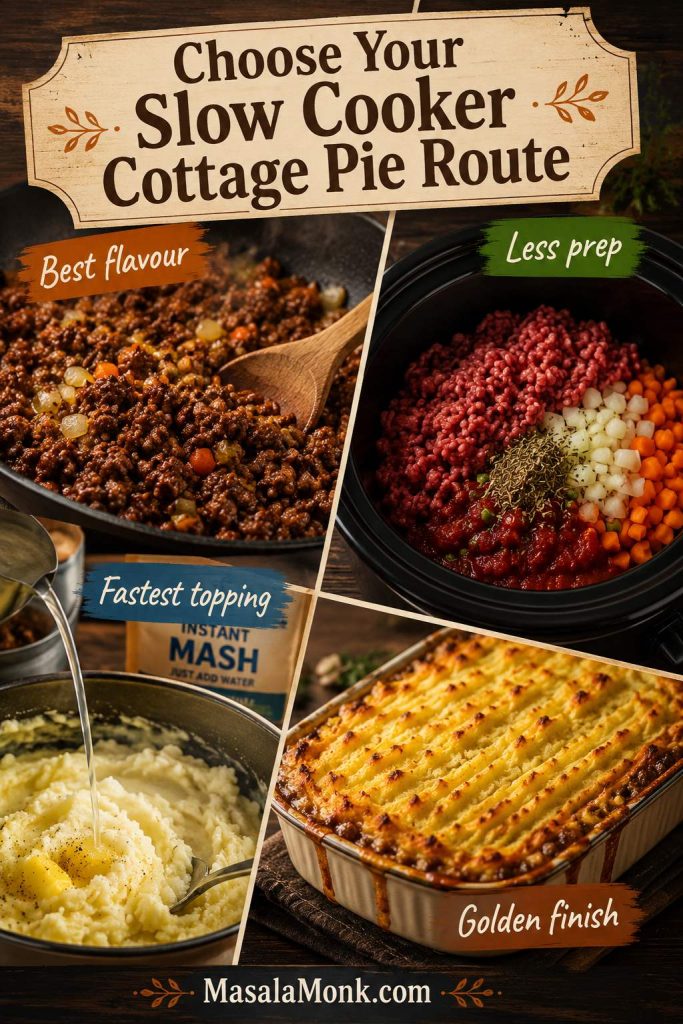
Choose Your Slow Cooker Cottage Pie Route
Use the browned-mince method for the best flavour, or choose one of the shortcuts below. Every version comes back to the same calm idea: make the filling glossy, not soupy, then add the topping.
| Route | Use this if | How to adjust |
|---|---|---|
| Best flavour | You can brown the mince | Use the main method, drain fat, and thicken with flour from the start. |
| Raw-mince shortcut | You need less prep | Use fresh, fully thawed lean mince, less stock, no flour at the start, and thicken near the end. |
| Instant-mash shortcut | You want the easiest topping | Make instant mash thicker than packet directions and add it only after the filling settles. |
| Golden-top version | You want classic cottage pie texture | Slow cook the filling, then finish safely under the grill, broiler, or in an oven dish. |
For the easiest weeknight version, use the raw-mince shortcut with frozen mixed vegetables and prepared or instant mash, then tighten the filling before topping. Shortcut routes count too: the goal is a savoury filling, a topping that stays put, and dinner that feels sorted.
Brown the mince when you have the energy, and choose the golden finish when you want that classic baked top. If this is your first time making it, note your slow cooker size and stock amount; those two details make the next batch easier to adjust. The full recipe card sits below the topping choices, and the Jump to Recipe button takes you there directly.
What Good Looks Like Before You Add the Mash
Here is what good looks like before the mash goes on, so you do not have to guess.
1. The gravy should move slowly
Drag a spoon through the beef filling. The gravy should leave a visible path for a second before slowly closing. If it floods back instantly, the filling needs more reduction or thickening.
2. The mash should hold its shape
Scoop the mash with a spoon. It should hold soft peaks and feel spreadable, not loose or pourable. Wet mash is one of the main reasons toppings sink.
3. Add the topping gently
Add mash in small spoonfuls around the edges first, then fill the centre and spread gently. Dropping all the mash into the middle can push it through the filling.
What you’re looking for
A beef layer that holds together in deep spoonfuls, creamy mash that stays in place, and gentle topping. That is what keeps the finished pie from collapsing into stew.
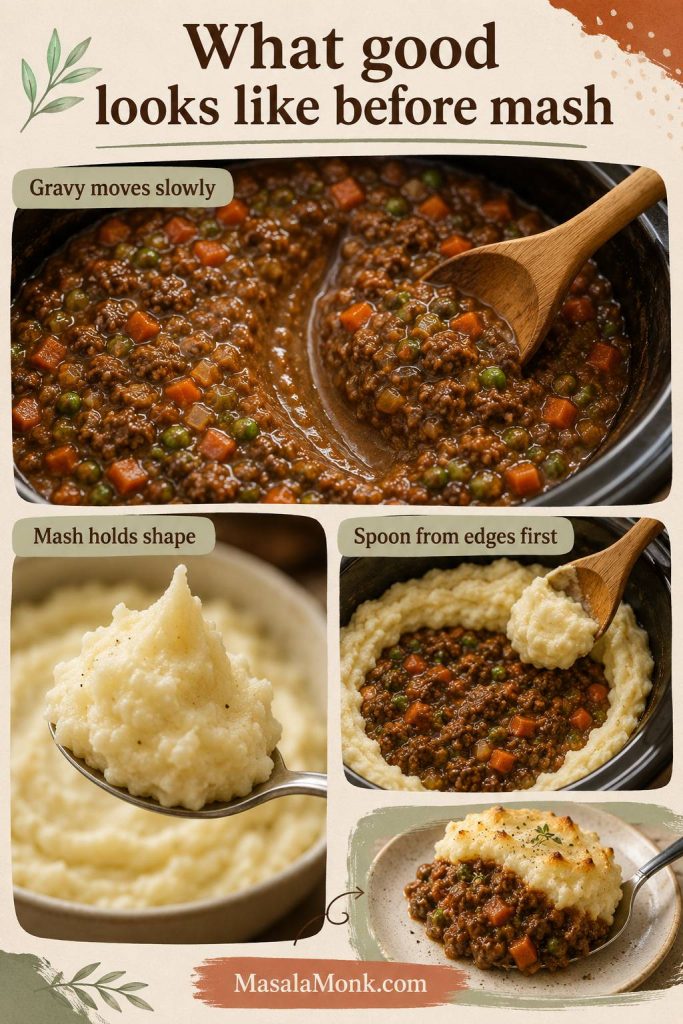
If the gravy still looks loose, use the watery filling fixes; if the mash keeps disappearing into the beef, jump to the sinking mash fixes.
Ingredients for Slow Cooker Cottage Pie
Now that you know what the filling and mash should feel like, the ingredient choices make more sense: less loose liquid, a stronger gravy base, and mash that sits neatly on top. These are everyday cottage pie ingredients; the difference is not fancy shopping, but how the liquid and potatoes are handled.
The default version uses tomato purée or tomato paste rather than a full tin of chopped tomatoes, because the slow cooker does not reduce liquid like an oven or pan.
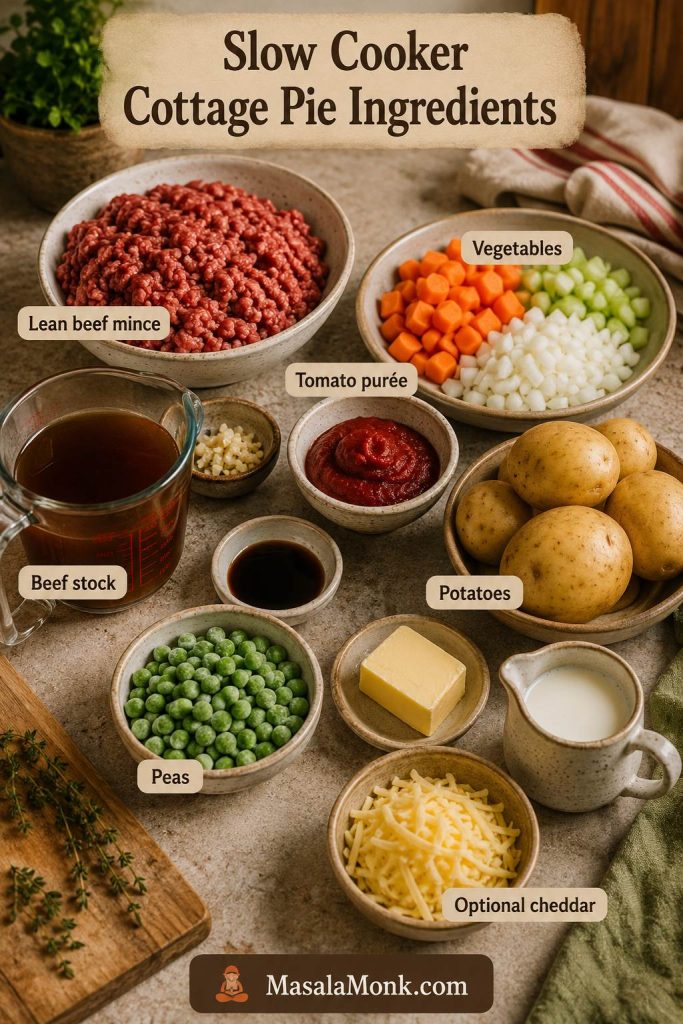
Beef filling ingredients
| Ingredient | Amount | Notes |
|---|---|---|
| Neutral oil or olive oil | 1 tsp, optional | Use only if cooking very lean mince in a dry pan. |
| Lean beef mince / ground beef | 500g / about 1 lb 2 oz | Use 5–10% fat if possible. It gives flavour without making the slow cooker greasy. |
| Onion, finely diced | 1 large | Adds sweetness and helps build the gravy base. |
| Carrots, finely diced | 2 medium | Classic cottage pie sweetness and colour. |
| Celery, finely diced | 1–2 sticks / stalks | Builds a deeper savoury base. |
| Garlic | 2–3 cloves | Adds depth without taking over. |
| Tomato purée / tomato paste | 2 tbsp | Gives depth, colour, and savoury concentration without adding much water. |
| Plain flour / all-purpose flour | 2 tbsp | Default thickener for the browned-mince method. |
| Beef stock | 225ml / scant 1 cup | Use about 200ml for mushrooms, frozen mixed vegetables, or no-browning. If adding chopped tomatoes, reduce the stock to 100–150ml. |
| Worcestershire sauce | 1 tbsp | Gives savoury, tangy depth. |
| Dried thyme or rosemary | 1 tsp | Use either, or a small mix of both. |
| Frozen peas | 100–150g / ¾–1 cup | Add near the end so they stay brighter. |
| Salt and black pepper | To taste | Start light if your stock is salty; adjust before adding the mash. |
How Much Stock to Use in Slow Cooker Cottage Pie
Stock is the easiest place to control the finished texture. Start modest, then adjust for watery add-ins such as mushrooms, frozen vegetables, raw mince, or chopped tomatoes.
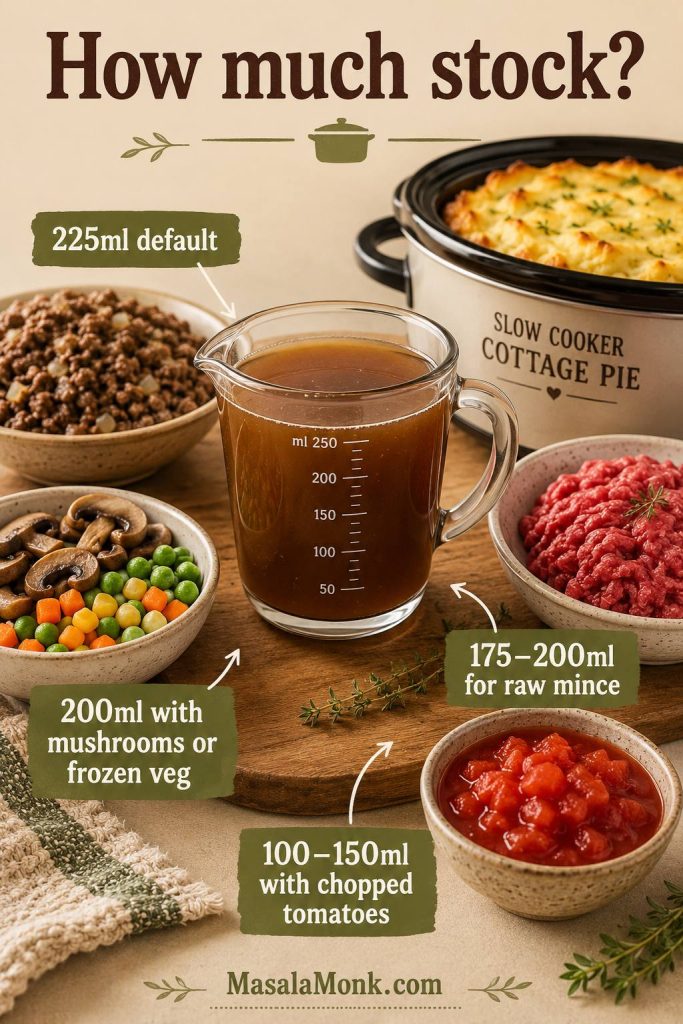
If you are using mushrooms, frozen vegetables, or chopped tomatoes, the watery filling section explains how to adjust the liquid before topping.
Optional flavour boosters and add-ins
- Mushrooms: add 100–150g finely chopped mushrooms with the vegetables for a deeper, meatier filling. Use slightly less stock because mushrooms release moisture.
- Red wine: replace 50–100ml of the stock with red wine. Let it bubble briefly in the pan before slow cooking.
- Brown sauce or mustard: add 1 teaspoon to 1 tablespoon for a sharper UK-style savoury note.
- Chopped tomatoes: use 200g / about 7 oz chopped tomatoes if you want a tomato-rich filling, and reduce the stock to 100–150ml. Expect to thicken near the end if needed.
- Frozen mixed vegetables: use them in place of peas and carrots if needed, but add them late or reduce the stock because they release water.
Optional thickener
When the filling looks loose near the end, mix 1 tablespoon cornflour / cornstarch with 1 tablespoon cold water, stir it into the filling, and cook on high until the gravy tightens. For a quick UK-style option, you can use 1–2 teaspoons beef gravy granules instead, but taste before adding more because they add salt quickly.
Mashed potato topping ingredients
| Ingredient | Amount | Notes |
|---|---|---|
| Floury potatoes | 800–900g / 1 lb 12 oz–2 lb | Maris Piper, King Edward, Russet, or Yukon Gold work well. |
| Butter | 30–45g / 2–3 tbsp | Adds flavour and helps the mash spread. |
| Milk | 60ml / ¼ cup, plus 1 tbsp at a time only if needed | Start small. The mash should be creamy but not loose. |
| Cheddar, optional | 75–100g / ¾–1 cup grated | Use in the mash or on top for a cheesy finish. |
| Leftover, prepared, or instant mash | About 4 cups / enough to cover | Warm slightly if chilled, and keep it thicker than usual so it sits on the filling. |
| Salt | To taste | Season the mash separately from the filling. |
For a deeper guide to creamy potatoes that stay fluffy instead of gluey, use our garlic mashed potatoes recipe; the same steam-dry step helps this topping sit neatly on the filling.
Texture cue: the mash should hold soft peaks on a spoon. If it slides, pours, or feels like loose purée, it is too wet for this recipe. Steam-dry fresh potatoes and add milk gradually.
Slow Cooker Size and Equipment
A 3.5–5L / 4–5 quart oval slow cooker is ideal for this recipe. It keeps the beef layer deep enough while leaving enough surface area to spread the topping. A round slow cooker works too, but an oval insert makes the finished pie easier to serve.
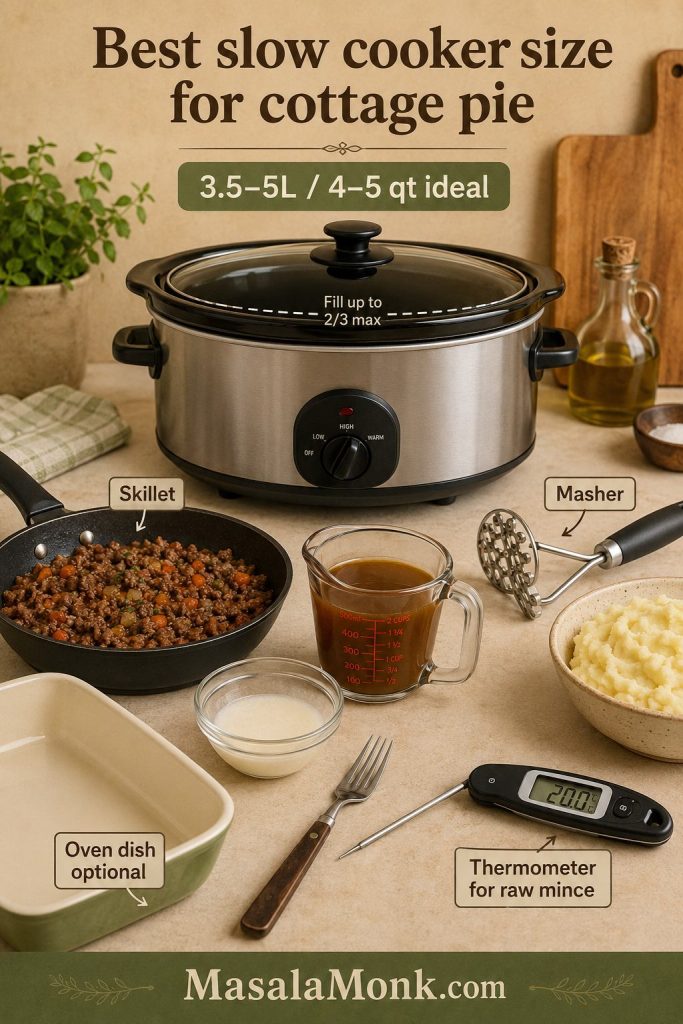
- Large skillet or frying pan: for browning the mince and cooking the vegetables.
- 3.5–5L / 4–5 quart slow cooker: best for the 500g beef version.
- Large saucepan: for boiling potatoes.
- Potato masher or ricer: for smooth mash that is steady enough to spread.
- Small bowl: for mixing cornflour/cornstarch slurry if needed.
- Oven dish: useful if you want a golden top and your slow-cooker insert is not oven-safe.
- Instant-read thermometer: helpful for the raw-mince method.
Important insert safety note: only put a slow-cooker insert under the grill, broiler, or into the oven if the manufacturer says that exact insert is safe for that use. If there is any doubt, transfer the filling to an oven dish before topping and browning.
For the safest browning choices, check the finish options before putting any insert under direct heat.
The recipe is forgiving as long as the filling is not too loose and the topping is not too wet. Use less liquid than an oven cottage pie, adjust watery add-ins, and choose whether you want a soft slow-cooker top or a golden oven, grill, or broiler finish.
How to Make Slow Cooker Cottage Pie
The method looks detailed, but the cooking itself is simple: brown the beef if you can, let the slow cooker build the gravy, then top when the filling is ready. By the end, the carrots should be sweet, the gravy should smell deeply savoury, and the mash should sit proudly on top instead of sliding into the filling.
This is the kind of cottage pie that does not need perfect slices to feel right; it just needs a thick savoury base, warm potato, and enough gravy to make the greens on the side worth eating.
1. Brown the beef mince
Heat a large skillet or frying pan over medium-high heat. If you are using very lean mince or a dry pan, add 1 teaspoon oil first. Add the beef mince and break it into small crumbles with a wooden spoon. Let it brown properly instead of simply turning grey. A little colour on the beef gives the finished filling a deeper savoury flavour.
If the mince releases a lot of fat, spoon or drain off the excess before you continue. Slow cookers do not evaporate fat away, so this small step keeps the filling rich rather than greasy.
2. Add the vegetables
Add the onion, carrot, celery, garlic, and mushrooms if using. Cook for 4–5 minutes, stirring often, until the onion starts to soften and smell sweet. The vegetables do not need to be fully tender yet because they will finish in the slow cooker.
3. Build the gravy base
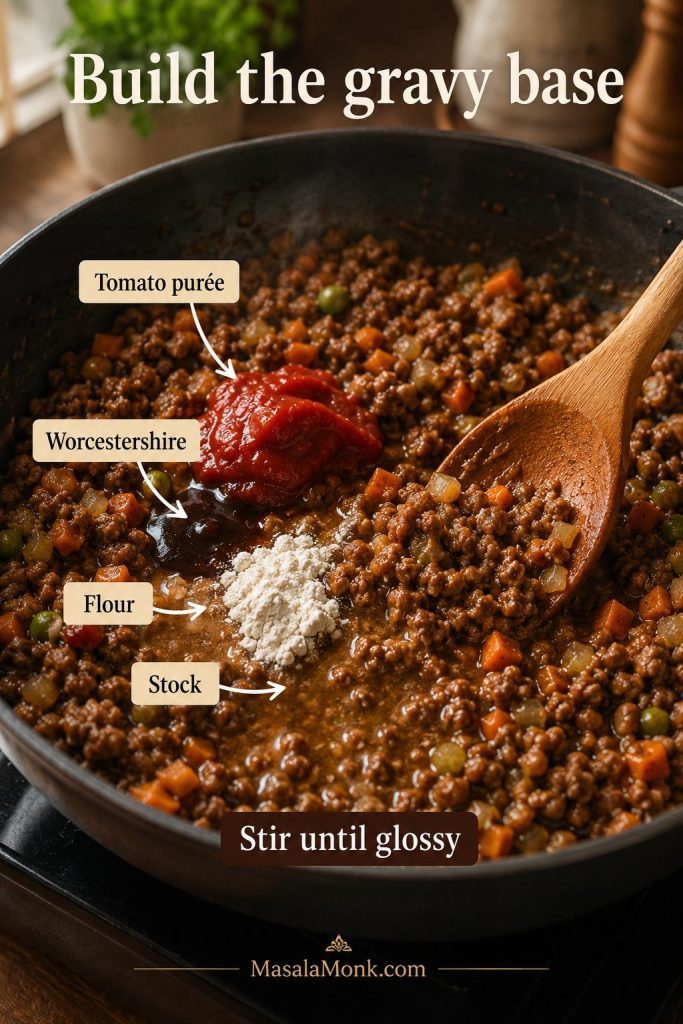
Stir in the tomato purée, Worcestershire sauce, thyme or rosemary, salt, and black pepper. Sprinkle over the flour and stir for 1 minute so it coats the mince and vegetables. This cooks off the raw flour taste and gives the gravy a smoother texture later.
Add the stock gradually, scraping the bottom of the pan as you stir. The mixture should become glossy and lightly saucy, not thin and soupy. If using wine, add it before the stock and let it bubble briefly.
4. Slow cook the filling
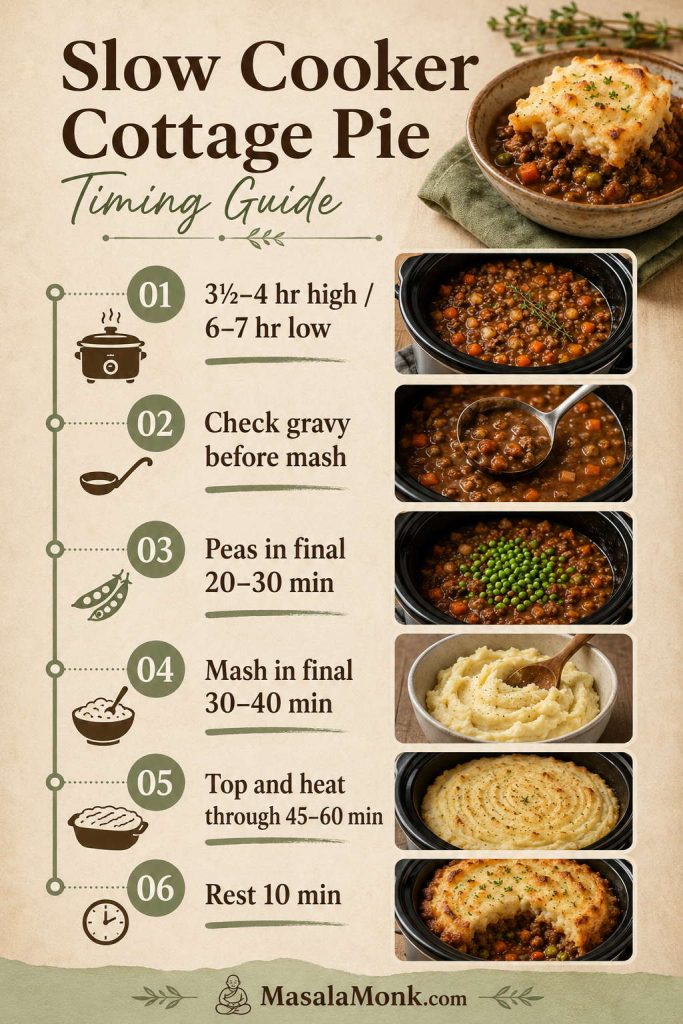
Transfer the beef mixture to the slow cooker. Cover and cook on high for 3½–4 hours or on low for 6–7 hours, until the vegetables are tender and the filling tastes rounded and savoury.
Start looking from 3 hours on high or 5½ hours on low if your slow cooker runs hot, has a wide insert, or the filling is sitting in a shallow layer. Try not to lift the lid too often early on, because each lift releases heat and can stretch the cooking time.
5. Look at the Gravy Before Adding Mash
Pause here before you add the mash; this one look makes the biggest difference. Stir the filling and drag a spoon through the centre. If the gravy leaves a visible trail for a second before slowly closing, the filling is ready for mash. The first spoonful should hold together but still look saucy.
When it is right, the filling should smell deeply savoury and look glossy rather than soupy, with carrots soft enough to melt into the gravy but still visible in each spoonful.
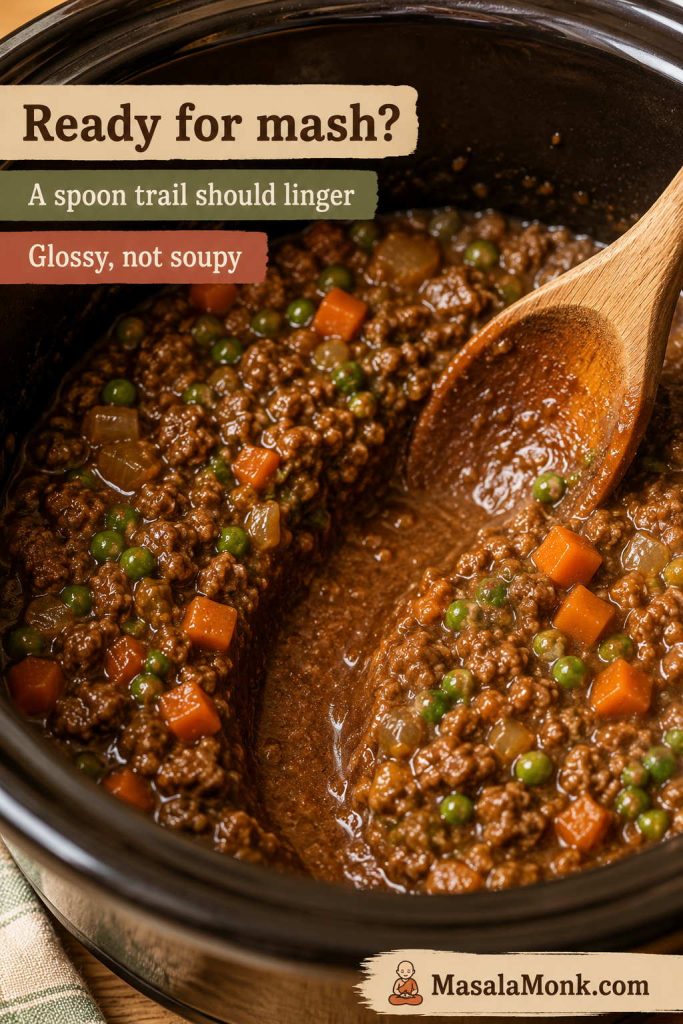
If the trail disappears immediately, use the quick fixes in How to Stop Slow Cooker Cottage Pie Going Watery before adding mash.
When the gravy floods back immediately, pause and give it a little help before topping. Mix 1 tablespoon cornflour or cornstarch with 1 tablespoon cold water, stir it into the filling, and cook on high for 20–30 minutes. If your slow cooker holds heat well, you can cook uncovered. If it cools quickly, leave the lid slightly ajar, or thicken a few ladles of liquid in a small pan and stir it back into the slow cooker.
This is also the best time to taste the filling. Add salt, pepper, Worcestershire sauce, or a little more tomato paste if it needs more depth. Once the mash goes on, adjusting the filling becomes harder.
Should You Add the Mash at the Start?
It is better to add the mash near the end, after the beef filling has cooked and settled. If mash goes on too early, condensation can soften it, bubbling gravy can break through it, and you lose the chance to fix a loose filling before topping.
6. Add the peas late
Stir in the frozen peas during the final 20–30 minutes of filling time. They will heat through quickly, stay brighter, and release less water into the gravy than they would if added at the beginning.
7. Make creamy mash that holds its shape
You can make the mash during the final 30–40 minutes of the filling time, then keep it warm and loosely covered until the filling is ready to top.
Boil the potatoes in salted water until tender. Drain well, then return them to the hot pan for 1–2 minutes so extra steam escapes. Mash with butter, then add 60ml / ¼ cup milk. Add more milk 1 tablespoon at a time only if the mash is too stiff to spread.
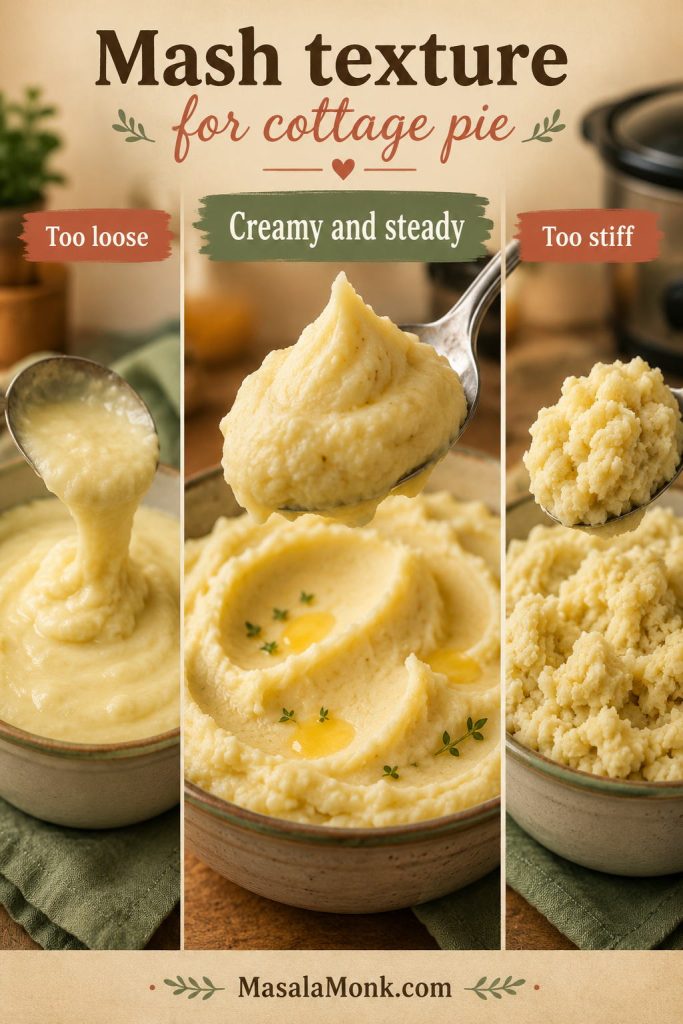
If using cheddar, stir some into the mash or save it for the top. Warm mash spreads more easily than cold leftover mash, so if you are using leftovers, warm them slightly before topping the filling.
8. Spoon the mash gently over the filling
Add the mash in small spoonfuls around the edges of the slow cooker first, then fill the centre. Spread gently with a fork or spatula. Avoid dropping all the mash into the middle at once because that weight can push through the filling.
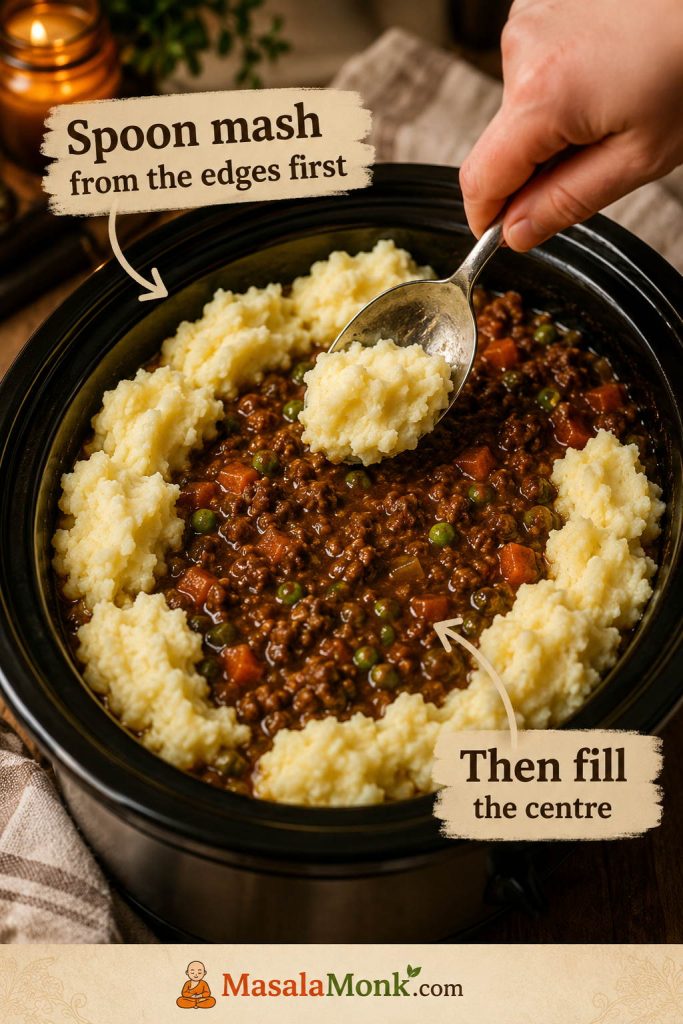
If the topping starts to sink, pause and use the mash-sinking fixes before spreading the rest.
Use a fork to make ridges on top. Those ridges catch heat and brown better if you finish the pie under the grill, broiler, or in the oven.
9. Finish and rest
For the easiest finish, cover and cook on high for 45–60 minutes until the mash is hot. For a golden top, either use a safe grill/broiler finish or transfer the filling to an oven dish and bake until browned.
The slow-cooker-only version is softer and homier; the oven-finished version gives you those golden ridges and bubbling edges that make cottage pie feel more like a proper baked dinner.
Let the cottage pie rest for 10 minutes before serving. Resting lets the gravy settle and the mash firm slightly, so the first spoonful comes out with creamy potato on top and glossy beef gravy underneath.
Slow Cooker Timing Table
Use this timing table as a guide for when to look at the filling, add peas, warm the mash, and decide how you want to finish the top.
| Stage | High setting | Low setting | Notes |
|---|---|---|---|
| Beef filling | 3½–4 hours | 6–7 hours | Start looking earlier if your slow cooker runs hot or has a wide insert. |
| Thickening adjustment | 20–30 minutes on high | Switch to high | Use slurry only if the filling looks loose. |
| Peas | Final 20–30 minutes | Final 20–30 minutes | Add late for better colour and texture. |
| Mash topping in slow cooker | 45–60 minutes | Not ideal | Use high to heat the mash through. |
| Oven-dish finish | 200°C / 400°F for 20–25 minutes | Same | Most classic finish if your insert is not oven-safe. |
| Grill / broiler finish | 5–10 minutes | Same | Only use a safe insert or separate oven dish. |
Choosing the Finish: Soft, Golden, or Classic
The slow cooker is excellent at making the filling tender and savoury. The finish depends on what you want from the topping: easiest, golden, or most classic.
What to expect: a slow cooker will heat the mash, but it will not give you a crisp browned crust. For a soft family-style cottage pie, keep it in the slow cooker. For a classic golden top, use the oven, grill, or broiler.
| Finish option | Good for | Result | Keep in mind |
|---|---|---|---|
| Slow cooker only | Lowest effort family dinner | Hot, soft mash topping with rich filling underneath | No crisp or golden top |
| Grill / broiler | Golden top without baking the whole dish | Browned fork ridges, melted cheese, better colour | Insert must be safe for direct heat |
| Oven dish | Neatest classic cottage pie finish | Bubbling filling, golden mash, easier serving | Uses one extra dish |

Most classic: slow cook the filling, transfer it to an oven dish, top with mash, and bake at 200°C / 400°F for 20–25 minutes. This gives bubbling gravy at the edges, golden fork ridges, and a potato topping that feels baked rather than steamed.
No-extra-dish option: grill or broil the topping in the slow-cooker insert only if the manufacturer says the insert is safe for direct heat.
Easiest option: keep everything in the slow cooker and cook on high until the mash is hot. The top will be soft, not golden, but the dinner will still be comforting and complete.
Once the gravy looks glossy and the mash is hot, the rest is just the kind of comfort you want: soft if you keep it in the slow cooker, golden if you finish it under heat.
Can You Put Raw Mince in Slow Cooker Cottage Pie?
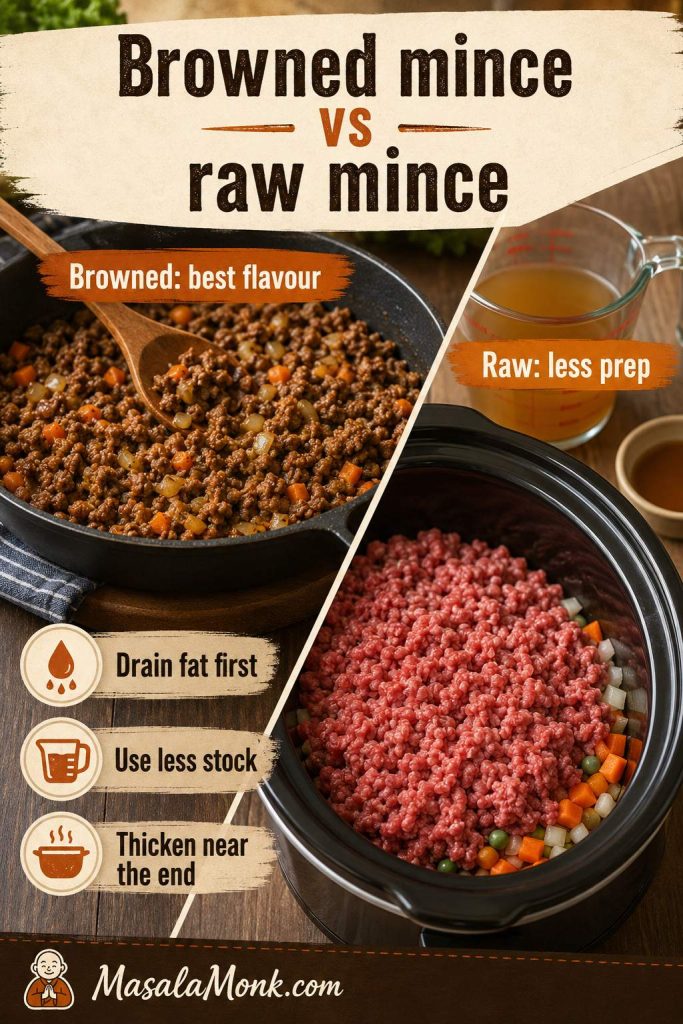
Yes, you can put raw mince in slow cooker cottage pie, but browned mince gives better flavour, better texture, and lets you drain fat first. If you need the shortcut, use fresh, fully thawed lean mince, reduce the stock, break it up well, and thicken near the end.
Some nights, simply getting dinner into the slow cooker is enough. This shortcut is not the richest version, but it can still give you a useful, comforting cottage pie if you handle the liquid carefully.
Browned Mince vs Raw Mince
Both routes can work, but they need different handling. Browning builds deeper flavour and lets you drain fat first; meanwhile, raw mince needs less stock, careful stirring, and a final texture check.
Is This a Dump-and-Go Cottage Pie?
It can be close to dump-and-go, but not completely hands-off. Use raw thawed lean mince, frozen mixed vegetables, less stock, and prepared mash if you want the easiest version. Just give the filling one look near the end so you can thicken it before the mash goes on.
Raw-mince / no-browning method
- Use fresh, fully thawed lean mince. Avoid starting with frozen raw mince.
- Crumble the mince into the slow cooker instead of leaving it in a block.
- Add the onion, carrot, celery, and garlic.
- Whisk the tomato purée, Worcestershire sauce, herbs, and 175–200ml stock together, then pour it over the mince and vegetables.
- Skip the flour at the beginning because it can clump with raw mince and cold liquid.
- Cook on high for 1 hour, then stir well to break up clumps if you are nearby. Either continue on high until the total cooking time reaches 3½–4 hours, or switch to low and cook for another 5–6 hours, until the beef is cooked through and the vegetables are tender.
- Spoon off excess fat or liquid if needed.
- Thicken near the end with 1–2 tablespoons cornflour/cornstarch mixed with equal cold water.
- Add peas, check seasoning, then top with mash that is spreadable but not loose.
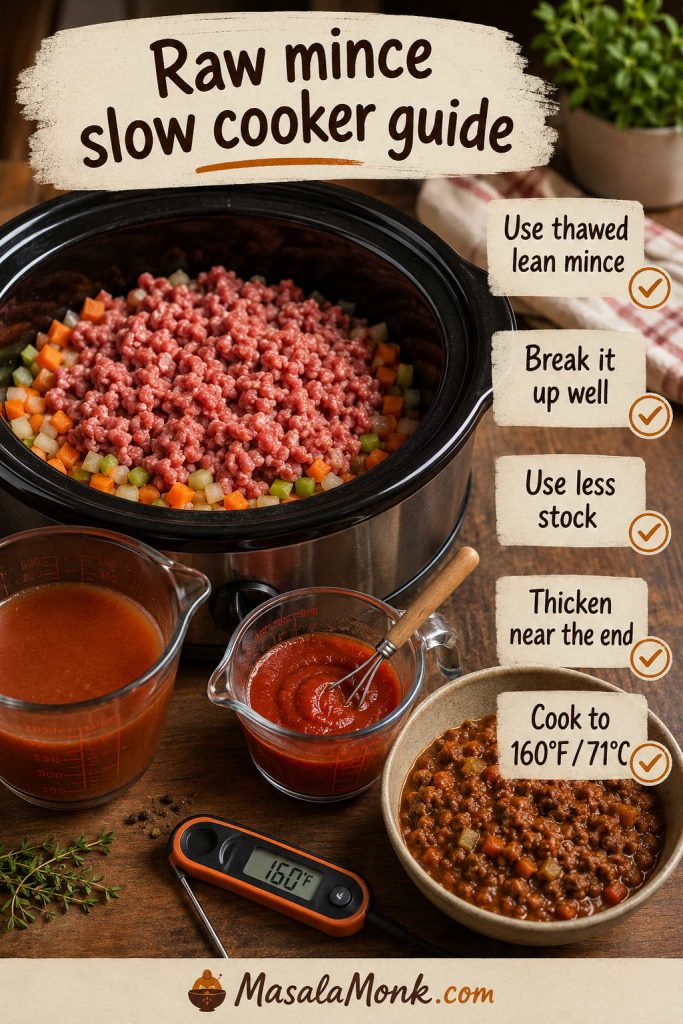
For peace of mind with the raw-mince option, use an instant-read thermometer if you have one. Ground beef should reach 160°F / 71°C, and for slow-cooker safety the USDA recommends thawing meat before it goes into a slow cooker: USDA slow cooker food safety guidance.
How to Stop Slow Cooker Cottage Pie Going Watery
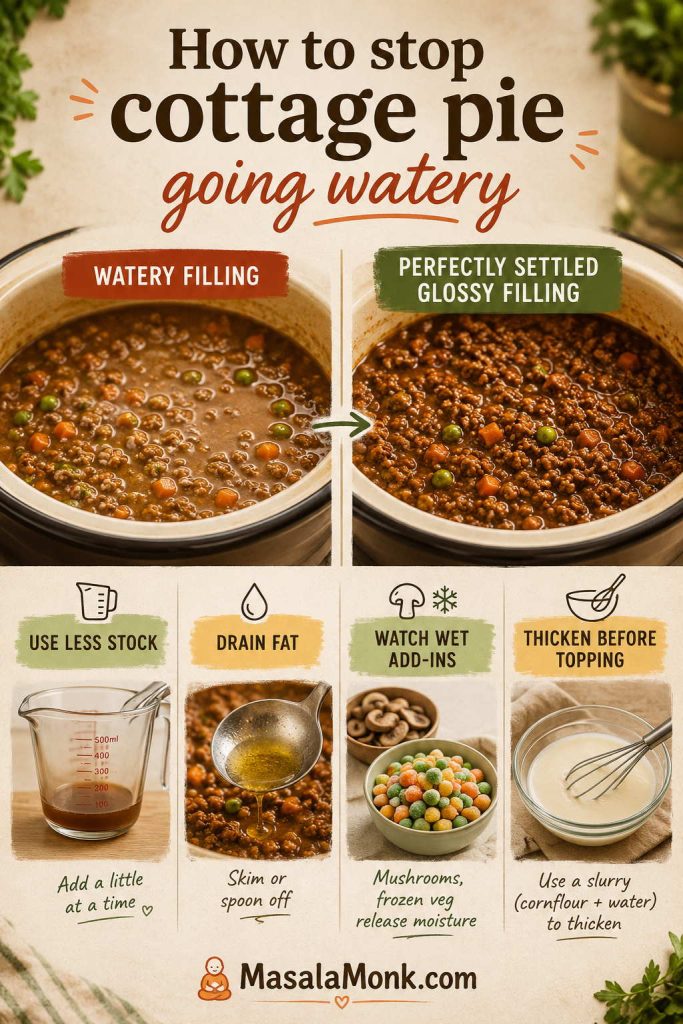
Watery filling usually comes from too much stock, undrained fat, watery vegetables, or adding mash before the gravy has tightened.
Use less stock than an oven recipe
For 500g beef mince, 225ml stock is the default for the browned method. Use about 200ml if you add mushrooms, frozen mixed vegetables, or raw mince. If adding 200g / about 7 oz chopped tomatoes, reduce the stock to 100–150ml. Use up to 250ml only if the mince is browned and drained and the filling genuinely looks dry.
Watch mushrooms, frozen veg, and chopped tomatoes
Mushrooms, frozen mixed vegetables, chopped tomatoes, and extra onions all bring moisture. They work well, but they need a lower stock amount or a little extra thickening near the end.
Drain the browned mince
Fat and liquid do not disappear in the slow cooker. Drain the mince if it releases a lot of fat, and spoon off any greasy layer before adding the mash.
Thicken before topping
If the filling is loose, thicken it first and use the spoon trail from earlier before adding the mash. Cornflour/cornstarch gives the cleanest fix; gravy granules are useful when you want a quick UK-style thickening shortcut.
Gravy Granules and Cottage Pie Packet Mix
Shortcut helpers can be useful, especially in UK-style cottage pie, but they still need careful liquid control and tasting before extra salt goes in.
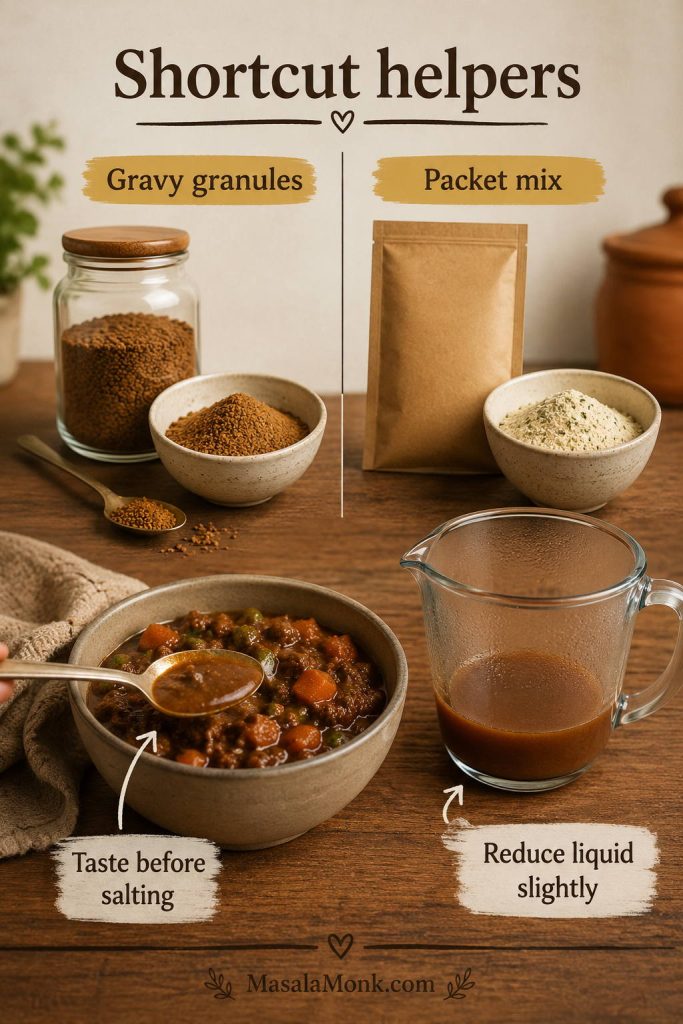
Can You Use Gravy Granules to Thicken It?
Yes. Gravy granules are useful when you want a quick UK-style thickening shortcut, not just when something has gone wrong. Start with 1–2 teaspoons, let the filling settle for a few minutes, then taste before adding more because they add salt quickly.
Can You Use a Cottage Pie Packet Mix?
Yes. Use the packet as the flavour base, but reduce the liquid slightly because the slow cooker will not evaporate it the way an oven or pan does. Taste before adding extra salt, and make sure the filling is settled enough for topping.
How to Stop the Mash Sinking
Mashed potato sinks when the filling is too loose, the mash is too wet, or the topping is added too heavily in one place. The fix is simple: thicken the filling first, use mash that holds its shape, and spoon from the edges inward.
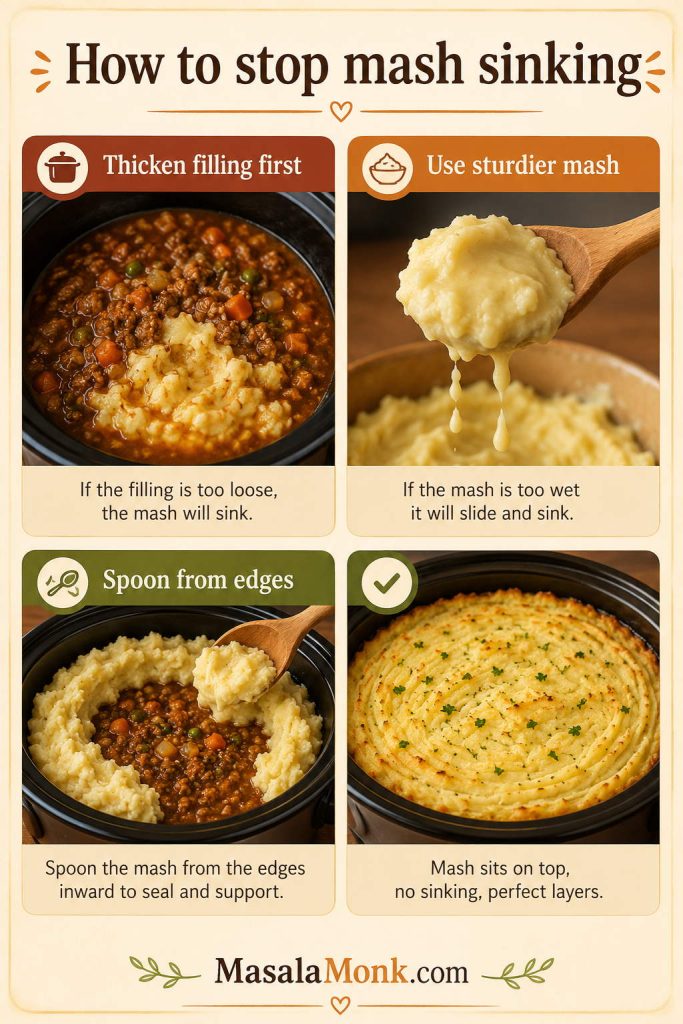
- Let fierce bubbling settle. If the filling is bubbling aggressively, turn the slow cooker off for 10 minutes before topping.
- Use sturdy mash. Steam-dry the potatoes and add milk slowly.
- Start at the edges. The rim gives the potato a firmer starting point than the centre.
- Spoon, then spread. Dot small mounds of mash across the surface before smoothing.
If the mash already sank: serve it as a rustic cottage pie bowl. It will not look neat, but the flavour is still there. Next time, thicken the filling first and spoon the topping from the edges inward.
Topping Options: Mash, Cheese, Sliced Potatoes, and Shortcuts
The topping can be classic, cheesy, leftover, instant, or sliced. Choose the one that matches the amount of effort you want and the finish you like best.
| Topping | Best for | Keep in mind |
|---|---|---|
| Fresh mash | Best texture | Steam-dry potatoes and add milk slowly. |
| Leftover mash | Convenience | Warm before spreading so it does not pull at the filling. |
| Instant mash | Fastest shortcut | Make it thicker than packet directions. |
| Cheesy mash | Golden finish | Can get salty if the filling is already well seasoned. |
| Sliced potatoes | Different texture | Needs oven, grill, or broiler finish. |
| Sweet potato mash | Lighter, sweeter topping | Holds more moisture, so use less milk. |
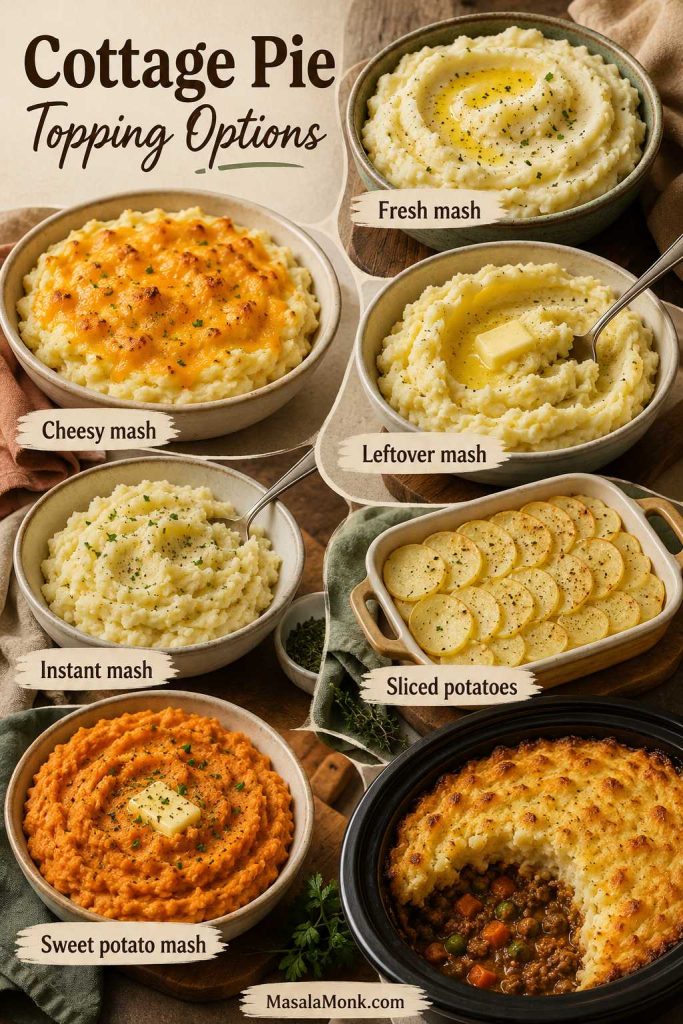
Classic mashed potato
Classic mash is the most reliable all-purpose topping. Use floury potatoes, butter, a little milk, and salt. The texture should be spreadable without sinking, but not so stiff that it tears up the filling underneath.
Cheesy mash
Cheddar gives this cottage pie a more finished, oven-baked feel. Stir some into the mash or scatter it on top before grilling or broiling. Cheese also helps the fork ridges brown.
Leftover mash
Leftover mash is one of the easiest shortcuts. Warm it slightly before spreading so it is not fridge-cold and stiff. If it has dried out, beat in a small knob of butter or a splash of milk, but keep the texture thick enough to sit on the filling.
If you have more leftover mash than you need for topping, turn it into crisp snacks with our croquettes recipe.
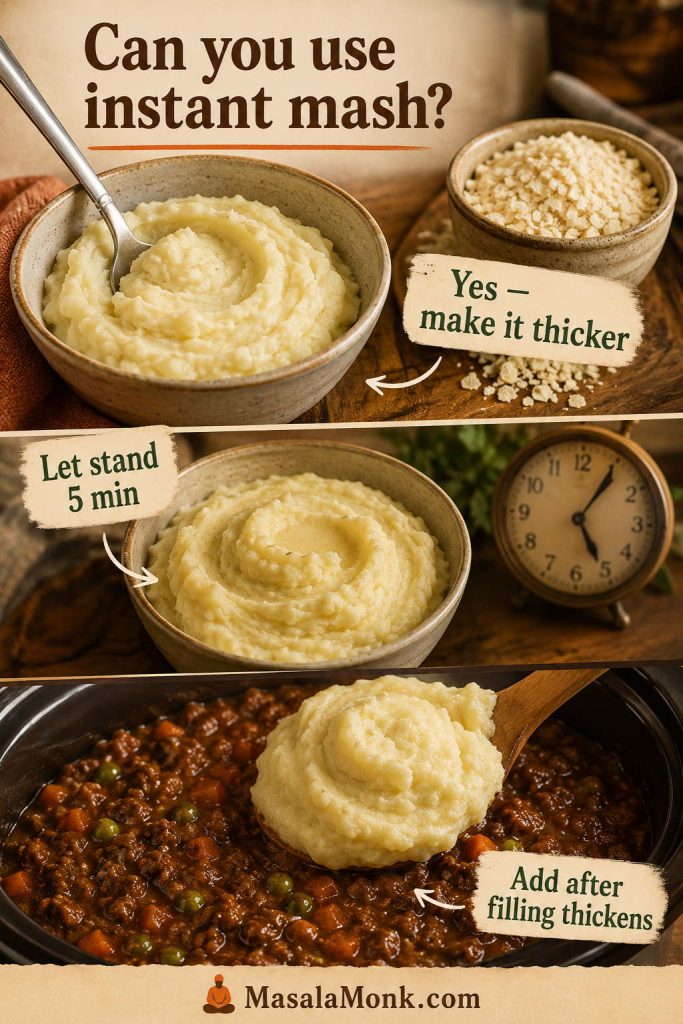
Can You Use Instant Mash for Slow Cooker Cottage Pie?
Yes, instant mash works for a shortcut version, but make it thicker than the packet directions suggest. Let it stand for 5 minutes before topping, and add a little grated cheese if it needs more structure. It is exactly the kind of shortcut that makes sense on a weeknight, especially when the beef filling is already rich and well seasoned.
Sliced potato topping
You can make slow cooker cottage pie with sliced potatoes, but it works best with an oven or grill finish. Slice the potatoes thinly, parboil if needed, layer them over a beef filling that holds together, brush with butter or oil, and finish until tender and golden. A slow cooker alone will soften sliced potatoes but will not make them crisp.
Sweet potato mash
Sweet potato mash gives the pie a sweeter, lighter feel. Because sweet potatoes hold more moisture than white potatoes, steam them well after cooking and use less milk. This works especially well for a lighter variation.
You should be able to scoop through soft potato into glossy beef gravy in a spoonful that lands on the plate as dinner, not soup. Use the recipe card below as the practical cook-through version.
Slow Cooker Cottage Pie Recipe Card
Description: A rich slow cooker cottage pie with savoury beef gravy, creamy mashed potatoes that sit neatly on top, optional cheddar, and an oven or grill finish for a golden top.
Before you top it: gravy first, mash second. The beef filling should briefly hold a spoon trail before the potato goes on. If it looks loose, thicken it first.
Need a shortcut or rescue? See raw mince, watery filling, instant mash, or golden finish before you start.
Timing note: an oven or broiler finish is quicker; heating the mash through in the slow cooker takes longer.
Equipment: 3.5–5L / 4–5 quart slow cooker, large skillet or frying pan, saucepan, potato masher or ricer, small bowl for slurry, and an oven dish if browning the top outside the slow cooker.
Ingredients
Beef filling
- 1 tsp neutral oil or olive oil, optional, for very lean mince
- 500g lean beef mince / ground beef, about 1 lb 2 oz
- 1 large onion, finely diced
- 2 medium carrots, finely diced
- 1–2 celery sticks, finely diced
- 2–3 garlic cloves, minced
- 2 tbsp tomato purée / tomato paste
- 1 tbsp Worcestershire sauce
- 2 tbsp plain flour / all-purpose flour
- 225ml beef stock / scant 1 cup
- Stock adjustment: use about 200ml with mushrooms or frozen veg, 175–200ml for no-browning, or 100–150ml with chopped tomatoes
- 1 tsp dried thyme or rosemary
- 100–150g frozen peas / ¾–1 cup
- Salt and black pepper, to taste, starting light if your stock is salty
Optional flavour boosters and add-ins
- 100–150g mushrooms, finely chopped
- 50–100ml red wine, replacing part of the stock
- 1 tsp mustard or 1 tbsp brown sauce
- 200g / about 7 oz chopped tomatoes, with stock reduced to 100–150ml
Optional thickener
- 1 tbsp cornflour/cornstarch mixed with 1 tbsp cold water, only if the filling is loose near the end
- For a UK-style shortcut, use 1–2 tsp beef gravy granules near the end, wait a few minutes, then taste before adding more because they add salt quickly.
Mash topping
- 800–900g floury potatoes, peeled and cut into chunks
- 30–45g butter / 2–3 tbsp
- 60ml milk / ¼ cup, plus 1 tbsp at a time only if needed
- 75–100g grated cheddar, optional
- Or about 4 cups leftover, prepared, or instant mash, kept thicker than usual
- Salt, to taste
Instructions
Cook the Beef Filling
- Brown the mince. Heat a large skillet over medium-high heat. Add 1 tsp oil if using very lean mince. Add the beef mince and cook until browned, breaking it into small crumbles. Drain excess fat.
- Add vegetables. Stir in onion, carrot, celery, garlic, and mushrooms if using. Cook for 4–5 minutes until beginning to soften.
- Build the gravy. Add tomato purée, Worcestershire sauce, herbs, salt, and pepper. Sprinkle over the flour and stir for 1 minute.
- Add stock. Pour in the beef stock gradually, scraping the pan and stirring until the mixture looks glossy. If using wine, add it before the stock and let it bubble briefly.
- Slow cook. Transfer to the slow cooker. Cover and cook on high for 3½–4 hours or low for 6–7 hours. Check earlier if your slow cooker runs hot.
- Check thickness. Stir the filling. Drag a spoon through it; the gravy should leave a brief path. If loose, stir in 1 tbsp cornflour/cornstarch mixed with 1 tbsp cold water and cook on high for 20–30 minutes.
- Add peas. Stir in frozen peas during the final 20–30 minutes of filling time. Taste and adjust seasoning.
Make the Mash and Finish
- Make mash. During the final 30–40 minutes of filling time, boil potatoes in salted water until tender. Drain, steam-dry for 1–2 minutes, then mash with butter and 60ml / ¼ cup milk. Add more milk 1 tablespoon at a time only if needed. Stir in some cheddar if using.
- Top the filling. Spoon mash over the beef filling in small mounds, starting around the edges. Spread gently and rough up the surface with a fork. Add cheddar on top if desired.
- Finish. For the easiest soft topping, cover and cook on high for 45–60 minutes. For a golden top, transfer to an oven dish and bake at 200°C / 400°F for 20–25 minutes, or grill/broil for 5–10 minutes only if your insert is safe for direct heat.
- Rest and serve. Let the cottage pie rest for 10 minutes before serving.
Recipe Notes
- Best flavour: brown the mince when you can. It gives deeper flavour and lets you drain excess fat.
- Raw-mince shortcut: skip the flour at the start, use fresh, fully thawed lean mince, reduce stock to 175–200ml, break the mince up well, whisk tomato purée into the stock before adding, and thicken near the end.
- Chopped tomatoes: if using 200g / about 7 oz chopped tomatoes, reduce the stock to 100–150ml and check the filling before topping.
- Shortcut mash: warm leftover or prepared mash slightly before spreading; make instant mash thicker than the packet directions.
- Thickening options: cornflour/cornstarch slurry gives the cleanest fix; gravy granules also work but add salt quickly.
- Slow-cooker insert warning: only grill/broil or oven-finish in the insert if the manufacturer says it is safe.
For a quick saveable reference, the image below keeps the core slow-cooker cottage pie numbers together without replacing the fuller method above.
Why This Slow Cooker Cottage Pie Works
- Less liquid: 225ml stock gives enough gravy for 500g beef mince without drowning the topping.
- Tomato purée instead of a full tin of tomatoes: you get savoury depth without adding too much water.
- Browning when possible: it builds flavour and lets you drain fat before slow cooking.
- Flour first, slurry later: flour thickens the browned method from the start; cornflour/cornstarch rescues a loose filling near the end.
- Late peas: they stay brighter and do not release water into the filling too early.
- Steam-dried mash: extra steam leaves the potatoes, so the topping stays creamy but sturdy.
That same low-liquid thinking is useful in other slow-cooker dinners too; our slow cooker sausage casserole recipe uses the same idea to keep the sauce glossy instead of thin.
Fixes for Watery Filling, Sinking Mash, and Pale Topping
A loose filling is not a ruined dinner. Most slow-cooker cottage pie problems can be fixed with a little thickening, a short rest, or a gentler topping method.
| Problem | Fix now | Fix next time |
|---|---|---|
| Filling is watery | Add 1 tbsp cornflour/cornstarch mixed with 1 tbsp cold water. Gravy granules also work as a shortcut. Cook on high until thickened. | Use less stock, drain browned mince, and reduce liquid for watery add-ins. |
| Mash sank into the filling | Serve as a rustic beef-and-potato bowl. | Thicken the filling first, then spoon the topping from the edges inward. |
| Filling tastes bland | Add salt, pepper, Worcestershire sauce, or a little more tomato paste. | Brown the mince harder and use stronger beef stock. |
| Filling is greasy | Spoon fat from the surface before topping. | Use lean mince and drain fat after browning. |
| Topping is pale | Finish under the grill/broiler or transfer to an oven dish. | Plan a golden finish from the beginning and use fork ridges on the mash. |
| Mash is gluey | Fold in a little butter and avoid overmixing. | Use floury potatoes and mash by hand instead of overworking in a processor. |
| Mash is too loose | Stir in grated cheese or extra cooked potato if available. | Steam-dry potatoes and add milk gradually. |
| Slow cooker is too full | Remove some filling before topping. | Keep the slow cooker around half to two-thirds full for best cooking and topping space. |
Variations and Scaling
These variations still follow the same core idea: keep the filling glossy, not soupy. When you add ingredients that release water or dilute flavour, adjust the stock and seasoning.
Budget version
To stretch the beef, add 100–150g cooked lentils or drained white beans, 100g finely chopped mushrooms, or 1 extra grated carrot. Reduce the stock by 25–50ml if adding mushrooms or frozen vegetables, and taste for extra Worcestershire sauce or tomato paste because stretch ingredients can soften the savoury flavour.
For a family-style version, dice or grate the vegetables small so they melt into the gravy rather than staying as large chunks.
Lighter version
Use 5% lean beef mince, 30g butter instead of 45g, skip extra cheese, and replace up to one-third of the potato with sweet potato if you like a sweeter topping. Add extra carrots, celery, or mushrooms, but keep the stock modest so the filling still feels hearty.
Crockpot shepherd’s pie with ground beef
For US-style crockpot shepherd’s pie, follow the same method with ground beef. You can also use frozen mixed vegetables and prepared mashed potatoes for a shortcut version, but make sure the beef layer holds together before adding the topping.
Lamb shepherd’s pie version
If using lamb mince, follow the same method but drain the fat carefully because lamb can be richer than beef. With lamb, the dish is traditionally called shepherd’s pie rather than cottage pie.
Guinness or red wine cottage pie
Replace part of the stock with Guinness or red wine for a deeper gravy. Use a modest amount and let it bubble briefly with the browned mince before slow cooking so the flavour becomes rounded rather than sharp.
Vegetarian or lentil cottage pie
For a vegetarian version, treat this as inspiration rather than a direct swap. Lentils and mushrooms need different liquid, so they deserve their own slow-cooker recipe.
Making a larger batch
If you want to make a larger crockpot cottage pie with 1kg / about 2 lb ground beef, use a 6–8 quart slow cooker and scale carefully. When scaling up, double the beef and vegetables, but be gentler with the liquid. You can always add more stock later; taking it back out is harder.
| Ingredient | Standard recipe | Larger version |
|---|---|---|
| Beef mince / ground beef | 500g / about 1 lb 2 oz | 1kg / about 2 lb |
| Slow cooker size | 3.5–5L / 4–5 quart | 6–8 quart |
| Stock | 225ml / scant 1 cup | Start with 350ml / about 1½ cups, then add more only if needed |
| Flour | 2 tbsp | 3–4 tbsp |
| Potatoes | 800–900g | 1.5–1.8kg |
| Filling cook time | 3½–4 hours high or 6–7 hours low | Check from 4 hours high or 7 hours low |
If you add chopped tomatoes or a lot of mushrooms to a larger batch, reduce the stock further and check the filling before topping. For larger batches, the oven-dish finish is often easier than trying to brown a very full slow-cooker insert.
What to Serve with Slow Cooker Cottage Pie
This is already rich and filling, so the best sides are simple and fresh. For a classic plate, serve it with peas, steamed greens, cabbage, green beans, or roasted carrots. For a lighter plate, add a crisp salad with a sharp vinaigrette.
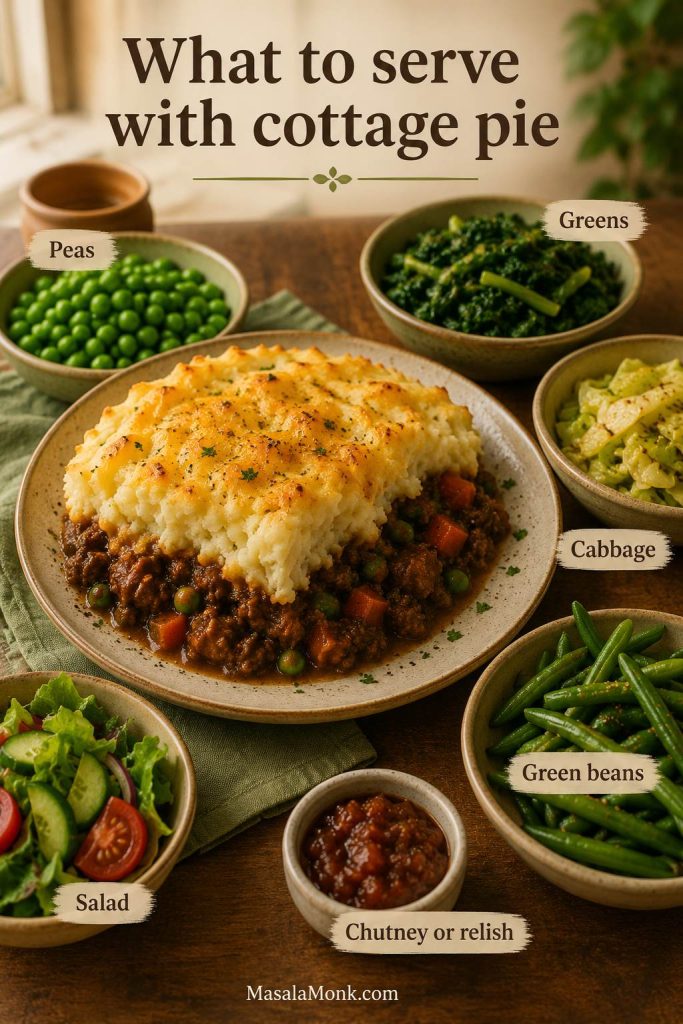
Pickled onions, chutney, or a spoonful of sharp relish also work well because they cut through the creamy mash and beef gravy. If the filling is a little looser and you are serving it more like a rustic cottage pie bowl, crusty bread is useful for catching the gravy.
It should feel generous rather than polished: creamy potato, glossy beef gravy, and enough structure to scoop without needing perfect slices.
Make Ahead, Storage, Freezing, and Reheating
Make Ahead and Freeze Slow Cooker Cottage Pie
The neatest make-ahead order is to prepare the beef filling first, chill it until it sets slightly, then top and finish later. Chilled filling is easier to cover neatly with mashed potato.
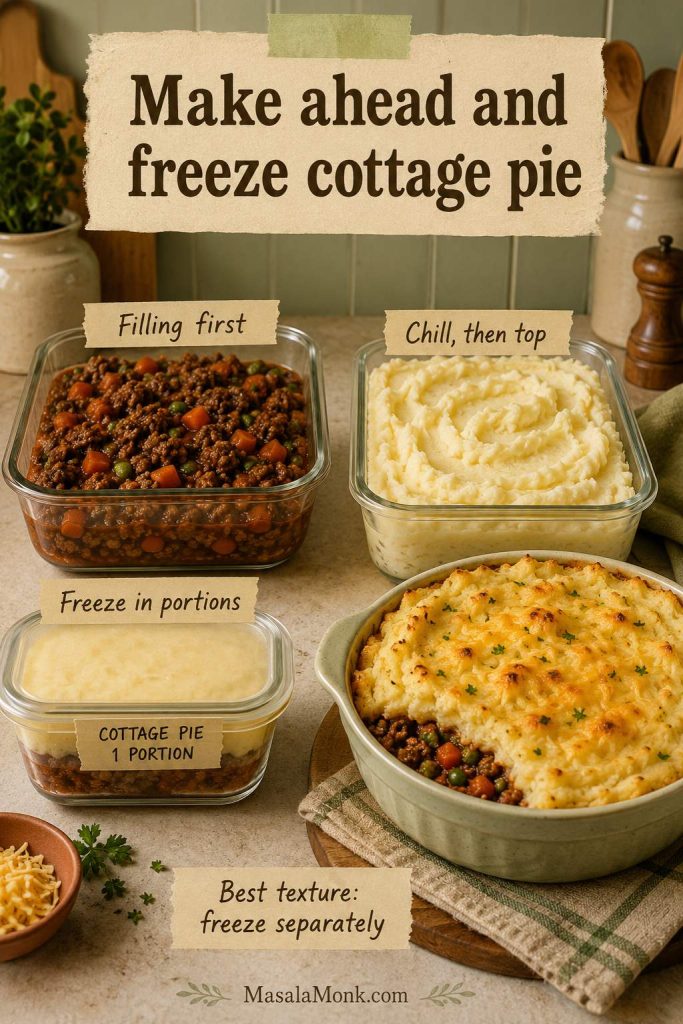
- Make the beef filling.
- Cool and refrigerate it in a covered container.
- Make the mash fresh, or use leftover mash.
- Reheat the filling until hot.
- Top with mash and finish in the slow cooker, oven, or under the grill/broiler.
Can you assemble the whole pie ahead?
Yes, you can assemble the whole pie ahead if the filling is cold and settled. Cover and refrigerate, then reheat until piping hot before serving. A fully assembled chilled pie reheats best in the oven or microwave; the slow cooker is better for keeping already-hot food warm than for reheating from fridge-cold.
Avoid putting a fridge-cold ceramic slow-cooker insert straight into a hot oven. Transfer the pie to an oven dish if you want an oven finish.
Fridge storage
Cool leftovers promptly, then store in an airtight container in the fridge for 3–4 days. Keep the pie covered so the mash does not dry out.
Freezing
For best texture, freeze the beef filling and mashed potato separately. You can freeze assembled cottage pie, but the potato topping may soften slightly after thawing. Freeze in meal-size portions so reheating is easier.
For another freezer-friendly slow-cooker dinner with clear cooker-size guidance, see our slow cooker pulled pork recipe.
How to Reheat Slow Cooker Cottage Pie
Reheat leftovers quickly in the microwave, oven, or on the hob until piping hot. Avoid using a slow cooker as the main method for reheating cold leftovers because it takes too long to move chilled food through the safe temperature range.
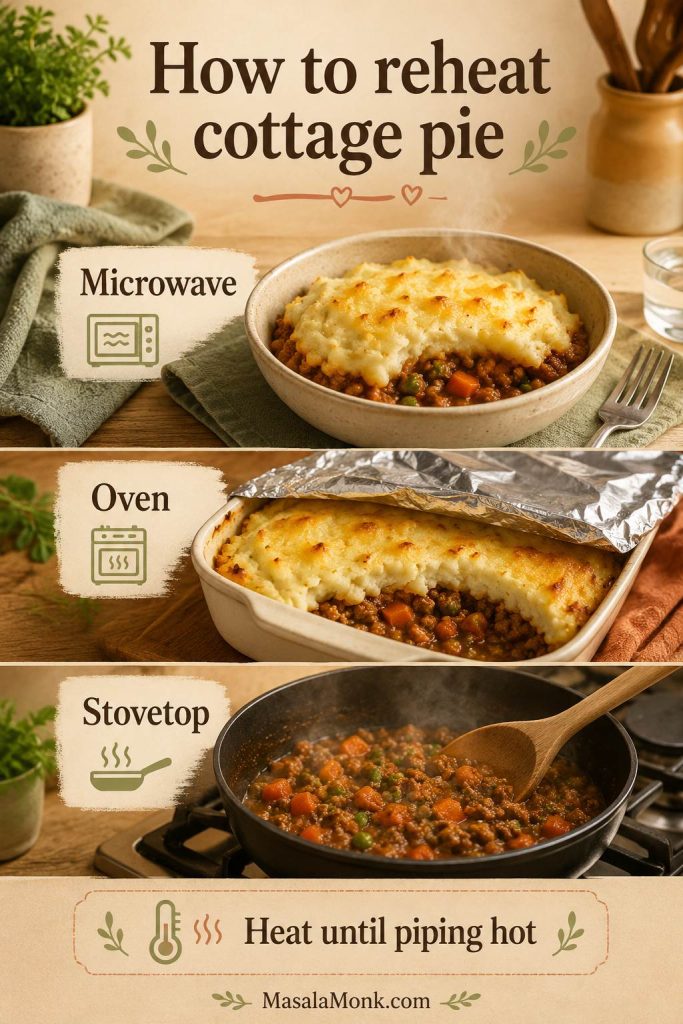
For reheating, the USDA safe temperature chart lists leftovers and casseroles at 165°F / 74°C: USDA safe temperature chart.
FAQs
Can I put raw mince in slow cooker cottage pie?
Yes, but treat it as the shortcut version, not the best-flavour version. Use fresh, fully thawed lean mince, reduce the stock, break the mince up well, and thicken the filling near the end. Browned mince still gives better flavour and lets you drain fat first.
Is slow cooker cottage pie dump-and-go?
It can be close, especially if you use raw thawed mince, frozen mixed vegetables, and prepared mash. However, the filling still needs one look near the end so you can thicken it before topping.
Should I add mash at the beginning or near the end?
Add the mash near the end. It gives you a chance to let the filling settle first, so the potatoes stay defined instead of softening into the gravy.
Why did my slow cooker cottage pie go watery?
The usual causes are too much stock, undrained mince fat, watery vegetables, or not enough thickening. The fix is usually simple: use less liquid than an oven cottage pie, then tighten the gravy before the mash goes on.
How do I stop mash sinking into cottage pie?
Use a beef filling that is saucy but not runny, mash that holds its shape, and a gentle topping method. Spoon the potatoes from the edges inward instead of dropping everything into the centre.
Can I use instant mash?
Yes. It is not the fanciest topping, but it is a useful weeknight shortcut if you make it thicker than the packet directions suggest. Let it stand for 5 minutes, then add it only after the filling has thickened.
Can I use gravy granules to thicken the filling?
Yes — they are a handy UK-style shortcut when the filling looks loose, but start small because gravy granules season as well as thicken. Use 1–2 teaspoons near the end, wait a few minutes, then taste before adding more.
Can I use a cottage pie packet mix?
Yes, but reduce the liquid slightly because the slow cooker will not evaporate it like an oven or hob. Taste before adding extra salt, and make sure the filling is settled and glossy before topping.
Can I make it with frozen mixed vegetables?
Yes, frozen mixed vegetables are fine, especially for a shortcut version, but they release water as they heat. Add them late or reduce the stock slightly so the filling holds together.
Can I make it ahead?
Yes. The easiest make-ahead path is filling first, then mash and finish later. If the pie is fully assembled and chilled, reheat it in the oven or microwave until piping hot rather than relying on the slow cooker from cold.
Can I freeze slow cooker cottage pie?
Yes. For the neatest texture, freeze the beef filling and mash separately. Assembled cottage pie also freezes, but the potato topping may soften a little after thawing.
How do I get a golden top?
Use a short grill, broiler, or oven finish after the filling is already hot. Fork ridges, a little butter, and optional cheddar help the top brown quickly, so you get colour without drying out the gravy underneath.
Once you understand the two big ideas — keep the filling glossy, not soupy, and keep the mash sturdy — slow cooker cottage pie becomes a forgiving dinner. Make it soft and simple in the slow cooker, or give it those golden fork ridges under the grill. Either way, it should land on the table as proper comfort.
Tried this with raw mince, instant mash, gravy granules, leftover mash, sliced potatoes, packet mix, or a grill finish? Leave a comment with your slow cooker size, liquid amount, and what you changed — it helps other readers choose the right version.








