Posted on Leave a comment

Spice Cake Recipe

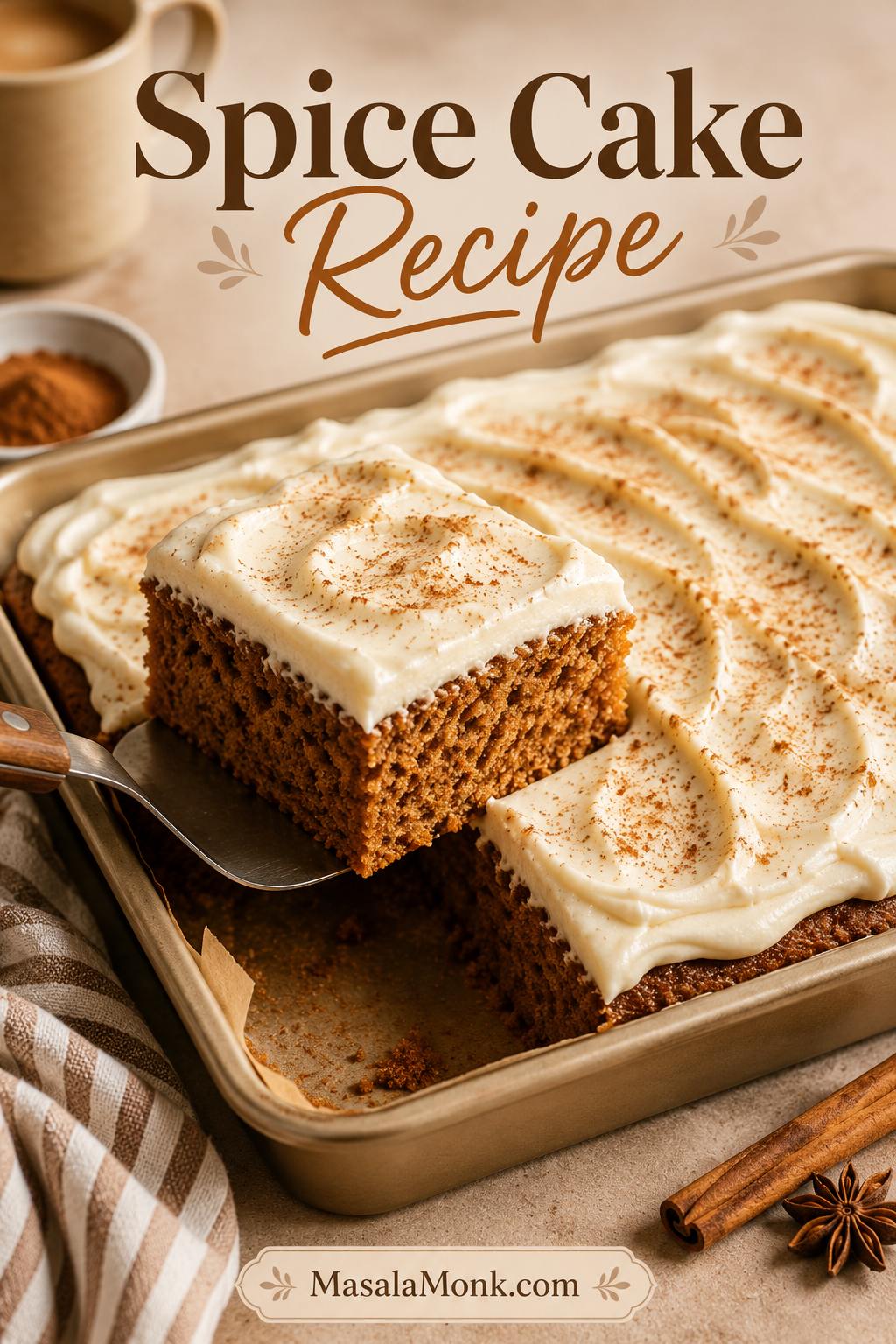
9x13 spice cake in a baking pan with cream cheese frosting and one square lifted out to show the brown crumb.

Spice cake should taste like cinnamon in the air, brown sugar in the crumb, and just enough ginger, nutmeg, allspice, and cloves to make the whole kitchen smell like something good is cooling on the counter. A good version is fragrant and tender, not dry, dusty, or vaguely cinnamon-flavored.

This spice cake recipe is a no-fuss 9×13 sheet cake designed around the two things that matter most: a tender brown-sugar crumb and cream cheese frosting that stays where you spread it. It is soft and fragrant the day you bake it, then deeper and more settled once the spices rest overnight.

It is made from scratch, but it does not ask for layer-cake precision. The batter comes together with two bowls, a whisk, and a spatula; the only mixer you need is for the frosting. Bake it in the pan, cool it fully, frost it generously, and cut it into spiced squares for coffee, potlucks, chilly afternoons, or a simple holiday dessert.

When you cut into it, the slice should be warmly brown, soft under the fork, and sturdy enough to hold a generous swipe of frosting. The cake should taste complete before anything goes on top; the cream cheese frosting is there to brighten it, not hide dryness.
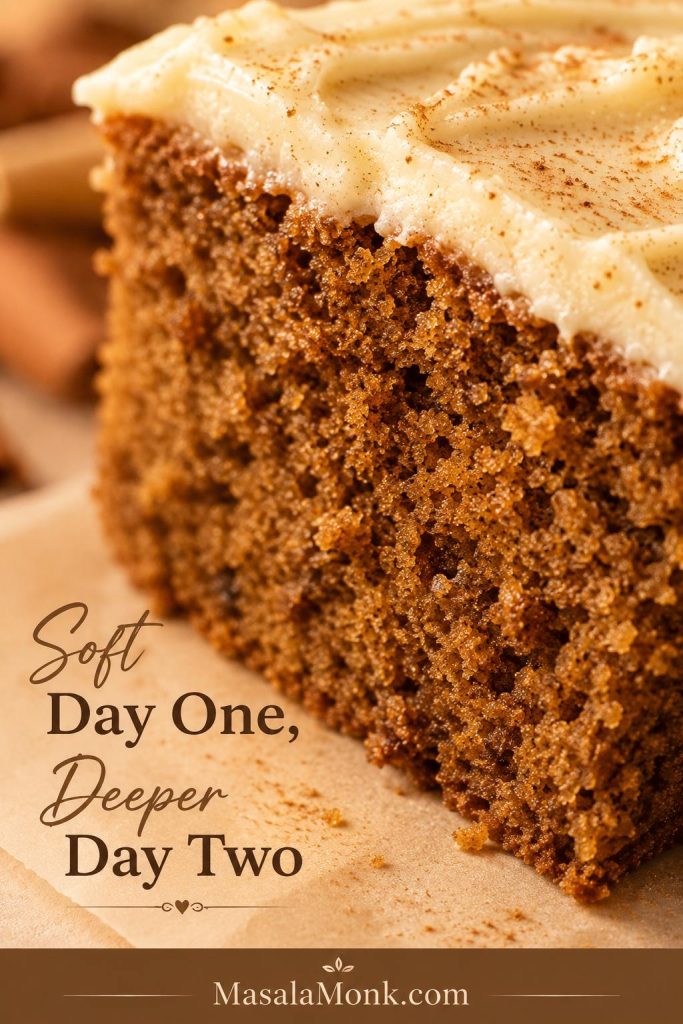
Close-up of a frosted spice cake square showing a moist brown crumb and cream cheese frosting on top.
Look for a tender, even crumb like this; a truly moist spice cake should hold together cleanly while still looking soft inside.

Quick Answer: What Is Spice Cake?

Spice cake is a brown-sugar cake flavored with baking spices such as cinnamon, ginger, nutmeg, allspice, and cloves. It is warmly spiced, not chili-hot. The “spice” comes from aromatic baking spices, not heat.

It is softer and sweeter than gingerbread, less fruit-forward than applesauce cake, and less chunky than carrot cake. The usual finish is cream cheese frosting because its tang cuts through the cinnamon-heavy crumb and brown sugar.

For the easiest homemade version, bake spice cake in a 9×13-inch metal pan at 350°F / 177°C. The slice should smell like cinnamon and ginger, cut cleanly, and hold the cream cheese frosting without feeling heavy. For the exact flavor balance, see the spice blend section.

Spice Cake at a Glance

Prep time20–25 minutes
Bake time35–40 minutes in a metal 9×13 pan; glass or ceramic may take longer
Cooling timeAt least 2 hours before frosting
Total timeAbout 3 hours, including cooling
Default pan9×13-inch baking pan
Oven350°F / 177°C
Yield12 large or 16 smaller slices
TextureSliceable, tender, fragrant
FinishCream cheese frosting

Why You’ll Love This 9×13 Spice Cake

  • Old-fashioned flavor comes through clearly. Cinnamon leads, but ginger, nutmeg, allspice, and cloves give every slice deeper fall-bakery flavor.
  • Real-life baking is the point. No stacked layers, no piping, no stand mixer for the cake — just a 9×13 pan and frosted squares you can serve straight from the pan.
  • Soft coffee slices still hold up for potlucks. Each square cuts cleanly, but still feels tender under the fork.
  • The cream cheese frosting makes it feel special. It adds cool tang, keeps the brown sugar in check, and turns a simple sheet cake into something holiday-table friendly.
  • Patience pays off. The same-day slice is soft and fragrant, but the next-day slice tastes deeper once the spices settle. For make-ahead timing, see the storage and freezing tips.

Same-Day Soft, Next-Day Deeper

This is the main make-ahead advantage of spice cake: the crumb stays soft while the cinnamon, ginger, nutmeg, and cloves taste more settled after a night of rest.
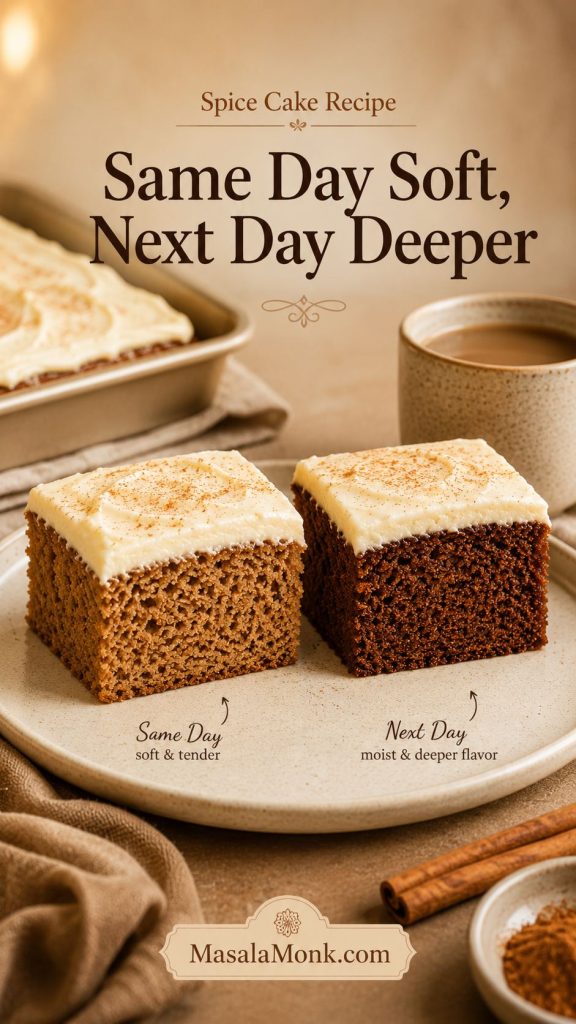
Two frosted spice cake squares on a plate labeled same day and next day, showing a lighter fresh slice and a darker settled slice.
Same day, the cake tastes soft and freshly spiced; by the next day, the cinnamon, ginger, nutmeg, and cloves settle into a deeper flavor.

What Is Spice Cake?

Spice cake is a cake where the main flavor comes from a baking-spice blend rather than chocolate, vanilla, fruit, or nuts. The batter usually includes brown sugar, a tenderizing ingredient such as buttermilk or sour cream, and enough fat to keep the cake enjoyable after it cools.

It belongs near gingerbread, carrot cake, pumpkin cake, and applesauce cake, but the point here is simpler: a spice-led crumb, not fruit, vegetables, heavy molasses, or pumpkin.

If you have ever wondered whether spice cake is just gingerbread, carrot cake without carrots, or applesauce cake without apples, this is the quick difference.

Spice cake guide with a frosted slice and smaller comparison sections for gingerbread, carrot cake, pumpkin cake, and applesauce cake.
Unlike carrot cake, pumpkin cake, or gingerbread, spice cake gets its main character from warm baking spices rather than one dominant fruit, vegetable, or molasses note.
CakeMain identityHow it differs from spice cake
Spice cakeBaking spicesSpice-led, usually with brown sugar and tangy frosting.
GingerbreadGinger and molassesDarker, sharper, and usually more molasses-heavy.
Carrot cakeGrated carrot and spiceOften includes carrots, nuts, raisins, pineapple, or coconut.
Applesauce cakeApple moisture and spiceSofter and more apple-led. For that direction, see our applesauce cake recipe.
Pumpkin spice cakePumpkin purée and spiceWetter, denser, and more seasonal because pumpkin changes the batter.
Chai cakeTea, cardamom, and chai spicesBetter baked as a separate chai cake, where the tea and cardamom can lead properly.

The best version does not taste like a spice cabinet. It tastes like brown sugar, warmth, and a soft square you want with coffee.

The Best Spice Blend for This Cake

The best spice cake blend is cinnamon, ginger, nutmeg, allspice, and a small amount of cloves. Cinnamon should lead; cloves should stay in the background.

Cinnamon gives the familiar warmth, but ginger, nutmeg, allspice, and cloves make the flavor deeper and more complete. Without those supporting spices, the cake can smell good in the oven but taste a little flat once sliced.
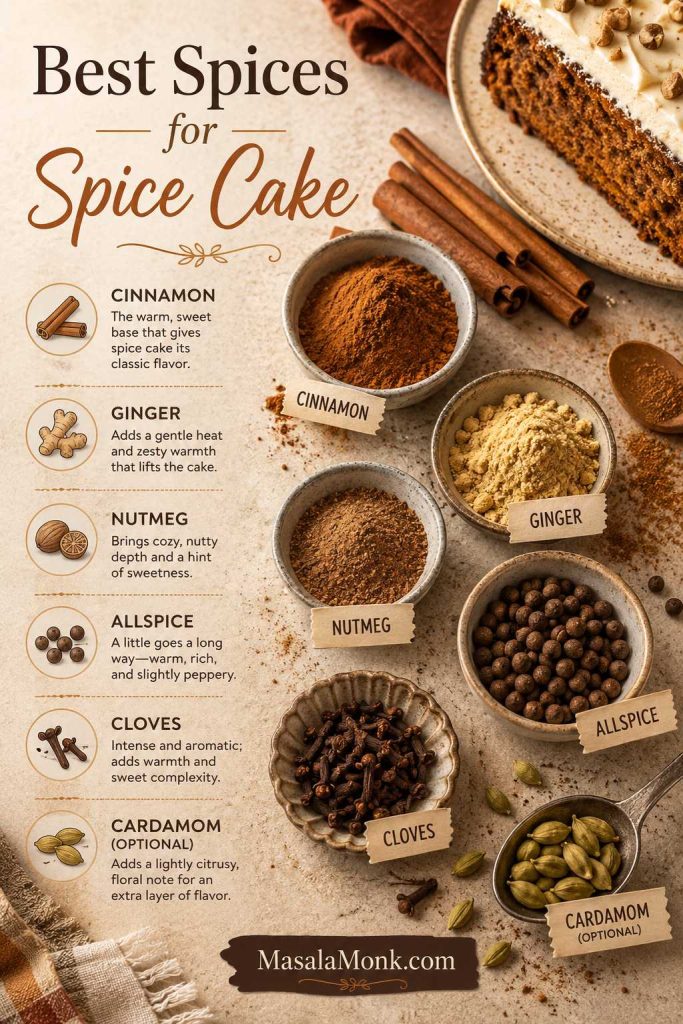
Spice blend guide with labeled bowls of cinnamon, ginger, nutmeg, allspice, cloves, and cardamom for spice cake.
Cinnamon should lead the spice blend, while ginger, nutmeg, allspice, cloves, and optional cardamom add warmth, depth, and balance.
SpiceWhat it addsHow strong to go
CinnamonThe familiar warm base.Use the most of this.
GingerBrightness and gentle heat.Enough to notice, not enough to become gingerbread.
NutmegRounded bakery-style flavor.Use lightly; too much can taste perfumed.
AllspiceDepth and an old-fashioned note.A little makes the cake taste fuller.
ClovesDeep background warmth.Use sparingly because it is powerful.
Cardamom, optionalFragrance and lift.Use lightly so the cake still tastes familiar.

That balance is what makes the cake smell cozy in the oven but still taste rounded once it cools. Allspice is not a spice blend; it is a single spice with a flavor that hints at cinnamon, clove, and nutmeg, so let it support the blend rather than dominate it.

Can you use pumpkin pie spice? Pumpkin pie spice works as a shortcut, though the flavor depends on the blend. For a homemade blend, see our pumpkin pie spice guide.

Why This Cake Stays Moist

The goal is a cake that still tastes good after it cools — and, ideally, tastes even more settled the next day. This version uses oil for lasting softness, a little butter for flavor, applesauce for moisture, and buttermilk for tenderness.

Why both oil and butter? A butter-only cake has wonderful aroma when warm, but it can firm up more after cooling. An oil-only cake stays softer, but it can taste flatter. Using both gives the cake a round old-fashioned flavor while keeping the inside from turning tight.

Applesauce and buttermilk support that texture without turning the cake into applesauce cake or a tangy yogurt cake. This is also why the base does not use shredded apple: the cake stays spice-led, while the applesauce quietly helps with moisture. Together, the ingredients create brown-sugar depth without gingerbread heaviness, and a slice that stays clean rather than greasy or gummy.
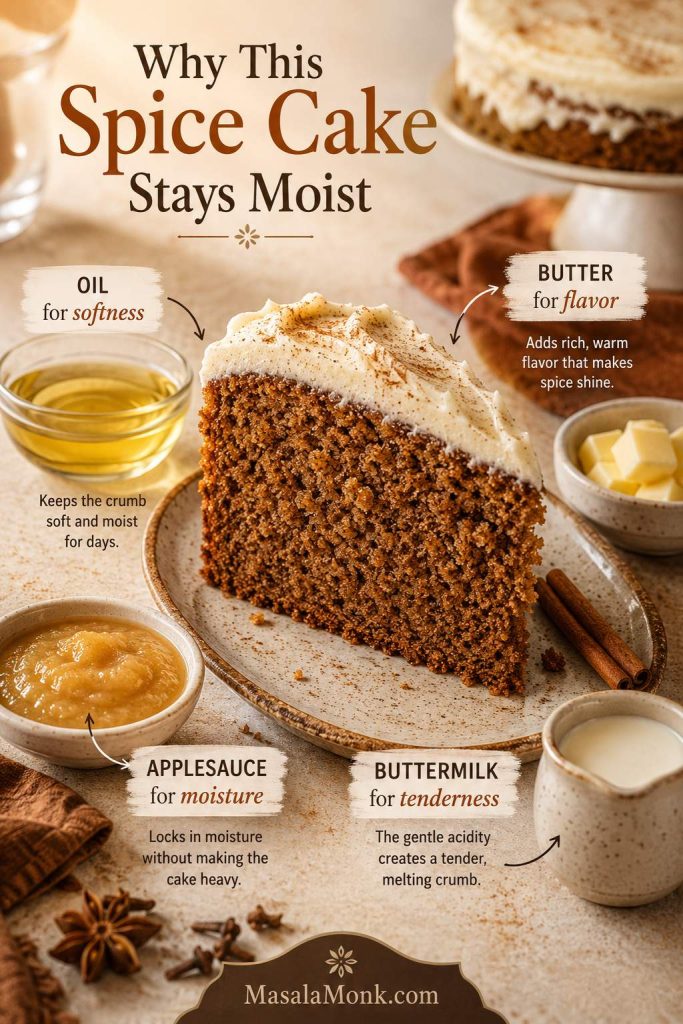
Moisture guide showing a frosted spice cake square with oil, butter, applesauce, and buttermilk callouts around it.
Instead of depending on one “secret” ingredient, this moist spice cake uses oil for softness, butter for flavor, applesauce for moisture, and buttermilk for tenderness.
IngredientWhy it matters
OilKeeps the cake softer after cooling.
ButterAdds old-fashioned flavor and aroma.
ApplesauceSupports moisture without making the cake apple-led.
ButtermilkBalances sweetness and keeps the texture tender.
Brown sugarAdds depth and a mild molasses note.
Cream cheese frostingAdds tang so the cake tastes rich but not cloying.

What Each Ingredient Does in This Spice Cake

The recipe works because the ingredients have different jobs. Keep the measurements steady, especially flour and wet ingredients, and the cake will be much easier to bake well. Once these pieces are balanced, the cake tastes like more than cinnamon — it has brown-sugar depth, spice warmth, and enough softness to still be good after cooling.
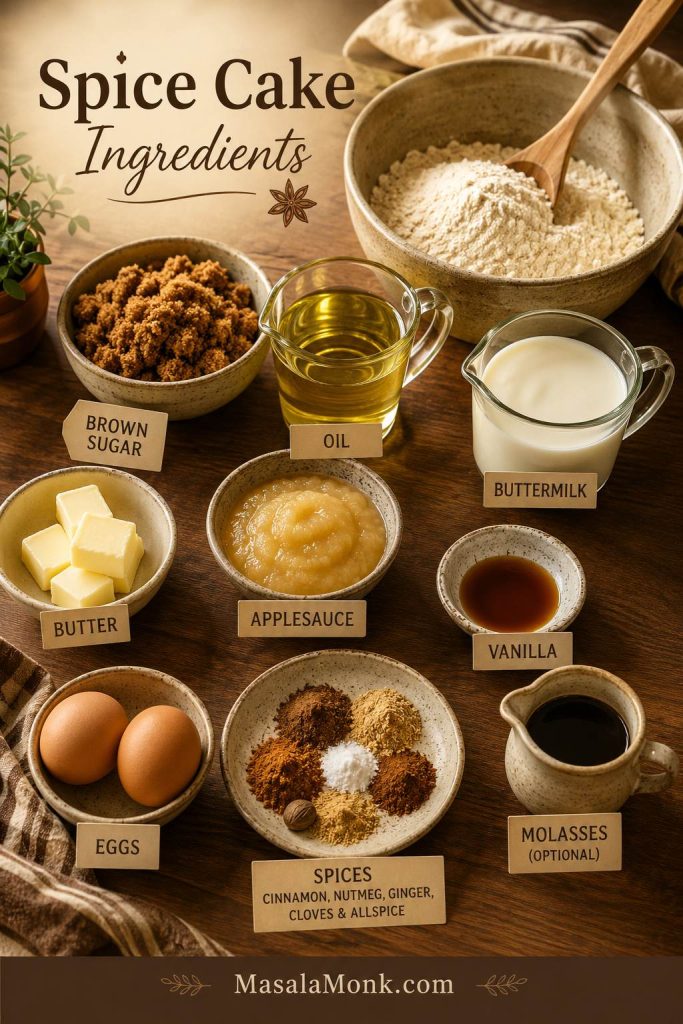
Labeled spice cake ingredients including flour, brown sugar, oil, butter, applesauce, buttermilk, eggs, vanilla, molasses, and spices.
The best spice cake ingredients work as a team: brown sugar deepens flavor, warm spices define the cake, and the wet ingredients keep the crumb soft.

For the Cake

All-purpose flour: Measure by weight if possible. Too much flour is one of the fastest ways to make a dry cake, and measuring flour by weight is the most reliable option. If using cups, spoon flour into the cup and level it instead of scooping directly from the bag.

Baking powder and baking soda: They give lift while working with the acidity in the buttermilk, applesauce, and brown sugar. Make sure both are fresh.

Salt, vanilla, and spices: Salt sharpens the brown sugar, vanilla rounds the flavor, and the spice blend gives the cake its identity.

Brown sugar: Light brown sugar keeps the flavor milder. Dark brown sugar gives a deeper molasses note. Either works, but pack it firmly when measuring by cup.

Oil and melted butter: Oil helps after cooling; butter adds flavor. Let the melted butter cool slightly before mixing so it does not warm the eggs.

Applesauce, buttermilk, and eggs: Applesauce helps the cake stay soft, buttermilk keeps it from tasting flat, and eggs help it rise and slice cleanly. Use them close to room temperature when possible so the batter blends smoothly.

Molasses, optional: A tablespoon of molasses makes the cake darker and the flavor deeper. Keep the rest of the wet ingredients as written if you use it.

Batter cue: The batter should be thick but pourable, glossy, and lightly speckled with spices. A few tiny applesauce flecks are fine. Stop when the flour disappears; this batter is meant to stay thick and glossy, not whipped.

For the Cream Cheese Frosting

Block cream cheese: Use full-fat block cream cheese, not spreadable tub cream cheese. Tub cream cheese often makes frosting loose and runny.

Butter and powdered sugar: The butter should be softened but not greasy. Start with the lower amount of powdered sugar for a softer frosting, then add more only if you need it firmer.

Vanilla, salt, and optional lemon juice: Vanilla adds warmth, salt keeps the frosting from tasting flat, and a little lemon juice brightens the cream cheese tang.

How to Bake It Without Drying It Out

The batter is supposed to be thick, not airy. The cake is supposed to come out with moist crumbs, not a bone-dry tester. And the frosting only spreads cleanly if the cake is fully cool.

Do not worry if the batter looks thicker than vanilla cake batter; that is normal here. You do not need a stand mixer for the cake itself. A whisk, a spatula, and two bowls are enough; save the hand mixer for the frosting.
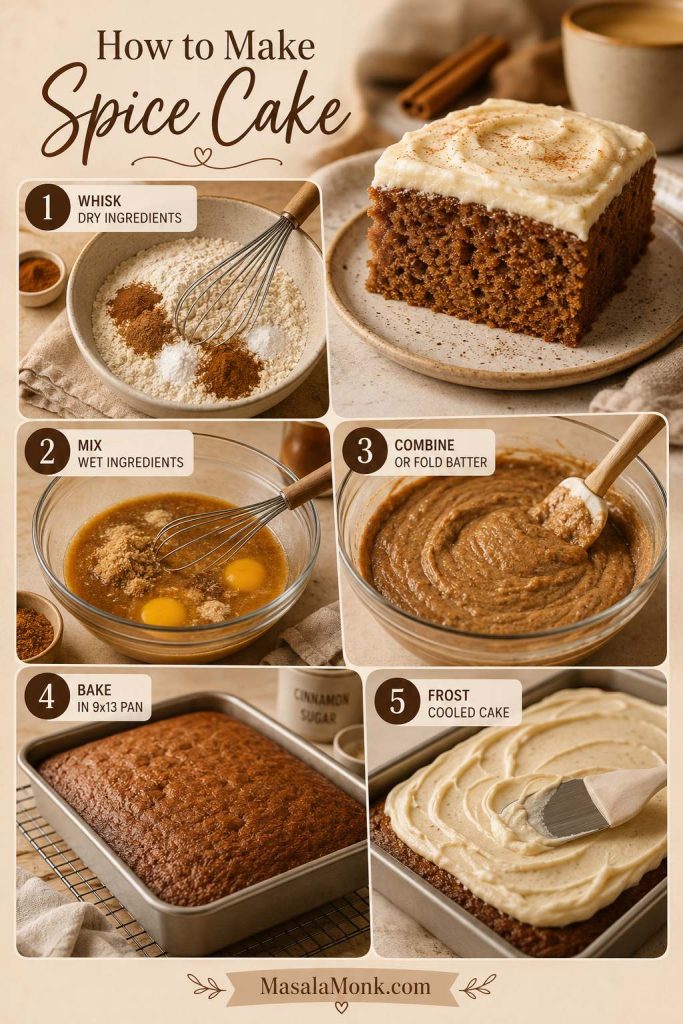
Step-by-step spice cake guide showing dry ingredients, wet ingredients, batter, baked 9x13 cake, and frosting being spread.
Because this is a simple two-bowl spice cake, the biggest wins are mixing gently, spreading the batter evenly, and waiting until the cake is cool before frosting.

1. Prepare the Pan So the Cake Releases Cleanly

Heat the oven to 350°F / 177°C. Grease a 9×13-inch baking pan. A metal pan usually bakes most evenly. For easier lifting and cleaner slices, line the pan with parchment paper, leaving a little overhang on two sides. If you plan to serve the cake directly from the pan, parchment is optional.

2. Whisk the Spices Evenly Into the Flour

In a large bowl, whisk the flour, baking powder, baking soda, salt, cinnamon, ginger, nutmeg, allspice, cloves, and optional cardamom. The dry mix should look evenly tan from the spices. Take a few extra seconds here; evenly mixed spices mean every slice tastes balanced instead of giving you one bland bite and one clove-heavy bite.

3. Mix the Wet Ingredients Until Glossy

In another bowl, whisk the brown sugar, oil, melted butter, applesauce, buttermilk, eggs, vanilla, and optional molasses until smooth. The wet mix should look glossy. The melted butter should be slightly cooled, and the eggs, applesauce, and buttermilk should not be fridge-cold. If the butter forms tiny bits, the cake will usually still bake, but the batter mixes more evenly when the ingredients are closer in temperature.

4. Fold Gently So the Cake Stays Tender

Pour the wet mixture into the dry ingredients. Fold with a spatula or whisk gently until no dry flour pockets remain. The batter should look thick, glossy, and pourable. Once no flour streaks remain, you have done enough; next, use the doneness cues instead of overbaking for a dry tester.
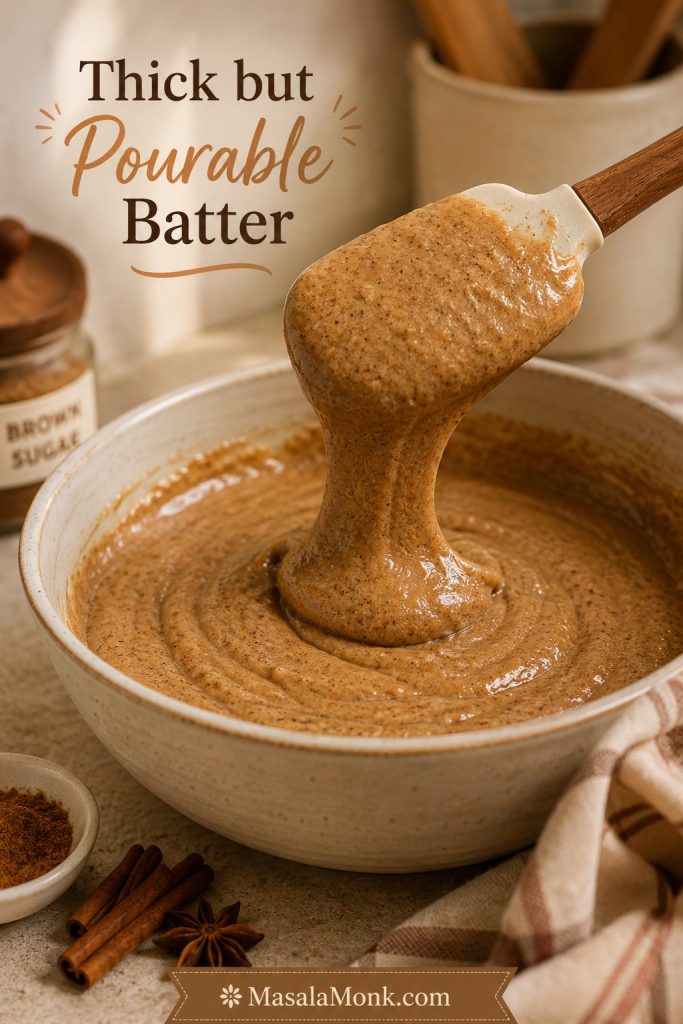
Spice cake batter lifting from a spatula over a mixing bowl, showing a thick glossy pourable texture.
Once the batter looks thick, glossy, and pourable, stop mixing; continuing too long can make the finished spice cake dense.

5. Bake Until the Center Is Set but Still Moist

Spread the batter into the prepared pan and smooth the top. Bake for 35–40 minutes in a metal pan, checking near the 33-minute mark. Glass or ceramic pans may take a little longer. This is the point where the kitchen starts smelling better than the effort you put in, but trust the center of the cake more than the edges.

The cake is done when the center springs back lightly, the edges are just beginning to pull from the pan, and a toothpick inserted into the middle comes out with a few moist crumbs.

Look for moist crumbs, not a dry tester. A few crumbs mean the cake will stay softer once it cools.
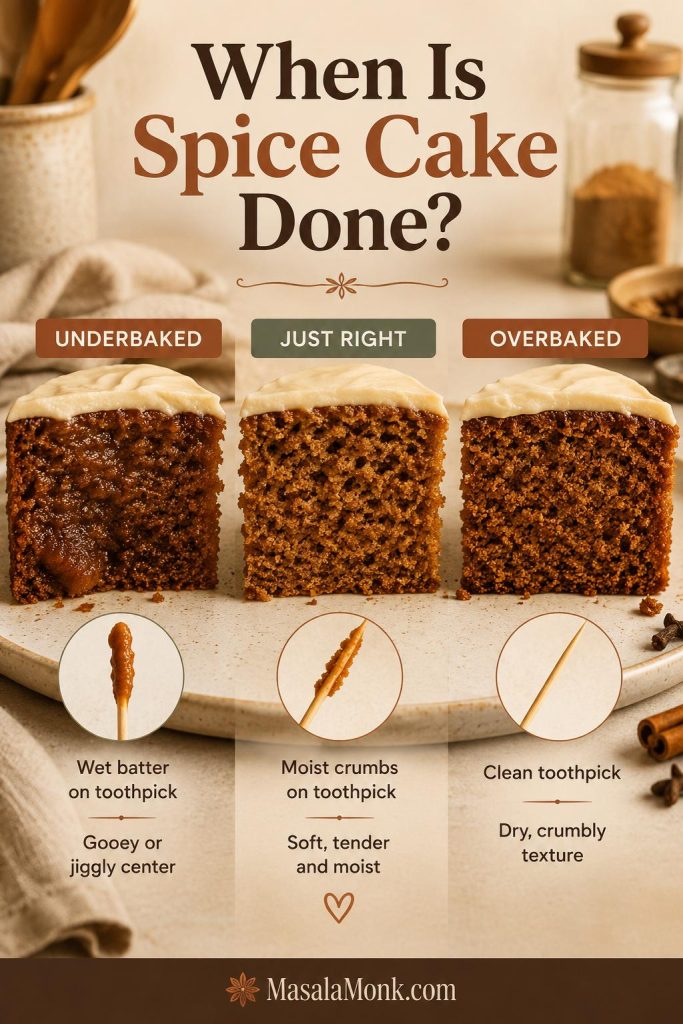
Doneness guide comparing underbaked, just-right, and overbaked spice cake pieces with toothpick crumb examples.
A few moist crumbs on the toothpick are ideal; however, waiting for a completely dry tester can push spice cake toward overbaked.

6. Cool Fully Before Frosting

Let the cake cool in the pan. For a 9×13 cake, plan on at least 2 hours of cooling before frosting. The center should feel room temperature, not just the surface. The wait feels annoying, but it keeps the cream cheese frosting smooth instead of melty.
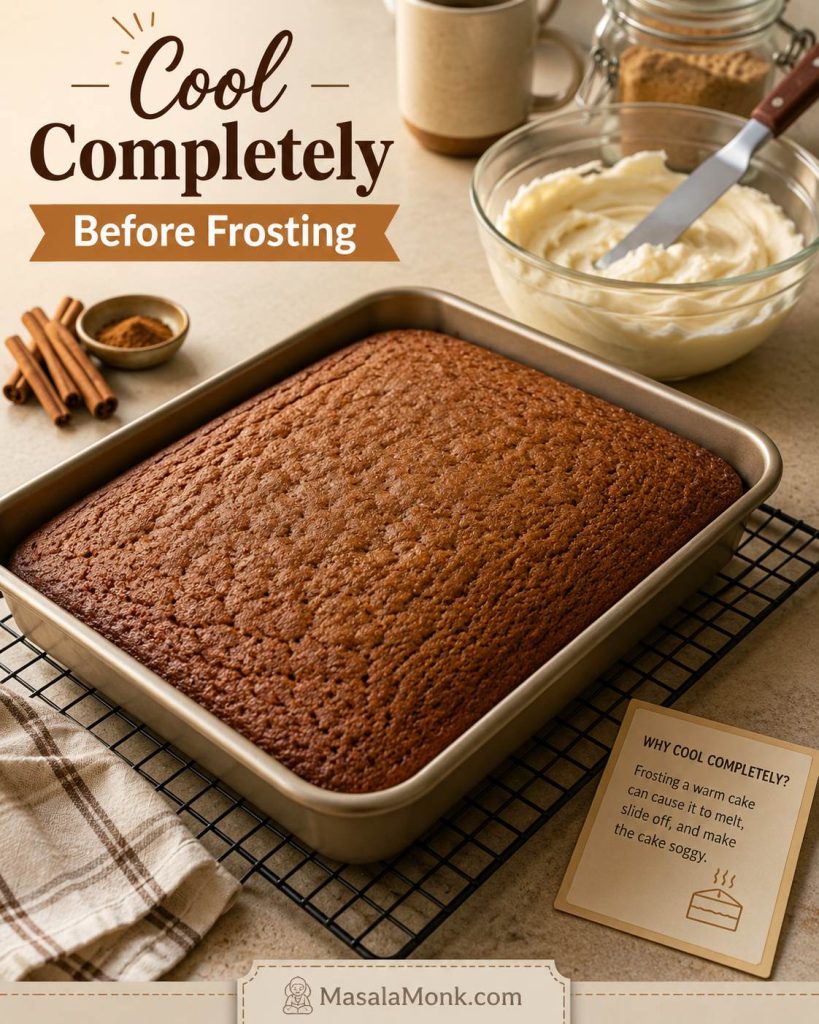
Unfrosted spice cake cooling in a 9x13 pan on a wire rack with a bowl of frosting and spatula nearby.
Before adding cream cheese frosting, let the 9×13 spice cake cool completely so the frosting stays smooth, thick, and spreadable instead of melting into the crumb.

7. Frost and Slice

Spread the frosting over the cooled cake. It should hold soft swoops without running. For clean slices, chill the cake for 20–30 minutes before cutting. For the best eating texture, let refrigerated slices sit briefly at room temperature before serving.

Cream Cheese Frosting for Spice Cake

Cream cheese frosting is the classic finish because it adds tang, not just sweetness. It cuts through the brown sugar and spice so the cake tastes rich without feeling heavy.
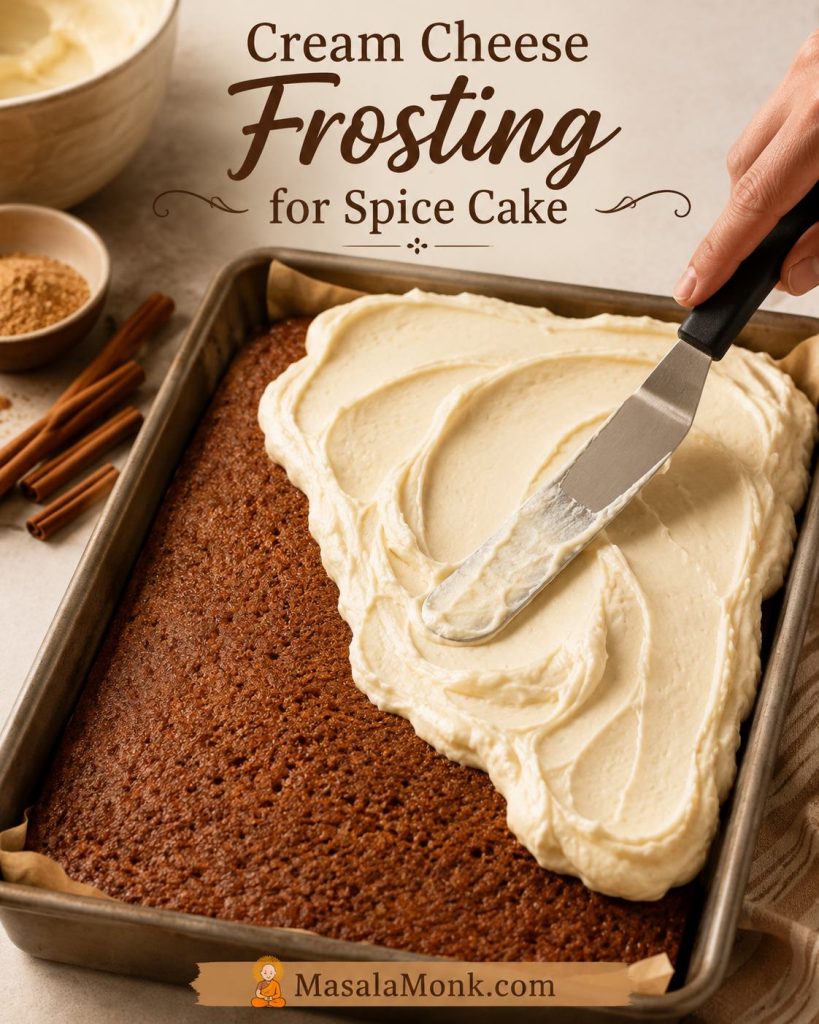
Cream cheese frosting being spread with an offset spatula over a cooled spice cake in a rectangular pan.
Cream cheese frosting works especially well here because its cool tang balances brown sugar, cinnamon, ginger, and cloves without making the cake too sweet.

The best bite is warm spice first, then brown sugar, then that cool cream-cheese tang at the end. For a 9×13 cake, you only need a generous spreadable layer. Brown butter cream cheese frosting makes it more special, caramel leans sweeter and richer, maple gives it an old-fashioned fall flavor, and a simple vanilla glaze works better for Bundt or loaf cake. For a tea-cake finish, skip the frosting and dust the top with powdered sugar.

Want the special-occasion version? Brown the butter, cool it until soft but not melted, then use it in the frosting for a deeper, nutty finish.

If you want a non-cream-cheese option for cupcakes or a sweeter celebration-style finish, our buttercream frosting recipe is the better direction.

How to Keep the Frosting Smooth

  • Use full-fat block cream cheese, not tub cream cheese.
  • Soften the cream cheese and butter, but keep them cool enough that they are not shiny or greasy.
  • Beat the cream cheese first until smooth, then add the butter and beat again.
  • Add powdered sugar gradually. Start with 2½ cups for a softer frosting; add more if you need it firmer.
  • Add a pinch of salt and a little lemon juice to balance sweetness.
  • If the frosting becomes too soft, chill it for 15–20 minutes, then beat briefly again.
  • Make sure the cake is fully cool before spreading it on top. If it still turns loose, use the troubleshooting fixes.
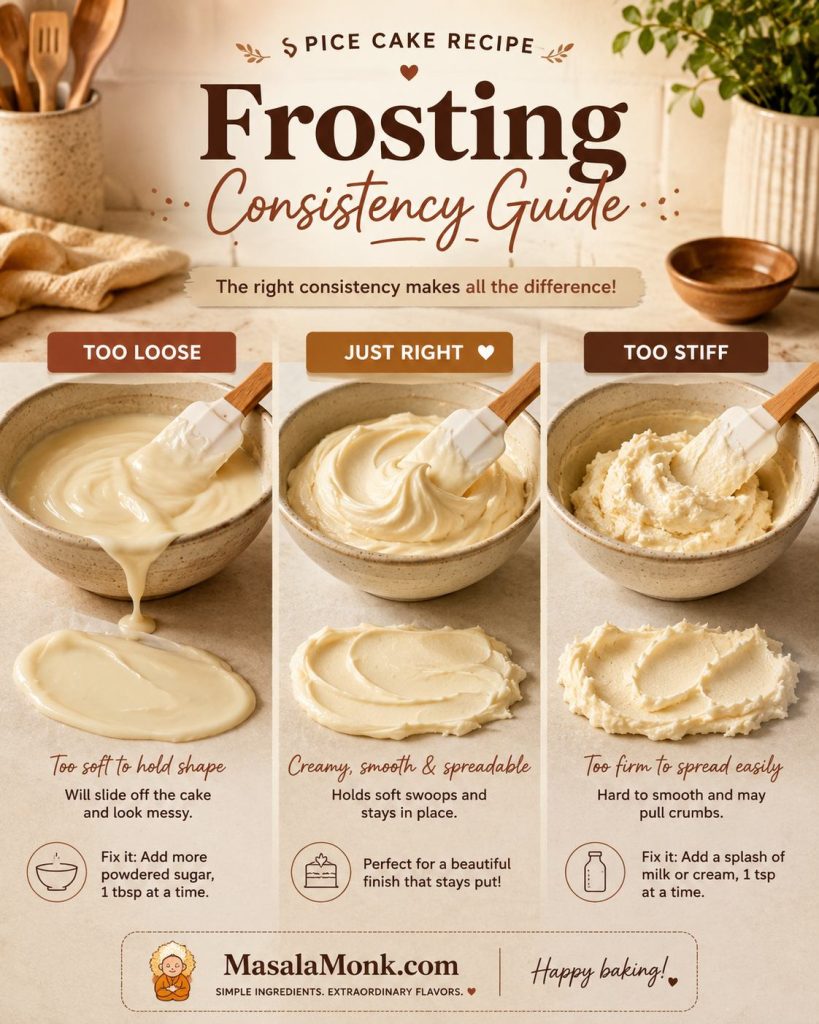
Frosting consistency guide with three bowls showing too loose, just right, and too stiff cream cheese frosting textures.
If frosting is too loose, it slides; if it is too stiff, it pulls crumbs, so aim for a creamy texture that holds soft swoops.

Pan Sizes: 9×13, Layers, Bundt, Loaf, and Cupcakes

This recipe is written first as a 9×13 sheet cake; the layer, Bundt, loaf, and cupcake notes are adaptations, not the main promise.

A 9×13 sheet cake is the easiest version, but the same flavor can work in other formats if you watch the fill level and start checking early. If you are baking for a potluck, stay with the 9×13. It is the least fussy version and the one most likely to disappear square by square.
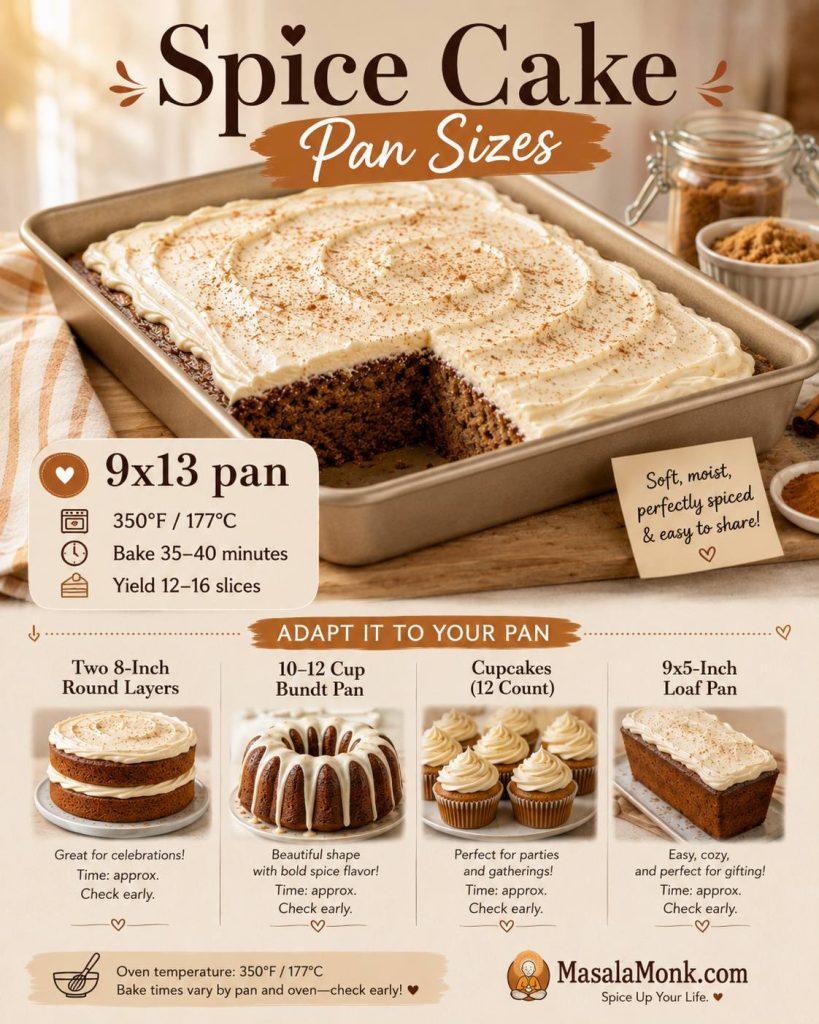
Pan size guide with a large 9x13 spice cake and smaller examples of round layers, Bundt cake, cupcakes, and loaf cake.
The 9×13 pan gives the easiest spice cake slices; however, the batter can also work in layers, Bundt pans, cupcakes, or a loaf when you adjust carefully.

Spice Cake Baking Times by Pan

FormatPanOvenApprox. bake timeNotes
Sheet cake9×13-inch metal pan350°F / 177°C35–40 minEasiest default. Glass or ceramic may take longer.
Layer cakeTwo 9-inch rounds350°F / 177°C26–32 minLine pans with parchment; make extra frosting.
Layer cakeTwo 8-inch rounds350°F / 177°C32–38 minLayers will be deeper, so check centers carefully.
Bundt cake10–12 cup Bundt pan350°F / 177°C50–65 minFill no more than two-thirds to three-quarters full.
CupcakesStandard muffin tin350°F / 177°C18–21 minFill cups about two-thirds full.
Loaf cake9×5-inch loaf pan, filled no more than two-thirds full350°F / 177°C48–55 minThis full recipe makes more batter than one loaf, so bake extra batter as cupcakes or use a second loaf pan.

Use the times as starting points, not promises. The cake is ready when the center springs back and a toothpick shows moist crumbs.

Bundt Cake Release Tip

Bundt cake tip: Use baking spray with flour, or brush the pan with softened butter and dust it with flour. Get into every groove. Let the baked cake rest in the pan for 10–15 minutes before turning it out.

How to Make Boxed Spice Cake Mix Taste Homemade

Boxed spice cake mix can work when time is short. Use milk instead of water, add ½ cup sour cream or applesauce, boost the spices, and finish with homemade cream cheese frosting. For the from-scratch version, jump to the full recipe card.

Boxed spice cake mix upgrade guide with milk, sour cream or applesauce, extra spices, and cream cheese frosting suggestions.
For a shortcut version, boxed spice cake mix tastes more homemade when you use dairy, boost the warm spices, and finish with real cream cheese frosting.
Replace or addHow muchWhy it helps
Milk instead of waterUse the same amount listed on the boxGives richer flavor.
Sour cream, yogurt, or applesauceUp to ½ cupHelps the cake taste less box-mix dry.
Cinnamon + ginger½ tsp cinnamon + ¼ tsp gingerWarms up a mild spice mix.
Homemade cream cheese frostingUse the frosting from this recipeThe biggest upgrade for flavor and texture.

Keep the upgrades modest. Too much extra moisture can make the center heavy, especially if you also add pumpkin or fruit. The from-scratch cake is still the better version when flavor and texture matter; the boxed version is the quick shortcut.

Variations: Apple, Molasses, Nuts, Raisins, Chai, and More

Choose the version based on the slice you want: classic and cozy, deeper with molasses, fruitier with apple, or nutty with a little crunch. The cake stays most reliable when you change one major thing at a time; if you add fruit or extra moisture, keep the gummy-center fixes in mind.
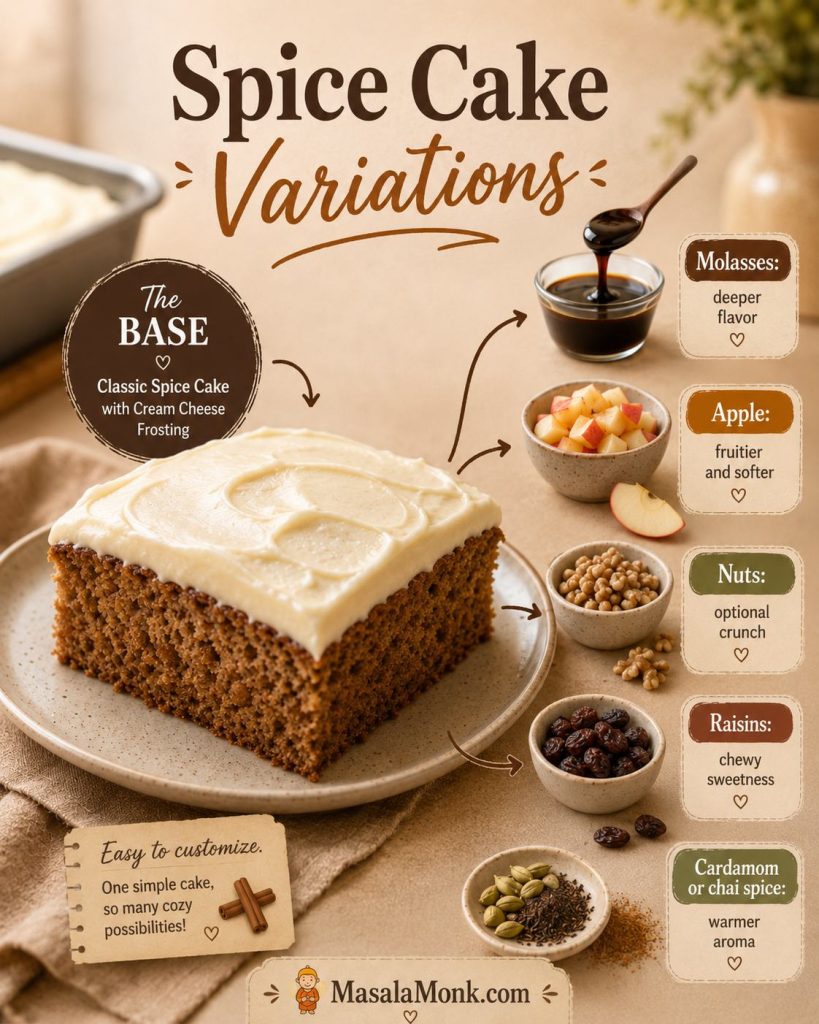
Spice cake variations guide with a plain frosted cake square and optional molasses, apple, nuts, raisins, and cardamom or chai spice cues.
Start with the plain frosted base cake, then choose one variation if you want deeper molasses flavor, fruitier apple notes, optional crunch, raisins, or warmer aroma.
VariationAmountKeep in mind
Molasses1 tablespoonToo much pushes the cake toward gingerbread.
Chopped apple1 cup, finely choppedMore can make the center gummy.
Nuts¾ cupToast and cool first for better flavor.
Raisins½–¾ cupSoak if dry, then drain and pat dry.
Cardamom¼ teaspoonToo much can taste perfume-like.

Molasses gives the deepest old-fashioned version, chopped apple makes the cake softer and fruitier, and toasted nuts are the easiest way to add contrast without changing the batter much. These are small changes, not a second recipe; the safest upgrades are the ones that add flavor without shifting the batter’s moisture too far.

For a chai-style direction, add the cardamom and a tiny pinch of black pepper. If you want tea-forward flavor, that becomes a separate chai cake rather than classic spice cake.

Gluten-Free and Eggless Notes

A good 1:1 gluten-free baking flour may work, especially if it contains xanthan gum, but expect a slightly more fragile cake and let it cool fully before slicing.

I would not make this exact batter eggless by simply removing the eggs. For best results, use an eggless spice cake formula designed around yogurt, vinegar and baking soda balance, or another tested binder.

What to Serve with Spice Cake

For a coffee slice, serve the cake plain with its cream cheese frosting and a hot cup of coffee or black tea. For a holiday dessert, add brown butter frosting, toasted pecans, or a light caramel drizzle. If you are taking it to a potluck, keep it in the 9×13 pan, chill until the top sets, and slice before serving.
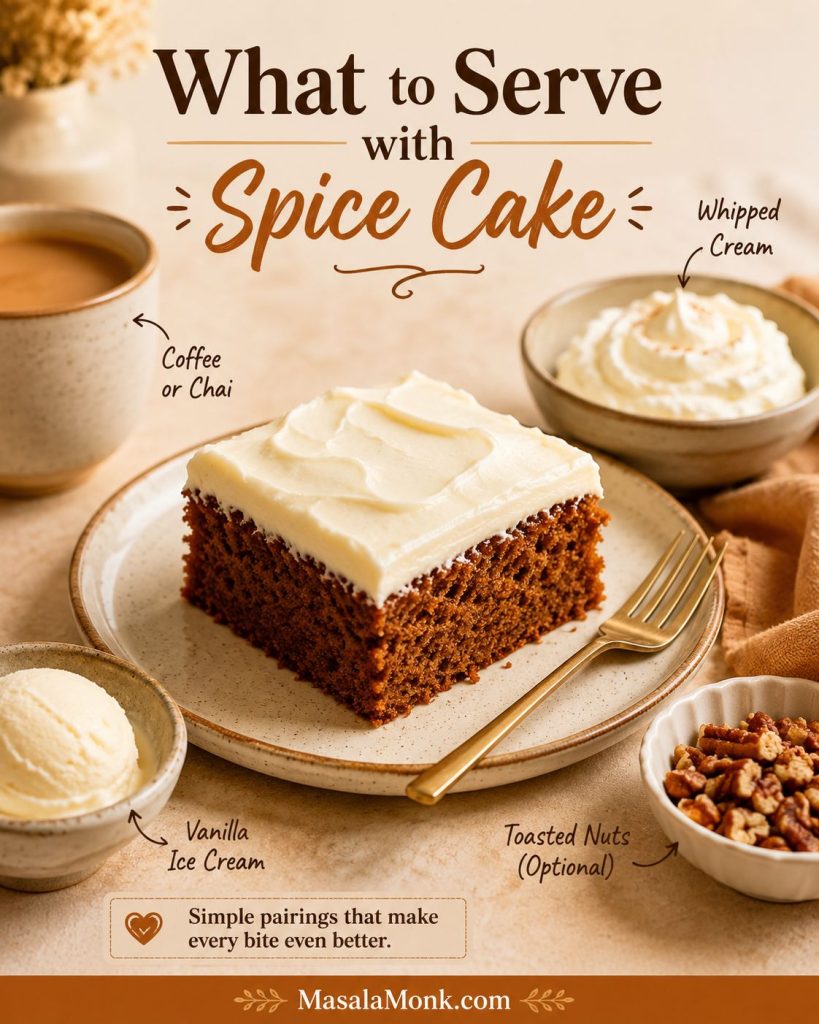
Frosted spice cake square on a plate with coffee or chai, whipped cream, vanilla ice cream, and optional toasted nuts nearby.
To make a simple slice feel dessert-ready, serve spice cake with coffee, chai, whipped cream, vanilla ice cream, or optional toasted nuts on the side.

That is the sweet spot of this cake: casual enough for a weekday coffee slice, but dressed up enough once the cream cheese frosting goes on.

For a lighter finish, skip the frosting and serve the cake with homemade whipped cream or powdered sugar. For a fall dinner, a scoop of vanilla ice cream or a spoon of warm apple compote makes it feel more like dessert without much extra work.

Storage, Freezing, and Make-Ahead Tips

This is a good make-ahead dessert because the spices settle and deepen after a few hours. The next-day slice, cold from the fridge for a few minutes and then softened on the plate, is one of the quiet pleasures of this cake.

Cream-cheese-frosted spice cake should be refrigerated within 2 hours and stored covered for 3–4 days. Refrigerate it sooner if your kitchen is hot. For general food-storage safety, see the FDA’s food storage guidance.
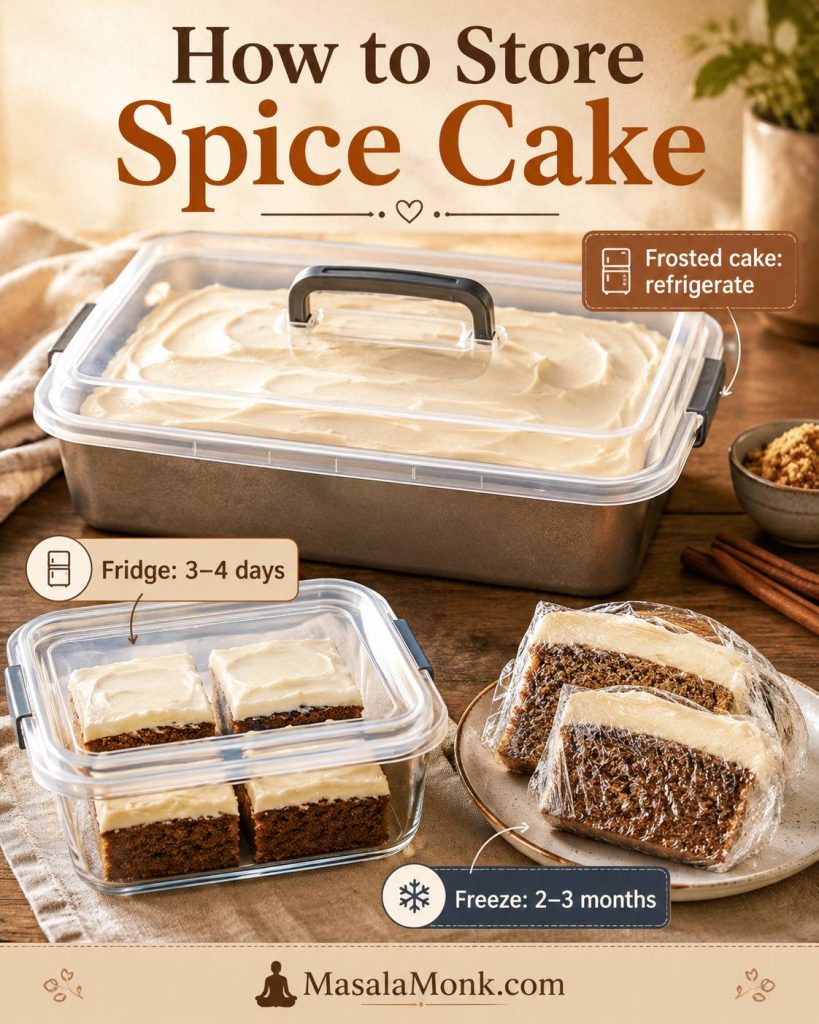
Storage guide showing frosted spice cake in a covered pan, slices in an airtight container, and wrapped slices for freezing.
Because the cake has cream cheese frosting, refrigerate frosted slices; for longer storage, wrap individual pieces well before freezing.
SituationBest method
Unfrosted cakeWrap tightly and keep at room temperature for 1–2 days.
Frosted cakeCover tightly or store in an airtight container and refrigerate for 3–4 days.
Make aheadBake one day ahead, cool completely, cover, and frost before serving or the next day.
Freezing unfrosted cakeWrap tightly and freeze for up to 2–3 months.
Freezing frosted slicesFreeze uncovered until firm, then wrap tightly. Thaw in the refrigerator; frosting texture may soften slightly.
Serving from fridgeLet slices sit briefly at room temperature so the cake and frosting soften.

Troubleshooting Dry, Dense, Gummy, or Sunken Cake

Most baking mistakes are not disasters; they are clues. If something went wrong, start with what you can fix now, then adjust the next bake.

Cake Texture Problems

Dry, dense, gummy, oily, or sunken spice cake usually comes back to flour measurement, mixing, bake time, pan choice, or add-ins. Use this table to rescue the current cake and improve the next one.
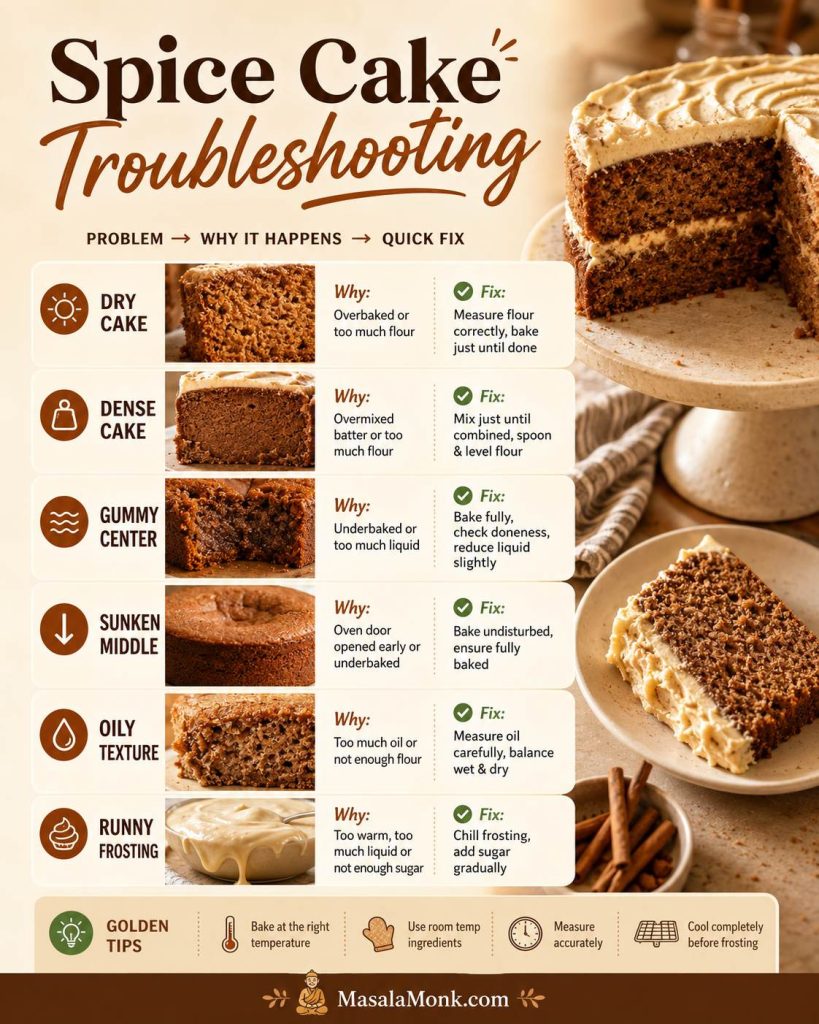
Troubleshooting guide listing dry cake, dense cake, gummy center, sunken middle, oily texture, and runny frosting with quick fixes.
When spice cake turns dry, dense, gummy, oily, sunken, or messy, the cause usually comes back to baking time, mixing, measuring, or frosting temperature.
ProblemFix nowFix next time
Dry cakeServe with extra frosting, whipped cream, caramel, or warm apple compote.Measure flour by weight and pull the cake when the toothpick has moist crumbs.
Dense or heavy cakeLet slices come to room temperature and serve with coffee, whipped cream, or a lighter topping so the cake feels less heavy.Stop when no flour streaks remain; use room-temperature wet ingredients.
Gummy centerIf unfrosted and still warm, return it to the oven loosely covered.Use a metal 9×13 pan, keep add-ins modest, and check the true center.
Cake tastes oilyChill before slicing and serve with tangy frosting to balance richness.Measure oil in a liquid cup and bake until the center is set.
Sunken middleIf the center is underbaked, avoid serving that part; cut clean squares from the set edges and frost or dust them lightly.Check leavening freshness and avoid opening the oven early.
Bland spice flavorAdd a light cinnamon dusting or serve with brown butter frosting.Use fresh spices and consider the optional molasses.

Cream Cheese Frosting Problems

Frosting issues are usually easier to fix than cake texture problems. Temperature matters most: warm cake melts frosting, while overly soft cream cheese or butter can make the frosting loose.

ProblemFix nowFix next time
Runny frostingChill 15–20 minutes, then beat briefly; add powdered sugar if needed.Use block cream cheese and cooler butter.
Frosting melts on cakeChill the cake until the frosting firms, then smooth it again.Cool the cake completely before frosting.

Before You Bake the Next Spice Cake

Before you bake: measure the flour carefully, use fresh spices, mix gently after adding flour, and let the cake cool completely before frosting. Those four details prevent most spice cake problems.

Once those basics are handled, this is a forgiving cake: mix it gently, bake it until the center is just set, cool it fully, and frost it right in the pan. No layers, no piping, no drama — just spiced squares that taste better than the effort they ask from you.

Moist 9×13 Spice Cake Recipe

This 9×13 spice cake is the easy pan version: warmly spiced, brown-sugary, simple to slice, and finished with a generous cream cheese frosting.

Serve it when you want the comfort of carrot cake or gingerbread, but without shredded vegetables, heavy molasses flavor, or layer-cake fuss.
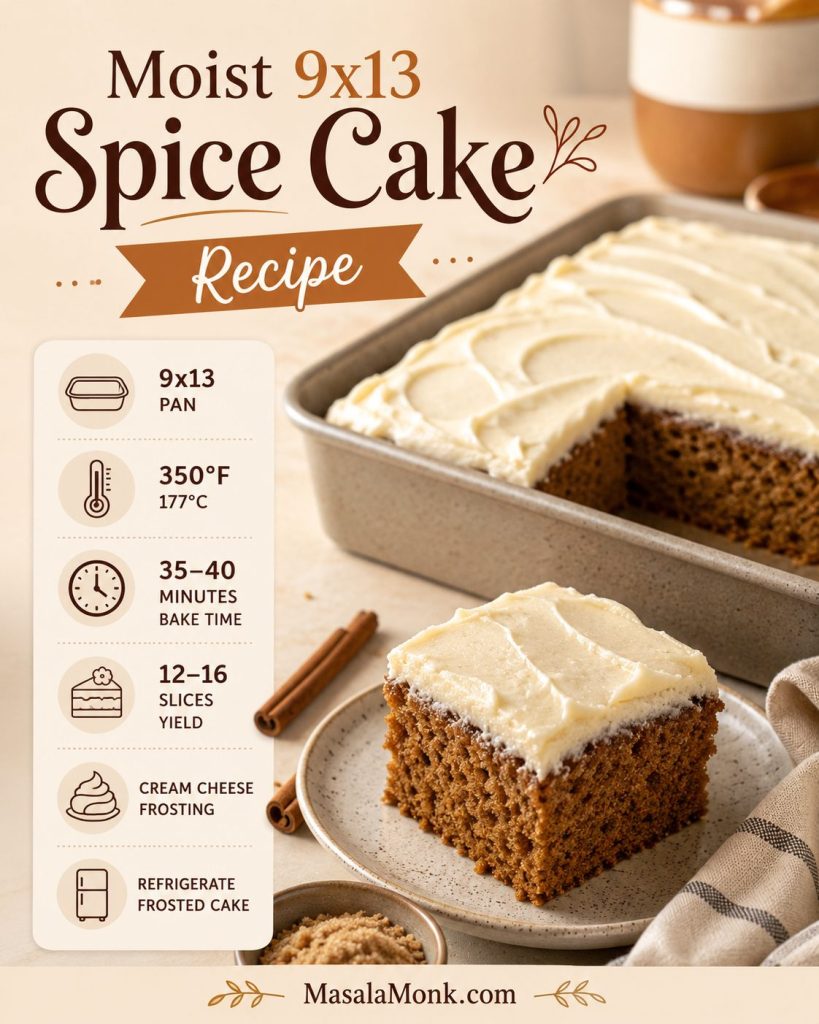
Recipe card for moist 9x13 spice cake showing a frosted cake square, baking temperature, bake time, yield, and storage reminder.
Use this quick reference before baking so the key details stay clear: 9×13 pan, 350°F oven, 35–40 minutes, 12–16 slices, and cream cheese frosting.
Prep Time
25 minutes
Cook Time
35–40 minutes
Cooling Time
At least 2 hours
Total Time
About 3 hours
Yield
12–16 slices

Timing: Plan on about 25 minutes prep, 35–40 minutes baking, and at least 2 hours cooling; total time is about 3 hours before serving. Bake time is based on a metal 9×13 pan; glass or ceramic pans may need a few extra minutes.

Equipment

  • 9×13-inch baking pan, preferably metal
  • 2 mixing bowls
  • Whisk
  • Spatula
  • Hand mixer or stand mixer for frosting
  • Cooling rack
  • Parchment paper, optional

Ingredients

For the Spice Cake

  • 2½ cups all-purpose flour / 313 g
  • 1½ teaspoons baking powder
  • ½ teaspoon baking soda
  • ¾ teaspoon fine salt
  • 2½ teaspoons ground cinnamon
  • 1 teaspoon ground ginger
  • ¾ teaspoon ground nutmeg
  • ½ teaspoon ground allspice
  • ¼ teaspoon ground cloves
  • ¼ teaspoon ground cardamom, optional
  • 1½ cups packed brown sugar / 300 g
  • ½ cup neutral oil / 120 ml
  • ¼ cup unsalted butter, melted and slightly cooled / 57 g
  • ½ cup unsweetened applesauce, room temperature if possible / 120 g
  • ¾ cup buttermilk, room temperature / 180 ml
  • 3 large eggs, room temperature
  • 2 teaspoons vanilla extract
  • 1 tablespoon molasses, optional / 20 g

For the Cream Cheese Frosting

  • 8 oz block cream cheese, softened / 226 g
  • ½ cup unsalted butter, softened / 113 g
  • 2½–3 cups powdered sugar / 300–360 g, sifted if lumpy
  • 1 teaspoon vanilla extract
  • Pinch of salt
  • 1 teaspoon lemon juice, optional, for extra tang

Instructions

  1. Prepare the oven and pan. Heat the oven to 350°F / 177°C. Grease a 9×13-inch baking pan and line with parchment if you want to lift the cake out for slicing.
  2. Mix the dry ingredients. In a large bowl, whisk the flour, baking powder, baking soda, salt, cinnamon, ginger, nutmeg, allspice, cloves, and optional cardamom until evenly combined.
  3. Mix the wet ingredients. In a separate bowl, whisk the brown sugar, oil, melted butter, applesauce, buttermilk, eggs, vanilla, and optional molasses until smooth. The eggs, applesauce, and buttermilk should not be fridge-cold.
  4. Combine. Pour the wet ingredients into the dry ingredients. Fold gently until no dry flour pockets remain. The batter should be thick but pourable. Stop once no flour streaks remain.
  5. Bake. Spread the batter into the prepared pan. Bake for 35–40 minutes in a metal pan, or until the center springs back lightly and a toothpick inserted into the middle comes out with a few moist crumbs. Glass or ceramic pans may take longer.
  6. Cool. Let the cake cool completely before frosting, at least 2 hours for a 9×13 cake. Warm cake will melt the frosting.
  7. Make the frosting. Beat the cream cheese until smooth. Add the butter and beat again. Add 2½ cups powdered sugar, vanilla, salt, and optional lemon juice. Beat until creamy and spreadable, then stop. Add more powdered sugar if you want a firmer frosting.
  8. Frost and serve. Spread frosting over the cooled cake. Chill briefly for cleaner slices, then serve. Let refrigerated slices sit at room temperature for a softer cake.

Recipe Notes

  • Buttermilk substitute: Add 2 teaspoons lemon juice or vinegar to a measuring cup, then add milk until you reach ¾ cup total. Stir and let stand for 5–10 minutes before using.
  • No applesauce? Replace it with the same weight of plain full-fat yogurt or sour cream.
  • Frosting amount: The frosting quantity is enough for a generous 9×13 sheet cake layer. For a layer cake or piping, make 1½ to 2 times the frosting.
  • Clean slices: Frost only after the cake is fully cool, then chill the frosted cake for 20–30 minutes before cutting.
  • Storage: Because this cake has cream cheese frosting, refrigerate the frosted cake within 2 hours. Store covered in the refrigerator for 3–4 days and let slices sit briefly at room temperature before serving.
  • Layer cake: Divide between two greased and parchment-lined 9-inch round pans and start checking around 26 minutes.
  • Cupcakes: Fill liners two-thirds full and bake for about 18–21 minutes.
  • Bundt cake: Use a 10–12 cup Bundt pan, grease it thoroughly, and do not overfill. Start checking around 50 minutes.
  • Loaf cake: Fill a 9×5-inch loaf pan no more than two-thirds full. This full recipe makes more batter than one loaf, so bake extra batter as cupcakes or use a second loaf pan.
  • Salted butter: You can use salted butter in the cake or frosting; reduce the added salt slightly.

FAQs About Spice Cake

What makes spice cake different from carrot cake?

Spice cake is defined by baking spices. Carrot cake is defined by grated carrot and often includes nuts, raisins, pineapple, or coconut. The two can share cinnamon, ginger, and nutmeg, but carrot cake has a vegetable-based texture and spice cake does not need carrots.

Which spices are best in spice cake?

Cinnamon, ginger, nutmeg, allspice, and cloves are the classic mix. Cinnamon should lead, cloves should stay subtle, and the spices should be fresh.

Is spice cake hot or spicy?

Think cinnamon warmth, not chili heat. The flavor comes from baking spices, not hot pepper.

Is spice cake the same as gingerbread?

No. Gingerbread is usually darker, more ginger-forward, and more molasses-heavy. Spice cake is softer, sweeter, and more balanced across several spices.

What is the difference between spice cake and pumpkin spice cake?

Spice cake is led by the spice blend itself. Pumpkin spice cake includes pumpkin purée, which changes the moisture, density, color, and flavor of the batter.

Can I use pumpkin pie spice instead of individual spices?

Pumpkin pie spice works as a shortcut. Replace the listed spices with a good blend, knowing the final flavor depends on that blend.

Can I make spice cake without applesauce?

Plain full-fat yogurt or sour cream can replace the applesauce in the same amount. The cake will be slightly tangier and a little less apple-soft, but it will still have enough moisture if the rest of the recipe stays unchanged.

Can I make spice cake ahead of time?

This is actually a good make-ahead cake. Bake it one day ahead, cool it completely, cover it well, and frost it the next day or before serving. The spices often taste more settled after the cake rests overnight.

What frosting goes best with spice cake?

Cream cheese frosting is the classic choice because it adds tang, not just sweetness. A vanilla glaze works better for Bundt or loaf cake.

Why did my spice cake turn out dry?

The most common reasons are too much flour, overbaking, or waiting until the toothpick comes out completely dry. Measure flour by weight if possible and remove the cake when the center is set but the toothpick still has a few moist crumbs.

Can spice cake be baked as cupcakes?

It works well as cupcakes. Fill standard liners about two-thirds full and bake at 350°F / 177°C for about 18–21 minutes. Start checking early because cupcakes dry out faster than a sheet cake.

Should cream cheese frosted spice cake be refrigerated?

Cream-cheese-frosted spice cake should be refrigerated within 2 hours and stored covered for 3–4 days. Let slices sit briefly at room temperature before serving.

When the cake is soft, the spices are fresh, and the frosting has that little cream-cheese tang, this is the kind of simple dessert that disappears slice by slice from the pan. It belongs with coffee, on holiday tables, and on ordinary weekends when cake sounds like a perfectly good plan.

If you try it, I would love to know whether your favorite slice was same-day soft or next-day spiced and settled.
Back to top

Posted on Leave a comment

Pav Bhaji Masala Recipe: Homemade Powder, Best Brands & Substitutes

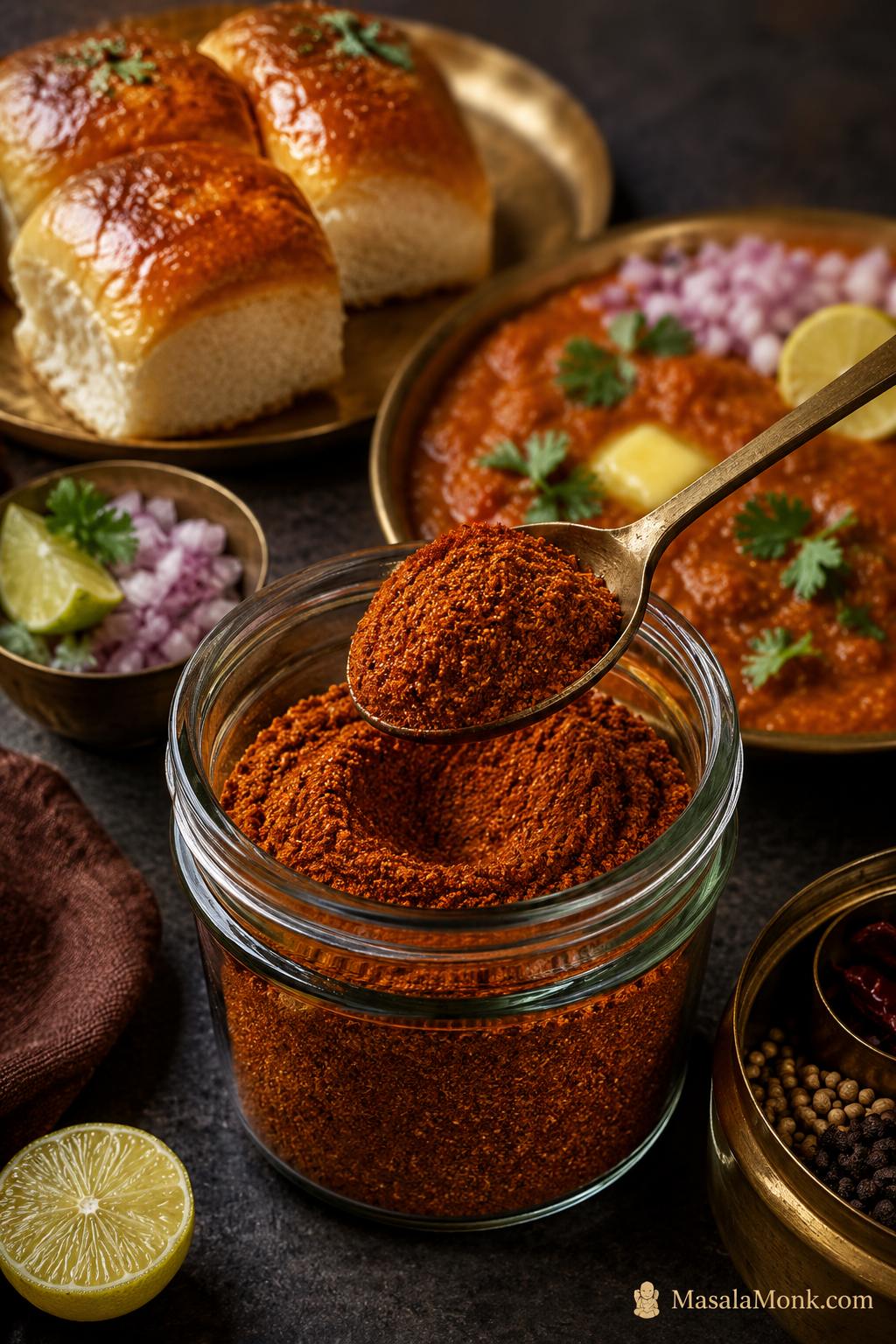
Glass jar of reddish-brown homemade pav bhaji masala with a spoon of spice powder, served beside pav bhaji, buttered pav, onion, lemon, and coriander.

A good pav bhaji masala recipe is often the difference between a pan of mashed vegetables and bhaji that actually tastes like pav bhaji. With the right blend, the dish gets its tang, color, warmth, Mumbai-style aroma, and that buttery, chatpata depth people keep trying to recreate at home.

The confusing part is that this masala is not one fixed thing. One packet may taste too salty. Another may taste flat. A homemade batch can smell wonderful but turn bitter if the spices are roasted too hard. Sometimes the bhaji looks pale, tastes dusty, or never gets that deep snack-shop finish no matter how much powder you add.

So instead of stopping at a spice list, let’s solve the whole problem: how to make the blend fresh, how much to use, which store-bought options are worth trying, what to use in an emergency, and how to get bhaji that tastes warm, tangy, buttery, and rounded instead of flat, dusty, or over-spiced.

The good news is that pav bhaji is forgiving. You do not need the “one true” packet or a perfect spice shelf. You need a blend with warmth and tang, enough butter and tomato to carry it, and the patience to let the bhaji simmer before you decide what is missing.

The goal is that familiar first bite: soft pav, glossy bhaji, butter on top, onion and lemon on the side, and a masala flavor that feels deep without tasting muddy.

Quick Answer: Homemade or Store-Bought Pav Bhaji Masala?

The best choice depends on what you need. If you want the freshest aroma and full control over salt, heat, and tang, make the homemade blend below. If you want convenience, a good packet works well, but every brand has a different strength.

Best choice Use it when
Homemade blend Best for fresh aroma, less hidden salt, and better control over chilli, tang, and warmth.
Everest Pav Bhaji Masala Familiar, easy to find, and useful as a first packet.
Badshah Pav Bhaji Masala Bolder and more Mumbai-style in direction.
MDH Pav Bhaji Masala Classic household masala-box choice.
Organic Tattva or Pure & Sure Useful for kitchens that already prefer organic spice blends.
Homemade pav bhaji masala in a glass jar, neutral packet-style masala, and finished pav bhaji arranged as a decision guide.
Homemade masala gives you control over salt, heat, and tang; meanwhile, a good packet helps when convenience matters and time is short.

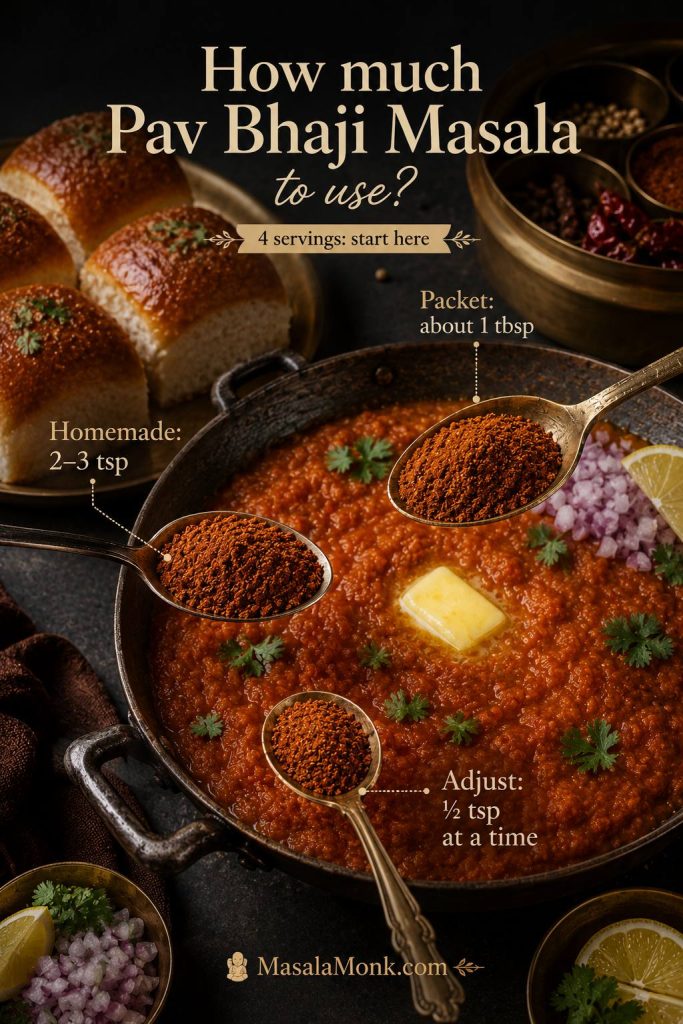
For 4 servings of pav bhaji, start with 2–3 teaspoons homemade masala or about 1 tablespoon store-bought masala. Cook it into the tomatoes and butter, simmer with the vegetables, then add more only in small ½-teaspoon steps if the flavor still feels weak.

What Is Pav Bhaji Masala?

Pav bhaji masala is a spice blend made for pav bhaji, the Mumbai street-food dish of mashed vegetables cooked with tomatoes, butter, chillies, and spices, then served with toasted pav. The blend usually includes coriander, cumin, fennel, dried red chillies, black pepper, cinnamon, cloves, black cardamom, bay leaf, amchur, dry ginger, and sometimes stone flower, black salt, mace, nutmeg, turmeric, or other warming spices.

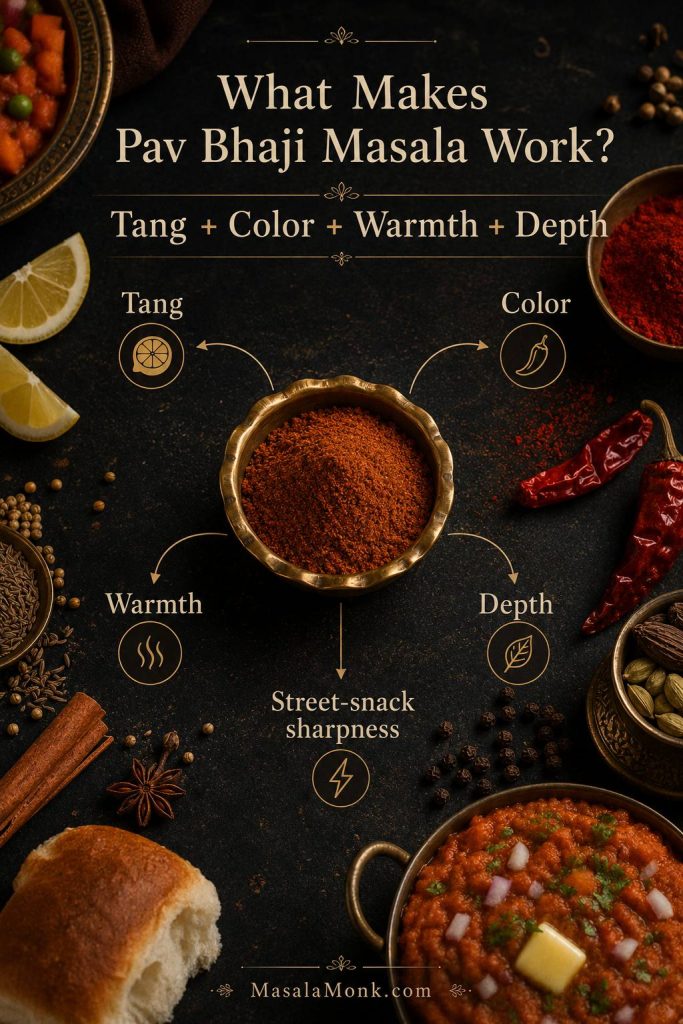
Bowl of pav bhaji masala surrounded by flavor labels for tang, color, warmth, depth, and street-snack sharpness.
Pav bhaji masala works because it is not only spicy; it balances tang, color, warmth, and depth against potatoes, tomatoes, butter, and pav.

Garam Masala vs Pav Bhaji Masala

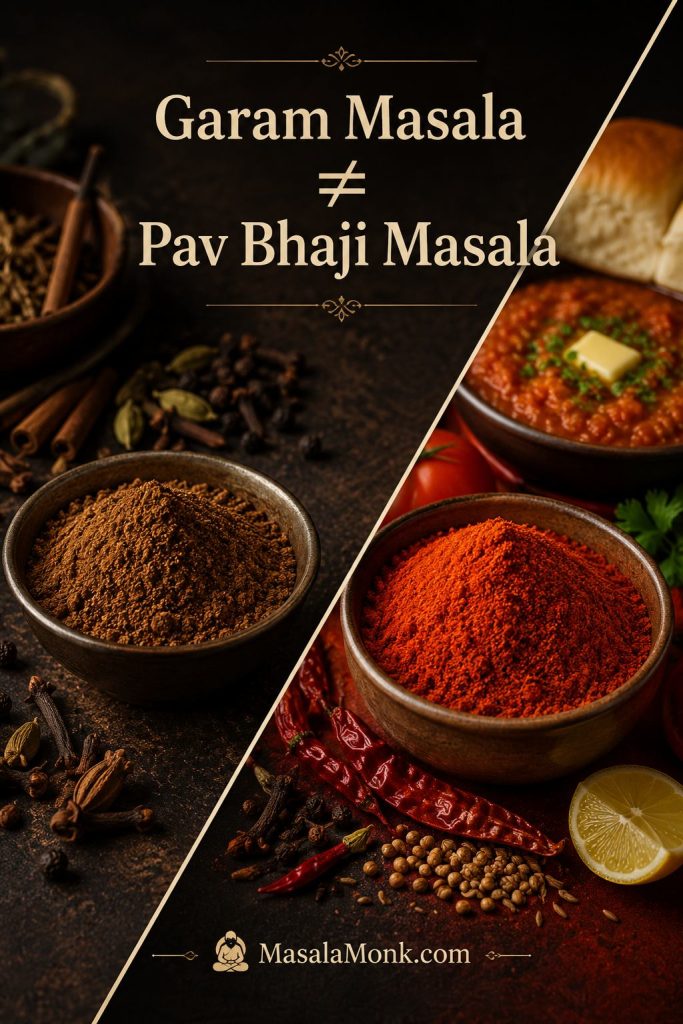
It is not the same as garam masala. Garam masala can make bhaji warm, but it will not give the same tangy, red-orange, street-snack profile on its own. This blend is sharper, brighter, and built to stand up to potatoes, tomatoes, butter, and bread.

Diagonal comparison of darker garam masala and redder pav bhaji masala with a small pav bhaji serving cue.
Garam masala can warm the pan, but pav bhaji masala adds the chilli color, amchur tang, and snack-style sharpness that bhaji needs.

If garam masala is all you have, do not use it alone; jump to the emergency pav bhaji masala substitute for a better balance of color, tang, and warmth.

If you want to understand the broader warm-spice base first, MasalaMonk’s authentic Indian garam masala recipe is a helpful companion. Some spices overlap, but the goal here is tangier, sharper, and more snack-focused.

Simple way to understand it: garam masala adds general warmth. Pav bhaji masala adds the specific bhaji flavor: tang from amchur, color from Kashmiri chilli, depth from whole spices, and chaat-like sharpness from black pepper, black cardamom, and optional stone flower.

Homemade vs Store-Bought Pav Bhaji Masala

Both homemade and store-bought masala can make excellent bhaji. Homemade gives you freshness and control. A ready-made blend gives you speed and consistency. The bigger question is how often you cook pav bhaji and how much control you want over salt, chilli, and tang.

Option Why it works Watch out for
Homemade Fresh aroma, adjustable chilli, no mandatory salt, and better control over tang and heat. Needs whole spices and a grinder. Over-roasted spices can turn bitter.
Store-bought Convenient, consistent, easy for quick cooking, and practical if you make pav bhaji casually. Brand strength varies across salt, heat, color, and tang.

Frequent pav bhaji cooks will get more value from a small homemade batch. For occasional cooking, a good packet is practical. Either way, the flavor depends not just on the spice mix but on whether it is cooked properly into the bhaji.

If you enjoy making spice blends from scratch, MasalaMonk’s authentic sambar masala recipe follows a similar make-ahead logic: roast carefully, cool fully, grind fresh, and store the powder dry.

Pav Bhaji Masala Ingredients

A good powder needs body, heat, tang, color, and depth. The ingredient list looks long, but most of the flavor comes from a few core spices. The optional spices are there for a deeper packet-style flavor or a more Mumbai-style finish.

Think of the blend in layers: coriander and cumin build the body, chilli and amchur bring color and tang, and the darker spices add that deep background aroma that makes the bhaji taste rounded instead of plain.

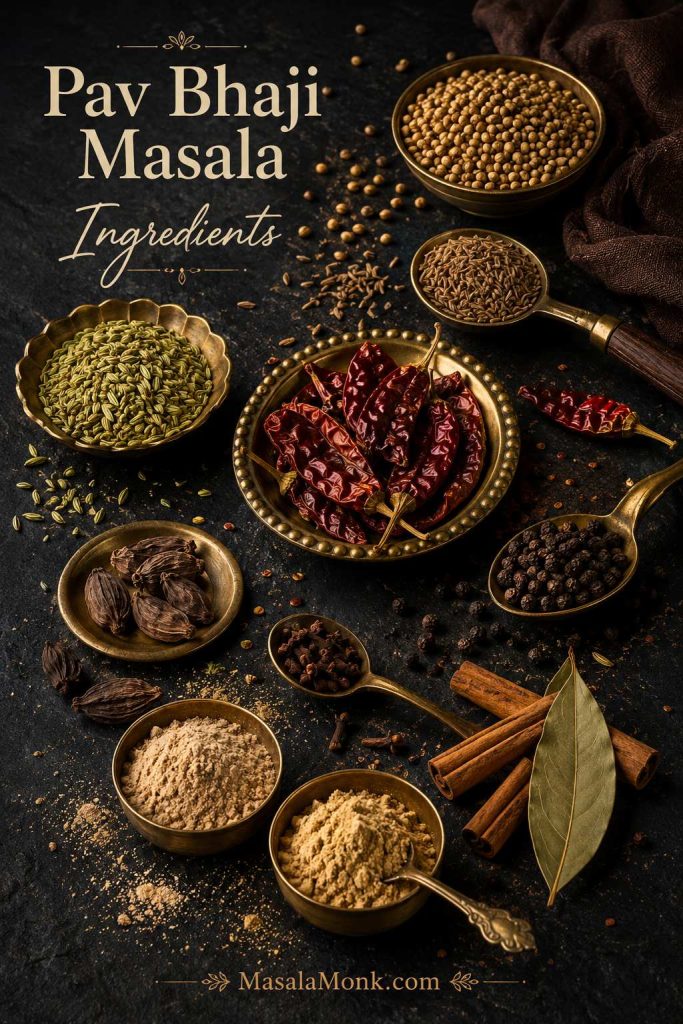
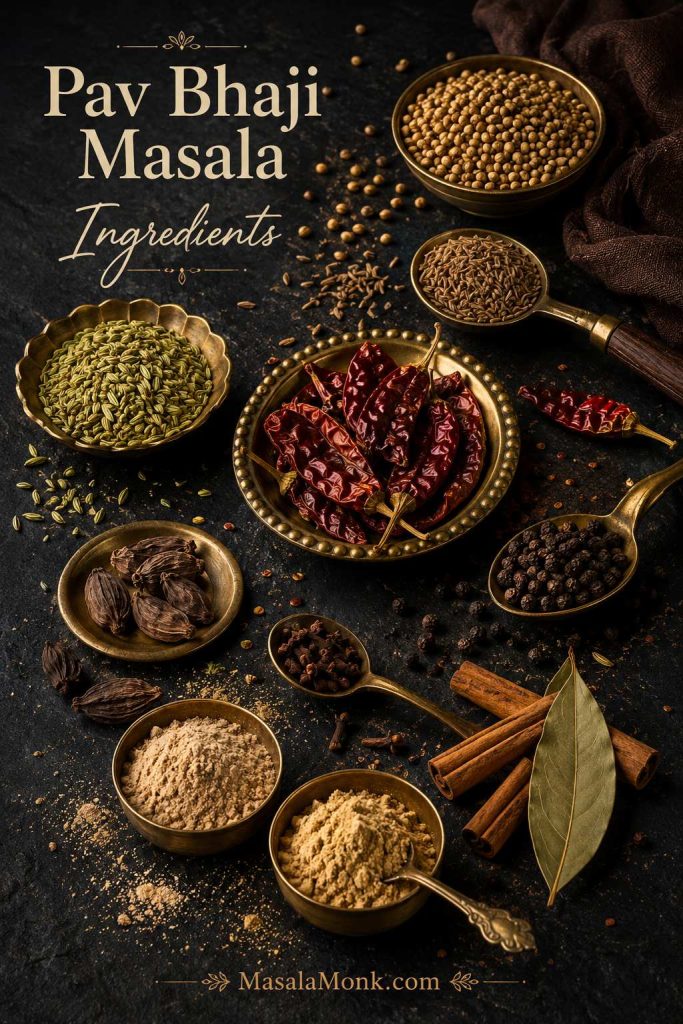
Pav bhaji masala ingredients including coriander seeds, cumin, fennel, Kashmiri chillies, amchur, dry ginger, black cardamom, cloves, cinnamon, and bay leaf.
The ingredient list looks long, yet each spice has a job: coriander for body, cumin for earthiness, Kashmiri chilli for color, and amchur for brightness.

Already have the spices ready? Go straight to the grams and spoon measurements or the step-by-step method.

Core Spices

Ingredient What it does
Coriander seeds Forms the body of the blend with citrusy, warm, slightly sweet flavor.
Cumin seeds Brings earthy tawa-style depth.
Fennel seeds Lifts the powder with a sweet aromatic note so it does not taste too heavy.
Kashmiri dried red chillies Gives red-orange color and mild heat. Use hotter chillies only if you want a spicier batch.
Black peppercorns Sharpens the heat in a way that works well with butter and potatoes.
Cinnamon and cloves Bring warm, sweet, intense spice notes. Both are strong, so use them carefully.
Black cardamom Creates smoky depth and a more pav bhaji stall-style aroma.
Bay leaf Builds background warmth and savory complexity.
Amchur powder Supplies the tang that separates this masala from garam masala.
Dry ginger powder Finishes the blend with warmth and a subtle dry spice note.
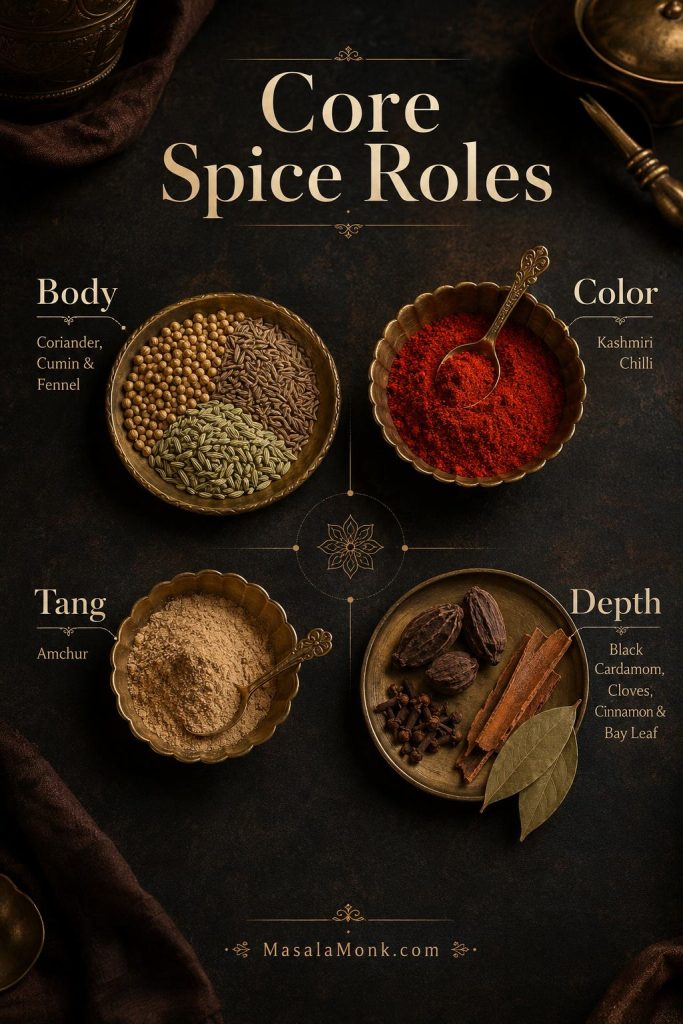
Core pav bhaji masala spices grouped by body, color, tang, and depth on a dark spice-pantry background.
Grouping spices by role makes the blend easier to adjust; instead of adding powder blindly, you can fix the flavor layer that is actually missing.

This blend is coriander-forward because pav bhaji needs body before it needs heat. Cumin and fennel keep the base earthy but not heavy, Kashmiri chillies give color without harshness, and amchur is added after roasting so the tang stays clean. The darker spices — black cardamom, cloves, cinnamon, bay leaf, and optional stone flower — should stay in the background. If they dominate, the bhaji tastes more like generic heavy masala than pav bhaji.

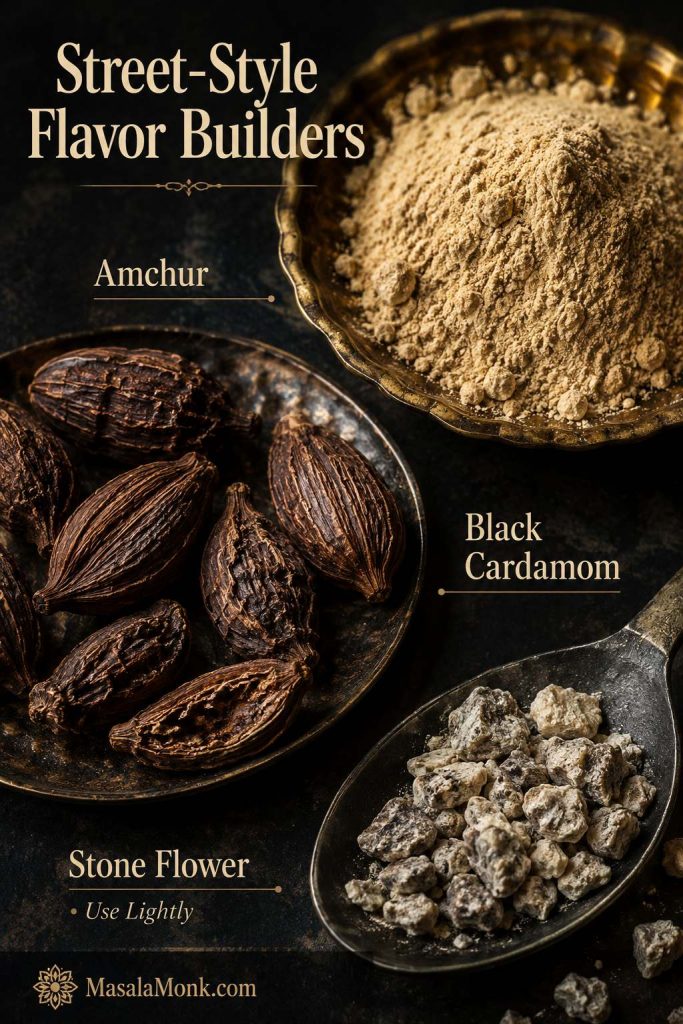
Street-Style Spices: Stone Flower, Amchur and Black Cardamom

If you want the blend to lean more Mumbai-style, three ingredients matter most: amchur, black cardamom, and a tiny amount of stone flower, also called dagad phool or pathar phool.

Amchur gives tang. Black cardamom adds smoky depth. Stone flower gives a slightly smoky, earthy, restaurant-style note, but it is powerful and not always easy to use. If your stone flower smells dusty, muddy, or stale, skip it.

Close-up of amchur powder, black cardamom pods, and a small pinch of stone flower for street-style pav bhaji masala flavor.
Amchur, black cardamom, and stone flower can move the blend toward a street-style pav bhaji flavor, provided they stay in the background.

Optional Spices You Can Skip

  • Stone flower: good for depth, but optional and easy to overdo.
  • Mace or nutmeg: adds packet-style depth; use only a tiny pinch.
  • Black salt: gives a chaat-like savory note, but can make the blend salty.
  • Turmeric: helps color, but too much can taste earthy.
  • Star anise: adds sweet depth; one small piece is enough.
Important: salt is not mandatory in homemade pav bhaji masala. It is usually better to salt the bhaji separately, especially because store-bought masalas vary widely in salt level.

Do not let the long spice list scare you. Get the coriander-cumin base right, use Kashmiri chilli for color, add amchur for tang, and avoid burning the spices. That will get you much closer than simply adding garam masala to mashed vegetables.

Homemade Pav Bhaji Masala Recipe

This homemade pav bhaji masala recipe makes a practical small batch: enough for several rounds of pav bhaji, but not so much that the jar sits around until the aroma fades. The spoon measures are the working recipe; the gram weights are approximate because whole spices vary in size and freshness.

I prefer making this as a small batch because the aroma is noticeably better in the first few weeks. Bigger batches are convenient, but once the powder starts smelling dull in the jar, the bhaji needs more help from butter, lemon, and fresh coriander.

Freshness matters: if your coriander, cumin, or chillies have been sitting open for a year, the masala will taste dull no matter how carefully you roast it. Use fresh-smelling whole spices for the best result.

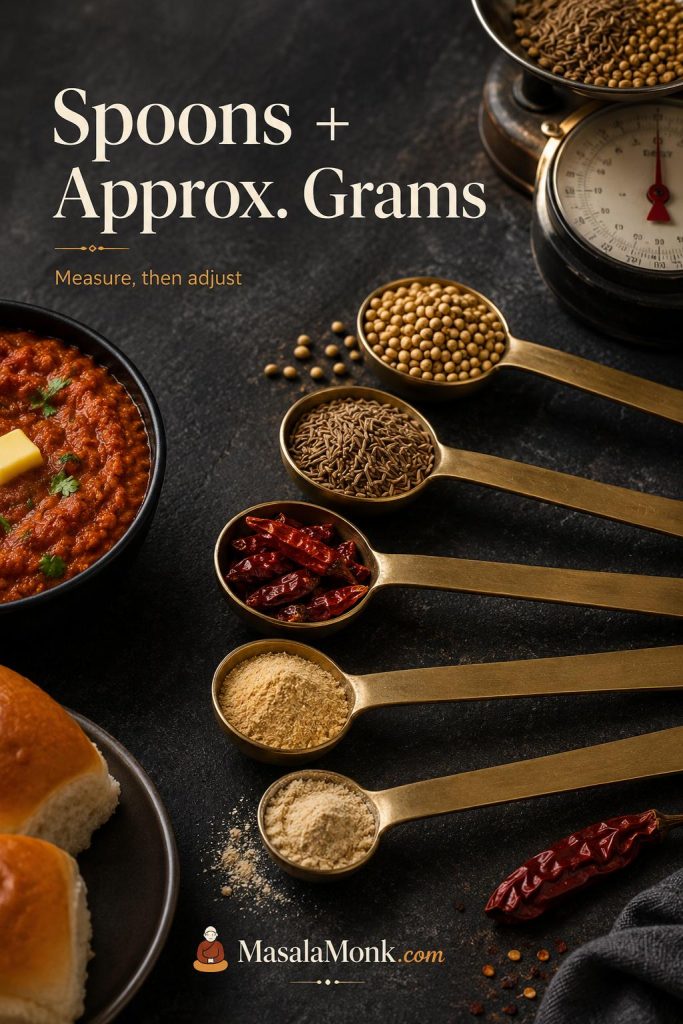
Measurements in Grams and Spoons

Measuring spoons, kitchen scale, and pav bhaji masala spices arranged to show spoon measures and approximate gram measurement.
Spoon measures keep this pav bhaji masala recipe easy for everyday cooking; approximate grams help when you want the next homemade batch to taste consistent.
Ingredient Spoon measure Approximate grams
Coriander seeds 4 tbsp 20–24g
Cumin seeds 2 tbsp 12–14g
Fennel seeds 1 tbsp 6g
Dried Kashmiri red chillies 6–8 whole chillies 8–12g, depending on size
Black peppercorns 1½–2 tsp 4–5g
Cinnamon 1 stick, about 2 inches 2–3g
Cloves 8–10 cloves 2g
Black cardamom 2 pods 3–4g
Bay leaf 1–2 leaves 1g
Star anise 1 small piece 1g
Amchur powder 1 tbsp 7–8g
Dry ginger powder ½–1 tsp 1–2g
Turmeric powder, optional ½ tsp 1–2g
Black salt, optional ½ tsp 2–3g
Stone flower / dagad phool, optional Tiny pinch Less than 1g
Mace or nutmeg, optional Tiny pinch Less than 1g

Step-by-Step Method

1. Check and clean the spices

Pick through the whole spices and remove any stones, stems, dust, or stale pieces. Wipe chillies if needed. Avoid washing the spices unless you plan to dry them completely afterward, because moisture can make the powder clump or spoil faster.

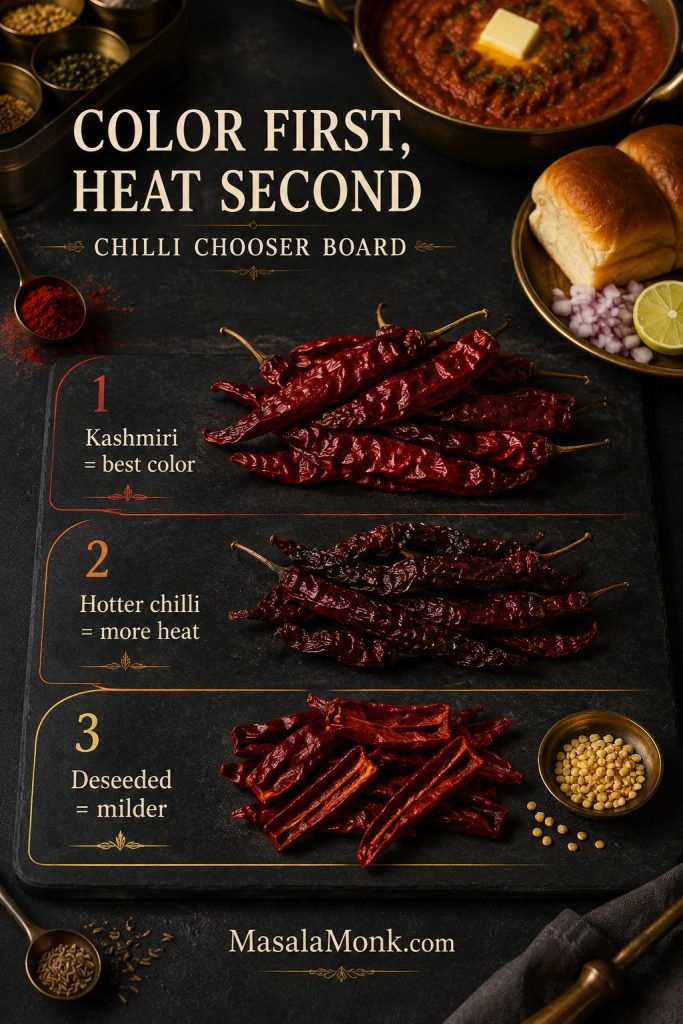
2. Choose the chillies based on color and heat

Use Kashmiri dried red chillies if you want good color with mild heat. For a spicier batch, replace 1–2 Kashmiri chillies with a hotter dried chilli. For a family-friendly version, shake out some of the chilli seeds before roasting.

Kashmiri dried red chillies, hotter dried chillies, and deseeded chillies compared for color, heat, and mildness in pav bhaji masala.
Kashmiri chillies are the safest first choice because they build red-orange color without pushing the masala into harsh, overpowering heat.

3. Dry roast the whole spices on low heat

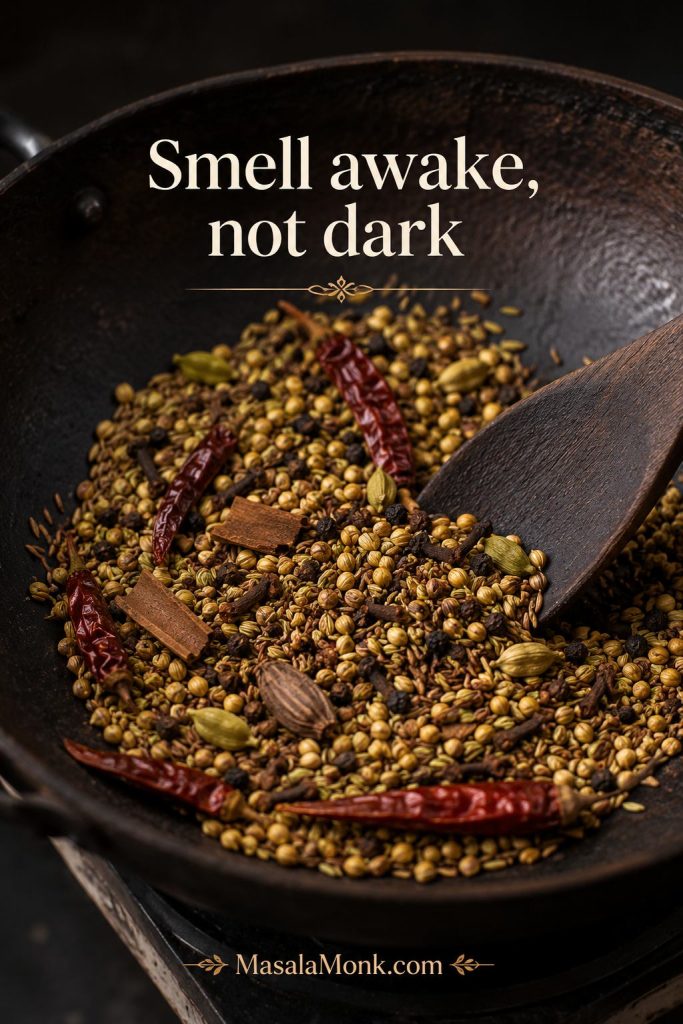
Heat a thick-bottomed pan on low to low-medium heat. Add coriander seeds, cumin seeds, fennel seeds, dried red chillies, black peppercorns, cinnamon, cloves, black cardamom, bay leaf, star anise, and optional stone flower.

Roast gently for 5–7 minutes, stirring often. Stop when the spices smell awake, not when they look dark. The coriander should smell warm, the chillies should look slightly deeper, and the whole pan should smell lively rather than smoky or scorched.

Whole spices dry roasting in a dark pan with coriander, cumin, fennel, dried red chillies, black cardamom, bay leaf, and cloves.
Dry roast the whole spices on low heat until they smell lively; if they darken too much, the finished powder can taste bitter.

If the chillies darken faster than the other spices, remove them from the pan early and keep roasting the coriander, cumin, and larger spices for another minute or two.

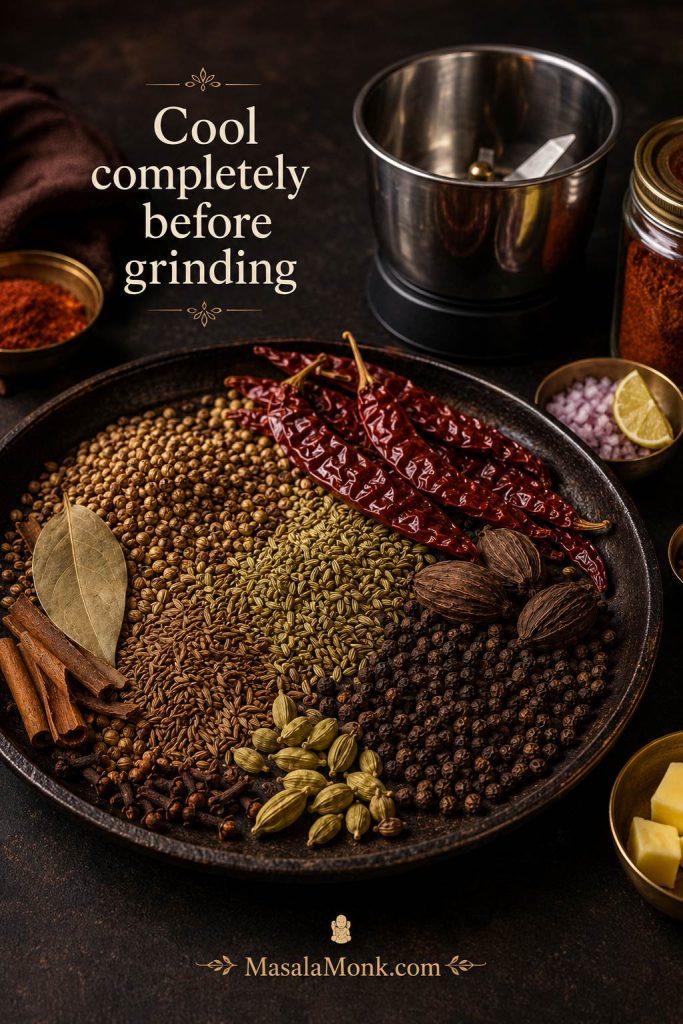
4. Cool completely before grinding

Transfer the roasted spices to a plate and let them cool fully for about 10 minutes. This is not a fussy step. Warm spices can trap steam in the grinder, dull the aroma, and make the powder clumpy.

Roasted pav bhaji masala spices cooling on a dark tray with a mixer grinder jar waiting nearby.
Cooling the roasted spices first prevents trapped steam, dull aroma, and clumps, which is especially important for homemade pav bhaji masala powder.

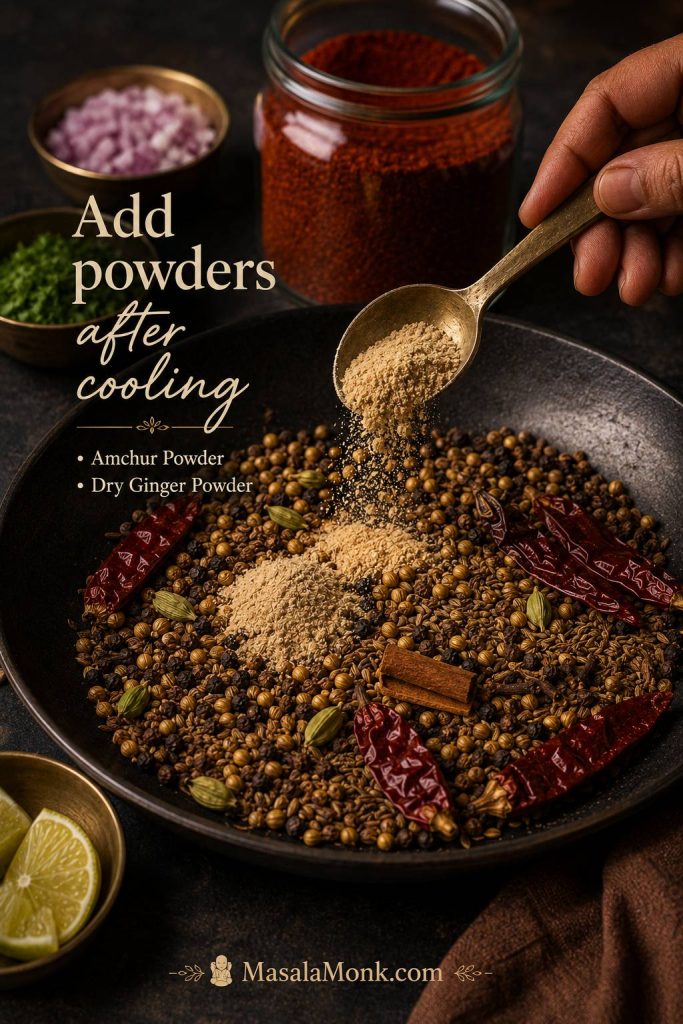
5. Add the powdered spices after cooling

Once the roasted spices are cool, add amchur powder, dry ginger powder, optional turmeric, optional black salt, and optional mace or nutmeg. These powdered spices can scorch quickly, so they are better added after the pan step.

Amchur powder and dry ginger being added to cooled roasted spices before grinding pav bhaji masala.
Add amchur and dry ginger after roasting so the tang stays clean; otherwise, powdered spices can scorch and make the blend taste muddy.

6. Grind in short pulses

Grind the mixture in a dry spice grinder or the dry jar of a mixer grinder. Pulse a few times first, then grind until fine. Avoid running the grinder continuously for too long because heat can dull the aroma.

The finished powder should smell warm, tangy, and rounded. If it smells harsh, burnt, or dusty, the spices were likely stale or roasted too aggressively.

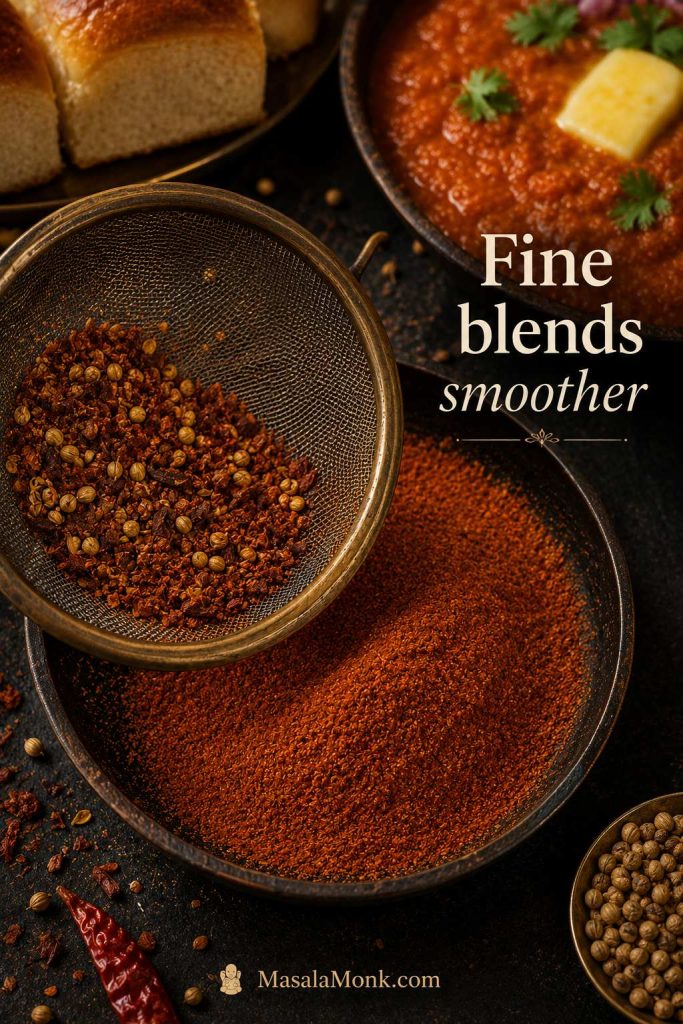
7. Sieve if needed

If the powder is coarse, pass it through a sieve and regrind the larger bits. A slightly coarse texture is still usable, but a finer powder blends more smoothly into bhaji.

Fine reddish-brown pav bhaji masala powder compared with coarse spice bits caught in a sieve.
Fine pav bhaji masala powder blends smoothly into tomatoes, butter, and mashed vegetables, while coarse bits can leave the bhaji tasting uneven.

8. Store in an airtight jar

Transfer the powder to a clean, dry, airtight glass jar. Keep it away from heat, sunlight, steam, and wet spoons.

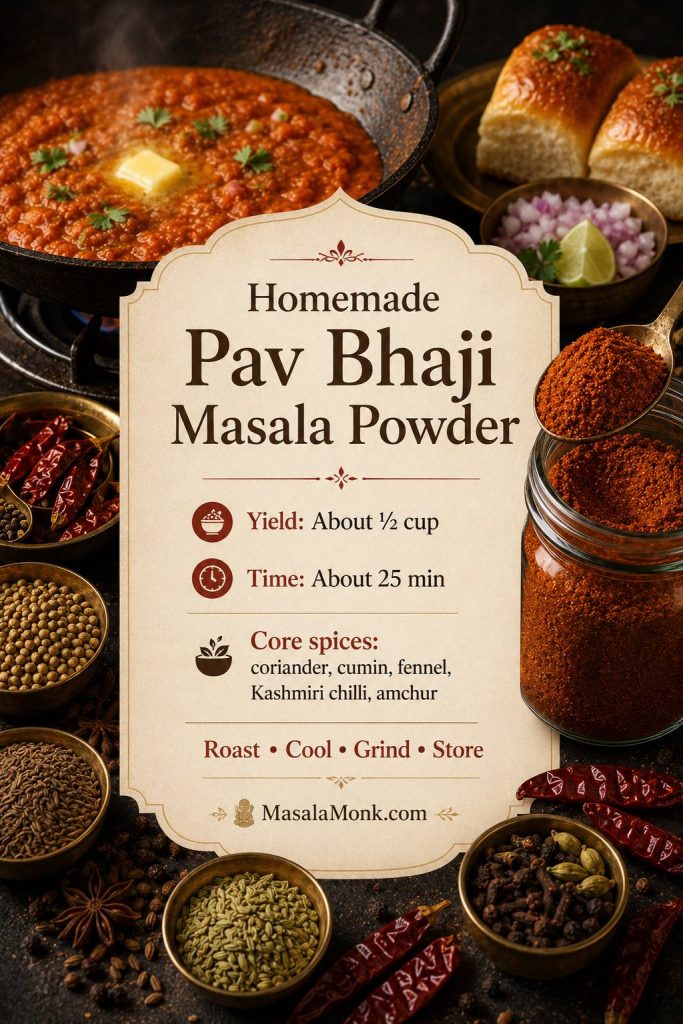
Recipe Card: Homemade Pav Bhaji Masala Powder

YieldAbout ½ cup / 75–90g
Prep Time10 minutes
Roast + Cool5–7 min roast + 10 min cool
Total TimeAbout 25 minutes

Ingredients

  • 4 tbsp coriander seeds
  • 2 tbsp cumin seeds
  • 1 tbsp fennel seeds
  • 6–8 dried Kashmiri red chillies
  • 1½–2 tsp black peppercorns
  • 1 cinnamon stick, about 2 inches
  • 8–10 cloves
  • 2 black cardamom pods
  • 1–2 bay leaves
  • 1 small star anise
  • 1 tbsp amchur powder
  • ½–1 tsp dry ginger powder
  • ½ tsp turmeric powder, optional
  • ½ tsp black salt, optional
  • Tiny pinch stone flower / dagad phool, optional
  • Tiny pinch mace or nutmeg, optional

Method

  1. Check and clean the spices.
  2. Choose Kashmiri chillies for color and adjust seeds for heat.
  3. Dry roast the whole spices on low to low-medium heat for 5–7 minutes.
  4. Cool the roasted spices completely for about 10 minutes.
  5. Add amchur, dry ginger, and optional powdered spices.
  6. Grind in short pulses until fine and aromatic.
  7. Sieve and regrind coarse bits if needed.
  8. Store in a clean airtight glass jar.

Notes

  • For 4 servings of pav bhaji, start with 2–3 teaspoons of this homemade blend.
  • Use Kashmiri chillies for color and mild heat. Add hotter chillies only if you want a spicier version.
  • If the chillies darken too quickly while roasting, remove them early and continue roasting the sturdier spices.
  • Add amchur, dry ginger, turmeric, black salt, mace, and nutmeg only after the roasted whole spices cool. Powdered spices can scorch quickly in the pan.
  • The final weight can vary because dried chillies, bay leaves, cardamom pods, and grind fineness all change the volume and weight of the powder.
  • Skip black salt if you prefer to adjust salt separately in the bhaji.
  • For a brighter red-orange bhaji, use Kashmiri chilli rather than extra turmeric.
Saveable homemade pav bhaji masala recipe card with yield, timing, core spices, and roast-cool-grind-store method.
A small-batch homemade masala usually stays more aromatic than a large jar kept for months, especially when it is stored dry and airtight.

How Much Pav Bhaji Masala to Use

This is where many pav bhaji recipes become confusing. Homemade powder, Everest-style masala, Badshah-style masala, MDH-style masala, and organic blends do not all have the same strength. One packet may be saltier, another may taste sharper, a third may run hotter, and milder blends may need more quantity to show up in the bhaji.

Measurement guide showing homemade pav bhaji masala, packet masala, and half-teaspoon adjustment amounts for four servings.
For 4 servings, treat the amount as a starting point, not a final verdict; pav bhaji masala tastes more balanced after it simmers.
Masala type Starting amount for 4 servings Adjustment note
Fresh homemade blend 2–3 tsp Use ½ tsp more only if the bhaji still tastes flat after simmering.
Store-bought blend 1 tbsp Start lower if the brand is salty, hot, or very strong.
Strong/chatpata brand 2 tsp–1 tbsp A little can dominate quickly, so build the flavor gradually.
Milder brand 1 tbsp The bhaji may need ½–1 tsp more after the vegetables cook down.
Final adjustment ½ tsp at a time Use only after the raw spice taste has cooked out.

If the bhaji tastes almost right but still dull, pause before adding another spoon of powder. Usually the missing piece is butter, salt, lemon, or simmering time. When the pan is already salty, reach for butter, tomato, lemon, coriander, or unsalted homemade powder before adding more packet masala.

If the amount looks right but the bhaji still tastes flat, raw, dusty, or too salty, go to the flavor and texture fixes before adding more powder.

The same measured-spice logic works in simple vegetable dishes too. For example, a dry potato-and-cauliflower dish like MasalaMonk’s easy aloo gobi recipe also depends on letting spices coat the vegetables properly instead of tasting raw on the surface.

How to Bloom Pav Bhaji Masala in the Bhaji

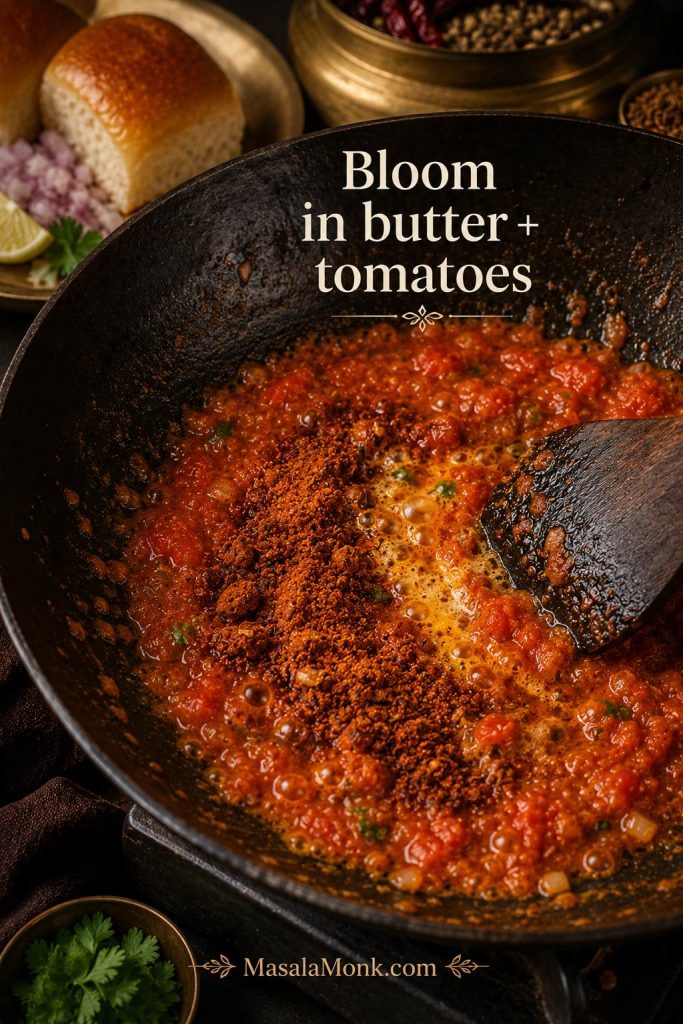
The timing matters. The blend tastes best when it is cooked into the bhaji, not sprinkled over the finished dish like a garnish.

  1. Cook onions, garlic, tomatoes, and capsicum until the tomatoes soften and the pan looks glossy.
  2. Add butter or oil, then add the masala.
  3. Fry for 30–60 seconds on medium-low heat so it blooms without burning.
  4. Add the boiled vegetables and mash everything together.
  5. Simmer for 5–10 minutes before deciding whether the flavor needs anything else.
Pav bhaji masala blooming in butter and softened tomatoes in a dark pan with a spatula stirring the glossy red-orange base.
Bloom the masala before adding vegetables so the tomato, butter, and spice taste like one cooked base instead of separate layers.

This is the moment the powder turns into bhaji flavor: the tomatoes look glossier, the butter carries the spice, and the raw edge disappears. If the bhaji tastes like raw spice powder, the masala was probably added too late or not cooked long enough with the tomatoes and butter.

When it is right, the pan stops smelling like separate tomato and spice powder and starts smelling like pav bhaji.

What Good Pav Bhaji Masala Should Do in Bhaji

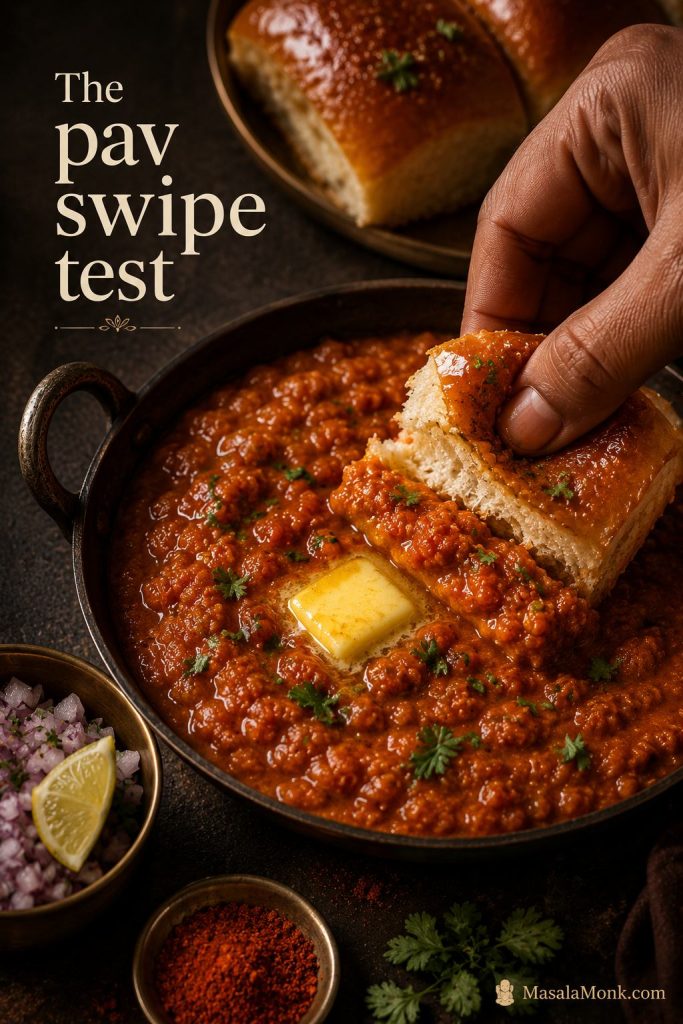
When the masala is working, the bhaji should not taste like separate potatoes, tomatoes, and spice powder. It should taste cohesive: warm from the whole spices, tangy from amchur or lemon, rounded by butter, and bright enough that one buttered pav is never quite enough.

Buttered pav being swiped through glossy red-orange pav bhaji with onion, lemon, coriander, and melted butter.
The pav swipe test tells you if the masala worked: the bhaji should cling to the bread as a glossy, buttery mash with tang and depth.

A heavy-tasting bhaji usually needs acid or freshness. Sharp, powdery flavor means the powder needs more time in the pan. When the bhaji tastes rich but sleepy, add lemon, coriander, or a tiny final pinch after the main cooking is done.

The moment it comes together is easy to recognize: the bhaji looks glossy, the masala stops smelling raw, the butter rounds the edges, and the lemon-onion-coriander finish makes the whole pan taste brighter.

How to Store Pav Bhaji Masala

A homemade batch tastes best when it is fresh. Whole spices keep their aroma longer than ground spices, so once you grind the blend, storage matters.

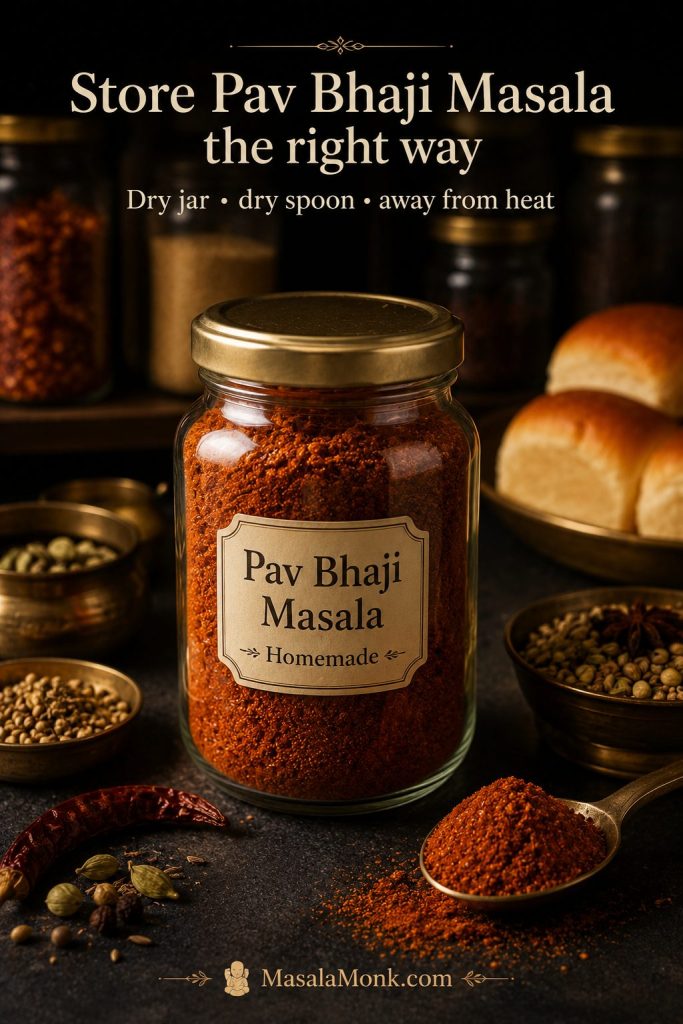
Homemade pav bhaji masala stored in a clean airtight glass jar with a dry spoon on a dark pantry-style surface.
A dry spoon matters as much as the jar; even a little steam can turn homemade pav bhaji masala dull and clumpy.
  • Use a clean, dry, airtight glass jar.
  • Keep the jar away from stove heat, sunlight, and steam.
  • Always use a dry spoon.
  • Make smaller batches if you do not cook pav bhaji often.
  • Use within 2–3 months at room temperature for best aroma.
  • Refrigerate up to about 6 months if tightly sealed.

  • If freezing, seal well so the powder does not absorb freezer smells.

A dull-smelling masala will taste dull in the bhaji too. For freezer storage, let the container come closer to room temperature before opening it so condensation does not hit the powder.

If your stored masala has clumped, faded, or started tasting bitter, check the color, bitterness, and storage fixes.

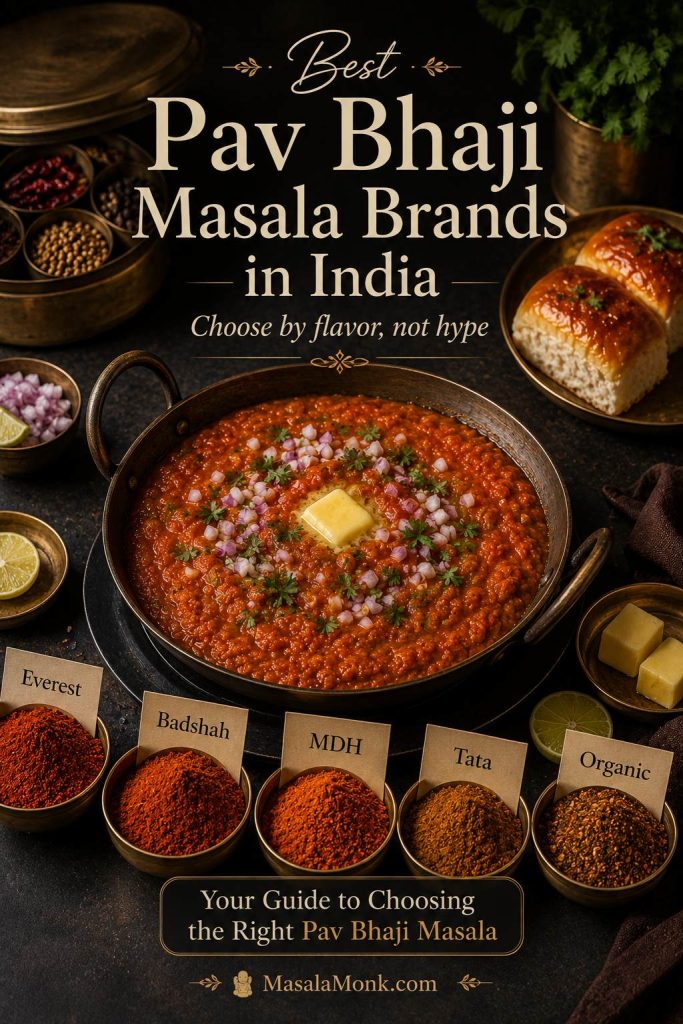
Best Pav Bhaji Masala Brands in India

A packet can still make excellent bhaji when it suits your taste and you cook it properly. The trick is not chasing the loudest masala on the shelf, but choosing one that matches the kind of bhaji you like: mild and familiar, bolder and more Mumbai-style, lower-salt, organic, or simply easy to find.

Pav bhaji pan surrounded by neutral labeled spice bowls and packet silhouettes for Everest, Badshah, MDH, Tata, and organic masala options.
Treat store-bought pav bhaji masala as a flavor choice: familiar, bolder, organic, lower-salt, or simply easier to find.

Store-bought pav bhaji masala is useful when you want convenience or do not keep many whole spices at home. Choose by flavor style, not by hype: familiar all-rounder, bolder Mumbai-style, classic household, organic option, or easy backup. This is a practical buying guide, not a blind taste-test ranking, so treat these as starting points.

Affiliate note: As an Amazon Associate, MasalaMonk earns from qualifying purchases. Some links below are affiliate links, which means MasalaMonk may earn a commission at no extra cost to you. The recommendations are limited to spice blends, storage jars, and tools that directly help with homemade pav bhaji masala or the bhaji you make from it.

Everest and Badshah are the strongest starting recommendations: Everest for the most familiar all-rounder direction, Badshah when your bhaji usually tastes too mild. MDH fits the classic pantry lane, while Tata, Catch, MTR, Suhana, Shan, and Zoff are better treated as availability or preference picks. Even the best packet still needs the same basics: cooked tomatoes, enough butter, proper mashing, and a final lift of lemon or coriander.

Whichever packet you buy, choose sealed, clearly labelled masala from a source you trust. Avoid loose ground spice blends if you cannot judge freshness, storage, or handling; FSSAI’s safe ground spices guidance is a useful reminder that ground spices need proper packaging and quality control.

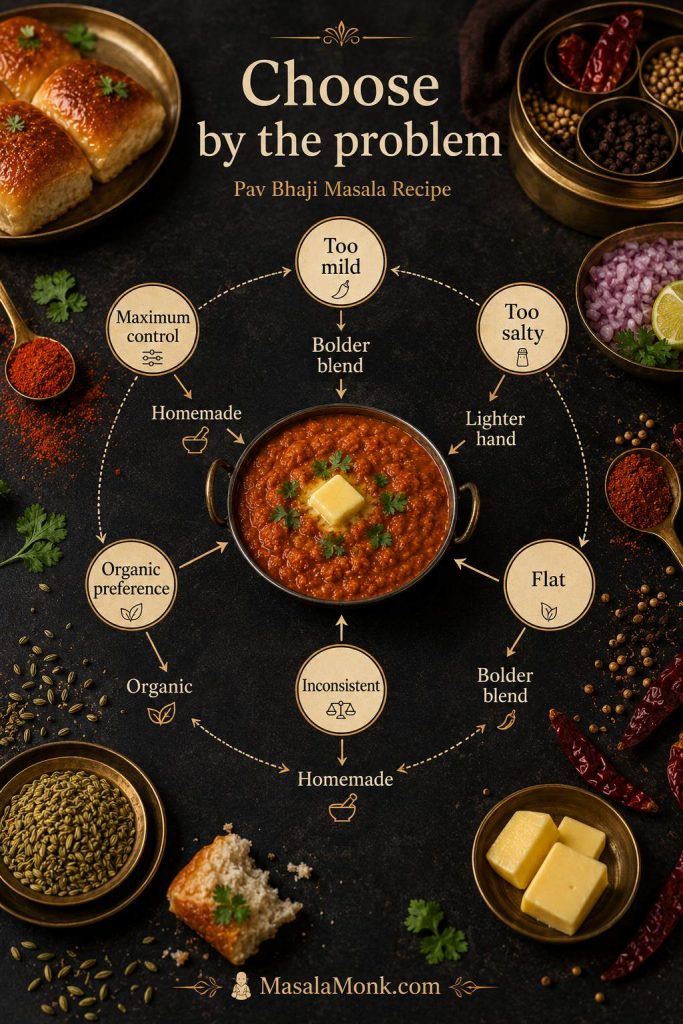
Choose by Flavor Problem

Decision wheel for choosing pav bhaji masala by flavor problem, including too mild, too salty, flat, inconsistent, organic preference, and maximum control.
Choose by the problem first: a salty bhaji needs control, a mild bhaji needs bolder flavor, and an inconsistent bhaji needs reliability.
If your bhaji usually tastes… Choose this direction
Too mild or too home-style Badshah-style bolder blend
Flat but not especially spicy Everest or Badshah direction
Too salty with packets Homemade blend, or use a lighter hand with any packet
Good but inconsistent Everest/MDH/Tata-style familiar packet
Organic matters more than a street-style profile Organic Tattva or Pure & Sure
You want maximum salt and heat control Homemade batch

Quick Brand Picks

Quick pick Brand Best for
Familiar all-rounder Everest Pav Bhaji Masala One easy, recognizable first packet.
Bolder Mumbai-style direction Badshah Pav Bhaji Masala For bhaji that needs a stronger masala push.
Classic household option MDH Pav Bhaji Masala A traditional Indian masala-box brand.
Easy mainstream backup Tata Sampann Pav Bhaji Masala A convenient pantry option for occasional use.
Organic option Organic Tattva / Pure & Sure For kitchens that already prefer organic spices.

Use Everest when you want the safest familiar profile, Badshah when your bhaji usually tastes too mild, MDH when you want a classic pantry option, and Tata or other backups when availability matters more than a specific street-style profile.

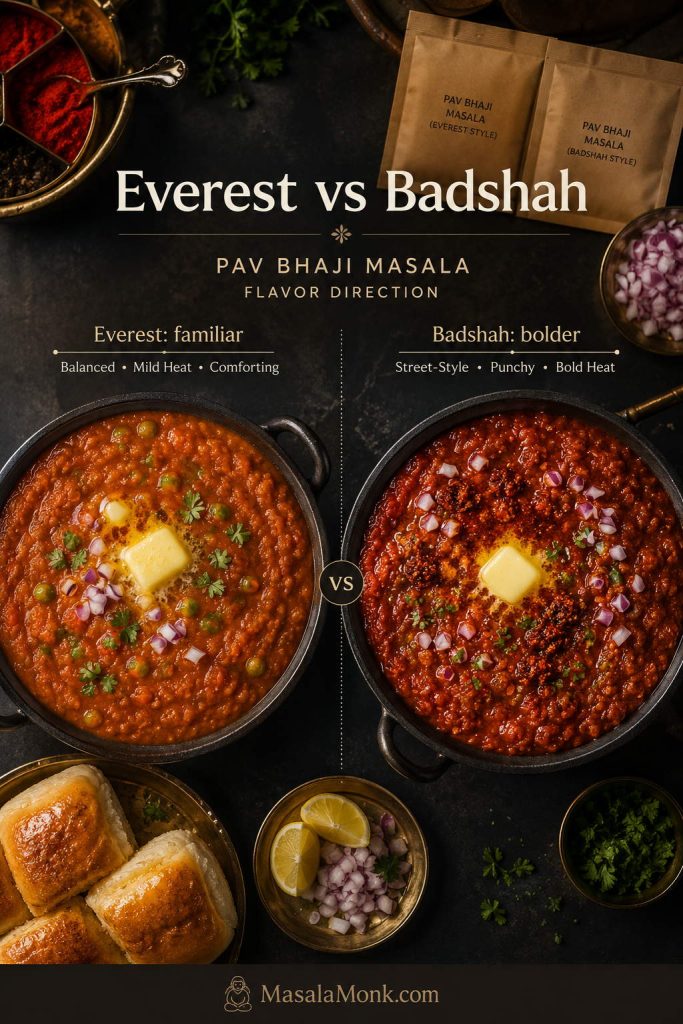
Everest vs Badshah Pav Bhaji Masala

Use this comparison as a flavor-direction shortcut, not as a hard ranking. Everest is the safer familiar lane, while Badshah is better when the bhaji needs a stronger snack-shop push.

Everest-style and Badshah-style pav bhaji masala compared with two pans of pav bhaji showing familiar balanced flavor and bolder snack-shop flavor.
Choose Everest when you want a familiar, balanced packet; choose Badshah when your bhaji tastes too mild and needs a bolder Mumbai-style push.

Main Store-Bought Options

Everest is the familiar all-rounder to start with if you want a recognizable, easy-to-find packet. Check Everest Pav Bhaji Masala 100g on Amazon.

Badshah is the better direction if you want a bolder, more snack-shop profile. Check Badshah Pav Bhaji Masala 100g on Amazon.

MDH fits the classic masala-box lane: familiar, straightforward, and easy to keep in the pantry. Check MDH Pav Bhaji Masala 100g on Amazon.

Tata Sampann is an easy mainstream backup for occasional pav bhaji, tawa pulao, or quick masala pav. Check Tata Sampann Pav Bhaji Masala 100g on Amazon.

Other Store-Bought Options

Catch, MTR, Suhana, Shan, and Zoff are useful backup options when they are easier to find, better priced, or already familiar in your pantry. They are not essential to buy if you already have a fresh packet that works for your taste.

Backup options: Catch, MTR, Suhana, Shan, and Zoff.

Organic Pav Bhaji Masala Options

Choose Organic Tattva or Pure & Sure if you already buy organic spices and want the same approach here. They are preference picks, not shortcuts to a stronger or more street-style pav bhaji flavor.

Check Organic Tattva Pav Bhaji Masala 100g on Amazon

Check Pure & Sure Organic Pav Bhaji Masala 100g on Amazon

If you do not want to use a packet today, use the emergency substitute or build the flavor from scratch in the without ready-made masala section.

Pav Bhaji Masala Substitute

If you do not have the blend, you can make an emergency substitute from common spices. It will not taste identical because the original has a specific tangy, smoky, snack-style profile, but it will move your bhaji in the right direction.

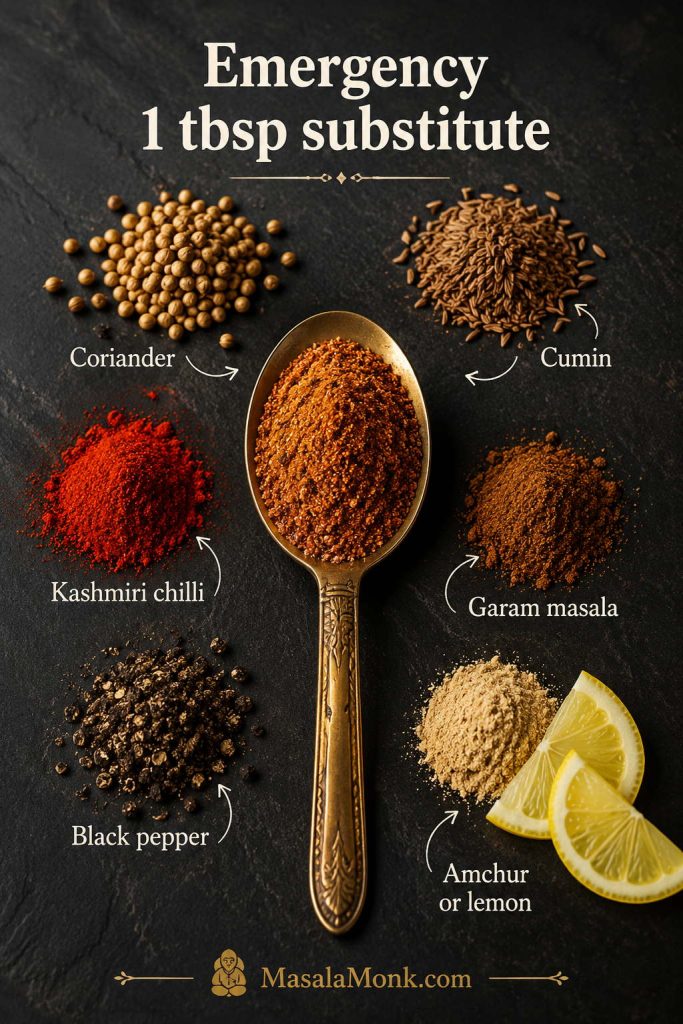
Emergency Substitute for 1 Tablespoon Pav Bhaji Masala

  • 1½ tsp coriander powder
  • ¾ tsp cumin powder
  • ½ tsp Kashmiri chilli powder or paprika
  • ¼ tsp garam masala
  • Pinch black pepper
  • Pinch amchur powder, or finish the bhaji with lemon/lime juice
  • Optional tiny pinch fennel powder
  • Optional tiny pinch black salt
Emergency pav bhaji masala substitute with coriander, cumin, Kashmiri chilli, garam masala, black pepper, and amchur or lemon around a spoon of spice mix.
This pav bhaji masala substitute will not taste identical, but coriander, cumin, Kashmiri chilli, black pepper, and amchur can still build warmth, color, and tang.

Mix these together and add them while the bhaji is cooking. Fry or simmer the substitute with the tomatoes, butter, and vegetables so it does not taste raw.

If you have chaat masala, use it carefully. It can help with tang, but it can also be salty and sour, so add only a pinch and taste before adding more.

If the bhaji tastes heavy even after the spice balance is fixed, serve it with something fresh on the side. MasalaMonk’s green chutney recipe gives that bright coriander-mint lift that works well with street-style snacks, sandwiches, and pav-based dishes.

Substitute warning: garam masala alone is not a 1:1 replacement. It gives warmth, but it misses the tang, color, and snack-shop edge of pav bhaji masala.

How to Make Pav Bhaji Without Ready-Made Masala

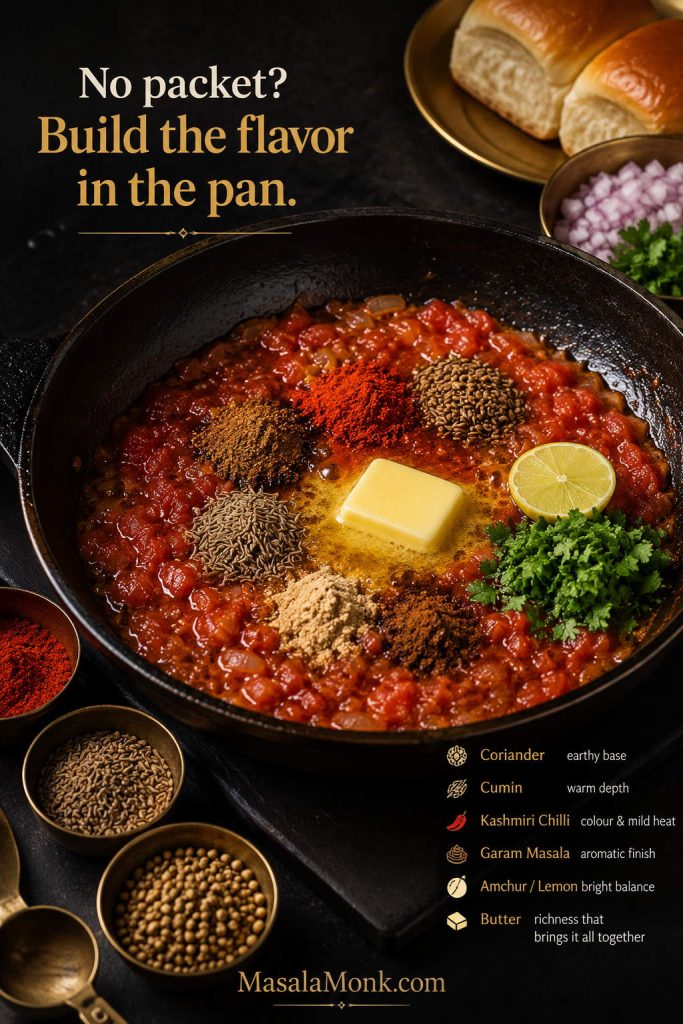
If you want pav bhaji without a packet, use the homemade recipe above or build the flavor directly in the pan. The goal is to create four things: warmth, tang, color, and savory depth.

Tomatoes, butter, coriander, cumin, Kashmiri chilli, garam masala, amchur or lemon, and herbs cooking in a pan without ready-made masala.
No packet does not mean no pav bhaji flavor; tomatoes, butter, Kashmiri chilli, cumin, coriander, and lemon can still build a convincing base.

For a quick bhaji without packaged masala, use coriander powder, cumin powder, Kashmiri chilli powder, a small amount of garam masala, amchur or lemon, black pepper, and enough butter. Cook these into tomatoes and mashed vegetables until the raw spice smell disappears.

The result will be more home-style than packet-masala Mumbai-style, but it can still taste excellent if the vegetables are well mashed and the tomato-butter masala is cooked properly.

How to Fix Pav Bhaji Masala Problems

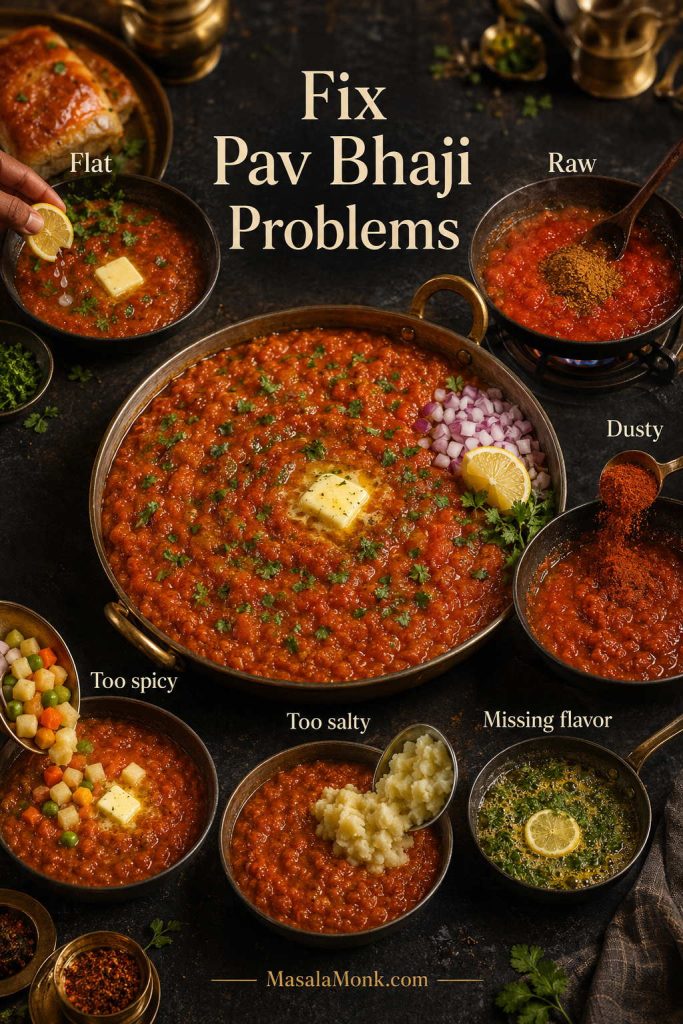
Most pav bhaji problems are fixable once you identify the real issue: salt, acid, raw spice, weak aroma, poor mashing, or over-roasting. Unless the masala is badly burnt, adjust slowly with simmering, fat, acid, or unsalted vegetable bulk instead of adding more powder blindly.

Flavor and Texture Fixes

Central pan of glossy pav bhaji surrounded by small fix scenes for flat, raw, dusty, too spicy, too salty, and missing flavor problems.
More powder is not always the fix; flat bhaji needs brightness, raw masala needs cooking, and salty bhaji needs dilution.
Problem Likely reason Fix
Flat flavor Not enough salt, acid, butter, or cooked masala Add a little salt, butter, lemon, or ½ tsp more masala after simmering.
Raw masala taste Added too late or not fried into the tomatoes Cook it with butter/oil and tomatoes for a few minutes.
Dusty or powdery bhaji Too much dry powder added at once, or masala added late Fry the masala in butter and tomatoes, add a splash of water, simmer, then finish with butter and coriander.
Spices show, but pav bhaji flavor is missing Butter, tomato reduction, mashing, or final brightness may be missing Mash more, simmer longer, add butter, and finish with coriander and lemon.
Too spicy Chilli level is too high, or the packet is very strong Soften the heat with mashed potato/vegetables, butter, and a little tomato.
Overly sour Too much amchur, lemon, or tomato Round it out with more potato/vegetables and butter; avoid more tangy masala.
Too salty Packet masala may contain salt, or salt was added twice Dilute with unsalted mashed potato or vegetables. Avoid adding more packet masala.

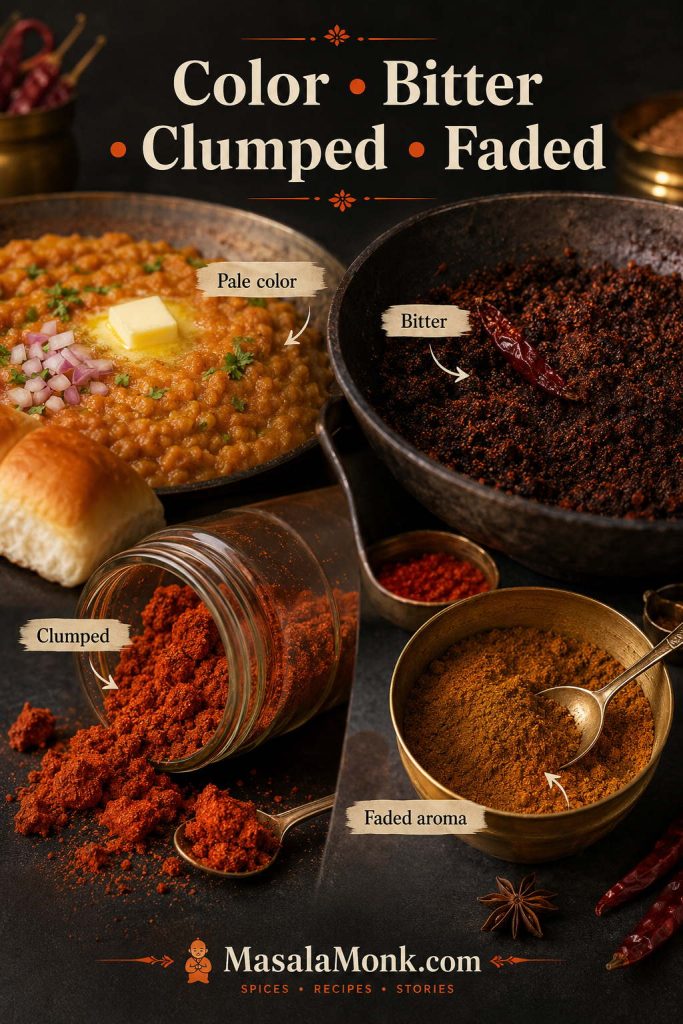
Color, Bitterness and Storage Fixes

Troubleshooting board showing pale pav bhaji, bitter over-roasted masala, clumped spice powder in a jar, and faded old masala powder.
Pale color usually points to chilli choice, bitterness to over-roasting, clumps to moisture, and faded aroma to old spices or poor storage.
Problem Likely reason Fix
Bitter masala Spices were roasted too hard or burnt Use low heat next time. For the current bhaji, soften with potato, butter, and tomato.
Pale or weak color Kashmiri chilli, tomato, or proper cooking may be missing Boost color with Kashmiri chilli powder, tomato paste, or better chillies. Avoid relying only on food color.
Clumped homemade powder Moisture entered the jar or spices were ground warm Store airtight, use a dry spoon, and cool spices fully before grinding.
Faded aroma Old spices or poor storage Make smaller batches and store away from heat, light, and steam.

Most fixes work better when the masala is cooked into the tomato-butter base first, so revisit how to bloom pav bhaji masala if the flavor still tastes raw or separate.

For a different Mumbai-style dry spice hit, MasalaMonk’s vada pav dry chutney recipe is a useful contrast. It is roasted, garlicky, peanut-coconut based, and meant to be sprinkled rather than cooked into a bhaji.

Useful Tools for Homemade Pav Bhaji Masala

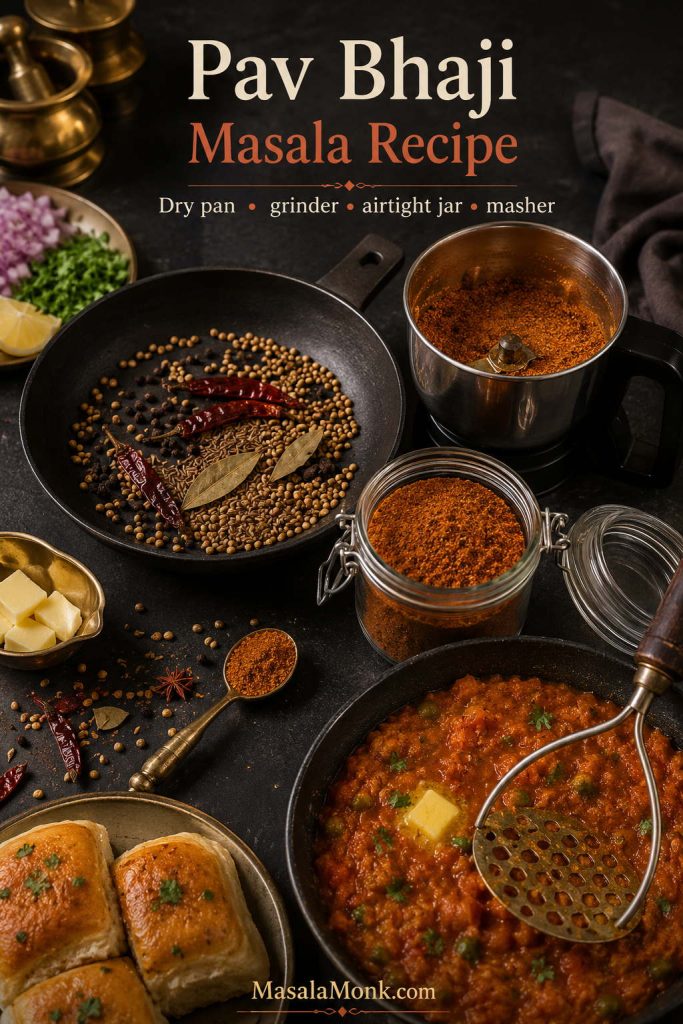
Once the blend is chosen, equipment matters only if it changes the result: a finer grind, drier storage, or smoother bhaji. You only need three basics — a dry pan, a grinder, and an airtight jar — but these tools can help if you cook this often.

Dry pan, mixer grinder jar, airtight glass jar, dry spoon, roasted spices, potato masher, pav, and pav bhaji arranged as useful tools for the recipe.
You do not need many tools for homemade pav bhaji masala; a dry pan, grinder, airtight jar, and masher cover the steps that affect flavor most.

For Making the Masala

Sujata Supermix Mixer Grinder: the main practical grinder pick for turning roasted whole spices into a fine, aromatic powder.

Check Sujata Supermix Mixer Grinder on Amazon

Nestasia Airtight Glass Jars: helpful for storing homemade masala away from steam, heat, and moisture.

Check Nestasia Glass Jars on Amazon

For Making Pav Bhaji with the Masala

Wonderchef Ambrosia Potato Masher: useful when cooking pav bhaji because it helps mash potatoes, peas, tomatoes, capsicum, and cooked vegetables directly in the pan.

Check Wonderchef Ambrosia Potato Masher on Amazon

Optional upgrades: a heavier mixer grinder or cast iron tava can help if you cook Indian snacks often, but they are not necessary for this homemade masala. For this post, the most useful tools are still a reliable grinder, a dry airtight jar, and a masher for the bhaji itself.

That same tawa-and-butter style also shows up in Mumbai sandwiches. If you want another snack built around chutney, vegetables, butter, and heat, MasalaMonk’s authentic grilled Bombay sandwich recipe fits naturally beside this pav bhaji masala guide.

Other Ways to Use Pav Bhaji Masala

This blend is not only for pav bhaji. Once you have a fresh homemade jar or a good store-bought mix, use it in small amounts to add Mumbai street-food flavor to quick dishes.

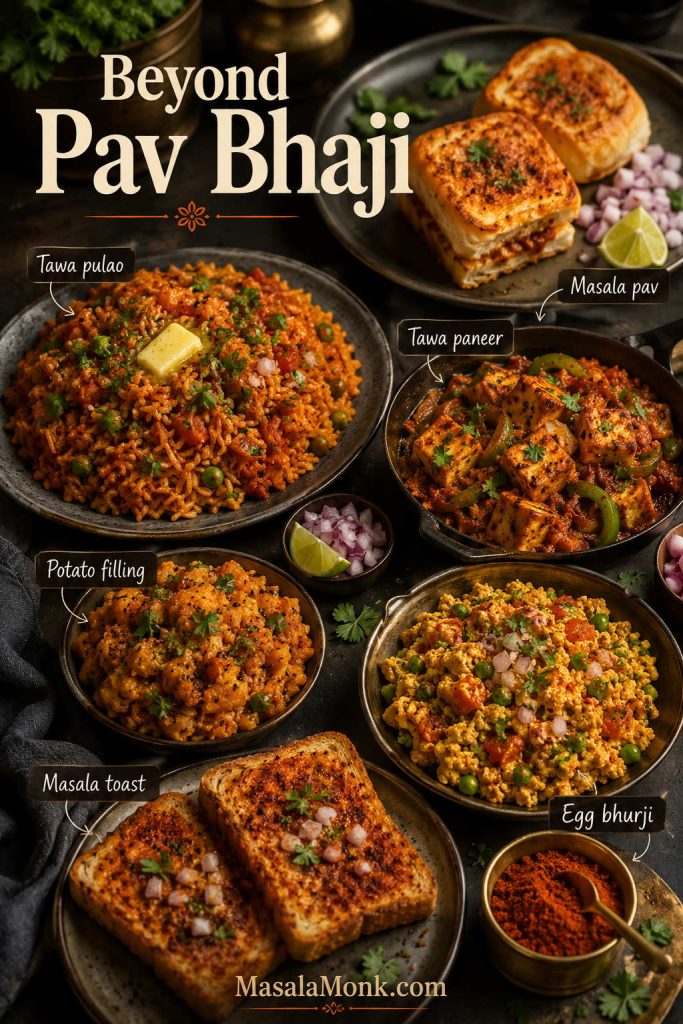
Dishes made with pav bhaji masala including masala pav, tawa pulao, tawa paneer, potato filling, egg bhurji, and masala toast.
A fresh jar of pav bhaji masala can season more than bhaji, so use small amounts in tawa pulao, masala pav, paneer, potato fillings, eggs, or toast.
  • Masala pav: cook onions, tomatoes, capsicum, butter, and pav bhaji masala until glossy, then toss pav in the mixture.
  • Tawa pulao: add a small spoon to rice with vegetables, tomato, butter, and coriander.
  • Masala upma: use just a pinch when you want everyday upma to taste fuller and more lunch-like; MasalaMonk’s upma recipes already include a masala-upma direction.
  • Tawa paneer: use a little in a tomato-capsicum masala.
  • Potato filling: add a little to mashed potatoes for sandwiches, rolls, toasties, or snack fillings. For more snack-style potato ideas, see MasalaMonk’s potato appetizers guide.
  • Egg bhurji: use a small pinch for a tawa-style twist.
  • Vegetable stir-fry: add near the end, but cook briefly so it does not taste raw.
  • Masala toast: mix with butter, onions, tomatoes, and capsicum.
  • Quick spiced rice: add a small amount to leftover rice with butter and vegetables.
Use lightly outside pav bhaji: this blend is assertive. Start with ¼–½ teaspoon in small dishes and increase only after tasting.

FAQs

What is pav bhaji masala made of?

It is usually made from coriander seeds, cumin, fennel, dried red chillies, black pepper, cinnamon, cloves, black cardamom, bay leaf, amchur, dry ginger, and sometimes stone flower, black salt, turmeric, mace, or nutmeg.

Which pav bhaji masala brand is best?

Everest is a good familiar first packet, Badshah leans bolder, and MDH fits the classic household masala lane. Choose the rest based on availability, price, heat level, salt level, and whether you prefer organic spices.

Is homemade better than store-bought?

Homemade is better for freshness and control. Store-bought is better for convenience. Both can make good bhaji if used correctly.

How much should I use for 4 servings?

Start with 2–3 teaspoons homemade powder or about 1 tablespoon store-bought masala for 4 servings. Add more only after the bhaji has simmered.

What can I use instead of pav bhaji masala?

Use coriander powder, cumin powder, Kashmiri chilli powder, a little garam masala, black pepper, and amchur or lemon juice. It will not taste identical, but it gives warmth, color, and tang.

Does pav bhaji masala contain salt?

Some store-bought blends may contain salt. Homemade versions do not need to. Taste before adding extra salt, especially when using a packet.

Is it the same as garam masala?

No. Garam masala is warmer and more general-purpose. Pav bhaji masala is tangier, more savory, and built specifically for pav bhaji-style flavor.

Why does my pav bhaji not taste street-style?

The usual reasons are weak masala, undercooked tomatoes, not enough butter, poor mashing, not enough salt or acid, or adding the powder too late. Cook it into the tomatoes and butter, mash well, then finish with butter, coriander, onion, and lemon.

How long does homemade masala last?

For best aroma, use it within 2–3 months at room temperature. It can last longer if refrigerated or frozen tightly, but the flavor is brightest when fresh.

Can I use it in other recipes?

Yes. Use it in masala pav, tawa pulao, tawa paneer, egg bhurji, vegetable stir-fries, potato fillings, sandwiches, and spiced rice. Start small because the blend is strong.

Which spices are optional in homemade pav bhaji masala?

Stone flower, mace, nutmeg, black salt, turmeric, and star anise are optional. The core blend can still work without them.

Should I roast store-bought masala before using it?

No. Do not dry-roast store-bought powder in an empty pan because it can burn quickly. Bloom it briefly in butter or oil with tomatoes instead.

Final Thoughts

The best pav bhaji masala is not the packet with the loudest flavor or the homemade blend with the longest spice list. It is the one that makes the bhaji taste whole: warm, tangy, buttery, bright, and deep enough that the potatoes, tomatoes, vegetables, and spices feel like one glossy pan of pav bhaji.

Once you learn that rhythm, pav bhaji stops feeling like a packet-masala gamble and starts feeling like something you can control from the pan.

That is the real win: bhaji that tastes glossy, tangy, buttery, and whole, not like vegetables trying to hide under spice powder.

Posted on Leave a comment

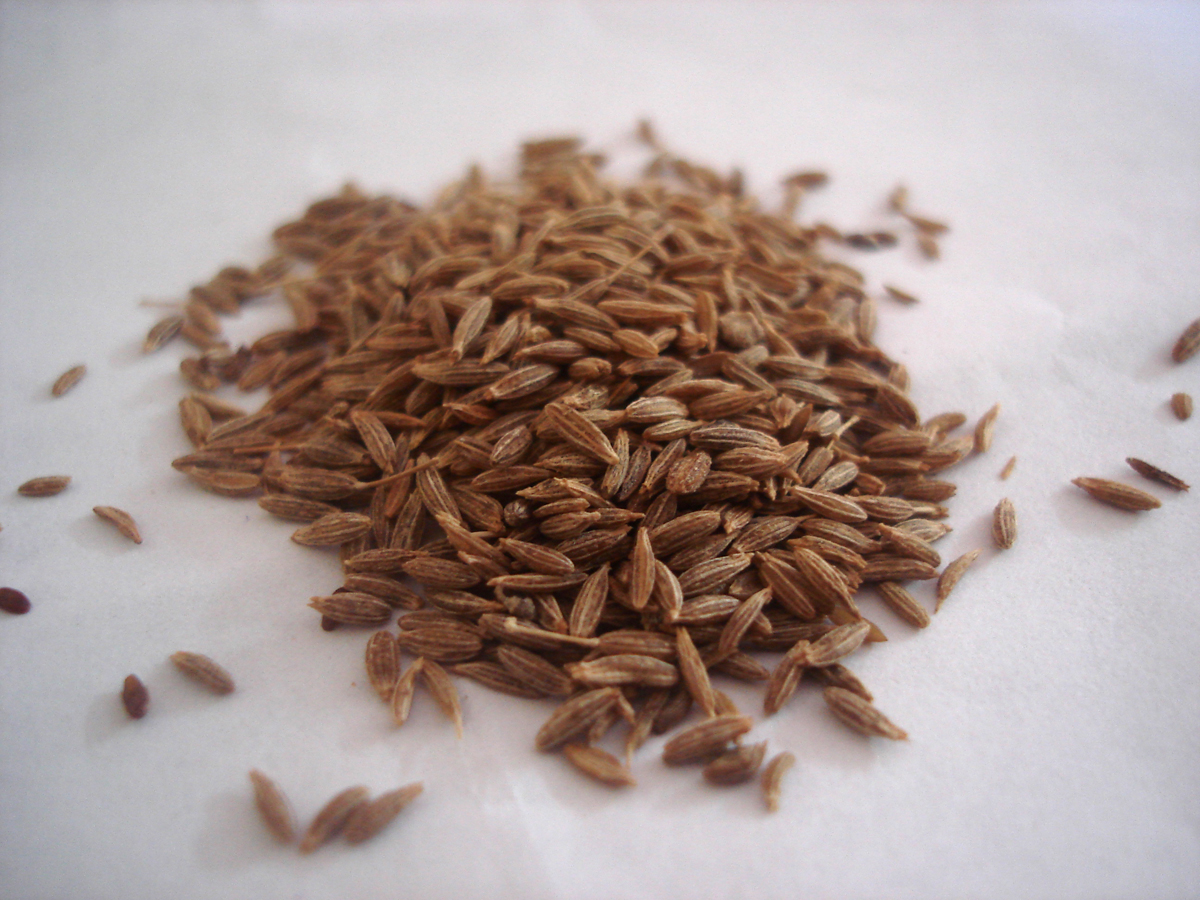
Harnessing the Power of Cumin for Weight Loss

When it comes to weight loss, sometimes the key lies in the spices we use to enhance the flavors of our meals. Cumin, a popular spice in many cuisines, not only adds a delightful taste but also offers potential benefits for weight management. Packed with antioxidants and compounds that aid digestion, cumin can be a valuable addition to your weight loss journey. Let’s unlock the power of cumin and discover how it can spice up your efforts to achieve a healthier, fitter you. 🌱🌶️💪

1. Boosting Metabolism and Fat Burning 🔥🌿

Cumin contains compounds that can help boost your metabolism and support fat burning. One such compound is thymoquinone, which has been shown to stimulate the breakdown of fat cells. By incorporating cumin into your meals, you may potentially enhance your body’s ability to utilize stored fat as an energy source. This can contribute to weight loss and help you reach your goals more efficiently. Embrace the metabolism-boosting power of cumin and ignite your fat-burning potential! 🌟💪🥗

2. Curbing Cravings and Promoting Satiety 🍽️🌶️

One of the challenges of weight loss is managing cravings and controlling appetite. Cumin can be a helpful ally in this regard. It contains compounds that can help suppress appetite and reduce food cravings. By incorporating cumin into your meals, you may experience a greater sense of fullness and satisfaction, making it easier to stick to your calorie goals and avoid overeating. Embrace the appetite-curbing benefits of cumin and empower yourself in your weight loss journey. 🌟🌶️💫

3. Aiding Digestion and Reducing Bloating 🌿🌱

Proper digestion is essential for weight management and overall well-being. Cumin has long been used as a digestive aid in traditional medicine. It can help stimulate the production of digestive enzymes, supporting the breakdown of food and enhancing nutrient absorption. Additionally, cumin has carminative properties, which means it can help alleviate gas and bloating. By incorporating cumin into your meals, you can support a healthy digestive system, reduce discomfort, and optimize nutrient utilization. Embrace the digestive benefits of cumin and promote a happier, healthier gut. 🌟🍽️🌿

4. Flavorful and Versatile Spice for Healthy Meals 🌶️🍽️

One of the great advantages of cumin is its versatility in the kitchen. This aromatic spice can add depth and warmth to a wide range of dishes. Sprinkle it over roasted vegetables, use it as a seasoning for soups or stews, or incorporate it into homemade spice blends. The flavorful punch of cumin can transform ordinary meals into extraordinary culinary experiences. By using cumin in your cooking, you can enjoy the taste while reaping the potential weight loss benefits. Get creative in the kitchen and let cumin spice up your healthy meals! 👩‍🍳🌶️🌿

5. Balancing Blood Sugar Levels 🩸🌿

Balancing blood sugar levels is crucial for weight management and overall health. Fluctuations in blood sugar can lead to cravings, energy crashes, and overeating. Cumin may help regulate blood sugar levels by improving insulin sensitivity. By incorporating cumin into your meals, you can potentially maintain more stable blood sugar levels, reducing the risk of spikes and crashes that can derail your weight loss efforts. Embrace the blood sugar-balancing power of cumin and support your body’s optimal functioning. 🌟🌶️💚

While cumin can offer potential benefits for weight loss, it’s important to remember that it works best when combined with a balanced diet, regular exercise, and overall healthy lifestyle habits. Embrace the flavorful potential of cumin and add a dash of spice to your weight loss journey. 🌱🌶️💪

Posted on 2 Comments

4 Ways to Eat Coriander Seeds for Weight Loss

If You’ve Struck a Weight-Loss Plateau, Coriander Seeds for Weight Loss Can Be the Needle Mover for You.

Weight loss isn’t a cakewalk. It takes daily workouts, and the right foods to get your body shedding fat like crazy.

While you may not know but coriander isn’t only good for garnishing. Apart from making your cuisines look appetizing, coriander or dhania or Cilantro is fibre rich herb that helps you cut the flab.

We have unearthed the deeper secrets of coriander seeds that help you improve digestion, burn fat and stick to your diet plans.

Nutritional Potency of Coriander Seeds

A 4g serving of coriander contains:

  • Vitamin A
  • Vitamin C
  • Vitamin E
  • Calcium
  • Magnesium
  • Iron
  • Sodium (2mg)
  • Phosphorus
  • Potassium (20.8mg)
  • 0 fat/carbs

In totality, coriander is an excellent source of potassium as well as vitamins A and K. It also acts as a vital folic acid supplement in your diet.

How do Coriander Seeds Help You Lose Weight?

Coriander Seeds aid with weight loss by accelerating the fat-burning process during exercise and even throughout the day. It’s because coriander seeds contain a compound that alters the rate of lipid metabolism in your body. This results in more fat burn than fat storage around the belly or thigh areas.

According to research, consuming only 2g of coriander powder each day can significantly boost lipid metabolism in your body.

Ultimately, your body not only stops storing excess fat but melts away more stored fat during and after the workout.

On top of faster fat burn, there are several other benefits of coriander seeds for weight loss.

1. Boosts Metabolism

Coriander Seeds have been used in Ayurvedic medicine for ages for their digestive benefits. These help in boosting your metabolism and increase your energy levels. Thus, on days when you work out, you will be building more muscle and burning more fat.

2. Increases Carbohydrate Breakdown

We all think of a bland, carb-free diet when it comes to weight loss. But, here’s a way around it: add potassium-rich foods to your diet. Potassium helps break down carbohydrates into energy rather than fat. That’s why we use coriander seeds for weight loss as it is rich in potassium.

The best part: Even if you have a cheat meal with high-carb foods, your body will use up the carbs for producing energy.

3. High Fiber Content

Coriander Seeds are rich in fibre, which promotes the feeling of satiety for longer. Moreover, as it requires more energy to break down fibre, more stored fat is converted to energy to metabolize it.

4. Detoxifies Body

Coriander Seeds have strong chelating properties that help in cleansing your body of toxins and heavy metals. The carotenoids, terpenoids, and polyacetylenes flush out harmful free radicals and toxins from your body. With regular body detoxification, you can shed 5 to 20 pounds of your weight.

5. Improves Digestion

Coriander helps prevent stomach cramps and bloat. According to health experts, coriander water prevents the rising of bad gases in the brain (often causing severe headaches).

Pharmaceutical medicine now uses coriander and its oil as carminatives.

4 Ways You Can Use Coriander Seeds for Weight Loss

1. Coriander Seeds Tea

Coriander Seeds water is an herbal weight loss drink you can prepare at home. It helps with digestion as well as lowering blood sugar and cholesterol levels.

To prepare, boil a tsp of coriander seeds in a glass of water for 2-3 minutes. When the water changes colour, turn off the stove. Strain and drink the coriander tea on empty stomach every day to see the results within 2 weeks.

2. Coriander, Mint, and Lemon Drink

This is what we call a perfect weight loss drink. Lemon offers enormous energy while coriander offers potent antioxidants for weight loss.

To prepare, take fresh coriander and mint leaves and grind them to extract the juice. Add 1-2 glasses of water, a bit of lemon and salt to kick-start the fat-loss process (even when you aren’t gyming).

3. Dry Roast Coriander Seeds

Dry roast Coriander Seeds for weight loss benefits. Crush them to powder form and add them to your curries, salads, and smoothies for better digestion.

4. Soak Overnight Coriander Seeds

To prepare, soak 1 tbsp of coriander seeds in a cup of water overnight. Strain the seeds the next morning and enjoy on empty stomach to gear up your metabolic processes.

There are numerous types of Coriander Seeds available in the Indian Market, to have a look at what is latest in Coriander seeds on Amazon India, please Click Here.


For videos related to Health and Wellness, Subscribe to our YouTube Channel:
Masala Monk – The Gourmet Store