Posted on Leave a comment

Gingerbread Cake Recipe: Moist, Easy & Perfectly Spiced

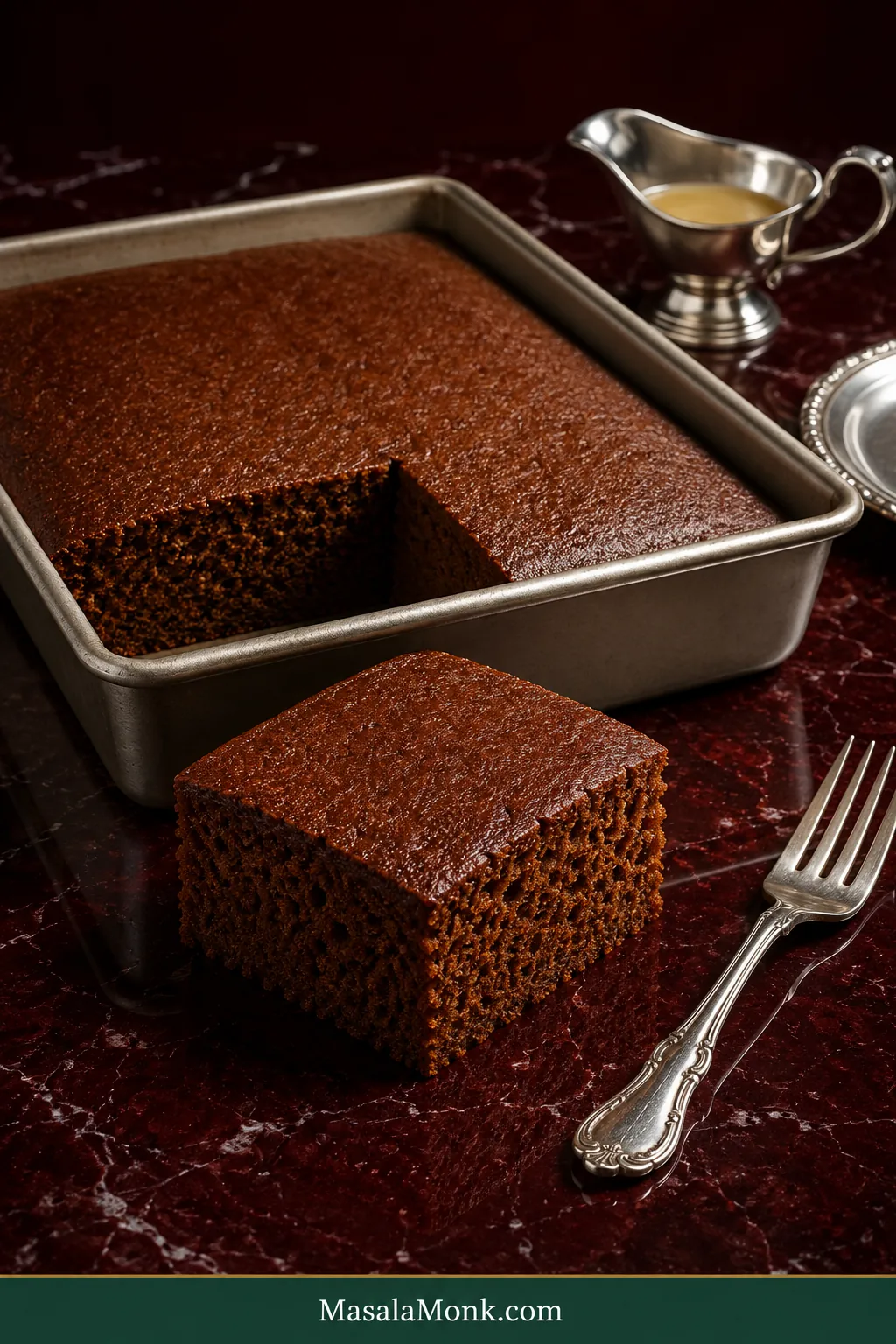
Square of mahogany gingerbread cake cut from a light metal 9×13 pan, showing a moist, evenly baked crumb beside a silver fork.

A good gingerbread cake announces itself before you cut it. The kitchen fills with the deep smell of molasses and warm ginger, the top settles into a rich mahogany brown, and a square gives easily under the fork while the crumb holds together.

Its middle is soft and moist, the edges stay tender, and once cooled the crumb cuts cleanly. Ginger comes through clearly against the molasses.

This is old-fashioned gingerbread in the best sense: one uncomplicated 9×13-inch molasses cake, mixed by hand, cut into squares and perfectly happy without decoration. It has the easygoing feel of a snacking cake—good with coffee in the afternoon, comfortable after dinner, and simple enough to sit beside richer desserts on a holiday table.

Quick Answer: How to Make Moist Gingerbread Cake

For moist gingerbread cake, bake a fluid molasses batter in a light-colored 9×13-inch pan at 350°F / 175°C for about 30–35 minutes, until the center is set and springy and a tester carries moist crumbs but no wet batter.

Mix regular unsulphured molasses with brown sugar, melted butter, a little neutral oil and hot water. Once the mixture feels comfortably warm, with no steam rising, add the eggs, then mix in the dry ingredients until evenly combined and no dry flour remains.

The batter will be dark and unusually fluid. Pour it into the prepared pan promptly and start checking around 28–30 minutes. Let the cake itself—not the timer alone—tell you when it is ready.

Thin batter is normal here. It will look much looser than ordinary butter-cake batter. Do not add extra flour to make it look more familiar.

Gingerbread Cake Recipe

Moist & Easy Gingerbread Cake

A soft, ginger-forward molasses cake baked in one 9×13-inch pan, with a tender crumb that stays moist into the next day.

Hands-on prep15 minutes
Bake time30–35 minutes
Minimum cooling20–30 minutes
Total to warm servingAbout 1¼ hours
Yield12 generous or 15 smaller squares
Pan9×13 in / 23×33 cm light-colored metal, about 2 in / 5 cm deep
Oven350°F / 175°C conventional / 160°C fan
MixerNot needed
Make aheadExcellent 1 day ahead

Cool completely before frosting or cutting especially neat squares.

Equipment

  • 9×13-inch / 23×33 cm light-colored metal baking pan, about 2 inches / 5 cm deep
  • Parchment paper, with enough overhang for a sling if you want to lift the whole cake out
  • Large mixing bowl
  • Medium mixing bowl
  • Whisk
  • Flexible silicone or rubber spatula
  • Digital kitchen scale, preferably
  • Kettle or small saucepan for the hot water
  • Wire cooling rack

Dry ingredients

  • 320 g all-purpose flour (2⅔ cups)
  • 2½ teaspoons ground ginger
  • 1½ teaspoons ground cinnamon
  • ¼ teaspoon ground cloves
  • ¼ teaspoon ground nutmeg
  • 1 teaspoon baking soda
  • 1 teaspoon baking powder
  • ½ teaspoon fine salt

Wet ingredients

  • 150 g packed dark brown sugar (¾ cup)
  • 330 g regular/original unsulphured molasses (about 1 cup / 240 ml)
  • 113 g unsalted butter (½ cup / 4 oz), melted
  • 60 ml neutral oil (¼ cup), such as sunflower, canola or vegetable oil
  • 240 ml hot water (1 cup)
  • 2 large eggs
  • 1 teaspoon vanilla extract

Using a scale? Set the large mixing bowl on it, tare to zero and pour the molasses directly into the bowl. It is much easier than scraping sticky molasses from a measuring cup.

Mix and assemble

  1. Prepare the oven and pan. Heat the oven to 350°F / 175°C conventional / 160°C fan with a rack in the center. Lightly grease the pan and line the base with parchment. If you want to lift the whole cake out before cutting, leave parchment overhang along two opposite sides to form a sling.
  1. Mix the dry ingredients. Whisk the flour, ginger, cinnamon, cloves, nutmeg, baking soda, baking powder and salt together thoroughly.
  1. Make the molasses mixture. Whisk the brown sugar, molasses, melted butter and oil in a large bowl. Slowly whisk in the hot water. Let the mixture stand for a few minutes, until comfortably warm and no longer steaming, then whisk in the eggs one at a time and add the vanilla.
  1. Bring the batter together. Add the dry ingredients and mix until evenly combined and no dry flour remains. Sweep a flexible spatula around the sides and firmly across the bottom to catch hidden pockets. There is no need to beat the batter for volume.
  1. Pour the batter. It will be dark and easily pourable. Resist the urge to thicken it with extra flour. Pour it straight into the prepared pan.

Bake and cool

  1. Bake. Transfer the pan directly to the oven. Avoid opening the door during roughly the first 25 minutes. Begin checking around 28–30 minutes; most cakes will finish in about 30–35 minutes.
  1. Check the center. The middle should look set and spring back gently when touched. A tester may carry a few moist crumbs but should not have wet batter. The edges may also begin to pull slightly from the pan; consider that an extra clue, not something you have to wait for.
  1. Let the crumb settle. Cool on a wire rack for at least 20–30 minutes before cutting. Let the cake cool completely for the neatest slices or before frosting. If you made a parchment sling, wait until the cake is completely cool before lifting it from the pan; warm gingerbread is softer and easier to break.

To serve: enjoy it plain, dust it with powdered sugar, add softly whipped cream, spread on a restrained layer of cream cheese frosting, or spoon over lemon sauce.
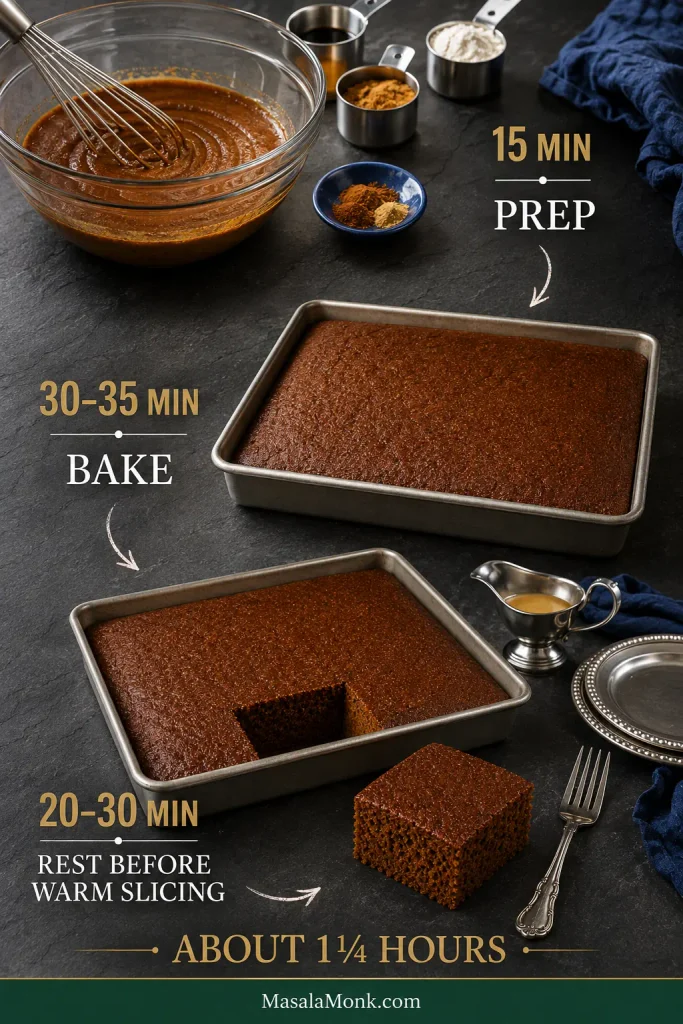
Timeline showing gingerbread cake preparation, baking, cooling and serving stages.
For gingerbread cake, baking time and serving time are not the same thing. Build the cooling rest into the plan so the crumb can settle before the first clean slice.

The Slice We’re Aiming For

  • Soft with a little body: tender enough for the fork to slide through easily, but not airy like sponge cake.
  • Moist and clean-slicing: the crumb feels almost plush and still holds together once cooled.
  • Ginger-forward: ginger reaches you first; cinnamon warms it; clove and nutmeg stay in the background.
  • Deeply colored: expect a rich mahogany-brown crumb with the rounded caramel edge of molasses.

After its initial rest, the crumb is especially yielding. Once fully cool, it cuts into neat, dark squares.
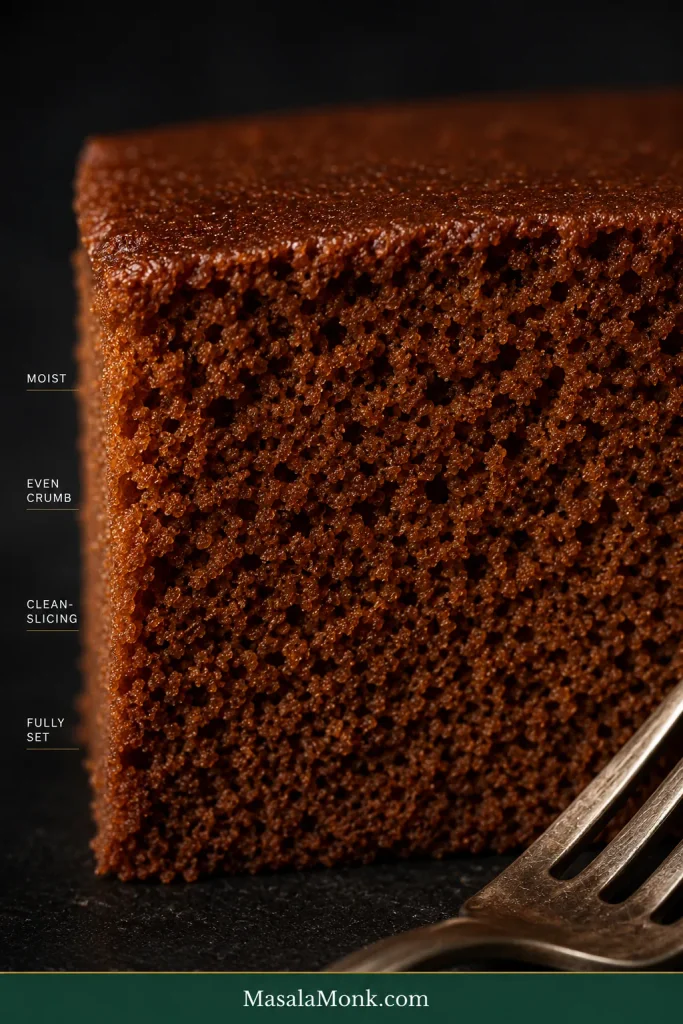
Close-up of gingerbread cake with a fine, evenly baked mahogany crumb that looks moist, tender and fully set.

Gingerbread Cake vs Ginger Cake vs Sticky Ginger Cake

American-style gingerbread cake is usually a soft molasses cake with ginger leading the spice. “Ginger cake” is a broader term; sticky ginger cake usually points toward a darker, denser British-style cake.
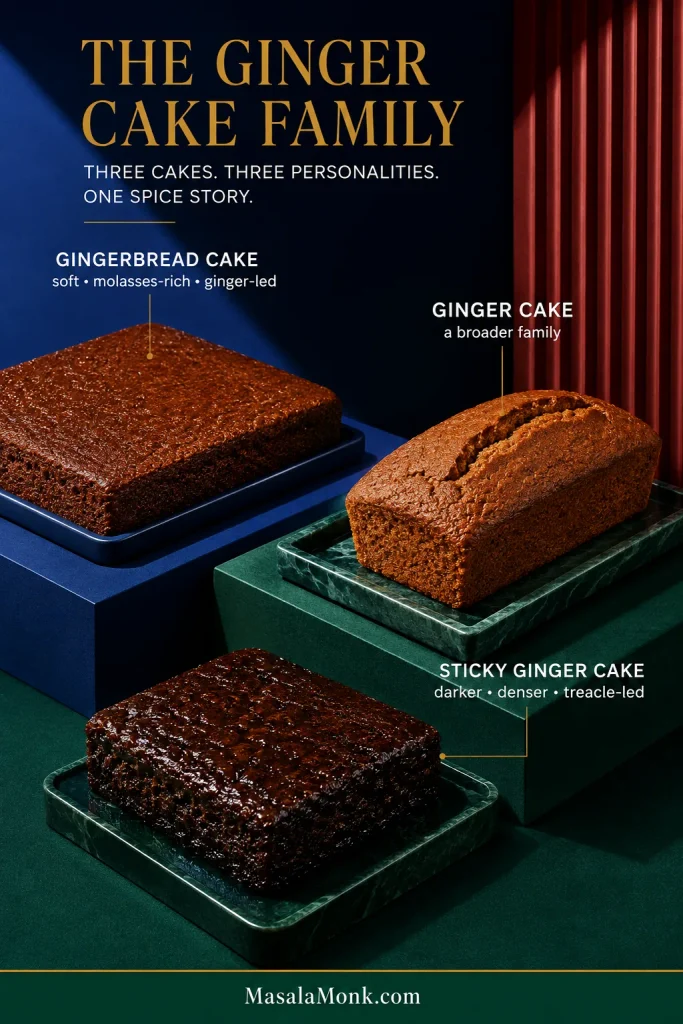
Three cakes labeled gingerbread cake, ginger cake and sticky ginger cake, showing differences in shape, crumb and surface.
When a recipe is called simply “ginger cake,” check its syrup, pan and intended texture before assuming it will behave like American gingerbread cake.

Gingerbread cake: this is the family our recipe belongs to—molasses-rich, ginger-led and commonly baked as a straightforward single layer.

Ginger cake: a broader name that can describe molasses gingerbread, a loaf, a fresh-ginger cake or another regional style altogether.

Sticky ginger cake: usually a more British style, often made with black treacle, golden syrup or stem ginger and intended to become darker, denser and stickier as it rests.

If it is the same molasses-and-ginger family you want in a completely different texture, the Gingerbread Cookies Recipe turns those flavors into soft-centered cut-outs that roll cleanly and hold their shapes.

Why This Recipe Works

Molasses does more than sweeten the cake. It gives gingerbread its deep color, caramelized flavor and characteristic moisture. Regular unsulphured molasses brings plenty of depth and still leaves room for the ginger to stay clear.

Butter brings fuller cake flavor; the smaller amount of neutral oil helps the crumb stay tender after cooling.

Baking soda and baking powder share the lifting work. Baking soda reacts with acidity in the molasses-rich batter, while baking powder supplies additional lift. Together they help this substantial, fluid batter rise without turning the crumb light and sponge-like.

Hot water thins the molasses so it mixes evenly through the batter. The heavy, sticky mixture becomes much easier to combine by hand.

Cinnamon adds warmth around the ginger. Clove and nutmeg stay quieter. If you prefer several warm spices to share the spotlight more evenly, the Spice Cake Recipe takes that broader approach.

Ingredients That Matter Most
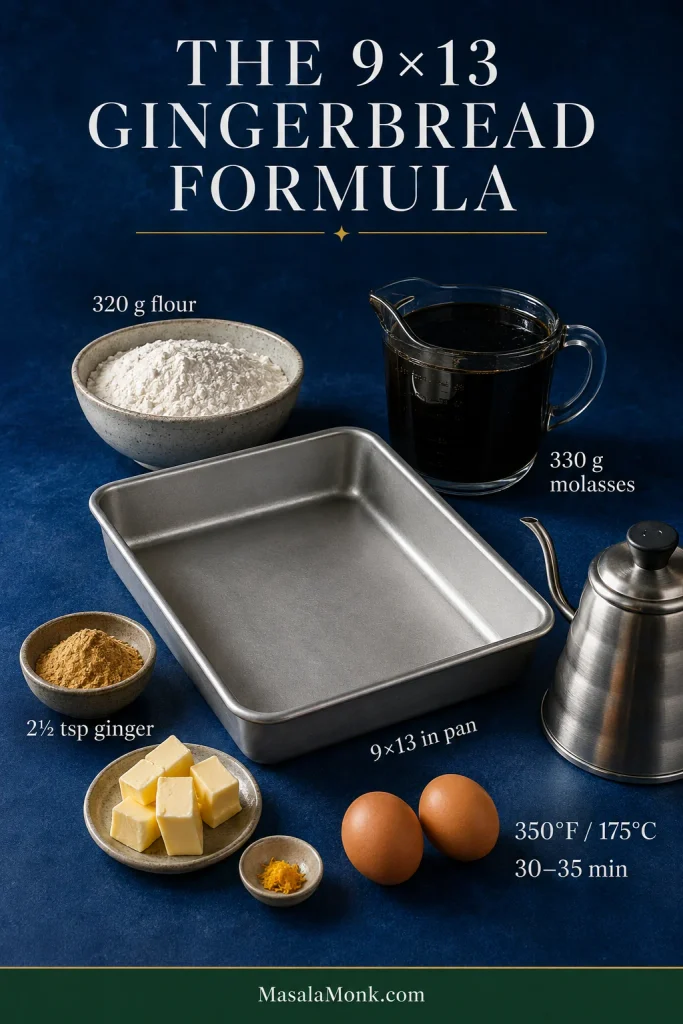
Infographic of measured ingredients for a 9×13 gingerbread cake, including flour, molasses, sugar, butter, oil, eggs, hot water and spices.
Treat the 9×13 gingerbread formula as a system: flour, molasses, fat and pan depth all push the final crumb in different ways, so one change can affect more than one trait.

Which Molasses Should You Use?

The best molasses for this gingerbread cake is regular/original unsulphured molasses. Dark or robust molasses makes a stronger, less sweet cake; blackstrap is considerably more bitter and is not the best choice here.
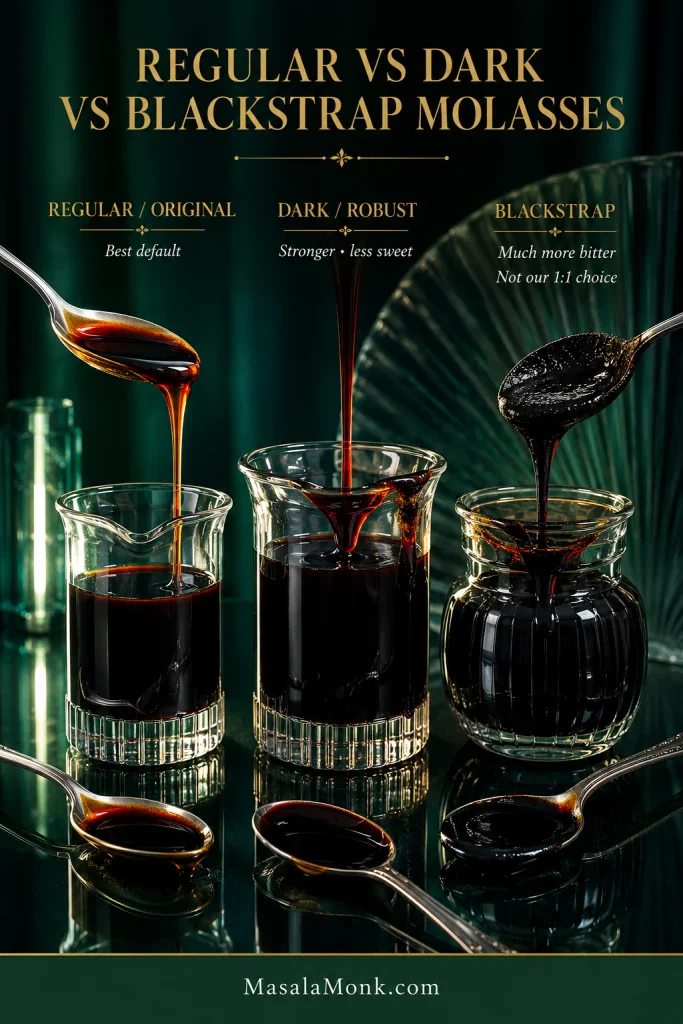
Regular, dark and blackstrap molasses shown side by side in glass containers with spoons displaying their different colors.
Molasses strength changes more than sweetness: as the syrup grows darker and more bitter, ginger has to compete harder to stay distinct in the finished cake.
MolassesHow it tastes hereBest use
Regular/original unsulphuredDeep, rounded and pleasantly sweetBest default
Dark/robustDarker, stronger and somewhat less sweetGood if you already enjoy assertive molasses
BlackstrapMuch more bitter, mineral-forward and intenseNot recommended as a straight 1:1 swap

Outside the US, the labels change. Canadian fancy molasses is generally closest to the flavor we’re after. In the UK, black treacle is a practical related substitute when American-style molasses is hard to find, but it is not identical. Some black treacles taste somewhat sweeter and rounder, so expect a slightly different cake.
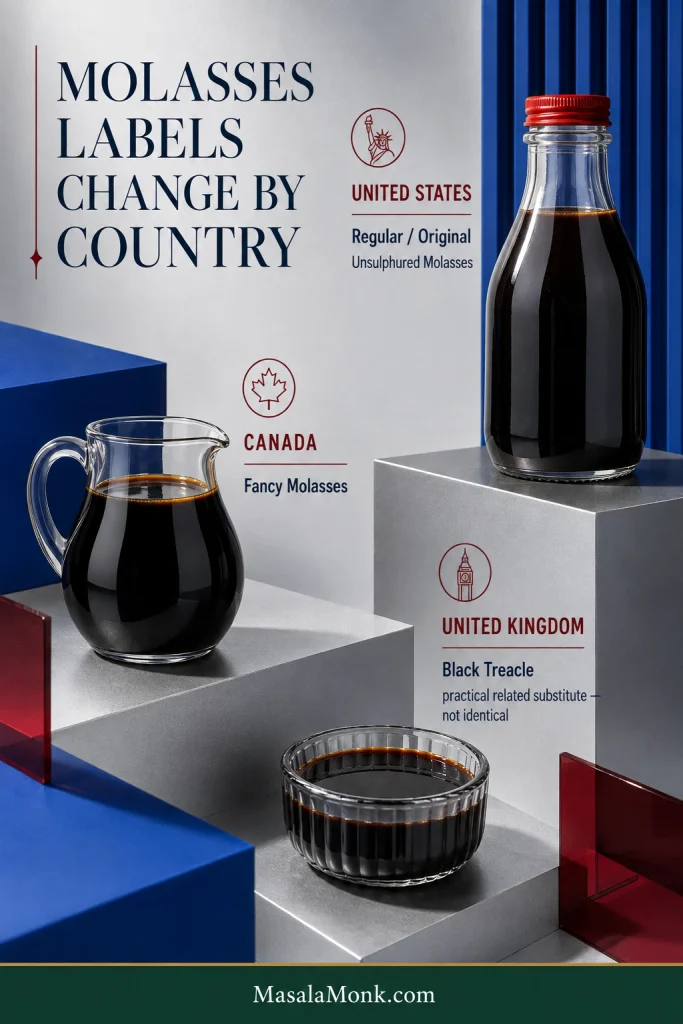
Guide comparing common molasses labels in the United States, Canada and United Kingdom with bottles and small pitchers of dark syrup.
Regional names are only a starting point. When buying molasses for gingerbread outside the US, match flavor intensity first; equally dark syrups can still taste very different.

If the labels on different jars are confusing, King Arthur Baking has a useful guide to light, dark and blackstrap molasses.

Ground, Fresh and Crystallized Ginger

Ground ginger gives the whole cake its broad, familiar ginger warmth. Fresh ginger is brighter and sharper. Use it as a boost; keep the ground ginger as the foundation.
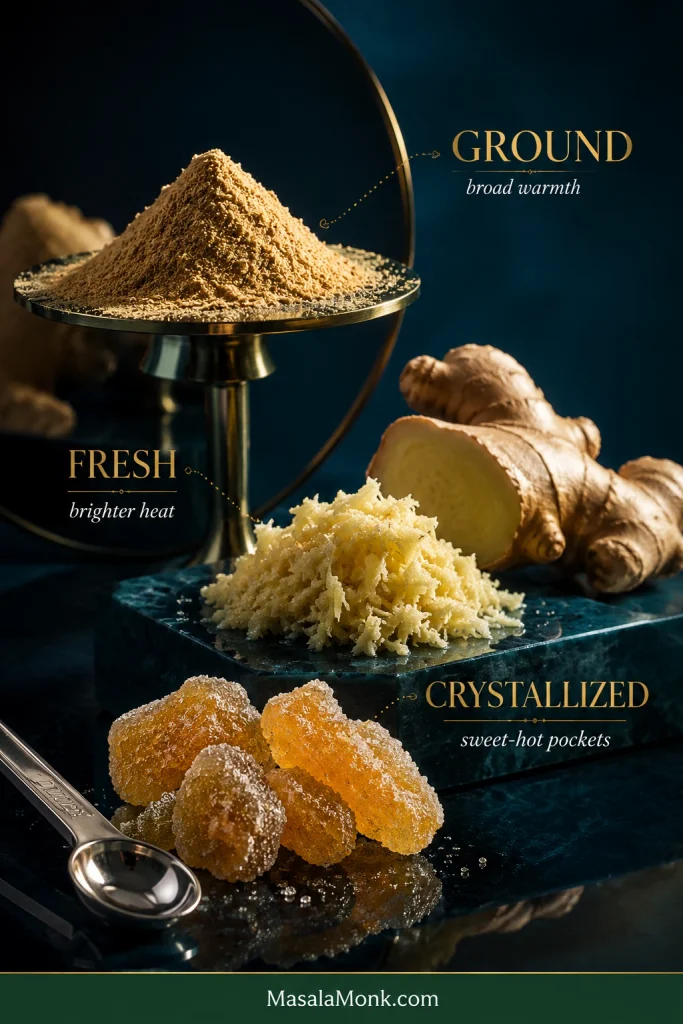
Ground ginger powder, grated fresh ginger and chopped crystallized ginger displayed together on a dark surface.
Think of the three forms as different kinds of ginger impact: ground spreads through every bite, fresh flashes brighter, and crystallized ginger creates concentrated sweet-hot pockets.

To make a stronger cake, increase the ground ginger to about 3 teaspoons. For brighter, fresher heat, keep the ground ginger and add 1 tablespoon finely grated fresh ginger to the wet mixture.

Before adding more: smell the ground ginger already in your jar. Fresh spice smells warm and pungent as soon as you open it. A faint aroma means a new jar will do more for the cake than another spoonful of tired ginger.
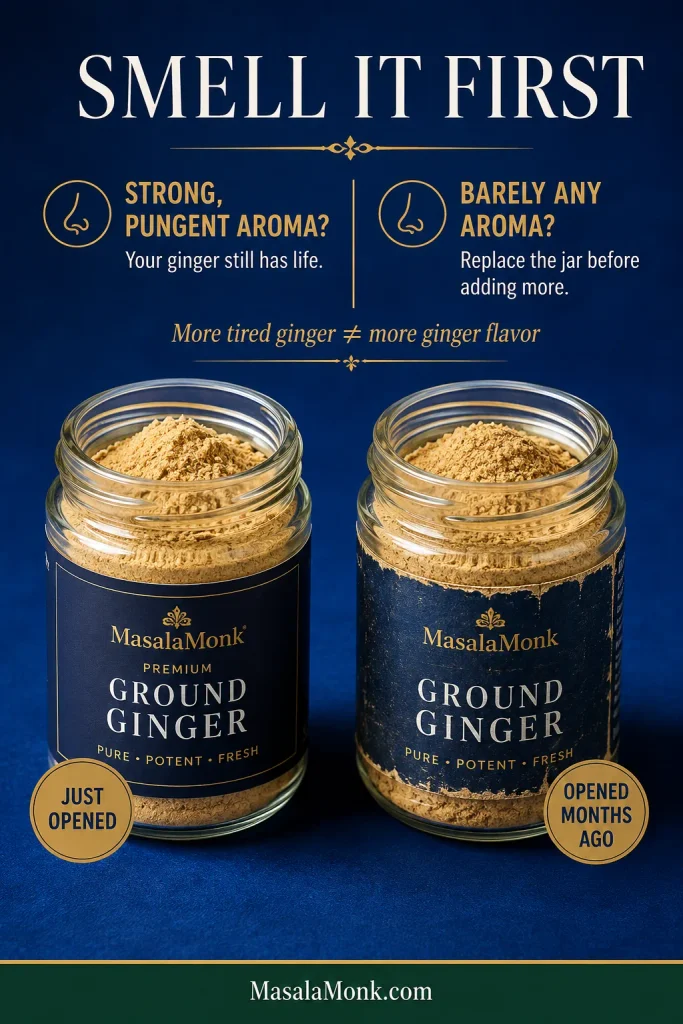
Fresh and older ground ginger shown in an aroma comparison with open spice containers.
Aroma can fade long before ground ginger looks stale. Smell it before measuring; pungency matters when the spice has to stand up to molasses.

If you want to experiment with crystallized ginger, dice it finely and fold in only a small amount. It creates concentrated sweet-hot pockets through the cake. In a batter this fluid, some pieces may settle toward the bottom, and tossing them in flour does not reliably prevent that.

Tempted to use a premixed warm-spice blend? Check what is actually in it first. The Apple Pie Spice Recipe, for example, is intentionally cinnamon-led; gingerbread needs ginger to lead.

As for the hot liquid, water is deliberate. Coffee can be lovely in gingerbread, but some people notice it before the ginger. Hot water loosens the molasses without introducing another strong flavor.

What the Batter Should Look Like

If this is your first molasses gingerbread, the batter may look loose enough to make you check the ingredient list again. Nothing is missing.

When the hot water reaches the molasses mixture, it loosens dramatically. After the flour goes in, mix until no dry streaks remain, then sweep the spatula firmly across the bottom of the bowl; dry pockets can hide easily in such a dark batter.
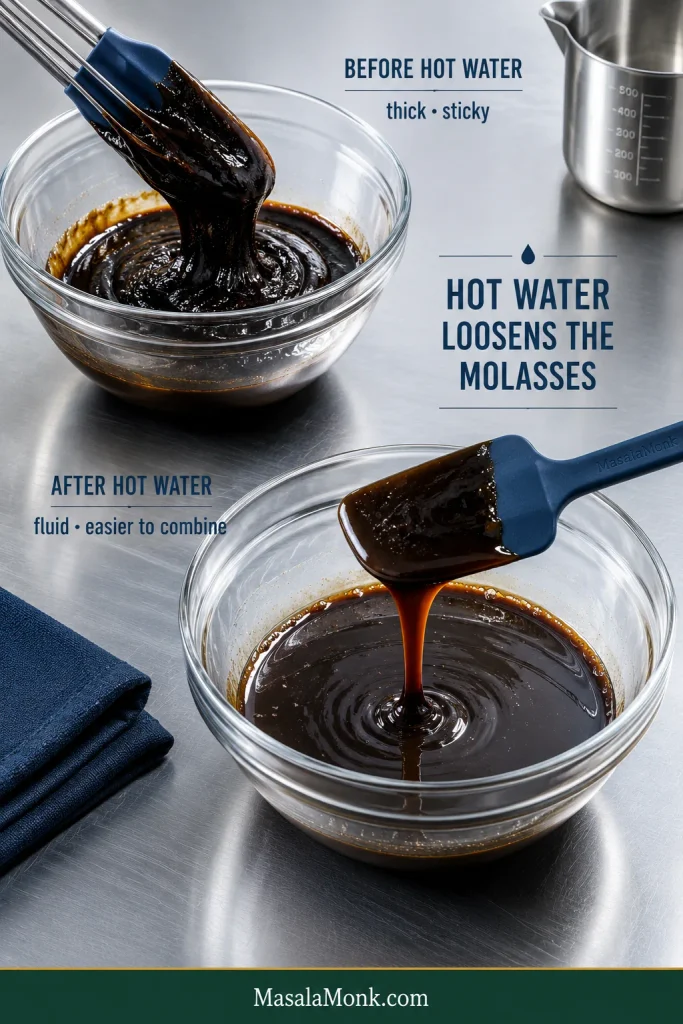
Two bowls of molasses mixture showing a thick consistency before hot water and a much looser, pourable consistency afterward.
The dramatic loosening is useful: once the molasses flows freely, it distributes more evenly through the batter without requiring aggressive mixing.

The finished batter falls easily from the spatula and spreads across the pan almost by itself. Keep that consistency rather than thickening it. Once everything is combined, pour it into the prepared pan and get it into the oven promptly.

Ready for the oven? See how to tell when the center is done.
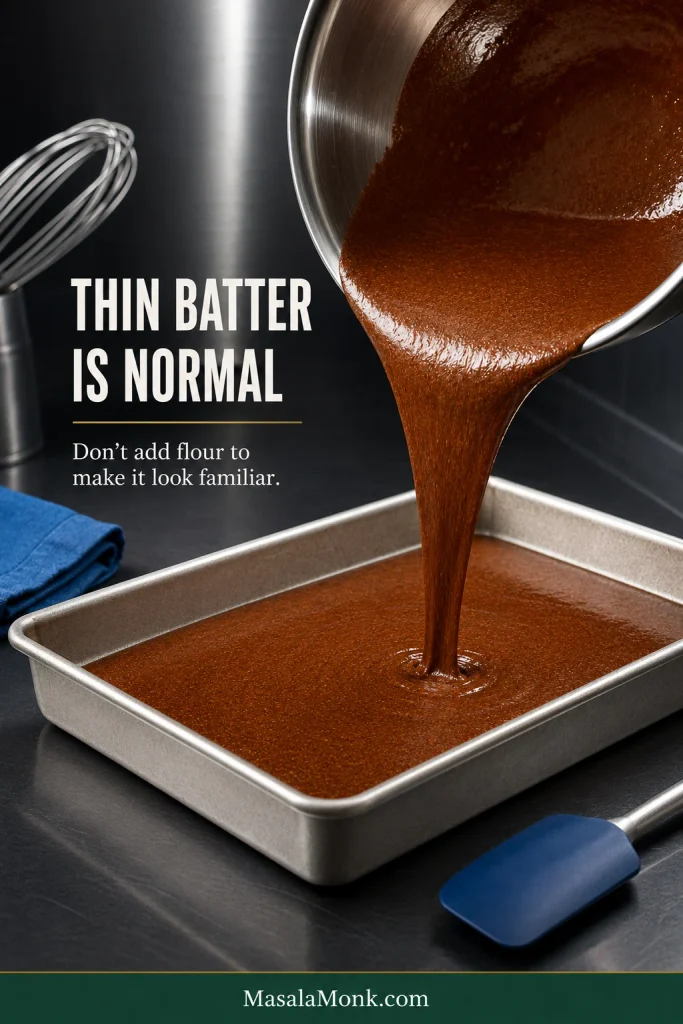
Thin brown gingerbread batter pouring in a ribbon into a light metal rectangular baking pan.
This loose ribbon is the consistency we are looking for. Judge the finished gingerbread, not how closely the bowl resembles a conventional butter cake.

How to Tell When It’s Done

Gingerbread cake is done when the center looks set, springs back gently and a tester shows moist crumbs but no wet batter. The edges may also begin to pull slightly from the pan.

A dark cake makes the last few minutes harder to read. Use several clues together; no single one has to carry the decision.
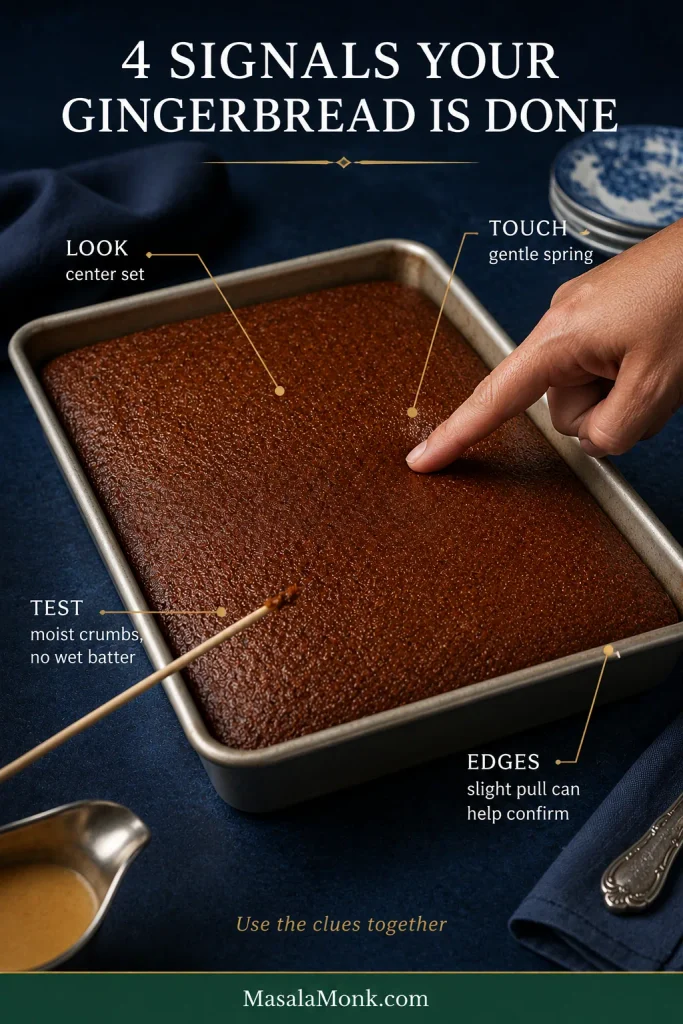
Gingerbread cake with four doneness checks: a set center, springy touch, moist crumbs on a tester and slight edge pull.
The four doneness signals are strongest as a pattern. One odd clue can mislead; several cues arriving together are much harder to misread.

Use the Four-Signal Doneness Test

  1. Look: the center is set, with no liquid or visible rippling.
  2. Touch: a light press near the center springs back.
  3. Test: a few moist crumbs are good; wet batter means it needs longer.
  4. Check the edges: they may just begin to pull from the pan. Treat this as supporting evidence.
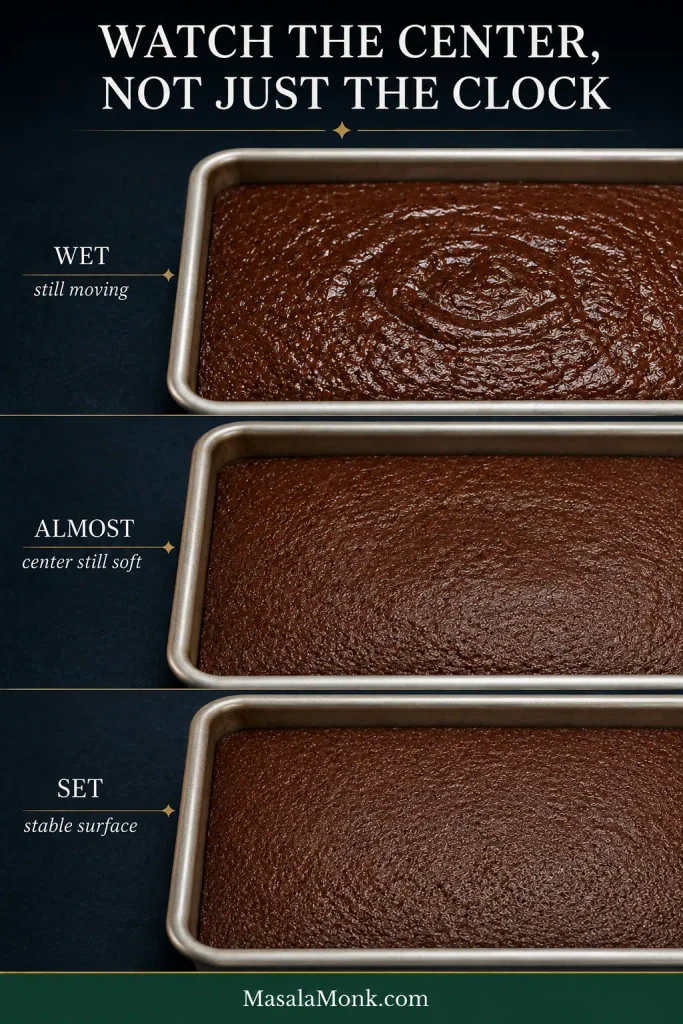
Three gingerbread cakes showing the center progressing from wet and rippled to almost set and fully stable.
Use this progression to calibrate your eye. Once you have seen wet → almost set → set, the final minutes of a dark gingerbread cake become much less guesswork.

Start checking around 28–30 minutes. Your oven and pan may move the finish slightly earlier or later.

What if the tester looks clean but the center still seems uncertain? Look at the whole cake. If the middle remains visibly unstable or stays indented when lightly touched, give it another few minutes.
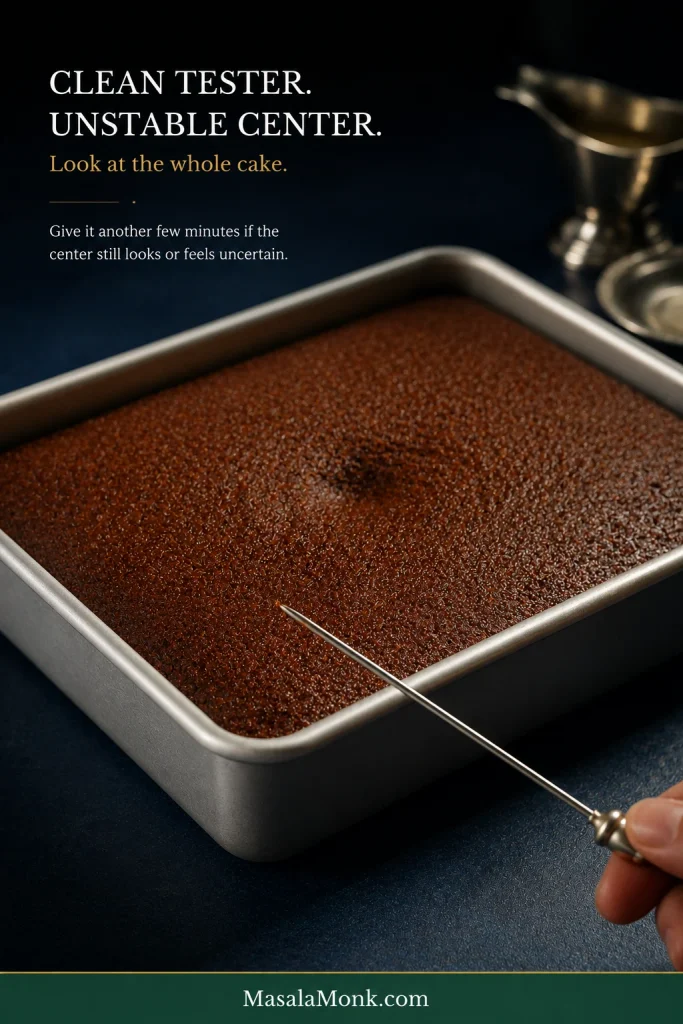
A clean cake tester beside gingerbread whose center still appears slightly soft and unstable.
A cake tester samples one narrow path through the cake. The center’s overall movement and spring tell you something that single puncture cannot.

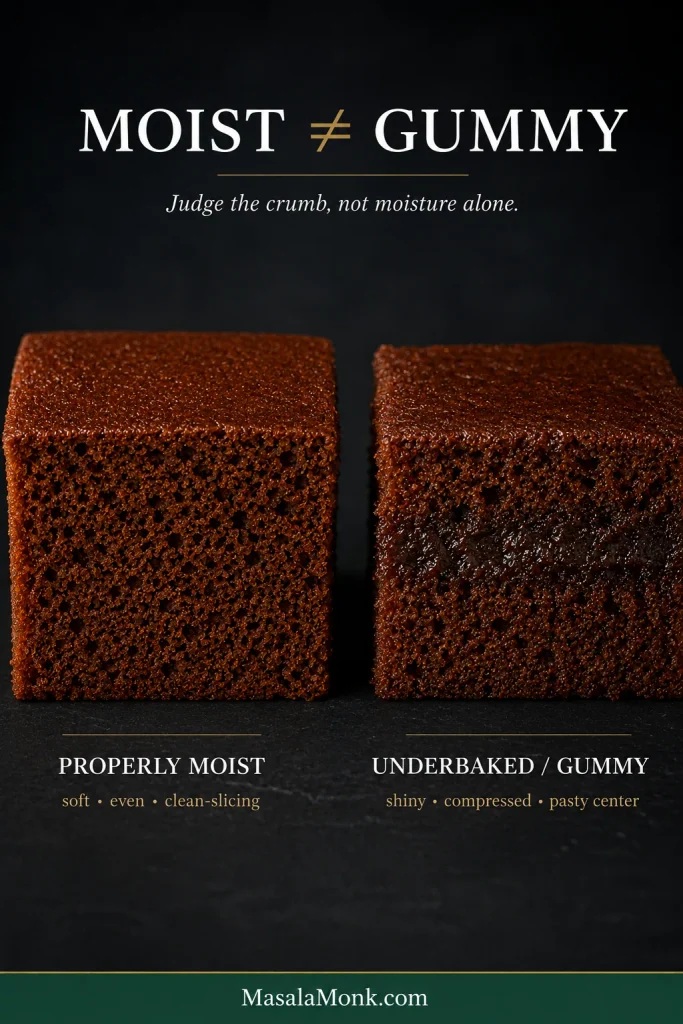
Moist vs Gummy: Know the Difference

Properly moist gingerbread has a soft, even crumb that holds together when sliced; underbaked gingerbread looks shiny, compressed or pasty through the center.

Properly moistGummy or underbaked
Soft, even crumbShiny or compressed strip through the center
Holds together once cooledPasty or wet-looking interior
Moist crumbs on a testerWet batter on the tester
Slices cleanly after restingKnife smears with raw-looking batter
Side-by-side gingerbread cross-sections comparing an evenly moist crumb with a darker, compressed gummy center.
Cooling clarifies the diagnosis: true moisture remains tender and structured, while an under-set center keeps its compressed or pasty look.

If the first slice looks suspiciously dense, remember when you cut it. Molasses-rich cake continues settling as steam escapes, and a slice taken too soon can look wetter and more compressed than it will after the recommended 20–30 minutes of cooling.

Still not sure what went wrong? Go to the troubleshooting guide.

What to Serve With It

A good square does not need frosting to make sense. Plain gingerbread carries plenty of ginger and molasses on its own; the options below simply take it in different directions.
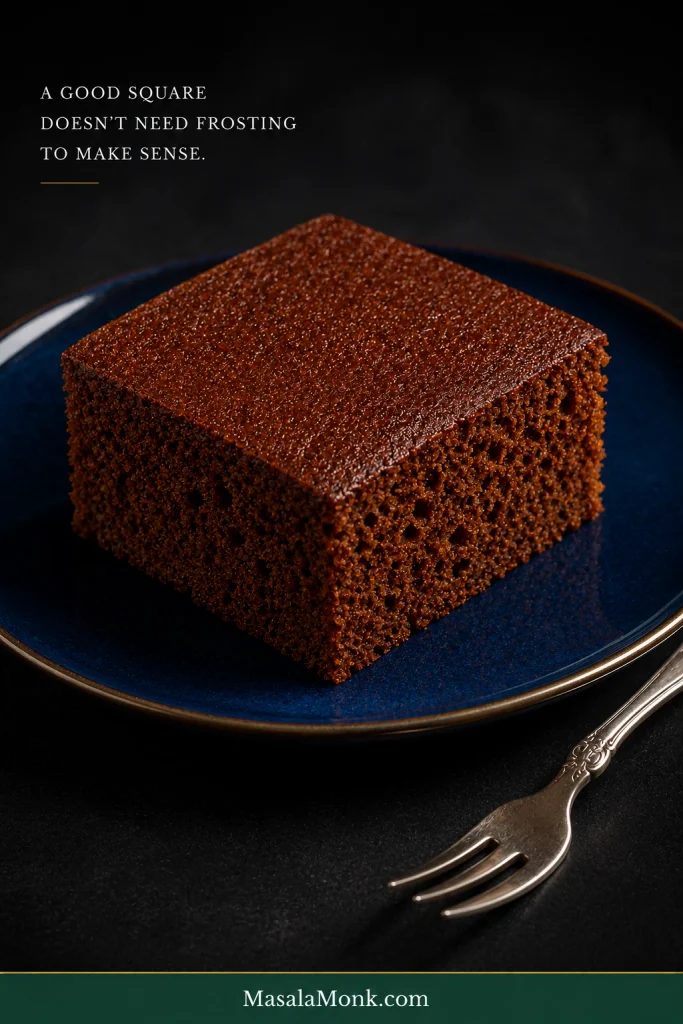
Plain unfrosted gingerbread cake square on a dark blue plate with a silver fork.
  • Powdered sugar: dust the fully cooled cake shortly before serving.
  • Whipped cream: add a softly whipped spoonful beside each square.
  • Cream cheese frosting: keep the layer thin and tangy so the ginger still leads.
  • Lemon sauce: spoon it over the cut cake with the sauce still warm and pourable.
  • Vanilla ice cream or custard: let a little soften into the crumb.
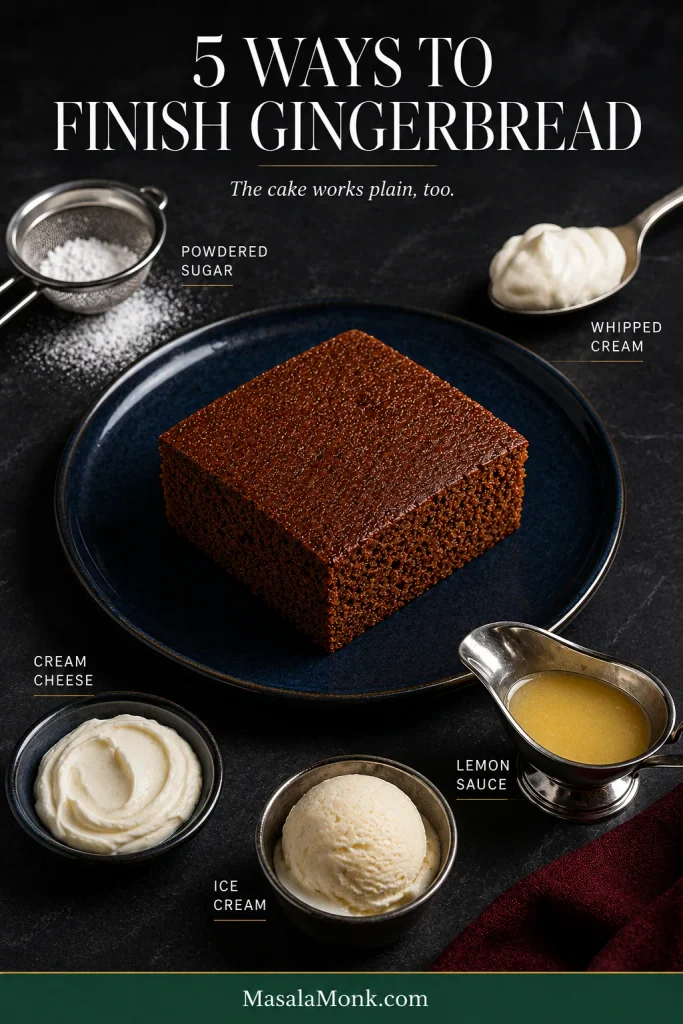
Plain gingerbread square surrounded by powdered sugar, whipped cream, cream cheese, lemon sauce and vanilla ice cream.
Choose a topping by contrast, not by sweetness alone: tang, acidity and cool creaminess each change how the molasses and ginger register on the palate.

Softly whipped cream works especially well when it bends gently from the whisk. Firm decorating peaks are more than this cake needs. The Whipped Cream Recipe shows exactly what soft, medium and firm peaks look like.

Old-Fashioned Lemon Sauce for Gingerbread

Warm lemon sauce can sound unexpected if you grew up eating gingerbread with frosting, but the pairing makes immediate sense on the plate. The cake is dark and warmly spiced; lemon brings brightness. A little sauce slips into the cut face of the crumb while the zest keeps each bite lively.
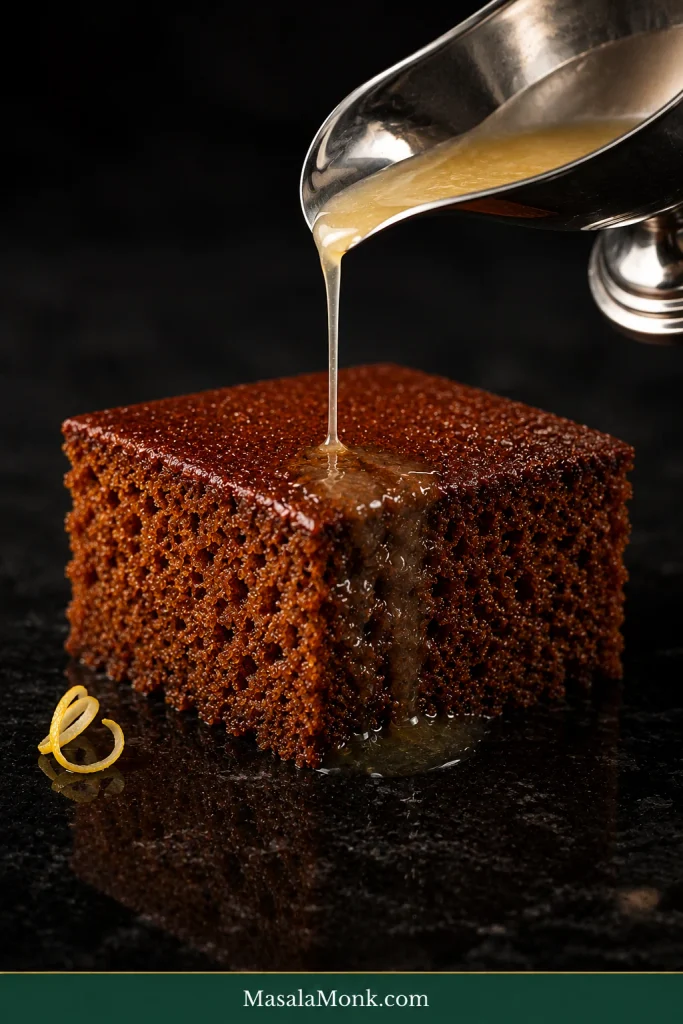
Pale golden lemon sauce being poured from a silver sauce boat over the cut edge of a gingerbread cake square.
Aim warm lemon sauce at the cut face rather than flooding the top; exposed crumb takes up a small pour quickly while the cake’s surface stays intact.

Quick Warm Lemon Sauce

Makes about 1 cup / 240 ml, enough for 12–15 light servings.

  • 100 g granulated sugar (½ cup)
  • 8 g cornstarch (1 tablespoon)
  • 240 ml water (1 cup)
  • 45 ml fresh lemon juice (3 tablespoons)
  • Finely grated zest of 1 lemon
  • 28 g unsalted butter (2 tablespoons)
  • Small pinch of salt

Whisk the sugar and cornstarch together in a small saucepan, then gradually whisk in the water. Bring to a gentle boil over medium heat, stirring regularly.

Lower the heat and simmer gently for about 4–5 minutes, stirring often, until lightly syrupy. Remove from the heat and stir in the lemon juice, zest, butter and salt.
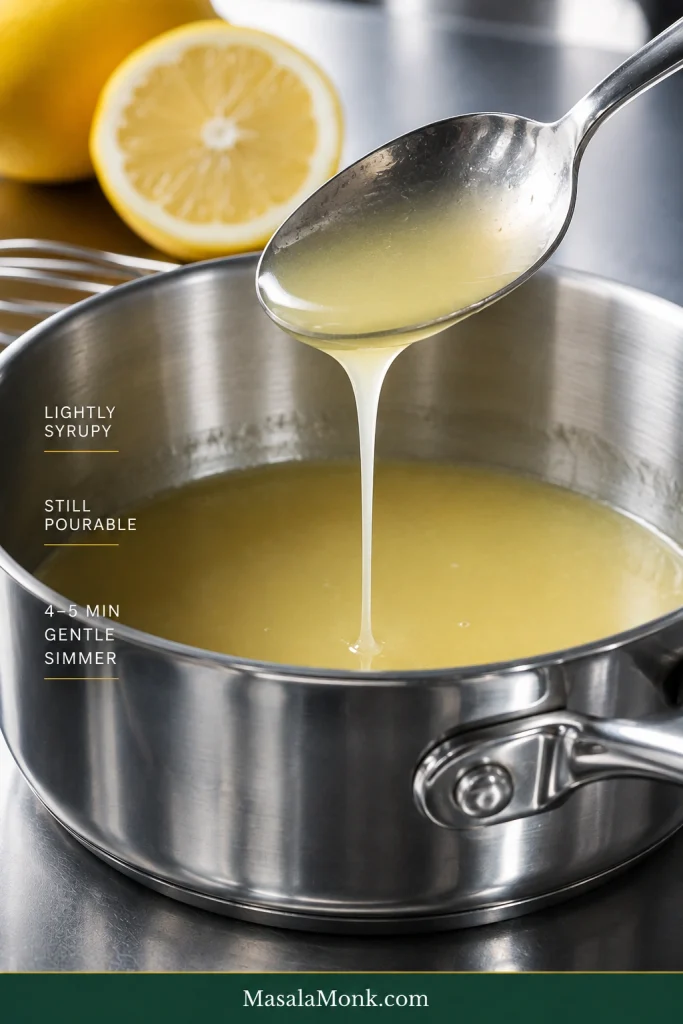
Pale yellow lemon sauce running in a thin ribbon from a spoon into a stainless steel saucepan.
Judge the lemon sauce while it is warm: it tightens as it stands, so the right stopping point is a little looser than the texture you expect on the plate.

Serve it warm and pourable. The sauce should be thin enough to slip into the cut surface of the cake. If it thickens as it stands, loosen it with a small splash of warm water.

Refrigerate leftover sauce separately in a covered container and warm it gently before serving, adding a splash of water if needed to restore its pourable consistency.

The pairing has history behind it, too. Toni Tipton-Martin’s Jubilee pays homage to an old-time ginger cake served with lemon sauce and bourbon Chantilly; the James Beard Foundation’s gingerbread with lemon sauce is a lovely place to explore that tradition further.

If Something Went Wrong

When the sunken center is wet or gummy, start with bake completion and pan depth. A cake that rises unusually high and then collapses points somewhere else: recheck the leaveners, center doneness, pan capacity and oven temperature.
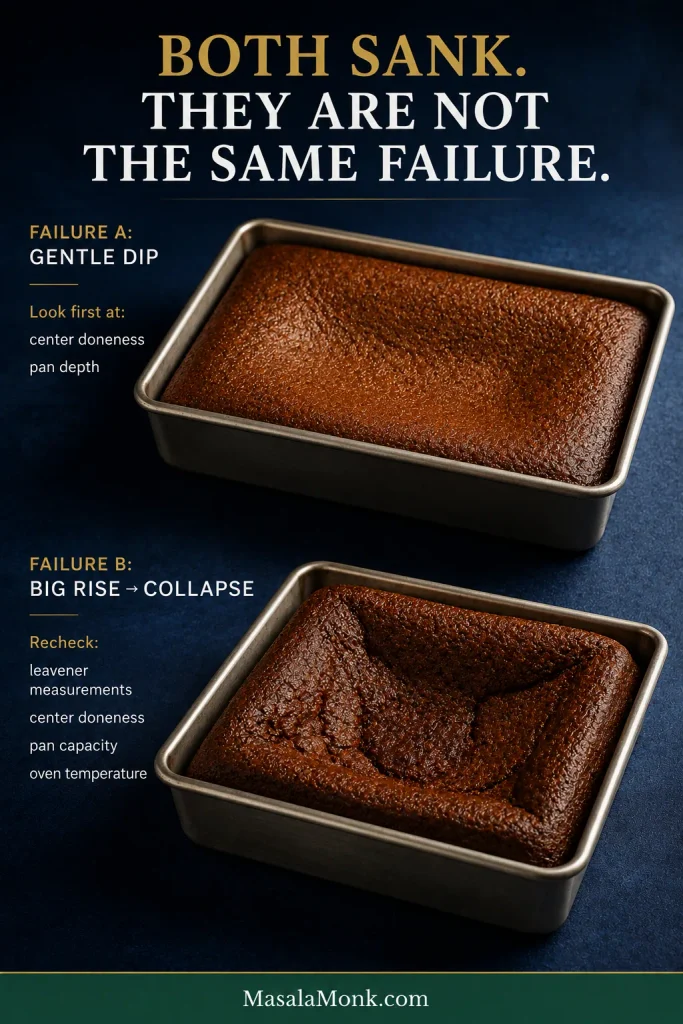
Two gingerbread cakes in rectangular pans comparing a mild central dip with a much larger risen-and-collapsed center.
Failure shape is diagnostic evidence. A small settled depression points you toward a different cause than a cake that dramatically expanded before collapsing.
What happenedLikely causesWhat to change
Center sankCenter needed longer; layer too deep; oven running cool; door opened earlyUse the intended pan and judge the center with the doneness cues above
Rose dramatically, then collapsedToo much or mismeasured leavener; center not fully set; pan overfilled or too deep; oven-temperature problemRecheck the small measurements, pan and oven, then make sure the center is fully baked
Dry throughoutToo much flour; too long in the oven; oven running hotUse 320 g flour and begin checking sooner
Dry edges, damp middleLayer too deep or pan very darkUse the specified light-colored 9×13-inch pan
Gummy middleUnderbaked or sliced very hotUse the doneness guide above and allow the crumb time to settle
Dense or heavyToo much flour; old baking powder or soda; batter left standing for an extended timeMeasure flour accurately, use fresh leaveners and bake soon after mixing
BitterBlackstrap/very robust molasses; too much clove; leavener measurement errorUse regular molasses and recheck the small measurements
Not gingery enoughOld ground ginger; very mild spiceReplace stale ginger or use the stronger-ginger option above
Tacky top after storageMolasses attracting moistureOften normal; judge the crumb underneath separately

Why did the middle sink?

If the cake rose normally and later developed a gentle dip, the middle probably needed a little more time. In a deeper layer, the edges can look finished while the center is still trying to catch up.

A cake that balloons dramatically, overflows or builds a large dome before collapsing tells a different story. Recheck the baking soda and baking powder measurements, the amount of batter in the pan and the oven temperature.

Don’t blame the molasses first. A sunken middle usually sends you back to bake completion, pan depth, leaveners or oven temperature.

Why is it dry?

Start with flour. Scooping directly from the bag can pack much more into a measuring cup than the cake needs; a scale removes the guesswork at 320 g. If using cups, spoon the flour loosely into the cup and level the top.
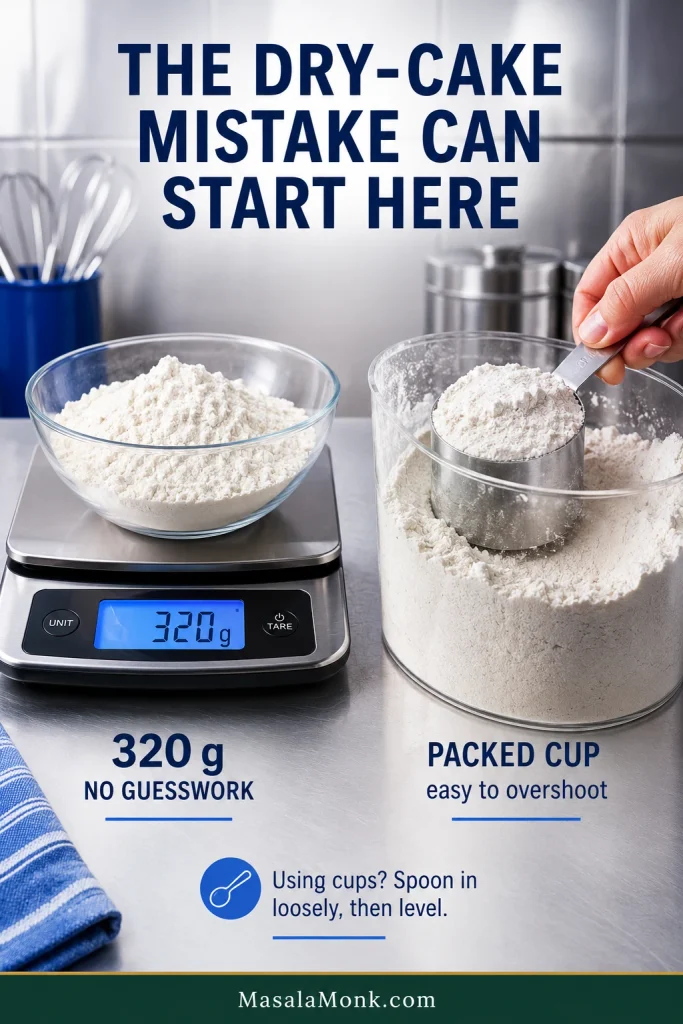
Digital kitchen scale showing 320 grams of flour beside a measuring cup being scooped directly into a container of flour.
With 2⅔ cups of flour, a small packing error repeated cup after cup can add up. The 320 g scale target removes that cumulative drift.

Then look at the bake. Once the center has set, extra oven time mainly means more moisture leaving the cake. Dry edges around a damp middle are different: the outside has moved ahead while the center still needs time.
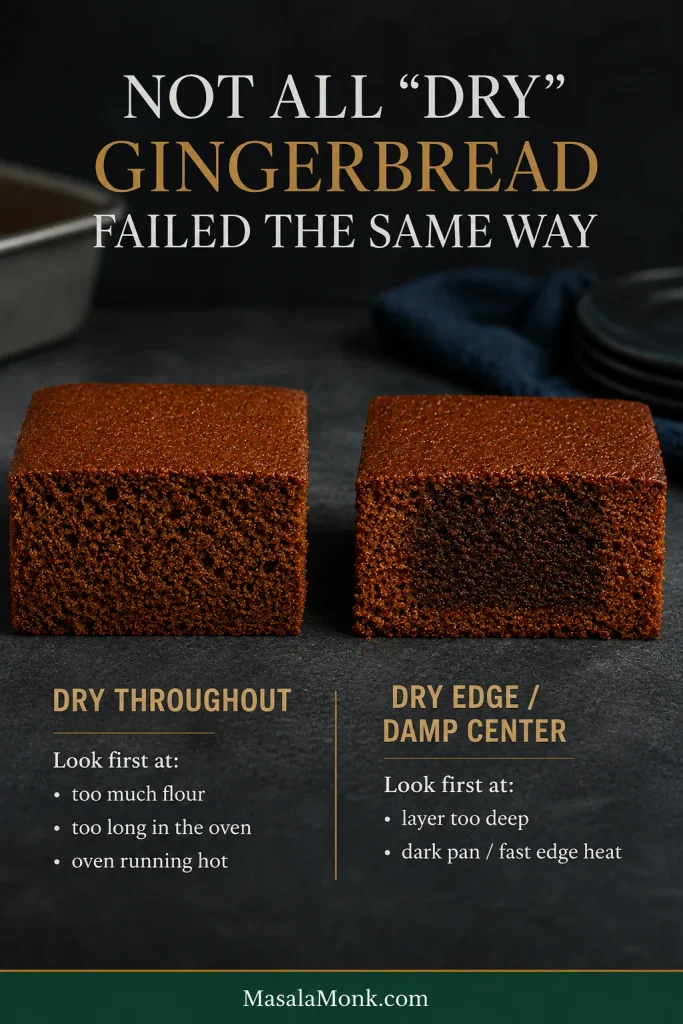
Two gingerbread cross-sections comparing a uniformly dry crumb with drier edges surrounding a darker, denser damp center.
Cut the cake before diagnosing dryness. Where the dry crumb appears can tell you whether the problem affected the whole batter or developed unevenly during baking.

Can You Use a Different Pan?

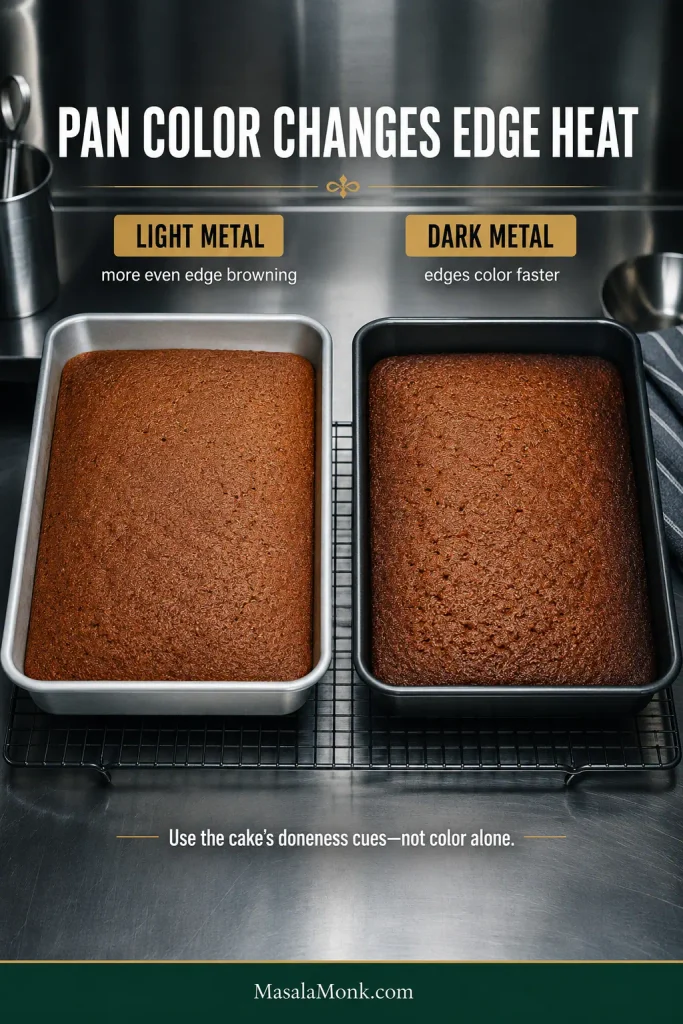
Change the pan and you change the bake. A deeper cake needs more time at the center; dark metal pushes the edges faster.
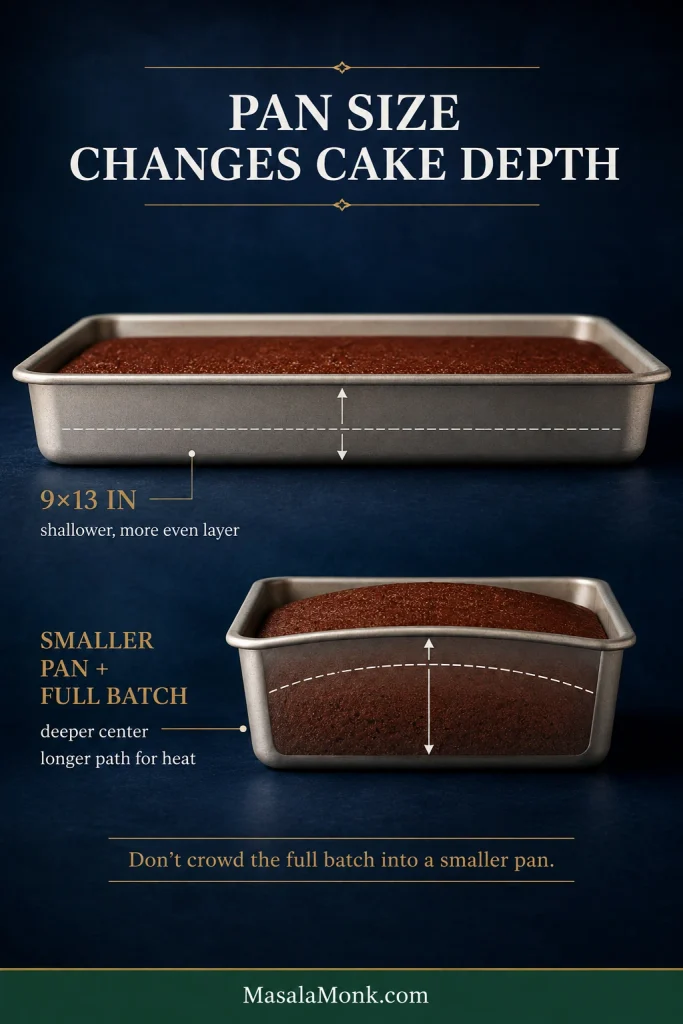
Light metal 9×13 pan with a shallow gingerbread layer compared with a smaller pan holding a visibly deeper layer.
Pan dimensions change the distance heat must travel. Moving the same gingerbread batter into a smaller footprint is therefore a structural recipe change, not merely a container swap.
PanWhat changesBest approach
9×13-inch light metalRelatively shallow, even layerBest choice for this recipe
Smaller square panDeeper batter and longer center bakeDon’t crowd the full batch into it; use a recipe quantity intended for that pan
Dark metalBase and edges color fasterBegin checking earlier
Glass or ceramicDifferent heat transfer and more retained heatFollow the physical doneness cues instead of copying metal-pan timing
Two rectangular gingerbread cakes baked in light and dark metal pans, with stronger edge browning visible in the dark pan.
Dark metal narrows the margin for error: faster edge heating gives the center less time to catch up before the outside looks finished.

For loaf, Bundt or layer-cake versions, use a formula written for that shape. Those pans change the depth and handling enough that borrowed bake times become unreliable.

Make It a Day Ahead

Gingerbread is unusually friendly to making ahead. Kept well covered, it stays moist overnight. The spice settles more deeply into the molasses as it rests.
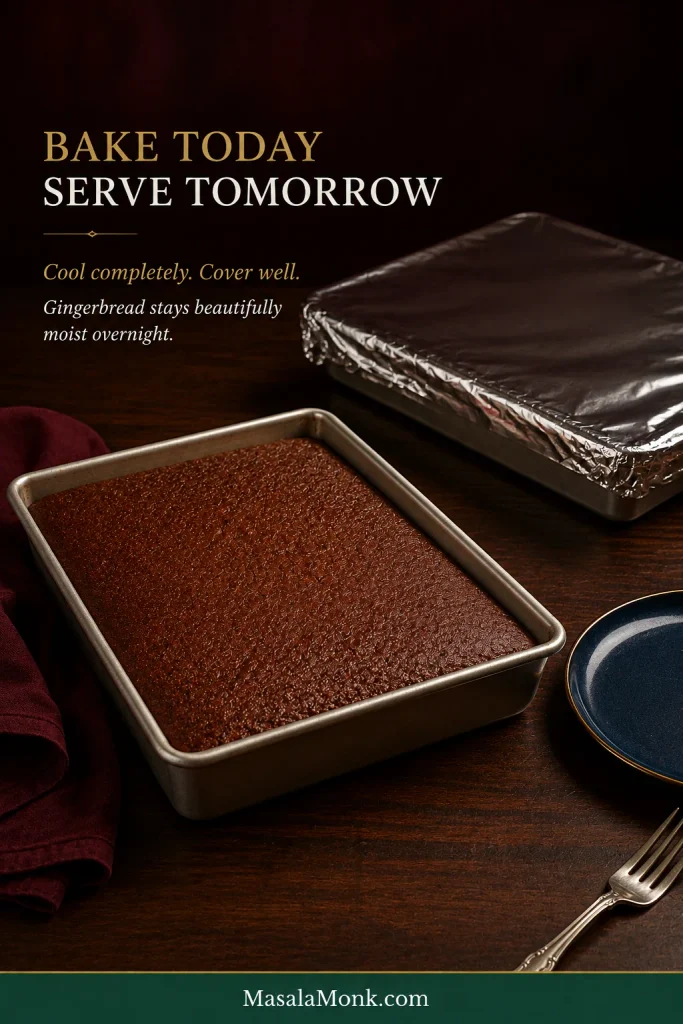
Fresh gingerbread cake in a light metal 9×13 pan beside another pan tightly covered for overnight storage.

The day before

  • Bake the cake and let it cool completely.
  • Leave it whole when possible; exposed cut edges dry faster.
  • Cover the pan tightly or move the whole cake to an airtight container.
  • Keep an unfrosted cake at cool room temperature.

On serving day

  • Add powdered sugar shortly before serving.
  • Keep whipped cream chilled separately.
  • Frost only after the cake is completely cool.
  • Warm lemon sauce gently before serving.

Storage and Freezing

Store unfrosted gingerbread airtight at room temperature for about 3 days; refrigerate it once topped with cream cheese frosting, or freeze it well wrapped for up to 2 months for best quality.

Room temperature

Leave the cake whole or in larger pieces when practical. Every fresh cut gives the interior another exposed edge.

A tacky top after a day or two can be part of molasses-rich gingerbread’s character, not a sign that the cake is raw. Judge the crumb underneath separately.
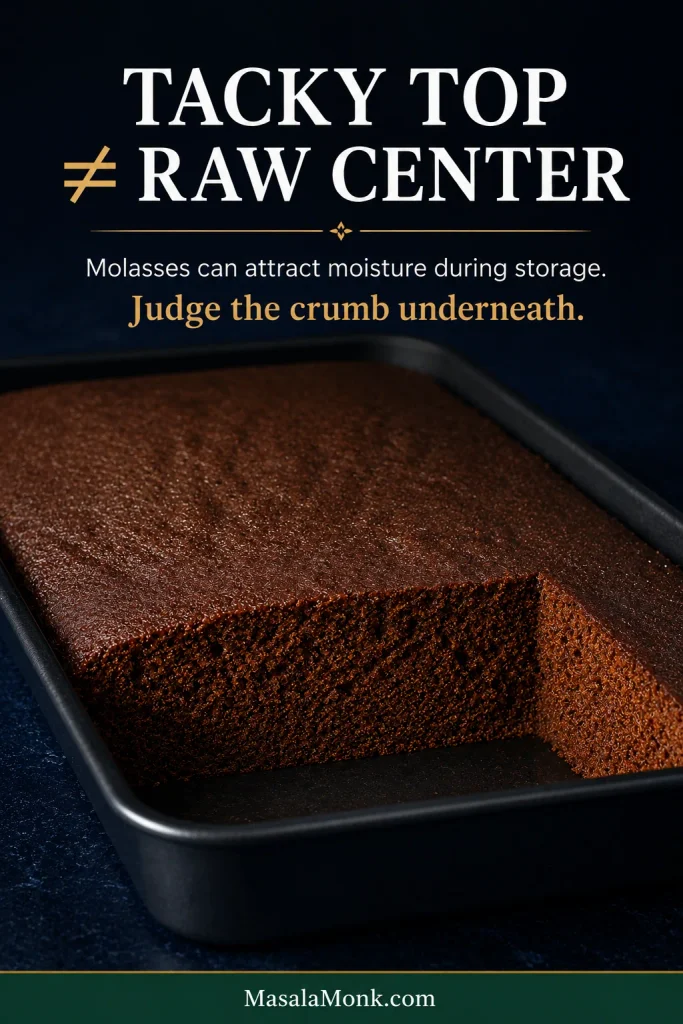
Cut gingerbread cake showing a faintly tacky top surface and a fully baked, evenly set crumb underneath.
Surface feel and internal doneness are separate clues. Storage can alter the first without undoing the crumb structure established in the oven.

If your kitchen is particularly warm or humid, keep the cake tightly covered in the refrigerator and let individual slices come back toward room temperature before serving.

Refrigerator

Let refrigerated slices lose some of their chill before serving. As they move back toward room temperature, the crumb becomes more tender again.

Freezer

Cool the cake completely, wrap the whole cake or individual portions tightly, and place them in a freezer-safe container or bag.

Thaw while still wrapped so condensation collects on the wrapping instead of directly on the cake.
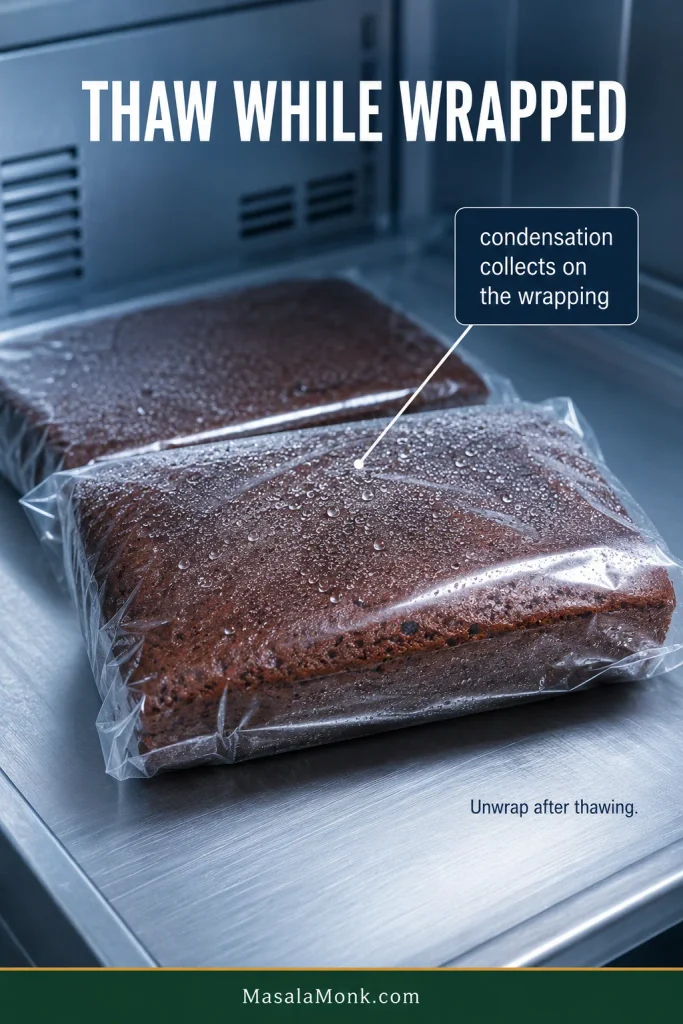
Wrapped gingerbread portions thawing on a metal surface with condensation droplets collected on the clear plastic wrapping.
During thawing, the wrapping becomes the colder surface where airborne moisture condenses first. That barrier helps keep condensation off the gingerbread itself.

Substitutions and Variations

Some flavor changes are easy. Once you change the main syrup, flour system or eggs, you are changing the structure of the cake too.

Light brown sugar: use the same amount. The cake will taste slightly lighter, but the molasses still provides most of its character.

Other syrups: honey, maple syrup and golden syrup are not full-cup substitutes for the molasses here. If one of those is what you have, choose a cake that uses it as the main sweetener.

Gluten-free: use a gingerbread built around a gluten-free flour blend. Different blends absorb liquid differently, so a straight cup-for-cup swap can change the center considerably.

Vegan: an egg-free gingerbread is the cleaner route. Replacing the butter is fairly straightforward; replacing the eggs changes both rise and tenderness.

A Cake That’s Even Better Tomorrow

Serve the first square slightly warm if you can. The crumb gives easily under the fork, and the smell of ginger and molasses rises as soon as you break through the top.

Add softly whipped cream if you want something cool against the spice. Warm lemon sauce brings brightness, while vanilla ice cream melting into one edge makes the dessert more indulgent.

Then cover what is left.
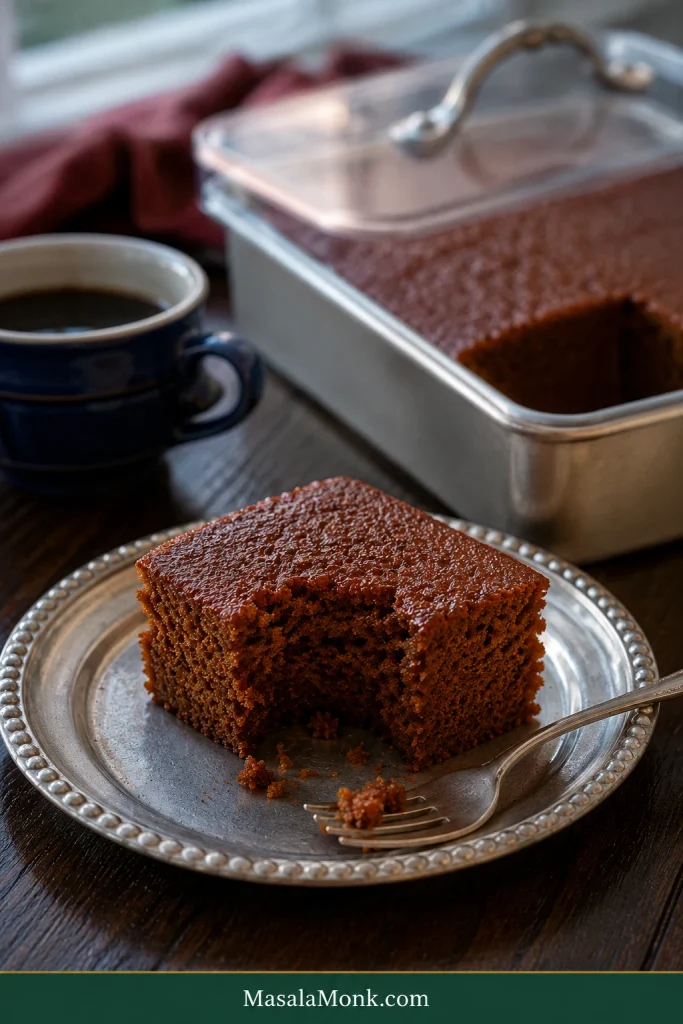
Partly eaten gingerbread square on a silver plate with a fork and coffee, with the remaining cake covered in a light metal pan behind it.

Tomorrow, cut another square and notice how the ginger has settled into the molasses. The crumb is still tender, the spice tastes rounder, and somehow that simple second slice can be the one that makes the recipe worth keeping.
↑ Back to recipe  ·  Back to top

Posted on Leave a comment

Spice Cake Recipe

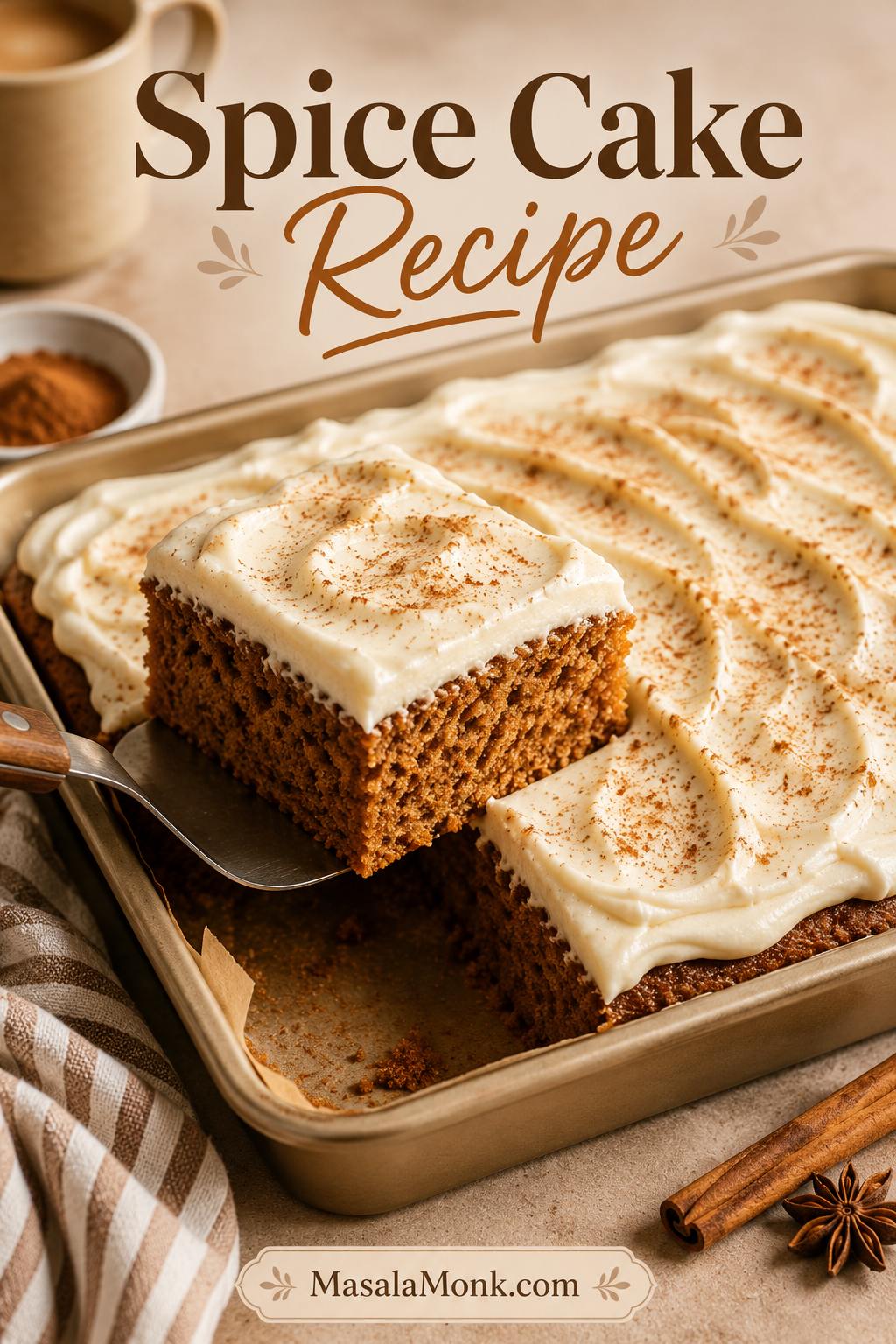
9x13 spice cake in a baking pan with cream cheese frosting and one square lifted out to show the brown crumb.

Spice cake should taste like cinnamon in the air, brown sugar in the crumb, and just enough ginger, nutmeg, allspice, and cloves to make the whole kitchen smell like something good is cooling on the counter. A good version is fragrant and tender, not dry, dusty, or vaguely cinnamon-flavored.

This spice cake recipe is a no-fuss 9×13 sheet cake designed around the two things that matter most: a tender brown-sugar crumb and cream cheese frosting that stays where you spread it. It is soft and fragrant the day you bake it, then deeper and more settled once the spices rest overnight.

It is made from scratch, but it does not ask for layer-cake precision. The batter comes together with two bowls, a whisk, and a spatula; the only mixer you need is for the frosting. Bake it in the pan, cool it fully, frost it generously, and cut it into spiced squares for coffee, potlucks, chilly afternoons, or a simple holiday dessert.

When you cut into it, the slice should be warmly brown, soft under the fork, and sturdy enough to hold a generous swipe of frosting. The cake should taste complete before anything goes on top; the cream cheese frosting is there to brighten it, not hide dryness.

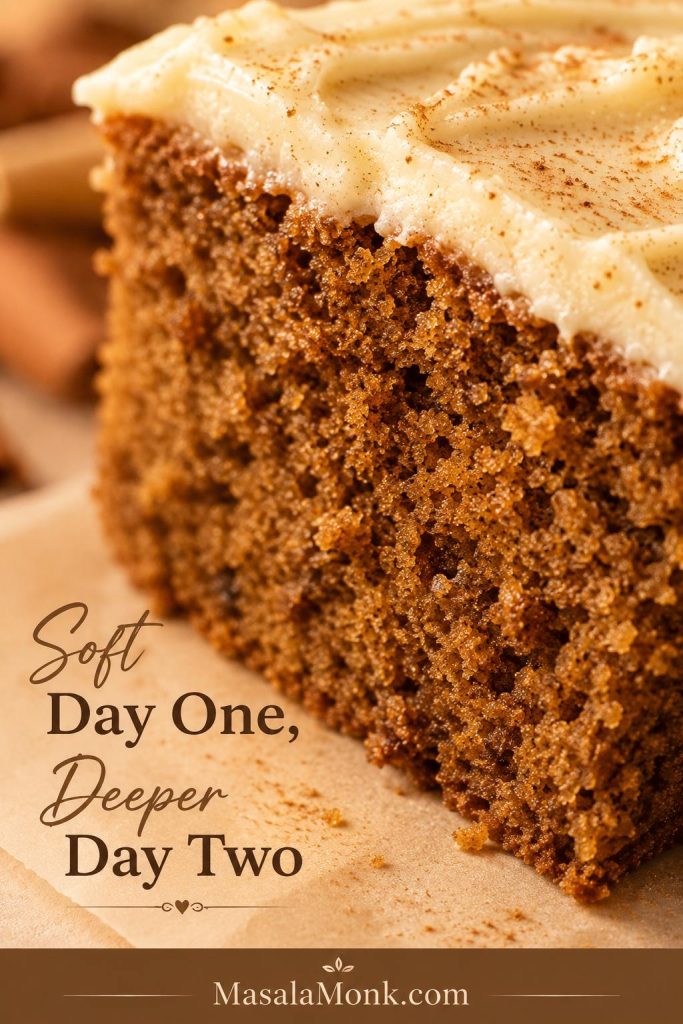
Close-up of a frosted spice cake square showing a moist brown crumb and cream cheese frosting on top.
Look for a tender, even crumb like this; a truly moist spice cake should hold together cleanly while still looking soft inside.

Quick Answer: What Is Spice Cake?

Spice cake is a brown-sugar cake flavored with baking spices such as cinnamon, ginger, nutmeg, allspice, and cloves. It is warmly spiced, not chili-hot. The “spice” comes from aromatic baking spices, not heat.

It is softer and sweeter than gingerbread, less fruit-forward than applesauce cake, and less chunky than carrot cake. The usual finish is cream cheese frosting because its tang cuts through the cinnamon-heavy crumb and brown sugar.

For the easiest homemade version, bake spice cake in a 9×13-inch metal pan at 350°F / 177°C. The slice should smell like cinnamon and ginger, cut cleanly, and hold the cream cheese frosting without feeling heavy. For the exact flavor balance, see the spice blend section.

Spice Cake at a Glance

Prep time20–25 minutes
Bake time35–40 minutes in a metal 9×13 pan; glass or ceramic may take longer
Cooling timeAt least 2 hours before frosting
Total timeAbout 3 hours, including cooling
Default pan9×13-inch baking pan
Oven350°F / 177°C
Yield12 large or 16 smaller slices
TextureSliceable, tender, fragrant
FinishCream cheese frosting

Why You’ll Love This 9×13 Spice Cake

  • Old-fashioned flavor comes through clearly. Cinnamon leads, but ginger, nutmeg, allspice, and cloves give every slice deeper fall-bakery flavor.
  • Real-life baking is the point. No stacked layers, no piping, no stand mixer for the cake — just a 9×13 pan and frosted squares you can serve straight from the pan.
  • Soft coffee slices still hold up for potlucks. Each square cuts cleanly, but still feels tender under the fork.
  • The cream cheese frosting makes it feel special. It adds cool tang, keeps the brown sugar in check, and turns a simple sheet cake into something holiday-table friendly.
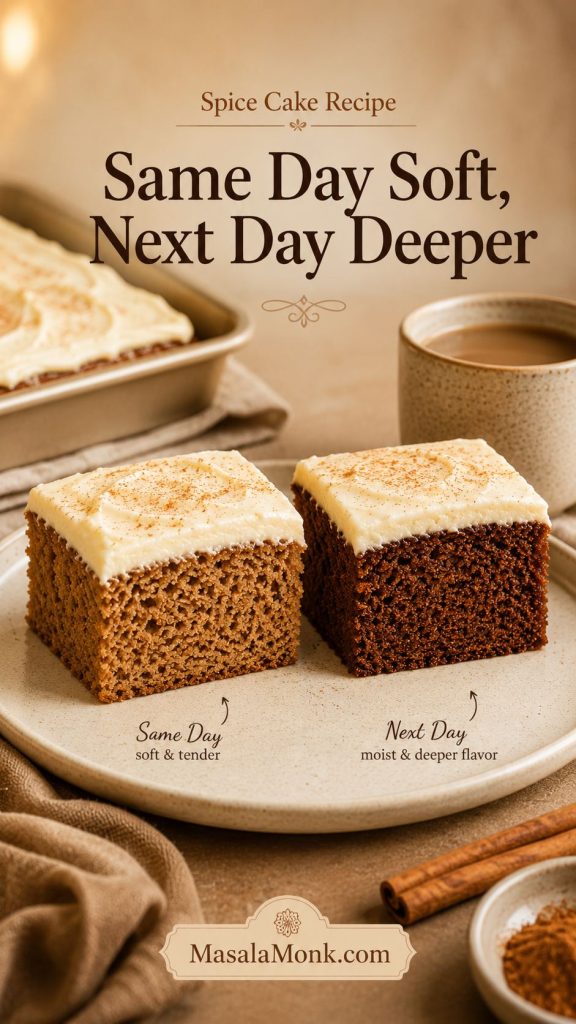
  • Patience pays off. The same-day slice is soft and fragrant, but the next-day slice tastes deeper once the spices settle. For make-ahead timing, see the storage and freezing tips.

Same-Day Soft, Next-Day Deeper

This is the main make-ahead advantage of spice cake: the crumb stays soft while the cinnamon, ginger, nutmeg, and cloves taste more settled after a night of rest.

Two frosted spice cake squares on a plate labeled same day and next day, showing a lighter fresh slice and a darker settled slice.
Same day, the cake tastes soft and freshly spiced; by the next day, the cinnamon, ginger, nutmeg, and cloves settle into a deeper flavor.

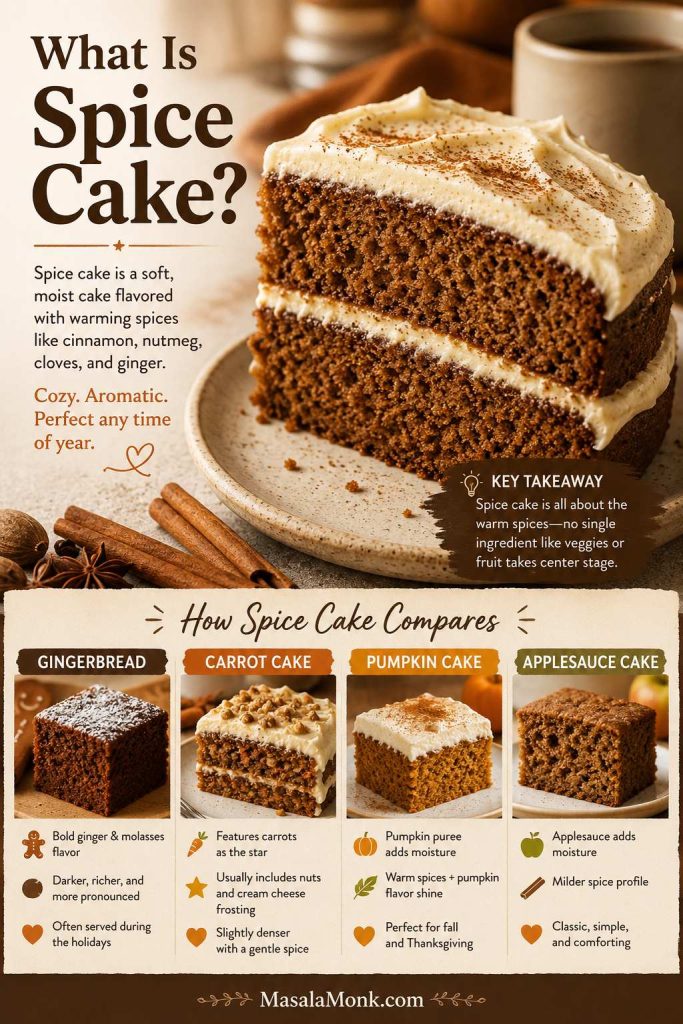
What Is Spice Cake?

Spice cake is a cake where the main flavor comes from a baking-spice blend rather than chocolate, vanilla, fruit, or nuts. The batter usually includes brown sugar, a tenderizing ingredient such as buttermilk or sour cream, and enough fat to keep the cake enjoyable after it cools.

It belongs near gingerbread, carrot cake, pumpkin cake, and applesauce cake, but the point here is simpler: a spice-led crumb, not fruit, vegetables, heavy molasses, or pumpkin.

If you have ever wondered whether spice cake is just gingerbread, carrot cake without carrots, or applesauce cake without apples, this is the quick difference.

Spice cake guide with a frosted slice and smaller comparison sections for gingerbread, carrot cake, pumpkin cake, and applesauce cake.
Unlike carrot cake, pumpkin cake, or gingerbread, spice cake gets its main character from warm baking spices rather than one dominant fruit, vegetable, or molasses note.
CakeMain identityHow it differs from spice cake
Spice cakeBaking spicesSpice-led, usually with brown sugar and tangy frosting.
GingerbreadGinger and molassesDarker, sharper, and usually more molasses-heavy.
Carrot cakeGrated carrot and spiceOften includes carrots, nuts, raisins, pineapple, or coconut.
Applesauce cakeApple moisture and spiceSofter and more apple-led. For that direction, see our applesauce cake recipe.
Pumpkin spice cakePumpkin purée and spiceWetter, denser, and more seasonal because pumpkin changes the batter.
Chai cakeTea, cardamom, and chai spicesBetter baked as a separate chai cake, where the tea and cardamom can lead properly.

The best version does not taste like a spice cabinet. It tastes like brown sugar, warmth, and a soft square you want with coffee.

The Best Spice Blend for This Cake

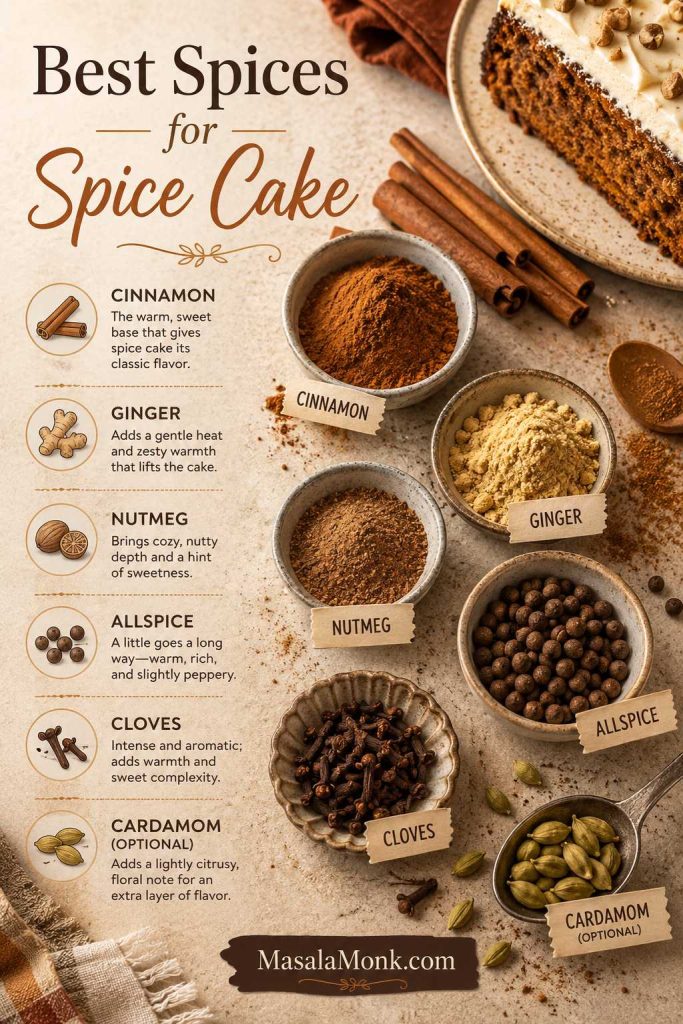
The best spice cake blend is cinnamon, ginger, nutmeg, allspice, and a small amount of cloves. Cinnamon should lead; cloves should stay in the background.

Cinnamon gives the familiar warmth, but ginger, nutmeg, allspice, and cloves make the flavor deeper and more complete. Without those supporting spices, the cake can smell good in the oven but taste a little flat once sliced.

Spice blend guide with labeled bowls of cinnamon, ginger, nutmeg, allspice, cloves, and cardamom for spice cake.
Cinnamon should lead the spice blend, while ginger, nutmeg, allspice, cloves, and optional cardamom add warmth, depth, and balance.
SpiceWhat it addsHow strong to go
CinnamonThe familiar warm base.Use the most of this.
GingerBrightness and gentle heat.Enough to notice, not enough to become gingerbread.
NutmegRounded bakery-style flavor.Use lightly; too much can taste perfumed.
AllspiceDepth and an old-fashioned note.A little makes the cake taste fuller.
ClovesDeep background warmth.Use sparingly because it is powerful.
Cardamom, optionalFragrance and lift.Use lightly so the cake still tastes familiar.

That balance is what makes the cake smell cozy in the oven but still taste rounded once it cools. Allspice is not a spice blend; it is a single spice with a flavor that hints at cinnamon, clove, and nutmeg, so let it support the blend rather than dominate it.

Can you use pumpkin pie spice? Pumpkin pie spice works as a shortcut, though the flavor depends on the blend. For a homemade blend, see our pumpkin pie spice guide.

Why This Cake Stays Moist

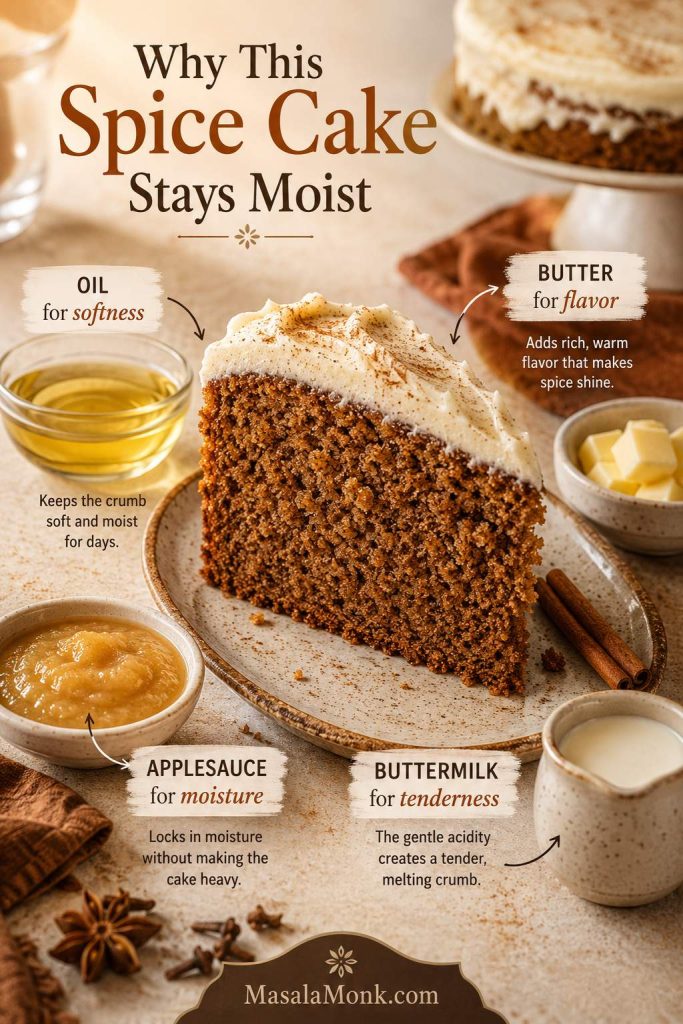
The goal is a cake that still tastes good after it cools — and, ideally, tastes even more settled the next day. This version uses oil for lasting softness, a little butter for flavor, applesauce for moisture, and buttermilk for tenderness.

Why both oil and butter? A butter-only cake has wonderful aroma when warm, but it can firm up more after cooling. An oil-only cake stays softer, but it can taste flatter. Using both gives the cake a round old-fashioned flavor while keeping the inside from turning tight.

Applesauce and buttermilk support that texture without turning the cake into applesauce cake or a tangy yogurt cake. This is also why the base does not use shredded apple: the cake stays spice-led, while the applesauce quietly helps with moisture. Together, the ingredients create brown-sugar depth without gingerbread heaviness, and a slice that stays clean rather than greasy or gummy.

Moisture guide showing a frosted spice cake square with oil, butter, applesauce, and buttermilk callouts around it.
Instead of depending on one “secret” ingredient, this moist spice cake uses oil for softness, butter for flavor, applesauce for moisture, and buttermilk for tenderness.
IngredientWhy it matters
OilKeeps the cake softer after cooling.
ButterAdds old-fashioned flavor and aroma.
ApplesauceSupports moisture without making the cake apple-led.
ButtermilkBalances sweetness and keeps the texture tender.
Brown sugarAdds depth and a mild molasses note.
Cream cheese frostingAdds tang so the cake tastes rich but not cloying.

What Each Ingredient Does in This Spice Cake

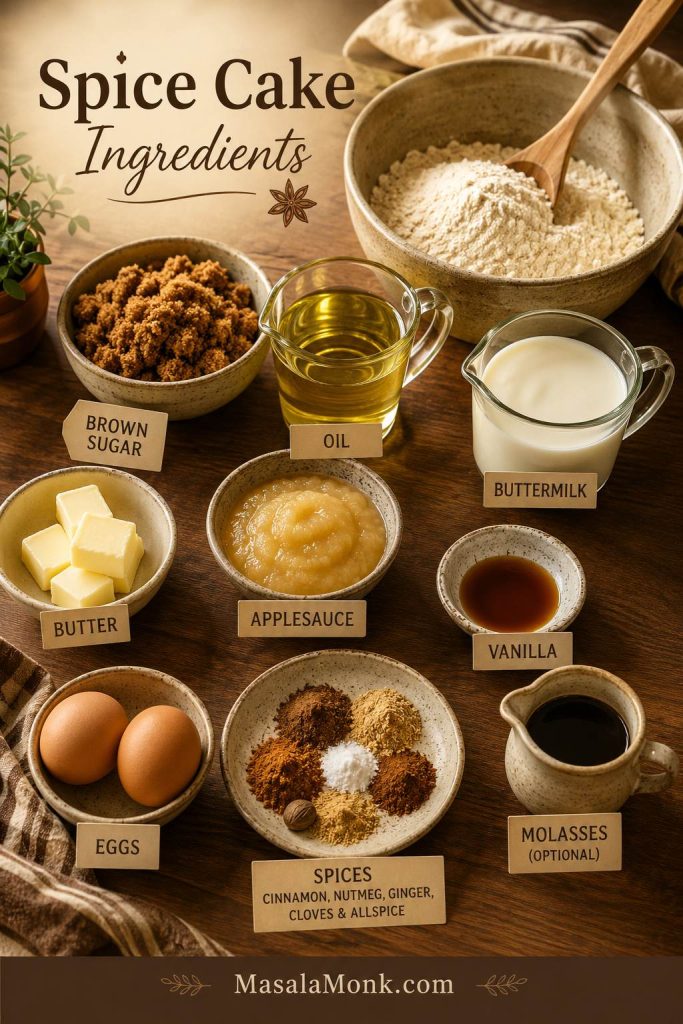
The recipe works because the ingredients have different jobs. Keep the measurements steady, especially flour and wet ingredients, and the cake will be much easier to bake well. Once these pieces are balanced, the cake tastes like more than cinnamon — it has brown-sugar depth, spice warmth, and enough softness to still be good after cooling.

Labeled spice cake ingredients including flour, brown sugar, oil, butter, applesauce, buttermilk, eggs, vanilla, molasses, and spices.
The best spice cake ingredients work as a team: brown sugar deepens flavor, warm spices define the cake, and the wet ingredients keep the crumb soft.

For the Cake

All-purpose flour: Measure by weight if possible. Too much flour is one of the fastest ways to make a dry cake, and measuring flour by weight is the most reliable option. If using cups, spoon flour into the cup and level it instead of scooping directly from the bag.

Baking powder and baking soda: They give lift while working with the acidity in the buttermilk, applesauce, and brown sugar. Make sure both are fresh.

Salt, vanilla, and spices: Salt sharpens the brown sugar, vanilla rounds the flavor, and the spice blend gives the cake its identity.

Brown sugar: Light brown sugar keeps the flavor milder. Dark brown sugar gives a deeper molasses note. Either works, but pack it firmly when measuring by cup.

Oil and melted butter: Oil helps after cooling; butter adds flavor. Let the melted butter cool slightly before mixing so it does not warm the eggs.

Applesauce, buttermilk, and eggs: Applesauce helps the cake stay soft, buttermilk keeps it from tasting flat, and eggs help it rise and slice cleanly. Use them close to room temperature when possible so the batter blends smoothly.

Molasses, optional: A tablespoon of molasses makes the cake darker and the flavor deeper. Keep the rest of the wet ingredients as written if you use it.

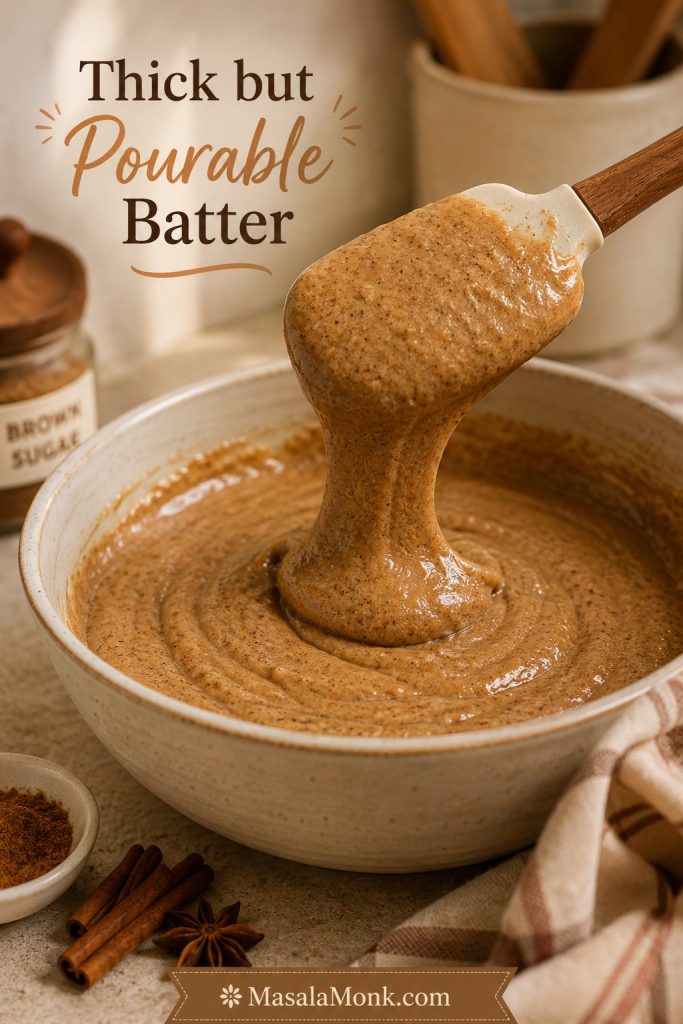
Batter cue: The batter should be thick but pourable, glossy, and lightly speckled with spices. A few tiny applesauce flecks are fine. Stop when the flour disappears; this batter is meant to stay thick and glossy, not whipped.

For the Cream Cheese Frosting

Block cream cheese: Use full-fat block cream cheese, not spreadable tub cream cheese. Tub cream cheese often makes frosting loose and runny.

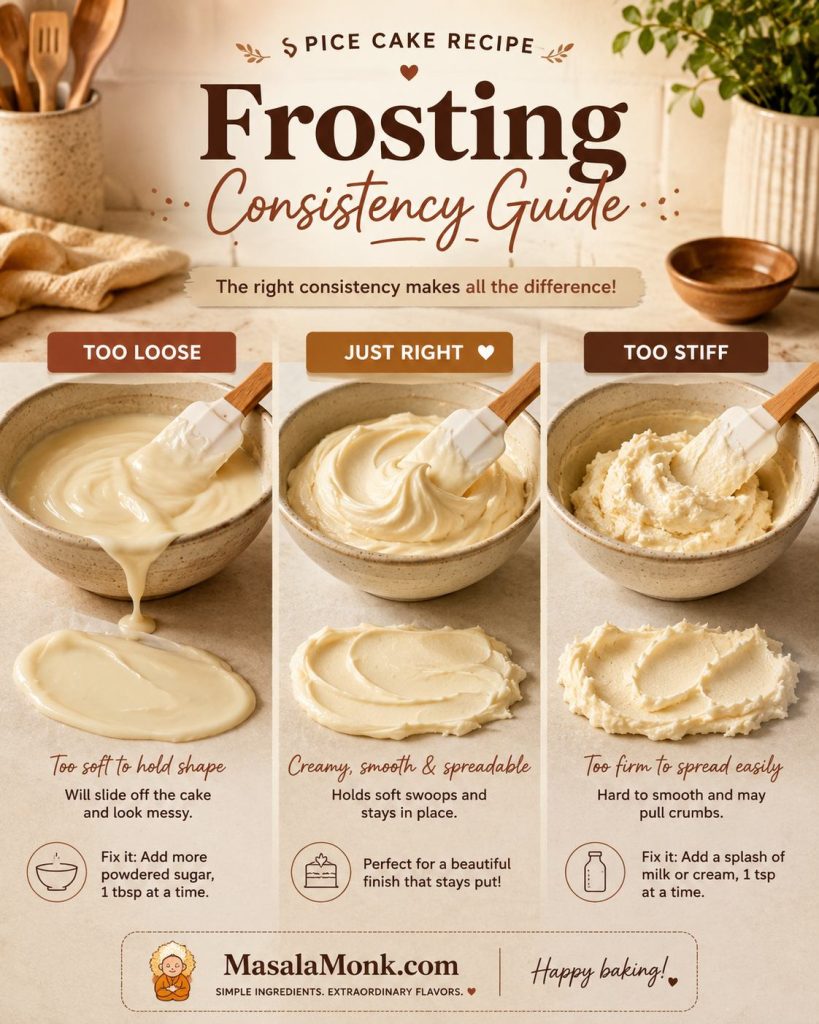
Butter and powdered sugar: The butter should be softened but not greasy. Start with the lower amount of powdered sugar for a softer frosting, then add more only if you need it firmer.

Vanilla, salt, and optional lemon juice: Vanilla adds warmth, salt keeps the frosting from tasting flat, and a little lemon juice brightens the cream cheese tang.

How to Bake It Without Drying It Out

The batter is supposed to be thick, not airy. The cake is supposed to come out with moist crumbs, not a bone-dry tester. And the frosting only spreads cleanly if the cake is fully cool.

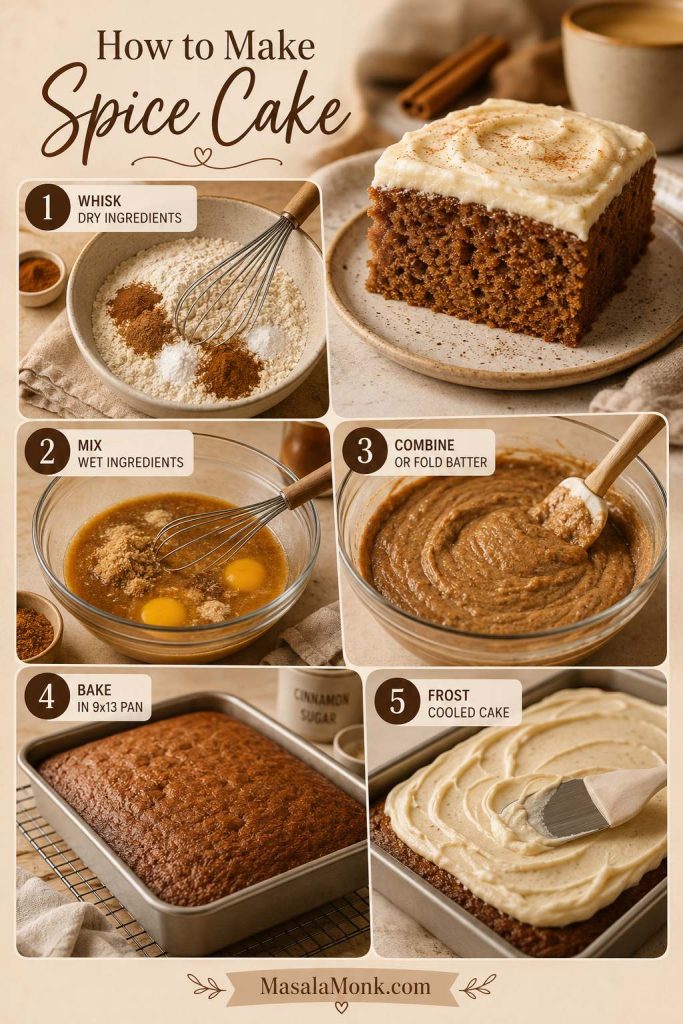
Do not worry if the batter looks thicker than vanilla cake batter; that is normal here. You do not need a stand mixer for the cake itself. A whisk, a spatula, and two bowls are enough; save the hand mixer for the frosting.

Step-by-step spice cake guide showing dry ingredients, wet ingredients, batter, baked 9x13 cake, and frosting being spread.
Because this is a simple two-bowl spice cake, the biggest wins are mixing gently, spreading the batter evenly, and waiting until the cake is cool before frosting.

1. Prepare the Pan So the Cake Releases Cleanly

Heat the oven to 350°F / 177°C. Grease a 9×13-inch baking pan. A metal pan usually bakes most evenly. For easier lifting and cleaner slices, line the pan with parchment paper, leaving a little overhang on two sides. If you plan to serve the cake directly from the pan, parchment is optional.

2. Whisk the Spices Evenly Into the Flour

In a large bowl, whisk the flour, baking powder, baking soda, salt, cinnamon, ginger, nutmeg, allspice, cloves, and optional cardamom. The dry mix should look evenly tan from the spices. Take a few extra seconds here; evenly mixed spices mean every slice tastes balanced instead of giving you one bland bite and one clove-heavy bite.

3. Mix the Wet Ingredients Until Glossy

In another bowl, whisk the brown sugar, oil, melted butter, applesauce, buttermilk, eggs, vanilla, and optional molasses until smooth. The wet mix should look glossy. The melted butter should be slightly cooled, and the eggs, applesauce, and buttermilk should not be fridge-cold. If the butter forms tiny bits, the cake will usually still bake, but the batter mixes more evenly when the ingredients are closer in temperature.

4. Fold Gently So the Cake Stays Tender

Pour the wet mixture into the dry ingredients. Fold with a spatula or whisk gently until no dry flour pockets remain. The batter should look thick, glossy, and pourable. Once no flour streaks remain, you have done enough; next, use the doneness cues instead of overbaking for a dry tester.

Spice cake batter lifting from a spatula over a mixing bowl, showing a thick glossy pourable texture.
Once the batter looks thick, glossy, and pourable, stop mixing; continuing too long can make the finished spice cake dense.

5. Bake Until the Center Is Set but Still Moist

Spread the batter into the prepared pan and smooth the top. Bake for 35–40 minutes in a metal pan, checking near the 33-minute mark. Glass or ceramic pans may take a little longer. This is the point where the kitchen starts smelling better than the effort you put in, but trust the center of the cake more than the edges.

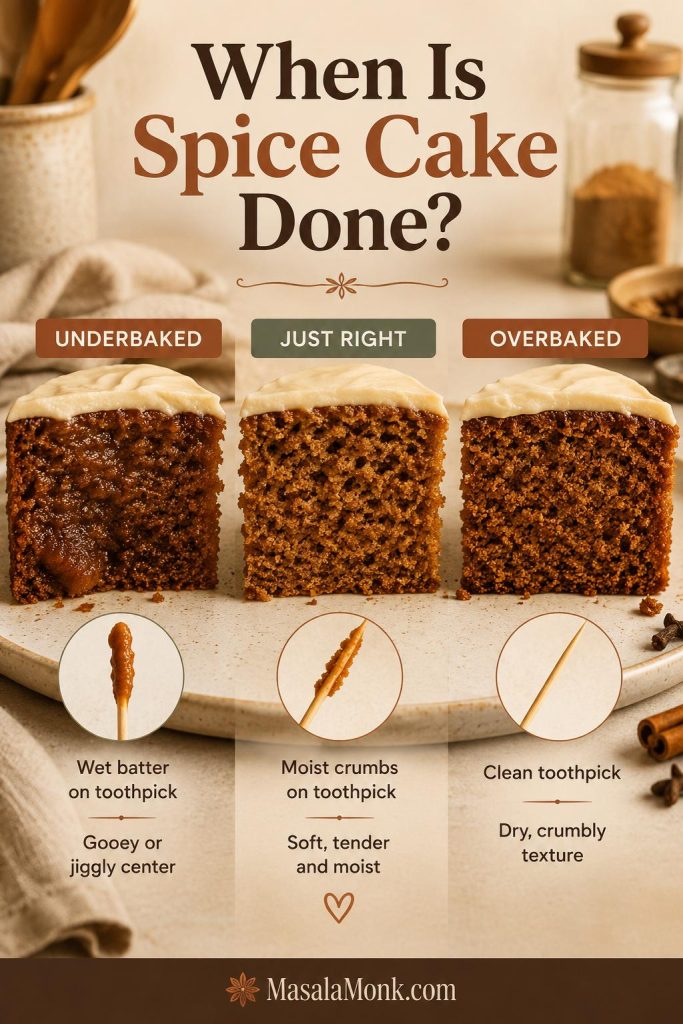
The cake is done when the center springs back lightly, the edges are just beginning to pull from the pan, and a toothpick inserted into the middle comes out with a few moist crumbs.

Look for moist crumbs, not a dry tester. A few crumbs mean the cake will stay softer once it cools.

Doneness guide comparing underbaked, just-right, and overbaked spice cake pieces with toothpick crumb examples.
A few moist crumbs on the toothpick are ideal; however, waiting for a completely dry tester can push spice cake toward overbaked.

6. Cool Fully Before Frosting

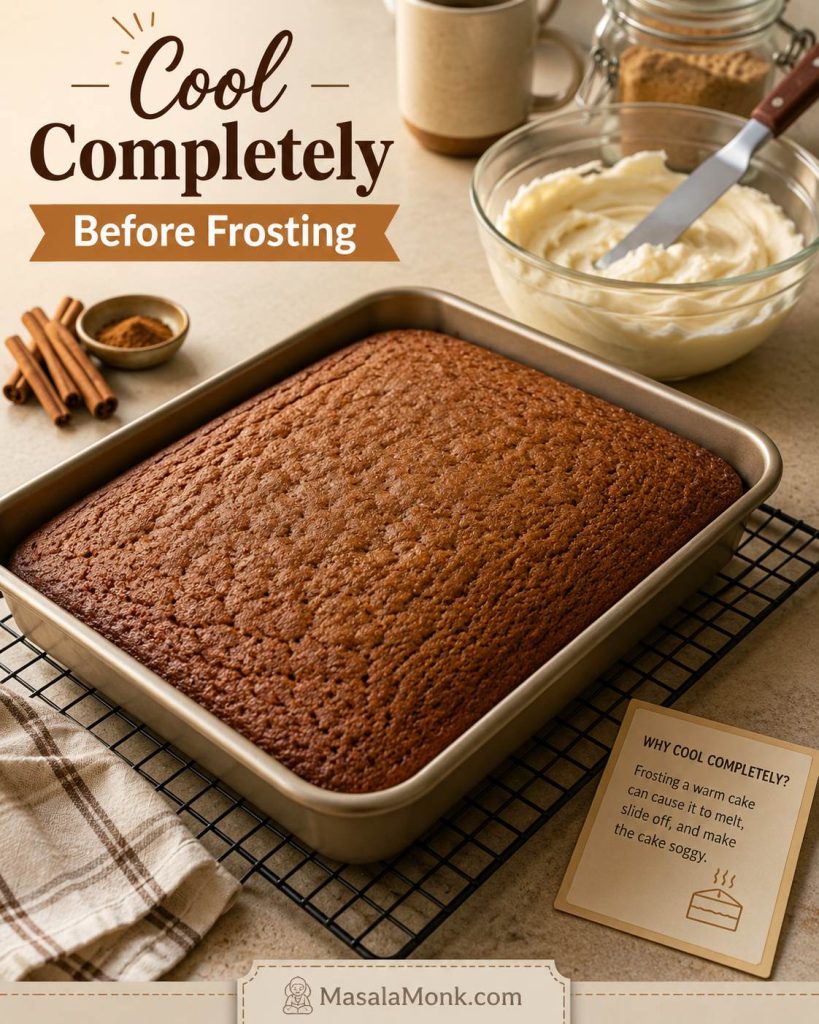
Let the cake cool in the pan. For a 9×13 cake, plan on at least 2 hours of cooling before frosting. The center should feel room temperature, not just the surface. The wait feels annoying, but it keeps the cream cheese frosting smooth instead of melty.

Unfrosted spice cake cooling in a 9x13 pan on a wire rack with a bowl of frosting and spatula nearby.
Before adding cream cheese frosting, let the 9×13 spice cake cool completely so the frosting stays smooth, thick, and spreadable instead of melting into the crumb.

7. Frost and Slice

Spread the frosting over the cooled cake. It should hold soft swoops without running. For clean slices, chill the cake for 20–30 minutes before cutting. For the best eating texture, let refrigerated slices sit briefly at room temperature before serving.

Cream Cheese Frosting for Spice Cake

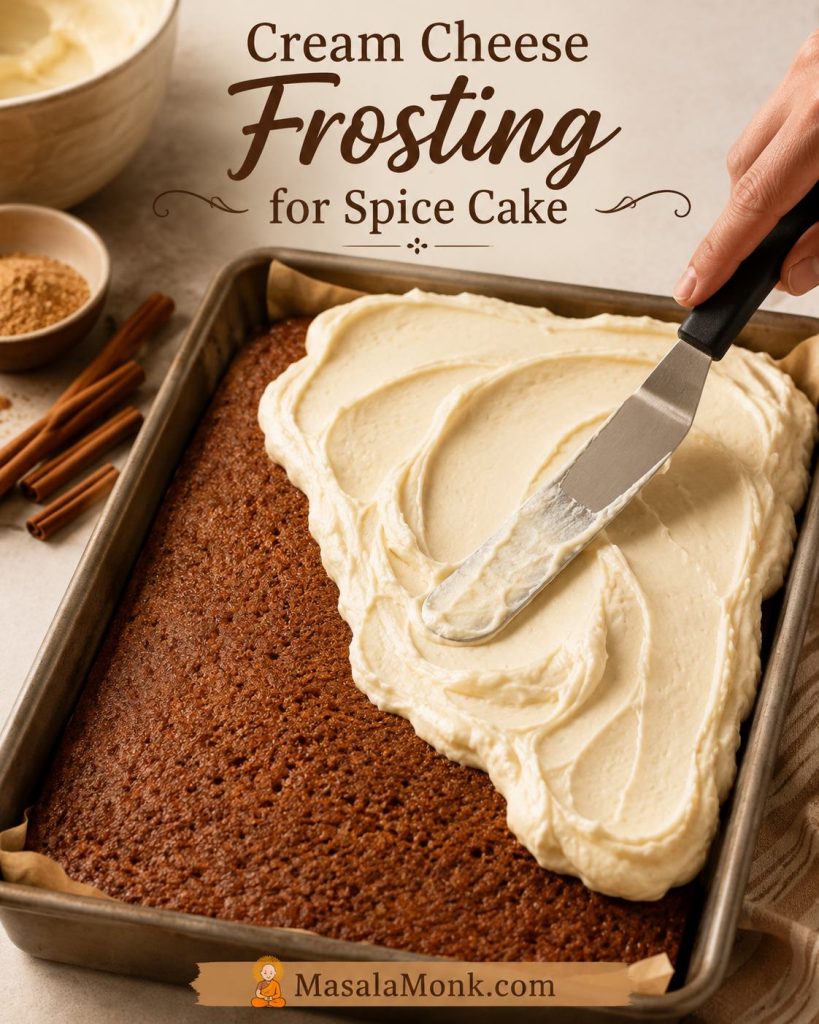
Cream cheese frosting is the classic finish because it adds tang, not just sweetness. It cuts through the brown sugar and spice so the cake tastes rich without feeling heavy.

Cream cheese frosting being spread with an offset spatula over a cooled spice cake in a rectangular pan.
Cream cheese frosting works especially well here because its cool tang balances brown sugar, cinnamon, ginger, and cloves without making the cake too sweet.

The best bite is warm spice first, then brown sugar, then that cool cream-cheese tang at the end. For a 9×13 cake, you only need a generous spreadable layer. Brown butter cream cheese frosting makes it more special, caramel leans sweeter and richer, maple gives it an old-fashioned fall flavor, and a simple vanilla glaze works better for Bundt or loaf cake. For a tea-cake finish, skip the frosting and dust the top with powdered sugar.

Want the special-occasion version? Brown the butter, cool it until soft but not melted, then use it in the frosting for a deeper, nutty finish.

If you want a non-cream-cheese option for cupcakes or a sweeter celebration-style finish, our buttercream frosting recipe is the better direction.

How to Keep the Frosting Smooth

  • Use full-fat block cream cheese, not tub cream cheese.
  • Soften the cream cheese and butter, but keep them cool enough that they are not shiny or greasy.
  • Beat the cream cheese first until smooth, then add the butter and beat again.
  • Add powdered sugar gradually. Start with 2½ cups for a softer frosting; add more if you need it firmer.
  • Add a pinch of salt and a little lemon juice to balance sweetness.
  • If the frosting becomes too soft, chill it for 15–20 minutes, then beat briefly again.
  • Make sure the cake is fully cool before spreading it on top. If it still turns loose, use the troubleshooting fixes.
Frosting consistency guide with three bowls showing too loose, just right, and too stiff cream cheese frosting textures.
If frosting is too loose, it slides; if it is too stiff, it pulls crumbs, so aim for a creamy texture that holds soft swoops.

Pan Sizes: 9×13, Layers, Bundt, Loaf, and Cupcakes

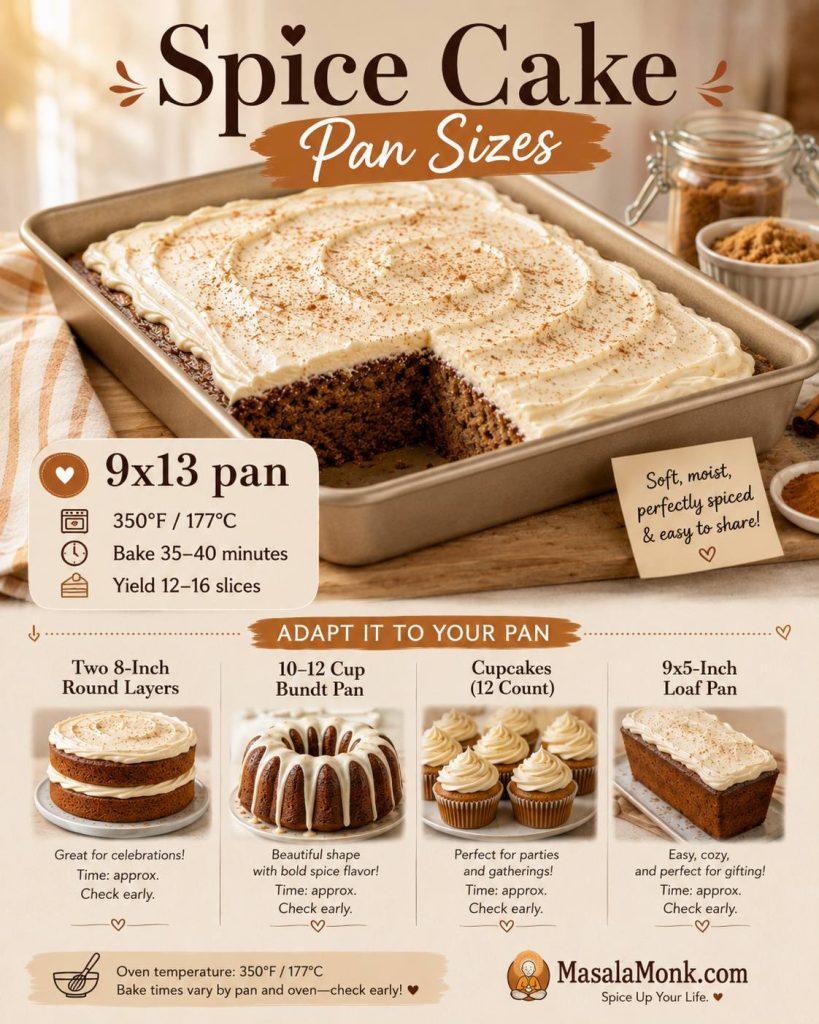
This recipe is written first as a 9×13 sheet cake; the layer, Bundt, loaf, and cupcake notes are adaptations, not the main promise.

A 9×13 sheet cake is the easiest version, but the same flavor can work in other formats if you watch the fill level and start checking early. If you are baking for a potluck, stay with the 9×13. It is the least fussy version and the one most likely to disappear square by square.

Pan size guide with a large 9x13 spice cake and smaller examples of round layers, Bundt cake, cupcakes, and loaf cake.
The 9×13 pan gives the easiest spice cake slices; however, the batter can also work in layers, Bundt pans, cupcakes, or a loaf when you adjust carefully.

Spice Cake Baking Times by Pan

FormatPanOvenApprox. bake timeNotes
Sheet cake9×13-inch metal pan350°F / 177°C35–40 minEasiest default. Glass or ceramic may take longer.
Layer cakeTwo 9-inch rounds350°F / 177°C26–32 minLine pans with parchment; make extra frosting.
Layer cakeTwo 8-inch rounds350°F / 177°C32–38 minLayers will be deeper, so check centers carefully.
Bundt cake10–12 cup Bundt pan350°F / 177°C50–65 minFill no more than two-thirds to three-quarters full.
CupcakesStandard muffin tin350°F / 177°C18–21 minFill cups about two-thirds full.
Loaf cake9×5-inch loaf pan, filled no more than two-thirds full350°F / 177°C48–55 minThis full recipe makes more batter than one loaf, so bake extra batter as cupcakes or use a second loaf pan.

Use the times as starting points, not promises. The cake is ready when the center springs back and a toothpick shows moist crumbs.

Bundt Cake Release Tip

Bundt cake tip: Use baking spray with flour, or brush the pan with softened butter and dust it with flour. Get into every groove. Let the baked cake rest in the pan for 10–15 minutes before turning it out.

How to Make Boxed Spice Cake Mix Taste Homemade

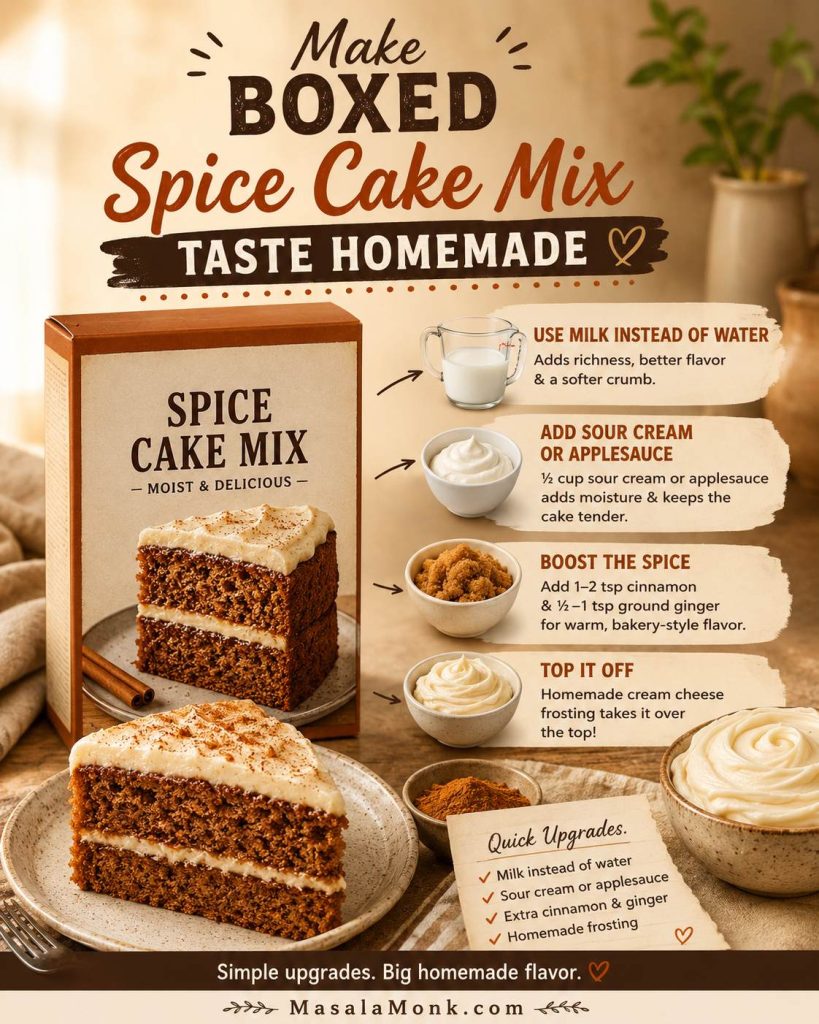
Boxed spice cake mix can work when time is short. Use milk instead of water, add ½ cup sour cream or applesauce, boost the spices, and finish with homemade cream cheese frosting. For the from-scratch version, jump to the full recipe card.

Boxed spice cake mix upgrade guide with milk, sour cream or applesauce, extra spices, and cream cheese frosting suggestions.
For a shortcut version, boxed spice cake mix tastes more homemade when you use dairy, boost the warm spices, and finish with real cream cheese frosting.
Replace or addHow muchWhy it helps
Milk instead of waterUse the same amount listed on the boxGives richer flavor.
Sour cream, yogurt, or applesauceUp to ½ cupHelps the cake taste less box-mix dry.
Cinnamon + ginger½ tsp cinnamon + ¼ tsp gingerWarms up a mild spice mix.
Homemade cream cheese frostingUse the frosting from this recipeThe biggest upgrade for flavor and texture.

Keep the upgrades modest. Too much extra moisture can make the center heavy, especially if you also add pumpkin or fruit. The from-scratch cake is still the better version when flavor and texture matter; the boxed version is the quick shortcut.

Variations: Apple, Molasses, Nuts, Raisins, Chai, and More

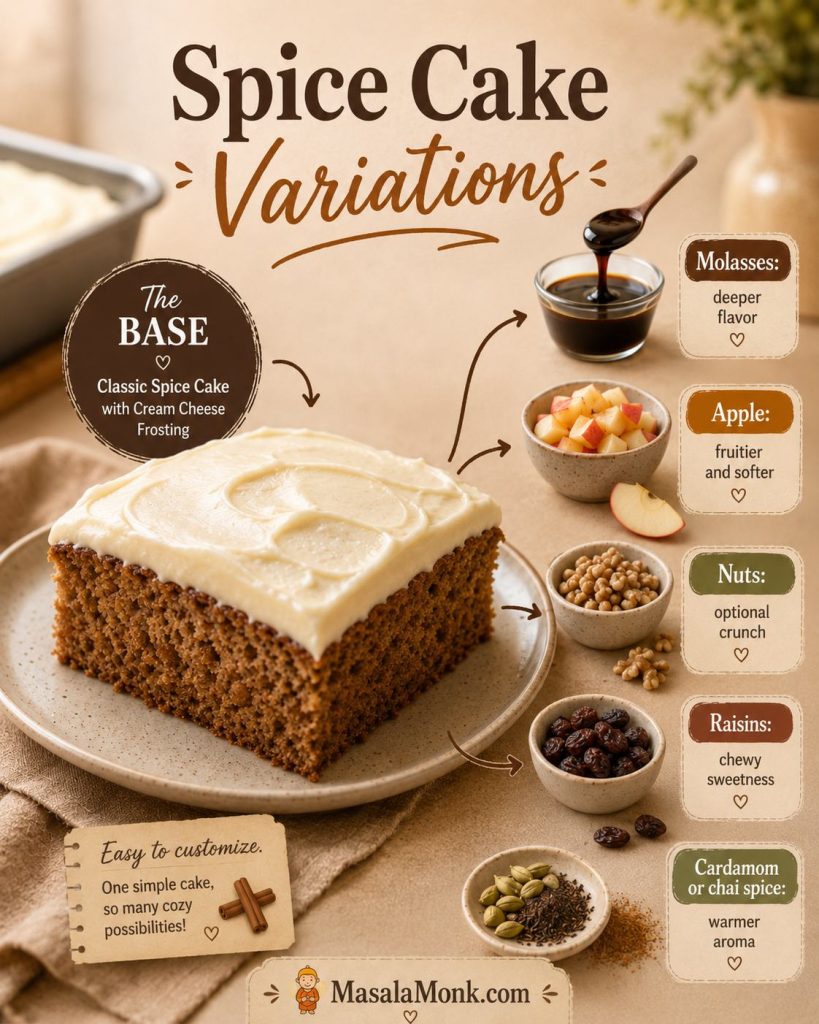
Choose the version based on the slice you want: classic and cozy, deeper with molasses, fruitier with apple, or nutty with a little crunch. The cake stays most reliable when you change one major thing at a time; if you add fruit or extra moisture, keep the gummy-center fixes in mind.

Spice cake variations guide with a plain frosted cake square and optional molasses, apple, nuts, raisins, and cardamom or chai spice cues.
Start with the plain frosted base cake, then choose one variation if you want deeper molasses flavor, fruitier apple notes, optional crunch, raisins, or warmer aroma.
VariationAmountKeep in mind
Molasses1 tablespoonToo much pushes the cake toward gingerbread.
Chopped apple1 cup, finely choppedMore can make the center gummy.
Nuts¾ cupToast and cool first for better flavor.
Raisins½–¾ cupSoak if dry, then drain and pat dry.
Cardamom¼ teaspoonToo much can taste perfume-like.

Molasses gives the deepest old-fashioned version, chopped apple makes the cake softer and fruitier, and toasted nuts are the easiest way to add contrast without changing the batter much. These are small changes, not a second recipe; the safest upgrades are the ones that add flavor without shifting the batter’s moisture too far.

For a chai-style direction, add the cardamom and a tiny pinch of black pepper. If you want tea-forward flavor, that becomes a separate chai cake rather than classic spice cake.

Gluten-Free and Eggless Notes

A good 1:1 gluten-free baking flour may work, especially if it contains xanthan gum, but expect a slightly more fragile cake and let it cool fully before slicing.

I would not make this exact batter eggless by simply removing the eggs. For best results, use an eggless spice cake formula designed around yogurt, vinegar and baking soda balance, or another tested binder.

What to Serve with Spice Cake

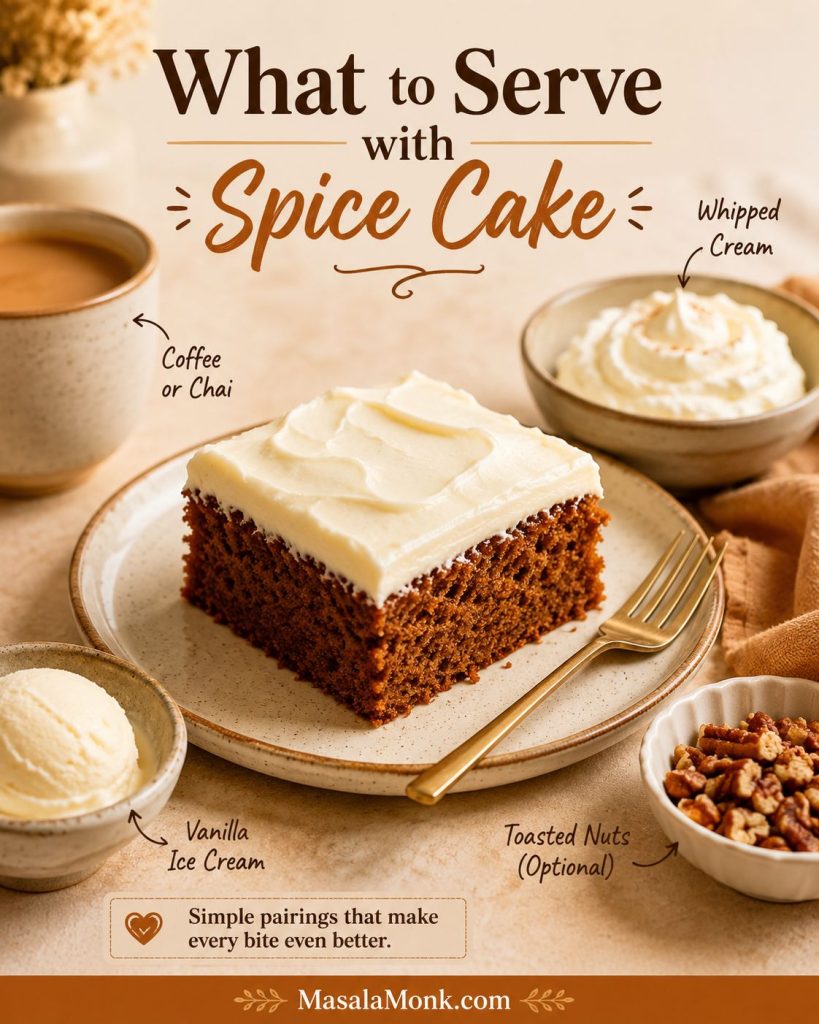
For a coffee slice, serve the cake plain with its cream cheese frosting and a hot cup of coffee or black tea. For a holiday dessert, add brown butter frosting, toasted pecans, or a light caramel drizzle. If you are taking it to a potluck, keep it in the 9×13 pan, chill until the top sets, and slice before serving.

Frosted spice cake square on a plate with coffee or chai, whipped cream, vanilla ice cream, and optional toasted nuts nearby.
To make a simple slice feel dessert-ready, serve spice cake with coffee, chai, whipped cream, vanilla ice cream, or optional toasted nuts on the side.

That is the sweet spot of this cake: casual enough for a weekday coffee slice, but dressed up enough once the cream cheese frosting goes on.

For a lighter finish, skip the frosting and serve the cake with homemade whipped cream or powdered sugar. For a fall dinner, a scoop of vanilla ice cream or a spoon of warm apple compote makes it feel more like dessert without much extra work.

Storage, Freezing, and Make-Ahead Tips

This is a good make-ahead dessert because the spices settle and deepen after a few hours. The next-day slice, cold from the fridge for a few minutes and then softened on the plate, is one of the quiet pleasures of this cake.

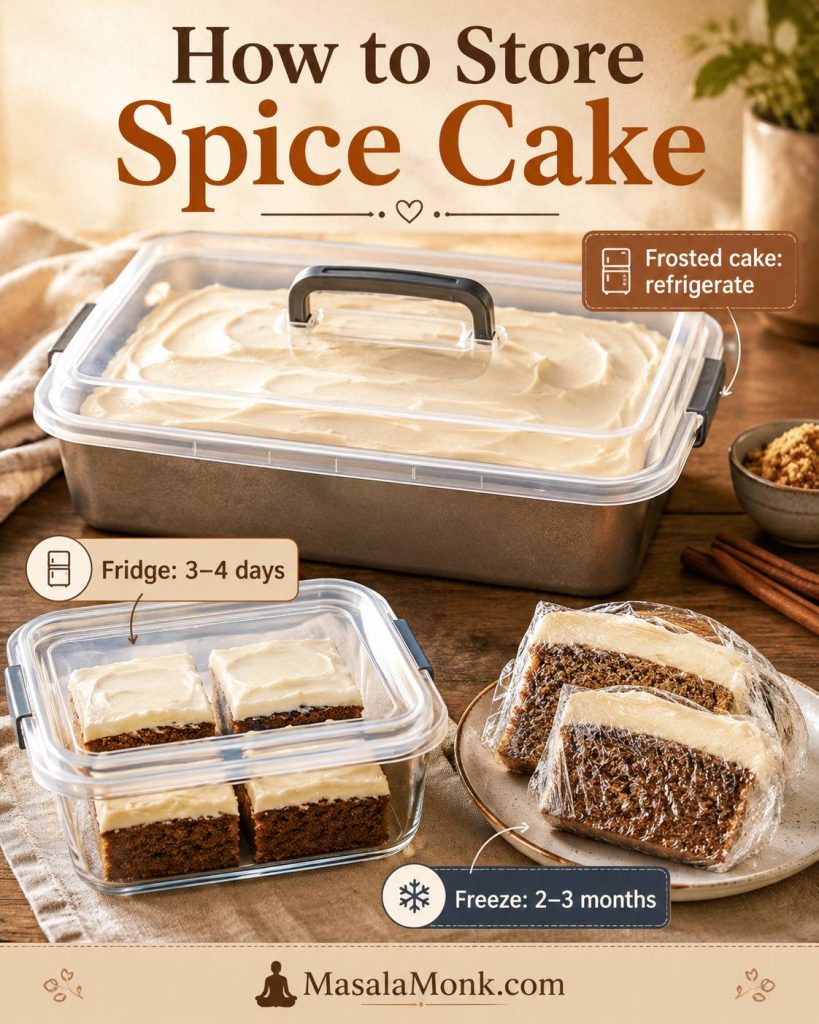
Cream-cheese-frosted spice cake should be refrigerated within 2 hours and stored covered for 3–4 days. Refrigerate it sooner if your kitchen is hot. For general food-storage safety, see the FDA’s food storage guidance.

Storage guide showing frosted spice cake in a covered pan, slices in an airtight container, and wrapped slices for freezing.
Because the cake has cream cheese frosting, refrigerate frosted slices; for longer storage, wrap individual pieces well before freezing.
SituationBest method
Unfrosted cakeWrap tightly and keep at room temperature for 1–2 days.
Frosted cakeCover tightly or store in an airtight container and refrigerate for 3–4 days.
Make aheadBake one day ahead, cool completely, cover, and frost before serving or the next day.
Freezing unfrosted cakeWrap tightly and freeze for up to 2–3 months.
Freezing frosted slicesFreeze uncovered until firm, then wrap tightly. Thaw in the refrigerator; frosting texture may soften slightly.
Serving from fridgeLet slices sit briefly at room temperature so the cake and frosting soften.

Troubleshooting Dry, Dense, Gummy, or Sunken Cake

Most baking mistakes are not disasters; they are clues. If something went wrong, start with what you can fix now, then adjust the next bake.

Cake Texture Problems

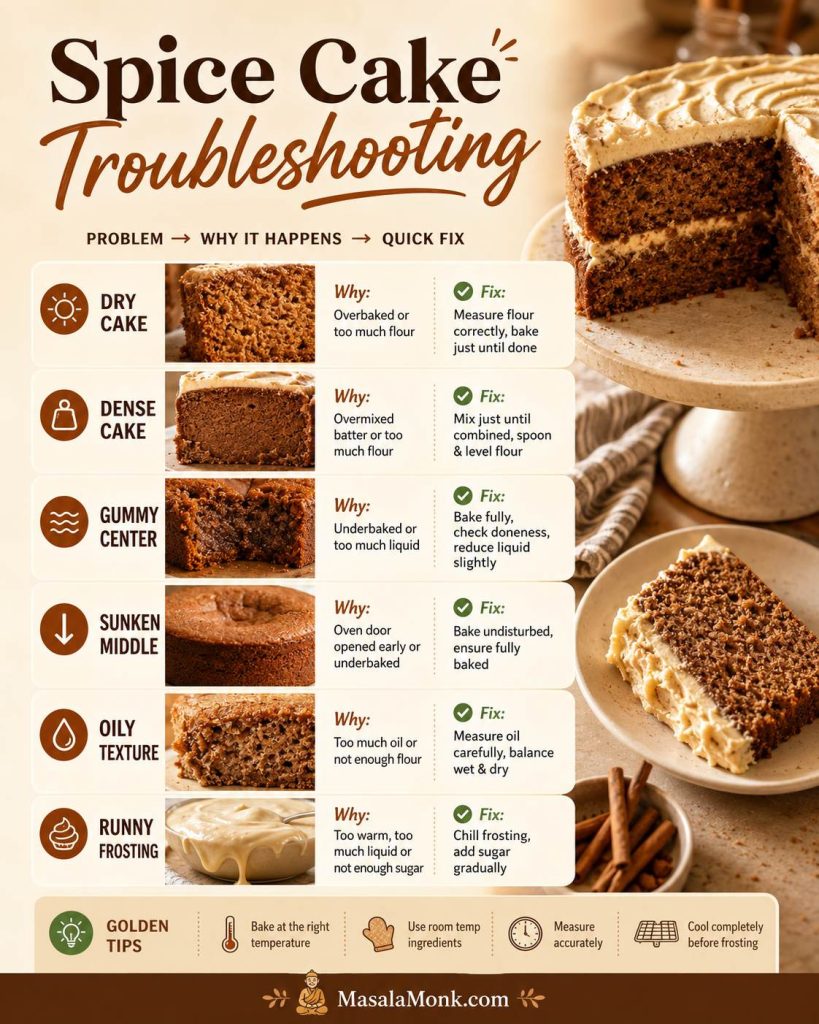
Dry, dense, gummy, oily, or sunken spice cake usually comes back to flour measurement, mixing, bake time, pan choice, or add-ins. Use this table to rescue the current cake and improve the next one.

Troubleshooting guide listing dry cake, dense cake, gummy center, sunken middle, oily texture, and runny frosting with quick fixes.
When spice cake turns dry, dense, gummy, oily, sunken, or messy, the cause usually comes back to baking time, mixing, measuring, or frosting temperature.
ProblemFix nowFix next time
Dry cakeServe with extra frosting, whipped cream, caramel, or warm apple compote.Measure flour by weight and pull the cake when the toothpick has moist crumbs.
Dense or heavy cakeLet slices come to room temperature and serve with coffee, whipped cream, or a lighter topping so the cake feels less heavy.Stop when no flour streaks remain; use room-temperature wet ingredients.
Gummy centerIf unfrosted and still warm, return it to the oven loosely covered.Use a metal 9×13 pan, keep add-ins modest, and check the true center.
Cake tastes oilyChill before slicing and serve with tangy frosting to balance richness.Measure oil in a liquid cup and bake until the center is set.
Sunken middleIf the center is underbaked, avoid serving that part; cut clean squares from the set edges and frost or dust them lightly.Check leavening freshness and avoid opening the oven early.
Bland spice flavorAdd a light cinnamon dusting or serve with brown butter frosting.Use fresh spices and consider the optional molasses.

Cream Cheese Frosting Problems

Frosting issues are usually easier to fix than cake texture problems. Temperature matters most: warm cake melts frosting, while overly soft cream cheese or butter can make the frosting loose.

ProblemFix nowFix next time
Runny frostingChill 15–20 minutes, then beat briefly; add powdered sugar if needed.Use block cream cheese and cooler butter.
Frosting melts on cakeChill the cake until the frosting firms, then smooth it again.Cool the cake completely before frosting.

Before You Bake the Next Spice Cake

Before you bake: measure the flour carefully, use fresh spices, mix gently after adding flour, and let the cake cool completely before frosting. Those four details prevent most spice cake problems.

Once those basics are handled, this is a forgiving cake: mix it gently, bake it until the center is just set, cool it fully, and frost it right in the pan. No layers, no piping, no drama — just spiced squares that taste better than the effort they ask from you.

Moist 9×13 Spice Cake Recipe

This 9×13 spice cake is the easy pan version: warmly spiced, brown-sugary, simple to slice, and finished with a generous cream cheese frosting.

Serve it when you want the comfort of carrot cake or gingerbread, but without shredded vegetables, heavy molasses flavor, or layer-cake fuss.

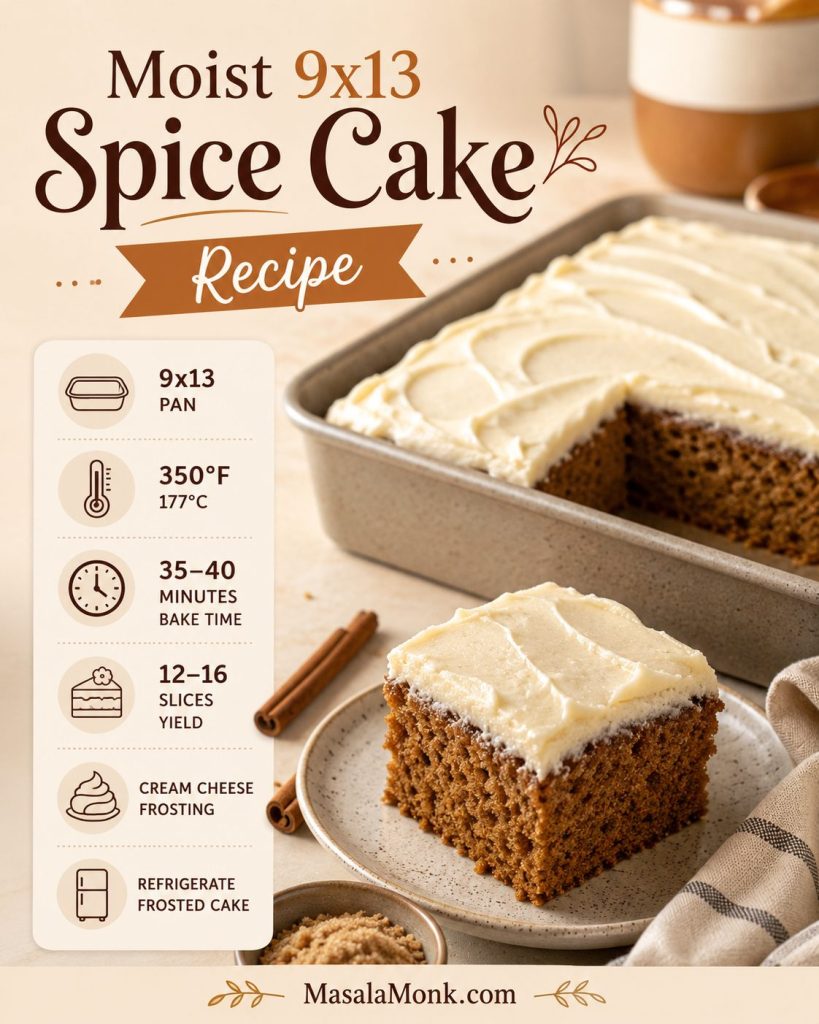
Recipe card for moist 9x13 spice cake showing a frosted cake square, baking temperature, bake time, yield, and storage reminder.
Use this quick reference before baking so the key details stay clear: 9×13 pan, 350°F oven, 35–40 minutes, 12–16 slices, and cream cheese frosting.
Prep Time
25 minutes
Cook Time
35–40 minutes
Cooling Time
At least 2 hours
Total Time
About 3 hours
Yield
12–16 slices

Timing: Plan on about 25 minutes prep, 35–40 minutes baking, and at least 2 hours cooling; total time is about 3 hours before serving. Bake time is based on a metal 9×13 pan; glass or ceramic pans may need a few extra minutes.

Equipment

  • 9×13-inch baking pan, preferably metal
  • 2 mixing bowls
  • Whisk
  • Spatula
  • Hand mixer or stand mixer for frosting
  • Cooling rack
  • Parchment paper, optional

Ingredients

For the Spice Cake

  • 2½ cups all-purpose flour / 313 g
  • 1½ teaspoons baking powder
  • ½ teaspoon baking soda
  • ¾ teaspoon fine salt
  • 2½ teaspoons ground cinnamon
  • 1 teaspoon ground ginger
  • ¾ teaspoon ground nutmeg
  • ½ teaspoon ground allspice
  • ¼ teaspoon ground cloves
  • ¼ teaspoon ground cardamom, optional
  • 1½ cups packed brown sugar / 300 g
  • ½ cup neutral oil / 120 ml
  • ¼ cup unsalted butter, melted and slightly cooled / 57 g
  • ½ cup unsweetened applesauce, room temperature if possible / 120 g
  • ¾ cup buttermilk, room temperature / 180 ml
  • 3 large eggs, room temperature
  • 2 teaspoons vanilla extract
  • 1 tablespoon molasses, optional / 20 g

For the Cream Cheese Frosting

  • 8 oz block cream cheese, softened / 226 g
  • ½ cup unsalted butter, softened / 113 g
  • 2½–3 cups powdered sugar / 300–360 g, sifted if lumpy
  • 1 teaspoon vanilla extract
  • Pinch of salt
  • 1 teaspoon lemon juice, optional, for extra tang

Instructions

  1. Prepare the oven and pan. Heat the oven to 350°F / 177°C. Grease a 9×13-inch baking pan and line with parchment if you want to lift the cake out for slicing.
  2. Mix the dry ingredients. In a large bowl, whisk the flour, baking powder, baking soda, salt, cinnamon, ginger, nutmeg, allspice, cloves, and optional cardamom until evenly combined.
  3. Mix the wet ingredients. In a separate bowl, whisk the brown sugar, oil, melted butter, applesauce, buttermilk, eggs, vanilla, and optional molasses until smooth. The eggs, applesauce, and buttermilk should not be fridge-cold.
  4. Combine. Pour the wet ingredients into the dry ingredients. Fold gently until no dry flour pockets remain. The batter should be thick but pourable. Stop once no flour streaks remain.
  5. Bake. Spread the batter into the prepared pan. Bake for 35–40 minutes in a metal pan, or until the center springs back lightly and a toothpick inserted into the middle comes out with a few moist crumbs. Glass or ceramic pans may take longer.
  6. Cool. Let the cake cool completely before frosting, at least 2 hours for a 9×13 cake. Warm cake will melt the frosting.
  7. Make the frosting. Beat the cream cheese until smooth. Add the butter and beat again. Add 2½ cups powdered sugar, vanilla, salt, and optional lemon juice. Beat until creamy and spreadable, then stop. Add more powdered sugar if you want a firmer frosting.
  8. Frost and serve. Spread frosting over the cooled cake. Chill briefly for cleaner slices, then serve. Let refrigerated slices sit at room temperature for a softer cake.

Recipe Notes

  • Buttermilk substitute: Add 2 teaspoons lemon juice or vinegar to a measuring cup, then add milk until you reach ¾ cup total. Stir and let stand for 5–10 minutes before using.
  • No applesauce? Replace it with the same weight of plain full-fat yogurt or sour cream.
  • Frosting amount: The frosting quantity is enough for a generous 9×13 sheet cake layer. For a layer cake or piping, make 1½ to 2 times the frosting.
  • Clean slices: Frost only after the cake is fully cool, then chill the frosted cake for 20–30 minutes before cutting.
  • Storage: Because this cake has cream cheese frosting, refrigerate the frosted cake within 2 hours. Store covered in the refrigerator for 3–4 days and let slices sit briefly at room temperature before serving.
  • Layer cake: Divide between two greased and parchment-lined 9-inch round pans and start checking around 26 minutes.
  • Cupcakes: Fill liners two-thirds full and bake for about 18–21 minutes.
  • Bundt cake: Use a 10–12 cup Bundt pan, grease it thoroughly, and do not overfill. Start checking around 50 minutes.
  • Loaf cake: Fill a 9×5-inch loaf pan no more than two-thirds full. This full recipe makes more batter than one loaf, so bake extra batter as cupcakes or use a second loaf pan.
  • Salted butter: You can use salted butter in the cake or frosting; reduce the added salt slightly.

FAQs About Spice Cake

What makes spice cake different from carrot cake?

Spice cake is defined by baking spices. Carrot cake is defined by grated carrot and often includes nuts, raisins, pineapple, or coconut. The two can share cinnamon, ginger, and nutmeg, but carrot cake has a vegetable-based texture and spice cake does not need carrots.

Which spices are best in spice cake?

Cinnamon, ginger, nutmeg, allspice, and cloves are the classic mix. Cinnamon should lead, cloves should stay subtle, and the spices should be fresh.

Is spice cake hot or spicy?

Think cinnamon warmth, not chili heat. The flavor comes from baking spices, not hot pepper.

Is spice cake the same as gingerbread?

No. Gingerbread is usually darker, more ginger-forward, and more molasses-heavy. Spice cake is softer, sweeter, and more balanced across several spices.

What is the difference between spice cake and pumpkin spice cake?

Spice cake is led by the spice blend itself. Pumpkin spice cake includes pumpkin purée, which changes the moisture, density, color, and flavor of the batter.

Can I use pumpkin pie spice instead of individual spices?

Pumpkin pie spice works as a shortcut. Replace the listed spices with a good blend, knowing the final flavor depends on that blend.

Can I make spice cake without applesauce?

Plain full-fat yogurt or sour cream can replace the applesauce in the same amount. The cake will be slightly tangier and a little less apple-soft, but it will still have enough moisture if the rest of the recipe stays unchanged.

Can I make spice cake ahead of time?

This is actually a good make-ahead cake. Bake it one day ahead, cool it completely, cover it well, and frost it the next day or before serving. The spices often taste more settled after the cake rests overnight.

What frosting goes best with spice cake?

Cream cheese frosting is the classic choice because it adds tang, not just sweetness. A vanilla glaze works better for Bundt or loaf cake.

Why did my spice cake turn out dry?

The most common reasons are too much flour, overbaking, or waiting until the toothpick comes out completely dry. Measure flour by weight if possible and remove the cake when the center is set but the toothpick still has a few moist crumbs.

Can spice cake be baked as cupcakes?

It works well as cupcakes. Fill standard liners about two-thirds full and bake at 350°F / 177°C for about 18–21 minutes. Start checking early because cupcakes dry out faster than a sheet cake.

Should cream cheese frosted spice cake be refrigerated?

Cream-cheese-frosted spice cake should be refrigerated within 2 hours and stored covered for 3–4 days. Let slices sit briefly at room temperature before serving.

When the cake is soft, the spices are fresh, and the frosting has that little cream-cheese tang, this is the kind of simple dessert that disappears slice by slice from the pan. It belongs with coffee, on holiday tables, and on ordinary weekends when cake sounds like a perfectly good plan.

If you try it, I would love to know whether your favorite slice was same-day soft or next-day spiced and settled.

Back to top