Posted on 1 Comment

Watermelon Margarita Recipe

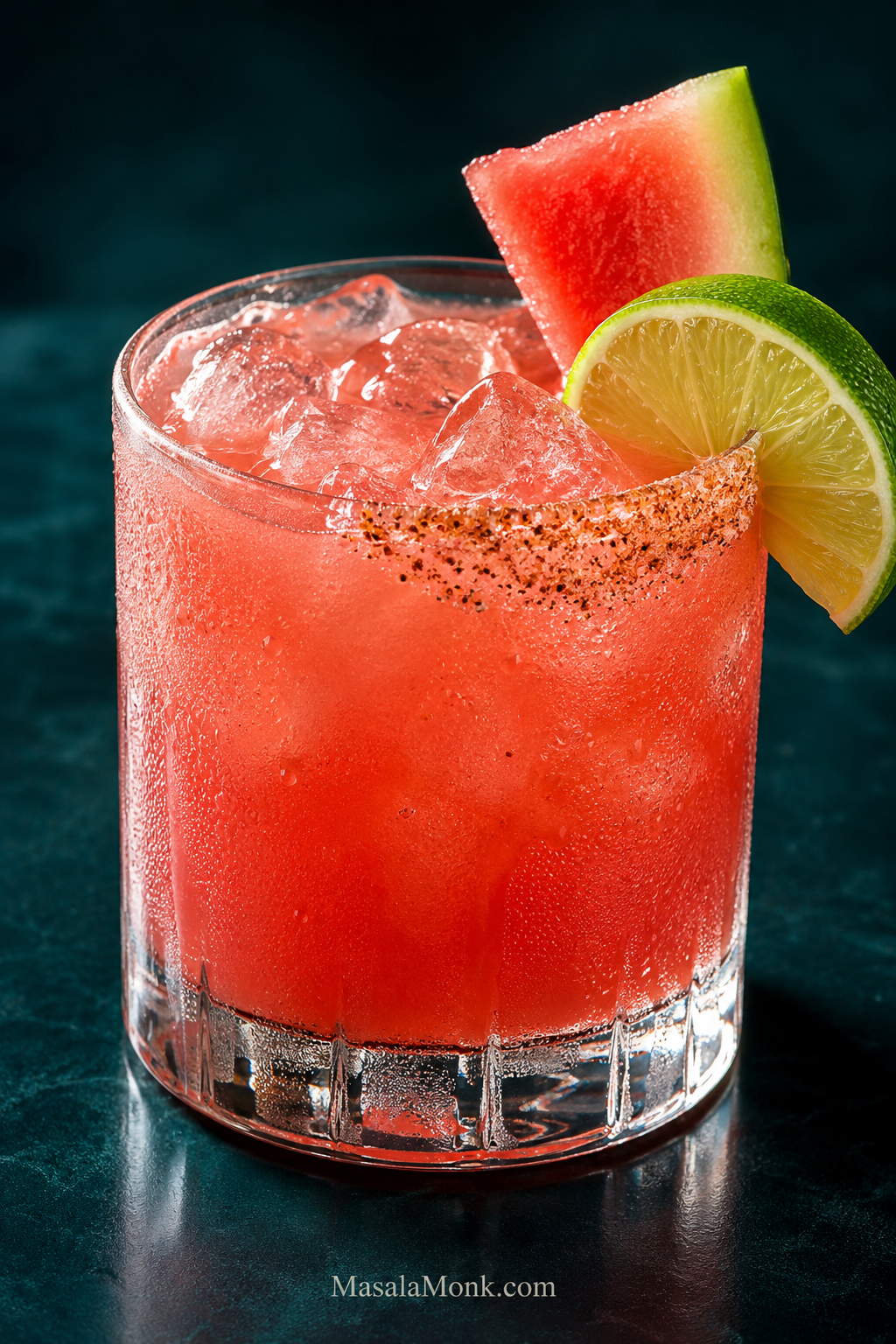
Fresh watermelon margarita on the rocks in a short glass with clear ice, a half-rim, lime wedge, and watermelon garnish.

This watermelon margarita recipe is cold, juicy, lime-bright, and built for ripe summer watermelon. Blend the fruit into fresh juice, shake it with blanco tequila and lime, then pour it over fresh ice with a salt or Tajín rim so every sip tastes crisp instead of watery.

The main version is a watermelon margarita on the rocks, because that is the cleanest way to taste the fruit without turning the drink into accidental slush. From there, you can make it stronger, softer, spicy, frozen, alcohol-free, or pitcher-friendly without guessing your way through the ratios.

You do not need a complicated cocktail setup, and you do not need to drown the drink in ice. Fresh watermelon juice, blanco tequila, lime, and a good rim do most of the work. Orange liqueur is optional, and sweetener only belongs in the glass when the watermelon needs a little help.

Table of Contents

Use this guide to make a fresh watermelon margarita on the rocks, adjust the ratio, scale it for a pitcher, or turn it into a frozen, spicy, or alcohol-free version.

Quick Answer: Best Watermelon Margarita Ratio

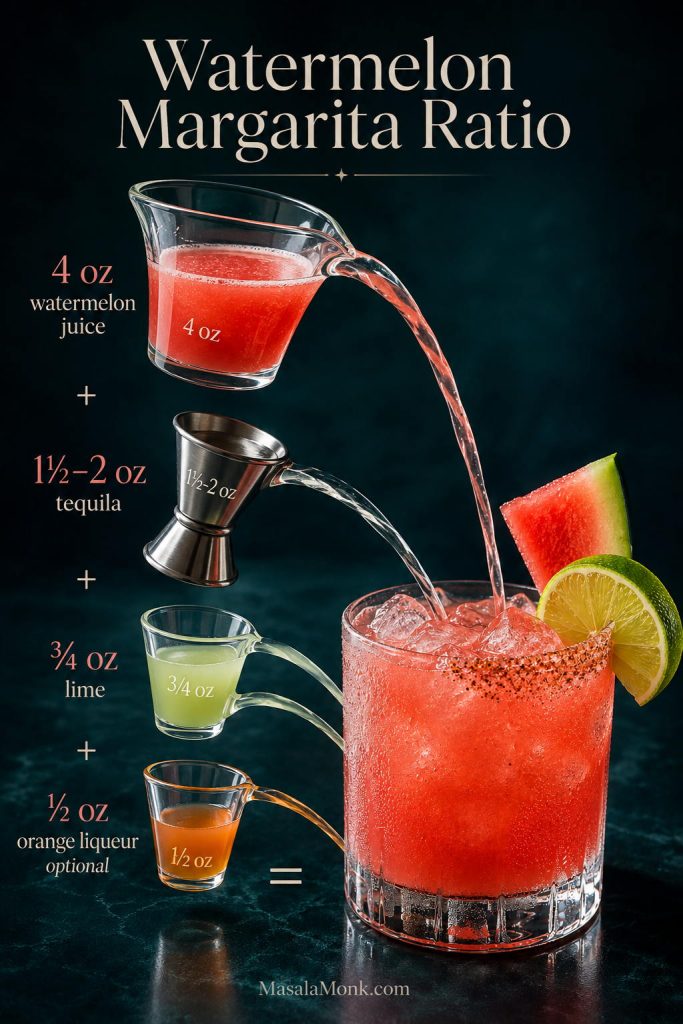
For one drink, this watermelon margarita recipe uses 4 oz watermelon juice, 1½ to 2 oz blanco tequila, ¾ oz fresh lime juice, and ½ oz orange liqueur if you want a rounder classic margarita flavor. Shake with ice, then strain over fresh ice so the drink stays cold without turning watery.

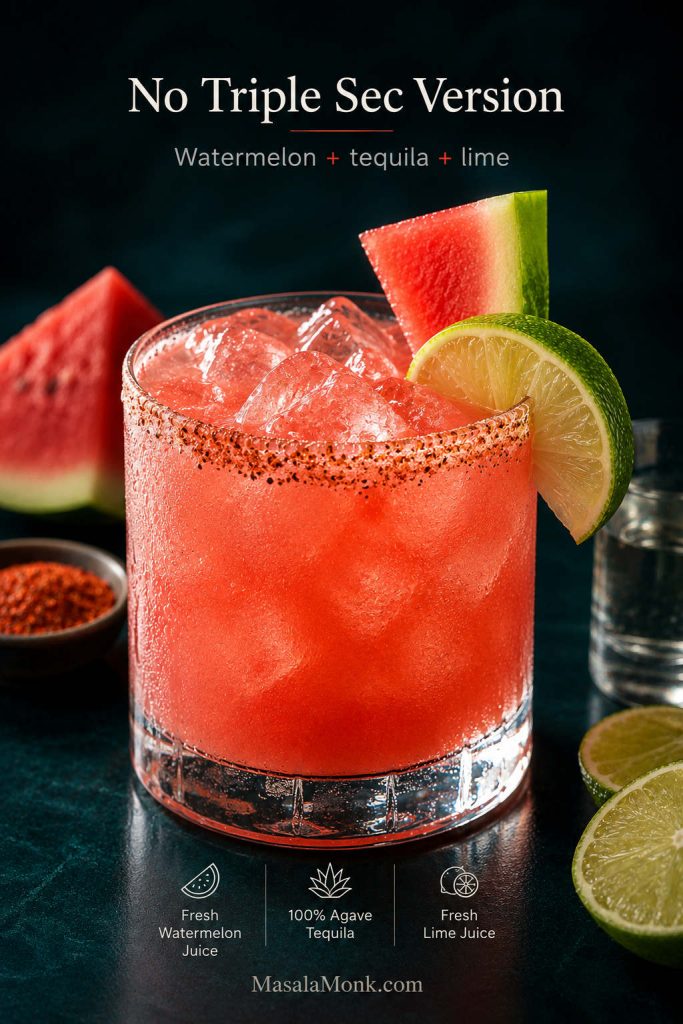
Very sweet watermelon usually needs no added sugar. If the fruit tastes bland, add ¼ oz agave or simple syrup. For a cleaner watermelon margarita without triple sec, leave out the orange liqueur and let the watermelon, tequila, and lime stay sharper and more fruit-forward.

Ingredient One Drink Metric Why It Matters
Fresh watermelon juice 4 oz 120 ml Gives the drink its fresh fruit flavor and natural sweetness.
Blanco tequila 1½–2 oz 45–60 ml Use 1½ oz for an easier drink or 2 oz for a stronger cocktail.
Fresh lime juice ¾ oz 22 ml Balances sweet watermelon and keeps the drink from tasting flat.
Orange liqueur ½ oz, optional 15 ml Adds classic margarita roundness; skip it for a cleaner no triple sec version.
Agave or simple syrup 0–¼ oz 0–7 ml Only needed if the watermelon is not naturally sweet.

The first sip should be cold, juicy, lightly salty, and clearly watermelon-forward — not like tequila hiding in fruit juice, and not like watered-down slush. When it tastes flat, add lime or salt. Sharpness usually means it needs more watermelon, while a heavy finish usually means the next round needs less sweetener.

Watermelon margarita ratio graphic showing watermelon juice, tequila, lime juice, optional orange liqueur, and a finished drink.
Use this watermelon margarita ratio as the first pour, not the final law. Because watermelon sweetness changes so much, mix the drink first, taste it cold, and only then decide whether it needs sweetener.

Watermelon Margarita at a Glance

Making this watermelon margarita recipe for the first time? Start here. These choices give you the freshest flavor, the cleanest texture, and the lowest risk of a watery drink.

Serving style On the rocks, shaken and strained over fresh ice
Tequila Blanco or silver tequila
Juice Fresh blended watermelon juice
Rim Salt for classic, Tajín or chili-lime seasoning for tangy watermelon flavor
Sweetener Only when the watermelon tastes bland or underripe
Pitcher tip Mix ahead, chill, and add ice only to glasses
Frozen tip Use frozen watermelon cubes instead of lots of plain ice
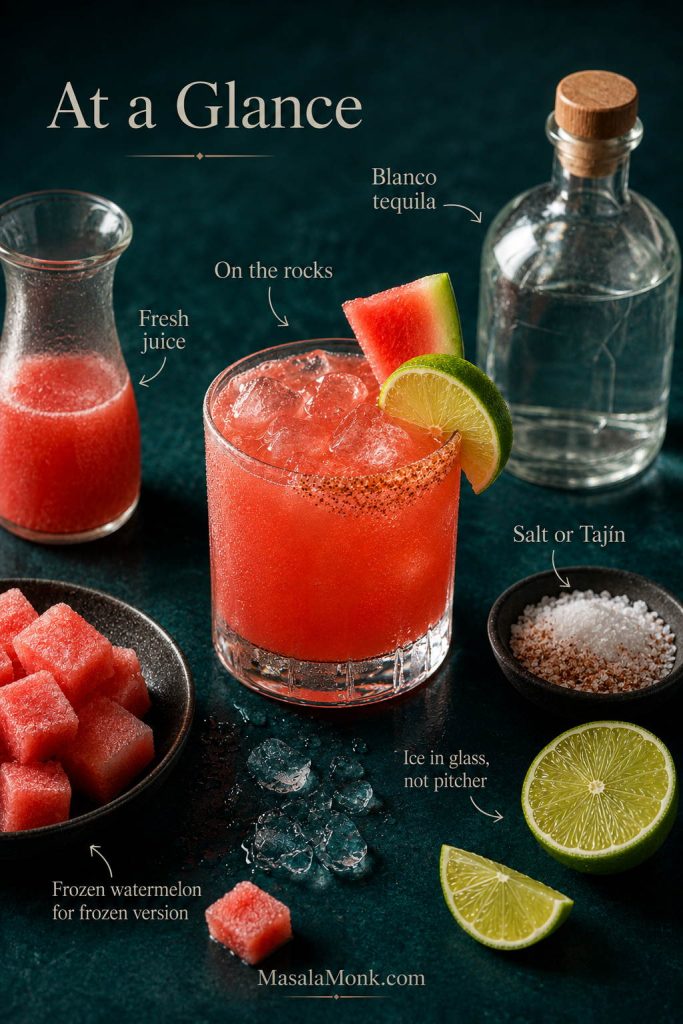
At-a-glance watermelon margarita guide with a finished drink, watermelon juice, tequila, lime, rim seasoning, frozen watermelon, and pitcher cues.
This visual gives the fastest decision path: fresh juice for flavor, blanco tequila for a clean finish, ice in the glass for control, and frozen watermelon only when you are making the blended version.

Why This Recipe Works

Watermelon brings a lot of juice and natural sweetness, but it is also delicate. Too much tequila makes it disappear, too much lime makes it sharp, and too much syrup turns it candy-like. This ratio keeps the drink fresh first: watermelon leads, tequila supports, lime sharpens, and the rim makes each sip pop.

A lot of watermelon margaritas go wrong because they treat watermelon like a bold citrus juice. It is not. The fruit is gentle, watery, and easily buried, so this drink needs measured lime, enough salt, and fresh ice more than it needs extra syrup.

Because this watermelon margarita recipe starts with real watermelon juice, you can taste and adjust the drink before it ever reaches the glass.

You are not locked into one exact formula either. Add orange liqueur when a rounder classic margarita feel sounds right, or leave it out when something cleaner and more fruit-forward fits the moment. Choose salt for a crisp rim, Tajín or another chili-lime seasoning for a tangy edge, or a half-rim when every sip should feel a little different.

In a classic margarita, tequila, lime, orange liqueur, and salt do the heavy lifting. Watermelon changes that balance because it brings both juice and sweetness, so this version usually needs less added sweetener than a sharper citrus margarita.

Watermelon Margarita Ingredients

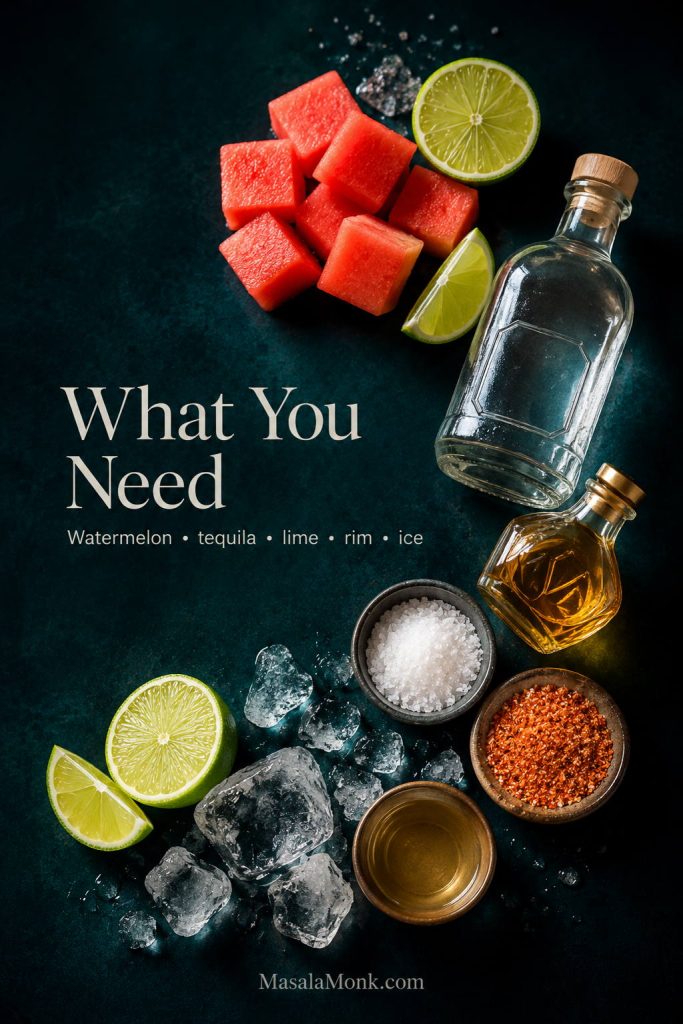
The main ingredients in this watermelon margarita recipe are simple: ripe watermelon, blanco tequila, fresh lime, ice, and a salt or Tajín rim. Orange liqueur and sweetener are useful, but they should stay optional because watermelon can vary a lot in sweetness.

Before you mix the drink, taste the watermelon by itself. A great watermelon needs almost no sweetener. A flat or underripe one may need a tiny splash of agave, a better rim, or a little more lime to wake it up.

Watermelon margarita ingredients on a dark surface, including watermelon cubes, lime, tequila, orange liqueur, sweetener, salt, Tajín, and ice.
Each ingredient has a job. Watermelon brings body, lime gives the drink lift, tequila adds structure, and salt or Tajín keeps the sip from tasting one-note.
Ingredient Good Choice How to Use It
Watermelon Ripe seedless watermelon Blend, strain if desired, then measure the juice after blending.
Tequila Blanco or silver tequila Clean and crisp, so it does not hide the watermelon.
Lime Fresh lime juice Do not skip it; lime is what keeps the drink from tasting like plain watermelon juice.
Orange liqueur Cointreau, triple sec, or another orange liqueur Optional. Use it for a rounder classic margarita flavor.
Sweetener Agave or simple syrup Add only if the watermelon tastes bland or the drink is too sharp.
Rim Salt, Tajín, or chili-lime seasoning Balances the sweetness and makes the watermelon taste brighter.

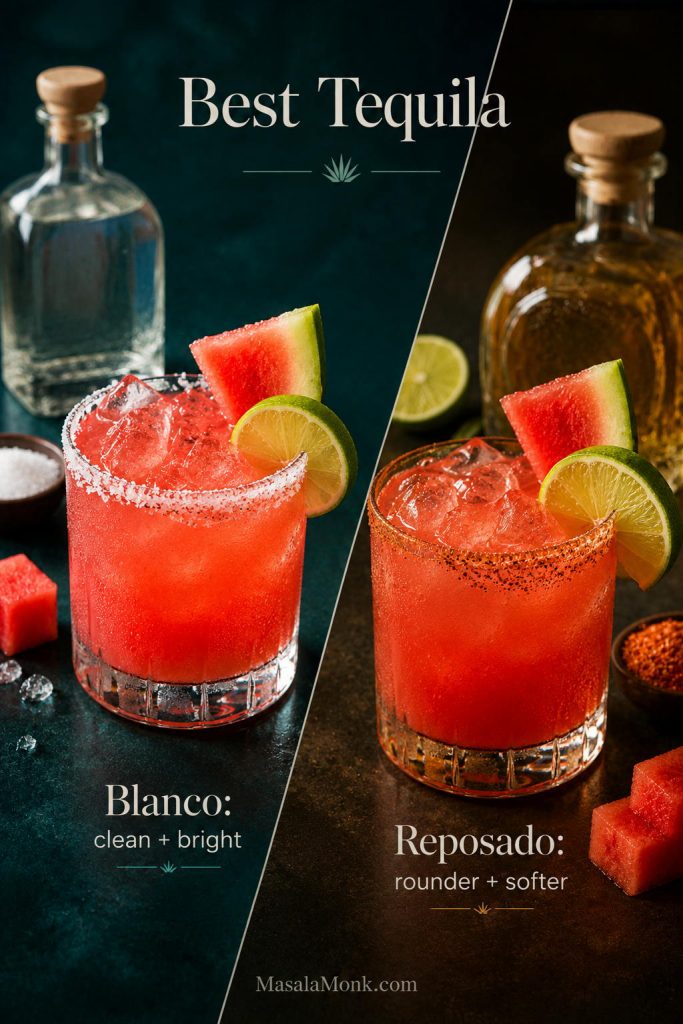
Best Tequila for a Watermelon Margarita

Reposado tequila can work when you like a rounder drink, but it can pull the flavor warmer and softer. Blanco keeps the watermelon cleaner. For orange liqueur, Cointreau-style options usually taste cleaner and stronger, while basic triple sec is often sweeter and softer.

Blanco and reposado tequila comparison for watermelon margaritas, with two watermelon-colored cocktails and bottle cues.
Blanco tequila is the safest first choice for a fresh watermelon margarita because it stays crisp and lets the fruit lead. Reposado works when you want a rounder, warmer drink.

If this is the kind of tequila drink you like, the Paloma recipe is a good next one: still bright, salty, and citrusy, but lighter and sparkling with grapefruit instead of watermelon.

How Much Watermelon Do You Need?

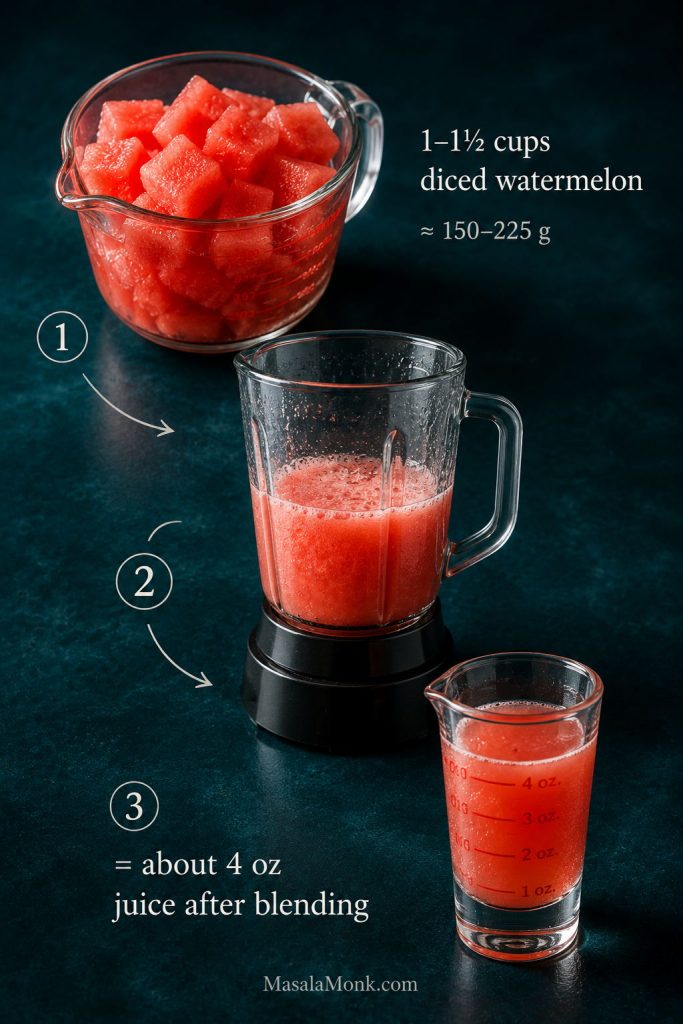
Start with about 1 to 1½ cups diced ripe watermelon for one drink, then blend and strain it to measure 4 oz / 120 ml fresh watermelon juice. Watermelon yield changes depending on ripeness and how watery the fruit is, so measure the juice after blending instead of relying only on the diced fruit amount.

As a useful weight guide, 1 cup diced watermelon is about 152 g. That means 1 to 1½ cups diced watermelon is roughly 150–225 g before blending.

Watermelon yield guide showing diced watermelon, a blender, and about 4 ounces of watermelon juice for one margarita.
Diced watermelon does not always give the same amount of juice, so measure after blending instead of guessing. Blending extra fruit gives you room to adjust, especially when making more than one margarita.
Amount of Diced Watermelon Approx. Weight Use It For
1 to 1½ cups 150–225 g Usually enough for 1 margarita after blending and straining.
3 to 4 cups 455–610 g A good starting amount for 4 drinks, depending on how juicy the watermelon is.
6 to 8 cups 910 g–1.2 kg A good starting amount for a larger pitcher or party batch.
Useful tip: Blend more watermelon than you think you need, then measure the juice after straining. If the fruit tastes sweet and juicy on its own, skip extra sweetener. If it tastes flat, use lime, salt, or a tiny splash of agave to wake it up.

Fresh Watermelon vs Bottled Watermelon Juice

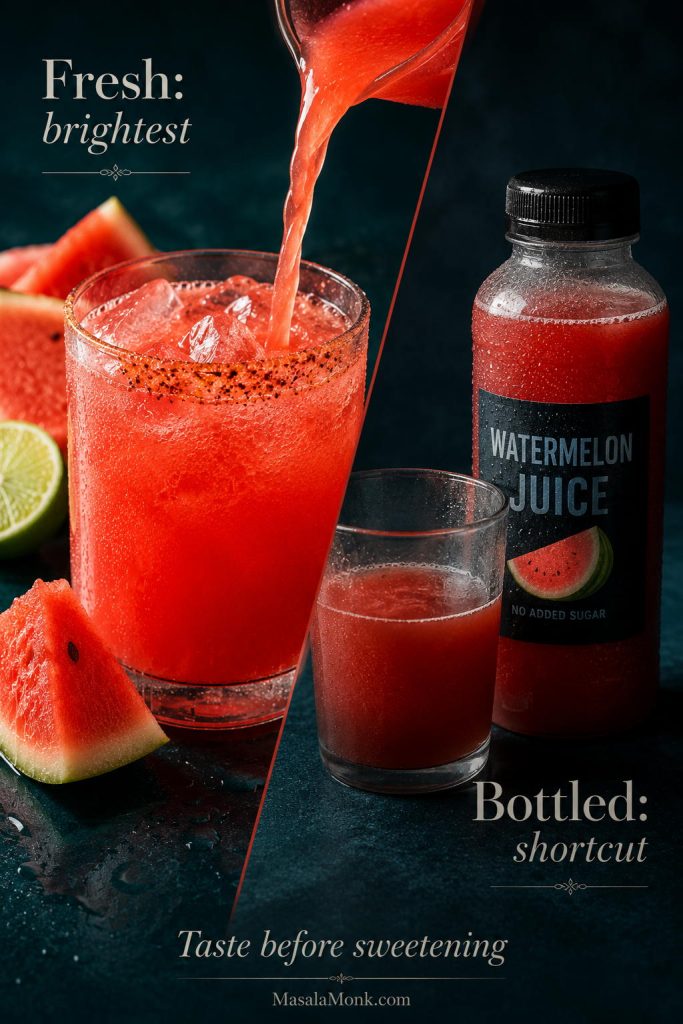
Fresh watermelon gives this drink the cleanest flavor, brightest color, and most natural summer feel. When the fruit is ripe and sweet, the margarita may not need added sugar at all.

Bottled watermelon juice works as a shortcut, especially when watermelon is out of season or you do not want to blend fruit. Choose an unsweetened or lightly sweetened juice if possible. Some bottled juices taste cooked, flat, or candy-like, and those flavors become more obvious once tequila and lime are added.

Fresh watermelon juice compared with bottled watermelon juice for making watermelon margaritas.
Fresh watermelon juice usually gives the brightest color and cleanest flavor. Bottled juice can still work as a shortcut; however, taste it first because some versions are already sweet or slightly flat.

For the brightest version, use freshly blended watermelon, especially when the fruit is cold, ripe, and naturally sweet.

Frozen watermelon cubes are a different tool. They are better for a blended frozen margarita than for a shaken on-the-rocks drink, because they give the blender body without diluting the cocktail with too much plain ice.

The balance is similar to other fruit margaritas: ripe fruit adds body and sweetness, while lime, tequila, and the rim keep everything sharp. If you want another fruit-forward example, this mango margarita recipe follows the same idea with a thicker, sweeter fruit base.

How to Make Fresh Watermelon Juice

Fresh watermelon juice takes only a few minutes. Use ripe, chilled watermelon if you have it; cold fruit makes the drink taste brighter and helps the margarita stay crisp once it hits the ice.

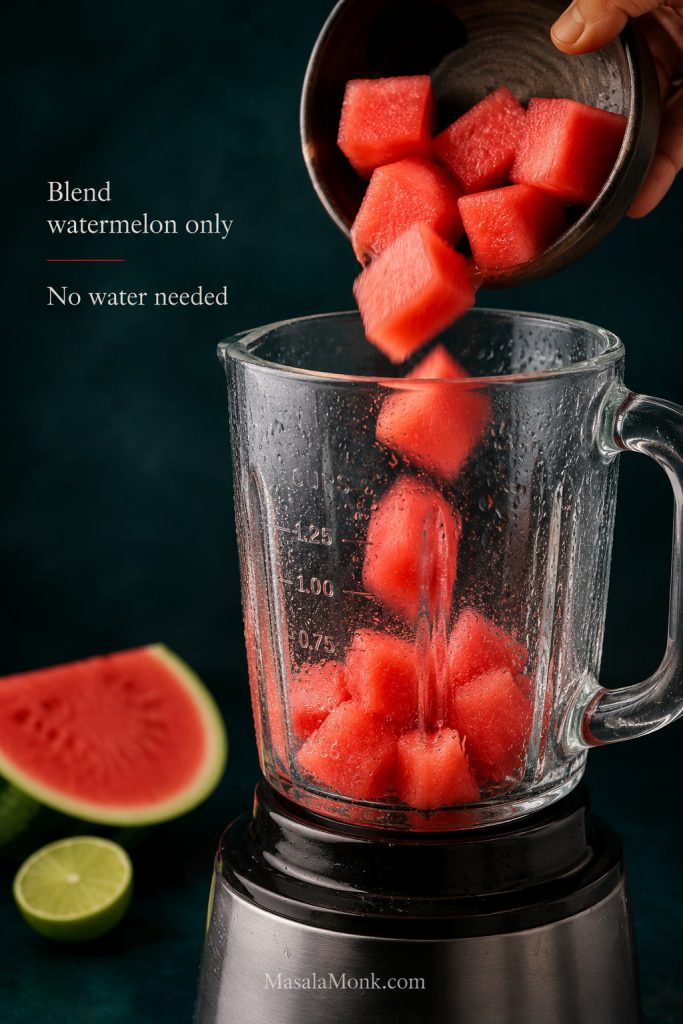
Watermelon cubes being blended and strained to make fresh juice for watermelon margaritas.
Watermelon releases enough liquid on its own, so there is no need to add water to the blender. Keeping the juice undiluted gives the margarita a stronger fruit flavor from the start.
  1. Cut the watermelon into cubes. Remove the rind and any large black seeds.
  2. Blend until smooth. Use a blender or high-speed blender. No water is needed.
  3. Strain if you want a smoother drink. Pour through a fine-mesh strainer and press gently with a spoon.
  4. Then measure the juice. For one drink, use 4 oz / 120 ml watermelon juice after blending and straining.
  5. Chill if making ahead. Store covered in the fridge and stir before using, because watermelon juice naturally separates.
Do not add water to the blender. Watermelon releases plenty of juice on its own. Extra water makes the margarita taste thin before it even reaches the shaker.

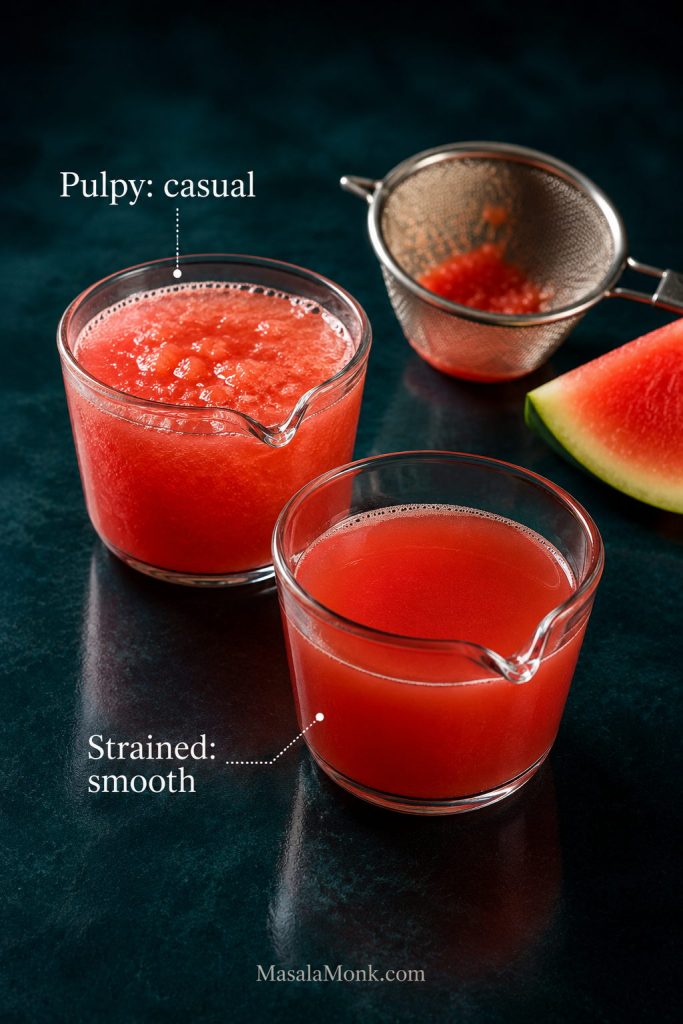
Strained vs Pulpy Watermelon Juice

Strain or not? Strain the juice for a smoother cocktail-bar texture. Skip straining if you like a slightly pulpy, fresh-fruit feel. For a pitcher, straining is usually better because the drink pours cleaner and settles less heavily.
Pulpy and strained watermelon juice shown in two glasses with a fine-mesh strainer nearby.
Strained watermelon juice gives a smoother cocktail texture, while pulpy juice feels more casual and fruit-forward. For pitchers, straining is usually better because pulp settles as the batch sits.

How to Make a Watermelon Margarita on the Rocks

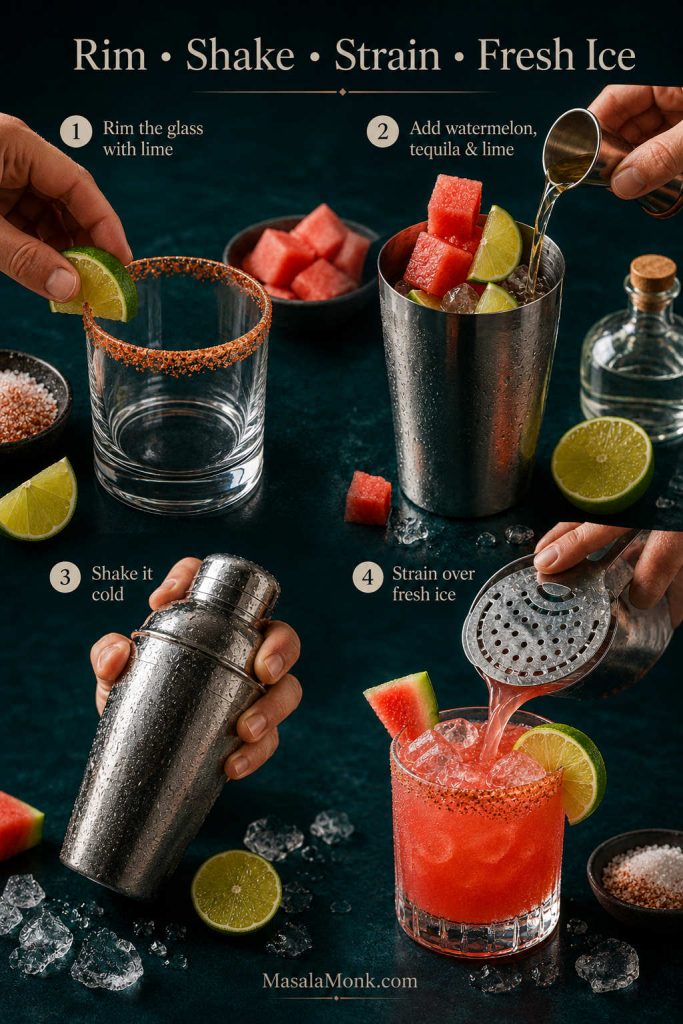
The main method for this watermelon margarita recipe is shaken and served over fresh ice. Shaking chills and blends the lime, tequila, and watermelon juice quickly; fresh ice in the glass keeps the drink bright instead of watery.

Shaking gives you a colder, cleaner watermelon margarita than blending with a lot of ice. The drink stays juicy and bright, not foamy, diluted, or slushy by accident.

Watermelon margarita method image showing rimming a glass, adding ingredients to a shaker, shaking, and straining over fresh ice.
The on-the-rocks method keeps the drink controlled: rim the glass, shake the cocktail cold, then strain it over fresh ice. That sequence gives you chill without turning the drink into accidental slush.
  1. Rim the glass. Rub a lime wedge around the rim of a rocks glass, then dip the glass into salt, Tajín, or chili-lime seasoning. Fill with fresh ice.
  2. Add the drink ingredients to a shaker. Use 4 oz watermelon juice, 1½ to 2 oz blanco tequila, ¾ oz fresh lime juice, optional ½ oz orange liqueur, and optional ¼ oz agave if needed.
  3. Shake with ice. Shake for 15–20 seconds, until the shaker feels cold.
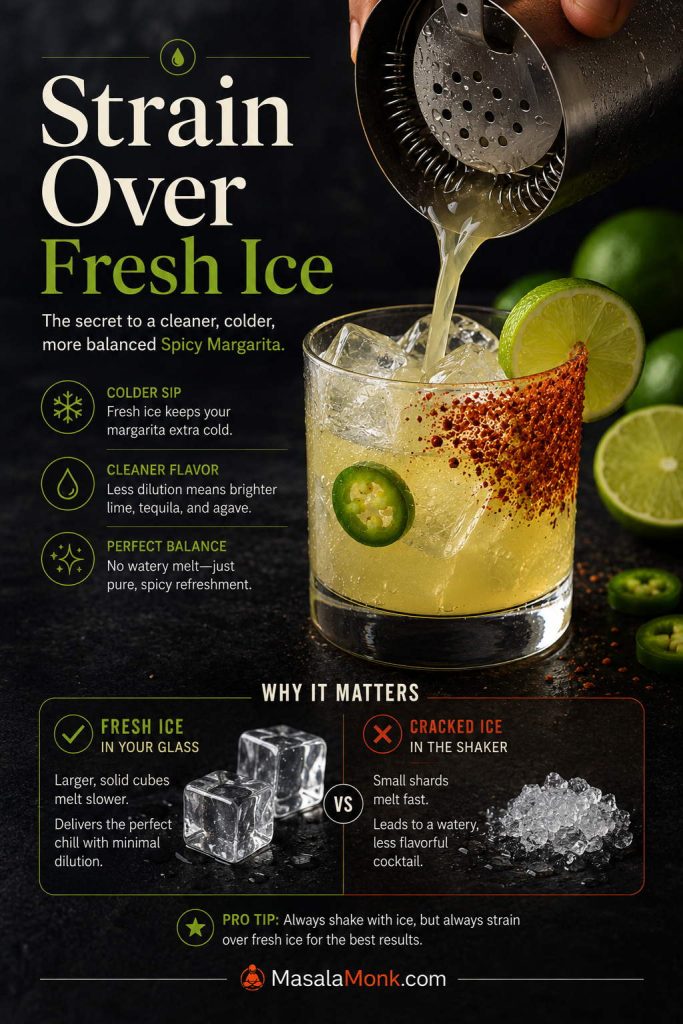
  4. Strain over fresh ice. Do not pour the used shaker ice into the glass; fresh ice keeps the drink cleaner.
  5. Garnish and taste. Add a lime wedge, small watermelon wedge, or mint sprig. Taste once before serving and adjust if needed.

Why Fresh Ice Matters

Do not worry if the first sip is not perfect. Watermelon changes a lot from fruit to fruit, so small adjustments are part of the recipe. When in doubt, adjust with lime and salt before adding more syrup.

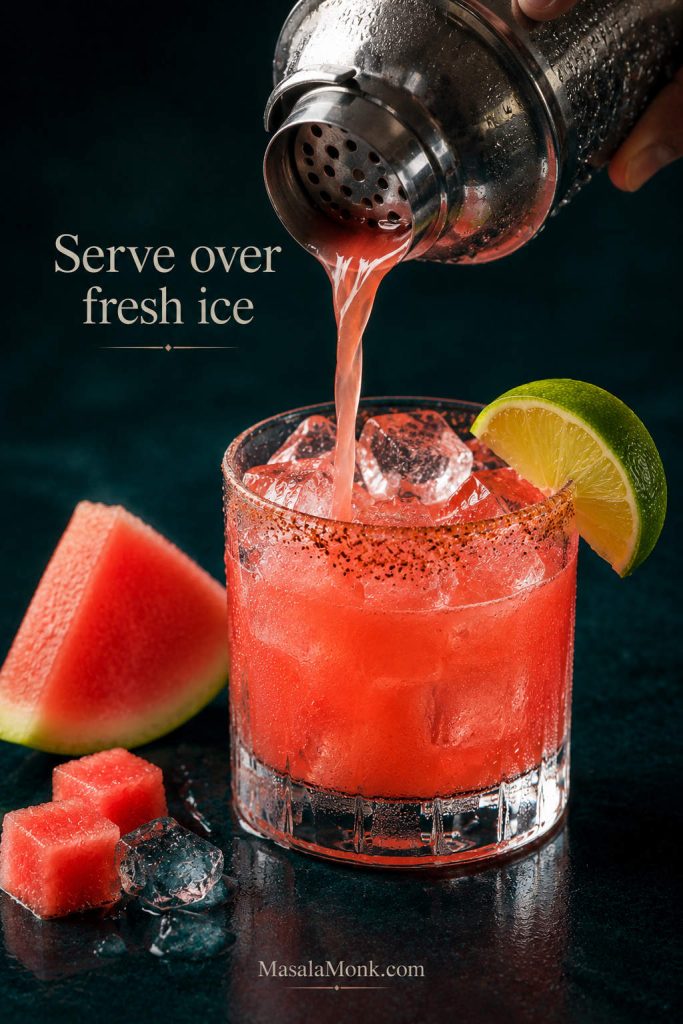
Watermelon margarita being poured from a shaker into a glass filled with fresh ice.
Fresh ice gives the finished drink a clean start. Instead of carrying over half-melted shaker ice, strain into a cold glass so the watermelon and lime stay lively longer.
Problem Quick Fix
Tart or sharp Add a little more watermelon juice first; then use ¼ oz agave or simple syrup only when needed.
Overly sweet Add a squeeze of fresh lime and use a salt or Tajín rim to bring the drink back into balance.
Alcohol-heavy Add more watermelon juice or a small splash of cold sparkling water.
Flat Add more lime, a better rim, or a tiny pinch of salt before adding more syrup.

Ratio Guide: Lighter, Balanced, or Stronger

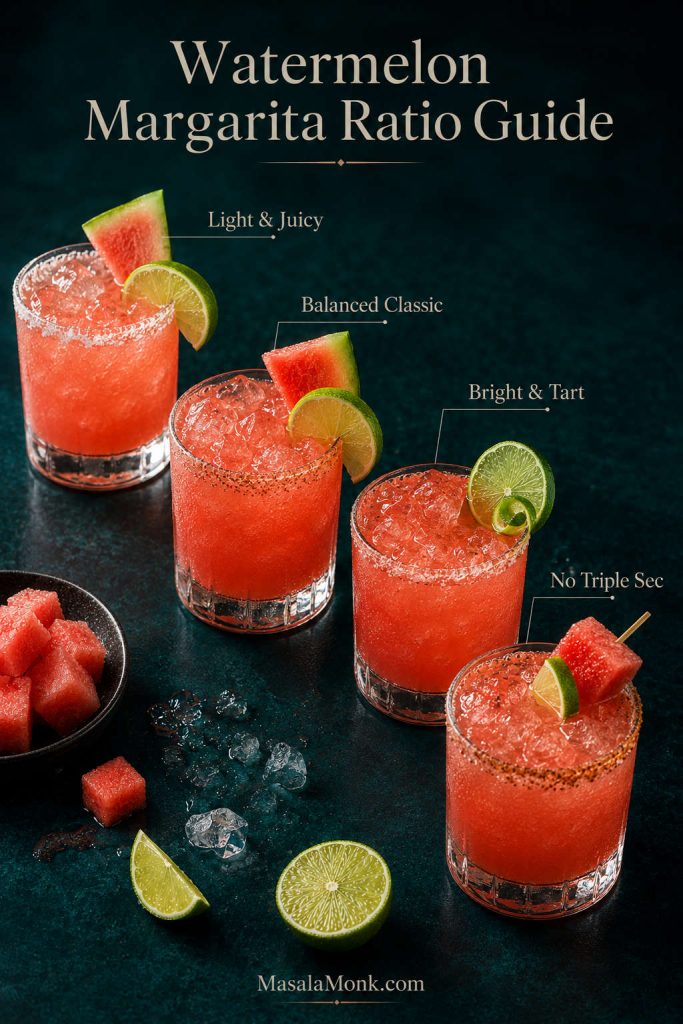
The right ratio depends on how sweet the fruit is and how strong you want the drink. Start with the balanced version, then move lighter, brighter, or stronger from there.

Four watermelon margaritas labeled Light and Juicy, Balanced Classic, Bright and Tart, and No Triple Sec.
This ratio guide turns the recipe into a choice. Go lighter for easy sipping, balanced for the first batch, brighter for very sweet fruit, or no triple sec when you want the cleanest watermelon-tequila finish.
Style Watermelon Juice Tequila Lime Orange Liqueur Use It When
Light & Juicy 4 oz / 120 ml 1½ oz / 45 ml ¾ oz / 22 ml Optional You want a softer daytime drink for a pool day, patio drink, or easy first round.
Balanced Classic 4 oz / 120 ml 2 oz / 60 ml ¾ oz / 22 ml ½ oz / 15 ml You want the main version: fresh, cold, citrusy, and clearly margarita-like.
Bright & Tart 3 oz / 90 ml 2 oz / 60 ml 1 oz / 30 ml ½ oz / 15 ml Your watermelon is very sweet or you prefer a sharper lime-forward margarita.
No Triple Sec 4 oz / 120 ml 1½–2 oz / 45–60 ml ¾ oz / 22 ml Skip it You want a cleaner tequila-watermelon-lime flavor without orange liqueur.

Start with the Balanced Classic for your first batch. If guests are coming, use the Light & Juicy version with a half-rim. When the watermelon is very sweet, move to the Bright & Tart version so the drink tastes crisp instead of like spiked juice.

As a result, this watermelon margarita recipe can lean light and juicy, balanced and classic, or sharper and stronger without changing the whole method.

The balanced classic is a good first pour: 4 oz watermelon juice, 2 oz tequila, ¾ oz lime, and ½ oz orange liqueur. If your watermelon is delicate or you want an easier patio drink, use 1½ oz tequila instead.

Watermelon Margarita Without Triple Sec

This watermelon margarita recipe also works beautifully without triple sec because watermelon already brings sweetness and aroma. Without orange liqueur, the drink tastes cleaner, sharper, and more watermelon-forward.

Skip triple sec when your watermelon is ripe, sweet, and fragrant. Add it when the drink tastes too much like tequila-watermelon juice and not enough like a classic margarita.

Watermelon margarita without triple sec in a rimmed glass with lime and watermelon garnish.
A watermelon margarita without triple sec works best when the fruit is already ripe and fragrant. Instead of adding orange sweetness, this version keeps the flavor closer to watermelon, lime, and tequila.

This is the version to make when the watermelon is already sweet enough to eat by itself and you want the drink to stay clean, fresh, and fruit-forward.

Use this no triple sec ratio for one drink:

  • 4 oz / 120 ml fresh watermelon juice
  • 1½–2 oz / 45–60 ml blanco tequila
  • ¾ oz / 22 ml fresh lime juice
  • 0–¼ oz / 0–7 ml agave or simple syrup, only if needed
  • Salt or Tajín rim
  • Ice

If the drink tastes a little too sharp without triple sec, do not rush to add a lot of syrup. First add a splash more watermelon juice. Then add a small amount of agave only if the fruit still tastes weak or underripe.

Orange liqueur is still useful when you want a more classic citrus-margarita profile. It rounds the edges of the drink and makes the watermelon taste more like a margarita than a tequila watermelon cooler. For a deeper citrus version, the blood orange margarita recipe shows how orange juice, lime, tequila, and orange liqueur work together.

Salt, Tajín, or Chili-Salt Rim

The rim is not just decoration. Watermelon is sweet and watery, so salt or chili-lime seasoning helps the drink taste sharper, colder, and more complete.

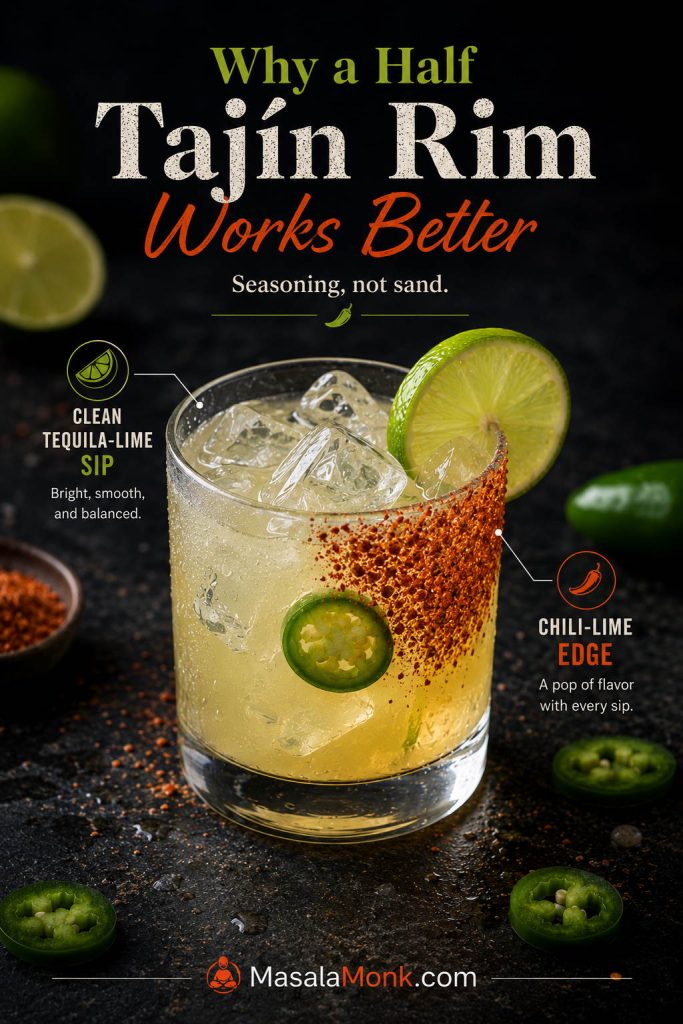
This is where the drink can lean classic, playful, or spicy. Salt keeps it crisp, Tajín makes it taste like summer street fruit, and chili-salt gives it a drier savory edge.

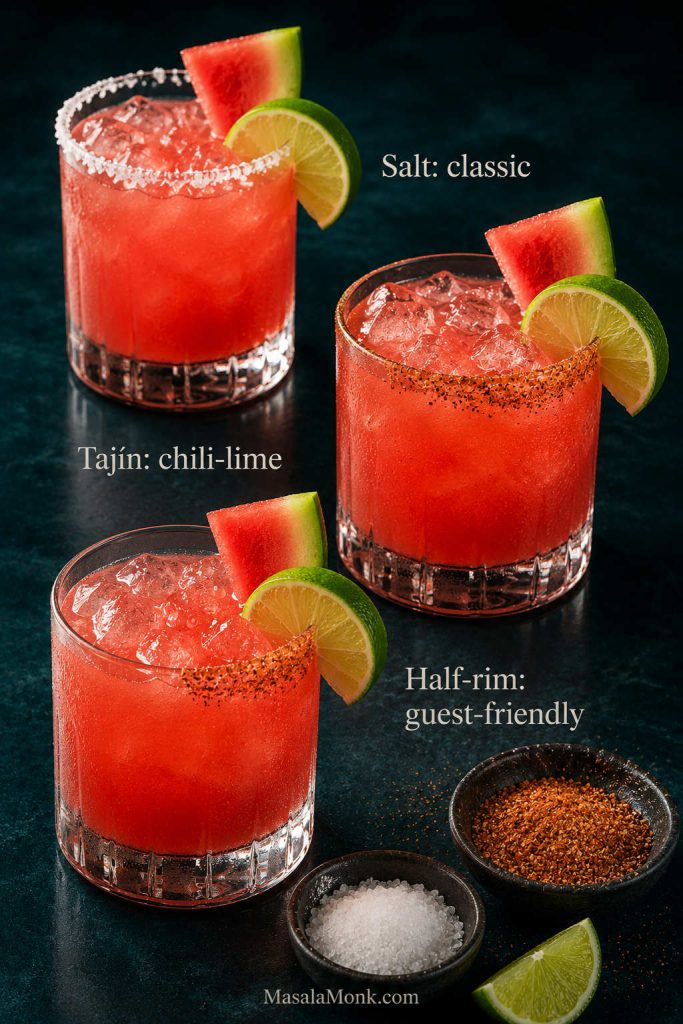
Three watermelon margaritas showing a salt rim, a Tajín rim, and a half-rim option.
The rim changes the mood of the drink. Salt keeps the margarita classic and crisp, Tajín adds chili-lime energy, and a half-rim gives guests control over how salty each sip feels.
Rim Flavor When to Use It
Salt Clean, classic, sharp Use for the most classic version.
Tajín or chili-lime seasoning Tangy, lightly spicy, snack-like Use when you want the watermelon to taste brighter and more playful.
Chili-salt Spicy, savory, flexible Good when you want spice without adding jalapeño to the drink.
Half-rim Controlled saltiness Great for guests because they can choose salted or clean sips.
  • Salt is the cleanest choice for a classic watermelon margarita.
  • Tajín is best when you want the drink to taste like cold watermelon with chili and lime.
  • A half-rim works best for guests, because not everyone wants salt in every sip.

How to Rim the Glass

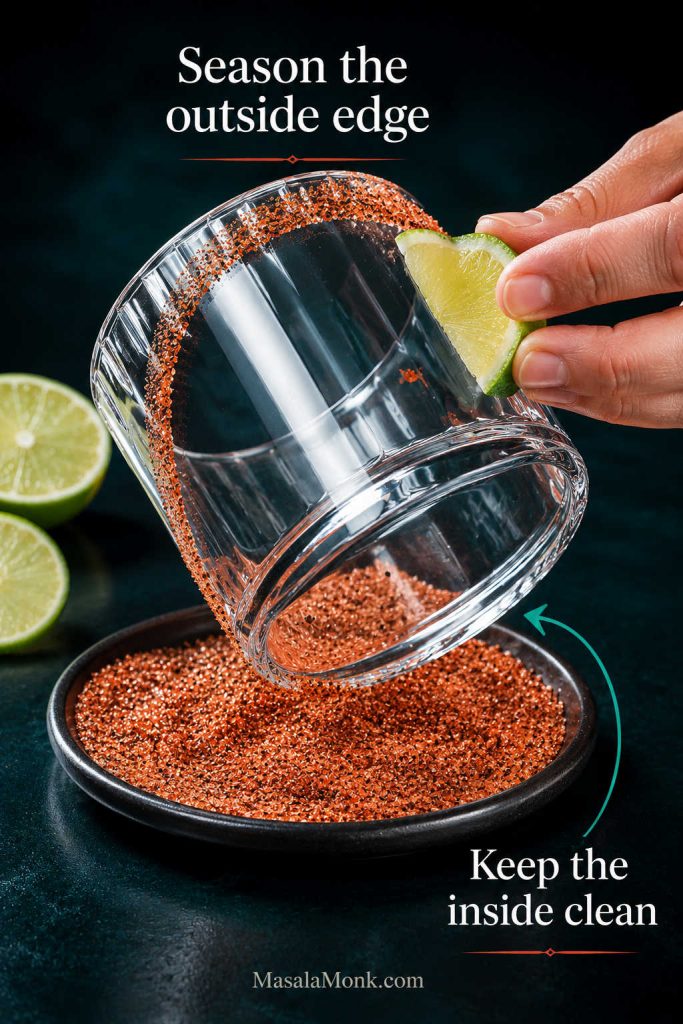
To rim the glass, rub a lime wedge around the outside edge, then dip it into a small plate of salt, Tajín, or chili-salt. Keep most of the seasoning on the outside of the glass; otherwise, the first few sips can taste harsh instead of bright.

Close-up of a cocktail glass being rimmed with lime and seasoning on the outside edge.
Seasoning the outside edge of the glass gives the drink contrast without overwhelming the first sip. It is a small technique, but it makes the rim taste cleaner and more intentional.
Party tip: Use a half-rim. It looks polished, keeps the drink from becoming too salty, and lets each person decide how much rim they want with each sip.

Watermelon Margarita Pitcher for a Crowd

This watermelon margarita recipe also scales easily into a pitcher for a cookout, taco night, pool day, or any moment when shaking one drink at a time gets in the way of hosting.

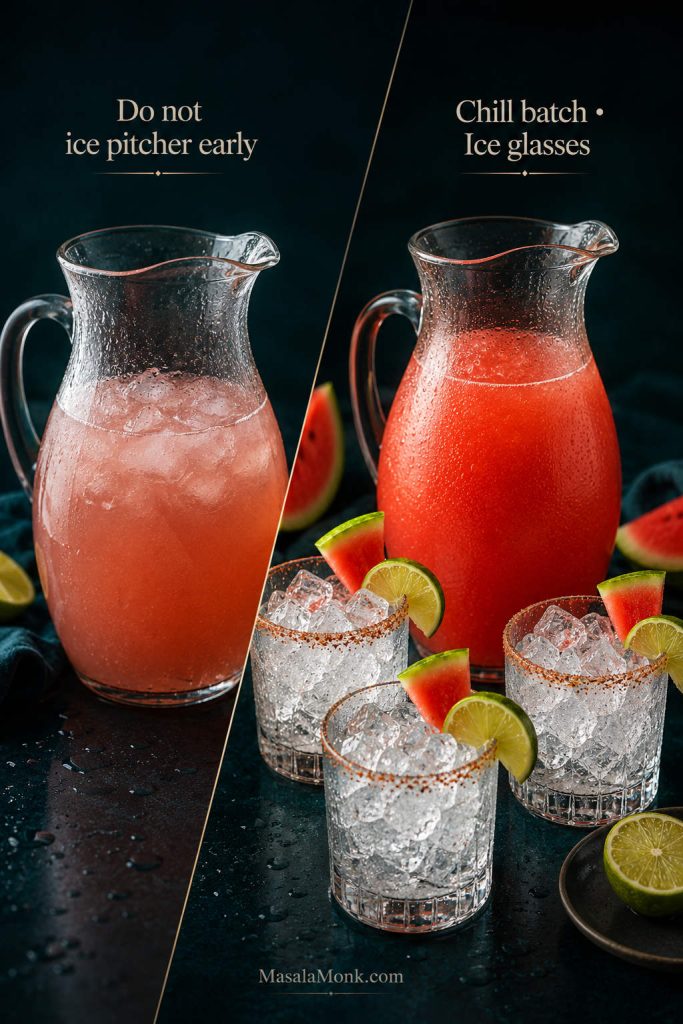
Keep the ice out of the pitcher until serving. That way, the first round tastes cold and bright, and the second round does not turn thin or watery.

For a small gathering, use the 4-drink batch. For cookouts, parties, or make-ahead hosting, the 8-drink batch is the better starting point.

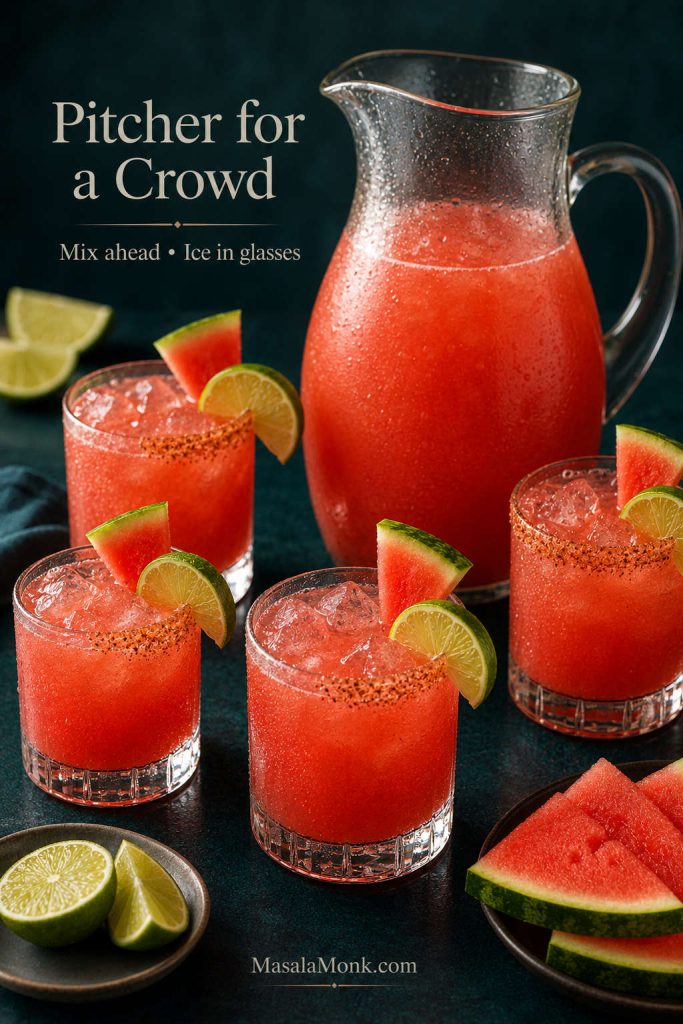
Pitcher of watermelon margaritas with rimmed glasses, lime wedges, watermelon garnish, and ice in the glasses.
A pitcher is easiest when the base is handled early and the finishing touches happen late. Rim the glasses, add ice, and garnish right before serving so each pour still feels fresh.

Use the pitcher version when guests are coming, the watermelon is already cut, and you want the drinks handled before the food hits the table.

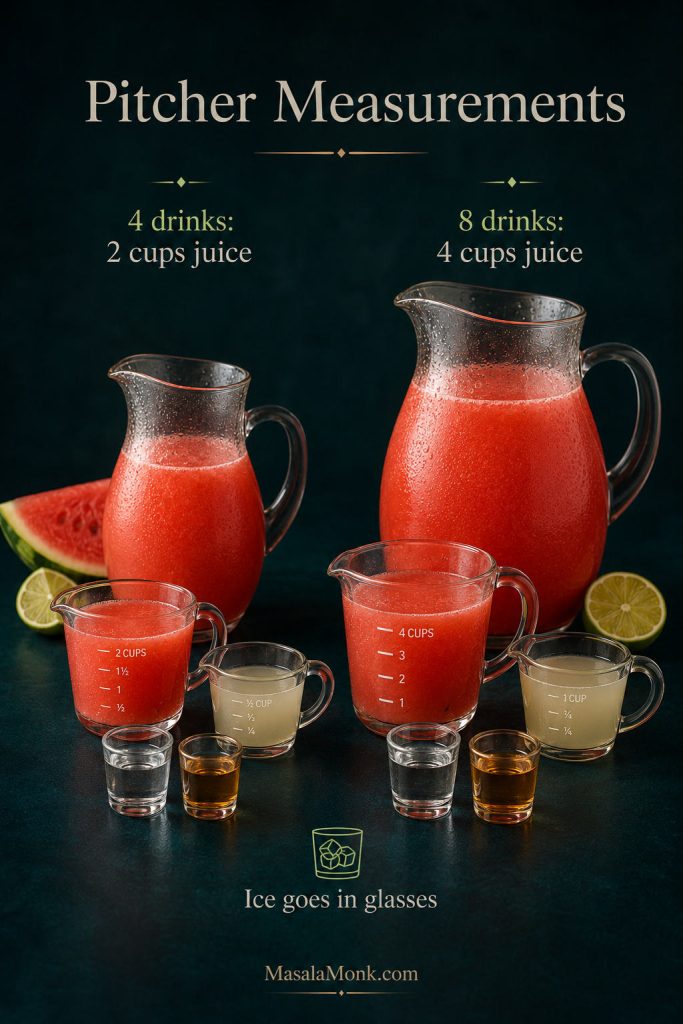
Pitcher Measurements

Watermelon margarita pitcher measurement graphic showing amounts for 4 drinks and 8 drinks, with a note that ice goes in the glasses.
Once the single-drink ratio tastes right, scaling becomes simple. Use the pitcher amounts as a guide, then keep the ice separate so the batch does not slowly dilute.
Ingredient 4 Drinks 8 Drinks
Fresh watermelon juice 2 cups / 480 ml 4 cups / 960 ml
Blanco tequila 6–8 oz / 180–240 ml 12–16 oz / 360–480 ml
Fresh lime juice 3 oz / 90 ml 6 oz / 180 ml
Orange liqueur 2 oz / 60 ml, optional 4 oz / 120 ml, optional
Agave or simple syrup 0–1 oz / 0–30 ml 0–2 oz / 0–60 ml

If you skip the orange liqueur in a pitcher, do not replace it with more tequila automatically. Instead, taste first, then add a little extra watermelon juice for softness or a small splash of agave if the batch tastes too sharp.

How to Mix the Pitcher

  1. Blend and strain enough watermelon juice for the batch.
  2. Stir the watermelon juice, tequila, lime juice, orange liqueur, and optional sweetener in a pitcher.
  3. Then chill the pitcher mixture until ready to serve.
  4. Before serving, stir again because watermelon juice naturally settles.
  5. Rim glasses with salt or Tajín, fill with fresh ice, and pour the margarita over the ice.

Mix the pitcher before guests arrive, but save the ice, rims, and garnishes for the last minute. That small delay keeps the batch fresher and makes each glass feel more intentional.

Make-Ahead and Ice Tips

Comparison of a diluted watermelon margarita pitcher with early ice and a chilled pitcher served with fresh-ice glasses.
Make-ahead watermelon margaritas work when chilling and dilution are treated separately. Chill the mixed batch first; afterward, pour over fresh ice so the pitcher keeps its color and flavor.
Make-ahead limit: You can mix the watermelon juice, tequila, lime, and optional orange liqueur up to 6 hours ahead. Keep it chilled, stir again before serving, and pour over fresh ice.
Pitcher rule: Keep ice out of the pitcher until the last moment. Ice belongs in the glasses, not sitting in the batch for an hour.

Frozen Watermelon Margarita

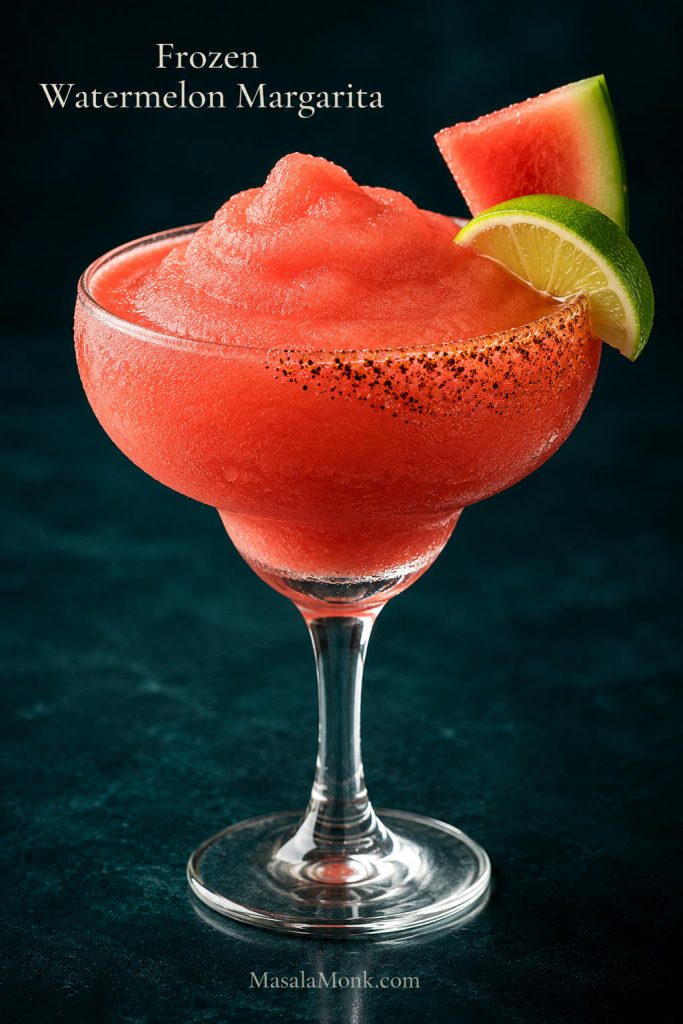
To turn this watermelon margarita recipe into a frozen version, frozen watermelon cubes are your friend. They make the drink thick, cold, and slushy without watering down the flavor the way too much plain ice can.

Frozen watermelon margarita in a chilled glass with thick slushy texture, lime wedge, and watermelon garnish.
The frozen version should be thick and cold but still drinkable. Frozen watermelon cubes create that slushy texture while keeping the fruit flavor stronger than plain ice would.

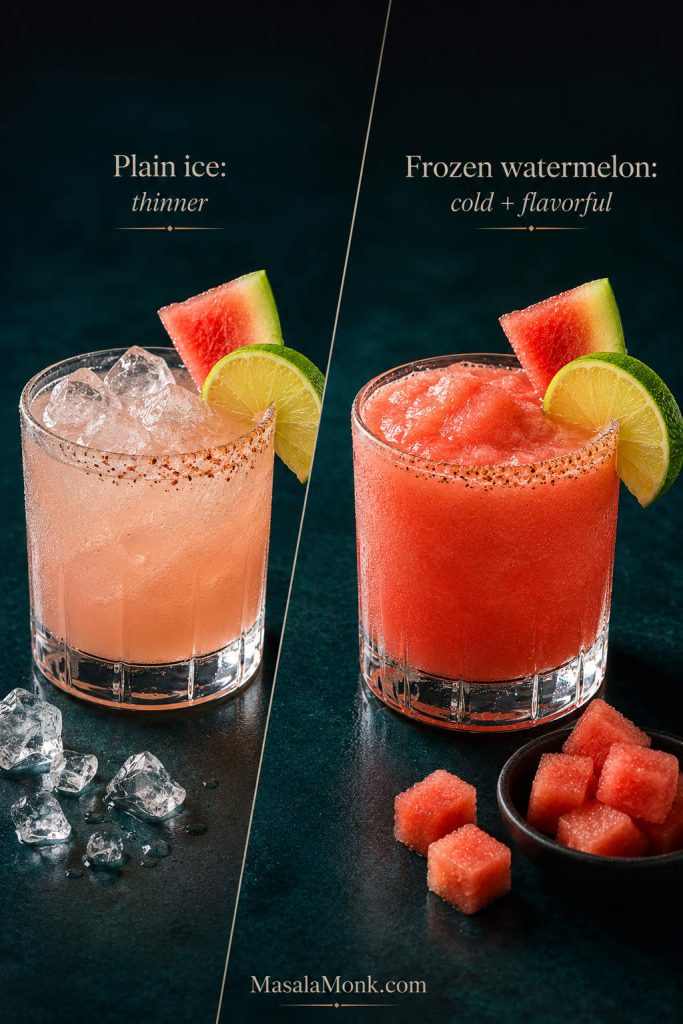
Plain ice makes the drink colder, but frozen watermelon makes it colder and more flavorful.

Frozen Watermelon vs Plain Ice

Comparison of a thinner frozen margarita made with plain ice and a thicker frozen watermelon margarita made with frozen fruit.
Plain ice can make a frozen margarita colder, but it also thins the fruit. Frozen watermelon does the better job because it chills the drink while adding more watermelon flavor.

The best frozen version tastes like a watermelon slushie that still knows it is a margarita: cold, thick, lime-bright, and not watered down.

To make one frozen version, freeze diced watermelon for at least 4–6 hours or overnight. Blend about 2 cups frozen watermelon cubes with 1½ to 2 oz blanco tequila, ¾ oz fresh lime juice, ½ oz orange liqueur if using, and a small splash of agave only if needed. Add a tablespoon or two of cold water only if your blender needs help moving.

  • Thin texture? Add more frozen watermelon, not more ice.
  • Overly thick? Add 1 tablespoon cold water or watermelon juice at a time.
  • Weak flavor? Use less added liquid next time and serve immediately after blending.
  • Icy texture? Use more frozen fruit and less plain ice.

For more frozen-fruit cocktail texture help, this frozen strawberry daiquiri recipe shows how frozen fruit builds body without watering down the drink. If you want the same watermelon-lime idea with rum instead of tequila, try this watermelon daiquiri.

Spicy Watermelon Margarita

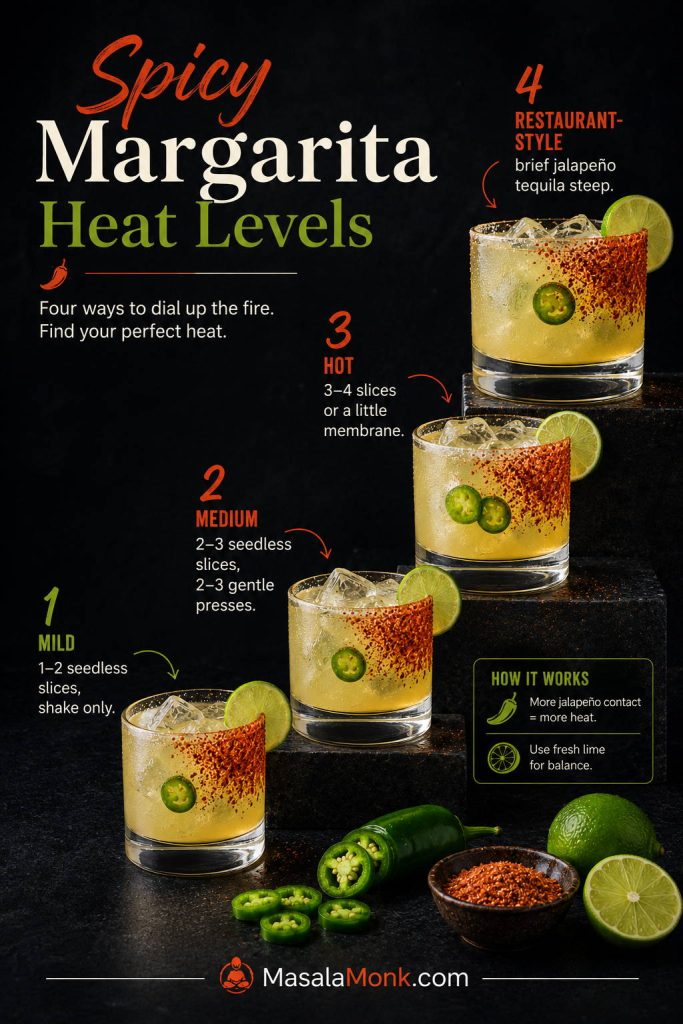
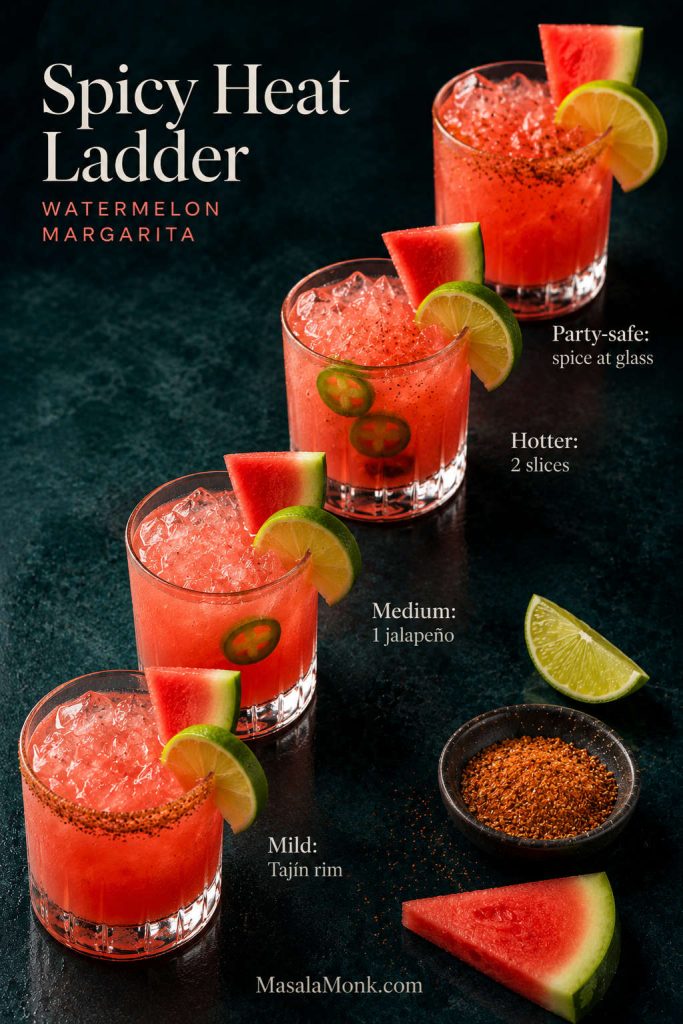
Watermelon loves heat. Jalapeño, chili, and Tajín or chili-lime seasoning cut through the fruit’s sweetness and make the drink taste brighter, not just hotter. Start small, though, because spice builds quickly in a cold cocktail.

Spicy watermelon margarita heat ladder with four drinks labeled Mild, Medium, Hotter, and Party-safe, using Tajín and jalapeño cues.
Heat is easier to control when you build it in layers. Start with a Tajín rim for gentle spice, then use jalapeño only when you want the drink to move from bright and tangy to noticeably spicy.
  • Mild: Use a Tajín or chili-lime rim only.
  • Medium: Shake with 1 thin jalapeño slice, then strain.
  • Hotter: Shake with 2 slices or use jalapeño syrup.
  • Party-safe: Keep the pitcher mild and let guests add jalapeño or Tajín at the glass.

Start mild, especially for a pitcher. Cold cocktails can hide heat at first, but jalapeño builds as the drink sits.

If you want more creative twists, these watermelon margarita variations include smoky, spicy, coconut, and sparkling directions.

Virgin Watermelon Margarita

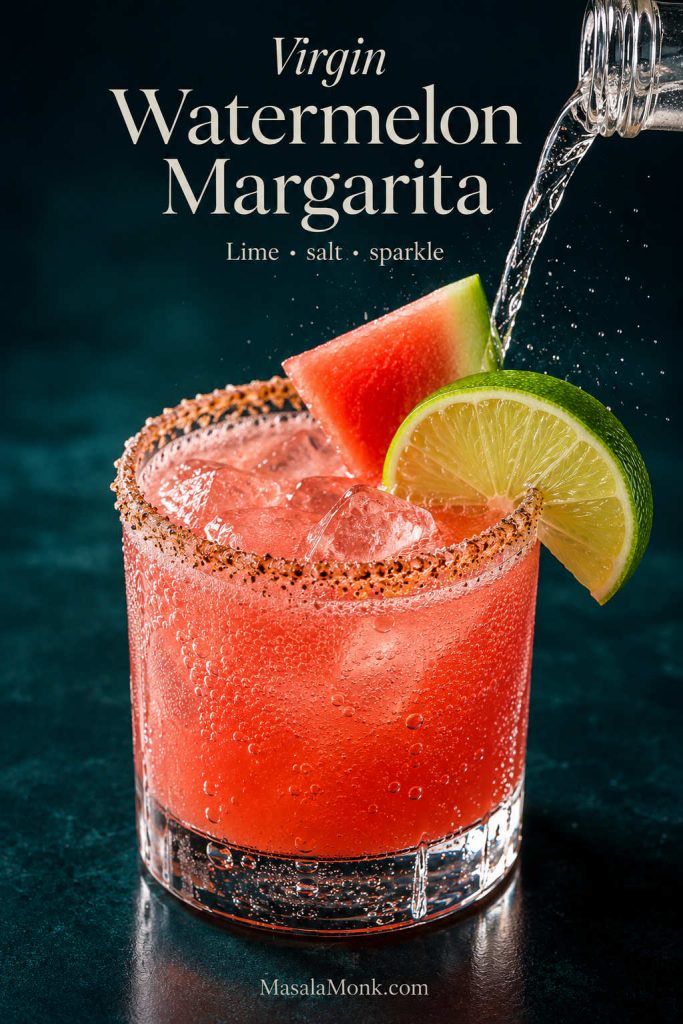
A virgin watermelon margarita should still feel like a real drink: bright lime, juicy watermelon, a salty rim, and a little sparkle. The goal is not just watermelon juice in a fancy glass; it should still have contrast.

Virgin watermelon margarita with sparkling bubbles, lime, watermelon garnish, and a seasoned rim.
The alcohol-free version still needs structure. Sparkle gives it lift, lime keeps it sharp, and a salted or Tajín rim helps it feel like a real drink rather than plain watermelon juice.

For one alcohol-free version, combine 4 oz fresh watermelon juice, ¾ oz fresh lime juice, ¼ oz agave if needed, and a pinch of salt. Shake with ice, strain over fresh ice, and top with a splash of sparkling water. Serve with a salt or Tajín rim.

For a deeper alcohol-free version, this margarita mocktail guide explains how to keep lime, sweetness, salt, and bitterness balanced without tequila. For more summer drinks without alcohol, these watermelon mocktails give you mint, coconut, lime, and party-friendly ideas.

How to Serve a Watermelon Margarita in a Watermelon

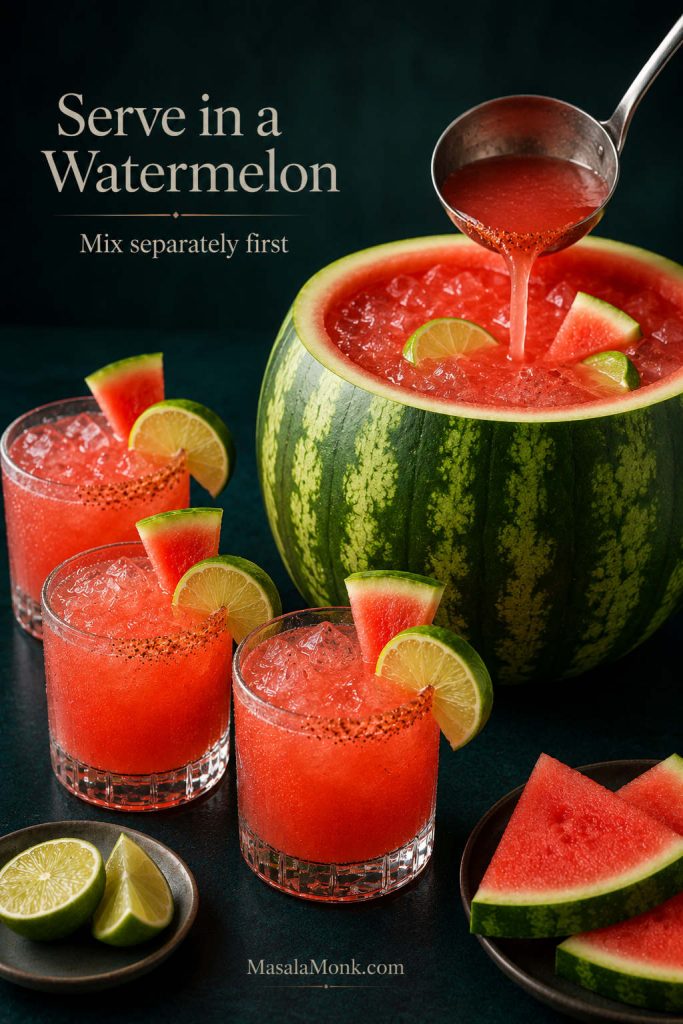
Serving the drink in a watermelon is more of a party presentation than a different recipe. The safest way to do it is to make the margarita separately, then pour it back into a hollowed watermelon shell right before serving.

Watermelon margarita served in a hollowed watermelon shell with glasses, lime wedges, and a serving ladle nearby.
A watermelon shell is best used as a serving bowl, not the place where you balance the drink. Mix and taste the margarita separately first, then pour it into the shell for a cleaner party presentation.

Treat the watermelon shell like a serving bowl, not a mixing tool. The drink will taste cleaner if you blend, strain, and balance it separately first.

  1. Choose a small stable watermelon or a large watermelon that can sit flat without rolling.
  2. Cut off the top and scoop out the flesh.
  3. Blend and strain the watermelon flesh to make juice.
  4. Mix the margarita in a pitcher using the ratio above.
  5. Pour the chilled drink back into the watermelon shell just before serving.
  6. Finally, add ice only at serving time so it does not become watery.

If the watermelon shell feels unstable, skip the risk and use a pitcher. A good cold pitcher tastes better than a dramatic container that is hard to pour from.

How to Fix a Watermelon Margarita

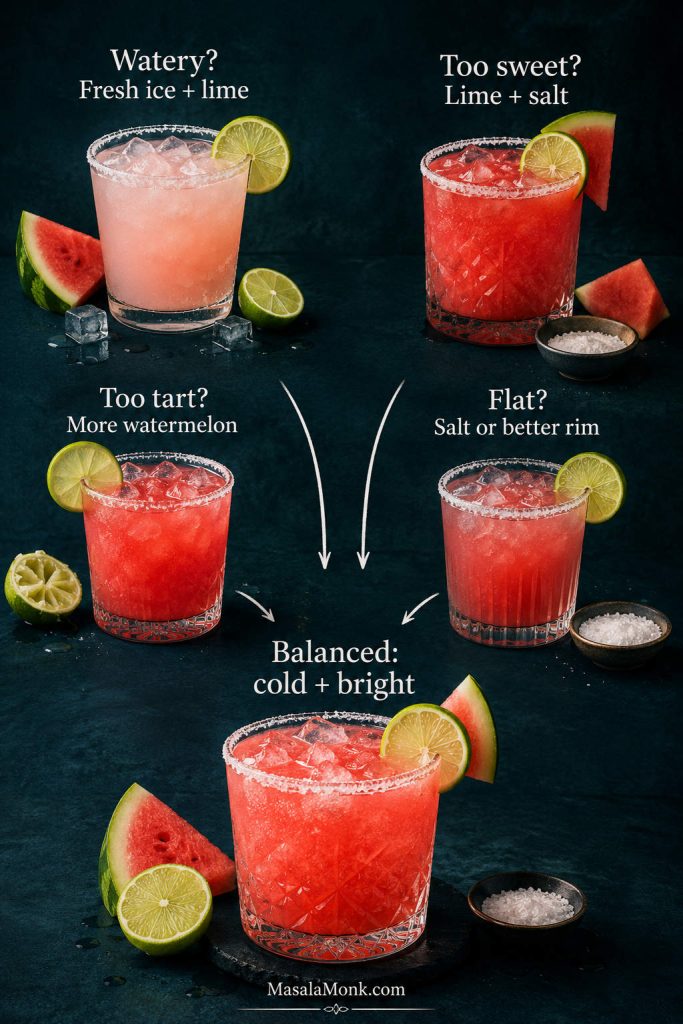
Watermelon margaritas are easy to fix once you know what went wrong. Most problems come from weak fruit, too much melted ice, not enough lime, or too much sweetener. Use the recipe as a starting point, then make one small adjustment at a time.

Troubleshooting guide showing watery, too sweet, too tart, and flat watermelon margaritas leading to a balanced final drink.
Most watermelon margarita problems can be fixed with one small move. Add lime or salt for dull sweetness, more watermelon for sharpness, and fresh ice when dilution is the real issue.
Problem Why It Happened How to Fix It
Watery The watermelon was weak, the drink sat on ice, or the pitcher was iced too early. Use fresh ice in glasses, keep ice out of the pitcher, and add a little more lime and tequila to sharpen the batch.
Overly sweet The watermelon was very sweet or too much syrup was added. Add fresh lime juice and use a salt or Tajín rim.
Very tart The lime was strong or the watermelon was not sweet enough. Add more watermelon juice first, then a small splash of agave if needed.
Alcohol-heavy The tequila ratio is high for your taste. Add more watermelon juice or a splash of cold sparkling water.
Weak flavor The drink has weak fruit, too much melted ice, or not enough contrast. Add a squeeze of lime, a pinch of salt, or a small splash of tequila depending on whether it tastes flat, dull, or diluted.
Pulpy The watermelon juice was not strained. Strain the juice through a fine-mesh strainer before shaking or batching.
Flat flavor The drink needs contrast. Add lime, a pinch of salt, or a better rim before adding more syrup.

Watermelon Margarita Recipe Card

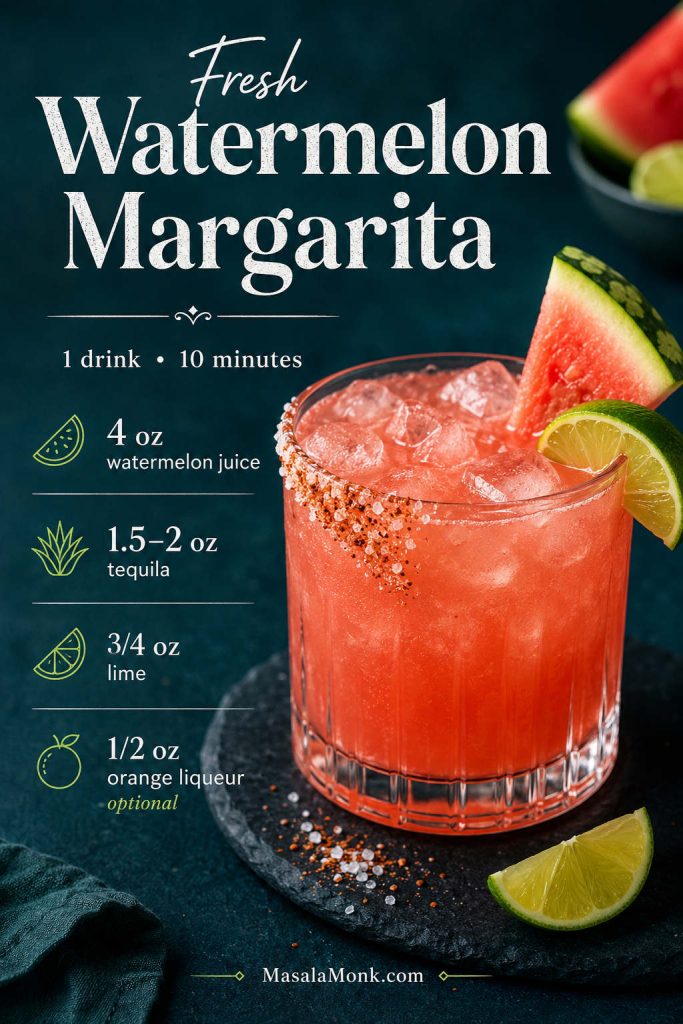
Recipe card for a fresh watermelon margarita showing one drink, 10 minutes, watermelon juice, tequila, lime, and optional orange liqueur.
This saveable recipe card keeps the core formula easy to repeat. Once the base ratio is familiar, you can adjust the style, make another glass, or scale the drink into a pitcher.

Fresh Watermelon Margarita Recipe on the Rocks

This watermelon margarita recipe is made with fresh watermelon juice, blanco tequila, lime, and a salt or Tajín rim. Serve it on the rocks when you want the cleanest fruit flavor, or scale the same ratio into a pitcher for a small crowd.

Yield1 drink
Prep Time10 minutes
Cook Time0 minutes
Total Time10 minutes

Equipment

  • Blender
  • Fine-mesh strainer, optional but recommended
  • Cocktail shaker or mason jar with lid
  • Jigger or measuring cup
  • Rocks glass or double old fashioned glass
  • Small plate for salt or Tajín rim

Ingredients

  • 1 to 1½ cups diced ripe watermelon, about 150–225 g, or enough to measure 4 oz / 120 ml juice after blending and straining
  • 1½–2 oz / 45–60 ml blanco tequila
  • ¾ oz / 22 ml fresh lime juice
  • ½ oz / 15 ml orange liqueur, optional
  • 0–¼ oz / 0–7 ml agave or simple syrup, only if needed
  • Ice
  • Salt, Tajín, or chili-lime seasoning, for the rim
  • Lime wedge and small watermelon wedge, for garnish

Instructions

  1. Blend the diced watermelon until smooth. Strain through a fine-mesh strainer if you want a smoother drink, then measure 4 oz / 120 ml watermelon juice.
  2. Rub a lime wedge around the rim of a rocks glass. Dip the rim into salt, Tajín, or chili-lime seasoning. Fill the glass with fresh ice.
  3. Add watermelon juice, tequila, lime juice, optional orange liqueur, and optional agave to a cocktail shaker with ice.
  4. Shake for 15–20 seconds, until cold.
  5. Strain over fresh ice in the prepared glass.
  6. Garnish with lime and watermelon. Taste and adjust with more lime, watermelon juice, or a tiny splash of agave if needed.

Notes

  • Use 1½ oz tequila for an easier, fruitier drink or 2 oz for a stronger classic margarita.
  • Skip the orange liqueur for a cleaner watermelon margarita without triple sec.
  • Add sweetener only if the watermelon is bland or underripe.
  • For a pitcher, mix the drink up to 6 hours ahead, keep it chilled, stir before serving, and add ice only to the glasses.
  • For a frozen version, use frozen watermelon cubes instead of lots of plain ice.

What to Serve with Watermelon Margaritas

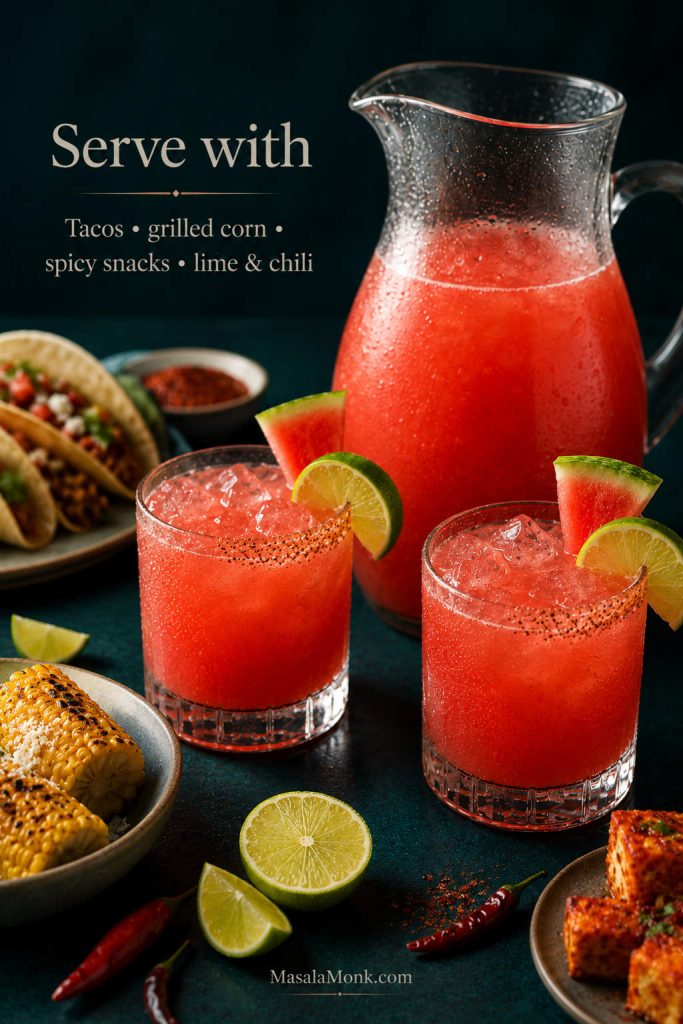
Serve these cold and close to the moment they are made. The drink is especially good with salty snacks, grilled food, tacos, spicy paneer, corn, shrimp, or anything with lime and chili. For a party, keep the pitcher cold, rim the glasses late, and let guests choose salt, Tajín, or a clean rim.

Watermelon margaritas served with tacos, grilled corn, chips, lime wedges, and spicy snacks.
Watermelon margaritas fit naturally with salty, spicy, and grilled foods because lime and salt connect the drink to the plate. Tacos, corn, chips, and chili-lime snacks all make sense here.

FAQs

What is the best tequila for a watermelon margarita?

Blanco or silver tequila is the easiest default because it tastes clean and crisp. It lets the watermelon, lime, and rim stay bright instead of covering the fruit with heavy oak or caramel notes. That is why this watermelon margarita recipe uses blanco tequila as the default.

Does a watermelon margarita need triple sec?

Triple sec is optional. Add ½ oz orange liqueur when you want a rounder, more classic margarita flavor; skip it when the watermelon is ripe and you want a cleaner, fresher tequila-watermelon drink.

Fresh watermelon or bottled watermelon juice: which is better?

Fresh watermelon gives the brightest flavor and color. Bottled watermelon juice is fine for a shortcut, especially when watermelon is out of season, but choose an unsweetened or lightly sweetened one and taste it before adding syrup. Still, the freshest version of this watermelon margarita recipe comes from blending ripe watermelon and measuring the juice after straining.

Should watermelon juice be strained for margaritas?

Straining gives the smoothest drink and is especially useful for pitchers because watermelon pulp settles as the batch sits. Leaving it unstrained is fine for one casual drink when you like a fresh-fruit texture, but strained juice gives the cleanest on-the-rocks margarita.

How do you make a watermelon margarita less watery?

Use ripe watermelon, measure the juice after blending, shake the drink with ice, then strain it over fresh ice. For pitchers, keep ice out of the batch until serving. Melted ice is the fastest way to turn a fresh watermelon margarita watery.

How far ahead can you make watermelon margaritas?

Mix the watermelon juice, tequila, lime, and optional orange liqueur up to 6 hours ahead. Keep the batch chilled, stir again before serving because watermelon juice settles, and pour over fresh ice.

What rim tastes best with watermelon margaritas?

Salt is the classic choice, Tajín or chili-lime seasoning is the most watermelon-friendly choice, and chili-salt is best if you want a savory spicy edge. A half-rim is ideal for guests because it gives control over each sip.

How do you make a spicy watermelon margarita?

Keep the drink itself clean for mild heat by using a Tajín or chili-lime rim. Medium heat comes from shaking the drink with one thin jalapeño slice. In a pitcher, jalapeño syrup is more predictable than loose pepper slices because the heat spreads evenly.

How do you make a frozen watermelon margarita?

Freeze diced watermelon for 4–6 hours or overnight, then blend the frozen cubes with tequila, lime, optional orange liqueur, and a small amount of sweetener if needed. Use frozen watermelon for body instead of adding lots of ice.

What goes well with watermelon margaritas?

Watermelon margaritas work well with salty, spicy, and grilled food: chips and salsa, tacos, grilled corn, shrimp, paneer tikka, spicy potatoes, or anything with lime and chili. If the mint garnish is your favorite part, this mojito recipe makes mint the main character instead of just a finishing note.

Posted on Leave a comment

Mezcal Mule Recipe

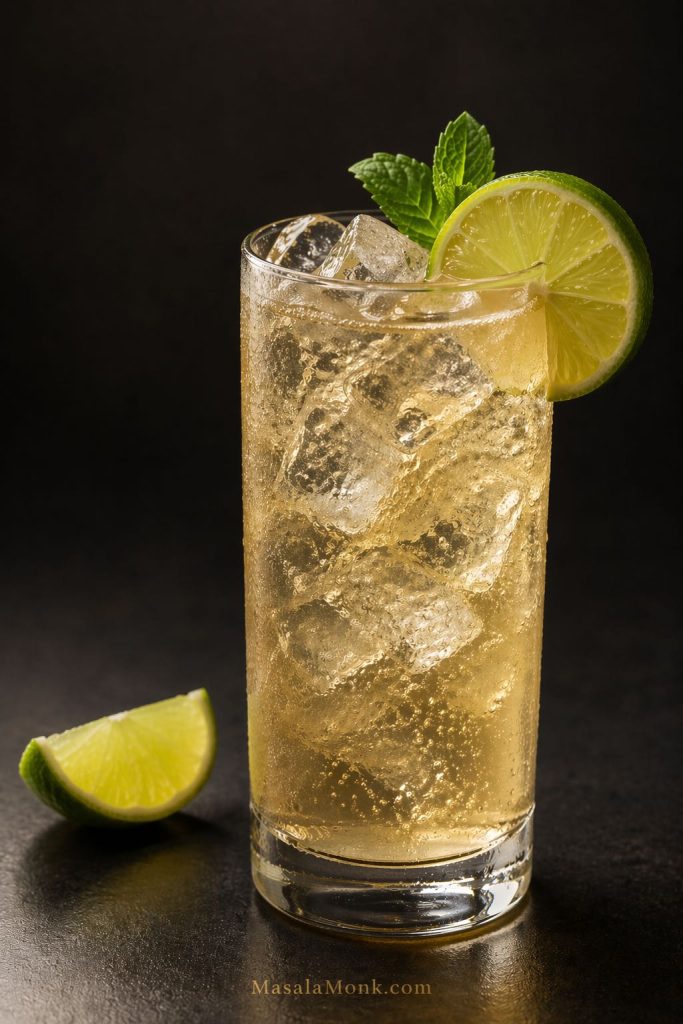
Mezcal mule recipe in a copper mug with ice and lime garnish on a dark background.

A mezcal mule recipe gives you the cold ginger-and-lime snap of a classic Moscow Mule, but with a smokier, more characterful base than vodka can bring. It is one of the easiest ways to make mezcal feel bright, refreshing, and immediately worth pouring again.

Online, “mezcal mule” can point to two different drinks: a simple mezcal, lime, and ginger beer highball, or a more cocktail-bar riff built with extras like cucumber, passion fruit, agave, or chile. This post starts with the cleaner home version, then shows the dressed-up riff later so the main drink stays clear from the start.

Quick Answer: What Is a Mezcal Mule?

A mezcal mule is a mule made with mezcal instead of vodka. It drinks smoky up front, lime-bright through the middle, and finishes with a cold ginger bite.

The best first glass for most readers is 2 ounces mezcal (60 ml), 3/4 ounce fresh lime juice (22 ml), and 4 ounces chilled ginger beer (120 ml) over plenty of ice. That build keeps the drink crisp, smoky, and clearly mule-like without losing the mezcal itself.

If you already enjoy a Moscow mule, an Irish Mule, or a Kentucky Mule, this is an easy next step because the format stays familiar even though the flavor turns darker and smokier.

How to Make a Mezcal Mule

This is the page’s standard build: bright enough to stay crisp, smoky enough to taste like mezcal, and structured enough to still feel like a proper mule.

Yield: 1 drink
Prep time: 5 minutes
Total time: 5 minutes
Glassware: lined copper mug or tall glass
Flavor profile: smoky, lime-bright, crisp, gingery

Best ingredients for the first glass: start with a balanced espadín mezcal, a crisp ginger beer with some bite, and the full 3/4 ounce of lime if your ginger beer runs sweet.

Ingredients

  • 2 ounces mezcal (60 ml)
  • 3/4 ounce fresh lime juice (22 ml)
  • 4 ounces chilled ginger beer (120 ml)
  • Ice
  • 1 lime wedge or lime wheel, for garnish
  • Optional mint sprig, for garnish

Note: Choose a ginger beer with some spice and bite rather than a very sweet one. Sweeter bottles usually need the full lime measure to stay sharp.

Method

  1. Fill a lined copper mug or tall glass with plenty of ice.
  2. Add the mezcal and fresh lime juice.
  3. Top with the chilled ginger beer.
  4. Stir gently just enough to combine.
  5. Garnish with a lime wedge or wheel. Add mint if you want a fresher aromatic finish.
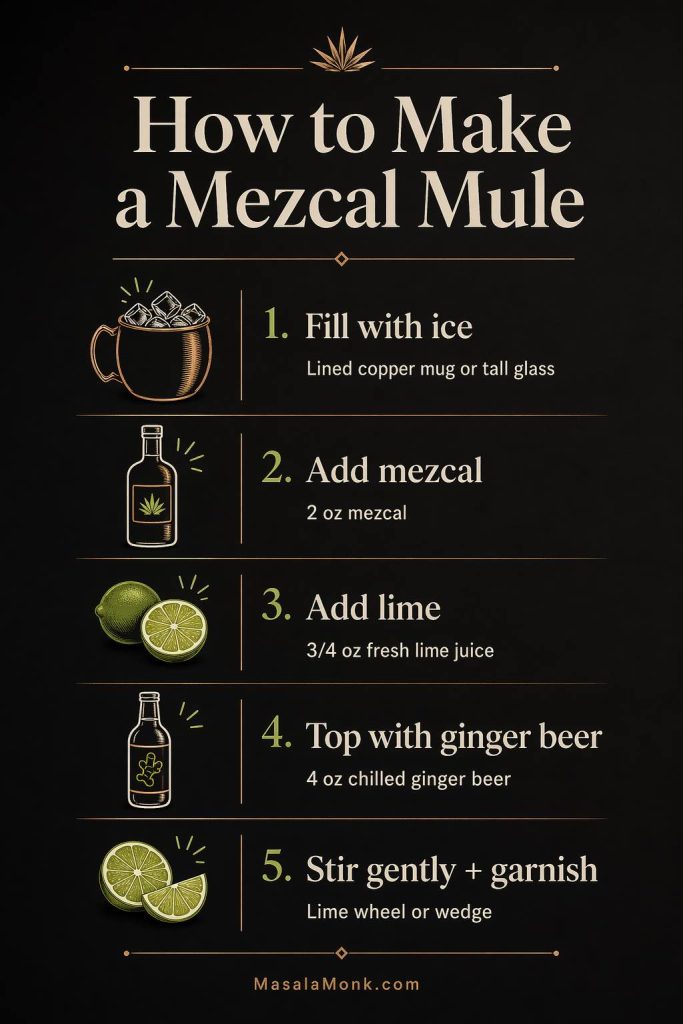
How to make a mezcal mule in five steps with ice, mezcal, fresh lime juice, chilled ginger beer, and lime garnish.
Build a mezcal mule directly over ice: add mezcal and fresh lime, top with chilled ginger beer, stir gently, and finish with lime so the drink stays cold, crisp, and fizzy.

Notes

  • This is the page’s standard mezcal mule build.
  • If your mezcal is especially assertive, or you want a softer first glass, reduce the lime to 1/2 ounce (15 ml) and use 4 to 5 ounces ginger beer (120 to 150 ml).
  • If your ginger beer runs sweet, keep the full 3/4 ounce lime (22 ml) for balance.

Make-Ahead

Mix the mezcal and lime ahead if needed, then add the ginger beer only right before serving so the drink stays fizzy and lively.

Finished mezcal mule recipe in a clear tall glass with ice, lime garnish, mint, and a crisp dark editorial presentation.
A properly made mezcal mule should look cold, crisp, and bright, with plenty of ice, a clear lime garnish, and enough lift to feel refreshing rather than heavy.

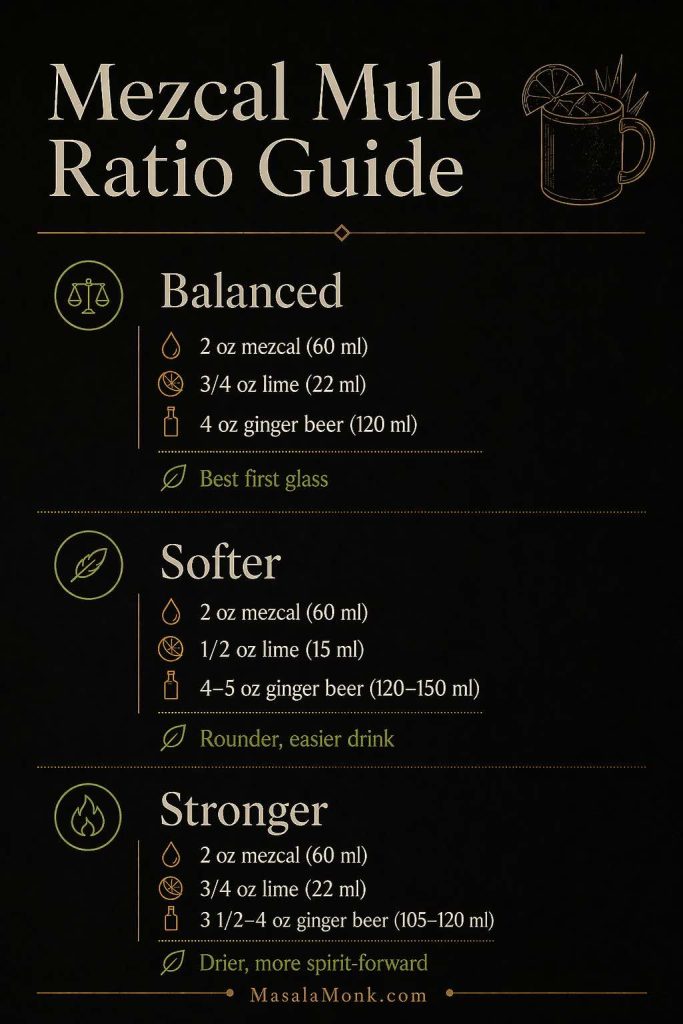
Mezcal Mule Ratio Guide

A mezcal mule recipe looks simple on paper, but small ratio changes move the drink fast. More ginger beer softens it, more lime sharpens it, and a smokier mezcal can make the same build feel much bolder.

If you already know you prefer the softer, sweeter lift of ginger ale rather than the spicier structure that ginger beer gives a mule, you may actually prefer a Whiskey Ginger-style drink instead.

StyleMezcalLimeGinger BeerBest for
Balanced2 ounces (60 ml)3/4 ounce (22 ml)4 ounces (120 ml)Best first glass
Softer2 ounces (60 ml)1/2 ounce (15 ml)4 to 5 ounces (120 to 150 ml)Easier, rounder drink
Stronger2 ounces (60 ml)3/4 ounce (22 ml)3 1/2 to 4 ounces (105 to 120 ml)Drier, more spirit-forward
Mezcal mule ratio guide showing balanced, softer, and stronger drink ratios with mezcal, lime juice, and ginger beer measurements.
Use this mezcal mule ratio guide to choose your best starting point: balanced for the classic first glass, softer for a rounder easier drink, or stronger for a drier more spirit-forward build.

Best Balanced Mezcal Mule Ratio

Start here: 2 ounces mezcal (60 ml) + 3/4 ounce lime juice (22 ml) + 4 ounces ginger beer (120 ml)

This is the most dependable version because the fuller lime measure keeps the finish brighter, especially when the ginger beer runs sweet.

Softer Mezcal Mule Ratio

Use this for an easier first glass: 2 ounces mezcal (60 ml) + 1/2 ounce lime juice (15 ml) + 4 to 5 ounces ginger beer (120 to 150 ml)

This version is rounder and easier, so it works well if you are new to mezcal or using a bottle with more obvious smoke.

Stronger Mezcal Mule Ratio

Use this for a drier, more spirit-forward drink: 2 ounces mezcal (60 ml) + 3/4 ounce lime juice (22 ml) + 3 1/2 to 4 ounces ginger beer (105 to 120 ml)

With slightly less ginger beer, the mezcal shows up more clearly and the finish lands sharper.

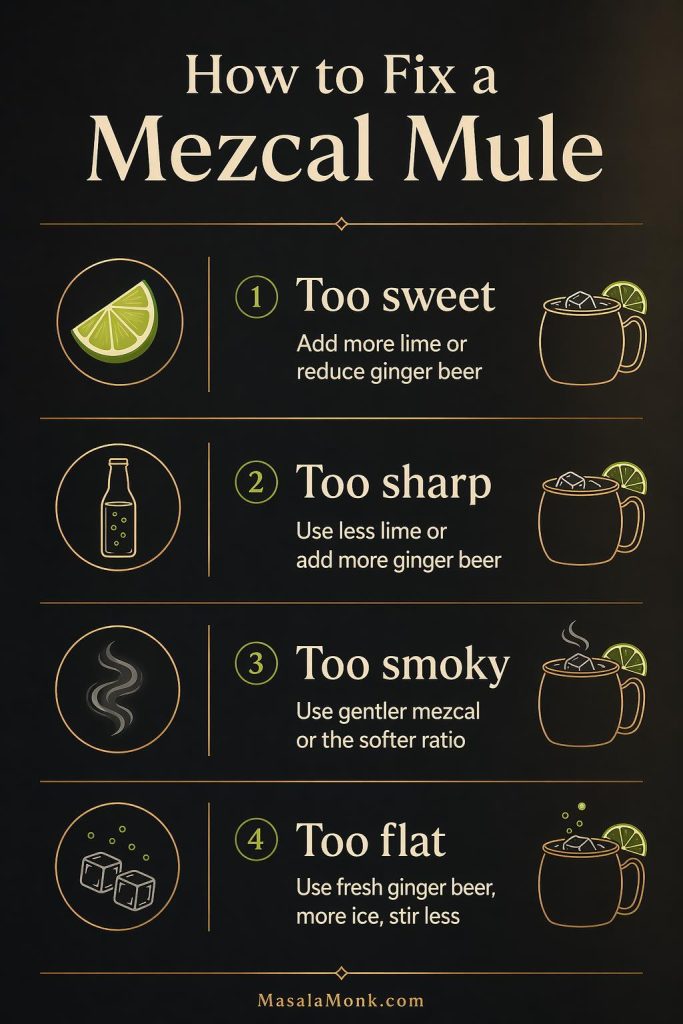
How to Fix a Mezcal Mule That Tastes Too Sweet, Too Sharp, Too Smoky, or Too Soft

Too much sweetness usually means the drink needs more lime or a slightly smaller pour of ginger beer. Too much sharpness points to extra lime or not enough mixer. Heavy smoke is easiest to fix with a gentler mezcal or the softer ratio. Once the drink feels soft and muted, cut the ginger beer back so the mezcal and lime show up again.

Why This Mezcal Mule Recipe Works

This drink works because nothing in it is wasted: mezcal brings the smoke, lime keeps the finish sharp, and ginger beer supplies the snap that makes the whole thing feel like a mule instead of a generic highball.

Mezcal Brings Smoke Without Making the Drink Heavy

Mezcal changes the whole tone of the drink on its own. You do not need syrups, liqueurs, or multiple juices to make it interesting. The smoke is already built in.

Lime Keeps the Finish Bright and Crisp

Fresh lime stops the drink from tasting muddy or overly sweet. At the same time, it lifts the ginger and makes the mezcal feel fresher rather than heavier.

Ginger Beer Gives the Mezcal Mule Its Structure

Without the ginger component, this stops feeling like a mule very quickly. Ginger beer gives the drink spice, fizz, and the cold snap that holds the whole build together.

The Short Build Makes It Easy to Adjust

Because the ingredient list is short, every tweak is noticeable. Once the first glass is in front of you, it becomes much easier to steer the next one where you want it to go.

Best Mezcal for a Mule

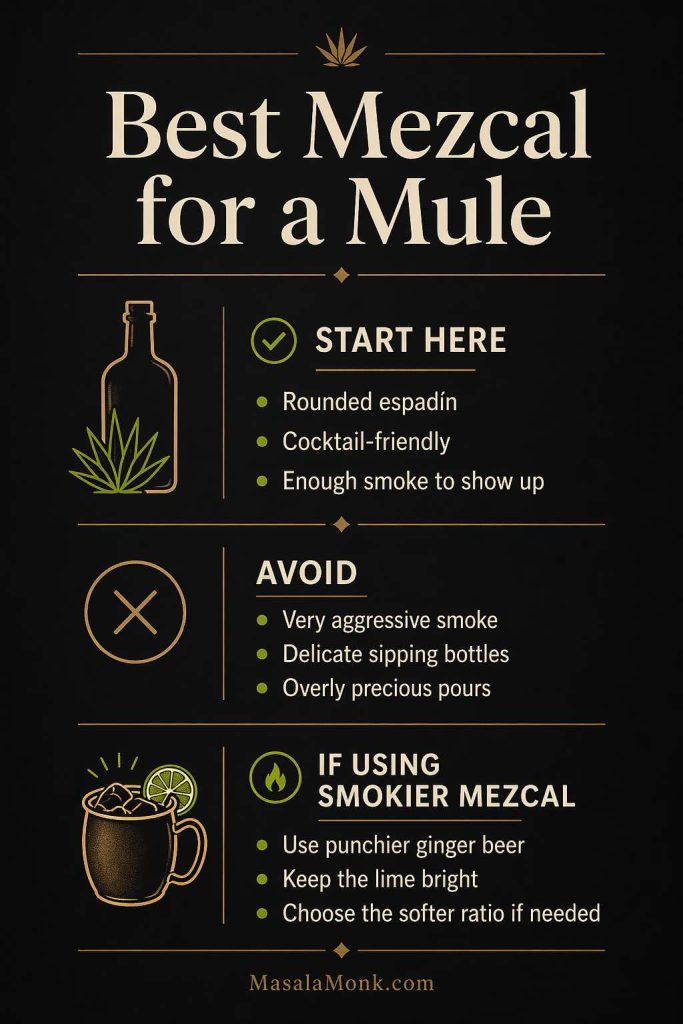
There is no need to use your most complex sipping mezcal here. In a mezcal mule, the better choice is a cocktail-friendly bottle with enough smoke to show up through lime and ginger beer without turning the drink blunt.

Best mezcal for a mule guide showing rounded espadín as the best starting choice, what to avoid, and how to adjust if using smokier mezcal.
A rounded espadín-style mezcal is the easiest place to start for a mezcal mule. Use a cocktail-friendly bottle with enough smoke to show through, but avoid overly aggressive or delicate sipping mezcals.

Best Mezcal for a Mule: Start With Espadín

A rounded espadín-style mezcal is the easiest place to start. It usually brings enough smoke to make the drink feel clearly like a mezcal mule without overwhelming the rest of the glass.

If you want more background before choosing a bottle, a simple guide to mezcal and agave types helps explain why espadín is such a common starting point.

What to Avoid in a Mezcal Mule

Very aggressive smoke can flatten the contrast that makes this drink refreshing. Very delicate sipping bottles can feel wasted in a long fizzy cocktail. For this drink, a balanced mixer-friendly mezcal makes more sense than an especially precious one.

When a Smokier Mezcal Works Better

A smokier mezcal works best when you also use a punchier ginger beer and a slightly brighter lime balance. Otherwise, the drink can start to feel dense rather than lively.

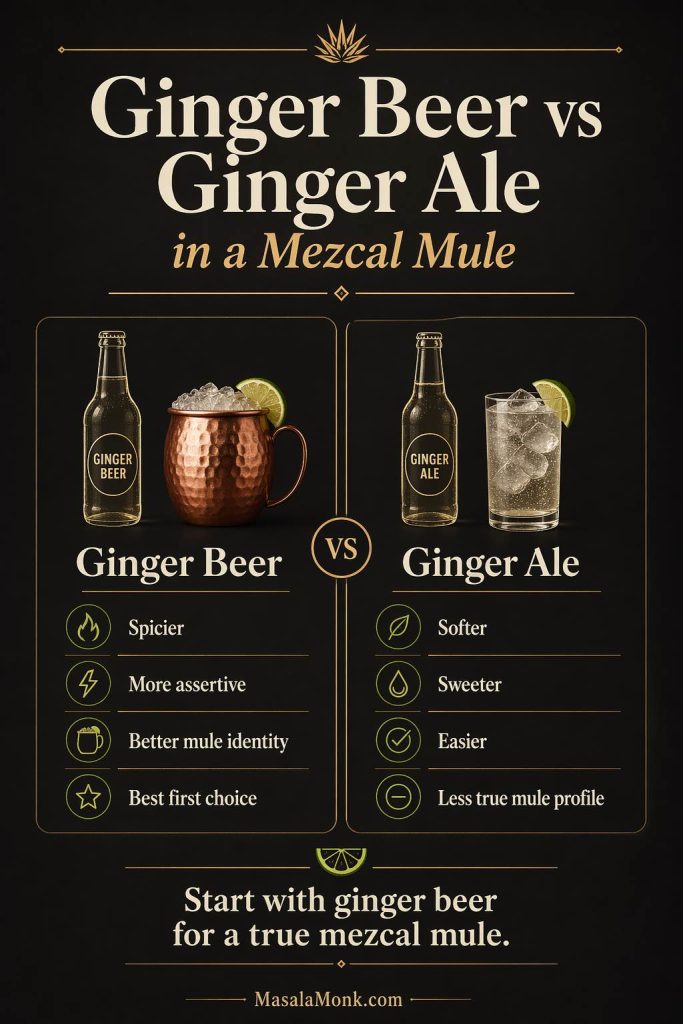
Ginger Beer vs Ginger Ale in a Mezcal Mule

This choice changes the drink more than the garnish and more than the mug.

Ginger beer vs ginger ale comparison for a mezcal mule, showing ginger beer as spicier and more mule-like while ginger ale is softer and sweeter.
Ginger beer gives a mezcal mule its sharper, spicier mule identity, while ginger ale makes the drink softer and sweeter. Start with ginger beer if you want the cleanest mezcal mule profile.

Why Ginger Beer Is Better in a Mezcal Mule

If you want the clearest mule identity, start with ginger beer. It is spicier, more assertive, and more structurally right for the drink, so the mezcal has something vivid to play against.

What Kind of Ginger Beer Works Best?

A drier, crisper ginger beer usually works better than a very sweet one. You want enough bite to stand up to the mezcal, not a soda-like finish that turns the drink soft.

When Ginger Ale Works in a Mezcal Mule

Ginger ale can work when you want a gentler, sweeter, easier drink. The result usually feels less sharp and less recognizably mule-like, so it is better treated as a softer variation than the default build.

Should You Start With Ginger Beer or Ginger Ale?

For a true mezcal mule profile, start with ginger beer. Ginger ale makes a softer, sweeter drink and moves the glass closer to a mezcal ginger highball than a classic mule.

Tips for Making a Better Mezcal Mule

The basic method is easy, but a few small technique moves improve the drink noticeably.

Use Plenty of Ice

A mezcal mule should hit cold and sharp from the first sip, not halfway through the glass. Fill the mug or glass generously so the drink stays brisk instead of turning watery too quickly.

Add Ginger Beer Last

Add the ginger beer after the mezcal and lime so you keep more fizz in the finished drink.

Stir Gently, Not Aggressively

A quick gentle stir is enough. Over-stirring knocks out carbonation and makes the drink feel flatter than it should.

Use Lime as a Flavor Cue, Not Just a Garnish

A lime wedge or wheel is not just decorative. It reinforces the brightness the drink needs on the nose and on the palate.

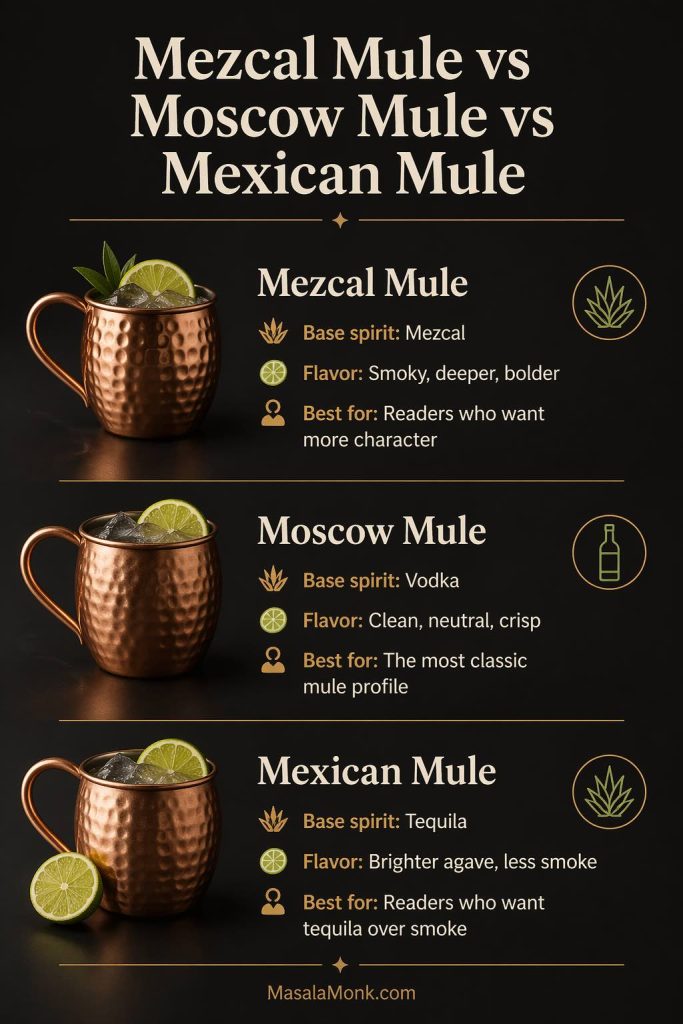
Mezcal Mule vs Moscow Mule vs Mexican Mule

These drinks live in the same family, but they do not point in the same flavor direction.

Mezcal Mule vs Moscow Mule vs Mexican Mule comparison showing base spirits, flavor differences, and which mule drink to choose.
A mezcal mule is the smoky agave option, a Moscow mule is the clean vodka classic, and a Mexican mule usually means tequila. Use this comparison to choose the mule that matches the flavor you want.
DrinkBase spiritFlavor directionBest for
Mezcal MuleMezcalSmoky, deeper, bolderReaders who want more character
Moscow MuleVodkaClean, neutral, crispThe most classic mule profile
Mexican MuleTequilaBrighter agave, less smokeReaders who want tequila over smoke

Mezcal Mule vs Moscow Mule

A Moscow mule uses vodka, so it feels cleaner, more neutral, and more about the ginger-lime frame. A mezcal mule uses mezcal, so it lands smokier, deeper, and more distinctive.

Mezcal Mule vs Mexican Mule

In most recipe contexts, a Mexican Mule means the tequila version, not the mezcal one. A Moscow mule uses vodka, a Mexican mule uses tequila, and a mezcal mule uses mezcal. That naming is worth keeping clear because the flavor direction changes with the spirit.

Which Mule Should You Make?

For the cleanest, most neutral version, go with a Moscow mule. A Mexican mule brings a brighter agave note because tequila leads the drink. For more smoke and depth, the mezcal mule is the strongest of the three.

If bourbon sounds better than smoky agave, the warmer, rounder direction is closer to a Kentucky Mule. If grapefruit sounds better than ginger, the next agave drink to try is a Paloma.

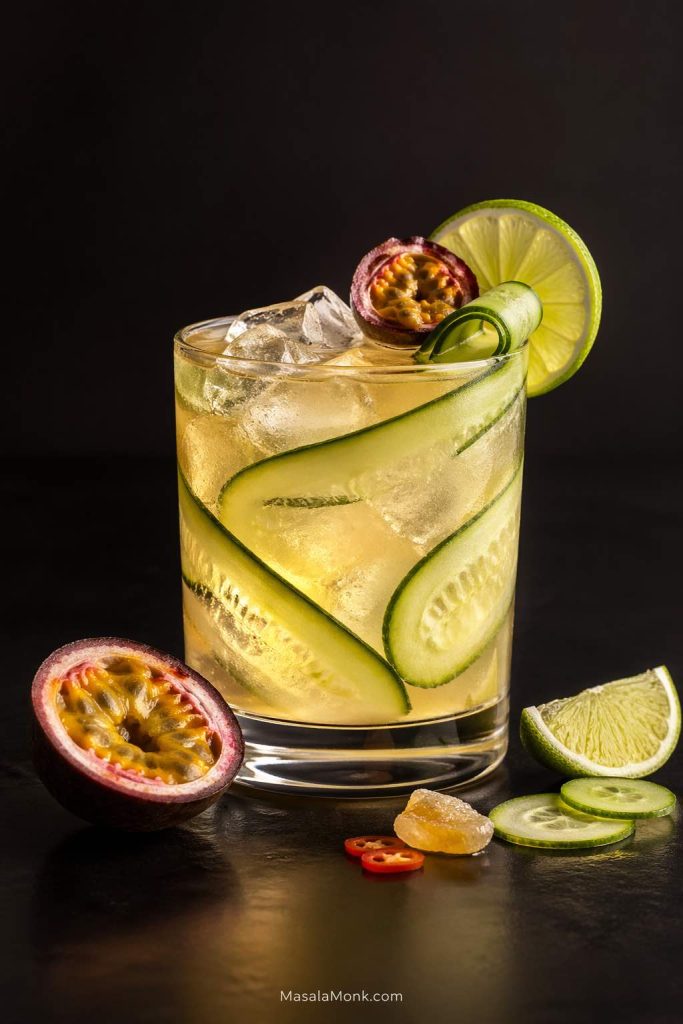
Cocktail-Bar Mezcal Mule Riff

This is a riff, not the best first mezcal mule recipe for most readers. Use it when you want the cucumber-and-passion-fruit branch of the drink, not the cleanest smoky mule.

Cocktail-bar mezcal mule riff with cucumber, passion fruit, lime, ice, and a pale golden drink in a clear glass.
This cocktail-bar mezcal mule riff keeps the ginger, lime, and mezcal core but adds cucumber and passion fruit for a more polished, layered version of the drink.

What Makes This Riff Different?

Rather than keeping the build minimal, this version adds texture and layered flavor. It tastes more polished, more detailed, and a little less casual than the base drink above.

Typical Add-Ins: Cucumber, Agave, Passion Fruit, and Chile

This branch can bring in muddled cucumber, a small amount of agave, passion fruit, candied ginger, or a chile accent. The goal is not to bury the mule format, but to dress it up without losing the smoke, lime, and ginger core.

Easy Cocktail-Bar Mezcal Mule Build

Try 2 ounces mezcal (60 ml), 1/2 ounce lime juice (15 ml), 1/4 ounce agave (7 ml), 1/2 ounce passion fruit (15 ml), 3 ounces ginger beer (90 ml), and 2 to 3 cucumber slices. It should still taste like a mule, just with a more dressed-up cocktail-bar edge.

Shake the mezcal, lime, agave, passion fruit, and cucumber briefly with ice, strain over fresh ice, then top with the ginger beer and stir gently.

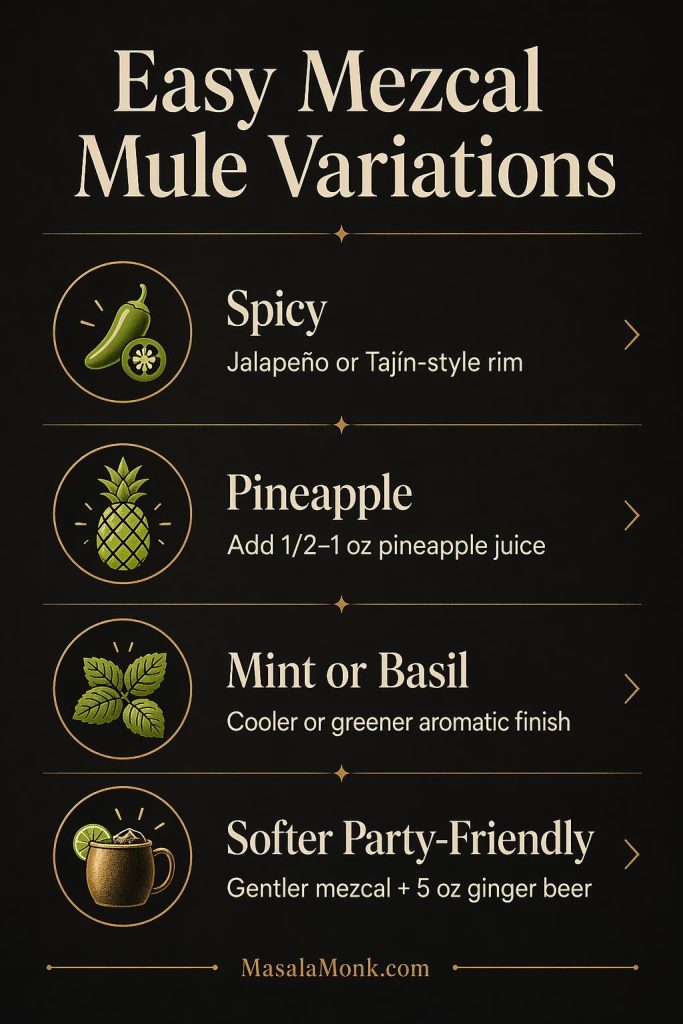
Easy Mezcal Mule Variations

Once you know the base build, it is easy to move the drink in a few different directions without losing the mule identity.

Easy mezcal mule variations guide showing spicy, pineapple, mint or basil, and softer party-friendly versions with simple flavor adjustments.
Once the base mezcal mule is balanced, small additions can move it in different directions. Use jalapeño or Tajín for heat, pineapple for a rounder tropical note, mint or basil for freshness, or a gentler mezcal and extra ginger beer for an easier party-friendly version.

Spicy Mezcal Mule

Add 1 thin jalapeño slice to the mug or use a Tajín-style rim if you want more heat and a sharper edge. Keep it restrained so the spice supports the ginger instead of taking over.

Pineapple Mezcal Mule

Add 1/2 to 1 ounce pineapple juice (15 to 30 ml) when you want the drink to feel rounder and a little more tropical, then reduce the ginger beer slightly so the finish does not lose its edge.

Mint or Basil Mezcal Mule

Add a mint sprig for a cooler finish, or lightly clap 1 small basil sprig for a greener, slightly more savory aromatic edge.

Softer Party-Friendly Mezcal Mule

Use the softer mezcal mule ratio with a gentler mezcal and 5 ounces of ginger beer. It will not be the boldest build, but it is often the easiest version for a group to like immediately.

If you like the smoky-fruit direction more than the ginger direction, a citrus-forward agave drink like a Blood Orange Margarita is a better next build.

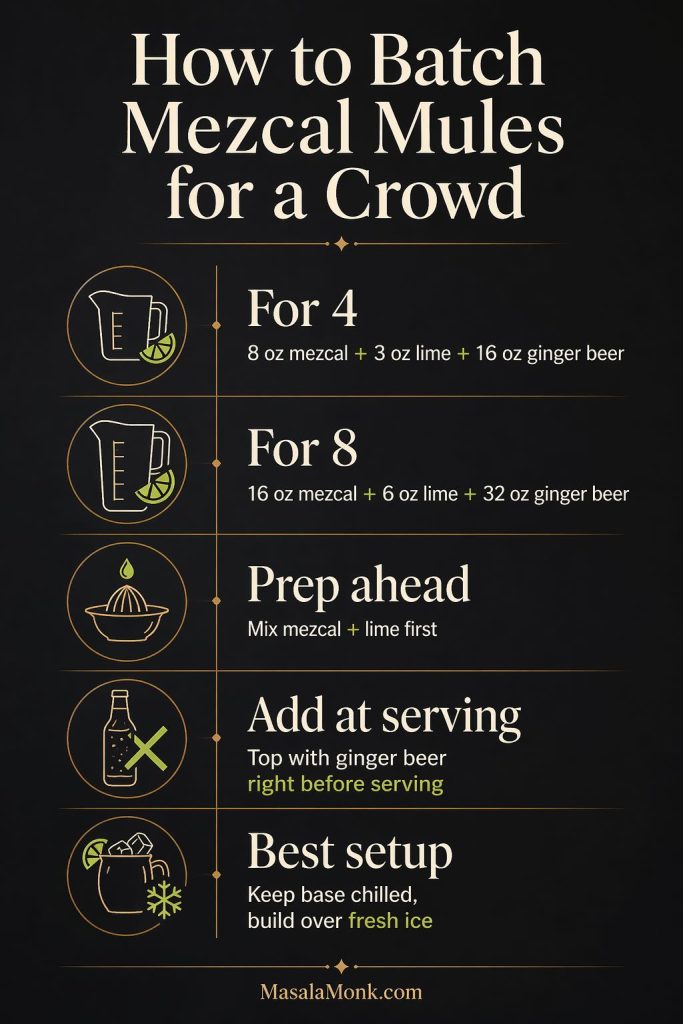
How to Make Mezcal Mules for a Crowd

Once the standard mezcal mule recipe is fixed, the crowd version becomes straightforward: scale the same ratio, chill the mezcal-and-lime base, and add the ginger beer only at serving time.

How to batch mezcal mules for a crowd, showing scaled amounts for 4 and 8 drinks plus prep-ahead and serving tips.
Batch the mezcal and lime ahead, but add the ginger beer only right before serving. That keeps mezcal mules cold, fizzy, and fresh for a crowd.

Mezcal Mule for 4

  • 8 ounces mezcal (240 ml)
  • 3 ounces fresh lime juice (90 ml)
  • 16 ounces chilled ginger beer (480 ml)
  • Ice
  • Lime wedges or wheels, for garnish

Mix the mezcal and lime juice, chill well, then divide over ice-filled mugs or glasses. Top the four drinks with the ginger beer right before serving.

Mezcal Mule for 8

  • 16 ounces mezcal (480 ml)
  • 6 ounces fresh lime juice (180 ml)
  • 32 ounces chilled ginger beer (960 ml)
  • Ice
  • Lime wedges or wheels, for garnish

Mix the mezcal and lime juice, chill well, then divide over ice-filled mugs or glasses. Top the eight drinks with the ginger beer right before serving.

Best Party Setup

Keep the mezcal-and-lime base chilled in a pitcher, keep the ginger beer cold separately, and build each drink over fresh ice. Do not mix the ginger beer into the full batch ahead of time or the drinks will lose their lift.

Troubleshooting

This is a simple cocktail, so balance problems are easy to notice and fix.

How to fix a mezcal mule that tastes too sweet, too sharp, too smoky, or too flat, with quick adjustment tips for lime, ginger beer, mezcal, ice, and stirring.
A mezcal mule is easy to adjust once you know what went wrong. Add lime or reduce ginger beer for sweetness, soften sharpness with more mixer, use gentler mezcal for heavy smoke, and keep the drink cold and fizzy to avoid a flat finish.

Why Does My Mezcal Mule Taste Too Sweet?

Your ginger beer is usually the main reason. Try a drier bottle, use a little more lime, or reduce the pour slightly.

Why Does It Taste Too Sharp?

Too much lime or too little ginger beer can make the drink feel pointed. Pull the lime back slightly or soften the build with a fuller ginger beer pour.

Why Does It Taste Too Smoky?

Your mezcal may be more assertive than the ratio wants. Switch to a gentler bottle, add a little more ginger beer, or move to the softer ratio.

Why Does It Taste Flat?

Flat ginger beer, too little ice, or too much stirring can all do that. Start colder, stir less, and use a freshly opened bottle or can of ginger beer.

Mezcal Mule Recipe FAQs

What Is in a Mezcal Mule?

A mezcal mule usually includes mezcal, fresh lime juice, ginger beer, and ice, with lime as the standard garnish.

Is a Mezcal Mule the Same as a Mexican Mule?

No. In most recipe contexts, a Mexican mule is tequila-based, while a mezcal mule uses mezcal and tastes smokier.

Can I Make This Mezcal Mule Recipe With Ginger Ale?

Yes, but it will taste softer and sweeter than the ginger beer version. It works best when you want an easier, less spicy drink rather than the clearest mule profile.

What Mezcal Is Best for a Mule?

A balanced espadín-style mezcal is the best place to start because it gives the drink smoke without overwhelming the ginger and lime.

Is a Mezcal Mule Smoky?

Yes, although how smoky it tastes depends on the bottle you use and how much ginger beer and lime are in the build.

Can I Serve a Mezcal Mule in a Copper Mug?

Yes. A lined copper mug is traditional, while a tall glass works just as well.

Can I Make a Mezcal Mule Ahead of Time?

You can mix the mezcal and lime ahead of time, but add the ginger beer only right before serving so the drink stays fizzy.

What Garnish Goes Best With a Mezcal Mule?

A lime wedge or wheel is the best first garnish because it reinforces the brightness the drink needs. Mint works well too if you want a fresher aromatic finish.

Final Take

This mezcal mule recipe earns its place because it gives you real mezcal character without asking for a complicated build. Start with 2 ounces mezcal (60 ml), 3/4 ounce fresh lime juice (22 ml), and 4 ounces chilled ginger beer (120 ml), keep the ginger beer cold, and adjust from there based on how smoky your mezcal is and how sharp you want the finish.

Once the balance clicks, it becomes one of the easiest smoky cocktails to make well at home: bright, cold, gingery, and distinctive enough to feel worth making again.

↑ Back to top

Posted on 1 Comment

Mango Lassi Recipe (Restaurant-Style, Thick and Creamy)

Social-share cover image for mango lassi recipe showing a thick creamy restaurant-style glass of mango lassi

A good mango lassi recipe should taste clearly of mango, feel thick and creamy, and stay balanced between sweet, tangy, and cold. The best versions are rich enough to feel satisfying, but still easy to drink.

This mango lassi recipe is built for that result. It works with fresh mango, frozen mango, or canned mango pulp, and it shows you how to adjust the texture, sweetness, and tang so the drink stays smooth, cold, and properly mango-forward. For the closest restaurant-style Indian mango lassi, use full-fat yogurt and mango pulp.

At a glance: 10 minutes, 2 to 3 servings, thick and creamy, best served very cold.

Mango Lassi Recipe Quick Answer

Mango lassi is a cold yogurt-based Indian drink made by blending mango, yogurt, a little milk or water, and sweetener until smooth and creamy. Britannica gives helpful background on lassi as a traditional yogurt-based drink from India. A good mango lassi recipe should be thick but pourable, strongly mango-flavored, and lightly balanced by yogurt tang. Fresh ripe mango gives the best natural flavor, frozen mango gives extra chill and thickness, and mango pulp is the easiest way to get a richer, more restaurant-style result at home.

If you want a milk-based mango drink instead, try this mango shake for a creamier, less tangy option.

Glass of thick creamy mango lassi topped with mango cubes, pistachios, and saffron, with a scored mango half beside it.
A thick, creamy mango lassi made with a restaurant-style look and a rich mango finish.

Why This Mango Lassi Recipe Works

The difference between an average mango lassi and a very good one usually comes down to balance. A good mango lassi tastes clearly of mango first, not just yogurt and sugar. It feels creamy and rich without turning heavy, and it stays cold enough to be refreshing without becoming watery from too much ice.

The base is simple, but it is flexible enough to work with fresh mango, frozen mango, or canned mango pulp. That matters because small changes in mango type, yogurt thickness, and sweetener can noticeably change the final glass.

Balanced, not overly sweet

A good mango lassi recipe should taste naturally sweet and lightly tangy, not candy-like. Mangoes vary a lot in sweetness, and canned mango pulp is often already sweetened, so the best approach gives you room to adjust instead of forcing the same amount of sugar every time. Starting lighter and correcting after blending gives you a cleaner, more mango-forward result.

Thick but still pourable

The best texture lands somewhere between a smoothie and a milkshake. It should pour easily into a glass, but still look creamy and substantial. Yogurt gives the drink body, mango adds natural thickness, and just enough milk or water loosens it without washing out the flavor. For that reason, this mango lassi recipe works best when the liquid is added carefully instead of all at once.

Works with fresh mango, frozen mango, or pulp

One of the biggest reasons mango lassi recipes disappoint is that they pretend every mango works the same way. They do not. Ripe fresh mango gives the best flavor when it is excellent, frozen mango gives reliable cold thickness, and mango pulp gives the most dependable restaurant-style color and concentrated mango taste. This recipe is designed so you can get a good result with any of the three.

Easy to adjust to taste

Once everything is blended, you can still fix almost anything in seconds. A splash of milk loosens a lassi that feels too thick. More sweetness helps when it tastes too tart, while extra yogurt or mango can fix a thinner-than-expected texture. If the flavor seems flat, the drink usually needs stronger mango, not just more sugar. That flexibility makes this a much more dependable home recipe than a one-note formula.

Mango Lassi Recipe Ingredients

Mango lassi uses a short ingredient list, which means each ingredient matters more. This is not the kind of recipe where average fruit and random yogurt disappear into the background. The mango sets the flavor, the yogurt sets the body, and the liquid and sweetener determine whether the drink feels balanced or diluted.

Mango lassi ingredients guide showing mango pulp or ripe mango, full-fat yogurt, cold milk, optional cardamom and saffron, and the best-first route with mango pulp.
Start with mango pulp or ripe mango for flavor, full-fat yogurt for body, and cold milk to loosen the texture without making the lassi watery.

Mango

You can use ripe fresh mango, frozen mango, or canned mango pulp here. Fresh mango gives the best flavor when it is truly ripe and sweet. Frozen mango is excellent when you want the drink colder and thicker without relying on a lot of ice. Mango pulp is the easiest way to get that bright restaurant-style mango flavor and color, especially when your fresh mangoes are only decent instead of exceptional.

Yogurt

Yogurt gives mango lassi its body and tang. Full-fat yogurt makes the drink smoother and richer, while low-fat yogurt can taste thinner and sharper. Traditional dahi gives a softer tang and looser texture, while Greek yogurt makes a thicker lassi and often needs more liquid. Taste the yogurt before blending, because very sour yogurt can throw off the whole drink.

Milk or water

A small amount of milk loosens the yogurt and mango without stripping out richness. Water works too, especially if the mango and yogurt are already full-bodied, but milk usually gives a rounder result. The important thing is restraint. Too much liquid is one of the fastest ways to turn mango lassi from creamy to forgettable.

Sweetener

Sugar is the most straightforward option, but honey can work if you like its flavor. The amount depends on your mangoes and on whether your pulp is already sweetened. The best approach is to start low, blend, and then add more only if the drink still tastes too tart or muted. A good mango lassi recipe should taste sweet enough to feel comforting, not so sweet that it buries the fruit.

Cardamom and optional flavor additions

Cardamom is the classic optional addition, and a small amount can make the drink feel more finished without taking over. Saffron or a tiny drop of rose water can also work in richer versions, but both should stay in the background. This is still a mango drink first.

Best Mangoes and Yogurt for Mango Lassi

This is where ingredient choice matters most. When the mango and yogurt are right, the drink tastes smooth, balanced, and easy to love. When one is off, the lassi needs more correction than most people expect.

Guide comparing ripe sweet mangoes, mango pulp, full-fat yogurt, and Greek yogurt or dahi for mango lassi.
Sweet ripe mangoes give the best natural flavor, mango pulp gives the easiest restaurant-style shortcut, and full-fat yogurt gives mango lassi its smoothest, richest body.

Best mangoes for flavor

The best fresh mangoes for mango lassi are ripe, sweet, fragrant, and low in fibrous texture. If the mango tastes flat, watery, or slightly sour on its own, the lassi will usually need extra help from sugar or pulp. Soft, fully ripe mangoes give a rounder, more dessert-like result, while underripe fruit tends to make the drink taste sharper and less luxurious.

Alphonso and Kesar mango for restaurant-style lassi recipe

When people talk about restaurant-style mango lassi, they are often chasing the intense color and concentrated flavor associated with Alphonso or Kesar mango pulp. The National Horticulture Board’s mango varieties material is a useful reference for Indian varieties such as Alphonso and Kesar. That does not mean you need those mangoes every time, but it does explain why a lassi made with canned Indian mango pulp can taste more vivid and familiar than one made with average supermarket mangoes. If your fresh fruit is just okay, pulp can help bridge that gap.

Dahi vs Greek yogurt

Dahi usually gives a softer tang and a naturally looser consistency, which makes it very easy to blend into a smooth drinking texture. Greek yogurt gives more body and richness, but it can also make the lassi too thick or slightly too tart if you do not add enough liquid. Both work well. You just want to respect the difference instead of assuming they behave the same way.

What to do if your yogurt is too sour

If your yogurt tastes noticeably sharp, the finished lassi may taste more tangy than creamy even after sweetener is added. The easiest fixes are to use a sweeter mango, add a little more sweetener, reduce the yogurt slightly, or soften the tartness with a spoonful of mango pulp. In other words, do not fight sour yogurt with sugar alone. It is better to rebalance the drink from more than one direction.

Fresh Mango vs Frozen Mango vs Mango Pulp

This choice changes the drink more than almost anything else. Fresh mango gives the best natural flavor when the fruit is excellent. Frozen mango gives easy chill and thickness. Mango pulp gives the most reliable shortcut to the deeper color and fuller flavor many people expect from restaurant-style mango lassi.

Comparison of fresh mango, frozen mango, and mango pulp for making mango lassi, with notes on flavor, thickness, and restaurant-style results.
Fresh mango gives the best natural flavor, frozen mango adds extra chill and thickness, and mango pulp is the easiest route to a richer restaurant-style mango lassi.

Fresh mango: best flavor

Use fresh mango when your fruit is ripe, sweet, and actually worth showcasing. This is usually the best route when mangoes are in season and full of flavor. The main caution is that room-temperature fresh mango often makes the lassi less cold and slightly looser, so you may want colder yogurt, a little ice, or a brief chill before serving.

Frozen mango: best convenience and chill

Frozen mango is one of the easiest ways to make mango lassi feel thick and very cold without leaning too hard on ice. It is convenient, consistent, and often better than mediocre fresh mango. If you like a thicker glass with a colder finish, frozen mango is often the easiest choice. Just remember that heavily frozen fruit can also make the drink thicker than expected, so add liquid gradually.

The same “start with less liquid, then adjust” idea also helps with smoothie-style blends, and this strawberry smoothie recipe uses that logic well.

Mango pulp: best restaurant-style shortcut

Mango pulp is the easiest shortcut when you want a richer, more restaurant-style mango lassi. It gives stronger color, fuller mango flavor, and a more predictable result than average fresh fruit. Even a small amount can make the drink taste more complete.

How sweetened mango pulp changes the recipe

Most canned mango pulp is already sweetened, which means it does two jobs at once: it adds mango flavor and it adds sweetness. Because of that, you should not treat it like unsweetened fresh mango. Start with less added sugar than you think you need, blend first, and only sweeten more if the drink still tastes too tart. That one adjustment keeps the lassi from becoming cloying.

Mango Lassi Recipe Snapshot

This mango lassi recipe makes a thick, creamy, restaurant-style Indian drink with a strong mango flavor and a balanced sweet-tangy finish. The best-first version uses full-fat yogurt and canned Alphonso or Kesar mango pulp.

Mango lassi recipe snapshot showing time, servings, best-first formula with full-fat yogurt and mango pulp, and optional finish ingredients.
This mango lassi recipe snapshot shows the best-first route at a glance: full-fat yogurt, mango pulp, cold milk, and just enough sweetness for a thick, creamy restaurant-style result.
  • Prep time: 10 minutes
  • Total time: 10 minutes
  • Yield: 2 to 3 servings
  • Category: Drink
  • Cuisine: Indian
  • Texture: Thick and creamy
  • Best served: Very cold
  • Best-first formula: Full-fat yogurt plus canned mango pulp

How to Make This Mango Lassi Recipe

This mango lassi recipe is easiest to control when you start with less liquid than you think you need. Once the mango, yogurt, and sweetener are blended smooth, you can fine-tune the thickness and flavor in seconds.

Mango lassi texture guide showing too thick, just right, and too thin consistency with quick fixes.
Aim for a mango lassi that feels thick, creamy, and easy to pour, then adjust with a splash of milk if it is too thick or more yogurt or mango pulp if it turns too thin.

Add everything to the blender

Add the mango, yogurt, milk or water, sweetener, and cardamom if using to the blender. If you are using fresh mango and want the drink especially cold, add a few ice cubes or make sure the yogurt and liquid are well chilled before blending. If you are using canned mango pulp, start with less sweetener since the pulp may already be sweet.

Blend until fully smooth

Blend until the mixture looks silky and completely uniform, with no yogurt streaks or visible fruit pieces left behind. This usually takes less time than people expect, especially with mango pulp or very ripe mango. If the drink looks too thick to move well in the blender, add a small splash of liquid rather than a large pour.

Thick smooth mango lassi being poured from a blender jar into a glass, with a finished glass and mango pieces nearby.
Pour the lassi when it flows in a thick, smooth stream and settles into the glass without looking watery, stiff, or grainy.

Taste and adjust

Before pouring, taste the lassi once. This is where the drink starts to feel finished instead of merely acceptable. Add more sweetness a little at a time if needed. If the texture feels too thick, loosen it with a small splash of milk. When the yogurt tastes too sharp, extra mango or mango pulp usually works better than sugar alone.

Serve very cold

Pour into glasses and serve right away while the texture is at its best. Mango lassi is most satisfying when it is very cold, smooth, and freshly blended. If you want, finish with a tiny pinch of cardamom or a few saffron strands, but keep the garnish light so the mango stays at the center.

How to Make It Taste More Restaurant-Style

If you want an authentic mango lassi with a more restaurant-style finish, the answer is usually not more sugar or more ice. It is better ingredient choice, colder serving temperature, and a thicker final texture. Mango pulp and full-fat yogurt do most of the heavy lifting.

Guide showing how to make mango lassi taste more restaurant-style with mango pulp, full-fat yogurt, a thick cold finish, and light cardamom.
Use mango pulp for richer flavor, full-fat yogurt for body, and a thick cold finish to bring mango lassi closer to the restaurant-style version, then keep the cardamom light so the mango stays in front.

Use mango pulp for the closest restaurant-style flavor

When homemade mango lassi does not quite taste like the restaurant version, mango pulp is often the missing link. It gives deeper color, fuller mango flavor, and a more consistent result than average fresh fruit. You do not have to use only pulp, either. Even combining a little pulp with ripe fresh mango can bring the drink much closer to that restaurant-style result.

Use full-fat yogurt

Full-fat yogurt gives the drink a smoother, richer feel and helps it stay creamy instead of sharp or thin. Low-fat yogurt can still work, but it usually needs more help from good mango and careful sweetening. If you want the most satisfying texture, full-fat yogurt is the simplest upgrade.

Serve colder than you think

A lukewarm mango lassi tastes flatter and heavier. Cold temperature sharpens the refreshment and makes the texture feel more luxurious. Chill the yogurt, chill the liquid, and use frozen mango or a little ice when needed, but do not water the drink down just to make it colder.

Do not overthin the drink

A restaurant-style mango lassi should feel rich and creamy, not like thin juice with yogurt mixed in. Add liquid gradually and stop as soon as the drink becomes pourable. It is much easier to loosen a thick lassi than to fix one that has already become diluted.

Use cardamom lightly

Cardamom can make mango lassi feel finished and fragrant, but too much turns the drink perfumed and distracts from the fruit. A light hand works best. The same is true for rose water and saffron in richer versions. They should support the mango, not compete with it.

How to Fix Thickness, Sweetness, and Tang

Small adjustments make the biggest difference here. Mangoes vary, yogurt varies, and canned pulp changes the sweetness level a lot. A quick adjustment after blending is normal, not a sign that anything went wrong.

Mango lassi flavor fix guide showing how to correct tart, sweet, weak, or flat flavor with simple adjustments.
Fix a tart mango lassi with a little sweetness and more mango or pulp, bring back an overly sweet batch with yogurt or plain mango, and make flat flavor feel brighter by serving it colder and keeping the cardamom light.

If it is too thick

Add milk or water a splash at a time and blend briefly after each addition. Greek yogurt and frozen mango can make the lassi thicker than expected, so small adjustments are usually all you need. The goal is not a thin drink. It is a creamy one that pours easily.

If it is too thin

Add more yogurt for body or more mango for both body and flavor. Mango pulp can also help because it thickens and boosts mango taste at the same time. Avoid solving thinness with ice, since melting ice usually weakens the drink further.

If it is too tart

A tart lassi usually comes from sour yogurt, not from a lack of sugar alone. Start with a little more sweetener, but also consider adding more mango or mango pulp to round out the flavor. If the yogurt is especially sharp, reducing it slightly next time can give a better balance than simply pouring in more sugar.

If it is too sweet

Add more yogurt or a little more plain mango to pull the drink back into balance. This happens most often when canned pulp is already sweetened and extra sugar gets added too soon. A tiny pinch of salt can also make the sweetness feel less one-dimensional without making the drink taste salty.

If the mango flavor feels weak

More sugar is rarely the best fix here. What the drink usually needs is more mango, riper mango, or some mango pulp for concentration. This is especially useful when fresh mango looks good but tastes milder than expected. Strengthening the fruit works better than trying to sweeten your way into a fuller flavor.

Mango Lassi Recipe Variations

The best way to handle variations is to keep the classic version central and make small, controlled changes from there. That keeps the page useful for the main mango lassi search while still giving readers a few practical ways to adapt the recipe.

Mango lassi variations guide showing vegan or dairy-free, lower-sugar, lightly spiced, and extra-rich restaurant-style options.
Switch mango lassi toward vegan, lower-sugar, lightly spiced, or extra-rich restaurant-style versions by changing only one or two elements at a time and keeping the mango flavor strong.

Vegan mango lassi

Use a thick plain non-dairy yogurt and enough mango to keep the drink creamy and fruit-forward. Coconut yogurt gives the richest result, but it also adds its own flavor, so it works best when you do not mind that extra note in the background. Taste carefully before adding sweetener because some non-dairy yogurts are already lightly sweet.

Guide showing how to make mango lassi vegan with thick plain non-dairy yogurt, oat milk, strong mango, and sweetener tips.
Keep vegan mango lassi thick and creamy with plain non-dairy yogurt, a neutral milk like oat milk, and enough ripe mango or mango pulp to carry the flavor.

Dairy-free option

This works much like the vegan version, but the main goal is simply replacing the dairy while keeping the body of the drink intact. Use a plain dairy-free yogurt and a neutral or lightly creamy liquid so the mango still leads. Oat milk can work well here because it softens the texture without overpowering the drink.

Healthy or lower-sugar mango lassi

The easiest way to make mango lassi feel lighter is to rely on very sweet ripe mango and reduce the added sugar rather than stripping out all richness. You can also skip extra sweetener entirely if your mango or mango pulp is already sweet enough. Just remember that a lower-sugar version still needs enough mango flavor and enough yogurt body to taste complete.

Cardamom, saffron, or rose water

These are small finishing choices, not full identity changes. Cardamom is the easiest and most classic. Saffron adds warmth and a slightly more festive feel. Rose water can make the drink feel more perfumed and luxurious, but it needs a very light hand. In every case, the mango should still remain the first thing you taste.

Extra-rich restaurant-style Mango Lassi Recipe

If you want the richest, plushest version, use full-fat yogurt and mango pulp, and keep the drink slightly thicker than usual. Some people also like a little condensed milk in this style, but it should be added carefully because it sweetens very quickly. Even then, the goal is still a mango lassi, not a dessert that happens to be drinkable.

For a more tangy, spiced Indian summer drink, aam ka panna is a very different direction built around raw mango instead of ripe mango.

If you want something savory, cooling, and cumin-forward instead of creamy, jal jeera is another classic Indian summer drink worth making.

Storage and Make-Ahead

Mango lassi is at its best right after blending, when the drink is cold, smooth, and fully aerated. That fresh texture is part of what makes it feel rich and refreshing at the same time.

Storage and make-ahead guide for mango lassi showing best served fresh, fridge storage for about 1 day, stirring before serving again, and adding milk if it thickens after chilling.
Serve mango lassi fresh for the best texture, refrigerate leftovers only briefly, then stir well and loosen with a splash of milk if it thickens after chilling.

Best served fresh

If you want the thickest, creamiest texture, serve mango lassi as soon as it is blended. This is especially true when you are using fresh mango or ice, since the drink can loosen as it sits.

How long it keeps in the fridge

You can refrigerate mango lassi for about 1 day if needed. Store it in a covered jar or bottle and keep it cold.

What to do before serving again

Stir or shake well before serving again, because some separation is normal. If it feels too thick after chilling, add a small splash of milk and mix again.

If you want more traditional cooling drinks for hot weather, these Indian sharbats are a good next place to explore.

Mango Lassi Recipe FAQs

Can I make mango lassi with canned mango pulp?

Yes. Canned mango pulp is one of the easiest ways to make mango lassi taste more restaurant-style. It gives a concentrated mango flavor and strong color, but many brands are already sweetened, so add extra sugar carefully and only after tasting.

Can I use frozen mango instead of fresh?

Yes. Frozen mango works very well and often gives a thicker, colder lassi than fresh fruit. It is especially useful when fresh mangoes are out of season or not very flavorful. Just add liquid gradually because frozen fruit can make the drink thicker than expected.

What yogurt is best for mango lassi?

Plain full-fat yogurt usually gives the best balance of richness and smoothness. Dahi gives a softer tang and a looser texture, while Greek yogurt makes a thicker lassi and often needs more liquid. Any plain yogurt can work, but very sour yogurt may need more adjustment.

Why is my mango lassi too thick or too tart?

A too-thick lassi usually comes from Greek yogurt, frozen mango, or not enough liquid. A too-tart lassi usually comes from sour yogurt or mango that is not sweet enough. Both are easy to fix after blending with small, careful adjustments.

Can I make mango lassi without milk?

Yes. You can use water instead of milk, especially if your mango and yogurt already give the drink enough body. Milk makes the texture rounder and richer, but it is not essential. The key is to add only enough liquid to make the lassi pourable.

How do I make vegan mango lassi?

Use a thick plain non-dairy yogurt and a small amount of dairy-free milk or water. Coconut yogurt gives the richest texture, while oat milk can help keep the drink creamy without overpowering the mango too much. Taste before sweetening because some non-dairy products are already sweetened.

Can I make it ahead of time?

You can make it a few hours ahead, but it is best the same day and ideally soon after blending. If you make it ahead, keep it chilled and stir or shake it well before serving.

Is mango lassi supposed to be thick?

Yes. Mango lassi should be thick enough to feel creamy and substantial, but still pourable and easy to drink. It should not be watery, and it should not be so dense that it feels like spoonable yogurt.

Full Mango Lassi Recipe

Mango Lassi Recipe (Restaurant-Style, Thick and Creamy)

This restaurant-style Indian mango lassi recipe is thick, creamy, cold, and strongly mango-forward. For the best-first version, use full-fat yogurt and canned Alphonso or Kesar mango pulp.

  • Prep time: 10 minutes
  • Total time: 10 minutes
  • Yield: 2 to 3 servings
  • Category: Drink
  • Cuisine: Indian

Ingredients

  • 1 1/2 cups canned Alphonso or Kesar mango pulp
  • 1 cup plain full-fat yogurt
  • 1/4 to 1/2 cup cold milk, as needed
  • 1 to 2 tablespoons sugar or honey, only if needed
  • 1/8 teaspoon ground cardamom, optional
  • Ice only if needed for extra chill

Fresh mango option: use 1 cup ripe mango plus 1/2 cup mango pulp for a fresher flavor with similar depth.

Method

  1. Add the mango pulp, yogurt, 1/4 cup cold milk, sweetener if using, and cardamom if using to a blender.
  2. Blend until completely smooth and creamy.
  3. Add a little more milk only if needed to loosen the drink.
  4. Taste and adjust. Add more sweetener only if needed, or a little more mango pulp if the flavor needs more depth.
  5. Add a little ice and blend briefly only if you want the lassi colder and slightly frothier.
  6. Pour into glasses and serve immediately.

Notes

  • Best-first route: full-fat yogurt plus canned mango pulp gives the closest restaurant-style result.
  • Fresh mango: best when the fruit is very ripe, sweet, and fragrant.
  • Frozen mango: gives a colder, thicker lassi and works well when fresh mango is not at its best.
  • Dahi vs Greek yogurt: dahi gives a looser, softer-tang result, while Greek yogurt makes a thicker lassi and may need more milk.
  • Too thick: add milk a splash at a time.
  • Too thin: add more yogurt or more mango.
  • Too tart: add a little more sweetener and, if needed, more mango pulp.
  • Vegan version: use a thick plain non-dairy yogurt and dairy-free milk or water.

Storage

Mango lassi is best served right after blending, but you can refrigerate it for about 1 day. Stir or shake well before serving again, and add a small splash of milk if it thickens too much in the fridge.

For a colder mango finish, this mango sorbet recipe is a good next step when you want something fruit-forward but not creamy.

↑ Back to top

Posted on 1 Comment

Blood Orange Margarita Recipe

Blood orange margarita in a rocks glass with ice, a half salt and Tajín rim, blood orange and lime garnish, and a dark editorial background.

A blood orange margarita recipe should still taste like a real margarita first, then bring in the deeper, brighter citrus note that makes blood orange feel special. When the balance is right, the drink tastes fresh, vivid, and clearly citrusy without turning flat, candy-sweet, or juice-heavy.

Start with the classic version below if you want the cleanest path to a balanced drink. From there, you can make it spicier, blend it into a frozen blood orange margarita, or scale it into a pitcher without losing the sharp lime-and-tequila structure that keeps the cocktail tasting finished.

Blood Orange Margarita Recipe Quick Answer

A blood orange margarita is a classic margarita brightened with lime and deepened with blood orange juice. The best version keeps the tequila clear, the citrus fresh, and the blood orange noticeable without letting the drink go soft or overly sweet.

Start with 2 ounces tequila + 1 1/2 ounces blood orange juice + 3/4 ounce lime juice + 3/4 ounce orange liqueur, then add agave only if the fruit tastes especially tart. That recipe gives you a blood orange margarita that still drinks like a margarita, not an orange cocktail with tequila added at the end. The brightest version usually comes from blanco tequila, Cointreau, and no agave unless the fruit really needs it.

If you want… Do this
The brightest classic Use blanco tequila, Cointreau, and a half salt rim. Add agave only if needed.
More heat Add a few jalapeño slices to the shaker and use a half Tajín rim
A softer finish Use reposado tequila or Grand Marnier for a rounder edge
Bottled juice that tastes brighter Shake first, then add more lime before adding more sweetener
A frozen version that still tastes vivid Build the base slightly stronger and brighter before blending
A crowd-friendly pitcher Mix the base ahead, chill it well, and serve over fresh ice

Blood Orange Margarita Ingredients

The best blood orange margarita ingredients keep the drink vivid and refreshing rather than heavy or overly sweet. Because blood oranges can vary in sweetness and intensity, the real goal is not just choosing the right ingredients, but balancing them so tequila and lime still have room to do their job.

What you need for a classic blood orange margarita

  • Blanco tequila: the cleanest first choice because it keeps the drink bright and citrus-forward.
  • Fresh blood orange juice: for the signature color and deeper orange note.
  • Fresh lime juice: essential for the sharp edge that keeps the drink margarita-like.
  • Orange liqueur: Cointreau, triple sec, or Grand Marnier all work.
  • Agave syrup, if needed: only if your fruit is especially tart or your liqueur leaves the drink too dry.
  • Ice: for both shaking and serving.
  • Salt or Tajín: a half salt or half Tajín rim gives you better control over each sip.
  • Blood orange slice or lime wheel: for garnish.

When blood oranges are in season and what to use if you cannot find them

Blood oranges are easiest to find in winter and early spring. If they are unavailable, you can still make a good orange margarita with fresh sweet orange juice, but keep the lime strong and the sweetener restrained so the drink stays crisp instead of turning soft and sugary.

Fresh blood orange juice vs bottled juice

Fresh blood orange juice usually gives the best result because it tastes brighter and more alive in the glass. Bottled juice can still work well, but it often needs a little more attention. Some bottles are sweeter and darker, while others taste flatter and need extra lime to sharpen them back up.
So, if you use bottled juice, shake the drink first, taste it once, and then decide whether it needs more lime, less sweetener, or a touch more tequila. That one extra adjustment step usually does more for bottled juice than adding extra sweetener ever will.

Cointreau vs triple sec vs Grand Marnier

Cointreau gives the cleanest, driest orange lift, so it is the easiest first choice for this recipe. Triple sec is often a little simpler and a little sweeter, which can be helpful if your fruit is tart. Grand Marnier, by contrast, adds a rounder, richer finish that works especially well if you want the drink to land warmer or softer.

That classic tequila-lime-orange liqueur structure is also what gives a margarita its familiar shape. If you want to see the traditional version side by side with this blood orange adaptation, Liquor.com’s classic margarita recipe is a useful reference point.

If you want to see that same tequila-lime-orange-liqueur structure pushed in a richer fruit direction, see MasalaMonk’s Mango Margarita recipe.

Blood orange margarita ingredients guide showing fresh versus bottled blood orange juice, Cointreau versus triple sec versus Grand Marnier, and blanco tequila versus reposado tequila versus mezcal, alongside a finished blood orange margarita on a dark editorial background.
The cleanest first build usually comes from fresh blood orange juice, blanco tequila, and Cointreau. Bottled juice often needs extra lime to wake it up, while reposado and Grand Marnier push the drink rounder and softer than the brightest classic version.

How to Make a Blood Orange Margarita

A blood orange margarita is easy to make, yet small changes in dilution, citrus balance, and sweetness noticeably affect the final drink. Because of that, the goal is not merely to combine everything and hope for the best. Instead, build it cleanly, chill it properly, and then adjust only after the first taste.

Step-by-step blood orange margarita method guide showing how to rim the glass, shake with ice, strain over fresh ice, and taste and adjust, with process photos and short instructions on a dark editorial background.
The difference between an okay blood orange margarita and a really finished one usually comes down to sequence. Half-rim the glass for better control, shake until properly cold, strain onto fresh ice, and only then decide whether the drink needs more lime or a touch of sweetness.

Rim the glass

Run a lime wedge around half of the rim, then dip that side into salt or Tajín. A half-rim works better than a full rim for most readers because it lets you choose between a cleaner sip and a seasoned sip. It also keeps every sip from tasting exactly the same.

Blood orange margarita rim and garnish guide showing a finished blood orange margarita with a half salt rim, plus close-up comparisons of half salt versus half Tajín rims and garnish options including blood orange slice, lime wheel, and both together.
A half-rim changes the drink more than it first seems. Salt keeps the sip cleaner and more classic, Tajín gives the glass a brighter spicier edge, and using both blood orange and lime usually gives the finished drink the most balanced look.

Shake the margarita

Add tequila, blood orange juice, lime juice, orange liqueur, and agave if using to a shaker with ice. Shake until the tin feels very cold in your hands. That extra few seconds matters, because a properly chilled margarita tastes brighter, tighter, and more finished than one that is merely cool.

Strain and garnish

Strain over fresh ice in your prepared glass for the most familiar version. If you prefer a slightly sleeker drink, you can strain it up instead, although the on-the-rocks version is generally more forgiving. Finish with a blood orange slice, a lime wheel, or both.

Taste and adjust before serving

Taste before serving. More lime brightens the drink if it feels too sweet. A small splash of agave or a little extra blood orange juice softens a sharp edge. More tequila or a drier orange liqueur brings the drink back into focus when it feels too soft or too juice-heavy. Even a small adjustment can make the finished margarita taste much better.

Blood Orange Margarita Recipe

Use this classic version first. Once it tastes right, the spicy, frozen, mezcal, and pitcher versions become much easier to control.

Blood orange margarita recipe card image showing a ruby-orange margarita over ice in a rocks glass with a half salt and Tajín rim, blood orange slice, lime wedge, and on-image ingredient measurements and quick method.
Start with this classic build when you want a blood orange margarita that still tastes crisp, structured, and clearly margarita-like. Then adjust only after tasting: more lime if it feels soft or sweet, and agave only if your blood oranges are especially tart.

Classic Blood Orange Margarita

Yield: 1 drink
Prep time: 5 minutes
Glass: rocks glass
Served: on the rocks
Rim: half salt or half Tajín
Best for: a bright, balanced blood orange margarita with a crisp finish

Ingredients

  • 2 oz (60 ml) blanco tequila
  • 1 1/2 oz (45 ml) fresh blood orange juice
  • 3/4 oz (22 ml) fresh lime juice
  • 3/4 oz (22 ml) Cointreau or other orange liqueur
  • 0 to 1/4 oz (0 to 7 ml) agave syrup, to taste
  • Ice, for shaking and serving
  • Salt or Tajín, for the rim
  • Blood orange slice or lime wheel, for garnish

Method

  1. Run a lime wedge around half the rim of a rocks glass, then dip that half in salt or Tajín.
  2. Fill a shaker with ice, then add tequila, blood orange juice, lime juice, orange liqueur, and agave if using.
  3. Shake until very cold.
  4. Strain over fresh ice in the prepared glass.
  5. Garnish with a blood orange slice or lime wheel and serve.

Notes

  • Start without agave if your blood oranges are especially sweet.
  • If the drink tastes flat, add a little more lime before adding more sweetener.
  • If you are using bottled juice, shake first, then rebalance before serving.

Scale It

For 8 drinks: Combine 2 cups tequila, 1 1/2 cups blood orange juice, 3/4 cup lime juice, 3/4 cup orange liqueur, and up to 1/4 cup agave in a pitcher. Chill well and serve over fresh ice.

For 2 frozen drinks: Blend 4 oz tequila, 3 oz blood orange juice, 1 1/2 oz lime juice, 1 1/2 oz orange liqueur, up to 1/2 oz agave, and 3 to 4 cups ice until smooth.

Blood orange margarita frozen and pitcher guide showing a frozen blood orange margarita for two drinks and a pitcher version for eight drinks, with ingredient amounts, serving notes, and matching drink visuals on a dark editorial background.
Frozen blood orange margaritas need a slightly stronger, brighter base so the ice does not wash out the citrus, while a pitcher works best when mixed cold and poured over fresh ice instead of sitting diluted in the jug. This guide keeps both formats easy to scale without losing the sharp lime-and-tequila structure that makes the drink feel finished.

Make Ahead

Mix the liquid base up to 1 day ahead, chill it well, and serve over fresh ice when ready to drink.

Easy Swap

If blood oranges are unavailable, use fresh orange juice and keep the lime slightly stronger so the drink stays crisp.

Why This Blood Orange Margarita Recipe Works

It still tastes like a real margarita

The lime and tequila stay clearly present here, which is exactly what keeps the drink from drifting into generic orange-cocktail territory. Even though the blood orange matters, it supports the structure rather than replacing it. As a result, the drink still feels crisp, recognizable, and worth another sip.

Blood orange adds depth without overwhelming the drink

Compared with standard orange juice, blood orange usually tastes deeper, a little softer, and slightly more dramatic in both color and finish. Even so, it does not need to dominate the glass. In fact, this recipe works best when the blood orange gives the margarita more personality without making it feel thick or overly fruity.

The structure is easy to adjust

Once the classic version tastes right, you can push it in several directions without starting over. For example, you can add jalapeño for heat, blend it for a frozen version, swap in some mezcal for smoke, or scale it up into a pitcher. That flexibility is why this drink works for both one glass and a round for friends.

Best Tequila for a Blood Orange Margarita

Tequila choice changes this drink more than many readers expect. Although the blood orange is distinctive, the spirit still shapes whether the margarita tastes crisp, soft, smoky, or slightly warm on the finish. So it helps to choose the bottle based on the direction you want, not just whatever is already open.

Blanco tequila for the brightest version

Blanco tequila is the best first choice because it keeps the whole drink lifted and clean. The citrus tastes sharper, the finish stays fresher, and the orange liqueur sits more neatly in the mix. Choose blanco when you want the brightest, cleanest version of the drink.

Reposado tequila for a rounder, warmer version

Reposado works when you want the drink to feel a little softer and more relaxed. Because it brings mild oak and warmth, it pairs especially well with darker blood orange juice or Grand Marnier. Choose reposado when you want a softer finish and a slightly warmer edge.

When mezcal works instead

Mezcal works best as a partial swap rather than a full replacement. A little smoke can make the blood orange feel more dramatic, yet too much can bury the citrus altogether. Use mezcal only when you want smoke behind the citrus, not over it.

Blood Orange Margarita Ratio Guide

Blood orange sweetness can vary quite a bit, which is why one fixed ratio does not suit every bottle of juice or every palate. Even so, three builds cover most situations well: bright and tart, balanced classic, and rounder and softer.

Blood orange margarita ratio guide showing three recipe builds—Bright and Tart, Balanced Classic, and Rounder and Softer—with different ingredient ratios, serving glasses, and visual drink styles on a dark editorial background.
Blood oranges do not always give you the same drink, which is why one fixed ratio is not always enough. This guide helps you choose between a sharper citrus-led version, the most balanced classic build, and a rounder, softer pour when the fruit needs more support.

Bright and tart

Use: 2 oz tequila + 1 oz blood orange juice + 1 oz lime juice + 1/2 oz orange liqueur + 0 to 1/4 oz agave.

Choose this build if you want the lime to lead and the drink to feel especially sharp and refreshing. It works particularly well with salty food or a Tajín rim.

Balanced classic

Use: 2 oz tequila + 1 1/2 oz blood orange juice + 3/4 oz lime juice + 3/4 oz orange liqueur + 0 to 1/4 oz agave.

This is the best place to start. The blood orange is noticeable, the lime keeps the drink lively, and the orange liqueur rounds the edges without making the cocktail feel heavy. For most readers, this is the version that will taste the most finished right away.

Rounder and softer

Use: 2 oz tequila + 2 oz blood orange juice + 3/4 oz lime juice + 3/4 oz orange liqueur + 1/4 oz agave.

Choose this if your blood oranges are tart or you want a smoother orange finish. Add softness carefully, though, because too much juice or sweetener can make the drink stop tasting like a margarita and start tasting like citrus juice with tequila added after the fact.

Comparison guide showing a blood orange margarita and a regular orange margarita side by side, with notes on deeper versus brighter citrus, darker ruby-orange versus lighter orange-gold color, and how each version affects sweetness and lime balance.
Blood orange does not just change the color of a margarita — it changes the shape of the drink. It usually lands deeper and softer, while regular orange tastes brighter and simpler, which is why a standard orange version usually needs a firmer lime line and a lighter hand with sweetness.

Blood Orange Margarita vs Orange Margarita

Blood orange margarita: deeper citrus, darker color, softer finish.

Orange margarita: brighter, simpler citrus, usually a little more straightforward on the palate.

What changes in the build: blood orange usually needs lime to stay lively, while regular orange often needs even more restraint with sweetness.

If you are substituting regular orange juice: keep the lime firm and the sweetener light so the drink stays crisp.

If you want a tequila drink that lands lighter, more sparkling, and more refreshing than this one, try MasalaMonk’s Paloma recipe guide next.

Blood Orange Margarita Variations

Once the classic version tastes right, these variations are easy to build without losing the bright tequila-citrus structure that makes the drink work. Each one starts from the same balanced base and shifts the drink in a clear direction.

Which version should you make?

Make the classic if you want the clearest first try and the cleanest blood-orange balance.

Make it spicy if you want more bite without adding extra sweetness.

Make it frozen if you want the most summery version.

Make a pitcher if you are serving a group.

Use mezcal if you want smoke behind the citrus, not over it.

Blood orange margarita variations guide showing six versions of the drink—classic, spicy, frozen, pitcher, mezcal, and mocktail—with photos and short notes on when to choose each version.
Not every blood orange margarita should be built the same way. This guide helps you decide whether tonight calls for the cleanest classic version, more heat, a frozen texture, a pitcher for a group, a little mezcal depth, or an alcohol-free version that keeps the same citrus character.

Spicy Blood Orange Margarita

If you want the recipe for a blood orange jalapeño margarita, the easiest way is to add a few fresh jalapeño slices to the shaker or briefly infuse the tequila before mixing. That keeps the drink spicy without making it bitter or vegetal. Meanwhile, a Tajín rim adds another layer of heat and acidity without forcing more pepper into the liquid itself.

For the cleanest result, start small. Shake with one or two thin jalapeño slices first, taste, and then increase the heat only on the next round. That approach works far better than overloading the shaker and trying to rescue an aggressively hot margarita afterward.

Spicy blood orange margarita in a rocks glass with a Tajín half rim, blood orange slice, lime wedge, jalapeño slices, and ice on a dark editorial background.
The spicy version works best when the heat stays behind the citrus instead of taking over the drink. A Tajín rim and a few jalapeño slices usually add enough bite, while the blood orange keeps the margarita vivid, rounded, and still easy to drink.

Frozen Blood Orange Margarita

For 2 frozen drinks, blend 4 oz blanco tequila + 3 oz blood orange juice + 1 1/2 oz lime juice + 1 1/2 oz orange liqueur + 0 to 1/2 oz agave + 3 to 4 cups ice until smooth. Start with less ice if you want a looser texture, then add more only if needed.

A frozen blood orange margarita works best when the base is slightly stronger and slightly brighter than the on-the-rocks version, because blending with ice softens everything. If the frozen version seems dull, it usually needs more lime rather than more sugar.

If frozen fruit-forward tequila drinks are what you want most, MasalaMonk’s Watermelon Margarita variations are another good next stop.

Frozen blood orange margarita in a stemmed margarita glass with a Tajín rim, blood orange slice, lime wedge, and slushy ruby-orange texture on a dark editorial background.
Blending changes more than the texture. A frozen blood orange margarita usually needs a brighter, slightly stronger base than the on-the-rocks version so the ice does not mute the lime or flatten the tequila, and a light Tajín edge helps keep the finish lively rather than overly soft.

Blood Orange Margarita Pitcher

For 8 drinks, combine 2 cups tequila + 1 1/2 cups blood orange juice + 3/4 cup lime juice + 3/4 cup orange liqueur + up to 1/4 cup agave in a pitcher and chill well. Then serve over fresh ice instead of storing it with ice in the pitcher, because diluted batch margaritas lose their energy quickly.

This is one of the easiest ways to use the recipe for a party. Mix the liquid ingredients ahead, taste once before guests arrive, and adjust the lime or sweetness while the base is still cold and concentrated.

Blood Orange Mezcal Margarita

Replace 1/2 to 1 ounce of the tequila with mezcal if you want a smokier version. Keep the lime bright enough to stop the drink from feeling muddy. Because blood orange already has a darker citrus personality, a little smoke goes a long way here.

Blood orange mezcal margarita in a rocks glass with a Tajín half rim, blood orange slice, lime wedge, and ice on a dark editorial background.
Mezcal shifts the drink from bright and playful to darker and more layered. The blood orange still keeps the margarita juicy and vivid, but the mezcal version lands deeper, moodier, and a little more serious than the classic build, which is why it works best as a partial smoky swap rather than a full takeover.

Blood Orange Margarita Mocktail

For a zero-proof version, keep the same blood orange and lime structure, then replace the spirit and orange liqueur with a non-alcoholic alternative or a carefully balanced citrus-and-sparkling build. If you want a dedicated alcohol-free version with more detail, see MasalaMonk’s Margarita Mocktail guide.

Troubleshooting a Blood Orange Margarita Recipe

Too sweet

Add a little more lime juice first. If that is still not enough, reduce or remove the sweetener on the next drink rather than cutting the blood orange immediately.

Blood orange margarita troubleshooting guide showing one blood orange margarita in a rocks glass with a half salt and Tajín rim beside fixes for common problems like too sweet, too tart, too bitter, too weak, not orange-forward enough, and flat bottled juice.
Most blood orange margarita problems come from correcting the wrong thing first. In this drink, lime usually fixes softness and flatness faster than more sweetener, while a stronger orange note usually comes from more blood orange before more orange liqueur.

Too tart

Add the smallest amount of agave or a little more blood orange juice. Usually, you do not need much, so adjust carefully instead of chasing balance with a large pour.

Too bitter

This often comes from too much pith in the juice, too much jalapeño contact time, or an overly aggressive orange liqueur choice. Soften it with a touch more blood orange juice and avoid overhandling the citrus next time.

Too weak

The drink may be over-diluted or too juice-heavy. Use less ice in the serving glass, shake properly but not endlessly, and make sure the tequila still has enough presence in the build.

Not orange-forward enough

Increase the blood orange juice slightly before increasing the orange liqueur. That usually keeps the drink fresher and more natural-tasting.

Tastes flat with bottled juice

Add more fresh lime first, then reassess. Bottled blood orange juice often needs that extra sharpness to wake it back up.

Blood Orange Margarita FAQs

Can I make a blood orange margarita with bottled juice?

Yes, although fresh juice usually tastes brighter. If you use bottled juice, taste after shaking and adjust the lime or sweetener before serving.

What is the best tequila for a blood orange margarita?

Blanco tequila is the best starting point because it keeps the drink crisp and citrus-forward. Reposado can work too if you want a rounder finish.

Can I use triple sec instead of Cointreau?

Yes. Triple sec works well, although it is often a little sweeter and less refined on the finish. If you swap it in, you may want to reduce added sweetener elsewhere.

Can I make a blood orange margarita ahead of time?

Yes, especially as a pitcher. Mix the liquid ingredients ahead, chill them well, and serve over fresh ice right before drinking.

What is the difference between a blood orange margarita and an orange margarita?

A blood orange margarita usually tastes deeper, slightly darker, and a little more dramatic than a regular orange margarita. Even so, both work best when lime and tequila stay clearly present.

Can I make this as a frozen margarita?

Yes. Just make the base a little stronger and brighter before blending, because ice softens both sweetness and acidity.

Can I use Tajín instead of salt?

Absolutely. Tajín is especially good if you want the margarita to taste brighter and a little spicier from the first sip.

Can I make this without orange liqueur?

Yes, although the drink will taste a little leaner and less rounded. In that case, use a little extra blood orange juice and adjust carefully so the drink does not become too sharp.

What to Make Next

If you want another direction after this one, go richer with MasalaMonk’s Mango Margarita recipe, lighter and more sparkling with the Paloma recipe guide, alcohol-free with the Margarita Mocktail guide, or more summery with the Watermelon Margarita variations.

↑ Back to top

Posted on 10 Comments

Mango Margarita Recipe (Frozen or On the Rocks)

Premium magazine-style cover image of a mango margarita recipe: a chilled mango margarita with a Tajín rim and chamoy drizzle, garnished with mango slices, lime, and mint on a dark teal background, with text highlighting frozen or on the rocks and a spicy jalapeño option.

A mango margarita recipe has one job: taste like sunshine without turning syrupy. Mango does the easy part—lush, tropical, instantly cheerful—yet it can also overpower a drink if you don’t keep the margarita structure crisp. When it’s balanced, you get juicy mango up front, a bright lime snap on the finish, and tequila running cleanly through the middle. Suddenly, an ordinary evening feels like a small celebration.

That balance matters because mango isn’t a “set it and forget it” ingredient. It’s naturally sweet, often thick, sometimes fibrous, and it changes from fruit to fruit and bottle to bottle. Meanwhile, a margarita is precision disguised as simplicity: tequila needs lime, lime needs a touch of sweetness, orange liqueur gives the drink its classic shape, and a pinch of salt makes everything taste brighter. If you like having a simple mental model you can rely on, MasalaMonk’s margarita balance guide lays out that rhythm clearly—and it transfers perfectly here because the core of a margarita is balance, not booze.

Infographic showing three ways to make a mango margarita recipe: on the rocks with mango nectar, a frozen mango margarita, and a spicy version with a Tajín rim plus optional chamoy and jalapeño, on a dark blue background.
Not sure which version to make? This “3 ways” guide helps you choose fast: a mango margarita on the rocks (mango nectar), a thick frozen mango margarita, or a spicy Tajín-rimmed option with chamoy and jalapeño.

From there, you’ll have two go-to versions—frozen and on the rocks—plus the variations you’ll actually want on repeat: a spicy mango margarita with jalapeño (or a careful habanero option), a Tajín rim that makes the fruit pop, a chamoy mangonada-style pour for candy-tang drama, a smoky mango mezcal margarita, and a pitcher mango margarita recipe for serving a crowd. You’ll also get clear swaps for fresh mango, frozen mango, mango nectar, mango purée, or mango juice, so you can make it confidently with what you have.

Also Read: Mojito Recipe (Classic) + Ratios, Pitcher, Mocktail & Easy Variations


Mango margarita ingredients that actually matter

Some mango margarita lists throw in everything—soda, grenadine, flavored syrups, pre-made mixes, and a dozen optional extras—until you can’t tell what the drink is supposed to taste like. Instead, we’ll keep the base focused. Then, once the base is right, add-ons like Tajín, chamoy, or jalapeño become exciting rather than chaotic.

Premium mango margarita ratios infographic comparing four versions: on the rocks, frozen, spicy, and pitcher. The graphic shows photoreal mango margarita drinks with ingredient ratios for tequila, lime juice, orange liqueur, mango nectar or frozen mango, plus salt and optional jalapeño on a dark blue background.
This mango margarita ratios guide makes the whole post easier to use at a glance. It compares the four most useful builds—on the rocks, frozen mango margarita, spicy mango margarita, and a pitcher mango margarita recipe for a crowd—so you can pick your version fast and keep the balance right. Use it as a quick reference for tequila, lime, orange liqueur, mango, and salt before you dive into the step-by-step sections below. Save it now, then scroll for the detailed frozen method, Tajín rim ideas, chamoy finish, and jalapeño heat control.

The essentials for any mango margarita recipe

  • Tequila (blanco or reposado)
  • Fresh lime juice (this one is non-negotiable)
  • Orange liqueur (triple sec / Cointreau style)
  • Mango (fresh, frozen, nectar, purée, or juice)
  • Sweetener (agave or simple syrup, used sparingly)
  • Fine salt (a tiny pinch inside the drink is transformative)
  • Ice (for shaking and serving; optional for blending)

A classic margarita is typically tequila + orange liqueur + lime in a clean, citric balance. If you want to see that baseline clearly before mango enters the picture, the classic margarita method is a handy reference. You don’t need to copy it exactly, yet it’s useful to remember what mango is modifying: it’s adding body and sweetness, so your job is to protect brightness.

Premium mango margarita ingredients guide showing the core ingredients that matter for a mango margarita recipe: tequila, fresh lime juice, orange liqueur, mango, sweetener, fine salt, and ice, plus optional add-ons like Tajín, chamoy, jalapeño, habanero, and mezcal, arranged around a finished mango margarita on a smooth dark blue background.
This mango margarita ingredients guide shows the difference between the true base of the drink and the extras that change its personality. Start with tequila, fresh lime juice, orange liqueur, mango, sweetener, salt, and ice, then build in one direction with Tajín, chamoy, jalapeño, habanero, or mezcal if you want a spicy, tangy, or smoky twist. It’s a useful visual shortcut for understanding what actually matters in a mango margarita recipe before you move into the on-the-rocks, frozen, spicy, or pitcher versions. Save it, then keep reading for the exact ratios, recipe cards, and finishing guides.

Optional add-ons that change the drink fast

  • Tajín or chili-lime seasoning for a tangy-salty rim
  • Chamoy for sweet-sour-salty “mangonada” energy
  • Jalapeño for green, fresh heat
  • Habanero for fruity, intense heat (use carefully)
  • Mezcal for a smoky twist

It’s worth saying plainly: you don’t need all of these at once. In fact, the best mango margarita usually feels clean and intentional. So build the base first, then choose one “personality” direction—spicy, Tajín, chamoy, smoky, or pitcher.

Also Read: Air Fryer Donuts Recipe (2 Ways): Glazed Homemade Donuts + Biscuit Donuts


Tequila choices that make mango taste better

Tequila can either lift mango or blur it. A good match makes mango taste brighter and lime taste cleaner. A mismatched tequila can make the drink taste muddy or overly boozy.

Choosing the right tequila can completely change a mango margarita recipe, and this guide makes the difference easy to see. Blanco tequila keeps the drink bright, crisp, and clean, which makes it great for frozen mango margaritas, mango juice builds, and spicy jalapeño versions. Reposado tequila brings a rounder, warmer feel that works beautifully with Tajín, chamoy, and richer mango margarita variations, including split-base mezcal builds. Save this card before mixing so you can match the tequila to the style of drink you actually want.

Blanco tequila (bright and clean)

Blanco is a natural fit when you want your mango margarita to taste crisp. It’s especially helpful for:

  • a frozen mango margarita recipe, where texture can make flavors feel heavier
  • mango margarita with mango juice, where the drink benefits from clarity
  • spicy mango margarita recipe builds, where you want heat to feel clean, not clumsy

Reposado tequila (round and warm)

Reposado smooths the edges. It’s lovely when you’re leaning into bolder accents like:

  • mango margarita with Tajín
  • chamoy margarita
  • mango mezcal margarita “split base” builds (reposado + mezcal can be gorgeous)

More for your tequila-citrus instincts

If you like tequila drinks that taste refreshing rather than sugary, MasalaMonk’s Paloma recipe is a great companion read. Paloma is grapefruit-based rather than mango-based, yet the same “acid + salt + tequila” relationship shows up, and it’s the exact relationship that makes a mango margarita taste like a margarita instead of a mango drink with tequila floating in it.

Also Read: Tapas Recipe With a Twist: 5 Indian-Inspired Small Plates


Fresh mango vs frozen mango vs mango nectar vs mango purée vs mango juice

This section is the difference between “pretty good” and “best mango margarita.” Mango can vary wildly. One mango tastes like perfume and sunshine; another tastes mild and starchy. Mango nectar brands differ, purées differ, juices differ. So instead of offering one rigid version, here’s a simple choose-your-path approach.

Mango Margarita “Mango Base Picker” infographic comparing five mango options—fresh mango, frozen mango, mango nectar, mango purée, and mango juice—with a photoreal drink scene and text overlay. Each option lists what it’s best for (on the rocks, frozen, pitcher, bar-style, light) and a quick adjustment tip (strain if fibrous, use frozen mango not ice, go light on agave, add a touch of water and extra lime, use more juice with confident lime and salt). Footer reads MasalaMonk.com.
Not sure what mango to use? This Mango Base Picker makes it easy: fresh mango for bright on-the-rocks flavor, frozen mango for a thick frozen margarita, mango nectar for the fastest pitcher-friendly option, mango purée for bar-style body (great with spicy/chamoy), and mango juice when you want a lighter drink. Follow the “quick adjust” line and you’ll get a balanced mango margarita recipe no matter what you have.

Fresh mango margarita recipe (when mangoes are actually fragrant)

Fresh mango can be magical when it’s ripe. It’s also the most variable. A fresh mango margarita recipe tastes incredible when the fruit is fragrant; it tastes flat when the mango is underripe.

This fresh mango margarita recipe card is for the version that tastes most like real fruit when the mango is actually ripe. It shows the mini build with fresh mango purée, tequila, lime juice, orange liqueur, and a pinch of salt, plus the quick method and the key decision points for when fresh mango is worth blending. Use it when your mango smells sweet at the stem end, feels ripe, and promises true fruit flavor. Save this one for mango season, then keep reading for the frozen mango, mango nectar, mango purée, and mango juice versions to choose the best base for the drink you want.

Choose fresh mango when:

  • you have ripe mangoes that smell sweet at the stem end
  • you want a “real fruit” taste rather than a bottled consistency
  • you don’t mind blending a quick mango base

Avoid fresh mango when:

  • your mango is firm and mild (it will need extra sweetener and still taste thin)
  • your mango is very fibrous and you don’t want to strain

Frozen mango margarita recipe (when you want thick, cold, and reliable)

Frozen mango is the easiest way to make a best frozen mango margarita recipe. It gives body without dilution and builds a thick, glossy drink that holds its flavor longer.

This frozen mango margarita recipe mini card shows the easiest way to make a thick, cold drink without watering it down. With tequila, fresh lime juice, orange liqueur, frozen mango, a pinch of salt, and just enough cold water if needed, it gives you the quick build plus the reason frozen mango works so well: better body, better texture, and more consistent results than piling in extra ice. Save it for hot days, then keep reading for the mango nectar, mango purée, and mango juice versions to choose the best base for the style of mango margarita you want.

Choose frozen mango when:

  • you want a blended mango margarita recipe that isn’t watery
  • you want consistency every time
  • you want a frozen peach mango margarita recipe or mango pineapple margarita variation

Mango margarita recipe with mango nectar (when you want fast and consistent)

Mango nectar is usually thick and sweet. It’s a shortcut that still tastes good, especially when balanced with lime and salt.

Premium mango nectar mango margarita recipe card showing an on-the-rocks mango margarita with lime garnish, a small carafe of mango nectar, ingredient list, mini method, and tips for when to choose mango nectar for a fast, consistent drink, on a smooth dark blue background.
This mango nectar mango margarita mini card is the easiest shortcut to a bright, balanced drink without fresh-fruit prep. With tequila, fresh lime juice, orange liqueur, mango nectar, and a pinch of salt, it gives you a fast on-the-rocks build plus the key reason nectar works so well: it’s thick, consistent, and easy to scale for a pitcher mango margarita recipe too. Save this card when you want an easy mango margarita recipe in minutes, then keep reading for the richer mango purée version and the lighter mango juice option.

Choose mango nectar when:

  • you want an easy mango margarita recipe in minutes
  • you want a pitcher mango margarita recipe that scales easily
  • you want the “mango margarita on the rocks” version without extra steps

Mango purée margarita recipe (restaurant-style control)

Mango purée has bold flavor and steady texture. It also lets you dial sweetness precisely, which helps when you’re making a spicy mango margarita recipe or a chamoy margarita where too much sugar can get heavy.

If you enjoy looking at a bar-style spec, this frozen mango margarita build shows a classic approach that uses purée and measured structure.

This mango purée mango margarita mini card is the richer, more controlled version for when you want a more bar-style drink. With tequila, fresh lime juice, orange liqueur, mango purée, a splash of water, and a pinch of salt, it gives you a fuller mango body plus better sweetness control than many shortcut builds. It’s especially useful when you’re making a spicy mango margarita, a chamoy margarita, or any version where too much sugar can make the drink feel heavy. Save this one when you want a more polished mango margarita recipe with stronger fruit presence and tighter balance.

Mango juice margarita recipe (when juice is what you have)

Mango juice can work, yet it’s thinner, so your drink may feel less “mango-forward” unless you compensate. Typically, you’ll use a bit more juice, reduce added sweetener, and keep lime assertive. If the juice is very sweet, the salt pinch becomes even more important.

This mango juice mango margarita mini card is the lightest version in the mango-base series, built for days when you want a brighter, easier sip instead of a thicker fruit-forward drink. With tequila, fresh lime juice, orange liqueur, mango juice, and a pinch of salt, it shows how to make a mango margarita with mango juice that still tastes balanced. The key is to keep lime assertive, go easy on added sweetener, and let salt sharpen the fruit. Save this card when juice is what you have and you still want a clean, refreshing mango margarita recipe.

Juice works best for:

  • Mango tequila drink recipes when you want something light
  • Tequila and mango juice highball-style builds (margarita-adjacent)
  • Mango tequila cocktail ideas for warm afternoons

Still, a mango margarita recipe with mango juice can be bright and refreshing, especially if you like a lighter drink.

Also Read: Air Fryer Salmon Recipe (Time, Temp, and Tips for Perfect Fillets)


Mango Margarita on the Rocks (fast, crisp, nectar-friendly)

This is the version most people mean when they want a mango margarita drink recipe that feels classic. It’s also the best “gateway” recipe because it shows you what the drink is supposed to taste like: mango up front, lime on the finish, tequila holding everything together.

Premium recipe card for an easy homemade mango margarita on the rocks, showing a bright mango tequila cocktail with ice, lime, Tajín-style rim, ingredients, measurements, and step-by-step instructions on a dark blue background.
This easy mango margarita recipe card gives you the core on-the-rocks version in one quick visual: tequila, lime juice, orange liqueur, mango nectar, a pinch of salt, and a simple shake-and-strain method. It’s the best place to start if you want a homemade mango margarita that tastes bright, balanced, and actually mango-forward. Save it for later, then keep reading for the frozen version, spicy jalapeño twist, Tajín rim, chamoy finish, and pitcher variation.

Quick mango margarita on the rocks (1 drink): Shake 2 oz tequila, 1 oz fresh lime juice, ¾ oz orange liqueur, 2 oz mango nectar, and a pinch of salt with ice. Strain over fresh ice and taste once—more lime if it feels sweet, a tiny touch of agave if it feels sharp.

Now let’s get into details.

Mango margarita ingredients (1 drink)

  • 2 oz (60 ml) tequila
  • ¾ oz (22 ml) orange liqueur
  • 1 oz (30 ml) fresh lime juice
  • 2 oz (60 ml) mango nectar
  • 0 to ½ oz (0–15 ml) agave or simple syrup, to taste
  • a small pinch of fine salt
  • ice

If using mango purée: use 1½ oz (45 ml) purée + ½ oz (15 ml) cold water.

If using mango juice: start around 2½–3 oz (75–90 ml) mango juice; reduce sweetener; keep lime confident.

How to make a mango margarita on the rocks

  1. Fill a rocks glass with fresh ice.
  2. Add tequila, orange liqueur, lime juice, mango nectar, salt, and any sweetener to a shaker with ice.
  3. Shake until the shaker feels properly cold.
  4. Strain into the glass and taste.
  5. Adjust if needed: a tiny splash of lime if it feels sweet, or a touch of nectar if it feels too sharp.

At this point, it helps to know what you’re aiming for. The drink should taste bright, not syrupy. It should feel mango-forward, not tequila-forward. It should finish clean with lime and a hint of orange. If it tastes heavy, lime is the lever. If it tastes sharp, a touch of sweetener is the lever. And if it tastes “kind of flat,” salt is the lever.

This mango margarita taste target guide shows what the drink should actually taste like once it’s balanced: mango up front, lime on the finish, tequila through the middle, and a hint of orange structure. It also gives the fastest fixes if your mango margarita turns out too sweet, too sharp, or too flat, so you can adjust it without guessing. Save this one as your quick calibration card before you move on to the frozen version, spicy jalapeño twist, Tajín finish, or pitcher build.

Mango nectar vs mango juice vs mango purée (what changes)

Because these come up constantly in real kitchens, here’s the simplest rule of thumb:

  • Nectar usually means you’ll add little to no extra sweetener.
  • Juice often needs more lime and salt to stay vivid, and sometimes a small boost of orange liqueur for structure.
  • Purée is rich; it can handle extra lime and tends to taste more “cocktail-bar” when balanced tightly.
Premium mango margarita comparison guide showing how to build the drink with mango nectar, mango purée, or mango juice. The infographic compares best uses, ingredient amounts, and recipe adjustments for each mango base, with photoreal mango margarita visuals on a dark blue background.
Not all mango bases behave the same in a mango margarita recipe, and this guide makes the difference easy to see. Use mango nectar for the fastest smooth on-the-rocks or pitcher build, mango purée for a richer bar-style drink with more body, or mango juice for a lighter, brighter version when that’s what you have on hand. It’s a practical shortcut for choosing the right mango base without guessing. Save it, then keep reading for the exact on-the-rocks recipe, frozen version, spicy jalapeño variation, Tajín rim tips, and chamoy finish ideas.

Once you’ve made this version once, you can make a simple mango margarita recipe from memory. It’s also the foundation for spicy and Tajín versions.

Also Read: Masterclass in Chai: How to Make the Perfect Masala Chai (Recipe)


Frozen Mango Margarita Recipe (blended, thick, not watery)

Frozen margaritas are supposed to feel plush and cold, almost like a slushie that still tastes like a cocktail. The problem is that many frozen recipes rely on ice to make that slush. Ice melts. Mango can do the job more gracefully. That’s why frozen mango is your best friend here: it gives you body and flavor at the same time.

This version is what you make when you want a blended mango margarita recipe that stays bold from the first sip to the last.

Premium frozen mango margarita recipe card showing a thick blended mango tequila cocktail with lime garnish, Tajín-style rim, ingredient list, measurements, and step-by-step method on a dark blue studio background.
This frozen mango margarita recipe card shows the easiest way to make a thick, glossy blended margarita without watering it down. With tequila, orange liqueur, fresh lime juice, frozen mango, a pinch of salt, and just enough liquid to help the blender move, it gives you the exact structure for a bold, balanced frozen drink. Save this one for hot days, then keep reading for the troubleshooting guide, spicy jalapeño version, Tajín rim ideas, chamoy finish, and pitcher option.

Quick frozen mango margarita (1 drink): Blend 2 oz tequila, 1 oz lime juice, 1 oz orange liqueur, a pinch of salt, and 1 to 1½ cups frozen mango until thick and glossy. Add only 1–2 tablespoons cold water if the blender stalls—skip extra ice to avoid watering it down.

Lets get into details now.

Ingredients (1 frozen mango margarita)

  • 2 oz (60 ml) tequila
  • 1 oz (30 ml) orange liqueur
  • 1 oz (30 ml) fresh lime juice
  • 1 to 1½ cups frozen mango chunks
  • 0 to ½ oz (0–15 ml) agave or simple syrup, to taste
  • a small pinch of fine salt
  • optional: 2–4 tablespoons cold water if the blender needs help

How to make a frozen mango margarita

  1. Add tequila, orange liqueur, lime juice, salt, and frozen mango to a blender.
  2. Blend until thick and glossy.
  3. If it won’t catch, add a tablespoon or two of cold water and blend again.
  4. Taste, then decide whether it needs a little sweetener or a touch more lime.
  5. Pour into a chilled glass and serve immediately.

If you enjoy comparing approaches, this spicy mango frozen build with chili-lime seasoning is a great example of how frozen fruit can carry the texture without leaning on ice.

Frozen mango margarita troubleshooting (save it without starting over)

Mango behaves differently depending on brand, ripeness, and freezer temperature. So rather than expecting perfection on the first blend, treat this like a tasting process.

Troubleshooting infographic for a frozen mango margarita recipe showing four common problems—too watery, too thick, too sweet, and too tart/flat—with “looks like” cues and quick fixes.
Frozen mango margarita not turning out right? Use this quick troubleshooting guide to fix texture and balance fast—whether it’s watery, too thick to blend, overly sweet, or too tart and flat.

If it’s too thick to blend or pour:
Add 1–2 tablespoons cold water. Blend briefly. Repeat only if needed.

If it’s too thin:
Add more frozen mango, not more ice. Ice dilutes; mango reinforces.

If it’s too sweet:
Add ½ oz (15 ml) more lime. Taste again. Then add a tiny pinch more salt if it still reads sweet.

If it’s too tart:
Add 1–2 teaspoons sweetener. Blend. Taste again.

If it tastes too boozy:
Increase mango slightly and add a little lime. Booziness often shows up when fruit is too low and acid is too soft.

If it doesn’t taste mango-forward enough:
Add mango (frozen or purée) rather than extra sweetener. Sweet doesn’t equal mango.

If it tastes flat or muted:
Add salt first. Then add a splash more lime. Most “flat” fruit cocktails need structure, not sugar.

If you used fresh mango and it tastes grainy:
That’s usually fiber. Next time, blend your mango base with a splash of lime and strain. For now, blending longer can help slightly, though straining is the real fix.

Once you learn these tiny pivots, “best frozen mango margarita recipe” becomes less of a quest and more a predictable outcome.

Also Read: Crock Pot Pork Chops and Sauerkraut (No Dry Chops Recipe)


Mango Margarita with Tajín (the rim that makes mango pop)

Mango and chili-lime seasoning feel like they were invented for each other. And then mango brings sweetness and perfume; Tajín brings tartness, salt, and gentle heat. Together they make the drink taste more “awake.”

If you want the most straightforward source for what Tajín is, the wikipedia’s page on Tajín Clásico is simple and useful. In practice, you’re treating it as a rim seasoning and a flavor accent rather than an ingredient you dump into the drink.

Premium mango margarita finish guide showing four steps for a Tajín and chamoy finish: rim the glass with lime, dip into Tajín, add a thin chamoy ribbon inside the glass, and pour the finished mango margarita over ice. The infographic uses photoreal cocktail visuals on a dark blue background.
This mango margarita finish guide shows the easiest way to give your drink a bar-style edge without making it messy or overly sweet. Start by rimming the glass with lime, dip into Tajín, add a thin chamoy ribbon inside the glass, then pour in the mango margarita and taste before adding more. It’s a simple visual shortcut for anyone making a mango margarita with Tajín, a chamoy margarita, or a mangonada-style mango margarita at home. Save it for later, then keep reading for the spicy jalapeño version, mango mezcal twist, and pitcher recipe.

How to rim a mango margarita with Tajín

  1. Run a lime wedge around the rim of your glass.
  2. Dip into Tajín.
  3. Build your mango margarita on the rocks or pour your frozen mango margarita recipe into the prepared glass.

When Tajín doesn’t stick well—especially with frozen drinks—use a thin smear of chamoy on the rim before dipping into Tajín. If you don’t have chamoy, a tiny dab of agave works too. It acts like edible “glue,” keeps the rim bold, and prevents that frustrating moment when the seasoning slides off after two sips.

For a cleaner drinking experience, consider a half-rim. That way you can choose how much seasoning you want sip by sip. Moreover, it looks elegant, not messy. If you enjoy fruit margarita variations that use this same “rim for contrast” idea, MasalaMonk’s watermelon margarita variations make a natural companion read.

Also Read: Keto Mocktails: 10 Low Carb, Sugar Free Recipes


Spicy Mango Margarita Recipe (jalapeño or habanero)

Spice is most satisfying when it’s controlled. The best spicy mango margarita still tastes like mango and lime first. Heat arrives later as a warm, flavorful echo rather than a punch to the mouth.

Premium spicy mango margarita recipe card showing a jalapeño mango margarita on the rocks with lime wedge, Tajín-style rim, fresh jalapeño slices, mango cubes, ingredient list, and step-by-step method on a dark blue studio background.
This spicy mango margarita recipe card gives you the jalapeño version in one quick visual: tequila, fresh lime juice, orange liqueur, mango nectar, jalapeño slices, and a pinch of salt, all shaken and strained over fresh ice. It’s the easiest way to make a mango jalapeño margarita that still tastes bright, balanced, and mango-forward instead of just hot. Save it for later, then keep reading for the heat ladder, Tajín and chamoy finish ideas, mango mezcal twist, and pitcher version.

For a clean technique reference on how spice is typically handled in a margarita, this spicy margarita method is a helpful read. That said, you can do excellent spicy versions at home with a simple “spice ladder.”

Choosing your heat: jalapeño vs habanero

Jalapeño is grassy and bright. It plays especially well with lime and makes a spicy mango jalapeño margarita taste fresh rather than aggressive.

Habanero is fruity but intense. It can taste amazing in a mango habanero margarita recipe, though it needs restraint—think micro-dose, not slices.

The spice ladder (repeatable, not guessy)

  • Mild: 1–2 jalapeño slices in the shaker, shake, strain
  • Medium: 3–4 jalapeño slices, shake; or muddle 2 slices lightly, then shake
  • Hot: a tiny piece of habanero (smaller than a pea), shake quickly, taste immediately
  • Very hot: generally not the goal for a mango margarita—mango is too lovely to bury
Infographic showing a spicy mango margarita heat ladder with three levels—mild, medium, and hot—using jalapeño slices or a tiny habanero piece, plus quick shake/muddle guidance.
Want a spicy mango margarita without overdoing it? Use this heat ladder to pick your level—mild jalapeño, medium jalapeño, or a tiny habanero boost—then taste as you go.

Timing matters just as much as amount. Longer contact increases heat. Muddling increases heat faster. That’s why “mild” is often best for guests: it tastes vibrant rather than aggressive.

Spicy mango jalapeño margarita (on the rocks)

Make the on-the-rocks mango margarita. Then:

This spicy mango jalapeño margarita mini card gives you the clean on-the-rocks version in one quick visual: tequila, fresh lime juice, orange liqueur, mango nectar, jalapeño slices, and a pinch of salt, shaken hard and strained over fresh ice. It’s the best spicy version when you want a mango jalapeño margarita that still tastes bright, balanced, and mango-forward instead of overly hot or sticky. Save it for later, then keep reading for the heat ladder, the careful mango habanero margarita approach, and how to get a mango chili margarita feel without a bottled mix.
  1. Add 2 jalapeño slices to the shaker.
  2. Shake hard, strain, taste.
  3. If you want more heat next time, add one more slice or muddle lightly.

This covers spicy mango margarita recipe, mango jalapeno margarita, mango jalapeño margarita recipe, and “spicy mango tequila drink” vibes in a way that still tastes like an actual margarita.

Mango habanero margarita (the careful version)

Instead of adding slices, add a very small piece of habanero—smaller than you think you need—then shake and taste. If it’s already hot, stop there. Habanero heat builds quickly and can linger.

For a calmer heat profile, pair habanero with a Tajín rim rather than adding more pepper to the drink itself. That way the spice hits in controlled bursts.

Premium mango habanero and chili-lime build guide showing a mango margarita with a Tajín-style rim, lime garnish, jalapeño and habanero cues, and side-by-side notes for using habanero carefully and building a chili-lime mango margarita without bottled mix, on a smooth dark blue background.
This mango habanero margarita and mango chili margarita build guide shows how to add heat without wrecking the drink. Use a tiny piece of habanero and taste early if you want deeper heat, or build chili-lime character more cleanly with a Tajín rim, a pinch of salt in the drink, strong lime, and less sweetener. The result is a spicy mango cocktail that still tastes bright, balanced, and grown-up instead of sticky or overdone. Save this card when you want controlled heat and cleaner flavor contrast in your mango margarita recipe.

Mango chili margarita feel without a bottled mix

If you like the impression of a mango chili margarita mix—sweet fruit plus chili-lime punch—build it cleanly:

  • Tajín rim
  • pinch of salt in the drink
  • lime kept strong
  • sweetener reduced

You end up with a spicy mango cocktail that feels bright and grown-up rather than sticky.

Also Read: Slow Cooker Pork Tenderloin (Crock Pot Recipe) — 3 Easy Ways


Chamoy margarita (mangonada-style mango margarita)

Chamoy is playful. It’s sweet, sour, salty, and a little fruity, and it instantly turns a mango margarita into something that tastes like a treat. When Tajín joins the party, the whole thing becomes a mangonada-style experience: mango sweetness, lime brightness, chamoy tang, chili-salt sparkle, tequila backbone.

If you want a direct reference for the mangonada margarita style, this mangonada margarita shows the signature elements clearly: mango, chamoy, Tajín, lime, and tequila.

For a mango margarita that tastes instantly more “bar-style,” do a half Tajín rim for sweet-salty contrast, then add a thin chamoy ribbon (optional) for a bright, candy-tang finish.

How to build a chamoy mango margarita without making it syrupy

  1. Drizzle chamoy inside the glass in thin ribbons.
  2. Rim the glass with Tajín.
  3. Pour in your mango margarita on the rocks or your frozen mango margarita.
  4. Taste before adding extra chamoy—often the initial drizzle is enough.

The goal is contrast: mango sweetness, lime brightness, chamoy tang, Tajín salt, tequila backbone. When those stay distinct, the drink is addictive. When they blur into “sweet + sticky,” it feels heavy.

Here’s the guardrail that keeps it from going overboard: chamoy should feel like an accent you notice, not a syrup you chew. If the drink starts tasting heavy, add a splash of lime and a pinch of salt to bring it back into balance.

Also Read: Chicken Pesto Pasta (Easy Base Recipe + Creamy, One-Pot, Baked & More)


Mango mezcal margarita (smoky, tropical, and elegant)

If tequila is the classic route, mezcal is the detour that still feels like it belongs. A mango mezcal margarita is smoky, tropical, and a little mysterious. Mango softens mezcal’s smoke, while lime keeps the whole thing crisp.

Premium mango mezcal margarita recipe card showing a smoky mango margarita on the rocks with lime wedge, salted rim, ingredient list, and step-by-step method on a dark blue studio background.
This mango mezcal margarita recipe card shows the easiest way to make a smoky, tropical, balanced variation at home. Using a split base of tequila and mezcal with fresh lime juice, orange liqueur, mango nectar, and a pinch of salt, it keeps the smoke present without burying the mango. It’s a great next-step drink if you already love a classic mango margarita but want something deeper and more elegant. Save it for later, then keep reading for the pitcher version, fruit variations, and finishing ideas with Tajín and chamoy.

To make a mango mezcal margarita:

  • replace half the tequila with mezcal in either the rocks or frozen recipe
  • keep lime bright
  • consider a Tajín rim for contrast

For first-timers, start with a split base: 1 oz tequila + 1 oz mezcal. That way smoke shows up clearly without taking over.

Also Read: Pork Tenderloin in Oven (Juicy, Easy, 350°F or 400°F) Recipe


Pitcher Mango Margarita Recipe (Serves 8)

A pitcher margarita should taste just as good at the eighth pour as it did at the first. That’s not luck—it’s method. The trick is to mix a properly balanced base, chill it thoroughly, then serve over fresh ice.

Pitcher ingredients (8 drinks)

  • 16 oz (480 ml) tequila
  • 6 oz (180 ml) orange liqueur
  • 8 oz (240 ml) fresh lime juice
  • 12–14 oz (360–420 ml) mango nectar
  • 2–4 oz (60–120 ml) agave or simple syrup, to taste
  • ½ teaspoon fine salt
Hosting? This pitcher mango margarita recipe (serves 8) batches the base with mango nectar, lime, orange liqueur, and tequila—then you chill hard and pour over fresh ice so every glass stays bright.

How to make a pitcher mango margarita

  1. Stir tequila, orange liqueur, lime juice, mango nectar, sweetener, and salt in a large pitcher.
  2. Refrigerate at least 2 hours. Overnight is great if you have time.
  3. Serve over fresh ice. Garnish with lime wheels or mango slices.

For hosting logic and batching confidence, our post with rum punch recipe is a useful companion read. Different flavors, same party problem: keep the base cold, keep the balance, then serve like you planned it.

Make-ahead flow that keeps it tasting fresh

If you’re setting up for friends, this order makes the night easier:

  • mix the base and chill it
  • prep rims (Tajín and salt)
  • slice limes and mango
  • keep extra lime juice nearby for last-minute balance fixes
  • pour over fresh ice rather than letting ice sit in the pitcher
Premium pitcher mango margarita make-ahead flow guide showing a large batch mango margarita pitcher with two rimmed glasses and six hosting steps: mix the base, chill hard, prep the rims, slice garnishes, pour over fresh ice, and add soda only in the glass. Dark blue studio background with smooth clean finish.
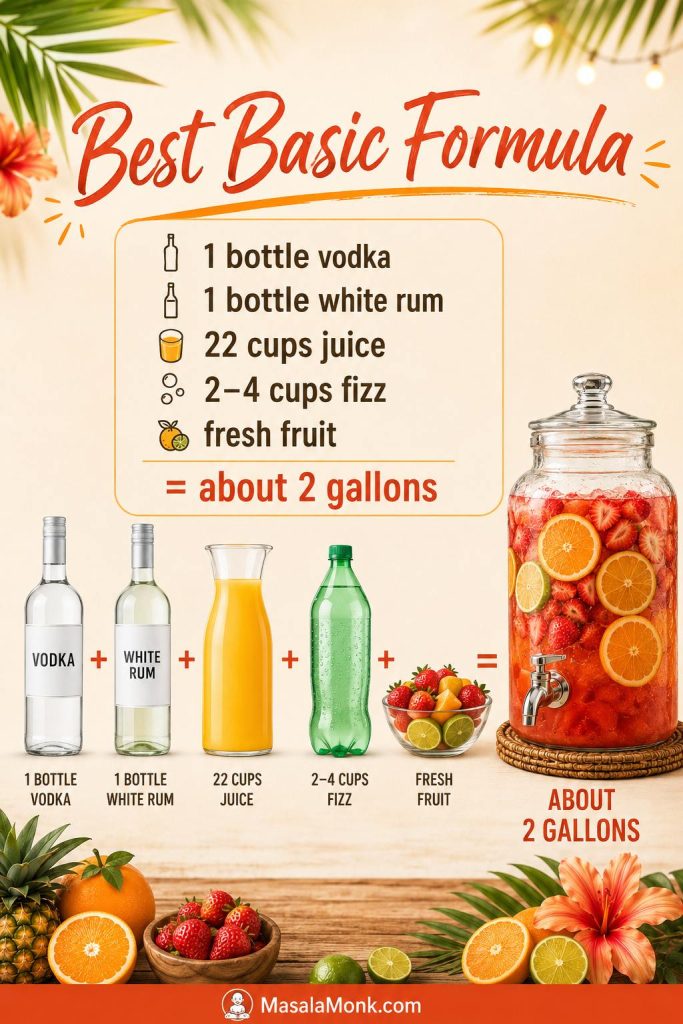
This pitcher mango margarita make-ahead flow card turns the crowd-size version into an easy hosting plan. It shows the best order for batching the base, chilling it well, prepping Tajín or salt rims, slicing garnishes, pouring over fresh ice per glass, and adding soda only at the end if you want a lighter sparkling finish. It’s a practical visual for anyone making a pitcher mango margarita recipe for guests and wanting it to stay bright instead of diluted. Save it before your next gathering, then keep reading for the exact pitcher ratios, smoky mezcal variation, spicy jalapeño version, and fruit swaps.

It sounds simple, yet it’s the difference between a pitcher that stays bright and a pitcher that tastes diluted by the end.

A quick note on sparkling add-ons

If you like topping your margarita with soda for a lighter finish, add it in the glass, not the pitcher. That way it stays lively and doesn’t go flat while you’re still pouring round two.

Also Read: How to Make a Flax Egg (Recipe & Ratio for Vegan Baking)


Mango margarita variations (pineapple, strawberry, orange, peach)

Once your base is right, variations become easy because you’re swapping fruit accents rather than reinventing structure. These are the ones that show up most often in real kitchens and real party menus.

Infographic showing four mango margarita variations: mango pineapple, strawberry mango, orange mango, and peach mango, with photoreal drinks and simple swap instructions on a dark blue background.
Want to change up your mango margarita without rebuilding the whole recipe? Use these four quick swaps: pineapple for a brighter tropical edge, strawberry for a fruitier twist, orange for a warmer citrus note, and peach for a softer, rounder finish.

Mango pineapple margarita

Pineapple amplifies the tropical vibe and makes the drink taste more “vacation.” For on-the-rocks, swap part of the mango nectar for pineapple juice. For frozen, blend frozen pineapple and frozen mango together.

A good starting point:

  • On the rocks: replace 1 oz of mango nectar with pineapple juice
  • Frozen: use ¾ cup frozen mango + ¾ cup frozen pineapple
This mango pineapple margarita recipe card gives the variation a more tropical, vacation-style feel with a tall stemmed glass, pineapple juice, mango nectar, fresh lime, and a bright Tajín-style rim. It’s a useful visual for anyone wanting a pineapple mango margarita that tastes juicy and sunny without getting syrupy. The key is to keep lime slightly stronger than you think you need so the drink stays margarita-shaped instead of drifting into fruit punch territory. Save it for summer hosting, then keep reading for the strawberry mango margarita, orange mango margarita, peach mango margarita, and sleeker mango cocktail detours below.

Because pineapple reads sweet, keep lime slightly higher than you think you need.

Strawberry mango margarita

Strawberry and mango together taste like summer dessert, yet the lime makes it grown-up again.

For frozen:

  • Add 3–5 frozen strawberries to the blender.

For on the rocks:

  • Add a small strawberry purée splash to the shaker and shake well.
This strawberry mango margarita recipe card gives the variation a brighter, fruitier, more summery personality while still keeping it cocktail-shaped. With tequila, fresh lime juice, orange liqueur, mango nectar, and a small strawberry purée splash or frozen strawberries for the blended version, it shows how to make a strawberry and mango margarita that tastes juicy and playful without turning candy-sweet. The key move is simple: keep lime lively so the fruit stays fresh and grown-up. Save this card for warm-weather hosting, then keep reading for the cleaner orange mango margarita, softer peach mango margarita, and sleeker mango drink detours below.

This fits strawberry mango margarita, strawberry and mango margarita, and mango strawberry margarita recipe directions without forcing anything.

Orange mango margarita

Orange and mango love each other, especially when you keep things bright and not too sweet. You can do this in two ways:

  • add a small splash of fresh orange juice
  • or lean slightly more on orange liqueur and reduce sweetener
This orange mango margarita recipe card gives the variation a cleaner, more citrus-led personality than the sweeter fruit builds. With tequila, fresh lime juice, orange liqueur, mango nectar, and a small splash of fresh orange juice, it shows how to make an orange mango margarita that stays bright, fresh, and properly margarita-shaped instead of drifting into juice-bar sweetness. The key is simple: let orange lift the mango, but keep lime confident so the finish stays crisp. Save this card for a more grown-up fruit variation, then keep reading for the softer peach mango margarita and the sleeker mango martini detour.

Either way, keep lime confident so the drink stays margarita-shaped. This supports mango orange margarita and orange mango margarita versions naturally.

Peach mango margarita (and frozen peach mango margarita recipe)

Peach softens mango. It’s rounder, gentler, more perfumed. Frozen peach + frozen mango is especially good in a blender.

This peach mango margarita recipe card gives the variation a softer, rounder, more sunset-like feel than the sharper citrus or tropical versions. With tequila, fresh lime juice, orange liqueur, mango nectar, and a splash of peach nectar—or frozen peach and mango for the blended version—it shows how to make a peach mango margarita that tastes perfumed and smooth without losing its margarita shape. The key is simple: peach softens the drink, so lime has to stay lively. Save this one for a gentler fruit variation, then keep reading for the sleeker mango martini and the easy tequila and mango juice detour.
  • Frozen: blend frozen mango and frozen peach 50/50, then build as the frozen mango margarita recipe
  • On the rocks: use mango nectar plus a splash of peach nectar if you have it

Finish with a Tajín rim if you want that sweet-fruit-and-spice contrast. That comfortably covers peach mango margarita recipe and frozen peach mango margarita recipe variations.

Also Read: Croquettes Recipe: One Master Method + 10 Popular Variations


Mango martini recipe and mango cocktail detours (still in the mango mood)

Not every mango drink needs to be a margarita. Sometimes you want something sleeker: no rim, no rocks, just a cold, glossy, mango-forward drink.

Mango martini (bright, shaken, not creamy)

A mango martini cocktail can be made a few ways. Here’s the margarita-adjacent route that keeps it bright rather than creamy:

  • 2 oz vodka (or tequila if you want a mango tequila cocktail twist)
  • 1½ oz mango nectar or purée
  • ¾ oz lime juice
  • optional: ¼ oz orange liqueur for lift
    Shake hard with ice and strain into a chilled glass.
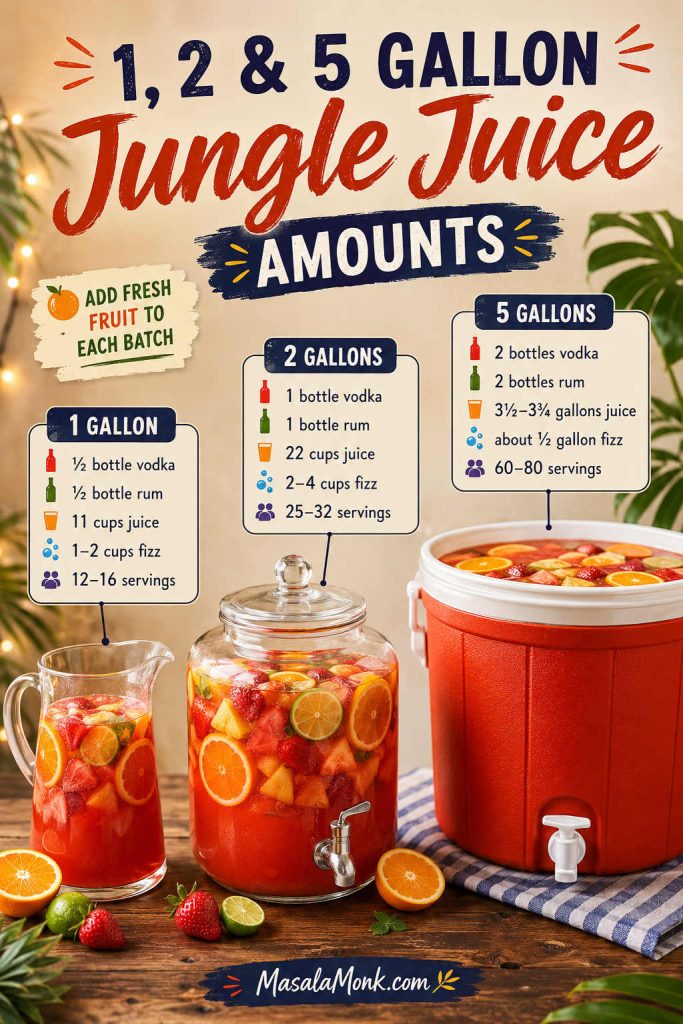
This mango martini recipe card gives the post a sleeker mango cocktail detour with a colder, cleaner, more polished feel than the margarita variations. Made with vodka or tequila, mango nectar or purée, fresh lime juice, and optional orange liqueur, it shows how to make a mango martini cocktail that stays bright, glossy, and fruit-forward without turning heavy or creamy. Save this card when you want a more elegant mango drink, then keep reading for the easy tequila and mango juice option if you want something lighter and more casual.

If you want more mango cocktail directions across spirits, MasalaMonk’s mango vodka cocktail variations is a natural blog post for readers who clearly want more mango drink ideas.

Tequila and mango juice (light and easy)

If you want something long and casual:

  • pour tequila over ice
  • add mango juice and a squeeze of lime
  • add a pinch of salt
  • taste, then decide whether it needs more lime
Premium tequila and mango juice drink recipe card showing a light mango tequila drink in a highball glass with lime garnish, ingredient list, method, and a tip to use more lime for brightness on a smooth blue background.
This tequila and mango juice drink card is the easiest mango cocktail detour in the post: light, refreshing, and built with almost no fuss. With tequila, mango juice, fresh lime, a pinch of salt, and ice, it shows how to make a simple mango tequila drink that still tastes bright and balanced instead of flat or overly sweet. The key is to let lime do the lifting and use salt to sharpen the fruit. Save this one for warm afternoons, easy hosting, or anytime you want a fast tequila and mango juice drink without pulling out a shaker full of extras.

It’s margarita-adjacent, refreshing, and it scratches that “tequila and mango drink” craving without needing a shaker.

Also Read: Ravioli Recipe Reinvented: 5 Indian-Inspired Twists on the Italian Classic


The small moves that make the drink taste like the best mango margarita

When someone says they want the best mango margarita recipe, they usually mean one of three things:

  1. it shouldn’t be cloying
  2. it shouldn’t be watery
  3. it should taste balanced and “finished”

That’s great news, because all three are fixable with simple technique.

Premium mango margarita fixes infographic showing how to correct common problems like too sweet, too flat, too watery, not mango-forward, and too sharp or tart, with a mango margarita hero drink plus lime, salt, frozen mango, mango nectar or purée, ice, and agave cues on a dark blue background.
This best mango margarita fixes card is the fast-reference guide for getting your drink back into balance. If your mango margarita tastes too sweet, too flat, too watery, not mango-forward, or too sharp, these quick corrections show exactly what to do next—more lime, a pinch of salt, more frozen mango, real mango flavor, or just a little agave. It’s one of the most useful visuals in the post because it helps you improve the drink without starting over. Save it now, then keep reading for the core recipe, frozen version, spicy jalapeño twist, Tajín and chamoy finish, mezcal variation, and pitcher guide.

Keep lime fresh and assertive

Mango is sweet by nature. Lime is the counterweight. If your drink tastes heavy, lime is often the answer.

Use salt as a flavor amplifier

A small pinch of salt inside the drink won’t make it taste salty. Instead, it makes mango taste more mango and tequila taste smoother. It also sharpens lime in a way that reads “restaurant-quality.”

Sweeten last

Especially with mango nectar, sweetness can sneak up. Start with less sweetener than you think you need, then add a touch only after tasting. This alone can separate a good mango margarita recipe from one that tastes like mango candy.

Treat orange liqueur as structure, not perfume

Orange liqueur adds a bitter-sweet backbone that keeps mango from feeling one-note. If you reduce orange liqueur too much, the drink can taste flatter. If you add too much, the mango can fade. When in doubt, stay classic and tweak gently.

If you want a measured mango margarita reference from a major orange liqueur brand, the Cointreau mango margarita is a useful point of comparison for how they frame mango + lime + orange structure.

Also Read: Eggless Yorkshire Pudding (No Milk) Recipe


What to serve with mango margaritas (snacks that make everything taste brighter)

Mango margaritas love salty crunch and creamy bites, especially when you’re doing a Tajín rim, chamoy drizzle, or spicy jalapeño heat. These pairings might fit naturally and turn “one drink” into a real spread:

And if you’d like a tropical tequila cousin that keeps the vibe going after the first round, MasalaMonk’s guava margarita pairs perfectly as a “next drink” recipe blog: same margarita structure, a different fruit personality.


Mango margarita mixes, Cayman Jack, Cutwater, and other ready-to-drink shortcuts (plus how to upgrade them)

Sometimes we are not really looking for a homemade mango margarita recipe. Instead, it’s for a shortcut: a bottled mix, a canned mango margarita, or a ready-to-drink mango option you can pour over ice and call it a day. That’s completely fair—especially when you’re hosting, when you’re tired, or when you simply want something cold and tropical without pulling out a blender.

However, here’s the truth: most mixes and canned options are built to be broadly appealing, which usually means they lean sweet and slightly flat. The good news is that you can make almost any mango margarita mix taste significantly better with a few tiny upgrades. In other words, you don’t need to “fix” it with extra syrup or complicated add-ons. You just need to restore the parts a real margarita is built on: lime brightness, structure, and a bit of salt clarity.

The 30-second upgrade that makes almost any mango margarita mix taste fresher

If you remember one thing from this entire section, make it this: the fastest path to a better mango margarita is rarely more sugar. It’s almost always more structure.

Using mango margarita mix or a ready-to-drink can? This quick upgrade makes it taste fresher: add fresh lime, add a pinch of salt, then finish with a Tajín half-rim for contrast—more lime, not syrup, if it’s too sweet.

Start with these small moves:

First, add a squeeze of fresh lime. Even a small amount wakes up bottled mango flavors and makes the drink taste more “alive.” Next, add a tiny pinch of salt. It won’t make the drink taste salty; rather, it makes mango taste more like mango and tequila taste smoother. After that, taste before adding anything sweet. Many mixes are already sweet enough, so extra syrup usually pushes them into candy territory.

Finally, if your mix tastes strangely “mango-light”—as in, sweet but not truly mango-forward—add a small splash of mango nectar or a spoonful of mango purée. That boosts real fruit flavor without turning the drink into syrup.

Once you do these four things, you’ll be shocked how often “average mix” turns into “this tastes like a decent bar pour.”

Cayman Jack Mango Margarita: what it is and how to make it taste brighter

Cayman Jack Mango Margarita is typically bought as a ready-to-drink mango margarita-style beverage. Think of it as a party-friendly shortcut that benefits from the same balancing tricks you’d use in your homemade recipes.

To make it taste brighter and less one-note, pour it over fresh ice, squeeze in lime, and add a small pinch of salt. Then stop. Taste it. At that point, you’ll usually find it tastes cleaner and more “margarita-shaped.”

If you want the Tajín mango margarita vibe, rim the glass with Tajín (or do a half-rim), but keep the drink itself clean. That way the rim supplies the contrast—tart, salty, chili-lime sparkle—while the drink stays refreshing and not heavy.

Cutwater Mango Margarita (canned): how to serve it well

Cutwater’s Mango Margarita is a canned cocktail option that people often look for when they want convenience with tequila character. Because people often look for this canned beverage, it helps to think like a shopper: the quickest path is usually the brand’s own store locator or large retailers that support inventory search and delivery in your area.

Once you actually have the can, serving it well matters more than anything else. Start by serving it very cold. Pour over fresh ice, add a squeeze of lime, and consider a Tajín rim (or a half-rim) if you want that spicy-fruity contrast. This small treatment makes canned mango margaritas taste less flat and far more “cocktail-like.”

Additionally, if the can tastes a little sweet, do not add sweetener. Instead, add lime. If it tastes muted, add salt. Those two are the levers that turn ready-to-drink mango into something that tastes intentional.

Uptown Mango Margarita and “Gloria” mango margarita (often Rancho La Gloria)

You’ll also see bottled, ready-to-pour mango margarita products on the shelves—Uptown Mango Margarita is one example. Another common pattern is people looking for “Gloria mango margarita,” which often points to a bottled mango margarita-style drink from Rancho La Gloria.

Even though the bottles differ, the strategy stays the same. Serve them very cold, pour over fresh ice, and add fresh lime. Then add a tiny pinch of salt if it tastes flat. If it tastes too sweet, keep pushing lime rather than adding anything sugary. In contrast, if it tastes too sharp, a small splash of mango nectar can soften it without changing the drink’s personality.

The overall goal is to keep it tasting bright and drinkable, not sticky.

Best mango margarita mix (Master of Mixes, Zing Zang, and “mango chili” mixes)

When someone looks for “best mango margarita mix,” what they usually want is simple: they want mango flavor that feels real, sweetness that doesn’t overwhelm, and enough citrus bite that it still tastes like a margarita rather than fruit punch.

If you’re using a mix like Master of Mixes or Zing Zang, treat it like a base—not a complete recipe. Start with tequila, add the mix, and then “finish” it with fresh lime and a pinch of salt. That’s the basic upgrade pattern.

If you want a spicy mango margarita mix feel—something like “mango chili margarita”—it’s better to build the spice cleanly rather than relying on a spicy syrup. Use a Tajín rim for chili-lime contrast, then add jalapeño slices in the shaker for controlled heat. This way the drink stays crisp and grown-up, and you don’t end up with a sticky, muddled sweetness that masks mango.

In short, the best mango margarita mix is the one you can upgrade into a balanced drink. Lime and salt do that job faster than anything else.

Also Read: Dirty Martini Recipe (Classic, Extra Dirty, No Vermouth, Spicy, Blue Cheese, Tequila + Batched)


A final pour

Once you’ve made this a couple of times, you stop thinking of it as a single recipe and start thinking of it as a set of confident choices: frozen mango or mango nectar, jalapeño slices or a gentle Tajín rim, chamoy ribbons or clean citrus brightness, tequila-only or a smoky mezcal split. That’s the real charm of a mango margarita—one base, many moods.

Premium editorial mango margarita closing guide showing one base formula with multiple style directions: on the rocks, frozen, spicy, Tajín and chamoy, and smoky mezcal, with labeled drink cues and a central reminder that mango gives body, lime gives lift, orange gives structure, salt gives clarity, and tequila gives soul.
This mango margarita guide closes the post by showing the big idea behind every variation: one balanced base, many different moods. Whether you want a mango margarita on the rocks, a frozen mango margarita, a spicy mango margarita, a Tajín and chamoy finish, or a mezcal split for smoky depth, the structure stays the same—mango for body, lime for lift, orange for structure, salt for clarity, tequila for soul. Save this as your quick chooser card so you can decide the mood first and build the drink with more confidence.

Some nights you’ll want the simplest mango margarita on the rocks. On other nights, you’ll want a frozen mango margarita recipe that tastes like a tropical slush with a tequila spine. Then, when you’re feeling playful, a chamoy margarita with a Tajín rim turns the drink into something that feels like a celebration in a glass. Either way, the balance stays the same: mango for body, lime for lift, orange for structure, salt for clarity, tequila for soul.
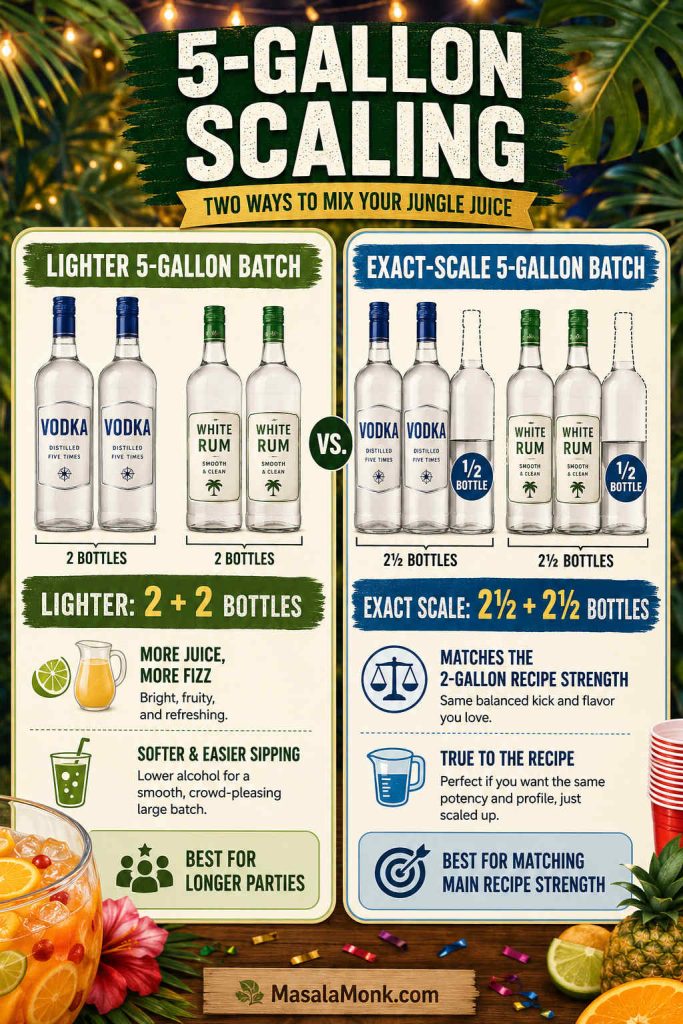
Also Read: Fish and Chips Reimagined: 5 Indian Twists (Recipe + Method)


FAQs

1) What is the best mango margarita recipe for beginners?

The best mango margarita recipe for beginners is the on-the-rocks version using mango nectar, tequila, fresh lime juice, and orange liqueur. Because mango nectar is consistent, you can focus on balance: shake until very cold, then adjust with a little more lime if it tastes sweet or a touch of agave if it tastes sharp.

2) How do you make a mango margarita on the rocks?

To make a mango margarita on the rocks, shake tequila, mango nectar (or mango juice), fresh lime juice, orange liqueur, a pinch of salt, and ice. Afterward, strain into a glass filled with fresh ice. Finally, taste once and tweak: extra lime for brightness, or a small splash of mango nectar if it’s too tart.

3) How to make a mango margarita frozen?

For a frozen mango margarita, blend tequila, lime juice, orange liqueur, a pinch of salt, and frozen mango until thick and smooth. If the blender stalls, add a tablespoon or two of cold water rather than extra ice to avoid watering it down.

4) What’s the difference between a blended mango margarita and a frozen mango margarita?

A blended mango margarita usually means the drink is made in a blender, while a frozen mango margarita specifically aims for a thick, slushy texture. In practice, both are similar; the real difference comes from how much frozen fruit you use and how much liquid you add.

5) Can I make a mango margarita recipe with mango nectar?

Yes—mango nectar is one of the easiest bases for a mango margarita recipe. Since nectar is often sweet, start with little to no added sweetener. Then, adjust with lime juice and salt to keep the drink crisp.

6) Can I make a mango margarita with mango juice instead of mango nectar?

Absolutely. However, mango juice is usually thinner than nectar, so the drink may taste less mango-forward unless you increase the mango amount or add a bit of mango purée. Meanwhile, keep lime slightly higher to maintain that margarita snap.

7) How do I make a mango nectar margarita recipe that isn’t too sweet?

First, reduce or skip added sweetener. Next, increase fresh lime juice in small steps. Finally, add a tiny pinch of salt; it sharpens citrus and keeps mango from tasting cloying.

8) Can I make a mango margarita recipe with mango purée?

Yes. A mango purée margarita recipe often tastes richer and more “bar-style.” Because purée adds body, it can handle a bit more lime. As a result, you can keep the drink bright without losing mango flavor.

9) How do I make a mango margarita recipe with fresh mango?

Blend ripe fresh mango with a splash of lime juice until smooth, then use that as your mango base in either the frozen or on-the-rocks method. If the mango is fibrous, strain the purée for a smoother texture.

10) What are the key mango margarita ingredients?

Most mango margarita ingredients include tequila, fresh lime juice, mango (nectar, purée, fresh, or frozen), orange liqueur, and ice. Additionally, a pinch of salt improves flavor and a Tajín rim is optional for contrast.

11) How do you make a spicy mango margarita?

To make a spicy mango margarita, add jalapeño slices to the shaker (or blend briefly for frozen). For more heat, muddle lightly; for less heat, remove the pepper sooner. Either way, keep mango and lime in the lead so the spice feels like a finish, not the main event.

12) How to make a spicy mango margarita with jalapeño?

Shake tequila, mango nectar (or purée), lime juice, orange liqueur, and 2–4 jalapeño slices with ice. Then strain and taste. If you want more heat next time, add one more slice or muddle gently.

13) How to make a mango jalapeño margarita without it getting too hot?

Use fewer slices, avoid muddling, and keep the contact time short. In addition, serving over fresh ice helps soften heat. If it still tastes spicy, add a splash more mango nectar and a squeeze of lime to rebalance.

14) How to make a mango habanero margarita recipe safely?

Use a tiny piece of habanero rather than slices, shake quickly, and taste immediately. Because habanero heat builds fast, start small, then increase gradually on the next round if needed.

15) What is a Tajín mango margarita?

A Tajín mango margarita is a mango margarita served with a Tajín rim (chili-lime seasoning). The salty-tart edge boosts mango flavor and makes the drink taste brighter, especially in frozen versions.

16) How do I make a mango margarita with Tajín?

Wet the rim with lime and dip it into Tajín. Then make your mango margarita on the rocks or frozen as usual. For a cleaner sip, try a half-rim so you can control how much seasoning you taste.

17) What is a chamoy margarita?

A chamoy margarita is a margarita accented with chamoy, a sweet-sour-salty condiment. When combined with mango and a Tajín rim, it takes on a mangonada-style profile that tastes like a tangy Mexican candy-inspired drink.

18) How do you make a mangonada margarita recipe at home?

Drizzle chamoy inside the glass, add a Tajín rim, then pour in a mango margarita (frozen or on the rocks). After that, taste before adding more chamoy—usually a little goes a long way.

19) What’s the best tequila for a mango margarita?

Blanco tequila keeps a mango margarita bright and crisp, while reposado adds warmth and smoothness. If you’re using Tajín or chamoy, reposado can feel especially balanced; conversely, for a fresh, zesty finish, blanco is a classic choice.
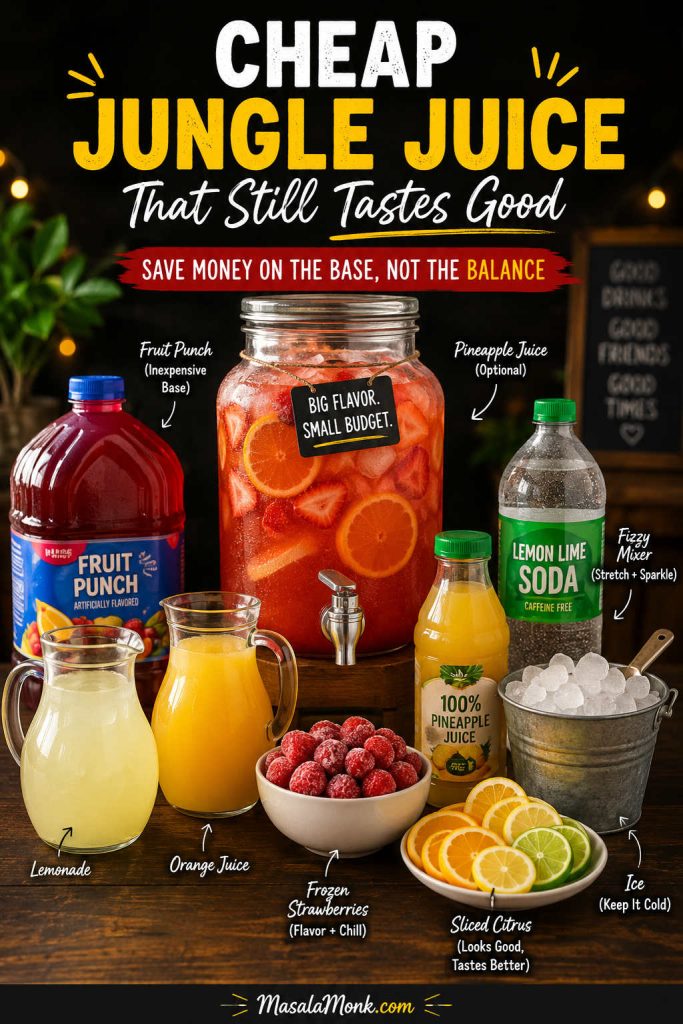
20) Can I make a mango mezcal margarita?

Yes. Replace part (or all) of the tequila with mezcal for a mango mezcal margarita. Since mezcal adds smoke, keep lime fresh and consider a Tajín rim to emphasize contrast.
21) How do I make a pitcher mango margarita recipe for a party?

Mix tequila, orange liqueur, lime juice, mango nectar, sweetener to taste, and a pinch of salt in a pitcher. Then chill the base thoroughly. When serving, pour over fresh ice so it stays bright instead of diluted.

22) How do I scale mango margaritas for a crowd without losing flavor?

Measure the base carefully, chill it well, and avoid leaving ice in the pitcher. Instead, add ice to each glass as you pour. That way the mango margarita stays consistent from the first serving to the last.

23) What is a mango pineapple margarita recipe?

A mango pineapple margarita recipe combines mango with pineapple juice or frozen pineapple. Because pineapple can taste sweeter, increase lime slightly so the drink still tastes like a margarita, not fruit punch.

24) How do I make a strawberry mango margarita?

Add strawberries to your mango margarita base—blend for frozen or shake with a small strawberry purée splash for on-the-rocks. Then re-taste and adjust lime so the finish stays crisp.

25) How do I make an orange mango margarita?

Add a splash of orange juice or lean slightly more on orange liqueur while keeping lime strong. This creates a softer citrus profile while preserving the classic margarita structure.

26) How do I make a peach mango margarita recipe?

Combine mango and peach (nectar, purée, or frozen fruit) in your base. For frozen peach mango margarita recipe versions, blend frozen peach and frozen mango together, then adjust lime so it stays bright.

27) Why does my mango margarita taste watery?

Usually the issue is too much ice or not enough mango body. For frozen drinks, use frozen mango as the main thickener and add only small splashes of water if needed. For on-the-rocks, shake, then strain over fresh ice rather than letting the drink sit in melting ice.

28) Why does my mango margarita taste too sweet?

First, add more lime juice in small increments. Next, add a pinch of salt. Finally, reduce sweetener next time, especially if you’re using mango nectar or a very ripe mango.

29) Why does my mango margarita taste too tart?

Add a small amount of agave or simple syrup, then re-taste. If you’re using mango juice rather than nectar, increasing mango volume can also soften the sharpness.

30) Can I make an easy mango margarita without orange liqueur?

You can, though the drink may taste less like a margarita and more like a mango tequila cocktail. If you skip orange liqueur, add a small amount of sweetener and keep lime assertive to maintain balance.

31) What’s the best mango margarita mix, and how do I make it taste less sweet?

The best mango margarita mix is the one that still tastes bright and citrusy once tequila is added. If it tastes too sweet, fix it with fresh lime first, then a pinch of salt. If it still tastes candy-like, reduce added sweetener next time. In contrast, if the mango flavor feels weak, add a small splash of mango nectar or a spoonful of mango purée—fruit intensity beats sugar every time.

32) How do I make a Cayman Jack mango margarita taste more like a fresh cocktail?

Pour it over fresh ice, add a squeeze of lime, and add a tiny pinch of salt. If you want extra contrast, do a Tajín half-rim rather than adding more sweetness. This keeps it bright and “margarita-shaped” instead of sticky.

33) What’s the best way to serve a Cutwater mango margarita?

Serve it very cold over ice, then add fresh lime. A Tajín rim (or half-rim) adds the chili-lime pop that makes mango taste sharper and more refreshing. If it tastes a little flat, salt is the fastest fix.

34) What is a “mangorita” recipe?

“Mangorita” is simply a nickname for a mango margarita. It still follows the classic margarita structure—tequila, lime, and orange liqueur—while mango comes in through nectar, juice, purée, fresh mango, or frozen mango.

35) How do I get a “mango chili margarita mix” vibe without using bottled spicy syrup?

Use a Tajín rim for chili-lime contrast, keep lime strong, add a pinch of salt, and add jalapeño slices to the shaker for controlled heat. This gives you the sweet-fruit-chili impression while keeping the drink crisp and clean.